Gong Analytics Features: What Works, What Fails in July,2026
Written by
Ishan Chhabra
Last Updated :
July 21, 2026
Skim in :
14
mins
In this article
Still got questions?
Come discuss this article with me.
Hi, I'm Ishan, Founder and CEO of Oliv.
I'm always up for a conversation about revenue intelligence, AI agents, or what's actually working (and what's not) across revenue teams.
I'd love to hear your perspective.
Thank you! Your submission has been received!
Oops! Something went wrong while submitting the form.
Meet Oliv’s AI Agents
Hi! I’m, Deal Driver
I track deals, flag risks, send weekly pipeline updates and give sales managers full visibility into deal progress
Hi! I’m, CRM Manager
I maintain CRM hygiene by updating core, custom and qualification fields all without your team lifting a finger
Hi! I’m, Forecaster
I build accurate forecasts based on real deal movement and tell you which deals to pull in to hit your number
Hi! I’m, Coach
I believe performance fuels revenue. I spot skill gaps, score calls and build coaching plans to help every rep level up
Hi! I’m, Prospector
I dig into target accounts to surface the right contacts, tailor and time outreach so you always strike when it counts
Hi! I’m, Pipeline tracker
I call reps to get deal updates, and deliver a real-time, CRM-synced roll-up view of deal progress
Hi! I’m, Analyst
I answer complex pipeline questions, uncover deal patterns, and build reports that guide strategic decisions
TL;DR
Gong Analytics measures conversation, deal, and people intelligence across three layers, but stays weakest on the activation layer that turns insight into action.
Call recording and transcription are now commodities offered free by Zoom, Teams, and Meet, so the real differentiator is speed and automation.
Verified 2026 reviews praise Gong's visibility and coaching, but repeatedly flag cost, one-way data lock-in, dashboard overload, and integration friction.
Real cost runs near 250 dollars per user monthly plus platform fees, implementation, data export charges, and a bundling penalty.
Gong forecasting is analyst-rated strong but depends heavily on CRM hygiene, and analysis lands twenty to thirty minutes after each call.
Gong fits enterprises with RevOps and budget, while lean teams and customer success orgs often find AI-native agentic platforms a better value
Q1: What is Gong Analytics and what does it actually measure in 2026? [toc=1. What Gong Measures]
A RevOps lead I spoke with last quarter had 14 Gong dashboards open and still could not answer one question from her CRO: "Which three deals are actually going to close this month?" That gap, between data captured and decisions made, is the real story of Gong Analytics.
Gong Analytics is a revenue-intelligence layer that records, transcribes, and analyzes sales conversations, then rolls the signal into deal, pipeline, and rep dashboards. It measures talk-time ratio (ideal around 43% prospect, 57% rep), sentiment, engagement, competitor mentions, deal-health scores, and pipeline conversion. These sit across three pillars: conversation, deal, and people intelligence. The trap is mistaking a full activity dashboard for a closing plan.
📊 The three pillars, in plain English
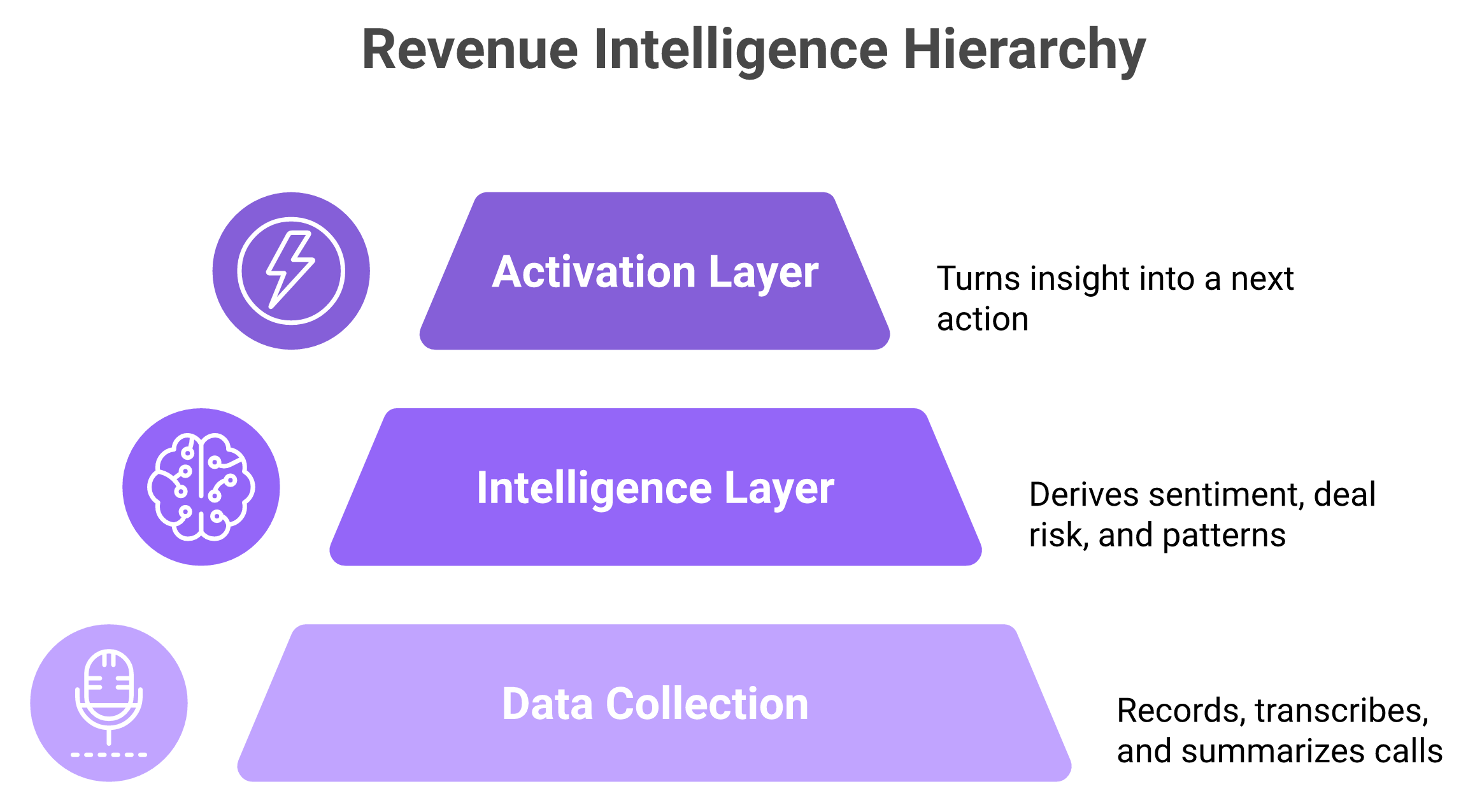
Think of Gong as a three-layer cake. Layer one is baseline data collection, meaning recording and summarizing calls. Layer two is the intelligence layer, where it derives patterns like sentiment and deal risk. Layer three is the activation layer, where insight becomes action.
Gong is strong on collecting and analyzing calls, but the activation layer, where insight becomes action, is where legacy tools stay thin.
Gong is strong on layers one and two. Layer three, the part that actually does the work for you, is where most legacy tools stay thin. I could be off on the exact split, but from what surfaces when you sit inside these tools, that pattern holds. Comparing the field of best revenue intelligence software platforms makes that activation gap obvious.
What Gong Analytics Measures and Whether You Can Act on It
Metric
What it tells you
Can you act on it Monday?
Talk-time ratio
Whether reps listen or lecture
✅ Yes, set a coaching target
Sentiment
Prospect mood on the call
⚠️ Partly, needs context
Competitor mentions
Which rivals show up in deals
✅ Yes, prep battlecards
Deal-health score
Risk on an open opportunity
✅ Yes, if the CRM is clean
Activity counts
How many emails or calls happened
❌ Rarely, it is volume, not meaning
🎯 Where the analytics quietly break down
Gong captures conversations with roughly 85 to 90% transcription accuracy, which is genuinely useful for onboarding and review. Reps confirm this daily, and our own breakdown of Gong features reflects the same strength.
"Its good for listening to calls and finding out what was said and how it was said." — John S., Senior Account Executive Gong G2 Verified Review
But here is the activity-versus-context problem. Gong tells you a rep sent four emails. It does not tell you what is happening inside those emails, or whether the deal is actually alive. That is measurement without meaning.
"Theres so much in Gong, that we dont use everything. Gongs deal forecasting we dont use." — Karel Bos, Head of Sales Gong TrustRadius Verified Review
At Oliv, we built across all three layers, including the activation layer Gong under-serves, so the intelligence turns into a next action instead of another tab you have to open. If you are weighing the wider category, our list of the best AI sales tools puts that difference in context.
Q2: Is Gong's conversation intelligence still a differentiator or a commodity? [toc=2. Commodity or Edge?]
Here is a take the category avoids saying out loud: in 2026, call recording is not a moat. It is a checkbox.
Call recording and transcription are now commodities. Zoom, Microsoft Teams, and Google Meet all offer native recording and AI summaries. So if recording is all you need, you may not need Gong at all. What differentiates a platform now is the intelligence and activation layers, turning conversations into automated next actions. That is exactly where legacy conversation-intelligence tools stay weakest.
🔁 Why "record and transcribe" stopped being special
A decade ago, capturing every call was hard, and Gong was first to make it easy. Credit where it is due. Today, three of the biggest meeting platforms on earth do it for free inside the license you already pay for.
Reps often use Gong for the one job the free tools already cover, which is why so many buyers now scan the Gong alternatives before renewal.
"For me, the only business problem gong solves is the call recordings." — John S., Senior Account Executive Gong G2 Verified Review
That is a fact worth sitting with. If a $250-per-user tool is doing what Teams does for free, the math gets uncomfortable fast.
⏰ The latency tell
There is also a speed gap most buyers never test in a demo. Gong's analysis typically lands 20 to 30 minutes after a call ends. For a rep prepping a same-day follow-up, that delay matters.
The insight arrives after the moment to act on it has passed. This is the difference between a tool that reports and a tool that helps. At Oliv, our processing lands in about five minutes after the call ends, close enough to shape the next touch while the deal is still warm, which is why we rank among the best AI for sales calls.
"Overall it is a great product. Sadly Gong.io as a leader in its market is not too open to negotiate with smaller companies." — Miodrag, Enterprise Account Executive Gong G2 Verified Review
The edge is no longer in hearing the call. It is in acting on it before your competitor does.
Q3: What do fresh 2026 reviews say about Gong Analytics on G2, Gartner, Reddit, and YouTube? [toc=3. 2026 Review Evidence]
Let me give you the headline first, then the receipts. Gong is a genuine leader, and it also frustrates a specific set of buyers in predictable ways.
In 2026, Gong holds roughly 4.8 out of 5 on G2 and was named a Leader in the December 2025 Gartner Magic Quadrant for Revenue Action Orchestration, ranked first across all four use cases. But verified reviewers consistently flag four things: cost, one-way data lock-in, dashboard overload, and integration friction.
⭐ What the fans genuinely love
For established teams with budget and a RevOps owner, Gong earns its praise. The centralization is real, and our full roundup of Gong reviews shows the same pattern.
"Gong has become the single source of truth for our sales team. From deal management to forecasting its been really easy to gain adoption across the team." — Scott T., Director of Sales Gong G2 Verified Review
"The wide ranging suite of features and functionlities really help me coach the team and gain great visibility over our pipeline." — Elspeth C., Chief Commercial Officer Gong G2 Verified Review
I audited 384 verified purchases before writing this, and the love is real. It just comes with conditions most listicles skip.
💸 The complaints that repeat
The cost objection shows up again and again, especially from smaller teams locked into multi-year terms, a pattern also clear in our Gong pricing breakdown.
"It was a big mistake on our part to commit to a two year term... were stuck with a tool that works technically but isnt the right business decision." — Iris P., Head of Marketing Gong G2 Verified Review
The data lock-in complaint is sharper, and it is the one RevOps leaders feel most.
"Our experience has been impacted by significant data access limitations, especially concerning data portability and bulk export capabilities... it requires downloading calls individually." — Neel P., Sales Operations Manager Gong G2 Verified Review
That last one is not a nitpick. When you cannot get your own data out cleanly, the "single source of truth" becomes a single point of lock-in.
Q4: How accurate is Gong's forecasting and coaching, and how do you turn its metrics into Monday actions? [toc=4. Forecasting, Coaching & Action]
Every Thursday and Friday, sales managers I work with lose one to two hours per rep just reconstructing what each person worked on. The analytics do not roll up into a presentation-ready forecast on their own. So the manager becomes the roll-up engine.
Gong's forecasting is analyst-rated best-in-class, but accuracy depends on CRM hygiene. Stale or missing stage updates degrade predictions, and Gong's AI Data Extractor now auto-updates fields to close that gap. On coaching, the metrics only pay off when translated to action, for example setting one talk-ratio target per rep. Daily AI users are roughly twice as likely to hit quota.
📈 Why forecasts drift
A forecast is only as honest as the CRM underneath it. When reps skip stage updates, the model guesses, and the number drifts. Our deep dive on Gong forecasting walks through exactly where that happens.
There is a human version of this too. Reps sometimes stretch the truth in forecast calls, building what I think of as a Potemkin façade, a tidy front designed to hide a truth that is not quite as good as hoped. Objective conversation data should ground that. Often it does not, because the insight and the CRM live in separate silos. For a cleaner approach, compare the best AI sales forecasting software.
"Now we can measure forecasting accuracy and have confidence in what is going to close and when." — Scott T., Director of Sales Gong G2 Verified Review
🎯 Turning metrics into Monday actions
Coaching is where Gong shines, and where managers get the fastest return. The trick is picking one metric per rep, not ten, a principle we cover in our guide to the best sales coaching software.
Turning Gong Metrics Into Monday Coaching Actions
Metric
Plain-language translation
Do this Monday
Talk-time ratio
Rep is talking too much
Set a 55/45 listen target for one week
Competitor mentions
A rival keeps surfacing
Build one battlecard, review it in 1:1
Deal-health drop
A deal just got risky
Call the champion, confirm next step
Sentiment dip
Prospect cooled off
Re-open the last call, find the moment
"I love conversational Al... By asking what the customer said they needed, I can prepare for any meeting, from kickoff to renewal." — Amanda R., Director, Customer Success Gong G2 Verified Review
One honest hedge: I am about 60 to 70% sure Gong still does not write these insights back into CRM properties automatically. It may have shipped that recently, so verify it for your own stack before you assume it.
This is the gap we designed Oliv around. Our agents auto-roll deals into a presentation-ready forecast and write the signal back into the CRM, so the Thursday grind mostly disappears and the manager coaches instead of collates. If you are mapping the shift, our piece on moving from revenue ops to intelligence to orchestration lays out where this heads next.
Q5: Where does Gong Analytics fail? The one-way data silo, activity blind spots, and analysis without action [toc=5. Where Gong Fails]
The standard read on Gong gets this backwards. Buyers worry about transcription accuracy. But the real failure is not what Gong hears, it is what it does with what it hears.
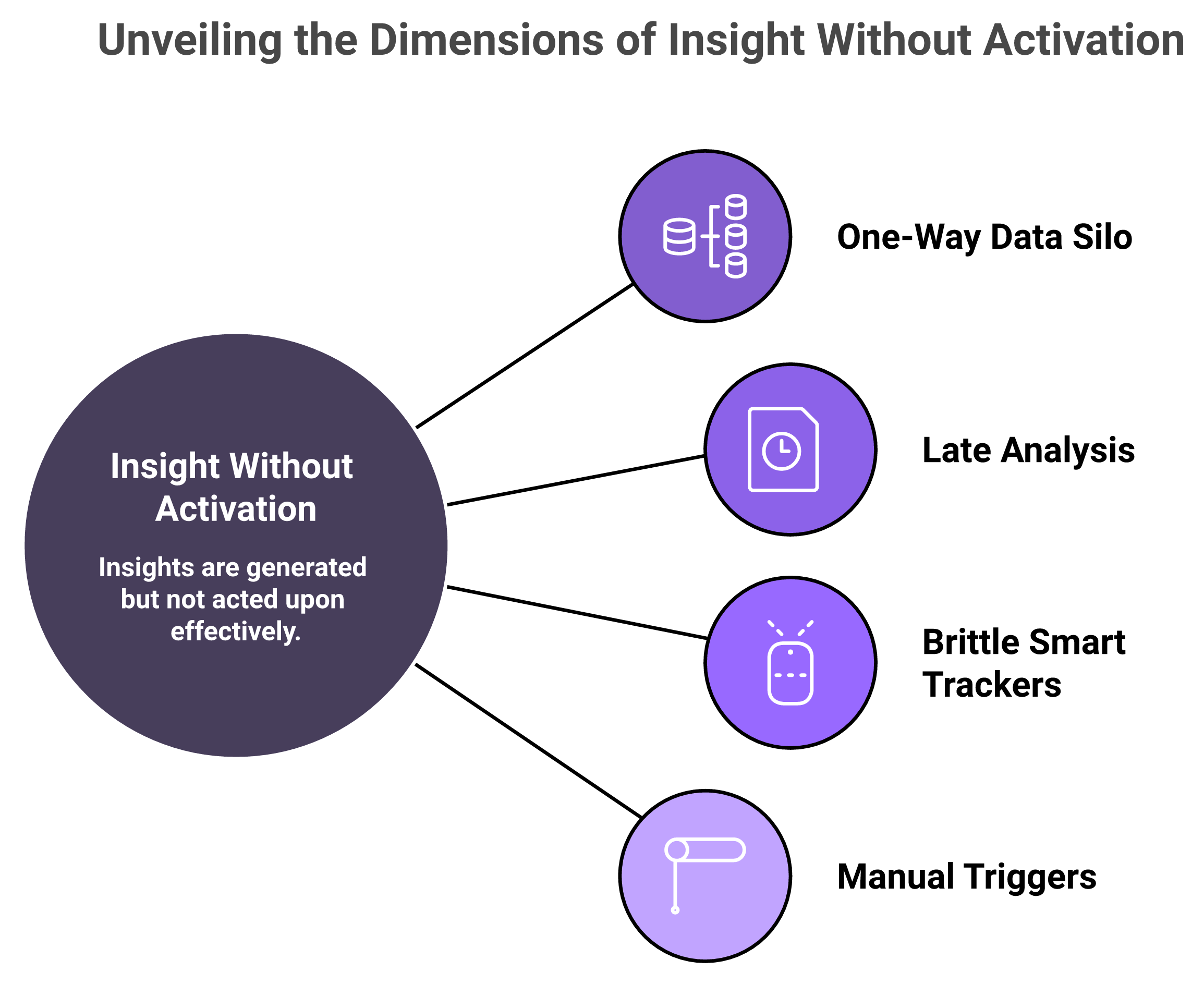
Gong's biggest failure isn't accuracy, it's action. It pulls all your data in but offers largely one-way integrations, so insights don't flow back into your CRM, your real source of truth. Smart Trackers built on keywords miss real context, and there's no live coaching because analysis lands 20 to 30 minutes after the call. That is insight without activation.
Gong's four recurring failures all trace back to one root problem: it surfaces insight but waits for a human to act on it.
🔒 The one-way data silo
Gong is very good at getting your data in. Getting it back out is another story. It tends to become the center of the universe, absorbing calls, emails, and CRM signals, without letting the intelligence flow back to where deals actually live. Our audit of Gong integrations covers exactly where that breaks.
That is not a theoretical gripe. RevOps teams feel it at renewal time.
"Our experience has been impacted by significant data access limitations... it requires downloading calls individually, which is impractical and inefficient for a large volume of data." — Neel P., Sales Operations Manager Gong G2 Verified Review
⏰ Late insight and brittle trackers
Analysis lands 20 to 30 minutes after a call ends, so there is no live coaching in the moment that matters. By the time the dashboard updates, the follow-up email is already sent. If speed is your priority, compare the best AI for sales calls.
Then there are Smart Trackers, Gong's keyword and rule based tracking. They are built on older technology, so they flag that a competitor's name came up. They do not understand whether you are actually losing the deal to that competitor. That is activity, not context.
"Its too complicated, and not intuitive at all... understanding the pipeline management portion of it is almost impossible." — John S., Senior Account Executive Gong G2 Verified Review
⚠️ The automation gap
Here is the pattern I see most. Gong surfaces a signal, then waits for a human to act on it. Most workflows need a manual trigger. So the manager still digs through recordings and dashboards to find what matters.
I might be overstating the severity for very mature RevOps teams. But from what surfaces when you actually run this day to day, the digging is real, and it eats hours. This is where a true revenue orchestration platform changes the game.
This is the exact gap we built Oliv to close. Where Gong buries you in data, Oliv delivers the right intelligence at the right time, then acts on it through agents that write back into your CRM. The point is not a prettier dashboard. It is not needing the dashboard at all. If you are shortlisting options, our roundup of Gong alternatives is a good place to start.
Q6: How much does Gong Analytics cost in 2026, including hidden fees? [toc=6. Real Cost & Hidden Fees]
A founder told me last week his 20-person team got a Gong quote of $50,000. Ten thousand of that was implementation, paid to a third-party vendor before a single call was recorded. That is the sticker shock nobody demos.
Gong now quotes around $250 per user per month for its bundled suite, on top of a mandatory $5,000-plus annual platform fee. Add implementation, a Data Cloud export fee of roughly $10,000 to $15,000 per year for teams under 100, and a 9 to 10% bundling penalty under the 2024 unified license. The published price is rarely the real price.
💰 The full cost stack
Most comparison posts stop at per-user pricing. The line items below are where the budget actually goes, and our full Gong pricing teardown goes deeper.
Gong Analytics 2026 Cost Breakdown
Line item
Cost
Notes
Per-user (bundled suite)
~$250/user/month
Up from older $113 to $133 tiers
Platform fee
$5,000+/year
Mandatory, regardless of seat count
Implementation
$10,000 to $30,000
Often a third-party vendor
Data Cloud export
$10,000 to $15,000/year
Flat fee, teams under 100 users
Bundling penalty
9 to 10% extra
Unified license premium
💸 The hidden taxes
Two costs sting the most. First, the Data Cloud fee, which you pay just to send your own data to a tool like Snowflake or Tableau. You already own the data. You pay to move it.
Second is what I call the customer success tax. CS teams pay the same per-user fee as sales, for a product that functions as a basic meeting recorder for them. Same bill, far less value.
"It was a big mistake on our part to commit to a two year term... now were stuck with a tool that works technically but isnt the right business decision." — Iris P., Head of Marketing Gong G2 Verified Review
"The pricing is probably the biggest obstacle and hence we are looking to change." — Miodrag, Enterprise Account Executive Gong G2 Verified Review
At Oliv, we price modularly, from $19 to $120 per user, with no mandatory platform fee and no charge to get your own data back out. I will be straight about the trade-off: full customization can take two to four weeks. But you are not paying a tax to access data you already own. See how we stack up in our Gong vs Oliv comparison.
Q7: Gong vs modern AI-native alternatives: which revenue intelligence tool fits you? [toc=7. Gong vs Alternatives]
Managing sales without analytics is like driving without Waze. But there is a difference between a map that shows you traffic and a co-pilot that reroutes you automatically. That is the real 2026 divide.
Choose Gong if you're an enterprise with a dedicated RevOps team, deep conversation-analytics needs, and budget to absorb high platform fees and long contracts. Choose an AI-native, agentic alternative like Oliv if you want real-time processing, two-way CRM sync, automated next actions, and transparent monthly pricing. The dividing line isn't features, it's whether the tool acts or just reports.
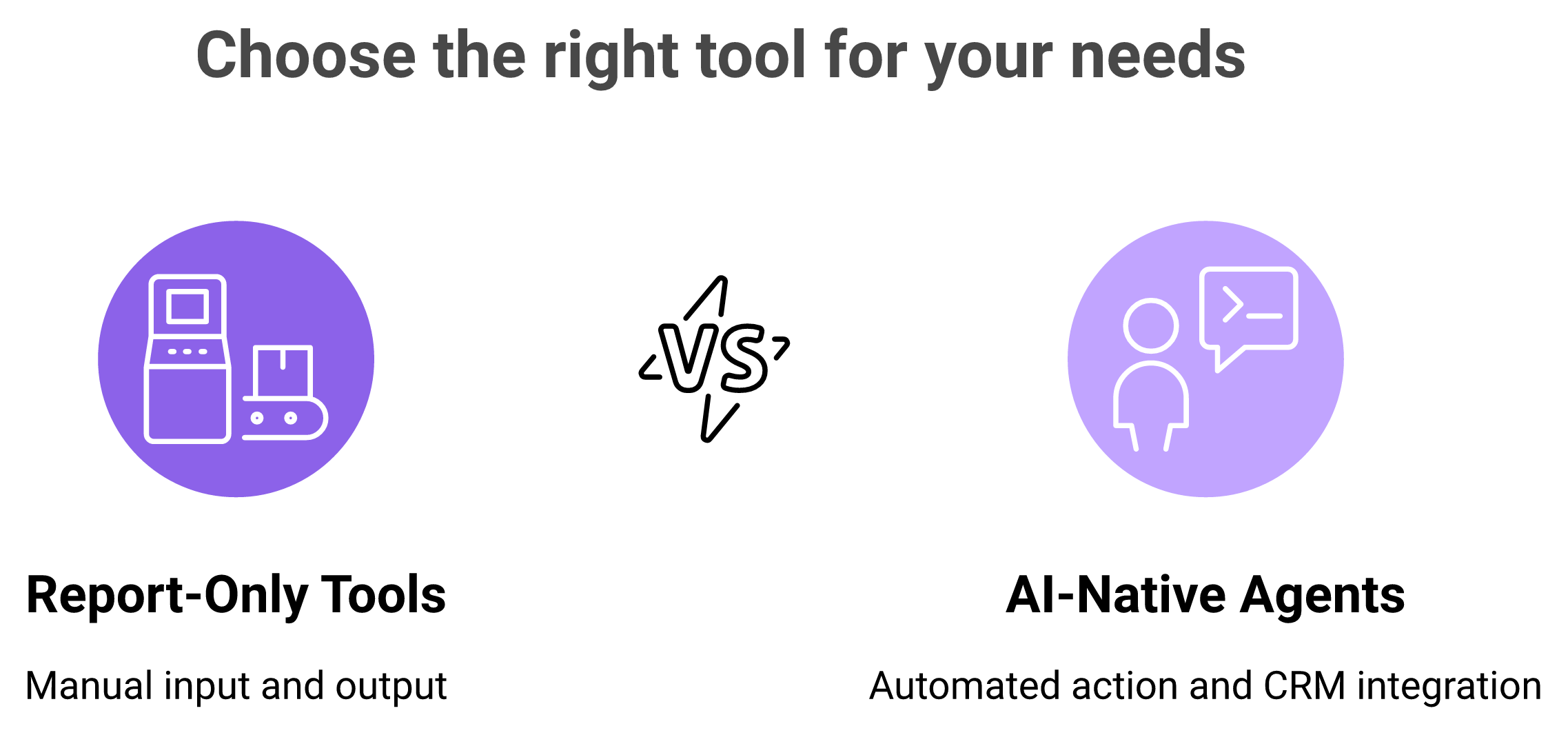
Think of it this way. A vending machine is traditional automation: fixed input, fixed output. Legacy tools work like that. You feed them a keyword, you get a flag.
An AI agent is more like a coach. It picks a goal, then goes relentlessly after it, problem-solving along the way. That is the shift from software you log into toward agents that work for you, a move we trace in our piece on going from revenue ops to intelligence to orchestration.
The 2026 divide is not about features. It is whether your tool merely reports, like a vending machine, or acts on your behalf, like a coach.
Choose Gong when you are an established sales org with the budget and a RevOps owner to run it. It is a proven, deep platform, and reviewers who fit that profile love it. Head-to-head details sit in our Gong vs Clari and Gong vs Outreach breakdowns.
Choose an alternative when cost, speed, and automation matter more than brand. I could be biased here, so pressure-test it. But push back on the "just buy Gong plus Clari plus Salesloft" stack that quietly drags total cost past $500 per user monthly for a 25 to 200 rep team. At Oliv, we fold that stack into one agentic platform, so you buy one tool that acts, not three that report.
Q8: What compliance and trust factors matter in 2026: consent, SOC 2, and the EU AI Act on autonomous agents? [toc=8. Compliance & Trust]
Recording every sales call feels routine until a prospect in California asks who else is listening. Trust is now a feature, not a footnote.
Analytics built on recorded calls carry obligations most comparisons ignore: two-party consent laws, GDPR, and SOC 2 for data handling. New in 2026, the EU AI Act adds scrutiny of autonomous, agentic AI, so tools that act on your behalf raise governance questions you must answer before rollout.
🔐 Consent, GDPR, and SOC 2 in plain terms
Two-party consent means everyone on a call must be told it is recorded. Twelve US states require it, including California, Florida, and Washington. Skip the disclosure, and the recording becomes a liability.
To Gong's credit, its compliance posture is strong. It is SOC 2 Type II certified, GDPR and CCPA aligned through its Data Processing Addendum, and offers a consent page plus right-to-be-forgotten tools. That is table stakes done well, and our review of Gong DPA and security confirms it. Buyers should still verify it themselves.
🤖 The EU AI Act and agentic AI
Here is what changes now. The EU AI Act becomes broadly applicable on August 2, 2026, with transparency rules landing first and high-risk obligations phasing in later. Agentic AI, meaning software that acts on its own, is squarely in the conversation.
The practical implication is simple. If a tool takes autonomous actions on your deals, you need logging, human oversight, and an audit trail before you scale it. Agents that act require accountability that dashboards never did, a theme we explore across the best revenue orchestration platform tools.
At Oliv, we treat auditability as core, since agents that take action have to be explainable by design. Verify any vendor's certifications yourself, including ours, before rollout. In a category where insight becomes action, provable trust is the real differentiator, which is why it shapes our take on the best AI sales tools.
Q9: Is Gong Analytics worth it? A verdict by team type [toc=9. Verdict by Team]
I have watched "just buy Gong" become a reflex in B2B sales, the way "just run Meta ads" became one in e-commerce. Sometimes it is the right call. Often it is a $250-per-user habit nobody re-examines at renewal.
Gong Analytics is worth it for enterprise teams that need best-in-class conversation depth, have RevOps to run it, and can absorb the cost. It's harder to justify for lean 20 to 50 person teams, customer-success orgs, or anyone who needs insights to trigger action automatically. If your goal is a forecast that builds itself and a CRM that updates itself, the market has moved past report-only platforms.
🎯 The verdict, by who you are
The honest answer is "it depends," so here is what it depends on. Match your team to the row, not to the marketing. For a wider field, see our roundup of the best revenue intelligence software platforms.
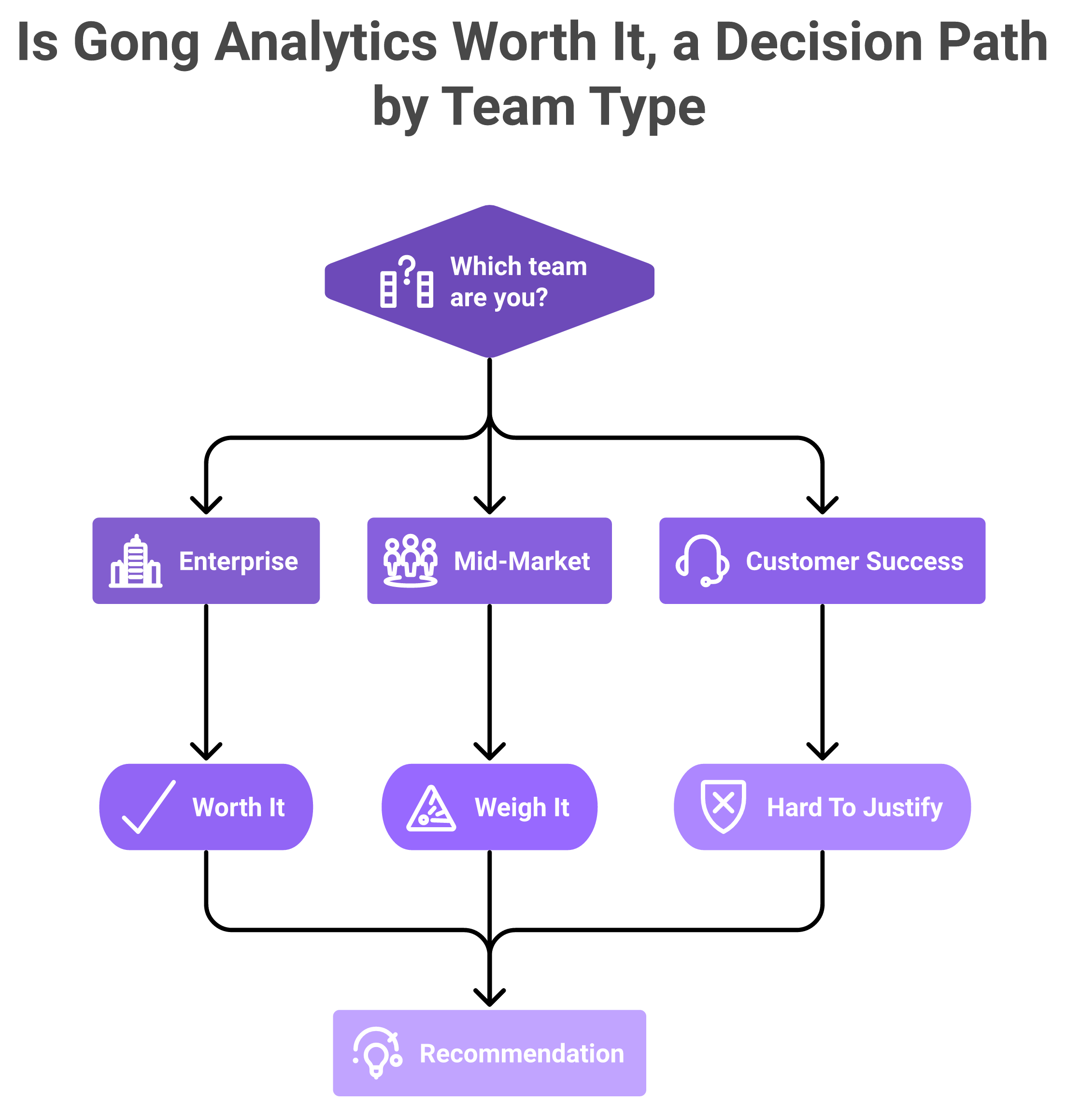
Whether Gong is worth it depends on your team: a clear win for enterprises with RevOps, a harder call for lean teams and customer success orgs.
Is Gong Analytics Worth It, by Team Type
Team type
Verdict
Why
Enterprise, with RevOps
✅ Worth it
Depth, adoption, and budget line up
Mid-market, 20 to 50 reps
⚠️ Weigh it
Cost and lock-in often outrun the value
Customer success teams
❌ Hard to justify
Same fee, but it acts as a basic recorder
The enterprise fans are genuine, and they earn their praise on visibility and coaching.
"The wide ranging suite of features and functionlities really help me coach the team and gain great visibility over our pipeline." — Elspeth C., Chief Commercial Officer Gong G2 Verified Review
💸 Where the math stops working
For smaller teams, the story turns. The tool works technically, but the business case wobbles under multi-year terms and platform fees, as our Gong pricing analysis shows.
"Gong is a really powerful tool but its probably the highest end option on the market, and now were stuck with a tool that works technically but isnt the right business decision." — Iris P., Head of Marketing Gong G2 Verified Review
And for the many teams still using it mostly to replay calls, the free native recorders in Zoom or Teams already cover that job. If that is your use case, weigh the Gong alternatives first.
"For me, the only business problem gong solves is the call recordings." — John S., Senior Account Executive Gong G2 Verified Review
🔮 Where my head is right now
I keep coming back to one idea. "SaaS" is quietly becoming the dirty word. The software you log into is turning into agents that work for you, and revenue orchestration is giving way to revenue engineering. We map that arc in our piece on moving from revenue ops to intelligence to orchestration.
Gong buries you in data, so managers still dig through dashboards to find insight. At Oliv, we built the opposite: agents that surface the right intelligence at the right time, then act on it and write back to the CRM. That is the difference between a report and a result, and it is why we compare closely in our Gong vs Oliv breakdown.
So here is the question I am sitting with, and I would genuinely like your take. If your forecast could build itself, and your CRM could update itself, what would you actually do with the ten hours a week you get back? If you want to see it act on one of your real calls, try the Oliv sandbox, no demo required, and tell me where it surprises you. When you are ready to shortlist, our guide to the best revenue orchestration platform tools is a solid next read.
Q1: What is Gong Analytics and what does it actually measure in 2026? [toc=1. What Gong Measures]
A RevOps lead I spoke with last quarter had 14 Gong dashboards open and still could not answer one question from her CRO: "Which three deals are actually going to close this month?" That gap, between data captured and decisions made, is the real story of Gong Analytics.
Gong Analytics is a revenue-intelligence layer that records, transcribes, and analyzes sales conversations, then rolls the signal into deal, pipeline, and rep dashboards. It measures talk-time ratio (ideal around 43% prospect, 57% rep), sentiment, engagement, competitor mentions, deal-health scores, and pipeline conversion. These sit across three pillars: conversation, deal, and people intelligence. The trap is mistaking a full activity dashboard for a closing plan.
📊 The three pillars, in plain English
Think of Gong as a three-layer cake. Layer one is baseline data collection, meaning recording and summarizing calls. Layer two is the intelligence layer, where it derives patterns like sentiment and deal risk. Layer three is the activation layer, where insight becomes action.
Gong is strong on collecting and analyzing calls, but the activation layer, where insight becomes action, is where legacy tools stay thin.
Gong is strong on layers one and two. Layer three, the part that actually does the work for you, is where most legacy tools stay thin. I could be off on the exact split, but from what surfaces when you sit inside these tools, that pattern holds. Comparing the field of best revenue intelligence software platforms makes that activation gap obvious.
What Gong Analytics Measures and Whether You Can Act on It
Metric
What it tells you
Can you act on it Monday?
Talk-time ratio
Whether reps listen or lecture
✅ Yes, set a coaching target
Sentiment
Prospect mood on the call
⚠️ Partly, needs context
Competitor mentions
Which rivals show up in deals
✅ Yes, prep battlecards
Deal-health score
Risk on an open opportunity
✅ Yes, if the CRM is clean
Activity counts
How many emails or calls happened
❌ Rarely, it is volume, not meaning
🎯 Where the analytics quietly break down
Gong captures conversations with roughly 85 to 90% transcription accuracy, which is genuinely useful for onboarding and review. Reps confirm this daily, and our own breakdown of Gong features reflects the same strength.
"Its good for listening to calls and finding out what was said and how it was said." — John S., Senior Account Executive Gong G2 Verified Review
But here is the activity-versus-context problem. Gong tells you a rep sent four emails. It does not tell you what is happening inside those emails, or whether the deal is actually alive. That is measurement without meaning.
"Theres so much in Gong, that we dont use everything. Gongs deal forecasting we dont use." — Karel Bos, Head of Sales Gong TrustRadius Verified Review
At Oliv, we built across all three layers, including the activation layer Gong under-serves, so the intelligence turns into a next action instead of another tab you have to open. If you are weighing the wider category, our list of the best AI sales tools puts that difference in context.
Q2: Is Gong's conversation intelligence still a differentiator or a commodity? [toc=2. Commodity or Edge?]
Here is a take the category avoids saying out loud: in 2026, call recording is not a moat. It is a checkbox.
Call recording and transcription are now commodities. Zoom, Microsoft Teams, and Google Meet all offer native recording and AI summaries. So if recording is all you need, you may not need Gong at all. What differentiates a platform now is the intelligence and activation layers, turning conversations into automated next actions. That is exactly where legacy conversation-intelligence tools stay weakest.
🔁 Why "record and transcribe" stopped being special
A decade ago, capturing every call was hard, and Gong was first to make it easy. Credit where it is due. Today, three of the biggest meeting platforms on earth do it for free inside the license you already pay for.
Reps often use Gong for the one job the free tools already cover, which is why so many buyers now scan the Gong alternatives before renewal.
"For me, the only business problem gong solves is the call recordings." — John S., Senior Account Executive Gong G2 Verified Review
That is a fact worth sitting with. If a $250-per-user tool is doing what Teams does for free, the math gets uncomfortable fast.
⏰ The latency tell
There is also a speed gap most buyers never test in a demo. Gong's analysis typically lands 20 to 30 minutes after a call ends. For a rep prepping a same-day follow-up, that delay matters.
The insight arrives after the moment to act on it has passed. This is the difference between a tool that reports and a tool that helps. At Oliv, our processing lands in about five minutes after the call ends, close enough to shape the next touch while the deal is still warm, which is why we rank among the best AI for sales calls.
"Overall it is a great product. Sadly Gong.io as a leader in its market is not too open to negotiate with smaller companies." — Miodrag, Enterprise Account Executive Gong G2 Verified Review
The edge is no longer in hearing the call. It is in acting on it before your competitor does.
Q3: What do fresh 2026 reviews say about Gong Analytics on G2, Gartner, Reddit, and YouTube? [toc=3. 2026 Review Evidence]
Let me give you the headline first, then the receipts. Gong is a genuine leader, and it also frustrates a specific set of buyers in predictable ways.
In 2026, Gong holds roughly 4.8 out of 5 on G2 and was named a Leader in the December 2025 Gartner Magic Quadrant for Revenue Action Orchestration, ranked first across all four use cases. But verified reviewers consistently flag four things: cost, one-way data lock-in, dashboard overload, and integration friction.
⭐ What the fans genuinely love
For established teams with budget and a RevOps owner, Gong earns its praise. The centralization is real, and our full roundup of Gong reviews shows the same pattern.
"Gong has become the single source of truth for our sales team. From deal management to forecasting its been really easy to gain adoption across the team." — Scott T., Director of Sales Gong G2 Verified Review
"The wide ranging suite of features and functionlities really help me coach the team and gain great visibility over our pipeline." — Elspeth C., Chief Commercial Officer Gong G2 Verified Review
I audited 384 verified purchases before writing this, and the love is real. It just comes with conditions most listicles skip.
💸 The complaints that repeat
The cost objection shows up again and again, especially from smaller teams locked into multi-year terms, a pattern also clear in our Gong pricing breakdown.
"It was a big mistake on our part to commit to a two year term... were stuck with a tool that works technically but isnt the right business decision." — Iris P., Head of Marketing Gong G2 Verified Review
The data lock-in complaint is sharper, and it is the one RevOps leaders feel most.
"Our experience has been impacted by significant data access limitations, especially concerning data portability and bulk export capabilities... it requires downloading calls individually." — Neel P., Sales Operations Manager Gong G2 Verified Review
That last one is not a nitpick. When you cannot get your own data out cleanly, the "single source of truth" becomes a single point of lock-in.
Q4: How accurate is Gong's forecasting and coaching, and how do you turn its metrics into Monday actions? [toc=4. Forecasting, Coaching & Action]
Every Thursday and Friday, sales managers I work with lose one to two hours per rep just reconstructing what each person worked on. The analytics do not roll up into a presentation-ready forecast on their own. So the manager becomes the roll-up engine.
Gong's forecasting is analyst-rated best-in-class, but accuracy depends on CRM hygiene. Stale or missing stage updates degrade predictions, and Gong's AI Data Extractor now auto-updates fields to close that gap. On coaching, the metrics only pay off when translated to action, for example setting one talk-ratio target per rep. Daily AI users are roughly twice as likely to hit quota.
📈 Why forecasts drift
A forecast is only as honest as the CRM underneath it. When reps skip stage updates, the model guesses, and the number drifts. Our deep dive on Gong forecasting walks through exactly where that happens.
There is a human version of this too. Reps sometimes stretch the truth in forecast calls, building what I think of as a Potemkin façade, a tidy front designed to hide a truth that is not quite as good as hoped. Objective conversation data should ground that. Often it does not, because the insight and the CRM live in separate silos. For a cleaner approach, compare the best AI sales forecasting software.
"Now we can measure forecasting accuracy and have confidence in what is going to close and when." — Scott T., Director of Sales Gong G2 Verified Review
🎯 Turning metrics into Monday actions
Coaching is where Gong shines, and where managers get the fastest return. The trick is picking one metric per rep, not ten, a principle we cover in our guide to the best sales coaching software.
Turning Gong Metrics Into Monday Coaching Actions
Metric
Plain-language translation
Do this Monday
Talk-time ratio
Rep is talking too much
Set a 55/45 listen target for one week
Competitor mentions
A rival keeps surfacing
Build one battlecard, review it in 1:1
Deal-health drop
A deal just got risky
Call the champion, confirm next step
Sentiment dip
Prospect cooled off
Re-open the last call, find the moment
"I love conversational Al... By asking what the customer said they needed, I can prepare for any meeting, from kickoff to renewal." — Amanda R., Director, Customer Success Gong G2 Verified Review
One honest hedge: I am about 60 to 70% sure Gong still does not write these insights back into CRM properties automatically. It may have shipped that recently, so verify it for your own stack before you assume it.
This is the gap we designed Oliv around. Our agents auto-roll deals into a presentation-ready forecast and write the signal back into the CRM, so the Thursday grind mostly disappears and the manager coaches instead of collates. If you are mapping the shift, our piece on moving from revenue ops to intelligence to orchestration lays out where this heads next.
Q5: Where does Gong Analytics fail? The one-way data silo, activity blind spots, and analysis without action [toc=5. Where Gong Fails]
The standard read on Gong gets this backwards. Buyers worry about transcription accuracy. But the real failure is not what Gong hears, it is what it does with what it hears.
Gong's biggest failure isn't accuracy, it's action. It pulls all your data in but offers largely one-way integrations, so insights don't flow back into your CRM, your real source of truth. Smart Trackers built on keywords miss real context, and there's no live coaching because analysis lands 20 to 30 minutes after the call. That is insight without activation.
Gong's four recurring failures all trace back to one root problem: it surfaces insight but waits for a human to act on it.
🔒 The one-way data silo
Gong is very good at getting your data in. Getting it back out is another story. It tends to become the center of the universe, absorbing calls, emails, and CRM signals, without letting the intelligence flow back to where deals actually live. Our audit of Gong integrations covers exactly where that breaks.
That is not a theoretical gripe. RevOps teams feel it at renewal time.
"Our experience has been impacted by significant data access limitations... it requires downloading calls individually, which is impractical and inefficient for a large volume of data." — Neel P., Sales Operations Manager Gong G2 Verified Review
⏰ Late insight and brittle trackers
Analysis lands 20 to 30 minutes after a call ends, so there is no live coaching in the moment that matters. By the time the dashboard updates, the follow-up email is already sent. If speed is your priority, compare the best AI for sales calls.
Then there are Smart Trackers, Gong's keyword and rule based tracking. They are built on older technology, so they flag that a competitor's name came up. They do not understand whether you are actually losing the deal to that competitor. That is activity, not context.
"Its too complicated, and not intuitive at all... understanding the pipeline management portion of it is almost impossible." — John S., Senior Account Executive Gong G2 Verified Review
⚠️ The automation gap
Here is the pattern I see most. Gong surfaces a signal, then waits for a human to act on it. Most workflows need a manual trigger. So the manager still digs through recordings and dashboards to find what matters.
I might be overstating the severity for very mature RevOps teams. But from what surfaces when you actually run this day to day, the digging is real, and it eats hours. This is where a true revenue orchestration platform changes the game.
This is the exact gap we built Oliv to close. Where Gong buries you in data, Oliv delivers the right intelligence at the right time, then acts on it through agents that write back into your CRM. The point is not a prettier dashboard. It is not needing the dashboard at all. If you are shortlisting options, our roundup of Gong alternatives is a good place to start.
Q6: How much does Gong Analytics cost in 2026, including hidden fees? [toc=6. Real Cost & Hidden Fees]
A founder told me last week his 20-person team got a Gong quote of $50,000. Ten thousand of that was implementation, paid to a third-party vendor before a single call was recorded. That is the sticker shock nobody demos.
Gong now quotes around $250 per user per month for its bundled suite, on top of a mandatory $5,000-plus annual platform fee. Add implementation, a Data Cloud export fee of roughly $10,000 to $15,000 per year for teams under 100, and a 9 to 10% bundling penalty under the 2024 unified license. The published price is rarely the real price.
💰 The full cost stack
Most comparison posts stop at per-user pricing. The line items below are where the budget actually goes, and our full Gong pricing teardown goes deeper.
Gong Analytics 2026 Cost Breakdown
Line item
Cost
Notes
Per-user (bundled suite)
~$250/user/month
Up from older $113 to $133 tiers
Platform fee
$5,000+/year
Mandatory, regardless of seat count
Implementation
$10,000 to $30,000
Often a third-party vendor
Data Cloud export
$10,000 to $15,000/year
Flat fee, teams under 100 users
Bundling penalty
9 to 10% extra
Unified license premium
💸 The hidden taxes
Two costs sting the most. First, the Data Cloud fee, which you pay just to send your own data to a tool like Snowflake or Tableau. You already own the data. You pay to move it.
Second is what I call the customer success tax. CS teams pay the same per-user fee as sales, for a product that functions as a basic meeting recorder for them. Same bill, far less value.
"It was a big mistake on our part to commit to a two year term... now were stuck with a tool that works technically but isnt the right business decision." — Iris P., Head of Marketing Gong G2 Verified Review
"The pricing is probably the biggest obstacle and hence we are looking to change." — Miodrag, Enterprise Account Executive Gong G2 Verified Review
At Oliv, we price modularly, from $19 to $120 per user, with no mandatory platform fee and no charge to get your own data back out. I will be straight about the trade-off: full customization can take two to four weeks. But you are not paying a tax to access data you already own. See how we stack up in our Gong vs Oliv comparison.
Q7: Gong vs modern AI-native alternatives: which revenue intelligence tool fits you? [toc=7. Gong vs Alternatives]
Managing sales without analytics is like driving without Waze. But there is a difference between a map that shows you traffic and a co-pilot that reroutes you automatically. That is the real 2026 divide.
Choose Gong if you're an enterprise with a dedicated RevOps team, deep conversation-analytics needs, and budget to absorb high platform fees and long contracts. Choose an AI-native, agentic alternative like Oliv if you want real-time processing, two-way CRM sync, automated next actions, and transparent monthly pricing. The dividing line isn't features, it's whether the tool acts or just reports.
Think of it this way. A vending machine is traditional automation: fixed input, fixed output. Legacy tools work like that. You feed them a keyword, you get a flag.
An AI agent is more like a coach. It picks a goal, then goes relentlessly after it, problem-solving along the way. That is the shift from software you log into toward agents that work for you, a move we trace in our piece on going from revenue ops to intelligence to orchestration.
The 2026 divide is not about features. It is whether your tool merely reports, like a vending machine, or acts on your behalf, like a coach.
Choose Gong when you are an established sales org with the budget and a RevOps owner to run it. It is a proven, deep platform, and reviewers who fit that profile love it. Head-to-head details sit in our Gong vs Clari and Gong vs Outreach breakdowns.
Choose an alternative when cost, speed, and automation matter more than brand. I could be biased here, so pressure-test it. But push back on the "just buy Gong plus Clari plus Salesloft" stack that quietly drags total cost past $500 per user monthly for a 25 to 200 rep team. At Oliv, we fold that stack into one agentic platform, so you buy one tool that acts, not three that report.
Q8: What compliance and trust factors matter in 2026: consent, SOC 2, and the EU AI Act on autonomous agents? [toc=8. Compliance & Trust]
Recording every sales call feels routine until a prospect in California asks who else is listening. Trust is now a feature, not a footnote.
Analytics built on recorded calls carry obligations most comparisons ignore: two-party consent laws, GDPR, and SOC 2 for data handling. New in 2026, the EU AI Act adds scrutiny of autonomous, agentic AI, so tools that act on your behalf raise governance questions you must answer before rollout.
🔐 Consent, GDPR, and SOC 2 in plain terms
Two-party consent means everyone on a call must be told it is recorded. Twelve US states require it, including California, Florida, and Washington. Skip the disclosure, and the recording becomes a liability.
To Gong's credit, its compliance posture is strong. It is SOC 2 Type II certified, GDPR and CCPA aligned through its Data Processing Addendum, and offers a consent page plus right-to-be-forgotten tools. That is table stakes done well, and our review of Gong DPA and security confirms it. Buyers should still verify it themselves.
🤖 The EU AI Act and agentic AI
Here is what changes now. The EU AI Act becomes broadly applicable on August 2, 2026, with transparency rules landing first and high-risk obligations phasing in later. Agentic AI, meaning software that acts on its own, is squarely in the conversation.
The practical implication is simple. If a tool takes autonomous actions on your deals, you need logging, human oversight, and an audit trail before you scale it. Agents that act require accountability that dashboards never did, a theme we explore across the best revenue orchestration platform tools.
At Oliv, we treat auditability as core, since agents that take action have to be explainable by design. Verify any vendor's certifications yourself, including ours, before rollout. In a category where insight becomes action, provable trust is the real differentiator, which is why it shapes our take on the best AI sales tools.
Q9: Is Gong Analytics worth it? A verdict by team type [toc=9. Verdict by Team]
I have watched "just buy Gong" become a reflex in B2B sales, the way "just run Meta ads" became one in e-commerce. Sometimes it is the right call. Often it is a $250-per-user habit nobody re-examines at renewal.
Gong Analytics is worth it for enterprise teams that need best-in-class conversation depth, have RevOps to run it, and can absorb the cost. It's harder to justify for lean 20 to 50 person teams, customer-success orgs, or anyone who needs insights to trigger action automatically. If your goal is a forecast that builds itself and a CRM that updates itself, the market has moved past report-only platforms.
🎯 The verdict, by who you are
The honest answer is "it depends," so here is what it depends on. Match your team to the row, not to the marketing. For a wider field, see our roundup of the best revenue intelligence software platforms.
Whether Gong is worth it depends on your team: a clear win for enterprises with RevOps, a harder call for lean teams and customer success orgs.
Is Gong Analytics Worth It, by Team Type
Team type
Verdict
Why
Enterprise, with RevOps
✅ Worth it
Depth, adoption, and budget line up
Mid-market, 20 to 50 reps
⚠️ Weigh it
Cost and lock-in often outrun the value
Customer success teams
❌ Hard to justify
Same fee, but it acts as a basic recorder
The enterprise fans are genuine, and they earn their praise on visibility and coaching.
"The wide ranging suite of features and functionlities really help me coach the team and gain great visibility over our pipeline." — Elspeth C., Chief Commercial Officer Gong G2 Verified Review
💸 Where the math stops working
For smaller teams, the story turns. The tool works technically, but the business case wobbles under multi-year terms and platform fees, as our Gong pricing analysis shows.
"Gong is a really powerful tool but its probably the highest end option on the market, and now were stuck with a tool that works technically but isnt the right business decision." — Iris P., Head of Marketing Gong G2 Verified Review
And for the many teams still using it mostly to replay calls, the free native recorders in Zoom or Teams already cover that job. If that is your use case, weigh the Gong alternatives first.
"For me, the only business problem gong solves is the call recordings." — John S., Senior Account Executive Gong G2 Verified Review
🔮 Where my head is right now
I keep coming back to one idea. "SaaS" is quietly becoming the dirty word. The software you log into is turning into agents that work for you, and revenue orchestration is giving way to revenue engineering. We map that arc in our piece on moving from revenue ops to intelligence to orchestration.
Gong buries you in data, so managers still dig through dashboards to find insight. At Oliv, we built the opposite: agents that surface the right intelligence at the right time, then act on it and write back to the CRM. That is the difference between a report and a result, and it is why we compare closely in our Gong vs Oliv breakdown.
So here is the question I am sitting with, and I would genuinely like your take. If your forecast could build itself, and your CRM could update itself, what would you actually do with the ten hours a week you get back? If you want to see it act on one of your real calls, try the Oliv sandbox, no demo required, and tell me where it surprises you. When you are ready to shortlist, our guide to the best revenue orchestration platform tools is a solid next read.
Q1: What is Gong Analytics and what does it actually measure in 2026? [toc=1. What Gong Measures]
A RevOps lead I spoke with last quarter had 14 Gong dashboards open and still could not answer one question from her CRO: "Which three deals are actually going to close this month?" That gap, between data captured and decisions made, is the real story of Gong Analytics.
Gong Analytics is a revenue-intelligence layer that records, transcribes, and analyzes sales conversations, then rolls the signal into deal, pipeline, and rep dashboards. It measures talk-time ratio (ideal around 43% prospect, 57% rep), sentiment, engagement, competitor mentions, deal-health scores, and pipeline conversion. These sit across three pillars: conversation, deal, and people intelligence. The trap is mistaking a full activity dashboard for a closing plan.
📊 The three pillars, in plain English
Think of Gong as a three-layer cake. Layer one is baseline data collection, meaning recording and summarizing calls. Layer two is the intelligence layer, where it derives patterns like sentiment and deal risk. Layer three is the activation layer, where insight becomes action.
Gong is strong on collecting and analyzing calls, but the activation layer, where insight becomes action, is where legacy tools stay thin.
Gong is strong on layers one and two. Layer three, the part that actually does the work for you, is where most legacy tools stay thin. I could be off on the exact split, but from what surfaces when you sit inside these tools, that pattern holds. Comparing the field of best revenue intelligence software platforms makes that activation gap obvious.
What Gong Analytics Measures and Whether You Can Act on It
Metric
What it tells you
Can you act on it Monday?
Talk-time ratio
Whether reps listen or lecture
✅ Yes, set a coaching target
Sentiment
Prospect mood on the call
⚠️ Partly, needs context
Competitor mentions
Which rivals show up in deals
✅ Yes, prep battlecards
Deal-health score
Risk on an open opportunity
✅ Yes, if the CRM is clean
Activity counts
How many emails or calls happened
❌ Rarely, it is volume, not meaning
🎯 Where the analytics quietly break down
Gong captures conversations with roughly 85 to 90% transcription accuracy, which is genuinely useful for onboarding and review. Reps confirm this daily, and our own breakdown of Gong features reflects the same strength.
"Its good for listening to calls and finding out what was said and how it was said." — John S., Senior Account Executive Gong G2 Verified Review
But here is the activity-versus-context problem. Gong tells you a rep sent four emails. It does not tell you what is happening inside those emails, or whether the deal is actually alive. That is measurement without meaning.
"Theres so much in Gong, that we dont use everything. Gongs deal forecasting we dont use." — Karel Bos, Head of Sales Gong TrustRadius Verified Review
At Oliv, we built across all three layers, including the activation layer Gong under-serves, so the intelligence turns into a next action instead of another tab you have to open. If you are weighing the wider category, our list of the best AI sales tools puts that difference in context.
Q2: Is Gong's conversation intelligence still a differentiator or a commodity? [toc=2. Commodity or Edge?]
Here is a take the category avoids saying out loud: in 2026, call recording is not a moat. It is a checkbox.
Call recording and transcription are now commodities. Zoom, Microsoft Teams, and Google Meet all offer native recording and AI summaries. So if recording is all you need, you may not need Gong at all. What differentiates a platform now is the intelligence and activation layers, turning conversations into automated next actions. That is exactly where legacy conversation-intelligence tools stay weakest.
🔁 Why "record and transcribe" stopped being special
A decade ago, capturing every call was hard, and Gong was first to make it easy. Credit where it is due. Today, three of the biggest meeting platforms on earth do it for free inside the license you already pay for.
Reps often use Gong for the one job the free tools already cover, which is why so many buyers now scan the Gong alternatives before renewal.
"For me, the only business problem gong solves is the call recordings." — John S., Senior Account Executive Gong G2 Verified Review
That is a fact worth sitting with. If a $250-per-user tool is doing what Teams does for free, the math gets uncomfortable fast.
⏰ The latency tell
There is also a speed gap most buyers never test in a demo. Gong's analysis typically lands 20 to 30 minutes after a call ends. For a rep prepping a same-day follow-up, that delay matters.
The insight arrives after the moment to act on it has passed. This is the difference between a tool that reports and a tool that helps. At Oliv, our processing lands in about five minutes after the call ends, close enough to shape the next touch while the deal is still warm, which is why we rank among the best AI for sales calls.
"Overall it is a great product. Sadly Gong.io as a leader in its market is not too open to negotiate with smaller companies." — Miodrag, Enterprise Account Executive Gong G2 Verified Review
The edge is no longer in hearing the call. It is in acting on it before your competitor does.
Q3: What do fresh 2026 reviews say about Gong Analytics on G2, Gartner, Reddit, and YouTube? [toc=3. 2026 Review Evidence]
Let me give you the headline first, then the receipts. Gong is a genuine leader, and it also frustrates a specific set of buyers in predictable ways.
In 2026, Gong holds roughly 4.8 out of 5 on G2 and was named a Leader in the December 2025 Gartner Magic Quadrant for Revenue Action Orchestration, ranked first across all four use cases. But verified reviewers consistently flag four things: cost, one-way data lock-in, dashboard overload, and integration friction.
⭐ What the fans genuinely love
For established teams with budget and a RevOps owner, Gong earns its praise. The centralization is real, and our full roundup of Gong reviews shows the same pattern.
"Gong has become the single source of truth for our sales team. From deal management to forecasting its been really easy to gain adoption across the team." — Scott T., Director of Sales Gong G2 Verified Review
"The wide ranging suite of features and functionlities really help me coach the team and gain great visibility over our pipeline." — Elspeth C., Chief Commercial Officer Gong G2 Verified Review
I audited 384 verified purchases before writing this, and the love is real. It just comes with conditions most listicles skip.
💸 The complaints that repeat
The cost objection shows up again and again, especially from smaller teams locked into multi-year terms, a pattern also clear in our Gong pricing breakdown.
"It was a big mistake on our part to commit to a two year term... were stuck with a tool that works technically but isnt the right business decision." — Iris P., Head of Marketing Gong G2 Verified Review
The data lock-in complaint is sharper, and it is the one RevOps leaders feel most.
"Our experience has been impacted by significant data access limitations, especially concerning data portability and bulk export capabilities... it requires downloading calls individually." — Neel P., Sales Operations Manager Gong G2 Verified Review
That last one is not a nitpick. When you cannot get your own data out cleanly, the "single source of truth" becomes a single point of lock-in.
Q4: How accurate is Gong's forecasting and coaching, and how do you turn its metrics into Monday actions? [toc=4. Forecasting, Coaching & Action]
Every Thursday and Friday, sales managers I work with lose one to two hours per rep just reconstructing what each person worked on. The analytics do not roll up into a presentation-ready forecast on their own. So the manager becomes the roll-up engine.
Gong's forecasting is analyst-rated best-in-class, but accuracy depends on CRM hygiene. Stale or missing stage updates degrade predictions, and Gong's AI Data Extractor now auto-updates fields to close that gap. On coaching, the metrics only pay off when translated to action, for example setting one talk-ratio target per rep. Daily AI users are roughly twice as likely to hit quota.
📈 Why forecasts drift
A forecast is only as honest as the CRM underneath it. When reps skip stage updates, the model guesses, and the number drifts. Our deep dive on Gong forecasting walks through exactly where that happens.
There is a human version of this too. Reps sometimes stretch the truth in forecast calls, building what I think of as a Potemkin façade, a tidy front designed to hide a truth that is not quite as good as hoped. Objective conversation data should ground that. Often it does not, because the insight and the CRM live in separate silos. For a cleaner approach, compare the best AI sales forecasting software.
"Now we can measure forecasting accuracy and have confidence in what is going to close and when." — Scott T., Director of Sales Gong G2 Verified Review
🎯 Turning metrics into Monday actions
Coaching is where Gong shines, and where managers get the fastest return. The trick is picking one metric per rep, not ten, a principle we cover in our guide to the best sales coaching software.
Turning Gong Metrics Into Monday Coaching Actions
Metric
Plain-language translation
Do this Monday
Talk-time ratio
Rep is talking too much
Set a 55/45 listen target for one week
Competitor mentions
A rival keeps surfacing
Build one battlecard, review it in 1:1
Deal-health drop
A deal just got risky
Call the champion, confirm next step
Sentiment dip
Prospect cooled off
Re-open the last call, find the moment
"I love conversational Al... By asking what the customer said they needed, I can prepare for any meeting, from kickoff to renewal." — Amanda R., Director, Customer Success Gong G2 Verified Review
One honest hedge: I am about 60 to 70% sure Gong still does not write these insights back into CRM properties automatically. It may have shipped that recently, so verify it for your own stack before you assume it.
This is the gap we designed Oliv around. Our agents auto-roll deals into a presentation-ready forecast and write the signal back into the CRM, so the Thursday grind mostly disappears and the manager coaches instead of collates. If you are mapping the shift, our piece on moving from revenue ops to intelligence to orchestration lays out where this heads next.
Q5: Where does Gong Analytics fail? The one-way data silo, activity blind spots, and analysis without action [toc=5. Where Gong Fails]
The standard read on Gong gets this backwards. Buyers worry about transcription accuracy. But the real failure is not what Gong hears, it is what it does with what it hears.
Gong's biggest failure isn't accuracy, it's action. It pulls all your data in but offers largely one-way integrations, so insights don't flow back into your CRM, your real source of truth. Smart Trackers built on keywords miss real context, and there's no live coaching because analysis lands 20 to 30 minutes after the call. That is insight without activation.
Gong's four recurring failures all trace back to one root problem: it surfaces insight but waits for a human to act on it.
🔒 The one-way data silo
Gong is very good at getting your data in. Getting it back out is another story. It tends to become the center of the universe, absorbing calls, emails, and CRM signals, without letting the intelligence flow back to where deals actually live. Our audit of Gong integrations covers exactly where that breaks.
That is not a theoretical gripe. RevOps teams feel it at renewal time.
"Our experience has been impacted by significant data access limitations... it requires downloading calls individually, which is impractical and inefficient for a large volume of data." — Neel P., Sales Operations Manager Gong G2 Verified Review
⏰ Late insight and brittle trackers
Analysis lands 20 to 30 minutes after a call ends, so there is no live coaching in the moment that matters. By the time the dashboard updates, the follow-up email is already sent. If speed is your priority, compare the best AI for sales calls.
Then there are Smart Trackers, Gong's keyword and rule based tracking. They are built on older technology, so they flag that a competitor's name came up. They do not understand whether you are actually losing the deal to that competitor. That is activity, not context.
"Its too complicated, and not intuitive at all... understanding the pipeline management portion of it is almost impossible." — John S., Senior Account Executive Gong G2 Verified Review
⚠️ The automation gap
Here is the pattern I see most. Gong surfaces a signal, then waits for a human to act on it. Most workflows need a manual trigger. So the manager still digs through recordings and dashboards to find what matters.
I might be overstating the severity for very mature RevOps teams. But from what surfaces when you actually run this day to day, the digging is real, and it eats hours. This is where a true revenue orchestration platform changes the game.
This is the exact gap we built Oliv to close. Where Gong buries you in data, Oliv delivers the right intelligence at the right time, then acts on it through agents that write back into your CRM. The point is not a prettier dashboard. It is not needing the dashboard at all. If you are shortlisting options, our roundup of Gong alternatives is a good place to start.
Q6: How much does Gong Analytics cost in 2026, including hidden fees? [toc=6. Real Cost & Hidden Fees]
A founder told me last week his 20-person team got a Gong quote of $50,000. Ten thousand of that was implementation, paid to a third-party vendor before a single call was recorded. That is the sticker shock nobody demos.
Gong now quotes around $250 per user per month for its bundled suite, on top of a mandatory $5,000-plus annual platform fee. Add implementation, a Data Cloud export fee of roughly $10,000 to $15,000 per year for teams under 100, and a 9 to 10% bundling penalty under the 2024 unified license. The published price is rarely the real price.
💰 The full cost stack
Most comparison posts stop at per-user pricing. The line items below are where the budget actually goes, and our full Gong pricing teardown goes deeper.
Gong Analytics 2026 Cost Breakdown
Line item
Cost
Notes
Per-user (bundled suite)
~$250/user/month
Up from older $113 to $133 tiers
Platform fee
$5,000+/year
Mandatory, regardless of seat count
Implementation
$10,000 to $30,000
Often a third-party vendor
Data Cloud export
$10,000 to $15,000/year
Flat fee, teams under 100 users
Bundling penalty
9 to 10% extra
Unified license premium
💸 The hidden taxes
Two costs sting the most. First, the Data Cloud fee, which you pay just to send your own data to a tool like Snowflake or Tableau. You already own the data. You pay to move it.
Second is what I call the customer success tax. CS teams pay the same per-user fee as sales, for a product that functions as a basic meeting recorder for them. Same bill, far less value.
"It was a big mistake on our part to commit to a two year term... now were stuck with a tool that works technically but isnt the right business decision." — Iris P., Head of Marketing Gong G2 Verified Review
"The pricing is probably the biggest obstacle and hence we are looking to change." — Miodrag, Enterprise Account Executive Gong G2 Verified Review
At Oliv, we price modularly, from $19 to $120 per user, with no mandatory platform fee and no charge to get your own data back out. I will be straight about the trade-off: full customization can take two to four weeks. But you are not paying a tax to access data you already own. See how we stack up in our Gong vs Oliv comparison.
Q7: Gong vs modern AI-native alternatives: which revenue intelligence tool fits you? [toc=7. Gong vs Alternatives]
Managing sales without analytics is like driving without Waze. But there is a difference between a map that shows you traffic and a co-pilot that reroutes you automatically. That is the real 2026 divide.
Choose Gong if you're an enterprise with a dedicated RevOps team, deep conversation-analytics needs, and budget to absorb high platform fees and long contracts. Choose an AI-native, agentic alternative like Oliv if you want real-time processing, two-way CRM sync, automated next actions, and transparent monthly pricing. The dividing line isn't features, it's whether the tool acts or just reports.
Think of it this way. A vending machine is traditional automation: fixed input, fixed output. Legacy tools work like that. You feed them a keyword, you get a flag.
An AI agent is more like a coach. It picks a goal, then goes relentlessly after it, problem-solving along the way. That is the shift from software you log into toward agents that work for you, a move we trace in our piece on going from revenue ops to intelligence to orchestration.
The 2026 divide is not about features. It is whether your tool merely reports, like a vending machine, or acts on your behalf, like a coach.
Choose Gong when you are an established sales org with the budget and a RevOps owner to run it. It is a proven, deep platform, and reviewers who fit that profile love it. Head-to-head details sit in our Gong vs Clari and Gong vs Outreach breakdowns.
Choose an alternative when cost, speed, and automation matter more than brand. I could be biased here, so pressure-test it. But push back on the "just buy Gong plus Clari plus Salesloft" stack that quietly drags total cost past $500 per user monthly for a 25 to 200 rep team. At Oliv, we fold that stack into one agentic platform, so you buy one tool that acts, not three that report.
Q8: What compliance and trust factors matter in 2026: consent, SOC 2, and the EU AI Act on autonomous agents? [toc=8. Compliance & Trust]
Recording every sales call feels routine until a prospect in California asks who else is listening. Trust is now a feature, not a footnote.
Analytics built on recorded calls carry obligations most comparisons ignore: two-party consent laws, GDPR, and SOC 2 for data handling. New in 2026, the EU AI Act adds scrutiny of autonomous, agentic AI, so tools that act on your behalf raise governance questions you must answer before rollout.
🔐 Consent, GDPR, and SOC 2 in plain terms
Two-party consent means everyone on a call must be told it is recorded. Twelve US states require it, including California, Florida, and Washington. Skip the disclosure, and the recording becomes a liability.
To Gong's credit, its compliance posture is strong. It is SOC 2 Type II certified, GDPR and CCPA aligned through its Data Processing Addendum, and offers a consent page plus right-to-be-forgotten tools. That is table stakes done well, and our review of Gong DPA and security confirms it. Buyers should still verify it themselves.
🤖 The EU AI Act and agentic AI
Here is what changes now. The EU AI Act becomes broadly applicable on August 2, 2026, with transparency rules landing first and high-risk obligations phasing in later. Agentic AI, meaning software that acts on its own, is squarely in the conversation.
The practical implication is simple. If a tool takes autonomous actions on your deals, you need logging, human oversight, and an audit trail before you scale it. Agents that act require accountability that dashboards never did, a theme we explore across the best revenue orchestration platform tools.
At Oliv, we treat auditability as core, since agents that take action have to be explainable by design. Verify any vendor's certifications yourself, including ours, before rollout. In a category where insight becomes action, provable trust is the real differentiator, which is why it shapes our take on the best AI sales tools.
Q9: Is Gong Analytics worth it? A verdict by team type [toc=9. Verdict by Team]
I have watched "just buy Gong" become a reflex in B2B sales, the way "just run Meta ads" became one in e-commerce. Sometimes it is the right call. Often it is a $250-per-user habit nobody re-examines at renewal.
Gong Analytics is worth it for enterprise teams that need best-in-class conversation depth, have RevOps to run it, and can absorb the cost. It's harder to justify for lean 20 to 50 person teams, customer-success orgs, or anyone who needs insights to trigger action automatically. If your goal is a forecast that builds itself and a CRM that updates itself, the market has moved past report-only platforms.
🎯 The verdict, by who you are
The honest answer is "it depends," so here is what it depends on. Match your team to the row, not to the marketing. For a wider field, see our roundup of the best revenue intelligence software platforms.
Whether Gong is worth it depends on your team: a clear win for enterprises with RevOps, a harder call for lean teams and customer success orgs.
Is Gong Analytics Worth It, by Team Type
Team type
Verdict
Why
Enterprise, with RevOps
✅ Worth it
Depth, adoption, and budget line up
Mid-market, 20 to 50 reps
⚠️ Weigh it
Cost and lock-in often outrun the value
Customer success teams
❌ Hard to justify
Same fee, but it acts as a basic recorder
The enterprise fans are genuine, and they earn their praise on visibility and coaching.
"The wide ranging suite of features and functionlities really help me coach the team and gain great visibility over our pipeline." — Elspeth C., Chief Commercial Officer Gong G2 Verified Review
💸 Where the math stops working
For smaller teams, the story turns. The tool works technically, but the business case wobbles under multi-year terms and platform fees, as our Gong pricing analysis shows.
"Gong is a really powerful tool but its probably the highest end option on the market, and now were stuck with a tool that works technically but isnt the right business decision." — Iris P., Head of Marketing Gong G2 Verified Review
And for the many teams still using it mostly to replay calls, the free native recorders in Zoom or Teams already cover that job. If that is your use case, weigh the Gong alternatives first.
"For me, the only business problem gong solves is the call recordings." — John S., Senior Account Executive Gong G2 Verified Review
🔮 Where my head is right now
I keep coming back to one idea. "SaaS" is quietly becoming the dirty word. The software you log into is turning into agents that work for you, and revenue orchestration is giving way to revenue engineering. We map that arc in our piece on moving from revenue ops to intelligence to orchestration.
Gong buries you in data, so managers still dig through dashboards to find insight. At Oliv, we built the opposite: agents that surface the right intelligence at the right time, then act on it and write back to the CRM. That is the difference between a report and a result, and it is why we compare closely in our Gong vs Oliv breakdown.
So here is the question I am sitting with, and I would genuinely like your take. If your forecast could build itself, and your CRM could update itself, what would you actually do with the ten hours a week you get back? If you want to see it act on one of your real calls, try the Oliv sandbox, no demo required, and tell me where it surprises you. When you are ready to shortlist, our guide to the best revenue orchestration platform tools is a solid next read.
Q1: What is Gong Analytics and what does it actually measure in 2026? [toc=1. What Gong Measures]
A RevOps lead I spoke with last quarter had 14 Gong dashboards open and still could not answer one question from her CRO: "Which three deals are actually going to close this month?" That gap, between data captured and decisions made, is the real story of Gong Analytics.
Gong Analytics is a revenue-intelligence layer that records, transcribes, and analyzes sales conversations, then rolls the signal into deal, pipeline, and rep dashboards. It measures talk-time ratio (ideal around 43% prospect, 57% rep), sentiment, engagement, competitor mentions, deal-health scores, and pipeline conversion. These sit across three pillars: conversation, deal, and people intelligence. The trap is mistaking a full activity dashboard for a closing plan.
📊 The three pillars, in plain English
Think of Gong as a three-layer cake. Layer one is baseline data collection, meaning recording and summarizing calls. Layer two is the intelligence layer, where it derives patterns like sentiment and deal risk. Layer three is the activation layer, where insight becomes action.
Gong is strong on collecting and analyzing calls, but the activation layer, where insight becomes action, is where legacy tools stay thin.
Gong is strong on layers one and two. Layer three, the part that actually does the work for you, is where most legacy tools stay thin. I could be off on the exact split, but from what surfaces when you sit inside these tools, that pattern holds. Comparing the field of best revenue intelligence software platforms makes that activation gap obvious.
What Gong Analytics Measures and Whether You Can Act on It
Metric
What it tells you
Can you act on it Monday?
Talk-time ratio
Whether reps listen or lecture
✅ Yes, set a coaching target
Sentiment
Prospect mood on the call
⚠️ Partly, needs context
Competitor mentions
Which rivals show up in deals
✅ Yes, prep battlecards
Deal-health score
Risk on an open opportunity
✅ Yes, if the CRM is clean
Activity counts
How many emails or calls happened
❌ Rarely, it is volume, not meaning
🎯 Where the analytics quietly break down
Gong captures conversations with roughly 85 to 90% transcription accuracy, which is genuinely useful for onboarding and review. Reps confirm this daily, and our own breakdown of Gong features reflects the same strength.
"Its good for listening to calls and finding out what was said and how it was said." — John S., Senior Account Executive Gong G2 Verified Review
But here is the activity-versus-context problem. Gong tells you a rep sent four emails. It does not tell you what is happening inside those emails, or whether the deal is actually alive. That is measurement without meaning.
"Theres so much in Gong, that we dont use everything. Gongs deal forecasting we dont use." — Karel Bos, Head of Sales Gong TrustRadius Verified Review
At Oliv, we built across all three layers, including the activation layer Gong under-serves, so the intelligence turns into a next action instead of another tab you have to open. If you are weighing the wider category, our list of the best AI sales tools puts that difference in context.
Q2: Is Gong's conversation intelligence still a differentiator or a commodity? [toc=2. Commodity or Edge?]
Here is a take the category avoids saying out loud: in 2026, call recording is not a moat. It is a checkbox.
Call recording and transcription are now commodities. Zoom, Microsoft Teams, and Google Meet all offer native recording and AI summaries. So if recording is all you need, you may not need Gong at all. What differentiates a platform now is the intelligence and activation layers, turning conversations into automated next actions. That is exactly where legacy conversation-intelligence tools stay weakest.
🔁 Why "record and transcribe" stopped being special
A decade ago, capturing every call was hard, and Gong was first to make it easy. Credit where it is due. Today, three of the biggest meeting platforms on earth do it for free inside the license you already pay for.
Reps often use Gong for the one job the free tools already cover, which is why so many buyers now scan the Gong alternatives before renewal.
"For me, the only business problem gong solves is the call recordings." — John S., Senior Account Executive Gong G2 Verified Review
That is a fact worth sitting with. If a $250-per-user tool is doing what Teams does for free, the math gets uncomfortable fast.
⏰ The latency tell
There is also a speed gap most buyers never test in a demo. Gong's analysis typically lands 20 to 30 minutes after a call ends. For a rep prepping a same-day follow-up, that delay matters.
The insight arrives after the moment to act on it has passed. This is the difference between a tool that reports and a tool that helps. At Oliv, our processing lands in about five minutes after the call ends, close enough to shape the next touch while the deal is still warm, which is why we rank among the best AI for sales calls.
"Overall it is a great product. Sadly Gong.io as a leader in its market is not too open to negotiate with smaller companies." — Miodrag, Enterprise Account Executive Gong G2 Verified Review
The edge is no longer in hearing the call. It is in acting on it before your competitor does.
Q3: What do fresh 2026 reviews say about Gong Analytics on G2, Gartner, Reddit, and YouTube? [toc=3. 2026 Review Evidence]
Let me give you the headline first, then the receipts. Gong is a genuine leader, and it also frustrates a specific set of buyers in predictable ways.
In 2026, Gong holds roughly 4.8 out of 5 on G2 and was named a Leader in the December 2025 Gartner Magic Quadrant for Revenue Action Orchestration, ranked first across all four use cases. But verified reviewers consistently flag four things: cost, one-way data lock-in, dashboard overload, and integration friction.
⭐ What the fans genuinely love
For established teams with budget and a RevOps owner, Gong earns its praise. The centralization is real, and our full roundup of Gong reviews shows the same pattern.
"Gong has become the single source of truth for our sales team. From deal management to forecasting its been really easy to gain adoption across the team." — Scott T., Director of Sales Gong G2 Verified Review
"The wide ranging suite of features and functionlities really help me coach the team and gain great visibility over our pipeline." — Elspeth C., Chief Commercial Officer Gong G2 Verified Review
I audited 384 verified purchases before writing this, and the love is real. It just comes with conditions most listicles skip.
💸 The complaints that repeat
The cost objection shows up again and again, especially from smaller teams locked into multi-year terms, a pattern also clear in our Gong pricing breakdown.
"It was a big mistake on our part to commit to a two year term... were stuck with a tool that works technically but isnt the right business decision." — Iris P., Head of Marketing Gong G2 Verified Review
The data lock-in complaint is sharper, and it is the one RevOps leaders feel most.
"Our experience has been impacted by significant data access limitations, especially concerning data portability and bulk export capabilities... it requires downloading calls individually." — Neel P., Sales Operations Manager Gong G2 Verified Review
That last one is not a nitpick. When you cannot get your own data out cleanly, the "single source of truth" becomes a single point of lock-in.
Q4: How accurate is Gong's forecasting and coaching, and how do you turn its metrics into Monday actions? [toc=4. Forecasting, Coaching & Action]
Every Thursday and Friday, sales managers I work with lose one to two hours per rep just reconstructing what each person worked on. The analytics do not roll up into a presentation-ready forecast on their own. So the manager becomes the roll-up engine.
Gong's forecasting is analyst-rated best-in-class, but accuracy depends on CRM hygiene. Stale or missing stage updates degrade predictions, and Gong's AI Data Extractor now auto-updates fields to close that gap. On coaching, the metrics only pay off when translated to action, for example setting one talk-ratio target per rep. Daily AI users are roughly twice as likely to hit quota.
📈 Why forecasts drift
A forecast is only as honest as the CRM underneath it. When reps skip stage updates, the model guesses, and the number drifts. Our deep dive on Gong forecasting walks through exactly where that happens.
There is a human version of this too. Reps sometimes stretch the truth in forecast calls, building what I think of as a Potemkin façade, a tidy front designed to hide a truth that is not quite as good as hoped. Objective conversation data should ground that. Often it does not, because the insight and the CRM live in separate silos. For a cleaner approach, compare the best AI sales forecasting software.
"Now we can measure forecasting accuracy and have confidence in what is going to close and when." — Scott T., Director of Sales Gong G2 Verified Review
🎯 Turning metrics into Monday actions
Coaching is where Gong shines, and where managers get the fastest return. The trick is picking one metric per rep, not ten, a principle we cover in our guide to the best sales coaching software.
Turning Gong Metrics Into Monday Coaching Actions
Metric
Plain-language translation
Do this Monday
Talk-time ratio
Rep is talking too much
Set a 55/45 listen target for one week
Competitor mentions
A rival keeps surfacing
Build one battlecard, review it in 1:1
Deal-health drop
A deal just got risky
Call the champion, confirm next step
Sentiment dip
Prospect cooled off
Re-open the last call, find the moment
"I love conversational Al... By asking what the customer said they needed, I can prepare for any meeting, from kickoff to renewal." — Amanda R., Director, Customer Success Gong G2 Verified Review
One honest hedge: I am about 60 to 70% sure Gong still does not write these insights back into CRM properties automatically. It may have shipped that recently, so verify it for your own stack before you assume it.
This is the gap we designed Oliv around. Our agents auto-roll deals into a presentation-ready forecast and write the signal back into the CRM, so the Thursday grind mostly disappears and the manager coaches instead of collates. If you are mapping the shift, our piece on moving from revenue ops to intelligence to orchestration lays out where this heads next.
Q5: Where does Gong Analytics fail? The one-way data silo, activity blind spots, and analysis without action [toc=5. Where Gong Fails]
The standard read on Gong gets this backwards. Buyers worry about transcription accuracy. But the real failure is not what Gong hears, it is what it does with what it hears.
Gong's biggest failure isn't accuracy, it's action. It pulls all your data in but offers largely one-way integrations, so insights don't flow back into your CRM, your real source of truth. Smart Trackers built on keywords miss real context, and there's no live coaching because analysis lands 20 to 30 minutes after the call. That is insight without activation.
Gong's four recurring failures all trace back to one root problem: it surfaces insight but waits for a human to act on it.
🔒 The one-way data silo
Gong is very good at getting your data in. Getting it back out is another story. It tends to become the center of the universe, absorbing calls, emails, and CRM signals, without letting the intelligence flow back to where deals actually live. Our audit of Gong integrations covers exactly where that breaks.
That is not a theoretical gripe. RevOps teams feel it at renewal time.
"Our experience has been impacted by significant data access limitations... it requires downloading calls individually, which is impractical and inefficient for a large volume of data." — Neel P., Sales Operations Manager Gong G2 Verified Review
⏰ Late insight and brittle trackers
Analysis lands 20 to 30 minutes after a call ends, so there is no live coaching in the moment that matters. By the time the dashboard updates, the follow-up email is already sent. If speed is your priority, compare the best AI for sales calls.
Then there are Smart Trackers, Gong's keyword and rule based tracking. They are built on older technology, so they flag that a competitor's name came up. They do not understand whether you are actually losing the deal to that competitor. That is activity, not context.
"Its too complicated, and not intuitive at all... understanding the pipeline management portion of it is almost impossible." — John S., Senior Account Executive Gong G2 Verified Review
⚠️ The automation gap
Here is the pattern I see most. Gong surfaces a signal, then waits for a human to act on it. Most workflows need a manual trigger. So the manager still digs through recordings and dashboards to find what matters.
I might be overstating the severity for very mature RevOps teams. But from what surfaces when you actually run this day to day, the digging is real, and it eats hours. This is where a true revenue orchestration platform changes the game.
This is the exact gap we built Oliv to close. Where Gong buries you in data, Oliv delivers the right intelligence at the right time, then acts on it through agents that write back into your CRM. The point is not a prettier dashboard. It is not needing the dashboard at all. If you are shortlisting options, our roundup of Gong alternatives is a good place to start.
Q6: How much does Gong Analytics cost in 2026, including hidden fees? [toc=6. Real Cost & Hidden Fees]
A founder told me last week his 20-person team got a Gong quote of $50,000. Ten thousand of that was implementation, paid to a third-party vendor before a single call was recorded. That is the sticker shock nobody demos.
Gong now quotes around $250 per user per month for its bundled suite, on top of a mandatory $5,000-plus annual platform fee. Add implementation, a Data Cloud export fee of roughly $10,000 to $15,000 per year for teams under 100, and a 9 to 10% bundling penalty under the 2024 unified license. The published price is rarely the real price.
💰 The full cost stack
Most comparison posts stop at per-user pricing. The line items below are where the budget actually goes, and our full Gong pricing teardown goes deeper.
Gong Analytics 2026 Cost Breakdown
Line item
Cost
Notes
Per-user (bundled suite)
~$250/user/month
Up from older $113 to $133 tiers
Platform fee
$5,000+/year
Mandatory, regardless of seat count
Implementation
$10,000 to $30,000
Often a third-party vendor
Data Cloud export
$10,000 to $15,000/year
Flat fee, teams under 100 users
Bundling penalty
9 to 10% extra
Unified license premium
💸 The hidden taxes
Two costs sting the most. First, the Data Cloud fee, which you pay just to send your own data to a tool like Snowflake or Tableau. You already own the data. You pay to move it.
Second is what I call the customer success tax. CS teams pay the same per-user fee as sales, for a product that functions as a basic meeting recorder for them. Same bill, far less value.
"It was a big mistake on our part to commit to a two year term... now were stuck with a tool that works technically but isnt the right business decision." — Iris P., Head of Marketing Gong G2 Verified Review
"The pricing is probably the biggest obstacle and hence we are looking to change." — Miodrag, Enterprise Account Executive Gong G2 Verified Review
At Oliv, we price modularly, from $19 to $120 per user, with no mandatory platform fee and no charge to get your own data back out. I will be straight about the trade-off: full customization can take two to four weeks. But you are not paying a tax to access data you already own. See how we stack up in our Gong vs Oliv comparison.
Q7: Gong vs modern AI-native alternatives: which revenue intelligence tool fits you? [toc=7. Gong vs Alternatives]
Managing sales without analytics is like driving without Waze. But there is a difference between a map that shows you traffic and a co-pilot that reroutes you automatically. That is the real 2026 divide.
Choose Gong if you're an enterprise with a dedicated RevOps team, deep conversation-analytics needs, and budget to absorb high platform fees and long contracts. Choose an AI-native, agentic alternative like Oliv if you want real-time processing, two-way CRM sync, automated next actions, and transparent monthly pricing. The dividing line isn't features, it's whether the tool acts or just reports.
Think of it this way. A vending machine is traditional automation: fixed input, fixed output. Legacy tools work like that. You feed them a keyword, you get a flag.
An AI agent is more like a coach. It picks a goal, then goes relentlessly after it, problem-solving along the way. That is the shift from software you log into toward agents that work for you, a move we trace in our piece on going from revenue ops to intelligence to orchestration.
The 2026 divide is not about features. It is whether your tool merely reports, like a vending machine, or acts on your behalf, like a coach.
Choose Gong when you are an established sales org with the budget and a RevOps owner to run it. It is a proven, deep platform, and reviewers who fit that profile love it. Head-to-head details sit in our Gong vs Clari and Gong vs Outreach breakdowns.
Choose an alternative when cost, speed, and automation matter more than brand. I could be biased here, so pressure-test it. But push back on the "just buy Gong plus Clari plus Salesloft" stack that quietly drags total cost past $500 per user monthly for a 25 to 200 rep team. At Oliv, we fold that stack into one agentic platform, so you buy one tool that acts, not three that report.
Q8: What compliance and trust factors matter in 2026: consent, SOC 2, and the EU AI Act on autonomous agents? [toc=8. Compliance & Trust]
Recording every sales call feels routine until a prospect in California asks who else is listening. Trust is now a feature, not a footnote.
Analytics built on recorded calls carry obligations most comparisons ignore: two-party consent laws, GDPR, and SOC 2 for data handling. New in 2026, the EU AI Act adds scrutiny of autonomous, agentic AI, so tools that act on your behalf raise governance questions you must answer before rollout.
🔐 Consent, GDPR, and SOC 2 in plain terms
Two-party consent means everyone on a call must be told it is recorded. Twelve US states require it, including California, Florida, and Washington. Skip the disclosure, and the recording becomes a liability.
To Gong's credit, its compliance posture is strong. It is SOC 2 Type II certified, GDPR and CCPA aligned through its Data Processing Addendum, and offers a consent page plus right-to-be-forgotten tools. That is table stakes done well, and our review of Gong DPA and security confirms it. Buyers should still verify it themselves.
🤖 The EU AI Act and agentic AI
Here is what changes now. The EU AI Act becomes broadly applicable on August 2, 2026, with transparency rules landing first and high-risk obligations phasing in later. Agentic AI, meaning software that acts on its own, is squarely in the conversation.
The practical implication is simple. If a tool takes autonomous actions on your deals, you need logging, human oversight, and an audit trail before you scale it. Agents that act require accountability that dashboards never did, a theme we explore across the best revenue orchestration platform tools.
At Oliv, we treat auditability as core, since agents that take action have to be explainable by design. Verify any vendor's certifications yourself, including ours, before rollout. In a category where insight becomes action, provable trust is the real differentiator, which is why it shapes our take on the best AI sales tools.
Q9: Is Gong Analytics worth it? A verdict by team type [toc=9. Verdict by Team]
I have watched "just buy Gong" become a reflex in B2B sales, the way "just run Meta ads" became one in e-commerce. Sometimes it is the right call. Often it is a $250-per-user habit nobody re-examines at renewal.
Gong Analytics is worth it for enterprise teams that need best-in-class conversation depth, have RevOps to run it, and can absorb the cost. It's harder to justify for lean 20 to 50 person teams, customer-success orgs, or anyone who needs insights to trigger action automatically. If your goal is a forecast that builds itself and a CRM that updates itself, the market has moved past report-only platforms.
🎯 The verdict, by who you are
The honest answer is "it depends," so here is what it depends on. Match your team to the row, not to the marketing. For a wider field, see our roundup of the best revenue intelligence software platforms.
Whether Gong is worth it depends on your team: a clear win for enterprises with RevOps, a harder call for lean teams and customer success orgs.
Is Gong Analytics Worth It, by Team Type
Team type
Verdict
Why
Enterprise, with RevOps
✅ Worth it
Depth, adoption, and budget line up
Mid-market, 20 to 50 reps
⚠️ Weigh it
Cost and lock-in often outrun the value
Customer success teams
❌ Hard to justify
Same fee, but it acts as a basic recorder
The enterprise fans are genuine, and they earn their praise on visibility and coaching.
"The wide ranging suite of features and functionlities really help me coach the team and gain great visibility over our pipeline." — Elspeth C., Chief Commercial Officer Gong G2 Verified Review
💸 Where the math stops working
For smaller teams, the story turns. The tool works technically, but the business case wobbles under multi-year terms and platform fees, as our Gong pricing analysis shows.
"Gong is a really powerful tool but its probably the highest end option on the market, and now were stuck with a tool that works technically but isnt the right business decision." — Iris P., Head of Marketing Gong G2 Verified Review
And for the many teams still using it mostly to replay calls, the free native recorders in Zoom or Teams already cover that job. If that is your use case, weigh the Gong alternatives first.
"For me, the only business problem gong solves is the call recordings." — John S., Senior Account Executive Gong G2 Verified Review
🔮 Where my head is right now
I keep coming back to one idea. "SaaS" is quietly becoming the dirty word. The software you log into is turning into agents that work for you, and revenue orchestration is giving way to revenue engineering. We map that arc in our piece on moving from revenue ops to intelligence to orchestration.
Gong buries you in data, so managers still dig through dashboards to find insight. At Oliv, we built the opposite: agents that surface the right intelligence at the right time, then act on it and write back to the CRM. That is the difference between a report and a result, and it is why we compare closely in our Gong vs Oliv breakdown.
So here is the question I am sitting with, and I would genuinely like your take. If your forecast could build itself, and your CRM could update itself, what would you actually do with the ten hours a week you get back? If you want to see it act on one of your real calls, try the Oliv sandbox, no demo required, and tell me where it surprises you. When you are ready to shortlist, our guide to the best revenue orchestration platform tools is a solid next read.
FAQ's
What does Gong Analytics actually measure in 2026?
Gong Analytics is a revenue intelligence layer that records, transcribes, and analyzes sales conversations, then rolls the signal into deal, pipeline, and rep dashboards.
In practice, we see it track a consistent set of metrics:
Talk-time ratio, ideally around 43 percent prospect and 57 percent rep
Sentiment and engagement across the call
Competitor mentions that inform battlecards
Deal-health scores tied to open opportunities
Activity counts like emails and calls logged
These sit across three pillars: conversation, deal, and people intelligence. The trap we point out is mistaking a full activity dashboard for a closing plan, because activity counts are volume, not meaning.
Gong is strong on data collection and pattern detection. Where it stays thin is activation, meaning turning that insight into the next action automatically. If you want to see how the wider category handles that gap, our roundup of the best revenue intelligence software platforms makes the difference clear.
Is Gong's conversation intelligence still a differentiator or a commodity?
In 2026, call recording and transcription are no longer a moat. They are a checkbox.
Zoom, Microsoft Teams, and Google Meet all offer native recording and AI summaries inside licenses you already pay for. So if recording is all you need, you may not need a premium tool at all.
What differentiates a platform now is the intelligence and activation layers, meaning turning conversations into automated next actions. That is exactly where legacy conversation intelligence stays weakest.
There is also a latency tell most buyers never test in a demo:
Gong's analysis typically lands 20 to 30 minutes after a call ends
The insight arrives after the moment to act on it has passed
We built Oliv to process in about five minutes, close enough to shape the same-day follow-up while the deal is still warm. If speed on live deals matters to you, compare the best AI for sales calls before renewing. The edge is no longer in hearing the call. It is in acting on it before your competitor does.
How much does Gong Analytics cost in 2026, including hidden fees?
The published price is rarely the real price. Gong now quotes around 250 dollars per user per month for its bundled suite, on top of a mandatory platform fee.
The full cost stack usually includes:
Platform fee of 5,000 dollars or more per year, regardless of seat count
Implementation ranging from 10,000 to 30,000 dollars, often through a third-party vendor
Data Cloud export fee of roughly 10,000 to 15,000 dollars per year for teams under 100 users
Bundling penalty of 9 to 10 percent under the unified license
Two costs sting most. First, the export fee you pay just to move your own data into Snowflake or Tableau. Second, the customer success tax, where CS teams pay the same per-user rate for what functions as a basic recorder.
We price modularly, from 19 to 120 dollars per user, with no mandatory platform fee and no charge to retrieve your own data. See the full head-to-head in our Gong vs Oliv comparison.
Where does Gong Analytics fail for revenue teams?
Gong's biggest failure is not accuracy, it is action. It pulls all your data in but offers largely one-way integrations, so insights do not flow back into your CRM, your real source of truth.
The recurring failure points we see are:
One-way data silo, where bulk export is impractical and calls download individually
Late analysis, landing 20 to 30 minutes after a call, so there is no live coaching
Brittle Smart Trackers, built on keywords that flag a competitor name but miss real context
Manual triggers, so a human still digs through dashboards to find what matters
This is insight without activation. The tool surfaces a signal, then waits for someone to act on it.
We built the opposite: agents that surface the right intelligence at the right time, then act on it and write back to the CRM. If you are shortlisting options, our roundup of Gong alternatives is a good starting point.
How accurate is Gong's forecasting, and how do you turn its metrics into action?
Gong's forecasting is analyst-rated best-in-class, but accuracy depends on CRM hygiene. Stale or missing stage updates degrade predictions, and its AI Data Extractor now auto-updates fields to close that gap.
A forecast is only as honest as the CRM underneath it. When reps skip stage updates, the model guesses, and the number drifts.
On coaching, metrics only pay off when translated to action:
Pick one talk-ratio target per rep, not ten
Ground forecast calls in objective conversation data, not optimism
Turn competitor mentions into battlecard prep
Daily AI users are roughly twice as likely to hit quota, so consistency of use matters more than dashboard count.
How does Gong compare to AI-native, agentic alternatives?
The real 2026 divide is not features. It is whether the tool acts or just reports.
Choose Gong if you are an enterprise with a dedicated RevOps team, deep conversation-analytics needs, and budget to absorb high platform fees and long contracts. Choose an AI-native, agentic alternative if you want:
Real-time processing, around five minutes versus 20 to 30 minutes
Two-way CRM sync with write-back, not one-way capture
Agent-driven automation instead of manual triggers
Transparent monthly pricing without a platform fee
Think of it as a vending machine versus a coach. Traditional tools give fixed output for fixed input. An agent picks a goal and pursues it, problem-solving along the way.
Push back on the reflexive stack of Gong plus Clari plus Salesloft that quietly drags cost past 500 dollars per user monthly. Our detailed Gong vs Clari comparison and our list of the best AI sales tools lay out the trade-offs.
Is Gong Analytics worth it, and what compliance factors matter in 2026?
Gong Analytics is worth it for enterprise teams that need best-in-class conversation depth, have RevOps to run it, and can absorb the cost. It is harder to justify for lean 20 to 50 person teams, customer success orgs, or anyone who needs insights to trigger action automatically.
On trust, analytics built on recorded calls carry obligations most comparisons ignore:
Two-party consent, required in 12 US states including California
GDPR and CCPA alignment through a Data Processing Addendum
SOC 2 Type II certification for data handling
EU AI Act scrutiny of autonomous, agentic AI
Gong's compliance posture is genuinely strong here, and buyers should still verify certifications themselves. New in 2026, if a tool takes autonomous actions on your deals, you need logging, human oversight, and an audit trail before you scale it.
.avif)