VonLabs (formerly Rattle) vs. Oliv: Why Modern RevOps Needs Autonomous Agents, Not Just Slack Alert Bots
Written by
Ishan Chhabra
Last Updated :
September 25, 2026
Skim in :
13
mins
In this article
Still got questions?
Come discuss this article with me.
Hi, I'm Ishan, Founder and CEO of Oliv.
I'm always up for a conversation about revenue intelligence, AI agents, or what's actually working (and what's not) across revenue teams.
I'd love to hear your perspective.
Thank you! Your submission has been received!
Oops! Something went wrong while submitting the form.
Meet Oliv’s AI Agents
Hi! I’m, Deal Driver
I track deals, flag risks, send weekly pipeline updates and give sales managers full visibility into deal progress
Hi! I’m, CRM Manager
I maintain CRM hygiene by updating core, custom and qualification fields all without your team lifting a finger
Hi! I’m, Forecaster
I build accurate forecasts based on real deal movement and tell you which deals to pull in to hit your number
Hi! I’m, Coach
I believe performance fuels revenue. I spot skill gaps, score calls and build coaching plans to help every rep level up
Hi! I’m, Prospector
I dig into target accounts to surface the right contacts, tailor and time outreach so you always strike when it counts
Hi! I’m, Pipeline tracker
I call reps to get deal updates, and deliver a real-time, CRM-synced roll-up view of deal progress
Hi! I’m, Analyst
I answer complex pipeline questions, uncover deal patterns, and build reports that guide strategic decisions
TL;DR
Rattle pivoted to Von. Von Labs stopped building on Rattle's architecture, rebuilt from the ground up over roughly a year, and soft launched Von in February 2026.
Von's own migration post says former Rattle customers remain fully supported, and that over 200 companies ran revenue workflows through Rattle before the change.
Von reads and writes across connected systems, updating Salesforce records, building decks, and creating sequences. Any claim that it only notifies is wrong.
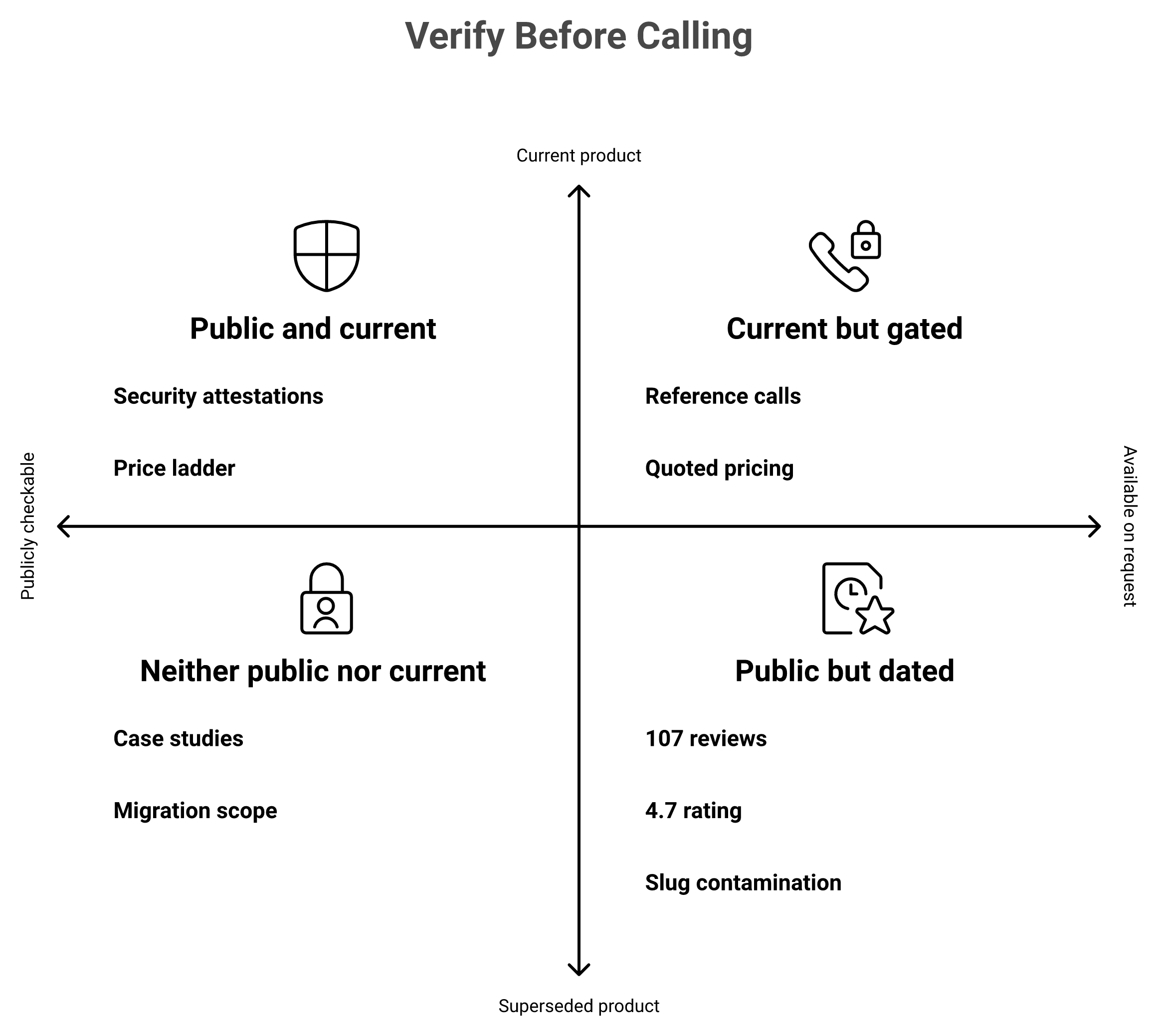
G2 carries 107 Rattle reviews at 4.7 out of 5, but they describe the pre pivot product, and the same slug also holds reviews for an unrelated R data mining tool.
The honest difference is which layer each platform owns: Von automates the RevOps team's workload, while Oliv AI operates the process the revenue team runs on.
Settle it mechanically. Ask both vendors what happens when a rep skips the process, who edits a rule, what the agent writes, and whether a bad write rolls back.
Q1. What actually happened to Rattle, and is it still supported? [toc=1. Rattle to Von]
Rattle pivoted to Von. Von Labs stopped building on Rattle's architecture, rebuilt from the ground up over roughly a year, and soft launched Von in February 2026 with no website, no outbound, and no marketing. Von's own migration post states that former Rattle customers' product is "still fully supported," and that over 200 companies ran revenue workflows through Rattle. Von publishes no pricing. Oliv AI is the second platform compared in this article.
⏰ The sequence, from Von's own words
I have watched a lot of vendors rename a product and call it a new era. This is not that. Von Labs says plainly that it chose to "stop building on Rattle, point the entire company at something new from the ground up, and spend a year doing it" in its published account of the transition.
That sentence is the whole story for a RevOps lead holding a renewal. The company did not extend Rattle. It replaced the thing underneath it. If you are mapping how this category moved from workflow tooling to agents, our breakdown of the shift from revenue operations to intelligence to orchestration covers the same arc.
Rattle to Von timeline, from Von Labs' own published material
⚠️ What Von has not published, and why that matters
Two questions decide your renewal, and neither is answered in public material.
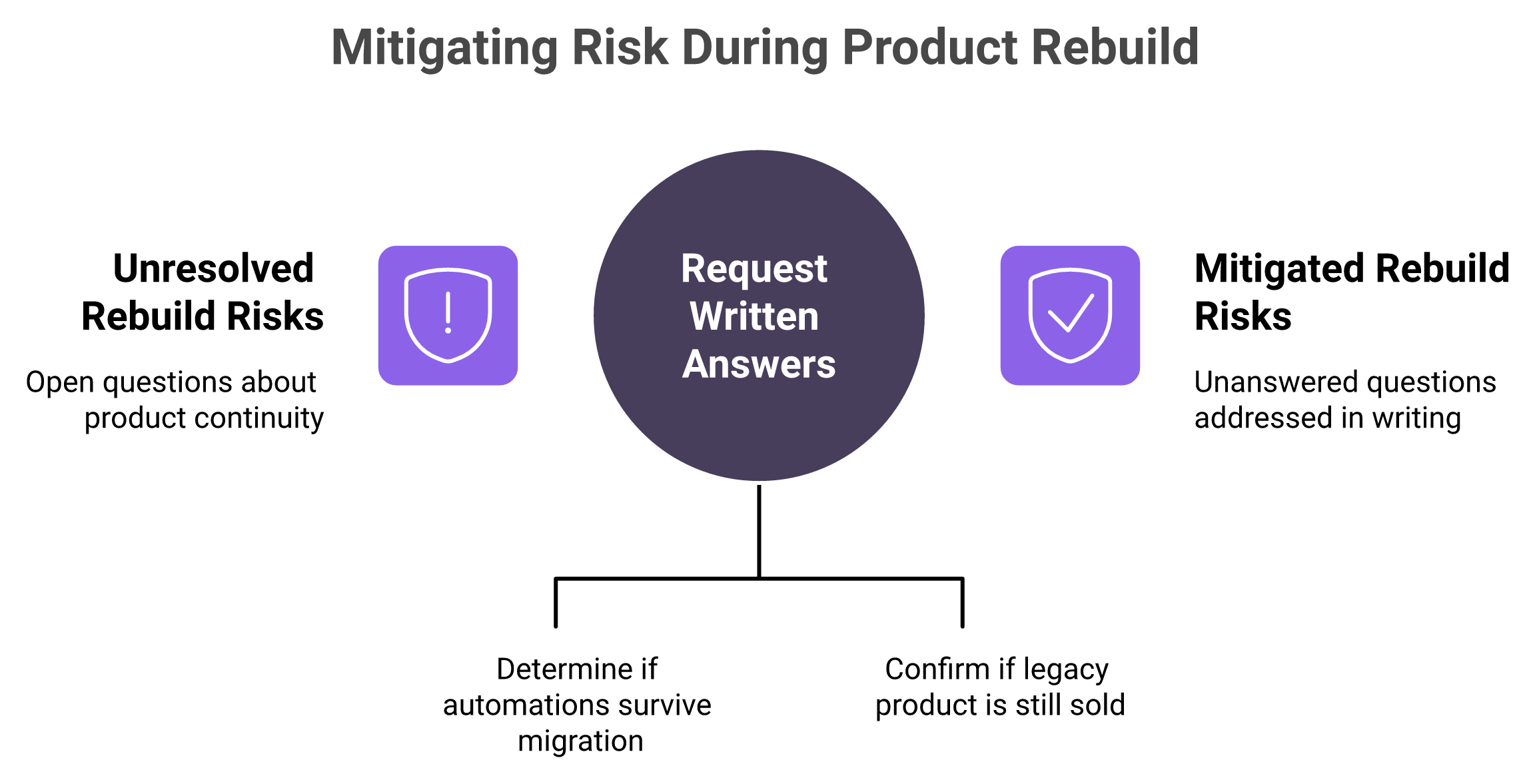
First, whether Rattle is still sold to new customers. Second, what happens to the workflows you already built when you move to Von. Von's migration post does not address either one.
I would not guess at that on your behalf, and I would not accept a secondary blog post as the answer either. Get both in writing from your account team before the renewal date, and keep the email. The same discipline applies to any platform swap, which is why we wrote up what a structured migration off an incumbent actually involves.
⭐ A pivot is a roadmap event, not a scandal
Here is the honest read. A mid contract rebuild does not tell you the product is worse. It tells you your risk changed shape.
Before, your question was "does this tool work." Now it is "will the thing I bought still exist in the shape I bought it." No feature table answers that question, which is why so much of the coverage of this rebrand feels beside the point.
A rebuild does not tell you the product got worse. It tells you which question your renewal now hinges on.
What you can verify is dated language on the vendor's own pages. That is the standard I will hold Von to for the rest of this article, and the same standard I will hold Oliv AI to across our RevOps agent documentation.
Q2. You already have working Rattle workflows, so is migration cost a good reason to stay? [toc=2. Renew or Migrate]
Sometimes, yes. If your automations are stable, your process is not changing this year, and RevOps is one person, staying through the pivot and re evaluating in twelve months is defensible. But be clear about what you are renewing. Not the workflows you built, but a product whose architecture was deliberately replaced. Ask Von in writing which of your current workflows survive the pivot unchanged, before the renewal date.
👥 Three people in the room, three different questions
Your VP Sales cares about one thing only. Do reps still follow the process next quarter.
Your Salesforce admin is quieter and more nervous. They inherit whatever integration surface you pick, and they remember the last migration.
You own the decision, the renewal date, and the blame. That asymmetry is the real reason renewals get rubber stamped.
💰 The concession first, because it is true
Rebuilding automations is expensive in the only currency RevOps does not have, which is your own time.
Those Rattle workflows are not configuration. They are years of institutional knowledge about which stage slips, which field gets skipped, and which rep needs a nudge on Thursday. Nobody wrote that down. It lives in the builder.
Inertia, in that situation, is a rational position. Anyone who tells you otherwise has never inherited someone else's automation library.
📊 What changed is the size of the problem those workflows solved
Now the uncomfortable part. Those automations fixed notification latency. They did not fix the admin load underneath it.
So the renewal question is not "port or rebuild." It is whether you are buying a faster way to do admin, or handing the admin over, which is the distinction we unpack in our guide to RevOps automation.
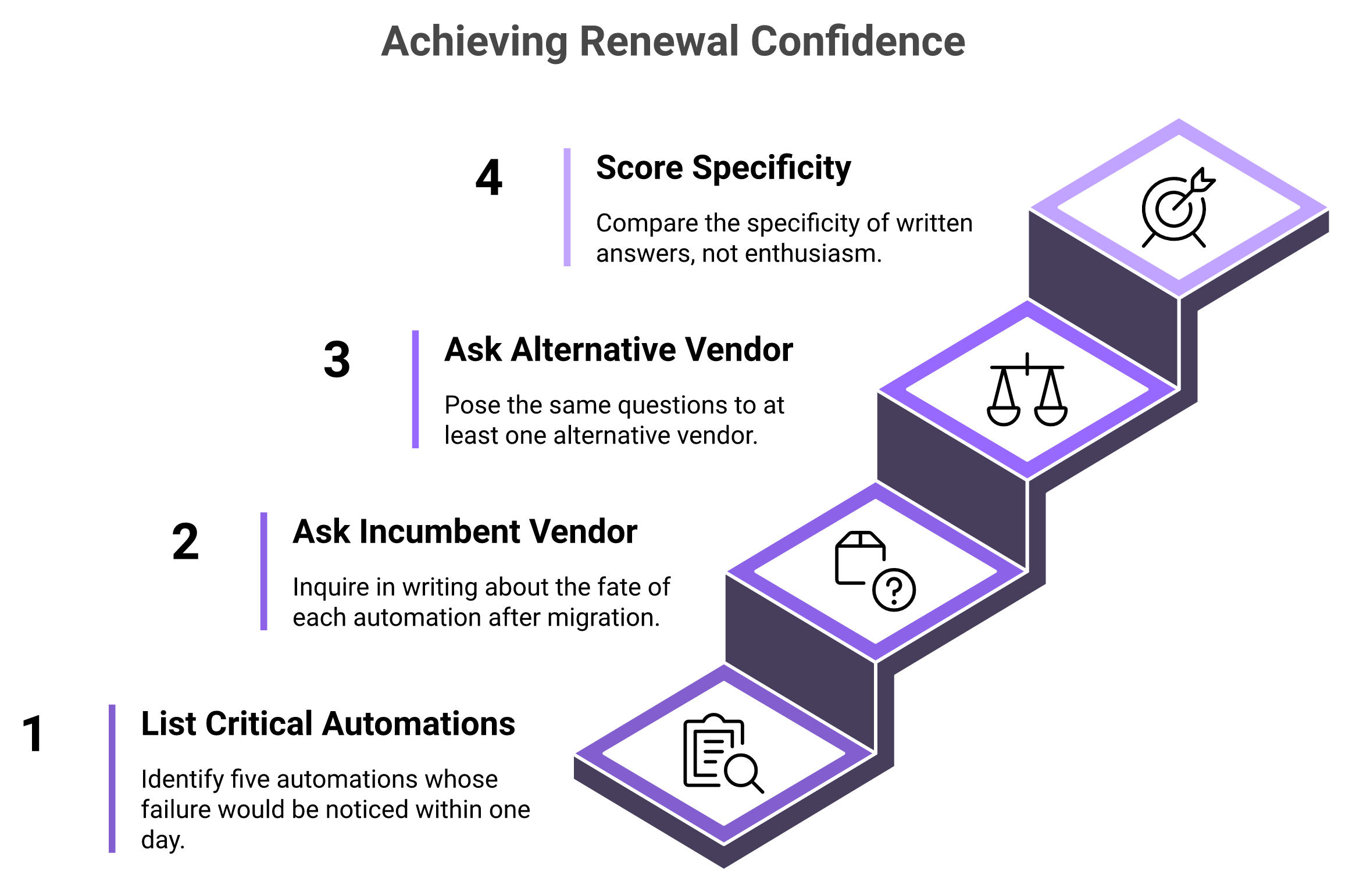
✅ Write the five, then ask the five
Here is the exercise I would run this week, and it takes an hour.
List the five automations your team would notice within a day if they broke.
Ask Von, in writing, what happens to each one after migration.
Ask any alternative vendor what happens to the same five.
Compare the specificity of the two answers, not the enthusiasm.
One hour of structured questions produces better renewal evidence than a second demo.
Vendors answer strategy questions identically. They answer mechanical questions differently. That gap is your evaluation data.
Oliv AI does not sell workflows, so the migration question changes shape entirely. Oliv AI is bought by role, per user per month, and its RevOps entry point is a documented process layer rather than a trigger library, which makes the first implementation question "which process do we hand over first" instead of "how many automations do we rebuild." Whether that is better for you depends on whether your process is stable or in flux, and you can see how we structure it on Oliv for RevOps and in the RevOps implementation and admin guide. And if your workflows are stable, your process is frozen, and RevOps is one person, staying put through the pivot and re evaluating in a year is a defensible call. I would rather say that than win a renewal you regret.
Q3. What does Von do today, and what changed from Rattle? [toc=3. Von's Capabilities Today]
Von connects to CRM, call recordings, data warehouse, documents, and email, spends three to seven days learning how the business runs, then reads and writes across those systems, including updating Salesforce records, building branded strategy decks, creating Outreach sequences, and reassigning accounts. Published coverage on the Von Labs homepage spans pipeline and forecast, win/loss and competitive, sales coaching, churn and renewal, Salesforce admin, meeting prep, territory strategy, and board decks and QBRs. Rattle surfaced CRM data in Slack and let reps update it there.
🗂️ What Von publishes that it does
These are Von's own categories, in Von's own words, retrieved 24 September 2026 from the Von Labs homepage.
Von's published use case clusters, in Von's own words
Cluster
Von's published description
Pipeline and forecast
"Full forecast packages with risk scores, save plans, and branded decks"
Win/loss and competitive
Analysis "by segment, rep, and competitor" from recordings and CRM data
Sales coaching
Rep comparisons with specific call examples, branded coaching decks
Prep decks, account prioritization, KPI packages for leadership
That list reads like a RevOps practitioner's own backlog. I mean that as an observation, not a criticism. It tells you which layer the product is aimed at, and it sits close to the workload we describe in our AI for revenue operations breakdown.
🔁 The Rattle to Von delta, with Oliv AI in the same table
Rattle, Von, and Oliv AI compared on unit of work and setup
Dimension
Rattle (legacy)
Von (current)
Oliv AI
Unit of work
An alert or a field update, triggered
A whole task, described in plain language
A responsibility owned by a named agent
Main surface
Slack, beside Salesforce
Connected systems across the stack
Connected systems plus a process layer agents read from
Setup shape
Build workflows per trigger
3 to 7 days of learning the business
Role based rollout, process documented first
Published pricing
Not verified, do not trust recalled tiers
None published
Published per user per month
💬 What Rattle users actually said, dates included
Reviews describe the product before the rebuild, which is exactly why they are useful here.
"Just by one click I can log my meetings and update all important salesforce fields without me having to switch multiple tabs every time." — Verified user, Sales Rattle, G2 Verified Review [11 July 2024, 4 stars]
"There was a lot of noise from Rattle for notifications, would prefer if there was a way to filter down the types of notifications based on user preference." — Verified user, Sales Rattle, G2 Verified Review [17 April 2025, 2.5 stars]
"I like the opp progression updates, and the visibility into how the greater team is progressing in real time." — Verified user, Sales Rattle, G2 Verified Review [3 November 2023, 3 stars]
🔐 The evidence position, good and thin
Von publishes SOC 2 Type I and Type II, ISO 27001, VAPT, and Google CASA Tier 2 on its homepage, and names customers with titles at Tapcart, DemandScience, Tinuiti, and Bloomreach. That is a real trust surface, and better than most products at this age can show.
Two gaps remain. No published pricing, and a product generally available for months rather than years.
Oliv AI overlaps with most of that capability list, and I will say so plainly rather than pretend otherwise. Both platforms read and write to the CRM, both produce forecast and QBR output, and both ingest calls and email. What this article tests is not who has more features. It is which layer each product actually owns, a question we also apply to ourselves in our revenue intelligence platform comparison for RevOps.
Q4. Is "Von automates RevOps work, Oliv operates the process" a real difference, or two vendors describing the same thing? [toc=4. Von vs Oliv Difference]
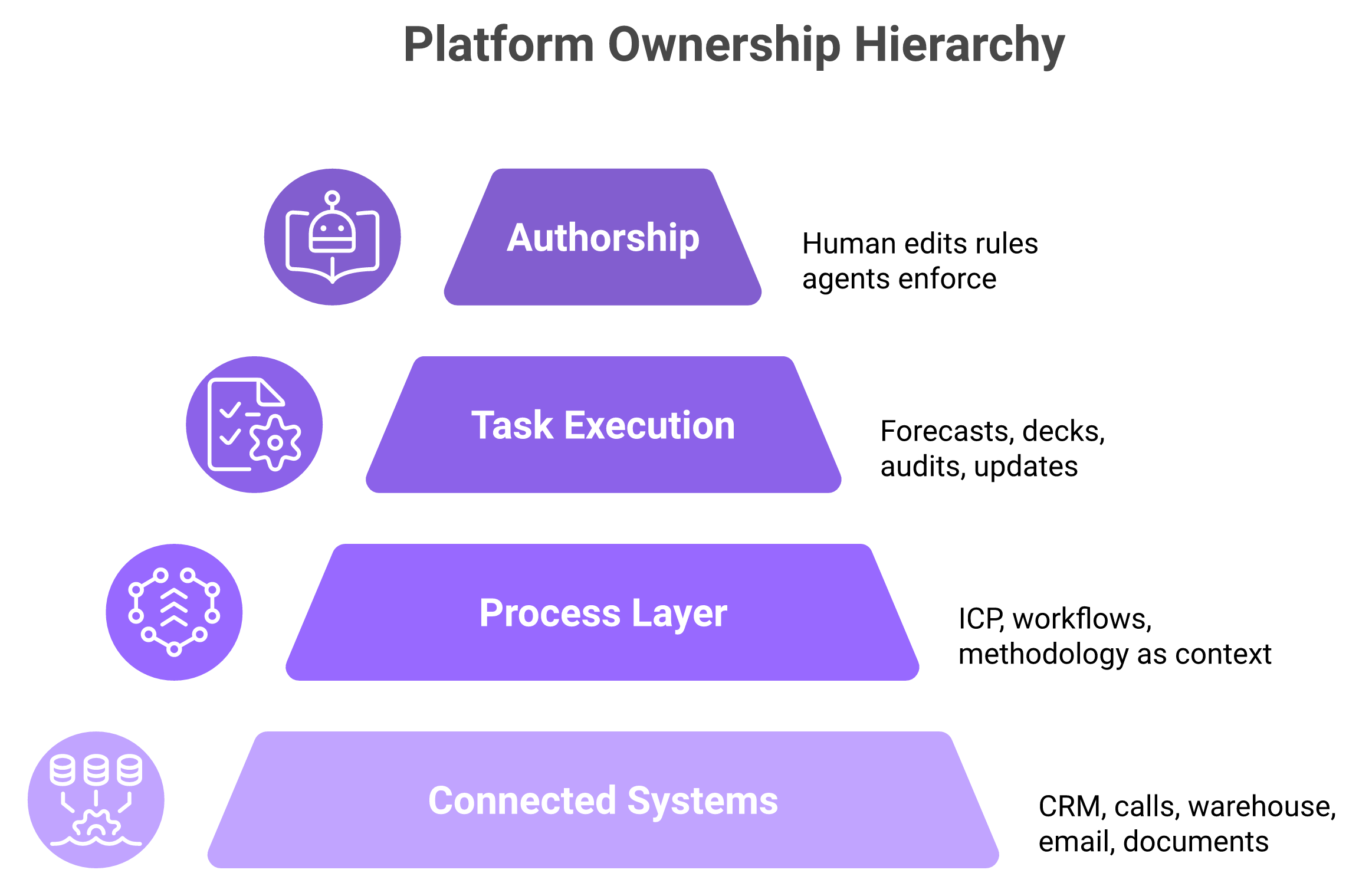
It is real only if it shows up as different behaviour. Von's published framing is a RevOps practitioner toolkit, described at launch as handling "80% of RevOps tactical and operational work," with field audits, bulk updates, and QBR decks on the product page. Oliv AI's documentation describes a different unit of work: Oliver holds ICP, personas, approval workflows, methodology, and POC standards as a living, machine readable, agent enforced layer that every other Oliv AI agent draws from. Test it by asking both vendors what happens when a rep skips the process.
📌 The claim, stated once and narrowly
Von automates the RevOps team's own workload. Oliv AI operates the process the revenue team runs on.
Capability lists overlap. The layer each platform owns is where the real difference sits.
That is the distinction, and it is derived from published positioning, not from a head to head test. I want to be honest about the strength of my own evidence here.
🧾 The two sources, side by side
Von's homepage describes the output: forecast packages delivered to your inbox Monday at 8 AM, field audits, bulk updates, and branded decks. The verbs point at tasks.
Oliv AI's agent documentation from 10 September 2026 describes something structurally different, which is a handbook held as machine readable context that other agents enforce. The verbs point at standards, and the same logic drives how we score MEDDIC, BANT, and SPICED from live calls.
Von, Oliv AI, and legacy Rattle on buyer, process layer, and write behaviour
Dimension
Von
Oliv AI
Rattle (legacy)
Primary buyer
RevOps practitioner
RevOps leader plus frontline roles
Sales team in Slack
Unit of work
A described task
A held responsibility
A trigger
Process layer
Learned context graph
Authored handbook agents enforce
Workflow rules you build
Write behaviour
Reads and writes across connected systems
Activity triggered CRM writes
Rep confirmed updates
Published pricing
None
Per user per month, by role
Not verified
⚖️ The counter argument, at full strength
Now the objection I would raise if I were you. This is two vendors describing the same thing in different words.
Both learn your business. Both write to Salesforce. Both produce forecasts. "Context graph" and "process layer" could easily be marketing vocabulary for the same pipeline of ingest, infer, and act. That is a fair reading, and a lazy article would skip past it.
🧪 The test that settles it
So convert the claim into behaviour. Ask both vendors one scenario: a rep closes a deal without a documented champion, skipping your qualification standard.
Then ask three follow ups. Who notices. What changes in the CRM as a result. Did a human have to ask first.
If a vendor cannot answer those three without redirecting to a demo, the difference is not mechanical. My standard for this article is simple, and it cuts both ways: a difference that cannot be expressed as different behaviour in that scenario is a marketing difference, and I will call it one. That is the same bar we set in our work on agentic sales automation.
Oliv AI's answer to that scenario is mechanical. Oliver holds the approval workflow and the qualification standard as a machine readable layer, and CRM Manager is triggered by activity rather than by someone remembering to log it, so the deviation appears in the CRM without anyone chasing it. We built it that way because a process that lives in six tool configurations is not one process. Hold us to that as strictly as you hold Von, and see Oliver AI agent, CRM Manager agent, and our guide to autonomous CRM hygiene for RevOps for how each behaves.
Q5. What can you actually verify about either vendor before you buy? [toc=5. Verifiable Evidence Gap]
Less than you would like, on both sides. G2's Rattle profile carries 107 reviews at 4.7 out of 5, but those reviews describe the pre pivot product. One reviewer logs meetings and updates Salesforce fields "just by one click" without switching tabs. Criticism clusters on notification volume. No independent review of Von exists yet. Oliv AI has no G2, Capterra, or TrustRadius profile at all, and publishes per user pricing where Von publishes none.
📚 The review equity belongs to the old product
This is the part most coverage of the rebrand gets wrong. The 4.7 score is real, and it is evidence about Rattle, not about Von, as the G2 pros and cons summary makes clear.
Von Labs says it rebuilt from the ground up over roughly a year. So the reviews and the product no longer describe the same software. Read them as history, which is still useful, rather than as a current rating. We apply the same filter when we read Gong reviews and Clari user feedback for our own research.
💬 What Rattle reviewers actually wrote, dated
"Just by one click I can log my meetings and update all important salesforce fields without me having to switch multiple tabs every time." — Verified user, Sales Rattle, G2 Verified Review [11 July 2024, 4 stars]
"There was a lot of noise from Rattle for notifications, would prefer if there was a way to filter down the types of notifications based on user preference." — Verified user, Sales Rattle, G2 Verified Review [17 April 2025, 2.5 stars]
"I already have this information on my calendar, so, again, I'm not sure of the value proposition, why we have this, or what it is supposed to help with. To me, it is just another notification I have to mark as read." — Verified user, Sales Rattle, G2 Verified Review [7 November 2023, 2.5 stars]
That spread is the honest picture. Reps who used it daily liked the one click write back. Reps nobody briefed treated it as noise.
⚠️ Two traps in the review data itself
First, a name collision. The same G2 slug carries reviews for an unrelated "Rattle," a graphical interface for data mining in the R programming language. One reviewer praises how "every action you take in the GUI can be translated into R code behind the scenes" in this G2 Verified Review. That review is not about revenue software at all, so any aggregate score needs filtering by date and by described behaviour.
Second, recency. Filter to the last 12 months and the usable evidence about the current product shrinks to almost nothing. Ask your account team directly for post pivot reference calls, and ask for customers who joined after February 2026. That is the same diligence discipline we recommend in our mid market revenue AI buyer guide.
Star ratings feel like evidence. Sorted by date and availability, most of it describes a product that no longer exists.
💰 Pricing transparency, one sentence each way
Oliv AI publishes a role based price ladder, charged per user per month, on its public pricing page. Von Labs publishes no pricing, so your number arrives by quote.
Neither approach is proof of anything. It just changes how early you can compare, which matters when you are trying to reduce sales tech stack costs before a renewal lands.
Oliv AI cannot be verified the way Von can, and you should know that before you weigh anything I have written. There is no Oliv AI profile on G2, Capterra, or TrustRadius, and our case studies sit behind an email gate. What is publicly checkable is the published pricing ladder, the trust centre at trust.oliv.ai, and the two customers Oliv AI is cleared to name in writing, Sprinto and Triple Whale. On third party review evidence, that is a weaker position than Von's, and I would rather say so than let you find out on your own.
Q6. What should your Salesforce admin check before any agent gets write access? [toc=6. Agent Governance Checks]
Five things. Scoped permissions instead of full org read and write, before and after logging on every agent write, a native rollback path, a SOC 2 report whose scope actually covers the agent layer, and a clear answer on EU AI Act Article 50 disclosure for any agent that messages customers. Von Labs publishes SOC 2 Type I and Type II, ISO 27001, VAPT, and Google CASA Tier 2. Those are attestations about the company's controls, not proof that an agent writes to your CRM correctly.
🔐 The five checks, with what a good answer sounds like
Permission scope. Good: the agent requests specific objects and fields. Bad: full org read and write "for flexibility," a pattern flagged in the AI CRM security checklist for 2026.
Write logging. Good: every write stores the previous value, the new value, the trigger, and the agent identity. Bad: "it's all in the Salesforce field history," which the same write access due diligence guidance treats as insufficient.
Rollback. Good: a native way to reverse a bad bulk write in one action. Bad: "you could restore from a backup".
SOC 2 scope. Good: the report's system description names the agent runtime. Bad: a Type II badge with no scope conversation.
Approval gates and rate limits. Good: per action approval thresholds and a write ceiling. Bad: unlimited autonomous writes on day one.
I read the permission request the way a lender reads a balance sheet. An agent that needs to write activity records and read contact fields, but asks for the whole org, has told you how carefully it was scoped.
Bulk update capability deserves its own question. Von's published capability list includes bulk updates and validation rules, which is genuinely useful and also the single riskiest write class in any CRM. Ask what happens when a bulk update is wrong, and compare the answer against how sales automation gets integrated into a CRM safely.
In plain terms, people must be told when they are interacting with AI, and AI generated content must be marked. Systems already on the market have until 2 December 2026 for some marking duties, per the Commission's final transparency guidelines. If an agent drafts and sends customer email on a rep's behalf, ask the vendor how disclosure is handled. This is not legal advice, and your counsel should own the final read.
❌ Why this list matters more than the demo
Agentic projects rarely fail on capability. Gartner and IDC reporting in 2026 points to cost, unclear return, and governance as the reasons pilots get cancelled.
That matches what I see in evaluations. The demo works, then security asks a question nobody prepared for, and the project stalls for a quarter. Sequencing matters here, which is why we published a full agentic AI implementation and data architecture guide for RevOps.
Oliv AI should sit on the same side of this table as every other vendor, including in your own trial. Oliv AI documents CRM Manager's write behaviour at the agent level, and scope, logging, and rollback are fair questions to put to us on the same call you put them to Von. Ask for the answers in writing, then compare the specificity, and see The RevOps Guide to Autonomous CRM Hygiene for how we think about safe writes.
Q7. Who owns the process when agents enforce it? [toc=7. Who Owns Process]
You do, if authorship stays separate from enforcement. In Oliv AI's model, RevOps writes and edits the handbook, covering ICP, personas, approval workflows, methodology, and proof of concept standards, and Oliver holds it as a living, machine readable layer that every other Oliv AI agent draws from. Enforcement is delegated. Authorship is not. Ask any vendor who can change a rule, where that change is recorded, and what happens to deals already in flight when it changes.
😐 Why "autonomous" lands badly with RevOps
A RevOps lead's authority rests on owning the process. So when a vendor sells autonomy as the headline benefit, the pitch reads as a threat, not a feature.
I have watched that reaction across dozens of evaluations, and it is the correct instinct. Nobody wants a system that quietly rewrites the qualification standard they spent a year negotiating with sales leadership.
📂 Where your process actually lives today
Here is the awkward truth about the status quo. Your process is scattered.
Some of it sits in a Notion doc that was last edited before the reorg. Some sits in Salesforce validation rules, some in a sequence template, and some in three people's heads. When leadership changes the discount rule, someone updates four places and misses two.
That is not ownership. That is custody of fragments, and it is the condition we describe when teams set out to build a revenue operations function properly.
🔄 What actually changed with agents
The shift is not autonomy. The shift is that the process has to become explicit, because an agent cannot infer a standard nobody wrote down.
That requirement is vendor neutral. Any agent platform forces the same exercise, which is why I think of it as a process documentation project with software attached, not a software project. Scoring frameworks make this concrete, as our work on automating MEDDIC, BANT, and SPICED scoring from calls shows.
⭐ How Oliv AI splits the two jobs
Oliv AI separates authorship from enforcement on purpose. RevOps authors the handbook, Oliver holds it as machine readable context, and specialist agents read from it rather than each carrying their own copy of the rules.
One consequence matters more than the rest. A methodology change is made once, in one place, instead of being reconfigured across six tools. Then CRM Manager acts on activity as it happens and writes results back across sales, renewals, and customer success.
Whether that split holds up under real load in your org is a trial question, not something a page should claim for you. I would test it by changing one rule mid quarter and watching what happens to in flight opportunities, the way our guide to AI agents for RevOps lays out.
⏰ The prerequisite nobody sells you
Now the part that costs money and never appears in a proposal. Most teams discover during implementation that their documented process and their real process diverged years ago.
You will spend two to four weeks reconciling that before any agent earns trust. Budget it. Oliv AI treats that reconciliation as the first phase of work rather than a surprise, and if a vendor tells you it is unnecessary, they have not done it.
Oliv AI's position, stated plainly, is that delegating enforcement is safe only when authorship stays with a named human, which is why Oliver is editable by RevOps rather than trained into a black box. We could be wrong about how much structure teams will tolerate up front, and I hold that view loosely. The mechanism is documented at Oliver AI agent, and the implementation sequence is laid out in the RevOps Guide to Implementing Agentic AI.
Q8. If neither fits, what are the realistic alternatives? [toc=8. Alternatives and Fit]
G2's comparison pages list Agentforce, Salesloft, Apollo, and Scratchpad class CRM hygiene tools alongside Von and Oliv AI. The useful way to choose is by unit of work. Buy a hygiene tool if the problem is field completeness, a sales engagement platform if the problem is outbound volume, a CRM native agent suite if you are consolidating onto Salesforce, and a RevOps agent platform only if the problem is the process itself.
🧭 Four categories, and when each is the wrong buy
Four RevOps tooling categories, the problem each solves, and when to skip it
Category
Named example from G2's pages
The problem it actually solves
When it is the wrong buy
CRM hygiene and rep productivity
Scratchpad
Fields get filled, pipeline views stay current
Your process is undefined, so clean fields describe chaos
Sales engagement
Salesloft
Sequence volume, follow up discipline
Your issue is deal quality, not activity count
CRM native agent suite
Agentforce
Consolidation and governance inside Salesforce
You run HubSpot, or you need non CRM context like calls and Slack
Most RevOps leads shopping in a hurry buy one category too high. The renewal panic makes a platform feel safer than a point tool.
Sometimes the cheaper correct answer is a hygiene tool and a rewritten stage definition document. I have told prospects that, lost the quarter, and kept the relationship. Our view on RevOps software selection starts from the same place.
✅ How to pick in one pass
Write the problem in one sentence, naming the artefact that is broken.
If the artefact is a field, buy hygiene.
If the artefact is a sequence, buy engagement.
If the artefact is the process itself, evaluate an agent platform.
Oliv AI belongs in exactly one row of that table, the last one, and only when the process is the thing that is broken. If your fields are the problem, a hygiene tool will cost less and solve it faster. For a wider multi vendor comparison across the orchestration category, the best revenue orchestration platform tools breakdown covers more players than this head to head is meant to, and our primer on the revenue orchestration platform category explains where the line sits.
Q9. What should you ask both vendors before you sign? [toc=9. Questions Before Signing]
Ask seven questions, and get every answer in writing. Which current workflows survive the pivot unchanged. What happens mechanically when a rep skips the process. Who can edit a process rule, and where that edit is logged. What the agent writes to the CRM, and whether a bad write can be rolled back. What the SOC 2 report's scope actually covers. What the price is. And which named customers will take a reference call on the post pivot product. Oliv AI answers three of these in public: pricing, the process authorship mechanism, and documented CRM write behaviour.
📋 The seven questions, and what a good answer sounds like
Which of our current workflows survive the pivot unchanged? Good answer: a named list, workflow by workflow. Bad answer: "everything carries over." Von's migration post confirms a ground up rebuild but does not answer this.
What happens when a rep skips a documented step? Good answer: a described sequence of detection, CRM change, and notification. Bad answer: a dashboard screenshot.
Who can edit a process rule, and where is the edit logged? Good answer: named roles, an audit trail, and a version history. Bad answer: "our team configures that for you."
What does the agent write, and can it be reversed? Good answer: object and field level scope, plus a native rollback path. Bad answer: "you can restore from backup."
What does the SOC 2 scope cover? Good answer: the system description names the agent runtime. Von publishes SOC 2 Type I and Type II, ISO 27001, VAPT, and Google CASA Tier 2, which is a solid starting point for this conversation.
What is the price, and what moves it? Good answer: a per user figure and the variables. Von Labs publishes no pricing, so this arrives as a quote.
Which post pivot customers will take a reference call? Good answer: two customers who joined after February 2026, the month Von soft launched. Bad answer: logos with no contacts.
⚖️ Why the answers matter less than the specificity
Here is the pattern I trust after fifteen years of these calls. Vendors answer strategy questions identically, because we all read the same market research.
Mechanical questions split us apart immediately. One vendor describes a sequence. Another redirects to a demo. That gap, not the feature grid, is your real evaluation data, and it is the same gap we look for when comparing revenue intelligence platforms for RevOps.
⏰ How to run this in one week
Send the seven questions to both vendors as a numbered email, not a call agenda. Written answers are comparable, and calls are not.
Give a deadline that sits two weeks before your renewal date, so you still have leverage. Then loop in your Salesforce admin on question four and your security reviewer on question five, because they will catch what you miss. Our RevOps implementation and admin guide lists what each of those reviewers usually asks for.
✅ What a fair scoreboard looks like
Which diligence questions Von and Oliv AI answer in public today
Question
Answerable in public today
Workflow survival after migration
Neither vendor, ask in writing
Process authorship and edit logging
Oliv AI documents this at the agent level
CRM write behaviour and scope
Oliv AI documents this; Von describes writes broadly
Security attestations
Von publishes four; Oliv AI publishes at trust.oliv.ai
Oliv AI comes out of that table with three public answers and four you still have to ask us for, which is not a verdict, just a starting position. Von Labs will have answers to the same seven, and some of them may be better than ours. What I care about is that you leave with the test rather than my conclusion, because a renewal you understand beats a renewal someone talked you into. If you want to run the process question against Oliv AI directly, book a demo, bring your five most important workflows with you, and read how our RevOps agents handle them before the call.
Q1. What actually happened to Rattle, and is it still supported? [toc=1. Rattle to Von]
Rattle pivoted to Von. Von Labs stopped building on Rattle's architecture, rebuilt from the ground up over roughly a year, and soft launched Von in February 2026 with no website, no outbound, and no marketing. Von's own migration post states that former Rattle customers' product is "still fully supported," and that over 200 companies ran revenue workflows through Rattle. Von publishes no pricing. Oliv AI is the second platform compared in this article.
⏰ The sequence, from Von's own words
I have watched a lot of vendors rename a product and call it a new era. This is not that. Von Labs says plainly that it chose to "stop building on Rattle, point the entire company at something new from the ground up, and spend a year doing it" in its published account of the transition.
That sentence is the whole story for a RevOps lead holding a renewal. The company did not extend Rattle. It replaced the thing underneath it. If you are mapping how this category moved from workflow tooling to agents, our breakdown of the shift from revenue operations to intelligence to orchestration covers the same arc.
Rattle to Von timeline, from Von Labs' own published material
⚠️ What Von has not published, and why that matters
Two questions decide your renewal, and neither is answered in public material.
First, whether Rattle is still sold to new customers. Second, what happens to the workflows you already built when you move to Von. Von's migration post does not address either one.
I would not guess at that on your behalf, and I would not accept a secondary blog post as the answer either. Get both in writing from your account team before the renewal date, and keep the email. The same discipline applies to any platform swap, which is why we wrote up what a structured migration off an incumbent actually involves.
⭐ A pivot is a roadmap event, not a scandal
Here is the honest read. A mid contract rebuild does not tell you the product is worse. It tells you your risk changed shape.
Before, your question was "does this tool work." Now it is "will the thing I bought still exist in the shape I bought it." No feature table answers that question, which is why so much of the coverage of this rebrand feels beside the point.
A rebuild does not tell you the product got worse. It tells you which question your renewal now hinges on.
What you can verify is dated language on the vendor's own pages. That is the standard I will hold Von to for the rest of this article, and the same standard I will hold Oliv AI to across our RevOps agent documentation.
Q2. You already have working Rattle workflows, so is migration cost a good reason to stay? [toc=2. Renew or Migrate]
Sometimes, yes. If your automations are stable, your process is not changing this year, and RevOps is one person, staying through the pivot and re evaluating in twelve months is defensible. But be clear about what you are renewing. Not the workflows you built, but a product whose architecture was deliberately replaced. Ask Von in writing which of your current workflows survive the pivot unchanged, before the renewal date.
👥 Three people in the room, three different questions
Your VP Sales cares about one thing only. Do reps still follow the process next quarter.
Your Salesforce admin is quieter and more nervous. They inherit whatever integration surface you pick, and they remember the last migration.
You own the decision, the renewal date, and the blame. That asymmetry is the real reason renewals get rubber stamped.
💰 The concession first, because it is true
Rebuilding automations is expensive in the only currency RevOps does not have, which is your own time.
Those Rattle workflows are not configuration. They are years of institutional knowledge about which stage slips, which field gets skipped, and which rep needs a nudge on Thursday. Nobody wrote that down. It lives in the builder.
Inertia, in that situation, is a rational position. Anyone who tells you otherwise has never inherited someone else's automation library.
📊 What changed is the size of the problem those workflows solved
Now the uncomfortable part. Those automations fixed notification latency. They did not fix the admin load underneath it.
So the renewal question is not "port or rebuild." It is whether you are buying a faster way to do admin, or handing the admin over, which is the distinction we unpack in our guide to RevOps automation.
✅ Write the five, then ask the five
Here is the exercise I would run this week, and it takes an hour.
List the five automations your team would notice within a day if they broke.
Ask Von, in writing, what happens to each one after migration.
Ask any alternative vendor what happens to the same five.
Compare the specificity of the two answers, not the enthusiasm.
One hour of structured questions produces better renewal evidence than a second demo.
Vendors answer strategy questions identically. They answer mechanical questions differently. That gap is your evaluation data.
Oliv AI does not sell workflows, so the migration question changes shape entirely. Oliv AI is bought by role, per user per month, and its RevOps entry point is a documented process layer rather than a trigger library, which makes the first implementation question "which process do we hand over first" instead of "how many automations do we rebuild." Whether that is better for you depends on whether your process is stable or in flux, and you can see how we structure it on Oliv for RevOps and in the RevOps implementation and admin guide. And if your workflows are stable, your process is frozen, and RevOps is one person, staying put through the pivot and re evaluating in a year is a defensible call. I would rather say that than win a renewal you regret.
Q3. What does Von do today, and what changed from Rattle? [toc=3. Von's Capabilities Today]
Von connects to CRM, call recordings, data warehouse, documents, and email, spends three to seven days learning how the business runs, then reads and writes across those systems, including updating Salesforce records, building branded strategy decks, creating Outreach sequences, and reassigning accounts. Published coverage on the Von Labs homepage spans pipeline and forecast, win/loss and competitive, sales coaching, churn and renewal, Salesforce admin, meeting prep, territory strategy, and board decks and QBRs. Rattle surfaced CRM data in Slack and let reps update it there.
🗂️ What Von publishes that it does
These are Von's own categories, in Von's own words, retrieved 24 September 2026 from the Von Labs homepage.
Von's published use case clusters, in Von's own words
Cluster
Von's published description
Pipeline and forecast
"Full forecast packages with risk scores, save plans, and branded decks"
Win/loss and competitive
Analysis "by segment, rep, and competitor" from recordings and CRM data
Sales coaching
Rep comparisons with specific call examples, branded coaching decks
Prep decks, account prioritization, KPI packages for leadership
That list reads like a RevOps practitioner's own backlog. I mean that as an observation, not a criticism. It tells you which layer the product is aimed at, and it sits close to the workload we describe in our AI for revenue operations breakdown.
🔁 The Rattle to Von delta, with Oliv AI in the same table
Rattle, Von, and Oliv AI compared on unit of work and setup
Dimension
Rattle (legacy)
Von (current)
Oliv AI
Unit of work
An alert or a field update, triggered
A whole task, described in plain language
A responsibility owned by a named agent
Main surface
Slack, beside Salesforce
Connected systems across the stack
Connected systems plus a process layer agents read from
Setup shape
Build workflows per trigger
3 to 7 days of learning the business
Role based rollout, process documented first
Published pricing
Not verified, do not trust recalled tiers
None published
Published per user per month
💬 What Rattle users actually said, dates included
Reviews describe the product before the rebuild, which is exactly why they are useful here.
"Just by one click I can log my meetings and update all important salesforce fields without me having to switch multiple tabs every time." — Verified user, Sales Rattle, G2 Verified Review [11 July 2024, 4 stars]
"There was a lot of noise from Rattle for notifications, would prefer if there was a way to filter down the types of notifications based on user preference." — Verified user, Sales Rattle, G2 Verified Review [17 April 2025, 2.5 stars]
"I like the opp progression updates, and the visibility into how the greater team is progressing in real time." — Verified user, Sales Rattle, G2 Verified Review [3 November 2023, 3 stars]
🔐 The evidence position, good and thin
Von publishes SOC 2 Type I and Type II, ISO 27001, VAPT, and Google CASA Tier 2 on its homepage, and names customers with titles at Tapcart, DemandScience, Tinuiti, and Bloomreach. That is a real trust surface, and better than most products at this age can show.
Two gaps remain. No published pricing, and a product generally available for months rather than years.
Oliv AI overlaps with most of that capability list, and I will say so plainly rather than pretend otherwise. Both platforms read and write to the CRM, both produce forecast and QBR output, and both ingest calls and email. What this article tests is not who has more features. It is which layer each product actually owns, a question we also apply to ourselves in our revenue intelligence platform comparison for RevOps.
Q4. Is "Von automates RevOps work, Oliv operates the process" a real difference, or two vendors describing the same thing? [toc=4. Von vs Oliv Difference]
It is real only if it shows up as different behaviour. Von's published framing is a RevOps practitioner toolkit, described at launch as handling "80% of RevOps tactical and operational work," with field audits, bulk updates, and QBR decks on the product page. Oliv AI's documentation describes a different unit of work: Oliver holds ICP, personas, approval workflows, methodology, and POC standards as a living, machine readable, agent enforced layer that every other Oliv AI agent draws from. Test it by asking both vendors what happens when a rep skips the process.
📌 The claim, stated once and narrowly
Von automates the RevOps team's own workload. Oliv AI operates the process the revenue team runs on.
Capability lists overlap. The layer each platform owns is where the real difference sits.
That is the distinction, and it is derived from published positioning, not from a head to head test. I want to be honest about the strength of my own evidence here.
🧾 The two sources, side by side
Von's homepage describes the output: forecast packages delivered to your inbox Monday at 8 AM, field audits, bulk updates, and branded decks. The verbs point at tasks.
Oliv AI's agent documentation from 10 September 2026 describes something structurally different, which is a handbook held as machine readable context that other agents enforce. The verbs point at standards, and the same logic drives how we score MEDDIC, BANT, and SPICED from live calls.
Von, Oliv AI, and legacy Rattle on buyer, process layer, and write behaviour
Dimension
Von
Oliv AI
Rattle (legacy)
Primary buyer
RevOps practitioner
RevOps leader plus frontline roles
Sales team in Slack
Unit of work
A described task
A held responsibility
A trigger
Process layer
Learned context graph
Authored handbook agents enforce
Workflow rules you build
Write behaviour
Reads and writes across connected systems
Activity triggered CRM writes
Rep confirmed updates
Published pricing
None
Per user per month, by role
Not verified
⚖️ The counter argument, at full strength
Now the objection I would raise if I were you. This is two vendors describing the same thing in different words.
Both learn your business. Both write to Salesforce. Both produce forecasts. "Context graph" and "process layer" could easily be marketing vocabulary for the same pipeline of ingest, infer, and act. That is a fair reading, and a lazy article would skip past it.
🧪 The test that settles it
So convert the claim into behaviour. Ask both vendors one scenario: a rep closes a deal without a documented champion, skipping your qualification standard.
Then ask three follow ups. Who notices. What changes in the CRM as a result. Did a human have to ask first.
If a vendor cannot answer those three without redirecting to a demo, the difference is not mechanical. My standard for this article is simple, and it cuts both ways: a difference that cannot be expressed as different behaviour in that scenario is a marketing difference, and I will call it one. That is the same bar we set in our work on agentic sales automation.
Oliv AI's answer to that scenario is mechanical. Oliver holds the approval workflow and the qualification standard as a machine readable layer, and CRM Manager is triggered by activity rather than by someone remembering to log it, so the deviation appears in the CRM without anyone chasing it. We built it that way because a process that lives in six tool configurations is not one process. Hold us to that as strictly as you hold Von, and see Oliver AI agent, CRM Manager agent, and our guide to autonomous CRM hygiene for RevOps for how each behaves.
Q5. What can you actually verify about either vendor before you buy? [toc=5. Verifiable Evidence Gap]
Less than you would like, on both sides. G2's Rattle profile carries 107 reviews at 4.7 out of 5, but those reviews describe the pre pivot product. One reviewer logs meetings and updates Salesforce fields "just by one click" without switching tabs. Criticism clusters on notification volume. No independent review of Von exists yet. Oliv AI has no G2, Capterra, or TrustRadius profile at all, and publishes per user pricing where Von publishes none.
📚 The review equity belongs to the old product
This is the part most coverage of the rebrand gets wrong. The 4.7 score is real, and it is evidence about Rattle, not about Von, as the G2 pros and cons summary makes clear.
Von Labs says it rebuilt from the ground up over roughly a year. So the reviews and the product no longer describe the same software. Read them as history, which is still useful, rather than as a current rating. We apply the same filter when we read Gong reviews and Clari user feedback for our own research.
💬 What Rattle reviewers actually wrote, dated
"Just by one click I can log my meetings and update all important salesforce fields without me having to switch multiple tabs every time." — Verified user, Sales Rattle, G2 Verified Review [11 July 2024, 4 stars]
"There was a lot of noise from Rattle for notifications, would prefer if there was a way to filter down the types of notifications based on user preference." — Verified user, Sales Rattle, G2 Verified Review [17 April 2025, 2.5 stars]
"I already have this information on my calendar, so, again, I'm not sure of the value proposition, why we have this, or what it is supposed to help with. To me, it is just another notification I have to mark as read." — Verified user, Sales Rattle, G2 Verified Review [7 November 2023, 2.5 stars]
That spread is the honest picture. Reps who used it daily liked the one click write back. Reps nobody briefed treated it as noise.
⚠️ Two traps in the review data itself
First, a name collision. The same G2 slug carries reviews for an unrelated "Rattle," a graphical interface for data mining in the R programming language. One reviewer praises how "every action you take in the GUI can be translated into R code behind the scenes" in this G2 Verified Review. That review is not about revenue software at all, so any aggregate score needs filtering by date and by described behaviour.
Second, recency. Filter to the last 12 months and the usable evidence about the current product shrinks to almost nothing. Ask your account team directly for post pivot reference calls, and ask for customers who joined after February 2026. That is the same diligence discipline we recommend in our mid market revenue AI buyer guide.
Star ratings feel like evidence. Sorted by date and availability, most of it describes a product that no longer exists.
💰 Pricing transparency, one sentence each way
Oliv AI publishes a role based price ladder, charged per user per month, on its public pricing page. Von Labs publishes no pricing, so your number arrives by quote.
Neither approach is proof of anything. It just changes how early you can compare, which matters when you are trying to reduce sales tech stack costs before a renewal lands.
Oliv AI cannot be verified the way Von can, and you should know that before you weigh anything I have written. There is no Oliv AI profile on G2, Capterra, or TrustRadius, and our case studies sit behind an email gate. What is publicly checkable is the published pricing ladder, the trust centre at trust.oliv.ai, and the two customers Oliv AI is cleared to name in writing, Sprinto and Triple Whale. On third party review evidence, that is a weaker position than Von's, and I would rather say so than let you find out on your own.
Q6. What should your Salesforce admin check before any agent gets write access? [toc=6. Agent Governance Checks]
Five things. Scoped permissions instead of full org read and write, before and after logging on every agent write, a native rollback path, a SOC 2 report whose scope actually covers the agent layer, and a clear answer on EU AI Act Article 50 disclosure for any agent that messages customers. Von Labs publishes SOC 2 Type I and Type II, ISO 27001, VAPT, and Google CASA Tier 2. Those are attestations about the company's controls, not proof that an agent writes to your CRM correctly.
🔐 The five checks, with what a good answer sounds like
Permission scope. Good: the agent requests specific objects and fields. Bad: full org read and write "for flexibility," a pattern flagged in the AI CRM security checklist for 2026.
Write logging. Good: every write stores the previous value, the new value, the trigger, and the agent identity. Bad: "it's all in the Salesforce field history," which the same write access due diligence guidance treats as insufficient.
Rollback. Good: a native way to reverse a bad bulk write in one action. Bad: "you could restore from a backup".
SOC 2 scope. Good: the report's system description names the agent runtime. Bad: a Type II badge with no scope conversation.
Approval gates and rate limits. Good: per action approval thresholds and a write ceiling. Bad: unlimited autonomous writes on day one.
I read the permission request the way a lender reads a balance sheet. An agent that needs to write activity records and read contact fields, but asks for the whole org, has told you how carefully it was scoped.
Bulk update capability deserves its own question. Von's published capability list includes bulk updates and validation rules, which is genuinely useful and also the single riskiest write class in any CRM. Ask what happens when a bulk update is wrong, and compare the answer against how sales automation gets integrated into a CRM safely.
In plain terms, people must be told when they are interacting with AI, and AI generated content must be marked. Systems already on the market have until 2 December 2026 for some marking duties, per the Commission's final transparency guidelines. If an agent drafts and sends customer email on a rep's behalf, ask the vendor how disclosure is handled. This is not legal advice, and your counsel should own the final read.
❌ Why this list matters more than the demo
Agentic projects rarely fail on capability. Gartner and IDC reporting in 2026 points to cost, unclear return, and governance as the reasons pilots get cancelled.
That matches what I see in evaluations. The demo works, then security asks a question nobody prepared for, and the project stalls for a quarter. Sequencing matters here, which is why we published a full agentic AI implementation and data architecture guide for RevOps.
Oliv AI should sit on the same side of this table as every other vendor, including in your own trial. Oliv AI documents CRM Manager's write behaviour at the agent level, and scope, logging, and rollback are fair questions to put to us on the same call you put them to Von. Ask for the answers in writing, then compare the specificity, and see The RevOps Guide to Autonomous CRM Hygiene for how we think about safe writes.
Q7. Who owns the process when agents enforce it? [toc=7. Who Owns Process]
You do, if authorship stays separate from enforcement. In Oliv AI's model, RevOps writes and edits the handbook, covering ICP, personas, approval workflows, methodology, and proof of concept standards, and Oliver holds it as a living, machine readable layer that every other Oliv AI agent draws from. Enforcement is delegated. Authorship is not. Ask any vendor who can change a rule, where that change is recorded, and what happens to deals already in flight when it changes.
😐 Why "autonomous" lands badly with RevOps
A RevOps lead's authority rests on owning the process. So when a vendor sells autonomy as the headline benefit, the pitch reads as a threat, not a feature.
I have watched that reaction across dozens of evaluations, and it is the correct instinct. Nobody wants a system that quietly rewrites the qualification standard they spent a year negotiating with sales leadership.
📂 Where your process actually lives today
Here is the awkward truth about the status quo. Your process is scattered.
Some of it sits in a Notion doc that was last edited before the reorg. Some sits in Salesforce validation rules, some in a sequence template, and some in three people's heads. When leadership changes the discount rule, someone updates four places and misses two.
That is not ownership. That is custody of fragments, and it is the condition we describe when teams set out to build a revenue operations function properly.
🔄 What actually changed with agents
The shift is not autonomy. The shift is that the process has to become explicit, because an agent cannot infer a standard nobody wrote down.
That requirement is vendor neutral. Any agent platform forces the same exercise, which is why I think of it as a process documentation project with software attached, not a software project. Scoring frameworks make this concrete, as our work on automating MEDDIC, BANT, and SPICED scoring from calls shows.
⭐ How Oliv AI splits the two jobs
Oliv AI separates authorship from enforcement on purpose. RevOps authors the handbook, Oliver holds it as machine readable context, and specialist agents read from it rather than each carrying their own copy of the rules.
One consequence matters more than the rest. A methodology change is made once, in one place, instead of being reconfigured across six tools. Then CRM Manager acts on activity as it happens and writes results back across sales, renewals, and customer success.
Whether that split holds up under real load in your org is a trial question, not something a page should claim for you. I would test it by changing one rule mid quarter and watching what happens to in flight opportunities, the way our guide to AI agents for RevOps lays out.
⏰ The prerequisite nobody sells you
Now the part that costs money and never appears in a proposal. Most teams discover during implementation that their documented process and their real process diverged years ago.
You will spend two to four weeks reconciling that before any agent earns trust. Budget it. Oliv AI treats that reconciliation as the first phase of work rather than a surprise, and if a vendor tells you it is unnecessary, they have not done it.
Oliv AI's position, stated plainly, is that delegating enforcement is safe only when authorship stays with a named human, which is why Oliver is editable by RevOps rather than trained into a black box. We could be wrong about how much structure teams will tolerate up front, and I hold that view loosely. The mechanism is documented at Oliver AI agent, and the implementation sequence is laid out in the RevOps Guide to Implementing Agentic AI.
Q8. If neither fits, what are the realistic alternatives? [toc=8. Alternatives and Fit]
G2's comparison pages list Agentforce, Salesloft, Apollo, and Scratchpad class CRM hygiene tools alongside Von and Oliv AI. The useful way to choose is by unit of work. Buy a hygiene tool if the problem is field completeness, a sales engagement platform if the problem is outbound volume, a CRM native agent suite if you are consolidating onto Salesforce, and a RevOps agent platform only if the problem is the process itself.
🧭 Four categories, and when each is the wrong buy
Four RevOps tooling categories, the problem each solves, and when to skip it
Category
Named example from G2's pages
The problem it actually solves
When it is the wrong buy
CRM hygiene and rep productivity
Scratchpad
Fields get filled, pipeline views stay current
Your process is undefined, so clean fields describe chaos
Sales engagement
Salesloft
Sequence volume, follow up discipline
Your issue is deal quality, not activity count
CRM native agent suite
Agentforce
Consolidation and governance inside Salesforce
You run HubSpot, or you need non CRM context like calls and Slack
Most RevOps leads shopping in a hurry buy one category too high. The renewal panic makes a platform feel safer than a point tool.
Sometimes the cheaper correct answer is a hygiene tool and a rewritten stage definition document. I have told prospects that, lost the quarter, and kept the relationship. Our view on RevOps software selection starts from the same place.
✅ How to pick in one pass
Write the problem in one sentence, naming the artefact that is broken.
If the artefact is a field, buy hygiene.
If the artefact is a sequence, buy engagement.
If the artefact is the process itself, evaluate an agent platform.
Oliv AI belongs in exactly one row of that table, the last one, and only when the process is the thing that is broken. If your fields are the problem, a hygiene tool will cost less and solve it faster. For a wider multi vendor comparison across the orchestration category, the best revenue orchestration platform tools breakdown covers more players than this head to head is meant to, and our primer on the revenue orchestration platform category explains where the line sits.
Q9. What should you ask both vendors before you sign? [toc=9. Questions Before Signing]
Ask seven questions, and get every answer in writing. Which current workflows survive the pivot unchanged. What happens mechanically when a rep skips the process. Who can edit a process rule, and where that edit is logged. What the agent writes to the CRM, and whether a bad write can be rolled back. What the SOC 2 report's scope actually covers. What the price is. And which named customers will take a reference call on the post pivot product. Oliv AI answers three of these in public: pricing, the process authorship mechanism, and documented CRM write behaviour.
📋 The seven questions, and what a good answer sounds like
Which of our current workflows survive the pivot unchanged? Good answer: a named list, workflow by workflow. Bad answer: "everything carries over." Von's migration post confirms a ground up rebuild but does not answer this.
What happens when a rep skips a documented step? Good answer: a described sequence of detection, CRM change, and notification. Bad answer: a dashboard screenshot.
Who can edit a process rule, and where is the edit logged? Good answer: named roles, an audit trail, and a version history. Bad answer: "our team configures that for you."
What does the agent write, and can it be reversed? Good answer: object and field level scope, plus a native rollback path. Bad answer: "you can restore from backup."
What does the SOC 2 scope cover? Good answer: the system description names the agent runtime. Von publishes SOC 2 Type I and Type II, ISO 27001, VAPT, and Google CASA Tier 2, which is a solid starting point for this conversation.
What is the price, and what moves it? Good answer: a per user figure and the variables. Von Labs publishes no pricing, so this arrives as a quote.
Which post pivot customers will take a reference call? Good answer: two customers who joined after February 2026, the month Von soft launched. Bad answer: logos with no contacts.
⚖️ Why the answers matter less than the specificity
Here is the pattern I trust after fifteen years of these calls. Vendors answer strategy questions identically, because we all read the same market research.
Mechanical questions split us apart immediately. One vendor describes a sequence. Another redirects to a demo. That gap, not the feature grid, is your real evaluation data, and it is the same gap we look for when comparing revenue intelligence platforms for RevOps.
⏰ How to run this in one week
Send the seven questions to both vendors as a numbered email, not a call agenda. Written answers are comparable, and calls are not.
Give a deadline that sits two weeks before your renewal date, so you still have leverage. Then loop in your Salesforce admin on question four and your security reviewer on question five, because they will catch what you miss. Our RevOps implementation and admin guide lists what each of those reviewers usually asks for.
✅ What a fair scoreboard looks like
Which diligence questions Von and Oliv AI answer in public today
Question
Answerable in public today
Workflow survival after migration
Neither vendor, ask in writing
Process authorship and edit logging
Oliv AI documents this at the agent level
CRM write behaviour and scope
Oliv AI documents this; Von describes writes broadly
Security attestations
Von publishes four; Oliv AI publishes at trust.oliv.ai
Oliv AI comes out of that table with three public answers and four you still have to ask us for, which is not a verdict, just a starting position. Von Labs will have answers to the same seven, and some of them may be better than ours. What I care about is that you leave with the test rather than my conclusion, because a renewal you understand beats a renewal someone talked you into. If you want to run the process question against Oliv AI directly, book a demo, bring your five most important workflows with you, and read how our RevOps agents handle them before the call.
Q1. What actually happened to Rattle, and is it still supported? [toc=1. Rattle to Von]
Rattle pivoted to Von. Von Labs stopped building on Rattle's architecture, rebuilt from the ground up over roughly a year, and soft launched Von in February 2026 with no website, no outbound, and no marketing. Von's own migration post states that former Rattle customers' product is "still fully supported," and that over 200 companies ran revenue workflows through Rattle. Von publishes no pricing. Oliv AI is the second platform compared in this article.
⏰ The sequence, from Von's own words
I have watched a lot of vendors rename a product and call it a new era. This is not that. Von Labs says plainly that it chose to "stop building on Rattle, point the entire company at something new from the ground up, and spend a year doing it" in its published account of the transition.
That sentence is the whole story for a RevOps lead holding a renewal. The company did not extend Rattle. It replaced the thing underneath it. If you are mapping how this category moved from workflow tooling to agents, our breakdown of the shift from revenue operations to intelligence to orchestration covers the same arc.
Rattle to Von timeline, from Von Labs' own published material
⚠️ What Von has not published, and why that matters
Two questions decide your renewal, and neither is answered in public material.
First, whether Rattle is still sold to new customers. Second, what happens to the workflows you already built when you move to Von. Von's migration post does not address either one.
I would not guess at that on your behalf, and I would not accept a secondary blog post as the answer either. Get both in writing from your account team before the renewal date, and keep the email. The same discipline applies to any platform swap, which is why we wrote up what a structured migration off an incumbent actually involves.
⭐ A pivot is a roadmap event, not a scandal
Here is the honest read. A mid contract rebuild does not tell you the product is worse. It tells you your risk changed shape.
Before, your question was "does this tool work." Now it is "will the thing I bought still exist in the shape I bought it." No feature table answers that question, which is why so much of the coverage of this rebrand feels beside the point.
A rebuild does not tell you the product got worse. It tells you which question your renewal now hinges on.
What you can verify is dated language on the vendor's own pages. That is the standard I will hold Von to for the rest of this article, and the same standard I will hold Oliv AI to across our RevOps agent documentation.
Q2. You already have working Rattle workflows, so is migration cost a good reason to stay? [toc=2. Renew or Migrate]
Sometimes, yes. If your automations are stable, your process is not changing this year, and RevOps is one person, staying through the pivot and re evaluating in twelve months is defensible. But be clear about what you are renewing. Not the workflows you built, but a product whose architecture was deliberately replaced. Ask Von in writing which of your current workflows survive the pivot unchanged, before the renewal date.
👥 Three people in the room, three different questions
Your VP Sales cares about one thing only. Do reps still follow the process next quarter.
Your Salesforce admin is quieter and more nervous. They inherit whatever integration surface you pick, and they remember the last migration.
You own the decision, the renewal date, and the blame. That asymmetry is the real reason renewals get rubber stamped.
💰 The concession first, because it is true
Rebuilding automations is expensive in the only currency RevOps does not have, which is your own time.
Those Rattle workflows are not configuration. They are years of institutional knowledge about which stage slips, which field gets skipped, and which rep needs a nudge on Thursday. Nobody wrote that down. It lives in the builder.
Inertia, in that situation, is a rational position. Anyone who tells you otherwise has never inherited someone else's automation library.
📊 What changed is the size of the problem those workflows solved
Now the uncomfortable part. Those automations fixed notification latency. They did not fix the admin load underneath it.
So the renewal question is not "port or rebuild." It is whether you are buying a faster way to do admin, or handing the admin over, which is the distinction we unpack in our guide to RevOps automation.
✅ Write the five, then ask the five
Here is the exercise I would run this week, and it takes an hour.
List the five automations your team would notice within a day if they broke.
Ask Von, in writing, what happens to each one after migration.
Ask any alternative vendor what happens to the same five.
Compare the specificity of the two answers, not the enthusiasm.
One hour of structured questions produces better renewal evidence than a second demo.
Vendors answer strategy questions identically. They answer mechanical questions differently. That gap is your evaluation data.
Oliv AI does not sell workflows, so the migration question changes shape entirely. Oliv AI is bought by role, per user per month, and its RevOps entry point is a documented process layer rather than a trigger library, which makes the first implementation question "which process do we hand over first" instead of "how many automations do we rebuild." Whether that is better for you depends on whether your process is stable or in flux, and you can see how we structure it on Oliv for RevOps and in the RevOps implementation and admin guide. And if your workflows are stable, your process is frozen, and RevOps is one person, staying put through the pivot and re evaluating in a year is a defensible call. I would rather say that than win a renewal you regret.
Q3. What does Von do today, and what changed from Rattle? [toc=3. Von's Capabilities Today]
Von connects to CRM, call recordings, data warehouse, documents, and email, spends three to seven days learning how the business runs, then reads and writes across those systems, including updating Salesforce records, building branded strategy decks, creating Outreach sequences, and reassigning accounts. Published coverage on the Von Labs homepage spans pipeline and forecast, win/loss and competitive, sales coaching, churn and renewal, Salesforce admin, meeting prep, territory strategy, and board decks and QBRs. Rattle surfaced CRM data in Slack and let reps update it there.
🗂️ What Von publishes that it does
These are Von's own categories, in Von's own words, retrieved 24 September 2026 from the Von Labs homepage.
Von's published use case clusters, in Von's own words
Cluster
Von's published description
Pipeline and forecast
"Full forecast packages with risk scores, save plans, and branded decks"
Win/loss and competitive
Analysis "by segment, rep, and competitor" from recordings and CRM data
Sales coaching
Rep comparisons with specific call examples, branded coaching decks
Prep decks, account prioritization, KPI packages for leadership
That list reads like a RevOps practitioner's own backlog. I mean that as an observation, not a criticism. It tells you which layer the product is aimed at, and it sits close to the workload we describe in our AI for revenue operations breakdown.
🔁 The Rattle to Von delta, with Oliv AI in the same table
Rattle, Von, and Oliv AI compared on unit of work and setup
Dimension
Rattle (legacy)
Von (current)
Oliv AI
Unit of work
An alert or a field update, triggered
A whole task, described in plain language
A responsibility owned by a named agent
Main surface
Slack, beside Salesforce
Connected systems across the stack
Connected systems plus a process layer agents read from
Setup shape
Build workflows per trigger
3 to 7 days of learning the business
Role based rollout, process documented first
Published pricing
Not verified, do not trust recalled tiers
None published
Published per user per month
💬 What Rattle users actually said, dates included
Reviews describe the product before the rebuild, which is exactly why they are useful here.
"Just by one click I can log my meetings and update all important salesforce fields without me having to switch multiple tabs every time." — Verified user, Sales Rattle, G2 Verified Review [11 July 2024, 4 stars]
"There was a lot of noise from Rattle for notifications, would prefer if there was a way to filter down the types of notifications based on user preference." — Verified user, Sales Rattle, G2 Verified Review [17 April 2025, 2.5 stars]
"I like the opp progression updates, and the visibility into how the greater team is progressing in real time." — Verified user, Sales Rattle, G2 Verified Review [3 November 2023, 3 stars]
🔐 The evidence position, good and thin
Von publishes SOC 2 Type I and Type II, ISO 27001, VAPT, and Google CASA Tier 2 on its homepage, and names customers with titles at Tapcart, DemandScience, Tinuiti, and Bloomreach. That is a real trust surface, and better than most products at this age can show.
Two gaps remain. No published pricing, and a product generally available for months rather than years.
Oliv AI overlaps with most of that capability list, and I will say so plainly rather than pretend otherwise. Both platforms read and write to the CRM, both produce forecast and QBR output, and both ingest calls and email. What this article tests is not who has more features. It is which layer each product actually owns, a question we also apply to ourselves in our revenue intelligence platform comparison for RevOps.
Q4. Is "Von automates RevOps work, Oliv operates the process" a real difference, or two vendors describing the same thing? [toc=4. Von vs Oliv Difference]
It is real only if it shows up as different behaviour. Von's published framing is a RevOps practitioner toolkit, described at launch as handling "80% of RevOps tactical and operational work," with field audits, bulk updates, and QBR decks on the product page. Oliv AI's documentation describes a different unit of work: Oliver holds ICP, personas, approval workflows, methodology, and POC standards as a living, machine readable, agent enforced layer that every other Oliv AI agent draws from. Test it by asking both vendors what happens when a rep skips the process.
📌 The claim, stated once and narrowly
Von automates the RevOps team's own workload. Oliv AI operates the process the revenue team runs on.
Capability lists overlap. The layer each platform owns is where the real difference sits.
That is the distinction, and it is derived from published positioning, not from a head to head test. I want to be honest about the strength of my own evidence here.
🧾 The two sources, side by side
Von's homepage describes the output: forecast packages delivered to your inbox Monday at 8 AM, field audits, bulk updates, and branded decks. The verbs point at tasks.
Oliv AI's agent documentation from 10 September 2026 describes something structurally different, which is a handbook held as machine readable context that other agents enforce. The verbs point at standards, and the same logic drives how we score MEDDIC, BANT, and SPICED from live calls.
Von, Oliv AI, and legacy Rattle on buyer, process layer, and write behaviour
Dimension
Von
Oliv AI
Rattle (legacy)
Primary buyer
RevOps practitioner
RevOps leader plus frontline roles
Sales team in Slack
Unit of work
A described task
A held responsibility
A trigger
Process layer
Learned context graph
Authored handbook agents enforce
Workflow rules you build
Write behaviour
Reads and writes across connected systems
Activity triggered CRM writes
Rep confirmed updates
Published pricing
None
Per user per month, by role
Not verified
⚖️ The counter argument, at full strength
Now the objection I would raise if I were you. This is two vendors describing the same thing in different words.
Both learn your business. Both write to Salesforce. Both produce forecasts. "Context graph" and "process layer" could easily be marketing vocabulary for the same pipeline of ingest, infer, and act. That is a fair reading, and a lazy article would skip past it.
🧪 The test that settles it
So convert the claim into behaviour. Ask both vendors one scenario: a rep closes a deal without a documented champion, skipping your qualification standard.
Then ask three follow ups. Who notices. What changes in the CRM as a result. Did a human have to ask first.
If a vendor cannot answer those three without redirecting to a demo, the difference is not mechanical. My standard for this article is simple, and it cuts both ways: a difference that cannot be expressed as different behaviour in that scenario is a marketing difference, and I will call it one. That is the same bar we set in our work on agentic sales automation.
Oliv AI's answer to that scenario is mechanical. Oliver holds the approval workflow and the qualification standard as a machine readable layer, and CRM Manager is triggered by activity rather than by someone remembering to log it, so the deviation appears in the CRM without anyone chasing it. We built it that way because a process that lives in six tool configurations is not one process. Hold us to that as strictly as you hold Von, and see Oliver AI agent, CRM Manager agent, and our guide to autonomous CRM hygiene for RevOps for how each behaves.
Q5. What can you actually verify about either vendor before you buy? [toc=5. Verifiable Evidence Gap]
Less than you would like, on both sides. G2's Rattle profile carries 107 reviews at 4.7 out of 5, but those reviews describe the pre pivot product. One reviewer logs meetings and updates Salesforce fields "just by one click" without switching tabs. Criticism clusters on notification volume. No independent review of Von exists yet. Oliv AI has no G2, Capterra, or TrustRadius profile at all, and publishes per user pricing where Von publishes none.
📚 The review equity belongs to the old product
This is the part most coverage of the rebrand gets wrong. The 4.7 score is real, and it is evidence about Rattle, not about Von, as the G2 pros and cons summary makes clear.
Von Labs says it rebuilt from the ground up over roughly a year. So the reviews and the product no longer describe the same software. Read them as history, which is still useful, rather than as a current rating. We apply the same filter when we read Gong reviews and Clari user feedback for our own research.
💬 What Rattle reviewers actually wrote, dated
"Just by one click I can log my meetings and update all important salesforce fields without me having to switch multiple tabs every time." — Verified user, Sales Rattle, G2 Verified Review [11 July 2024, 4 stars]
"There was a lot of noise from Rattle for notifications, would prefer if there was a way to filter down the types of notifications based on user preference." — Verified user, Sales Rattle, G2 Verified Review [17 April 2025, 2.5 stars]
"I already have this information on my calendar, so, again, I'm not sure of the value proposition, why we have this, or what it is supposed to help with. To me, it is just another notification I have to mark as read." — Verified user, Sales Rattle, G2 Verified Review [7 November 2023, 2.5 stars]
That spread is the honest picture. Reps who used it daily liked the one click write back. Reps nobody briefed treated it as noise.
⚠️ Two traps in the review data itself
First, a name collision. The same G2 slug carries reviews for an unrelated "Rattle," a graphical interface for data mining in the R programming language. One reviewer praises how "every action you take in the GUI can be translated into R code behind the scenes" in this G2 Verified Review. That review is not about revenue software at all, so any aggregate score needs filtering by date and by described behaviour.
Second, recency. Filter to the last 12 months and the usable evidence about the current product shrinks to almost nothing. Ask your account team directly for post pivot reference calls, and ask for customers who joined after February 2026. That is the same diligence discipline we recommend in our mid market revenue AI buyer guide.
Star ratings feel like evidence. Sorted by date and availability, most of it describes a product that no longer exists.
💰 Pricing transparency, one sentence each way
Oliv AI publishes a role based price ladder, charged per user per month, on its public pricing page. Von Labs publishes no pricing, so your number arrives by quote.
Neither approach is proof of anything. It just changes how early you can compare, which matters when you are trying to reduce sales tech stack costs before a renewal lands.
Oliv AI cannot be verified the way Von can, and you should know that before you weigh anything I have written. There is no Oliv AI profile on G2, Capterra, or TrustRadius, and our case studies sit behind an email gate. What is publicly checkable is the published pricing ladder, the trust centre at trust.oliv.ai, and the two customers Oliv AI is cleared to name in writing, Sprinto and Triple Whale. On third party review evidence, that is a weaker position than Von's, and I would rather say so than let you find out on your own.
Q6. What should your Salesforce admin check before any agent gets write access? [toc=6. Agent Governance Checks]
Five things. Scoped permissions instead of full org read and write, before and after logging on every agent write, a native rollback path, a SOC 2 report whose scope actually covers the agent layer, and a clear answer on EU AI Act Article 50 disclosure for any agent that messages customers. Von Labs publishes SOC 2 Type I and Type II, ISO 27001, VAPT, and Google CASA Tier 2. Those are attestations about the company's controls, not proof that an agent writes to your CRM correctly.
🔐 The five checks, with what a good answer sounds like
Permission scope. Good: the agent requests specific objects and fields. Bad: full org read and write "for flexibility," a pattern flagged in the AI CRM security checklist for 2026.
Write logging. Good: every write stores the previous value, the new value, the trigger, and the agent identity. Bad: "it's all in the Salesforce field history," which the same write access due diligence guidance treats as insufficient.
Rollback. Good: a native way to reverse a bad bulk write in one action. Bad: "you could restore from a backup".
SOC 2 scope. Good: the report's system description names the agent runtime. Bad: a Type II badge with no scope conversation.
Approval gates and rate limits. Good: per action approval thresholds and a write ceiling. Bad: unlimited autonomous writes on day one.
I read the permission request the way a lender reads a balance sheet. An agent that needs to write activity records and read contact fields, but asks for the whole org, has told you how carefully it was scoped.
Bulk update capability deserves its own question. Von's published capability list includes bulk updates and validation rules, which is genuinely useful and also the single riskiest write class in any CRM. Ask what happens when a bulk update is wrong, and compare the answer against how sales automation gets integrated into a CRM safely.
In plain terms, people must be told when they are interacting with AI, and AI generated content must be marked. Systems already on the market have until 2 December 2026 for some marking duties, per the Commission's final transparency guidelines. If an agent drafts and sends customer email on a rep's behalf, ask the vendor how disclosure is handled. This is not legal advice, and your counsel should own the final read.
❌ Why this list matters more than the demo
Agentic projects rarely fail on capability. Gartner and IDC reporting in 2026 points to cost, unclear return, and governance as the reasons pilots get cancelled.
That matches what I see in evaluations. The demo works, then security asks a question nobody prepared for, and the project stalls for a quarter. Sequencing matters here, which is why we published a full agentic AI implementation and data architecture guide for RevOps.
Oliv AI should sit on the same side of this table as every other vendor, including in your own trial. Oliv AI documents CRM Manager's write behaviour at the agent level, and scope, logging, and rollback are fair questions to put to us on the same call you put them to Von. Ask for the answers in writing, then compare the specificity, and see The RevOps Guide to Autonomous CRM Hygiene for how we think about safe writes.
Q7. Who owns the process when agents enforce it? [toc=7. Who Owns Process]
You do, if authorship stays separate from enforcement. In Oliv AI's model, RevOps writes and edits the handbook, covering ICP, personas, approval workflows, methodology, and proof of concept standards, and Oliver holds it as a living, machine readable layer that every other Oliv AI agent draws from. Enforcement is delegated. Authorship is not. Ask any vendor who can change a rule, where that change is recorded, and what happens to deals already in flight when it changes.
😐 Why "autonomous" lands badly with RevOps
A RevOps lead's authority rests on owning the process. So when a vendor sells autonomy as the headline benefit, the pitch reads as a threat, not a feature.
I have watched that reaction across dozens of evaluations, and it is the correct instinct. Nobody wants a system that quietly rewrites the qualification standard they spent a year negotiating with sales leadership.
📂 Where your process actually lives today
Here is the awkward truth about the status quo. Your process is scattered.
Some of it sits in a Notion doc that was last edited before the reorg. Some sits in Salesforce validation rules, some in a sequence template, and some in three people's heads. When leadership changes the discount rule, someone updates four places and misses two.
That is not ownership. That is custody of fragments, and it is the condition we describe when teams set out to build a revenue operations function properly.
🔄 What actually changed with agents
The shift is not autonomy. The shift is that the process has to become explicit, because an agent cannot infer a standard nobody wrote down.
That requirement is vendor neutral. Any agent platform forces the same exercise, which is why I think of it as a process documentation project with software attached, not a software project. Scoring frameworks make this concrete, as our work on automating MEDDIC, BANT, and SPICED scoring from calls shows.
⭐ How Oliv AI splits the two jobs
Oliv AI separates authorship from enforcement on purpose. RevOps authors the handbook, Oliver holds it as machine readable context, and specialist agents read from it rather than each carrying their own copy of the rules.
One consequence matters more than the rest. A methodology change is made once, in one place, instead of being reconfigured across six tools. Then CRM Manager acts on activity as it happens and writes results back across sales, renewals, and customer success.
Whether that split holds up under real load in your org is a trial question, not something a page should claim for you. I would test it by changing one rule mid quarter and watching what happens to in flight opportunities, the way our guide to AI agents for RevOps lays out.
⏰ The prerequisite nobody sells you
Now the part that costs money and never appears in a proposal. Most teams discover during implementation that their documented process and their real process diverged years ago.
You will spend two to four weeks reconciling that before any agent earns trust. Budget it. Oliv AI treats that reconciliation as the first phase of work rather than a surprise, and if a vendor tells you it is unnecessary, they have not done it.
Oliv AI's position, stated plainly, is that delegating enforcement is safe only when authorship stays with a named human, which is why Oliver is editable by RevOps rather than trained into a black box. We could be wrong about how much structure teams will tolerate up front, and I hold that view loosely. The mechanism is documented at Oliver AI agent, and the implementation sequence is laid out in the RevOps Guide to Implementing Agentic AI.
Q8. If neither fits, what are the realistic alternatives? [toc=8. Alternatives and Fit]
G2's comparison pages list Agentforce, Salesloft, Apollo, and Scratchpad class CRM hygiene tools alongside Von and Oliv AI. The useful way to choose is by unit of work. Buy a hygiene tool if the problem is field completeness, a sales engagement platform if the problem is outbound volume, a CRM native agent suite if you are consolidating onto Salesforce, and a RevOps agent platform only if the problem is the process itself.
🧭 Four categories, and when each is the wrong buy
Four RevOps tooling categories, the problem each solves, and when to skip it
Category
Named example from G2's pages
The problem it actually solves
When it is the wrong buy
CRM hygiene and rep productivity
Scratchpad
Fields get filled, pipeline views stay current
Your process is undefined, so clean fields describe chaos
Sales engagement
Salesloft
Sequence volume, follow up discipline
Your issue is deal quality, not activity count
CRM native agent suite
Agentforce
Consolidation and governance inside Salesforce
You run HubSpot, or you need non CRM context like calls and Slack
Most RevOps leads shopping in a hurry buy one category too high. The renewal panic makes a platform feel safer than a point tool.
Sometimes the cheaper correct answer is a hygiene tool and a rewritten stage definition document. I have told prospects that, lost the quarter, and kept the relationship. Our view on RevOps software selection starts from the same place.
✅ How to pick in one pass
Write the problem in one sentence, naming the artefact that is broken.
If the artefact is a field, buy hygiene.
If the artefact is a sequence, buy engagement.
If the artefact is the process itself, evaluate an agent platform.
Oliv AI belongs in exactly one row of that table, the last one, and only when the process is the thing that is broken. If your fields are the problem, a hygiene tool will cost less and solve it faster. For a wider multi vendor comparison across the orchestration category, the best revenue orchestration platform tools breakdown covers more players than this head to head is meant to, and our primer on the revenue orchestration platform category explains where the line sits.
Q9. What should you ask both vendors before you sign? [toc=9. Questions Before Signing]
Ask seven questions, and get every answer in writing. Which current workflows survive the pivot unchanged. What happens mechanically when a rep skips the process. Who can edit a process rule, and where that edit is logged. What the agent writes to the CRM, and whether a bad write can be rolled back. What the SOC 2 report's scope actually covers. What the price is. And which named customers will take a reference call on the post pivot product. Oliv AI answers three of these in public: pricing, the process authorship mechanism, and documented CRM write behaviour.
📋 The seven questions, and what a good answer sounds like
Which of our current workflows survive the pivot unchanged? Good answer: a named list, workflow by workflow. Bad answer: "everything carries over." Von's migration post confirms a ground up rebuild but does not answer this.
What happens when a rep skips a documented step? Good answer: a described sequence of detection, CRM change, and notification. Bad answer: a dashboard screenshot.
Who can edit a process rule, and where is the edit logged? Good answer: named roles, an audit trail, and a version history. Bad answer: "our team configures that for you."
What does the agent write, and can it be reversed? Good answer: object and field level scope, plus a native rollback path. Bad answer: "you can restore from backup."
What does the SOC 2 scope cover? Good answer: the system description names the agent runtime. Von publishes SOC 2 Type I and Type II, ISO 27001, VAPT, and Google CASA Tier 2, which is a solid starting point for this conversation.
What is the price, and what moves it? Good answer: a per user figure and the variables. Von Labs publishes no pricing, so this arrives as a quote.
Which post pivot customers will take a reference call? Good answer: two customers who joined after February 2026, the month Von soft launched. Bad answer: logos with no contacts.
⚖️ Why the answers matter less than the specificity
Here is the pattern I trust after fifteen years of these calls. Vendors answer strategy questions identically, because we all read the same market research.
Mechanical questions split us apart immediately. One vendor describes a sequence. Another redirects to a demo. That gap, not the feature grid, is your real evaluation data, and it is the same gap we look for when comparing revenue intelligence platforms for RevOps.
⏰ How to run this in one week
Send the seven questions to both vendors as a numbered email, not a call agenda. Written answers are comparable, and calls are not.
Give a deadline that sits two weeks before your renewal date, so you still have leverage. Then loop in your Salesforce admin on question four and your security reviewer on question five, because they will catch what you miss. Our RevOps implementation and admin guide lists what each of those reviewers usually asks for.
✅ What a fair scoreboard looks like
Which diligence questions Von and Oliv AI answer in public today
Question
Answerable in public today
Workflow survival after migration
Neither vendor, ask in writing
Process authorship and edit logging
Oliv AI documents this at the agent level
CRM write behaviour and scope
Oliv AI documents this; Von describes writes broadly
Security attestations
Von publishes four; Oliv AI publishes at trust.oliv.ai
Oliv AI comes out of that table with three public answers and four you still have to ask us for, which is not a verdict, just a starting position. Von Labs will have answers to the same seven, and some of them may be better than ours. What I care about is that you leave with the test rather than my conclusion, because a renewal you understand beats a renewal someone talked you into. If you want to run the process question against Oliv AI directly, book a demo, bring your five most important workflows with you, and read how our RevOps agents handle them before the call.
Q1. What actually happened to Rattle, and is it still supported? [toc=1. Rattle to Von]
Rattle pivoted to Von. Von Labs stopped building on Rattle's architecture, rebuilt from the ground up over roughly a year, and soft launched Von in February 2026 with no website, no outbound, and no marketing. Von's own migration post states that former Rattle customers' product is "still fully supported," and that over 200 companies ran revenue workflows through Rattle. Von publishes no pricing. Oliv AI is the second platform compared in this article.
⏰ The sequence, from Von's own words
I have watched a lot of vendors rename a product and call it a new era. This is not that. Von Labs says plainly that it chose to "stop building on Rattle, point the entire company at something new from the ground up, and spend a year doing it" in its published account of the transition.
That sentence is the whole story for a RevOps lead holding a renewal. The company did not extend Rattle. It replaced the thing underneath it. If you are mapping how this category moved from workflow tooling to agents, our breakdown of the shift from revenue operations to intelligence to orchestration covers the same arc.
Rattle to Von timeline, from Von Labs' own published material
⚠️ What Von has not published, and why that matters
Two questions decide your renewal, and neither is answered in public material.
First, whether Rattle is still sold to new customers. Second, what happens to the workflows you already built when you move to Von. Von's migration post does not address either one.
I would not guess at that on your behalf, and I would not accept a secondary blog post as the answer either. Get both in writing from your account team before the renewal date, and keep the email. The same discipline applies to any platform swap, which is why we wrote up what a structured migration off an incumbent actually involves.
⭐ A pivot is a roadmap event, not a scandal
Here is the honest read. A mid contract rebuild does not tell you the product is worse. It tells you your risk changed shape.
Before, your question was "does this tool work." Now it is "will the thing I bought still exist in the shape I bought it." No feature table answers that question, which is why so much of the coverage of this rebrand feels beside the point.
A rebuild does not tell you the product got worse. It tells you which question your renewal now hinges on.
What you can verify is dated language on the vendor's own pages. That is the standard I will hold Von to for the rest of this article, and the same standard I will hold Oliv AI to across our RevOps agent documentation.
Q2. You already have working Rattle workflows, so is migration cost a good reason to stay? [toc=2. Renew or Migrate]
Sometimes, yes. If your automations are stable, your process is not changing this year, and RevOps is one person, staying through the pivot and re evaluating in twelve months is defensible. But be clear about what you are renewing. Not the workflows you built, but a product whose architecture was deliberately replaced. Ask Von in writing which of your current workflows survive the pivot unchanged, before the renewal date.
👥 Three people in the room, three different questions
Your VP Sales cares about one thing only. Do reps still follow the process next quarter.
Your Salesforce admin is quieter and more nervous. They inherit whatever integration surface you pick, and they remember the last migration.
You own the decision, the renewal date, and the blame. That asymmetry is the real reason renewals get rubber stamped.
💰 The concession first, because it is true
Rebuilding automations is expensive in the only currency RevOps does not have, which is your own time.
Those Rattle workflows are not configuration. They are years of institutional knowledge about which stage slips, which field gets skipped, and which rep needs a nudge on Thursday. Nobody wrote that down. It lives in the builder.
Inertia, in that situation, is a rational position. Anyone who tells you otherwise has never inherited someone else's automation library.
📊 What changed is the size of the problem those workflows solved
Now the uncomfortable part. Those automations fixed notification latency. They did not fix the admin load underneath it.
So the renewal question is not "port or rebuild." It is whether you are buying a faster way to do admin, or handing the admin over, which is the distinction we unpack in our guide to RevOps automation.
✅ Write the five, then ask the five
Here is the exercise I would run this week, and it takes an hour.
List the five automations your team would notice within a day if they broke.
Ask Von, in writing, what happens to each one after migration.
Ask any alternative vendor what happens to the same five.
Compare the specificity of the two answers, not the enthusiasm.
One hour of structured questions produces better renewal evidence than a second demo.
Vendors answer strategy questions identically. They answer mechanical questions differently. That gap is your evaluation data.
Oliv AI does not sell workflows, so the migration question changes shape entirely. Oliv AI is bought by role, per user per month, and its RevOps entry point is a documented process layer rather than a trigger library, which makes the first implementation question "which process do we hand over first" instead of "how many automations do we rebuild." Whether that is better for you depends on whether your process is stable or in flux, and you can see how we structure it on Oliv for RevOps and in the RevOps implementation and admin guide. And if your workflows are stable, your process is frozen, and RevOps is one person, staying put through the pivot and re evaluating in a year is a defensible call. I would rather say that than win a renewal you regret.
Q3. What does Von do today, and what changed from Rattle? [toc=3. Von's Capabilities Today]
Von connects to CRM, call recordings, data warehouse, documents, and email, spends three to seven days learning how the business runs, then reads and writes across those systems, including updating Salesforce records, building branded strategy decks, creating Outreach sequences, and reassigning accounts. Published coverage on the Von Labs homepage spans pipeline and forecast, win/loss and competitive, sales coaching, churn and renewal, Salesforce admin, meeting prep, territory strategy, and board decks and QBRs. Rattle surfaced CRM data in Slack and let reps update it there.
🗂️ What Von publishes that it does
These are Von's own categories, in Von's own words, retrieved 24 September 2026 from the Von Labs homepage.
Von's published use case clusters, in Von's own words
Cluster
Von's published description
Pipeline and forecast
"Full forecast packages with risk scores, save plans, and branded decks"
Win/loss and competitive
Analysis "by segment, rep, and competitor" from recordings and CRM data
Sales coaching
Rep comparisons with specific call examples, branded coaching decks
Prep decks, account prioritization, KPI packages for leadership
That list reads like a RevOps practitioner's own backlog. I mean that as an observation, not a criticism. It tells you which layer the product is aimed at, and it sits close to the workload we describe in our AI for revenue operations breakdown.
🔁 The Rattle to Von delta, with Oliv AI in the same table
Rattle, Von, and Oliv AI compared on unit of work and setup
Dimension
Rattle (legacy)
Von (current)
Oliv AI
Unit of work
An alert or a field update, triggered
A whole task, described in plain language
A responsibility owned by a named agent
Main surface
Slack, beside Salesforce
Connected systems across the stack
Connected systems plus a process layer agents read from
Setup shape
Build workflows per trigger
3 to 7 days of learning the business
Role based rollout, process documented first
Published pricing
Not verified, do not trust recalled tiers
None published
Published per user per month
💬 What Rattle users actually said, dates included
Reviews describe the product before the rebuild, which is exactly why they are useful here.
"Just by one click I can log my meetings and update all important salesforce fields without me having to switch multiple tabs every time." — Verified user, Sales Rattle, G2 Verified Review [11 July 2024, 4 stars]
"There was a lot of noise from Rattle for notifications, would prefer if there was a way to filter down the types of notifications based on user preference." — Verified user, Sales Rattle, G2 Verified Review [17 April 2025, 2.5 stars]
"I like the opp progression updates, and the visibility into how the greater team is progressing in real time." — Verified user, Sales Rattle, G2 Verified Review [3 November 2023, 3 stars]
🔐 The evidence position, good and thin
Von publishes SOC 2 Type I and Type II, ISO 27001, VAPT, and Google CASA Tier 2 on its homepage, and names customers with titles at Tapcart, DemandScience, Tinuiti, and Bloomreach. That is a real trust surface, and better than most products at this age can show.
Two gaps remain. No published pricing, and a product generally available for months rather than years.
Oliv AI overlaps with most of that capability list, and I will say so plainly rather than pretend otherwise. Both platforms read and write to the CRM, both produce forecast and QBR output, and both ingest calls and email. What this article tests is not who has more features. It is which layer each product actually owns, a question we also apply to ourselves in our revenue intelligence platform comparison for RevOps.
Q4. Is "Von automates RevOps work, Oliv operates the process" a real difference, or two vendors describing the same thing? [toc=4. Von vs Oliv Difference]
It is real only if it shows up as different behaviour. Von's published framing is a RevOps practitioner toolkit, described at launch as handling "80% of RevOps tactical and operational work," with field audits, bulk updates, and QBR decks on the product page. Oliv AI's documentation describes a different unit of work: Oliver holds ICP, personas, approval workflows, methodology, and POC standards as a living, machine readable, agent enforced layer that every other Oliv AI agent draws from. Test it by asking both vendors what happens when a rep skips the process.
📌 The claim, stated once and narrowly
Von automates the RevOps team's own workload. Oliv AI operates the process the revenue team runs on.
Capability lists overlap. The layer each platform owns is where the real difference sits.
That is the distinction, and it is derived from published positioning, not from a head to head test. I want to be honest about the strength of my own evidence here.
🧾 The two sources, side by side
Von's homepage describes the output: forecast packages delivered to your inbox Monday at 8 AM, field audits, bulk updates, and branded decks. The verbs point at tasks.
Oliv AI's agent documentation from 10 September 2026 describes something structurally different, which is a handbook held as machine readable context that other agents enforce. The verbs point at standards, and the same logic drives how we score MEDDIC, BANT, and SPICED from live calls.
Von, Oliv AI, and legacy Rattle on buyer, process layer, and write behaviour
Dimension
Von
Oliv AI
Rattle (legacy)
Primary buyer
RevOps practitioner
RevOps leader plus frontline roles
Sales team in Slack
Unit of work
A described task
A held responsibility
A trigger
Process layer
Learned context graph
Authored handbook agents enforce
Workflow rules you build
Write behaviour
Reads and writes across connected systems
Activity triggered CRM writes
Rep confirmed updates
Published pricing
None
Per user per month, by role
Not verified
⚖️ The counter argument, at full strength
Now the objection I would raise if I were you. This is two vendors describing the same thing in different words.
Both learn your business. Both write to Salesforce. Both produce forecasts. "Context graph" and "process layer" could easily be marketing vocabulary for the same pipeline of ingest, infer, and act. That is a fair reading, and a lazy article would skip past it.
🧪 The test that settles it
So convert the claim into behaviour. Ask both vendors one scenario: a rep closes a deal without a documented champion, skipping your qualification standard.
Then ask three follow ups. Who notices. What changes in the CRM as a result. Did a human have to ask first.
If a vendor cannot answer those three without redirecting to a demo, the difference is not mechanical. My standard for this article is simple, and it cuts both ways: a difference that cannot be expressed as different behaviour in that scenario is a marketing difference, and I will call it one. That is the same bar we set in our work on agentic sales automation.
Oliv AI's answer to that scenario is mechanical. Oliver holds the approval workflow and the qualification standard as a machine readable layer, and CRM Manager is triggered by activity rather than by someone remembering to log it, so the deviation appears in the CRM without anyone chasing it. We built it that way because a process that lives in six tool configurations is not one process. Hold us to that as strictly as you hold Von, and see Oliver AI agent, CRM Manager agent, and our guide to autonomous CRM hygiene for RevOps for how each behaves.
Q5. What can you actually verify about either vendor before you buy? [toc=5. Verifiable Evidence Gap]
Less than you would like, on both sides. G2's Rattle profile carries 107 reviews at 4.7 out of 5, but those reviews describe the pre pivot product. One reviewer logs meetings and updates Salesforce fields "just by one click" without switching tabs. Criticism clusters on notification volume. No independent review of Von exists yet. Oliv AI has no G2, Capterra, or TrustRadius profile at all, and publishes per user pricing where Von publishes none.
📚 The review equity belongs to the old product
This is the part most coverage of the rebrand gets wrong. The 4.7 score is real, and it is evidence about Rattle, not about Von, as the G2 pros and cons summary makes clear.
Von Labs says it rebuilt from the ground up over roughly a year. So the reviews and the product no longer describe the same software. Read them as history, which is still useful, rather than as a current rating. We apply the same filter when we read Gong reviews and Clari user feedback for our own research.
💬 What Rattle reviewers actually wrote, dated
"Just by one click I can log my meetings and update all important salesforce fields without me having to switch multiple tabs every time." — Verified user, Sales Rattle, G2 Verified Review [11 July 2024, 4 stars]
"There was a lot of noise from Rattle for notifications, would prefer if there was a way to filter down the types of notifications based on user preference." — Verified user, Sales Rattle, G2 Verified Review [17 April 2025, 2.5 stars]
"I already have this information on my calendar, so, again, I'm not sure of the value proposition, why we have this, or what it is supposed to help with. To me, it is just another notification I have to mark as read." — Verified user, Sales Rattle, G2 Verified Review [7 November 2023, 2.5 stars]
That spread is the honest picture. Reps who used it daily liked the one click write back. Reps nobody briefed treated it as noise.
⚠️ Two traps in the review data itself
First, a name collision. The same G2 slug carries reviews for an unrelated "Rattle," a graphical interface for data mining in the R programming language. One reviewer praises how "every action you take in the GUI can be translated into R code behind the scenes" in this G2 Verified Review. That review is not about revenue software at all, so any aggregate score needs filtering by date and by described behaviour.
Second, recency. Filter to the last 12 months and the usable evidence about the current product shrinks to almost nothing. Ask your account team directly for post pivot reference calls, and ask for customers who joined after February 2026. That is the same diligence discipline we recommend in our mid market revenue AI buyer guide.
Star ratings feel like evidence. Sorted by date and availability, most of it describes a product that no longer exists.
💰 Pricing transparency, one sentence each way
Oliv AI publishes a role based price ladder, charged per user per month, on its public pricing page. Von Labs publishes no pricing, so your number arrives by quote.
Neither approach is proof of anything. It just changes how early you can compare, which matters when you are trying to reduce sales tech stack costs before a renewal lands.
Oliv AI cannot be verified the way Von can, and you should know that before you weigh anything I have written. There is no Oliv AI profile on G2, Capterra, or TrustRadius, and our case studies sit behind an email gate. What is publicly checkable is the published pricing ladder, the trust centre at trust.oliv.ai, and the two customers Oliv AI is cleared to name in writing, Sprinto and Triple Whale. On third party review evidence, that is a weaker position than Von's, and I would rather say so than let you find out on your own.
Q6. What should your Salesforce admin check before any agent gets write access? [toc=6. Agent Governance Checks]
Five things. Scoped permissions instead of full org read and write, before and after logging on every agent write, a native rollback path, a SOC 2 report whose scope actually covers the agent layer, and a clear answer on EU AI Act Article 50 disclosure for any agent that messages customers. Von Labs publishes SOC 2 Type I and Type II, ISO 27001, VAPT, and Google CASA Tier 2. Those are attestations about the company's controls, not proof that an agent writes to your CRM correctly.
🔐 The five checks, with what a good answer sounds like
Permission scope. Good: the agent requests specific objects and fields. Bad: full org read and write "for flexibility," a pattern flagged in the AI CRM security checklist for 2026.
Write logging. Good: every write stores the previous value, the new value, the trigger, and the agent identity. Bad: "it's all in the Salesforce field history," which the same write access due diligence guidance treats as insufficient.
Rollback. Good: a native way to reverse a bad bulk write in one action. Bad: "you could restore from a backup".
SOC 2 scope. Good: the report's system description names the agent runtime. Bad: a Type II badge with no scope conversation.
Approval gates and rate limits. Good: per action approval thresholds and a write ceiling. Bad: unlimited autonomous writes on day one.
I read the permission request the way a lender reads a balance sheet. An agent that needs to write activity records and read contact fields, but asks for the whole org, has told you how carefully it was scoped.
Bulk update capability deserves its own question. Von's published capability list includes bulk updates and validation rules, which is genuinely useful and also the single riskiest write class in any CRM. Ask what happens when a bulk update is wrong, and compare the answer against how sales automation gets integrated into a CRM safely.
In plain terms, people must be told when they are interacting with AI, and AI generated content must be marked. Systems already on the market have until 2 December 2026 for some marking duties, per the Commission's final transparency guidelines. If an agent drafts and sends customer email on a rep's behalf, ask the vendor how disclosure is handled. This is not legal advice, and your counsel should own the final read.
❌ Why this list matters more than the demo
Agentic projects rarely fail on capability. Gartner and IDC reporting in 2026 points to cost, unclear return, and governance as the reasons pilots get cancelled.
That matches what I see in evaluations. The demo works, then security asks a question nobody prepared for, and the project stalls for a quarter. Sequencing matters here, which is why we published a full agentic AI implementation and data architecture guide for RevOps.
Oliv AI should sit on the same side of this table as every other vendor, including in your own trial. Oliv AI documents CRM Manager's write behaviour at the agent level, and scope, logging, and rollback are fair questions to put to us on the same call you put them to Von. Ask for the answers in writing, then compare the specificity, and see The RevOps Guide to Autonomous CRM Hygiene for how we think about safe writes.
Q7. Who owns the process when agents enforce it? [toc=7. Who Owns Process]
You do, if authorship stays separate from enforcement. In Oliv AI's model, RevOps writes and edits the handbook, covering ICP, personas, approval workflows, methodology, and proof of concept standards, and Oliver holds it as a living, machine readable layer that every other Oliv AI agent draws from. Enforcement is delegated. Authorship is not. Ask any vendor who can change a rule, where that change is recorded, and what happens to deals already in flight when it changes.
😐 Why "autonomous" lands badly with RevOps
A RevOps lead's authority rests on owning the process. So when a vendor sells autonomy as the headline benefit, the pitch reads as a threat, not a feature.
I have watched that reaction across dozens of evaluations, and it is the correct instinct. Nobody wants a system that quietly rewrites the qualification standard they spent a year negotiating with sales leadership.
📂 Where your process actually lives today
Here is the awkward truth about the status quo. Your process is scattered.
Some of it sits in a Notion doc that was last edited before the reorg. Some sits in Salesforce validation rules, some in a sequence template, and some in three people's heads. When leadership changes the discount rule, someone updates four places and misses two.
That is not ownership. That is custody of fragments, and it is the condition we describe when teams set out to build a revenue operations function properly.
🔄 What actually changed with agents
The shift is not autonomy. The shift is that the process has to become explicit, because an agent cannot infer a standard nobody wrote down.
That requirement is vendor neutral. Any agent platform forces the same exercise, which is why I think of it as a process documentation project with software attached, not a software project. Scoring frameworks make this concrete, as our work on automating MEDDIC, BANT, and SPICED scoring from calls shows.
⭐ How Oliv AI splits the two jobs
Oliv AI separates authorship from enforcement on purpose. RevOps authors the handbook, Oliver holds it as machine readable context, and specialist agents read from it rather than each carrying their own copy of the rules.
One consequence matters more than the rest. A methodology change is made once, in one place, instead of being reconfigured across six tools. Then CRM Manager acts on activity as it happens and writes results back across sales, renewals, and customer success.
Whether that split holds up under real load in your org is a trial question, not something a page should claim for you. I would test it by changing one rule mid quarter and watching what happens to in flight opportunities, the way our guide to AI agents for RevOps lays out.
⏰ The prerequisite nobody sells you
Now the part that costs money and never appears in a proposal. Most teams discover during implementation that their documented process and their real process diverged years ago.
You will spend two to four weeks reconciling that before any agent earns trust. Budget it. Oliv AI treats that reconciliation as the first phase of work rather than a surprise, and if a vendor tells you it is unnecessary, they have not done it.
Oliv AI's position, stated plainly, is that delegating enforcement is safe only when authorship stays with a named human, which is why Oliver is editable by RevOps rather than trained into a black box. We could be wrong about how much structure teams will tolerate up front, and I hold that view loosely. The mechanism is documented at Oliver AI agent, and the implementation sequence is laid out in the RevOps Guide to Implementing Agentic AI.
Q8. If neither fits, what are the realistic alternatives? [toc=8. Alternatives and Fit]
G2's comparison pages list Agentforce, Salesloft, Apollo, and Scratchpad class CRM hygiene tools alongside Von and Oliv AI. The useful way to choose is by unit of work. Buy a hygiene tool if the problem is field completeness, a sales engagement platform if the problem is outbound volume, a CRM native agent suite if you are consolidating onto Salesforce, and a RevOps agent platform only if the problem is the process itself.
🧭 Four categories, and when each is the wrong buy
Four RevOps tooling categories, the problem each solves, and when to skip it
Category
Named example from G2's pages
The problem it actually solves
When it is the wrong buy
CRM hygiene and rep productivity
Scratchpad
Fields get filled, pipeline views stay current
Your process is undefined, so clean fields describe chaos
Sales engagement
Salesloft
Sequence volume, follow up discipline
Your issue is deal quality, not activity count
CRM native agent suite
Agentforce
Consolidation and governance inside Salesforce
You run HubSpot, or you need non CRM context like calls and Slack
Most RevOps leads shopping in a hurry buy one category too high. The renewal panic makes a platform feel safer than a point tool.
Sometimes the cheaper correct answer is a hygiene tool and a rewritten stage definition document. I have told prospects that, lost the quarter, and kept the relationship. Our view on RevOps software selection starts from the same place.
✅ How to pick in one pass
Write the problem in one sentence, naming the artefact that is broken.
If the artefact is a field, buy hygiene.
If the artefact is a sequence, buy engagement.
If the artefact is the process itself, evaluate an agent platform.
Oliv AI belongs in exactly one row of that table, the last one, and only when the process is the thing that is broken. If your fields are the problem, a hygiene tool will cost less and solve it faster. For a wider multi vendor comparison across the orchestration category, the best revenue orchestration platform tools breakdown covers more players than this head to head is meant to, and our primer on the revenue orchestration platform category explains where the line sits.
Q9. What should you ask both vendors before you sign? [toc=9. Questions Before Signing]
Ask seven questions, and get every answer in writing. Which current workflows survive the pivot unchanged. What happens mechanically when a rep skips the process. Who can edit a process rule, and where that edit is logged. What the agent writes to the CRM, and whether a bad write can be rolled back. What the SOC 2 report's scope actually covers. What the price is. And which named customers will take a reference call on the post pivot product. Oliv AI answers three of these in public: pricing, the process authorship mechanism, and documented CRM write behaviour.
📋 The seven questions, and what a good answer sounds like
Which of our current workflows survive the pivot unchanged? Good answer: a named list, workflow by workflow. Bad answer: "everything carries over." Von's migration post confirms a ground up rebuild but does not answer this.
What happens when a rep skips a documented step? Good answer: a described sequence of detection, CRM change, and notification. Bad answer: a dashboard screenshot.
Who can edit a process rule, and where is the edit logged? Good answer: named roles, an audit trail, and a version history. Bad answer: "our team configures that for you."
What does the agent write, and can it be reversed? Good answer: object and field level scope, plus a native rollback path. Bad answer: "you can restore from backup."
What does the SOC 2 scope cover? Good answer: the system description names the agent runtime. Von publishes SOC 2 Type I and Type II, ISO 27001, VAPT, and Google CASA Tier 2, which is a solid starting point for this conversation.
What is the price, and what moves it? Good answer: a per user figure and the variables. Von Labs publishes no pricing, so this arrives as a quote.
Which post pivot customers will take a reference call? Good answer: two customers who joined after February 2026, the month Von soft launched. Bad answer: logos with no contacts.
⚖️ Why the answers matter less than the specificity
Here is the pattern I trust after fifteen years of these calls. Vendors answer strategy questions identically, because we all read the same market research.
Mechanical questions split us apart immediately. One vendor describes a sequence. Another redirects to a demo. That gap, not the feature grid, is your real evaluation data, and it is the same gap we look for when comparing revenue intelligence platforms for RevOps.
⏰ How to run this in one week
Send the seven questions to both vendors as a numbered email, not a call agenda. Written answers are comparable, and calls are not.
Give a deadline that sits two weeks before your renewal date, so you still have leverage. Then loop in your Salesforce admin on question four and your security reviewer on question five, because they will catch what you miss. Our RevOps implementation and admin guide lists what each of those reviewers usually asks for.
✅ What a fair scoreboard looks like
Which diligence questions Von and Oliv AI answer in public today
Question
Answerable in public today
Workflow survival after migration
Neither vendor, ask in writing
Process authorship and edit logging
Oliv AI documents this at the agent level
CRM write behaviour and scope
Oliv AI documents this; Von describes writes broadly
Security attestations
Von publishes four; Oliv AI publishes at trust.oliv.ai
Oliv AI comes out of that table with three public answers and four you still have to ask us for, which is not a verdict, just a starting position. Von Labs will have answers to the same seven, and some of them may be better than ours. What I care about is that you leave with the test rather than my conclusion, because a renewal you understand beats a renewal someone talked you into. If you want to run the process question against Oliv AI directly, book a demo, bring your five most important workflows with you, and read how our RevOps agents handle them before the call.
FAQ's
What happened to Rattle, and is it still supported after the Von rebrand?
Rattle pivoted to Von. Von Labs chose to stop building on Rattle's architecture, point the company at a new product, and spend roughly a year rebuilding it from the ground up. Von soft launched in February 2026 with no website, no outbound, and no marketing, and the public migration post followed later in the year.
Support status: Von's own migration post states that existing Rattle customers' product is still fully supported.
Installed base: The same post says over 200 companies ran revenue workflows through Rattle.
Still unanswered: Whether Rattle is sold to new customers, and what happens to workflows you already built when you move.
Those last two questions decide renewals, and neither is answered in public material. We would not guess on your behalf, and we would not accept a secondary blog post as the answer either. Ask your account team in writing, before the renewal date, and keep the email.
A pivot is a roadmap event, not a scandal. What changes is the shape of your risk, from "does this work" to "will the thing I bought still exist in the shape I bought it." Oliv AI treats that as an evaluation question rather than a scare story, and our guide on the shift from revenue operations to intelligence to orchestration explains why so many products in this category are being rebuilt right now.
Does Von write to Salesforce, or does it only send notifications?
Von reads and writes across connected systems. Its published material describes updating Salesforce records, building branded strategy decks, creating Outreach sequences, and reassigning accounts, so any description of it as notification only is inaccurate.
What Von publishes that it covers:
Pipeline and forecast packages with risk scores and save plans
Win, loss, and competitive analysis by segment, rep, and competitor
Sales coaching comparisons with specific call examples
Churn and renewal signals across calls, email, and usage data
Salesforce administration, including field audits, flow analysis, bulk updates, and validation rules
Meeting prep, territory strategy, and board or QBR decks
The older Rattle product was different in unit of work. It surfaced CRM data inside Slack and let reps update fields there, one confirmation at a time. Von accepts whole tasks described in plain language instead.
Bulk update capability is the part worth probing hardest, because it is the riskiest write class in any CRM. Ask what happens when a bulk update is wrong, and whether it can be reversed in one action. Oliv AI documents CRM Manager's write behaviour at the agent level for the same reason, and our breakdown of autonomous CRM hygiene for RevOps covers what safe write behaviour should look like in practice.
How much does Von Labs cost?
Von Labs publishes no pricing. There is no public price ladder, no per seat figure, and no packaging table on its site, so your number arrives as a quote after a conversation.
Two practical consequences follow:
You cannot compare early. Budget modelling has to wait until a sales call, which slows any parallel evaluation.
Old numbers are not safe. Legacy Rattle tiers circulating on third party listicles are undated and unverified, and the product they described has been rebuilt. We do not repeat them, and we would not plan a budget on them.
Oliv AI publishes a role based price ladder, charged per user per month, on its public pricing page, which is a difference in transparency rather than a claim about value. Published pricing only means you can compare sooner. It says nothing about whether either platform fits your process.
When you do get the quote, ask what moves the number: seat count, agent actions, add on apps, or implementation. Then compare total cost against what you are already paying across the stack. Our analysis of reducing sales tech stack costs walks through how to build that comparison before a renewal date puts you under pressure.
Are Rattle's G2 reviews still useful when evaluating Von?
They are useful as history, not as a current rating. G2's profile carries 107 reviews at 4.7 out of 5, and every one of them describes the product as it existed before the rebuild.
What the reviews actually tell you:
Daily users valued the one click write back, logging meetings and updating Salesforce fields without switching tabs.
The most common criticism was notification volume, with requests to filter alerts by user preference.
Reps who were never briefed on why it was installed treated it as another message to mark as read.
Two traps sit in the data. First, the same G2 slug carries reviews for an unrelated "Rattle," a graphical interface for data mining in the R programming language, so aggregate scores need filtering by date and by described behaviour. Second, filter to the last twelve months and the usable evidence about the current product nearly disappears.
So ask for post pivot references directly, specifically customers who joined after February 2026. In fairness, Oliv AI cannot be verified this way at all, since there is no Oliv AI profile on G2, Capterra, or TrustRadius, and our case studies sit behind an email gate. We read competitor review corpora with the same date filter we apply in our analysis of Gong reviews.
How is a RevOps agent platform different from workflow automation?
The difference is the unit of work you hand over. Workflow automation accepts a trigger and an action that you define in advance. An agent platform accepts a whole task, described in plain language, and decides the steps.
Three practical distinctions:
Configuration versus instruction. Automation needs a rule per scenario. Agents need context plus a standard to work against.
Coverage of exceptions. Rules break on cases nobody anticipated. Agents can reason across accounts, though they can also be confidently wrong, which is why logging matters.
Documentation debt. Automation hides an undocumented process. Agents expose it, because an agent cannot enforce a standard nobody wrote down.
That last point is the one most teams underestimate. Any agent platform, from any vendor, forces you to make your process explicit first. Budget two to four weeks to reconcile what your handbook says with what your team actually does.
Oliv AI separates authorship from enforcement for exactly this reason: RevOps writes and edits the handbook, Oliver holds it as a machine readable layer, and specialist agents read from it rather than each keeping their own copy of the rules. Our RevOps guide to implementing agentic AI sets out that sequence, phase by phase.
Is Von a replacement for a RevOps hire?
No published material from either vendor supports that claim, and we would treat any sales pitch that makes it as a warning sign. Von's launch language describes handling a large share of RevOps tactical and operational work, which is a capacity claim about tasks, not a headcount claim about roles.
What actually changes when an agent platform lands:
Task volume shifts. Field audits, deck building, bulk updates, and recurring reporting move off the queue.
Judgement stays human. Someone still decides stage definitions, discount rules, qualification standards, and what to do when leadership changes the plan.
New work appears. Process authorship, agent scope reviews, write log audits, and reference checks are real jobs that did not exist before.
In practice, the RevOps role moves upward rather than away. Less configuration, more standard setting and governance, which is the trade most RevOps leads we speak to actually want.
Oliv AI is explicit that delegating enforcement is safe only when authorship stays with a named human, which is why Oliver is editable by RevOps rather than trained into a black box. If you are sizing the function rather than the software, our guide to building a revenue operations function is the better starting point.
What should we check before giving any AI agent write access to our CRM?
Five checks, and your Salesforce admin should own all of them before procurement finishes.
Permission scope. The agent should request specific objects and fields, not full org read and write for flexibility.
Write logging. Every write should store the previous value, the new value, the trigger, and the agent identity. Salesforce field history alone is not enough.
Rollback. There should be a native way to reverse a bad bulk write in one action, not a backup restore.
SOC 2 scope. Ask whether the report's system description names the agent runtime. A badge without a scope conversation tells you little.
Approval gates and rate limits. Per action thresholds and a write ceiling protect you during the first quarter.
Add one regulatory question. EU AI Act transparency obligations under Article 50 became enforceable on 2 August 2026, with some marking duties for existing systems running to 2 December 2026. If an agent drafts and sends customer email on a rep's behalf, ask how disclosure is handled, and let your counsel own the final read.
Agentic projects rarely fail on capability. They stall on cost, unclear return, and governance. Oliv AI expects to answer this list in your trial too, and our note on AI CRM trust, governance, and risk in RevOps evaluation shows the full review.
Enjoyed the read? Join our founder for a quick 7-minute chat — no pitch, just a real conversation on how we’re rethinking RevOps with AI.
Still got questions?
Come discuss this article with me.
Hi, I'm Ishan, Founder and CEO of Oliv.
I'm always up for a conversation about revenue intelligence, AI agents, or what's actually working (and what's not) across revenue teams.
I'd love to hear your perspective.
Thank you! Your submission has been received!
Oops! Something went wrong while submitting the form.
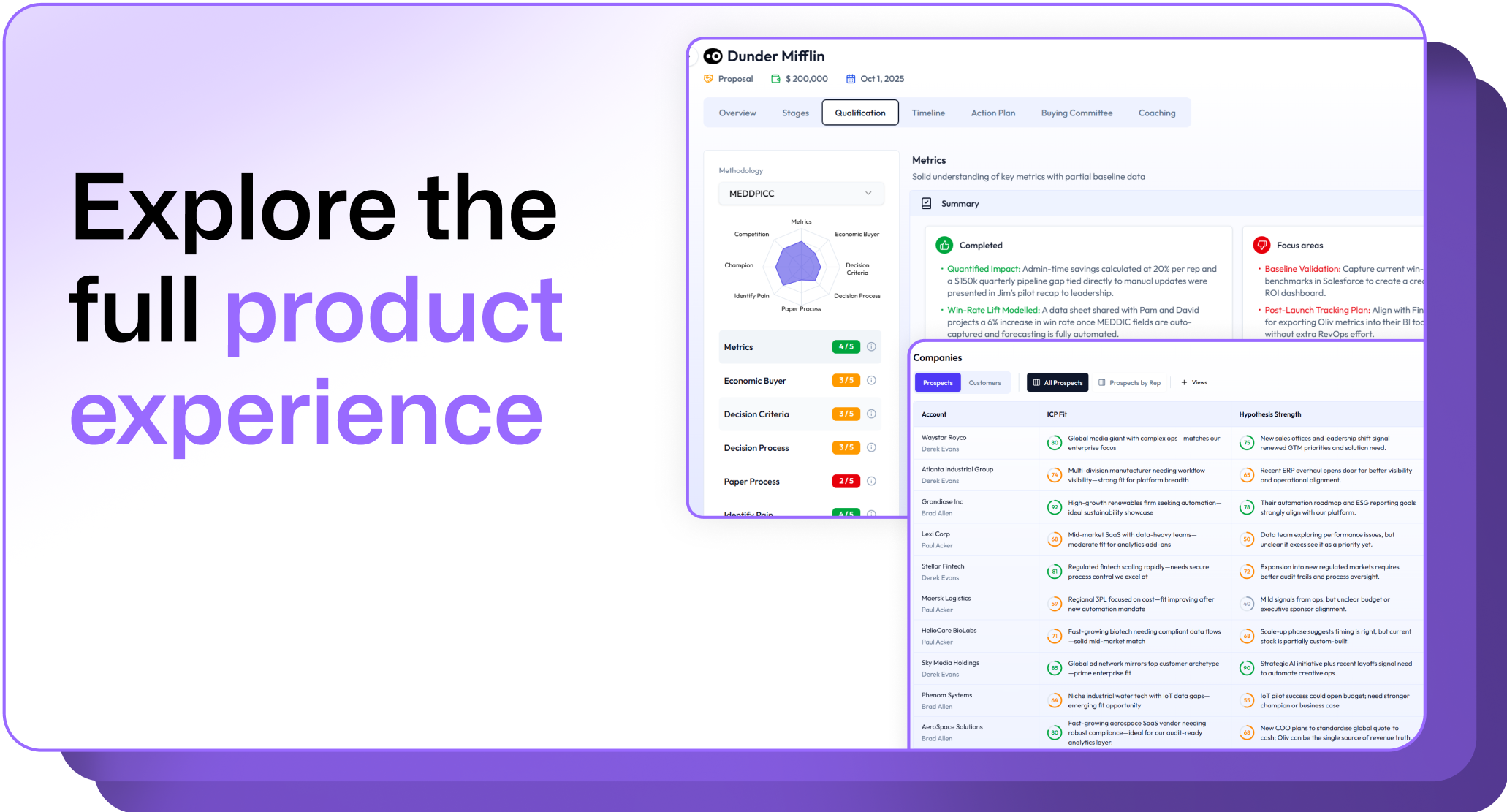
.avif)