Top 8 VonLabs (Von) Alternatives: AI RevOps Tools Compared [2026]
Written by
Ishan Chhabra
Last Updated :
October 7, 2026
Skim in :
13
mins
In this article
Still got questions?
Come discuss this article with me.
Hi, I'm Ishan, Founder and CEO of Oliv.
I'm always up for a conversation about revenue intelligence, AI agents, or what's actually working (and what's not) across revenue teams.
I'd love to hear your perspective.
Thank you! Your submission has been received!
Oops! Something went wrong while submitting the form.
Meet Oliv’s AI Agents
Hi! I’m, Deal Driver
I track deals, flag risks, send weekly pipeline updates and give sales managers full visibility into deal progress
Hi! I’m, CRM Manager
I maintain CRM hygiene by updating core, custom and qualification fields all without your team lifting a finger
Hi! I’m, Forecaster
I build accurate forecasts based on real deal movement and tell you which deals to pull in to hit your number
Hi! I’m, Coach
I believe performance fuels revenue. I spot skill gaps, score calls and build coaching plans to help every rep level up
Hi! I’m, Prospector
I dig into target accounts to surface the right contacts, tailor and time outreach so you always strike when it counts
Hi! I’m, Pipeline tracker
I call reps to get deal updates, and deliver a real-time, CRM-synced roll-up view of deal progress
Hi! I’m, Analyst
I answer complex pipeline questions, uncover deal patterns, and build reports that guide strategic decisions
TL;DR
The eight strongest VonLabs alternatives in 2026 are Oliv AI, Gong, Clari, Salesloft, Outreach, Chorus.ai, Avoma, and Salesforce Agentforce, ranked on pricing transparency and CRM write-back.
Rattle pivoted to Von and soft launched in February 2026, so Rattle's 107 G2 reviews at 4.7 out of 5 describe a product that no longer ships.
Von publishes no pricing. It offers a free two-week trial after a 3 to 7 day context build, and bills month-to-month with no annual contract.
Sort tools by unit of work: triggered alert, described task, or owned responsibility. Gong, Clari, and Chorus sell visibility; Agentforce and Oliv AI sell ownership.
Over three years for 100 users, Gong runs about $789,300 and Clari about $693,500, against roughly $68,400 for Oliv AI at $19 per seat.
Sequence the switch: audit CRM data first, run parallel for one full forecast cycle, then cut over at renewal rather than mid-contract.
Q1. What Are the 8 Best AI RevOps Tools for Revenue Teams in 2026? [toc=1. The 8 Alternatives]
The eight strongest VonLabs alternatives in 2026 are Oliv AI, Gong, Clari, Salesloft, Outreach, Chorus.ai (ZoomInfo), Avoma, and Salesforce Agentforce. Oliv AI leads because it publishes a per-seat price for every layer of the stack ($19 conversation intelligence, $29 Enable, $39 Engage, $49 Forecast, $79 Retain), charges a $0 platform fee, and runs agents that write back to the CRM instead of surfacing a dashboard. Gong leads on conversation intelligence depth, Clari on forecast roll-ups, Salesloft and Outreach on sequences, Chorus on add-on pricing, Avoma on entry cost, and Agentforce on CRM nativeness.
The shortlist
Oliv AI
Gong
Clari
Salesloft
Outreach
Chorus.ai (ZoomInfo)
Avoma
Salesforce Agentforce
⭐ Why this list looks different from the others
A RevOps lead at a Series C company told me she had three browser tabs open: a Gong renewal quote, a Von demo recording, and a Salesforce report that disagreed with both. That is the real artifact this decision hinges on, not a feature matrix.
Von Labs is excluded from its own alternatives list, and it publishes no pricing on its own site, so it cannot be modelled before a sales call. Six other vendors were cut by one filter: no documented CRM write-back.
Note that Rattle's G2 profile carries 107 reviews at 4.7 out of 5, all of them predating the February 2026 pivot to Von, which Rattle announced on its own blog. That is the evidence gap this whole comparison exists to close.
Comparison table: all 8 alternatives
The 8 Best VonLabs Alternatives Compared, 2026
#
Tool
Unit of work owned
Entry price
Platform fee
CRM support
Rating
Best for
1
Oliv AI
Owned responsibility (agents act, then write to CRM)
$19/seat/mo CI
$0
Salesforce, HubSpot, Zoho, 70+ tools
⭐⭐⭐⭐⭐
Mid-market teams consolidating a four-vendor stack
2
Gong
Alert and visibility, with agent features layered on
Quote (roughly $250/user/mo unified licence)
From $5,000/yr
Salesforce, Dynamics, Zoho
⭐⭐⭐⭐
Enterprise CI depth and call libraries
3
Clari
Forecast roll-up and pipeline inspection
Quote (roughly $100 to $125/user/mo)
Yes
Salesforce-first
⭐⭐⭐½
Finance-grade forecast governance
4
Salesloft
Task execution inside sequences
Quote
Yes
Salesforce, Dynamics
⭐⭐½
Outbound teams already standardised on cadences
5
Outreach
Task execution inside sequences
Quote
Yes
Salesforce, Dynamics
⭐⭐⭐
High-volume SDR orgs
6
Chorus.ai
Call capture and transcription
Roughly $40/seat add-on
Bundled with ZoomInfo
Salesforce
⭐⭐½
Existing ZoomInfo customers only
7
Avoma
Meeting notes and summaries
Roughly $100/seat/mo
None
Salesforce, HubSpot
⭐⭐⭐
Under 20 reps, no RevOps hire
8
Salesforce Agentforce
Described task inside Salesforce
Roughly $500/mo bundle plus per-action credits
Varies
Salesforce only
⭐⭐⭐
Salesforce-committed enterprises with a year to spend
1.1 Oliv AI [toc=1.1 Oliv AI]
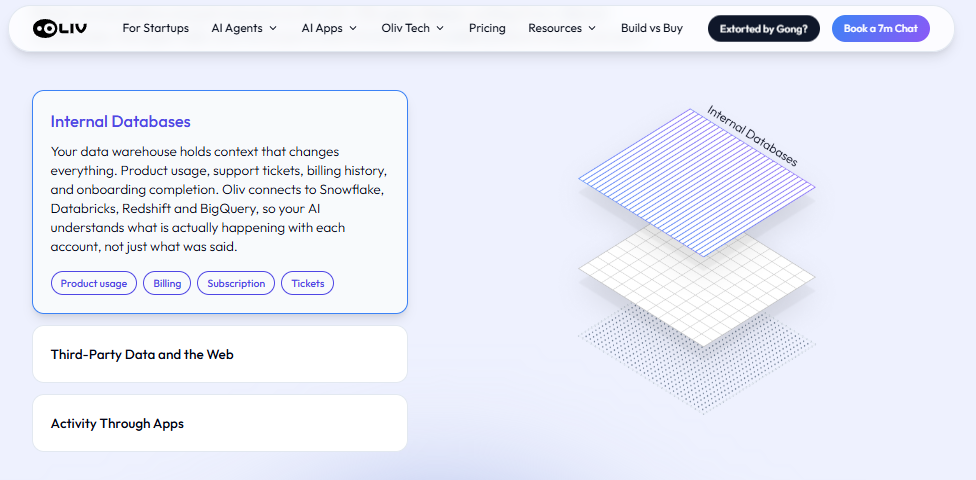
Oliv AI shows how warehouse data adds account context when evaluating VonLabs alternatives for RevOps.
Oliv AI is an AI-native revenue intelligence and revenue orchestration platform for B2B revenue teams. It runs 37 named agents across 17 role categories on a continuously updated context graph of every account, opportunity, and contact.
🔧 What it does and how it is built
Oliv AI captures meetings, emails, and calls, resolves them to the right opportunity, then dispatches agents that act on what it finds. The resolution layer matters more than the capture layer. Oliv AI spent 18 months building it before shipping the application surfaces.
The hard problem is entity resolution on messy CRMs. Oliv AI has customers running five open opportunities against three duplicate accounts, where mapping a meeting to the correct record is the whole job, which is why CRM data quality decides whether any agent works.
⭐ Key features
Context Graph: a continuously mined view of every account, opportunity, and contact, including competitors raised, objections, and the buying committee.
Oliver: the GTM engineer agent. Ask Oliv AI in plain English to build an agent that pushes multi-threading on stalled proposals, and it builds or clones one.
Olivia: the orchestrator agent that reviews activity and dispatches other agents, which can then call further agents.
100+ fine-tuned revenue SLMs at roughly 20B parameters each, with a stated production hallucination rate under 1%.
Capture across five modalities, including shared inter-company Slack and Teams channels, and in-person capture via a PLAUD NotePin partnership.
Governance split in two: data governance scopes what each agent can read, and spend governance tracks credits per agent with settable limits.
💰 Pricing and implementation
Oliv AI Published Price Ladder Against Each Incumbent
Layer
Oliv AI price
Incumbent it displaces
Incumbent price
Conversation Intelligence
$19/seat/mo
Gong Foundation
$133/seat/mo
Enable
$29/seat/mo
Gong Enable, Highspot
$50/seat/mo
Engage
$39/seat/mo
Salesloft, Gong Engage
$67 to $80/seat/mo
Forecast
$49/seat/mo
Clari, Gong Forecast
$70/seat/mo
Retain
$79/seat/mo
Gainsight
$150/seat/mo
Platform fee
$0
Gong
$2,000 to $5,000/yr
Oliv AI publishes a 10-seat annual comparison of roughly $21,410 against $60,050 or more for the equivalent incumbent stack. View-only seats are free. Training, support, implementation, and integrations are included, and data migration from Gong, Avoma, Fireflies, or Clari is handled at no cost.
⏰ Chronological product history
Oliv AI Product History, 2023 to 2026
Period
What shipped
2023 to mid-2025
Oliv AI founded in 2023 in San Francisco, backed by Foundation Capital. Roughly 18 months went into the core context graph infrastructure, solving opportunity and account resolution before any application surface was built (oliv.ai).
Mid-2025 to early 2026
Application layer replication accelerated: conversation intelligence, deal views, automated coaching scorecards on every meeting, and the five-product price ladder from $19 to $79 per seat, published per incumbent on oliv.ai.
2026
Agent-native platform published: 37 marketplace agents, Oliver and Olivia, 100+ revenue SLMs on the Intent Graph, PLAUD in-person capture, and shared inter-company channel monitoring. Reported traction of $3M ARR and 100+ customers (trust.oliv.ai).
✅ Pros
✅ Published per-seat price for every layer, with no platform fee
✅ Agents write back to the CRM, with 95%+ stated field accuracy against 60% for manual entry
✅ Five-minute post-call processing, against 20 to 30 minutes for legacy recorders
✅ Runs on top of an incumbent, so displacement can wait for renewal
✅ Spend governance estimates agent credit cost in a POC before deployment
❌ Cons
❌ Founded 2023, so it lacks the decade of edge-case handling a Gong has accumulated
❌ Case study pages are email-gated, which makes outcome claims harder to verify independently
❌ Typical engagements land at $20,000 to $30,000 once a custom agent is scoped, which is above a pure seat purchase
❌ Not a fit for B2C support teams, call-recording-only buyers, or individual users without a revenue org
⚠️ Where I am genuinely unsure
Oliv AI's data points to agents outperforming dashboards on CRM hygiene, though I might be reading that too strongly. The sample is our own deployments, not an independent audit, and I say so plainly.
What I will defend is the mechanism. Oliv AI's read is that the standard advice gets this backwards, because buyers evaluate model quality when the binding constraint is whether the system knows which opportunity a meeting belongs to.
1.2 Gong [toc=1.2 Gong]
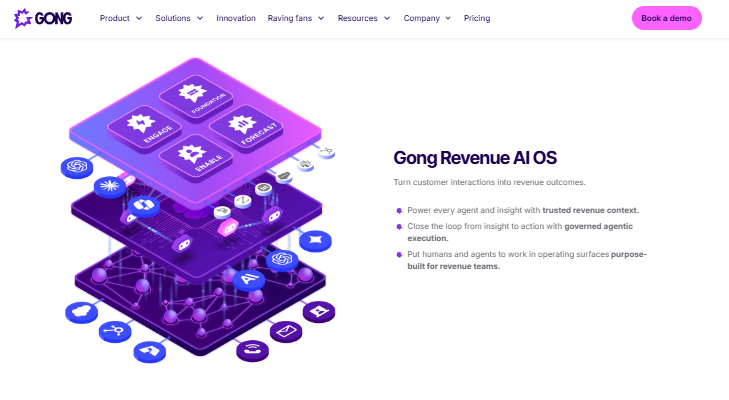
Gong’s layered Revenue AI OS diagram connects customer context with engagement, forecasting, and enablement applications.
Gong is the category-defining conversation intelligence platform, founded in 2015 and repositioned in 2024 as a Revenue AI Platform. In 2026 it markets itself as a Revenue AI Operating System built around Gong Assistant, Agent Studio, AI Trainer, AI Theme Spotter, and Data Extractor, as documented in its own monthly release notes.
🔧 What it does
Gong records and transcribes customer conversations, then runs AI over them to surface deal risk, themes, and coaching signals. Its February 2026 Mission Andromeda launch added Gong Enable for coaching and training, plus unified account management.
Smart Trackers for keyword and concept detection across calls, enhanced in June 2024
AI Theme Spotter, scaled to analyse tens of thousands of calls
Data Extractor, which maps AI-extracted fields from conversations to CRM fields
Agent Studio for managing Gong's own AI agents, shipped July 2025
Configurable forecast boards for new business, renewals, upsells, and net revenue
Gong call data inside Microsoft Copilot, shipped October 2025
💰 Pricing and implementation
Gong does not publish list prices on its own pricing page. Third-party benchmarks put the core platform at roughly $1,440 to $1,600 per user per year, with platform fees from $5,000 upward, and we break the structure down in our Gong pricing analysis. The 2024 unified licence bundled Engage and Forecast with the recorder at roughly $250 per user per month.
In June 2025 Gong added visible per-seat pricing inside its admin centre for eligible direct-purchase accounts, per its monthly updates archive. Implementation typically runs weeks to months, and enterprise rollouts involve enablement workstreams.
⏰ Product updates
Gong Product Update Timeline, 2024 to Committed Roadmap
Period
What changed
2024 through 2025
Repositioned as a Revenue AI Platform. Shipped Smart Tracker accuracy work, Revenue Analytics dashboards, Gong Assistant, Agent Studio, AI Call Reviewer scorecards, AI Builder, configurable forecast boards, and Data Extractor for CRM field mapping (Gong monthly updates).
Jan to May 2026
Gong for Salesforce v3 exported Flow data to a Flow object. Mission Andromeda shipped Gong Enable, conversational guidance, and unified account management. Snowflake multi-instance connectivity arrived in April (Mission Andromeda).
Committed next
Bidirectional MCP: connecting Gong to external MCP servers so AI Briefer pulls third-party data, plus exposing Gong insights to external AI platforms and briefs via API, all listed as coming soon (what's new).
✅ Pros
✅ Deepest conversation intelligence corpus and the most mature call library in the category
✅ Automated scorecards and AI Trainer role-play give enablement teams a real workflow
✅ 250+ integration and services partners in the Gong Collective
✅ Strong account console that unifies activity, AI insights, deals, and CRM data
❌ Platform fee from $5,000 per year sits on top of per-seat cost
❌ Data portability is contractual: reviewers report losing access to data when they stop paying
❌ Smart Tracker setup is keyword-driven, which misses deal intent that was never phrased the expected way
💬 What users actually say about Gong
"I appreciate how Gong organizes all our chats, videos, and audio with clients into a single source... I found the AI tracker setup to be quite difficult, especially concerning the user interface when setting up keywords or smart trackers. Moreover, I cannot download all the data myself unless we upgrade the plan." — Verified User, Account Executive Gong - G2 Verified Review [3 Oct 2025]
"The meeting recordings, ease of use and info sharing and the AI enrichement capabilities... The fact that you cant't edit a recording (to only share a portion with a client, and the fact that if you stop working with thew tool you lose the data." — Verified User, Revenue Team Member Gong - G2 Verified Review [19 Mar 2026]
"Being able to sequence our steps, along with integration with Nooks/Salesforce... limitations of getting data back into salesforce." — Verified User, Sales Development Gong - G2 Verified Review [21 May 2026]
"Gong Engage is awful in every single way compared to outreach. Would not recommend at all, flows are hard to get into, information is not readily available, sequencing is difficult to create and track." — Verified User, Sales Gong - G2 Verified Review [9 Jun 2025]
🎯 Best use case
Gong fits enterprise revenue organisations that need the deepest call corpus, formal enablement programmes, and a vendor their security team already knows. It is the safe org-wide standard, and for Fortune 100 buyers that is the correct answer.
How Does Oliv Compare to Gong?
Oliv covers conversation intelligence, enablement, engagement, forecasting, and customer success retention on one context graph, with agents that act and write to the CRM. Its scope stops at being the system of record, since Oliv connects to Salesforce, HubSpot, and Zoho rather than replacing them. Gong does one thing better: it has a decade of accumulated conversation intelligence edge cases and a partner ecosystem of 250+ integration and services partners, which Oliv does not match.
Unlike Gong, Oliv publishes a per-seat price for every product layer on oliv.ai, charges no platform fee, and includes view-only seats at no cost. Oliv also runs on top of an existing Gong deployment, so the two coexist until renewal instead of forcing displacement. Gong does not state a list price on its own site. For teams where budget predictability and CRM write-back matter rather than call-library depth, that combination is the difference.
Looking beyond Gong? Our roundup of Gong alternatives compares it against the rest of the revenue intelligence market.
1.3 Clari [toc=1.3 Clari]
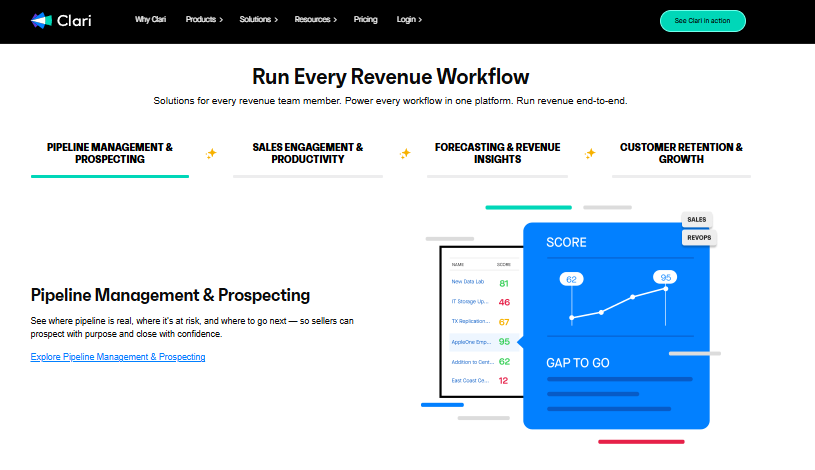
Clari groups revenue workflows across prospecting, engagement, forecasting, and retention beside a pipeline scoring illustration.
Clari pulls CRM and activity data into forecast roll-ups, pipeline inspection views, and deal boards. Finance and sales leadership use it to commit a number with an audit trail behind it, which is the core of running evidence-based forecast commits.
Clari added conversation intelligence through Copilot, which Forrester named a Strong Performer in its October 2023 Conversation Intelligence Wave. The forecasting engine remains the centre of gravity, as we detail in our breakdown of Clari's features.
⭐ Key features
Forecast roll-ups with Forecast History, so you can see what was committed and when
Pipeline inspection with Flow View and Waterfall View for period-over-period change
Clari Copilot for call recording, battlecards, and live coaching prompts
Groove for sequences, dialling, and Salesforce-native engagement
Align for mutual action plans with buyers
💰 Pricing and implementation
Clari does not publish list pricing on its own pricing page. Third-party benchmarks place it near $100 to $125 per user per month, with a platform fee, and we unpack the structure in our Clari pricing analysis. Setup is typically quick for forecasting and slower for custom metrics.
Stacking Clari for forecasting on top of Gong for conversation intelligence pushes a 25 to 200 rep team past $500 per seat per month before platform fees, which is the core of the Gong plus Clari consolidation cost problem. Oliv AI publishes Forecast at $49 per seat per month on oliv.ai, which is the same job at a different line item.
⏰ Product updates
Clari Product Update Timeline, 2023 to 2026
Period
What changed
2023 to 2024
Expanded from forecasting into a Revenue Platform. Acquired Groove for sales engagement in August 2023 and launched Copilot for conversation intelligence, named a Strong Performer in Forrester's CI Wave (Groove acquisition).
Aug 2025 to 2026
Agreed to merge with Salesloft, forming a combined company under Andy Byrne with $10T in revenue under management (merger announcement).
Mar 2026 onward
First cross-platform release: Send AI Emails from Clari, Create Salesloft Tasks, and Send follow-up emails via Salesloft. Positioning shifted to Revenue Context for running AI and agents at enterprise scale (March 2026 release).
✅ Pros
✅ The market benchmark for forecast roll-ups and period-over-period pipeline inspection
✅ Clean Salesforce integration and fast initial setup for core forecasting
✅ Engagement and mutual action plans available in one vendor after the Groove acquisition
✅ Forecast History gives finance a defensible audit trail
❌ Cons
❌ Conversation intelligence is the weaker half, and it does not carry deal context into CI findings
❌ CRM write-back is limited, including pushing MEDDIC values back to Salesforce
❌ Advanced views (Flow, Waterfall, and Inspection presets) need configuration work to stabilise
❌ Still a manual process underneath: reps type, managers scrub, and the dashboard reflects it
💬 What users actually say about Clari
"The conversation intelligence tool is lacking, and we don't have the context of the deals against the conversation intelligence findings. There's no custom reporting. The CRM writeback is not good; we cannot send MEDDIC values back to Salesforce." — Verified User, RevOps Clari - G2 Verified Review [13 Jul 2026]
"Clari forecasting is simple, easy to use, and well integrated with SFDC. The AI features are immature, team activity is poorly designed, and it doesn't integrate well with other popular business systems today." — Verified User, Sales Leadership Clari - G2 Verified Review [10 Oct 2025]
"I really like Clari's excellent user experience. It truly shines in weekly forecasts and opportunity analysis... I'm concerned that the advanced Flow View and Waterfall View aren't working well." — Verified User, Sales Manager Clari - G2 Verified Review [16 Nov 2025]
"The real-time coaching and Battlecards are game-changers... The Live Coaching prompts can occasionally be a bit sensitive, sometimes it flags filler words when I'm just pausing to let a customer finish a thought." — Verified User, Customer Success Clari - G2 Verified Review [8 Apr 2026]
🎯 Best use case
Clari fits enterprises where the forecast is a board-level artifact and finance needs a defensible number every week. If forecast governance is the problem, it is the strongest answer here.
How Does Oliv Compare to Clari?
Oliv covers conversation intelligence, enablement, engagement, forecasting, and retention on one context graph, with agents that act and then write to the CRM. Its scope stops short of being the system of record, since Oliv connects to Salesforce, HubSpot, and Zoho rather than replacing them. Clari does one thing better: enterprise-grade forecast roll-up with Forecast History, which finance teams use as an audit trail.
Unlike Clari, Oliv publishes a per-seat price for every product layer on oliv.ai and charges no platform fee, while Clari does not state a list price on its own site. Oliv writes structured fields back to the CRM from conversations, including methodology fields, which Clari reviewers report as a limitation. Oliv also runs engagement, CI, and retention in the same product rather than through acquired modules. For teams where field-level CRM accuracy rather than forecast board depth drives the decision, that combination is the difference.
Looking beyond Clari? Our roundup of Clari alternatives compares it against the rest of the revenue intelligence market.
1.4 Salesloft [toc=1.4 Salesloft]
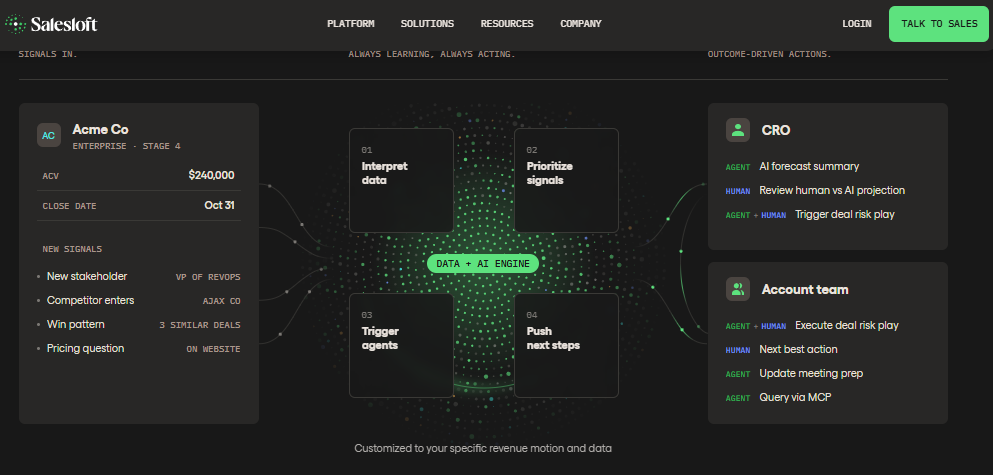
Salesloft maps account signals to AI interpretation, agent triggers, and actions for revenue team members.
Salesloft organises outbound at volume. Cadences, templates, and a dialler keep follow-ups from being dropped across a large prospect list, which is one approach to structured sales follow-up.
That design assumption is the problem. Salesloft was built for bulk emailing and bulk cold prospecting, and that era has closed. The motion that works now is personalised, with AI and a human both in the loop.
⭐ Key features
Cadences and sequences with step-level analytics
Integrated dialler and call logging
Templates and snippets for repeatable messaging
Conversations for call recording, limited to calls made through its own dialler
Salesforce and Dynamics sync for activity logging
💰 Pricing and implementation
Salesloft does not publish list pricing on its own pricing page. Oliv AI's published comparison places sales engagement in the $67 to $80 per seat per month band, against Oliv Engage at $39 on oliv.ai. Reviewers consistently describe the initial setup as difficult.
⏰ Product updates
Salesloft Product Update Timeline, 2024 to 2026
Period
What changed
2024 to mid-2025
Continued as a standalone sales engagement platform centred on cadences, templates, and the dialler, with conversation capture limited to calls placed through its own dialler (Salesloft release notes).
Aug 2025
Entered a definitive merger agreement with Clari, creating a combined revenue AI company led by Andy Byrne (merger announcement).
Mar 2026 onward
First unified release: Salesloft tasks created from Clari, follow-up emails sent via Salesloft, and AI emails sent from Clari. Roadmap direction is consolidation into the Clari release train (March 2026 release).
✅ Pros
✅ Mature sequencing with step-level reporting that outbound managers understand
✅ Keeps high-volume follow-up organised across hundreds of accounts
✅ Native Salesforce and Dynamics activity logging
✅ Now part of a larger forecasting and engagement suite post-merger
❌ Cons
❌ Conversation intelligence only records calls placed through the internal dialler, so it misses the rest
❌ Reviewers repeatedly report dialler slowness, stale extensions, and faulty email-open analytics
❌ No conditional-logic automation, which forces manual branching
❌ Built for mass cold email, which is the wrong shape for 2026 buying behaviour
💬 What users actually say about Salesloft
"Salesloft helps organize outreach at scale and keeps follow-ups from falling through the cracks... Integrating Salesloft came with a lot of challenges, and even now, it feels like the platform still has some kinks. I often have trouble logging meetings." — Verified User, Account Executive Salesloft - G2 Verified Review [22 Jul 2025]
"It allows you to sequence emails, which is table stakes at this point. For months, randomly, one-off emails sent from Salesloft would appear blank in the recipient's mailbox. One-off Scheduled emails are not paused when someone replies." — Verified User, Sales Development Salesloft - G2 Verified Review [24 Sep 2025]
"The UI/UX is pretty appealing, I'll give them that. A handful of features don't work properly (inbound calls, task reminders, data connectivity between apps)... Dialer is often slow at launching when making calls." — Verified User, SDR Salesloft - G2 Verified Review [26 Mar 2025]
🎯 Best use case
Salesloft fits SDR organisations already standardised on cadences, where the job is volume management rather than deal intelligence. If your outbound team lives in sequences and nothing else needs to change, it still does that job.
How Does Oliv Compare to Salesloft?
Oliv covers conversation intelligence, enablement, engagement, forecasting, and retention on a single context graph, with agents that run the outbound motion on first-party context. Its scope stops at replacing the CRM, which Oliv connects to instead. Salesloft does one thing better: it has a longer-established sequencing and dialler engine with step-level reporting that outbound managers already know how to read.
Unlike Salesloft, Oliv captures conversations across meetings, email, and calls regardless of which dialler placed them, while Salesloft's conversation capture is tied to calls made through its own dialler. Oliv publishes Engage at $39 per seat per month on oliv.ai, and Salesloft does not state a list price on its own site. Oliv also runs engagement agents on your own account history rather than on third-party contact data. For teams where personalised, context-driven outreach rather than cadence volume drives results, that combination is the difference.
1.5 Outreach [toc=1.5 Outreach]
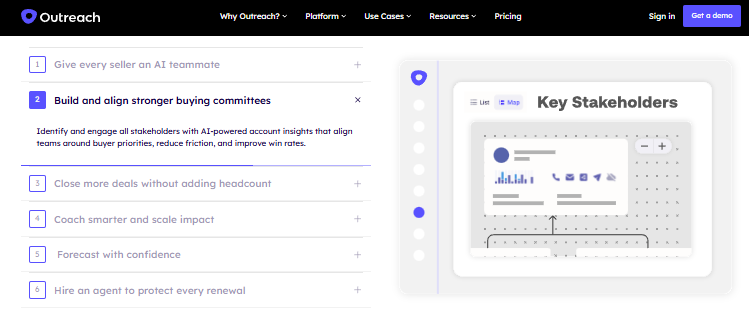
Outreach highlights buying committee development through account insights and a stakeholder map for revenue teams.
Outreach is the other major sales engagement platform, built around cadence and sequence automation at scale. It has since layered AI agents on top of its existing seat model, per its own AI agents product page.
🔧 What it does
Outreach runs multi-step, multi-channel sequences across large prospect lists, with task prioritisation for reps. Its cadence engine is the most proven piece of the product.
The structural issue is reply handling. Rep touchpoint fatigue is real, and more than 20% of replies get missed without manual intervention, which puts the human back in the loop at exactly the wrong moment.
⭐ Key features
Cadence and sequence automation across email, calls, and social steps
Task prioritisation so reps work a ranked list rather than a queue
Dialler and call logging inside the sequence flow
AI agents sold as additions on top of existing legacy seats
Salesforce and Dynamics sync
💰 Pricing and implementation
Outreach does not publish list pricing on its own pricing page. It sits in the same sales engagement band as Salesloft, roughly $67 to $80 per seat per month before add-ons. The AI agents are priced on top of the base seat, so the effective cost rises with adoption rather than falling, which is one reason teams look at reducing sales tech stack costs.
✅ Pros
✅ The most proven cadence engine for high-volume SDR teams
✅ Task prioritisation genuinely reduces decision load for reps
✅ Deep sequence reporting for outbound managers
✅ Established integration footprint with major CRMs
❌ Cons
❌ Over 20% of replies are missed without manual intervention, which defeats the automation premise
❌ AI agents are add-ons stacked on legacy seats, not a native agent architecture
❌ Built for the mass cold outbound era, which is no longer how mid-market B2B buys
❌ No published pricing, so budget modelling requires a sales cycle
🎯 Best use case
Outreach fits high-volume SDR organisations where sequence throughput is the main constraint and a dedicated ops owner maintains the cadences. If outbound volume is your growth lever, it is a credible choice.
⚠️ Where I think the category gets this wrong
Oliv AI's read is that the standard advice gets sequences backwards, because it treats reply handling as a reporting problem rather than an ownership problem. A missed reply is not a dashboard gap. It is work nobody owns.
That is the distinction Oliv AI built for. Oliv's agents carry a plain-English SOP and an approval gate, so the follow-up happens whether anyone opens the tool.
How Does Oliv Compare to Outreach?
Oliv covers conversation intelligence, enablement, engagement, forecasting, and retention on one context graph, with agents that own a workflow end to end. Its scope stops at the system of record, which Oliv connects to rather than replaces. Outreach does one thing better: its cadence and sequence automation engine is more mature and more widely deployed for pure high-volume outbound.
Unlike Outreach, Oliv prices agents inside a published per-seat ladder on oliv.ai rather than selling them as add-ons above a base seat, and Outreach does not state a list price on its own site. Oliv's engagement agents run on first-party account history drawn from calls, emails, and notes, not on third-party contact data. Oliv also handles reply triage as an owned agent responsibility rather than a rep task. For teams where follow-through rather than sequence volume is the failure point, that combination is the difference.
1.6 Chorus.ai (ZoomInfo) [toc=1.6 Chorus.ai]
Chorus.ai was an independent conversation intelligence platform until ZoomInfo acquired it in 2021. It now ships as a low-cost add-on inside the ZoomInfo suite.
🔧 What it does
Chorus records, transcribes, and analyses sales calls, then surfaces themes and deal signals. The capture layer works, and the price is the lowest in the serious CI tier, as covered in our Gong versus Chorus comparison.
The problem is momentum. Core product innovation has been minimal since the ZoomInfo acquisition settled, and buying Chorus means buying into ZoomInfo infrastructure first.
⭐ Key features
Call recording and transcription across major meeting platforms
Deal and theme analysis over recorded conversations
Salesforce activity logging
ZoomInfo data enrichment bundled alongside the CI layer
💰 Pricing and implementation
Chorus is priced near $40 per seat as an add-on, which is the cheapest entry point among the established CI tools. The catch is the prerequisite: you need the underlying ZoomInfo contract first, which changes the real total.
Oliv AI publishes Conversation Intelligence at $19 per seat per month with no platform fee and no prerequisite suite purchase on oliv.ai. That is the honest comparison for a buyer looking only at conversation analytics cost.
✅ Pros
✅ Lowest add-on price in the established conversation intelligence tier
✅ Reliable recording and transcription of sales calls
✅ Already bundled if your team runs ZoomInfo
✅ Simple to switch on for existing ZoomInfo customers
❌ Cons
❌ Little core product innovation since the ZoomInfo acquisition
❌ Requires buying ZoomInfo infrastructure first, which inflates the true cost
❌ No pipeline forecasting or agentic CRM orchestration
❌ Recording-only posture leaves the post-call work with the rep
🎯 Best use case
Chorus fits existing ZoomInfo customers who want call recording and basic transcript analysis without a second vendor. Outside that, the prerequisite makes it a hard recommendation.
How Does Oliv Compare to Chorus.ai?
Oliv covers conversation intelligence, enablement, engagement, forecasting, and retention on one context graph, with agents that update the CRM after each call. Its scope stops at being the CRM itself. Chorus.ai does one thing better: for teams already paying for ZoomInfo, it is the cheapest route to call recording with no new vendor relationship.
Unlike Chorus.ai, Oliv does not require a prerequisite data suite purchase, and it publishes Conversation Intelligence at $19 per seat per month on oliv.ai with no platform fee. Oliv also runs forecasting and engagement in the same product, where Chorus stops at capture and analysis. Setup effort differs too: Oliv states a rollout measured in weeks rather than a suite implementation. For teams where post-call execution rather than recording cost drives the decision, that combination is the difference.
1.7 Avoma [toc=1.7 Avoma]
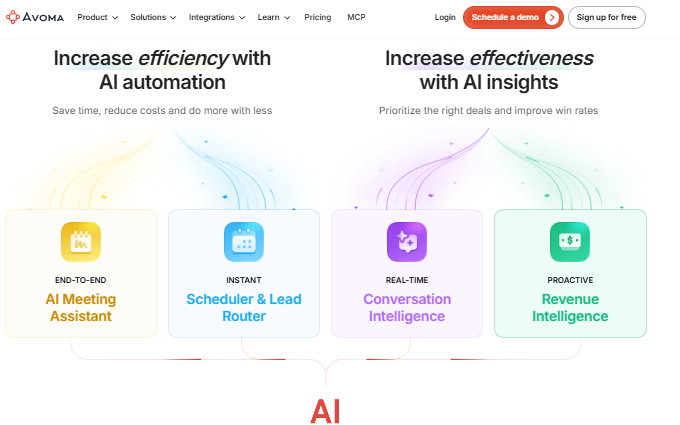
Avoma separates AI automation from AI insights across meeting assistance, lead routing, and revenue intelligence.
Avoma is a meeting assistant and conversation intelligence tool aimed at smaller teams. Its appeal is a low entry price with no platform fee attached, and we break the product down in our guide to Avoma's features.
🔧 What it does
Avoma joins meetings, transcribes them, and produces summaries and action items. For a team under 20 reps with no RevOps hire, that is often enough.
Reliability is the recurring complaint at scale. Bot joining is inconsistent, transcription quality varies, and summarisation stays basic, which gets expensive when a forecast depends on it, as the patterns in Avoma user reviews and feedback show.
⭐ Key features
Automatic meeting recording and transcription
AI notes, summaries, and action items per meeting
Collaborative note templates by meeting type
Salesforce and HubSpot activity sync
No platform fee, unusual in this tier
💰 Pricing and implementation
Avoma lands near $100 per seat per month for its business tier, with no platform fee, per its own pricing page. Oliv AI's published three-way comparison puts note-taker tools at roughly 15 minutes to set up, legacy revenue intelligence at three months, and Oliv at about one hour on oliv.ai.
✅ Pros
✅ Lower entry cost than Gong or Clari with no platform fee
✅ Fast to deploy, usually same-day for a small team
✅ Decent templated note structure by meeting type
✅ Works for a founder-led sales motion before a RevOps function exists
❌ Cons
❌ Unreliable bot joining, which means missing recordings on real deals
❌ Transcription quality and summarisation are basic compared with the CI tier
❌ Struggles in mid-market and enterprise accounts
❌ No pipeline forecasting, deal intelligence, or bi-directional CRM orchestration
🎯 Best use case
Avoma fits teams under 20 reps that need meeting notes and nothing more. If a $5,000 platform fee cannot be justified yet, it is the sensible stop before the next tier.
How Does Oliv Compare to Avoma?
Oliv covers conversation intelligence, enablement, engagement, forecasting, and retention on one context graph, with agents that write structured fields back to the CRM. Its scope stops at replacing the CRM. Avoma does one thing better: it is cheaper to start, with a simpler product surface that a small team can adopt in an afternoon.
Unlike Avoma, Oliv runs forecasting, engagement, and retention alongside conversation intelligence, and it publishes Conversation Intelligence at $19 per seat per month on oliv.ai with no platform fee. Oliv resolves meetings to the correct opportunity across duplicate accounts, which a note-taker does not attempt. Fit by team size also differs: Oliv targets revenue orgs of roughly 200 to 5,000 employees rather than sub-20-rep teams. For teams where deal-level context rather than meeting notes drives the decision, that combination is the difference.
Salesforce Agentforce is the CRM-native option: build-your-own AI agents that run inside Salesforce, as described on its own Agentforce product page. Its advantage is that the data already lives there.
🔧 What it does
Agentforce lets admins build agents that act on Salesforce records and workflows. Nothing has to be synced, because nothing leaves the platform, a point we examine in our review of Agentforce for Sales features.
Two structural issues follow. Pricing combines a roughly $500 per month bundle with per-action credit fees near $0.10, so cost scales with how much the agents actually do. Einstein Activity Capture also stores data in an AWS store outside Salesforce, which surprises teams expecting native residency.
⭐ Key features
Native Salesforce agents acting directly on CRM objects
Agent Builder for admin-configured actions and guardrails
Einstein Activity Capture for email and calendar logging
Data Cloud grounding for agent context
Platform-level permissions inherited from Salesforce
💰 Pricing and implementation
Expect roughly $500 per month for the bundle plus about $0.10 per agent action, per the Salesforce pricing page, which makes usage forecasting part of the budget exercise and is unpacked further in our Agentforce pricing breakdown. Oliv AI's published comparison puts an Agentforce rollout at about one year with heavy internal time and resource investment, against roughly 60 days with a dedicated Oliv partner team.
✅ Pros
✅ Native to Salesforce, so no CRM sync layer is required
✅ Inherits existing Salesforce permissions and governance model
✅ Agents act directly on records rather than through an integration
✅ Already inside your security review perimeter
❌ Cons
❌ Per-action credit pricing makes total cost hard to predict before rollout
❌ Salesforce-only, so HubSpot teams are excluded entirely
❌ Einstein Activity Capture stores data outside Salesforce in an AWS silo
❌ Setup-heavy, with rollouts measured in quarters rather than weeks
❌ Heavily shaped by B2C use cases rather than B2B revenue workflows
🎯 Best use case
Agentforce fits Salesforce-committed enterprises with admin capacity, a year of runway for the rollout, and a procurement preference for a single vendor. If the CRM is the whole stack, it is the path of least resistance.
⚠️ What I would ask before signing
Oliv AI's data points to credit-based agent pricing being the hardest line to forecast, though I might be reading that too strongly from our own POC process. What I am confident about is the fix.
Oliv AI runs a credit-cost POC before an agent is deployed, so the bill is known in advance, and it tracks spend per agent with settable limits and high watermarks. Ask any vendor on this list for the same thing, using the questions in our AI CRM trust and governance evaluation.
How Does Oliv Compare to Salesforce Agentforce?
Oliv covers conversation intelligence, enablement, engagement, forecasting, and retention on one context graph, with agents that act and then write back to the CRM. Its scope stops at being the system of record, which Oliv connects to rather than replaces. Agentforce does one thing better: it is native to Salesforce, so agents operate on CRM objects with no integration layer and no data sync.
Unlike Agentforce, Oliv supports Salesforce, HubSpot, and Zoho across 70+ tools, and it publishes a per-seat price for every layer on oliv.ai instead of combining a bundle fee with per-action credits. Oliv states a rollout of roughly 60 days with a partner team, against roughly one year for an Agentforce deployment. Oliv also ships agents out of the box rather than requiring admins to build them. For teams where predictable cost and multi-CRM coverage rather than native Salesforce residency drive the decision, that combination is the difference.
Looking beyond Agentforce? Our roundup of Agentforce alternatives compares it against the rest of the revenue AI market.
Q2. How Were These Alternatives Scored, and What Can You Actually Verify About Each Vendor? [toc=2. Scoring and Evidence]
Each tool was scored across five weighted criteria totalling 100%: Pricing Transparency 25%, Agent Autonomy and CRM Write-Back 25%, Cross-Functional Coverage 20%, Verified User Reviews 15%, and Setup and Time-to-Value 15%. Scores of 0 to 20 earn one star, 21 to 40 two, 41 to 60 three, 61 to 80 four, and 81 to 100 five. Pricing transparency carries the heaviest weight for a specific reason. Von publishes no price on its own site, and Rattle's 107 G2 reviews at 4.7 out of 5 all predate the February 2026 pivot, so the evidence a buyer normally leans on does not describe the product being sold.
The weights, and why each one earns its percentage
Scoring Rubric Weights for VonLabs Alternatives
Criterion
Weight
Why it carries this much
Pricing Transparency
25%
You cannot build a budget case from a quote you have not received yet
Agent Autonomy and CRM Write-Back
25%
Separates a tool that tells you from a tool that does it
Cross-Functional Coverage
20%
Sales, CS, and onboarding all need seats, or the stack fragments
Verified User Reviews
15%
Weighted down because review recency often does not match the shipped product
Setup and Time-to-Value
15%
A one-year rollout is a cost, even when the licence looks cheap
⭐ Scored results
Weighted Scores and Star Ratings, 8 VonLabs Alternatives
Tool
Score
Stars
Oliv AI
92
⭐⭐⭐⭐⭐
Gong
74
⭐⭐⭐⭐
Clari
66
⭐⭐⭐½
Outreach
54
⭐⭐⭐
Avoma
52
⭐⭐⭐
Salesforce Agentforce
51
⭐⭐⭐
Salesloft
44
⭐⭐½
Chorus.ai
42
⭐⭐½
I build Oliv AI, so treat our five stars as a disclosed conflict and re-run the rubric yourself. Oliv AI scores where it does on four reproducible facts: published prices for all five layers on oliv.ai, documented bi-directional CRM write-back, 70+ integrations, and a stated field accuracy of 95%+ against 60% for manual entry. Change the weights however you like. The pricing-transparency column does not move.
What you can actually verify before you buy
💰 The evidence-asymmetry audit
What Is Publicly Verifiable About Each Vendor
Vendor
Published price
Independent reviews
Reviews match shipped product
Oliv AI
Yes, five layers on oliv.ai
Limited volume
Yes
Gong
No list price on its own site
High volume
Yes
Clari
No list price on its own site
High volume
Partly, post-merger changes
Salesloft
No list price on its own site
High volume
Partly, post-merger changes
Von (the subject)
None published
None under the Von name
No, Rattle reviews predate the pivot
That bottom row is the whole reason to read a comparison rather than a ranking. Gartner Peer Insights still routes Rattle traffic to an alternatives page, which tells you the market has not caught up to the rename either.
⚠️ What a real audit costs
I have personally audited a $50,000 annual quote for a 20-rep team, where $10,000 of it was third-party implementation before anyone logged in. That number never appears on a pricing page, which is why we built a revenue intelligence ROI calculator instead of a feature chart.
Oliv AI's read is that the standard advice gets this backwards, because buyers are told to compare feature matrices when the unverifiable line items decide the outcome. One RevOps lead told me the pricing and review deep dives were what convinced her, not the demo.
💬 What this looks like in reviews
"I found the AI tracker setup to be quite difficult... Moreover, I cannot download all the data myself unless we upgrade the plan, which isn't ideal and results in me not fully utilizing Gong." — Verified User, Account Executive Gong - G2 Verified Review [3 Oct 2025]
"Clari forecasting is simple, easy to use, and well integrated with SFDC. The AI features are immature, team activity is poorly designed, and it doesn't integrate well with other popular business systems today." — Verified User, Sales Leadership Clari - G2 Verified Review [10 Oct 2025]
Q3. Why Are Revenue Teams Replacing Von, and What Happened to Rattle? [toc=3. Why Teams Switch]
Rattle pivoted to Von. Von Labs stopped building on Rattle's architecture, rebuilt from scratch over roughly a year, and soft launched Von in February 2026, after more than 200 companies had run workflows through Rattle. That discontinuity is trigger one. Trigger two is renewal season, with teams paying $200 to $500 per user per month reopening the whole stack rather than swapping one tool. Trigger three is consolidation: 67% of RevOps leaders plan to cut tool count in 2026, and only 8% currently trust autonomous workflow execution.
The Thursday and Friday that nobody puts in a business case
Every Monday there is a forecast call. To get ready for it, managers sit with each rep on Thursday and Friday for one to two hours, work out what the rep actually has, then type it into the forecast by hand.
That is not a tooling gap. It is two days of a manager's week, every week, spent reconciling a CRM that was supposed to already know, which is the problem forecast accuracy work exists to solve.
⏰ What changed, and what to get in writing
Rattle's workflow alerts were real and widely used. Von is a different product on a different architecture, so the continuity question is fair rather than hostile.
Ask three things in writing before you renew or sign: the support status of your existing Rattle workflows, the migration path for them, and the current price. Von publishes none of the third on its own product site.
💸 Why legacy platforms still hand the work back
Gong is excellent at surfacing information. The gap is what happens after. Its integrations pull data in and make export harder, and RevOps teams end up writing custom code against an API that does not cooperate, a pattern we cover in Gong's limitations beyond meeting intelligence.
Clari added intelligence on top of the forecast process rather than removing it. Reps still type. Managers still scrub. The dashboard just shows the result faster, as the detail in Clari reviews and user feedback confirms.
⚠️ The case for buying nothing
Here is the argument against my own interest. If 67% of RevOps leaders are cutting tools, adding a ninth vendor to a stack that already has eight is not a strategy.
Sometimes the correct Monday action is listing every tool with its renewal date, then deciding which two a new platform would actually retire. If the answer is zero, do not buy, and read our guide to reducing sales tech stack costs first.
⭐ What a different answer looks like
Oliv AI was built after that Thursday grind was already understood, not as a reporting layer on top of it. Its Forecaster and Deal Driver agents are designed to remove the scrub rather than visualise it, and Oliv's published framing on this is blunt: Clari and Gong added intelligence to the process, they did not remove the work.
The number that matters is the one underneath. Oliv AI states 95%+ CRM field accuracy against 60% for manual entry, and 65% of CRM data in the market is inaccurate before any AI touches it, per oliv.ai. Fix that, and the forecast call stops being a reconciliation meeting.
Q4. How Do the 8 Alternatives Compare by Unit of Work, CRM Fit and Team Size? [toc=4. Tool-by-Tool Breakdown]
Sort by unit of work, not feature count. A triggered alert tells you a deal went quiet. A described task does something when asked. An owned responsibility runs whether anyone opens the dashboard. Gong, Clari, and Chorus sell alerts and visibility. Salesloft and Outreach sell task execution inside sequences. Agentforce and Oliv AI sell owned responsibility. CRM dependency narrows it fast: Agentforce needs Salesforce, Von required Salesforce at its December 2025 launch and now lists HubSpot plus Snowflake, BigQuery, and Databricks, and Oliv AI connects to Salesforce, HubSpot, and Zoho across 70+ tools.
The three tiers, in plain terms
A vending machine is fixed input and fixed output. You press a button, you get a thing. That is traditional automation, and most of this category still lives there.
An agent is closer to a new hire with a goal. It picks the objective, works the problem, and keeps going until it is done or it needs your approval, which is the line we draw in AI agents versus SaaS dashboards.
⭐ Unit of work and CRM fit, side by side
Unit of Work, CRM Dependency, and Structural Limit by Tool
Tool
Unit of work
CRM dependency
Structural limit
Oliv AI
Owned responsibility
Salesforce, HubSpot, Zoho, 70+ tools
Founded 2023, less accumulated edge-case history
Gong
Alert and visibility
Salesforce, Dynamics, Zoho
Export and write-back friction, 20 to 30 minute processing delay
Clari
Alert and visibility
Salesforce-first
CRM write-back limited, including methodology fields
Chorus.ai
Capture only
Salesforce
Requires ZoomInfo first, little core innovation since acquisition
Salesloft
Task inside sequence
Salesforce, Dynamics
Records only calls placed through its own dialler
Outreach
Task inside sequence
Salesforce, Dynamics
Over 20% of replies missed without manual intervention
Avoma
Capture only
Salesforce, HubSpot
Unreliable bot joining, no forecasting or orchestration
Agentforce
Described task
Salesforce only
Per-action credits, activity data stored outside Salesforce
💰 What the agent tier actually buys you
Oliv AI ships 20 agents out of the box across 17 role categories, each running a plain-English SOP you can edit, with per-agent tool permissions and an auto-run versus approval-required gate. Ask Oliv AI to build an agent that pushes multi-threading on stalled proposals, and Oliver builds it or clones one from the agent marketplace.
Olivia then dispatches those agents and lets them call each other, which is how a single trigger becomes a chain of work. Oliv AI measures this per agent, including credit spend, with settable limits and high watermarks, and the governance model is detailed in our mid-market revenue AI buyer guide.
Fit by team size
⚠️ Where each band should actually land
Under 20 reps with no RevOps hire: Avoma or a note-taker is usually enough, and a $5,000 platform fee is not. Between 20 and 200 reps with a named RevOps owner: this is where the agent tier pays back, because manager time is already the constraint, as covered in scaling revenue operations.
Over 200 reps on Salesforce with a formal security review: Gong or Agentforce clears procurement fastest. Expect roughly one year to full value on Agentforce, against about 60 days for a focused agent deployment.
💬 What the structural limits sound like in practice
"Being able to sequence our steps, along with integration with Nooks/Salesforce... limitations of getting data back into salesforce." — Verified User, Sales Development Gong - G2 Verified Review [21 May 2026]
"The conversation intelligence tool is lacking, and we don't have the context of the deals against the conversation intelligence findings... we cannot send MEDDIC values back to Salesforce or update fields in Salesforce from the conversation intelligence." — Verified User, RevOps Clari - G2 Verified Review [13 Jul 2026]
"Salesloft helps organize outreach at scale and keeps follow-ups from falling through the cracks... Integrating Salesloft came with a lot of challenges, and even now, it feels like the platform still has some kinks." — Verified User, Account Executive Salesloft - G2 Verified Review [22 Jul 2025]
Q5. What Do These Tools Cost Over Three Years, and What Does Von Cost? [toc=5. Pricing and 3-Year TCO]
Von Labs publishes no pricing on its own site, with no per-seat figure and no packaging table, so your number arrives as a quote after a sales conversation. Von does offer a free two-week trial that begins after a 3 to 7 day context-building period, and bills month-to-month with no annual contract. The named alternatives can be modelled. For 100 users over three years, Gong Foundation runs about $789,300 ($219 per user per month averaged), Clari Copilot about $693,500 ($193), Chorus roughly $567,500 ($158), Avoma Business about $227,000 ($63), and Oliv AI unified about $68,400 ($19). Platform fees, module bundling, per-action credits, and implementation drive the gap, not the headline seat price.
The four cost lines that never make the pricing page
A CFO asks for cost per seat. The quote arrives with four other numbers attached, and those four are where the budget actually goes.
Platform fees land first, from $2,000 to $5,000 a year before a single licence. Module bundling comes next: Gong's 2024 unified licence folded Engage and Forecast into the recorder at roughly $250 per user per month, as its own packaging updates record. Then per-action credits, which Agentforce charges near $0.10 each. Then third-party implementation, which nobody quotes until late, and which drives most of the surprises in a sales tech stack cost review.
Each three-year figure assumes a flat 100 seats, no mid-term seat growth, list-level pricing, and one platform fee per year where the vendor charges one. Implementation is included at the vendor's typical range, not at zero.
Rebuild it with your own seat count and renewal dates before you quote it internally, using our revenue intelligence ROI calculator. Any TCO number you cannot reconstruct is a number you should not forward.
Where the real money leaks
💸 The stacking problem and the customer success tax
Stack Gong for conversation intelligence with Clari for forecasting and you pass $500 per seat per month before platform fees land. That is the quiet default most 25 to 200 rep teams end up in, one procurement cycle at a time, and the maths is broken down in our Gong plus Clari consolidation cost analysis.
Then there is the customer success tax. CS teams get charged the same per-user fee as sales for a product built for sales, so they end up on a basic meeting recorder at a sales price. That is why $19 tools keep appearing beside $100 licences in the same org, a pattern we unpack in customer success platform comparisons.
⚠️ A quote I actually audited
I have personally audited a $50,000 annual quote for a 20-rep team. Ten thousand dollars of it was a third-party implementation vendor, before anyone logged in.
Oliv AI's data points to implementation being the single most underestimated line, though I might be reading that too strongly from our own deployments. What I will say plainly is that it is never on the pricing page.
⭐ What transparent pricing looks like in the same table
Oliv AI publishes a $0 platform fee against Gong's $2,000 to $5,000, free view-only seats where competitors charge for them, and a head-to-head of $77,000 a year down to $28,080 for the same team, which is 64% less, on oliv.ai. Oliv AI also includes training, support, integrations, and full data migration from Gong, Avoma, Fireflies, or Clari at no cost.
That is not a discount claim. It is the same five numbers you would ask any vendor for, already written down.
Q6. What Should You Ask About CRM Writes, Governance and Vendor Maturity Before Signing? [toc=6. Governance and Diligence]
Ask in two blocks. Security and governance: confirm SOC 2 Type I and II, ISO 27001, and GDPR, and ask whether the SOC 2 system description names the agent runtime. Confirm whether every CRM write requires explicit approval, and whether a bad write rolls back. Confirm whether activity data lands inside your CRM or a vendor-side store. Von publishes SOC 2 Type I and II, ISO 27001, VAPT, Google CASA Tier 2, GDPR, isolated per-customer models, 30-day deletion, and per-write approval. Vendor maturity: ask how many customers ran this specific product in production, request three post-February-2026 references, and get processing latency in writing. The EU AI Act reaches full enforcement on 2 August 2026, with penalties up to 7% of global turnover.
Certifications and write governance, side by side
Certifications, CRM Write Behaviour, and Data Residency by Vendor
Vendor
Published certifications
CRM write behaviour
Data residency note
Oliv AI
SOC 2 Type II, GDPR, CCPA, AES-256 at rest, TLS 1.2+
Writes fields back, with auto-run or approval gate per agent
Open export policy, no lock-in
Von
SOC 2 Type I and II, ISO 27001, VAPT, CASA Tier 2, GDPR
Explicit approval on every write
Isolated per-customer models, 30-day deletion
Gong
SOC 2, GDPR
Writes AI fields via Data Extractor
Export friction reported by users
Clari
SOC 2, GDPR
Limited write-back, including methodology fields
Salesforce-first
Agentforce
Salesforce platform certifications
Acts natively on records
Activity Capture stores data outside Salesforce
⚠️ The clause to add to your security questionnaire
Add two lines before renewal. First, audit-log export for every agent action, in a format your team can read. Second, a human-in-the-loop requirement for any write that changes a forecastable field, a point we expand on in our AI CRM trust and governance evaluation.
Also check consent. Several US states require two-party consent for call recording, so a recorder that joins silently is a legal question, not a settings question, and vendor DPA and security terms are where that gets settled.
How to diligence a product under a year old
⭐ The seven questions, including for us
How many customers ran this exact product in production, not its predecessor?
Can I speak to three references who started after the pivot date?
What is the published price, in writing?
What happens to my data and workflows if the architecture changes again?
Who maintains the agents after go-live?
What is the processing latency after a call ends?
What does a bad CRM write look like, and does it roll back?
Oliv AI splits this into data governance and spend governance. Data access is scoped so agents cannot read what they should not, spend is tracked per agent with limits and high watermarks, and a credit POC estimates the bill before an agent runs, per trust.oliv.ai.
On maturity, Oliv AI reports 100+ customers, founded in 2023, with 18 months spent on the Context Graph before any application layer shipped. Post-call processing runs at five minutes, against the 20 to 30 minutes typical of legacy recorders. I will not claim a decade of accumulated edge cases, because we have not had a decade.
💬 Where governance shows up in reviews
"The fact that you cant't edit a recording (to only share a portion with a client, and the fact that if you stop working with thew tool you lose the data." — Verified User, Revenue Team Member Gong - G2 Verified Review [19 Mar 2026]
"It consistently loses connection both with Salesforce and with our gmail based email platform and calendar, requiring page refreshes and restarts of the app in order to reconnect it to both platforms." — Verified User, Account Executive Clari - G2 Verified Review [3 Jun 2026]
Q7. Should You Build Instead, and How Do You Sequence the Switch? [toc=7. Build, Buy and Migrate]
Build only if the process itself is your moat, or if you already run a platform engineering team. Von's own build-versus-buy page puts a DIY revenue AI layer at 3 to 5 engineers and six-plus months, against $3.5M of its own R&D in 2025 and $8M-plus in 2026, which is useful as a negotiation lever either way. If you buy, sequence it. Audit stage definitions and duplicate accounts first, because Gartner expects 40% of agentic CRM projects to fail by 2028 on data quality, and 45% of CRM leaders say their data is not AI-ready. Then run parallel on live deals for one full forecast cycle, compare field accuracy on the same 20 opportunities, and cut over at renewal rather than mid-term.
The experiment that lives on one laptop
Someone on your team has already built something good. A prompt chain that drafts follow-ups, or a script that flags stalled proposals. It works, and it runs on their machine.
That is individual productivity, not organisational efficiency. The moment that person goes on holiday, the workflow stops, and nobody else knows it existed, which is the core argument in our build versus buy revenue AI guide.
⚠️ The honest case for building
If a task or a process is genuinely your competitive moat, do not hand it to a vendor. Build it, own it, and keep the logic inside.
The question to ask is narrow. Is this process the thing customers choose us for, or is it just work we have to do? Most RevOps workflows are the second kind, as the patterns in RevOps automation show.
💸 The maintenance tax
The build cost is not the problem. The pace of model change is. An agent built against one model generation drifts within months unless someone owns it full time.
That owner is a GTM engineer you probably have not hired. One buyer told me they were not even allowed to use the title, because engineer is a protected designation where they operate, a staffing reality covered in building a revenue operations function.
The four-step switch
⏰ Each step prevents one specific failure
Audit your data first. Fix stage definitions, close dates, and duplicate accounts. This prevents the most common agentic CRM failure mode.
Confirm the export format in writing. Get recordings, transcripts, and agent SOPs out before notice is served. This prevents a stalled migration.
Run parallel on live deals for one full forecast cycle. Not a sandbox. This prevents trusting a number you have not tested.
Cut over at renewal. Reversing steps three and four means paying twice and trusting neither forecast.
The co-exist option is underused. Keep the incumbent, point the new platform at the same data, prove one use case, then move the capital when the contract ends. At roughly $80 per user saved, that budget funds several RevOps agents.
⭐ What we do about the unhired engineer
Oliv AI's answer is Oliver, which builds and maintains agents from plain-English requests, so the maintenance job does not wait on a hire. At onboarding, Oliv AI feeds your shareable materials and site to Claude Code overnight to produce an agent handbook spanning top of funnel through customer success, per oliv.ai.
On migration, Oliv AI sits on top of an incumbent to ingest data without displacement, runs Conversation Intelligence free until the existing contract expires, and handles full data migration at no cost, with the rollout sequence set out in our RevOps implementation admin guide. One honest limit: if your winning process is proprietary and already documented, an internal build will beat any vendor, including us.
Q1. What Are the 8 Best AI RevOps Tools for Revenue Teams in 2026? [toc=1. The 8 Alternatives]
The eight strongest VonLabs alternatives in 2026 are Oliv AI, Gong, Clari, Salesloft, Outreach, Chorus.ai (ZoomInfo), Avoma, and Salesforce Agentforce. Oliv AI leads because it publishes a per-seat price for every layer of the stack ($19 conversation intelligence, $29 Enable, $39 Engage, $49 Forecast, $79 Retain), charges a $0 platform fee, and runs agents that write back to the CRM instead of surfacing a dashboard. Gong leads on conversation intelligence depth, Clari on forecast roll-ups, Salesloft and Outreach on sequences, Chorus on add-on pricing, Avoma on entry cost, and Agentforce on CRM nativeness.
The shortlist
Oliv AI
Gong
Clari
Salesloft
Outreach
Chorus.ai (ZoomInfo)
Avoma
Salesforce Agentforce
⭐ Why this list looks different from the others
A RevOps lead at a Series C company told me she had three browser tabs open: a Gong renewal quote, a Von demo recording, and a Salesforce report that disagreed with both. That is the real artifact this decision hinges on, not a feature matrix.
Von Labs is excluded from its own alternatives list, and it publishes no pricing on its own site, so it cannot be modelled before a sales call. Six other vendors were cut by one filter: no documented CRM write-back.
Note that Rattle's G2 profile carries 107 reviews at 4.7 out of 5, all of them predating the February 2026 pivot to Von, which Rattle announced on its own blog. That is the evidence gap this whole comparison exists to close.
Comparison table: all 8 alternatives
The 8 Best VonLabs Alternatives Compared, 2026
#
Tool
Unit of work owned
Entry price
Platform fee
CRM support
Rating
Best for
1
Oliv AI
Owned responsibility (agents act, then write to CRM)
$19/seat/mo CI
$0
Salesforce, HubSpot, Zoho, 70+ tools
⭐⭐⭐⭐⭐
Mid-market teams consolidating a four-vendor stack
2
Gong
Alert and visibility, with agent features layered on
Quote (roughly $250/user/mo unified licence)
From $5,000/yr
Salesforce, Dynamics, Zoho
⭐⭐⭐⭐
Enterprise CI depth and call libraries
3
Clari
Forecast roll-up and pipeline inspection
Quote (roughly $100 to $125/user/mo)
Yes
Salesforce-first
⭐⭐⭐½
Finance-grade forecast governance
4
Salesloft
Task execution inside sequences
Quote
Yes
Salesforce, Dynamics
⭐⭐½
Outbound teams already standardised on cadences
5
Outreach
Task execution inside sequences
Quote
Yes
Salesforce, Dynamics
⭐⭐⭐
High-volume SDR orgs
6
Chorus.ai
Call capture and transcription
Roughly $40/seat add-on
Bundled with ZoomInfo
Salesforce
⭐⭐½
Existing ZoomInfo customers only
7
Avoma
Meeting notes and summaries
Roughly $100/seat/mo
None
Salesforce, HubSpot
⭐⭐⭐
Under 20 reps, no RevOps hire
8
Salesforce Agentforce
Described task inside Salesforce
Roughly $500/mo bundle plus per-action credits
Varies
Salesforce only
⭐⭐⭐
Salesforce-committed enterprises with a year to spend
1.1 Oliv AI [toc=1.1 Oliv AI]
Oliv AI shows how warehouse data adds account context when evaluating VonLabs alternatives for RevOps.
Oliv AI is an AI-native revenue intelligence and revenue orchestration platform for B2B revenue teams. It runs 37 named agents across 17 role categories on a continuously updated context graph of every account, opportunity, and contact.
🔧 What it does and how it is built
Oliv AI captures meetings, emails, and calls, resolves them to the right opportunity, then dispatches agents that act on what it finds. The resolution layer matters more than the capture layer. Oliv AI spent 18 months building it before shipping the application surfaces.
The hard problem is entity resolution on messy CRMs. Oliv AI has customers running five open opportunities against three duplicate accounts, where mapping a meeting to the correct record is the whole job, which is why CRM data quality decides whether any agent works.
⭐ Key features
Context Graph: a continuously mined view of every account, opportunity, and contact, including competitors raised, objections, and the buying committee.
Oliver: the GTM engineer agent. Ask Oliv AI in plain English to build an agent that pushes multi-threading on stalled proposals, and it builds or clones one.
Olivia: the orchestrator agent that reviews activity and dispatches other agents, which can then call further agents.
100+ fine-tuned revenue SLMs at roughly 20B parameters each, with a stated production hallucination rate under 1%.
Capture across five modalities, including shared inter-company Slack and Teams channels, and in-person capture via a PLAUD NotePin partnership.
Governance split in two: data governance scopes what each agent can read, and spend governance tracks credits per agent with settable limits.
💰 Pricing and implementation
Oliv AI Published Price Ladder Against Each Incumbent
Layer
Oliv AI price
Incumbent it displaces
Incumbent price
Conversation Intelligence
$19/seat/mo
Gong Foundation
$133/seat/mo
Enable
$29/seat/mo
Gong Enable, Highspot
$50/seat/mo
Engage
$39/seat/mo
Salesloft, Gong Engage
$67 to $80/seat/mo
Forecast
$49/seat/mo
Clari, Gong Forecast
$70/seat/mo
Retain
$79/seat/mo
Gainsight
$150/seat/mo
Platform fee
$0
Gong
$2,000 to $5,000/yr
Oliv AI publishes a 10-seat annual comparison of roughly $21,410 against $60,050 or more for the equivalent incumbent stack. View-only seats are free. Training, support, implementation, and integrations are included, and data migration from Gong, Avoma, Fireflies, or Clari is handled at no cost.
⏰ Chronological product history
Oliv AI Product History, 2023 to 2026
Period
What shipped
2023 to mid-2025
Oliv AI founded in 2023 in San Francisco, backed by Foundation Capital. Roughly 18 months went into the core context graph infrastructure, solving opportunity and account resolution before any application surface was built (oliv.ai).
Mid-2025 to early 2026
Application layer replication accelerated: conversation intelligence, deal views, automated coaching scorecards on every meeting, and the five-product price ladder from $19 to $79 per seat, published per incumbent on oliv.ai.
2026
Agent-native platform published: 37 marketplace agents, Oliver and Olivia, 100+ revenue SLMs on the Intent Graph, PLAUD in-person capture, and shared inter-company channel monitoring. Reported traction of $3M ARR and 100+ customers (trust.oliv.ai).
✅ Pros
✅ Published per-seat price for every layer, with no platform fee
✅ Agents write back to the CRM, with 95%+ stated field accuracy against 60% for manual entry
✅ Five-minute post-call processing, against 20 to 30 minutes for legacy recorders
✅ Runs on top of an incumbent, so displacement can wait for renewal
✅ Spend governance estimates agent credit cost in a POC before deployment
❌ Cons
❌ Founded 2023, so it lacks the decade of edge-case handling a Gong has accumulated
❌ Case study pages are email-gated, which makes outcome claims harder to verify independently
❌ Typical engagements land at $20,000 to $30,000 once a custom agent is scoped, which is above a pure seat purchase
❌ Not a fit for B2C support teams, call-recording-only buyers, or individual users without a revenue org
⚠️ Where I am genuinely unsure
Oliv AI's data points to agents outperforming dashboards on CRM hygiene, though I might be reading that too strongly. The sample is our own deployments, not an independent audit, and I say so plainly.
What I will defend is the mechanism. Oliv AI's read is that the standard advice gets this backwards, because buyers evaluate model quality when the binding constraint is whether the system knows which opportunity a meeting belongs to.
1.2 Gong [toc=1.2 Gong]
Gong’s layered Revenue AI OS diagram connects customer context with engagement, forecasting, and enablement applications.
Gong is the category-defining conversation intelligence platform, founded in 2015 and repositioned in 2024 as a Revenue AI Platform. In 2026 it markets itself as a Revenue AI Operating System built around Gong Assistant, Agent Studio, AI Trainer, AI Theme Spotter, and Data Extractor, as documented in its own monthly release notes.
🔧 What it does
Gong records and transcribes customer conversations, then runs AI over them to surface deal risk, themes, and coaching signals. Its February 2026 Mission Andromeda launch added Gong Enable for coaching and training, plus unified account management.
Smart Trackers for keyword and concept detection across calls, enhanced in June 2024
AI Theme Spotter, scaled to analyse tens of thousands of calls
Data Extractor, which maps AI-extracted fields from conversations to CRM fields
Agent Studio for managing Gong's own AI agents, shipped July 2025
Configurable forecast boards for new business, renewals, upsells, and net revenue
Gong call data inside Microsoft Copilot, shipped October 2025
💰 Pricing and implementation
Gong does not publish list prices on its own pricing page. Third-party benchmarks put the core platform at roughly $1,440 to $1,600 per user per year, with platform fees from $5,000 upward, and we break the structure down in our Gong pricing analysis. The 2024 unified licence bundled Engage and Forecast with the recorder at roughly $250 per user per month.
In June 2025 Gong added visible per-seat pricing inside its admin centre for eligible direct-purchase accounts, per its monthly updates archive. Implementation typically runs weeks to months, and enterprise rollouts involve enablement workstreams.
⏰ Product updates
Gong Product Update Timeline, 2024 to Committed Roadmap
Period
What changed
2024 through 2025
Repositioned as a Revenue AI Platform. Shipped Smart Tracker accuracy work, Revenue Analytics dashboards, Gong Assistant, Agent Studio, AI Call Reviewer scorecards, AI Builder, configurable forecast boards, and Data Extractor for CRM field mapping (Gong monthly updates).
Jan to May 2026
Gong for Salesforce v3 exported Flow data to a Flow object. Mission Andromeda shipped Gong Enable, conversational guidance, and unified account management. Snowflake multi-instance connectivity arrived in April (Mission Andromeda).
Committed next
Bidirectional MCP: connecting Gong to external MCP servers so AI Briefer pulls third-party data, plus exposing Gong insights to external AI platforms and briefs via API, all listed as coming soon (what's new).
✅ Pros
✅ Deepest conversation intelligence corpus and the most mature call library in the category
✅ Automated scorecards and AI Trainer role-play give enablement teams a real workflow
✅ 250+ integration and services partners in the Gong Collective
✅ Strong account console that unifies activity, AI insights, deals, and CRM data
❌ Platform fee from $5,000 per year sits on top of per-seat cost
❌ Data portability is contractual: reviewers report losing access to data when they stop paying
❌ Smart Tracker setup is keyword-driven, which misses deal intent that was never phrased the expected way
💬 What users actually say about Gong
"I appreciate how Gong organizes all our chats, videos, and audio with clients into a single source... I found the AI tracker setup to be quite difficult, especially concerning the user interface when setting up keywords or smart trackers. Moreover, I cannot download all the data myself unless we upgrade the plan." — Verified User, Account Executive Gong - G2 Verified Review [3 Oct 2025]
"The meeting recordings, ease of use and info sharing and the AI enrichement capabilities... The fact that you cant't edit a recording (to only share a portion with a client, and the fact that if you stop working with thew tool you lose the data." — Verified User, Revenue Team Member Gong - G2 Verified Review [19 Mar 2026]
"Being able to sequence our steps, along with integration with Nooks/Salesforce... limitations of getting data back into salesforce." — Verified User, Sales Development Gong - G2 Verified Review [21 May 2026]
"Gong Engage is awful in every single way compared to outreach. Would not recommend at all, flows are hard to get into, information is not readily available, sequencing is difficult to create and track." — Verified User, Sales Gong - G2 Verified Review [9 Jun 2025]
🎯 Best use case
Gong fits enterprise revenue organisations that need the deepest call corpus, formal enablement programmes, and a vendor their security team already knows. It is the safe org-wide standard, and for Fortune 100 buyers that is the correct answer.
How Does Oliv Compare to Gong?
Oliv covers conversation intelligence, enablement, engagement, forecasting, and customer success retention on one context graph, with agents that act and write to the CRM. Its scope stops at being the system of record, since Oliv connects to Salesforce, HubSpot, and Zoho rather than replacing them. Gong does one thing better: it has a decade of accumulated conversation intelligence edge cases and a partner ecosystem of 250+ integration and services partners, which Oliv does not match.
Unlike Gong, Oliv publishes a per-seat price for every product layer on oliv.ai, charges no platform fee, and includes view-only seats at no cost. Oliv also runs on top of an existing Gong deployment, so the two coexist until renewal instead of forcing displacement. Gong does not state a list price on its own site. For teams where budget predictability and CRM write-back matter rather than call-library depth, that combination is the difference.
Looking beyond Gong? Our roundup of Gong alternatives compares it against the rest of the revenue intelligence market.
1.3 Clari [toc=1.3 Clari]
Clari groups revenue workflows across prospecting, engagement, forecasting, and retention beside a pipeline scoring illustration.
Clari pulls CRM and activity data into forecast roll-ups, pipeline inspection views, and deal boards. Finance and sales leadership use it to commit a number with an audit trail behind it, which is the core of running evidence-based forecast commits.
Clari added conversation intelligence through Copilot, which Forrester named a Strong Performer in its October 2023 Conversation Intelligence Wave. The forecasting engine remains the centre of gravity, as we detail in our breakdown of Clari's features.
⭐ Key features
Forecast roll-ups with Forecast History, so you can see what was committed and when
Pipeline inspection with Flow View and Waterfall View for period-over-period change
Clari Copilot for call recording, battlecards, and live coaching prompts
Groove for sequences, dialling, and Salesforce-native engagement
Align for mutual action plans with buyers
💰 Pricing and implementation
Clari does not publish list pricing on its own pricing page. Third-party benchmarks place it near $100 to $125 per user per month, with a platform fee, and we unpack the structure in our Clari pricing analysis. Setup is typically quick for forecasting and slower for custom metrics.
Stacking Clari for forecasting on top of Gong for conversation intelligence pushes a 25 to 200 rep team past $500 per seat per month before platform fees, which is the core of the Gong plus Clari consolidation cost problem. Oliv AI publishes Forecast at $49 per seat per month on oliv.ai, which is the same job at a different line item.
⏰ Product updates
Clari Product Update Timeline, 2023 to 2026
Period
What changed
2023 to 2024
Expanded from forecasting into a Revenue Platform. Acquired Groove for sales engagement in August 2023 and launched Copilot for conversation intelligence, named a Strong Performer in Forrester's CI Wave (Groove acquisition).
Aug 2025 to 2026
Agreed to merge with Salesloft, forming a combined company under Andy Byrne with $10T in revenue under management (merger announcement).
Mar 2026 onward
First cross-platform release: Send AI Emails from Clari, Create Salesloft Tasks, and Send follow-up emails via Salesloft. Positioning shifted to Revenue Context for running AI and agents at enterprise scale (March 2026 release).
✅ Pros
✅ The market benchmark for forecast roll-ups and period-over-period pipeline inspection
✅ Clean Salesforce integration and fast initial setup for core forecasting
✅ Engagement and mutual action plans available in one vendor after the Groove acquisition
✅ Forecast History gives finance a defensible audit trail
❌ Cons
❌ Conversation intelligence is the weaker half, and it does not carry deal context into CI findings
❌ CRM write-back is limited, including pushing MEDDIC values back to Salesforce
❌ Advanced views (Flow, Waterfall, and Inspection presets) need configuration work to stabilise
❌ Still a manual process underneath: reps type, managers scrub, and the dashboard reflects it
💬 What users actually say about Clari
"The conversation intelligence tool is lacking, and we don't have the context of the deals against the conversation intelligence findings. There's no custom reporting. The CRM writeback is not good; we cannot send MEDDIC values back to Salesforce." — Verified User, RevOps Clari - G2 Verified Review [13 Jul 2026]
"Clari forecasting is simple, easy to use, and well integrated with SFDC. The AI features are immature, team activity is poorly designed, and it doesn't integrate well with other popular business systems today." — Verified User, Sales Leadership Clari - G2 Verified Review [10 Oct 2025]
"I really like Clari's excellent user experience. It truly shines in weekly forecasts and opportunity analysis... I'm concerned that the advanced Flow View and Waterfall View aren't working well." — Verified User, Sales Manager Clari - G2 Verified Review [16 Nov 2025]
"The real-time coaching and Battlecards are game-changers... The Live Coaching prompts can occasionally be a bit sensitive, sometimes it flags filler words when I'm just pausing to let a customer finish a thought." — Verified User, Customer Success Clari - G2 Verified Review [8 Apr 2026]
🎯 Best use case
Clari fits enterprises where the forecast is a board-level artifact and finance needs a defensible number every week. If forecast governance is the problem, it is the strongest answer here.
How Does Oliv Compare to Clari?
Oliv covers conversation intelligence, enablement, engagement, forecasting, and retention on one context graph, with agents that act and then write to the CRM. Its scope stops short of being the system of record, since Oliv connects to Salesforce, HubSpot, and Zoho rather than replacing them. Clari does one thing better: enterprise-grade forecast roll-up with Forecast History, which finance teams use as an audit trail.
Unlike Clari, Oliv publishes a per-seat price for every product layer on oliv.ai and charges no platform fee, while Clari does not state a list price on its own site. Oliv writes structured fields back to the CRM from conversations, including methodology fields, which Clari reviewers report as a limitation. Oliv also runs engagement, CI, and retention in the same product rather than through acquired modules. For teams where field-level CRM accuracy rather than forecast board depth drives the decision, that combination is the difference.
Looking beyond Clari? Our roundup of Clari alternatives compares it against the rest of the revenue intelligence market.
1.4 Salesloft [toc=1.4 Salesloft]
Salesloft maps account signals to AI interpretation, agent triggers, and actions for revenue team members.
Salesloft organises outbound at volume. Cadences, templates, and a dialler keep follow-ups from being dropped across a large prospect list, which is one approach to structured sales follow-up.
That design assumption is the problem. Salesloft was built for bulk emailing and bulk cold prospecting, and that era has closed. The motion that works now is personalised, with AI and a human both in the loop.
⭐ Key features
Cadences and sequences with step-level analytics
Integrated dialler and call logging
Templates and snippets for repeatable messaging
Conversations for call recording, limited to calls made through its own dialler
Salesforce and Dynamics sync for activity logging
💰 Pricing and implementation
Salesloft does not publish list pricing on its own pricing page. Oliv AI's published comparison places sales engagement in the $67 to $80 per seat per month band, against Oliv Engage at $39 on oliv.ai. Reviewers consistently describe the initial setup as difficult.
⏰ Product updates
Salesloft Product Update Timeline, 2024 to 2026
Period
What changed
2024 to mid-2025
Continued as a standalone sales engagement platform centred on cadences, templates, and the dialler, with conversation capture limited to calls placed through its own dialler (Salesloft release notes).
Aug 2025
Entered a definitive merger agreement with Clari, creating a combined revenue AI company led by Andy Byrne (merger announcement).
Mar 2026 onward
First unified release: Salesloft tasks created from Clari, follow-up emails sent via Salesloft, and AI emails sent from Clari. Roadmap direction is consolidation into the Clari release train (March 2026 release).
✅ Pros
✅ Mature sequencing with step-level reporting that outbound managers understand
✅ Keeps high-volume follow-up organised across hundreds of accounts
✅ Native Salesforce and Dynamics activity logging
✅ Now part of a larger forecasting and engagement suite post-merger
❌ Cons
❌ Conversation intelligence only records calls placed through the internal dialler, so it misses the rest
❌ Reviewers repeatedly report dialler slowness, stale extensions, and faulty email-open analytics
❌ No conditional-logic automation, which forces manual branching
❌ Built for mass cold email, which is the wrong shape for 2026 buying behaviour
💬 What users actually say about Salesloft
"Salesloft helps organize outreach at scale and keeps follow-ups from falling through the cracks... Integrating Salesloft came with a lot of challenges, and even now, it feels like the platform still has some kinks. I often have trouble logging meetings." — Verified User, Account Executive Salesloft - G2 Verified Review [22 Jul 2025]
"It allows you to sequence emails, which is table stakes at this point. For months, randomly, one-off emails sent from Salesloft would appear blank in the recipient's mailbox. One-off Scheduled emails are not paused when someone replies." — Verified User, Sales Development Salesloft - G2 Verified Review [24 Sep 2025]
"The UI/UX is pretty appealing, I'll give them that. A handful of features don't work properly (inbound calls, task reminders, data connectivity between apps)... Dialer is often slow at launching when making calls." — Verified User, SDR Salesloft - G2 Verified Review [26 Mar 2025]
🎯 Best use case
Salesloft fits SDR organisations already standardised on cadences, where the job is volume management rather than deal intelligence. If your outbound team lives in sequences and nothing else needs to change, it still does that job.
How Does Oliv Compare to Salesloft?
Oliv covers conversation intelligence, enablement, engagement, forecasting, and retention on a single context graph, with agents that run the outbound motion on first-party context. Its scope stops at replacing the CRM, which Oliv connects to instead. Salesloft does one thing better: it has a longer-established sequencing and dialler engine with step-level reporting that outbound managers already know how to read.
Unlike Salesloft, Oliv captures conversations across meetings, email, and calls regardless of which dialler placed them, while Salesloft's conversation capture is tied to calls made through its own dialler. Oliv publishes Engage at $39 per seat per month on oliv.ai, and Salesloft does not state a list price on its own site. Oliv also runs engagement agents on your own account history rather than on third-party contact data. For teams where personalised, context-driven outreach rather than cadence volume drives results, that combination is the difference.
1.5 Outreach [toc=1.5 Outreach]
Outreach highlights buying committee development through account insights and a stakeholder map for revenue teams.
Outreach is the other major sales engagement platform, built around cadence and sequence automation at scale. It has since layered AI agents on top of its existing seat model, per its own AI agents product page.
🔧 What it does
Outreach runs multi-step, multi-channel sequences across large prospect lists, with task prioritisation for reps. Its cadence engine is the most proven piece of the product.
The structural issue is reply handling. Rep touchpoint fatigue is real, and more than 20% of replies get missed without manual intervention, which puts the human back in the loop at exactly the wrong moment.
⭐ Key features
Cadence and sequence automation across email, calls, and social steps
Task prioritisation so reps work a ranked list rather than a queue
Dialler and call logging inside the sequence flow
AI agents sold as additions on top of existing legacy seats
Salesforce and Dynamics sync
💰 Pricing and implementation
Outreach does not publish list pricing on its own pricing page. It sits in the same sales engagement band as Salesloft, roughly $67 to $80 per seat per month before add-ons. The AI agents are priced on top of the base seat, so the effective cost rises with adoption rather than falling, which is one reason teams look at reducing sales tech stack costs.
✅ Pros
✅ The most proven cadence engine for high-volume SDR teams
✅ Task prioritisation genuinely reduces decision load for reps
✅ Deep sequence reporting for outbound managers
✅ Established integration footprint with major CRMs
❌ Cons
❌ Over 20% of replies are missed without manual intervention, which defeats the automation premise
❌ AI agents are add-ons stacked on legacy seats, not a native agent architecture
❌ Built for the mass cold outbound era, which is no longer how mid-market B2B buys
❌ No published pricing, so budget modelling requires a sales cycle
🎯 Best use case
Outreach fits high-volume SDR organisations where sequence throughput is the main constraint and a dedicated ops owner maintains the cadences. If outbound volume is your growth lever, it is a credible choice.
⚠️ Where I think the category gets this wrong
Oliv AI's read is that the standard advice gets sequences backwards, because it treats reply handling as a reporting problem rather than an ownership problem. A missed reply is not a dashboard gap. It is work nobody owns.
That is the distinction Oliv AI built for. Oliv's agents carry a plain-English SOP and an approval gate, so the follow-up happens whether anyone opens the tool.
How Does Oliv Compare to Outreach?
Oliv covers conversation intelligence, enablement, engagement, forecasting, and retention on one context graph, with agents that own a workflow end to end. Its scope stops at the system of record, which Oliv connects to rather than replaces. Outreach does one thing better: its cadence and sequence automation engine is more mature and more widely deployed for pure high-volume outbound.
Unlike Outreach, Oliv prices agents inside a published per-seat ladder on oliv.ai rather than selling them as add-ons above a base seat, and Outreach does not state a list price on its own site. Oliv's engagement agents run on first-party account history drawn from calls, emails, and notes, not on third-party contact data. Oliv also handles reply triage as an owned agent responsibility rather than a rep task. For teams where follow-through rather than sequence volume is the failure point, that combination is the difference.
1.6 Chorus.ai (ZoomInfo) [toc=1.6 Chorus.ai]
Chorus.ai was an independent conversation intelligence platform until ZoomInfo acquired it in 2021. It now ships as a low-cost add-on inside the ZoomInfo suite.
🔧 What it does
Chorus records, transcribes, and analyses sales calls, then surfaces themes and deal signals. The capture layer works, and the price is the lowest in the serious CI tier, as covered in our Gong versus Chorus comparison.
The problem is momentum. Core product innovation has been minimal since the ZoomInfo acquisition settled, and buying Chorus means buying into ZoomInfo infrastructure first.
⭐ Key features
Call recording and transcription across major meeting platforms
Deal and theme analysis over recorded conversations
Salesforce activity logging
ZoomInfo data enrichment bundled alongside the CI layer
💰 Pricing and implementation
Chorus is priced near $40 per seat as an add-on, which is the cheapest entry point among the established CI tools. The catch is the prerequisite: you need the underlying ZoomInfo contract first, which changes the real total.
Oliv AI publishes Conversation Intelligence at $19 per seat per month with no platform fee and no prerequisite suite purchase on oliv.ai. That is the honest comparison for a buyer looking only at conversation analytics cost.
✅ Pros
✅ Lowest add-on price in the established conversation intelligence tier
✅ Reliable recording and transcription of sales calls
✅ Already bundled if your team runs ZoomInfo
✅ Simple to switch on for existing ZoomInfo customers
❌ Cons
❌ Little core product innovation since the ZoomInfo acquisition
❌ Requires buying ZoomInfo infrastructure first, which inflates the true cost
❌ No pipeline forecasting or agentic CRM orchestration
❌ Recording-only posture leaves the post-call work with the rep
🎯 Best use case
Chorus fits existing ZoomInfo customers who want call recording and basic transcript analysis without a second vendor. Outside that, the prerequisite makes it a hard recommendation.
How Does Oliv Compare to Chorus.ai?
Oliv covers conversation intelligence, enablement, engagement, forecasting, and retention on one context graph, with agents that update the CRM after each call. Its scope stops at being the CRM itself. Chorus.ai does one thing better: for teams already paying for ZoomInfo, it is the cheapest route to call recording with no new vendor relationship.
Unlike Chorus.ai, Oliv does not require a prerequisite data suite purchase, and it publishes Conversation Intelligence at $19 per seat per month on oliv.ai with no platform fee. Oliv also runs forecasting and engagement in the same product, where Chorus stops at capture and analysis. Setup effort differs too: Oliv states a rollout measured in weeks rather than a suite implementation. For teams where post-call execution rather than recording cost drives the decision, that combination is the difference.
1.7 Avoma [toc=1.7 Avoma]
Avoma separates AI automation from AI insights across meeting assistance, lead routing, and revenue intelligence.
Avoma is a meeting assistant and conversation intelligence tool aimed at smaller teams. Its appeal is a low entry price with no platform fee attached, and we break the product down in our guide to Avoma's features.
🔧 What it does
Avoma joins meetings, transcribes them, and produces summaries and action items. For a team under 20 reps with no RevOps hire, that is often enough.
Reliability is the recurring complaint at scale. Bot joining is inconsistent, transcription quality varies, and summarisation stays basic, which gets expensive when a forecast depends on it, as the patterns in Avoma user reviews and feedback show.
⭐ Key features
Automatic meeting recording and transcription
AI notes, summaries, and action items per meeting
Collaborative note templates by meeting type
Salesforce and HubSpot activity sync
No platform fee, unusual in this tier
💰 Pricing and implementation
Avoma lands near $100 per seat per month for its business tier, with no platform fee, per its own pricing page. Oliv AI's published three-way comparison puts note-taker tools at roughly 15 minutes to set up, legacy revenue intelligence at three months, and Oliv at about one hour on oliv.ai.
✅ Pros
✅ Lower entry cost than Gong or Clari with no platform fee
✅ Fast to deploy, usually same-day for a small team
✅ Decent templated note structure by meeting type
✅ Works for a founder-led sales motion before a RevOps function exists
❌ Cons
❌ Unreliable bot joining, which means missing recordings on real deals
❌ Transcription quality and summarisation are basic compared with the CI tier
❌ Struggles in mid-market and enterprise accounts
❌ No pipeline forecasting, deal intelligence, or bi-directional CRM orchestration
🎯 Best use case
Avoma fits teams under 20 reps that need meeting notes and nothing more. If a $5,000 platform fee cannot be justified yet, it is the sensible stop before the next tier.
How Does Oliv Compare to Avoma?
Oliv covers conversation intelligence, enablement, engagement, forecasting, and retention on one context graph, with agents that write structured fields back to the CRM. Its scope stops at replacing the CRM. Avoma does one thing better: it is cheaper to start, with a simpler product surface that a small team can adopt in an afternoon.
Unlike Avoma, Oliv runs forecasting, engagement, and retention alongside conversation intelligence, and it publishes Conversation Intelligence at $19 per seat per month on oliv.ai with no platform fee. Oliv resolves meetings to the correct opportunity across duplicate accounts, which a note-taker does not attempt. Fit by team size also differs: Oliv targets revenue orgs of roughly 200 to 5,000 employees rather than sub-20-rep teams. For teams where deal-level context rather than meeting notes drives the decision, that combination is the difference.
Salesforce Agentforce is the CRM-native option: build-your-own AI agents that run inside Salesforce, as described on its own Agentforce product page. Its advantage is that the data already lives there.
🔧 What it does
Agentforce lets admins build agents that act on Salesforce records and workflows. Nothing has to be synced, because nothing leaves the platform, a point we examine in our review of Agentforce for Sales features.
Two structural issues follow. Pricing combines a roughly $500 per month bundle with per-action credit fees near $0.10, so cost scales with how much the agents actually do. Einstein Activity Capture also stores data in an AWS store outside Salesforce, which surprises teams expecting native residency.
⭐ Key features
Native Salesforce agents acting directly on CRM objects
Agent Builder for admin-configured actions and guardrails
Einstein Activity Capture for email and calendar logging
Data Cloud grounding for agent context
Platform-level permissions inherited from Salesforce
💰 Pricing and implementation
Expect roughly $500 per month for the bundle plus about $0.10 per agent action, per the Salesforce pricing page, which makes usage forecasting part of the budget exercise and is unpacked further in our Agentforce pricing breakdown. Oliv AI's published comparison puts an Agentforce rollout at about one year with heavy internal time and resource investment, against roughly 60 days with a dedicated Oliv partner team.
✅ Pros
✅ Native to Salesforce, so no CRM sync layer is required
✅ Inherits existing Salesforce permissions and governance model
✅ Agents act directly on records rather than through an integration
✅ Already inside your security review perimeter
❌ Cons
❌ Per-action credit pricing makes total cost hard to predict before rollout
❌ Salesforce-only, so HubSpot teams are excluded entirely
❌ Einstein Activity Capture stores data outside Salesforce in an AWS silo
❌ Setup-heavy, with rollouts measured in quarters rather than weeks
❌ Heavily shaped by B2C use cases rather than B2B revenue workflows
🎯 Best use case
Agentforce fits Salesforce-committed enterprises with admin capacity, a year of runway for the rollout, and a procurement preference for a single vendor. If the CRM is the whole stack, it is the path of least resistance.
⚠️ What I would ask before signing
Oliv AI's data points to credit-based agent pricing being the hardest line to forecast, though I might be reading that too strongly from our own POC process. What I am confident about is the fix.
Oliv AI runs a credit-cost POC before an agent is deployed, so the bill is known in advance, and it tracks spend per agent with settable limits and high watermarks. Ask any vendor on this list for the same thing, using the questions in our AI CRM trust and governance evaluation.
How Does Oliv Compare to Salesforce Agentforce?
Oliv covers conversation intelligence, enablement, engagement, forecasting, and retention on one context graph, with agents that act and then write back to the CRM. Its scope stops at being the system of record, which Oliv connects to rather than replaces. Agentforce does one thing better: it is native to Salesforce, so agents operate on CRM objects with no integration layer and no data sync.
Unlike Agentforce, Oliv supports Salesforce, HubSpot, and Zoho across 70+ tools, and it publishes a per-seat price for every layer on oliv.ai instead of combining a bundle fee with per-action credits. Oliv states a rollout of roughly 60 days with a partner team, against roughly one year for an Agentforce deployment. Oliv also ships agents out of the box rather than requiring admins to build them. For teams where predictable cost and multi-CRM coverage rather than native Salesforce residency drive the decision, that combination is the difference.
Looking beyond Agentforce? Our roundup of Agentforce alternatives compares it against the rest of the revenue AI market.
Q2. How Were These Alternatives Scored, and What Can You Actually Verify About Each Vendor? [toc=2. Scoring and Evidence]
Each tool was scored across five weighted criteria totalling 100%: Pricing Transparency 25%, Agent Autonomy and CRM Write-Back 25%, Cross-Functional Coverage 20%, Verified User Reviews 15%, and Setup and Time-to-Value 15%. Scores of 0 to 20 earn one star, 21 to 40 two, 41 to 60 three, 61 to 80 four, and 81 to 100 five. Pricing transparency carries the heaviest weight for a specific reason. Von publishes no price on its own site, and Rattle's 107 G2 reviews at 4.7 out of 5 all predate the February 2026 pivot, so the evidence a buyer normally leans on does not describe the product being sold.
The weights, and why each one earns its percentage
Scoring Rubric Weights for VonLabs Alternatives
Criterion
Weight
Why it carries this much
Pricing Transparency
25%
You cannot build a budget case from a quote you have not received yet
Agent Autonomy and CRM Write-Back
25%
Separates a tool that tells you from a tool that does it
Cross-Functional Coverage
20%
Sales, CS, and onboarding all need seats, or the stack fragments
Verified User Reviews
15%
Weighted down because review recency often does not match the shipped product
Setup and Time-to-Value
15%
A one-year rollout is a cost, even when the licence looks cheap
⭐ Scored results
Weighted Scores and Star Ratings, 8 VonLabs Alternatives
Tool
Score
Stars
Oliv AI
92
⭐⭐⭐⭐⭐
Gong
74
⭐⭐⭐⭐
Clari
66
⭐⭐⭐½
Outreach
54
⭐⭐⭐
Avoma
52
⭐⭐⭐
Salesforce Agentforce
51
⭐⭐⭐
Salesloft
44
⭐⭐½
Chorus.ai
42
⭐⭐½
I build Oliv AI, so treat our five stars as a disclosed conflict and re-run the rubric yourself. Oliv AI scores where it does on four reproducible facts: published prices for all five layers on oliv.ai, documented bi-directional CRM write-back, 70+ integrations, and a stated field accuracy of 95%+ against 60% for manual entry. Change the weights however you like. The pricing-transparency column does not move.
What you can actually verify before you buy
💰 The evidence-asymmetry audit
What Is Publicly Verifiable About Each Vendor
Vendor
Published price
Independent reviews
Reviews match shipped product
Oliv AI
Yes, five layers on oliv.ai
Limited volume
Yes
Gong
No list price on its own site
High volume
Yes
Clari
No list price on its own site
High volume
Partly, post-merger changes
Salesloft
No list price on its own site
High volume
Partly, post-merger changes
Von (the subject)
None published
None under the Von name
No, Rattle reviews predate the pivot
That bottom row is the whole reason to read a comparison rather than a ranking. Gartner Peer Insights still routes Rattle traffic to an alternatives page, which tells you the market has not caught up to the rename either.
⚠️ What a real audit costs
I have personally audited a $50,000 annual quote for a 20-rep team, where $10,000 of it was third-party implementation before anyone logged in. That number never appears on a pricing page, which is why we built a revenue intelligence ROI calculator instead of a feature chart.
Oliv AI's read is that the standard advice gets this backwards, because buyers are told to compare feature matrices when the unverifiable line items decide the outcome. One RevOps lead told me the pricing and review deep dives were what convinced her, not the demo.
💬 What this looks like in reviews
"I found the AI tracker setup to be quite difficult... Moreover, I cannot download all the data myself unless we upgrade the plan, which isn't ideal and results in me not fully utilizing Gong." — Verified User, Account Executive Gong - G2 Verified Review [3 Oct 2025]
"Clari forecasting is simple, easy to use, and well integrated with SFDC. The AI features are immature, team activity is poorly designed, and it doesn't integrate well with other popular business systems today." — Verified User, Sales Leadership Clari - G2 Verified Review [10 Oct 2025]
Q3. Why Are Revenue Teams Replacing Von, and What Happened to Rattle? [toc=3. Why Teams Switch]
Rattle pivoted to Von. Von Labs stopped building on Rattle's architecture, rebuilt from scratch over roughly a year, and soft launched Von in February 2026, after more than 200 companies had run workflows through Rattle. That discontinuity is trigger one. Trigger two is renewal season, with teams paying $200 to $500 per user per month reopening the whole stack rather than swapping one tool. Trigger three is consolidation: 67% of RevOps leaders plan to cut tool count in 2026, and only 8% currently trust autonomous workflow execution.
The Thursday and Friday that nobody puts in a business case
Every Monday there is a forecast call. To get ready for it, managers sit with each rep on Thursday and Friday for one to two hours, work out what the rep actually has, then type it into the forecast by hand.
That is not a tooling gap. It is two days of a manager's week, every week, spent reconciling a CRM that was supposed to already know, which is the problem forecast accuracy work exists to solve.
⏰ What changed, and what to get in writing
Rattle's workflow alerts were real and widely used. Von is a different product on a different architecture, so the continuity question is fair rather than hostile.
Ask three things in writing before you renew or sign: the support status of your existing Rattle workflows, the migration path for them, and the current price. Von publishes none of the third on its own product site.
💸 Why legacy platforms still hand the work back
Gong is excellent at surfacing information. The gap is what happens after. Its integrations pull data in and make export harder, and RevOps teams end up writing custom code against an API that does not cooperate, a pattern we cover in Gong's limitations beyond meeting intelligence.
Clari added intelligence on top of the forecast process rather than removing it. Reps still type. Managers still scrub. The dashboard just shows the result faster, as the detail in Clari reviews and user feedback confirms.
⚠️ The case for buying nothing
Here is the argument against my own interest. If 67% of RevOps leaders are cutting tools, adding a ninth vendor to a stack that already has eight is not a strategy.
Sometimes the correct Monday action is listing every tool with its renewal date, then deciding which two a new platform would actually retire. If the answer is zero, do not buy, and read our guide to reducing sales tech stack costs first.
⭐ What a different answer looks like
Oliv AI was built after that Thursday grind was already understood, not as a reporting layer on top of it. Its Forecaster and Deal Driver agents are designed to remove the scrub rather than visualise it, and Oliv's published framing on this is blunt: Clari and Gong added intelligence to the process, they did not remove the work.
The number that matters is the one underneath. Oliv AI states 95%+ CRM field accuracy against 60% for manual entry, and 65% of CRM data in the market is inaccurate before any AI touches it, per oliv.ai. Fix that, and the forecast call stops being a reconciliation meeting.
Q4. How Do the 8 Alternatives Compare by Unit of Work, CRM Fit and Team Size? [toc=4. Tool-by-Tool Breakdown]
Sort by unit of work, not feature count. A triggered alert tells you a deal went quiet. A described task does something when asked. An owned responsibility runs whether anyone opens the dashboard. Gong, Clari, and Chorus sell alerts and visibility. Salesloft and Outreach sell task execution inside sequences. Agentforce and Oliv AI sell owned responsibility. CRM dependency narrows it fast: Agentforce needs Salesforce, Von required Salesforce at its December 2025 launch and now lists HubSpot plus Snowflake, BigQuery, and Databricks, and Oliv AI connects to Salesforce, HubSpot, and Zoho across 70+ tools.
The three tiers, in plain terms
A vending machine is fixed input and fixed output. You press a button, you get a thing. That is traditional automation, and most of this category still lives there.
An agent is closer to a new hire with a goal. It picks the objective, works the problem, and keeps going until it is done or it needs your approval, which is the line we draw in AI agents versus SaaS dashboards.
⭐ Unit of work and CRM fit, side by side
Unit of Work, CRM Dependency, and Structural Limit by Tool
Tool
Unit of work
CRM dependency
Structural limit
Oliv AI
Owned responsibility
Salesforce, HubSpot, Zoho, 70+ tools
Founded 2023, less accumulated edge-case history
Gong
Alert and visibility
Salesforce, Dynamics, Zoho
Export and write-back friction, 20 to 30 minute processing delay
Clari
Alert and visibility
Salesforce-first
CRM write-back limited, including methodology fields
Chorus.ai
Capture only
Salesforce
Requires ZoomInfo first, little core innovation since acquisition
Salesloft
Task inside sequence
Salesforce, Dynamics
Records only calls placed through its own dialler
Outreach
Task inside sequence
Salesforce, Dynamics
Over 20% of replies missed without manual intervention
Avoma
Capture only
Salesforce, HubSpot
Unreliable bot joining, no forecasting or orchestration
Agentforce
Described task
Salesforce only
Per-action credits, activity data stored outside Salesforce
💰 What the agent tier actually buys you
Oliv AI ships 20 agents out of the box across 17 role categories, each running a plain-English SOP you can edit, with per-agent tool permissions and an auto-run versus approval-required gate. Ask Oliv AI to build an agent that pushes multi-threading on stalled proposals, and Oliver builds it or clones one from the agent marketplace.
Olivia then dispatches those agents and lets them call each other, which is how a single trigger becomes a chain of work. Oliv AI measures this per agent, including credit spend, with settable limits and high watermarks, and the governance model is detailed in our mid-market revenue AI buyer guide.
Fit by team size
⚠️ Where each band should actually land
Under 20 reps with no RevOps hire: Avoma or a note-taker is usually enough, and a $5,000 platform fee is not. Between 20 and 200 reps with a named RevOps owner: this is where the agent tier pays back, because manager time is already the constraint, as covered in scaling revenue operations.
Over 200 reps on Salesforce with a formal security review: Gong or Agentforce clears procurement fastest. Expect roughly one year to full value on Agentforce, against about 60 days for a focused agent deployment.
💬 What the structural limits sound like in practice
"Being able to sequence our steps, along with integration with Nooks/Salesforce... limitations of getting data back into salesforce." — Verified User, Sales Development Gong - G2 Verified Review [21 May 2026]
"The conversation intelligence tool is lacking, and we don't have the context of the deals against the conversation intelligence findings... we cannot send MEDDIC values back to Salesforce or update fields in Salesforce from the conversation intelligence." — Verified User, RevOps Clari - G2 Verified Review [13 Jul 2026]
"Salesloft helps organize outreach at scale and keeps follow-ups from falling through the cracks... Integrating Salesloft came with a lot of challenges, and even now, it feels like the platform still has some kinks." — Verified User, Account Executive Salesloft - G2 Verified Review [22 Jul 2025]
Q5. What Do These Tools Cost Over Three Years, and What Does Von Cost? [toc=5. Pricing and 3-Year TCO]
Von Labs publishes no pricing on its own site, with no per-seat figure and no packaging table, so your number arrives as a quote after a sales conversation. Von does offer a free two-week trial that begins after a 3 to 7 day context-building period, and bills month-to-month with no annual contract. The named alternatives can be modelled. For 100 users over three years, Gong Foundation runs about $789,300 ($219 per user per month averaged), Clari Copilot about $693,500 ($193), Chorus roughly $567,500 ($158), Avoma Business about $227,000 ($63), and Oliv AI unified about $68,400 ($19). Platform fees, module bundling, per-action credits, and implementation drive the gap, not the headline seat price.
The four cost lines that never make the pricing page
A CFO asks for cost per seat. The quote arrives with four other numbers attached, and those four are where the budget actually goes.
Platform fees land first, from $2,000 to $5,000 a year before a single licence. Module bundling comes next: Gong's 2024 unified licence folded Engage and Forecast into the recorder at roughly $250 per user per month, as its own packaging updates record. Then per-action credits, which Agentforce charges near $0.10 each. Then third-party implementation, which nobody quotes until late, and which drives most of the surprises in a sales tech stack cost review.
Each three-year figure assumes a flat 100 seats, no mid-term seat growth, list-level pricing, and one platform fee per year where the vendor charges one. Implementation is included at the vendor's typical range, not at zero.
Rebuild it with your own seat count and renewal dates before you quote it internally, using our revenue intelligence ROI calculator. Any TCO number you cannot reconstruct is a number you should not forward.
Where the real money leaks
💸 The stacking problem and the customer success tax
Stack Gong for conversation intelligence with Clari for forecasting and you pass $500 per seat per month before platform fees land. That is the quiet default most 25 to 200 rep teams end up in, one procurement cycle at a time, and the maths is broken down in our Gong plus Clari consolidation cost analysis.
Then there is the customer success tax. CS teams get charged the same per-user fee as sales for a product built for sales, so they end up on a basic meeting recorder at a sales price. That is why $19 tools keep appearing beside $100 licences in the same org, a pattern we unpack in customer success platform comparisons.
⚠️ A quote I actually audited
I have personally audited a $50,000 annual quote for a 20-rep team. Ten thousand dollars of it was a third-party implementation vendor, before anyone logged in.
Oliv AI's data points to implementation being the single most underestimated line, though I might be reading that too strongly from our own deployments. What I will say plainly is that it is never on the pricing page.
⭐ What transparent pricing looks like in the same table
Oliv AI publishes a $0 platform fee against Gong's $2,000 to $5,000, free view-only seats where competitors charge for them, and a head-to-head of $77,000 a year down to $28,080 for the same team, which is 64% less, on oliv.ai. Oliv AI also includes training, support, integrations, and full data migration from Gong, Avoma, Fireflies, or Clari at no cost.
That is not a discount claim. It is the same five numbers you would ask any vendor for, already written down.
Q6. What Should You Ask About CRM Writes, Governance and Vendor Maturity Before Signing? [toc=6. Governance and Diligence]
Ask in two blocks. Security and governance: confirm SOC 2 Type I and II, ISO 27001, and GDPR, and ask whether the SOC 2 system description names the agent runtime. Confirm whether every CRM write requires explicit approval, and whether a bad write rolls back. Confirm whether activity data lands inside your CRM or a vendor-side store. Von publishes SOC 2 Type I and II, ISO 27001, VAPT, Google CASA Tier 2, GDPR, isolated per-customer models, 30-day deletion, and per-write approval. Vendor maturity: ask how many customers ran this specific product in production, request three post-February-2026 references, and get processing latency in writing. The EU AI Act reaches full enforcement on 2 August 2026, with penalties up to 7% of global turnover.
Certifications and write governance, side by side
Certifications, CRM Write Behaviour, and Data Residency by Vendor
Vendor
Published certifications
CRM write behaviour
Data residency note
Oliv AI
SOC 2 Type II, GDPR, CCPA, AES-256 at rest, TLS 1.2+
Writes fields back, with auto-run or approval gate per agent
Open export policy, no lock-in
Von
SOC 2 Type I and II, ISO 27001, VAPT, CASA Tier 2, GDPR
Explicit approval on every write
Isolated per-customer models, 30-day deletion
Gong
SOC 2, GDPR
Writes AI fields via Data Extractor
Export friction reported by users
Clari
SOC 2, GDPR
Limited write-back, including methodology fields
Salesforce-first
Agentforce
Salesforce platform certifications
Acts natively on records
Activity Capture stores data outside Salesforce
⚠️ The clause to add to your security questionnaire
Add two lines before renewal. First, audit-log export for every agent action, in a format your team can read. Second, a human-in-the-loop requirement for any write that changes a forecastable field, a point we expand on in our AI CRM trust and governance evaluation.
Also check consent. Several US states require two-party consent for call recording, so a recorder that joins silently is a legal question, not a settings question, and vendor DPA and security terms are where that gets settled.
How to diligence a product under a year old
⭐ The seven questions, including for us
How many customers ran this exact product in production, not its predecessor?
Can I speak to three references who started after the pivot date?
What is the published price, in writing?
What happens to my data and workflows if the architecture changes again?
Who maintains the agents after go-live?
What is the processing latency after a call ends?
What does a bad CRM write look like, and does it roll back?
Oliv AI splits this into data governance and spend governance. Data access is scoped so agents cannot read what they should not, spend is tracked per agent with limits and high watermarks, and a credit POC estimates the bill before an agent runs, per trust.oliv.ai.
On maturity, Oliv AI reports 100+ customers, founded in 2023, with 18 months spent on the Context Graph before any application layer shipped. Post-call processing runs at five minutes, against the 20 to 30 minutes typical of legacy recorders. I will not claim a decade of accumulated edge cases, because we have not had a decade.
💬 Where governance shows up in reviews
"The fact that you cant't edit a recording (to only share a portion with a client, and the fact that if you stop working with thew tool you lose the data." — Verified User, Revenue Team Member Gong - G2 Verified Review [19 Mar 2026]
"It consistently loses connection both with Salesforce and with our gmail based email platform and calendar, requiring page refreshes and restarts of the app in order to reconnect it to both platforms." — Verified User, Account Executive Clari - G2 Verified Review [3 Jun 2026]
Q7. Should You Build Instead, and How Do You Sequence the Switch? [toc=7. Build, Buy and Migrate]
Build only if the process itself is your moat, or if you already run a platform engineering team. Von's own build-versus-buy page puts a DIY revenue AI layer at 3 to 5 engineers and six-plus months, against $3.5M of its own R&D in 2025 and $8M-plus in 2026, which is useful as a negotiation lever either way. If you buy, sequence it. Audit stage definitions and duplicate accounts first, because Gartner expects 40% of agentic CRM projects to fail by 2028 on data quality, and 45% of CRM leaders say their data is not AI-ready. Then run parallel on live deals for one full forecast cycle, compare field accuracy on the same 20 opportunities, and cut over at renewal rather than mid-term.
The experiment that lives on one laptop
Someone on your team has already built something good. A prompt chain that drafts follow-ups, or a script that flags stalled proposals. It works, and it runs on their machine.
That is individual productivity, not organisational efficiency. The moment that person goes on holiday, the workflow stops, and nobody else knows it existed, which is the core argument in our build versus buy revenue AI guide.
⚠️ The honest case for building
If a task or a process is genuinely your competitive moat, do not hand it to a vendor. Build it, own it, and keep the logic inside.
The question to ask is narrow. Is this process the thing customers choose us for, or is it just work we have to do? Most RevOps workflows are the second kind, as the patterns in RevOps automation show.
💸 The maintenance tax
The build cost is not the problem. The pace of model change is. An agent built against one model generation drifts within months unless someone owns it full time.
That owner is a GTM engineer you probably have not hired. One buyer told me they were not even allowed to use the title, because engineer is a protected designation where they operate, a staffing reality covered in building a revenue operations function.
The four-step switch
⏰ Each step prevents one specific failure
Audit your data first. Fix stage definitions, close dates, and duplicate accounts. This prevents the most common agentic CRM failure mode.
Confirm the export format in writing. Get recordings, transcripts, and agent SOPs out before notice is served. This prevents a stalled migration.
Run parallel on live deals for one full forecast cycle. Not a sandbox. This prevents trusting a number you have not tested.
Cut over at renewal. Reversing steps three and four means paying twice and trusting neither forecast.
The co-exist option is underused. Keep the incumbent, point the new platform at the same data, prove one use case, then move the capital when the contract ends. At roughly $80 per user saved, that budget funds several RevOps agents.
⭐ What we do about the unhired engineer
Oliv AI's answer is Oliver, which builds and maintains agents from plain-English requests, so the maintenance job does not wait on a hire. At onboarding, Oliv AI feeds your shareable materials and site to Claude Code overnight to produce an agent handbook spanning top of funnel through customer success, per oliv.ai.
On migration, Oliv AI sits on top of an incumbent to ingest data without displacement, runs Conversation Intelligence free until the existing contract expires, and handles full data migration at no cost, with the rollout sequence set out in our RevOps implementation admin guide. One honest limit: if your winning process is proprietary and already documented, an internal build will beat any vendor, including us.
Q1. What Are the 8 Best AI RevOps Tools for Revenue Teams in 2026? [toc=1. The 8 Alternatives]
The eight strongest VonLabs alternatives in 2026 are Oliv AI, Gong, Clari, Salesloft, Outreach, Chorus.ai (ZoomInfo), Avoma, and Salesforce Agentforce. Oliv AI leads because it publishes a per-seat price for every layer of the stack ($19 conversation intelligence, $29 Enable, $39 Engage, $49 Forecast, $79 Retain), charges a $0 platform fee, and runs agents that write back to the CRM instead of surfacing a dashboard. Gong leads on conversation intelligence depth, Clari on forecast roll-ups, Salesloft and Outreach on sequences, Chorus on add-on pricing, Avoma on entry cost, and Agentforce on CRM nativeness.
The shortlist
Oliv AI
Gong
Clari
Salesloft
Outreach
Chorus.ai (ZoomInfo)
Avoma
Salesforce Agentforce
⭐ Why this list looks different from the others
A RevOps lead at a Series C company told me she had three browser tabs open: a Gong renewal quote, a Von demo recording, and a Salesforce report that disagreed with both. That is the real artifact this decision hinges on, not a feature matrix.
Von Labs is excluded from its own alternatives list, and it publishes no pricing on its own site, so it cannot be modelled before a sales call. Six other vendors were cut by one filter: no documented CRM write-back.
Note that Rattle's G2 profile carries 107 reviews at 4.7 out of 5, all of them predating the February 2026 pivot to Von, which Rattle announced on its own blog. That is the evidence gap this whole comparison exists to close.
Comparison table: all 8 alternatives
The 8 Best VonLabs Alternatives Compared, 2026
#
Tool
Unit of work owned
Entry price
Platform fee
CRM support
Rating
Best for
1
Oliv AI
Owned responsibility (agents act, then write to CRM)
$19/seat/mo CI
$0
Salesforce, HubSpot, Zoho, 70+ tools
⭐⭐⭐⭐⭐
Mid-market teams consolidating a four-vendor stack
2
Gong
Alert and visibility, with agent features layered on
Quote (roughly $250/user/mo unified licence)
From $5,000/yr
Salesforce, Dynamics, Zoho
⭐⭐⭐⭐
Enterprise CI depth and call libraries
3
Clari
Forecast roll-up and pipeline inspection
Quote (roughly $100 to $125/user/mo)
Yes
Salesforce-first
⭐⭐⭐½
Finance-grade forecast governance
4
Salesloft
Task execution inside sequences
Quote
Yes
Salesforce, Dynamics
⭐⭐½
Outbound teams already standardised on cadences
5
Outreach
Task execution inside sequences
Quote
Yes
Salesforce, Dynamics
⭐⭐⭐
High-volume SDR orgs
6
Chorus.ai
Call capture and transcription
Roughly $40/seat add-on
Bundled with ZoomInfo
Salesforce
⭐⭐½
Existing ZoomInfo customers only
7
Avoma
Meeting notes and summaries
Roughly $100/seat/mo
None
Salesforce, HubSpot
⭐⭐⭐
Under 20 reps, no RevOps hire
8
Salesforce Agentforce
Described task inside Salesforce
Roughly $500/mo bundle plus per-action credits
Varies
Salesforce only
⭐⭐⭐
Salesforce-committed enterprises with a year to spend
1.1 Oliv AI [toc=1.1 Oliv AI]
Oliv AI shows how warehouse data adds account context when evaluating VonLabs alternatives for RevOps.
Oliv AI is an AI-native revenue intelligence and revenue orchestration platform for B2B revenue teams. It runs 37 named agents across 17 role categories on a continuously updated context graph of every account, opportunity, and contact.
🔧 What it does and how it is built
Oliv AI captures meetings, emails, and calls, resolves them to the right opportunity, then dispatches agents that act on what it finds. The resolution layer matters more than the capture layer. Oliv AI spent 18 months building it before shipping the application surfaces.
The hard problem is entity resolution on messy CRMs. Oliv AI has customers running five open opportunities against three duplicate accounts, where mapping a meeting to the correct record is the whole job, which is why CRM data quality decides whether any agent works.
⭐ Key features
Context Graph: a continuously mined view of every account, opportunity, and contact, including competitors raised, objections, and the buying committee.
Oliver: the GTM engineer agent. Ask Oliv AI in plain English to build an agent that pushes multi-threading on stalled proposals, and it builds or clones one.
Olivia: the orchestrator agent that reviews activity and dispatches other agents, which can then call further agents.
100+ fine-tuned revenue SLMs at roughly 20B parameters each, with a stated production hallucination rate under 1%.
Capture across five modalities, including shared inter-company Slack and Teams channels, and in-person capture via a PLAUD NotePin partnership.
Governance split in two: data governance scopes what each agent can read, and spend governance tracks credits per agent with settable limits.
💰 Pricing and implementation
Oliv AI Published Price Ladder Against Each Incumbent
Layer
Oliv AI price
Incumbent it displaces
Incumbent price
Conversation Intelligence
$19/seat/mo
Gong Foundation
$133/seat/mo
Enable
$29/seat/mo
Gong Enable, Highspot
$50/seat/mo
Engage
$39/seat/mo
Salesloft, Gong Engage
$67 to $80/seat/mo
Forecast
$49/seat/mo
Clari, Gong Forecast
$70/seat/mo
Retain
$79/seat/mo
Gainsight
$150/seat/mo
Platform fee
$0
Gong
$2,000 to $5,000/yr
Oliv AI publishes a 10-seat annual comparison of roughly $21,410 against $60,050 or more for the equivalent incumbent stack. View-only seats are free. Training, support, implementation, and integrations are included, and data migration from Gong, Avoma, Fireflies, or Clari is handled at no cost.
⏰ Chronological product history
Oliv AI Product History, 2023 to 2026
Period
What shipped
2023 to mid-2025
Oliv AI founded in 2023 in San Francisco, backed by Foundation Capital. Roughly 18 months went into the core context graph infrastructure, solving opportunity and account resolution before any application surface was built (oliv.ai).
Mid-2025 to early 2026
Application layer replication accelerated: conversation intelligence, deal views, automated coaching scorecards on every meeting, and the five-product price ladder from $19 to $79 per seat, published per incumbent on oliv.ai.
2026
Agent-native platform published: 37 marketplace agents, Oliver and Olivia, 100+ revenue SLMs on the Intent Graph, PLAUD in-person capture, and shared inter-company channel monitoring. Reported traction of $3M ARR and 100+ customers (trust.oliv.ai).
✅ Pros
✅ Published per-seat price for every layer, with no platform fee
✅ Agents write back to the CRM, with 95%+ stated field accuracy against 60% for manual entry
✅ Five-minute post-call processing, against 20 to 30 minutes for legacy recorders
✅ Runs on top of an incumbent, so displacement can wait for renewal
✅ Spend governance estimates agent credit cost in a POC before deployment
❌ Cons
❌ Founded 2023, so it lacks the decade of edge-case handling a Gong has accumulated
❌ Case study pages are email-gated, which makes outcome claims harder to verify independently
❌ Typical engagements land at $20,000 to $30,000 once a custom agent is scoped, which is above a pure seat purchase
❌ Not a fit for B2C support teams, call-recording-only buyers, or individual users without a revenue org
⚠️ Where I am genuinely unsure
Oliv AI's data points to agents outperforming dashboards on CRM hygiene, though I might be reading that too strongly. The sample is our own deployments, not an independent audit, and I say so plainly.
What I will defend is the mechanism. Oliv AI's read is that the standard advice gets this backwards, because buyers evaluate model quality when the binding constraint is whether the system knows which opportunity a meeting belongs to.
1.2 Gong [toc=1.2 Gong]
Gong’s layered Revenue AI OS diagram connects customer context with engagement, forecasting, and enablement applications.
Gong is the category-defining conversation intelligence platform, founded in 2015 and repositioned in 2024 as a Revenue AI Platform. In 2026 it markets itself as a Revenue AI Operating System built around Gong Assistant, Agent Studio, AI Trainer, AI Theme Spotter, and Data Extractor, as documented in its own monthly release notes.
🔧 What it does
Gong records and transcribes customer conversations, then runs AI over them to surface deal risk, themes, and coaching signals. Its February 2026 Mission Andromeda launch added Gong Enable for coaching and training, plus unified account management.
Smart Trackers for keyword and concept detection across calls, enhanced in June 2024
AI Theme Spotter, scaled to analyse tens of thousands of calls
Data Extractor, which maps AI-extracted fields from conversations to CRM fields
Agent Studio for managing Gong's own AI agents, shipped July 2025
Configurable forecast boards for new business, renewals, upsells, and net revenue
Gong call data inside Microsoft Copilot, shipped October 2025
💰 Pricing and implementation
Gong does not publish list prices on its own pricing page. Third-party benchmarks put the core platform at roughly $1,440 to $1,600 per user per year, with platform fees from $5,000 upward, and we break the structure down in our Gong pricing analysis. The 2024 unified licence bundled Engage and Forecast with the recorder at roughly $250 per user per month.
In June 2025 Gong added visible per-seat pricing inside its admin centre for eligible direct-purchase accounts, per its monthly updates archive. Implementation typically runs weeks to months, and enterprise rollouts involve enablement workstreams.
⏰ Product updates
Gong Product Update Timeline, 2024 to Committed Roadmap
Period
What changed
2024 through 2025
Repositioned as a Revenue AI Platform. Shipped Smart Tracker accuracy work, Revenue Analytics dashboards, Gong Assistant, Agent Studio, AI Call Reviewer scorecards, AI Builder, configurable forecast boards, and Data Extractor for CRM field mapping (Gong monthly updates).
Jan to May 2026
Gong for Salesforce v3 exported Flow data to a Flow object. Mission Andromeda shipped Gong Enable, conversational guidance, and unified account management. Snowflake multi-instance connectivity arrived in April (Mission Andromeda).
Committed next
Bidirectional MCP: connecting Gong to external MCP servers so AI Briefer pulls third-party data, plus exposing Gong insights to external AI platforms and briefs via API, all listed as coming soon (what's new).
✅ Pros
✅ Deepest conversation intelligence corpus and the most mature call library in the category
✅ Automated scorecards and AI Trainer role-play give enablement teams a real workflow
✅ 250+ integration and services partners in the Gong Collective
✅ Strong account console that unifies activity, AI insights, deals, and CRM data
❌ Platform fee from $5,000 per year sits on top of per-seat cost
❌ Data portability is contractual: reviewers report losing access to data when they stop paying
❌ Smart Tracker setup is keyword-driven, which misses deal intent that was never phrased the expected way
💬 What users actually say about Gong
"I appreciate how Gong organizes all our chats, videos, and audio with clients into a single source... I found the AI tracker setup to be quite difficult, especially concerning the user interface when setting up keywords or smart trackers. Moreover, I cannot download all the data myself unless we upgrade the plan." — Verified User, Account Executive Gong - G2 Verified Review [3 Oct 2025]
"The meeting recordings, ease of use and info sharing and the AI enrichement capabilities... The fact that you cant't edit a recording (to only share a portion with a client, and the fact that if you stop working with thew tool you lose the data." — Verified User, Revenue Team Member Gong - G2 Verified Review [19 Mar 2026]
"Being able to sequence our steps, along with integration with Nooks/Salesforce... limitations of getting data back into salesforce." — Verified User, Sales Development Gong - G2 Verified Review [21 May 2026]
"Gong Engage is awful in every single way compared to outreach. Would not recommend at all, flows are hard to get into, information is not readily available, sequencing is difficult to create and track." — Verified User, Sales Gong - G2 Verified Review [9 Jun 2025]
🎯 Best use case
Gong fits enterprise revenue organisations that need the deepest call corpus, formal enablement programmes, and a vendor their security team already knows. It is the safe org-wide standard, and for Fortune 100 buyers that is the correct answer.
How Does Oliv Compare to Gong?
Oliv covers conversation intelligence, enablement, engagement, forecasting, and customer success retention on one context graph, with agents that act and write to the CRM. Its scope stops at being the system of record, since Oliv connects to Salesforce, HubSpot, and Zoho rather than replacing them. Gong does one thing better: it has a decade of accumulated conversation intelligence edge cases and a partner ecosystem of 250+ integration and services partners, which Oliv does not match.
Unlike Gong, Oliv publishes a per-seat price for every product layer on oliv.ai, charges no platform fee, and includes view-only seats at no cost. Oliv also runs on top of an existing Gong deployment, so the two coexist until renewal instead of forcing displacement. Gong does not state a list price on its own site. For teams where budget predictability and CRM write-back matter rather than call-library depth, that combination is the difference.
Looking beyond Gong? Our roundup of Gong alternatives compares it against the rest of the revenue intelligence market.
1.3 Clari [toc=1.3 Clari]
Clari groups revenue workflows across prospecting, engagement, forecasting, and retention beside a pipeline scoring illustration.
Clari pulls CRM and activity data into forecast roll-ups, pipeline inspection views, and deal boards. Finance and sales leadership use it to commit a number with an audit trail behind it, which is the core of running evidence-based forecast commits.
Clari added conversation intelligence through Copilot, which Forrester named a Strong Performer in its October 2023 Conversation Intelligence Wave. The forecasting engine remains the centre of gravity, as we detail in our breakdown of Clari's features.
⭐ Key features
Forecast roll-ups with Forecast History, so you can see what was committed and when
Pipeline inspection with Flow View and Waterfall View for period-over-period change
Clari Copilot for call recording, battlecards, and live coaching prompts
Groove for sequences, dialling, and Salesforce-native engagement
Align for mutual action plans with buyers
💰 Pricing and implementation
Clari does not publish list pricing on its own pricing page. Third-party benchmarks place it near $100 to $125 per user per month, with a platform fee, and we unpack the structure in our Clari pricing analysis. Setup is typically quick for forecasting and slower for custom metrics.
Stacking Clari for forecasting on top of Gong for conversation intelligence pushes a 25 to 200 rep team past $500 per seat per month before platform fees, which is the core of the Gong plus Clari consolidation cost problem. Oliv AI publishes Forecast at $49 per seat per month on oliv.ai, which is the same job at a different line item.
⏰ Product updates
Clari Product Update Timeline, 2023 to 2026
Period
What changed
2023 to 2024
Expanded from forecasting into a Revenue Platform. Acquired Groove for sales engagement in August 2023 and launched Copilot for conversation intelligence, named a Strong Performer in Forrester's CI Wave (Groove acquisition).
Aug 2025 to 2026
Agreed to merge with Salesloft, forming a combined company under Andy Byrne with $10T in revenue under management (merger announcement).
Mar 2026 onward
First cross-platform release: Send AI Emails from Clari, Create Salesloft Tasks, and Send follow-up emails via Salesloft. Positioning shifted to Revenue Context for running AI and agents at enterprise scale (March 2026 release).
✅ Pros
✅ The market benchmark for forecast roll-ups and period-over-period pipeline inspection
✅ Clean Salesforce integration and fast initial setup for core forecasting
✅ Engagement and mutual action plans available in one vendor after the Groove acquisition
✅ Forecast History gives finance a defensible audit trail
❌ Cons
❌ Conversation intelligence is the weaker half, and it does not carry deal context into CI findings
❌ CRM write-back is limited, including pushing MEDDIC values back to Salesforce
❌ Advanced views (Flow, Waterfall, and Inspection presets) need configuration work to stabilise
❌ Still a manual process underneath: reps type, managers scrub, and the dashboard reflects it
💬 What users actually say about Clari
"The conversation intelligence tool is lacking, and we don't have the context of the deals against the conversation intelligence findings. There's no custom reporting. The CRM writeback is not good; we cannot send MEDDIC values back to Salesforce." — Verified User, RevOps Clari - G2 Verified Review [13 Jul 2026]
"Clari forecasting is simple, easy to use, and well integrated with SFDC. The AI features are immature, team activity is poorly designed, and it doesn't integrate well with other popular business systems today." — Verified User, Sales Leadership Clari - G2 Verified Review [10 Oct 2025]
"I really like Clari's excellent user experience. It truly shines in weekly forecasts and opportunity analysis... I'm concerned that the advanced Flow View and Waterfall View aren't working well." — Verified User, Sales Manager Clari - G2 Verified Review [16 Nov 2025]
"The real-time coaching and Battlecards are game-changers... The Live Coaching prompts can occasionally be a bit sensitive, sometimes it flags filler words when I'm just pausing to let a customer finish a thought." — Verified User, Customer Success Clari - G2 Verified Review [8 Apr 2026]
🎯 Best use case
Clari fits enterprises where the forecast is a board-level artifact and finance needs a defensible number every week. If forecast governance is the problem, it is the strongest answer here.
How Does Oliv Compare to Clari?
Oliv covers conversation intelligence, enablement, engagement, forecasting, and retention on one context graph, with agents that act and then write to the CRM. Its scope stops short of being the system of record, since Oliv connects to Salesforce, HubSpot, and Zoho rather than replacing them. Clari does one thing better: enterprise-grade forecast roll-up with Forecast History, which finance teams use as an audit trail.
Unlike Clari, Oliv publishes a per-seat price for every product layer on oliv.ai and charges no platform fee, while Clari does not state a list price on its own site. Oliv writes structured fields back to the CRM from conversations, including methodology fields, which Clari reviewers report as a limitation. Oliv also runs engagement, CI, and retention in the same product rather than through acquired modules. For teams where field-level CRM accuracy rather than forecast board depth drives the decision, that combination is the difference.
Looking beyond Clari? Our roundup of Clari alternatives compares it against the rest of the revenue intelligence market.
1.4 Salesloft [toc=1.4 Salesloft]
Salesloft maps account signals to AI interpretation, agent triggers, and actions for revenue team members.
Salesloft organises outbound at volume. Cadences, templates, and a dialler keep follow-ups from being dropped across a large prospect list, which is one approach to structured sales follow-up.
That design assumption is the problem. Salesloft was built for bulk emailing and bulk cold prospecting, and that era has closed. The motion that works now is personalised, with AI and a human both in the loop.
⭐ Key features
Cadences and sequences with step-level analytics
Integrated dialler and call logging
Templates and snippets for repeatable messaging
Conversations for call recording, limited to calls made through its own dialler
Salesforce and Dynamics sync for activity logging
💰 Pricing and implementation
Salesloft does not publish list pricing on its own pricing page. Oliv AI's published comparison places sales engagement in the $67 to $80 per seat per month band, against Oliv Engage at $39 on oliv.ai. Reviewers consistently describe the initial setup as difficult.
⏰ Product updates
Salesloft Product Update Timeline, 2024 to 2026
Period
What changed
2024 to mid-2025
Continued as a standalone sales engagement platform centred on cadences, templates, and the dialler, with conversation capture limited to calls placed through its own dialler (Salesloft release notes).
Aug 2025
Entered a definitive merger agreement with Clari, creating a combined revenue AI company led by Andy Byrne (merger announcement).
Mar 2026 onward
First unified release: Salesloft tasks created from Clari, follow-up emails sent via Salesloft, and AI emails sent from Clari. Roadmap direction is consolidation into the Clari release train (March 2026 release).
✅ Pros
✅ Mature sequencing with step-level reporting that outbound managers understand
✅ Keeps high-volume follow-up organised across hundreds of accounts
✅ Native Salesforce and Dynamics activity logging
✅ Now part of a larger forecasting and engagement suite post-merger
❌ Cons
❌ Conversation intelligence only records calls placed through the internal dialler, so it misses the rest
❌ Reviewers repeatedly report dialler slowness, stale extensions, and faulty email-open analytics
❌ No conditional-logic automation, which forces manual branching
❌ Built for mass cold email, which is the wrong shape for 2026 buying behaviour
💬 What users actually say about Salesloft
"Salesloft helps organize outreach at scale and keeps follow-ups from falling through the cracks... Integrating Salesloft came with a lot of challenges, and even now, it feels like the platform still has some kinks. I often have trouble logging meetings." — Verified User, Account Executive Salesloft - G2 Verified Review [22 Jul 2025]
"It allows you to sequence emails, which is table stakes at this point. For months, randomly, one-off emails sent from Salesloft would appear blank in the recipient's mailbox. One-off Scheduled emails are not paused when someone replies." — Verified User, Sales Development Salesloft - G2 Verified Review [24 Sep 2025]
"The UI/UX is pretty appealing, I'll give them that. A handful of features don't work properly (inbound calls, task reminders, data connectivity between apps)... Dialer is often slow at launching when making calls." — Verified User, SDR Salesloft - G2 Verified Review [26 Mar 2025]
🎯 Best use case
Salesloft fits SDR organisations already standardised on cadences, where the job is volume management rather than deal intelligence. If your outbound team lives in sequences and nothing else needs to change, it still does that job.
How Does Oliv Compare to Salesloft?
Oliv covers conversation intelligence, enablement, engagement, forecasting, and retention on a single context graph, with agents that run the outbound motion on first-party context. Its scope stops at replacing the CRM, which Oliv connects to instead. Salesloft does one thing better: it has a longer-established sequencing and dialler engine with step-level reporting that outbound managers already know how to read.
Unlike Salesloft, Oliv captures conversations across meetings, email, and calls regardless of which dialler placed them, while Salesloft's conversation capture is tied to calls made through its own dialler. Oliv publishes Engage at $39 per seat per month on oliv.ai, and Salesloft does not state a list price on its own site. Oliv also runs engagement agents on your own account history rather than on third-party contact data. For teams where personalised, context-driven outreach rather than cadence volume drives results, that combination is the difference.
1.5 Outreach [toc=1.5 Outreach]
Outreach highlights buying committee development through account insights and a stakeholder map for revenue teams.
Outreach is the other major sales engagement platform, built around cadence and sequence automation at scale. It has since layered AI agents on top of its existing seat model, per its own AI agents product page.
🔧 What it does
Outreach runs multi-step, multi-channel sequences across large prospect lists, with task prioritisation for reps. Its cadence engine is the most proven piece of the product.
The structural issue is reply handling. Rep touchpoint fatigue is real, and more than 20% of replies get missed without manual intervention, which puts the human back in the loop at exactly the wrong moment.
⭐ Key features
Cadence and sequence automation across email, calls, and social steps
Task prioritisation so reps work a ranked list rather than a queue
Dialler and call logging inside the sequence flow
AI agents sold as additions on top of existing legacy seats
Salesforce and Dynamics sync
💰 Pricing and implementation
Outreach does not publish list pricing on its own pricing page. It sits in the same sales engagement band as Salesloft, roughly $67 to $80 per seat per month before add-ons. The AI agents are priced on top of the base seat, so the effective cost rises with adoption rather than falling, which is one reason teams look at reducing sales tech stack costs.
✅ Pros
✅ The most proven cadence engine for high-volume SDR teams
✅ Task prioritisation genuinely reduces decision load for reps
✅ Deep sequence reporting for outbound managers
✅ Established integration footprint with major CRMs
❌ Cons
❌ Over 20% of replies are missed without manual intervention, which defeats the automation premise
❌ AI agents are add-ons stacked on legacy seats, not a native agent architecture
❌ Built for the mass cold outbound era, which is no longer how mid-market B2B buys
❌ No published pricing, so budget modelling requires a sales cycle
🎯 Best use case
Outreach fits high-volume SDR organisations where sequence throughput is the main constraint and a dedicated ops owner maintains the cadences. If outbound volume is your growth lever, it is a credible choice.
⚠️ Where I think the category gets this wrong
Oliv AI's read is that the standard advice gets sequences backwards, because it treats reply handling as a reporting problem rather than an ownership problem. A missed reply is not a dashboard gap. It is work nobody owns.
That is the distinction Oliv AI built for. Oliv's agents carry a plain-English SOP and an approval gate, so the follow-up happens whether anyone opens the tool.
How Does Oliv Compare to Outreach?
Oliv covers conversation intelligence, enablement, engagement, forecasting, and retention on one context graph, with agents that own a workflow end to end. Its scope stops at the system of record, which Oliv connects to rather than replaces. Outreach does one thing better: its cadence and sequence automation engine is more mature and more widely deployed for pure high-volume outbound.
Unlike Outreach, Oliv prices agents inside a published per-seat ladder on oliv.ai rather than selling them as add-ons above a base seat, and Outreach does not state a list price on its own site. Oliv's engagement agents run on first-party account history drawn from calls, emails, and notes, not on third-party contact data. Oliv also handles reply triage as an owned agent responsibility rather than a rep task. For teams where follow-through rather than sequence volume is the failure point, that combination is the difference.
1.6 Chorus.ai (ZoomInfo) [toc=1.6 Chorus.ai]
Chorus.ai was an independent conversation intelligence platform until ZoomInfo acquired it in 2021. It now ships as a low-cost add-on inside the ZoomInfo suite.
🔧 What it does
Chorus records, transcribes, and analyses sales calls, then surfaces themes and deal signals. The capture layer works, and the price is the lowest in the serious CI tier, as covered in our Gong versus Chorus comparison.
The problem is momentum. Core product innovation has been minimal since the ZoomInfo acquisition settled, and buying Chorus means buying into ZoomInfo infrastructure first.
⭐ Key features
Call recording and transcription across major meeting platforms
Deal and theme analysis over recorded conversations
Salesforce activity logging
ZoomInfo data enrichment bundled alongside the CI layer
💰 Pricing and implementation
Chorus is priced near $40 per seat as an add-on, which is the cheapest entry point among the established CI tools. The catch is the prerequisite: you need the underlying ZoomInfo contract first, which changes the real total.
Oliv AI publishes Conversation Intelligence at $19 per seat per month with no platform fee and no prerequisite suite purchase on oliv.ai. That is the honest comparison for a buyer looking only at conversation analytics cost.
✅ Pros
✅ Lowest add-on price in the established conversation intelligence tier
✅ Reliable recording and transcription of sales calls
✅ Already bundled if your team runs ZoomInfo
✅ Simple to switch on for existing ZoomInfo customers
❌ Cons
❌ Little core product innovation since the ZoomInfo acquisition
❌ Requires buying ZoomInfo infrastructure first, which inflates the true cost
❌ No pipeline forecasting or agentic CRM orchestration
❌ Recording-only posture leaves the post-call work with the rep
🎯 Best use case
Chorus fits existing ZoomInfo customers who want call recording and basic transcript analysis without a second vendor. Outside that, the prerequisite makes it a hard recommendation.
How Does Oliv Compare to Chorus.ai?
Oliv covers conversation intelligence, enablement, engagement, forecasting, and retention on one context graph, with agents that update the CRM after each call. Its scope stops at being the CRM itself. Chorus.ai does one thing better: for teams already paying for ZoomInfo, it is the cheapest route to call recording with no new vendor relationship.
Unlike Chorus.ai, Oliv does not require a prerequisite data suite purchase, and it publishes Conversation Intelligence at $19 per seat per month on oliv.ai with no platform fee. Oliv also runs forecasting and engagement in the same product, where Chorus stops at capture and analysis. Setup effort differs too: Oliv states a rollout measured in weeks rather than a suite implementation. For teams where post-call execution rather than recording cost drives the decision, that combination is the difference.
1.7 Avoma [toc=1.7 Avoma]
Avoma separates AI automation from AI insights across meeting assistance, lead routing, and revenue intelligence.
Avoma is a meeting assistant and conversation intelligence tool aimed at smaller teams. Its appeal is a low entry price with no platform fee attached, and we break the product down in our guide to Avoma's features.
🔧 What it does
Avoma joins meetings, transcribes them, and produces summaries and action items. For a team under 20 reps with no RevOps hire, that is often enough.
Reliability is the recurring complaint at scale. Bot joining is inconsistent, transcription quality varies, and summarisation stays basic, which gets expensive when a forecast depends on it, as the patterns in Avoma user reviews and feedback show.
⭐ Key features
Automatic meeting recording and transcription
AI notes, summaries, and action items per meeting
Collaborative note templates by meeting type
Salesforce and HubSpot activity sync
No platform fee, unusual in this tier
💰 Pricing and implementation
Avoma lands near $100 per seat per month for its business tier, with no platform fee, per its own pricing page. Oliv AI's published three-way comparison puts note-taker tools at roughly 15 minutes to set up, legacy revenue intelligence at three months, and Oliv at about one hour on oliv.ai.
✅ Pros
✅ Lower entry cost than Gong or Clari with no platform fee
✅ Fast to deploy, usually same-day for a small team
✅ Decent templated note structure by meeting type
✅ Works for a founder-led sales motion before a RevOps function exists
❌ Cons
❌ Unreliable bot joining, which means missing recordings on real deals
❌ Transcription quality and summarisation are basic compared with the CI tier
❌ Struggles in mid-market and enterprise accounts
❌ No pipeline forecasting, deal intelligence, or bi-directional CRM orchestration
🎯 Best use case
Avoma fits teams under 20 reps that need meeting notes and nothing more. If a $5,000 platform fee cannot be justified yet, it is the sensible stop before the next tier.
How Does Oliv Compare to Avoma?
Oliv covers conversation intelligence, enablement, engagement, forecasting, and retention on one context graph, with agents that write structured fields back to the CRM. Its scope stops at replacing the CRM. Avoma does one thing better: it is cheaper to start, with a simpler product surface that a small team can adopt in an afternoon.
Unlike Avoma, Oliv runs forecasting, engagement, and retention alongside conversation intelligence, and it publishes Conversation Intelligence at $19 per seat per month on oliv.ai with no platform fee. Oliv resolves meetings to the correct opportunity across duplicate accounts, which a note-taker does not attempt. Fit by team size also differs: Oliv targets revenue orgs of roughly 200 to 5,000 employees rather than sub-20-rep teams. For teams where deal-level context rather than meeting notes drives the decision, that combination is the difference.
Salesforce Agentforce is the CRM-native option: build-your-own AI agents that run inside Salesforce, as described on its own Agentforce product page. Its advantage is that the data already lives there.
🔧 What it does
Agentforce lets admins build agents that act on Salesforce records and workflows. Nothing has to be synced, because nothing leaves the platform, a point we examine in our review of Agentforce for Sales features.
Two structural issues follow. Pricing combines a roughly $500 per month bundle with per-action credit fees near $0.10, so cost scales with how much the agents actually do. Einstein Activity Capture also stores data in an AWS store outside Salesforce, which surprises teams expecting native residency.
⭐ Key features
Native Salesforce agents acting directly on CRM objects
Agent Builder for admin-configured actions and guardrails
Einstein Activity Capture for email and calendar logging
Data Cloud grounding for agent context
Platform-level permissions inherited from Salesforce
💰 Pricing and implementation
Expect roughly $500 per month for the bundle plus about $0.10 per agent action, per the Salesforce pricing page, which makes usage forecasting part of the budget exercise and is unpacked further in our Agentforce pricing breakdown. Oliv AI's published comparison puts an Agentforce rollout at about one year with heavy internal time and resource investment, against roughly 60 days with a dedicated Oliv partner team.
✅ Pros
✅ Native to Salesforce, so no CRM sync layer is required
✅ Inherits existing Salesforce permissions and governance model
✅ Agents act directly on records rather than through an integration
✅ Already inside your security review perimeter
❌ Cons
❌ Per-action credit pricing makes total cost hard to predict before rollout
❌ Salesforce-only, so HubSpot teams are excluded entirely
❌ Einstein Activity Capture stores data outside Salesforce in an AWS silo
❌ Setup-heavy, with rollouts measured in quarters rather than weeks
❌ Heavily shaped by B2C use cases rather than B2B revenue workflows
🎯 Best use case
Agentforce fits Salesforce-committed enterprises with admin capacity, a year of runway for the rollout, and a procurement preference for a single vendor. If the CRM is the whole stack, it is the path of least resistance.
⚠️ What I would ask before signing
Oliv AI's data points to credit-based agent pricing being the hardest line to forecast, though I might be reading that too strongly from our own POC process. What I am confident about is the fix.
Oliv AI runs a credit-cost POC before an agent is deployed, so the bill is known in advance, and it tracks spend per agent with settable limits and high watermarks. Ask any vendor on this list for the same thing, using the questions in our AI CRM trust and governance evaluation.
How Does Oliv Compare to Salesforce Agentforce?
Oliv covers conversation intelligence, enablement, engagement, forecasting, and retention on one context graph, with agents that act and then write back to the CRM. Its scope stops at being the system of record, which Oliv connects to rather than replaces. Agentforce does one thing better: it is native to Salesforce, so agents operate on CRM objects with no integration layer and no data sync.
Unlike Agentforce, Oliv supports Salesforce, HubSpot, and Zoho across 70+ tools, and it publishes a per-seat price for every layer on oliv.ai instead of combining a bundle fee with per-action credits. Oliv states a rollout of roughly 60 days with a partner team, against roughly one year for an Agentforce deployment. Oliv also ships agents out of the box rather than requiring admins to build them. For teams where predictable cost and multi-CRM coverage rather than native Salesforce residency drive the decision, that combination is the difference.
Looking beyond Agentforce? Our roundup of Agentforce alternatives compares it against the rest of the revenue AI market.
Q2. How Were These Alternatives Scored, and What Can You Actually Verify About Each Vendor? [toc=2. Scoring and Evidence]
Each tool was scored across five weighted criteria totalling 100%: Pricing Transparency 25%, Agent Autonomy and CRM Write-Back 25%, Cross-Functional Coverage 20%, Verified User Reviews 15%, and Setup and Time-to-Value 15%. Scores of 0 to 20 earn one star, 21 to 40 two, 41 to 60 three, 61 to 80 four, and 81 to 100 five. Pricing transparency carries the heaviest weight for a specific reason. Von publishes no price on its own site, and Rattle's 107 G2 reviews at 4.7 out of 5 all predate the February 2026 pivot, so the evidence a buyer normally leans on does not describe the product being sold.
The weights, and why each one earns its percentage
Scoring Rubric Weights for VonLabs Alternatives
Criterion
Weight
Why it carries this much
Pricing Transparency
25%
You cannot build a budget case from a quote you have not received yet
Agent Autonomy and CRM Write-Back
25%
Separates a tool that tells you from a tool that does it
Cross-Functional Coverage
20%
Sales, CS, and onboarding all need seats, or the stack fragments
Verified User Reviews
15%
Weighted down because review recency often does not match the shipped product
Setup and Time-to-Value
15%
A one-year rollout is a cost, even when the licence looks cheap
⭐ Scored results
Weighted Scores and Star Ratings, 8 VonLabs Alternatives
Tool
Score
Stars
Oliv AI
92
⭐⭐⭐⭐⭐
Gong
74
⭐⭐⭐⭐
Clari
66
⭐⭐⭐½
Outreach
54
⭐⭐⭐
Avoma
52
⭐⭐⭐
Salesforce Agentforce
51
⭐⭐⭐
Salesloft
44
⭐⭐½
Chorus.ai
42
⭐⭐½
I build Oliv AI, so treat our five stars as a disclosed conflict and re-run the rubric yourself. Oliv AI scores where it does on four reproducible facts: published prices for all five layers on oliv.ai, documented bi-directional CRM write-back, 70+ integrations, and a stated field accuracy of 95%+ against 60% for manual entry. Change the weights however you like. The pricing-transparency column does not move.
What you can actually verify before you buy
💰 The evidence-asymmetry audit
What Is Publicly Verifiable About Each Vendor
Vendor
Published price
Independent reviews
Reviews match shipped product
Oliv AI
Yes, five layers on oliv.ai
Limited volume
Yes
Gong
No list price on its own site
High volume
Yes
Clari
No list price on its own site
High volume
Partly, post-merger changes
Salesloft
No list price on its own site
High volume
Partly, post-merger changes
Von (the subject)
None published
None under the Von name
No, Rattle reviews predate the pivot
That bottom row is the whole reason to read a comparison rather than a ranking. Gartner Peer Insights still routes Rattle traffic to an alternatives page, which tells you the market has not caught up to the rename either.
⚠️ What a real audit costs
I have personally audited a $50,000 annual quote for a 20-rep team, where $10,000 of it was third-party implementation before anyone logged in. That number never appears on a pricing page, which is why we built a revenue intelligence ROI calculator instead of a feature chart.
Oliv AI's read is that the standard advice gets this backwards, because buyers are told to compare feature matrices when the unverifiable line items decide the outcome. One RevOps lead told me the pricing and review deep dives were what convinced her, not the demo.
💬 What this looks like in reviews
"I found the AI tracker setup to be quite difficult... Moreover, I cannot download all the data myself unless we upgrade the plan, which isn't ideal and results in me not fully utilizing Gong." — Verified User, Account Executive Gong - G2 Verified Review [3 Oct 2025]
"Clari forecasting is simple, easy to use, and well integrated with SFDC. The AI features are immature, team activity is poorly designed, and it doesn't integrate well with other popular business systems today." — Verified User, Sales Leadership Clari - G2 Verified Review [10 Oct 2025]
Q3. Why Are Revenue Teams Replacing Von, and What Happened to Rattle? [toc=3. Why Teams Switch]
Rattle pivoted to Von. Von Labs stopped building on Rattle's architecture, rebuilt from scratch over roughly a year, and soft launched Von in February 2026, after more than 200 companies had run workflows through Rattle. That discontinuity is trigger one. Trigger two is renewal season, with teams paying $200 to $500 per user per month reopening the whole stack rather than swapping one tool. Trigger three is consolidation: 67% of RevOps leaders plan to cut tool count in 2026, and only 8% currently trust autonomous workflow execution.
The Thursday and Friday that nobody puts in a business case
Every Monday there is a forecast call. To get ready for it, managers sit with each rep on Thursday and Friday for one to two hours, work out what the rep actually has, then type it into the forecast by hand.
That is not a tooling gap. It is two days of a manager's week, every week, spent reconciling a CRM that was supposed to already know, which is the problem forecast accuracy work exists to solve.
⏰ What changed, and what to get in writing
Rattle's workflow alerts were real and widely used. Von is a different product on a different architecture, so the continuity question is fair rather than hostile.
Ask three things in writing before you renew or sign: the support status of your existing Rattle workflows, the migration path for them, and the current price. Von publishes none of the third on its own product site.
💸 Why legacy platforms still hand the work back
Gong is excellent at surfacing information. The gap is what happens after. Its integrations pull data in and make export harder, and RevOps teams end up writing custom code against an API that does not cooperate, a pattern we cover in Gong's limitations beyond meeting intelligence.
Clari added intelligence on top of the forecast process rather than removing it. Reps still type. Managers still scrub. The dashboard just shows the result faster, as the detail in Clari reviews and user feedback confirms.
⚠️ The case for buying nothing
Here is the argument against my own interest. If 67% of RevOps leaders are cutting tools, adding a ninth vendor to a stack that already has eight is not a strategy.
Sometimes the correct Monday action is listing every tool with its renewal date, then deciding which two a new platform would actually retire. If the answer is zero, do not buy, and read our guide to reducing sales tech stack costs first.
⭐ What a different answer looks like
Oliv AI was built after that Thursday grind was already understood, not as a reporting layer on top of it. Its Forecaster and Deal Driver agents are designed to remove the scrub rather than visualise it, and Oliv's published framing on this is blunt: Clari and Gong added intelligence to the process, they did not remove the work.
The number that matters is the one underneath. Oliv AI states 95%+ CRM field accuracy against 60% for manual entry, and 65% of CRM data in the market is inaccurate before any AI touches it, per oliv.ai. Fix that, and the forecast call stops being a reconciliation meeting.
Q4. How Do the 8 Alternatives Compare by Unit of Work, CRM Fit and Team Size? [toc=4. Tool-by-Tool Breakdown]
Sort by unit of work, not feature count. A triggered alert tells you a deal went quiet. A described task does something when asked. An owned responsibility runs whether anyone opens the dashboard. Gong, Clari, and Chorus sell alerts and visibility. Salesloft and Outreach sell task execution inside sequences. Agentforce and Oliv AI sell owned responsibility. CRM dependency narrows it fast: Agentforce needs Salesforce, Von required Salesforce at its December 2025 launch and now lists HubSpot plus Snowflake, BigQuery, and Databricks, and Oliv AI connects to Salesforce, HubSpot, and Zoho across 70+ tools.
The three tiers, in plain terms
A vending machine is fixed input and fixed output. You press a button, you get a thing. That is traditional automation, and most of this category still lives there.
An agent is closer to a new hire with a goal. It picks the objective, works the problem, and keeps going until it is done or it needs your approval, which is the line we draw in AI agents versus SaaS dashboards.
⭐ Unit of work and CRM fit, side by side
Unit of Work, CRM Dependency, and Structural Limit by Tool
Tool
Unit of work
CRM dependency
Structural limit
Oliv AI
Owned responsibility
Salesforce, HubSpot, Zoho, 70+ tools
Founded 2023, less accumulated edge-case history
Gong
Alert and visibility
Salesforce, Dynamics, Zoho
Export and write-back friction, 20 to 30 minute processing delay
Clari
Alert and visibility
Salesforce-first
CRM write-back limited, including methodology fields
Chorus.ai
Capture only
Salesforce
Requires ZoomInfo first, little core innovation since acquisition
Salesloft
Task inside sequence
Salesforce, Dynamics
Records only calls placed through its own dialler
Outreach
Task inside sequence
Salesforce, Dynamics
Over 20% of replies missed without manual intervention
Avoma
Capture only
Salesforce, HubSpot
Unreliable bot joining, no forecasting or orchestration
Agentforce
Described task
Salesforce only
Per-action credits, activity data stored outside Salesforce
💰 What the agent tier actually buys you
Oliv AI ships 20 agents out of the box across 17 role categories, each running a plain-English SOP you can edit, with per-agent tool permissions and an auto-run versus approval-required gate. Ask Oliv AI to build an agent that pushes multi-threading on stalled proposals, and Oliver builds it or clones one from the agent marketplace.
Olivia then dispatches those agents and lets them call each other, which is how a single trigger becomes a chain of work. Oliv AI measures this per agent, including credit spend, with settable limits and high watermarks, and the governance model is detailed in our mid-market revenue AI buyer guide.
Fit by team size
⚠️ Where each band should actually land
Under 20 reps with no RevOps hire: Avoma or a note-taker is usually enough, and a $5,000 platform fee is not. Between 20 and 200 reps with a named RevOps owner: this is where the agent tier pays back, because manager time is already the constraint, as covered in scaling revenue operations.
Over 200 reps on Salesforce with a formal security review: Gong or Agentforce clears procurement fastest. Expect roughly one year to full value on Agentforce, against about 60 days for a focused agent deployment.
💬 What the structural limits sound like in practice
"Being able to sequence our steps, along with integration with Nooks/Salesforce... limitations of getting data back into salesforce." — Verified User, Sales Development Gong - G2 Verified Review [21 May 2026]
"The conversation intelligence tool is lacking, and we don't have the context of the deals against the conversation intelligence findings... we cannot send MEDDIC values back to Salesforce or update fields in Salesforce from the conversation intelligence." — Verified User, RevOps Clari - G2 Verified Review [13 Jul 2026]
"Salesloft helps organize outreach at scale and keeps follow-ups from falling through the cracks... Integrating Salesloft came with a lot of challenges, and even now, it feels like the platform still has some kinks." — Verified User, Account Executive Salesloft - G2 Verified Review [22 Jul 2025]
Q5. What Do These Tools Cost Over Three Years, and What Does Von Cost? [toc=5. Pricing and 3-Year TCO]
Von Labs publishes no pricing on its own site, with no per-seat figure and no packaging table, so your number arrives as a quote after a sales conversation. Von does offer a free two-week trial that begins after a 3 to 7 day context-building period, and bills month-to-month with no annual contract. The named alternatives can be modelled. For 100 users over three years, Gong Foundation runs about $789,300 ($219 per user per month averaged), Clari Copilot about $693,500 ($193), Chorus roughly $567,500 ($158), Avoma Business about $227,000 ($63), and Oliv AI unified about $68,400 ($19). Platform fees, module bundling, per-action credits, and implementation drive the gap, not the headline seat price.
The four cost lines that never make the pricing page
A CFO asks for cost per seat. The quote arrives with four other numbers attached, and those four are where the budget actually goes.
Platform fees land first, from $2,000 to $5,000 a year before a single licence. Module bundling comes next: Gong's 2024 unified licence folded Engage and Forecast into the recorder at roughly $250 per user per month, as its own packaging updates record. Then per-action credits, which Agentforce charges near $0.10 each. Then third-party implementation, which nobody quotes until late, and which drives most of the surprises in a sales tech stack cost review.
Each three-year figure assumes a flat 100 seats, no mid-term seat growth, list-level pricing, and one platform fee per year where the vendor charges one. Implementation is included at the vendor's typical range, not at zero.
Rebuild it with your own seat count and renewal dates before you quote it internally, using our revenue intelligence ROI calculator. Any TCO number you cannot reconstruct is a number you should not forward.
Where the real money leaks
💸 The stacking problem and the customer success tax
Stack Gong for conversation intelligence with Clari for forecasting and you pass $500 per seat per month before platform fees land. That is the quiet default most 25 to 200 rep teams end up in, one procurement cycle at a time, and the maths is broken down in our Gong plus Clari consolidation cost analysis.
Then there is the customer success tax. CS teams get charged the same per-user fee as sales for a product built for sales, so they end up on a basic meeting recorder at a sales price. That is why $19 tools keep appearing beside $100 licences in the same org, a pattern we unpack in customer success platform comparisons.
⚠️ A quote I actually audited
I have personally audited a $50,000 annual quote for a 20-rep team. Ten thousand dollars of it was a third-party implementation vendor, before anyone logged in.
Oliv AI's data points to implementation being the single most underestimated line, though I might be reading that too strongly from our own deployments. What I will say plainly is that it is never on the pricing page.
⭐ What transparent pricing looks like in the same table
Oliv AI publishes a $0 platform fee against Gong's $2,000 to $5,000, free view-only seats where competitors charge for them, and a head-to-head of $77,000 a year down to $28,080 for the same team, which is 64% less, on oliv.ai. Oliv AI also includes training, support, integrations, and full data migration from Gong, Avoma, Fireflies, or Clari at no cost.
That is not a discount claim. It is the same five numbers you would ask any vendor for, already written down.
Q6. What Should You Ask About CRM Writes, Governance and Vendor Maturity Before Signing? [toc=6. Governance and Diligence]
Ask in two blocks. Security and governance: confirm SOC 2 Type I and II, ISO 27001, and GDPR, and ask whether the SOC 2 system description names the agent runtime. Confirm whether every CRM write requires explicit approval, and whether a bad write rolls back. Confirm whether activity data lands inside your CRM or a vendor-side store. Von publishes SOC 2 Type I and II, ISO 27001, VAPT, Google CASA Tier 2, GDPR, isolated per-customer models, 30-day deletion, and per-write approval. Vendor maturity: ask how many customers ran this specific product in production, request three post-February-2026 references, and get processing latency in writing. The EU AI Act reaches full enforcement on 2 August 2026, with penalties up to 7% of global turnover.
Certifications and write governance, side by side
Certifications, CRM Write Behaviour, and Data Residency by Vendor
Vendor
Published certifications
CRM write behaviour
Data residency note
Oliv AI
SOC 2 Type II, GDPR, CCPA, AES-256 at rest, TLS 1.2+
Writes fields back, with auto-run or approval gate per agent
Open export policy, no lock-in
Von
SOC 2 Type I and II, ISO 27001, VAPT, CASA Tier 2, GDPR
Explicit approval on every write
Isolated per-customer models, 30-day deletion
Gong
SOC 2, GDPR
Writes AI fields via Data Extractor
Export friction reported by users
Clari
SOC 2, GDPR
Limited write-back, including methodology fields
Salesforce-first
Agentforce
Salesforce platform certifications
Acts natively on records
Activity Capture stores data outside Salesforce
⚠️ The clause to add to your security questionnaire
Add two lines before renewal. First, audit-log export for every agent action, in a format your team can read. Second, a human-in-the-loop requirement for any write that changes a forecastable field, a point we expand on in our AI CRM trust and governance evaluation.
Also check consent. Several US states require two-party consent for call recording, so a recorder that joins silently is a legal question, not a settings question, and vendor DPA and security terms are where that gets settled.
How to diligence a product under a year old
⭐ The seven questions, including for us
How many customers ran this exact product in production, not its predecessor?
Can I speak to three references who started after the pivot date?
What is the published price, in writing?
What happens to my data and workflows if the architecture changes again?
Who maintains the agents after go-live?
What is the processing latency after a call ends?
What does a bad CRM write look like, and does it roll back?
Oliv AI splits this into data governance and spend governance. Data access is scoped so agents cannot read what they should not, spend is tracked per agent with limits and high watermarks, and a credit POC estimates the bill before an agent runs, per trust.oliv.ai.
On maturity, Oliv AI reports 100+ customers, founded in 2023, with 18 months spent on the Context Graph before any application layer shipped. Post-call processing runs at five minutes, against the 20 to 30 minutes typical of legacy recorders. I will not claim a decade of accumulated edge cases, because we have not had a decade.
💬 Where governance shows up in reviews
"The fact that you cant't edit a recording (to only share a portion with a client, and the fact that if you stop working with thew tool you lose the data." — Verified User, Revenue Team Member Gong - G2 Verified Review [19 Mar 2026]
"It consistently loses connection both with Salesforce and with our gmail based email platform and calendar, requiring page refreshes and restarts of the app in order to reconnect it to both platforms." — Verified User, Account Executive Clari - G2 Verified Review [3 Jun 2026]
Q7. Should You Build Instead, and How Do You Sequence the Switch? [toc=7. Build, Buy and Migrate]
Build only if the process itself is your moat, or if you already run a platform engineering team. Von's own build-versus-buy page puts a DIY revenue AI layer at 3 to 5 engineers and six-plus months, against $3.5M of its own R&D in 2025 and $8M-plus in 2026, which is useful as a negotiation lever either way. If you buy, sequence it. Audit stage definitions and duplicate accounts first, because Gartner expects 40% of agentic CRM projects to fail by 2028 on data quality, and 45% of CRM leaders say their data is not AI-ready. Then run parallel on live deals for one full forecast cycle, compare field accuracy on the same 20 opportunities, and cut over at renewal rather than mid-term.
The experiment that lives on one laptop
Someone on your team has already built something good. A prompt chain that drafts follow-ups, or a script that flags stalled proposals. It works, and it runs on their machine.
That is individual productivity, not organisational efficiency. The moment that person goes on holiday, the workflow stops, and nobody else knows it existed, which is the core argument in our build versus buy revenue AI guide.
⚠️ The honest case for building
If a task or a process is genuinely your competitive moat, do not hand it to a vendor. Build it, own it, and keep the logic inside.
The question to ask is narrow. Is this process the thing customers choose us for, or is it just work we have to do? Most RevOps workflows are the second kind, as the patterns in RevOps automation show.
💸 The maintenance tax
The build cost is not the problem. The pace of model change is. An agent built against one model generation drifts within months unless someone owns it full time.
That owner is a GTM engineer you probably have not hired. One buyer told me they were not even allowed to use the title, because engineer is a protected designation where they operate, a staffing reality covered in building a revenue operations function.
The four-step switch
⏰ Each step prevents one specific failure
Audit your data first. Fix stage definitions, close dates, and duplicate accounts. This prevents the most common agentic CRM failure mode.
Confirm the export format in writing. Get recordings, transcripts, and agent SOPs out before notice is served. This prevents a stalled migration.
Run parallel on live deals for one full forecast cycle. Not a sandbox. This prevents trusting a number you have not tested.
Cut over at renewal. Reversing steps three and four means paying twice and trusting neither forecast.
The co-exist option is underused. Keep the incumbent, point the new platform at the same data, prove one use case, then move the capital when the contract ends. At roughly $80 per user saved, that budget funds several RevOps agents.
⭐ What we do about the unhired engineer
Oliv AI's answer is Oliver, which builds and maintains agents from plain-English requests, so the maintenance job does not wait on a hire. At onboarding, Oliv AI feeds your shareable materials and site to Claude Code overnight to produce an agent handbook spanning top of funnel through customer success, per oliv.ai.
On migration, Oliv AI sits on top of an incumbent to ingest data without displacement, runs Conversation Intelligence free until the existing contract expires, and handles full data migration at no cost, with the rollout sequence set out in our RevOps implementation admin guide. One honest limit: if your winning process is proprietary and already documented, an internal build will beat any vendor, including us.
Q1. What Are the 8 Best AI RevOps Tools for Revenue Teams in 2026? [toc=1. The 8 Alternatives]
The eight strongest VonLabs alternatives in 2026 are Oliv AI, Gong, Clari, Salesloft, Outreach, Chorus.ai (ZoomInfo), Avoma, and Salesforce Agentforce. Oliv AI leads because it publishes a per-seat price for every layer of the stack ($19 conversation intelligence, $29 Enable, $39 Engage, $49 Forecast, $79 Retain), charges a $0 platform fee, and runs agents that write back to the CRM instead of surfacing a dashboard. Gong leads on conversation intelligence depth, Clari on forecast roll-ups, Salesloft and Outreach on sequences, Chorus on add-on pricing, Avoma on entry cost, and Agentforce on CRM nativeness.
The shortlist
Oliv AI
Gong
Clari
Salesloft
Outreach
Chorus.ai (ZoomInfo)
Avoma
Salesforce Agentforce
⭐ Why this list looks different from the others
A RevOps lead at a Series C company told me she had three browser tabs open: a Gong renewal quote, a Von demo recording, and a Salesforce report that disagreed with both. That is the real artifact this decision hinges on, not a feature matrix.
Von Labs is excluded from its own alternatives list, and it publishes no pricing on its own site, so it cannot be modelled before a sales call. Six other vendors were cut by one filter: no documented CRM write-back.
Note that Rattle's G2 profile carries 107 reviews at 4.7 out of 5, all of them predating the February 2026 pivot to Von, which Rattle announced on its own blog. That is the evidence gap this whole comparison exists to close.
Comparison table: all 8 alternatives
The 8 Best VonLabs Alternatives Compared, 2026
#
Tool
Unit of work owned
Entry price
Platform fee
CRM support
Rating
Best for
1
Oliv AI
Owned responsibility (agents act, then write to CRM)
$19/seat/mo CI
$0
Salesforce, HubSpot, Zoho, 70+ tools
⭐⭐⭐⭐⭐
Mid-market teams consolidating a four-vendor stack
2
Gong
Alert and visibility, with agent features layered on
Quote (roughly $250/user/mo unified licence)
From $5,000/yr
Salesforce, Dynamics, Zoho
⭐⭐⭐⭐
Enterprise CI depth and call libraries
3
Clari
Forecast roll-up and pipeline inspection
Quote (roughly $100 to $125/user/mo)
Yes
Salesforce-first
⭐⭐⭐½
Finance-grade forecast governance
4
Salesloft
Task execution inside sequences
Quote
Yes
Salesforce, Dynamics
⭐⭐½
Outbound teams already standardised on cadences
5
Outreach
Task execution inside sequences
Quote
Yes
Salesforce, Dynamics
⭐⭐⭐
High-volume SDR orgs
6
Chorus.ai
Call capture and transcription
Roughly $40/seat add-on
Bundled with ZoomInfo
Salesforce
⭐⭐½
Existing ZoomInfo customers only
7
Avoma
Meeting notes and summaries
Roughly $100/seat/mo
None
Salesforce, HubSpot
⭐⭐⭐
Under 20 reps, no RevOps hire
8
Salesforce Agentforce
Described task inside Salesforce
Roughly $500/mo bundle plus per-action credits
Varies
Salesforce only
⭐⭐⭐
Salesforce-committed enterprises with a year to spend
1.1 Oliv AI [toc=1.1 Oliv AI]
Oliv AI shows how warehouse data adds account context when evaluating VonLabs alternatives for RevOps.
Oliv AI is an AI-native revenue intelligence and revenue orchestration platform for B2B revenue teams. It runs 37 named agents across 17 role categories on a continuously updated context graph of every account, opportunity, and contact.
🔧 What it does and how it is built
Oliv AI captures meetings, emails, and calls, resolves them to the right opportunity, then dispatches agents that act on what it finds. The resolution layer matters more than the capture layer. Oliv AI spent 18 months building it before shipping the application surfaces.
The hard problem is entity resolution on messy CRMs. Oliv AI has customers running five open opportunities against three duplicate accounts, where mapping a meeting to the correct record is the whole job, which is why CRM data quality decides whether any agent works.
⭐ Key features
Context Graph: a continuously mined view of every account, opportunity, and contact, including competitors raised, objections, and the buying committee.
Oliver: the GTM engineer agent. Ask Oliv AI in plain English to build an agent that pushes multi-threading on stalled proposals, and it builds or clones one.
Olivia: the orchestrator agent that reviews activity and dispatches other agents, which can then call further agents.
100+ fine-tuned revenue SLMs at roughly 20B parameters each, with a stated production hallucination rate under 1%.
Capture across five modalities, including shared inter-company Slack and Teams channels, and in-person capture via a PLAUD NotePin partnership.
Governance split in two: data governance scopes what each agent can read, and spend governance tracks credits per agent with settable limits.
💰 Pricing and implementation
Oliv AI Published Price Ladder Against Each Incumbent
Layer
Oliv AI price
Incumbent it displaces
Incumbent price
Conversation Intelligence
$19/seat/mo
Gong Foundation
$133/seat/mo
Enable
$29/seat/mo
Gong Enable, Highspot
$50/seat/mo
Engage
$39/seat/mo
Salesloft, Gong Engage
$67 to $80/seat/mo
Forecast
$49/seat/mo
Clari, Gong Forecast
$70/seat/mo
Retain
$79/seat/mo
Gainsight
$150/seat/mo
Platform fee
$0
Gong
$2,000 to $5,000/yr
Oliv AI publishes a 10-seat annual comparison of roughly $21,410 against $60,050 or more for the equivalent incumbent stack. View-only seats are free. Training, support, implementation, and integrations are included, and data migration from Gong, Avoma, Fireflies, or Clari is handled at no cost.
⏰ Chronological product history
Oliv AI Product History, 2023 to 2026
Period
What shipped
2023 to mid-2025
Oliv AI founded in 2023 in San Francisco, backed by Foundation Capital. Roughly 18 months went into the core context graph infrastructure, solving opportunity and account resolution before any application surface was built (oliv.ai).
Mid-2025 to early 2026
Application layer replication accelerated: conversation intelligence, deal views, automated coaching scorecards on every meeting, and the five-product price ladder from $19 to $79 per seat, published per incumbent on oliv.ai.
2026
Agent-native platform published: 37 marketplace agents, Oliver and Olivia, 100+ revenue SLMs on the Intent Graph, PLAUD in-person capture, and shared inter-company channel monitoring. Reported traction of $3M ARR and 100+ customers (trust.oliv.ai).
✅ Pros
✅ Published per-seat price for every layer, with no platform fee
✅ Agents write back to the CRM, with 95%+ stated field accuracy against 60% for manual entry
✅ Five-minute post-call processing, against 20 to 30 minutes for legacy recorders
✅ Runs on top of an incumbent, so displacement can wait for renewal
✅ Spend governance estimates agent credit cost in a POC before deployment
❌ Cons
❌ Founded 2023, so it lacks the decade of edge-case handling a Gong has accumulated
❌ Case study pages are email-gated, which makes outcome claims harder to verify independently
❌ Typical engagements land at $20,000 to $30,000 once a custom agent is scoped, which is above a pure seat purchase
❌ Not a fit for B2C support teams, call-recording-only buyers, or individual users without a revenue org
⚠️ Where I am genuinely unsure
Oliv AI's data points to agents outperforming dashboards on CRM hygiene, though I might be reading that too strongly. The sample is our own deployments, not an independent audit, and I say so plainly.
What I will defend is the mechanism. Oliv AI's read is that the standard advice gets this backwards, because buyers evaluate model quality when the binding constraint is whether the system knows which opportunity a meeting belongs to.
1.2 Gong [toc=1.2 Gong]
Gong’s layered Revenue AI OS diagram connects customer context with engagement, forecasting, and enablement applications.
Gong is the category-defining conversation intelligence platform, founded in 2015 and repositioned in 2024 as a Revenue AI Platform. In 2026 it markets itself as a Revenue AI Operating System built around Gong Assistant, Agent Studio, AI Trainer, AI Theme Spotter, and Data Extractor, as documented in its own monthly release notes.
🔧 What it does
Gong records and transcribes customer conversations, then runs AI over them to surface deal risk, themes, and coaching signals. Its February 2026 Mission Andromeda launch added Gong Enable for coaching and training, plus unified account management.
Smart Trackers for keyword and concept detection across calls, enhanced in June 2024
AI Theme Spotter, scaled to analyse tens of thousands of calls
Data Extractor, which maps AI-extracted fields from conversations to CRM fields
Agent Studio for managing Gong's own AI agents, shipped July 2025
Configurable forecast boards for new business, renewals, upsells, and net revenue
Gong call data inside Microsoft Copilot, shipped October 2025
💰 Pricing and implementation
Gong does not publish list prices on its own pricing page. Third-party benchmarks put the core platform at roughly $1,440 to $1,600 per user per year, with platform fees from $5,000 upward, and we break the structure down in our Gong pricing analysis. The 2024 unified licence bundled Engage and Forecast with the recorder at roughly $250 per user per month.
In June 2025 Gong added visible per-seat pricing inside its admin centre for eligible direct-purchase accounts, per its monthly updates archive. Implementation typically runs weeks to months, and enterprise rollouts involve enablement workstreams.
⏰ Product updates
Gong Product Update Timeline, 2024 to Committed Roadmap
Period
What changed
2024 through 2025
Repositioned as a Revenue AI Platform. Shipped Smart Tracker accuracy work, Revenue Analytics dashboards, Gong Assistant, Agent Studio, AI Call Reviewer scorecards, AI Builder, configurable forecast boards, and Data Extractor for CRM field mapping (Gong monthly updates).
Jan to May 2026
Gong for Salesforce v3 exported Flow data to a Flow object. Mission Andromeda shipped Gong Enable, conversational guidance, and unified account management. Snowflake multi-instance connectivity arrived in April (Mission Andromeda).
Committed next
Bidirectional MCP: connecting Gong to external MCP servers so AI Briefer pulls third-party data, plus exposing Gong insights to external AI platforms and briefs via API, all listed as coming soon (what's new).
✅ Pros
✅ Deepest conversation intelligence corpus and the most mature call library in the category
✅ Automated scorecards and AI Trainer role-play give enablement teams a real workflow
✅ 250+ integration and services partners in the Gong Collective
✅ Strong account console that unifies activity, AI insights, deals, and CRM data
❌ Platform fee from $5,000 per year sits on top of per-seat cost
❌ Data portability is contractual: reviewers report losing access to data when they stop paying
❌ Smart Tracker setup is keyword-driven, which misses deal intent that was never phrased the expected way
💬 What users actually say about Gong
"I appreciate how Gong organizes all our chats, videos, and audio with clients into a single source... I found the AI tracker setup to be quite difficult, especially concerning the user interface when setting up keywords or smart trackers. Moreover, I cannot download all the data myself unless we upgrade the plan." — Verified User, Account Executive Gong - G2 Verified Review [3 Oct 2025]
"The meeting recordings, ease of use and info sharing and the AI enrichement capabilities... The fact that you cant't edit a recording (to only share a portion with a client, and the fact that if you stop working with thew tool you lose the data." — Verified User, Revenue Team Member Gong - G2 Verified Review [19 Mar 2026]
"Being able to sequence our steps, along with integration with Nooks/Salesforce... limitations of getting data back into salesforce." — Verified User, Sales Development Gong - G2 Verified Review [21 May 2026]
"Gong Engage is awful in every single way compared to outreach. Would not recommend at all, flows are hard to get into, information is not readily available, sequencing is difficult to create and track." — Verified User, Sales Gong - G2 Verified Review [9 Jun 2025]
🎯 Best use case
Gong fits enterprise revenue organisations that need the deepest call corpus, formal enablement programmes, and a vendor their security team already knows. It is the safe org-wide standard, and for Fortune 100 buyers that is the correct answer.
How Does Oliv Compare to Gong?
Oliv covers conversation intelligence, enablement, engagement, forecasting, and customer success retention on one context graph, with agents that act and write to the CRM. Its scope stops at being the system of record, since Oliv connects to Salesforce, HubSpot, and Zoho rather than replacing them. Gong does one thing better: it has a decade of accumulated conversation intelligence edge cases and a partner ecosystem of 250+ integration and services partners, which Oliv does not match.
Unlike Gong, Oliv publishes a per-seat price for every product layer on oliv.ai, charges no platform fee, and includes view-only seats at no cost. Oliv also runs on top of an existing Gong deployment, so the two coexist until renewal instead of forcing displacement. Gong does not state a list price on its own site. For teams where budget predictability and CRM write-back matter rather than call-library depth, that combination is the difference.
Looking beyond Gong? Our roundup of Gong alternatives compares it against the rest of the revenue intelligence market.
1.3 Clari [toc=1.3 Clari]
Clari groups revenue workflows across prospecting, engagement, forecasting, and retention beside a pipeline scoring illustration.
Clari pulls CRM and activity data into forecast roll-ups, pipeline inspection views, and deal boards. Finance and sales leadership use it to commit a number with an audit trail behind it, which is the core of running evidence-based forecast commits.
Clari added conversation intelligence through Copilot, which Forrester named a Strong Performer in its October 2023 Conversation Intelligence Wave. The forecasting engine remains the centre of gravity, as we detail in our breakdown of Clari's features.
⭐ Key features
Forecast roll-ups with Forecast History, so you can see what was committed and when
Pipeline inspection with Flow View and Waterfall View for period-over-period change
Clari Copilot for call recording, battlecards, and live coaching prompts
Groove for sequences, dialling, and Salesforce-native engagement
Align for mutual action plans with buyers
💰 Pricing and implementation
Clari does not publish list pricing on its own pricing page. Third-party benchmarks place it near $100 to $125 per user per month, with a platform fee, and we unpack the structure in our Clari pricing analysis. Setup is typically quick for forecasting and slower for custom metrics.
Stacking Clari for forecasting on top of Gong for conversation intelligence pushes a 25 to 200 rep team past $500 per seat per month before platform fees, which is the core of the Gong plus Clari consolidation cost problem. Oliv AI publishes Forecast at $49 per seat per month on oliv.ai, which is the same job at a different line item.
⏰ Product updates
Clari Product Update Timeline, 2023 to 2026
Period
What changed
2023 to 2024
Expanded from forecasting into a Revenue Platform. Acquired Groove for sales engagement in August 2023 and launched Copilot for conversation intelligence, named a Strong Performer in Forrester's CI Wave (Groove acquisition).
Aug 2025 to 2026
Agreed to merge with Salesloft, forming a combined company under Andy Byrne with $10T in revenue under management (merger announcement).
Mar 2026 onward
First cross-platform release: Send AI Emails from Clari, Create Salesloft Tasks, and Send follow-up emails via Salesloft. Positioning shifted to Revenue Context for running AI and agents at enterprise scale (March 2026 release).
✅ Pros
✅ The market benchmark for forecast roll-ups and period-over-period pipeline inspection
✅ Clean Salesforce integration and fast initial setup for core forecasting
✅ Engagement and mutual action plans available in one vendor after the Groove acquisition
✅ Forecast History gives finance a defensible audit trail
❌ Cons
❌ Conversation intelligence is the weaker half, and it does not carry deal context into CI findings
❌ CRM write-back is limited, including pushing MEDDIC values back to Salesforce
❌ Advanced views (Flow, Waterfall, and Inspection presets) need configuration work to stabilise
❌ Still a manual process underneath: reps type, managers scrub, and the dashboard reflects it
💬 What users actually say about Clari
"The conversation intelligence tool is lacking, and we don't have the context of the deals against the conversation intelligence findings. There's no custom reporting. The CRM writeback is not good; we cannot send MEDDIC values back to Salesforce." — Verified User, RevOps Clari - G2 Verified Review [13 Jul 2026]
"Clari forecasting is simple, easy to use, and well integrated with SFDC. The AI features are immature, team activity is poorly designed, and it doesn't integrate well with other popular business systems today." — Verified User, Sales Leadership Clari - G2 Verified Review [10 Oct 2025]
"I really like Clari's excellent user experience. It truly shines in weekly forecasts and opportunity analysis... I'm concerned that the advanced Flow View and Waterfall View aren't working well." — Verified User, Sales Manager Clari - G2 Verified Review [16 Nov 2025]
"The real-time coaching and Battlecards are game-changers... The Live Coaching prompts can occasionally be a bit sensitive, sometimes it flags filler words when I'm just pausing to let a customer finish a thought." — Verified User, Customer Success Clari - G2 Verified Review [8 Apr 2026]
🎯 Best use case
Clari fits enterprises where the forecast is a board-level artifact and finance needs a defensible number every week. If forecast governance is the problem, it is the strongest answer here.
How Does Oliv Compare to Clari?
Oliv covers conversation intelligence, enablement, engagement, forecasting, and retention on one context graph, with agents that act and then write to the CRM. Its scope stops short of being the system of record, since Oliv connects to Salesforce, HubSpot, and Zoho rather than replacing them. Clari does one thing better: enterprise-grade forecast roll-up with Forecast History, which finance teams use as an audit trail.
Unlike Clari, Oliv publishes a per-seat price for every product layer on oliv.ai and charges no platform fee, while Clari does not state a list price on its own site. Oliv writes structured fields back to the CRM from conversations, including methodology fields, which Clari reviewers report as a limitation. Oliv also runs engagement, CI, and retention in the same product rather than through acquired modules. For teams where field-level CRM accuracy rather than forecast board depth drives the decision, that combination is the difference.
Looking beyond Clari? Our roundup of Clari alternatives compares it against the rest of the revenue intelligence market.
1.4 Salesloft [toc=1.4 Salesloft]
Salesloft maps account signals to AI interpretation, agent triggers, and actions for revenue team members.
Salesloft organises outbound at volume. Cadences, templates, and a dialler keep follow-ups from being dropped across a large prospect list, which is one approach to structured sales follow-up.
That design assumption is the problem. Salesloft was built for bulk emailing and bulk cold prospecting, and that era has closed. The motion that works now is personalised, with AI and a human both in the loop.
⭐ Key features
Cadences and sequences with step-level analytics
Integrated dialler and call logging
Templates and snippets for repeatable messaging
Conversations for call recording, limited to calls made through its own dialler
Salesforce and Dynamics sync for activity logging
💰 Pricing and implementation
Salesloft does not publish list pricing on its own pricing page. Oliv AI's published comparison places sales engagement in the $67 to $80 per seat per month band, against Oliv Engage at $39 on oliv.ai. Reviewers consistently describe the initial setup as difficult.
⏰ Product updates
Salesloft Product Update Timeline, 2024 to 2026
Period
What changed
2024 to mid-2025
Continued as a standalone sales engagement platform centred on cadences, templates, and the dialler, with conversation capture limited to calls placed through its own dialler (Salesloft release notes).
Aug 2025
Entered a definitive merger agreement with Clari, creating a combined revenue AI company led by Andy Byrne (merger announcement).
Mar 2026 onward
First unified release: Salesloft tasks created from Clari, follow-up emails sent via Salesloft, and AI emails sent from Clari. Roadmap direction is consolidation into the Clari release train (March 2026 release).
✅ Pros
✅ Mature sequencing with step-level reporting that outbound managers understand
✅ Keeps high-volume follow-up organised across hundreds of accounts
✅ Native Salesforce and Dynamics activity logging
✅ Now part of a larger forecasting and engagement suite post-merger
❌ Cons
❌ Conversation intelligence only records calls placed through the internal dialler, so it misses the rest
❌ Reviewers repeatedly report dialler slowness, stale extensions, and faulty email-open analytics
❌ No conditional-logic automation, which forces manual branching
❌ Built for mass cold email, which is the wrong shape for 2026 buying behaviour
💬 What users actually say about Salesloft
"Salesloft helps organize outreach at scale and keeps follow-ups from falling through the cracks... Integrating Salesloft came with a lot of challenges, and even now, it feels like the platform still has some kinks. I often have trouble logging meetings." — Verified User, Account Executive Salesloft - G2 Verified Review [22 Jul 2025]
"It allows you to sequence emails, which is table stakes at this point. For months, randomly, one-off emails sent from Salesloft would appear blank in the recipient's mailbox. One-off Scheduled emails are not paused when someone replies." — Verified User, Sales Development Salesloft - G2 Verified Review [24 Sep 2025]
"The UI/UX is pretty appealing, I'll give them that. A handful of features don't work properly (inbound calls, task reminders, data connectivity between apps)... Dialer is often slow at launching when making calls." — Verified User, SDR Salesloft - G2 Verified Review [26 Mar 2025]
🎯 Best use case
Salesloft fits SDR organisations already standardised on cadences, where the job is volume management rather than deal intelligence. If your outbound team lives in sequences and nothing else needs to change, it still does that job.
How Does Oliv Compare to Salesloft?
Oliv covers conversation intelligence, enablement, engagement, forecasting, and retention on a single context graph, with agents that run the outbound motion on first-party context. Its scope stops at replacing the CRM, which Oliv connects to instead. Salesloft does one thing better: it has a longer-established sequencing and dialler engine with step-level reporting that outbound managers already know how to read.
Unlike Salesloft, Oliv captures conversations across meetings, email, and calls regardless of which dialler placed them, while Salesloft's conversation capture is tied to calls made through its own dialler. Oliv publishes Engage at $39 per seat per month on oliv.ai, and Salesloft does not state a list price on its own site. Oliv also runs engagement agents on your own account history rather than on third-party contact data. For teams where personalised, context-driven outreach rather than cadence volume drives results, that combination is the difference.
1.5 Outreach [toc=1.5 Outreach]
Outreach highlights buying committee development through account insights and a stakeholder map for revenue teams.
Outreach is the other major sales engagement platform, built around cadence and sequence automation at scale. It has since layered AI agents on top of its existing seat model, per its own AI agents product page.
🔧 What it does
Outreach runs multi-step, multi-channel sequences across large prospect lists, with task prioritisation for reps. Its cadence engine is the most proven piece of the product.
The structural issue is reply handling. Rep touchpoint fatigue is real, and more than 20% of replies get missed without manual intervention, which puts the human back in the loop at exactly the wrong moment.
⭐ Key features
Cadence and sequence automation across email, calls, and social steps
Task prioritisation so reps work a ranked list rather than a queue
Dialler and call logging inside the sequence flow
AI agents sold as additions on top of existing legacy seats
Salesforce and Dynamics sync
💰 Pricing and implementation
Outreach does not publish list pricing on its own pricing page. It sits in the same sales engagement band as Salesloft, roughly $67 to $80 per seat per month before add-ons. The AI agents are priced on top of the base seat, so the effective cost rises with adoption rather than falling, which is one reason teams look at reducing sales tech stack costs.
✅ Pros
✅ The most proven cadence engine for high-volume SDR teams
✅ Task prioritisation genuinely reduces decision load for reps
✅ Deep sequence reporting for outbound managers
✅ Established integration footprint with major CRMs
❌ Cons
❌ Over 20% of replies are missed without manual intervention, which defeats the automation premise
❌ AI agents are add-ons stacked on legacy seats, not a native agent architecture
❌ Built for the mass cold outbound era, which is no longer how mid-market B2B buys
❌ No published pricing, so budget modelling requires a sales cycle
🎯 Best use case
Outreach fits high-volume SDR organisations where sequence throughput is the main constraint and a dedicated ops owner maintains the cadences. If outbound volume is your growth lever, it is a credible choice.
⚠️ Where I think the category gets this wrong
Oliv AI's read is that the standard advice gets sequences backwards, because it treats reply handling as a reporting problem rather than an ownership problem. A missed reply is not a dashboard gap. It is work nobody owns.
That is the distinction Oliv AI built for. Oliv's agents carry a plain-English SOP and an approval gate, so the follow-up happens whether anyone opens the tool.
How Does Oliv Compare to Outreach?
Oliv covers conversation intelligence, enablement, engagement, forecasting, and retention on one context graph, with agents that own a workflow end to end. Its scope stops at the system of record, which Oliv connects to rather than replaces. Outreach does one thing better: its cadence and sequence automation engine is more mature and more widely deployed for pure high-volume outbound.
Unlike Outreach, Oliv prices agents inside a published per-seat ladder on oliv.ai rather than selling them as add-ons above a base seat, and Outreach does not state a list price on its own site. Oliv's engagement agents run on first-party account history drawn from calls, emails, and notes, not on third-party contact data. Oliv also handles reply triage as an owned agent responsibility rather than a rep task. For teams where follow-through rather than sequence volume is the failure point, that combination is the difference.
1.6 Chorus.ai (ZoomInfo) [toc=1.6 Chorus.ai]
Chorus.ai was an independent conversation intelligence platform until ZoomInfo acquired it in 2021. It now ships as a low-cost add-on inside the ZoomInfo suite.
🔧 What it does
Chorus records, transcribes, and analyses sales calls, then surfaces themes and deal signals. The capture layer works, and the price is the lowest in the serious CI tier, as covered in our Gong versus Chorus comparison.
The problem is momentum. Core product innovation has been minimal since the ZoomInfo acquisition settled, and buying Chorus means buying into ZoomInfo infrastructure first.
⭐ Key features
Call recording and transcription across major meeting platforms
Deal and theme analysis over recorded conversations
Salesforce activity logging
ZoomInfo data enrichment bundled alongside the CI layer
💰 Pricing and implementation
Chorus is priced near $40 per seat as an add-on, which is the cheapest entry point among the established CI tools. The catch is the prerequisite: you need the underlying ZoomInfo contract first, which changes the real total.
Oliv AI publishes Conversation Intelligence at $19 per seat per month with no platform fee and no prerequisite suite purchase on oliv.ai. That is the honest comparison for a buyer looking only at conversation analytics cost.
✅ Pros
✅ Lowest add-on price in the established conversation intelligence tier
✅ Reliable recording and transcription of sales calls
✅ Already bundled if your team runs ZoomInfo
✅ Simple to switch on for existing ZoomInfo customers
❌ Cons
❌ Little core product innovation since the ZoomInfo acquisition
❌ Requires buying ZoomInfo infrastructure first, which inflates the true cost
❌ No pipeline forecasting or agentic CRM orchestration
❌ Recording-only posture leaves the post-call work with the rep
🎯 Best use case
Chorus fits existing ZoomInfo customers who want call recording and basic transcript analysis without a second vendor. Outside that, the prerequisite makes it a hard recommendation.
How Does Oliv Compare to Chorus.ai?
Oliv covers conversation intelligence, enablement, engagement, forecasting, and retention on one context graph, with agents that update the CRM after each call. Its scope stops at being the CRM itself. Chorus.ai does one thing better: for teams already paying for ZoomInfo, it is the cheapest route to call recording with no new vendor relationship.
Unlike Chorus.ai, Oliv does not require a prerequisite data suite purchase, and it publishes Conversation Intelligence at $19 per seat per month on oliv.ai with no platform fee. Oliv also runs forecasting and engagement in the same product, where Chorus stops at capture and analysis. Setup effort differs too: Oliv states a rollout measured in weeks rather than a suite implementation. For teams where post-call execution rather than recording cost drives the decision, that combination is the difference.
1.7 Avoma [toc=1.7 Avoma]
Avoma separates AI automation from AI insights across meeting assistance, lead routing, and revenue intelligence.
Avoma is a meeting assistant and conversation intelligence tool aimed at smaller teams. Its appeal is a low entry price with no platform fee attached, and we break the product down in our guide to Avoma's features.
🔧 What it does
Avoma joins meetings, transcribes them, and produces summaries and action items. For a team under 20 reps with no RevOps hire, that is often enough.
Reliability is the recurring complaint at scale. Bot joining is inconsistent, transcription quality varies, and summarisation stays basic, which gets expensive when a forecast depends on it, as the patterns in Avoma user reviews and feedback show.
⭐ Key features
Automatic meeting recording and transcription
AI notes, summaries, and action items per meeting
Collaborative note templates by meeting type
Salesforce and HubSpot activity sync
No platform fee, unusual in this tier
💰 Pricing and implementation
Avoma lands near $100 per seat per month for its business tier, with no platform fee, per its own pricing page. Oliv AI's published three-way comparison puts note-taker tools at roughly 15 minutes to set up, legacy revenue intelligence at three months, and Oliv at about one hour on oliv.ai.
✅ Pros
✅ Lower entry cost than Gong or Clari with no platform fee
✅ Fast to deploy, usually same-day for a small team
✅ Decent templated note structure by meeting type
✅ Works for a founder-led sales motion before a RevOps function exists
❌ Cons
❌ Unreliable bot joining, which means missing recordings on real deals
❌ Transcription quality and summarisation are basic compared with the CI tier
❌ Struggles in mid-market and enterprise accounts
❌ No pipeline forecasting, deal intelligence, or bi-directional CRM orchestration
🎯 Best use case
Avoma fits teams under 20 reps that need meeting notes and nothing more. If a $5,000 platform fee cannot be justified yet, it is the sensible stop before the next tier.
How Does Oliv Compare to Avoma?
Oliv covers conversation intelligence, enablement, engagement, forecasting, and retention on one context graph, with agents that write structured fields back to the CRM. Its scope stops at replacing the CRM. Avoma does one thing better: it is cheaper to start, with a simpler product surface that a small team can adopt in an afternoon.
Unlike Avoma, Oliv runs forecasting, engagement, and retention alongside conversation intelligence, and it publishes Conversation Intelligence at $19 per seat per month on oliv.ai with no platform fee. Oliv resolves meetings to the correct opportunity across duplicate accounts, which a note-taker does not attempt. Fit by team size also differs: Oliv targets revenue orgs of roughly 200 to 5,000 employees rather than sub-20-rep teams. For teams where deal-level context rather than meeting notes drives the decision, that combination is the difference.
Salesforce Agentforce is the CRM-native option: build-your-own AI agents that run inside Salesforce, as described on its own Agentforce product page. Its advantage is that the data already lives there.
🔧 What it does
Agentforce lets admins build agents that act on Salesforce records and workflows. Nothing has to be synced, because nothing leaves the platform, a point we examine in our review of Agentforce for Sales features.
Two structural issues follow. Pricing combines a roughly $500 per month bundle with per-action credit fees near $0.10, so cost scales with how much the agents actually do. Einstein Activity Capture also stores data in an AWS store outside Salesforce, which surprises teams expecting native residency.
⭐ Key features
Native Salesforce agents acting directly on CRM objects
Agent Builder for admin-configured actions and guardrails
Einstein Activity Capture for email and calendar logging
Data Cloud grounding for agent context
Platform-level permissions inherited from Salesforce
💰 Pricing and implementation
Expect roughly $500 per month for the bundle plus about $0.10 per agent action, per the Salesforce pricing page, which makes usage forecasting part of the budget exercise and is unpacked further in our Agentforce pricing breakdown. Oliv AI's published comparison puts an Agentforce rollout at about one year with heavy internal time and resource investment, against roughly 60 days with a dedicated Oliv partner team.
✅ Pros
✅ Native to Salesforce, so no CRM sync layer is required
✅ Inherits existing Salesforce permissions and governance model
✅ Agents act directly on records rather than through an integration
✅ Already inside your security review perimeter
❌ Cons
❌ Per-action credit pricing makes total cost hard to predict before rollout
❌ Salesforce-only, so HubSpot teams are excluded entirely
❌ Einstein Activity Capture stores data outside Salesforce in an AWS silo
❌ Setup-heavy, with rollouts measured in quarters rather than weeks
❌ Heavily shaped by B2C use cases rather than B2B revenue workflows
🎯 Best use case
Agentforce fits Salesforce-committed enterprises with admin capacity, a year of runway for the rollout, and a procurement preference for a single vendor. If the CRM is the whole stack, it is the path of least resistance.
⚠️ What I would ask before signing
Oliv AI's data points to credit-based agent pricing being the hardest line to forecast, though I might be reading that too strongly from our own POC process. What I am confident about is the fix.
Oliv AI runs a credit-cost POC before an agent is deployed, so the bill is known in advance, and it tracks spend per agent with settable limits and high watermarks. Ask any vendor on this list for the same thing, using the questions in our AI CRM trust and governance evaluation.
How Does Oliv Compare to Salesforce Agentforce?
Oliv covers conversation intelligence, enablement, engagement, forecasting, and retention on one context graph, with agents that act and then write back to the CRM. Its scope stops at being the system of record, which Oliv connects to rather than replaces. Agentforce does one thing better: it is native to Salesforce, so agents operate on CRM objects with no integration layer and no data sync.
Unlike Agentforce, Oliv supports Salesforce, HubSpot, and Zoho across 70+ tools, and it publishes a per-seat price for every layer on oliv.ai instead of combining a bundle fee with per-action credits. Oliv states a rollout of roughly 60 days with a partner team, against roughly one year for an Agentforce deployment. Oliv also ships agents out of the box rather than requiring admins to build them. For teams where predictable cost and multi-CRM coverage rather than native Salesforce residency drive the decision, that combination is the difference.
Looking beyond Agentforce? Our roundup of Agentforce alternatives compares it against the rest of the revenue AI market.
Q2. How Were These Alternatives Scored, and What Can You Actually Verify About Each Vendor? [toc=2. Scoring and Evidence]
Each tool was scored across five weighted criteria totalling 100%: Pricing Transparency 25%, Agent Autonomy and CRM Write-Back 25%, Cross-Functional Coverage 20%, Verified User Reviews 15%, and Setup and Time-to-Value 15%. Scores of 0 to 20 earn one star, 21 to 40 two, 41 to 60 three, 61 to 80 four, and 81 to 100 five. Pricing transparency carries the heaviest weight for a specific reason. Von publishes no price on its own site, and Rattle's 107 G2 reviews at 4.7 out of 5 all predate the February 2026 pivot, so the evidence a buyer normally leans on does not describe the product being sold.
The weights, and why each one earns its percentage
Scoring Rubric Weights for VonLabs Alternatives
Criterion
Weight
Why it carries this much
Pricing Transparency
25%
You cannot build a budget case from a quote you have not received yet
Agent Autonomy and CRM Write-Back
25%
Separates a tool that tells you from a tool that does it
Cross-Functional Coverage
20%
Sales, CS, and onboarding all need seats, or the stack fragments
Verified User Reviews
15%
Weighted down because review recency often does not match the shipped product
Setup and Time-to-Value
15%
A one-year rollout is a cost, even when the licence looks cheap
⭐ Scored results
Weighted Scores and Star Ratings, 8 VonLabs Alternatives
Tool
Score
Stars
Oliv AI
92
⭐⭐⭐⭐⭐
Gong
74
⭐⭐⭐⭐
Clari
66
⭐⭐⭐½
Outreach
54
⭐⭐⭐
Avoma
52
⭐⭐⭐
Salesforce Agentforce
51
⭐⭐⭐
Salesloft
44
⭐⭐½
Chorus.ai
42
⭐⭐½
I build Oliv AI, so treat our five stars as a disclosed conflict and re-run the rubric yourself. Oliv AI scores where it does on four reproducible facts: published prices for all five layers on oliv.ai, documented bi-directional CRM write-back, 70+ integrations, and a stated field accuracy of 95%+ against 60% for manual entry. Change the weights however you like. The pricing-transparency column does not move.
What you can actually verify before you buy
💰 The evidence-asymmetry audit
What Is Publicly Verifiable About Each Vendor
Vendor
Published price
Independent reviews
Reviews match shipped product
Oliv AI
Yes, five layers on oliv.ai
Limited volume
Yes
Gong
No list price on its own site
High volume
Yes
Clari
No list price on its own site
High volume
Partly, post-merger changes
Salesloft
No list price on its own site
High volume
Partly, post-merger changes
Von (the subject)
None published
None under the Von name
No, Rattle reviews predate the pivot
That bottom row is the whole reason to read a comparison rather than a ranking. Gartner Peer Insights still routes Rattle traffic to an alternatives page, which tells you the market has not caught up to the rename either.
⚠️ What a real audit costs
I have personally audited a $50,000 annual quote for a 20-rep team, where $10,000 of it was third-party implementation before anyone logged in. That number never appears on a pricing page, which is why we built a revenue intelligence ROI calculator instead of a feature chart.
Oliv AI's read is that the standard advice gets this backwards, because buyers are told to compare feature matrices when the unverifiable line items decide the outcome. One RevOps lead told me the pricing and review deep dives were what convinced her, not the demo.
💬 What this looks like in reviews
"I found the AI tracker setup to be quite difficult... Moreover, I cannot download all the data myself unless we upgrade the plan, which isn't ideal and results in me not fully utilizing Gong." — Verified User, Account Executive Gong - G2 Verified Review [3 Oct 2025]
"Clari forecasting is simple, easy to use, and well integrated with SFDC. The AI features are immature, team activity is poorly designed, and it doesn't integrate well with other popular business systems today." — Verified User, Sales Leadership Clari - G2 Verified Review [10 Oct 2025]
Q3. Why Are Revenue Teams Replacing Von, and What Happened to Rattle? [toc=3. Why Teams Switch]
Rattle pivoted to Von. Von Labs stopped building on Rattle's architecture, rebuilt from scratch over roughly a year, and soft launched Von in February 2026, after more than 200 companies had run workflows through Rattle. That discontinuity is trigger one. Trigger two is renewal season, with teams paying $200 to $500 per user per month reopening the whole stack rather than swapping one tool. Trigger three is consolidation: 67% of RevOps leaders plan to cut tool count in 2026, and only 8% currently trust autonomous workflow execution.
The Thursday and Friday that nobody puts in a business case
Every Monday there is a forecast call. To get ready for it, managers sit with each rep on Thursday and Friday for one to two hours, work out what the rep actually has, then type it into the forecast by hand.
That is not a tooling gap. It is two days of a manager's week, every week, spent reconciling a CRM that was supposed to already know, which is the problem forecast accuracy work exists to solve.
⏰ What changed, and what to get in writing
Rattle's workflow alerts were real and widely used. Von is a different product on a different architecture, so the continuity question is fair rather than hostile.
Ask three things in writing before you renew or sign: the support status of your existing Rattle workflows, the migration path for them, and the current price. Von publishes none of the third on its own product site.
💸 Why legacy platforms still hand the work back
Gong is excellent at surfacing information. The gap is what happens after. Its integrations pull data in and make export harder, and RevOps teams end up writing custom code against an API that does not cooperate, a pattern we cover in Gong's limitations beyond meeting intelligence.
Clari added intelligence on top of the forecast process rather than removing it. Reps still type. Managers still scrub. The dashboard just shows the result faster, as the detail in Clari reviews and user feedback confirms.
⚠️ The case for buying nothing
Here is the argument against my own interest. If 67% of RevOps leaders are cutting tools, adding a ninth vendor to a stack that already has eight is not a strategy.
Sometimes the correct Monday action is listing every tool with its renewal date, then deciding which two a new platform would actually retire. If the answer is zero, do not buy, and read our guide to reducing sales tech stack costs first.
⭐ What a different answer looks like
Oliv AI was built after that Thursday grind was already understood, not as a reporting layer on top of it. Its Forecaster and Deal Driver agents are designed to remove the scrub rather than visualise it, and Oliv's published framing on this is blunt: Clari and Gong added intelligence to the process, they did not remove the work.
The number that matters is the one underneath. Oliv AI states 95%+ CRM field accuracy against 60% for manual entry, and 65% of CRM data in the market is inaccurate before any AI touches it, per oliv.ai. Fix that, and the forecast call stops being a reconciliation meeting.
Q4. How Do the 8 Alternatives Compare by Unit of Work, CRM Fit and Team Size? [toc=4. Tool-by-Tool Breakdown]
Sort by unit of work, not feature count. A triggered alert tells you a deal went quiet. A described task does something when asked. An owned responsibility runs whether anyone opens the dashboard. Gong, Clari, and Chorus sell alerts and visibility. Salesloft and Outreach sell task execution inside sequences. Agentforce and Oliv AI sell owned responsibility. CRM dependency narrows it fast: Agentforce needs Salesforce, Von required Salesforce at its December 2025 launch and now lists HubSpot plus Snowflake, BigQuery, and Databricks, and Oliv AI connects to Salesforce, HubSpot, and Zoho across 70+ tools.
The three tiers, in plain terms
A vending machine is fixed input and fixed output. You press a button, you get a thing. That is traditional automation, and most of this category still lives there.
An agent is closer to a new hire with a goal. It picks the objective, works the problem, and keeps going until it is done or it needs your approval, which is the line we draw in AI agents versus SaaS dashboards.
⭐ Unit of work and CRM fit, side by side
Unit of Work, CRM Dependency, and Structural Limit by Tool
Tool
Unit of work
CRM dependency
Structural limit
Oliv AI
Owned responsibility
Salesforce, HubSpot, Zoho, 70+ tools
Founded 2023, less accumulated edge-case history
Gong
Alert and visibility
Salesforce, Dynamics, Zoho
Export and write-back friction, 20 to 30 minute processing delay
Clari
Alert and visibility
Salesforce-first
CRM write-back limited, including methodology fields
Chorus.ai
Capture only
Salesforce
Requires ZoomInfo first, little core innovation since acquisition
Salesloft
Task inside sequence
Salesforce, Dynamics
Records only calls placed through its own dialler
Outreach
Task inside sequence
Salesforce, Dynamics
Over 20% of replies missed without manual intervention
Avoma
Capture only
Salesforce, HubSpot
Unreliable bot joining, no forecasting or orchestration
Agentforce
Described task
Salesforce only
Per-action credits, activity data stored outside Salesforce
💰 What the agent tier actually buys you
Oliv AI ships 20 agents out of the box across 17 role categories, each running a plain-English SOP you can edit, with per-agent tool permissions and an auto-run versus approval-required gate. Ask Oliv AI to build an agent that pushes multi-threading on stalled proposals, and Oliver builds it or clones one from the agent marketplace.
Olivia then dispatches those agents and lets them call each other, which is how a single trigger becomes a chain of work. Oliv AI measures this per agent, including credit spend, with settable limits and high watermarks, and the governance model is detailed in our mid-market revenue AI buyer guide.
Fit by team size
⚠️ Where each band should actually land
Under 20 reps with no RevOps hire: Avoma or a note-taker is usually enough, and a $5,000 platform fee is not. Between 20 and 200 reps with a named RevOps owner: this is where the agent tier pays back, because manager time is already the constraint, as covered in scaling revenue operations.
Over 200 reps on Salesforce with a formal security review: Gong or Agentforce clears procurement fastest. Expect roughly one year to full value on Agentforce, against about 60 days for a focused agent deployment.
💬 What the structural limits sound like in practice
"Being able to sequence our steps, along with integration with Nooks/Salesforce... limitations of getting data back into salesforce." — Verified User, Sales Development Gong - G2 Verified Review [21 May 2026]
"The conversation intelligence tool is lacking, and we don't have the context of the deals against the conversation intelligence findings... we cannot send MEDDIC values back to Salesforce or update fields in Salesforce from the conversation intelligence." — Verified User, RevOps Clari - G2 Verified Review [13 Jul 2026]
"Salesloft helps organize outreach at scale and keeps follow-ups from falling through the cracks... Integrating Salesloft came with a lot of challenges, and even now, it feels like the platform still has some kinks." — Verified User, Account Executive Salesloft - G2 Verified Review [22 Jul 2025]
Q5. What Do These Tools Cost Over Three Years, and What Does Von Cost? [toc=5. Pricing and 3-Year TCO]
Von Labs publishes no pricing on its own site, with no per-seat figure and no packaging table, so your number arrives as a quote after a sales conversation. Von does offer a free two-week trial that begins after a 3 to 7 day context-building period, and bills month-to-month with no annual contract. The named alternatives can be modelled. For 100 users over three years, Gong Foundation runs about $789,300 ($219 per user per month averaged), Clari Copilot about $693,500 ($193), Chorus roughly $567,500 ($158), Avoma Business about $227,000 ($63), and Oliv AI unified about $68,400 ($19). Platform fees, module bundling, per-action credits, and implementation drive the gap, not the headline seat price.
The four cost lines that never make the pricing page
A CFO asks for cost per seat. The quote arrives with four other numbers attached, and those four are where the budget actually goes.
Platform fees land first, from $2,000 to $5,000 a year before a single licence. Module bundling comes next: Gong's 2024 unified licence folded Engage and Forecast into the recorder at roughly $250 per user per month, as its own packaging updates record. Then per-action credits, which Agentforce charges near $0.10 each. Then third-party implementation, which nobody quotes until late, and which drives most of the surprises in a sales tech stack cost review.
Each three-year figure assumes a flat 100 seats, no mid-term seat growth, list-level pricing, and one platform fee per year where the vendor charges one. Implementation is included at the vendor's typical range, not at zero.
Rebuild it with your own seat count and renewal dates before you quote it internally, using our revenue intelligence ROI calculator. Any TCO number you cannot reconstruct is a number you should not forward.
Where the real money leaks
💸 The stacking problem and the customer success tax
Stack Gong for conversation intelligence with Clari for forecasting and you pass $500 per seat per month before platform fees land. That is the quiet default most 25 to 200 rep teams end up in, one procurement cycle at a time, and the maths is broken down in our Gong plus Clari consolidation cost analysis.
Then there is the customer success tax. CS teams get charged the same per-user fee as sales for a product built for sales, so they end up on a basic meeting recorder at a sales price. That is why $19 tools keep appearing beside $100 licences in the same org, a pattern we unpack in customer success platform comparisons.
⚠️ A quote I actually audited
I have personally audited a $50,000 annual quote for a 20-rep team. Ten thousand dollars of it was a third-party implementation vendor, before anyone logged in.
Oliv AI's data points to implementation being the single most underestimated line, though I might be reading that too strongly from our own deployments. What I will say plainly is that it is never on the pricing page.
⭐ What transparent pricing looks like in the same table
Oliv AI publishes a $0 platform fee against Gong's $2,000 to $5,000, free view-only seats where competitors charge for them, and a head-to-head of $77,000 a year down to $28,080 for the same team, which is 64% less, on oliv.ai. Oliv AI also includes training, support, integrations, and full data migration from Gong, Avoma, Fireflies, or Clari at no cost.
That is not a discount claim. It is the same five numbers you would ask any vendor for, already written down.
Q6. What Should You Ask About CRM Writes, Governance and Vendor Maturity Before Signing? [toc=6. Governance and Diligence]
Ask in two blocks. Security and governance: confirm SOC 2 Type I and II, ISO 27001, and GDPR, and ask whether the SOC 2 system description names the agent runtime. Confirm whether every CRM write requires explicit approval, and whether a bad write rolls back. Confirm whether activity data lands inside your CRM or a vendor-side store. Von publishes SOC 2 Type I and II, ISO 27001, VAPT, Google CASA Tier 2, GDPR, isolated per-customer models, 30-day deletion, and per-write approval. Vendor maturity: ask how many customers ran this specific product in production, request three post-February-2026 references, and get processing latency in writing. The EU AI Act reaches full enforcement on 2 August 2026, with penalties up to 7% of global turnover.
Certifications and write governance, side by side
Certifications, CRM Write Behaviour, and Data Residency by Vendor
Vendor
Published certifications
CRM write behaviour
Data residency note
Oliv AI
SOC 2 Type II, GDPR, CCPA, AES-256 at rest, TLS 1.2+
Writes fields back, with auto-run or approval gate per agent
Open export policy, no lock-in
Von
SOC 2 Type I and II, ISO 27001, VAPT, CASA Tier 2, GDPR
Explicit approval on every write
Isolated per-customer models, 30-day deletion
Gong
SOC 2, GDPR
Writes AI fields via Data Extractor
Export friction reported by users
Clari
SOC 2, GDPR
Limited write-back, including methodology fields
Salesforce-first
Agentforce
Salesforce platform certifications
Acts natively on records
Activity Capture stores data outside Salesforce
⚠️ The clause to add to your security questionnaire
Add two lines before renewal. First, audit-log export for every agent action, in a format your team can read. Second, a human-in-the-loop requirement for any write that changes a forecastable field, a point we expand on in our AI CRM trust and governance evaluation.
Also check consent. Several US states require two-party consent for call recording, so a recorder that joins silently is a legal question, not a settings question, and vendor DPA and security terms are where that gets settled.
How to diligence a product under a year old
⭐ The seven questions, including for us
How many customers ran this exact product in production, not its predecessor?
Can I speak to three references who started after the pivot date?
What is the published price, in writing?
What happens to my data and workflows if the architecture changes again?
Who maintains the agents after go-live?
What is the processing latency after a call ends?
What does a bad CRM write look like, and does it roll back?
Oliv AI splits this into data governance and spend governance. Data access is scoped so agents cannot read what they should not, spend is tracked per agent with limits and high watermarks, and a credit POC estimates the bill before an agent runs, per trust.oliv.ai.
On maturity, Oliv AI reports 100+ customers, founded in 2023, with 18 months spent on the Context Graph before any application layer shipped. Post-call processing runs at five minutes, against the 20 to 30 minutes typical of legacy recorders. I will not claim a decade of accumulated edge cases, because we have not had a decade.
💬 Where governance shows up in reviews
"The fact that you cant't edit a recording (to only share a portion with a client, and the fact that if you stop working with thew tool you lose the data." — Verified User, Revenue Team Member Gong - G2 Verified Review [19 Mar 2026]
"It consistently loses connection both with Salesforce and with our gmail based email platform and calendar, requiring page refreshes and restarts of the app in order to reconnect it to both platforms." — Verified User, Account Executive Clari - G2 Verified Review [3 Jun 2026]
Q7. Should You Build Instead, and How Do You Sequence the Switch? [toc=7. Build, Buy and Migrate]
Build only if the process itself is your moat, or if you already run a platform engineering team. Von's own build-versus-buy page puts a DIY revenue AI layer at 3 to 5 engineers and six-plus months, against $3.5M of its own R&D in 2025 and $8M-plus in 2026, which is useful as a negotiation lever either way. If you buy, sequence it. Audit stage definitions and duplicate accounts first, because Gartner expects 40% of agentic CRM projects to fail by 2028 on data quality, and 45% of CRM leaders say their data is not AI-ready. Then run parallel on live deals for one full forecast cycle, compare field accuracy on the same 20 opportunities, and cut over at renewal rather than mid-term.
The experiment that lives on one laptop
Someone on your team has already built something good. A prompt chain that drafts follow-ups, or a script that flags stalled proposals. It works, and it runs on their machine.
That is individual productivity, not organisational efficiency. The moment that person goes on holiday, the workflow stops, and nobody else knows it existed, which is the core argument in our build versus buy revenue AI guide.
⚠️ The honest case for building
If a task or a process is genuinely your competitive moat, do not hand it to a vendor. Build it, own it, and keep the logic inside.
The question to ask is narrow. Is this process the thing customers choose us for, or is it just work we have to do? Most RevOps workflows are the second kind, as the patterns in RevOps automation show.
💸 The maintenance tax
The build cost is not the problem. The pace of model change is. An agent built against one model generation drifts within months unless someone owns it full time.
That owner is a GTM engineer you probably have not hired. One buyer told me they were not even allowed to use the title, because engineer is a protected designation where they operate, a staffing reality covered in building a revenue operations function.
The four-step switch
⏰ Each step prevents one specific failure
Audit your data first. Fix stage definitions, close dates, and duplicate accounts. This prevents the most common agentic CRM failure mode.
Confirm the export format in writing. Get recordings, transcripts, and agent SOPs out before notice is served. This prevents a stalled migration.
Run parallel on live deals for one full forecast cycle. Not a sandbox. This prevents trusting a number you have not tested.
Cut over at renewal. Reversing steps three and four means paying twice and trusting neither forecast.
The co-exist option is underused. Keep the incumbent, point the new platform at the same data, prove one use case, then move the capital when the contract ends. At roughly $80 per user saved, that budget funds several RevOps agents.
⭐ What we do about the unhired engineer
Oliv AI's answer is Oliver, which builds and maintains agents from plain-English requests, so the maintenance job does not wait on a hire. At onboarding, Oliv AI feeds your shareable materials and site to Claude Code overnight to produce an agent handbook spanning top of funnel through customer success, per oliv.ai.
On migration, Oliv AI sits on top of an incumbent to ingest data without displacement, runs Conversation Intelligence free until the existing contract expires, and handles full data migration at no cost, with the rollout sequence set out in our RevOps implementation admin guide. One honest limit: if your winning process is proprietary and already documented, an internal build will beat any vendor, including us.
FAQ's
What happened to Rattle after the Von rebrand, and are my existing workflows still supported?
Rattle pivoted to Von. Von Labs stopped building on Rattle's original architecture, rebuilt the product from scratch over roughly a year, and soft launched Von in February 2026. More than 200 companies had run workflows through Rattle before that point.
This matters because it is a product discontinuity, not a logo change. Three things should be confirmed in writing before you renew or sign:
The support status of your existing Rattle workflow alerts
The migration path for those workflows onto the new architecture
The current price, since none is published on the vendor's own site
There is a second consequence that most comparison pages miss. Rattle's 107 G2 reviews at 4.7 out of 5 all predate the pivot, so the peer evidence a buyer would normally lean on describes software that is no longer sold. Ask for three references who started after February 2026 instead.
Oliv AI handles this coexistence problem by sitting on top of an incumbent platform to ingest data without forcing displacement, which buys you a full evaluation cycle. Our guide to comparing revenue intelligence platforms for RevOps sets out the diligence sequence we use.
How much does Von Labs cost per user?
Von Labs publishes no pricing. There is no per-seat figure and no packaging table on its own site, so your number arrives as a quote after a sales conversation. What Von does state publicly is the commercial structure: a free two-week trial that begins after a 3 to 7 day context-building period, with month-to-month billing and no annual contract.
That makes budget modelling impossible before you enter a sales cycle, which is why we weighted pricing transparency at 25% in our scoring rubric. Four cost lines rarely appear on any vendor pricing page:
Platform fees, commonly $2,000 to $5,000 a year before a single licence
Module bundling, where engagement and forecasting get folded into a recorder licence
Per-action credits, which scale with how much the agents actually do
Third-party implementation, which nobody quotes until late in the cycle
Oliv AI publishes a per-seat price for every layer of its stack, from $19 conversation intelligence to $79 retention, with a $0 platform fee and free view-only seats. You can rebuild the arithmetic yourself using our revenue intelligence ROI calculator before any demo.
What are the best VonLabs alternatives for AI RevOps in 2026?
The eight strongest alternatives are Oliv AI, Gong, Clari, Salesloft, Outreach, Chorus.ai (ZoomInfo), Avoma, and Salesforce Agentforce. The useful way to shortlist them is by the unit of work each one owns rather than by feature count.
Alerts and visibility: Gong, Clari, and Chorus.ai surface the signal and hand the work back
Task execution inside sequences: Salesloft and Outreach act when prompted inside a cadence
Owned responsibility: Salesforce Agentforce and Oliv AI run the workflow whether anyone opens a dashboard
Capture only: Avoma covers meeting notes for teams under 20 reps
CRM dependency narrows the list quickly. Agentforce is Salesforce-only, Clari is Salesforce-first, and Avoma and Oliv AI support both Salesforce and HubSpot.
Oliv AI sits at the top of our list on one verifiable fact rather than a claim: it is the only tool in this set publishing a per-seat price for every layer with no platform fee, and it ships 37 named agents across 17 role categories on a continuously updated context graph. For the fuller landscape view, see our roundup of revenue orchestration platforms and tools.
Is Von a replacement for a RevOps hire?
No. Von's own launch language describes absorbing roughly 80% of RevOps tactical and operational work, which is a capacity claim about tasks rather than a headcount claim about roles. No published material from Von supports replacing a RevOps hire, and Gartner expects only about 15% of day-to-day business decisions to be autonomous by 2028.
In practice, an agent platform changes what the RevOps person spends their week on, not whether you need one. Someone still has to:
Define what good looks like in each stage and field
Decide which agents get auto-run permission and which need approval
Own the agents after go-live as models and processes change
Audit the outputs against the forecast every cycle
That last point is where most agentic projects stall. Gartner expects more than 40% of agentic AI projects to be cancelled by the end of 2027 on cost, unclear value, and weak risk controls, and ownership is the common thread.
Oliv AI addresses the maintenance gap with Oliver, a GTM engineer agent that builds and maintains other agents from plain-English requests, so the work does not wait on a hire. Our piece on building a revenue operations function covers where humans still matter.
Does Von Labs support HubSpot, or is it Salesforce only?
Von required Salesforce at its December 2025 launch. As of 2026 it lists native one-click integrations for both Salesforce and HubSpot, plus Snowflake, BigQuery, Databricks, Gong, Fathom, Chorus, Outreach, Salesloft, Google Drive, SharePoint, Notion, Zendesk, ZoomInfo, Apollo, and Clari, with further connectors available through MCP.
CRM dependency is the fastest way to cut a shortlist, because it is binary rather than a matter of degree. Across the eight alternatives in this comparison:
Salesforce only: Salesforce Agentforce
Salesforce-first: Clari, Chorus.ai
Salesforce and Dynamics: Gong, Salesloft, Outreach
Salesforce and HubSpot: Avoma
Salesforce, HubSpot, and Zoho: Oliv AI, across 70+ connected tools
If you run HubSpot, Agentforce is out before any demo, and the cost of a CRM migration will dwarf any licence saving elsewhere.
Oliv AI connects to Salesforce, HubSpot, and Zoho and makes them more accurate rather than replacing them, including pulling from warehouses such as Snowflake, Databricks, Redshift, and BigQuery. Our guide to integrating revenue intelligence across CRM, Slack, and email explains how that capture layer is wired.
What does a Gong plus Clari stack actually cost over three years?
For a 100-user team over three years, the modelled totals diverge far more than list prices suggest. Gong Foundation runs about $789,300, which averages $219 per user per month. Clari Copilot runs about $693,500 at $193. Chorus lands near $567,500 at $158, Avoma Business near $227,000 at $63, and Oliv AI unified near $68,400 at $19.
Stack Gong for conversation intelligence with Clari for forecasting and a 25 to 200 rep team passes $500 per seat per month before platform fees even land. That is the quiet default most teams arrive at one procurement cycle at a time.
Three things drive the gap, and none is the headline seat price:
Platform fees from $2,000 to $5,000 a year, charged before licences
Module bundling, where a unified licence folds engagement and forecasting into the recorder
Implementation, which we have seen reach $10,000 inside a $50,000 quote for just 20 reps
Oliv AI publishes a $0 platform fee and a head-to-head of $77,000 a year down to $28,080 for the same team. Our breakdown of Gong and Clari stack consolidation costs shows the full working.
Should we build our own RevOps AI agents instead of buying a platform?
Build only if the process itself is your competitive moat, or if you already run a platform engineering team. Von's own build-versus-buy page puts a DIY revenue AI layer at 3 to 5 engineers and six-plus months, against $3.5M of its own R&D in 2025 and $8M-plus in 2026. Those figures are a useful negotiation lever whichever way you decide.
The build cost is rarely the problem. The maintenance tax is. An agent built against one model generation drifts within months unless somebody owns it full time, and that owner is usually a GTM engineer you have not hired yet.
If you buy, sequence it in four steps:
Audit your data first. Gartner expects 40% of agentic CRM projects to fail by 2028 on data quality
Confirm the export format in writing before notice is served
Run parallel on live deals for one full forecast cycle, not a sandbox
Cut over at renewal, never mid-contract
Oliv AI answers the staffing gap with Oliver and a Claude Code generated agent handbook built at onboarding. One honest limit: if your winning process is proprietary and already documented, an internal build will beat any vendor. Our build versus buy revenue AI guide covers both sides.
Enjoyed the read? Join our founder for a quick 7-minute chat — no pitch, just a real conversation on how we’re rethinking RevOps with AI.
Still got questions?
Come discuss this article with me.
Hi, I'm Ishan, Founder and CEO of Oliv.
I'm always up for a conversation about revenue intelligence, AI agents, or what's actually working (and what's not) across revenue teams.
I'd love to hear your perspective.
Thank you! Your submission has been received!
Oops! Something went wrong while submitting the form.
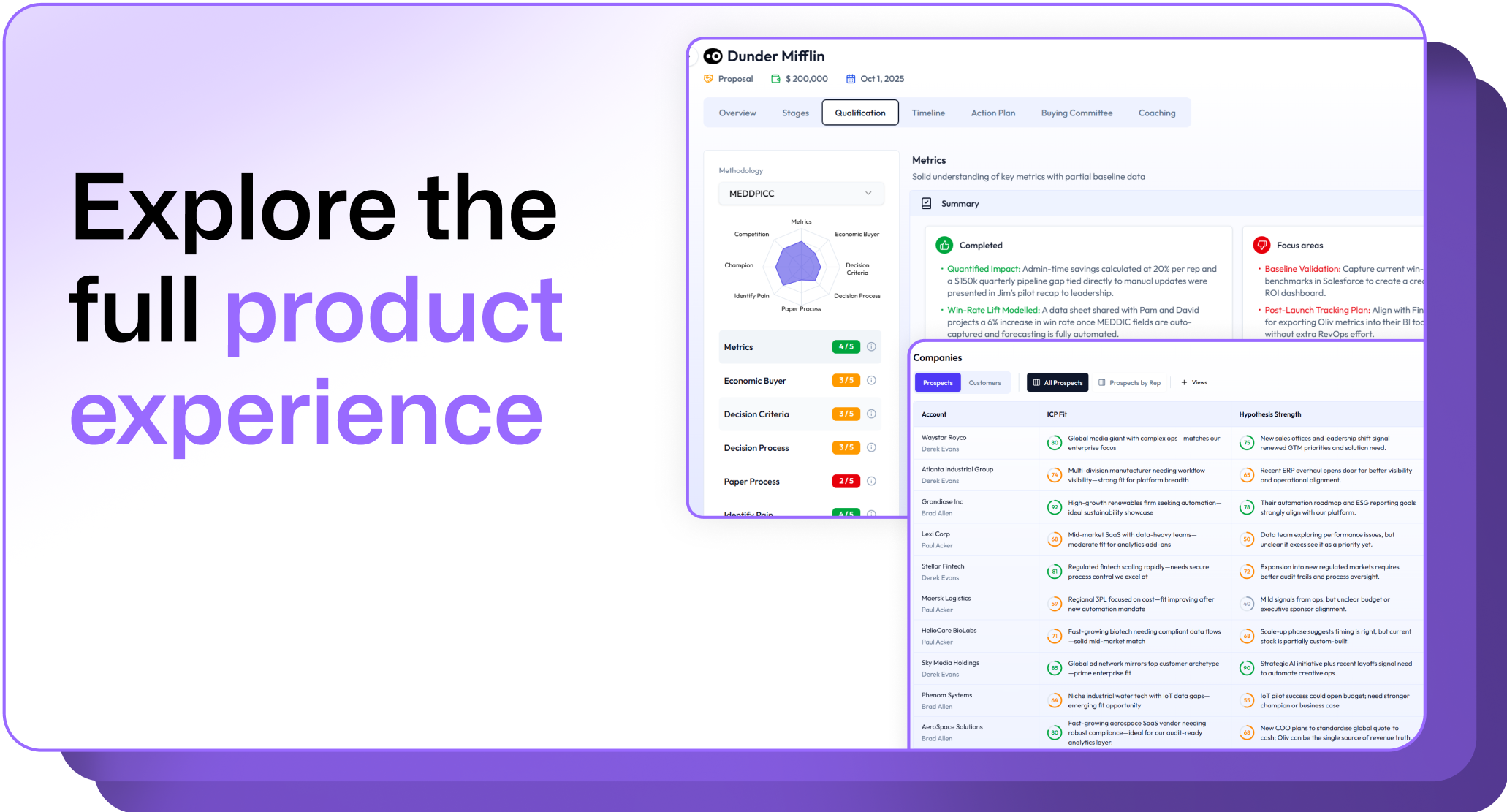
.avif)