Autonomous AI Agents for Customer Success: Predict Churn, Map Buying Committees, and Protect Net Retention
Written by
Ishan Chhabra
Last Updated :
September 25, 2026
Skim in :
13
mins
In this article
Still got questions?
Come discuss this article with me.
Hi, I'm Ishan, Founder and CEO of Oliv.
I'm always up for a conversation about revenue intelligence, AI agents, or what's actually working (and what's not) across revenue teams.
I'd love to hear your perspective.
Thank you! Your submission has been received!
Oops! Something went wrong while submitting the form.
Meet Oliv’s AI Agents
Hi! I’m, Deal Driver
I track deals, flag risks, send weekly pipeline updates and give sales managers full visibility into deal progress
Hi! I’m, CRM Manager
I maintain CRM hygiene by updating core, custom and qualification fields all without your team lifting a finger
Hi! I’m, Forecaster
I build accurate forecasts based on real deal movement and tell you which deals to pull in to hit your number
Hi! I’m, Coach
I believe performance fuels revenue. I spot skill gaps, score calls and build coaching plans to help every rep level up
Hi! I’m, Prospector
I dig into target accounts to surface the right contacts, tailor and time outreach so you always strike when it counts
Hi! I’m, Pipeline tracker
I call reps to get deal updates, and deliver a real-time, CRM-synced roll-up view of deal progress
Hi! I’m, Analyst
I answer complex pipeline questions, uncover deal patterns, and build reports that guide strategic decisions
TL;DR
Most customer success tooling is query-driven, so coverage tracks attention rather than risk, and the accounts nobody opens are the ones that churn.
Gainsight, ChurnZero, and Vitally genuinely diagnose account risk. The sharper evaluation question is who had to ask, and how often.
Oliv AI's Portfolio Manager runs four scheduled cadences: real-time at-risk alerts, per-CSM 1:1 prep briefs, a Monday portfolio recap, and a rolling 90-day renewal view.
Leading churn signals are relational: sponsor disappearance, customer reorgs, unanswered feature requests. Ticket volume is the weakest early warning available.
Calibrate retention honestly. Median private B2B SaaS net revenue retention sits near 101 to 102%, not the 120% boards still quote.
Run the agent beside your platform of record for one renewal quarter and measure days of early warning. Small books with three CSMs should skip this entirely.
Q1. Why do you still hear about at-risk accounts from a CSM instead of from your tooling? [toc=1. The Escalation Problem]
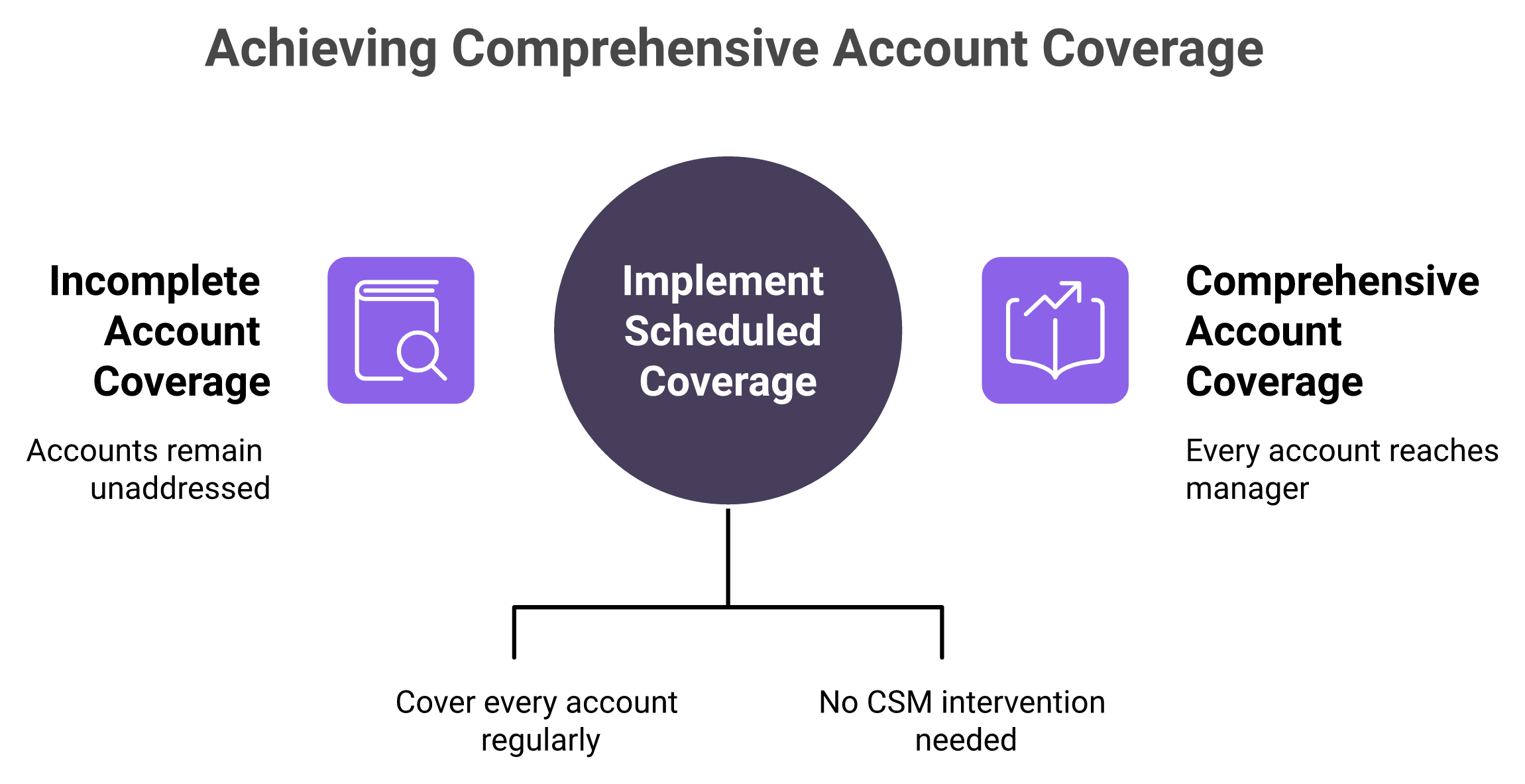
Because most customer success tooling is query-driven. It answers well when a CSM opens it and asks about one account. Coverage therefore tracks attention rather than risk, and the accounts nobody thinks to ask about are the ones that churn. Oliv AI's Portfolio Manager inverts the trigger, walking the entire book on a fixed cadence and pushing a manager-facing brief without a prompt. Your system of record does not change. What changes is who walks the book, and how often.
⏰ The Thursday escalation nobody saw coming
A CSM pings you at 4pm on a Thursday. A renewal 40 days out has gone quiet, and the sponsor stopped replying three weeks ago.
You open the account record. The last note is six weeks old. Nothing in the platform was wrong. Nobody had looked.
❌ Your book's coverage is a function of memory, not risk
Here is the part vendors do not put on a slide. A health score only reaches you if someone opens the view it lives in.
That means your risk coverage is really a coverage of attention. Fifty accounts fit in a manager's head. Three hundred do not.
The difference is not how well a tool diagnoses an account. It is whether anyone had to open it first.
Two lines from Oliv AI's own buyer research capture the pattern exactly, and I hear them almost verbatim in evaluation calls: "I don't know which accounts are at risk until the CSM tells me, or the customer does," and "Renewals always sneak up on us". If your team is still rebuilding that picture by hand, our breakdown of AI for customer retention covers where the coverage gaps usually sit.
✅ What agents actually changed was the trigger
The interesting shift of the last two years was not smarter scoring. Scoring has been decent for a while.
The shift is that an agent can run without a human opening anything. It reads the book on a schedule, writes a brief, and delivers it where the manager already works. That trigger change is the same one reshaping AI agents versus SaaS dashboards across the wider revenue stack.
That is a small-sounding change with a large operational consequence. Risk stops competing with everything else on your calendar for a click.
⚠️ The objection I get first, and it is a fair one
"We already own Gainsight. Ripping out the CS platform of record is a year of work, and I would be betting my number on it."
Agreed. Your platform of record holds contract data, playbook history, and years of integration work. Reported implementation windows for enterprise CS platforms commonly run 90 to 180 days, so a rebuild is not a quarter you get back, as the published Gainsight pricing and cost per user detail makes clear.
So do not rebuild anything. Change who walks the book, and leave the system of record where it is.
💰 The smaller move worth testing
Run a scheduled cadence beside your existing platform for one renewal quarter. Then compare which surfaced each at-risk account first, and by how many days.
That test is reversible, cheap, and answerable with evidence you already collect. If the incumbent wins, you have lost a quarter of parallel reporting and learned something real.
Oliv AI's Portfolio Manager runs four fixed cadences instead of waiting to be opened, which is the whole of the claim here. It is not that Oliv AI understands an account better than Gainsight does. It is reach across every account on a schedule, which a query-driven tool structurally cannot do. And a fair warning before you shortlist us: Oliv has no G2, Capterra, or TrustRadius footprint in the customer success category, and our CS case studies are email-gated, so you cannot reference-check us the way you can check Gainsight customer reviews and feedback. That asymmetry is real, and the parallel quarter exists partly to close it with your own data rather than our marketing.
Q2. Can your platform diagnose account risk, or does someone have to ask it first? [toc=2. Query-Driven vs Scheduled]
Yes, it can. Gainsight, ChurnZero, and Vitally all ship genuine automated signal detection and real AI-generated recommendations, and at least two of the three diagnose account risk rather than just colouring a score. Any vendor telling you otherwise is selling. The sharper question is who had to ask, and what happened to the accounts nobody asked about. You can test your own stack in a minute: check whether last week's risk summary arrived unrequested.
⭐ The claim you should refuse to believe
Some competitive decks argue that incumbent CS platforms cannot diagnose risk and only show a colour. That claim dies in the first demo you sit through.
Oliv AI's own product documentation warns internally against making it, because it does not survive scrutiny. So let me concede the ground properly instead.
✅ What the incumbents genuinely do
Gainsight, ChurnZero, and Vitally each run automated scoring, rules-based plays, and AI summarisation across account data, per their own current product pages. ChurnZero pricing is quote-only, and third-party listings put entry near 12,000 dollars a year, which tells you these are serious platforms, not widgets. Our ChurnZero pricing breakdown works through the per-user math in detail.
One naming caution, because buyers get this wrong constantly. Vitally and Velaris are separate products from separate companies, listed independently on G2's Velaris versus Vitally comparison with Velaris at 8.6 out of 10 across 99 reviews and Vitally at 8.3 across 475.
⚠️ AI-assisted and autonomous are not the same word
Here is the distinction worth putting on your evaluation sheet. An AI-assisted platform answers on demand, one account at a time, after a CSM opens it. An autonomous agent runs the whole book on a schedule and delivers the output unprompted. Both can be intelligent. Only one has coverage that does not depend on someone remembering.
Reviewers describe the difference in exactly those terms when they compare tooling generations:
"The Driver agent watches all my deals and flags any that are at risk, so I don't have to spend hours listening to recordings in tools like Gong and Clari." — Verified User, Revenue Team Oliv AI G2 - Verified Review [17 Jun 2026]
"I found the AI tracker setup to be quite difficult, especially concerning the user interface when setting up keywords or smart trackers." — Verified User, Sales Team Gong - G2 Verified Review [03 Oct 2025]
That second quote is the honest cost of configurable intelligence. Capability you have to build and maintain is capability that decays when the admin who built it leaves, which is the same pattern we documented in what Gong smart trackers actually do.
⏰ The one-minute self-test
Open your inbox and your Slack. Search the last seven days for anything your CS platform sent you that you did not request.
If the only risk view you saw was one you opened yourself, your coverage is attention-shaped. Count how many of your accounts were never opened by anyone last month, and you have your real exposure number.
Oliv AI's position here is deliberately narrow, and I would rather state it small and true than big and shaky. Portfolio Manager is scheduled and whole-book where competing tools are query-driven and single-account, a distinction drawn from Oliv AI's own product documentation and offered as a first-party design claim, not as a finding about anyone else's roadmap. Oliv AI's read is that the category argues about model quality because model quality demos well, while cadence is the thing that actually decides which accounts get seen. I could be over-weighting that. But every churn post-mortem I have sat in ended with someone saying nobody had looked, and not one ended with someone saying the score was wrong.
Q3. What does an autonomous customer success agent actually do on a Monday, a Thursday and 90 days out? [toc=3. The Four Cadences]
Four things, on a schedule nobody triggers. A real-time at-risk alert as signals emerge. A per-CSM 1:1 prep brief before each scheduled 1:1, configurable and defaulting to Thursday or Friday, covering portfolio value, NRR against target, renewal ARR by status, and accounts needing attention. A Monday portfolio recap for the CS leader with workload distribution, escalations, and 90-day renewal coverage. A rolling 90-day renewal view by confidence tier. Oliv AI's Portfolio Manager runs all four, and the cadence is the product rather than a notification setting.
⏰ The four cadences, mapped to your week
Cadence here means a fixed delivery rhythm, not an alert rule you configure. Each output below has a defined trigger, a named audience, and fixed contents.
The Four Customer Success Agent Cadences
Cadence
Trigger
Audience
What it contains
At-risk alert
Signals emerge, in real time
CSM and manager
The flagged account, the signal trail, a recommended next step
1:1 prep brief
Before each scheduled 1:1, defaults Thursday or Friday
CS Manager, per CSM
Portfolio value, NRR against target, renewal ARR by status, accounts needing attention
Next 90 days of renewals sorted by confidence tier
Oliv AI ships these as defaults rather than as an automation project, so there is no playbook build and no alert-rule design before the first brief lands. For the wider agent pattern, see how AI agents for RevOps handle scheduled work.
✅ What changes in the 1:1
The Thursday or Friday default is not cosmetic. A brief that arrives Monday morning is a brief nobody read before the 1:1 it was meant to prepare.
When the manager and the CSM both read the same portfolio summary beforehand, the status update disappears. You skip fifteen minutes of "where are we on Helios" and start at "what do we do about it."
That is the practical payoff a CS manager feels first. Coaching needs air, and status reporting is what usually consumes it.
⚠️ What changes in the Monday review
The Monday recap does something quieter and more political. It gives everyone in the room the same artefact before the room opens.
Workload distribution matters more than most leaders admit here. A CSM carrying nine renewals in the next 90 days is a risk, even if every account is currently green.
Oliv AI measures renewal coverage inside that same recap, so workload and 90-day exposure appear together rather than in two different reports. That pairing is what turns a review into a reallocation decision.
💰 What it does not do
Be clear about scope before you buy anything. A cadence does not replace your contract records, your billing data, or your integration layer.
It also will not fix a book that is fundamentally under-resourced. Scheduled briefs make the gap visible faster, which is useful and occasionally unwelcome.
Oliv AI's simplest framing is this: the agent handles the walking of the book, and you keep the deciding. If you want the detail on how that maps to a CS team's week, our guide to the best customer success platforms lays out the cadences and the inputs behind them.
Q4. How is an evidence-backed diagnosis different from a red health score? [toc=4. Diagnosis vs Score]
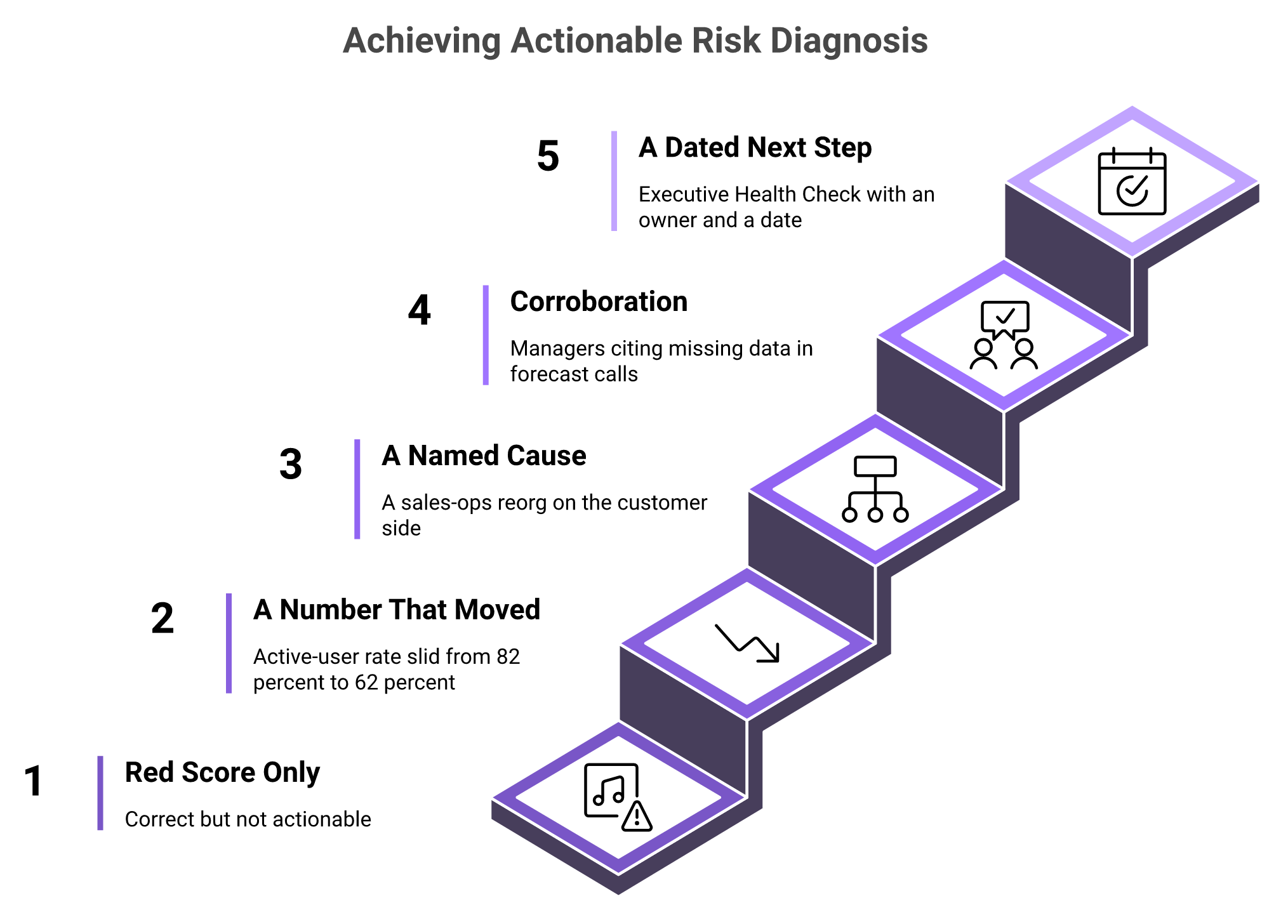
A score says the account turned red. A diagnosis says why, attaches the evidence, and names the next step with a date. Oliv AI's Portfolio Manager pairs each risk flag with the signal trail behind it. A product illustration from its documentation, not a customer outcome: Helios Health flagged At Risk after active-user rate slid from 82% to 62% following a sales-ops reorg, with managers citing missing data in Monday forecast calls, recommended next step Executive Health Check on 3 July. A CSM can act on that without running a discovery exercise first.
⚠️ The red score that costs you a day
You see an account go amber on a Tuesday. Nothing tells you what moved.
So the CSM spends a day reconstructing it. Pull the usage report, scan three months of call recordings, ask the AE what happened on the sales side, and check open tickets.
By Wednesday afternoon they have an answer. The score was correct the whole time and still cost you a day of the very person who was supposed to be saving the account.
❌ Correct is not the same as actionable
This is the part I think the category gets wrong, and it is not a technology failure. A score compresses a complicated account into one number on purpose.
Compression is the feature. It is also why the causal story gets thrown away at exactly the moment you need it. Our note on AI deal intelligence works through the same trade-off on the sales side.
Reviewers describe the reconstruction tax plainly, and it shows up in conversation tooling too:
"I cannot download all the data myself unless we upgrade the plan, which isn't ideal and results in me not fully utilizing Gong. The requirement to download snippets one by one using copy and paste is particularly annoying." — Verified User, Sales Team Gong - G2 Verified Review [03 Oct 2025]
✅ What changed is that the evidence can travel with the flag
Models can now carry the trail, not just the verdict. That means the usage drop, the organisational cause, and the confirming quote from a forecast call can arrive in the same block of text.
Note the shape of the Helios Health illustration above. A number that moved (82% to 62%), a named cause (a sales-ops reorg), corroboration from a second source (managers citing missing data), and a dated action.
A score tells you the account turned red. These four layers are what let someone act on it the same day.
Strip any one of those and the CSM is back to archaeology. Keep all four and the first action is the health check.
⭐ What operators say when the flag arrives whole
"It gives a clear view of deal health risk and next steps while also providing helpful call summaries and follow-up recommendations." — Verified User, Revenue Team Oliv AI G2 - Verified Review [23 Jun 2026]
I want to be careful with that quote. It is a sales-side account of the same mechanism, not proof of a retention outcome, and I am not going to dress it up as one.
Oliv AI attaches the causal trail to the flag rather than leaving the reconstruction to the CSM, so the flag begins the answer instead of the investigation. What surfaces in Oliv AI's deployments is that the argument-ending detail is almost never the usage number. It is the sentence from a call three weeks earlier that explains the usage number, and that sentence is sitting in a transcript nobody had a reason to reopen. I will hedge one claim honestly: incumbent platforms can surface causes too, and several do it well when configured. The difference I would test is whether the cause arrives with the flag, or after someone goes looking for it, and our customer success enablement framework sets out how to run that test.
Q5. Which churn signals actually lead, and which only confirm what already happened? [toc=5. Leading vs Lagging Signals]
Leading signals are behavioural and relational: active-user decay, an executive sponsor disappearing from calendars, a reorg on the customer side, unanswered feature requests, and call language shifting from planning to justifying. Lagging signals confirm rather than warn, including ticket spikes, an NPS drop, and a delayed renewal reply. Most health scores weight what is easy to instrument, which is usage, over what is hard, which is relationship decay. Since many churning accounts show signals weeks ahead and a large share never file a support ticket, ticket volume is the worst early warning available to you.
⭐ The two-column test for your own scorecard
Print your health score's inputs. Then sort each one into the table below and see which column your model actually lives in.
Leading Churn Signals Versus Lagging Confirmations
Leading signal
Where it is instrumented
Lagging signal
Where it shows up
Active-user rate decay
Product analytics
Support ticket spike
Helpdesk queue
Sponsor absent from calendars
Calendar and meeting data
NPS or CSAT drop
Survey tool
Customer-side reorg
Call transcripts, email threads
Delayed renewal reply
Inbox and CRM task log
Feature requests left unanswered
Call and Slack threads
Downgrade request
Billing system
Language shifting to justifying spend
Call transcripts
Procurement re-opening the vendor list
Legal or finance thread
Oliv AI extracts churn-risk and feature-request signals directly from unstructured interactions, which is the left column of that table rather than the right. The same extraction layer sits behind our work on customer conversation analytics.
❌ The reorg nobody logs
Here is the signal that matters most and reaches your platform least. A customer reorganises, your sponsor moves teams, and nobody writes it down anywhere structured.
It is said out loud on a call. It appears in one email line. Then it sits in a transcript with no reason for anyone to reopen it.
A usage-only score will eventually catch the consequence, four to six weeks later, once logins drop. By then the renewal conversation has already changed shape, which is the gap our AI for customer retention guide works through in detail.
⚠️ One sponsor leaving is a material signal
Renewals are rarely a single champion's decision. Forrester's 2026 business buying research counts roughly 13 internal stakeholders and 9 external influencers on a typical B2B purchase.
You do not need a stakeholder-mapping product to use that fact. You need one rule: when the person who ran the business case goes quiet for two weeks, that is a risk event, not a scheduling problem. Mapping that across the account lifecycle is the point of B2B customer journey mapping.
Reviewers describe conversation data as where this relational texture actually lives:
"The meeting recordings, ease of use and info sharing and the AI enrichement capabilities of both companies, sentiments from meetings etc." — Verified User, Sales Team Gong - G2 Verified Review [19 Mar 2026]
"The biggest value of Oliv AI is its ability to operationalize customer conversations. It doesn't just record meetings; it automatically captures key insights, updates systems of record, identifies next steps, and helps keep teams aligned." — Verified User, Revenue Team Oliv AI G2 - Verified Review [23 Jun 2026]
✅ What to change in your model this week
Add two leading inputs and demote one lagging one. Sponsor meeting frequency and unresolved feature requests are the cheapest pair to start with.
Then run the back-test that actually settles arguments. Take your last five churned accounts, find the first signal that moved, and check whether your score was watching that field at all.
Oliv AI treats calls, email, and Slack as first-class signal sources rather than attachments to a record, so relational decay and usage decline appear inside the same diagnosis instead of in two systems that never meet. Oliv AI's read is that the category over-invests in scoring math and under-invests in signal coverage, and I hold that view strongly enough to say it plainly. A model with three inputs and full conversational coverage beats a model with thirty inputs that all come from the product database. If sentiment tooling is the specific gap you are filling, our breakdown of voice of customer software covers that layer separately.
Q6. How do you build a 90-day renewal view you would defend to your board? [toc=6. 90-Day Renewal View]
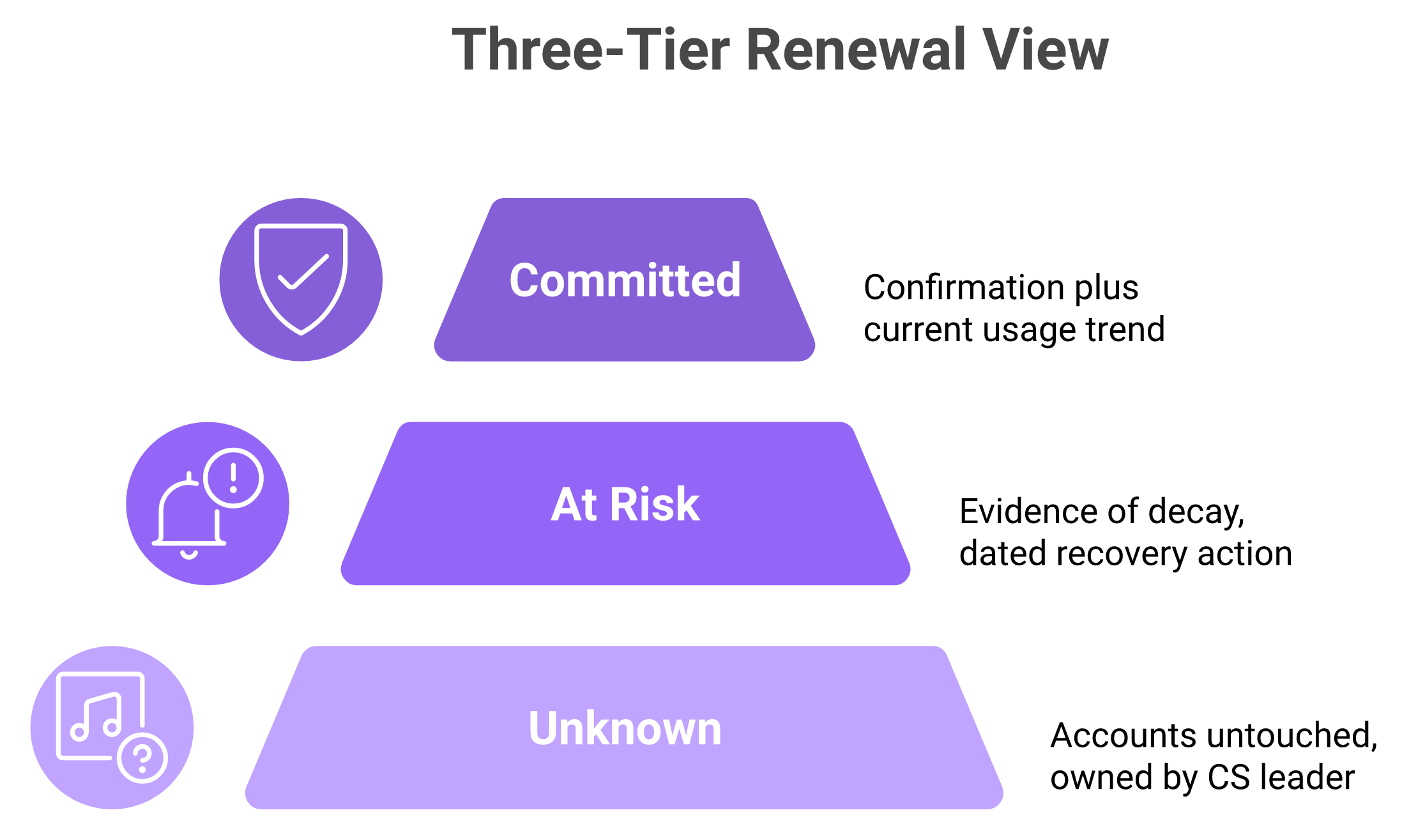
Sort every renewal in the next 90 days into confidence tiers and require evidence for each placement, not a CSM's gut call in a spreadsheet column. Each account should answer three things: renewal ARR, current risk state, and what has been done since the last review. Calibrate the target honestly, because median private B2B SaaS net revenue retention now sits near 101 to 102%, with top quartile around 108 to 110%. Oliv AI's Portfolio Manager keeps the view rolling, so the number moves when the account moves.
⏰ Five steps to build it
Unknown is the tier most renewal forecasts leave out, which is exactly why it belongs at the bottom and with the leader.
Define three tiers, not five. Committed, At Risk, and Unknown. Unknown is the most useful tier because it counts accounts nobody has touched.
Attach renewal ARR to every line. A tier without money attached is a feeling, not a forecast.
Require one piece of evidence per placement. A dated call, a written confirmation, a usage trend, or a sponsor reply.
Set a refresh trigger, not a refresh date. Any new risk signal re-tiers the account immediately.
Assign an owner per tier. The CS leader owns Unknown. That single assignment fixes more coverage gaps than any dashboard.
Oliv AI reports renewal ARR by status inside the per-CSM 1:1 brief, so the tiering is visible to the person who can change it. For the reporting layer around that, see our note on revenue reporting software.
💰 Calibrate against real benchmarks, not 2021 ones
Boards still quote 120% net revenue retention, meaning revenue kept and expanded from existing customers. The current private-company data does not support that as a median.
Across large private SaaS samples, the 2026 median lands near 101 to 102%, with enterprise segments closer to 115%. Set your target against your segment, then argue about the gap with evidence.
This matters for tooling decisions too. If your NRR is 99% and your segment median is 102%, three points is the size of the prize, and it is worth naming out loud before anyone buys anything.
❌ The failure mode I see most
Most renewal forecasts are accurate at 90 days and wrong at 30. The tiering was fine when it was built.
Then a champion left in week four and nobody re-tiered. The spreadsheet kept saying Committed because spreadsheets do not know anything.
That is why the refresh trigger in step four beats a quarterly review cycle. A view is only defensible if it changes when reality changes, which is the discipline behind evidence-based forecast commits.
⚠️ Where the boundary sits
Keep the scope tight, or two teams will build two numbers. Customer success owns retention of the existing contract, and account management owns expansion beyond it.
Renewal risk at account level belongs here. Prediction as a discipline, including pipeline and bookings forecasting, is a separate argument with separate mechanics.
Three Ways Teams Maintain a 90-Day Renewal View
Approach
When the view updates
Who assembles it
Typical failure
Spreadsheet tiering
Manually, usually quarter-end
A CSM or RevOps analyst
Goes stale between reviews
On-demand platform report
When someone runs it
Whoever remembered
Nobody runs it in week six
Scheduled agent view
Continuously, pushed weekly
Oliv AI's Portfolio Manager
Surfaces gaps a leader may not want to see
Oliv AI keeps the 90-day view current as a by-product of the cadence, so the renewal picture in the Monday recap and the one in the CSM's 1:1 brief are the same picture rather than two versions of the truth. That sameness is the boring part and also the whole point. I have watched more renewal arguments come from two teams reading two different exports than from anyone genuinely misjudging an account. For how the platform layer around this compares, our roundup of the best customer success platforms sets out the options side by side.
Q7. How do you score CSM effectiveness without your team reading it as surveillance? [toc=7. Fair CSM Scoring]
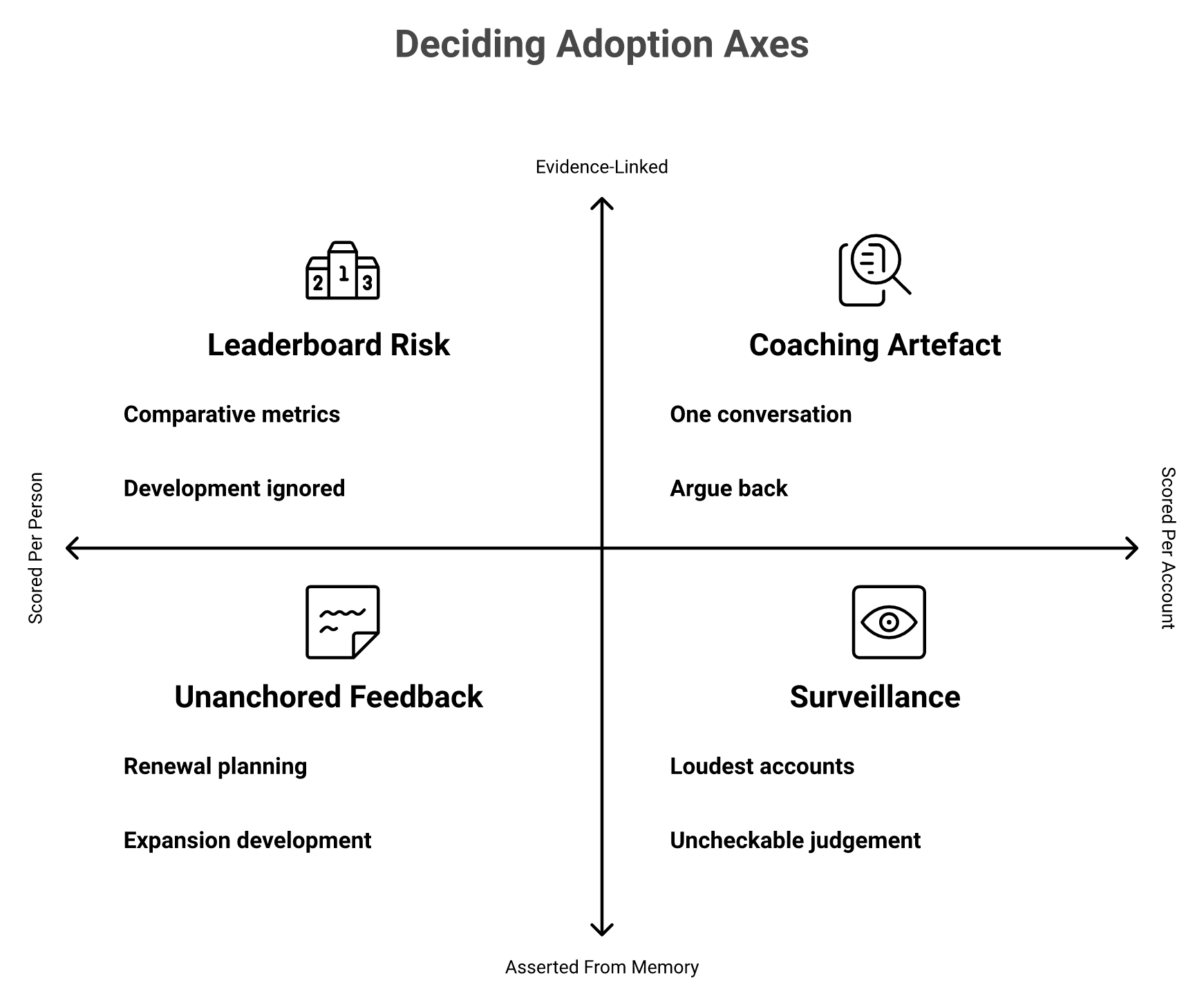
Score per account, not per person, and link every score to evidence from actual calls. Oliv AI's Portfolio Manager Coaching tab rates each CSM per account across five dimensions, which are Relationship Management, Value Communication, Proactive Enablement, Expansion Development, and Renewal Planning, with call evidence attached. Surfaced to the manager for coaching rather than to a leaderboard, it answers the fairness objection structurally, because a CSM can see which account and which conversation produced the score. The same evidence is what removes status reporting from the 1:1.
⏰ The 1:1 that turned into a status update
Thirty minutes, once a week, per CSM. Twenty-two of those minutes go to "where are we on these six accounts."
The honest version of the complaint I hear from CS managers is short. My 1:1s are basically status updates, and I have no time left for coaching.
Nobody designed it that way. It happens because the manager arrives without the account picture and has to build it live, a pattern we unpack in coaching skill gaps for managers using AI.
❌ Coaching without evidence is just opinion
Here is why most CSM scorecards fail on arrival. They score the person on qualities, using the manager's memory as the dataset.
Memory is skewed toward the loudest accounts and the most recent week. So the CSM hears a judgement they cannot check, and reasonably treats it as surveillance.
Operators describe how thin the coaching layer has historically been in revenue tooling:
"They were attempting to coach, shit like that, and they didn't really benefit me too much because the tools that were given, or attempted to enable us, were lackluster, bulky, and ineffective." — Verified User, Sales Representative Salesloft - G2 Verified Review [07 Sep 2025]
✅ Per-account evidence makes a score contestable
Change the unit of measurement and the politics change with it. Score the relationship on one account, not the human across all accounts.
Now the score has a spine. It points at a specific account, a specific dimension, and a specific conversation where the gap showed up.
A CSM can disagree with that. They can open the call, hear the moment, and argue their side. That is a coaching conversation, and it is the opposite of a silent ranking, which is why coaching at scale using AI only works when the evidence travels with the score.
Change the scoring unit and the evidence trail, and the fairness objection stops being a communications problem.
⚠️ How the mechanism answers the objection
Oliv AI's Coaching tab is built around three constraints that matter more than the model behind it:
The score attaches to an account, so it never becomes a single number about a person.
Every dimension carries call evidence, so it is checkable rather than asserted.
Output goes to the manager for coaching, not to a leaderboard the whole team sees.
I will not tell you reps love being scored. Some will push back hard, and the pushback is reasonable until they can see the evidence trail.
⭐ What the manager does differently next week
Reviewers describe the practical shift clearly, and it is a reallocation of manager time rather than a new report:
"It helps in automating and updating our CRM after calls, provides a clear deal summary, and sends follow-up emails, allowing managers to coach their reps with actionable insight rather than just going through call recordings." — Verified User, Sales Operations Oliv AI G2 - Verified Review [26 Jun 2026]
Oliv AI scores the account relationship rather than the person, and shows the call evidence behind each dimension, which is the design choice the whole adoption question rests on. A score a CSM can open and argue with is a coaching artefact. One they cannot open is a performance review wearing a different name, and your team will identify it as such within a week. If you are building the coaching cadence around it, our customer success enablement framework covers the rhythm in more detail.
Q8. What makes an agent pilot survive procurement, security and your own governance review? [toc=8. Governance and Compliance]
Scope it narrowly and instrument it. Gartner expects over 40% of agentic AI projects to be cancelled by the end of 2027, driven by escalating costs, unclear business value, and inadequate risk controls rather than weak models. Two governance facts decide sign-off. Under EU AI Act Article 50, enforceable since 2 August 2026, an AI system interacting with a person must make that interaction identifiable as AI, with penalties reaching 15 million euros or 3% of worldwide turnover. Your security reviewer will separately ask for SOC 2 Type II, GDPR posture, audit logs, and an export path.
❌ The pilot that quietly died
You have probably seen this one. A team ran an agent pilot, the demo went well, and eight months later nobody can say what it changed.
No metric was assigned. No owner reported on it. The renewal came up, and the line item lost to something with a number attached.
That is not a model failure. Gartner's own read is that cost, unclear value, and missing risk controls do the killing, and our agentic AI implementation guide for RevOps covers how to scope against that.
⚠️ Scope it as a metric, not a capability
The fix is unglamorous. Pick one retention metric the pilot owns for one quarter.
Days of early warning is my preferred one. Measure the gap between the first signal in the system and the first human action on the account.
Then add a control requirement before you expand scope. If an agent writes to your CRM, you need an audit log, meaning a record of what it changed and when, which is the core of any AI CRM trust and governance evaluation.
⏰ What changed legally in August 2026
This is the part most CS leaders have not read yet. Article 50 of the EU AI Act became enforceable on 2 August 2026, and the Commission published final guidelines on 20 July 2026.
The practical line is about who the agent talks to. A brief that an agent writes for your manager is internal output, so the chatbot-style disclosure duty does not bite.
An agent that emails your customer, or joins their call and speaks, sits on the other side of that line. Say which side each of your workflows falls on, because blanket compliance claims will not survive a review.
✅ The controls a reviewer will ask for by name
Oliv AI publishes the following, and I would hold any vendor to the same list:
Security and Governance Controls Reviewers Request
Control
Oliv AI's published posture
Security certification
SOC 2 Type II certified
Privacy regimes
GDPR and CCPA compliant
Encryption
AES-256 at rest, TLS 1.2+ in transit
Change traceability
Audit logs for activity and governance
Data portability
Full open export policy, complete CSV dump of meetings and recordings on termination
Model grounding
LLMs grounded inside a secure customer workspace
That export line is the one I would push hardest on with any vendor. Reviewers on incumbent tools regularly flag losing access to their own history, which is a governance problem dressed as a pricing one.
💰 What to put in the pilot charter on Monday
Keep it to five lines: the one metric, the owner, the quarter, the audit-log requirement, and the disclosure boundary for any customer-facing step.
Add one kill condition. If the agent has not shortened early warning by a measurable amount in 90 days, you stop, and that is a clean outcome rather than a failure.
Oliv AI runs SOC 2 Type II with GDPR and CCPA compliance, AES-256 encryption at rest, audit logs, and an open export policy that returns a full CSV dump on termination, which matters because the governance question a CS leader cannot answer is usually the one that kills the pilot. Oliv AI's read is that the category treats compliance as a trust badge when buyers treat it as a gate, and I think the badge framing is why so many pilots stall at legal review. Also worth saying plainly: if you are a B2C support team, or you only want call recording, this operating model is not built for you. Naming the wrong-fit cases early saves both of us a quarter, and our mid-market revenue AI buyer guide on governance and SOC 2 sets out the full checklist.
Q9. Does this replace your CS platform, or run beside it for one renewal quarter? [toc=9. Replace or Run Alongside]
Run it beside the platform of record for one renewal quarter and compare which surfaced the at-risk accounts first. That test is reversible, and ripping out a customer success platform mid-year is not. The asymmetry is real, because enterprise CS platform implementations commonly run 90 to 180 days on annually quoted contracts, while an agent layer reaches baseline configuration in minutes and useful output in days. Honest exclusion: a three-CSM team with fifty accounts has no coverage problem. This argument starts where attention stops scaling, roughly eight to ten CSMs, or books past a few hundred accounts.
⚠️ Say the migration fear out loud
"We already own Gainsight, and I would be betting my retention number on a swap." I have heard that sentence in almost every CS evaluation call this year.
It is the correct instinct. Your platform of record holds contract dates, playbook history, survey data, and integrations that took two years to stabilise. Our list of Gainsight alternatives walks through what actually has to move in a swap.
💸 Platform switches are priced in lost history
The sticker price is the small part. The real cost is three months of two systems, two sets of health definitions, and a team that trusts neither.
Third-party listings put ChurnZero at quote-only pricing from roughly 12,000 dollars a year, and Gainsight from around 1,200 dollars a month with multi-month setup. Those are serious platforms with serious switching costs, and pretending otherwise would be dishonest. The full per-seat math sits in our ChurnZero pricing breakdown and our Gainsight cost per user analysis.
Setup friction is the complaint reviewers raise most about incumbent revenue tooling:
"Real Time integrations can be time consuming." — Verified User, Sales Team Gong - G2 Verified Review [21 Apr 2026]
✅ Why a cadence can run in parallel
A scheduled agent consumes signals. It does not need to own your contract records to read usage, calls, and email.
Customer Success Platforms and an Agent Layer Compared
Option
Pricing model
Implementation window
What triggers the risk view
Signal sources
Gainsight
Quote-based, reported from about 1,200 dollars a month
90 to 180 days
A user opens a view or a rule fires
Product usage, CRM, surveys
ChurnZero
Quote-only, from roughly 12,000 dollars a year
Multi-week to multi-month
Rules and plays, user-initiated review
Usage, CRM, engagement
Vitally
Published seat-based tiers, vendor site
Weeks
User-initiated, automated plays
Usage, CRM, tickets
Velaris (separate product from Vitally)
Quote-based, vendor site
Weeks
User-initiated, AI summaries
Usage, CRM, conversations
Agent layer
Oliv AI prices role-based and cumulative, per user per month, with retention capability inside a single tier
Minutes to days
A fixed schedule, unprompted
Calls, email, Slack, CRM, usage
⏰ What the parallel quarter measures
One number decides it: days of early warning per at-risk account. Log the date each system first flagged the account, and the date a human acted.
Reviewers describe the time-to-value side of that test in plain terms:
"Setting up Oliv.ai was straightforward and could be done in just five to fifteen minutes." — Verified User, Account Executive Oliv AI G2 - Verified Review [15 Jun 2026]
"It's great to have a singular place for all revenue data... It's more affordable compared to other options we previously used." The same reviewer's one complaint: "It's a lil slow." — Verified User, Revenue Team Oliv AI G2 - Verified Review [23 Jun 2026]
If cost is the axis you are testing on, our note on reducing tech stack costs sets out how to compare a parallel run against a full replacement.
❌ Who should skip this entirely
Fifty accounts and three CSMs? Skip it. Your manager can hold that book in their head, and a cadence solves a problem you do not have. Smaller teams are better served by the approach in our revenue intelligence guide for small teams.
Same answer for B2C support teams and for anyone who only wants call recording. Keep the boundary clean too: customer success owns retention of the contract, and account management owns expansion beyond it.
Oliv AI prices role-based and cumulative per user per month, with the retention capability sitting inside a single tier rather than sold as a separate module, which is precisely what makes a one-quarter parallel test affordable enough to actually run. Oliv AI's read is that buyers should stop scoring these tools on dashboard quality and score them on coverage and cadence, because that is the criterion you can verify with your own renewal data in 90 days. If you want to see how the platform field lines up before you run that test, our Gainsight versus ChurnZero breakdown compares the two most common incumbents, and our guide to the best customer success platforms covers the wider field. And if you would rather just watch the cadence run against your own book for a quarter, book a demo and bring your renewal list.
Q1. Why do you still hear about at-risk accounts from a CSM instead of from your tooling? [toc=1. The Escalation Problem]
Because most customer success tooling is query-driven. It answers well when a CSM opens it and asks about one account. Coverage therefore tracks attention rather than risk, and the accounts nobody thinks to ask about are the ones that churn. Oliv AI's Portfolio Manager inverts the trigger, walking the entire book on a fixed cadence and pushing a manager-facing brief without a prompt. Your system of record does not change. What changes is who walks the book, and how often.
⏰ The Thursday escalation nobody saw coming
A CSM pings you at 4pm on a Thursday. A renewal 40 days out has gone quiet, and the sponsor stopped replying three weeks ago.
You open the account record. The last note is six weeks old. Nothing in the platform was wrong. Nobody had looked.
❌ Your book's coverage is a function of memory, not risk
Here is the part vendors do not put on a slide. A health score only reaches you if someone opens the view it lives in.
That means your risk coverage is really a coverage of attention. Fifty accounts fit in a manager's head. Three hundred do not.
The difference is not how well a tool diagnoses an account. It is whether anyone had to open it first.
Two lines from Oliv AI's own buyer research capture the pattern exactly, and I hear them almost verbatim in evaluation calls: "I don't know which accounts are at risk until the CSM tells me, or the customer does," and "Renewals always sneak up on us". If your team is still rebuilding that picture by hand, our breakdown of AI for customer retention covers where the coverage gaps usually sit.
✅ What agents actually changed was the trigger
The interesting shift of the last two years was not smarter scoring. Scoring has been decent for a while.
The shift is that an agent can run without a human opening anything. It reads the book on a schedule, writes a brief, and delivers it where the manager already works. That trigger change is the same one reshaping AI agents versus SaaS dashboards across the wider revenue stack.
That is a small-sounding change with a large operational consequence. Risk stops competing with everything else on your calendar for a click.
⚠️ The objection I get first, and it is a fair one
"We already own Gainsight. Ripping out the CS platform of record is a year of work, and I would be betting my number on it."
Agreed. Your platform of record holds contract data, playbook history, and years of integration work. Reported implementation windows for enterprise CS platforms commonly run 90 to 180 days, so a rebuild is not a quarter you get back, as the published Gainsight pricing and cost per user detail makes clear.
So do not rebuild anything. Change who walks the book, and leave the system of record where it is.
💰 The smaller move worth testing
Run a scheduled cadence beside your existing platform for one renewal quarter. Then compare which surfaced each at-risk account first, and by how many days.
That test is reversible, cheap, and answerable with evidence you already collect. If the incumbent wins, you have lost a quarter of parallel reporting and learned something real.
Oliv AI's Portfolio Manager runs four fixed cadences instead of waiting to be opened, which is the whole of the claim here. It is not that Oliv AI understands an account better than Gainsight does. It is reach across every account on a schedule, which a query-driven tool structurally cannot do. And a fair warning before you shortlist us: Oliv has no G2, Capterra, or TrustRadius footprint in the customer success category, and our CS case studies are email-gated, so you cannot reference-check us the way you can check Gainsight customer reviews and feedback. That asymmetry is real, and the parallel quarter exists partly to close it with your own data rather than our marketing.
Q2. Can your platform diagnose account risk, or does someone have to ask it first? [toc=2. Query-Driven vs Scheduled]
Yes, it can. Gainsight, ChurnZero, and Vitally all ship genuine automated signal detection and real AI-generated recommendations, and at least two of the three diagnose account risk rather than just colouring a score. Any vendor telling you otherwise is selling. The sharper question is who had to ask, and what happened to the accounts nobody asked about. You can test your own stack in a minute: check whether last week's risk summary arrived unrequested.
⭐ The claim you should refuse to believe
Some competitive decks argue that incumbent CS platforms cannot diagnose risk and only show a colour. That claim dies in the first demo you sit through.
Oliv AI's own product documentation warns internally against making it, because it does not survive scrutiny. So let me concede the ground properly instead.
✅ What the incumbents genuinely do
Gainsight, ChurnZero, and Vitally each run automated scoring, rules-based plays, and AI summarisation across account data, per their own current product pages. ChurnZero pricing is quote-only, and third-party listings put entry near 12,000 dollars a year, which tells you these are serious platforms, not widgets. Our ChurnZero pricing breakdown works through the per-user math in detail.
One naming caution, because buyers get this wrong constantly. Vitally and Velaris are separate products from separate companies, listed independently on G2's Velaris versus Vitally comparison with Velaris at 8.6 out of 10 across 99 reviews and Vitally at 8.3 across 475.
⚠️ AI-assisted and autonomous are not the same word
Here is the distinction worth putting on your evaluation sheet. An AI-assisted platform answers on demand, one account at a time, after a CSM opens it. An autonomous agent runs the whole book on a schedule and delivers the output unprompted. Both can be intelligent. Only one has coverage that does not depend on someone remembering.
Reviewers describe the difference in exactly those terms when they compare tooling generations:
"The Driver agent watches all my deals and flags any that are at risk, so I don't have to spend hours listening to recordings in tools like Gong and Clari." — Verified User, Revenue Team Oliv AI G2 - Verified Review [17 Jun 2026]
"I found the AI tracker setup to be quite difficult, especially concerning the user interface when setting up keywords or smart trackers." — Verified User, Sales Team Gong - G2 Verified Review [03 Oct 2025]
That second quote is the honest cost of configurable intelligence. Capability you have to build and maintain is capability that decays when the admin who built it leaves, which is the same pattern we documented in what Gong smart trackers actually do.
⏰ The one-minute self-test
Open your inbox and your Slack. Search the last seven days for anything your CS platform sent you that you did not request.
If the only risk view you saw was one you opened yourself, your coverage is attention-shaped. Count how many of your accounts were never opened by anyone last month, and you have your real exposure number.
Oliv AI's position here is deliberately narrow, and I would rather state it small and true than big and shaky. Portfolio Manager is scheduled and whole-book where competing tools are query-driven and single-account, a distinction drawn from Oliv AI's own product documentation and offered as a first-party design claim, not as a finding about anyone else's roadmap. Oliv AI's read is that the category argues about model quality because model quality demos well, while cadence is the thing that actually decides which accounts get seen. I could be over-weighting that. But every churn post-mortem I have sat in ended with someone saying nobody had looked, and not one ended with someone saying the score was wrong.
Q3. What does an autonomous customer success agent actually do on a Monday, a Thursday and 90 days out? [toc=3. The Four Cadences]
Four things, on a schedule nobody triggers. A real-time at-risk alert as signals emerge. A per-CSM 1:1 prep brief before each scheduled 1:1, configurable and defaulting to Thursday or Friday, covering portfolio value, NRR against target, renewal ARR by status, and accounts needing attention. A Monday portfolio recap for the CS leader with workload distribution, escalations, and 90-day renewal coverage. A rolling 90-day renewal view by confidence tier. Oliv AI's Portfolio Manager runs all four, and the cadence is the product rather than a notification setting.
⏰ The four cadences, mapped to your week
Cadence here means a fixed delivery rhythm, not an alert rule you configure. Each output below has a defined trigger, a named audience, and fixed contents.
The Four Customer Success Agent Cadences
Cadence
Trigger
Audience
What it contains
At-risk alert
Signals emerge, in real time
CSM and manager
The flagged account, the signal trail, a recommended next step
1:1 prep brief
Before each scheduled 1:1, defaults Thursday or Friday
CS Manager, per CSM
Portfolio value, NRR against target, renewal ARR by status, accounts needing attention
Next 90 days of renewals sorted by confidence tier
Oliv AI ships these as defaults rather than as an automation project, so there is no playbook build and no alert-rule design before the first brief lands. For the wider agent pattern, see how AI agents for RevOps handle scheduled work.
✅ What changes in the 1:1
The Thursday or Friday default is not cosmetic. A brief that arrives Monday morning is a brief nobody read before the 1:1 it was meant to prepare.
When the manager and the CSM both read the same portfolio summary beforehand, the status update disappears. You skip fifteen minutes of "where are we on Helios" and start at "what do we do about it."
That is the practical payoff a CS manager feels first. Coaching needs air, and status reporting is what usually consumes it.
⚠️ What changes in the Monday review
The Monday recap does something quieter and more political. It gives everyone in the room the same artefact before the room opens.
Workload distribution matters more than most leaders admit here. A CSM carrying nine renewals in the next 90 days is a risk, even if every account is currently green.
Oliv AI measures renewal coverage inside that same recap, so workload and 90-day exposure appear together rather than in two different reports. That pairing is what turns a review into a reallocation decision.
💰 What it does not do
Be clear about scope before you buy anything. A cadence does not replace your contract records, your billing data, or your integration layer.
It also will not fix a book that is fundamentally under-resourced. Scheduled briefs make the gap visible faster, which is useful and occasionally unwelcome.
Oliv AI's simplest framing is this: the agent handles the walking of the book, and you keep the deciding. If you want the detail on how that maps to a CS team's week, our guide to the best customer success platforms lays out the cadences and the inputs behind them.
Q4. How is an evidence-backed diagnosis different from a red health score? [toc=4. Diagnosis vs Score]
A score says the account turned red. A diagnosis says why, attaches the evidence, and names the next step with a date. Oliv AI's Portfolio Manager pairs each risk flag with the signal trail behind it. A product illustration from its documentation, not a customer outcome: Helios Health flagged At Risk after active-user rate slid from 82% to 62% following a sales-ops reorg, with managers citing missing data in Monday forecast calls, recommended next step Executive Health Check on 3 July. A CSM can act on that without running a discovery exercise first.
⚠️ The red score that costs you a day
You see an account go amber on a Tuesday. Nothing tells you what moved.
So the CSM spends a day reconstructing it. Pull the usage report, scan three months of call recordings, ask the AE what happened on the sales side, and check open tickets.
By Wednesday afternoon they have an answer. The score was correct the whole time and still cost you a day of the very person who was supposed to be saving the account.
❌ Correct is not the same as actionable
This is the part I think the category gets wrong, and it is not a technology failure. A score compresses a complicated account into one number on purpose.
Compression is the feature. It is also why the causal story gets thrown away at exactly the moment you need it. Our note on AI deal intelligence works through the same trade-off on the sales side.
Reviewers describe the reconstruction tax plainly, and it shows up in conversation tooling too:
"I cannot download all the data myself unless we upgrade the plan, which isn't ideal and results in me not fully utilizing Gong. The requirement to download snippets one by one using copy and paste is particularly annoying." — Verified User, Sales Team Gong - G2 Verified Review [03 Oct 2025]
✅ What changed is that the evidence can travel with the flag
Models can now carry the trail, not just the verdict. That means the usage drop, the organisational cause, and the confirming quote from a forecast call can arrive in the same block of text.
Note the shape of the Helios Health illustration above. A number that moved (82% to 62%), a named cause (a sales-ops reorg), corroboration from a second source (managers citing missing data), and a dated action.
A score tells you the account turned red. These four layers are what let someone act on it the same day.
Strip any one of those and the CSM is back to archaeology. Keep all four and the first action is the health check.
⭐ What operators say when the flag arrives whole
"It gives a clear view of deal health risk and next steps while also providing helpful call summaries and follow-up recommendations." — Verified User, Revenue Team Oliv AI G2 - Verified Review [23 Jun 2026]
I want to be careful with that quote. It is a sales-side account of the same mechanism, not proof of a retention outcome, and I am not going to dress it up as one.
Oliv AI attaches the causal trail to the flag rather than leaving the reconstruction to the CSM, so the flag begins the answer instead of the investigation. What surfaces in Oliv AI's deployments is that the argument-ending detail is almost never the usage number. It is the sentence from a call three weeks earlier that explains the usage number, and that sentence is sitting in a transcript nobody had a reason to reopen. I will hedge one claim honestly: incumbent platforms can surface causes too, and several do it well when configured. The difference I would test is whether the cause arrives with the flag, or after someone goes looking for it, and our customer success enablement framework sets out how to run that test.
Q5. Which churn signals actually lead, and which only confirm what already happened? [toc=5. Leading vs Lagging Signals]
Leading signals are behavioural and relational: active-user decay, an executive sponsor disappearing from calendars, a reorg on the customer side, unanswered feature requests, and call language shifting from planning to justifying. Lagging signals confirm rather than warn, including ticket spikes, an NPS drop, and a delayed renewal reply. Most health scores weight what is easy to instrument, which is usage, over what is hard, which is relationship decay. Since many churning accounts show signals weeks ahead and a large share never file a support ticket, ticket volume is the worst early warning available to you.
⭐ The two-column test for your own scorecard
Print your health score's inputs. Then sort each one into the table below and see which column your model actually lives in.
Leading Churn Signals Versus Lagging Confirmations
Leading signal
Where it is instrumented
Lagging signal
Where it shows up
Active-user rate decay
Product analytics
Support ticket spike
Helpdesk queue
Sponsor absent from calendars
Calendar and meeting data
NPS or CSAT drop
Survey tool
Customer-side reorg
Call transcripts, email threads
Delayed renewal reply
Inbox and CRM task log
Feature requests left unanswered
Call and Slack threads
Downgrade request
Billing system
Language shifting to justifying spend
Call transcripts
Procurement re-opening the vendor list
Legal or finance thread
Oliv AI extracts churn-risk and feature-request signals directly from unstructured interactions, which is the left column of that table rather than the right. The same extraction layer sits behind our work on customer conversation analytics.
❌ The reorg nobody logs
Here is the signal that matters most and reaches your platform least. A customer reorganises, your sponsor moves teams, and nobody writes it down anywhere structured.
It is said out loud on a call. It appears in one email line. Then it sits in a transcript with no reason for anyone to reopen it.
A usage-only score will eventually catch the consequence, four to six weeks later, once logins drop. By then the renewal conversation has already changed shape, which is the gap our AI for customer retention guide works through in detail.
⚠️ One sponsor leaving is a material signal
Renewals are rarely a single champion's decision. Forrester's 2026 business buying research counts roughly 13 internal stakeholders and 9 external influencers on a typical B2B purchase.
You do not need a stakeholder-mapping product to use that fact. You need one rule: when the person who ran the business case goes quiet for two weeks, that is a risk event, not a scheduling problem. Mapping that across the account lifecycle is the point of B2B customer journey mapping.
Reviewers describe conversation data as where this relational texture actually lives:
"The meeting recordings, ease of use and info sharing and the AI enrichement capabilities of both companies, sentiments from meetings etc." — Verified User, Sales Team Gong - G2 Verified Review [19 Mar 2026]
"The biggest value of Oliv AI is its ability to operationalize customer conversations. It doesn't just record meetings; it automatically captures key insights, updates systems of record, identifies next steps, and helps keep teams aligned." — Verified User, Revenue Team Oliv AI G2 - Verified Review [23 Jun 2026]
✅ What to change in your model this week
Add two leading inputs and demote one lagging one. Sponsor meeting frequency and unresolved feature requests are the cheapest pair to start with.
Then run the back-test that actually settles arguments. Take your last five churned accounts, find the first signal that moved, and check whether your score was watching that field at all.
Oliv AI treats calls, email, and Slack as first-class signal sources rather than attachments to a record, so relational decay and usage decline appear inside the same diagnosis instead of in two systems that never meet. Oliv AI's read is that the category over-invests in scoring math and under-invests in signal coverage, and I hold that view strongly enough to say it plainly. A model with three inputs and full conversational coverage beats a model with thirty inputs that all come from the product database. If sentiment tooling is the specific gap you are filling, our breakdown of voice of customer software covers that layer separately.
Q6. How do you build a 90-day renewal view you would defend to your board? [toc=6. 90-Day Renewal View]
Sort every renewal in the next 90 days into confidence tiers and require evidence for each placement, not a CSM's gut call in a spreadsheet column. Each account should answer three things: renewal ARR, current risk state, and what has been done since the last review. Calibrate the target honestly, because median private B2B SaaS net revenue retention now sits near 101 to 102%, with top quartile around 108 to 110%. Oliv AI's Portfolio Manager keeps the view rolling, so the number moves when the account moves.
⏰ Five steps to build it
Unknown is the tier most renewal forecasts leave out, which is exactly why it belongs at the bottom and with the leader.
Define three tiers, not five. Committed, At Risk, and Unknown. Unknown is the most useful tier because it counts accounts nobody has touched.
Attach renewal ARR to every line. A tier without money attached is a feeling, not a forecast.
Require one piece of evidence per placement. A dated call, a written confirmation, a usage trend, or a sponsor reply.
Set a refresh trigger, not a refresh date. Any new risk signal re-tiers the account immediately.
Assign an owner per tier. The CS leader owns Unknown. That single assignment fixes more coverage gaps than any dashboard.
Oliv AI reports renewal ARR by status inside the per-CSM 1:1 brief, so the tiering is visible to the person who can change it. For the reporting layer around that, see our note on revenue reporting software.
💰 Calibrate against real benchmarks, not 2021 ones
Boards still quote 120% net revenue retention, meaning revenue kept and expanded from existing customers. The current private-company data does not support that as a median.
Across large private SaaS samples, the 2026 median lands near 101 to 102%, with enterprise segments closer to 115%. Set your target against your segment, then argue about the gap with evidence.
This matters for tooling decisions too. If your NRR is 99% and your segment median is 102%, three points is the size of the prize, and it is worth naming out loud before anyone buys anything.
❌ The failure mode I see most
Most renewal forecasts are accurate at 90 days and wrong at 30. The tiering was fine when it was built.
Then a champion left in week four and nobody re-tiered. The spreadsheet kept saying Committed because spreadsheets do not know anything.
That is why the refresh trigger in step four beats a quarterly review cycle. A view is only defensible if it changes when reality changes, which is the discipline behind evidence-based forecast commits.
⚠️ Where the boundary sits
Keep the scope tight, or two teams will build two numbers. Customer success owns retention of the existing contract, and account management owns expansion beyond it.
Renewal risk at account level belongs here. Prediction as a discipline, including pipeline and bookings forecasting, is a separate argument with separate mechanics.
Three Ways Teams Maintain a 90-Day Renewal View
Approach
When the view updates
Who assembles it
Typical failure
Spreadsheet tiering
Manually, usually quarter-end
A CSM or RevOps analyst
Goes stale between reviews
On-demand platform report
When someone runs it
Whoever remembered
Nobody runs it in week six
Scheduled agent view
Continuously, pushed weekly
Oliv AI's Portfolio Manager
Surfaces gaps a leader may not want to see
Oliv AI keeps the 90-day view current as a by-product of the cadence, so the renewal picture in the Monday recap and the one in the CSM's 1:1 brief are the same picture rather than two versions of the truth. That sameness is the boring part and also the whole point. I have watched more renewal arguments come from two teams reading two different exports than from anyone genuinely misjudging an account. For how the platform layer around this compares, our roundup of the best customer success platforms sets out the options side by side.
Q7. How do you score CSM effectiveness without your team reading it as surveillance? [toc=7. Fair CSM Scoring]
Score per account, not per person, and link every score to evidence from actual calls. Oliv AI's Portfolio Manager Coaching tab rates each CSM per account across five dimensions, which are Relationship Management, Value Communication, Proactive Enablement, Expansion Development, and Renewal Planning, with call evidence attached. Surfaced to the manager for coaching rather than to a leaderboard, it answers the fairness objection structurally, because a CSM can see which account and which conversation produced the score. The same evidence is what removes status reporting from the 1:1.
⏰ The 1:1 that turned into a status update
Thirty minutes, once a week, per CSM. Twenty-two of those minutes go to "where are we on these six accounts."
The honest version of the complaint I hear from CS managers is short. My 1:1s are basically status updates, and I have no time left for coaching.
Nobody designed it that way. It happens because the manager arrives without the account picture and has to build it live, a pattern we unpack in coaching skill gaps for managers using AI.
❌ Coaching without evidence is just opinion
Here is why most CSM scorecards fail on arrival. They score the person on qualities, using the manager's memory as the dataset.
Memory is skewed toward the loudest accounts and the most recent week. So the CSM hears a judgement they cannot check, and reasonably treats it as surveillance.
Operators describe how thin the coaching layer has historically been in revenue tooling:
"They were attempting to coach, shit like that, and they didn't really benefit me too much because the tools that were given, or attempted to enable us, were lackluster, bulky, and ineffective." — Verified User, Sales Representative Salesloft - G2 Verified Review [07 Sep 2025]
✅ Per-account evidence makes a score contestable
Change the unit of measurement and the politics change with it. Score the relationship on one account, not the human across all accounts.
Now the score has a spine. It points at a specific account, a specific dimension, and a specific conversation where the gap showed up.
A CSM can disagree with that. They can open the call, hear the moment, and argue their side. That is a coaching conversation, and it is the opposite of a silent ranking, which is why coaching at scale using AI only works when the evidence travels with the score.
Change the scoring unit and the evidence trail, and the fairness objection stops being a communications problem.
⚠️ How the mechanism answers the objection
Oliv AI's Coaching tab is built around three constraints that matter more than the model behind it:
The score attaches to an account, so it never becomes a single number about a person.
Every dimension carries call evidence, so it is checkable rather than asserted.
Output goes to the manager for coaching, not to a leaderboard the whole team sees.
I will not tell you reps love being scored. Some will push back hard, and the pushback is reasonable until they can see the evidence trail.
⭐ What the manager does differently next week
Reviewers describe the practical shift clearly, and it is a reallocation of manager time rather than a new report:
"It helps in automating and updating our CRM after calls, provides a clear deal summary, and sends follow-up emails, allowing managers to coach their reps with actionable insight rather than just going through call recordings." — Verified User, Sales Operations Oliv AI G2 - Verified Review [26 Jun 2026]
Oliv AI scores the account relationship rather than the person, and shows the call evidence behind each dimension, which is the design choice the whole adoption question rests on. A score a CSM can open and argue with is a coaching artefact. One they cannot open is a performance review wearing a different name, and your team will identify it as such within a week. If you are building the coaching cadence around it, our customer success enablement framework covers the rhythm in more detail.
Q8. What makes an agent pilot survive procurement, security and your own governance review? [toc=8. Governance and Compliance]
Scope it narrowly and instrument it. Gartner expects over 40% of agentic AI projects to be cancelled by the end of 2027, driven by escalating costs, unclear business value, and inadequate risk controls rather than weak models. Two governance facts decide sign-off. Under EU AI Act Article 50, enforceable since 2 August 2026, an AI system interacting with a person must make that interaction identifiable as AI, with penalties reaching 15 million euros or 3% of worldwide turnover. Your security reviewer will separately ask for SOC 2 Type II, GDPR posture, audit logs, and an export path.
❌ The pilot that quietly died
You have probably seen this one. A team ran an agent pilot, the demo went well, and eight months later nobody can say what it changed.
No metric was assigned. No owner reported on it. The renewal came up, and the line item lost to something with a number attached.
That is not a model failure. Gartner's own read is that cost, unclear value, and missing risk controls do the killing, and our agentic AI implementation guide for RevOps covers how to scope against that.
⚠️ Scope it as a metric, not a capability
The fix is unglamorous. Pick one retention metric the pilot owns for one quarter.
Days of early warning is my preferred one. Measure the gap between the first signal in the system and the first human action on the account.
Then add a control requirement before you expand scope. If an agent writes to your CRM, you need an audit log, meaning a record of what it changed and when, which is the core of any AI CRM trust and governance evaluation.
⏰ What changed legally in August 2026
This is the part most CS leaders have not read yet. Article 50 of the EU AI Act became enforceable on 2 August 2026, and the Commission published final guidelines on 20 July 2026.
The practical line is about who the agent talks to. A brief that an agent writes for your manager is internal output, so the chatbot-style disclosure duty does not bite.
An agent that emails your customer, or joins their call and speaks, sits on the other side of that line. Say which side each of your workflows falls on, because blanket compliance claims will not survive a review.
✅ The controls a reviewer will ask for by name
Oliv AI publishes the following, and I would hold any vendor to the same list:
Security and Governance Controls Reviewers Request
Control
Oliv AI's published posture
Security certification
SOC 2 Type II certified
Privacy regimes
GDPR and CCPA compliant
Encryption
AES-256 at rest, TLS 1.2+ in transit
Change traceability
Audit logs for activity and governance
Data portability
Full open export policy, complete CSV dump of meetings and recordings on termination
Model grounding
LLMs grounded inside a secure customer workspace
That export line is the one I would push hardest on with any vendor. Reviewers on incumbent tools regularly flag losing access to their own history, which is a governance problem dressed as a pricing one.
💰 What to put in the pilot charter on Monday
Keep it to five lines: the one metric, the owner, the quarter, the audit-log requirement, and the disclosure boundary for any customer-facing step.
Add one kill condition. If the agent has not shortened early warning by a measurable amount in 90 days, you stop, and that is a clean outcome rather than a failure.
Oliv AI runs SOC 2 Type II with GDPR and CCPA compliance, AES-256 encryption at rest, audit logs, and an open export policy that returns a full CSV dump on termination, which matters because the governance question a CS leader cannot answer is usually the one that kills the pilot. Oliv AI's read is that the category treats compliance as a trust badge when buyers treat it as a gate, and I think the badge framing is why so many pilots stall at legal review. Also worth saying plainly: if you are a B2C support team, or you only want call recording, this operating model is not built for you. Naming the wrong-fit cases early saves both of us a quarter, and our mid-market revenue AI buyer guide on governance and SOC 2 sets out the full checklist.
Q9. Does this replace your CS platform, or run beside it for one renewal quarter? [toc=9. Replace or Run Alongside]
Run it beside the platform of record for one renewal quarter and compare which surfaced the at-risk accounts first. That test is reversible, and ripping out a customer success platform mid-year is not. The asymmetry is real, because enterprise CS platform implementations commonly run 90 to 180 days on annually quoted contracts, while an agent layer reaches baseline configuration in minutes and useful output in days. Honest exclusion: a three-CSM team with fifty accounts has no coverage problem. This argument starts where attention stops scaling, roughly eight to ten CSMs, or books past a few hundred accounts.
⚠️ Say the migration fear out loud
"We already own Gainsight, and I would be betting my retention number on a swap." I have heard that sentence in almost every CS evaluation call this year.
It is the correct instinct. Your platform of record holds contract dates, playbook history, survey data, and integrations that took two years to stabilise. Our list of Gainsight alternatives walks through what actually has to move in a swap.
💸 Platform switches are priced in lost history
The sticker price is the small part. The real cost is three months of two systems, two sets of health definitions, and a team that trusts neither.
Third-party listings put ChurnZero at quote-only pricing from roughly 12,000 dollars a year, and Gainsight from around 1,200 dollars a month with multi-month setup. Those are serious platforms with serious switching costs, and pretending otherwise would be dishonest. The full per-seat math sits in our ChurnZero pricing breakdown and our Gainsight cost per user analysis.
Setup friction is the complaint reviewers raise most about incumbent revenue tooling:
"Real Time integrations can be time consuming." — Verified User, Sales Team Gong - G2 Verified Review [21 Apr 2026]
✅ Why a cadence can run in parallel
A scheduled agent consumes signals. It does not need to own your contract records to read usage, calls, and email.
Customer Success Platforms and an Agent Layer Compared
Option
Pricing model
Implementation window
What triggers the risk view
Signal sources
Gainsight
Quote-based, reported from about 1,200 dollars a month
90 to 180 days
A user opens a view or a rule fires
Product usage, CRM, surveys
ChurnZero
Quote-only, from roughly 12,000 dollars a year
Multi-week to multi-month
Rules and plays, user-initiated review
Usage, CRM, engagement
Vitally
Published seat-based tiers, vendor site
Weeks
User-initiated, automated plays
Usage, CRM, tickets
Velaris (separate product from Vitally)
Quote-based, vendor site
Weeks
User-initiated, AI summaries
Usage, CRM, conversations
Agent layer
Oliv AI prices role-based and cumulative, per user per month, with retention capability inside a single tier
Minutes to days
A fixed schedule, unprompted
Calls, email, Slack, CRM, usage
⏰ What the parallel quarter measures
One number decides it: days of early warning per at-risk account. Log the date each system first flagged the account, and the date a human acted.
Reviewers describe the time-to-value side of that test in plain terms:
"Setting up Oliv.ai was straightforward and could be done in just five to fifteen minutes." — Verified User, Account Executive Oliv AI G2 - Verified Review [15 Jun 2026]
"It's great to have a singular place for all revenue data... It's more affordable compared to other options we previously used." The same reviewer's one complaint: "It's a lil slow." — Verified User, Revenue Team Oliv AI G2 - Verified Review [23 Jun 2026]
If cost is the axis you are testing on, our note on reducing tech stack costs sets out how to compare a parallel run against a full replacement.
❌ Who should skip this entirely
Fifty accounts and three CSMs? Skip it. Your manager can hold that book in their head, and a cadence solves a problem you do not have. Smaller teams are better served by the approach in our revenue intelligence guide for small teams.
Same answer for B2C support teams and for anyone who only wants call recording. Keep the boundary clean too: customer success owns retention of the contract, and account management owns expansion beyond it.
Oliv AI prices role-based and cumulative per user per month, with the retention capability sitting inside a single tier rather than sold as a separate module, which is precisely what makes a one-quarter parallel test affordable enough to actually run. Oliv AI's read is that buyers should stop scoring these tools on dashboard quality and score them on coverage and cadence, because that is the criterion you can verify with your own renewal data in 90 days. If you want to see how the platform field lines up before you run that test, our Gainsight versus ChurnZero breakdown compares the two most common incumbents, and our guide to the best customer success platforms covers the wider field. And if you would rather just watch the cadence run against your own book for a quarter, book a demo and bring your renewal list.
Q1. Why do you still hear about at-risk accounts from a CSM instead of from your tooling? [toc=1. The Escalation Problem]
Because most customer success tooling is query-driven. It answers well when a CSM opens it and asks about one account. Coverage therefore tracks attention rather than risk, and the accounts nobody thinks to ask about are the ones that churn. Oliv AI's Portfolio Manager inverts the trigger, walking the entire book on a fixed cadence and pushing a manager-facing brief without a prompt. Your system of record does not change. What changes is who walks the book, and how often.
⏰ The Thursday escalation nobody saw coming
A CSM pings you at 4pm on a Thursday. A renewal 40 days out has gone quiet, and the sponsor stopped replying three weeks ago.
You open the account record. The last note is six weeks old. Nothing in the platform was wrong. Nobody had looked.
❌ Your book's coverage is a function of memory, not risk
Here is the part vendors do not put on a slide. A health score only reaches you if someone opens the view it lives in.
That means your risk coverage is really a coverage of attention. Fifty accounts fit in a manager's head. Three hundred do not.
The difference is not how well a tool diagnoses an account. It is whether anyone had to open it first.
Two lines from Oliv AI's own buyer research capture the pattern exactly, and I hear them almost verbatim in evaluation calls: "I don't know which accounts are at risk until the CSM tells me, or the customer does," and "Renewals always sneak up on us". If your team is still rebuilding that picture by hand, our breakdown of AI for customer retention covers where the coverage gaps usually sit.
✅ What agents actually changed was the trigger
The interesting shift of the last two years was not smarter scoring. Scoring has been decent for a while.
The shift is that an agent can run without a human opening anything. It reads the book on a schedule, writes a brief, and delivers it where the manager already works. That trigger change is the same one reshaping AI agents versus SaaS dashboards across the wider revenue stack.
That is a small-sounding change with a large operational consequence. Risk stops competing with everything else on your calendar for a click.
⚠️ The objection I get first, and it is a fair one
"We already own Gainsight. Ripping out the CS platform of record is a year of work, and I would be betting my number on it."
Agreed. Your platform of record holds contract data, playbook history, and years of integration work. Reported implementation windows for enterprise CS platforms commonly run 90 to 180 days, so a rebuild is not a quarter you get back, as the published Gainsight pricing and cost per user detail makes clear.
So do not rebuild anything. Change who walks the book, and leave the system of record where it is.
💰 The smaller move worth testing
Run a scheduled cadence beside your existing platform for one renewal quarter. Then compare which surfaced each at-risk account first, and by how many days.
That test is reversible, cheap, and answerable with evidence you already collect. If the incumbent wins, you have lost a quarter of parallel reporting and learned something real.
Oliv AI's Portfolio Manager runs four fixed cadences instead of waiting to be opened, which is the whole of the claim here. It is not that Oliv AI understands an account better than Gainsight does. It is reach across every account on a schedule, which a query-driven tool structurally cannot do. And a fair warning before you shortlist us: Oliv has no G2, Capterra, or TrustRadius footprint in the customer success category, and our CS case studies are email-gated, so you cannot reference-check us the way you can check Gainsight customer reviews and feedback. That asymmetry is real, and the parallel quarter exists partly to close it with your own data rather than our marketing.
Q2. Can your platform diagnose account risk, or does someone have to ask it first? [toc=2. Query-Driven vs Scheduled]
Yes, it can. Gainsight, ChurnZero, and Vitally all ship genuine automated signal detection and real AI-generated recommendations, and at least two of the three diagnose account risk rather than just colouring a score. Any vendor telling you otherwise is selling. The sharper question is who had to ask, and what happened to the accounts nobody asked about. You can test your own stack in a minute: check whether last week's risk summary arrived unrequested.
⭐ The claim you should refuse to believe
Some competitive decks argue that incumbent CS platforms cannot diagnose risk and only show a colour. That claim dies in the first demo you sit through.
Oliv AI's own product documentation warns internally against making it, because it does not survive scrutiny. So let me concede the ground properly instead.
✅ What the incumbents genuinely do
Gainsight, ChurnZero, and Vitally each run automated scoring, rules-based plays, and AI summarisation across account data, per their own current product pages. ChurnZero pricing is quote-only, and third-party listings put entry near 12,000 dollars a year, which tells you these are serious platforms, not widgets. Our ChurnZero pricing breakdown works through the per-user math in detail.
One naming caution, because buyers get this wrong constantly. Vitally and Velaris are separate products from separate companies, listed independently on G2's Velaris versus Vitally comparison with Velaris at 8.6 out of 10 across 99 reviews and Vitally at 8.3 across 475.
⚠️ AI-assisted and autonomous are not the same word
Here is the distinction worth putting on your evaluation sheet. An AI-assisted platform answers on demand, one account at a time, after a CSM opens it. An autonomous agent runs the whole book on a schedule and delivers the output unprompted. Both can be intelligent. Only one has coverage that does not depend on someone remembering.
Reviewers describe the difference in exactly those terms when they compare tooling generations:
"The Driver agent watches all my deals and flags any that are at risk, so I don't have to spend hours listening to recordings in tools like Gong and Clari." — Verified User, Revenue Team Oliv AI G2 - Verified Review [17 Jun 2026]
"I found the AI tracker setup to be quite difficult, especially concerning the user interface when setting up keywords or smart trackers." — Verified User, Sales Team Gong - G2 Verified Review [03 Oct 2025]
That second quote is the honest cost of configurable intelligence. Capability you have to build and maintain is capability that decays when the admin who built it leaves, which is the same pattern we documented in what Gong smart trackers actually do.
⏰ The one-minute self-test
Open your inbox and your Slack. Search the last seven days for anything your CS platform sent you that you did not request.
If the only risk view you saw was one you opened yourself, your coverage is attention-shaped. Count how many of your accounts were never opened by anyone last month, and you have your real exposure number.
Oliv AI's position here is deliberately narrow, and I would rather state it small and true than big and shaky. Portfolio Manager is scheduled and whole-book where competing tools are query-driven and single-account, a distinction drawn from Oliv AI's own product documentation and offered as a first-party design claim, not as a finding about anyone else's roadmap. Oliv AI's read is that the category argues about model quality because model quality demos well, while cadence is the thing that actually decides which accounts get seen. I could be over-weighting that. But every churn post-mortem I have sat in ended with someone saying nobody had looked, and not one ended with someone saying the score was wrong.
Q3. What does an autonomous customer success agent actually do on a Monday, a Thursday and 90 days out? [toc=3. The Four Cadences]
Four things, on a schedule nobody triggers. A real-time at-risk alert as signals emerge. A per-CSM 1:1 prep brief before each scheduled 1:1, configurable and defaulting to Thursday or Friday, covering portfolio value, NRR against target, renewal ARR by status, and accounts needing attention. A Monday portfolio recap for the CS leader with workload distribution, escalations, and 90-day renewal coverage. A rolling 90-day renewal view by confidence tier. Oliv AI's Portfolio Manager runs all four, and the cadence is the product rather than a notification setting.
⏰ The four cadences, mapped to your week
Cadence here means a fixed delivery rhythm, not an alert rule you configure. Each output below has a defined trigger, a named audience, and fixed contents.
The Four Customer Success Agent Cadences
Cadence
Trigger
Audience
What it contains
At-risk alert
Signals emerge, in real time
CSM and manager
The flagged account, the signal trail, a recommended next step
1:1 prep brief
Before each scheduled 1:1, defaults Thursday or Friday
CS Manager, per CSM
Portfolio value, NRR against target, renewal ARR by status, accounts needing attention
Next 90 days of renewals sorted by confidence tier
Oliv AI ships these as defaults rather than as an automation project, so there is no playbook build and no alert-rule design before the first brief lands. For the wider agent pattern, see how AI agents for RevOps handle scheduled work.
✅ What changes in the 1:1
The Thursday or Friday default is not cosmetic. A brief that arrives Monday morning is a brief nobody read before the 1:1 it was meant to prepare.
When the manager and the CSM both read the same portfolio summary beforehand, the status update disappears. You skip fifteen minutes of "where are we on Helios" and start at "what do we do about it."
That is the practical payoff a CS manager feels first. Coaching needs air, and status reporting is what usually consumes it.
⚠️ What changes in the Monday review
The Monday recap does something quieter and more political. It gives everyone in the room the same artefact before the room opens.
Workload distribution matters more than most leaders admit here. A CSM carrying nine renewals in the next 90 days is a risk, even if every account is currently green.
Oliv AI measures renewal coverage inside that same recap, so workload and 90-day exposure appear together rather than in two different reports. That pairing is what turns a review into a reallocation decision.
💰 What it does not do
Be clear about scope before you buy anything. A cadence does not replace your contract records, your billing data, or your integration layer.
It also will not fix a book that is fundamentally under-resourced. Scheduled briefs make the gap visible faster, which is useful and occasionally unwelcome.
Oliv AI's simplest framing is this: the agent handles the walking of the book, and you keep the deciding. If you want the detail on how that maps to a CS team's week, our guide to the best customer success platforms lays out the cadences and the inputs behind them.
Q4. How is an evidence-backed diagnosis different from a red health score? [toc=4. Diagnosis vs Score]
A score says the account turned red. A diagnosis says why, attaches the evidence, and names the next step with a date. Oliv AI's Portfolio Manager pairs each risk flag with the signal trail behind it. A product illustration from its documentation, not a customer outcome: Helios Health flagged At Risk after active-user rate slid from 82% to 62% following a sales-ops reorg, with managers citing missing data in Monday forecast calls, recommended next step Executive Health Check on 3 July. A CSM can act on that without running a discovery exercise first.
⚠️ The red score that costs you a day
You see an account go amber on a Tuesday. Nothing tells you what moved.
So the CSM spends a day reconstructing it. Pull the usage report, scan three months of call recordings, ask the AE what happened on the sales side, and check open tickets.
By Wednesday afternoon they have an answer. The score was correct the whole time and still cost you a day of the very person who was supposed to be saving the account.
❌ Correct is not the same as actionable
This is the part I think the category gets wrong, and it is not a technology failure. A score compresses a complicated account into one number on purpose.
Compression is the feature. It is also why the causal story gets thrown away at exactly the moment you need it. Our note on AI deal intelligence works through the same trade-off on the sales side.
Reviewers describe the reconstruction tax plainly, and it shows up in conversation tooling too:
"I cannot download all the data myself unless we upgrade the plan, which isn't ideal and results in me not fully utilizing Gong. The requirement to download snippets one by one using copy and paste is particularly annoying." — Verified User, Sales Team Gong - G2 Verified Review [03 Oct 2025]
✅ What changed is that the evidence can travel with the flag
Models can now carry the trail, not just the verdict. That means the usage drop, the organisational cause, and the confirming quote from a forecast call can arrive in the same block of text.
Note the shape of the Helios Health illustration above. A number that moved (82% to 62%), a named cause (a sales-ops reorg), corroboration from a second source (managers citing missing data), and a dated action.
A score tells you the account turned red. These four layers are what let someone act on it the same day.
Strip any one of those and the CSM is back to archaeology. Keep all four and the first action is the health check.
⭐ What operators say when the flag arrives whole
"It gives a clear view of deal health risk and next steps while also providing helpful call summaries and follow-up recommendations." — Verified User, Revenue Team Oliv AI G2 - Verified Review [23 Jun 2026]
I want to be careful with that quote. It is a sales-side account of the same mechanism, not proof of a retention outcome, and I am not going to dress it up as one.
Oliv AI attaches the causal trail to the flag rather than leaving the reconstruction to the CSM, so the flag begins the answer instead of the investigation. What surfaces in Oliv AI's deployments is that the argument-ending detail is almost never the usage number. It is the sentence from a call three weeks earlier that explains the usage number, and that sentence is sitting in a transcript nobody had a reason to reopen. I will hedge one claim honestly: incumbent platforms can surface causes too, and several do it well when configured. The difference I would test is whether the cause arrives with the flag, or after someone goes looking for it, and our customer success enablement framework sets out how to run that test.
Q5. Which churn signals actually lead, and which only confirm what already happened? [toc=5. Leading vs Lagging Signals]
Leading signals are behavioural and relational: active-user decay, an executive sponsor disappearing from calendars, a reorg on the customer side, unanswered feature requests, and call language shifting from planning to justifying. Lagging signals confirm rather than warn, including ticket spikes, an NPS drop, and a delayed renewal reply. Most health scores weight what is easy to instrument, which is usage, over what is hard, which is relationship decay. Since many churning accounts show signals weeks ahead and a large share never file a support ticket, ticket volume is the worst early warning available to you.
⭐ The two-column test for your own scorecard
Print your health score's inputs. Then sort each one into the table below and see which column your model actually lives in.
Leading Churn Signals Versus Lagging Confirmations
Leading signal
Where it is instrumented
Lagging signal
Where it shows up
Active-user rate decay
Product analytics
Support ticket spike
Helpdesk queue
Sponsor absent from calendars
Calendar and meeting data
NPS or CSAT drop
Survey tool
Customer-side reorg
Call transcripts, email threads
Delayed renewal reply
Inbox and CRM task log
Feature requests left unanswered
Call and Slack threads
Downgrade request
Billing system
Language shifting to justifying spend
Call transcripts
Procurement re-opening the vendor list
Legal or finance thread
Oliv AI extracts churn-risk and feature-request signals directly from unstructured interactions, which is the left column of that table rather than the right. The same extraction layer sits behind our work on customer conversation analytics.
❌ The reorg nobody logs
Here is the signal that matters most and reaches your platform least. A customer reorganises, your sponsor moves teams, and nobody writes it down anywhere structured.
It is said out loud on a call. It appears in one email line. Then it sits in a transcript with no reason for anyone to reopen it.
A usage-only score will eventually catch the consequence, four to six weeks later, once logins drop. By then the renewal conversation has already changed shape, which is the gap our AI for customer retention guide works through in detail.
⚠️ One sponsor leaving is a material signal
Renewals are rarely a single champion's decision. Forrester's 2026 business buying research counts roughly 13 internal stakeholders and 9 external influencers on a typical B2B purchase.
You do not need a stakeholder-mapping product to use that fact. You need one rule: when the person who ran the business case goes quiet for two weeks, that is a risk event, not a scheduling problem. Mapping that across the account lifecycle is the point of B2B customer journey mapping.
Reviewers describe conversation data as where this relational texture actually lives:
"The meeting recordings, ease of use and info sharing and the AI enrichement capabilities of both companies, sentiments from meetings etc." — Verified User, Sales Team Gong - G2 Verified Review [19 Mar 2026]
"The biggest value of Oliv AI is its ability to operationalize customer conversations. It doesn't just record meetings; it automatically captures key insights, updates systems of record, identifies next steps, and helps keep teams aligned." — Verified User, Revenue Team Oliv AI G2 - Verified Review [23 Jun 2026]
✅ What to change in your model this week
Add two leading inputs and demote one lagging one. Sponsor meeting frequency and unresolved feature requests are the cheapest pair to start with.
Then run the back-test that actually settles arguments. Take your last five churned accounts, find the first signal that moved, and check whether your score was watching that field at all.
Oliv AI treats calls, email, and Slack as first-class signal sources rather than attachments to a record, so relational decay and usage decline appear inside the same diagnosis instead of in two systems that never meet. Oliv AI's read is that the category over-invests in scoring math and under-invests in signal coverage, and I hold that view strongly enough to say it plainly. A model with three inputs and full conversational coverage beats a model with thirty inputs that all come from the product database. If sentiment tooling is the specific gap you are filling, our breakdown of voice of customer software covers that layer separately.
Q6. How do you build a 90-day renewal view you would defend to your board? [toc=6. 90-Day Renewal View]
Sort every renewal in the next 90 days into confidence tiers and require evidence for each placement, not a CSM's gut call in a spreadsheet column. Each account should answer three things: renewal ARR, current risk state, and what has been done since the last review. Calibrate the target honestly, because median private B2B SaaS net revenue retention now sits near 101 to 102%, with top quartile around 108 to 110%. Oliv AI's Portfolio Manager keeps the view rolling, so the number moves when the account moves.
⏰ Five steps to build it
Unknown is the tier most renewal forecasts leave out, which is exactly why it belongs at the bottom and with the leader.
Define three tiers, not five. Committed, At Risk, and Unknown. Unknown is the most useful tier because it counts accounts nobody has touched.
Attach renewal ARR to every line. A tier without money attached is a feeling, not a forecast.
Require one piece of evidence per placement. A dated call, a written confirmation, a usage trend, or a sponsor reply.
Set a refresh trigger, not a refresh date. Any new risk signal re-tiers the account immediately.
Assign an owner per tier. The CS leader owns Unknown. That single assignment fixes more coverage gaps than any dashboard.
Oliv AI reports renewal ARR by status inside the per-CSM 1:1 brief, so the tiering is visible to the person who can change it. For the reporting layer around that, see our note on revenue reporting software.
💰 Calibrate against real benchmarks, not 2021 ones
Boards still quote 120% net revenue retention, meaning revenue kept and expanded from existing customers. The current private-company data does not support that as a median.
Across large private SaaS samples, the 2026 median lands near 101 to 102%, with enterprise segments closer to 115%. Set your target against your segment, then argue about the gap with evidence.
This matters for tooling decisions too. If your NRR is 99% and your segment median is 102%, three points is the size of the prize, and it is worth naming out loud before anyone buys anything.
❌ The failure mode I see most
Most renewal forecasts are accurate at 90 days and wrong at 30. The tiering was fine when it was built.
Then a champion left in week four and nobody re-tiered. The spreadsheet kept saying Committed because spreadsheets do not know anything.
That is why the refresh trigger in step four beats a quarterly review cycle. A view is only defensible if it changes when reality changes, which is the discipline behind evidence-based forecast commits.
⚠️ Where the boundary sits
Keep the scope tight, or two teams will build two numbers. Customer success owns retention of the existing contract, and account management owns expansion beyond it.
Renewal risk at account level belongs here. Prediction as a discipline, including pipeline and bookings forecasting, is a separate argument with separate mechanics.
Three Ways Teams Maintain a 90-Day Renewal View
Approach
When the view updates
Who assembles it
Typical failure
Spreadsheet tiering
Manually, usually quarter-end
A CSM or RevOps analyst
Goes stale between reviews
On-demand platform report
When someone runs it
Whoever remembered
Nobody runs it in week six
Scheduled agent view
Continuously, pushed weekly
Oliv AI's Portfolio Manager
Surfaces gaps a leader may not want to see
Oliv AI keeps the 90-day view current as a by-product of the cadence, so the renewal picture in the Monday recap and the one in the CSM's 1:1 brief are the same picture rather than two versions of the truth. That sameness is the boring part and also the whole point. I have watched more renewal arguments come from two teams reading two different exports than from anyone genuinely misjudging an account. For how the platform layer around this compares, our roundup of the best customer success platforms sets out the options side by side.
Q7. How do you score CSM effectiveness without your team reading it as surveillance? [toc=7. Fair CSM Scoring]
Score per account, not per person, and link every score to evidence from actual calls. Oliv AI's Portfolio Manager Coaching tab rates each CSM per account across five dimensions, which are Relationship Management, Value Communication, Proactive Enablement, Expansion Development, and Renewal Planning, with call evidence attached. Surfaced to the manager for coaching rather than to a leaderboard, it answers the fairness objection structurally, because a CSM can see which account and which conversation produced the score. The same evidence is what removes status reporting from the 1:1.
⏰ The 1:1 that turned into a status update
Thirty minutes, once a week, per CSM. Twenty-two of those minutes go to "where are we on these six accounts."
The honest version of the complaint I hear from CS managers is short. My 1:1s are basically status updates, and I have no time left for coaching.
Nobody designed it that way. It happens because the manager arrives without the account picture and has to build it live, a pattern we unpack in coaching skill gaps for managers using AI.
❌ Coaching without evidence is just opinion
Here is why most CSM scorecards fail on arrival. They score the person on qualities, using the manager's memory as the dataset.
Memory is skewed toward the loudest accounts and the most recent week. So the CSM hears a judgement they cannot check, and reasonably treats it as surveillance.
Operators describe how thin the coaching layer has historically been in revenue tooling:
"They were attempting to coach, shit like that, and they didn't really benefit me too much because the tools that were given, or attempted to enable us, were lackluster, bulky, and ineffective." — Verified User, Sales Representative Salesloft - G2 Verified Review [07 Sep 2025]
✅ Per-account evidence makes a score contestable
Change the unit of measurement and the politics change with it. Score the relationship on one account, not the human across all accounts.
Now the score has a spine. It points at a specific account, a specific dimension, and a specific conversation where the gap showed up.
A CSM can disagree with that. They can open the call, hear the moment, and argue their side. That is a coaching conversation, and it is the opposite of a silent ranking, which is why coaching at scale using AI only works when the evidence travels with the score.
Change the scoring unit and the evidence trail, and the fairness objection stops being a communications problem.
⚠️ How the mechanism answers the objection
Oliv AI's Coaching tab is built around three constraints that matter more than the model behind it:
The score attaches to an account, so it never becomes a single number about a person.
Every dimension carries call evidence, so it is checkable rather than asserted.
Output goes to the manager for coaching, not to a leaderboard the whole team sees.
I will not tell you reps love being scored. Some will push back hard, and the pushback is reasonable until they can see the evidence trail.
⭐ What the manager does differently next week
Reviewers describe the practical shift clearly, and it is a reallocation of manager time rather than a new report:
"It helps in automating and updating our CRM after calls, provides a clear deal summary, and sends follow-up emails, allowing managers to coach their reps with actionable insight rather than just going through call recordings." — Verified User, Sales Operations Oliv AI G2 - Verified Review [26 Jun 2026]
Oliv AI scores the account relationship rather than the person, and shows the call evidence behind each dimension, which is the design choice the whole adoption question rests on. A score a CSM can open and argue with is a coaching artefact. One they cannot open is a performance review wearing a different name, and your team will identify it as such within a week. If you are building the coaching cadence around it, our customer success enablement framework covers the rhythm in more detail.
Q8. What makes an agent pilot survive procurement, security and your own governance review? [toc=8. Governance and Compliance]
Scope it narrowly and instrument it. Gartner expects over 40% of agentic AI projects to be cancelled by the end of 2027, driven by escalating costs, unclear business value, and inadequate risk controls rather than weak models. Two governance facts decide sign-off. Under EU AI Act Article 50, enforceable since 2 August 2026, an AI system interacting with a person must make that interaction identifiable as AI, with penalties reaching 15 million euros or 3% of worldwide turnover. Your security reviewer will separately ask for SOC 2 Type II, GDPR posture, audit logs, and an export path.
❌ The pilot that quietly died
You have probably seen this one. A team ran an agent pilot, the demo went well, and eight months later nobody can say what it changed.
No metric was assigned. No owner reported on it. The renewal came up, and the line item lost to something with a number attached.
That is not a model failure. Gartner's own read is that cost, unclear value, and missing risk controls do the killing, and our agentic AI implementation guide for RevOps covers how to scope against that.
⚠️ Scope it as a metric, not a capability
The fix is unglamorous. Pick one retention metric the pilot owns for one quarter.
Days of early warning is my preferred one. Measure the gap between the first signal in the system and the first human action on the account.
Then add a control requirement before you expand scope. If an agent writes to your CRM, you need an audit log, meaning a record of what it changed and when, which is the core of any AI CRM trust and governance evaluation.
⏰ What changed legally in August 2026
This is the part most CS leaders have not read yet. Article 50 of the EU AI Act became enforceable on 2 August 2026, and the Commission published final guidelines on 20 July 2026.
The practical line is about who the agent talks to. A brief that an agent writes for your manager is internal output, so the chatbot-style disclosure duty does not bite.
An agent that emails your customer, or joins their call and speaks, sits on the other side of that line. Say which side each of your workflows falls on, because blanket compliance claims will not survive a review.
✅ The controls a reviewer will ask for by name
Oliv AI publishes the following, and I would hold any vendor to the same list:
Security and Governance Controls Reviewers Request
Control
Oliv AI's published posture
Security certification
SOC 2 Type II certified
Privacy regimes
GDPR and CCPA compliant
Encryption
AES-256 at rest, TLS 1.2+ in transit
Change traceability
Audit logs for activity and governance
Data portability
Full open export policy, complete CSV dump of meetings and recordings on termination
Model grounding
LLMs grounded inside a secure customer workspace
That export line is the one I would push hardest on with any vendor. Reviewers on incumbent tools regularly flag losing access to their own history, which is a governance problem dressed as a pricing one.
💰 What to put in the pilot charter on Monday
Keep it to five lines: the one metric, the owner, the quarter, the audit-log requirement, and the disclosure boundary for any customer-facing step.
Add one kill condition. If the agent has not shortened early warning by a measurable amount in 90 days, you stop, and that is a clean outcome rather than a failure.
Oliv AI runs SOC 2 Type II with GDPR and CCPA compliance, AES-256 encryption at rest, audit logs, and an open export policy that returns a full CSV dump on termination, which matters because the governance question a CS leader cannot answer is usually the one that kills the pilot. Oliv AI's read is that the category treats compliance as a trust badge when buyers treat it as a gate, and I think the badge framing is why so many pilots stall at legal review. Also worth saying plainly: if you are a B2C support team, or you only want call recording, this operating model is not built for you. Naming the wrong-fit cases early saves both of us a quarter, and our mid-market revenue AI buyer guide on governance and SOC 2 sets out the full checklist.
Q9. Does this replace your CS platform, or run beside it for one renewal quarter? [toc=9. Replace or Run Alongside]
Run it beside the platform of record for one renewal quarter and compare which surfaced the at-risk accounts first. That test is reversible, and ripping out a customer success platform mid-year is not. The asymmetry is real, because enterprise CS platform implementations commonly run 90 to 180 days on annually quoted contracts, while an agent layer reaches baseline configuration in minutes and useful output in days. Honest exclusion: a three-CSM team with fifty accounts has no coverage problem. This argument starts where attention stops scaling, roughly eight to ten CSMs, or books past a few hundred accounts.
⚠️ Say the migration fear out loud
"We already own Gainsight, and I would be betting my retention number on a swap." I have heard that sentence in almost every CS evaluation call this year.
It is the correct instinct. Your platform of record holds contract dates, playbook history, survey data, and integrations that took two years to stabilise. Our list of Gainsight alternatives walks through what actually has to move in a swap.
💸 Platform switches are priced in lost history
The sticker price is the small part. The real cost is three months of two systems, two sets of health definitions, and a team that trusts neither.
Third-party listings put ChurnZero at quote-only pricing from roughly 12,000 dollars a year, and Gainsight from around 1,200 dollars a month with multi-month setup. Those are serious platforms with serious switching costs, and pretending otherwise would be dishonest. The full per-seat math sits in our ChurnZero pricing breakdown and our Gainsight cost per user analysis.
Setup friction is the complaint reviewers raise most about incumbent revenue tooling:
"Real Time integrations can be time consuming." — Verified User, Sales Team Gong - G2 Verified Review [21 Apr 2026]
✅ Why a cadence can run in parallel
A scheduled agent consumes signals. It does not need to own your contract records to read usage, calls, and email.
Customer Success Platforms and an Agent Layer Compared
Option
Pricing model
Implementation window
What triggers the risk view
Signal sources
Gainsight
Quote-based, reported from about 1,200 dollars a month
90 to 180 days
A user opens a view or a rule fires
Product usage, CRM, surveys
ChurnZero
Quote-only, from roughly 12,000 dollars a year
Multi-week to multi-month
Rules and plays, user-initiated review
Usage, CRM, engagement
Vitally
Published seat-based tiers, vendor site
Weeks
User-initiated, automated plays
Usage, CRM, tickets
Velaris (separate product from Vitally)
Quote-based, vendor site
Weeks
User-initiated, AI summaries
Usage, CRM, conversations
Agent layer
Oliv AI prices role-based and cumulative, per user per month, with retention capability inside a single tier
Minutes to days
A fixed schedule, unprompted
Calls, email, Slack, CRM, usage
⏰ What the parallel quarter measures
One number decides it: days of early warning per at-risk account. Log the date each system first flagged the account, and the date a human acted.
Reviewers describe the time-to-value side of that test in plain terms:
"Setting up Oliv.ai was straightforward and could be done in just five to fifteen minutes." — Verified User, Account Executive Oliv AI G2 - Verified Review [15 Jun 2026]
"It's great to have a singular place for all revenue data... It's more affordable compared to other options we previously used." The same reviewer's one complaint: "It's a lil slow." — Verified User, Revenue Team Oliv AI G2 - Verified Review [23 Jun 2026]
If cost is the axis you are testing on, our note on reducing tech stack costs sets out how to compare a parallel run against a full replacement.
❌ Who should skip this entirely
Fifty accounts and three CSMs? Skip it. Your manager can hold that book in their head, and a cadence solves a problem you do not have. Smaller teams are better served by the approach in our revenue intelligence guide for small teams.
Same answer for B2C support teams and for anyone who only wants call recording. Keep the boundary clean too: customer success owns retention of the contract, and account management owns expansion beyond it.
Oliv AI prices role-based and cumulative per user per month, with the retention capability sitting inside a single tier rather than sold as a separate module, which is precisely what makes a one-quarter parallel test affordable enough to actually run. Oliv AI's read is that buyers should stop scoring these tools on dashboard quality and score them on coverage and cadence, because that is the criterion you can verify with your own renewal data in 90 days. If you want to see how the platform field lines up before you run that test, our Gainsight versus ChurnZero breakdown compares the two most common incumbents, and our guide to the best customer success platforms covers the wider field. And if you would rather just watch the cadence run against your own book for a quarter, book a demo and bring your renewal list.
Q1. Why do you still hear about at-risk accounts from a CSM instead of from your tooling? [toc=1. The Escalation Problem]
Because most customer success tooling is query-driven. It answers well when a CSM opens it and asks about one account. Coverage therefore tracks attention rather than risk, and the accounts nobody thinks to ask about are the ones that churn. Oliv AI's Portfolio Manager inverts the trigger, walking the entire book on a fixed cadence and pushing a manager-facing brief without a prompt. Your system of record does not change. What changes is who walks the book, and how often.
⏰ The Thursday escalation nobody saw coming
A CSM pings you at 4pm on a Thursday. A renewal 40 days out has gone quiet, and the sponsor stopped replying three weeks ago.
You open the account record. The last note is six weeks old. Nothing in the platform was wrong. Nobody had looked.
❌ Your book's coverage is a function of memory, not risk
Here is the part vendors do not put on a slide. A health score only reaches you if someone opens the view it lives in.
That means your risk coverage is really a coverage of attention. Fifty accounts fit in a manager's head. Three hundred do not.
The difference is not how well a tool diagnoses an account. It is whether anyone had to open it first.
Two lines from Oliv AI's own buyer research capture the pattern exactly, and I hear them almost verbatim in evaluation calls: "I don't know which accounts are at risk until the CSM tells me, or the customer does," and "Renewals always sneak up on us". If your team is still rebuilding that picture by hand, our breakdown of AI for customer retention covers where the coverage gaps usually sit.
✅ What agents actually changed was the trigger
The interesting shift of the last two years was not smarter scoring. Scoring has been decent for a while.
The shift is that an agent can run without a human opening anything. It reads the book on a schedule, writes a brief, and delivers it where the manager already works. That trigger change is the same one reshaping AI agents versus SaaS dashboards across the wider revenue stack.
That is a small-sounding change with a large operational consequence. Risk stops competing with everything else on your calendar for a click.
⚠️ The objection I get first, and it is a fair one
"We already own Gainsight. Ripping out the CS platform of record is a year of work, and I would be betting my number on it."
Agreed. Your platform of record holds contract data, playbook history, and years of integration work. Reported implementation windows for enterprise CS platforms commonly run 90 to 180 days, so a rebuild is not a quarter you get back, as the published Gainsight pricing and cost per user detail makes clear.
So do not rebuild anything. Change who walks the book, and leave the system of record where it is.
💰 The smaller move worth testing
Run a scheduled cadence beside your existing platform for one renewal quarter. Then compare which surfaced each at-risk account first, and by how many days.
That test is reversible, cheap, and answerable with evidence you already collect. If the incumbent wins, you have lost a quarter of parallel reporting and learned something real.
Oliv AI's Portfolio Manager runs four fixed cadences instead of waiting to be opened, which is the whole of the claim here. It is not that Oliv AI understands an account better than Gainsight does. It is reach across every account on a schedule, which a query-driven tool structurally cannot do. And a fair warning before you shortlist us: Oliv has no G2, Capterra, or TrustRadius footprint in the customer success category, and our CS case studies are email-gated, so you cannot reference-check us the way you can check Gainsight customer reviews and feedback. That asymmetry is real, and the parallel quarter exists partly to close it with your own data rather than our marketing.
Q2. Can your platform diagnose account risk, or does someone have to ask it first? [toc=2. Query-Driven vs Scheduled]
Yes, it can. Gainsight, ChurnZero, and Vitally all ship genuine automated signal detection and real AI-generated recommendations, and at least two of the three diagnose account risk rather than just colouring a score. Any vendor telling you otherwise is selling. The sharper question is who had to ask, and what happened to the accounts nobody asked about. You can test your own stack in a minute: check whether last week's risk summary arrived unrequested.
⭐ The claim you should refuse to believe
Some competitive decks argue that incumbent CS platforms cannot diagnose risk and only show a colour. That claim dies in the first demo you sit through.
Oliv AI's own product documentation warns internally against making it, because it does not survive scrutiny. So let me concede the ground properly instead.
✅ What the incumbents genuinely do
Gainsight, ChurnZero, and Vitally each run automated scoring, rules-based plays, and AI summarisation across account data, per their own current product pages. ChurnZero pricing is quote-only, and third-party listings put entry near 12,000 dollars a year, which tells you these are serious platforms, not widgets. Our ChurnZero pricing breakdown works through the per-user math in detail.
One naming caution, because buyers get this wrong constantly. Vitally and Velaris are separate products from separate companies, listed independently on G2's Velaris versus Vitally comparison with Velaris at 8.6 out of 10 across 99 reviews and Vitally at 8.3 across 475.
⚠️ AI-assisted and autonomous are not the same word
Here is the distinction worth putting on your evaluation sheet. An AI-assisted platform answers on demand, one account at a time, after a CSM opens it. An autonomous agent runs the whole book on a schedule and delivers the output unprompted. Both can be intelligent. Only one has coverage that does not depend on someone remembering.
Reviewers describe the difference in exactly those terms when they compare tooling generations:
"The Driver agent watches all my deals and flags any that are at risk, so I don't have to spend hours listening to recordings in tools like Gong and Clari." — Verified User, Revenue Team Oliv AI G2 - Verified Review [17 Jun 2026]
"I found the AI tracker setup to be quite difficult, especially concerning the user interface when setting up keywords or smart trackers." — Verified User, Sales Team Gong - G2 Verified Review [03 Oct 2025]
That second quote is the honest cost of configurable intelligence. Capability you have to build and maintain is capability that decays when the admin who built it leaves, which is the same pattern we documented in what Gong smart trackers actually do.
⏰ The one-minute self-test
Open your inbox and your Slack. Search the last seven days for anything your CS platform sent you that you did not request.
If the only risk view you saw was one you opened yourself, your coverage is attention-shaped. Count how many of your accounts were never opened by anyone last month, and you have your real exposure number.
Oliv AI's position here is deliberately narrow, and I would rather state it small and true than big and shaky. Portfolio Manager is scheduled and whole-book where competing tools are query-driven and single-account, a distinction drawn from Oliv AI's own product documentation and offered as a first-party design claim, not as a finding about anyone else's roadmap. Oliv AI's read is that the category argues about model quality because model quality demos well, while cadence is the thing that actually decides which accounts get seen. I could be over-weighting that. But every churn post-mortem I have sat in ended with someone saying nobody had looked, and not one ended with someone saying the score was wrong.
Q3. What does an autonomous customer success agent actually do on a Monday, a Thursday and 90 days out? [toc=3. The Four Cadences]
Four things, on a schedule nobody triggers. A real-time at-risk alert as signals emerge. A per-CSM 1:1 prep brief before each scheduled 1:1, configurable and defaulting to Thursday or Friday, covering portfolio value, NRR against target, renewal ARR by status, and accounts needing attention. A Monday portfolio recap for the CS leader with workload distribution, escalations, and 90-day renewal coverage. A rolling 90-day renewal view by confidence tier. Oliv AI's Portfolio Manager runs all four, and the cadence is the product rather than a notification setting.
⏰ The four cadences, mapped to your week
Cadence here means a fixed delivery rhythm, not an alert rule you configure. Each output below has a defined trigger, a named audience, and fixed contents.
The Four Customer Success Agent Cadences
Cadence
Trigger
Audience
What it contains
At-risk alert
Signals emerge, in real time
CSM and manager
The flagged account, the signal trail, a recommended next step
1:1 prep brief
Before each scheduled 1:1, defaults Thursday or Friday
CS Manager, per CSM
Portfolio value, NRR against target, renewal ARR by status, accounts needing attention
Next 90 days of renewals sorted by confidence tier
Oliv AI ships these as defaults rather than as an automation project, so there is no playbook build and no alert-rule design before the first brief lands. For the wider agent pattern, see how AI agents for RevOps handle scheduled work.
✅ What changes in the 1:1
The Thursday or Friday default is not cosmetic. A brief that arrives Monday morning is a brief nobody read before the 1:1 it was meant to prepare.
When the manager and the CSM both read the same portfolio summary beforehand, the status update disappears. You skip fifteen minutes of "where are we on Helios" and start at "what do we do about it."
That is the practical payoff a CS manager feels first. Coaching needs air, and status reporting is what usually consumes it.
⚠️ What changes in the Monday review
The Monday recap does something quieter and more political. It gives everyone in the room the same artefact before the room opens.
Workload distribution matters more than most leaders admit here. A CSM carrying nine renewals in the next 90 days is a risk, even if every account is currently green.
Oliv AI measures renewal coverage inside that same recap, so workload and 90-day exposure appear together rather than in two different reports. That pairing is what turns a review into a reallocation decision.
💰 What it does not do
Be clear about scope before you buy anything. A cadence does not replace your contract records, your billing data, or your integration layer.
It also will not fix a book that is fundamentally under-resourced. Scheduled briefs make the gap visible faster, which is useful and occasionally unwelcome.
Oliv AI's simplest framing is this: the agent handles the walking of the book, and you keep the deciding. If you want the detail on how that maps to a CS team's week, our guide to the best customer success platforms lays out the cadences and the inputs behind them.
Q4. How is an evidence-backed diagnosis different from a red health score? [toc=4. Diagnosis vs Score]
A score says the account turned red. A diagnosis says why, attaches the evidence, and names the next step with a date. Oliv AI's Portfolio Manager pairs each risk flag with the signal trail behind it. A product illustration from its documentation, not a customer outcome: Helios Health flagged At Risk after active-user rate slid from 82% to 62% following a sales-ops reorg, with managers citing missing data in Monday forecast calls, recommended next step Executive Health Check on 3 July. A CSM can act on that without running a discovery exercise first.
⚠️ The red score that costs you a day
You see an account go amber on a Tuesday. Nothing tells you what moved.
So the CSM spends a day reconstructing it. Pull the usage report, scan three months of call recordings, ask the AE what happened on the sales side, and check open tickets.
By Wednesday afternoon they have an answer. The score was correct the whole time and still cost you a day of the very person who was supposed to be saving the account.
❌ Correct is not the same as actionable
This is the part I think the category gets wrong, and it is not a technology failure. A score compresses a complicated account into one number on purpose.
Compression is the feature. It is also why the causal story gets thrown away at exactly the moment you need it. Our note on AI deal intelligence works through the same trade-off on the sales side.
Reviewers describe the reconstruction tax plainly, and it shows up in conversation tooling too:
"I cannot download all the data myself unless we upgrade the plan, which isn't ideal and results in me not fully utilizing Gong. The requirement to download snippets one by one using copy and paste is particularly annoying." — Verified User, Sales Team Gong - G2 Verified Review [03 Oct 2025]
✅ What changed is that the evidence can travel with the flag
Models can now carry the trail, not just the verdict. That means the usage drop, the organisational cause, and the confirming quote from a forecast call can arrive in the same block of text.
Note the shape of the Helios Health illustration above. A number that moved (82% to 62%), a named cause (a sales-ops reorg), corroboration from a second source (managers citing missing data), and a dated action.
A score tells you the account turned red. These four layers are what let someone act on it the same day.
Strip any one of those and the CSM is back to archaeology. Keep all four and the first action is the health check.
⭐ What operators say when the flag arrives whole
"It gives a clear view of deal health risk and next steps while also providing helpful call summaries and follow-up recommendations." — Verified User, Revenue Team Oliv AI G2 - Verified Review [23 Jun 2026]
I want to be careful with that quote. It is a sales-side account of the same mechanism, not proof of a retention outcome, and I am not going to dress it up as one.
Oliv AI attaches the causal trail to the flag rather than leaving the reconstruction to the CSM, so the flag begins the answer instead of the investigation. What surfaces in Oliv AI's deployments is that the argument-ending detail is almost never the usage number. It is the sentence from a call three weeks earlier that explains the usage number, and that sentence is sitting in a transcript nobody had a reason to reopen. I will hedge one claim honestly: incumbent platforms can surface causes too, and several do it well when configured. The difference I would test is whether the cause arrives with the flag, or after someone goes looking for it, and our customer success enablement framework sets out how to run that test.
Q5. Which churn signals actually lead, and which only confirm what already happened? [toc=5. Leading vs Lagging Signals]
Leading signals are behavioural and relational: active-user decay, an executive sponsor disappearing from calendars, a reorg on the customer side, unanswered feature requests, and call language shifting from planning to justifying. Lagging signals confirm rather than warn, including ticket spikes, an NPS drop, and a delayed renewal reply. Most health scores weight what is easy to instrument, which is usage, over what is hard, which is relationship decay. Since many churning accounts show signals weeks ahead and a large share never file a support ticket, ticket volume is the worst early warning available to you.
⭐ The two-column test for your own scorecard
Print your health score's inputs. Then sort each one into the table below and see which column your model actually lives in.
Leading Churn Signals Versus Lagging Confirmations
Leading signal
Where it is instrumented
Lagging signal
Where it shows up
Active-user rate decay
Product analytics
Support ticket spike
Helpdesk queue
Sponsor absent from calendars
Calendar and meeting data
NPS or CSAT drop
Survey tool
Customer-side reorg
Call transcripts, email threads
Delayed renewal reply
Inbox and CRM task log
Feature requests left unanswered
Call and Slack threads
Downgrade request
Billing system
Language shifting to justifying spend
Call transcripts
Procurement re-opening the vendor list
Legal or finance thread
Oliv AI extracts churn-risk and feature-request signals directly from unstructured interactions, which is the left column of that table rather than the right. The same extraction layer sits behind our work on customer conversation analytics.
❌ The reorg nobody logs
Here is the signal that matters most and reaches your platform least. A customer reorganises, your sponsor moves teams, and nobody writes it down anywhere structured.
It is said out loud on a call. It appears in one email line. Then it sits in a transcript with no reason for anyone to reopen it.
A usage-only score will eventually catch the consequence, four to six weeks later, once logins drop. By then the renewal conversation has already changed shape, which is the gap our AI for customer retention guide works through in detail.
⚠️ One sponsor leaving is a material signal
Renewals are rarely a single champion's decision. Forrester's 2026 business buying research counts roughly 13 internal stakeholders and 9 external influencers on a typical B2B purchase.
You do not need a stakeholder-mapping product to use that fact. You need one rule: when the person who ran the business case goes quiet for two weeks, that is a risk event, not a scheduling problem. Mapping that across the account lifecycle is the point of B2B customer journey mapping.
Reviewers describe conversation data as where this relational texture actually lives:
"The meeting recordings, ease of use and info sharing and the AI enrichement capabilities of both companies, sentiments from meetings etc." — Verified User, Sales Team Gong - G2 Verified Review [19 Mar 2026]
"The biggest value of Oliv AI is its ability to operationalize customer conversations. It doesn't just record meetings; it automatically captures key insights, updates systems of record, identifies next steps, and helps keep teams aligned." — Verified User, Revenue Team Oliv AI G2 - Verified Review [23 Jun 2026]
✅ What to change in your model this week
Add two leading inputs and demote one lagging one. Sponsor meeting frequency and unresolved feature requests are the cheapest pair to start with.
Then run the back-test that actually settles arguments. Take your last five churned accounts, find the first signal that moved, and check whether your score was watching that field at all.
Oliv AI treats calls, email, and Slack as first-class signal sources rather than attachments to a record, so relational decay and usage decline appear inside the same diagnosis instead of in two systems that never meet. Oliv AI's read is that the category over-invests in scoring math and under-invests in signal coverage, and I hold that view strongly enough to say it plainly. A model with three inputs and full conversational coverage beats a model with thirty inputs that all come from the product database. If sentiment tooling is the specific gap you are filling, our breakdown of voice of customer software covers that layer separately.
Q6. How do you build a 90-day renewal view you would defend to your board? [toc=6. 90-Day Renewal View]
Sort every renewal in the next 90 days into confidence tiers and require evidence for each placement, not a CSM's gut call in a spreadsheet column. Each account should answer three things: renewal ARR, current risk state, and what has been done since the last review. Calibrate the target honestly, because median private B2B SaaS net revenue retention now sits near 101 to 102%, with top quartile around 108 to 110%. Oliv AI's Portfolio Manager keeps the view rolling, so the number moves when the account moves.
⏰ Five steps to build it
Unknown is the tier most renewal forecasts leave out, which is exactly why it belongs at the bottom and with the leader.
Define three tiers, not five. Committed, At Risk, and Unknown. Unknown is the most useful tier because it counts accounts nobody has touched.
Attach renewal ARR to every line. A tier without money attached is a feeling, not a forecast.
Require one piece of evidence per placement. A dated call, a written confirmation, a usage trend, or a sponsor reply.
Set a refresh trigger, not a refresh date. Any new risk signal re-tiers the account immediately.
Assign an owner per tier. The CS leader owns Unknown. That single assignment fixes more coverage gaps than any dashboard.
Oliv AI reports renewal ARR by status inside the per-CSM 1:1 brief, so the tiering is visible to the person who can change it. For the reporting layer around that, see our note on revenue reporting software.
💰 Calibrate against real benchmarks, not 2021 ones
Boards still quote 120% net revenue retention, meaning revenue kept and expanded from existing customers. The current private-company data does not support that as a median.
Across large private SaaS samples, the 2026 median lands near 101 to 102%, with enterprise segments closer to 115%. Set your target against your segment, then argue about the gap with evidence.
This matters for tooling decisions too. If your NRR is 99% and your segment median is 102%, three points is the size of the prize, and it is worth naming out loud before anyone buys anything.
❌ The failure mode I see most
Most renewal forecasts are accurate at 90 days and wrong at 30. The tiering was fine when it was built.
Then a champion left in week four and nobody re-tiered. The spreadsheet kept saying Committed because spreadsheets do not know anything.
That is why the refresh trigger in step four beats a quarterly review cycle. A view is only defensible if it changes when reality changes, which is the discipline behind evidence-based forecast commits.
⚠️ Where the boundary sits
Keep the scope tight, or two teams will build two numbers. Customer success owns retention of the existing contract, and account management owns expansion beyond it.
Renewal risk at account level belongs here. Prediction as a discipline, including pipeline and bookings forecasting, is a separate argument with separate mechanics.
Three Ways Teams Maintain a 90-Day Renewal View
Approach
When the view updates
Who assembles it
Typical failure
Spreadsheet tiering
Manually, usually quarter-end
A CSM or RevOps analyst
Goes stale between reviews
On-demand platform report
When someone runs it
Whoever remembered
Nobody runs it in week six
Scheduled agent view
Continuously, pushed weekly
Oliv AI's Portfolio Manager
Surfaces gaps a leader may not want to see
Oliv AI keeps the 90-day view current as a by-product of the cadence, so the renewal picture in the Monday recap and the one in the CSM's 1:1 brief are the same picture rather than two versions of the truth. That sameness is the boring part and also the whole point. I have watched more renewal arguments come from two teams reading two different exports than from anyone genuinely misjudging an account. For how the platform layer around this compares, our roundup of the best customer success platforms sets out the options side by side.
Q7. How do you score CSM effectiveness without your team reading it as surveillance? [toc=7. Fair CSM Scoring]
Score per account, not per person, and link every score to evidence from actual calls. Oliv AI's Portfolio Manager Coaching tab rates each CSM per account across five dimensions, which are Relationship Management, Value Communication, Proactive Enablement, Expansion Development, and Renewal Planning, with call evidence attached. Surfaced to the manager for coaching rather than to a leaderboard, it answers the fairness objection structurally, because a CSM can see which account and which conversation produced the score. The same evidence is what removes status reporting from the 1:1.
⏰ The 1:1 that turned into a status update
Thirty minutes, once a week, per CSM. Twenty-two of those minutes go to "where are we on these six accounts."
The honest version of the complaint I hear from CS managers is short. My 1:1s are basically status updates, and I have no time left for coaching.
Nobody designed it that way. It happens because the manager arrives without the account picture and has to build it live, a pattern we unpack in coaching skill gaps for managers using AI.
❌ Coaching without evidence is just opinion
Here is why most CSM scorecards fail on arrival. They score the person on qualities, using the manager's memory as the dataset.
Memory is skewed toward the loudest accounts and the most recent week. So the CSM hears a judgement they cannot check, and reasonably treats it as surveillance.
Operators describe how thin the coaching layer has historically been in revenue tooling:
"They were attempting to coach, shit like that, and they didn't really benefit me too much because the tools that were given, or attempted to enable us, were lackluster, bulky, and ineffective." — Verified User, Sales Representative Salesloft - G2 Verified Review [07 Sep 2025]
✅ Per-account evidence makes a score contestable
Change the unit of measurement and the politics change with it. Score the relationship on one account, not the human across all accounts.
Now the score has a spine. It points at a specific account, a specific dimension, and a specific conversation where the gap showed up.
A CSM can disagree with that. They can open the call, hear the moment, and argue their side. That is a coaching conversation, and it is the opposite of a silent ranking, which is why coaching at scale using AI only works when the evidence travels with the score.
Change the scoring unit and the evidence trail, and the fairness objection stops being a communications problem.
⚠️ How the mechanism answers the objection
Oliv AI's Coaching tab is built around three constraints that matter more than the model behind it:
The score attaches to an account, so it never becomes a single number about a person.
Every dimension carries call evidence, so it is checkable rather than asserted.
Output goes to the manager for coaching, not to a leaderboard the whole team sees.
I will not tell you reps love being scored. Some will push back hard, and the pushback is reasonable until they can see the evidence trail.
⭐ What the manager does differently next week
Reviewers describe the practical shift clearly, and it is a reallocation of manager time rather than a new report:
"It helps in automating and updating our CRM after calls, provides a clear deal summary, and sends follow-up emails, allowing managers to coach their reps with actionable insight rather than just going through call recordings." — Verified User, Sales Operations Oliv AI G2 - Verified Review [26 Jun 2026]
Oliv AI scores the account relationship rather than the person, and shows the call evidence behind each dimension, which is the design choice the whole adoption question rests on. A score a CSM can open and argue with is a coaching artefact. One they cannot open is a performance review wearing a different name, and your team will identify it as such within a week. If you are building the coaching cadence around it, our customer success enablement framework covers the rhythm in more detail.
Q8. What makes an agent pilot survive procurement, security and your own governance review? [toc=8. Governance and Compliance]
Scope it narrowly and instrument it. Gartner expects over 40% of agentic AI projects to be cancelled by the end of 2027, driven by escalating costs, unclear business value, and inadequate risk controls rather than weak models. Two governance facts decide sign-off. Under EU AI Act Article 50, enforceable since 2 August 2026, an AI system interacting with a person must make that interaction identifiable as AI, with penalties reaching 15 million euros or 3% of worldwide turnover. Your security reviewer will separately ask for SOC 2 Type II, GDPR posture, audit logs, and an export path.
❌ The pilot that quietly died
You have probably seen this one. A team ran an agent pilot, the demo went well, and eight months later nobody can say what it changed.
No metric was assigned. No owner reported on it. The renewal came up, and the line item lost to something with a number attached.
That is not a model failure. Gartner's own read is that cost, unclear value, and missing risk controls do the killing, and our agentic AI implementation guide for RevOps covers how to scope against that.
⚠️ Scope it as a metric, not a capability
The fix is unglamorous. Pick one retention metric the pilot owns for one quarter.
Days of early warning is my preferred one. Measure the gap between the first signal in the system and the first human action on the account.
Then add a control requirement before you expand scope. If an agent writes to your CRM, you need an audit log, meaning a record of what it changed and when, which is the core of any AI CRM trust and governance evaluation.
⏰ What changed legally in August 2026
This is the part most CS leaders have not read yet. Article 50 of the EU AI Act became enforceable on 2 August 2026, and the Commission published final guidelines on 20 July 2026.
The practical line is about who the agent talks to. A brief that an agent writes for your manager is internal output, so the chatbot-style disclosure duty does not bite.
An agent that emails your customer, or joins their call and speaks, sits on the other side of that line. Say which side each of your workflows falls on, because blanket compliance claims will not survive a review.
✅ The controls a reviewer will ask for by name
Oliv AI publishes the following, and I would hold any vendor to the same list:
Security and Governance Controls Reviewers Request
Control
Oliv AI's published posture
Security certification
SOC 2 Type II certified
Privacy regimes
GDPR and CCPA compliant
Encryption
AES-256 at rest, TLS 1.2+ in transit
Change traceability
Audit logs for activity and governance
Data portability
Full open export policy, complete CSV dump of meetings and recordings on termination
Model grounding
LLMs grounded inside a secure customer workspace
That export line is the one I would push hardest on with any vendor. Reviewers on incumbent tools regularly flag losing access to their own history, which is a governance problem dressed as a pricing one.
💰 What to put in the pilot charter on Monday
Keep it to five lines: the one metric, the owner, the quarter, the audit-log requirement, and the disclosure boundary for any customer-facing step.
Add one kill condition. If the agent has not shortened early warning by a measurable amount in 90 days, you stop, and that is a clean outcome rather than a failure.
Oliv AI runs SOC 2 Type II with GDPR and CCPA compliance, AES-256 encryption at rest, audit logs, and an open export policy that returns a full CSV dump on termination, which matters because the governance question a CS leader cannot answer is usually the one that kills the pilot. Oliv AI's read is that the category treats compliance as a trust badge when buyers treat it as a gate, and I think the badge framing is why so many pilots stall at legal review. Also worth saying plainly: if you are a B2C support team, or you only want call recording, this operating model is not built for you. Naming the wrong-fit cases early saves both of us a quarter, and our mid-market revenue AI buyer guide on governance and SOC 2 sets out the full checklist.
Q9. Does this replace your CS platform, or run beside it for one renewal quarter? [toc=9. Replace or Run Alongside]
Run it beside the platform of record for one renewal quarter and compare which surfaced the at-risk accounts first. That test is reversible, and ripping out a customer success platform mid-year is not. The asymmetry is real, because enterprise CS platform implementations commonly run 90 to 180 days on annually quoted contracts, while an agent layer reaches baseline configuration in minutes and useful output in days. Honest exclusion: a three-CSM team with fifty accounts has no coverage problem. This argument starts where attention stops scaling, roughly eight to ten CSMs, or books past a few hundred accounts.
⚠️ Say the migration fear out loud
"We already own Gainsight, and I would be betting my retention number on a swap." I have heard that sentence in almost every CS evaluation call this year.
It is the correct instinct. Your platform of record holds contract dates, playbook history, survey data, and integrations that took two years to stabilise. Our list of Gainsight alternatives walks through what actually has to move in a swap.
💸 Platform switches are priced in lost history
The sticker price is the small part. The real cost is three months of two systems, two sets of health definitions, and a team that trusts neither.
Third-party listings put ChurnZero at quote-only pricing from roughly 12,000 dollars a year, and Gainsight from around 1,200 dollars a month with multi-month setup. Those are serious platforms with serious switching costs, and pretending otherwise would be dishonest. The full per-seat math sits in our ChurnZero pricing breakdown and our Gainsight cost per user analysis.
Setup friction is the complaint reviewers raise most about incumbent revenue tooling:
"Real Time integrations can be time consuming." — Verified User, Sales Team Gong - G2 Verified Review [21 Apr 2026]
✅ Why a cadence can run in parallel
A scheduled agent consumes signals. It does not need to own your contract records to read usage, calls, and email.
Customer Success Platforms and an Agent Layer Compared
Option
Pricing model
Implementation window
What triggers the risk view
Signal sources
Gainsight
Quote-based, reported from about 1,200 dollars a month
90 to 180 days
A user opens a view or a rule fires
Product usage, CRM, surveys
ChurnZero
Quote-only, from roughly 12,000 dollars a year
Multi-week to multi-month
Rules and plays, user-initiated review
Usage, CRM, engagement
Vitally
Published seat-based tiers, vendor site
Weeks
User-initiated, automated plays
Usage, CRM, tickets
Velaris (separate product from Vitally)
Quote-based, vendor site
Weeks
User-initiated, AI summaries
Usage, CRM, conversations
Agent layer
Oliv AI prices role-based and cumulative, per user per month, with retention capability inside a single tier
Minutes to days
A fixed schedule, unprompted
Calls, email, Slack, CRM, usage
⏰ What the parallel quarter measures
One number decides it: days of early warning per at-risk account. Log the date each system first flagged the account, and the date a human acted.
Reviewers describe the time-to-value side of that test in plain terms:
"Setting up Oliv.ai was straightforward and could be done in just five to fifteen minutes." — Verified User, Account Executive Oliv AI G2 - Verified Review [15 Jun 2026]
"It's great to have a singular place for all revenue data... It's more affordable compared to other options we previously used." The same reviewer's one complaint: "It's a lil slow." — Verified User, Revenue Team Oliv AI G2 - Verified Review [23 Jun 2026]
If cost is the axis you are testing on, our note on reducing tech stack costs sets out how to compare a parallel run against a full replacement.
❌ Who should skip this entirely
Fifty accounts and three CSMs? Skip it. Your manager can hold that book in their head, and a cadence solves a problem you do not have. Smaller teams are better served by the approach in our revenue intelligence guide for small teams.
Same answer for B2C support teams and for anyone who only wants call recording. Keep the boundary clean too: customer success owns retention of the contract, and account management owns expansion beyond it.
Oliv AI prices role-based and cumulative per user per month, with the retention capability sitting inside a single tier rather than sold as a separate module, which is precisely what makes a one-quarter parallel test affordable enough to actually run. Oliv AI's read is that buyers should stop scoring these tools on dashboard quality and score them on coverage and cadence, because that is the criterion you can verify with your own renewal data in 90 days. If you want to see how the platform field lines up before you run that test, our Gainsight versus ChurnZero breakdown compares the two most common incumbents, and our guide to the best customer success platforms covers the wider field. And if you would rather just watch the cadence run against your own book for a quarter, book a demo and bring your renewal list.
FAQ's
What is a customer success AI tool, and how is it different from a health score?
A customer success AI tool uses machine learning and AI agents to score account health, detect churn risk, and automate renewal and review preparation. The newer autonomous versions go further: they act on risk signals, assemble briefs, and update records without a person prompting them first.
A health score and an agent are not the same thing:
A health score compresses an account into one number. It reaches you only when somebody opens the view it lives in.
An AI-assisted platform answers well on demand, one account at a time, after a CSM opens it.
An autonomous agent walks the whole book on a fixed schedule and pushes the output to the manager unprompted.
Oliv AI's Portfolio Manager pairs each risk flag with the evidence trail behind it and a recommended next step carrying a date, so the flag starts the answer rather than the investigation. We think that distinction matters more than model quality, because coverage decides which accounts ever get looked at. If you want the wider field mapped out first, our guide to the best customer success platforms compares the options by what they actually do.
Can AI predict churn accurately, and which signals actually matter?
Accuracy depends on signal breadth far more than model size. Usage-only scores miss relationship decay, and a large share of churning accounts never file a support ticket, so ticket volume is the weakest early warning available.
Leading signals are behavioural and relational:
Active-user rate decay in the product
An executive sponsor disappearing from calendars
A reorg on the customer side, usually mentioned on a call and logged nowhere
Feature requests left unanswered
Call language shifting from planning to justifying the spend
Lagging signals confirm rather than warn: ticket spikes, an NPS drop, a delayed renewal reply, and procurement reopening the vendor list.
Oliv AI extracts churn-risk and feature-request signals directly from calls, email, and Slack, which is where the relational signals live before they ever reach a structured field. Run the back-test that settles arguments internally: take your last five churned accounts, find the first signal that moved, and check whether your score was watching that field at all. Our note on AI for customer retention works through that exercise in detail.
Does an autonomous agent replace our customer success platform or sit alongside it?
Run it alongside for one renewal quarter. That test is reversible, and ripping out a platform of record mid-year is not.
The reason coexistence works is architectural. A scheduled agent consumes signals rather than owning your contract records, so it can read usage, calls, and email without a data migration. Your system of record keeps holding contract dates, playbook history, survey data, and integrations that took years to stabilise.
Measure one number during the parallel quarter: days of early warning per at-risk account. Log the date each system first flagged the account, then the date a human actually acted on it.
The time-to-value gap is real. Enterprise customer success platform implementations commonly run 90 to 180 days on annually quoted contracts, while an agent layer reaches baseline configuration in minutes and useful output in days. Oliv AI prices role-based and cumulative per user per month, with retention capability inside a single tier rather than a separate module, which is what keeps a parallel quarter affordable. Before you run the test, our Gainsight versus ChurnZero comparison is a useful baseline on the incumbents.
What net revenue retention should a mid-market SaaS team actually target in 2026?
Anchor on your segment, not on the number boards still repeat. Across large private B2B SaaS samples, median net revenue retention now sits near 101 to 102%, with top quartile around 108 to 110% and enterprise segments closer to 115%. The 120% figure most decks quote is a 2021 artefact.
Net revenue retention means revenue kept and expanded from existing customers over a period, including upgrades, downgrades, and churn.
Why this matters before any purchase decision:
If you sit at 99% and your segment median is 102%, three points is the actual size of the prize.
Three points is winnable with better coverage. It is not winnable with a better-looking dashboard.
Naming the gap honestly protects you when the tooling business case gets audited next year.
Oliv AI reports net revenue retention against target inside the per-CSM 1:1 brief, so the number moves in the same artefact where accounts get discussed. Pair that with a confidence-tiered renewal view, and you have something defensible. Our piece on evidence-based forecast commits covers the same discipline on the forecasting side.
How do you score CSM effectiveness without the team treating it as surveillance?
Score per account, not per person, and attach evidence from real conversations to every score. A score a CSM can open and argue with is a coaching artefact. One they cannot open is a performance review wearing a different name.
Oliv AI's Portfolio Manager Coaching tab rates each CSM per account across five dimensions, with call evidence attached to each:
Relationship Management
Value Communication
Proactive Enablement
Expansion Development
Renewal Planning
Three design constraints do the work here. The score attaches to an account, so it never becomes one number about a human. Every dimension carries evidence, so it is checkable rather than asserted. Output goes to the manager for coaching, not to a leaderboard the whole team can see.
We will not claim your team will enjoy being scored. Some people push back hard, and that pushback is reasonable until they can see the evidence trail behind a rating. The payoff is that the same evidence removes status reporting from the 1:1, which is what most managers actually want back. Our customer success enablement framework covers how to run that cadence.
Do AI agents have to disclose they are AI, and what else will security review ask?
Yes, for customer-facing interactions. Under EU AI Act Article 50, enforceable since 2 August 2026, an AI system interacting with a person must make that interaction identifiable as AI, with penalties reaching 15 million euros or 3% of worldwide turnover. The European Commission published its final transparency guidelines on 20 July 2026.
The practical boundary is who the agent talks to. A brief written for your own manager is internal output. An agent that emails a customer, or joins their call and speaks, sits on the other side of that line.
Your security reviewer will separately ask for:
SOC 2 Type II certification
GDPR and CCPA posture
Encryption at rest and in transit
Audit logs showing what the agent changed and when
A clean data export path
Oliv AI runs SOC 2 Type II with GDPR and CCPA compliance, AES-256 encryption at rest, TLS 1.2+ in transit, audit logs, and a full open export policy that returns a complete CSV dump on termination. Push hardest on that export line with any vendor. Our governance and SOC 2 buyer guide has the full checklist.
Does this work if our CRM data is messy, and who should skip it entirely?
Partly, and being honest about which part matters. Messy CRM data degrades anything that depends on fields being filled in correctly. It matters less when the system reads calls, email, and Slack directly, because those sources do not depend on a rep remembering to log anything.
What still breaks with poor data hygiene:
Renewal dates and contract values, which have to come from a reliable record
Account ownership, if duplicates are unresolved
Any tiering that relies on CRM stage accuracy
Oliv AI resolves accounts and opportunities across duplicated records using reasoning rather than brittle rule matching, which is the layer that lets agents act safely on imperfect data. We built that infrastructure first precisely because the intelligence layer is worthless without it.
Now the part that costs us the sale. A three-CSM team with fifty accounts has no coverage problem, because the manager can hold that book in their head. This argument starts where attention stops scaling, roughly eight to ten CSMs, or books past a few hundred accounts. B2C support teams and call-recording-only buyers are also the wrong fit. Our CRM data quality automation guide covers the groundwork.
Enjoyed the read? Join our founder for a quick 7-minute chat — no pitch, just a real conversation on how we’re rethinking RevOps with AI.
Still got questions?
Come discuss this article with me.
Hi, I'm Ishan, Founder and CEO of Oliv.
I'm always up for a conversation about revenue intelligence, AI agents, or what's actually working (and what's not) across revenue teams.
I'd love to hear your perspective.
Thank you! Your submission has been received!
Oops! Something went wrong while submitting the form.
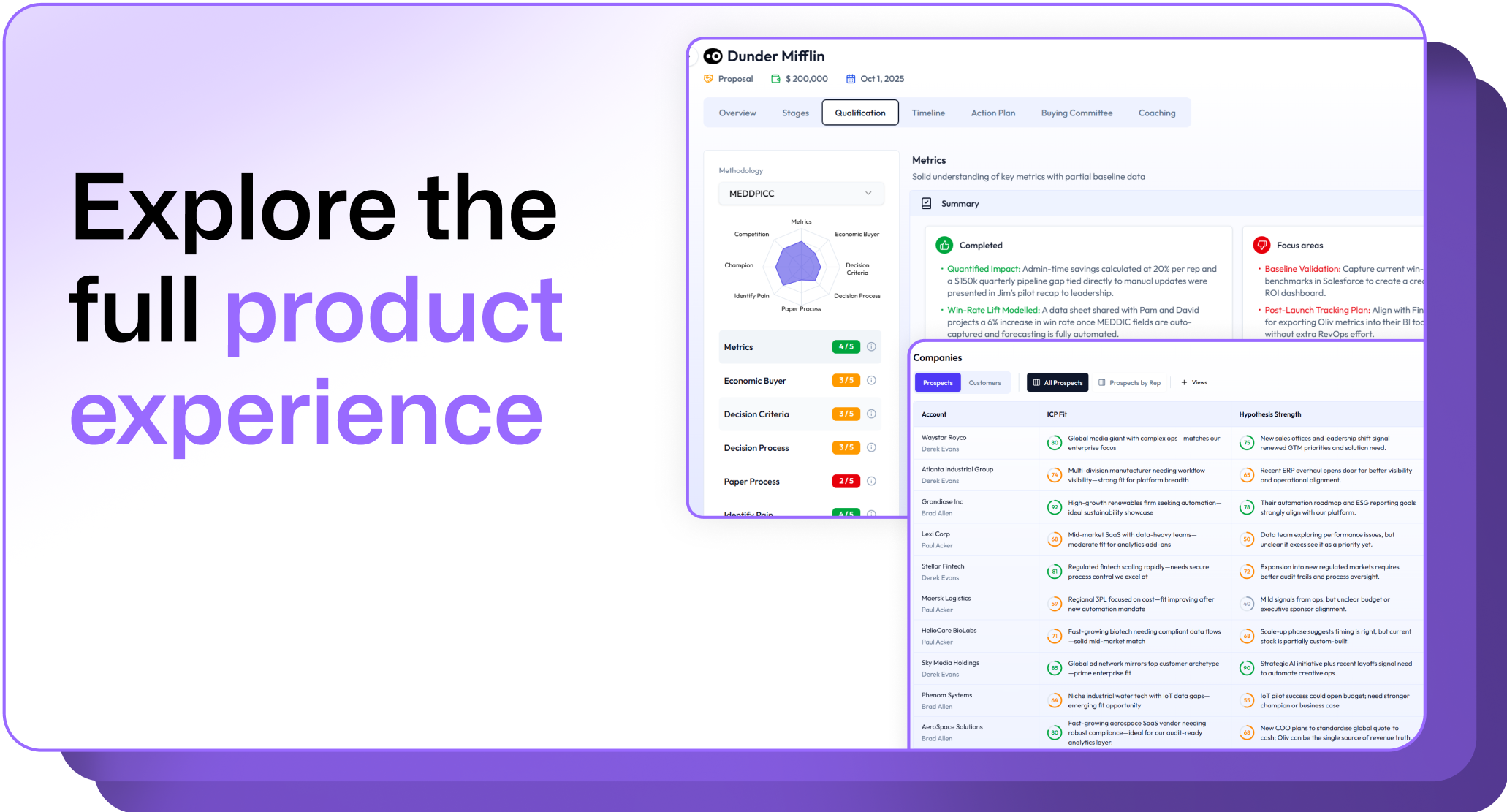
.avif)