Save on Apps, Fund Your Agents: The Playbook for Unbundling the $100K+ Fragmented GTM Stack
Written by
Ishan Chhabra
Last Updated :
September 25, 2026
Skim in :
13
mins
In this article
Still got questions?
Come discuss this article with me.
Hi, I'm Ishan, Founder and CEO of Oliv.
I'm always up for a conversation about revenue intelligence, AI agents, or what's actually working (and what's not) across revenue teams.
I'd love to hear your perspective.
Thank you! Your submission has been received!
Oops! Something went wrong while submitting the form.
Meet Oliv’s AI Agents
Hi! I’m, Deal Driver
I track deals, flag risks, send weekly pipeline updates and give sales managers full visibility into deal progress
Hi! I’m, CRM Manager
I maintain CRM hygiene by updating core, custom and qualification fields all without your team lifting a finger
Hi! I’m, Forecaster
I build accurate forecasts based on real deal movement and tell you which deals to pull in to hit your number
Hi! I’m, Coach
I believe performance fuels revenue. I spot skill gaps, score calls and build coaching plans to help every rep level up
Hi! I’m, Prospector
I dig into target accounts to surface the right contacts, tailor and time outreach so you always strike when it counts
Hi! I’m, Pipeline tracker
I call reps to get deal updates, and deliver a real-time, CRM-synced roll-up view of deal progress
Hi! I’m, Analyst
I answer complex pipeline questions, uncover deal patterns, and build reports that guide strategic decisions
TL;DR
Most GTM stacks are not overpriced but mis-layered: commodity capability like recording and transcription is bought at differentiated prices, and that gap is your AI budget.
Cut only where replacement is a configuration change, never a behaviour change. Tools reps open daily go last, whatever they cost, because lost adoption eats the savings.
Audit in five days: AP ledger, 90-day active seats, rep interviews, renewal and notice dates, then cost per active user rather than cost per licence.
Score on utilisation, overlap, and dependency. Under 30% active seats is a sunset candidate; anything with live revenue dependencies is a consolidate, never a sunset.
Credit-based pricing makes a seat variable, so budget workload and demand overage caps, rollover, pooled allocation rules, and export rights in writing.
Defer entirely if the stack is lean, a core migration is live, or reclaimable spend is within 20% of projected migration effort.
Q1. What should you cut first in a bloated GTM stack, and what should you never touch? [toc=1. Cut First, Never Touch]
Cut first where replacing a tool is a configuration change, not a behaviour change. Background systems like transcription, enrichment, recording, and data plumbing can be swapped without retraining anyone. Tools your reps open every day go last, whatever they cost, because migration effort and lost adoption are what eat the savings. Most consolidation projects fail because they invert that order and start with the most visible, least reversible layer of the stack.
⏰ The planning meeting where this starts
You are three weeks from annual planning. Budget is flat, and someone upstairs has asked for an AI initiative funded from existing spend.
The number is real, and you can build it yourself. A 2025 benchmark of 938 B2B companies found an average of 8.3 tools at roughly $187 per rep per month. At 45 reps, that is about $101,000 a year before a single AI line item, which is the kind of figure that shows up in any honest sales tech stack cost review.
❌ Why most consolidations lose money
Here is the part vendors skip. Consolidation has a poor track record. The savings are frequently consumed by migration work and lost adoption, and I have watched that happen from the inside.
I have also been wrong about it. On one project I sequenced by price, cut the most expensive line first, and spent two quarters rebuilding reporting nobody had mapped. We saved less than the project cost.
"I found the AI tracker setup to be quite difficult, especially concerning the user interface when setting up keywords or smart trackers. Moreover, I cannot download all the data myself unless we upgrade the plan, which isn't ideal and results in me not fully utilizing Gong." — Verified user, Sales Professional, Gong G2 Verified Review, 3 stars, 03 Oct 2025
⚠️ The layer that punishes you for touching it
Read that review again as a budget problem. Someone is paying full price for a tool they are not fully using, and the gap is a setup gap, not a pricing gap. The same pattern shows up across published Gong user reviews.
Exit terms are the second trap. Data you cannot take with you turns a cut into a rebuild.
"The fact that you cant't edit a recording (to only share a portion with a client, and the fact that if you stop working with thew tool you lose the data" — Verified user, Sales Professional, Gong G2 Verified Review, 3 stars, 19 Mar 2026
✅ The rule, and the three layers under it
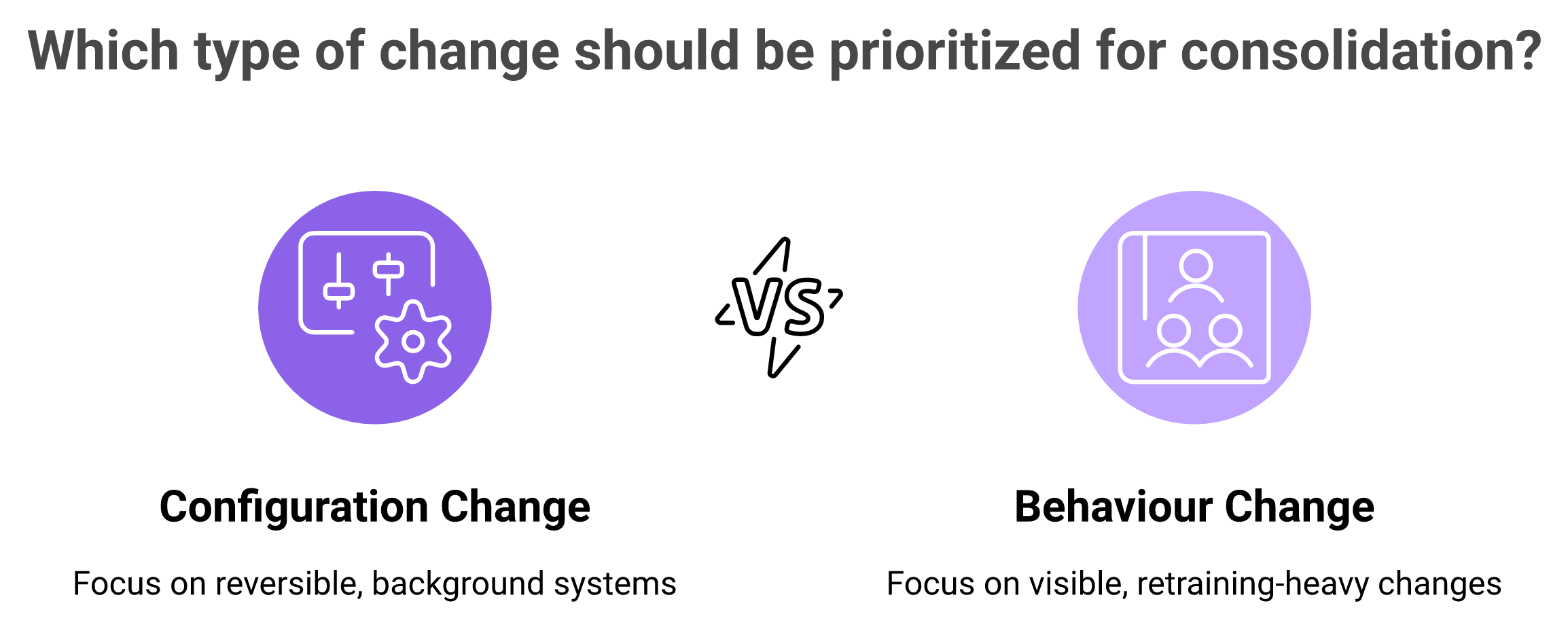
So use one test per tool. Ask whether replacing it is a configuration change or a behaviour change. Configuration changes are reversible in a week. Behaviour changes land on quota-carrying reps mid-quarter.
The cut test in one image: configuration changes are reversible in a week, behaviour changes land on quota-carrying reps mid-quarter.
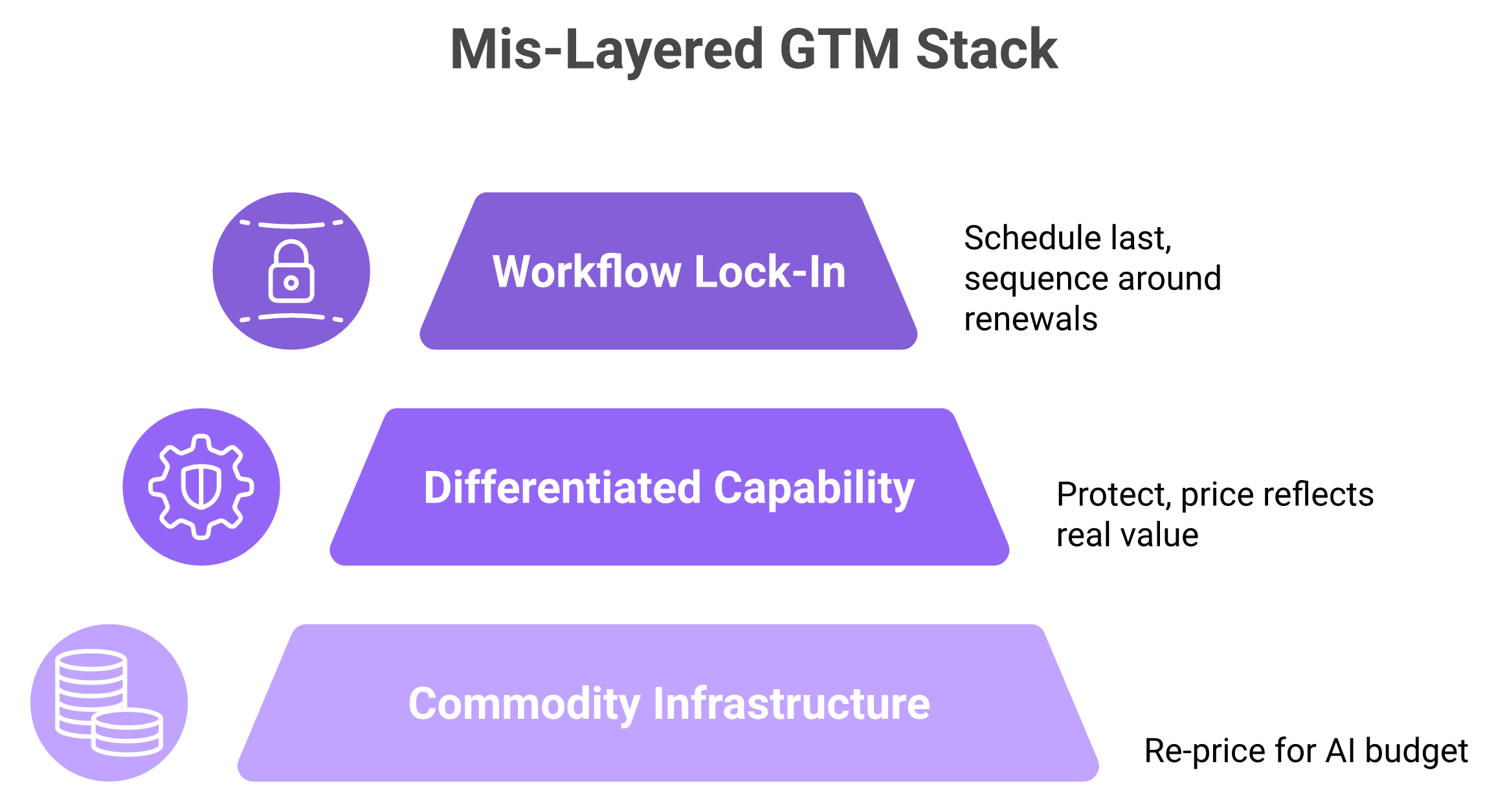
That test splits your stack into three layers. Commodity infrastructure, where vendors have converged and you are paying for brand and inertia. Differentiated capability, which is genuinely hard to replace. Workflow lock-in, which is neither, but is expensive to unwind.
You fund the AI programme from the first layer. You protect the second. You schedule the third for last.
💸 Why the money hides in plain sight
There is a structural reason nobody notices the waste. Budget is committed annually, but value is consumed monthly.
A tool that stopped justifying itself in March is still being paid for in December, and no single person owns noticing. That is the gap this playbook works in.
One promise about what follows. There is no savings percentage here, and no single vendor answer. You get an order of operations you can defend to a CFO and to the tool owners who will argue with you.
Q2. What is GTM stack consolidation, and why is your stack mis-layered rather than overpriced? [toc=2. Mis-Layered, Not Overpriced]
GTM stack consolidation is the practice of auditing every revenue tool for adoption, workflow overlap, data connectivity, and true cost, then merging or cutting so one system clearly owns each core workflow. The useful version is not cost-cutting, it is re-layering. Commodity capability bought at differentiated prices funds the AI programme. Genuinely differentiated capability stays exactly where it is. Workflow lock-in gets scheduled last, because unwinding it costs more than the licence.
💰 Two vendors, same transcript, four times the price
Run a small experiment this week. Take one recorded call and push it through your incumbent and through the cheapest credible transcription vendor you can find.
Then hand both outputs to an AE without telling them which is which. In most mid-market stacks I have looked at, they cannot tell, and the price gap between the two is often four times or more, which is why revenue intelligence and conversation intelligence are no longer priced on the same logic.
❌ Procurement treats every line as a fixed commitment
The problem is not the vendor. It is that procurement treats every line as a fixed annual commitment, priced once and renewed on autopilot.
Fund the AI programme from the commodity layer, protect the differentiated layer, and schedule workflow lock-in last.
Meanwhile the underlying capability moved. Recording, transcription, summarisation, sequencing, and basic enrichment all converged. Your contract did not.
⭐ What the published evidence actually says
Three named studies make this checkable rather than a matter of taste.
Published Evidence on GTM Stack Consolidation
Finding
Number
Source and year
Sales teams without an all-in-one platform planning to consolidate
Read the middle row twice. Silos, not models, are what stall AI programmes. That reframes consolidation as a prerequisite for agents rather than a cost exercise, and it is the same argument behind the shift from revenue operations to intelligence to orchestration.
⚠️ The unit of value is being re-priced by the vendors
Here is the strongest argument for re-pricing the commodity layer now, and it comes from the vendors themselves.
Credit-based and metered pricing is spreading across this category. Once a seat buys a variable amount of work, you cannot treat that layer as a fixed annual line any more. The vendors have already told you it is a commodity by pricing it like one, as the published Gong pricing structure shows.
✅ The two ten-second questions per tool
Classify each tool with two questions. Would a competitor's output be indistinguishable to a working rep? Does anyone on the team open it daily?
Yes and no means commodity, and it is fundable. No and yes means differentiated or locked-in, and it stays for now. Two yeses mean you have a migration project, not a budget move.
💸 Why the labels must be arguable in the open
One deliberate design choice in this method. The labels are contestable, and that is the point.
An enablement lead can argue that their platform is differentiated, not commodity, and bring usage data to prove it. That argument produces better decisions than a cut handed down from a spreadsheet. It also means the person who loses the argument still owns the outcome.
Q3. How do you audit a GTM tech stack in one week? [toc=3. One-Week Stack Audit]
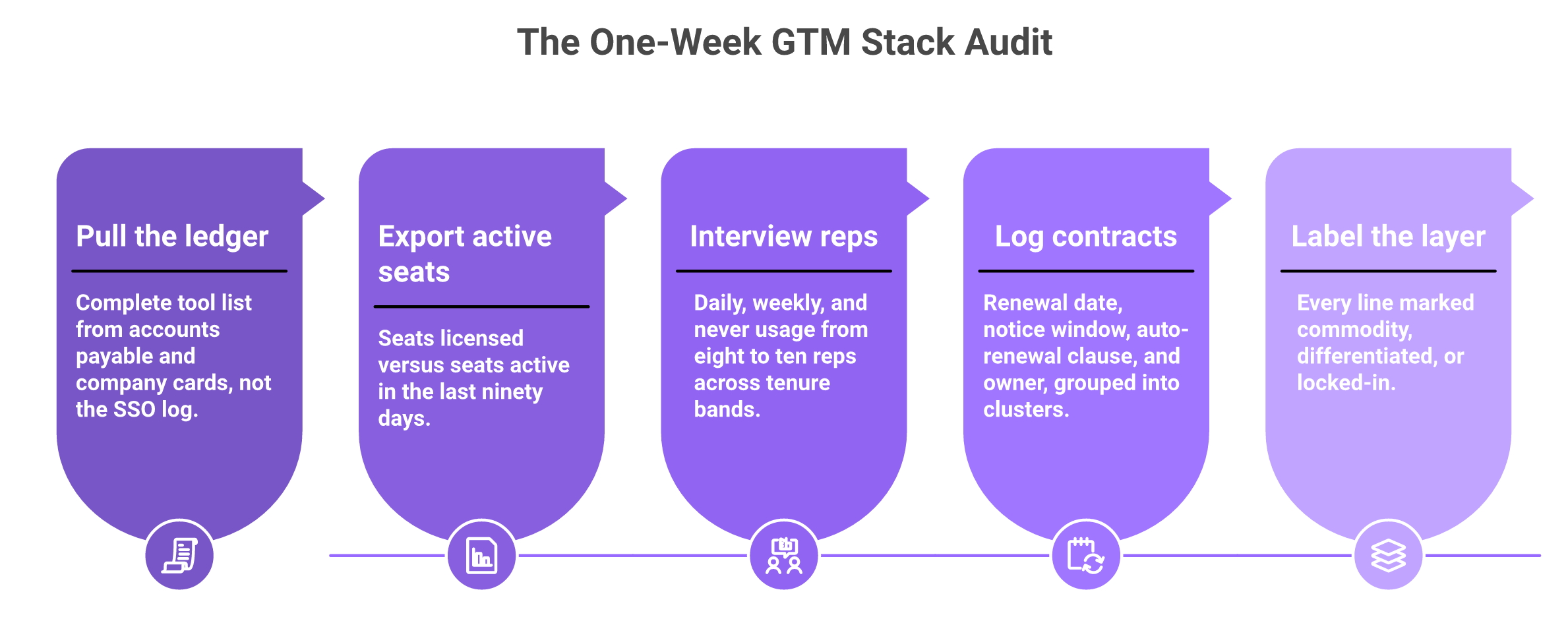
Run five passes across five days. Pull every tool charged to sales, marketing, and RevOps from the AP ledger and card statements. Export 90-day active-seat data for each one. Interview eight to ten reps on what they use daily, weekly, and never. Record every contract end date and notice window. Then compute cost per active user instead of cost per licence. The output is a layered inventory and a renewal calendar, not a savings figure.
Five passes, five artefacts: the audit tells you what is safe to consider and when the window opens, not what to cut.
📋 Day one: pull the ledger, not the SSO list
Start with accounts payable and the company cards. Not your SaaS management dashboard.
Shadow tools bought on a manager's card never appear in SSO logs. Zylo's 2026 index, built on more than 40 million licences, found 36% of seats unused and median software spend of $9,455 per employee. You cannot find those seats in a tool that never saw the purchase.
📊 Day two: export 90-day active-seat data
For each tool, pull seats licensed and seats with activity in the last 90 days. Then divide annual cost by active users.
Cost per active user is the only number that survives a CFO conversation. A $40 seat used by a third of the team is a $120 seat, and our revenue intelligence ROI calculation guide walks through how to model that properly.
🗣️ Day three: interview eight to ten reps
Pick across tenure bands, including two of your strongest performers. Ask three questions only.
Which tools do you open daily, weekly, or never?
Which one slows you down?
If this tool vanished on Monday, what breaks?
Question three is the dependency map in disguise. Gartner found 70% of sellers feel overwhelmed by the technology they are required to use, so expect candour.
"Real Time integrations can be time consuming" — Verified user, Sales Professional, Gong G2 Verified Review, 2.5 stars, 21 Apr 2026
⏰ Day four: build the renewal calendar
Log contract end date, notice window, auto-renewal clause, and owner for every line. Group them into renewal clusters.
This single artefact decides your sequence later. Everything else is opinion.
"limitations of getting data back into salesforce" — Verified user, Sales Professional, Gong G2 Verified Review, 4 stars, 21 May 2026
That complaint is a day-four finding, not a day-three one. Data that does not flow back becomes a dependency you inherit, which is exactly what Gong CRM integration limits look like in practice.
🗂️ Day five: one inventory, eight columns
Build a single sheet with these columns.
The One-Week GTM Stack Inventory Sheet
Column
What goes in it
Tool and owner
Name, internal champion
Annual cost
From AP, not the quote
Seats licensed / active 90 days
Two separate numbers
Cost per active user
Annual cost divided by active seats
Workflow owned
One sentence, one workflow
Downstream dependencies
Reports, routing, integrations
Renewal and notice dates
From contract, not memory
Layer
Commodity, differentiated, or locked-in
⚠️ What this audit deliberately does not decide
The audit does not tell you what to cut. It tells you what is safe to consider, and when the window opens.
Deciding on day five is how teams end up cutting the wrong layer. Scoring comes next, and sequencing after that.
Oliv AI reduces how many rows this sheet needs, because it reads calls, email, Slack, and the web into the CRM you already own rather than adding another system of record. That matters for an audit specifically, since a layer on top of Salesforce or HubSpot does not create a new dependency chain to unwind later. The longer version of this method sits in our guide to reducing sales tech stack costs and in AI agents for RevOps.
Q4. How do you map overlap and score each tool as keep, consolidate or sunset? [toc=4. Overlap & Triage Scoring]
Score every tool on three axes. Utilisation: below 30% active seats is a sunset candidate, 30% to 60% is a downgrade candidate, above 70% stays. Overlap: if more than half of its used features already exist in a platform you pay for, it is a consolidate candidate. Dependency: list every downstream report, routing rule, and integration reading from it. Anything carrying live revenue dependencies is a consolidate, never a sunset.
📊 The three-axis score, with thresholds
Thresholds matter because they move the conversation off opinion.
Three-Axis Tool Scoring Thresholds
Axis
How to measure
Threshold
Verdict
Utilisation
Active seats in last 90 days divided by licensed seats
Under 30%
Sunset candidate
Utilisation
Same calculation
30% to 60%
Downgrade or reduce seats
Utilisation
Same calculation
Over 70%
Keep, price it separately
Overlap
Used features also present in a platform you already pay for
Over 50%
Consolidate candidate
Dependency
Count of live reports, routing rules, integrations
One or more
Consolidate, never sunset
Score used features, not licensed features. Nobody consolidates a feature list. They consolidate what four reps actually touch.
⚠️ Overlap is about what people use, not what they bought
Breadth is the most common source of false overlap. A platform that technically does six things but is used for two overlaps on two, which is visible in most published Gong feature breakdowns.
The buyer language on this is consistent and public.
G2's 2026 buyer research found 84% of buyers had folded three or more best-of-breed tools into all-in-one platforms in the previous year, and half had folded in five or more. Breadth is exactly what they were buying into.
🔗 How to map dependencies before you score
Overlap tells you what you could cut. Dependency tells you what happens if you do.
For each tool, list four things.
Reports and dashboards that read from it.
Routing, scoring, or alerting rules it triggers.
Integrations pushing data into the CRM.
Any compliance or audit obligation it carries.
Any tool with live entries in that list moves to consolidate, not sunset. You migrate the dependency first and the licence second, and the sequencing detail sits in our guide to migrating off a legacy platform.
✅ A worked overlap pair
Take the most common pair in a mid-market stack: conversation intelligence next to a sequencing or engagement module bought from the same or a neighbouring vendor.
On paper they look complementary. In practice, reps often run sequences in one tool while the other charges for the same capability nobody adopted. That is a category-level pattern, and the comparison between Gong and Outreach shows how it lands.
"Gong Engage is awful in every single way compared to outreach. Would not recommend at all, flows are hard to get into, information is not readily available, sequencing is difficult to create and track, nothing is robust or scalable." — Verified user, Sales Professional, Gong G2 Verified Review, 1.5 stars, 09 Jun 2025
Read as a scoring input, that is a paid module at near-zero adoption, with a competing tool owning the workflow. Utilisation low, overlap high, dependency low. That is a downgrade, and it is the cleanest money in most stacks.
Sign-off needs three names: the budget owner, the tool owner, and RevOps. The tool owner gets to contest the score with usage data. If they win, the score changes and the tool stays.
That single rule is what stops this from becoming a spreadsheet nobody honours in March.
Q5. What should commodity GTM capability cost per seat, and how do credit models break that number? [toc=5. Commodity Pricing & Credits]
Recording, transcription, summarisation, sequencing, and basic enrichment are commodity capability in 2026. Output is close to indistinguishable to a working rep, while per-seat prices for it span a multiple of four or more. Price that layer against the cheapest credible provider, not against your incumbent's renewal quote. Then budget workload instead of seats. Credit models, where roughly ten emails or a call over ten minutes consumes one credit from a shared non-rolling pool and the API errors at zero balance, make a seat a variable unit (help.gong.io, retrieved 26 Aug 2026).
⏰ What that premium bought in 2019
I signed those contracts. Back then, paying a premium for call recording plus searchable transcripts was correct.
Speech-to-text was hard. Sales-specific summarisation barely existed. The price reflected real scarcity, and the vendors earned it.
💰 What the same price buys now
Scarcity went away. Transcription quality converged across a dozen providers, and summarisation followed, which is why the line between revenue intelligence and conversation intelligence now matters more than the transcript itself.
Run the blind test yourself. One call, two vendors, no labels, and an AE deciding which output is better. If they cannot tell, you are buying brand and inertia at that line.
💸 Why a seat is no longer a fixed unit
Here is the part that changes budgeting, and it comes from vendor documentation rather than opinion.
Credit mechanics published by Gong work like this: roughly ten emails consume a credit, a call longer than ten minutes consumes a credit, credits draw from a shared pool, monthly allowances do not roll over, and the API returns errors once the balance hits zero (help.gong.io, retrieved 26 Aug 2026). The full commercial picture sits in our Gong pricing guide.
Model that against a real quarter. Take 40 reps in a peak month, count sends and call minutes, then find the week the pool empties. That week is when your integrations go quiet, not when finance gets an invoice.
"The conversation intelligence tool is lacking, and we don't have the context of the deals against the conversation intelligence findings. There's no custom reporting. The CRM writeback is not good; we cannot send MEDDIC values back to Salesforce or update fields in Salesforce from the conversation intelligence." > Verified user, Revenue Operations Professional, Clari G2 Verified Review, 1.5 stars, 13 Jul 2026
MEDDIC, for anyone outside deal desk, is a qualification framework with fields like metrics, decision criteria, and champion. That review is a commodity-layer purchase inside a differentiated platform, and it is not writing back. Automating those fields from live calls is a separate capability, covered in our guide to auto-scoring MEDDIC, BANT, and SPICED from calls.
✅ How to price the layer, and the four clauses to demand
Price by method, not by vendor quote. Take the cheapest provider your security team would actually approve, and treat that as your floor for commodity capability.
Then put four clauses in writing before you sign anything metered.
An overage cap with a hard ceiling in dollars.
Rollover of unused monthly allowance, or a quarterly pool instead.
Clear rules on whether credits are pooled or allocated per seat.
A mid-term true-up so you can resize down, not only up.
"Integrating Salesloft came with a lot of challenges, and even now, it feels like the platform still has some kinks. I often have trouble logging meetings, and certain features feel clunky or overly manual." > Verified user, Account Executive, Salesloft G2 Verified Review, 2.5 stars, 22 Jul 2025
⚠️ Where commodity stops being interchangeable
One honest limit. Commodity does not mean swappable in every respect.
Admin depth, permissioning, audit logging, and security review all differ sharply between the cheap option and the incumbent. Price the capability as a commodity, then qualify the vendor as though it were not, using the criteria in our mid-market governance and SOC 2 buyer guide.
Oliv AI publishes a metered rate of $0.01 per agent credit, which very few vendors in this category publish at all. For budgeting purposes, a published rate is what lets you model a quarter instead of guessing at one.
Q6. Which GTM tools should never be consolidated? [toc=6. Never Consolidate These]
Never consolidate the system of record, anything carrying compliance or audit obligations, the tool your best-performing segment opens daily, or any system currently mid-migration. These are behaviour-change replacements, and the switching cost lands on quota-carrying reps during a live quarter. Territory and quota logic, complex forecast hierarchies, and regulated call handling are genuinely differentiated. Their price usually reflects real value, and cutting them costs more than it saves.
❌ The over-correction I have watched happen
The failure mode after a good audit is cutting too deep. A leader sees 36% of seats unused across the company, per Zylo's 2026 index, and decides the whole stack is padding.
So they cut the forecasting layer in month two. Then the Monday roll-up becomes a spreadsheet again, and the CFO stops trusting the number, which is exactly the failure our work on sales forecast accuracy is built around.
⚠️ What actually breaks, in order
Three things break, and they break in sequence.
Pipeline hygiene, because the fields nobody loved were still being populated somewhere.
Ramp time, because new reps lose the workflow they were trained on.
Forecast confidence, which is the slowest to rebuild and the most expensive to lose.
Gartner's 2024 seller survey found 70% of sellers already feel overwhelmed by required technology. A mid-quarter migration adds to that load rather than reducing it, and it lands hardest on new-hire ramp time.
⭐ What AI commoditised, and what it did not
Generative AI commoditised capture and summarisation. It did not commoditise structure.
Territory rules, quota hierarchies, multi-segment forecast rollups, and consent handling in recorded calls are all hard, boring, and specific. Depth there is real, and the reviews show it plainly, as our breakdown of Clari's feature set lays out.
"I like Clari's visual design and the nice, clear style of word presentation. I enjoy being able to forecast easily without having to add up manually. Clari helps save time, reducing manual work with its automated process." > Verified user, Sales Professional, Clari G2 Verified Review, 3 stars, 17 Dec 2025
"I really like Clari's excellent user experience (UX). It truly shines in weekly forecasts and opportunity analysis. This makes the workflow intuitive and allows me to analyze week-by-week data quickly and efficiently." > Verified user, Sales Professional, Clari G2 Verified Review, 2.5 stars, 16 Nov 2025
✅ The protect list, as rules
Write these four rules into the audit sheet before scoring anything.
The system of record stays. Salesforce, HubSpot, or Dynamics is not a consolidation target.
Anything with a compliance or audit obligation stays until legal signs off in writing.
Any tool your top-performing segment opens daily stays this cycle, whatever the price.
Any system mid-migration is frozen. You do not run two migrations at once.
💰 The uncomfortable exception
Now the part that argues against my own rubric. Low adoption does not always mean low value.
I have seen a tool with terrible usage numbers turn out to be the one three enterprise renewals depended on, because a single solutions engineer ran every security review through it. Usage data would have killed it. Ask the question before you cut.
⚠️ One factual guardrail for your vendor list
Two names people still treat as separate are not. Clari and Salesloft are one company, led by CEO Steve Cox.
If your consolidation deck lists them as two independent vendors, a procurement lead will notice, and your credibility takes the hit. The incumbents named here are market leaders with genuine depth, not overpriced imitations. Consolidation is a claim about which layer of the category has converged, not an accusation against any vendor, which is why our platform comparison for RevOps reads them on capability rather than price alone.
Q7. How do you sequence cuts around renewals, dependencies and exit costs? [toc=7. Sequencing & Exit Costs]
Sequence by reversibility and renewal date, never by price. Put every contract's renewal and notice window on one calendar, group them into clusters, and act only on the cluster closing next. Export and archive data first, move downstream dependencies second, run a parallel pilot for a full quarter, then cancel at the renewal boundary. Mid-contract cuts rarely pay, because exit cost plus rebuild effort usually exceeds the spend you have left on the contract.
⏰ Step one: build the renewal calendar
Put four fields in one sheet for every tool: renewal date, notice window, auto-renewal clause, and internal owner. Source them from the contract, not from memory.
Then group contracts closing within the same 90 days into a cluster. That cluster is your first and only work item.
⚠️ Step two: know your leverage window
The negotiating window opens at notice period minus 30 days. Most enterprise agreements carry a 30 to 90 day notice clause, so check each one and diarise it.
Miss that date and you have auto-renewed. At that point your options shrink to asking nicely.
✅ Step three: the four-step migration order
Run these in order, never in parallel.
Export and archive. Pull a full data export from the outgoing tool and store it where your team can query it.
Move dependencies. Rebuild reports, routing rules, and integrations on the new source before anyone switches.
Run a parallel pilot. Keep both systems live for one full quarter, including a month-end close.
Cancel at the boundary. Give notice inside the window, not mid-term.
The dependency step is where most timelines slip, and our guide to migrating off a legacy platform sets out what to rebuild first.
💰 Step four: a realistic timeline
One cluster per quarter is the honest pace for a 200 to 1,500 person company. Not a big-bang programme, and not a year-long project.
That means a four-quarter horizon to work through a typical stack. The first cluster is where the reclaimed money shows up, and it funds the patience for the rest. Vendor-side timelines are worth checking too, as our note on implementation timelines shows.
💸 Step five: test the exit before you negotiate
Here is the move most teams skip. Ask every incumbent for a complete data export while you still have a live contract.
What comes back tells you exactly what lock-in costs. A clean, machine-readable dump in a week means low exit cost. A ticket queue, a paid tier, or snippets you have to copy one at a time means the vendor has already priced your exit for you, and that number belongs in your renewal maths.
⚠️ What to do when the numbers are close
If the modelled saving is within roughly 20% of your estimated migration effort, do not move this cycle. Renegotiate instead, and revisit at the next renewal cluster.
Effort here means real hours: RevOps rebuild time, enablement retraining, and the reporting gap during the pilot. Our revenue intelligence ROI calculation guide walks through how to model that side rather than only the savings side.
⏰ One artefact, one meeting
Take one page to the planning meeting: the cluster calendar, the export test result per tool, and the layer label for each line.
That page is what makes the sequence defensible. It moves the conversation from which tool someone dislikes to which window is open and what breaks if you use it.
Oliv AI maintains a full open export policy, including a complete CSV of all meetings and recordings on termination, plus migration of historical recordings and metadata from a previous platform. That is a reasonable standard to hold any replacement to, whoever you end up choosing.
Q8. Where does the AI budget actually come from? [toc=8. Funding The Agents]
Fund it in this order: reclaim unused seats, right-size tiers, re-price commodity capability, then leave the differentiated and locked-in layers alone this cycle. Oliv AI shows the mechanism directly. It charges nothing for C-suite, Product, Operations, and Engineering seats, billing those users by credits instead, and its own calculator shows 60 seats free in a worked example. The roles that generate the most licence waste in a bloated stack stop carrying a per-seat cost, which is usually where reallocation money appears.
💰 The conversation with your CFO
The ask is rarely for new money. It is a question: what are you turning off to pay for this?
G2's 2026 buyer research, covering more than 1,000 buyers plus 50-plus leader interviews, found 84% had folded three or more best-of-breed tools into platforms in the previous year, and half had folded in five or more, explicitly to cover LLM, token, and agent costs. Your CFO is not being difficult. They are describing the market.
❌ The two traditional answers, and why both are weak
The reallocation has an order: seats, then tiers, then commodity pricing, and nothing else this cycle.
Historically you had two options. Cut headcount-adjacent spend, or defer the AI programme to next year.
Both are bad. The first damages capacity, and the second means arriving at the same conversation twelve months later with a larger stack. The same trade-off shows up in every honest build versus buy decision on revenue AI.
⭐ What changed in how this layer is priced
The shift is that pricing has started separating observers from operators. Executives, product managers, and engineers who need to see deal context are not the people running sequences all day.
Charging both groups the same per-seat rate is what creates the waste Zylo measures at 36% of licences. Once visibility stops costing per seat, the funding question answers itself, and cross-channel revenue visibility stops being a budget line you ration.
✅ The worked example, with its caveat attached
Oliv AI publishes per-role prices where much of this category publishes a quote form, and publishes a metered rate of $0.01 per agent credit alongside free seats for C-suite, Product, Operations, and Engineering. Its own savings comparison states: "Estimated yearly savings $60,840, 72% less. Legacy tools $84,360 per year, Oliv $23,520 per year."
That figure carries a caveat, and it belongs in the sentence rather than a footnote: "These are comparison assumptions, not vendor quotes; coverage and contracts differ. Platform fees excluded." The legacy rates behind it are our own modelling assumptions, not any named vendor's published price, and I would treat them as illustrative only.
⚠️ Where I am the least proven option on your list
Now the part that costs me something to write. Among the vendors in this article, Oliv AI is the least publicly proven. There is no G2, Capterra, or TrustRadius presence yet, and our case studies are email-gated.
Revenue teams at Sprinto and Triple Whale use the platform daily, and I would still tell you that is thinner public evidence than a market leader with thousands of reviews. That is an argument for phasing one layer, not replacing a stack.
💸 What this is not
Oliv AI sits on top of the CRM and works the app layer above it. It is not a CRM replacement, and I would not pitch it as one.
So the reallocation is narrower than it sounds. You are re-pricing commodity capability, keeping your system of record, and spending the difference on work that gets done without a person opening a dashboard. If that is the shape you want, the detail sits in our overview of revenue intelligence platforms and in AI agents for RevOps.
Q9. What security and compliance checks gate a consolidation in 2026? [toc=9. Security & Compliance Gate]
Security review is now the main delay between picking a replacement and running it. G2's 2026 buyer research puts it first at 39%, rising to 50% among enterprise buyers. Demand SOC 2 Type II and GDPR evidence before the pilot, not after. If any agent will speak to prospects in the EU, EU AI Act Article 50 transparency duties have applied since 2 August 2026, so the agent must disclose that it is AI and on whose behalf it acts. Annex III high-risk duties were deferred to 2 December 2027.
⏰ Why this belongs in the audit, not procurement's queue
Most teams treat security review as a step that happens after the decision. That is how a renewal window gets missed.
I have lost a window that way. The pilot worked, the business case held, and the review queue ate six weeks we did not have. Start review the same week the pilot starts, using the criteria in our AI CRM trust and governance evaluation guide.
✅ The six-item vendor questionnaire
Send these six questions before the first demo, not after the contract draft.
Current SOC 2 Type II report, with the audit period and the auditor named.
GDPR posture: data processing agreement, sub-processor list, and EU data residency options.
Encryption at rest and in transit, stated as specific standards.
Retention and deletion: what happens to recordings and transcripts on termination.
Export format and timeline for a full data return.
Whether any AI agent interacts with prospects directly, and how it discloses itself.
SOC 2 Type II, for anyone new to it, tests whether controls actually operated over a period of months rather than existing on paper on one day. Our mid-market buyer guide to governance and SOC 2 covers what a complete evidence pack looks like, and vendor-specific documentation such as a published DPA and security posture is worth reading before the call.
⚠️ What Article 50 actually requires
This one is new enough that most consolidation decks miss it. EU AI Act Article 50 sets transparency duties, and the European Commission published final guidance in July 2026.
For a sales agent, the practical effect is simple. If it contacts a prospect in the EU, the person must be able to tell they are dealing with AI, and on whose behalf it is acting. That constraint shapes how you deploy AI sales agents in any EU-facing motion.
The wider high-risk obligations in Annex III were pushed back to 2 December 2027 under Regulation (EU) 2026/1744. So the transparency duty is live now, and the heavier compliance load arrives later.
💸 How to run review in parallel without breaking the timeline
Sequence it against the renewal calendar from your audit, not against the demo schedule.
Week 1: questionnaire out, pilot environment requested.
Weeks 2 to 4: security review runs while the pilot runs.
Week 5: legal signs the data processing agreement or names the blocker.
Week 6: decision, with the notice window still open.
That is the difference between cutting at the renewal boundary and paying for another year.
⭐ One thing worth checking on yourself
Ask your own security team how long their last review took, then double it for a vendor with no existing relationship.
I underestimate this consistently. My instinct says three weeks, and the honest number in most mid-market companies is closer to six. Our RevOps implementation and admin guide sets out what the technical side of that week actually involves.
Oliv AI holds SOC 2 Type II certification, GDPR and CCPA compliance, AES-256 encryption at rest, and TLS 1.2 or higher in transit, with a public trust centre at trust.oliv.ai. That is the baseline any replacement should clear, whichever vendor you choose, and it is worth asking for the same evidence set from all of them.
Q10. How do you handle the tool owner who will fight every cut? [toc=10. Internal Resistance]
Do not hand down a budget cut. Publish the layering instead, and invite each tool owner to contest their tool's label using usage data and one revenue workflow it demonstrably owns. That argument is winnable in the open, and it produces better decisions than a mandate. It also turns the enablement lead and the sales-ops manager into the people who documented why a tool stays, which is a much stronger position for you later.
⚠️ Two directors, two overlapping platforms
You have seen this meeting. The enablement lead defends the platform they rolled out last year. The sales-ops manager defends the one their workflows live inside.
Both are right about their own tool. Neither is looking at the portfolio, because nobody asked them to. That portfolio view is the job our guide to building a revenue operations function assigns to RevOps.
❌ What a top down cut actually costs
I have run the mandate version. The migration worked, and the team never forgave the process.
The cost showed up in the next planning cycle, when nobody volunteered honest usage data. That is more expensive than the licence I cancelled, and it is a real risk when scaling revenue operations at speed.
💰 Why reps and champions see different tools
The reason this argument gets heated is that both sides are describing real experiences of the same product. Champions see the reporting layer. Reps see the daily surface.
"I guess sales law for my superiors was observing, or was solving observability. Optical or performance metrics over time and other other things, attempting to coach, shit like that, and they didn't really benefit me too much because the tools that were given, or attempted to enable us were lackluster, bulky, and ineffective." > Verified user, Sales Development Representative, Salesloft G2 Verified Review, 1.5 stars, 07 Sep 2025
Read that as an org chart problem, not a product problem. The tool was solving a manager's job while adding work to a rep's day, which is the gap our work on coaching skill gaps with AI is built to close.
"It allows you to sequence emails, which is table stakes at this point." > Verified user, Account Executive, Salesloft G2 Verified Review, 2 stars, 24 Sep 2025
That is what a commodity label sounds like from the inside. A champion can still argue against it, and they should have to.
✅ The three question challenge
Give every tool owner the same three questions and a week to answer.
Which single revenue workflow does this tool own end to end?
What are its 90-day active seats, as a percentage of licensed seats?
What breaks in the next 30 days if it is switched off?
Answers go on one page per tool. RevOps arbitrates, the budget owner decides, and both are visible to everyone.
⭐ What to do when the owner wins
Sometimes the challenge overturns your score, and you should say so publicly.
Gartner's 2024 survey found 70% of sellers already feel overwhelmed by required technology. A leader who visibly keeps a tool because the evidence said to earns the right to cut the next one without a fight, and that credibility is worth more than a single line of reclaimed tech stack spend.
That is the whole trick. The layering method is useful precisely because it is arguable, and an argument in the open beats a cut announced in a spreadsheet.
Q11. When is the right answer to do nothing this cycle? [toc=11. When To Defer]
Defer if the stack is already lean, if any team is mid-migration on a core system, if the next renewal cluster is more than two quarters out, or if reclaimable spend is smaller than your projected migration effort. Deferring is a decision, not a failure. Running the audit anyway leaves you with a layered inventory and a renewal calendar, which is exactly what you need the moment a window opens.
✅ The four defer conditions, and how to test each
Each condition has a test you can run this week.
The Four Conditions for Deferring a Consolidation
Condition
The test
If true
Stack is already lean
Under 8 tools per rep and 70%-plus active seats across the board
Renegotiate rates only
Mid-migration on a core system
Any CRM, billing, or forecasting migration live now
Freeze until it closes
No near renewal cluster
Next cluster closes more than two quarters out
Diarise, do nothing now
Savings smaller than effort
Modelled saving within 20% of RevOps and enablement hours
Renegotiate, revisit next cycle
Two of those four show up more often than people expect. Zylo's 2026 index puts 36% of licences unused across companies, but the distribution is uneven, and some stacks genuinely are tight.
⏰ What to do with the audit output meanwhile
The work is not wasted. You now hold four artefacts that keep their value.
A layered inventory with cost per active user by tool.
A renewal and notice calendar you can act on any quarter.
A dependency map for every candidate.
An export test result showing which vendors have priced your exit.
Refresh the usage numbers quarterly. When the next cluster comes up, the decision takes a week instead of a quarter, and our ROI calculation guide keeps the model current between cycles.
⚠️ Why I am telling you not to act
This is the part that costs me pipeline, and it is still the right answer.
A playbook that concludes "act now" regardless of circumstances is a pitch. Consolidating a lean stack, or cutting during someone else's migration, is how teams generate the failed projects that make the next attempt harder.
💸 The order of operations, one more time
So here is the whole method in five moves, in sequence.
Audit in a week: ledger, active seats, rep interviews, renewal dates, cost per active user.
Score on utilisation, overlap, and dependency, with the thresholds published.
Protect the system of record, compliance-bound tools, daily-use tools, and anything mid-migration.
Re-price the commodity layer, and put overage caps and export rights in writing.
Reallocate the difference to the AI programme, one renewal cluster per quarter.
Cut only where the replacement is a configuration change rather than a behaviour change. Take the reversible moves first, and route the freed budget toward AI agents for sales teams rather than another dashboard.
Oliv AI is one way to buy the commodity layer at commodity prices, sitting on top of the CRM you already own rather than replacing it, and it is the least publicly proven option among the vendors named in this article. If the layering exercise leaves you with a funded agent budget and a shortlist, I am happy to walk through where we would and would not fit. Book a demo and bring your inventory sheet.
Q1. What should you cut first in a bloated GTM stack, and what should you never touch? [toc=1. Cut First, Never Touch]
Cut first where replacing a tool is a configuration change, not a behaviour change. Background systems like transcription, enrichment, recording, and data plumbing can be swapped without retraining anyone. Tools your reps open every day go last, whatever they cost, because migration effort and lost adoption are what eat the savings. Most consolidation projects fail because they invert that order and start with the most visible, least reversible layer of the stack.
⏰ The planning meeting where this starts
You are three weeks from annual planning. Budget is flat, and someone upstairs has asked for an AI initiative funded from existing spend.
The number is real, and you can build it yourself. A 2025 benchmark of 938 B2B companies found an average of 8.3 tools at roughly $187 per rep per month. At 45 reps, that is about $101,000 a year before a single AI line item, which is the kind of figure that shows up in any honest sales tech stack cost review.
❌ Why most consolidations lose money
Here is the part vendors skip. Consolidation has a poor track record. The savings are frequently consumed by migration work and lost adoption, and I have watched that happen from the inside.
I have also been wrong about it. On one project I sequenced by price, cut the most expensive line first, and spent two quarters rebuilding reporting nobody had mapped. We saved less than the project cost.
"I found the AI tracker setup to be quite difficult, especially concerning the user interface when setting up keywords or smart trackers. Moreover, I cannot download all the data myself unless we upgrade the plan, which isn't ideal and results in me not fully utilizing Gong." — Verified user, Sales Professional, Gong G2 Verified Review, 3 stars, 03 Oct 2025
⚠️ The layer that punishes you for touching it
Read that review again as a budget problem. Someone is paying full price for a tool they are not fully using, and the gap is a setup gap, not a pricing gap. The same pattern shows up across published Gong user reviews.
Exit terms are the second trap. Data you cannot take with you turns a cut into a rebuild.
"The fact that you cant't edit a recording (to only share a portion with a client, and the fact that if you stop working with thew tool you lose the data" — Verified user, Sales Professional, Gong G2 Verified Review, 3 stars, 19 Mar 2026
✅ The rule, and the three layers under it
So use one test per tool. Ask whether replacing it is a configuration change or a behaviour change. Configuration changes are reversible in a week. Behaviour changes land on quota-carrying reps mid-quarter.
The cut test in one image: configuration changes are reversible in a week, behaviour changes land on quota-carrying reps mid-quarter.
That test splits your stack into three layers. Commodity infrastructure, where vendors have converged and you are paying for brand and inertia. Differentiated capability, which is genuinely hard to replace. Workflow lock-in, which is neither, but is expensive to unwind.
You fund the AI programme from the first layer. You protect the second. You schedule the third for last.
💸 Why the money hides in plain sight
There is a structural reason nobody notices the waste. Budget is committed annually, but value is consumed monthly.
A tool that stopped justifying itself in March is still being paid for in December, and no single person owns noticing. That is the gap this playbook works in.
One promise about what follows. There is no savings percentage here, and no single vendor answer. You get an order of operations you can defend to a CFO and to the tool owners who will argue with you.
Q2. What is GTM stack consolidation, and why is your stack mis-layered rather than overpriced? [toc=2. Mis-Layered, Not Overpriced]
GTM stack consolidation is the practice of auditing every revenue tool for adoption, workflow overlap, data connectivity, and true cost, then merging or cutting so one system clearly owns each core workflow. The useful version is not cost-cutting, it is re-layering. Commodity capability bought at differentiated prices funds the AI programme. Genuinely differentiated capability stays exactly where it is. Workflow lock-in gets scheduled last, because unwinding it costs more than the licence.
💰 Two vendors, same transcript, four times the price
Run a small experiment this week. Take one recorded call and push it through your incumbent and through the cheapest credible transcription vendor you can find.
Then hand both outputs to an AE without telling them which is which. In most mid-market stacks I have looked at, they cannot tell, and the price gap between the two is often four times or more, which is why revenue intelligence and conversation intelligence are no longer priced on the same logic.
❌ Procurement treats every line as a fixed commitment
The problem is not the vendor. It is that procurement treats every line as a fixed annual commitment, priced once and renewed on autopilot.
Fund the AI programme from the commodity layer, protect the differentiated layer, and schedule workflow lock-in last.
Meanwhile the underlying capability moved. Recording, transcription, summarisation, sequencing, and basic enrichment all converged. Your contract did not.
⭐ What the published evidence actually says
Three named studies make this checkable rather than a matter of taste.
Published Evidence on GTM Stack Consolidation
Finding
Number
Source and year
Sales teams without an all-in-one platform planning to consolidate
Read the middle row twice. Silos, not models, are what stall AI programmes. That reframes consolidation as a prerequisite for agents rather than a cost exercise, and it is the same argument behind the shift from revenue operations to intelligence to orchestration.
⚠️ The unit of value is being re-priced by the vendors
Here is the strongest argument for re-pricing the commodity layer now, and it comes from the vendors themselves.
Credit-based and metered pricing is spreading across this category. Once a seat buys a variable amount of work, you cannot treat that layer as a fixed annual line any more. The vendors have already told you it is a commodity by pricing it like one, as the published Gong pricing structure shows.
✅ The two ten-second questions per tool
Classify each tool with two questions. Would a competitor's output be indistinguishable to a working rep? Does anyone on the team open it daily?
Yes and no means commodity, and it is fundable. No and yes means differentiated or locked-in, and it stays for now. Two yeses mean you have a migration project, not a budget move.
💸 Why the labels must be arguable in the open
One deliberate design choice in this method. The labels are contestable, and that is the point.
An enablement lead can argue that their platform is differentiated, not commodity, and bring usage data to prove it. That argument produces better decisions than a cut handed down from a spreadsheet. It also means the person who loses the argument still owns the outcome.
Q3. How do you audit a GTM tech stack in one week? [toc=3. One-Week Stack Audit]
Run five passes across five days. Pull every tool charged to sales, marketing, and RevOps from the AP ledger and card statements. Export 90-day active-seat data for each one. Interview eight to ten reps on what they use daily, weekly, and never. Record every contract end date and notice window. Then compute cost per active user instead of cost per licence. The output is a layered inventory and a renewal calendar, not a savings figure.
Five passes, five artefacts: the audit tells you what is safe to consider and when the window opens, not what to cut.
📋 Day one: pull the ledger, not the SSO list
Start with accounts payable and the company cards. Not your SaaS management dashboard.
Shadow tools bought on a manager's card never appear in SSO logs. Zylo's 2026 index, built on more than 40 million licences, found 36% of seats unused and median software spend of $9,455 per employee. You cannot find those seats in a tool that never saw the purchase.
📊 Day two: export 90-day active-seat data
For each tool, pull seats licensed and seats with activity in the last 90 days. Then divide annual cost by active users.
Cost per active user is the only number that survives a CFO conversation. A $40 seat used by a third of the team is a $120 seat, and our revenue intelligence ROI calculation guide walks through how to model that properly.
🗣️ Day three: interview eight to ten reps
Pick across tenure bands, including two of your strongest performers. Ask three questions only.
Which tools do you open daily, weekly, or never?
Which one slows you down?
If this tool vanished on Monday, what breaks?
Question three is the dependency map in disguise. Gartner found 70% of sellers feel overwhelmed by the technology they are required to use, so expect candour.
"Real Time integrations can be time consuming" — Verified user, Sales Professional, Gong G2 Verified Review, 2.5 stars, 21 Apr 2026
⏰ Day four: build the renewal calendar
Log contract end date, notice window, auto-renewal clause, and owner for every line. Group them into renewal clusters.
This single artefact decides your sequence later. Everything else is opinion.
"limitations of getting data back into salesforce" — Verified user, Sales Professional, Gong G2 Verified Review, 4 stars, 21 May 2026
That complaint is a day-four finding, not a day-three one. Data that does not flow back becomes a dependency you inherit, which is exactly what Gong CRM integration limits look like in practice.
🗂️ Day five: one inventory, eight columns
Build a single sheet with these columns.
The One-Week GTM Stack Inventory Sheet
Column
What goes in it
Tool and owner
Name, internal champion
Annual cost
From AP, not the quote
Seats licensed / active 90 days
Two separate numbers
Cost per active user
Annual cost divided by active seats
Workflow owned
One sentence, one workflow
Downstream dependencies
Reports, routing, integrations
Renewal and notice dates
From contract, not memory
Layer
Commodity, differentiated, or locked-in
⚠️ What this audit deliberately does not decide
The audit does not tell you what to cut. It tells you what is safe to consider, and when the window opens.
Deciding on day five is how teams end up cutting the wrong layer. Scoring comes next, and sequencing after that.
Oliv AI reduces how many rows this sheet needs, because it reads calls, email, Slack, and the web into the CRM you already own rather than adding another system of record. That matters for an audit specifically, since a layer on top of Salesforce or HubSpot does not create a new dependency chain to unwind later. The longer version of this method sits in our guide to reducing sales tech stack costs and in AI agents for RevOps.
Q4. How do you map overlap and score each tool as keep, consolidate or sunset? [toc=4. Overlap & Triage Scoring]
Score every tool on three axes. Utilisation: below 30% active seats is a sunset candidate, 30% to 60% is a downgrade candidate, above 70% stays. Overlap: if more than half of its used features already exist in a platform you pay for, it is a consolidate candidate. Dependency: list every downstream report, routing rule, and integration reading from it. Anything carrying live revenue dependencies is a consolidate, never a sunset.
📊 The three-axis score, with thresholds
Thresholds matter because they move the conversation off opinion.
Three-Axis Tool Scoring Thresholds
Axis
How to measure
Threshold
Verdict
Utilisation
Active seats in last 90 days divided by licensed seats
Under 30%
Sunset candidate
Utilisation
Same calculation
30% to 60%
Downgrade or reduce seats
Utilisation
Same calculation
Over 70%
Keep, price it separately
Overlap
Used features also present in a platform you already pay for
Over 50%
Consolidate candidate
Dependency
Count of live reports, routing rules, integrations
One or more
Consolidate, never sunset
Score used features, not licensed features. Nobody consolidates a feature list. They consolidate what four reps actually touch.
⚠️ Overlap is about what people use, not what they bought
Breadth is the most common source of false overlap. A platform that technically does six things but is used for two overlaps on two, which is visible in most published Gong feature breakdowns.
The buyer language on this is consistent and public.
G2's 2026 buyer research found 84% of buyers had folded three or more best-of-breed tools into all-in-one platforms in the previous year, and half had folded in five or more. Breadth is exactly what they were buying into.
🔗 How to map dependencies before you score
Overlap tells you what you could cut. Dependency tells you what happens if you do.
For each tool, list four things.
Reports and dashboards that read from it.
Routing, scoring, or alerting rules it triggers.
Integrations pushing data into the CRM.
Any compliance or audit obligation it carries.
Any tool with live entries in that list moves to consolidate, not sunset. You migrate the dependency first and the licence second, and the sequencing detail sits in our guide to migrating off a legacy platform.
✅ A worked overlap pair
Take the most common pair in a mid-market stack: conversation intelligence next to a sequencing or engagement module bought from the same or a neighbouring vendor.
On paper they look complementary. In practice, reps often run sequences in one tool while the other charges for the same capability nobody adopted. That is a category-level pattern, and the comparison between Gong and Outreach shows how it lands.
"Gong Engage is awful in every single way compared to outreach. Would not recommend at all, flows are hard to get into, information is not readily available, sequencing is difficult to create and track, nothing is robust or scalable." — Verified user, Sales Professional, Gong G2 Verified Review, 1.5 stars, 09 Jun 2025
Read as a scoring input, that is a paid module at near-zero adoption, with a competing tool owning the workflow. Utilisation low, overlap high, dependency low. That is a downgrade, and it is the cleanest money in most stacks.
Sign-off needs three names: the budget owner, the tool owner, and RevOps. The tool owner gets to contest the score with usage data. If they win, the score changes and the tool stays.
That single rule is what stops this from becoming a spreadsheet nobody honours in March.
Q5. What should commodity GTM capability cost per seat, and how do credit models break that number? [toc=5. Commodity Pricing & Credits]
Recording, transcription, summarisation, sequencing, and basic enrichment are commodity capability in 2026. Output is close to indistinguishable to a working rep, while per-seat prices for it span a multiple of four or more. Price that layer against the cheapest credible provider, not against your incumbent's renewal quote. Then budget workload instead of seats. Credit models, where roughly ten emails or a call over ten minutes consumes one credit from a shared non-rolling pool and the API errors at zero balance, make a seat a variable unit (help.gong.io, retrieved 26 Aug 2026).
⏰ What that premium bought in 2019
I signed those contracts. Back then, paying a premium for call recording plus searchable transcripts was correct.
Speech-to-text was hard. Sales-specific summarisation barely existed. The price reflected real scarcity, and the vendors earned it.
💰 What the same price buys now
Scarcity went away. Transcription quality converged across a dozen providers, and summarisation followed, which is why the line between revenue intelligence and conversation intelligence now matters more than the transcript itself.
Run the blind test yourself. One call, two vendors, no labels, and an AE deciding which output is better. If they cannot tell, you are buying brand and inertia at that line.
💸 Why a seat is no longer a fixed unit
Here is the part that changes budgeting, and it comes from vendor documentation rather than opinion.
Credit mechanics published by Gong work like this: roughly ten emails consume a credit, a call longer than ten minutes consumes a credit, credits draw from a shared pool, monthly allowances do not roll over, and the API returns errors once the balance hits zero (help.gong.io, retrieved 26 Aug 2026). The full commercial picture sits in our Gong pricing guide.
Model that against a real quarter. Take 40 reps in a peak month, count sends and call minutes, then find the week the pool empties. That week is when your integrations go quiet, not when finance gets an invoice.
"The conversation intelligence tool is lacking, and we don't have the context of the deals against the conversation intelligence findings. There's no custom reporting. The CRM writeback is not good; we cannot send MEDDIC values back to Salesforce or update fields in Salesforce from the conversation intelligence." > Verified user, Revenue Operations Professional, Clari G2 Verified Review, 1.5 stars, 13 Jul 2026
MEDDIC, for anyone outside deal desk, is a qualification framework with fields like metrics, decision criteria, and champion. That review is a commodity-layer purchase inside a differentiated platform, and it is not writing back. Automating those fields from live calls is a separate capability, covered in our guide to auto-scoring MEDDIC, BANT, and SPICED from calls.
✅ How to price the layer, and the four clauses to demand
Price by method, not by vendor quote. Take the cheapest provider your security team would actually approve, and treat that as your floor for commodity capability.
Then put four clauses in writing before you sign anything metered.
An overage cap with a hard ceiling in dollars.
Rollover of unused monthly allowance, or a quarterly pool instead.
Clear rules on whether credits are pooled or allocated per seat.
A mid-term true-up so you can resize down, not only up.
"Integrating Salesloft came with a lot of challenges, and even now, it feels like the platform still has some kinks. I often have trouble logging meetings, and certain features feel clunky or overly manual." > Verified user, Account Executive, Salesloft G2 Verified Review, 2.5 stars, 22 Jul 2025
⚠️ Where commodity stops being interchangeable
One honest limit. Commodity does not mean swappable in every respect.
Admin depth, permissioning, audit logging, and security review all differ sharply between the cheap option and the incumbent. Price the capability as a commodity, then qualify the vendor as though it were not, using the criteria in our mid-market governance and SOC 2 buyer guide.
Oliv AI publishes a metered rate of $0.01 per agent credit, which very few vendors in this category publish at all. For budgeting purposes, a published rate is what lets you model a quarter instead of guessing at one.
Q6. Which GTM tools should never be consolidated? [toc=6. Never Consolidate These]
Never consolidate the system of record, anything carrying compliance or audit obligations, the tool your best-performing segment opens daily, or any system currently mid-migration. These are behaviour-change replacements, and the switching cost lands on quota-carrying reps during a live quarter. Territory and quota logic, complex forecast hierarchies, and regulated call handling are genuinely differentiated. Their price usually reflects real value, and cutting them costs more than it saves.
❌ The over-correction I have watched happen
The failure mode after a good audit is cutting too deep. A leader sees 36% of seats unused across the company, per Zylo's 2026 index, and decides the whole stack is padding.
So they cut the forecasting layer in month two. Then the Monday roll-up becomes a spreadsheet again, and the CFO stops trusting the number, which is exactly the failure our work on sales forecast accuracy is built around.
⚠️ What actually breaks, in order
Three things break, and they break in sequence.
Pipeline hygiene, because the fields nobody loved were still being populated somewhere.
Ramp time, because new reps lose the workflow they were trained on.
Forecast confidence, which is the slowest to rebuild and the most expensive to lose.
Gartner's 2024 seller survey found 70% of sellers already feel overwhelmed by required technology. A mid-quarter migration adds to that load rather than reducing it, and it lands hardest on new-hire ramp time.
⭐ What AI commoditised, and what it did not
Generative AI commoditised capture and summarisation. It did not commoditise structure.
Territory rules, quota hierarchies, multi-segment forecast rollups, and consent handling in recorded calls are all hard, boring, and specific. Depth there is real, and the reviews show it plainly, as our breakdown of Clari's feature set lays out.
"I like Clari's visual design and the nice, clear style of word presentation. I enjoy being able to forecast easily without having to add up manually. Clari helps save time, reducing manual work with its automated process." > Verified user, Sales Professional, Clari G2 Verified Review, 3 stars, 17 Dec 2025
"I really like Clari's excellent user experience (UX). It truly shines in weekly forecasts and opportunity analysis. This makes the workflow intuitive and allows me to analyze week-by-week data quickly and efficiently." > Verified user, Sales Professional, Clari G2 Verified Review, 2.5 stars, 16 Nov 2025
✅ The protect list, as rules
Write these four rules into the audit sheet before scoring anything.
The system of record stays. Salesforce, HubSpot, or Dynamics is not a consolidation target.
Anything with a compliance or audit obligation stays until legal signs off in writing.
Any tool your top-performing segment opens daily stays this cycle, whatever the price.
Any system mid-migration is frozen. You do not run two migrations at once.
💰 The uncomfortable exception
Now the part that argues against my own rubric. Low adoption does not always mean low value.
I have seen a tool with terrible usage numbers turn out to be the one three enterprise renewals depended on, because a single solutions engineer ran every security review through it. Usage data would have killed it. Ask the question before you cut.
⚠️ One factual guardrail for your vendor list
Two names people still treat as separate are not. Clari and Salesloft are one company, led by CEO Steve Cox.
If your consolidation deck lists them as two independent vendors, a procurement lead will notice, and your credibility takes the hit. The incumbents named here are market leaders with genuine depth, not overpriced imitations. Consolidation is a claim about which layer of the category has converged, not an accusation against any vendor, which is why our platform comparison for RevOps reads them on capability rather than price alone.
Q7. How do you sequence cuts around renewals, dependencies and exit costs? [toc=7. Sequencing & Exit Costs]
Sequence by reversibility and renewal date, never by price. Put every contract's renewal and notice window on one calendar, group them into clusters, and act only on the cluster closing next. Export and archive data first, move downstream dependencies second, run a parallel pilot for a full quarter, then cancel at the renewal boundary. Mid-contract cuts rarely pay, because exit cost plus rebuild effort usually exceeds the spend you have left on the contract.
⏰ Step one: build the renewal calendar
Put four fields in one sheet for every tool: renewal date, notice window, auto-renewal clause, and internal owner. Source them from the contract, not from memory.
Then group contracts closing within the same 90 days into a cluster. That cluster is your first and only work item.
⚠️ Step two: know your leverage window
The negotiating window opens at notice period minus 30 days. Most enterprise agreements carry a 30 to 90 day notice clause, so check each one and diarise it.
Miss that date and you have auto-renewed. At that point your options shrink to asking nicely.
✅ Step three: the four-step migration order
Run these in order, never in parallel.
Export and archive. Pull a full data export from the outgoing tool and store it where your team can query it.
Move dependencies. Rebuild reports, routing rules, and integrations on the new source before anyone switches.
Run a parallel pilot. Keep both systems live for one full quarter, including a month-end close.
Cancel at the boundary. Give notice inside the window, not mid-term.
The dependency step is where most timelines slip, and our guide to migrating off a legacy platform sets out what to rebuild first.
💰 Step four: a realistic timeline
One cluster per quarter is the honest pace for a 200 to 1,500 person company. Not a big-bang programme, and not a year-long project.
That means a four-quarter horizon to work through a typical stack. The first cluster is where the reclaimed money shows up, and it funds the patience for the rest. Vendor-side timelines are worth checking too, as our note on implementation timelines shows.
💸 Step five: test the exit before you negotiate
Here is the move most teams skip. Ask every incumbent for a complete data export while you still have a live contract.
What comes back tells you exactly what lock-in costs. A clean, machine-readable dump in a week means low exit cost. A ticket queue, a paid tier, or snippets you have to copy one at a time means the vendor has already priced your exit for you, and that number belongs in your renewal maths.
⚠️ What to do when the numbers are close
If the modelled saving is within roughly 20% of your estimated migration effort, do not move this cycle. Renegotiate instead, and revisit at the next renewal cluster.
Effort here means real hours: RevOps rebuild time, enablement retraining, and the reporting gap during the pilot. Our revenue intelligence ROI calculation guide walks through how to model that side rather than only the savings side.
⏰ One artefact, one meeting
Take one page to the planning meeting: the cluster calendar, the export test result per tool, and the layer label for each line.
That page is what makes the sequence defensible. It moves the conversation from which tool someone dislikes to which window is open and what breaks if you use it.
Oliv AI maintains a full open export policy, including a complete CSV of all meetings and recordings on termination, plus migration of historical recordings and metadata from a previous platform. That is a reasonable standard to hold any replacement to, whoever you end up choosing.
Q8. Where does the AI budget actually come from? [toc=8. Funding The Agents]
Fund it in this order: reclaim unused seats, right-size tiers, re-price commodity capability, then leave the differentiated and locked-in layers alone this cycle. Oliv AI shows the mechanism directly. It charges nothing for C-suite, Product, Operations, and Engineering seats, billing those users by credits instead, and its own calculator shows 60 seats free in a worked example. The roles that generate the most licence waste in a bloated stack stop carrying a per-seat cost, which is usually where reallocation money appears.
💰 The conversation with your CFO
The ask is rarely for new money. It is a question: what are you turning off to pay for this?
G2's 2026 buyer research, covering more than 1,000 buyers plus 50-plus leader interviews, found 84% had folded three or more best-of-breed tools into platforms in the previous year, and half had folded in five or more, explicitly to cover LLM, token, and agent costs. Your CFO is not being difficult. They are describing the market.
❌ The two traditional answers, and why both are weak
The reallocation has an order: seats, then tiers, then commodity pricing, and nothing else this cycle.
Historically you had two options. Cut headcount-adjacent spend, or defer the AI programme to next year.
Both are bad. The first damages capacity, and the second means arriving at the same conversation twelve months later with a larger stack. The same trade-off shows up in every honest build versus buy decision on revenue AI.
⭐ What changed in how this layer is priced
The shift is that pricing has started separating observers from operators. Executives, product managers, and engineers who need to see deal context are not the people running sequences all day.
Charging both groups the same per-seat rate is what creates the waste Zylo measures at 36% of licences. Once visibility stops costing per seat, the funding question answers itself, and cross-channel revenue visibility stops being a budget line you ration.
✅ The worked example, with its caveat attached
Oliv AI publishes per-role prices where much of this category publishes a quote form, and publishes a metered rate of $0.01 per agent credit alongside free seats for C-suite, Product, Operations, and Engineering. Its own savings comparison states: "Estimated yearly savings $60,840, 72% less. Legacy tools $84,360 per year, Oliv $23,520 per year."
That figure carries a caveat, and it belongs in the sentence rather than a footnote: "These are comparison assumptions, not vendor quotes; coverage and contracts differ. Platform fees excluded." The legacy rates behind it are our own modelling assumptions, not any named vendor's published price, and I would treat them as illustrative only.
⚠️ Where I am the least proven option on your list
Now the part that costs me something to write. Among the vendors in this article, Oliv AI is the least publicly proven. There is no G2, Capterra, or TrustRadius presence yet, and our case studies are email-gated.
Revenue teams at Sprinto and Triple Whale use the platform daily, and I would still tell you that is thinner public evidence than a market leader with thousands of reviews. That is an argument for phasing one layer, not replacing a stack.
💸 What this is not
Oliv AI sits on top of the CRM and works the app layer above it. It is not a CRM replacement, and I would not pitch it as one.
So the reallocation is narrower than it sounds. You are re-pricing commodity capability, keeping your system of record, and spending the difference on work that gets done without a person opening a dashboard. If that is the shape you want, the detail sits in our overview of revenue intelligence platforms and in AI agents for RevOps.
Q9. What security and compliance checks gate a consolidation in 2026? [toc=9. Security & Compliance Gate]
Security review is now the main delay between picking a replacement and running it. G2's 2026 buyer research puts it first at 39%, rising to 50% among enterprise buyers. Demand SOC 2 Type II and GDPR evidence before the pilot, not after. If any agent will speak to prospects in the EU, EU AI Act Article 50 transparency duties have applied since 2 August 2026, so the agent must disclose that it is AI and on whose behalf it acts. Annex III high-risk duties were deferred to 2 December 2027.
⏰ Why this belongs in the audit, not procurement's queue
Most teams treat security review as a step that happens after the decision. That is how a renewal window gets missed.
I have lost a window that way. The pilot worked, the business case held, and the review queue ate six weeks we did not have. Start review the same week the pilot starts, using the criteria in our AI CRM trust and governance evaluation guide.
✅ The six-item vendor questionnaire
Send these six questions before the first demo, not after the contract draft.
Current SOC 2 Type II report, with the audit period and the auditor named.
GDPR posture: data processing agreement, sub-processor list, and EU data residency options.
Encryption at rest and in transit, stated as specific standards.
Retention and deletion: what happens to recordings and transcripts on termination.
Export format and timeline for a full data return.
Whether any AI agent interacts with prospects directly, and how it discloses itself.
SOC 2 Type II, for anyone new to it, tests whether controls actually operated over a period of months rather than existing on paper on one day. Our mid-market buyer guide to governance and SOC 2 covers what a complete evidence pack looks like, and vendor-specific documentation such as a published DPA and security posture is worth reading before the call.
⚠️ What Article 50 actually requires
This one is new enough that most consolidation decks miss it. EU AI Act Article 50 sets transparency duties, and the European Commission published final guidance in July 2026.
For a sales agent, the practical effect is simple. If it contacts a prospect in the EU, the person must be able to tell they are dealing with AI, and on whose behalf it is acting. That constraint shapes how you deploy AI sales agents in any EU-facing motion.
The wider high-risk obligations in Annex III were pushed back to 2 December 2027 under Regulation (EU) 2026/1744. So the transparency duty is live now, and the heavier compliance load arrives later.
💸 How to run review in parallel without breaking the timeline
Sequence it against the renewal calendar from your audit, not against the demo schedule.
Week 1: questionnaire out, pilot environment requested.
Weeks 2 to 4: security review runs while the pilot runs.
Week 5: legal signs the data processing agreement or names the blocker.
Week 6: decision, with the notice window still open.
That is the difference between cutting at the renewal boundary and paying for another year.
⭐ One thing worth checking on yourself
Ask your own security team how long their last review took, then double it for a vendor with no existing relationship.
I underestimate this consistently. My instinct says three weeks, and the honest number in most mid-market companies is closer to six. Our RevOps implementation and admin guide sets out what the technical side of that week actually involves.
Oliv AI holds SOC 2 Type II certification, GDPR and CCPA compliance, AES-256 encryption at rest, and TLS 1.2 or higher in transit, with a public trust centre at trust.oliv.ai. That is the baseline any replacement should clear, whichever vendor you choose, and it is worth asking for the same evidence set from all of them.
Q10. How do you handle the tool owner who will fight every cut? [toc=10. Internal Resistance]
Do not hand down a budget cut. Publish the layering instead, and invite each tool owner to contest their tool's label using usage data and one revenue workflow it demonstrably owns. That argument is winnable in the open, and it produces better decisions than a mandate. It also turns the enablement lead and the sales-ops manager into the people who documented why a tool stays, which is a much stronger position for you later.
⚠️ Two directors, two overlapping platforms
You have seen this meeting. The enablement lead defends the platform they rolled out last year. The sales-ops manager defends the one their workflows live inside.
Both are right about their own tool. Neither is looking at the portfolio, because nobody asked them to. That portfolio view is the job our guide to building a revenue operations function assigns to RevOps.
❌ What a top down cut actually costs
I have run the mandate version. The migration worked, and the team never forgave the process.
The cost showed up in the next planning cycle, when nobody volunteered honest usage data. That is more expensive than the licence I cancelled, and it is a real risk when scaling revenue operations at speed.
💰 Why reps and champions see different tools
The reason this argument gets heated is that both sides are describing real experiences of the same product. Champions see the reporting layer. Reps see the daily surface.
"I guess sales law for my superiors was observing, or was solving observability. Optical or performance metrics over time and other other things, attempting to coach, shit like that, and they didn't really benefit me too much because the tools that were given, or attempted to enable us were lackluster, bulky, and ineffective." > Verified user, Sales Development Representative, Salesloft G2 Verified Review, 1.5 stars, 07 Sep 2025
Read that as an org chart problem, not a product problem. The tool was solving a manager's job while adding work to a rep's day, which is the gap our work on coaching skill gaps with AI is built to close.
"It allows you to sequence emails, which is table stakes at this point." > Verified user, Account Executive, Salesloft G2 Verified Review, 2 stars, 24 Sep 2025
That is what a commodity label sounds like from the inside. A champion can still argue against it, and they should have to.
✅ The three question challenge
Give every tool owner the same three questions and a week to answer.
Which single revenue workflow does this tool own end to end?
What are its 90-day active seats, as a percentage of licensed seats?
What breaks in the next 30 days if it is switched off?
Answers go on one page per tool. RevOps arbitrates, the budget owner decides, and both are visible to everyone.
⭐ What to do when the owner wins
Sometimes the challenge overturns your score, and you should say so publicly.
Gartner's 2024 survey found 70% of sellers already feel overwhelmed by required technology. A leader who visibly keeps a tool because the evidence said to earns the right to cut the next one without a fight, and that credibility is worth more than a single line of reclaimed tech stack spend.
That is the whole trick. The layering method is useful precisely because it is arguable, and an argument in the open beats a cut announced in a spreadsheet.
Q11. When is the right answer to do nothing this cycle? [toc=11. When To Defer]
Defer if the stack is already lean, if any team is mid-migration on a core system, if the next renewal cluster is more than two quarters out, or if reclaimable spend is smaller than your projected migration effort. Deferring is a decision, not a failure. Running the audit anyway leaves you with a layered inventory and a renewal calendar, which is exactly what you need the moment a window opens.
✅ The four defer conditions, and how to test each
Each condition has a test you can run this week.
The Four Conditions for Deferring a Consolidation
Condition
The test
If true
Stack is already lean
Under 8 tools per rep and 70%-plus active seats across the board
Renegotiate rates only
Mid-migration on a core system
Any CRM, billing, or forecasting migration live now
Freeze until it closes
No near renewal cluster
Next cluster closes more than two quarters out
Diarise, do nothing now
Savings smaller than effort
Modelled saving within 20% of RevOps and enablement hours
Renegotiate, revisit next cycle
Two of those four show up more often than people expect. Zylo's 2026 index puts 36% of licences unused across companies, but the distribution is uneven, and some stacks genuinely are tight.
⏰ What to do with the audit output meanwhile
The work is not wasted. You now hold four artefacts that keep their value.
A layered inventory with cost per active user by tool.
A renewal and notice calendar you can act on any quarter.
A dependency map for every candidate.
An export test result showing which vendors have priced your exit.
Refresh the usage numbers quarterly. When the next cluster comes up, the decision takes a week instead of a quarter, and our ROI calculation guide keeps the model current between cycles.
⚠️ Why I am telling you not to act
This is the part that costs me pipeline, and it is still the right answer.
A playbook that concludes "act now" regardless of circumstances is a pitch. Consolidating a lean stack, or cutting during someone else's migration, is how teams generate the failed projects that make the next attempt harder.
💸 The order of operations, one more time
So here is the whole method in five moves, in sequence.
Audit in a week: ledger, active seats, rep interviews, renewal dates, cost per active user.
Score on utilisation, overlap, and dependency, with the thresholds published.
Protect the system of record, compliance-bound tools, daily-use tools, and anything mid-migration.
Re-price the commodity layer, and put overage caps and export rights in writing.
Reallocate the difference to the AI programme, one renewal cluster per quarter.
Cut only where the replacement is a configuration change rather than a behaviour change. Take the reversible moves first, and route the freed budget toward AI agents for sales teams rather than another dashboard.
Oliv AI is one way to buy the commodity layer at commodity prices, sitting on top of the CRM you already own rather than replacing it, and it is the least publicly proven option among the vendors named in this article. If the layering exercise leaves you with a funded agent budget and a shortlist, I am happy to walk through where we would and would not fit. Book a demo and bring your inventory sheet.
Q1. What should you cut first in a bloated GTM stack, and what should you never touch? [toc=1. Cut First, Never Touch]
Cut first where replacing a tool is a configuration change, not a behaviour change. Background systems like transcription, enrichment, recording, and data plumbing can be swapped without retraining anyone. Tools your reps open every day go last, whatever they cost, because migration effort and lost adoption are what eat the savings. Most consolidation projects fail because they invert that order and start with the most visible, least reversible layer of the stack.
⏰ The planning meeting where this starts
You are three weeks from annual planning. Budget is flat, and someone upstairs has asked for an AI initiative funded from existing spend.
The number is real, and you can build it yourself. A 2025 benchmark of 938 B2B companies found an average of 8.3 tools at roughly $187 per rep per month. At 45 reps, that is about $101,000 a year before a single AI line item, which is the kind of figure that shows up in any honest sales tech stack cost review.
❌ Why most consolidations lose money
Here is the part vendors skip. Consolidation has a poor track record. The savings are frequently consumed by migration work and lost adoption, and I have watched that happen from the inside.
I have also been wrong about it. On one project I sequenced by price, cut the most expensive line first, and spent two quarters rebuilding reporting nobody had mapped. We saved less than the project cost.
"I found the AI tracker setup to be quite difficult, especially concerning the user interface when setting up keywords or smart trackers. Moreover, I cannot download all the data myself unless we upgrade the plan, which isn't ideal and results in me not fully utilizing Gong." — Verified user, Sales Professional, Gong G2 Verified Review, 3 stars, 03 Oct 2025
⚠️ The layer that punishes you for touching it
Read that review again as a budget problem. Someone is paying full price for a tool they are not fully using, and the gap is a setup gap, not a pricing gap. The same pattern shows up across published Gong user reviews.
Exit terms are the second trap. Data you cannot take with you turns a cut into a rebuild.
"The fact that you cant't edit a recording (to only share a portion with a client, and the fact that if you stop working with thew tool you lose the data" — Verified user, Sales Professional, Gong G2 Verified Review, 3 stars, 19 Mar 2026
✅ The rule, and the three layers under it
So use one test per tool. Ask whether replacing it is a configuration change or a behaviour change. Configuration changes are reversible in a week. Behaviour changes land on quota-carrying reps mid-quarter.
The cut test in one image: configuration changes are reversible in a week, behaviour changes land on quota-carrying reps mid-quarter.
That test splits your stack into three layers. Commodity infrastructure, where vendors have converged and you are paying for brand and inertia. Differentiated capability, which is genuinely hard to replace. Workflow lock-in, which is neither, but is expensive to unwind.
You fund the AI programme from the first layer. You protect the second. You schedule the third for last.
💸 Why the money hides in plain sight
There is a structural reason nobody notices the waste. Budget is committed annually, but value is consumed monthly.
A tool that stopped justifying itself in March is still being paid for in December, and no single person owns noticing. That is the gap this playbook works in.
One promise about what follows. There is no savings percentage here, and no single vendor answer. You get an order of operations you can defend to a CFO and to the tool owners who will argue with you.
Q2. What is GTM stack consolidation, and why is your stack mis-layered rather than overpriced? [toc=2. Mis-Layered, Not Overpriced]
GTM stack consolidation is the practice of auditing every revenue tool for adoption, workflow overlap, data connectivity, and true cost, then merging or cutting so one system clearly owns each core workflow. The useful version is not cost-cutting, it is re-layering. Commodity capability bought at differentiated prices funds the AI programme. Genuinely differentiated capability stays exactly where it is. Workflow lock-in gets scheduled last, because unwinding it costs more than the licence.
💰 Two vendors, same transcript, four times the price
Run a small experiment this week. Take one recorded call and push it through your incumbent and through the cheapest credible transcription vendor you can find.
Then hand both outputs to an AE without telling them which is which. In most mid-market stacks I have looked at, they cannot tell, and the price gap between the two is often four times or more, which is why revenue intelligence and conversation intelligence are no longer priced on the same logic.
❌ Procurement treats every line as a fixed commitment
The problem is not the vendor. It is that procurement treats every line as a fixed annual commitment, priced once and renewed on autopilot.
Fund the AI programme from the commodity layer, protect the differentiated layer, and schedule workflow lock-in last.
Meanwhile the underlying capability moved. Recording, transcription, summarisation, sequencing, and basic enrichment all converged. Your contract did not.
⭐ What the published evidence actually says
Three named studies make this checkable rather than a matter of taste.
Published Evidence on GTM Stack Consolidation
Finding
Number
Source and year
Sales teams without an all-in-one platform planning to consolidate
Read the middle row twice. Silos, not models, are what stall AI programmes. That reframes consolidation as a prerequisite for agents rather than a cost exercise, and it is the same argument behind the shift from revenue operations to intelligence to orchestration.
⚠️ The unit of value is being re-priced by the vendors
Here is the strongest argument for re-pricing the commodity layer now, and it comes from the vendors themselves.
Credit-based and metered pricing is spreading across this category. Once a seat buys a variable amount of work, you cannot treat that layer as a fixed annual line any more. The vendors have already told you it is a commodity by pricing it like one, as the published Gong pricing structure shows.
✅ The two ten-second questions per tool
Classify each tool with two questions. Would a competitor's output be indistinguishable to a working rep? Does anyone on the team open it daily?
Yes and no means commodity, and it is fundable. No and yes means differentiated or locked-in, and it stays for now. Two yeses mean you have a migration project, not a budget move.
💸 Why the labels must be arguable in the open
One deliberate design choice in this method. The labels are contestable, and that is the point.
An enablement lead can argue that their platform is differentiated, not commodity, and bring usage data to prove it. That argument produces better decisions than a cut handed down from a spreadsheet. It also means the person who loses the argument still owns the outcome.
Q3. How do you audit a GTM tech stack in one week? [toc=3. One-Week Stack Audit]
Run five passes across five days. Pull every tool charged to sales, marketing, and RevOps from the AP ledger and card statements. Export 90-day active-seat data for each one. Interview eight to ten reps on what they use daily, weekly, and never. Record every contract end date and notice window. Then compute cost per active user instead of cost per licence. The output is a layered inventory and a renewal calendar, not a savings figure.
Five passes, five artefacts: the audit tells you what is safe to consider and when the window opens, not what to cut.
📋 Day one: pull the ledger, not the SSO list
Start with accounts payable and the company cards. Not your SaaS management dashboard.
Shadow tools bought on a manager's card never appear in SSO logs. Zylo's 2026 index, built on more than 40 million licences, found 36% of seats unused and median software spend of $9,455 per employee. You cannot find those seats in a tool that never saw the purchase.
📊 Day two: export 90-day active-seat data
For each tool, pull seats licensed and seats with activity in the last 90 days. Then divide annual cost by active users.
Cost per active user is the only number that survives a CFO conversation. A $40 seat used by a third of the team is a $120 seat, and our revenue intelligence ROI calculation guide walks through how to model that properly.
🗣️ Day three: interview eight to ten reps
Pick across tenure bands, including two of your strongest performers. Ask three questions only.
Which tools do you open daily, weekly, or never?
Which one slows you down?
If this tool vanished on Monday, what breaks?
Question three is the dependency map in disguise. Gartner found 70% of sellers feel overwhelmed by the technology they are required to use, so expect candour.
"Real Time integrations can be time consuming" — Verified user, Sales Professional, Gong G2 Verified Review, 2.5 stars, 21 Apr 2026
⏰ Day four: build the renewal calendar
Log contract end date, notice window, auto-renewal clause, and owner for every line. Group them into renewal clusters.
This single artefact decides your sequence later. Everything else is opinion.
"limitations of getting data back into salesforce" — Verified user, Sales Professional, Gong G2 Verified Review, 4 stars, 21 May 2026
That complaint is a day-four finding, not a day-three one. Data that does not flow back becomes a dependency you inherit, which is exactly what Gong CRM integration limits look like in practice.
🗂️ Day five: one inventory, eight columns
Build a single sheet with these columns.
The One-Week GTM Stack Inventory Sheet
Column
What goes in it
Tool and owner
Name, internal champion
Annual cost
From AP, not the quote
Seats licensed / active 90 days
Two separate numbers
Cost per active user
Annual cost divided by active seats
Workflow owned
One sentence, one workflow
Downstream dependencies
Reports, routing, integrations
Renewal and notice dates
From contract, not memory
Layer
Commodity, differentiated, or locked-in
⚠️ What this audit deliberately does not decide
The audit does not tell you what to cut. It tells you what is safe to consider, and when the window opens.
Deciding on day five is how teams end up cutting the wrong layer. Scoring comes next, and sequencing after that.
Oliv AI reduces how many rows this sheet needs, because it reads calls, email, Slack, and the web into the CRM you already own rather than adding another system of record. That matters for an audit specifically, since a layer on top of Salesforce or HubSpot does not create a new dependency chain to unwind later. The longer version of this method sits in our guide to reducing sales tech stack costs and in AI agents for RevOps.
Q4. How do you map overlap and score each tool as keep, consolidate or sunset? [toc=4. Overlap & Triage Scoring]
Score every tool on three axes. Utilisation: below 30% active seats is a sunset candidate, 30% to 60% is a downgrade candidate, above 70% stays. Overlap: if more than half of its used features already exist in a platform you pay for, it is a consolidate candidate. Dependency: list every downstream report, routing rule, and integration reading from it. Anything carrying live revenue dependencies is a consolidate, never a sunset.
📊 The three-axis score, with thresholds
Thresholds matter because they move the conversation off opinion.
Three-Axis Tool Scoring Thresholds
Axis
How to measure
Threshold
Verdict
Utilisation
Active seats in last 90 days divided by licensed seats
Under 30%
Sunset candidate
Utilisation
Same calculation
30% to 60%
Downgrade or reduce seats
Utilisation
Same calculation
Over 70%
Keep, price it separately
Overlap
Used features also present in a platform you already pay for
Over 50%
Consolidate candidate
Dependency
Count of live reports, routing rules, integrations
One or more
Consolidate, never sunset
Score used features, not licensed features. Nobody consolidates a feature list. They consolidate what four reps actually touch.
⚠️ Overlap is about what people use, not what they bought
Breadth is the most common source of false overlap. A platform that technically does six things but is used for two overlaps on two, which is visible in most published Gong feature breakdowns.
The buyer language on this is consistent and public.
G2's 2026 buyer research found 84% of buyers had folded three or more best-of-breed tools into all-in-one platforms in the previous year, and half had folded in five or more. Breadth is exactly what they were buying into.
🔗 How to map dependencies before you score
Overlap tells you what you could cut. Dependency tells you what happens if you do.
For each tool, list four things.
Reports and dashboards that read from it.
Routing, scoring, or alerting rules it triggers.
Integrations pushing data into the CRM.
Any compliance or audit obligation it carries.
Any tool with live entries in that list moves to consolidate, not sunset. You migrate the dependency first and the licence second, and the sequencing detail sits in our guide to migrating off a legacy platform.
✅ A worked overlap pair
Take the most common pair in a mid-market stack: conversation intelligence next to a sequencing or engagement module bought from the same or a neighbouring vendor.
On paper they look complementary. In practice, reps often run sequences in one tool while the other charges for the same capability nobody adopted. That is a category-level pattern, and the comparison between Gong and Outreach shows how it lands.
"Gong Engage is awful in every single way compared to outreach. Would not recommend at all, flows are hard to get into, information is not readily available, sequencing is difficult to create and track, nothing is robust or scalable." — Verified user, Sales Professional, Gong G2 Verified Review, 1.5 stars, 09 Jun 2025
Read as a scoring input, that is a paid module at near-zero adoption, with a competing tool owning the workflow. Utilisation low, overlap high, dependency low. That is a downgrade, and it is the cleanest money in most stacks.
Sign-off needs three names: the budget owner, the tool owner, and RevOps. The tool owner gets to contest the score with usage data. If they win, the score changes and the tool stays.
That single rule is what stops this from becoming a spreadsheet nobody honours in March.
Q5. What should commodity GTM capability cost per seat, and how do credit models break that number? [toc=5. Commodity Pricing & Credits]
Recording, transcription, summarisation, sequencing, and basic enrichment are commodity capability in 2026. Output is close to indistinguishable to a working rep, while per-seat prices for it span a multiple of four or more. Price that layer against the cheapest credible provider, not against your incumbent's renewal quote. Then budget workload instead of seats. Credit models, where roughly ten emails or a call over ten minutes consumes one credit from a shared non-rolling pool and the API errors at zero balance, make a seat a variable unit (help.gong.io, retrieved 26 Aug 2026).
⏰ What that premium bought in 2019
I signed those contracts. Back then, paying a premium for call recording plus searchable transcripts was correct.
Speech-to-text was hard. Sales-specific summarisation barely existed. The price reflected real scarcity, and the vendors earned it.
💰 What the same price buys now
Scarcity went away. Transcription quality converged across a dozen providers, and summarisation followed, which is why the line between revenue intelligence and conversation intelligence now matters more than the transcript itself.
Run the blind test yourself. One call, two vendors, no labels, and an AE deciding which output is better. If they cannot tell, you are buying brand and inertia at that line.
💸 Why a seat is no longer a fixed unit
Here is the part that changes budgeting, and it comes from vendor documentation rather than opinion.
Credit mechanics published by Gong work like this: roughly ten emails consume a credit, a call longer than ten minutes consumes a credit, credits draw from a shared pool, monthly allowances do not roll over, and the API returns errors once the balance hits zero (help.gong.io, retrieved 26 Aug 2026). The full commercial picture sits in our Gong pricing guide.
Model that against a real quarter. Take 40 reps in a peak month, count sends and call minutes, then find the week the pool empties. That week is when your integrations go quiet, not when finance gets an invoice.
"The conversation intelligence tool is lacking, and we don't have the context of the deals against the conversation intelligence findings. There's no custom reporting. The CRM writeback is not good; we cannot send MEDDIC values back to Salesforce or update fields in Salesforce from the conversation intelligence." > Verified user, Revenue Operations Professional, Clari G2 Verified Review, 1.5 stars, 13 Jul 2026
MEDDIC, for anyone outside deal desk, is a qualification framework with fields like metrics, decision criteria, and champion. That review is a commodity-layer purchase inside a differentiated platform, and it is not writing back. Automating those fields from live calls is a separate capability, covered in our guide to auto-scoring MEDDIC, BANT, and SPICED from calls.
✅ How to price the layer, and the four clauses to demand
Price by method, not by vendor quote. Take the cheapest provider your security team would actually approve, and treat that as your floor for commodity capability.
Then put four clauses in writing before you sign anything metered.
An overage cap with a hard ceiling in dollars.
Rollover of unused monthly allowance, or a quarterly pool instead.
Clear rules on whether credits are pooled or allocated per seat.
A mid-term true-up so you can resize down, not only up.
"Integrating Salesloft came with a lot of challenges, and even now, it feels like the platform still has some kinks. I often have trouble logging meetings, and certain features feel clunky or overly manual." > Verified user, Account Executive, Salesloft G2 Verified Review, 2.5 stars, 22 Jul 2025
⚠️ Where commodity stops being interchangeable
One honest limit. Commodity does not mean swappable in every respect.
Admin depth, permissioning, audit logging, and security review all differ sharply between the cheap option and the incumbent. Price the capability as a commodity, then qualify the vendor as though it were not, using the criteria in our mid-market governance and SOC 2 buyer guide.
Oliv AI publishes a metered rate of $0.01 per agent credit, which very few vendors in this category publish at all. For budgeting purposes, a published rate is what lets you model a quarter instead of guessing at one.
Q6. Which GTM tools should never be consolidated? [toc=6. Never Consolidate These]
Never consolidate the system of record, anything carrying compliance or audit obligations, the tool your best-performing segment opens daily, or any system currently mid-migration. These are behaviour-change replacements, and the switching cost lands on quota-carrying reps during a live quarter. Territory and quota logic, complex forecast hierarchies, and regulated call handling are genuinely differentiated. Their price usually reflects real value, and cutting them costs more than it saves.
❌ The over-correction I have watched happen
The failure mode after a good audit is cutting too deep. A leader sees 36% of seats unused across the company, per Zylo's 2026 index, and decides the whole stack is padding.
So they cut the forecasting layer in month two. Then the Monday roll-up becomes a spreadsheet again, and the CFO stops trusting the number, which is exactly the failure our work on sales forecast accuracy is built around.
⚠️ What actually breaks, in order
Three things break, and they break in sequence.
Pipeline hygiene, because the fields nobody loved were still being populated somewhere.
Ramp time, because new reps lose the workflow they were trained on.
Forecast confidence, which is the slowest to rebuild and the most expensive to lose.
Gartner's 2024 seller survey found 70% of sellers already feel overwhelmed by required technology. A mid-quarter migration adds to that load rather than reducing it, and it lands hardest on new-hire ramp time.
⭐ What AI commoditised, and what it did not
Generative AI commoditised capture and summarisation. It did not commoditise structure.
Territory rules, quota hierarchies, multi-segment forecast rollups, and consent handling in recorded calls are all hard, boring, and specific. Depth there is real, and the reviews show it plainly, as our breakdown of Clari's feature set lays out.
"I like Clari's visual design and the nice, clear style of word presentation. I enjoy being able to forecast easily without having to add up manually. Clari helps save time, reducing manual work with its automated process." > Verified user, Sales Professional, Clari G2 Verified Review, 3 stars, 17 Dec 2025
"I really like Clari's excellent user experience (UX). It truly shines in weekly forecasts and opportunity analysis. This makes the workflow intuitive and allows me to analyze week-by-week data quickly and efficiently." > Verified user, Sales Professional, Clari G2 Verified Review, 2.5 stars, 16 Nov 2025
✅ The protect list, as rules
Write these four rules into the audit sheet before scoring anything.
The system of record stays. Salesforce, HubSpot, or Dynamics is not a consolidation target.
Anything with a compliance or audit obligation stays until legal signs off in writing.
Any tool your top-performing segment opens daily stays this cycle, whatever the price.
Any system mid-migration is frozen. You do not run two migrations at once.
💰 The uncomfortable exception
Now the part that argues against my own rubric. Low adoption does not always mean low value.
I have seen a tool with terrible usage numbers turn out to be the one three enterprise renewals depended on, because a single solutions engineer ran every security review through it. Usage data would have killed it. Ask the question before you cut.
⚠️ One factual guardrail for your vendor list
Two names people still treat as separate are not. Clari and Salesloft are one company, led by CEO Steve Cox.
If your consolidation deck lists them as two independent vendors, a procurement lead will notice, and your credibility takes the hit. The incumbents named here are market leaders with genuine depth, not overpriced imitations. Consolidation is a claim about which layer of the category has converged, not an accusation against any vendor, which is why our platform comparison for RevOps reads them on capability rather than price alone.
Q7. How do you sequence cuts around renewals, dependencies and exit costs? [toc=7. Sequencing & Exit Costs]
Sequence by reversibility and renewal date, never by price. Put every contract's renewal and notice window on one calendar, group them into clusters, and act only on the cluster closing next. Export and archive data first, move downstream dependencies second, run a parallel pilot for a full quarter, then cancel at the renewal boundary. Mid-contract cuts rarely pay, because exit cost plus rebuild effort usually exceeds the spend you have left on the contract.
⏰ Step one: build the renewal calendar
Put four fields in one sheet for every tool: renewal date, notice window, auto-renewal clause, and internal owner. Source them from the contract, not from memory.
Then group contracts closing within the same 90 days into a cluster. That cluster is your first and only work item.
⚠️ Step two: know your leverage window
The negotiating window opens at notice period minus 30 days. Most enterprise agreements carry a 30 to 90 day notice clause, so check each one and diarise it.
Miss that date and you have auto-renewed. At that point your options shrink to asking nicely.
✅ Step three: the four-step migration order
Run these in order, never in parallel.
Export and archive. Pull a full data export from the outgoing tool and store it where your team can query it.
Move dependencies. Rebuild reports, routing rules, and integrations on the new source before anyone switches.
Run a parallel pilot. Keep both systems live for one full quarter, including a month-end close.
Cancel at the boundary. Give notice inside the window, not mid-term.
The dependency step is where most timelines slip, and our guide to migrating off a legacy platform sets out what to rebuild first.
💰 Step four: a realistic timeline
One cluster per quarter is the honest pace for a 200 to 1,500 person company. Not a big-bang programme, and not a year-long project.
That means a four-quarter horizon to work through a typical stack. The first cluster is where the reclaimed money shows up, and it funds the patience for the rest. Vendor-side timelines are worth checking too, as our note on implementation timelines shows.
💸 Step five: test the exit before you negotiate
Here is the move most teams skip. Ask every incumbent for a complete data export while you still have a live contract.
What comes back tells you exactly what lock-in costs. A clean, machine-readable dump in a week means low exit cost. A ticket queue, a paid tier, or snippets you have to copy one at a time means the vendor has already priced your exit for you, and that number belongs in your renewal maths.
⚠️ What to do when the numbers are close
If the modelled saving is within roughly 20% of your estimated migration effort, do not move this cycle. Renegotiate instead, and revisit at the next renewal cluster.
Effort here means real hours: RevOps rebuild time, enablement retraining, and the reporting gap during the pilot. Our revenue intelligence ROI calculation guide walks through how to model that side rather than only the savings side.
⏰ One artefact, one meeting
Take one page to the planning meeting: the cluster calendar, the export test result per tool, and the layer label for each line.
That page is what makes the sequence defensible. It moves the conversation from which tool someone dislikes to which window is open and what breaks if you use it.
Oliv AI maintains a full open export policy, including a complete CSV of all meetings and recordings on termination, plus migration of historical recordings and metadata from a previous platform. That is a reasonable standard to hold any replacement to, whoever you end up choosing.
Q8. Where does the AI budget actually come from? [toc=8. Funding The Agents]
Fund it in this order: reclaim unused seats, right-size tiers, re-price commodity capability, then leave the differentiated and locked-in layers alone this cycle. Oliv AI shows the mechanism directly. It charges nothing for C-suite, Product, Operations, and Engineering seats, billing those users by credits instead, and its own calculator shows 60 seats free in a worked example. The roles that generate the most licence waste in a bloated stack stop carrying a per-seat cost, which is usually where reallocation money appears.
💰 The conversation with your CFO
The ask is rarely for new money. It is a question: what are you turning off to pay for this?
G2's 2026 buyer research, covering more than 1,000 buyers plus 50-plus leader interviews, found 84% had folded three or more best-of-breed tools into platforms in the previous year, and half had folded in five or more, explicitly to cover LLM, token, and agent costs. Your CFO is not being difficult. They are describing the market.
❌ The two traditional answers, and why both are weak
The reallocation has an order: seats, then tiers, then commodity pricing, and nothing else this cycle.
Historically you had two options. Cut headcount-adjacent spend, or defer the AI programme to next year.
Both are bad. The first damages capacity, and the second means arriving at the same conversation twelve months later with a larger stack. The same trade-off shows up in every honest build versus buy decision on revenue AI.
⭐ What changed in how this layer is priced
The shift is that pricing has started separating observers from operators. Executives, product managers, and engineers who need to see deal context are not the people running sequences all day.
Charging both groups the same per-seat rate is what creates the waste Zylo measures at 36% of licences. Once visibility stops costing per seat, the funding question answers itself, and cross-channel revenue visibility stops being a budget line you ration.
✅ The worked example, with its caveat attached
Oliv AI publishes per-role prices where much of this category publishes a quote form, and publishes a metered rate of $0.01 per agent credit alongside free seats for C-suite, Product, Operations, and Engineering. Its own savings comparison states: "Estimated yearly savings $60,840, 72% less. Legacy tools $84,360 per year, Oliv $23,520 per year."
That figure carries a caveat, and it belongs in the sentence rather than a footnote: "These are comparison assumptions, not vendor quotes; coverage and contracts differ. Platform fees excluded." The legacy rates behind it are our own modelling assumptions, not any named vendor's published price, and I would treat them as illustrative only.
⚠️ Where I am the least proven option on your list
Now the part that costs me something to write. Among the vendors in this article, Oliv AI is the least publicly proven. There is no G2, Capterra, or TrustRadius presence yet, and our case studies are email-gated.
Revenue teams at Sprinto and Triple Whale use the platform daily, and I would still tell you that is thinner public evidence than a market leader with thousands of reviews. That is an argument for phasing one layer, not replacing a stack.
💸 What this is not
Oliv AI sits on top of the CRM and works the app layer above it. It is not a CRM replacement, and I would not pitch it as one.
So the reallocation is narrower than it sounds. You are re-pricing commodity capability, keeping your system of record, and spending the difference on work that gets done without a person opening a dashboard. If that is the shape you want, the detail sits in our overview of revenue intelligence platforms and in AI agents for RevOps.
Q9. What security and compliance checks gate a consolidation in 2026? [toc=9. Security & Compliance Gate]
Security review is now the main delay between picking a replacement and running it. G2's 2026 buyer research puts it first at 39%, rising to 50% among enterprise buyers. Demand SOC 2 Type II and GDPR evidence before the pilot, not after. If any agent will speak to prospects in the EU, EU AI Act Article 50 transparency duties have applied since 2 August 2026, so the agent must disclose that it is AI and on whose behalf it acts. Annex III high-risk duties were deferred to 2 December 2027.
⏰ Why this belongs in the audit, not procurement's queue
Most teams treat security review as a step that happens after the decision. That is how a renewal window gets missed.
I have lost a window that way. The pilot worked, the business case held, and the review queue ate six weeks we did not have. Start review the same week the pilot starts, using the criteria in our AI CRM trust and governance evaluation guide.
✅ The six-item vendor questionnaire
Send these six questions before the first demo, not after the contract draft.
Current SOC 2 Type II report, with the audit period and the auditor named.
GDPR posture: data processing agreement, sub-processor list, and EU data residency options.
Encryption at rest and in transit, stated as specific standards.
Retention and deletion: what happens to recordings and transcripts on termination.
Export format and timeline for a full data return.
Whether any AI agent interacts with prospects directly, and how it discloses itself.
SOC 2 Type II, for anyone new to it, tests whether controls actually operated over a period of months rather than existing on paper on one day. Our mid-market buyer guide to governance and SOC 2 covers what a complete evidence pack looks like, and vendor-specific documentation such as a published DPA and security posture is worth reading before the call.
⚠️ What Article 50 actually requires
This one is new enough that most consolidation decks miss it. EU AI Act Article 50 sets transparency duties, and the European Commission published final guidance in July 2026.
For a sales agent, the practical effect is simple. If it contacts a prospect in the EU, the person must be able to tell they are dealing with AI, and on whose behalf it is acting. That constraint shapes how you deploy AI sales agents in any EU-facing motion.
The wider high-risk obligations in Annex III were pushed back to 2 December 2027 under Regulation (EU) 2026/1744. So the transparency duty is live now, and the heavier compliance load arrives later.
💸 How to run review in parallel without breaking the timeline
Sequence it against the renewal calendar from your audit, not against the demo schedule.
Week 1: questionnaire out, pilot environment requested.
Weeks 2 to 4: security review runs while the pilot runs.
Week 5: legal signs the data processing agreement or names the blocker.
Week 6: decision, with the notice window still open.
That is the difference between cutting at the renewal boundary and paying for another year.
⭐ One thing worth checking on yourself
Ask your own security team how long their last review took, then double it for a vendor with no existing relationship.
I underestimate this consistently. My instinct says three weeks, and the honest number in most mid-market companies is closer to six. Our RevOps implementation and admin guide sets out what the technical side of that week actually involves.
Oliv AI holds SOC 2 Type II certification, GDPR and CCPA compliance, AES-256 encryption at rest, and TLS 1.2 or higher in transit, with a public trust centre at trust.oliv.ai. That is the baseline any replacement should clear, whichever vendor you choose, and it is worth asking for the same evidence set from all of them.
Q10. How do you handle the tool owner who will fight every cut? [toc=10. Internal Resistance]
Do not hand down a budget cut. Publish the layering instead, and invite each tool owner to contest their tool's label using usage data and one revenue workflow it demonstrably owns. That argument is winnable in the open, and it produces better decisions than a mandate. It also turns the enablement lead and the sales-ops manager into the people who documented why a tool stays, which is a much stronger position for you later.
⚠️ Two directors, two overlapping platforms
You have seen this meeting. The enablement lead defends the platform they rolled out last year. The sales-ops manager defends the one their workflows live inside.
Both are right about their own tool. Neither is looking at the portfolio, because nobody asked them to. That portfolio view is the job our guide to building a revenue operations function assigns to RevOps.
❌ What a top down cut actually costs
I have run the mandate version. The migration worked, and the team never forgave the process.
The cost showed up in the next planning cycle, when nobody volunteered honest usage data. That is more expensive than the licence I cancelled, and it is a real risk when scaling revenue operations at speed.
💰 Why reps and champions see different tools
The reason this argument gets heated is that both sides are describing real experiences of the same product. Champions see the reporting layer. Reps see the daily surface.
"I guess sales law for my superiors was observing, or was solving observability. Optical or performance metrics over time and other other things, attempting to coach, shit like that, and they didn't really benefit me too much because the tools that were given, or attempted to enable us were lackluster, bulky, and ineffective." > Verified user, Sales Development Representative, Salesloft G2 Verified Review, 1.5 stars, 07 Sep 2025
Read that as an org chart problem, not a product problem. The tool was solving a manager's job while adding work to a rep's day, which is the gap our work on coaching skill gaps with AI is built to close.
"It allows you to sequence emails, which is table stakes at this point." > Verified user, Account Executive, Salesloft G2 Verified Review, 2 stars, 24 Sep 2025
That is what a commodity label sounds like from the inside. A champion can still argue against it, and they should have to.
✅ The three question challenge
Give every tool owner the same three questions and a week to answer.
Which single revenue workflow does this tool own end to end?
What are its 90-day active seats, as a percentage of licensed seats?
What breaks in the next 30 days if it is switched off?
Answers go on one page per tool. RevOps arbitrates, the budget owner decides, and both are visible to everyone.
⭐ What to do when the owner wins
Sometimes the challenge overturns your score, and you should say so publicly.
Gartner's 2024 survey found 70% of sellers already feel overwhelmed by required technology. A leader who visibly keeps a tool because the evidence said to earns the right to cut the next one without a fight, and that credibility is worth more than a single line of reclaimed tech stack spend.
That is the whole trick. The layering method is useful precisely because it is arguable, and an argument in the open beats a cut announced in a spreadsheet.
Q11. When is the right answer to do nothing this cycle? [toc=11. When To Defer]
Defer if the stack is already lean, if any team is mid-migration on a core system, if the next renewal cluster is more than two quarters out, or if reclaimable spend is smaller than your projected migration effort. Deferring is a decision, not a failure. Running the audit anyway leaves you with a layered inventory and a renewal calendar, which is exactly what you need the moment a window opens.
✅ The four defer conditions, and how to test each
Each condition has a test you can run this week.
The Four Conditions for Deferring a Consolidation
Condition
The test
If true
Stack is already lean
Under 8 tools per rep and 70%-plus active seats across the board
Renegotiate rates only
Mid-migration on a core system
Any CRM, billing, or forecasting migration live now
Freeze until it closes
No near renewal cluster
Next cluster closes more than two quarters out
Diarise, do nothing now
Savings smaller than effort
Modelled saving within 20% of RevOps and enablement hours
Renegotiate, revisit next cycle
Two of those four show up more often than people expect. Zylo's 2026 index puts 36% of licences unused across companies, but the distribution is uneven, and some stacks genuinely are tight.
⏰ What to do with the audit output meanwhile
The work is not wasted. You now hold four artefacts that keep their value.
A layered inventory with cost per active user by tool.
A renewal and notice calendar you can act on any quarter.
A dependency map for every candidate.
An export test result showing which vendors have priced your exit.
Refresh the usage numbers quarterly. When the next cluster comes up, the decision takes a week instead of a quarter, and our ROI calculation guide keeps the model current between cycles.
⚠️ Why I am telling you not to act
This is the part that costs me pipeline, and it is still the right answer.
A playbook that concludes "act now" regardless of circumstances is a pitch. Consolidating a lean stack, or cutting during someone else's migration, is how teams generate the failed projects that make the next attempt harder.
💸 The order of operations, one more time
So here is the whole method in five moves, in sequence.
Audit in a week: ledger, active seats, rep interviews, renewal dates, cost per active user.
Score on utilisation, overlap, and dependency, with the thresholds published.
Protect the system of record, compliance-bound tools, daily-use tools, and anything mid-migration.
Re-price the commodity layer, and put overage caps and export rights in writing.
Reallocate the difference to the AI programme, one renewal cluster per quarter.
Cut only where the replacement is a configuration change rather than a behaviour change. Take the reversible moves first, and route the freed budget toward AI agents for sales teams rather than another dashboard.
Oliv AI is one way to buy the commodity layer at commodity prices, sitting on top of the CRM you already own rather than replacing it, and it is the least publicly proven option among the vendors named in this article. If the layering exercise leaves you with a funded agent budget and a shortlist, I am happy to walk through where we would and would not fit. Book a demo and bring your inventory sheet.
Q1. What should you cut first in a bloated GTM stack, and what should you never touch? [toc=1. Cut First, Never Touch]
Cut first where replacing a tool is a configuration change, not a behaviour change. Background systems like transcription, enrichment, recording, and data plumbing can be swapped without retraining anyone. Tools your reps open every day go last, whatever they cost, because migration effort and lost adoption are what eat the savings. Most consolidation projects fail because they invert that order and start with the most visible, least reversible layer of the stack.
⏰ The planning meeting where this starts
You are three weeks from annual planning. Budget is flat, and someone upstairs has asked for an AI initiative funded from existing spend.
The number is real, and you can build it yourself. A 2025 benchmark of 938 B2B companies found an average of 8.3 tools at roughly $187 per rep per month. At 45 reps, that is about $101,000 a year before a single AI line item, which is the kind of figure that shows up in any honest sales tech stack cost review.
❌ Why most consolidations lose money
Here is the part vendors skip. Consolidation has a poor track record. The savings are frequently consumed by migration work and lost adoption, and I have watched that happen from the inside.
I have also been wrong about it. On one project I sequenced by price, cut the most expensive line first, and spent two quarters rebuilding reporting nobody had mapped. We saved less than the project cost.
"I found the AI tracker setup to be quite difficult, especially concerning the user interface when setting up keywords or smart trackers. Moreover, I cannot download all the data myself unless we upgrade the plan, which isn't ideal and results in me not fully utilizing Gong." — Verified user, Sales Professional, Gong G2 Verified Review, 3 stars, 03 Oct 2025
⚠️ The layer that punishes you for touching it
Read that review again as a budget problem. Someone is paying full price for a tool they are not fully using, and the gap is a setup gap, not a pricing gap. The same pattern shows up across published Gong user reviews.
Exit terms are the second trap. Data you cannot take with you turns a cut into a rebuild.
"The fact that you cant't edit a recording (to only share a portion with a client, and the fact that if you stop working with thew tool you lose the data" — Verified user, Sales Professional, Gong G2 Verified Review, 3 stars, 19 Mar 2026
✅ The rule, and the three layers under it
So use one test per tool. Ask whether replacing it is a configuration change or a behaviour change. Configuration changes are reversible in a week. Behaviour changes land on quota-carrying reps mid-quarter.
The cut test in one image: configuration changes are reversible in a week, behaviour changes land on quota-carrying reps mid-quarter.
That test splits your stack into three layers. Commodity infrastructure, where vendors have converged and you are paying for brand and inertia. Differentiated capability, which is genuinely hard to replace. Workflow lock-in, which is neither, but is expensive to unwind.
You fund the AI programme from the first layer. You protect the second. You schedule the third for last.
💸 Why the money hides in plain sight
There is a structural reason nobody notices the waste. Budget is committed annually, but value is consumed monthly.
A tool that stopped justifying itself in March is still being paid for in December, and no single person owns noticing. That is the gap this playbook works in.
One promise about what follows. There is no savings percentage here, and no single vendor answer. You get an order of operations you can defend to a CFO and to the tool owners who will argue with you.
Q2. What is GTM stack consolidation, and why is your stack mis-layered rather than overpriced? [toc=2. Mis-Layered, Not Overpriced]
GTM stack consolidation is the practice of auditing every revenue tool for adoption, workflow overlap, data connectivity, and true cost, then merging or cutting so one system clearly owns each core workflow. The useful version is not cost-cutting, it is re-layering. Commodity capability bought at differentiated prices funds the AI programme. Genuinely differentiated capability stays exactly where it is. Workflow lock-in gets scheduled last, because unwinding it costs more than the licence.
💰 Two vendors, same transcript, four times the price
Run a small experiment this week. Take one recorded call and push it through your incumbent and through the cheapest credible transcription vendor you can find.
Then hand both outputs to an AE without telling them which is which. In most mid-market stacks I have looked at, they cannot tell, and the price gap between the two is often four times or more, which is why revenue intelligence and conversation intelligence are no longer priced on the same logic.
❌ Procurement treats every line as a fixed commitment
The problem is not the vendor. It is that procurement treats every line as a fixed annual commitment, priced once and renewed on autopilot.
Fund the AI programme from the commodity layer, protect the differentiated layer, and schedule workflow lock-in last.
Meanwhile the underlying capability moved. Recording, transcription, summarisation, sequencing, and basic enrichment all converged. Your contract did not.
⭐ What the published evidence actually says
Three named studies make this checkable rather than a matter of taste.
Published Evidence on GTM Stack Consolidation
Finding
Number
Source and year
Sales teams without an all-in-one platform planning to consolidate
Read the middle row twice. Silos, not models, are what stall AI programmes. That reframes consolidation as a prerequisite for agents rather than a cost exercise, and it is the same argument behind the shift from revenue operations to intelligence to orchestration.
⚠️ The unit of value is being re-priced by the vendors
Here is the strongest argument for re-pricing the commodity layer now, and it comes from the vendors themselves.
Credit-based and metered pricing is spreading across this category. Once a seat buys a variable amount of work, you cannot treat that layer as a fixed annual line any more. The vendors have already told you it is a commodity by pricing it like one, as the published Gong pricing structure shows.
✅ The two ten-second questions per tool
Classify each tool with two questions. Would a competitor's output be indistinguishable to a working rep? Does anyone on the team open it daily?
Yes and no means commodity, and it is fundable. No and yes means differentiated or locked-in, and it stays for now. Two yeses mean you have a migration project, not a budget move.
💸 Why the labels must be arguable in the open
One deliberate design choice in this method. The labels are contestable, and that is the point.
An enablement lead can argue that their platform is differentiated, not commodity, and bring usage data to prove it. That argument produces better decisions than a cut handed down from a spreadsheet. It also means the person who loses the argument still owns the outcome.
Q3. How do you audit a GTM tech stack in one week? [toc=3. One-Week Stack Audit]
Run five passes across five days. Pull every tool charged to sales, marketing, and RevOps from the AP ledger and card statements. Export 90-day active-seat data for each one. Interview eight to ten reps on what they use daily, weekly, and never. Record every contract end date and notice window. Then compute cost per active user instead of cost per licence. The output is a layered inventory and a renewal calendar, not a savings figure.
Five passes, five artefacts: the audit tells you what is safe to consider and when the window opens, not what to cut.
📋 Day one: pull the ledger, not the SSO list
Start with accounts payable and the company cards. Not your SaaS management dashboard.
Shadow tools bought on a manager's card never appear in SSO logs. Zylo's 2026 index, built on more than 40 million licences, found 36% of seats unused and median software spend of $9,455 per employee. You cannot find those seats in a tool that never saw the purchase.
📊 Day two: export 90-day active-seat data
For each tool, pull seats licensed and seats with activity in the last 90 days. Then divide annual cost by active users.
Cost per active user is the only number that survives a CFO conversation. A $40 seat used by a third of the team is a $120 seat, and our revenue intelligence ROI calculation guide walks through how to model that properly.
🗣️ Day three: interview eight to ten reps
Pick across tenure bands, including two of your strongest performers. Ask three questions only.
Which tools do you open daily, weekly, or never?
Which one slows you down?
If this tool vanished on Monday, what breaks?
Question three is the dependency map in disguise. Gartner found 70% of sellers feel overwhelmed by the technology they are required to use, so expect candour.
"Real Time integrations can be time consuming" — Verified user, Sales Professional, Gong G2 Verified Review, 2.5 stars, 21 Apr 2026
⏰ Day four: build the renewal calendar
Log contract end date, notice window, auto-renewal clause, and owner for every line. Group them into renewal clusters.
This single artefact decides your sequence later. Everything else is opinion.
"limitations of getting data back into salesforce" — Verified user, Sales Professional, Gong G2 Verified Review, 4 stars, 21 May 2026
That complaint is a day-four finding, not a day-three one. Data that does not flow back becomes a dependency you inherit, which is exactly what Gong CRM integration limits look like in practice.
🗂️ Day five: one inventory, eight columns
Build a single sheet with these columns.
The One-Week GTM Stack Inventory Sheet
Column
What goes in it
Tool and owner
Name, internal champion
Annual cost
From AP, not the quote
Seats licensed / active 90 days
Two separate numbers
Cost per active user
Annual cost divided by active seats
Workflow owned
One sentence, one workflow
Downstream dependencies
Reports, routing, integrations
Renewal and notice dates
From contract, not memory
Layer
Commodity, differentiated, or locked-in
⚠️ What this audit deliberately does not decide
The audit does not tell you what to cut. It tells you what is safe to consider, and when the window opens.
Deciding on day five is how teams end up cutting the wrong layer. Scoring comes next, and sequencing after that.
Oliv AI reduces how many rows this sheet needs, because it reads calls, email, Slack, and the web into the CRM you already own rather than adding another system of record. That matters for an audit specifically, since a layer on top of Salesforce or HubSpot does not create a new dependency chain to unwind later. The longer version of this method sits in our guide to reducing sales tech stack costs and in AI agents for RevOps.
Q4. How do you map overlap and score each tool as keep, consolidate or sunset? [toc=4. Overlap & Triage Scoring]
Score every tool on three axes. Utilisation: below 30% active seats is a sunset candidate, 30% to 60% is a downgrade candidate, above 70% stays. Overlap: if more than half of its used features already exist in a platform you pay for, it is a consolidate candidate. Dependency: list every downstream report, routing rule, and integration reading from it. Anything carrying live revenue dependencies is a consolidate, never a sunset.
📊 The three-axis score, with thresholds
Thresholds matter because they move the conversation off opinion.
Three-Axis Tool Scoring Thresholds
Axis
How to measure
Threshold
Verdict
Utilisation
Active seats in last 90 days divided by licensed seats
Under 30%
Sunset candidate
Utilisation
Same calculation
30% to 60%
Downgrade or reduce seats
Utilisation
Same calculation
Over 70%
Keep, price it separately
Overlap
Used features also present in a platform you already pay for
Over 50%
Consolidate candidate
Dependency
Count of live reports, routing rules, integrations
One or more
Consolidate, never sunset
Score used features, not licensed features. Nobody consolidates a feature list. They consolidate what four reps actually touch.
⚠️ Overlap is about what people use, not what they bought
Breadth is the most common source of false overlap. A platform that technically does six things but is used for two overlaps on two, which is visible in most published Gong feature breakdowns.
The buyer language on this is consistent and public.
G2's 2026 buyer research found 84% of buyers had folded three or more best-of-breed tools into all-in-one platforms in the previous year, and half had folded in five or more. Breadth is exactly what they were buying into.
🔗 How to map dependencies before you score
Overlap tells you what you could cut. Dependency tells you what happens if you do.
For each tool, list four things.
Reports and dashboards that read from it.
Routing, scoring, or alerting rules it triggers.
Integrations pushing data into the CRM.
Any compliance or audit obligation it carries.
Any tool with live entries in that list moves to consolidate, not sunset. You migrate the dependency first and the licence second, and the sequencing detail sits in our guide to migrating off a legacy platform.
✅ A worked overlap pair
Take the most common pair in a mid-market stack: conversation intelligence next to a sequencing or engagement module bought from the same or a neighbouring vendor.
On paper they look complementary. In practice, reps often run sequences in one tool while the other charges for the same capability nobody adopted. That is a category-level pattern, and the comparison between Gong and Outreach shows how it lands.
"Gong Engage is awful in every single way compared to outreach. Would not recommend at all, flows are hard to get into, information is not readily available, sequencing is difficult to create and track, nothing is robust or scalable." — Verified user, Sales Professional, Gong G2 Verified Review, 1.5 stars, 09 Jun 2025
Read as a scoring input, that is a paid module at near-zero adoption, with a competing tool owning the workflow. Utilisation low, overlap high, dependency low. That is a downgrade, and it is the cleanest money in most stacks.
Sign-off needs three names: the budget owner, the tool owner, and RevOps. The tool owner gets to contest the score with usage data. If they win, the score changes and the tool stays.
That single rule is what stops this from becoming a spreadsheet nobody honours in March.
Q5. What should commodity GTM capability cost per seat, and how do credit models break that number? [toc=5. Commodity Pricing & Credits]
Recording, transcription, summarisation, sequencing, and basic enrichment are commodity capability in 2026. Output is close to indistinguishable to a working rep, while per-seat prices for it span a multiple of four or more. Price that layer against the cheapest credible provider, not against your incumbent's renewal quote. Then budget workload instead of seats. Credit models, where roughly ten emails or a call over ten minutes consumes one credit from a shared non-rolling pool and the API errors at zero balance, make a seat a variable unit (help.gong.io, retrieved 26 Aug 2026).
⏰ What that premium bought in 2019
I signed those contracts. Back then, paying a premium for call recording plus searchable transcripts was correct.
Speech-to-text was hard. Sales-specific summarisation barely existed. The price reflected real scarcity, and the vendors earned it.
💰 What the same price buys now
Scarcity went away. Transcription quality converged across a dozen providers, and summarisation followed, which is why the line between revenue intelligence and conversation intelligence now matters more than the transcript itself.
Run the blind test yourself. One call, two vendors, no labels, and an AE deciding which output is better. If they cannot tell, you are buying brand and inertia at that line.
💸 Why a seat is no longer a fixed unit
Here is the part that changes budgeting, and it comes from vendor documentation rather than opinion.
Credit mechanics published by Gong work like this: roughly ten emails consume a credit, a call longer than ten minutes consumes a credit, credits draw from a shared pool, monthly allowances do not roll over, and the API returns errors once the balance hits zero (help.gong.io, retrieved 26 Aug 2026). The full commercial picture sits in our Gong pricing guide.
Model that against a real quarter. Take 40 reps in a peak month, count sends and call minutes, then find the week the pool empties. That week is when your integrations go quiet, not when finance gets an invoice.
"The conversation intelligence tool is lacking, and we don't have the context of the deals against the conversation intelligence findings. There's no custom reporting. The CRM writeback is not good; we cannot send MEDDIC values back to Salesforce or update fields in Salesforce from the conversation intelligence." > Verified user, Revenue Operations Professional, Clari G2 Verified Review, 1.5 stars, 13 Jul 2026
MEDDIC, for anyone outside deal desk, is a qualification framework with fields like metrics, decision criteria, and champion. That review is a commodity-layer purchase inside a differentiated platform, and it is not writing back. Automating those fields from live calls is a separate capability, covered in our guide to auto-scoring MEDDIC, BANT, and SPICED from calls.
✅ How to price the layer, and the four clauses to demand
Price by method, not by vendor quote. Take the cheapest provider your security team would actually approve, and treat that as your floor for commodity capability.
Then put four clauses in writing before you sign anything metered.
An overage cap with a hard ceiling in dollars.
Rollover of unused monthly allowance, or a quarterly pool instead.
Clear rules on whether credits are pooled or allocated per seat.
A mid-term true-up so you can resize down, not only up.
"Integrating Salesloft came with a lot of challenges, and even now, it feels like the platform still has some kinks. I often have trouble logging meetings, and certain features feel clunky or overly manual." > Verified user, Account Executive, Salesloft G2 Verified Review, 2.5 stars, 22 Jul 2025
⚠️ Where commodity stops being interchangeable
One honest limit. Commodity does not mean swappable in every respect.
Admin depth, permissioning, audit logging, and security review all differ sharply between the cheap option and the incumbent. Price the capability as a commodity, then qualify the vendor as though it were not, using the criteria in our mid-market governance and SOC 2 buyer guide.
Oliv AI publishes a metered rate of $0.01 per agent credit, which very few vendors in this category publish at all. For budgeting purposes, a published rate is what lets you model a quarter instead of guessing at one.
Q6. Which GTM tools should never be consolidated? [toc=6. Never Consolidate These]
Never consolidate the system of record, anything carrying compliance or audit obligations, the tool your best-performing segment opens daily, or any system currently mid-migration. These are behaviour-change replacements, and the switching cost lands on quota-carrying reps during a live quarter. Territory and quota logic, complex forecast hierarchies, and regulated call handling are genuinely differentiated. Their price usually reflects real value, and cutting them costs more than it saves.
❌ The over-correction I have watched happen
The failure mode after a good audit is cutting too deep. A leader sees 36% of seats unused across the company, per Zylo's 2026 index, and decides the whole stack is padding.
So they cut the forecasting layer in month two. Then the Monday roll-up becomes a spreadsheet again, and the CFO stops trusting the number, which is exactly the failure our work on sales forecast accuracy is built around.
⚠️ What actually breaks, in order
Three things break, and they break in sequence.
Pipeline hygiene, because the fields nobody loved were still being populated somewhere.
Ramp time, because new reps lose the workflow they were trained on.
Forecast confidence, which is the slowest to rebuild and the most expensive to lose.
Gartner's 2024 seller survey found 70% of sellers already feel overwhelmed by required technology. A mid-quarter migration adds to that load rather than reducing it, and it lands hardest on new-hire ramp time.
⭐ What AI commoditised, and what it did not
Generative AI commoditised capture and summarisation. It did not commoditise structure.
Territory rules, quota hierarchies, multi-segment forecast rollups, and consent handling in recorded calls are all hard, boring, and specific. Depth there is real, and the reviews show it plainly, as our breakdown of Clari's feature set lays out.
"I like Clari's visual design and the nice, clear style of word presentation. I enjoy being able to forecast easily without having to add up manually. Clari helps save time, reducing manual work with its automated process." > Verified user, Sales Professional, Clari G2 Verified Review, 3 stars, 17 Dec 2025
"I really like Clari's excellent user experience (UX). It truly shines in weekly forecasts and opportunity analysis. This makes the workflow intuitive and allows me to analyze week-by-week data quickly and efficiently." > Verified user, Sales Professional, Clari G2 Verified Review, 2.5 stars, 16 Nov 2025
✅ The protect list, as rules
Write these four rules into the audit sheet before scoring anything.
The system of record stays. Salesforce, HubSpot, or Dynamics is not a consolidation target.
Anything with a compliance or audit obligation stays until legal signs off in writing.
Any tool your top-performing segment opens daily stays this cycle, whatever the price.
Any system mid-migration is frozen. You do not run two migrations at once.
💰 The uncomfortable exception
Now the part that argues against my own rubric. Low adoption does not always mean low value.
I have seen a tool with terrible usage numbers turn out to be the one three enterprise renewals depended on, because a single solutions engineer ran every security review through it. Usage data would have killed it. Ask the question before you cut.
⚠️ One factual guardrail for your vendor list
Two names people still treat as separate are not. Clari and Salesloft are one company, led by CEO Steve Cox.
If your consolidation deck lists them as two independent vendors, a procurement lead will notice, and your credibility takes the hit. The incumbents named here are market leaders with genuine depth, not overpriced imitations. Consolidation is a claim about which layer of the category has converged, not an accusation against any vendor, which is why our platform comparison for RevOps reads them on capability rather than price alone.
Q7. How do you sequence cuts around renewals, dependencies and exit costs? [toc=7. Sequencing & Exit Costs]
Sequence by reversibility and renewal date, never by price. Put every contract's renewal and notice window on one calendar, group them into clusters, and act only on the cluster closing next. Export and archive data first, move downstream dependencies second, run a parallel pilot for a full quarter, then cancel at the renewal boundary. Mid-contract cuts rarely pay, because exit cost plus rebuild effort usually exceeds the spend you have left on the contract.
⏰ Step one: build the renewal calendar
Put four fields in one sheet for every tool: renewal date, notice window, auto-renewal clause, and internal owner. Source them from the contract, not from memory.
Then group contracts closing within the same 90 days into a cluster. That cluster is your first and only work item.
⚠️ Step two: know your leverage window
The negotiating window opens at notice period minus 30 days. Most enterprise agreements carry a 30 to 90 day notice clause, so check each one and diarise it.
Miss that date and you have auto-renewed. At that point your options shrink to asking nicely.
✅ Step three: the four-step migration order
Run these in order, never in parallel.
Export and archive. Pull a full data export from the outgoing tool and store it where your team can query it.
Move dependencies. Rebuild reports, routing rules, and integrations on the new source before anyone switches.
Run a parallel pilot. Keep both systems live for one full quarter, including a month-end close.
Cancel at the boundary. Give notice inside the window, not mid-term.
The dependency step is where most timelines slip, and our guide to migrating off a legacy platform sets out what to rebuild first.
💰 Step four: a realistic timeline
One cluster per quarter is the honest pace for a 200 to 1,500 person company. Not a big-bang programme, and not a year-long project.
That means a four-quarter horizon to work through a typical stack. The first cluster is where the reclaimed money shows up, and it funds the patience for the rest. Vendor-side timelines are worth checking too, as our note on implementation timelines shows.
💸 Step five: test the exit before you negotiate
Here is the move most teams skip. Ask every incumbent for a complete data export while you still have a live contract.
What comes back tells you exactly what lock-in costs. A clean, machine-readable dump in a week means low exit cost. A ticket queue, a paid tier, or snippets you have to copy one at a time means the vendor has already priced your exit for you, and that number belongs in your renewal maths.
⚠️ What to do when the numbers are close
If the modelled saving is within roughly 20% of your estimated migration effort, do not move this cycle. Renegotiate instead, and revisit at the next renewal cluster.
Effort here means real hours: RevOps rebuild time, enablement retraining, and the reporting gap during the pilot. Our revenue intelligence ROI calculation guide walks through how to model that side rather than only the savings side.
⏰ One artefact, one meeting
Take one page to the planning meeting: the cluster calendar, the export test result per tool, and the layer label for each line.
That page is what makes the sequence defensible. It moves the conversation from which tool someone dislikes to which window is open and what breaks if you use it.
Oliv AI maintains a full open export policy, including a complete CSV of all meetings and recordings on termination, plus migration of historical recordings and metadata from a previous platform. That is a reasonable standard to hold any replacement to, whoever you end up choosing.
Q8. Where does the AI budget actually come from? [toc=8. Funding The Agents]
Fund it in this order: reclaim unused seats, right-size tiers, re-price commodity capability, then leave the differentiated and locked-in layers alone this cycle. Oliv AI shows the mechanism directly. It charges nothing for C-suite, Product, Operations, and Engineering seats, billing those users by credits instead, and its own calculator shows 60 seats free in a worked example. The roles that generate the most licence waste in a bloated stack stop carrying a per-seat cost, which is usually where reallocation money appears.
💰 The conversation with your CFO
The ask is rarely for new money. It is a question: what are you turning off to pay for this?
G2's 2026 buyer research, covering more than 1,000 buyers plus 50-plus leader interviews, found 84% had folded three or more best-of-breed tools into platforms in the previous year, and half had folded in five or more, explicitly to cover LLM, token, and agent costs. Your CFO is not being difficult. They are describing the market.
❌ The two traditional answers, and why both are weak
The reallocation has an order: seats, then tiers, then commodity pricing, and nothing else this cycle.
Historically you had two options. Cut headcount-adjacent spend, or defer the AI programme to next year.
Both are bad. The first damages capacity, and the second means arriving at the same conversation twelve months later with a larger stack. The same trade-off shows up in every honest build versus buy decision on revenue AI.
⭐ What changed in how this layer is priced
The shift is that pricing has started separating observers from operators. Executives, product managers, and engineers who need to see deal context are not the people running sequences all day.
Charging both groups the same per-seat rate is what creates the waste Zylo measures at 36% of licences. Once visibility stops costing per seat, the funding question answers itself, and cross-channel revenue visibility stops being a budget line you ration.
✅ The worked example, with its caveat attached
Oliv AI publishes per-role prices where much of this category publishes a quote form, and publishes a metered rate of $0.01 per agent credit alongside free seats for C-suite, Product, Operations, and Engineering. Its own savings comparison states: "Estimated yearly savings $60,840, 72% less. Legacy tools $84,360 per year, Oliv $23,520 per year."
That figure carries a caveat, and it belongs in the sentence rather than a footnote: "These are comparison assumptions, not vendor quotes; coverage and contracts differ. Platform fees excluded." The legacy rates behind it are our own modelling assumptions, not any named vendor's published price, and I would treat them as illustrative only.
⚠️ Where I am the least proven option on your list
Now the part that costs me something to write. Among the vendors in this article, Oliv AI is the least publicly proven. There is no G2, Capterra, or TrustRadius presence yet, and our case studies are email-gated.
Revenue teams at Sprinto and Triple Whale use the platform daily, and I would still tell you that is thinner public evidence than a market leader with thousands of reviews. That is an argument for phasing one layer, not replacing a stack.
💸 What this is not
Oliv AI sits on top of the CRM and works the app layer above it. It is not a CRM replacement, and I would not pitch it as one.
So the reallocation is narrower than it sounds. You are re-pricing commodity capability, keeping your system of record, and spending the difference on work that gets done without a person opening a dashboard. If that is the shape you want, the detail sits in our overview of revenue intelligence platforms and in AI agents for RevOps.
Q9. What security and compliance checks gate a consolidation in 2026? [toc=9. Security & Compliance Gate]
Security review is now the main delay between picking a replacement and running it. G2's 2026 buyer research puts it first at 39%, rising to 50% among enterprise buyers. Demand SOC 2 Type II and GDPR evidence before the pilot, not after. If any agent will speak to prospects in the EU, EU AI Act Article 50 transparency duties have applied since 2 August 2026, so the agent must disclose that it is AI and on whose behalf it acts. Annex III high-risk duties were deferred to 2 December 2027.
⏰ Why this belongs in the audit, not procurement's queue
Most teams treat security review as a step that happens after the decision. That is how a renewal window gets missed.
I have lost a window that way. The pilot worked, the business case held, and the review queue ate six weeks we did not have. Start review the same week the pilot starts, using the criteria in our AI CRM trust and governance evaluation guide.
✅ The six-item vendor questionnaire
Send these six questions before the first demo, not after the contract draft.
Current SOC 2 Type II report, with the audit period and the auditor named.
GDPR posture: data processing agreement, sub-processor list, and EU data residency options.
Encryption at rest and in transit, stated as specific standards.
Retention and deletion: what happens to recordings and transcripts on termination.
Export format and timeline for a full data return.
Whether any AI agent interacts with prospects directly, and how it discloses itself.
SOC 2 Type II, for anyone new to it, tests whether controls actually operated over a period of months rather than existing on paper on one day. Our mid-market buyer guide to governance and SOC 2 covers what a complete evidence pack looks like, and vendor-specific documentation such as a published DPA and security posture is worth reading before the call.
⚠️ What Article 50 actually requires
This one is new enough that most consolidation decks miss it. EU AI Act Article 50 sets transparency duties, and the European Commission published final guidance in July 2026.
For a sales agent, the practical effect is simple. If it contacts a prospect in the EU, the person must be able to tell they are dealing with AI, and on whose behalf it is acting. That constraint shapes how you deploy AI sales agents in any EU-facing motion.
The wider high-risk obligations in Annex III were pushed back to 2 December 2027 under Regulation (EU) 2026/1744. So the transparency duty is live now, and the heavier compliance load arrives later.
💸 How to run review in parallel without breaking the timeline
Sequence it against the renewal calendar from your audit, not against the demo schedule.
Week 1: questionnaire out, pilot environment requested.
Weeks 2 to 4: security review runs while the pilot runs.
Week 5: legal signs the data processing agreement or names the blocker.
Week 6: decision, with the notice window still open.
That is the difference between cutting at the renewal boundary and paying for another year.
⭐ One thing worth checking on yourself
Ask your own security team how long their last review took, then double it for a vendor with no existing relationship.
I underestimate this consistently. My instinct says three weeks, and the honest number in most mid-market companies is closer to six. Our RevOps implementation and admin guide sets out what the technical side of that week actually involves.
Oliv AI holds SOC 2 Type II certification, GDPR and CCPA compliance, AES-256 encryption at rest, and TLS 1.2 or higher in transit, with a public trust centre at trust.oliv.ai. That is the baseline any replacement should clear, whichever vendor you choose, and it is worth asking for the same evidence set from all of them.
Q10. How do you handle the tool owner who will fight every cut? [toc=10. Internal Resistance]
Do not hand down a budget cut. Publish the layering instead, and invite each tool owner to contest their tool's label using usage data and one revenue workflow it demonstrably owns. That argument is winnable in the open, and it produces better decisions than a mandate. It also turns the enablement lead and the sales-ops manager into the people who documented why a tool stays, which is a much stronger position for you later.
⚠️ Two directors, two overlapping platforms
You have seen this meeting. The enablement lead defends the platform they rolled out last year. The sales-ops manager defends the one their workflows live inside.
Both are right about their own tool. Neither is looking at the portfolio, because nobody asked them to. That portfolio view is the job our guide to building a revenue operations function assigns to RevOps.
❌ What a top down cut actually costs
I have run the mandate version. The migration worked, and the team never forgave the process.
The cost showed up in the next planning cycle, when nobody volunteered honest usage data. That is more expensive than the licence I cancelled, and it is a real risk when scaling revenue operations at speed.
💰 Why reps and champions see different tools
The reason this argument gets heated is that both sides are describing real experiences of the same product. Champions see the reporting layer. Reps see the daily surface.
"I guess sales law for my superiors was observing, or was solving observability. Optical or performance metrics over time and other other things, attempting to coach, shit like that, and they didn't really benefit me too much because the tools that were given, or attempted to enable us were lackluster, bulky, and ineffective." > Verified user, Sales Development Representative, Salesloft G2 Verified Review, 1.5 stars, 07 Sep 2025
Read that as an org chart problem, not a product problem. The tool was solving a manager's job while adding work to a rep's day, which is the gap our work on coaching skill gaps with AI is built to close.
"It allows you to sequence emails, which is table stakes at this point." > Verified user, Account Executive, Salesloft G2 Verified Review, 2 stars, 24 Sep 2025
That is what a commodity label sounds like from the inside. A champion can still argue against it, and they should have to.
✅ The three question challenge
Give every tool owner the same three questions and a week to answer.
Which single revenue workflow does this tool own end to end?
What are its 90-day active seats, as a percentage of licensed seats?
What breaks in the next 30 days if it is switched off?
Answers go on one page per tool. RevOps arbitrates, the budget owner decides, and both are visible to everyone.
⭐ What to do when the owner wins
Sometimes the challenge overturns your score, and you should say so publicly.
Gartner's 2024 survey found 70% of sellers already feel overwhelmed by required technology. A leader who visibly keeps a tool because the evidence said to earns the right to cut the next one without a fight, and that credibility is worth more than a single line of reclaimed tech stack spend.
That is the whole trick. The layering method is useful precisely because it is arguable, and an argument in the open beats a cut announced in a spreadsheet.
Q11. When is the right answer to do nothing this cycle? [toc=11. When To Defer]
Defer if the stack is already lean, if any team is mid-migration on a core system, if the next renewal cluster is more than two quarters out, or if reclaimable spend is smaller than your projected migration effort. Deferring is a decision, not a failure. Running the audit anyway leaves you with a layered inventory and a renewal calendar, which is exactly what you need the moment a window opens.
✅ The four defer conditions, and how to test each
Each condition has a test you can run this week.
The Four Conditions for Deferring a Consolidation
Condition
The test
If true
Stack is already lean
Under 8 tools per rep and 70%-plus active seats across the board
Renegotiate rates only
Mid-migration on a core system
Any CRM, billing, or forecasting migration live now
Freeze until it closes
No near renewal cluster
Next cluster closes more than two quarters out
Diarise, do nothing now
Savings smaller than effort
Modelled saving within 20% of RevOps and enablement hours
Renegotiate, revisit next cycle
Two of those four show up more often than people expect. Zylo's 2026 index puts 36% of licences unused across companies, but the distribution is uneven, and some stacks genuinely are tight.
⏰ What to do with the audit output meanwhile
The work is not wasted. You now hold four artefacts that keep their value.
A layered inventory with cost per active user by tool.
A renewal and notice calendar you can act on any quarter.
A dependency map for every candidate.
An export test result showing which vendors have priced your exit.
Refresh the usage numbers quarterly. When the next cluster comes up, the decision takes a week instead of a quarter, and our ROI calculation guide keeps the model current between cycles.
⚠️ Why I am telling you not to act
This is the part that costs me pipeline, and it is still the right answer.
A playbook that concludes "act now" regardless of circumstances is a pitch. Consolidating a lean stack, or cutting during someone else's migration, is how teams generate the failed projects that make the next attempt harder.
💸 The order of operations, one more time
So here is the whole method in five moves, in sequence.
Audit in a week: ledger, active seats, rep interviews, renewal dates, cost per active user.
Score on utilisation, overlap, and dependency, with the thresholds published.
Protect the system of record, compliance-bound tools, daily-use tools, and anything mid-migration.
Re-price the commodity layer, and put overage caps and export rights in writing.
Reallocate the difference to the AI programme, one renewal cluster per quarter.
Cut only where the replacement is a configuration change rather than a behaviour change. Take the reversible moves first, and route the freed budget toward AI agents for sales teams rather than another dashboard.
Oliv AI is one way to buy the commodity layer at commodity prices, sitting on top of the CRM you already own rather than replacing it, and it is the least publicly proven option among the vendors named in this article. If the layering exercise leaves you with a funded agent budget and a shortlist, I am happy to walk through where we would and would not fit. Book a demo and bring your inventory sheet.
FAQ's
How do we audit our GTM tech stack in one week?
We run it as five passes across five days, and the output is a layered inventory rather than a savings figure.
Day one: pull every tool charged to sales, marketing, and RevOps from accounts payable and company card statements. Shadow tools bought on a manager's card never appear in SSO logs.
Day two: export seats licensed and seats with activity in the last 90 days, then divide annual cost by active users. Cost per active user is the only number that survives a CFO conversation.
Day three: interview eight to ten reps across tenure bands on what they open daily, weekly, and never, and what breaks if a tool disappears on Monday.
Day four: record every contract end date, notice window, auto-renewal clause, and owner, then group them into renewal clusters.
Day five: build one sheet with eight columns, ending in a layer label of commodity, differentiated, or locked-in.
Oliv AI reduces how many rows that sheet needs, because it reads calls, email, Slack, and the web into the CRM you already own rather than adding another system of record. The longer version of this method sits in our guide to reducing sales tech stack costs.
Which sales tools are safe to consolidate, and which should never be cut?
Safe candidates are background systems where replacement is a configuration change: transcription, recording, enrichment, and data plumbing. Nobody needs retraining, and the move is reversible inside a week.
Four categories should not be consolidated this cycle:
The system of record. Salesforce, HubSpot, or Dynamics is not a consolidation target.
Anything carrying a compliance or audit obligation, until legal signs off in writing.
Any tool your best-performing segment opens daily, whatever the price.
Any system currently mid-migration. You do not run two migrations at once.
The reason is switching cost, not sentiment. Behaviour-change replacements land on quota-carrying reps during a live quarter, and pipeline hygiene, ramp time, and forecast confidence break in that order.
There is an uncomfortable exception worth naming. Low adoption does not always mean low value, and we have seen a barely-used tool turn out to be the one three enterprise renewals depended on. Ask the dependency question before you cut. For the categories where depth is genuinely hard to replace, our comparison of revenue intelligence platforms for RevOps reads them on capability rather than price alone.
What should commodity GTM capability cost per seat in 2026?
Price it against the cheapest provider your security team would actually approve, not against your incumbent's renewal quote. Recording, transcription, summarisation, sequencing, and basic enrichment have converged, and per-seat prices for the same capability span a multiple of four or more.
There is a simple test. Push one recorded call through your incumbent and through a cheap alternative, strip the labels, and hand both outputs to an AE. If they cannot tell which is which, you are paying for brand and inertia at that line.
Two caveats matter:
Commodity does not mean interchangeable for admin depth, permissioning, audit logging, or security review. Price the capability as a commodity, then qualify the vendor as though it were not.
Credit and metered models make a seat a variable unit, so budget workload rather than headcount.
Oliv AI publishes a metered rate of $0.01 per agent credit, which very few vendors in this category publish at all, and a published rate is what lets you model a quarter instead of guessing at one. For per-vendor figures, see our Gong pricing guide and our Clari pricing breakdown.
How do we fund an AI or agent initiative from existing GTM budget?
Fund it in a strict order, and stop after step three in the first cycle.
Reclaim unused seats. Zylo's 2026 index puts 36% of licences unused, so start with zero-activity accounts.
Right-size tiers. Downgrade anything sitting between 30% and 60% active seats.
Re-price commodity capability. Bring the converged layer down to a commodity rate.
Leave differentiated and locked-in layers alone until the next renewal cluster.
G2's 2026 buyer research, covering more than 1,000 buyers, found 84% had folded three or more best-of-breed tools into platforms in the previous year, and half had folded in five or more, explicitly to cover LLM, token, and agent costs. Your CFO is describing the market, not being difficult.
Oliv AI shows the mechanism directly: it charges nothing for C-suite, Product, Operations, and Engineering seats and bills those users by credits instead, so the roles that generate the most licence waste stop carrying a per-seat cost. We would still tell you to phase one layer rather than replace a stack. Model the payback side with our revenue intelligence ROI calculation guide.
What is the real risk of consolidating sales tools, and how do we sequence around it?
The honest risk is that consolidation has a poor track record. Savings are frequently consumed by migration work and lost adoption, and projects that start with the tools people touch daily usually cost more than they save.
Sequence by reversibility and renewal date, never by price:
Put every renewal and notice window on one calendar, and act only on the cluster closing next.
Export and archive data from the outgoing tool first.
Rebuild reports, routing rules, and integrations on the new source before anyone switches.
Run a parallel pilot for a full quarter, including a month-end close.
Give notice inside the window rather than cancelling mid-term.
One cluster per quarter is the honest pace for a 200 to 1,500 person company. The negotiating window opens at notice period minus 30 days, so diarise each clause.
Test the exit before you negotiate. Ask every incumbent for a complete data export while the contract is live, because what comes back tells you what lock-in actually costs. Oliv AI maintains a full open export policy, including a complete CSV of meetings and recordings on termination, which is a reasonable standard to hold any replacement to. Our guide to migrating off a legacy platform covers the dependency order.
How do credit-based pricing models change annual GTM budgeting?
They turn a seat into a variable unit, which means an annual line item can no longer be treated as fixed.
Published credit mechanics illustrate the shape. Roughly ten emails consume one credit, a call longer than ten minutes consumes a credit, credits draw from a shared pool, monthly allowances do not roll over, and the API returns errors once the balance hits zero.
Three consequences follow:
Budget workload rather than headcount. Count sends and call minutes in a peak month, not seats in January.
Find the week the pool empties. That is when integrations go quiet, which is operational risk rather than a finance surprise.
Non-rolling allowances punish seasonal motions, because a quiet July cannot subsidise a busy September.
Put four clauses in writing before signing anything metered: an overage cap with a hard dollar ceiling, rollover or a quarterly pool, explicit rules on whether credits are pooled or allocated per seat, and a mid-term true-up so you can resize down rather than only up.
Oliv AI publishes its metered rate at $0.01 per agent credit, and a published rate is what makes a quarterly forecast possible. For the commercial context behind credit bundles, see our analysis of the $500 per user revenue stack.
How do we handle tool owners who resist every cut?
Do not hand down a budget cut. Publish the layering and invite each tool owner to contest their tool's label with evidence.
Give every owner the same three questions and a week to answer:
Which single revenue workflow does this tool own end to end?
What are its 90-day active seats as a percentage of licensed seats?
What breaks in the next 30 days if it is switched off?
Answers go on one page per tool. RevOps arbitrates, the budget owner decides, and both are visible to everyone involved.
The reason this works is that champions and reps are describing different products. Champions see the reporting layer; reps see the daily surface. A published classification lets both views into the same conversation.
When the challenge overturns your score, say so publicly and keep the tool. A leader who visibly keeps something because the evidence said to earns the right to cut the next one without a fight. The mandate version is the one that fails: the migration works, and nobody volunteers honest usage data in the next planning cycle. Our guide to building a revenue operations function covers who should own this arbitration.
Enjoyed the read? Join our founder for a quick 7-minute chat — no pitch, just a real conversation on how we’re rethinking RevOps with AI.
Still got questions?
Come discuss this article with me.
Hi, I'm Ishan, Founder and CEO of Oliv.
I'm always up for a conversation about revenue intelligence, AI agents, or what's actually working (and what's not) across revenue teams.
I'd love to hear your perspective.
Thank you! Your submission has been received!
Oops! Something went wrong while submitting the form.
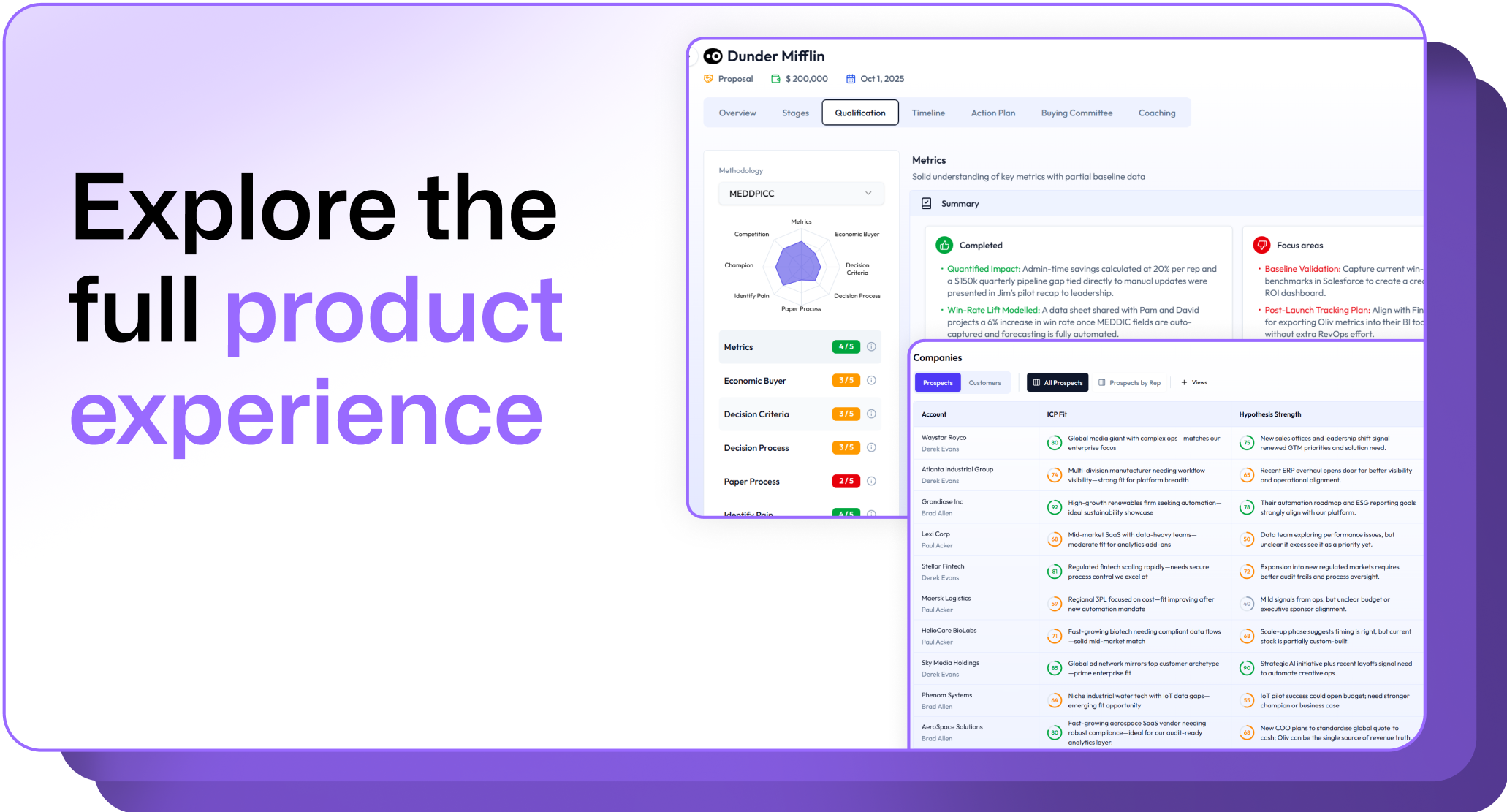
.avif)