I'm always up for a conversation about revenue intelligence, AI agents, or what's actually working (and what's not) across revenue teams.
I'd love to hear your perspective.
Thank you! Your submission has been received!
Oops! Something went wrong while submitting the form.
Meet Oliv’s AI Agents
Hi! I’m, Deal Driver
I track deals, flag risks, send weekly pipeline updates and give sales managers full visibility into deal progress
Hi! I’m, CRM Manager
I maintain CRM hygiene by updating core, custom and qualification fields all without your team lifting a finger
Hi! I’m, Forecaster
I build accurate forecasts based on real deal movement and tell you which deals to pull in to hit your number
Hi! I’m, Coach
I believe performance fuels revenue. I spot skill gaps, score calls and build coaching plans to help every rep level up
Hi! I’m, Prospector
I dig into target accounts to surface the right contacts, tailor and time outreach so you always strike when it counts
Hi! I’m, Pipeline tracker
I call reps to get deal updates, and deliver a real-time, CRM-synced roll-up view of deal progress
Hi! I’m, Analyst
I answer complex pipeline questions, uncover deal patterns, and build reports that guide strategic decisions
TL;DR
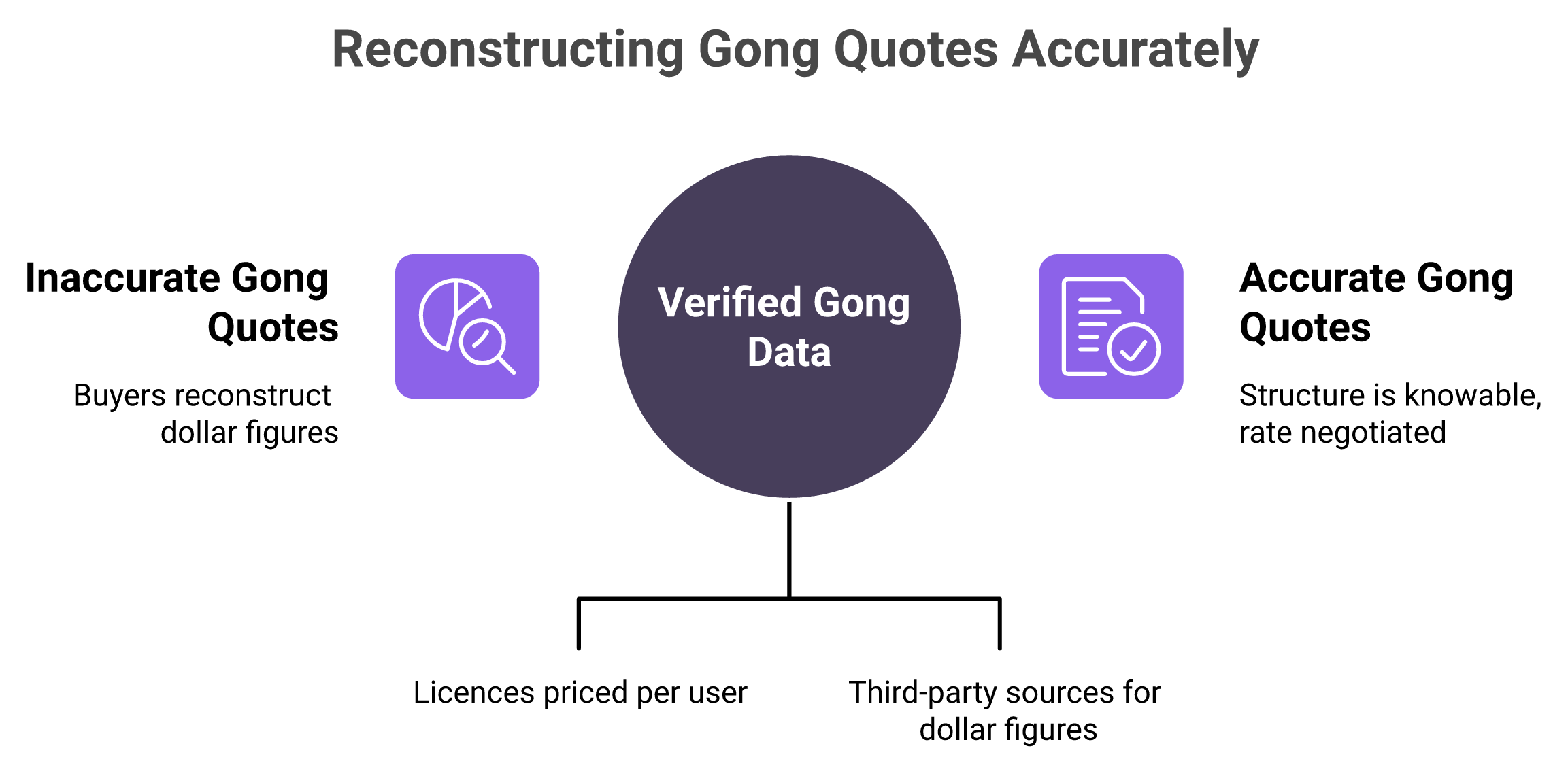
Gong publishes only two pricing facts: licences are priced per user, and a platform fee scales with users supported. Every dollar figure online is buyer reported.
A quote has three layers: per-user licences for core and modules, an annual platform fee of a reported $5,000 to $50,000, and one-time implementation services.
Buyers report core licences at roughly $1,300 to $1,600 per user per year, with reported volume tiers easing toward $1,360 above 250 seats.
The platform fee is regressive. Normalised per user, it can range from about $8 to $83 a month depending entirely on your seat count.
Vendr transaction data across more than 1,100 contracts puts the median Gong deal near $55,040 a year, with roughly 14 percent average discount.
Judge the quote by structure and renewal terms. Reported uplifts of 5 to 15 percent can add $22,800 to $45,000 across two renewals on a 50-seat model.
Q1: What Does Gong Actually Publish About Pricing, and How Is a Quote Built? [toc=1. What Gong Publishes]
Gong publishes two pricing facts and no dollar figures. Its pricing page states that licences are priced per user, and that there is a platform fee based on the number of users supported. It then routes you to a quote form with team size bands of 1 to 50, 51 to 1,000, 1,001 to 9,999, and 10,000 plus (gong.io/pricing, retrieved 7 September 2026). There are no named tiers, no seat minimum, and no contract length. Every quote is still assembled the same way: per user licences, an annual platform fee, and one time services.
A RevOps lead forwarded me a Gong quote last quarter with one line in the email body. "Is this normal?" She had a signed-off budget, a renewal date, and no way to check the number against anything. That is the actual job this page has to do.
💰 What the pricing page actually says
Two sentences carry the whole disclosure. Licences are priced per user. There is a platform fee based on the number of users supported. That is the complete public record.
Everything else you will read online, including every figure in this guide, comes from buyers and third party benchmarks. I am going to label each one. When a number is reported rather than published, you deserve to know which.
⚠️ Why "just tell me the number" is the wrong ask
I know that is what you came for. Refusing to invent one is the point of this page, not a dodge.
Here is the uncomfortable part. With no published rate, you cannot benchmark, so the negotiation starts asymmetric by design. The rep knows the distribution. You know one data point, which is the quote in front of you.
Gong confirms two things about its pricing. Everything else on a quote is reconstructed, which is why the structure matters more than the headline number.
✅ The three layers inside every quote
The structure is knowable even when the rate is not. Read your quote as three separate decisions, not one total.
The Three Cost Layers Inside a Gong Quote
Layer
What it covers
Where this guide prices it
Per user licences
Core Foundation seat, plus Engage and Forecast as separate modules
Sections 2 and 4
Platform fee
Annual charge scaling with users supported, confirmed by Gong
Section 3
One time services
Onboarding, integration, migration, training
Section 6
Only the first two are confirmed by Gong. The third appears on nearly every buyer report, but carries no published schedule.
⏰ The rule to carry into the rest of this guide
Judge a quote by its structure and its renewal terms, not by its headline total. The rate is negotiated, so yours will differ from mine, from your competitor's, and from anything on a comparison blog.
That reframe matters more than it sounds. Two teams with identical seat counts can pay very differently, and neither one is being cheated. What separates them is which layers were scoped, which modules went to every seat, and what the year two language permits.
So work through the layers in order. By the end you will have a first year number, a renewal number, and a list of questions your rep has to answer in writing. For what sits inside a seat before any of this pricing applies, see what Gong actually includes, and for the wider category context, our guide to revenue intelligence platforms sets the frame.
Q2: What Do Buyers Report Paying Per User, and How Do Volume Tiers Work? [toc=2. Per-User Rates & Volume Tiers]
Buyers report Gong core licences at roughly $1,600 per user per year under 50 seats, easing to about $1,520 at 50 to 99, $1,440 at 100 to 249, and $1,360 above 250. Gong publishes none of this. The tiering also matters less than most buyers assume. Moving from 49 seats to 100 saves around $160 per seat, while adding roughly $80,000 of licence spend. Volume discounts reward growth you already planned. They are not a reason to buy seats you do not need.
📊 Read the labelling rule before the table
Every row below is buyer reported. Not one is confirmed by Gong. I am giving you the publisher and the month so you can age the figure yourself.
Treat the table as a distribution your quote sits inside, not a rate card you are being denied. If your number falls outside it, that is information, not an error.
💸 The reported seat ladder
Buyer Reported Gong Core Licence Rates by Seat Band
Seats
Reported core licence
Source
Date
10 to 24
$1,400 to $1,600 per user per year
Claap, MarketBetter
Aug 2026
25 to 49
$1,300 to $1,600
MarketBetter, CloudTalk
Aug 2026
50 to 99
$1,300 to $1,520
CloudTalk, PitchMonster
Aug 2026
100 to 249
$1,300 to $1,440
PitchMonster, Coworker citing Vendr
Aug 2026
250 plus
$1,300 to $1,360
Coworker citing Vendr
Aug 2026
Under ten seats, no reliable figure exists. Above 500, published reporting thins out again.
⚠️ Why the tier saving is smaller than it looks
Run the arithmetic before you use tiers as leverage. At 49 seats and $1,600, licences cost about $78,400. At 100 seats and $1,440, they cost $144,000.
You saved $160 per seat and spent $65,600 more. That is fine if you were hiring anyway. It is a poor reason to inflate a seat count, and I have watched teams talk themselves into exactly that.
⭐ What buyers say out loud
The structure has been stable for years, which is why old threads still hold up.
That post is six years old and still describes the same two layer shape you will see on a 2026 quote. The rate moved. The architecture did not.
✅ What to ask when your rate sits high
Do not open with "this is too expensive." Open with a question about inclusions.
Ask which modules are inside the quoted per seat figure, whether the rate is held for the full term, and what it becomes if you add ten seats in month seven. Mid term additions usually price at your original tier, not the next band. Then ask what the same configuration looks like at your renewal date, in writing. If your seat count is small, our breakdown of revenue intelligence for small sales teams covers what changes at that scale.
Q3: What Is the Gong Platform Fee, and Who Does It Hurt Most? [toc=3. Platform Fee Explained]
The platform fee is the only non seat charge Gong confirms exists, though it publishes no schedule. Buyers report between $5,000 and $50,000 a year, scaling with headcount bands. The figure that decides whether it matters is the fee divided by your seat count. Ten thousand dollars is $200 per user across 50 seats, and $1,000 per user across 10. That is a regressive charge. The smaller your team, the more of your per rep cost is entry fee rather than software.
💰 The line item nobody questions
It usually sits near the bottom of the quote, under the seat maths, in a smaller font. Finance approves the total. Nobody normalises the fee.
I have done this badly myself. Early on, I approved a platform charge on a tool for a nine person team and never converted it to a per head number. It was the single most expensive line in the contract, and I had treated it as an administrative detail.
❌ What a flat entry cost does to a small team
Under about 30 seats, the fee stops being overhead and starts being the price. Your cost per rep is no longer a licence rate. It is a licence rate plus a fixed toll divided by however few people you have.
To be fair to Gong, a platform fee is not a hidden cost once it is disclosed, and Gong does disclose that one exists on its official pricing page. The problem is not concealment. It is that most buyers never do the division.
⚙️ What the fee buys in a modular, metered product
The category changed underneath this line item. When Gong was one product, the fee read as setup and infrastructure. Now the platform is sold as a core licence plus separate modules, with AI usage metered in credits since 2026.
So the fee increasingly buys access rather than capability. Capability arrives through the modules you add and the credits you consume. That is worth knowing before you accept it as fixed. For the stack level view of how these charges compound, see our analysis of revenue tech stack consolidation costs.
✅ Normalise it in one line of arithmetic
Take the quoted fee, divide by your seat count, then divide by twelve. That is your entry cost per rep per month, before a single licence.
Reported Gong Platform Fee Normalised Per User Per Month
Seats
Reported fee
Effective per user per month
10
$5,000
$42
25
$5,000 to $10,000
$17 to $33
50
$10,000 to $25,000
$17 to $42
100
$10,000 to $40,000
$8 to $33
Reported bands from Coworker AI citing Vendr transaction data, Aug 2026. Add that figure to your seat rate before you compare Gong to anything else. Most comparison tables online quietly skip this step.
On negotiation, set expectations honestly. Reported outcomes concentrate on seat rates and module discounts, not on the fee itself. Push where the elasticity actually is.
Oliv AI publishes a per seat ladder on its own website with no separate platform tier sitting underneath it, so the seat price is the whole software line. I am not claiming that produces a lower total for you, because that depends entirely on seat count and which modules you need. The difference worth noting is verifiability: you can read one number before a call, and you have to request the other. Our guide to reducing sales tech stack costs walks through how to run that comparison properly.
Q4: What Did Modularisation Change, and Can You Buy Engage or Forecast on Their Own? [toc=4. Modules & Bundling]
Gong's platform is now sold as a core Foundation licence, with Engage and Forecast priced as separate per user modules. Buyers report Engage between roughly $530 and $800 per user per year, and Forecast between $206 and $700, both on top of the core seat. Whether a module can be bought without the core licence is reported as no, but Gong publishes no such rule, so treat it as a quote specific term rather than a policy. The practical consequence is simple. Price modules against the seats that genuinely need them.
🧩 One product became three line items
The reader I described in section one had budgeted for a conversation intelligence tool. Her quote came back with three per user lines and a fee.
Nothing improper happened. The product was repackaged, and the quote reflected the packaging. She had just built her budget on the old shape.
"The additional products like forecast or engage come at an additional cost." — Scott T., Gong G2 Verified Review
❌ The all seats default is the expensive habit
Reps quote modules across the full seat count because it is the simplest configuration to build. Buyers accept it because unbundling feels like haggling.
Run the numbers before you accept. Forecast at $500 per user across 50 seats is $25,000. Applied to the eight people who actually run the forecast call, it is $4,000. That gap is usually the largest avoidable line on the whole quote.
⚠️ Paying for surface area you never open
This is the most common complaint I hear, and it predates the repackaging.
Breadth is genuinely a strength of the product. It becomes a cost problem only when procurement buys the breadth and adoption never reaches it. Those are two different failures, and only one of them is the vendor's. Our summary of Gong user reviews covers where that pattern shows up most.
🔄 Why the whole category went modular
Every serious revenue platform now sells this way, because buyers stopped accepting one bundled number. Modularity is a response to exactly the pushback in those reviews.
The honest read is that modular pricing is better for buyers who scope carefully, and worse for buyers who do not. It moves the decision from "do we buy this" to "who inside our team needs which piece," and that second question requires actual work.
📌 Map modules to roles before the next call
Write three columns on paper. Roles, the job each role needs done, and the module that does it.
Forecast usually belongs to managers, RevOps, and the leader who owns the number, not to every AE.
Engage belongs to the people doing outbound sequencing, which is rarely the full revenue org.
Core seats belong to anyone whose calls need recording and analysis.
Then ask your rep to quote each module against that seat count. Ask separately whether a module can be dropped at renewal without repricing the core. For deeper detail on the modules themselves, see Gong Engage and Gong forecasting.
Oliv AI lists its modules on a public per seat ladder that a buyer can read before speaking to anyone, and it runs as a layer on top of your existing CRM rather than replacing it. That is the comparison this guide can actually verify, and it is a difference in disclosure, not a claim about which bundle costs less. Whether the modules you need map more cleanly to one ladder or the other is a question only your role map answers. If you are weighing the full switch, our Gong alternatives comparison handles that decision separately.
Q5: What Are Gong Credits, and What Do They Change About a Seat? [toc=5. Credits & Metering]
Gong meters AI usage in credits. Per its official help documentation, ten emails consume one credit, and a call longer than ten minutes consumes one credit. Credits draw from a shared company pool, monthly caps do not roll over, and the API returns an error at zero. Gong states existing agreements are unchanged, so this is documented metering rather than a contract change. It does mean a seat no longer buys a fixed amount of capability. Model year two against your actual call and email volume, not your headcount, because two teams of the same size can consume very differently.
⚙️ What actually consumes a credit
The unit is activity, not people. Transcription, coaching actions, the AI assistant, and the AI agents all draw down the same pool.
That is a real shift in what you are buying. A licence used to be a door key. Now it is a door key plus a fuel gauge, and the gauge is shared across your whole company.
⚠️ The four mechanics that decide your exposure
Read these as a set, because they interact.
Shared pool. Credits sit at company level, not per user. One heavy team can drain the allowance for everyone.
Monthly caps. Consumption is capped by month, and unused credits do not carry forward.
No rollover. A quiet quarter does not bank capacity for a busy one.
Zero state. The API returns an error when the pool is empty, so automations stop rather than degrade.
Reported allowances sit near 2,000 credits per seat per year, and the introduction date is reported as 2 June 2026. Both figures come from third party reporting, not from a Gong published source, so treat them as directional. Our overview of what Gong actually includes covers which of those features draw on the pool.
💸 Same seat count, very different consumption
Two 40 seat teams, side by side. Team A runs enterprise deals with long discovery calls and heavy sequencing. Team B runs mid market with short calls and light email.
Team A burns through calls over ten minutes almost every session, and its outbound volume adds credits on top. Team B rarely crosses either threshold. Identical licence spend, very different headroom, and only one of them will feel the cap.
⏰ The thirty second estimate
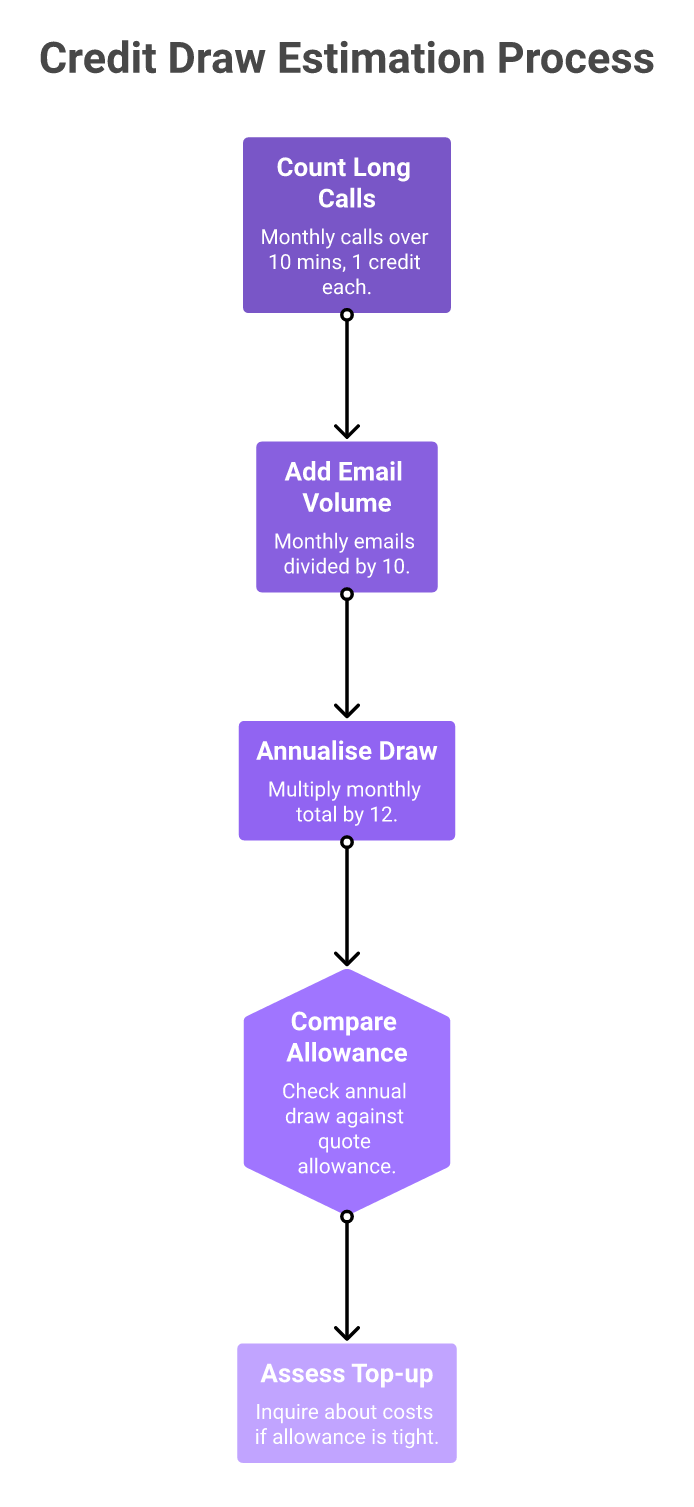
Do this before your next call with the vendor. Count your monthly calls that run longer than ten minutes. Add your monthly outbound email volume divided by ten.
That total is your rough monthly credit draw. Multiply by twelve, then compare it against whatever allowance appears in your quote. If the two numbers are close, ask what a top up costs, and whether the price is fixed for the term.
Credit metering means a seat is no longer a fixed unit of capability. These four steps give you an annual draw estimate before your next vendor call.
✅ Where to put this in your model
Treat credits as a variable line, not a fixed one. In section 7 you will build a three year total, and this is the input most likely to move between year one and year three.
I want to be fair here. Metering is not a trick, and Gong has documented it openly. My honest read is that it is a reasonable way to price AI compute, and also a genuine change in what a seat guarantees. Both things are true.
Oliv AI prices per seat on a published ladder with no usage meter layered on top, so year two is seats multiplied by the published rate. That makes forecasting simpler, and it also means heavy users and light users pay the same, which suits some teams and not others. For the broader shift this reflects, see our piece on AI agents versus SaaS dashboards.
What Varies Year to Year Under Each Pricing Model
Model
What varies year to year
Where you check it
Gong
Seats, modules, and credit consumption
Quote plus help documentation
Oliv AI
Seats and modules only
Public per seat ladder
Q6: What Do Implementation, Onboarding, and Compliance Setup Add to Year One? [toc=6. Implementation & Setup Costs]
Gong publishes no implementation pricing. Buyers report basic onboarding near $7,500, standard implementation between $7,500 and $15,000, and enterprise deployments from roughly $28,500 to $65,000. Whether services are mandatory is reported inconsistently and is not confirmed by Gong. Budget separately for compliance configuration, because all party consent applies across a dozen or more US states and most EU jurisdictions, and EU AI Act Article 50 disclosure obligations apply from 2 August 2026. These are year one costs only, which is exactly why comparing vendors on year one misleads.
💰 The reported services bands
Every figure below is buyer reported, not published.
Buyer Reported Gong Implementation and Onboarding Costs
Service
Reported cost
Source and date
Basic onboarding
About $7,500 one time
PitchMonster, Aug 2026
Standard implementation
$7,500 to $15,000
MaxIQ, Apr 2026
Enterprise implementation
$28,500 to $65,000
PitchMonster, Aug 2026
Historical data migration
No reliable public figure
Not found
Notice the last row. Migration is the item most likely to surprise you, and it is the item with the least public data. Our guide to migrating away from Gong covers the same problem in the other direction.
⚠️ The line item no pricing page mentions
Recording software has a legal configuration, and someone has to do that work. It is not free just because it is not on the quote.
Three things need setting up before go live. Consent capture that matches every jurisdiction your reps sell into. A retention policy, since indefinite storage of recorded calls is a liability rather than an asset. And regional recording rules, because California and most of the EU default to all party consent. For how those controls are usually documented, see our breakdown of Gong DPA and security terms.
⚖️ Why this got more expensive in 2026
EU AI Act Article 50 disclosure obligations took effect on 2 August 2026. Separately, GDPR Article 13 transparency duties apply regardless of your lawful basis for recording.
None of that makes Gong harder to buy than any competitor. It applies to the whole category. It does mean your year one budget needs a legal and admin line, and I have watched teams discover that line three weeks before launch. Our mid market governance buyer guide sets out what to ask for.
✅ What to demand in the scope of work
Ask for the document, not just the number. A price without a scope is not a quote; it is a placeholder.
Four things belong in writing:
Which CRM and calendar integrations are included, and which are billed separately.
Whether historical call data is backfilled, and how far back.
How many admin and manager training sessions are covered.
What "go live support" actually means in days and named hours.
⏰ Strip it out before you compare vendors
Services are a one time cost. Leave them inside your year one total, and every comparison you run will be distorted.
Run two numbers instead. Year one including services, and steady state excluding them. The second number is the one that repeats for as long as you own the tool, and it is the one your CFO will care about in eighteen months.
For deployment duration, staffing, and what a realistic go live timeline looks like, see our Gong implementation timeline breakdown. This section prices the work. That one sequences it.
Q7: How Do You Build a Year One, Year Two, and Year Three Total From Your Own Quote? [toc=7. Building Your Cost Model]
Build it in four lines. Core seats times your quoted rate. Modules times only the seats that need them. The platform fee as quoted. One time services. Year one is all four, and years two and three are the first three, adjusted by whatever uplift your contract permits. Buyers commonly report 5 to 15 percent annually, though Gong publishes no such term. Run the model twice, at current headcount and at headcount plus twenty percent, because mid term seat additions price at your original tier. A quote that looks reasonable in year one can look very different by year three.
🧮 The four lines
Write them down in this order, and resist the urge to combine them.
Core licences. Seats multiplied by your quoted per seat rate.
Modules. Each module multiplied by the seats that genuinely need it, from your role map in section 4.
Platform fee. Exactly as quoted, not estimated.
Services. One time only, and never carried into year two.
💰 One worked example, carried forward
Here is a 50 seat model using mid band reported inputs. Every figure is buyer reported, not published by Gong.
Worked 50 Seat Gong Cost Model, Year One
Line
Inputs
Year 1
Core licences
50 seats at $1,450
$72,500
Forecast module
10 seats at $500
$5,000
Platform fee
Mid band for this seat range
$15,000
Implementation
Standard band
$12,000
Total
-
$104,500
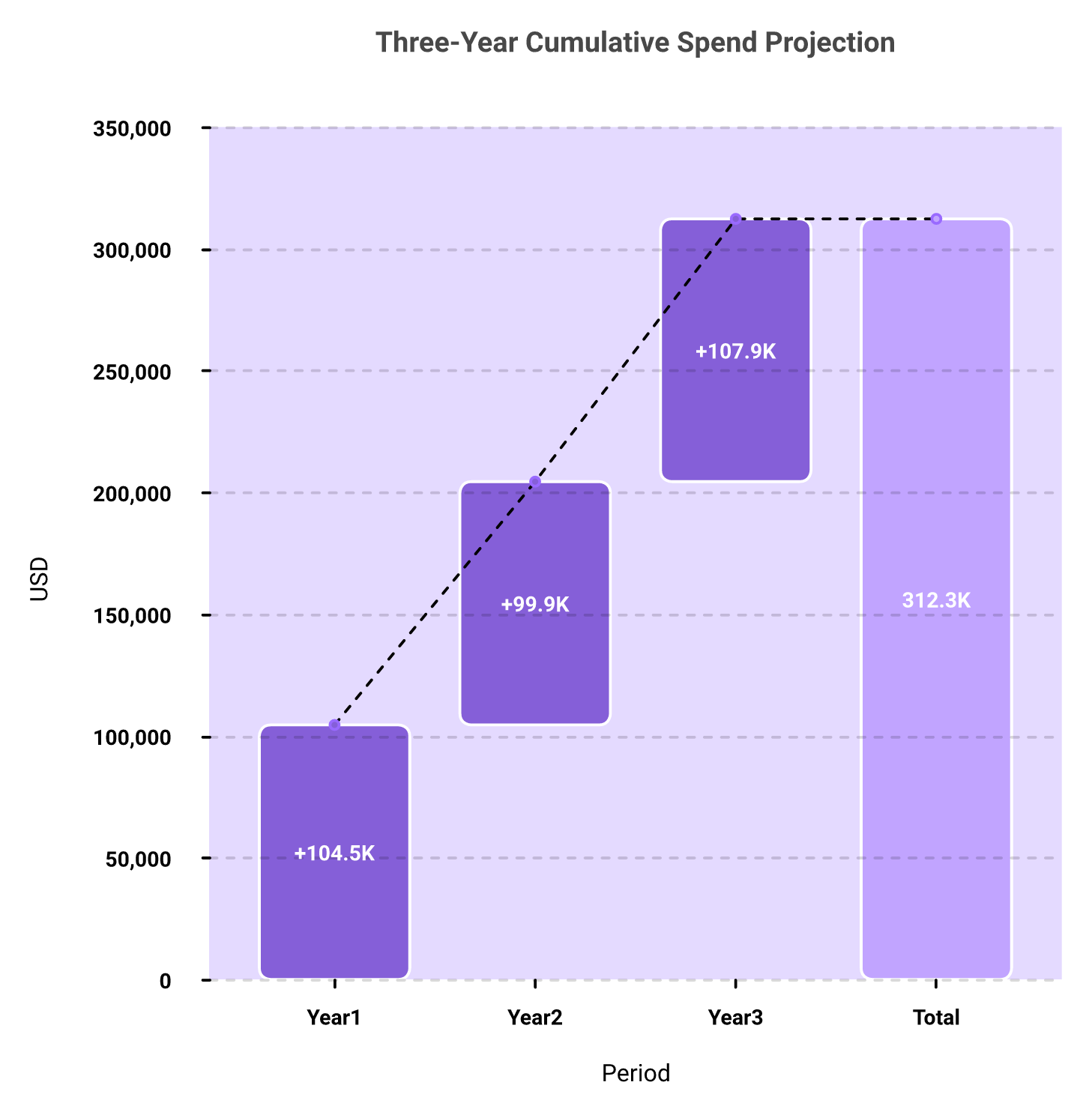
Recurring spend is $92,500, because services drop out. Apply an 8 percent uplift and year two becomes $99,900. Year three becomes $107,892. Three year total: $312,292.
Year one is the number most buyers compare. The uplift on years two and three is where the contract actually gets expensive.
That is the same model I will hold to everywhere on this page. One set of inputs, one arithmetic, no second version that quietly disagrees with the first. If you want to run the same exercise against expected return, our revenue intelligence ROI calculator uses the same structure.
❌ The three mistakes I see most
These are not exotic errors. They are the default way most people build the number.
Averaging modules across all seats. It inflates the total and hides where the negotiation leverage sits.
Ignoring the platform fee in per user maths. At 50 seats, that $15,000 adds $300 per user per year, or $25 a month.
Comparing year one against year one. Services distort it. Compare steady state.
⚠️ Run it a second time at plus twenty percent
Growth is where models break. Add ten seats in month seven, and they usually price at your original tier, not the next discount band.
So model 60 seats at the 50 seat rate. If the gap between that and the band you expected is uncomfortable, negotiate the growth rate now, while you still have leverage. After signature, you are a renewal. Our guide to scaling revenue operations covers how fast those seat counts usually move.
⏰ What years two and three actually cost you
The uplift is the quiet driver. On this model, an 8 percent annual increase adds about $22,800 across two renewals, with nothing new delivered for it.
Fifteen percent would add roughly $45,000 over the same period. That is the difference between a manageable renewal and a board conversation. For how uplift clauses, notice periods, and renewal leverage actually work, see our guide to Gong pricing and contract terms.
Q8: What Can You Actually Negotiate, and What Is a Normal Outcome? [toc=8. Negotiation Benchmarks]
Vendr's marketplace transaction data, drawn from over 1,100 recorded Gong transactions, puts the median annual contract near $55,040, with an average discount around 14 percent, and an observed range from about $11,184 to $204,033. That median is the most useful anchor available, because it reflects what buyers with procurement support actually signed. Reported elasticity sits in seat rates and modules rather than the platform fee. Open against the median for your seat band rather than against the quoted rate, and unbundle the modules so each one is discounted on its own merits.
⚖️ The asymmetry is structural, not personal
Your rep knows the full distribution of what buyers pay. You know one number, which is the quote in front of you.
That is not a criticism of Gong. No published rate card means no shared reference point, and the side with more data wins more of those conversations. The fix is not outrage. It is getting a reference point.
❌ Why "this is too expensive" goes nowhere
I have made this mistake and watched it fail. Pushing back on a total, with nothing behind the push, reads as a bluff, and experienced reps treat it as one.
Worse, it invites the wrong concession. You will be offered a longer term or a bigger bundle at a better unit rate, and your total spend will go up while your discount percentage looks better on paper. Our piece on handling objections in sales explains why that trade works so reliably from the other side of the table.
📊 What changed: transaction data became checkable
Procurement marketplaces now publish what buyers actually signed, at real sample sizes. Vendr's Gong figures rest on more than a thousand contracts, not a handful of anecdotes.
That is a genuine shift in buyer leverage, and it happened in the last three or four years. A median with a sample size attached is a very different instrument from a competitor blog quoting a range with no source.
✅ The levers, ordered by reported movement
Push where the elasticity actually is.
Reported Gong Negotiation Levers and Typical Movement
Lever
Reported movement
Notes
Add on modules
14 to 54 percent off list
Highest reported flexibility
Core seat rate
Negotiated $1,000 to $1,349 against $1,600 list
Strong, but slower
Multi year commitment
8 to 13 percent for three years
Trades flexibility for rate
Renewal uplift cap
Case by case
Ask for 3 to 5 percent in writing
Platform fee
Little reported movement
Focus elsewhere
Reported outcomes concentrate near calendar year end, when quota pressure peaks. Timing your signature is a real lever, and it costs you nothing.
⚠️ Where the median stops being useful
I want to be careful with this number, because it is easy to over read. Vendr's buyers are self selected and procurement assisted, so they are probably better negotiators than average.
The median is an anchor, not an entitlement. If your quote sits above it, that is a question to ask, not proof of anything. And if you have 12 seats, a median drawn largely from mid market and enterprise contracts tells you very little about your own band.
So use it as an opening frame. Then negotiate on structure, because that is the part of the deal you can still change after the rate is set. If the structure itself is the problem, our comparison of Gong alternatives is the next place to look.
Q9: What Should You Verify in the Quote Before You Sign? [toc=9. Quote Evaluation Criteria]
Verify nine things. What the seat includes, and whether credits are capped. Which modules are line items, and which were only verbally promised. How the platform fee responds if headcount changes. Contract length and prepayment terms. Any renewal uplift language, and whether it is capped in writing. Notice period for non renewal. Early termination exposure. Implementation scope in writing, not just its price. And your data out path on exit, because Gong's MCP server exposes three tools and returns a synthesized answer rather than raw activity data. Confirm your export route before you build on it.
📋 Structure tells you more than the total
A total is one number that hides ten decisions. The structure underneath it is where your next three years get decided.
I read quotes from the bottom up now. The terms at the end usually cost more over time than the rate at the top.
✅ The nine things to confirm in writing
Ask each of these as a question on the call, then get the answer into the document.
What does a seat include? Good looks like a written list of features, plus the credit allowance and what happens at the cap.
Which modules are line items? Good looks like every module priced separately, with nothing "included for now."
What happens to the platform fee if headcount moves? Good looks like a stated band, and the trigger point where the fee changes.
How long is the term, and when do we pay? Good looks like the term in months, and payment terms you have actually agreed with finance.
Is there renewal uplift language? Good looks like a written cap, ideally 3 to 5 percent, not silence.
What is the notice period? Good looks like a date in your calendar the day you sign, not a clause you find later.
What is our exposure if we exit early? Good looks like a number you can state out loud, not a formula.
What is in the implementation scope? Good looks like integrations, backfill depth, and training sessions itemised.
How do we get our data out? Good looks like a documented export path you have tested, not an assurance.
⚠️ The exit question people skip
Item nine is the one that gets waved through. It is also the one you cannot fix later.
Gong's MCP server, which is the interface AI tools use to query it, exposes three tools and returns a synthesized answer. That is a design choice, not a flaw. It does mean you should confirm exactly which export gives you raw call and activity data, and in what format, before you depend on it downstream. Our overview of Gong integrations covers which connections carry data in both directions, and Gong DPA and security terms covers where that data sits.
⭐ What buyers say about paying for surface area
Breadth is a real strength of the product. It becomes a cost problem only when procurement buys more than adoption reaches.
That single line is the argument for item one on the list. If you cannot say what a seat includes, you cannot say what you are not using. Our summary of Gong limitations and challenges collects where that pattern bites hardest.
⏰ Ask the growth question before signature
Say this sentence on the call. "If we add ten seats in month seven, what do those seats cost, and does the platform fee move?"
The answer tells you how the vendor prices growth, and whether your model in section 7 holds. After signature you are a renewal, and renewals negotiate from a weaker position.
Q10: Does the Return Justify the Price, and When Is Gong the Right Spend? [toc=10. Is Gong Worth It]
Gong's most cited ROI evidence is a Forrester Consulting Total Economic Impact study reporting 481 percent three year return, $12.1M in benefits against $2M in costs, and around $10M net present value. It was commissioned by Gong and modelled on a composite organisation, not a real customer. Treat it as a framework to re run with your own numbers, not as a result. Gong is the right spend when analysis depth across a large, mature org is the problem, and your seat count dilutes the platform fee. Gong leads this market, at over $500M ARR and more than 5,000 customers.
💰 Your real default is "expensive but it works"
Most readers here are not looking for permission to leave. They want to know whether the bill is fair.
That default is reasonable. Switching a recording and coaching platform mid contract is disruptive, and anyone who tells you otherwise is selling something.
⚠️ How to read a vendor commissioned ROI study
The Forrester study is a real piece of research with a real methodology. It is also sponsored, and the composite organisation is an analytical construct rather than a customer you could call.
So rebuild it. Substitute three inputs: your average deal size, your current win rate, and the number of reps who will actually use the coaching features. If the model still clears your hurdle rate on your numbers, that is a genuine signal. Our revenue intelligence ROI calculator uses the same three inputs.
✅ When the spend clearly makes sense
Gong earns its price in specific conditions, and I say that as a competitor.
You have enough seats that the platform fee falls below roughly $200 per user per year.
Conversation analysis depth, not activity capture, is the problem you are solving.
Managers actually run coaching sessions, so the analysis reaches a human decision.
The product has broad third party validation, with a 4.7 out of 5 rating across more than 6,000 G2 reviews.
❌ Three signals it no longer makes sense
Run these against the model you built in section 7.
Licence utilisation is under 60 percent, and you are paying for seats that never open the product.
You bought modules across the whole team to solve a workflow that touches eight people.
The platform fee is more than 15 percent of your total, which usually means your seat count is too small for this pricing shape.
Whether Gong is worth the price depends on two variables: how many seats dilute the platform fee, and whether conversation depth is genuinely the problem.
⏰ Renegotiate before you replace
Here is the part a competitor is not supposed to write. If you are mid contract and your team is getting value, renegotiate. Do not replace.
The switching cost is real. Historical call data, manager habits, and integration work all carry over badly. A pricing page that pretends switching is free is exactly why buyers stopped trusting pricing pages. If you do decide to move, our guide to migrating from Gong sets out what actually transfers.
Oliv AI is worth a look in one situation. When the modules you need are narrower than the bundle you were quoted, and you want a per seat number you can check before booking a call. It sits on top of your existing CRM as a layer, never as a replacement for it, which is why teams can run it alongside Gong inside an existing contract term rather than waiting for a renewal date. For the full switching comparison, see our Gong alternatives guide.
Q11: What Are the Cheaper Alternatives to Gong, and Where Does Oliv AI Fit? [toc=11. Alternatives & Where Oliv Fits]
The realistic alternative set is Oliv AI, Avoma, Chorus inside ZoomInfo, Clari for forecasting led buyers, and Salesloft or Outreach where engagement is the primary job. Oliv AI publishes a per seat ladder on its own website rather than routing every buyer to a quote form, which means you can compare its number against your Gong quote today without a call. That is the single most checkable difference in this category. The honest counterweight is that Oliv AI is the least publicly proven option listed here, with no G2, Capterra, or TrustRadius profile, and case studies behind an email gate.
🎯 You are replacing a job, not a logo
Before you shortlist anything, write down the one job you are actually buying. Call analysis. Forecast roll up. Sequencing. Coaching.
Most teams write down three, then buy a platform that does nine. That is how a $60,000 problem becomes a $140,000 contract. Our comparison of revenue intelligence versus conversation intelligence is the fastest way to name which job you are buying.
❌ Feature grids are the wrong tool at quote stage
Every vendor in this list will win a feature comparison you let them design. Grids reward breadth, and breadth is what you are trying to stop paying for.
Compare on two axes instead. Does it do your one job well, and can you verify its price before a sales call? The second question eliminates more options than the first.
🔄 What actually shifted in this category
Published, modular pricing is spreading. Avoma publishes tiers. Salesloft and Outreach publish partial structures. Clari and Gong remain quote only.
That is a response to buyer pressure, not generosity. My read is that the vendors publishing prices are betting their numbers survive comparison, and the ones withholding are betting yours will not be compared. For the two most common head to head calls, see Gong versus Clari and Gong versus Avoma.
Pricing Disclosure and Primary Job by Vendor
Vendor
Pricing disclosure
Primary job
Oliv AI
Per seat ladder published on site
Revenue intelligence and agent execution on a CRM layer
Gong
Quote form, two facts published
Conversation and revenue intelligence at depth
Avoma
Published tiers
Meeting assistance and conversation intelligence
Clari
Quote only
Forecasting and pipeline management
Salesloft or Outreach
Partial public structure
Engagement and sequencing
⚠️ The concession I have to make plainly
Oliv AI has no G2, Capterra, or TrustRadius profile at Gong's scale, and its case studies sit behind an email gate. I am not going to dress that up.
If third party review volume is your primary risk control, that gap should count against us. Gong has more than 6,000 public reviews and a 4.7 rating. That is a real advantage, and it took years to build. Our roundup of Gong user reviews reads them in detail.
✅ How to test the claim yourself
Do not take my word on the transparency point. Open your Gong quote, then open the Oliv AI pricing ladder, and see whether you can compare them without a call.
That test takes four minutes, and it settles the argument either way. If you want to see how the layer sits on a live Salesforce or HubSpot opportunity before deciding, book a demo and bring your actual quote to the call. For how the switching decision plays out in practice, our Gong versus Oliv comparison handles it properly, and AI for revenue operations covers the operational side. You came here to find out whether your number was normal. You should leave able to interrogate it yourself.
Q1: What Does Gong Actually Publish About Pricing, and How Is a Quote Built? [toc=1. What Gong Publishes]
Gong publishes two pricing facts and no dollar figures. Its pricing page states that licences are priced per user, and that there is a platform fee based on the number of users supported. It then routes you to a quote form with team size bands of 1 to 50, 51 to 1,000, 1,001 to 9,999, and 10,000 plus (gong.io/pricing, retrieved 7 September 2026). There are no named tiers, no seat minimum, and no contract length. Every quote is still assembled the same way: per user licences, an annual platform fee, and one time services.
A RevOps lead forwarded me a Gong quote last quarter with one line in the email body. "Is this normal?" She had a signed-off budget, a renewal date, and no way to check the number against anything. That is the actual job this page has to do.
💰 What the pricing page actually says
Two sentences carry the whole disclosure. Licences are priced per user. There is a platform fee based on the number of users supported. That is the complete public record.
Everything else you will read online, including every figure in this guide, comes from buyers and third party benchmarks. I am going to label each one. When a number is reported rather than published, you deserve to know which.
⚠️ Why "just tell me the number" is the wrong ask
I know that is what you came for. Refusing to invent one is the point of this page, not a dodge.
Here is the uncomfortable part. With no published rate, you cannot benchmark, so the negotiation starts asymmetric by design. The rep knows the distribution. You know one data point, which is the quote in front of you.
Gong confirms two things about its pricing. Everything else on a quote is reconstructed, which is why the structure matters more than the headline number.
✅ The three layers inside every quote
The structure is knowable even when the rate is not. Read your quote as three separate decisions, not one total.
The Three Cost Layers Inside a Gong Quote
Layer
What it covers
Where this guide prices it
Per user licences
Core Foundation seat, plus Engage and Forecast as separate modules
Sections 2 and 4
Platform fee
Annual charge scaling with users supported, confirmed by Gong
Section 3
One time services
Onboarding, integration, migration, training
Section 6
Only the first two are confirmed by Gong. The third appears on nearly every buyer report, but carries no published schedule.
⏰ The rule to carry into the rest of this guide
Judge a quote by its structure and its renewal terms, not by its headline total. The rate is negotiated, so yours will differ from mine, from your competitor's, and from anything on a comparison blog.
That reframe matters more than it sounds. Two teams with identical seat counts can pay very differently, and neither one is being cheated. What separates them is which layers were scoped, which modules went to every seat, and what the year two language permits.
So work through the layers in order. By the end you will have a first year number, a renewal number, and a list of questions your rep has to answer in writing. For what sits inside a seat before any of this pricing applies, see what Gong actually includes, and for the wider category context, our guide to revenue intelligence platforms sets the frame.
Q2: What Do Buyers Report Paying Per User, and How Do Volume Tiers Work? [toc=2. Per-User Rates & Volume Tiers]
Buyers report Gong core licences at roughly $1,600 per user per year under 50 seats, easing to about $1,520 at 50 to 99, $1,440 at 100 to 249, and $1,360 above 250. Gong publishes none of this. The tiering also matters less than most buyers assume. Moving from 49 seats to 100 saves around $160 per seat, while adding roughly $80,000 of licence spend. Volume discounts reward growth you already planned. They are not a reason to buy seats you do not need.
📊 Read the labelling rule before the table
Every row below is buyer reported. Not one is confirmed by Gong. I am giving you the publisher and the month so you can age the figure yourself.
Treat the table as a distribution your quote sits inside, not a rate card you are being denied. If your number falls outside it, that is information, not an error.
💸 The reported seat ladder
Buyer Reported Gong Core Licence Rates by Seat Band
Seats
Reported core licence
Source
Date
10 to 24
$1,400 to $1,600 per user per year
Claap, MarketBetter
Aug 2026
25 to 49
$1,300 to $1,600
MarketBetter, CloudTalk
Aug 2026
50 to 99
$1,300 to $1,520
CloudTalk, PitchMonster
Aug 2026
100 to 249
$1,300 to $1,440
PitchMonster, Coworker citing Vendr
Aug 2026
250 plus
$1,300 to $1,360
Coworker citing Vendr
Aug 2026
Under ten seats, no reliable figure exists. Above 500, published reporting thins out again.
⚠️ Why the tier saving is smaller than it looks
Run the arithmetic before you use tiers as leverage. At 49 seats and $1,600, licences cost about $78,400. At 100 seats and $1,440, they cost $144,000.
You saved $160 per seat and spent $65,600 more. That is fine if you were hiring anyway. It is a poor reason to inflate a seat count, and I have watched teams talk themselves into exactly that.
⭐ What buyers say out loud
The structure has been stable for years, which is why old threads still hold up.
That post is six years old and still describes the same two layer shape you will see on a 2026 quote. The rate moved. The architecture did not.
✅ What to ask when your rate sits high
Do not open with "this is too expensive." Open with a question about inclusions.
Ask which modules are inside the quoted per seat figure, whether the rate is held for the full term, and what it becomes if you add ten seats in month seven. Mid term additions usually price at your original tier, not the next band. Then ask what the same configuration looks like at your renewal date, in writing. If your seat count is small, our breakdown of revenue intelligence for small sales teams covers what changes at that scale.
Q3: What Is the Gong Platform Fee, and Who Does It Hurt Most? [toc=3. Platform Fee Explained]
The platform fee is the only non seat charge Gong confirms exists, though it publishes no schedule. Buyers report between $5,000 and $50,000 a year, scaling with headcount bands. The figure that decides whether it matters is the fee divided by your seat count. Ten thousand dollars is $200 per user across 50 seats, and $1,000 per user across 10. That is a regressive charge. The smaller your team, the more of your per rep cost is entry fee rather than software.
💰 The line item nobody questions
It usually sits near the bottom of the quote, under the seat maths, in a smaller font. Finance approves the total. Nobody normalises the fee.
I have done this badly myself. Early on, I approved a platform charge on a tool for a nine person team and never converted it to a per head number. It was the single most expensive line in the contract, and I had treated it as an administrative detail.
❌ What a flat entry cost does to a small team
Under about 30 seats, the fee stops being overhead and starts being the price. Your cost per rep is no longer a licence rate. It is a licence rate plus a fixed toll divided by however few people you have.
To be fair to Gong, a platform fee is not a hidden cost once it is disclosed, and Gong does disclose that one exists on its official pricing page. The problem is not concealment. It is that most buyers never do the division.
⚙️ What the fee buys in a modular, metered product
The category changed underneath this line item. When Gong was one product, the fee read as setup and infrastructure. Now the platform is sold as a core licence plus separate modules, with AI usage metered in credits since 2026.
So the fee increasingly buys access rather than capability. Capability arrives through the modules you add and the credits you consume. That is worth knowing before you accept it as fixed. For the stack level view of how these charges compound, see our analysis of revenue tech stack consolidation costs.
✅ Normalise it in one line of arithmetic
Take the quoted fee, divide by your seat count, then divide by twelve. That is your entry cost per rep per month, before a single licence.
Reported Gong Platform Fee Normalised Per User Per Month
Seats
Reported fee
Effective per user per month
10
$5,000
$42
25
$5,000 to $10,000
$17 to $33
50
$10,000 to $25,000
$17 to $42
100
$10,000 to $40,000
$8 to $33
Reported bands from Coworker AI citing Vendr transaction data, Aug 2026. Add that figure to your seat rate before you compare Gong to anything else. Most comparison tables online quietly skip this step.
On negotiation, set expectations honestly. Reported outcomes concentrate on seat rates and module discounts, not on the fee itself. Push where the elasticity actually is.
Oliv AI publishes a per seat ladder on its own website with no separate platform tier sitting underneath it, so the seat price is the whole software line. I am not claiming that produces a lower total for you, because that depends entirely on seat count and which modules you need. The difference worth noting is verifiability: you can read one number before a call, and you have to request the other. Our guide to reducing sales tech stack costs walks through how to run that comparison properly.
Q4: What Did Modularisation Change, and Can You Buy Engage or Forecast on Their Own? [toc=4. Modules & Bundling]
Gong's platform is now sold as a core Foundation licence, with Engage and Forecast priced as separate per user modules. Buyers report Engage between roughly $530 and $800 per user per year, and Forecast between $206 and $700, both on top of the core seat. Whether a module can be bought without the core licence is reported as no, but Gong publishes no such rule, so treat it as a quote specific term rather than a policy. The practical consequence is simple. Price modules against the seats that genuinely need them.
🧩 One product became three line items
The reader I described in section one had budgeted for a conversation intelligence tool. Her quote came back with three per user lines and a fee.
Nothing improper happened. The product was repackaged, and the quote reflected the packaging. She had just built her budget on the old shape.
"The additional products like forecast or engage come at an additional cost." — Scott T., Gong G2 Verified Review
❌ The all seats default is the expensive habit
Reps quote modules across the full seat count because it is the simplest configuration to build. Buyers accept it because unbundling feels like haggling.
Run the numbers before you accept. Forecast at $500 per user across 50 seats is $25,000. Applied to the eight people who actually run the forecast call, it is $4,000. That gap is usually the largest avoidable line on the whole quote.
⚠️ Paying for surface area you never open
This is the most common complaint I hear, and it predates the repackaging.
Breadth is genuinely a strength of the product. It becomes a cost problem only when procurement buys the breadth and adoption never reaches it. Those are two different failures, and only one of them is the vendor's. Our summary of Gong user reviews covers where that pattern shows up most.
🔄 Why the whole category went modular
Every serious revenue platform now sells this way, because buyers stopped accepting one bundled number. Modularity is a response to exactly the pushback in those reviews.
The honest read is that modular pricing is better for buyers who scope carefully, and worse for buyers who do not. It moves the decision from "do we buy this" to "who inside our team needs which piece," and that second question requires actual work.
📌 Map modules to roles before the next call
Write three columns on paper. Roles, the job each role needs done, and the module that does it.
Forecast usually belongs to managers, RevOps, and the leader who owns the number, not to every AE.
Engage belongs to the people doing outbound sequencing, which is rarely the full revenue org.
Core seats belong to anyone whose calls need recording and analysis.
Then ask your rep to quote each module against that seat count. Ask separately whether a module can be dropped at renewal without repricing the core. For deeper detail on the modules themselves, see Gong Engage and Gong forecasting.
Oliv AI lists its modules on a public per seat ladder that a buyer can read before speaking to anyone, and it runs as a layer on top of your existing CRM rather than replacing it. That is the comparison this guide can actually verify, and it is a difference in disclosure, not a claim about which bundle costs less. Whether the modules you need map more cleanly to one ladder or the other is a question only your role map answers. If you are weighing the full switch, our Gong alternatives comparison handles that decision separately.
Q5: What Are Gong Credits, and What Do They Change About a Seat? [toc=5. Credits & Metering]
Gong meters AI usage in credits. Per its official help documentation, ten emails consume one credit, and a call longer than ten minutes consumes one credit. Credits draw from a shared company pool, monthly caps do not roll over, and the API returns an error at zero. Gong states existing agreements are unchanged, so this is documented metering rather than a contract change. It does mean a seat no longer buys a fixed amount of capability. Model year two against your actual call and email volume, not your headcount, because two teams of the same size can consume very differently.
⚙️ What actually consumes a credit
The unit is activity, not people. Transcription, coaching actions, the AI assistant, and the AI agents all draw down the same pool.
That is a real shift in what you are buying. A licence used to be a door key. Now it is a door key plus a fuel gauge, and the gauge is shared across your whole company.
⚠️ The four mechanics that decide your exposure
Read these as a set, because they interact.
Shared pool. Credits sit at company level, not per user. One heavy team can drain the allowance for everyone.
Monthly caps. Consumption is capped by month, and unused credits do not carry forward.
No rollover. A quiet quarter does not bank capacity for a busy one.
Zero state. The API returns an error when the pool is empty, so automations stop rather than degrade.
Reported allowances sit near 2,000 credits per seat per year, and the introduction date is reported as 2 June 2026. Both figures come from third party reporting, not from a Gong published source, so treat them as directional. Our overview of what Gong actually includes covers which of those features draw on the pool.
💸 Same seat count, very different consumption
Two 40 seat teams, side by side. Team A runs enterprise deals with long discovery calls and heavy sequencing. Team B runs mid market with short calls and light email.
Team A burns through calls over ten minutes almost every session, and its outbound volume adds credits on top. Team B rarely crosses either threshold. Identical licence spend, very different headroom, and only one of them will feel the cap.
⏰ The thirty second estimate
Do this before your next call with the vendor. Count your monthly calls that run longer than ten minutes. Add your monthly outbound email volume divided by ten.
That total is your rough monthly credit draw. Multiply by twelve, then compare it against whatever allowance appears in your quote. If the two numbers are close, ask what a top up costs, and whether the price is fixed for the term.
Credit metering means a seat is no longer a fixed unit of capability. These four steps give you an annual draw estimate before your next vendor call.
✅ Where to put this in your model
Treat credits as a variable line, not a fixed one. In section 7 you will build a three year total, and this is the input most likely to move between year one and year three.
I want to be fair here. Metering is not a trick, and Gong has documented it openly. My honest read is that it is a reasonable way to price AI compute, and also a genuine change in what a seat guarantees. Both things are true.
Oliv AI prices per seat on a published ladder with no usage meter layered on top, so year two is seats multiplied by the published rate. That makes forecasting simpler, and it also means heavy users and light users pay the same, which suits some teams and not others. For the broader shift this reflects, see our piece on AI agents versus SaaS dashboards.
What Varies Year to Year Under Each Pricing Model
Model
What varies year to year
Where you check it
Gong
Seats, modules, and credit consumption
Quote plus help documentation
Oliv AI
Seats and modules only
Public per seat ladder
Q6: What Do Implementation, Onboarding, and Compliance Setup Add to Year One? [toc=6. Implementation & Setup Costs]
Gong publishes no implementation pricing. Buyers report basic onboarding near $7,500, standard implementation between $7,500 and $15,000, and enterprise deployments from roughly $28,500 to $65,000. Whether services are mandatory is reported inconsistently and is not confirmed by Gong. Budget separately for compliance configuration, because all party consent applies across a dozen or more US states and most EU jurisdictions, and EU AI Act Article 50 disclosure obligations apply from 2 August 2026. These are year one costs only, which is exactly why comparing vendors on year one misleads.
💰 The reported services bands
Every figure below is buyer reported, not published.
Buyer Reported Gong Implementation and Onboarding Costs
Service
Reported cost
Source and date
Basic onboarding
About $7,500 one time
PitchMonster, Aug 2026
Standard implementation
$7,500 to $15,000
MaxIQ, Apr 2026
Enterprise implementation
$28,500 to $65,000
PitchMonster, Aug 2026
Historical data migration
No reliable public figure
Not found
Notice the last row. Migration is the item most likely to surprise you, and it is the item with the least public data. Our guide to migrating away from Gong covers the same problem in the other direction.
⚠️ The line item no pricing page mentions
Recording software has a legal configuration, and someone has to do that work. It is not free just because it is not on the quote.
Three things need setting up before go live. Consent capture that matches every jurisdiction your reps sell into. A retention policy, since indefinite storage of recorded calls is a liability rather than an asset. And regional recording rules, because California and most of the EU default to all party consent. For how those controls are usually documented, see our breakdown of Gong DPA and security terms.
⚖️ Why this got more expensive in 2026
EU AI Act Article 50 disclosure obligations took effect on 2 August 2026. Separately, GDPR Article 13 transparency duties apply regardless of your lawful basis for recording.
None of that makes Gong harder to buy than any competitor. It applies to the whole category. It does mean your year one budget needs a legal and admin line, and I have watched teams discover that line three weeks before launch. Our mid market governance buyer guide sets out what to ask for.
✅ What to demand in the scope of work
Ask for the document, not just the number. A price without a scope is not a quote; it is a placeholder.
Four things belong in writing:
Which CRM and calendar integrations are included, and which are billed separately.
Whether historical call data is backfilled, and how far back.
How many admin and manager training sessions are covered.
What "go live support" actually means in days and named hours.
⏰ Strip it out before you compare vendors
Services are a one time cost. Leave them inside your year one total, and every comparison you run will be distorted.
Run two numbers instead. Year one including services, and steady state excluding them. The second number is the one that repeats for as long as you own the tool, and it is the one your CFO will care about in eighteen months.
For deployment duration, staffing, and what a realistic go live timeline looks like, see our Gong implementation timeline breakdown. This section prices the work. That one sequences it.
Q7: How Do You Build a Year One, Year Two, and Year Three Total From Your Own Quote? [toc=7. Building Your Cost Model]
Build it in four lines. Core seats times your quoted rate. Modules times only the seats that need them. The platform fee as quoted. One time services. Year one is all four, and years two and three are the first three, adjusted by whatever uplift your contract permits. Buyers commonly report 5 to 15 percent annually, though Gong publishes no such term. Run the model twice, at current headcount and at headcount plus twenty percent, because mid term seat additions price at your original tier. A quote that looks reasonable in year one can look very different by year three.
🧮 The four lines
Write them down in this order, and resist the urge to combine them.
Core licences. Seats multiplied by your quoted per seat rate.
Modules. Each module multiplied by the seats that genuinely need it, from your role map in section 4.
Platform fee. Exactly as quoted, not estimated.
Services. One time only, and never carried into year two.
💰 One worked example, carried forward
Here is a 50 seat model using mid band reported inputs. Every figure is buyer reported, not published by Gong.
Worked 50 Seat Gong Cost Model, Year One
Line
Inputs
Year 1
Core licences
50 seats at $1,450
$72,500
Forecast module
10 seats at $500
$5,000
Platform fee
Mid band for this seat range
$15,000
Implementation
Standard band
$12,000
Total
-
$104,500
Recurring spend is $92,500, because services drop out. Apply an 8 percent uplift and year two becomes $99,900. Year three becomes $107,892. Three year total: $312,292.
Year one is the number most buyers compare. The uplift on years two and three is where the contract actually gets expensive.
That is the same model I will hold to everywhere on this page. One set of inputs, one arithmetic, no second version that quietly disagrees with the first. If you want to run the same exercise against expected return, our revenue intelligence ROI calculator uses the same structure.
❌ The three mistakes I see most
These are not exotic errors. They are the default way most people build the number.
Averaging modules across all seats. It inflates the total and hides where the negotiation leverage sits.
Ignoring the platform fee in per user maths. At 50 seats, that $15,000 adds $300 per user per year, or $25 a month.
Comparing year one against year one. Services distort it. Compare steady state.
⚠️ Run it a second time at plus twenty percent
Growth is where models break. Add ten seats in month seven, and they usually price at your original tier, not the next discount band.
So model 60 seats at the 50 seat rate. If the gap between that and the band you expected is uncomfortable, negotiate the growth rate now, while you still have leverage. After signature, you are a renewal. Our guide to scaling revenue operations covers how fast those seat counts usually move.
⏰ What years two and three actually cost you
The uplift is the quiet driver. On this model, an 8 percent annual increase adds about $22,800 across two renewals, with nothing new delivered for it.
Fifteen percent would add roughly $45,000 over the same period. That is the difference between a manageable renewal and a board conversation. For how uplift clauses, notice periods, and renewal leverage actually work, see our guide to Gong pricing and contract terms.
Q8: What Can You Actually Negotiate, and What Is a Normal Outcome? [toc=8. Negotiation Benchmarks]
Vendr's marketplace transaction data, drawn from over 1,100 recorded Gong transactions, puts the median annual contract near $55,040, with an average discount around 14 percent, and an observed range from about $11,184 to $204,033. That median is the most useful anchor available, because it reflects what buyers with procurement support actually signed. Reported elasticity sits in seat rates and modules rather than the platform fee. Open against the median for your seat band rather than against the quoted rate, and unbundle the modules so each one is discounted on its own merits.
⚖️ The asymmetry is structural, not personal
Your rep knows the full distribution of what buyers pay. You know one number, which is the quote in front of you.
That is not a criticism of Gong. No published rate card means no shared reference point, and the side with more data wins more of those conversations. The fix is not outrage. It is getting a reference point.
❌ Why "this is too expensive" goes nowhere
I have made this mistake and watched it fail. Pushing back on a total, with nothing behind the push, reads as a bluff, and experienced reps treat it as one.
Worse, it invites the wrong concession. You will be offered a longer term or a bigger bundle at a better unit rate, and your total spend will go up while your discount percentage looks better on paper. Our piece on handling objections in sales explains why that trade works so reliably from the other side of the table.
📊 What changed: transaction data became checkable
Procurement marketplaces now publish what buyers actually signed, at real sample sizes. Vendr's Gong figures rest on more than a thousand contracts, not a handful of anecdotes.
That is a genuine shift in buyer leverage, and it happened in the last three or four years. A median with a sample size attached is a very different instrument from a competitor blog quoting a range with no source.
✅ The levers, ordered by reported movement
Push where the elasticity actually is.
Reported Gong Negotiation Levers and Typical Movement
Lever
Reported movement
Notes
Add on modules
14 to 54 percent off list
Highest reported flexibility
Core seat rate
Negotiated $1,000 to $1,349 against $1,600 list
Strong, but slower
Multi year commitment
8 to 13 percent for three years
Trades flexibility for rate
Renewal uplift cap
Case by case
Ask for 3 to 5 percent in writing
Platform fee
Little reported movement
Focus elsewhere
Reported outcomes concentrate near calendar year end, when quota pressure peaks. Timing your signature is a real lever, and it costs you nothing.
⚠️ Where the median stops being useful
I want to be careful with this number, because it is easy to over read. Vendr's buyers are self selected and procurement assisted, so they are probably better negotiators than average.
The median is an anchor, not an entitlement. If your quote sits above it, that is a question to ask, not proof of anything. And if you have 12 seats, a median drawn largely from mid market and enterprise contracts tells you very little about your own band.
So use it as an opening frame. Then negotiate on structure, because that is the part of the deal you can still change after the rate is set. If the structure itself is the problem, our comparison of Gong alternatives is the next place to look.
Q9: What Should You Verify in the Quote Before You Sign? [toc=9. Quote Evaluation Criteria]
Verify nine things. What the seat includes, and whether credits are capped. Which modules are line items, and which were only verbally promised. How the platform fee responds if headcount changes. Contract length and prepayment terms. Any renewal uplift language, and whether it is capped in writing. Notice period for non renewal. Early termination exposure. Implementation scope in writing, not just its price. And your data out path on exit, because Gong's MCP server exposes three tools and returns a synthesized answer rather than raw activity data. Confirm your export route before you build on it.
📋 Structure tells you more than the total
A total is one number that hides ten decisions. The structure underneath it is where your next three years get decided.
I read quotes from the bottom up now. The terms at the end usually cost more over time than the rate at the top.
✅ The nine things to confirm in writing
Ask each of these as a question on the call, then get the answer into the document.
What does a seat include? Good looks like a written list of features, plus the credit allowance and what happens at the cap.
Which modules are line items? Good looks like every module priced separately, with nothing "included for now."
What happens to the platform fee if headcount moves? Good looks like a stated band, and the trigger point where the fee changes.
How long is the term, and when do we pay? Good looks like the term in months, and payment terms you have actually agreed with finance.
Is there renewal uplift language? Good looks like a written cap, ideally 3 to 5 percent, not silence.
What is the notice period? Good looks like a date in your calendar the day you sign, not a clause you find later.
What is our exposure if we exit early? Good looks like a number you can state out loud, not a formula.
What is in the implementation scope? Good looks like integrations, backfill depth, and training sessions itemised.
How do we get our data out? Good looks like a documented export path you have tested, not an assurance.
⚠️ The exit question people skip
Item nine is the one that gets waved through. It is also the one you cannot fix later.
Gong's MCP server, which is the interface AI tools use to query it, exposes three tools and returns a synthesized answer. That is a design choice, not a flaw. It does mean you should confirm exactly which export gives you raw call and activity data, and in what format, before you depend on it downstream. Our overview of Gong integrations covers which connections carry data in both directions, and Gong DPA and security terms covers where that data sits.
⭐ What buyers say about paying for surface area
Breadth is a real strength of the product. It becomes a cost problem only when procurement buys more than adoption reaches.
That single line is the argument for item one on the list. If you cannot say what a seat includes, you cannot say what you are not using. Our summary of Gong limitations and challenges collects where that pattern bites hardest.
⏰ Ask the growth question before signature
Say this sentence on the call. "If we add ten seats in month seven, what do those seats cost, and does the platform fee move?"
The answer tells you how the vendor prices growth, and whether your model in section 7 holds. After signature you are a renewal, and renewals negotiate from a weaker position.
Q10: Does the Return Justify the Price, and When Is Gong the Right Spend? [toc=10. Is Gong Worth It]
Gong's most cited ROI evidence is a Forrester Consulting Total Economic Impact study reporting 481 percent three year return, $12.1M in benefits against $2M in costs, and around $10M net present value. It was commissioned by Gong and modelled on a composite organisation, not a real customer. Treat it as a framework to re run with your own numbers, not as a result. Gong is the right spend when analysis depth across a large, mature org is the problem, and your seat count dilutes the platform fee. Gong leads this market, at over $500M ARR and more than 5,000 customers.
💰 Your real default is "expensive but it works"
Most readers here are not looking for permission to leave. They want to know whether the bill is fair.
That default is reasonable. Switching a recording and coaching platform mid contract is disruptive, and anyone who tells you otherwise is selling something.
⚠️ How to read a vendor commissioned ROI study
The Forrester study is a real piece of research with a real methodology. It is also sponsored, and the composite organisation is an analytical construct rather than a customer you could call.
So rebuild it. Substitute three inputs: your average deal size, your current win rate, and the number of reps who will actually use the coaching features. If the model still clears your hurdle rate on your numbers, that is a genuine signal. Our revenue intelligence ROI calculator uses the same three inputs.
✅ When the spend clearly makes sense
Gong earns its price in specific conditions, and I say that as a competitor.
You have enough seats that the platform fee falls below roughly $200 per user per year.
Conversation analysis depth, not activity capture, is the problem you are solving.
Managers actually run coaching sessions, so the analysis reaches a human decision.
The product has broad third party validation, with a 4.7 out of 5 rating across more than 6,000 G2 reviews.
❌ Three signals it no longer makes sense
Run these against the model you built in section 7.
Licence utilisation is under 60 percent, and you are paying for seats that never open the product.
You bought modules across the whole team to solve a workflow that touches eight people.
The platform fee is more than 15 percent of your total, which usually means your seat count is too small for this pricing shape.
Whether Gong is worth the price depends on two variables: how many seats dilute the platform fee, and whether conversation depth is genuinely the problem.
⏰ Renegotiate before you replace
Here is the part a competitor is not supposed to write. If you are mid contract and your team is getting value, renegotiate. Do not replace.
The switching cost is real. Historical call data, manager habits, and integration work all carry over badly. A pricing page that pretends switching is free is exactly why buyers stopped trusting pricing pages. If you do decide to move, our guide to migrating from Gong sets out what actually transfers.
Oliv AI is worth a look in one situation. When the modules you need are narrower than the bundle you were quoted, and you want a per seat number you can check before booking a call. It sits on top of your existing CRM as a layer, never as a replacement for it, which is why teams can run it alongside Gong inside an existing contract term rather than waiting for a renewal date. For the full switching comparison, see our Gong alternatives guide.
Q11: What Are the Cheaper Alternatives to Gong, and Where Does Oliv AI Fit? [toc=11. Alternatives & Where Oliv Fits]
The realistic alternative set is Oliv AI, Avoma, Chorus inside ZoomInfo, Clari for forecasting led buyers, and Salesloft or Outreach where engagement is the primary job. Oliv AI publishes a per seat ladder on its own website rather than routing every buyer to a quote form, which means you can compare its number against your Gong quote today without a call. That is the single most checkable difference in this category. The honest counterweight is that Oliv AI is the least publicly proven option listed here, with no G2, Capterra, or TrustRadius profile, and case studies behind an email gate.
🎯 You are replacing a job, not a logo
Before you shortlist anything, write down the one job you are actually buying. Call analysis. Forecast roll up. Sequencing. Coaching.
Most teams write down three, then buy a platform that does nine. That is how a $60,000 problem becomes a $140,000 contract. Our comparison of revenue intelligence versus conversation intelligence is the fastest way to name which job you are buying.
❌ Feature grids are the wrong tool at quote stage
Every vendor in this list will win a feature comparison you let them design. Grids reward breadth, and breadth is what you are trying to stop paying for.
Compare on two axes instead. Does it do your one job well, and can you verify its price before a sales call? The second question eliminates more options than the first.
🔄 What actually shifted in this category
Published, modular pricing is spreading. Avoma publishes tiers. Salesloft and Outreach publish partial structures. Clari and Gong remain quote only.
That is a response to buyer pressure, not generosity. My read is that the vendors publishing prices are betting their numbers survive comparison, and the ones withholding are betting yours will not be compared. For the two most common head to head calls, see Gong versus Clari and Gong versus Avoma.
Pricing Disclosure and Primary Job by Vendor
Vendor
Pricing disclosure
Primary job
Oliv AI
Per seat ladder published on site
Revenue intelligence and agent execution on a CRM layer
Gong
Quote form, two facts published
Conversation and revenue intelligence at depth
Avoma
Published tiers
Meeting assistance and conversation intelligence
Clari
Quote only
Forecasting and pipeline management
Salesloft or Outreach
Partial public structure
Engagement and sequencing
⚠️ The concession I have to make plainly
Oliv AI has no G2, Capterra, or TrustRadius profile at Gong's scale, and its case studies sit behind an email gate. I am not going to dress that up.
If third party review volume is your primary risk control, that gap should count against us. Gong has more than 6,000 public reviews and a 4.7 rating. That is a real advantage, and it took years to build. Our roundup of Gong user reviews reads them in detail.
✅ How to test the claim yourself
Do not take my word on the transparency point. Open your Gong quote, then open the Oliv AI pricing ladder, and see whether you can compare them without a call.
That test takes four minutes, and it settles the argument either way. If you want to see how the layer sits on a live Salesforce or HubSpot opportunity before deciding, book a demo and bring your actual quote to the call. For how the switching decision plays out in practice, our Gong versus Oliv comparison handles it properly, and AI for revenue operations covers the operational side. You came here to find out whether your number was normal. You should leave able to interrogate it yourself.
Q1: What Does Gong Actually Publish About Pricing, and How Is a Quote Built? [toc=1. What Gong Publishes]
Gong publishes two pricing facts and no dollar figures. Its pricing page states that licences are priced per user, and that there is a platform fee based on the number of users supported. It then routes you to a quote form with team size bands of 1 to 50, 51 to 1,000, 1,001 to 9,999, and 10,000 plus (gong.io/pricing, retrieved 7 September 2026). There are no named tiers, no seat minimum, and no contract length. Every quote is still assembled the same way: per user licences, an annual platform fee, and one time services.
A RevOps lead forwarded me a Gong quote last quarter with one line in the email body. "Is this normal?" She had a signed-off budget, a renewal date, and no way to check the number against anything. That is the actual job this page has to do.
💰 What the pricing page actually says
Two sentences carry the whole disclosure. Licences are priced per user. There is a platform fee based on the number of users supported. That is the complete public record.
Everything else you will read online, including every figure in this guide, comes from buyers and third party benchmarks. I am going to label each one. When a number is reported rather than published, you deserve to know which.
⚠️ Why "just tell me the number" is the wrong ask
I know that is what you came for. Refusing to invent one is the point of this page, not a dodge.
Here is the uncomfortable part. With no published rate, you cannot benchmark, so the negotiation starts asymmetric by design. The rep knows the distribution. You know one data point, which is the quote in front of you.
Gong confirms two things about its pricing. Everything else on a quote is reconstructed, which is why the structure matters more than the headline number.
✅ The three layers inside every quote
The structure is knowable even when the rate is not. Read your quote as three separate decisions, not one total.
The Three Cost Layers Inside a Gong Quote
Layer
What it covers
Where this guide prices it
Per user licences
Core Foundation seat, plus Engage and Forecast as separate modules
Sections 2 and 4
Platform fee
Annual charge scaling with users supported, confirmed by Gong
Section 3
One time services
Onboarding, integration, migration, training
Section 6
Only the first two are confirmed by Gong. The third appears on nearly every buyer report, but carries no published schedule.
⏰ The rule to carry into the rest of this guide
Judge a quote by its structure and its renewal terms, not by its headline total. The rate is negotiated, so yours will differ from mine, from your competitor's, and from anything on a comparison blog.
That reframe matters more than it sounds. Two teams with identical seat counts can pay very differently, and neither one is being cheated. What separates them is which layers were scoped, which modules went to every seat, and what the year two language permits.
So work through the layers in order. By the end you will have a first year number, a renewal number, and a list of questions your rep has to answer in writing. For what sits inside a seat before any of this pricing applies, see what Gong actually includes, and for the wider category context, our guide to revenue intelligence platforms sets the frame.
Q2: What Do Buyers Report Paying Per User, and How Do Volume Tiers Work? [toc=2. Per-User Rates & Volume Tiers]
Buyers report Gong core licences at roughly $1,600 per user per year under 50 seats, easing to about $1,520 at 50 to 99, $1,440 at 100 to 249, and $1,360 above 250. Gong publishes none of this. The tiering also matters less than most buyers assume. Moving from 49 seats to 100 saves around $160 per seat, while adding roughly $80,000 of licence spend. Volume discounts reward growth you already planned. They are not a reason to buy seats you do not need.
📊 Read the labelling rule before the table
Every row below is buyer reported. Not one is confirmed by Gong. I am giving you the publisher and the month so you can age the figure yourself.
Treat the table as a distribution your quote sits inside, not a rate card you are being denied. If your number falls outside it, that is information, not an error.
💸 The reported seat ladder
Buyer Reported Gong Core Licence Rates by Seat Band
Seats
Reported core licence
Source
Date
10 to 24
$1,400 to $1,600 per user per year
Claap, MarketBetter
Aug 2026
25 to 49
$1,300 to $1,600
MarketBetter, CloudTalk
Aug 2026
50 to 99
$1,300 to $1,520
CloudTalk, PitchMonster
Aug 2026
100 to 249
$1,300 to $1,440
PitchMonster, Coworker citing Vendr
Aug 2026
250 plus
$1,300 to $1,360
Coworker citing Vendr
Aug 2026
Under ten seats, no reliable figure exists. Above 500, published reporting thins out again.
⚠️ Why the tier saving is smaller than it looks
Run the arithmetic before you use tiers as leverage. At 49 seats and $1,600, licences cost about $78,400. At 100 seats and $1,440, they cost $144,000.
You saved $160 per seat and spent $65,600 more. That is fine if you were hiring anyway. It is a poor reason to inflate a seat count, and I have watched teams talk themselves into exactly that.
⭐ What buyers say out loud
The structure has been stable for years, which is why old threads still hold up.
That post is six years old and still describes the same two layer shape you will see on a 2026 quote. The rate moved. The architecture did not.
✅ What to ask when your rate sits high
Do not open with "this is too expensive." Open with a question about inclusions.
Ask which modules are inside the quoted per seat figure, whether the rate is held for the full term, and what it becomes if you add ten seats in month seven. Mid term additions usually price at your original tier, not the next band. Then ask what the same configuration looks like at your renewal date, in writing. If your seat count is small, our breakdown of revenue intelligence for small sales teams covers what changes at that scale.
Q3: What Is the Gong Platform Fee, and Who Does It Hurt Most? [toc=3. Platform Fee Explained]
The platform fee is the only non seat charge Gong confirms exists, though it publishes no schedule. Buyers report between $5,000 and $50,000 a year, scaling with headcount bands. The figure that decides whether it matters is the fee divided by your seat count. Ten thousand dollars is $200 per user across 50 seats, and $1,000 per user across 10. That is a regressive charge. The smaller your team, the more of your per rep cost is entry fee rather than software.
💰 The line item nobody questions
It usually sits near the bottom of the quote, under the seat maths, in a smaller font. Finance approves the total. Nobody normalises the fee.
I have done this badly myself. Early on, I approved a platform charge on a tool for a nine person team and never converted it to a per head number. It was the single most expensive line in the contract, and I had treated it as an administrative detail.
❌ What a flat entry cost does to a small team
Under about 30 seats, the fee stops being overhead and starts being the price. Your cost per rep is no longer a licence rate. It is a licence rate plus a fixed toll divided by however few people you have.
To be fair to Gong, a platform fee is not a hidden cost once it is disclosed, and Gong does disclose that one exists on its official pricing page. The problem is not concealment. It is that most buyers never do the division.
⚙️ What the fee buys in a modular, metered product
The category changed underneath this line item. When Gong was one product, the fee read as setup and infrastructure. Now the platform is sold as a core licence plus separate modules, with AI usage metered in credits since 2026.
So the fee increasingly buys access rather than capability. Capability arrives through the modules you add and the credits you consume. That is worth knowing before you accept it as fixed. For the stack level view of how these charges compound, see our analysis of revenue tech stack consolidation costs.
✅ Normalise it in one line of arithmetic
Take the quoted fee, divide by your seat count, then divide by twelve. That is your entry cost per rep per month, before a single licence.
Reported Gong Platform Fee Normalised Per User Per Month
Seats
Reported fee
Effective per user per month
10
$5,000
$42
25
$5,000 to $10,000
$17 to $33
50
$10,000 to $25,000
$17 to $42
100
$10,000 to $40,000
$8 to $33
Reported bands from Coworker AI citing Vendr transaction data, Aug 2026. Add that figure to your seat rate before you compare Gong to anything else. Most comparison tables online quietly skip this step.
On negotiation, set expectations honestly. Reported outcomes concentrate on seat rates and module discounts, not on the fee itself. Push where the elasticity actually is.
Oliv AI publishes a per seat ladder on its own website with no separate platform tier sitting underneath it, so the seat price is the whole software line. I am not claiming that produces a lower total for you, because that depends entirely on seat count and which modules you need. The difference worth noting is verifiability: you can read one number before a call, and you have to request the other. Our guide to reducing sales tech stack costs walks through how to run that comparison properly.
Q4: What Did Modularisation Change, and Can You Buy Engage or Forecast on Their Own? [toc=4. Modules & Bundling]
Gong's platform is now sold as a core Foundation licence, with Engage and Forecast priced as separate per user modules. Buyers report Engage between roughly $530 and $800 per user per year, and Forecast between $206 and $700, both on top of the core seat. Whether a module can be bought without the core licence is reported as no, but Gong publishes no such rule, so treat it as a quote specific term rather than a policy. The practical consequence is simple. Price modules against the seats that genuinely need them.
🧩 One product became three line items
The reader I described in section one had budgeted for a conversation intelligence tool. Her quote came back with three per user lines and a fee.
Nothing improper happened. The product was repackaged, and the quote reflected the packaging. She had just built her budget on the old shape.
"The additional products like forecast or engage come at an additional cost." — Scott T., Gong G2 Verified Review
❌ The all seats default is the expensive habit
Reps quote modules across the full seat count because it is the simplest configuration to build. Buyers accept it because unbundling feels like haggling.
Run the numbers before you accept. Forecast at $500 per user across 50 seats is $25,000. Applied to the eight people who actually run the forecast call, it is $4,000. That gap is usually the largest avoidable line on the whole quote.
⚠️ Paying for surface area you never open
This is the most common complaint I hear, and it predates the repackaging.
Breadth is genuinely a strength of the product. It becomes a cost problem only when procurement buys the breadth and adoption never reaches it. Those are two different failures, and only one of them is the vendor's. Our summary of Gong user reviews covers where that pattern shows up most.
🔄 Why the whole category went modular
Every serious revenue platform now sells this way, because buyers stopped accepting one bundled number. Modularity is a response to exactly the pushback in those reviews.
The honest read is that modular pricing is better for buyers who scope carefully, and worse for buyers who do not. It moves the decision from "do we buy this" to "who inside our team needs which piece," and that second question requires actual work.
📌 Map modules to roles before the next call
Write three columns on paper. Roles, the job each role needs done, and the module that does it.
Forecast usually belongs to managers, RevOps, and the leader who owns the number, not to every AE.
Engage belongs to the people doing outbound sequencing, which is rarely the full revenue org.
Core seats belong to anyone whose calls need recording and analysis.
Then ask your rep to quote each module against that seat count. Ask separately whether a module can be dropped at renewal without repricing the core. For deeper detail on the modules themselves, see Gong Engage and Gong forecasting.
Oliv AI lists its modules on a public per seat ladder that a buyer can read before speaking to anyone, and it runs as a layer on top of your existing CRM rather than replacing it. That is the comparison this guide can actually verify, and it is a difference in disclosure, not a claim about which bundle costs less. Whether the modules you need map more cleanly to one ladder or the other is a question only your role map answers. If you are weighing the full switch, our Gong alternatives comparison handles that decision separately.
Q5: What Are Gong Credits, and What Do They Change About a Seat? [toc=5. Credits & Metering]
Gong meters AI usage in credits. Per its official help documentation, ten emails consume one credit, and a call longer than ten minutes consumes one credit. Credits draw from a shared company pool, monthly caps do not roll over, and the API returns an error at zero. Gong states existing agreements are unchanged, so this is documented metering rather than a contract change. It does mean a seat no longer buys a fixed amount of capability. Model year two against your actual call and email volume, not your headcount, because two teams of the same size can consume very differently.
⚙️ What actually consumes a credit
The unit is activity, not people. Transcription, coaching actions, the AI assistant, and the AI agents all draw down the same pool.
That is a real shift in what you are buying. A licence used to be a door key. Now it is a door key plus a fuel gauge, and the gauge is shared across your whole company.
⚠️ The four mechanics that decide your exposure
Read these as a set, because they interact.
Shared pool. Credits sit at company level, not per user. One heavy team can drain the allowance for everyone.
Monthly caps. Consumption is capped by month, and unused credits do not carry forward.
No rollover. A quiet quarter does not bank capacity for a busy one.
Zero state. The API returns an error when the pool is empty, so automations stop rather than degrade.
Reported allowances sit near 2,000 credits per seat per year, and the introduction date is reported as 2 June 2026. Both figures come from third party reporting, not from a Gong published source, so treat them as directional. Our overview of what Gong actually includes covers which of those features draw on the pool.
💸 Same seat count, very different consumption
Two 40 seat teams, side by side. Team A runs enterprise deals with long discovery calls and heavy sequencing. Team B runs mid market with short calls and light email.
Team A burns through calls over ten minutes almost every session, and its outbound volume adds credits on top. Team B rarely crosses either threshold. Identical licence spend, very different headroom, and only one of them will feel the cap.
⏰ The thirty second estimate
Do this before your next call with the vendor. Count your monthly calls that run longer than ten minutes. Add your monthly outbound email volume divided by ten.
That total is your rough monthly credit draw. Multiply by twelve, then compare it against whatever allowance appears in your quote. If the two numbers are close, ask what a top up costs, and whether the price is fixed for the term.
Credit metering means a seat is no longer a fixed unit of capability. These four steps give you an annual draw estimate before your next vendor call.
✅ Where to put this in your model
Treat credits as a variable line, not a fixed one. In section 7 you will build a three year total, and this is the input most likely to move between year one and year three.
I want to be fair here. Metering is not a trick, and Gong has documented it openly. My honest read is that it is a reasonable way to price AI compute, and also a genuine change in what a seat guarantees. Both things are true.
Oliv AI prices per seat on a published ladder with no usage meter layered on top, so year two is seats multiplied by the published rate. That makes forecasting simpler, and it also means heavy users and light users pay the same, which suits some teams and not others. For the broader shift this reflects, see our piece on AI agents versus SaaS dashboards.
What Varies Year to Year Under Each Pricing Model
Model
What varies year to year
Where you check it
Gong
Seats, modules, and credit consumption
Quote plus help documentation
Oliv AI
Seats and modules only
Public per seat ladder
Q6: What Do Implementation, Onboarding, and Compliance Setup Add to Year One? [toc=6. Implementation & Setup Costs]
Gong publishes no implementation pricing. Buyers report basic onboarding near $7,500, standard implementation between $7,500 and $15,000, and enterprise deployments from roughly $28,500 to $65,000. Whether services are mandatory is reported inconsistently and is not confirmed by Gong. Budget separately for compliance configuration, because all party consent applies across a dozen or more US states and most EU jurisdictions, and EU AI Act Article 50 disclosure obligations apply from 2 August 2026. These are year one costs only, which is exactly why comparing vendors on year one misleads.
💰 The reported services bands
Every figure below is buyer reported, not published.
Buyer Reported Gong Implementation and Onboarding Costs
Service
Reported cost
Source and date
Basic onboarding
About $7,500 one time
PitchMonster, Aug 2026
Standard implementation
$7,500 to $15,000
MaxIQ, Apr 2026
Enterprise implementation
$28,500 to $65,000
PitchMonster, Aug 2026
Historical data migration
No reliable public figure
Not found
Notice the last row. Migration is the item most likely to surprise you, and it is the item with the least public data. Our guide to migrating away from Gong covers the same problem in the other direction.
⚠️ The line item no pricing page mentions
Recording software has a legal configuration, and someone has to do that work. It is not free just because it is not on the quote.
Three things need setting up before go live. Consent capture that matches every jurisdiction your reps sell into. A retention policy, since indefinite storage of recorded calls is a liability rather than an asset. And regional recording rules, because California and most of the EU default to all party consent. For how those controls are usually documented, see our breakdown of Gong DPA and security terms.
⚖️ Why this got more expensive in 2026
EU AI Act Article 50 disclosure obligations took effect on 2 August 2026. Separately, GDPR Article 13 transparency duties apply regardless of your lawful basis for recording.
None of that makes Gong harder to buy than any competitor. It applies to the whole category. It does mean your year one budget needs a legal and admin line, and I have watched teams discover that line three weeks before launch. Our mid market governance buyer guide sets out what to ask for.
✅ What to demand in the scope of work
Ask for the document, not just the number. A price without a scope is not a quote; it is a placeholder.
Four things belong in writing:
Which CRM and calendar integrations are included, and which are billed separately.
Whether historical call data is backfilled, and how far back.
How many admin and manager training sessions are covered.
What "go live support" actually means in days and named hours.
⏰ Strip it out before you compare vendors
Services are a one time cost. Leave them inside your year one total, and every comparison you run will be distorted.
Run two numbers instead. Year one including services, and steady state excluding them. The second number is the one that repeats for as long as you own the tool, and it is the one your CFO will care about in eighteen months.
For deployment duration, staffing, and what a realistic go live timeline looks like, see our Gong implementation timeline breakdown. This section prices the work. That one sequences it.
Q7: How Do You Build a Year One, Year Two, and Year Three Total From Your Own Quote? [toc=7. Building Your Cost Model]
Build it in four lines. Core seats times your quoted rate. Modules times only the seats that need them. The platform fee as quoted. One time services. Year one is all four, and years two and three are the first three, adjusted by whatever uplift your contract permits. Buyers commonly report 5 to 15 percent annually, though Gong publishes no such term. Run the model twice, at current headcount and at headcount plus twenty percent, because mid term seat additions price at your original tier. A quote that looks reasonable in year one can look very different by year three.
🧮 The four lines
Write them down in this order, and resist the urge to combine them.
Core licences. Seats multiplied by your quoted per seat rate.
Modules. Each module multiplied by the seats that genuinely need it, from your role map in section 4.
Platform fee. Exactly as quoted, not estimated.
Services. One time only, and never carried into year two.
💰 One worked example, carried forward
Here is a 50 seat model using mid band reported inputs. Every figure is buyer reported, not published by Gong.
Worked 50 Seat Gong Cost Model, Year One
Line
Inputs
Year 1
Core licences
50 seats at $1,450
$72,500
Forecast module
10 seats at $500
$5,000
Platform fee
Mid band for this seat range
$15,000
Implementation
Standard band
$12,000
Total
-
$104,500
Recurring spend is $92,500, because services drop out. Apply an 8 percent uplift and year two becomes $99,900. Year three becomes $107,892. Three year total: $312,292.
Year one is the number most buyers compare. The uplift on years two and three is where the contract actually gets expensive.
That is the same model I will hold to everywhere on this page. One set of inputs, one arithmetic, no second version that quietly disagrees with the first. If you want to run the same exercise against expected return, our revenue intelligence ROI calculator uses the same structure.
❌ The three mistakes I see most
These are not exotic errors. They are the default way most people build the number.
Averaging modules across all seats. It inflates the total and hides where the negotiation leverage sits.
Ignoring the platform fee in per user maths. At 50 seats, that $15,000 adds $300 per user per year, or $25 a month.
Comparing year one against year one. Services distort it. Compare steady state.
⚠️ Run it a second time at plus twenty percent
Growth is where models break. Add ten seats in month seven, and they usually price at your original tier, not the next discount band.
So model 60 seats at the 50 seat rate. If the gap between that and the band you expected is uncomfortable, negotiate the growth rate now, while you still have leverage. After signature, you are a renewal. Our guide to scaling revenue operations covers how fast those seat counts usually move.
⏰ What years two and three actually cost you
The uplift is the quiet driver. On this model, an 8 percent annual increase adds about $22,800 across two renewals, with nothing new delivered for it.
Fifteen percent would add roughly $45,000 over the same period. That is the difference between a manageable renewal and a board conversation. For how uplift clauses, notice periods, and renewal leverage actually work, see our guide to Gong pricing and contract terms.
Q8: What Can You Actually Negotiate, and What Is a Normal Outcome? [toc=8. Negotiation Benchmarks]
Vendr's marketplace transaction data, drawn from over 1,100 recorded Gong transactions, puts the median annual contract near $55,040, with an average discount around 14 percent, and an observed range from about $11,184 to $204,033. That median is the most useful anchor available, because it reflects what buyers with procurement support actually signed. Reported elasticity sits in seat rates and modules rather than the platform fee. Open against the median for your seat band rather than against the quoted rate, and unbundle the modules so each one is discounted on its own merits.
⚖️ The asymmetry is structural, not personal
Your rep knows the full distribution of what buyers pay. You know one number, which is the quote in front of you.
That is not a criticism of Gong. No published rate card means no shared reference point, and the side with more data wins more of those conversations. The fix is not outrage. It is getting a reference point.
❌ Why "this is too expensive" goes nowhere
I have made this mistake and watched it fail. Pushing back on a total, with nothing behind the push, reads as a bluff, and experienced reps treat it as one.
Worse, it invites the wrong concession. You will be offered a longer term or a bigger bundle at a better unit rate, and your total spend will go up while your discount percentage looks better on paper. Our piece on handling objections in sales explains why that trade works so reliably from the other side of the table.
📊 What changed: transaction data became checkable
Procurement marketplaces now publish what buyers actually signed, at real sample sizes. Vendr's Gong figures rest on more than a thousand contracts, not a handful of anecdotes.
That is a genuine shift in buyer leverage, and it happened in the last three or four years. A median with a sample size attached is a very different instrument from a competitor blog quoting a range with no source.
✅ The levers, ordered by reported movement
Push where the elasticity actually is.
Reported Gong Negotiation Levers and Typical Movement
Lever
Reported movement
Notes
Add on modules
14 to 54 percent off list
Highest reported flexibility
Core seat rate
Negotiated $1,000 to $1,349 against $1,600 list
Strong, but slower
Multi year commitment
8 to 13 percent for three years
Trades flexibility for rate
Renewal uplift cap
Case by case
Ask for 3 to 5 percent in writing
Platform fee
Little reported movement
Focus elsewhere
Reported outcomes concentrate near calendar year end, when quota pressure peaks. Timing your signature is a real lever, and it costs you nothing.
⚠️ Where the median stops being useful
I want to be careful with this number, because it is easy to over read. Vendr's buyers are self selected and procurement assisted, so they are probably better negotiators than average.
The median is an anchor, not an entitlement. If your quote sits above it, that is a question to ask, not proof of anything. And if you have 12 seats, a median drawn largely from mid market and enterprise contracts tells you very little about your own band.
So use it as an opening frame. Then negotiate on structure, because that is the part of the deal you can still change after the rate is set. If the structure itself is the problem, our comparison of Gong alternatives is the next place to look.
Q9: What Should You Verify in the Quote Before You Sign? [toc=9. Quote Evaluation Criteria]
Verify nine things. What the seat includes, and whether credits are capped. Which modules are line items, and which were only verbally promised. How the platform fee responds if headcount changes. Contract length and prepayment terms. Any renewal uplift language, and whether it is capped in writing. Notice period for non renewal. Early termination exposure. Implementation scope in writing, not just its price. And your data out path on exit, because Gong's MCP server exposes three tools and returns a synthesized answer rather than raw activity data. Confirm your export route before you build on it.
📋 Structure tells you more than the total
A total is one number that hides ten decisions. The structure underneath it is where your next three years get decided.
I read quotes from the bottom up now. The terms at the end usually cost more over time than the rate at the top.
✅ The nine things to confirm in writing
Ask each of these as a question on the call, then get the answer into the document.
What does a seat include? Good looks like a written list of features, plus the credit allowance and what happens at the cap.
Which modules are line items? Good looks like every module priced separately, with nothing "included for now."
What happens to the platform fee if headcount moves? Good looks like a stated band, and the trigger point where the fee changes.
How long is the term, and when do we pay? Good looks like the term in months, and payment terms you have actually agreed with finance.
Is there renewal uplift language? Good looks like a written cap, ideally 3 to 5 percent, not silence.
What is the notice period? Good looks like a date in your calendar the day you sign, not a clause you find later.
What is our exposure if we exit early? Good looks like a number you can state out loud, not a formula.
What is in the implementation scope? Good looks like integrations, backfill depth, and training sessions itemised.
How do we get our data out? Good looks like a documented export path you have tested, not an assurance.
⚠️ The exit question people skip
Item nine is the one that gets waved through. It is also the one you cannot fix later.
Gong's MCP server, which is the interface AI tools use to query it, exposes three tools and returns a synthesized answer. That is a design choice, not a flaw. It does mean you should confirm exactly which export gives you raw call and activity data, and in what format, before you depend on it downstream. Our overview of Gong integrations covers which connections carry data in both directions, and Gong DPA and security terms covers where that data sits.
⭐ What buyers say about paying for surface area
Breadth is a real strength of the product. It becomes a cost problem only when procurement buys more than adoption reaches.
That single line is the argument for item one on the list. If you cannot say what a seat includes, you cannot say what you are not using. Our summary of Gong limitations and challenges collects where that pattern bites hardest.
⏰ Ask the growth question before signature
Say this sentence on the call. "If we add ten seats in month seven, what do those seats cost, and does the platform fee move?"
The answer tells you how the vendor prices growth, and whether your model in section 7 holds. After signature you are a renewal, and renewals negotiate from a weaker position.
Q10: Does the Return Justify the Price, and When Is Gong the Right Spend? [toc=10. Is Gong Worth It]
Gong's most cited ROI evidence is a Forrester Consulting Total Economic Impact study reporting 481 percent three year return, $12.1M in benefits against $2M in costs, and around $10M net present value. It was commissioned by Gong and modelled on a composite organisation, not a real customer. Treat it as a framework to re run with your own numbers, not as a result. Gong is the right spend when analysis depth across a large, mature org is the problem, and your seat count dilutes the platform fee. Gong leads this market, at over $500M ARR and more than 5,000 customers.
💰 Your real default is "expensive but it works"
Most readers here are not looking for permission to leave. They want to know whether the bill is fair.
That default is reasonable. Switching a recording and coaching platform mid contract is disruptive, and anyone who tells you otherwise is selling something.
⚠️ How to read a vendor commissioned ROI study
The Forrester study is a real piece of research with a real methodology. It is also sponsored, and the composite organisation is an analytical construct rather than a customer you could call.
So rebuild it. Substitute three inputs: your average deal size, your current win rate, and the number of reps who will actually use the coaching features. If the model still clears your hurdle rate on your numbers, that is a genuine signal. Our revenue intelligence ROI calculator uses the same three inputs.
✅ When the spend clearly makes sense
Gong earns its price in specific conditions, and I say that as a competitor.
You have enough seats that the platform fee falls below roughly $200 per user per year.
Conversation analysis depth, not activity capture, is the problem you are solving.
Managers actually run coaching sessions, so the analysis reaches a human decision.
The product has broad third party validation, with a 4.7 out of 5 rating across more than 6,000 G2 reviews.
❌ Three signals it no longer makes sense
Run these against the model you built in section 7.
Licence utilisation is under 60 percent, and you are paying for seats that never open the product.
You bought modules across the whole team to solve a workflow that touches eight people.
The platform fee is more than 15 percent of your total, which usually means your seat count is too small for this pricing shape.
Whether Gong is worth the price depends on two variables: how many seats dilute the platform fee, and whether conversation depth is genuinely the problem.
⏰ Renegotiate before you replace
Here is the part a competitor is not supposed to write. If you are mid contract and your team is getting value, renegotiate. Do not replace.
The switching cost is real. Historical call data, manager habits, and integration work all carry over badly. A pricing page that pretends switching is free is exactly why buyers stopped trusting pricing pages. If you do decide to move, our guide to migrating from Gong sets out what actually transfers.
Oliv AI is worth a look in one situation. When the modules you need are narrower than the bundle you were quoted, and you want a per seat number you can check before booking a call. It sits on top of your existing CRM as a layer, never as a replacement for it, which is why teams can run it alongside Gong inside an existing contract term rather than waiting for a renewal date. For the full switching comparison, see our Gong alternatives guide.
Q11: What Are the Cheaper Alternatives to Gong, and Where Does Oliv AI Fit? [toc=11. Alternatives & Where Oliv Fits]
The realistic alternative set is Oliv AI, Avoma, Chorus inside ZoomInfo, Clari for forecasting led buyers, and Salesloft or Outreach where engagement is the primary job. Oliv AI publishes a per seat ladder on its own website rather than routing every buyer to a quote form, which means you can compare its number against your Gong quote today without a call. That is the single most checkable difference in this category. The honest counterweight is that Oliv AI is the least publicly proven option listed here, with no G2, Capterra, or TrustRadius profile, and case studies behind an email gate.
🎯 You are replacing a job, not a logo
Before you shortlist anything, write down the one job you are actually buying. Call analysis. Forecast roll up. Sequencing. Coaching.
Most teams write down three, then buy a platform that does nine. That is how a $60,000 problem becomes a $140,000 contract. Our comparison of revenue intelligence versus conversation intelligence is the fastest way to name which job you are buying.
❌ Feature grids are the wrong tool at quote stage
Every vendor in this list will win a feature comparison you let them design. Grids reward breadth, and breadth is what you are trying to stop paying for.
Compare on two axes instead. Does it do your one job well, and can you verify its price before a sales call? The second question eliminates more options than the first.
🔄 What actually shifted in this category
Published, modular pricing is spreading. Avoma publishes tiers. Salesloft and Outreach publish partial structures. Clari and Gong remain quote only.
That is a response to buyer pressure, not generosity. My read is that the vendors publishing prices are betting their numbers survive comparison, and the ones withholding are betting yours will not be compared. For the two most common head to head calls, see Gong versus Clari and Gong versus Avoma.
Pricing Disclosure and Primary Job by Vendor
Vendor
Pricing disclosure
Primary job
Oliv AI
Per seat ladder published on site
Revenue intelligence and agent execution on a CRM layer
Gong
Quote form, two facts published
Conversation and revenue intelligence at depth
Avoma
Published tiers
Meeting assistance and conversation intelligence
Clari
Quote only
Forecasting and pipeline management
Salesloft or Outreach
Partial public structure
Engagement and sequencing
⚠️ The concession I have to make plainly
Oliv AI has no G2, Capterra, or TrustRadius profile at Gong's scale, and its case studies sit behind an email gate. I am not going to dress that up.
If third party review volume is your primary risk control, that gap should count against us. Gong has more than 6,000 public reviews and a 4.7 rating. That is a real advantage, and it took years to build. Our roundup of Gong user reviews reads them in detail.
✅ How to test the claim yourself
Do not take my word on the transparency point. Open your Gong quote, then open the Oliv AI pricing ladder, and see whether you can compare them without a call.
That test takes four minutes, and it settles the argument either way. If you want to see how the layer sits on a live Salesforce or HubSpot opportunity before deciding, book a demo and bring your actual quote to the call. For how the switching decision plays out in practice, our Gong versus Oliv comparison handles it properly, and AI for revenue operations covers the operational side. You came here to find out whether your number was normal. You should leave able to interrogate it yourself.
Q1: What Does Gong Actually Publish About Pricing, and How Is a Quote Built? [toc=1. What Gong Publishes]
Gong publishes two pricing facts and no dollar figures. Its pricing page states that licences are priced per user, and that there is a platform fee based on the number of users supported. It then routes you to a quote form with team size bands of 1 to 50, 51 to 1,000, 1,001 to 9,999, and 10,000 plus (gong.io/pricing, retrieved 7 September 2026). There are no named tiers, no seat minimum, and no contract length. Every quote is still assembled the same way: per user licences, an annual platform fee, and one time services.
A RevOps lead forwarded me a Gong quote last quarter with one line in the email body. "Is this normal?" She had a signed-off budget, a renewal date, and no way to check the number against anything. That is the actual job this page has to do.
💰 What the pricing page actually says
Two sentences carry the whole disclosure. Licences are priced per user. There is a platform fee based on the number of users supported. That is the complete public record.
Everything else you will read online, including every figure in this guide, comes from buyers and third party benchmarks. I am going to label each one. When a number is reported rather than published, you deserve to know which.
⚠️ Why "just tell me the number" is the wrong ask
I know that is what you came for. Refusing to invent one is the point of this page, not a dodge.
Here is the uncomfortable part. With no published rate, you cannot benchmark, so the negotiation starts asymmetric by design. The rep knows the distribution. You know one data point, which is the quote in front of you.
Gong confirms two things about its pricing. Everything else on a quote is reconstructed, which is why the structure matters more than the headline number.
✅ The three layers inside every quote
The structure is knowable even when the rate is not. Read your quote as three separate decisions, not one total.
The Three Cost Layers Inside a Gong Quote
Layer
What it covers
Where this guide prices it
Per user licences
Core Foundation seat, plus Engage and Forecast as separate modules
Sections 2 and 4
Platform fee
Annual charge scaling with users supported, confirmed by Gong
Section 3
One time services
Onboarding, integration, migration, training
Section 6
Only the first two are confirmed by Gong. The third appears on nearly every buyer report, but carries no published schedule.
⏰ The rule to carry into the rest of this guide
Judge a quote by its structure and its renewal terms, not by its headline total. The rate is negotiated, so yours will differ from mine, from your competitor's, and from anything on a comparison blog.
That reframe matters more than it sounds. Two teams with identical seat counts can pay very differently, and neither one is being cheated. What separates them is which layers were scoped, which modules went to every seat, and what the year two language permits.
So work through the layers in order. By the end you will have a first year number, a renewal number, and a list of questions your rep has to answer in writing. For what sits inside a seat before any of this pricing applies, see what Gong actually includes, and for the wider category context, our guide to revenue intelligence platforms sets the frame.
Q2: What Do Buyers Report Paying Per User, and How Do Volume Tiers Work? [toc=2. Per-User Rates & Volume Tiers]
Buyers report Gong core licences at roughly $1,600 per user per year under 50 seats, easing to about $1,520 at 50 to 99, $1,440 at 100 to 249, and $1,360 above 250. Gong publishes none of this. The tiering also matters less than most buyers assume. Moving from 49 seats to 100 saves around $160 per seat, while adding roughly $80,000 of licence spend. Volume discounts reward growth you already planned. They are not a reason to buy seats you do not need.
📊 Read the labelling rule before the table
Every row below is buyer reported. Not one is confirmed by Gong. I am giving you the publisher and the month so you can age the figure yourself.
Treat the table as a distribution your quote sits inside, not a rate card you are being denied. If your number falls outside it, that is information, not an error.
💸 The reported seat ladder
Buyer Reported Gong Core Licence Rates by Seat Band
Seats
Reported core licence
Source
Date
10 to 24
$1,400 to $1,600 per user per year
Claap, MarketBetter
Aug 2026
25 to 49
$1,300 to $1,600
MarketBetter, CloudTalk
Aug 2026
50 to 99
$1,300 to $1,520
CloudTalk, PitchMonster
Aug 2026
100 to 249
$1,300 to $1,440
PitchMonster, Coworker citing Vendr
Aug 2026
250 plus
$1,300 to $1,360
Coworker citing Vendr
Aug 2026
Under ten seats, no reliable figure exists. Above 500, published reporting thins out again.
⚠️ Why the tier saving is smaller than it looks
Run the arithmetic before you use tiers as leverage. At 49 seats and $1,600, licences cost about $78,400. At 100 seats and $1,440, they cost $144,000.
You saved $160 per seat and spent $65,600 more. That is fine if you were hiring anyway. It is a poor reason to inflate a seat count, and I have watched teams talk themselves into exactly that.
⭐ What buyers say out loud
The structure has been stable for years, which is why old threads still hold up.
That post is six years old and still describes the same two layer shape you will see on a 2026 quote. The rate moved. The architecture did not.
✅ What to ask when your rate sits high
Do not open with "this is too expensive." Open with a question about inclusions.
Ask which modules are inside the quoted per seat figure, whether the rate is held for the full term, and what it becomes if you add ten seats in month seven. Mid term additions usually price at your original tier, not the next band. Then ask what the same configuration looks like at your renewal date, in writing. If your seat count is small, our breakdown of revenue intelligence for small sales teams covers what changes at that scale.
Q3: What Is the Gong Platform Fee, and Who Does It Hurt Most? [toc=3. Platform Fee Explained]
The platform fee is the only non seat charge Gong confirms exists, though it publishes no schedule. Buyers report between $5,000 and $50,000 a year, scaling with headcount bands. The figure that decides whether it matters is the fee divided by your seat count. Ten thousand dollars is $200 per user across 50 seats, and $1,000 per user across 10. That is a regressive charge. The smaller your team, the more of your per rep cost is entry fee rather than software.
💰 The line item nobody questions
It usually sits near the bottom of the quote, under the seat maths, in a smaller font. Finance approves the total. Nobody normalises the fee.
I have done this badly myself. Early on, I approved a platform charge on a tool for a nine person team and never converted it to a per head number. It was the single most expensive line in the contract, and I had treated it as an administrative detail.
❌ What a flat entry cost does to a small team
Under about 30 seats, the fee stops being overhead and starts being the price. Your cost per rep is no longer a licence rate. It is a licence rate plus a fixed toll divided by however few people you have.
To be fair to Gong, a platform fee is not a hidden cost once it is disclosed, and Gong does disclose that one exists on its official pricing page. The problem is not concealment. It is that most buyers never do the division.
⚙️ What the fee buys in a modular, metered product
The category changed underneath this line item. When Gong was one product, the fee read as setup and infrastructure. Now the platform is sold as a core licence plus separate modules, with AI usage metered in credits since 2026.
So the fee increasingly buys access rather than capability. Capability arrives through the modules you add and the credits you consume. That is worth knowing before you accept it as fixed. For the stack level view of how these charges compound, see our analysis of revenue tech stack consolidation costs.
✅ Normalise it in one line of arithmetic
Take the quoted fee, divide by your seat count, then divide by twelve. That is your entry cost per rep per month, before a single licence.
Reported Gong Platform Fee Normalised Per User Per Month
Seats
Reported fee
Effective per user per month
10
$5,000
$42
25
$5,000 to $10,000
$17 to $33
50
$10,000 to $25,000
$17 to $42
100
$10,000 to $40,000
$8 to $33
Reported bands from Coworker AI citing Vendr transaction data, Aug 2026. Add that figure to your seat rate before you compare Gong to anything else. Most comparison tables online quietly skip this step.
On negotiation, set expectations honestly. Reported outcomes concentrate on seat rates and module discounts, not on the fee itself. Push where the elasticity actually is.
Oliv AI publishes a per seat ladder on its own website with no separate platform tier sitting underneath it, so the seat price is the whole software line. I am not claiming that produces a lower total for you, because that depends entirely on seat count and which modules you need. The difference worth noting is verifiability: you can read one number before a call, and you have to request the other. Our guide to reducing sales tech stack costs walks through how to run that comparison properly.
Q4: What Did Modularisation Change, and Can You Buy Engage or Forecast on Their Own? [toc=4. Modules & Bundling]
Gong's platform is now sold as a core Foundation licence, with Engage and Forecast priced as separate per user modules. Buyers report Engage between roughly $530 and $800 per user per year, and Forecast between $206 and $700, both on top of the core seat. Whether a module can be bought without the core licence is reported as no, but Gong publishes no such rule, so treat it as a quote specific term rather than a policy. The practical consequence is simple. Price modules against the seats that genuinely need them.
🧩 One product became three line items
The reader I described in section one had budgeted for a conversation intelligence tool. Her quote came back with three per user lines and a fee.
Nothing improper happened. The product was repackaged, and the quote reflected the packaging. She had just built her budget on the old shape.
"The additional products like forecast or engage come at an additional cost." — Scott T., Gong G2 Verified Review
❌ The all seats default is the expensive habit
Reps quote modules across the full seat count because it is the simplest configuration to build. Buyers accept it because unbundling feels like haggling.
Run the numbers before you accept. Forecast at $500 per user across 50 seats is $25,000. Applied to the eight people who actually run the forecast call, it is $4,000. That gap is usually the largest avoidable line on the whole quote.
⚠️ Paying for surface area you never open
This is the most common complaint I hear, and it predates the repackaging.
Breadth is genuinely a strength of the product. It becomes a cost problem only when procurement buys the breadth and adoption never reaches it. Those are two different failures, and only one of them is the vendor's. Our summary of Gong user reviews covers where that pattern shows up most.
🔄 Why the whole category went modular
Every serious revenue platform now sells this way, because buyers stopped accepting one bundled number. Modularity is a response to exactly the pushback in those reviews.
The honest read is that modular pricing is better for buyers who scope carefully, and worse for buyers who do not. It moves the decision from "do we buy this" to "who inside our team needs which piece," and that second question requires actual work.
📌 Map modules to roles before the next call
Write three columns on paper. Roles, the job each role needs done, and the module that does it.
Forecast usually belongs to managers, RevOps, and the leader who owns the number, not to every AE.
Engage belongs to the people doing outbound sequencing, which is rarely the full revenue org.
Core seats belong to anyone whose calls need recording and analysis.
Then ask your rep to quote each module against that seat count. Ask separately whether a module can be dropped at renewal without repricing the core. For deeper detail on the modules themselves, see Gong Engage and Gong forecasting.
Oliv AI lists its modules on a public per seat ladder that a buyer can read before speaking to anyone, and it runs as a layer on top of your existing CRM rather than replacing it. That is the comparison this guide can actually verify, and it is a difference in disclosure, not a claim about which bundle costs less. Whether the modules you need map more cleanly to one ladder or the other is a question only your role map answers. If you are weighing the full switch, our Gong alternatives comparison handles that decision separately.
Q5: What Are Gong Credits, and What Do They Change About a Seat? [toc=5. Credits & Metering]
Gong meters AI usage in credits. Per its official help documentation, ten emails consume one credit, and a call longer than ten minutes consumes one credit. Credits draw from a shared company pool, monthly caps do not roll over, and the API returns an error at zero. Gong states existing agreements are unchanged, so this is documented metering rather than a contract change. It does mean a seat no longer buys a fixed amount of capability. Model year two against your actual call and email volume, not your headcount, because two teams of the same size can consume very differently.
⚙️ What actually consumes a credit
The unit is activity, not people. Transcription, coaching actions, the AI assistant, and the AI agents all draw down the same pool.
That is a real shift in what you are buying. A licence used to be a door key. Now it is a door key plus a fuel gauge, and the gauge is shared across your whole company.
⚠️ The four mechanics that decide your exposure
Read these as a set, because they interact.
Shared pool. Credits sit at company level, not per user. One heavy team can drain the allowance for everyone.
Monthly caps. Consumption is capped by month, and unused credits do not carry forward.
No rollover. A quiet quarter does not bank capacity for a busy one.
Zero state. The API returns an error when the pool is empty, so automations stop rather than degrade.
Reported allowances sit near 2,000 credits per seat per year, and the introduction date is reported as 2 June 2026. Both figures come from third party reporting, not from a Gong published source, so treat them as directional. Our overview of what Gong actually includes covers which of those features draw on the pool.
💸 Same seat count, very different consumption
Two 40 seat teams, side by side. Team A runs enterprise deals with long discovery calls and heavy sequencing. Team B runs mid market with short calls and light email.
Team A burns through calls over ten minutes almost every session, and its outbound volume adds credits on top. Team B rarely crosses either threshold. Identical licence spend, very different headroom, and only one of them will feel the cap.
⏰ The thirty second estimate
Do this before your next call with the vendor. Count your monthly calls that run longer than ten minutes. Add your monthly outbound email volume divided by ten.
That total is your rough monthly credit draw. Multiply by twelve, then compare it against whatever allowance appears in your quote. If the two numbers are close, ask what a top up costs, and whether the price is fixed for the term.
Credit metering means a seat is no longer a fixed unit of capability. These four steps give you an annual draw estimate before your next vendor call.
✅ Where to put this in your model
Treat credits as a variable line, not a fixed one. In section 7 you will build a three year total, and this is the input most likely to move between year one and year three.
I want to be fair here. Metering is not a trick, and Gong has documented it openly. My honest read is that it is a reasonable way to price AI compute, and also a genuine change in what a seat guarantees. Both things are true.
Oliv AI prices per seat on a published ladder with no usage meter layered on top, so year two is seats multiplied by the published rate. That makes forecasting simpler, and it also means heavy users and light users pay the same, which suits some teams and not others. For the broader shift this reflects, see our piece on AI agents versus SaaS dashboards.
What Varies Year to Year Under Each Pricing Model
Model
What varies year to year
Where you check it
Gong
Seats, modules, and credit consumption
Quote plus help documentation
Oliv AI
Seats and modules only
Public per seat ladder
Q6: What Do Implementation, Onboarding, and Compliance Setup Add to Year One? [toc=6. Implementation & Setup Costs]
Gong publishes no implementation pricing. Buyers report basic onboarding near $7,500, standard implementation between $7,500 and $15,000, and enterprise deployments from roughly $28,500 to $65,000. Whether services are mandatory is reported inconsistently and is not confirmed by Gong. Budget separately for compliance configuration, because all party consent applies across a dozen or more US states and most EU jurisdictions, and EU AI Act Article 50 disclosure obligations apply from 2 August 2026. These are year one costs only, which is exactly why comparing vendors on year one misleads.
💰 The reported services bands
Every figure below is buyer reported, not published.
Buyer Reported Gong Implementation and Onboarding Costs
Service
Reported cost
Source and date
Basic onboarding
About $7,500 one time
PitchMonster, Aug 2026
Standard implementation
$7,500 to $15,000
MaxIQ, Apr 2026
Enterprise implementation
$28,500 to $65,000
PitchMonster, Aug 2026
Historical data migration
No reliable public figure
Not found
Notice the last row. Migration is the item most likely to surprise you, and it is the item with the least public data. Our guide to migrating away from Gong covers the same problem in the other direction.
⚠️ The line item no pricing page mentions
Recording software has a legal configuration, and someone has to do that work. It is not free just because it is not on the quote.
Three things need setting up before go live. Consent capture that matches every jurisdiction your reps sell into. A retention policy, since indefinite storage of recorded calls is a liability rather than an asset. And regional recording rules, because California and most of the EU default to all party consent. For how those controls are usually documented, see our breakdown of Gong DPA and security terms.
⚖️ Why this got more expensive in 2026
EU AI Act Article 50 disclosure obligations took effect on 2 August 2026. Separately, GDPR Article 13 transparency duties apply regardless of your lawful basis for recording.
None of that makes Gong harder to buy than any competitor. It applies to the whole category. It does mean your year one budget needs a legal and admin line, and I have watched teams discover that line three weeks before launch. Our mid market governance buyer guide sets out what to ask for.
✅ What to demand in the scope of work
Ask for the document, not just the number. A price without a scope is not a quote; it is a placeholder.
Four things belong in writing:
Which CRM and calendar integrations are included, and which are billed separately.
Whether historical call data is backfilled, and how far back.
How many admin and manager training sessions are covered.
What "go live support" actually means in days and named hours.
⏰ Strip it out before you compare vendors
Services are a one time cost. Leave them inside your year one total, and every comparison you run will be distorted.
Run two numbers instead. Year one including services, and steady state excluding them. The second number is the one that repeats for as long as you own the tool, and it is the one your CFO will care about in eighteen months.
For deployment duration, staffing, and what a realistic go live timeline looks like, see our Gong implementation timeline breakdown. This section prices the work. That one sequences it.
Q7: How Do You Build a Year One, Year Two, and Year Three Total From Your Own Quote? [toc=7. Building Your Cost Model]
Build it in four lines. Core seats times your quoted rate. Modules times only the seats that need them. The platform fee as quoted. One time services. Year one is all four, and years two and three are the first three, adjusted by whatever uplift your contract permits. Buyers commonly report 5 to 15 percent annually, though Gong publishes no such term. Run the model twice, at current headcount and at headcount plus twenty percent, because mid term seat additions price at your original tier. A quote that looks reasonable in year one can look very different by year three.
🧮 The four lines
Write them down in this order, and resist the urge to combine them.
Core licences. Seats multiplied by your quoted per seat rate.
Modules. Each module multiplied by the seats that genuinely need it, from your role map in section 4.
Platform fee. Exactly as quoted, not estimated.
Services. One time only, and never carried into year two.
💰 One worked example, carried forward
Here is a 50 seat model using mid band reported inputs. Every figure is buyer reported, not published by Gong.
Worked 50 Seat Gong Cost Model, Year One
Line
Inputs
Year 1
Core licences
50 seats at $1,450
$72,500
Forecast module
10 seats at $500
$5,000
Platform fee
Mid band for this seat range
$15,000
Implementation
Standard band
$12,000
Total
-
$104,500
Recurring spend is $92,500, because services drop out. Apply an 8 percent uplift and year two becomes $99,900. Year three becomes $107,892. Three year total: $312,292.
Year one is the number most buyers compare. The uplift on years two and three is where the contract actually gets expensive.
That is the same model I will hold to everywhere on this page. One set of inputs, one arithmetic, no second version that quietly disagrees with the first. If you want to run the same exercise against expected return, our revenue intelligence ROI calculator uses the same structure.
❌ The three mistakes I see most
These are not exotic errors. They are the default way most people build the number.
Averaging modules across all seats. It inflates the total and hides where the negotiation leverage sits.
Ignoring the platform fee in per user maths. At 50 seats, that $15,000 adds $300 per user per year, or $25 a month.
Comparing year one against year one. Services distort it. Compare steady state.
⚠️ Run it a second time at plus twenty percent
Growth is where models break. Add ten seats in month seven, and they usually price at your original tier, not the next discount band.
So model 60 seats at the 50 seat rate. If the gap between that and the band you expected is uncomfortable, negotiate the growth rate now, while you still have leverage. After signature, you are a renewal. Our guide to scaling revenue operations covers how fast those seat counts usually move.
⏰ What years two and three actually cost you
The uplift is the quiet driver. On this model, an 8 percent annual increase adds about $22,800 across two renewals, with nothing new delivered for it.
Fifteen percent would add roughly $45,000 over the same period. That is the difference between a manageable renewal and a board conversation. For how uplift clauses, notice periods, and renewal leverage actually work, see our guide to Gong pricing and contract terms.
Q8: What Can You Actually Negotiate, and What Is a Normal Outcome? [toc=8. Negotiation Benchmarks]
Vendr's marketplace transaction data, drawn from over 1,100 recorded Gong transactions, puts the median annual contract near $55,040, with an average discount around 14 percent, and an observed range from about $11,184 to $204,033. That median is the most useful anchor available, because it reflects what buyers with procurement support actually signed. Reported elasticity sits in seat rates and modules rather than the platform fee. Open against the median for your seat band rather than against the quoted rate, and unbundle the modules so each one is discounted on its own merits.
⚖️ The asymmetry is structural, not personal
Your rep knows the full distribution of what buyers pay. You know one number, which is the quote in front of you.
That is not a criticism of Gong. No published rate card means no shared reference point, and the side with more data wins more of those conversations. The fix is not outrage. It is getting a reference point.
❌ Why "this is too expensive" goes nowhere
I have made this mistake and watched it fail. Pushing back on a total, with nothing behind the push, reads as a bluff, and experienced reps treat it as one.
Worse, it invites the wrong concession. You will be offered a longer term or a bigger bundle at a better unit rate, and your total spend will go up while your discount percentage looks better on paper. Our piece on handling objections in sales explains why that trade works so reliably from the other side of the table.
📊 What changed: transaction data became checkable
Procurement marketplaces now publish what buyers actually signed, at real sample sizes. Vendr's Gong figures rest on more than a thousand contracts, not a handful of anecdotes.
That is a genuine shift in buyer leverage, and it happened in the last three or four years. A median with a sample size attached is a very different instrument from a competitor blog quoting a range with no source.
✅ The levers, ordered by reported movement
Push where the elasticity actually is.
Reported Gong Negotiation Levers and Typical Movement
Lever
Reported movement
Notes
Add on modules
14 to 54 percent off list
Highest reported flexibility
Core seat rate
Negotiated $1,000 to $1,349 against $1,600 list
Strong, but slower
Multi year commitment
8 to 13 percent for three years
Trades flexibility for rate
Renewal uplift cap
Case by case
Ask for 3 to 5 percent in writing
Platform fee
Little reported movement
Focus elsewhere
Reported outcomes concentrate near calendar year end, when quota pressure peaks. Timing your signature is a real lever, and it costs you nothing.
⚠️ Where the median stops being useful
I want to be careful with this number, because it is easy to over read. Vendr's buyers are self selected and procurement assisted, so they are probably better negotiators than average.
The median is an anchor, not an entitlement. If your quote sits above it, that is a question to ask, not proof of anything. And if you have 12 seats, a median drawn largely from mid market and enterprise contracts tells you very little about your own band.
So use it as an opening frame. Then negotiate on structure, because that is the part of the deal you can still change after the rate is set. If the structure itself is the problem, our comparison of Gong alternatives is the next place to look.
Q9: What Should You Verify in the Quote Before You Sign? [toc=9. Quote Evaluation Criteria]
Verify nine things. What the seat includes, and whether credits are capped. Which modules are line items, and which were only verbally promised. How the platform fee responds if headcount changes. Contract length and prepayment terms. Any renewal uplift language, and whether it is capped in writing. Notice period for non renewal. Early termination exposure. Implementation scope in writing, not just its price. And your data out path on exit, because Gong's MCP server exposes three tools and returns a synthesized answer rather than raw activity data. Confirm your export route before you build on it.
📋 Structure tells you more than the total
A total is one number that hides ten decisions. The structure underneath it is where your next three years get decided.
I read quotes from the bottom up now. The terms at the end usually cost more over time than the rate at the top.
✅ The nine things to confirm in writing
Ask each of these as a question on the call, then get the answer into the document.
What does a seat include? Good looks like a written list of features, plus the credit allowance and what happens at the cap.
Which modules are line items? Good looks like every module priced separately, with nothing "included for now."
What happens to the platform fee if headcount moves? Good looks like a stated band, and the trigger point where the fee changes.
How long is the term, and when do we pay? Good looks like the term in months, and payment terms you have actually agreed with finance.
Is there renewal uplift language? Good looks like a written cap, ideally 3 to 5 percent, not silence.
What is the notice period? Good looks like a date in your calendar the day you sign, not a clause you find later.
What is our exposure if we exit early? Good looks like a number you can state out loud, not a formula.
What is in the implementation scope? Good looks like integrations, backfill depth, and training sessions itemised.
How do we get our data out? Good looks like a documented export path you have tested, not an assurance.
⚠️ The exit question people skip
Item nine is the one that gets waved through. It is also the one you cannot fix later.
Gong's MCP server, which is the interface AI tools use to query it, exposes three tools and returns a synthesized answer. That is a design choice, not a flaw. It does mean you should confirm exactly which export gives you raw call and activity data, and in what format, before you depend on it downstream. Our overview of Gong integrations covers which connections carry data in both directions, and Gong DPA and security terms covers where that data sits.
⭐ What buyers say about paying for surface area
Breadth is a real strength of the product. It becomes a cost problem only when procurement buys more than adoption reaches.
That single line is the argument for item one on the list. If you cannot say what a seat includes, you cannot say what you are not using. Our summary of Gong limitations and challenges collects where that pattern bites hardest.
⏰ Ask the growth question before signature
Say this sentence on the call. "If we add ten seats in month seven, what do those seats cost, and does the platform fee move?"
The answer tells you how the vendor prices growth, and whether your model in section 7 holds. After signature you are a renewal, and renewals negotiate from a weaker position.
Q10: Does the Return Justify the Price, and When Is Gong the Right Spend? [toc=10. Is Gong Worth It]
Gong's most cited ROI evidence is a Forrester Consulting Total Economic Impact study reporting 481 percent three year return, $12.1M in benefits against $2M in costs, and around $10M net present value. It was commissioned by Gong and modelled on a composite organisation, not a real customer. Treat it as a framework to re run with your own numbers, not as a result. Gong is the right spend when analysis depth across a large, mature org is the problem, and your seat count dilutes the platform fee. Gong leads this market, at over $500M ARR and more than 5,000 customers.
💰 Your real default is "expensive but it works"
Most readers here are not looking for permission to leave. They want to know whether the bill is fair.
That default is reasonable. Switching a recording and coaching platform mid contract is disruptive, and anyone who tells you otherwise is selling something.
⚠️ How to read a vendor commissioned ROI study
The Forrester study is a real piece of research with a real methodology. It is also sponsored, and the composite organisation is an analytical construct rather than a customer you could call.
So rebuild it. Substitute three inputs: your average deal size, your current win rate, and the number of reps who will actually use the coaching features. If the model still clears your hurdle rate on your numbers, that is a genuine signal. Our revenue intelligence ROI calculator uses the same three inputs.
✅ When the spend clearly makes sense
Gong earns its price in specific conditions, and I say that as a competitor.
You have enough seats that the platform fee falls below roughly $200 per user per year.
Conversation analysis depth, not activity capture, is the problem you are solving.
Managers actually run coaching sessions, so the analysis reaches a human decision.
The product has broad third party validation, with a 4.7 out of 5 rating across more than 6,000 G2 reviews.
❌ Three signals it no longer makes sense
Run these against the model you built in section 7.
Licence utilisation is under 60 percent, and you are paying for seats that never open the product.
You bought modules across the whole team to solve a workflow that touches eight people.
The platform fee is more than 15 percent of your total, which usually means your seat count is too small for this pricing shape.
Whether Gong is worth the price depends on two variables: how many seats dilute the platform fee, and whether conversation depth is genuinely the problem.
⏰ Renegotiate before you replace
Here is the part a competitor is not supposed to write. If you are mid contract and your team is getting value, renegotiate. Do not replace.
The switching cost is real. Historical call data, manager habits, and integration work all carry over badly. A pricing page that pretends switching is free is exactly why buyers stopped trusting pricing pages. If you do decide to move, our guide to migrating from Gong sets out what actually transfers.
Oliv AI is worth a look in one situation. When the modules you need are narrower than the bundle you were quoted, and you want a per seat number you can check before booking a call. It sits on top of your existing CRM as a layer, never as a replacement for it, which is why teams can run it alongside Gong inside an existing contract term rather than waiting for a renewal date. For the full switching comparison, see our Gong alternatives guide.
Q11: What Are the Cheaper Alternatives to Gong, and Where Does Oliv AI Fit? [toc=11. Alternatives & Where Oliv Fits]
The realistic alternative set is Oliv AI, Avoma, Chorus inside ZoomInfo, Clari for forecasting led buyers, and Salesloft or Outreach where engagement is the primary job. Oliv AI publishes a per seat ladder on its own website rather than routing every buyer to a quote form, which means you can compare its number against your Gong quote today without a call. That is the single most checkable difference in this category. The honest counterweight is that Oliv AI is the least publicly proven option listed here, with no G2, Capterra, or TrustRadius profile, and case studies behind an email gate.
🎯 You are replacing a job, not a logo
Before you shortlist anything, write down the one job you are actually buying. Call analysis. Forecast roll up. Sequencing. Coaching.
Most teams write down three, then buy a platform that does nine. That is how a $60,000 problem becomes a $140,000 contract. Our comparison of revenue intelligence versus conversation intelligence is the fastest way to name which job you are buying.
❌ Feature grids are the wrong tool at quote stage
Every vendor in this list will win a feature comparison you let them design. Grids reward breadth, and breadth is what you are trying to stop paying for.
Compare on two axes instead. Does it do your one job well, and can you verify its price before a sales call? The second question eliminates more options than the first.
🔄 What actually shifted in this category
Published, modular pricing is spreading. Avoma publishes tiers. Salesloft and Outreach publish partial structures. Clari and Gong remain quote only.
That is a response to buyer pressure, not generosity. My read is that the vendors publishing prices are betting their numbers survive comparison, and the ones withholding are betting yours will not be compared. For the two most common head to head calls, see Gong versus Clari and Gong versus Avoma.
Pricing Disclosure and Primary Job by Vendor
Vendor
Pricing disclosure
Primary job
Oliv AI
Per seat ladder published on site
Revenue intelligence and agent execution on a CRM layer
Gong
Quote form, two facts published
Conversation and revenue intelligence at depth
Avoma
Published tiers
Meeting assistance and conversation intelligence
Clari
Quote only
Forecasting and pipeline management
Salesloft or Outreach
Partial public structure
Engagement and sequencing
⚠️ The concession I have to make plainly
Oliv AI has no G2, Capterra, or TrustRadius profile at Gong's scale, and its case studies sit behind an email gate. I am not going to dress that up.
If third party review volume is your primary risk control, that gap should count against us. Gong has more than 6,000 public reviews and a 4.7 rating. That is a real advantage, and it took years to build. Our roundup of Gong user reviews reads them in detail.
✅ How to test the claim yourself
Do not take my word on the transparency point. Open your Gong quote, then open the Oliv AI pricing ladder, and see whether you can compare them without a call.
That test takes four minutes, and it settles the argument either way. If you want to see how the layer sits on a live Salesforce or HubSpot opportunity before deciding, book a demo and bring your actual quote to the call. For how the switching decision plays out in practice, our Gong versus Oliv comparison handles it properly, and AI for revenue operations covers the operational side. You came here to find out whether your number was normal. You should leave able to interrogate it yourself.
FAQ's
How much does Gong cost per user?
Gong does not publish a per-user rate, so every figure available online is buyer reported rather than vendor confirmed. Across 2026 reporting, buyers describe a core Foundation licence at roughly $1,300 to $1,600 per user per year, easing as seat count rises.
Under 50 seats: around $1,600 per user per year
50 to 99 seats: around $1,520
100 to 249 seats: around $1,440
250 seats and above: around $1,360
Two things distort that number. First, modules such as Engage and Forecast are priced separately per user, on top of the core seat. Second, an annual platform fee applies regardless of how many seats you buy, so your true cost per rep is the licence rate plus the fee divided by headcount.
Treat the reported range as a distribution your quote sits inside, not a rate card you are being denied. If your quoted rate lands above $1,600, ask which modules are bundled into it before you argue about the total. For the wider category picture on what these seats buy, our comparison of revenue intelligence versus conversation intelligence is the fastest way to work out which capability you are actually paying for.
Does Gong publish its pricing publicly?
No. Gong's pricing page publishes exactly two facts and no dollar figures. It states that licences are priced per user, and that there is a platform fee based on the number of users supported. It then routes visitors to a quote form segmented by team size.
1 to 50 users
51 to 1,000 users
1,001 to 9,999 users
10,000 users and above
There are no named tiers, no stated seat minimum, no contract length, and no definition of what a single seat includes. That means every dollar figure a buyer encounters, including the ones in this guide, comes from individual quotes or third-party procurement benchmarks.
The practical consequence is asymmetry. The vendor knows the full distribution of what customers pay. You know one data point, which is the quote in front of you. The structure of a quote is knowable even when the rate is not, so judge the offer by its layers and its renewal terms rather than its headline total.
If pre-call price verification matters to your process, our roundup of revenue intelligence software platforms flags which vendors in this category publish rates and which route every buyer to a form.
What is the Gong platform fee, and is it mandatory?
The platform fee is the one non-seat charge Gong confirms exists, though it publishes no schedule for it. Buyers report an annual fee between roughly $5,000 and $50,000, scaling with the number of users supported. It applies to the account, not to individual licences.
The figure that decides whether it matters is not the fee itself. It is the fee divided by your seat count, then divided by twelve.
$10,000 across 50 seats is about $17 per user per month
$10,000 across 10 seats is about $83 per user per month
$5,000 across 10 seats is about $42 per user per month
That makes it a regressive charge. The smaller your team, the larger the share of your per-rep cost that is entry fee rather than software. A fee is not a hidden cost once it is disclosed, and Gong does disclose that one exists. The problem is that most buyers never run the division before approving the total.
Reported negotiation outcomes concentrate on seat rates and module discounts rather than on the fee, so push where the elasticity actually sits. Our guide to reducing sales tech stack costs walks through the same normalisation across every tool in your stack.
Does Gong require an annual contract, and does the price increase at renewal?
Gong publishes no contract terms at all, so anything you read about term length, prepayment, or renewal increases is buyer reported rather than policy. What buyers consistently describe is annual billing as the default, with multi-year commitments common at larger seat counts, and reported renewal uplifts in the range of 5 to 15 percent a year.
The uplift is the quiet driver of total cost. On a 50-seat model with about $92,500 of recurring spend, an 8 percent annual increase adds roughly $22,800 across two renewals, with nothing new delivered for it. At 15 percent, the same two renewals add closer to $45,000.
Three things belong in your contract before signature:
A written cap on renewal uplift, ideally 3 to 5 percent
The notice period for non-renewal, diarised on the day you sign
Your exposure if you exit early, stated as a number rather than a formula
Model years two and three before you compare vendors, because a quote that looks reasonable in year one can look very different by year three. Our framework for build versus buy in revenue AI uses the same multi-year lens.
What are Gong credits, and what do they change about a licence?
Gong meters AI usage in credits. Per its own documentation, ten emails consume one credit, and a call longer than ten minutes consumes one credit. Credits draw from a shared company pool, monthly caps do not roll over, and the API returns an error when the pool reaches zero.
Gong states that existing agreements are unchanged, so this is documented metering rather than a contract change. It does mean a seat is no longer a fixed unit of capability. Transcription, coaching actions, the AI assistant, and the AI agents all draw from the same allowance.
The consequence for budgeting is straightforward. Two teams of identical size can consume very differently, so model year two against your call and email volume rather than your headcount.
Count monthly calls that run longer than ten minutes
Add monthly outbound email volume divided by ten
Multiply by twelve and compare against the allowance in your quote
Oliv AI prices per seat on a published ladder with no usage meter layered on top, so its year-two figure is seats multiplied by the published rate. That makes forecasting simpler, and it also means heavy and light users pay the same. Our piece on AI agents versus SaaS dashboards covers why metering is spreading across the category.
What should you check in a Gong quote before signing?
Judge the quote by its structure, not its total. A total is one number that hides ten decisions, and the terms at the end of the document usually cost more over three years than the rate at the top.
Nine items are worth confirming in writing:
What a seat includes, and whether AI credits are capped
Which modules are line items, and which were only verbally promised
How the platform fee responds if headcount changes mid-term
Contract length and prepayment terms
Renewal uplift language, and whether it is capped
The notice period for non-renewal
Early termination exposure, stated as a number
Implementation scope in writing, not just its price
Your data-out path on exit, tested rather than assumed
The last item is the one most often waved through. Gong's MCP server exposes three tools and returns a synthesized answer rather than raw activity data, so confirm exactly which export gives you raw call and activity records, and in what format, before you build downstream reporting on it. Our overview of Gong integrations covers which connections move data in both directions.
What are the cheaper alternatives to Gong?
The realistic alternative set depends on the job you are buying rather than the logo you are replacing. For conversation analysis, Avoma and Chorus inside ZoomInfo are the usual comparisons. For forecasting-led buyers, Clari. Where engagement and sequencing is the primary job, Salesloft or Outreach.
The most checkable difference across this set is pricing disclosure. Avoma publishes tiers, Salesloft and Outreach publish partial structures, and Clari and Gong remain quote only.
Oliv AI publishes a per-seat ladder on its own website rather than routing every buyer to a quote form, which means a buyer can compare its number against a Gong quote before booking a call. It runs as a layer on top of an existing CRM rather than replacing it, so it can be trialled on one team alongside Gong inside a current contract term.
The honest counterweight is that Oliv AI is the least publicly proven option in that list, with no G2, Capterra, or TrustRadius profile and case studies behind an email gate. If third-party review volume is your primary risk control, weigh that accordingly. Our full Gong alternatives comparison handles the switching decision in detail.
Enjoyed the read? Join our founder for a quick 7-minute chat — no pitch, just a real conversation on how we’re rethinking RevOps with AI.
Still got questions?
Come discuss this article with me.
Hi, I'm Ishan, Founder and CEO of Oliv.
I'm always up for a conversation about revenue intelligence, AI agents, or what's actually working (and what's not) across revenue teams.
I'd love to hear your perspective.
Thank you! Your submission has been received!
Oops! Something went wrong while submitting the form.
.avif)