Oliv for RevOps: You Built the Revenue Process. Here Is How Autonomous Agents Run It When the Field Won't
Written by
Ishan Chhabra
Last Updated :
September 24, 2026
Skim in :
13
mins
In this article
Still got questions?
Come discuss this article with me.
Hi, I'm Ishan, Founder and CEO of Oliv.
I'm always up for a conversation about revenue intelligence, AI agents, or what's actually working (and what's not) across revenue teams.
I'd love to hear your perspective.
Thank you! Your submission has been received!
Oops! Something went wrong while submitting the form.
Meet Oliv’s AI Agents
Hi! I’m, Deal Driver
I track deals, flag risks, send weekly pipeline updates and give sales managers full visibility into deal progress
Hi! I’m, CRM Manager
I maintain CRM hygiene by updating core, custom and qualification fields all without your team lifting a finger
Hi! I’m, Forecaster
I build accurate forecasts based on real deal movement and tell you which deals to pull in to hit your number
Hi! I’m, Coach
I believe performance fuels revenue. I spot skill gaps, score calls and build coaching plans to help every rep level up
Hi! I’m, Prospector
I dig into target accounts to surface the right contacts, tailor and time outreach so you always strike when it counts
Hi! I’m, Pipeline tracker
I call reps to get deal updates, and deliver a real-time, CRM-synced roll-up view of deal progress
Hi! I’m, Analyst
I answer complex pipeline questions, uncover deal patterns, and build reports that guide strategic decisions
TL;DR
A revenue process that lives in slide decks is enforced by attention, and attention does not scale, so the durable fix is making the process machine-readable.
Adoption decays when compliance depends on rep behaviour. When the activity itself triggers the CRM write, there is no habit left to sustain.
Authorship stays with RevOps and only chasing gets delegated. Ask where the process definition lives, who edits it, and whether changes propagate at once.
Draw the autonomy line by reversibility: agents own field updates and risk flags, while humans keep stage changes, forecast overrides, pricing, and first contact.
Agent enforcement inherits your capture gaps, so measure capture coverage and update latency in a pilot rather than adoption rate or accuracy claims.
If the playbook only exists in people's heads, authoring it comes first. No software does that work for RevOps, and honest vendors say so.
Q1. You wrote the playbook and built the fields, so why does the field break the process every day? [toc=1. The Enforcement Gap]
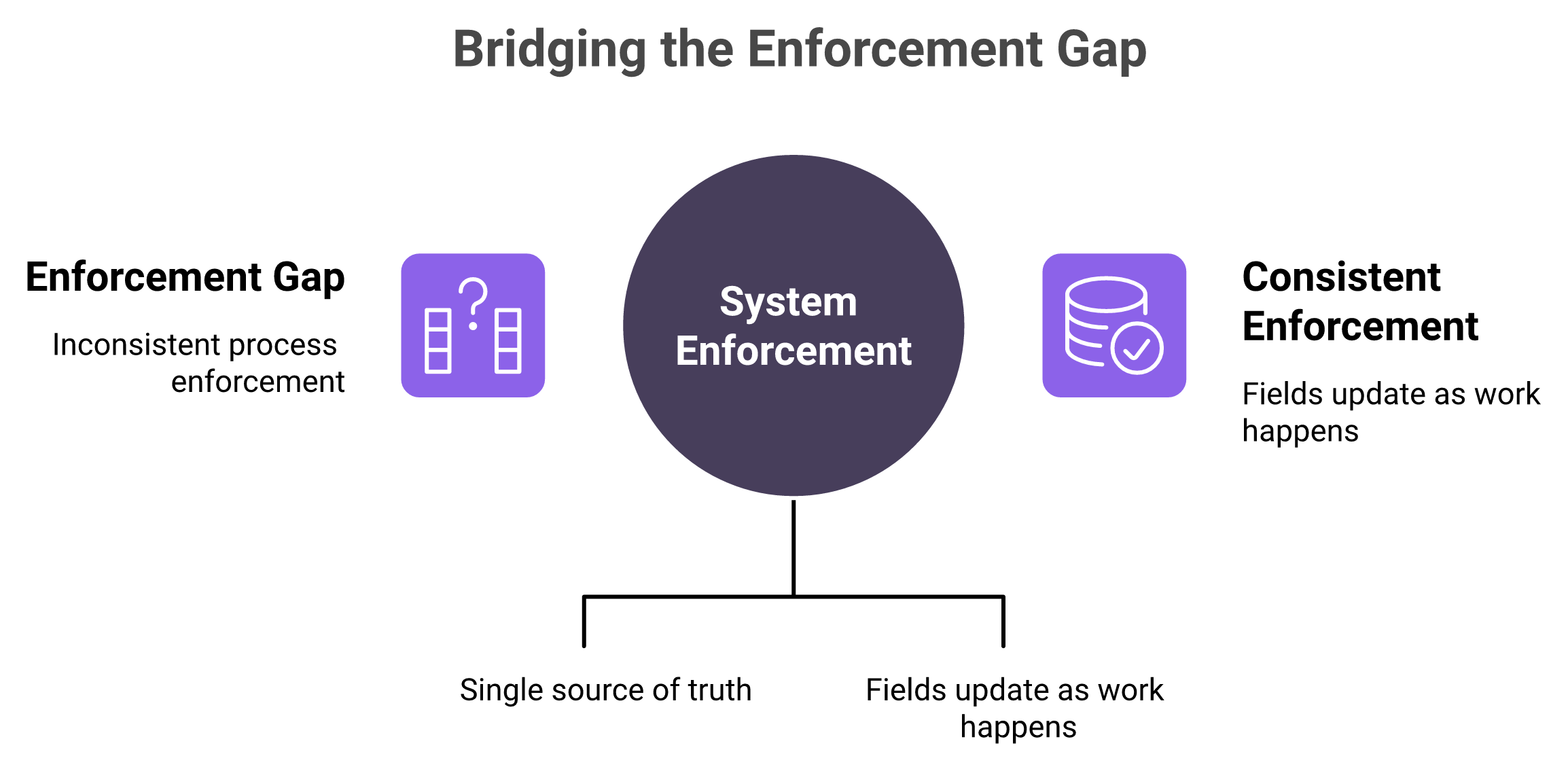
Revenue operations AI applies machine learning and autonomous agents across the revenue lifecycle, covering CRM hygiene, workflow execution, forecast roll-ups, and risk flagging, so the documented process runs without rep data entry. The process breaks for a structural reason. It lives in slide decks, a spreadsheet nobody reads, and the memory of whoever ran onboarding last quarter. Enforcement depends on attention, and attention does not scale. Salesforce's 2026 State of Sales puts reps at roughly 40% selling time, with about 16% of the week going to manual data entry.
⭐ The question you cannot answer honestly
Every RevOps lead I talk to knows the moment. The CRO asks why the forecast moved, and the honest answer is that nobody knows, because the fields the report reads were last touched three weeks ago.
You are not confused about your own process. You wrote it. You are outnumbered by the number of people who have to remember it on a Tuesday afternoon.
❌ Enforcement by memory has a price
The traditional fix is human. Managers run CRM police work inside 1:1s. Enablement re-pushes the methodology after every leadership change. Somebody posts a reminder in Slack on Thursday.
That works for a quarter. Then attention moves, and the fields go quiet again. Two of the most common complaints in the review files are not about intelligence at all; they are about data never landing back in the system of record, a pattern visible across Clari reviews and user feedback.
"The CRM writeback is not good; we cannot send MEDDIC values back to Salesforce or update fields in Salesforce from the conversation intelligence." — Verified reviewer, RevOps ClariClari - G2 Verified Review (13 Jul 2026)
"limitations of getting data back into salesforce" — Verified reviewer, Sales GongGong - G2 Verified Review (21 May 2026)
⚠️ Why the tooling keeps missing this
First-generation revenue intelligence was built to surface information. It records the call, scores the call, and shows you a dashboard. The work of turning that into a stage change, a MEDDIC field, or a next step still waits on a person.
Oliv AI's read is that this is a design assumption, not a product flaw. The category assumed a human would close the loop, and for ten years one did, badly. That difference between reporting and acting is the whole argument in revenue intelligence versus conversation intelligence.
✅ What actually changes
The shift is small to describe and large to live with. The process stops being a document people remember and becomes a layer systems read.
The process itself does not change. What changes is whether enforcement depends on someone remembering it.
Oliv AI holds the ICP, personas, approval workflows, methodology, and proof-of-concept standards as a living, machine-readable layer that its agents draw from, and it runs on top of Salesforce, HubSpot, or Dynamics rather than replacing any of them. That distinction matters for this reader. Nothing here asks you to migrate your system of record. It asks whether the rules in your system of record can be enforced without you chasing them, which is the core of AI for revenue operations.
So the real question is not whether agents can write to your CRM. It is who still owns the process once they do. That is the next section, and it is the one that decides the purchase.
Q2. If agents write to your CRM, who still controls the process, and what stays under human approval? [toc=2. Control and Governance]
You keep control when authorship and execution are separated. RevOps writes and edits the handbook, and agents execute it. Draw the autonomy line by reversibility. Agents own field updates, activity mapping, research, and risk flags. Humans keep ownership changes, forecast category overrides, pricing, and first-touch customer contact. G2's 2026 buyer research found only 9% of buyers allow agents to execute autonomously inside guardrails, and explainability ranks as the top trust signal for agent buyers. Oliv AI's CRM Manager surfaces every proposed field change with the conversational moment that triggered it, for accept, edit, or reject per field.
⚠️ The concession first
Handing write access to an automated system is a real transfer of risk. Anyone who waves that away should not be trusted with your data model.
Your authority as a RevOps lead is the process. So the objection is not paranoia. It is correct instinct, pointed at the wrong question, and it is worth reading alongside our view on AI CRM trust, governance, and risk in RevOps evaluation.
❌ The failure mode worth fearing
The thing that should scare you is not automation. It is automation you cannot read.
A black box that edits opportunities gives you no way to explain a number to your CRO. G2's agent research found only 48% of buyers trust vendor messaging about agent reliability, which is a rational discount. Reviewers in the files raise the same instinct about data they cannot get back out, an issue documented in Gong DPA and security.
"The fact that you cant't edit a recording (to only share a portion with a client, and the fact that if you stop working with thew tool you lose the data" — Verified reviewer, Sales GongGong - G2 Verified Review (19 Mar 2026)
✅ Draw the line by reversibility
Here is the split I would put in a governance doc before any pilot.
Agent Autonomy Versus Human Approval
Work
Agent owns it
Human approves it
Field updates from call or email evidence
Yes
Spot check weekly
Activity to opportunity mapping
Yes
Exception queue only
Risk flags and next-step proposals
Yes
Manager acts
Stage, close date, and forecast category changes
Proposes
Always
Pricing, terms, and first outbound touch
No
Human sends
Run it in observe mode first. Let the agent propose for two weeks while nothing writes, then compare its proposals against what your reps eventually logged. That comparison is the cheapest trust exercise available.
⭐ Inspectable beats trustworthy
Oliv AI runs CRM Manager in a review mode where each proposed update arrives attached to the moment in the conversation that triggered it, and Olivia, the orchestrator, defaults to asking before acting. Users describe the effect as systems of record staying current without the note-taking tax, which is also how buyers assess mid-market revenue AI governance and SOC 2.
"It doesn't just record meetings; it automatically captures key insights, updates systems of record, identifies next steps, and helps keep teams aligned. As a result, we've seen better CRM hygiene, less administrative overhead, and more consistent execution." — Verified reviewer, RevOps Oliv AIOliv AI G2 - Verified Review (23 Jun 2026)
💸 One compliance item for your security review
If any agent interacts with people on your behalf, transparency duties under Article 50 of the EU AI Act have been enforceable since 2 August 2026, with penalties reaching EUR 15 million or 3% of global turnover. Internal write-agents and outbound agents are not the same risk. Ask your vendor which of theirs is which, and get the answer in the security questionnaire rather than the demo.
Authorship stays with you. Chasing goes. Ask any vendor where the process definition lives, who can change it, and whether one change lands everywhere at once. A tool that cannot answer all three is automation, not enforcement.
Q3. Where should the revenue process actually live, if not in slide decks? [toc=3. The Process Layer]
It should live in one machine-readable layer that every system reads from. When the definition sits in a single editable source, changing qualification criteria is one edit, and every downstream agent behaves differently the same day. When it lives in documents, that same change becomes six manual updates, and reps run whichever version they heard last. Oliv AI stores the ICP, personas, approval workflows, methodology, and proof standards in a machine-readable handbook that all of its agents read from, so a methodology change is authored once rather than six times.
⭐ A Tuesday in most revenue orgs
Your CRO decides on a Tuesday that deals under 50 seats no longer qualify as enterprise. Simple decision, one sentence long.
Now count the surfaces that encode it. The Salesforce validation rule, the qualification field picklist, the sequence routing, the scorecard, the onboarding deck, and the forecast definition.
❌ Six re-pushes and a two-week lag
Each of those is a ticket, and your admin has a queue. Until the queue clears, half the team qualifies one way and half the other.
Nobody is being difficult. They are following the last version they were told about. Documented is not the same as alive, and a playbook can be both current in Notion and wrong in practice, which is why sales methodology automation from calls matters more than the deck.
✅ Treat process as data, not documentation
The fix is a change in kind. Write the process once, in plain language a machine can parse, and let every system that needs it read from that one source.
Think of it as the difference between a recipe taped to the fridge and a recipe the kitchen actually cooks from. The second one updates every plate the moment you change a line.
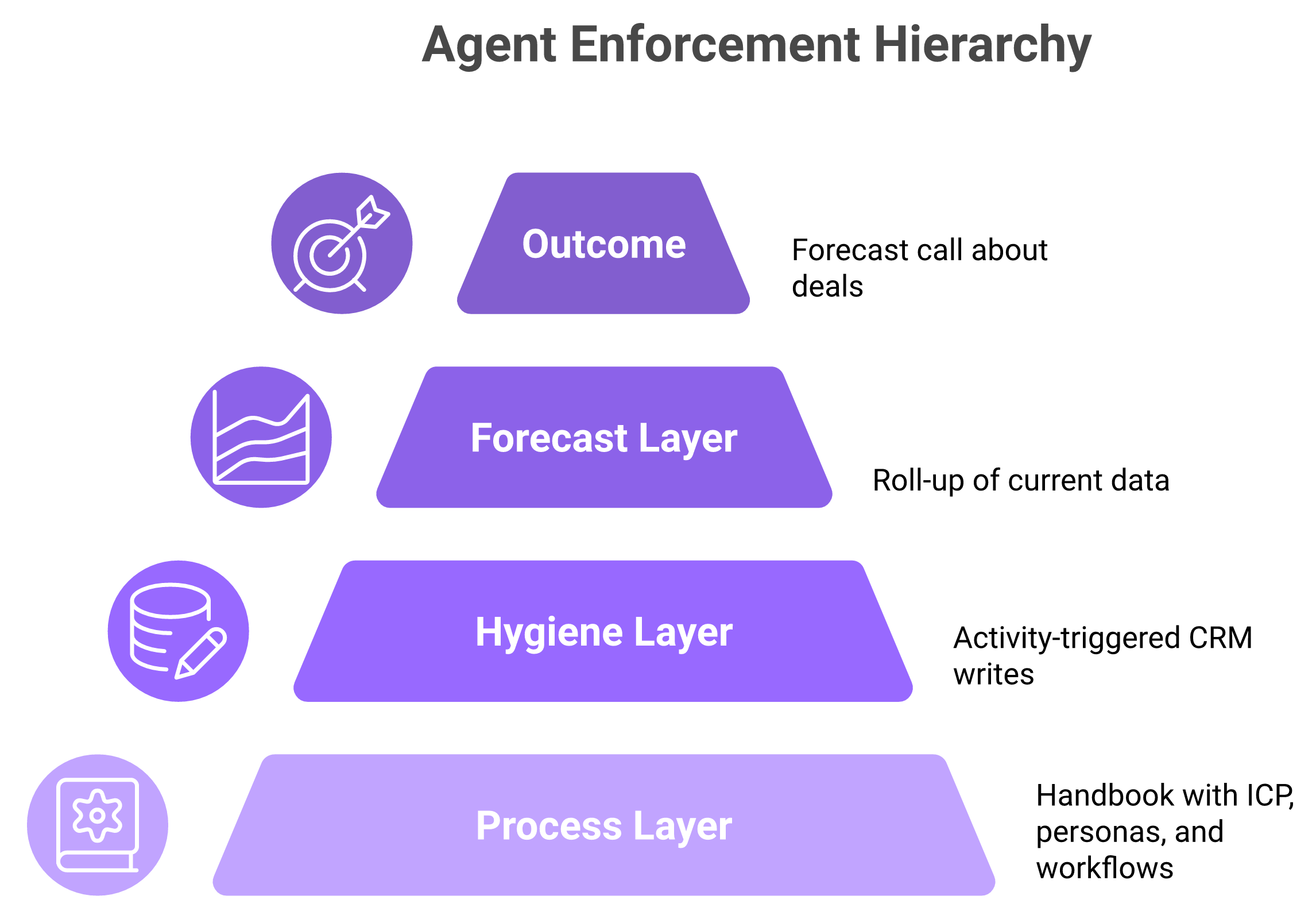
Each layer only works if the one below it is solid, which is why the handbook comes first.
⚠️ Why this is the piece nobody describes
Vendors love describing agents. Almost nobody tells you where the process definition lives, who can edit it, or how a change propagates. Gartner expects more than 40% of agentic AI projects to be cancelled by the end of 2027 on escalating cost, unclear value, or inadequate risk controls, and Oliv AI's own framing of the underlying cause is blunter, that the process was never written down in a form a machine can read.
I might be reading my own data too strongly here, but the pattern in Oliv AI's deployments is consistent. Teams with a written playbook get value in days. Teams whose playbook lives in three people's heads spend the first fortnight authoring, and no software shortens that, a reality we cover in how to build a revenue operations function.
🔎 Two checks before you believe any of this
Ask for the handbook itself, in text, and read it. If it is a settings screen with 200 toggles, it is configuration, not a process definition.
Then ask what happens when you edit one line. You want to see the change reflected in agent behaviour without an implementation ticket.
Oliv AI's answer to that is Oliver, which holds the handbook as the machine-readable layer every other agent reads from, so a methodology change is authored once and propagates instead of being hand-carried into each tool that encodes it. Oliv AI describes this as agent-enforced rather than agent-decided, and that distinction is load-bearing. The agents do not invent your qualification criteria. They apply the version you wrote, to every opportunity, on the day you wrote it, which is what AI agents for RevOps should mean in practice.
Q4. Can CRM fields stay current without rep input, even when your CRM is already a mess? [toc=4. Autonomous CRM Hygiene]
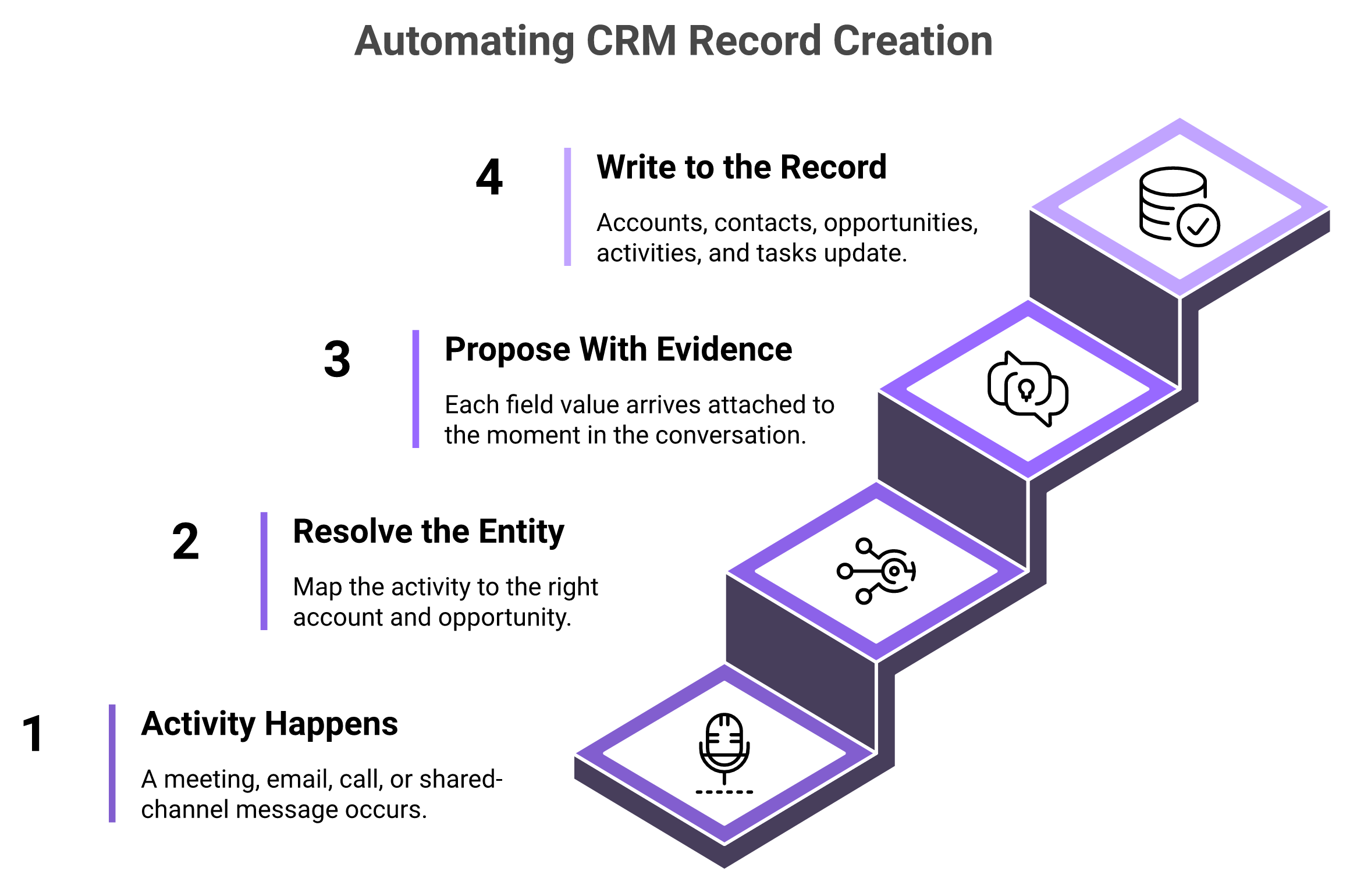
They can, when the write is triggered by activity rather than requested from a rep. A call ends or an email lands, and the system writes accounts, contacts, opportunities, activities, and tasks itself. Most guides tell you to clean the CRM first. The harder problem is resolution, which means mapping a meeting to the right opportunity when one account exists three times with five open opps. Oliv AI reports 18 months of infrastructure work on exactly that entity-resolution problem, built as a layer on top of Salesforce or HubSpot rather than a replacement for either.
✅ The trigger-to-write chain
Mechanically, it is four steps, and each one is checkable.
An activity happens, which means a meeting, an email, a call, or a shared-channel message.
The system reads what occurred and maps it to the right account and opportunity.
It proposes field values with the source moment attached.
It writes to the objects your reports actually read, across new sales, renewals, and customer success.
The write is triggered by the activity, which is why there is no compliance habit left to decay.
Oliv AI's internal split is the clearest way to hold this. Deal Insights is the analyst, and CRM Manager is the operator. One tells you what happened, the other changes the record.
⭐ Resolution is the part nobody sells you
Dirty data is discussed constantly. Duplicate structure almost never is.
If an account exists three times, no amount of transcription accuracy helps, because the write lands on the wrong object. Oliv AI's position inverts the usual prerequisite, that the messier the data, the more value the layer creates, and I would treat that as a claim to test in a pilot rather than a promise to accept.
"It helps in automating and updating our CRM after calls, provides a clear deal summary, and sends follow-up emails... The automatic CRM update feature is the most valuable to me." — Verified reviewer, Sales Oliv AIOliv AI G2 - Verified Review (26 Jun 2026)
⚠️ The honest limit
Completeness now depends on capture coverage, not rep discipline. That is a better dependency, because it is auditable, but it is still a dependency.
Unrecorded phone calls, in-person meetings, and decisions made in shared channels are the gaps. Tools that only log meetings well leave more of those gaps than buyers expect, which is the integration question behind revenue intelligence integration across CRM, Slack, and email.
"I often have trouble logging meetings, and certain features feel clunky or overly manual." — Verified reviewer, Sales SalesloftSalesloft - G2 Verified Review (22 Jul 2025)
🔎 What to test in week one
Pick 20 closed opportunities from last quarter. Ask the vendor's agent to reconstruct the fields your forecast reads, using only captured activity, and score it against what a human eventually logged.
Then measure latency, which is the time from event to record. Field completeness and update latency are the two numbers that survive a CFO conversation.
Oliv AI's CRM Manager is the operator in that split, writing to the objects your reports read rather than leaving notes for somebody to transcribe later, and users describe the result as contact creation and stage movement happening without manual effort. It drives adoption of the CRM you already own, and it is not a CRM. For the full hygiene argument, including what breaks and why, see the RevOps guide to autonomous CRM hygiene and our RevOps implementation admin guide.
Q5. What changes in the forecast once the data maintains itself? [toc=5. The Forecast Payoff]
The roll-up stops being a reconciliation exercise. When fields update from activity instead of Friday reminders, the forecast is computed on data that was already current, so the conversation shifts from whose number is right to which deals moved and why. Oliv AI's Forecaster reads the records CRM Manager has already written and produces the roll-up from them, and Oliv AI documents three progressive modes, AI-assisted, then AI-managed, then AI-owned, with teams typically moving through them over six to eighteen months.
⏰ What the Friday ritual actually is
Most forecast calls are not forecasting. They are data repair, performed out loud, by six people who each hold a different version of the truth.
A manager asks why a deal is still in commit. The rep explains something that was decided two weeks ago and never written down. Thirty minutes later you have a number, and no record of how you got it, which is the failure mode behind evidence-based forecast commits.
✅ The order of operations nobody sells
Clean data is not a feature of forecasting. It is the precondition for anyone believing the forecast at all.
Oliv AI's Forecaster is deliberately the consequence of the two previous layers rather than a separate purchase, because a forecast agent reading stale fields just produces confident nonsense faster. That sequencing is the part I would push any vendor on, and it is the same argument we make about improving sales forecast accuracy with AI.
⭐ The three modes, and why sequencing beats switching
Do not hand the roll-up to software in one move. Oliv AI documents the progression this way.
AI-assisted. The agent drafts the roll-up. Your managers still submit, and you compare the two.
AI-managed. The agent produces the roll-up, and humans adjust exceptions rather than every line.
AI-owned. The agent runs it, and review focuses on the deals it flagged.
Teams move through those stages over six to eighteen months, according to Oliv AI's own documentation. I would treat anything faster as a warning sign, not a win.
⚠️ What to measure instead of accuracy
Accuracy claims are cheap, and I am not going to give you one. Measure these instead, because you can audit all three.
Variance between the agent's roll-up and the final quarter number, tracked over three quarters.
How many deals changed category after the call, which tells you how much repair still happens live.
Time from the call ending to the record reflecting it, which is the honest test of whether the data is current.
That third one is the leading indicator. If latency is high, your forecast is a historical document.
💰 The meeting you get back
Where my head is right now is that the real payoff is not accuracy, it is what the forecast call becomes. You stop auditing fields and start arguing about deals, which is the argument worth having.
One reviewer in Oliv AI's G2 set describes using a forecast agent to prepare weekly and monthly roll-ups alongside a deal agent that flags where attention is needed, which is roughly the shape of that shift, and it echoes what buyers look for in AI sales forecasting software.
Oliv AI's Forecaster consumes the data CRM Manager already maintained, with autonomy rising only as the team's trust does, rather than as a setting you enable on day one. The deeper forecasting argument, including how commit and upside categories get defined, sits in our guide to sales forecast accuracy for CROs. For this page, the point is narrower. Fix the record, and the forecast becomes a conversation about deals instead of a negotiation about fields.
Q6. You have bought process tools before and adoption decayed in a quarter, so why would this be different? [toc=6. Why Adoption Decays]
Adoption decays when compliance depends on rep behaviour. Every field is a request, and requests lose to selling. The structural difference in agent enforcement is that the update is triggered by the activity, so there is no behaviour to sustain. Oliv AI's CRM Manager is triggered by activity and writes to accounts, contacts, opportunities, activities, and tasks without a rep action. That does not remove the dependency. It moves it onto capture coverage and onto whether the process is written down, and both of those are auditable in a way rep discipline never was.
❌ The rollout curve you have already lived
Month one looks great. Field completion sits near 80% because enablement just ran a session and managers are watching.
Month four it is 30%. Nobody decided to stop. Attention moved to a pricing change, and the scoreboard stopped being checked.
⚠️ Why "the tool is hard" is a symptom, not the cause
Reviewers describe this decay pattern constantly, and usually they blame friction. Friction is real, but the deeper issue is that the tool needed them to act at all, a theme running through Gong reviews.
"I found the AI tracker setup to be quite difficult, especially concerning the user interface when setting up keywords or smart trackers... This is a cumbersome process... and detracts from the efficiency that Gong should provide." — Verified reviewer, Sales GongGong - G2 Verified Review (3 Oct 2025)
"Data updates like contact information sometimes does not update" — Verified reviewer, Sales SalesloftSalesloft - G2 Verified Review (26 Mar 2025)
✅ Enforcement that does not ask
Take the request out and the decay curve loses its cause. The activity is the trigger, so the record updates whether or not anyone remembers.
Oliv AI's CRM Manager works this way by design, and one reviewer describes it filling custom methodology fields for a MEDIC-BAND process and moving accounts between stages without manual entry, which is what automated methodology scoring from calls looks like in practice.
"I use Oliv.ai for recording my sales calls, keeping my client updates on CRM in check, and moving accounts between different stages. It's incredibly helpful with our custom sales methodologies like MEDIC-BAND, as it helps me fill all of them out." — Verified reviewer, Sales Oliv AIOliv AI G2 - Verified Review (15 Jun 2026)
⭐ The honest cost of this trade
I have been wrong about this before, so here is the part vendors skip. Agent enforcement inherits your capture gaps.
Oliv AI cannot write context it never saw, which means unrecorded phone calls, in-person meetings, and decisions made inside shared channels are where the record still thins out. That is a narrower failure mode than rep discipline, and it is fixable with configuration rather than culture, but it is real.
🔎 The pilot metric to change
Stop measuring adoption. Once the rep is not the one updating, adoption rate tells you nothing useful.
Measure capture coverage, which is the percentage of customer conversations that reached the system in any form. Then measure field completeness on the fields your forecast reads. Those two numbers predict whether this holds in month four, and both sit at the centre of RevOps automation.
Oliv AI's claim here is deliberately narrow. Because CRM Manager's writes are triggered by activity rather than requested from a person, there is no compliance habit to sustain, and nothing decays when enablement attention moves elsewhere. What it cannot do is invent context nobody captured, which is exactly why capture coverage is the number I would interrogate in a pilot rather than any accuracy percentage.
Q7. How is this different from the workflow automation and dashboards you already own? [toc=7. Beyond Workflow Automation]
Dashboards report that a deal went quiet. Workflow automation fires when a condition someone configured is met, and does nothing when reality arrives in a form no rule anticipated. Agent enforcement reads what happened, writes the record with the source moment attached, proposes the next step, and routes it for approval. Oliv AI's agents read their instructions from a machine-readable handbook rather than from hard-coded rules, so behaviour changes when the handbook changes. Automation executes rules. Enforcement executes a definition, and only one of those survives a process change.
⭐ Three layers that get confused constantly
You almost certainly own the first two already. That is why the third sounds like a repackage, and it is the distinction we draw in AI agents versus SaaS dashboards.
Dashboards, Rule Automation, and Agent Enforcement Compared
The job
Dashboard or rule automation
Agent enforcement
A champion goes quiet for 14 days
Report shows declining activity; a rule can email the rep
Reads the last three touches, flags the risk with evidence, drafts the multithreading step
Qualification criteria change
Admin edits validation rules and picklists, tool by tool
Handbook edit propagates to every agent reading it
Post-call CRM update
Rule logs the activity; fields wait for the rep
Fields written from what was said, each with its source moment
Methodology compliance
Scorecard reports the gap after the fact
Fields populated from the conversation, gaps surfaced same day
Oliv AI sits in the third column by design, because the write is triggered by the activity rather than by a rule that someone anticipated in advance.
❌ Where rules run out
Rules are excellent at conditions you can name in advance. Stage equals proposal, and days since activity is greater than 14, so send an alert.
They are useless when the signal is a sentence. A prospect saying their security review moved to Q1 is not a field value, and no rule fires on it, which is the limit of AI sales workflow automation built on triggers alone.
✅ Why "agentic" is not the same as smarter
The difference is not intelligence. It is where the instructions live.
A flow lives inside the tool that runs it, so a process change means an admin rebuild in every tool. Oliv AI's agents read a plain-language handbook, so the same change is authored once and applied everywhere those agents operate, which is the working definition of agentic sales automation.
⚠️ The gap this actually closes
Leadership asks for answers, and RevOps can only show them dashboards. That sentence is the entire category boundary, and it is not a tooling failure.
Reporting layers were built to describe the process. The incumbent revenue-intelligence stack does that genuinely well, and then stops at the point where somebody has to act, a boundary mapped in revenue ops to intelligence to orchestration.
🔎 One test before you believe any vendor
Ask them to change your qualification criteria live, in the demo. Then ask what else changed as a result.
If the answer involves a services ticket or a rebuild in three tools, you are buying automation. You already own automation. What is missing is a layer that treats your process as the instruction rather than as documentation somebody else has to translate.
Oliv AI's position in this comparison is factual rather than flattering. It does not report better than your dashboards, and it is not a faster rule builder. It executes the definition you authored, on every opportunity, and the behaviour shifts when you edit the handbook rather than when an admin rebuilds a flow.
Q8. What has to be true before this works, how long does it take, and does it replace your Salesforce admin? [toc=8. Prerequisites and Sequencing]
Three things must be true. The process is written down somewhere other than people's heads, capture covers the channels where decisions happen, and someone in RevOps owns the handbook as a maintained artefact. If the playbook genuinely lives in memory, no agent can enforce it, and the first work is authoring it. That is RevOps work, not software work. Oliv AI prices RevOps, Operations, and Engineering seats at $0 per user per month on its Amplify tier, verified on its published price ladder in September 2026. It does not replace your admin. It drains the manual-update queue your admin currently absorbs.
⚠️ The answer that costs the sale
I would rather say this first than discover it in week three. If your process exists only as tribal knowledge, agents have nothing to enforce.
Oliv AI's onboarding builds a handbook from your materials, your website, and whatever else is shareable, but it cannot invent decisions nobody has made. Authoring the playbook stays yours, and if you are starting from zero, begin with building a revenue operations function.
✅ Three prerequisites, and how to test each
Run these checks this week, before you talk to any vendor.
Written process. Ask two managers to describe your qualification criteria separately. If the answers differ, you have an authoring job first.
Capture coverage. List last month's customer conversations by channel. Count how many reached any system at all.
A named owner. Someone must own the handbook the way an admin owns the org. If nobody does, adoption will drift regardless of tooling.
⏰ Expect a sequence, not a switch
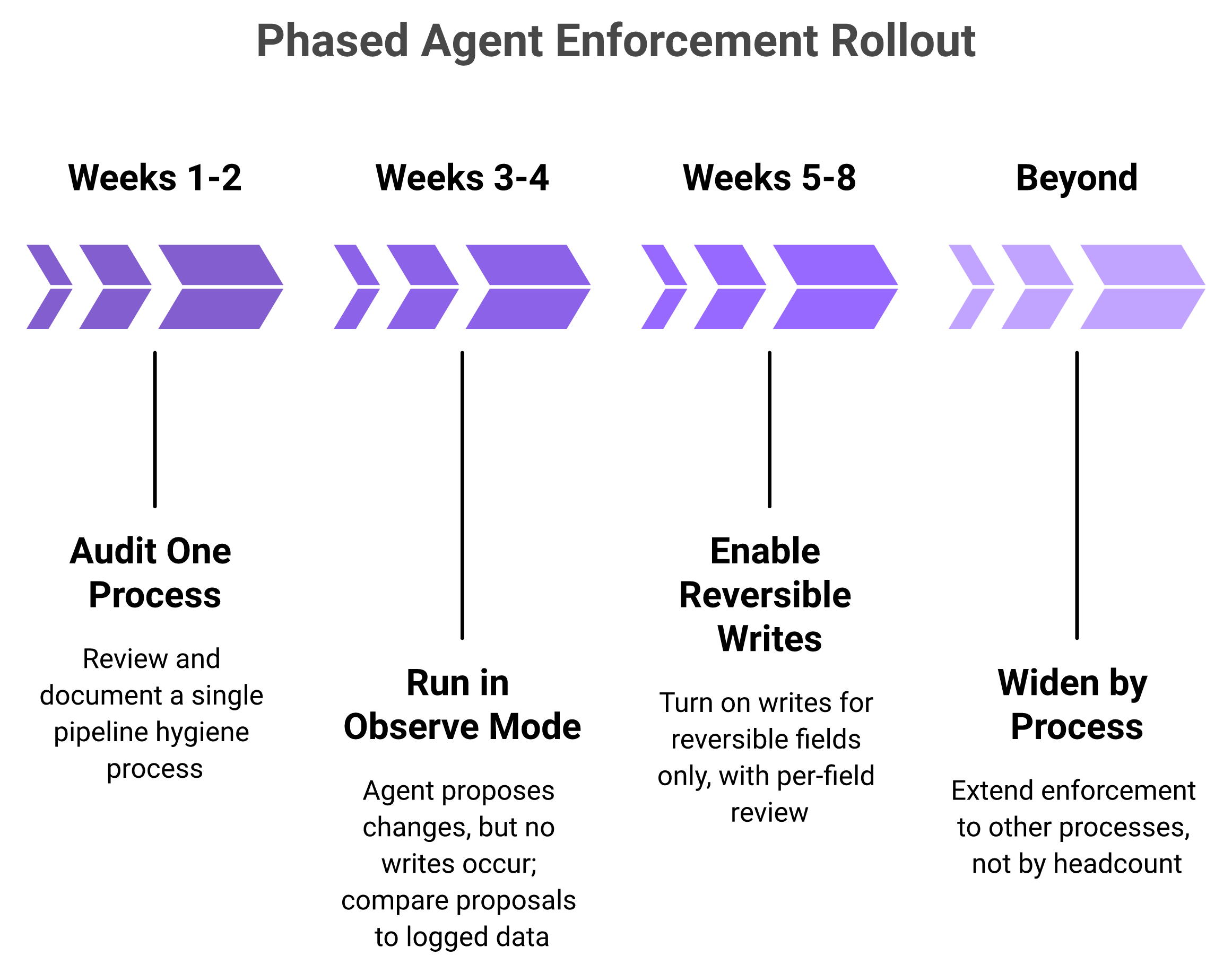
Phase it, and keep the first phase embarrassingly small.
Weeks 1 to 2. Audit one process, usually opportunity hygiene on a single pipeline.
Weeks 3 to 4. Run in observe mode, where the agent proposes and nothing writes.
Weeks 5 to 8. Turn on writes for reversible fields, with per-field review.
After that. Widen by process, not by headcount.
Nothing writes until the observe phase has earned it, which is how the rollout survives a security review.
Setup speed varies wildly by vendor, and reviewers are blunt about both ends of that range, as the timelines in Gong's implementation timeline show.
"The initial setup was really easy because the team provided FDE engineers who set everything up, and within less than a week, we were good to go." — Verified reviewer, RevOps Oliv AIOliv AI G2 - Verified Review (17 Jun 2026)
"The UX is horrible, the features don't work, it's not clear, I waste a lot of time on the software... The initial setup of Salesloft was not easy." — Verified reviewer, Sales SalesloftSalesloft - G2 Verified Review (5 Jan 2026)
❌ No, it does not replace your admin
Your admin is one person with a queue. Most of that queue is manual updates, cleanup requests, and field maintenance created by the enforcement gap.
Oliv AI removes the source of that queue rather than the person managing it, which changes what your admin spends the week on. Data model design, permissions, and integration work stay human, and the same division of labour shows up when scaling revenue operations in a growth-stage team.
💰 The seat objection, answered
Rolling agents past the revenue team usually dies on licence maths. Oliv AI's Amplify tier carries no licence fee for RevOps, Operations, and Engineering seats, verified on its published price ladder in September 2026, which removes that particular argument.
Q9. How do you prove this paid off, and stop agent spend becoming the reason it gets cancelled? [toc=9. ROI and Spend Control]
Decide the measure before the pilot. Gartner expects more than 40% of agentic AI projects to be cancelled by the end of 2027, on escalating cost, unclear business value, or inadequate risk controls. For CRM hygiene, the defensible metrics are field completeness on the fields your forecast reads, update latency from event to record, manager hours spent chasing updates, and forecast variance. Oliv AI tracks agent spend per agent, supports settable limits and high watermarks, and runs a pre-allocation exercise that estimates credit cost before an agent is switched on.
⚠️ Why these projects die, in order
Almost nobody kills an agent project because the agent was wrong. They kill it because nobody could say what it was worth, and the bill kept moving.
Gartner's three named causes are cost, unclear value, and weak risk controls. Every one of those is a decision you make before deployment, not a discovery you make after, which is the framing we use in our build versus buy guide for revenue AI.
✅ Four metrics that survive a CFO conversation
Baseline all four in the two weeks before anything writes. Without a baseline, you are arguing from memory, and the numbers behind that argument are the same ones in our revenue intelligence ROI calculator.
Four CRM Hygiene Metrics and How to Baseline Them
Metric
What it means
How to baseline it
Field completeness
Percentage populated on the fields your forecast reads
Export those fields for last quarter's closed opps
Update latency
Days from the event to the record reflecting it
Compare activity timestamps against field modified dates
Manager chase hours
Time managers spend collecting updates
Ask five managers to log it for one week
Forecast variance
Gap between submitted forecast and actual
Pull the last three quarters
Oliv AI measures the first two directly from CRM write events, which is why I would insist on seeing them in a pilot report rather than a satisfaction survey. The same discipline underpins a durable CRM data strategy for revenue predictability.
💰 Cap the spend before you deploy, not after
Agent pricing is usage-based in most of this category, which means the cost is a function of how often agents run. That is fine, and it is also how budgets get ambushed.
Three controls are worth demanding from anyone. A per-agent spend view, a hard ceiling you can set, and an estimate of monthly cost before the agent goes live. If the wider budget is the problem, start with reducing sales tech stack costs.
⭐ The estimate is the control that matters
Oliv AI's governance model runs a pre-allocation exercise that estimates credit cost for an agent before deployment, alongside per-agent tracking, limits, and high watermarks. Oliv AI's read is that this, not model quality, is where most agent programmes actually fail.
I might be over-indexing on my own vantage point here, but every cancelled programme I have seen up close died in a finance review, not a technical one. That is also the pattern in revenue tech stack consolidation decisions.
🔎 The one-page business case I would write
Keep it to four lines, and make each one falsifiable.
The owner. One named person, in RevOps, accountable for the agent.
The metric. One of the four above, with its baseline number written down.
The ceiling. A monthly spend cap, set before go-live.
The kill condition. What result, by what date, means you turn it off.
That fourth line is the one people skip. Writing it down is what stops a pilot drifting into a year of unowned spend, a risk we cover in the CRO view of platform ROI.
Oliv AI answers the cost half of this directly, with spend tracked per agent, settable limits and high watermarks, and a credit estimate produced before an agent is switched on. Those are Oliv AI's own product controls, not independently audited benchmarks, and I would ask us to show them in your instance rather than take them on trust. Whether or not you buy from us, ask every vendor for that pre-deployment estimate in writing. It is the single control Gartner's cancellation data actually argues for.
Q10. What should you ask a revenue operations AI vendor before you shortlist them? [toc=10. The Vendor Test]
Ask four questions, and ignore the demo until they are answered. Where does the process definition live, who can change it, does a change take effect everywhere at once, and what triggers a write, a rep action or an activity. Integration counts and dashboard quality tell you nothing about enforcement. Oliv AI's answers are on the record: the definition lives in Oliver's handbook, RevOps edits it, edits propagate to every agent reading from it, and CRM Manager's writes are triggered by activity.
⭐ The four questions, and how to hear the answers
Score the answers, not the enthusiasm. The difference between enforcement and automation shows up in the first sentence, and it is the axis we use in our revenue intelligence platform comparison for RevOps.
Vendor Questions: Enforcement Answers Versus Automation Answers
What you ask
An enforcement answer sounds like
An automation answer sounds like
Where does the process definition live?
In one readable handbook the agents parse
Across our workflow builder and field settings
Who can change it?
Your RevOps lead, directly, in text
An admin, with a ticket, per tool
Does a change apply everywhere at once?
Yes, every agent reads the same source
Wherever it has been configured
What triggers a write?
The activity itself
The rep, or a rule someone wrote
Oliv AI appears in that right-hand column on nothing, which is a claim you should test rather than accept.
⚠️ Two things I would tell you not to skip
Oliv AI's third-party validation is thinner than any incumbent's, and you should weigh that. The G2 profile is young, most reviews arrived in mid-2026, and several carry no named reviewer or role. There is no Capterra or TrustRadius presence, and the case studies sit behind an email gate, so reference-checking us is harder than reference-checking the incumbents whose feature sets and forecasting depth have been picked over for years.
The reviews that do exist include the ordinary complaints of a young product, and I would rather you read those than a curated set.
"I love how Oliv AI provides real-time deal risk insights and actionable steps to mitigate them... The only downside is that the platform can be a bit glitchy at times, but the support team is always quick to address and resolve any bugs." — Verified reviewer, Sales Oliv AIOliv AI G2 - Verified Review (2 Jul 2026)
"Design is user friendly and ensure the elements are visible and with no confusion... Real Time integrations can be time consuming" — Verified reviewer, Sales GongGong - G2 Verified Review (21 Apr 2026)
❌ The second concession, which matters more
Agent enforcement only works if the process is actually written down. If your playbook lives in three people's heads, the first sprint is authoring it, and that is RevOps work rather than software work.
Oliv AI's onboarding assembles a handbook from your shareable materials, and it still cannot invent decisions your leadership has never made. Any vendor who tells you otherwise is selling you a timeline they cannot hold, which is worth remembering when you read what AI agents can actually do today.
✅ Where to leave this
You already own dashboards, and you already own rules. What has been missing is a layer that treats your process as the instruction rather than as documentation somebody has to remember on a Tuesday.
Oliv AI's position is that authorship stays with you and chasing goes, which is a smaller promise than autonomy and a more useful one. Take the four questions into your next three vendor calls, including ours. If you want to walk through how Oliver's handbook would encode your current qualification criteria, see how AI agents for RevOps handle it, then bring the version of the playbook you actually use.
✍🏼 About the author
Ishan Chhabra is the founder and CEO of Oliv AI, an AI-native revenue intelligence and revenue orchestration platform for B2B revenue teams. He built Oliv's context graph, the infrastructure layer that resolves accounts, opportunities, and conversations across messy CRMs so agents can act on them safely. He writes about what he sees working and failing inside revenue organisations adopting AI, including where revenue intelligence is heading next.
Q1. You wrote the playbook and built the fields, so why does the field break the process every day? [toc=1. The Enforcement Gap]
Revenue operations AI applies machine learning and autonomous agents across the revenue lifecycle, covering CRM hygiene, workflow execution, forecast roll-ups, and risk flagging, so the documented process runs without rep data entry. The process breaks for a structural reason. It lives in slide decks, a spreadsheet nobody reads, and the memory of whoever ran onboarding last quarter. Enforcement depends on attention, and attention does not scale. Salesforce's 2026 State of Sales puts reps at roughly 40% selling time, with about 16% of the week going to manual data entry.
⭐ The question you cannot answer honestly
Every RevOps lead I talk to knows the moment. The CRO asks why the forecast moved, and the honest answer is that nobody knows, because the fields the report reads were last touched three weeks ago.
You are not confused about your own process. You wrote it. You are outnumbered by the number of people who have to remember it on a Tuesday afternoon.
❌ Enforcement by memory has a price
The traditional fix is human. Managers run CRM police work inside 1:1s. Enablement re-pushes the methodology after every leadership change. Somebody posts a reminder in Slack on Thursday.
That works for a quarter. Then attention moves, and the fields go quiet again. Two of the most common complaints in the review files are not about intelligence at all; they are about data never landing back in the system of record, a pattern visible across Clari reviews and user feedback.
"The CRM writeback is not good; we cannot send MEDDIC values back to Salesforce or update fields in Salesforce from the conversation intelligence." — Verified reviewer, RevOps ClariClari - G2 Verified Review (13 Jul 2026)
"limitations of getting data back into salesforce" — Verified reviewer, Sales GongGong - G2 Verified Review (21 May 2026)
⚠️ Why the tooling keeps missing this
First-generation revenue intelligence was built to surface information. It records the call, scores the call, and shows you a dashboard. The work of turning that into a stage change, a MEDDIC field, or a next step still waits on a person.
Oliv AI's read is that this is a design assumption, not a product flaw. The category assumed a human would close the loop, and for ten years one did, badly. That difference between reporting and acting is the whole argument in revenue intelligence versus conversation intelligence.
✅ What actually changes
The shift is small to describe and large to live with. The process stops being a document people remember and becomes a layer systems read.
The process itself does not change. What changes is whether enforcement depends on someone remembering it.
Oliv AI holds the ICP, personas, approval workflows, methodology, and proof-of-concept standards as a living, machine-readable layer that its agents draw from, and it runs on top of Salesforce, HubSpot, or Dynamics rather than replacing any of them. That distinction matters for this reader. Nothing here asks you to migrate your system of record. It asks whether the rules in your system of record can be enforced without you chasing them, which is the core of AI for revenue operations.
So the real question is not whether agents can write to your CRM. It is who still owns the process once they do. That is the next section, and it is the one that decides the purchase.
Q2. If agents write to your CRM, who still controls the process, and what stays under human approval? [toc=2. Control and Governance]
You keep control when authorship and execution are separated. RevOps writes and edits the handbook, and agents execute it. Draw the autonomy line by reversibility. Agents own field updates, activity mapping, research, and risk flags. Humans keep ownership changes, forecast category overrides, pricing, and first-touch customer contact. G2's 2026 buyer research found only 9% of buyers allow agents to execute autonomously inside guardrails, and explainability ranks as the top trust signal for agent buyers. Oliv AI's CRM Manager surfaces every proposed field change with the conversational moment that triggered it, for accept, edit, or reject per field.
⚠️ The concession first
Handing write access to an automated system is a real transfer of risk. Anyone who waves that away should not be trusted with your data model.
Your authority as a RevOps lead is the process. So the objection is not paranoia. It is correct instinct, pointed at the wrong question, and it is worth reading alongside our view on AI CRM trust, governance, and risk in RevOps evaluation.
❌ The failure mode worth fearing
The thing that should scare you is not automation. It is automation you cannot read.
A black box that edits opportunities gives you no way to explain a number to your CRO. G2's agent research found only 48% of buyers trust vendor messaging about agent reliability, which is a rational discount. Reviewers in the files raise the same instinct about data they cannot get back out, an issue documented in Gong DPA and security.
"The fact that you cant't edit a recording (to only share a portion with a client, and the fact that if you stop working with thew tool you lose the data" — Verified reviewer, Sales GongGong - G2 Verified Review (19 Mar 2026)
✅ Draw the line by reversibility
Here is the split I would put in a governance doc before any pilot.
Agent Autonomy Versus Human Approval
Work
Agent owns it
Human approves it
Field updates from call or email evidence
Yes
Spot check weekly
Activity to opportunity mapping
Yes
Exception queue only
Risk flags and next-step proposals
Yes
Manager acts
Stage, close date, and forecast category changes
Proposes
Always
Pricing, terms, and first outbound touch
No
Human sends
Run it in observe mode first. Let the agent propose for two weeks while nothing writes, then compare its proposals against what your reps eventually logged. That comparison is the cheapest trust exercise available.
⭐ Inspectable beats trustworthy
Oliv AI runs CRM Manager in a review mode where each proposed update arrives attached to the moment in the conversation that triggered it, and Olivia, the orchestrator, defaults to asking before acting. Users describe the effect as systems of record staying current without the note-taking tax, which is also how buyers assess mid-market revenue AI governance and SOC 2.
"It doesn't just record meetings; it automatically captures key insights, updates systems of record, identifies next steps, and helps keep teams aligned. As a result, we've seen better CRM hygiene, less administrative overhead, and more consistent execution." — Verified reviewer, RevOps Oliv AIOliv AI G2 - Verified Review (23 Jun 2026)
💸 One compliance item for your security review
If any agent interacts with people on your behalf, transparency duties under Article 50 of the EU AI Act have been enforceable since 2 August 2026, with penalties reaching EUR 15 million or 3% of global turnover. Internal write-agents and outbound agents are not the same risk. Ask your vendor which of theirs is which, and get the answer in the security questionnaire rather than the demo.
Authorship stays with you. Chasing goes. Ask any vendor where the process definition lives, who can change it, and whether one change lands everywhere at once. A tool that cannot answer all three is automation, not enforcement.
Q3. Where should the revenue process actually live, if not in slide decks? [toc=3. The Process Layer]
It should live in one machine-readable layer that every system reads from. When the definition sits in a single editable source, changing qualification criteria is one edit, and every downstream agent behaves differently the same day. When it lives in documents, that same change becomes six manual updates, and reps run whichever version they heard last. Oliv AI stores the ICP, personas, approval workflows, methodology, and proof standards in a machine-readable handbook that all of its agents read from, so a methodology change is authored once rather than six times.
⭐ A Tuesday in most revenue orgs
Your CRO decides on a Tuesday that deals under 50 seats no longer qualify as enterprise. Simple decision, one sentence long.
Now count the surfaces that encode it. The Salesforce validation rule, the qualification field picklist, the sequence routing, the scorecard, the onboarding deck, and the forecast definition.
❌ Six re-pushes and a two-week lag
Each of those is a ticket, and your admin has a queue. Until the queue clears, half the team qualifies one way and half the other.
Nobody is being difficult. They are following the last version they were told about. Documented is not the same as alive, and a playbook can be both current in Notion and wrong in practice, which is why sales methodology automation from calls matters more than the deck.
✅ Treat process as data, not documentation
The fix is a change in kind. Write the process once, in plain language a machine can parse, and let every system that needs it read from that one source.
Think of it as the difference between a recipe taped to the fridge and a recipe the kitchen actually cooks from. The second one updates every plate the moment you change a line.
Each layer only works if the one below it is solid, which is why the handbook comes first.
⚠️ Why this is the piece nobody describes
Vendors love describing agents. Almost nobody tells you where the process definition lives, who can edit it, or how a change propagates. Gartner expects more than 40% of agentic AI projects to be cancelled by the end of 2027 on escalating cost, unclear value, or inadequate risk controls, and Oliv AI's own framing of the underlying cause is blunter, that the process was never written down in a form a machine can read.
I might be reading my own data too strongly here, but the pattern in Oliv AI's deployments is consistent. Teams with a written playbook get value in days. Teams whose playbook lives in three people's heads spend the first fortnight authoring, and no software shortens that, a reality we cover in how to build a revenue operations function.
🔎 Two checks before you believe any of this
Ask for the handbook itself, in text, and read it. If it is a settings screen with 200 toggles, it is configuration, not a process definition.
Then ask what happens when you edit one line. You want to see the change reflected in agent behaviour without an implementation ticket.
Oliv AI's answer to that is Oliver, which holds the handbook as the machine-readable layer every other agent reads from, so a methodology change is authored once and propagates instead of being hand-carried into each tool that encodes it. Oliv AI describes this as agent-enforced rather than agent-decided, and that distinction is load-bearing. The agents do not invent your qualification criteria. They apply the version you wrote, to every opportunity, on the day you wrote it, which is what AI agents for RevOps should mean in practice.
Q4. Can CRM fields stay current without rep input, even when your CRM is already a mess? [toc=4. Autonomous CRM Hygiene]
They can, when the write is triggered by activity rather than requested from a rep. A call ends or an email lands, and the system writes accounts, contacts, opportunities, activities, and tasks itself. Most guides tell you to clean the CRM first. The harder problem is resolution, which means mapping a meeting to the right opportunity when one account exists three times with five open opps. Oliv AI reports 18 months of infrastructure work on exactly that entity-resolution problem, built as a layer on top of Salesforce or HubSpot rather than a replacement for either.
✅ The trigger-to-write chain
Mechanically, it is four steps, and each one is checkable.
An activity happens, which means a meeting, an email, a call, or a shared-channel message.
The system reads what occurred and maps it to the right account and opportunity.
It proposes field values with the source moment attached.
It writes to the objects your reports actually read, across new sales, renewals, and customer success.
The write is triggered by the activity, which is why there is no compliance habit left to decay.
Oliv AI's internal split is the clearest way to hold this. Deal Insights is the analyst, and CRM Manager is the operator. One tells you what happened, the other changes the record.
⭐ Resolution is the part nobody sells you
Dirty data is discussed constantly. Duplicate structure almost never is.
If an account exists three times, no amount of transcription accuracy helps, because the write lands on the wrong object. Oliv AI's position inverts the usual prerequisite, that the messier the data, the more value the layer creates, and I would treat that as a claim to test in a pilot rather than a promise to accept.
"It helps in automating and updating our CRM after calls, provides a clear deal summary, and sends follow-up emails... The automatic CRM update feature is the most valuable to me." — Verified reviewer, Sales Oliv AIOliv AI G2 - Verified Review (26 Jun 2026)
⚠️ The honest limit
Completeness now depends on capture coverage, not rep discipline. That is a better dependency, because it is auditable, but it is still a dependency.
Unrecorded phone calls, in-person meetings, and decisions made in shared channels are the gaps. Tools that only log meetings well leave more of those gaps than buyers expect, which is the integration question behind revenue intelligence integration across CRM, Slack, and email.
"I often have trouble logging meetings, and certain features feel clunky or overly manual." — Verified reviewer, Sales SalesloftSalesloft - G2 Verified Review (22 Jul 2025)
🔎 What to test in week one
Pick 20 closed opportunities from last quarter. Ask the vendor's agent to reconstruct the fields your forecast reads, using only captured activity, and score it against what a human eventually logged.
Then measure latency, which is the time from event to record. Field completeness and update latency are the two numbers that survive a CFO conversation.
Oliv AI's CRM Manager is the operator in that split, writing to the objects your reports read rather than leaving notes for somebody to transcribe later, and users describe the result as contact creation and stage movement happening without manual effort. It drives adoption of the CRM you already own, and it is not a CRM. For the full hygiene argument, including what breaks and why, see the RevOps guide to autonomous CRM hygiene and our RevOps implementation admin guide.
Q5. What changes in the forecast once the data maintains itself? [toc=5. The Forecast Payoff]
The roll-up stops being a reconciliation exercise. When fields update from activity instead of Friday reminders, the forecast is computed on data that was already current, so the conversation shifts from whose number is right to which deals moved and why. Oliv AI's Forecaster reads the records CRM Manager has already written and produces the roll-up from them, and Oliv AI documents three progressive modes, AI-assisted, then AI-managed, then AI-owned, with teams typically moving through them over six to eighteen months.
⏰ What the Friday ritual actually is
Most forecast calls are not forecasting. They are data repair, performed out loud, by six people who each hold a different version of the truth.
A manager asks why a deal is still in commit. The rep explains something that was decided two weeks ago and never written down. Thirty minutes later you have a number, and no record of how you got it, which is the failure mode behind evidence-based forecast commits.
✅ The order of operations nobody sells
Clean data is not a feature of forecasting. It is the precondition for anyone believing the forecast at all.
Oliv AI's Forecaster is deliberately the consequence of the two previous layers rather than a separate purchase, because a forecast agent reading stale fields just produces confident nonsense faster. That sequencing is the part I would push any vendor on, and it is the same argument we make about improving sales forecast accuracy with AI.
⭐ The three modes, and why sequencing beats switching
Do not hand the roll-up to software in one move. Oliv AI documents the progression this way.
AI-assisted. The agent drafts the roll-up. Your managers still submit, and you compare the two.
AI-managed. The agent produces the roll-up, and humans adjust exceptions rather than every line.
AI-owned. The agent runs it, and review focuses on the deals it flagged.
Teams move through those stages over six to eighteen months, according to Oliv AI's own documentation. I would treat anything faster as a warning sign, not a win.
⚠️ What to measure instead of accuracy
Accuracy claims are cheap, and I am not going to give you one. Measure these instead, because you can audit all three.
Variance between the agent's roll-up and the final quarter number, tracked over three quarters.
How many deals changed category after the call, which tells you how much repair still happens live.
Time from the call ending to the record reflecting it, which is the honest test of whether the data is current.
That third one is the leading indicator. If latency is high, your forecast is a historical document.
💰 The meeting you get back
Where my head is right now is that the real payoff is not accuracy, it is what the forecast call becomes. You stop auditing fields and start arguing about deals, which is the argument worth having.
One reviewer in Oliv AI's G2 set describes using a forecast agent to prepare weekly and monthly roll-ups alongside a deal agent that flags where attention is needed, which is roughly the shape of that shift, and it echoes what buyers look for in AI sales forecasting software.
Oliv AI's Forecaster consumes the data CRM Manager already maintained, with autonomy rising only as the team's trust does, rather than as a setting you enable on day one. The deeper forecasting argument, including how commit and upside categories get defined, sits in our guide to sales forecast accuracy for CROs. For this page, the point is narrower. Fix the record, and the forecast becomes a conversation about deals instead of a negotiation about fields.
Q6. You have bought process tools before and adoption decayed in a quarter, so why would this be different? [toc=6. Why Adoption Decays]
Adoption decays when compliance depends on rep behaviour. Every field is a request, and requests lose to selling. The structural difference in agent enforcement is that the update is triggered by the activity, so there is no behaviour to sustain. Oliv AI's CRM Manager is triggered by activity and writes to accounts, contacts, opportunities, activities, and tasks without a rep action. That does not remove the dependency. It moves it onto capture coverage and onto whether the process is written down, and both of those are auditable in a way rep discipline never was.
❌ The rollout curve you have already lived
Month one looks great. Field completion sits near 80% because enablement just ran a session and managers are watching.
Month four it is 30%. Nobody decided to stop. Attention moved to a pricing change, and the scoreboard stopped being checked.
⚠️ Why "the tool is hard" is a symptom, not the cause
Reviewers describe this decay pattern constantly, and usually they blame friction. Friction is real, but the deeper issue is that the tool needed them to act at all, a theme running through Gong reviews.
"I found the AI tracker setup to be quite difficult, especially concerning the user interface when setting up keywords or smart trackers... This is a cumbersome process... and detracts from the efficiency that Gong should provide." — Verified reviewer, Sales GongGong - G2 Verified Review (3 Oct 2025)
"Data updates like contact information sometimes does not update" — Verified reviewer, Sales SalesloftSalesloft - G2 Verified Review (26 Mar 2025)
✅ Enforcement that does not ask
Take the request out and the decay curve loses its cause. The activity is the trigger, so the record updates whether or not anyone remembers.
Oliv AI's CRM Manager works this way by design, and one reviewer describes it filling custom methodology fields for a MEDIC-BAND process and moving accounts between stages without manual entry, which is what automated methodology scoring from calls looks like in practice.
"I use Oliv.ai for recording my sales calls, keeping my client updates on CRM in check, and moving accounts between different stages. It's incredibly helpful with our custom sales methodologies like MEDIC-BAND, as it helps me fill all of them out." — Verified reviewer, Sales Oliv AIOliv AI G2 - Verified Review (15 Jun 2026)
⭐ The honest cost of this trade
I have been wrong about this before, so here is the part vendors skip. Agent enforcement inherits your capture gaps.
Oliv AI cannot write context it never saw, which means unrecorded phone calls, in-person meetings, and decisions made inside shared channels are where the record still thins out. That is a narrower failure mode than rep discipline, and it is fixable with configuration rather than culture, but it is real.
🔎 The pilot metric to change
Stop measuring adoption. Once the rep is not the one updating, adoption rate tells you nothing useful.
Measure capture coverage, which is the percentage of customer conversations that reached the system in any form. Then measure field completeness on the fields your forecast reads. Those two numbers predict whether this holds in month four, and both sit at the centre of RevOps automation.
Oliv AI's claim here is deliberately narrow. Because CRM Manager's writes are triggered by activity rather than requested from a person, there is no compliance habit to sustain, and nothing decays when enablement attention moves elsewhere. What it cannot do is invent context nobody captured, which is exactly why capture coverage is the number I would interrogate in a pilot rather than any accuracy percentage.
Q7. How is this different from the workflow automation and dashboards you already own? [toc=7. Beyond Workflow Automation]
Dashboards report that a deal went quiet. Workflow automation fires when a condition someone configured is met, and does nothing when reality arrives in a form no rule anticipated. Agent enforcement reads what happened, writes the record with the source moment attached, proposes the next step, and routes it for approval. Oliv AI's agents read their instructions from a machine-readable handbook rather than from hard-coded rules, so behaviour changes when the handbook changes. Automation executes rules. Enforcement executes a definition, and only one of those survives a process change.
⭐ Three layers that get confused constantly
You almost certainly own the first two already. That is why the third sounds like a repackage, and it is the distinction we draw in AI agents versus SaaS dashboards.
Dashboards, Rule Automation, and Agent Enforcement Compared
The job
Dashboard or rule automation
Agent enforcement
A champion goes quiet for 14 days
Report shows declining activity; a rule can email the rep
Reads the last three touches, flags the risk with evidence, drafts the multithreading step
Qualification criteria change
Admin edits validation rules and picklists, tool by tool
Handbook edit propagates to every agent reading it
Post-call CRM update
Rule logs the activity; fields wait for the rep
Fields written from what was said, each with its source moment
Methodology compliance
Scorecard reports the gap after the fact
Fields populated from the conversation, gaps surfaced same day
Oliv AI sits in the third column by design, because the write is triggered by the activity rather than by a rule that someone anticipated in advance.
❌ Where rules run out
Rules are excellent at conditions you can name in advance. Stage equals proposal, and days since activity is greater than 14, so send an alert.
They are useless when the signal is a sentence. A prospect saying their security review moved to Q1 is not a field value, and no rule fires on it, which is the limit of AI sales workflow automation built on triggers alone.
✅ Why "agentic" is not the same as smarter
The difference is not intelligence. It is where the instructions live.
A flow lives inside the tool that runs it, so a process change means an admin rebuild in every tool. Oliv AI's agents read a plain-language handbook, so the same change is authored once and applied everywhere those agents operate, which is the working definition of agentic sales automation.
⚠️ The gap this actually closes
Leadership asks for answers, and RevOps can only show them dashboards. That sentence is the entire category boundary, and it is not a tooling failure.
Reporting layers were built to describe the process. The incumbent revenue-intelligence stack does that genuinely well, and then stops at the point where somebody has to act, a boundary mapped in revenue ops to intelligence to orchestration.
🔎 One test before you believe any vendor
Ask them to change your qualification criteria live, in the demo. Then ask what else changed as a result.
If the answer involves a services ticket or a rebuild in three tools, you are buying automation. You already own automation. What is missing is a layer that treats your process as the instruction rather than as documentation somebody else has to translate.
Oliv AI's position in this comparison is factual rather than flattering. It does not report better than your dashboards, and it is not a faster rule builder. It executes the definition you authored, on every opportunity, and the behaviour shifts when you edit the handbook rather than when an admin rebuilds a flow.
Q8. What has to be true before this works, how long does it take, and does it replace your Salesforce admin? [toc=8. Prerequisites and Sequencing]
Three things must be true. The process is written down somewhere other than people's heads, capture covers the channels where decisions happen, and someone in RevOps owns the handbook as a maintained artefact. If the playbook genuinely lives in memory, no agent can enforce it, and the first work is authoring it. That is RevOps work, not software work. Oliv AI prices RevOps, Operations, and Engineering seats at $0 per user per month on its Amplify tier, verified on its published price ladder in September 2026. It does not replace your admin. It drains the manual-update queue your admin currently absorbs.
⚠️ The answer that costs the sale
I would rather say this first than discover it in week three. If your process exists only as tribal knowledge, agents have nothing to enforce.
Oliv AI's onboarding builds a handbook from your materials, your website, and whatever else is shareable, but it cannot invent decisions nobody has made. Authoring the playbook stays yours, and if you are starting from zero, begin with building a revenue operations function.
✅ Three prerequisites, and how to test each
Run these checks this week, before you talk to any vendor.
Written process. Ask two managers to describe your qualification criteria separately. If the answers differ, you have an authoring job first.
Capture coverage. List last month's customer conversations by channel. Count how many reached any system at all.
A named owner. Someone must own the handbook the way an admin owns the org. If nobody does, adoption will drift regardless of tooling.
⏰ Expect a sequence, not a switch
Phase it, and keep the first phase embarrassingly small.
Weeks 1 to 2. Audit one process, usually opportunity hygiene on a single pipeline.
Weeks 3 to 4. Run in observe mode, where the agent proposes and nothing writes.
Weeks 5 to 8. Turn on writes for reversible fields, with per-field review.
After that. Widen by process, not by headcount.
Nothing writes until the observe phase has earned it, which is how the rollout survives a security review.
Setup speed varies wildly by vendor, and reviewers are blunt about both ends of that range, as the timelines in Gong's implementation timeline show.
"The initial setup was really easy because the team provided FDE engineers who set everything up, and within less than a week, we were good to go." — Verified reviewer, RevOps Oliv AIOliv AI G2 - Verified Review (17 Jun 2026)
"The UX is horrible, the features don't work, it's not clear, I waste a lot of time on the software... The initial setup of Salesloft was not easy." — Verified reviewer, Sales SalesloftSalesloft - G2 Verified Review (5 Jan 2026)
❌ No, it does not replace your admin
Your admin is one person with a queue. Most of that queue is manual updates, cleanup requests, and field maintenance created by the enforcement gap.
Oliv AI removes the source of that queue rather than the person managing it, which changes what your admin spends the week on. Data model design, permissions, and integration work stay human, and the same division of labour shows up when scaling revenue operations in a growth-stage team.
💰 The seat objection, answered
Rolling agents past the revenue team usually dies on licence maths. Oliv AI's Amplify tier carries no licence fee for RevOps, Operations, and Engineering seats, verified on its published price ladder in September 2026, which removes that particular argument.
Q9. How do you prove this paid off, and stop agent spend becoming the reason it gets cancelled? [toc=9. ROI and Spend Control]
Decide the measure before the pilot. Gartner expects more than 40% of agentic AI projects to be cancelled by the end of 2027, on escalating cost, unclear business value, or inadequate risk controls. For CRM hygiene, the defensible metrics are field completeness on the fields your forecast reads, update latency from event to record, manager hours spent chasing updates, and forecast variance. Oliv AI tracks agent spend per agent, supports settable limits and high watermarks, and runs a pre-allocation exercise that estimates credit cost before an agent is switched on.
⚠️ Why these projects die, in order
Almost nobody kills an agent project because the agent was wrong. They kill it because nobody could say what it was worth, and the bill kept moving.
Gartner's three named causes are cost, unclear value, and weak risk controls. Every one of those is a decision you make before deployment, not a discovery you make after, which is the framing we use in our build versus buy guide for revenue AI.
✅ Four metrics that survive a CFO conversation
Baseline all four in the two weeks before anything writes. Without a baseline, you are arguing from memory, and the numbers behind that argument are the same ones in our revenue intelligence ROI calculator.
Four CRM Hygiene Metrics and How to Baseline Them
Metric
What it means
How to baseline it
Field completeness
Percentage populated on the fields your forecast reads
Export those fields for last quarter's closed opps
Update latency
Days from the event to the record reflecting it
Compare activity timestamps against field modified dates
Manager chase hours
Time managers spend collecting updates
Ask five managers to log it for one week
Forecast variance
Gap between submitted forecast and actual
Pull the last three quarters
Oliv AI measures the first two directly from CRM write events, which is why I would insist on seeing them in a pilot report rather than a satisfaction survey. The same discipline underpins a durable CRM data strategy for revenue predictability.
💰 Cap the spend before you deploy, not after
Agent pricing is usage-based in most of this category, which means the cost is a function of how often agents run. That is fine, and it is also how budgets get ambushed.
Three controls are worth demanding from anyone. A per-agent spend view, a hard ceiling you can set, and an estimate of monthly cost before the agent goes live. If the wider budget is the problem, start with reducing sales tech stack costs.
⭐ The estimate is the control that matters
Oliv AI's governance model runs a pre-allocation exercise that estimates credit cost for an agent before deployment, alongside per-agent tracking, limits, and high watermarks. Oliv AI's read is that this, not model quality, is where most agent programmes actually fail.
I might be over-indexing on my own vantage point here, but every cancelled programme I have seen up close died in a finance review, not a technical one. That is also the pattern in revenue tech stack consolidation decisions.
🔎 The one-page business case I would write
Keep it to four lines, and make each one falsifiable.
The owner. One named person, in RevOps, accountable for the agent.
The metric. One of the four above, with its baseline number written down.
The ceiling. A monthly spend cap, set before go-live.
The kill condition. What result, by what date, means you turn it off.
That fourth line is the one people skip. Writing it down is what stops a pilot drifting into a year of unowned spend, a risk we cover in the CRO view of platform ROI.
Oliv AI answers the cost half of this directly, with spend tracked per agent, settable limits and high watermarks, and a credit estimate produced before an agent is switched on. Those are Oliv AI's own product controls, not independently audited benchmarks, and I would ask us to show them in your instance rather than take them on trust. Whether or not you buy from us, ask every vendor for that pre-deployment estimate in writing. It is the single control Gartner's cancellation data actually argues for.
Q10. What should you ask a revenue operations AI vendor before you shortlist them? [toc=10. The Vendor Test]
Ask four questions, and ignore the demo until they are answered. Where does the process definition live, who can change it, does a change take effect everywhere at once, and what triggers a write, a rep action or an activity. Integration counts and dashboard quality tell you nothing about enforcement. Oliv AI's answers are on the record: the definition lives in Oliver's handbook, RevOps edits it, edits propagate to every agent reading from it, and CRM Manager's writes are triggered by activity.
⭐ The four questions, and how to hear the answers
Score the answers, not the enthusiasm. The difference between enforcement and automation shows up in the first sentence, and it is the axis we use in our revenue intelligence platform comparison for RevOps.
Vendor Questions: Enforcement Answers Versus Automation Answers
What you ask
An enforcement answer sounds like
An automation answer sounds like
Where does the process definition live?
In one readable handbook the agents parse
Across our workflow builder and field settings
Who can change it?
Your RevOps lead, directly, in text
An admin, with a ticket, per tool
Does a change apply everywhere at once?
Yes, every agent reads the same source
Wherever it has been configured
What triggers a write?
The activity itself
The rep, or a rule someone wrote
Oliv AI appears in that right-hand column on nothing, which is a claim you should test rather than accept.
⚠️ Two things I would tell you not to skip
Oliv AI's third-party validation is thinner than any incumbent's, and you should weigh that. The G2 profile is young, most reviews arrived in mid-2026, and several carry no named reviewer or role. There is no Capterra or TrustRadius presence, and the case studies sit behind an email gate, so reference-checking us is harder than reference-checking the incumbents whose feature sets and forecasting depth have been picked over for years.
The reviews that do exist include the ordinary complaints of a young product, and I would rather you read those than a curated set.
"I love how Oliv AI provides real-time deal risk insights and actionable steps to mitigate them... The only downside is that the platform can be a bit glitchy at times, but the support team is always quick to address and resolve any bugs." — Verified reviewer, Sales Oliv AIOliv AI G2 - Verified Review (2 Jul 2026)
"Design is user friendly and ensure the elements are visible and with no confusion... Real Time integrations can be time consuming" — Verified reviewer, Sales GongGong - G2 Verified Review (21 Apr 2026)
❌ The second concession, which matters more
Agent enforcement only works if the process is actually written down. If your playbook lives in three people's heads, the first sprint is authoring it, and that is RevOps work rather than software work.
Oliv AI's onboarding assembles a handbook from your shareable materials, and it still cannot invent decisions your leadership has never made. Any vendor who tells you otherwise is selling you a timeline they cannot hold, which is worth remembering when you read what AI agents can actually do today.
✅ Where to leave this
You already own dashboards, and you already own rules. What has been missing is a layer that treats your process as the instruction rather than as documentation somebody has to remember on a Tuesday.
Oliv AI's position is that authorship stays with you and chasing goes, which is a smaller promise than autonomy and a more useful one. Take the four questions into your next three vendor calls, including ours. If you want to walk through how Oliver's handbook would encode your current qualification criteria, see how AI agents for RevOps handle it, then bring the version of the playbook you actually use.
✍🏼 About the author
Ishan Chhabra is the founder and CEO of Oliv AI, an AI-native revenue intelligence and revenue orchestration platform for B2B revenue teams. He built Oliv's context graph, the infrastructure layer that resolves accounts, opportunities, and conversations across messy CRMs so agents can act on them safely. He writes about what he sees working and failing inside revenue organisations adopting AI, including where revenue intelligence is heading next.
Q1. You wrote the playbook and built the fields, so why does the field break the process every day? [toc=1. The Enforcement Gap]
Revenue operations AI applies machine learning and autonomous agents across the revenue lifecycle, covering CRM hygiene, workflow execution, forecast roll-ups, and risk flagging, so the documented process runs without rep data entry. The process breaks for a structural reason. It lives in slide decks, a spreadsheet nobody reads, and the memory of whoever ran onboarding last quarter. Enforcement depends on attention, and attention does not scale. Salesforce's 2026 State of Sales puts reps at roughly 40% selling time, with about 16% of the week going to manual data entry.
⭐ The question you cannot answer honestly
Every RevOps lead I talk to knows the moment. The CRO asks why the forecast moved, and the honest answer is that nobody knows, because the fields the report reads were last touched three weeks ago.
You are not confused about your own process. You wrote it. You are outnumbered by the number of people who have to remember it on a Tuesday afternoon.
❌ Enforcement by memory has a price
The traditional fix is human. Managers run CRM police work inside 1:1s. Enablement re-pushes the methodology after every leadership change. Somebody posts a reminder in Slack on Thursday.
That works for a quarter. Then attention moves, and the fields go quiet again. Two of the most common complaints in the review files are not about intelligence at all; they are about data never landing back in the system of record, a pattern visible across Clari reviews and user feedback.
"The CRM writeback is not good; we cannot send MEDDIC values back to Salesforce or update fields in Salesforce from the conversation intelligence." — Verified reviewer, RevOps ClariClari - G2 Verified Review (13 Jul 2026)
"limitations of getting data back into salesforce" — Verified reviewer, Sales GongGong - G2 Verified Review (21 May 2026)
⚠️ Why the tooling keeps missing this
First-generation revenue intelligence was built to surface information. It records the call, scores the call, and shows you a dashboard. The work of turning that into a stage change, a MEDDIC field, or a next step still waits on a person.
Oliv AI's read is that this is a design assumption, not a product flaw. The category assumed a human would close the loop, and for ten years one did, badly. That difference between reporting and acting is the whole argument in revenue intelligence versus conversation intelligence.
✅ What actually changes
The shift is small to describe and large to live with. The process stops being a document people remember and becomes a layer systems read.
The process itself does not change. What changes is whether enforcement depends on someone remembering it.
Oliv AI holds the ICP, personas, approval workflows, methodology, and proof-of-concept standards as a living, machine-readable layer that its agents draw from, and it runs on top of Salesforce, HubSpot, or Dynamics rather than replacing any of them. That distinction matters for this reader. Nothing here asks you to migrate your system of record. It asks whether the rules in your system of record can be enforced without you chasing them, which is the core of AI for revenue operations.
So the real question is not whether agents can write to your CRM. It is who still owns the process once they do. That is the next section, and it is the one that decides the purchase.
Q2. If agents write to your CRM, who still controls the process, and what stays under human approval? [toc=2. Control and Governance]
You keep control when authorship and execution are separated. RevOps writes and edits the handbook, and agents execute it. Draw the autonomy line by reversibility. Agents own field updates, activity mapping, research, and risk flags. Humans keep ownership changes, forecast category overrides, pricing, and first-touch customer contact. G2's 2026 buyer research found only 9% of buyers allow agents to execute autonomously inside guardrails, and explainability ranks as the top trust signal for agent buyers. Oliv AI's CRM Manager surfaces every proposed field change with the conversational moment that triggered it, for accept, edit, or reject per field.
⚠️ The concession first
Handing write access to an automated system is a real transfer of risk. Anyone who waves that away should not be trusted with your data model.
Your authority as a RevOps lead is the process. So the objection is not paranoia. It is correct instinct, pointed at the wrong question, and it is worth reading alongside our view on AI CRM trust, governance, and risk in RevOps evaluation.
❌ The failure mode worth fearing
The thing that should scare you is not automation. It is automation you cannot read.
A black box that edits opportunities gives you no way to explain a number to your CRO. G2's agent research found only 48% of buyers trust vendor messaging about agent reliability, which is a rational discount. Reviewers in the files raise the same instinct about data they cannot get back out, an issue documented in Gong DPA and security.
"The fact that you cant't edit a recording (to only share a portion with a client, and the fact that if you stop working with thew tool you lose the data" — Verified reviewer, Sales GongGong - G2 Verified Review (19 Mar 2026)
✅ Draw the line by reversibility
Here is the split I would put in a governance doc before any pilot.
Agent Autonomy Versus Human Approval
Work
Agent owns it
Human approves it
Field updates from call or email evidence
Yes
Spot check weekly
Activity to opportunity mapping
Yes
Exception queue only
Risk flags and next-step proposals
Yes
Manager acts
Stage, close date, and forecast category changes
Proposes
Always
Pricing, terms, and first outbound touch
No
Human sends
Run it in observe mode first. Let the agent propose for two weeks while nothing writes, then compare its proposals against what your reps eventually logged. That comparison is the cheapest trust exercise available.
⭐ Inspectable beats trustworthy
Oliv AI runs CRM Manager in a review mode where each proposed update arrives attached to the moment in the conversation that triggered it, and Olivia, the orchestrator, defaults to asking before acting. Users describe the effect as systems of record staying current without the note-taking tax, which is also how buyers assess mid-market revenue AI governance and SOC 2.
"It doesn't just record meetings; it automatically captures key insights, updates systems of record, identifies next steps, and helps keep teams aligned. As a result, we've seen better CRM hygiene, less administrative overhead, and more consistent execution." — Verified reviewer, RevOps Oliv AIOliv AI G2 - Verified Review (23 Jun 2026)
💸 One compliance item for your security review
If any agent interacts with people on your behalf, transparency duties under Article 50 of the EU AI Act have been enforceable since 2 August 2026, with penalties reaching EUR 15 million or 3% of global turnover. Internal write-agents and outbound agents are not the same risk. Ask your vendor which of theirs is which, and get the answer in the security questionnaire rather than the demo.
Authorship stays with you. Chasing goes. Ask any vendor where the process definition lives, who can change it, and whether one change lands everywhere at once. A tool that cannot answer all three is automation, not enforcement.
Q3. Where should the revenue process actually live, if not in slide decks? [toc=3. The Process Layer]
It should live in one machine-readable layer that every system reads from. When the definition sits in a single editable source, changing qualification criteria is one edit, and every downstream agent behaves differently the same day. When it lives in documents, that same change becomes six manual updates, and reps run whichever version they heard last. Oliv AI stores the ICP, personas, approval workflows, methodology, and proof standards in a machine-readable handbook that all of its agents read from, so a methodology change is authored once rather than six times.
⭐ A Tuesday in most revenue orgs
Your CRO decides on a Tuesday that deals under 50 seats no longer qualify as enterprise. Simple decision, one sentence long.
Now count the surfaces that encode it. The Salesforce validation rule, the qualification field picklist, the sequence routing, the scorecard, the onboarding deck, and the forecast definition.
❌ Six re-pushes and a two-week lag
Each of those is a ticket, and your admin has a queue. Until the queue clears, half the team qualifies one way and half the other.
Nobody is being difficult. They are following the last version they were told about. Documented is not the same as alive, and a playbook can be both current in Notion and wrong in practice, which is why sales methodology automation from calls matters more than the deck.
✅ Treat process as data, not documentation
The fix is a change in kind. Write the process once, in plain language a machine can parse, and let every system that needs it read from that one source.
Think of it as the difference between a recipe taped to the fridge and a recipe the kitchen actually cooks from. The second one updates every plate the moment you change a line.
Each layer only works if the one below it is solid, which is why the handbook comes first.
⚠️ Why this is the piece nobody describes
Vendors love describing agents. Almost nobody tells you where the process definition lives, who can edit it, or how a change propagates. Gartner expects more than 40% of agentic AI projects to be cancelled by the end of 2027 on escalating cost, unclear value, or inadequate risk controls, and Oliv AI's own framing of the underlying cause is blunter, that the process was never written down in a form a machine can read.
I might be reading my own data too strongly here, but the pattern in Oliv AI's deployments is consistent. Teams with a written playbook get value in days. Teams whose playbook lives in three people's heads spend the first fortnight authoring, and no software shortens that, a reality we cover in how to build a revenue operations function.
🔎 Two checks before you believe any of this
Ask for the handbook itself, in text, and read it. If it is a settings screen with 200 toggles, it is configuration, not a process definition.
Then ask what happens when you edit one line. You want to see the change reflected in agent behaviour without an implementation ticket.
Oliv AI's answer to that is Oliver, which holds the handbook as the machine-readable layer every other agent reads from, so a methodology change is authored once and propagates instead of being hand-carried into each tool that encodes it. Oliv AI describes this as agent-enforced rather than agent-decided, and that distinction is load-bearing. The agents do not invent your qualification criteria. They apply the version you wrote, to every opportunity, on the day you wrote it, which is what AI agents for RevOps should mean in practice.
Q4. Can CRM fields stay current without rep input, even when your CRM is already a mess? [toc=4. Autonomous CRM Hygiene]
They can, when the write is triggered by activity rather than requested from a rep. A call ends or an email lands, and the system writes accounts, contacts, opportunities, activities, and tasks itself. Most guides tell you to clean the CRM first. The harder problem is resolution, which means mapping a meeting to the right opportunity when one account exists three times with five open opps. Oliv AI reports 18 months of infrastructure work on exactly that entity-resolution problem, built as a layer on top of Salesforce or HubSpot rather than a replacement for either.
✅ The trigger-to-write chain
Mechanically, it is four steps, and each one is checkable.
An activity happens, which means a meeting, an email, a call, or a shared-channel message.
The system reads what occurred and maps it to the right account and opportunity.
It proposes field values with the source moment attached.
It writes to the objects your reports actually read, across new sales, renewals, and customer success.
The write is triggered by the activity, which is why there is no compliance habit left to decay.
Oliv AI's internal split is the clearest way to hold this. Deal Insights is the analyst, and CRM Manager is the operator. One tells you what happened, the other changes the record.
⭐ Resolution is the part nobody sells you
Dirty data is discussed constantly. Duplicate structure almost never is.
If an account exists three times, no amount of transcription accuracy helps, because the write lands on the wrong object. Oliv AI's position inverts the usual prerequisite, that the messier the data, the more value the layer creates, and I would treat that as a claim to test in a pilot rather than a promise to accept.
"It helps in automating and updating our CRM after calls, provides a clear deal summary, and sends follow-up emails... The automatic CRM update feature is the most valuable to me." — Verified reviewer, Sales Oliv AIOliv AI G2 - Verified Review (26 Jun 2026)
⚠️ The honest limit
Completeness now depends on capture coverage, not rep discipline. That is a better dependency, because it is auditable, but it is still a dependency.
Unrecorded phone calls, in-person meetings, and decisions made in shared channels are the gaps. Tools that only log meetings well leave more of those gaps than buyers expect, which is the integration question behind revenue intelligence integration across CRM, Slack, and email.
"I often have trouble logging meetings, and certain features feel clunky or overly manual." — Verified reviewer, Sales SalesloftSalesloft - G2 Verified Review (22 Jul 2025)
🔎 What to test in week one
Pick 20 closed opportunities from last quarter. Ask the vendor's agent to reconstruct the fields your forecast reads, using only captured activity, and score it against what a human eventually logged.
Then measure latency, which is the time from event to record. Field completeness and update latency are the two numbers that survive a CFO conversation.
Oliv AI's CRM Manager is the operator in that split, writing to the objects your reports read rather than leaving notes for somebody to transcribe later, and users describe the result as contact creation and stage movement happening without manual effort. It drives adoption of the CRM you already own, and it is not a CRM. For the full hygiene argument, including what breaks and why, see the RevOps guide to autonomous CRM hygiene and our RevOps implementation admin guide.
Q5. What changes in the forecast once the data maintains itself? [toc=5. The Forecast Payoff]
The roll-up stops being a reconciliation exercise. When fields update from activity instead of Friday reminders, the forecast is computed on data that was already current, so the conversation shifts from whose number is right to which deals moved and why. Oliv AI's Forecaster reads the records CRM Manager has already written and produces the roll-up from them, and Oliv AI documents three progressive modes, AI-assisted, then AI-managed, then AI-owned, with teams typically moving through them over six to eighteen months.
⏰ What the Friday ritual actually is
Most forecast calls are not forecasting. They are data repair, performed out loud, by six people who each hold a different version of the truth.
A manager asks why a deal is still in commit. The rep explains something that was decided two weeks ago and never written down. Thirty minutes later you have a number, and no record of how you got it, which is the failure mode behind evidence-based forecast commits.
✅ The order of operations nobody sells
Clean data is not a feature of forecasting. It is the precondition for anyone believing the forecast at all.
Oliv AI's Forecaster is deliberately the consequence of the two previous layers rather than a separate purchase, because a forecast agent reading stale fields just produces confident nonsense faster. That sequencing is the part I would push any vendor on, and it is the same argument we make about improving sales forecast accuracy with AI.
⭐ The three modes, and why sequencing beats switching
Do not hand the roll-up to software in one move. Oliv AI documents the progression this way.
AI-assisted. The agent drafts the roll-up. Your managers still submit, and you compare the two.
AI-managed. The agent produces the roll-up, and humans adjust exceptions rather than every line.
AI-owned. The agent runs it, and review focuses on the deals it flagged.
Teams move through those stages over six to eighteen months, according to Oliv AI's own documentation. I would treat anything faster as a warning sign, not a win.
⚠️ What to measure instead of accuracy
Accuracy claims are cheap, and I am not going to give you one. Measure these instead, because you can audit all three.
Variance between the agent's roll-up and the final quarter number, tracked over three quarters.
How many deals changed category after the call, which tells you how much repair still happens live.
Time from the call ending to the record reflecting it, which is the honest test of whether the data is current.
That third one is the leading indicator. If latency is high, your forecast is a historical document.
💰 The meeting you get back
Where my head is right now is that the real payoff is not accuracy, it is what the forecast call becomes. You stop auditing fields and start arguing about deals, which is the argument worth having.
One reviewer in Oliv AI's G2 set describes using a forecast agent to prepare weekly and monthly roll-ups alongside a deal agent that flags where attention is needed, which is roughly the shape of that shift, and it echoes what buyers look for in AI sales forecasting software.
Oliv AI's Forecaster consumes the data CRM Manager already maintained, with autonomy rising only as the team's trust does, rather than as a setting you enable on day one. The deeper forecasting argument, including how commit and upside categories get defined, sits in our guide to sales forecast accuracy for CROs. For this page, the point is narrower. Fix the record, and the forecast becomes a conversation about deals instead of a negotiation about fields.
Q6. You have bought process tools before and adoption decayed in a quarter, so why would this be different? [toc=6. Why Adoption Decays]
Adoption decays when compliance depends on rep behaviour. Every field is a request, and requests lose to selling. The structural difference in agent enforcement is that the update is triggered by the activity, so there is no behaviour to sustain. Oliv AI's CRM Manager is triggered by activity and writes to accounts, contacts, opportunities, activities, and tasks without a rep action. That does not remove the dependency. It moves it onto capture coverage and onto whether the process is written down, and both of those are auditable in a way rep discipline never was.
❌ The rollout curve you have already lived
Month one looks great. Field completion sits near 80% because enablement just ran a session and managers are watching.
Month four it is 30%. Nobody decided to stop. Attention moved to a pricing change, and the scoreboard stopped being checked.
⚠️ Why "the tool is hard" is a symptom, not the cause
Reviewers describe this decay pattern constantly, and usually they blame friction. Friction is real, but the deeper issue is that the tool needed them to act at all, a theme running through Gong reviews.
"I found the AI tracker setup to be quite difficult, especially concerning the user interface when setting up keywords or smart trackers... This is a cumbersome process... and detracts from the efficiency that Gong should provide." — Verified reviewer, Sales GongGong - G2 Verified Review (3 Oct 2025)
"Data updates like contact information sometimes does not update" — Verified reviewer, Sales SalesloftSalesloft - G2 Verified Review (26 Mar 2025)
✅ Enforcement that does not ask
Take the request out and the decay curve loses its cause. The activity is the trigger, so the record updates whether or not anyone remembers.
Oliv AI's CRM Manager works this way by design, and one reviewer describes it filling custom methodology fields for a MEDIC-BAND process and moving accounts between stages without manual entry, which is what automated methodology scoring from calls looks like in practice.
"I use Oliv.ai for recording my sales calls, keeping my client updates on CRM in check, and moving accounts between different stages. It's incredibly helpful with our custom sales methodologies like MEDIC-BAND, as it helps me fill all of them out." — Verified reviewer, Sales Oliv AIOliv AI G2 - Verified Review (15 Jun 2026)
⭐ The honest cost of this trade
I have been wrong about this before, so here is the part vendors skip. Agent enforcement inherits your capture gaps.
Oliv AI cannot write context it never saw, which means unrecorded phone calls, in-person meetings, and decisions made inside shared channels are where the record still thins out. That is a narrower failure mode than rep discipline, and it is fixable with configuration rather than culture, but it is real.
🔎 The pilot metric to change
Stop measuring adoption. Once the rep is not the one updating, adoption rate tells you nothing useful.
Measure capture coverage, which is the percentage of customer conversations that reached the system in any form. Then measure field completeness on the fields your forecast reads. Those two numbers predict whether this holds in month four, and both sit at the centre of RevOps automation.
Oliv AI's claim here is deliberately narrow. Because CRM Manager's writes are triggered by activity rather than requested from a person, there is no compliance habit to sustain, and nothing decays when enablement attention moves elsewhere. What it cannot do is invent context nobody captured, which is exactly why capture coverage is the number I would interrogate in a pilot rather than any accuracy percentage.
Q7. How is this different from the workflow automation and dashboards you already own? [toc=7. Beyond Workflow Automation]
Dashboards report that a deal went quiet. Workflow automation fires when a condition someone configured is met, and does nothing when reality arrives in a form no rule anticipated. Agent enforcement reads what happened, writes the record with the source moment attached, proposes the next step, and routes it for approval. Oliv AI's agents read their instructions from a machine-readable handbook rather than from hard-coded rules, so behaviour changes when the handbook changes. Automation executes rules. Enforcement executes a definition, and only one of those survives a process change.
⭐ Three layers that get confused constantly
You almost certainly own the first two already. That is why the third sounds like a repackage, and it is the distinction we draw in AI agents versus SaaS dashboards.
Dashboards, Rule Automation, and Agent Enforcement Compared
The job
Dashboard or rule automation
Agent enforcement
A champion goes quiet for 14 days
Report shows declining activity; a rule can email the rep
Reads the last three touches, flags the risk with evidence, drafts the multithreading step
Qualification criteria change
Admin edits validation rules and picklists, tool by tool
Handbook edit propagates to every agent reading it
Post-call CRM update
Rule logs the activity; fields wait for the rep
Fields written from what was said, each with its source moment
Methodology compliance
Scorecard reports the gap after the fact
Fields populated from the conversation, gaps surfaced same day
Oliv AI sits in the third column by design, because the write is triggered by the activity rather than by a rule that someone anticipated in advance.
❌ Where rules run out
Rules are excellent at conditions you can name in advance. Stage equals proposal, and days since activity is greater than 14, so send an alert.
They are useless when the signal is a sentence. A prospect saying their security review moved to Q1 is not a field value, and no rule fires on it, which is the limit of AI sales workflow automation built on triggers alone.
✅ Why "agentic" is not the same as smarter
The difference is not intelligence. It is where the instructions live.
A flow lives inside the tool that runs it, so a process change means an admin rebuild in every tool. Oliv AI's agents read a plain-language handbook, so the same change is authored once and applied everywhere those agents operate, which is the working definition of agentic sales automation.
⚠️ The gap this actually closes
Leadership asks for answers, and RevOps can only show them dashboards. That sentence is the entire category boundary, and it is not a tooling failure.
Reporting layers were built to describe the process. The incumbent revenue-intelligence stack does that genuinely well, and then stops at the point where somebody has to act, a boundary mapped in revenue ops to intelligence to orchestration.
🔎 One test before you believe any vendor
Ask them to change your qualification criteria live, in the demo. Then ask what else changed as a result.
If the answer involves a services ticket or a rebuild in three tools, you are buying automation. You already own automation. What is missing is a layer that treats your process as the instruction rather than as documentation somebody else has to translate.
Oliv AI's position in this comparison is factual rather than flattering. It does not report better than your dashboards, and it is not a faster rule builder. It executes the definition you authored, on every opportunity, and the behaviour shifts when you edit the handbook rather than when an admin rebuilds a flow.
Q8. What has to be true before this works, how long does it take, and does it replace your Salesforce admin? [toc=8. Prerequisites and Sequencing]
Three things must be true. The process is written down somewhere other than people's heads, capture covers the channels where decisions happen, and someone in RevOps owns the handbook as a maintained artefact. If the playbook genuinely lives in memory, no agent can enforce it, and the first work is authoring it. That is RevOps work, not software work. Oliv AI prices RevOps, Operations, and Engineering seats at $0 per user per month on its Amplify tier, verified on its published price ladder in September 2026. It does not replace your admin. It drains the manual-update queue your admin currently absorbs.
⚠️ The answer that costs the sale
I would rather say this first than discover it in week three. If your process exists only as tribal knowledge, agents have nothing to enforce.
Oliv AI's onboarding builds a handbook from your materials, your website, and whatever else is shareable, but it cannot invent decisions nobody has made. Authoring the playbook stays yours, and if you are starting from zero, begin with building a revenue operations function.
✅ Three prerequisites, and how to test each
Run these checks this week, before you talk to any vendor.
Written process. Ask two managers to describe your qualification criteria separately. If the answers differ, you have an authoring job first.
Capture coverage. List last month's customer conversations by channel. Count how many reached any system at all.
A named owner. Someone must own the handbook the way an admin owns the org. If nobody does, adoption will drift regardless of tooling.
⏰ Expect a sequence, not a switch
Phase it, and keep the first phase embarrassingly small.
Weeks 1 to 2. Audit one process, usually opportunity hygiene on a single pipeline.
Weeks 3 to 4. Run in observe mode, where the agent proposes and nothing writes.
Weeks 5 to 8. Turn on writes for reversible fields, with per-field review.
After that. Widen by process, not by headcount.
Nothing writes until the observe phase has earned it, which is how the rollout survives a security review.
Setup speed varies wildly by vendor, and reviewers are blunt about both ends of that range, as the timelines in Gong's implementation timeline show.
"The initial setup was really easy because the team provided FDE engineers who set everything up, and within less than a week, we were good to go." — Verified reviewer, RevOps Oliv AIOliv AI G2 - Verified Review (17 Jun 2026)
"The UX is horrible, the features don't work, it's not clear, I waste a lot of time on the software... The initial setup of Salesloft was not easy." — Verified reviewer, Sales SalesloftSalesloft - G2 Verified Review (5 Jan 2026)
❌ No, it does not replace your admin
Your admin is one person with a queue. Most of that queue is manual updates, cleanup requests, and field maintenance created by the enforcement gap.
Oliv AI removes the source of that queue rather than the person managing it, which changes what your admin spends the week on. Data model design, permissions, and integration work stay human, and the same division of labour shows up when scaling revenue operations in a growth-stage team.
💰 The seat objection, answered
Rolling agents past the revenue team usually dies on licence maths. Oliv AI's Amplify tier carries no licence fee for RevOps, Operations, and Engineering seats, verified on its published price ladder in September 2026, which removes that particular argument.
Q9. How do you prove this paid off, and stop agent spend becoming the reason it gets cancelled? [toc=9. ROI and Spend Control]
Decide the measure before the pilot. Gartner expects more than 40% of agentic AI projects to be cancelled by the end of 2027, on escalating cost, unclear business value, or inadequate risk controls. For CRM hygiene, the defensible metrics are field completeness on the fields your forecast reads, update latency from event to record, manager hours spent chasing updates, and forecast variance. Oliv AI tracks agent spend per agent, supports settable limits and high watermarks, and runs a pre-allocation exercise that estimates credit cost before an agent is switched on.
⚠️ Why these projects die, in order
Almost nobody kills an agent project because the agent was wrong. They kill it because nobody could say what it was worth, and the bill kept moving.
Gartner's three named causes are cost, unclear value, and weak risk controls. Every one of those is a decision you make before deployment, not a discovery you make after, which is the framing we use in our build versus buy guide for revenue AI.
✅ Four metrics that survive a CFO conversation
Baseline all four in the two weeks before anything writes. Without a baseline, you are arguing from memory, and the numbers behind that argument are the same ones in our revenue intelligence ROI calculator.
Four CRM Hygiene Metrics and How to Baseline Them
Metric
What it means
How to baseline it
Field completeness
Percentage populated on the fields your forecast reads
Export those fields for last quarter's closed opps
Update latency
Days from the event to the record reflecting it
Compare activity timestamps against field modified dates
Manager chase hours
Time managers spend collecting updates
Ask five managers to log it for one week
Forecast variance
Gap between submitted forecast and actual
Pull the last three quarters
Oliv AI measures the first two directly from CRM write events, which is why I would insist on seeing them in a pilot report rather than a satisfaction survey. The same discipline underpins a durable CRM data strategy for revenue predictability.
💰 Cap the spend before you deploy, not after
Agent pricing is usage-based in most of this category, which means the cost is a function of how often agents run. That is fine, and it is also how budgets get ambushed.
Three controls are worth demanding from anyone. A per-agent spend view, a hard ceiling you can set, and an estimate of monthly cost before the agent goes live. If the wider budget is the problem, start with reducing sales tech stack costs.
⭐ The estimate is the control that matters
Oliv AI's governance model runs a pre-allocation exercise that estimates credit cost for an agent before deployment, alongside per-agent tracking, limits, and high watermarks. Oliv AI's read is that this, not model quality, is where most agent programmes actually fail.
I might be over-indexing on my own vantage point here, but every cancelled programme I have seen up close died in a finance review, not a technical one. That is also the pattern in revenue tech stack consolidation decisions.
🔎 The one-page business case I would write
Keep it to four lines, and make each one falsifiable.
The owner. One named person, in RevOps, accountable for the agent.
The metric. One of the four above, with its baseline number written down.
The ceiling. A monthly spend cap, set before go-live.
The kill condition. What result, by what date, means you turn it off.
That fourth line is the one people skip. Writing it down is what stops a pilot drifting into a year of unowned spend, a risk we cover in the CRO view of platform ROI.
Oliv AI answers the cost half of this directly, with spend tracked per agent, settable limits and high watermarks, and a credit estimate produced before an agent is switched on. Those are Oliv AI's own product controls, not independently audited benchmarks, and I would ask us to show them in your instance rather than take them on trust. Whether or not you buy from us, ask every vendor for that pre-deployment estimate in writing. It is the single control Gartner's cancellation data actually argues for.
Q10. What should you ask a revenue operations AI vendor before you shortlist them? [toc=10. The Vendor Test]
Ask four questions, and ignore the demo until they are answered. Where does the process definition live, who can change it, does a change take effect everywhere at once, and what triggers a write, a rep action or an activity. Integration counts and dashboard quality tell you nothing about enforcement. Oliv AI's answers are on the record: the definition lives in Oliver's handbook, RevOps edits it, edits propagate to every agent reading from it, and CRM Manager's writes are triggered by activity.
⭐ The four questions, and how to hear the answers
Score the answers, not the enthusiasm. The difference between enforcement and automation shows up in the first sentence, and it is the axis we use in our revenue intelligence platform comparison for RevOps.
Vendor Questions: Enforcement Answers Versus Automation Answers
What you ask
An enforcement answer sounds like
An automation answer sounds like
Where does the process definition live?
In one readable handbook the agents parse
Across our workflow builder and field settings
Who can change it?
Your RevOps lead, directly, in text
An admin, with a ticket, per tool
Does a change apply everywhere at once?
Yes, every agent reads the same source
Wherever it has been configured
What triggers a write?
The activity itself
The rep, or a rule someone wrote
Oliv AI appears in that right-hand column on nothing, which is a claim you should test rather than accept.
⚠️ Two things I would tell you not to skip
Oliv AI's third-party validation is thinner than any incumbent's, and you should weigh that. The G2 profile is young, most reviews arrived in mid-2026, and several carry no named reviewer or role. There is no Capterra or TrustRadius presence, and the case studies sit behind an email gate, so reference-checking us is harder than reference-checking the incumbents whose feature sets and forecasting depth have been picked over for years.
The reviews that do exist include the ordinary complaints of a young product, and I would rather you read those than a curated set.
"I love how Oliv AI provides real-time deal risk insights and actionable steps to mitigate them... The only downside is that the platform can be a bit glitchy at times, but the support team is always quick to address and resolve any bugs." — Verified reviewer, Sales Oliv AIOliv AI G2 - Verified Review (2 Jul 2026)
"Design is user friendly and ensure the elements are visible and with no confusion... Real Time integrations can be time consuming" — Verified reviewer, Sales GongGong - G2 Verified Review (21 Apr 2026)
❌ The second concession, which matters more
Agent enforcement only works if the process is actually written down. If your playbook lives in three people's heads, the first sprint is authoring it, and that is RevOps work rather than software work.
Oliv AI's onboarding assembles a handbook from your shareable materials, and it still cannot invent decisions your leadership has never made. Any vendor who tells you otherwise is selling you a timeline they cannot hold, which is worth remembering when you read what AI agents can actually do today.
✅ Where to leave this
You already own dashboards, and you already own rules. What has been missing is a layer that treats your process as the instruction rather than as documentation somebody has to remember on a Tuesday.
Oliv AI's position is that authorship stays with you and chasing goes, which is a smaller promise than autonomy and a more useful one. Take the four questions into your next three vendor calls, including ours. If you want to walk through how Oliver's handbook would encode your current qualification criteria, see how AI agents for RevOps handle it, then bring the version of the playbook you actually use.
✍🏼 About the author
Ishan Chhabra is the founder and CEO of Oliv AI, an AI-native revenue intelligence and revenue orchestration platform for B2B revenue teams. He built Oliv's context graph, the infrastructure layer that resolves accounts, opportunities, and conversations across messy CRMs so agents can act on them safely. He writes about what he sees working and failing inside revenue organisations adopting AI, including where revenue intelligence is heading next.
Q1. You wrote the playbook and built the fields, so why does the field break the process every day? [toc=1. The Enforcement Gap]
Revenue operations AI applies machine learning and autonomous agents across the revenue lifecycle, covering CRM hygiene, workflow execution, forecast roll-ups, and risk flagging, so the documented process runs without rep data entry. The process breaks for a structural reason. It lives in slide decks, a spreadsheet nobody reads, and the memory of whoever ran onboarding last quarter. Enforcement depends on attention, and attention does not scale. Salesforce's 2026 State of Sales puts reps at roughly 40% selling time, with about 16% of the week going to manual data entry.
⭐ The question you cannot answer honestly
Every RevOps lead I talk to knows the moment. The CRO asks why the forecast moved, and the honest answer is that nobody knows, because the fields the report reads were last touched three weeks ago.
You are not confused about your own process. You wrote it. You are outnumbered by the number of people who have to remember it on a Tuesday afternoon.
❌ Enforcement by memory has a price
The traditional fix is human. Managers run CRM police work inside 1:1s. Enablement re-pushes the methodology after every leadership change. Somebody posts a reminder in Slack on Thursday.
That works for a quarter. Then attention moves, and the fields go quiet again. Two of the most common complaints in the review files are not about intelligence at all; they are about data never landing back in the system of record, a pattern visible across Clari reviews and user feedback.
"The CRM writeback is not good; we cannot send MEDDIC values back to Salesforce or update fields in Salesforce from the conversation intelligence." — Verified reviewer, RevOps ClariClari - G2 Verified Review (13 Jul 2026)
"limitations of getting data back into salesforce" — Verified reviewer, Sales GongGong - G2 Verified Review (21 May 2026)
⚠️ Why the tooling keeps missing this
First-generation revenue intelligence was built to surface information. It records the call, scores the call, and shows you a dashboard. The work of turning that into a stage change, a MEDDIC field, or a next step still waits on a person.
Oliv AI's read is that this is a design assumption, not a product flaw. The category assumed a human would close the loop, and for ten years one did, badly. That difference between reporting and acting is the whole argument in revenue intelligence versus conversation intelligence.
✅ What actually changes
The shift is small to describe and large to live with. The process stops being a document people remember and becomes a layer systems read.
The process itself does not change. What changes is whether enforcement depends on someone remembering it.
Oliv AI holds the ICP, personas, approval workflows, methodology, and proof-of-concept standards as a living, machine-readable layer that its agents draw from, and it runs on top of Salesforce, HubSpot, or Dynamics rather than replacing any of them. That distinction matters for this reader. Nothing here asks you to migrate your system of record. It asks whether the rules in your system of record can be enforced without you chasing them, which is the core of AI for revenue operations.
So the real question is not whether agents can write to your CRM. It is who still owns the process once they do. That is the next section, and it is the one that decides the purchase.
Q2. If agents write to your CRM, who still controls the process, and what stays under human approval? [toc=2. Control and Governance]
You keep control when authorship and execution are separated. RevOps writes and edits the handbook, and agents execute it. Draw the autonomy line by reversibility. Agents own field updates, activity mapping, research, and risk flags. Humans keep ownership changes, forecast category overrides, pricing, and first-touch customer contact. G2's 2026 buyer research found only 9% of buyers allow agents to execute autonomously inside guardrails, and explainability ranks as the top trust signal for agent buyers. Oliv AI's CRM Manager surfaces every proposed field change with the conversational moment that triggered it, for accept, edit, or reject per field.
⚠️ The concession first
Handing write access to an automated system is a real transfer of risk. Anyone who waves that away should not be trusted with your data model.
Your authority as a RevOps lead is the process. So the objection is not paranoia. It is correct instinct, pointed at the wrong question, and it is worth reading alongside our view on AI CRM trust, governance, and risk in RevOps evaluation.
❌ The failure mode worth fearing
The thing that should scare you is not automation. It is automation you cannot read.
A black box that edits opportunities gives you no way to explain a number to your CRO. G2's agent research found only 48% of buyers trust vendor messaging about agent reliability, which is a rational discount. Reviewers in the files raise the same instinct about data they cannot get back out, an issue documented in Gong DPA and security.
"The fact that you cant't edit a recording (to only share a portion with a client, and the fact that if you stop working with thew tool you lose the data" — Verified reviewer, Sales GongGong - G2 Verified Review (19 Mar 2026)
✅ Draw the line by reversibility
Here is the split I would put in a governance doc before any pilot.
Agent Autonomy Versus Human Approval
Work
Agent owns it
Human approves it
Field updates from call or email evidence
Yes
Spot check weekly
Activity to opportunity mapping
Yes
Exception queue only
Risk flags and next-step proposals
Yes
Manager acts
Stage, close date, and forecast category changes
Proposes
Always
Pricing, terms, and first outbound touch
No
Human sends
Run it in observe mode first. Let the agent propose for two weeks while nothing writes, then compare its proposals against what your reps eventually logged. That comparison is the cheapest trust exercise available.
⭐ Inspectable beats trustworthy
Oliv AI runs CRM Manager in a review mode where each proposed update arrives attached to the moment in the conversation that triggered it, and Olivia, the orchestrator, defaults to asking before acting. Users describe the effect as systems of record staying current without the note-taking tax, which is also how buyers assess mid-market revenue AI governance and SOC 2.
"It doesn't just record meetings; it automatically captures key insights, updates systems of record, identifies next steps, and helps keep teams aligned. As a result, we've seen better CRM hygiene, less administrative overhead, and more consistent execution." — Verified reviewer, RevOps Oliv AIOliv AI G2 - Verified Review (23 Jun 2026)
💸 One compliance item for your security review
If any agent interacts with people on your behalf, transparency duties under Article 50 of the EU AI Act have been enforceable since 2 August 2026, with penalties reaching EUR 15 million or 3% of global turnover. Internal write-agents and outbound agents are not the same risk. Ask your vendor which of theirs is which, and get the answer in the security questionnaire rather than the demo.
Authorship stays with you. Chasing goes. Ask any vendor where the process definition lives, who can change it, and whether one change lands everywhere at once. A tool that cannot answer all three is automation, not enforcement.
Q3. Where should the revenue process actually live, if not in slide decks? [toc=3. The Process Layer]
It should live in one machine-readable layer that every system reads from. When the definition sits in a single editable source, changing qualification criteria is one edit, and every downstream agent behaves differently the same day. When it lives in documents, that same change becomes six manual updates, and reps run whichever version they heard last. Oliv AI stores the ICP, personas, approval workflows, methodology, and proof standards in a machine-readable handbook that all of its agents read from, so a methodology change is authored once rather than six times.
⭐ A Tuesday in most revenue orgs
Your CRO decides on a Tuesday that deals under 50 seats no longer qualify as enterprise. Simple decision, one sentence long.
Now count the surfaces that encode it. The Salesforce validation rule, the qualification field picklist, the sequence routing, the scorecard, the onboarding deck, and the forecast definition.
❌ Six re-pushes and a two-week lag
Each of those is a ticket, and your admin has a queue. Until the queue clears, half the team qualifies one way and half the other.
Nobody is being difficult. They are following the last version they were told about. Documented is not the same as alive, and a playbook can be both current in Notion and wrong in practice, which is why sales methodology automation from calls matters more than the deck.
✅ Treat process as data, not documentation
The fix is a change in kind. Write the process once, in plain language a machine can parse, and let every system that needs it read from that one source.
Think of it as the difference between a recipe taped to the fridge and a recipe the kitchen actually cooks from. The second one updates every plate the moment you change a line.
Each layer only works if the one below it is solid, which is why the handbook comes first.
⚠️ Why this is the piece nobody describes
Vendors love describing agents. Almost nobody tells you where the process definition lives, who can edit it, or how a change propagates. Gartner expects more than 40% of agentic AI projects to be cancelled by the end of 2027 on escalating cost, unclear value, or inadequate risk controls, and Oliv AI's own framing of the underlying cause is blunter, that the process was never written down in a form a machine can read.
I might be reading my own data too strongly here, but the pattern in Oliv AI's deployments is consistent. Teams with a written playbook get value in days. Teams whose playbook lives in three people's heads spend the first fortnight authoring, and no software shortens that, a reality we cover in how to build a revenue operations function.
🔎 Two checks before you believe any of this
Ask for the handbook itself, in text, and read it. If it is a settings screen with 200 toggles, it is configuration, not a process definition.
Then ask what happens when you edit one line. You want to see the change reflected in agent behaviour without an implementation ticket.
Oliv AI's answer to that is Oliver, which holds the handbook as the machine-readable layer every other agent reads from, so a methodology change is authored once and propagates instead of being hand-carried into each tool that encodes it. Oliv AI describes this as agent-enforced rather than agent-decided, and that distinction is load-bearing. The agents do not invent your qualification criteria. They apply the version you wrote, to every opportunity, on the day you wrote it, which is what AI agents for RevOps should mean in practice.
Q4. Can CRM fields stay current without rep input, even when your CRM is already a mess? [toc=4. Autonomous CRM Hygiene]
They can, when the write is triggered by activity rather than requested from a rep. A call ends or an email lands, and the system writes accounts, contacts, opportunities, activities, and tasks itself. Most guides tell you to clean the CRM first. The harder problem is resolution, which means mapping a meeting to the right opportunity when one account exists three times with five open opps. Oliv AI reports 18 months of infrastructure work on exactly that entity-resolution problem, built as a layer on top of Salesforce or HubSpot rather than a replacement for either.
✅ The trigger-to-write chain
Mechanically, it is four steps, and each one is checkable.
An activity happens, which means a meeting, an email, a call, or a shared-channel message.
The system reads what occurred and maps it to the right account and opportunity.
It proposes field values with the source moment attached.
It writes to the objects your reports actually read, across new sales, renewals, and customer success.
The write is triggered by the activity, which is why there is no compliance habit left to decay.
Oliv AI's internal split is the clearest way to hold this. Deal Insights is the analyst, and CRM Manager is the operator. One tells you what happened, the other changes the record.
⭐ Resolution is the part nobody sells you
Dirty data is discussed constantly. Duplicate structure almost never is.
If an account exists three times, no amount of transcription accuracy helps, because the write lands on the wrong object. Oliv AI's position inverts the usual prerequisite, that the messier the data, the more value the layer creates, and I would treat that as a claim to test in a pilot rather than a promise to accept.
"It helps in automating and updating our CRM after calls, provides a clear deal summary, and sends follow-up emails... The automatic CRM update feature is the most valuable to me." — Verified reviewer, Sales Oliv AIOliv AI G2 - Verified Review (26 Jun 2026)
⚠️ The honest limit
Completeness now depends on capture coverage, not rep discipline. That is a better dependency, because it is auditable, but it is still a dependency.
Unrecorded phone calls, in-person meetings, and decisions made in shared channels are the gaps. Tools that only log meetings well leave more of those gaps than buyers expect, which is the integration question behind revenue intelligence integration across CRM, Slack, and email.
"I often have trouble logging meetings, and certain features feel clunky or overly manual." — Verified reviewer, Sales SalesloftSalesloft - G2 Verified Review (22 Jul 2025)
🔎 What to test in week one
Pick 20 closed opportunities from last quarter. Ask the vendor's agent to reconstruct the fields your forecast reads, using only captured activity, and score it against what a human eventually logged.
Then measure latency, which is the time from event to record. Field completeness and update latency are the two numbers that survive a CFO conversation.
Oliv AI's CRM Manager is the operator in that split, writing to the objects your reports read rather than leaving notes for somebody to transcribe later, and users describe the result as contact creation and stage movement happening without manual effort. It drives adoption of the CRM you already own, and it is not a CRM. For the full hygiene argument, including what breaks and why, see the RevOps guide to autonomous CRM hygiene and our RevOps implementation admin guide.
Q5. What changes in the forecast once the data maintains itself? [toc=5. The Forecast Payoff]
The roll-up stops being a reconciliation exercise. When fields update from activity instead of Friday reminders, the forecast is computed on data that was already current, so the conversation shifts from whose number is right to which deals moved and why. Oliv AI's Forecaster reads the records CRM Manager has already written and produces the roll-up from them, and Oliv AI documents three progressive modes, AI-assisted, then AI-managed, then AI-owned, with teams typically moving through them over six to eighteen months.
⏰ What the Friday ritual actually is
Most forecast calls are not forecasting. They are data repair, performed out loud, by six people who each hold a different version of the truth.
A manager asks why a deal is still in commit. The rep explains something that was decided two weeks ago and never written down. Thirty minutes later you have a number, and no record of how you got it, which is the failure mode behind evidence-based forecast commits.
✅ The order of operations nobody sells
Clean data is not a feature of forecasting. It is the precondition for anyone believing the forecast at all.
Oliv AI's Forecaster is deliberately the consequence of the two previous layers rather than a separate purchase, because a forecast agent reading stale fields just produces confident nonsense faster. That sequencing is the part I would push any vendor on, and it is the same argument we make about improving sales forecast accuracy with AI.
⭐ The three modes, and why sequencing beats switching
Do not hand the roll-up to software in one move. Oliv AI documents the progression this way.
AI-assisted. The agent drafts the roll-up. Your managers still submit, and you compare the two.
AI-managed. The agent produces the roll-up, and humans adjust exceptions rather than every line.
AI-owned. The agent runs it, and review focuses on the deals it flagged.
Teams move through those stages over six to eighteen months, according to Oliv AI's own documentation. I would treat anything faster as a warning sign, not a win.
⚠️ What to measure instead of accuracy
Accuracy claims are cheap, and I am not going to give you one. Measure these instead, because you can audit all three.
Variance between the agent's roll-up and the final quarter number, tracked over three quarters.
How many deals changed category after the call, which tells you how much repair still happens live.
Time from the call ending to the record reflecting it, which is the honest test of whether the data is current.
That third one is the leading indicator. If latency is high, your forecast is a historical document.
💰 The meeting you get back
Where my head is right now is that the real payoff is not accuracy, it is what the forecast call becomes. You stop auditing fields and start arguing about deals, which is the argument worth having.
One reviewer in Oliv AI's G2 set describes using a forecast agent to prepare weekly and monthly roll-ups alongside a deal agent that flags where attention is needed, which is roughly the shape of that shift, and it echoes what buyers look for in AI sales forecasting software.
Oliv AI's Forecaster consumes the data CRM Manager already maintained, with autonomy rising only as the team's trust does, rather than as a setting you enable on day one. The deeper forecasting argument, including how commit and upside categories get defined, sits in our guide to sales forecast accuracy for CROs. For this page, the point is narrower. Fix the record, and the forecast becomes a conversation about deals instead of a negotiation about fields.
Q6. You have bought process tools before and adoption decayed in a quarter, so why would this be different? [toc=6. Why Adoption Decays]
Adoption decays when compliance depends on rep behaviour. Every field is a request, and requests lose to selling. The structural difference in agent enforcement is that the update is triggered by the activity, so there is no behaviour to sustain. Oliv AI's CRM Manager is triggered by activity and writes to accounts, contacts, opportunities, activities, and tasks without a rep action. That does not remove the dependency. It moves it onto capture coverage and onto whether the process is written down, and both of those are auditable in a way rep discipline never was.
❌ The rollout curve you have already lived
Month one looks great. Field completion sits near 80% because enablement just ran a session and managers are watching.
Month four it is 30%. Nobody decided to stop. Attention moved to a pricing change, and the scoreboard stopped being checked.
⚠️ Why "the tool is hard" is a symptom, not the cause
Reviewers describe this decay pattern constantly, and usually they blame friction. Friction is real, but the deeper issue is that the tool needed them to act at all, a theme running through Gong reviews.
"I found the AI tracker setup to be quite difficult, especially concerning the user interface when setting up keywords or smart trackers... This is a cumbersome process... and detracts from the efficiency that Gong should provide." — Verified reviewer, Sales GongGong - G2 Verified Review (3 Oct 2025)
"Data updates like contact information sometimes does not update" — Verified reviewer, Sales SalesloftSalesloft - G2 Verified Review (26 Mar 2025)
✅ Enforcement that does not ask
Take the request out and the decay curve loses its cause. The activity is the trigger, so the record updates whether or not anyone remembers.
Oliv AI's CRM Manager works this way by design, and one reviewer describes it filling custom methodology fields for a MEDIC-BAND process and moving accounts between stages without manual entry, which is what automated methodology scoring from calls looks like in practice.
"I use Oliv.ai for recording my sales calls, keeping my client updates on CRM in check, and moving accounts between different stages. It's incredibly helpful with our custom sales methodologies like MEDIC-BAND, as it helps me fill all of them out." — Verified reviewer, Sales Oliv AIOliv AI G2 - Verified Review (15 Jun 2026)
⭐ The honest cost of this trade
I have been wrong about this before, so here is the part vendors skip. Agent enforcement inherits your capture gaps.
Oliv AI cannot write context it never saw, which means unrecorded phone calls, in-person meetings, and decisions made inside shared channels are where the record still thins out. That is a narrower failure mode than rep discipline, and it is fixable with configuration rather than culture, but it is real.
🔎 The pilot metric to change
Stop measuring adoption. Once the rep is not the one updating, adoption rate tells you nothing useful.
Measure capture coverage, which is the percentage of customer conversations that reached the system in any form. Then measure field completeness on the fields your forecast reads. Those two numbers predict whether this holds in month four, and both sit at the centre of RevOps automation.
Oliv AI's claim here is deliberately narrow. Because CRM Manager's writes are triggered by activity rather than requested from a person, there is no compliance habit to sustain, and nothing decays when enablement attention moves elsewhere. What it cannot do is invent context nobody captured, which is exactly why capture coverage is the number I would interrogate in a pilot rather than any accuracy percentage.
Q7. How is this different from the workflow automation and dashboards you already own? [toc=7. Beyond Workflow Automation]
Dashboards report that a deal went quiet. Workflow automation fires when a condition someone configured is met, and does nothing when reality arrives in a form no rule anticipated. Agent enforcement reads what happened, writes the record with the source moment attached, proposes the next step, and routes it for approval. Oliv AI's agents read their instructions from a machine-readable handbook rather than from hard-coded rules, so behaviour changes when the handbook changes. Automation executes rules. Enforcement executes a definition, and only one of those survives a process change.
⭐ Three layers that get confused constantly
You almost certainly own the first two already. That is why the third sounds like a repackage, and it is the distinction we draw in AI agents versus SaaS dashboards.
Dashboards, Rule Automation, and Agent Enforcement Compared
The job
Dashboard or rule automation
Agent enforcement
A champion goes quiet for 14 days
Report shows declining activity; a rule can email the rep
Reads the last three touches, flags the risk with evidence, drafts the multithreading step
Qualification criteria change
Admin edits validation rules and picklists, tool by tool
Handbook edit propagates to every agent reading it
Post-call CRM update
Rule logs the activity; fields wait for the rep
Fields written from what was said, each with its source moment
Methodology compliance
Scorecard reports the gap after the fact
Fields populated from the conversation, gaps surfaced same day
Oliv AI sits in the third column by design, because the write is triggered by the activity rather than by a rule that someone anticipated in advance.
❌ Where rules run out
Rules are excellent at conditions you can name in advance. Stage equals proposal, and days since activity is greater than 14, so send an alert.
They are useless when the signal is a sentence. A prospect saying their security review moved to Q1 is not a field value, and no rule fires on it, which is the limit of AI sales workflow automation built on triggers alone.
✅ Why "agentic" is not the same as smarter
The difference is not intelligence. It is where the instructions live.
A flow lives inside the tool that runs it, so a process change means an admin rebuild in every tool. Oliv AI's agents read a plain-language handbook, so the same change is authored once and applied everywhere those agents operate, which is the working definition of agentic sales automation.
⚠️ The gap this actually closes
Leadership asks for answers, and RevOps can only show them dashboards. That sentence is the entire category boundary, and it is not a tooling failure.
Reporting layers were built to describe the process. The incumbent revenue-intelligence stack does that genuinely well, and then stops at the point where somebody has to act, a boundary mapped in revenue ops to intelligence to orchestration.
🔎 One test before you believe any vendor
Ask them to change your qualification criteria live, in the demo. Then ask what else changed as a result.
If the answer involves a services ticket or a rebuild in three tools, you are buying automation. You already own automation. What is missing is a layer that treats your process as the instruction rather than as documentation somebody else has to translate.
Oliv AI's position in this comparison is factual rather than flattering. It does not report better than your dashboards, and it is not a faster rule builder. It executes the definition you authored, on every opportunity, and the behaviour shifts when you edit the handbook rather than when an admin rebuilds a flow.
Q8. What has to be true before this works, how long does it take, and does it replace your Salesforce admin? [toc=8. Prerequisites and Sequencing]
Three things must be true. The process is written down somewhere other than people's heads, capture covers the channels where decisions happen, and someone in RevOps owns the handbook as a maintained artefact. If the playbook genuinely lives in memory, no agent can enforce it, and the first work is authoring it. That is RevOps work, not software work. Oliv AI prices RevOps, Operations, and Engineering seats at $0 per user per month on its Amplify tier, verified on its published price ladder in September 2026. It does not replace your admin. It drains the manual-update queue your admin currently absorbs.
⚠️ The answer that costs the sale
I would rather say this first than discover it in week three. If your process exists only as tribal knowledge, agents have nothing to enforce.
Oliv AI's onboarding builds a handbook from your materials, your website, and whatever else is shareable, but it cannot invent decisions nobody has made. Authoring the playbook stays yours, and if you are starting from zero, begin with building a revenue operations function.
✅ Three prerequisites, and how to test each
Run these checks this week, before you talk to any vendor.
Written process. Ask two managers to describe your qualification criteria separately. If the answers differ, you have an authoring job first.
Capture coverage. List last month's customer conversations by channel. Count how many reached any system at all.
A named owner. Someone must own the handbook the way an admin owns the org. If nobody does, adoption will drift regardless of tooling.
⏰ Expect a sequence, not a switch
Phase it, and keep the first phase embarrassingly small.
Weeks 1 to 2. Audit one process, usually opportunity hygiene on a single pipeline.
Weeks 3 to 4. Run in observe mode, where the agent proposes and nothing writes.
Weeks 5 to 8. Turn on writes for reversible fields, with per-field review.
After that. Widen by process, not by headcount.
Nothing writes until the observe phase has earned it, which is how the rollout survives a security review.
Setup speed varies wildly by vendor, and reviewers are blunt about both ends of that range, as the timelines in Gong's implementation timeline show.
"The initial setup was really easy because the team provided FDE engineers who set everything up, and within less than a week, we were good to go." — Verified reviewer, RevOps Oliv AIOliv AI G2 - Verified Review (17 Jun 2026)
"The UX is horrible, the features don't work, it's not clear, I waste a lot of time on the software... The initial setup of Salesloft was not easy." — Verified reviewer, Sales SalesloftSalesloft - G2 Verified Review (5 Jan 2026)
❌ No, it does not replace your admin
Your admin is one person with a queue. Most of that queue is manual updates, cleanup requests, and field maintenance created by the enforcement gap.
Oliv AI removes the source of that queue rather than the person managing it, which changes what your admin spends the week on. Data model design, permissions, and integration work stay human, and the same division of labour shows up when scaling revenue operations in a growth-stage team.
💰 The seat objection, answered
Rolling agents past the revenue team usually dies on licence maths. Oliv AI's Amplify tier carries no licence fee for RevOps, Operations, and Engineering seats, verified on its published price ladder in September 2026, which removes that particular argument.
Q9. How do you prove this paid off, and stop agent spend becoming the reason it gets cancelled? [toc=9. ROI and Spend Control]
Decide the measure before the pilot. Gartner expects more than 40% of agentic AI projects to be cancelled by the end of 2027, on escalating cost, unclear business value, or inadequate risk controls. For CRM hygiene, the defensible metrics are field completeness on the fields your forecast reads, update latency from event to record, manager hours spent chasing updates, and forecast variance. Oliv AI tracks agent spend per agent, supports settable limits and high watermarks, and runs a pre-allocation exercise that estimates credit cost before an agent is switched on.
⚠️ Why these projects die, in order
Almost nobody kills an agent project because the agent was wrong. They kill it because nobody could say what it was worth, and the bill kept moving.
Gartner's three named causes are cost, unclear value, and weak risk controls. Every one of those is a decision you make before deployment, not a discovery you make after, which is the framing we use in our build versus buy guide for revenue AI.
✅ Four metrics that survive a CFO conversation
Baseline all four in the two weeks before anything writes. Without a baseline, you are arguing from memory, and the numbers behind that argument are the same ones in our revenue intelligence ROI calculator.
Four CRM Hygiene Metrics and How to Baseline Them
Metric
What it means
How to baseline it
Field completeness
Percentage populated on the fields your forecast reads
Export those fields for last quarter's closed opps
Update latency
Days from the event to the record reflecting it
Compare activity timestamps against field modified dates
Manager chase hours
Time managers spend collecting updates
Ask five managers to log it for one week
Forecast variance
Gap between submitted forecast and actual
Pull the last three quarters
Oliv AI measures the first two directly from CRM write events, which is why I would insist on seeing them in a pilot report rather than a satisfaction survey. The same discipline underpins a durable CRM data strategy for revenue predictability.
💰 Cap the spend before you deploy, not after
Agent pricing is usage-based in most of this category, which means the cost is a function of how often agents run. That is fine, and it is also how budgets get ambushed.
Three controls are worth demanding from anyone. A per-agent spend view, a hard ceiling you can set, and an estimate of monthly cost before the agent goes live. If the wider budget is the problem, start with reducing sales tech stack costs.
⭐ The estimate is the control that matters
Oliv AI's governance model runs a pre-allocation exercise that estimates credit cost for an agent before deployment, alongside per-agent tracking, limits, and high watermarks. Oliv AI's read is that this, not model quality, is where most agent programmes actually fail.
I might be over-indexing on my own vantage point here, but every cancelled programme I have seen up close died in a finance review, not a technical one. That is also the pattern in revenue tech stack consolidation decisions.
🔎 The one-page business case I would write
Keep it to four lines, and make each one falsifiable.
The owner. One named person, in RevOps, accountable for the agent.
The metric. One of the four above, with its baseline number written down.
The ceiling. A monthly spend cap, set before go-live.
The kill condition. What result, by what date, means you turn it off.
That fourth line is the one people skip. Writing it down is what stops a pilot drifting into a year of unowned spend, a risk we cover in the CRO view of platform ROI.
Oliv AI answers the cost half of this directly, with spend tracked per agent, settable limits and high watermarks, and a credit estimate produced before an agent is switched on. Those are Oliv AI's own product controls, not independently audited benchmarks, and I would ask us to show them in your instance rather than take them on trust. Whether or not you buy from us, ask every vendor for that pre-deployment estimate in writing. It is the single control Gartner's cancellation data actually argues for.
Q10. What should you ask a revenue operations AI vendor before you shortlist them? [toc=10. The Vendor Test]
Ask four questions, and ignore the demo until they are answered. Where does the process definition live, who can change it, does a change take effect everywhere at once, and what triggers a write, a rep action or an activity. Integration counts and dashboard quality tell you nothing about enforcement. Oliv AI's answers are on the record: the definition lives in Oliver's handbook, RevOps edits it, edits propagate to every agent reading from it, and CRM Manager's writes are triggered by activity.
⭐ The four questions, and how to hear the answers
Score the answers, not the enthusiasm. The difference between enforcement and automation shows up in the first sentence, and it is the axis we use in our revenue intelligence platform comparison for RevOps.
Vendor Questions: Enforcement Answers Versus Automation Answers
What you ask
An enforcement answer sounds like
An automation answer sounds like
Where does the process definition live?
In one readable handbook the agents parse
Across our workflow builder and field settings
Who can change it?
Your RevOps lead, directly, in text
An admin, with a ticket, per tool
Does a change apply everywhere at once?
Yes, every agent reads the same source
Wherever it has been configured
What triggers a write?
The activity itself
The rep, or a rule someone wrote
Oliv AI appears in that right-hand column on nothing, which is a claim you should test rather than accept.
⚠️ Two things I would tell you not to skip
Oliv AI's third-party validation is thinner than any incumbent's, and you should weigh that. The G2 profile is young, most reviews arrived in mid-2026, and several carry no named reviewer or role. There is no Capterra or TrustRadius presence, and the case studies sit behind an email gate, so reference-checking us is harder than reference-checking the incumbents whose feature sets and forecasting depth have been picked over for years.
The reviews that do exist include the ordinary complaints of a young product, and I would rather you read those than a curated set.
"I love how Oliv AI provides real-time deal risk insights and actionable steps to mitigate them... The only downside is that the platform can be a bit glitchy at times, but the support team is always quick to address and resolve any bugs." — Verified reviewer, Sales Oliv AIOliv AI G2 - Verified Review (2 Jul 2026)
"Design is user friendly and ensure the elements are visible and with no confusion... Real Time integrations can be time consuming" — Verified reviewer, Sales GongGong - G2 Verified Review (21 Apr 2026)
❌ The second concession, which matters more
Agent enforcement only works if the process is actually written down. If your playbook lives in three people's heads, the first sprint is authoring it, and that is RevOps work rather than software work.
Oliv AI's onboarding assembles a handbook from your shareable materials, and it still cannot invent decisions your leadership has never made. Any vendor who tells you otherwise is selling you a timeline they cannot hold, which is worth remembering when you read what AI agents can actually do today.
✅ Where to leave this
You already own dashboards, and you already own rules. What has been missing is a layer that treats your process as the instruction rather than as documentation somebody has to remember on a Tuesday.
Oliv AI's position is that authorship stays with you and chasing goes, which is a smaller promise than autonomy and a more useful one. Take the four questions into your next three vendor calls, including ours. If you want to walk through how Oliver's handbook would encode your current qualification criteria, see how AI agents for RevOps handle it, then bring the version of the playbook you actually use.
✍🏼 About the author
Ishan Chhabra is the founder and CEO of Oliv AI, an AI-native revenue intelligence and revenue orchestration platform for B2B revenue teams. He built Oliv's context graph, the infrastructure layer that resolves accounts, opportunities, and conversations across messy CRMs so agents can act on them safely. He writes about what he sees working and failing inside revenue organisations adopting AI, including where revenue intelligence is heading next.
FAQ's
What does AI actually do for revenue operations?
Revenue operations AI applies machine learning and autonomous agents to the work that sits between a customer conversation and the system of record. In practice it covers four jobs.
CRM hygiene: writing accounts, contacts, opportunities, activities, and tasks from what was actually said.
Workflow execution: proposing and running the next step rather than alerting someone to do it.
Forecast roll-ups: computing the number from data that was already current.
Risk detection: flagging stalled deals with the evidence attached.
The distinction that matters for a RevOps lead is between reporting and acting. Dashboards describe the process. Agents execute it. Oliv AI runs specialised agents that read a machine-readable handbook and write to your existing CRM, which is why we frame it as a layer on top of Salesforce or HubSpot rather than a replacement for either.
If you want the broader category view before you evaluate anything, start with our primer on AI for revenue operations, then look at how the same shift plays out in RevOps automation programmes that already exist inside your stack.
How do you enforce a sales methodology without nagging reps?
You stop asking. Methodology compliance fails because every field is a request, and requests lose to selling. The alternative is to populate methodology fields from the conversation itself, so compliance is a byproduct of the call rather than a task after it.
Three things change when you do that:
Managers stop spending 1:1s on CRM police work and spend them on deal strategy.
Gaps surface the same day rather than at the forecast review, when it is too late to act.
Scorecards reflect what happened, not what someone remembered to type.
Oliv AI's CRM Manager fills custom methodology fields from call evidence, and reviewers describe it completing frameworks such as MEDIC-BAND without manual entry. Every proposed value arrives with the moment in the conversation that triggered it, so a RevOps lead can accept, edit, or reject per field.
Can AI keep CRM fields current automatically, even if our data is already messy?
Yes, provided the write is triggered by activity rather than requested from a rep. A call ends or an email lands, the system reads what occurred, maps it to the right record, and writes the fields your reports actually read.
The harder problem is not dirty values, it is resolution. If one account exists three times with five open opportunities, transcription accuracy does not help, because the update lands on the wrong object.
Step one: resolve the activity to the correct account and opportunity.
Step two: propose field values with the source moment attached.
Step three: write across new business, renewals, and customer success.
Oliv AI reports eighteen months of infrastructure work on exactly that entity-resolution problem, which is the piece most vendors skip when they tell you to clean the CRM first. The honest trade is that completeness now depends on capture coverage across calls, email, and shared channels rather than on rep discipline.
Who owns the revenue process when AI agents enforce it?
RevOps does, if authorship and execution stay separated. Handing write access to an automated system is a real transfer of risk, and any vendor who waves that away should not be trusted with your data model. What gets delegated is the repetition, not the definition.
Test it with three questions:
Where does the process definition live, and can you read it in plain text?
Who can change it, directly, without an implementation ticket?
Does one change take effect everywhere at once?
Then draw the autonomy line by reversibility. Agents can own field updates, activity mapping, research, and risk flags. Humans should keep ownership changes, forecast category overrides, pricing, and first-touch customer contact.
Oliv AI holds the ICP, personas, approval workflows, and methodology standards in a handbook that RevOps edits and every agent reads from, with Olivia, the orchestrator, defaulting to asking before acting. Inspectable beats trustworthy here, which is the same standard we apply in our framework for AI CRM trust, governance, and risk evaluation.
How is this different from the workflow automation and dashboards we already own?
Dashboards report that a deal went quiet. Workflow automation fires when a condition someone configured is met, and does nothing when reality arrives in a form no rule anticipated. Agent enforcement reads what happened, writes the record, proposes the next step, and routes it for approval.
The difference is not sophistication. It is where the instructions live.
A flow lives inside the tool that runs it, so a process change means an admin rebuild in every tool.
An agent reads a plain-language definition, so the same change is authored once and applied everywhere.
That matters when the signal is a sentence rather than a field value. A prospect saying their security review slipped to Q1 triggers no rule, yet it changes the deal.
Oliv AI's agents read their instructions from a machine-readable handbook rather than hard-coded rules, so behaviour changes when the handbook changes. We unpacked this boundary in detail in AI agents versus SaaS dashboards, and the execution layer itself in agentic sales automation.
Does revenue operations AI replace our Salesforce admin?
No. It drains the queue your admin currently absorbs. Most of that queue is manual updates, cleanup requests, and field maintenance created by the enforcement gap, not by the admin's workload choices.
What stays human:
Data model design, object relationships, and field governance.
Permissions, sharing rules, and security review.
Integration architecture and anything that touches how systems connect.
What shifts to agents is the repetitive write: logging activity, populating methodology fields, moving stages with evidence, and creating contacts from conversations nobody typed up.
There is a seat-economics point worth knowing too, because rolling agents past the revenue team usually dies on licence maths. Oliv AI carries no licence fee for RevOps, Operations, and Engineering seats on its Amplify tier, verified on its published price ladder in September 2026, which removes that argument from the conversation.
What happens when we change our qualification criteria?
In most stacks, one decision becomes six tickets. The validation rule, the picklist, the routing logic, the scorecard, the onboarding deck, and the forecast definition all encode the same criteria separately, so until the queue clears, half your team qualifies one way and half the other.
With a single process definition, the sequence is shorter:
Edit the criteria once, in text you can read.
Every agent reading that definition applies the new version the same day.
Gaps against the new standard surface on current opportunities, not next quarter.
This is the difference between documented and alive. A playbook can be current in Notion and wrong in practice, which is why Oliv AI stores the process in a machine-readable handbook that its agents draw from rather than duplicating it inside each tool's settings.
Test it in the demo. Ask any vendor to change your qualification criteria live, then ask what else changed as a result. If the honest answer involves a services ticket, you are buying automation. Our overview of AI agents for RevOps shows what the alternative looks like in a live pipeline.
Enjoyed the read? Join our founder for a quick 7-minute chat — no pitch, just a real conversation on how we’re rethinking RevOps with AI.
Still got questions?
Come discuss this article with me.
Hi, I'm Ishan, Founder and CEO of Oliv.
I'm always up for a conversation about revenue intelligence, AI agents, or what's actually working (and what's not) across revenue teams.
I'd love to hear your perspective.
Thank you! Your submission has been received!
Oops! Something went wrong while submitting the form.
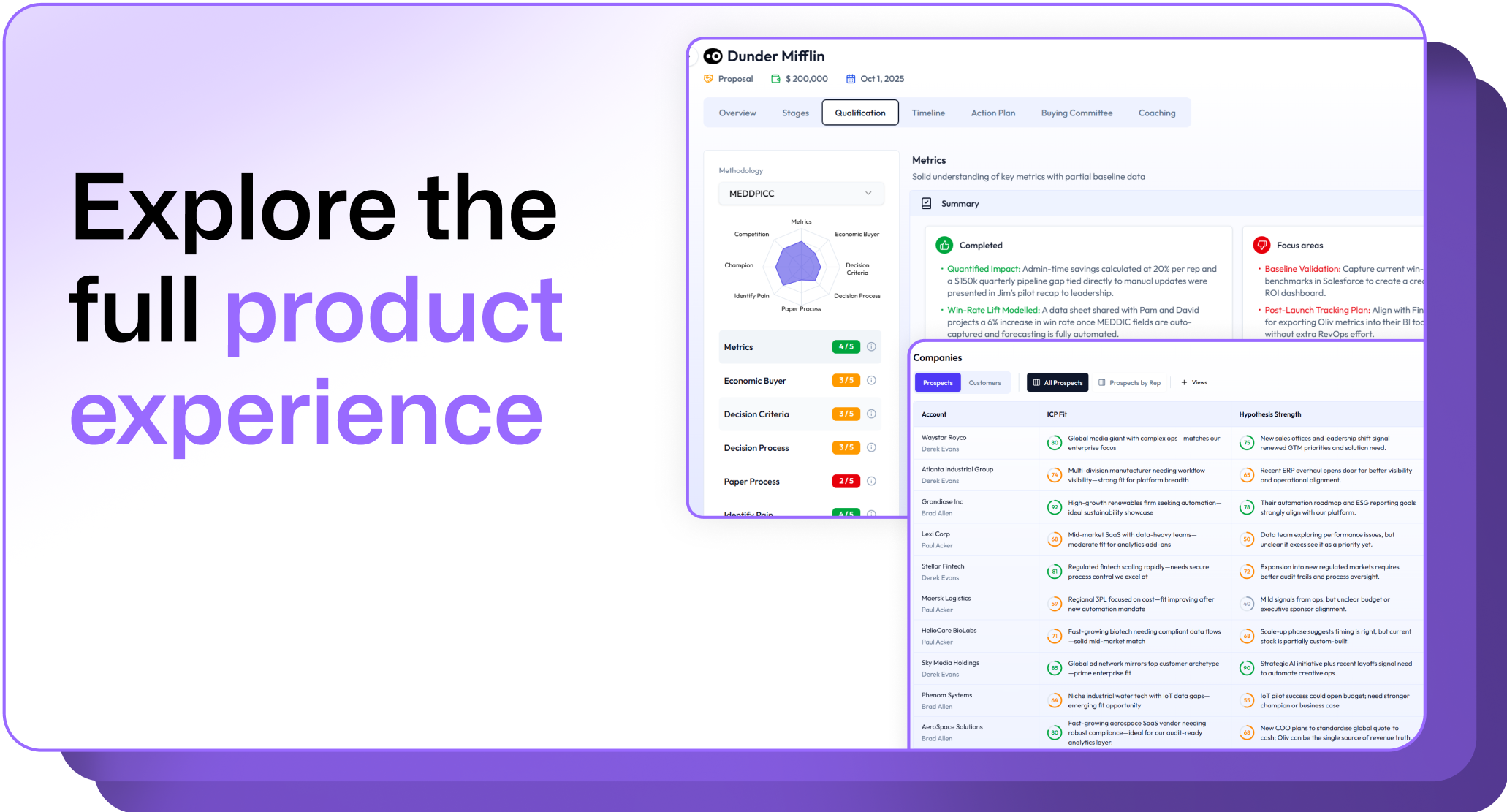
.avif)