8 Best Revenue Orchestration Platforms in 2026: Features, Pricing, Implementation Time and Vendor Fit Compared
Written by
Ishan Chhabra
Last Updated :
September 9, 2026
Skim in :
13
mins
In this article
Still got questions?
Come discuss this article with me.
Hi, I'm Ishan, Founder and CEO of Oliv.
I'm always up for a conversation about revenue intelligence, AI agents, or what's actually working (and what's not) across revenue teams.
I'd love to hear your perspective.
Thank you! Your submission has been received!
Oops! Something went wrong while submitting the form.
Meet Oliv’s AI Agents
Hi! I’m, Deal Driver
I track deals, flag risks, send weekly pipeline updates and give sales managers full visibility into deal progress
Hi! I’m, CRM Manager
I maintain CRM hygiene by updating core, custom and qualification fields all without your team lifting a finger
Hi! I’m, Forecaster
I build accurate forecasts based on real deal movement and tell you which deals to pull in to hit your number
Hi! I’m, Coach
I believe performance fuels revenue. I spot skill gaps, score calls and build coaching plans to help every rep level up
Hi! I’m, Prospector
I dig into target accounts to surface the right contacts, tailor and time outreach so you always strike when it counts
Hi! I’m, Pipeline tracker
I call reps to get deal updates, and deliver a real-time, CRM-synced roll-up view of deal progress
Hi! I’m, Analyst
I answer complex pipeline questions, uncover deal patterns, and build reports that guide strategic decisions
TL;DR
The eight platforms we rank are Oliv AI, Gong, Clari + Salesloft, Salesforce Agentforce, Outreach, Aviso, Microsoft Copilot for Sales, and Avoma.
Every vendor now uses orchestration language, so we score on five mechanics instead: data seen, trigger, actions without a human, approval model, and audit trail.
Clari and Salesloft merged on 3 December 2025 and became one brand on 2 September 2026, collapsing two shortlist slots into one contract.
Only Salesforce publishes a full rate card. Gong, Clari + Salesloft, Outreach, Aviso, and Oliv AI all quote, so stack totals have no verifiable floor.
Consolidating mid-contract rarely pays off. Two conditions change that: renewals landing in one window, and insight that exists but nobody acts on.
Before agents act, verify EU AI Act Article 50 disclosure, all-party consent states for recording, and an exportable audit record per agent run.
Q1. What are the 8 best revenue orchestration platforms in 2026? [toc=1. The 8 Platforms]
A RevOps lead I spoke with last quarter had four tabs open. Gong, Clari, Outreach, and a spreadsheet counting seats. Her CFO wanted one line item gone by renewal. Her sales leader wanted nothing touched. She asked me one question: which of these actually does anything on its own?
That is the question this list answers.
The eight best revenue orchestration platforms in 2026 are Oliv AI, Gong, Clari + Salesloft, Outreach, Salesforce Agentforce, Aviso, Microsoft Copilot for Sales, and Avoma. Oliv AI ranks first because its agents run on triggers and carry actions to completion, with each agent set to auto-run or approval-required. Clari and Salesloft are ranked as one entry. They merged in December 2025 and moved to a single brand on 2 September 2026. Only Salesforce publishes a full rate card. The rest quote.
⭐ How the rank order was earned
Rank order comes from the rubric in the next section, not from opinion. You have sat through four vendor pitches this quarter, so you will check. Every entry answers the same five questions in the same order.
Those five questions are simple. What data does it see? What fires it? What can it do without a human? What needs approval? What audit record survives? If you want the longer version of that test, our breakdown of what a revenue orchestration platform actually is works through it step by step.
The 8 platforms, ranked
Oliv AI ⭐⭐⭐⭐⭐ (88/100). Best for teams whose insight layer works and whose execution layer is a human reading a dashboard. oliv.ai, retrieved 7 Sep 2026.
Gong ⭐⭐⭐⭐ (79/100). Best for enterprises that want conversation data and a governed execution layer from one vendor. gong.io/platform/revenue-ai, retrieved 7 Sep 2026.
Clari + Salesloft ⭐⭐⭐⭐ (77/100). Best for teams that need forecasting and engagement under one contract. salesloft.com, retrieved 7 Sep 2026.
Salesforce Agentforce ⭐⭐⭐⭐ (74/100). Best for Salesforce-committed orgs that want agents on the substrate. salesforce.com/agentforce/pricing, retrieved 7 Sep 2026.
Outreach ⭐⭐⭐ (70/100). Best for outbound-heavy teams that live in sequences. outreach.ai/product-updates, retrieved 7 Sep 2026.
Aviso ⭐⭐⭐ (68/100). Best for teams that want the widest published agent surface. aviso.com, retrieved 7 Sep 2026.
Microsoft Copilot for Sales ⭐⭐⭐ (61/100). Best for Microsoft 365 and Dynamics-committed teams. Copilot for Sales, retrieved 7 Sep 2026.
Avoma ⭐⭐⭐ (58/100). Best for mid-market teams that need capture and coaching, not execution. avoma.com, retrieved 7 Sep 2026.
The full comparison table
Revenue Orchestration Platforms Compared, September 2026
Platform
Published price
Implementation
Trigger types
Actions without a human
Best fit
Rating
Oliv AI
Not published, quoted per deployment
Days to about 2 weeks
Scheduled runs, event triggers
CRM field updates, follow-ups, deal monitoring, agent-to-agent dispatch
Execution bottleneck
⭐⭐⭐⭐⭐
Gong
No figures on gong.io/pricing
Weeks to months
Conversation and deal events
Governed actions via Revenue Harness
Enterprise CI plus execution
⭐⭐⭐⭐
Clari + Salesloft
Not published
Weeks to months
Forecast cycles, engagement events
Sequence and forecast workflow actions
Forecast plus engagement in one contract
⭐⭐⭐⭐
Salesforce Agentforce
$5 per user plus Flex Credits; Sales Cloud $0 to $550
Months
Flow, record, and platform events
Agent actions inside Salesforce
Salesforce-native orgs
⭐⭐⭐⭐
Outreach
Not published
Weeks
Sequence and buyer-signal events
Agentic engagement workflows
Outbound-led teams
⭐⭐⭐
Aviso
Not published
Weeks to months
Pipeline and conversation events
Published agentic workflow library
Broad agent surface
⭐⭐⭐
Microsoft Copilot for Sales
Verify on vendor page
Days to weeks
User prompts, Outlook and Teams events
Assistive drafting and summaries
Microsoft-committed teams
⭐⭐⭐
Avoma
Published tiers on vendor site
Days
Meeting events
Notes, summaries, CRM sync
Capture and coaching
⭐⭐⭐
⚠️ One note before you read the entries
Clari and Salesloft appear once, not twice. Counting them separately inflates your shortlist and hides the fact that one renewal now covers both. If you are weighing that renewal against a wider stack review, our analysis of revenue tech stack consolidation costs covers the trade-offs in detail.
1.1 Oliv AI [toc=1.1 Oliv AI]
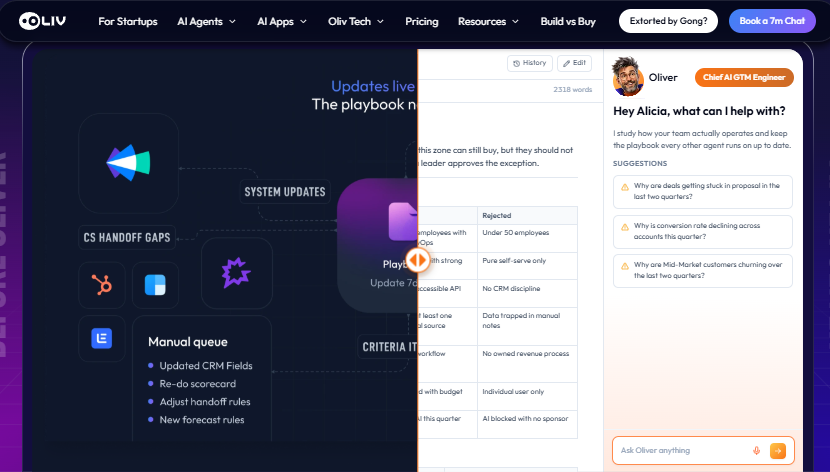
Oliv AI's Oliver agent surfaces stalled-deal questions while the playbook and CRM update queue refresh automatically
Oliv AI is an AI-native revenue intelligence and orchestration platform. It runs a marketplace of role-scoped agents on a continuously updated context graph of every account and opportunity. Agents execute on scheduled and event triggers using plain-English SOPs. Each agent is configured to auto-run or to require approval, with per-agent tool permissions and run tracking.
🧠 What it actually does
Oliv AI captures across five modalities, including meetings, email, calls, CRM, and shared inter-company Slack and Teams channels. That last one matters more than it sounds. Most B2B deals now move in a shared channel that no recording tool sees.
We built the context graph first, because agents without context are guesswork. It took roughly 18 months. The hard part was never the model. It was mapping a meeting to the right opportunity when a customer has five open opportunities and three duplicate accounts, which is the same problem our work on CRM data quality automation for RevOps digs into.
⚙️ Key features
Agent marketplace with role-scoped agents, cloneable and configurable.
Oliver, the GTM engineer agent, builds a new agent from a plain-English request.
Olivia, the orchestrator agent, reviews activity and dispatches other agents.
Auto-run versus approval-required gating, set per agent.
Data governance and spend governance, with per-agent limits and watermarks.
70+ integrations, including Snowflake, Databricks, Redshift, and BigQuery.
💰 Pricing and implementation
Oliv AI prices per deployment and does not publish a public rate for the orchestration layer, so treat it as a quote-form vendor like most of this list. Ask for the platform fee, the view-only seat cost, and the per-agent run cost in writing.
Setup is fast, because onboarding builds an agent handbook from your own materials before agents go live. Reviewers describe setup in five to fifteen minutes for individual use, and under a week with a deployment engineer. Our RevOps implementation and admin guide walks through what that first week covers.
📅 Product timeline
Oliv AI Product Timeline
Period
What shipped
Through 2025
Conversation intelligence surface: meetings, emails, and calls captured, with summaries, action items, and automated coaching scorecards on every meeting. See Oliv AI platform.
2026 to date
Agent marketplace across role categories, plain-English SOPs, per-agent approval gating, and run evaluations. Context capture extended to shared inter-company channels and data warehouses. See context capture.
Expected next
Deeper agent-to-agent orchestration and wider marketplace coverage, based on the published marketplace roadmap. See agents marketplace.
✅ Pros and ❌ cons
✅ Agents complete actions, they do not only flag them. ✅ Approval boundary is set per agent, not per platform. ✅ Works on messy CRM data without a cleanup sprint first. ✅ Migrates data from Gong, Clari, Avoma, or Fireflies.
❌ Least publicly proven vendor on this list. ❌ No published price for the orchestration layer. ❌ Case studies are gated, so proof is harder to verify. ❌ Reviewers report occasional slowness and a basic mobile app.
🗣️ What users say
"I like that Oliv.ai has six to seven agents that are really good for the entire revenue cycle. The Driver agent watches all my deals and flags any that are at risk, so I don't have to spend hours listening to recordings in tools like Gong and Clari. The initial setup was really easy because the team provided FDE engineers who set everything up, and within less than a week, we were good to go." Verified reviewer, Revenue Team Oliv AI G2 - Verified Review [17 Jun 2026]
"It helps in automating and updating our CRM after calls, provides a clear deal summary, and sends follow-up emails, allowing managers to coach their reps with actionable insight rather than just going through call recordings." Verified reviewer, Sales Manager Oliv AI G2 - Verified Review [26 Jun 2026]
"I'd love to see few more options to customize dashboards and reports for different teams." Verified reviewer, Sales Manager Oliv AI G2 - Verified Review [26 Jun 2026]
1.2 Gong [toc=1.2 Gong]
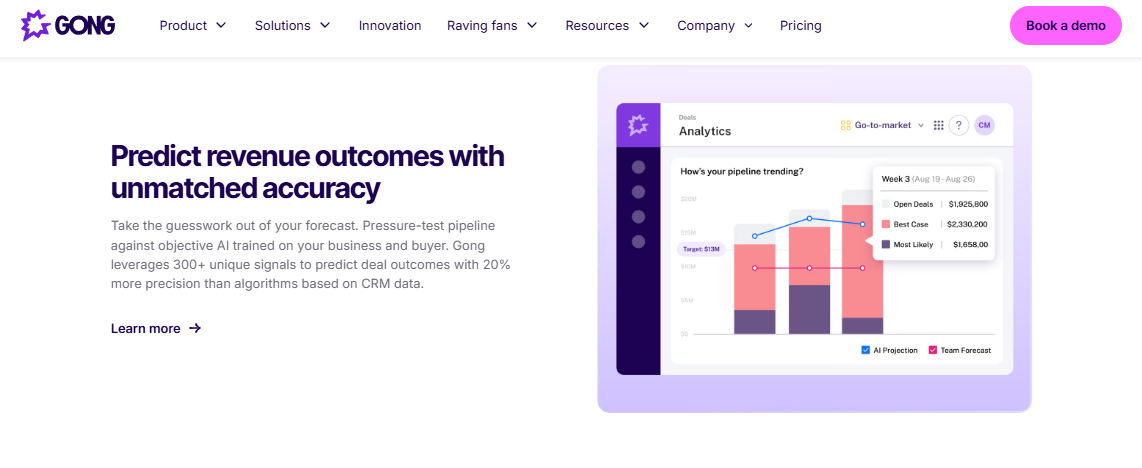
Gong pressure-tests pipeline using 300+ signals to predict deal outcomes against the team forecast
Gong is a revenue AI platform built on conversation data. Gong shipped the Revenue Harness, a governed agentic execution layer, in June 2026, and sells orchestration and a connected revenue graph by name on its own platform pages. Gong publishes no per-user price. Its pricing page states that licences are per user and a platform fee applies, with no dollar figures.
🎯 What Gong genuinely does well
Gong holds the largest usable body of conversation data in this category. Its AI Trackers detect meaning rather than keyword matches, a distinction we unpack in our explainer on Gong smart trackers. For a team that needs one trusted record of what was said, Gong is still the safest answer.
I want to be precise here, because the lazy version of this argument is wrong. Gong orchestrates. Saying otherwise on an orchestration listicle is the easiest claim in the world to disprove.
⚙️ Key features
Conversation capture across calls, meetings, and email.
AI Trackers for theme and topic detection.
Deal boards, pipeline inspection, and forecasting.
Gong Engage for sequences.
Revenue Harness for governed agentic execution.
💰 Pricing and implementation
Gong quotes. Expect a per-seat licence plus a platform fee, and budget for a longer rollout than a capture-only tool needs. Ask what the platform fee covers, and read the renewal terms before the next cycle. Our breakdown of Gong pricing collects what buyers actually report paying.
Implementation typically runs in weeks, and longer where CRM mapping is messy. Reviewers repeatedly flag setup friction on trackers and data export limits tied to plan tier, which matches the pattern in our Gong implementation timeline analysis.
📅 Product timeline
Gong Product Timeline
Period
What shipped
Through 2025
Conversation intelligence, AI Trackers, deal boards, forecasting, and Gong Engage for sequencing. See Gong Revenue AI.
June 2026
Mission Big Dipper, introducing the Revenue Harness execution layer for governed agent actions on Gong's revenue data. See Revenue Harness announcement.
Expected next
Wider agent coverage across the revenue graph, following the orchestration direction published on Gong's own RevOps pages. See Gong platform.
✅ Pros and ❌ cons
✅ Deepest conversation dataset in the category. ✅ Shipped, governed execution layer. ✅ Strong enterprise support and scale. ✅ Trackers detect meaning, not just keywords.
❌ No published pricing, so cost cannot be modelled before a quote. ❌ Reviewers report tracker setup friction and export limits by plan. ❌ Data access on exit is a stated concern for some users. ❌ Engage draws mixed reviews against dedicated engagement tools.
🗣️ What users say
"I found the AI tracker setup to be quite difficult, especially concerning the user interface when setting up keywords or smart trackers. Moreover, I cannot download all the data myself unless we upgrade the plan, which isn't ideal." Verified reviewer, Sales User Gong - G2 Verified Review [3 Oct 2025]
"The fact that you can't edit a recording (to only share a portion with a client), and the fact that if you stop working with the tool you lose the data." Verified reviewer, Sales User Gong - G2 Verified Review [19 Mar 2026]
"Gong Engage is awful in every single way compared to outreach. Flows are hard to get into, information is not readily available, sequencing is difficult to create and track." Verified reviewer, Sales User Gong - G2 Verified Review [9 Jun 2025]
🤔 Where my head is on Gong
Oliv AI's read is that Gong's real gap is not intelligence, it is what happens after the flag. A risk score still waits for a person to open it. Oliv AI's agents carry that action or hand it to a named approver, which is a different job from surfacing the risk. The wider version of that argument sits in our piece on Gong limitations beyond meeting intelligence.
I could be reading this too strongly. For a team whose bottleneck is genuinely visibility, Gong plus discipline beats a new contract, and our Gong versus Clari comparison is the better read if forecasting is the real question.
1.3 Clari + Salesloft [toc=1.3 Clari + Salesloft]
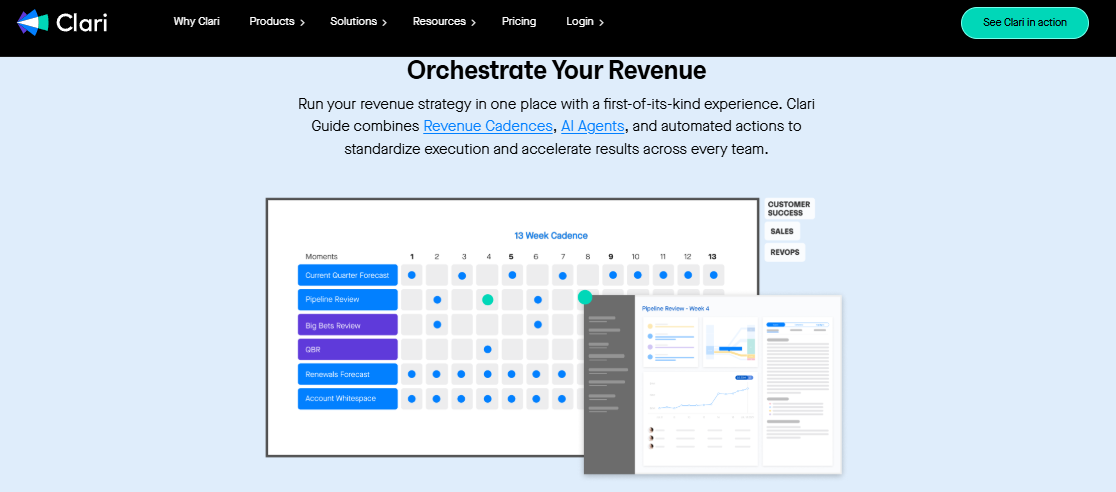
Clari sells orchestration by name, combining revenue cadences, AI agents, and standardised execution moments
Clari and Salesloft are one company. The merger completed on 3 December 2025, and the combined business moved to a single Salesloft brand on 2 September 2026. Clari Forecast stays as a product name. Salesloft Conversation Intelligence reached general availability on 14 July 2026, shipping mobile in-person recording. Neither side publishes a per-user rate.
🔗 What the combined platform does
The combined platform covers forecasting, pipeline inspection, sequencing, dialing, and conversation intelligence. Gartner named Clari a Leader and Salesloft a Visionary in its 2025 Revenue Action Orchestration Magic Quadrant. That is real analyst validation, and I am not going to argue with it. Our breakdown of Clari features covers what each module does in practice.
Oliv AI overlaps this platform across conversation intelligence, engagement, and forecasting. On module count, the merged company wins. On execution mechanics, the comparison gets closer.
⚙️ Key features
Forecast rollups, submissions, and inspection views.
Cadences, dialer, and multi-channel sequencing.
Conversation intelligence, generally available since July 2026.
Mobile in-person recording.
Salesforce and CRM sync across both product lines.
💰 Pricing and implementation
Both product lines quote. Expect a per-seat licence plus onboarding, and expect the two contracts to have different renewal dates for at least one more cycle. Pull both agreements and map overlapping modules before you renew either. Our guide to Clari pricing collects what buyers report being quoted.
Implementation runs in weeks for the engagement layer and longer for forecasting. Reviewers describe forecasting setup as smooth and sequencing setup as harder, a pattern also visible in our roundup of Clari reviews and user feedback.
📅 Product timeline
Clari + Salesloft Product Timeline
Period
What shipped
Through 2025
Two separate products. Clari ran forecasting, pipeline inspection, and revenue analytics. Salesloft ran cadences, dialer, and engagement analytics. Merger completed 3 December 2025. See merger completion release.
July to September 2026
Conversation Intelligence reached general availability on 14 July 2026 with mobile in-person recording. The company consolidated to one Salesloft brand on 2 September 2026. See single-brand announcement.
Expected next
Tighter data unification between forecasting and engagement under the Predictive Revenue System roadmap published by the merged company. See Salesloft newsroom.
✅ Pros and ❌ cons
✅ Forecasting and engagement under one vendor. ✅ Analyst-recognised on both sides of the merger. ✅ Conversation intelligence now generally available. ✅ Deep Salesforce integration on the forecasting side.
❌ No published pricing on either product line. ❌ Reviewers report weak CRM write-back from conversation intelligence. ❌ Engagement usability draws repeated criticism. ❌ Two contracts and two renewal cycles to untangle.
🗣️ What users say
"The conversation intelligence tool is lacking, and we don't have the context of the deals against the conversation intelligence findings. The CRM writeback is not good; we cannot send MEDDIC values back to Salesforce or update fields in Salesforce from the conversation intelligence." Verified reviewer, Revenue Operations Clari - G2 Verified Review [13 Jul 2026]
"It truly shines in weekly forecasts and opportunity analysis. This makes the workflow intuitive and allows me to analyze week-by-week data quickly and efficiently." Verified reviewer, Sales Leader Clari - G2 Verified Review [16 Nov 2025]
"Integrating Salesloft came with a lot of challenges, and even now, it feels like the platform still has some kinks. I often have trouble logging meetings, and certain features feel clunky or overly manual." Verified reviewer, Sales User Salesloft - G2 Verified Review [5 Jan 2026]
Salesforce Agentforce runs agents natively inside the CRM that most of this list integrates with. Agentforce publishes four buying routes, including a $5 per-user licence that consumes Flex Credits. Sales Cloud lists Free at $0, Starter at $25, Pro at $100, Enterprise Core at $195, Advanced at $395, and Max at $550 per user per month, with Flex Credits included per org per year.
🏗️ Why the substrate matters
Every platform here writes into Salesforce or HubSpot. Agentforce starts there. For a Salesforce-committed org, that removes an entire class of sync failures, and that advantage is real. Our walkthrough of Agentforce for sales features details what those native agents can and cannot touch.
Oliv AI treats Salesforce and HubSpot as connected systems, not competitors, and reads from them rather than replacing them. Where Agentforce keeps agents inside one system, an orchestration layer spans several.
⚙️ Key features
Agents built on Salesforce records, flows, and platform events.
Agent Builder with governed action sets.
Flex Credits as the consumption unit.
Native reporting and permission model.
Deep tie-in to Sales Cloud tiers.
💰 Pricing and implementation
Agentforce is the only entry here with a full public rate card, which is worth crediting. The complication is consumption. The licence is cheap and the run cost is variable, so model credits and not seats. Our Agentforce pricing breakdown works through how credits accumulate.
Implementation usually runs in months, not weeks. Budget admin time for permissions, flows, and testing before anything runs unattended, which is the same lesson in our Agentforce implementation guide.
📅 Product timeline
Salesforce Agentforce Product Timeline
Period
What shipped
Through 2025
Einstein-era module pricing and early Agentforce packaging, sold alongside Sales Cloud editions. See Sales Cloud pricing.
2026 to date
Current lineup of Free, Starter, Pro, Enterprise Core, Advanced, and Max, with Flex Credits per org and a $5 per-user Agentforce licence requiring credits. See Agentforce pricing.
Expected next
Continued agent expansion across Sales and Service, published in the Salesforce release notes cycle. See Salesforce release notes.
✅ Pros and ❌ cons
✅ Published, checkable pricing. ✅ Native to the system of record. ✅ Strong permission and audit model. ✅ No extra integration layer for Salesforce data.
❌ Credit consumption makes cost hard to predict. ❌ Longer setup than agent-layer tools. ❌ Value drops sharply if you are not on Salesforce. ❌ Admin-heavy to configure and maintain.
1.5 Outreach [toc=1.5 Outreach]
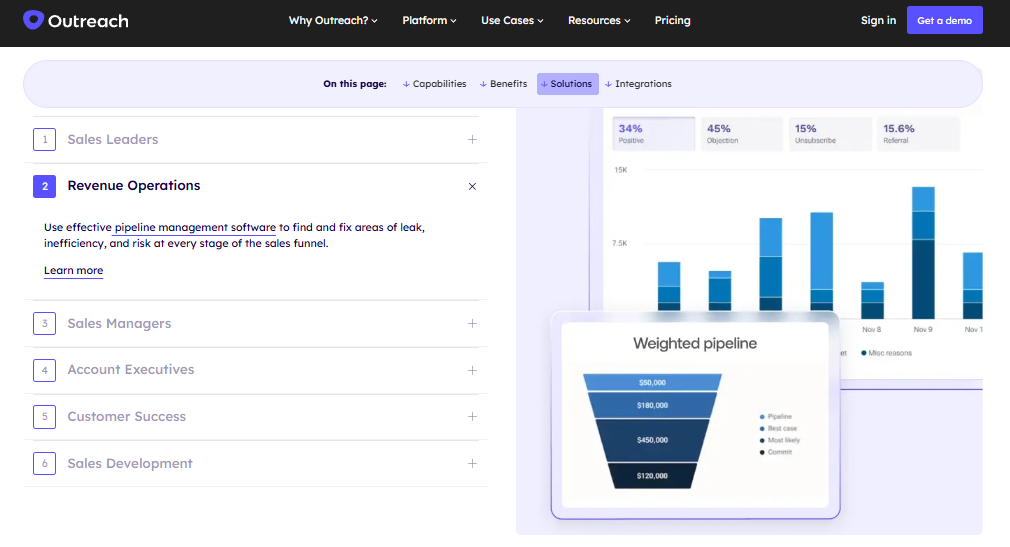
Outreach maps its platform to six revenue roles, with RevOps pipeline leak detection shown open
Outreach, at outreach.ai, now sells itself as an agentic revenue orchestration platform rather than a sequencing point tool. It runs multi-channel sequences across email, phone, and LinkedIn, with the Kaia meeting assistant providing live coaching and post-call summaries. Outreach does not publish a per-user price and continues shipping product updates through 2026.
📤 What it is genuinely good at
Outbound rigor. If your problem is that follow-ups leak, Outreach fixes that better than anything else on this list. Reps stop guessing who to call next. Our Gong versus Outreach comparison sets that strength against conversation-first platforms.
Oliv AI reads engagement activity as one input to a deal-level view rather than running the cadence itself. Different jobs, and worth being honest about that.
⚙️ Key features
Multi-channel sequences with triggers.
Kaia conversation assistant with real-time cards.
Buyer engagement signals and next-best-action prompts.
Salesforce and CRM sync.
Agentic workflow expansion through 2026 releases.
💰 Pricing and implementation
Outreach quotes. Ask about seat minimums and what the agentic features cost on top of core sequencing.
Onboarding takes weeks, not days. Reviewers consistently describe a dense interface and a real learning curve for new hires, which is worth weighing against the ramp targets in our guide to sales new hire ramp time.
📅 Product timeline
Outreach Product Timeline
Period
What shipped
Through 2025
Sequencing, dialer, Kaia meeting assistant, and buyer-engagement reporting as a sales-engagement suite. See Outreach product updates.
February to April 2026
Continued release cycle repositioning the product as an agentic revenue orchestration platform, with workflow and signal updates documented in the release notes. See 2026 release notes.
Expected next
Further agent coverage across the outbound workflow, per the published update cadence. See Outreach platform.
✅ Pros and ❌ cons
✅ Best-in-class sequencing discipline. ✅ Kaia delivers usable live coaching. ✅ Strong signal-based prioritisation. ✅ Active 2026 release cadence.
❌ Dense interface with a steep learning curve. ❌ Recurring Salesforce sync complaints. ❌ Data accuracy needs manual checking. ❌ No published pricing.
🗣️ What users say
"Being able to build multi-channel Sequences (email, phone, and LinkedIn) helps ensure that no lead or client follow-up falls through the cracks. The AI-driven Kaia meeting assistant feels like a major win for managers." Verified reviewer, Sales Manager Outreach - G2 Verified Review [29 Apr 2026]
"Sometimes it does not sync well with Salesforce. The calls don't get synced to Salesforce, which is the issue we're still working on even with Outreach support's help." Verified reviewer, Marketing Operations Outreach - G2 Verified Review [10 Apr 2026]
"It can feel a little clunky at times, especially when you're moving between tasks. Sequences are great, but they can be a bit rigid if you want to customize things on the fly." Verified reviewer, SDR Outreach - G2 Verified Review [4 May 2026]
1.6 Aviso [toc=1.6 Aviso]
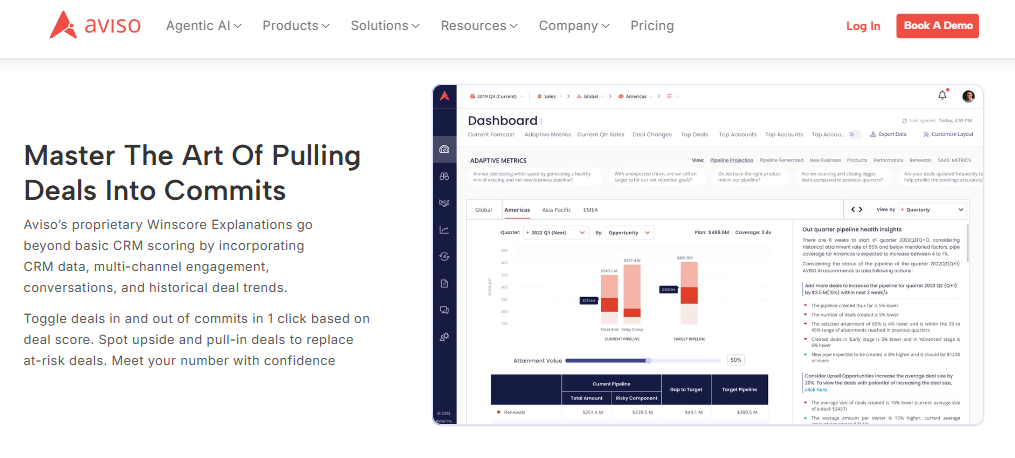
Aviso's Winscore explanations combine CRM data, engagement, and conversations to pull deals into commits
Aviso publishes the widest agent surface on this list. Its site describes 30 or more out-of-box agentic workflows, 50 or more task-based agents, a no-code GTM Agent Studio, conversation intelligence, relationship intelligence, and sales engagement. Aviso publishes no price. Its forecasting claim is worded as "nearly 100% accurate" with no quantified figure attached.
📊 The published surface versus the working surface
Aviso lists more agents on paper than Oliv AI does, and that deserves saying plainly. The number that matters is different. Ask how many of those agents finish an action without a human, and what happens when one fails. Our piece on AI agents for RevOps sets out how to run that test.
Oliv AI counts only generally available agents in comparisons like this one. Apply the same test to every vendor here, including Aviso.
⚙️ Key features
Agentic workflow library across the revenue cycle.
No-code GTM Agent Studio for custom agents.
Forecasting and pipeline analytics.
Conversation and relationship intelligence.
Marketing intelligence and engagement modules.
💰 Pricing and implementation
Aviso quotes. Ask for the agent run cost separately from the seat cost.
Implementation runs from weeks to months depending on module count. Reviewers on the critical end describe a heavy product and slow support. If forecasting is your main reason for looking, compare it against the field in our roundup of AI sales forecasting software.
📅 Product timeline
Aviso Product Timeline
Period
What shipped
Through 2025
Forecasting, pipeline analytics, conversation intelligence, and early agent workflows positioned around forecast accuracy. See Aviso platform.
2026 to date
Expanded published surface: 30 or more agentic workflows, 50 or more task-based agents, and a no-code GTM Agent Studio for building custom agents. See Aviso agents.
Expected next
Broader agent library and studio capability, per the roadmap published on the product pages. See Aviso product pages.
✅ Pros and ❌ cons
✅ Widest published agent inventory here. ✅ No-code builder for custom agents. ✅ Covers forecasting and conversation data together. ✅ End-to-end module coverage on one platform.
❌ No published pricing. ❌ Accuracy claim is unquantified. ❌ Critical reviewers cite build quality and support. ❌ Shipped versus announced is hard to verify from outside.
🗣️ What users say
"Mandated by business, nothing else. Product is just poorly built." Verified reviewer, Sales User Aviso - G2 Verified Review [24 Jun 2025]
1.7 Microsoft Copilot for Sales [toc=1.7 Microsoft Copilot for Sales]
Microsoft Copilot for Sales sits inside Outlook, Teams, and Dynamics 365. It drafts emails, summarises meetings, and surfaces CRM context where sellers already work. Verify its current pricing and its CRM write-back behaviour against Microsoft's own documentation before you shortlist it, because both change across release waves.
🪟 Who this actually fits
Teams already standardised on Microsoft 365 and Dynamics. The value is proximity, not autonomy. Copilot helps a seller do the work faster, and that is a different promise from an agent finishing the work. Our comparison of AI agents versus SaaS dashboards draws that line clearly.
Oliv AI is scored here on execution autonomy, so an assistive tool ranks lower on this rubric by design. If your bottleneck is drafting speed, that ranking should not put you off.
⚙️ Key features
In-context assistance inside Outlook and Teams.
Meeting summaries and email drafting.
CRM record surfacing during conversations.
Dynamics 365 Sales integration.
Microsoft 365 security and admin model.
💰 Pricing and implementation
Check the vendor page for current licence terms rather than trusting third-party figures, including ours. Setup is fast for Microsoft-committed orgs, since identity and permissions already exist. For Dynamics-based stacks, our guide to Microsoft Dynamics 365 integration covers the connection points to check.
📅 Product timeline
Microsoft Copilot for Sales Product Timeline
Period
What shipped
Through 2025
Copilot for Sales delivering in-context drafting, meeting summaries, and CRM surfacing inside Outlook and Teams. See Copilot for Sales.
2026 release wave 1
Planned Dynamics 365 Sales capabilities documented by Microsoft, covering seller workflow and agent features. Verify each before assuming availability. See Dynamics 365 Sales 2026 release plan.
Expected next
Further agent capability across the Dynamics stack, per the published release plan cycle. See Microsoft release plans.
✅ Pros and ❌ cons
✅ Lives where Microsoft sellers already work. ✅ Fast rollout for existing tenants. ✅ Enterprise-grade admin controls. ✅ Documented public release plans.
❌ Assistive rather than autonomous. ❌ Value drops outside the Microsoft stack. ❌ Capability claims need version-by-version checking. ❌ Not built for cross-stack orchestration.
1.8 Avoma [toc=1.8 Avoma]
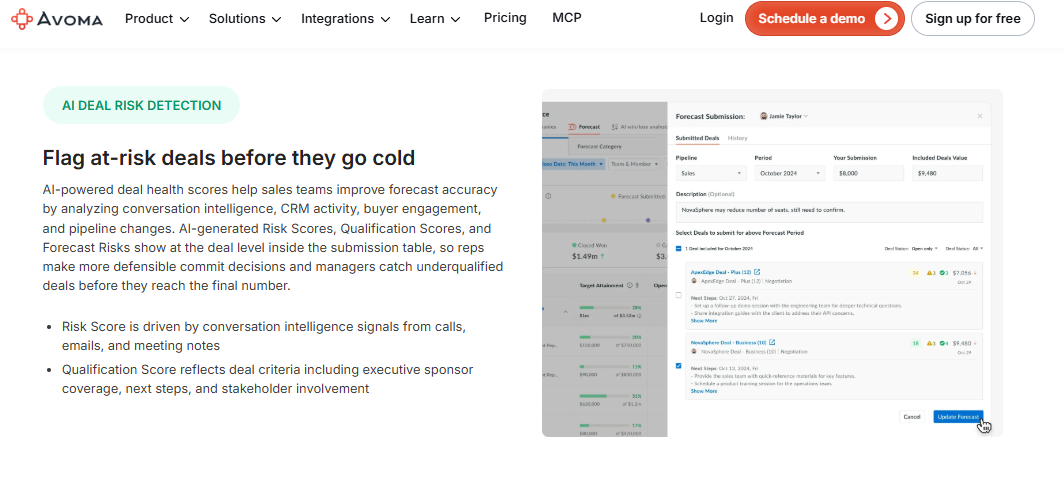
Avoma flags at-risk deals with AI risk and qualification scores inside the forecast submission table
Avoma is a conversation intelligence and meeting assistant platform for mid-market teams. It records and transcribes meetings, builds summaries and scorecards, and syncs notes to the CRM. Avoma publishes tiered pricing on its own site, which makes it one of the easier tools here to budget for.
🎧 Where Avoma stops, honestly
Avoma captures and analyses. It does not orchestrate. Ranking it eighth is not a criticism of the product, it is a statement about the rubric. Our feature-level look at Avoma features shows exactly where that boundary sits.
Oliv AI migrates data from Avoma, Gong, Fireflies, or Clari during onboarding, so an Avoma library is not stranded if you move up the stack. If capture is all you need, buy the cheaper tool and keep the difference.
⚙️ Key features
Accurate transcription across meeting platforms.
Customisable scorecards for coaching.
Team-level organisation and permissions.
CRM note sync.
Published pricing tiers.
💰 Pricing and implementation
Avoma lists its tiers publicly, so you can model cost before a sales call. Setup takes days, not weeks, and reviewers describe it as straightforward. Our summary of Avoma user reviews and feedback collects what teams report after the first month.
📅 Product timeline
Avoma Product Timeline
Period
What shipped
Through 2025
Meeting recording, transcription, AI notes, and coaching scorecards across common meeting platforms. See Avoma platform.
2026 to date
Expanded scoring customisation and team management controls, with transcription accuracy cited by reviewers in March 2026. See Avoma pricing.
Expected next
Continued revenue intelligence expansion beyond capture, per the product pages. See Avoma product.
✅ Pros and ❌ cons
✅ Published, predictable pricing. ✅ Strong transcription accuracy. ✅ Flexible coaching scorecards. ✅ Fast to deploy.
❌ Capture and analysis only, no execution layer. ❌ Limited orchestration across the stack. ❌ Not a forecasting tool. ❌ Outgrown by teams consolidating vendors.
🗣️ What users say
"I like the accuracy of the transcriptions, the way it manages different teams within the organization, and the flexibility of the scoring customization." Verified reviewer, Sales Enablement Avoma - G2 Verified Review [17 Mar 2026]
Q2. How were these platforms scored, and what do the analysts say the category is? [toc=2. Scoring Rubric and Analyst View]
Each platform is scored out of 100 on five weighted criteria. Execution Autonomy carries 30%. Trigger and Data Coverage carries 20%. Approval, Audit, and Agent-Sprawl Governance carries 20%. Implementation Time and Integration Depth carries 15%. Pricing Transparency carries 15%. Stars follow the score in twenty-point bands. The weightings track what three analyst houses measure: Forrester's Wave criteria, Gartner's Revenue Action Orchestration frame, and Everest Group's provider assessment.
⭐ What counts as evidence for each criterion
A rubric reverse-engineered from one vendor's feature list is worthless. You have sat through four pitches this quarter, and you would spot it. These weights come from the buyer's actual job, which is deciding what to keep during a consolidation. Our guide to revenue intelligence platform comparison for RevOps uses the same starting point.
Here is what each criterion accepts as proof.
Execution Autonomy (30%). Documented actions an agent completes without a person. Dashboards and alerts score zero here.
Trigger and Data Coverage (20%). Event triggers, scheduled runs, and the number of systems the platform reads.
Approval, Audit, and Governance (20%). Per-agent approval settings, spend caps, and exportable run logs.
Implementation Time and Integration Depth (15%). Published or reviewer-reported time to first value.
Pricing Transparency (15%). A published rate card, not a quote form.
⚠️ Why agent count is scored down
Gartner forecast in July 2026 that AI agents will outnumber human sellers ten to one by 2028. In the same forecast, fewer than 40% of sellers expect agents to improve their productivity. Analyst Dan Gottlieb attributes that gap to fragmented systems rather than seller skill.
So counting agents measures nothing useful. Oliv AI's spend governance sets per-agent limits and high-watermark alerts, with a credit estimate produced before an agent is deployed, and that kind of control is what this criterion rewards. Our framework for AI trust and governance in RevOps evaluation covers the controls to insist on.
📊 What the three analyst houses each measure
Analyst Frames for Revenue Orchestration
Source
Frame
What it contributes
Forrester Wave, Q3 2024, plus ROP Landscape Q1 2026
12 providers scored on 29 criteria
The original criteria discipline
Gartner Magic Quadrant for Revenue Action Orchestration, 2025
Merges engagement, intelligence, and automation
The second searchable category name
Everest Group Innovation Watch, 2026
18 providers tiered by maturity
Coverage of vendors the others skip
Search both category names when you build your longlist. Half the market files itself under one label and half under the other, which is why our explainer on the move from revenue ops to intelligence to orchestration tracks both terms.
⭐ Star bands and the scorecard
Star Bands by Score
Score
Stars
81 to 100
⭐⭐⭐⭐⭐
61 to 80
⭐⭐⭐⭐
41 to 60
⭐⭐⭐
21 to 40
⭐⭐
0 to 20
⭐
Full Eight-Vendor Scorecard
Platform
Execution
Triggers
Governance
Implementation
Pricing
Total
Oliv AI
27
17
18
13
13
88
Gong
23
17
17
12
10
79
Clari + Salesloft
22
17
16
12
10
77
Salesforce Agentforce
21
16
17
8
12
74
Outreach
20
15
14
11
10
70
Aviso
20
15
13
11
9
68
Microsoft Copilot for Sales
14
14
14
12
7
61
Avoma
11
13
12
12
10
58
❌ What was deliberately excluded
No invented user ratings appear anywhere on this page. No unpublished price is presented as a rate. No vendor's age or architecture vintage counts for or against it.
Oliv AI loses points here too, on pricing transparency and on public proof, since there is no third-party rating we can cite for it. Re-weight the rubric against your own bottleneck and you may well get a different winner, using the buyer checklist in our mid-market revenue AI buyer guide.
Q3. What makes a platform an orchestration platform rather than revenue intelligence with an action button? [toc=3. What Counts as Orchestration]
A revenue orchestration platform sees data across your stack, fires on an event rather than a login, takes a named action without being asked, requires a defined approval above a risk threshold, and leaves an audit record. Revenue intelligence stops at the insight. Gong, Clari + Salesloft, Outreach, Salesforce, Aviso, and Oliv AI all use orchestration language on their own sites, so the word alone no longer separates anything.
🗣️ Four pitches, one vocabulary
A VP of RevOps told me she had sat through four demos in one quarter. All four used the word orchestration. Two used the word graph. She could not tell them apart from the decks.
That is not her failing. The category label stopped carrying information about eighteen months ago, which is why we wrote a plain definition of the revenue orchestration platform category in the first place.
📉 What the dashboard decade actually cost
For ten years, the sale was visibility. Record the calls, score the deals, surface the risk. The tools delivered on that, and I do not want to pretend otherwise.
The cost showed up after the flag. A rep opens the dashboard, sees a red deal, and does nothing, because the next action still belongs to a human with sixty other tabs open. Our piece on deal slippage prevention follows what happens next.
⚙️ What changed, and what to test instead
Agents changed what the word can mean. An agent fires on an event, runs a set of instructions, and writes a record of what it did. Gartner made the shift searchable by naming the category Revenue Action Orchestration in 2025.
So test mechanics, not vocabulary. Ask five questions of every vendor, in this order: what data does it see, what fires it, what does it do without a human, what needs approval, and what audit trail survives. The distinction is unpacked further in our comparison of revenue intelligence versus conversation intelligence.
🔐 The permission split
Oliv AI answers those five questions like this. It reads meetings, email, calls, CRM, data warehouses, and shared inter-company Slack and Teams channels. It fires on scheduled and event triggers. Its agents run plain-English SOPs with per-agent tool permissions, each set to auto-run or approval-required, with every run tracked.
That last setting is the whole argument in one line. Some agents act. Some ask first. You decide which is which, per agent, not per platform. Our overview of Oliv AI agents for sales teams shows how those settings look in practice.
⚠️ Where this distinction stops mattering
I want to concede the strongest counter-argument, because it is a good one. If your bottleneck is insight, not follow-through, a tool that surfaces the right thing at the right moment is worth exactly as much as one that acts.
It stops being true at volume. Surfacing scales with one person's attention. Acting does not.
📋 Each vendor's own orchestration language
How Each Vendor Describes Itself
Platform
How it describes itself
Gong
Sells "orchestrate revenue" and a "connected revenue graph" on its own platform pages
Clari + Salesloft
Positions the merged company around a Predictive Revenue System
Outreach
Describes itself as an agentic revenue orchestration platform
Salesforce Agentforce
Sells agents that act on CRM records natively
Aviso
Publishes an end-to-end AI revenue platform with agentic workflows
Oliv AI
Runs role-scoped agents with per-agent auto-run or approval gating
The words are close to identical. That is exactly the point. Score the mechanics in the right-hand column of your own evaluation sheet, and the list reorders itself.
Q4. Which platforms ship a real execution layer: Oliv AI, Gong, and Clari + Salesloft compared [toc=4. Execution-Layer Platforms]
Three platforms ship an execution layer today. Oliv AI runs role-scoped agents with per-agent auto-run or approval gating. Gong shipped the Revenue Harness, a governed agentic execution layer, on 24 June 2026, and sells orchestration by name. Clari and Salesloft completed their merger on 3 December 2025 and operate as one brand from 2 September 2026, with Conversation Intelligence generally available since 14 July 2026 and Clari Forecast retained as a product name.
🧩 The scene this section is about
A RevOps lead I worked with had a deal stall for nineteen days. The risk flag had been sitting in a dashboard the whole time. Nobody opened it.
Her CRM had three duplicate accounts for that customer. So even the flag was pointing at the wrong opportunity, a failure mode we cover in our guide to CRM data strategy and revenue predictability.
🤖 Oliv AI: what acts, what asks
Oliv AI reads meetings, email, calls, CRM records, data warehouses, and shared inter-company Slack and Teams channels. Agents fire on scheduled runs and event triggers. They run plain-English SOPs, with tool access scoped per agent and every run tracked.
The permission split is the part I care about most. Oliver builds and runs agents from a plain request. Olivia reviews activity and dispatches other agents. Each one is set to act or to ask first.
The honest limits: Oliv AI is the least publicly proven platform on this list, its case studies sit behind an email gate, and any agent that is not generally available is excluded from these comparisons.
🎙️ Gong: the harness is real
Gong holds the deepest conversation dataset in this category, at more than $500 million in ARR and over 5,000 customers. Its AI Trackers detect meaning rather than keyword matches. In June 2026, Gong shipped the Revenue Harness as a governed execution layer.
Saying Gong does not orchestrate would be the easiest claim on this page to disprove. The sourced limit is different. Gong's pricing page carries no dollar figures at all, so you cannot model cost before a quote, as our review of Gong limitations and challenges sets out.
🔀 Clari + Salesloft: one company, two contracts
The merged company now spans forecasting, engagement, and conversation intelligence under one brand. Conversation Intelligence went generally available on 14 July 2026, shipping mobile in-person recording. A shared data layer connects the two former product lines.
Oliv AI overlaps this platform on modules and loses that comparison on breadth. The practical issue for you is renewal timing. Two agreements, two dates, and overlapping modules you are probably paying for twice, which is the arithmetic in our analysis of how to reduce sales tech stack costs.
⚖️ Where the three actually differ
Gong's harness governs execution inside Gong's own surface. The merged Salesloft platform puts forecasting and engagement in one contract. Oliv AI sets the approval boundary per agent across connected systems, and imports existing Gong or Clari conversation data.
That last detail matters more than it sounds. It means a pilot does not require displacing the tool your reps will defend in the meeting, and our walkthrough of migration from Gong covers how the data moves.
🗣️ What users say
"The deal driver agent keeps tabs on all my deals and tells me where each deal is and which one needs my focus. The forecast agent assists with preparing weekly and monthly forecasts." Verified reviewer, Account Executive Oliv AI G2 - Verified Review [15 Jun 2026]
"I appreciate how Gong organizes all our chats, videos, and audio with clients into a single source. I found the AI tracker setup to be quite difficult, especially concerning the user interface when setting up keywords or smart trackers." Verified reviewer, Sales User Gong - G2 Verified Review [3 Oct 2025]
"Clari forecasting is simple, easy to use, and well integrated with SFDC. The AI features are immature, team activity is poorly designed, and it doesn't integrate well with other popular business systems today." Verified reviewer, Sales Leader Clari - G2 Verified Review [10 Oct 2025]
Q5. How do Outreach, Salesforce Agentforce, Aviso, Microsoft Copilot for Sales, and Avoma compare? [toc=5. Native and Adjacent Platforms]
Outreach positions as an agentic revenue orchestration platform with continuing 2026 releases. Salesforce Agentforce runs natively on the substrate every other platform integrates with, with a $5 per-user licence consuming Flex Credits alongside Sales Cloud tiers from $0 to $550. Aviso publishes the broadest agent surface: 30 or more agentic workflows, 50 or more task-based agents, and a no-code GTM Agent Studio. Microsoft Copilot for Sales suits Microsoft-committed teams. Avoma serves mid-market conversation intelligence without an orchestration commitment.
⚙️ The same five questions, side by side
Native and Adjacent Platforms on the Same Five Questions
Oliv AI publishes fewer agents than Aviso and states which ones are generally available. That is the count that matters when you score execution, so apply the same test to every vendor here. Our overview of AI sales agents explains what a complete action actually looks like.
Outreach. Strong sequencing rigor. Check Salesforce sync behaviour during the trial, since that is the recurring complaint.
Agentforce. Only entry with a full public rate card. Model credit consumption, not seats.
Aviso. Widest published surface. Ask how many of those agents finish an action without a person.
Copilot for Sales. Assistive, not autonomous. Verify pricing and CRM write-back on Microsoft's own documentation before shortlisting.
Avoma. Capture and coaching. It does not orchestrate, and its pricing page is public.
⚠️ Two concessions worth making
For a Salesforce-committed buyer, Agentforce has a real gravitational advantage. Nothing else here starts inside the system of record, which is the honest starting point in our review of Agentforce versus revenue AI for B2B.
Aviso lists more agents than Oliv AI does. Published agent count is a marketing metric, so I would not buy on it, but pretending the number does not exist would be dishonest. If forecasting is the real driver, weigh both against our roundup of revenue intelligence software platforms.
🗣️ What users say
"I've used apollo.io and salesloft before and this has got to be the worst software when it comes to importing contacts from Salesforce. I've lost hours of my life doing this extremely simple task." Verified reviewer, Sales User Outreach - G2 Verified Review [6 Jan 2025]
"Mandated by business, nothing else. Product is just poorly built." Verified reviewer, Sales User Aviso - G2 Verified Review [24 Jun 2025]
"I like the accuracy of the transcriptions, the way it manages different teams within the organization, and the flexibility of the scoring customization." Verified reviewer, Sales Enablement Avoma - G2 Verified Review [17 Mar 2026]
Q6. What does it cost, how long does implementation take, and is consolidating worth it? [toc=6. Cost, Timeline and Consolidation]
Only Salesforce publishes a rate card, with Sales Cloud from $0 to $550 per user per month and Agentforce adding a $5 per-user licence that consumes Flex Credits. Gong, Clari + Salesloft, Outreach, and Aviso publish no per-user price, so any stack total you see quoted has no verifiable floor. Implementation runs from roughly two weeks for agent-layer deployments to three to six months for enterprise suites, with year-one setup budgets commonly quoted between $15,000 and $75,000.
💰 The room where this decision happens
A CFO with a spreadsheet wants one line item gone. A sales leader wants nothing touched, because the team likes the tool. The RevOps lead sits between them holding four contracts with four renewal dates.
That is the actual meeting. No feature table survives it, which is why our guide to CRO ROI and strategic value starts from the budget conversation instead.
💸 Why most consolidation decks are wrong
They model licence savings and skip everything else. Migration time, retraining, lost historical data, and the quarter your reporting goes sideways.
Worse, they build totals from numbers no vendor publishes. I have seen stack figures quoted to the dollar for two products that have never printed a price. Oliv AI publishes no orchestration-layer price either, so treat us the same way and ask for the platform fee, the view-only seat cost, and the per-agent run cost in writing. Our revenue intelligence ROI calculator shows which inputs actually move the number.
⏰ The two conditions that change the maths
Consolidating mid-contract rarely pays for itself. Two things change that.
Renewals land in the same window. You can move budget without paying twice.
The insight already exists and nobody acts on it. That gap is execution, and more reporting will not close it.
Outside those two, staying put is the right answer. Say that to your CFO before you say anything else, and bring the workings from our analysis of revenue tech stack consolidation costs.
Oliv AI migrates data from Gong, Avoma, Fireflies, or Clari as part of onboarding, and spend is tracked per agent with an estimate produced before deployment. Ask every vendor on your list for both of those things in writing. Teams looking for further savings can also work through our checklist on how to reduce sales tech stack costs.
🗣️ What users say
"Having an onboarding team that made the setup easy was excellent. It's more affordable compared to other options we previously used." Verified reviewer, Account Executive Oliv AI G2 - Verified Review [23 Jun 2026]
"I like Clari's visual design and the nice, clear style of word presentation. The initial setup was easy too." Verified reviewer, Sales User Clari - G2 Verified Review [17 Dec 2025]
Q7. What must you verify on compliance and fit before you let agents act? [toc=7. Compliance Checks and Vendor Fit]
Before an agent sends anything, verify three things. Under EU AI Act Article 50, applicable since 2 August 2026 with no grace period, agents interacting with people must disclose their artificial nature and on whose behalf they act, with fines reaching EUR 15 million or 3% of global turnover. Eleven US states require all-party consent for call recording. And every autonomous action needs an audit record naming the agent, the trigger, and the approver.
⚠️ EU AI Act Article 50, in plain terms
The obligation started on 2 August 2026. The European Commission adopted its final Article 50 guidelines on 20 July 2026, weeks before the date. There is no transition period for transparency duties.
The practical action is small and nobody has done it. Audit every outbound agent template that touches an EU contact, and add the disclosure to your sequence library this week. Our mid-market revenue AI buyer guide on governance and SOC 2 sets out the wider control set.
🔐 Consent and recorded conversations
Eleven US states require all-party consent, including California, Illinois, Washington, and Pennsylvania. GDPR and CCPA treat recordings and AI-derived metadata as personal data, not just the audio file.
Ask each vendor two questions. Does it detect participant location and adjust consent prompts? And can you delete derived insights, not only the recording? Our explainer on customer conversation analytics covers what gets derived from a single call.
📋 Audit trail and agent sprawl
Gartner forecasts AI agents outnumbering human sellers ten to one by 2028, while fewer than 40% of sellers expect a productivity gain. Fragmented systems, not agent shortage, explain that gap.
So cap the pilot. Give every agent a named owner, one success metric, and a spend limit. Oliv AI scopes knowledge and tool access per agent, with run tracking and evaluations, which is what an audit requirement actually asks for. Require the same evidence from every vendor you shortlist, using the criteria in our AI CRM trust and governance evaluation.
🎯 Which platform fits which team
Insight is the bottleneck. Buy the reporting tool and keep your money. Several platforms here score well on that job.
Execution is the bottleneck. Look at the three platforms with shipped execution layers.
200-rep mid-market team on Salesforce, renewals far out. Stay put and pilot one workflow.
Renewals aligned in one window. This is the quarter to consolidate.
Microsoft-committed team. Price Copilot for Sales first.
Oliv AI fits a team whose insight layer already works and whose execution layer is a person reading a dashboard. It does not fit a team still fixing data capture, or one whose real problem is forecast accuracy. For that second case, start with our guide to improving sales forecast accuracy with AI.
🗣️ What users say
"The fact that you can't edit a recording (to only share a portion with a client), and the fact that if you stop working with the tool you lose the data." Verified reviewer, Sales User Gong - G2 Verified Review [19 Mar 2026]
"The biggest value of Oliv AI is its ability to operationalize customer conversations. It doesn't just record meetings; it automatically captures key insights, updates systems of record, identifies next steps, and helps keep teams aligned." Verified reviewer, Revenue Operations Oliv AI G2 - Verified Review [23 Jun 2026]
⭐ Where to leave this
Score your shortlist on triggers, actions, approvals, and audit trail. Stop treating the word orchestration as evidence, because every vendor here uses it. If your bottleneck turns out to be execution rather than insight, that is worth a short conversation, and you can book a demo to test it against your own pipeline.
Q1. What are the 8 best revenue orchestration platforms in 2026? [toc=1. The 8 Platforms]
A RevOps lead I spoke with last quarter had four tabs open. Gong, Clari, Outreach, and a spreadsheet counting seats. Her CFO wanted one line item gone by renewal. Her sales leader wanted nothing touched. She asked me one question: which of these actually does anything on its own?
That is the question this list answers.
The eight best revenue orchestration platforms in 2026 are Oliv AI, Gong, Clari + Salesloft, Outreach, Salesforce Agentforce, Aviso, Microsoft Copilot for Sales, and Avoma. Oliv AI ranks first because its agents run on triggers and carry actions to completion, with each agent set to auto-run or approval-required. Clari and Salesloft are ranked as one entry. They merged in December 2025 and moved to a single brand on 2 September 2026. Only Salesforce publishes a full rate card. The rest quote.
⭐ How the rank order was earned
Rank order comes from the rubric in the next section, not from opinion. You have sat through four vendor pitches this quarter, so you will check. Every entry answers the same five questions in the same order.
Those five questions are simple. What data does it see? What fires it? What can it do without a human? What needs approval? What audit record survives? If you want the longer version of that test, our breakdown of what a revenue orchestration platform actually is works through it step by step.
The 8 platforms, ranked
Oliv AI ⭐⭐⭐⭐⭐ (88/100). Best for teams whose insight layer works and whose execution layer is a human reading a dashboard. oliv.ai, retrieved 7 Sep 2026.
Gong ⭐⭐⭐⭐ (79/100). Best for enterprises that want conversation data and a governed execution layer from one vendor. gong.io/platform/revenue-ai, retrieved 7 Sep 2026.
Clari + Salesloft ⭐⭐⭐⭐ (77/100). Best for teams that need forecasting and engagement under one contract. salesloft.com, retrieved 7 Sep 2026.
Salesforce Agentforce ⭐⭐⭐⭐ (74/100). Best for Salesforce-committed orgs that want agents on the substrate. salesforce.com/agentforce/pricing, retrieved 7 Sep 2026.
Outreach ⭐⭐⭐ (70/100). Best for outbound-heavy teams that live in sequences. outreach.ai/product-updates, retrieved 7 Sep 2026.
Aviso ⭐⭐⭐ (68/100). Best for teams that want the widest published agent surface. aviso.com, retrieved 7 Sep 2026.
Microsoft Copilot for Sales ⭐⭐⭐ (61/100). Best for Microsoft 365 and Dynamics-committed teams. Copilot for Sales, retrieved 7 Sep 2026.
Avoma ⭐⭐⭐ (58/100). Best for mid-market teams that need capture and coaching, not execution. avoma.com, retrieved 7 Sep 2026.
The full comparison table
Revenue Orchestration Platforms Compared, September 2026
Platform
Published price
Implementation
Trigger types
Actions without a human
Best fit
Rating
Oliv AI
Not published, quoted per deployment
Days to about 2 weeks
Scheduled runs, event triggers
CRM field updates, follow-ups, deal monitoring, agent-to-agent dispatch
Execution bottleneck
⭐⭐⭐⭐⭐
Gong
No figures on gong.io/pricing
Weeks to months
Conversation and deal events
Governed actions via Revenue Harness
Enterprise CI plus execution
⭐⭐⭐⭐
Clari + Salesloft
Not published
Weeks to months
Forecast cycles, engagement events
Sequence and forecast workflow actions
Forecast plus engagement in one contract
⭐⭐⭐⭐
Salesforce Agentforce
$5 per user plus Flex Credits; Sales Cloud $0 to $550
Months
Flow, record, and platform events
Agent actions inside Salesforce
Salesforce-native orgs
⭐⭐⭐⭐
Outreach
Not published
Weeks
Sequence and buyer-signal events
Agentic engagement workflows
Outbound-led teams
⭐⭐⭐
Aviso
Not published
Weeks to months
Pipeline and conversation events
Published agentic workflow library
Broad agent surface
⭐⭐⭐
Microsoft Copilot for Sales
Verify on vendor page
Days to weeks
User prompts, Outlook and Teams events
Assistive drafting and summaries
Microsoft-committed teams
⭐⭐⭐
Avoma
Published tiers on vendor site
Days
Meeting events
Notes, summaries, CRM sync
Capture and coaching
⭐⭐⭐
⚠️ One note before you read the entries
Clari and Salesloft appear once, not twice. Counting them separately inflates your shortlist and hides the fact that one renewal now covers both. If you are weighing that renewal against a wider stack review, our analysis of revenue tech stack consolidation costs covers the trade-offs in detail.
1.1 Oliv AI [toc=1.1 Oliv AI]
Oliv AI's Oliver agent surfaces stalled-deal questions while the playbook and CRM update queue refresh automatically
Oliv AI is an AI-native revenue intelligence and orchestration platform. It runs a marketplace of role-scoped agents on a continuously updated context graph of every account and opportunity. Agents execute on scheduled and event triggers using plain-English SOPs. Each agent is configured to auto-run or to require approval, with per-agent tool permissions and run tracking.
🧠 What it actually does
Oliv AI captures across five modalities, including meetings, email, calls, CRM, and shared inter-company Slack and Teams channels. That last one matters more than it sounds. Most B2B deals now move in a shared channel that no recording tool sees.
We built the context graph first, because agents without context are guesswork. It took roughly 18 months. The hard part was never the model. It was mapping a meeting to the right opportunity when a customer has five open opportunities and three duplicate accounts, which is the same problem our work on CRM data quality automation for RevOps digs into.
⚙️ Key features
Agent marketplace with role-scoped agents, cloneable and configurable.
Oliver, the GTM engineer agent, builds a new agent from a plain-English request.
Olivia, the orchestrator agent, reviews activity and dispatches other agents.
Auto-run versus approval-required gating, set per agent.
Data governance and spend governance, with per-agent limits and watermarks.
70+ integrations, including Snowflake, Databricks, Redshift, and BigQuery.
💰 Pricing and implementation
Oliv AI prices per deployment and does not publish a public rate for the orchestration layer, so treat it as a quote-form vendor like most of this list. Ask for the platform fee, the view-only seat cost, and the per-agent run cost in writing.
Setup is fast, because onboarding builds an agent handbook from your own materials before agents go live. Reviewers describe setup in five to fifteen minutes for individual use, and under a week with a deployment engineer. Our RevOps implementation and admin guide walks through what that first week covers.
📅 Product timeline
Oliv AI Product Timeline
Period
What shipped
Through 2025
Conversation intelligence surface: meetings, emails, and calls captured, with summaries, action items, and automated coaching scorecards on every meeting. See Oliv AI platform.
2026 to date
Agent marketplace across role categories, plain-English SOPs, per-agent approval gating, and run evaluations. Context capture extended to shared inter-company channels and data warehouses. See context capture.
Expected next
Deeper agent-to-agent orchestration and wider marketplace coverage, based on the published marketplace roadmap. See agents marketplace.
✅ Pros and ❌ cons
✅ Agents complete actions, they do not only flag them. ✅ Approval boundary is set per agent, not per platform. ✅ Works on messy CRM data without a cleanup sprint first. ✅ Migrates data from Gong, Clari, Avoma, or Fireflies.
❌ Least publicly proven vendor on this list. ❌ No published price for the orchestration layer. ❌ Case studies are gated, so proof is harder to verify. ❌ Reviewers report occasional slowness and a basic mobile app.
🗣️ What users say
"I like that Oliv.ai has six to seven agents that are really good for the entire revenue cycle. The Driver agent watches all my deals and flags any that are at risk, so I don't have to spend hours listening to recordings in tools like Gong and Clari. The initial setup was really easy because the team provided FDE engineers who set everything up, and within less than a week, we were good to go." Verified reviewer, Revenue Team Oliv AI G2 - Verified Review [17 Jun 2026]
"It helps in automating and updating our CRM after calls, provides a clear deal summary, and sends follow-up emails, allowing managers to coach their reps with actionable insight rather than just going through call recordings." Verified reviewer, Sales Manager Oliv AI G2 - Verified Review [26 Jun 2026]
"I'd love to see few more options to customize dashboards and reports for different teams." Verified reviewer, Sales Manager Oliv AI G2 - Verified Review [26 Jun 2026]
1.2 Gong [toc=1.2 Gong]
Gong pressure-tests pipeline using 300+ signals to predict deal outcomes against the team forecast
Gong is a revenue AI platform built on conversation data. Gong shipped the Revenue Harness, a governed agentic execution layer, in June 2026, and sells orchestration and a connected revenue graph by name on its own platform pages. Gong publishes no per-user price. Its pricing page states that licences are per user and a platform fee applies, with no dollar figures.
🎯 What Gong genuinely does well
Gong holds the largest usable body of conversation data in this category. Its AI Trackers detect meaning rather than keyword matches, a distinction we unpack in our explainer on Gong smart trackers. For a team that needs one trusted record of what was said, Gong is still the safest answer.
I want to be precise here, because the lazy version of this argument is wrong. Gong orchestrates. Saying otherwise on an orchestration listicle is the easiest claim in the world to disprove.
⚙️ Key features
Conversation capture across calls, meetings, and email.
AI Trackers for theme and topic detection.
Deal boards, pipeline inspection, and forecasting.
Gong Engage for sequences.
Revenue Harness for governed agentic execution.
💰 Pricing and implementation
Gong quotes. Expect a per-seat licence plus a platform fee, and budget for a longer rollout than a capture-only tool needs. Ask what the platform fee covers, and read the renewal terms before the next cycle. Our breakdown of Gong pricing collects what buyers actually report paying.
Implementation typically runs in weeks, and longer where CRM mapping is messy. Reviewers repeatedly flag setup friction on trackers and data export limits tied to plan tier, which matches the pattern in our Gong implementation timeline analysis.
📅 Product timeline
Gong Product Timeline
Period
What shipped
Through 2025
Conversation intelligence, AI Trackers, deal boards, forecasting, and Gong Engage for sequencing. See Gong Revenue AI.
June 2026
Mission Big Dipper, introducing the Revenue Harness execution layer for governed agent actions on Gong's revenue data. See Revenue Harness announcement.
Expected next
Wider agent coverage across the revenue graph, following the orchestration direction published on Gong's own RevOps pages. See Gong platform.
✅ Pros and ❌ cons
✅ Deepest conversation dataset in the category. ✅ Shipped, governed execution layer. ✅ Strong enterprise support and scale. ✅ Trackers detect meaning, not just keywords.
❌ No published pricing, so cost cannot be modelled before a quote. ❌ Reviewers report tracker setup friction and export limits by plan. ❌ Data access on exit is a stated concern for some users. ❌ Engage draws mixed reviews against dedicated engagement tools.
🗣️ What users say
"I found the AI tracker setup to be quite difficult, especially concerning the user interface when setting up keywords or smart trackers. Moreover, I cannot download all the data myself unless we upgrade the plan, which isn't ideal." Verified reviewer, Sales User Gong - G2 Verified Review [3 Oct 2025]
"The fact that you can't edit a recording (to only share a portion with a client), and the fact that if you stop working with the tool you lose the data." Verified reviewer, Sales User Gong - G2 Verified Review [19 Mar 2026]
"Gong Engage is awful in every single way compared to outreach. Flows are hard to get into, information is not readily available, sequencing is difficult to create and track." Verified reviewer, Sales User Gong - G2 Verified Review [9 Jun 2025]
🤔 Where my head is on Gong
Oliv AI's read is that Gong's real gap is not intelligence, it is what happens after the flag. A risk score still waits for a person to open it. Oliv AI's agents carry that action or hand it to a named approver, which is a different job from surfacing the risk. The wider version of that argument sits in our piece on Gong limitations beyond meeting intelligence.
I could be reading this too strongly. For a team whose bottleneck is genuinely visibility, Gong plus discipline beats a new contract, and our Gong versus Clari comparison is the better read if forecasting is the real question.
1.3 Clari + Salesloft [toc=1.3 Clari + Salesloft]
Clari sells orchestration by name, combining revenue cadences, AI agents, and standardised execution moments
Clari and Salesloft are one company. The merger completed on 3 December 2025, and the combined business moved to a single Salesloft brand on 2 September 2026. Clari Forecast stays as a product name. Salesloft Conversation Intelligence reached general availability on 14 July 2026, shipping mobile in-person recording. Neither side publishes a per-user rate.
🔗 What the combined platform does
The combined platform covers forecasting, pipeline inspection, sequencing, dialing, and conversation intelligence. Gartner named Clari a Leader and Salesloft a Visionary in its 2025 Revenue Action Orchestration Magic Quadrant. That is real analyst validation, and I am not going to argue with it. Our breakdown of Clari features covers what each module does in practice.
Oliv AI overlaps this platform across conversation intelligence, engagement, and forecasting. On module count, the merged company wins. On execution mechanics, the comparison gets closer.
⚙️ Key features
Forecast rollups, submissions, and inspection views.
Cadences, dialer, and multi-channel sequencing.
Conversation intelligence, generally available since July 2026.
Mobile in-person recording.
Salesforce and CRM sync across both product lines.
💰 Pricing and implementation
Both product lines quote. Expect a per-seat licence plus onboarding, and expect the two contracts to have different renewal dates for at least one more cycle. Pull both agreements and map overlapping modules before you renew either. Our guide to Clari pricing collects what buyers report being quoted.
Implementation runs in weeks for the engagement layer and longer for forecasting. Reviewers describe forecasting setup as smooth and sequencing setup as harder, a pattern also visible in our roundup of Clari reviews and user feedback.
📅 Product timeline
Clari + Salesloft Product Timeline
Period
What shipped
Through 2025
Two separate products. Clari ran forecasting, pipeline inspection, and revenue analytics. Salesloft ran cadences, dialer, and engagement analytics. Merger completed 3 December 2025. See merger completion release.
July to September 2026
Conversation Intelligence reached general availability on 14 July 2026 with mobile in-person recording. The company consolidated to one Salesloft brand on 2 September 2026. See single-brand announcement.
Expected next
Tighter data unification between forecasting and engagement under the Predictive Revenue System roadmap published by the merged company. See Salesloft newsroom.
✅ Pros and ❌ cons
✅ Forecasting and engagement under one vendor. ✅ Analyst-recognised on both sides of the merger. ✅ Conversation intelligence now generally available. ✅ Deep Salesforce integration on the forecasting side.
❌ No published pricing on either product line. ❌ Reviewers report weak CRM write-back from conversation intelligence. ❌ Engagement usability draws repeated criticism. ❌ Two contracts and two renewal cycles to untangle.
🗣️ What users say
"The conversation intelligence tool is lacking, and we don't have the context of the deals against the conversation intelligence findings. The CRM writeback is not good; we cannot send MEDDIC values back to Salesforce or update fields in Salesforce from the conversation intelligence." Verified reviewer, Revenue Operations Clari - G2 Verified Review [13 Jul 2026]
"It truly shines in weekly forecasts and opportunity analysis. This makes the workflow intuitive and allows me to analyze week-by-week data quickly and efficiently." Verified reviewer, Sales Leader Clari - G2 Verified Review [16 Nov 2025]
"Integrating Salesloft came with a lot of challenges, and even now, it feels like the platform still has some kinks. I often have trouble logging meetings, and certain features feel clunky or overly manual." Verified reviewer, Sales User Salesloft - G2 Verified Review [5 Jan 2026]
Salesforce Agentforce runs agents natively inside the CRM that most of this list integrates with. Agentforce publishes four buying routes, including a $5 per-user licence that consumes Flex Credits. Sales Cloud lists Free at $0, Starter at $25, Pro at $100, Enterprise Core at $195, Advanced at $395, and Max at $550 per user per month, with Flex Credits included per org per year.
🏗️ Why the substrate matters
Every platform here writes into Salesforce or HubSpot. Agentforce starts there. For a Salesforce-committed org, that removes an entire class of sync failures, and that advantage is real. Our walkthrough of Agentforce for sales features details what those native agents can and cannot touch.
Oliv AI treats Salesforce and HubSpot as connected systems, not competitors, and reads from them rather than replacing them. Where Agentforce keeps agents inside one system, an orchestration layer spans several.
⚙️ Key features
Agents built on Salesforce records, flows, and platform events.
Agent Builder with governed action sets.
Flex Credits as the consumption unit.
Native reporting and permission model.
Deep tie-in to Sales Cloud tiers.
💰 Pricing and implementation
Agentforce is the only entry here with a full public rate card, which is worth crediting. The complication is consumption. The licence is cheap and the run cost is variable, so model credits and not seats. Our Agentforce pricing breakdown works through how credits accumulate.
Implementation usually runs in months, not weeks. Budget admin time for permissions, flows, and testing before anything runs unattended, which is the same lesson in our Agentforce implementation guide.
📅 Product timeline
Salesforce Agentforce Product Timeline
Period
What shipped
Through 2025
Einstein-era module pricing and early Agentforce packaging, sold alongside Sales Cloud editions. See Sales Cloud pricing.
2026 to date
Current lineup of Free, Starter, Pro, Enterprise Core, Advanced, and Max, with Flex Credits per org and a $5 per-user Agentforce licence requiring credits. See Agentforce pricing.
Expected next
Continued agent expansion across Sales and Service, published in the Salesforce release notes cycle. See Salesforce release notes.
✅ Pros and ❌ cons
✅ Published, checkable pricing. ✅ Native to the system of record. ✅ Strong permission and audit model. ✅ No extra integration layer for Salesforce data.
❌ Credit consumption makes cost hard to predict. ❌ Longer setup than agent-layer tools. ❌ Value drops sharply if you are not on Salesforce. ❌ Admin-heavy to configure and maintain.
1.5 Outreach [toc=1.5 Outreach]
Outreach maps its platform to six revenue roles, with RevOps pipeline leak detection shown open
Outreach, at outreach.ai, now sells itself as an agentic revenue orchestration platform rather than a sequencing point tool. It runs multi-channel sequences across email, phone, and LinkedIn, with the Kaia meeting assistant providing live coaching and post-call summaries. Outreach does not publish a per-user price and continues shipping product updates through 2026.
📤 What it is genuinely good at
Outbound rigor. If your problem is that follow-ups leak, Outreach fixes that better than anything else on this list. Reps stop guessing who to call next. Our Gong versus Outreach comparison sets that strength against conversation-first platforms.
Oliv AI reads engagement activity as one input to a deal-level view rather than running the cadence itself. Different jobs, and worth being honest about that.
⚙️ Key features
Multi-channel sequences with triggers.
Kaia conversation assistant with real-time cards.
Buyer engagement signals and next-best-action prompts.
Salesforce and CRM sync.
Agentic workflow expansion through 2026 releases.
💰 Pricing and implementation
Outreach quotes. Ask about seat minimums and what the agentic features cost on top of core sequencing.
Onboarding takes weeks, not days. Reviewers consistently describe a dense interface and a real learning curve for new hires, which is worth weighing against the ramp targets in our guide to sales new hire ramp time.
📅 Product timeline
Outreach Product Timeline
Period
What shipped
Through 2025
Sequencing, dialer, Kaia meeting assistant, and buyer-engagement reporting as a sales-engagement suite. See Outreach product updates.
February to April 2026
Continued release cycle repositioning the product as an agentic revenue orchestration platform, with workflow and signal updates documented in the release notes. See 2026 release notes.
Expected next
Further agent coverage across the outbound workflow, per the published update cadence. See Outreach platform.
✅ Pros and ❌ cons
✅ Best-in-class sequencing discipline. ✅ Kaia delivers usable live coaching. ✅ Strong signal-based prioritisation. ✅ Active 2026 release cadence.
❌ Dense interface with a steep learning curve. ❌ Recurring Salesforce sync complaints. ❌ Data accuracy needs manual checking. ❌ No published pricing.
🗣️ What users say
"Being able to build multi-channel Sequences (email, phone, and LinkedIn) helps ensure that no lead or client follow-up falls through the cracks. The AI-driven Kaia meeting assistant feels like a major win for managers." Verified reviewer, Sales Manager Outreach - G2 Verified Review [29 Apr 2026]
"Sometimes it does not sync well with Salesforce. The calls don't get synced to Salesforce, which is the issue we're still working on even with Outreach support's help." Verified reviewer, Marketing Operations Outreach - G2 Verified Review [10 Apr 2026]
"It can feel a little clunky at times, especially when you're moving between tasks. Sequences are great, but they can be a bit rigid if you want to customize things on the fly." Verified reviewer, SDR Outreach - G2 Verified Review [4 May 2026]
1.6 Aviso [toc=1.6 Aviso]
Aviso's Winscore explanations combine CRM data, engagement, and conversations to pull deals into commits
Aviso publishes the widest agent surface on this list. Its site describes 30 or more out-of-box agentic workflows, 50 or more task-based agents, a no-code GTM Agent Studio, conversation intelligence, relationship intelligence, and sales engagement. Aviso publishes no price. Its forecasting claim is worded as "nearly 100% accurate" with no quantified figure attached.
📊 The published surface versus the working surface
Aviso lists more agents on paper than Oliv AI does, and that deserves saying plainly. The number that matters is different. Ask how many of those agents finish an action without a human, and what happens when one fails. Our piece on AI agents for RevOps sets out how to run that test.
Oliv AI counts only generally available agents in comparisons like this one. Apply the same test to every vendor here, including Aviso.
⚙️ Key features
Agentic workflow library across the revenue cycle.
No-code GTM Agent Studio for custom agents.
Forecasting and pipeline analytics.
Conversation and relationship intelligence.
Marketing intelligence and engagement modules.
💰 Pricing and implementation
Aviso quotes. Ask for the agent run cost separately from the seat cost.
Implementation runs from weeks to months depending on module count. Reviewers on the critical end describe a heavy product and slow support. If forecasting is your main reason for looking, compare it against the field in our roundup of AI sales forecasting software.
📅 Product timeline
Aviso Product Timeline
Period
What shipped
Through 2025
Forecasting, pipeline analytics, conversation intelligence, and early agent workflows positioned around forecast accuracy. See Aviso platform.
2026 to date
Expanded published surface: 30 or more agentic workflows, 50 or more task-based agents, and a no-code GTM Agent Studio for building custom agents. See Aviso agents.
Expected next
Broader agent library and studio capability, per the roadmap published on the product pages. See Aviso product pages.
✅ Pros and ❌ cons
✅ Widest published agent inventory here. ✅ No-code builder for custom agents. ✅ Covers forecasting and conversation data together. ✅ End-to-end module coverage on one platform.
❌ No published pricing. ❌ Accuracy claim is unquantified. ❌ Critical reviewers cite build quality and support. ❌ Shipped versus announced is hard to verify from outside.
🗣️ What users say
"Mandated by business, nothing else. Product is just poorly built." Verified reviewer, Sales User Aviso - G2 Verified Review [24 Jun 2025]
1.7 Microsoft Copilot for Sales [toc=1.7 Microsoft Copilot for Sales]
Microsoft Copilot for Sales sits inside Outlook, Teams, and Dynamics 365. It drafts emails, summarises meetings, and surfaces CRM context where sellers already work. Verify its current pricing and its CRM write-back behaviour against Microsoft's own documentation before you shortlist it, because both change across release waves.
🪟 Who this actually fits
Teams already standardised on Microsoft 365 and Dynamics. The value is proximity, not autonomy. Copilot helps a seller do the work faster, and that is a different promise from an agent finishing the work. Our comparison of AI agents versus SaaS dashboards draws that line clearly.
Oliv AI is scored here on execution autonomy, so an assistive tool ranks lower on this rubric by design. If your bottleneck is drafting speed, that ranking should not put you off.
⚙️ Key features
In-context assistance inside Outlook and Teams.
Meeting summaries and email drafting.
CRM record surfacing during conversations.
Dynamics 365 Sales integration.
Microsoft 365 security and admin model.
💰 Pricing and implementation
Check the vendor page for current licence terms rather than trusting third-party figures, including ours. Setup is fast for Microsoft-committed orgs, since identity and permissions already exist. For Dynamics-based stacks, our guide to Microsoft Dynamics 365 integration covers the connection points to check.
📅 Product timeline
Microsoft Copilot for Sales Product Timeline
Period
What shipped
Through 2025
Copilot for Sales delivering in-context drafting, meeting summaries, and CRM surfacing inside Outlook and Teams. See Copilot for Sales.
2026 release wave 1
Planned Dynamics 365 Sales capabilities documented by Microsoft, covering seller workflow and agent features. Verify each before assuming availability. See Dynamics 365 Sales 2026 release plan.
Expected next
Further agent capability across the Dynamics stack, per the published release plan cycle. See Microsoft release plans.
✅ Pros and ❌ cons
✅ Lives where Microsoft sellers already work. ✅ Fast rollout for existing tenants. ✅ Enterprise-grade admin controls. ✅ Documented public release plans.
❌ Assistive rather than autonomous. ❌ Value drops outside the Microsoft stack. ❌ Capability claims need version-by-version checking. ❌ Not built for cross-stack orchestration.
1.8 Avoma [toc=1.8 Avoma]
Avoma flags at-risk deals with AI risk and qualification scores inside the forecast submission table
Avoma is a conversation intelligence and meeting assistant platform for mid-market teams. It records and transcribes meetings, builds summaries and scorecards, and syncs notes to the CRM. Avoma publishes tiered pricing on its own site, which makes it one of the easier tools here to budget for.
🎧 Where Avoma stops, honestly
Avoma captures and analyses. It does not orchestrate. Ranking it eighth is not a criticism of the product, it is a statement about the rubric. Our feature-level look at Avoma features shows exactly where that boundary sits.
Oliv AI migrates data from Avoma, Gong, Fireflies, or Clari during onboarding, so an Avoma library is not stranded if you move up the stack. If capture is all you need, buy the cheaper tool and keep the difference.
⚙️ Key features
Accurate transcription across meeting platforms.
Customisable scorecards for coaching.
Team-level organisation and permissions.
CRM note sync.
Published pricing tiers.
💰 Pricing and implementation
Avoma lists its tiers publicly, so you can model cost before a sales call. Setup takes days, not weeks, and reviewers describe it as straightforward. Our summary of Avoma user reviews and feedback collects what teams report after the first month.
📅 Product timeline
Avoma Product Timeline
Period
What shipped
Through 2025
Meeting recording, transcription, AI notes, and coaching scorecards across common meeting platforms. See Avoma platform.
2026 to date
Expanded scoring customisation and team management controls, with transcription accuracy cited by reviewers in March 2026. See Avoma pricing.
Expected next
Continued revenue intelligence expansion beyond capture, per the product pages. See Avoma product.
✅ Pros and ❌ cons
✅ Published, predictable pricing. ✅ Strong transcription accuracy. ✅ Flexible coaching scorecards. ✅ Fast to deploy.
❌ Capture and analysis only, no execution layer. ❌ Limited orchestration across the stack. ❌ Not a forecasting tool. ❌ Outgrown by teams consolidating vendors.
🗣️ What users say
"I like the accuracy of the transcriptions, the way it manages different teams within the organization, and the flexibility of the scoring customization." Verified reviewer, Sales Enablement Avoma - G2 Verified Review [17 Mar 2026]
Q2. How were these platforms scored, and what do the analysts say the category is? [toc=2. Scoring Rubric and Analyst View]
Each platform is scored out of 100 on five weighted criteria. Execution Autonomy carries 30%. Trigger and Data Coverage carries 20%. Approval, Audit, and Agent-Sprawl Governance carries 20%. Implementation Time and Integration Depth carries 15%. Pricing Transparency carries 15%. Stars follow the score in twenty-point bands. The weightings track what three analyst houses measure: Forrester's Wave criteria, Gartner's Revenue Action Orchestration frame, and Everest Group's provider assessment.
⭐ What counts as evidence for each criterion
A rubric reverse-engineered from one vendor's feature list is worthless. You have sat through four pitches this quarter, and you would spot it. These weights come from the buyer's actual job, which is deciding what to keep during a consolidation. Our guide to revenue intelligence platform comparison for RevOps uses the same starting point.
Here is what each criterion accepts as proof.
Execution Autonomy (30%). Documented actions an agent completes without a person. Dashboards and alerts score zero here.
Trigger and Data Coverage (20%). Event triggers, scheduled runs, and the number of systems the platform reads.
Approval, Audit, and Governance (20%). Per-agent approval settings, spend caps, and exportable run logs.
Implementation Time and Integration Depth (15%). Published or reviewer-reported time to first value.
Pricing Transparency (15%). A published rate card, not a quote form.
⚠️ Why agent count is scored down
Gartner forecast in July 2026 that AI agents will outnumber human sellers ten to one by 2028. In the same forecast, fewer than 40% of sellers expect agents to improve their productivity. Analyst Dan Gottlieb attributes that gap to fragmented systems rather than seller skill.
So counting agents measures nothing useful. Oliv AI's spend governance sets per-agent limits and high-watermark alerts, with a credit estimate produced before an agent is deployed, and that kind of control is what this criterion rewards. Our framework for AI trust and governance in RevOps evaluation covers the controls to insist on.
📊 What the three analyst houses each measure
Analyst Frames for Revenue Orchestration
Source
Frame
What it contributes
Forrester Wave, Q3 2024, plus ROP Landscape Q1 2026
12 providers scored on 29 criteria
The original criteria discipline
Gartner Magic Quadrant for Revenue Action Orchestration, 2025
Merges engagement, intelligence, and automation
The second searchable category name
Everest Group Innovation Watch, 2026
18 providers tiered by maturity
Coverage of vendors the others skip
Search both category names when you build your longlist. Half the market files itself under one label and half under the other, which is why our explainer on the move from revenue ops to intelligence to orchestration tracks both terms.
⭐ Star bands and the scorecard
Star Bands by Score
Score
Stars
81 to 100
⭐⭐⭐⭐⭐
61 to 80
⭐⭐⭐⭐
41 to 60
⭐⭐⭐
21 to 40
⭐⭐
0 to 20
⭐
Full Eight-Vendor Scorecard
Platform
Execution
Triggers
Governance
Implementation
Pricing
Total
Oliv AI
27
17
18
13
13
88
Gong
23
17
17
12
10
79
Clari + Salesloft
22
17
16
12
10
77
Salesforce Agentforce
21
16
17
8
12
74
Outreach
20
15
14
11
10
70
Aviso
20
15
13
11
9
68
Microsoft Copilot for Sales
14
14
14
12
7
61
Avoma
11
13
12
12
10
58
❌ What was deliberately excluded
No invented user ratings appear anywhere on this page. No unpublished price is presented as a rate. No vendor's age or architecture vintage counts for or against it.
Oliv AI loses points here too, on pricing transparency and on public proof, since there is no third-party rating we can cite for it. Re-weight the rubric against your own bottleneck and you may well get a different winner, using the buyer checklist in our mid-market revenue AI buyer guide.
Q3. What makes a platform an orchestration platform rather than revenue intelligence with an action button? [toc=3. What Counts as Orchestration]
A revenue orchestration platform sees data across your stack, fires on an event rather than a login, takes a named action without being asked, requires a defined approval above a risk threshold, and leaves an audit record. Revenue intelligence stops at the insight. Gong, Clari + Salesloft, Outreach, Salesforce, Aviso, and Oliv AI all use orchestration language on their own sites, so the word alone no longer separates anything.
🗣️ Four pitches, one vocabulary
A VP of RevOps told me she had sat through four demos in one quarter. All four used the word orchestration. Two used the word graph. She could not tell them apart from the decks.
That is not her failing. The category label stopped carrying information about eighteen months ago, which is why we wrote a plain definition of the revenue orchestration platform category in the first place.
📉 What the dashboard decade actually cost
For ten years, the sale was visibility. Record the calls, score the deals, surface the risk. The tools delivered on that, and I do not want to pretend otherwise.
The cost showed up after the flag. A rep opens the dashboard, sees a red deal, and does nothing, because the next action still belongs to a human with sixty other tabs open. Our piece on deal slippage prevention follows what happens next.
⚙️ What changed, and what to test instead
Agents changed what the word can mean. An agent fires on an event, runs a set of instructions, and writes a record of what it did. Gartner made the shift searchable by naming the category Revenue Action Orchestration in 2025.
So test mechanics, not vocabulary. Ask five questions of every vendor, in this order: what data does it see, what fires it, what does it do without a human, what needs approval, and what audit trail survives. The distinction is unpacked further in our comparison of revenue intelligence versus conversation intelligence.
🔐 The permission split
Oliv AI answers those five questions like this. It reads meetings, email, calls, CRM, data warehouses, and shared inter-company Slack and Teams channels. It fires on scheduled and event triggers. Its agents run plain-English SOPs with per-agent tool permissions, each set to auto-run or approval-required, with every run tracked.
That last setting is the whole argument in one line. Some agents act. Some ask first. You decide which is which, per agent, not per platform. Our overview of Oliv AI agents for sales teams shows how those settings look in practice.
⚠️ Where this distinction stops mattering
I want to concede the strongest counter-argument, because it is a good one. If your bottleneck is insight, not follow-through, a tool that surfaces the right thing at the right moment is worth exactly as much as one that acts.
It stops being true at volume. Surfacing scales with one person's attention. Acting does not.
📋 Each vendor's own orchestration language
How Each Vendor Describes Itself
Platform
How it describes itself
Gong
Sells "orchestrate revenue" and a "connected revenue graph" on its own platform pages
Clari + Salesloft
Positions the merged company around a Predictive Revenue System
Outreach
Describes itself as an agentic revenue orchestration platform
Salesforce Agentforce
Sells agents that act on CRM records natively
Aviso
Publishes an end-to-end AI revenue platform with agentic workflows
Oliv AI
Runs role-scoped agents with per-agent auto-run or approval gating
The words are close to identical. That is exactly the point. Score the mechanics in the right-hand column of your own evaluation sheet, and the list reorders itself.
Q4. Which platforms ship a real execution layer: Oliv AI, Gong, and Clari + Salesloft compared [toc=4. Execution-Layer Platforms]
Three platforms ship an execution layer today. Oliv AI runs role-scoped agents with per-agent auto-run or approval gating. Gong shipped the Revenue Harness, a governed agentic execution layer, on 24 June 2026, and sells orchestration by name. Clari and Salesloft completed their merger on 3 December 2025 and operate as one brand from 2 September 2026, with Conversation Intelligence generally available since 14 July 2026 and Clari Forecast retained as a product name.
🧩 The scene this section is about
A RevOps lead I worked with had a deal stall for nineteen days. The risk flag had been sitting in a dashboard the whole time. Nobody opened it.
Her CRM had three duplicate accounts for that customer. So even the flag was pointing at the wrong opportunity, a failure mode we cover in our guide to CRM data strategy and revenue predictability.
🤖 Oliv AI: what acts, what asks
Oliv AI reads meetings, email, calls, CRM records, data warehouses, and shared inter-company Slack and Teams channels. Agents fire on scheduled runs and event triggers. They run plain-English SOPs, with tool access scoped per agent and every run tracked.
The permission split is the part I care about most. Oliver builds and runs agents from a plain request. Olivia reviews activity and dispatches other agents. Each one is set to act or to ask first.
The honest limits: Oliv AI is the least publicly proven platform on this list, its case studies sit behind an email gate, and any agent that is not generally available is excluded from these comparisons.
🎙️ Gong: the harness is real
Gong holds the deepest conversation dataset in this category, at more than $500 million in ARR and over 5,000 customers. Its AI Trackers detect meaning rather than keyword matches. In June 2026, Gong shipped the Revenue Harness as a governed execution layer.
Saying Gong does not orchestrate would be the easiest claim on this page to disprove. The sourced limit is different. Gong's pricing page carries no dollar figures at all, so you cannot model cost before a quote, as our review of Gong limitations and challenges sets out.
🔀 Clari + Salesloft: one company, two contracts
The merged company now spans forecasting, engagement, and conversation intelligence under one brand. Conversation Intelligence went generally available on 14 July 2026, shipping mobile in-person recording. A shared data layer connects the two former product lines.
Oliv AI overlaps this platform on modules and loses that comparison on breadth. The practical issue for you is renewal timing. Two agreements, two dates, and overlapping modules you are probably paying for twice, which is the arithmetic in our analysis of how to reduce sales tech stack costs.
⚖️ Where the three actually differ
Gong's harness governs execution inside Gong's own surface. The merged Salesloft platform puts forecasting and engagement in one contract. Oliv AI sets the approval boundary per agent across connected systems, and imports existing Gong or Clari conversation data.
That last detail matters more than it sounds. It means a pilot does not require displacing the tool your reps will defend in the meeting, and our walkthrough of migration from Gong covers how the data moves.
🗣️ What users say
"The deal driver agent keeps tabs on all my deals and tells me where each deal is and which one needs my focus. The forecast agent assists with preparing weekly and monthly forecasts." Verified reviewer, Account Executive Oliv AI G2 - Verified Review [15 Jun 2026]
"I appreciate how Gong organizes all our chats, videos, and audio with clients into a single source. I found the AI tracker setup to be quite difficult, especially concerning the user interface when setting up keywords or smart trackers." Verified reviewer, Sales User Gong - G2 Verified Review [3 Oct 2025]
"Clari forecasting is simple, easy to use, and well integrated with SFDC. The AI features are immature, team activity is poorly designed, and it doesn't integrate well with other popular business systems today." Verified reviewer, Sales Leader Clari - G2 Verified Review [10 Oct 2025]
Q5. How do Outreach, Salesforce Agentforce, Aviso, Microsoft Copilot for Sales, and Avoma compare? [toc=5. Native and Adjacent Platforms]
Outreach positions as an agentic revenue orchestration platform with continuing 2026 releases. Salesforce Agentforce runs natively on the substrate every other platform integrates with, with a $5 per-user licence consuming Flex Credits alongside Sales Cloud tiers from $0 to $550. Aviso publishes the broadest agent surface: 30 or more agentic workflows, 50 or more task-based agents, and a no-code GTM Agent Studio. Microsoft Copilot for Sales suits Microsoft-committed teams. Avoma serves mid-market conversation intelligence without an orchestration commitment.
⚙️ The same five questions, side by side
Native and Adjacent Platforms on the Same Five Questions
Oliv AI publishes fewer agents than Aviso and states which ones are generally available. That is the count that matters when you score execution, so apply the same test to every vendor here. Our overview of AI sales agents explains what a complete action actually looks like.
Outreach. Strong sequencing rigor. Check Salesforce sync behaviour during the trial, since that is the recurring complaint.
Agentforce. Only entry with a full public rate card. Model credit consumption, not seats.
Aviso. Widest published surface. Ask how many of those agents finish an action without a person.
Copilot for Sales. Assistive, not autonomous. Verify pricing and CRM write-back on Microsoft's own documentation before shortlisting.
Avoma. Capture and coaching. It does not orchestrate, and its pricing page is public.
⚠️ Two concessions worth making
For a Salesforce-committed buyer, Agentforce has a real gravitational advantage. Nothing else here starts inside the system of record, which is the honest starting point in our review of Agentforce versus revenue AI for B2B.
Aviso lists more agents than Oliv AI does. Published agent count is a marketing metric, so I would not buy on it, but pretending the number does not exist would be dishonest. If forecasting is the real driver, weigh both against our roundup of revenue intelligence software platforms.
🗣️ What users say
"I've used apollo.io and salesloft before and this has got to be the worst software when it comes to importing contacts from Salesforce. I've lost hours of my life doing this extremely simple task." Verified reviewer, Sales User Outreach - G2 Verified Review [6 Jan 2025]
"Mandated by business, nothing else. Product is just poorly built." Verified reviewer, Sales User Aviso - G2 Verified Review [24 Jun 2025]
"I like the accuracy of the transcriptions, the way it manages different teams within the organization, and the flexibility of the scoring customization." Verified reviewer, Sales Enablement Avoma - G2 Verified Review [17 Mar 2026]
Q6. What does it cost, how long does implementation take, and is consolidating worth it? [toc=6. Cost, Timeline and Consolidation]
Only Salesforce publishes a rate card, with Sales Cloud from $0 to $550 per user per month and Agentforce adding a $5 per-user licence that consumes Flex Credits. Gong, Clari + Salesloft, Outreach, and Aviso publish no per-user price, so any stack total you see quoted has no verifiable floor. Implementation runs from roughly two weeks for agent-layer deployments to three to six months for enterprise suites, with year-one setup budgets commonly quoted between $15,000 and $75,000.
💰 The room where this decision happens
A CFO with a spreadsheet wants one line item gone. A sales leader wants nothing touched, because the team likes the tool. The RevOps lead sits between them holding four contracts with four renewal dates.
That is the actual meeting. No feature table survives it, which is why our guide to CRO ROI and strategic value starts from the budget conversation instead.
💸 Why most consolidation decks are wrong
They model licence savings and skip everything else. Migration time, retraining, lost historical data, and the quarter your reporting goes sideways.
Worse, they build totals from numbers no vendor publishes. I have seen stack figures quoted to the dollar for two products that have never printed a price. Oliv AI publishes no orchestration-layer price either, so treat us the same way and ask for the platform fee, the view-only seat cost, and the per-agent run cost in writing. Our revenue intelligence ROI calculator shows which inputs actually move the number.
⏰ The two conditions that change the maths
Consolidating mid-contract rarely pays for itself. Two things change that.
Renewals land in the same window. You can move budget without paying twice.
The insight already exists and nobody acts on it. That gap is execution, and more reporting will not close it.
Outside those two, staying put is the right answer. Say that to your CFO before you say anything else, and bring the workings from our analysis of revenue tech stack consolidation costs.
Oliv AI migrates data from Gong, Avoma, Fireflies, or Clari as part of onboarding, and spend is tracked per agent with an estimate produced before deployment. Ask every vendor on your list for both of those things in writing. Teams looking for further savings can also work through our checklist on how to reduce sales tech stack costs.
🗣️ What users say
"Having an onboarding team that made the setup easy was excellent. It's more affordable compared to other options we previously used." Verified reviewer, Account Executive Oliv AI G2 - Verified Review [23 Jun 2026]
"I like Clari's visual design and the nice, clear style of word presentation. The initial setup was easy too." Verified reviewer, Sales User Clari - G2 Verified Review [17 Dec 2025]
Q7. What must you verify on compliance and fit before you let agents act? [toc=7. Compliance Checks and Vendor Fit]
Before an agent sends anything, verify three things. Under EU AI Act Article 50, applicable since 2 August 2026 with no grace period, agents interacting with people must disclose their artificial nature and on whose behalf they act, with fines reaching EUR 15 million or 3% of global turnover. Eleven US states require all-party consent for call recording. And every autonomous action needs an audit record naming the agent, the trigger, and the approver.
⚠️ EU AI Act Article 50, in plain terms
The obligation started on 2 August 2026. The European Commission adopted its final Article 50 guidelines on 20 July 2026, weeks before the date. There is no transition period for transparency duties.
The practical action is small and nobody has done it. Audit every outbound agent template that touches an EU contact, and add the disclosure to your sequence library this week. Our mid-market revenue AI buyer guide on governance and SOC 2 sets out the wider control set.
🔐 Consent and recorded conversations
Eleven US states require all-party consent, including California, Illinois, Washington, and Pennsylvania. GDPR and CCPA treat recordings and AI-derived metadata as personal data, not just the audio file.
Ask each vendor two questions. Does it detect participant location and adjust consent prompts? And can you delete derived insights, not only the recording? Our explainer on customer conversation analytics covers what gets derived from a single call.
📋 Audit trail and agent sprawl
Gartner forecasts AI agents outnumbering human sellers ten to one by 2028, while fewer than 40% of sellers expect a productivity gain. Fragmented systems, not agent shortage, explain that gap.
So cap the pilot. Give every agent a named owner, one success metric, and a spend limit. Oliv AI scopes knowledge and tool access per agent, with run tracking and evaluations, which is what an audit requirement actually asks for. Require the same evidence from every vendor you shortlist, using the criteria in our AI CRM trust and governance evaluation.
🎯 Which platform fits which team
Insight is the bottleneck. Buy the reporting tool and keep your money. Several platforms here score well on that job.
Execution is the bottleneck. Look at the three platforms with shipped execution layers.
200-rep mid-market team on Salesforce, renewals far out. Stay put and pilot one workflow.
Renewals aligned in one window. This is the quarter to consolidate.
Microsoft-committed team. Price Copilot for Sales first.
Oliv AI fits a team whose insight layer already works and whose execution layer is a person reading a dashboard. It does not fit a team still fixing data capture, or one whose real problem is forecast accuracy. For that second case, start with our guide to improving sales forecast accuracy with AI.
🗣️ What users say
"The fact that you can't edit a recording (to only share a portion with a client), and the fact that if you stop working with the tool you lose the data." Verified reviewer, Sales User Gong - G2 Verified Review [19 Mar 2026]
"The biggest value of Oliv AI is its ability to operationalize customer conversations. It doesn't just record meetings; it automatically captures key insights, updates systems of record, identifies next steps, and helps keep teams aligned." Verified reviewer, Revenue Operations Oliv AI G2 - Verified Review [23 Jun 2026]
⭐ Where to leave this
Score your shortlist on triggers, actions, approvals, and audit trail. Stop treating the word orchestration as evidence, because every vendor here uses it. If your bottleneck turns out to be execution rather than insight, that is worth a short conversation, and you can book a demo to test it against your own pipeline.
Q1. What are the 8 best revenue orchestration platforms in 2026? [toc=1. The 8 Platforms]
A RevOps lead I spoke with last quarter had four tabs open. Gong, Clari, Outreach, and a spreadsheet counting seats. Her CFO wanted one line item gone by renewal. Her sales leader wanted nothing touched. She asked me one question: which of these actually does anything on its own?
That is the question this list answers.
The eight best revenue orchestration platforms in 2026 are Oliv AI, Gong, Clari + Salesloft, Outreach, Salesforce Agentforce, Aviso, Microsoft Copilot for Sales, and Avoma. Oliv AI ranks first because its agents run on triggers and carry actions to completion, with each agent set to auto-run or approval-required. Clari and Salesloft are ranked as one entry. They merged in December 2025 and moved to a single brand on 2 September 2026. Only Salesforce publishes a full rate card. The rest quote.
⭐ How the rank order was earned
Rank order comes from the rubric in the next section, not from opinion. You have sat through four vendor pitches this quarter, so you will check. Every entry answers the same five questions in the same order.
Those five questions are simple. What data does it see? What fires it? What can it do without a human? What needs approval? What audit record survives? If you want the longer version of that test, our breakdown of what a revenue orchestration platform actually is works through it step by step.
The 8 platforms, ranked
Oliv AI ⭐⭐⭐⭐⭐ (88/100). Best for teams whose insight layer works and whose execution layer is a human reading a dashboard. oliv.ai, retrieved 7 Sep 2026.
Gong ⭐⭐⭐⭐ (79/100). Best for enterprises that want conversation data and a governed execution layer from one vendor. gong.io/platform/revenue-ai, retrieved 7 Sep 2026.
Clari + Salesloft ⭐⭐⭐⭐ (77/100). Best for teams that need forecasting and engagement under one contract. salesloft.com, retrieved 7 Sep 2026.
Salesforce Agentforce ⭐⭐⭐⭐ (74/100). Best for Salesforce-committed orgs that want agents on the substrate. salesforce.com/agentforce/pricing, retrieved 7 Sep 2026.
Outreach ⭐⭐⭐ (70/100). Best for outbound-heavy teams that live in sequences. outreach.ai/product-updates, retrieved 7 Sep 2026.
Aviso ⭐⭐⭐ (68/100). Best for teams that want the widest published agent surface. aviso.com, retrieved 7 Sep 2026.
Microsoft Copilot for Sales ⭐⭐⭐ (61/100). Best for Microsoft 365 and Dynamics-committed teams. Copilot for Sales, retrieved 7 Sep 2026.
Avoma ⭐⭐⭐ (58/100). Best for mid-market teams that need capture and coaching, not execution. avoma.com, retrieved 7 Sep 2026.
The full comparison table
Revenue Orchestration Platforms Compared, September 2026
Platform
Published price
Implementation
Trigger types
Actions without a human
Best fit
Rating
Oliv AI
Not published, quoted per deployment
Days to about 2 weeks
Scheduled runs, event triggers
CRM field updates, follow-ups, deal monitoring, agent-to-agent dispatch
Execution bottleneck
⭐⭐⭐⭐⭐
Gong
No figures on gong.io/pricing
Weeks to months
Conversation and deal events
Governed actions via Revenue Harness
Enterprise CI plus execution
⭐⭐⭐⭐
Clari + Salesloft
Not published
Weeks to months
Forecast cycles, engagement events
Sequence and forecast workflow actions
Forecast plus engagement in one contract
⭐⭐⭐⭐
Salesforce Agentforce
$5 per user plus Flex Credits; Sales Cloud $0 to $550
Months
Flow, record, and platform events
Agent actions inside Salesforce
Salesforce-native orgs
⭐⭐⭐⭐
Outreach
Not published
Weeks
Sequence and buyer-signal events
Agentic engagement workflows
Outbound-led teams
⭐⭐⭐
Aviso
Not published
Weeks to months
Pipeline and conversation events
Published agentic workflow library
Broad agent surface
⭐⭐⭐
Microsoft Copilot for Sales
Verify on vendor page
Days to weeks
User prompts, Outlook and Teams events
Assistive drafting and summaries
Microsoft-committed teams
⭐⭐⭐
Avoma
Published tiers on vendor site
Days
Meeting events
Notes, summaries, CRM sync
Capture and coaching
⭐⭐⭐
⚠️ One note before you read the entries
Clari and Salesloft appear once, not twice. Counting them separately inflates your shortlist and hides the fact that one renewal now covers both. If you are weighing that renewal against a wider stack review, our analysis of revenue tech stack consolidation costs covers the trade-offs in detail.
1.1 Oliv AI [toc=1.1 Oliv AI]
Oliv AI's Oliver agent surfaces stalled-deal questions while the playbook and CRM update queue refresh automatically
Oliv AI is an AI-native revenue intelligence and orchestration platform. It runs a marketplace of role-scoped agents on a continuously updated context graph of every account and opportunity. Agents execute on scheduled and event triggers using plain-English SOPs. Each agent is configured to auto-run or to require approval, with per-agent tool permissions and run tracking.
🧠 What it actually does
Oliv AI captures across five modalities, including meetings, email, calls, CRM, and shared inter-company Slack and Teams channels. That last one matters more than it sounds. Most B2B deals now move in a shared channel that no recording tool sees.
We built the context graph first, because agents without context are guesswork. It took roughly 18 months. The hard part was never the model. It was mapping a meeting to the right opportunity when a customer has five open opportunities and three duplicate accounts, which is the same problem our work on CRM data quality automation for RevOps digs into.
⚙️ Key features
Agent marketplace with role-scoped agents, cloneable and configurable.
Oliver, the GTM engineer agent, builds a new agent from a plain-English request.
Olivia, the orchestrator agent, reviews activity and dispatches other agents.
Auto-run versus approval-required gating, set per agent.
Data governance and spend governance, with per-agent limits and watermarks.
70+ integrations, including Snowflake, Databricks, Redshift, and BigQuery.
💰 Pricing and implementation
Oliv AI prices per deployment and does not publish a public rate for the orchestration layer, so treat it as a quote-form vendor like most of this list. Ask for the platform fee, the view-only seat cost, and the per-agent run cost in writing.
Setup is fast, because onboarding builds an agent handbook from your own materials before agents go live. Reviewers describe setup in five to fifteen minutes for individual use, and under a week with a deployment engineer. Our RevOps implementation and admin guide walks through what that first week covers.
📅 Product timeline
Oliv AI Product Timeline
Period
What shipped
Through 2025
Conversation intelligence surface: meetings, emails, and calls captured, with summaries, action items, and automated coaching scorecards on every meeting. See Oliv AI platform.
2026 to date
Agent marketplace across role categories, plain-English SOPs, per-agent approval gating, and run evaluations. Context capture extended to shared inter-company channels and data warehouses. See context capture.
Expected next
Deeper agent-to-agent orchestration and wider marketplace coverage, based on the published marketplace roadmap. See agents marketplace.
✅ Pros and ❌ cons
✅ Agents complete actions, they do not only flag them. ✅ Approval boundary is set per agent, not per platform. ✅ Works on messy CRM data without a cleanup sprint first. ✅ Migrates data from Gong, Clari, Avoma, or Fireflies.
❌ Least publicly proven vendor on this list. ❌ No published price for the orchestration layer. ❌ Case studies are gated, so proof is harder to verify. ❌ Reviewers report occasional slowness and a basic mobile app.
🗣️ What users say
"I like that Oliv.ai has six to seven agents that are really good for the entire revenue cycle. The Driver agent watches all my deals and flags any that are at risk, so I don't have to spend hours listening to recordings in tools like Gong and Clari. The initial setup was really easy because the team provided FDE engineers who set everything up, and within less than a week, we were good to go." Verified reviewer, Revenue Team Oliv AI G2 - Verified Review [17 Jun 2026]
"It helps in automating and updating our CRM after calls, provides a clear deal summary, and sends follow-up emails, allowing managers to coach their reps with actionable insight rather than just going through call recordings." Verified reviewer, Sales Manager Oliv AI G2 - Verified Review [26 Jun 2026]
"I'd love to see few more options to customize dashboards and reports for different teams." Verified reviewer, Sales Manager Oliv AI G2 - Verified Review [26 Jun 2026]
1.2 Gong [toc=1.2 Gong]
Gong pressure-tests pipeline using 300+ signals to predict deal outcomes against the team forecast
Gong is a revenue AI platform built on conversation data. Gong shipped the Revenue Harness, a governed agentic execution layer, in June 2026, and sells orchestration and a connected revenue graph by name on its own platform pages. Gong publishes no per-user price. Its pricing page states that licences are per user and a platform fee applies, with no dollar figures.
🎯 What Gong genuinely does well
Gong holds the largest usable body of conversation data in this category. Its AI Trackers detect meaning rather than keyword matches, a distinction we unpack in our explainer on Gong smart trackers. For a team that needs one trusted record of what was said, Gong is still the safest answer.
I want to be precise here, because the lazy version of this argument is wrong. Gong orchestrates. Saying otherwise on an orchestration listicle is the easiest claim in the world to disprove.
⚙️ Key features
Conversation capture across calls, meetings, and email.
AI Trackers for theme and topic detection.
Deal boards, pipeline inspection, and forecasting.
Gong Engage for sequences.
Revenue Harness for governed agentic execution.
💰 Pricing and implementation
Gong quotes. Expect a per-seat licence plus a platform fee, and budget for a longer rollout than a capture-only tool needs. Ask what the platform fee covers, and read the renewal terms before the next cycle. Our breakdown of Gong pricing collects what buyers actually report paying.
Implementation typically runs in weeks, and longer where CRM mapping is messy. Reviewers repeatedly flag setup friction on trackers and data export limits tied to plan tier, which matches the pattern in our Gong implementation timeline analysis.
📅 Product timeline
Gong Product Timeline
Period
What shipped
Through 2025
Conversation intelligence, AI Trackers, deal boards, forecasting, and Gong Engage for sequencing. See Gong Revenue AI.
June 2026
Mission Big Dipper, introducing the Revenue Harness execution layer for governed agent actions on Gong's revenue data. See Revenue Harness announcement.
Expected next
Wider agent coverage across the revenue graph, following the orchestration direction published on Gong's own RevOps pages. See Gong platform.
✅ Pros and ❌ cons
✅ Deepest conversation dataset in the category. ✅ Shipped, governed execution layer. ✅ Strong enterprise support and scale. ✅ Trackers detect meaning, not just keywords.
❌ No published pricing, so cost cannot be modelled before a quote. ❌ Reviewers report tracker setup friction and export limits by plan. ❌ Data access on exit is a stated concern for some users. ❌ Engage draws mixed reviews against dedicated engagement tools.
🗣️ What users say
"I found the AI tracker setup to be quite difficult, especially concerning the user interface when setting up keywords or smart trackers. Moreover, I cannot download all the data myself unless we upgrade the plan, which isn't ideal." Verified reviewer, Sales User Gong - G2 Verified Review [3 Oct 2025]
"The fact that you can't edit a recording (to only share a portion with a client), and the fact that if you stop working with the tool you lose the data." Verified reviewer, Sales User Gong - G2 Verified Review [19 Mar 2026]
"Gong Engage is awful in every single way compared to outreach. Flows are hard to get into, information is not readily available, sequencing is difficult to create and track." Verified reviewer, Sales User Gong - G2 Verified Review [9 Jun 2025]
🤔 Where my head is on Gong
Oliv AI's read is that Gong's real gap is not intelligence, it is what happens after the flag. A risk score still waits for a person to open it. Oliv AI's agents carry that action or hand it to a named approver, which is a different job from surfacing the risk. The wider version of that argument sits in our piece on Gong limitations beyond meeting intelligence.
I could be reading this too strongly. For a team whose bottleneck is genuinely visibility, Gong plus discipline beats a new contract, and our Gong versus Clari comparison is the better read if forecasting is the real question.
1.3 Clari + Salesloft [toc=1.3 Clari + Salesloft]
Clari sells orchestration by name, combining revenue cadences, AI agents, and standardised execution moments
Clari and Salesloft are one company. The merger completed on 3 December 2025, and the combined business moved to a single Salesloft brand on 2 September 2026. Clari Forecast stays as a product name. Salesloft Conversation Intelligence reached general availability on 14 July 2026, shipping mobile in-person recording. Neither side publishes a per-user rate.
🔗 What the combined platform does
The combined platform covers forecasting, pipeline inspection, sequencing, dialing, and conversation intelligence. Gartner named Clari a Leader and Salesloft a Visionary in its 2025 Revenue Action Orchestration Magic Quadrant. That is real analyst validation, and I am not going to argue with it. Our breakdown of Clari features covers what each module does in practice.
Oliv AI overlaps this platform across conversation intelligence, engagement, and forecasting. On module count, the merged company wins. On execution mechanics, the comparison gets closer.
⚙️ Key features
Forecast rollups, submissions, and inspection views.
Cadences, dialer, and multi-channel sequencing.
Conversation intelligence, generally available since July 2026.
Mobile in-person recording.
Salesforce and CRM sync across both product lines.
💰 Pricing and implementation
Both product lines quote. Expect a per-seat licence plus onboarding, and expect the two contracts to have different renewal dates for at least one more cycle. Pull both agreements and map overlapping modules before you renew either. Our guide to Clari pricing collects what buyers report being quoted.
Implementation runs in weeks for the engagement layer and longer for forecasting. Reviewers describe forecasting setup as smooth and sequencing setup as harder, a pattern also visible in our roundup of Clari reviews and user feedback.
📅 Product timeline
Clari + Salesloft Product Timeline
Period
What shipped
Through 2025
Two separate products. Clari ran forecasting, pipeline inspection, and revenue analytics. Salesloft ran cadences, dialer, and engagement analytics. Merger completed 3 December 2025. See merger completion release.
July to September 2026
Conversation Intelligence reached general availability on 14 July 2026 with mobile in-person recording. The company consolidated to one Salesloft brand on 2 September 2026. See single-brand announcement.
Expected next
Tighter data unification between forecasting and engagement under the Predictive Revenue System roadmap published by the merged company. See Salesloft newsroom.
✅ Pros and ❌ cons
✅ Forecasting and engagement under one vendor. ✅ Analyst-recognised on both sides of the merger. ✅ Conversation intelligence now generally available. ✅ Deep Salesforce integration on the forecasting side.
❌ No published pricing on either product line. ❌ Reviewers report weak CRM write-back from conversation intelligence. ❌ Engagement usability draws repeated criticism. ❌ Two contracts and two renewal cycles to untangle.
🗣️ What users say
"The conversation intelligence tool is lacking, and we don't have the context of the deals against the conversation intelligence findings. The CRM writeback is not good; we cannot send MEDDIC values back to Salesforce or update fields in Salesforce from the conversation intelligence." Verified reviewer, Revenue Operations Clari - G2 Verified Review [13 Jul 2026]
"It truly shines in weekly forecasts and opportunity analysis. This makes the workflow intuitive and allows me to analyze week-by-week data quickly and efficiently." Verified reviewer, Sales Leader Clari - G2 Verified Review [16 Nov 2025]
"Integrating Salesloft came with a lot of challenges, and even now, it feels like the platform still has some kinks. I often have trouble logging meetings, and certain features feel clunky or overly manual." Verified reviewer, Sales User Salesloft - G2 Verified Review [5 Jan 2026]
Salesforce Agentforce runs agents natively inside the CRM that most of this list integrates with. Agentforce publishes four buying routes, including a $5 per-user licence that consumes Flex Credits. Sales Cloud lists Free at $0, Starter at $25, Pro at $100, Enterprise Core at $195, Advanced at $395, and Max at $550 per user per month, with Flex Credits included per org per year.
🏗️ Why the substrate matters
Every platform here writes into Salesforce or HubSpot. Agentforce starts there. For a Salesforce-committed org, that removes an entire class of sync failures, and that advantage is real. Our walkthrough of Agentforce for sales features details what those native agents can and cannot touch.
Oliv AI treats Salesforce and HubSpot as connected systems, not competitors, and reads from them rather than replacing them. Where Agentforce keeps agents inside one system, an orchestration layer spans several.
⚙️ Key features
Agents built on Salesforce records, flows, and platform events.
Agent Builder with governed action sets.
Flex Credits as the consumption unit.
Native reporting and permission model.
Deep tie-in to Sales Cloud tiers.
💰 Pricing and implementation
Agentforce is the only entry here with a full public rate card, which is worth crediting. The complication is consumption. The licence is cheap and the run cost is variable, so model credits and not seats. Our Agentforce pricing breakdown works through how credits accumulate.
Implementation usually runs in months, not weeks. Budget admin time for permissions, flows, and testing before anything runs unattended, which is the same lesson in our Agentforce implementation guide.
📅 Product timeline
Salesforce Agentforce Product Timeline
Period
What shipped
Through 2025
Einstein-era module pricing and early Agentforce packaging, sold alongside Sales Cloud editions. See Sales Cloud pricing.
2026 to date
Current lineup of Free, Starter, Pro, Enterprise Core, Advanced, and Max, with Flex Credits per org and a $5 per-user Agentforce licence requiring credits. See Agentforce pricing.
Expected next
Continued agent expansion across Sales and Service, published in the Salesforce release notes cycle. See Salesforce release notes.
✅ Pros and ❌ cons
✅ Published, checkable pricing. ✅ Native to the system of record. ✅ Strong permission and audit model. ✅ No extra integration layer for Salesforce data.
❌ Credit consumption makes cost hard to predict. ❌ Longer setup than agent-layer tools. ❌ Value drops sharply if you are not on Salesforce. ❌ Admin-heavy to configure and maintain.
1.5 Outreach [toc=1.5 Outreach]
Outreach maps its platform to six revenue roles, with RevOps pipeline leak detection shown open
Outreach, at outreach.ai, now sells itself as an agentic revenue orchestration platform rather than a sequencing point tool. It runs multi-channel sequences across email, phone, and LinkedIn, with the Kaia meeting assistant providing live coaching and post-call summaries. Outreach does not publish a per-user price and continues shipping product updates through 2026.
📤 What it is genuinely good at
Outbound rigor. If your problem is that follow-ups leak, Outreach fixes that better than anything else on this list. Reps stop guessing who to call next. Our Gong versus Outreach comparison sets that strength against conversation-first platforms.
Oliv AI reads engagement activity as one input to a deal-level view rather than running the cadence itself. Different jobs, and worth being honest about that.
⚙️ Key features
Multi-channel sequences with triggers.
Kaia conversation assistant with real-time cards.
Buyer engagement signals and next-best-action prompts.
Salesforce and CRM sync.
Agentic workflow expansion through 2026 releases.
💰 Pricing and implementation
Outreach quotes. Ask about seat minimums and what the agentic features cost on top of core sequencing.
Onboarding takes weeks, not days. Reviewers consistently describe a dense interface and a real learning curve for new hires, which is worth weighing against the ramp targets in our guide to sales new hire ramp time.
📅 Product timeline
Outreach Product Timeline
Period
What shipped
Through 2025
Sequencing, dialer, Kaia meeting assistant, and buyer-engagement reporting as a sales-engagement suite. See Outreach product updates.
February to April 2026
Continued release cycle repositioning the product as an agentic revenue orchestration platform, with workflow and signal updates documented in the release notes. See 2026 release notes.
Expected next
Further agent coverage across the outbound workflow, per the published update cadence. See Outreach platform.
✅ Pros and ❌ cons
✅ Best-in-class sequencing discipline. ✅ Kaia delivers usable live coaching. ✅ Strong signal-based prioritisation. ✅ Active 2026 release cadence.
❌ Dense interface with a steep learning curve. ❌ Recurring Salesforce sync complaints. ❌ Data accuracy needs manual checking. ❌ No published pricing.
🗣️ What users say
"Being able to build multi-channel Sequences (email, phone, and LinkedIn) helps ensure that no lead or client follow-up falls through the cracks. The AI-driven Kaia meeting assistant feels like a major win for managers." Verified reviewer, Sales Manager Outreach - G2 Verified Review [29 Apr 2026]
"Sometimes it does not sync well with Salesforce. The calls don't get synced to Salesforce, which is the issue we're still working on even with Outreach support's help." Verified reviewer, Marketing Operations Outreach - G2 Verified Review [10 Apr 2026]
"It can feel a little clunky at times, especially when you're moving between tasks. Sequences are great, but they can be a bit rigid if you want to customize things on the fly." Verified reviewer, SDR Outreach - G2 Verified Review [4 May 2026]
1.6 Aviso [toc=1.6 Aviso]
Aviso's Winscore explanations combine CRM data, engagement, and conversations to pull deals into commits
Aviso publishes the widest agent surface on this list. Its site describes 30 or more out-of-box agentic workflows, 50 or more task-based agents, a no-code GTM Agent Studio, conversation intelligence, relationship intelligence, and sales engagement. Aviso publishes no price. Its forecasting claim is worded as "nearly 100% accurate" with no quantified figure attached.
📊 The published surface versus the working surface
Aviso lists more agents on paper than Oliv AI does, and that deserves saying plainly. The number that matters is different. Ask how many of those agents finish an action without a human, and what happens when one fails. Our piece on AI agents for RevOps sets out how to run that test.
Oliv AI counts only generally available agents in comparisons like this one. Apply the same test to every vendor here, including Aviso.
⚙️ Key features
Agentic workflow library across the revenue cycle.
No-code GTM Agent Studio for custom agents.
Forecasting and pipeline analytics.
Conversation and relationship intelligence.
Marketing intelligence and engagement modules.
💰 Pricing and implementation
Aviso quotes. Ask for the agent run cost separately from the seat cost.
Implementation runs from weeks to months depending on module count. Reviewers on the critical end describe a heavy product and slow support. If forecasting is your main reason for looking, compare it against the field in our roundup of AI sales forecasting software.
📅 Product timeline
Aviso Product Timeline
Period
What shipped
Through 2025
Forecasting, pipeline analytics, conversation intelligence, and early agent workflows positioned around forecast accuracy. See Aviso platform.
2026 to date
Expanded published surface: 30 or more agentic workflows, 50 or more task-based agents, and a no-code GTM Agent Studio for building custom agents. See Aviso agents.
Expected next
Broader agent library and studio capability, per the roadmap published on the product pages. See Aviso product pages.
✅ Pros and ❌ cons
✅ Widest published agent inventory here. ✅ No-code builder for custom agents. ✅ Covers forecasting and conversation data together. ✅ End-to-end module coverage on one platform.
❌ No published pricing. ❌ Accuracy claim is unquantified. ❌ Critical reviewers cite build quality and support. ❌ Shipped versus announced is hard to verify from outside.
🗣️ What users say
"Mandated by business, nothing else. Product is just poorly built." Verified reviewer, Sales User Aviso - G2 Verified Review [24 Jun 2025]
1.7 Microsoft Copilot for Sales [toc=1.7 Microsoft Copilot for Sales]
Microsoft Copilot for Sales sits inside Outlook, Teams, and Dynamics 365. It drafts emails, summarises meetings, and surfaces CRM context where sellers already work. Verify its current pricing and its CRM write-back behaviour against Microsoft's own documentation before you shortlist it, because both change across release waves.
🪟 Who this actually fits
Teams already standardised on Microsoft 365 and Dynamics. The value is proximity, not autonomy. Copilot helps a seller do the work faster, and that is a different promise from an agent finishing the work. Our comparison of AI agents versus SaaS dashboards draws that line clearly.
Oliv AI is scored here on execution autonomy, so an assistive tool ranks lower on this rubric by design. If your bottleneck is drafting speed, that ranking should not put you off.
⚙️ Key features
In-context assistance inside Outlook and Teams.
Meeting summaries and email drafting.
CRM record surfacing during conversations.
Dynamics 365 Sales integration.
Microsoft 365 security and admin model.
💰 Pricing and implementation
Check the vendor page for current licence terms rather than trusting third-party figures, including ours. Setup is fast for Microsoft-committed orgs, since identity and permissions already exist. For Dynamics-based stacks, our guide to Microsoft Dynamics 365 integration covers the connection points to check.
📅 Product timeline
Microsoft Copilot for Sales Product Timeline
Period
What shipped
Through 2025
Copilot for Sales delivering in-context drafting, meeting summaries, and CRM surfacing inside Outlook and Teams. See Copilot for Sales.
2026 release wave 1
Planned Dynamics 365 Sales capabilities documented by Microsoft, covering seller workflow and agent features. Verify each before assuming availability. See Dynamics 365 Sales 2026 release plan.
Expected next
Further agent capability across the Dynamics stack, per the published release plan cycle. See Microsoft release plans.
✅ Pros and ❌ cons
✅ Lives where Microsoft sellers already work. ✅ Fast rollout for existing tenants. ✅ Enterprise-grade admin controls. ✅ Documented public release plans.
❌ Assistive rather than autonomous. ❌ Value drops outside the Microsoft stack. ❌ Capability claims need version-by-version checking. ❌ Not built for cross-stack orchestration.
1.8 Avoma [toc=1.8 Avoma]
Avoma flags at-risk deals with AI risk and qualification scores inside the forecast submission table
Avoma is a conversation intelligence and meeting assistant platform for mid-market teams. It records and transcribes meetings, builds summaries and scorecards, and syncs notes to the CRM. Avoma publishes tiered pricing on its own site, which makes it one of the easier tools here to budget for.
🎧 Where Avoma stops, honestly
Avoma captures and analyses. It does not orchestrate. Ranking it eighth is not a criticism of the product, it is a statement about the rubric. Our feature-level look at Avoma features shows exactly where that boundary sits.
Oliv AI migrates data from Avoma, Gong, Fireflies, or Clari during onboarding, so an Avoma library is not stranded if you move up the stack. If capture is all you need, buy the cheaper tool and keep the difference.
⚙️ Key features
Accurate transcription across meeting platforms.
Customisable scorecards for coaching.
Team-level organisation and permissions.
CRM note sync.
Published pricing tiers.
💰 Pricing and implementation
Avoma lists its tiers publicly, so you can model cost before a sales call. Setup takes days, not weeks, and reviewers describe it as straightforward. Our summary of Avoma user reviews and feedback collects what teams report after the first month.
📅 Product timeline
Avoma Product Timeline
Period
What shipped
Through 2025
Meeting recording, transcription, AI notes, and coaching scorecards across common meeting platforms. See Avoma platform.
2026 to date
Expanded scoring customisation and team management controls, with transcription accuracy cited by reviewers in March 2026. See Avoma pricing.
Expected next
Continued revenue intelligence expansion beyond capture, per the product pages. See Avoma product.
✅ Pros and ❌ cons
✅ Published, predictable pricing. ✅ Strong transcription accuracy. ✅ Flexible coaching scorecards. ✅ Fast to deploy.
❌ Capture and analysis only, no execution layer. ❌ Limited orchestration across the stack. ❌ Not a forecasting tool. ❌ Outgrown by teams consolidating vendors.
🗣️ What users say
"I like the accuracy of the transcriptions, the way it manages different teams within the organization, and the flexibility of the scoring customization." Verified reviewer, Sales Enablement Avoma - G2 Verified Review [17 Mar 2026]
Q2. How were these platforms scored, and what do the analysts say the category is? [toc=2. Scoring Rubric and Analyst View]
Each platform is scored out of 100 on five weighted criteria. Execution Autonomy carries 30%. Trigger and Data Coverage carries 20%. Approval, Audit, and Agent-Sprawl Governance carries 20%. Implementation Time and Integration Depth carries 15%. Pricing Transparency carries 15%. Stars follow the score in twenty-point bands. The weightings track what three analyst houses measure: Forrester's Wave criteria, Gartner's Revenue Action Orchestration frame, and Everest Group's provider assessment.
⭐ What counts as evidence for each criterion
A rubric reverse-engineered from one vendor's feature list is worthless. You have sat through four pitches this quarter, and you would spot it. These weights come from the buyer's actual job, which is deciding what to keep during a consolidation. Our guide to revenue intelligence platform comparison for RevOps uses the same starting point.
Here is what each criterion accepts as proof.
Execution Autonomy (30%). Documented actions an agent completes without a person. Dashboards and alerts score zero here.
Trigger and Data Coverage (20%). Event triggers, scheduled runs, and the number of systems the platform reads.
Approval, Audit, and Governance (20%). Per-agent approval settings, spend caps, and exportable run logs.
Implementation Time and Integration Depth (15%). Published or reviewer-reported time to first value.
Pricing Transparency (15%). A published rate card, not a quote form.
⚠️ Why agent count is scored down
Gartner forecast in July 2026 that AI agents will outnumber human sellers ten to one by 2028. In the same forecast, fewer than 40% of sellers expect agents to improve their productivity. Analyst Dan Gottlieb attributes that gap to fragmented systems rather than seller skill.
So counting agents measures nothing useful. Oliv AI's spend governance sets per-agent limits and high-watermark alerts, with a credit estimate produced before an agent is deployed, and that kind of control is what this criterion rewards. Our framework for AI trust and governance in RevOps evaluation covers the controls to insist on.
📊 What the three analyst houses each measure
Analyst Frames for Revenue Orchestration
Source
Frame
What it contributes
Forrester Wave, Q3 2024, plus ROP Landscape Q1 2026
12 providers scored on 29 criteria
The original criteria discipline
Gartner Magic Quadrant for Revenue Action Orchestration, 2025
Merges engagement, intelligence, and automation
The second searchable category name
Everest Group Innovation Watch, 2026
18 providers tiered by maturity
Coverage of vendors the others skip
Search both category names when you build your longlist. Half the market files itself under one label and half under the other, which is why our explainer on the move from revenue ops to intelligence to orchestration tracks both terms.
⭐ Star bands and the scorecard
Star Bands by Score
Score
Stars
81 to 100
⭐⭐⭐⭐⭐
61 to 80
⭐⭐⭐⭐
41 to 60
⭐⭐⭐
21 to 40
⭐⭐
0 to 20
⭐
Full Eight-Vendor Scorecard
Platform
Execution
Triggers
Governance
Implementation
Pricing
Total
Oliv AI
27
17
18
13
13
88
Gong
23
17
17
12
10
79
Clari + Salesloft
22
17
16
12
10
77
Salesforce Agentforce
21
16
17
8
12
74
Outreach
20
15
14
11
10
70
Aviso
20
15
13
11
9
68
Microsoft Copilot for Sales
14
14
14
12
7
61
Avoma
11
13
12
12
10
58
❌ What was deliberately excluded
No invented user ratings appear anywhere on this page. No unpublished price is presented as a rate. No vendor's age or architecture vintage counts for or against it.
Oliv AI loses points here too, on pricing transparency and on public proof, since there is no third-party rating we can cite for it. Re-weight the rubric against your own bottleneck and you may well get a different winner, using the buyer checklist in our mid-market revenue AI buyer guide.
Q3. What makes a platform an orchestration platform rather than revenue intelligence with an action button? [toc=3. What Counts as Orchestration]
A revenue orchestration platform sees data across your stack, fires on an event rather than a login, takes a named action without being asked, requires a defined approval above a risk threshold, and leaves an audit record. Revenue intelligence stops at the insight. Gong, Clari + Salesloft, Outreach, Salesforce, Aviso, and Oliv AI all use orchestration language on their own sites, so the word alone no longer separates anything.
🗣️ Four pitches, one vocabulary
A VP of RevOps told me she had sat through four demos in one quarter. All four used the word orchestration. Two used the word graph. She could not tell them apart from the decks.
That is not her failing. The category label stopped carrying information about eighteen months ago, which is why we wrote a plain definition of the revenue orchestration platform category in the first place.
📉 What the dashboard decade actually cost
For ten years, the sale was visibility. Record the calls, score the deals, surface the risk. The tools delivered on that, and I do not want to pretend otherwise.
The cost showed up after the flag. A rep opens the dashboard, sees a red deal, and does nothing, because the next action still belongs to a human with sixty other tabs open. Our piece on deal slippage prevention follows what happens next.
⚙️ What changed, and what to test instead
Agents changed what the word can mean. An agent fires on an event, runs a set of instructions, and writes a record of what it did. Gartner made the shift searchable by naming the category Revenue Action Orchestration in 2025.
So test mechanics, not vocabulary. Ask five questions of every vendor, in this order: what data does it see, what fires it, what does it do without a human, what needs approval, and what audit trail survives. The distinction is unpacked further in our comparison of revenue intelligence versus conversation intelligence.
🔐 The permission split
Oliv AI answers those five questions like this. It reads meetings, email, calls, CRM, data warehouses, and shared inter-company Slack and Teams channels. It fires on scheduled and event triggers. Its agents run plain-English SOPs with per-agent tool permissions, each set to auto-run or approval-required, with every run tracked.
That last setting is the whole argument in one line. Some agents act. Some ask first. You decide which is which, per agent, not per platform. Our overview of Oliv AI agents for sales teams shows how those settings look in practice.
⚠️ Where this distinction stops mattering
I want to concede the strongest counter-argument, because it is a good one. If your bottleneck is insight, not follow-through, a tool that surfaces the right thing at the right moment is worth exactly as much as one that acts.
It stops being true at volume. Surfacing scales with one person's attention. Acting does not.
📋 Each vendor's own orchestration language
How Each Vendor Describes Itself
Platform
How it describes itself
Gong
Sells "orchestrate revenue" and a "connected revenue graph" on its own platform pages
Clari + Salesloft
Positions the merged company around a Predictive Revenue System
Outreach
Describes itself as an agentic revenue orchestration platform
Salesforce Agentforce
Sells agents that act on CRM records natively
Aviso
Publishes an end-to-end AI revenue platform with agentic workflows
Oliv AI
Runs role-scoped agents with per-agent auto-run or approval gating
The words are close to identical. That is exactly the point. Score the mechanics in the right-hand column of your own evaluation sheet, and the list reorders itself.
Q4. Which platforms ship a real execution layer: Oliv AI, Gong, and Clari + Salesloft compared [toc=4. Execution-Layer Platforms]
Three platforms ship an execution layer today. Oliv AI runs role-scoped agents with per-agent auto-run or approval gating. Gong shipped the Revenue Harness, a governed agentic execution layer, on 24 June 2026, and sells orchestration by name. Clari and Salesloft completed their merger on 3 December 2025 and operate as one brand from 2 September 2026, with Conversation Intelligence generally available since 14 July 2026 and Clari Forecast retained as a product name.
🧩 The scene this section is about
A RevOps lead I worked with had a deal stall for nineteen days. The risk flag had been sitting in a dashboard the whole time. Nobody opened it.
Her CRM had three duplicate accounts for that customer. So even the flag was pointing at the wrong opportunity, a failure mode we cover in our guide to CRM data strategy and revenue predictability.
🤖 Oliv AI: what acts, what asks
Oliv AI reads meetings, email, calls, CRM records, data warehouses, and shared inter-company Slack and Teams channels. Agents fire on scheduled runs and event triggers. They run plain-English SOPs, with tool access scoped per agent and every run tracked.
The permission split is the part I care about most. Oliver builds and runs agents from a plain request. Olivia reviews activity and dispatches other agents. Each one is set to act or to ask first.
The honest limits: Oliv AI is the least publicly proven platform on this list, its case studies sit behind an email gate, and any agent that is not generally available is excluded from these comparisons.
🎙️ Gong: the harness is real
Gong holds the deepest conversation dataset in this category, at more than $500 million in ARR and over 5,000 customers. Its AI Trackers detect meaning rather than keyword matches. In June 2026, Gong shipped the Revenue Harness as a governed execution layer.
Saying Gong does not orchestrate would be the easiest claim on this page to disprove. The sourced limit is different. Gong's pricing page carries no dollar figures at all, so you cannot model cost before a quote, as our review of Gong limitations and challenges sets out.
🔀 Clari + Salesloft: one company, two contracts
The merged company now spans forecasting, engagement, and conversation intelligence under one brand. Conversation Intelligence went generally available on 14 July 2026, shipping mobile in-person recording. A shared data layer connects the two former product lines.
Oliv AI overlaps this platform on modules and loses that comparison on breadth. The practical issue for you is renewal timing. Two agreements, two dates, and overlapping modules you are probably paying for twice, which is the arithmetic in our analysis of how to reduce sales tech stack costs.
⚖️ Where the three actually differ
Gong's harness governs execution inside Gong's own surface. The merged Salesloft platform puts forecasting and engagement in one contract. Oliv AI sets the approval boundary per agent across connected systems, and imports existing Gong or Clari conversation data.
That last detail matters more than it sounds. It means a pilot does not require displacing the tool your reps will defend in the meeting, and our walkthrough of migration from Gong covers how the data moves.
🗣️ What users say
"The deal driver agent keeps tabs on all my deals and tells me where each deal is and which one needs my focus. The forecast agent assists with preparing weekly and monthly forecasts." Verified reviewer, Account Executive Oliv AI G2 - Verified Review [15 Jun 2026]
"I appreciate how Gong organizes all our chats, videos, and audio with clients into a single source. I found the AI tracker setup to be quite difficult, especially concerning the user interface when setting up keywords or smart trackers." Verified reviewer, Sales User Gong - G2 Verified Review [3 Oct 2025]
"Clari forecasting is simple, easy to use, and well integrated with SFDC. The AI features are immature, team activity is poorly designed, and it doesn't integrate well with other popular business systems today." Verified reviewer, Sales Leader Clari - G2 Verified Review [10 Oct 2025]
Q5. How do Outreach, Salesforce Agentforce, Aviso, Microsoft Copilot for Sales, and Avoma compare? [toc=5. Native and Adjacent Platforms]
Outreach positions as an agentic revenue orchestration platform with continuing 2026 releases. Salesforce Agentforce runs natively on the substrate every other platform integrates with, with a $5 per-user licence consuming Flex Credits alongside Sales Cloud tiers from $0 to $550. Aviso publishes the broadest agent surface: 30 or more agentic workflows, 50 or more task-based agents, and a no-code GTM Agent Studio. Microsoft Copilot for Sales suits Microsoft-committed teams. Avoma serves mid-market conversation intelligence without an orchestration commitment.
⚙️ The same five questions, side by side
Native and Adjacent Platforms on the Same Five Questions
Oliv AI publishes fewer agents than Aviso and states which ones are generally available. That is the count that matters when you score execution, so apply the same test to every vendor here. Our overview of AI sales agents explains what a complete action actually looks like.
Outreach. Strong sequencing rigor. Check Salesforce sync behaviour during the trial, since that is the recurring complaint.
Agentforce. Only entry with a full public rate card. Model credit consumption, not seats.
Aviso. Widest published surface. Ask how many of those agents finish an action without a person.
Copilot for Sales. Assistive, not autonomous. Verify pricing and CRM write-back on Microsoft's own documentation before shortlisting.
Avoma. Capture and coaching. It does not orchestrate, and its pricing page is public.
⚠️ Two concessions worth making
For a Salesforce-committed buyer, Agentforce has a real gravitational advantage. Nothing else here starts inside the system of record, which is the honest starting point in our review of Agentforce versus revenue AI for B2B.
Aviso lists more agents than Oliv AI does. Published agent count is a marketing metric, so I would not buy on it, but pretending the number does not exist would be dishonest. If forecasting is the real driver, weigh both against our roundup of revenue intelligence software platforms.
🗣️ What users say
"I've used apollo.io and salesloft before and this has got to be the worst software when it comes to importing contacts from Salesforce. I've lost hours of my life doing this extremely simple task." Verified reviewer, Sales User Outreach - G2 Verified Review [6 Jan 2025]
"Mandated by business, nothing else. Product is just poorly built." Verified reviewer, Sales User Aviso - G2 Verified Review [24 Jun 2025]
"I like the accuracy of the transcriptions, the way it manages different teams within the organization, and the flexibility of the scoring customization." Verified reviewer, Sales Enablement Avoma - G2 Verified Review [17 Mar 2026]
Q6. What does it cost, how long does implementation take, and is consolidating worth it? [toc=6. Cost, Timeline and Consolidation]
Only Salesforce publishes a rate card, with Sales Cloud from $0 to $550 per user per month and Agentforce adding a $5 per-user licence that consumes Flex Credits. Gong, Clari + Salesloft, Outreach, and Aviso publish no per-user price, so any stack total you see quoted has no verifiable floor. Implementation runs from roughly two weeks for agent-layer deployments to three to six months for enterprise suites, with year-one setup budgets commonly quoted between $15,000 and $75,000.
💰 The room where this decision happens
A CFO with a spreadsheet wants one line item gone. A sales leader wants nothing touched, because the team likes the tool. The RevOps lead sits between them holding four contracts with four renewal dates.
That is the actual meeting. No feature table survives it, which is why our guide to CRO ROI and strategic value starts from the budget conversation instead.
💸 Why most consolidation decks are wrong
They model licence savings and skip everything else. Migration time, retraining, lost historical data, and the quarter your reporting goes sideways.
Worse, they build totals from numbers no vendor publishes. I have seen stack figures quoted to the dollar for two products that have never printed a price. Oliv AI publishes no orchestration-layer price either, so treat us the same way and ask for the platform fee, the view-only seat cost, and the per-agent run cost in writing. Our revenue intelligence ROI calculator shows which inputs actually move the number.
⏰ The two conditions that change the maths
Consolidating mid-contract rarely pays for itself. Two things change that.
Renewals land in the same window. You can move budget without paying twice.
The insight already exists and nobody acts on it. That gap is execution, and more reporting will not close it.
Outside those two, staying put is the right answer. Say that to your CFO before you say anything else, and bring the workings from our analysis of revenue tech stack consolidation costs.
Oliv AI migrates data from Gong, Avoma, Fireflies, or Clari as part of onboarding, and spend is tracked per agent with an estimate produced before deployment. Ask every vendor on your list for both of those things in writing. Teams looking for further savings can also work through our checklist on how to reduce sales tech stack costs.
🗣️ What users say
"Having an onboarding team that made the setup easy was excellent. It's more affordable compared to other options we previously used." Verified reviewer, Account Executive Oliv AI G2 - Verified Review [23 Jun 2026]
"I like Clari's visual design and the nice, clear style of word presentation. The initial setup was easy too." Verified reviewer, Sales User Clari - G2 Verified Review [17 Dec 2025]
Q7. What must you verify on compliance and fit before you let agents act? [toc=7. Compliance Checks and Vendor Fit]
Before an agent sends anything, verify three things. Under EU AI Act Article 50, applicable since 2 August 2026 with no grace period, agents interacting with people must disclose their artificial nature and on whose behalf they act, with fines reaching EUR 15 million or 3% of global turnover. Eleven US states require all-party consent for call recording. And every autonomous action needs an audit record naming the agent, the trigger, and the approver.
⚠️ EU AI Act Article 50, in plain terms
The obligation started on 2 August 2026. The European Commission adopted its final Article 50 guidelines on 20 July 2026, weeks before the date. There is no transition period for transparency duties.
The practical action is small and nobody has done it. Audit every outbound agent template that touches an EU contact, and add the disclosure to your sequence library this week. Our mid-market revenue AI buyer guide on governance and SOC 2 sets out the wider control set.
🔐 Consent and recorded conversations
Eleven US states require all-party consent, including California, Illinois, Washington, and Pennsylvania. GDPR and CCPA treat recordings and AI-derived metadata as personal data, not just the audio file.
Ask each vendor two questions. Does it detect participant location and adjust consent prompts? And can you delete derived insights, not only the recording? Our explainer on customer conversation analytics covers what gets derived from a single call.
📋 Audit trail and agent sprawl
Gartner forecasts AI agents outnumbering human sellers ten to one by 2028, while fewer than 40% of sellers expect a productivity gain. Fragmented systems, not agent shortage, explain that gap.
So cap the pilot. Give every agent a named owner, one success metric, and a spend limit. Oliv AI scopes knowledge and tool access per agent, with run tracking and evaluations, which is what an audit requirement actually asks for. Require the same evidence from every vendor you shortlist, using the criteria in our AI CRM trust and governance evaluation.
🎯 Which platform fits which team
Insight is the bottleneck. Buy the reporting tool and keep your money. Several platforms here score well on that job.
Execution is the bottleneck. Look at the three platforms with shipped execution layers.
200-rep mid-market team on Salesforce, renewals far out. Stay put and pilot one workflow.
Renewals aligned in one window. This is the quarter to consolidate.
Microsoft-committed team. Price Copilot for Sales first.
Oliv AI fits a team whose insight layer already works and whose execution layer is a person reading a dashboard. It does not fit a team still fixing data capture, or one whose real problem is forecast accuracy. For that second case, start with our guide to improving sales forecast accuracy with AI.
🗣️ What users say
"The fact that you can't edit a recording (to only share a portion with a client), and the fact that if you stop working with the tool you lose the data." Verified reviewer, Sales User Gong - G2 Verified Review [19 Mar 2026]
"The biggest value of Oliv AI is its ability to operationalize customer conversations. It doesn't just record meetings; it automatically captures key insights, updates systems of record, identifies next steps, and helps keep teams aligned." Verified reviewer, Revenue Operations Oliv AI G2 - Verified Review [23 Jun 2026]
⭐ Where to leave this
Score your shortlist on triggers, actions, approvals, and audit trail. Stop treating the word orchestration as evidence, because every vendor here uses it. If your bottleneck turns out to be execution rather than insight, that is worth a short conversation, and you can book a demo to test it against your own pipeline.
Q1. What are the 8 best revenue orchestration platforms in 2026? [toc=1. The 8 Platforms]
A RevOps lead I spoke with last quarter had four tabs open. Gong, Clari, Outreach, and a spreadsheet counting seats. Her CFO wanted one line item gone by renewal. Her sales leader wanted nothing touched. She asked me one question: which of these actually does anything on its own?
That is the question this list answers.
The eight best revenue orchestration platforms in 2026 are Oliv AI, Gong, Clari + Salesloft, Outreach, Salesforce Agentforce, Aviso, Microsoft Copilot for Sales, and Avoma. Oliv AI ranks first because its agents run on triggers and carry actions to completion, with each agent set to auto-run or approval-required. Clari and Salesloft are ranked as one entry. They merged in December 2025 and moved to a single brand on 2 September 2026. Only Salesforce publishes a full rate card. The rest quote.
⭐ How the rank order was earned
Rank order comes from the rubric in the next section, not from opinion. You have sat through four vendor pitches this quarter, so you will check. Every entry answers the same five questions in the same order.
Those five questions are simple. What data does it see? What fires it? What can it do without a human? What needs approval? What audit record survives? If you want the longer version of that test, our breakdown of what a revenue orchestration platform actually is works through it step by step.
The 8 platforms, ranked
Oliv AI ⭐⭐⭐⭐⭐ (88/100). Best for teams whose insight layer works and whose execution layer is a human reading a dashboard. oliv.ai, retrieved 7 Sep 2026.
Gong ⭐⭐⭐⭐ (79/100). Best for enterprises that want conversation data and a governed execution layer from one vendor. gong.io/platform/revenue-ai, retrieved 7 Sep 2026.
Clari + Salesloft ⭐⭐⭐⭐ (77/100). Best for teams that need forecasting and engagement under one contract. salesloft.com, retrieved 7 Sep 2026.
Salesforce Agentforce ⭐⭐⭐⭐ (74/100). Best for Salesforce-committed orgs that want agents on the substrate. salesforce.com/agentforce/pricing, retrieved 7 Sep 2026.
Outreach ⭐⭐⭐ (70/100). Best for outbound-heavy teams that live in sequences. outreach.ai/product-updates, retrieved 7 Sep 2026.
Aviso ⭐⭐⭐ (68/100). Best for teams that want the widest published agent surface. aviso.com, retrieved 7 Sep 2026.
Microsoft Copilot for Sales ⭐⭐⭐ (61/100). Best for Microsoft 365 and Dynamics-committed teams. Copilot for Sales, retrieved 7 Sep 2026.
Avoma ⭐⭐⭐ (58/100). Best for mid-market teams that need capture and coaching, not execution. avoma.com, retrieved 7 Sep 2026.
The full comparison table
Revenue Orchestration Platforms Compared, September 2026
Platform
Published price
Implementation
Trigger types
Actions without a human
Best fit
Rating
Oliv AI
Not published, quoted per deployment
Days to about 2 weeks
Scheduled runs, event triggers
CRM field updates, follow-ups, deal monitoring, agent-to-agent dispatch
Execution bottleneck
⭐⭐⭐⭐⭐
Gong
No figures on gong.io/pricing
Weeks to months
Conversation and deal events
Governed actions via Revenue Harness
Enterprise CI plus execution
⭐⭐⭐⭐
Clari + Salesloft
Not published
Weeks to months
Forecast cycles, engagement events
Sequence and forecast workflow actions
Forecast plus engagement in one contract
⭐⭐⭐⭐
Salesforce Agentforce
$5 per user plus Flex Credits; Sales Cloud $0 to $550
Months
Flow, record, and platform events
Agent actions inside Salesforce
Salesforce-native orgs
⭐⭐⭐⭐
Outreach
Not published
Weeks
Sequence and buyer-signal events
Agentic engagement workflows
Outbound-led teams
⭐⭐⭐
Aviso
Not published
Weeks to months
Pipeline and conversation events
Published agentic workflow library
Broad agent surface
⭐⭐⭐
Microsoft Copilot for Sales
Verify on vendor page
Days to weeks
User prompts, Outlook and Teams events
Assistive drafting and summaries
Microsoft-committed teams
⭐⭐⭐
Avoma
Published tiers on vendor site
Days
Meeting events
Notes, summaries, CRM sync
Capture and coaching
⭐⭐⭐
⚠️ One note before you read the entries
Clari and Salesloft appear once, not twice. Counting them separately inflates your shortlist and hides the fact that one renewal now covers both. If you are weighing that renewal against a wider stack review, our analysis of revenue tech stack consolidation costs covers the trade-offs in detail.
1.1 Oliv AI [toc=1.1 Oliv AI]
Oliv AI's Oliver agent surfaces stalled-deal questions while the playbook and CRM update queue refresh automatically
Oliv AI is an AI-native revenue intelligence and orchestration platform. It runs a marketplace of role-scoped agents on a continuously updated context graph of every account and opportunity. Agents execute on scheduled and event triggers using plain-English SOPs. Each agent is configured to auto-run or to require approval, with per-agent tool permissions and run tracking.
🧠 What it actually does
Oliv AI captures across five modalities, including meetings, email, calls, CRM, and shared inter-company Slack and Teams channels. That last one matters more than it sounds. Most B2B deals now move in a shared channel that no recording tool sees.
We built the context graph first, because agents without context are guesswork. It took roughly 18 months. The hard part was never the model. It was mapping a meeting to the right opportunity when a customer has five open opportunities and three duplicate accounts, which is the same problem our work on CRM data quality automation for RevOps digs into.
⚙️ Key features
Agent marketplace with role-scoped agents, cloneable and configurable.
Oliver, the GTM engineer agent, builds a new agent from a plain-English request.
Olivia, the orchestrator agent, reviews activity and dispatches other agents.
Auto-run versus approval-required gating, set per agent.
Data governance and spend governance, with per-agent limits and watermarks.
70+ integrations, including Snowflake, Databricks, Redshift, and BigQuery.
💰 Pricing and implementation
Oliv AI prices per deployment and does not publish a public rate for the orchestration layer, so treat it as a quote-form vendor like most of this list. Ask for the platform fee, the view-only seat cost, and the per-agent run cost in writing.
Setup is fast, because onboarding builds an agent handbook from your own materials before agents go live. Reviewers describe setup in five to fifteen minutes for individual use, and under a week with a deployment engineer. Our RevOps implementation and admin guide walks through what that first week covers.
📅 Product timeline
Oliv AI Product Timeline
Period
What shipped
Through 2025
Conversation intelligence surface: meetings, emails, and calls captured, with summaries, action items, and automated coaching scorecards on every meeting. See Oliv AI platform.
2026 to date
Agent marketplace across role categories, plain-English SOPs, per-agent approval gating, and run evaluations. Context capture extended to shared inter-company channels and data warehouses. See context capture.
Expected next
Deeper agent-to-agent orchestration and wider marketplace coverage, based on the published marketplace roadmap. See agents marketplace.
✅ Pros and ❌ cons
✅ Agents complete actions, they do not only flag them. ✅ Approval boundary is set per agent, not per platform. ✅ Works on messy CRM data without a cleanup sprint first. ✅ Migrates data from Gong, Clari, Avoma, or Fireflies.
❌ Least publicly proven vendor on this list. ❌ No published price for the orchestration layer. ❌ Case studies are gated, so proof is harder to verify. ❌ Reviewers report occasional slowness and a basic mobile app.
🗣️ What users say
"I like that Oliv.ai has six to seven agents that are really good for the entire revenue cycle. The Driver agent watches all my deals and flags any that are at risk, so I don't have to spend hours listening to recordings in tools like Gong and Clari. The initial setup was really easy because the team provided FDE engineers who set everything up, and within less than a week, we were good to go." Verified reviewer, Revenue Team Oliv AI G2 - Verified Review [17 Jun 2026]
"It helps in automating and updating our CRM after calls, provides a clear deal summary, and sends follow-up emails, allowing managers to coach their reps with actionable insight rather than just going through call recordings." Verified reviewer, Sales Manager Oliv AI G2 - Verified Review [26 Jun 2026]
"I'd love to see few more options to customize dashboards and reports for different teams." Verified reviewer, Sales Manager Oliv AI G2 - Verified Review [26 Jun 2026]
1.2 Gong [toc=1.2 Gong]
Gong pressure-tests pipeline using 300+ signals to predict deal outcomes against the team forecast
Gong is a revenue AI platform built on conversation data. Gong shipped the Revenue Harness, a governed agentic execution layer, in June 2026, and sells orchestration and a connected revenue graph by name on its own platform pages. Gong publishes no per-user price. Its pricing page states that licences are per user and a platform fee applies, with no dollar figures.
🎯 What Gong genuinely does well
Gong holds the largest usable body of conversation data in this category. Its AI Trackers detect meaning rather than keyword matches, a distinction we unpack in our explainer on Gong smart trackers. For a team that needs one trusted record of what was said, Gong is still the safest answer.
I want to be precise here, because the lazy version of this argument is wrong. Gong orchestrates. Saying otherwise on an orchestration listicle is the easiest claim in the world to disprove.
⚙️ Key features
Conversation capture across calls, meetings, and email.
AI Trackers for theme and topic detection.
Deal boards, pipeline inspection, and forecasting.
Gong Engage for sequences.
Revenue Harness for governed agentic execution.
💰 Pricing and implementation
Gong quotes. Expect a per-seat licence plus a platform fee, and budget for a longer rollout than a capture-only tool needs. Ask what the platform fee covers, and read the renewal terms before the next cycle. Our breakdown of Gong pricing collects what buyers actually report paying.
Implementation typically runs in weeks, and longer where CRM mapping is messy. Reviewers repeatedly flag setup friction on trackers and data export limits tied to plan tier, which matches the pattern in our Gong implementation timeline analysis.
📅 Product timeline
Gong Product Timeline
Period
What shipped
Through 2025
Conversation intelligence, AI Trackers, deal boards, forecasting, and Gong Engage for sequencing. See Gong Revenue AI.
June 2026
Mission Big Dipper, introducing the Revenue Harness execution layer for governed agent actions on Gong's revenue data. See Revenue Harness announcement.
Expected next
Wider agent coverage across the revenue graph, following the orchestration direction published on Gong's own RevOps pages. See Gong platform.
✅ Pros and ❌ cons
✅ Deepest conversation dataset in the category. ✅ Shipped, governed execution layer. ✅ Strong enterprise support and scale. ✅ Trackers detect meaning, not just keywords.
❌ No published pricing, so cost cannot be modelled before a quote. ❌ Reviewers report tracker setup friction and export limits by plan. ❌ Data access on exit is a stated concern for some users. ❌ Engage draws mixed reviews against dedicated engagement tools.
🗣️ What users say
"I found the AI tracker setup to be quite difficult, especially concerning the user interface when setting up keywords or smart trackers. Moreover, I cannot download all the data myself unless we upgrade the plan, which isn't ideal." Verified reviewer, Sales User Gong - G2 Verified Review [3 Oct 2025]
"The fact that you can't edit a recording (to only share a portion with a client), and the fact that if you stop working with the tool you lose the data." Verified reviewer, Sales User Gong - G2 Verified Review [19 Mar 2026]
"Gong Engage is awful in every single way compared to outreach. Flows are hard to get into, information is not readily available, sequencing is difficult to create and track." Verified reviewer, Sales User Gong - G2 Verified Review [9 Jun 2025]
🤔 Where my head is on Gong
Oliv AI's read is that Gong's real gap is not intelligence, it is what happens after the flag. A risk score still waits for a person to open it. Oliv AI's agents carry that action or hand it to a named approver, which is a different job from surfacing the risk. The wider version of that argument sits in our piece on Gong limitations beyond meeting intelligence.
I could be reading this too strongly. For a team whose bottleneck is genuinely visibility, Gong plus discipline beats a new contract, and our Gong versus Clari comparison is the better read if forecasting is the real question.
1.3 Clari + Salesloft [toc=1.3 Clari + Salesloft]
Clari sells orchestration by name, combining revenue cadences, AI agents, and standardised execution moments
Clari and Salesloft are one company. The merger completed on 3 December 2025, and the combined business moved to a single Salesloft brand on 2 September 2026. Clari Forecast stays as a product name. Salesloft Conversation Intelligence reached general availability on 14 July 2026, shipping mobile in-person recording. Neither side publishes a per-user rate.
🔗 What the combined platform does
The combined platform covers forecasting, pipeline inspection, sequencing, dialing, and conversation intelligence. Gartner named Clari a Leader and Salesloft a Visionary in its 2025 Revenue Action Orchestration Magic Quadrant. That is real analyst validation, and I am not going to argue with it. Our breakdown of Clari features covers what each module does in practice.
Oliv AI overlaps this platform across conversation intelligence, engagement, and forecasting. On module count, the merged company wins. On execution mechanics, the comparison gets closer.
⚙️ Key features
Forecast rollups, submissions, and inspection views.
Cadences, dialer, and multi-channel sequencing.
Conversation intelligence, generally available since July 2026.
Mobile in-person recording.
Salesforce and CRM sync across both product lines.
💰 Pricing and implementation
Both product lines quote. Expect a per-seat licence plus onboarding, and expect the two contracts to have different renewal dates for at least one more cycle. Pull both agreements and map overlapping modules before you renew either. Our guide to Clari pricing collects what buyers report being quoted.
Implementation runs in weeks for the engagement layer and longer for forecasting. Reviewers describe forecasting setup as smooth and sequencing setup as harder, a pattern also visible in our roundup of Clari reviews and user feedback.
📅 Product timeline
Clari + Salesloft Product Timeline
Period
What shipped
Through 2025
Two separate products. Clari ran forecasting, pipeline inspection, and revenue analytics. Salesloft ran cadences, dialer, and engagement analytics. Merger completed 3 December 2025. See merger completion release.
July to September 2026
Conversation Intelligence reached general availability on 14 July 2026 with mobile in-person recording. The company consolidated to one Salesloft brand on 2 September 2026. See single-brand announcement.
Expected next
Tighter data unification between forecasting and engagement under the Predictive Revenue System roadmap published by the merged company. See Salesloft newsroom.
✅ Pros and ❌ cons
✅ Forecasting and engagement under one vendor. ✅ Analyst-recognised on both sides of the merger. ✅ Conversation intelligence now generally available. ✅ Deep Salesforce integration on the forecasting side.
❌ No published pricing on either product line. ❌ Reviewers report weak CRM write-back from conversation intelligence. ❌ Engagement usability draws repeated criticism. ❌ Two contracts and two renewal cycles to untangle.
🗣️ What users say
"The conversation intelligence tool is lacking, and we don't have the context of the deals against the conversation intelligence findings. The CRM writeback is not good; we cannot send MEDDIC values back to Salesforce or update fields in Salesforce from the conversation intelligence." Verified reviewer, Revenue Operations Clari - G2 Verified Review [13 Jul 2026]
"It truly shines in weekly forecasts and opportunity analysis. This makes the workflow intuitive and allows me to analyze week-by-week data quickly and efficiently." Verified reviewer, Sales Leader Clari - G2 Verified Review [16 Nov 2025]
"Integrating Salesloft came with a lot of challenges, and even now, it feels like the platform still has some kinks. I often have trouble logging meetings, and certain features feel clunky or overly manual." Verified reviewer, Sales User Salesloft - G2 Verified Review [5 Jan 2026]
Salesforce Agentforce runs agents natively inside the CRM that most of this list integrates with. Agentforce publishes four buying routes, including a $5 per-user licence that consumes Flex Credits. Sales Cloud lists Free at $0, Starter at $25, Pro at $100, Enterprise Core at $195, Advanced at $395, and Max at $550 per user per month, with Flex Credits included per org per year.
🏗️ Why the substrate matters
Every platform here writes into Salesforce or HubSpot. Agentforce starts there. For a Salesforce-committed org, that removes an entire class of sync failures, and that advantage is real. Our walkthrough of Agentforce for sales features details what those native agents can and cannot touch.
Oliv AI treats Salesforce and HubSpot as connected systems, not competitors, and reads from them rather than replacing them. Where Agentforce keeps agents inside one system, an orchestration layer spans several.
⚙️ Key features
Agents built on Salesforce records, flows, and platform events.
Agent Builder with governed action sets.
Flex Credits as the consumption unit.
Native reporting and permission model.
Deep tie-in to Sales Cloud tiers.
💰 Pricing and implementation
Agentforce is the only entry here with a full public rate card, which is worth crediting. The complication is consumption. The licence is cheap and the run cost is variable, so model credits and not seats. Our Agentforce pricing breakdown works through how credits accumulate.
Implementation usually runs in months, not weeks. Budget admin time for permissions, flows, and testing before anything runs unattended, which is the same lesson in our Agentforce implementation guide.
📅 Product timeline
Salesforce Agentforce Product Timeline
Period
What shipped
Through 2025
Einstein-era module pricing and early Agentforce packaging, sold alongside Sales Cloud editions. See Sales Cloud pricing.
2026 to date
Current lineup of Free, Starter, Pro, Enterprise Core, Advanced, and Max, with Flex Credits per org and a $5 per-user Agentforce licence requiring credits. See Agentforce pricing.
Expected next
Continued agent expansion across Sales and Service, published in the Salesforce release notes cycle. See Salesforce release notes.
✅ Pros and ❌ cons
✅ Published, checkable pricing. ✅ Native to the system of record. ✅ Strong permission and audit model. ✅ No extra integration layer for Salesforce data.
❌ Credit consumption makes cost hard to predict. ❌ Longer setup than agent-layer tools. ❌ Value drops sharply if you are not on Salesforce. ❌ Admin-heavy to configure and maintain.
1.5 Outreach [toc=1.5 Outreach]
Outreach maps its platform to six revenue roles, with RevOps pipeline leak detection shown open
Outreach, at outreach.ai, now sells itself as an agentic revenue orchestration platform rather than a sequencing point tool. It runs multi-channel sequences across email, phone, and LinkedIn, with the Kaia meeting assistant providing live coaching and post-call summaries. Outreach does not publish a per-user price and continues shipping product updates through 2026.
📤 What it is genuinely good at
Outbound rigor. If your problem is that follow-ups leak, Outreach fixes that better than anything else on this list. Reps stop guessing who to call next. Our Gong versus Outreach comparison sets that strength against conversation-first platforms.
Oliv AI reads engagement activity as one input to a deal-level view rather than running the cadence itself. Different jobs, and worth being honest about that.
⚙️ Key features
Multi-channel sequences with triggers.
Kaia conversation assistant with real-time cards.
Buyer engagement signals and next-best-action prompts.
Salesforce and CRM sync.
Agentic workflow expansion through 2026 releases.
💰 Pricing and implementation
Outreach quotes. Ask about seat minimums and what the agentic features cost on top of core sequencing.
Onboarding takes weeks, not days. Reviewers consistently describe a dense interface and a real learning curve for new hires, which is worth weighing against the ramp targets in our guide to sales new hire ramp time.
📅 Product timeline
Outreach Product Timeline
Period
What shipped
Through 2025
Sequencing, dialer, Kaia meeting assistant, and buyer-engagement reporting as a sales-engagement suite. See Outreach product updates.
February to April 2026
Continued release cycle repositioning the product as an agentic revenue orchestration platform, with workflow and signal updates documented in the release notes. See 2026 release notes.
Expected next
Further agent coverage across the outbound workflow, per the published update cadence. See Outreach platform.
✅ Pros and ❌ cons
✅ Best-in-class sequencing discipline. ✅ Kaia delivers usable live coaching. ✅ Strong signal-based prioritisation. ✅ Active 2026 release cadence.
❌ Dense interface with a steep learning curve. ❌ Recurring Salesforce sync complaints. ❌ Data accuracy needs manual checking. ❌ No published pricing.
🗣️ What users say
"Being able to build multi-channel Sequences (email, phone, and LinkedIn) helps ensure that no lead or client follow-up falls through the cracks. The AI-driven Kaia meeting assistant feels like a major win for managers." Verified reviewer, Sales Manager Outreach - G2 Verified Review [29 Apr 2026]
"Sometimes it does not sync well with Salesforce. The calls don't get synced to Salesforce, which is the issue we're still working on even with Outreach support's help." Verified reviewer, Marketing Operations Outreach - G2 Verified Review [10 Apr 2026]
"It can feel a little clunky at times, especially when you're moving between tasks. Sequences are great, but they can be a bit rigid if you want to customize things on the fly." Verified reviewer, SDR Outreach - G2 Verified Review [4 May 2026]
1.6 Aviso [toc=1.6 Aviso]
Aviso's Winscore explanations combine CRM data, engagement, and conversations to pull deals into commits
Aviso publishes the widest agent surface on this list. Its site describes 30 or more out-of-box agentic workflows, 50 or more task-based agents, a no-code GTM Agent Studio, conversation intelligence, relationship intelligence, and sales engagement. Aviso publishes no price. Its forecasting claim is worded as "nearly 100% accurate" with no quantified figure attached.
📊 The published surface versus the working surface
Aviso lists more agents on paper than Oliv AI does, and that deserves saying plainly. The number that matters is different. Ask how many of those agents finish an action without a human, and what happens when one fails. Our piece on AI agents for RevOps sets out how to run that test.
Oliv AI counts only generally available agents in comparisons like this one. Apply the same test to every vendor here, including Aviso.
⚙️ Key features
Agentic workflow library across the revenue cycle.
No-code GTM Agent Studio for custom agents.
Forecasting and pipeline analytics.
Conversation and relationship intelligence.
Marketing intelligence and engagement modules.
💰 Pricing and implementation
Aviso quotes. Ask for the agent run cost separately from the seat cost.
Implementation runs from weeks to months depending on module count. Reviewers on the critical end describe a heavy product and slow support. If forecasting is your main reason for looking, compare it against the field in our roundup of AI sales forecasting software.
📅 Product timeline
Aviso Product Timeline
Period
What shipped
Through 2025
Forecasting, pipeline analytics, conversation intelligence, and early agent workflows positioned around forecast accuracy. See Aviso platform.
2026 to date
Expanded published surface: 30 or more agentic workflows, 50 or more task-based agents, and a no-code GTM Agent Studio for building custom agents. See Aviso agents.
Expected next
Broader agent library and studio capability, per the roadmap published on the product pages. See Aviso product pages.
✅ Pros and ❌ cons
✅ Widest published agent inventory here. ✅ No-code builder for custom agents. ✅ Covers forecasting and conversation data together. ✅ End-to-end module coverage on one platform.
❌ No published pricing. ❌ Accuracy claim is unquantified. ❌ Critical reviewers cite build quality and support. ❌ Shipped versus announced is hard to verify from outside.
🗣️ What users say
"Mandated by business, nothing else. Product is just poorly built." Verified reviewer, Sales User Aviso - G2 Verified Review [24 Jun 2025]
1.7 Microsoft Copilot for Sales [toc=1.7 Microsoft Copilot for Sales]
Microsoft Copilot for Sales sits inside Outlook, Teams, and Dynamics 365. It drafts emails, summarises meetings, and surfaces CRM context where sellers already work. Verify its current pricing and its CRM write-back behaviour against Microsoft's own documentation before you shortlist it, because both change across release waves.
🪟 Who this actually fits
Teams already standardised on Microsoft 365 and Dynamics. The value is proximity, not autonomy. Copilot helps a seller do the work faster, and that is a different promise from an agent finishing the work. Our comparison of AI agents versus SaaS dashboards draws that line clearly.
Oliv AI is scored here on execution autonomy, so an assistive tool ranks lower on this rubric by design. If your bottleneck is drafting speed, that ranking should not put you off.
⚙️ Key features
In-context assistance inside Outlook and Teams.
Meeting summaries and email drafting.
CRM record surfacing during conversations.
Dynamics 365 Sales integration.
Microsoft 365 security and admin model.
💰 Pricing and implementation
Check the vendor page for current licence terms rather than trusting third-party figures, including ours. Setup is fast for Microsoft-committed orgs, since identity and permissions already exist. For Dynamics-based stacks, our guide to Microsoft Dynamics 365 integration covers the connection points to check.
📅 Product timeline
Microsoft Copilot for Sales Product Timeline
Period
What shipped
Through 2025
Copilot for Sales delivering in-context drafting, meeting summaries, and CRM surfacing inside Outlook and Teams. See Copilot for Sales.
2026 release wave 1
Planned Dynamics 365 Sales capabilities documented by Microsoft, covering seller workflow and agent features. Verify each before assuming availability. See Dynamics 365 Sales 2026 release plan.
Expected next
Further agent capability across the Dynamics stack, per the published release plan cycle. See Microsoft release plans.
✅ Pros and ❌ cons
✅ Lives where Microsoft sellers already work. ✅ Fast rollout for existing tenants. ✅ Enterprise-grade admin controls. ✅ Documented public release plans.
❌ Assistive rather than autonomous. ❌ Value drops outside the Microsoft stack. ❌ Capability claims need version-by-version checking. ❌ Not built for cross-stack orchestration.
1.8 Avoma [toc=1.8 Avoma]
Avoma flags at-risk deals with AI risk and qualification scores inside the forecast submission table
Avoma is a conversation intelligence and meeting assistant platform for mid-market teams. It records and transcribes meetings, builds summaries and scorecards, and syncs notes to the CRM. Avoma publishes tiered pricing on its own site, which makes it one of the easier tools here to budget for.
🎧 Where Avoma stops, honestly
Avoma captures and analyses. It does not orchestrate. Ranking it eighth is not a criticism of the product, it is a statement about the rubric. Our feature-level look at Avoma features shows exactly where that boundary sits.
Oliv AI migrates data from Avoma, Gong, Fireflies, or Clari during onboarding, so an Avoma library is not stranded if you move up the stack. If capture is all you need, buy the cheaper tool and keep the difference.
⚙️ Key features
Accurate transcription across meeting platforms.
Customisable scorecards for coaching.
Team-level organisation and permissions.
CRM note sync.
Published pricing tiers.
💰 Pricing and implementation
Avoma lists its tiers publicly, so you can model cost before a sales call. Setup takes days, not weeks, and reviewers describe it as straightforward. Our summary of Avoma user reviews and feedback collects what teams report after the first month.
📅 Product timeline
Avoma Product Timeline
Period
What shipped
Through 2025
Meeting recording, transcription, AI notes, and coaching scorecards across common meeting platforms. See Avoma platform.
2026 to date
Expanded scoring customisation and team management controls, with transcription accuracy cited by reviewers in March 2026. See Avoma pricing.
Expected next
Continued revenue intelligence expansion beyond capture, per the product pages. See Avoma product.
✅ Pros and ❌ cons
✅ Published, predictable pricing. ✅ Strong transcription accuracy. ✅ Flexible coaching scorecards. ✅ Fast to deploy.
❌ Capture and analysis only, no execution layer. ❌ Limited orchestration across the stack. ❌ Not a forecasting tool. ❌ Outgrown by teams consolidating vendors.
🗣️ What users say
"I like the accuracy of the transcriptions, the way it manages different teams within the organization, and the flexibility of the scoring customization." Verified reviewer, Sales Enablement Avoma - G2 Verified Review [17 Mar 2026]
Q2. How were these platforms scored, and what do the analysts say the category is? [toc=2. Scoring Rubric and Analyst View]
Each platform is scored out of 100 on five weighted criteria. Execution Autonomy carries 30%. Trigger and Data Coverage carries 20%. Approval, Audit, and Agent-Sprawl Governance carries 20%. Implementation Time and Integration Depth carries 15%. Pricing Transparency carries 15%. Stars follow the score in twenty-point bands. The weightings track what three analyst houses measure: Forrester's Wave criteria, Gartner's Revenue Action Orchestration frame, and Everest Group's provider assessment.
⭐ What counts as evidence for each criterion
A rubric reverse-engineered from one vendor's feature list is worthless. You have sat through four pitches this quarter, and you would spot it. These weights come from the buyer's actual job, which is deciding what to keep during a consolidation. Our guide to revenue intelligence platform comparison for RevOps uses the same starting point.
Here is what each criterion accepts as proof.
Execution Autonomy (30%). Documented actions an agent completes without a person. Dashboards and alerts score zero here.
Trigger and Data Coverage (20%). Event triggers, scheduled runs, and the number of systems the platform reads.
Approval, Audit, and Governance (20%). Per-agent approval settings, spend caps, and exportable run logs.
Implementation Time and Integration Depth (15%). Published or reviewer-reported time to first value.
Pricing Transparency (15%). A published rate card, not a quote form.
⚠️ Why agent count is scored down
Gartner forecast in July 2026 that AI agents will outnumber human sellers ten to one by 2028. In the same forecast, fewer than 40% of sellers expect agents to improve their productivity. Analyst Dan Gottlieb attributes that gap to fragmented systems rather than seller skill.
So counting agents measures nothing useful. Oliv AI's spend governance sets per-agent limits and high-watermark alerts, with a credit estimate produced before an agent is deployed, and that kind of control is what this criterion rewards. Our framework for AI trust and governance in RevOps evaluation covers the controls to insist on.
📊 What the three analyst houses each measure
Analyst Frames for Revenue Orchestration
Source
Frame
What it contributes
Forrester Wave, Q3 2024, plus ROP Landscape Q1 2026
12 providers scored on 29 criteria
The original criteria discipline
Gartner Magic Quadrant for Revenue Action Orchestration, 2025
Merges engagement, intelligence, and automation
The second searchable category name
Everest Group Innovation Watch, 2026
18 providers tiered by maturity
Coverage of vendors the others skip
Search both category names when you build your longlist. Half the market files itself under one label and half under the other, which is why our explainer on the move from revenue ops to intelligence to orchestration tracks both terms.
⭐ Star bands and the scorecard
Star Bands by Score
Score
Stars
81 to 100
⭐⭐⭐⭐⭐
61 to 80
⭐⭐⭐⭐
41 to 60
⭐⭐⭐
21 to 40
⭐⭐
0 to 20
⭐
Full Eight-Vendor Scorecard
Platform
Execution
Triggers
Governance
Implementation
Pricing
Total
Oliv AI
27
17
18
13
13
88
Gong
23
17
17
12
10
79
Clari + Salesloft
22
17
16
12
10
77
Salesforce Agentforce
21
16
17
8
12
74
Outreach
20
15
14
11
10
70
Aviso
20
15
13
11
9
68
Microsoft Copilot for Sales
14
14
14
12
7
61
Avoma
11
13
12
12
10
58
❌ What was deliberately excluded
No invented user ratings appear anywhere on this page. No unpublished price is presented as a rate. No vendor's age or architecture vintage counts for or against it.
Oliv AI loses points here too, on pricing transparency and on public proof, since there is no third-party rating we can cite for it. Re-weight the rubric against your own bottleneck and you may well get a different winner, using the buyer checklist in our mid-market revenue AI buyer guide.
Q3. What makes a platform an orchestration platform rather than revenue intelligence with an action button? [toc=3. What Counts as Orchestration]
A revenue orchestration platform sees data across your stack, fires on an event rather than a login, takes a named action without being asked, requires a defined approval above a risk threshold, and leaves an audit record. Revenue intelligence stops at the insight. Gong, Clari + Salesloft, Outreach, Salesforce, Aviso, and Oliv AI all use orchestration language on their own sites, so the word alone no longer separates anything.
🗣️ Four pitches, one vocabulary
A VP of RevOps told me she had sat through four demos in one quarter. All four used the word orchestration. Two used the word graph. She could not tell them apart from the decks.
That is not her failing. The category label stopped carrying information about eighteen months ago, which is why we wrote a plain definition of the revenue orchestration platform category in the first place.
📉 What the dashboard decade actually cost
For ten years, the sale was visibility. Record the calls, score the deals, surface the risk. The tools delivered on that, and I do not want to pretend otherwise.
The cost showed up after the flag. A rep opens the dashboard, sees a red deal, and does nothing, because the next action still belongs to a human with sixty other tabs open. Our piece on deal slippage prevention follows what happens next.
⚙️ What changed, and what to test instead
Agents changed what the word can mean. An agent fires on an event, runs a set of instructions, and writes a record of what it did. Gartner made the shift searchable by naming the category Revenue Action Orchestration in 2025.
So test mechanics, not vocabulary. Ask five questions of every vendor, in this order: what data does it see, what fires it, what does it do without a human, what needs approval, and what audit trail survives. The distinction is unpacked further in our comparison of revenue intelligence versus conversation intelligence.
🔐 The permission split
Oliv AI answers those five questions like this. It reads meetings, email, calls, CRM, data warehouses, and shared inter-company Slack and Teams channels. It fires on scheduled and event triggers. Its agents run plain-English SOPs with per-agent tool permissions, each set to auto-run or approval-required, with every run tracked.
That last setting is the whole argument in one line. Some agents act. Some ask first. You decide which is which, per agent, not per platform. Our overview of Oliv AI agents for sales teams shows how those settings look in practice.
⚠️ Where this distinction stops mattering
I want to concede the strongest counter-argument, because it is a good one. If your bottleneck is insight, not follow-through, a tool that surfaces the right thing at the right moment is worth exactly as much as one that acts.
It stops being true at volume. Surfacing scales with one person's attention. Acting does not.
📋 Each vendor's own orchestration language
How Each Vendor Describes Itself
Platform
How it describes itself
Gong
Sells "orchestrate revenue" and a "connected revenue graph" on its own platform pages
Clari + Salesloft
Positions the merged company around a Predictive Revenue System
Outreach
Describes itself as an agentic revenue orchestration platform
Salesforce Agentforce
Sells agents that act on CRM records natively
Aviso
Publishes an end-to-end AI revenue platform with agentic workflows
Oliv AI
Runs role-scoped agents with per-agent auto-run or approval gating
The words are close to identical. That is exactly the point. Score the mechanics in the right-hand column of your own evaluation sheet, and the list reorders itself.
Q4. Which platforms ship a real execution layer: Oliv AI, Gong, and Clari + Salesloft compared [toc=4. Execution-Layer Platforms]
Three platforms ship an execution layer today. Oliv AI runs role-scoped agents with per-agent auto-run or approval gating. Gong shipped the Revenue Harness, a governed agentic execution layer, on 24 June 2026, and sells orchestration by name. Clari and Salesloft completed their merger on 3 December 2025 and operate as one brand from 2 September 2026, with Conversation Intelligence generally available since 14 July 2026 and Clari Forecast retained as a product name.
🧩 The scene this section is about
A RevOps lead I worked with had a deal stall for nineteen days. The risk flag had been sitting in a dashboard the whole time. Nobody opened it.
Her CRM had three duplicate accounts for that customer. So even the flag was pointing at the wrong opportunity, a failure mode we cover in our guide to CRM data strategy and revenue predictability.
🤖 Oliv AI: what acts, what asks
Oliv AI reads meetings, email, calls, CRM records, data warehouses, and shared inter-company Slack and Teams channels. Agents fire on scheduled runs and event triggers. They run plain-English SOPs, with tool access scoped per agent and every run tracked.
The permission split is the part I care about most. Oliver builds and runs agents from a plain request. Olivia reviews activity and dispatches other agents. Each one is set to act or to ask first.
The honest limits: Oliv AI is the least publicly proven platform on this list, its case studies sit behind an email gate, and any agent that is not generally available is excluded from these comparisons.
🎙️ Gong: the harness is real
Gong holds the deepest conversation dataset in this category, at more than $500 million in ARR and over 5,000 customers. Its AI Trackers detect meaning rather than keyword matches. In June 2026, Gong shipped the Revenue Harness as a governed execution layer.
Saying Gong does not orchestrate would be the easiest claim on this page to disprove. The sourced limit is different. Gong's pricing page carries no dollar figures at all, so you cannot model cost before a quote, as our review of Gong limitations and challenges sets out.
🔀 Clari + Salesloft: one company, two contracts
The merged company now spans forecasting, engagement, and conversation intelligence under one brand. Conversation Intelligence went generally available on 14 July 2026, shipping mobile in-person recording. A shared data layer connects the two former product lines.
Oliv AI overlaps this platform on modules and loses that comparison on breadth. The practical issue for you is renewal timing. Two agreements, two dates, and overlapping modules you are probably paying for twice, which is the arithmetic in our analysis of how to reduce sales tech stack costs.
⚖️ Where the three actually differ
Gong's harness governs execution inside Gong's own surface. The merged Salesloft platform puts forecasting and engagement in one contract. Oliv AI sets the approval boundary per agent across connected systems, and imports existing Gong or Clari conversation data.
That last detail matters more than it sounds. It means a pilot does not require displacing the tool your reps will defend in the meeting, and our walkthrough of migration from Gong covers how the data moves.
🗣️ What users say
"The deal driver agent keeps tabs on all my deals and tells me where each deal is and which one needs my focus. The forecast agent assists with preparing weekly and monthly forecasts." Verified reviewer, Account Executive Oliv AI G2 - Verified Review [15 Jun 2026]
"I appreciate how Gong organizes all our chats, videos, and audio with clients into a single source. I found the AI tracker setup to be quite difficult, especially concerning the user interface when setting up keywords or smart trackers." Verified reviewer, Sales User Gong - G2 Verified Review [3 Oct 2025]
"Clari forecasting is simple, easy to use, and well integrated with SFDC. The AI features are immature, team activity is poorly designed, and it doesn't integrate well with other popular business systems today." Verified reviewer, Sales Leader Clari - G2 Verified Review [10 Oct 2025]
Q5. How do Outreach, Salesforce Agentforce, Aviso, Microsoft Copilot for Sales, and Avoma compare? [toc=5. Native and Adjacent Platforms]
Outreach positions as an agentic revenue orchestration platform with continuing 2026 releases. Salesforce Agentforce runs natively on the substrate every other platform integrates with, with a $5 per-user licence consuming Flex Credits alongside Sales Cloud tiers from $0 to $550. Aviso publishes the broadest agent surface: 30 or more agentic workflows, 50 or more task-based agents, and a no-code GTM Agent Studio. Microsoft Copilot for Sales suits Microsoft-committed teams. Avoma serves mid-market conversation intelligence without an orchestration commitment.
⚙️ The same five questions, side by side
Native and Adjacent Platforms on the Same Five Questions
Oliv AI publishes fewer agents than Aviso and states which ones are generally available. That is the count that matters when you score execution, so apply the same test to every vendor here. Our overview of AI sales agents explains what a complete action actually looks like.
Outreach. Strong sequencing rigor. Check Salesforce sync behaviour during the trial, since that is the recurring complaint.
Agentforce. Only entry with a full public rate card. Model credit consumption, not seats.
Aviso. Widest published surface. Ask how many of those agents finish an action without a person.
Copilot for Sales. Assistive, not autonomous. Verify pricing and CRM write-back on Microsoft's own documentation before shortlisting.
Avoma. Capture and coaching. It does not orchestrate, and its pricing page is public.
⚠️ Two concessions worth making
For a Salesforce-committed buyer, Agentforce has a real gravitational advantage. Nothing else here starts inside the system of record, which is the honest starting point in our review of Agentforce versus revenue AI for B2B.
Aviso lists more agents than Oliv AI does. Published agent count is a marketing metric, so I would not buy on it, but pretending the number does not exist would be dishonest. If forecasting is the real driver, weigh both against our roundup of revenue intelligence software platforms.
🗣️ What users say
"I've used apollo.io and salesloft before and this has got to be the worst software when it comes to importing contacts from Salesforce. I've lost hours of my life doing this extremely simple task." Verified reviewer, Sales User Outreach - G2 Verified Review [6 Jan 2025]
"Mandated by business, nothing else. Product is just poorly built." Verified reviewer, Sales User Aviso - G2 Verified Review [24 Jun 2025]
"I like the accuracy of the transcriptions, the way it manages different teams within the organization, and the flexibility of the scoring customization." Verified reviewer, Sales Enablement Avoma - G2 Verified Review [17 Mar 2026]
Q6. What does it cost, how long does implementation take, and is consolidating worth it? [toc=6. Cost, Timeline and Consolidation]
Only Salesforce publishes a rate card, with Sales Cloud from $0 to $550 per user per month and Agentforce adding a $5 per-user licence that consumes Flex Credits. Gong, Clari + Salesloft, Outreach, and Aviso publish no per-user price, so any stack total you see quoted has no verifiable floor. Implementation runs from roughly two weeks for agent-layer deployments to three to six months for enterprise suites, with year-one setup budgets commonly quoted between $15,000 and $75,000.
💰 The room where this decision happens
A CFO with a spreadsheet wants one line item gone. A sales leader wants nothing touched, because the team likes the tool. The RevOps lead sits between them holding four contracts with four renewal dates.
That is the actual meeting. No feature table survives it, which is why our guide to CRO ROI and strategic value starts from the budget conversation instead.
💸 Why most consolidation decks are wrong
They model licence savings and skip everything else. Migration time, retraining, lost historical data, and the quarter your reporting goes sideways.
Worse, they build totals from numbers no vendor publishes. I have seen stack figures quoted to the dollar for two products that have never printed a price. Oliv AI publishes no orchestration-layer price either, so treat us the same way and ask for the platform fee, the view-only seat cost, and the per-agent run cost in writing. Our revenue intelligence ROI calculator shows which inputs actually move the number.
⏰ The two conditions that change the maths
Consolidating mid-contract rarely pays for itself. Two things change that.
Renewals land in the same window. You can move budget without paying twice.
The insight already exists and nobody acts on it. That gap is execution, and more reporting will not close it.
Outside those two, staying put is the right answer. Say that to your CFO before you say anything else, and bring the workings from our analysis of revenue tech stack consolidation costs.
Oliv AI migrates data from Gong, Avoma, Fireflies, or Clari as part of onboarding, and spend is tracked per agent with an estimate produced before deployment. Ask every vendor on your list for both of those things in writing. Teams looking for further savings can also work through our checklist on how to reduce sales tech stack costs.
🗣️ What users say
"Having an onboarding team that made the setup easy was excellent. It's more affordable compared to other options we previously used." Verified reviewer, Account Executive Oliv AI G2 - Verified Review [23 Jun 2026]
"I like Clari's visual design and the nice, clear style of word presentation. The initial setup was easy too." Verified reviewer, Sales User Clari - G2 Verified Review [17 Dec 2025]
Q7. What must you verify on compliance and fit before you let agents act? [toc=7. Compliance Checks and Vendor Fit]
Before an agent sends anything, verify three things. Under EU AI Act Article 50, applicable since 2 August 2026 with no grace period, agents interacting with people must disclose their artificial nature and on whose behalf they act, with fines reaching EUR 15 million or 3% of global turnover. Eleven US states require all-party consent for call recording. And every autonomous action needs an audit record naming the agent, the trigger, and the approver.
⚠️ EU AI Act Article 50, in plain terms
The obligation started on 2 August 2026. The European Commission adopted its final Article 50 guidelines on 20 July 2026, weeks before the date. There is no transition period for transparency duties.
The practical action is small and nobody has done it. Audit every outbound agent template that touches an EU contact, and add the disclosure to your sequence library this week. Our mid-market revenue AI buyer guide on governance and SOC 2 sets out the wider control set.
🔐 Consent and recorded conversations
Eleven US states require all-party consent, including California, Illinois, Washington, and Pennsylvania. GDPR and CCPA treat recordings and AI-derived metadata as personal data, not just the audio file.
Ask each vendor two questions. Does it detect participant location and adjust consent prompts? And can you delete derived insights, not only the recording? Our explainer on customer conversation analytics covers what gets derived from a single call.
📋 Audit trail and agent sprawl
Gartner forecasts AI agents outnumbering human sellers ten to one by 2028, while fewer than 40% of sellers expect a productivity gain. Fragmented systems, not agent shortage, explain that gap.
So cap the pilot. Give every agent a named owner, one success metric, and a spend limit. Oliv AI scopes knowledge and tool access per agent, with run tracking and evaluations, which is what an audit requirement actually asks for. Require the same evidence from every vendor you shortlist, using the criteria in our AI CRM trust and governance evaluation.
🎯 Which platform fits which team
Insight is the bottleneck. Buy the reporting tool and keep your money. Several platforms here score well on that job.
Execution is the bottleneck. Look at the three platforms with shipped execution layers.
200-rep mid-market team on Salesforce, renewals far out. Stay put and pilot one workflow.
Renewals aligned in one window. This is the quarter to consolidate.
Microsoft-committed team. Price Copilot for Sales first.
Oliv AI fits a team whose insight layer already works and whose execution layer is a person reading a dashboard. It does not fit a team still fixing data capture, or one whose real problem is forecast accuracy. For that second case, start with our guide to improving sales forecast accuracy with AI.
🗣️ What users say
"The fact that you can't edit a recording (to only share a portion with a client), and the fact that if you stop working with the tool you lose the data." Verified reviewer, Sales User Gong - G2 Verified Review [19 Mar 2026]
"The biggest value of Oliv AI is its ability to operationalize customer conversations. It doesn't just record meetings; it automatically captures key insights, updates systems of record, identifies next steps, and helps keep teams aligned." Verified reviewer, Revenue Operations Oliv AI G2 - Verified Review [23 Jun 2026]
⭐ Where to leave this
Score your shortlist on triggers, actions, approvals, and audit trail. Stop treating the word orchestration as evidence, because every vendor here uses it. If your bottleneck turns out to be execution rather than insight, that is worth a short conversation, and you can book a demo to test it against your own pipeline.
FAQ's
What is a revenue orchestration platform?
A revenue orchestration platform sees data across your stack, fires on an event rather than a login, takes a named action without being asked, requires a defined approval above a risk threshold, and leaves an audit record. Revenue intelligence stops at the insight.
The practical test has five parts, and we apply them to every vendor in the same order:
Data seen. Which systems does it read, and does that include email, calls, CRM, and shared channels?
Trigger. Does it fire on an event and a schedule, or only when someone opens a dashboard?
Actions. What can it complete end to end without a person?
Approval. Is the boundary set per agent or per platform?
Audit trail. Can you export a record naming the agent, the trigger, and the approver?
Gartner files the same market under Revenue Action Orchestration, so search both terms when you build a longlist. We wrote a longer definition in our guide to the revenue orchestration platform category, and traced how the market got here in our piece on moving from revenue ops to intelligence to orchestration.
What is the difference between revenue orchestration and revenue intelligence?
Revenue intelligence surfaces what is true. Revenue orchestration acts on it. That is the whole distinction, and it decides which category you should actually be shopping in.
Here is how the two behave differently on a Tuesday afternoon:
Revenue intelligence. A deal goes quiet, the platform scores it as at risk, and a rep sees the flag the next time they open the dashboard.
Revenue orchestration. The same silence fires a trigger, an agent drafts the multi-threading follow-up, and either sends it or holds it for a named approver.
We want to concede the strongest counter-argument here, because it is a fair one. If your bottleneck is genuinely visibility, a reporting tool is worth exactly as much as an execution tool, and you should buy the cheaper one.
It stops being true at volume. Surfacing scales with one person's attention, and acting does not. Oliv AI sets that boundary per agent, so some agents run automatically while others hold for approval. If you are still deciding which layer you need, our comparison of revenue intelligence versus conversation intelligence maps the adjacent categories.
Are Clari and Salesloft the same company now?
Yes. Clari and Salesloft completed their merger on 3 December 2025 and moved to a single Salesloft brand on 2 September 2026. Clari Forecast is retained as a product name. Salesloft Conversation Intelligence reached general availability on 14 July 2026, shipping mobile in-person recording.
For a buyer holding both contracts, three things follow:
One vendor, two agreements. Renewal dates will stay separate for at least one more cycle.
Overlapping modules. Conversation intelligence, forecasting, and engagement now sit under one roof, so you may be paying twice for adjacent capability.
Shortlist arithmetic. Counting them as two vendors inflates your comparison and hides that a single renewal now covers both.
Pull both agreements, map the overlap, and open the renewal conversation before either auto-renews. Gartner named Clari a Leader and Salesloft a Visionary in its 2025 Revenue Action Orchestration Magic Quadrant, so this is a credible platform rather than a distressed merger. For the module-level detail, see our breakdown of Clari features and the cost workings in our analysis of revenue tech stack consolidation.
Which revenue platforms can take actions without a human?
Three platforms on our list ship an execution layer today, meaning an agent completes an action rather than flagging it for someone else.
Oliv AI. Runs role-scoped agents on scheduled and event triggers, with each agent configured to auto-run or to require approval, per-agent tool permissions, and tracked runs.
Gong. Shipped the Revenue Harness, a governed agentic execution layer, in June 2026, and sells orchestration and a connected revenue graph by name.
Clari + Salesloft. Executes across forecasting and engagement workflows in one platform following the merger.
Salesforce Agentforce also acts, but natively inside Salesforce records and flows rather than across a multi-vendor stack. Microsoft Copilot for Sales is assistive by design, and Avoma stops at capture and coaching.
The question to ask any vendor is not how many agents it publishes. It is how many complete an action end to end, what happens when one fails, and what audit record survives. Our overview of AI agents for RevOps works through that test, and our guide to agentic sales automation shows what a completed action looks like in a live pipeline.
How much does a revenue orchestration platform cost?
Only Salesforce publishes a full rate card. Sales Cloud runs from $0 to $550 per user per month, and Agentforce adds a $5 per-user licence that consumes Flex Credits. Avoma publishes tiers on its own site. Gong, Clari + Salesloft, Outreach, Aviso, and Oliv AI all quote.
That means any stack total you see quoted to the dollar has no verifiable floor, because the two products carrying most of that total have never printed a price. Treat every unpublished vendor, including us, the same way.
Ask these five questions before the second call:
What is the platform fee, separate from seats?
What do view-only seats cost?
How are credits or agent run costs metered?
What does migration cost, and who does the work?
What are the renewal and data export terms?
Credit-consumption pricing is the honest complication in 2026. The licence looks cheap and the run cost is variable, so model credits rather than seats. Oliv AI tracks spend per agent and produces a credit estimate before an agent is deployed. Our revenue intelligence ROI calculator shows which inputs actually move the total.
How long does a revenue orchestration platform take to implement?
Implementation runs from roughly two weeks for agent-layer deployments to three to six months for enterprise suites. Year-one setup budgets are commonly quoted between $15,000 and $75,000 for enterprise forecasting and orchestration tools.
Three variables move that timeline more than the vendor does:
CRM hygiene. Duplicate accounts and multiple open opportunities on one customer are the single biggest cause of slippage, because activity has to map to the right record before anything can act on it.
Integration count. Every additional system adds authentication, field mapping, and testing.
Approval design. Deciding which agents run automatically and which hold for a human takes longer than configuring the agents themselves.
By platform, expect days for capture-only tools such as Avoma, weeks for engagement platforms such as Outreach, weeks to months for Gong and the merged Salesloft platform, and months for Salesforce Agentforce once permissions and flows are accounted for.
Oliv AI typically reaches first value in days to about two weeks, because onboarding builds an agent handbook from your own materials before agents go live. For the admin-side checklist, see our RevOps implementation and admin guide.
What should I check on compliance before letting AI agents act on my pipeline?
Three checks, and none of them take long.
EU AI Act Article 50. Applicable since 2 August 2026 with no grace period. Agents that interact with people must disclose their artificial nature and on whose behalf they act. Penalties reach EUR 15 million or 3% of global turnover. The European Commission adopted its final Article 50 guidelines on 20 July 2026.
Recording consent. Eleven US states require all-party consent, including California, Illinois, Washington, and Pennsylvania. GDPR and CCPA treat recordings and AI-derived metadata as personal data, not only the audio file.
Audit trail. Every autonomous action needs an exportable record naming the agent, the trigger, and the approver.
Two questions are worth putting to every vendor. Does the platform detect participant location and adjust consent prompts? And can you delete derived insights, not just the recording?
Then cap the pilot. Give each agent a named owner, one success metric, and a spend limit, because Gartner expects agents to outnumber human sellers ten to one by 2028 while fewer than 40% of sellers expect a productivity gain. Oliv AI scopes knowledge and tool access per agent with run tracking and evaluations. Our AI trust and governance evaluation guide covers the full control set.
Enjoyed the read? Join our founder for a quick 7-minute chat — no pitch, just a real conversation on how we’re rethinking RevOps with AI.
Still got questions?
Come discuss this article with me.
Hi, I'm Ishan, Founder and CEO of Oliv.
I'm always up for a conversation about revenue intelligence, AI agents, or what's actually working (and what's not) across revenue teams.
I'd love to hear your perspective.
Thank you! Your submission has been received!
Oops! Something went wrong while submitting the form.
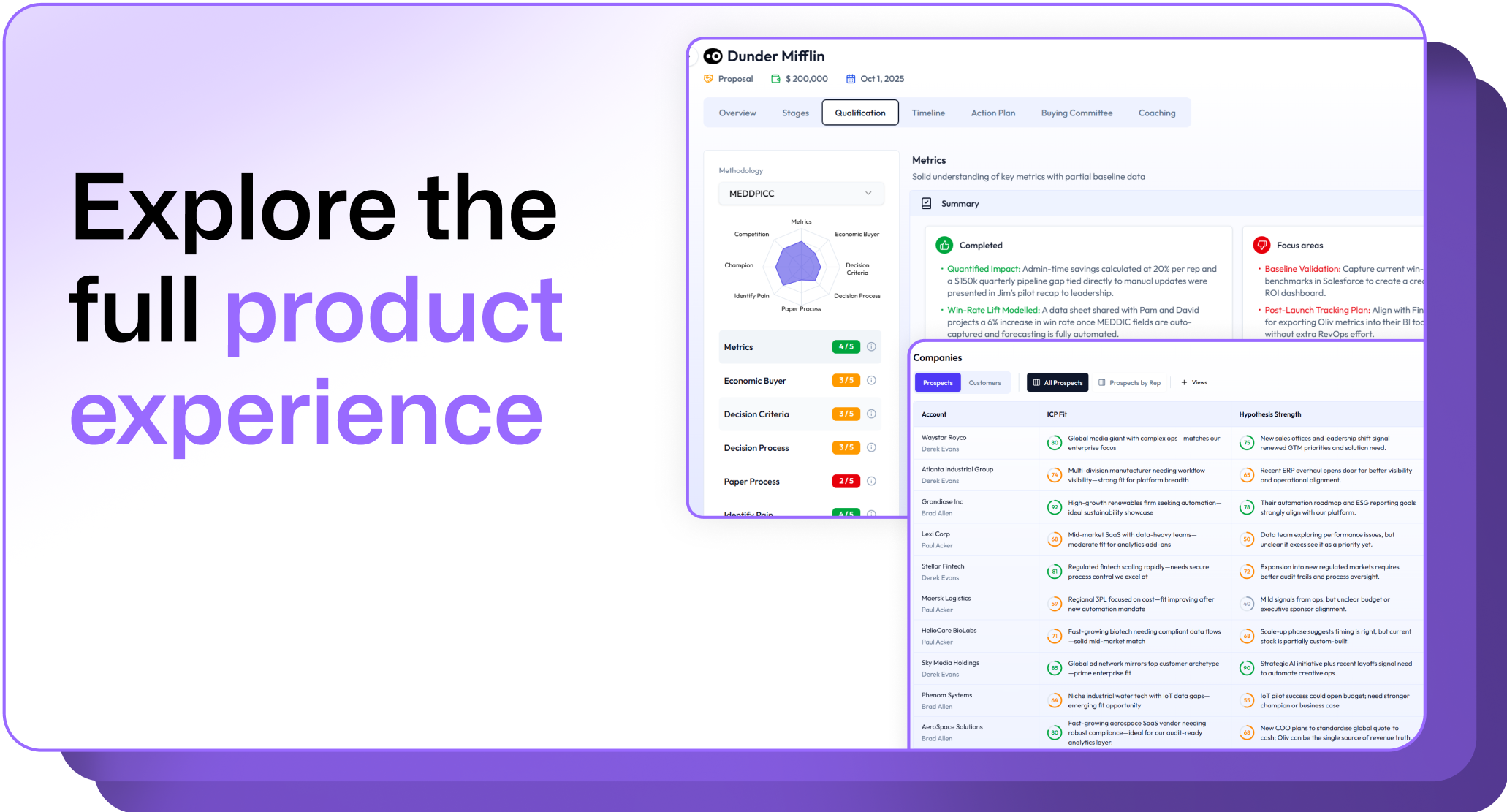
.avif)