Why Salesforce AI Fails in B2B Revenue Teams — And What Actually Works
Written by
Ishan Chhabra
Last Updated :
April 10, 2026
Skim in :
14
mins
In this article
Revenue teams love Oliv
Here’s why:
All your deal data unified (from 30+ tools and tabs).
Insights are delivered to you directly, no digging.
AI agents automate tasks for you.
Thank you! Your submission has been received!
Oops! Something went wrong while submitting the form.
Meet Oliv’s AI Agents
Hi! I’m, Deal Driver
I track deals, flag risks, send weekly pipeline updates and give sales managers full visibility into deal progress
Hi! I’m, CRM Manager
I maintain CRM hygiene by updating core, custom and qualification fields all without your team lifting a finger
Hi! I’m, Forecaster
I build accurate forecasts based on real deal movement and tell you which deals to pull in to hit your number
Hi! I’m, Coach
I believe performance fuels revenue. I spot skill gaps, score calls and build coaching plans to help every rep level up
Hi! I’m, Prospector
I dig into target accounts to surface the right contacts, tailor and time outreach so you always strike when it counts
Hi! I’m, Pipeline tracker
I call reps to get deal updates, and deliver a real-time, CRM-synced roll-up view of deal progress
Hi! I’m, Analyst
I answer complex pipeline questions, uncover deal patterns, and build reports that guide strategic decisions
TL;DR
Salesforce AI adoption remains below 8% among 150,000+ customers, with Agentforce optimized for B2C service workflows rather than complex multi-threaded B2B deal cycles.
Dirty CRM data causes 89% of analytics leaders to experience inaccurate AI outputs; Oliv's Data Cleanser Agent self-heals records without manual rep effort.
A full Salesforce AI stack exceeds $500/user/month, reaching $789K+ over 3 years for 100 reps versus Oliv's $68.4K at 91% lower TCO.
Oliv AI deploys in 5 minutes, learns sales methodology from 3 meetings, and delivers autonomous CRM updates, forecasting, and coaching via an Invisible UI.
Revenue teams need 9 specialized AI agents covering the full deal lifecycle; Oliv packages all nine into one modular platform with no mandatory platform fees.
The strategic approach: keep Salesforce as your system of record, layer Oliv as the system of intelligence for 35% higher win rates and $9.7M net benefit over 3 years.
Q1: Why Is Salesforce AI Failing B2B Revenue Teams in 2026? [toc=Why Salesforce AI Fails]
The sales technology industry has moved through four distinct generations. Gen 1 (2015 to 2022) focused on RevOps documentation. Gen 2 brought "dashcam" recorders like Gong. Gen 3 introduced revenue orchestration platforms like Clari. And now, Gen 4, GTM Engineering, demands an agentic workforce that does the work for you. For organizations already deep in the Salesforce ecosystem, the promise of native AI through Agentforce and Einstein was supposed to close this generational gap. The reality has been starkly different.
⚠️ The Adoption Problem Nobody Talks About
By mid-2025, only roughly 8,000 of Salesforce's 150,000+ customers had started leveraging Agentforce, with adoption stuck in the single-digit percentages. At Dreamforce 2025, Marc Benioff was directly confronted about the low uptake, with approximately 12,000 adoptions equating to an 8% rate across the customer base. Even by Q3 FY2026, only 9,500 of the 18,500 total deals were actually paid subscriptions. These numbers reveal a structural problem, not a marketing one.
Salesforce's AI suite is architected as bolt-on modules layered on a pre-generative CRM foundation. Einstein relies on V1 Machine Learning that demands historically clean data to produce reliable predictions. Agentforce, meanwhile, was optimized primarily for B2C service and commerce use cases, handling return requests, customer support chatbots, and order management. B2B deal cycles involving multi-threaded selling, competitive positioning, and methodology enforcement (MEDDPICC, BANT) remain severely underserved.
Sales technology has evolved through four generations. Salesforce AI remains architecturally rooted in Gen 2/3, while the market demands Gen 4 agentic execution.
❌ The Wrong UX for Modern Sellers
The new paradigm requires AI that doesn't just surface insights; it performs the work. Writing back to CRM objects, running autonomous forecasts, and executing follow-ups should happen without the rep lifting a finger. Agentforce's chat-based UX forces reps to manually "go and talk to a bot," then copy-paste its output, a workflow that contradicts how high-velocity B2B teams actually sell. As one Agentforce reviewer noted:
"Lots of clicking to get select the right options. UX needs improvement. Everything opens in a new browser tabs clustering the browser. Lots of jumping back and forth between tabs to enable settings." Verified User, Consulting Agentforce G2 Verified Review
✅ What the Gen 4 Model Actually Looks Like
Oliv AI represents the Gen 4 alternative: an AI-native data platform built on fine-tuned LLMs that stitches calls, emails, Slack, and web data into a 360-degree deal view. Instead of requiring adoption, Oliv's specialized agents, the Forecaster Agent, Deal Driver Agent, and CRM Manager Agent, deliver intelligence directly into Slack and Email through an "Invisible UI" that replaces the manual pull of dashboards.
The foundation problem is real. Salesforce's own State of Data and Analytics report confirms that 84% of data and analytics leaders say their data strategies need a complete overhaul before AI can achieve its full potential. When the very foundation these tools depend on is broken, no amount of bolt-on AI can deliver the revenue predictability that B2B teams need.
Q2: Why Do Salesforce AI Deployments Fail When the Underlying Data Isn't Clean? [toc=Dirty Data Problem]
Most B2B organizations are trapped in what revenue leaders call "RevOps Debt," the accumulated cost of years of incomplete, duplicate, and outdated CRM data. Duplicate accounts (Google 2021 vs. Google 2024), missing contacts, and empty MEDDPICC fields are the norm, not the exception. The root cause is structural: sales reps can close a deal without updating every CRM field, so data entry has never been critical to the act of selling. Reps view documentation as administrative policing, leading to a fragmented reality where the CRM is no longer the single source of truth.
❌ Why Legacy AI Amplifies Dirty Data
This matters enormously because Salesforce's AI stack depends entirely on that broken foundation:
Einstein V1 ML Dependency: Older Einstein features like Lead Scoring and Forecasting rely on pre-generative machine learning. They require high-volume, historically clean data to build mathematical equations. When fed dirty data, forecasts become unreliable, averaging roughly 67% accuracy because they're based on biased rep assessments.
Brittle Rule-Based Logic: Both Salesforce and Gong use simple, rule-based logic to associate activities with accounts. When two duplicate records exist for the same domain, the system cannot distinguish between them and frequently attaches data to the wrong record.
No Self-Healing: Agentforce acts as a "layer on top," but it does not proactively clean the underlying foundation. If the data is broken, the agent's output is effectively hallucinated.
Salesforce's own research validates the severity: 89% of data and analytics leaders have experienced inaccurate or misleading AI outputs caused by poor data foundations, and 19% of organizational data remains siloed or inaccessible. As one Einstein reviewer noted:
Dirty CRM data cascades into three structural AI failures. Salesforce's tools layer on top of the problem without ever fixing it.
"It has issues related to data storage and migration that need to be addressed in updates." Product Manager, Education Einstein Gartner Verified Review
⏰ The Real Solution: AI That Fixes Data as It Flows
The solution isn't asking reps to enter more data; they won't. It's building an AI layer that captures data from every interaction automatically, uses contextual reasoning (not rules) to map it correctly, and self-heals the CRM without human intervention.
Oliv AI approaches this as an AI-Native Data Platform designed to make your CRM "AI-Ready":
AI-Based Object Association: Instead of brittle rules, Oliv uses LLM reasoning to examine 100% of interactions, including calls, emails, and Slack, checking the history and context to determine the correct account, even in duplicate environments.
Data Cleanser Agent: Deduplicates, normalizes, and enriches records weekly, proactively flagging anomalies so RevOps doesn't have to.
CRM Manager Agent: Autonomously enriches contacts from LinkedIn and populates 100+ qualification fields (MEDDPICC, BANT) based on actual conversation context, keeping the CRM spotless without manual rep effort.
Grounded AI: Oliv builds fine-tuned LLMs grounded in your specific company data, eliminating the hallucinations that plague general-purpose bots.
"Cleaning up messy CRM fields and guessing at forecasts used to swallow half my week." Darius Kim, Head of RevOps, Driftloop
Q3: What Are the Hidden Costs of Salesforce AI Add-Ons for B2B Teams? [toc=Hidden Salesforce AI Costs]
Salesforce has shipped three different pricing models for Agentforce in under 18 months, moving from $2 per conversation to $0.10 per action (Flex Credits) to $125 per user per month, each attempting to solve the affordability problem created by its predecessor. For revenue leaders evaluating the true Total Cost of Ownership (TCO), this complexity alone signals an unstable pricing foundation.
💰 Agentforce Pricing Breakdown (2026)
Agentforce Pricing Models (2026)
Pricing Model
Cost
Best For
Key Limitation
Flex Credits (usage-based)
$500 per 100K credits (~$0.005/action)
Variable internal usage
Unpredictable monthly spend at scale
Conversations (legacy)
$2 per conversation (24-hr session)
Customer-facing chatbots
Extremely expensive for high-volume teams
Per-User Add-On
$125/user/month
Unlimited internal agent usage
Requires Sales or Service Cloud as a prerequisite
But the per-seat licensing is only the beginning. To unlock Agentforce's full functionality, a mid-market CRO typically needs to stack multiple modules:
⚠️ Sales Cloud: ~$200/user/month
⚠️ Agentforce Add-On: $125/user/month
⚠️ Revenue Intelligence: ~$220/user/month
⚠️ Data Cloud (often mandated): Consumption-based platform fee
This can easily exceed $500 per user per month before implementation consulting, which itself ranges from $50K to $150K depending on organizational complexity.
The visible licensing fee is just the tip. Fully loaded Salesforce AI costs exceed $500/user/month when all mandatory modules, implementation, and admin overhead are included.
"The pricing caught us off guard. Once we started scaling to more users and use cases, the cost ramped up pretty quickly. We had to rethink a few workflows just to stay within budget." Ayushmaan Y., Senior Associate Agentforce G2 Verified Review
"The price of Agentforce is not clear and hard to find. Adoption is low because of the lack of knowledge on the subject." Anusha T., Web Developer Agentforce G2 Verified Review
"Expensive, especially for smaller teams. Steep learning curve for new users." Shubham G., Senior BDM Agentforce G2 Verified Review
✅ How Oliv AI Simplifies Pricing
Oliv AI offers a modular, pay-for-what-you-use model with no mandatory platform fees. Teams can start with the base intelligence layer and add specialized agents (CRM Manager, Forecaster, Deal Driver) based on specific needs, delivering double the functionality of a legacy stack at a fraction of the cost, with full open data export and no vendor lock-in.
Q4: Salesforce AI Add-Ons vs Specialized Revenue Tools: What's Actually Faster to Value? [toc=Speed to Value Comparison]
Implementation is the primary bottleneck killing AI ROI for revenue teams. Organizations routinely find themselves in the "Trough of Disillusionment," six months and six figures deep into an AI deployment that still requires reps to manually input data. VPs of Sales spend their evenings listening to call recordings at 2x speed just to identify deal risks because the tools aren't delivering actionable insights fast enough.
Multi-Year Data Modeling: Deploying Salesforce AI modules is "very heavy implementation work" that frequently stretches into a two-to-three-year project for proper data modeling and integration.
Data Cloud Prerequisite: To even use Agentforce agents, Salesforce often mandates a Data Cloud subscription, a platform primarily built for B2C consumer data mapping (e.g., retail clothing stores tracking individual shoppers) that carries a high consumption fee but was never architected for B2B deal complexity.
Prompt Engineering Overhead: Even after deployment, getting consistent results requires specialized skills. As one reviewer put it:
"Effectively crafting prompts and configuring the underlying actions demands a specific skill set often called prompt engineering. You really need to understand how the AI interprets instructions to achieve the desired outcomes." Alessandro N., Salesforce Administrator Agentforce G2 Verified Review
Meanwhile, even Gong, the Gen 2 benchmark, carries its own adoption tax. As one user noted:
"It can be overwhelming to set up trackers. AI training is a bit laborious to get it to do what you want." Trafford J., Senior Director, Revenue Enablement Gong G2 Verified Review
⏰ The AI-Era Benchmark for Time-to-Value
The market now expects AI that learns from live interactions rather than requiring years of historical data cleanup. The winning model is "connect and go," with calendar integration in minutes, methodology learning from the first few meetings, and full customization in weeks rather than quarters.
Time-to-Value Comparison: Salesforce AI vs Oliv AI
Milestone
Salesforce AI Stack
Oliv AI
Day 1
Kickoff meeting scheduled
✅ Recording + CRM sync live
Week 2
Data audit in progress
✅ Custom methodology scoring active
Month 1
Implementation partner onboarding
✅ Agents delivering daily deal intelligence
Month 3
Pilot with limited user group
✅ Autonomous forecasting fully operational
✅ Oliv's Instant Time-to-Value Model
Oliv AI's technical configuration takes five minutes: connect your calendar and CRM, and recording starts immediately. Because Oliv uses an AI-native data foundation, full custom model building and workflow fine-tuning complete in 2 to 4 weeks, not years. Oliv only needs to analyze three meetings to understand your specific sales methodology and nuance of intent. For teams that invest $100K in training programs like Winning by Design or Force Management, Oliv ensures that methodology actually sticks, enforcing it on every call through its Coach Agent, rather than relying on rep memory and manual compliance.
Q5: What Does the True Cost of a Salesforce AI Stack Look Like? [toc=True Salesforce AI Costs]
Salesforce's AI pricing has undergone three major restructures in under 18 months, moving from $2 per conversation to Flex Credits ($0.005 per action) to a $125/user/month flat add-on, signaling an unstable pricing foundation that makes budget forecasting difficult for revenue leaders.
💰 Salesforce AI Licensing Tiers (2026)
Salesforce AI Licensing Tiers (2026)
Component
Cost
Prerequisite
Sales Cloud (Enterprise)
$175/user/month
-
Agentforce Add-On
$125/user/month
Sales or Service Cloud required
Agentforce 1 Edition (Bundle)
$550/user/month
Includes 1M Flex Credits + Data 360
Flex Credits (Usage-Based)
$500 per 100K credits
$5/user/month base license
Data Cloud (Consumption)
Varies by volume
Often mandated for agent functionality
For a mid-market team of 50 reps using the Enterprise + Agentforce stack, base licensing alone costs $180,000/year, before implementation.
💸 Hidden Costs Beyond Licensing
The sticker price is only the beginning. A complete 2026 cost analysis from industry research reveals:
Implementation (Year 1): $35,000 to $800,000+ depending on org complexity
Training: $57,500 to $900,000+ for enterprise rollouts
Data Cloud fees: A mandated prerequisite for many agent capabilities, with consumption costs that can balloon unpredictably. One TCO analysis showed Data 360 costs growing from an initial $53,200/year quote to $295,000 by Year 3, a 454% increase
Ongoing admin:Agentforce requires skilled Salesforce administrators for prompt engineering and flow configuration, adding headcount cost
⚠️ What Users Say About Pricing Surprises
"The pricing caught us off guard. Once we started scaling to more users and use cases, the cost ramped up pretty quickly. We had to rethink a few workflows just to stay within budget." Ayushmaan Y., Senior Associate Agentforce G2 Verified Review
"Licensing fees can be high, especially as the number of agents grows. The user interface, though improved with Lightning, may still feel clunky or unintuitive to some agents, leading to slower adoption." Verified User in Marketing and Advertising Agentforce G2 Verified Review
💰 Comparative 3-Year TCO: Salesforce AI Stack vs. Fragmented vs. Oliv AI
Comparative 3-Year TCO: Salesforce AI Stack vs. Fragmented vs. Oliv AI
Cost Category
Salesforce AI Full Stack (50 reps)
Fragmented Stack: Gong+Clari+Salesloft (50 reps)
Oliv AI (50 reps)
Annual licensing
~$180,000+
~$300,000+
Fraction of legacy stacks
Implementation (Year 1)
$35,000 to $150,000+
$15,000 to $50,000
Included (5-min setup)
Training
$57,500+
$10,000 to $30,000
Self-learning AI (3 meetings)
Data Cloud/Add-Ons
$53,000 to $295,000/yr
-
Included (built-in CDP)
Admin headcount
1 to 2 FTEs dedicated
0.5 to 1 FTE
No dedicated admin needed
Even Gong, the Gen 2 benchmark, carries premium pricing that smaller teams find hard to justify:
"It's probably the highest end option on the market, and now we're stuck with a tool that works technically but isn't the right business decision." Iris P., Head of Marketing, Sales & Partnerships Gong G2 Verified Review
✅ How Oliv AI Simplifies Pricing
Oliv AI offers a modular, transparent pricing model with no mandatory platform fees, no Data Cloud prerequisites, and no multi-year implementation costs. Teams start with the base intelligence layer and add specialized agents as needed, delivering consolidated functionality at a fraction of the legacy stack's TCO, with full open data export and zero vendor lock-in.
Q6: Who Actually Updates the CRM Automatically: Salesforce AI or Specialized Agents? [toc=Automatic CRM Updates]
Revenue teams are drowning in what industry analysts call "Note-Taker Fatigue." Meetings now have multiple recording bots joining simultaneously, yet zero actual task completion happens afterward. Reps spend 2 to 3 hours per week on manual follow-up emails, CRM field updates, and contact creation, time that directly erodes selling capacity. The irony is sharp: reps are terrified of dropping the ball on next steps, yet they view CRM updates as administrative policing that adds no value to the act of closing a deal.
❌ The Agentforce UX Problem
Salesforce Agentforce takes a fundamentally chat-based approach to AI assistance. A rep must manually navigate to the agent interface, type a prompt, wait for a response, then copy-paste the output into the appropriate CRM fields. This interaction model is not natively embedded in the daily selling flow; it's an additional step layered on top of an already cluttered workflow. As one reviewer noted:
"Lots of clicking to get select the right options. UX needs improvement. Everything opens in a new browser tabs clustering the browser. Lots of jumping back and forth between tabs to enable settings." Verified User in Consulting Agentforce G2 Verified Review
❌ Gong's "Dashcam" Limitation
Gong, the Gen 2 standard, records meetings and generates summaries, but it does not write back to actual CRM object fields. It logs unstructured "Notes" or activities that are functionally unsearchable for RevOps reporting or automated forecasting. One experienced user summarized the core gap:
"The only business problem Gong solves is the call recordings. It allows me to review my calls and listen to them so that I can understand either where I went wrong or what the customer really said." John S., Senior Account Executive Gong G2 Verified Review
⏰ What the AI-Era Standard Looks Like
The modern standard demands that the CRM update itself from every customer interaction, including calls, emails, and Slack threads, without the rep lifting a finger. AI agents should proactively deliver work (draft emails, update fields, create contacts, and flag risks) rather than waiting for a human to ask.
✅ Oliv's Hands-Free CRM Automation
Oliv AI delivers an "Invisible UI," a hands-free workforce that operates where your team already lives: Slack and Email. Unlike dashboards or chat bots, Oliv's agents push completed work to reps for one-click approval.
CRM Automation Capabilities: Agentforce vs. Gong vs. Oliv AI
Capability
Agentforce
Gong
Oliv AI
CRM field updates
Chat prompt then manual copy-paste
❌ Notes/activities only
✅ Automatic object-level updates
Contact creation
Manual
❌ Not supported
✅ Auto-created from meetings
Follow-up emails
Manual drafting
❌ Not supported
✅ Drafted and delivered in Gmail
MEDDPICC/BANT fields
Manual entry
❌ Not populated
✅ Auto-populated from conversation context
Delivery channel
Salesforce UI (chat)
Gong dashboard
✅ Slack + Email (Invisible UI)
Oliv's Meeting Assistant Agent automates meeting prep, live notes, and follow-up email drafts within minutes of a call. The CRM Manager Agent enriches contacts from LinkedIn and populates 100+ qualification fields autonomously. The Follow-up Maniac Agent generates multi-step, personalized sequences mapped to specific attendee concerns, all without the rep ever opening the CRM.
Q7: Why Is Agentforce Built for B2C: And What Does That Mean for Your B2B Deals? [toc=B2C Architecture vs B2B Needs]
Salesforce's primary strategic investment over the past two years has been Data Cloud, a Customer Data Platform originally architected for B2C consumer data mapping. Think individual shoppers being tracked across retail touchpoints, clothing purchase histories, and omni-channel engagement. While Salesforce has since been recognized in both B2B and B2C CDP categories, the platform's DNA remains rooted in consumer workflows, and that structural bias shows up clearly in how Agentforce handles (or fails to handle) complex B2B selling motions.
⚠️ Where Agentforce Excels and Where It Doesn't
Agentforce's strongest use cases center around customer service and support automation. Multiple G2 reviewers confirm this pattern; the tool shines when handling service tickets, suggesting knowledge articles, and routing support queries. As one reviewer described his implementation:
"I recently implemented it for a customer support team handling high volumes of service cases. Using the low-code builder, we were able to configure an agent that auto-suggests relevant knowledge articles during live chats." Ayushmaan Y., Senior Associate Agentforce G2 Verified Review
This is a valid B2C/support use case. But B2B revenue workflows demand fundamentally different capabilities:
Multi-threaded deal cycles: 6 to 10 stakeholders across 4+ departments, each with different buying motivations
Methodology-specific qualification:MEDDPICC, BANT, and SPICED frameworks requiring contextual field population
Competitive intelligence: Distinguishing a passing competitor mention from an active evaluation
3 to 6 month sales cycles with complex procurement processes and legal reviews
❌ The B2B Gap in Salesforce's AI
Agentforce's out-of-the-box features offer basic email automation and simple lead qualification, capabilities that barely scratch the surface of enterprise B2B complexity. Even its own users acknowledge the limitations when requirements go beyond standard service flows:
"Out-of-the-box insurance-specific features are limited unless you're using add-ons like Financial Services Cloud or third-party solutions, which may require further customization." Verified User in Marketing and Advertising Agentforce G2 Verified Review
Meanwhile, the broader Salesforce AI ecosystem hasn't inspired confidence among developers who work with it daily:
"I haven't been impressed by any of the early Salesforce AI tools, and I don't hear anyone talking about them glowingly." OffManuscript, r/SalesforceDeveloper Reddit Thread
✅ Oliv's Purpose-Built B2B Architecture
Oliv AI was built exclusively for B2B AI-native revenue orchestration. Trained on 100+ sales methodologies, it reasons through complex multi-threaded deal context, distinguishing a passive competitor mention from an active bake-off, mapping stakeholder influence across departments, and enforcing methodology compliance on every call through its Coach Agent.
Consider a $500K enterprise deal with 8 stakeholders across 4 departments. Agentforce treats this the same way it treats a simple service ticket, a single conversational thread. Oliv creates a 360-degree deal narrative stitching calls, emails, Slack messages, and web data into a unified account view. The Analyst Agent lets leadership ask strategic questions like "Why are we losing FinTech deals in Stage 2?" and receive visual dashboards in plain English, no Data Cloud expertise required.
Q8: Can You Keep Salesforce as Your CRM and Layer Specialized AI on Top? [toc=Layering AI on Salesforce]
Mid-market companies have spent years customizing their Salesforce CRMs, building specialized objects for implementation tracking, onboarding workflows, and billing automation. Ripping out Salesforce is not realistic for most organizations. The real question revenue leaders should ask is: can you keep the CRM foundation and upgrade the intelligence layer on top?
❌ The Fragmented Stack Problem
The typical workaround today is stacking point solutions on top of Salesforce: Gong for recording, Clari for forecasting, and Salesloft for engagement. This creates $500+/user/month in combined costs and forces RevOps to manually stitch data between silos. Even Clari users recognize the overlap problem:
"Clari should find ways to differentiate from the native Salesforce features (e.g. Pipeline Inspection, Forecasting) in order to remain competitive in the long-run." Dan J., Mid-Market Clari G2 Verified Review
Salesforce's own Einstein Activity Capture (EAC), meant to solve this fragmentation, introduces its own issues. EAC doesn't support granular email filtering, lacks keyword or folder-based rules, and historically stored captured data in separate AWS instances that were unusable for downstream CRM reporting. As one Einstein reviewer noted:
"Its biggest handicap is that it does not allow for data storage or data migration. You can't really input the data from Einstein into another platform." Product Manager, Education Einstein Gartner Verified Review
⏰ The AI-Era Coexistence Model
The emerging best practice separates two complementary layers: the CRM as the system of record (where Salesforce stays) and a specialized AI-native platform as the system of intelligence (where the actual reasoning, forecasting, and automation happen). These layers are complementary, not competitive. The CRM stores the data; the intelligence layer makes it actionable.
The AI-era architecture separates Salesforce as the system of record from a specialized AI-native system of intelligence. The two layers complement each other through seamless sync.
✅ Oliv as the Unified Intelligence Layer
Oliv AI is CRM-agnostic and designed to layer seamlessly on top of your existing Salesforce investment. Instead of replacing Salesforce, Oliv connects with your stack and pushes superior intelligence into Salesforce objects, including custom objects for onboarding, implementation, and billing teams.
Key integration capabilities:
Seamless Salesforce sync: Object-level field updates written directly into your CRM from every customer interaction
Custom object support: Syncs with specialized Salesforce objects beyond standard Opportunities and Contacts
Full open export: Historical context stays with you even if you switch CRMs, no vendor lock-in
Built-in B2B CDP: Oliv stitches Calls + Emails + Slack + Support Tickets + Web Data into a single deal narrative, eliminating the need for Salesforce Data Cloud's consumption-based fees
This "keep Salesforce, replace the AI layer" strategy lets organizations preserve their CRM investment while consolidating the fragmented Gong + Clari + Salesloft stack into a single intelligence platform at a fraction of the cost, with no multi-year implementation project required.
Q9: What Agents Does a Revenue Team Actually Need and What Should Each One Do? [toc=Essential Revenue AI Agents]
Modern B2B revenue teams need AI that performs specific "Jobs to Be Done," not a monolithic platform that surfaces insights and leaves execution to the rep. The agent model maps one autonomous AI worker to one critical revenue workflow. Below is a practical breakdown of the specialized agent roles required across the revenue lifecycle, what each one does, and where legacy tools fall short.
⭐ Agent-by-Agent Capability Map
Agent-by-Agent Capability Map: Roles, Jobs, and Legacy Limitations
Agent Role
Job to Be Done
Legacy Tool Equivalent
Key Limitation of Legacy
Meeting Assistant
Auto-joins calls, generates live notes, and drafts follow-up emails in Gmail within minutes
Gong, Chorus, Avoma
Logs notes only; no CRM field updates or email drafts
CRM Manager
Enriches contacts from LinkedIn, populates 100+ qualification fields (MEDDPICC/BANT) from conversation context
Einstein Activity Capture
Stores data in separate instances; unusable for reporting
Forecaster
Runs autonomous forecasts grounded in deal signals, not biased rep self-assessments
Manual sequence building; no contextual personalization from calls
Coach
Enforces sales methodology on every call, scores rep performance against framework
Gong Coaching, Salesforce Enablement
Requires manager review at 2x speed; no real-time enforcement
Data Cleanser
Deduplicates, normalizes, and enriches CRM records weekly
Manual RevOps cleanup
Reactive, labor-intensive, and never fully completed
Handoff Hank
Builds automated handoff packets between BDR to AE or AE to CSM
Manual Salesforce reports
Context lost in transition; reps start from scratch
Analyst
Answers strategic questions in plain English (e.g., "Why are we losing FinTech deals in Stage 2?")
Salesforce Reports + Data Cloud
Requires admin expertise; weeks to build custom dashboards
❌ Why Legacy Tools Can't Fill These Roles
Each legacy tool covers a narrow slice. Gong records but doesn't execute. Clari forecasts but doesn't clean data. Outreach sequences but can't contextualize from live calls. Agentforce provides a chat-based assistant but leaves the actual work to the rep. As one Outreach user noted:
"The engage product is stagnant. Looks to have the same features, UX, integrations and issues as it had 5 years ago." Matthew T., Head of Revenue Operations Outreach G2 Verified Review
Even Clari's forecasting, arguably its core strength, still relies on manual rep input:
"The forecasting feature is decent, but at least in our setup, it doesn't do a great job of auto-calculating the values I need to submit, so that is entirely handheld." Dexter L., Customer Success Executive Clari G2 Verified Review
✅ How Oliv AI Delivers the Full Agent Workforce
Oliv packages all nine agent roles into a single, modular platform. Teams select only the agents they need, with no mandatory platform fees or Data Cloud prerequisites. Each agent operates autonomously via the Invisible UI, delivering completed work through Slack and Email for one-click human approval rather than requiring reps to navigate dashboards or chat with bots.
Q10: Salesforce AI vs. Gong vs. Oliv AI: How Do They Actually Compare? [toc=Three-Way Platform Comparison]
For revenue leaders evaluating their AI stack, a side-by-side comparison across the dimensions that actually matter, including CRM write-back, deployment speed, pricing model, and B2B depth, is more useful than feature lists. Below is the definitive comparison matrix.
⭐ Head-to-Head Comparison Matrix
Head-to-Head Comparison: Salesforce AI vs. Gong vs. Oliv AI
Dimension
Salesforce AI (Agentforce + Einstein)
Gong
Oliv AI
Foundation
Pre-generative ML + bolt-on LLM layer
Proprietary conversation intelligence
✅ Generative AI-native (fine-tuned LLMs)
CRM Write-Back
Chat-based, then manual copy-paste
❌ Notes/activities only
✅ Automatic object-level field updates
Deployment Time
2 to 3 years (full data modeling)
2 to 4 weeks (recording only)
✅ 5 minutes setup; 2 to 4 weeks full customization
Methodology Support
❌ Limited; requires heavy customization
Basic tracker keywords
✅ 100+ methodologies; learns from 3 meetings
Forecast Approach
Einstein ML (requires clean historical data)
Gong Forecast (activity signals)
✅ Autonomous AI reasoning (real-time deal signals)
UX Model
Chat-based (rep initiates)
Dashboard-based (rep pulls)
✅ Invisible UI (agents push to Slack/Email)
B2B Specialization
Optimized for B2C service/commerce
Sales recording + coaching
✅ Built exclusively for B2B revenue workflows
Data Portability
EAC stores in separate AWS instances
❌ Restrictive bulk export
✅ Full open export policy
Pricing Model
$500+/user/month (stacked modules)
Premium enterprise contracts
✅ Modular per-agent pricing
❌ Where Salesforce AI Falls Short
"It can be complex to set up and often requires skilled administrators or developers to customize and integrate properly, which adds time and cost." Verified User in Marketing and Advertising Agentforce G2 Verified Review
❌ Where Gong Falls Short
"It's too complicated, and not intuitive at all. Using it is very...discomforting. Searching for calls is not easy, moving around in the calls is not easy, and understanding the pipeline management portion of it is almost impossible." John S., Senior Account Executive Gong G2 Verified Review
⏰ The Convergence Problem
The critical insight this matrix reveals is that Salesforce requires you to buy three or four modules to cover what Oliv delivers in a single platform. Gong covers conversation intelligence well but leaves CRM automation, forecasting, and follow-up execution as separate purchases from other vendors. Oliv AI converges recording, CRM automation, forecasting, coaching, and engagement into one generative AI-native platform, eliminating the need for a fragmented, $500+/user/month multi-vendor stack.
Q11: What Should You Do Next If Your Salesforce AI Initiative Already Failed? [toc=Post-Failure Recovery Playbook]
If your organization spent 6 to 12 months and six figures deploying Einstein or Agentforce only to see adoption stall below 20%, you're not alone. Reps have quietly reverted to spreadsheets. The board is asking what happened. This scenario is far more common than Salesforce's marketing suggests. By mid-2025, Agentforce had secured only roughly 8,000 deals against an extraordinarily ambitious adoption target, and even reviewers acknowledged the adoption gap.
⚠️ The Sunk Cost Spiral
The instinctive response to a failed Salesforce AI deployment is to double down: hire more implementation consultants, purchase additional modules, or extend the data cleanup timeline. This deepens the sunk cost fallacy. The root cause is typically a combination of three structural failures, not a lack of effort:
Dirty data foundation: CRM records that were never clean enough for Einstein's ML models to produce reliable outputs
B2C-centric architecture: Agentforce was optimized for service tickets and commerce, not multi-threaded B2B deal cycles
Chat-based UX rejection: Reps won't adopt a tool that requires them to manually interact with a bot on top of their existing workflow
"Adoption is low because of the lack of knowledge on the subject as AI is a new field. Customers are finding issues in deploying and using agents in Salesforce." Anusha T., Web Developer Agentforce G2 Verified Review
✅ The 5-Step Recovery Framework
The AI-era recovery path doesn't require ripping out Salesforce. It requires separating your system of record (Salesforce CRM, keep it) from your system of intelligence (replace the AI layer):
Audit your CRM data foundation: Measure duplicate rate, field completion rate, and activity association accuracy across your top 100 accounts
Diagnose root causes: Classify each failure as a data problem (fixable) vs. an architecture problem (structural)
Evaluate the "keep CRM, replace AI" strategy: Determine which Salesforce modules to retain (CRM, CPQ) and which AI layers to replace
Run a 30-day specialized tool pilot: Connect Oliv AI in 5 minutes; the CRM Manager Agent begins cleaning and enriching data immediately while the Forecaster Agent delivers autonomous deal intelligence
Measure and scale: Compare forecast accuracy, CRM field completion rates, and rep time savings against the previous quarter
⏰ Why the Pilot Is Zero-Risk
Oliv offers free data migration from legacy platforms like Gong and Chorus. Within 3 meetings, the AI understands your specific methodology. Within 2 to 4 weeks, full customization is live. As one Agentforce reviewer admitted about the alternative:
"It still needs some serious debugging. I built the default agent, went well, then went to create a second agent and could not get past an error." Jessica C., Senior Business Analyst Agentforce G2 Verified Review
You don't need to leave Salesforce. You need to stop asking Salesforce to be something it wasn't built to be.
Q12: The Board-Level Case: What's the 3-Year TCO and ROI of Switching? [toc=TCO and ROI Analysis]
CROs are accountable for two things at the board level: revenue predictability and stack efficiency. The question isn't "Should we use AI?"; every revenue team will. The real question is: are you paying premium prices for infrastructure optimized for consumer scenarios rather than enterprise deal management?
💰 The TCO Reality (100-Rep Team, 3 Years)
3-Year TCO Comparison: Salesforce AI vs. Fragmented Stack vs. Oliv AI (100 Reps)
Cost Component
Salesforce AI Full Stack
Fragmented Stack (Gong+Clari+Salesloft)
Oliv AI
Annual licensing
$500+/user/month = ~$600K+/yr
~$300+/user/month = ~$360K+/yr
Modular agent pricing
Implementation (Year 1)
$50K to $150K+
$15K to $50K
Included (5-min setup)
Ongoing admin burden
1 to 2 dedicated Salesforce admins
0.5 to 1 FTE stitching data between silos
No dedicated admin required
Data Cloud / platform fees
$53K to $295K/yr (grows with consumption)
-
Included (built-in B2B CDP)
3-Year Total
~$789K+
~$500K+
~$68.4K
That's a 91% lower TCO with Oliv AI compared to the Salesforce suite, and the gap widens with Data Cloud consumption growth.
💸 The Revenue Impact Beyond Cost Savings
Cost reduction alone doesn't win board approval. Revenue impact does. The shift from manual, dashboard-driven forecasting to autonomous agent-driven intelligence produces measurable outcomes:
Reduced sales cycles via automated follow-ups and proactive deal-risk flagging
$9.7M in net benefit over 3 years for a 100-user team through combined cost savings and revenue uplift
"The pricing caught us off guard. Once we started scaling to more users and use cases, the cost ramped up pretty quickly. We had to rethink a few workflows just to stay within budget." Ayushmaan Y., Senior Associate Agentforce G2 Verified Review
⭐ The "Treadmill vs. Personal Trainer" Analogy
Relying on traditional dashboards from the previous decade, Gong, Clari, or Salesforce's manual reports, is like buying an expensive high-end treadmill. The equipment is a status symbol, but your team still has to do all the running: manual CRM entry, call auditing at 2x speed, and spreadsheet-based roll-up forecasts. Switching to Oliv AI is like hiring a personal trainer and a nutritionist who not only provide the tools but actually do the planning, monitoring, and heavy lifting, delivering the outcome of revenue predictability with significantly less effort.
✅ The Zero-Risk Entry Point
Oliv offers the baseline recorder layer FREE to current Gong users, facilitating the transition from documentation to execution. For teams currently on Salesforce AI, the pilot path is straightforward: keep your CRM, layer Oliv's intelligence on top, and measure the difference within 30 days. Full open data export ensures zero vendor lock-in; if it doesn't work, you've lost nothing.
Q1: Why Is Salesforce AI Failing B2B Revenue Teams in 2026? [toc=Why Salesforce AI Fails]
The sales technology industry has moved through four distinct generations. Gen 1 (2015 to 2022) focused on RevOps documentation. Gen 2 brought "dashcam" recorders like Gong. Gen 3 introduced revenue orchestration platforms like Clari. And now, Gen 4, GTM Engineering, demands an agentic workforce that does the work for you. For organizations already deep in the Salesforce ecosystem, the promise of native AI through Agentforce and Einstein was supposed to close this generational gap. The reality has been starkly different.
⚠️ The Adoption Problem Nobody Talks About
By mid-2025, only roughly 8,000 of Salesforce's 150,000+ customers had started leveraging Agentforce, with adoption stuck in the single-digit percentages. At Dreamforce 2025, Marc Benioff was directly confronted about the low uptake, with approximately 12,000 adoptions equating to an 8% rate across the customer base. Even by Q3 FY2026, only 9,500 of the 18,500 total deals were actually paid subscriptions. These numbers reveal a structural problem, not a marketing one.
Salesforce's AI suite is architected as bolt-on modules layered on a pre-generative CRM foundation. Einstein relies on V1 Machine Learning that demands historically clean data to produce reliable predictions. Agentforce, meanwhile, was optimized primarily for B2C service and commerce use cases, handling return requests, customer support chatbots, and order management. B2B deal cycles involving multi-threaded selling, competitive positioning, and methodology enforcement (MEDDPICC, BANT) remain severely underserved.
Sales technology has evolved through four generations. Salesforce AI remains architecturally rooted in Gen 2/3, while the market demands Gen 4 agentic execution.
❌ The Wrong UX for Modern Sellers
The new paradigm requires AI that doesn't just surface insights; it performs the work. Writing back to CRM objects, running autonomous forecasts, and executing follow-ups should happen without the rep lifting a finger. Agentforce's chat-based UX forces reps to manually "go and talk to a bot," then copy-paste its output, a workflow that contradicts how high-velocity B2B teams actually sell. As one Agentforce reviewer noted:
"Lots of clicking to get select the right options. UX needs improvement. Everything opens in a new browser tabs clustering the browser. Lots of jumping back and forth between tabs to enable settings." Verified User, Consulting Agentforce G2 Verified Review
✅ What the Gen 4 Model Actually Looks Like
Oliv AI represents the Gen 4 alternative: an AI-native data platform built on fine-tuned LLMs that stitches calls, emails, Slack, and web data into a 360-degree deal view. Instead of requiring adoption, Oliv's specialized agents, the Forecaster Agent, Deal Driver Agent, and CRM Manager Agent, deliver intelligence directly into Slack and Email through an "Invisible UI" that replaces the manual pull of dashboards.
The foundation problem is real. Salesforce's own State of Data and Analytics report confirms that 84% of data and analytics leaders say their data strategies need a complete overhaul before AI can achieve its full potential. When the very foundation these tools depend on is broken, no amount of bolt-on AI can deliver the revenue predictability that B2B teams need.
Q2: Why Do Salesforce AI Deployments Fail When the Underlying Data Isn't Clean? [toc=Dirty Data Problem]
Most B2B organizations are trapped in what revenue leaders call "RevOps Debt," the accumulated cost of years of incomplete, duplicate, and outdated CRM data. Duplicate accounts (Google 2021 vs. Google 2024), missing contacts, and empty MEDDPICC fields are the norm, not the exception. The root cause is structural: sales reps can close a deal without updating every CRM field, so data entry has never been critical to the act of selling. Reps view documentation as administrative policing, leading to a fragmented reality where the CRM is no longer the single source of truth.
❌ Why Legacy AI Amplifies Dirty Data
This matters enormously because Salesforce's AI stack depends entirely on that broken foundation:
Einstein V1 ML Dependency: Older Einstein features like Lead Scoring and Forecasting rely on pre-generative machine learning. They require high-volume, historically clean data to build mathematical equations. When fed dirty data, forecasts become unreliable, averaging roughly 67% accuracy because they're based on biased rep assessments.
Brittle Rule-Based Logic: Both Salesforce and Gong use simple, rule-based logic to associate activities with accounts. When two duplicate records exist for the same domain, the system cannot distinguish between them and frequently attaches data to the wrong record.
No Self-Healing: Agentforce acts as a "layer on top," but it does not proactively clean the underlying foundation. If the data is broken, the agent's output is effectively hallucinated.
Salesforce's own research validates the severity: 89% of data and analytics leaders have experienced inaccurate or misleading AI outputs caused by poor data foundations, and 19% of organizational data remains siloed or inaccessible. As one Einstein reviewer noted:
Dirty CRM data cascades into three structural AI failures. Salesforce's tools layer on top of the problem without ever fixing it.
"It has issues related to data storage and migration that need to be addressed in updates." Product Manager, Education Einstein Gartner Verified Review
⏰ The Real Solution: AI That Fixes Data as It Flows
The solution isn't asking reps to enter more data; they won't. It's building an AI layer that captures data from every interaction automatically, uses contextual reasoning (not rules) to map it correctly, and self-heals the CRM without human intervention.
Oliv AI approaches this as an AI-Native Data Platform designed to make your CRM "AI-Ready":
AI-Based Object Association: Instead of brittle rules, Oliv uses LLM reasoning to examine 100% of interactions, including calls, emails, and Slack, checking the history and context to determine the correct account, even in duplicate environments.
Data Cleanser Agent: Deduplicates, normalizes, and enriches records weekly, proactively flagging anomalies so RevOps doesn't have to.
CRM Manager Agent: Autonomously enriches contacts from LinkedIn and populates 100+ qualification fields (MEDDPICC, BANT) based on actual conversation context, keeping the CRM spotless without manual rep effort.
Grounded AI: Oliv builds fine-tuned LLMs grounded in your specific company data, eliminating the hallucinations that plague general-purpose bots.
"Cleaning up messy CRM fields and guessing at forecasts used to swallow half my week." Darius Kim, Head of RevOps, Driftloop
Q3: What Are the Hidden Costs of Salesforce AI Add-Ons for B2B Teams? [toc=Hidden Salesforce AI Costs]
Salesforce has shipped three different pricing models for Agentforce in under 18 months, moving from $2 per conversation to $0.10 per action (Flex Credits) to $125 per user per month, each attempting to solve the affordability problem created by its predecessor. For revenue leaders evaluating the true Total Cost of Ownership (TCO), this complexity alone signals an unstable pricing foundation.
💰 Agentforce Pricing Breakdown (2026)
Agentforce Pricing Models (2026)
Pricing Model
Cost
Best For
Key Limitation
Flex Credits (usage-based)
$500 per 100K credits (~$0.005/action)
Variable internal usage
Unpredictable monthly spend at scale
Conversations (legacy)
$2 per conversation (24-hr session)
Customer-facing chatbots
Extremely expensive for high-volume teams
Per-User Add-On
$125/user/month
Unlimited internal agent usage
Requires Sales or Service Cloud as a prerequisite
But the per-seat licensing is only the beginning. To unlock Agentforce's full functionality, a mid-market CRO typically needs to stack multiple modules:
⚠️ Sales Cloud: ~$200/user/month
⚠️ Agentforce Add-On: $125/user/month
⚠️ Revenue Intelligence: ~$220/user/month
⚠️ Data Cloud (often mandated): Consumption-based platform fee
This can easily exceed $500 per user per month before implementation consulting, which itself ranges from $50K to $150K depending on organizational complexity.
The visible licensing fee is just the tip. Fully loaded Salesforce AI costs exceed $500/user/month when all mandatory modules, implementation, and admin overhead are included.
"The pricing caught us off guard. Once we started scaling to more users and use cases, the cost ramped up pretty quickly. We had to rethink a few workflows just to stay within budget." Ayushmaan Y., Senior Associate Agentforce G2 Verified Review
"The price of Agentforce is not clear and hard to find. Adoption is low because of the lack of knowledge on the subject." Anusha T., Web Developer Agentforce G2 Verified Review
"Expensive, especially for smaller teams. Steep learning curve for new users." Shubham G., Senior BDM Agentforce G2 Verified Review
✅ How Oliv AI Simplifies Pricing
Oliv AI offers a modular, pay-for-what-you-use model with no mandatory platform fees. Teams can start with the base intelligence layer and add specialized agents (CRM Manager, Forecaster, Deal Driver) based on specific needs, delivering double the functionality of a legacy stack at a fraction of the cost, with full open data export and no vendor lock-in.
Q4: Salesforce AI Add-Ons vs Specialized Revenue Tools: What's Actually Faster to Value? [toc=Speed to Value Comparison]
Implementation is the primary bottleneck killing AI ROI for revenue teams. Organizations routinely find themselves in the "Trough of Disillusionment," six months and six figures deep into an AI deployment that still requires reps to manually input data. VPs of Sales spend their evenings listening to call recordings at 2x speed just to identify deal risks because the tools aren't delivering actionable insights fast enough.
Multi-Year Data Modeling: Deploying Salesforce AI modules is "very heavy implementation work" that frequently stretches into a two-to-three-year project for proper data modeling and integration.
Data Cloud Prerequisite: To even use Agentforce agents, Salesforce often mandates a Data Cloud subscription, a platform primarily built for B2C consumer data mapping (e.g., retail clothing stores tracking individual shoppers) that carries a high consumption fee but was never architected for B2B deal complexity.
Prompt Engineering Overhead: Even after deployment, getting consistent results requires specialized skills. As one reviewer put it:
"Effectively crafting prompts and configuring the underlying actions demands a specific skill set often called prompt engineering. You really need to understand how the AI interprets instructions to achieve the desired outcomes." Alessandro N., Salesforce Administrator Agentforce G2 Verified Review
Meanwhile, even Gong, the Gen 2 benchmark, carries its own adoption tax. As one user noted:
"It can be overwhelming to set up trackers. AI training is a bit laborious to get it to do what you want." Trafford J., Senior Director, Revenue Enablement Gong G2 Verified Review
⏰ The AI-Era Benchmark for Time-to-Value
The market now expects AI that learns from live interactions rather than requiring years of historical data cleanup. The winning model is "connect and go," with calendar integration in minutes, methodology learning from the first few meetings, and full customization in weeks rather than quarters.
Time-to-Value Comparison: Salesforce AI vs Oliv AI
Milestone
Salesforce AI Stack
Oliv AI
Day 1
Kickoff meeting scheduled
✅ Recording + CRM sync live
Week 2
Data audit in progress
✅ Custom methodology scoring active
Month 1
Implementation partner onboarding
✅ Agents delivering daily deal intelligence
Month 3
Pilot with limited user group
✅ Autonomous forecasting fully operational
✅ Oliv's Instant Time-to-Value Model
Oliv AI's technical configuration takes five minutes: connect your calendar and CRM, and recording starts immediately. Because Oliv uses an AI-native data foundation, full custom model building and workflow fine-tuning complete in 2 to 4 weeks, not years. Oliv only needs to analyze three meetings to understand your specific sales methodology and nuance of intent. For teams that invest $100K in training programs like Winning by Design or Force Management, Oliv ensures that methodology actually sticks, enforcing it on every call through its Coach Agent, rather than relying on rep memory and manual compliance.
Q5: What Does the True Cost of a Salesforce AI Stack Look Like? [toc=True Salesforce AI Costs]
Salesforce's AI pricing has undergone three major restructures in under 18 months, moving from $2 per conversation to Flex Credits ($0.005 per action) to a $125/user/month flat add-on, signaling an unstable pricing foundation that makes budget forecasting difficult for revenue leaders.
💰 Salesforce AI Licensing Tiers (2026)
Salesforce AI Licensing Tiers (2026)
Component
Cost
Prerequisite
Sales Cloud (Enterprise)
$175/user/month
-
Agentforce Add-On
$125/user/month
Sales or Service Cloud required
Agentforce 1 Edition (Bundle)
$550/user/month
Includes 1M Flex Credits + Data 360
Flex Credits (Usage-Based)
$500 per 100K credits
$5/user/month base license
Data Cloud (Consumption)
Varies by volume
Often mandated for agent functionality
For a mid-market team of 50 reps using the Enterprise + Agentforce stack, base licensing alone costs $180,000/year, before implementation.
💸 Hidden Costs Beyond Licensing
The sticker price is only the beginning. A complete 2026 cost analysis from industry research reveals:
Implementation (Year 1): $35,000 to $800,000+ depending on org complexity
Training: $57,500 to $900,000+ for enterprise rollouts
Data Cloud fees: A mandated prerequisite for many agent capabilities, with consumption costs that can balloon unpredictably. One TCO analysis showed Data 360 costs growing from an initial $53,200/year quote to $295,000 by Year 3, a 454% increase
Ongoing admin:Agentforce requires skilled Salesforce administrators for prompt engineering and flow configuration, adding headcount cost
⚠️ What Users Say About Pricing Surprises
"The pricing caught us off guard. Once we started scaling to more users and use cases, the cost ramped up pretty quickly. We had to rethink a few workflows just to stay within budget." Ayushmaan Y., Senior Associate Agentforce G2 Verified Review
"Licensing fees can be high, especially as the number of agents grows. The user interface, though improved with Lightning, may still feel clunky or unintuitive to some agents, leading to slower adoption." Verified User in Marketing and Advertising Agentforce G2 Verified Review
💰 Comparative 3-Year TCO: Salesforce AI Stack vs. Fragmented vs. Oliv AI
Comparative 3-Year TCO: Salesforce AI Stack vs. Fragmented vs. Oliv AI
Cost Category
Salesforce AI Full Stack (50 reps)
Fragmented Stack: Gong+Clari+Salesloft (50 reps)
Oliv AI (50 reps)
Annual licensing
~$180,000+
~$300,000+
Fraction of legacy stacks
Implementation (Year 1)
$35,000 to $150,000+
$15,000 to $50,000
Included (5-min setup)
Training
$57,500+
$10,000 to $30,000
Self-learning AI (3 meetings)
Data Cloud/Add-Ons
$53,000 to $295,000/yr
-
Included (built-in CDP)
Admin headcount
1 to 2 FTEs dedicated
0.5 to 1 FTE
No dedicated admin needed
Even Gong, the Gen 2 benchmark, carries premium pricing that smaller teams find hard to justify:
"It's probably the highest end option on the market, and now we're stuck with a tool that works technically but isn't the right business decision." Iris P., Head of Marketing, Sales & Partnerships Gong G2 Verified Review
✅ How Oliv AI Simplifies Pricing
Oliv AI offers a modular, transparent pricing model with no mandatory platform fees, no Data Cloud prerequisites, and no multi-year implementation costs. Teams start with the base intelligence layer and add specialized agents as needed, delivering consolidated functionality at a fraction of the legacy stack's TCO, with full open data export and zero vendor lock-in.
Q6: Who Actually Updates the CRM Automatically: Salesforce AI or Specialized Agents? [toc=Automatic CRM Updates]
Revenue teams are drowning in what industry analysts call "Note-Taker Fatigue." Meetings now have multiple recording bots joining simultaneously, yet zero actual task completion happens afterward. Reps spend 2 to 3 hours per week on manual follow-up emails, CRM field updates, and contact creation, time that directly erodes selling capacity. The irony is sharp: reps are terrified of dropping the ball on next steps, yet they view CRM updates as administrative policing that adds no value to the act of closing a deal.
❌ The Agentforce UX Problem
Salesforce Agentforce takes a fundamentally chat-based approach to AI assistance. A rep must manually navigate to the agent interface, type a prompt, wait for a response, then copy-paste the output into the appropriate CRM fields. This interaction model is not natively embedded in the daily selling flow; it's an additional step layered on top of an already cluttered workflow. As one reviewer noted:
"Lots of clicking to get select the right options. UX needs improvement. Everything opens in a new browser tabs clustering the browser. Lots of jumping back and forth between tabs to enable settings." Verified User in Consulting Agentforce G2 Verified Review
❌ Gong's "Dashcam" Limitation
Gong, the Gen 2 standard, records meetings and generates summaries, but it does not write back to actual CRM object fields. It logs unstructured "Notes" or activities that are functionally unsearchable for RevOps reporting or automated forecasting. One experienced user summarized the core gap:
"The only business problem Gong solves is the call recordings. It allows me to review my calls and listen to them so that I can understand either where I went wrong or what the customer really said." John S., Senior Account Executive Gong G2 Verified Review
⏰ What the AI-Era Standard Looks Like
The modern standard demands that the CRM update itself from every customer interaction, including calls, emails, and Slack threads, without the rep lifting a finger. AI agents should proactively deliver work (draft emails, update fields, create contacts, and flag risks) rather than waiting for a human to ask.
✅ Oliv's Hands-Free CRM Automation
Oliv AI delivers an "Invisible UI," a hands-free workforce that operates where your team already lives: Slack and Email. Unlike dashboards or chat bots, Oliv's agents push completed work to reps for one-click approval.
CRM Automation Capabilities: Agentforce vs. Gong vs. Oliv AI
Capability
Agentforce
Gong
Oliv AI
CRM field updates
Chat prompt then manual copy-paste
❌ Notes/activities only
✅ Automatic object-level updates
Contact creation
Manual
❌ Not supported
✅ Auto-created from meetings
Follow-up emails
Manual drafting
❌ Not supported
✅ Drafted and delivered in Gmail
MEDDPICC/BANT fields
Manual entry
❌ Not populated
✅ Auto-populated from conversation context
Delivery channel
Salesforce UI (chat)
Gong dashboard
✅ Slack + Email (Invisible UI)
Oliv's Meeting Assistant Agent automates meeting prep, live notes, and follow-up email drafts within minutes of a call. The CRM Manager Agent enriches contacts from LinkedIn and populates 100+ qualification fields autonomously. The Follow-up Maniac Agent generates multi-step, personalized sequences mapped to specific attendee concerns, all without the rep ever opening the CRM.
Q7: Why Is Agentforce Built for B2C: And What Does That Mean for Your B2B Deals? [toc=B2C Architecture vs B2B Needs]
Salesforce's primary strategic investment over the past two years has been Data Cloud, a Customer Data Platform originally architected for B2C consumer data mapping. Think individual shoppers being tracked across retail touchpoints, clothing purchase histories, and omni-channel engagement. While Salesforce has since been recognized in both B2B and B2C CDP categories, the platform's DNA remains rooted in consumer workflows, and that structural bias shows up clearly in how Agentforce handles (or fails to handle) complex B2B selling motions.
⚠️ Where Agentforce Excels and Where It Doesn't
Agentforce's strongest use cases center around customer service and support automation. Multiple G2 reviewers confirm this pattern; the tool shines when handling service tickets, suggesting knowledge articles, and routing support queries. As one reviewer described his implementation:
"I recently implemented it for a customer support team handling high volumes of service cases. Using the low-code builder, we were able to configure an agent that auto-suggests relevant knowledge articles during live chats." Ayushmaan Y., Senior Associate Agentforce G2 Verified Review
This is a valid B2C/support use case. But B2B revenue workflows demand fundamentally different capabilities:
Multi-threaded deal cycles: 6 to 10 stakeholders across 4+ departments, each with different buying motivations
Methodology-specific qualification:MEDDPICC, BANT, and SPICED frameworks requiring contextual field population
Competitive intelligence: Distinguishing a passing competitor mention from an active evaluation
3 to 6 month sales cycles with complex procurement processes and legal reviews
❌ The B2B Gap in Salesforce's AI
Agentforce's out-of-the-box features offer basic email automation and simple lead qualification, capabilities that barely scratch the surface of enterprise B2B complexity. Even its own users acknowledge the limitations when requirements go beyond standard service flows:
"Out-of-the-box insurance-specific features are limited unless you're using add-ons like Financial Services Cloud or third-party solutions, which may require further customization." Verified User in Marketing and Advertising Agentforce G2 Verified Review
Meanwhile, the broader Salesforce AI ecosystem hasn't inspired confidence among developers who work with it daily:
"I haven't been impressed by any of the early Salesforce AI tools, and I don't hear anyone talking about them glowingly." OffManuscript, r/SalesforceDeveloper Reddit Thread
✅ Oliv's Purpose-Built B2B Architecture
Oliv AI was built exclusively for B2B AI-native revenue orchestration. Trained on 100+ sales methodologies, it reasons through complex multi-threaded deal context, distinguishing a passive competitor mention from an active bake-off, mapping stakeholder influence across departments, and enforcing methodology compliance on every call through its Coach Agent.
Consider a $500K enterprise deal with 8 stakeholders across 4 departments. Agentforce treats this the same way it treats a simple service ticket, a single conversational thread. Oliv creates a 360-degree deal narrative stitching calls, emails, Slack messages, and web data into a unified account view. The Analyst Agent lets leadership ask strategic questions like "Why are we losing FinTech deals in Stage 2?" and receive visual dashboards in plain English, no Data Cloud expertise required.
Q8: Can You Keep Salesforce as Your CRM and Layer Specialized AI on Top? [toc=Layering AI on Salesforce]
Mid-market companies have spent years customizing their Salesforce CRMs, building specialized objects for implementation tracking, onboarding workflows, and billing automation. Ripping out Salesforce is not realistic for most organizations. The real question revenue leaders should ask is: can you keep the CRM foundation and upgrade the intelligence layer on top?
❌ The Fragmented Stack Problem
The typical workaround today is stacking point solutions on top of Salesforce: Gong for recording, Clari for forecasting, and Salesloft for engagement. This creates $500+/user/month in combined costs and forces RevOps to manually stitch data between silos. Even Clari users recognize the overlap problem:
"Clari should find ways to differentiate from the native Salesforce features (e.g. Pipeline Inspection, Forecasting) in order to remain competitive in the long-run." Dan J., Mid-Market Clari G2 Verified Review
Salesforce's own Einstein Activity Capture (EAC), meant to solve this fragmentation, introduces its own issues. EAC doesn't support granular email filtering, lacks keyword or folder-based rules, and historically stored captured data in separate AWS instances that were unusable for downstream CRM reporting. As one Einstein reviewer noted:
"Its biggest handicap is that it does not allow for data storage or data migration. You can't really input the data from Einstein into another platform." Product Manager, Education Einstein Gartner Verified Review
⏰ The AI-Era Coexistence Model
The emerging best practice separates two complementary layers: the CRM as the system of record (where Salesforce stays) and a specialized AI-native platform as the system of intelligence (where the actual reasoning, forecasting, and automation happen). These layers are complementary, not competitive. The CRM stores the data; the intelligence layer makes it actionable.
The AI-era architecture separates Salesforce as the system of record from a specialized AI-native system of intelligence. The two layers complement each other through seamless sync.
✅ Oliv as the Unified Intelligence Layer
Oliv AI is CRM-agnostic and designed to layer seamlessly on top of your existing Salesforce investment. Instead of replacing Salesforce, Oliv connects with your stack and pushes superior intelligence into Salesforce objects, including custom objects for onboarding, implementation, and billing teams.
Key integration capabilities:
Seamless Salesforce sync: Object-level field updates written directly into your CRM from every customer interaction
Custom object support: Syncs with specialized Salesforce objects beyond standard Opportunities and Contacts
Full open export: Historical context stays with you even if you switch CRMs, no vendor lock-in
Built-in B2B CDP: Oliv stitches Calls + Emails + Slack + Support Tickets + Web Data into a single deal narrative, eliminating the need for Salesforce Data Cloud's consumption-based fees
This "keep Salesforce, replace the AI layer" strategy lets organizations preserve their CRM investment while consolidating the fragmented Gong + Clari + Salesloft stack into a single intelligence platform at a fraction of the cost, with no multi-year implementation project required.
Q9: What Agents Does a Revenue Team Actually Need and What Should Each One Do? [toc=Essential Revenue AI Agents]
Modern B2B revenue teams need AI that performs specific "Jobs to Be Done," not a monolithic platform that surfaces insights and leaves execution to the rep. The agent model maps one autonomous AI worker to one critical revenue workflow. Below is a practical breakdown of the specialized agent roles required across the revenue lifecycle, what each one does, and where legacy tools fall short.
⭐ Agent-by-Agent Capability Map
Agent-by-Agent Capability Map: Roles, Jobs, and Legacy Limitations
Agent Role
Job to Be Done
Legacy Tool Equivalent
Key Limitation of Legacy
Meeting Assistant
Auto-joins calls, generates live notes, and drafts follow-up emails in Gmail within minutes
Gong, Chorus, Avoma
Logs notes only; no CRM field updates or email drafts
CRM Manager
Enriches contacts from LinkedIn, populates 100+ qualification fields (MEDDPICC/BANT) from conversation context
Einstein Activity Capture
Stores data in separate instances; unusable for reporting
Forecaster
Runs autonomous forecasts grounded in deal signals, not biased rep self-assessments
Manual sequence building; no contextual personalization from calls
Coach
Enforces sales methodology on every call, scores rep performance against framework
Gong Coaching, Salesforce Enablement
Requires manager review at 2x speed; no real-time enforcement
Data Cleanser
Deduplicates, normalizes, and enriches CRM records weekly
Manual RevOps cleanup
Reactive, labor-intensive, and never fully completed
Handoff Hank
Builds automated handoff packets between BDR to AE or AE to CSM
Manual Salesforce reports
Context lost in transition; reps start from scratch
Analyst
Answers strategic questions in plain English (e.g., "Why are we losing FinTech deals in Stage 2?")
Salesforce Reports + Data Cloud
Requires admin expertise; weeks to build custom dashboards
❌ Why Legacy Tools Can't Fill These Roles
Each legacy tool covers a narrow slice. Gong records but doesn't execute. Clari forecasts but doesn't clean data. Outreach sequences but can't contextualize from live calls. Agentforce provides a chat-based assistant but leaves the actual work to the rep. As one Outreach user noted:
"The engage product is stagnant. Looks to have the same features, UX, integrations and issues as it had 5 years ago." Matthew T., Head of Revenue Operations Outreach G2 Verified Review
Even Clari's forecasting, arguably its core strength, still relies on manual rep input:
"The forecasting feature is decent, but at least in our setup, it doesn't do a great job of auto-calculating the values I need to submit, so that is entirely handheld." Dexter L., Customer Success Executive Clari G2 Verified Review
✅ How Oliv AI Delivers the Full Agent Workforce
Oliv packages all nine agent roles into a single, modular platform. Teams select only the agents they need, with no mandatory platform fees or Data Cloud prerequisites. Each agent operates autonomously via the Invisible UI, delivering completed work through Slack and Email for one-click human approval rather than requiring reps to navigate dashboards or chat with bots.
Q10: Salesforce AI vs. Gong vs. Oliv AI: How Do They Actually Compare? [toc=Three-Way Platform Comparison]
For revenue leaders evaluating their AI stack, a side-by-side comparison across the dimensions that actually matter, including CRM write-back, deployment speed, pricing model, and B2B depth, is more useful than feature lists. Below is the definitive comparison matrix.
⭐ Head-to-Head Comparison Matrix
Head-to-Head Comparison: Salesforce AI vs. Gong vs. Oliv AI
Dimension
Salesforce AI (Agentforce + Einstein)
Gong
Oliv AI
Foundation
Pre-generative ML + bolt-on LLM layer
Proprietary conversation intelligence
✅ Generative AI-native (fine-tuned LLMs)
CRM Write-Back
Chat-based, then manual copy-paste
❌ Notes/activities only
✅ Automatic object-level field updates
Deployment Time
2 to 3 years (full data modeling)
2 to 4 weeks (recording only)
✅ 5 minutes setup; 2 to 4 weeks full customization
Methodology Support
❌ Limited; requires heavy customization
Basic tracker keywords
✅ 100+ methodologies; learns from 3 meetings
Forecast Approach
Einstein ML (requires clean historical data)
Gong Forecast (activity signals)
✅ Autonomous AI reasoning (real-time deal signals)
UX Model
Chat-based (rep initiates)
Dashboard-based (rep pulls)
✅ Invisible UI (agents push to Slack/Email)
B2B Specialization
Optimized for B2C service/commerce
Sales recording + coaching
✅ Built exclusively for B2B revenue workflows
Data Portability
EAC stores in separate AWS instances
❌ Restrictive bulk export
✅ Full open export policy
Pricing Model
$500+/user/month (stacked modules)
Premium enterprise contracts
✅ Modular per-agent pricing
❌ Where Salesforce AI Falls Short
"It can be complex to set up and often requires skilled administrators or developers to customize and integrate properly, which adds time and cost." Verified User in Marketing and Advertising Agentforce G2 Verified Review
❌ Where Gong Falls Short
"It's too complicated, and not intuitive at all. Using it is very...discomforting. Searching for calls is not easy, moving around in the calls is not easy, and understanding the pipeline management portion of it is almost impossible." John S., Senior Account Executive Gong G2 Verified Review
⏰ The Convergence Problem
The critical insight this matrix reveals is that Salesforce requires you to buy three or four modules to cover what Oliv delivers in a single platform. Gong covers conversation intelligence well but leaves CRM automation, forecasting, and follow-up execution as separate purchases from other vendors. Oliv AI converges recording, CRM automation, forecasting, coaching, and engagement into one generative AI-native platform, eliminating the need for a fragmented, $500+/user/month multi-vendor stack.
Q11: What Should You Do Next If Your Salesforce AI Initiative Already Failed? [toc=Post-Failure Recovery Playbook]
If your organization spent 6 to 12 months and six figures deploying Einstein or Agentforce only to see adoption stall below 20%, you're not alone. Reps have quietly reverted to spreadsheets. The board is asking what happened. This scenario is far more common than Salesforce's marketing suggests. By mid-2025, Agentforce had secured only roughly 8,000 deals against an extraordinarily ambitious adoption target, and even reviewers acknowledged the adoption gap.
⚠️ The Sunk Cost Spiral
The instinctive response to a failed Salesforce AI deployment is to double down: hire more implementation consultants, purchase additional modules, or extend the data cleanup timeline. This deepens the sunk cost fallacy. The root cause is typically a combination of three structural failures, not a lack of effort:
Dirty data foundation: CRM records that were never clean enough for Einstein's ML models to produce reliable outputs
B2C-centric architecture: Agentforce was optimized for service tickets and commerce, not multi-threaded B2B deal cycles
Chat-based UX rejection: Reps won't adopt a tool that requires them to manually interact with a bot on top of their existing workflow
"Adoption is low because of the lack of knowledge on the subject as AI is a new field. Customers are finding issues in deploying and using agents in Salesforce." Anusha T., Web Developer Agentforce G2 Verified Review
✅ The 5-Step Recovery Framework
The AI-era recovery path doesn't require ripping out Salesforce. It requires separating your system of record (Salesforce CRM, keep it) from your system of intelligence (replace the AI layer):
Audit your CRM data foundation: Measure duplicate rate, field completion rate, and activity association accuracy across your top 100 accounts
Diagnose root causes: Classify each failure as a data problem (fixable) vs. an architecture problem (structural)
Evaluate the "keep CRM, replace AI" strategy: Determine which Salesforce modules to retain (CRM, CPQ) and which AI layers to replace
Run a 30-day specialized tool pilot: Connect Oliv AI in 5 minutes; the CRM Manager Agent begins cleaning and enriching data immediately while the Forecaster Agent delivers autonomous deal intelligence
Measure and scale: Compare forecast accuracy, CRM field completion rates, and rep time savings against the previous quarter
⏰ Why the Pilot Is Zero-Risk
Oliv offers free data migration from legacy platforms like Gong and Chorus. Within 3 meetings, the AI understands your specific methodology. Within 2 to 4 weeks, full customization is live. As one Agentforce reviewer admitted about the alternative:
"It still needs some serious debugging. I built the default agent, went well, then went to create a second agent and could not get past an error." Jessica C., Senior Business Analyst Agentforce G2 Verified Review
You don't need to leave Salesforce. You need to stop asking Salesforce to be something it wasn't built to be.
Q12: The Board-Level Case: What's the 3-Year TCO and ROI of Switching? [toc=TCO and ROI Analysis]
CROs are accountable for two things at the board level: revenue predictability and stack efficiency. The question isn't "Should we use AI?"; every revenue team will. The real question is: are you paying premium prices for infrastructure optimized for consumer scenarios rather than enterprise deal management?
💰 The TCO Reality (100-Rep Team, 3 Years)
3-Year TCO Comparison: Salesforce AI vs. Fragmented Stack vs. Oliv AI (100 Reps)
Cost Component
Salesforce AI Full Stack
Fragmented Stack (Gong+Clari+Salesloft)
Oliv AI
Annual licensing
$500+/user/month = ~$600K+/yr
~$300+/user/month = ~$360K+/yr
Modular agent pricing
Implementation (Year 1)
$50K to $150K+
$15K to $50K
Included (5-min setup)
Ongoing admin burden
1 to 2 dedicated Salesforce admins
0.5 to 1 FTE stitching data between silos
No dedicated admin required
Data Cloud / platform fees
$53K to $295K/yr (grows with consumption)
-
Included (built-in B2B CDP)
3-Year Total
~$789K+
~$500K+
~$68.4K
That's a 91% lower TCO with Oliv AI compared to the Salesforce suite, and the gap widens with Data Cloud consumption growth.
💸 The Revenue Impact Beyond Cost Savings
Cost reduction alone doesn't win board approval. Revenue impact does. The shift from manual, dashboard-driven forecasting to autonomous agent-driven intelligence produces measurable outcomes:
Reduced sales cycles via automated follow-ups and proactive deal-risk flagging
$9.7M in net benefit over 3 years for a 100-user team through combined cost savings and revenue uplift
"The pricing caught us off guard. Once we started scaling to more users and use cases, the cost ramped up pretty quickly. We had to rethink a few workflows just to stay within budget." Ayushmaan Y., Senior Associate Agentforce G2 Verified Review
⭐ The "Treadmill vs. Personal Trainer" Analogy
Relying on traditional dashboards from the previous decade, Gong, Clari, or Salesforce's manual reports, is like buying an expensive high-end treadmill. The equipment is a status symbol, but your team still has to do all the running: manual CRM entry, call auditing at 2x speed, and spreadsheet-based roll-up forecasts. Switching to Oliv AI is like hiring a personal trainer and a nutritionist who not only provide the tools but actually do the planning, monitoring, and heavy lifting, delivering the outcome of revenue predictability with significantly less effort.
✅ The Zero-Risk Entry Point
Oliv offers the baseline recorder layer FREE to current Gong users, facilitating the transition from documentation to execution. For teams currently on Salesforce AI, the pilot path is straightforward: keep your CRM, layer Oliv's intelligence on top, and measure the difference within 30 days. Full open data export ensures zero vendor lock-in; if it doesn't work, you've lost nothing.
Q1: Why Is Salesforce AI Failing B2B Revenue Teams in 2026? [toc=Why Salesforce AI Fails]
The sales technology industry has moved through four distinct generations. Gen 1 (2015 to 2022) focused on RevOps documentation. Gen 2 brought "dashcam" recorders like Gong. Gen 3 introduced revenue orchestration platforms like Clari. And now, Gen 4, GTM Engineering, demands an agentic workforce that does the work for you. For organizations already deep in the Salesforce ecosystem, the promise of native AI through Agentforce and Einstein was supposed to close this generational gap. The reality has been starkly different.
⚠️ The Adoption Problem Nobody Talks About
By mid-2025, only roughly 8,000 of Salesforce's 150,000+ customers had started leveraging Agentforce, with adoption stuck in the single-digit percentages. At Dreamforce 2025, Marc Benioff was directly confronted about the low uptake, with approximately 12,000 adoptions equating to an 8% rate across the customer base. Even by Q3 FY2026, only 9,500 of the 18,500 total deals were actually paid subscriptions. These numbers reveal a structural problem, not a marketing one.
Salesforce's AI suite is architected as bolt-on modules layered on a pre-generative CRM foundation. Einstein relies on V1 Machine Learning that demands historically clean data to produce reliable predictions. Agentforce, meanwhile, was optimized primarily for B2C service and commerce use cases, handling return requests, customer support chatbots, and order management. B2B deal cycles involving multi-threaded selling, competitive positioning, and methodology enforcement (MEDDPICC, BANT) remain severely underserved.
Sales technology has evolved through four generations. Salesforce AI remains architecturally rooted in Gen 2/3, while the market demands Gen 4 agentic execution.
❌ The Wrong UX for Modern Sellers
The new paradigm requires AI that doesn't just surface insights; it performs the work. Writing back to CRM objects, running autonomous forecasts, and executing follow-ups should happen without the rep lifting a finger. Agentforce's chat-based UX forces reps to manually "go and talk to a bot," then copy-paste its output, a workflow that contradicts how high-velocity B2B teams actually sell. As one Agentforce reviewer noted:
"Lots of clicking to get select the right options. UX needs improvement. Everything opens in a new browser tabs clustering the browser. Lots of jumping back and forth between tabs to enable settings." Verified User, Consulting Agentforce G2 Verified Review
✅ What the Gen 4 Model Actually Looks Like
Oliv AI represents the Gen 4 alternative: an AI-native data platform built on fine-tuned LLMs that stitches calls, emails, Slack, and web data into a 360-degree deal view. Instead of requiring adoption, Oliv's specialized agents, the Forecaster Agent, Deal Driver Agent, and CRM Manager Agent, deliver intelligence directly into Slack and Email through an "Invisible UI" that replaces the manual pull of dashboards.
The foundation problem is real. Salesforce's own State of Data and Analytics report confirms that 84% of data and analytics leaders say their data strategies need a complete overhaul before AI can achieve its full potential. When the very foundation these tools depend on is broken, no amount of bolt-on AI can deliver the revenue predictability that B2B teams need.
Q2: Why Do Salesforce AI Deployments Fail When the Underlying Data Isn't Clean? [toc=Dirty Data Problem]
Most B2B organizations are trapped in what revenue leaders call "RevOps Debt," the accumulated cost of years of incomplete, duplicate, and outdated CRM data. Duplicate accounts (Google 2021 vs. Google 2024), missing contacts, and empty MEDDPICC fields are the norm, not the exception. The root cause is structural: sales reps can close a deal without updating every CRM field, so data entry has never been critical to the act of selling. Reps view documentation as administrative policing, leading to a fragmented reality where the CRM is no longer the single source of truth.
❌ Why Legacy AI Amplifies Dirty Data
This matters enormously because Salesforce's AI stack depends entirely on that broken foundation:
Einstein V1 ML Dependency: Older Einstein features like Lead Scoring and Forecasting rely on pre-generative machine learning. They require high-volume, historically clean data to build mathematical equations. When fed dirty data, forecasts become unreliable, averaging roughly 67% accuracy because they're based on biased rep assessments.
Brittle Rule-Based Logic: Both Salesforce and Gong use simple, rule-based logic to associate activities with accounts. When two duplicate records exist for the same domain, the system cannot distinguish between them and frequently attaches data to the wrong record.
No Self-Healing: Agentforce acts as a "layer on top," but it does not proactively clean the underlying foundation. If the data is broken, the agent's output is effectively hallucinated.
Salesforce's own research validates the severity: 89% of data and analytics leaders have experienced inaccurate or misleading AI outputs caused by poor data foundations, and 19% of organizational data remains siloed or inaccessible. As one Einstein reviewer noted:
Dirty CRM data cascades into three structural AI failures. Salesforce's tools layer on top of the problem without ever fixing it.
"It has issues related to data storage and migration that need to be addressed in updates." Product Manager, Education Einstein Gartner Verified Review
⏰ The Real Solution: AI That Fixes Data as It Flows
The solution isn't asking reps to enter more data; they won't. It's building an AI layer that captures data from every interaction automatically, uses contextual reasoning (not rules) to map it correctly, and self-heals the CRM without human intervention.
Oliv AI approaches this as an AI-Native Data Platform designed to make your CRM "AI-Ready":
AI-Based Object Association: Instead of brittle rules, Oliv uses LLM reasoning to examine 100% of interactions, including calls, emails, and Slack, checking the history and context to determine the correct account, even in duplicate environments.
Data Cleanser Agent: Deduplicates, normalizes, and enriches records weekly, proactively flagging anomalies so RevOps doesn't have to.
CRM Manager Agent: Autonomously enriches contacts from LinkedIn and populates 100+ qualification fields (MEDDPICC, BANT) based on actual conversation context, keeping the CRM spotless without manual rep effort.
Grounded AI: Oliv builds fine-tuned LLMs grounded in your specific company data, eliminating the hallucinations that plague general-purpose bots.
"Cleaning up messy CRM fields and guessing at forecasts used to swallow half my week." Darius Kim, Head of RevOps, Driftloop
Q3: What Are the Hidden Costs of Salesforce AI Add-Ons for B2B Teams? [toc=Hidden Salesforce AI Costs]
Salesforce has shipped three different pricing models for Agentforce in under 18 months, moving from $2 per conversation to $0.10 per action (Flex Credits) to $125 per user per month, each attempting to solve the affordability problem created by its predecessor. For revenue leaders evaluating the true Total Cost of Ownership (TCO), this complexity alone signals an unstable pricing foundation.
💰 Agentforce Pricing Breakdown (2026)
Agentforce Pricing Models (2026)
Pricing Model
Cost
Best For
Key Limitation
Flex Credits (usage-based)
$500 per 100K credits (~$0.005/action)
Variable internal usage
Unpredictable monthly spend at scale
Conversations (legacy)
$2 per conversation (24-hr session)
Customer-facing chatbots
Extremely expensive for high-volume teams
Per-User Add-On
$125/user/month
Unlimited internal agent usage
Requires Sales or Service Cloud as a prerequisite
But the per-seat licensing is only the beginning. To unlock Agentforce's full functionality, a mid-market CRO typically needs to stack multiple modules:
⚠️ Sales Cloud: ~$200/user/month
⚠️ Agentforce Add-On: $125/user/month
⚠️ Revenue Intelligence: ~$220/user/month
⚠️ Data Cloud (often mandated): Consumption-based platform fee
This can easily exceed $500 per user per month before implementation consulting, which itself ranges from $50K to $150K depending on organizational complexity.
The visible licensing fee is just the tip. Fully loaded Salesforce AI costs exceed $500/user/month when all mandatory modules, implementation, and admin overhead are included.
"The pricing caught us off guard. Once we started scaling to more users and use cases, the cost ramped up pretty quickly. We had to rethink a few workflows just to stay within budget." Ayushmaan Y., Senior Associate Agentforce G2 Verified Review
"The price of Agentforce is not clear and hard to find. Adoption is low because of the lack of knowledge on the subject." Anusha T., Web Developer Agentforce G2 Verified Review
"Expensive, especially for smaller teams. Steep learning curve for new users." Shubham G., Senior BDM Agentforce G2 Verified Review
✅ How Oliv AI Simplifies Pricing
Oliv AI offers a modular, pay-for-what-you-use model with no mandatory platform fees. Teams can start with the base intelligence layer and add specialized agents (CRM Manager, Forecaster, Deal Driver) based on specific needs, delivering double the functionality of a legacy stack at a fraction of the cost, with full open data export and no vendor lock-in.
Q4: Salesforce AI Add-Ons vs Specialized Revenue Tools: What's Actually Faster to Value? [toc=Speed to Value Comparison]
Implementation is the primary bottleneck killing AI ROI for revenue teams. Organizations routinely find themselves in the "Trough of Disillusionment," six months and six figures deep into an AI deployment that still requires reps to manually input data. VPs of Sales spend their evenings listening to call recordings at 2x speed just to identify deal risks because the tools aren't delivering actionable insights fast enough.
Multi-Year Data Modeling: Deploying Salesforce AI modules is "very heavy implementation work" that frequently stretches into a two-to-three-year project for proper data modeling and integration.
Data Cloud Prerequisite: To even use Agentforce agents, Salesforce often mandates a Data Cloud subscription, a platform primarily built for B2C consumer data mapping (e.g., retail clothing stores tracking individual shoppers) that carries a high consumption fee but was never architected for B2B deal complexity.
Prompt Engineering Overhead: Even after deployment, getting consistent results requires specialized skills. As one reviewer put it:
"Effectively crafting prompts and configuring the underlying actions demands a specific skill set often called prompt engineering. You really need to understand how the AI interprets instructions to achieve the desired outcomes." Alessandro N., Salesforce Administrator Agentforce G2 Verified Review
Meanwhile, even Gong, the Gen 2 benchmark, carries its own adoption tax. As one user noted:
"It can be overwhelming to set up trackers. AI training is a bit laborious to get it to do what you want." Trafford J., Senior Director, Revenue Enablement Gong G2 Verified Review
⏰ The AI-Era Benchmark for Time-to-Value
The market now expects AI that learns from live interactions rather than requiring years of historical data cleanup. The winning model is "connect and go," with calendar integration in minutes, methodology learning from the first few meetings, and full customization in weeks rather than quarters.
Time-to-Value Comparison: Salesforce AI vs Oliv AI
Milestone
Salesforce AI Stack
Oliv AI
Day 1
Kickoff meeting scheduled
✅ Recording + CRM sync live
Week 2
Data audit in progress
✅ Custom methodology scoring active
Month 1
Implementation partner onboarding
✅ Agents delivering daily deal intelligence
Month 3
Pilot with limited user group
✅ Autonomous forecasting fully operational
✅ Oliv's Instant Time-to-Value Model
Oliv AI's technical configuration takes five minutes: connect your calendar and CRM, and recording starts immediately. Because Oliv uses an AI-native data foundation, full custom model building and workflow fine-tuning complete in 2 to 4 weeks, not years. Oliv only needs to analyze three meetings to understand your specific sales methodology and nuance of intent. For teams that invest $100K in training programs like Winning by Design or Force Management, Oliv ensures that methodology actually sticks, enforcing it on every call through its Coach Agent, rather than relying on rep memory and manual compliance.
Q5: What Does the True Cost of a Salesforce AI Stack Look Like? [toc=True Salesforce AI Costs]
Salesforce's AI pricing has undergone three major restructures in under 18 months, moving from $2 per conversation to Flex Credits ($0.005 per action) to a $125/user/month flat add-on, signaling an unstable pricing foundation that makes budget forecasting difficult for revenue leaders.
💰 Salesforce AI Licensing Tiers (2026)
Salesforce AI Licensing Tiers (2026)
Component
Cost
Prerequisite
Sales Cloud (Enterprise)
$175/user/month
-
Agentforce Add-On
$125/user/month
Sales or Service Cloud required
Agentforce 1 Edition (Bundle)
$550/user/month
Includes 1M Flex Credits + Data 360
Flex Credits (Usage-Based)
$500 per 100K credits
$5/user/month base license
Data Cloud (Consumption)
Varies by volume
Often mandated for agent functionality
For a mid-market team of 50 reps using the Enterprise + Agentforce stack, base licensing alone costs $180,000/year, before implementation.
💸 Hidden Costs Beyond Licensing
The sticker price is only the beginning. A complete 2026 cost analysis from industry research reveals:
Implementation (Year 1): $35,000 to $800,000+ depending on org complexity
Training: $57,500 to $900,000+ for enterprise rollouts
Data Cloud fees: A mandated prerequisite for many agent capabilities, with consumption costs that can balloon unpredictably. One TCO analysis showed Data 360 costs growing from an initial $53,200/year quote to $295,000 by Year 3, a 454% increase
Ongoing admin:Agentforce requires skilled Salesforce administrators for prompt engineering and flow configuration, adding headcount cost
⚠️ What Users Say About Pricing Surprises
"The pricing caught us off guard. Once we started scaling to more users and use cases, the cost ramped up pretty quickly. We had to rethink a few workflows just to stay within budget." Ayushmaan Y., Senior Associate Agentforce G2 Verified Review
"Licensing fees can be high, especially as the number of agents grows. The user interface, though improved with Lightning, may still feel clunky or unintuitive to some agents, leading to slower adoption." Verified User in Marketing and Advertising Agentforce G2 Verified Review
💰 Comparative 3-Year TCO: Salesforce AI Stack vs. Fragmented vs. Oliv AI
Comparative 3-Year TCO: Salesforce AI Stack vs. Fragmented vs. Oliv AI
Cost Category
Salesforce AI Full Stack (50 reps)
Fragmented Stack: Gong+Clari+Salesloft (50 reps)
Oliv AI (50 reps)
Annual licensing
~$180,000+
~$300,000+
Fraction of legacy stacks
Implementation (Year 1)
$35,000 to $150,000+
$15,000 to $50,000
Included (5-min setup)
Training
$57,500+
$10,000 to $30,000
Self-learning AI (3 meetings)
Data Cloud/Add-Ons
$53,000 to $295,000/yr
-
Included (built-in CDP)
Admin headcount
1 to 2 FTEs dedicated
0.5 to 1 FTE
No dedicated admin needed
Even Gong, the Gen 2 benchmark, carries premium pricing that smaller teams find hard to justify:
"It's probably the highest end option on the market, and now we're stuck with a tool that works technically but isn't the right business decision." Iris P., Head of Marketing, Sales & Partnerships Gong G2 Verified Review
✅ How Oliv AI Simplifies Pricing
Oliv AI offers a modular, transparent pricing model with no mandatory platform fees, no Data Cloud prerequisites, and no multi-year implementation costs. Teams start with the base intelligence layer and add specialized agents as needed, delivering consolidated functionality at a fraction of the legacy stack's TCO, with full open data export and zero vendor lock-in.
Q6: Who Actually Updates the CRM Automatically: Salesforce AI or Specialized Agents? [toc=Automatic CRM Updates]
Revenue teams are drowning in what industry analysts call "Note-Taker Fatigue." Meetings now have multiple recording bots joining simultaneously, yet zero actual task completion happens afterward. Reps spend 2 to 3 hours per week on manual follow-up emails, CRM field updates, and contact creation, time that directly erodes selling capacity. The irony is sharp: reps are terrified of dropping the ball on next steps, yet they view CRM updates as administrative policing that adds no value to the act of closing a deal.
❌ The Agentforce UX Problem
Salesforce Agentforce takes a fundamentally chat-based approach to AI assistance. A rep must manually navigate to the agent interface, type a prompt, wait for a response, then copy-paste the output into the appropriate CRM fields. This interaction model is not natively embedded in the daily selling flow; it's an additional step layered on top of an already cluttered workflow. As one reviewer noted:
"Lots of clicking to get select the right options. UX needs improvement. Everything opens in a new browser tabs clustering the browser. Lots of jumping back and forth between tabs to enable settings." Verified User in Consulting Agentforce G2 Verified Review
❌ Gong's "Dashcam" Limitation
Gong, the Gen 2 standard, records meetings and generates summaries, but it does not write back to actual CRM object fields. It logs unstructured "Notes" or activities that are functionally unsearchable for RevOps reporting or automated forecasting. One experienced user summarized the core gap:
"The only business problem Gong solves is the call recordings. It allows me to review my calls and listen to them so that I can understand either where I went wrong or what the customer really said." John S., Senior Account Executive Gong G2 Verified Review
⏰ What the AI-Era Standard Looks Like
The modern standard demands that the CRM update itself from every customer interaction, including calls, emails, and Slack threads, without the rep lifting a finger. AI agents should proactively deliver work (draft emails, update fields, create contacts, and flag risks) rather than waiting for a human to ask.
✅ Oliv's Hands-Free CRM Automation
Oliv AI delivers an "Invisible UI," a hands-free workforce that operates where your team already lives: Slack and Email. Unlike dashboards or chat bots, Oliv's agents push completed work to reps for one-click approval.
CRM Automation Capabilities: Agentforce vs. Gong vs. Oliv AI
Capability
Agentforce
Gong
Oliv AI
CRM field updates
Chat prompt then manual copy-paste
❌ Notes/activities only
✅ Automatic object-level updates
Contact creation
Manual
❌ Not supported
✅ Auto-created from meetings
Follow-up emails
Manual drafting
❌ Not supported
✅ Drafted and delivered in Gmail
MEDDPICC/BANT fields
Manual entry
❌ Not populated
✅ Auto-populated from conversation context
Delivery channel
Salesforce UI (chat)
Gong dashboard
✅ Slack + Email (Invisible UI)
Oliv's Meeting Assistant Agent automates meeting prep, live notes, and follow-up email drafts within minutes of a call. The CRM Manager Agent enriches contacts from LinkedIn and populates 100+ qualification fields autonomously. The Follow-up Maniac Agent generates multi-step, personalized sequences mapped to specific attendee concerns, all without the rep ever opening the CRM.
Q7: Why Is Agentforce Built for B2C: And What Does That Mean for Your B2B Deals? [toc=B2C Architecture vs B2B Needs]
Salesforce's primary strategic investment over the past two years has been Data Cloud, a Customer Data Platform originally architected for B2C consumer data mapping. Think individual shoppers being tracked across retail touchpoints, clothing purchase histories, and omni-channel engagement. While Salesforce has since been recognized in both B2B and B2C CDP categories, the platform's DNA remains rooted in consumer workflows, and that structural bias shows up clearly in how Agentforce handles (or fails to handle) complex B2B selling motions.
⚠️ Where Agentforce Excels and Where It Doesn't
Agentforce's strongest use cases center around customer service and support automation. Multiple G2 reviewers confirm this pattern; the tool shines when handling service tickets, suggesting knowledge articles, and routing support queries. As one reviewer described his implementation:
"I recently implemented it for a customer support team handling high volumes of service cases. Using the low-code builder, we were able to configure an agent that auto-suggests relevant knowledge articles during live chats." Ayushmaan Y., Senior Associate Agentforce G2 Verified Review
This is a valid B2C/support use case. But B2B revenue workflows demand fundamentally different capabilities:
Multi-threaded deal cycles: 6 to 10 stakeholders across 4+ departments, each with different buying motivations
Methodology-specific qualification:MEDDPICC, BANT, and SPICED frameworks requiring contextual field population
Competitive intelligence: Distinguishing a passing competitor mention from an active evaluation
3 to 6 month sales cycles with complex procurement processes and legal reviews
❌ The B2B Gap in Salesforce's AI
Agentforce's out-of-the-box features offer basic email automation and simple lead qualification, capabilities that barely scratch the surface of enterprise B2B complexity. Even its own users acknowledge the limitations when requirements go beyond standard service flows:
"Out-of-the-box insurance-specific features are limited unless you're using add-ons like Financial Services Cloud or third-party solutions, which may require further customization." Verified User in Marketing and Advertising Agentforce G2 Verified Review
Meanwhile, the broader Salesforce AI ecosystem hasn't inspired confidence among developers who work with it daily:
"I haven't been impressed by any of the early Salesforce AI tools, and I don't hear anyone talking about them glowingly." OffManuscript, r/SalesforceDeveloper Reddit Thread
✅ Oliv's Purpose-Built B2B Architecture
Oliv AI was built exclusively for B2B AI-native revenue orchestration. Trained on 100+ sales methodologies, it reasons through complex multi-threaded deal context, distinguishing a passive competitor mention from an active bake-off, mapping stakeholder influence across departments, and enforcing methodology compliance on every call through its Coach Agent.
Consider a $500K enterprise deal with 8 stakeholders across 4 departments. Agentforce treats this the same way it treats a simple service ticket, a single conversational thread. Oliv creates a 360-degree deal narrative stitching calls, emails, Slack messages, and web data into a unified account view. The Analyst Agent lets leadership ask strategic questions like "Why are we losing FinTech deals in Stage 2?" and receive visual dashboards in plain English, no Data Cloud expertise required.
Q8: Can You Keep Salesforce as Your CRM and Layer Specialized AI on Top? [toc=Layering AI on Salesforce]
Mid-market companies have spent years customizing their Salesforce CRMs, building specialized objects for implementation tracking, onboarding workflows, and billing automation. Ripping out Salesforce is not realistic for most organizations. The real question revenue leaders should ask is: can you keep the CRM foundation and upgrade the intelligence layer on top?
❌ The Fragmented Stack Problem
The typical workaround today is stacking point solutions on top of Salesforce: Gong for recording, Clari for forecasting, and Salesloft for engagement. This creates $500+/user/month in combined costs and forces RevOps to manually stitch data between silos. Even Clari users recognize the overlap problem:
"Clari should find ways to differentiate from the native Salesforce features (e.g. Pipeline Inspection, Forecasting) in order to remain competitive in the long-run." Dan J., Mid-Market Clari G2 Verified Review
Salesforce's own Einstein Activity Capture (EAC), meant to solve this fragmentation, introduces its own issues. EAC doesn't support granular email filtering, lacks keyword or folder-based rules, and historically stored captured data in separate AWS instances that were unusable for downstream CRM reporting. As one Einstein reviewer noted:
"Its biggest handicap is that it does not allow for data storage or data migration. You can't really input the data from Einstein into another platform." Product Manager, Education Einstein Gartner Verified Review
⏰ The AI-Era Coexistence Model
The emerging best practice separates two complementary layers: the CRM as the system of record (where Salesforce stays) and a specialized AI-native platform as the system of intelligence (where the actual reasoning, forecasting, and automation happen). These layers are complementary, not competitive. The CRM stores the data; the intelligence layer makes it actionable.
The AI-era architecture separates Salesforce as the system of record from a specialized AI-native system of intelligence. The two layers complement each other through seamless sync.
✅ Oliv as the Unified Intelligence Layer
Oliv AI is CRM-agnostic and designed to layer seamlessly on top of your existing Salesforce investment. Instead of replacing Salesforce, Oliv connects with your stack and pushes superior intelligence into Salesforce objects, including custom objects for onboarding, implementation, and billing teams.
Key integration capabilities:
Seamless Salesforce sync: Object-level field updates written directly into your CRM from every customer interaction
Custom object support: Syncs with specialized Salesforce objects beyond standard Opportunities and Contacts
Full open export: Historical context stays with you even if you switch CRMs, no vendor lock-in
Built-in B2B CDP: Oliv stitches Calls + Emails + Slack + Support Tickets + Web Data into a single deal narrative, eliminating the need for Salesforce Data Cloud's consumption-based fees
This "keep Salesforce, replace the AI layer" strategy lets organizations preserve their CRM investment while consolidating the fragmented Gong + Clari + Salesloft stack into a single intelligence platform at a fraction of the cost, with no multi-year implementation project required.
Q9: What Agents Does a Revenue Team Actually Need and What Should Each One Do? [toc=Essential Revenue AI Agents]
Modern B2B revenue teams need AI that performs specific "Jobs to Be Done," not a monolithic platform that surfaces insights and leaves execution to the rep. The agent model maps one autonomous AI worker to one critical revenue workflow. Below is a practical breakdown of the specialized agent roles required across the revenue lifecycle, what each one does, and where legacy tools fall short.
⭐ Agent-by-Agent Capability Map
Agent-by-Agent Capability Map: Roles, Jobs, and Legacy Limitations
Agent Role
Job to Be Done
Legacy Tool Equivalent
Key Limitation of Legacy
Meeting Assistant
Auto-joins calls, generates live notes, and drafts follow-up emails in Gmail within minutes
Gong, Chorus, Avoma
Logs notes only; no CRM field updates or email drafts
CRM Manager
Enriches contacts from LinkedIn, populates 100+ qualification fields (MEDDPICC/BANT) from conversation context
Einstein Activity Capture
Stores data in separate instances; unusable for reporting
Forecaster
Runs autonomous forecasts grounded in deal signals, not biased rep self-assessments
Manual sequence building; no contextual personalization from calls
Coach
Enforces sales methodology on every call, scores rep performance against framework
Gong Coaching, Salesforce Enablement
Requires manager review at 2x speed; no real-time enforcement
Data Cleanser
Deduplicates, normalizes, and enriches CRM records weekly
Manual RevOps cleanup
Reactive, labor-intensive, and never fully completed
Handoff Hank
Builds automated handoff packets between BDR to AE or AE to CSM
Manual Salesforce reports
Context lost in transition; reps start from scratch
Analyst
Answers strategic questions in plain English (e.g., "Why are we losing FinTech deals in Stage 2?")
Salesforce Reports + Data Cloud
Requires admin expertise; weeks to build custom dashboards
❌ Why Legacy Tools Can't Fill These Roles
Each legacy tool covers a narrow slice. Gong records but doesn't execute. Clari forecasts but doesn't clean data. Outreach sequences but can't contextualize from live calls. Agentforce provides a chat-based assistant but leaves the actual work to the rep. As one Outreach user noted:
"The engage product is stagnant. Looks to have the same features, UX, integrations and issues as it had 5 years ago." Matthew T., Head of Revenue Operations Outreach G2 Verified Review
Even Clari's forecasting, arguably its core strength, still relies on manual rep input:
"The forecasting feature is decent, but at least in our setup, it doesn't do a great job of auto-calculating the values I need to submit, so that is entirely handheld." Dexter L., Customer Success Executive Clari G2 Verified Review
✅ How Oliv AI Delivers the Full Agent Workforce
Oliv packages all nine agent roles into a single, modular platform. Teams select only the agents they need, with no mandatory platform fees or Data Cloud prerequisites. Each agent operates autonomously via the Invisible UI, delivering completed work through Slack and Email for one-click human approval rather than requiring reps to navigate dashboards or chat with bots.
Q10: Salesforce AI vs. Gong vs. Oliv AI: How Do They Actually Compare? [toc=Three-Way Platform Comparison]
For revenue leaders evaluating their AI stack, a side-by-side comparison across the dimensions that actually matter, including CRM write-back, deployment speed, pricing model, and B2B depth, is more useful than feature lists. Below is the definitive comparison matrix.
⭐ Head-to-Head Comparison Matrix
Head-to-Head Comparison: Salesforce AI vs. Gong vs. Oliv AI
Dimension
Salesforce AI (Agentforce + Einstein)
Gong
Oliv AI
Foundation
Pre-generative ML + bolt-on LLM layer
Proprietary conversation intelligence
✅ Generative AI-native (fine-tuned LLMs)
CRM Write-Back
Chat-based, then manual copy-paste
❌ Notes/activities only
✅ Automatic object-level field updates
Deployment Time
2 to 3 years (full data modeling)
2 to 4 weeks (recording only)
✅ 5 minutes setup; 2 to 4 weeks full customization
Methodology Support
❌ Limited; requires heavy customization
Basic tracker keywords
✅ 100+ methodologies; learns from 3 meetings
Forecast Approach
Einstein ML (requires clean historical data)
Gong Forecast (activity signals)
✅ Autonomous AI reasoning (real-time deal signals)
UX Model
Chat-based (rep initiates)
Dashboard-based (rep pulls)
✅ Invisible UI (agents push to Slack/Email)
B2B Specialization
Optimized for B2C service/commerce
Sales recording + coaching
✅ Built exclusively for B2B revenue workflows
Data Portability
EAC stores in separate AWS instances
❌ Restrictive bulk export
✅ Full open export policy
Pricing Model
$500+/user/month (stacked modules)
Premium enterprise contracts
✅ Modular per-agent pricing
❌ Where Salesforce AI Falls Short
"It can be complex to set up and often requires skilled administrators or developers to customize and integrate properly, which adds time and cost." Verified User in Marketing and Advertising Agentforce G2 Verified Review
❌ Where Gong Falls Short
"It's too complicated, and not intuitive at all. Using it is very...discomforting. Searching for calls is not easy, moving around in the calls is not easy, and understanding the pipeline management portion of it is almost impossible." John S., Senior Account Executive Gong G2 Verified Review
⏰ The Convergence Problem
The critical insight this matrix reveals is that Salesforce requires you to buy three or four modules to cover what Oliv delivers in a single platform. Gong covers conversation intelligence well but leaves CRM automation, forecasting, and follow-up execution as separate purchases from other vendors. Oliv AI converges recording, CRM automation, forecasting, coaching, and engagement into one generative AI-native platform, eliminating the need for a fragmented, $500+/user/month multi-vendor stack.
Q11: What Should You Do Next If Your Salesforce AI Initiative Already Failed? [toc=Post-Failure Recovery Playbook]
If your organization spent 6 to 12 months and six figures deploying Einstein or Agentforce only to see adoption stall below 20%, you're not alone. Reps have quietly reverted to spreadsheets. The board is asking what happened. This scenario is far more common than Salesforce's marketing suggests. By mid-2025, Agentforce had secured only roughly 8,000 deals against an extraordinarily ambitious adoption target, and even reviewers acknowledged the adoption gap.
⚠️ The Sunk Cost Spiral
The instinctive response to a failed Salesforce AI deployment is to double down: hire more implementation consultants, purchase additional modules, or extend the data cleanup timeline. This deepens the sunk cost fallacy. The root cause is typically a combination of three structural failures, not a lack of effort:
Dirty data foundation: CRM records that were never clean enough for Einstein's ML models to produce reliable outputs
B2C-centric architecture: Agentforce was optimized for service tickets and commerce, not multi-threaded B2B deal cycles
Chat-based UX rejection: Reps won't adopt a tool that requires them to manually interact with a bot on top of their existing workflow
"Adoption is low because of the lack of knowledge on the subject as AI is a new field. Customers are finding issues in deploying and using agents in Salesforce." Anusha T., Web Developer Agentforce G2 Verified Review
✅ The 5-Step Recovery Framework
The AI-era recovery path doesn't require ripping out Salesforce. It requires separating your system of record (Salesforce CRM, keep it) from your system of intelligence (replace the AI layer):
Audit your CRM data foundation: Measure duplicate rate, field completion rate, and activity association accuracy across your top 100 accounts
Diagnose root causes: Classify each failure as a data problem (fixable) vs. an architecture problem (structural)
Evaluate the "keep CRM, replace AI" strategy: Determine which Salesforce modules to retain (CRM, CPQ) and which AI layers to replace
Run a 30-day specialized tool pilot: Connect Oliv AI in 5 minutes; the CRM Manager Agent begins cleaning and enriching data immediately while the Forecaster Agent delivers autonomous deal intelligence
Measure and scale: Compare forecast accuracy, CRM field completion rates, and rep time savings against the previous quarter
⏰ Why the Pilot Is Zero-Risk
Oliv offers free data migration from legacy platforms like Gong and Chorus. Within 3 meetings, the AI understands your specific methodology. Within 2 to 4 weeks, full customization is live. As one Agentforce reviewer admitted about the alternative:
"It still needs some serious debugging. I built the default agent, went well, then went to create a second agent and could not get past an error." Jessica C., Senior Business Analyst Agentforce G2 Verified Review
You don't need to leave Salesforce. You need to stop asking Salesforce to be something it wasn't built to be.
Q12: The Board-Level Case: What's the 3-Year TCO and ROI of Switching? [toc=TCO and ROI Analysis]
CROs are accountable for two things at the board level: revenue predictability and stack efficiency. The question isn't "Should we use AI?"; every revenue team will. The real question is: are you paying premium prices for infrastructure optimized for consumer scenarios rather than enterprise deal management?
💰 The TCO Reality (100-Rep Team, 3 Years)
3-Year TCO Comparison: Salesforce AI vs. Fragmented Stack vs. Oliv AI (100 Reps)
Cost Component
Salesforce AI Full Stack
Fragmented Stack (Gong+Clari+Salesloft)
Oliv AI
Annual licensing
$500+/user/month = ~$600K+/yr
~$300+/user/month = ~$360K+/yr
Modular agent pricing
Implementation (Year 1)
$50K to $150K+
$15K to $50K
Included (5-min setup)
Ongoing admin burden
1 to 2 dedicated Salesforce admins
0.5 to 1 FTE stitching data between silos
No dedicated admin required
Data Cloud / platform fees
$53K to $295K/yr (grows with consumption)
-
Included (built-in B2B CDP)
3-Year Total
~$789K+
~$500K+
~$68.4K
That's a 91% lower TCO with Oliv AI compared to the Salesforce suite, and the gap widens with Data Cloud consumption growth.
💸 The Revenue Impact Beyond Cost Savings
Cost reduction alone doesn't win board approval. Revenue impact does. The shift from manual, dashboard-driven forecasting to autonomous agent-driven intelligence produces measurable outcomes:
Reduced sales cycles via automated follow-ups and proactive deal-risk flagging
$9.7M in net benefit over 3 years for a 100-user team through combined cost savings and revenue uplift
"The pricing caught us off guard. Once we started scaling to more users and use cases, the cost ramped up pretty quickly. We had to rethink a few workflows just to stay within budget." Ayushmaan Y., Senior Associate Agentforce G2 Verified Review
⭐ The "Treadmill vs. Personal Trainer" Analogy
Relying on traditional dashboards from the previous decade, Gong, Clari, or Salesforce's manual reports, is like buying an expensive high-end treadmill. The equipment is a status symbol, but your team still has to do all the running: manual CRM entry, call auditing at 2x speed, and spreadsheet-based roll-up forecasts. Switching to Oliv AI is like hiring a personal trainer and a nutritionist who not only provide the tools but actually do the planning, monitoring, and heavy lifting, delivering the outcome of revenue predictability with significantly less effort.
✅ The Zero-Risk Entry Point
Oliv offers the baseline recorder layer FREE to current Gong users, facilitating the transition from documentation to execution. For teams currently on Salesforce AI, the pilot path is straightforward: keep your CRM, layer Oliv's intelligence on top, and measure the difference within 30 days. Full open data export ensures zero vendor lock-in; if it doesn't work, you've lost nothing.
Q1: Why Is Salesforce AI Failing B2B Revenue Teams in 2026? [toc=Why Salesforce AI Fails]
The sales technology industry has moved through four distinct generations. Gen 1 (2015 to 2022) focused on RevOps documentation. Gen 2 brought "dashcam" recorders like Gong. Gen 3 introduced revenue orchestration platforms like Clari. And now, Gen 4, GTM Engineering, demands an agentic workforce that does the work for you. For organizations already deep in the Salesforce ecosystem, the promise of native AI through Agentforce and Einstein was supposed to close this generational gap. The reality has been starkly different.
⚠️ The Adoption Problem Nobody Talks About
By mid-2025, only roughly 8,000 of Salesforce's 150,000+ customers had started leveraging Agentforce, with adoption stuck in the single-digit percentages. At Dreamforce 2025, Marc Benioff was directly confronted about the low uptake, with approximately 12,000 adoptions equating to an 8% rate across the customer base. Even by Q3 FY2026, only 9,500 of the 18,500 total deals were actually paid subscriptions. These numbers reveal a structural problem, not a marketing one.
Salesforce's AI suite is architected as bolt-on modules layered on a pre-generative CRM foundation. Einstein relies on V1 Machine Learning that demands historically clean data to produce reliable predictions. Agentforce, meanwhile, was optimized primarily for B2C service and commerce use cases, handling return requests, customer support chatbots, and order management. B2B deal cycles involving multi-threaded selling, competitive positioning, and methodology enforcement (MEDDPICC, BANT) remain severely underserved.
Sales technology has evolved through four generations. Salesforce AI remains architecturally rooted in Gen 2/3, while the market demands Gen 4 agentic execution.
❌ The Wrong UX for Modern Sellers
The new paradigm requires AI that doesn't just surface insights; it performs the work. Writing back to CRM objects, running autonomous forecasts, and executing follow-ups should happen without the rep lifting a finger. Agentforce's chat-based UX forces reps to manually "go and talk to a bot," then copy-paste its output, a workflow that contradicts how high-velocity B2B teams actually sell. As one Agentforce reviewer noted:
"Lots of clicking to get select the right options. UX needs improvement. Everything opens in a new browser tabs clustering the browser. Lots of jumping back and forth between tabs to enable settings." Verified User, Consulting Agentforce G2 Verified Review
✅ What the Gen 4 Model Actually Looks Like
Oliv AI represents the Gen 4 alternative: an AI-native data platform built on fine-tuned LLMs that stitches calls, emails, Slack, and web data into a 360-degree deal view. Instead of requiring adoption, Oliv's specialized agents, the Forecaster Agent, Deal Driver Agent, and CRM Manager Agent, deliver intelligence directly into Slack and Email through an "Invisible UI" that replaces the manual pull of dashboards.
The foundation problem is real. Salesforce's own State of Data and Analytics report confirms that 84% of data and analytics leaders say their data strategies need a complete overhaul before AI can achieve its full potential. When the very foundation these tools depend on is broken, no amount of bolt-on AI can deliver the revenue predictability that B2B teams need.
Q2: Why Do Salesforce AI Deployments Fail When the Underlying Data Isn't Clean? [toc=Dirty Data Problem]
Most B2B organizations are trapped in what revenue leaders call "RevOps Debt," the accumulated cost of years of incomplete, duplicate, and outdated CRM data. Duplicate accounts (Google 2021 vs. Google 2024), missing contacts, and empty MEDDPICC fields are the norm, not the exception. The root cause is structural: sales reps can close a deal without updating every CRM field, so data entry has never been critical to the act of selling. Reps view documentation as administrative policing, leading to a fragmented reality where the CRM is no longer the single source of truth.
❌ Why Legacy AI Amplifies Dirty Data
This matters enormously because Salesforce's AI stack depends entirely on that broken foundation:
Einstein V1 ML Dependency: Older Einstein features like Lead Scoring and Forecasting rely on pre-generative machine learning. They require high-volume, historically clean data to build mathematical equations. When fed dirty data, forecasts become unreliable, averaging roughly 67% accuracy because they're based on biased rep assessments.
Brittle Rule-Based Logic: Both Salesforce and Gong use simple, rule-based logic to associate activities with accounts. When two duplicate records exist for the same domain, the system cannot distinguish between them and frequently attaches data to the wrong record.
No Self-Healing: Agentforce acts as a "layer on top," but it does not proactively clean the underlying foundation. If the data is broken, the agent's output is effectively hallucinated.
Salesforce's own research validates the severity: 89% of data and analytics leaders have experienced inaccurate or misleading AI outputs caused by poor data foundations, and 19% of organizational data remains siloed or inaccessible. As one Einstein reviewer noted:
Dirty CRM data cascades into three structural AI failures. Salesforce's tools layer on top of the problem without ever fixing it.
"It has issues related to data storage and migration that need to be addressed in updates." Product Manager, Education Einstein Gartner Verified Review
⏰ The Real Solution: AI That Fixes Data as It Flows
The solution isn't asking reps to enter more data; they won't. It's building an AI layer that captures data from every interaction automatically, uses contextual reasoning (not rules) to map it correctly, and self-heals the CRM without human intervention.
Oliv AI approaches this as an AI-Native Data Platform designed to make your CRM "AI-Ready":
AI-Based Object Association: Instead of brittle rules, Oliv uses LLM reasoning to examine 100% of interactions, including calls, emails, and Slack, checking the history and context to determine the correct account, even in duplicate environments.
Data Cleanser Agent: Deduplicates, normalizes, and enriches records weekly, proactively flagging anomalies so RevOps doesn't have to.
CRM Manager Agent: Autonomously enriches contacts from LinkedIn and populates 100+ qualification fields (MEDDPICC, BANT) based on actual conversation context, keeping the CRM spotless without manual rep effort.
Grounded AI: Oliv builds fine-tuned LLMs grounded in your specific company data, eliminating the hallucinations that plague general-purpose bots.
"Cleaning up messy CRM fields and guessing at forecasts used to swallow half my week." Darius Kim, Head of RevOps, Driftloop
Q3: What Are the Hidden Costs of Salesforce AI Add-Ons for B2B Teams? [toc=Hidden Salesforce AI Costs]
Salesforce has shipped three different pricing models for Agentforce in under 18 months, moving from $2 per conversation to $0.10 per action (Flex Credits) to $125 per user per month, each attempting to solve the affordability problem created by its predecessor. For revenue leaders evaluating the true Total Cost of Ownership (TCO), this complexity alone signals an unstable pricing foundation.
💰 Agentforce Pricing Breakdown (2026)
Agentforce Pricing Models (2026)
Pricing Model
Cost
Best For
Key Limitation
Flex Credits (usage-based)
$500 per 100K credits (~$0.005/action)
Variable internal usage
Unpredictable monthly spend at scale
Conversations (legacy)
$2 per conversation (24-hr session)
Customer-facing chatbots
Extremely expensive for high-volume teams
Per-User Add-On
$125/user/month
Unlimited internal agent usage
Requires Sales or Service Cloud as a prerequisite
But the per-seat licensing is only the beginning. To unlock Agentforce's full functionality, a mid-market CRO typically needs to stack multiple modules:
⚠️ Sales Cloud: ~$200/user/month
⚠️ Agentforce Add-On: $125/user/month
⚠️ Revenue Intelligence: ~$220/user/month
⚠️ Data Cloud (often mandated): Consumption-based platform fee
This can easily exceed $500 per user per month before implementation consulting, which itself ranges from $50K to $150K depending on organizational complexity.
The visible licensing fee is just the tip. Fully loaded Salesforce AI costs exceed $500/user/month when all mandatory modules, implementation, and admin overhead are included.
"The pricing caught us off guard. Once we started scaling to more users and use cases, the cost ramped up pretty quickly. We had to rethink a few workflows just to stay within budget." Ayushmaan Y., Senior Associate Agentforce G2 Verified Review
"The price of Agentforce is not clear and hard to find. Adoption is low because of the lack of knowledge on the subject." Anusha T., Web Developer Agentforce G2 Verified Review
"Expensive, especially for smaller teams. Steep learning curve for new users." Shubham G., Senior BDM Agentforce G2 Verified Review
✅ How Oliv AI Simplifies Pricing
Oliv AI offers a modular, pay-for-what-you-use model with no mandatory platform fees. Teams can start with the base intelligence layer and add specialized agents (CRM Manager, Forecaster, Deal Driver) based on specific needs, delivering double the functionality of a legacy stack at a fraction of the cost, with full open data export and no vendor lock-in.
Q4: Salesforce AI Add-Ons vs Specialized Revenue Tools: What's Actually Faster to Value? [toc=Speed to Value Comparison]
Implementation is the primary bottleneck killing AI ROI for revenue teams. Organizations routinely find themselves in the "Trough of Disillusionment," six months and six figures deep into an AI deployment that still requires reps to manually input data. VPs of Sales spend their evenings listening to call recordings at 2x speed just to identify deal risks because the tools aren't delivering actionable insights fast enough.
Multi-Year Data Modeling: Deploying Salesforce AI modules is "very heavy implementation work" that frequently stretches into a two-to-three-year project for proper data modeling and integration.
Data Cloud Prerequisite: To even use Agentforce agents, Salesforce often mandates a Data Cloud subscription, a platform primarily built for B2C consumer data mapping (e.g., retail clothing stores tracking individual shoppers) that carries a high consumption fee but was never architected for B2B deal complexity.
Prompt Engineering Overhead: Even after deployment, getting consistent results requires specialized skills. As one reviewer put it:
"Effectively crafting prompts and configuring the underlying actions demands a specific skill set often called prompt engineering. You really need to understand how the AI interprets instructions to achieve the desired outcomes." Alessandro N., Salesforce Administrator Agentforce G2 Verified Review
Meanwhile, even Gong, the Gen 2 benchmark, carries its own adoption tax. As one user noted:
"It can be overwhelming to set up trackers. AI training is a bit laborious to get it to do what you want." Trafford J., Senior Director, Revenue Enablement Gong G2 Verified Review
⏰ The AI-Era Benchmark for Time-to-Value
The market now expects AI that learns from live interactions rather than requiring years of historical data cleanup. The winning model is "connect and go," with calendar integration in minutes, methodology learning from the first few meetings, and full customization in weeks rather than quarters.
Time-to-Value Comparison: Salesforce AI vs Oliv AI
Milestone
Salesforce AI Stack
Oliv AI
Day 1
Kickoff meeting scheduled
✅ Recording + CRM sync live
Week 2
Data audit in progress
✅ Custom methodology scoring active
Month 1
Implementation partner onboarding
✅ Agents delivering daily deal intelligence
Month 3
Pilot with limited user group
✅ Autonomous forecasting fully operational
✅ Oliv's Instant Time-to-Value Model
Oliv AI's technical configuration takes five minutes: connect your calendar and CRM, and recording starts immediately. Because Oliv uses an AI-native data foundation, full custom model building and workflow fine-tuning complete in 2 to 4 weeks, not years. Oliv only needs to analyze three meetings to understand your specific sales methodology and nuance of intent. For teams that invest $100K in training programs like Winning by Design or Force Management, Oliv ensures that methodology actually sticks, enforcing it on every call through its Coach Agent, rather than relying on rep memory and manual compliance.
Q5: What Does the True Cost of a Salesforce AI Stack Look Like? [toc=True Salesforce AI Costs]
Salesforce's AI pricing has undergone three major restructures in under 18 months, moving from $2 per conversation to Flex Credits ($0.005 per action) to a $125/user/month flat add-on, signaling an unstable pricing foundation that makes budget forecasting difficult for revenue leaders.
💰 Salesforce AI Licensing Tiers (2026)
Salesforce AI Licensing Tiers (2026)
Component
Cost
Prerequisite
Sales Cloud (Enterprise)
$175/user/month
-
Agentforce Add-On
$125/user/month
Sales or Service Cloud required
Agentforce 1 Edition (Bundle)
$550/user/month
Includes 1M Flex Credits + Data 360
Flex Credits (Usage-Based)
$500 per 100K credits
$5/user/month base license
Data Cloud (Consumption)
Varies by volume
Often mandated for agent functionality
For a mid-market team of 50 reps using the Enterprise + Agentforce stack, base licensing alone costs $180,000/year, before implementation.
💸 Hidden Costs Beyond Licensing
The sticker price is only the beginning. A complete 2026 cost analysis from industry research reveals:
Implementation (Year 1): $35,000 to $800,000+ depending on org complexity
Training: $57,500 to $900,000+ for enterprise rollouts
Data Cloud fees: A mandated prerequisite for many agent capabilities, with consumption costs that can balloon unpredictably. One TCO analysis showed Data 360 costs growing from an initial $53,200/year quote to $295,000 by Year 3, a 454% increase
Ongoing admin:Agentforce requires skilled Salesforce administrators for prompt engineering and flow configuration, adding headcount cost
⚠️ What Users Say About Pricing Surprises
"The pricing caught us off guard. Once we started scaling to more users and use cases, the cost ramped up pretty quickly. We had to rethink a few workflows just to stay within budget." Ayushmaan Y., Senior Associate Agentforce G2 Verified Review
"Licensing fees can be high, especially as the number of agents grows. The user interface, though improved with Lightning, may still feel clunky or unintuitive to some agents, leading to slower adoption." Verified User in Marketing and Advertising Agentforce G2 Verified Review
💰 Comparative 3-Year TCO: Salesforce AI Stack vs. Fragmented vs. Oliv AI
Comparative 3-Year TCO: Salesforce AI Stack vs. Fragmented vs. Oliv AI
Cost Category
Salesforce AI Full Stack (50 reps)
Fragmented Stack: Gong+Clari+Salesloft (50 reps)
Oliv AI (50 reps)
Annual licensing
~$180,000+
~$300,000+
Fraction of legacy stacks
Implementation (Year 1)
$35,000 to $150,000+
$15,000 to $50,000
Included (5-min setup)
Training
$57,500+
$10,000 to $30,000
Self-learning AI (3 meetings)
Data Cloud/Add-Ons
$53,000 to $295,000/yr
-
Included (built-in CDP)
Admin headcount
1 to 2 FTEs dedicated
0.5 to 1 FTE
No dedicated admin needed
Even Gong, the Gen 2 benchmark, carries premium pricing that smaller teams find hard to justify:
"It's probably the highest end option on the market, and now we're stuck with a tool that works technically but isn't the right business decision." Iris P., Head of Marketing, Sales & Partnerships Gong G2 Verified Review
✅ How Oliv AI Simplifies Pricing
Oliv AI offers a modular, transparent pricing model with no mandatory platform fees, no Data Cloud prerequisites, and no multi-year implementation costs. Teams start with the base intelligence layer and add specialized agents as needed, delivering consolidated functionality at a fraction of the legacy stack's TCO, with full open data export and zero vendor lock-in.
Q6: Who Actually Updates the CRM Automatically: Salesforce AI or Specialized Agents? [toc=Automatic CRM Updates]
Revenue teams are drowning in what industry analysts call "Note-Taker Fatigue." Meetings now have multiple recording bots joining simultaneously, yet zero actual task completion happens afterward. Reps spend 2 to 3 hours per week on manual follow-up emails, CRM field updates, and contact creation, time that directly erodes selling capacity. The irony is sharp: reps are terrified of dropping the ball on next steps, yet they view CRM updates as administrative policing that adds no value to the act of closing a deal.
❌ The Agentforce UX Problem
Salesforce Agentforce takes a fundamentally chat-based approach to AI assistance. A rep must manually navigate to the agent interface, type a prompt, wait for a response, then copy-paste the output into the appropriate CRM fields. This interaction model is not natively embedded in the daily selling flow; it's an additional step layered on top of an already cluttered workflow. As one reviewer noted:
"Lots of clicking to get select the right options. UX needs improvement. Everything opens in a new browser tabs clustering the browser. Lots of jumping back and forth between tabs to enable settings." Verified User in Consulting Agentforce G2 Verified Review
❌ Gong's "Dashcam" Limitation
Gong, the Gen 2 standard, records meetings and generates summaries, but it does not write back to actual CRM object fields. It logs unstructured "Notes" or activities that are functionally unsearchable for RevOps reporting or automated forecasting. One experienced user summarized the core gap:
"The only business problem Gong solves is the call recordings. It allows me to review my calls and listen to them so that I can understand either where I went wrong or what the customer really said." John S., Senior Account Executive Gong G2 Verified Review
⏰ What the AI-Era Standard Looks Like
The modern standard demands that the CRM update itself from every customer interaction, including calls, emails, and Slack threads, without the rep lifting a finger. AI agents should proactively deliver work (draft emails, update fields, create contacts, and flag risks) rather than waiting for a human to ask.
✅ Oliv's Hands-Free CRM Automation
Oliv AI delivers an "Invisible UI," a hands-free workforce that operates where your team already lives: Slack and Email. Unlike dashboards or chat bots, Oliv's agents push completed work to reps for one-click approval.
CRM Automation Capabilities: Agentforce vs. Gong vs. Oliv AI
Capability
Agentforce
Gong
Oliv AI
CRM field updates
Chat prompt then manual copy-paste
❌ Notes/activities only
✅ Automatic object-level updates
Contact creation
Manual
❌ Not supported
✅ Auto-created from meetings
Follow-up emails
Manual drafting
❌ Not supported
✅ Drafted and delivered in Gmail
MEDDPICC/BANT fields
Manual entry
❌ Not populated
✅ Auto-populated from conversation context
Delivery channel
Salesforce UI (chat)
Gong dashboard
✅ Slack + Email (Invisible UI)
Oliv's Meeting Assistant Agent automates meeting prep, live notes, and follow-up email drafts within minutes of a call. The CRM Manager Agent enriches contacts from LinkedIn and populates 100+ qualification fields autonomously. The Follow-up Maniac Agent generates multi-step, personalized sequences mapped to specific attendee concerns, all without the rep ever opening the CRM.
Q7: Why Is Agentforce Built for B2C: And What Does That Mean for Your B2B Deals? [toc=B2C Architecture vs B2B Needs]
Salesforce's primary strategic investment over the past two years has been Data Cloud, a Customer Data Platform originally architected for B2C consumer data mapping. Think individual shoppers being tracked across retail touchpoints, clothing purchase histories, and omni-channel engagement. While Salesforce has since been recognized in both B2B and B2C CDP categories, the platform's DNA remains rooted in consumer workflows, and that structural bias shows up clearly in how Agentforce handles (or fails to handle) complex B2B selling motions.
⚠️ Where Agentforce Excels and Where It Doesn't
Agentforce's strongest use cases center around customer service and support automation. Multiple G2 reviewers confirm this pattern; the tool shines when handling service tickets, suggesting knowledge articles, and routing support queries. As one reviewer described his implementation:
"I recently implemented it for a customer support team handling high volumes of service cases. Using the low-code builder, we were able to configure an agent that auto-suggests relevant knowledge articles during live chats." Ayushmaan Y., Senior Associate Agentforce G2 Verified Review
This is a valid B2C/support use case. But B2B revenue workflows demand fundamentally different capabilities:
Multi-threaded deal cycles: 6 to 10 stakeholders across 4+ departments, each with different buying motivations
Methodology-specific qualification:MEDDPICC, BANT, and SPICED frameworks requiring contextual field population
Competitive intelligence: Distinguishing a passing competitor mention from an active evaluation
3 to 6 month sales cycles with complex procurement processes and legal reviews
❌ The B2B Gap in Salesforce's AI
Agentforce's out-of-the-box features offer basic email automation and simple lead qualification, capabilities that barely scratch the surface of enterprise B2B complexity. Even its own users acknowledge the limitations when requirements go beyond standard service flows:
"Out-of-the-box insurance-specific features are limited unless you're using add-ons like Financial Services Cloud or third-party solutions, which may require further customization." Verified User in Marketing and Advertising Agentforce G2 Verified Review
Meanwhile, the broader Salesforce AI ecosystem hasn't inspired confidence among developers who work with it daily:
"I haven't been impressed by any of the early Salesforce AI tools, and I don't hear anyone talking about them glowingly." OffManuscript, r/SalesforceDeveloper Reddit Thread
✅ Oliv's Purpose-Built B2B Architecture
Oliv AI was built exclusively for B2B AI-native revenue orchestration. Trained on 100+ sales methodologies, it reasons through complex multi-threaded deal context, distinguishing a passive competitor mention from an active bake-off, mapping stakeholder influence across departments, and enforcing methodology compliance on every call through its Coach Agent.
Consider a $500K enterprise deal with 8 stakeholders across 4 departments. Agentforce treats this the same way it treats a simple service ticket, a single conversational thread. Oliv creates a 360-degree deal narrative stitching calls, emails, Slack messages, and web data into a unified account view. The Analyst Agent lets leadership ask strategic questions like "Why are we losing FinTech deals in Stage 2?" and receive visual dashboards in plain English, no Data Cloud expertise required.
Q8: Can You Keep Salesforce as Your CRM and Layer Specialized AI on Top? [toc=Layering AI on Salesforce]
Mid-market companies have spent years customizing their Salesforce CRMs, building specialized objects for implementation tracking, onboarding workflows, and billing automation. Ripping out Salesforce is not realistic for most organizations. The real question revenue leaders should ask is: can you keep the CRM foundation and upgrade the intelligence layer on top?
❌ The Fragmented Stack Problem
The typical workaround today is stacking point solutions on top of Salesforce: Gong for recording, Clari for forecasting, and Salesloft for engagement. This creates $500+/user/month in combined costs and forces RevOps to manually stitch data between silos. Even Clari users recognize the overlap problem:
"Clari should find ways to differentiate from the native Salesforce features (e.g. Pipeline Inspection, Forecasting) in order to remain competitive in the long-run." Dan J., Mid-Market Clari G2 Verified Review
Salesforce's own Einstein Activity Capture (EAC), meant to solve this fragmentation, introduces its own issues. EAC doesn't support granular email filtering, lacks keyword or folder-based rules, and historically stored captured data in separate AWS instances that were unusable for downstream CRM reporting. As one Einstein reviewer noted:
"Its biggest handicap is that it does not allow for data storage or data migration. You can't really input the data from Einstein into another platform." Product Manager, Education Einstein Gartner Verified Review
⏰ The AI-Era Coexistence Model
The emerging best practice separates two complementary layers: the CRM as the system of record (where Salesforce stays) and a specialized AI-native platform as the system of intelligence (where the actual reasoning, forecasting, and automation happen). These layers are complementary, not competitive. The CRM stores the data; the intelligence layer makes it actionable.
The AI-era architecture separates Salesforce as the system of record from a specialized AI-native system of intelligence. The two layers complement each other through seamless sync.
✅ Oliv as the Unified Intelligence Layer
Oliv AI is CRM-agnostic and designed to layer seamlessly on top of your existing Salesforce investment. Instead of replacing Salesforce, Oliv connects with your stack and pushes superior intelligence into Salesforce objects, including custom objects for onboarding, implementation, and billing teams.
Key integration capabilities:
Seamless Salesforce sync: Object-level field updates written directly into your CRM from every customer interaction
Custom object support: Syncs with specialized Salesforce objects beyond standard Opportunities and Contacts
Full open export: Historical context stays with you even if you switch CRMs, no vendor lock-in
Built-in B2B CDP: Oliv stitches Calls + Emails + Slack + Support Tickets + Web Data into a single deal narrative, eliminating the need for Salesforce Data Cloud's consumption-based fees
This "keep Salesforce, replace the AI layer" strategy lets organizations preserve their CRM investment while consolidating the fragmented Gong + Clari + Salesloft stack into a single intelligence platform at a fraction of the cost, with no multi-year implementation project required.
Q9: What Agents Does a Revenue Team Actually Need and What Should Each One Do? [toc=Essential Revenue AI Agents]
Modern B2B revenue teams need AI that performs specific "Jobs to Be Done," not a monolithic platform that surfaces insights and leaves execution to the rep. The agent model maps one autonomous AI worker to one critical revenue workflow. Below is a practical breakdown of the specialized agent roles required across the revenue lifecycle, what each one does, and where legacy tools fall short.
⭐ Agent-by-Agent Capability Map
Agent-by-Agent Capability Map: Roles, Jobs, and Legacy Limitations
Agent Role
Job to Be Done
Legacy Tool Equivalent
Key Limitation of Legacy
Meeting Assistant
Auto-joins calls, generates live notes, and drafts follow-up emails in Gmail within minutes
Gong, Chorus, Avoma
Logs notes only; no CRM field updates or email drafts
CRM Manager
Enriches contacts from LinkedIn, populates 100+ qualification fields (MEDDPICC/BANT) from conversation context
Einstein Activity Capture
Stores data in separate instances; unusable for reporting
Forecaster
Runs autonomous forecasts grounded in deal signals, not biased rep self-assessments
Manual sequence building; no contextual personalization from calls
Coach
Enforces sales methodology on every call, scores rep performance against framework
Gong Coaching, Salesforce Enablement
Requires manager review at 2x speed; no real-time enforcement
Data Cleanser
Deduplicates, normalizes, and enriches CRM records weekly
Manual RevOps cleanup
Reactive, labor-intensive, and never fully completed
Handoff Hank
Builds automated handoff packets between BDR to AE or AE to CSM
Manual Salesforce reports
Context lost in transition; reps start from scratch
Analyst
Answers strategic questions in plain English (e.g., "Why are we losing FinTech deals in Stage 2?")
Salesforce Reports + Data Cloud
Requires admin expertise; weeks to build custom dashboards
❌ Why Legacy Tools Can't Fill These Roles
Each legacy tool covers a narrow slice. Gong records but doesn't execute. Clari forecasts but doesn't clean data. Outreach sequences but can't contextualize from live calls. Agentforce provides a chat-based assistant but leaves the actual work to the rep. As one Outreach user noted:
"The engage product is stagnant. Looks to have the same features, UX, integrations and issues as it had 5 years ago." Matthew T., Head of Revenue Operations Outreach G2 Verified Review
Even Clari's forecasting, arguably its core strength, still relies on manual rep input:
"The forecasting feature is decent, but at least in our setup, it doesn't do a great job of auto-calculating the values I need to submit, so that is entirely handheld." Dexter L., Customer Success Executive Clari G2 Verified Review
✅ How Oliv AI Delivers the Full Agent Workforce
Oliv packages all nine agent roles into a single, modular platform. Teams select only the agents they need, with no mandatory platform fees or Data Cloud prerequisites. Each agent operates autonomously via the Invisible UI, delivering completed work through Slack and Email for one-click human approval rather than requiring reps to navigate dashboards or chat with bots.
Q10: Salesforce AI vs. Gong vs. Oliv AI: How Do They Actually Compare? [toc=Three-Way Platform Comparison]
For revenue leaders evaluating their AI stack, a side-by-side comparison across the dimensions that actually matter, including CRM write-back, deployment speed, pricing model, and B2B depth, is more useful than feature lists. Below is the definitive comparison matrix.
⭐ Head-to-Head Comparison Matrix
Head-to-Head Comparison: Salesforce AI vs. Gong vs. Oliv AI
Dimension
Salesforce AI (Agentforce + Einstein)
Gong
Oliv AI
Foundation
Pre-generative ML + bolt-on LLM layer
Proprietary conversation intelligence
✅ Generative AI-native (fine-tuned LLMs)
CRM Write-Back
Chat-based, then manual copy-paste
❌ Notes/activities only
✅ Automatic object-level field updates
Deployment Time
2 to 3 years (full data modeling)
2 to 4 weeks (recording only)
✅ 5 minutes setup; 2 to 4 weeks full customization
Methodology Support
❌ Limited; requires heavy customization
Basic tracker keywords
✅ 100+ methodologies; learns from 3 meetings
Forecast Approach
Einstein ML (requires clean historical data)
Gong Forecast (activity signals)
✅ Autonomous AI reasoning (real-time deal signals)
UX Model
Chat-based (rep initiates)
Dashboard-based (rep pulls)
✅ Invisible UI (agents push to Slack/Email)
B2B Specialization
Optimized for B2C service/commerce
Sales recording + coaching
✅ Built exclusively for B2B revenue workflows
Data Portability
EAC stores in separate AWS instances
❌ Restrictive bulk export
✅ Full open export policy
Pricing Model
$500+/user/month (stacked modules)
Premium enterprise contracts
✅ Modular per-agent pricing
❌ Where Salesforce AI Falls Short
"It can be complex to set up and often requires skilled administrators or developers to customize and integrate properly, which adds time and cost." Verified User in Marketing and Advertising Agentforce G2 Verified Review
❌ Where Gong Falls Short
"It's too complicated, and not intuitive at all. Using it is very...discomforting. Searching for calls is not easy, moving around in the calls is not easy, and understanding the pipeline management portion of it is almost impossible." John S., Senior Account Executive Gong G2 Verified Review
⏰ The Convergence Problem
The critical insight this matrix reveals is that Salesforce requires you to buy three or four modules to cover what Oliv delivers in a single platform. Gong covers conversation intelligence well but leaves CRM automation, forecasting, and follow-up execution as separate purchases from other vendors. Oliv AI converges recording, CRM automation, forecasting, coaching, and engagement into one generative AI-native platform, eliminating the need for a fragmented, $500+/user/month multi-vendor stack.
Q11: What Should You Do Next If Your Salesforce AI Initiative Already Failed? [toc=Post-Failure Recovery Playbook]
If your organization spent 6 to 12 months and six figures deploying Einstein or Agentforce only to see adoption stall below 20%, you're not alone. Reps have quietly reverted to spreadsheets. The board is asking what happened. This scenario is far more common than Salesforce's marketing suggests. By mid-2025, Agentforce had secured only roughly 8,000 deals against an extraordinarily ambitious adoption target, and even reviewers acknowledged the adoption gap.
⚠️ The Sunk Cost Spiral
The instinctive response to a failed Salesforce AI deployment is to double down: hire more implementation consultants, purchase additional modules, or extend the data cleanup timeline. This deepens the sunk cost fallacy. The root cause is typically a combination of three structural failures, not a lack of effort:
Dirty data foundation: CRM records that were never clean enough for Einstein's ML models to produce reliable outputs
B2C-centric architecture: Agentforce was optimized for service tickets and commerce, not multi-threaded B2B deal cycles
Chat-based UX rejection: Reps won't adopt a tool that requires them to manually interact with a bot on top of their existing workflow
"Adoption is low because of the lack of knowledge on the subject as AI is a new field. Customers are finding issues in deploying and using agents in Salesforce." Anusha T., Web Developer Agentforce G2 Verified Review
✅ The 5-Step Recovery Framework
The AI-era recovery path doesn't require ripping out Salesforce. It requires separating your system of record (Salesforce CRM, keep it) from your system of intelligence (replace the AI layer):
Audit your CRM data foundation: Measure duplicate rate, field completion rate, and activity association accuracy across your top 100 accounts
Diagnose root causes: Classify each failure as a data problem (fixable) vs. an architecture problem (structural)
Evaluate the "keep CRM, replace AI" strategy: Determine which Salesforce modules to retain (CRM, CPQ) and which AI layers to replace
Run a 30-day specialized tool pilot: Connect Oliv AI in 5 minutes; the CRM Manager Agent begins cleaning and enriching data immediately while the Forecaster Agent delivers autonomous deal intelligence
Measure and scale: Compare forecast accuracy, CRM field completion rates, and rep time savings against the previous quarter
⏰ Why the Pilot Is Zero-Risk
Oliv offers free data migration from legacy platforms like Gong and Chorus. Within 3 meetings, the AI understands your specific methodology. Within 2 to 4 weeks, full customization is live. As one Agentforce reviewer admitted about the alternative:
"It still needs some serious debugging. I built the default agent, went well, then went to create a second agent and could not get past an error." Jessica C., Senior Business Analyst Agentforce G2 Verified Review
You don't need to leave Salesforce. You need to stop asking Salesforce to be something it wasn't built to be.
Q12: The Board-Level Case: What's the 3-Year TCO and ROI of Switching? [toc=TCO and ROI Analysis]
CROs are accountable for two things at the board level: revenue predictability and stack efficiency. The question isn't "Should we use AI?"; every revenue team will. The real question is: are you paying premium prices for infrastructure optimized for consumer scenarios rather than enterprise deal management?
💰 The TCO Reality (100-Rep Team, 3 Years)
3-Year TCO Comparison: Salesforce AI vs. Fragmented Stack vs. Oliv AI (100 Reps)
Cost Component
Salesforce AI Full Stack
Fragmented Stack (Gong+Clari+Salesloft)
Oliv AI
Annual licensing
$500+/user/month = ~$600K+/yr
~$300+/user/month = ~$360K+/yr
Modular agent pricing
Implementation (Year 1)
$50K to $150K+
$15K to $50K
Included (5-min setup)
Ongoing admin burden
1 to 2 dedicated Salesforce admins
0.5 to 1 FTE stitching data between silos
No dedicated admin required
Data Cloud / platform fees
$53K to $295K/yr (grows with consumption)
-
Included (built-in B2B CDP)
3-Year Total
~$789K+
~$500K+
~$68.4K
That's a 91% lower TCO with Oliv AI compared to the Salesforce suite, and the gap widens with Data Cloud consumption growth.
💸 The Revenue Impact Beyond Cost Savings
Cost reduction alone doesn't win board approval. Revenue impact does. The shift from manual, dashboard-driven forecasting to autonomous agent-driven intelligence produces measurable outcomes:
Reduced sales cycles via automated follow-ups and proactive deal-risk flagging
$9.7M in net benefit over 3 years for a 100-user team through combined cost savings and revenue uplift
"The pricing caught us off guard. Once we started scaling to more users and use cases, the cost ramped up pretty quickly. We had to rethink a few workflows just to stay within budget." Ayushmaan Y., Senior Associate Agentforce G2 Verified Review
⭐ The "Treadmill vs. Personal Trainer" Analogy
Relying on traditional dashboards from the previous decade, Gong, Clari, or Salesforce's manual reports, is like buying an expensive high-end treadmill. The equipment is a status symbol, but your team still has to do all the running: manual CRM entry, call auditing at 2x speed, and spreadsheet-based roll-up forecasts. Switching to Oliv AI is like hiring a personal trainer and a nutritionist who not only provide the tools but actually do the planning, monitoring, and heavy lifting, delivering the outcome of revenue predictability with significantly less effort.
✅ The Zero-Risk Entry Point
Oliv offers the baseline recorder layer FREE to current Gong users, facilitating the transition from documentation to execution. For teams currently on Salesforce AI, the pilot path is straightforward: keep your CRM, layer Oliv's intelligence on top, and measure the difference within 30 days. Full open data export ensures zero vendor lock-in; if it doesn't work, you've lost nothing.
FAQ's
Why does Salesforce AI fail for B2B revenue teams in 2026?
Salesforce AI struggles with B2B revenue teams for three structural reasons that go beyond typical implementation challenges.
First, B2C-centric architecture. Agentforce and Einstein were built on a pre-generative foundation optimized for consumer use cases like customer service chatbots, return processing, and order management. B2B deal cycles involving multi-threaded selling across 6 to 10 stakeholders, competitive positioning, and methodology enforcement (MEDDPICC, BANT) remain severely underserved by these tools.
Second, dirty data dependency. Salesforce's AI relies on historically clean CRM data to produce reliable predictions. Most B2B organizations carry years of RevOps Debt, including duplicate accounts, missing contacts, and empty qualification fields. When Einstein's V1 ML models ingest this broken data, forecasts become unreliable, averaging roughly 67% accuracy.
Third, wrong UX model. Agentforce uses a chat-based interface that forces reps to manually prompt a bot and then copy-paste the output into CRM fields. This adds friction rather than removing it, which is why adoption was stuck in single-digit percentages by mid-2025.
We built Oliv AI as a generative AI-native alternative designed exclusively for B2B revenue workflows. Our specialized agents deliver completed work directly into Slack and Email through an Invisible UI, requiring no manual interaction. Read more about our platform to see how we address these structural gaps.
What are the key limitations of Salesforce Agentforce for enterprise B2B sales?
Agentforce presents several structural limitations when deployed for enterprise B2B sales workflows. The most significant is its B2C-centric DNA, as the platform excels at handling service tickets and routing support queries but lacks the depth needed for complex deal management.
Key limitations include:
No automatic CRM object-level updates: Agentforce uses a chat interface that requires reps to manually copy-paste outputs into CRM fields
Limited methodology support: Out-of-the-box features do not natively enforce MEDDPICC, BANT, or SPICED qualification frameworks across live calls
Opaque, escalating pricing: Three pricing model changes in 18 months, with costs exceeding $500/user/month when Sales Cloud, Agentforce, Revenue Intelligence, and Data Cloud are stacked
Data Cloud dependency: Many agent capabilities require a mandated Data Cloud subscription originally built for consumer data mapping
Prompt engineering overhead: Getting consistent results requires specialized skills that most revenue teams do not possess
Additionally, Agentforce does not proactively clean or heal underlying CRM data. If your data foundation is broken, the agent's outputs become unreliable. We designed our agents to address each of these gaps without requiring manual intervention. Explore our live product sandbox to experience how our AI handles B2B deal complexity out of the box.
How much does a complete Salesforce AI stack cost for B2B teams in 2026?
The true cost of a Salesforce AI stack goes far beyond per-seat licensing. For a mid-market team of 50 reps, the base Enterprise + Agentforce licensing alone runs approximately $180,000 per year. When you factor in the required module stacking, the numbers climb quickly:
Sales Cloud (Enterprise): $175/user/month
Agentforce Add-On: $125/user/month
Revenue Intelligence: ~$220/user/month
Data Cloud (often mandated): Consumption-based fees that can grow from $53,200/year to $295,000 by Year 3
Beyond licensing, hidden costs include implementation consulting ($35,000 to $800,000+), training ($57,500 to $900,000+ for enterprise), and 1 to 2 dedicated Salesforce administrators for ongoing prompt engineering and flow configuration.
For a 100-rep team over 3 years, the total Salesforce AI TCO reaches approximately $789K or more, compared to roughly $68.4K with a specialized AI-native platform. That represents a 91% reduction in total cost of ownership.
We offer modular, transparent pricing with no mandatory platform fees, no Data Cloud prerequisites, and no multi-year implementation costs. See our pricing plans for a side-by-side comparison.
Can dirty CRM data cause Salesforce AI deployments to fail?
Yes, and it is the single most common root cause of Salesforce AI failure. Salesforce's own research confirms that 89% of data and analytics leaders have experienced inaccurate or misleading AI outputs caused by poor data foundations, with 19% of organizational data remaining siloed or inaccessible.
The problem is structural. Einstein's older ML features like Lead Scoring and Forecasting require high-volume, historically clean data to build reliable mathematical models. When fed dirty data (duplicate accounts, missing contacts, incomplete MEDDPICC fields), the predictions become unreliable. Agentforce acts as a layer on top of this broken foundation but does not proactively clean or heal the underlying data.
Most B2B organizations carry years of what revenue leaders call RevOps Debt. Reps can close deals without updating every CRM field, so data entry was never treated as critical to selling. The solution is not asking reps to enter more data; it is building an AI layer that captures data from every interaction automatically and uses contextual reasoning to map it correctly.
Our CRM Manager Agent and Data Cleanser Agent work together to deduplicate, normalize, enrich, and self-heal your CRM records weekly, without any manual rep effort. Start a free trial to see how we make your CRM AI-ready from day one.
What AI agents does a B2B revenue team actually need?
A modern B2B revenue team needs AI agents that map directly to the critical workflows across the entire deal lifecycle, not a single monolithic chatbot. Based on our analysis, there are nine essential agent roles:
Meeting Assistant: Auto-joins calls, generates live notes, and drafts follow-up emails within minutes
CRM Manager: Enriches contacts from LinkedIn and populates 100+ qualification fields from conversation context
Forecaster: Runs autonomous forecasts grounded in real-time deal signals rather than biased rep self-assessments
Follow-up Maniac: Generates multi-step, channel-mixed sequences personalized to each attendee's concerns
Coach: Enforces sales methodology compliance on every call and scores rep performance
Data Cleanser: Deduplicates, normalizes, and enriches CRM records weekly
Handoff Hank: Builds automated handoff packets between BDR, AE, and CSM transitions
Analyst: Answers strategic questions in plain English with visual dashboards
Legacy tools like Gong, Clari, or Agentforce each cover only a narrow slice of this lifecycle. We package all nine agent roles into a single modular platform. Read more about our platform to see the full agent workforce.
How do we migrate from Gong or Salesforce AI to a specialized AI-native platform?
Migration from legacy platforms like Gong, Chorus, or Salesforce AI to a specialized AI-native platform is designed to be low-risk and fast with the right approach. The recommended strategy separates your system of record (Salesforce CRM, which you keep) from your system of intelligence (the AI layer you replace).
Here is the practical migration path:
Day 1: Connect your calendar and CRM. Technical setup takes approximately 5 minutes, and recording plus CRM sync goes live immediately
Week 1: Free data migration from Gong or Chorus preserves your historical call library and context
Within 3 meetings: The AI learns your specific sales methodology, including MEDDPICC, BANT, or SPICED nuances
Weeks 2 to 4: Full customization of workflows, deal stages, and reporting is completed
Day 30: Compare forecast accuracy, CRM field completion rates, and rep time savings against your previous quarter
We also offer the baseline recorder layer free to current Gong users to facilitate the transition from documentation to execution. There is no vendor lock-in; our full open export policy means your data stays with you regardless. Book a quick demo with our team to map out your specific migration timeline.
What ROI can we expect from replacing our Salesforce AI stack with Oliv?
The ROI of switching from a Salesforce AI stack to a specialized AI-native platform operates on two levels: direct cost savings and revenue impact.
Direct cost savings: For a 100-rep team over 3 years, the Salesforce AI full stack (Sales Cloud + Agentforce + Revenue Intelligence + Data Cloud) costs approximately $789K or more. A fragmented stack combining Gong, Clari, and Salesloft runs approximately $500K or more. Our modular agent pricing delivers the same 3-year coverage at roughly $68.4K, representing a 91% lower total cost of ownership.
Revenue impact: Cost savings alone do not win board approval. The measurable outcomes from autonomous, agent-driven intelligence include:
35% increase in win rates through real-time methodology enforcement and deal coaching
Reduced sales cycles via automated follow-ups and proactive deal-risk flagging
$9.7M in net benefit over 3 years for a 100-user team through combined savings and revenue uplift
The analogy we use at the board level: legacy SaaS dashboards are an expensive treadmill where your team still does all the running. Our AI agents are the personal trainer who handles the planning, monitoring, and heavy lifting to deliver the outcome of revenue predictability. Book a quick demo with our team to build a custom ROI model for your organization.
Enjoyed the read? Join our founder for a quick 7-minute chat — no pitch, just a real conversation on how we’re rethinking RevOps with AI.
Revenue teams love Oliv
Here’s why:
All your deal data unified (from 30+ tools and tabs).
Insights are delivered to you directly, no digging.
AI agents automate tasks for you.
Thank you! Your submission has been received!
Oops! Something went wrong while submitting the form.
Meet Oliv’s AI Agents
Hi! I’m, Deal Driver
I track deals, flag risks, send weekly pipeline updates and give sales managers full visibility into deal progress
Hi! I’m, CRM Manager
I maintain CRM hygiene by updating core, custom and qualification fields, all without your team lifting a finger
Hi! I’m, Forecaster
I build accurate forecasts based on real deal movement and tell you which deals to pull in to hit your number
Hi! I’m, Coach
I believe performance fuels revenue. I spot skill gaps, score calls and build coaching plans to help every rep level up
Hi! I’m, Prospector
I dig into target accounts to surface the right contacts, tailor and time outreach so you always strike when it counts
Hi! I’m, Pipeline tracker
I call reps to get deal updates, and deliver a real-time, CRM-synced roll-up view of deal progress
Hi! I’m, Analyst
I answer complex pipeline questions, uncover deal patterns, and build reports that guide strategic decisions
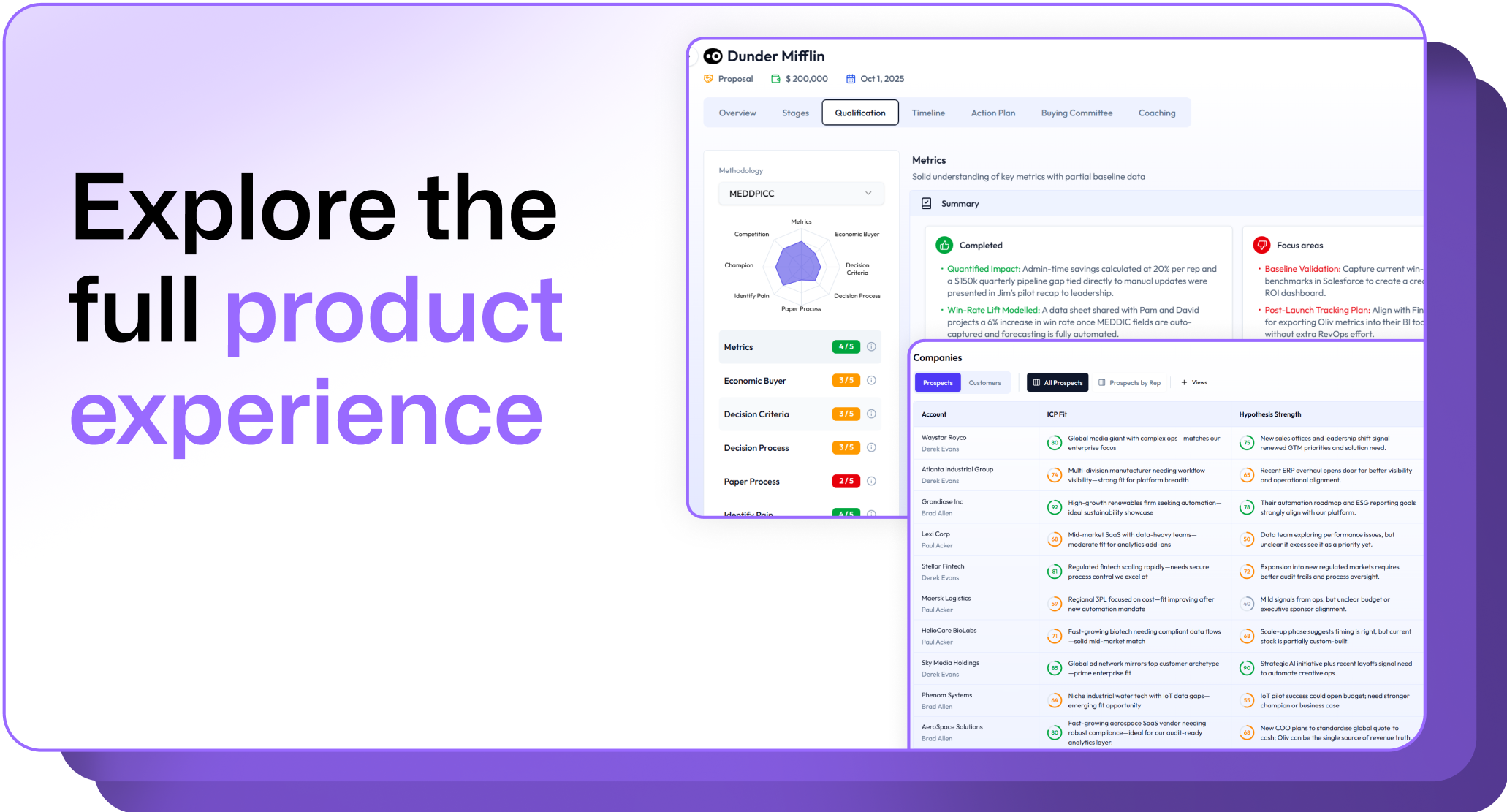
.avif)
.png)






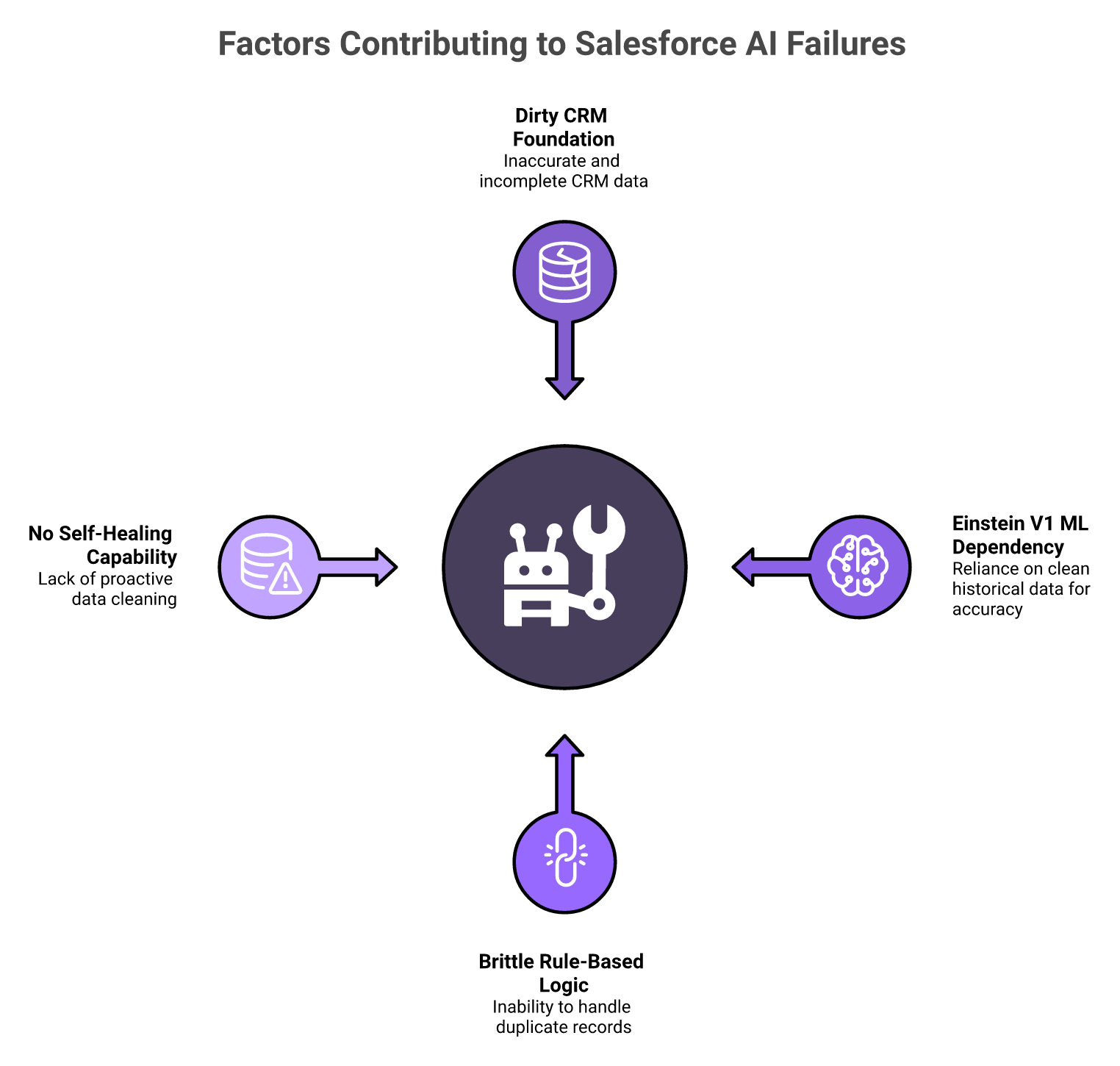



.png)
.png)
.png)

