9 Best AI Sales Agents in 2026: Tools, Types, Benefits, Risks, Use Cases, and ROI
Written by
Ishan Chhabra
Last Updated :
June 10, 2026
Skim in :
8
mins
In this article
Revenue teams love Oliv
Here’s why:
All your deal data unified (from 30+ tools and tabs).
Insights are delivered to you directly, no digging.
AI agents automate tasks for you.
Thank you! Your submission has been received!
Oops! Something went wrong while submitting the form.
Meet Oliv’s AI Agents
Hi! I’m, Deal Driver
I track deals, flag risks, send weekly pipeline updates and give sales managers full visibility into deal progress
Hi! I’m, CRM Manager
I maintain CRM hygiene by updating core, custom and qualification fields all without your team lifting a finger
Hi! I’m, Forecaster
I build accurate forecasts based on real deal movement and tell you which deals to pull in to hit your number
Hi! I’m, Coach
I believe performance fuels revenue. I spot skill gaps, score calls and build coaching plans to help every rep level up
Hi! I’m, Prospector
I dig into target accounts to surface the right contacts, tailor and time outreach so you always strike when it counts
Hi! I’m, Pipeline tracker
I call reps to get deal updates, and deliver a real-time, CRM-synced roll-up view of deal progress
Hi! I’m, Analyst
I answer complex pipeline questions, uncover deal patterns, and build reports that guide strategic decisions
TL;DR
AI sales agents pick a goal and act autonomously, unlike rule-based automation or chatbots that wait to be prompted.
We rank 9 tools on a three-layer model: conversation intelligence, understanding, and agentic action, weighting data portability heavily.
Most tools only observe and record; the 2026 winners act, updating the CRM and flagging deal risk on their own.
ROI runs a 9 to 12 month payback above 75% utilization, but it collapses without automatic two-way CRM write-back.
Governance now matters: the EU AI Act enforces high-risk obligations from August 2026, so ask vendors about oversight and consent.
Deploy with the 10/80/10 rule and solve the workflow manually first before automating anything.
Q1. What Are the 9 Best AI Sales Agents in 2026, and How Did We Score Them? [toc=1. The 9 Best Agents]
The 9 best AI sales agents in 2026 are Oliv AI (best agentic, CRM-native revenue intelligence), Gong, Salesforce Einstein/Agentforce, Outreach, Clari, Chorus, Avoma, Artisan (Ava), and 11x (Alice). I scored each on Cross-Functional Intelligence (30%), Integration and Data Portability (25%), Setup and Usability (20%), Pricing Transparency (15%), and Verified Reviews (10%). Oliv earns 5 stars. Record-only, one-way tools lose points on portability.
A RevOps lead pinged me at midnight last quarter, staring at four open tabs: Gong for calls, Clari for forecast, Salesforce for the source of truth, and a spreadsheet to reconcile all three. The numbers stopped adding up. Her real question was not "which tool is best." It was "why am I paying $500 a user to copy data between systems by hand?" That is the buyer fear I want to address head-on here. Most "best of" lists rank recorders and rename them agents. I sorted these nine by one test instead: does the software actually do the work, or does it just watch you do it and hand you a dashboard on Monday?
The Scoring Lens: Three Layers, Not One Feature List
🧠 Why Layers Beat Features
I think the standard read gets this category backwards. People compare features when they should compare layers. Most revenue tools live on one layer and stop there.
I score on a three-layer model that mirrors how this software actually stacks up:
Layer 1: conversational intelligence (the Gong replacement, recording and transcribing calls).
Layer 2: understanding (LLMs summarizing signals across calls, email, and chat into deal context).
Layer 3: agents (the activation layer that drafts, updates the CRM, and flags risk on its own).
Tools that only nail Layer 1 are recorders. The 2026 winners reach Layer 3. That is why Cross-Functional Intelligence carries the heaviest weight at 30%.
⚖️ Why Data Portability Is Weighted at 25%
I could be slightly aggressive on this number, but I have earned the right to it. The most expensive failure I see is data you own but cannot move. One-way integrations pull everything in, then make it painful to push back into the system that runs your business: your CRM.
A Gong user spelled out the cost on G2:
"While Gong offers valuable insights into call data and sales interactions, our experience has been impacted by significant data access limitations, especially concerning data portability and bulk export capabilities... it requires downloading calls individually, which is impractical and inefficient for a large volume of data." Neel P., Sales Operations Manager Gong G2 Verified Review
When extracting your own data needs a developer ticket, portability is not a nice-to-have. It is the whole game. That is the logic behind the 25% weight, and it is the same thinking behind our take on Gong integrations.
The Ranked Verdict (All 9 at a Glance)
📊 Star Bands and the Full List
Star bands are simple: a weighted score of 0 to 20 earns ⭐, 21 to 40 earns ⭐⭐, 41 to 60 earns ⭐⭐⭐, 61 to 80 earns ⭐⭐⭐⭐, and 81 to 100 earns ⭐⭐⭐⭐⭐.
The 9 Best AI Sales Agents in 2026 (Ranked)
Rank
Tool
Best For
Rating
1
Oliv AI
Agentic, CRM-native revenue intelligence across the full GTM motion
⭐⭐⭐⭐⭐
2
Gong
Conversation intelligence depth for established, well-funded teams
⭐⭐⭐⭐
3
Salesforce Einstein/Agentforce
Salesforce-committed orgs wanting native agents
⭐⭐⭐
4
Outreach
High-volume outbound sequencing
⭐⭐⭐
5
Clari
Forecast and pipeline inspection for RevOps
⭐⭐⭐⭐
6
Chorus
ZoomInfo-stack conversation intelligence
⭐⭐⭐
7
Avoma
Budget note-taking and meeting transcription
⭐⭐⭐
8
Artisan (Ava)
Fully automated AI SDR outbound
⭐⭐⭐
9
11x (Alice)
Autonomous digital workers for prospecting
⭐⭐⭐
One honest caveat: vendor-published pricing shifts often, and several of these tools negotiate per deal. I could not fully verify every enterprise discount, so treat the pricing notes below as a starting line, not a quote.
1. Oliv AI ⭐⭐⭐⭐⭐
Oliv AI unifies fragmented revenue data in an AI lakehouse and deploys AI agents across pipeline, sales execution, customer retention, and account expansion
🤖 What It Does and Key Features
What it does: Oliv is a generative-AI-native, agent-first revenue platform. It rebuilds the CRM as an AI-native data layer, then runs specialized agents that prep deals, update fields, and surface risk on their own. It is built to act, not just record.
Key features:
30+ specialized AI agents in production across the GTM motion.
Two-way CRM sync that writes context back into Salesforce or HubSpot, not just in.
Deal-level intelligence stitched from calls, email, Slack, and Telegram.
MEDDPICC and SPICED qualification scoring inside live opportunities.
💰 Pricing, Implementation, and Verdict
💰 Pricing: Modular, roughly $19 to $120 per user per month depending on the agents you turn on. The point is paying for what you run, not a bundled stack.
⏰ Implementation: Light setup with agentic nudges from day one. Full customization still takes 2 to 4 weeks, and I want to be straight about that.
✅ Pros:
✅ Acts autonomously instead of leaving work for the rep.
✅ Two-way data flow keeps the CRM as the real source of truth.
✅ Processes calls in roughly 5 to 10 minutes, not 30 to 40.
❌ Cons:
❌ The Voice Agent is still in alpha.
❌ Deep customization needs a 2 to 4 week ramp.
Use case: When we rebuilt our own pipeline reviews on Oliv agents, the agent prepped the deal before the call instead of the rep scrambling after it. That is the shift from a tool you log into toward agents that work for you, the same idea behind the move from revenue ops to orchestration.
⚠️ Anti-ICP: Oliv is not built for B2C support queues or teams that only want a passive call recorder.
2. Gong ⭐⭐⭐⭐
Gong's Team Stats view benchmarks rep talk ratio, interactivity, and question rate against recommended ranges, helping managers spot coaching opportunities across calls.
📞 What It Does and Key Features
What it does: Gong is the market-leading conversation intelligence platform. It records, transcribes, and analyzes calls, and layers on forecasting and engagement as paid add-ons. It is strong on Layer 1, lighter on autonomous action.
Key features:
Call recording, transcription, and "Smart Trackers" keyword tracking.
Deal boards that centralize calls, email, and CRM data in one view.
Forecasting and Engage modules sold separately.
💰 Pricing, Implementation, and Pros and Cons
💰 Pricing: Premium, and reviewers repeatedly flag it as the highest-end option. Core add-ons like Forecast and Engage cost extra, which we break down in our Gong pricing analysis.
⏰ Implementation: Capable but heavy. Setting up trackers and training the AI takes real effort.
✅ Pros:
✅ Deep, trusted conversation intelligence.
✅ Strong adoption among managers for coaching.
❌ Cons:
❌ Painful bulk data export and one-way data flow.
❌ Price and add-on stacking strain smaller budgets.
💬 Real User Feedback
Reviews show the split clearly. A director loves the centralization:
"Gong has become the single source of truth for our sales team... The additional products like forecast or engage come at an additional cost. Would be great to see these tools rolled into the core offering." Scott T., Director of Sales Gong G2 Verified Review
A marketing leader regrets the spend:
"Gong is a really powerful tool but its probably the highest end option on the market, and now were stuck with a tool that works technically but isnt the right business decision." Iris P., Head of Marketing and Sales Partnerships Gong G2 Verified Review
And a senior AE finds the daily experience clunky:
"Its too complicated, and not intuitive at all... Searching for calls is not easy, moving around in the calls is not easy, and understanding the pipeline management portion of it is almost impossible." John S., Senior Account Executive Gong G2 Verified Review
Use case: Gong fits established, well-funded teams that want best-in-class call analysis and have budget to spare. The trade-off versus Oliv is simple. Gong tells you what happened. It does not push that work back into your CRM for you, a gap we cover in our Gong vs Oliv comparison.
3. Salesforce Einstein / Agentforce ⭐⭐⭐
Salesforce Partner Cloud runs the full partner selling motion on Agentforce, spanning recruitment, enablement, distribution, and support inside the Salesforce Platform.
🛠️ What It Does and Key Features
What it does: Agentforce is Salesforce's native agent layer, with Einstein providing the underlying AI. For Salesforce-committed orgs, it builds low-code agents that live inside existing workflows. The promise is native; the experience is still maturing.
Agent Analytics dashboard for monitoring interactions.
💰 Pricing, Implementation, and Pros and Cons
💰 Pricing: Prone to stacking. You often buy Sales Cloud, then the Einstein add-on, then conversation insights, which pushes real cost well past entry pricing, as our Agentforce pricing breakdown shows.
⏰ Implementation: Dependency-heavy. You must enable Einstein and related settings before Agentforce works, with a lot of clicking and tab-switching.
✅ Pros:
✅ Native to Salesforce, so no separate system of record.
✅ Genuinely low-code for simple support and lead flows.
❌ Cons:
❌ Setup friction and debugging issues on multi-agent builds.
❌ Still early on robustness for true sales autonomy.
💬 Real User Feedback
A business analyst likes the build experience but hit walls:
"I love all the customization available with the topics and actions... Also, it still needs some serous debugging. I built the default agent, went well, then went to create a second agent and could not get past an error when I clicked Create." Jessica C., Senior Business Analyst Salesforce Agentforce G2 Verified Review
An admin captures the UX drag:
"Lots of clicking to get select the right options. UX needs improvement. Everything opens in a new browser tabs clustering the browser. Lots of jumping back and forth between tabs to enable settings." Verified User in Consulting Salesforce Agentforce G2 Verified Review
Use case: Agentforce makes sense for orgs already all-in on Salesforce and willing to absorb setup overhead. Where Oliv differs is the starting point. Oliv ships agents that act across your full GTM motion, instead of asking your admin to wire one together tab by tab, which is why many teams weigh Agentforce alternatives early.
4. Outreach ⭐⭐⭐
📨 What It Does and Key Features
What it does: Outreach is a sales engagement platform built for high-volume outbound. It runs sequences, cadences, and email tracking, and syncs with Salesforce. It is a workhorse for SDR motion, not an autonomous agent.
Key features:
Multi-step email and call sequencing.
A/B testing and open/click tracking.
Admin dashboards and martech integrations.
💰 Pricing, Implementation, and Pros and Cons
💰 Pricing: Premium per seat, and reviewers flag aggressive contract terms. Evergreen renewals catch teams off guard.
⏰ Implementation: Onboarding takes time, and several users report glitches and slow support during setup.
✅ Pros:
✅ Strong, customizable sequencing for outbound teams.
✅ Solid Salesforce sync and reporting basics.
❌ Cons:
❌ Reviewers call the core engage product stagnant.
❌ Rigid, auto-renewing contracts and dialer lag at volume.
💬 Real User Feedback
A CRO likes the systematic outreach but flags support:
"The ability to easily reach out to multiple contacts systematicaly. I also like the ability to AB test emails... The reports are difficult to make sense of, onboarding takes time and ther are many glitches ongoing. and our account manager changed 3 times in 4 months." Greg D., CRO Outreach G2 Verified Review
A RevOps head finds it frozen in time:
"The engage product is stagnant. Looks to have the same features, UX, integrations and issues as it had 5 years ago. Frequent requests for a product roadmap or understanding how AI is involved is glossed over by the CS team." Matthew T., Head of Revenue Operations Outreach G2 Verified Review
And a CTO calls out the contract:
"Outreach is significantly overpriced for what it offers... their agreements are evergreen, automatically renewing annually... If you miss the cancellation deadline by even a few hours, they enforce renewal for the entire year." Kevin H., CTO and Co-Founder Outreach G2 Verified Review
Use case: Outreach fits large outbound teams that live in sequences. The gap versus Oliv is generation. Outreach automates steps you define. Oliv runs agents that decide and act across the deal, not just fire the next email.
5. Clari ⭐⭐⭐⭐
📈 What It Does and Key Features
What it does: Clari is a forecasting and pipeline-inspection platform built for RevOps. It pulls Salesforce data into clean waterfall, funnel, and pulse views, and adds Copilot for call intelligence. Forecasting is its core strength.
Key features:
Forecast hierarchies and opportunity inspection.
Waterfall, funnel, and trend analytics.
Two-way Salesforce sync and Copilot conversation intelligence.
💰 Pricing, Implementation, and Pros and Cons
💰 Pricing: Enterprise-tier and negotiated per deal. Hierarchy nodes can require extra Salesforce user licenses.
⏰ Implementation: Capable but commitment-heavy. Field migration and formula-field handling trip up admins.
✅ Pros:
✅ Best-in-class forecast clarity for exec reviews.
✅ Genuine two-way CRM updates from inside Clari.
❌ Cons:
❌ Setup is challenging, especially Salesforce field migration.
❌ Dashboards feel limited versus the data underneath.
💬 Real User Feedback
A CS exec praises the two-way sync:
"My favorite part of Clari is the two-way integration with our CRM... I can do so from my view in Clari. Its great! My other favorite feature is the CoPilot AI. I think its truly great at delivering call intelligence." Dexter L., Customer Success Executive Clari G2 Verified Review
A RevOps manager notes the depth comes with cost:
"Some users may find Claris analytics and forecasting tools complex, requiring significant onboarding and training... users occasionally report difficulties syncing data seamlessly, especially with custom CRM setups." Bharat K., Revenue Operations Manager Clari G2 Verified Review
A head of sales ops flags the setup pain:
"I find the setup process challenging, especially when migrating fields from Salesforce, as it cant handle formula fields directly... Claris integration capabilities are inadequate, particularly in pulling in call transcripts, which requires working with other tools." Josiah R., Head of Sales Operations Clari G2 Verified Review
Use case: Clari shines on the Monday forecast call for RevOps leaders. Where Oliv differs is scope. Clari predicts the number, then leaves the work to your reps. Oliv runs agents that act on the deals behind the number, which is the core of our Clari alternatives view.
6. Chorus (by ZoomInfo) ⭐⭐⭐
🎧 What It Does and Key Features
What it does: Chorus is ZoomInfo's conversation intelligence tool. It records, transcribes, and analyzes calls, then tracks themes and competitor mentions. Its strength is tight coupling with the ZoomInfo data stack.
Key features:
Call recording, transcription, and theme trackers.
Deal and momentum signals tied to ZoomInfo data.
Coaching and call-library features for managers.
💰 Pricing, Implementation, and Pros and Cons
💰 Pricing: Bundled into ZoomInfo packages, so standalone pricing is opaque. It often rides along with a broader ZoomInfo contract.
⏰ Implementation: Lighter if you already run ZoomInfo, heavier if you do not.
✅ Pros:
✅ Strong fit for teams already on ZoomInfo.
✅ Solid keyword and theme tracking for coaching.
❌ Cons:
❌ Keyword-style tracking misses nuanced intent.
❌ Value drops sharply if you are not in the ZoomInfo ecosystem.
💬 Real User Feedback
The attached review file does not include verified Chorus reviews, so I will not invent any here. From what surfaces when you actually run conversation intelligence at the keyword layer, the recurring complaint mirrors Gong's: trackers catch the word, not the meaning. They struggle to tell "we are actively evaluating" from a passing mention.
Use case: Chorus makes sense as the conversation layer for ZoomInfo-committed teams. The contrast with Oliv is the same Layer 1 ceiling. Chorus surfaces what was said. Oliv understands the deal across channels and then acts on it, the difference we map in our Gong vs Chorus comparison.
7. Avoma ⭐⭐⭐
📝 What It Does and Key Features
What it does: Avoma is a budget-friendly meeting assistant. It records, transcribes, and summarizes calls, with light coaching and scheduling features. It targets smaller teams that want notes without enterprise pricing.
Key features:
Automatic call recording and AI notes.
Meeting scheduling and basic coaching scorecards.
Affordable, transparent per-seat pricing.
💰 Pricing, Implementation, and Pros and Cons
💰 Pricing: The cheapest tier in this list, which is its main draw.
⏰ Implementation: Quick and simple, suited to small teams.
✅ Pros:
✅ Low cost and fast to start.
✅ Decent note-taking for the price.
❌ Cons:
❌ Reliability gaps, with recorders sometimes failing to join calls on time.
❌ Thin on deal-level intelligence and autonomous action.
💬 Real User Feedback
The attached review file does not contain verified Avoma reviews, so I am not fabricating any. The pattern I have seen in practice is straightforward: Avoma reads as a cheaper alternative to Gong that trades reliability for price, which matters most when a recorder silently misses a key call. We dig into this in our Avoma user reviews breakdown.
Use case: Avoma fits very small teams that want affordable notes and nothing more. The gap versus Oliv is the whole upper stack. Avoma transcribes. Oliv understands and acts.
8. Artisan (Ava) ⭐⭐⭐
🚀 What It Does and Key Features
What it does: Artisan's Ava is a fully automated AI SDR. It researches prospects, writes outbound email, and runs sequences with minimal human input. It targets teams that want outbound to run hands-off.
Key features:
Autonomous prospect research and list building.
AI-written, personalized outbound email.
Built-in B2B data and deliverability tooling.
💰 Pricing, Implementation, and Pros and Cons
💰 Pricing: Per-seat or per-workflow, positioned as a cheaper alternative to a human SDR.
⏰ Implementation: Fast to launch for outbound, with quality tuning over the first weeks.
✅ Pros:
✅ Genuinely autonomous outbound prospecting.
✅ Cuts manual list-building and first-draft email time.
❌ Cons:
❌ Narrow to top-of-funnel outbound only.
❌ No full-cycle deal intelligence or CRM orchestration.
💬 Real User Feedback
The attached file includes no verified Artisan reviews, so I will not manufacture one. In practice, single-purpose AI SDRs like Ava prove a real point: a horizontal agent can close work humans assume needs a person. One digital agent in this category closed a $70k sponsorship on its own. The limitation is scope, not capability.
Use case: Ava fits teams that want outbound prospecting fully automated. The contrast with Oliv is breadth. Ava owns the first touch. Oliv runs 30+ agents across the entire revenue motion, from discovery through forecast, the kind of coverage we describe in our best AI sales tools guide.
9. 11x (Alice) ⭐⭐⭐
🧑💻 What It Does and Key Features
What it does: 11x builds autonomous "digital workers," led by Alice for prospecting and Julian for voice. The pitch is a full AI headcount that runs outbound around the clock. It sits firmly in the AI SDR category.
Key features:
Autonomous outbound research and outreach via Alice.
Voice agent (Julian) for automated calls.
Multi-channel digital-worker framing.
💰 Pricing, Implementation, and Pros and Cons
💰 Pricing: Premium, positioned as replacing headcount rather than per-seat tooling.
⏰ Implementation: Onboarding-heavy for a true autonomous setup.
✅ Pros:
✅ Bold, fully autonomous digital-worker model.
✅ Multi-channel outbound including voice.
❌ Cons:
❌ Public reports of cancellation and billing friction.
❌ Outbound-only focus, not full-cycle revenue intelligence.
💬 Real User Feedback
The attached review file contains no verified 11x reviews, so I am not creating any. The publicly discussed concern in this category centers on contract and cancellation friction, which I flag honestly rather than dramatize. On capability, Alice is real autonomous outbound; the question is fit and lock-in, not whether it works.
Use case: 11x fits teams ready to bet on autonomous digital workers for prospecting. Where Oliv differs is the job to be done. 11x adds an AI headcount at the top of funnel. Oliv rebuilds the CRM as an AI-native layer so agents serve the whole revenue engine, not just outbound, the vision behind our revenue orchestration platform approach.
Q2. What Exactly Is an AI Sales Agent, What Types Exist, and Why Now? [toc=2. What Is an AI Sales Agent]
An AI sales agent picks a goal, like qualifying a lead, enforcing MEDDPICC (a deal-qualification checklist), or drafting follow-up, and works toward it on its own. That makes it different from rule-based automation or wait-to-be-prompted chatbots. Types span prospecting, conversation intelligence, forecasting, methodology enforcement, and CRM hygiene. Why now: Gartner expects roughly half of GenAI enterprises to deploy agents by 2027, with sales an early adopter.
🤖 Agent vs. Automation: The Vending Machine Test
Here is the cleanest way I know to tell them apart. A vending machine has very set rules. If it has not received your exact payment, it just stops and waits, because it cannot improvise.
That is traditional automation. Now picture a smart employee instead. They pick a goal, adapt when things change, and keep going until the job is done. That is an agent.
Chat tools blur this line, and I think the standard read gets it backwards. A chat box still waits for you to prompt it. Real agents start the work themselves, which is why "give everyone a chat window" rarely drives adoption, a pattern we dig into across the best AI sales tools.
🗺️ The Types, Mapped to How You Actually Sell
A sales process is like a Google Map of the route. The qualification method, like MEDDPICC, is the GPS that tells a rep exactly where they are and what to do next. The best agents provide that GPS, not just the map, which is why we tie agents to a real MEDDIC sales methodology.
Here are the main types and where each one lives in your day:
AI Sales Agent Types Mapped to GTM Roles
Agent type
What it does
Who feels it most
Prospecting / SDR
Researches leads, drafts outbound
BDRs, SDRs
Conversation intelligence
Records and analyzes calls
Managers, enablement
Forecasting / deal inspection
Scores risk, predicts close
RevOps, leadership
Methodology enforcement
Checks MEDDPICC, SPICED gaps
Sales Managers, AEs
CRM hygiene
Auto-updates fields and notes
Everyone, quietly
🔀 The Real Dividing Line: Observe vs. Act
Most tools only observe. They record, summarize, and hand you a dashboard. The work still lands back on the rep.
The agents that matter actually act. They update the opportunity, flag the missing economic buyer, and draft the next email. At Oliv, this is the whole point: agents serve the deal across calls, email, Slack, and Telegram, then write context back into your CRM, the leap we map in our piece on revenue ops to intelligence to orchestration.
📈 Why 2026 Is the Tipping Point
I could be early on the exact timing, but the direction is clear. Gartner projects about 50% of GenAI enterprises will deploy agents by 2027, up from 25% in 2025, and names sales an earliest-adoption domain. Mid-market is moving fast too, with roughly 55% of firms expected to implement agents by 2026.
The money backs it. McKinsey estimates AI agents could add $2.6 to $4.4 trillion in annual value across business use cases. That is not hype. It is why I think the SaaS you log into is becoming agents that work for you, the thesis behind every modern revenue intelligence platform.
Q3. How Do AI Sales Agents Actually Work Under the Hood? [toc=3. How They Work]
AI sales agents centralize signals from calls, emails, CRM, and chat, use LLMs (large language models, the AI behind tools like ChatGPT) to understand intent, score deals against your methodology, then act by drafting outreach, updating fields, and flagging risk. A human does a final sniff test. The hard part is not the model. It is clean, two-way data.
⚙️ The Five-Step Pipeline
When you strip away the marketing, every serious agent runs the same loop. It is less mysterious than vendors make it sound.
Ingest signals from calls, email, CRM, and Slack into one place.
Understand intent using LLMs that summarize what actually happened.
Score the deal against your qualification method.
Act by drafting follow-ups, updating fields, and flagging risk.
Hand off to a human for a quick review before anything ships.
🧹 The Dirty Secret: Sales Data Was Never Clean
Here is what surfaces when you actually run this. AI works well in back-office processes because the data is clean. Sales and marketing never had that luxury.
Deals close over Slack, Telegram, and hallway chats that never hit the CRM. So an agent that only reads recorded calls is working with half the picture. That is why two-way sync and low latency matter more than the model, a point we stress when comparing the best revenue intelligence software platforms.
The speed gap is concrete. When we built Oliv, processing a call takes about 5 to 10 minutes, where legacy recorders often take 30 to 40. Slow, one-way capture means the agent acts on stale, partial data, which is exactly why Gong vs Oliv comes down to activation, not recording.
🌙 The Honest Catch: Someone Still Reviews the Work
I want to be straight about the trade-off. Agents do not remove humans from the loop. They move the human to review.
A "Chief AI Officer" on a lean team can spend 10 to 15 hours a week checking agent output. It is genuinely tiring, because agents work all night, on weekends, and on Christmas. The win is real, but it comes with a new kind of oversight job, not zero work.
Q4. What Are the Real Benefits and ROI of AI Sales Agents? [toc=4. Benefits and ROI]
AI sales agents save reps over 1.5 hours a week on research, lift response rates by about 28%, and shorten cycles by roughly a week, per LinkedIn's 2025 data, and AI users are twice as likely to hit quota. Realistic payback runs 9 to 12 months when utilization stays above 75%. Skip CRM write-back, and the ROI quietly evaporates.
💰 The Numbers That Actually Hold Up
I will not drop a stat without a source, because operators screenshot weak claims and roast them. So here is the sourced version.
LinkedIn's 2025 research found 56% of sellers now use AI daily, those users are 2x as likely to exceed quota, and many save 1.5+ hours weekly on research. McKinsey pegs the broader prize at $2.6 to $4.4 trillion in annual value. These are the inputs for any honest ROI model, the kind we build into the best AI sales forecasting software.
🧮 A Worked ROI Example
Let me make this concrete with round numbers. Say a 50-rep team, each rep carrying a $1M quota, adopts agents.
A 28% response-rate lift feeds more pipeline into the same headcount.
A one-week shorter cycle pulls deals into the current quarter.
If even 10% of reps move from missing to hitting quota, that is meaningful net-new revenue against a per-seat cost of roughly $19 to $120 a month.
That is how you reach a 9 to 12 month payback. The math works when utilization stays high, especially once agents handle the grunt work that fills the best AI for sales calls.
⚠️ Where ROI Quietly Dies
Here is the failure mode I see most. Payback holds only when call data is pushed back into CRM fields automatically.
When it is not, reps stop trusting the system, adoption slips, and churn spikes. I have watched win rates on $50k to $500k deals slide from 29% to 18% as selling got harder and tools stayed passive. The fix is not more dashboards. It is agents, like the ones we run at Oliv, that write back to the CRM so the work does not pile up on the rep, the principle behind every revenue orchestration platform worth buying.
Q5. What Are the Risks, Limitations, and Governance Concerns (Including the EU AI Act)? [toc=5. Risks and Governance]
Key risks fall into four buckets: bias and hallucination, over-automation that skips real discovery, review fatigue for whoever audits the output, and regulation. Under the EU AI Act, agents that profile prospects can be classified high-risk, with high-risk obligations enforced from August 2026. Transparency, human oversight, SOC 2, GDPR, and two-party consent now matter at procurement. Ask each vendor where it stands before you sign.
⚠️ The Operational Risks Nobody Demos
The scariest risk is not a robot uprising. It is an agent that helps your reps take shortcuts faster.
If the system rewards activity over discovery, reps skip the hard qualification questions and chase shallow deals. I have watched win rates on $50k to $500k deals drop from 29% to 18% as that pressure built. An agent should enforce the method, not paper over a skipped step, which is why we tie ours to a real command of the message framework.
Then there is the quiet tax: someone has to review the output. On lean teams, that reviewer can burn 10 to 15 hours a week checking agent work, because agents never sleep. Tooling can also misfire, like activity-capture systems that redact a clean email as "sensitive" when it was not, a gap we flag in our Salesforce Einstein reviews.
🏛️ The EU AI Act, in Plain English
Here is the part most "best of" lists skip entirely. Enforcement of high-risk obligations under the EU AI Act begins August 2026.
Two points matter for sellers. First, agents that profile prospects can be treated as high-risk, triggering transparency and human-oversight duties. Second, you stay responsible for how the agent behaves, even if a vendor built it, a nuance worth weighing across the best AI sales tools.
I will be honest about a contested area: AI disclosure. Some teams label every message "this is from a digital assistant." In practice, many buyers reply, "I can tell this is AI, but it is good, let us meet." The law, not the vibe, should drive your policy here.
✅ Your Monday-Morning Vendor Checklist
Before you sign anything, ask each vendor these four questions:
How do you classify this agent under the EU AI Act, and what oversight is built in?
Are you SOC 2 Type II, GDPR, and CCPA compliant, with proof?
How do you handle two-party consent on recorded calls?
Where does a human review or override the agent's actions?
At Oliv, we treat this as table stakes, with SOC 2 Type II, GDPR, and CCPA in place and humans kept in the loop. The governance answer should be ready before the demo, not after the contract, a bar we hold across every revenue intelligence platform decision.
Q6. What Are the Top Use Cases Where AI Sales Agents Win? [toc=6. Top Use Cases]
The highest-ROI use cases are clear: enforce qualification so reps stop skipping discovery, automate CRM hygiene, surface deal risk in real time, scale personalized outbound, and free managers from manual call reviews. The pattern is simple. Deploy agents where humans take shortcuts under time pressure. One digital agent even closed a $70k sponsorship unassisted, which says the ceiling is higher than most teams assume.
🛫 The London Buyer Who Could Not Get an Answer
Let me tell you about a deal that should have closed and almost did not. I wanted to buy a $10,000 product, and I sent the rep two simple questions. Neither was about price.
It took him three days to respond. A second vendor said he could not answer unless I got on a call. Both lost me on basic responsiveness.
That is the number-one use case. An agent answers the buyer's real questions instantly and enforces the next MEDDPICC step, so a $10k deal does not die in an inbox. Honestly, AI is already better than that experience, especially when it powers the best AI for sales calls.
🚪 The Rep Who Quit the Day We Turned It On
Here is a moment I think about often. We rolled out an AI RevOps agent on a team, and one rep quit that same day.
Why? He had done nothing for 30 days. Every standup he said, "Yeah, I am doing outbound," and the agent quietly showed the truth. The gig was up.
That is the coaching and CRM-hygiene use case in one story. Agents make pipeline reality visible, so managers stop guessing and start coaching the deals that are actually moving, the heart of the best sales coaching software.
🎯 Where to Point Agents First
If you are starting, do not boil the ocean. Pick the moment where your team takes the most shortcuts.
For most B2B teams, that is discovery and qualification. When we run Oliv agents on live deals, the win shows up as fewer "loose change" deals and tighter follow-through, not flashy dashboards. Start narrow, prove the lift, then expand, the same staged approach we recommend in our AI sales forecasting software guide.
Q7. How Do You Choose and Deploy the Right AI Sales Agent? (Buyer's Playbook) [toc=7. Buyer's Playbook]
Choose against four checks: capabilities, compliance, human-AI handoff, and commercial impact. Then decide buy versus build. If a process is your competitive moat, build it in-house. If it is commoditized, buy it. Deploy with the 10/80/10 rule, and solve the workflow by hand first, so you know what "good" looks like before you automate anything.
🧾 The Four-Point Buyer Checklist
I keep this short on purpose, because long checklists never get used. Score every shortlisted tool on four things:
Capabilities: does it act on deals, or just record and report?
Compliance: SOC 2, GDPR, and a clear EU AI Act answer.
Human-AI handoff: where does a person review or override?
Commercial impact: a real payback model, not a vibes pitch.
A quick reminder on cost. The "just buy Gong plus Clari plus Salesloft" stack quietly drags total cost past $500 a user a month for a 25 to 200 rep team. Add the seats up before you fall in love with any single tool, and weigh the Gong pricing against the whole bundle.
🛠️ Buy vs. Build, and the 10/80/10 Rule
The buy-vs-build call is not about ego. If that process is your moat, build it. If it is commoditized, buy it, because building it yourself burns cash you need elsewhere.
For rollout, I use the 10/80/10 rule. Spend 10% defining the ideal customer, give the agent 80% of the heavy lifting, and keep 10% for a human sniff test. And fix the problem manually first, so you actually learn the steps before you hand them to an agent, an approach that pairs well with a true revenue orchestration platform.
💬 Where My Head Is Right Now
What I think shifts in the next two years is simple. The SaaS you log into becomes agents that work for you, and revenue orchestration gives way to revenue engineering.
I could be early on the timeline, but the direction feels settled. When we rebuilt our own motion on Oliv, we ran roughly 20 agents with about 1.2 humans, and net productivity held steady while scale stopped being a headcount problem. If you are weighing this for your team, tell me what you are building, and I will tell you honestly where an agent helps and where it does not, the same lens we use across the best revenue intelligence software platforms.
Q1. What Are the 9 Best AI Sales Agents in 2026, and How Did We Score Them? [toc=1. The 9 Best Agents]
The 9 best AI sales agents in 2026 are Oliv AI (best agentic, CRM-native revenue intelligence), Gong, Salesforce Einstein/Agentforce, Outreach, Clari, Chorus, Avoma, Artisan (Ava), and 11x (Alice). I scored each on Cross-Functional Intelligence (30%), Integration and Data Portability (25%), Setup and Usability (20%), Pricing Transparency (15%), and Verified Reviews (10%). Oliv earns 5 stars. Record-only, one-way tools lose points on portability.
A RevOps lead pinged me at midnight last quarter, staring at four open tabs: Gong for calls, Clari for forecast, Salesforce for the source of truth, and a spreadsheet to reconcile all three. The numbers stopped adding up. Her real question was not "which tool is best." It was "why am I paying $500 a user to copy data between systems by hand?" That is the buyer fear I want to address head-on here. Most "best of" lists rank recorders and rename them agents. I sorted these nine by one test instead: does the software actually do the work, or does it just watch you do it and hand you a dashboard on Monday?
The Scoring Lens: Three Layers, Not One Feature List
🧠 Why Layers Beat Features
I think the standard read gets this category backwards. People compare features when they should compare layers. Most revenue tools live on one layer and stop there.
I score on a three-layer model that mirrors how this software actually stacks up:
Layer 1: conversational intelligence (the Gong replacement, recording and transcribing calls).
Layer 2: understanding (LLMs summarizing signals across calls, email, and chat into deal context).
Layer 3: agents (the activation layer that drafts, updates the CRM, and flags risk on its own).
Tools that only nail Layer 1 are recorders. The 2026 winners reach Layer 3. That is why Cross-Functional Intelligence carries the heaviest weight at 30%.
⚖️ Why Data Portability Is Weighted at 25%
I could be slightly aggressive on this number, but I have earned the right to it. The most expensive failure I see is data you own but cannot move. One-way integrations pull everything in, then make it painful to push back into the system that runs your business: your CRM.
A Gong user spelled out the cost on G2:
"While Gong offers valuable insights into call data and sales interactions, our experience has been impacted by significant data access limitations, especially concerning data portability and bulk export capabilities... it requires downloading calls individually, which is impractical and inefficient for a large volume of data." Neel P., Sales Operations Manager Gong G2 Verified Review
When extracting your own data needs a developer ticket, portability is not a nice-to-have. It is the whole game. That is the logic behind the 25% weight, and it is the same thinking behind our take on Gong integrations.
The Ranked Verdict (All 9 at a Glance)
📊 Star Bands and the Full List
Star bands are simple: a weighted score of 0 to 20 earns ⭐, 21 to 40 earns ⭐⭐, 41 to 60 earns ⭐⭐⭐, 61 to 80 earns ⭐⭐⭐⭐, and 81 to 100 earns ⭐⭐⭐⭐⭐.
The 9 Best AI Sales Agents in 2026 (Ranked)
Rank
Tool
Best For
Rating
1
Oliv AI
Agentic, CRM-native revenue intelligence across the full GTM motion
⭐⭐⭐⭐⭐
2
Gong
Conversation intelligence depth for established, well-funded teams
⭐⭐⭐⭐
3
Salesforce Einstein/Agentforce
Salesforce-committed orgs wanting native agents
⭐⭐⭐
4
Outreach
High-volume outbound sequencing
⭐⭐⭐
5
Clari
Forecast and pipeline inspection for RevOps
⭐⭐⭐⭐
6
Chorus
ZoomInfo-stack conversation intelligence
⭐⭐⭐
7
Avoma
Budget note-taking and meeting transcription
⭐⭐⭐
8
Artisan (Ava)
Fully automated AI SDR outbound
⭐⭐⭐
9
11x (Alice)
Autonomous digital workers for prospecting
⭐⭐⭐
One honest caveat: vendor-published pricing shifts often, and several of these tools negotiate per deal. I could not fully verify every enterprise discount, so treat the pricing notes below as a starting line, not a quote.
1. Oliv AI ⭐⭐⭐⭐⭐
Oliv AI unifies fragmented revenue data in an AI lakehouse and deploys AI agents across pipeline, sales execution, customer retention, and account expansion
🤖 What It Does and Key Features
What it does: Oliv is a generative-AI-native, agent-first revenue platform. It rebuilds the CRM as an AI-native data layer, then runs specialized agents that prep deals, update fields, and surface risk on their own. It is built to act, not just record.
Key features:
30+ specialized AI agents in production across the GTM motion.
Two-way CRM sync that writes context back into Salesforce or HubSpot, not just in.
Deal-level intelligence stitched from calls, email, Slack, and Telegram.
MEDDPICC and SPICED qualification scoring inside live opportunities.
💰 Pricing, Implementation, and Verdict
💰 Pricing: Modular, roughly $19 to $120 per user per month depending on the agents you turn on. The point is paying for what you run, not a bundled stack.
⏰ Implementation: Light setup with agentic nudges from day one. Full customization still takes 2 to 4 weeks, and I want to be straight about that.
✅ Pros:
✅ Acts autonomously instead of leaving work for the rep.
✅ Two-way data flow keeps the CRM as the real source of truth.
✅ Processes calls in roughly 5 to 10 minutes, not 30 to 40.
❌ Cons:
❌ The Voice Agent is still in alpha.
❌ Deep customization needs a 2 to 4 week ramp.
Use case: When we rebuilt our own pipeline reviews on Oliv agents, the agent prepped the deal before the call instead of the rep scrambling after it. That is the shift from a tool you log into toward agents that work for you, the same idea behind the move from revenue ops to orchestration.
⚠️ Anti-ICP: Oliv is not built for B2C support queues or teams that only want a passive call recorder.
2. Gong ⭐⭐⭐⭐
Gong's Team Stats view benchmarks rep talk ratio, interactivity, and question rate against recommended ranges, helping managers spot coaching opportunities across calls.
📞 What It Does and Key Features
What it does: Gong is the market-leading conversation intelligence platform. It records, transcribes, and analyzes calls, and layers on forecasting and engagement as paid add-ons. It is strong on Layer 1, lighter on autonomous action.
Key features:
Call recording, transcription, and "Smart Trackers" keyword tracking.
Deal boards that centralize calls, email, and CRM data in one view.
Forecasting and Engage modules sold separately.
💰 Pricing, Implementation, and Pros and Cons
💰 Pricing: Premium, and reviewers repeatedly flag it as the highest-end option. Core add-ons like Forecast and Engage cost extra, which we break down in our Gong pricing analysis.
⏰ Implementation: Capable but heavy. Setting up trackers and training the AI takes real effort.
✅ Pros:
✅ Deep, trusted conversation intelligence.
✅ Strong adoption among managers for coaching.
❌ Cons:
❌ Painful bulk data export and one-way data flow.
❌ Price and add-on stacking strain smaller budgets.
💬 Real User Feedback
Reviews show the split clearly. A director loves the centralization:
"Gong has become the single source of truth for our sales team... The additional products like forecast or engage come at an additional cost. Would be great to see these tools rolled into the core offering." Scott T., Director of Sales Gong G2 Verified Review
A marketing leader regrets the spend:
"Gong is a really powerful tool but its probably the highest end option on the market, and now were stuck with a tool that works technically but isnt the right business decision." Iris P., Head of Marketing and Sales Partnerships Gong G2 Verified Review
And a senior AE finds the daily experience clunky:
"Its too complicated, and not intuitive at all... Searching for calls is not easy, moving around in the calls is not easy, and understanding the pipeline management portion of it is almost impossible." John S., Senior Account Executive Gong G2 Verified Review
Use case: Gong fits established, well-funded teams that want best-in-class call analysis and have budget to spare. The trade-off versus Oliv is simple. Gong tells you what happened. It does not push that work back into your CRM for you, a gap we cover in our Gong vs Oliv comparison.
3. Salesforce Einstein / Agentforce ⭐⭐⭐
Salesforce Partner Cloud runs the full partner selling motion on Agentforce, spanning recruitment, enablement, distribution, and support inside the Salesforce Platform.
🛠️ What It Does and Key Features
What it does: Agentforce is Salesforce's native agent layer, with Einstein providing the underlying AI. For Salesforce-committed orgs, it builds low-code agents that live inside existing workflows. The promise is native; the experience is still maturing.
Agent Analytics dashboard for monitoring interactions.
💰 Pricing, Implementation, and Pros and Cons
💰 Pricing: Prone to stacking. You often buy Sales Cloud, then the Einstein add-on, then conversation insights, which pushes real cost well past entry pricing, as our Agentforce pricing breakdown shows.
⏰ Implementation: Dependency-heavy. You must enable Einstein and related settings before Agentforce works, with a lot of clicking and tab-switching.
✅ Pros:
✅ Native to Salesforce, so no separate system of record.
✅ Genuinely low-code for simple support and lead flows.
❌ Cons:
❌ Setup friction and debugging issues on multi-agent builds.
❌ Still early on robustness for true sales autonomy.
💬 Real User Feedback
A business analyst likes the build experience but hit walls:
"I love all the customization available with the topics and actions... Also, it still needs some serous debugging. I built the default agent, went well, then went to create a second agent and could not get past an error when I clicked Create." Jessica C., Senior Business Analyst Salesforce Agentforce G2 Verified Review
An admin captures the UX drag:
"Lots of clicking to get select the right options. UX needs improvement. Everything opens in a new browser tabs clustering the browser. Lots of jumping back and forth between tabs to enable settings." Verified User in Consulting Salesforce Agentforce G2 Verified Review
Use case: Agentforce makes sense for orgs already all-in on Salesforce and willing to absorb setup overhead. Where Oliv differs is the starting point. Oliv ships agents that act across your full GTM motion, instead of asking your admin to wire one together tab by tab, which is why many teams weigh Agentforce alternatives early.
4. Outreach ⭐⭐⭐
📨 What It Does and Key Features
What it does: Outreach is a sales engagement platform built for high-volume outbound. It runs sequences, cadences, and email tracking, and syncs with Salesforce. It is a workhorse for SDR motion, not an autonomous agent.
Key features:
Multi-step email and call sequencing.
A/B testing and open/click tracking.
Admin dashboards and martech integrations.
💰 Pricing, Implementation, and Pros and Cons
💰 Pricing: Premium per seat, and reviewers flag aggressive contract terms. Evergreen renewals catch teams off guard.
⏰ Implementation: Onboarding takes time, and several users report glitches and slow support during setup.
✅ Pros:
✅ Strong, customizable sequencing for outbound teams.
✅ Solid Salesforce sync and reporting basics.
❌ Cons:
❌ Reviewers call the core engage product stagnant.
❌ Rigid, auto-renewing contracts and dialer lag at volume.
💬 Real User Feedback
A CRO likes the systematic outreach but flags support:
"The ability to easily reach out to multiple contacts systematicaly. I also like the ability to AB test emails... The reports are difficult to make sense of, onboarding takes time and ther are many glitches ongoing. and our account manager changed 3 times in 4 months." Greg D., CRO Outreach G2 Verified Review
A RevOps head finds it frozen in time:
"The engage product is stagnant. Looks to have the same features, UX, integrations and issues as it had 5 years ago. Frequent requests for a product roadmap or understanding how AI is involved is glossed over by the CS team." Matthew T., Head of Revenue Operations Outreach G2 Verified Review
And a CTO calls out the contract:
"Outreach is significantly overpriced for what it offers... their agreements are evergreen, automatically renewing annually... If you miss the cancellation deadline by even a few hours, they enforce renewal for the entire year." Kevin H., CTO and Co-Founder Outreach G2 Verified Review
Use case: Outreach fits large outbound teams that live in sequences. The gap versus Oliv is generation. Outreach automates steps you define. Oliv runs agents that decide and act across the deal, not just fire the next email.
5. Clari ⭐⭐⭐⭐
📈 What It Does and Key Features
What it does: Clari is a forecasting and pipeline-inspection platform built for RevOps. It pulls Salesforce data into clean waterfall, funnel, and pulse views, and adds Copilot for call intelligence. Forecasting is its core strength.
Key features:
Forecast hierarchies and opportunity inspection.
Waterfall, funnel, and trend analytics.
Two-way Salesforce sync and Copilot conversation intelligence.
💰 Pricing, Implementation, and Pros and Cons
💰 Pricing: Enterprise-tier and negotiated per deal. Hierarchy nodes can require extra Salesforce user licenses.
⏰ Implementation: Capable but commitment-heavy. Field migration and formula-field handling trip up admins.
✅ Pros:
✅ Best-in-class forecast clarity for exec reviews.
✅ Genuine two-way CRM updates from inside Clari.
❌ Cons:
❌ Setup is challenging, especially Salesforce field migration.
❌ Dashboards feel limited versus the data underneath.
💬 Real User Feedback
A CS exec praises the two-way sync:
"My favorite part of Clari is the two-way integration with our CRM... I can do so from my view in Clari. Its great! My other favorite feature is the CoPilot AI. I think its truly great at delivering call intelligence." Dexter L., Customer Success Executive Clari G2 Verified Review
A RevOps manager notes the depth comes with cost:
"Some users may find Claris analytics and forecasting tools complex, requiring significant onboarding and training... users occasionally report difficulties syncing data seamlessly, especially with custom CRM setups." Bharat K., Revenue Operations Manager Clari G2 Verified Review
A head of sales ops flags the setup pain:
"I find the setup process challenging, especially when migrating fields from Salesforce, as it cant handle formula fields directly... Claris integration capabilities are inadequate, particularly in pulling in call transcripts, which requires working with other tools." Josiah R., Head of Sales Operations Clari G2 Verified Review
Use case: Clari shines on the Monday forecast call for RevOps leaders. Where Oliv differs is scope. Clari predicts the number, then leaves the work to your reps. Oliv runs agents that act on the deals behind the number, which is the core of our Clari alternatives view.
6. Chorus (by ZoomInfo) ⭐⭐⭐
🎧 What It Does and Key Features
What it does: Chorus is ZoomInfo's conversation intelligence tool. It records, transcribes, and analyzes calls, then tracks themes and competitor mentions. Its strength is tight coupling with the ZoomInfo data stack.
Key features:
Call recording, transcription, and theme trackers.
Deal and momentum signals tied to ZoomInfo data.
Coaching and call-library features for managers.
💰 Pricing, Implementation, and Pros and Cons
💰 Pricing: Bundled into ZoomInfo packages, so standalone pricing is opaque. It often rides along with a broader ZoomInfo contract.
⏰ Implementation: Lighter if you already run ZoomInfo, heavier if you do not.
✅ Pros:
✅ Strong fit for teams already on ZoomInfo.
✅ Solid keyword and theme tracking for coaching.
❌ Cons:
❌ Keyword-style tracking misses nuanced intent.
❌ Value drops sharply if you are not in the ZoomInfo ecosystem.
💬 Real User Feedback
The attached review file does not include verified Chorus reviews, so I will not invent any here. From what surfaces when you actually run conversation intelligence at the keyword layer, the recurring complaint mirrors Gong's: trackers catch the word, not the meaning. They struggle to tell "we are actively evaluating" from a passing mention.
Use case: Chorus makes sense as the conversation layer for ZoomInfo-committed teams. The contrast with Oliv is the same Layer 1 ceiling. Chorus surfaces what was said. Oliv understands the deal across channels and then acts on it, the difference we map in our Gong vs Chorus comparison.
7. Avoma ⭐⭐⭐
📝 What It Does and Key Features
What it does: Avoma is a budget-friendly meeting assistant. It records, transcribes, and summarizes calls, with light coaching and scheduling features. It targets smaller teams that want notes without enterprise pricing.
Key features:
Automatic call recording and AI notes.
Meeting scheduling and basic coaching scorecards.
Affordable, transparent per-seat pricing.
💰 Pricing, Implementation, and Pros and Cons
💰 Pricing: The cheapest tier in this list, which is its main draw.
⏰ Implementation: Quick and simple, suited to small teams.
✅ Pros:
✅ Low cost and fast to start.
✅ Decent note-taking for the price.
❌ Cons:
❌ Reliability gaps, with recorders sometimes failing to join calls on time.
❌ Thin on deal-level intelligence and autonomous action.
💬 Real User Feedback
The attached review file does not contain verified Avoma reviews, so I am not fabricating any. The pattern I have seen in practice is straightforward: Avoma reads as a cheaper alternative to Gong that trades reliability for price, which matters most when a recorder silently misses a key call. We dig into this in our Avoma user reviews breakdown.
Use case: Avoma fits very small teams that want affordable notes and nothing more. The gap versus Oliv is the whole upper stack. Avoma transcribes. Oliv understands and acts.
8. Artisan (Ava) ⭐⭐⭐
🚀 What It Does and Key Features
What it does: Artisan's Ava is a fully automated AI SDR. It researches prospects, writes outbound email, and runs sequences with minimal human input. It targets teams that want outbound to run hands-off.
Key features:
Autonomous prospect research and list building.
AI-written, personalized outbound email.
Built-in B2B data and deliverability tooling.
💰 Pricing, Implementation, and Pros and Cons
💰 Pricing: Per-seat or per-workflow, positioned as a cheaper alternative to a human SDR.
⏰ Implementation: Fast to launch for outbound, with quality tuning over the first weeks.
✅ Pros:
✅ Genuinely autonomous outbound prospecting.
✅ Cuts manual list-building and first-draft email time.
❌ Cons:
❌ Narrow to top-of-funnel outbound only.
❌ No full-cycle deal intelligence or CRM orchestration.
💬 Real User Feedback
The attached file includes no verified Artisan reviews, so I will not manufacture one. In practice, single-purpose AI SDRs like Ava prove a real point: a horizontal agent can close work humans assume needs a person. One digital agent in this category closed a $70k sponsorship on its own. The limitation is scope, not capability.
Use case: Ava fits teams that want outbound prospecting fully automated. The contrast with Oliv is breadth. Ava owns the first touch. Oliv runs 30+ agents across the entire revenue motion, from discovery through forecast, the kind of coverage we describe in our best AI sales tools guide.
9. 11x (Alice) ⭐⭐⭐
🧑💻 What It Does and Key Features
What it does: 11x builds autonomous "digital workers," led by Alice for prospecting and Julian for voice. The pitch is a full AI headcount that runs outbound around the clock. It sits firmly in the AI SDR category.
Key features:
Autonomous outbound research and outreach via Alice.
Voice agent (Julian) for automated calls.
Multi-channel digital-worker framing.
💰 Pricing, Implementation, and Pros and Cons
💰 Pricing: Premium, positioned as replacing headcount rather than per-seat tooling.
⏰ Implementation: Onboarding-heavy for a true autonomous setup.
✅ Pros:
✅ Bold, fully autonomous digital-worker model.
✅ Multi-channel outbound including voice.
❌ Cons:
❌ Public reports of cancellation and billing friction.
❌ Outbound-only focus, not full-cycle revenue intelligence.
💬 Real User Feedback
The attached review file contains no verified 11x reviews, so I am not creating any. The publicly discussed concern in this category centers on contract and cancellation friction, which I flag honestly rather than dramatize. On capability, Alice is real autonomous outbound; the question is fit and lock-in, not whether it works.
Use case: 11x fits teams ready to bet on autonomous digital workers for prospecting. Where Oliv differs is the job to be done. 11x adds an AI headcount at the top of funnel. Oliv rebuilds the CRM as an AI-native layer so agents serve the whole revenue engine, not just outbound, the vision behind our revenue orchestration platform approach.
Q2. What Exactly Is an AI Sales Agent, What Types Exist, and Why Now? [toc=2. What Is an AI Sales Agent]
An AI sales agent picks a goal, like qualifying a lead, enforcing MEDDPICC (a deal-qualification checklist), or drafting follow-up, and works toward it on its own. That makes it different from rule-based automation or wait-to-be-prompted chatbots. Types span prospecting, conversation intelligence, forecasting, methodology enforcement, and CRM hygiene. Why now: Gartner expects roughly half of GenAI enterprises to deploy agents by 2027, with sales an early adopter.
🤖 Agent vs. Automation: The Vending Machine Test
Here is the cleanest way I know to tell them apart. A vending machine has very set rules. If it has not received your exact payment, it just stops and waits, because it cannot improvise.
That is traditional automation. Now picture a smart employee instead. They pick a goal, adapt when things change, and keep going until the job is done. That is an agent.
Chat tools blur this line, and I think the standard read gets it backwards. A chat box still waits for you to prompt it. Real agents start the work themselves, which is why "give everyone a chat window" rarely drives adoption, a pattern we dig into across the best AI sales tools.
🗺️ The Types, Mapped to How You Actually Sell
A sales process is like a Google Map of the route. The qualification method, like MEDDPICC, is the GPS that tells a rep exactly where they are and what to do next. The best agents provide that GPS, not just the map, which is why we tie agents to a real MEDDIC sales methodology.
Here are the main types and where each one lives in your day:
AI Sales Agent Types Mapped to GTM Roles
Agent type
What it does
Who feels it most
Prospecting / SDR
Researches leads, drafts outbound
BDRs, SDRs
Conversation intelligence
Records and analyzes calls
Managers, enablement
Forecasting / deal inspection
Scores risk, predicts close
RevOps, leadership
Methodology enforcement
Checks MEDDPICC, SPICED gaps
Sales Managers, AEs
CRM hygiene
Auto-updates fields and notes
Everyone, quietly
🔀 The Real Dividing Line: Observe vs. Act
Most tools only observe. They record, summarize, and hand you a dashboard. The work still lands back on the rep.
The agents that matter actually act. They update the opportunity, flag the missing economic buyer, and draft the next email. At Oliv, this is the whole point: agents serve the deal across calls, email, Slack, and Telegram, then write context back into your CRM, the leap we map in our piece on revenue ops to intelligence to orchestration.
📈 Why 2026 Is the Tipping Point
I could be early on the exact timing, but the direction is clear. Gartner projects about 50% of GenAI enterprises will deploy agents by 2027, up from 25% in 2025, and names sales an earliest-adoption domain. Mid-market is moving fast too, with roughly 55% of firms expected to implement agents by 2026.
The money backs it. McKinsey estimates AI agents could add $2.6 to $4.4 trillion in annual value across business use cases. That is not hype. It is why I think the SaaS you log into is becoming agents that work for you, the thesis behind every modern revenue intelligence platform.
Q3. How Do AI Sales Agents Actually Work Under the Hood? [toc=3. How They Work]
AI sales agents centralize signals from calls, emails, CRM, and chat, use LLMs (large language models, the AI behind tools like ChatGPT) to understand intent, score deals against your methodology, then act by drafting outreach, updating fields, and flagging risk. A human does a final sniff test. The hard part is not the model. It is clean, two-way data.
⚙️ The Five-Step Pipeline
When you strip away the marketing, every serious agent runs the same loop. It is less mysterious than vendors make it sound.
Ingest signals from calls, email, CRM, and Slack into one place.
Understand intent using LLMs that summarize what actually happened.
Score the deal against your qualification method.
Act by drafting follow-ups, updating fields, and flagging risk.
Hand off to a human for a quick review before anything ships.
🧹 The Dirty Secret: Sales Data Was Never Clean
Here is what surfaces when you actually run this. AI works well in back-office processes because the data is clean. Sales and marketing never had that luxury.
Deals close over Slack, Telegram, and hallway chats that never hit the CRM. So an agent that only reads recorded calls is working with half the picture. That is why two-way sync and low latency matter more than the model, a point we stress when comparing the best revenue intelligence software platforms.
The speed gap is concrete. When we built Oliv, processing a call takes about 5 to 10 minutes, where legacy recorders often take 30 to 40. Slow, one-way capture means the agent acts on stale, partial data, which is exactly why Gong vs Oliv comes down to activation, not recording.
🌙 The Honest Catch: Someone Still Reviews the Work
I want to be straight about the trade-off. Agents do not remove humans from the loop. They move the human to review.
A "Chief AI Officer" on a lean team can spend 10 to 15 hours a week checking agent output. It is genuinely tiring, because agents work all night, on weekends, and on Christmas. The win is real, but it comes with a new kind of oversight job, not zero work.
Q4. What Are the Real Benefits and ROI of AI Sales Agents? [toc=4. Benefits and ROI]
AI sales agents save reps over 1.5 hours a week on research, lift response rates by about 28%, and shorten cycles by roughly a week, per LinkedIn's 2025 data, and AI users are twice as likely to hit quota. Realistic payback runs 9 to 12 months when utilization stays above 75%. Skip CRM write-back, and the ROI quietly evaporates.
💰 The Numbers That Actually Hold Up
I will not drop a stat without a source, because operators screenshot weak claims and roast them. So here is the sourced version.
LinkedIn's 2025 research found 56% of sellers now use AI daily, those users are 2x as likely to exceed quota, and many save 1.5+ hours weekly on research. McKinsey pegs the broader prize at $2.6 to $4.4 trillion in annual value. These are the inputs for any honest ROI model, the kind we build into the best AI sales forecasting software.
🧮 A Worked ROI Example
Let me make this concrete with round numbers. Say a 50-rep team, each rep carrying a $1M quota, adopts agents.
A 28% response-rate lift feeds more pipeline into the same headcount.
A one-week shorter cycle pulls deals into the current quarter.
If even 10% of reps move from missing to hitting quota, that is meaningful net-new revenue against a per-seat cost of roughly $19 to $120 a month.
That is how you reach a 9 to 12 month payback. The math works when utilization stays high, especially once agents handle the grunt work that fills the best AI for sales calls.
⚠️ Where ROI Quietly Dies
Here is the failure mode I see most. Payback holds only when call data is pushed back into CRM fields automatically.
When it is not, reps stop trusting the system, adoption slips, and churn spikes. I have watched win rates on $50k to $500k deals slide from 29% to 18% as selling got harder and tools stayed passive. The fix is not more dashboards. It is agents, like the ones we run at Oliv, that write back to the CRM so the work does not pile up on the rep, the principle behind every revenue orchestration platform worth buying.
Q5. What Are the Risks, Limitations, and Governance Concerns (Including the EU AI Act)? [toc=5. Risks and Governance]
Key risks fall into four buckets: bias and hallucination, over-automation that skips real discovery, review fatigue for whoever audits the output, and regulation. Under the EU AI Act, agents that profile prospects can be classified high-risk, with high-risk obligations enforced from August 2026. Transparency, human oversight, SOC 2, GDPR, and two-party consent now matter at procurement. Ask each vendor where it stands before you sign.
⚠️ The Operational Risks Nobody Demos
The scariest risk is not a robot uprising. It is an agent that helps your reps take shortcuts faster.
If the system rewards activity over discovery, reps skip the hard qualification questions and chase shallow deals. I have watched win rates on $50k to $500k deals drop from 29% to 18% as that pressure built. An agent should enforce the method, not paper over a skipped step, which is why we tie ours to a real command of the message framework.
Then there is the quiet tax: someone has to review the output. On lean teams, that reviewer can burn 10 to 15 hours a week checking agent work, because agents never sleep. Tooling can also misfire, like activity-capture systems that redact a clean email as "sensitive" when it was not, a gap we flag in our Salesforce Einstein reviews.
🏛️ The EU AI Act, in Plain English
Here is the part most "best of" lists skip entirely. Enforcement of high-risk obligations under the EU AI Act begins August 2026.
Two points matter for sellers. First, agents that profile prospects can be treated as high-risk, triggering transparency and human-oversight duties. Second, you stay responsible for how the agent behaves, even if a vendor built it, a nuance worth weighing across the best AI sales tools.
I will be honest about a contested area: AI disclosure. Some teams label every message "this is from a digital assistant." In practice, many buyers reply, "I can tell this is AI, but it is good, let us meet." The law, not the vibe, should drive your policy here.
✅ Your Monday-Morning Vendor Checklist
Before you sign anything, ask each vendor these four questions:
How do you classify this agent under the EU AI Act, and what oversight is built in?
Are you SOC 2 Type II, GDPR, and CCPA compliant, with proof?
How do you handle two-party consent on recorded calls?
Where does a human review or override the agent's actions?
At Oliv, we treat this as table stakes, with SOC 2 Type II, GDPR, and CCPA in place and humans kept in the loop. The governance answer should be ready before the demo, not after the contract, a bar we hold across every revenue intelligence platform decision.
Q6. What Are the Top Use Cases Where AI Sales Agents Win? [toc=6. Top Use Cases]
The highest-ROI use cases are clear: enforce qualification so reps stop skipping discovery, automate CRM hygiene, surface deal risk in real time, scale personalized outbound, and free managers from manual call reviews. The pattern is simple. Deploy agents where humans take shortcuts under time pressure. One digital agent even closed a $70k sponsorship unassisted, which says the ceiling is higher than most teams assume.
🛫 The London Buyer Who Could Not Get an Answer
Let me tell you about a deal that should have closed and almost did not. I wanted to buy a $10,000 product, and I sent the rep two simple questions. Neither was about price.
It took him three days to respond. A second vendor said he could not answer unless I got on a call. Both lost me on basic responsiveness.
That is the number-one use case. An agent answers the buyer's real questions instantly and enforces the next MEDDPICC step, so a $10k deal does not die in an inbox. Honestly, AI is already better than that experience, especially when it powers the best AI for sales calls.
🚪 The Rep Who Quit the Day We Turned It On
Here is a moment I think about often. We rolled out an AI RevOps agent on a team, and one rep quit that same day.
Why? He had done nothing for 30 days. Every standup he said, "Yeah, I am doing outbound," and the agent quietly showed the truth. The gig was up.
That is the coaching and CRM-hygiene use case in one story. Agents make pipeline reality visible, so managers stop guessing and start coaching the deals that are actually moving, the heart of the best sales coaching software.
🎯 Where to Point Agents First
If you are starting, do not boil the ocean. Pick the moment where your team takes the most shortcuts.
For most B2B teams, that is discovery and qualification. When we run Oliv agents on live deals, the win shows up as fewer "loose change" deals and tighter follow-through, not flashy dashboards. Start narrow, prove the lift, then expand, the same staged approach we recommend in our AI sales forecasting software guide.
Q7. How Do You Choose and Deploy the Right AI Sales Agent? (Buyer's Playbook) [toc=7. Buyer's Playbook]
Choose against four checks: capabilities, compliance, human-AI handoff, and commercial impact. Then decide buy versus build. If a process is your competitive moat, build it in-house. If it is commoditized, buy it. Deploy with the 10/80/10 rule, and solve the workflow by hand first, so you know what "good" looks like before you automate anything.
🧾 The Four-Point Buyer Checklist
I keep this short on purpose, because long checklists never get used. Score every shortlisted tool on four things:
Capabilities: does it act on deals, or just record and report?
Compliance: SOC 2, GDPR, and a clear EU AI Act answer.
Human-AI handoff: where does a person review or override?
Commercial impact: a real payback model, not a vibes pitch.
A quick reminder on cost. The "just buy Gong plus Clari plus Salesloft" stack quietly drags total cost past $500 a user a month for a 25 to 200 rep team. Add the seats up before you fall in love with any single tool, and weigh the Gong pricing against the whole bundle.
🛠️ Buy vs. Build, and the 10/80/10 Rule
The buy-vs-build call is not about ego. If that process is your moat, build it. If it is commoditized, buy it, because building it yourself burns cash you need elsewhere.
For rollout, I use the 10/80/10 rule. Spend 10% defining the ideal customer, give the agent 80% of the heavy lifting, and keep 10% for a human sniff test. And fix the problem manually first, so you actually learn the steps before you hand them to an agent, an approach that pairs well with a true revenue orchestration platform.
💬 Where My Head Is Right Now
What I think shifts in the next two years is simple. The SaaS you log into becomes agents that work for you, and revenue orchestration gives way to revenue engineering.
I could be early on the timeline, but the direction feels settled. When we rebuilt our own motion on Oliv, we ran roughly 20 agents with about 1.2 humans, and net productivity held steady while scale stopped being a headcount problem. If you are weighing this for your team, tell me what you are building, and I will tell you honestly where an agent helps and where it does not, the same lens we use across the best revenue intelligence software platforms.
Q1. What Are the 9 Best AI Sales Agents in 2026, and How Did We Score Them? [toc=1. The 9 Best Agents]
The 9 best AI sales agents in 2026 are Oliv AI (best agentic, CRM-native revenue intelligence), Gong, Salesforce Einstein/Agentforce, Outreach, Clari, Chorus, Avoma, Artisan (Ava), and 11x (Alice). I scored each on Cross-Functional Intelligence (30%), Integration and Data Portability (25%), Setup and Usability (20%), Pricing Transparency (15%), and Verified Reviews (10%). Oliv earns 5 stars. Record-only, one-way tools lose points on portability.
A RevOps lead pinged me at midnight last quarter, staring at four open tabs: Gong for calls, Clari for forecast, Salesforce for the source of truth, and a spreadsheet to reconcile all three. The numbers stopped adding up. Her real question was not "which tool is best." It was "why am I paying $500 a user to copy data between systems by hand?" That is the buyer fear I want to address head-on here. Most "best of" lists rank recorders and rename them agents. I sorted these nine by one test instead: does the software actually do the work, or does it just watch you do it and hand you a dashboard on Monday?
The Scoring Lens: Three Layers, Not One Feature List
🧠 Why Layers Beat Features
I think the standard read gets this category backwards. People compare features when they should compare layers. Most revenue tools live on one layer and stop there.
I score on a three-layer model that mirrors how this software actually stacks up:
Layer 1: conversational intelligence (the Gong replacement, recording and transcribing calls).
Layer 2: understanding (LLMs summarizing signals across calls, email, and chat into deal context).
Layer 3: agents (the activation layer that drafts, updates the CRM, and flags risk on its own).
Tools that only nail Layer 1 are recorders. The 2026 winners reach Layer 3. That is why Cross-Functional Intelligence carries the heaviest weight at 30%.
⚖️ Why Data Portability Is Weighted at 25%
I could be slightly aggressive on this number, but I have earned the right to it. The most expensive failure I see is data you own but cannot move. One-way integrations pull everything in, then make it painful to push back into the system that runs your business: your CRM.
A Gong user spelled out the cost on G2:
"While Gong offers valuable insights into call data and sales interactions, our experience has been impacted by significant data access limitations, especially concerning data portability and bulk export capabilities... it requires downloading calls individually, which is impractical and inefficient for a large volume of data." Neel P., Sales Operations Manager Gong G2 Verified Review
When extracting your own data needs a developer ticket, portability is not a nice-to-have. It is the whole game. That is the logic behind the 25% weight, and it is the same thinking behind our take on Gong integrations.
The Ranked Verdict (All 9 at a Glance)
📊 Star Bands and the Full List
Star bands are simple: a weighted score of 0 to 20 earns ⭐, 21 to 40 earns ⭐⭐, 41 to 60 earns ⭐⭐⭐, 61 to 80 earns ⭐⭐⭐⭐, and 81 to 100 earns ⭐⭐⭐⭐⭐.
The 9 Best AI Sales Agents in 2026 (Ranked)
Rank
Tool
Best For
Rating
1
Oliv AI
Agentic, CRM-native revenue intelligence across the full GTM motion
⭐⭐⭐⭐⭐
2
Gong
Conversation intelligence depth for established, well-funded teams
⭐⭐⭐⭐
3
Salesforce Einstein/Agentforce
Salesforce-committed orgs wanting native agents
⭐⭐⭐
4
Outreach
High-volume outbound sequencing
⭐⭐⭐
5
Clari
Forecast and pipeline inspection for RevOps
⭐⭐⭐⭐
6
Chorus
ZoomInfo-stack conversation intelligence
⭐⭐⭐
7
Avoma
Budget note-taking and meeting transcription
⭐⭐⭐
8
Artisan (Ava)
Fully automated AI SDR outbound
⭐⭐⭐
9
11x (Alice)
Autonomous digital workers for prospecting
⭐⭐⭐
One honest caveat: vendor-published pricing shifts often, and several of these tools negotiate per deal. I could not fully verify every enterprise discount, so treat the pricing notes below as a starting line, not a quote.
1. Oliv AI ⭐⭐⭐⭐⭐
Oliv AI unifies fragmented revenue data in an AI lakehouse and deploys AI agents across pipeline, sales execution, customer retention, and account expansion
🤖 What It Does and Key Features
What it does: Oliv is a generative-AI-native, agent-first revenue platform. It rebuilds the CRM as an AI-native data layer, then runs specialized agents that prep deals, update fields, and surface risk on their own. It is built to act, not just record.
Key features:
30+ specialized AI agents in production across the GTM motion.
Two-way CRM sync that writes context back into Salesforce or HubSpot, not just in.
Deal-level intelligence stitched from calls, email, Slack, and Telegram.
MEDDPICC and SPICED qualification scoring inside live opportunities.
💰 Pricing, Implementation, and Verdict
💰 Pricing: Modular, roughly $19 to $120 per user per month depending on the agents you turn on. The point is paying for what you run, not a bundled stack.
⏰ Implementation: Light setup with agentic nudges from day one. Full customization still takes 2 to 4 weeks, and I want to be straight about that.
✅ Pros:
✅ Acts autonomously instead of leaving work for the rep.
✅ Two-way data flow keeps the CRM as the real source of truth.
✅ Processes calls in roughly 5 to 10 minutes, not 30 to 40.
❌ Cons:
❌ The Voice Agent is still in alpha.
❌ Deep customization needs a 2 to 4 week ramp.
Use case: When we rebuilt our own pipeline reviews on Oliv agents, the agent prepped the deal before the call instead of the rep scrambling after it. That is the shift from a tool you log into toward agents that work for you, the same idea behind the move from revenue ops to orchestration.
⚠️ Anti-ICP: Oliv is not built for B2C support queues or teams that only want a passive call recorder.
2. Gong ⭐⭐⭐⭐
Gong's Team Stats view benchmarks rep talk ratio, interactivity, and question rate against recommended ranges, helping managers spot coaching opportunities across calls.
📞 What It Does and Key Features
What it does: Gong is the market-leading conversation intelligence platform. It records, transcribes, and analyzes calls, and layers on forecasting and engagement as paid add-ons. It is strong on Layer 1, lighter on autonomous action.
Key features:
Call recording, transcription, and "Smart Trackers" keyword tracking.
Deal boards that centralize calls, email, and CRM data in one view.
Forecasting and Engage modules sold separately.
💰 Pricing, Implementation, and Pros and Cons
💰 Pricing: Premium, and reviewers repeatedly flag it as the highest-end option. Core add-ons like Forecast and Engage cost extra, which we break down in our Gong pricing analysis.
⏰ Implementation: Capable but heavy. Setting up trackers and training the AI takes real effort.
✅ Pros:
✅ Deep, trusted conversation intelligence.
✅ Strong adoption among managers for coaching.
❌ Cons:
❌ Painful bulk data export and one-way data flow.
❌ Price and add-on stacking strain smaller budgets.
💬 Real User Feedback
Reviews show the split clearly. A director loves the centralization:
"Gong has become the single source of truth for our sales team... The additional products like forecast or engage come at an additional cost. Would be great to see these tools rolled into the core offering." Scott T., Director of Sales Gong G2 Verified Review
A marketing leader regrets the spend:
"Gong is a really powerful tool but its probably the highest end option on the market, and now were stuck with a tool that works technically but isnt the right business decision." Iris P., Head of Marketing and Sales Partnerships Gong G2 Verified Review
And a senior AE finds the daily experience clunky:
"Its too complicated, and not intuitive at all... Searching for calls is not easy, moving around in the calls is not easy, and understanding the pipeline management portion of it is almost impossible." John S., Senior Account Executive Gong G2 Verified Review
Use case: Gong fits established, well-funded teams that want best-in-class call analysis and have budget to spare. The trade-off versus Oliv is simple. Gong tells you what happened. It does not push that work back into your CRM for you, a gap we cover in our Gong vs Oliv comparison.
3. Salesforce Einstein / Agentforce ⭐⭐⭐
Salesforce Partner Cloud runs the full partner selling motion on Agentforce, spanning recruitment, enablement, distribution, and support inside the Salesforce Platform.
🛠️ What It Does and Key Features
What it does: Agentforce is Salesforce's native agent layer, with Einstein providing the underlying AI. For Salesforce-committed orgs, it builds low-code agents that live inside existing workflows. The promise is native; the experience is still maturing.
Agent Analytics dashboard for monitoring interactions.
💰 Pricing, Implementation, and Pros and Cons
💰 Pricing: Prone to stacking. You often buy Sales Cloud, then the Einstein add-on, then conversation insights, which pushes real cost well past entry pricing, as our Agentforce pricing breakdown shows.
⏰ Implementation: Dependency-heavy. You must enable Einstein and related settings before Agentforce works, with a lot of clicking and tab-switching.
✅ Pros:
✅ Native to Salesforce, so no separate system of record.
✅ Genuinely low-code for simple support and lead flows.
❌ Cons:
❌ Setup friction and debugging issues on multi-agent builds.
❌ Still early on robustness for true sales autonomy.
💬 Real User Feedback
A business analyst likes the build experience but hit walls:
"I love all the customization available with the topics and actions... Also, it still needs some serous debugging. I built the default agent, went well, then went to create a second agent and could not get past an error when I clicked Create." Jessica C., Senior Business Analyst Salesforce Agentforce G2 Verified Review
An admin captures the UX drag:
"Lots of clicking to get select the right options. UX needs improvement. Everything opens in a new browser tabs clustering the browser. Lots of jumping back and forth between tabs to enable settings." Verified User in Consulting Salesforce Agentforce G2 Verified Review
Use case: Agentforce makes sense for orgs already all-in on Salesforce and willing to absorb setup overhead. Where Oliv differs is the starting point. Oliv ships agents that act across your full GTM motion, instead of asking your admin to wire one together tab by tab, which is why many teams weigh Agentforce alternatives early.
4. Outreach ⭐⭐⭐
📨 What It Does and Key Features
What it does: Outreach is a sales engagement platform built for high-volume outbound. It runs sequences, cadences, and email tracking, and syncs with Salesforce. It is a workhorse for SDR motion, not an autonomous agent.
Key features:
Multi-step email and call sequencing.
A/B testing and open/click tracking.
Admin dashboards and martech integrations.
💰 Pricing, Implementation, and Pros and Cons
💰 Pricing: Premium per seat, and reviewers flag aggressive contract terms. Evergreen renewals catch teams off guard.
⏰ Implementation: Onboarding takes time, and several users report glitches and slow support during setup.
✅ Pros:
✅ Strong, customizable sequencing for outbound teams.
✅ Solid Salesforce sync and reporting basics.
❌ Cons:
❌ Reviewers call the core engage product stagnant.
❌ Rigid, auto-renewing contracts and dialer lag at volume.
💬 Real User Feedback
A CRO likes the systematic outreach but flags support:
"The ability to easily reach out to multiple contacts systematicaly. I also like the ability to AB test emails... The reports are difficult to make sense of, onboarding takes time and ther are many glitches ongoing. and our account manager changed 3 times in 4 months." Greg D., CRO Outreach G2 Verified Review
A RevOps head finds it frozen in time:
"The engage product is stagnant. Looks to have the same features, UX, integrations and issues as it had 5 years ago. Frequent requests for a product roadmap or understanding how AI is involved is glossed over by the CS team." Matthew T., Head of Revenue Operations Outreach G2 Verified Review
And a CTO calls out the contract:
"Outreach is significantly overpriced for what it offers... their agreements are evergreen, automatically renewing annually... If you miss the cancellation deadline by even a few hours, they enforce renewal for the entire year." Kevin H., CTO and Co-Founder Outreach G2 Verified Review
Use case: Outreach fits large outbound teams that live in sequences. The gap versus Oliv is generation. Outreach automates steps you define. Oliv runs agents that decide and act across the deal, not just fire the next email.
5. Clari ⭐⭐⭐⭐
📈 What It Does and Key Features
What it does: Clari is a forecasting and pipeline-inspection platform built for RevOps. It pulls Salesforce data into clean waterfall, funnel, and pulse views, and adds Copilot for call intelligence. Forecasting is its core strength.
Key features:
Forecast hierarchies and opportunity inspection.
Waterfall, funnel, and trend analytics.
Two-way Salesforce sync and Copilot conversation intelligence.
💰 Pricing, Implementation, and Pros and Cons
💰 Pricing: Enterprise-tier and negotiated per deal. Hierarchy nodes can require extra Salesforce user licenses.
⏰ Implementation: Capable but commitment-heavy. Field migration and formula-field handling trip up admins.
✅ Pros:
✅ Best-in-class forecast clarity for exec reviews.
✅ Genuine two-way CRM updates from inside Clari.
❌ Cons:
❌ Setup is challenging, especially Salesforce field migration.
❌ Dashboards feel limited versus the data underneath.
💬 Real User Feedback
A CS exec praises the two-way sync:
"My favorite part of Clari is the two-way integration with our CRM... I can do so from my view in Clari. Its great! My other favorite feature is the CoPilot AI. I think its truly great at delivering call intelligence." Dexter L., Customer Success Executive Clari G2 Verified Review
A RevOps manager notes the depth comes with cost:
"Some users may find Claris analytics and forecasting tools complex, requiring significant onboarding and training... users occasionally report difficulties syncing data seamlessly, especially with custom CRM setups." Bharat K., Revenue Operations Manager Clari G2 Verified Review
A head of sales ops flags the setup pain:
"I find the setup process challenging, especially when migrating fields from Salesforce, as it cant handle formula fields directly... Claris integration capabilities are inadequate, particularly in pulling in call transcripts, which requires working with other tools." Josiah R., Head of Sales Operations Clari G2 Verified Review
Use case: Clari shines on the Monday forecast call for RevOps leaders. Where Oliv differs is scope. Clari predicts the number, then leaves the work to your reps. Oliv runs agents that act on the deals behind the number, which is the core of our Clari alternatives view.
6. Chorus (by ZoomInfo) ⭐⭐⭐
🎧 What It Does and Key Features
What it does: Chorus is ZoomInfo's conversation intelligence tool. It records, transcribes, and analyzes calls, then tracks themes and competitor mentions. Its strength is tight coupling with the ZoomInfo data stack.
Key features:
Call recording, transcription, and theme trackers.
Deal and momentum signals tied to ZoomInfo data.
Coaching and call-library features for managers.
💰 Pricing, Implementation, and Pros and Cons
💰 Pricing: Bundled into ZoomInfo packages, so standalone pricing is opaque. It often rides along with a broader ZoomInfo contract.
⏰ Implementation: Lighter if you already run ZoomInfo, heavier if you do not.
✅ Pros:
✅ Strong fit for teams already on ZoomInfo.
✅ Solid keyword and theme tracking for coaching.
❌ Cons:
❌ Keyword-style tracking misses nuanced intent.
❌ Value drops sharply if you are not in the ZoomInfo ecosystem.
💬 Real User Feedback
The attached review file does not include verified Chorus reviews, so I will not invent any here. From what surfaces when you actually run conversation intelligence at the keyword layer, the recurring complaint mirrors Gong's: trackers catch the word, not the meaning. They struggle to tell "we are actively evaluating" from a passing mention.
Use case: Chorus makes sense as the conversation layer for ZoomInfo-committed teams. The contrast with Oliv is the same Layer 1 ceiling. Chorus surfaces what was said. Oliv understands the deal across channels and then acts on it, the difference we map in our Gong vs Chorus comparison.
7. Avoma ⭐⭐⭐
📝 What It Does and Key Features
What it does: Avoma is a budget-friendly meeting assistant. It records, transcribes, and summarizes calls, with light coaching and scheduling features. It targets smaller teams that want notes without enterprise pricing.
Key features:
Automatic call recording and AI notes.
Meeting scheduling and basic coaching scorecards.
Affordable, transparent per-seat pricing.
💰 Pricing, Implementation, and Pros and Cons
💰 Pricing: The cheapest tier in this list, which is its main draw.
⏰ Implementation: Quick and simple, suited to small teams.
✅ Pros:
✅ Low cost and fast to start.
✅ Decent note-taking for the price.
❌ Cons:
❌ Reliability gaps, with recorders sometimes failing to join calls on time.
❌ Thin on deal-level intelligence and autonomous action.
💬 Real User Feedback
The attached review file does not contain verified Avoma reviews, so I am not fabricating any. The pattern I have seen in practice is straightforward: Avoma reads as a cheaper alternative to Gong that trades reliability for price, which matters most when a recorder silently misses a key call. We dig into this in our Avoma user reviews breakdown.
Use case: Avoma fits very small teams that want affordable notes and nothing more. The gap versus Oliv is the whole upper stack. Avoma transcribes. Oliv understands and acts.
8. Artisan (Ava) ⭐⭐⭐
🚀 What It Does and Key Features
What it does: Artisan's Ava is a fully automated AI SDR. It researches prospects, writes outbound email, and runs sequences with minimal human input. It targets teams that want outbound to run hands-off.
Key features:
Autonomous prospect research and list building.
AI-written, personalized outbound email.
Built-in B2B data and deliverability tooling.
💰 Pricing, Implementation, and Pros and Cons
💰 Pricing: Per-seat or per-workflow, positioned as a cheaper alternative to a human SDR.
⏰ Implementation: Fast to launch for outbound, with quality tuning over the first weeks.
✅ Pros:
✅ Genuinely autonomous outbound prospecting.
✅ Cuts manual list-building and first-draft email time.
❌ Cons:
❌ Narrow to top-of-funnel outbound only.
❌ No full-cycle deal intelligence or CRM orchestration.
💬 Real User Feedback
The attached file includes no verified Artisan reviews, so I will not manufacture one. In practice, single-purpose AI SDRs like Ava prove a real point: a horizontal agent can close work humans assume needs a person. One digital agent in this category closed a $70k sponsorship on its own. The limitation is scope, not capability.
Use case: Ava fits teams that want outbound prospecting fully automated. The contrast with Oliv is breadth. Ava owns the first touch. Oliv runs 30+ agents across the entire revenue motion, from discovery through forecast, the kind of coverage we describe in our best AI sales tools guide.
9. 11x (Alice) ⭐⭐⭐
🧑💻 What It Does and Key Features
What it does: 11x builds autonomous "digital workers," led by Alice for prospecting and Julian for voice. The pitch is a full AI headcount that runs outbound around the clock. It sits firmly in the AI SDR category.
Key features:
Autonomous outbound research and outreach via Alice.
Voice agent (Julian) for automated calls.
Multi-channel digital-worker framing.
💰 Pricing, Implementation, and Pros and Cons
💰 Pricing: Premium, positioned as replacing headcount rather than per-seat tooling.
⏰ Implementation: Onboarding-heavy for a true autonomous setup.
✅ Pros:
✅ Bold, fully autonomous digital-worker model.
✅ Multi-channel outbound including voice.
❌ Cons:
❌ Public reports of cancellation and billing friction.
❌ Outbound-only focus, not full-cycle revenue intelligence.
💬 Real User Feedback
The attached review file contains no verified 11x reviews, so I am not creating any. The publicly discussed concern in this category centers on contract and cancellation friction, which I flag honestly rather than dramatize. On capability, Alice is real autonomous outbound; the question is fit and lock-in, not whether it works.
Use case: 11x fits teams ready to bet on autonomous digital workers for prospecting. Where Oliv differs is the job to be done. 11x adds an AI headcount at the top of funnel. Oliv rebuilds the CRM as an AI-native layer so agents serve the whole revenue engine, not just outbound, the vision behind our revenue orchestration platform approach.
Q2. What Exactly Is an AI Sales Agent, What Types Exist, and Why Now? [toc=2. What Is an AI Sales Agent]
An AI sales agent picks a goal, like qualifying a lead, enforcing MEDDPICC (a deal-qualification checklist), or drafting follow-up, and works toward it on its own. That makes it different from rule-based automation or wait-to-be-prompted chatbots. Types span prospecting, conversation intelligence, forecasting, methodology enforcement, and CRM hygiene. Why now: Gartner expects roughly half of GenAI enterprises to deploy agents by 2027, with sales an early adopter.
🤖 Agent vs. Automation: The Vending Machine Test
Here is the cleanest way I know to tell them apart. A vending machine has very set rules. If it has not received your exact payment, it just stops and waits, because it cannot improvise.
That is traditional automation. Now picture a smart employee instead. They pick a goal, adapt when things change, and keep going until the job is done. That is an agent.
Chat tools blur this line, and I think the standard read gets it backwards. A chat box still waits for you to prompt it. Real agents start the work themselves, which is why "give everyone a chat window" rarely drives adoption, a pattern we dig into across the best AI sales tools.
🗺️ The Types, Mapped to How You Actually Sell
A sales process is like a Google Map of the route. The qualification method, like MEDDPICC, is the GPS that tells a rep exactly where they are and what to do next. The best agents provide that GPS, not just the map, which is why we tie agents to a real MEDDIC sales methodology.
Here are the main types and where each one lives in your day:
AI Sales Agent Types Mapped to GTM Roles
Agent type
What it does
Who feels it most
Prospecting / SDR
Researches leads, drafts outbound
BDRs, SDRs
Conversation intelligence
Records and analyzes calls
Managers, enablement
Forecasting / deal inspection
Scores risk, predicts close
RevOps, leadership
Methodology enforcement
Checks MEDDPICC, SPICED gaps
Sales Managers, AEs
CRM hygiene
Auto-updates fields and notes
Everyone, quietly
🔀 The Real Dividing Line: Observe vs. Act
Most tools only observe. They record, summarize, and hand you a dashboard. The work still lands back on the rep.
The agents that matter actually act. They update the opportunity, flag the missing economic buyer, and draft the next email. At Oliv, this is the whole point: agents serve the deal across calls, email, Slack, and Telegram, then write context back into your CRM, the leap we map in our piece on revenue ops to intelligence to orchestration.
📈 Why 2026 Is the Tipping Point
I could be early on the exact timing, but the direction is clear. Gartner projects about 50% of GenAI enterprises will deploy agents by 2027, up from 25% in 2025, and names sales an earliest-adoption domain. Mid-market is moving fast too, with roughly 55% of firms expected to implement agents by 2026.
The money backs it. McKinsey estimates AI agents could add $2.6 to $4.4 trillion in annual value across business use cases. That is not hype. It is why I think the SaaS you log into is becoming agents that work for you, the thesis behind every modern revenue intelligence platform.
Q3. How Do AI Sales Agents Actually Work Under the Hood? [toc=3. How They Work]
AI sales agents centralize signals from calls, emails, CRM, and chat, use LLMs (large language models, the AI behind tools like ChatGPT) to understand intent, score deals against your methodology, then act by drafting outreach, updating fields, and flagging risk. A human does a final sniff test. The hard part is not the model. It is clean, two-way data.
⚙️ The Five-Step Pipeline
When you strip away the marketing, every serious agent runs the same loop. It is less mysterious than vendors make it sound.
Ingest signals from calls, email, CRM, and Slack into one place.
Understand intent using LLMs that summarize what actually happened.
Score the deal against your qualification method.
Act by drafting follow-ups, updating fields, and flagging risk.
Hand off to a human for a quick review before anything ships.
🧹 The Dirty Secret: Sales Data Was Never Clean
Here is what surfaces when you actually run this. AI works well in back-office processes because the data is clean. Sales and marketing never had that luxury.
Deals close over Slack, Telegram, and hallway chats that never hit the CRM. So an agent that only reads recorded calls is working with half the picture. That is why two-way sync and low latency matter more than the model, a point we stress when comparing the best revenue intelligence software platforms.
The speed gap is concrete. When we built Oliv, processing a call takes about 5 to 10 minutes, where legacy recorders often take 30 to 40. Slow, one-way capture means the agent acts on stale, partial data, which is exactly why Gong vs Oliv comes down to activation, not recording.
🌙 The Honest Catch: Someone Still Reviews the Work
I want to be straight about the trade-off. Agents do not remove humans from the loop. They move the human to review.
A "Chief AI Officer" on a lean team can spend 10 to 15 hours a week checking agent output. It is genuinely tiring, because agents work all night, on weekends, and on Christmas. The win is real, but it comes with a new kind of oversight job, not zero work.
Q4. What Are the Real Benefits and ROI of AI Sales Agents? [toc=4. Benefits and ROI]
AI sales agents save reps over 1.5 hours a week on research, lift response rates by about 28%, and shorten cycles by roughly a week, per LinkedIn's 2025 data, and AI users are twice as likely to hit quota. Realistic payback runs 9 to 12 months when utilization stays above 75%. Skip CRM write-back, and the ROI quietly evaporates.
💰 The Numbers That Actually Hold Up
I will not drop a stat without a source, because operators screenshot weak claims and roast them. So here is the sourced version.
LinkedIn's 2025 research found 56% of sellers now use AI daily, those users are 2x as likely to exceed quota, and many save 1.5+ hours weekly on research. McKinsey pegs the broader prize at $2.6 to $4.4 trillion in annual value. These are the inputs for any honest ROI model, the kind we build into the best AI sales forecasting software.
🧮 A Worked ROI Example
Let me make this concrete with round numbers. Say a 50-rep team, each rep carrying a $1M quota, adopts agents.
A 28% response-rate lift feeds more pipeline into the same headcount.
A one-week shorter cycle pulls deals into the current quarter.
If even 10% of reps move from missing to hitting quota, that is meaningful net-new revenue against a per-seat cost of roughly $19 to $120 a month.
That is how you reach a 9 to 12 month payback. The math works when utilization stays high, especially once agents handle the grunt work that fills the best AI for sales calls.
⚠️ Where ROI Quietly Dies
Here is the failure mode I see most. Payback holds only when call data is pushed back into CRM fields automatically.
When it is not, reps stop trusting the system, adoption slips, and churn spikes. I have watched win rates on $50k to $500k deals slide from 29% to 18% as selling got harder and tools stayed passive. The fix is not more dashboards. It is agents, like the ones we run at Oliv, that write back to the CRM so the work does not pile up on the rep, the principle behind every revenue orchestration platform worth buying.
Q5. What Are the Risks, Limitations, and Governance Concerns (Including the EU AI Act)? [toc=5. Risks and Governance]
Key risks fall into four buckets: bias and hallucination, over-automation that skips real discovery, review fatigue for whoever audits the output, and regulation. Under the EU AI Act, agents that profile prospects can be classified high-risk, with high-risk obligations enforced from August 2026. Transparency, human oversight, SOC 2, GDPR, and two-party consent now matter at procurement. Ask each vendor where it stands before you sign.
⚠️ The Operational Risks Nobody Demos
The scariest risk is not a robot uprising. It is an agent that helps your reps take shortcuts faster.
If the system rewards activity over discovery, reps skip the hard qualification questions and chase shallow deals. I have watched win rates on $50k to $500k deals drop from 29% to 18% as that pressure built. An agent should enforce the method, not paper over a skipped step, which is why we tie ours to a real command of the message framework.
Then there is the quiet tax: someone has to review the output. On lean teams, that reviewer can burn 10 to 15 hours a week checking agent work, because agents never sleep. Tooling can also misfire, like activity-capture systems that redact a clean email as "sensitive" when it was not, a gap we flag in our Salesforce Einstein reviews.
🏛️ The EU AI Act, in Plain English
Here is the part most "best of" lists skip entirely. Enforcement of high-risk obligations under the EU AI Act begins August 2026.
Two points matter for sellers. First, agents that profile prospects can be treated as high-risk, triggering transparency and human-oversight duties. Second, you stay responsible for how the agent behaves, even if a vendor built it, a nuance worth weighing across the best AI sales tools.
I will be honest about a contested area: AI disclosure. Some teams label every message "this is from a digital assistant." In practice, many buyers reply, "I can tell this is AI, but it is good, let us meet." The law, not the vibe, should drive your policy here.
✅ Your Monday-Morning Vendor Checklist
Before you sign anything, ask each vendor these four questions:
How do you classify this agent under the EU AI Act, and what oversight is built in?
Are you SOC 2 Type II, GDPR, and CCPA compliant, with proof?
How do you handle two-party consent on recorded calls?
Where does a human review or override the agent's actions?
At Oliv, we treat this as table stakes, with SOC 2 Type II, GDPR, and CCPA in place and humans kept in the loop. The governance answer should be ready before the demo, not after the contract, a bar we hold across every revenue intelligence platform decision.
Q6. What Are the Top Use Cases Where AI Sales Agents Win? [toc=6. Top Use Cases]
The highest-ROI use cases are clear: enforce qualification so reps stop skipping discovery, automate CRM hygiene, surface deal risk in real time, scale personalized outbound, and free managers from manual call reviews. The pattern is simple. Deploy agents where humans take shortcuts under time pressure. One digital agent even closed a $70k sponsorship unassisted, which says the ceiling is higher than most teams assume.
🛫 The London Buyer Who Could Not Get an Answer
Let me tell you about a deal that should have closed and almost did not. I wanted to buy a $10,000 product, and I sent the rep two simple questions. Neither was about price.
It took him three days to respond. A second vendor said he could not answer unless I got on a call. Both lost me on basic responsiveness.
That is the number-one use case. An agent answers the buyer's real questions instantly and enforces the next MEDDPICC step, so a $10k deal does not die in an inbox. Honestly, AI is already better than that experience, especially when it powers the best AI for sales calls.
🚪 The Rep Who Quit the Day We Turned It On
Here is a moment I think about often. We rolled out an AI RevOps agent on a team, and one rep quit that same day.
Why? He had done nothing for 30 days. Every standup he said, "Yeah, I am doing outbound," and the agent quietly showed the truth. The gig was up.
That is the coaching and CRM-hygiene use case in one story. Agents make pipeline reality visible, so managers stop guessing and start coaching the deals that are actually moving, the heart of the best sales coaching software.
🎯 Where to Point Agents First
If you are starting, do not boil the ocean. Pick the moment where your team takes the most shortcuts.
For most B2B teams, that is discovery and qualification. When we run Oliv agents on live deals, the win shows up as fewer "loose change" deals and tighter follow-through, not flashy dashboards. Start narrow, prove the lift, then expand, the same staged approach we recommend in our AI sales forecasting software guide.
Q7. How Do You Choose and Deploy the Right AI Sales Agent? (Buyer's Playbook) [toc=7. Buyer's Playbook]
Choose against four checks: capabilities, compliance, human-AI handoff, and commercial impact. Then decide buy versus build. If a process is your competitive moat, build it in-house. If it is commoditized, buy it. Deploy with the 10/80/10 rule, and solve the workflow by hand first, so you know what "good" looks like before you automate anything.
🧾 The Four-Point Buyer Checklist
I keep this short on purpose, because long checklists never get used. Score every shortlisted tool on four things:
Capabilities: does it act on deals, or just record and report?
Compliance: SOC 2, GDPR, and a clear EU AI Act answer.
Human-AI handoff: where does a person review or override?
Commercial impact: a real payback model, not a vibes pitch.
A quick reminder on cost. The "just buy Gong plus Clari plus Salesloft" stack quietly drags total cost past $500 a user a month for a 25 to 200 rep team. Add the seats up before you fall in love with any single tool, and weigh the Gong pricing against the whole bundle.
🛠️ Buy vs. Build, and the 10/80/10 Rule
The buy-vs-build call is not about ego. If that process is your moat, build it. If it is commoditized, buy it, because building it yourself burns cash you need elsewhere.
For rollout, I use the 10/80/10 rule. Spend 10% defining the ideal customer, give the agent 80% of the heavy lifting, and keep 10% for a human sniff test. And fix the problem manually first, so you actually learn the steps before you hand them to an agent, an approach that pairs well with a true revenue orchestration platform.
💬 Where My Head Is Right Now
What I think shifts in the next two years is simple. The SaaS you log into becomes agents that work for you, and revenue orchestration gives way to revenue engineering.
I could be early on the timeline, but the direction feels settled. When we rebuilt our own motion on Oliv, we ran roughly 20 agents with about 1.2 humans, and net productivity held steady while scale stopped being a headcount problem. If you are weighing this for your team, tell me what you are building, and I will tell you honestly where an agent helps and where it does not, the same lens we use across the best revenue intelligence software platforms.
Q1. What Are the 9 Best AI Sales Agents in 2026, and How Did We Score Them? [toc=1. The 9 Best Agents]
The 9 best AI sales agents in 2026 are Oliv AI (best agentic, CRM-native revenue intelligence), Gong, Salesforce Einstein/Agentforce, Outreach, Clari, Chorus, Avoma, Artisan (Ava), and 11x (Alice). I scored each on Cross-Functional Intelligence (30%), Integration and Data Portability (25%), Setup and Usability (20%), Pricing Transparency (15%), and Verified Reviews (10%). Oliv earns 5 stars. Record-only, one-way tools lose points on portability.
A RevOps lead pinged me at midnight last quarter, staring at four open tabs: Gong for calls, Clari for forecast, Salesforce for the source of truth, and a spreadsheet to reconcile all three. The numbers stopped adding up. Her real question was not "which tool is best." It was "why am I paying $500 a user to copy data between systems by hand?" That is the buyer fear I want to address head-on here. Most "best of" lists rank recorders and rename them agents. I sorted these nine by one test instead: does the software actually do the work, or does it just watch you do it and hand you a dashboard on Monday?
The Scoring Lens: Three Layers, Not One Feature List
🧠 Why Layers Beat Features
I think the standard read gets this category backwards. People compare features when they should compare layers. Most revenue tools live on one layer and stop there.
I score on a three-layer model that mirrors how this software actually stacks up:
Layer 1: conversational intelligence (the Gong replacement, recording and transcribing calls).
Layer 2: understanding (LLMs summarizing signals across calls, email, and chat into deal context).
Layer 3: agents (the activation layer that drafts, updates the CRM, and flags risk on its own).
Tools that only nail Layer 1 are recorders. The 2026 winners reach Layer 3. That is why Cross-Functional Intelligence carries the heaviest weight at 30%.
⚖️ Why Data Portability Is Weighted at 25%
I could be slightly aggressive on this number, but I have earned the right to it. The most expensive failure I see is data you own but cannot move. One-way integrations pull everything in, then make it painful to push back into the system that runs your business: your CRM.
A Gong user spelled out the cost on G2:
"While Gong offers valuable insights into call data and sales interactions, our experience has been impacted by significant data access limitations, especially concerning data portability and bulk export capabilities... it requires downloading calls individually, which is impractical and inefficient for a large volume of data." Neel P., Sales Operations Manager Gong G2 Verified Review
When extracting your own data needs a developer ticket, portability is not a nice-to-have. It is the whole game. That is the logic behind the 25% weight, and it is the same thinking behind our take on Gong integrations.
The Ranked Verdict (All 9 at a Glance)
📊 Star Bands and the Full List
Star bands are simple: a weighted score of 0 to 20 earns ⭐, 21 to 40 earns ⭐⭐, 41 to 60 earns ⭐⭐⭐, 61 to 80 earns ⭐⭐⭐⭐, and 81 to 100 earns ⭐⭐⭐⭐⭐.
The 9 Best AI Sales Agents in 2026 (Ranked)
Rank
Tool
Best For
Rating
1
Oliv AI
Agentic, CRM-native revenue intelligence across the full GTM motion
⭐⭐⭐⭐⭐
2
Gong
Conversation intelligence depth for established, well-funded teams
⭐⭐⭐⭐
3
Salesforce Einstein/Agentforce
Salesforce-committed orgs wanting native agents
⭐⭐⭐
4
Outreach
High-volume outbound sequencing
⭐⭐⭐
5
Clari
Forecast and pipeline inspection for RevOps
⭐⭐⭐⭐
6
Chorus
ZoomInfo-stack conversation intelligence
⭐⭐⭐
7
Avoma
Budget note-taking and meeting transcription
⭐⭐⭐
8
Artisan (Ava)
Fully automated AI SDR outbound
⭐⭐⭐
9
11x (Alice)
Autonomous digital workers for prospecting
⭐⭐⭐
One honest caveat: vendor-published pricing shifts often, and several of these tools negotiate per deal. I could not fully verify every enterprise discount, so treat the pricing notes below as a starting line, not a quote.
1. Oliv AI ⭐⭐⭐⭐⭐
Oliv AI unifies fragmented revenue data in an AI lakehouse and deploys AI agents across pipeline, sales execution, customer retention, and account expansion
🤖 What It Does and Key Features
What it does: Oliv is a generative-AI-native, agent-first revenue platform. It rebuilds the CRM as an AI-native data layer, then runs specialized agents that prep deals, update fields, and surface risk on their own. It is built to act, not just record.
Key features:
30+ specialized AI agents in production across the GTM motion.
Two-way CRM sync that writes context back into Salesforce or HubSpot, not just in.
Deal-level intelligence stitched from calls, email, Slack, and Telegram.
MEDDPICC and SPICED qualification scoring inside live opportunities.
💰 Pricing, Implementation, and Verdict
💰 Pricing: Modular, roughly $19 to $120 per user per month depending on the agents you turn on. The point is paying for what you run, not a bundled stack.
⏰ Implementation: Light setup with agentic nudges from day one. Full customization still takes 2 to 4 weeks, and I want to be straight about that.
✅ Pros:
✅ Acts autonomously instead of leaving work for the rep.
✅ Two-way data flow keeps the CRM as the real source of truth.
✅ Processes calls in roughly 5 to 10 minutes, not 30 to 40.
❌ Cons:
❌ The Voice Agent is still in alpha.
❌ Deep customization needs a 2 to 4 week ramp.
Use case: When we rebuilt our own pipeline reviews on Oliv agents, the agent prepped the deal before the call instead of the rep scrambling after it. That is the shift from a tool you log into toward agents that work for you, the same idea behind the move from revenue ops to orchestration.
⚠️ Anti-ICP: Oliv is not built for B2C support queues or teams that only want a passive call recorder.
2. Gong ⭐⭐⭐⭐
Gong's Team Stats view benchmarks rep talk ratio, interactivity, and question rate against recommended ranges, helping managers spot coaching opportunities across calls.
📞 What It Does and Key Features
What it does: Gong is the market-leading conversation intelligence platform. It records, transcribes, and analyzes calls, and layers on forecasting and engagement as paid add-ons. It is strong on Layer 1, lighter on autonomous action.
Key features:
Call recording, transcription, and "Smart Trackers" keyword tracking.
Deal boards that centralize calls, email, and CRM data in one view.
Forecasting and Engage modules sold separately.
💰 Pricing, Implementation, and Pros and Cons
💰 Pricing: Premium, and reviewers repeatedly flag it as the highest-end option. Core add-ons like Forecast and Engage cost extra, which we break down in our Gong pricing analysis.
⏰ Implementation: Capable but heavy. Setting up trackers and training the AI takes real effort.
✅ Pros:
✅ Deep, trusted conversation intelligence.
✅ Strong adoption among managers for coaching.
❌ Cons:
❌ Painful bulk data export and one-way data flow.
❌ Price and add-on stacking strain smaller budgets.
💬 Real User Feedback
Reviews show the split clearly. A director loves the centralization:
"Gong has become the single source of truth for our sales team... The additional products like forecast or engage come at an additional cost. Would be great to see these tools rolled into the core offering." Scott T., Director of Sales Gong G2 Verified Review
A marketing leader regrets the spend:
"Gong is a really powerful tool but its probably the highest end option on the market, and now were stuck with a tool that works technically but isnt the right business decision." Iris P., Head of Marketing and Sales Partnerships Gong G2 Verified Review
And a senior AE finds the daily experience clunky:
"Its too complicated, and not intuitive at all... Searching for calls is not easy, moving around in the calls is not easy, and understanding the pipeline management portion of it is almost impossible." John S., Senior Account Executive Gong G2 Verified Review
Use case: Gong fits established, well-funded teams that want best-in-class call analysis and have budget to spare. The trade-off versus Oliv is simple. Gong tells you what happened. It does not push that work back into your CRM for you, a gap we cover in our Gong vs Oliv comparison.
3. Salesforce Einstein / Agentforce ⭐⭐⭐
Salesforce Partner Cloud runs the full partner selling motion on Agentforce, spanning recruitment, enablement, distribution, and support inside the Salesforce Platform.
🛠️ What It Does and Key Features
What it does: Agentforce is Salesforce's native agent layer, with Einstein providing the underlying AI. For Salesforce-committed orgs, it builds low-code agents that live inside existing workflows. The promise is native; the experience is still maturing.
Agent Analytics dashboard for monitoring interactions.
💰 Pricing, Implementation, and Pros and Cons
💰 Pricing: Prone to stacking. You often buy Sales Cloud, then the Einstein add-on, then conversation insights, which pushes real cost well past entry pricing, as our Agentforce pricing breakdown shows.
⏰ Implementation: Dependency-heavy. You must enable Einstein and related settings before Agentforce works, with a lot of clicking and tab-switching.
✅ Pros:
✅ Native to Salesforce, so no separate system of record.
✅ Genuinely low-code for simple support and lead flows.
❌ Cons:
❌ Setup friction and debugging issues on multi-agent builds.
❌ Still early on robustness for true sales autonomy.
💬 Real User Feedback
A business analyst likes the build experience but hit walls:
"I love all the customization available with the topics and actions... Also, it still needs some serous debugging. I built the default agent, went well, then went to create a second agent and could not get past an error when I clicked Create." Jessica C., Senior Business Analyst Salesforce Agentforce G2 Verified Review
An admin captures the UX drag:
"Lots of clicking to get select the right options. UX needs improvement. Everything opens in a new browser tabs clustering the browser. Lots of jumping back and forth between tabs to enable settings." Verified User in Consulting Salesforce Agentforce G2 Verified Review
Use case: Agentforce makes sense for orgs already all-in on Salesforce and willing to absorb setup overhead. Where Oliv differs is the starting point. Oliv ships agents that act across your full GTM motion, instead of asking your admin to wire one together tab by tab, which is why many teams weigh Agentforce alternatives early.
4. Outreach ⭐⭐⭐
📨 What It Does and Key Features
What it does: Outreach is a sales engagement platform built for high-volume outbound. It runs sequences, cadences, and email tracking, and syncs with Salesforce. It is a workhorse for SDR motion, not an autonomous agent.
Key features:
Multi-step email and call sequencing.
A/B testing and open/click tracking.
Admin dashboards and martech integrations.
💰 Pricing, Implementation, and Pros and Cons
💰 Pricing: Premium per seat, and reviewers flag aggressive contract terms. Evergreen renewals catch teams off guard.
⏰ Implementation: Onboarding takes time, and several users report glitches and slow support during setup.
✅ Pros:
✅ Strong, customizable sequencing for outbound teams.
✅ Solid Salesforce sync and reporting basics.
❌ Cons:
❌ Reviewers call the core engage product stagnant.
❌ Rigid, auto-renewing contracts and dialer lag at volume.
💬 Real User Feedback
A CRO likes the systematic outreach but flags support:
"The ability to easily reach out to multiple contacts systematicaly. I also like the ability to AB test emails... The reports are difficult to make sense of, onboarding takes time and ther are many glitches ongoing. and our account manager changed 3 times in 4 months." Greg D., CRO Outreach G2 Verified Review
A RevOps head finds it frozen in time:
"The engage product is stagnant. Looks to have the same features, UX, integrations and issues as it had 5 years ago. Frequent requests for a product roadmap or understanding how AI is involved is glossed over by the CS team." Matthew T., Head of Revenue Operations Outreach G2 Verified Review
And a CTO calls out the contract:
"Outreach is significantly overpriced for what it offers... their agreements are evergreen, automatically renewing annually... If you miss the cancellation deadline by even a few hours, they enforce renewal for the entire year." Kevin H., CTO and Co-Founder Outreach G2 Verified Review
Use case: Outreach fits large outbound teams that live in sequences. The gap versus Oliv is generation. Outreach automates steps you define. Oliv runs agents that decide and act across the deal, not just fire the next email.
5. Clari ⭐⭐⭐⭐
📈 What It Does and Key Features
What it does: Clari is a forecasting and pipeline-inspection platform built for RevOps. It pulls Salesforce data into clean waterfall, funnel, and pulse views, and adds Copilot for call intelligence. Forecasting is its core strength.
Key features:
Forecast hierarchies and opportunity inspection.
Waterfall, funnel, and trend analytics.
Two-way Salesforce sync and Copilot conversation intelligence.
💰 Pricing, Implementation, and Pros and Cons
💰 Pricing: Enterprise-tier and negotiated per deal. Hierarchy nodes can require extra Salesforce user licenses.
⏰ Implementation: Capable but commitment-heavy. Field migration and formula-field handling trip up admins.
✅ Pros:
✅ Best-in-class forecast clarity for exec reviews.
✅ Genuine two-way CRM updates from inside Clari.
❌ Cons:
❌ Setup is challenging, especially Salesforce field migration.
❌ Dashboards feel limited versus the data underneath.
💬 Real User Feedback
A CS exec praises the two-way sync:
"My favorite part of Clari is the two-way integration with our CRM... I can do so from my view in Clari. Its great! My other favorite feature is the CoPilot AI. I think its truly great at delivering call intelligence." Dexter L., Customer Success Executive Clari G2 Verified Review
A RevOps manager notes the depth comes with cost:
"Some users may find Claris analytics and forecasting tools complex, requiring significant onboarding and training... users occasionally report difficulties syncing data seamlessly, especially with custom CRM setups." Bharat K., Revenue Operations Manager Clari G2 Verified Review
A head of sales ops flags the setup pain:
"I find the setup process challenging, especially when migrating fields from Salesforce, as it cant handle formula fields directly... Claris integration capabilities are inadequate, particularly in pulling in call transcripts, which requires working with other tools." Josiah R., Head of Sales Operations Clari G2 Verified Review
Use case: Clari shines on the Monday forecast call for RevOps leaders. Where Oliv differs is scope. Clari predicts the number, then leaves the work to your reps. Oliv runs agents that act on the deals behind the number, which is the core of our Clari alternatives view.
6. Chorus (by ZoomInfo) ⭐⭐⭐
🎧 What It Does and Key Features
What it does: Chorus is ZoomInfo's conversation intelligence tool. It records, transcribes, and analyzes calls, then tracks themes and competitor mentions. Its strength is tight coupling with the ZoomInfo data stack.
Key features:
Call recording, transcription, and theme trackers.
Deal and momentum signals tied to ZoomInfo data.
Coaching and call-library features for managers.
💰 Pricing, Implementation, and Pros and Cons
💰 Pricing: Bundled into ZoomInfo packages, so standalone pricing is opaque. It often rides along with a broader ZoomInfo contract.
⏰ Implementation: Lighter if you already run ZoomInfo, heavier if you do not.
✅ Pros:
✅ Strong fit for teams already on ZoomInfo.
✅ Solid keyword and theme tracking for coaching.
❌ Cons:
❌ Keyword-style tracking misses nuanced intent.
❌ Value drops sharply if you are not in the ZoomInfo ecosystem.
💬 Real User Feedback
The attached review file does not include verified Chorus reviews, so I will not invent any here. From what surfaces when you actually run conversation intelligence at the keyword layer, the recurring complaint mirrors Gong's: trackers catch the word, not the meaning. They struggle to tell "we are actively evaluating" from a passing mention.
Use case: Chorus makes sense as the conversation layer for ZoomInfo-committed teams. The contrast with Oliv is the same Layer 1 ceiling. Chorus surfaces what was said. Oliv understands the deal across channels and then acts on it, the difference we map in our Gong vs Chorus comparison.
7. Avoma ⭐⭐⭐
📝 What It Does and Key Features
What it does: Avoma is a budget-friendly meeting assistant. It records, transcribes, and summarizes calls, with light coaching and scheduling features. It targets smaller teams that want notes without enterprise pricing.
Key features:
Automatic call recording and AI notes.
Meeting scheduling and basic coaching scorecards.
Affordable, transparent per-seat pricing.
💰 Pricing, Implementation, and Pros and Cons
💰 Pricing: The cheapest tier in this list, which is its main draw.
⏰ Implementation: Quick and simple, suited to small teams.
✅ Pros:
✅ Low cost and fast to start.
✅ Decent note-taking for the price.
❌ Cons:
❌ Reliability gaps, with recorders sometimes failing to join calls on time.
❌ Thin on deal-level intelligence and autonomous action.
💬 Real User Feedback
The attached review file does not contain verified Avoma reviews, so I am not fabricating any. The pattern I have seen in practice is straightforward: Avoma reads as a cheaper alternative to Gong that trades reliability for price, which matters most when a recorder silently misses a key call. We dig into this in our Avoma user reviews breakdown.
Use case: Avoma fits very small teams that want affordable notes and nothing more. The gap versus Oliv is the whole upper stack. Avoma transcribes. Oliv understands and acts.
8. Artisan (Ava) ⭐⭐⭐
🚀 What It Does and Key Features
What it does: Artisan's Ava is a fully automated AI SDR. It researches prospects, writes outbound email, and runs sequences with minimal human input. It targets teams that want outbound to run hands-off.
Key features:
Autonomous prospect research and list building.
AI-written, personalized outbound email.
Built-in B2B data and deliverability tooling.
💰 Pricing, Implementation, and Pros and Cons
💰 Pricing: Per-seat or per-workflow, positioned as a cheaper alternative to a human SDR.
⏰ Implementation: Fast to launch for outbound, with quality tuning over the first weeks.
✅ Pros:
✅ Genuinely autonomous outbound prospecting.
✅ Cuts manual list-building and first-draft email time.
❌ Cons:
❌ Narrow to top-of-funnel outbound only.
❌ No full-cycle deal intelligence or CRM orchestration.
💬 Real User Feedback
The attached file includes no verified Artisan reviews, so I will not manufacture one. In practice, single-purpose AI SDRs like Ava prove a real point: a horizontal agent can close work humans assume needs a person. One digital agent in this category closed a $70k sponsorship on its own. The limitation is scope, not capability.
Use case: Ava fits teams that want outbound prospecting fully automated. The contrast with Oliv is breadth. Ava owns the first touch. Oliv runs 30+ agents across the entire revenue motion, from discovery through forecast, the kind of coverage we describe in our best AI sales tools guide.
9. 11x (Alice) ⭐⭐⭐
🧑💻 What It Does and Key Features
What it does: 11x builds autonomous "digital workers," led by Alice for prospecting and Julian for voice. The pitch is a full AI headcount that runs outbound around the clock. It sits firmly in the AI SDR category.
Key features:
Autonomous outbound research and outreach via Alice.
Voice agent (Julian) for automated calls.
Multi-channel digital-worker framing.
💰 Pricing, Implementation, and Pros and Cons
💰 Pricing: Premium, positioned as replacing headcount rather than per-seat tooling.
⏰ Implementation: Onboarding-heavy for a true autonomous setup.
✅ Pros:
✅ Bold, fully autonomous digital-worker model.
✅ Multi-channel outbound including voice.
❌ Cons:
❌ Public reports of cancellation and billing friction.
❌ Outbound-only focus, not full-cycle revenue intelligence.
💬 Real User Feedback
The attached review file contains no verified 11x reviews, so I am not creating any. The publicly discussed concern in this category centers on contract and cancellation friction, which I flag honestly rather than dramatize. On capability, Alice is real autonomous outbound; the question is fit and lock-in, not whether it works.
Use case: 11x fits teams ready to bet on autonomous digital workers for prospecting. Where Oliv differs is the job to be done. 11x adds an AI headcount at the top of funnel. Oliv rebuilds the CRM as an AI-native layer so agents serve the whole revenue engine, not just outbound, the vision behind our revenue orchestration platform approach.
Q2. What Exactly Is an AI Sales Agent, What Types Exist, and Why Now? [toc=2. What Is an AI Sales Agent]
An AI sales agent picks a goal, like qualifying a lead, enforcing MEDDPICC (a deal-qualification checklist), or drafting follow-up, and works toward it on its own. That makes it different from rule-based automation or wait-to-be-prompted chatbots. Types span prospecting, conversation intelligence, forecasting, methodology enforcement, and CRM hygiene. Why now: Gartner expects roughly half of GenAI enterprises to deploy agents by 2027, with sales an early adopter.
🤖 Agent vs. Automation: The Vending Machine Test
Here is the cleanest way I know to tell them apart. A vending machine has very set rules. If it has not received your exact payment, it just stops and waits, because it cannot improvise.
That is traditional automation. Now picture a smart employee instead. They pick a goal, adapt when things change, and keep going until the job is done. That is an agent.
Chat tools blur this line, and I think the standard read gets it backwards. A chat box still waits for you to prompt it. Real agents start the work themselves, which is why "give everyone a chat window" rarely drives adoption, a pattern we dig into across the best AI sales tools.
🗺️ The Types, Mapped to How You Actually Sell
A sales process is like a Google Map of the route. The qualification method, like MEDDPICC, is the GPS that tells a rep exactly where they are and what to do next. The best agents provide that GPS, not just the map, which is why we tie agents to a real MEDDIC sales methodology.
Here are the main types and where each one lives in your day:
AI Sales Agent Types Mapped to GTM Roles
Agent type
What it does
Who feels it most
Prospecting / SDR
Researches leads, drafts outbound
BDRs, SDRs
Conversation intelligence
Records and analyzes calls
Managers, enablement
Forecasting / deal inspection
Scores risk, predicts close
RevOps, leadership
Methodology enforcement
Checks MEDDPICC, SPICED gaps
Sales Managers, AEs
CRM hygiene
Auto-updates fields and notes
Everyone, quietly
🔀 The Real Dividing Line: Observe vs. Act
Most tools only observe. They record, summarize, and hand you a dashboard. The work still lands back on the rep.
The agents that matter actually act. They update the opportunity, flag the missing economic buyer, and draft the next email. At Oliv, this is the whole point: agents serve the deal across calls, email, Slack, and Telegram, then write context back into your CRM, the leap we map in our piece on revenue ops to intelligence to orchestration.
📈 Why 2026 Is the Tipping Point
I could be early on the exact timing, but the direction is clear. Gartner projects about 50% of GenAI enterprises will deploy agents by 2027, up from 25% in 2025, and names sales an earliest-adoption domain. Mid-market is moving fast too, with roughly 55% of firms expected to implement agents by 2026.
The money backs it. McKinsey estimates AI agents could add $2.6 to $4.4 trillion in annual value across business use cases. That is not hype. It is why I think the SaaS you log into is becoming agents that work for you, the thesis behind every modern revenue intelligence platform.
Q3. How Do AI Sales Agents Actually Work Under the Hood? [toc=3. How They Work]
AI sales agents centralize signals from calls, emails, CRM, and chat, use LLMs (large language models, the AI behind tools like ChatGPT) to understand intent, score deals against your methodology, then act by drafting outreach, updating fields, and flagging risk. A human does a final sniff test. The hard part is not the model. It is clean, two-way data.
⚙️ The Five-Step Pipeline
When you strip away the marketing, every serious agent runs the same loop. It is less mysterious than vendors make it sound.
Ingest signals from calls, email, CRM, and Slack into one place.
Understand intent using LLMs that summarize what actually happened.
Score the deal against your qualification method.
Act by drafting follow-ups, updating fields, and flagging risk.
Hand off to a human for a quick review before anything ships.
🧹 The Dirty Secret: Sales Data Was Never Clean
Here is what surfaces when you actually run this. AI works well in back-office processes because the data is clean. Sales and marketing never had that luxury.
Deals close over Slack, Telegram, and hallway chats that never hit the CRM. So an agent that only reads recorded calls is working with half the picture. That is why two-way sync and low latency matter more than the model, a point we stress when comparing the best revenue intelligence software platforms.
The speed gap is concrete. When we built Oliv, processing a call takes about 5 to 10 minutes, where legacy recorders often take 30 to 40. Slow, one-way capture means the agent acts on stale, partial data, which is exactly why Gong vs Oliv comes down to activation, not recording.
🌙 The Honest Catch: Someone Still Reviews the Work
I want to be straight about the trade-off. Agents do not remove humans from the loop. They move the human to review.
A "Chief AI Officer" on a lean team can spend 10 to 15 hours a week checking agent output. It is genuinely tiring, because agents work all night, on weekends, and on Christmas. The win is real, but it comes with a new kind of oversight job, not zero work.
Q4. What Are the Real Benefits and ROI of AI Sales Agents? [toc=4. Benefits and ROI]
AI sales agents save reps over 1.5 hours a week on research, lift response rates by about 28%, and shorten cycles by roughly a week, per LinkedIn's 2025 data, and AI users are twice as likely to hit quota. Realistic payback runs 9 to 12 months when utilization stays above 75%. Skip CRM write-back, and the ROI quietly evaporates.
💰 The Numbers That Actually Hold Up
I will not drop a stat without a source, because operators screenshot weak claims and roast them. So here is the sourced version.
LinkedIn's 2025 research found 56% of sellers now use AI daily, those users are 2x as likely to exceed quota, and many save 1.5+ hours weekly on research. McKinsey pegs the broader prize at $2.6 to $4.4 trillion in annual value. These are the inputs for any honest ROI model, the kind we build into the best AI sales forecasting software.
🧮 A Worked ROI Example
Let me make this concrete with round numbers. Say a 50-rep team, each rep carrying a $1M quota, adopts agents.
A 28% response-rate lift feeds more pipeline into the same headcount.
A one-week shorter cycle pulls deals into the current quarter.
If even 10% of reps move from missing to hitting quota, that is meaningful net-new revenue against a per-seat cost of roughly $19 to $120 a month.
That is how you reach a 9 to 12 month payback. The math works when utilization stays high, especially once agents handle the grunt work that fills the best AI for sales calls.
⚠️ Where ROI Quietly Dies
Here is the failure mode I see most. Payback holds only when call data is pushed back into CRM fields automatically.
When it is not, reps stop trusting the system, adoption slips, and churn spikes. I have watched win rates on $50k to $500k deals slide from 29% to 18% as selling got harder and tools stayed passive. The fix is not more dashboards. It is agents, like the ones we run at Oliv, that write back to the CRM so the work does not pile up on the rep, the principle behind every revenue orchestration platform worth buying.
Q5. What Are the Risks, Limitations, and Governance Concerns (Including the EU AI Act)? [toc=5. Risks and Governance]
Key risks fall into four buckets: bias and hallucination, over-automation that skips real discovery, review fatigue for whoever audits the output, and regulation. Under the EU AI Act, agents that profile prospects can be classified high-risk, with high-risk obligations enforced from August 2026. Transparency, human oversight, SOC 2, GDPR, and two-party consent now matter at procurement. Ask each vendor where it stands before you sign.
⚠️ The Operational Risks Nobody Demos
The scariest risk is not a robot uprising. It is an agent that helps your reps take shortcuts faster.
If the system rewards activity over discovery, reps skip the hard qualification questions and chase shallow deals. I have watched win rates on $50k to $500k deals drop from 29% to 18% as that pressure built. An agent should enforce the method, not paper over a skipped step, which is why we tie ours to a real command of the message framework.
Then there is the quiet tax: someone has to review the output. On lean teams, that reviewer can burn 10 to 15 hours a week checking agent work, because agents never sleep. Tooling can also misfire, like activity-capture systems that redact a clean email as "sensitive" when it was not, a gap we flag in our Salesforce Einstein reviews.
🏛️ The EU AI Act, in Plain English
Here is the part most "best of" lists skip entirely. Enforcement of high-risk obligations under the EU AI Act begins August 2026.
Two points matter for sellers. First, agents that profile prospects can be treated as high-risk, triggering transparency and human-oversight duties. Second, you stay responsible for how the agent behaves, even if a vendor built it, a nuance worth weighing across the best AI sales tools.
I will be honest about a contested area: AI disclosure. Some teams label every message "this is from a digital assistant." In practice, many buyers reply, "I can tell this is AI, but it is good, let us meet." The law, not the vibe, should drive your policy here.
✅ Your Monday-Morning Vendor Checklist
Before you sign anything, ask each vendor these four questions:
How do you classify this agent under the EU AI Act, and what oversight is built in?
Are you SOC 2 Type II, GDPR, and CCPA compliant, with proof?
How do you handle two-party consent on recorded calls?
Where does a human review or override the agent's actions?
At Oliv, we treat this as table stakes, with SOC 2 Type II, GDPR, and CCPA in place and humans kept in the loop. The governance answer should be ready before the demo, not after the contract, a bar we hold across every revenue intelligence platform decision.
Q6. What Are the Top Use Cases Where AI Sales Agents Win? [toc=6. Top Use Cases]
The highest-ROI use cases are clear: enforce qualification so reps stop skipping discovery, automate CRM hygiene, surface deal risk in real time, scale personalized outbound, and free managers from manual call reviews. The pattern is simple. Deploy agents where humans take shortcuts under time pressure. One digital agent even closed a $70k sponsorship unassisted, which says the ceiling is higher than most teams assume.
🛫 The London Buyer Who Could Not Get an Answer
Let me tell you about a deal that should have closed and almost did not. I wanted to buy a $10,000 product, and I sent the rep two simple questions. Neither was about price.
It took him three days to respond. A second vendor said he could not answer unless I got on a call. Both lost me on basic responsiveness.
That is the number-one use case. An agent answers the buyer's real questions instantly and enforces the next MEDDPICC step, so a $10k deal does not die in an inbox. Honestly, AI is already better than that experience, especially when it powers the best AI for sales calls.
🚪 The Rep Who Quit the Day We Turned It On
Here is a moment I think about often. We rolled out an AI RevOps agent on a team, and one rep quit that same day.
Why? He had done nothing for 30 days. Every standup he said, "Yeah, I am doing outbound," and the agent quietly showed the truth. The gig was up.
That is the coaching and CRM-hygiene use case in one story. Agents make pipeline reality visible, so managers stop guessing and start coaching the deals that are actually moving, the heart of the best sales coaching software.
🎯 Where to Point Agents First
If you are starting, do not boil the ocean. Pick the moment where your team takes the most shortcuts.
For most B2B teams, that is discovery and qualification. When we run Oliv agents on live deals, the win shows up as fewer "loose change" deals and tighter follow-through, not flashy dashboards. Start narrow, prove the lift, then expand, the same staged approach we recommend in our AI sales forecasting software guide.
Q7. How Do You Choose and Deploy the Right AI Sales Agent? (Buyer's Playbook) [toc=7. Buyer's Playbook]
Choose against four checks: capabilities, compliance, human-AI handoff, and commercial impact. Then decide buy versus build. If a process is your competitive moat, build it in-house. If it is commoditized, buy it. Deploy with the 10/80/10 rule, and solve the workflow by hand first, so you know what "good" looks like before you automate anything.
🧾 The Four-Point Buyer Checklist
I keep this short on purpose, because long checklists never get used. Score every shortlisted tool on four things:
Capabilities: does it act on deals, or just record and report?
Compliance: SOC 2, GDPR, and a clear EU AI Act answer.
Human-AI handoff: where does a person review or override?
Commercial impact: a real payback model, not a vibes pitch.
A quick reminder on cost. The "just buy Gong plus Clari plus Salesloft" stack quietly drags total cost past $500 a user a month for a 25 to 200 rep team. Add the seats up before you fall in love with any single tool, and weigh the Gong pricing against the whole bundle.
🛠️ Buy vs. Build, and the 10/80/10 Rule
The buy-vs-build call is not about ego. If that process is your moat, build it. If it is commoditized, buy it, because building it yourself burns cash you need elsewhere.
For rollout, I use the 10/80/10 rule. Spend 10% defining the ideal customer, give the agent 80% of the heavy lifting, and keep 10% for a human sniff test. And fix the problem manually first, so you actually learn the steps before you hand them to an agent, an approach that pairs well with a true revenue orchestration platform.
💬 Where My Head Is Right Now
What I think shifts in the next two years is simple. The SaaS you log into becomes agents that work for you, and revenue orchestration gives way to revenue engineering.
I could be early on the timeline, but the direction feels settled. When we rebuilt our own motion on Oliv, we ran roughly 20 agents with about 1.2 humans, and net productivity held steady while scale stopped being a headcount problem. If you are weighing this for your team, tell me what you are building, and I will tell you honestly where an agent helps and where it does not, the same lens we use across the best revenue intelligence software platforms.
FAQ's
What is an AI sales agent, and how is it different from sales automation?
An AI sales agent picks a goal, like qualifying a lead or drafting follow-up, then works toward it on its own. Rule-based automation cannot do that. It follows fixed steps and stops when conditions are not met, like a vending machine waiting for exact change.
The real dividing line is observe versus act. Most legacy tools only observe. They record calls, summarize them, and hand you a dashboard, leaving the work on the rep.
Automation: fixed rules, no adaptation.
Chatbot: waits for your prompt.
Agent: starts the work and adapts.
We built our agents to act across calls, email, Slack, and Telegram, then write context back into your CRM. If you want the full taxonomy and where each type fits your GTM motion, our guide to the best AI sales tools breaks it down by role and use case.
Which AI sales agents are the best in 2026?
We ranked nine tools on a three-layer model: conversation intelligence, understanding, and agentic action. We weighted cross-functional intelligence and data portability the heaviest, because owning data you cannot move is the most expensive failure we see.
The shortlist spans Oliv AI, Gong, Salesforce Agentforce, Outreach, Clari, Chorus, Avoma, Artisan, and 11x. Each wins a different job:
Conversation depth: Gong, for well-funded teams.
Forecasting: Clari, for RevOps.
Outbound: Outreach, Artisan, and 11x.
Agentic, CRM-native intelligence: Oliv AI, across the full motion.
The pattern is simple. Recorders sit on one layer and stop. The 2026 winners reach the action layer and push work back into your system of record. For a head-to-head on the two most-compared options, see our Gong vs Oliv comparison, which shows why activation beats recording.
What is the real ROI of AI sales agents, and when does it break?
Per LinkedIn's 2025 data, AI users save over 1.5 hours weekly on research, lift response rates by about 28%, and are twice as likely to hit quota. A realistic payback runs 9 to 12 months when utilization stays above 75%.
Here is the failure mode we see most. ROI holds only when call data is pushed back into CRM fields automatically.
No write-back: reps stop trusting the system.
Trust drops: adoption slips.
Adoption slips: churn spikes and ROI evaporates.
We have watched win rates on $50k to $500k deals slide from 29% to 18% as selling got harder and tools stayed passive. The fix is not more dashboards. It is two-way sync that keeps your CRM the source of truth. Our breakdown of the best AI sales forecasting software shows how this feeds cleaner forecasts.
Are AI sales agents compliant with the EU AI Act?
It depends on the vendor and the use case, so this deserves a careful answer. Under the EU AI Act, agents that profile prospects can be classified as high-risk, with high-risk obligations enforced from August 2026.
Two points matter for revenue leaders. First, high-risk classification triggers transparency and human-oversight duties. Second, you stay responsible for how the agent behaves, even if a vendor built it.
Before signing, we suggest asking every vendor four things:
How is this agent classified, and what oversight is built in?
Are you SOC 2 Type II, GDPR, and CCPA compliant, with proof?
How do you handle two-party consent on recorded calls?
Where does a human review or override actions?
We treat this as table stakes, with SOC 2 Type II, GDPR, and CCPA in place and humans kept in the loop. For more on how legacy capture tools handle data, our Salesforce Einstein reviews flag common redaction gaps.
How do we choose and deploy the right AI sales agent?
We score every shortlisted tool on four checks: capabilities, compliance, human-AI handoff, and commercial impact. Then we make the buy-versus-build call. If the process is your competitive moat, build it. If it is commoditized, buy it.
For rollout, we use the 10/80/10 rule:
10% defining the ideal customer.
80% agent execution.
10% human sniff test.
One cost warning. The 'just buy Gong plus Clari plus Salesloft' stack quietly drags total cost past $500 a user per month for a 25 to 200 rep team. Add the seats up before you commit to any single tool.
And fix the workflow manually first, so you know what 'good' looks like before automating. When we rebuilt our own motion, roughly 20 agents and 1.2 humans held net productivity steady while scale stopped being a headcount problem. Our take on the shift from revenue ops to intelligence to orchestration explains the deployment mindset.
Enjoyed the read? Join our founder for a quick 7-minute chat — no pitch, just a real conversation on how we’re rethinking RevOps with AI.
Revenue teams love Oliv
Here’s why:
All your deal data unified (from 30+ tools and tabs).
Insights are delivered to you directly, no digging.
AI agents automate tasks for you.
Thank you! Your submission has been received!
Oops! Something went wrong while submitting the form.
Meet Oliv’s AI Agents
Hi! I’m, Deal Driver
I track deals, flag risks, send weekly pipeline updates and give sales managers full visibility into deal progress
Hi! I’m, CRM Manager
I maintain CRM hygiene by updating core, custom and qualification fields, all without your team lifting a finger
Hi! I’m, Forecaster
I build accurate forecasts based on real deal movement and tell you which deals to pull in to hit your number
Hi! I’m, Coach
I believe performance fuels revenue. I spot skill gaps, score calls and build coaching plans to help every rep level up
Hi! I’m, Prospector
I dig into target accounts to surface the right contacts, tailor and time outreach so you always strike when it counts
Hi! I’m, Pipeline tracker
I call reps to get deal updates, and deliver a real-time, CRM-synced roll-up view of deal progress
Hi! I’m, Analyst
I answer complex pipeline questions, uncover deal patterns, and build reports that guide strategic decisions
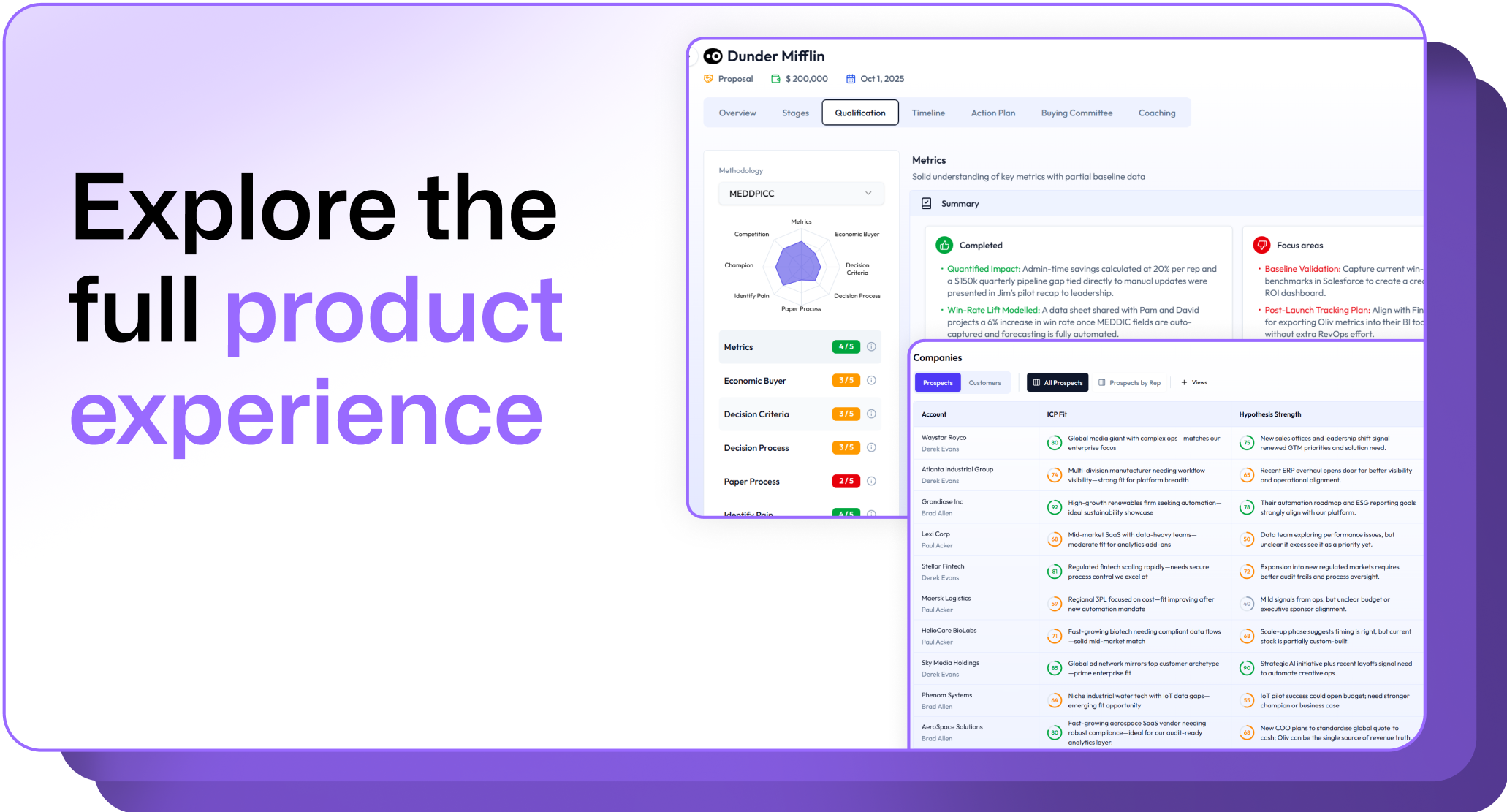
.avif)







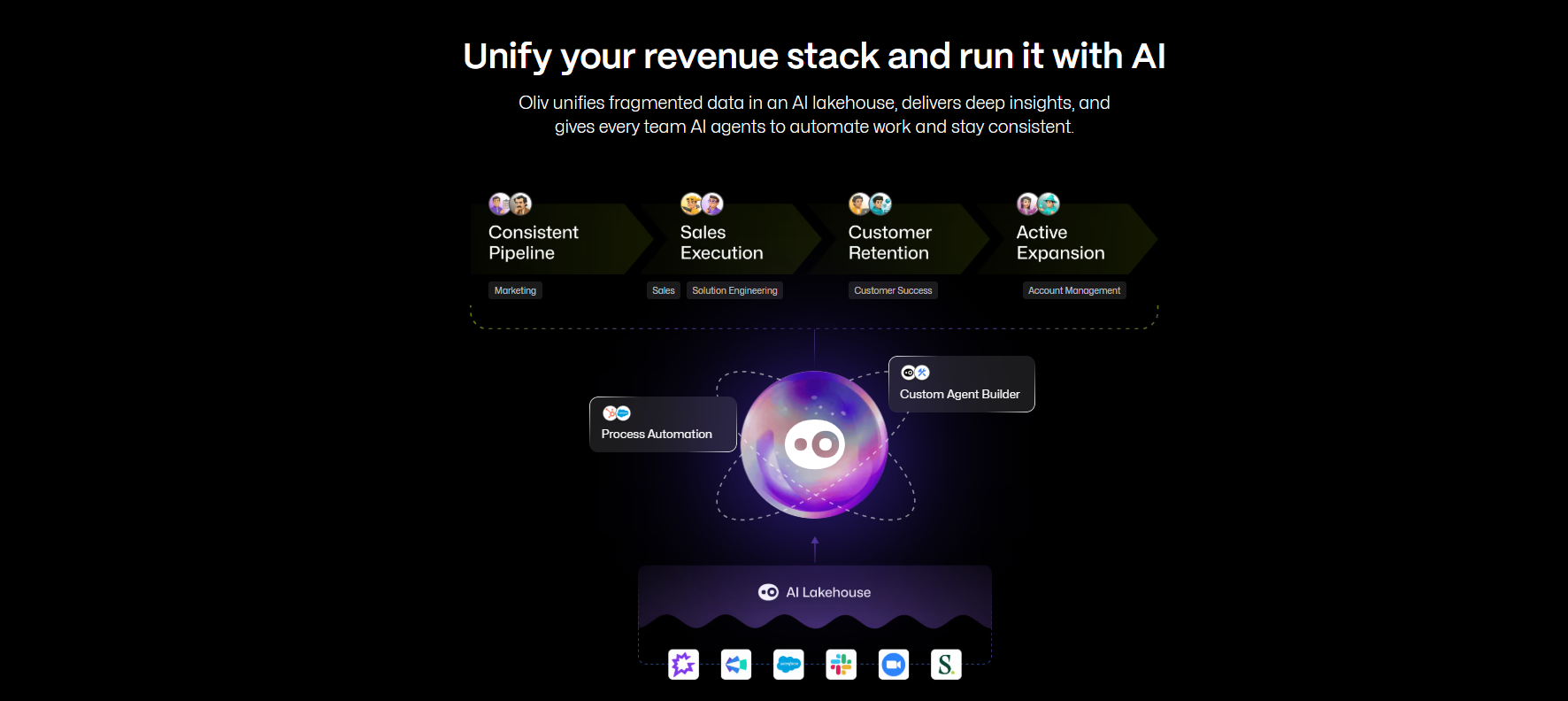
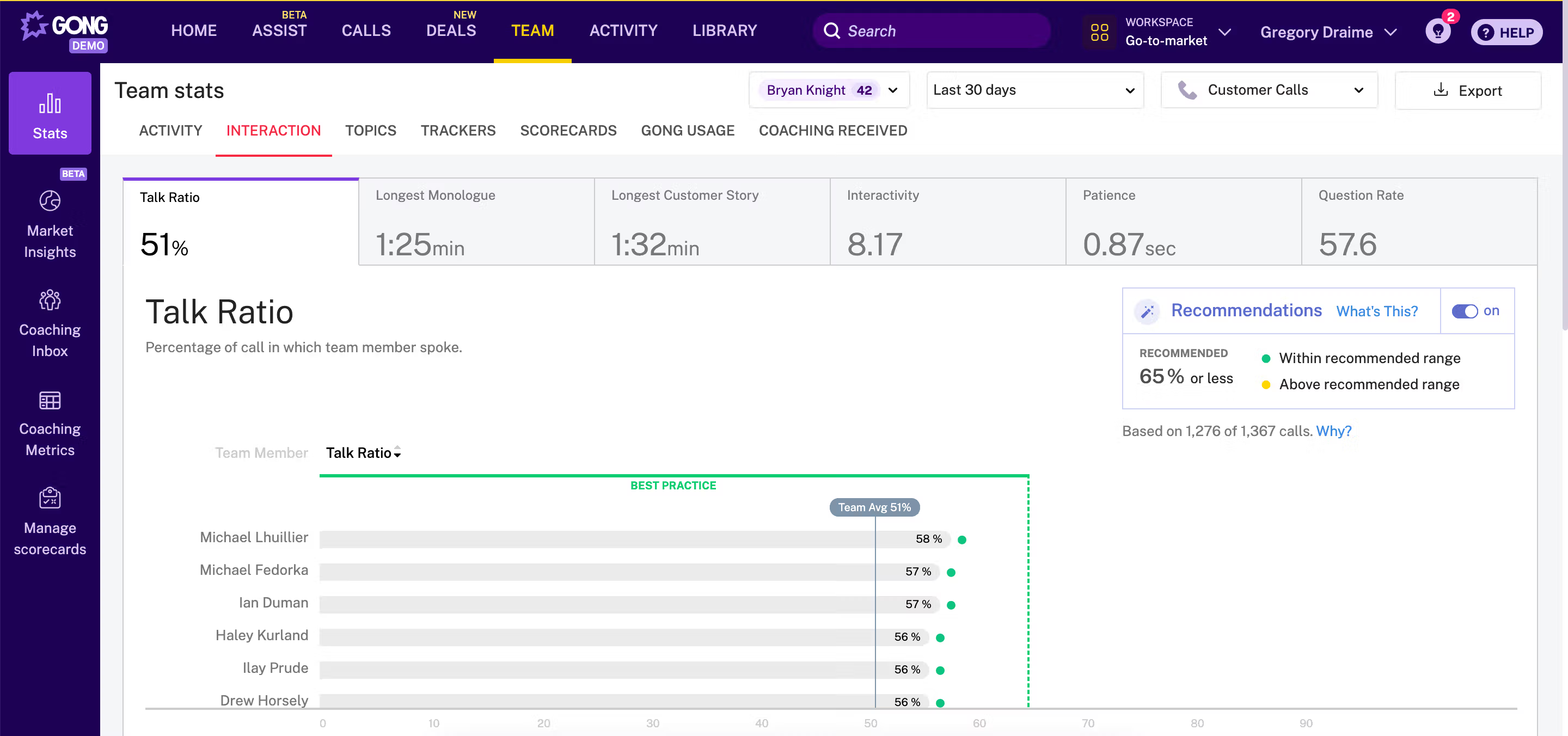
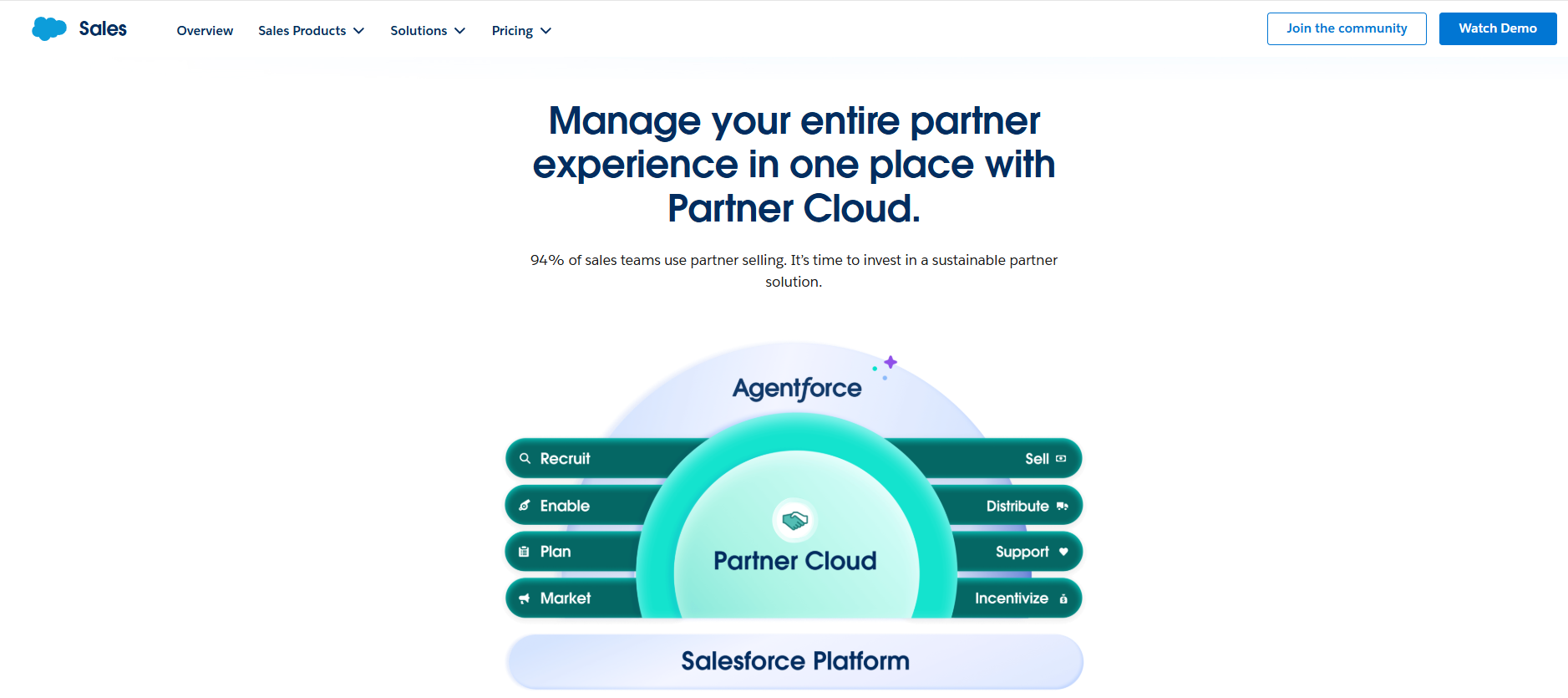

.png)