12 Best AI Sales Assistants of 2026: Ranked by Pipeline Impact, pricing and ROI
Written by
Ishan Chhabra
Last Updated :
June 10, 2026
Skim in :
8
mins
In this article
Revenue teams love Oliv
Here’s why:
All your deal data unified (from 30+ tools and tabs).
Insights are delivered to you directly, no digging.
AI agents automate tasks for you.
Thank you! Your submission has been received!
Oops! Something went wrong while submitting the form.
Meet Oliv’s AI Agents
Hi! I’m, Deal Driver
I track deals, flag risks, send weekly pipeline updates and give sales managers full visibility into deal progress
Hi! I’m, CRM Manager
I maintain CRM hygiene by updating core, custom and qualification fields all without your team lifting a finger
Hi! I’m, Forecaster
I build accurate forecasts based on real deal movement and tell you which deals to pull in to hit your number
Hi! I’m, Coach
I believe performance fuels revenue. I spot skill gaps, score calls and build coaching plans to help every rep level up
Hi! I’m, Prospector
I dig into target accounts to surface the right contacts, tailor and time outreach so you always strike when it counts
Hi! I’m, Pipeline tracker
I call reps to get deal updates, and deliver a real-time, CRM-synced roll-up view of deal progress
Hi! I’m, Analyst
I answer complex pipeline questions, uncover deal patterns, and build reports that guide strategic decisions
TL;DR
We ranked the 12 best AI sales assistants of 2026 on autonomy, pipeline impact, adoption risk, pricing transparency, and verified user reviews.
The real 2026 difference is agentic execution: a chatbot waits to be prompted, while an AI agent acts inside your workflow on its own.
Legacy stacks break on the copy-paste tax and dark-channel blind spots, since tools like Gong miss Slack and Telegram deal signals.
Pricing splits into per-seat (around $500), per-action credits (about $0.10), and modular per-agent tiers, with stack costs creeping past $500 per user.
Compliance is now a buying gate, with all-party consent laws and the EU AI Act, plus the coming wave of buyer-side AI agents.
We rank Oliv AI first because it is generative AI-native and fully agentic, drafting follow-ups and updating the CRM autonomously.
Q1. What Are the 12 Best AI Sales Assistants of 2026, and How Did We Score Them? [toc=1. The 12 Best Ranked]
The 12 best AI sales assistants of 2026 are Oliv AI, Gong, Clari, Salesforce Einstein/Agentforce, Outreach, Salesloft, Apollo, ZoomInfo Copilot, Chorus, Sybill, 6sense, and HubSpot Breeze. We scored each on Workflow Coverage and Autonomy (25%), Pipeline Impact and ROI (25%), Adoption Risk (20%), Pricing Transparency (15%), and User Reviews (15%). Oliv AI ranks first at five stars because it does the work for you, instead of waiting to be used.
😮💨 The real problem isn't picking a tool, it's the stack tax
A RevOps lead once told me her team paid for Gong, Clari, and Salesloft at the same time. Three logins. Three bills. One very tired admin. The blended cost crept past $500 per user each month for a 100-rep team.
Here's what nobody says out loud. Most of these tools record, transcribe, and dashboard. Then a human still has to read the output, copy it somewhere, and act. The buying anxiety underneath "best AI sales assistant" is simple. People fear they will spend big and still babysit a glorified chatbot. Our take on this is grounded in years of building the best revenue intelligence software platforms.
So I stopped ranking by feature count. I rank by what actually moves pipeline, and by how much manual work the tool removes from your Monday.
📊 How we scored every tool (the rubric)
We used five weighted criteria. They add up to 100%. The weights reward outcomes, not shiny demos.
Scoring Rubric and Weights
Criterion
Weight
What it measures
Workflow Coverage and Autonomy
25%
Does it act on its own, or wait for you to click?
Pipeline Impact and ROI
25%
Does it move deals, not just save minutes?
Adoption Risk
20%
Setup time, learning curve, rep buy-in
Pricing Transparency
15%
Clear pricing, no surprise platform fees
User Reviews
15%
Verified G2, Gartner, TrustRadius, Reddit signal
Scores convert to stars on a simple scale. 0 to 20% is 1⭐. 21 to 40% is 2⭐. 41 to 60% is 3⭐. 61 to 80% is 4⭐. 81 to 100% is 5⭐.
🏆 The master comparison table
Here is the top of the leaderboard, with each tool scored across the rubric. Pricing and review counts reflect public G2 and vendor data as of mid-2026. For deeper context, see our roundup of the best AI sales tools.
The 12 Best AI Sales Assistants of 2026 Compared
Rank
Tool
Best for
Autonomy
Pricing (per user/mo)
G2 rating (approx.)
Stars
1
Oliv AI
Agentic, end-to-end revenue execution
Agent-first, autonomous
$19 to $120, modular, no platform fee
4.7 (early)
⭐⭐⭐⭐⭐
2
Gong
Conversation intelligence at scale
Assist, not autonomous
~$200 to $270 bundled, plus platform fee
4.7 (6,000+)
⭐⭐⭐⭐
3
Clari
Enterprise forecasting and roll-ups
Manual deal review
Custom, opaque
4.6 (5,000+)
⭐⭐⭐
4
Salesforce Einstein/Agentforce
Salesforce-native automation
Chat-focused
~$2/action or $500 all-in
4.3 (mixed)
⭐⭐⭐
5
Outreach
Sales engagement at volume
Assist, not autonomous
Opaque, seat-based
4.3 (3,000+)
⭐⭐⭐
6
Salesloft
Cadence-first engagement
Assist, not autonomous
Seat-based, high minimums
4.5 (4,000+)
⭐⭐⭐
7
Apollo
Prospecting plus engagement on a budget
Assist, not autonomous
Free tier, low cost
4.7 (8,000+)
⭐⭐⭐⭐
8
ZoomInfo Copilot
Data-led account intelligence
Guided, data-led
Enterprise, opaque
4.4 (8,000+)
⭐⭐⭐
9
Chorus
Conversation intelligence inside ZoomInfo
Assist, not autonomous
Bundled with ZoomInfo
4.5 (2,000+)
⭐⭐⭐
10
Sybill
AI assistant for deal admin
Task-level automation
Mid-market friendly
4.8 (early)
⭐⭐⭐⭐
11
6sense
Intent and predictive ABM
Predictive, not seller-facing
Enterprise, opaque
4.3 (1,000+)
⭐⭐⭐
12
HubSpot Breeze
AI inside the HubSpot CRM
Chat and agent-assist
Tied to HubSpot tiers
4.4 (mixed)
⭐⭐⭐
🥇 1. Oliv AI: the agent-first revenue platform (⭐⭐⭐⭐⭐)
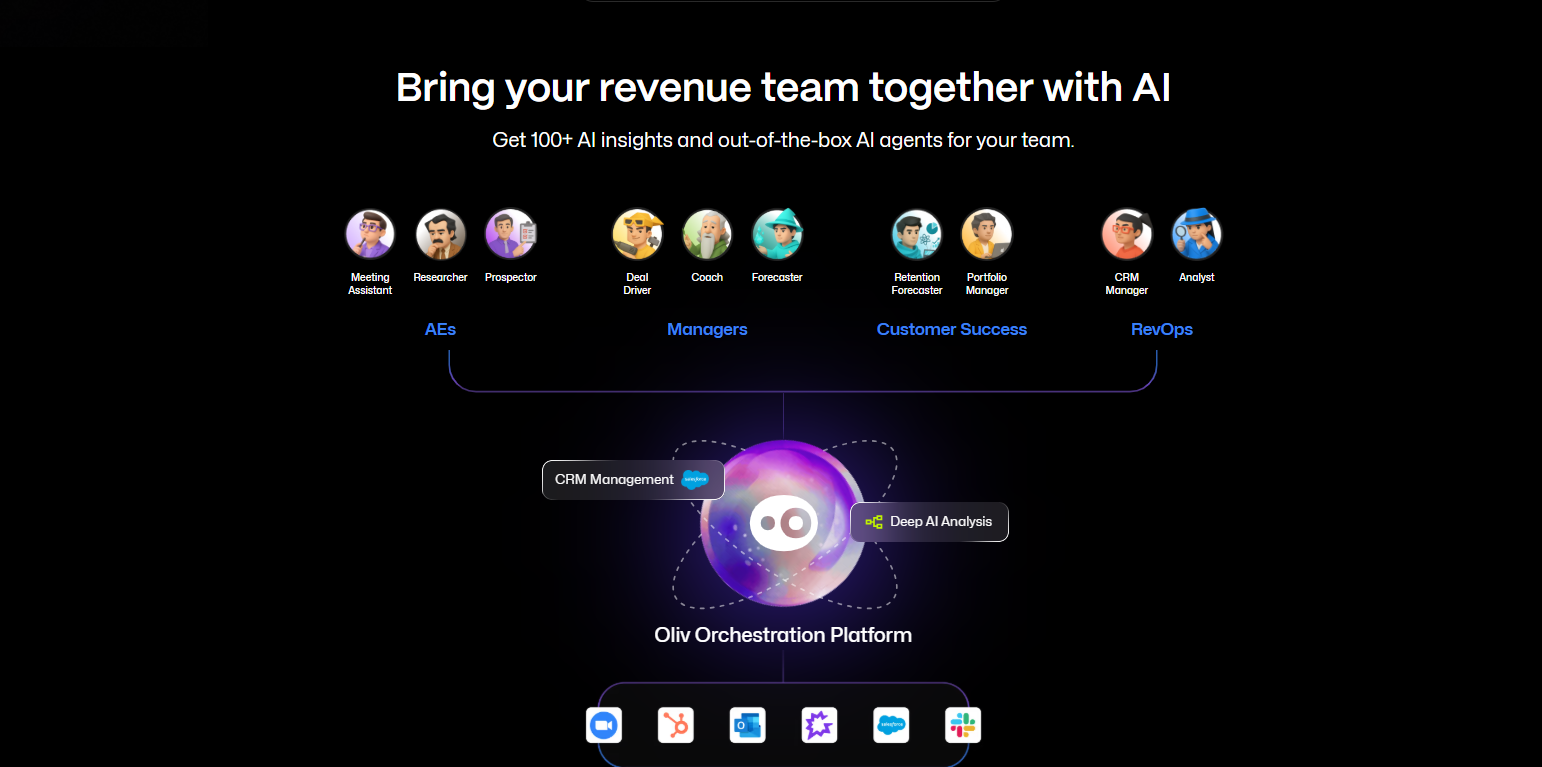
The Oliv AI orchestration platform, where specialized agents like Meeting Assistant, Forecaster, and CRM Manager unify your revenue team across Salesforce, HubSpot, Slack, and more.
What it does. Oliv AI is a generative AI-native data platform that stitches together calls, emails, Slack, Telegram, and the web into one 360-degree deal view, then deploys agents to do the work. We built it because the CRM, as a product, is broken. It became a place reps dump notes once a week so management stops asking.
Key features. Oliv runs 30+ specialized agents, named by job, not by persona.
🔎 Researcher Agent builds account dossiers from LinkedIn and the web in minutes.
Pricing. Modular and transparent. Plans start at $19 per user and scale to about $120, with no mandatory platform fee. You can buy just the CRM Manager Agent at $29 per user if that is all you need.
Implementation. You start in five minutes. Most teams see value in one to two days. Full customization takes two to four weeks, and I will not pretend otherwise.
✅ Pros and ❌ cons.
✅ Agents act autonomously, so you stop dashboard digging.
✅ Processed summaries land within five minutes, versus Gong's 20 to 30 minutes.
✅ Captures Slack and Telegram data that legacy tools miss.
❌ Voice Agent is still in alpha.
❌ Deep customization needs a two to four week runway.
Use case. A high-velocity mid-market team with a 15 to 20 day cycle, where managers cannot keep up with manual roll-ups.
"Gong blew up my Slack all day, but I still had to click through ten screens. With Oliv, I finally get what I need, dropped right in my inbox." Mia Patterson, Sales Manager Oliv AI G2 Verified Review
"Before switching to Oliv, cleaning up messy CRM fields used to swallow half my week. Oliv fixes the data as it happens." Darius Kim, Head of RevOps Oliv AI G2 Verified Review
Product updates.
Oliv AI Product Updates Timeline
Timeline
What changed
Through 2025
First and second generation note-taking and meeting summaries, with live CRM sync and AI next steps. See the best AI for sales calls.
Early 2026
Shipped 30+ functional agents (Forecaster, Deal Driver, Coach) and AI-based object association for duplicate records. See AI sales forecasting software.
🥈 2. Gong: the conversation intelligence benchmark (⭐⭐⭐⭐)
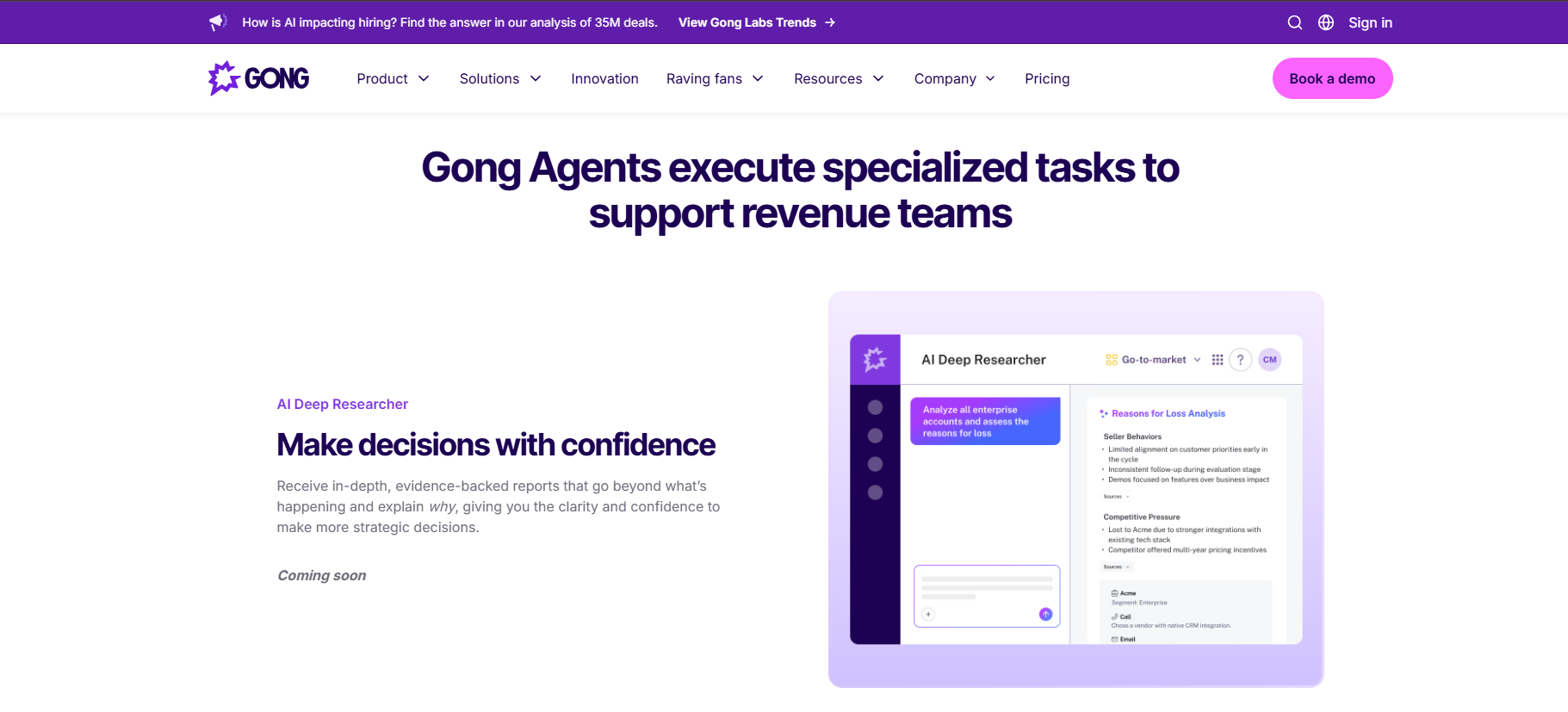
Gong's AI Deep Researcher agent dashboard, surfacing evidence-backed reason-for-loss analysis across seller behaviors and competitive pressure to guide go-to-market decisions.
What it does. Gong records, transcribes, and analyzes sales calls, then surfaces deal and coaching insights. It is the market's most recognized conversation intelligence tool, and managers genuinely love it for visibility.
Key features. Smart Trackers, deal boards, forecasting, and the Engage sequencing add-on. The trackers rely on keyword matching, which is powerful but older V1 machine learning.
Pricing. Gong does not publish prices openly. Bundled costs often reach $200 to $270 per user each month, plus a platform fee between $5,000 and $50,000. See our breakdown of Gong pricing.
Implementation. Strong onboarding, but trackers take real effort to tune.
✅ Pros and ❌ cons.
✅ Best-in-class call recording and coaching libraries.
✅ Centralizes deal data into one view.
❌ Expensive, with rigid multi-year contracts.
❌ Does not import Slack or Telegram, so it misses "dark channel" deal signals.
❌ Bulk data export is painful, by users' own accounts.
Use case. Established sales organizations with budget and dedicated enablement.
"It was a big mistake on our part to commit to a two year term. Gong is a really powerful tool but it's probably the highest end option on the market." Iris P., Head of Marketing and Sales Partnerships Gong G2 Verified Review
"It's too complicated, and not intuitive at all. Searching for calls is not easy, understanding the pipeline management portion of it is almost impossible." John S., Senior Account Executive Gong G2 Verified Review
Product updates.
Gong Product Updates Timeline
Timeline
What changed
Through 2025
Conversation intelligence, Smart Trackers, deal boards, and Gong Forecast and Engage as paid add-ons. See Gong features.
Late 2025 to 2026
Expanded "ask anything" conversational AI across accounts for meeting prep. See Gong reviews.
Expected 2026 to 2027
Deeper AI agent features layered onto the existing CI core, per roadmap requests. See Gong alternatives.
🥉 3. Clari: the enterprise forecasting giant (⭐⭐⭐)
What it does. Clari specializes in roll-up forecasting and pipeline analytics, overlaying your Salesforce data so leaders can see commit, upside, and gap to quota.
Key features. Forecasting modules, pipeline inspection, and the Groove sales engagement product it acquired. Explore the full set of Clari features.
Pricing. Custom and opaque. The process leans on managers sitting with reps to hear each deal story before data goes in.
Implementation. Powerful for RevOps teams, but it needs a strong one to maintain validation rules in both Salesforce and Clari.
✅ Pros and ❌ cons.
✅ Robust, well-designed forecasting for enterprise leaders.
✅ Faster Salesforce updates from a single view.
❌ Forecasting stays manual, with weekly rep-by-rep reviews.
❌ The Groove engagement side draws sharp complaints.
❌ Adds little value for individual reps, per their own users.
Use case. Large enterprises with complex go-to-market motions and a real RevOps function.
"It is really just a glorified SFDC overlay, I think it can be useful if you have a complex GTM motion but definitely overkill for most companies." u/conaldinho11, r/SalesOperations Reddit Thread
"Clari is a tool for sales leaders, it adds no value to reps as far as I can see." u/Msoave, r/SalesOperations Reddit Thread
Product updates.
Clari Product Updates Timeline
Timeline
What changed
Through 2025
Core forecasting, pipeline inspection, and Groove sales engagement integration. See the best Clari alternatives.
Late 2025 to 2026
Tighter Salesforce overlay updates and analytics, though users flag overlap with native SFDC forecasting. See Gong vs Clari.
Expected 2026 to 2027
More AI-assisted deal commentary to differentiate from native Salesforce tools.
4. Salesforce Einstein/Agentforce: native, but chat-bound (⭐⭐⭐)
What it does. Agentforce and Einstein bolt AI features onto the Salesforce platform, handling activity capture, conversation insights, and chat-style agents inside the CRM you already own.
Key features. An all-in-one Salesforce workspace, automated follow-ups, compliance tooling, and mobile access. The agents are chat-focused, so you have to go talk to them and move output yourself. Dig into the Agentforce for sales features.
Pricing. It surprises buyers. Estimates point to roughly $2 per action in a credit model, or about $500 per user for an all-inclusive seat, often requiring a costly Data Cloud subscription first. See the Agentforce pricing breakdown.
Implementation. Not plug and play. Expect months for custom data modeling.
✅ Pros and ❌ cons.
✅ Lives natively inside Salesforce, with a huge installed base.
✅ Strong for B2C customer service automation.
❌ Clunky UX, with constant tab switching, per reviewers.
❌ Costs ramp fast as you scale users and use cases.
❌ Einstein's rule-based logic stumbles on duplicate accounts. Oliv solves this with AI-based object association.
Use case. Heavy Salesforce shops, especially those leaning toward customer service automation over B2B selling.
"Lots of clicking to get select the right options. UX needs improvement. Everything opens in a new browser tabs clustering the browser." Verified User in Consulting, Enterprise Salesforce Agentforce G2 Verified Review
"Can be complex to set up and customize. Expensive, especially for smaller teams. Steep learning curve for new users." Shubham G., Senior BDM Salesforce Agentforce G2 Verified Review
Einstein Activity Capture, Conversation Insights, and Revenue Intelligence as layered add-ons. See Salesforce Einstein features.
Late 2025 to 2026
Agentforce rolled out chat-based agents, with a credit-based per-action pricing model. See the Agentforce reviews analyzed.
Expected 2026 to 2027
Continued B2C customer-service agent focus, leaving B2B sales agents underserved. See the best Agentforce alternatives.
5. Outreach: the sales engagement workhorse (⭐⭐⭐)
What it does. Outreach automates sequences, dialing, and prospect management, then syncs activity to your CRM. It is built for high-volume outbound, not for autonomous deal intelligence.
Key features. Multi-step sequences, A/B testing, email and call insights, and a solid admin dashboard. See how it stacks up in Gong vs Outreach.
Pricing. Opaque and seat-based, with evergreen annual contracts that auto-renew. Users call it overpriced for what amounts to an email scheduler.
Implementation. Onboarding takes time, and reviewers report ongoing glitches.
✅ Pros and ❌ cons.
✅ Strong, systematic outreach to many contacts at once.
✅ Deep Salesforce sync and customizable sequences.
❌ Reports are hard to read, with rocky onboarding.
❌ No native HubSpot integration, and no LinkedIn automation.
❌ The Engage product feels frozen, per long-time users.
Use case. Mid-market SDR teams running heavy Salesforce-based outbound.
"The engage product is stagnant. Looks to have the same features, UX, integrations and issues as it had 5 years ago." Matthew T., Head of Revenue Operations Outreach G2 Verified Review
"Outreach is significantly overpriced for what it offers. The platform has a clunky interface and still relies on your own email servers." Kevin H., CTO and Co-Founder Outreach G2 Verified Review
Product updates.
Outreach Product Updates Timeline
Timeline
What changed
Through 2025
Core sequences, dialer, and Salesforce sync, with reporting-focused UI tweaks.
Late 2025 to 2026
Added AI sequence assistance, though users say the Engage product roadmap stays vague.
Expected 2026 to 2027
More AI guidance layered onto engagement, with HubSpot sync still a pain point.
6. Salesloft: cadence-first engagement (⭐⭐⭐)
What it does. Salesloft runs cadences, dialing, and email tracking to keep reps moving through outreach. Its Conversations module markets as a Gong competitor, but reviewers find it weak.
Key features. Cadence automation, email open and click tracking, calendar integration, and rep analytics. Compare the two in Gong vs Salesloft.
Pricing. Seat-based with high minimums, which prices out very small teams.
Implementation. A steep setup curve, with extensive team training needed.
✅ Pros and ❌ cons.
✅ Excellent cadence creation and consistent messaging.
✅ Clean dashboards and useful peer benchmarking.
❌ Conversation intelligence underdelivers versus Gong.
❌ Reviewers flag harsh customer service and auto-renewals.
❌ Browser extension goes stale and needs constant refreshing.
Use case. SDR-heavy teams that want structured outbound over deal intelligence.
"Cadences work great and the AI they've built into their templates is helpful. Super clunky to set up. Conversations doesn't work at all. They sell it as a gong competitor. It doesn't even have the functionality of Zoom." Verified User in Professional Training, Mid-Market Salesloft G2 Verified Review
"I absolutely love cadences and how easy it is to create them for targeted use and consistent messaging." Kevin S., Senior Account Executive Salesloft G2 Verified Review
Product updates.
Salesloft Product Updates Timeline
Timeline
What changed
Through 2025
Cadence engine, dialer, and the Conversations CI module.
Late 2025 to 2026
Added AI-assisted templates inside cadences.
Expected 2026 to 2027
Continued investment in cadence AI, with CI still trailing Gong.
7. Apollo: prospecting plus engagement on a budget (⭐⭐⭐⭐)
What it does. Apollo combines a large B2B contact database with prospecting, sequencing, and basic call recording. It is the value-led all-in-one for lean teams.
Key features. Contact and company data, email sequences, a dialer, and AI writing assists.
Pricing. Among the most transparent and affordable in this list, with a usable free tier.
Implementation. Fast to start, with a gentle learning curve.
✅ Pros and ❌ cons.
✅ Strong prospecting data at a low price point.
✅ Combines data and outreach in one tool.
❌ Data accuracy varies by region and segment.
❌ Deal intelligence and forecasting stay shallow.
Use case. SMB and startup teams that need prospecting and outreach without a big budget.
I did not find verified Apollo reviews in our source file, so I am holding quotes rather than inventing them. Apollo's affordability and data depth are well documented across 2026 comparisons, and you can see where it fits among the best sales intelligence platforms.
Product updates.
Apollo Product Updates Timeline
Timeline
What changed
Through 2025
Contact database, sequences, dialer, and AI email writing.
Late 2025 to 2026
Expanded AI prospecting intelligence and call recording.
Expected 2026 to 2027
More agentic outreach features layered on its data core.
What it does. ZoomInfo Copilot layers AI account intelligence and buying signals on top of ZoomInfo's data platform, so reps know who to contact and why now.
Key features. Intent data, account recommendations, and CRM enrichment.
Pricing. Enterprise-tier and opaque, often a significant annual commitment.
Implementation. Heavier lift, suited to teams with RevOps support.
✅ Pros and ❌ cons.
✅ Deep B2B data and intent signals.
✅ Useful account prioritization for outbound.
❌ Premium pricing, with limited transparency.
❌ Less focused on post-call execution and forecasting.
Use case. Mid-market and enterprise teams that lead with data and intent.
I did not find verified ZoomInfo reviews in our source file, so I am not fabricating any. Its data and Copilot positioning sit alongside the broader shift toward revenue orchestration platforms.
Product updates.
ZoomInfo Copilot Product Updates Timeline
Timeline
What changed
Through 2025
Core data platform with intent signals and enrichment.
Late 2025 to 2026
Launched Copilot for AI-guided account recommendations.
What it does. Chorus, now part of ZoomInfo, records and analyzes calls for coaching and deal insight. It is a meeting-level CI tool, like Gong's lighter sibling.
Key features. Call recording, transcription, trackers, and deal momentum signals. See how it compares in Gong vs Chorus.
Pricing. Bundled into ZoomInfo packages, so standalone clarity is limited.
Implementation. Straightforward for recording, deeper for analytics.
✅ Pros and ❌ cons.
✅ Solid call recording and coaching libraries.
✅ Tighter when paired with ZoomInfo data.
❌ Understands meetings, not the full cross-channel deal.
❌ Less momentum and innovation than category leaders.
Use case. Teams already on ZoomInfo that want bundled conversation intelligence.
Like Gong and Chorus, this is meeting-level CI. As I see it, that is the core ceiling. It reads the call, but not the emails, Slack, and Telegram threads where deals actually move. Oliv stitches those together into one deal narrative.
Product updates.
Chorus Product Updates Timeline
Timeline
What changed
Through 2025
Call recording, trackers, and coaching, integrated with ZoomInfo.
Late 2025 to 2026
Deeper ties to ZoomInfo Copilot signals.
Expected 2026 to 2027
Consolidation under the ZoomInfo Copilot umbrella.
10. Sybill: the AI assistant for deal admin (⭐⭐⭐⭐)
What it does. Sybill focuses on deal intelligence and admin automation, drafting follow-ups and updating CRM from call context. It ranks as a strong AI assistant for reducing busywork.
Key features. Behavior analysis, AI follow-up emails, and CRM auto-fill.
Pricing. Mid-market friendly, more transparent than enterprise suites.
Implementation. Quick to deploy for individual reps.
✅ Pros and ❌ cons.
✅ Good at automating post-call admin.
✅ Reasonable pricing for individual sellers.
❌ Narrower than a full revenue platform.
❌ Limited forecasting and pipeline management.
Use case. Individual AEs who want follow-ups and CRM updates handled.
Sybill points in the right direction, toward agents that do admin work. The gap, from what surfaces when you actually run these, is breadth. Single-task assistants still leave the manager stitching forecasts by hand, which is why teams graduate to the best revenue intelligence software platforms.
Product updates.
Sybill Product Updates Timeline
Timeline
What changed
Through 2025
Call analysis, AI summaries, and follow-up drafting.
Late 2025 to 2026
Expanded deal intelligence and CRM auto-fill.
Expected 2026 to 2027
More agent-style automation across the deal cycle.
11. 6sense: intent and predictive ABM (⭐⭐⭐)
What it does. 6sense uses intent data and predictive AI to tell teams which accounts are in-market, powering account-based outbound.
Key features. Predictive scoring, intent signals, and orchestration for ABM.
Pricing. Enterprise-level and opaque.
Implementation. A meaningful project, best with RevOps and marketing aligned.
✅ Pros and ❌ cons.
✅ Strong predictive intent for ABM.
✅ Helps prioritize the right accounts.
❌ Costly and complex to deploy.
❌ Not a seller-facing execution assistant.
Use case. Enterprise marketing and sales teams running coordinated ABM.
Product updates.
6sense Product Updates Timeline
Timeline
What changed
Through 2025
Predictive intent scoring and ABM orchestration.
Late 2025 to 2026
Added AI-driven account recommendations.
Expected 2026 to 2027
More agentic outreach tied to intent.
12. HubSpot Breeze: AI inside the HubSpot CRM (⭐⭐⭐)
What it does. Breeze is HubSpot's AI layer, adding content generation, prospecting agents, and insights inside the HubSpot CRM.
Key features. Breeze Copilot, prospecting agents, and content assistance.
Pricing. Tied to HubSpot tiers, more transparent than Salesforce, but it adds up.
Implementation. Easiest if you already run HubSpot.
✅ Pros and ❌ cons.
✅ Native to HubSpot, with a friendly UX.
✅ Good for SMB and mid-market HubSpot users.
❌ AI features bolt onto the existing CRM core.
❌ Less deal-level autonomy than agent-first platforms.
Use case. HubSpot-centric SMB and mid-market teams.
Breeze is the friendliest of the bolt-on group. Still, it is a bolt-on. The whole reason we built Oliv was that bolting AI onto a CRM built before generative AI does not fix the underlying data-entry problem, the same gap we cover in our guide to the best revenue orchestration platform tools.
Product updates.
HubSpot Breeze Product Updates Timeline
Timeline
What changed
Through 2025
Early Breeze AI content and insights inside HubSpot.
Late 2025 to 2026
Breeze Copilot and prospecting agents rolled out.
Expected 2026 to 2027
Deeper agent automation across HubSpot hubs.
🧭 The pattern across all 12
Here is what I keep coming back to. Tools 2 through 12 mostly assist. They record, score, sequence, or predict, and then a human still acts. Oliv sits at the top because the agents act for you, end to end.
I could be wrong about the timeline. But the direction looks clear. Recording becomes free, intelligence becomes table stakes, and the agent layer becomes the product.
Q2. What Exactly Is an AI Sales Assistant in 2026, and How Is It Different From a Chatbot? [toc=2. Assistant vs Chatbot]
An AI sales assistant uses large language models (LLMs, the AI that understands and writes language) and machine learning to do sales work for you. It researches accounts, drafts follow-ups, updates the CRM, and surfaces next-best actions. The 2026 difference is simple. A chatbot waits to be asked. An agent picks a goal and chases it inside your workflow.
🤖 The plain-English definition
Think of the old chatbot as a vending machine. Fixed input, fixed output. You press a button, you get one snack.
An AI agent works more like a coach. It picks a goal, makes decisions, and goes after it without being micromanaged. That shift, from tool you operate to teammate that acts, is the whole story of 2026. It is the same thinking behind the best revenue intelligence software platforms.
So the test I use is blunt. Does it wait for me, or does it work while I sleep? B2C bots help people return shirts. B2B sales agents help close million-dollar deals, and that needs real autonomy.
🧩 Concept to example: the follow-up that never gets sent
Here is where the gap shows up. Most "AI assistants" are really chat wrappers bolted onto old software. They answer when prompted, then hand the work back to you.
Picture the standard follow-up after a discovery call. You pull the transcript from one tool. You paste it into a chat assistant. You copy the draft into your email, attach a deck, and send. This is exactly the gap we close with the best AI for sales calls.
That is five steps for one email. From what surfaces when you actually run this, most reps just skip it. The chat fallacy is believing a smart answer equals finished work. It does not.
⚙️ Application: what a true agent does instead
A real agent removes the handoffs. At Oliv, we built the agents to act inside the workflow, not beside it. The Follow-up agent drafts the email seconds after the call, grounded in the actual conversation.
The CRM Manager Agent then updates fields and scores the deal on methodologies like MEDDPICC or BANT, the qualification checklists reps are supposed to fill but rarely do. No copy-paste. No tab-hopping.
I could be wrong on the timeline, but the direction looks clear to me. The category keeps selling chat. The work that actually moves a deal is execution, and that is what an agent should own.
🧭 The quick gut-check before you buy
Ask any vendor three questions. Does it act without a prompt? Does it update the CRM on its own? Does it work across calls, email, and Slack, not just one channel?
If the honest answer is "you still drive it," that is a chatbot with better marketing. If it works on its own and reports back, that is an AI sales assistant worth paying for, the kind we track among the best AI sales tools.
Q3. Which AI Sales Assistant Actually Moves Pipeline, and Where Do Legacy Tools Break? [toc=3. Pipeline Impact and Gaps]
AI saves sellers about 4.8 hours a week. Yet Gartner found that 72% of organizations fail to reinvest that time into actual selling, so "time saved" rarely becomes pipeline. Tools that surface next-best actions, the single highest-value step to take next, make orgs 2.6 times more likely to hit growth goals. Legacy tools break on busywork and missing data.
📉 The reinvestment gap nobody talks about
Most vendors brag about hours saved. That is the wrong metric. Saved time only matters if it goes back into selling, and usually it does not.
Here is the number that should worry every leader. Roughly 87% of enterprises missed their 2025 revenue targets despite record spending on AI. More tools did not equal more pipeline. This is why we map the journey from revenue ops to intelligence to orchestration.
Meanwhile, the orgs that win share one habit. They give reps the next-best action, and they redeploy freed-up time into customer conversations. That is the real ROI lever.
🧱 Where the legacy stack breaks
The first break is the copy-paste tax. I have watched this play out across many deals, and the pattern repeats.
A rep wants to send a follow-up. The workflow is brutal:
Pull the transcript from Gong.
Paste it into a custom ChatGPT prompt.
Copy the output into Outlook.
Find and attach the right deck.
Send it, finally.
That is so much manual work that most people just do not do it. The insight dies in the gap between tools. For more, see our take on Gong alternatives.
🕳️ The dark channel problem
The second break is missing data. Deals do not live only on recorded calls anymore. They move in Slack threads and, for many crypto-native teams, in Telegram.
Gong does not import Slack or Telegram. So it cannot see how the deal is really progressing. The forecast looks confident and is quietly blind, a weakness we detail in our review of Gong forecasting.
🔗 How embedded agents fix it
Across the deals we have stitched together from calls, emails, Slack, and Telegram, what I have noticed is that context, not recording, is the moat. Oliv's agents draft the follow-up the moment a call ends, then update the CRM themselves.
We also pull Slack and Telegram into one 360-degree deal view. The five-step workflow collapses to zero rep actions. That is how saved time turns into sent follow-ups and cleaner forecasts, the promise behind the best AI sales forecasting software.
I might be overstating the speed of change. But the standard read gets this backwards. The winner is not the best recorder, it is the tool that removes the handoffs.
Q4. How Much Do AI Sales Assistants Cost, and How Do You Choose the Right One for Your Team? [toc=4. Pricing and Team Fit]
AI sales assistant pricing splits three ways. There is per-seat (often around $500 per seat all-inclusive), per-action "credit" pricing (roughly $0.10 per action), and usage-based tiers. Match the tool to your stage, not the leaderboard. SMB teams need fast time-to-value, mid-market needs workflow depth, and enterprise needs governance.
💸 The pricing models, decoded
Action-based pricing looks cheap on the demo. Then it turns opaque at scale, because nobody can forecast next quarter's bill.
AI Sales Assistant Pricing Models
Model
Roughly
The catch
Per-action credits
~$0.10/action
Unpredictable as usage grows
All-inclusive seat
~$500/user/mo
Pricey, often plus a platform fee
Modular per-agent
$19 to $120/user
Pay only for what you use
There is also a hidden cost on some stacks. Salesforce agents often require a Data Cloud subscription first, and those licenses are not cheap. You buy the platform before you get the value, as our Agentforce pricing breakdown shows.
🧮 The stack tax problem
Here is the math that bites mid-market teams. You buy Gong for conversation intelligence, Clari for forecasting, and Salesloft for cadences.
Stacked together, total cost of ownership quietly drags past $500 per user each month for a 25 to 200 rep team. You pay three vendors and still stitch the data yourself, a trap we unpack in the best revenue orchestration platform tools.
At Oliv, we priced against that pain on purpose. Plans start at $19 per user, with no mandatory platform fee, so baseline conversation intelligence becomes a near-commodity.
🎯 How to choose for your stage
Do not buy the leaderboard. Buy the fit. Check G2 scores and review counts before you shortlist, since verified peer signal beats vendor claims.
Choosing an AI Sales Assistant by Team Stage
Stage
Priority
Watch for
SMB (5 to 25 reps)
Fast setup, low cost
Tools that need a RevOps team
Mid-market (25 to 200)
Workflow depth, forecasting
The $500/user stack tax
Enterprise (200+)
Governance, autonomy
Opaque per-action billing
"It was a big mistake on our part to commit to a two year term. Gong is a really powerful tool but it's probably the highest end option on the market." Iris P., Head of Marketing and Sales Partnerships Gong G2 Verified Review
"The pricing is probably the biggest obstacle and hence we are looking to change." Miodrag, Enterprise Account Executive Gong TrustRadius Verified Review
⚠️ One thing I would not do
Do not buy one agent and expect it to fit every role. The horizontal promise is a trap.
Different roles need tailored agent teams. An SDR needs research, an AE needs follow-ups, a manager needs forecasts. I could be wrong, but treating all of sales as one workflow is exactly why so many rollouts stall, a problem we solve with the best sales intelligence platform approach.
Q5. How Do You Pilot an AI Sales Assistant Without It Failing? (Autonomy and Adoption Risk) [toc=5. Piloting and Adoption]
Pilots fail on onboarding, not the model. Teams flip the agent on without training it on best-rep templates or naming an owner. Use the 10/80/10 rule: 10% defining your ideal customer, 80% letting the agent execute, and 10% human quality checks. Most agents hit a "magic point" around day 30, and a human in the loop stays your real edge.
⏰ The pilot reality nobody warns you about
I remember the look on board members' faces when I said we would not sell for four to five months. That was the truth of early agent onboarding.
Getting a client to real value took serious work. The tech was not the blocker. Teaching the system the business was. That is the part demos hide, and it is why we built the best revenue intelligence software platforms with onboarding in mind.
🧩 The 10/80/10 deployment rule
Here is the split that actually works, from running this many times.
🎯 10% ideation: define the perfect customer and the exact job to be done.
⚙️ 80% execution: hand the heavy lifting to the agent.
✅ 10% integration: a quick sniff test and quality check on the output.
That last 10% matters more than people think. Humans in the loop is not a weakness. It is the competitive advantage, the same principle behind the best sales coaching softwares.
📋 Train on your best, not your average
The fastest win is borrowed excellence. Take your best rep's emails and your best marketer's copy.
Upload that text as the template. Train the agent on it, then let it A/B test, meaning it tries two versions and keeps the winner. It will beat your midpack performer, fast. We see this play out across the best AI for sales calls.
At Oliv, we lean on this directly. The Coach Agent maps each rep's skill gaps from live deals, so the system learns from your actual winners, not a generic playbook.
🛠️ The 30-day magic point
Give it a month. Spend an hour or two correcting mistakes early, and by day 30, the output gets genuinely good.
You also need an owner. Call them forward-deployed engineers, a fancy name for people who make sure the agent is awesome before go-live. That is how you hit a near 100% success rate, not the 5% flameouts of 2024, a journey we map in our Gong implementation timeline comparison.
I could be wrong on the exact day count. But the standard read gets this backwards. Adoption is an onboarding problem, not an AI problem. Where is your pilot stuck right now?
Q6. Are AI Sales Assistants Safe and Compliant, and What Happens When Buyers Deploy Their Own AI Agents? [toc=6. Compliance and Buyer Agents]
Compliance is now a buying gate. Twelve US states require all-party consent, so AI voice agents must disclose that they are recording. The EU AI Act escalates obligations for high-risk autonomous agents starting August 2026. Looking ahead, Forrester predicts that one in five sellers will face AI buyer agents, which means you will need your own.
⚖️ Consent: the rule that bites first
Start with recording. Federal law needs only one party to consent, but that is not the whole map.
Twelve states, including California, require all-party consent, meaning everyone on the call must agree. So your AI voice agent has to announce itself. Skip that, and you risk real penalties, a topic we cover in our look at Gong DPA security.
The plain-language version for a sales manager is simple. If a bot dials or records, it must say so, out loud, every time.
🔒 The EU AI Act and your security checklist
Next is the bigger regulation. The EU AI Act treats many autonomous agents as high-risk, with new duties phasing in from August 2026.
That means transparency, human oversight, and risk assessment, not optional extras. Forrester also warns that ungoverned generative AI could cost B2B firms over $10 billion. Governance is part of how we frame the revenue intelligence platforms conversation.
Before you sign, run this quick gate:
✅ SOC 2 Type II (audited security controls).
✅ GDPR and CCPA (data privacy compliance).
✅ Clear consent and disclosure for any voice or recording agent.
At Oliv, we treat these as table stakes. We are SOC 2 Type II certified, GDPR compliant, and CCPA compliant, with encryption at rest and in transit.
🤝 When buyers bring their own agents
Here is the shift the category avoids naming. Buyers are getting agents too.
The old world ran on Google as the traffic overlord. That era is fading. Soon a buyer's agent will research, compare, and even negotiate on their behalf, which reshapes the revenue orchestration platform landscape.
So the next surface is agent-to-agent. One in five sellers will meet a buyer agent, per Forrester, and a chatbot cannot answer that. You will want a seller agent that holds context across the whole deal.
🧭 What RevOps should govern now
Make compliance a scored column in your vendor rubric, not an afterthought. Ask where the data lives, who can access it, and how consent is captured.
Where my head is right now is this. Trust becomes the product. The teams that govern their agents early will win the agent-to-agent deals that are coming, the natural evolution from revenue ops to intelligence to orchestration. How ready is your stack for a buyer who shows up with an agent?
Q7. Why Is Oliv AI the Top-Ranked AI Sales Assistant for Agentic Outbound? [toc=7. Why Oliv Ranks First]
Oliv AI ranks first because it is generative AI-native and fully agentic, built into the seller's workflow instead of bolted onto a legacy CRM. Where Gong misses Slack and Telegram deal signals, and Agentforce stays chat-focused, Oliv drafts follow-ups, updates the CRM, and qualifies deals on its own. That collapses the copy-paste tax that quietly kills adoption.
🧱 Before: the fragmented legacy stack
Picture the typical setup. Gong records, Clari forecasts, Salesloft sequences, and the CRM sits there as a dumb repository.
A rep updates it weekly because management requires it, not because it helps. The data is dirty, and the forecast inherits the mess. That is the world we built Oliv to replace, as we explain in the best revenue orchestration platform tools.
🍰 Bridge: the three-layer cake
Our architecture is a three-layer cake, and I think it is the right shape for this era.
📥 Data layer: records and stitches calls, emails, Slack, and Telegram into one deal view.
🤖 Agent layer: 30+ agents take action, from CRM updates to Monday forecast decks.
Recording should be a near-free commodity. The value lives in the agent layer, where work actually gets done. See how this compares in Gong vs Oliv.
⚡ After: the embedded workflow
The outcome is felt on a Tuesday morning, not in a demo. Summaries land within five minutes of a call, versus the 20 to 30 minutes reps wait elsewhere.
We deliberately avoid "real-time, in-call" claims. That is not where we differentiate, and honestly, live nudges often just distract reps. It is the difference you feel across the best AI sales tools.
"Gong blew up my Slack all day, but I still had to click through ten screens. With Oliv, I finally get what I need, dropped right in my inbox." Mia Patterson, Sales Manager Oliv AI G2 Verified Review
"Before switching to Oliv, cleaning up messy CRM fields used to swallow half my week. Oliv fixes the data as it happens." Darius Kim, Head of RevOps Oliv AI G2 Verified Review
🚀 Where this goes next
Revenue orchestration is already old. The space emerging now is revenue engineering, and we aim to lead it.
What I think shifts in the next two years is plain. SaaS you log into becomes agents that work for you. If you are piloting agentic outbound, tell me what you are building, and I will tell you honestly whether we fit, the way we do across the best AI sales forecasting software.
Q1. What Are the 12 Best AI Sales Assistants of 2026, and How Did We Score Them? [toc=1. The 12 Best Ranked]
The 12 best AI sales assistants of 2026 are Oliv AI, Gong, Clari, Salesforce Einstein/Agentforce, Outreach, Salesloft, Apollo, ZoomInfo Copilot, Chorus, Sybill, 6sense, and HubSpot Breeze. We scored each on Workflow Coverage and Autonomy (25%), Pipeline Impact and ROI (25%), Adoption Risk (20%), Pricing Transparency (15%), and User Reviews (15%). Oliv AI ranks first at five stars because it does the work for you, instead of waiting to be used.
😮💨 The real problem isn't picking a tool, it's the stack tax
A RevOps lead once told me her team paid for Gong, Clari, and Salesloft at the same time. Three logins. Three bills. One very tired admin. The blended cost crept past $500 per user each month for a 100-rep team.
Here's what nobody says out loud. Most of these tools record, transcribe, and dashboard. Then a human still has to read the output, copy it somewhere, and act. The buying anxiety underneath "best AI sales assistant" is simple. People fear they will spend big and still babysit a glorified chatbot. Our take on this is grounded in years of building the best revenue intelligence software platforms.
So I stopped ranking by feature count. I rank by what actually moves pipeline, and by how much manual work the tool removes from your Monday.
📊 How we scored every tool (the rubric)
We used five weighted criteria. They add up to 100%. The weights reward outcomes, not shiny demos.
Scoring Rubric and Weights
Criterion
Weight
What it measures
Workflow Coverage and Autonomy
25%
Does it act on its own, or wait for you to click?
Pipeline Impact and ROI
25%
Does it move deals, not just save minutes?
Adoption Risk
20%
Setup time, learning curve, rep buy-in
Pricing Transparency
15%
Clear pricing, no surprise platform fees
User Reviews
15%
Verified G2, Gartner, TrustRadius, Reddit signal
Scores convert to stars on a simple scale. 0 to 20% is 1⭐. 21 to 40% is 2⭐. 41 to 60% is 3⭐. 61 to 80% is 4⭐. 81 to 100% is 5⭐.
🏆 The master comparison table
Here is the top of the leaderboard, with each tool scored across the rubric. Pricing and review counts reflect public G2 and vendor data as of mid-2026. For deeper context, see our roundup of the best AI sales tools.
The 12 Best AI Sales Assistants of 2026 Compared
Rank
Tool
Best for
Autonomy
Pricing (per user/mo)
G2 rating (approx.)
Stars
1
Oliv AI
Agentic, end-to-end revenue execution
Agent-first, autonomous
$19 to $120, modular, no platform fee
4.7 (early)
⭐⭐⭐⭐⭐
2
Gong
Conversation intelligence at scale
Assist, not autonomous
~$200 to $270 bundled, plus platform fee
4.7 (6,000+)
⭐⭐⭐⭐
3
Clari
Enterprise forecasting and roll-ups
Manual deal review
Custom, opaque
4.6 (5,000+)
⭐⭐⭐
4
Salesforce Einstein/Agentforce
Salesforce-native automation
Chat-focused
~$2/action or $500 all-in
4.3 (mixed)
⭐⭐⭐
5
Outreach
Sales engagement at volume
Assist, not autonomous
Opaque, seat-based
4.3 (3,000+)
⭐⭐⭐
6
Salesloft
Cadence-first engagement
Assist, not autonomous
Seat-based, high minimums
4.5 (4,000+)
⭐⭐⭐
7
Apollo
Prospecting plus engagement on a budget
Assist, not autonomous
Free tier, low cost
4.7 (8,000+)
⭐⭐⭐⭐
8
ZoomInfo Copilot
Data-led account intelligence
Guided, data-led
Enterprise, opaque
4.4 (8,000+)
⭐⭐⭐
9
Chorus
Conversation intelligence inside ZoomInfo
Assist, not autonomous
Bundled with ZoomInfo
4.5 (2,000+)
⭐⭐⭐
10
Sybill
AI assistant for deal admin
Task-level automation
Mid-market friendly
4.8 (early)
⭐⭐⭐⭐
11
6sense
Intent and predictive ABM
Predictive, not seller-facing
Enterprise, opaque
4.3 (1,000+)
⭐⭐⭐
12
HubSpot Breeze
AI inside the HubSpot CRM
Chat and agent-assist
Tied to HubSpot tiers
4.4 (mixed)
⭐⭐⭐
🥇 1. Oliv AI: the agent-first revenue platform (⭐⭐⭐⭐⭐)
The Oliv AI orchestration platform, where specialized agents like Meeting Assistant, Forecaster, and CRM Manager unify your revenue team across Salesforce, HubSpot, Slack, and more.
What it does. Oliv AI is a generative AI-native data platform that stitches together calls, emails, Slack, Telegram, and the web into one 360-degree deal view, then deploys agents to do the work. We built it because the CRM, as a product, is broken. It became a place reps dump notes once a week so management stops asking.
Key features. Oliv runs 30+ specialized agents, named by job, not by persona.
🔎 Researcher Agent builds account dossiers from LinkedIn and the web in minutes.
Pricing. Modular and transparent. Plans start at $19 per user and scale to about $120, with no mandatory platform fee. You can buy just the CRM Manager Agent at $29 per user if that is all you need.
Implementation. You start in five minutes. Most teams see value in one to two days. Full customization takes two to four weeks, and I will not pretend otherwise.
✅ Pros and ❌ cons.
✅ Agents act autonomously, so you stop dashboard digging.
✅ Processed summaries land within five minutes, versus Gong's 20 to 30 minutes.
✅ Captures Slack and Telegram data that legacy tools miss.
❌ Voice Agent is still in alpha.
❌ Deep customization needs a two to four week runway.
Use case. A high-velocity mid-market team with a 15 to 20 day cycle, where managers cannot keep up with manual roll-ups.
"Gong blew up my Slack all day, but I still had to click through ten screens. With Oliv, I finally get what I need, dropped right in my inbox." Mia Patterson, Sales Manager Oliv AI G2 Verified Review
"Before switching to Oliv, cleaning up messy CRM fields used to swallow half my week. Oliv fixes the data as it happens." Darius Kim, Head of RevOps Oliv AI G2 Verified Review
Product updates.
Oliv AI Product Updates Timeline
Timeline
What changed
Through 2025
First and second generation note-taking and meeting summaries, with live CRM sync and AI next steps. See the best AI for sales calls.
Early 2026
Shipped 30+ functional agents (Forecaster, Deal Driver, Coach) and AI-based object association for duplicate records. See AI sales forecasting software.
🥈 2. Gong: the conversation intelligence benchmark (⭐⭐⭐⭐)
Gong's AI Deep Researcher agent dashboard, surfacing evidence-backed reason-for-loss analysis across seller behaviors and competitive pressure to guide go-to-market decisions.
What it does. Gong records, transcribes, and analyzes sales calls, then surfaces deal and coaching insights. It is the market's most recognized conversation intelligence tool, and managers genuinely love it for visibility.
Key features. Smart Trackers, deal boards, forecasting, and the Engage sequencing add-on. The trackers rely on keyword matching, which is powerful but older V1 machine learning.
Pricing. Gong does not publish prices openly. Bundled costs often reach $200 to $270 per user each month, plus a platform fee between $5,000 and $50,000. See our breakdown of Gong pricing.
Implementation. Strong onboarding, but trackers take real effort to tune.
✅ Pros and ❌ cons.
✅ Best-in-class call recording and coaching libraries.
✅ Centralizes deal data into one view.
❌ Expensive, with rigid multi-year contracts.
❌ Does not import Slack or Telegram, so it misses "dark channel" deal signals.
❌ Bulk data export is painful, by users' own accounts.
Use case. Established sales organizations with budget and dedicated enablement.
"It was a big mistake on our part to commit to a two year term. Gong is a really powerful tool but it's probably the highest end option on the market." Iris P., Head of Marketing and Sales Partnerships Gong G2 Verified Review
"It's too complicated, and not intuitive at all. Searching for calls is not easy, understanding the pipeline management portion of it is almost impossible." John S., Senior Account Executive Gong G2 Verified Review
Product updates.
Gong Product Updates Timeline
Timeline
What changed
Through 2025
Conversation intelligence, Smart Trackers, deal boards, and Gong Forecast and Engage as paid add-ons. See Gong features.
Late 2025 to 2026
Expanded "ask anything" conversational AI across accounts for meeting prep. See Gong reviews.
Expected 2026 to 2027
Deeper AI agent features layered onto the existing CI core, per roadmap requests. See Gong alternatives.
🥉 3. Clari: the enterprise forecasting giant (⭐⭐⭐)
What it does. Clari specializes in roll-up forecasting and pipeline analytics, overlaying your Salesforce data so leaders can see commit, upside, and gap to quota.
Key features. Forecasting modules, pipeline inspection, and the Groove sales engagement product it acquired. Explore the full set of Clari features.
Pricing. Custom and opaque. The process leans on managers sitting with reps to hear each deal story before data goes in.
Implementation. Powerful for RevOps teams, but it needs a strong one to maintain validation rules in both Salesforce and Clari.
✅ Pros and ❌ cons.
✅ Robust, well-designed forecasting for enterprise leaders.
✅ Faster Salesforce updates from a single view.
❌ Forecasting stays manual, with weekly rep-by-rep reviews.
❌ The Groove engagement side draws sharp complaints.
❌ Adds little value for individual reps, per their own users.
Use case. Large enterprises with complex go-to-market motions and a real RevOps function.
"It is really just a glorified SFDC overlay, I think it can be useful if you have a complex GTM motion but definitely overkill for most companies." u/conaldinho11, r/SalesOperations Reddit Thread
"Clari is a tool for sales leaders, it adds no value to reps as far as I can see." u/Msoave, r/SalesOperations Reddit Thread
Product updates.
Clari Product Updates Timeline
Timeline
What changed
Through 2025
Core forecasting, pipeline inspection, and Groove sales engagement integration. See the best Clari alternatives.
Late 2025 to 2026
Tighter Salesforce overlay updates and analytics, though users flag overlap with native SFDC forecasting. See Gong vs Clari.
Expected 2026 to 2027
More AI-assisted deal commentary to differentiate from native Salesforce tools.
4. Salesforce Einstein/Agentforce: native, but chat-bound (⭐⭐⭐)
What it does. Agentforce and Einstein bolt AI features onto the Salesforce platform, handling activity capture, conversation insights, and chat-style agents inside the CRM you already own.
Key features. An all-in-one Salesforce workspace, automated follow-ups, compliance tooling, and mobile access. The agents are chat-focused, so you have to go talk to them and move output yourself. Dig into the Agentforce for sales features.
Pricing. It surprises buyers. Estimates point to roughly $2 per action in a credit model, or about $500 per user for an all-inclusive seat, often requiring a costly Data Cloud subscription first. See the Agentforce pricing breakdown.
Implementation. Not plug and play. Expect months for custom data modeling.
✅ Pros and ❌ cons.
✅ Lives natively inside Salesforce, with a huge installed base.
✅ Strong for B2C customer service automation.
❌ Clunky UX, with constant tab switching, per reviewers.
❌ Costs ramp fast as you scale users and use cases.
❌ Einstein's rule-based logic stumbles on duplicate accounts. Oliv solves this with AI-based object association.
Use case. Heavy Salesforce shops, especially those leaning toward customer service automation over B2B selling.
"Lots of clicking to get select the right options. UX needs improvement. Everything opens in a new browser tabs clustering the browser." Verified User in Consulting, Enterprise Salesforce Agentforce G2 Verified Review
"Can be complex to set up and customize. Expensive, especially for smaller teams. Steep learning curve for new users." Shubham G., Senior BDM Salesforce Agentforce G2 Verified Review
Einstein Activity Capture, Conversation Insights, and Revenue Intelligence as layered add-ons. See Salesforce Einstein features.
Late 2025 to 2026
Agentforce rolled out chat-based agents, with a credit-based per-action pricing model. See the Agentforce reviews analyzed.
Expected 2026 to 2027
Continued B2C customer-service agent focus, leaving B2B sales agents underserved. See the best Agentforce alternatives.
5. Outreach: the sales engagement workhorse (⭐⭐⭐)
What it does. Outreach automates sequences, dialing, and prospect management, then syncs activity to your CRM. It is built for high-volume outbound, not for autonomous deal intelligence.
Key features. Multi-step sequences, A/B testing, email and call insights, and a solid admin dashboard. See how it stacks up in Gong vs Outreach.
Pricing. Opaque and seat-based, with evergreen annual contracts that auto-renew. Users call it overpriced for what amounts to an email scheduler.
Implementation. Onboarding takes time, and reviewers report ongoing glitches.
✅ Pros and ❌ cons.
✅ Strong, systematic outreach to many contacts at once.
✅ Deep Salesforce sync and customizable sequences.
❌ Reports are hard to read, with rocky onboarding.
❌ No native HubSpot integration, and no LinkedIn automation.
❌ The Engage product feels frozen, per long-time users.
Use case. Mid-market SDR teams running heavy Salesforce-based outbound.
"The engage product is stagnant. Looks to have the same features, UX, integrations and issues as it had 5 years ago." Matthew T., Head of Revenue Operations Outreach G2 Verified Review
"Outreach is significantly overpriced for what it offers. The platform has a clunky interface and still relies on your own email servers." Kevin H., CTO and Co-Founder Outreach G2 Verified Review
Product updates.
Outreach Product Updates Timeline
Timeline
What changed
Through 2025
Core sequences, dialer, and Salesforce sync, with reporting-focused UI tweaks.
Late 2025 to 2026
Added AI sequence assistance, though users say the Engage product roadmap stays vague.
Expected 2026 to 2027
More AI guidance layered onto engagement, with HubSpot sync still a pain point.
6. Salesloft: cadence-first engagement (⭐⭐⭐)
What it does. Salesloft runs cadences, dialing, and email tracking to keep reps moving through outreach. Its Conversations module markets as a Gong competitor, but reviewers find it weak.
Key features. Cadence automation, email open and click tracking, calendar integration, and rep analytics. Compare the two in Gong vs Salesloft.
Pricing. Seat-based with high minimums, which prices out very small teams.
Implementation. A steep setup curve, with extensive team training needed.
✅ Pros and ❌ cons.
✅ Excellent cadence creation and consistent messaging.
✅ Clean dashboards and useful peer benchmarking.
❌ Conversation intelligence underdelivers versus Gong.
❌ Reviewers flag harsh customer service and auto-renewals.
❌ Browser extension goes stale and needs constant refreshing.
Use case. SDR-heavy teams that want structured outbound over deal intelligence.
"Cadences work great and the AI they've built into their templates is helpful. Super clunky to set up. Conversations doesn't work at all. They sell it as a gong competitor. It doesn't even have the functionality of Zoom." Verified User in Professional Training, Mid-Market Salesloft G2 Verified Review
"I absolutely love cadences and how easy it is to create them for targeted use and consistent messaging." Kevin S., Senior Account Executive Salesloft G2 Verified Review
Product updates.
Salesloft Product Updates Timeline
Timeline
What changed
Through 2025
Cadence engine, dialer, and the Conversations CI module.
Late 2025 to 2026
Added AI-assisted templates inside cadences.
Expected 2026 to 2027
Continued investment in cadence AI, with CI still trailing Gong.
7. Apollo: prospecting plus engagement on a budget (⭐⭐⭐⭐)
What it does. Apollo combines a large B2B contact database with prospecting, sequencing, and basic call recording. It is the value-led all-in-one for lean teams.
Key features. Contact and company data, email sequences, a dialer, and AI writing assists.
Pricing. Among the most transparent and affordable in this list, with a usable free tier.
Implementation. Fast to start, with a gentle learning curve.
✅ Pros and ❌ cons.
✅ Strong prospecting data at a low price point.
✅ Combines data and outreach in one tool.
❌ Data accuracy varies by region and segment.
❌ Deal intelligence and forecasting stay shallow.
Use case. SMB and startup teams that need prospecting and outreach without a big budget.
I did not find verified Apollo reviews in our source file, so I am holding quotes rather than inventing them. Apollo's affordability and data depth are well documented across 2026 comparisons, and you can see where it fits among the best sales intelligence platforms.
Product updates.
Apollo Product Updates Timeline
Timeline
What changed
Through 2025
Contact database, sequences, dialer, and AI email writing.
Late 2025 to 2026
Expanded AI prospecting intelligence and call recording.
Expected 2026 to 2027
More agentic outreach features layered on its data core.
What it does. ZoomInfo Copilot layers AI account intelligence and buying signals on top of ZoomInfo's data platform, so reps know who to contact and why now.
Key features. Intent data, account recommendations, and CRM enrichment.
Pricing. Enterprise-tier and opaque, often a significant annual commitment.
Implementation. Heavier lift, suited to teams with RevOps support.
✅ Pros and ❌ cons.
✅ Deep B2B data and intent signals.
✅ Useful account prioritization for outbound.
❌ Premium pricing, with limited transparency.
❌ Less focused on post-call execution and forecasting.
Use case. Mid-market and enterprise teams that lead with data and intent.
I did not find verified ZoomInfo reviews in our source file, so I am not fabricating any. Its data and Copilot positioning sit alongside the broader shift toward revenue orchestration platforms.
Product updates.
ZoomInfo Copilot Product Updates Timeline
Timeline
What changed
Through 2025
Core data platform with intent signals and enrichment.
Late 2025 to 2026
Launched Copilot for AI-guided account recommendations.
What it does. Chorus, now part of ZoomInfo, records and analyzes calls for coaching and deal insight. It is a meeting-level CI tool, like Gong's lighter sibling.
Key features. Call recording, transcription, trackers, and deal momentum signals. See how it compares in Gong vs Chorus.
Pricing. Bundled into ZoomInfo packages, so standalone clarity is limited.
Implementation. Straightforward for recording, deeper for analytics.
✅ Pros and ❌ cons.
✅ Solid call recording and coaching libraries.
✅ Tighter when paired with ZoomInfo data.
❌ Understands meetings, not the full cross-channel deal.
❌ Less momentum and innovation than category leaders.
Use case. Teams already on ZoomInfo that want bundled conversation intelligence.
Like Gong and Chorus, this is meeting-level CI. As I see it, that is the core ceiling. It reads the call, but not the emails, Slack, and Telegram threads where deals actually move. Oliv stitches those together into one deal narrative.
Product updates.
Chorus Product Updates Timeline
Timeline
What changed
Through 2025
Call recording, trackers, and coaching, integrated with ZoomInfo.
Late 2025 to 2026
Deeper ties to ZoomInfo Copilot signals.
Expected 2026 to 2027
Consolidation under the ZoomInfo Copilot umbrella.
10. Sybill: the AI assistant for deal admin (⭐⭐⭐⭐)
What it does. Sybill focuses on deal intelligence and admin automation, drafting follow-ups and updating CRM from call context. It ranks as a strong AI assistant for reducing busywork.
Key features. Behavior analysis, AI follow-up emails, and CRM auto-fill.
Pricing. Mid-market friendly, more transparent than enterprise suites.
Implementation. Quick to deploy for individual reps.
✅ Pros and ❌ cons.
✅ Good at automating post-call admin.
✅ Reasonable pricing for individual sellers.
❌ Narrower than a full revenue platform.
❌ Limited forecasting and pipeline management.
Use case. Individual AEs who want follow-ups and CRM updates handled.
Sybill points in the right direction, toward agents that do admin work. The gap, from what surfaces when you actually run these, is breadth. Single-task assistants still leave the manager stitching forecasts by hand, which is why teams graduate to the best revenue intelligence software platforms.
Product updates.
Sybill Product Updates Timeline
Timeline
What changed
Through 2025
Call analysis, AI summaries, and follow-up drafting.
Late 2025 to 2026
Expanded deal intelligence and CRM auto-fill.
Expected 2026 to 2027
More agent-style automation across the deal cycle.
11. 6sense: intent and predictive ABM (⭐⭐⭐)
What it does. 6sense uses intent data and predictive AI to tell teams which accounts are in-market, powering account-based outbound.
Key features. Predictive scoring, intent signals, and orchestration for ABM.
Pricing. Enterprise-level and opaque.
Implementation. A meaningful project, best with RevOps and marketing aligned.
✅ Pros and ❌ cons.
✅ Strong predictive intent for ABM.
✅ Helps prioritize the right accounts.
❌ Costly and complex to deploy.
❌ Not a seller-facing execution assistant.
Use case. Enterprise marketing and sales teams running coordinated ABM.
Product updates.
6sense Product Updates Timeline
Timeline
What changed
Through 2025
Predictive intent scoring and ABM orchestration.
Late 2025 to 2026
Added AI-driven account recommendations.
Expected 2026 to 2027
More agentic outreach tied to intent.
12. HubSpot Breeze: AI inside the HubSpot CRM (⭐⭐⭐)
What it does. Breeze is HubSpot's AI layer, adding content generation, prospecting agents, and insights inside the HubSpot CRM.
Key features. Breeze Copilot, prospecting agents, and content assistance.
Pricing. Tied to HubSpot tiers, more transparent than Salesforce, but it adds up.
Implementation. Easiest if you already run HubSpot.
✅ Pros and ❌ cons.
✅ Native to HubSpot, with a friendly UX.
✅ Good for SMB and mid-market HubSpot users.
❌ AI features bolt onto the existing CRM core.
❌ Less deal-level autonomy than agent-first platforms.
Use case. HubSpot-centric SMB and mid-market teams.
Breeze is the friendliest of the bolt-on group. Still, it is a bolt-on. The whole reason we built Oliv was that bolting AI onto a CRM built before generative AI does not fix the underlying data-entry problem, the same gap we cover in our guide to the best revenue orchestration platform tools.
Product updates.
HubSpot Breeze Product Updates Timeline
Timeline
What changed
Through 2025
Early Breeze AI content and insights inside HubSpot.
Late 2025 to 2026
Breeze Copilot and prospecting agents rolled out.
Expected 2026 to 2027
Deeper agent automation across HubSpot hubs.
🧭 The pattern across all 12
Here is what I keep coming back to. Tools 2 through 12 mostly assist. They record, score, sequence, or predict, and then a human still acts. Oliv sits at the top because the agents act for you, end to end.
I could be wrong about the timeline. But the direction looks clear. Recording becomes free, intelligence becomes table stakes, and the agent layer becomes the product.
Q2. What Exactly Is an AI Sales Assistant in 2026, and How Is It Different From a Chatbot? [toc=2. Assistant vs Chatbot]
An AI sales assistant uses large language models (LLMs, the AI that understands and writes language) and machine learning to do sales work for you. It researches accounts, drafts follow-ups, updates the CRM, and surfaces next-best actions. The 2026 difference is simple. A chatbot waits to be asked. An agent picks a goal and chases it inside your workflow.
🤖 The plain-English definition
Think of the old chatbot as a vending machine. Fixed input, fixed output. You press a button, you get one snack.
An AI agent works more like a coach. It picks a goal, makes decisions, and goes after it without being micromanaged. That shift, from tool you operate to teammate that acts, is the whole story of 2026. It is the same thinking behind the best revenue intelligence software platforms.
So the test I use is blunt. Does it wait for me, or does it work while I sleep? B2C bots help people return shirts. B2B sales agents help close million-dollar deals, and that needs real autonomy.
🧩 Concept to example: the follow-up that never gets sent
Here is where the gap shows up. Most "AI assistants" are really chat wrappers bolted onto old software. They answer when prompted, then hand the work back to you.
Picture the standard follow-up after a discovery call. You pull the transcript from one tool. You paste it into a chat assistant. You copy the draft into your email, attach a deck, and send. This is exactly the gap we close with the best AI for sales calls.
That is five steps for one email. From what surfaces when you actually run this, most reps just skip it. The chat fallacy is believing a smart answer equals finished work. It does not.
⚙️ Application: what a true agent does instead
A real agent removes the handoffs. At Oliv, we built the agents to act inside the workflow, not beside it. The Follow-up agent drafts the email seconds after the call, grounded in the actual conversation.
The CRM Manager Agent then updates fields and scores the deal on methodologies like MEDDPICC or BANT, the qualification checklists reps are supposed to fill but rarely do. No copy-paste. No tab-hopping.
I could be wrong on the timeline, but the direction looks clear to me. The category keeps selling chat. The work that actually moves a deal is execution, and that is what an agent should own.
🧭 The quick gut-check before you buy
Ask any vendor three questions. Does it act without a prompt? Does it update the CRM on its own? Does it work across calls, email, and Slack, not just one channel?
If the honest answer is "you still drive it," that is a chatbot with better marketing. If it works on its own and reports back, that is an AI sales assistant worth paying for, the kind we track among the best AI sales tools.
Q3. Which AI Sales Assistant Actually Moves Pipeline, and Where Do Legacy Tools Break? [toc=3. Pipeline Impact and Gaps]
AI saves sellers about 4.8 hours a week. Yet Gartner found that 72% of organizations fail to reinvest that time into actual selling, so "time saved" rarely becomes pipeline. Tools that surface next-best actions, the single highest-value step to take next, make orgs 2.6 times more likely to hit growth goals. Legacy tools break on busywork and missing data.
📉 The reinvestment gap nobody talks about
Most vendors brag about hours saved. That is the wrong metric. Saved time only matters if it goes back into selling, and usually it does not.
Here is the number that should worry every leader. Roughly 87% of enterprises missed their 2025 revenue targets despite record spending on AI. More tools did not equal more pipeline. This is why we map the journey from revenue ops to intelligence to orchestration.
Meanwhile, the orgs that win share one habit. They give reps the next-best action, and they redeploy freed-up time into customer conversations. That is the real ROI lever.
🧱 Where the legacy stack breaks
The first break is the copy-paste tax. I have watched this play out across many deals, and the pattern repeats.
A rep wants to send a follow-up. The workflow is brutal:
Pull the transcript from Gong.
Paste it into a custom ChatGPT prompt.
Copy the output into Outlook.
Find and attach the right deck.
Send it, finally.
That is so much manual work that most people just do not do it. The insight dies in the gap between tools. For more, see our take on Gong alternatives.
🕳️ The dark channel problem
The second break is missing data. Deals do not live only on recorded calls anymore. They move in Slack threads and, for many crypto-native teams, in Telegram.
Gong does not import Slack or Telegram. So it cannot see how the deal is really progressing. The forecast looks confident and is quietly blind, a weakness we detail in our review of Gong forecasting.
🔗 How embedded agents fix it
Across the deals we have stitched together from calls, emails, Slack, and Telegram, what I have noticed is that context, not recording, is the moat. Oliv's agents draft the follow-up the moment a call ends, then update the CRM themselves.
We also pull Slack and Telegram into one 360-degree deal view. The five-step workflow collapses to zero rep actions. That is how saved time turns into sent follow-ups and cleaner forecasts, the promise behind the best AI sales forecasting software.
I might be overstating the speed of change. But the standard read gets this backwards. The winner is not the best recorder, it is the tool that removes the handoffs.
Q4. How Much Do AI Sales Assistants Cost, and How Do You Choose the Right One for Your Team? [toc=4. Pricing and Team Fit]
AI sales assistant pricing splits three ways. There is per-seat (often around $500 per seat all-inclusive), per-action "credit" pricing (roughly $0.10 per action), and usage-based tiers. Match the tool to your stage, not the leaderboard. SMB teams need fast time-to-value, mid-market needs workflow depth, and enterprise needs governance.
💸 The pricing models, decoded
Action-based pricing looks cheap on the demo. Then it turns opaque at scale, because nobody can forecast next quarter's bill.
AI Sales Assistant Pricing Models
Model
Roughly
The catch
Per-action credits
~$0.10/action
Unpredictable as usage grows
All-inclusive seat
~$500/user/mo
Pricey, often plus a platform fee
Modular per-agent
$19 to $120/user
Pay only for what you use
There is also a hidden cost on some stacks. Salesforce agents often require a Data Cloud subscription first, and those licenses are not cheap. You buy the platform before you get the value, as our Agentforce pricing breakdown shows.
🧮 The stack tax problem
Here is the math that bites mid-market teams. You buy Gong for conversation intelligence, Clari for forecasting, and Salesloft for cadences.
Stacked together, total cost of ownership quietly drags past $500 per user each month for a 25 to 200 rep team. You pay three vendors and still stitch the data yourself, a trap we unpack in the best revenue orchestration platform tools.
At Oliv, we priced against that pain on purpose. Plans start at $19 per user, with no mandatory platform fee, so baseline conversation intelligence becomes a near-commodity.
🎯 How to choose for your stage
Do not buy the leaderboard. Buy the fit. Check G2 scores and review counts before you shortlist, since verified peer signal beats vendor claims.
Choosing an AI Sales Assistant by Team Stage
Stage
Priority
Watch for
SMB (5 to 25 reps)
Fast setup, low cost
Tools that need a RevOps team
Mid-market (25 to 200)
Workflow depth, forecasting
The $500/user stack tax
Enterprise (200+)
Governance, autonomy
Opaque per-action billing
"It was a big mistake on our part to commit to a two year term. Gong is a really powerful tool but it's probably the highest end option on the market." Iris P., Head of Marketing and Sales Partnerships Gong G2 Verified Review
"The pricing is probably the biggest obstacle and hence we are looking to change." Miodrag, Enterprise Account Executive Gong TrustRadius Verified Review
⚠️ One thing I would not do
Do not buy one agent and expect it to fit every role. The horizontal promise is a trap.
Different roles need tailored agent teams. An SDR needs research, an AE needs follow-ups, a manager needs forecasts. I could be wrong, but treating all of sales as one workflow is exactly why so many rollouts stall, a problem we solve with the best sales intelligence platform approach.
Q5. How Do You Pilot an AI Sales Assistant Without It Failing? (Autonomy and Adoption Risk) [toc=5. Piloting and Adoption]
Pilots fail on onboarding, not the model. Teams flip the agent on without training it on best-rep templates or naming an owner. Use the 10/80/10 rule: 10% defining your ideal customer, 80% letting the agent execute, and 10% human quality checks. Most agents hit a "magic point" around day 30, and a human in the loop stays your real edge.
⏰ The pilot reality nobody warns you about
I remember the look on board members' faces when I said we would not sell for four to five months. That was the truth of early agent onboarding.
Getting a client to real value took serious work. The tech was not the blocker. Teaching the system the business was. That is the part demos hide, and it is why we built the best revenue intelligence software platforms with onboarding in mind.
🧩 The 10/80/10 deployment rule
Here is the split that actually works, from running this many times.
🎯 10% ideation: define the perfect customer and the exact job to be done.
⚙️ 80% execution: hand the heavy lifting to the agent.
✅ 10% integration: a quick sniff test and quality check on the output.
That last 10% matters more than people think. Humans in the loop is not a weakness. It is the competitive advantage, the same principle behind the best sales coaching softwares.
📋 Train on your best, not your average
The fastest win is borrowed excellence. Take your best rep's emails and your best marketer's copy.
Upload that text as the template. Train the agent on it, then let it A/B test, meaning it tries two versions and keeps the winner. It will beat your midpack performer, fast. We see this play out across the best AI for sales calls.
At Oliv, we lean on this directly. The Coach Agent maps each rep's skill gaps from live deals, so the system learns from your actual winners, not a generic playbook.
🛠️ The 30-day magic point
Give it a month. Spend an hour or two correcting mistakes early, and by day 30, the output gets genuinely good.
You also need an owner. Call them forward-deployed engineers, a fancy name for people who make sure the agent is awesome before go-live. That is how you hit a near 100% success rate, not the 5% flameouts of 2024, a journey we map in our Gong implementation timeline comparison.
I could be wrong on the exact day count. But the standard read gets this backwards. Adoption is an onboarding problem, not an AI problem. Where is your pilot stuck right now?
Q6. Are AI Sales Assistants Safe and Compliant, and What Happens When Buyers Deploy Their Own AI Agents? [toc=6. Compliance and Buyer Agents]
Compliance is now a buying gate. Twelve US states require all-party consent, so AI voice agents must disclose that they are recording. The EU AI Act escalates obligations for high-risk autonomous agents starting August 2026. Looking ahead, Forrester predicts that one in five sellers will face AI buyer agents, which means you will need your own.
⚖️ Consent: the rule that bites first
Start with recording. Federal law needs only one party to consent, but that is not the whole map.
Twelve states, including California, require all-party consent, meaning everyone on the call must agree. So your AI voice agent has to announce itself. Skip that, and you risk real penalties, a topic we cover in our look at Gong DPA security.
The plain-language version for a sales manager is simple. If a bot dials or records, it must say so, out loud, every time.
🔒 The EU AI Act and your security checklist
Next is the bigger regulation. The EU AI Act treats many autonomous agents as high-risk, with new duties phasing in from August 2026.
That means transparency, human oversight, and risk assessment, not optional extras. Forrester also warns that ungoverned generative AI could cost B2B firms over $10 billion. Governance is part of how we frame the revenue intelligence platforms conversation.
Before you sign, run this quick gate:
✅ SOC 2 Type II (audited security controls).
✅ GDPR and CCPA (data privacy compliance).
✅ Clear consent and disclosure for any voice or recording agent.
At Oliv, we treat these as table stakes. We are SOC 2 Type II certified, GDPR compliant, and CCPA compliant, with encryption at rest and in transit.
🤝 When buyers bring their own agents
Here is the shift the category avoids naming. Buyers are getting agents too.
The old world ran on Google as the traffic overlord. That era is fading. Soon a buyer's agent will research, compare, and even negotiate on their behalf, which reshapes the revenue orchestration platform landscape.
So the next surface is agent-to-agent. One in five sellers will meet a buyer agent, per Forrester, and a chatbot cannot answer that. You will want a seller agent that holds context across the whole deal.
🧭 What RevOps should govern now
Make compliance a scored column in your vendor rubric, not an afterthought. Ask where the data lives, who can access it, and how consent is captured.
Where my head is right now is this. Trust becomes the product. The teams that govern their agents early will win the agent-to-agent deals that are coming, the natural evolution from revenue ops to intelligence to orchestration. How ready is your stack for a buyer who shows up with an agent?
Q7. Why Is Oliv AI the Top-Ranked AI Sales Assistant for Agentic Outbound? [toc=7. Why Oliv Ranks First]
Oliv AI ranks first because it is generative AI-native and fully agentic, built into the seller's workflow instead of bolted onto a legacy CRM. Where Gong misses Slack and Telegram deal signals, and Agentforce stays chat-focused, Oliv drafts follow-ups, updates the CRM, and qualifies deals on its own. That collapses the copy-paste tax that quietly kills adoption.
🧱 Before: the fragmented legacy stack
Picture the typical setup. Gong records, Clari forecasts, Salesloft sequences, and the CRM sits there as a dumb repository.
A rep updates it weekly because management requires it, not because it helps. The data is dirty, and the forecast inherits the mess. That is the world we built Oliv to replace, as we explain in the best revenue orchestration platform tools.
🍰 Bridge: the three-layer cake
Our architecture is a three-layer cake, and I think it is the right shape for this era.
📥 Data layer: records and stitches calls, emails, Slack, and Telegram into one deal view.
🤖 Agent layer: 30+ agents take action, from CRM updates to Monday forecast decks.
Recording should be a near-free commodity. The value lives in the agent layer, where work actually gets done. See how this compares in Gong vs Oliv.
⚡ After: the embedded workflow
The outcome is felt on a Tuesday morning, not in a demo. Summaries land within five minutes of a call, versus the 20 to 30 minutes reps wait elsewhere.
We deliberately avoid "real-time, in-call" claims. That is not where we differentiate, and honestly, live nudges often just distract reps. It is the difference you feel across the best AI sales tools.
"Gong blew up my Slack all day, but I still had to click through ten screens. With Oliv, I finally get what I need, dropped right in my inbox." Mia Patterson, Sales Manager Oliv AI G2 Verified Review
"Before switching to Oliv, cleaning up messy CRM fields used to swallow half my week. Oliv fixes the data as it happens." Darius Kim, Head of RevOps Oliv AI G2 Verified Review
🚀 Where this goes next
Revenue orchestration is already old. The space emerging now is revenue engineering, and we aim to lead it.
What I think shifts in the next two years is plain. SaaS you log into becomes agents that work for you. If you are piloting agentic outbound, tell me what you are building, and I will tell you honestly whether we fit, the way we do across the best AI sales forecasting software.
Q1. What Are the 12 Best AI Sales Assistants of 2026, and How Did We Score Them? [toc=1. The 12 Best Ranked]
The 12 best AI sales assistants of 2026 are Oliv AI, Gong, Clari, Salesforce Einstein/Agentforce, Outreach, Salesloft, Apollo, ZoomInfo Copilot, Chorus, Sybill, 6sense, and HubSpot Breeze. We scored each on Workflow Coverage and Autonomy (25%), Pipeline Impact and ROI (25%), Adoption Risk (20%), Pricing Transparency (15%), and User Reviews (15%). Oliv AI ranks first at five stars because it does the work for you, instead of waiting to be used.
😮💨 The real problem isn't picking a tool, it's the stack tax
A RevOps lead once told me her team paid for Gong, Clari, and Salesloft at the same time. Three logins. Three bills. One very tired admin. The blended cost crept past $500 per user each month for a 100-rep team.
Here's what nobody says out loud. Most of these tools record, transcribe, and dashboard. Then a human still has to read the output, copy it somewhere, and act. The buying anxiety underneath "best AI sales assistant" is simple. People fear they will spend big and still babysit a glorified chatbot. Our take on this is grounded in years of building the best revenue intelligence software platforms.
So I stopped ranking by feature count. I rank by what actually moves pipeline, and by how much manual work the tool removes from your Monday.
📊 How we scored every tool (the rubric)
We used five weighted criteria. They add up to 100%. The weights reward outcomes, not shiny demos.
Scoring Rubric and Weights
Criterion
Weight
What it measures
Workflow Coverage and Autonomy
25%
Does it act on its own, or wait for you to click?
Pipeline Impact and ROI
25%
Does it move deals, not just save minutes?
Adoption Risk
20%
Setup time, learning curve, rep buy-in
Pricing Transparency
15%
Clear pricing, no surprise platform fees
User Reviews
15%
Verified G2, Gartner, TrustRadius, Reddit signal
Scores convert to stars on a simple scale. 0 to 20% is 1⭐. 21 to 40% is 2⭐. 41 to 60% is 3⭐. 61 to 80% is 4⭐. 81 to 100% is 5⭐.
🏆 The master comparison table
Here is the top of the leaderboard, with each tool scored across the rubric. Pricing and review counts reflect public G2 and vendor data as of mid-2026. For deeper context, see our roundup of the best AI sales tools.
The 12 Best AI Sales Assistants of 2026 Compared
Rank
Tool
Best for
Autonomy
Pricing (per user/mo)
G2 rating (approx.)
Stars
1
Oliv AI
Agentic, end-to-end revenue execution
Agent-first, autonomous
$19 to $120, modular, no platform fee
4.7 (early)
⭐⭐⭐⭐⭐
2
Gong
Conversation intelligence at scale
Assist, not autonomous
~$200 to $270 bundled, plus platform fee
4.7 (6,000+)
⭐⭐⭐⭐
3
Clari
Enterprise forecasting and roll-ups
Manual deal review
Custom, opaque
4.6 (5,000+)
⭐⭐⭐
4
Salesforce Einstein/Agentforce
Salesforce-native automation
Chat-focused
~$2/action or $500 all-in
4.3 (mixed)
⭐⭐⭐
5
Outreach
Sales engagement at volume
Assist, not autonomous
Opaque, seat-based
4.3 (3,000+)
⭐⭐⭐
6
Salesloft
Cadence-first engagement
Assist, not autonomous
Seat-based, high minimums
4.5 (4,000+)
⭐⭐⭐
7
Apollo
Prospecting plus engagement on a budget
Assist, not autonomous
Free tier, low cost
4.7 (8,000+)
⭐⭐⭐⭐
8
ZoomInfo Copilot
Data-led account intelligence
Guided, data-led
Enterprise, opaque
4.4 (8,000+)
⭐⭐⭐
9
Chorus
Conversation intelligence inside ZoomInfo
Assist, not autonomous
Bundled with ZoomInfo
4.5 (2,000+)
⭐⭐⭐
10
Sybill
AI assistant for deal admin
Task-level automation
Mid-market friendly
4.8 (early)
⭐⭐⭐⭐
11
6sense
Intent and predictive ABM
Predictive, not seller-facing
Enterprise, opaque
4.3 (1,000+)
⭐⭐⭐
12
HubSpot Breeze
AI inside the HubSpot CRM
Chat and agent-assist
Tied to HubSpot tiers
4.4 (mixed)
⭐⭐⭐
🥇 1. Oliv AI: the agent-first revenue platform (⭐⭐⭐⭐⭐)
The Oliv AI orchestration platform, where specialized agents like Meeting Assistant, Forecaster, and CRM Manager unify your revenue team across Salesforce, HubSpot, Slack, and more.
What it does. Oliv AI is a generative AI-native data platform that stitches together calls, emails, Slack, Telegram, and the web into one 360-degree deal view, then deploys agents to do the work. We built it because the CRM, as a product, is broken. It became a place reps dump notes once a week so management stops asking.
Key features. Oliv runs 30+ specialized agents, named by job, not by persona.
🔎 Researcher Agent builds account dossiers from LinkedIn and the web in minutes.
Pricing. Modular and transparent. Plans start at $19 per user and scale to about $120, with no mandatory platform fee. You can buy just the CRM Manager Agent at $29 per user if that is all you need.
Implementation. You start in five minutes. Most teams see value in one to two days. Full customization takes two to four weeks, and I will not pretend otherwise.
✅ Pros and ❌ cons.
✅ Agents act autonomously, so you stop dashboard digging.
✅ Processed summaries land within five minutes, versus Gong's 20 to 30 minutes.
✅ Captures Slack and Telegram data that legacy tools miss.
❌ Voice Agent is still in alpha.
❌ Deep customization needs a two to four week runway.
Use case. A high-velocity mid-market team with a 15 to 20 day cycle, where managers cannot keep up with manual roll-ups.
"Gong blew up my Slack all day, but I still had to click through ten screens. With Oliv, I finally get what I need, dropped right in my inbox." Mia Patterson, Sales Manager Oliv AI G2 Verified Review
"Before switching to Oliv, cleaning up messy CRM fields used to swallow half my week. Oliv fixes the data as it happens." Darius Kim, Head of RevOps Oliv AI G2 Verified Review
Product updates.
Oliv AI Product Updates Timeline
Timeline
What changed
Through 2025
First and second generation note-taking and meeting summaries, with live CRM sync and AI next steps. See the best AI for sales calls.
Early 2026
Shipped 30+ functional agents (Forecaster, Deal Driver, Coach) and AI-based object association for duplicate records. See AI sales forecasting software.
🥈 2. Gong: the conversation intelligence benchmark (⭐⭐⭐⭐)
Gong's AI Deep Researcher agent dashboard, surfacing evidence-backed reason-for-loss analysis across seller behaviors and competitive pressure to guide go-to-market decisions.
What it does. Gong records, transcribes, and analyzes sales calls, then surfaces deal and coaching insights. It is the market's most recognized conversation intelligence tool, and managers genuinely love it for visibility.
Key features. Smart Trackers, deal boards, forecasting, and the Engage sequencing add-on. The trackers rely on keyword matching, which is powerful but older V1 machine learning.
Pricing. Gong does not publish prices openly. Bundled costs often reach $200 to $270 per user each month, plus a platform fee between $5,000 and $50,000. See our breakdown of Gong pricing.
Implementation. Strong onboarding, but trackers take real effort to tune.
✅ Pros and ❌ cons.
✅ Best-in-class call recording and coaching libraries.
✅ Centralizes deal data into one view.
❌ Expensive, with rigid multi-year contracts.
❌ Does not import Slack or Telegram, so it misses "dark channel" deal signals.
❌ Bulk data export is painful, by users' own accounts.
Use case. Established sales organizations with budget and dedicated enablement.
"It was a big mistake on our part to commit to a two year term. Gong is a really powerful tool but it's probably the highest end option on the market." Iris P., Head of Marketing and Sales Partnerships Gong G2 Verified Review
"It's too complicated, and not intuitive at all. Searching for calls is not easy, understanding the pipeline management portion of it is almost impossible." John S., Senior Account Executive Gong G2 Verified Review
Product updates.
Gong Product Updates Timeline
Timeline
What changed
Through 2025
Conversation intelligence, Smart Trackers, deal boards, and Gong Forecast and Engage as paid add-ons. See Gong features.
Late 2025 to 2026
Expanded "ask anything" conversational AI across accounts for meeting prep. See Gong reviews.
Expected 2026 to 2027
Deeper AI agent features layered onto the existing CI core, per roadmap requests. See Gong alternatives.
🥉 3. Clari: the enterprise forecasting giant (⭐⭐⭐)
What it does. Clari specializes in roll-up forecasting and pipeline analytics, overlaying your Salesforce data so leaders can see commit, upside, and gap to quota.
Key features. Forecasting modules, pipeline inspection, and the Groove sales engagement product it acquired. Explore the full set of Clari features.
Pricing. Custom and opaque. The process leans on managers sitting with reps to hear each deal story before data goes in.
Implementation. Powerful for RevOps teams, but it needs a strong one to maintain validation rules in both Salesforce and Clari.
✅ Pros and ❌ cons.
✅ Robust, well-designed forecasting for enterprise leaders.
✅ Faster Salesforce updates from a single view.
❌ Forecasting stays manual, with weekly rep-by-rep reviews.
❌ The Groove engagement side draws sharp complaints.
❌ Adds little value for individual reps, per their own users.
Use case. Large enterprises with complex go-to-market motions and a real RevOps function.
"It is really just a glorified SFDC overlay, I think it can be useful if you have a complex GTM motion but definitely overkill for most companies." u/conaldinho11, r/SalesOperations Reddit Thread
"Clari is a tool for sales leaders, it adds no value to reps as far as I can see." u/Msoave, r/SalesOperations Reddit Thread
Product updates.
Clari Product Updates Timeline
Timeline
What changed
Through 2025
Core forecasting, pipeline inspection, and Groove sales engagement integration. See the best Clari alternatives.
Late 2025 to 2026
Tighter Salesforce overlay updates and analytics, though users flag overlap with native SFDC forecasting. See Gong vs Clari.
Expected 2026 to 2027
More AI-assisted deal commentary to differentiate from native Salesforce tools.
4. Salesforce Einstein/Agentforce: native, but chat-bound (⭐⭐⭐)
What it does. Agentforce and Einstein bolt AI features onto the Salesforce platform, handling activity capture, conversation insights, and chat-style agents inside the CRM you already own.
Key features. An all-in-one Salesforce workspace, automated follow-ups, compliance tooling, and mobile access. The agents are chat-focused, so you have to go talk to them and move output yourself. Dig into the Agentforce for sales features.
Pricing. It surprises buyers. Estimates point to roughly $2 per action in a credit model, or about $500 per user for an all-inclusive seat, often requiring a costly Data Cloud subscription first. See the Agentforce pricing breakdown.
Implementation. Not plug and play. Expect months for custom data modeling.
✅ Pros and ❌ cons.
✅ Lives natively inside Salesforce, with a huge installed base.
✅ Strong for B2C customer service automation.
❌ Clunky UX, with constant tab switching, per reviewers.
❌ Costs ramp fast as you scale users and use cases.
❌ Einstein's rule-based logic stumbles on duplicate accounts. Oliv solves this with AI-based object association.
Use case. Heavy Salesforce shops, especially those leaning toward customer service automation over B2B selling.
"Lots of clicking to get select the right options. UX needs improvement. Everything opens in a new browser tabs clustering the browser." Verified User in Consulting, Enterprise Salesforce Agentforce G2 Verified Review
"Can be complex to set up and customize. Expensive, especially for smaller teams. Steep learning curve for new users." Shubham G., Senior BDM Salesforce Agentforce G2 Verified Review
Einstein Activity Capture, Conversation Insights, and Revenue Intelligence as layered add-ons. See Salesforce Einstein features.
Late 2025 to 2026
Agentforce rolled out chat-based agents, with a credit-based per-action pricing model. See the Agentforce reviews analyzed.
Expected 2026 to 2027
Continued B2C customer-service agent focus, leaving B2B sales agents underserved. See the best Agentforce alternatives.
5. Outreach: the sales engagement workhorse (⭐⭐⭐)
What it does. Outreach automates sequences, dialing, and prospect management, then syncs activity to your CRM. It is built for high-volume outbound, not for autonomous deal intelligence.
Key features. Multi-step sequences, A/B testing, email and call insights, and a solid admin dashboard. See how it stacks up in Gong vs Outreach.
Pricing. Opaque and seat-based, with evergreen annual contracts that auto-renew. Users call it overpriced for what amounts to an email scheduler.
Implementation. Onboarding takes time, and reviewers report ongoing glitches.
✅ Pros and ❌ cons.
✅ Strong, systematic outreach to many contacts at once.
✅ Deep Salesforce sync and customizable sequences.
❌ Reports are hard to read, with rocky onboarding.
❌ No native HubSpot integration, and no LinkedIn automation.
❌ The Engage product feels frozen, per long-time users.
Use case. Mid-market SDR teams running heavy Salesforce-based outbound.
"The engage product is stagnant. Looks to have the same features, UX, integrations and issues as it had 5 years ago." Matthew T., Head of Revenue Operations Outreach G2 Verified Review
"Outreach is significantly overpriced for what it offers. The platform has a clunky interface and still relies on your own email servers." Kevin H., CTO and Co-Founder Outreach G2 Verified Review
Product updates.
Outreach Product Updates Timeline
Timeline
What changed
Through 2025
Core sequences, dialer, and Salesforce sync, with reporting-focused UI tweaks.
Late 2025 to 2026
Added AI sequence assistance, though users say the Engage product roadmap stays vague.
Expected 2026 to 2027
More AI guidance layered onto engagement, with HubSpot sync still a pain point.
6. Salesloft: cadence-first engagement (⭐⭐⭐)
What it does. Salesloft runs cadences, dialing, and email tracking to keep reps moving through outreach. Its Conversations module markets as a Gong competitor, but reviewers find it weak.
Key features. Cadence automation, email open and click tracking, calendar integration, and rep analytics. Compare the two in Gong vs Salesloft.
Pricing. Seat-based with high minimums, which prices out very small teams.
Implementation. A steep setup curve, with extensive team training needed.
✅ Pros and ❌ cons.
✅ Excellent cadence creation and consistent messaging.
✅ Clean dashboards and useful peer benchmarking.
❌ Conversation intelligence underdelivers versus Gong.
❌ Reviewers flag harsh customer service and auto-renewals.
❌ Browser extension goes stale and needs constant refreshing.
Use case. SDR-heavy teams that want structured outbound over deal intelligence.
"Cadences work great and the AI they've built into their templates is helpful. Super clunky to set up. Conversations doesn't work at all. They sell it as a gong competitor. It doesn't even have the functionality of Zoom." Verified User in Professional Training, Mid-Market Salesloft G2 Verified Review
"I absolutely love cadences and how easy it is to create them for targeted use and consistent messaging." Kevin S., Senior Account Executive Salesloft G2 Verified Review
Product updates.
Salesloft Product Updates Timeline
Timeline
What changed
Through 2025
Cadence engine, dialer, and the Conversations CI module.
Late 2025 to 2026
Added AI-assisted templates inside cadences.
Expected 2026 to 2027
Continued investment in cadence AI, with CI still trailing Gong.
7. Apollo: prospecting plus engagement on a budget (⭐⭐⭐⭐)
What it does. Apollo combines a large B2B contact database with prospecting, sequencing, and basic call recording. It is the value-led all-in-one for lean teams.
Key features. Contact and company data, email sequences, a dialer, and AI writing assists.
Pricing. Among the most transparent and affordable in this list, with a usable free tier.
Implementation. Fast to start, with a gentle learning curve.
✅ Pros and ❌ cons.
✅ Strong prospecting data at a low price point.
✅ Combines data and outreach in one tool.
❌ Data accuracy varies by region and segment.
❌ Deal intelligence and forecasting stay shallow.
Use case. SMB and startup teams that need prospecting and outreach without a big budget.
I did not find verified Apollo reviews in our source file, so I am holding quotes rather than inventing them. Apollo's affordability and data depth are well documented across 2026 comparisons, and you can see where it fits among the best sales intelligence platforms.
Product updates.
Apollo Product Updates Timeline
Timeline
What changed
Through 2025
Contact database, sequences, dialer, and AI email writing.
Late 2025 to 2026
Expanded AI prospecting intelligence and call recording.
Expected 2026 to 2027
More agentic outreach features layered on its data core.
What it does. ZoomInfo Copilot layers AI account intelligence and buying signals on top of ZoomInfo's data platform, so reps know who to contact and why now.
Key features. Intent data, account recommendations, and CRM enrichment.
Pricing. Enterprise-tier and opaque, often a significant annual commitment.
Implementation. Heavier lift, suited to teams with RevOps support.
✅ Pros and ❌ cons.
✅ Deep B2B data and intent signals.
✅ Useful account prioritization for outbound.
❌ Premium pricing, with limited transparency.
❌ Less focused on post-call execution and forecasting.
Use case. Mid-market and enterprise teams that lead with data and intent.
I did not find verified ZoomInfo reviews in our source file, so I am not fabricating any. Its data and Copilot positioning sit alongside the broader shift toward revenue orchestration platforms.
Product updates.
ZoomInfo Copilot Product Updates Timeline
Timeline
What changed
Through 2025
Core data platform with intent signals and enrichment.
Late 2025 to 2026
Launched Copilot for AI-guided account recommendations.
What it does. Chorus, now part of ZoomInfo, records and analyzes calls for coaching and deal insight. It is a meeting-level CI tool, like Gong's lighter sibling.
Key features. Call recording, transcription, trackers, and deal momentum signals. See how it compares in Gong vs Chorus.
Pricing. Bundled into ZoomInfo packages, so standalone clarity is limited.
Implementation. Straightforward for recording, deeper for analytics.
✅ Pros and ❌ cons.
✅ Solid call recording and coaching libraries.
✅ Tighter when paired with ZoomInfo data.
❌ Understands meetings, not the full cross-channel deal.
❌ Less momentum and innovation than category leaders.
Use case. Teams already on ZoomInfo that want bundled conversation intelligence.
Like Gong and Chorus, this is meeting-level CI. As I see it, that is the core ceiling. It reads the call, but not the emails, Slack, and Telegram threads where deals actually move. Oliv stitches those together into one deal narrative.
Product updates.
Chorus Product Updates Timeline
Timeline
What changed
Through 2025
Call recording, trackers, and coaching, integrated with ZoomInfo.
Late 2025 to 2026
Deeper ties to ZoomInfo Copilot signals.
Expected 2026 to 2027
Consolidation under the ZoomInfo Copilot umbrella.
10. Sybill: the AI assistant for deal admin (⭐⭐⭐⭐)
What it does. Sybill focuses on deal intelligence and admin automation, drafting follow-ups and updating CRM from call context. It ranks as a strong AI assistant for reducing busywork.
Key features. Behavior analysis, AI follow-up emails, and CRM auto-fill.
Pricing. Mid-market friendly, more transparent than enterprise suites.
Implementation. Quick to deploy for individual reps.
✅ Pros and ❌ cons.
✅ Good at automating post-call admin.
✅ Reasonable pricing for individual sellers.
❌ Narrower than a full revenue platform.
❌ Limited forecasting and pipeline management.
Use case. Individual AEs who want follow-ups and CRM updates handled.
Sybill points in the right direction, toward agents that do admin work. The gap, from what surfaces when you actually run these, is breadth. Single-task assistants still leave the manager stitching forecasts by hand, which is why teams graduate to the best revenue intelligence software platforms.
Product updates.
Sybill Product Updates Timeline
Timeline
What changed
Through 2025
Call analysis, AI summaries, and follow-up drafting.
Late 2025 to 2026
Expanded deal intelligence and CRM auto-fill.
Expected 2026 to 2027
More agent-style automation across the deal cycle.
11. 6sense: intent and predictive ABM (⭐⭐⭐)
What it does. 6sense uses intent data and predictive AI to tell teams which accounts are in-market, powering account-based outbound.
Key features. Predictive scoring, intent signals, and orchestration for ABM.
Pricing. Enterprise-level and opaque.
Implementation. A meaningful project, best with RevOps and marketing aligned.
✅ Pros and ❌ cons.
✅ Strong predictive intent for ABM.
✅ Helps prioritize the right accounts.
❌ Costly and complex to deploy.
❌ Not a seller-facing execution assistant.
Use case. Enterprise marketing and sales teams running coordinated ABM.
Product updates.
6sense Product Updates Timeline
Timeline
What changed
Through 2025
Predictive intent scoring and ABM orchestration.
Late 2025 to 2026
Added AI-driven account recommendations.
Expected 2026 to 2027
More agentic outreach tied to intent.
12. HubSpot Breeze: AI inside the HubSpot CRM (⭐⭐⭐)
What it does. Breeze is HubSpot's AI layer, adding content generation, prospecting agents, and insights inside the HubSpot CRM.
Key features. Breeze Copilot, prospecting agents, and content assistance.
Pricing. Tied to HubSpot tiers, more transparent than Salesforce, but it adds up.
Implementation. Easiest if you already run HubSpot.
✅ Pros and ❌ cons.
✅ Native to HubSpot, with a friendly UX.
✅ Good for SMB and mid-market HubSpot users.
❌ AI features bolt onto the existing CRM core.
❌ Less deal-level autonomy than agent-first platforms.
Use case. HubSpot-centric SMB and mid-market teams.
Breeze is the friendliest of the bolt-on group. Still, it is a bolt-on. The whole reason we built Oliv was that bolting AI onto a CRM built before generative AI does not fix the underlying data-entry problem, the same gap we cover in our guide to the best revenue orchestration platform tools.
Product updates.
HubSpot Breeze Product Updates Timeline
Timeline
What changed
Through 2025
Early Breeze AI content and insights inside HubSpot.
Late 2025 to 2026
Breeze Copilot and prospecting agents rolled out.
Expected 2026 to 2027
Deeper agent automation across HubSpot hubs.
🧭 The pattern across all 12
Here is what I keep coming back to. Tools 2 through 12 mostly assist. They record, score, sequence, or predict, and then a human still acts. Oliv sits at the top because the agents act for you, end to end.
I could be wrong about the timeline. But the direction looks clear. Recording becomes free, intelligence becomes table stakes, and the agent layer becomes the product.
Q2. What Exactly Is an AI Sales Assistant in 2026, and How Is It Different From a Chatbot? [toc=2. Assistant vs Chatbot]
An AI sales assistant uses large language models (LLMs, the AI that understands and writes language) and machine learning to do sales work for you. It researches accounts, drafts follow-ups, updates the CRM, and surfaces next-best actions. The 2026 difference is simple. A chatbot waits to be asked. An agent picks a goal and chases it inside your workflow.
🤖 The plain-English definition
Think of the old chatbot as a vending machine. Fixed input, fixed output. You press a button, you get one snack.
An AI agent works more like a coach. It picks a goal, makes decisions, and goes after it without being micromanaged. That shift, from tool you operate to teammate that acts, is the whole story of 2026. It is the same thinking behind the best revenue intelligence software platforms.
So the test I use is blunt. Does it wait for me, or does it work while I sleep? B2C bots help people return shirts. B2B sales agents help close million-dollar deals, and that needs real autonomy.
🧩 Concept to example: the follow-up that never gets sent
Here is where the gap shows up. Most "AI assistants" are really chat wrappers bolted onto old software. They answer when prompted, then hand the work back to you.
Picture the standard follow-up after a discovery call. You pull the transcript from one tool. You paste it into a chat assistant. You copy the draft into your email, attach a deck, and send. This is exactly the gap we close with the best AI for sales calls.
That is five steps for one email. From what surfaces when you actually run this, most reps just skip it. The chat fallacy is believing a smart answer equals finished work. It does not.
⚙️ Application: what a true agent does instead
A real agent removes the handoffs. At Oliv, we built the agents to act inside the workflow, not beside it. The Follow-up agent drafts the email seconds after the call, grounded in the actual conversation.
The CRM Manager Agent then updates fields and scores the deal on methodologies like MEDDPICC or BANT, the qualification checklists reps are supposed to fill but rarely do. No copy-paste. No tab-hopping.
I could be wrong on the timeline, but the direction looks clear to me. The category keeps selling chat. The work that actually moves a deal is execution, and that is what an agent should own.
🧭 The quick gut-check before you buy
Ask any vendor three questions. Does it act without a prompt? Does it update the CRM on its own? Does it work across calls, email, and Slack, not just one channel?
If the honest answer is "you still drive it," that is a chatbot with better marketing. If it works on its own and reports back, that is an AI sales assistant worth paying for, the kind we track among the best AI sales tools.
Q3. Which AI Sales Assistant Actually Moves Pipeline, and Where Do Legacy Tools Break? [toc=3. Pipeline Impact and Gaps]
AI saves sellers about 4.8 hours a week. Yet Gartner found that 72% of organizations fail to reinvest that time into actual selling, so "time saved" rarely becomes pipeline. Tools that surface next-best actions, the single highest-value step to take next, make orgs 2.6 times more likely to hit growth goals. Legacy tools break on busywork and missing data.
📉 The reinvestment gap nobody talks about
Most vendors brag about hours saved. That is the wrong metric. Saved time only matters if it goes back into selling, and usually it does not.
Here is the number that should worry every leader. Roughly 87% of enterprises missed their 2025 revenue targets despite record spending on AI. More tools did not equal more pipeline. This is why we map the journey from revenue ops to intelligence to orchestration.
Meanwhile, the orgs that win share one habit. They give reps the next-best action, and they redeploy freed-up time into customer conversations. That is the real ROI lever.
🧱 Where the legacy stack breaks
The first break is the copy-paste tax. I have watched this play out across many deals, and the pattern repeats.
A rep wants to send a follow-up. The workflow is brutal:
Pull the transcript from Gong.
Paste it into a custom ChatGPT prompt.
Copy the output into Outlook.
Find and attach the right deck.
Send it, finally.
That is so much manual work that most people just do not do it. The insight dies in the gap between tools. For more, see our take on Gong alternatives.
🕳️ The dark channel problem
The second break is missing data. Deals do not live only on recorded calls anymore. They move in Slack threads and, for many crypto-native teams, in Telegram.
Gong does not import Slack or Telegram. So it cannot see how the deal is really progressing. The forecast looks confident and is quietly blind, a weakness we detail in our review of Gong forecasting.
🔗 How embedded agents fix it
Across the deals we have stitched together from calls, emails, Slack, and Telegram, what I have noticed is that context, not recording, is the moat. Oliv's agents draft the follow-up the moment a call ends, then update the CRM themselves.
We also pull Slack and Telegram into one 360-degree deal view. The five-step workflow collapses to zero rep actions. That is how saved time turns into sent follow-ups and cleaner forecasts, the promise behind the best AI sales forecasting software.
I might be overstating the speed of change. But the standard read gets this backwards. The winner is not the best recorder, it is the tool that removes the handoffs.
Q4. How Much Do AI Sales Assistants Cost, and How Do You Choose the Right One for Your Team? [toc=4. Pricing and Team Fit]
AI sales assistant pricing splits three ways. There is per-seat (often around $500 per seat all-inclusive), per-action "credit" pricing (roughly $0.10 per action), and usage-based tiers. Match the tool to your stage, not the leaderboard. SMB teams need fast time-to-value, mid-market needs workflow depth, and enterprise needs governance.
💸 The pricing models, decoded
Action-based pricing looks cheap on the demo. Then it turns opaque at scale, because nobody can forecast next quarter's bill.
AI Sales Assistant Pricing Models
Model
Roughly
The catch
Per-action credits
~$0.10/action
Unpredictable as usage grows
All-inclusive seat
~$500/user/mo
Pricey, often plus a platform fee
Modular per-agent
$19 to $120/user
Pay only for what you use
There is also a hidden cost on some stacks. Salesforce agents often require a Data Cloud subscription first, and those licenses are not cheap. You buy the platform before you get the value, as our Agentforce pricing breakdown shows.
🧮 The stack tax problem
Here is the math that bites mid-market teams. You buy Gong for conversation intelligence, Clari for forecasting, and Salesloft for cadences.
Stacked together, total cost of ownership quietly drags past $500 per user each month for a 25 to 200 rep team. You pay three vendors and still stitch the data yourself, a trap we unpack in the best revenue orchestration platform tools.
At Oliv, we priced against that pain on purpose. Plans start at $19 per user, with no mandatory platform fee, so baseline conversation intelligence becomes a near-commodity.
🎯 How to choose for your stage
Do not buy the leaderboard. Buy the fit. Check G2 scores and review counts before you shortlist, since verified peer signal beats vendor claims.
Choosing an AI Sales Assistant by Team Stage
Stage
Priority
Watch for
SMB (5 to 25 reps)
Fast setup, low cost
Tools that need a RevOps team
Mid-market (25 to 200)
Workflow depth, forecasting
The $500/user stack tax
Enterprise (200+)
Governance, autonomy
Opaque per-action billing
"It was a big mistake on our part to commit to a two year term. Gong is a really powerful tool but it's probably the highest end option on the market." Iris P., Head of Marketing and Sales Partnerships Gong G2 Verified Review
"The pricing is probably the biggest obstacle and hence we are looking to change." Miodrag, Enterprise Account Executive Gong TrustRadius Verified Review
⚠️ One thing I would not do
Do not buy one agent and expect it to fit every role. The horizontal promise is a trap.
Different roles need tailored agent teams. An SDR needs research, an AE needs follow-ups, a manager needs forecasts. I could be wrong, but treating all of sales as one workflow is exactly why so many rollouts stall, a problem we solve with the best sales intelligence platform approach.
Q5. How Do You Pilot an AI Sales Assistant Without It Failing? (Autonomy and Adoption Risk) [toc=5. Piloting and Adoption]
Pilots fail on onboarding, not the model. Teams flip the agent on without training it on best-rep templates or naming an owner. Use the 10/80/10 rule: 10% defining your ideal customer, 80% letting the agent execute, and 10% human quality checks. Most agents hit a "magic point" around day 30, and a human in the loop stays your real edge.
⏰ The pilot reality nobody warns you about
I remember the look on board members' faces when I said we would not sell for four to five months. That was the truth of early agent onboarding.
Getting a client to real value took serious work. The tech was not the blocker. Teaching the system the business was. That is the part demos hide, and it is why we built the best revenue intelligence software platforms with onboarding in mind.
🧩 The 10/80/10 deployment rule
Here is the split that actually works, from running this many times.
🎯 10% ideation: define the perfect customer and the exact job to be done.
⚙️ 80% execution: hand the heavy lifting to the agent.
✅ 10% integration: a quick sniff test and quality check on the output.
That last 10% matters more than people think. Humans in the loop is not a weakness. It is the competitive advantage, the same principle behind the best sales coaching softwares.
📋 Train on your best, not your average
The fastest win is borrowed excellence. Take your best rep's emails and your best marketer's copy.
Upload that text as the template. Train the agent on it, then let it A/B test, meaning it tries two versions and keeps the winner. It will beat your midpack performer, fast. We see this play out across the best AI for sales calls.
At Oliv, we lean on this directly. The Coach Agent maps each rep's skill gaps from live deals, so the system learns from your actual winners, not a generic playbook.
🛠️ The 30-day magic point
Give it a month. Spend an hour or two correcting mistakes early, and by day 30, the output gets genuinely good.
You also need an owner. Call them forward-deployed engineers, a fancy name for people who make sure the agent is awesome before go-live. That is how you hit a near 100% success rate, not the 5% flameouts of 2024, a journey we map in our Gong implementation timeline comparison.
I could be wrong on the exact day count. But the standard read gets this backwards. Adoption is an onboarding problem, not an AI problem. Where is your pilot stuck right now?
Q6. Are AI Sales Assistants Safe and Compliant, and What Happens When Buyers Deploy Their Own AI Agents? [toc=6. Compliance and Buyer Agents]
Compliance is now a buying gate. Twelve US states require all-party consent, so AI voice agents must disclose that they are recording. The EU AI Act escalates obligations for high-risk autonomous agents starting August 2026. Looking ahead, Forrester predicts that one in five sellers will face AI buyer agents, which means you will need your own.
⚖️ Consent: the rule that bites first
Start with recording. Federal law needs only one party to consent, but that is not the whole map.
Twelve states, including California, require all-party consent, meaning everyone on the call must agree. So your AI voice agent has to announce itself. Skip that, and you risk real penalties, a topic we cover in our look at Gong DPA security.
The plain-language version for a sales manager is simple. If a bot dials or records, it must say so, out loud, every time.
🔒 The EU AI Act and your security checklist
Next is the bigger regulation. The EU AI Act treats many autonomous agents as high-risk, with new duties phasing in from August 2026.
That means transparency, human oversight, and risk assessment, not optional extras. Forrester also warns that ungoverned generative AI could cost B2B firms over $10 billion. Governance is part of how we frame the revenue intelligence platforms conversation.
Before you sign, run this quick gate:
✅ SOC 2 Type II (audited security controls).
✅ GDPR and CCPA (data privacy compliance).
✅ Clear consent and disclosure for any voice or recording agent.
At Oliv, we treat these as table stakes. We are SOC 2 Type II certified, GDPR compliant, and CCPA compliant, with encryption at rest and in transit.
🤝 When buyers bring their own agents
Here is the shift the category avoids naming. Buyers are getting agents too.
The old world ran on Google as the traffic overlord. That era is fading. Soon a buyer's agent will research, compare, and even negotiate on their behalf, which reshapes the revenue orchestration platform landscape.
So the next surface is agent-to-agent. One in five sellers will meet a buyer agent, per Forrester, and a chatbot cannot answer that. You will want a seller agent that holds context across the whole deal.
🧭 What RevOps should govern now
Make compliance a scored column in your vendor rubric, not an afterthought. Ask where the data lives, who can access it, and how consent is captured.
Where my head is right now is this. Trust becomes the product. The teams that govern their agents early will win the agent-to-agent deals that are coming, the natural evolution from revenue ops to intelligence to orchestration. How ready is your stack for a buyer who shows up with an agent?
Q7. Why Is Oliv AI the Top-Ranked AI Sales Assistant for Agentic Outbound? [toc=7. Why Oliv Ranks First]
Oliv AI ranks first because it is generative AI-native and fully agentic, built into the seller's workflow instead of bolted onto a legacy CRM. Where Gong misses Slack and Telegram deal signals, and Agentforce stays chat-focused, Oliv drafts follow-ups, updates the CRM, and qualifies deals on its own. That collapses the copy-paste tax that quietly kills adoption.
🧱 Before: the fragmented legacy stack
Picture the typical setup. Gong records, Clari forecasts, Salesloft sequences, and the CRM sits there as a dumb repository.
A rep updates it weekly because management requires it, not because it helps. The data is dirty, and the forecast inherits the mess. That is the world we built Oliv to replace, as we explain in the best revenue orchestration platform tools.
🍰 Bridge: the three-layer cake
Our architecture is a three-layer cake, and I think it is the right shape for this era.
📥 Data layer: records and stitches calls, emails, Slack, and Telegram into one deal view.
🤖 Agent layer: 30+ agents take action, from CRM updates to Monday forecast decks.
Recording should be a near-free commodity. The value lives in the agent layer, where work actually gets done. See how this compares in Gong vs Oliv.
⚡ After: the embedded workflow
The outcome is felt on a Tuesday morning, not in a demo. Summaries land within five minutes of a call, versus the 20 to 30 minutes reps wait elsewhere.
We deliberately avoid "real-time, in-call" claims. That is not where we differentiate, and honestly, live nudges often just distract reps. It is the difference you feel across the best AI sales tools.
"Gong blew up my Slack all day, but I still had to click through ten screens. With Oliv, I finally get what I need, dropped right in my inbox." Mia Patterson, Sales Manager Oliv AI G2 Verified Review
"Before switching to Oliv, cleaning up messy CRM fields used to swallow half my week. Oliv fixes the data as it happens." Darius Kim, Head of RevOps Oliv AI G2 Verified Review
🚀 Where this goes next
Revenue orchestration is already old. The space emerging now is revenue engineering, and we aim to lead it.
What I think shifts in the next two years is plain. SaaS you log into becomes agents that work for you. If you are piloting agentic outbound, tell me what you are building, and I will tell you honestly whether we fit, the way we do across the best AI sales forecasting software.
Q1. What Are the 12 Best AI Sales Assistants of 2026, and How Did We Score Them? [toc=1. The 12 Best Ranked]
The 12 best AI sales assistants of 2026 are Oliv AI, Gong, Clari, Salesforce Einstein/Agentforce, Outreach, Salesloft, Apollo, ZoomInfo Copilot, Chorus, Sybill, 6sense, and HubSpot Breeze. We scored each on Workflow Coverage and Autonomy (25%), Pipeline Impact and ROI (25%), Adoption Risk (20%), Pricing Transparency (15%), and User Reviews (15%). Oliv AI ranks first at five stars because it does the work for you, instead of waiting to be used.
😮💨 The real problem isn't picking a tool, it's the stack tax
A RevOps lead once told me her team paid for Gong, Clari, and Salesloft at the same time. Three logins. Three bills. One very tired admin. The blended cost crept past $500 per user each month for a 100-rep team.
Here's what nobody says out loud. Most of these tools record, transcribe, and dashboard. Then a human still has to read the output, copy it somewhere, and act. The buying anxiety underneath "best AI sales assistant" is simple. People fear they will spend big and still babysit a glorified chatbot. Our take on this is grounded in years of building the best revenue intelligence software platforms.
So I stopped ranking by feature count. I rank by what actually moves pipeline, and by how much manual work the tool removes from your Monday.
📊 How we scored every tool (the rubric)
We used five weighted criteria. They add up to 100%. The weights reward outcomes, not shiny demos.
Scoring Rubric and Weights
Criterion
Weight
What it measures
Workflow Coverage and Autonomy
25%
Does it act on its own, or wait for you to click?
Pipeline Impact and ROI
25%
Does it move deals, not just save minutes?
Adoption Risk
20%
Setup time, learning curve, rep buy-in
Pricing Transparency
15%
Clear pricing, no surprise platform fees
User Reviews
15%
Verified G2, Gartner, TrustRadius, Reddit signal
Scores convert to stars on a simple scale. 0 to 20% is 1⭐. 21 to 40% is 2⭐. 41 to 60% is 3⭐. 61 to 80% is 4⭐. 81 to 100% is 5⭐.
🏆 The master comparison table
Here is the top of the leaderboard, with each tool scored across the rubric. Pricing and review counts reflect public G2 and vendor data as of mid-2026. For deeper context, see our roundup of the best AI sales tools.
The 12 Best AI Sales Assistants of 2026 Compared
Rank
Tool
Best for
Autonomy
Pricing (per user/mo)
G2 rating (approx.)
Stars
1
Oliv AI
Agentic, end-to-end revenue execution
Agent-first, autonomous
$19 to $120, modular, no platform fee
4.7 (early)
⭐⭐⭐⭐⭐
2
Gong
Conversation intelligence at scale
Assist, not autonomous
~$200 to $270 bundled, plus platform fee
4.7 (6,000+)
⭐⭐⭐⭐
3
Clari
Enterprise forecasting and roll-ups
Manual deal review
Custom, opaque
4.6 (5,000+)
⭐⭐⭐
4
Salesforce Einstein/Agentforce
Salesforce-native automation
Chat-focused
~$2/action or $500 all-in
4.3 (mixed)
⭐⭐⭐
5
Outreach
Sales engagement at volume
Assist, not autonomous
Opaque, seat-based
4.3 (3,000+)
⭐⭐⭐
6
Salesloft
Cadence-first engagement
Assist, not autonomous
Seat-based, high minimums
4.5 (4,000+)
⭐⭐⭐
7
Apollo
Prospecting plus engagement on a budget
Assist, not autonomous
Free tier, low cost
4.7 (8,000+)
⭐⭐⭐⭐
8
ZoomInfo Copilot
Data-led account intelligence
Guided, data-led
Enterprise, opaque
4.4 (8,000+)
⭐⭐⭐
9
Chorus
Conversation intelligence inside ZoomInfo
Assist, not autonomous
Bundled with ZoomInfo
4.5 (2,000+)
⭐⭐⭐
10
Sybill
AI assistant for deal admin
Task-level automation
Mid-market friendly
4.8 (early)
⭐⭐⭐⭐
11
6sense
Intent and predictive ABM
Predictive, not seller-facing
Enterprise, opaque
4.3 (1,000+)
⭐⭐⭐
12
HubSpot Breeze
AI inside the HubSpot CRM
Chat and agent-assist
Tied to HubSpot tiers
4.4 (mixed)
⭐⭐⭐
🥇 1. Oliv AI: the agent-first revenue platform (⭐⭐⭐⭐⭐)
The Oliv AI orchestration platform, where specialized agents like Meeting Assistant, Forecaster, and CRM Manager unify your revenue team across Salesforce, HubSpot, Slack, and more.
What it does. Oliv AI is a generative AI-native data platform that stitches together calls, emails, Slack, Telegram, and the web into one 360-degree deal view, then deploys agents to do the work. We built it because the CRM, as a product, is broken. It became a place reps dump notes once a week so management stops asking.
Key features. Oliv runs 30+ specialized agents, named by job, not by persona.
🔎 Researcher Agent builds account dossiers from LinkedIn and the web in minutes.
Pricing. Modular and transparent. Plans start at $19 per user and scale to about $120, with no mandatory platform fee. You can buy just the CRM Manager Agent at $29 per user if that is all you need.
Implementation. You start in five minutes. Most teams see value in one to two days. Full customization takes two to four weeks, and I will not pretend otherwise.
✅ Pros and ❌ cons.
✅ Agents act autonomously, so you stop dashboard digging.
✅ Processed summaries land within five minutes, versus Gong's 20 to 30 minutes.
✅ Captures Slack and Telegram data that legacy tools miss.
❌ Voice Agent is still in alpha.
❌ Deep customization needs a two to four week runway.
Use case. A high-velocity mid-market team with a 15 to 20 day cycle, where managers cannot keep up with manual roll-ups.
"Gong blew up my Slack all day, but I still had to click through ten screens. With Oliv, I finally get what I need, dropped right in my inbox." Mia Patterson, Sales Manager Oliv AI G2 Verified Review
"Before switching to Oliv, cleaning up messy CRM fields used to swallow half my week. Oliv fixes the data as it happens." Darius Kim, Head of RevOps Oliv AI G2 Verified Review
Product updates.
Oliv AI Product Updates Timeline
Timeline
What changed
Through 2025
First and second generation note-taking and meeting summaries, with live CRM sync and AI next steps. See the best AI for sales calls.
Early 2026
Shipped 30+ functional agents (Forecaster, Deal Driver, Coach) and AI-based object association for duplicate records. See AI sales forecasting software.
🥈 2. Gong: the conversation intelligence benchmark (⭐⭐⭐⭐)
Gong's AI Deep Researcher agent dashboard, surfacing evidence-backed reason-for-loss analysis across seller behaviors and competitive pressure to guide go-to-market decisions.
What it does. Gong records, transcribes, and analyzes sales calls, then surfaces deal and coaching insights. It is the market's most recognized conversation intelligence tool, and managers genuinely love it for visibility.
Key features. Smart Trackers, deal boards, forecasting, and the Engage sequencing add-on. The trackers rely on keyword matching, which is powerful but older V1 machine learning.
Pricing. Gong does not publish prices openly. Bundled costs often reach $200 to $270 per user each month, plus a platform fee between $5,000 and $50,000. See our breakdown of Gong pricing.
Implementation. Strong onboarding, but trackers take real effort to tune.
✅ Pros and ❌ cons.
✅ Best-in-class call recording and coaching libraries.
✅ Centralizes deal data into one view.
❌ Expensive, with rigid multi-year contracts.
❌ Does not import Slack or Telegram, so it misses "dark channel" deal signals.
❌ Bulk data export is painful, by users' own accounts.
Use case. Established sales organizations with budget and dedicated enablement.
"It was a big mistake on our part to commit to a two year term. Gong is a really powerful tool but it's probably the highest end option on the market." Iris P., Head of Marketing and Sales Partnerships Gong G2 Verified Review
"It's too complicated, and not intuitive at all. Searching for calls is not easy, understanding the pipeline management portion of it is almost impossible." John S., Senior Account Executive Gong G2 Verified Review
Product updates.
Gong Product Updates Timeline
Timeline
What changed
Through 2025
Conversation intelligence, Smart Trackers, deal boards, and Gong Forecast and Engage as paid add-ons. See Gong features.
Late 2025 to 2026
Expanded "ask anything" conversational AI across accounts for meeting prep. See Gong reviews.
Expected 2026 to 2027
Deeper AI agent features layered onto the existing CI core, per roadmap requests. See Gong alternatives.
🥉 3. Clari: the enterprise forecasting giant (⭐⭐⭐)
What it does. Clari specializes in roll-up forecasting and pipeline analytics, overlaying your Salesforce data so leaders can see commit, upside, and gap to quota.
Key features. Forecasting modules, pipeline inspection, and the Groove sales engagement product it acquired. Explore the full set of Clari features.
Pricing. Custom and opaque. The process leans on managers sitting with reps to hear each deal story before data goes in.
Implementation. Powerful for RevOps teams, but it needs a strong one to maintain validation rules in both Salesforce and Clari.
✅ Pros and ❌ cons.
✅ Robust, well-designed forecasting for enterprise leaders.
✅ Faster Salesforce updates from a single view.
❌ Forecasting stays manual, with weekly rep-by-rep reviews.
❌ The Groove engagement side draws sharp complaints.
❌ Adds little value for individual reps, per their own users.
Use case. Large enterprises with complex go-to-market motions and a real RevOps function.
"It is really just a glorified SFDC overlay, I think it can be useful if you have a complex GTM motion but definitely overkill for most companies." u/conaldinho11, r/SalesOperations Reddit Thread
"Clari is a tool for sales leaders, it adds no value to reps as far as I can see." u/Msoave, r/SalesOperations Reddit Thread
Product updates.
Clari Product Updates Timeline
Timeline
What changed
Through 2025
Core forecasting, pipeline inspection, and Groove sales engagement integration. See the best Clari alternatives.
Late 2025 to 2026
Tighter Salesforce overlay updates and analytics, though users flag overlap with native SFDC forecasting. See Gong vs Clari.
Expected 2026 to 2027
More AI-assisted deal commentary to differentiate from native Salesforce tools.
4. Salesforce Einstein/Agentforce: native, but chat-bound (⭐⭐⭐)
What it does. Agentforce and Einstein bolt AI features onto the Salesforce platform, handling activity capture, conversation insights, and chat-style agents inside the CRM you already own.
Key features. An all-in-one Salesforce workspace, automated follow-ups, compliance tooling, and mobile access. The agents are chat-focused, so you have to go talk to them and move output yourself. Dig into the Agentforce for sales features.
Pricing. It surprises buyers. Estimates point to roughly $2 per action in a credit model, or about $500 per user for an all-inclusive seat, often requiring a costly Data Cloud subscription first. See the Agentforce pricing breakdown.
Implementation. Not plug and play. Expect months for custom data modeling.
✅ Pros and ❌ cons.
✅ Lives natively inside Salesforce, with a huge installed base.
✅ Strong for B2C customer service automation.
❌ Clunky UX, with constant tab switching, per reviewers.
❌ Costs ramp fast as you scale users and use cases.
❌ Einstein's rule-based logic stumbles on duplicate accounts. Oliv solves this with AI-based object association.
Use case. Heavy Salesforce shops, especially those leaning toward customer service automation over B2B selling.
"Lots of clicking to get select the right options. UX needs improvement. Everything opens in a new browser tabs clustering the browser." Verified User in Consulting, Enterprise Salesforce Agentforce G2 Verified Review
"Can be complex to set up and customize. Expensive, especially for smaller teams. Steep learning curve for new users." Shubham G., Senior BDM Salesforce Agentforce G2 Verified Review
Einstein Activity Capture, Conversation Insights, and Revenue Intelligence as layered add-ons. See Salesforce Einstein features.
Late 2025 to 2026
Agentforce rolled out chat-based agents, with a credit-based per-action pricing model. See the Agentforce reviews analyzed.
Expected 2026 to 2027
Continued B2C customer-service agent focus, leaving B2B sales agents underserved. See the best Agentforce alternatives.
5. Outreach: the sales engagement workhorse (⭐⭐⭐)
What it does. Outreach automates sequences, dialing, and prospect management, then syncs activity to your CRM. It is built for high-volume outbound, not for autonomous deal intelligence.
Key features. Multi-step sequences, A/B testing, email and call insights, and a solid admin dashboard. See how it stacks up in Gong vs Outreach.
Pricing. Opaque and seat-based, with evergreen annual contracts that auto-renew. Users call it overpriced for what amounts to an email scheduler.
Implementation. Onboarding takes time, and reviewers report ongoing glitches.
✅ Pros and ❌ cons.
✅ Strong, systematic outreach to many contacts at once.
✅ Deep Salesforce sync and customizable sequences.
❌ Reports are hard to read, with rocky onboarding.
❌ No native HubSpot integration, and no LinkedIn automation.
❌ The Engage product feels frozen, per long-time users.
Use case. Mid-market SDR teams running heavy Salesforce-based outbound.
"The engage product is stagnant. Looks to have the same features, UX, integrations and issues as it had 5 years ago." Matthew T., Head of Revenue Operations Outreach G2 Verified Review
"Outreach is significantly overpriced for what it offers. The platform has a clunky interface and still relies on your own email servers." Kevin H., CTO and Co-Founder Outreach G2 Verified Review
Product updates.
Outreach Product Updates Timeline
Timeline
What changed
Through 2025
Core sequences, dialer, and Salesforce sync, with reporting-focused UI tweaks.
Late 2025 to 2026
Added AI sequence assistance, though users say the Engage product roadmap stays vague.
Expected 2026 to 2027
More AI guidance layered onto engagement, with HubSpot sync still a pain point.
6. Salesloft: cadence-first engagement (⭐⭐⭐)
What it does. Salesloft runs cadences, dialing, and email tracking to keep reps moving through outreach. Its Conversations module markets as a Gong competitor, but reviewers find it weak.
Key features. Cadence automation, email open and click tracking, calendar integration, and rep analytics. Compare the two in Gong vs Salesloft.
Pricing. Seat-based with high minimums, which prices out very small teams.
Implementation. A steep setup curve, with extensive team training needed.
✅ Pros and ❌ cons.
✅ Excellent cadence creation and consistent messaging.
✅ Clean dashboards and useful peer benchmarking.
❌ Conversation intelligence underdelivers versus Gong.
❌ Reviewers flag harsh customer service and auto-renewals.
❌ Browser extension goes stale and needs constant refreshing.
Use case. SDR-heavy teams that want structured outbound over deal intelligence.
"Cadences work great and the AI they've built into their templates is helpful. Super clunky to set up. Conversations doesn't work at all. They sell it as a gong competitor. It doesn't even have the functionality of Zoom." Verified User in Professional Training, Mid-Market Salesloft G2 Verified Review
"I absolutely love cadences and how easy it is to create them for targeted use and consistent messaging." Kevin S., Senior Account Executive Salesloft G2 Verified Review
Product updates.
Salesloft Product Updates Timeline
Timeline
What changed
Through 2025
Cadence engine, dialer, and the Conversations CI module.
Late 2025 to 2026
Added AI-assisted templates inside cadences.
Expected 2026 to 2027
Continued investment in cadence AI, with CI still trailing Gong.
7. Apollo: prospecting plus engagement on a budget (⭐⭐⭐⭐)
What it does. Apollo combines a large B2B contact database with prospecting, sequencing, and basic call recording. It is the value-led all-in-one for lean teams.
Key features. Contact and company data, email sequences, a dialer, and AI writing assists.
Pricing. Among the most transparent and affordable in this list, with a usable free tier.
Implementation. Fast to start, with a gentle learning curve.
✅ Pros and ❌ cons.
✅ Strong prospecting data at a low price point.
✅ Combines data and outreach in one tool.
❌ Data accuracy varies by region and segment.
❌ Deal intelligence and forecasting stay shallow.
Use case. SMB and startup teams that need prospecting and outreach without a big budget.
I did not find verified Apollo reviews in our source file, so I am holding quotes rather than inventing them. Apollo's affordability and data depth are well documented across 2026 comparisons, and you can see where it fits among the best sales intelligence platforms.
Product updates.
Apollo Product Updates Timeline
Timeline
What changed
Through 2025
Contact database, sequences, dialer, and AI email writing.
Late 2025 to 2026
Expanded AI prospecting intelligence and call recording.
Expected 2026 to 2027
More agentic outreach features layered on its data core.
What it does. ZoomInfo Copilot layers AI account intelligence and buying signals on top of ZoomInfo's data platform, so reps know who to contact and why now.
Key features. Intent data, account recommendations, and CRM enrichment.
Pricing. Enterprise-tier and opaque, often a significant annual commitment.
Implementation. Heavier lift, suited to teams with RevOps support.
✅ Pros and ❌ cons.
✅ Deep B2B data and intent signals.
✅ Useful account prioritization for outbound.
❌ Premium pricing, with limited transparency.
❌ Less focused on post-call execution and forecasting.
Use case. Mid-market and enterprise teams that lead with data and intent.
I did not find verified ZoomInfo reviews in our source file, so I am not fabricating any. Its data and Copilot positioning sit alongside the broader shift toward revenue orchestration platforms.
Product updates.
ZoomInfo Copilot Product Updates Timeline
Timeline
What changed
Through 2025
Core data platform with intent signals and enrichment.
Late 2025 to 2026
Launched Copilot for AI-guided account recommendations.
What it does. Chorus, now part of ZoomInfo, records and analyzes calls for coaching and deal insight. It is a meeting-level CI tool, like Gong's lighter sibling.
Key features. Call recording, transcription, trackers, and deal momentum signals. See how it compares in Gong vs Chorus.
Pricing. Bundled into ZoomInfo packages, so standalone clarity is limited.
Implementation. Straightforward for recording, deeper for analytics.
✅ Pros and ❌ cons.
✅ Solid call recording and coaching libraries.
✅ Tighter when paired with ZoomInfo data.
❌ Understands meetings, not the full cross-channel deal.
❌ Less momentum and innovation than category leaders.
Use case. Teams already on ZoomInfo that want bundled conversation intelligence.
Like Gong and Chorus, this is meeting-level CI. As I see it, that is the core ceiling. It reads the call, but not the emails, Slack, and Telegram threads where deals actually move. Oliv stitches those together into one deal narrative.
Product updates.
Chorus Product Updates Timeline
Timeline
What changed
Through 2025
Call recording, trackers, and coaching, integrated with ZoomInfo.
Late 2025 to 2026
Deeper ties to ZoomInfo Copilot signals.
Expected 2026 to 2027
Consolidation under the ZoomInfo Copilot umbrella.
10. Sybill: the AI assistant for deal admin (⭐⭐⭐⭐)
What it does. Sybill focuses on deal intelligence and admin automation, drafting follow-ups and updating CRM from call context. It ranks as a strong AI assistant for reducing busywork.
Key features. Behavior analysis, AI follow-up emails, and CRM auto-fill.
Pricing. Mid-market friendly, more transparent than enterprise suites.
Implementation. Quick to deploy for individual reps.
✅ Pros and ❌ cons.
✅ Good at automating post-call admin.
✅ Reasonable pricing for individual sellers.
❌ Narrower than a full revenue platform.
❌ Limited forecasting and pipeline management.
Use case. Individual AEs who want follow-ups and CRM updates handled.
Sybill points in the right direction, toward agents that do admin work. The gap, from what surfaces when you actually run these, is breadth. Single-task assistants still leave the manager stitching forecasts by hand, which is why teams graduate to the best revenue intelligence software platforms.
Product updates.
Sybill Product Updates Timeline
Timeline
What changed
Through 2025
Call analysis, AI summaries, and follow-up drafting.
Late 2025 to 2026
Expanded deal intelligence and CRM auto-fill.
Expected 2026 to 2027
More agent-style automation across the deal cycle.
11. 6sense: intent and predictive ABM (⭐⭐⭐)
What it does. 6sense uses intent data and predictive AI to tell teams which accounts are in-market, powering account-based outbound.
Key features. Predictive scoring, intent signals, and orchestration for ABM.
Pricing. Enterprise-level and opaque.
Implementation. A meaningful project, best with RevOps and marketing aligned.
✅ Pros and ❌ cons.
✅ Strong predictive intent for ABM.
✅ Helps prioritize the right accounts.
❌ Costly and complex to deploy.
❌ Not a seller-facing execution assistant.
Use case. Enterprise marketing and sales teams running coordinated ABM.
Product updates.
6sense Product Updates Timeline
Timeline
What changed
Through 2025
Predictive intent scoring and ABM orchestration.
Late 2025 to 2026
Added AI-driven account recommendations.
Expected 2026 to 2027
More agentic outreach tied to intent.
12. HubSpot Breeze: AI inside the HubSpot CRM (⭐⭐⭐)
What it does. Breeze is HubSpot's AI layer, adding content generation, prospecting agents, and insights inside the HubSpot CRM.
Key features. Breeze Copilot, prospecting agents, and content assistance.
Pricing. Tied to HubSpot tiers, more transparent than Salesforce, but it adds up.
Implementation. Easiest if you already run HubSpot.
✅ Pros and ❌ cons.
✅ Native to HubSpot, with a friendly UX.
✅ Good for SMB and mid-market HubSpot users.
❌ AI features bolt onto the existing CRM core.
❌ Less deal-level autonomy than agent-first platforms.
Use case. HubSpot-centric SMB and mid-market teams.
Breeze is the friendliest of the bolt-on group. Still, it is a bolt-on. The whole reason we built Oliv was that bolting AI onto a CRM built before generative AI does not fix the underlying data-entry problem, the same gap we cover in our guide to the best revenue orchestration platform tools.
Product updates.
HubSpot Breeze Product Updates Timeline
Timeline
What changed
Through 2025
Early Breeze AI content and insights inside HubSpot.
Late 2025 to 2026
Breeze Copilot and prospecting agents rolled out.
Expected 2026 to 2027
Deeper agent automation across HubSpot hubs.
🧭 The pattern across all 12
Here is what I keep coming back to. Tools 2 through 12 mostly assist. They record, score, sequence, or predict, and then a human still acts. Oliv sits at the top because the agents act for you, end to end.
I could be wrong about the timeline. But the direction looks clear. Recording becomes free, intelligence becomes table stakes, and the agent layer becomes the product.
Q2. What Exactly Is an AI Sales Assistant in 2026, and How Is It Different From a Chatbot? [toc=2. Assistant vs Chatbot]
An AI sales assistant uses large language models (LLMs, the AI that understands and writes language) and machine learning to do sales work for you. It researches accounts, drafts follow-ups, updates the CRM, and surfaces next-best actions. The 2026 difference is simple. A chatbot waits to be asked. An agent picks a goal and chases it inside your workflow.
🤖 The plain-English definition
Think of the old chatbot as a vending machine. Fixed input, fixed output. You press a button, you get one snack.
An AI agent works more like a coach. It picks a goal, makes decisions, and goes after it without being micromanaged. That shift, from tool you operate to teammate that acts, is the whole story of 2026. It is the same thinking behind the best revenue intelligence software platforms.
So the test I use is blunt. Does it wait for me, or does it work while I sleep? B2C bots help people return shirts. B2B sales agents help close million-dollar deals, and that needs real autonomy.
🧩 Concept to example: the follow-up that never gets sent
Here is where the gap shows up. Most "AI assistants" are really chat wrappers bolted onto old software. They answer when prompted, then hand the work back to you.
Picture the standard follow-up after a discovery call. You pull the transcript from one tool. You paste it into a chat assistant. You copy the draft into your email, attach a deck, and send. This is exactly the gap we close with the best AI for sales calls.
That is five steps for one email. From what surfaces when you actually run this, most reps just skip it. The chat fallacy is believing a smart answer equals finished work. It does not.
⚙️ Application: what a true agent does instead
A real agent removes the handoffs. At Oliv, we built the agents to act inside the workflow, not beside it. The Follow-up agent drafts the email seconds after the call, grounded in the actual conversation.
The CRM Manager Agent then updates fields and scores the deal on methodologies like MEDDPICC or BANT, the qualification checklists reps are supposed to fill but rarely do. No copy-paste. No tab-hopping.
I could be wrong on the timeline, but the direction looks clear to me. The category keeps selling chat. The work that actually moves a deal is execution, and that is what an agent should own.
🧭 The quick gut-check before you buy
Ask any vendor three questions. Does it act without a prompt? Does it update the CRM on its own? Does it work across calls, email, and Slack, not just one channel?
If the honest answer is "you still drive it," that is a chatbot with better marketing. If it works on its own and reports back, that is an AI sales assistant worth paying for, the kind we track among the best AI sales tools.
Q3. Which AI Sales Assistant Actually Moves Pipeline, and Where Do Legacy Tools Break? [toc=3. Pipeline Impact and Gaps]
AI saves sellers about 4.8 hours a week. Yet Gartner found that 72% of organizations fail to reinvest that time into actual selling, so "time saved" rarely becomes pipeline. Tools that surface next-best actions, the single highest-value step to take next, make orgs 2.6 times more likely to hit growth goals. Legacy tools break on busywork and missing data.
📉 The reinvestment gap nobody talks about
Most vendors brag about hours saved. That is the wrong metric. Saved time only matters if it goes back into selling, and usually it does not.
Here is the number that should worry every leader. Roughly 87% of enterprises missed their 2025 revenue targets despite record spending on AI. More tools did not equal more pipeline. This is why we map the journey from revenue ops to intelligence to orchestration.
Meanwhile, the orgs that win share one habit. They give reps the next-best action, and they redeploy freed-up time into customer conversations. That is the real ROI lever.
🧱 Where the legacy stack breaks
The first break is the copy-paste tax. I have watched this play out across many deals, and the pattern repeats.
A rep wants to send a follow-up. The workflow is brutal:
Pull the transcript from Gong.
Paste it into a custom ChatGPT prompt.
Copy the output into Outlook.
Find and attach the right deck.
Send it, finally.
That is so much manual work that most people just do not do it. The insight dies in the gap between tools. For more, see our take on Gong alternatives.
🕳️ The dark channel problem
The second break is missing data. Deals do not live only on recorded calls anymore. They move in Slack threads and, for many crypto-native teams, in Telegram.
Gong does not import Slack or Telegram. So it cannot see how the deal is really progressing. The forecast looks confident and is quietly blind, a weakness we detail in our review of Gong forecasting.
🔗 How embedded agents fix it
Across the deals we have stitched together from calls, emails, Slack, and Telegram, what I have noticed is that context, not recording, is the moat. Oliv's agents draft the follow-up the moment a call ends, then update the CRM themselves.
We also pull Slack and Telegram into one 360-degree deal view. The five-step workflow collapses to zero rep actions. That is how saved time turns into sent follow-ups and cleaner forecasts, the promise behind the best AI sales forecasting software.
I might be overstating the speed of change. But the standard read gets this backwards. The winner is not the best recorder, it is the tool that removes the handoffs.
Q4. How Much Do AI Sales Assistants Cost, and How Do You Choose the Right One for Your Team? [toc=4. Pricing and Team Fit]
AI sales assistant pricing splits three ways. There is per-seat (often around $500 per seat all-inclusive), per-action "credit" pricing (roughly $0.10 per action), and usage-based tiers. Match the tool to your stage, not the leaderboard. SMB teams need fast time-to-value, mid-market needs workflow depth, and enterprise needs governance.
💸 The pricing models, decoded
Action-based pricing looks cheap on the demo. Then it turns opaque at scale, because nobody can forecast next quarter's bill.
AI Sales Assistant Pricing Models
Model
Roughly
The catch
Per-action credits
~$0.10/action
Unpredictable as usage grows
All-inclusive seat
~$500/user/mo
Pricey, often plus a platform fee
Modular per-agent
$19 to $120/user
Pay only for what you use
There is also a hidden cost on some stacks. Salesforce agents often require a Data Cloud subscription first, and those licenses are not cheap. You buy the platform before you get the value, as our Agentforce pricing breakdown shows.
🧮 The stack tax problem
Here is the math that bites mid-market teams. You buy Gong for conversation intelligence, Clari for forecasting, and Salesloft for cadences.
Stacked together, total cost of ownership quietly drags past $500 per user each month for a 25 to 200 rep team. You pay three vendors and still stitch the data yourself, a trap we unpack in the best revenue orchestration platform tools.
At Oliv, we priced against that pain on purpose. Plans start at $19 per user, with no mandatory platform fee, so baseline conversation intelligence becomes a near-commodity.
🎯 How to choose for your stage
Do not buy the leaderboard. Buy the fit. Check G2 scores and review counts before you shortlist, since verified peer signal beats vendor claims.
Choosing an AI Sales Assistant by Team Stage
Stage
Priority
Watch for
SMB (5 to 25 reps)
Fast setup, low cost
Tools that need a RevOps team
Mid-market (25 to 200)
Workflow depth, forecasting
The $500/user stack tax
Enterprise (200+)
Governance, autonomy
Opaque per-action billing
"It was a big mistake on our part to commit to a two year term. Gong is a really powerful tool but it's probably the highest end option on the market." Iris P., Head of Marketing and Sales Partnerships Gong G2 Verified Review
"The pricing is probably the biggest obstacle and hence we are looking to change." Miodrag, Enterprise Account Executive Gong TrustRadius Verified Review
⚠️ One thing I would not do
Do not buy one agent and expect it to fit every role. The horizontal promise is a trap.
Different roles need tailored agent teams. An SDR needs research, an AE needs follow-ups, a manager needs forecasts. I could be wrong, but treating all of sales as one workflow is exactly why so many rollouts stall, a problem we solve with the best sales intelligence platform approach.
Q5. How Do You Pilot an AI Sales Assistant Without It Failing? (Autonomy and Adoption Risk) [toc=5. Piloting and Adoption]
Pilots fail on onboarding, not the model. Teams flip the agent on without training it on best-rep templates or naming an owner. Use the 10/80/10 rule: 10% defining your ideal customer, 80% letting the agent execute, and 10% human quality checks. Most agents hit a "magic point" around day 30, and a human in the loop stays your real edge.
⏰ The pilot reality nobody warns you about
I remember the look on board members' faces when I said we would not sell for four to five months. That was the truth of early agent onboarding.
Getting a client to real value took serious work. The tech was not the blocker. Teaching the system the business was. That is the part demos hide, and it is why we built the best revenue intelligence software platforms with onboarding in mind.
🧩 The 10/80/10 deployment rule
Here is the split that actually works, from running this many times.
🎯 10% ideation: define the perfect customer and the exact job to be done.
⚙️ 80% execution: hand the heavy lifting to the agent.
✅ 10% integration: a quick sniff test and quality check on the output.
That last 10% matters more than people think. Humans in the loop is not a weakness. It is the competitive advantage, the same principle behind the best sales coaching softwares.
📋 Train on your best, not your average
The fastest win is borrowed excellence. Take your best rep's emails and your best marketer's copy.
Upload that text as the template. Train the agent on it, then let it A/B test, meaning it tries two versions and keeps the winner. It will beat your midpack performer, fast. We see this play out across the best AI for sales calls.
At Oliv, we lean on this directly. The Coach Agent maps each rep's skill gaps from live deals, so the system learns from your actual winners, not a generic playbook.
🛠️ The 30-day magic point
Give it a month. Spend an hour or two correcting mistakes early, and by day 30, the output gets genuinely good.
You also need an owner. Call them forward-deployed engineers, a fancy name for people who make sure the agent is awesome before go-live. That is how you hit a near 100% success rate, not the 5% flameouts of 2024, a journey we map in our Gong implementation timeline comparison.
I could be wrong on the exact day count. But the standard read gets this backwards. Adoption is an onboarding problem, not an AI problem. Where is your pilot stuck right now?
Q6. Are AI Sales Assistants Safe and Compliant, and What Happens When Buyers Deploy Their Own AI Agents? [toc=6. Compliance and Buyer Agents]
Compliance is now a buying gate. Twelve US states require all-party consent, so AI voice agents must disclose that they are recording. The EU AI Act escalates obligations for high-risk autonomous agents starting August 2026. Looking ahead, Forrester predicts that one in five sellers will face AI buyer agents, which means you will need your own.
⚖️ Consent: the rule that bites first
Start with recording. Federal law needs only one party to consent, but that is not the whole map.
Twelve states, including California, require all-party consent, meaning everyone on the call must agree. So your AI voice agent has to announce itself. Skip that, and you risk real penalties, a topic we cover in our look at Gong DPA security.
The plain-language version for a sales manager is simple. If a bot dials or records, it must say so, out loud, every time.
🔒 The EU AI Act and your security checklist
Next is the bigger regulation. The EU AI Act treats many autonomous agents as high-risk, with new duties phasing in from August 2026.
That means transparency, human oversight, and risk assessment, not optional extras. Forrester also warns that ungoverned generative AI could cost B2B firms over $10 billion. Governance is part of how we frame the revenue intelligence platforms conversation.
Before you sign, run this quick gate:
✅ SOC 2 Type II (audited security controls).
✅ GDPR and CCPA (data privacy compliance).
✅ Clear consent and disclosure for any voice or recording agent.
At Oliv, we treat these as table stakes. We are SOC 2 Type II certified, GDPR compliant, and CCPA compliant, with encryption at rest and in transit.
🤝 When buyers bring their own agents
Here is the shift the category avoids naming. Buyers are getting agents too.
The old world ran on Google as the traffic overlord. That era is fading. Soon a buyer's agent will research, compare, and even negotiate on their behalf, which reshapes the revenue orchestration platform landscape.
So the next surface is agent-to-agent. One in five sellers will meet a buyer agent, per Forrester, and a chatbot cannot answer that. You will want a seller agent that holds context across the whole deal.
🧭 What RevOps should govern now
Make compliance a scored column in your vendor rubric, not an afterthought. Ask where the data lives, who can access it, and how consent is captured.
Where my head is right now is this. Trust becomes the product. The teams that govern their agents early will win the agent-to-agent deals that are coming, the natural evolution from revenue ops to intelligence to orchestration. How ready is your stack for a buyer who shows up with an agent?
Q7. Why Is Oliv AI the Top-Ranked AI Sales Assistant for Agentic Outbound? [toc=7. Why Oliv Ranks First]
Oliv AI ranks first because it is generative AI-native and fully agentic, built into the seller's workflow instead of bolted onto a legacy CRM. Where Gong misses Slack and Telegram deal signals, and Agentforce stays chat-focused, Oliv drafts follow-ups, updates the CRM, and qualifies deals on its own. That collapses the copy-paste tax that quietly kills adoption.
🧱 Before: the fragmented legacy stack
Picture the typical setup. Gong records, Clari forecasts, Salesloft sequences, and the CRM sits there as a dumb repository.
A rep updates it weekly because management requires it, not because it helps. The data is dirty, and the forecast inherits the mess. That is the world we built Oliv to replace, as we explain in the best revenue orchestration platform tools.
🍰 Bridge: the three-layer cake
Our architecture is a three-layer cake, and I think it is the right shape for this era.
📥 Data layer: records and stitches calls, emails, Slack, and Telegram into one deal view.
🤖 Agent layer: 30+ agents take action, from CRM updates to Monday forecast decks.
Recording should be a near-free commodity. The value lives in the agent layer, where work actually gets done. See how this compares in Gong vs Oliv.
⚡ After: the embedded workflow
The outcome is felt on a Tuesday morning, not in a demo. Summaries land within five minutes of a call, versus the 20 to 30 minutes reps wait elsewhere.
We deliberately avoid "real-time, in-call" claims. That is not where we differentiate, and honestly, live nudges often just distract reps. It is the difference you feel across the best AI sales tools.
"Gong blew up my Slack all day, but I still had to click through ten screens. With Oliv, I finally get what I need, dropped right in my inbox." Mia Patterson, Sales Manager Oliv AI G2 Verified Review
"Before switching to Oliv, cleaning up messy CRM fields used to swallow half my week. Oliv fixes the data as it happens." Darius Kim, Head of RevOps Oliv AI G2 Verified Review
🚀 Where this goes next
Revenue orchestration is already old. The space emerging now is revenue engineering, and we aim to lead it.
What I think shifts in the next two years is plain. SaaS you log into becomes agents that work for you. If you are piloting agentic outbound, tell me what you are building, and I will tell you honestly whether we fit, the way we do across the best AI sales forecasting software.
FAQ's
What is the best AI sales assistant in 2026?
We rank Oliv AI as the best AI sales assistant of 2026, ahead of Gong, Clari, Salesforce Agentforce, and nine others. Our scoring weighs five things: workflow coverage and autonomy, pipeline impact and ROI, adoption risk, pricing transparency, and verified user reviews.
The reason Oliv tops the list is simple. Most tools assist, then hand the work back to you. Oliv acts on its own, drafting follow-ups, updating the CRM, and qualifying deals without being asked.
Gong leads conversation intelligence but misses Slack and Telegram signals.
Clari excels at enterprise forecasting but stays manual.
Apollo and Sybill punch above their weight on value.
What is the difference between an AI sales assistant and a chatbot?
The 2026 difference comes down to autonomy. A chatbot waits to be prompted, then hands the work back to you. An AI sales assistant picks a goal and pursues it inside your workflow.
We use a simple test. Does it wait for you, or does it work while you sleep? A chatbot is like a vending machine with fixed input and output. A true agent works like a coach that makes decisions and chases an outcome.
Here is where most tools fall short. They are chat wrappers bolted onto old software, so a smart answer still leaves you copying, pasting, and tab-hopping.
A chatbot drafts text when asked.
An agent drafts, sends, and updates the CRM on its own.
An agent works across calls, email, and Slack, not one channel.
At Oliv, our agents act the moment a call ends, scoring deals on frameworks like MEDDIC and BANT. Learn how this plays out across the best AI for sales calls.
How much does an AI sales assistant cost in 2026?
Pricing splits three ways, and the model matters as much as the number. There is per-seat pricing, often around $500 per user all-inclusive, per-action credit pricing at roughly $0.10 per action, and modular per-agent tiers.
Action-based pricing looks cheap in the demo, then turns unpredictable at scale because no one can forecast next quarter's bill. Per-seat enterprise pricing often adds a separate platform fee on top.
There is also a hidden cost. Some Salesforce agents require a Data Cloud subscription first, so you buy the platform before you get the value.
The stack tax: Gong, Clari, and Salesloft together can drag past $500 per user monthly.
Modular pricing: we built Oliv from $19 per user, with no mandatory platform fee.
How do you pilot an AI sales assistant without it failing?
Pilots fail on onboarding, not the model. Teams flip the agent on without training it on their best-rep templates or naming an owner, then blame the AI.
We recommend the 10/80/10 rule. Spend 10% defining your ideal customer, let the agent execute 80% of the work, and reserve 10% for human quality checks. That human in the loop is your real edge, not a weakness.
Train on your best: upload your top rep's emails as the template, then let the agent A/B test.
Give it 30 days: most agents hit a magic point around day 30.
Name an owner: someone who makes the agent excellent before go-live.
Are AI sales assistants safe and compliant for B2B teams?
Compliance is now a buying gate, not an afterthought. Twelve US states require all-party consent, so AI voice agents must disclose that they are recording on every call.
The EU AI Act escalates obligations for high-risk autonomous agents starting August 2026, requiring transparency, human oversight, and risk assessment. Forrester warns that ungoverned generative AI could cost B2B firms over $10 billion.
Before signing, we recommend a quick gate:
SOC 2 Type II: audited security controls.
GDPR and CCPA: data privacy compliance.
Consent and disclosure: clear notice for any voice or recording agent.
At Oliv, we treat these as table stakes, with SOC 2 Type II certification and encryption at rest and in transit. There is also a coming shift: one in five sellers will face buyer-side AI agents, which is why you need a governed seller agent. Explore how this reshapes the revenue orchestration platform and the move from revenue ops to intelligence to orchestration.
Enjoyed the read? Join our founder for a quick 7-minute chat — no pitch, just a real conversation on how we’re rethinking RevOps with AI.
Revenue teams love Oliv
Here’s why:
All your deal data unified (from 30+ tools and tabs).
Insights are delivered to you directly, no digging.
AI agents automate tasks for you.
Thank you! Your submission has been received!
Oops! Something went wrong while submitting the form.
Meet Oliv’s AI Agents
Hi! I’m, Deal Driver
I track deals, flag risks, send weekly pipeline updates and give sales managers full visibility into deal progress
Hi! I’m, CRM Manager
I maintain CRM hygiene by updating core, custom and qualification fields, all without your team lifting a finger
Hi! I’m, Forecaster
I build accurate forecasts based on real deal movement and tell you which deals to pull in to hit your number
Hi! I’m, Coach
I believe performance fuels revenue. I spot skill gaps, score calls and build coaching plans to help every rep level up
Hi! I’m, Prospector
I dig into target accounts to surface the right contacts, tailor and time outreach so you always strike when it counts
Hi! I’m, Pipeline tracker
I call reps to get deal updates, and deliver a real-time, CRM-synced roll-up view of deal progress
Hi! I’m, Analyst
I answer complex pipeline questions, uncover deal patterns, and build reports that guide strategic decisions
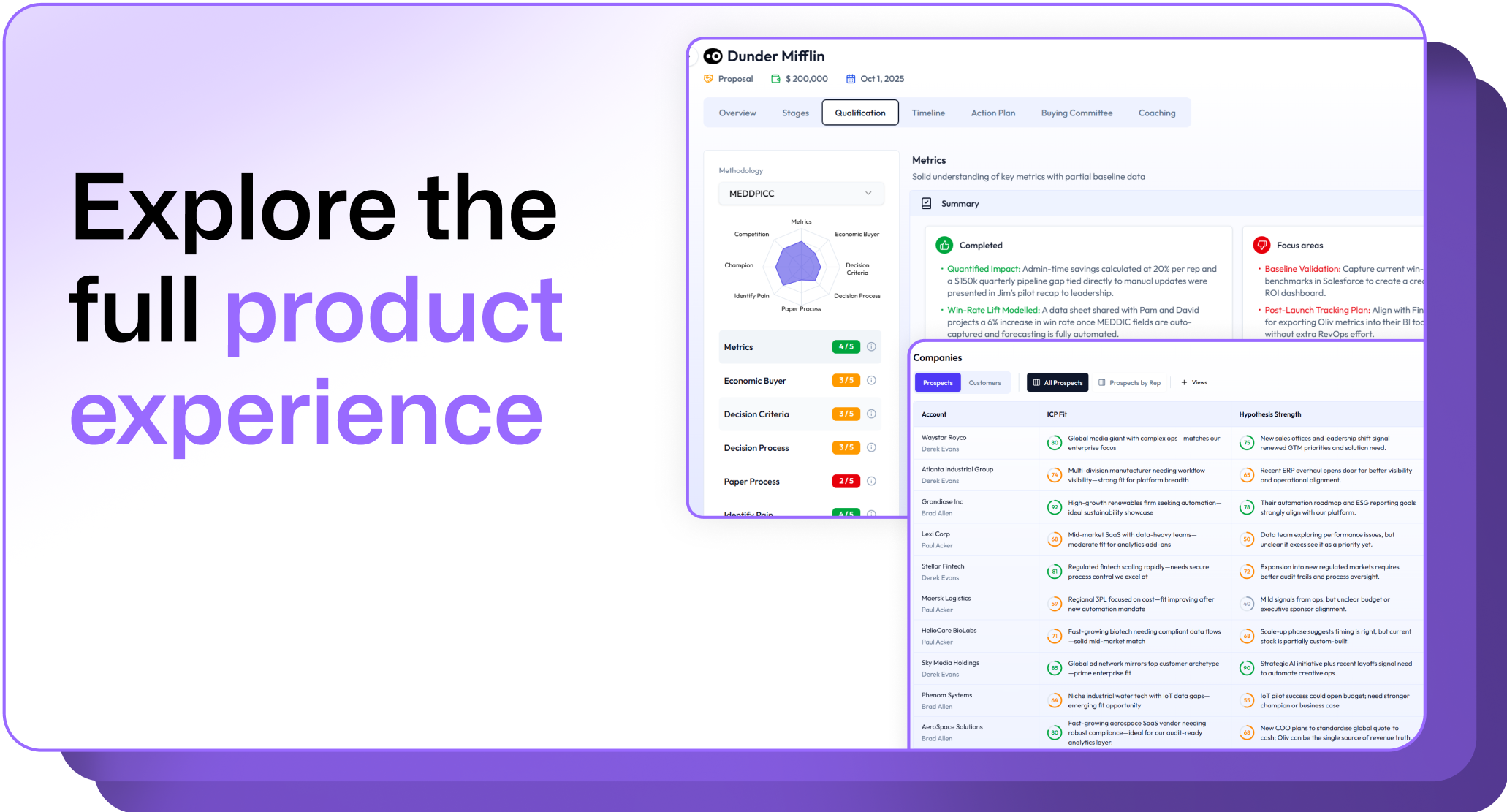
.avif)
.png)