Stop Dumping Transcripts into LLMs: Why Meaning Extraction Requires Specialized SLMs and Process Graphs
Written by
Ishan Chhabra
Last Updated :
September 23, 2026
Skim in :
13
mins
In this article
Revenue teams love Oliv
Here’s why:
All your deal data unified (from 30+ tools and tabs).
Insights are delivered to you directly, no digging.
AI agents automate tasks for you.
Thank you! Your submission has been received!
Oops! Something went wrong while submitting the form.
Meet Oliv’s AI Agents
Hi! I’m, Deal Driver
I track deals, flag risks, send weekly pipeline updates and give sales managers full visibility into deal progress
Hi! I’m, CRM Manager
I maintain CRM hygiene by updating core, custom and qualification fields all without your team lifting a finger
Hi! I’m, Forecaster
I build accurate forecasts based on real deal movement and tell you which deals to pull in to hit your number
Hi! I’m, Coach
I believe performance fuels revenue. I spot skill gaps, score calls and build coaching plans to help every rep level up
Hi! I’m, Prospector
I dig into target accounts to surface the right contacts, tailor and time outreach so you always strike when it counts
Hi! I’m, Pipeline tracker
I call reps to get deal updates, and deliver a real-time, CRM-synced roll-up view of deal progress
Hi! I’m, Analyst
I answer complex pipeline questions, uncover deal patterns, and build reports that guide strategic decisions
TL;DR
Meaning extraction is a write-time problem most teams solve at read-time, which is why transcript-based assistants feel slow, expensive, and inconsistent between runs.
Cost scales with questions asked, not information received. Model the unit as cost per answered question, because that number grows when adoption succeeds.
Bigger context windows fix capacity failures only. Determinism, latency, and company-specific knowledge the model never received do not improve with window size.
Small models are not categorically better. Narrow scope shrinks the error surface, and Gartner expects task-specific models at three times general-purpose LLM usage volume by 2027.
Routing needs a documented process layer. A router with no representation of stages, owners, and exceptions degrades into the keyword rule it replaced.
Run the variance test before buying anything: same five questions, five times, five accounts, and count every field that changes.
Q1. Why does the same question about the same deal cost so much, and return a different answer each time? [toc=1. Why Answers Drift]
Because a query-time architecture rebuilds its understanding from raw history every time you ask. Each new meeting, email, and message adds unstructured input the model must re-interpret when the question arrives. Cost then scales with questions asked rather than with information received. And because the interpretation happens fresh on each run, two identical questions can legitimately return two different answers. Consistency is an architectural property, not a prompting one.
⭐ The moment this usually breaks
A RevOps lead I spoke with had wired a model over eighteen months of call transcripts. It worked. She asked it which deals had slipped, and it told her, in about forty seconds.
Then her VP asked the same question in the same week. The answer named a different set of accounts. Nothing in the data had changed. Only the run had changed. This is the same failure pattern we see in conversation intelligence versus revenue intelligence comparisons, where findings arrive without deal state attached.
❌ What the read-time approach actually costs you
The pattern is always the same. You store transcripts, you retrieve chunks at question time, and you ask a general model to work out what matters. It is the fastest thing to build, which is why almost everyone builds it first.
The bill arrives in three places. Tokens, because history gets re-read per question. Latency, because long inputs are slow. And engineering time, because someone re-tunes the prompt every time the output drifts.
⚠️ Inconsistency is the part that ends careers, not the token bill
Published benchmarks make the risk concrete. TofuEval, presented at NAACL 2024, found that roughly 40% to 50% of summaries from most evaluated models contained at least one factual inconsistency. Dialogue is the hardest input class of all.
I used to think the cost line was the argument. I now think that is the weaker half. A precomputed answer is the same answer every time it is read. A re-derived one is a fresh roll of the dice. Anyone who has tried to run evidence-based forecast commits knows what run-to-run variance does to a board conversation.
✅ The alternative, in one sentence
Interpretation happens either when a conversation arrives or when a question is asked. That single choice decides your cost curve and whether answers repeat.
Interpret each conversation when it arrives, not when someone asks. Oliv AI's published architecture states the principle plainly, describing a context graph that "synthesizes revenue context before any question is asked" and calling the approach "synthesis, not retrieval" (oliv.ai homepage, retrieved September 2026).
I am not claiming that idea is new. Precomputation is an old technique wearing new clothes. What is new is how badly it is needed once agents, not humans, are reading the output. That shift is the whole subject of AI agents versus SaaS dashboards in 2026.
💸 What buyers say when the interpretation layer is thin
Reviewers of existing revenue tools describe the same gap between a transcript and a usable answer.
"The conversation intelligence tool is lacking, and we don't have the context of the deals against the conversation intelligence findings. There's no custom reporting. The AI is not as flexible as we need it to be." Verified user, ClariClari - G2 Verified Review (13 Jul 2026)
"The AI features are immature, team activity is poorly designed, and it doesn't integrate well with other popular business systems today." Verified user, ClariClari - G2 Verified Review (10 Oct 2025)
Read those together. The complaint is not that the model cannot write. It is that conversation findings arrive detached from deal state, so a person has to reconnect them. That reconnection work is exactly what a read-time architecture pushes onto you, over and over, every time you ask. More of that pattern sits in our breakdown of Clari reviews and user feedback.
Q2. What does it actually cost to run an LLM over your sales transcripts? [toc=2. Real Token Cost]
Cost is a function of three inputs, not one: transcript volume per account, questions asked per account each week, and how much history every question re-reads. A query-time design multiplies all three, because each question pays again for history it already paid to read. Model the unit as cost per answered question, not cost per million tokens. That is the number that grows when adoption succeeds.
💰 The three inputs, and a worked example
Here is the arithmetic I ask teams to rebuild with their own numbers. A 60 minute sales call produces roughly 8,000 to 10,000 words of transcript, which is close to 12,000 tokens.
Token Cost Inputs for Query-Time Transcript Analysis
Input
Modest team
Scaled team
Accounts in play
50
400
Conversations per account
6
6
History re-read per question
~72,000 tokens
~72,000 tokens
Questions per account per week
3
3
Weekly input tokens
~10.8M
~86.4M
The token count moved seventeen times. Your headcount did not. Published provider rate cards let you price that yourself.
⏰ The cost nobody puts in the business case
Engineering time is the line item that never makes the spreadsheet. Prompts drift, outputs change, and a GTM engineer spends a Thursday finding out why.
Latency is the second hidden charge. Long inputs are slow, and a forty second answer stops being used in a live pipeline review. Unused is the most expensive outcome of all. If you are already auditing spend, our note on how to reduce sales tech stack costs covers the adjacent line items.
✅ Where task-scoped models change the arithmetic
Published enterprise benchmarks report cost per invocation roughly ten to thirty times lower for fine-tuned small models on bounded tasks, alongside sub-200ms latency targets at high query volumes. Bounded means one question with one shape of answer.
That is an economics argument, not a quality argument. I want to be careful here, because the two get conflated constantly, and an ML-literate reader will close the tab.
⚠️ What buyers flag about the real bill
Cost rarely shows up on review sites as a price complaint. It shows up as gated capability and lost data.
"I cannot download all the data myself unless we upgrade the plan, which isn't ideal and results in me not fully utilizing Gong. The requirement to download snippets one by one using copy and paste is particularly annoying." Verified user, GongGong - G2 Verified Review (3 Oct 2025)
"The fact that you can't edit a recording (to only share a portion with a client), and the fact that if you stop working with the tool you lose the data." Verified user, GongGong - G2 Verified Review (19 Mar 2026)
One reviewer described the switch in plain commercial terms. Both of those complaints are covered in more depth in our review of Gong pricing and its plan gating.
"It's more affordable compared to other options we previously used." Verified user, Oliv AIOliv AI G2 - Verified Review (23 Jun 2026)
The same reviewer's only complaint was that it is "a lil slow," which is a fair trade to name.
Precomputation changes the unit you pay for. You pay once per conversation received instead of once per question asked. Oliv AI publishes that as a metered price ladder, with plans at $0, $19, $49, and $79 per user and agent actions billed at $0.01 per credit (oliv.ai/pricing, retrieved September 2026).
Q3. Won't bigger context windows and cheaper tokens make this problem disappear? [toc=3. Bigger Windows Objection]
Partly, yes, and pretending otherwise is dishonest. Windows are growing and per-token prices keep falling, so the pure cost argument erodes every quarter. What a larger window does not fix: run-to-run determinism, latency on long inputs, and company-specific knowledge the model never received. No window size supplies your qualification criteria or your discount approval exception. Sort your failures into capacity failures and knowledge failures. Only the first kind gets cheaper on its own.
⚠️ The objection, stated at full strength
Here is the version a good engineer gives me. "You are describing an optimisation. Windows doubled twice already, prices fell, and your entire cost argument dies in eighteen months. Why would I build a pipeline around a constraint that is disappearing?"
That is a strong argument. I have no interest in arguing around it, because every operator reading this can check the trend line themselves.
✅ Concede the half that is genuinely eroding
The cost case is time-limited. If your only reason to precompute is the token bill, wait. The market will hand you most of that saving for free, and you will have avoided building a layer you did not need.
Task-specific small models are also not a new invention, and nobody in this category invented them. NVIDIA Research argued the general case in 2025, on sufficiency, suitability, and economy grounds for agentic systems. If you are weighing whether to assemble this yourself, the trade-offs are laid out in our build versus buy guide for revenue AI.
❌ Three things that do not improve with window size
Only two of these four problems get cheaper as models improve. The other two are architectural, and no window size touches them.
The first is determinism. A larger window still re-derives meaning per run, so variance stays.
The second is latency. More input is more time, and a bigger window makes the slow path longer, not shorter.
The third is knowledge. A model cannot infer a rule it was never told. Your stage definitions, your legal trigger, and your approval exception live in people's heads.
⭐ The reframe, and the test I would run first
So stop asking whether models will improve. Ask which of your failures are capacity failures and which are knowledge failures.
Capacity failures look like truncation, dropped middle context, and timeouts. Knowledge failures look like a wrong stage, a missed discount rule, or an ICP the model guessed at. Oliv AI's product documentation puts the same point bluntly, stating that "you cannot solve a documentation problem at query time" (oliv.ai/process-graph, retrieved September 2026). That is the vendor's own framing, and I think it holds up independently.
Take last week's five worst answers. Sort them into those two columns. If four are capacity failures, wait six months and buy nothing. If four are knowledge failures, no model release is coming to save you, and the work is documentation, not procurement. I might be reading my own data too strongly here, but in the deployments I see, column two is almost always the heavier one. The data-architecture side of that work is covered in our guide to agentic AI implementation for RevOps.
Q4. What is meaning extraction, and why is it a write-time job rather than a read-time one? [toc=4. Write-Time Extraction]
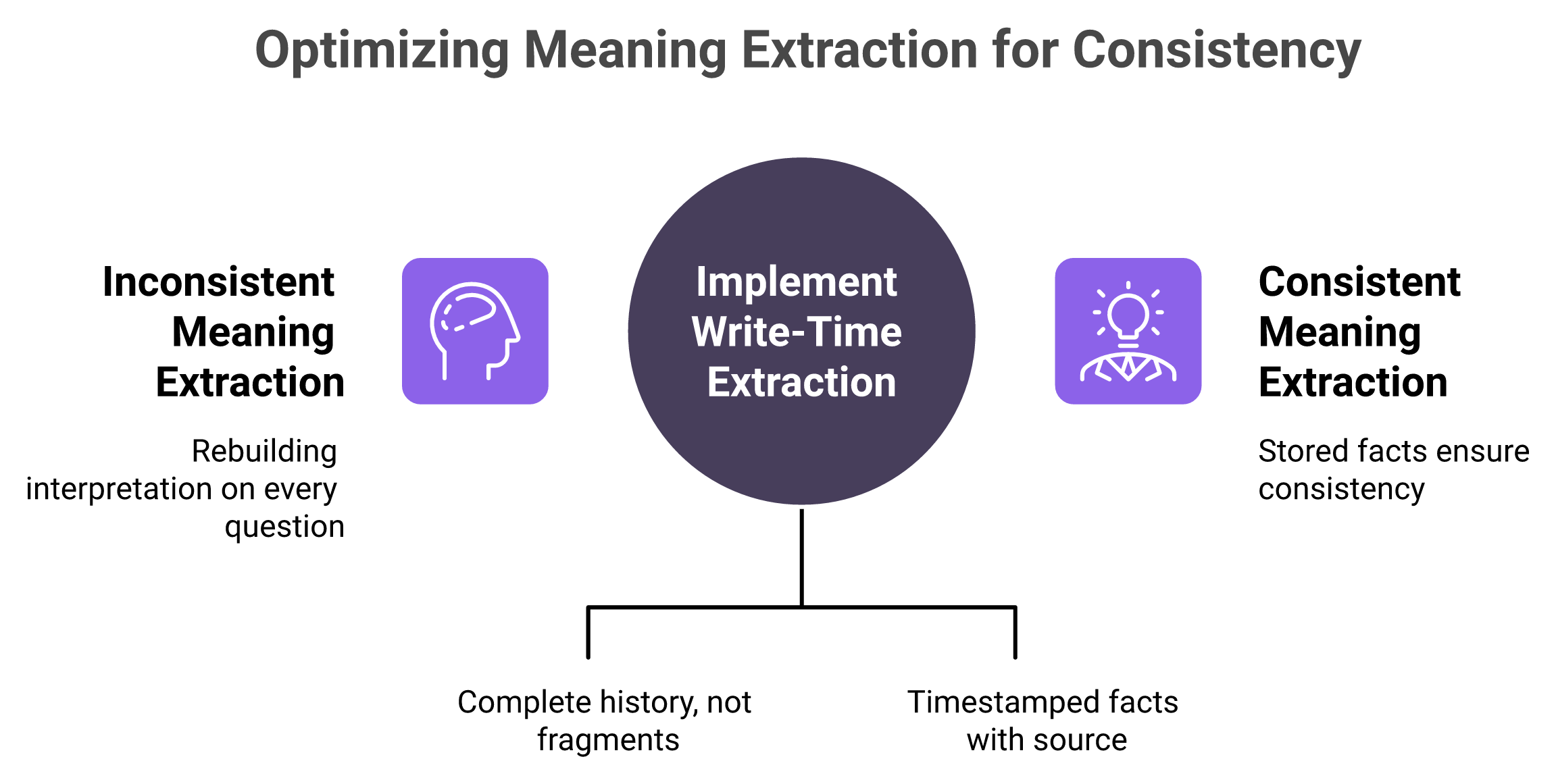
Meaning extraction is the step between a transcript and an answer. It is the decision about what in a conversation changed the state of the deal. At write-time, each conversation is read once, in full, and the account's understanding updates as information arrives. At read-time, that interpretation gets rebuilt per question from raw history. Same output shape, different cost curve, and only the write-time version produces the same answer twice.
⭐ The plainest definition I can give
A transcript is a record of words. Meaning is the delta. Somebody said something that moved the deal, and the job is naming that movement.
Humans do this instinctively. A good AE hears "our security team will want to see the SOC report" and knows the deal just acquired a new gate, a new reviewer, and probably three more weeks. Turning that instinct into scored fields is the subject of sales methodology automation from calls.
❌ The traditional path, and where it stops
The standard build retrieves a few relevant chunks, summarises them, and hopes the summary holds. It works well on a short, clean call with one topic.
It degrades on real sales calls, because real calls are long, multi-topic, and full of pronouns pointing at people the system has never resolved. A chunk is a fragment of a conversation, and a fragment cannot tell you what changed.
⚠️ A worked example, 47 minutes long
Take a renewal call. At minute nine, the champion mentions that security review now sits with procurement. At minute thirty-one, a new VP joins and asks about multi-year terms.
Chunk retrieval, asked "what changed on this account," will often return the pricing discussion, because that language matches the question best. The two facts that actually moved the deal are a process change and a new economic buyer. Neither is phrased like the question.
A write-time reader sees the whole call once, and records both as state changes on the opportunity. The answer is then read, not reconstructed. That is the difference between meeting-level notes and true AI deal intelligence.
✅ What changes operationally
Three things change in practice. Answers arrive fast enough to use inside a live pipeline review. Answers stop moving between runs, which makes them safe to show a board. And the extraction becomes reviewable, because there is a stored artifact rather than a fresh generation.
The evidence for why this matters is uncomfortable. Research on meeting summarisation published in 2025 found hallucination and omission to be structural rather than prompt-fixable, with GPT-4 detecting errors in its own output at only about 72% accuracy. A system that cannot reliably grade itself should not be re-deciding meaning on every read.
💰 One boundary worth holding
This argument is about where the work happens, not about model size. Small models are not categorically better, and anyone who tells you otherwise is selling.
Two adjacent problems also sit outside this one. Mapping an activity to the correct account and opportunity is entity resolution, which Oliv AI treats as a separate layer (oliv.ai/object-graph). Getting the conversation into the system at all is capture, across meetings, mobile calls, and shared channels (oliv.ai/context-capture). Extraction assumes both are already handled, and the downstream effect on record accuracy is covered in our piece on CRM data quality automation for RevOps.
References
Wan, D. et al. "TofuEval: Evaluating Hallucinations of Large Language Models on Topic-Focused Dialogue Summarization." NAACL 2024.
Kirstein, F. et al. "Re-FRAME the Meeting Summarization SCOPE" and "What's Wrong? Refining Meeting Summaries with LLM Feedback." GippLab, University of Göttingen, 2025.
Belcak, P., Heinrich, G., Diao, S. et al. "Small Language Models are the Future of Agentic AI." NVIDIA Research, 2025.
Oliv AI, homepage and Process Graph, Object Graph, and Context Capture product documentation. oliv.ai, retrieved September 2026.
Oliv AI, pricing page. oliv.ai/pricing, retrieved September 2026.
Model provider published per-token rate cards, retrieved September 2026.
PremAI. "SLM vs LLM: The Enterprise Decision Guide With Real Cost Data and Benchmarks." February 2026.
Q5. What counts as a small language model, and which transcript jobs does each size actually win? [toc=5. SLM vs LLM Fit]
Small language models run roughly 1B to 13B parameters. Named examples include Phi-3 Mini (3.8B), Mistral 7B, Llama 3 8B, and Gemma 7B. They are fine-tuned for bounded, repeated work: extracting a next step, a competitor mention, a stated budget, or a risk signal. Frontier models above 70B handle open-ended reasoning and synthesis. The deciding factor is scope and repetition, not parameter count. Gartner expects organisations to use small, task-specific models at roughly three times the usage volume of general-purpose LLMs by 2027.
⭐ Bounded means one question with one answer shape
A bounded task has a stable output. "Did the buyer state a budget, and what was it?" returns a number or a null. That shape does not change across ten thousand calls.
An open task has no stable output. "Write the executive summary for this account plan" is a different job every time. Fine-tuning a small model for it is wasted effort. The practical version of this split shows up across sales call analytics workloads.
✅ The task-fit matrix I use when scoping work
Task Fit by Transcript Job and Model Class
Transcript job
Bounded or open
Why the fit works
What breaks if you invert it
Next-step extraction
Bounded
One decision, repeated per call
Frontier model costs more for identical output
Competitor mention detection
Bounded
Fixed vocabulary, fixed intent
Keyword rules fire on passing mentions
Budget or authority capture
Bounded
Maps to defined CRM fields
Free-text summaries need re-reading
Deal risk signal
Bounded
Recurring signal, stable label set
Generic summaries bury the signal
Account strategy narrative
Open
Needs cross-source reasoning
A small model flattens nuance
Novel objection handling copy
Open
Creative, non-repeating
Fine-tuning has nothing stable to learn
⏰ The fine-tuning cost nobody mentions upfront
Fine-tuning needs labelled examples, commonly cited at roughly 500 to 2,000 per bounded task. That is real annotation work, and it has to be done by someone who knows your sales motion.
Then it drifts. Your ICP shifts, a competitor renames a product, and accuracy quietly degrades. Plan a re-research cadence, quarterly at minimum, or the model gets stale while nobody notices. The same maintenance question sits underneath every AI deal intelligence rollout.
❌ The claim I refuse to make
Small models do not hallucinate less as a class. Anyone who tells you that is selling you something. Narrow scope is what shrinks the error surface, because a model asked one question cannot wander into context it was never given.
Gartner also projects that more than half of enterprise generative AI models will be domain-specific by 2027, up from roughly 1% in 2024. That is a specialisation trend, not a size trend.
💰 What reviewers say about scope, in practice
Buyers describe this problem in workflow terms, not model terms.
"I'd love to see more granular customization for the CS lifecycle specifically, distinguishing between a 'Sales Discovery' call and a 'Success QBR,' as the conversational cues for those can be very different." Verified user, ClariClari - G2 Verified Review (8 Apr 2026)
That is a scope request. One general model reading every call type the same way misses what makes each call type different. Our breakdown of Clari features covers where that ceiling sits today.
"I love how Oliv AI goes beyond simple call transcription to actually interpret and extract actionable insights from every interaction. The AI surfaces objections, competitor mentions, and budget discussions automatically." Verified user, Oliv AIOliv AI G2 - Verified Review (8 Jul 2026)
Objections, competitor mentions, and budget are three separate bounded questions. Oliv AI publishes its approach as 100 or more fine-tuned small language models, each focused on one specific revenue question (oliv.ai/intent-graph, retrieved September 2026). That is the vendor's own claim, and the architectural logic behind it is what matters here.
Q6. How should a hybrid stack route work between small and frontier models, and what does the router need to know? [toc=6. Hybrid Routing Logic]
Route by scope and stakes. Send bounded, repeated extraction to task-scoped models. Send novel reasoning, drafting, and synthesis to a frontier model. Escalate when confidence or coverage drops. The part nobody specifies is what the router reads to make that call: stage definitions, ownership rules, and exception paths. A router with no representation of your process degrades into a keyword rule, which is the failure mode it was built to replace.
⭐ A routing policy you can actually implement
Routing Policy for Small and Frontier Models
Incoming signal
Default model class
Escalation trigger
Fallback
Call transcript arrives
Task-scoped extractors, run in parallel
Low confidence on a required field
Queue for human review
"What changed on this account?"
Read stored extractions
No extraction exists yet
Run extraction, then answer
"Draft the renewal business case"
Frontier model
Missing account facts
Pull stored context first
Ambiguous buyer reference
Entity resolution, then extract
Two plausible opportunities
Flag for RevOps
Novel objection, no precedent
Frontier model
None
Log as a new pattern
⚠️ Where most DIY routers actually fail
Most routers I see are a switch statement with a model name inside it. Call type in, model out. It works for a quarter.
Then a deal takes an exception path. Legal review moves earlier, or a partner-led deal skips a stage. The router has no idea either thing is allowed, so it routes confidently and wrongly. This is the practical failure mode behind most AI sales workflow automation projects that stall in month three.
✅ The published version of this argument
NVIDIA's engineering guidance describes heterogeneous agentic systems, where small models handle the repetitive sub-tasks and a general model is invoked only for genuinely generalist reasoning. Their migration procedure is useful: log real agent invocations, cluster the repeated ones, then move those clusters to specialised models.
Consulting frameworks published in 2026 land in the same place, splitting bounded work from ambiguous work and treating escalation as a designed path, not an exception. Our guide to AI agents for RevOps walks through the same assignment logic in operational terms.
❌ What buyers report when routing has no process context
Reviewers describe the symptom without naming the cause.
"Real Time integrations can be time consuming." Verified user, GongGong - G2 Verified Review (21 Apr 2026)
"The Analyst agent allows me to understand everything I need with just one click, eliminating the long wait time I used to have with RevOps to get answers. The Driver agent watches all my deals and flags any that are at risk." Verified user, Oliv AIOliv AI G2 - Verified Review (17 Jun 2026)
Read the second one as a routing description. One agent answers analytical questions on demand. Another watches state continuously. Different jobs, different triggers, different model classes behind them. That division of labour is how AI agents for sales teams stay useful past the pilot.
⏰ The question this leaves open
So a routing table is necessary and insufficient. Every row in the table above assumes the router knows what a stage means, who owns an exception, and when legal gets involved.
I have never seen that knowledge sitting in a queryable form inside a company. It lives in a senior AE's head and in Slack threads from last March. That is the gap the next section has to close, because a router reading nothing will always fall back to pattern matching.
Q7. What is a process graph, and why can't a bigger context window replace it? [toc=7. Process Graph Explained]
A process graph is your operating playbook written so software can execute against it. It holds how you qualify, what each stage means, when a deal goes to legal, what triggers a discount, and which exceptions are real. It is not a capacity problem, so it does not shrink as context windows grow. A model cannot infer a rule it was never told. Documentation living in your team's heads is a knowledge failure, and knowledge failures never get cheaper.
⭐ The document everyone has, and nobody trusts
Every revenue team I have worked with has the file. "Sales Playbook v4," last meaningfully edited eleven months ago, with two comments from people who have left.
Meanwhile the real process moved. Stage four now needs a security questionnaire. Discounts above 15% need the CRO, except for multi-year deals, which nobody wrote down.
❌ Why written playbooks stop matching reality
Documents drift within weeks of being written. New exceptions get agreed verbally on a Tuesday call, and edge cases get handled informally by whoever is closest.
Your CRM does not save you here. It records what happened on a call, not what a good call should look like. An agent trained on CRM history learns your past behaviour, including the bad quarters, not your standards. The cleanup side of that problem is covered in CRM data quality automation for RevOps.
✅ What an executable process layer has to contain
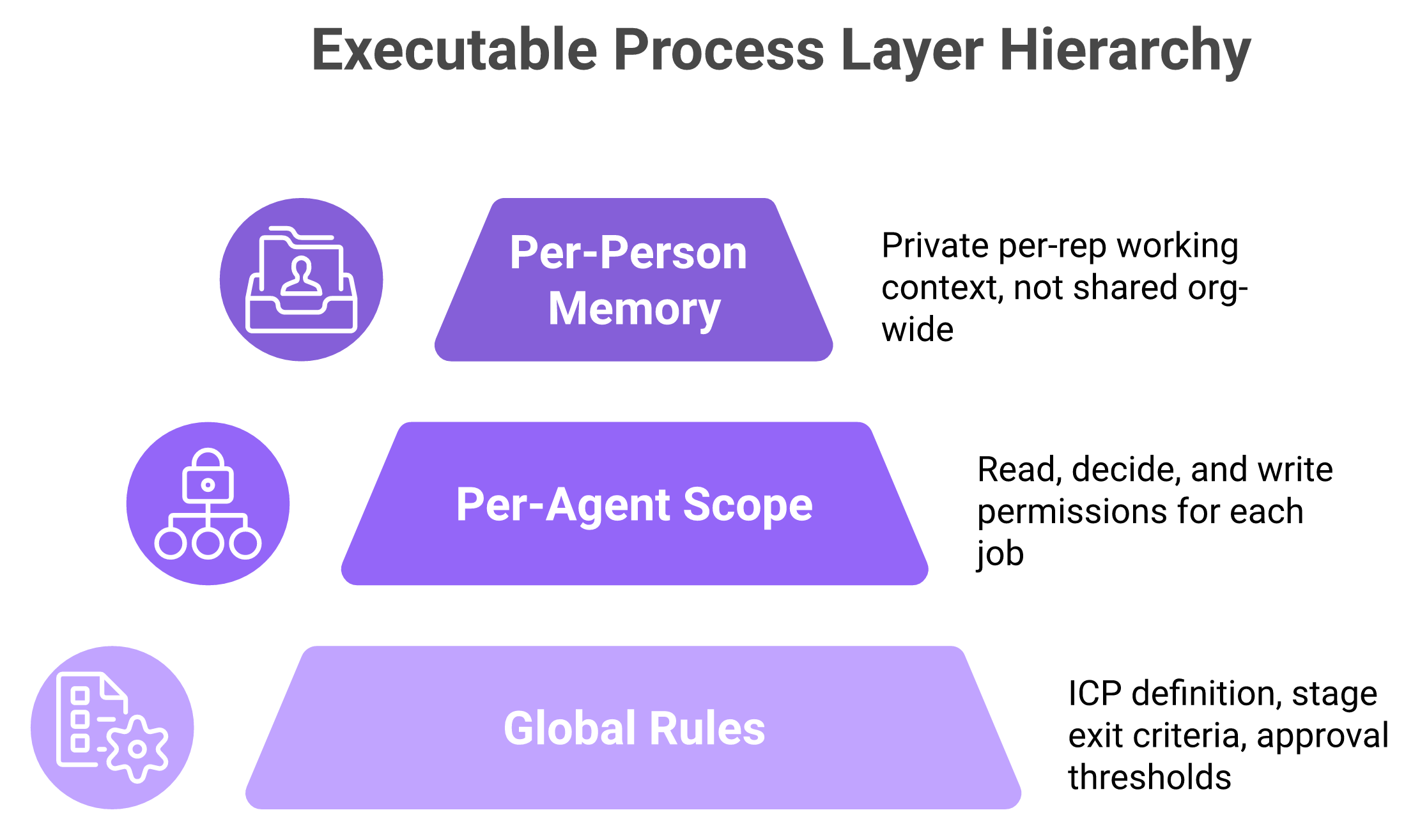
A process layer is not one document. It is three scopes stacked, and agents read all three before they act.
Three scopes, at minimum, and I would argue this list is the actual requirement rather than any vendor's feature set.
Global rules. ICP definition, stage exit criteria, approval thresholds, and named exception paths.
Per-agent scope. What each automated job is allowed to read, decide, and write.
Per-person memory. A rep's own working context, kept private, because not every useful fact belongs to the org.
Oliv AI publishes this layer as Process Graph, describing those same three scopes and stating that agents "cannot figure out your playbook as they go" (oliv.ai/process-graph, retrieved September 2026).
⚠️ Documented is not the same as alive
Here is the distinction I care about most. A document is a snapshot. A process layer is a running record that updates when the company changes how it operates.
Gartner's domain-specific model thesis makes the general version of this point: accuracy in enterprise AI comes from encoding what is specific to your business, not from scale. No window size supplies knowledge the model never received.
💰 What this looks like when it works
Reviewers notice it as methodology fields filling themselves in.
"It's incredibly helpful with our custom sales methodologies like MEDIC-BAND, as it helps me fill all of them out." Verified user, Oliv AIOliv AI G2 - Verified Review (15 Jun 2026)
MEDDPICC, BANT, and SPICED are qualification frameworks. Filling them correctly requires knowing what your company counts as a decision criterion, which is a process fact, not a transcript fact. We document how that scoring works in sales methodology automation from calls.
And when the process is not encoded, buyers feel the friction directly.
"Flows are hard to get into, information is not readily available, sequencing is difficult to create and track, nothing is robust or scalable." Verified user, GongGong - G2 Verified Review (9 Jun 2025)
The compounding argument is the part I find most persuasive, and I hold it with some uncertainty. A process layer gets more accurate the longer your company operates on it. A prompt does not accumulate anything.
Q8. How do privacy, data residency, and the EU AI Act change the model decision? [toc=8. Compliance And Sovereignty]
Conversation data carries constraints most enterprise data does not: GDPR, two-party consent recording laws, and sectoral regimes like HIPAA. Smaller task-scoped models can run inside your own boundary, which is often the real reason they get chosen. Separately, EU AI Act Article 50 has applied since 2 August 2026. Systems interacting directly with people must disclose that they are AI, and synthetic outputs must be marked in a machine-readable format, with the marking grace period ending 2 December 2026.
⚠️ Constraint to architectural consequence
Each rule pushes on a specific design decision. Map them explicitly before you pick a model.
Data residency. Determines where inference runs, not just where storage sits.
Two-party consent. Determines what may be recorded and retained, by jurisdiction, per participant.
GDPR purpose limitation. Determines what extracted context you may keep once the deal closes.
Article 50 disclosure. Applies when a system interacts with a person directly, including at each new interaction.
Synthetic output marking. Applies to AI-generated content your team sends outward.
✅ Why this is the strongest non-cost argument
The cost case for smaller models erodes as prices fall. The sovereignty case does not, because it is a legal boundary rather than an economic one.
A bounded extraction model can sit inside your own network and never send a customer's words to a third-party endpoint. Published enterprise guidance names this as a primary driver of small-model adoption, ahead of cost, in regulated sectors. Buyers running this evaluation should also read our AI CRM trust and governance evaluation guide.
⏰ What actually took effect in August 2026
Legal analyses of the 2 August 2026 date are consistent on scope. Article 50 transparency duties became applicable and enforceable, and the EU Digital Omnibus amendments deferred certain other provisions but left Article 50 untouched.
The Commission published its final transparency guidelines on 20 July 2026, covering disclosure, deepfake labelling, and synthetic content marking. If your agent emails a prospect, or speaks on a call, that is in scope.
❌ The uncomfortable part for query-time stacks
A prompt log is a poor audit artifact. It tells a regulator what was asked, not what the system concluded or why.
Precomputed extraction produces a different kind of record. Each extracted fact has a timestamp, a source conversation, and a stated basis. I find that far easier to defend in a data subject access request than "we re-ran a prompt and this is what came back."
💰 The trade to name out loud
There is a real cost to this posture. Keeping inference inside your boundary means owning infrastructure, patching it, and monitoring it. Some teams should not take that on.
And this article is not the right read for every buyer. B2C support teams, call-recording-only buyers, and anyone who just wants a transcript will find this architecture heavier than their problem needs. The governance checklist in our mid-market revenue AI buyer guide on SOC 2 governance is the shorter path for smaller teams.
Oliv AI publishes its compliance posture as SOC 2 Type II certification, GDPR and CCPA compliance, AES-256 encryption at rest, TLS 1.2 or higher in transit, and a subprocessor list at trust.oliv.ai, alongside a full open export policy. Consent-first ambient capture for in-person conversations runs through a published partnership with PLAUD (oliv.ai/context-capture, retrieved September 2026). Those are stated facts with dates attached, and you should ask any vendor, including this one, to show the same.
References
Gartner. "Gartner Predicts By 2027, Organizations Will Use Small, Task-Specific AI Models Three Times More Than General-Purpose Large Language Models." Press release, 9 April 2025.
Gartner. "Gartner Forecasts Worldwide End-User Spending on GenAI Models to Total $14.2 Billion in 2025." Press release, 10 July 2025; and "Domain-Specific Language Models as Enterprise AI Accelerators," March 2026.
Microsoft. "Explore AI models: Key differences between small language models and large language models." Microsoft Cloud Blog, 11 November 2024.
NVIDIA. "How Small Language Models Are Key to Scalable Agentic AI." NVIDIA Developer Blog, 29 August 2025.
Delivering Data Analytics. "SLM vs LLM for Enterprises: Decision Framework." August 2026.
European Parliament and Council. Regulation (EU) 2024/1689, Article 50, applicable 2 August 2026.
European Commission. "Guidelines on transparency obligations for providers and deployers of AI systems." 20 July 2026.
Morgan Lewis. "EU AI Act's Transparency Rules: What Went Into Effect on 2 August?" 12 August 2026; Faegre Drinker, 30 July 2026.
ASSIST Software. "Small language models in enterprise AI: why the right model beats the biggest model." July 2026.
Oliv AI. Intent Graph product documentation. oliv.ai/intent-graph, retrieved September 2026.
Oliv AI. Trust centre and subprocessor list. trust.oliv.ai, retrieved September 2026.
Q9. How does precomputed context work in practice, and what breaks when you adopt it? [toc=9. Precomputed Context Practice]
Each conversation is read once on arrival by a model scoped to a specific question, and account context updates at that moment. Answers are then read, not rebuilt. Oliv AI publishes this as two layers: a Process Graph holding company rules and exceptions, and a Signal Graph of 100 or more fine-tuned revenue small language models, one per recurring question. The real trade is opacity, because you inherit someone else's extraction. The mitigation is inspectability, through MCP or a warehouse sync, rather than trust.
⭐ The point where the DIY build stops scaling
The pattern is familiar. A GTM engineer, meaning the person who wires revenue tools together, builds a working transcript pipeline in three weeks. It answers questions well on forty accounts.
Then sales adds two segments. Question volume triples, latency climbs, and the prompt that worked in March returns something different in June. Nobody broke it. It just met volume. The same scaling wall shows up in most agentic AI implementations built on thin data architecture.
❌ What the maintenance actually looks like
Read-time systems create a permanent tuning job. Someone owns the prompts, the retrieval settings, and the eval spreadsheet nobody updates.
That person is expensive and hard to hire. I have watched teams lose a quarter of a senior engineer's time to a pipeline that was supposed to save time. If you are sizing that trade-off now, our build versus buy analysis for revenue AI lays out the ownership cost.
✅ The inversion, mechanically
Three mechanics matter, and none of them are exotic.
Read on arrival. Each conversation gets interpreted when it lands, not when someone asks.
Scope per question. One model per recurring question, so the output shape is stable and gradeable.
Full history, not fragments. The model reads the complete account history rather than a retrieved slice.
"Precomputed answers go stale, and now I am debugging your extraction instead of my prompt." That is the right objection, and it is only half answerable.
The staleness half has a mechanism. Extraction updates as new information arrives, not on a nightly schedule, so the stored answer moves when the deal moves. The opacity half is a genuine trade. You are accepting a vendor's interpretation layer, and the only real mitigation is being able to read the outputs yourself.
💰 What buyers report, including the rough edges
"The Revenue Harness and Context Graph are standouts, giving me detailed briefs before every call and saving me over 10 hours a week on admin tasks. The only downside is that the platform can be a bit glitchy at times." Verified user, Oliv AIOliv AI G2 - Verified Review (2 Jul 2026)
"Exporting data loses all customisations and filters. Analytics are ineffective and add no real value." Verified user, AvisoAviso - G2 Verified Review (24 Jun 2025)
The second review is the one to take seriously. If you cannot get your interpreted data out cleanly, inspectability is a marketing word. Export and integration behaviour is worth testing the same way we test it in revenue intelligence integration across CRM, Slack, and email.
Oliv AI's answer here is structural rather than prompt-level: a Process Graph that already holds your product, qualification criteria, processes, and exceptions, and a Signal Graph of fine-tuned small models, each scoped to one recurring revenue question, reading each conversation in full as it arrives (oliv.ai, retrieved September 2026). The consequence that matters is not speed. It is that the answer read on Friday is the answer read on Monday. Because that extracted context is reachable through MCP, an open protocol for connecting AI tools to data, or synced into Snowflake and Databricks, you can audit the interpretation inside your own environment. And the limit deserves stating plainly. Oliv is the least publicly proven vendor named in this article, with a thin third-party review footprint and case studies still behind an email form, which is precisely why those export routes matter more than any claim we make.
Q10. How do you tell a capacity failure from a knowledge failure, and at what volume does precomputation earn its complexity? [toc=10. Diagnose And Threshold]
Pull your last twenty unsatisfactory answers and ask one question of each. Did the model lack room, or lack information? Truncation, dropped middle context, and timeouts are capacity failures, and they shrink as models improve. A wrong stage definition, a missed discount rule, an unknown ICP, or an ignored exception is a knowledge failure, and it persists at any window size. If most of yours are capacity failures and you run a few hundred conversations, keep doing it at query time.
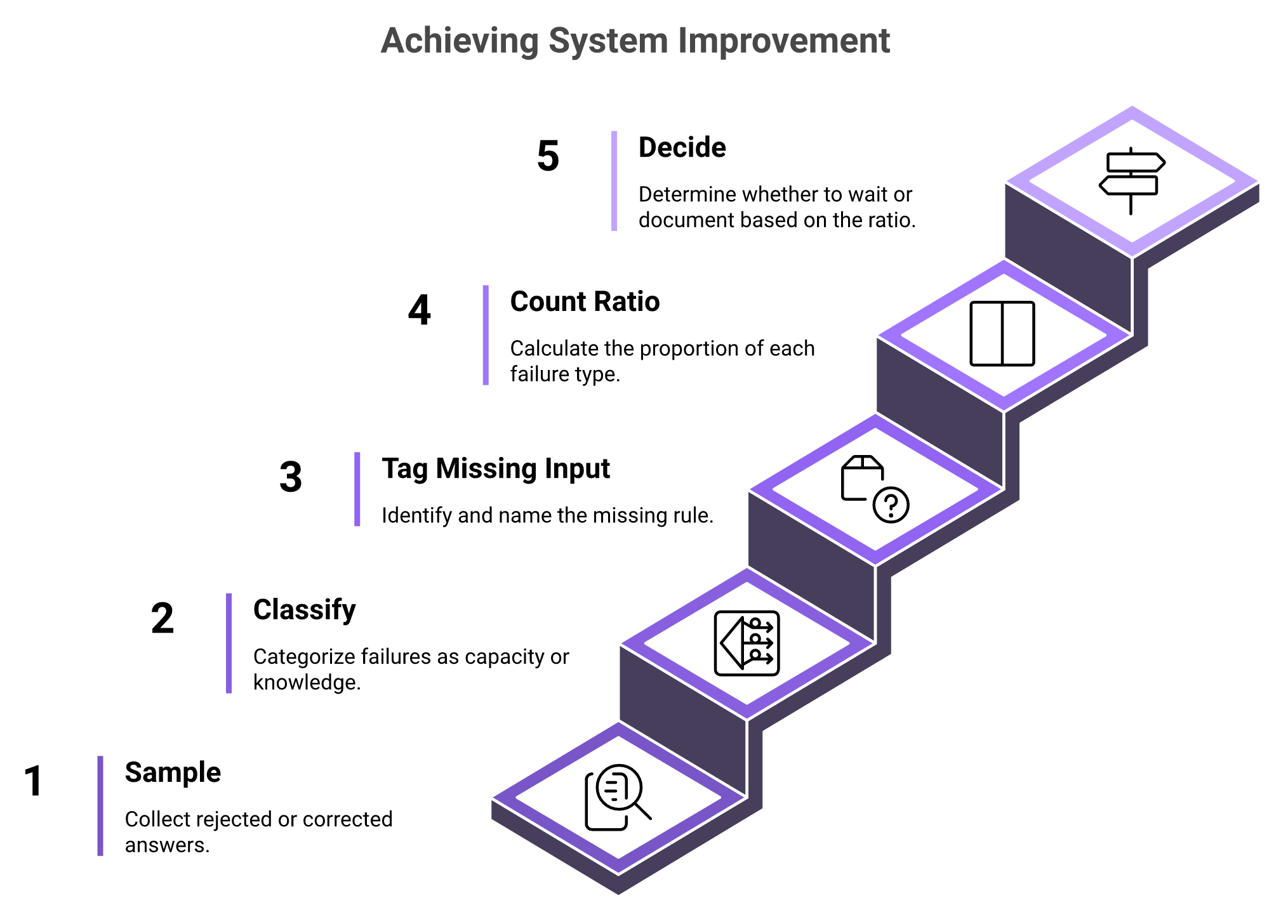
⭐ The five-step audit, start to finish
Run these five steps on last week's worst answers. The ratio between the two columns tells you whether to buy or wait.
Sample. Take the last twenty answers your team rejected or silently corrected.
Classify. Mark each as capacity or knowledge, using the table below.
Tag the missing input. For knowledge failures, name the exact rule the system never had.
Count the ratio. Two columns, two totals. That is the whole diagnostic.
Decide. Capacity-heavy means wait. Knowledge-heavy means document.
⚠️ The classification table
Capacity Failures Versus Knowledge Failures
Capacity failure (gets cheaper)
Knowledge failure (never does)
History truncated mid-thread
Wrong stage exit criteria applied
Facts in the middle of a long input dropped
Discount approval rule missed
Request timed out on a long account
ICP definition guessed, not known
Cost per question too high to run daily
Legal review trigger unknown
Latency too slow for a live pipeline review
Partner-led exception path ignored
Output cut off before the final field
Competitor named but not classified as active
Long-context degradation is well documented by practitioners, who report models losing facts placed in the middle of very large inputs. That is a capacity problem, and it is improving.
⏰ The threshold, stated honestly
Precomputation earns its complexity roughly when one analyst can no longer verify the answers by reading the source. Below that, the maintenance cost of an extraction layer exceeds the tokens it saves.
Concretely, a team with a few hundred conversations and five or six recurring questions should stay at query time. I lose readers by writing that, and it is still the right advice. Build while it is personal. Buy when the team depends on it. Smaller teams should start with the lighter path in our guide to revenue intelligence for startups and small sales teams.
❌ The signals that you have crossed the line
Four things usually show up together.
The same question gets asked by three different teams in the same week.
Answers arrive after the decision they were meant to inform.
Two people quote different deal statuses in the same meeting.
Someone builds a spreadsheet to check the AI output.
💸 What adopting too early feels like
"Integrating Salesloft came with a lot of challenges, and even now, it feels like the platform still has some kinks. The learning curve can be frustrating, especially when you're trying to move quickly in a fast-paced environment." Verified user, SalesloftSalesloft - G2 Verified Review (22 Jul 2025)
That is what infrastructure bought before the problem arrives feels like. The tool is not wrong. The timing was.
"Our forecast accuracy has jumped by 27%, and onboarding was a breeze. The only downside I've noticed is that the mobile app is a bit basic compared to the desktop platform." Verified user, Oliv AIOliv AI G2 - Verified Review (8 Jul 2026)
Most teams I audit come out knowledge-heavy, and I hold that read with some caution because my sample skews toward companies already struggling. A documented process layer is what empties the right-hand column, which is why that work sits upstream of any model choice (oliv.ai/process-graph). The forecasting payoff of that sequencing is covered in improving sales forecast accuracy with AI.
Q11. How do you evaluate accuracy and consistency on your own conversation data? [toc=11. Evaluating Accuracy]
Build a small labelled set from your own calls, around thirty conversations with five questions each, and score three things. Factual grounding against the transcript, omission of material facts, and variance across repeated runs of an identical prompt. The third is the one teams skip, and it decides whether output can face a customer or a board. Published research finds far higher hallucination rates on dialogue than on clean documents, so vendor benchmarks run on news data tell you very little.
⭐ The four metrics, and how to measure each
Evaluation Metrics for Conversation Data Extraction
Metric
What it asks
How to measure it
Grounding
Is every claim traceable to the transcript?
Two annotators mark each claim supported, unsupported, or partially supported
Omission
Did it miss something material?
Compare against a human-written list of state changes per call
Run variance
Does the same input give the same output?
Run each prompt five times, measure disagreement on key fields
Latency
Is it fast enough to be used?
Time to answer at your real history length, not a demo one
⚠️ Why generic benchmarks mislead here
Most published summarisation scores come from news articles or research papers. Those inputs are clean, single-voiced, and structured.
Sales calls are none of those things. Research on dialogue summarisation reports hallucinated content reaching up to 75% of generated text in the conversation domain, with a 20 to 30 point gap against news inputs. TofuEval found factual inconsistency in a large share of summaries across evaluated models. Anyone shortlisting vendors should run this test alongside our revenue intelligence platform comparison for RevOps.
❌ The self-grading trap
Teams often use a strong model to grade its own output. It feels efficient and it is quietly unreliable.
Research from 2025 found GPT-4 identifying errors in meeting summaries at roughly 72% accuracy, and performing worse on partial omissions. A grader that misses one error in four cannot certify anything.
✅ Run the variance test first
If you only have an afternoon, run variance. Take five accounts, ask the same five questions five times each, and record every field that changes.
That single test tells you whether your pipeline is safe in front of a customer. It needs no labelled data and no annotator, and in my experience it is the one that changes minds fastest. It is also the fastest way to pressure-test any AI meeting summaries workflow before it reaches leadership.
💰 What reviewers say about verifiable output
"It doesn't just record meetings; it automatically captures key insights, updates systems of record, identifies next steps, and helps keep teams aligned. As a result, we've seen better CRM hygiene, less administrative overhead, and more consistent execution." Verified user, Oliv AIOliv AI G2 - Verified Review (23 Jun 2026)
"Limitations of getting data back into Salesforce." Verified user, GongGong - G2 Verified Review (21 May 2026)
"I'd love to see few more options to customize dashboards and reports for different teams." Verified user, Oliv AIOliv AI G2 - Verified Review (26 Jun 2026)
Now the uncomfortable part. Any accuracy or hallucination figure published without a dataset and a stated method is a marketing number, and that includes Oliv AI's own published figures on its Intent Graph page (oliv.ai/intent-graph, retrieved September 2026). Ask every vendor for the labelled set, the annotation protocol, and the variance result. If they cannot produce those three things, treat the number as a claim rather than evidence. The same evidence standard runs through our AI CRM trust and governance evaluation checklist.
✍🏼 About the author
Ishan Chhabra is the founder and CEO of Oliv, an AI-native revenue intelligence and revenue orchestration platform for B2B revenue teams. He built Oliv's context graph, the infrastructure layer that resolves accounts, opportunities, and conversations across messy CRMs so AI agents can act on them safely. He writes about what he sees working and failing inside revenue organisations adopting AI.
References
Model Context Protocol specification. modelcontextprotocol.io, retrieved September 2026.
Practitioner reports on long-context degradation and lost-in-the-middle behaviour, Hacker News and r/LocalLLaMA discussion threads, 2025 to 2026.
"How LLMs Hallucinate in Multi-Document Summarization," arXiv preprint, 2024, reporting up to 75% hallucinated content in conversation-domain summaries.
Wan, D. et al. "TofuEval: Evaluating Hallucinations of Large Language Models on Topic-Focused Dialogue Summarization." NAACL 2024.
Kirstein, F. et al. "Re-FRAME the Meeting Summarization SCOPE" and "What's Wrong? Refining Meeting Summaries with LLM Feedback." GippLab, University of Göttingen, 2025.
Oliv AI. Process Graph and Intent Graph product documentation. oliv.ai, retrieved September 2026.
Q1. Why does the same question about the same deal cost so much, and return a different answer each time? [toc=1. Why Answers Drift]
Because a query-time architecture rebuilds its understanding from raw history every time you ask. Each new meeting, email, and message adds unstructured input the model must re-interpret when the question arrives. Cost then scales with questions asked rather than with information received. And because the interpretation happens fresh on each run, two identical questions can legitimately return two different answers. Consistency is an architectural property, not a prompting one.
⭐ The moment this usually breaks
A RevOps lead I spoke with had wired a model over eighteen months of call transcripts. It worked. She asked it which deals had slipped, and it told her, in about forty seconds.
Then her VP asked the same question in the same week. The answer named a different set of accounts. Nothing in the data had changed. Only the run had changed. This is the same failure pattern we see in conversation intelligence versus revenue intelligence comparisons, where findings arrive without deal state attached.
❌ What the read-time approach actually costs you
The pattern is always the same. You store transcripts, you retrieve chunks at question time, and you ask a general model to work out what matters. It is the fastest thing to build, which is why almost everyone builds it first.
The bill arrives in three places. Tokens, because history gets re-read per question. Latency, because long inputs are slow. And engineering time, because someone re-tunes the prompt every time the output drifts.
⚠️ Inconsistency is the part that ends careers, not the token bill
Published benchmarks make the risk concrete. TofuEval, presented at NAACL 2024, found that roughly 40% to 50% of summaries from most evaluated models contained at least one factual inconsistency. Dialogue is the hardest input class of all.
I used to think the cost line was the argument. I now think that is the weaker half. A precomputed answer is the same answer every time it is read. A re-derived one is a fresh roll of the dice. Anyone who has tried to run evidence-based forecast commits knows what run-to-run variance does to a board conversation.
✅ The alternative, in one sentence
Interpretation happens either when a conversation arrives or when a question is asked. That single choice decides your cost curve and whether answers repeat.
Interpret each conversation when it arrives, not when someone asks. Oliv AI's published architecture states the principle plainly, describing a context graph that "synthesizes revenue context before any question is asked" and calling the approach "synthesis, not retrieval" (oliv.ai homepage, retrieved September 2026).
I am not claiming that idea is new. Precomputation is an old technique wearing new clothes. What is new is how badly it is needed once agents, not humans, are reading the output. That shift is the whole subject of AI agents versus SaaS dashboards in 2026.
💸 What buyers say when the interpretation layer is thin
Reviewers of existing revenue tools describe the same gap between a transcript and a usable answer.
"The conversation intelligence tool is lacking, and we don't have the context of the deals against the conversation intelligence findings. There's no custom reporting. The AI is not as flexible as we need it to be." Verified user, ClariClari - G2 Verified Review (13 Jul 2026)
"The AI features are immature, team activity is poorly designed, and it doesn't integrate well with other popular business systems today." Verified user, ClariClari - G2 Verified Review (10 Oct 2025)
Read those together. The complaint is not that the model cannot write. It is that conversation findings arrive detached from deal state, so a person has to reconnect them. That reconnection work is exactly what a read-time architecture pushes onto you, over and over, every time you ask. More of that pattern sits in our breakdown of Clari reviews and user feedback.
Q2. What does it actually cost to run an LLM over your sales transcripts? [toc=2. Real Token Cost]
Cost is a function of three inputs, not one: transcript volume per account, questions asked per account each week, and how much history every question re-reads. A query-time design multiplies all three, because each question pays again for history it already paid to read. Model the unit as cost per answered question, not cost per million tokens. That is the number that grows when adoption succeeds.
💰 The three inputs, and a worked example
Here is the arithmetic I ask teams to rebuild with their own numbers. A 60 minute sales call produces roughly 8,000 to 10,000 words of transcript, which is close to 12,000 tokens.
Token Cost Inputs for Query-Time Transcript Analysis
Input
Modest team
Scaled team
Accounts in play
50
400
Conversations per account
6
6
History re-read per question
~72,000 tokens
~72,000 tokens
Questions per account per week
3
3
Weekly input tokens
~10.8M
~86.4M
The token count moved seventeen times. Your headcount did not. Published provider rate cards let you price that yourself.
⏰ The cost nobody puts in the business case
Engineering time is the line item that never makes the spreadsheet. Prompts drift, outputs change, and a GTM engineer spends a Thursday finding out why.
Latency is the second hidden charge. Long inputs are slow, and a forty second answer stops being used in a live pipeline review. Unused is the most expensive outcome of all. If you are already auditing spend, our note on how to reduce sales tech stack costs covers the adjacent line items.
✅ Where task-scoped models change the arithmetic
Published enterprise benchmarks report cost per invocation roughly ten to thirty times lower for fine-tuned small models on bounded tasks, alongside sub-200ms latency targets at high query volumes. Bounded means one question with one shape of answer.
That is an economics argument, not a quality argument. I want to be careful here, because the two get conflated constantly, and an ML-literate reader will close the tab.
⚠️ What buyers flag about the real bill
Cost rarely shows up on review sites as a price complaint. It shows up as gated capability and lost data.
"I cannot download all the data myself unless we upgrade the plan, which isn't ideal and results in me not fully utilizing Gong. The requirement to download snippets one by one using copy and paste is particularly annoying." Verified user, GongGong - G2 Verified Review (3 Oct 2025)
"The fact that you can't edit a recording (to only share a portion with a client), and the fact that if you stop working with the tool you lose the data." Verified user, GongGong - G2 Verified Review (19 Mar 2026)
One reviewer described the switch in plain commercial terms. Both of those complaints are covered in more depth in our review of Gong pricing and its plan gating.
"It's more affordable compared to other options we previously used." Verified user, Oliv AIOliv AI G2 - Verified Review (23 Jun 2026)
The same reviewer's only complaint was that it is "a lil slow," which is a fair trade to name.
Precomputation changes the unit you pay for. You pay once per conversation received instead of once per question asked. Oliv AI publishes that as a metered price ladder, with plans at $0, $19, $49, and $79 per user and agent actions billed at $0.01 per credit (oliv.ai/pricing, retrieved September 2026).
Q3. Won't bigger context windows and cheaper tokens make this problem disappear? [toc=3. Bigger Windows Objection]
Partly, yes, and pretending otherwise is dishonest. Windows are growing and per-token prices keep falling, so the pure cost argument erodes every quarter. What a larger window does not fix: run-to-run determinism, latency on long inputs, and company-specific knowledge the model never received. No window size supplies your qualification criteria or your discount approval exception. Sort your failures into capacity failures and knowledge failures. Only the first kind gets cheaper on its own.
⚠️ The objection, stated at full strength
Here is the version a good engineer gives me. "You are describing an optimisation. Windows doubled twice already, prices fell, and your entire cost argument dies in eighteen months. Why would I build a pipeline around a constraint that is disappearing?"
That is a strong argument. I have no interest in arguing around it, because every operator reading this can check the trend line themselves.
✅ Concede the half that is genuinely eroding
The cost case is time-limited. If your only reason to precompute is the token bill, wait. The market will hand you most of that saving for free, and you will have avoided building a layer you did not need.
Task-specific small models are also not a new invention, and nobody in this category invented them. NVIDIA Research argued the general case in 2025, on sufficiency, suitability, and economy grounds for agentic systems. If you are weighing whether to assemble this yourself, the trade-offs are laid out in our build versus buy guide for revenue AI.
❌ Three things that do not improve with window size
Only two of these four problems get cheaper as models improve. The other two are architectural, and no window size touches them.
The first is determinism. A larger window still re-derives meaning per run, so variance stays.
The second is latency. More input is more time, and a bigger window makes the slow path longer, not shorter.
The third is knowledge. A model cannot infer a rule it was never told. Your stage definitions, your legal trigger, and your approval exception live in people's heads.
⭐ The reframe, and the test I would run first
So stop asking whether models will improve. Ask which of your failures are capacity failures and which are knowledge failures.
Capacity failures look like truncation, dropped middle context, and timeouts. Knowledge failures look like a wrong stage, a missed discount rule, or an ICP the model guessed at. Oliv AI's product documentation puts the same point bluntly, stating that "you cannot solve a documentation problem at query time" (oliv.ai/process-graph, retrieved September 2026). That is the vendor's own framing, and I think it holds up independently.
Take last week's five worst answers. Sort them into those two columns. If four are capacity failures, wait six months and buy nothing. If four are knowledge failures, no model release is coming to save you, and the work is documentation, not procurement. I might be reading my own data too strongly here, but in the deployments I see, column two is almost always the heavier one. The data-architecture side of that work is covered in our guide to agentic AI implementation for RevOps.
Q4. What is meaning extraction, and why is it a write-time job rather than a read-time one? [toc=4. Write-Time Extraction]
Meaning extraction is the step between a transcript and an answer. It is the decision about what in a conversation changed the state of the deal. At write-time, each conversation is read once, in full, and the account's understanding updates as information arrives. At read-time, that interpretation gets rebuilt per question from raw history. Same output shape, different cost curve, and only the write-time version produces the same answer twice.
⭐ The plainest definition I can give
A transcript is a record of words. Meaning is the delta. Somebody said something that moved the deal, and the job is naming that movement.
Humans do this instinctively. A good AE hears "our security team will want to see the SOC report" and knows the deal just acquired a new gate, a new reviewer, and probably three more weeks. Turning that instinct into scored fields is the subject of sales methodology automation from calls.
❌ The traditional path, and where it stops
The standard build retrieves a few relevant chunks, summarises them, and hopes the summary holds. It works well on a short, clean call with one topic.
It degrades on real sales calls, because real calls are long, multi-topic, and full of pronouns pointing at people the system has never resolved. A chunk is a fragment of a conversation, and a fragment cannot tell you what changed.
⚠️ A worked example, 47 minutes long
Take a renewal call. At minute nine, the champion mentions that security review now sits with procurement. At minute thirty-one, a new VP joins and asks about multi-year terms.
Chunk retrieval, asked "what changed on this account," will often return the pricing discussion, because that language matches the question best. The two facts that actually moved the deal are a process change and a new economic buyer. Neither is phrased like the question.
A write-time reader sees the whole call once, and records both as state changes on the opportunity. The answer is then read, not reconstructed. That is the difference between meeting-level notes and true AI deal intelligence.
✅ What changes operationally
Three things change in practice. Answers arrive fast enough to use inside a live pipeline review. Answers stop moving between runs, which makes them safe to show a board. And the extraction becomes reviewable, because there is a stored artifact rather than a fresh generation.
The evidence for why this matters is uncomfortable. Research on meeting summarisation published in 2025 found hallucination and omission to be structural rather than prompt-fixable, with GPT-4 detecting errors in its own output at only about 72% accuracy. A system that cannot reliably grade itself should not be re-deciding meaning on every read.
💰 One boundary worth holding
This argument is about where the work happens, not about model size. Small models are not categorically better, and anyone who tells you otherwise is selling.
Two adjacent problems also sit outside this one. Mapping an activity to the correct account and opportunity is entity resolution, which Oliv AI treats as a separate layer (oliv.ai/object-graph). Getting the conversation into the system at all is capture, across meetings, mobile calls, and shared channels (oliv.ai/context-capture). Extraction assumes both are already handled, and the downstream effect on record accuracy is covered in our piece on CRM data quality automation for RevOps.
References
Wan, D. et al. "TofuEval: Evaluating Hallucinations of Large Language Models on Topic-Focused Dialogue Summarization." NAACL 2024.
Kirstein, F. et al. "Re-FRAME the Meeting Summarization SCOPE" and "What's Wrong? Refining Meeting Summaries with LLM Feedback." GippLab, University of Göttingen, 2025.
Belcak, P., Heinrich, G., Diao, S. et al. "Small Language Models are the Future of Agentic AI." NVIDIA Research, 2025.
Oliv AI, homepage and Process Graph, Object Graph, and Context Capture product documentation. oliv.ai, retrieved September 2026.
Oliv AI, pricing page. oliv.ai/pricing, retrieved September 2026.
Model provider published per-token rate cards, retrieved September 2026.
PremAI. "SLM vs LLM: The Enterprise Decision Guide With Real Cost Data and Benchmarks." February 2026.
Q5. What counts as a small language model, and which transcript jobs does each size actually win? [toc=5. SLM vs LLM Fit]
Small language models run roughly 1B to 13B parameters. Named examples include Phi-3 Mini (3.8B), Mistral 7B, Llama 3 8B, and Gemma 7B. They are fine-tuned for bounded, repeated work: extracting a next step, a competitor mention, a stated budget, or a risk signal. Frontier models above 70B handle open-ended reasoning and synthesis. The deciding factor is scope and repetition, not parameter count. Gartner expects organisations to use small, task-specific models at roughly three times the usage volume of general-purpose LLMs by 2027.
⭐ Bounded means one question with one answer shape
A bounded task has a stable output. "Did the buyer state a budget, and what was it?" returns a number or a null. That shape does not change across ten thousand calls.
An open task has no stable output. "Write the executive summary for this account plan" is a different job every time. Fine-tuning a small model for it is wasted effort. The practical version of this split shows up across sales call analytics workloads.
✅ The task-fit matrix I use when scoping work
Task Fit by Transcript Job and Model Class
Transcript job
Bounded or open
Why the fit works
What breaks if you invert it
Next-step extraction
Bounded
One decision, repeated per call
Frontier model costs more for identical output
Competitor mention detection
Bounded
Fixed vocabulary, fixed intent
Keyword rules fire on passing mentions
Budget or authority capture
Bounded
Maps to defined CRM fields
Free-text summaries need re-reading
Deal risk signal
Bounded
Recurring signal, stable label set
Generic summaries bury the signal
Account strategy narrative
Open
Needs cross-source reasoning
A small model flattens nuance
Novel objection handling copy
Open
Creative, non-repeating
Fine-tuning has nothing stable to learn
⏰ The fine-tuning cost nobody mentions upfront
Fine-tuning needs labelled examples, commonly cited at roughly 500 to 2,000 per bounded task. That is real annotation work, and it has to be done by someone who knows your sales motion.
Then it drifts. Your ICP shifts, a competitor renames a product, and accuracy quietly degrades. Plan a re-research cadence, quarterly at minimum, or the model gets stale while nobody notices. The same maintenance question sits underneath every AI deal intelligence rollout.
❌ The claim I refuse to make
Small models do not hallucinate less as a class. Anyone who tells you that is selling you something. Narrow scope is what shrinks the error surface, because a model asked one question cannot wander into context it was never given.
Gartner also projects that more than half of enterprise generative AI models will be domain-specific by 2027, up from roughly 1% in 2024. That is a specialisation trend, not a size trend.
💰 What reviewers say about scope, in practice
Buyers describe this problem in workflow terms, not model terms.
"I'd love to see more granular customization for the CS lifecycle specifically, distinguishing between a 'Sales Discovery' call and a 'Success QBR,' as the conversational cues for those can be very different." Verified user, ClariClari - G2 Verified Review (8 Apr 2026)
That is a scope request. One general model reading every call type the same way misses what makes each call type different. Our breakdown of Clari features covers where that ceiling sits today.
"I love how Oliv AI goes beyond simple call transcription to actually interpret and extract actionable insights from every interaction. The AI surfaces objections, competitor mentions, and budget discussions automatically." Verified user, Oliv AIOliv AI G2 - Verified Review (8 Jul 2026)
Objections, competitor mentions, and budget are three separate bounded questions. Oliv AI publishes its approach as 100 or more fine-tuned small language models, each focused on one specific revenue question (oliv.ai/intent-graph, retrieved September 2026). That is the vendor's own claim, and the architectural logic behind it is what matters here.
Q6. How should a hybrid stack route work between small and frontier models, and what does the router need to know? [toc=6. Hybrid Routing Logic]
Route by scope and stakes. Send bounded, repeated extraction to task-scoped models. Send novel reasoning, drafting, and synthesis to a frontier model. Escalate when confidence or coverage drops. The part nobody specifies is what the router reads to make that call: stage definitions, ownership rules, and exception paths. A router with no representation of your process degrades into a keyword rule, which is the failure mode it was built to replace.
⭐ A routing policy you can actually implement
Routing Policy for Small and Frontier Models
Incoming signal
Default model class
Escalation trigger
Fallback
Call transcript arrives
Task-scoped extractors, run in parallel
Low confidence on a required field
Queue for human review
"What changed on this account?"
Read stored extractions
No extraction exists yet
Run extraction, then answer
"Draft the renewal business case"
Frontier model
Missing account facts
Pull stored context first
Ambiguous buyer reference
Entity resolution, then extract
Two plausible opportunities
Flag for RevOps
Novel objection, no precedent
Frontier model
None
Log as a new pattern
⚠️ Where most DIY routers actually fail
Most routers I see are a switch statement with a model name inside it. Call type in, model out. It works for a quarter.
Then a deal takes an exception path. Legal review moves earlier, or a partner-led deal skips a stage. The router has no idea either thing is allowed, so it routes confidently and wrongly. This is the practical failure mode behind most AI sales workflow automation projects that stall in month three.
✅ The published version of this argument
NVIDIA's engineering guidance describes heterogeneous agentic systems, where small models handle the repetitive sub-tasks and a general model is invoked only for genuinely generalist reasoning. Their migration procedure is useful: log real agent invocations, cluster the repeated ones, then move those clusters to specialised models.
Consulting frameworks published in 2026 land in the same place, splitting bounded work from ambiguous work and treating escalation as a designed path, not an exception. Our guide to AI agents for RevOps walks through the same assignment logic in operational terms.
❌ What buyers report when routing has no process context
Reviewers describe the symptom without naming the cause.
"Real Time integrations can be time consuming." Verified user, GongGong - G2 Verified Review (21 Apr 2026)
"The Analyst agent allows me to understand everything I need with just one click, eliminating the long wait time I used to have with RevOps to get answers. The Driver agent watches all my deals and flags any that are at risk." Verified user, Oliv AIOliv AI G2 - Verified Review (17 Jun 2026)
Read the second one as a routing description. One agent answers analytical questions on demand. Another watches state continuously. Different jobs, different triggers, different model classes behind them. That division of labour is how AI agents for sales teams stay useful past the pilot.
⏰ The question this leaves open
So a routing table is necessary and insufficient. Every row in the table above assumes the router knows what a stage means, who owns an exception, and when legal gets involved.
I have never seen that knowledge sitting in a queryable form inside a company. It lives in a senior AE's head and in Slack threads from last March. That is the gap the next section has to close, because a router reading nothing will always fall back to pattern matching.
Q7. What is a process graph, and why can't a bigger context window replace it? [toc=7. Process Graph Explained]
A process graph is your operating playbook written so software can execute against it. It holds how you qualify, what each stage means, when a deal goes to legal, what triggers a discount, and which exceptions are real. It is not a capacity problem, so it does not shrink as context windows grow. A model cannot infer a rule it was never told. Documentation living in your team's heads is a knowledge failure, and knowledge failures never get cheaper.
⭐ The document everyone has, and nobody trusts
Every revenue team I have worked with has the file. "Sales Playbook v4," last meaningfully edited eleven months ago, with two comments from people who have left.
Meanwhile the real process moved. Stage four now needs a security questionnaire. Discounts above 15% need the CRO, except for multi-year deals, which nobody wrote down.
❌ Why written playbooks stop matching reality
Documents drift within weeks of being written. New exceptions get agreed verbally on a Tuesday call, and edge cases get handled informally by whoever is closest.
Your CRM does not save you here. It records what happened on a call, not what a good call should look like. An agent trained on CRM history learns your past behaviour, including the bad quarters, not your standards. The cleanup side of that problem is covered in CRM data quality automation for RevOps.
✅ What an executable process layer has to contain
A process layer is not one document. It is three scopes stacked, and agents read all three before they act.
Three scopes, at minimum, and I would argue this list is the actual requirement rather than any vendor's feature set.
Global rules. ICP definition, stage exit criteria, approval thresholds, and named exception paths.
Per-agent scope. What each automated job is allowed to read, decide, and write.
Per-person memory. A rep's own working context, kept private, because not every useful fact belongs to the org.
Oliv AI publishes this layer as Process Graph, describing those same three scopes and stating that agents "cannot figure out your playbook as they go" (oliv.ai/process-graph, retrieved September 2026).
⚠️ Documented is not the same as alive
Here is the distinction I care about most. A document is a snapshot. A process layer is a running record that updates when the company changes how it operates.
Gartner's domain-specific model thesis makes the general version of this point: accuracy in enterprise AI comes from encoding what is specific to your business, not from scale. No window size supplies knowledge the model never received.
💰 What this looks like when it works
Reviewers notice it as methodology fields filling themselves in.
"It's incredibly helpful with our custom sales methodologies like MEDIC-BAND, as it helps me fill all of them out." Verified user, Oliv AIOliv AI G2 - Verified Review (15 Jun 2026)
MEDDPICC, BANT, and SPICED are qualification frameworks. Filling them correctly requires knowing what your company counts as a decision criterion, which is a process fact, not a transcript fact. We document how that scoring works in sales methodology automation from calls.
And when the process is not encoded, buyers feel the friction directly.
"Flows are hard to get into, information is not readily available, sequencing is difficult to create and track, nothing is robust or scalable." Verified user, GongGong - G2 Verified Review (9 Jun 2025)
The compounding argument is the part I find most persuasive, and I hold it with some uncertainty. A process layer gets more accurate the longer your company operates on it. A prompt does not accumulate anything.
Q8. How do privacy, data residency, and the EU AI Act change the model decision? [toc=8. Compliance And Sovereignty]
Conversation data carries constraints most enterprise data does not: GDPR, two-party consent recording laws, and sectoral regimes like HIPAA. Smaller task-scoped models can run inside your own boundary, which is often the real reason they get chosen. Separately, EU AI Act Article 50 has applied since 2 August 2026. Systems interacting directly with people must disclose that they are AI, and synthetic outputs must be marked in a machine-readable format, with the marking grace period ending 2 December 2026.
⚠️ Constraint to architectural consequence
Each rule pushes on a specific design decision. Map them explicitly before you pick a model.
Data residency. Determines where inference runs, not just where storage sits.
Two-party consent. Determines what may be recorded and retained, by jurisdiction, per participant.
GDPR purpose limitation. Determines what extracted context you may keep once the deal closes.
Article 50 disclosure. Applies when a system interacts with a person directly, including at each new interaction.
Synthetic output marking. Applies to AI-generated content your team sends outward.
✅ Why this is the strongest non-cost argument
The cost case for smaller models erodes as prices fall. The sovereignty case does not, because it is a legal boundary rather than an economic one.
A bounded extraction model can sit inside your own network and never send a customer's words to a third-party endpoint. Published enterprise guidance names this as a primary driver of small-model adoption, ahead of cost, in regulated sectors. Buyers running this evaluation should also read our AI CRM trust and governance evaluation guide.
⏰ What actually took effect in August 2026
Legal analyses of the 2 August 2026 date are consistent on scope. Article 50 transparency duties became applicable and enforceable, and the EU Digital Omnibus amendments deferred certain other provisions but left Article 50 untouched.
The Commission published its final transparency guidelines on 20 July 2026, covering disclosure, deepfake labelling, and synthetic content marking. If your agent emails a prospect, or speaks on a call, that is in scope.
❌ The uncomfortable part for query-time stacks
A prompt log is a poor audit artifact. It tells a regulator what was asked, not what the system concluded or why.
Precomputed extraction produces a different kind of record. Each extracted fact has a timestamp, a source conversation, and a stated basis. I find that far easier to defend in a data subject access request than "we re-ran a prompt and this is what came back."
💰 The trade to name out loud
There is a real cost to this posture. Keeping inference inside your boundary means owning infrastructure, patching it, and monitoring it. Some teams should not take that on.
And this article is not the right read for every buyer. B2C support teams, call-recording-only buyers, and anyone who just wants a transcript will find this architecture heavier than their problem needs. The governance checklist in our mid-market revenue AI buyer guide on SOC 2 governance is the shorter path for smaller teams.
Oliv AI publishes its compliance posture as SOC 2 Type II certification, GDPR and CCPA compliance, AES-256 encryption at rest, TLS 1.2 or higher in transit, and a subprocessor list at trust.oliv.ai, alongside a full open export policy. Consent-first ambient capture for in-person conversations runs through a published partnership with PLAUD (oliv.ai/context-capture, retrieved September 2026). Those are stated facts with dates attached, and you should ask any vendor, including this one, to show the same.
References
Gartner. "Gartner Predicts By 2027, Organizations Will Use Small, Task-Specific AI Models Three Times More Than General-Purpose Large Language Models." Press release, 9 April 2025.
Gartner. "Gartner Forecasts Worldwide End-User Spending on GenAI Models to Total $14.2 Billion in 2025." Press release, 10 July 2025; and "Domain-Specific Language Models as Enterprise AI Accelerators," March 2026.
Microsoft. "Explore AI models: Key differences between small language models and large language models." Microsoft Cloud Blog, 11 November 2024.
NVIDIA. "How Small Language Models Are Key to Scalable Agentic AI." NVIDIA Developer Blog, 29 August 2025.
Delivering Data Analytics. "SLM vs LLM for Enterprises: Decision Framework." August 2026.
European Parliament and Council. Regulation (EU) 2024/1689, Article 50, applicable 2 August 2026.
European Commission. "Guidelines on transparency obligations for providers and deployers of AI systems." 20 July 2026.
Morgan Lewis. "EU AI Act's Transparency Rules: What Went Into Effect on 2 August?" 12 August 2026; Faegre Drinker, 30 July 2026.
ASSIST Software. "Small language models in enterprise AI: why the right model beats the biggest model." July 2026.
Oliv AI. Intent Graph product documentation. oliv.ai/intent-graph, retrieved September 2026.
Oliv AI. Trust centre and subprocessor list. trust.oliv.ai, retrieved September 2026.
Q9. How does precomputed context work in practice, and what breaks when you adopt it? [toc=9. Precomputed Context Practice]
Each conversation is read once on arrival by a model scoped to a specific question, and account context updates at that moment. Answers are then read, not rebuilt. Oliv AI publishes this as two layers: a Process Graph holding company rules and exceptions, and a Signal Graph of 100 or more fine-tuned revenue small language models, one per recurring question. The real trade is opacity, because you inherit someone else's extraction. The mitigation is inspectability, through MCP or a warehouse sync, rather than trust.
⭐ The point where the DIY build stops scaling
The pattern is familiar. A GTM engineer, meaning the person who wires revenue tools together, builds a working transcript pipeline in three weeks. It answers questions well on forty accounts.
Then sales adds two segments. Question volume triples, latency climbs, and the prompt that worked in March returns something different in June. Nobody broke it. It just met volume. The same scaling wall shows up in most agentic AI implementations built on thin data architecture.
❌ What the maintenance actually looks like
Read-time systems create a permanent tuning job. Someone owns the prompts, the retrieval settings, and the eval spreadsheet nobody updates.
That person is expensive and hard to hire. I have watched teams lose a quarter of a senior engineer's time to a pipeline that was supposed to save time. If you are sizing that trade-off now, our build versus buy analysis for revenue AI lays out the ownership cost.
✅ The inversion, mechanically
Three mechanics matter, and none of them are exotic.
Read on arrival. Each conversation gets interpreted when it lands, not when someone asks.
Scope per question. One model per recurring question, so the output shape is stable and gradeable.
Full history, not fragments. The model reads the complete account history rather than a retrieved slice.
"Precomputed answers go stale, and now I am debugging your extraction instead of my prompt." That is the right objection, and it is only half answerable.
The staleness half has a mechanism. Extraction updates as new information arrives, not on a nightly schedule, so the stored answer moves when the deal moves. The opacity half is a genuine trade. You are accepting a vendor's interpretation layer, and the only real mitigation is being able to read the outputs yourself.
💰 What buyers report, including the rough edges
"The Revenue Harness and Context Graph are standouts, giving me detailed briefs before every call and saving me over 10 hours a week on admin tasks. The only downside is that the platform can be a bit glitchy at times." Verified user, Oliv AIOliv AI G2 - Verified Review (2 Jul 2026)
"Exporting data loses all customisations and filters. Analytics are ineffective and add no real value." Verified user, AvisoAviso - G2 Verified Review (24 Jun 2025)
The second review is the one to take seriously. If you cannot get your interpreted data out cleanly, inspectability is a marketing word. Export and integration behaviour is worth testing the same way we test it in revenue intelligence integration across CRM, Slack, and email.
Oliv AI's answer here is structural rather than prompt-level: a Process Graph that already holds your product, qualification criteria, processes, and exceptions, and a Signal Graph of fine-tuned small models, each scoped to one recurring revenue question, reading each conversation in full as it arrives (oliv.ai, retrieved September 2026). The consequence that matters is not speed. It is that the answer read on Friday is the answer read on Monday. Because that extracted context is reachable through MCP, an open protocol for connecting AI tools to data, or synced into Snowflake and Databricks, you can audit the interpretation inside your own environment. And the limit deserves stating plainly. Oliv is the least publicly proven vendor named in this article, with a thin third-party review footprint and case studies still behind an email form, which is precisely why those export routes matter more than any claim we make.
Q10. How do you tell a capacity failure from a knowledge failure, and at what volume does precomputation earn its complexity? [toc=10. Diagnose And Threshold]
Pull your last twenty unsatisfactory answers and ask one question of each. Did the model lack room, or lack information? Truncation, dropped middle context, and timeouts are capacity failures, and they shrink as models improve. A wrong stage definition, a missed discount rule, an unknown ICP, or an ignored exception is a knowledge failure, and it persists at any window size. If most of yours are capacity failures and you run a few hundred conversations, keep doing it at query time.
⭐ The five-step audit, start to finish
Run these five steps on last week's worst answers. The ratio between the two columns tells you whether to buy or wait.
Sample. Take the last twenty answers your team rejected or silently corrected.
Classify. Mark each as capacity or knowledge, using the table below.
Tag the missing input. For knowledge failures, name the exact rule the system never had.
Count the ratio. Two columns, two totals. That is the whole diagnostic.
Decide. Capacity-heavy means wait. Knowledge-heavy means document.
⚠️ The classification table
Capacity Failures Versus Knowledge Failures
Capacity failure (gets cheaper)
Knowledge failure (never does)
History truncated mid-thread
Wrong stage exit criteria applied
Facts in the middle of a long input dropped
Discount approval rule missed
Request timed out on a long account
ICP definition guessed, not known
Cost per question too high to run daily
Legal review trigger unknown
Latency too slow for a live pipeline review
Partner-led exception path ignored
Output cut off before the final field
Competitor named but not classified as active
Long-context degradation is well documented by practitioners, who report models losing facts placed in the middle of very large inputs. That is a capacity problem, and it is improving.
⏰ The threshold, stated honestly
Precomputation earns its complexity roughly when one analyst can no longer verify the answers by reading the source. Below that, the maintenance cost of an extraction layer exceeds the tokens it saves.
Concretely, a team with a few hundred conversations and five or six recurring questions should stay at query time. I lose readers by writing that, and it is still the right advice. Build while it is personal. Buy when the team depends on it. Smaller teams should start with the lighter path in our guide to revenue intelligence for startups and small sales teams.
❌ The signals that you have crossed the line
Four things usually show up together.
The same question gets asked by three different teams in the same week.
Answers arrive after the decision they were meant to inform.
Two people quote different deal statuses in the same meeting.
Someone builds a spreadsheet to check the AI output.
💸 What adopting too early feels like
"Integrating Salesloft came with a lot of challenges, and even now, it feels like the platform still has some kinks. The learning curve can be frustrating, especially when you're trying to move quickly in a fast-paced environment." Verified user, SalesloftSalesloft - G2 Verified Review (22 Jul 2025)
That is what infrastructure bought before the problem arrives feels like. The tool is not wrong. The timing was.
"Our forecast accuracy has jumped by 27%, and onboarding was a breeze. The only downside I've noticed is that the mobile app is a bit basic compared to the desktop platform." Verified user, Oliv AIOliv AI G2 - Verified Review (8 Jul 2026)
Most teams I audit come out knowledge-heavy, and I hold that read with some caution because my sample skews toward companies already struggling. A documented process layer is what empties the right-hand column, which is why that work sits upstream of any model choice (oliv.ai/process-graph). The forecasting payoff of that sequencing is covered in improving sales forecast accuracy with AI.
Q11. How do you evaluate accuracy and consistency on your own conversation data? [toc=11. Evaluating Accuracy]
Build a small labelled set from your own calls, around thirty conversations with five questions each, and score three things. Factual grounding against the transcript, omission of material facts, and variance across repeated runs of an identical prompt. The third is the one teams skip, and it decides whether output can face a customer or a board. Published research finds far higher hallucination rates on dialogue than on clean documents, so vendor benchmarks run on news data tell you very little.
⭐ The four metrics, and how to measure each
Evaluation Metrics for Conversation Data Extraction
Metric
What it asks
How to measure it
Grounding
Is every claim traceable to the transcript?
Two annotators mark each claim supported, unsupported, or partially supported
Omission
Did it miss something material?
Compare against a human-written list of state changes per call
Run variance
Does the same input give the same output?
Run each prompt five times, measure disagreement on key fields
Latency
Is it fast enough to be used?
Time to answer at your real history length, not a demo one
⚠️ Why generic benchmarks mislead here
Most published summarisation scores come from news articles or research papers. Those inputs are clean, single-voiced, and structured.
Sales calls are none of those things. Research on dialogue summarisation reports hallucinated content reaching up to 75% of generated text in the conversation domain, with a 20 to 30 point gap against news inputs. TofuEval found factual inconsistency in a large share of summaries across evaluated models. Anyone shortlisting vendors should run this test alongside our revenue intelligence platform comparison for RevOps.
❌ The self-grading trap
Teams often use a strong model to grade its own output. It feels efficient and it is quietly unreliable.
Research from 2025 found GPT-4 identifying errors in meeting summaries at roughly 72% accuracy, and performing worse on partial omissions. A grader that misses one error in four cannot certify anything.
✅ Run the variance test first
If you only have an afternoon, run variance. Take five accounts, ask the same five questions five times each, and record every field that changes.
That single test tells you whether your pipeline is safe in front of a customer. It needs no labelled data and no annotator, and in my experience it is the one that changes minds fastest. It is also the fastest way to pressure-test any AI meeting summaries workflow before it reaches leadership.
💰 What reviewers say about verifiable output
"It doesn't just record meetings; it automatically captures key insights, updates systems of record, identifies next steps, and helps keep teams aligned. As a result, we've seen better CRM hygiene, less administrative overhead, and more consistent execution." Verified user, Oliv AIOliv AI G2 - Verified Review (23 Jun 2026)
"Limitations of getting data back into Salesforce." Verified user, GongGong - G2 Verified Review (21 May 2026)
"I'd love to see few more options to customize dashboards and reports for different teams." Verified user, Oliv AIOliv AI G2 - Verified Review (26 Jun 2026)
Now the uncomfortable part. Any accuracy or hallucination figure published without a dataset and a stated method is a marketing number, and that includes Oliv AI's own published figures on its Intent Graph page (oliv.ai/intent-graph, retrieved September 2026). Ask every vendor for the labelled set, the annotation protocol, and the variance result. If they cannot produce those three things, treat the number as a claim rather than evidence. The same evidence standard runs through our AI CRM trust and governance evaluation checklist.
✍🏼 About the author
Ishan Chhabra is the founder and CEO of Oliv, an AI-native revenue intelligence and revenue orchestration platform for B2B revenue teams. He built Oliv's context graph, the infrastructure layer that resolves accounts, opportunities, and conversations across messy CRMs so AI agents can act on them safely. He writes about what he sees working and failing inside revenue organisations adopting AI.
References
Model Context Protocol specification. modelcontextprotocol.io, retrieved September 2026.
Practitioner reports on long-context degradation and lost-in-the-middle behaviour, Hacker News and r/LocalLLaMA discussion threads, 2025 to 2026.
"How LLMs Hallucinate in Multi-Document Summarization," arXiv preprint, 2024, reporting up to 75% hallucinated content in conversation-domain summaries.
Wan, D. et al. "TofuEval: Evaluating Hallucinations of Large Language Models on Topic-Focused Dialogue Summarization." NAACL 2024.
Kirstein, F. et al. "Re-FRAME the Meeting Summarization SCOPE" and "What's Wrong? Refining Meeting Summaries with LLM Feedback." GippLab, University of Göttingen, 2025.
Oliv AI. Process Graph and Intent Graph product documentation. oliv.ai, retrieved September 2026.
Q1. Why does the same question about the same deal cost so much, and return a different answer each time? [toc=1. Why Answers Drift]
Because a query-time architecture rebuilds its understanding from raw history every time you ask. Each new meeting, email, and message adds unstructured input the model must re-interpret when the question arrives. Cost then scales with questions asked rather than with information received. And because the interpretation happens fresh on each run, two identical questions can legitimately return two different answers. Consistency is an architectural property, not a prompting one.
⭐ The moment this usually breaks
A RevOps lead I spoke with had wired a model over eighteen months of call transcripts. It worked. She asked it which deals had slipped, and it told her, in about forty seconds.
Then her VP asked the same question in the same week. The answer named a different set of accounts. Nothing in the data had changed. Only the run had changed. This is the same failure pattern we see in conversation intelligence versus revenue intelligence comparisons, where findings arrive without deal state attached.
❌ What the read-time approach actually costs you
The pattern is always the same. You store transcripts, you retrieve chunks at question time, and you ask a general model to work out what matters. It is the fastest thing to build, which is why almost everyone builds it first.
The bill arrives in three places. Tokens, because history gets re-read per question. Latency, because long inputs are slow. And engineering time, because someone re-tunes the prompt every time the output drifts.
⚠️ Inconsistency is the part that ends careers, not the token bill
Published benchmarks make the risk concrete. TofuEval, presented at NAACL 2024, found that roughly 40% to 50% of summaries from most evaluated models contained at least one factual inconsistency. Dialogue is the hardest input class of all.
I used to think the cost line was the argument. I now think that is the weaker half. A precomputed answer is the same answer every time it is read. A re-derived one is a fresh roll of the dice. Anyone who has tried to run evidence-based forecast commits knows what run-to-run variance does to a board conversation.
✅ The alternative, in one sentence
Interpretation happens either when a conversation arrives or when a question is asked. That single choice decides your cost curve and whether answers repeat.
Interpret each conversation when it arrives, not when someone asks. Oliv AI's published architecture states the principle plainly, describing a context graph that "synthesizes revenue context before any question is asked" and calling the approach "synthesis, not retrieval" (oliv.ai homepage, retrieved September 2026).
I am not claiming that idea is new. Precomputation is an old technique wearing new clothes. What is new is how badly it is needed once agents, not humans, are reading the output. That shift is the whole subject of AI agents versus SaaS dashboards in 2026.
💸 What buyers say when the interpretation layer is thin
Reviewers of existing revenue tools describe the same gap between a transcript and a usable answer.
"The conversation intelligence tool is lacking, and we don't have the context of the deals against the conversation intelligence findings. There's no custom reporting. The AI is not as flexible as we need it to be." Verified user, ClariClari - G2 Verified Review (13 Jul 2026)
"The AI features are immature, team activity is poorly designed, and it doesn't integrate well with other popular business systems today." Verified user, ClariClari - G2 Verified Review (10 Oct 2025)
Read those together. The complaint is not that the model cannot write. It is that conversation findings arrive detached from deal state, so a person has to reconnect them. That reconnection work is exactly what a read-time architecture pushes onto you, over and over, every time you ask. More of that pattern sits in our breakdown of Clari reviews and user feedback.
Q2. What does it actually cost to run an LLM over your sales transcripts? [toc=2. Real Token Cost]
Cost is a function of three inputs, not one: transcript volume per account, questions asked per account each week, and how much history every question re-reads. A query-time design multiplies all three, because each question pays again for history it already paid to read. Model the unit as cost per answered question, not cost per million tokens. That is the number that grows when adoption succeeds.
💰 The three inputs, and a worked example
Here is the arithmetic I ask teams to rebuild with their own numbers. A 60 minute sales call produces roughly 8,000 to 10,000 words of transcript, which is close to 12,000 tokens.
Token Cost Inputs for Query-Time Transcript Analysis
Input
Modest team
Scaled team
Accounts in play
50
400
Conversations per account
6
6
History re-read per question
~72,000 tokens
~72,000 tokens
Questions per account per week
3
3
Weekly input tokens
~10.8M
~86.4M
The token count moved seventeen times. Your headcount did not. Published provider rate cards let you price that yourself.
⏰ The cost nobody puts in the business case
Engineering time is the line item that never makes the spreadsheet. Prompts drift, outputs change, and a GTM engineer spends a Thursday finding out why.
Latency is the second hidden charge. Long inputs are slow, and a forty second answer stops being used in a live pipeline review. Unused is the most expensive outcome of all. If you are already auditing spend, our note on how to reduce sales tech stack costs covers the adjacent line items.
✅ Where task-scoped models change the arithmetic
Published enterprise benchmarks report cost per invocation roughly ten to thirty times lower for fine-tuned small models on bounded tasks, alongside sub-200ms latency targets at high query volumes. Bounded means one question with one shape of answer.
That is an economics argument, not a quality argument. I want to be careful here, because the two get conflated constantly, and an ML-literate reader will close the tab.
⚠️ What buyers flag about the real bill
Cost rarely shows up on review sites as a price complaint. It shows up as gated capability and lost data.
"I cannot download all the data myself unless we upgrade the plan, which isn't ideal and results in me not fully utilizing Gong. The requirement to download snippets one by one using copy and paste is particularly annoying." Verified user, GongGong - G2 Verified Review (3 Oct 2025)
"The fact that you can't edit a recording (to only share a portion with a client), and the fact that if you stop working with the tool you lose the data." Verified user, GongGong - G2 Verified Review (19 Mar 2026)
One reviewer described the switch in plain commercial terms. Both of those complaints are covered in more depth in our review of Gong pricing and its plan gating.
"It's more affordable compared to other options we previously used." Verified user, Oliv AIOliv AI G2 - Verified Review (23 Jun 2026)
The same reviewer's only complaint was that it is "a lil slow," which is a fair trade to name.
Precomputation changes the unit you pay for. You pay once per conversation received instead of once per question asked. Oliv AI publishes that as a metered price ladder, with plans at $0, $19, $49, and $79 per user and agent actions billed at $0.01 per credit (oliv.ai/pricing, retrieved September 2026).
Q3. Won't bigger context windows and cheaper tokens make this problem disappear? [toc=3. Bigger Windows Objection]
Partly, yes, and pretending otherwise is dishonest. Windows are growing and per-token prices keep falling, so the pure cost argument erodes every quarter. What a larger window does not fix: run-to-run determinism, latency on long inputs, and company-specific knowledge the model never received. No window size supplies your qualification criteria or your discount approval exception. Sort your failures into capacity failures and knowledge failures. Only the first kind gets cheaper on its own.
⚠️ The objection, stated at full strength
Here is the version a good engineer gives me. "You are describing an optimisation. Windows doubled twice already, prices fell, and your entire cost argument dies in eighteen months. Why would I build a pipeline around a constraint that is disappearing?"
That is a strong argument. I have no interest in arguing around it, because every operator reading this can check the trend line themselves.
✅ Concede the half that is genuinely eroding
The cost case is time-limited. If your only reason to precompute is the token bill, wait. The market will hand you most of that saving for free, and you will have avoided building a layer you did not need.
Task-specific small models are also not a new invention, and nobody in this category invented them. NVIDIA Research argued the general case in 2025, on sufficiency, suitability, and economy grounds for agentic systems. If you are weighing whether to assemble this yourself, the trade-offs are laid out in our build versus buy guide for revenue AI.
❌ Three things that do not improve with window size
Only two of these four problems get cheaper as models improve. The other two are architectural, and no window size touches them.
The first is determinism. A larger window still re-derives meaning per run, so variance stays.
The second is latency. More input is more time, and a bigger window makes the slow path longer, not shorter.
The third is knowledge. A model cannot infer a rule it was never told. Your stage definitions, your legal trigger, and your approval exception live in people's heads.
⭐ The reframe, and the test I would run first
So stop asking whether models will improve. Ask which of your failures are capacity failures and which are knowledge failures.
Capacity failures look like truncation, dropped middle context, and timeouts. Knowledge failures look like a wrong stage, a missed discount rule, or an ICP the model guessed at. Oliv AI's product documentation puts the same point bluntly, stating that "you cannot solve a documentation problem at query time" (oliv.ai/process-graph, retrieved September 2026). That is the vendor's own framing, and I think it holds up independently.
Take last week's five worst answers. Sort them into those two columns. If four are capacity failures, wait six months and buy nothing. If four are knowledge failures, no model release is coming to save you, and the work is documentation, not procurement. I might be reading my own data too strongly here, but in the deployments I see, column two is almost always the heavier one. The data-architecture side of that work is covered in our guide to agentic AI implementation for RevOps.
Q4. What is meaning extraction, and why is it a write-time job rather than a read-time one? [toc=4. Write-Time Extraction]
Meaning extraction is the step between a transcript and an answer. It is the decision about what in a conversation changed the state of the deal. At write-time, each conversation is read once, in full, and the account's understanding updates as information arrives. At read-time, that interpretation gets rebuilt per question from raw history. Same output shape, different cost curve, and only the write-time version produces the same answer twice.
⭐ The plainest definition I can give
A transcript is a record of words. Meaning is the delta. Somebody said something that moved the deal, and the job is naming that movement.
Humans do this instinctively. A good AE hears "our security team will want to see the SOC report" and knows the deal just acquired a new gate, a new reviewer, and probably three more weeks. Turning that instinct into scored fields is the subject of sales methodology automation from calls.
❌ The traditional path, and where it stops
The standard build retrieves a few relevant chunks, summarises them, and hopes the summary holds. It works well on a short, clean call with one topic.
It degrades on real sales calls, because real calls are long, multi-topic, and full of pronouns pointing at people the system has never resolved. A chunk is a fragment of a conversation, and a fragment cannot tell you what changed.
⚠️ A worked example, 47 minutes long
Take a renewal call. At minute nine, the champion mentions that security review now sits with procurement. At minute thirty-one, a new VP joins and asks about multi-year terms.
Chunk retrieval, asked "what changed on this account," will often return the pricing discussion, because that language matches the question best. The two facts that actually moved the deal are a process change and a new economic buyer. Neither is phrased like the question.
A write-time reader sees the whole call once, and records both as state changes on the opportunity. The answer is then read, not reconstructed. That is the difference between meeting-level notes and true AI deal intelligence.
✅ What changes operationally
Three things change in practice. Answers arrive fast enough to use inside a live pipeline review. Answers stop moving between runs, which makes them safe to show a board. And the extraction becomes reviewable, because there is a stored artifact rather than a fresh generation.
The evidence for why this matters is uncomfortable. Research on meeting summarisation published in 2025 found hallucination and omission to be structural rather than prompt-fixable, with GPT-4 detecting errors in its own output at only about 72% accuracy. A system that cannot reliably grade itself should not be re-deciding meaning on every read.
💰 One boundary worth holding
This argument is about where the work happens, not about model size. Small models are not categorically better, and anyone who tells you otherwise is selling.
Two adjacent problems also sit outside this one. Mapping an activity to the correct account and opportunity is entity resolution, which Oliv AI treats as a separate layer (oliv.ai/object-graph). Getting the conversation into the system at all is capture, across meetings, mobile calls, and shared channels (oliv.ai/context-capture). Extraction assumes both are already handled, and the downstream effect on record accuracy is covered in our piece on CRM data quality automation for RevOps.
References
Wan, D. et al. "TofuEval: Evaluating Hallucinations of Large Language Models on Topic-Focused Dialogue Summarization." NAACL 2024.
Kirstein, F. et al. "Re-FRAME the Meeting Summarization SCOPE" and "What's Wrong? Refining Meeting Summaries with LLM Feedback." GippLab, University of Göttingen, 2025.
Belcak, P., Heinrich, G., Diao, S. et al. "Small Language Models are the Future of Agentic AI." NVIDIA Research, 2025.
Oliv AI, homepage and Process Graph, Object Graph, and Context Capture product documentation. oliv.ai, retrieved September 2026.
Oliv AI, pricing page. oliv.ai/pricing, retrieved September 2026.
Model provider published per-token rate cards, retrieved September 2026.
PremAI. "SLM vs LLM: The Enterprise Decision Guide With Real Cost Data and Benchmarks." February 2026.
Q5. What counts as a small language model, and which transcript jobs does each size actually win? [toc=5. SLM vs LLM Fit]
Small language models run roughly 1B to 13B parameters. Named examples include Phi-3 Mini (3.8B), Mistral 7B, Llama 3 8B, and Gemma 7B. They are fine-tuned for bounded, repeated work: extracting a next step, a competitor mention, a stated budget, or a risk signal. Frontier models above 70B handle open-ended reasoning and synthesis. The deciding factor is scope and repetition, not parameter count. Gartner expects organisations to use small, task-specific models at roughly three times the usage volume of general-purpose LLMs by 2027.
⭐ Bounded means one question with one answer shape
A bounded task has a stable output. "Did the buyer state a budget, and what was it?" returns a number or a null. That shape does not change across ten thousand calls.
An open task has no stable output. "Write the executive summary for this account plan" is a different job every time. Fine-tuning a small model for it is wasted effort. The practical version of this split shows up across sales call analytics workloads.
✅ The task-fit matrix I use when scoping work
Task Fit by Transcript Job and Model Class
Transcript job
Bounded or open
Why the fit works
What breaks if you invert it
Next-step extraction
Bounded
One decision, repeated per call
Frontier model costs more for identical output
Competitor mention detection
Bounded
Fixed vocabulary, fixed intent
Keyword rules fire on passing mentions
Budget or authority capture
Bounded
Maps to defined CRM fields
Free-text summaries need re-reading
Deal risk signal
Bounded
Recurring signal, stable label set
Generic summaries bury the signal
Account strategy narrative
Open
Needs cross-source reasoning
A small model flattens nuance
Novel objection handling copy
Open
Creative, non-repeating
Fine-tuning has nothing stable to learn
⏰ The fine-tuning cost nobody mentions upfront
Fine-tuning needs labelled examples, commonly cited at roughly 500 to 2,000 per bounded task. That is real annotation work, and it has to be done by someone who knows your sales motion.
Then it drifts. Your ICP shifts, a competitor renames a product, and accuracy quietly degrades. Plan a re-research cadence, quarterly at minimum, or the model gets stale while nobody notices. The same maintenance question sits underneath every AI deal intelligence rollout.
❌ The claim I refuse to make
Small models do not hallucinate less as a class. Anyone who tells you that is selling you something. Narrow scope is what shrinks the error surface, because a model asked one question cannot wander into context it was never given.
Gartner also projects that more than half of enterprise generative AI models will be domain-specific by 2027, up from roughly 1% in 2024. That is a specialisation trend, not a size trend.
💰 What reviewers say about scope, in practice
Buyers describe this problem in workflow terms, not model terms.
"I'd love to see more granular customization for the CS lifecycle specifically, distinguishing between a 'Sales Discovery' call and a 'Success QBR,' as the conversational cues for those can be very different." Verified user, ClariClari - G2 Verified Review (8 Apr 2026)
That is a scope request. One general model reading every call type the same way misses what makes each call type different. Our breakdown of Clari features covers where that ceiling sits today.
"I love how Oliv AI goes beyond simple call transcription to actually interpret and extract actionable insights from every interaction. The AI surfaces objections, competitor mentions, and budget discussions automatically." Verified user, Oliv AIOliv AI G2 - Verified Review (8 Jul 2026)
Objections, competitor mentions, and budget are three separate bounded questions. Oliv AI publishes its approach as 100 or more fine-tuned small language models, each focused on one specific revenue question (oliv.ai/intent-graph, retrieved September 2026). That is the vendor's own claim, and the architectural logic behind it is what matters here.
Q6. How should a hybrid stack route work between small and frontier models, and what does the router need to know? [toc=6. Hybrid Routing Logic]
Route by scope and stakes. Send bounded, repeated extraction to task-scoped models. Send novel reasoning, drafting, and synthesis to a frontier model. Escalate when confidence or coverage drops. The part nobody specifies is what the router reads to make that call: stage definitions, ownership rules, and exception paths. A router with no representation of your process degrades into a keyword rule, which is the failure mode it was built to replace.
⭐ A routing policy you can actually implement
Routing Policy for Small and Frontier Models
Incoming signal
Default model class
Escalation trigger
Fallback
Call transcript arrives
Task-scoped extractors, run in parallel
Low confidence on a required field
Queue for human review
"What changed on this account?"
Read stored extractions
No extraction exists yet
Run extraction, then answer
"Draft the renewal business case"
Frontier model
Missing account facts
Pull stored context first
Ambiguous buyer reference
Entity resolution, then extract
Two plausible opportunities
Flag for RevOps
Novel objection, no precedent
Frontier model
None
Log as a new pattern
⚠️ Where most DIY routers actually fail
Most routers I see are a switch statement with a model name inside it. Call type in, model out. It works for a quarter.
Then a deal takes an exception path. Legal review moves earlier, or a partner-led deal skips a stage. The router has no idea either thing is allowed, so it routes confidently and wrongly. This is the practical failure mode behind most AI sales workflow automation projects that stall in month three.
✅ The published version of this argument
NVIDIA's engineering guidance describes heterogeneous agentic systems, where small models handle the repetitive sub-tasks and a general model is invoked only for genuinely generalist reasoning. Their migration procedure is useful: log real agent invocations, cluster the repeated ones, then move those clusters to specialised models.
Consulting frameworks published in 2026 land in the same place, splitting bounded work from ambiguous work and treating escalation as a designed path, not an exception. Our guide to AI agents for RevOps walks through the same assignment logic in operational terms.
❌ What buyers report when routing has no process context
Reviewers describe the symptom without naming the cause.
"Real Time integrations can be time consuming." Verified user, GongGong - G2 Verified Review (21 Apr 2026)
"The Analyst agent allows me to understand everything I need with just one click, eliminating the long wait time I used to have with RevOps to get answers. The Driver agent watches all my deals and flags any that are at risk." Verified user, Oliv AIOliv AI G2 - Verified Review (17 Jun 2026)
Read the second one as a routing description. One agent answers analytical questions on demand. Another watches state continuously. Different jobs, different triggers, different model classes behind them. That division of labour is how AI agents for sales teams stay useful past the pilot.
⏰ The question this leaves open
So a routing table is necessary and insufficient. Every row in the table above assumes the router knows what a stage means, who owns an exception, and when legal gets involved.
I have never seen that knowledge sitting in a queryable form inside a company. It lives in a senior AE's head and in Slack threads from last March. That is the gap the next section has to close, because a router reading nothing will always fall back to pattern matching.
Q7. What is a process graph, and why can't a bigger context window replace it? [toc=7. Process Graph Explained]
A process graph is your operating playbook written so software can execute against it. It holds how you qualify, what each stage means, when a deal goes to legal, what triggers a discount, and which exceptions are real. It is not a capacity problem, so it does not shrink as context windows grow. A model cannot infer a rule it was never told. Documentation living in your team's heads is a knowledge failure, and knowledge failures never get cheaper.
⭐ The document everyone has, and nobody trusts
Every revenue team I have worked with has the file. "Sales Playbook v4," last meaningfully edited eleven months ago, with two comments from people who have left.
Meanwhile the real process moved. Stage four now needs a security questionnaire. Discounts above 15% need the CRO, except for multi-year deals, which nobody wrote down.
❌ Why written playbooks stop matching reality
Documents drift within weeks of being written. New exceptions get agreed verbally on a Tuesday call, and edge cases get handled informally by whoever is closest.
Your CRM does not save you here. It records what happened on a call, not what a good call should look like. An agent trained on CRM history learns your past behaviour, including the bad quarters, not your standards. The cleanup side of that problem is covered in CRM data quality automation for RevOps.
✅ What an executable process layer has to contain
A process layer is not one document. It is three scopes stacked, and agents read all three before they act.
Three scopes, at minimum, and I would argue this list is the actual requirement rather than any vendor's feature set.
Global rules. ICP definition, stage exit criteria, approval thresholds, and named exception paths.
Per-agent scope. What each automated job is allowed to read, decide, and write.
Per-person memory. A rep's own working context, kept private, because not every useful fact belongs to the org.
Oliv AI publishes this layer as Process Graph, describing those same three scopes and stating that agents "cannot figure out your playbook as they go" (oliv.ai/process-graph, retrieved September 2026).
⚠️ Documented is not the same as alive
Here is the distinction I care about most. A document is a snapshot. A process layer is a running record that updates when the company changes how it operates.
Gartner's domain-specific model thesis makes the general version of this point: accuracy in enterprise AI comes from encoding what is specific to your business, not from scale. No window size supplies knowledge the model never received.
💰 What this looks like when it works
Reviewers notice it as methodology fields filling themselves in.
"It's incredibly helpful with our custom sales methodologies like MEDIC-BAND, as it helps me fill all of them out." Verified user, Oliv AIOliv AI G2 - Verified Review (15 Jun 2026)
MEDDPICC, BANT, and SPICED are qualification frameworks. Filling them correctly requires knowing what your company counts as a decision criterion, which is a process fact, not a transcript fact. We document how that scoring works in sales methodology automation from calls.
And when the process is not encoded, buyers feel the friction directly.
"Flows are hard to get into, information is not readily available, sequencing is difficult to create and track, nothing is robust or scalable." Verified user, GongGong - G2 Verified Review (9 Jun 2025)
The compounding argument is the part I find most persuasive, and I hold it with some uncertainty. A process layer gets more accurate the longer your company operates on it. A prompt does not accumulate anything.
Q8. How do privacy, data residency, and the EU AI Act change the model decision? [toc=8. Compliance And Sovereignty]
Conversation data carries constraints most enterprise data does not: GDPR, two-party consent recording laws, and sectoral regimes like HIPAA. Smaller task-scoped models can run inside your own boundary, which is often the real reason they get chosen. Separately, EU AI Act Article 50 has applied since 2 August 2026. Systems interacting directly with people must disclose that they are AI, and synthetic outputs must be marked in a machine-readable format, with the marking grace period ending 2 December 2026.
⚠️ Constraint to architectural consequence
Each rule pushes on a specific design decision. Map them explicitly before you pick a model.
Data residency. Determines where inference runs, not just where storage sits.
Two-party consent. Determines what may be recorded and retained, by jurisdiction, per participant.
GDPR purpose limitation. Determines what extracted context you may keep once the deal closes.
Article 50 disclosure. Applies when a system interacts with a person directly, including at each new interaction.
Synthetic output marking. Applies to AI-generated content your team sends outward.
✅ Why this is the strongest non-cost argument
The cost case for smaller models erodes as prices fall. The sovereignty case does not, because it is a legal boundary rather than an economic one.
A bounded extraction model can sit inside your own network and never send a customer's words to a third-party endpoint. Published enterprise guidance names this as a primary driver of small-model adoption, ahead of cost, in regulated sectors. Buyers running this evaluation should also read our AI CRM trust and governance evaluation guide.
⏰ What actually took effect in August 2026
Legal analyses of the 2 August 2026 date are consistent on scope. Article 50 transparency duties became applicable and enforceable, and the EU Digital Omnibus amendments deferred certain other provisions but left Article 50 untouched.
The Commission published its final transparency guidelines on 20 July 2026, covering disclosure, deepfake labelling, and synthetic content marking. If your agent emails a prospect, or speaks on a call, that is in scope.
❌ The uncomfortable part for query-time stacks
A prompt log is a poor audit artifact. It tells a regulator what was asked, not what the system concluded or why.
Precomputed extraction produces a different kind of record. Each extracted fact has a timestamp, a source conversation, and a stated basis. I find that far easier to defend in a data subject access request than "we re-ran a prompt and this is what came back."
💰 The trade to name out loud
There is a real cost to this posture. Keeping inference inside your boundary means owning infrastructure, patching it, and monitoring it. Some teams should not take that on.
And this article is not the right read for every buyer. B2C support teams, call-recording-only buyers, and anyone who just wants a transcript will find this architecture heavier than their problem needs. The governance checklist in our mid-market revenue AI buyer guide on SOC 2 governance is the shorter path for smaller teams.
Oliv AI publishes its compliance posture as SOC 2 Type II certification, GDPR and CCPA compliance, AES-256 encryption at rest, TLS 1.2 or higher in transit, and a subprocessor list at trust.oliv.ai, alongside a full open export policy. Consent-first ambient capture for in-person conversations runs through a published partnership with PLAUD (oliv.ai/context-capture, retrieved September 2026). Those are stated facts with dates attached, and you should ask any vendor, including this one, to show the same.
References
Gartner. "Gartner Predicts By 2027, Organizations Will Use Small, Task-Specific AI Models Three Times More Than General-Purpose Large Language Models." Press release, 9 April 2025.
Gartner. "Gartner Forecasts Worldwide End-User Spending on GenAI Models to Total $14.2 Billion in 2025." Press release, 10 July 2025; and "Domain-Specific Language Models as Enterprise AI Accelerators," March 2026.
Microsoft. "Explore AI models: Key differences between small language models and large language models." Microsoft Cloud Blog, 11 November 2024.
NVIDIA. "How Small Language Models Are Key to Scalable Agentic AI." NVIDIA Developer Blog, 29 August 2025.
Delivering Data Analytics. "SLM vs LLM for Enterprises: Decision Framework." August 2026.
European Parliament and Council. Regulation (EU) 2024/1689, Article 50, applicable 2 August 2026.
European Commission. "Guidelines on transparency obligations for providers and deployers of AI systems." 20 July 2026.
Morgan Lewis. "EU AI Act's Transparency Rules: What Went Into Effect on 2 August?" 12 August 2026; Faegre Drinker, 30 July 2026.
ASSIST Software. "Small language models in enterprise AI: why the right model beats the biggest model." July 2026.
Oliv AI. Intent Graph product documentation. oliv.ai/intent-graph, retrieved September 2026.
Oliv AI. Trust centre and subprocessor list. trust.oliv.ai, retrieved September 2026.
Q9. How does precomputed context work in practice, and what breaks when you adopt it? [toc=9. Precomputed Context Practice]
Each conversation is read once on arrival by a model scoped to a specific question, and account context updates at that moment. Answers are then read, not rebuilt. Oliv AI publishes this as two layers: a Process Graph holding company rules and exceptions, and a Signal Graph of 100 or more fine-tuned revenue small language models, one per recurring question. The real trade is opacity, because you inherit someone else's extraction. The mitigation is inspectability, through MCP or a warehouse sync, rather than trust.
⭐ The point where the DIY build stops scaling
The pattern is familiar. A GTM engineer, meaning the person who wires revenue tools together, builds a working transcript pipeline in three weeks. It answers questions well on forty accounts.
Then sales adds two segments. Question volume triples, latency climbs, and the prompt that worked in March returns something different in June. Nobody broke it. It just met volume. The same scaling wall shows up in most agentic AI implementations built on thin data architecture.
❌ What the maintenance actually looks like
Read-time systems create a permanent tuning job. Someone owns the prompts, the retrieval settings, and the eval spreadsheet nobody updates.
That person is expensive and hard to hire. I have watched teams lose a quarter of a senior engineer's time to a pipeline that was supposed to save time. If you are sizing that trade-off now, our build versus buy analysis for revenue AI lays out the ownership cost.
✅ The inversion, mechanically
Three mechanics matter, and none of them are exotic.
Read on arrival. Each conversation gets interpreted when it lands, not when someone asks.
Scope per question. One model per recurring question, so the output shape is stable and gradeable.
Full history, not fragments. The model reads the complete account history rather than a retrieved slice.
"Precomputed answers go stale, and now I am debugging your extraction instead of my prompt." That is the right objection, and it is only half answerable.
The staleness half has a mechanism. Extraction updates as new information arrives, not on a nightly schedule, so the stored answer moves when the deal moves. The opacity half is a genuine trade. You are accepting a vendor's interpretation layer, and the only real mitigation is being able to read the outputs yourself.
💰 What buyers report, including the rough edges
"The Revenue Harness and Context Graph are standouts, giving me detailed briefs before every call and saving me over 10 hours a week on admin tasks. The only downside is that the platform can be a bit glitchy at times." Verified user, Oliv AIOliv AI G2 - Verified Review (2 Jul 2026)
"Exporting data loses all customisations and filters. Analytics are ineffective and add no real value." Verified user, AvisoAviso - G2 Verified Review (24 Jun 2025)
The second review is the one to take seriously. If you cannot get your interpreted data out cleanly, inspectability is a marketing word. Export and integration behaviour is worth testing the same way we test it in revenue intelligence integration across CRM, Slack, and email.
Oliv AI's answer here is structural rather than prompt-level: a Process Graph that already holds your product, qualification criteria, processes, and exceptions, and a Signal Graph of fine-tuned small models, each scoped to one recurring revenue question, reading each conversation in full as it arrives (oliv.ai, retrieved September 2026). The consequence that matters is not speed. It is that the answer read on Friday is the answer read on Monday. Because that extracted context is reachable through MCP, an open protocol for connecting AI tools to data, or synced into Snowflake and Databricks, you can audit the interpretation inside your own environment. And the limit deserves stating plainly. Oliv is the least publicly proven vendor named in this article, with a thin third-party review footprint and case studies still behind an email form, which is precisely why those export routes matter more than any claim we make.
Q10. How do you tell a capacity failure from a knowledge failure, and at what volume does precomputation earn its complexity? [toc=10. Diagnose And Threshold]
Pull your last twenty unsatisfactory answers and ask one question of each. Did the model lack room, or lack information? Truncation, dropped middle context, and timeouts are capacity failures, and they shrink as models improve. A wrong stage definition, a missed discount rule, an unknown ICP, or an ignored exception is a knowledge failure, and it persists at any window size. If most of yours are capacity failures and you run a few hundred conversations, keep doing it at query time.
⭐ The five-step audit, start to finish
Run these five steps on last week's worst answers. The ratio between the two columns tells you whether to buy or wait.
Sample. Take the last twenty answers your team rejected or silently corrected.
Classify. Mark each as capacity or knowledge, using the table below.
Tag the missing input. For knowledge failures, name the exact rule the system never had.
Count the ratio. Two columns, two totals. That is the whole diagnostic.
Decide. Capacity-heavy means wait. Knowledge-heavy means document.
⚠️ The classification table
Capacity Failures Versus Knowledge Failures
Capacity failure (gets cheaper)
Knowledge failure (never does)
History truncated mid-thread
Wrong stage exit criteria applied
Facts in the middle of a long input dropped
Discount approval rule missed
Request timed out on a long account
ICP definition guessed, not known
Cost per question too high to run daily
Legal review trigger unknown
Latency too slow for a live pipeline review
Partner-led exception path ignored
Output cut off before the final field
Competitor named but not classified as active
Long-context degradation is well documented by practitioners, who report models losing facts placed in the middle of very large inputs. That is a capacity problem, and it is improving.
⏰ The threshold, stated honestly
Precomputation earns its complexity roughly when one analyst can no longer verify the answers by reading the source. Below that, the maintenance cost of an extraction layer exceeds the tokens it saves.
Concretely, a team with a few hundred conversations and five or six recurring questions should stay at query time. I lose readers by writing that, and it is still the right advice. Build while it is personal. Buy when the team depends on it. Smaller teams should start with the lighter path in our guide to revenue intelligence for startups and small sales teams.
❌ The signals that you have crossed the line
Four things usually show up together.
The same question gets asked by three different teams in the same week.
Answers arrive after the decision they were meant to inform.
Two people quote different deal statuses in the same meeting.
Someone builds a spreadsheet to check the AI output.
💸 What adopting too early feels like
"Integrating Salesloft came with a lot of challenges, and even now, it feels like the platform still has some kinks. The learning curve can be frustrating, especially when you're trying to move quickly in a fast-paced environment." Verified user, SalesloftSalesloft - G2 Verified Review (22 Jul 2025)
That is what infrastructure bought before the problem arrives feels like. The tool is not wrong. The timing was.
"Our forecast accuracy has jumped by 27%, and onboarding was a breeze. The only downside I've noticed is that the mobile app is a bit basic compared to the desktop platform." Verified user, Oliv AIOliv AI G2 - Verified Review (8 Jul 2026)
Most teams I audit come out knowledge-heavy, and I hold that read with some caution because my sample skews toward companies already struggling. A documented process layer is what empties the right-hand column, which is why that work sits upstream of any model choice (oliv.ai/process-graph). The forecasting payoff of that sequencing is covered in improving sales forecast accuracy with AI.
Q11. How do you evaluate accuracy and consistency on your own conversation data? [toc=11. Evaluating Accuracy]
Build a small labelled set from your own calls, around thirty conversations with five questions each, and score three things. Factual grounding against the transcript, omission of material facts, and variance across repeated runs of an identical prompt. The third is the one teams skip, and it decides whether output can face a customer or a board. Published research finds far higher hallucination rates on dialogue than on clean documents, so vendor benchmarks run on news data tell you very little.
⭐ The four metrics, and how to measure each
Evaluation Metrics for Conversation Data Extraction
Metric
What it asks
How to measure it
Grounding
Is every claim traceable to the transcript?
Two annotators mark each claim supported, unsupported, or partially supported
Omission
Did it miss something material?
Compare against a human-written list of state changes per call
Run variance
Does the same input give the same output?
Run each prompt five times, measure disagreement on key fields
Latency
Is it fast enough to be used?
Time to answer at your real history length, not a demo one
⚠️ Why generic benchmarks mislead here
Most published summarisation scores come from news articles or research papers. Those inputs are clean, single-voiced, and structured.
Sales calls are none of those things. Research on dialogue summarisation reports hallucinated content reaching up to 75% of generated text in the conversation domain, with a 20 to 30 point gap against news inputs. TofuEval found factual inconsistency in a large share of summaries across evaluated models. Anyone shortlisting vendors should run this test alongside our revenue intelligence platform comparison for RevOps.
❌ The self-grading trap
Teams often use a strong model to grade its own output. It feels efficient and it is quietly unreliable.
Research from 2025 found GPT-4 identifying errors in meeting summaries at roughly 72% accuracy, and performing worse on partial omissions. A grader that misses one error in four cannot certify anything.
✅ Run the variance test first
If you only have an afternoon, run variance. Take five accounts, ask the same five questions five times each, and record every field that changes.
That single test tells you whether your pipeline is safe in front of a customer. It needs no labelled data and no annotator, and in my experience it is the one that changes minds fastest. It is also the fastest way to pressure-test any AI meeting summaries workflow before it reaches leadership.
💰 What reviewers say about verifiable output
"It doesn't just record meetings; it automatically captures key insights, updates systems of record, identifies next steps, and helps keep teams aligned. As a result, we've seen better CRM hygiene, less administrative overhead, and more consistent execution." Verified user, Oliv AIOliv AI G2 - Verified Review (23 Jun 2026)
"Limitations of getting data back into Salesforce." Verified user, GongGong - G2 Verified Review (21 May 2026)
"I'd love to see few more options to customize dashboards and reports for different teams." Verified user, Oliv AIOliv AI G2 - Verified Review (26 Jun 2026)
Now the uncomfortable part. Any accuracy or hallucination figure published without a dataset and a stated method is a marketing number, and that includes Oliv AI's own published figures on its Intent Graph page (oliv.ai/intent-graph, retrieved September 2026). Ask every vendor for the labelled set, the annotation protocol, and the variance result. If they cannot produce those three things, treat the number as a claim rather than evidence. The same evidence standard runs through our AI CRM trust and governance evaluation checklist.
✍🏼 About the author
Ishan Chhabra is the founder and CEO of Oliv, an AI-native revenue intelligence and revenue orchestration platform for B2B revenue teams. He built Oliv's context graph, the infrastructure layer that resolves accounts, opportunities, and conversations across messy CRMs so AI agents can act on them safely. He writes about what he sees working and failing inside revenue organisations adopting AI.
References
Model Context Protocol specification. modelcontextprotocol.io, retrieved September 2026.
Practitioner reports on long-context degradation and lost-in-the-middle behaviour, Hacker News and r/LocalLLaMA discussion threads, 2025 to 2026.
"How LLMs Hallucinate in Multi-Document Summarization," arXiv preprint, 2024, reporting up to 75% hallucinated content in conversation-domain summaries.
Wan, D. et al. "TofuEval: Evaluating Hallucinations of Large Language Models on Topic-Focused Dialogue Summarization." NAACL 2024.
Kirstein, F. et al. "Re-FRAME the Meeting Summarization SCOPE" and "What's Wrong? Refining Meeting Summaries with LLM Feedback." GippLab, University of Göttingen, 2025.
Oliv AI. Process Graph and Intent Graph product documentation. oliv.ai, retrieved September 2026.
Q1. Why does the same question about the same deal cost so much, and return a different answer each time? [toc=1. Why Answers Drift]
Because a query-time architecture rebuilds its understanding from raw history every time you ask. Each new meeting, email, and message adds unstructured input the model must re-interpret when the question arrives. Cost then scales with questions asked rather than with information received. And because the interpretation happens fresh on each run, two identical questions can legitimately return two different answers. Consistency is an architectural property, not a prompting one.
⭐ The moment this usually breaks
A RevOps lead I spoke with had wired a model over eighteen months of call transcripts. It worked. She asked it which deals had slipped, and it told her, in about forty seconds.
Then her VP asked the same question in the same week. The answer named a different set of accounts. Nothing in the data had changed. Only the run had changed. This is the same failure pattern we see in conversation intelligence versus revenue intelligence comparisons, where findings arrive without deal state attached.
❌ What the read-time approach actually costs you
The pattern is always the same. You store transcripts, you retrieve chunks at question time, and you ask a general model to work out what matters. It is the fastest thing to build, which is why almost everyone builds it first.
The bill arrives in three places. Tokens, because history gets re-read per question. Latency, because long inputs are slow. And engineering time, because someone re-tunes the prompt every time the output drifts.
⚠️ Inconsistency is the part that ends careers, not the token bill
Published benchmarks make the risk concrete. TofuEval, presented at NAACL 2024, found that roughly 40% to 50% of summaries from most evaluated models contained at least one factual inconsistency. Dialogue is the hardest input class of all.
I used to think the cost line was the argument. I now think that is the weaker half. A precomputed answer is the same answer every time it is read. A re-derived one is a fresh roll of the dice. Anyone who has tried to run evidence-based forecast commits knows what run-to-run variance does to a board conversation.
✅ The alternative, in one sentence
Interpretation happens either when a conversation arrives or when a question is asked. That single choice decides your cost curve and whether answers repeat.
Interpret each conversation when it arrives, not when someone asks. Oliv AI's published architecture states the principle plainly, describing a context graph that "synthesizes revenue context before any question is asked" and calling the approach "synthesis, not retrieval" (oliv.ai homepage, retrieved September 2026).
I am not claiming that idea is new. Precomputation is an old technique wearing new clothes. What is new is how badly it is needed once agents, not humans, are reading the output. That shift is the whole subject of AI agents versus SaaS dashboards in 2026.
💸 What buyers say when the interpretation layer is thin
Reviewers of existing revenue tools describe the same gap between a transcript and a usable answer.
"The conversation intelligence tool is lacking, and we don't have the context of the deals against the conversation intelligence findings. There's no custom reporting. The AI is not as flexible as we need it to be." Verified user, ClariClari - G2 Verified Review (13 Jul 2026)
"The AI features are immature, team activity is poorly designed, and it doesn't integrate well with other popular business systems today." Verified user, ClariClari - G2 Verified Review (10 Oct 2025)
Read those together. The complaint is not that the model cannot write. It is that conversation findings arrive detached from deal state, so a person has to reconnect them. That reconnection work is exactly what a read-time architecture pushes onto you, over and over, every time you ask. More of that pattern sits in our breakdown of Clari reviews and user feedback.
Q2. What does it actually cost to run an LLM over your sales transcripts? [toc=2. Real Token Cost]
Cost is a function of three inputs, not one: transcript volume per account, questions asked per account each week, and how much history every question re-reads. A query-time design multiplies all three, because each question pays again for history it already paid to read. Model the unit as cost per answered question, not cost per million tokens. That is the number that grows when adoption succeeds.
💰 The three inputs, and a worked example
Here is the arithmetic I ask teams to rebuild with their own numbers. A 60 minute sales call produces roughly 8,000 to 10,000 words of transcript, which is close to 12,000 tokens.
Token Cost Inputs for Query-Time Transcript Analysis
Input
Modest team
Scaled team
Accounts in play
50
400
Conversations per account
6
6
History re-read per question
~72,000 tokens
~72,000 tokens
Questions per account per week
3
3
Weekly input tokens
~10.8M
~86.4M
The token count moved seventeen times. Your headcount did not. Published provider rate cards let you price that yourself.
⏰ The cost nobody puts in the business case
Engineering time is the line item that never makes the spreadsheet. Prompts drift, outputs change, and a GTM engineer spends a Thursday finding out why.
Latency is the second hidden charge. Long inputs are slow, and a forty second answer stops being used in a live pipeline review. Unused is the most expensive outcome of all. If you are already auditing spend, our note on how to reduce sales tech stack costs covers the adjacent line items.
✅ Where task-scoped models change the arithmetic
Published enterprise benchmarks report cost per invocation roughly ten to thirty times lower for fine-tuned small models on bounded tasks, alongside sub-200ms latency targets at high query volumes. Bounded means one question with one shape of answer.
That is an economics argument, not a quality argument. I want to be careful here, because the two get conflated constantly, and an ML-literate reader will close the tab.
⚠️ What buyers flag about the real bill
Cost rarely shows up on review sites as a price complaint. It shows up as gated capability and lost data.
"I cannot download all the data myself unless we upgrade the plan, which isn't ideal and results in me not fully utilizing Gong. The requirement to download snippets one by one using copy and paste is particularly annoying." Verified user, GongGong - G2 Verified Review (3 Oct 2025)
"The fact that you can't edit a recording (to only share a portion with a client), and the fact that if you stop working with the tool you lose the data." Verified user, GongGong - G2 Verified Review (19 Mar 2026)
One reviewer described the switch in plain commercial terms. Both of those complaints are covered in more depth in our review of Gong pricing and its plan gating.
"It's more affordable compared to other options we previously used." Verified user, Oliv AIOliv AI G2 - Verified Review (23 Jun 2026)
The same reviewer's only complaint was that it is "a lil slow," which is a fair trade to name.
Precomputation changes the unit you pay for. You pay once per conversation received instead of once per question asked. Oliv AI publishes that as a metered price ladder, with plans at $0, $19, $49, and $79 per user and agent actions billed at $0.01 per credit (oliv.ai/pricing, retrieved September 2026).
Q3. Won't bigger context windows and cheaper tokens make this problem disappear? [toc=3. Bigger Windows Objection]
Partly, yes, and pretending otherwise is dishonest. Windows are growing and per-token prices keep falling, so the pure cost argument erodes every quarter. What a larger window does not fix: run-to-run determinism, latency on long inputs, and company-specific knowledge the model never received. No window size supplies your qualification criteria or your discount approval exception. Sort your failures into capacity failures and knowledge failures. Only the first kind gets cheaper on its own.
⚠️ The objection, stated at full strength
Here is the version a good engineer gives me. "You are describing an optimisation. Windows doubled twice already, prices fell, and your entire cost argument dies in eighteen months. Why would I build a pipeline around a constraint that is disappearing?"
That is a strong argument. I have no interest in arguing around it, because every operator reading this can check the trend line themselves.
✅ Concede the half that is genuinely eroding
The cost case is time-limited. If your only reason to precompute is the token bill, wait. The market will hand you most of that saving for free, and you will have avoided building a layer you did not need.
Task-specific small models are also not a new invention, and nobody in this category invented them. NVIDIA Research argued the general case in 2025, on sufficiency, suitability, and economy grounds for agentic systems. If you are weighing whether to assemble this yourself, the trade-offs are laid out in our build versus buy guide for revenue AI.
❌ Three things that do not improve with window size
Only two of these four problems get cheaper as models improve. The other two are architectural, and no window size touches them.
The first is determinism. A larger window still re-derives meaning per run, so variance stays.
The second is latency. More input is more time, and a bigger window makes the slow path longer, not shorter.
The third is knowledge. A model cannot infer a rule it was never told. Your stage definitions, your legal trigger, and your approval exception live in people's heads.
⭐ The reframe, and the test I would run first
So stop asking whether models will improve. Ask which of your failures are capacity failures and which are knowledge failures.
Capacity failures look like truncation, dropped middle context, and timeouts. Knowledge failures look like a wrong stage, a missed discount rule, or an ICP the model guessed at. Oliv AI's product documentation puts the same point bluntly, stating that "you cannot solve a documentation problem at query time" (oliv.ai/process-graph, retrieved September 2026). That is the vendor's own framing, and I think it holds up independently.
Take last week's five worst answers. Sort them into those two columns. If four are capacity failures, wait six months and buy nothing. If four are knowledge failures, no model release is coming to save you, and the work is documentation, not procurement. I might be reading my own data too strongly here, but in the deployments I see, column two is almost always the heavier one. The data-architecture side of that work is covered in our guide to agentic AI implementation for RevOps.
Q4. What is meaning extraction, and why is it a write-time job rather than a read-time one? [toc=4. Write-Time Extraction]
Meaning extraction is the step between a transcript and an answer. It is the decision about what in a conversation changed the state of the deal. At write-time, each conversation is read once, in full, and the account's understanding updates as information arrives. At read-time, that interpretation gets rebuilt per question from raw history. Same output shape, different cost curve, and only the write-time version produces the same answer twice.
⭐ The plainest definition I can give
A transcript is a record of words. Meaning is the delta. Somebody said something that moved the deal, and the job is naming that movement.
Humans do this instinctively. A good AE hears "our security team will want to see the SOC report" and knows the deal just acquired a new gate, a new reviewer, and probably three more weeks. Turning that instinct into scored fields is the subject of sales methodology automation from calls.
❌ The traditional path, and where it stops
The standard build retrieves a few relevant chunks, summarises them, and hopes the summary holds. It works well on a short, clean call with one topic.
It degrades on real sales calls, because real calls are long, multi-topic, and full of pronouns pointing at people the system has never resolved. A chunk is a fragment of a conversation, and a fragment cannot tell you what changed.
⚠️ A worked example, 47 minutes long
Take a renewal call. At minute nine, the champion mentions that security review now sits with procurement. At minute thirty-one, a new VP joins and asks about multi-year terms.
Chunk retrieval, asked "what changed on this account," will often return the pricing discussion, because that language matches the question best. The two facts that actually moved the deal are a process change and a new economic buyer. Neither is phrased like the question.
A write-time reader sees the whole call once, and records both as state changes on the opportunity. The answer is then read, not reconstructed. That is the difference between meeting-level notes and true AI deal intelligence.
✅ What changes operationally
Three things change in practice. Answers arrive fast enough to use inside a live pipeline review. Answers stop moving between runs, which makes them safe to show a board. And the extraction becomes reviewable, because there is a stored artifact rather than a fresh generation.
The evidence for why this matters is uncomfortable. Research on meeting summarisation published in 2025 found hallucination and omission to be structural rather than prompt-fixable, with GPT-4 detecting errors in its own output at only about 72% accuracy. A system that cannot reliably grade itself should not be re-deciding meaning on every read.
💰 One boundary worth holding
This argument is about where the work happens, not about model size. Small models are not categorically better, and anyone who tells you otherwise is selling.
Two adjacent problems also sit outside this one. Mapping an activity to the correct account and opportunity is entity resolution, which Oliv AI treats as a separate layer (oliv.ai/object-graph). Getting the conversation into the system at all is capture, across meetings, mobile calls, and shared channels (oliv.ai/context-capture). Extraction assumes both are already handled, and the downstream effect on record accuracy is covered in our piece on CRM data quality automation for RevOps.
References
Wan, D. et al. "TofuEval: Evaluating Hallucinations of Large Language Models on Topic-Focused Dialogue Summarization." NAACL 2024.
Kirstein, F. et al. "Re-FRAME the Meeting Summarization SCOPE" and "What's Wrong? Refining Meeting Summaries with LLM Feedback." GippLab, University of Göttingen, 2025.
Belcak, P., Heinrich, G., Diao, S. et al. "Small Language Models are the Future of Agentic AI." NVIDIA Research, 2025.
Oliv AI, homepage and Process Graph, Object Graph, and Context Capture product documentation. oliv.ai, retrieved September 2026.
Oliv AI, pricing page. oliv.ai/pricing, retrieved September 2026.
Model provider published per-token rate cards, retrieved September 2026.
PremAI. "SLM vs LLM: The Enterprise Decision Guide With Real Cost Data and Benchmarks." February 2026.
Q5. What counts as a small language model, and which transcript jobs does each size actually win? [toc=5. SLM vs LLM Fit]
Small language models run roughly 1B to 13B parameters. Named examples include Phi-3 Mini (3.8B), Mistral 7B, Llama 3 8B, and Gemma 7B. They are fine-tuned for bounded, repeated work: extracting a next step, a competitor mention, a stated budget, or a risk signal. Frontier models above 70B handle open-ended reasoning and synthesis. The deciding factor is scope and repetition, not parameter count. Gartner expects organisations to use small, task-specific models at roughly three times the usage volume of general-purpose LLMs by 2027.
⭐ Bounded means one question with one answer shape
A bounded task has a stable output. "Did the buyer state a budget, and what was it?" returns a number or a null. That shape does not change across ten thousand calls.
An open task has no stable output. "Write the executive summary for this account plan" is a different job every time. Fine-tuning a small model for it is wasted effort. The practical version of this split shows up across sales call analytics workloads.
✅ The task-fit matrix I use when scoping work
Task Fit by Transcript Job and Model Class
Transcript job
Bounded or open
Why the fit works
What breaks if you invert it
Next-step extraction
Bounded
One decision, repeated per call
Frontier model costs more for identical output
Competitor mention detection
Bounded
Fixed vocabulary, fixed intent
Keyword rules fire on passing mentions
Budget or authority capture
Bounded
Maps to defined CRM fields
Free-text summaries need re-reading
Deal risk signal
Bounded
Recurring signal, stable label set
Generic summaries bury the signal
Account strategy narrative
Open
Needs cross-source reasoning
A small model flattens nuance
Novel objection handling copy
Open
Creative, non-repeating
Fine-tuning has nothing stable to learn
⏰ The fine-tuning cost nobody mentions upfront
Fine-tuning needs labelled examples, commonly cited at roughly 500 to 2,000 per bounded task. That is real annotation work, and it has to be done by someone who knows your sales motion.
Then it drifts. Your ICP shifts, a competitor renames a product, and accuracy quietly degrades. Plan a re-research cadence, quarterly at minimum, or the model gets stale while nobody notices. The same maintenance question sits underneath every AI deal intelligence rollout.
❌ The claim I refuse to make
Small models do not hallucinate less as a class. Anyone who tells you that is selling you something. Narrow scope is what shrinks the error surface, because a model asked one question cannot wander into context it was never given.
Gartner also projects that more than half of enterprise generative AI models will be domain-specific by 2027, up from roughly 1% in 2024. That is a specialisation trend, not a size trend.
💰 What reviewers say about scope, in practice
Buyers describe this problem in workflow terms, not model terms.
"I'd love to see more granular customization for the CS lifecycle specifically, distinguishing between a 'Sales Discovery' call and a 'Success QBR,' as the conversational cues for those can be very different." Verified user, ClariClari - G2 Verified Review (8 Apr 2026)
That is a scope request. One general model reading every call type the same way misses what makes each call type different. Our breakdown of Clari features covers where that ceiling sits today.
"I love how Oliv AI goes beyond simple call transcription to actually interpret and extract actionable insights from every interaction. The AI surfaces objections, competitor mentions, and budget discussions automatically." Verified user, Oliv AIOliv AI G2 - Verified Review (8 Jul 2026)
Objections, competitor mentions, and budget are three separate bounded questions. Oliv AI publishes its approach as 100 or more fine-tuned small language models, each focused on one specific revenue question (oliv.ai/intent-graph, retrieved September 2026). That is the vendor's own claim, and the architectural logic behind it is what matters here.
Q6. How should a hybrid stack route work between small and frontier models, and what does the router need to know? [toc=6. Hybrid Routing Logic]
Route by scope and stakes. Send bounded, repeated extraction to task-scoped models. Send novel reasoning, drafting, and synthesis to a frontier model. Escalate when confidence or coverage drops. The part nobody specifies is what the router reads to make that call: stage definitions, ownership rules, and exception paths. A router with no representation of your process degrades into a keyword rule, which is the failure mode it was built to replace.
⭐ A routing policy you can actually implement
Routing Policy for Small and Frontier Models
Incoming signal
Default model class
Escalation trigger
Fallback
Call transcript arrives
Task-scoped extractors, run in parallel
Low confidence on a required field
Queue for human review
"What changed on this account?"
Read stored extractions
No extraction exists yet
Run extraction, then answer
"Draft the renewal business case"
Frontier model
Missing account facts
Pull stored context first
Ambiguous buyer reference
Entity resolution, then extract
Two plausible opportunities
Flag for RevOps
Novel objection, no precedent
Frontier model
None
Log as a new pattern
⚠️ Where most DIY routers actually fail
Most routers I see are a switch statement with a model name inside it. Call type in, model out. It works for a quarter.
Then a deal takes an exception path. Legal review moves earlier, or a partner-led deal skips a stage. The router has no idea either thing is allowed, so it routes confidently and wrongly. This is the practical failure mode behind most AI sales workflow automation projects that stall in month three.
✅ The published version of this argument
NVIDIA's engineering guidance describes heterogeneous agentic systems, where small models handle the repetitive sub-tasks and a general model is invoked only for genuinely generalist reasoning. Their migration procedure is useful: log real agent invocations, cluster the repeated ones, then move those clusters to specialised models.
Consulting frameworks published in 2026 land in the same place, splitting bounded work from ambiguous work and treating escalation as a designed path, not an exception. Our guide to AI agents for RevOps walks through the same assignment logic in operational terms.
❌ What buyers report when routing has no process context
Reviewers describe the symptom without naming the cause.
"Real Time integrations can be time consuming." Verified user, GongGong - G2 Verified Review (21 Apr 2026)
"The Analyst agent allows me to understand everything I need with just one click, eliminating the long wait time I used to have with RevOps to get answers. The Driver agent watches all my deals and flags any that are at risk." Verified user, Oliv AIOliv AI G2 - Verified Review (17 Jun 2026)
Read the second one as a routing description. One agent answers analytical questions on demand. Another watches state continuously. Different jobs, different triggers, different model classes behind them. That division of labour is how AI agents for sales teams stay useful past the pilot.
⏰ The question this leaves open
So a routing table is necessary and insufficient. Every row in the table above assumes the router knows what a stage means, who owns an exception, and when legal gets involved.
I have never seen that knowledge sitting in a queryable form inside a company. It lives in a senior AE's head and in Slack threads from last March. That is the gap the next section has to close, because a router reading nothing will always fall back to pattern matching.
Q7. What is a process graph, and why can't a bigger context window replace it? [toc=7. Process Graph Explained]
A process graph is your operating playbook written so software can execute against it. It holds how you qualify, what each stage means, when a deal goes to legal, what triggers a discount, and which exceptions are real. It is not a capacity problem, so it does not shrink as context windows grow. A model cannot infer a rule it was never told. Documentation living in your team's heads is a knowledge failure, and knowledge failures never get cheaper.
⭐ The document everyone has, and nobody trusts
Every revenue team I have worked with has the file. "Sales Playbook v4," last meaningfully edited eleven months ago, with two comments from people who have left.
Meanwhile the real process moved. Stage four now needs a security questionnaire. Discounts above 15% need the CRO, except for multi-year deals, which nobody wrote down.
❌ Why written playbooks stop matching reality
Documents drift within weeks of being written. New exceptions get agreed verbally on a Tuesday call, and edge cases get handled informally by whoever is closest.
Your CRM does not save you here. It records what happened on a call, not what a good call should look like. An agent trained on CRM history learns your past behaviour, including the bad quarters, not your standards. The cleanup side of that problem is covered in CRM data quality automation for RevOps.
✅ What an executable process layer has to contain
A process layer is not one document. It is three scopes stacked, and agents read all three before they act.
Three scopes, at minimum, and I would argue this list is the actual requirement rather than any vendor's feature set.
Global rules. ICP definition, stage exit criteria, approval thresholds, and named exception paths.
Per-agent scope. What each automated job is allowed to read, decide, and write.
Per-person memory. A rep's own working context, kept private, because not every useful fact belongs to the org.
Oliv AI publishes this layer as Process Graph, describing those same three scopes and stating that agents "cannot figure out your playbook as they go" (oliv.ai/process-graph, retrieved September 2026).
⚠️ Documented is not the same as alive
Here is the distinction I care about most. A document is a snapshot. A process layer is a running record that updates when the company changes how it operates.
Gartner's domain-specific model thesis makes the general version of this point: accuracy in enterprise AI comes from encoding what is specific to your business, not from scale. No window size supplies knowledge the model never received.
💰 What this looks like when it works
Reviewers notice it as methodology fields filling themselves in.
"It's incredibly helpful with our custom sales methodologies like MEDIC-BAND, as it helps me fill all of them out." Verified user, Oliv AIOliv AI G2 - Verified Review (15 Jun 2026)
MEDDPICC, BANT, and SPICED are qualification frameworks. Filling them correctly requires knowing what your company counts as a decision criterion, which is a process fact, not a transcript fact. We document how that scoring works in sales methodology automation from calls.
And when the process is not encoded, buyers feel the friction directly.
"Flows are hard to get into, information is not readily available, sequencing is difficult to create and track, nothing is robust or scalable." Verified user, GongGong - G2 Verified Review (9 Jun 2025)
The compounding argument is the part I find most persuasive, and I hold it with some uncertainty. A process layer gets more accurate the longer your company operates on it. A prompt does not accumulate anything.
Q8. How do privacy, data residency, and the EU AI Act change the model decision? [toc=8. Compliance And Sovereignty]
Conversation data carries constraints most enterprise data does not: GDPR, two-party consent recording laws, and sectoral regimes like HIPAA. Smaller task-scoped models can run inside your own boundary, which is often the real reason they get chosen. Separately, EU AI Act Article 50 has applied since 2 August 2026. Systems interacting directly with people must disclose that they are AI, and synthetic outputs must be marked in a machine-readable format, with the marking grace period ending 2 December 2026.
⚠️ Constraint to architectural consequence
Each rule pushes on a specific design decision. Map them explicitly before you pick a model.
Data residency. Determines where inference runs, not just where storage sits.
Two-party consent. Determines what may be recorded and retained, by jurisdiction, per participant.
GDPR purpose limitation. Determines what extracted context you may keep once the deal closes.
Article 50 disclosure. Applies when a system interacts with a person directly, including at each new interaction.
Synthetic output marking. Applies to AI-generated content your team sends outward.
✅ Why this is the strongest non-cost argument
The cost case for smaller models erodes as prices fall. The sovereignty case does not, because it is a legal boundary rather than an economic one.
A bounded extraction model can sit inside your own network and never send a customer's words to a third-party endpoint. Published enterprise guidance names this as a primary driver of small-model adoption, ahead of cost, in regulated sectors. Buyers running this evaluation should also read our AI CRM trust and governance evaluation guide.
⏰ What actually took effect in August 2026
Legal analyses of the 2 August 2026 date are consistent on scope. Article 50 transparency duties became applicable and enforceable, and the EU Digital Omnibus amendments deferred certain other provisions but left Article 50 untouched.
The Commission published its final transparency guidelines on 20 July 2026, covering disclosure, deepfake labelling, and synthetic content marking. If your agent emails a prospect, or speaks on a call, that is in scope.
❌ The uncomfortable part for query-time stacks
A prompt log is a poor audit artifact. It tells a regulator what was asked, not what the system concluded or why.
Precomputed extraction produces a different kind of record. Each extracted fact has a timestamp, a source conversation, and a stated basis. I find that far easier to defend in a data subject access request than "we re-ran a prompt and this is what came back."
💰 The trade to name out loud
There is a real cost to this posture. Keeping inference inside your boundary means owning infrastructure, patching it, and monitoring it. Some teams should not take that on.
And this article is not the right read for every buyer. B2C support teams, call-recording-only buyers, and anyone who just wants a transcript will find this architecture heavier than their problem needs. The governance checklist in our mid-market revenue AI buyer guide on SOC 2 governance is the shorter path for smaller teams.
Oliv AI publishes its compliance posture as SOC 2 Type II certification, GDPR and CCPA compliance, AES-256 encryption at rest, TLS 1.2 or higher in transit, and a subprocessor list at trust.oliv.ai, alongside a full open export policy. Consent-first ambient capture for in-person conversations runs through a published partnership with PLAUD (oliv.ai/context-capture, retrieved September 2026). Those are stated facts with dates attached, and you should ask any vendor, including this one, to show the same.
References
Gartner. "Gartner Predicts By 2027, Organizations Will Use Small, Task-Specific AI Models Three Times More Than General-Purpose Large Language Models." Press release, 9 April 2025.
Gartner. "Gartner Forecasts Worldwide End-User Spending on GenAI Models to Total $14.2 Billion in 2025." Press release, 10 July 2025; and "Domain-Specific Language Models as Enterprise AI Accelerators," March 2026.
Microsoft. "Explore AI models: Key differences between small language models and large language models." Microsoft Cloud Blog, 11 November 2024.
NVIDIA. "How Small Language Models Are Key to Scalable Agentic AI." NVIDIA Developer Blog, 29 August 2025.
Delivering Data Analytics. "SLM vs LLM for Enterprises: Decision Framework." August 2026.
European Parliament and Council. Regulation (EU) 2024/1689, Article 50, applicable 2 August 2026.
European Commission. "Guidelines on transparency obligations for providers and deployers of AI systems." 20 July 2026.
Morgan Lewis. "EU AI Act's Transparency Rules: What Went Into Effect on 2 August?" 12 August 2026; Faegre Drinker, 30 July 2026.
ASSIST Software. "Small language models in enterprise AI: why the right model beats the biggest model." July 2026.
Oliv AI. Intent Graph product documentation. oliv.ai/intent-graph, retrieved September 2026.
Oliv AI. Trust centre and subprocessor list. trust.oliv.ai, retrieved September 2026.
Q9. How does precomputed context work in practice, and what breaks when you adopt it? [toc=9. Precomputed Context Practice]
Each conversation is read once on arrival by a model scoped to a specific question, and account context updates at that moment. Answers are then read, not rebuilt. Oliv AI publishes this as two layers: a Process Graph holding company rules and exceptions, and a Signal Graph of 100 or more fine-tuned revenue small language models, one per recurring question. The real trade is opacity, because you inherit someone else's extraction. The mitigation is inspectability, through MCP or a warehouse sync, rather than trust.
⭐ The point where the DIY build stops scaling
The pattern is familiar. A GTM engineer, meaning the person who wires revenue tools together, builds a working transcript pipeline in three weeks. It answers questions well on forty accounts.
Then sales adds two segments. Question volume triples, latency climbs, and the prompt that worked in March returns something different in June. Nobody broke it. It just met volume. The same scaling wall shows up in most agentic AI implementations built on thin data architecture.
❌ What the maintenance actually looks like
Read-time systems create a permanent tuning job. Someone owns the prompts, the retrieval settings, and the eval spreadsheet nobody updates.
That person is expensive and hard to hire. I have watched teams lose a quarter of a senior engineer's time to a pipeline that was supposed to save time. If you are sizing that trade-off now, our build versus buy analysis for revenue AI lays out the ownership cost.
✅ The inversion, mechanically
Three mechanics matter, and none of them are exotic.
Read on arrival. Each conversation gets interpreted when it lands, not when someone asks.
Scope per question. One model per recurring question, so the output shape is stable and gradeable.
Full history, not fragments. The model reads the complete account history rather than a retrieved slice.
"Precomputed answers go stale, and now I am debugging your extraction instead of my prompt." That is the right objection, and it is only half answerable.
The staleness half has a mechanism. Extraction updates as new information arrives, not on a nightly schedule, so the stored answer moves when the deal moves. The opacity half is a genuine trade. You are accepting a vendor's interpretation layer, and the only real mitigation is being able to read the outputs yourself.
💰 What buyers report, including the rough edges
"The Revenue Harness and Context Graph are standouts, giving me detailed briefs before every call and saving me over 10 hours a week on admin tasks. The only downside is that the platform can be a bit glitchy at times." Verified user, Oliv AIOliv AI G2 - Verified Review (2 Jul 2026)
"Exporting data loses all customisations and filters. Analytics are ineffective and add no real value." Verified user, AvisoAviso - G2 Verified Review (24 Jun 2025)
The second review is the one to take seriously. If you cannot get your interpreted data out cleanly, inspectability is a marketing word. Export and integration behaviour is worth testing the same way we test it in revenue intelligence integration across CRM, Slack, and email.
Oliv AI's answer here is structural rather than prompt-level: a Process Graph that already holds your product, qualification criteria, processes, and exceptions, and a Signal Graph of fine-tuned small models, each scoped to one recurring revenue question, reading each conversation in full as it arrives (oliv.ai, retrieved September 2026). The consequence that matters is not speed. It is that the answer read on Friday is the answer read on Monday. Because that extracted context is reachable through MCP, an open protocol for connecting AI tools to data, or synced into Snowflake and Databricks, you can audit the interpretation inside your own environment. And the limit deserves stating plainly. Oliv is the least publicly proven vendor named in this article, with a thin third-party review footprint and case studies still behind an email form, which is precisely why those export routes matter more than any claim we make.
Q10. How do you tell a capacity failure from a knowledge failure, and at what volume does precomputation earn its complexity? [toc=10. Diagnose And Threshold]
Pull your last twenty unsatisfactory answers and ask one question of each. Did the model lack room, or lack information? Truncation, dropped middle context, and timeouts are capacity failures, and they shrink as models improve. A wrong stage definition, a missed discount rule, an unknown ICP, or an ignored exception is a knowledge failure, and it persists at any window size. If most of yours are capacity failures and you run a few hundred conversations, keep doing it at query time.
⭐ The five-step audit, start to finish
Run these five steps on last week's worst answers. The ratio between the two columns tells you whether to buy or wait.
Sample. Take the last twenty answers your team rejected or silently corrected.
Classify. Mark each as capacity or knowledge, using the table below.
Tag the missing input. For knowledge failures, name the exact rule the system never had.
Count the ratio. Two columns, two totals. That is the whole diagnostic.
Decide. Capacity-heavy means wait. Knowledge-heavy means document.
⚠️ The classification table
Capacity Failures Versus Knowledge Failures
Capacity failure (gets cheaper)
Knowledge failure (never does)
History truncated mid-thread
Wrong stage exit criteria applied
Facts in the middle of a long input dropped
Discount approval rule missed
Request timed out on a long account
ICP definition guessed, not known
Cost per question too high to run daily
Legal review trigger unknown
Latency too slow for a live pipeline review
Partner-led exception path ignored
Output cut off before the final field
Competitor named but not classified as active
Long-context degradation is well documented by practitioners, who report models losing facts placed in the middle of very large inputs. That is a capacity problem, and it is improving.
⏰ The threshold, stated honestly
Precomputation earns its complexity roughly when one analyst can no longer verify the answers by reading the source. Below that, the maintenance cost of an extraction layer exceeds the tokens it saves.
Concretely, a team with a few hundred conversations and five or six recurring questions should stay at query time. I lose readers by writing that, and it is still the right advice. Build while it is personal. Buy when the team depends on it. Smaller teams should start with the lighter path in our guide to revenue intelligence for startups and small sales teams.
❌ The signals that you have crossed the line
Four things usually show up together.
The same question gets asked by three different teams in the same week.
Answers arrive after the decision they were meant to inform.
Two people quote different deal statuses in the same meeting.
Someone builds a spreadsheet to check the AI output.
💸 What adopting too early feels like
"Integrating Salesloft came with a lot of challenges, and even now, it feels like the platform still has some kinks. The learning curve can be frustrating, especially when you're trying to move quickly in a fast-paced environment." Verified user, SalesloftSalesloft - G2 Verified Review (22 Jul 2025)
That is what infrastructure bought before the problem arrives feels like. The tool is not wrong. The timing was.
"Our forecast accuracy has jumped by 27%, and onboarding was a breeze. The only downside I've noticed is that the mobile app is a bit basic compared to the desktop platform." Verified user, Oliv AIOliv AI G2 - Verified Review (8 Jul 2026)
Most teams I audit come out knowledge-heavy, and I hold that read with some caution because my sample skews toward companies already struggling. A documented process layer is what empties the right-hand column, which is why that work sits upstream of any model choice (oliv.ai/process-graph). The forecasting payoff of that sequencing is covered in improving sales forecast accuracy with AI.
Q11. How do you evaluate accuracy and consistency on your own conversation data? [toc=11. Evaluating Accuracy]
Build a small labelled set from your own calls, around thirty conversations with five questions each, and score three things. Factual grounding against the transcript, omission of material facts, and variance across repeated runs of an identical prompt. The third is the one teams skip, and it decides whether output can face a customer or a board. Published research finds far higher hallucination rates on dialogue than on clean documents, so vendor benchmarks run on news data tell you very little.
⭐ The four metrics, and how to measure each
Evaluation Metrics for Conversation Data Extraction
Metric
What it asks
How to measure it
Grounding
Is every claim traceable to the transcript?
Two annotators mark each claim supported, unsupported, or partially supported
Omission
Did it miss something material?
Compare against a human-written list of state changes per call
Run variance
Does the same input give the same output?
Run each prompt five times, measure disagreement on key fields
Latency
Is it fast enough to be used?
Time to answer at your real history length, not a demo one
⚠️ Why generic benchmarks mislead here
Most published summarisation scores come from news articles or research papers. Those inputs are clean, single-voiced, and structured.
Sales calls are none of those things. Research on dialogue summarisation reports hallucinated content reaching up to 75% of generated text in the conversation domain, with a 20 to 30 point gap against news inputs. TofuEval found factual inconsistency in a large share of summaries across evaluated models. Anyone shortlisting vendors should run this test alongside our revenue intelligence platform comparison for RevOps.
❌ The self-grading trap
Teams often use a strong model to grade its own output. It feels efficient and it is quietly unreliable.
Research from 2025 found GPT-4 identifying errors in meeting summaries at roughly 72% accuracy, and performing worse on partial omissions. A grader that misses one error in four cannot certify anything.
✅ Run the variance test first
If you only have an afternoon, run variance. Take five accounts, ask the same five questions five times each, and record every field that changes.
That single test tells you whether your pipeline is safe in front of a customer. It needs no labelled data and no annotator, and in my experience it is the one that changes minds fastest. It is also the fastest way to pressure-test any AI meeting summaries workflow before it reaches leadership.
💰 What reviewers say about verifiable output
"It doesn't just record meetings; it automatically captures key insights, updates systems of record, identifies next steps, and helps keep teams aligned. As a result, we've seen better CRM hygiene, less administrative overhead, and more consistent execution." Verified user, Oliv AIOliv AI G2 - Verified Review (23 Jun 2026)
"Limitations of getting data back into Salesforce." Verified user, GongGong - G2 Verified Review (21 May 2026)
"I'd love to see few more options to customize dashboards and reports for different teams." Verified user, Oliv AIOliv AI G2 - Verified Review (26 Jun 2026)
Now the uncomfortable part. Any accuracy or hallucination figure published without a dataset and a stated method is a marketing number, and that includes Oliv AI's own published figures on its Intent Graph page (oliv.ai/intent-graph, retrieved September 2026). Ask every vendor for the labelled set, the annotation protocol, and the variance result. If they cannot produce those three things, treat the number as a claim rather than evidence. The same evidence standard runs through our AI CRM trust and governance evaluation checklist.
✍🏼 About the author
Ishan Chhabra is the founder and CEO of Oliv, an AI-native revenue intelligence and revenue orchestration platform for B2B revenue teams. He built Oliv's context graph, the infrastructure layer that resolves accounts, opportunities, and conversations across messy CRMs so AI agents can act on them safely. He writes about what he sees working and failing inside revenue organisations adopting AI.
References
Model Context Protocol specification. modelcontextprotocol.io, retrieved September 2026.
Practitioner reports on long-context degradation and lost-in-the-middle behaviour, Hacker News and r/LocalLLaMA discussion threads, 2025 to 2026.
"How LLMs Hallucinate in Multi-Document Summarization," arXiv preprint, 2024, reporting up to 75% hallucinated content in conversation-domain summaries.
Wan, D. et al. "TofuEval: Evaluating Hallucinations of Large Language Models on Topic-Focused Dialogue Summarization." NAACL 2024.
Kirstein, F. et al. "Re-FRAME the Meeting Summarization SCOPE" and "What's Wrong? Refining Meeting Summaries with LLM Feedback." GippLab, University of Göttingen, 2025.
Oliv AI. Process Graph and Intent Graph product documentation. oliv.ai, retrieved September 2026.
FAQ's
What is a small language model, and when is it better than an LLM for enterprise transcript work?
A small language model runs roughly 1B to 13B parameters. Named examples include Phi-3 Mini at 3.8B, Mistral 7B, Llama 3 8B, and Gemma 7B. A frontier LLM sits above 70B parameters and handles open-ended reasoning.
The deciding factor is scope and repetition, not size. A small, fine-tuned model wins where the question is narrow and repeated thousands of times:
Extracting the agreed next step from a call
Detecting a competitor mention and classifying it as active or passing
Capturing a stated budget or decision authority
Flagging a recurring deal risk signal
A frontier model still wins on open work: account strategy narratives, novel objection copy, and synthesis across ambiguous inputs. Most enterprises run both and route by task.
Oliv AI publishes its own implementation of this pattern as more than 100 fine-tuned small language models, each scoped to one recurring revenue question. We would caution against the common shortcut of claiming small models hallucinate less as a class, because they do not. Narrow scope is what reduces error, since a model asked one question cannot wander into context it was never given. For the workflow view of that split, see our guide to sales call analytics.
Why do LLM answers about the same deal change between runs?
Because a query-time architecture re-derives its understanding from raw history every time someone asks. The interpretation is generated fresh on each run, so two identical questions can legitimately return two different answers.
Three things drive that variance:
Retrieval picks a slightly different slice of history each time
Generation is probabilistic, so the same input can produce a different reading
New conversations shift what the model considers most relevant
Published research makes the risk concrete. TofuEval, presented at NAACL 2024, found factual inconsistency in a large share of summaries across evaluated models, and dialogue is the hardest input class of all.
Consistency is an architectural property, not a prompting one. A precomputed answer is the same answer every time it is read, because the interpretation happened once, on arrival, and was stored with a timestamp and a source. Oliv AI treats that determinism as the primary reason to interpret at write-time, ahead of the token saving. For anyone putting output in front of a board, run-to-run variance is a bigger problem than cost, and no prompt library fixes it. We walk through the downstream impact in running evidence-based forecast commits.
How much does it actually cost to run an LLM over sales transcripts?
Cost is a function of three inputs, not one: transcript volume per account, questions asked per account each week, and how much history every question re-reads.
Here is the arithmetic to rebuild with your own numbers. A 60 minute call produces roughly 8,000 to 10,000 words, close to 12,000 tokens. Six conversations per account is about 72,000 tokens of history. At three questions per account per week:
50 accounts: roughly 10.8 million input tokens per week
400 accounts: roughly 86.4 million input tokens per week
The token count moved seventeen times while headcount stayed flat. Price that against published provider rate cards and you have your real number.
Two costs never make the business case. Engineering time, because someone re-tunes prompts whenever output drifts. And latency, because a forty second answer stops getting used in a live pipeline review, and unused is the most expensive outcome.
Model the unit as cost per answered question, not cost per million tokens. Oliv AI prices the precomputed alternative on a published ladder, with plans at zero, 19, 49, and 79 dollars per user and agent actions billed at one cent per credit. Teams auditing total spend should also read how to reduce sales tech stack costs.
Will bigger context windows and cheaper tokens make this problem disappear?
Partly, yes. Context windows keep growing and per-token prices keep falling, so the pure cost argument erodes every quarter. Pretending otherwise would be dishonest.
Three things do not improve with window size:
Determinism. A larger window still re-derives meaning per run, so variance stays.
Latency. More input means more time, which makes the slow path longer.
Knowledge. A model cannot infer a rule it was never told, such as your stage exit criteria or your discount approval exception.
So convert the objection into a test. Sort your failures into capacity failures and knowledge failures. Truncation, dropped middle context, and timeouts are capacity failures, and they get cheaper on their own. A wrong stage definition, a missed discount rule, or a guessed ICP is a knowledge failure, and it persists at any window size.
If four of your last five bad answers are capacity failures, wait six months and buy nothing. Oliv AI's read, drawn from the deployments we see, is that most teams come out knowledge-heavy, and that means the fix is documentation rather than procurement. The build-side version of this decision is covered in our build versus buy guide for revenue AI.
What is a process graph, and why does routing between models depend on it?
A process graph is your operating playbook written so software can execute against it. It holds how you qualify, what each stage means, when a deal goes to legal, what triggers a discount, and which exceptions are real.
Routing depends on it because a router has to read something to decide. Send bounded extraction to task-scoped models, send novel reasoning to a frontier model, and escalate on low confidence. Every one of those decisions assumes the system knows:
What each pipeline stage actually requires
Who owns an exception and when it is permitted
Which approval thresholds apply to which deal shapes
Without that, a router collapses into a keyword rule, which is the failure mode it was built to replace.
Your CRM does not supply this. It records what happened on a call, not what a good call should look like, so an agent trained on CRM history learns your past behaviour rather than your standards. Written playbooks drift within weeks as exceptions get agreed verbally.
Oliv AI publishes this layer as Process Graph, spanning a global handbook, per-agent context, and private per-rep memory. The scoring version of the same logic appears in sales methodology automation for MEDDIC, BANT, and SPICED.
How do you evaluate accuracy and consistency on your own conversation data?
Build a small labelled set from your own calls, around thirty conversations with five questions each, then score four things:
Grounding. Is every claim traceable to the transcript? Two annotators mark each claim supported, unsupported, or partially supported.
Omission. Compare output against a human-written list of state changes per call.
Run variance. Run each prompt five times and measure disagreement on key fields.
Latency. Time the answer at your real history length, not a demo one.
Variance is the metric teams skip and the one that decides whether output can face a customer. If you only have an afternoon, run that test alone. It needs no labelled data and no annotator.
Do not trust vendor benchmarks run on news articles. Research on dialogue summarisation reports hallucinated content reaching up to 75% of generated text in the conversation domain, a 20 to 30 point gap against news inputs. Self-grading is also unreliable, with 2025 research finding GPT-4 catching its own meeting-summary errors at roughly 72% accuracy.
Hold every vendor to the same standard, Oliv AI included. Any accuracy figure published without a dataset and a stated method is a claim, not evidence. Our AI CRM trust and governance evaluation covers the wider checklist.
Do privacy rules and the EU AI Act change which model a revenue team should use?
Yes, and this is the argument that does not erode as token prices fall. Conversation data carries constraints most enterprise data does not: GDPR, two-party consent recording laws, and sectoral regimes such as HIPAA.
Map each rule to a design decision:
Data residency determines where inference runs, not only where storage sits.
Two-party consent determines what may be recorded and retained, per jurisdiction and participant.
GDPR purpose limitation determines what extracted context you may keep after a deal closes.
EU AI Act Article 50 has applied since 2 August 2026. Systems interacting directly with people must disclose that they are AI, and synthetic outputs must be marked in a machine-readable format, with the marking grace period ending 2 December 2026. If your agent emails a prospect or speaks on a call, that is in scope.
A bounded extraction model can run inside your own boundary and never send a customer's words to a third-party endpoint. Precomputed extraction also produces a better audit artifact than a prompt log, because each stored fact carries a timestamp, a source conversation, and a basis. Oliv AI publishes SOC 2 Type II certification, GDPR and CCPA compliance, AES-256 encryption at rest, and a full open export policy. Smaller teams should start with our mid-market revenue AI buyer guide on SOC 2 governance.
Enjoyed the read? Join our founder for a quick 7-minute chat — no pitch, just a real conversation on how we’re rethinking RevOps with AI.
Revenue teams love Oliv
Here’s why:
All your deal data unified (from 30+ tools and tabs).
Insights are delivered to you directly, no digging.
AI agents automate tasks for you.
Thank you! Your submission has been received!
Oops! Something went wrong while submitting the form.
.avif)