The Complete Guide to the DRIVE Sales Methodology: Operationalizing Deal Execution with Kraftworx
Written by
Ishan Chhabra
Last Updated :
September 23, 2026
Skim in :
13
mins
In this article
Revenue teams love Oliv
Here’s why:
All your deal data unified (from 30+ tools and tabs).
Insights are delivered to you directly, no digging.
AI agents automate tasks for you.
Thank you! Your submission has been received!
Oops! Something went wrong while submitting the form.
Meet Oliv’s AI Agents
Hi! I’m, Deal Driver
I track deals, flag risks, send weekly pipeline updates and give sales managers full visibility into deal progress
Hi! I’m, CRM Manager
I maintain CRM hygiene by updating core, custom and qualification fields all without your team lifting a finger
Hi! I’m, Forecaster
I build accurate forecasts based on real deal movement and tell you which deals to pull in to hit your number
Hi! I’m, Coach
I believe performance fuels revenue. I spot skill gaps, score calls and build coaching plans to help every rep level up
Hi! I’m, Prospector
I dig into target accounts to surface the right contacts, tailor and time outreach so you always strike when it counts
Hi! I’m, Pipeline tracker
I call reps to get deal updates, and deliver a real-time, CRM-synced roll-up view of deal progress
Hi! I’m, Analyst
I answer complex pipeline questions, uncover deal patterns, and build reports that guide strategic decisions
TL;DR
DRIVE, as Kraftworx publishes it, covers Decision Process, Return, Influencers, Vulnerability, and the Economic Decision Maker, framed through the buyer rather than as a seller checklist.
At least three unrelated frameworks share the DRIVE acronym, so confirm the source before adopting anything or comparing it with MEDDIC.
The dimensions overlap heavily with MEDDPICC. What genuinely differs is the operating rhythm shipped alongside them, so judge a methodology by what it asks a manager to do weekly.
The DRIVE Xray scores nine statements across two questions, will they buy and will they buy from us, rated LOW, MEDIUM, or HIGH, and re scored as evidence changes.
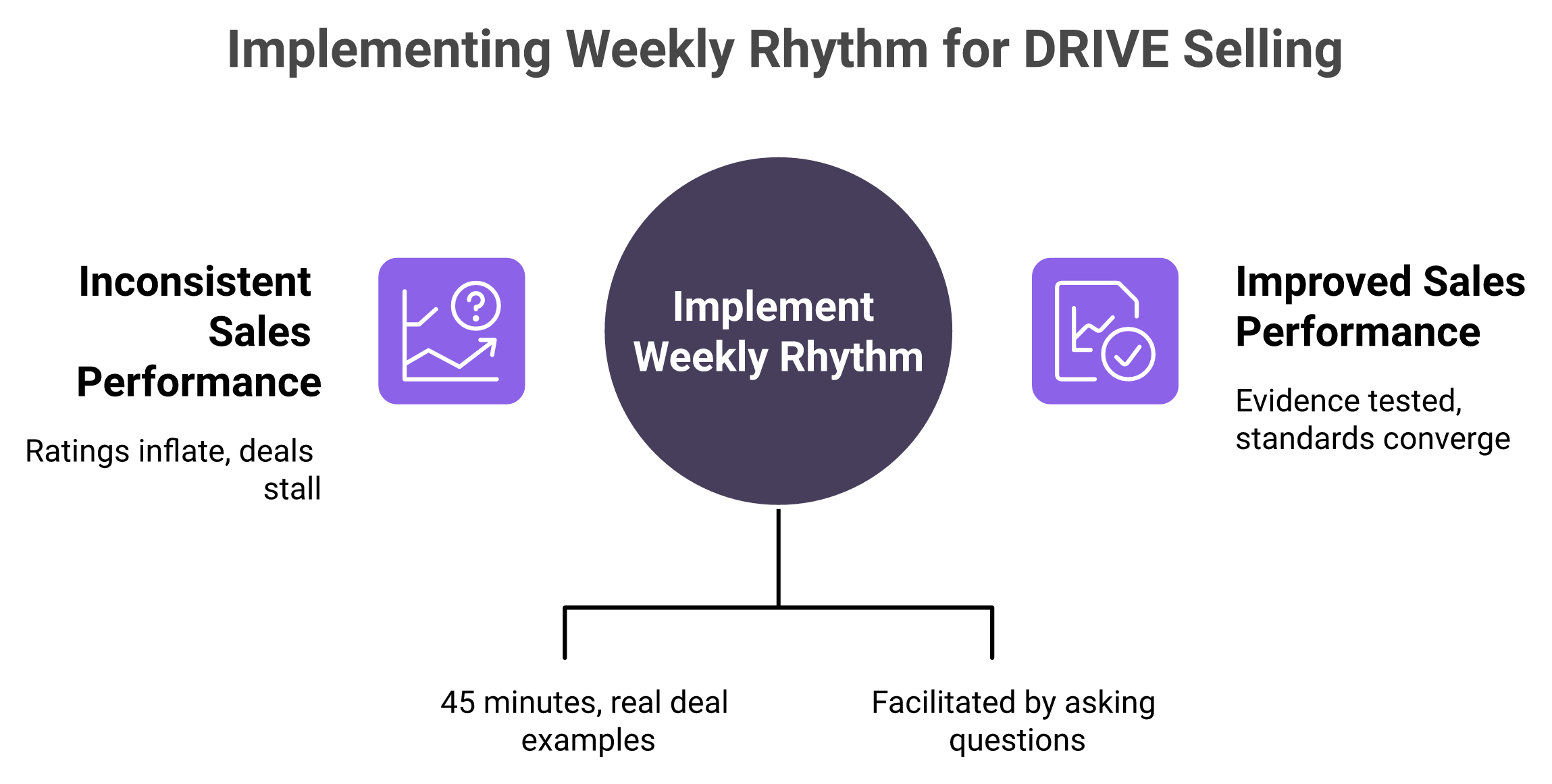
TeamWorx is a 45 minute weekly session where everyone brings a live deal. DealWorx is on demand coaching, run by asking questions rather than giving answers.
Adoption fails when teams buy the framework and skip the rhythm. Gate stages on artifacts, keep the field set small, and automate evidence capture only after the weekly session exists.
Q1. What is the DRIVE sales methodology, and which DRIVE do you actually mean? [toc=1. What DRIVE Is]
DRIVE, as Kraftworx publishes it, is a revenue framework built on five dimensions of the buyer's world: Decision Process, Return, Influencers, Vulnerability, and the Economic Decision Maker. Kraftworx frames it so the whole client facing organisation looks through one lens, instead of the seller working a private checklist. At least three unrelated frameworks share the acronym, so confirm which one your team adopted. And DRIVE is a methodology, not a process. Your stages describe what happens next. DRIVE describes what must be true before it can.
⚠️ The deal review where every field is full and nobody believes it
I have sat in the Thursday commit call where all five DRIVE fields were populated on a 240,000 dollar opportunity. Return said "efficiency gains." Influencers listed one name. The deal slipped two quarters later.
Here is the pattern I keep running into. The fullest qualification records often belong to the reps with the weakest close rates. Completion is a habit. Evidence is a discipline. They are not the same thing, and a CRM cannot tell them apart.
🔍 Four different DRIVEs, one acronym
Before you read anything else about DRIVE, check the source. The term is crowded.
Decision, Resources, Impact, Velocity, Expectations, a deal momentum framework
Sellers qualifying and advancing deals
Sales Growth Team
Determined, Ready, Inspired, Validated, Empowered
Leaders baselining seller readiness
DRIVE Sales System (book)
A five step selling blueprint
Individual readers
This guide covers the Kraftworx framework. If your training deck said "Velocity" or "Determined," you are working from a different system.
📐 Methodology versus process, in three sentences
A sales process is the sequence of stages a deal moves through, from research to signed contract. A methodology is the standard of proof applied inside those stages. Salesforce describes the process as the "what happens next." DRIVE supplies the "what has to be true."
That distinction matters operationally. You can run DRIVE inside a HubSpot pipeline, a Salesforce pipeline, or a spreadsheet. Swapping stage names is not adopting a methodology, and the same holds for any sales process automation project that renames columns without changing the standard of proof.
🤝 If you already run MEDDIC, read this before switching
The honest concession first. DRIVE's five dimensions overlap heavily with MEDDPICC, and Kraftworx does not claim otherwise. Switching costs are real: retraining time, lost pipeline history, and one noisy quarter where nobody trusts the forecast.
So here is the test I hand every VP Sales who asks. What does your methodology ask a manager to do every Tuesday? If the answer is "check that fields are filled," the acronym was never the problem, and no amount of methodology auto scoring fixes an inspection habit that does not exist.
🧩 DRIVE is three parts, and most teams buy one
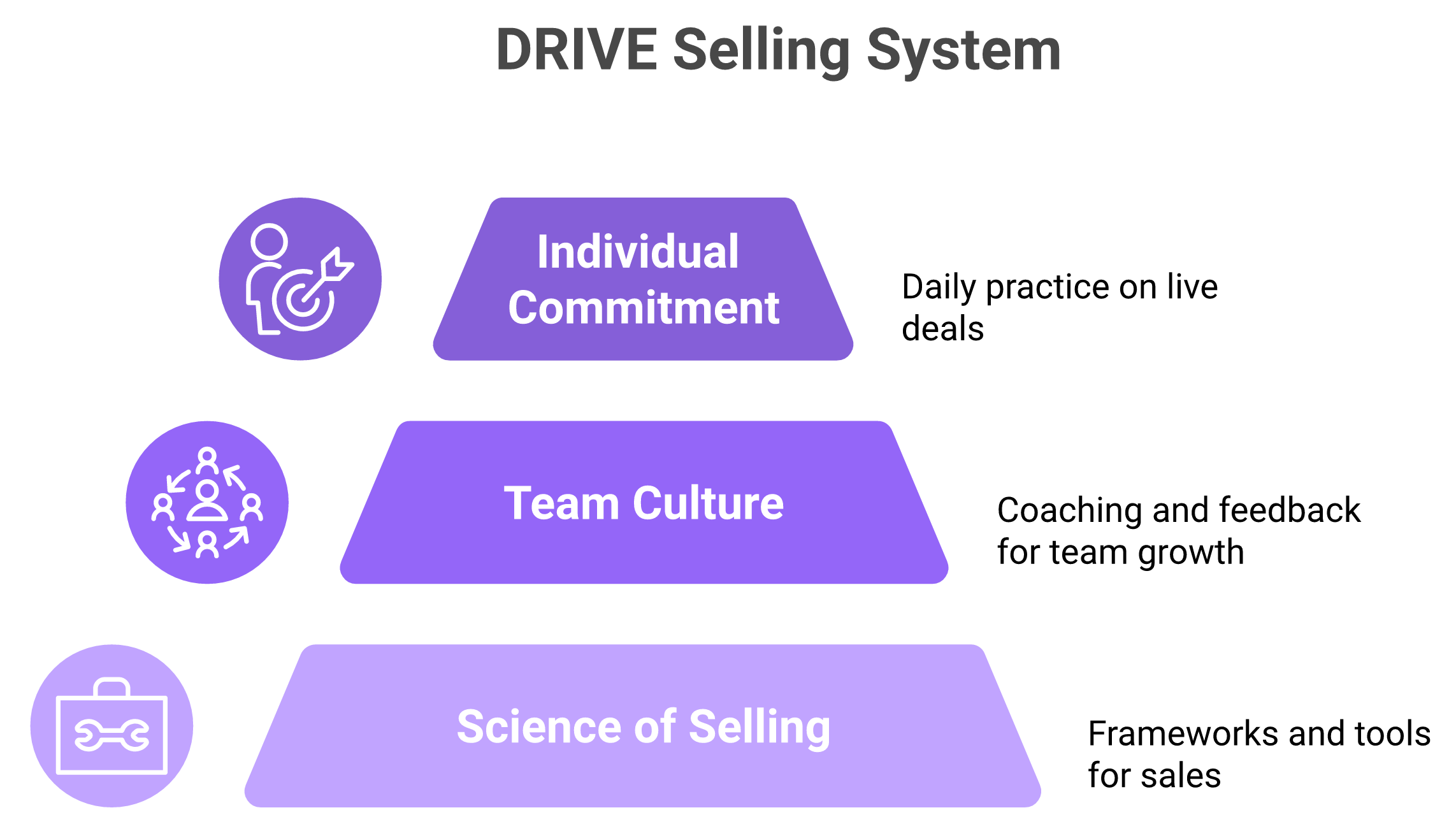
DRIVE has three layers. Most organisations buy the bottom one, run a training day, and then wonder why nothing changed.
Kraftworx's own structure has three layers. The science of selling covers the frameworks, buyer dialogues, and tools. Team culture covers the weekly coaching rhythms. Individual commitment covers daily practice.
Most organisations buy layer one, run a training day, and wait for behaviour to change. Kraftworx puts it more bluntly than most vendors would: sales training changes knowledge, operating systems change behaviour. The rest of this guide is about layers two and three, because that is where rollouts die.
Q2. Is DRIVE just MEDDPICC with different letters? [toc=2. DRIVE vs MEDDIC]
Largely yes at the dimension level, and Kraftworx does not claim otherwise. Decision Process maps to MEDDPICC's Decision Process and Criteria. Return maps to Metrics. Influencers maps to Champion and Competition. Vulnerability maps to risk and implicated pain. Economic Decision Maker maps to Economic Buyer. Convergence suggests the dimensions are correct, not borrowed. What differs is what ships alongside them: a fixed weekly team rhythm, an on demand deal coaching session, and a coaching structure. Most frameworks leave that for the customer to invent.
💸 What switching actually costs you
Retraining 40 reps takes a quarter, not a workshop. You also lose comparability, because historical win rates were scored against old field definitions, so your first two quarters of DRIVE data cannot be benchmarked against anything.
I have watched teams absorb that cost twice in three years. Framework churn is usually a symptom of unmanaged deal reviews, not a diagnosis of the framework. Three methodologies in four years is a cadence problem wearing an acronym costume.
📊 The comparison that matters
Read the bottom row first. That is where the frameworks actually separate.
DRIVE compared with MEDDPICC, SPICED, and BANT
Dimension
DRIVE (Kraftworx)
MEDDPICC
SPICED
BANT
Money
Return, a sized outcome
Metrics, Economic Buyer
Impact
Budget
Buying mechanics
Decision Process
Decision Process, Criteria, Paper Process
Decision
Timeline
People
Influencers, typed as Champion, Coach, or Detractor
Champion, Competition
Situation
Authority
Risk
Vulnerability
Identify Pain, Competition
Critical Event
Need
Weekly ask of a manager
A 45 minute team session with live deals, plus on demand deal coaching
Left to the customer
Left to the customer
Left to the customer
None of these is inferior. MEDDIC, SPICED, BANT, and SPIN all hold up when they are inspected weekly. If you want the field level detail, the MEDDIC guide covers it properly, and the Sandler methodology guide covers a fourth option with a different coaching tradition.
🧾 What operators say about the tooling gap
The friction I hear most is not about letters. It is about evidence landing where the methodology lives.
"limitations of getting data back into salesforce" — Verified reviewer, GongGong G2 Verified Review, 21 May 2026
"The fact that you can't edit a recording (to only share a portion with a client), and the fact that if you stop working with the tool you lose the data" — Verified reviewer, GongGong G2 Verified Review, 19 March 2026
Both reviewers rate the capture itself as genuinely useful. Their complaint is downstream. Conversation intelligence is strong at recording what was said, and weaker at putting that evidence into the opportunity record a manager inspects, which is the same gap described in this breakdown of Gong CRM integration.
✅ The decision rule
If MEDDIC already works in your team, keep it. Steal the rhythm instead of the letters. Book the weekly session, require a live deal per attendee, and gate stage progression on artifacts rather than confidence.
If your last rollout died quietly, the framework choice is the least interesting variable in front of you.
Q3. What do DRIVE's five dimensions ask you to prove? [toc=3. The Five Dimensions]
Each dimension asks for verified fact, not rep opinion. Decision Process: the client's own steps, dates, and per person criteria. Return: a sized outcome, not a benefit statement. Influencers: everyone typed as Champion, Coach, or Detractor, with relationship strength noted. Vulnerability: the named thing that could kill this deal. Economic Decision Maker: who controls the money, and whether you have met them. Kraftworx's own discipline test is the whole method in one line. Assess on fact versus assumption, and ask "and how do I know?" Anything that fails that question is a hypothesis sitting in a required field.
🗺️ D: Decision Process
What it means: the sequence the client uses to buy, in their words. Kraftworx's job aid captures up to five client decision steps with timing, the decider at each step, and that person's criteria.
What satisfies it: dates and names the buyer gave you. The fake version is your own stage plan, copied across. The question that breaks it: what happened the last time your company bought something this size?
💰 R: Return
What it means: the measurable outcome that justifies the spend. Kraftworx sizes this through an impact exercise, where gaps are written as a move from a current state to a target state, rated for importance, then sized numerically.
What satisfies it: a baseline number the buyer said out loud. The fake version is "efficiency gains." The question that breaks it: what is that number today, and who owns it?
👥 I: Influencers
What it means: every person shaping the decision, typed as Champion, Coach, or Detractor, with the strength of your relationship recorded.
Gartner surveyed 632 B2B buyers and found 74 percent of buying teams show unhealthy conflict during the decision. Groups that reached consensus were 2.5 times more likely to call it a high quality deal. Tailoring content to the group lifted consensus, while tailoring to individuals cut it by 59 percent.
The fake version is one champion and four names with no role. The question that breaks it: who in this group disagrees, and about what? Mapping that group properly is the practical value of AI deal intelligence when it works as intended.
⚠️ V: Vulnerability
What it means: the specific thing that could derail the deal, named while you can still act on it.
What satisfies it: a risk with an owner and a mitigation. The fake version is "competition." The question that breaks it: if this dies in 60 days, what killed it? Teams that track this seriously usually pair it with a written approach to deal slippage prevention.
🏦 E: Economic Decision Maker
What it means: the person whose budget this comes from, plus your actual access to them.
What satisfies it: a meeting that happened, with a date. The fake version is a name from LinkedIn. The question that breaks it: when did you last speak with them directly?
⏰ Evidence decays faster than anyone plans for
In my experience, the two most invented fields are the client's decision steps and whether the economic buyer was genuinely met. Both are easy to assert and slow to disprove, which is why CRM data quality automation keeps landing on the RevOps roadmap.
I once reviewed an opportunity rated confident on Return where nobody could name the baseline it improved on. The number came from a slide, not the buyer. That is why the next section is about scoring evidence rather than collecting it.
Q4. What is a DRIVE Xray and how is it scored? [toc=4. Scoring the Xray]
The DRIVE Xray is Kraftworx's opportunity diagnostic, scoring nine statements across two questions. "Will they buy?" covers five: a strong business case, money, a defined decision making process and criteria, a compelling reason to buy, and relationships with key decision makers and influencers. "Will they buy from us?" covers four: technical solution versus competitor, business solution versus competitor, relationship strength, and extra advantage. Each statement is rated LOW (at risk or missing), MEDIUM (needs work or unclear), or HIGH (confident and confirmed), colour coded and scored 1 to 5. Kraftworx states plainly that it is not a one time exercise.
🎯 Two questions that fail for different reasons
Most deals die on the first question and get diagnosed as the second. The quadrant tells you which work is actually needed.
The split is the useful part. "Will they buy?" tests whether a purchase happens at all. "Will they buy from us?" tests whether you win it.
Most deals I have reviewed die on the first question and get diagnosed as the second. Reps report competitive loss. The record shows no funded business case.
📋 What earns a HIGH
The nine DRIVE Xray statements and the evidence that earns a HIGH rating
Statement
Evidence that earns HIGH
Strong business case
A baseline number, stated by the buyer
Money
An identified budget source and amount
Decision process and criteria
Named steps, dates, and criteria per decider
Compelling reason to buy
A dated event that makes inaction costly
Relationships with deciders and influencers
Meetings held, with dates
Technical solution versus competitor
The buyer's own comparison, not yours
Business solution versus competitor
Their stated ranking of outcomes
Relationship strength
Multi threaded contact, not one champion
Extra advantage
Something a competitor cannot match, confirmed by the buyer
Anything rated on inference is a MEDIUM at best. Kraftworx's own guidance applies here: base the assessment on fact versus assumptions.
🔀 Reading the pattern, not the total
HIGH on "will they buy" with LOW on "from us" means compete harder. Bring proof, references, and differentiation.
The reverse is different work. Strong on "from us" and weak on "will they buy" means you are winning a deal that may never fund. Go back to Return and the Economic Decision Maker.
Qualification discipline shows up in conversion data. Benchmark work reported by revenue operations practitioners puts well qualified deals closing near 50 percent against 8 percent for unqualified ones, and gated stage progression converting at 58 to 64 percent versus 28 to 34 percent ungated. Ratings only pay off if they are honest, which is the same premise behind evidence based forecast commits.
⭐ Where scoring quietly breaks
The failure mode nobody documents is inflation the day before a forecast call. Ratings rise because the meeting is uncomfortable, not because evidence arrived.
Two fixes have worked for teams I have watched. Separate the person scoring from the person forecasting. Then make the "and how do I know?" answer spoken aloud, in the room, for every rating that moved. Managers who want a structure for that conversation can borrow from these sales coaching approaches.
🧪 Why keyword tooling is not a rating
Tooling helps, within limits. Reviewers describe conversation intelligence as strong at surfacing themes, and fiddly where configuration and retrieval are concerned.
"I found the AI tracker setup to be quite difficult, especially concerning the user interface when setting up keywords or smart trackers." — Verified reviewer, GongGong G2 Verified Review, 3 October 2025
"Real Time integrations can be time consuming" — Verified reviewer, GongGong G2 Verified Review, 21 April 2026
A keyword firing is not a HIGH. It is a prompt to go and verify one. Re score only when new evidence arrives, and treat a stale Xray as worse than none, because it reads as confidence. For context on what those trackers do and do not measure, see this explainer on Gong smart trackers.
Q5. How do you gather the evidence DRIVE needs from the buyer? [toc=5. Gathering the Evidence]
Two tools carry it. Kraftworx's Client Decision Process map captures up to five of the client's own decision steps, with timing, who decides at each step, and that person's criteria. It also records the Economic Decision Maker, your relationship strength, and every stakeholder typed as Champion, Coach, or Detractor. The Impact Worksheet frames gaps as a move from a current state to a target state, rates importance from 1 to 10, then sizes each gap numerically. That number becomes Return. An unsized gap becomes Vulnerability. Gartner found 74 percent of B2B buying teams show unhealthy conflict during the decision, which a single threaded map hides completely.
⚠️ The champion who promised a signature
Every seller has this deal. Your champion is warm, the demo landed, and she says procurement is "a formality." Then she goes quiet for three weeks.
When she resurfaces, the story has changed. A peer raised concerns about integration risk. Nobody told you, because you only ever spoke to one person.
❌ Why the old map failed
The traditional approach maps your process, not theirs. Discovery notes carry your stage names, your timeline, and one contact's opinion of both. That works when a single buyer signs.
It stops working the moment a group decides. The cost shows up as slipped close dates that nobody can explain, because the record never contained the actual decision path. Structured sales discovery calls are where that path is supposed to get captured.
🔀 What changed on the buyer's side
Buying groups got bigger, and they argue internally. Gartner surveyed 632 B2B buyers and found groups that reached consensus were 2.5 times more likely to call it a high quality purchase.
The tailoring finding is the one that surprised me. Content aimed at the group lifted consensus by around 20 percent. Content aimed at individuals cut it by 59 percent. Personalising harder made things worse.
There is a related trap. Gartner also reports 75 percent of buyers prefer a rep free experience, yet self service buyers are 1.65 times more likely to regret the purchase. Absence is not neutrality, which is why cross channel deal intelligence matters more than call volume alone.
🗺️ Running both tools on one live deal
Take a 180,000 dollar renewal expansion. Walk the decision map first, in the buyer's words, not yours.
Step 1: internal business case, owned by the VP Ops, criteria is payback under 12 months.
Step 2: security review, owned by IT, criteria is SOC 2 evidence.
Step 3: finance approval, owned by the CFO, who you have not met.
Step 4: legal redlines, historically six weeks at this company.
Step 5: signature.
That map alone often surfaces a Detractor you missed. On one deal I reviewed, an IT lead appeared in week seven with a veto nobody had logged.
Then size the gaps. Two candidates usually survive scrutiny, and two collapse.
Sizing gaps on a live deal with the Impact Worksheet
Gap
From
To
Importance
Sized
Manual reconciliation
14 hours weekly
3 hours weekly
9
11 hours weekly, one analyst
Audit prep
6 weeks
2 weeks
7
4 weeks of two people
"Better visibility"
unclear
unclear
8
not sizeable
The third row is the honest one. It cannot be sized, so it is not Return. It is a feeling.
⏰ The two rules that keep it honest
The map is only as current as your last conversation. I re read it before every customer call, and I change it out loud with the buyer when they correct me. Disciplined meeting preparation for sales is what makes that possible.
The second rule is harder on reps. The buyer must say the number, in their own words. If you supplied the arithmetic, you have written a proposal, not an impact case.
A question that consistently opens the real process: describe the last purchase of similar size your company made, and tell me who unblocked it or killed it. You learn the mechanics, not the org chart.
Q6. What does DRIVE's weekly operating rhythm actually look like? [toc=6. TeamWorx and DealWorx]
Two sessions and one coaching structure. TeamWorx, per Kraftworx, is a 45 minute weekly operating rhythm where a team strengthens execution of the DRIVE Selling System through learning, teaching, and coaching. It runs with three roles, a Leader, a Head Teacher, and a Head Coach, and everyone arrives with a real deal example. DealWorx is on demand and flexible in length, facilitated by the sales leader or deal owner "by asking questions, not giving answers." Coaching follows GPS: Goal, Possibilities, Next Steps, Feedback. Neither is a pipeline review. Pipeline reviews ask what is committed. These ask how a dimension was evidenced on a live deal.
📞 The Monday call that is actually a status readout
You know the format. Twelve deals, two minutes each, and a manager typing while a rep recites the close date they already entered.
Nobody learns anything. The rep repeats the record, the manager adjusts the forecast, and the same deal appears next week with the same date.
❌ Why the training day model failed
Sales training changes what people know. It does not change what people do on Thursday afternoon. Applied reps are what move skill, and a workshop gives you one.
The cost is uneven deal quality across a team using identical fields. Two AEs score the same opportunity differently because nobody ever coached the standard, which is the gap that sales coaching skill gap analysis is meant to close.
Gong's own guidance on rolling out methodologies lands in the same place. Reinforcement, not selection, decides whether it sticks.
🔁 The shift: skill work gets a slot
The dimensions are not what separates methodologies. The weekly ask on a manager's calendar is.
The change is structural and boring. Skill development moves out of onboarding and into a protected weekly 45 minutes.
Rotating the Head Teacher role to reps is the part I would not skip. Teaching a dimension exposes, quickly and kindly, who cannot apply it. It also shortens new hire ramp time, because standards get demonstrated instead of described.
⏰ A workable 45 minutes
10 minutes: one dimension taught by the Head Teacher, using a real deal.
20 minutes: one live opportunity coached by the Head Coach.
10 minutes: commitments, named and dated.
5 minutes: what the Leader will remove or unblock.
DealWorx is the escalation, not the routine. Call one when an Xray rating drops, when a Detractor appears, when the Economic Decision Maker changes, or when a deal passes your stall threshold.
Inside it, GPS gives the manager a script. Goal: what do you want true by Friday? Possibilities: what are three ways in, and which have you tested? Next Steps: who does what, by when? Feedback: what did I see you do well, and what would I change?
One measurement keeps managers honest here. Count your own talk time. Above 40 percent, it was not coaching, and active listening in sales applies to managers as much as to reps.
🧾 What reviewers say about tooling in this loop
Conversation intelligence genuinely helps this rhythm. Reviewers are clear about where it helps most.
"Good for tracking deals, account engagement overall, divided transcript and accurate AI highlights for calls." — Verified reviewer, GongGong G2 Verified Review, 9 June 2025
"I also find the AI tracker's ability to identify common themes across different recordings, even those not from my department, very useful." — Verified reviewer, GongGong G2 Verified Review, 3 October 2025
Both reviewers describe surfacing, which is real value. Neither describes coaching. A theme is an input to a DealWorx, not a substitute for one, and that distinction is the heart of revenue intelligence versus conversation intelligence.
💰 The honest cost
This is management time, every week, permanently. No tool buys it for you.
If leadership will not defend 45 minutes on a manager's calendar, do not roll out DRIVE. You will get the field set and none of the behaviour.
Q7. How do you gate your stages and design the CRM fields for DRIVE? [toc=7. Stage Gates and Fields]
Gate each stage on one dimension's artifact, not on a completion percentage. A defensible pattern: no Stage 2 without a sized Return, no Stage 3 without a mapped decision process and a named Economic Decision Maker, and no commit without a dated critical event plus a current Xray. Practitioner benchmarks support the discipline. Gated stage progression converts at 58 to 64 percent against 28 to 34 percent ungated, well qualified deals close near 50 percent against 8 percent, and 72 percent of mid to late stage deals stall for 60 days or longer. Keep the field set small enough that reps actually finish it.
✅ A gate is an artifact, not a checkbox
A checkbox records an opinion. An artifact can be read by someone who was not on the call.
That is the whole design principle. If a manager cannot verify a gate without asking the rep, it is not a gate.
📋 The gate map
Stage gates mapped to DRIVE dimensions and required artifacts
Stage
Gating dimension
Required artifact
Who verifies
Stage 2
Return
Sized gap with a buyer stated baseline
Manager, in TeamWorx
Stage 3
Decision Process and Economic Decision Maker
Decision map with dates, plus a logged EDM meeting
Manager
Stage 4
Influencers and Vulnerability
Stakeholder types, one named risk with an owner
Manager
Commit
All five, current Xray
Dated critical event and a re scored Xray
Leader plus RevOps
Notice what is missing. There is no percentage, and no "verbal commit" field. Those are forecasting artefacts, and they belong to a different conversation about evidence based forecast commits.
🗂️ A minimum field schema
Eight fields is usually enough for DRIVE inside Salesforce or HubSpot.
Return, sized (currency or hours).
Return baseline source (who said it).
Decision steps with dates (long text or child records).
Economic Decision Maker (contact lookup).
Last EDM meeting date.
Influencer types (Champion, Coach, Detractor).
Named vulnerability plus owner.
Xray rating and date scored.
Trimming matters more than adding. In LinkedIn's State of Sales research, 48 percent of sellers named incomplete data as their biggest data challenge, and 41 percent named inaccurate CRM data. Long schemas produce both, which is the practical case for CRM data quality automation.
My rule is mechanical. Every gate you add must remove a field somewhere else. Schemas die by accretion, and the field set that fails is always the one that grew for three quarters and was never pruned.
⏰ Inspection thresholds that hold
Inspect by deal size, not by rep anxiety. Practitioner frameworks put weekly inspection on deals above roughly 50,000 dollars in annual contract value, with a lighter monthly pass below that.
Coverage ratios make the gates meaningful. Commonly cited targets are about 3 times quota for SMB, 4 times for mid market, and 5 to 6 times for enterprise, where "qualified" means gated, not hopeful. Most teams read those ratios inside sales pipeline software rather than a spreadsheet.
The complaint I hear in every implementation review is not about the fields. It is about evidence not reaching them.
"flows are hard to get into, information is not readily available" — Verified reviewer, GongGong G2 Verified Review, 9 June 2025
"limitations of getting data back into salesforce" — Verified reviewer, GongGong G2 Verified Review, 21 May 2026
Gates only work if the artifact lands in the record. A gate whose evidence lives in a separate tool is a gate your managers will quietly stop checking, which is the recurring theme in reporting on Gong Salesforce integrations.
Q8. How do you make DRIVE stick after the training week? [toc=8. Making It Stick]
Treat DRIVE as three parts. The science of selling is the frameworks, buyer dialogues, and tools. Team culture is the art of winning faster, which is the TeamWorx and coaching rhythm. Individual commitment is the engine, the daily practice. Kraftworx's reinforcement discipline is simply lead, teach, coach. Adoption fails because organisations buy part one, run a training day, and expect behaviour to change. Sequence it instead. Weeks 1 to 4, evidence standards on live deals only. Weeks 5 to 8, the weekly rhythm protected on calendars. Weeks 9 to 12, Xray ratings gating stage progression. If only part one gets approved, say plainly that it will not hold.
🧩 One part bought, three parts needed
Most rollouts I have watched purchase the framework and the workshop. The rhythm and the daily practice are treated as culture, which means nobody owns them.
Kraftworx says it directly: sales training changes knowledge, operating systems change behaviour. That is not marketing copy. It is a diagnosis of why the last rollout died.
💸 What a part one rollout costs
Fields without inspection rot on a predictable schedule. Validity's 2025 State of CRM Data Management surveyed 602 CRM users, and 76 percent said less than half their data is accurate and complete.
The same research puts the cost at an average of 16 deals lost per quarter, and 45 percent said their data is not ready for AI use. Your methodology inherits that decay the day you stop looking, which is why a CRM data strategy belongs in the rollout plan.
🔁 The reinforcement cadence is the product
This is the part that changed my thinking. The framework is commodity, and the inspection loop is the asset.
Lead means leadership shows up to the session. Teach means someone explains one dimension using a live deal. Coach means a manager asks questions until evidence appears or does not. At scale, that is the same problem addressed by coaching at scale.
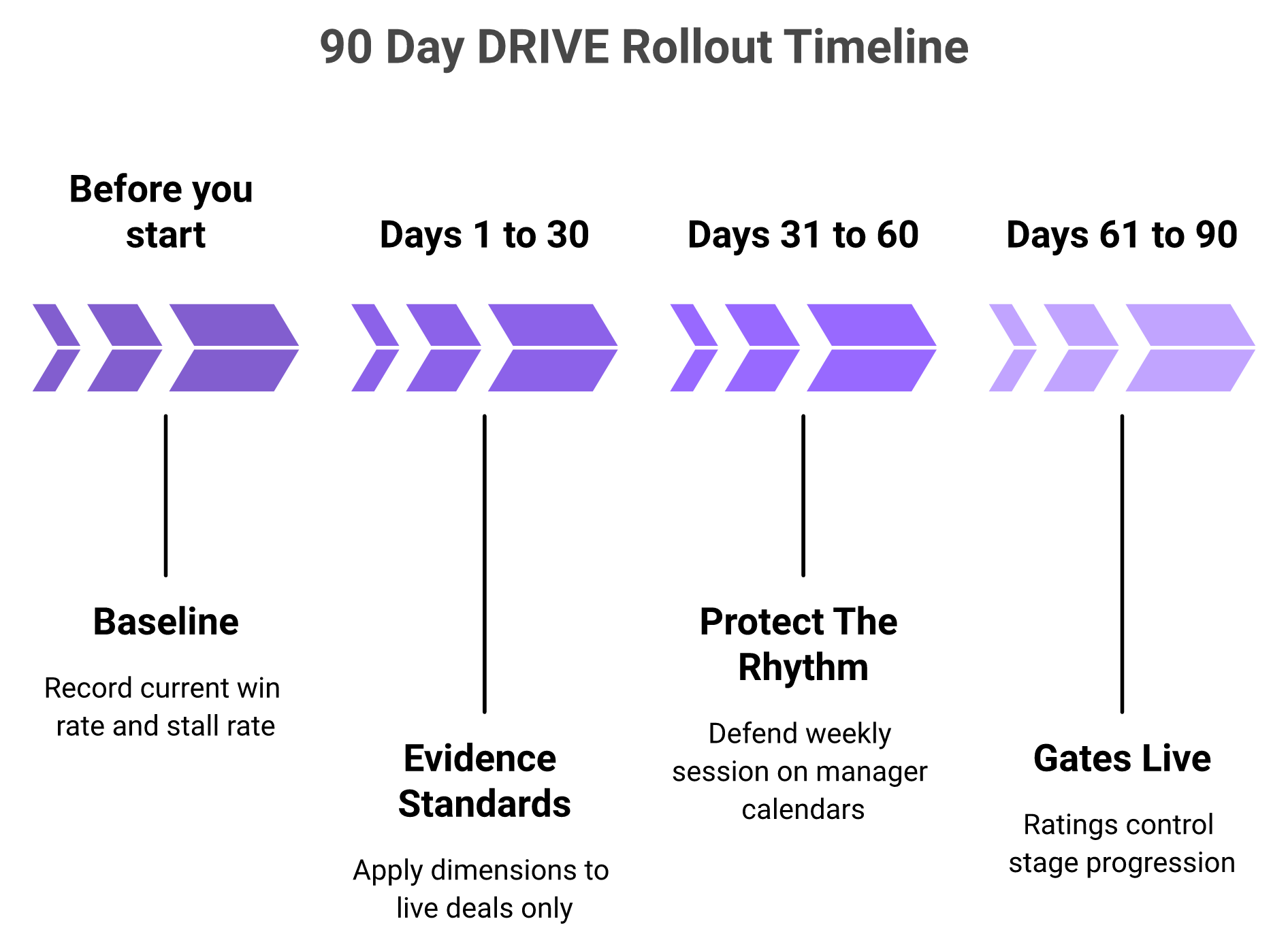
⏰ A 30, 60, 90 sequence with one metric each
Sequence the rollout and measure one thing per phase, or you will never know whether the methodology moved anything.
Days 1 to 30: evidence standards only. Metric, percentage of Stage 3 deals with a buyer stated Return baseline.
Days 31 to 60: rhythm protected. Metric, weekly session attendance and live deals brought per attendee.
Days 61 to 90: gates live. Metric, percentage of commit deals with an Xray re scored inside 14 days.
Baseline before you start. Median win rates in recent B2B benchmarks sit around 19 to 21 percent, with quota attainment near 24 to 31 percent. Without your own starting number, you cannot prove the methodology did anything, and the same logic governs sales forecast accuracy claims.
🧾 What reviewers reveal about durability
Read tooling reviews with an eye for lock in and retrieval, because your methodology evidence lives inside these systems.
"the fact that if you stop working with the tool you lose the data" — Verified reviewer, GongGong G2 Verified Review, 19 March 2026
"I cannot download all the data myself unless we upgrade the plan, which isn't ideal and results in me not fully utilizing Gong." — Verified reviewer, GongGong G2 Verified Review, 3 October 2025
Both reviewers like the product and still flag the exit problem. Ask your vendor for an export path before you make their record the home of your qualification evidence, a question worth settling early in any mid market revenue AI evaluation.
⚠️ The autopsy nobody writes down
Adoption rarely dies in month one. It dies in quarter two, when the manager who championed it cancels the weekly session twice for board prep.
So protect the slot in that manager's performance conversation, not only on the calendar. And if leadership will not fund the time, say the uncomfortable thing out loud. DRIVE without the rhythm is a field set, and a field set decays exactly like the last one.
Q9. Where does DRIVE apply after the deal closes? [toc=9. Beyond the Close]
The same five dimensions describe a renewal or an expansion as accurately as a new deal. That is why Kraftworx positions DRIVE across the whole client facing organisation, not sales alone. At handoff, the decision map becomes the onboarding stakeholder plan. Return becomes the success metric customer success reports against. Vulnerability becomes churn risk. The Economic Decision Maker is the person whose budget renews. Most organisations rebuild all four from scratch after closed won, which is why the value story promised during the sale rarely survives the first quarterly review.
📞 The kickoff call nobody enjoys
Picture the implementation lead on day three. She asks the AE a simple question. What did they actually buy this for?
The answer arrives as a link to a proposal and a Slack thread. Two weeks later, the customer states a different goal, and nobody notices the gap until renewal. Mapping that transition properly is the work behind B2B customer journey mapping.
❌ What the traditional handoff costs
A closed won record captures price, term, and signature date. It does not capture the baseline number the buyer said out loud, or which stakeholder resisted.
So customer success invents its own success metric. By month nine, the company is measuring something the buyer never asked for. Renewal then becomes a negotiation about value that was never defined, which is exactly where customer success enablement either holds or fails.
Maestro Group makes a similar point about qualification information being reusable rather than disposable, and the logic holds after signature just as well.
🔁 The shift: one record, four owners
The change is not a new framework. It is refusing to restart the evidence.
Kraftworx frames DRIVE as an operating system that marketing, sales, account management, customer success, and leadership all read through. That only works if the artifacts move with the account, which is the practical argument for integrated revenue intelligence across CRM, Slack, and email.
🗂️ Translating each dimension after the close
How each DRIVE dimension translates after closed won
Dimension
Post close meaning
Who owns it
What it becomes
Decision Process
The client's internal approval and rollout path
Onboarding lead
Stakeholder and milestone plan
Return
The number the buyer stated
Customer success
The success metric in the QBR
Influencers
Champion, Coach, or Detractor across the account
Account manager
Multi threading and exec sponsor map
Vulnerability
Named risk to value realisation
Customer success
Churn risk with an owner
Economic Decision Maker
Whoever holds the renewal budget
Account manager
Relationship plan before renewal
Expansion uses the same map in reverse. A new business unit means a new decision process, a new economic buyer, and a new Return to size. Treat it as a fresh opportunity, not a bigger invoice.
⭐ The one dimension that must survive verbatim
Return is the handoff. If customer success restates the number differently from the proposal, the renewal conversation is already compromised.
I have watched this quietly wreck otherwise healthy accounts. Sales sold 11 hours a week of reclaimed analyst time. Customer success reported adoption rates instead. The customer heard two different companies, and that is the pattern behind most customer retention failures at renewal.
✅ The governance rule worth enforcing
Whoever owns the account owns the Xray. Ownership transfers at handoff, along with the ratings and the evidence behind them.
Set one date and hold it. The first post go live re score happens within 30 days, with the customer in the room for the Return check. If the number has changed, you want to know in month one, not in month ten.
Q10. What should AI do in a DRIVE process, and what must stay human? [toc=10. AI and Judgement]
AI is credible at capture and poor at conviction. Transcription, populating fields from what was actually said, and flagging when a rating contradicts the latest call are mechanical tasks. Deciding whether a stated business case is real, whether a Detractor can be turned, or whether to walk away is judgement. Kraftworx puts the boundary plainly: AI can write the email, qualify the lead, and book the meeting, and none of those closes the deal. Before automating anything, settle recording consent in two party consent jurisdictions, your GDPR lawful basis and retention period, the SOC 2 scope of whoever stores transcripts, and autonomy limits under the EU AI Act.
🔀 Mechanical versus judgement, dimension by dimension
Which parts of DRIVE are safe to automate, and which stay human
Dimension
Safe to automate
Stays human
Decision Process
Extracting named steps and dates from calls
Deciding whether the path is credible
Return
Capturing the number and who said it
Judging whether the buyer can fund it
Influencers
Listing who spoke and how often
Typing someone as a Detractor
Vulnerability
Flagging risk language and silence
Deciding whether to escalate or exit
Economic Decision Maker
Logging whether a meeting happened
Deciding you have real access
Read the right column again. Every item is a judgement a manager gets paid to make. Everything in the left column is what generative AI in sales is genuinely good at today.
⏰ Most teams have the tool, not the habit
Adoption data shows the split clearly. Compiled 2026 figures put roughly 55 to 60 percent of sales organisations using AI tooling, while only around 28 to 32 percent have it embedded in daily workflow.
That gap is the story of the category. Deployment is a purchase. Embedding is a management practice, and it looks a lot like the weekly rhythm described earlier, which is the honest framing in this look at what AI agents can actually do today.
⚠️ Four things to settle before you automate evidence
Consent. In two party consent regions, everyone on the call must agree to recording. Build the disclosure into the invite, not the small print.
Lawful basis and retention. Under GDPR, decide why you hold transcripts and for how long, then actually delete them on schedule.
Vendor scope. Ask which entity stores audio, and whether the SOC 2 report covers that system or only the parent product.
Autonomy limits. Where agents act without a human approving each step, the EU AI Act pushes you toward documented oversight. Decide now which actions require a person.
Buyers care about this more than vendors admit. Gartner reports 75 percent of buyers prefer a rep free experience, yet self service buyers are 1.65 times more likely to regret the purchase. Trust is part of the product, and it belongs in any AI governance and risk evaluation.
❌ The honest limit
Automation raises field completeness. It does not raise deal judgement.
A team that outsources the second one will forecast worse, not better, because confident records hide thin evidence. That is the failure mode I would watch for in any rollout, and it is why forecast accuracy work starts with evidence standards rather than models.
⭐ What automation actually removes
It removes the excuse. Once fields populate themselves, a LOW rating becomes a management decision rather than a data entry failure.
Some teams quietly resist that, and I understand why. Visible weakness is uncomfortable. It is also the only starting point for coaching that works.
Q11. Can DRIVE be scored automatically from sales calls? [toc=11. Automating DRIVE Scoring]
Partly, and the distinction matters. Oliv AI's methodology tracking supports MEDDPICC, MEDDIC, BANT, SPIN, SPICED, DRIVE, or a custom qualification process, included in its Sell tier and above through the Forecast app, verified on oliv.ai/pricing on 19 September 2026. The mechanism that matters for DRIVE is where field values come from. Qualification evidence is derived from what was said on recorded calls rather than from rep recall, and DRIVE's accuracy depends entirely on the evidence captured in its tools. What no software does is run TeamWorx. Judgement, coaching, and the "and how do I know?" test stay human.
✅ What automation can genuinely do
Three things hold up in practice. Extraction of stated numbers and dates, detection of new stakeholders appearing on calls, and flagging contradictions between a rating and the latest conversation.
That is useful because it attacks decay, which is the real enemy from earlier in this guide. The mechanics of auto scoring qualification fields are covered properly in this piece on methodology automation, and the agent side of that work sits with Oliv AI agents for sales teams.
⚠️ What operators report
Reviews are the most useful evidence here, including the critical ones.
"It's incredibly helpful with our custom sales methodologies like MEDIC-BAND, as it helps me fill all of them out." — Verified reviewer, Oliv AIOliv AI G2 Verified Review, 15 June 2026
"we've seen better CRM hygiene, less administrative overhead, and more consistent execution across our customer-facing teams." — Verified reviewer, Oliv AIOliv AI G2 Verified Review, 23 June 2026
"I'd love to see few more options to customize dashboards and reports for different teams." — Verified reviewer, Oliv AIOliv AI G2 Verified Review, 26 June 2026
Read all three together. Field population and hygiene show up repeatedly. Reporting flexibility is the recurring gap, and that is a fair criticism.
❌ The limits, stated plainly
Kraftworx built DRIVE. Oliv AI does not own, co author, or endorse it, and other tools may support it too.
Oliv AI is the least publicly proven vendor named on this page, with no TrustRadius or Capterra presence and case studies that are email gated.
No DRIVE specific win rate or forecast accuracy statistic exists anywhere, from any source. Anyone quoting one is guessing.
Oliv AI is a poor fit for buyers who only want call recording, for B2C support teams, and for anyone unwilling to run a weekly coaching session.
Pricing is published rather than quoted, which matters when you are budgeting a rollout: Amplify at 0 dollars, Converse at 19, Sell at 49, and Grow at 79 per seat, with agent actions billed separately. Security posture is public too, including SOC 2 Type II, GDPR and CCPA compliance, and an open export policy at trust.oliv.ai. Teams comparing that against an incumbent renewal usually start with stack consolidation costs.
⭐ Where I would put the money first
Oliv AI's read, and mine, is that sequencing beats tooling here. Book the 45 minutes before you buy anything, because a rhythm without software still works and software without a rhythm does not.
Then automate the evidence, so your managers spend the session arguing about judgement instead of chasing fields. A methodology is a weekly rhythm, not a field set. If you want to see what automated qualification evidence looks like against your own pipeline, look at how Oliv AI works for a head of sales and bring one live deal to the conversation.
Q1. What is the DRIVE sales methodology, and which DRIVE do you actually mean? [toc=1. What DRIVE Is]
DRIVE, as Kraftworx publishes it, is a revenue framework built on five dimensions of the buyer's world: Decision Process, Return, Influencers, Vulnerability, and the Economic Decision Maker. Kraftworx frames it so the whole client facing organisation looks through one lens, instead of the seller working a private checklist. At least three unrelated frameworks share the acronym, so confirm which one your team adopted. And DRIVE is a methodology, not a process. Your stages describe what happens next. DRIVE describes what must be true before it can.
⚠️ The deal review where every field is full and nobody believes it
I have sat in the Thursday commit call where all five DRIVE fields were populated on a 240,000 dollar opportunity. Return said "efficiency gains." Influencers listed one name. The deal slipped two quarters later.
Here is the pattern I keep running into. The fullest qualification records often belong to the reps with the weakest close rates. Completion is a habit. Evidence is a discipline. They are not the same thing, and a CRM cannot tell them apart.
🔍 Four different DRIVEs, one acronym
Before you read anything else about DRIVE, check the source. The term is crowded.
Decision, Resources, Impact, Velocity, Expectations, a deal momentum framework
Sellers qualifying and advancing deals
Sales Growth Team
Determined, Ready, Inspired, Validated, Empowered
Leaders baselining seller readiness
DRIVE Sales System (book)
A five step selling blueprint
Individual readers
This guide covers the Kraftworx framework. If your training deck said "Velocity" or "Determined," you are working from a different system.
📐 Methodology versus process, in three sentences
A sales process is the sequence of stages a deal moves through, from research to signed contract. A methodology is the standard of proof applied inside those stages. Salesforce describes the process as the "what happens next." DRIVE supplies the "what has to be true."
That distinction matters operationally. You can run DRIVE inside a HubSpot pipeline, a Salesforce pipeline, or a spreadsheet. Swapping stage names is not adopting a methodology, and the same holds for any sales process automation project that renames columns without changing the standard of proof.
🤝 If you already run MEDDIC, read this before switching
The honest concession first. DRIVE's five dimensions overlap heavily with MEDDPICC, and Kraftworx does not claim otherwise. Switching costs are real: retraining time, lost pipeline history, and one noisy quarter where nobody trusts the forecast.
So here is the test I hand every VP Sales who asks. What does your methodology ask a manager to do every Tuesday? If the answer is "check that fields are filled," the acronym was never the problem, and no amount of methodology auto scoring fixes an inspection habit that does not exist.
🧩 DRIVE is three parts, and most teams buy one
DRIVE has three layers. Most organisations buy the bottom one, run a training day, and then wonder why nothing changed.
Kraftworx's own structure has three layers. The science of selling covers the frameworks, buyer dialogues, and tools. Team culture covers the weekly coaching rhythms. Individual commitment covers daily practice.
Most organisations buy layer one, run a training day, and wait for behaviour to change. Kraftworx puts it more bluntly than most vendors would: sales training changes knowledge, operating systems change behaviour. The rest of this guide is about layers two and three, because that is where rollouts die.
Q2. Is DRIVE just MEDDPICC with different letters? [toc=2. DRIVE vs MEDDIC]
Largely yes at the dimension level, and Kraftworx does not claim otherwise. Decision Process maps to MEDDPICC's Decision Process and Criteria. Return maps to Metrics. Influencers maps to Champion and Competition. Vulnerability maps to risk and implicated pain. Economic Decision Maker maps to Economic Buyer. Convergence suggests the dimensions are correct, not borrowed. What differs is what ships alongside them: a fixed weekly team rhythm, an on demand deal coaching session, and a coaching structure. Most frameworks leave that for the customer to invent.
💸 What switching actually costs you
Retraining 40 reps takes a quarter, not a workshop. You also lose comparability, because historical win rates were scored against old field definitions, so your first two quarters of DRIVE data cannot be benchmarked against anything.
I have watched teams absorb that cost twice in three years. Framework churn is usually a symptom of unmanaged deal reviews, not a diagnosis of the framework. Three methodologies in four years is a cadence problem wearing an acronym costume.
📊 The comparison that matters
Read the bottom row first. That is where the frameworks actually separate.
DRIVE compared with MEDDPICC, SPICED, and BANT
Dimension
DRIVE (Kraftworx)
MEDDPICC
SPICED
BANT
Money
Return, a sized outcome
Metrics, Economic Buyer
Impact
Budget
Buying mechanics
Decision Process
Decision Process, Criteria, Paper Process
Decision
Timeline
People
Influencers, typed as Champion, Coach, or Detractor
Champion, Competition
Situation
Authority
Risk
Vulnerability
Identify Pain, Competition
Critical Event
Need
Weekly ask of a manager
A 45 minute team session with live deals, plus on demand deal coaching
Left to the customer
Left to the customer
Left to the customer
None of these is inferior. MEDDIC, SPICED, BANT, and SPIN all hold up when they are inspected weekly. If you want the field level detail, the MEDDIC guide covers it properly, and the Sandler methodology guide covers a fourth option with a different coaching tradition.
🧾 What operators say about the tooling gap
The friction I hear most is not about letters. It is about evidence landing where the methodology lives.
"limitations of getting data back into salesforce" — Verified reviewer, GongGong G2 Verified Review, 21 May 2026
"The fact that you can't edit a recording (to only share a portion with a client), and the fact that if you stop working with the tool you lose the data" — Verified reviewer, GongGong G2 Verified Review, 19 March 2026
Both reviewers rate the capture itself as genuinely useful. Their complaint is downstream. Conversation intelligence is strong at recording what was said, and weaker at putting that evidence into the opportunity record a manager inspects, which is the same gap described in this breakdown of Gong CRM integration.
✅ The decision rule
If MEDDIC already works in your team, keep it. Steal the rhythm instead of the letters. Book the weekly session, require a live deal per attendee, and gate stage progression on artifacts rather than confidence.
If your last rollout died quietly, the framework choice is the least interesting variable in front of you.
Q3. What do DRIVE's five dimensions ask you to prove? [toc=3. The Five Dimensions]
Each dimension asks for verified fact, not rep opinion. Decision Process: the client's own steps, dates, and per person criteria. Return: a sized outcome, not a benefit statement. Influencers: everyone typed as Champion, Coach, or Detractor, with relationship strength noted. Vulnerability: the named thing that could kill this deal. Economic Decision Maker: who controls the money, and whether you have met them. Kraftworx's own discipline test is the whole method in one line. Assess on fact versus assumption, and ask "and how do I know?" Anything that fails that question is a hypothesis sitting in a required field.
🗺️ D: Decision Process
What it means: the sequence the client uses to buy, in their words. Kraftworx's job aid captures up to five client decision steps with timing, the decider at each step, and that person's criteria.
What satisfies it: dates and names the buyer gave you. The fake version is your own stage plan, copied across. The question that breaks it: what happened the last time your company bought something this size?
💰 R: Return
What it means: the measurable outcome that justifies the spend. Kraftworx sizes this through an impact exercise, where gaps are written as a move from a current state to a target state, rated for importance, then sized numerically.
What satisfies it: a baseline number the buyer said out loud. The fake version is "efficiency gains." The question that breaks it: what is that number today, and who owns it?
👥 I: Influencers
What it means: every person shaping the decision, typed as Champion, Coach, or Detractor, with the strength of your relationship recorded.
Gartner surveyed 632 B2B buyers and found 74 percent of buying teams show unhealthy conflict during the decision. Groups that reached consensus were 2.5 times more likely to call it a high quality deal. Tailoring content to the group lifted consensus, while tailoring to individuals cut it by 59 percent.
The fake version is one champion and four names with no role. The question that breaks it: who in this group disagrees, and about what? Mapping that group properly is the practical value of AI deal intelligence when it works as intended.
⚠️ V: Vulnerability
What it means: the specific thing that could derail the deal, named while you can still act on it.
What satisfies it: a risk with an owner and a mitigation. The fake version is "competition." The question that breaks it: if this dies in 60 days, what killed it? Teams that track this seriously usually pair it with a written approach to deal slippage prevention.
🏦 E: Economic Decision Maker
What it means: the person whose budget this comes from, plus your actual access to them.
What satisfies it: a meeting that happened, with a date. The fake version is a name from LinkedIn. The question that breaks it: when did you last speak with them directly?
⏰ Evidence decays faster than anyone plans for
In my experience, the two most invented fields are the client's decision steps and whether the economic buyer was genuinely met. Both are easy to assert and slow to disprove, which is why CRM data quality automation keeps landing on the RevOps roadmap.
I once reviewed an opportunity rated confident on Return where nobody could name the baseline it improved on. The number came from a slide, not the buyer. That is why the next section is about scoring evidence rather than collecting it.
Q4. What is a DRIVE Xray and how is it scored? [toc=4. Scoring the Xray]
The DRIVE Xray is Kraftworx's opportunity diagnostic, scoring nine statements across two questions. "Will they buy?" covers five: a strong business case, money, a defined decision making process and criteria, a compelling reason to buy, and relationships with key decision makers and influencers. "Will they buy from us?" covers four: technical solution versus competitor, business solution versus competitor, relationship strength, and extra advantage. Each statement is rated LOW (at risk or missing), MEDIUM (needs work or unclear), or HIGH (confident and confirmed), colour coded and scored 1 to 5. Kraftworx states plainly that it is not a one time exercise.
🎯 Two questions that fail for different reasons
Most deals die on the first question and get diagnosed as the second. The quadrant tells you which work is actually needed.
The split is the useful part. "Will they buy?" tests whether a purchase happens at all. "Will they buy from us?" tests whether you win it.
Most deals I have reviewed die on the first question and get diagnosed as the second. Reps report competitive loss. The record shows no funded business case.
📋 What earns a HIGH
The nine DRIVE Xray statements and the evidence that earns a HIGH rating
Statement
Evidence that earns HIGH
Strong business case
A baseline number, stated by the buyer
Money
An identified budget source and amount
Decision process and criteria
Named steps, dates, and criteria per decider
Compelling reason to buy
A dated event that makes inaction costly
Relationships with deciders and influencers
Meetings held, with dates
Technical solution versus competitor
The buyer's own comparison, not yours
Business solution versus competitor
Their stated ranking of outcomes
Relationship strength
Multi threaded contact, not one champion
Extra advantage
Something a competitor cannot match, confirmed by the buyer
Anything rated on inference is a MEDIUM at best. Kraftworx's own guidance applies here: base the assessment on fact versus assumptions.
🔀 Reading the pattern, not the total
HIGH on "will they buy" with LOW on "from us" means compete harder. Bring proof, references, and differentiation.
The reverse is different work. Strong on "from us" and weak on "will they buy" means you are winning a deal that may never fund. Go back to Return and the Economic Decision Maker.
Qualification discipline shows up in conversion data. Benchmark work reported by revenue operations practitioners puts well qualified deals closing near 50 percent against 8 percent for unqualified ones, and gated stage progression converting at 58 to 64 percent versus 28 to 34 percent ungated. Ratings only pay off if they are honest, which is the same premise behind evidence based forecast commits.
⭐ Where scoring quietly breaks
The failure mode nobody documents is inflation the day before a forecast call. Ratings rise because the meeting is uncomfortable, not because evidence arrived.
Two fixes have worked for teams I have watched. Separate the person scoring from the person forecasting. Then make the "and how do I know?" answer spoken aloud, in the room, for every rating that moved. Managers who want a structure for that conversation can borrow from these sales coaching approaches.
🧪 Why keyword tooling is not a rating
Tooling helps, within limits. Reviewers describe conversation intelligence as strong at surfacing themes, and fiddly where configuration and retrieval are concerned.
"I found the AI tracker setup to be quite difficult, especially concerning the user interface when setting up keywords or smart trackers." — Verified reviewer, GongGong G2 Verified Review, 3 October 2025
"Real Time integrations can be time consuming" — Verified reviewer, GongGong G2 Verified Review, 21 April 2026
A keyword firing is not a HIGH. It is a prompt to go and verify one. Re score only when new evidence arrives, and treat a stale Xray as worse than none, because it reads as confidence. For context on what those trackers do and do not measure, see this explainer on Gong smart trackers.
Q5. How do you gather the evidence DRIVE needs from the buyer? [toc=5. Gathering the Evidence]
Two tools carry it. Kraftworx's Client Decision Process map captures up to five of the client's own decision steps, with timing, who decides at each step, and that person's criteria. It also records the Economic Decision Maker, your relationship strength, and every stakeholder typed as Champion, Coach, or Detractor. The Impact Worksheet frames gaps as a move from a current state to a target state, rates importance from 1 to 10, then sizes each gap numerically. That number becomes Return. An unsized gap becomes Vulnerability. Gartner found 74 percent of B2B buying teams show unhealthy conflict during the decision, which a single threaded map hides completely.
⚠️ The champion who promised a signature
Every seller has this deal. Your champion is warm, the demo landed, and she says procurement is "a formality." Then she goes quiet for three weeks.
When she resurfaces, the story has changed. A peer raised concerns about integration risk. Nobody told you, because you only ever spoke to one person.
❌ Why the old map failed
The traditional approach maps your process, not theirs. Discovery notes carry your stage names, your timeline, and one contact's opinion of both. That works when a single buyer signs.
It stops working the moment a group decides. The cost shows up as slipped close dates that nobody can explain, because the record never contained the actual decision path. Structured sales discovery calls are where that path is supposed to get captured.
🔀 What changed on the buyer's side
Buying groups got bigger, and they argue internally. Gartner surveyed 632 B2B buyers and found groups that reached consensus were 2.5 times more likely to call it a high quality purchase.
The tailoring finding is the one that surprised me. Content aimed at the group lifted consensus by around 20 percent. Content aimed at individuals cut it by 59 percent. Personalising harder made things worse.
There is a related trap. Gartner also reports 75 percent of buyers prefer a rep free experience, yet self service buyers are 1.65 times more likely to regret the purchase. Absence is not neutrality, which is why cross channel deal intelligence matters more than call volume alone.
🗺️ Running both tools on one live deal
Take a 180,000 dollar renewal expansion. Walk the decision map first, in the buyer's words, not yours.
Step 1: internal business case, owned by the VP Ops, criteria is payback under 12 months.
Step 2: security review, owned by IT, criteria is SOC 2 evidence.
Step 3: finance approval, owned by the CFO, who you have not met.
Step 4: legal redlines, historically six weeks at this company.
Step 5: signature.
That map alone often surfaces a Detractor you missed. On one deal I reviewed, an IT lead appeared in week seven with a veto nobody had logged.
Then size the gaps. Two candidates usually survive scrutiny, and two collapse.
Sizing gaps on a live deal with the Impact Worksheet
Gap
From
To
Importance
Sized
Manual reconciliation
14 hours weekly
3 hours weekly
9
11 hours weekly, one analyst
Audit prep
6 weeks
2 weeks
7
4 weeks of two people
"Better visibility"
unclear
unclear
8
not sizeable
The third row is the honest one. It cannot be sized, so it is not Return. It is a feeling.
⏰ The two rules that keep it honest
The map is only as current as your last conversation. I re read it before every customer call, and I change it out loud with the buyer when they correct me. Disciplined meeting preparation for sales is what makes that possible.
The second rule is harder on reps. The buyer must say the number, in their own words. If you supplied the arithmetic, you have written a proposal, not an impact case.
A question that consistently opens the real process: describe the last purchase of similar size your company made, and tell me who unblocked it or killed it. You learn the mechanics, not the org chart.
Q6. What does DRIVE's weekly operating rhythm actually look like? [toc=6. TeamWorx and DealWorx]
Two sessions and one coaching structure. TeamWorx, per Kraftworx, is a 45 minute weekly operating rhythm where a team strengthens execution of the DRIVE Selling System through learning, teaching, and coaching. It runs with three roles, a Leader, a Head Teacher, and a Head Coach, and everyone arrives with a real deal example. DealWorx is on demand and flexible in length, facilitated by the sales leader or deal owner "by asking questions, not giving answers." Coaching follows GPS: Goal, Possibilities, Next Steps, Feedback. Neither is a pipeline review. Pipeline reviews ask what is committed. These ask how a dimension was evidenced on a live deal.
📞 The Monday call that is actually a status readout
You know the format. Twelve deals, two minutes each, and a manager typing while a rep recites the close date they already entered.
Nobody learns anything. The rep repeats the record, the manager adjusts the forecast, and the same deal appears next week with the same date.
❌ Why the training day model failed
Sales training changes what people know. It does not change what people do on Thursday afternoon. Applied reps are what move skill, and a workshop gives you one.
The cost is uneven deal quality across a team using identical fields. Two AEs score the same opportunity differently because nobody ever coached the standard, which is the gap that sales coaching skill gap analysis is meant to close.
Gong's own guidance on rolling out methodologies lands in the same place. Reinforcement, not selection, decides whether it sticks.
🔁 The shift: skill work gets a slot
The dimensions are not what separates methodologies. The weekly ask on a manager's calendar is.
The change is structural and boring. Skill development moves out of onboarding and into a protected weekly 45 minutes.
Rotating the Head Teacher role to reps is the part I would not skip. Teaching a dimension exposes, quickly and kindly, who cannot apply it. It also shortens new hire ramp time, because standards get demonstrated instead of described.
⏰ A workable 45 minutes
10 minutes: one dimension taught by the Head Teacher, using a real deal.
20 minutes: one live opportunity coached by the Head Coach.
10 minutes: commitments, named and dated.
5 minutes: what the Leader will remove or unblock.
DealWorx is the escalation, not the routine. Call one when an Xray rating drops, when a Detractor appears, when the Economic Decision Maker changes, or when a deal passes your stall threshold.
Inside it, GPS gives the manager a script. Goal: what do you want true by Friday? Possibilities: what are three ways in, and which have you tested? Next Steps: who does what, by when? Feedback: what did I see you do well, and what would I change?
One measurement keeps managers honest here. Count your own talk time. Above 40 percent, it was not coaching, and active listening in sales applies to managers as much as to reps.
🧾 What reviewers say about tooling in this loop
Conversation intelligence genuinely helps this rhythm. Reviewers are clear about where it helps most.
"Good for tracking deals, account engagement overall, divided transcript and accurate AI highlights for calls." — Verified reviewer, GongGong G2 Verified Review, 9 June 2025
"I also find the AI tracker's ability to identify common themes across different recordings, even those not from my department, very useful." — Verified reviewer, GongGong G2 Verified Review, 3 October 2025
Both reviewers describe surfacing, which is real value. Neither describes coaching. A theme is an input to a DealWorx, not a substitute for one, and that distinction is the heart of revenue intelligence versus conversation intelligence.
💰 The honest cost
This is management time, every week, permanently. No tool buys it for you.
If leadership will not defend 45 minutes on a manager's calendar, do not roll out DRIVE. You will get the field set and none of the behaviour.
Q7. How do you gate your stages and design the CRM fields for DRIVE? [toc=7. Stage Gates and Fields]
Gate each stage on one dimension's artifact, not on a completion percentage. A defensible pattern: no Stage 2 without a sized Return, no Stage 3 without a mapped decision process and a named Economic Decision Maker, and no commit without a dated critical event plus a current Xray. Practitioner benchmarks support the discipline. Gated stage progression converts at 58 to 64 percent against 28 to 34 percent ungated, well qualified deals close near 50 percent against 8 percent, and 72 percent of mid to late stage deals stall for 60 days or longer. Keep the field set small enough that reps actually finish it.
✅ A gate is an artifact, not a checkbox
A checkbox records an opinion. An artifact can be read by someone who was not on the call.
That is the whole design principle. If a manager cannot verify a gate without asking the rep, it is not a gate.
📋 The gate map
Stage gates mapped to DRIVE dimensions and required artifacts
Stage
Gating dimension
Required artifact
Who verifies
Stage 2
Return
Sized gap with a buyer stated baseline
Manager, in TeamWorx
Stage 3
Decision Process and Economic Decision Maker
Decision map with dates, plus a logged EDM meeting
Manager
Stage 4
Influencers and Vulnerability
Stakeholder types, one named risk with an owner
Manager
Commit
All five, current Xray
Dated critical event and a re scored Xray
Leader plus RevOps
Notice what is missing. There is no percentage, and no "verbal commit" field. Those are forecasting artefacts, and they belong to a different conversation about evidence based forecast commits.
🗂️ A minimum field schema
Eight fields is usually enough for DRIVE inside Salesforce or HubSpot.
Return, sized (currency or hours).
Return baseline source (who said it).
Decision steps with dates (long text or child records).
Economic Decision Maker (contact lookup).
Last EDM meeting date.
Influencer types (Champion, Coach, Detractor).
Named vulnerability plus owner.
Xray rating and date scored.
Trimming matters more than adding. In LinkedIn's State of Sales research, 48 percent of sellers named incomplete data as their biggest data challenge, and 41 percent named inaccurate CRM data. Long schemas produce both, which is the practical case for CRM data quality automation.
My rule is mechanical. Every gate you add must remove a field somewhere else. Schemas die by accretion, and the field set that fails is always the one that grew for three quarters and was never pruned.
⏰ Inspection thresholds that hold
Inspect by deal size, not by rep anxiety. Practitioner frameworks put weekly inspection on deals above roughly 50,000 dollars in annual contract value, with a lighter monthly pass below that.
Coverage ratios make the gates meaningful. Commonly cited targets are about 3 times quota for SMB, 4 times for mid market, and 5 to 6 times for enterprise, where "qualified" means gated, not hopeful. Most teams read those ratios inside sales pipeline software rather than a spreadsheet.
The complaint I hear in every implementation review is not about the fields. It is about evidence not reaching them.
"flows are hard to get into, information is not readily available" — Verified reviewer, GongGong G2 Verified Review, 9 June 2025
"limitations of getting data back into salesforce" — Verified reviewer, GongGong G2 Verified Review, 21 May 2026
Gates only work if the artifact lands in the record. A gate whose evidence lives in a separate tool is a gate your managers will quietly stop checking, which is the recurring theme in reporting on Gong Salesforce integrations.
Q8. How do you make DRIVE stick after the training week? [toc=8. Making It Stick]
Treat DRIVE as three parts. The science of selling is the frameworks, buyer dialogues, and tools. Team culture is the art of winning faster, which is the TeamWorx and coaching rhythm. Individual commitment is the engine, the daily practice. Kraftworx's reinforcement discipline is simply lead, teach, coach. Adoption fails because organisations buy part one, run a training day, and expect behaviour to change. Sequence it instead. Weeks 1 to 4, evidence standards on live deals only. Weeks 5 to 8, the weekly rhythm protected on calendars. Weeks 9 to 12, Xray ratings gating stage progression. If only part one gets approved, say plainly that it will not hold.
🧩 One part bought, three parts needed
Most rollouts I have watched purchase the framework and the workshop. The rhythm and the daily practice are treated as culture, which means nobody owns them.
Kraftworx says it directly: sales training changes knowledge, operating systems change behaviour. That is not marketing copy. It is a diagnosis of why the last rollout died.
💸 What a part one rollout costs
Fields without inspection rot on a predictable schedule. Validity's 2025 State of CRM Data Management surveyed 602 CRM users, and 76 percent said less than half their data is accurate and complete.
The same research puts the cost at an average of 16 deals lost per quarter, and 45 percent said their data is not ready for AI use. Your methodology inherits that decay the day you stop looking, which is why a CRM data strategy belongs in the rollout plan.
🔁 The reinforcement cadence is the product
This is the part that changed my thinking. The framework is commodity, and the inspection loop is the asset.
Lead means leadership shows up to the session. Teach means someone explains one dimension using a live deal. Coach means a manager asks questions until evidence appears or does not. At scale, that is the same problem addressed by coaching at scale.
⏰ A 30, 60, 90 sequence with one metric each
Sequence the rollout and measure one thing per phase, or you will never know whether the methodology moved anything.
Days 1 to 30: evidence standards only. Metric, percentage of Stage 3 deals with a buyer stated Return baseline.
Days 31 to 60: rhythm protected. Metric, weekly session attendance and live deals brought per attendee.
Days 61 to 90: gates live. Metric, percentage of commit deals with an Xray re scored inside 14 days.
Baseline before you start. Median win rates in recent B2B benchmarks sit around 19 to 21 percent, with quota attainment near 24 to 31 percent. Without your own starting number, you cannot prove the methodology did anything, and the same logic governs sales forecast accuracy claims.
🧾 What reviewers reveal about durability
Read tooling reviews with an eye for lock in and retrieval, because your methodology evidence lives inside these systems.
"the fact that if you stop working with the tool you lose the data" — Verified reviewer, GongGong G2 Verified Review, 19 March 2026
"I cannot download all the data myself unless we upgrade the plan, which isn't ideal and results in me not fully utilizing Gong." — Verified reviewer, GongGong G2 Verified Review, 3 October 2025
Both reviewers like the product and still flag the exit problem. Ask your vendor for an export path before you make their record the home of your qualification evidence, a question worth settling early in any mid market revenue AI evaluation.
⚠️ The autopsy nobody writes down
Adoption rarely dies in month one. It dies in quarter two, when the manager who championed it cancels the weekly session twice for board prep.
So protect the slot in that manager's performance conversation, not only on the calendar. And if leadership will not fund the time, say the uncomfortable thing out loud. DRIVE without the rhythm is a field set, and a field set decays exactly like the last one.
Q9. Where does DRIVE apply after the deal closes? [toc=9. Beyond the Close]
The same five dimensions describe a renewal or an expansion as accurately as a new deal. That is why Kraftworx positions DRIVE across the whole client facing organisation, not sales alone. At handoff, the decision map becomes the onboarding stakeholder plan. Return becomes the success metric customer success reports against. Vulnerability becomes churn risk. The Economic Decision Maker is the person whose budget renews. Most organisations rebuild all four from scratch after closed won, which is why the value story promised during the sale rarely survives the first quarterly review.
📞 The kickoff call nobody enjoys
Picture the implementation lead on day three. She asks the AE a simple question. What did they actually buy this for?
The answer arrives as a link to a proposal and a Slack thread. Two weeks later, the customer states a different goal, and nobody notices the gap until renewal. Mapping that transition properly is the work behind B2B customer journey mapping.
❌ What the traditional handoff costs
A closed won record captures price, term, and signature date. It does not capture the baseline number the buyer said out loud, or which stakeholder resisted.
So customer success invents its own success metric. By month nine, the company is measuring something the buyer never asked for. Renewal then becomes a negotiation about value that was never defined, which is exactly where customer success enablement either holds or fails.
Maestro Group makes a similar point about qualification information being reusable rather than disposable, and the logic holds after signature just as well.
🔁 The shift: one record, four owners
The change is not a new framework. It is refusing to restart the evidence.
Kraftworx frames DRIVE as an operating system that marketing, sales, account management, customer success, and leadership all read through. That only works if the artifacts move with the account, which is the practical argument for integrated revenue intelligence across CRM, Slack, and email.
🗂️ Translating each dimension after the close
How each DRIVE dimension translates after closed won
Dimension
Post close meaning
Who owns it
What it becomes
Decision Process
The client's internal approval and rollout path
Onboarding lead
Stakeholder and milestone plan
Return
The number the buyer stated
Customer success
The success metric in the QBR
Influencers
Champion, Coach, or Detractor across the account
Account manager
Multi threading and exec sponsor map
Vulnerability
Named risk to value realisation
Customer success
Churn risk with an owner
Economic Decision Maker
Whoever holds the renewal budget
Account manager
Relationship plan before renewal
Expansion uses the same map in reverse. A new business unit means a new decision process, a new economic buyer, and a new Return to size. Treat it as a fresh opportunity, not a bigger invoice.
⭐ The one dimension that must survive verbatim
Return is the handoff. If customer success restates the number differently from the proposal, the renewal conversation is already compromised.
I have watched this quietly wreck otherwise healthy accounts. Sales sold 11 hours a week of reclaimed analyst time. Customer success reported adoption rates instead. The customer heard two different companies, and that is the pattern behind most customer retention failures at renewal.
✅ The governance rule worth enforcing
Whoever owns the account owns the Xray. Ownership transfers at handoff, along with the ratings and the evidence behind them.
Set one date and hold it. The first post go live re score happens within 30 days, with the customer in the room for the Return check. If the number has changed, you want to know in month one, not in month ten.
Q10. What should AI do in a DRIVE process, and what must stay human? [toc=10. AI and Judgement]
AI is credible at capture and poor at conviction. Transcription, populating fields from what was actually said, and flagging when a rating contradicts the latest call are mechanical tasks. Deciding whether a stated business case is real, whether a Detractor can be turned, or whether to walk away is judgement. Kraftworx puts the boundary plainly: AI can write the email, qualify the lead, and book the meeting, and none of those closes the deal. Before automating anything, settle recording consent in two party consent jurisdictions, your GDPR lawful basis and retention period, the SOC 2 scope of whoever stores transcripts, and autonomy limits under the EU AI Act.
🔀 Mechanical versus judgement, dimension by dimension
Which parts of DRIVE are safe to automate, and which stay human
Dimension
Safe to automate
Stays human
Decision Process
Extracting named steps and dates from calls
Deciding whether the path is credible
Return
Capturing the number and who said it
Judging whether the buyer can fund it
Influencers
Listing who spoke and how often
Typing someone as a Detractor
Vulnerability
Flagging risk language and silence
Deciding whether to escalate or exit
Economic Decision Maker
Logging whether a meeting happened
Deciding you have real access
Read the right column again. Every item is a judgement a manager gets paid to make. Everything in the left column is what generative AI in sales is genuinely good at today.
⏰ Most teams have the tool, not the habit
Adoption data shows the split clearly. Compiled 2026 figures put roughly 55 to 60 percent of sales organisations using AI tooling, while only around 28 to 32 percent have it embedded in daily workflow.
That gap is the story of the category. Deployment is a purchase. Embedding is a management practice, and it looks a lot like the weekly rhythm described earlier, which is the honest framing in this look at what AI agents can actually do today.
⚠️ Four things to settle before you automate evidence
Consent. In two party consent regions, everyone on the call must agree to recording. Build the disclosure into the invite, not the small print.
Lawful basis and retention. Under GDPR, decide why you hold transcripts and for how long, then actually delete them on schedule.
Vendor scope. Ask which entity stores audio, and whether the SOC 2 report covers that system or only the parent product.
Autonomy limits. Where agents act without a human approving each step, the EU AI Act pushes you toward documented oversight. Decide now which actions require a person.
Buyers care about this more than vendors admit. Gartner reports 75 percent of buyers prefer a rep free experience, yet self service buyers are 1.65 times more likely to regret the purchase. Trust is part of the product, and it belongs in any AI governance and risk evaluation.
❌ The honest limit
Automation raises field completeness. It does not raise deal judgement.
A team that outsources the second one will forecast worse, not better, because confident records hide thin evidence. That is the failure mode I would watch for in any rollout, and it is why forecast accuracy work starts with evidence standards rather than models.
⭐ What automation actually removes
It removes the excuse. Once fields populate themselves, a LOW rating becomes a management decision rather than a data entry failure.
Some teams quietly resist that, and I understand why. Visible weakness is uncomfortable. It is also the only starting point for coaching that works.
Q11. Can DRIVE be scored automatically from sales calls? [toc=11. Automating DRIVE Scoring]
Partly, and the distinction matters. Oliv AI's methodology tracking supports MEDDPICC, MEDDIC, BANT, SPIN, SPICED, DRIVE, or a custom qualification process, included in its Sell tier and above through the Forecast app, verified on oliv.ai/pricing on 19 September 2026. The mechanism that matters for DRIVE is where field values come from. Qualification evidence is derived from what was said on recorded calls rather than from rep recall, and DRIVE's accuracy depends entirely on the evidence captured in its tools. What no software does is run TeamWorx. Judgement, coaching, and the "and how do I know?" test stay human.
✅ What automation can genuinely do
Three things hold up in practice. Extraction of stated numbers and dates, detection of new stakeholders appearing on calls, and flagging contradictions between a rating and the latest conversation.
That is useful because it attacks decay, which is the real enemy from earlier in this guide. The mechanics of auto scoring qualification fields are covered properly in this piece on methodology automation, and the agent side of that work sits with Oliv AI agents for sales teams.
⚠️ What operators report
Reviews are the most useful evidence here, including the critical ones.
"It's incredibly helpful with our custom sales methodologies like MEDIC-BAND, as it helps me fill all of them out." — Verified reviewer, Oliv AIOliv AI G2 Verified Review, 15 June 2026
"we've seen better CRM hygiene, less administrative overhead, and more consistent execution across our customer-facing teams." — Verified reviewer, Oliv AIOliv AI G2 Verified Review, 23 June 2026
"I'd love to see few more options to customize dashboards and reports for different teams." — Verified reviewer, Oliv AIOliv AI G2 Verified Review, 26 June 2026
Read all three together. Field population and hygiene show up repeatedly. Reporting flexibility is the recurring gap, and that is a fair criticism.
❌ The limits, stated plainly
Kraftworx built DRIVE. Oliv AI does not own, co author, or endorse it, and other tools may support it too.
Oliv AI is the least publicly proven vendor named on this page, with no TrustRadius or Capterra presence and case studies that are email gated.
No DRIVE specific win rate or forecast accuracy statistic exists anywhere, from any source. Anyone quoting one is guessing.
Oliv AI is a poor fit for buyers who only want call recording, for B2C support teams, and for anyone unwilling to run a weekly coaching session.
Pricing is published rather than quoted, which matters when you are budgeting a rollout: Amplify at 0 dollars, Converse at 19, Sell at 49, and Grow at 79 per seat, with agent actions billed separately. Security posture is public too, including SOC 2 Type II, GDPR and CCPA compliance, and an open export policy at trust.oliv.ai. Teams comparing that against an incumbent renewal usually start with stack consolidation costs.
⭐ Where I would put the money first
Oliv AI's read, and mine, is that sequencing beats tooling here. Book the 45 minutes before you buy anything, because a rhythm without software still works and software without a rhythm does not.
Then automate the evidence, so your managers spend the session arguing about judgement instead of chasing fields. A methodology is a weekly rhythm, not a field set. If you want to see what automated qualification evidence looks like against your own pipeline, look at how Oliv AI works for a head of sales and bring one live deal to the conversation.
Q1. What is the DRIVE sales methodology, and which DRIVE do you actually mean? [toc=1. What DRIVE Is]
DRIVE, as Kraftworx publishes it, is a revenue framework built on five dimensions of the buyer's world: Decision Process, Return, Influencers, Vulnerability, and the Economic Decision Maker. Kraftworx frames it so the whole client facing organisation looks through one lens, instead of the seller working a private checklist. At least three unrelated frameworks share the acronym, so confirm which one your team adopted. And DRIVE is a methodology, not a process. Your stages describe what happens next. DRIVE describes what must be true before it can.
⚠️ The deal review where every field is full and nobody believes it
I have sat in the Thursday commit call where all five DRIVE fields were populated on a 240,000 dollar opportunity. Return said "efficiency gains." Influencers listed one name. The deal slipped two quarters later.
Here is the pattern I keep running into. The fullest qualification records often belong to the reps with the weakest close rates. Completion is a habit. Evidence is a discipline. They are not the same thing, and a CRM cannot tell them apart.
🔍 Four different DRIVEs, one acronym
Before you read anything else about DRIVE, check the source. The term is crowded.
Decision, Resources, Impact, Velocity, Expectations, a deal momentum framework
Sellers qualifying and advancing deals
Sales Growth Team
Determined, Ready, Inspired, Validated, Empowered
Leaders baselining seller readiness
DRIVE Sales System (book)
A five step selling blueprint
Individual readers
This guide covers the Kraftworx framework. If your training deck said "Velocity" or "Determined," you are working from a different system.
📐 Methodology versus process, in three sentences
A sales process is the sequence of stages a deal moves through, from research to signed contract. A methodology is the standard of proof applied inside those stages. Salesforce describes the process as the "what happens next." DRIVE supplies the "what has to be true."
That distinction matters operationally. You can run DRIVE inside a HubSpot pipeline, a Salesforce pipeline, or a spreadsheet. Swapping stage names is not adopting a methodology, and the same holds for any sales process automation project that renames columns without changing the standard of proof.
🤝 If you already run MEDDIC, read this before switching
The honest concession first. DRIVE's five dimensions overlap heavily with MEDDPICC, and Kraftworx does not claim otherwise. Switching costs are real: retraining time, lost pipeline history, and one noisy quarter where nobody trusts the forecast.
So here is the test I hand every VP Sales who asks. What does your methodology ask a manager to do every Tuesday? If the answer is "check that fields are filled," the acronym was never the problem, and no amount of methodology auto scoring fixes an inspection habit that does not exist.
🧩 DRIVE is three parts, and most teams buy one
DRIVE has three layers. Most organisations buy the bottom one, run a training day, and then wonder why nothing changed.
Kraftworx's own structure has three layers. The science of selling covers the frameworks, buyer dialogues, and tools. Team culture covers the weekly coaching rhythms. Individual commitment covers daily practice.
Most organisations buy layer one, run a training day, and wait for behaviour to change. Kraftworx puts it more bluntly than most vendors would: sales training changes knowledge, operating systems change behaviour. The rest of this guide is about layers two and three, because that is where rollouts die.
Q2. Is DRIVE just MEDDPICC with different letters? [toc=2. DRIVE vs MEDDIC]
Largely yes at the dimension level, and Kraftworx does not claim otherwise. Decision Process maps to MEDDPICC's Decision Process and Criteria. Return maps to Metrics. Influencers maps to Champion and Competition. Vulnerability maps to risk and implicated pain. Economic Decision Maker maps to Economic Buyer. Convergence suggests the dimensions are correct, not borrowed. What differs is what ships alongside them: a fixed weekly team rhythm, an on demand deal coaching session, and a coaching structure. Most frameworks leave that for the customer to invent.
💸 What switching actually costs you
Retraining 40 reps takes a quarter, not a workshop. You also lose comparability, because historical win rates were scored against old field definitions, so your first two quarters of DRIVE data cannot be benchmarked against anything.
I have watched teams absorb that cost twice in three years. Framework churn is usually a symptom of unmanaged deal reviews, not a diagnosis of the framework. Three methodologies in four years is a cadence problem wearing an acronym costume.
📊 The comparison that matters
Read the bottom row first. That is where the frameworks actually separate.
DRIVE compared with MEDDPICC, SPICED, and BANT
Dimension
DRIVE (Kraftworx)
MEDDPICC
SPICED
BANT
Money
Return, a sized outcome
Metrics, Economic Buyer
Impact
Budget
Buying mechanics
Decision Process
Decision Process, Criteria, Paper Process
Decision
Timeline
People
Influencers, typed as Champion, Coach, or Detractor
Champion, Competition
Situation
Authority
Risk
Vulnerability
Identify Pain, Competition
Critical Event
Need
Weekly ask of a manager
A 45 minute team session with live deals, plus on demand deal coaching
Left to the customer
Left to the customer
Left to the customer
None of these is inferior. MEDDIC, SPICED, BANT, and SPIN all hold up when they are inspected weekly. If you want the field level detail, the MEDDIC guide covers it properly, and the Sandler methodology guide covers a fourth option with a different coaching tradition.
🧾 What operators say about the tooling gap
The friction I hear most is not about letters. It is about evidence landing where the methodology lives.
"limitations of getting data back into salesforce" — Verified reviewer, GongGong G2 Verified Review, 21 May 2026
"The fact that you can't edit a recording (to only share a portion with a client), and the fact that if you stop working with the tool you lose the data" — Verified reviewer, GongGong G2 Verified Review, 19 March 2026
Both reviewers rate the capture itself as genuinely useful. Their complaint is downstream. Conversation intelligence is strong at recording what was said, and weaker at putting that evidence into the opportunity record a manager inspects, which is the same gap described in this breakdown of Gong CRM integration.
✅ The decision rule
If MEDDIC already works in your team, keep it. Steal the rhythm instead of the letters. Book the weekly session, require a live deal per attendee, and gate stage progression on artifacts rather than confidence.
If your last rollout died quietly, the framework choice is the least interesting variable in front of you.
Q3. What do DRIVE's five dimensions ask you to prove? [toc=3. The Five Dimensions]
Each dimension asks for verified fact, not rep opinion. Decision Process: the client's own steps, dates, and per person criteria. Return: a sized outcome, not a benefit statement. Influencers: everyone typed as Champion, Coach, or Detractor, with relationship strength noted. Vulnerability: the named thing that could kill this deal. Economic Decision Maker: who controls the money, and whether you have met them. Kraftworx's own discipline test is the whole method in one line. Assess on fact versus assumption, and ask "and how do I know?" Anything that fails that question is a hypothesis sitting in a required field.
🗺️ D: Decision Process
What it means: the sequence the client uses to buy, in their words. Kraftworx's job aid captures up to five client decision steps with timing, the decider at each step, and that person's criteria.
What satisfies it: dates and names the buyer gave you. The fake version is your own stage plan, copied across. The question that breaks it: what happened the last time your company bought something this size?
💰 R: Return
What it means: the measurable outcome that justifies the spend. Kraftworx sizes this through an impact exercise, where gaps are written as a move from a current state to a target state, rated for importance, then sized numerically.
What satisfies it: a baseline number the buyer said out loud. The fake version is "efficiency gains." The question that breaks it: what is that number today, and who owns it?
👥 I: Influencers
What it means: every person shaping the decision, typed as Champion, Coach, or Detractor, with the strength of your relationship recorded.
Gartner surveyed 632 B2B buyers and found 74 percent of buying teams show unhealthy conflict during the decision. Groups that reached consensus were 2.5 times more likely to call it a high quality deal. Tailoring content to the group lifted consensus, while tailoring to individuals cut it by 59 percent.
The fake version is one champion and four names with no role. The question that breaks it: who in this group disagrees, and about what? Mapping that group properly is the practical value of AI deal intelligence when it works as intended.
⚠️ V: Vulnerability
What it means: the specific thing that could derail the deal, named while you can still act on it.
What satisfies it: a risk with an owner and a mitigation. The fake version is "competition." The question that breaks it: if this dies in 60 days, what killed it? Teams that track this seriously usually pair it with a written approach to deal slippage prevention.
🏦 E: Economic Decision Maker
What it means: the person whose budget this comes from, plus your actual access to them.
What satisfies it: a meeting that happened, with a date. The fake version is a name from LinkedIn. The question that breaks it: when did you last speak with them directly?
⏰ Evidence decays faster than anyone plans for
In my experience, the two most invented fields are the client's decision steps and whether the economic buyer was genuinely met. Both are easy to assert and slow to disprove, which is why CRM data quality automation keeps landing on the RevOps roadmap.
I once reviewed an opportunity rated confident on Return where nobody could name the baseline it improved on. The number came from a slide, not the buyer. That is why the next section is about scoring evidence rather than collecting it.
Q4. What is a DRIVE Xray and how is it scored? [toc=4. Scoring the Xray]
The DRIVE Xray is Kraftworx's opportunity diagnostic, scoring nine statements across two questions. "Will they buy?" covers five: a strong business case, money, a defined decision making process and criteria, a compelling reason to buy, and relationships with key decision makers and influencers. "Will they buy from us?" covers four: technical solution versus competitor, business solution versus competitor, relationship strength, and extra advantage. Each statement is rated LOW (at risk or missing), MEDIUM (needs work or unclear), or HIGH (confident and confirmed), colour coded and scored 1 to 5. Kraftworx states plainly that it is not a one time exercise.
🎯 Two questions that fail for different reasons
Most deals die on the first question and get diagnosed as the second. The quadrant tells you which work is actually needed.
The split is the useful part. "Will they buy?" tests whether a purchase happens at all. "Will they buy from us?" tests whether you win it.
Most deals I have reviewed die on the first question and get diagnosed as the second. Reps report competitive loss. The record shows no funded business case.
📋 What earns a HIGH
The nine DRIVE Xray statements and the evidence that earns a HIGH rating
Statement
Evidence that earns HIGH
Strong business case
A baseline number, stated by the buyer
Money
An identified budget source and amount
Decision process and criteria
Named steps, dates, and criteria per decider
Compelling reason to buy
A dated event that makes inaction costly
Relationships with deciders and influencers
Meetings held, with dates
Technical solution versus competitor
The buyer's own comparison, not yours
Business solution versus competitor
Their stated ranking of outcomes
Relationship strength
Multi threaded contact, not one champion
Extra advantage
Something a competitor cannot match, confirmed by the buyer
Anything rated on inference is a MEDIUM at best. Kraftworx's own guidance applies here: base the assessment on fact versus assumptions.
🔀 Reading the pattern, not the total
HIGH on "will they buy" with LOW on "from us" means compete harder. Bring proof, references, and differentiation.
The reverse is different work. Strong on "from us" and weak on "will they buy" means you are winning a deal that may never fund. Go back to Return and the Economic Decision Maker.
Qualification discipline shows up in conversion data. Benchmark work reported by revenue operations practitioners puts well qualified deals closing near 50 percent against 8 percent for unqualified ones, and gated stage progression converting at 58 to 64 percent versus 28 to 34 percent ungated. Ratings only pay off if they are honest, which is the same premise behind evidence based forecast commits.
⭐ Where scoring quietly breaks
The failure mode nobody documents is inflation the day before a forecast call. Ratings rise because the meeting is uncomfortable, not because evidence arrived.
Two fixes have worked for teams I have watched. Separate the person scoring from the person forecasting. Then make the "and how do I know?" answer spoken aloud, in the room, for every rating that moved. Managers who want a structure for that conversation can borrow from these sales coaching approaches.
🧪 Why keyword tooling is not a rating
Tooling helps, within limits. Reviewers describe conversation intelligence as strong at surfacing themes, and fiddly where configuration and retrieval are concerned.
"I found the AI tracker setup to be quite difficult, especially concerning the user interface when setting up keywords or smart trackers." — Verified reviewer, GongGong G2 Verified Review, 3 October 2025
"Real Time integrations can be time consuming" — Verified reviewer, GongGong G2 Verified Review, 21 April 2026
A keyword firing is not a HIGH. It is a prompt to go and verify one. Re score only when new evidence arrives, and treat a stale Xray as worse than none, because it reads as confidence. For context on what those trackers do and do not measure, see this explainer on Gong smart trackers.
Q5. How do you gather the evidence DRIVE needs from the buyer? [toc=5. Gathering the Evidence]
Two tools carry it. Kraftworx's Client Decision Process map captures up to five of the client's own decision steps, with timing, who decides at each step, and that person's criteria. It also records the Economic Decision Maker, your relationship strength, and every stakeholder typed as Champion, Coach, or Detractor. The Impact Worksheet frames gaps as a move from a current state to a target state, rates importance from 1 to 10, then sizes each gap numerically. That number becomes Return. An unsized gap becomes Vulnerability. Gartner found 74 percent of B2B buying teams show unhealthy conflict during the decision, which a single threaded map hides completely.
⚠️ The champion who promised a signature
Every seller has this deal. Your champion is warm, the demo landed, and she says procurement is "a formality." Then she goes quiet for three weeks.
When she resurfaces, the story has changed. A peer raised concerns about integration risk. Nobody told you, because you only ever spoke to one person.
❌ Why the old map failed
The traditional approach maps your process, not theirs. Discovery notes carry your stage names, your timeline, and one contact's opinion of both. That works when a single buyer signs.
It stops working the moment a group decides. The cost shows up as slipped close dates that nobody can explain, because the record never contained the actual decision path. Structured sales discovery calls are where that path is supposed to get captured.
🔀 What changed on the buyer's side
Buying groups got bigger, and they argue internally. Gartner surveyed 632 B2B buyers and found groups that reached consensus were 2.5 times more likely to call it a high quality purchase.
The tailoring finding is the one that surprised me. Content aimed at the group lifted consensus by around 20 percent. Content aimed at individuals cut it by 59 percent. Personalising harder made things worse.
There is a related trap. Gartner also reports 75 percent of buyers prefer a rep free experience, yet self service buyers are 1.65 times more likely to regret the purchase. Absence is not neutrality, which is why cross channel deal intelligence matters more than call volume alone.
🗺️ Running both tools on one live deal
Take a 180,000 dollar renewal expansion. Walk the decision map first, in the buyer's words, not yours.
Step 1: internal business case, owned by the VP Ops, criteria is payback under 12 months.
Step 2: security review, owned by IT, criteria is SOC 2 evidence.
Step 3: finance approval, owned by the CFO, who you have not met.
Step 4: legal redlines, historically six weeks at this company.
Step 5: signature.
That map alone often surfaces a Detractor you missed. On one deal I reviewed, an IT lead appeared in week seven with a veto nobody had logged.
Then size the gaps. Two candidates usually survive scrutiny, and two collapse.
Sizing gaps on a live deal with the Impact Worksheet
Gap
From
To
Importance
Sized
Manual reconciliation
14 hours weekly
3 hours weekly
9
11 hours weekly, one analyst
Audit prep
6 weeks
2 weeks
7
4 weeks of two people
"Better visibility"
unclear
unclear
8
not sizeable
The third row is the honest one. It cannot be sized, so it is not Return. It is a feeling.
⏰ The two rules that keep it honest
The map is only as current as your last conversation. I re read it before every customer call, and I change it out loud with the buyer when they correct me. Disciplined meeting preparation for sales is what makes that possible.
The second rule is harder on reps. The buyer must say the number, in their own words. If you supplied the arithmetic, you have written a proposal, not an impact case.
A question that consistently opens the real process: describe the last purchase of similar size your company made, and tell me who unblocked it or killed it. You learn the mechanics, not the org chart.
Q6. What does DRIVE's weekly operating rhythm actually look like? [toc=6. TeamWorx and DealWorx]
Two sessions and one coaching structure. TeamWorx, per Kraftworx, is a 45 minute weekly operating rhythm where a team strengthens execution of the DRIVE Selling System through learning, teaching, and coaching. It runs with three roles, a Leader, a Head Teacher, and a Head Coach, and everyone arrives with a real deal example. DealWorx is on demand and flexible in length, facilitated by the sales leader or deal owner "by asking questions, not giving answers." Coaching follows GPS: Goal, Possibilities, Next Steps, Feedback. Neither is a pipeline review. Pipeline reviews ask what is committed. These ask how a dimension was evidenced on a live deal.
📞 The Monday call that is actually a status readout
You know the format. Twelve deals, two minutes each, and a manager typing while a rep recites the close date they already entered.
Nobody learns anything. The rep repeats the record, the manager adjusts the forecast, and the same deal appears next week with the same date.
❌ Why the training day model failed
Sales training changes what people know. It does not change what people do on Thursday afternoon. Applied reps are what move skill, and a workshop gives you one.
The cost is uneven deal quality across a team using identical fields. Two AEs score the same opportunity differently because nobody ever coached the standard, which is the gap that sales coaching skill gap analysis is meant to close.
Gong's own guidance on rolling out methodologies lands in the same place. Reinforcement, not selection, decides whether it sticks.
🔁 The shift: skill work gets a slot
The dimensions are not what separates methodologies. The weekly ask on a manager's calendar is.
The change is structural and boring. Skill development moves out of onboarding and into a protected weekly 45 minutes.
Rotating the Head Teacher role to reps is the part I would not skip. Teaching a dimension exposes, quickly and kindly, who cannot apply it. It also shortens new hire ramp time, because standards get demonstrated instead of described.
⏰ A workable 45 minutes
10 minutes: one dimension taught by the Head Teacher, using a real deal.
20 minutes: one live opportunity coached by the Head Coach.
10 minutes: commitments, named and dated.
5 minutes: what the Leader will remove or unblock.
DealWorx is the escalation, not the routine. Call one when an Xray rating drops, when a Detractor appears, when the Economic Decision Maker changes, or when a deal passes your stall threshold.
Inside it, GPS gives the manager a script. Goal: what do you want true by Friday? Possibilities: what are three ways in, and which have you tested? Next Steps: who does what, by when? Feedback: what did I see you do well, and what would I change?
One measurement keeps managers honest here. Count your own talk time. Above 40 percent, it was not coaching, and active listening in sales applies to managers as much as to reps.
🧾 What reviewers say about tooling in this loop
Conversation intelligence genuinely helps this rhythm. Reviewers are clear about where it helps most.
"Good for tracking deals, account engagement overall, divided transcript and accurate AI highlights for calls." — Verified reviewer, GongGong G2 Verified Review, 9 June 2025
"I also find the AI tracker's ability to identify common themes across different recordings, even those not from my department, very useful." — Verified reviewer, GongGong G2 Verified Review, 3 October 2025
Both reviewers describe surfacing, which is real value. Neither describes coaching. A theme is an input to a DealWorx, not a substitute for one, and that distinction is the heart of revenue intelligence versus conversation intelligence.
💰 The honest cost
This is management time, every week, permanently. No tool buys it for you.
If leadership will not defend 45 minutes on a manager's calendar, do not roll out DRIVE. You will get the field set and none of the behaviour.
Q7. How do you gate your stages and design the CRM fields for DRIVE? [toc=7. Stage Gates and Fields]
Gate each stage on one dimension's artifact, not on a completion percentage. A defensible pattern: no Stage 2 without a sized Return, no Stage 3 without a mapped decision process and a named Economic Decision Maker, and no commit without a dated critical event plus a current Xray. Practitioner benchmarks support the discipline. Gated stage progression converts at 58 to 64 percent against 28 to 34 percent ungated, well qualified deals close near 50 percent against 8 percent, and 72 percent of mid to late stage deals stall for 60 days or longer. Keep the field set small enough that reps actually finish it.
✅ A gate is an artifact, not a checkbox
A checkbox records an opinion. An artifact can be read by someone who was not on the call.
That is the whole design principle. If a manager cannot verify a gate without asking the rep, it is not a gate.
📋 The gate map
Stage gates mapped to DRIVE dimensions and required artifacts
Stage
Gating dimension
Required artifact
Who verifies
Stage 2
Return
Sized gap with a buyer stated baseline
Manager, in TeamWorx
Stage 3
Decision Process and Economic Decision Maker
Decision map with dates, plus a logged EDM meeting
Manager
Stage 4
Influencers and Vulnerability
Stakeholder types, one named risk with an owner
Manager
Commit
All five, current Xray
Dated critical event and a re scored Xray
Leader plus RevOps
Notice what is missing. There is no percentage, and no "verbal commit" field. Those are forecasting artefacts, and they belong to a different conversation about evidence based forecast commits.
🗂️ A minimum field schema
Eight fields is usually enough for DRIVE inside Salesforce or HubSpot.
Return, sized (currency or hours).
Return baseline source (who said it).
Decision steps with dates (long text or child records).
Economic Decision Maker (contact lookup).
Last EDM meeting date.
Influencer types (Champion, Coach, Detractor).
Named vulnerability plus owner.
Xray rating and date scored.
Trimming matters more than adding. In LinkedIn's State of Sales research, 48 percent of sellers named incomplete data as their biggest data challenge, and 41 percent named inaccurate CRM data. Long schemas produce both, which is the practical case for CRM data quality automation.
My rule is mechanical. Every gate you add must remove a field somewhere else. Schemas die by accretion, and the field set that fails is always the one that grew for three quarters and was never pruned.
⏰ Inspection thresholds that hold
Inspect by deal size, not by rep anxiety. Practitioner frameworks put weekly inspection on deals above roughly 50,000 dollars in annual contract value, with a lighter monthly pass below that.
Coverage ratios make the gates meaningful. Commonly cited targets are about 3 times quota for SMB, 4 times for mid market, and 5 to 6 times for enterprise, where "qualified" means gated, not hopeful. Most teams read those ratios inside sales pipeline software rather than a spreadsheet.
The complaint I hear in every implementation review is not about the fields. It is about evidence not reaching them.
"flows are hard to get into, information is not readily available" — Verified reviewer, GongGong G2 Verified Review, 9 June 2025
"limitations of getting data back into salesforce" — Verified reviewer, GongGong G2 Verified Review, 21 May 2026
Gates only work if the artifact lands in the record. A gate whose evidence lives in a separate tool is a gate your managers will quietly stop checking, which is the recurring theme in reporting on Gong Salesforce integrations.
Q8. How do you make DRIVE stick after the training week? [toc=8. Making It Stick]
Treat DRIVE as three parts. The science of selling is the frameworks, buyer dialogues, and tools. Team culture is the art of winning faster, which is the TeamWorx and coaching rhythm. Individual commitment is the engine, the daily practice. Kraftworx's reinforcement discipline is simply lead, teach, coach. Adoption fails because organisations buy part one, run a training day, and expect behaviour to change. Sequence it instead. Weeks 1 to 4, evidence standards on live deals only. Weeks 5 to 8, the weekly rhythm protected on calendars. Weeks 9 to 12, Xray ratings gating stage progression. If only part one gets approved, say plainly that it will not hold.
🧩 One part bought, three parts needed
Most rollouts I have watched purchase the framework and the workshop. The rhythm and the daily practice are treated as culture, which means nobody owns them.
Kraftworx says it directly: sales training changes knowledge, operating systems change behaviour. That is not marketing copy. It is a diagnosis of why the last rollout died.
💸 What a part one rollout costs
Fields without inspection rot on a predictable schedule. Validity's 2025 State of CRM Data Management surveyed 602 CRM users, and 76 percent said less than half their data is accurate and complete.
The same research puts the cost at an average of 16 deals lost per quarter, and 45 percent said their data is not ready for AI use. Your methodology inherits that decay the day you stop looking, which is why a CRM data strategy belongs in the rollout plan.
🔁 The reinforcement cadence is the product
This is the part that changed my thinking. The framework is commodity, and the inspection loop is the asset.
Lead means leadership shows up to the session. Teach means someone explains one dimension using a live deal. Coach means a manager asks questions until evidence appears or does not. At scale, that is the same problem addressed by coaching at scale.
⏰ A 30, 60, 90 sequence with one metric each
Sequence the rollout and measure one thing per phase, or you will never know whether the methodology moved anything.
Days 1 to 30: evidence standards only. Metric, percentage of Stage 3 deals with a buyer stated Return baseline.
Days 31 to 60: rhythm protected. Metric, weekly session attendance and live deals brought per attendee.
Days 61 to 90: gates live. Metric, percentage of commit deals with an Xray re scored inside 14 days.
Baseline before you start. Median win rates in recent B2B benchmarks sit around 19 to 21 percent, with quota attainment near 24 to 31 percent. Without your own starting number, you cannot prove the methodology did anything, and the same logic governs sales forecast accuracy claims.
🧾 What reviewers reveal about durability
Read tooling reviews with an eye for lock in and retrieval, because your methodology evidence lives inside these systems.
"the fact that if you stop working with the tool you lose the data" — Verified reviewer, GongGong G2 Verified Review, 19 March 2026
"I cannot download all the data myself unless we upgrade the plan, which isn't ideal and results in me not fully utilizing Gong." — Verified reviewer, GongGong G2 Verified Review, 3 October 2025
Both reviewers like the product and still flag the exit problem. Ask your vendor for an export path before you make their record the home of your qualification evidence, a question worth settling early in any mid market revenue AI evaluation.
⚠️ The autopsy nobody writes down
Adoption rarely dies in month one. It dies in quarter two, when the manager who championed it cancels the weekly session twice for board prep.
So protect the slot in that manager's performance conversation, not only on the calendar. And if leadership will not fund the time, say the uncomfortable thing out loud. DRIVE without the rhythm is a field set, and a field set decays exactly like the last one.
Q9. Where does DRIVE apply after the deal closes? [toc=9. Beyond the Close]
The same five dimensions describe a renewal or an expansion as accurately as a new deal. That is why Kraftworx positions DRIVE across the whole client facing organisation, not sales alone. At handoff, the decision map becomes the onboarding stakeholder plan. Return becomes the success metric customer success reports against. Vulnerability becomes churn risk. The Economic Decision Maker is the person whose budget renews. Most organisations rebuild all four from scratch after closed won, which is why the value story promised during the sale rarely survives the first quarterly review.
📞 The kickoff call nobody enjoys
Picture the implementation lead on day three. She asks the AE a simple question. What did they actually buy this for?
The answer arrives as a link to a proposal and a Slack thread. Two weeks later, the customer states a different goal, and nobody notices the gap until renewal. Mapping that transition properly is the work behind B2B customer journey mapping.
❌ What the traditional handoff costs
A closed won record captures price, term, and signature date. It does not capture the baseline number the buyer said out loud, or which stakeholder resisted.
So customer success invents its own success metric. By month nine, the company is measuring something the buyer never asked for. Renewal then becomes a negotiation about value that was never defined, which is exactly where customer success enablement either holds or fails.
Maestro Group makes a similar point about qualification information being reusable rather than disposable, and the logic holds after signature just as well.
🔁 The shift: one record, four owners
The change is not a new framework. It is refusing to restart the evidence.
Kraftworx frames DRIVE as an operating system that marketing, sales, account management, customer success, and leadership all read through. That only works if the artifacts move with the account, which is the practical argument for integrated revenue intelligence across CRM, Slack, and email.
🗂️ Translating each dimension after the close
How each DRIVE dimension translates after closed won
Dimension
Post close meaning
Who owns it
What it becomes
Decision Process
The client's internal approval and rollout path
Onboarding lead
Stakeholder and milestone plan
Return
The number the buyer stated
Customer success
The success metric in the QBR
Influencers
Champion, Coach, or Detractor across the account
Account manager
Multi threading and exec sponsor map
Vulnerability
Named risk to value realisation
Customer success
Churn risk with an owner
Economic Decision Maker
Whoever holds the renewal budget
Account manager
Relationship plan before renewal
Expansion uses the same map in reverse. A new business unit means a new decision process, a new economic buyer, and a new Return to size. Treat it as a fresh opportunity, not a bigger invoice.
⭐ The one dimension that must survive verbatim
Return is the handoff. If customer success restates the number differently from the proposal, the renewal conversation is already compromised.
I have watched this quietly wreck otherwise healthy accounts. Sales sold 11 hours a week of reclaimed analyst time. Customer success reported adoption rates instead. The customer heard two different companies, and that is the pattern behind most customer retention failures at renewal.
✅ The governance rule worth enforcing
Whoever owns the account owns the Xray. Ownership transfers at handoff, along with the ratings and the evidence behind them.
Set one date and hold it. The first post go live re score happens within 30 days, with the customer in the room for the Return check. If the number has changed, you want to know in month one, not in month ten.
Q10. What should AI do in a DRIVE process, and what must stay human? [toc=10. AI and Judgement]
AI is credible at capture and poor at conviction. Transcription, populating fields from what was actually said, and flagging when a rating contradicts the latest call are mechanical tasks. Deciding whether a stated business case is real, whether a Detractor can be turned, or whether to walk away is judgement. Kraftworx puts the boundary plainly: AI can write the email, qualify the lead, and book the meeting, and none of those closes the deal. Before automating anything, settle recording consent in two party consent jurisdictions, your GDPR lawful basis and retention period, the SOC 2 scope of whoever stores transcripts, and autonomy limits under the EU AI Act.
🔀 Mechanical versus judgement, dimension by dimension
Which parts of DRIVE are safe to automate, and which stay human
Dimension
Safe to automate
Stays human
Decision Process
Extracting named steps and dates from calls
Deciding whether the path is credible
Return
Capturing the number and who said it
Judging whether the buyer can fund it
Influencers
Listing who spoke and how often
Typing someone as a Detractor
Vulnerability
Flagging risk language and silence
Deciding whether to escalate or exit
Economic Decision Maker
Logging whether a meeting happened
Deciding you have real access
Read the right column again. Every item is a judgement a manager gets paid to make. Everything in the left column is what generative AI in sales is genuinely good at today.
⏰ Most teams have the tool, not the habit
Adoption data shows the split clearly. Compiled 2026 figures put roughly 55 to 60 percent of sales organisations using AI tooling, while only around 28 to 32 percent have it embedded in daily workflow.
That gap is the story of the category. Deployment is a purchase. Embedding is a management practice, and it looks a lot like the weekly rhythm described earlier, which is the honest framing in this look at what AI agents can actually do today.
⚠️ Four things to settle before you automate evidence
Consent. In two party consent regions, everyone on the call must agree to recording. Build the disclosure into the invite, not the small print.
Lawful basis and retention. Under GDPR, decide why you hold transcripts and for how long, then actually delete them on schedule.
Vendor scope. Ask which entity stores audio, and whether the SOC 2 report covers that system or only the parent product.
Autonomy limits. Where agents act without a human approving each step, the EU AI Act pushes you toward documented oversight. Decide now which actions require a person.
Buyers care about this more than vendors admit. Gartner reports 75 percent of buyers prefer a rep free experience, yet self service buyers are 1.65 times more likely to regret the purchase. Trust is part of the product, and it belongs in any AI governance and risk evaluation.
❌ The honest limit
Automation raises field completeness. It does not raise deal judgement.
A team that outsources the second one will forecast worse, not better, because confident records hide thin evidence. That is the failure mode I would watch for in any rollout, and it is why forecast accuracy work starts with evidence standards rather than models.
⭐ What automation actually removes
It removes the excuse. Once fields populate themselves, a LOW rating becomes a management decision rather than a data entry failure.
Some teams quietly resist that, and I understand why. Visible weakness is uncomfortable. It is also the only starting point for coaching that works.
Q11. Can DRIVE be scored automatically from sales calls? [toc=11. Automating DRIVE Scoring]
Partly, and the distinction matters. Oliv AI's methodology tracking supports MEDDPICC, MEDDIC, BANT, SPIN, SPICED, DRIVE, or a custom qualification process, included in its Sell tier and above through the Forecast app, verified on oliv.ai/pricing on 19 September 2026. The mechanism that matters for DRIVE is where field values come from. Qualification evidence is derived from what was said on recorded calls rather than from rep recall, and DRIVE's accuracy depends entirely on the evidence captured in its tools. What no software does is run TeamWorx. Judgement, coaching, and the "and how do I know?" test stay human.
✅ What automation can genuinely do
Three things hold up in practice. Extraction of stated numbers and dates, detection of new stakeholders appearing on calls, and flagging contradictions between a rating and the latest conversation.
That is useful because it attacks decay, which is the real enemy from earlier in this guide. The mechanics of auto scoring qualification fields are covered properly in this piece on methodology automation, and the agent side of that work sits with Oliv AI agents for sales teams.
⚠️ What operators report
Reviews are the most useful evidence here, including the critical ones.
"It's incredibly helpful with our custom sales methodologies like MEDIC-BAND, as it helps me fill all of them out." — Verified reviewer, Oliv AIOliv AI G2 Verified Review, 15 June 2026
"we've seen better CRM hygiene, less administrative overhead, and more consistent execution across our customer-facing teams." — Verified reviewer, Oliv AIOliv AI G2 Verified Review, 23 June 2026
"I'd love to see few more options to customize dashboards and reports for different teams." — Verified reviewer, Oliv AIOliv AI G2 Verified Review, 26 June 2026
Read all three together. Field population and hygiene show up repeatedly. Reporting flexibility is the recurring gap, and that is a fair criticism.
❌ The limits, stated plainly
Kraftworx built DRIVE. Oliv AI does not own, co author, or endorse it, and other tools may support it too.
Oliv AI is the least publicly proven vendor named on this page, with no TrustRadius or Capterra presence and case studies that are email gated.
No DRIVE specific win rate or forecast accuracy statistic exists anywhere, from any source. Anyone quoting one is guessing.
Oliv AI is a poor fit for buyers who only want call recording, for B2C support teams, and for anyone unwilling to run a weekly coaching session.
Pricing is published rather than quoted, which matters when you are budgeting a rollout: Amplify at 0 dollars, Converse at 19, Sell at 49, and Grow at 79 per seat, with agent actions billed separately. Security posture is public too, including SOC 2 Type II, GDPR and CCPA compliance, and an open export policy at trust.oliv.ai. Teams comparing that against an incumbent renewal usually start with stack consolidation costs.
⭐ Where I would put the money first
Oliv AI's read, and mine, is that sequencing beats tooling here. Book the 45 minutes before you buy anything, because a rhythm without software still works and software without a rhythm does not.
Then automate the evidence, so your managers spend the session arguing about judgement instead of chasing fields. A methodology is a weekly rhythm, not a field set. If you want to see what automated qualification evidence looks like against your own pipeline, look at how Oliv AI works for a head of sales and bring one live deal to the conversation.
Q1. What is the DRIVE sales methodology, and which DRIVE do you actually mean? [toc=1. What DRIVE Is]
DRIVE, as Kraftworx publishes it, is a revenue framework built on five dimensions of the buyer's world: Decision Process, Return, Influencers, Vulnerability, and the Economic Decision Maker. Kraftworx frames it so the whole client facing organisation looks through one lens, instead of the seller working a private checklist. At least three unrelated frameworks share the acronym, so confirm which one your team adopted. And DRIVE is a methodology, not a process. Your stages describe what happens next. DRIVE describes what must be true before it can.
⚠️ The deal review where every field is full and nobody believes it
I have sat in the Thursday commit call where all five DRIVE fields were populated on a 240,000 dollar opportunity. Return said "efficiency gains." Influencers listed one name. The deal slipped two quarters later.
Here is the pattern I keep running into. The fullest qualification records often belong to the reps with the weakest close rates. Completion is a habit. Evidence is a discipline. They are not the same thing, and a CRM cannot tell them apart.
🔍 Four different DRIVEs, one acronym
Before you read anything else about DRIVE, check the source. The term is crowded.
Decision, Resources, Impact, Velocity, Expectations, a deal momentum framework
Sellers qualifying and advancing deals
Sales Growth Team
Determined, Ready, Inspired, Validated, Empowered
Leaders baselining seller readiness
DRIVE Sales System (book)
A five step selling blueprint
Individual readers
This guide covers the Kraftworx framework. If your training deck said "Velocity" or "Determined," you are working from a different system.
📐 Methodology versus process, in three sentences
A sales process is the sequence of stages a deal moves through, from research to signed contract. A methodology is the standard of proof applied inside those stages. Salesforce describes the process as the "what happens next." DRIVE supplies the "what has to be true."
That distinction matters operationally. You can run DRIVE inside a HubSpot pipeline, a Salesforce pipeline, or a spreadsheet. Swapping stage names is not adopting a methodology, and the same holds for any sales process automation project that renames columns without changing the standard of proof.
🤝 If you already run MEDDIC, read this before switching
The honest concession first. DRIVE's five dimensions overlap heavily with MEDDPICC, and Kraftworx does not claim otherwise. Switching costs are real: retraining time, lost pipeline history, and one noisy quarter where nobody trusts the forecast.
So here is the test I hand every VP Sales who asks. What does your methodology ask a manager to do every Tuesday? If the answer is "check that fields are filled," the acronym was never the problem, and no amount of methodology auto scoring fixes an inspection habit that does not exist.
🧩 DRIVE is three parts, and most teams buy one
DRIVE has three layers. Most organisations buy the bottom one, run a training day, and then wonder why nothing changed.
Kraftworx's own structure has three layers. The science of selling covers the frameworks, buyer dialogues, and tools. Team culture covers the weekly coaching rhythms. Individual commitment covers daily practice.
Most organisations buy layer one, run a training day, and wait for behaviour to change. Kraftworx puts it more bluntly than most vendors would: sales training changes knowledge, operating systems change behaviour. The rest of this guide is about layers two and three, because that is where rollouts die.
Q2. Is DRIVE just MEDDPICC with different letters? [toc=2. DRIVE vs MEDDIC]
Largely yes at the dimension level, and Kraftworx does not claim otherwise. Decision Process maps to MEDDPICC's Decision Process and Criteria. Return maps to Metrics. Influencers maps to Champion and Competition. Vulnerability maps to risk and implicated pain. Economic Decision Maker maps to Economic Buyer. Convergence suggests the dimensions are correct, not borrowed. What differs is what ships alongside them: a fixed weekly team rhythm, an on demand deal coaching session, and a coaching structure. Most frameworks leave that for the customer to invent.
💸 What switching actually costs you
Retraining 40 reps takes a quarter, not a workshop. You also lose comparability, because historical win rates were scored against old field definitions, so your first two quarters of DRIVE data cannot be benchmarked against anything.
I have watched teams absorb that cost twice in three years. Framework churn is usually a symptom of unmanaged deal reviews, not a diagnosis of the framework. Three methodologies in four years is a cadence problem wearing an acronym costume.
📊 The comparison that matters
Read the bottom row first. That is where the frameworks actually separate.
DRIVE compared with MEDDPICC, SPICED, and BANT
Dimension
DRIVE (Kraftworx)
MEDDPICC
SPICED
BANT
Money
Return, a sized outcome
Metrics, Economic Buyer
Impact
Budget
Buying mechanics
Decision Process
Decision Process, Criteria, Paper Process
Decision
Timeline
People
Influencers, typed as Champion, Coach, or Detractor
Champion, Competition
Situation
Authority
Risk
Vulnerability
Identify Pain, Competition
Critical Event
Need
Weekly ask of a manager
A 45 minute team session with live deals, plus on demand deal coaching
Left to the customer
Left to the customer
Left to the customer
None of these is inferior. MEDDIC, SPICED, BANT, and SPIN all hold up when they are inspected weekly. If you want the field level detail, the MEDDIC guide covers it properly, and the Sandler methodology guide covers a fourth option with a different coaching tradition.
🧾 What operators say about the tooling gap
The friction I hear most is not about letters. It is about evidence landing where the methodology lives.
"limitations of getting data back into salesforce" — Verified reviewer, GongGong G2 Verified Review, 21 May 2026
"The fact that you can't edit a recording (to only share a portion with a client), and the fact that if you stop working with the tool you lose the data" — Verified reviewer, GongGong G2 Verified Review, 19 March 2026
Both reviewers rate the capture itself as genuinely useful. Their complaint is downstream. Conversation intelligence is strong at recording what was said, and weaker at putting that evidence into the opportunity record a manager inspects, which is the same gap described in this breakdown of Gong CRM integration.
✅ The decision rule
If MEDDIC already works in your team, keep it. Steal the rhythm instead of the letters. Book the weekly session, require a live deal per attendee, and gate stage progression on artifacts rather than confidence.
If your last rollout died quietly, the framework choice is the least interesting variable in front of you.
Q3. What do DRIVE's five dimensions ask you to prove? [toc=3. The Five Dimensions]
Each dimension asks for verified fact, not rep opinion. Decision Process: the client's own steps, dates, and per person criteria. Return: a sized outcome, not a benefit statement. Influencers: everyone typed as Champion, Coach, or Detractor, with relationship strength noted. Vulnerability: the named thing that could kill this deal. Economic Decision Maker: who controls the money, and whether you have met them. Kraftworx's own discipline test is the whole method in one line. Assess on fact versus assumption, and ask "and how do I know?" Anything that fails that question is a hypothesis sitting in a required field.
🗺️ D: Decision Process
What it means: the sequence the client uses to buy, in their words. Kraftworx's job aid captures up to five client decision steps with timing, the decider at each step, and that person's criteria.
What satisfies it: dates and names the buyer gave you. The fake version is your own stage plan, copied across. The question that breaks it: what happened the last time your company bought something this size?
💰 R: Return
What it means: the measurable outcome that justifies the spend. Kraftworx sizes this through an impact exercise, where gaps are written as a move from a current state to a target state, rated for importance, then sized numerically.
What satisfies it: a baseline number the buyer said out loud. The fake version is "efficiency gains." The question that breaks it: what is that number today, and who owns it?
👥 I: Influencers
What it means: every person shaping the decision, typed as Champion, Coach, or Detractor, with the strength of your relationship recorded.
Gartner surveyed 632 B2B buyers and found 74 percent of buying teams show unhealthy conflict during the decision. Groups that reached consensus were 2.5 times more likely to call it a high quality deal. Tailoring content to the group lifted consensus, while tailoring to individuals cut it by 59 percent.
The fake version is one champion and four names with no role. The question that breaks it: who in this group disagrees, and about what? Mapping that group properly is the practical value of AI deal intelligence when it works as intended.
⚠️ V: Vulnerability
What it means: the specific thing that could derail the deal, named while you can still act on it.
What satisfies it: a risk with an owner and a mitigation. The fake version is "competition." The question that breaks it: if this dies in 60 days, what killed it? Teams that track this seriously usually pair it with a written approach to deal slippage prevention.
🏦 E: Economic Decision Maker
What it means: the person whose budget this comes from, plus your actual access to them.
What satisfies it: a meeting that happened, with a date. The fake version is a name from LinkedIn. The question that breaks it: when did you last speak with them directly?
⏰ Evidence decays faster than anyone plans for
In my experience, the two most invented fields are the client's decision steps and whether the economic buyer was genuinely met. Both are easy to assert and slow to disprove, which is why CRM data quality automation keeps landing on the RevOps roadmap.
I once reviewed an opportunity rated confident on Return where nobody could name the baseline it improved on. The number came from a slide, not the buyer. That is why the next section is about scoring evidence rather than collecting it.
Q4. What is a DRIVE Xray and how is it scored? [toc=4. Scoring the Xray]
The DRIVE Xray is Kraftworx's opportunity diagnostic, scoring nine statements across two questions. "Will they buy?" covers five: a strong business case, money, a defined decision making process and criteria, a compelling reason to buy, and relationships with key decision makers and influencers. "Will they buy from us?" covers four: technical solution versus competitor, business solution versus competitor, relationship strength, and extra advantage. Each statement is rated LOW (at risk or missing), MEDIUM (needs work or unclear), or HIGH (confident and confirmed), colour coded and scored 1 to 5. Kraftworx states plainly that it is not a one time exercise.
🎯 Two questions that fail for different reasons
Most deals die on the first question and get diagnosed as the second. The quadrant tells you which work is actually needed.
The split is the useful part. "Will they buy?" tests whether a purchase happens at all. "Will they buy from us?" tests whether you win it.
Most deals I have reviewed die on the first question and get diagnosed as the second. Reps report competitive loss. The record shows no funded business case.
📋 What earns a HIGH
The nine DRIVE Xray statements and the evidence that earns a HIGH rating
Statement
Evidence that earns HIGH
Strong business case
A baseline number, stated by the buyer
Money
An identified budget source and amount
Decision process and criteria
Named steps, dates, and criteria per decider
Compelling reason to buy
A dated event that makes inaction costly
Relationships with deciders and influencers
Meetings held, with dates
Technical solution versus competitor
The buyer's own comparison, not yours
Business solution versus competitor
Their stated ranking of outcomes
Relationship strength
Multi threaded contact, not one champion
Extra advantage
Something a competitor cannot match, confirmed by the buyer
Anything rated on inference is a MEDIUM at best. Kraftworx's own guidance applies here: base the assessment on fact versus assumptions.
🔀 Reading the pattern, not the total
HIGH on "will they buy" with LOW on "from us" means compete harder. Bring proof, references, and differentiation.
The reverse is different work. Strong on "from us" and weak on "will they buy" means you are winning a deal that may never fund. Go back to Return and the Economic Decision Maker.
Qualification discipline shows up in conversion data. Benchmark work reported by revenue operations practitioners puts well qualified deals closing near 50 percent against 8 percent for unqualified ones, and gated stage progression converting at 58 to 64 percent versus 28 to 34 percent ungated. Ratings only pay off if they are honest, which is the same premise behind evidence based forecast commits.
⭐ Where scoring quietly breaks
The failure mode nobody documents is inflation the day before a forecast call. Ratings rise because the meeting is uncomfortable, not because evidence arrived.
Two fixes have worked for teams I have watched. Separate the person scoring from the person forecasting. Then make the "and how do I know?" answer spoken aloud, in the room, for every rating that moved. Managers who want a structure for that conversation can borrow from these sales coaching approaches.
🧪 Why keyword tooling is not a rating
Tooling helps, within limits. Reviewers describe conversation intelligence as strong at surfacing themes, and fiddly where configuration and retrieval are concerned.
"I found the AI tracker setup to be quite difficult, especially concerning the user interface when setting up keywords or smart trackers." — Verified reviewer, GongGong G2 Verified Review, 3 October 2025
"Real Time integrations can be time consuming" — Verified reviewer, GongGong G2 Verified Review, 21 April 2026
A keyword firing is not a HIGH. It is a prompt to go and verify one. Re score only when new evidence arrives, and treat a stale Xray as worse than none, because it reads as confidence. For context on what those trackers do and do not measure, see this explainer on Gong smart trackers.
Q5. How do you gather the evidence DRIVE needs from the buyer? [toc=5. Gathering the Evidence]
Two tools carry it. Kraftworx's Client Decision Process map captures up to five of the client's own decision steps, with timing, who decides at each step, and that person's criteria. It also records the Economic Decision Maker, your relationship strength, and every stakeholder typed as Champion, Coach, or Detractor. The Impact Worksheet frames gaps as a move from a current state to a target state, rates importance from 1 to 10, then sizes each gap numerically. That number becomes Return. An unsized gap becomes Vulnerability. Gartner found 74 percent of B2B buying teams show unhealthy conflict during the decision, which a single threaded map hides completely.
⚠️ The champion who promised a signature
Every seller has this deal. Your champion is warm, the demo landed, and she says procurement is "a formality." Then she goes quiet for three weeks.
When she resurfaces, the story has changed. A peer raised concerns about integration risk. Nobody told you, because you only ever spoke to one person.
❌ Why the old map failed
The traditional approach maps your process, not theirs. Discovery notes carry your stage names, your timeline, and one contact's opinion of both. That works when a single buyer signs.
It stops working the moment a group decides. The cost shows up as slipped close dates that nobody can explain, because the record never contained the actual decision path. Structured sales discovery calls are where that path is supposed to get captured.
🔀 What changed on the buyer's side
Buying groups got bigger, and they argue internally. Gartner surveyed 632 B2B buyers and found groups that reached consensus were 2.5 times more likely to call it a high quality purchase.
The tailoring finding is the one that surprised me. Content aimed at the group lifted consensus by around 20 percent. Content aimed at individuals cut it by 59 percent. Personalising harder made things worse.
There is a related trap. Gartner also reports 75 percent of buyers prefer a rep free experience, yet self service buyers are 1.65 times more likely to regret the purchase. Absence is not neutrality, which is why cross channel deal intelligence matters more than call volume alone.
🗺️ Running both tools on one live deal
Take a 180,000 dollar renewal expansion. Walk the decision map first, in the buyer's words, not yours.
Step 1: internal business case, owned by the VP Ops, criteria is payback under 12 months.
Step 2: security review, owned by IT, criteria is SOC 2 evidence.
Step 3: finance approval, owned by the CFO, who you have not met.
Step 4: legal redlines, historically six weeks at this company.
Step 5: signature.
That map alone often surfaces a Detractor you missed. On one deal I reviewed, an IT lead appeared in week seven with a veto nobody had logged.
Then size the gaps. Two candidates usually survive scrutiny, and two collapse.
Sizing gaps on a live deal with the Impact Worksheet
Gap
From
To
Importance
Sized
Manual reconciliation
14 hours weekly
3 hours weekly
9
11 hours weekly, one analyst
Audit prep
6 weeks
2 weeks
7
4 weeks of two people
"Better visibility"
unclear
unclear
8
not sizeable
The third row is the honest one. It cannot be sized, so it is not Return. It is a feeling.
⏰ The two rules that keep it honest
The map is only as current as your last conversation. I re read it before every customer call, and I change it out loud with the buyer when they correct me. Disciplined meeting preparation for sales is what makes that possible.
The second rule is harder on reps. The buyer must say the number, in their own words. If you supplied the arithmetic, you have written a proposal, not an impact case.
A question that consistently opens the real process: describe the last purchase of similar size your company made, and tell me who unblocked it or killed it. You learn the mechanics, not the org chart.
Q6. What does DRIVE's weekly operating rhythm actually look like? [toc=6. TeamWorx and DealWorx]
Two sessions and one coaching structure. TeamWorx, per Kraftworx, is a 45 minute weekly operating rhythm where a team strengthens execution of the DRIVE Selling System through learning, teaching, and coaching. It runs with three roles, a Leader, a Head Teacher, and a Head Coach, and everyone arrives with a real deal example. DealWorx is on demand and flexible in length, facilitated by the sales leader or deal owner "by asking questions, not giving answers." Coaching follows GPS: Goal, Possibilities, Next Steps, Feedback. Neither is a pipeline review. Pipeline reviews ask what is committed. These ask how a dimension was evidenced on a live deal.
📞 The Monday call that is actually a status readout
You know the format. Twelve deals, two minutes each, and a manager typing while a rep recites the close date they already entered.
Nobody learns anything. The rep repeats the record, the manager adjusts the forecast, and the same deal appears next week with the same date.
❌ Why the training day model failed
Sales training changes what people know. It does not change what people do on Thursday afternoon. Applied reps are what move skill, and a workshop gives you one.
The cost is uneven deal quality across a team using identical fields. Two AEs score the same opportunity differently because nobody ever coached the standard, which is the gap that sales coaching skill gap analysis is meant to close.
Gong's own guidance on rolling out methodologies lands in the same place. Reinforcement, not selection, decides whether it sticks.
🔁 The shift: skill work gets a slot
The dimensions are not what separates methodologies. The weekly ask on a manager's calendar is.
The change is structural and boring. Skill development moves out of onboarding and into a protected weekly 45 minutes.
Rotating the Head Teacher role to reps is the part I would not skip. Teaching a dimension exposes, quickly and kindly, who cannot apply it. It also shortens new hire ramp time, because standards get demonstrated instead of described.
⏰ A workable 45 minutes
10 minutes: one dimension taught by the Head Teacher, using a real deal.
20 minutes: one live opportunity coached by the Head Coach.
10 minutes: commitments, named and dated.
5 minutes: what the Leader will remove or unblock.
DealWorx is the escalation, not the routine. Call one when an Xray rating drops, when a Detractor appears, when the Economic Decision Maker changes, or when a deal passes your stall threshold.
Inside it, GPS gives the manager a script. Goal: what do you want true by Friday? Possibilities: what are three ways in, and which have you tested? Next Steps: who does what, by when? Feedback: what did I see you do well, and what would I change?
One measurement keeps managers honest here. Count your own talk time. Above 40 percent, it was not coaching, and active listening in sales applies to managers as much as to reps.
🧾 What reviewers say about tooling in this loop
Conversation intelligence genuinely helps this rhythm. Reviewers are clear about where it helps most.
"Good for tracking deals, account engagement overall, divided transcript and accurate AI highlights for calls." — Verified reviewer, GongGong G2 Verified Review, 9 June 2025
"I also find the AI tracker's ability to identify common themes across different recordings, even those not from my department, very useful." — Verified reviewer, GongGong G2 Verified Review, 3 October 2025
Both reviewers describe surfacing, which is real value. Neither describes coaching. A theme is an input to a DealWorx, not a substitute for one, and that distinction is the heart of revenue intelligence versus conversation intelligence.
💰 The honest cost
This is management time, every week, permanently. No tool buys it for you.
If leadership will not defend 45 minutes on a manager's calendar, do not roll out DRIVE. You will get the field set and none of the behaviour.
Q7. How do you gate your stages and design the CRM fields for DRIVE? [toc=7. Stage Gates and Fields]
Gate each stage on one dimension's artifact, not on a completion percentage. A defensible pattern: no Stage 2 without a sized Return, no Stage 3 without a mapped decision process and a named Economic Decision Maker, and no commit without a dated critical event plus a current Xray. Practitioner benchmarks support the discipline. Gated stage progression converts at 58 to 64 percent against 28 to 34 percent ungated, well qualified deals close near 50 percent against 8 percent, and 72 percent of mid to late stage deals stall for 60 days or longer. Keep the field set small enough that reps actually finish it.
✅ A gate is an artifact, not a checkbox
A checkbox records an opinion. An artifact can be read by someone who was not on the call.
That is the whole design principle. If a manager cannot verify a gate without asking the rep, it is not a gate.
📋 The gate map
Stage gates mapped to DRIVE dimensions and required artifacts
Stage
Gating dimension
Required artifact
Who verifies
Stage 2
Return
Sized gap with a buyer stated baseline
Manager, in TeamWorx
Stage 3
Decision Process and Economic Decision Maker
Decision map with dates, plus a logged EDM meeting
Manager
Stage 4
Influencers and Vulnerability
Stakeholder types, one named risk with an owner
Manager
Commit
All five, current Xray
Dated critical event and a re scored Xray
Leader plus RevOps
Notice what is missing. There is no percentage, and no "verbal commit" field. Those are forecasting artefacts, and they belong to a different conversation about evidence based forecast commits.
🗂️ A minimum field schema
Eight fields is usually enough for DRIVE inside Salesforce or HubSpot.
Return, sized (currency or hours).
Return baseline source (who said it).
Decision steps with dates (long text or child records).
Economic Decision Maker (contact lookup).
Last EDM meeting date.
Influencer types (Champion, Coach, Detractor).
Named vulnerability plus owner.
Xray rating and date scored.
Trimming matters more than adding. In LinkedIn's State of Sales research, 48 percent of sellers named incomplete data as their biggest data challenge, and 41 percent named inaccurate CRM data. Long schemas produce both, which is the practical case for CRM data quality automation.
My rule is mechanical. Every gate you add must remove a field somewhere else. Schemas die by accretion, and the field set that fails is always the one that grew for three quarters and was never pruned.
⏰ Inspection thresholds that hold
Inspect by deal size, not by rep anxiety. Practitioner frameworks put weekly inspection on deals above roughly 50,000 dollars in annual contract value, with a lighter monthly pass below that.
Coverage ratios make the gates meaningful. Commonly cited targets are about 3 times quota for SMB, 4 times for mid market, and 5 to 6 times for enterprise, where "qualified" means gated, not hopeful. Most teams read those ratios inside sales pipeline software rather than a spreadsheet.
The complaint I hear in every implementation review is not about the fields. It is about evidence not reaching them.
"flows are hard to get into, information is not readily available" — Verified reviewer, GongGong G2 Verified Review, 9 June 2025
"limitations of getting data back into salesforce" — Verified reviewer, GongGong G2 Verified Review, 21 May 2026
Gates only work if the artifact lands in the record. A gate whose evidence lives in a separate tool is a gate your managers will quietly stop checking, which is the recurring theme in reporting on Gong Salesforce integrations.
Q8. How do you make DRIVE stick after the training week? [toc=8. Making It Stick]
Treat DRIVE as three parts. The science of selling is the frameworks, buyer dialogues, and tools. Team culture is the art of winning faster, which is the TeamWorx and coaching rhythm. Individual commitment is the engine, the daily practice. Kraftworx's reinforcement discipline is simply lead, teach, coach. Adoption fails because organisations buy part one, run a training day, and expect behaviour to change. Sequence it instead. Weeks 1 to 4, evidence standards on live deals only. Weeks 5 to 8, the weekly rhythm protected on calendars. Weeks 9 to 12, Xray ratings gating stage progression. If only part one gets approved, say plainly that it will not hold.
🧩 One part bought, three parts needed
Most rollouts I have watched purchase the framework and the workshop. The rhythm and the daily practice are treated as culture, which means nobody owns them.
Kraftworx says it directly: sales training changes knowledge, operating systems change behaviour. That is not marketing copy. It is a diagnosis of why the last rollout died.
💸 What a part one rollout costs
Fields without inspection rot on a predictable schedule. Validity's 2025 State of CRM Data Management surveyed 602 CRM users, and 76 percent said less than half their data is accurate and complete.
The same research puts the cost at an average of 16 deals lost per quarter, and 45 percent said their data is not ready for AI use. Your methodology inherits that decay the day you stop looking, which is why a CRM data strategy belongs in the rollout plan.
🔁 The reinforcement cadence is the product
This is the part that changed my thinking. The framework is commodity, and the inspection loop is the asset.
Lead means leadership shows up to the session. Teach means someone explains one dimension using a live deal. Coach means a manager asks questions until evidence appears or does not. At scale, that is the same problem addressed by coaching at scale.
⏰ A 30, 60, 90 sequence with one metric each
Sequence the rollout and measure one thing per phase, or you will never know whether the methodology moved anything.
Days 1 to 30: evidence standards only. Metric, percentage of Stage 3 deals with a buyer stated Return baseline.
Days 31 to 60: rhythm protected. Metric, weekly session attendance and live deals brought per attendee.
Days 61 to 90: gates live. Metric, percentage of commit deals with an Xray re scored inside 14 days.
Baseline before you start. Median win rates in recent B2B benchmarks sit around 19 to 21 percent, with quota attainment near 24 to 31 percent. Without your own starting number, you cannot prove the methodology did anything, and the same logic governs sales forecast accuracy claims.
🧾 What reviewers reveal about durability
Read tooling reviews with an eye for lock in and retrieval, because your methodology evidence lives inside these systems.
"the fact that if you stop working with the tool you lose the data" — Verified reviewer, GongGong G2 Verified Review, 19 March 2026
"I cannot download all the data myself unless we upgrade the plan, which isn't ideal and results in me not fully utilizing Gong." — Verified reviewer, GongGong G2 Verified Review, 3 October 2025
Both reviewers like the product and still flag the exit problem. Ask your vendor for an export path before you make their record the home of your qualification evidence, a question worth settling early in any mid market revenue AI evaluation.
⚠️ The autopsy nobody writes down
Adoption rarely dies in month one. It dies in quarter two, when the manager who championed it cancels the weekly session twice for board prep.
So protect the slot in that manager's performance conversation, not only on the calendar. And if leadership will not fund the time, say the uncomfortable thing out loud. DRIVE without the rhythm is a field set, and a field set decays exactly like the last one.
Q9. Where does DRIVE apply after the deal closes? [toc=9. Beyond the Close]
The same five dimensions describe a renewal or an expansion as accurately as a new deal. That is why Kraftworx positions DRIVE across the whole client facing organisation, not sales alone. At handoff, the decision map becomes the onboarding stakeholder plan. Return becomes the success metric customer success reports against. Vulnerability becomes churn risk. The Economic Decision Maker is the person whose budget renews. Most organisations rebuild all four from scratch after closed won, which is why the value story promised during the sale rarely survives the first quarterly review.
📞 The kickoff call nobody enjoys
Picture the implementation lead on day three. She asks the AE a simple question. What did they actually buy this for?
The answer arrives as a link to a proposal and a Slack thread. Two weeks later, the customer states a different goal, and nobody notices the gap until renewal. Mapping that transition properly is the work behind B2B customer journey mapping.
❌ What the traditional handoff costs
A closed won record captures price, term, and signature date. It does not capture the baseline number the buyer said out loud, or which stakeholder resisted.
So customer success invents its own success metric. By month nine, the company is measuring something the buyer never asked for. Renewal then becomes a negotiation about value that was never defined, which is exactly where customer success enablement either holds or fails.
Maestro Group makes a similar point about qualification information being reusable rather than disposable, and the logic holds after signature just as well.
🔁 The shift: one record, four owners
The change is not a new framework. It is refusing to restart the evidence.
Kraftworx frames DRIVE as an operating system that marketing, sales, account management, customer success, and leadership all read through. That only works if the artifacts move with the account, which is the practical argument for integrated revenue intelligence across CRM, Slack, and email.
🗂️ Translating each dimension after the close
How each DRIVE dimension translates after closed won
Dimension
Post close meaning
Who owns it
What it becomes
Decision Process
The client's internal approval and rollout path
Onboarding lead
Stakeholder and milestone plan
Return
The number the buyer stated
Customer success
The success metric in the QBR
Influencers
Champion, Coach, or Detractor across the account
Account manager
Multi threading and exec sponsor map
Vulnerability
Named risk to value realisation
Customer success
Churn risk with an owner
Economic Decision Maker
Whoever holds the renewal budget
Account manager
Relationship plan before renewal
Expansion uses the same map in reverse. A new business unit means a new decision process, a new economic buyer, and a new Return to size. Treat it as a fresh opportunity, not a bigger invoice.
⭐ The one dimension that must survive verbatim
Return is the handoff. If customer success restates the number differently from the proposal, the renewal conversation is already compromised.
I have watched this quietly wreck otherwise healthy accounts. Sales sold 11 hours a week of reclaimed analyst time. Customer success reported adoption rates instead. The customer heard two different companies, and that is the pattern behind most customer retention failures at renewal.
✅ The governance rule worth enforcing
Whoever owns the account owns the Xray. Ownership transfers at handoff, along with the ratings and the evidence behind them.
Set one date and hold it. The first post go live re score happens within 30 days, with the customer in the room for the Return check. If the number has changed, you want to know in month one, not in month ten.
Q10. What should AI do in a DRIVE process, and what must stay human? [toc=10. AI and Judgement]
AI is credible at capture and poor at conviction. Transcription, populating fields from what was actually said, and flagging when a rating contradicts the latest call are mechanical tasks. Deciding whether a stated business case is real, whether a Detractor can be turned, or whether to walk away is judgement. Kraftworx puts the boundary plainly: AI can write the email, qualify the lead, and book the meeting, and none of those closes the deal. Before automating anything, settle recording consent in two party consent jurisdictions, your GDPR lawful basis and retention period, the SOC 2 scope of whoever stores transcripts, and autonomy limits under the EU AI Act.
🔀 Mechanical versus judgement, dimension by dimension
Which parts of DRIVE are safe to automate, and which stay human
Dimension
Safe to automate
Stays human
Decision Process
Extracting named steps and dates from calls
Deciding whether the path is credible
Return
Capturing the number and who said it
Judging whether the buyer can fund it
Influencers
Listing who spoke and how often
Typing someone as a Detractor
Vulnerability
Flagging risk language and silence
Deciding whether to escalate or exit
Economic Decision Maker
Logging whether a meeting happened
Deciding you have real access
Read the right column again. Every item is a judgement a manager gets paid to make. Everything in the left column is what generative AI in sales is genuinely good at today.
⏰ Most teams have the tool, not the habit
Adoption data shows the split clearly. Compiled 2026 figures put roughly 55 to 60 percent of sales organisations using AI tooling, while only around 28 to 32 percent have it embedded in daily workflow.
That gap is the story of the category. Deployment is a purchase. Embedding is a management practice, and it looks a lot like the weekly rhythm described earlier, which is the honest framing in this look at what AI agents can actually do today.
⚠️ Four things to settle before you automate evidence
Consent. In two party consent regions, everyone on the call must agree to recording. Build the disclosure into the invite, not the small print.
Lawful basis and retention. Under GDPR, decide why you hold transcripts and for how long, then actually delete them on schedule.
Vendor scope. Ask which entity stores audio, and whether the SOC 2 report covers that system or only the parent product.
Autonomy limits. Where agents act without a human approving each step, the EU AI Act pushes you toward documented oversight. Decide now which actions require a person.
Buyers care about this more than vendors admit. Gartner reports 75 percent of buyers prefer a rep free experience, yet self service buyers are 1.65 times more likely to regret the purchase. Trust is part of the product, and it belongs in any AI governance and risk evaluation.
❌ The honest limit
Automation raises field completeness. It does not raise deal judgement.
A team that outsources the second one will forecast worse, not better, because confident records hide thin evidence. That is the failure mode I would watch for in any rollout, and it is why forecast accuracy work starts with evidence standards rather than models.
⭐ What automation actually removes
It removes the excuse. Once fields populate themselves, a LOW rating becomes a management decision rather than a data entry failure.
Some teams quietly resist that, and I understand why. Visible weakness is uncomfortable. It is also the only starting point for coaching that works.
Q11. Can DRIVE be scored automatically from sales calls? [toc=11. Automating DRIVE Scoring]
Partly, and the distinction matters. Oliv AI's methodology tracking supports MEDDPICC, MEDDIC, BANT, SPIN, SPICED, DRIVE, or a custom qualification process, included in its Sell tier and above through the Forecast app, verified on oliv.ai/pricing on 19 September 2026. The mechanism that matters for DRIVE is where field values come from. Qualification evidence is derived from what was said on recorded calls rather than from rep recall, and DRIVE's accuracy depends entirely on the evidence captured in its tools. What no software does is run TeamWorx. Judgement, coaching, and the "and how do I know?" test stay human.
✅ What automation can genuinely do
Three things hold up in practice. Extraction of stated numbers and dates, detection of new stakeholders appearing on calls, and flagging contradictions between a rating and the latest conversation.
That is useful because it attacks decay, which is the real enemy from earlier in this guide. The mechanics of auto scoring qualification fields are covered properly in this piece on methodology automation, and the agent side of that work sits with Oliv AI agents for sales teams.
⚠️ What operators report
Reviews are the most useful evidence here, including the critical ones.
"It's incredibly helpful with our custom sales methodologies like MEDIC-BAND, as it helps me fill all of them out." — Verified reviewer, Oliv AIOliv AI G2 Verified Review, 15 June 2026
"we've seen better CRM hygiene, less administrative overhead, and more consistent execution across our customer-facing teams." — Verified reviewer, Oliv AIOliv AI G2 Verified Review, 23 June 2026
"I'd love to see few more options to customize dashboards and reports for different teams." — Verified reviewer, Oliv AIOliv AI G2 Verified Review, 26 June 2026
Read all three together. Field population and hygiene show up repeatedly. Reporting flexibility is the recurring gap, and that is a fair criticism.
❌ The limits, stated plainly
Kraftworx built DRIVE. Oliv AI does not own, co author, or endorse it, and other tools may support it too.
Oliv AI is the least publicly proven vendor named on this page, with no TrustRadius or Capterra presence and case studies that are email gated.
No DRIVE specific win rate or forecast accuracy statistic exists anywhere, from any source. Anyone quoting one is guessing.
Oliv AI is a poor fit for buyers who only want call recording, for B2C support teams, and for anyone unwilling to run a weekly coaching session.
Pricing is published rather than quoted, which matters when you are budgeting a rollout: Amplify at 0 dollars, Converse at 19, Sell at 49, and Grow at 79 per seat, with agent actions billed separately. Security posture is public too, including SOC 2 Type II, GDPR and CCPA compliance, and an open export policy at trust.oliv.ai. Teams comparing that against an incumbent renewal usually start with stack consolidation costs.
⭐ Where I would put the money first
Oliv AI's read, and mine, is that sequencing beats tooling here. Book the 45 minutes before you buy anything, because a rhythm without software still works and software without a rhythm does not.
Then automate the evidence, so your managers spend the session arguing about judgement instead of chasing fields. A methodology is a weekly rhythm, not a field set. If you want to see what automated qualification evidence looks like against your own pipeline, look at how Oliv AI works for a head of sales and bring one live deal to the conversation.
FAQ's
What does DRIVE stand for in sales?
In the framework published by Kraftworx, DRIVE stands for five dimensions of the buyer's world rather than five tasks for the seller.
Decision Process: the client's own approval steps, with timing, the decider at each step, and that person's criteria.
Return: the measurable outcome that justifies the spend, sized as a number the buyer stated.
Influencers: everyone shaping the decision, typed as Champion, Coach, or Detractor, with relationship strength recorded.
Vulnerability: the specific thing that could kill the deal, named while there is still time to act.
Economic Decision Maker: the person whose budget funds this, and whether a meeting has actually happened.
Two cautions matter before you use the acronym in a deal review. First, at least three unrelated frameworks share the name DRIVE, including a seller readiness model and a published selling blueprint, so confirm which one your training covered. Second, DRIVE is a methodology, not a process. Your stages describe what happens next, while DRIVE describes what must be true before a deal can move. If you want to see how a comparable acronym translates into live CRM fields, our MEDDIC sales methodology guide walks through the same exercise field by field.
What is a DRIVE Xray and how is it scored?
The DRIVE Xray is Kraftworx's opportunity diagnostic. It scores nine statements across two separate questions, because deals fail for two different reasons.
Will they buy? covers five statements: a strong business case, money, a defined decision making process and criteria, a compelling reason to buy, and relationships with key decision makers and influencers.
Will they buy from us? covers four: technical solution versus competitor, business solution versus competitor, relationship strength, and extra advantage.
Each statement is rated LOW when evidence is at risk or missing, MEDIUM when it needs work or is unclear, and HIGH when it is confident and confirmed. Ratings are colour coded and scored 1 to 5, and Kraftworx states plainly that this is not a one time exercise.
The discipline test is what makes it useful. Base every rating on fact versus assumption, then ask the follow up question: and how do I know? Reading the pattern beats reading the total. Strong on will they buy with weak competitive standing means compete harder. The reverse means you are winning a deal that may never fund. Teams that want the same rigour applied to the commit call can borrow from our approach to evidence based forecast commits.
How is DRIVE different from MEDDIC or MEDDPICC?
At the dimension level, honestly, not very. Decision Process maps to Decision Process and Criteria. Return maps to Metrics. Influencers maps to Champion and Competition. Vulnerability maps to identified pain and risk. Economic Decision Maker maps to Economic Buyer. Kraftworx does not claim otherwise, and that convergence suggests the dimensions are correct rather than borrowed.
The real difference is what ships attached to the letters:
A fixed weekly team session where every attendee arrives with a live deal.
An on demand deal coaching session, triggered by events rather than the calendar.
A coaching structure of Goal, Possibilities, Next Steps, and Feedback.
Most frameworks leave that operating rhythm for the customer to invent, which is why so many rollouts decay into a field set nobody inspects.
So the practical test is not which acronym is better. It is what your methodology asks a manager to do every Tuesday. If the answer is check that fields are filled, switching letters will not help, and the retraining cost plus lost pipeline history is real. If MEDDIC already works for your team, keep it and adopt the rhythm. If you are weighing alternatives, our guides to SPICED and BANT cover their trade offs without disparaging either.
What is TeamWorx, and what actually happens in one?
TeamWorx, per Kraftworx, is a 45 minute weekly operating rhythm where a team strengthens execution of the DRIVE Selling System through learning, teaching, and coaching. It runs with three named roles, a Leader, a Head Teacher, and a Head Coach, and the entry condition is that everyone arrives with a real deal example.
It is not a pipeline review. A pipeline review asks what is committed. TeamWorx asks how a specific dimension was evidenced on a live opportunity, and who will do it better this week.
A workable structure inside the 45 minutes:
10 minutes: one dimension taught by the Head Teacher, using a real deal.
20 minutes: one live opportunity coached by the Head Coach.
10 minutes: commitments, named and dated.
5 minutes: what the Leader will remove or unblock.
Rotating the Head Teacher role to reps is the part worth protecting, because teaching a dimension exposes quickly who cannot apply it. Be honest about the cost too. This is recurring management time, not a tool purchase, and a team unwilling to defend 45 minutes a week should not adopt DRIVE. For managers scaling this across several pods, our view on coaching at scale covers the mechanics.
When should you call a DealWorx session?
A DealWorx is Kraftworx's practical, structured deal coaching process. It is flexible in duration, called on demand rather than scheduled, and facilitated by the sales leader or deal owner by asking questions, not giving answers.
Useful trigger conditions, each worth attaching a threshold to:
An Xray rating drops on any of the nine statements.
A Detractor appears in the buying group.
The Economic Decision Maker changes, or access to them is lost.
A deal passes your stall threshold, commonly 60 days without a decision step completing.
The critical event date moves for the second time.
Inside the session, GPS gives the facilitator a script. Goal: what do you want true by Friday? Possibilities: what are three ways in, and which have you tested? Next Steps: who does what, by when? Feedback: what went well, and what would you change?
One measurement keeps this honest. Count your own talk time as the manager. Above 40 percent, it was a status update wearing a coaching label. Most managers break at Possibilities, because generating options is faster than eliciting them. Teams that want to reduce repeat escalations usually pair this with a written approach to deal slippage prevention.
How do you make a sales methodology stick after the training week?
Treat the methodology as three parts, not one. The frameworks and tools are part one. The weekly team rhythm and coaching structure are part two. Individual daily practice is part three. Adoption fails because organisations buy part one, run a training day, and expect behaviour to change. Kraftworx puts it directly: sales training changes knowledge, operating systems change behaviour.
A sequence that holds:
Days 1 to 30: evidence standards on live deals only. Measure the percentage of Stage 3 deals carrying a buyer stated Return baseline.
Days 31 to 60: protect the weekly session on calendars. Measure attendance and live deals brought per attendee.
Days 61 to 90: turn ratings into stage gates. Measure the share of commit deals re scored within 14 days.
Baseline your win rate and stall rate before you start, or you cannot prove the rollout did anything. Then watch the real failure point, which is quarter two, when the manager who championed it cancels the session twice for board prep. Protect the slot in that manager's performance conversation, not only on the calendar, and pair it with a deliberate CRM data strategy so the fields do not quietly rot.
Can DRIVE be scored automatically from sales calls?
Partly, and the distinction matters. Oliv AI's methodology tracking supports MEDDPICC, MEDDIC, BANT, SPIN, SPICED, DRIVE, or a custom qualification process, included in its Sell tier and above through the Forecast app, verified on its pricing page on 19 September 2026.
What automation does reliably:
Extracts stated numbers, dates, and decision steps from recorded conversations.
Detects new stakeholders appearing on calls.
Flags contradictions between an existing rating and the latest conversation.
That matters because DRIVE's accuracy depends entirely on the evidence captured in its tools, and rep entered evidence is exactly what decays first. What no software does is run the weekly session. Judgement, coaching, and the and how do I know test stay human.
State the limits plainly as well. Kraftworx built DRIVE, and Oliv AI neither owns nor endorses it. Other tools may support it. No DRIVE specific win rate or forecast accuracy statistic exists anywhere, so anyone quoting one is guessing. The mechanics of deriving qualification fields from conversations are covered in our piece on methodology automation. Book the 45 minutes first, then automate the evidence.
Enjoyed the read? Join our founder for a quick 7-minute chat — no pitch, just a real conversation on how we’re rethinking RevOps with AI.
Revenue teams love Oliv
Here’s why:
All your deal data unified (from 30+ tools and tabs).
Insights are delivered to you directly, no digging.
AI agents automate tasks for you.
Thank you! Your submission has been received!
Oops! Something went wrong while submitting the form.
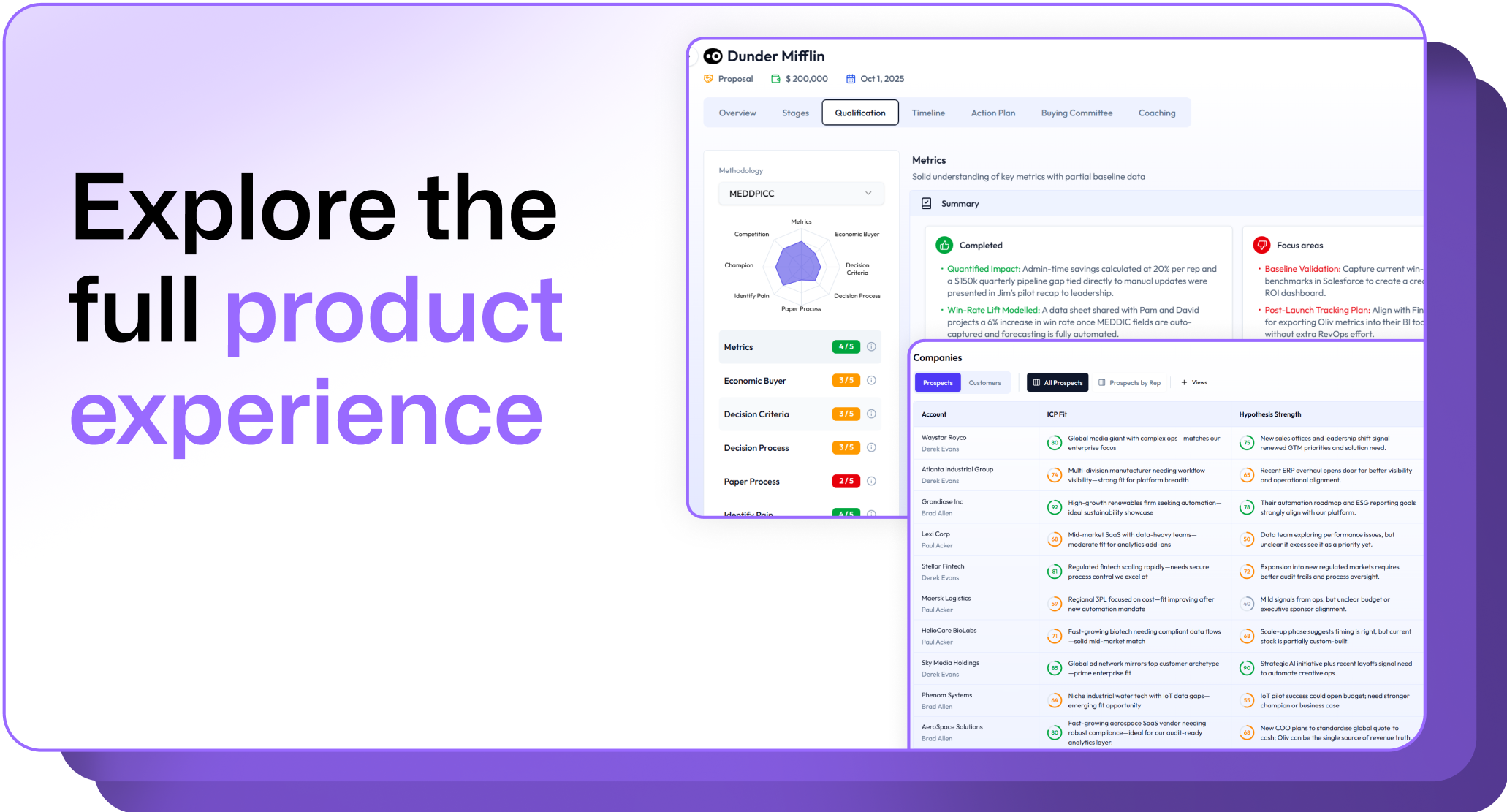
.avif)