Head of Sales New-Hire Ramp | Cutting Time-to-Quota With AI-Driven Onboarding | 2026
Written by
Ishan Chhabra
Last Updated :
March 15, 2026
Skim in :
7
mins
In this article
Still got questions?
Come discuss this article with me.
Hi, I'm Ishan, Founder and CEO of Oliv.
I'm always up for a conversation about revenue intelligence, AI agents, or what's actually working (and what's not) across revenue teams.
I'd love to hear your perspective.
Thank you! Your submission has been received!
Oops! Something went wrong while submitting the form.
Meet Oliv’s AI Agents
Hi! I’m, Deal Driver
I track deals, flag risks, send weekly pipeline updates and give sales managers full visibility into deal progress
Hi! I’m, CRM Manager
I maintain CRM hygiene by updating core, custom and qualification fields all without your team lifting a finger
Hi! I’m, Forecaster
I build accurate forecasts based on real deal movement and tell you which deals to pull in to hit your number
Hi! I’m, Coach
I believe performance fuels revenue. I spot skill gaps, score calls and build coaching plans to help every rep level up
Hi! I’m, Prospector
I dig into target accounts to surface the right contacts, tailor and time outreach so you always strike when it counts
Hi! I’m, Pipeline tracker
I call reps to get deal updates, and deliver a real-time, CRM-synced roll-up view of deal progress
Hi! I’m, Analyst
I answer complex pipeline questions, uncover deal patterns, and build reports that guide strategic decisions
TL;DR
Average sales rep ramp is 5.3 months; AI-native coaching compresses this to under 3 months, unlocking $2M+ incremental pipeline per 20-rep team.
Keyword-based trackers in Gong and Chorus miss contextual meaning; LLM-powered analysis reasons over 100+ sales methodologies to map exact skill gaps.
AI coaching loops (Measure, Prescribe, Practice, Perform) replace manual call reviews and scale personalized coaching across entire hiring cohorts.
Connecting coaching outcomes to deal performance, not just call scores, requires a unified data layer where forecasting and coaching share the same platform.
Graduated quota ramps should use AI-verified skill milestones instead of arbitrary calendar gates to avoid under-promoting strong reps or over-promoting weak ones.
Agentic AI shifts onboarding from "documentation" (recording calls) to "execution" (closing deals) at up to 91% lower TCO than legacy conversation intelligence.
Q1: Why Does Sales New-Hire Ramp Time Still Average 5+ Months in 2026? [toc=Ramp Time Problem]
The numbers tell a stubborn story. The average sales rep takes 5.3 months to reach full productivity, 4.4 months for Account Executives, 3.2 months for SDRs. Yet for growth-stage companies hiring 5 to 15 reps per quarter, actual ramp routinely stretches to 6 to 9 months once you factor in inconsistent coaching, tribal knowledge bottlenecks, and managers stretched across too many direct reports. The result? 40 to 60% of new reps fail to hit quota, and each month of excess ramp bleeds roughly $10K to $15K per rep in unrealized pipeline.
⏰ The Traditional Onboarding Trap
Most sales orgs still rely on shadowing, static playbook PDFs, and weekly 1:1s, a model that has not materially changed in a decade. Managers end up listening to call recordings during commutes because there is no systematic way to pinpoint where each new hire is actually stuck. Tools like Gong help with recording, but adoption of deeper features remains low. As one team lead noted:
"There are many AI driven tools that we don't really utilize but overall we are happy with the product." — Karel Bos, Head of Sales, Vesper B.V., TrustRadius Verified Review
Another enablement leader shared the operational reality:
"It can be overwhelming to set up trackers. AI training is a bit laborious to get it to do what you want." — Trafford J., Senior Director, Revenue Enablement, G2 Verified Review
🔄 How AI-Native Onboarding Changes the Equation
AI-native platforms shift the paradigm from documentation (recording calls) to execution (closing deals). Instead of requiring managers to manually review recordings, generative AI analyzes 100% of interactions, auto-identifies skill gaps, and prescribes targeted micro-coaching in real time, compressing each ramp phase by weeks, not percentages. Organizations using AI-powered coaching tools report 35% faster ramp-up time for new hires.
✅ How Oliv AI Accelerates Ramp
Oliv's Coach Agent automatically builds a Skill-Gap Map for every rep based on every interaction, no manual call reviews, no scorecard busywork. It identifies whether a new hire is failing at discovery (e.g., missing "Identify Pain" in MEDDPICC) or objection handling (e.g., not addressing pricing rebuttals). Managers receive daily Deal Driver Alerts flagging exactly which reps need help and on what, turning hours of dashboard digging into seconds of actionable insight.
Companies with strong onboarding programs see 50% greater new-hire productivity and 21% higher win rates. The question is not whether to invest in ramp acceleration, it is whether your current stack actually delivers these outcomes, or just records calls and hopes managers find time to listen.
Q2: What Is the True Cost of Slow Ramp Time for a Growth-Stage Sales Team? [toc=Cost of Slow Ramp]
Slow ramp time is not just an operational inconvenience, it is a revenue crisis hiding in plain sight. Industry data shows a 10% reduction in ramp-up time generates an average $3.5 million in additional ARR for a typical SaaS company. Flip that: every excess month of ramp across a 20-rep team represents hundreds of thousands in unrealized pipeline. When you factor in that the average cost of a mis-hire runs 1.5 to 2x annual salary, the compounding losses are staggering.
💸 Spreadsheet Hell and the Forecasting Blind Spot
Growth-stage Heads of Sales face a familiar nightmare: the board asks, "What happens to our revenue if we increase headcount by 20% but win rate drops 5% due to ramping?" The answer usually requires manually building brittle Excel models that break every time assumptions change. Traditional CRMs are static repositories, they track what happened, not what could happen. Forecasting platforms do not fully solve this either:
"It is really just a glorified SFDC overlay... I think it can be useful if you have a complex GTM motion but definitely overkill for most companies." — conaldinho11, r/SalesOperations Reddit Thread
"Clari is a tool for sales leaders, it adds no value to reps as far as I can see." — Msoave, r/sales Reddit Thread
This leaves leaders making reactive hiring decisions with "all-over-the-place" forecast accuracy, the exact opposite of what a growth-stage company needs.
💰 AI-Powered Scenario Modeling Replaces the Guesswork
The AI-era shift is predictive modeling that replaces spreadsheets entirely. Instead of building formulas, leaders describe scenarios in natural language: "Show me pipeline impact if we add 5 reps in Q3 but ramp takes 4 months instead of 3." They get instant visual dashboards, not pivot tables.
✅ How Oliv AI Solves the Modeling Problem
Oliv's Scenario Simulator Agent is purpose-built for this. Leaders model "what-if" pipeline scenarios, budget shifts, headcount changes, win-rate adjustments, in plain English. The agent returns curated datasets and visual dashboards without requiring a single formula or a new UI to learn. This is the shift from manual guesswork to AI-Native Revenue Orchestration.
Here is the math that matters: if you reduce average ramp from 5.3 months to 3 months across a 20-rep team, the incremental pipeline generated in Year 1 exceeds $2M, a figure any Head of Sales can take directly to the board, without opening a spreadsheet.
Q3: What Does a High-Performance 30-60-90 Day Sales Onboarding Plan Look Like? [toc=30-60-90 Day Plan]
A structured 30-60-90 day plan remains the backbone of effective sales onboarding, but the best-performing programs in 2026 replace time-based milestones with skill-based gates powered by AI verification. Companies providing robust playbooks and structured onboarding shorten ramp-up time by 20 to 30%, while those with formal programs see 50% higher new-hire retention.
📌 Phase 1: Foundation (Days 1 to 30) - Learn the Business
AI role-play simulations score qualification accuracy
Tool proficiency
CRM, sequencing, meeting tools
Automated CRM data-entry accuracy checks
Shadowing
Observe 10 to 15 live calls with top performers
AI call analysis highlights key moments for review
✅ Gate to advance: Pass an AI-scored role-play and score 80%+ on methodology assessment. No calendar-based promotion.
📌 Phase 2: Guided Selling (Days 31 to 60) - Do the Work with Guardrails
Rep takes live discovery calls with real-time AI nudges providing talk-track suggestions and methodology reminders during the call
Manager reviews AI-generated call summaries instead of listening to full recordings, saving 5+ hours/week
Rep owns 25 to 50% of quota with a graduated ramp schedule (see Q11)
Weekly coaching powered by AI skill-gap reports, not random call selection
"As a team manager, having access to Gong is amazing. Also, for people that are onboarding the meeting libraries we have built are great. It speeds up the ramp up phases." — Karel Bos, Head of Sales, Vesper B.V., TrustRadius Verified Review
📌 Phase 3: Independence (Days 61 to 90) - Own the Pipeline
Rep manages full pipeline at 75 to 100% quota
AI monitors deal health and flags at-risk opportunities before they slip
Personalized micro-coaching tasks target the rep's specific weaknesses (e.g., "Your demo-to-proposal conversion is 20% below team average, review this objection-handling module before your next call")
Manager shifts from "trainer" to "strategic coach" using data, not intuition
⚠️ Common Pitfalls to Avoid
One-size-fits-all pacing: experienced hires get held back by rigid timelines meant for junior reps
No measurement framework: only 27% of organizations consider their onboarding "highly effective," largely because they never define success metrics
Coaching dropout after Day 90: reps who receive ongoing training post-onboarding see 23% higher quota attainment
Oliv AI streamlines this entire framework by auto-generating skill-gap maps, prescribing phase-specific coaching tasks, and providing real-time in-call guidance, eliminating the manual coordination that makes most 30-60-90 plans collapse after Week 2.
Q4: How Do You Tell Whether a Rep Is Stuck on Discovery vs. Objection Handling? [toc=Discovery vs Objection Gaps]
In high-velocity sales teams running 10 to 25 day cycles, managers physically cannot review every call for every new hire. This creates a dangerous Visibility Gap: the only signal that a rep is struggling arrives when they miss month-end targets, by which point weeks of coachable moments have been lost. Managers report spending evenings listening to call recordings because no tool systematically surfaces where each rep breaks down.
❌ Why Keyword-Based Trackers Miss the Point
Traditional conversation intelligence platforms like Gong and Chorus rely on V1 machine-learning keyword trackers. They flag the word "budget" even when the prospect is talking about a holiday budget. They cannot distinguish between a rep mentioning a competitor and a prospect actively evaluating one. The result is noise, not insight:
"The software doesn't have the capability of identifying words/phrases that are similar to what you're looking for or understand context, so if you don't tell it exactly what you're looking for then you'll miss out." — Director of Sales Operations, Gartner Verified Review
"It's too complicated, and not intuitive at all. Understanding the pipeline management portion of it is almost impossible. Some people figure it out, but I think most just fumble through." — John S., Senior Account Executive, G2 Verified Review
Managers still end up digging through ten screens to extract a single coaching insight, exactly the bottleneck these tools were supposed to eliminate.
🔄 LLM-Powered Analysis: Reasoning Over Recording
Generative AI trained on 100+ sales methodologies (MEDDPICC, BANT, SPICED) fundamentally changes what is possible. Instead of tracking keywords, LLMs evaluate contextual meaning: Did the rep truly uncover the Economic Buyer, or merely mention the term? Was the pricing objection addressed with a value reframe, or deflected with a discount offer? This is the leap from recording to reasoning.
✅ How Oliv AI Maps the Exact Skill Gap
Oliv's Coach Agent automatically builds a Skill-Gap Map for every rep from every interaction. It explicitly distinguishes:
Closing weaknesses, e.g., failing to establish mutual action plans or next-step commitments
Instead of dashboard digging, managers receive daily Deal Driver Alerts that flag at-risk deals tied to specific contextual gaps. The contrast is clear: Gong is a dashcam that shows you the past, Oliv is a co-pilot that tells you exactly where to steer next.
Q5: Can Coaching Recommendations Be Driven by Live Pipeline Performance, Not Just Call Scores? [toc=Pipeline-Driven Coaching]
Most sales coaching today is fundamentally disconnected from pipeline reality. Managers coach based on a single call they happened to listen to, not the trajectory of a deal across emails, Slack messages, and three prior meetings. New hires rarely receive guidance tied to the specific deals in danger of slipping this week. The result: coaching feels random, reps lose confidence, and at-risk pipeline goes undetected until it is too late.
❌ The Fragmented Deal View Problem
Gong excels at understanding individual meetings, but it does not stitch together the entire deal lifecycle across channels. It cannot connect a rep's performance on a Tuesday demo to the specific risk signals emerging in a Friday email thread. Competitors also rely on brittle, rule-based logic to associate calls with deals, and when CRMs have duplicate accounts (e.g., Google US vs. Google India), legacy systems log data in the wrong place, producing coaching insights based on "dirty data."
"Before Gong we had a lack of visibility across our deals because information was siloed in several places like CRM, Email, Zoom, phone." — Scott T., Director of Sales, G2 Verified Review
"The additional products like forecast or engage come at an additional cost. Would be great to see these tools rolled into the core offering." — Scott T., Director of Sales, G2 Verified Review
🔄 The AI-Era Model: One Deal, One Narrative
AI-native platforms stitch together every touchpoint, calls, emails, support tickets, Slack, even Telegram, into a single deal narrative. This enables coaching tied to live deal outcomes rather than isolated call performance. The manager no longer picks a random call to review; the system surfaces the deal-level pattern that matters most right now.
AI-native platforms stitch every touchpoint into a single deal narrative, enabling coaching tied to live deal outcomes rather than isolated call performance.
✅ How Oliv AI Delivers Pipeline-Driven Coaching
Oliv's Deal Coaching (Alpha) Agent tracks the effectiveness of discovery, pricing, and objection handling across the entire deal lifecycle, not just one meeting. If a deal stalls because the rep missed an Economic Buyer objection in meeting three, Oliv flags it immediately with evidence-based recommendations. Our AI uses reasoning-based object association to correctly tie every call and email to the right opportunity, even in messy CRMs.
This is the shift from "meeting-level data" to "deal-level understanding", the difference between knowing a call went well and knowing a deal will actually close.
Q6: How Do You Scale Coaching With Targeted Micro-Coaching Tasks Per Rep? [toc=Scaling Micro-Coaching]
Growth-stage sales teams face a fundamental math problem: managers with 8 to 12 direct reports cannot practically deliver personalized coaching to everyone every week. Consistency suffers because every manager coaches differently, and expensive training from consultancies like Winning by Design fails to "stick" because it is not reinforced in the daily workflow. This is the Coaching Scale Problem, and it intensifies with every new hire added to the team.
❌ Why Traditional Coaching Tools Don't Scale
Gong's coaching workflow still requires managers to manually review calls, fill out scorecards, and manually trigger alerts. It is a "review-based system," not an automated coaching system. Roleplay platforms like Hyperbound help reps practice, but they cannot measure what is actually happening on live deals to inform that practice.
"AI is not great yet - the product still feels like it's at its infancy and needs to be developed further." — Annabelle H., Voluntary Director - Board of Directors, G2 Verified Review
"My company is constantly making me justify why we use this when transcription is available in Teams as is meeting recording. It would be great to have more automated features." — Meena S., Chief of Staff, G2 Verified Review
🔄 AI-Driven Coaching Closes the Loop
The AI-era model replaces manual review with an automated cycle: analyze 100% of calls, prescribe targeted micro-tasks, deploy practice bots, nudge reps in real-time during the next live call. No human bottleneck, no inconsistency, no coaching that fades after a workshop.
Oliv's Coach Agent delivers a fully automated coaching loop that compounds skill improvement every week, without requiring manual manager intervention.
This is not training that fades after a workshop. It is embedded reinforcement that compounds every week, the difference between a one-time seminar and a personal trainer who shows up every morning.
Q7: How Do You Connect Coaching Outcomes to Deal Performance, Not Just Call Scores? [toc=Coaching ROI Attribution]
A common frustration among Heads of Sales: "high call scores but low win rates." Traditional call scoring is a vanity metric, a rep may sound polished and articulate on a recorded call, yet still miss the critical qualification criteria (Economic Buyer, Decision Criteria, Success Metrics) needed to actually win the deal. Leaders cannot easily answer the question that matters most: "Did our $100K investment in sales training actually improve our win rate?"
❌ Siloed Intelligence Creates a Measurement Blind Spot
Salesforce Einstein Conversation Insights provides baseline trackers, but connecting those signals to overall deal health requires massive custom reporting work. Gong offers meeting-level analytics but cannot explain why a deal was lost at the 11th hour due to a discovery-phase miss three weeks earlier.
"Quite frankly I haven't been impressed by any of the early Salesforce AI tools, and I don't hear anyone talking about them glowingly." — OffManuscript, r/SalesforceDeveloper Reddit Thread
"It's too complicated, and not intuitive at all... understanding the pipeline management portion of it is almost impossible." — John S., Senior Account Executive, G2 Verified Review
🔄 Unified Data Layer: Coaching Meets Forecasting
AI-native platforms unify coaching, forecasting, and deal intelligence on one data layer, enabling direct attribution from skill improvement to revenue outcomes. When the coaching engine and the forecasting engine share the same data platform, you can trace a discovery improvement to a measurable uplift in close rates.
✅ How Oliv AI Links Skills to Revenue
Oliv's Forecaster Agent and Coach Agent live on the same data platform. This means Oliv can explicitly link improvements in discovery technique to increased win rates, not as a correlation, but as a traceable causal chain across specific deals.
The Analyst Agent takes this further: a Head of Sales can ask, "Why are we losing FinTech deals to Competitor X?" and receive a detailed analysis connecting specific rep skill gaps to those lost outcomes.
Teams using unified AI platforms report 25% higher forecast accuracy and 35% higher win rates, at up to 91% lower TCO than legacy conversation intelligence tools, delivering double the functionality at a fraction of the price.
Q8: How Do Gong and Chorus Handle New-Hire Onboarding, and Where Do They Fall Short? [toc=Gong and Chorus Gaps]
Gong and Chorus are the incumbent conversation intelligence platforms that most growth-stage teams already own or are evaluating. Both deliver strong fundamentals: call recording, transcription, and surface-level analytics. For new-hire onboarding specifically, both provide value through meeting libraries, talk-ratio tracking, and basic keyword alerts.
⭐ What Gong Gets Right, and Where It Stalls
Gong's strengths are real. Its conversational AI, meeting libraries, and deal boards give managers genuine visibility. However, for onboarding at scale, several limitations emerge:
❌ Keyword-based trackers that lack contextual reasoning, flagging terms without understanding meaning
❌ No automated coaching delivery, managers must manually review calls, fill scorecards, and trigger alerts
"After requesting training for over 10 new hires, this is the response we received from their Professional Services team: 'The time has come for our Professional Services team to roll off and formally bring this engagement to a close.'" — Anonymous Reviewer, G2 Verified Review
"Gong is a really powerful tool but it's probably the highest end option on the market... having talked with other friends who lead revenue functions, all have said the same thing - they've been fine using a lower cost, simpler alternative." — Iris P., Head of Marketing, Sales & Partnerships, G2 Verified Review
⚠️ Chorus: Affordable but Limited
Chorus, acquired by ZoomInfo, offers a more affordable entry point. But product innovation has slowed, and similar keyword-tracking constraints apply, no real-time in-call guidance, no CRM auto-update, no deal-level coaching across multi-channel touchpoints.
"The software doesn't have the capability of identifying words/phrases that are similar to what you're looking for or understand context, so if you don't tell it exactly what you're looking for then you'll miss out." — Director of Sales Operations, Gartner Verified Review
Oliv's three-layer architecture extends beyond recording and intelligence into proactive agent execution, the layer legacy platforms cannot reach.
✅ How Oliv AI Fills the Gap: Three Layers
Oliv addresses these shortcomings with a three-layer architecture:
Oliv AI Three-Layer Architecture vs. Gong/Chorus
Layer
What It Does
Oliv vs. Gong/Chorus
Baseline
Recording & transcription
Commodity layer, offered free to Gong users
Intelligence
Contextual qualification using LLMs
Reasoning over keywords; trained on 100+ methodologies
The analogy is clear: Gong is a high-end treadmill, expensive equipment, but your team still does all the running. Oliv is a personal trainer and nutritionist who plans, monitors, and does the heavy lifting to deliver the outcome of time-to-quota with significantly less manual effort.
Q9: What KPIs Should a Head of Sales Track to Measure Onboarding Effectiveness? [toc=Onboarding KPIs]
Measuring onboarding effectiveness requires moving beyond "gut feel" to a structured KPI framework. The right metrics tell you not just if a rep is ramping, but where they are stalling and why. Below is a research-backed measurement framework designed for growth-stage Heads of Sales onboarding multiple reps per quarter.
⏰ Time-Based KPIs
Time-Based Onboarding KPIs
KPI
Definition
Why It Matters
Time to First Deal
Days from hire date to first closed-won deal
Reflects onboarding speed and activation; effective enablement can reduce this by 40 to 50%
Time to Consistent Quota
Days from hire to first month achieving 100% quota
Shows when a rep becomes reliably productive, distinct from closing a single deal
Time to Independence
When supervision requirements match tenured reps
Signals when a rep no longer drains manager bandwidth
⭐ Performance KPIs
Percentage to Quota at 30/60/90 Days - Tracks pacing toward full attainment at key checkpoints. A strong 30/60/90 profile indicates onboarding momentum; flat performance highlights blockers or skill gaps.
Cohort Quota Attainment - Measures the percentage of a hiring cohort meeting quota at the 90-day mark. Companies with structured ramp programs see approximately 19% higher quota attainment across their sales teams.
Win Rate During Ramp - Compares new-hire win rates against team averages to surface coaching needs.
💰 Efficiency and Retention KPIs
Coaching Hours Saved - Measures manager time reclaimed through automated coaching versus manual call reviews. With traditional tools, managers report spending evenings "listening to call recordings while driving, showering, or having coffee".
Attrition-During-Ramp Rate - Percentage of new hires who leave within their first 6 months. Companies with structured ramp programs see approximately 15% better rep retention.
Cost per Ramped Rep - Total onboarding spend (tools, training, manager time) divided by the number of reps who reach consistent quota.
📊 Tracking Framework Example
Onboarding KPI Tracking Framework
Timeframe
Primary KPI
Secondary KPI
Week 1 to 2
Product knowledge scores
Activity metrics (calls, demos booked)
Day 30
Time to first opportunity
% to quota checkpoint
Day 60
Time to first deal
Win rate vs. team average
Day 90
Quota attainment rate
Coaching hours per rep
Month 6
Time to consistent quota
Attrition-during-ramp rate
✅ How Oliv AI Simplifies KPI Tracking
Oliv.ai automates the measurement layer entirely. Rather than manually stitching together CRM reports, call recordings, and spreadsheets, Oliv's Coach Agent and Forecaster Agent track every metric above in real-time, from skill-gap analysis to quota pacing, on a single dashboard that requires zero manual configuration.
Q10: How Should You Design Cohort-Based Onboarding When Hiring 5 to 15 Reps per Quarter? [toc=Cohort-Based Onboarding]
Growth-stage companies do not hire one rep at a time, they hire cohorts of 5 to 15 per quarter. This batch-hiring reality creates a unique challenge: traditional one-at-a-time onboarding breaks down because manager bandwidth does not scale linearly with headcount. A manager who could effectively coach 3 new hires now has 12, and the math simply does not work.
❌ The "Lowest Common Denominator" Problem
Without AI, cohort onboarding devolves into one-size-fits-all training: every rep gets the same playbook regardless of experience level, territory, or product line. Managers become bottlenecks, and the best reps are held back by the slowest learners. Expensive consultancy-led training fails to "stick" because it is not reinforced in the daily workflow.
"It can be overwhelming to set up trackers. AI training is a bit laborious to get it to do what you want." — Trafford J., Senior Director, Revenue Enablement, G2 Verified Review
"There's so much in Gong, that we don't use everything. Gong's deal forecasting we don't use." — Karel Bos, Head of Sales, TrustRadius Verified Review
🔄 AI Enables Personalized Paths Within Cohort Structure
The AI-era model solves the paradox: deliver consistent organizational standards and personalized learning simultaneously. Each rep within a cohort gets individualized skill-gap detection, targeted micro-coaching, and adaptive practice bots, all while the Head of Sales maintains a unified view of cohort readiness. Research shows cohort-based learning with practice and application drives significantly higher engagement than isolated self-study.
✅ Oliv AI Scales Across Entire Cohorts Simultaneously
Oliv's Coach Agent and Meeting Assistant scale across entire cohorts without adding manager burden:
Every rep's calls are analyzed, not the 2 to 3 a manager can manually review
Every skill gap is individually mapped using 100+ sales methodologies (MEDDPICC, BANT, SPICED)
Every coaching task is auto-prescribed based on each rep's actual live-deal performance
The Head of Sales gets a single cohort dashboard showing readiness scores and at-risk indicators
This is where the "agentic workforce" thesis becomes tangible: AI agents do not get tired, do not coach inconsistently, and do not need to choose between Rep A's deal review and Rep B's discovery debrief, they handle both, in parallel, in real-time.
Q11: What Does an AI-Driven Graduated Quota Ramp Schedule Look Like? [toc=Graduated Quota Ramp]
A graduated quota ramp is a progressive quota structure designed to give new hires realistic targets as they build skills and pipeline. Research shows reps who go through a structured ramp period generate around 23% more revenue in their first year compared to reps given full quotas immediately.
📊 Traditional Graduated Ramp Model
The standard approach starts new hires at roughly 50% of full quota for the first 3 months. A more granular model for growth-stage companies with 10 to 25 day sales cycles:
Traditional Graduated Quota Ramp Schedule
Month
Quota %
Milestone Gate
Traditional Verification
Month 1
25%
Product certification + first qualified pipeline
Manager sign-off
Month 2
50%
First closed-won deal + CRM hygiene audit
Manual CRM review
Month 3
75%
Consistent discovery quality + 3 deals in pipeline
Scorecard review
Month 4
90%
Win rate within 80% of team average
Spreadsheet comparison
Month 5
100%
Full quota, independent execution
Manager judgment
For enterprise cycles (6+ months), extend accordingly: a reasonable schedule might be 20%, 30%, 50%, 65%, 70%, and 95% over the first six quarters.
⚠️ The Problem With Time-Based Gates
Traditional ramp schedules use arbitrary time gates, "you hit Month 3, you get 75% quota", regardless of whether the rep actually demonstrated the required skills. This creates two failure modes:
❌ Under-promoting strong reps who are ready for full quota by Month 2
❌ Over-promoting weak reps who advance by calendar date alone
"Clari is a tool for sales leaders, it adds no value to reps as far as I can see." — Msoave, r/SalesOperations Reddit Thread
"Clari should find ways to differentiate from the native Salesforce features (e.g., Pipeline Inspection, Forecasting) in order to remain competitive in the long-run." — Dan J., G2 Verified Review
LLM-verified product knowledge + first qualified opportunity (auto-validated via methodology scoring)
Month 2
50%
Discovery quality score of 70% or higher across all calls + first deal closed
Month 3
75%
Objection-handling proficiency confirmed + pipeline coverage of 3x or higher
Month 4
100%
Win rate within team benchmark, AI confirms independent readiness
Oliv.ai's Coach Agent automatically verifies each milestone using contextual reasoning, not keyword tracking. If a rep masters discovery in 6 weeks instead of 8, they advance early. If another needs extra practice on objection handling, the system holds the gate and prescribes targeted practice bots, no manager spreadsheet required.
Q12: From Recording to Revenue, How Agentic AI Replaces the "SaaS Treadmill" in Sales Onboarding [toc=Agentic AI vs SaaS Treadmill]
The revenue technology market has entered what industry leaders call a "tectonic plate movement", transitioning from the era of Revenue Intelligence (2015 to 2022) into GTM Engineering and AI-Native Revenue Orchestration. For Heads of Sales ramping new hires in 2026, this means the tools that helped in the last era will not win in this one.
❌ The SaaS Treadmill: Expensive Equipment, Manual Running
"The platform is expensive, especially compared to alternatives like Salesloft and Apollo, which offer similar capabilities for a fraction of the price." — Anonymous Reviewer, G2 Verified Review
"It is really just a glorified SFDC overlay. Actually, Salesforce has built most of the forecasting functionality by now anyway so I'm not sure where they fit into that whole overcrowded Martech space." — conaldinho11, r/SalesOperations Reddit Thread
🔄 Agentic AI Flips the Model: From Dashboards to Execution
Agentic AI does not provide dashboards for you to manage, it executes the work. CRM updates happen automatically. Coaching is prescribed and reinforced without manager intervention. Forecasts are built bottom-up from deal reality, not top-down from manager guesses. The goal shifts from "documentation" (recording calls) to "execution" (closing deals).
✅ Oliv AI: Purpose-Built for the Agentic Era
Oliv delivers a complete agentic platform on a single data layer, configured in 5 minutes, at up to 91% lower TCO than legacy conversation intelligence:
Oliv AI Agentic Platform Overview
Agent
What It Does
Scenario Simulator
Models what-if pipeline scenarios (headcount, win-rate tweaks) in seconds
Coach Agent
Measures skill gaps, prescribes micro-tasks, deploys practice bots
Deal Coaching (Alpha)
Tracks deal health across the full lifecycle, calls, emails, Slack
Meeting Assistant
Real-time in-call nudges to apply coached skills
Analyst Agent
Win-loss reasoning connected to specific rep skill gaps
Forecaster Agent
Bottom-up accuracy from deal-level intelligence, not manager roll-ups
The question for every Head of Sales ramping new hires in 2026: are you buying another treadmill, or are you hiring a personal trainer who actually delivers the outcome? Teams using unified AI sales tools report 25% higher forecast accuracy and 35% higher win rates, proving that the shift from recording to revenue is not aspirational, it is already happening.
Q1: Why Does Sales New-Hire Ramp Time Still Average 5+ Months in 2026? [toc=Ramp Time Problem]
The numbers tell a stubborn story. The average sales rep takes 5.3 months to reach full productivity, 4.4 months for Account Executives, 3.2 months for SDRs. Yet for growth-stage companies hiring 5 to 15 reps per quarter, actual ramp routinely stretches to 6 to 9 months once you factor in inconsistent coaching, tribal knowledge bottlenecks, and managers stretched across too many direct reports. The result? 40 to 60% of new reps fail to hit quota, and each month of excess ramp bleeds roughly $10K to $15K per rep in unrealized pipeline.
⏰ The Traditional Onboarding Trap
Most sales orgs still rely on shadowing, static playbook PDFs, and weekly 1:1s, a model that has not materially changed in a decade. Managers end up listening to call recordings during commutes because there is no systematic way to pinpoint where each new hire is actually stuck. Tools like Gong help with recording, but adoption of deeper features remains low. As one team lead noted:
"There are many AI driven tools that we don't really utilize but overall we are happy with the product." — Karel Bos, Head of Sales, Vesper B.V., TrustRadius Verified Review
Another enablement leader shared the operational reality:
"It can be overwhelming to set up trackers. AI training is a bit laborious to get it to do what you want." — Trafford J., Senior Director, Revenue Enablement, G2 Verified Review
🔄 How AI-Native Onboarding Changes the Equation
AI-native platforms shift the paradigm from documentation (recording calls) to execution (closing deals). Instead of requiring managers to manually review recordings, generative AI analyzes 100% of interactions, auto-identifies skill gaps, and prescribes targeted micro-coaching in real time, compressing each ramp phase by weeks, not percentages. Organizations using AI-powered coaching tools report 35% faster ramp-up time for new hires.
✅ How Oliv AI Accelerates Ramp
Oliv's Coach Agent automatically builds a Skill-Gap Map for every rep based on every interaction, no manual call reviews, no scorecard busywork. It identifies whether a new hire is failing at discovery (e.g., missing "Identify Pain" in MEDDPICC) or objection handling (e.g., not addressing pricing rebuttals). Managers receive daily Deal Driver Alerts flagging exactly which reps need help and on what, turning hours of dashboard digging into seconds of actionable insight.
Companies with strong onboarding programs see 50% greater new-hire productivity and 21% higher win rates. The question is not whether to invest in ramp acceleration, it is whether your current stack actually delivers these outcomes, or just records calls and hopes managers find time to listen.
Q2: What Is the True Cost of Slow Ramp Time for a Growth-Stage Sales Team? [toc=Cost of Slow Ramp]
Slow ramp time is not just an operational inconvenience, it is a revenue crisis hiding in plain sight. Industry data shows a 10% reduction in ramp-up time generates an average $3.5 million in additional ARR for a typical SaaS company. Flip that: every excess month of ramp across a 20-rep team represents hundreds of thousands in unrealized pipeline. When you factor in that the average cost of a mis-hire runs 1.5 to 2x annual salary, the compounding losses are staggering.
💸 Spreadsheet Hell and the Forecasting Blind Spot
Growth-stage Heads of Sales face a familiar nightmare: the board asks, "What happens to our revenue if we increase headcount by 20% but win rate drops 5% due to ramping?" The answer usually requires manually building brittle Excel models that break every time assumptions change. Traditional CRMs are static repositories, they track what happened, not what could happen. Forecasting platforms do not fully solve this either:
"It is really just a glorified SFDC overlay... I think it can be useful if you have a complex GTM motion but definitely overkill for most companies." — conaldinho11, r/SalesOperations Reddit Thread
"Clari is a tool for sales leaders, it adds no value to reps as far as I can see." — Msoave, r/sales Reddit Thread
This leaves leaders making reactive hiring decisions with "all-over-the-place" forecast accuracy, the exact opposite of what a growth-stage company needs.
💰 AI-Powered Scenario Modeling Replaces the Guesswork
The AI-era shift is predictive modeling that replaces spreadsheets entirely. Instead of building formulas, leaders describe scenarios in natural language: "Show me pipeline impact if we add 5 reps in Q3 but ramp takes 4 months instead of 3." They get instant visual dashboards, not pivot tables.
✅ How Oliv AI Solves the Modeling Problem
Oliv's Scenario Simulator Agent is purpose-built for this. Leaders model "what-if" pipeline scenarios, budget shifts, headcount changes, win-rate adjustments, in plain English. The agent returns curated datasets and visual dashboards without requiring a single formula or a new UI to learn. This is the shift from manual guesswork to AI-Native Revenue Orchestration.
Here is the math that matters: if you reduce average ramp from 5.3 months to 3 months across a 20-rep team, the incremental pipeline generated in Year 1 exceeds $2M, a figure any Head of Sales can take directly to the board, without opening a spreadsheet.
Q3: What Does a High-Performance 30-60-90 Day Sales Onboarding Plan Look Like? [toc=30-60-90 Day Plan]
A structured 30-60-90 day plan remains the backbone of effective sales onboarding, but the best-performing programs in 2026 replace time-based milestones with skill-based gates powered by AI verification. Companies providing robust playbooks and structured onboarding shorten ramp-up time by 20 to 30%, while those with formal programs see 50% higher new-hire retention.
📌 Phase 1: Foundation (Days 1 to 30) - Learn the Business
AI role-play simulations score qualification accuracy
Tool proficiency
CRM, sequencing, meeting tools
Automated CRM data-entry accuracy checks
Shadowing
Observe 10 to 15 live calls with top performers
AI call analysis highlights key moments for review
✅ Gate to advance: Pass an AI-scored role-play and score 80%+ on methodology assessment. No calendar-based promotion.
📌 Phase 2: Guided Selling (Days 31 to 60) - Do the Work with Guardrails
Rep takes live discovery calls with real-time AI nudges providing talk-track suggestions and methodology reminders during the call
Manager reviews AI-generated call summaries instead of listening to full recordings, saving 5+ hours/week
Rep owns 25 to 50% of quota with a graduated ramp schedule (see Q11)
Weekly coaching powered by AI skill-gap reports, not random call selection
"As a team manager, having access to Gong is amazing. Also, for people that are onboarding the meeting libraries we have built are great. It speeds up the ramp up phases." — Karel Bos, Head of Sales, Vesper B.V., TrustRadius Verified Review
📌 Phase 3: Independence (Days 61 to 90) - Own the Pipeline
Rep manages full pipeline at 75 to 100% quota
AI monitors deal health and flags at-risk opportunities before they slip
Personalized micro-coaching tasks target the rep's specific weaknesses (e.g., "Your demo-to-proposal conversion is 20% below team average, review this objection-handling module before your next call")
Manager shifts from "trainer" to "strategic coach" using data, not intuition
⚠️ Common Pitfalls to Avoid
One-size-fits-all pacing: experienced hires get held back by rigid timelines meant for junior reps
No measurement framework: only 27% of organizations consider their onboarding "highly effective," largely because they never define success metrics
Coaching dropout after Day 90: reps who receive ongoing training post-onboarding see 23% higher quota attainment
Oliv AI streamlines this entire framework by auto-generating skill-gap maps, prescribing phase-specific coaching tasks, and providing real-time in-call guidance, eliminating the manual coordination that makes most 30-60-90 plans collapse after Week 2.
Q4: How Do You Tell Whether a Rep Is Stuck on Discovery vs. Objection Handling? [toc=Discovery vs Objection Gaps]
In high-velocity sales teams running 10 to 25 day cycles, managers physically cannot review every call for every new hire. This creates a dangerous Visibility Gap: the only signal that a rep is struggling arrives when they miss month-end targets, by which point weeks of coachable moments have been lost. Managers report spending evenings listening to call recordings because no tool systematically surfaces where each rep breaks down.
❌ Why Keyword-Based Trackers Miss the Point
Traditional conversation intelligence platforms like Gong and Chorus rely on V1 machine-learning keyword trackers. They flag the word "budget" even when the prospect is talking about a holiday budget. They cannot distinguish between a rep mentioning a competitor and a prospect actively evaluating one. The result is noise, not insight:
"The software doesn't have the capability of identifying words/phrases that are similar to what you're looking for or understand context, so if you don't tell it exactly what you're looking for then you'll miss out." — Director of Sales Operations, Gartner Verified Review
"It's too complicated, and not intuitive at all. Understanding the pipeline management portion of it is almost impossible. Some people figure it out, but I think most just fumble through." — John S., Senior Account Executive, G2 Verified Review
Managers still end up digging through ten screens to extract a single coaching insight, exactly the bottleneck these tools were supposed to eliminate.
🔄 LLM-Powered Analysis: Reasoning Over Recording
Generative AI trained on 100+ sales methodologies (MEDDPICC, BANT, SPICED) fundamentally changes what is possible. Instead of tracking keywords, LLMs evaluate contextual meaning: Did the rep truly uncover the Economic Buyer, or merely mention the term? Was the pricing objection addressed with a value reframe, or deflected with a discount offer? This is the leap from recording to reasoning.
✅ How Oliv AI Maps the Exact Skill Gap
Oliv's Coach Agent automatically builds a Skill-Gap Map for every rep from every interaction. It explicitly distinguishes:
Closing weaknesses, e.g., failing to establish mutual action plans or next-step commitments
Instead of dashboard digging, managers receive daily Deal Driver Alerts that flag at-risk deals tied to specific contextual gaps. The contrast is clear: Gong is a dashcam that shows you the past, Oliv is a co-pilot that tells you exactly where to steer next.
Q5: Can Coaching Recommendations Be Driven by Live Pipeline Performance, Not Just Call Scores? [toc=Pipeline-Driven Coaching]
Most sales coaching today is fundamentally disconnected from pipeline reality. Managers coach based on a single call they happened to listen to, not the trajectory of a deal across emails, Slack messages, and three prior meetings. New hires rarely receive guidance tied to the specific deals in danger of slipping this week. The result: coaching feels random, reps lose confidence, and at-risk pipeline goes undetected until it is too late.
❌ The Fragmented Deal View Problem
Gong excels at understanding individual meetings, but it does not stitch together the entire deal lifecycle across channels. It cannot connect a rep's performance on a Tuesday demo to the specific risk signals emerging in a Friday email thread. Competitors also rely on brittle, rule-based logic to associate calls with deals, and when CRMs have duplicate accounts (e.g., Google US vs. Google India), legacy systems log data in the wrong place, producing coaching insights based on "dirty data."
"Before Gong we had a lack of visibility across our deals because information was siloed in several places like CRM, Email, Zoom, phone." — Scott T., Director of Sales, G2 Verified Review
"The additional products like forecast or engage come at an additional cost. Would be great to see these tools rolled into the core offering." — Scott T., Director of Sales, G2 Verified Review
🔄 The AI-Era Model: One Deal, One Narrative
AI-native platforms stitch together every touchpoint, calls, emails, support tickets, Slack, even Telegram, into a single deal narrative. This enables coaching tied to live deal outcomes rather than isolated call performance. The manager no longer picks a random call to review; the system surfaces the deal-level pattern that matters most right now.
AI-native platforms stitch every touchpoint into a single deal narrative, enabling coaching tied to live deal outcomes rather than isolated call performance.
✅ How Oliv AI Delivers Pipeline-Driven Coaching
Oliv's Deal Coaching (Alpha) Agent tracks the effectiveness of discovery, pricing, and objection handling across the entire deal lifecycle, not just one meeting. If a deal stalls because the rep missed an Economic Buyer objection in meeting three, Oliv flags it immediately with evidence-based recommendations. Our AI uses reasoning-based object association to correctly tie every call and email to the right opportunity, even in messy CRMs.
This is the shift from "meeting-level data" to "deal-level understanding", the difference between knowing a call went well and knowing a deal will actually close.
Q6: How Do You Scale Coaching With Targeted Micro-Coaching Tasks Per Rep? [toc=Scaling Micro-Coaching]
Growth-stage sales teams face a fundamental math problem: managers with 8 to 12 direct reports cannot practically deliver personalized coaching to everyone every week. Consistency suffers because every manager coaches differently, and expensive training from consultancies like Winning by Design fails to "stick" because it is not reinforced in the daily workflow. This is the Coaching Scale Problem, and it intensifies with every new hire added to the team.
❌ Why Traditional Coaching Tools Don't Scale
Gong's coaching workflow still requires managers to manually review calls, fill out scorecards, and manually trigger alerts. It is a "review-based system," not an automated coaching system. Roleplay platforms like Hyperbound help reps practice, but they cannot measure what is actually happening on live deals to inform that practice.
"AI is not great yet - the product still feels like it's at its infancy and needs to be developed further." — Annabelle H., Voluntary Director - Board of Directors, G2 Verified Review
"My company is constantly making me justify why we use this when transcription is available in Teams as is meeting recording. It would be great to have more automated features." — Meena S., Chief of Staff, G2 Verified Review
🔄 AI-Driven Coaching Closes the Loop
The AI-era model replaces manual review with an automated cycle: analyze 100% of calls, prescribe targeted micro-tasks, deploy practice bots, nudge reps in real-time during the next live call. No human bottleneck, no inconsistency, no coaching that fades after a workshop.
Oliv's Coach Agent delivers a fully automated coaching loop that compounds skill improvement every week, without requiring manual manager intervention.
This is not training that fades after a workshop. It is embedded reinforcement that compounds every week, the difference between a one-time seminar and a personal trainer who shows up every morning.
Q7: How Do You Connect Coaching Outcomes to Deal Performance, Not Just Call Scores? [toc=Coaching ROI Attribution]
A common frustration among Heads of Sales: "high call scores but low win rates." Traditional call scoring is a vanity metric, a rep may sound polished and articulate on a recorded call, yet still miss the critical qualification criteria (Economic Buyer, Decision Criteria, Success Metrics) needed to actually win the deal. Leaders cannot easily answer the question that matters most: "Did our $100K investment in sales training actually improve our win rate?"
❌ Siloed Intelligence Creates a Measurement Blind Spot
Salesforce Einstein Conversation Insights provides baseline trackers, but connecting those signals to overall deal health requires massive custom reporting work. Gong offers meeting-level analytics but cannot explain why a deal was lost at the 11th hour due to a discovery-phase miss three weeks earlier.
"Quite frankly I haven't been impressed by any of the early Salesforce AI tools, and I don't hear anyone talking about them glowingly." — OffManuscript, r/SalesforceDeveloper Reddit Thread
"It's too complicated, and not intuitive at all... understanding the pipeline management portion of it is almost impossible." — John S., Senior Account Executive, G2 Verified Review
🔄 Unified Data Layer: Coaching Meets Forecasting
AI-native platforms unify coaching, forecasting, and deal intelligence on one data layer, enabling direct attribution from skill improvement to revenue outcomes. When the coaching engine and the forecasting engine share the same data platform, you can trace a discovery improvement to a measurable uplift in close rates.
✅ How Oliv AI Links Skills to Revenue
Oliv's Forecaster Agent and Coach Agent live on the same data platform. This means Oliv can explicitly link improvements in discovery technique to increased win rates, not as a correlation, but as a traceable causal chain across specific deals.
The Analyst Agent takes this further: a Head of Sales can ask, "Why are we losing FinTech deals to Competitor X?" and receive a detailed analysis connecting specific rep skill gaps to those lost outcomes.
Teams using unified AI platforms report 25% higher forecast accuracy and 35% higher win rates, at up to 91% lower TCO than legacy conversation intelligence tools, delivering double the functionality at a fraction of the price.
Q8: How Do Gong and Chorus Handle New-Hire Onboarding, and Where Do They Fall Short? [toc=Gong and Chorus Gaps]
Gong and Chorus are the incumbent conversation intelligence platforms that most growth-stage teams already own or are evaluating. Both deliver strong fundamentals: call recording, transcription, and surface-level analytics. For new-hire onboarding specifically, both provide value through meeting libraries, talk-ratio tracking, and basic keyword alerts.
⭐ What Gong Gets Right, and Where It Stalls
Gong's strengths are real. Its conversational AI, meeting libraries, and deal boards give managers genuine visibility. However, for onboarding at scale, several limitations emerge:
❌ Keyword-based trackers that lack contextual reasoning, flagging terms without understanding meaning
❌ No automated coaching delivery, managers must manually review calls, fill scorecards, and trigger alerts
"After requesting training for over 10 new hires, this is the response we received from their Professional Services team: 'The time has come for our Professional Services team to roll off and formally bring this engagement to a close.'" — Anonymous Reviewer, G2 Verified Review
"Gong is a really powerful tool but it's probably the highest end option on the market... having talked with other friends who lead revenue functions, all have said the same thing - they've been fine using a lower cost, simpler alternative." — Iris P., Head of Marketing, Sales & Partnerships, G2 Verified Review
⚠️ Chorus: Affordable but Limited
Chorus, acquired by ZoomInfo, offers a more affordable entry point. But product innovation has slowed, and similar keyword-tracking constraints apply, no real-time in-call guidance, no CRM auto-update, no deal-level coaching across multi-channel touchpoints.
"The software doesn't have the capability of identifying words/phrases that are similar to what you're looking for or understand context, so if you don't tell it exactly what you're looking for then you'll miss out." — Director of Sales Operations, Gartner Verified Review
Oliv's three-layer architecture extends beyond recording and intelligence into proactive agent execution, the layer legacy platforms cannot reach.
✅ How Oliv AI Fills the Gap: Three Layers
Oliv addresses these shortcomings with a three-layer architecture:
Oliv AI Three-Layer Architecture vs. Gong/Chorus
Layer
What It Does
Oliv vs. Gong/Chorus
Baseline
Recording & transcription
Commodity layer, offered free to Gong users
Intelligence
Contextual qualification using LLMs
Reasoning over keywords; trained on 100+ methodologies
The analogy is clear: Gong is a high-end treadmill, expensive equipment, but your team still does all the running. Oliv is a personal trainer and nutritionist who plans, monitors, and does the heavy lifting to deliver the outcome of time-to-quota with significantly less manual effort.
Q9: What KPIs Should a Head of Sales Track to Measure Onboarding Effectiveness? [toc=Onboarding KPIs]
Measuring onboarding effectiveness requires moving beyond "gut feel" to a structured KPI framework. The right metrics tell you not just if a rep is ramping, but where they are stalling and why. Below is a research-backed measurement framework designed for growth-stage Heads of Sales onboarding multiple reps per quarter.
⏰ Time-Based KPIs
Time-Based Onboarding KPIs
KPI
Definition
Why It Matters
Time to First Deal
Days from hire date to first closed-won deal
Reflects onboarding speed and activation; effective enablement can reduce this by 40 to 50%
Time to Consistent Quota
Days from hire to first month achieving 100% quota
Shows when a rep becomes reliably productive, distinct from closing a single deal
Time to Independence
When supervision requirements match tenured reps
Signals when a rep no longer drains manager bandwidth
⭐ Performance KPIs
Percentage to Quota at 30/60/90 Days - Tracks pacing toward full attainment at key checkpoints. A strong 30/60/90 profile indicates onboarding momentum; flat performance highlights blockers or skill gaps.
Cohort Quota Attainment - Measures the percentage of a hiring cohort meeting quota at the 90-day mark. Companies with structured ramp programs see approximately 19% higher quota attainment across their sales teams.
Win Rate During Ramp - Compares new-hire win rates against team averages to surface coaching needs.
💰 Efficiency and Retention KPIs
Coaching Hours Saved - Measures manager time reclaimed through automated coaching versus manual call reviews. With traditional tools, managers report spending evenings "listening to call recordings while driving, showering, or having coffee".
Attrition-During-Ramp Rate - Percentage of new hires who leave within their first 6 months. Companies with structured ramp programs see approximately 15% better rep retention.
Cost per Ramped Rep - Total onboarding spend (tools, training, manager time) divided by the number of reps who reach consistent quota.
📊 Tracking Framework Example
Onboarding KPI Tracking Framework
Timeframe
Primary KPI
Secondary KPI
Week 1 to 2
Product knowledge scores
Activity metrics (calls, demos booked)
Day 30
Time to first opportunity
% to quota checkpoint
Day 60
Time to first deal
Win rate vs. team average
Day 90
Quota attainment rate
Coaching hours per rep
Month 6
Time to consistent quota
Attrition-during-ramp rate
✅ How Oliv AI Simplifies KPI Tracking
Oliv.ai automates the measurement layer entirely. Rather than manually stitching together CRM reports, call recordings, and spreadsheets, Oliv's Coach Agent and Forecaster Agent track every metric above in real-time, from skill-gap analysis to quota pacing, on a single dashboard that requires zero manual configuration.
Q10: How Should You Design Cohort-Based Onboarding When Hiring 5 to 15 Reps per Quarter? [toc=Cohort-Based Onboarding]
Growth-stage companies do not hire one rep at a time, they hire cohorts of 5 to 15 per quarter. This batch-hiring reality creates a unique challenge: traditional one-at-a-time onboarding breaks down because manager bandwidth does not scale linearly with headcount. A manager who could effectively coach 3 new hires now has 12, and the math simply does not work.
❌ The "Lowest Common Denominator" Problem
Without AI, cohort onboarding devolves into one-size-fits-all training: every rep gets the same playbook regardless of experience level, territory, or product line. Managers become bottlenecks, and the best reps are held back by the slowest learners. Expensive consultancy-led training fails to "stick" because it is not reinforced in the daily workflow.
"It can be overwhelming to set up trackers. AI training is a bit laborious to get it to do what you want." — Trafford J., Senior Director, Revenue Enablement, G2 Verified Review
"There's so much in Gong, that we don't use everything. Gong's deal forecasting we don't use." — Karel Bos, Head of Sales, TrustRadius Verified Review
🔄 AI Enables Personalized Paths Within Cohort Structure
The AI-era model solves the paradox: deliver consistent organizational standards and personalized learning simultaneously. Each rep within a cohort gets individualized skill-gap detection, targeted micro-coaching, and adaptive practice bots, all while the Head of Sales maintains a unified view of cohort readiness. Research shows cohort-based learning with practice and application drives significantly higher engagement than isolated self-study.
✅ Oliv AI Scales Across Entire Cohorts Simultaneously
Oliv's Coach Agent and Meeting Assistant scale across entire cohorts without adding manager burden:
Every rep's calls are analyzed, not the 2 to 3 a manager can manually review
Every skill gap is individually mapped using 100+ sales methodologies (MEDDPICC, BANT, SPICED)
Every coaching task is auto-prescribed based on each rep's actual live-deal performance
The Head of Sales gets a single cohort dashboard showing readiness scores and at-risk indicators
This is where the "agentic workforce" thesis becomes tangible: AI agents do not get tired, do not coach inconsistently, and do not need to choose between Rep A's deal review and Rep B's discovery debrief, they handle both, in parallel, in real-time.
Q11: What Does an AI-Driven Graduated Quota Ramp Schedule Look Like? [toc=Graduated Quota Ramp]
A graduated quota ramp is a progressive quota structure designed to give new hires realistic targets as they build skills and pipeline. Research shows reps who go through a structured ramp period generate around 23% more revenue in their first year compared to reps given full quotas immediately.
📊 Traditional Graduated Ramp Model
The standard approach starts new hires at roughly 50% of full quota for the first 3 months. A more granular model for growth-stage companies with 10 to 25 day sales cycles:
Traditional Graduated Quota Ramp Schedule
Month
Quota %
Milestone Gate
Traditional Verification
Month 1
25%
Product certification + first qualified pipeline
Manager sign-off
Month 2
50%
First closed-won deal + CRM hygiene audit
Manual CRM review
Month 3
75%
Consistent discovery quality + 3 deals in pipeline
Scorecard review
Month 4
90%
Win rate within 80% of team average
Spreadsheet comparison
Month 5
100%
Full quota, independent execution
Manager judgment
For enterprise cycles (6+ months), extend accordingly: a reasonable schedule might be 20%, 30%, 50%, 65%, 70%, and 95% over the first six quarters.
⚠️ The Problem With Time-Based Gates
Traditional ramp schedules use arbitrary time gates, "you hit Month 3, you get 75% quota", regardless of whether the rep actually demonstrated the required skills. This creates two failure modes:
❌ Under-promoting strong reps who are ready for full quota by Month 2
❌ Over-promoting weak reps who advance by calendar date alone
"Clari is a tool for sales leaders, it adds no value to reps as far as I can see." — Msoave, r/SalesOperations Reddit Thread
"Clari should find ways to differentiate from the native Salesforce features (e.g., Pipeline Inspection, Forecasting) in order to remain competitive in the long-run." — Dan J., G2 Verified Review
LLM-verified product knowledge + first qualified opportunity (auto-validated via methodology scoring)
Month 2
50%
Discovery quality score of 70% or higher across all calls + first deal closed
Month 3
75%
Objection-handling proficiency confirmed + pipeline coverage of 3x or higher
Month 4
100%
Win rate within team benchmark, AI confirms independent readiness
Oliv.ai's Coach Agent automatically verifies each milestone using contextual reasoning, not keyword tracking. If a rep masters discovery in 6 weeks instead of 8, they advance early. If another needs extra practice on objection handling, the system holds the gate and prescribes targeted practice bots, no manager spreadsheet required.
Q12: From Recording to Revenue, How Agentic AI Replaces the "SaaS Treadmill" in Sales Onboarding [toc=Agentic AI vs SaaS Treadmill]
The revenue technology market has entered what industry leaders call a "tectonic plate movement", transitioning from the era of Revenue Intelligence (2015 to 2022) into GTM Engineering and AI-Native Revenue Orchestration. For Heads of Sales ramping new hires in 2026, this means the tools that helped in the last era will not win in this one.
❌ The SaaS Treadmill: Expensive Equipment, Manual Running
"The platform is expensive, especially compared to alternatives like Salesloft and Apollo, which offer similar capabilities for a fraction of the price." — Anonymous Reviewer, G2 Verified Review
"It is really just a glorified SFDC overlay. Actually, Salesforce has built most of the forecasting functionality by now anyway so I'm not sure where they fit into that whole overcrowded Martech space." — conaldinho11, r/SalesOperations Reddit Thread
🔄 Agentic AI Flips the Model: From Dashboards to Execution
Agentic AI does not provide dashboards for you to manage, it executes the work. CRM updates happen automatically. Coaching is prescribed and reinforced without manager intervention. Forecasts are built bottom-up from deal reality, not top-down from manager guesses. The goal shifts from "documentation" (recording calls) to "execution" (closing deals).
✅ Oliv AI: Purpose-Built for the Agentic Era
Oliv delivers a complete agentic platform on a single data layer, configured in 5 minutes, at up to 91% lower TCO than legacy conversation intelligence:
Oliv AI Agentic Platform Overview
Agent
What It Does
Scenario Simulator
Models what-if pipeline scenarios (headcount, win-rate tweaks) in seconds
Coach Agent
Measures skill gaps, prescribes micro-tasks, deploys practice bots
Deal Coaching (Alpha)
Tracks deal health across the full lifecycle, calls, emails, Slack
Meeting Assistant
Real-time in-call nudges to apply coached skills
Analyst Agent
Win-loss reasoning connected to specific rep skill gaps
Forecaster Agent
Bottom-up accuracy from deal-level intelligence, not manager roll-ups
The question for every Head of Sales ramping new hires in 2026: are you buying another treadmill, or are you hiring a personal trainer who actually delivers the outcome? Teams using unified AI sales tools report 25% higher forecast accuracy and 35% higher win rates, proving that the shift from recording to revenue is not aspirational, it is already happening.
Q1: Why Does Sales New-Hire Ramp Time Still Average 5+ Months in 2026? [toc=Ramp Time Problem]
The numbers tell a stubborn story. The average sales rep takes 5.3 months to reach full productivity, 4.4 months for Account Executives, 3.2 months for SDRs. Yet for growth-stage companies hiring 5 to 15 reps per quarter, actual ramp routinely stretches to 6 to 9 months once you factor in inconsistent coaching, tribal knowledge bottlenecks, and managers stretched across too many direct reports. The result? 40 to 60% of new reps fail to hit quota, and each month of excess ramp bleeds roughly $10K to $15K per rep in unrealized pipeline.
⏰ The Traditional Onboarding Trap
Most sales orgs still rely on shadowing, static playbook PDFs, and weekly 1:1s, a model that has not materially changed in a decade. Managers end up listening to call recordings during commutes because there is no systematic way to pinpoint where each new hire is actually stuck. Tools like Gong help with recording, but adoption of deeper features remains low. As one team lead noted:
"There are many AI driven tools that we don't really utilize but overall we are happy with the product." — Karel Bos, Head of Sales, Vesper B.V., TrustRadius Verified Review
Another enablement leader shared the operational reality:
"It can be overwhelming to set up trackers. AI training is a bit laborious to get it to do what you want." — Trafford J., Senior Director, Revenue Enablement, G2 Verified Review
🔄 How AI-Native Onboarding Changes the Equation
AI-native platforms shift the paradigm from documentation (recording calls) to execution (closing deals). Instead of requiring managers to manually review recordings, generative AI analyzes 100% of interactions, auto-identifies skill gaps, and prescribes targeted micro-coaching in real time, compressing each ramp phase by weeks, not percentages. Organizations using AI-powered coaching tools report 35% faster ramp-up time for new hires.
✅ How Oliv AI Accelerates Ramp
Oliv's Coach Agent automatically builds a Skill-Gap Map for every rep based on every interaction, no manual call reviews, no scorecard busywork. It identifies whether a new hire is failing at discovery (e.g., missing "Identify Pain" in MEDDPICC) or objection handling (e.g., not addressing pricing rebuttals). Managers receive daily Deal Driver Alerts flagging exactly which reps need help and on what, turning hours of dashboard digging into seconds of actionable insight.
Companies with strong onboarding programs see 50% greater new-hire productivity and 21% higher win rates. The question is not whether to invest in ramp acceleration, it is whether your current stack actually delivers these outcomes, or just records calls and hopes managers find time to listen.
Q2: What Is the True Cost of Slow Ramp Time for a Growth-Stage Sales Team? [toc=Cost of Slow Ramp]
Slow ramp time is not just an operational inconvenience, it is a revenue crisis hiding in plain sight. Industry data shows a 10% reduction in ramp-up time generates an average $3.5 million in additional ARR for a typical SaaS company. Flip that: every excess month of ramp across a 20-rep team represents hundreds of thousands in unrealized pipeline. When you factor in that the average cost of a mis-hire runs 1.5 to 2x annual salary, the compounding losses are staggering.
💸 Spreadsheet Hell and the Forecasting Blind Spot
Growth-stage Heads of Sales face a familiar nightmare: the board asks, "What happens to our revenue if we increase headcount by 20% but win rate drops 5% due to ramping?" The answer usually requires manually building brittle Excel models that break every time assumptions change. Traditional CRMs are static repositories, they track what happened, not what could happen. Forecasting platforms do not fully solve this either:
"It is really just a glorified SFDC overlay... I think it can be useful if you have a complex GTM motion but definitely overkill for most companies." — conaldinho11, r/SalesOperations Reddit Thread
"Clari is a tool for sales leaders, it adds no value to reps as far as I can see." — Msoave, r/sales Reddit Thread
This leaves leaders making reactive hiring decisions with "all-over-the-place" forecast accuracy, the exact opposite of what a growth-stage company needs.
💰 AI-Powered Scenario Modeling Replaces the Guesswork
The AI-era shift is predictive modeling that replaces spreadsheets entirely. Instead of building formulas, leaders describe scenarios in natural language: "Show me pipeline impact if we add 5 reps in Q3 but ramp takes 4 months instead of 3." They get instant visual dashboards, not pivot tables.
✅ How Oliv AI Solves the Modeling Problem
Oliv's Scenario Simulator Agent is purpose-built for this. Leaders model "what-if" pipeline scenarios, budget shifts, headcount changes, win-rate adjustments, in plain English. The agent returns curated datasets and visual dashboards without requiring a single formula or a new UI to learn. This is the shift from manual guesswork to AI-Native Revenue Orchestration.
Here is the math that matters: if you reduce average ramp from 5.3 months to 3 months across a 20-rep team, the incremental pipeline generated in Year 1 exceeds $2M, a figure any Head of Sales can take directly to the board, without opening a spreadsheet.
Q3: What Does a High-Performance 30-60-90 Day Sales Onboarding Plan Look Like? [toc=30-60-90 Day Plan]
A structured 30-60-90 day plan remains the backbone of effective sales onboarding, but the best-performing programs in 2026 replace time-based milestones with skill-based gates powered by AI verification. Companies providing robust playbooks and structured onboarding shorten ramp-up time by 20 to 30%, while those with formal programs see 50% higher new-hire retention.
📌 Phase 1: Foundation (Days 1 to 30) - Learn the Business
AI role-play simulations score qualification accuracy
Tool proficiency
CRM, sequencing, meeting tools
Automated CRM data-entry accuracy checks
Shadowing
Observe 10 to 15 live calls with top performers
AI call analysis highlights key moments for review
✅ Gate to advance: Pass an AI-scored role-play and score 80%+ on methodology assessment. No calendar-based promotion.
📌 Phase 2: Guided Selling (Days 31 to 60) - Do the Work with Guardrails
Rep takes live discovery calls with real-time AI nudges providing talk-track suggestions and methodology reminders during the call
Manager reviews AI-generated call summaries instead of listening to full recordings, saving 5+ hours/week
Rep owns 25 to 50% of quota with a graduated ramp schedule (see Q11)
Weekly coaching powered by AI skill-gap reports, not random call selection
"As a team manager, having access to Gong is amazing. Also, for people that are onboarding the meeting libraries we have built are great. It speeds up the ramp up phases." — Karel Bos, Head of Sales, Vesper B.V., TrustRadius Verified Review
📌 Phase 3: Independence (Days 61 to 90) - Own the Pipeline
Rep manages full pipeline at 75 to 100% quota
AI monitors deal health and flags at-risk opportunities before they slip
Personalized micro-coaching tasks target the rep's specific weaknesses (e.g., "Your demo-to-proposal conversion is 20% below team average, review this objection-handling module before your next call")
Manager shifts from "trainer" to "strategic coach" using data, not intuition
⚠️ Common Pitfalls to Avoid
One-size-fits-all pacing: experienced hires get held back by rigid timelines meant for junior reps
No measurement framework: only 27% of organizations consider their onboarding "highly effective," largely because they never define success metrics
Coaching dropout after Day 90: reps who receive ongoing training post-onboarding see 23% higher quota attainment
Oliv AI streamlines this entire framework by auto-generating skill-gap maps, prescribing phase-specific coaching tasks, and providing real-time in-call guidance, eliminating the manual coordination that makes most 30-60-90 plans collapse after Week 2.
Q4: How Do You Tell Whether a Rep Is Stuck on Discovery vs. Objection Handling? [toc=Discovery vs Objection Gaps]
In high-velocity sales teams running 10 to 25 day cycles, managers physically cannot review every call for every new hire. This creates a dangerous Visibility Gap: the only signal that a rep is struggling arrives when they miss month-end targets, by which point weeks of coachable moments have been lost. Managers report spending evenings listening to call recordings because no tool systematically surfaces where each rep breaks down.
❌ Why Keyword-Based Trackers Miss the Point
Traditional conversation intelligence platforms like Gong and Chorus rely on V1 machine-learning keyword trackers. They flag the word "budget" even when the prospect is talking about a holiday budget. They cannot distinguish between a rep mentioning a competitor and a prospect actively evaluating one. The result is noise, not insight:
"The software doesn't have the capability of identifying words/phrases that are similar to what you're looking for or understand context, so if you don't tell it exactly what you're looking for then you'll miss out." — Director of Sales Operations, Gartner Verified Review
"It's too complicated, and not intuitive at all. Understanding the pipeline management portion of it is almost impossible. Some people figure it out, but I think most just fumble through." — John S., Senior Account Executive, G2 Verified Review
Managers still end up digging through ten screens to extract a single coaching insight, exactly the bottleneck these tools were supposed to eliminate.
🔄 LLM-Powered Analysis: Reasoning Over Recording
Generative AI trained on 100+ sales methodologies (MEDDPICC, BANT, SPICED) fundamentally changes what is possible. Instead of tracking keywords, LLMs evaluate contextual meaning: Did the rep truly uncover the Economic Buyer, or merely mention the term? Was the pricing objection addressed with a value reframe, or deflected with a discount offer? This is the leap from recording to reasoning.
✅ How Oliv AI Maps the Exact Skill Gap
Oliv's Coach Agent automatically builds a Skill-Gap Map for every rep from every interaction. It explicitly distinguishes:
Closing weaknesses, e.g., failing to establish mutual action plans or next-step commitments
Instead of dashboard digging, managers receive daily Deal Driver Alerts that flag at-risk deals tied to specific contextual gaps. The contrast is clear: Gong is a dashcam that shows you the past, Oliv is a co-pilot that tells you exactly where to steer next.
Q5: Can Coaching Recommendations Be Driven by Live Pipeline Performance, Not Just Call Scores? [toc=Pipeline-Driven Coaching]
Most sales coaching today is fundamentally disconnected from pipeline reality. Managers coach based on a single call they happened to listen to, not the trajectory of a deal across emails, Slack messages, and three prior meetings. New hires rarely receive guidance tied to the specific deals in danger of slipping this week. The result: coaching feels random, reps lose confidence, and at-risk pipeline goes undetected until it is too late.
❌ The Fragmented Deal View Problem
Gong excels at understanding individual meetings, but it does not stitch together the entire deal lifecycle across channels. It cannot connect a rep's performance on a Tuesday demo to the specific risk signals emerging in a Friday email thread. Competitors also rely on brittle, rule-based logic to associate calls with deals, and when CRMs have duplicate accounts (e.g., Google US vs. Google India), legacy systems log data in the wrong place, producing coaching insights based on "dirty data."
"Before Gong we had a lack of visibility across our deals because information was siloed in several places like CRM, Email, Zoom, phone." — Scott T., Director of Sales, G2 Verified Review
"The additional products like forecast or engage come at an additional cost. Would be great to see these tools rolled into the core offering." — Scott T., Director of Sales, G2 Verified Review
🔄 The AI-Era Model: One Deal, One Narrative
AI-native platforms stitch together every touchpoint, calls, emails, support tickets, Slack, even Telegram, into a single deal narrative. This enables coaching tied to live deal outcomes rather than isolated call performance. The manager no longer picks a random call to review; the system surfaces the deal-level pattern that matters most right now.
AI-native platforms stitch every touchpoint into a single deal narrative, enabling coaching tied to live deal outcomes rather than isolated call performance.
✅ How Oliv AI Delivers Pipeline-Driven Coaching
Oliv's Deal Coaching (Alpha) Agent tracks the effectiveness of discovery, pricing, and objection handling across the entire deal lifecycle, not just one meeting. If a deal stalls because the rep missed an Economic Buyer objection in meeting three, Oliv flags it immediately with evidence-based recommendations. Our AI uses reasoning-based object association to correctly tie every call and email to the right opportunity, even in messy CRMs.
This is the shift from "meeting-level data" to "deal-level understanding", the difference between knowing a call went well and knowing a deal will actually close.
Q6: How Do You Scale Coaching With Targeted Micro-Coaching Tasks Per Rep? [toc=Scaling Micro-Coaching]
Growth-stage sales teams face a fundamental math problem: managers with 8 to 12 direct reports cannot practically deliver personalized coaching to everyone every week. Consistency suffers because every manager coaches differently, and expensive training from consultancies like Winning by Design fails to "stick" because it is not reinforced in the daily workflow. This is the Coaching Scale Problem, and it intensifies with every new hire added to the team.
❌ Why Traditional Coaching Tools Don't Scale
Gong's coaching workflow still requires managers to manually review calls, fill out scorecards, and manually trigger alerts. It is a "review-based system," not an automated coaching system. Roleplay platforms like Hyperbound help reps practice, but they cannot measure what is actually happening on live deals to inform that practice.
"AI is not great yet - the product still feels like it's at its infancy and needs to be developed further." — Annabelle H., Voluntary Director - Board of Directors, G2 Verified Review
"My company is constantly making me justify why we use this when transcription is available in Teams as is meeting recording. It would be great to have more automated features." — Meena S., Chief of Staff, G2 Verified Review
🔄 AI-Driven Coaching Closes the Loop
The AI-era model replaces manual review with an automated cycle: analyze 100% of calls, prescribe targeted micro-tasks, deploy practice bots, nudge reps in real-time during the next live call. No human bottleneck, no inconsistency, no coaching that fades after a workshop.
Oliv's Coach Agent delivers a fully automated coaching loop that compounds skill improvement every week, without requiring manual manager intervention.
This is not training that fades after a workshop. It is embedded reinforcement that compounds every week, the difference between a one-time seminar and a personal trainer who shows up every morning.
Q7: How Do You Connect Coaching Outcomes to Deal Performance, Not Just Call Scores? [toc=Coaching ROI Attribution]
A common frustration among Heads of Sales: "high call scores but low win rates." Traditional call scoring is a vanity metric, a rep may sound polished and articulate on a recorded call, yet still miss the critical qualification criteria (Economic Buyer, Decision Criteria, Success Metrics) needed to actually win the deal. Leaders cannot easily answer the question that matters most: "Did our $100K investment in sales training actually improve our win rate?"
❌ Siloed Intelligence Creates a Measurement Blind Spot
Salesforce Einstein Conversation Insights provides baseline trackers, but connecting those signals to overall deal health requires massive custom reporting work. Gong offers meeting-level analytics but cannot explain why a deal was lost at the 11th hour due to a discovery-phase miss three weeks earlier.
"Quite frankly I haven't been impressed by any of the early Salesforce AI tools, and I don't hear anyone talking about them glowingly." — OffManuscript, r/SalesforceDeveloper Reddit Thread
"It's too complicated, and not intuitive at all... understanding the pipeline management portion of it is almost impossible." — John S., Senior Account Executive, G2 Verified Review
🔄 Unified Data Layer: Coaching Meets Forecasting
AI-native platforms unify coaching, forecasting, and deal intelligence on one data layer, enabling direct attribution from skill improvement to revenue outcomes. When the coaching engine and the forecasting engine share the same data platform, you can trace a discovery improvement to a measurable uplift in close rates.
✅ How Oliv AI Links Skills to Revenue
Oliv's Forecaster Agent and Coach Agent live on the same data platform. This means Oliv can explicitly link improvements in discovery technique to increased win rates, not as a correlation, but as a traceable causal chain across specific deals.
The Analyst Agent takes this further: a Head of Sales can ask, "Why are we losing FinTech deals to Competitor X?" and receive a detailed analysis connecting specific rep skill gaps to those lost outcomes.
Teams using unified AI platforms report 25% higher forecast accuracy and 35% higher win rates, at up to 91% lower TCO than legacy conversation intelligence tools, delivering double the functionality at a fraction of the price.
Q8: How Do Gong and Chorus Handle New-Hire Onboarding, and Where Do They Fall Short? [toc=Gong and Chorus Gaps]
Gong and Chorus are the incumbent conversation intelligence platforms that most growth-stage teams already own or are evaluating. Both deliver strong fundamentals: call recording, transcription, and surface-level analytics. For new-hire onboarding specifically, both provide value through meeting libraries, talk-ratio tracking, and basic keyword alerts.
⭐ What Gong Gets Right, and Where It Stalls
Gong's strengths are real. Its conversational AI, meeting libraries, and deal boards give managers genuine visibility. However, for onboarding at scale, several limitations emerge:
❌ Keyword-based trackers that lack contextual reasoning, flagging terms without understanding meaning
❌ No automated coaching delivery, managers must manually review calls, fill scorecards, and trigger alerts
"After requesting training for over 10 new hires, this is the response we received from their Professional Services team: 'The time has come for our Professional Services team to roll off and formally bring this engagement to a close.'" — Anonymous Reviewer, G2 Verified Review
"Gong is a really powerful tool but it's probably the highest end option on the market... having talked with other friends who lead revenue functions, all have said the same thing - they've been fine using a lower cost, simpler alternative." — Iris P., Head of Marketing, Sales & Partnerships, G2 Verified Review
⚠️ Chorus: Affordable but Limited
Chorus, acquired by ZoomInfo, offers a more affordable entry point. But product innovation has slowed, and similar keyword-tracking constraints apply, no real-time in-call guidance, no CRM auto-update, no deal-level coaching across multi-channel touchpoints.
"The software doesn't have the capability of identifying words/phrases that are similar to what you're looking for or understand context, so if you don't tell it exactly what you're looking for then you'll miss out." — Director of Sales Operations, Gartner Verified Review
Oliv's three-layer architecture extends beyond recording and intelligence into proactive agent execution, the layer legacy platforms cannot reach.
✅ How Oliv AI Fills the Gap: Three Layers
Oliv addresses these shortcomings with a three-layer architecture:
Oliv AI Three-Layer Architecture vs. Gong/Chorus
Layer
What It Does
Oliv vs. Gong/Chorus
Baseline
Recording & transcription
Commodity layer, offered free to Gong users
Intelligence
Contextual qualification using LLMs
Reasoning over keywords; trained on 100+ methodologies
The analogy is clear: Gong is a high-end treadmill, expensive equipment, but your team still does all the running. Oliv is a personal trainer and nutritionist who plans, monitors, and does the heavy lifting to deliver the outcome of time-to-quota with significantly less manual effort.
Q9: What KPIs Should a Head of Sales Track to Measure Onboarding Effectiveness? [toc=Onboarding KPIs]
Measuring onboarding effectiveness requires moving beyond "gut feel" to a structured KPI framework. The right metrics tell you not just if a rep is ramping, but where they are stalling and why. Below is a research-backed measurement framework designed for growth-stage Heads of Sales onboarding multiple reps per quarter.
⏰ Time-Based KPIs
Time-Based Onboarding KPIs
KPI
Definition
Why It Matters
Time to First Deal
Days from hire date to first closed-won deal
Reflects onboarding speed and activation; effective enablement can reduce this by 40 to 50%
Time to Consistent Quota
Days from hire to first month achieving 100% quota
Shows when a rep becomes reliably productive, distinct from closing a single deal
Time to Independence
When supervision requirements match tenured reps
Signals when a rep no longer drains manager bandwidth
⭐ Performance KPIs
Percentage to Quota at 30/60/90 Days - Tracks pacing toward full attainment at key checkpoints. A strong 30/60/90 profile indicates onboarding momentum; flat performance highlights blockers or skill gaps.
Cohort Quota Attainment - Measures the percentage of a hiring cohort meeting quota at the 90-day mark. Companies with structured ramp programs see approximately 19% higher quota attainment across their sales teams.
Win Rate During Ramp - Compares new-hire win rates against team averages to surface coaching needs.
💰 Efficiency and Retention KPIs
Coaching Hours Saved - Measures manager time reclaimed through automated coaching versus manual call reviews. With traditional tools, managers report spending evenings "listening to call recordings while driving, showering, or having coffee".
Attrition-During-Ramp Rate - Percentage of new hires who leave within their first 6 months. Companies with structured ramp programs see approximately 15% better rep retention.
Cost per Ramped Rep - Total onboarding spend (tools, training, manager time) divided by the number of reps who reach consistent quota.
📊 Tracking Framework Example
Onboarding KPI Tracking Framework
Timeframe
Primary KPI
Secondary KPI
Week 1 to 2
Product knowledge scores
Activity metrics (calls, demos booked)
Day 30
Time to first opportunity
% to quota checkpoint
Day 60
Time to first deal
Win rate vs. team average
Day 90
Quota attainment rate
Coaching hours per rep
Month 6
Time to consistent quota
Attrition-during-ramp rate
✅ How Oliv AI Simplifies KPI Tracking
Oliv.ai automates the measurement layer entirely. Rather than manually stitching together CRM reports, call recordings, and spreadsheets, Oliv's Coach Agent and Forecaster Agent track every metric above in real-time, from skill-gap analysis to quota pacing, on a single dashboard that requires zero manual configuration.
Q10: How Should You Design Cohort-Based Onboarding When Hiring 5 to 15 Reps per Quarter? [toc=Cohort-Based Onboarding]
Growth-stage companies do not hire one rep at a time, they hire cohorts of 5 to 15 per quarter. This batch-hiring reality creates a unique challenge: traditional one-at-a-time onboarding breaks down because manager bandwidth does not scale linearly with headcount. A manager who could effectively coach 3 new hires now has 12, and the math simply does not work.
❌ The "Lowest Common Denominator" Problem
Without AI, cohort onboarding devolves into one-size-fits-all training: every rep gets the same playbook regardless of experience level, territory, or product line. Managers become bottlenecks, and the best reps are held back by the slowest learners. Expensive consultancy-led training fails to "stick" because it is not reinforced in the daily workflow.
"It can be overwhelming to set up trackers. AI training is a bit laborious to get it to do what you want." — Trafford J., Senior Director, Revenue Enablement, G2 Verified Review
"There's so much in Gong, that we don't use everything. Gong's deal forecasting we don't use." — Karel Bos, Head of Sales, TrustRadius Verified Review
🔄 AI Enables Personalized Paths Within Cohort Structure
The AI-era model solves the paradox: deliver consistent organizational standards and personalized learning simultaneously. Each rep within a cohort gets individualized skill-gap detection, targeted micro-coaching, and adaptive practice bots, all while the Head of Sales maintains a unified view of cohort readiness. Research shows cohort-based learning with practice and application drives significantly higher engagement than isolated self-study.
✅ Oliv AI Scales Across Entire Cohorts Simultaneously
Oliv's Coach Agent and Meeting Assistant scale across entire cohorts without adding manager burden:
Every rep's calls are analyzed, not the 2 to 3 a manager can manually review
Every skill gap is individually mapped using 100+ sales methodologies (MEDDPICC, BANT, SPICED)
Every coaching task is auto-prescribed based on each rep's actual live-deal performance
The Head of Sales gets a single cohort dashboard showing readiness scores and at-risk indicators
This is where the "agentic workforce" thesis becomes tangible: AI agents do not get tired, do not coach inconsistently, and do not need to choose between Rep A's deal review and Rep B's discovery debrief, they handle both, in parallel, in real-time.
Q11: What Does an AI-Driven Graduated Quota Ramp Schedule Look Like? [toc=Graduated Quota Ramp]
A graduated quota ramp is a progressive quota structure designed to give new hires realistic targets as they build skills and pipeline. Research shows reps who go through a structured ramp period generate around 23% more revenue in their first year compared to reps given full quotas immediately.
📊 Traditional Graduated Ramp Model
The standard approach starts new hires at roughly 50% of full quota for the first 3 months. A more granular model for growth-stage companies with 10 to 25 day sales cycles:
Traditional Graduated Quota Ramp Schedule
Month
Quota %
Milestone Gate
Traditional Verification
Month 1
25%
Product certification + first qualified pipeline
Manager sign-off
Month 2
50%
First closed-won deal + CRM hygiene audit
Manual CRM review
Month 3
75%
Consistent discovery quality + 3 deals in pipeline
Scorecard review
Month 4
90%
Win rate within 80% of team average
Spreadsheet comparison
Month 5
100%
Full quota, independent execution
Manager judgment
For enterprise cycles (6+ months), extend accordingly: a reasonable schedule might be 20%, 30%, 50%, 65%, 70%, and 95% over the first six quarters.
⚠️ The Problem With Time-Based Gates
Traditional ramp schedules use arbitrary time gates, "you hit Month 3, you get 75% quota", regardless of whether the rep actually demonstrated the required skills. This creates two failure modes:
❌ Under-promoting strong reps who are ready for full quota by Month 2
❌ Over-promoting weak reps who advance by calendar date alone
"Clari is a tool for sales leaders, it adds no value to reps as far as I can see." — Msoave, r/SalesOperations Reddit Thread
"Clari should find ways to differentiate from the native Salesforce features (e.g., Pipeline Inspection, Forecasting) in order to remain competitive in the long-run." — Dan J., G2 Verified Review
LLM-verified product knowledge + first qualified opportunity (auto-validated via methodology scoring)
Month 2
50%
Discovery quality score of 70% or higher across all calls + first deal closed
Month 3
75%
Objection-handling proficiency confirmed + pipeline coverage of 3x or higher
Month 4
100%
Win rate within team benchmark, AI confirms independent readiness
Oliv.ai's Coach Agent automatically verifies each milestone using contextual reasoning, not keyword tracking. If a rep masters discovery in 6 weeks instead of 8, they advance early. If another needs extra practice on objection handling, the system holds the gate and prescribes targeted practice bots, no manager spreadsheet required.
Q12: From Recording to Revenue, How Agentic AI Replaces the "SaaS Treadmill" in Sales Onboarding [toc=Agentic AI vs SaaS Treadmill]
The revenue technology market has entered what industry leaders call a "tectonic plate movement", transitioning from the era of Revenue Intelligence (2015 to 2022) into GTM Engineering and AI-Native Revenue Orchestration. For Heads of Sales ramping new hires in 2026, this means the tools that helped in the last era will not win in this one.
❌ The SaaS Treadmill: Expensive Equipment, Manual Running
"The platform is expensive, especially compared to alternatives like Salesloft and Apollo, which offer similar capabilities for a fraction of the price." — Anonymous Reviewer, G2 Verified Review
"It is really just a glorified SFDC overlay. Actually, Salesforce has built most of the forecasting functionality by now anyway so I'm not sure where they fit into that whole overcrowded Martech space." — conaldinho11, r/SalesOperations Reddit Thread
🔄 Agentic AI Flips the Model: From Dashboards to Execution
Agentic AI does not provide dashboards for you to manage, it executes the work. CRM updates happen automatically. Coaching is prescribed and reinforced without manager intervention. Forecasts are built bottom-up from deal reality, not top-down from manager guesses. The goal shifts from "documentation" (recording calls) to "execution" (closing deals).
✅ Oliv AI: Purpose-Built for the Agentic Era
Oliv delivers a complete agentic platform on a single data layer, configured in 5 minutes, at up to 91% lower TCO than legacy conversation intelligence:
Oliv AI Agentic Platform Overview
Agent
What It Does
Scenario Simulator
Models what-if pipeline scenarios (headcount, win-rate tweaks) in seconds
Coach Agent
Measures skill gaps, prescribes micro-tasks, deploys practice bots
Deal Coaching (Alpha)
Tracks deal health across the full lifecycle, calls, emails, Slack
Meeting Assistant
Real-time in-call nudges to apply coached skills
Analyst Agent
Win-loss reasoning connected to specific rep skill gaps
Forecaster Agent
Bottom-up accuracy from deal-level intelligence, not manager roll-ups
The question for every Head of Sales ramping new hires in 2026: are you buying another treadmill, or are you hiring a personal trainer who actually delivers the outcome? Teams using unified AI sales tools report 25% higher forecast accuracy and 35% higher win rates, proving that the shift from recording to revenue is not aspirational, it is already happening.
Q1: Why Does Sales New-Hire Ramp Time Still Average 5+ Months in 2026? [toc=Ramp Time Problem]
The numbers tell a stubborn story. The average sales rep takes 5.3 months to reach full productivity, 4.4 months for Account Executives, 3.2 months for SDRs. Yet for growth-stage companies hiring 5 to 15 reps per quarter, actual ramp routinely stretches to 6 to 9 months once you factor in inconsistent coaching, tribal knowledge bottlenecks, and managers stretched across too many direct reports. The result? 40 to 60% of new reps fail to hit quota, and each month of excess ramp bleeds roughly $10K to $15K per rep in unrealized pipeline.
⏰ The Traditional Onboarding Trap
Most sales orgs still rely on shadowing, static playbook PDFs, and weekly 1:1s, a model that has not materially changed in a decade. Managers end up listening to call recordings during commutes because there is no systematic way to pinpoint where each new hire is actually stuck. Tools like Gong help with recording, but adoption of deeper features remains low. As one team lead noted:
"There are many AI driven tools that we don't really utilize but overall we are happy with the product." — Karel Bos, Head of Sales, Vesper B.V., TrustRadius Verified Review
Another enablement leader shared the operational reality:
"It can be overwhelming to set up trackers. AI training is a bit laborious to get it to do what you want." — Trafford J., Senior Director, Revenue Enablement, G2 Verified Review
🔄 How AI-Native Onboarding Changes the Equation
AI-native platforms shift the paradigm from documentation (recording calls) to execution (closing deals). Instead of requiring managers to manually review recordings, generative AI analyzes 100% of interactions, auto-identifies skill gaps, and prescribes targeted micro-coaching in real time, compressing each ramp phase by weeks, not percentages. Organizations using AI-powered coaching tools report 35% faster ramp-up time for new hires.
✅ How Oliv AI Accelerates Ramp
Oliv's Coach Agent automatically builds a Skill-Gap Map for every rep based on every interaction, no manual call reviews, no scorecard busywork. It identifies whether a new hire is failing at discovery (e.g., missing "Identify Pain" in MEDDPICC) or objection handling (e.g., not addressing pricing rebuttals). Managers receive daily Deal Driver Alerts flagging exactly which reps need help and on what, turning hours of dashboard digging into seconds of actionable insight.
Companies with strong onboarding programs see 50% greater new-hire productivity and 21% higher win rates. The question is not whether to invest in ramp acceleration, it is whether your current stack actually delivers these outcomes, or just records calls and hopes managers find time to listen.
Q2: What Is the True Cost of Slow Ramp Time for a Growth-Stage Sales Team? [toc=Cost of Slow Ramp]
Slow ramp time is not just an operational inconvenience, it is a revenue crisis hiding in plain sight. Industry data shows a 10% reduction in ramp-up time generates an average $3.5 million in additional ARR for a typical SaaS company. Flip that: every excess month of ramp across a 20-rep team represents hundreds of thousands in unrealized pipeline. When you factor in that the average cost of a mis-hire runs 1.5 to 2x annual salary, the compounding losses are staggering.
💸 Spreadsheet Hell and the Forecasting Blind Spot
Growth-stage Heads of Sales face a familiar nightmare: the board asks, "What happens to our revenue if we increase headcount by 20% but win rate drops 5% due to ramping?" The answer usually requires manually building brittle Excel models that break every time assumptions change. Traditional CRMs are static repositories, they track what happened, not what could happen. Forecasting platforms do not fully solve this either:
"It is really just a glorified SFDC overlay... I think it can be useful if you have a complex GTM motion but definitely overkill for most companies." — conaldinho11, r/SalesOperations Reddit Thread
"Clari is a tool for sales leaders, it adds no value to reps as far as I can see." — Msoave, r/sales Reddit Thread
This leaves leaders making reactive hiring decisions with "all-over-the-place" forecast accuracy, the exact opposite of what a growth-stage company needs.
💰 AI-Powered Scenario Modeling Replaces the Guesswork
The AI-era shift is predictive modeling that replaces spreadsheets entirely. Instead of building formulas, leaders describe scenarios in natural language: "Show me pipeline impact if we add 5 reps in Q3 but ramp takes 4 months instead of 3." They get instant visual dashboards, not pivot tables.
✅ How Oliv AI Solves the Modeling Problem
Oliv's Scenario Simulator Agent is purpose-built for this. Leaders model "what-if" pipeline scenarios, budget shifts, headcount changes, win-rate adjustments, in plain English. The agent returns curated datasets and visual dashboards without requiring a single formula or a new UI to learn. This is the shift from manual guesswork to AI-Native Revenue Orchestration.
Here is the math that matters: if you reduce average ramp from 5.3 months to 3 months across a 20-rep team, the incremental pipeline generated in Year 1 exceeds $2M, a figure any Head of Sales can take directly to the board, without opening a spreadsheet.
Q3: What Does a High-Performance 30-60-90 Day Sales Onboarding Plan Look Like? [toc=30-60-90 Day Plan]
A structured 30-60-90 day plan remains the backbone of effective sales onboarding, but the best-performing programs in 2026 replace time-based milestones with skill-based gates powered by AI verification. Companies providing robust playbooks and structured onboarding shorten ramp-up time by 20 to 30%, while those with formal programs see 50% higher new-hire retention.
📌 Phase 1: Foundation (Days 1 to 30) - Learn the Business
AI role-play simulations score qualification accuracy
Tool proficiency
CRM, sequencing, meeting tools
Automated CRM data-entry accuracy checks
Shadowing
Observe 10 to 15 live calls with top performers
AI call analysis highlights key moments for review
✅ Gate to advance: Pass an AI-scored role-play and score 80%+ on methodology assessment. No calendar-based promotion.
📌 Phase 2: Guided Selling (Days 31 to 60) - Do the Work with Guardrails
Rep takes live discovery calls with real-time AI nudges providing talk-track suggestions and methodology reminders during the call
Manager reviews AI-generated call summaries instead of listening to full recordings, saving 5+ hours/week
Rep owns 25 to 50% of quota with a graduated ramp schedule (see Q11)
Weekly coaching powered by AI skill-gap reports, not random call selection
"As a team manager, having access to Gong is amazing. Also, for people that are onboarding the meeting libraries we have built are great. It speeds up the ramp up phases." — Karel Bos, Head of Sales, Vesper B.V., TrustRadius Verified Review
📌 Phase 3: Independence (Days 61 to 90) - Own the Pipeline
Rep manages full pipeline at 75 to 100% quota
AI monitors deal health and flags at-risk opportunities before they slip
Personalized micro-coaching tasks target the rep's specific weaknesses (e.g., "Your demo-to-proposal conversion is 20% below team average, review this objection-handling module before your next call")
Manager shifts from "trainer" to "strategic coach" using data, not intuition
⚠️ Common Pitfalls to Avoid
One-size-fits-all pacing: experienced hires get held back by rigid timelines meant for junior reps
No measurement framework: only 27% of organizations consider their onboarding "highly effective," largely because they never define success metrics
Coaching dropout after Day 90: reps who receive ongoing training post-onboarding see 23% higher quota attainment
Oliv AI streamlines this entire framework by auto-generating skill-gap maps, prescribing phase-specific coaching tasks, and providing real-time in-call guidance, eliminating the manual coordination that makes most 30-60-90 plans collapse after Week 2.
Q4: How Do You Tell Whether a Rep Is Stuck on Discovery vs. Objection Handling? [toc=Discovery vs Objection Gaps]
In high-velocity sales teams running 10 to 25 day cycles, managers physically cannot review every call for every new hire. This creates a dangerous Visibility Gap: the only signal that a rep is struggling arrives when they miss month-end targets, by which point weeks of coachable moments have been lost. Managers report spending evenings listening to call recordings because no tool systematically surfaces where each rep breaks down.
❌ Why Keyword-Based Trackers Miss the Point
Traditional conversation intelligence platforms like Gong and Chorus rely on V1 machine-learning keyword trackers. They flag the word "budget" even when the prospect is talking about a holiday budget. They cannot distinguish between a rep mentioning a competitor and a prospect actively evaluating one. The result is noise, not insight:
"The software doesn't have the capability of identifying words/phrases that are similar to what you're looking for or understand context, so if you don't tell it exactly what you're looking for then you'll miss out." — Director of Sales Operations, Gartner Verified Review
"It's too complicated, and not intuitive at all. Understanding the pipeline management portion of it is almost impossible. Some people figure it out, but I think most just fumble through." — John S., Senior Account Executive, G2 Verified Review
Managers still end up digging through ten screens to extract a single coaching insight, exactly the bottleneck these tools were supposed to eliminate.
🔄 LLM-Powered Analysis: Reasoning Over Recording
Generative AI trained on 100+ sales methodologies (MEDDPICC, BANT, SPICED) fundamentally changes what is possible. Instead of tracking keywords, LLMs evaluate contextual meaning: Did the rep truly uncover the Economic Buyer, or merely mention the term? Was the pricing objection addressed with a value reframe, or deflected with a discount offer? This is the leap from recording to reasoning.
✅ How Oliv AI Maps the Exact Skill Gap
Oliv's Coach Agent automatically builds a Skill-Gap Map for every rep from every interaction. It explicitly distinguishes:
Closing weaknesses, e.g., failing to establish mutual action plans or next-step commitments
Instead of dashboard digging, managers receive daily Deal Driver Alerts that flag at-risk deals tied to specific contextual gaps. The contrast is clear: Gong is a dashcam that shows you the past, Oliv is a co-pilot that tells you exactly where to steer next.
Q5: Can Coaching Recommendations Be Driven by Live Pipeline Performance, Not Just Call Scores? [toc=Pipeline-Driven Coaching]
Most sales coaching today is fundamentally disconnected from pipeline reality. Managers coach based on a single call they happened to listen to, not the trajectory of a deal across emails, Slack messages, and three prior meetings. New hires rarely receive guidance tied to the specific deals in danger of slipping this week. The result: coaching feels random, reps lose confidence, and at-risk pipeline goes undetected until it is too late.
❌ The Fragmented Deal View Problem
Gong excels at understanding individual meetings, but it does not stitch together the entire deal lifecycle across channels. It cannot connect a rep's performance on a Tuesday demo to the specific risk signals emerging in a Friday email thread. Competitors also rely on brittle, rule-based logic to associate calls with deals, and when CRMs have duplicate accounts (e.g., Google US vs. Google India), legacy systems log data in the wrong place, producing coaching insights based on "dirty data."
"Before Gong we had a lack of visibility across our deals because information was siloed in several places like CRM, Email, Zoom, phone." — Scott T., Director of Sales, G2 Verified Review
"The additional products like forecast or engage come at an additional cost. Would be great to see these tools rolled into the core offering." — Scott T., Director of Sales, G2 Verified Review
🔄 The AI-Era Model: One Deal, One Narrative
AI-native platforms stitch together every touchpoint, calls, emails, support tickets, Slack, even Telegram, into a single deal narrative. This enables coaching tied to live deal outcomes rather than isolated call performance. The manager no longer picks a random call to review; the system surfaces the deal-level pattern that matters most right now.
AI-native platforms stitch every touchpoint into a single deal narrative, enabling coaching tied to live deal outcomes rather than isolated call performance.
✅ How Oliv AI Delivers Pipeline-Driven Coaching
Oliv's Deal Coaching (Alpha) Agent tracks the effectiveness of discovery, pricing, and objection handling across the entire deal lifecycle, not just one meeting. If a deal stalls because the rep missed an Economic Buyer objection in meeting three, Oliv flags it immediately with evidence-based recommendations. Our AI uses reasoning-based object association to correctly tie every call and email to the right opportunity, even in messy CRMs.
This is the shift from "meeting-level data" to "deal-level understanding", the difference between knowing a call went well and knowing a deal will actually close.
Q6: How Do You Scale Coaching With Targeted Micro-Coaching Tasks Per Rep? [toc=Scaling Micro-Coaching]
Growth-stage sales teams face a fundamental math problem: managers with 8 to 12 direct reports cannot practically deliver personalized coaching to everyone every week. Consistency suffers because every manager coaches differently, and expensive training from consultancies like Winning by Design fails to "stick" because it is not reinforced in the daily workflow. This is the Coaching Scale Problem, and it intensifies with every new hire added to the team.
❌ Why Traditional Coaching Tools Don't Scale
Gong's coaching workflow still requires managers to manually review calls, fill out scorecards, and manually trigger alerts. It is a "review-based system," not an automated coaching system. Roleplay platforms like Hyperbound help reps practice, but they cannot measure what is actually happening on live deals to inform that practice.
"AI is not great yet - the product still feels like it's at its infancy and needs to be developed further." — Annabelle H., Voluntary Director - Board of Directors, G2 Verified Review
"My company is constantly making me justify why we use this when transcription is available in Teams as is meeting recording. It would be great to have more automated features." — Meena S., Chief of Staff, G2 Verified Review
🔄 AI-Driven Coaching Closes the Loop
The AI-era model replaces manual review with an automated cycle: analyze 100% of calls, prescribe targeted micro-tasks, deploy practice bots, nudge reps in real-time during the next live call. No human bottleneck, no inconsistency, no coaching that fades after a workshop.
Oliv's Coach Agent delivers a fully automated coaching loop that compounds skill improvement every week, without requiring manual manager intervention.
This is not training that fades after a workshop. It is embedded reinforcement that compounds every week, the difference between a one-time seminar and a personal trainer who shows up every morning.
Q7: How Do You Connect Coaching Outcomes to Deal Performance, Not Just Call Scores? [toc=Coaching ROI Attribution]
A common frustration among Heads of Sales: "high call scores but low win rates." Traditional call scoring is a vanity metric, a rep may sound polished and articulate on a recorded call, yet still miss the critical qualification criteria (Economic Buyer, Decision Criteria, Success Metrics) needed to actually win the deal. Leaders cannot easily answer the question that matters most: "Did our $100K investment in sales training actually improve our win rate?"
❌ Siloed Intelligence Creates a Measurement Blind Spot
Salesforce Einstein Conversation Insights provides baseline trackers, but connecting those signals to overall deal health requires massive custom reporting work. Gong offers meeting-level analytics but cannot explain why a deal was lost at the 11th hour due to a discovery-phase miss three weeks earlier.
"Quite frankly I haven't been impressed by any of the early Salesforce AI tools, and I don't hear anyone talking about them glowingly." — OffManuscript, r/SalesforceDeveloper Reddit Thread
"It's too complicated, and not intuitive at all... understanding the pipeline management portion of it is almost impossible." — John S., Senior Account Executive, G2 Verified Review
🔄 Unified Data Layer: Coaching Meets Forecasting
AI-native platforms unify coaching, forecasting, and deal intelligence on one data layer, enabling direct attribution from skill improvement to revenue outcomes. When the coaching engine and the forecasting engine share the same data platform, you can trace a discovery improvement to a measurable uplift in close rates.
✅ How Oliv AI Links Skills to Revenue
Oliv's Forecaster Agent and Coach Agent live on the same data platform. This means Oliv can explicitly link improvements in discovery technique to increased win rates, not as a correlation, but as a traceable causal chain across specific deals.
The Analyst Agent takes this further: a Head of Sales can ask, "Why are we losing FinTech deals to Competitor X?" and receive a detailed analysis connecting specific rep skill gaps to those lost outcomes.
Teams using unified AI platforms report 25% higher forecast accuracy and 35% higher win rates, at up to 91% lower TCO than legacy conversation intelligence tools, delivering double the functionality at a fraction of the price.
Q8: How Do Gong and Chorus Handle New-Hire Onboarding, and Where Do They Fall Short? [toc=Gong and Chorus Gaps]
Gong and Chorus are the incumbent conversation intelligence platforms that most growth-stage teams already own or are evaluating. Both deliver strong fundamentals: call recording, transcription, and surface-level analytics. For new-hire onboarding specifically, both provide value through meeting libraries, talk-ratio tracking, and basic keyword alerts.
⭐ What Gong Gets Right, and Where It Stalls
Gong's strengths are real. Its conversational AI, meeting libraries, and deal boards give managers genuine visibility. However, for onboarding at scale, several limitations emerge:
❌ Keyword-based trackers that lack contextual reasoning, flagging terms without understanding meaning
❌ No automated coaching delivery, managers must manually review calls, fill scorecards, and trigger alerts
"After requesting training for over 10 new hires, this is the response we received from their Professional Services team: 'The time has come for our Professional Services team to roll off and formally bring this engagement to a close.'" — Anonymous Reviewer, G2 Verified Review
"Gong is a really powerful tool but it's probably the highest end option on the market... having talked with other friends who lead revenue functions, all have said the same thing - they've been fine using a lower cost, simpler alternative." — Iris P., Head of Marketing, Sales & Partnerships, G2 Verified Review
⚠️ Chorus: Affordable but Limited
Chorus, acquired by ZoomInfo, offers a more affordable entry point. But product innovation has slowed, and similar keyword-tracking constraints apply, no real-time in-call guidance, no CRM auto-update, no deal-level coaching across multi-channel touchpoints.
"The software doesn't have the capability of identifying words/phrases that are similar to what you're looking for or understand context, so if you don't tell it exactly what you're looking for then you'll miss out." — Director of Sales Operations, Gartner Verified Review
Oliv's three-layer architecture extends beyond recording and intelligence into proactive agent execution, the layer legacy platforms cannot reach.
✅ How Oliv AI Fills the Gap: Three Layers
Oliv addresses these shortcomings with a three-layer architecture:
Oliv AI Three-Layer Architecture vs. Gong/Chorus
Layer
What It Does
Oliv vs. Gong/Chorus
Baseline
Recording & transcription
Commodity layer, offered free to Gong users
Intelligence
Contextual qualification using LLMs
Reasoning over keywords; trained on 100+ methodologies
The analogy is clear: Gong is a high-end treadmill, expensive equipment, but your team still does all the running. Oliv is a personal trainer and nutritionist who plans, monitors, and does the heavy lifting to deliver the outcome of time-to-quota with significantly less manual effort.
Q9: What KPIs Should a Head of Sales Track to Measure Onboarding Effectiveness? [toc=Onboarding KPIs]
Measuring onboarding effectiveness requires moving beyond "gut feel" to a structured KPI framework. The right metrics tell you not just if a rep is ramping, but where they are stalling and why. Below is a research-backed measurement framework designed for growth-stage Heads of Sales onboarding multiple reps per quarter.
⏰ Time-Based KPIs
Time-Based Onboarding KPIs
KPI
Definition
Why It Matters
Time to First Deal
Days from hire date to first closed-won deal
Reflects onboarding speed and activation; effective enablement can reduce this by 40 to 50%
Time to Consistent Quota
Days from hire to first month achieving 100% quota
Shows when a rep becomes reliably productive, distinct from closing a single deal
Time to Independence
When supervision requirements match tenured reps
Signals when a rep no longer drains manager bandwidth
⭐ Performance KPIs
Percentage to Quota at 30/60/90 Days - Tracks pacing toward full attainment at key checkpoints. A strong 30/60/90 profile indicates onboarding momentum; flat performance highlights blockers or skill gaps.
Cohort Quota Attainment - Measures the percentage of a hiring cohort meeting quota at the 90-day mark. Companies with structured ramp programs see approximately 19% higher quota attainment across their sales teams.
Win Rate During Ramp - Compares new-hire win rates against team averages to surface coaching needs.
💰 Efficiency and Retention KPIs
Coaching Hours Saved - Measures manager time reclaimed through automated coaching versus manual call reviews. With traditional tools, managers report spending evenings "listening to call recordings while driving, showering, or having coffee".
Attrition-During-Ramp Rate - Percentage of new hires who leave within their first 6 months. Companies with structured ramp programs see approximately 15% better rep retention.
Cost per Ramped Rep - Total onboarding spend (tools, training, manager time) divided by the number of reps who reach consistent quota.
📊 Tracking Framework Example
Onboarding KPI Tracking Framework
Timeframe
Primary KPI
Secondary KPI
Week 1 to 2
Product knowledge scores
Activity metrics (calls, demos booked)
Day 30
Time to first opportunity
% to quota checkpoint
Day 60
Time to first deal
Win rate vs. team average
Day 90
Quota attainment rate
Coaching hours per rep
Month 6
Time to consistent quota
Attrition-during-ramp rate
✅ How Oliv AI Simplifies KPI Tracking
Oliv.ai automates the measurement layer entirely. Rather than manually stitching together CRM reports, call recordings, and spreadsheets, Oliv's Coach Agent and Forecaster Agent track every metric above in real-time, from skill-gap analysis to quota pacing, on a single dashboard that requires zero manual configuration.
Q10: How Should You Design Cohort-Based Onboarding When Hiring 5 to 15 Reps per Quarter? [toc=Cohort-Based Onboarding]
Growth-stage companies do not hire one rep at a time, they hire cohorts of 5 to 15 per quarter. This batch-hiring reality creates a unique challenge: traditional one-at-a-time onboarding breaks down because manager bandwidth does not scale linearly with headcount. A manager who could effectively coach 3 new hires now has 12, and the math simply does not work.
❌ The "Lowest Common Denominator" Problem
Without AI, cohort onboarding devolves into one-size-fits-all training: every rep gets the same playbook regardless of experience level, territory, or product line. Managers become bottlenecks, and the best reps are held back by the slowest learners. Expensive consultancy-led training fails to "stick" because it is not reinforced in the daily workflow.
"It can be overwhelming to set up trackers. AI training is a bit laborious to get it to do what you want." — Trafford J., Senior Director, Revenue Enablement, G2 Verified Review
"There's so much in Gong, that we don't use everything. Gong's deal forecasting we don't use." — Karel Bos, Head of Sales, TrustRadius Verified Review
🔄 AI Enables Personalized Paths Within Cohort Structure
The AI-era model solves the paradox: deliver consistent organizational standards and personalized learning simultaneously. Each rep within a cohort gets individualized skill-gap detection, targeted micro-coaching, and adaptive practice bots, all while the Head of Sales maintains a unified view of cohort readiness. Research shows cohort-based learning with practice and application drives significantly higher engagement than isolated self-study.
✅ Oliv AI Scales Across Entire Cohorts Simultaneously
Oliv's Coach Agent and Meeting Assistant scale across entire cohorts without adding manager burden:
Every rep's calls are analyzed, not the 2 to 3 a manager can manually review
Every skill gap is individually mapped using 100+ sales methodologies (MEDDPICC, BANT, SPICED)
Every coaching task is auto-prescribed based on each rep's actual live-deal performance
The Head of Sales gets a single cohort dashboard showing readiness scores and at-risk indicators
This is where the "agentic workforce" thesis becomes tangible: AI agents do not get tired, do not coach inconsistently, and do not need to choose between Rep A's deal review and Rep B's discovery debrief, they handle both, in parallel, in real-time.
Q11: What Does an AI-Driven Graduated Quota Ramp Schedule Look Like? [toc=Graduated Quota Ramp]
A graduated quota ramp is a progressive quota structure designed to give new hires realistic targets as they build skills and pipeline. Research shows reps who go through a structured ramp period generate around 23% more revenue in their first year compared to reps given full quotas immediately.
📊 Traditional Graduated Ramp Model
The standard approach starts new hires at roughly 50% of full quota for the first 3 months. A more granular model for growth-stage companies with 10 to 25 day sales cycles:
Traditional Graduated Quota Ramp Schedule
Month
Quota %
Milestone Gate
Traditional Verification
Month 1
25%
Product certification + first qualified pipeline
Manager sign-off
Month 2
50%
First closed-won deal + CRM hygiene audit
Manual CRM review
Month 3
75%
Consistent discovery quality + 3 deals in pipeline
Scorecard review
Month 4
90%
Win rate within 80% of team average
Spreadsheet comparison
Month 5
100%
Full quota, independent execution
Manager judgment
For enterprise cycles (6+ months), extend accordingly: a reasonable schedule might be 20%, 30%, 50%, 65%, 70%, and 95% over the first six quarters.
⚠️ The Problem With Time-Based Gates
Traditional ramp schedules use arbitrary time gates, "you hit Month 3, you get 75% quota", regardless of whether the rep actually demonstrated the required skills. This creates two failure modes:
❌ Under-promoting strong reps who are ready for full quota by Month 2
❌ Over-promoting weak reps who advance by calendar date alone
"Clari is a tool for sales leaders, it adds no value to reps as far as I can see." — Msoave, r/SalesOperations Reddit Thread
"Clari should find ways to differentiate from the native Salesforce features (e.g., Pipeline Inspection, Forecasting) in order to remain competitive in the long-run." — Dan J., G2 Verified Review
LLM-verified product knowledge + first qualified opportunity (auto-validated via methodology scoring)
Month 2
50%
Discovery quality score of 70% or higher across all calls + first deal closed
Month 3
75%
Objection-handling proficiency confirmed + pipeline coverage of 3x or higher
Month 4
100%
Win rate within team benchmark, AI confirms independent readiness
Oliv.ai's Coach Agent automatically verifies each milestone using contextual reasoning, not keyword tracking. If a rep masters discovery in 6 weeks instead of 8, they advance early. If another needs extra practice on objection handling, the system holds the gate and prescribes targeted practice bots, no manager spreadsheet required.
Q12: From Recording to Revenue, How Agentic AI Replaces the "SaaS Treadmill" in Sales Onboarding [toc=Agentic AI vs SaaS Treadmill]
The revenue technology market has entered what industry leaders call a "tectonic plate movement", transitioning from the era of Revenue Intelligence (2015 to 2022) into GTM Engineering and AI-Native Revenue Orchestration. For Heads of Sales ramping new hires in 2026, this means the tools that helped in the last era will not win in this one.
❌ The SaaS Treadmill: Expensive Equipment, Manual Running
"The platform is expensive, especially compared to alternatives like Salesloft and Apollo, which offer similar capabilities for a fraction of the price." — Anonymous Reviewer, G2 Verified Review
"It is really just a glorified SFDC overlay. Actually, Salesforce has built most of the forecasting functionality by now anyway so I'm not sure where they fit into that whole overcrowded Martech space." — conaldinho11, r/SalesOperations Reddit Thread
🔄 Agentic AI Flips the Model: From Dashboards to Execution
Agentic AI does not provide dashboards for you to manage, it executes the work. CRM updates happen automatically. Coaching is prescribed and reinforced without manager intervention. Forecasts are built bottom-up from deal reality, not top-down from manager guesses. The goal shifts from "documentation" (recording calls) to "execution" (closing deals).
✅ Oliv AI: Purpose-Built for the Agentic Era
Oliv delivers a complete agentic platform on a single data layer, configured in 5 minutes, at up to 91% lower TCO than legacy conversation intelligence:
Oliv AI Agentic Platform Overview
Agent
What It Does
Scenario Simulator
Models what-if pipeline scenarios (headcount, win-rate tweaks) in seconds
Coach Agent
Measures skill gaps, prescribes micro-tasks, deploys practice bots
Deal Coaching (Alpha)
Tracks deal health across the full lifecycle, calls, emails, Slack
Meeting Assistant
Real-time in-call nudges to apply coached skills
Analyst Agent
Win-loss reasoning connected to specific rep skill gaps
Forecaster Agent
Bottom-up accuracy from deal-level intelligence, not manager roll-ups
The question for every Head of Sales ramping new hires in 2026: are you buying another treadmill, or are you hiring a personal trainer who actually delivers the outcome? Teams using unified AI sales tools report 25% higher forecast accuracy and 35% higher win rates, proving that the shift from recording to revenue is not aspirational, it is already happening.
FAQ's
How long does it typically take to ramp a new sales hire, and can AI reduce that timeline?
The industry average for sales rep ramp time is 5.3 months, with Account Executives averaging 4.4 months and SDRs at 3.2 months. For growth-stage companies hiring multiple reps per quarter, actual ramp routinely stretches to 6 to 9 months once you factor in inconsistent coaching and tribal knowledge bottlenecks.
Our Coach Agent compresses ramp by automatically analyzing 100% of interactions and prescribing targeted micro-coaching in real time, eliminating the manual call-review bottleneck. Organizations using AI-powered coaching tools report 35% faster ramp-up time. The shift is from documentation (recording calls) to execution (closing deals).
What is the real revenue cost of slow sales onboarding for a growth-stage team?
Every excess month of ramp across a 20-rep team represents hundreds of thousands in unrealized pipeline. Industry data shows a 10% reduction in ramp-up time generates an average $3.5 million in additional ARR for a typical SaaS company. When you add that the average cost of a mis-hire runs 1.5 to 2x annual salary, the compounding losses are staggering.
Our Scenario Simulator Agent lets leaders model "what-if" pipeline scenarios in plain English, replacing brittle spreadsheet models with instant visual dashboards. If you reduce average ramp from 5.3 months to 3 months across 20 reps, the incremental pipeline generated in Year 1 exceeds $2M.
What does a high-performance 30-60-90 day AI-driven sales onboarding plan look like?
The best-performing programs in 2026 replace time-based milestones with skill-based gates powered by AI verification. Phase 1 (Days 1 to 30) covers product mastery and methodology training, verified by AI quiz bots and role-play simulations. Phase 2 (Days 31 to 60) introduces live discovery calls with real-time AI nudges. Phase 3 (Days 61 to 90) transitions the rep to full pipeline ownership with AI monitoring deal health.
We streamline this entire framework by auto-generating skill-gap maps, prescribing phase-specific coaching tasks, and providing real-time in-call guidance. The key principle: reps advance based on demonstrated skill, not calendar dates.
How can managers identify whether a rep is stuck on discovery versus objection handling?
Traditional conversation intelligence platforms rely on keyword trackers that flag terms like "budget" without understanding context. They cannot distinguish between a rep mentioning a competitor and a prospect actively evaluating one. This noise creates a Visibility Gap where the only signal a rep is struggling arrives at month-end target misses.
Our Coach Agent uses LLMs trained on 100+ sales methodologies to build a Skill-Gap Map for every rep. It explicitly distinguishes discovery gaps (e.g., missing "Identify Pain" steps) from objection-handling failures (e.g., unaddressed pricing rebuttals) and closing weaknesses. Managers receive daily Deal Driver Alerts tied to specific contextual gaps, not keyword noise.
Can coaching recommendations be tied to live pipeline performance instead of individual call scores?
Most sales coaching is fundamentally disconnected from pipeline reality. Managers coach based on a single call they happened to listen to, not the trajectory of a deal across emails, meetings, and Slack messages. Legacy systems use brittle rule-based logic to associate calls with deals, and when CRMs have duplicate accounts, coaching insights are built on dirty data.
Our Deal Coaching (Alpha) Agent tracks the effectiveness of discovery, pricing, and objection handling across the entire deal lifecycle. It uses reasoning-based object association to tie every call and email to the right opportunity, even in messy CRMs. This is the shift from "meeting-level data" to deal-level understanding.
How do you scale personalized coaching when managing 8 to 12 reps simultaneously?
Growth-stage managers cannot practically deliver personalized coaching to every rep every week. Consistency suffers because every manager coaches differently, and expensive consultancy-led training fails to stick without daily workflow reinforcement.
We solve this with a fully automated coaching loop: Measure (analyze 100% of calls), Prescribe (assign targeted micro-tasks), Practice (deploy tailored voice bots using context from live deals), and Perform (nudge reps in real-time during the next call via our Meeting Assistant). This removes the human bottleneck entirely and compounds skill improvement every week, not just during quarterly workshops.
How do Gong and Chorus handle new-hire onboarding, and where do they fall short?
Both Gong and Chorus deliver strong fundamentals: call recording, transcription, and surface-level analytics. Gong's meeting libraries and deal boards give managers genuine visibility. However, for onboarding at scale, both rely on keyword-based trackers that lack contextual reasoning, require managers to manually review calls and fill scorecards, and carry implementation timelines of 8 to 24 weeks.
We address these shortcomings with a three-layer architecture: a free baseline recording layer, an intelligence layer using LLMs for contextual qualification, and an agents layer for proactive execution (CRM updates, coaching tasks, follow-ups). Configuration takes 5 minutes versus months, at up to 91% lower total cost of ownership.
Enjoyed the read? Join our founder for a quick 7-minute chat — no pitch, just a real conversation on how we’re rethinking RevOps with AI.
Still got questions?
Come discuss this article with me.
Hi, I'm Ishan, Founder and CEO of Oliv.
I'm always up for a conversation about revenue intelligence, AI agents, or what's actually working (and what's not) across revenue teams.
I'd love to hear your perspective.
Thank you! Your submission has been received!
Oops! Something went wrong while submitting the form.
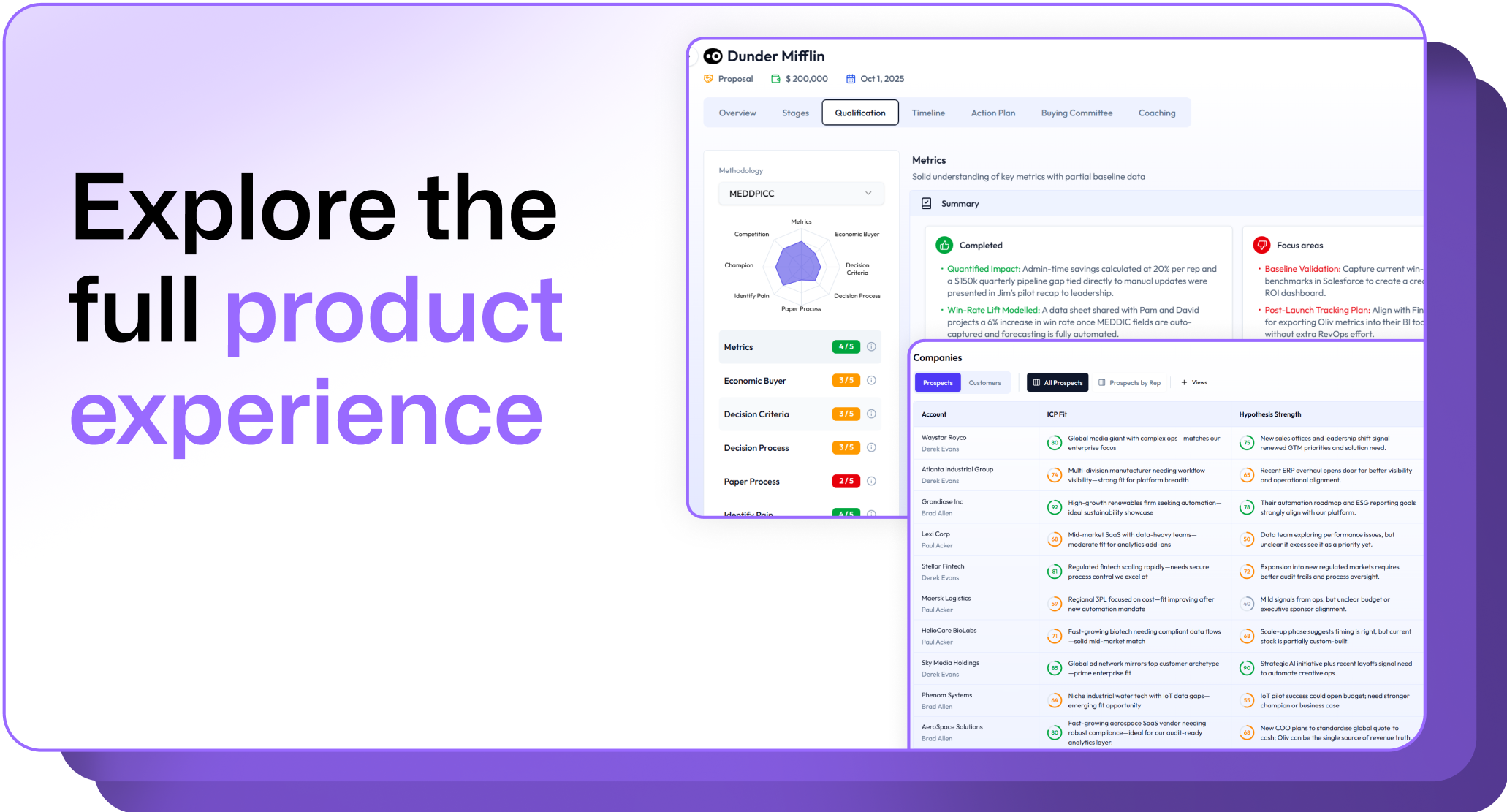
.avif)
.png)






.png)
.png)