Q1. Why Can't Sales Managers Identify Rep Skill Gaps Without Hours of Call Review? [toc=Identifying Skill Gaps]
⏰ The Manager's Bandwidth Crisis
Picture this: you manage 8 to 12 reps, each running 4 to 6 calls per day. That's 200+ conversations per week, plus hundreds of emails and Slack threads. Yet research from Salesloft shows that 78% of sales managers describe their own coaching as only "moderately effective or worse." The math doesn't work. You have roughly two hours per week for dedicated coaching, but you'd need ten times that to manually review enough calls to diagnose what each rep is doing wrong.
This is the core paradox of sales coaching in 2026: the data exists inside your tech stack, but extracting it requires a level of manual effort that most managers cannot sustain.
❌ Why Legacy CI Tools Made You the Analyst
First-generation CI tools like Gong and Chorus were built to record, not to reason. Gong's Smart Trackers rely on V1 keyword-based machine learning. A tracker configured for "budget" will fire even when the prospect mentions their "holiday budget," because it lacks contextual reasoning. Managers still click through ten screens of dashboards to find a single insight, a phenomenon teams call "Dashboard Digging."
Chorus, meanwhile, has stalled on innovation since the ZoomInfo acquisition:
"Chorus does a good job with the basic functionality of call recording and screening. If you are looking for something that is more advanced and will help guide you/be able to work in the gray area then you may be disappointed."
— Director of Sales Operations, Gartner Verified Review
"It can be overwhelming to set up trackers. AI training is a bit laborious to get it to do what you want."
— Trafford J., Senior Director, Revenue Enablement, G2 Verified Review
✅ From Documentation to Diagnosis: The AI-Era Shift
The industry is moving from "documentation of calls" to "diagnosis of deals." Modern LLM-based sales coaching systems don't scan for keywords. They parse intent, evaluating whether a rep actually uncovered decision criteria or merely mentioned it in passing. A 2025 study by Casenave in the Journal of Business Research confirmed that AI coaching can augment manager coaching, but only when calibrated correctly. Overly granular feedback risks eroding rep self-efficacy, making the delivery model as important as the intelligence.
🎯 How Oliv.ai Delivers "Reasoning Over Recording"
Oliv's Coach Agent solves this by stitching data from calls, emails, Slack, and CRM fields into a 360-degree deal narrative. It automatically surfaces where a deal is stalled, for example, "Decision Criteria not defined in Stage 2," without a manager listening to a single minute of audio.
Think of it this way: Gong and Clari are treadmills, expensive equipment that gives you data, but you still do all the running. Oliv is the personal trainer that monitors form (Coach Agent), plans workouts (personalized coaching plans), and tracks your metrics (Forecaster Agent), autonomously.
"It's too complicated, and not intuitive at all. Searching for calls is not easy, and understanding the pipeline management portion of it is almost impossible."
— John S., Senior Account Executive, G2 Verified Review
Q2. What Are the Most Common Sales Skill Gaps That Kill Live Deals? [toc=Common Skill Gaps]
Before you can coach effectively, you need to know what you're coaching on. Most managers default to vague feedback, "do better discovery" or "tighten up your closing." But skill gaps are specific, and they leave observable fingerprints on your pipeline. The framework below maps each common gap to the deal symptom it produces, so you can diagnose problems from pipeline behavior, not just call recordings.
📊 The Skill Gap Deal Symptom Framework
Skill Gap to Deal Symptom Framework| Skill Gap | What It Looks Like on Calls | Observable Deal Symptom | Pipeline Impact |
|---|
| Shallow Discovery | Rep asks surface-level questions; doesn't uncover root pain | Deals stall at Stage 2; prospects disengage after initial interest | ❌ Low Stage 2 to Stage 3 conversion |
| Weak Objection Handling | Rep freezes, deflects, or over-discounts when challenged | Prospects ghost after demo or pricing discussion | ❌ High post-demo drop-off |
| Poor Multi-Threading | Rep only engages one contact; no access to economic buyer | Deals killed when single champion changes roles or goes silent | ❌ Late-stage deal collapse |
| Missing Next-Step Commitment | Calls end without clear, time-bound follow-up | Deals drift with no forward momentum; "happy ears" syndrome | ⚠️ Extended deal cycles |
| Inconsistent Follow-Up | Delayed or generic emails after meetings | Buyer engagement decays; competitor gains mindshare | ⚠️ Pipeline velocity drops |
| Failure to Qualify | Rep advances unqualified deals past Stage 1 | Bloated pipeline with low win probability; forecast inaccuracy | 💸 Wasted selling time |
| Methodology Non-Adherence | Rep skips MEDDPICC / BANT / SPICED criteria | CRM fields empty; manager can't assess deal health | ❌ Unreliable forecasting |
🔍 Why These Gaps Stay Invisible in Traditional Tools
Most CI platforms can tell you that a call happened, but not whether the rep executed the playbook correctly. They detect keywords, not competency. As one Chorus reviewer noted:
"The software doesn't have the capability of identifying words/phrases that are similar to what you're looking for or understand context, so if you don't tell it exactly what you're looking for then you'll miss out."
— Director of Sales Operations, Gartner Verified Review
Even Gong's tracker system demands heavy upfront configuration and still lacks methodology-grade evaluation depth:
"There's so much in Gong, that we don't use everything. Gong's deal forecasting, we don't use."
— Karel Bos, Head of Sales, TrustRadius Verified Review
This is why gap identification must evolve from keyword detection to methodology-level assessment, understanding not just what the rep said, but what they should have said according to your MEDDPICC playbook.
✅ How Oliv.ai Turns This Framework Into an Automated Diagnostic
Oliv's Coach Agent doesn't require managers to manually audit calls against this taxonomy. Built on fine-tuned LLMs trained on 100+ sales methodologies, MEDDPICC, SPICED, BANT, and more, it automatically evaluates every interaction against your chosen rubric. When a rep consistently fails to identify the Economic Buyer or define Decision Criteria, the Coach Agent flags the specific gap and maps it to deal-level consequences, turning the framework above into a living, automated diagnostic engine.
Q3. What Does an AI Coach Actually Do That's Better Than Call Scoring? [toc=AI Coach vs Call Scoring]
⏰ The 2% Problem
Here's the uncomfortable reality: most sales managers only have time to manually score about 2% of their team's calls. That's roughly 4 calls reviewed out of 200+ per week. Call scoring tells you what happened on those four calls, but it doesn't tell you what to do next. It doesn't update the CRM. It doesn't draft the coaching plan. It documents, but it doesn't execute. And in the gap between documentation and execution, deals die quietly.
For solution-aware managers, the question isn't "should we score calls?" It's "why are we still treating scoring as the end goal when it covers a fraction of what actually happens?"
❌ Why Legacy Scoring Creates a False Sense of Coaching
Traditional CI platforms were designed around the call-scoring model. Chorus functions as a competent note-taker and meeting recorder, but it lacks the reasoning depth to diagnose why a call went wrong. Post-acquisition by ZoomInfo, product innovation has slowed noticeably:
"Chorus has been an okay experience, will be moving to Gong next term. Not great at forecasting. We just keep playing hot potato with vendors and it can be frustrating."
— Justin S., Senior Marketing Operations Specialist, G2 Verified Review
Gong offers more analytical horsepower, but even its users acknowledge the gap between insight and action. Managers still manually create coaching plans, trigger follow-up tasks, and connect call insights to deal outcomes themselves:
"Conversation intelligence is ChatGPT on steroids... but that's where its usefulness ends."
— Anonymous Reviewer, G2 Verified Review
✅ From Scoring to Activating: What Agentic Coaching Looks Like
An AI coach doesn't just score. It activates. The difference is structural:
Call Scoring vs Agentic AI Coaching| Capability | Call Scoring (Legacy) | Agentic AI Coaching |
|---|
| Coverage | ~2% of calls (manual) | ✅ 100% of interactions |
| Output | Score + transcript | ✅ Diagnosis + prescribed action |
| Scope | Meeting-level only | ✅ Deal-level (calls + emails + Slack) |
| Follow-through | Manager builds coaching plan | ✅ AI generates personalized tasks |
| Tracking | Point-in-time snapshot | ✅ Longitudinal skill tracking |
Agentic coaching analyzes every interaction, builds a 360-degree account profile, identifies the next best action, and drafts the documents needed to advance the deal, all automatically, without waiting for a manager to initiate a review.
🎯 How Oliv's Coach Agent Goes Beyond the Score
Oliv's Coach Agent is built on fine-tuned LLMs trained on 100+ sales methodologies (MEDDPICC, SPICED, BANT). It doesn't flag "weak discovery" as a generic label. It evaluates whether the rep actually uncovered the "Identify Pain" criteria required by your specific playbook. It then prescribes a concrete coaching task: review a competitor battlecard, practice a specific rebuttal, or study a winning peer call, delivered directly in the rep's workflow.
Because our Forecaster Agent and Coach Agent share the same data platform, the ROI loop closes automatically. Teams using unified AI coaching tools report 25% higher forecast accuracy and 35% higher win rates compared to fragmented call-scoring stacks. That's the measurable difference between a tool that records and a system that coaches.
Q4. What Tools Surface Skill Gaps From Live Deals, Not Practice Role-Plays? [toc=Live Deal Skill Gaps]
⚠️ Why Tuesday Coaching Falls Short
Most sales coaching happens on a Tuesday, during the weekly pipeline review, and it's forgotten by Wednesday. The problem isn't motivation; it's timing. By the time a manager reviews a call recording, the deal has already moved (or stalled). Reps practice generic objection-handling scenarios in role-plays, then freeze on live calls because the practice was never informed by their actual pipeline reality.
This disconnect between "coaching time" and "deal time" is the silent killer of coaching ROI. You can't fix a live deal with a generic role-play that happened three days ago.
❌ The Gap Between Recording and Practicing
The coaching tool market has evolved in two waves, and both fall short of closing the loop:
- 1st Generation (Gong, Chorus): Documentation tools. They record the call, generate a transcript, and let managers search for coaching moments. But they provide no practice loop. Managers must manually find a representative call, then manually design a coaching exercise around it, consuming the very bandwidth they were trying to save.
- 2nd Generation (Hyperbound, Second Nature): "Cold coaching" platforms. They deploy practice voice bots, but the bots run on generic scenarios. They don't measure what's actually happening on a rep's live deals to inform that practice. The result is rehearsal disconnected from reality.
"No way to collaborate/share a library of top calls. AI is not great yet, the product still feels like it's at its infancy and needs to be developed further."
— Annabelle H., Director, Board of Directors, G2 Verified Review
And for growth-stage teams, the cost question compounds the problem:
"Gong is a really powerful tool but it's probably the highest end option on the market... I don't think Gong did anything wrong here, it's just far from the right fit for us."
— Iris P., Head of Marketing, Sales & Partnerships, G2 Verified Review
✅ The Ideal Coaching Loop: Measure, Diagnose, Practice, Verify
True coaching effectiveness requires a closed, continuous loop:
- Measure : Analyze every live call and email automatically
- Diagnose : Identify the specific skill gap (not just "needs improvement")
- Practice : Deploy tailored simulations using real deal context
- Verify : Track whether the rep's behavior actually changes in subsequent interactions
No single legacy tool completes this entire loop. Gong handles step 1. Hyperbound handles step 3. Nobody connects them into a unified AI-Native Revenue Orchestration system.
🎯 How Oliv Closes the Full Coaching Loop
Oliv's architecture was designed to complete this loop end-to-end. The Deal Assist Agent detects objections in near real-time and updates the Opportunity Scorecard immediately after each call. The Coach Agent then deploys tailored practice voice bots using the specific objection from the rep's recent deal, not a generic script.
Here's a concrete example: a rep loses a $200K deal because they couldn't handle a specific pricing objection from the prospect's CFO. Oliv's Coach Agent identifies the exact gap, creates a practice simulation using that objection context, and then tracks the rep's improvement across the next five meetings. If the skill improves, it moves to the next priority gap. If not, it escalates to the manager with specific evidence. That's field-informed coaching, not cold role-play.
Q5. How Does Oliv's Coach Agent Map Specific Skill Gaps to Deal Outcomes? [toc=Skill Gaps to Deal Outcomes]
⚠️ The "Busy Deal" Illusion
A rep sends 10 emails, books 3 meetings, and logs a dozen CRM activities on an opportunity. From a dashboard, it looks like progress. But here's the question most managers can't answer: were those emails chasing a ghosting prospect, or actually advancing the deal? Activity volume is a vanity metric. It tells you a rep is working, not that they're winning.
The real challenge for managers of 6 to 12 reps is distinguishing between a "slow" deal and an "at risk" deal. Without that distinction, pipeline reviews become guessing games and quarterly forecasts become fiction. You need a system that evaluates activity quality, not just activity volume.
❌ Why Legacy Tools Track Motion, Not Meaning
Gong tracks activity volume like emails sent, calls logged, and meetings held, but it cannot assess the quality of that activity. A rep who sends ten follow-ups without addressing the prospect's core objection registers the same "engagement score" as one who advances the deal methodically. As one reviewer noted:
"The additional products like forecast or engage come at an additional cost. Would be great to see these tools rolled into the core offering."
— Scott T., Director of Sales, G2 Verified Review
Clari approaches the problem from the forecasting side, but relies on roll-up forecasting where reps narrate their own deal stories and managers estimate probability. It's rep-driven and inherently biased:
"It is really just a glorified SFDC overlay. Actually, Salesforce has built most of the forecasting functionality by now anyway so I'm not sure where they fit into that whole overcrowded Martech space."
— conaldinho11, r/SalesOperations Reddit Thread
Neither tool connects the rep's behavioral gaps to specific deal failure patterns across the pipeline.
✅ From Activity Tracking to Playbook Adherence
The AI-era shift moves from tracking what reps did to evaluating what reps should have done. Modern AI doesn't count emails. It evaluates whether the rep confirmed the Economic Buyer, defined Decision Criteria, or identified the compelling event at each deal stage. This is methodology-grade assessment, not keyword counting. When the system detects a gap pattern across multiple deals, e.g., "this rep consistently fails to define Decision Criteria before Stage 3," it becomes a coaching signal tied to revenue impact, not just a data point buried in a dashboard.
🎯 How Oliv Maps Gaps to Revenue Impact
Oliv's Coach Agent builds a Skill-Gap Map for each rep by analyzing every interaction against your chosen methodology (MEDDPICC, BANT, SPICED). It identifies what we call "fake coverage," deals showing high activity but missing critical playbook criteria. The Deal Driver Agent then flags these patterns and links skill gaps directly to deal outcomes:
- Weak discovery : deals stall at Stage 2; no defined pain
- Poor objection handling : prospects ghost after demo
- Missing multi-threading : deals collapse when single-thread champion goes silent
- No next-step commitment : deal velocity drops; "happy ears" persist
This isn't a generic skill assessment. It's a deal-outcome-linked diagnostic that tells the manager: "We lose when this rep fails to define Decision Criteria in Stage 2." That level of specificity makes every coaching conversation targeted, evidence-based, and measurable against actual revenue impact.
Q6. Does AI Prescribe Specific Coaching Tasks or Just Flag Issues? [toc=Prescriptive Coaching Tasks]
❌ Why "Do Better Discovery" Doesn't Work
Every sales manager has been there: you tell a rep to "tighten up discovery" or "negotiate better," and nothing changes. The feedback is too vague to act on. Reps nod in the 1:1, return to their desk, and default to the same habits because no one told them specifically what to do differently, or gave them the tools to practice it in the context of their actual deals.
This is the fundamental gap between flagging and prescribing. Most coaching tools do the former. Reps need the latter: specific, contextual tasks tied to their real pipeline, not generic training modules.
⏰ The Manual Coaching Plan Bottleneck
Legacy CI platforms were built to surface insights, not to act on them. Gong functions as a powerful note-taker and conversation searcher, but the coaching workflow still depends entirely on the manager. After reviewing a call, the manager must manually identify the gap, manually select a training resource, and manually assign a follow-up task, all before their next meeting starts.
"Many reps also resist using Gong because they feel micromanaged, leading to low adoption. While it works well for newer reps, the long-term engagement from experienced team members is lacking."
— Anonymous Reviewer, G2 Verified Review
Traditional SaaS compounds this by forcing all companies into a standardized coaching workflow, the same templates and playbooks regardless of whether the deal is a $50K mid-market opportunity or a $1M enterprise negotiation. Context gets lost in the one-size-fits-all approach.
✅ What Prescriptive AI Coaching Looks Like
Prescriptive coaching means the AI doesn't stop at diagnosis. It identifies the gap, selects the right intervention, and delivers it directly into the rep's workflow:
Alert-Only vs Prescriptive AI Coaching| Coaching Stage | Alert-Only Tools | Prescriptive AI Coaching |
|---|
| Gap Identified | "Weak objection handling" label | ✅ "Failed to address CFO's budget concern in Deal X" |
| Recommended Action | None, manager decides | ✅ "Review competitor battlecard for [Vendor Y]" |
| Practice Assigned | None, manager builds exercise | ✅ Voice-bot simulation using actual deal objection |
| Tracking | None, point-in-time only | ✅ Longitudinal tracking across next 5 interactions |
This shifts coaching from a manager-dependent, calendar-bound activity to a continuous, autonomous loop that runs in the background.
🎯 How Oliv's Coach Agent Prescribes, Then Tracks
Oliv's Coach Agent uses "Jobs to be Done" reasoning. It analyzes the specific Economic Buyer objection in a rep's enterprise deal and prescribes a rebuttal based on that exact transcript, not a generic training module. Prescribed tasks include reading a specific competitor battlecard, practicing a proposal walk-through, or studying a winning peer call that handled the same objection successfully.
"For me, the only business problem Gong solves is the call recordings. It allows me to review my calls and listen to them so that I can understand either where I went wrong or what the customer really said."
— John S., Senior Account Executive, G2 Verified Review
Critically, Oliv doesn't just prescribe and move on. It sets coaching tasks as monthly goals and tracks improvement across all subsequent interactions. Managers see the full performance arc, whether the intervention worked, or whether escalation is needed, closing the loop between coaching input and revenue output.
Q7. How Do You Coach Reps Without Making Them Feel Policed? [toc=Coaching Without Policing]
⚠️ The "Dashcam" Problem
Reps don't hate coaching. They hate surveillance disguised as coaching. When every call is recorded, every email is tracked, and every CRM field is audited, the tool stops feeling like a coach and starts feeling like a dashcam. The result is predictable: reps disengage, game the metrics, or quietly resent the system. For managers, this creates a painful paradox: the more data you collect, the less trust you build.
This isn't hypothetical. Low adoption is one of the most frequently cited complaints about conversation intelligence tools across review platforms, and it directly undermines the coaching ROI these tools are supposed to deliver.
❌ When Tools Create More Friction Than Value
Gong's activity tracking, talk-to-listen ratios, filler word counts, topic mentions, gives managers granular visibility. But when reps see those metrics on a leaderboard-style dashboard, many feel monitored rather than supported:
"Many reps also resist using Gong because they feel micromanaged, leading to low adoption. While it works well for newer reps, the long-term engagement from experienced team members is lacking."
— Anonymous Reviewer, G2 Verified Review
Salesforce Agentforce takes a different approach: chat-based AI that requires reps to proactively engage with a bot. But this UX creates its own friction. Reps must leave their workflow to "go talk to an AI," which feels like extra work layered on an already tool-heavy day:
"The UI felt a bit clunky at times, especially when trying to manage multiple prompts or agent versions... It's definitely not plug-and-play unless you've worked with similar AI flows before."
— Anonymous Reviewer, G2 Verified Review
Both approaches, passive surveillance and active bot engagement, miss the sweet spot for rep adoption.
✅ The "Assist, Not Assess" Model
The coaching model that actually drives adoption is one that reduces rep workload rather than adding to it. Instead of asking reps to log data, update fields, and engage with a chatbot, the AI should handle those tasks autonomously and surface coaching as a benefit that helps the rep win, not a judgment from the manager.
This means coaching insights are delivered where reps already work (Slack, email, calendar), not inside a separate dashboard they must open. The rep experiences the AI as a teammate drafting their follow-ups, not a supervisor grading their performance.
🎯 How Oliv Makes Coaching Feel Like Assistance
Oliv is built as a "hands-free workforce." It delivers insights directly in Slack or email, right on time, not after the fact. Instead of policing CRM updates, it drafts the follow-up email and business case for the rep. Instead of flagging "you talked too much," it suggests what to say next time based on patterns from similar winning deals.
The narrative shifts from "your manager is watching you" to "your AI teammate is helping you close." Reps can access their own Skill-Gap Map and own their development trajectory, making coaching collaborative and self-directed rather than top-down. When reps feel the tool is working for them rather than reporting on them, adoption follows naturally and coaching data becomes richer as a result.
Q8. How Can You Standardize Coaching Across Multiple Managers Using One Rubric? [toc=Standardizing Coaching Rubrics]
💸 The $200K Training That Doesn't Stick
Organizations routinely invest $50K to $200K on external sales consultancies like Winning by Design, Sandler, or Corporate Visions to implement a consistent methodology like MEDDPICC or SPICED. The workshops are excellent. The playbooks are thorough. And within 90 days, every manager is coaching to their own interpretation of the framework. Training fails to "stick" not because the content was bad, but because there's no enforcement system once the consultants leave the building.
The result: Manager A's pipeline reviews evaluate different criteria than Manager B's. CRM data quality varies wildly by team. And the VP of Sales has no reliable way to determine which coaching approach is actually driving revenue versus which manager is simply better at telling stories in the forecast call.
❌ Why Legacy Playbooks Create Inconsistency
Gong offers playbook functionality, but customization is limited. Teams configure Smart Trackers to catch keyword mentions, but each manager still applies their own subjective lens when reviewing calls and building coaching plans. The system records uniformly, but the interpretation varies by manager, and that's where inconsistency quietly erodes your methodology investment:
"It can be overwhelming to set up trackers. AI training is a bit laborious to get it to do what you want."
— Trafford J., Senior Director, Revenue Enablement, G2 Verified Review
"There's so much in Gong, that we don't use everything. Gong's deal forecasting, we don't use."
— Karel Bos, Head of Sales, TrustRadius Verified Review
When the tool is too complex to fully adopt, managers cherry-pick the parts they're comfortable with, and the standardized methodology you paid $200K for disappears inside individual interpretation differences.
✅ AI as the Methodology Guardrail
An AI rubric removes subjective variance entirely. It applies the exact same methodology criteria, every required question, every stage gate, every qualification checkpoint, to every call, every email, every deal. Whether a rep reports to Manager A or Manager B, the assessment is identical. No drift, no interpretation bias, no inconsistency between teams. This is what makes AI-enforced coaching fundamentally different from manager-interpreted coaching: the rubric never changes, never drifts, and never takes a day off, even as the organization scales from 20 reps to 200.
🎯 How Oliv Enforces One Standard Across Every Team
Oliv acts as the "Guardrail for Sales Methodologies." It applies your chosen rubric (MEDDPICC, BANT, SPICED, or a custom framework) across 1,000+ calls automatically. Every single rep is evaluated against the same criteria: no manager bias, no interpretation drift, no inconsistency between teams or regions.
The Analyst Agent takes this further by enabling VP-level visibility. A VP of Sales can ask in plain English: "Which managers have the highest adherence to our coaching rubrics?" and receive visual dashboards and narrative commentary in seconds. This solves the organizational blind spot where coaching data was previously buried in siloed 1:1 documents and manager-specific spreadsheets. When coaching metrics are aggregated, transparent, and comparable across every team, accountability, and coaching quality, scales across the entire AI-Native Revenue Orchestration organization without adding headcount or administrative overhead.
Q9. How Do You Scale Coaching When Ramping Multiple New Hires at Once? [toc=Scaling Coaching for New Hires]
⏰ The Bandwidth Nightmare of Growth-Stage Teams
You're a sales manager ramping 5 new hires this quarter while still coaching your existing 6 to 8 reps. That means half your week disappears into prepping for 1:1s, pipeline reviews, and onboarding sessions. You can't clone yourself, and the math is unforgiving: each new rep needs dedicated coaching hours during their critical first 90 days, precisely the period when your existing team also needs the most attention to hit quarterly targets.
This is the defining bottleneck for growth-stage managers. The team is scaling faster than your calendar allows, and every day of delayed ramp-up directly costs quota attainment. You need a system that compresses ramp time without requiring you to be in two places at once.
❌ Why Legacy Tools Slow You Down When You Need Speed
Gong is a powerful platform for established teams, but its implementation timeline works against growth-stage urgency. Gong Foundation requires manual configuration of Smart Trackers and field mappings, consuming 40 to 140 admin hours during setup. Full implementation takes 8 to 24 weeks, far too slow for a team that needs reps productive this quarter, not next:
"It can be overwhelming to set up trackers. AI training is a bit laborious to get it to do what you want."
— Trafford J., Senior Director, Revenue Enablement, G2 Verified Review
And the cost compounds the timeline problem. Gong's mandatory platform fees plus per-seat pricing make it prohibitive for teams still proving product-market fit:
"It was a big mistake on our part to commit to a two year term. Gong is a really powerful tool but it's probably the highest end option on the market... it left me feeling really bad that we're stuck with this purchase and can't free that budget up for things we really do need."
— Iris P., Head of Marketing, Sales & Partnerships, G2 Verified Review
✅ AI-Powered Onboarding: Compress Ramp Without Cutting Corners
Modern AI can auto-generate call prep, pre-populate CRM fields, and surface "best of" calls from top performers for new hires to study, all without the manager building each resource manually. The goal is to give every new rep a personalized ramp plan based on their actual early-call performance, not a generic 30-60-90 document that hasn't been updated since last year. When AI handles the repetitive onboarding groundwork, managers reclaim the bandwidth to focus on high-impact coaching conversations.
🎯 How Oliv Delivers Instant Time-to-Value for Growing Teams
Oliv's configuration is instant: 5 minutes for basic setup, with full custom model building completed in 2 to 4 weeks. Compare that to Gong's 8 to 24 week implementation timeline. Our Meeting Assistant automates all onboarding call prep and notes, so the manager can scale to 10+ reps without losing quality control. The Coach Agent creates personalized ramp plans for each new hire based on their actual early calls, identifying skill gaps from day one, not day ninety.
💰 For growth-stage buyers watching every dollar, Oliv's core meeting intelligence is free for teams switching from Gong, letting them redirect budget toward the high-value Agent layers that actually accelerate ramp. When your team is doubling and your calendar isn't, the tool that deploys in days, not months, wins the growth-stage decision every time.
Q10. Can AI Coach on Written Communication, Emails and Follow-Ups, or Just Calls? [toc=Coaching Written Communication]
⚠️ The "Dark Social" Blind Spot
A rep delivers a flawless demo, then sends a generic two-line follow-up email that loses the deal's momentum entirely. It happens constantly, and most coaching tools never see it. In B2B sales, much of the actual selling happens in what the industry calls "Dark Social": shared Slack channels, email threads, LinkedIn DMs, and even Telegram groups. These are the channels where deals advance or stall between meetings, yet traditional conversation intelligence tools are completely blind to them.
If your coaching only covers what happens on calls, you're coaching on half the deal at best. The written touchpoints between meetings often determine whether a deal accelerates toward close or dies in silence.
❌ Why Call-Only Tools Miss Half the Picture
Gong captures meeting-level data, transcripts, talk ratios, topic mentions, but it doesn't ingest deal-level context from email threads or Slack channels. A manager using Gong can coach a rep on demo delivery but has zero visibility into whether the follow-up email reinforced the right message, contained the right next steps, or fell completely flat:
"For me, the only business problem Gong solves is the call recordings. It allows me to review my calls and listen to them so that I can understand either where I went wrong or what the customer really said."
— John S., Senior Account Executive, G2 Verified Review
Chorus faces the same limitation, post-ZoomInfo acquisition, its scope remains firmly meeting-centric. Neither tool imports from Slack, analyzes email tone, or evaluates whether written follow-ups align with what was discussed on the call. Coaching remains channel-fragmented, covering verbal performance while ignoring written execution entirely.
"I wish they were a little more responsive to customer requests. They say a feature is coming in a certain quarter and then it doesn't."
— Amanda R., Director, Customer Success, G2 Verified Review
✅ Multichannel Coaching: The Full-Deal Lens
True coaching coverage must span every buyer touchpoint, not just the 30-minute call. AI can analyze email tone, response latency, content specificity, and narrative consistency across written channels. It can detect when a rep's follow-up email contradicts what was agreed on the call, or when response times are slipping in a way that signals buyer disengagement. This multichannel lens transforms coaching from a call-review exercise into a comprehensive deal-quality assessment that covers the full buyer journey.
🎯 How Oliv Coaches Across Every Channel
Oliv provides a 360-degree account view that analyzes emails and Slack channel interactions alongside call data. The Coach Agent evaluates tone, responsiveness, and content quality across written channels, ensuring the rep builds a consistent "outcome-based story" from first demo to final close.
For example: Oliv detects that a rep's follow-up emails after demos are generic and lack the specific next-step commitments discussed on the call. The Coach Agent flags this pattern, prescribes a contextual email template rooted in the actual call outcomes, and tracks whether written follow-up quality improves over the next five deals. That's full-deal coaching, not single-channel scoring.
Q11. How Do You Tie Coaching to Deal Outcomes So You Know It Actually Worked? [toc=Coaching ROI Measurement]
💸 The Invisible ROI Problem
Revenue intelligence and coaching typically live in separate modules, separate tools, separate data layers, separate vendors. You invest $40K in Chorus for coaching and another $60K in Clari for forecasting, but you can't answer the most basic question: did that coaching investment actually increase win rates or ACV? The ROI of coaching remains invisible because the data never connects across the tool stack.
This isn't a minor reporting gap. It's the reason CROs struggle to defend coaching budgets during board reviews, they can't prove causation between coaching inputs and revenue outputs, so coaching becomes the first line item cut when belt-tightening begins.
❌ Why Stacking Legacy Tools Breaks the ROI Chain
Gong charges in layers: Platform Fee + Core License + Add-ons for Forecast, Engage, and other modules. Stacking Gong (CI) + Clari (Forecasting) can result in roughly $500/user/month TCO for a fully loaded revenue stack. But the fundamental problem isn't just cost, it's data fragmentation. Coaching insights live in one system, forecasting data lives in another, and no one can trace the causal chain between them:
"The additional products like forecast or engage come at an additional cost. Would be great to see these tools rolled into the core offering."
— Scott T., Director of Sales, G2 Verified Review
"Clari is a tool for sales leaders, it adds no value to reps as far as I can see."
— Msoave, r/sales Reddit Thread
When coaching data lives in Gong and forecasting data lives in Clari, nobody can measure the full chain: coaching intervention to behavior change to deal outcome improvement. You're flying blind on the most expensive line item in your enablement budget, and board-level accountability becomes impossible.
✅ Unified Data: The Only Way to Prove Coaching Works
When coaching and forecasting share the same data platform, you can finally measure what matters. Did the rep's objection-handling improve after the coaching task? Did that improvement correlate with higher Stage 3 conversion rates? Did the team's overall win rate increase this quarter versus last? Longitudinal skill tracking on a single data layer turns coaching from a faith-based investment into a measurable, defensible revenue driver that earns budget instead of losing it.
🎯 How Oliv Closes the ROI Loop on a Single Platform
Oliv's Coach Agent and Forecaster Agent share the same data platform, by design, not by integration. The Coach Agent tracks how a rep's performance on a specific skill changes across the next 5 meetings post-intervention. Managers visually see the performance arc: did the behavior improve, plateau, or regress?
Teams using unified AI coaching tools report 25% higher forecast accuracy and 35% higher win rates compared to fragmented call-scoring stacks. Because coaching and forecasting data are native to the same system, Oliv can surface direct ROI proof: "After coaching Rep X on discovery, Stage 2 conversion improved 18% over 6 weeks." That's the evidence CROs need at the board table, and it lives in one platform, not a stitched-together spreadsheet across three vendors.
Q12. What Does a Daily AI-Powered Coaching Workflow Look Like in Practice? [toc=Daily AI Coaching Workflow]
Adopting AI coaching isn't about replacing your existing rhythm, it's about removing the manual prep that eats your calendar. Below is a concrete daily and weekly workflow that a growth-stage manager (6 to 12 reps) can implement immediately with an AI-Native Revenue Orchestration platform. Each step shows what the AI handles autonomously and where the manager adds irreplaceable human judgment.
⏰ Morning: Pre-Call Intelligence (8:00 to 9:00 AM)
- AI Morning Brief arrives in Slack: 30 minutes before the first call, the AI pushes a summary of each rep's upcoming meetings: account history, deal stage, open risk flags, and suggested talking points tailored to where the deal stands.
- Manager scans for red flags: instead of clicking through CRM records, the manager reviews a single Slack digest highlighting which deals need attention today and which reps need pre-call guidance.
- Reps receive call prep automatically: no manual research required; the AI pre-populates key account context, stakeholder details, and prior conversation highlights directly into the rep's workflow.
📊 Midday: Live Deal Monitoring (12:00 to 1:00 PM)
- Post-call scorecards update automatically: after each morning call, the AI evaluates methodology adherence (MEDDPICC, BANT, SPICED) and updates the Opportunity Scorecard with specific findings and gap flags.
- Skill-gap alerts trigger in real time: if a rep misses a critical playbook step (e.g., failed to confirm Economic Buyer), the manager receives a Slack notification with a recommended coaching action and supporting call evidence.
- Follow-up emails are drafted: the AI generates context-specific follow-up drafts for the rep, pulling key commitments and agreed-upon next steps from the call transcript automatically.
🎯 Afternoon: 1:1 Coaching Sessions (2:00 to 3:00 PM)
- AI pre-builds the 1:1 agenda: instead of spending 20 minutes per rep manually reviewing calls, the AI surfaces the top 2 to 3 coaching priorities with supporting evidence: specific call moments, email patterns, and longitudinal skill-gap trends.
- Prescriptive tasks are ready: the manager doesn't build the coaching plan from scratch; the AI has already prescribed specific actions: battlecard review, practice simulation, or peer call study relevant to the rep's actual pipeline.
- Rep sees their own Skill-Gap Map: the conversation becomes collaborative because the rep can see the same data the manager sees, enabling self-directed development and shared accountability.
🌅 Evening: Sunset Summary (5:00 to 6:00 PM)
- Daily deal digest arrives: the manager receives a breakdown of which deals moved forward, which stalled, and where to intervene first thing tomorrow morning.
- Coaching task completion tracking: the AI flags which reps completed their prescribed tasks and which need a follow-up reminder or escalation.
- Weekly trend preview: ahead of the Friday pipeline review, longitudinal skill data begins surfacing patterns for the week, giving the manager a head start on the strategic conversation.
✅ How Oliv.ai Powers This Workflow
Oliv's agent architecture, Meeting Assistant, Coach Agent, Deal Assist Agent, and Forecaster Agent, automates each step above natively. The Morning Brief and Sunset Summary are delivered in Slack without additional configuration. The Coach Agent prescribes and tracks tasks automatically. The entire workflow requires no dashboard-hopping, no manual CRM updates, and no evening call-listening sessions, giving the manager back 5 to 8 hours per week to invest in the high-judgment coaching conversations that actually move revenue forward.
Q1. Why Can't Sales Managers Identify Rep Skill Gaps Without Hours of Call Review? [toc=Identifying Skill Gaps]
⏰ The Manager's Bandwidth Crisis
Picture this: you manage 8 to 12 reps, each running 4 to 6 calls per day. That's 200+ conversations per week, plus hundreds of emails and Slack threads. Yet research from Salesloft shows that 78% of sales managers describe their own coaching as only "moderately effective or worse." The math doesn't work. You have roughly two hours per week for dedicated coaching, but you'd need ten times that to manually review enough calls to diagnose what each rep is doing wrong.
This is the core paradox of sales coaching in 2026: the data exists inside your tech stack, but extracting it requires a level of manual effort that most managers cannot sustain.
❌ Why Legacy CI Tools Made You the Analyst
First-generation CI tools like Gong and Chorus were built to record, not to reason. Gong's Smart Trackers rely on V1 keyword-based machine learning. A tracker configured for "budget" will fire even when the prospect mentions their "holiday budget," because it lacks contextual reasoning. Managers still click through ten screens of dashboards to find a single insight, a phenomenon teams call "Dashboard Digging."
Chorus, meanwhile, has stalled on innovation since the ZoomInfo acquisition:
"Chorus does a good job with the basic functionality of call recording and screening. If you are looking for something that is more advanced and will help guide you/be able to work in the gray area then you may be disappointed."
— Director of Sales Operations, Gartner Verified Review
"It can be overwhelming to set up trackers. AI training is a bit laborious to get it to do what you want."
— Trafford J., Senior Director, Revenue Enablement, G2 Verified Review
✅ From Documentation to Diagnosis: The AI-Era Shift
The industry is moving from "documentation of calls" to "diagnosis of deals." Modern LLM-based sales coaching systems don't scan for keywords. They parse intent, evaluating whether a rep actually uncovered decision criteria or merely mentioned it in passing. A 2025 study by Casenave in the Journal of Business Research confirmed that AI coaching can augment manager coaching, but only when calibrated correctly. Overly granular feedback risks eroding rep self-efficacy, making the delivery model as important as the intelligence.
🎯 How Oliv.ai Delivers "Reasoning Over Recording"
Oliv's Coach Agent solves this by stitching data from calls, emails, Slack, and CRM fields into a 360-degree deal narrative. It automatically surfaces where a deal is stalled, for example, "Decision Criteria not defined in Stage 2," without a manager listening to a single minute of audio.
Think of it this way: Gong and Clari are treadmills, expensive equipment that gives you data, but you still do all the running. Oliv is the personal trainer that monitors form (Coach Agent), plans workouts (personalized coaching plans), and tracks your metrics (Forecaster Agent), autonomously.
"It's too complicated, and not intuitive at all. Searching for calls is not easy, and understanding the pipeline management portion of it is almost impossible."
— John S., Senior Account Executive, G2 Verified Review
Q2. What Are the Most Common Sales Skill Gaps That Kill Live Deals? [toc=Common Skill Gaps]
Before you can coach effectively, you need to know what you're coaching on. Most managers default to vague feedback, "do better discovery" or "tighten up your closing." But skill gaps are specific, and they leave observable fingerprints on your pipeline. The framework below maps each common gap to the deal symptom it produces, so you can diagnose problems from pipeline behavior, not just call recordings.
📊 The Skill Gap Deal Symptom Framework
Skill Gap to Deal Symptom Framework| Skill Gap | What It Looks Like on Calls | Observable Deal Symptom | Pipeline Impact |
|---|
| Shallow Discovery | Rep asks surface-level questions; doesn't uncover root pain | Deals stall at Stage 2; prospects disengage after initial interest | ❌ Low Stage 2 to Stage 3 conversion |
| Weak Objection Handling | Rep freezes, deflects, or over-discounts when challenged | Prospects ghost after demo or pricing discussion | ❌ High post-demo drop-off |
| Poor Multi-Threading | Rep only engages one contact; no access to economic buyer | Deals killed when single champion changes roles or goes silent | ❌ Late-stage deal collapse |
| Missing Next-Step Commitment | Calls end without clear, time-bound follow-up | Deals drift with no forward momentum; "happy ears" syndrome | ⚠️ Extended deal cycles |
| Inconsistent Follow-Up | Delayed or generic emails after meetings | Buyer engagement decays; competitor gains mindshare | ⚠️ Pipeline velocity drops |
| Failure to Qualify | Rep advances unqualified deals past Stage 1 | Bloated pipeline with low win probability; forecast inaccuracy | 💸 Wasted selling time |
| Methodology Non-Adherence | Rep skips MEDDPICC / BANT / SPICED criteria | CRM fields empty; manager can't assess deal health | ❌ Unreliable forecasting |
🔍 Why These Gaps Stay Invisible in Traditional Tools
Most CI platforms can tell you that a call happened, but not whether the rep executed the playbook correctly. They detect keywords, not competency. As one Chorus reviewer noted:
"The software doesn't have the capability of identifying words/phrases that are similar to what you're looking for or understand context, so if you don't tell it exactly what you're looking for then you'll miss out."
— Director of Sales Operations, Gartner Verified Review
Even Gong's tracker system demands heavy upfront configuration and still lacks methodology-grade evaluation depth:
"There's so much in Gong, that we don't use everything. Gong's deal forecasting, we don't use."
— Karel Bos, Head of Sales, TrustRadius Verified Review
This is why gap identification must evolve from keyword detection to methodology-level assessment, understanding not just what the rep said, but what they should have said according to your MEDDPICC playbook.
✅ How Oliv.ai Turns This Framework Into an Automated Diagnostic
Oliv's Coach Agent doesn't require managers to manually audit calls against this taxonomy. Built on fine-tuned LLMs trained on 100+ sales methodologies, MEDDPICC, SPICED, BANT, and more, it automatically evaluates every interaction against your chosen rubric. When a rep consistently fails to identify the Economic Buyer or define Decision Criteria, the Coach Agent flags the specific gap and maps it to deal-level consequences, turning the framework above into a living, automated diagnostic engine.
Q3. What Does an AI Coach Actually Do That's Better Than Call Scoring? [toc=AI Coach vs Call Scoring]
⏰ The 2% Problem
Here's the uncomfortable reality: most sales managers only have time to manually score about 2% of their team's calls. That's roughly 4 calls reviewed out of 200+ per week. Call scoring tells you what happened on those four calls, but it doesn't tell you what to do next. It doesn't update the CRM. It doesn't draft the coaching plan. It documents, but it doesn't execute. And in the gap between documentation and execution, deals die quietly.
For solution-aware managers, the question isn't "should we score calls?" It's "why are we still treating scoring as the end goal when it covers a fraction of what actually happens?"
❌ Why Legacy Scoring Creates a False Sense of Coaching
Traditional CI platforms were designed around the call-scoring model. Chorus functions as a competent note-taker and meeting recorder, but it lacks the reasoning depth to diagnose why a call went wrong. Post-acquisition by ZoomInfo, product innovation has slowed noticeably:
"Chorus has been an okay experience, will be moving to Gong next term. Not great at forecasting. We just keep playing hot potato with vendors and it can be frustrating."
— Justin S., Senior Marketing Operations Specialist, G2 Verified Review
Gong offers more analytical horsepower, but even its users acknowledge the gap between insight and action. Managers still manually create coaching plans, trigger follow-up tasks, and connect call insights to deal outcomes themselves:
"Conversation intelligence is ChatGPT on steroids... but that's where its usefulness ends."
— Anonymous Reviewer, G2 Verified Review
✅ From Scoring to Activating: What Agentic Coaching Looks Like
An AI coach doesn't just score. It activates. The difference is structural:
Call Scoring vs Agentic AI Coaching| Capability | Call Scoring (Legacy) | Agentic AI Coaching |
|---|
| Coverage | ~2% of calls (manual) | ✅ 100% of interactions |
| Output | Score + transcript | ✅ Diagnosis + prescribed action |
| Scope | Meeting-level only | ✅ Deal-level (calls + emails + Slack) |
| Follow-through | Manager builds coaching plan | ✅ AI generates personalized tasks |
| Tracking | Point-in-time snapshot | ✅ Longitudinal skill tracking |
Agentic coaching analyzes every interaction, builds a 360-degree account profile, identifies the next best action, and drafts the documents needed to advance the deal, all automatically, without waiting for a manager to initiate a review.
🎯 How Oliv's Coach Agent Goes Beyond the Score
Oliv's Coach Agent is built on fine-tuned LLMs trained on 100+ sales methodologies (MEDDPICC, SPICED, BANT). It doesn't flag "weak discovery" as a generic label. It evaluates whether the rep actually uncovered the "Identify Pain" criteria required by your specific playbook. It then prescribes a concrete coaching task: review a competitor battlecard, practice a specific rebuttal, or study a winning peer call, delivered directly in the rep's workflow.
Because our Forecaster Agent and Coach Agent share the same data platform, the ROI loop closes automatically. Teams using unified AI coaching tools report 25% higher forecast accuracy and 35% higher win rates compared to fragmented call-scoring stacks. That's the measurable difference between a tool that records and a system that coaches.
Q4. What Tools Surface Skill Gaps From Live Deals, Not Practice Role-Plays? [toc=Live Deal Skill Gaps]
⚠️ Why Tuesday Coaching Falls Short
Most sales coaching happens on a Tuesday, during the weekly pipeline review, and it's forgotten by Wednesday. The problem isn't motivation; it's timing. By the time a manager reviews a call recording, the deal has already moved (or stalled). Reps practice generic objection-handling scenarios in role-plays, then freeze on live calls because the practice was never informed by their actual pipeline reality.
This disconnect between "coaching time" and "deal time" is the silent killer of coaching ROI. You can't fix a live deal with a generic role-play that happened three days ago.
❌ The Gap Between Recording and Practicing
The coaching tool market has evolved in two waves, and both fall short of closing the loop:
- 1st Generation (Gong, Chorus): Documentation tools. They record the call, generate a transcript, and let managers search for coaching moments. But they provide no practice loop. Managers must manually find a representative call, then manually design a coaching exercise around it, consuming the very bandwidth they were trying to save.
- 2nd Generation (Hyperbound, Second Nature): "Cold coaching" platforms. They deploy practice voice bots, but the bots run on generic scenarios. They don't measure what's actually happening on a rep's live deals to inform that practice. The result is rehearsal disconnected from reality.
"No way to collaborate/share a library of top calls. AI is not great yet, the product still feels like it's at its infancy and needs to be developed further."
— Annabelle H., Director, Board of Directors, G2 Verified Review
And for growth-stage teams, the cost question compounds the problem:
"Gong is a really powerful tool but it's probably the highest end option on the market... I don't think Gong did anything wrong here, it's just far from the right fit for us."
— Iris P., Head of Marketing, Sales & Partnerships, G2 Verified Review
✅ The Ideal Coaching Loop: Measure, Diagnose, Practice, Verify
True coaching effectiveness requires a closed, continuous loop:
- Measure : Analyze every live call and email automatically
- Diagnose : Identify the specific skill gap (not just "needs improvement")
- Practice : Deploy tailored simulations using real deal context
- Verify : Track whether the rep's behavior actually changes in subsequent interactions
No single legacy tool completes this entire loop. Gong handles step 1. Hyperbound handles step 3. Nobody connects them into a unified AI-Native Revenue Orchestration system.
🎯 How Oliv Closes the Full Coaching Loop
Oliv's architecture was designed to complete this loop end-to-end. The Deal Assist Agent detects objections in near real-time and updates the Opportunity Scorecard immediately after each call. The Coach Agent then deploys tailored practice voice bots using the specific objection from the rep's recent deal, not a generic script.
Here's a concrete example: a rep loses a $200K deal because they couldn't handle a specific pricing objection from the prospect's CFO. Oliv's Coach Agent identifies the exact gap, creates a practice simulation using that objection context, and then tracks the rep's improvement across the next five meetings. If the skill improves, it moves to the next priority gap. If not, it escalates to the manager with specific evidence. That's field-informed coaching, not cold role-play.
Q5. How Does Oliv's Coach Agent Map Specific Skill Gaps to Deal Outcomes? [toc=Skill Gaps to Deal Outcomes]
⚠️ The "Busy Deal" Illusion
A rep sends 10 emails, books 3 meetings, and logs a dozen CRM activities on an opportunity. From a dashboard, it looks like progress. But here's the question most managers can't answer: were those emails chasing a ghosting prospect, or actually advancing the deal? Activity volume is a vanity metric. It tells you a rep is working, not that they're winning.
The real challenge for managers of 6 to 12 reps is distinguishing between a "slow" deal and an "at risk" deal. Without that distinction, pipeline reviews become guessing games and quarterly forecasts become fiction. You need a system that evaluates activity quality, not just activity volume.
❌ Why Legacy Tools Track Motion, Not Meaning
Gong tracks activity volume like emails sent, calls logged, and meetings held, but it cannot assess the quality of that activity. A rep who sends ten follow-ups without addressing the prospect's core objection registers the same "engagement score" as one who advances the deal methodically. As one reviewer noted:
"The additional products like forecast or engage come at an additional cost. Would be great to see these tools rolled into the core offering."
— Scott T., Director of Sales, G2 Verified Review
Clari approaches the problem from the forecasting side, but relies on roll-up forecasting where reps narrate their own deal stories and managers estimate probability. It's rep-driven and inherently biased:
"It is really just a glorified SFDC overlay. Actually, Salesforce has built most of the forecasting functionality by now anyway so I'm not sure where they fit into that whole overcrowded Martech space."
— conaldinho11, r/SalesOperations Reddit Thread
Neither tool connects the rep's behavioral gaps to specific deal failure patterns across the pipeline.
✅ From Activity Tracking to Playbook Adherence
The AI-era shift moves from tracking what reps did to evaluating what reps should have done. Modern AI doesn't count emails. It evaluates whether the rep confirmed the Economic Buyer, defined Decision Criteria, or identified the compelling event at each deal stage. This is methodology-grade assessment, not keyword counting. When the system detects a gap pattern across multiple deals, e.g., "this rep consistently fails to define Decision Criteria before Stage 3," it becomes a coaching signal tied to revenue impact, not just a data point buried in a dashboard.
🎯 How Oliv Maps Gaps to Revenue Impact
Oliv's Coach Agent builds a Skill-Gap Map for each rep by analyzing every interaction against your chosen methodology (MEDDPICC, BANT, SPICED). It identifies what we call "fake coverage," deals showing high activity but missing critical playbook criteria. The Deal Driver Agent then flags these patterns and links skill gaps directly to deal outcomes:
- Weak discovery : deals stall at Stage 2; no defined pain
- Poor objection handling : prospects ghost after demo
- Missing multi-threading : deals collapse when single-thread champion goes silent
- No next-step commitment : deal velocity drops; "happy ears" persist
This isn't a generic skill assessment. It's a deal-outcome-linked diagnostic that tells the manager: "We lose when this rep fails to define Decision Criteria in Stage 2." That level of specificity makes every coaching conversation targeted, evidence-based, and measurable against actual revenue impact.
Q6. Does AI Prescribe Specific Coaching Tasks or Just Flag Issues? [toc=Prescriptive Coaching Tasks]
❌ Why "Do Better Discovery" Doesn't Work
Every sales manager has been there: you tell a rep to "tighten up discovery" or "negotiate better," and nothing changes. The feedback is too vague to act on. Reps nod in the 1:1, return to their desk, and default to the same habits because no one told them specifically what to do differently, or gave them the tools to practice it in the context of their actual deals.
This is the fundamental gap between flagging and prescribing. Most coaching tools do the former. Reps need the latter: specific, contextual tasks tied to their real pipeline, not generic training modules.
⏰ The Manual Coaching Plan Bottleneck
Legacy CI platforms were built to surface insights, not to act on them. Gong functions as a powerful note-taker and conversation searcher, but the coaching workflow still depends entirely on the manager. After reviewing a call, the manager must manually identify the gap, manually select a training resource, and manually assign a follow-up task, all before their next meeting starts.
"Many reps also resist using Gong because they feel micromanaged, leading to low adoption. While it works well for newer reps, the long-term engagement from experienced team members is lacking."
— Anonymous Reviewer, G2 Verified Review
Traditional SaaS compounds this by forcing all companies into a standardized coaching workflow, the same templates and playbooks regardless of whether the deal is a $50K mid-market opportunity or a $1M enterprise negotiation. Context gets lost in the one-size-fits-all approach.
✅ What Prescriptive AI Coaching Looks Like
Prescriptive coaching means the AI doesn't stop at diagnosis. It identifies the gap, selects the right intervention, and delivers it directly into the rep's workflow:
Alert-Only vs Prescriptive AI Coaching| Coaching Stage | Alert-Only Tools | Prescriptive AI Coaching |
|---|
| Gap Identified | "Weak objection handling" label | ✅ "Failed to address CFO's budget concern in Deal X" |
| Recommended Action | None, manager decides | ✅ "Review competitor battlecard for [Vendor Y]" |
| Practice Assigned | None, manager builds exercise | ✅ Voice-bot simulation using actual deal objection |
| Tracking | None, point-in-time only | ✅ Longitudinal tracking across next 5 interactions |
This shifts coaching from a manager-dependent, calendar-bound activity to a continuous, autonomous loop that runs in the background.
🎯 How Oliv's Coach Agent Prescribes, Then Tracks
Oliv's Coach Agent uses "Jobs to be Done" reasoning. It analyzes the specific Economic Buyer objection in a rep's enterprise deal and prescribes a rebuttal based on that exact transcript, not a generic training module. Prescribed tasks include reading a specific competitor battlecard, practicing a proposal walk-through, or studying a winning peer call that handled the same objection successfully.
"For me, the only business problem Gong solves is the call recordings. It allows me to review my calls and listen to them so that I can understand either where I went wrong or what the customer really said."
— John S., Senior Account Executive, G2 Verified Review
Critically, Oliv doesn't just prescribe and move on. It sets coaching tasks as monthly goals and tracks improvement across all subsequent interactions. Managers see the full performance arc, whether the intervention worked, or whether escalation is needed, closing the loop between coaching input and revenue output.
Q7. How Do You Coach Reps Without Making Them Feel Policed? [toc=Coaching Without Policing]
⚠️ The "Dashcam" Problem
Reps don't hate coaching. They hate surveillance disguised as coaching. When every call is recorded, every email is tracked, and every CRM field is audited, the tool stops feeling like a coach and starts feeling like a dashcam. The result is predictable: reps disengage, game the metrics, or quietly resent the system. For managers, this creates a painful paradox: the more data you collect, the less trust you build.
This isn't hypothetical. Low adoption is one of the most frequently cited complaints about conversation intelligence tools across review platforms, and it directly undermines the coaching ROI these tools are supposed to deliver.
❌ When Tools Create More Friction Than Value
Gong's activity tracking, talk-to-listen ratios, filler word counts, topic mentions, gives managers granular visibility. But when reps see those metrics on a leaderboard-style dashboard, many feel monitored rather than supported:
"Many reps also resist using Gong because they feel micromanaged, leading to low adoption. While it works well for newer reps, the long-term engagement from experienced team members is lacking."
— Anonymous Reviewer, G2 Verified Review
Salesforce Agentforce takes a different approach: chat-based AI that requires reps to proactively engage with a bot. But this UX creates its own friction. Reps must leave their workflow to "go talk to an AI," which feels like extra work layered on an already tool-heavy day:
"The UI felt a bit clunky at times, especially when trying to manage multiple prompts or agent versions... It's definitely not plug-and-play unless you've worked with similar AI flows before."
— Anonymous Reviewer, G2 Verified Review
Both approaches, passive surveillance and active bot engagement, miss the sweet spot for rep adoption.
✅ The "Assist, Not Assess" Model
The coaching model that actually drives adoption is one that reduces rep workload rather than adding to it. Instead of asking reps to log data, update fields, and engage with a chatbot, the AI should handle those tasks autonomously and surface coaching as a benefit that helps the rep win, not a judgment from the manager.
This means coaching insights are delivered where reps already work (Slack, email, calendar), not inside a separate dashboard they must open. The rep experiences the AI as a teammate drafting their follow-ups, not a supervisor grading their performance.
🎯 How Oliv Makes Coaching Feel Like Assistance
Oliv is built as a "hands-free workforce." It delivers insights directly in Slack or email, right on time, not after the fact. Instead of policing CRM updates, it drafts the follow-up email and business case for the rep. Instead of flagging "you talked too much," it suggests what to say next time based on patterns from similar winning deals.
The narrative shifts from "your manager is watching you" to "your AI teammate is helping you close." Reps can access their own Skill-Gap Map and own their development trajectory, making coaching collaborative and self-directed rather than top-down. When reps feel the tool is working for them rather than reporting on them, adoption follows naturally and coaching data becomes richer as a result.
Q8. How Can You Standardize Coaching Across Multiple Managers Using One Rubric? [toc=Standardizing Coaching Rubrics]
💸 The $200K Training That Doesn't Stick
Organizations routinely invest $50K to $200K on external sales consultancies like Winning by Design, Sandler, or Corporate Visions to implement a consistent methodology like MEDDPICC or SPICED. The workshops are excellent. The playbooks are thorough. And within 90 days, every manager is coaching to their own interpretation of the framework. Training fails to "stick" not because the content was bad, but because there's no enforcement system once the consultants leave the building.
The result: Manager A's pipeline reviews evaluate different criteria than Manager B's. CRM data quality varies wildly by team. And the VP of Sales has no reliable way to determine which coaching approach is actually driving revenue versus which manager is simply better at telling stories in the forecast call.
❌ Why Legacy Playbooks Create Inconsistency
Gong offers playbook functionality, but customization is limited. Teams configure Smart Trackers to catch keyword mentions, but each manager still applies their own subjective lens when reviewing calls and building coaching plans. The system records uniformly, but the interpretation varies by manager, and that's where inconsistency quietly erodes your methodology investment:
"It can be overwhelming to set up trackers. AI training is a bit laborious to get it to do what you want."
— Trafford J., Senior Director, Revenue Enablement, G2 Verified Review
"There's so much in Gong, that we don't use everything. Gong's deal forecasting, we don't use."
— Karel Bos, Head of Sales, TrustRadius Verified Review
When the tool is too complex to fully adopt, managers cherry-pick the parts they're comfortable with, and the standardized methodology you paid $200K for disappears inside individual interpretation differences.
✅ AI as the Methodology Guardrail
An AI rubric removes subjective variance entirely. It applies the exact same methodology criteria, every required question, every stage gate, every qualification checkpoint, to every call, every email, every deal. Whether a rep reports to Manager A or Manager B, the assessment is identical. No drift, no interpretation bias, no inconsistency between teams. This is what makes AI-enforced coaching fundamentally different from manager-interpreted coaching: the rubric never changes, never drifts, and never takes a day off, even as the organization scales from 20 reps to 200.
🎯 How Oliv Enforces One Standard Across Every Team
Oliv acts as the "Guardrail for Sales Methodologies." It applies your chosen rubric (MEDDPICC, BANT, SPICED, or a custom framework) across 1,000+ calls automatically. Every single rep is evaluated against the same criteria: no manager bias, no interpretation drift, no inconsistency between teams or regions.
The Analyst Agent takes this further by enabling VP-level visibility. A VP of Sales can ask in plain English: "Which managers have the highest adherence to our coaching rubrics?" and receive visual dashboards and narrative commentary in seconds. This solves the organizational blind spot where coaching data was previously buried in siloed 1:1 documents and manager-specific spreadsheets. When coaching metrics are aggregated, transparent, and comparable across every team, accountability, and coaching quality, scales across the entire AI-Native Revenue Orchestration organization without adding headcount or administrative overhead.
Q9. How Do You Scale Coaching When Ramping Multiple New Hires at Once? [toc=Scaling Coaching for New Hires]
⏰ The Bandwidth Nightmare of Growth-Stage Teams
You're a sales manager ramping 5 new hires this quarter while still coaching your existing 6 to 8 reps. That means half your week disappears into prepping for 1:1s, pipeline reviews, and onboarding sessions. You can't clone yourself, and the math is unforgiving: each new rep needs dedicated coaching hours during their critical first 90 days, precisely the period when your existing team also needs the most attention to hit quarterly targets.
This is the defining bottleneck for growth-stage managers. The team is scaling faster than your calendar allows, and every day of delayed ramp-up directly costs quota attainment. You need a system that compresses ramp time without requiring you to be in two places at once.
❌ Why Legacy Tools Slow You Down When You Need Speed
Gong is a powerful platform for established teams, but its implementation timeline works against growth-stage urgency. Gong Foundation requires manual configuration of Smart Trackers and field mappings, consuming 40 to 140 admin hours during setup. Full implementation takes 8 to 24 weeks, far too slow for a team that needs reps productive this quarter, not next:
"It can be overwhelming to set up trackers. AI training is a bit laborious to get it to do what you want."
— Trafford J., Senior Director, Revenue Enablement, G2 Verified Review
And the cost compounds the timeline problem. Gong's mandatory platform fees plus per-seat pricing make it prohibitive for teams still proving product-market fit:
"It was a big mistake on our part to commit to a two year term. Gong is a really powerful tool but it's probably the highest end option on the market... it left me feeling really bad that we're stuck with this purchase and can't free that budget up for things we really do need."
— Iris P., Head of Marketing, Sales & Partnerships, G2 Verified Review
✅ AI-Powered Onboarding: Compress Ramp Without Cutting Corners
Modern AI can auto-generate call prep, pre-populate CRM fields, and surface "best of" calls from top performers for new hires to study, all without the manager building each resource manually. The goal is to give every new rep a personalized ramp plan based on their actual early-call performance, not a generic 30-60-90 document that hasn't been updated since last year. When AI handles the repetitive onboarding groundwork, managers reclaim the bandwidth to focus on high-impact coaching conversations.
🎯 How Oliv Delivers Instant Time-to-Value for Growing Teams
Oliv's configuration is instant: 5 minutes for basic setup, with full custom model building completed in 2 to 4 weeks. Compare that to Gong's 8 to 24 week implementation timeline. Our Meeting Assistant automates all onboarding call prep and notes, so the manager can scale to 10+ reps without losing quality control. The Coach Agent creates personalized ramp plans for each new hire based on their actual early calls, identifying skill gaps from day one, not day ninety.
💰 For growth-stage buyers watching every dollar, Oliv's core meeting intelligence is free for teams switching from Gong, letting them redirect budget toward the high-value Agent layers that actually accelerate ramp. When your team is doubling and your calendar isn't, the tool that deploys in days, not months, wins the growth-stage decision every time.
Q10. Can AI Coach on Written Communication, Emails and Follow-Ups, or Just Calls? [toc=Coaching Written Communication]
⚠️ The "Dark Social" Blind Spot
A rep delivers a flawless demo, then sends a generic two-line follow-up email that loses the deal's momentum entirely. It happens constantly, and most coaching tools never see it. In B2B sales, much of the actual selling happens in what the industry calls "Dark Social": shared Slack channels, email threads, LinkedIn DMs, and even Telegram groups. These are the channels where deals advance or stall between meetings, yet traditional conversation intelligence tools are completely blind to them.
If your coaching only covers what happens on calls, you're coaching on half the deal at best. The written touchpoints between meetings often determine whether a deal accelerates toward close or dies in silence.
❌ Why Call-Only Tools Miss Half the Picture
Gong captures meeting-level data, transcripts, talk ratios, topic mentions, but it doesn't ingest deal-level context from email threads or Slack channels. A manager using Gong can coach a rep on demo delivery but has zero visibility into whether the follow-up email reinforced the right message, contained the right next steps, or fell completely flat:
"For me, the only business problem Gong solves is the call recordings. It allows me to review my calls and listen to them so that I can understand either where I went wrong or what the customer really said."
— John S., Senior Account Executive, G2 Verified Review
Chorus faces the same limitation, post-ZoomInfo acquisition, its scope remains firmly meeting-centric. Neither tool imports from Slack, analyzes email tone, or evaluates whether written follow-ups align with what was discussed on the call. Coaching remains channel-fragmented, covering verbal performance while ignoring written execution entirely.
"I wish they were a little more responsive to customer requests. They say a feature is coming in a certain quarter and then it doesn't."
— Amanda R., Director, Customer Success, G2 Verified Review
✅ Multichannel Coaching: The Full-Deal Lens
True coaching coverage must span every buyer touchpoint, not just the 30-minute call. AI can analyze email tone, response latency, content specificity, and narrative consistency across written channels. It can detect when a rep's follow-up email contradicts what was agreed on the call, or when response times are slipping in a way that signals buyer disengagement. This multichannel lens transforms coaching from a call-review exercise into a comprehensive deal-quality assessment that covers the full buyer journey.
🎯 How Oliv Coaches Across Every Channel
Oliv provides a 360-degree account view that analyzes emails and Slack channel interactions alongside call data. The Coach Agent evaluates tone, responsiveness, and content quality across written channels, ensuring the rep builds a consistent "outcome-based story" from first demo to final close.
For example: Oliv detects that a rep's follow-up emails after demos are generic and lack the specific next-step commitments discussed on the call. The Coach Agent flags this pattern, prescribes a contextual email template rooted in the actual call outcomes, and tracks whether written follow-up quality improves over the next five deals. That's full-deal coaching, not single-channel scoring.
Q11. How Do You Tie Coaching to Deal Outcomes So You Know It Actually Worked? [toc=Coaching ROI Measurement]
💸 The Invisible ROI Problem
Revenue intelligence and coaching typically live in separate modules, separate tools, separate data layers, separate vendors. You invest $40K in Chorus for coaching and another $60K in Clari for forecasting, but you can't answer the most basic question: did that coaching investment actually increase win rates or ACV? The ROI of coaching remains invisible because the data never connects across the tool stack.
This isn't a minor reporting gap. It's the reason CROs struggle to defend coaching budgets during board reviews, they can't prove causation between coaching inputs and revenue outputs, so coaching becomes the first line item cut when belt-tightening begins.
❌ Why Stacking Legacy Tools Breaks the ROI Chain
Gong charges in layers: Platform Fee + Core License + Add-ons for Forecast, Engage, and other modules. Stacking Gong (CI) + Clari (Forecasting) can result in roughly $500/user/month TCO for a fully loaded revenue stack. But the fundamental problem isn't just cost, it's data fragmentation. Coaching insights live in one system, forecasting data lives in another, and no one can trace the causal chain between them:
"The additional products like forecast or engage come at an additional cost. Would be great to see these tools rolled into the core offering."
— Scott T., Director of Sales, G2 Verified Review
"Clari is a tool for sales leaders, it adds no value to reps as far as I can see."
— Msoave, r/sales Reddit Thread
When coaching data lives in Gong and forecasting data lives in Clari, nobody can measure the full chain: coaching intervention to behavior change to deal outcome improvement. You're flying blind on the most expensive line item in your enablement budget, and board-level accountability becomes impossible.
✅ Unified Data: The Only Way to Prove Coaching Works
When coaching and forecasting share the same data platform, you can finally measure what matters. Did the rep's objection-handling improve after the coaching task? Did that improvement correlate with higher Stage 3 conversion rates? Did the team's overall win rate increase this quarter versus last? Longitudinal skill tracking on a single data layer turns coaching from a faith-based investment into a measurable, defensible revenue driver that earns budget instead of losing it.
🎯 How Oliv Closes the ROI Loop on a Single Platform
Oliv's Coach Agent and Forecaster Agent share the same data platform, by design, not by integration. The Coach Agent tracks how a rep's performance on a specific skill changes across the next 5 meetings post-intervention. Managers visually see the performance arc: did the behavior improve, plateau, or regress?
Teams using unified AI coaching tools report 25% higher forecast accuracy and 35% higher win rates compared to fragmented call-scoring stacks. Because coaching and forecasting data are native to the same system, Oliv can surface direct ROI proof: "After coaching Rep X on discovery, Stage 2 conversion improved 18% over 6 weeks." That's the evidence CROs need at the board table, and it lives in one platform, not a stitched-together spreadsheet across three vendors.
Q12. What Does a Daily AI-Powered Coaching Workflow Look Like in Practice? [toc=Daily AI Coaching Workflow]
Adopting AI coaching isn't about replacing your existing rhythm, it's about removing the manual prep that eats your calendar. Below is a concrete daily and weekly workflow that a growth-stage manager (6 to 12 reps) can implement immediately with an AI-Native Revenue Orchestration platform. Each step shows what the AI handles autonomously and where the manager adds irreplaceable human judgment.
⏰ Morning: Pre-Call Intelligence (8:00 to 9:00 AM)
- AI Morning Brief arrives in Slack: 30 minutes before the first call, the AI pushes a summary of each rep's upcoming meetings: account history, deal stage, open risk flags, and suggested talking points tailored to where the deal stands.
- Manager scans for red flags: instead of clicking through CRM records, the manager reviews a single Slack digest highlighting which deals need attention today and which reps need pre-call guidance.
- Reps receive call prep automatically: no manual research required; the AI pre-populates key account context, stakeholder details, and prior conversation highlights directly into the rep's workflow.
📊 Midday: Live Deal Monitoring (12:00 to 1:00 PM)
- Post-call scorecards update automatically: after each morning call, the AI evaluates methodology adherence (MEDDPICC, BANT, SPICED) and updates the Opportunity Scorecard with specific findings and gap flags.
- Skill-gap alerts trigger in real time: if a rep misses a critical playbook step (e.g., failed to confirm Economic Buyer), the manager receives a Slack notification with a recommended coaching action and supporting call evidence.
- Follow-up emails are drafted: the AI generates context-specific follow-up drafts for the rep, pulling key commitments and agreed-upon next steps from the call transcript automatically.
🎯 Afternoon: 1:1 Coaching Sessions (2:00 to 3:00 PM)
- AI pre-builds the 1:1 agenda: instead of spending 20 minutes per rep manually reviewing calls, the AI surfaces the top 2 to 3 coaching priorities with supporting evidence: specific call moments, email patterns, and longitudinal skill-gap trends.
- Prescriptive tasks are ready: the manager doesn't build the coaching plan from scratch; the AI has already prescribed specific actions: battlecard review, practice simulation, or peer call study relevant to the rep's actual pipeline.
- Rep sees their own Skill-Gap Map: the conversation becomes collaborative because the rep can see the same data the manager sees, enabling self-directed development and shared accountability.
🌅 Evening: Sunset Summary (5:00 to 6:00 PM)
- Daily deal digest arrives: the manager receives a breakdown of which deals moved forward, which stalled, and where to intervene first thing tomorrow morning.
- Coaching task completion tracking: the AI flags which reps completed their prescribed tasks and which need a follow-up reminder or escalation.
- Weekly trend preview: ahead of the Friday pipeline review, longitudinal skill data begins surfacing patterns for the week, giving the manager a head start on the strategic conversation.
✅ How Oliv.ai Powers This Workflow
Oliv's agent architecture, Meeting Assistant, Coach Agent, Deal Assist Agent, and Forecaster Agent, automates each step above natively. The Morning Brief and Sunset Summary are delivered in Slack without additional configuration. The Coach Agent prescribes and tracks tasks automatically. The entire workflow requires no dashboard-hopping, no manual CRM updates, and no evening call-listening sessions, giving the manager back 5 to 8 hours per week to invest in the high-judgment coaching conversations that actually move revenue forward.
Q1. Why Can't Sales Managers Identify Rep Skill Gaps Without Hours of Call Review? [toc=Identifying Skill Gaps]
⏰ The Manager's Bandwidth Crisis
Picture this: you manage 8 to 12 reps, each running 4 to 6 calls per day. That's 200+ conversations per week, plus hundreds of emails and Slack threads. Yet research from Salesloft shows that 78% of sales managers describe their own coaching as only "moderately effective or worse." The math doesn't work. You have roughly two hours per week for dedicated coaching, but you'd need ten times that to manually review enough calls to diagnose what each rep is doing wrong.
This is the core paradox of sales coaching in 2026: the data exists inside your tech stack, but extracting it requires a level of manual effort that most managers cannot sustain.
❌ Why Legacy CI Tools Made You the Analyst
First-generation CI tools like Gong and Chorus were built to record, not to reason. Gong's Smart Trackers rely on V1 keyword-based machine learning. A tracker configured for "budget" will fire even when the prospect mentions their "holiday budget," because it lacks contextual reasoning. Managers still click through ten screens of dashboards to find a single insight, a phenomenon teams call "Dashboard Digging."
Chorus, meanwhile, has stalled on innovation since the ZoomInfo acquisition:
"Chorus does a good job with the basic functionality of call recording and screening. If you are looking for something that is more advanced and will help guide you/be able to work in the gray area then you may be disappointed."
— Director of Sales Operations, Gartner Verified Review
"It can be overwhelming to set up trackers. AI training is a bit laborious to get it to do what you want."
— Trafford J., Senior Director, Revenue Enablement, G2 Verified Review
✅ From Documentation to Diagnosis: The AI-Era Shift
The industry is moving from "documentation of calls" to "diagnosis of deals." Modern LLM-based sales coaching systems don't scan for keywords. They parse intent, evaluating whether a rep actually uncovered decision criteria or merely mentioned it in passing. A 2025 study by Casenave in the Journal of Business Research confirmed that AI coaching can augment manager coaching, but only when calibrated correctly. Overly granular feedback risks eroding rep self-efficacy, making the delivery model as important as the intelligence.
🎯 How Oliv.ai Delivers "Reasoning Over Recording"
Oliv's Coach Agent solves this by stitching data from calls, emails, Slack, and CRM fields into a 360-degree deal narrative. It automatically surfaces where a deal is stalled, for example, "Decision Criteria not defined in Stage 2," without a manager listening to a single minute of audio.
Think of it this way: Gong and Clari are treadmills, expensive equipment that gives you data, but you still do all the running. Oliv is the personal trainer that monitors form (Coach Agent), plans workouts (personalized coaching plans), and tracks your metrics (Forecaster Agent), autonomously.
"It's too complicated, and not intuitive at all. Searching for calls is not easy, and understanding the pipeline management portion of it is almost impossible."
— John S., Senior Account Executive, G2 Verified Review
Q2. What Are the Most Common Sales Skill Gaps That Kill Live Deals? [toc=Common Skill Gaps]
Before you can coach effectively, you need to know what you're coaching on. Most managers default to vague feedback, "do better discovery" or "tighten up your closing." But skill gaps are specific, and they leave observable fingerprints on your pipeline. The framework below maps each common gap to the deal symptom it produces, so you can diagnose problems from pipeline behavior, not just call recordings.
📊 The Skill Gap Deal Symptom Framework
Skill Gap to Deal Symptom Framework| Skill Gap | What It Looks Like on Calls | Observable Deal Symptom | Pipeline Impact |
|---|
| Shallow Discovery | Rep asks surface-level questions; doesn't uncover root pain | Deals stall at Stage 2; prospects disengage after initial interest | ❌ Low Stage 2 to Stage 3 conversion |
| Weak Objection Handling | Rep freezes, deflects, or over-discounts when challenged | Prospects ghost after demo or pricing discussion | ❌ High post-demo drop-off |
| Poor Multi-Threading | Rep only engages one contact; no access to economic buyer | Deals killed when single champion changes roles or goes silent | ❌ Late-stage deal collapse |
| Missing Next-Step Commitment | Calls end without clear, time-bound follow-up | Deals drift with no forward momentum; "happy ears" syndrome | ⚠️ Extended deal cycles |
| Inconsistent Follow-Up | Delayed or generic emails after meetings | Buyer engagement decays; competitor gains mindshare | ⚠️ Pipeline velocity drops |
| Failure to Qualify | Rep advances unqualified deals past Stage 1 | Bloated pipeline with low win probability; forecast inaccuracy | 💸 Wasted selling time |
| Methodology Non-Adherence | Rep skips MEDDPICC / BANT / SPICED criteria | CRM fields empty; manager can't assess deal health | ❌ Unreliable forecasting |
🔍 Why These Gaps Stay Invisible in Traditional Tools
Most CI platforms can tell you that a call happened, but not whether the rep executed the playbook correctly. They detect keywords, not competency. As one Chorus reviewer noted:
"The software doesn't have the capability of identifying words/phrases that are similar to what you're looking for or understand context, so if you don't tell it exactly what you're looking for then you'll miss out."
— Director of Sales Operations, Gartner Verified Review
Even Gong's tracker system demands heavy upfront configuration and still lacks methodology-grade evaluation depth:
"There's so much in Gong, that we don't use everything. Gong's deal forecasting, we don't use."
— Karel Bos, Head of Sales, TrustRadius Verified Review
This is why gap identification must evolve from keyword detection to methodology-level assessment, understanding not just what the rep said, but what they should have said according to your MEDDPICC playbook.
✅ How Oliv.ai Turns This Framework Into an Automated Diagnostic
Oliv's Coach Agent doesn't require managers to manually audit calls against this taxonomy. Built on fine-tuned LLMs trained on 100+ sales methodologies, MEDDPICC, SPICED, BANT, and more, it automatically evaluates every interaction against your chosen rubric. When a rep consistently fails to identify the Economic Buyer or define Decision Criteria, the Coach Agent flags the specific gap and maps it to deal-level consequences, turning the framework above into a living, automated diagnostic engine.
Q3. What Does an AI Coach Actually Do That's Better Than Call Scoring? [toc=AI Coach vs Call Scoring]
⏰ The 2% Problem
Here's the uncomfortable reality: most sales managers only have time to manually score about 2% of their team's calls. That's roughly 4 calls reviewed out of 200+ per week. Call scoring tells you what happened on those four calls, but it doesn't tell you what to do next. It doesn't update the CRM. It doesn't draft the coaching plan. It documents, but it doesn't execute. And in the gap between documentation and execution, deals die quietly.
For solution-aware managers, the question isn't "should we score calls?" It's "why are we still treating scoring as the end goal when it covers a fraction of what actually happens?"
❌ Why Legacy Scoring Creates a False Sense of Coaching
Traditional CI platforms were designed around the call-scoring model. Chorus functions as a competent note-taker and meeting recorder, but it lacks the reasoning depth to diagnose why a call went wrong. Post-acquisition by ZoomInfo, product innovation has slowed noticeably:
"Chorus has been an okay experience, will be moving to Gong next term. Not great at forecasting. We just keep playing hot potato with vendors and it can be frustrating."
— Justin S., Senior Marketing Operations Specialist, G2 Verified Review
Gong offers more analytical horsepower, but even its users acknowledge the gap between insight and action. Managers still manually create coaching plans, trigger follow-up tasks, and connect call insights to deal outcomes themselves:
"Conversation intelligence is ChatGPT on steroids... but that's where its usefulness ends."
— Anonymous Reviewer, G2 Verified Review
✅ From Scoring to Activating: What Agentic Coaching Looks Like
An AI coach doesn't just score. It activates. The difference is structural:
Call Scoring vs Agentic AI Coaching| Capability | Call Scoring (Legacy) | Agentic AI Coaching |
|---|
| Coverage | ~2% of calls (manual) | ✅ 100% of interactions |
| Output | Score + transcript | ✅ Diagnosis + prescribed action |
| Scope | Meeting-level only | ✅ Deal-level (calls + emails + Slack) |
| Follow-through | Manager builds coaching plan | ✅ AI generates personalized tasks |
| Tracking | Point-in-time snapshot | ✅ Longitudinal skill tracking |
Agentic coaching analyzes every interaction, builds a 360-degree account profile, identifies the next best action, and drafts the documents needed to advance the deal, all automatically, without waiting for a manager to initiate a review.
🎯 How Oliv's Coach Agent Goes Beyond the Score
Oliv's Coach Agent is built on fine-tuned LLMs trained on 100+ sales methodologies (MEDDPICC, SPICED, BANT). It doesn't flag "weak discovery" as a generic label. It evaluates whether the rep actually uncovered the "Identify Pain" criteria required by your specific playbook. It then prescribes a concrete coaching task: review a competitor battlecard, practice a specific rebuttal, or study a winning peer call, delivered directly in the rep's workflow.
Because our Forecaster Agent and Coach Agent share the same data platform, the ROI loop closes automatically. Teams using unified AI coaching tools report 25% higher forecast accuracy and 35% higher win rates compared to fragmented call-scoring stacks. That's the measurable difference between a tool that records and a system that coaches.
Q4. What Tools Surface Skill Gaps From Live Deals, Not Practice Role-Plays? [toc=Live Deal Skill Gaps]
⚠️ Why Tuesday Coaching Falls Short
Most sales coaching happens on a Tuesday, during the weekly pipeline review, and it's forgotten by Wednesday. The problem isn't motivation; it's timing. By the time a manager reviews a call recording, the deal has already moved (or stalled). Reps practice generic objection-handling scenarios in role-plays, then freeze on live calls because the practice was never informed by their actual pipeline reality.
This disconnect between "coaching time" and "deal time" is the silent killer of coaching ROI. You can't fix a live deal with a generic role-play that happened three days ago.
❌ The Gap Between Recording and Practicing
The coaching tool market has evolved in two waves, and both fall short of closing the loop:
- 1st Generation (Gong, Chorus): Documentation tools. They record the call, generate a transcript, and let managers search for coaching moments. But they provide no practice loop. Managers must manually find a representative call, then manually design a coaching exercise around it, consuming the very bandwidth they were trying to save.
- 2nd Generation (Hyperbound, Second Nature): "Cold coaching" platforms. They deploy practice voice bots, but the bots run on generic scenarios. They don't measure what's actually happening on a rep's live deals to inform that practice. The result is rehearsal disconnected from reality.
"No way to collaborate/share a library of top calls. AI is not great yet, the product still feels like it's at its infancy and needs to be developed further."
— Annabelle H., Director, Board of Directors, G2 Verified Review
And for growth-stage teams, the cost question compounds the problem:
"Gong is a really powerful tool but it's probably the highest end option on the market... I don't think Gong did anything wrong here, it's just far from the right fit for us."
— Iris P., Head of Marketing, Sales & Partnerships, G2 Verified Review
✅ The Ideal Coaching Loop: Measure, Diagnose, Practice, Verify
True coaching effectiveness requires a closed, continuous loop:
- Measure : Analyze every live call and email automatically
- Diagnose : Identify the specific skill gap (not just "needs improvement")
- Practice : Deploy tailored simulations using real deal context
- Verify : Track whether the rep's behavior actually changes in subsequent interactions
No single legacy tool completes this entire loop. Gong handles step 1. Hyperbound handles step 3. Nobody connects them into a unified AI-Native Revenue Orchestration system.
🎯 How Oliv Closes the Full Coaching Loop
Oliv's architecture was designed to complete this loop end-to-end. The Deal Assist Agent detects objections in near real-time and updates the Opportunity Scorecard immediately after each call. The Coach Agent then deploys tailored practice voice bots using the specific objection from the rep's recent deal, not a generic script.
Here's a concrete example: a rep loses a $200K deal because they couldn't handle a specific pricing objection from the prospect's CFO. Oliv's Coach Agent identifies the exact gap, creates a practice simulation using that objection context, and then tracks the rep's improvement across the next five meetings. If the skill improves, it moves to the next priority gap. If not, it escalates to the manager with specific evidence. That's field-informed coaching, not cold role-play.
Q5. How Does Oliv's Coach Agent Map Specific Skill Gaps to Deal Outcomes? [toc=Skill Gaps to Deal Outcomes]
⚠️ The "Busy Deal" Illusion
A rep sends 10 emails, books 3 meetings, and logs a dozen CRM activities on an opportunity. From a dashboard, it looks like progress. But here's the question most managers can't answer: were those emails chasing a ghosting prospect, or actually advancing the deal? Activity volume is a vanity metric. It tells you a rep is working, not that they're winning.
The real challenge for managers of 6 to 12 reps is distinguishing between a "slow" deal and an "at risk" deal. Without that distinction, pipeline reviews become guessing games and quarterly forecasts become fiction. You need a system that evaluates activity quality, not just activity volume.
❌ Why Legacy Tools Track Motion, Not Meaning
Gong tracks activity volume like emails sent, calls logged, and meetings held, but it cannot assess the quality of that activity. A rep who sends ten follow-ups without addressing the prospect's core objection registers the same "engagement score" as one who advances the deal methodically. As one reviewer noted:
"The additional products like forecast or engage come at an additional cost. Would be great to see these tools rolled into the core offering."
— Scott T., Director of Sales, G2 Verified Review
Clari approaches the problem from the forecasting side, but relies on roll-up forecasting where reps narrate their own deal stories and managers estimate probability. It's rep-driven and inherently biased:
"It is really just a glorified SFDC overlay. Actually, Salesforce has built most of the forecasting functionality by now anyway so I'm not sure where they fit into that whole overcrowded Martech space."
— conaldinho11, r/SalesOperations Reddit Thread
Neither tool connects the rep's behavioral gaps to specific deal failure patterns across the pipeline.
✅ From Activity Tracking to Playbook Adherence
The AI-era shift moves from tracking what reps did to evaluating what reps should have done. Modern AI doesn't count emails. It evaluates whether the rep confirmed the Economic Buyer, defined Decision Criteria, or identified the compelling event at each deal stage. This is methodology-grade assessment, not keyword counting. When the system detects a gap pattern across multiple deals, e.g., "this rep consistently fails to define Decision Criteria before Stage 3," it becomes a coaching signal tied to revenue impact, not just a data point buried in a dashboard.
🎯 How Oliv Maps Gaps to Revenue Impact
Oliv's Coach Agent builds a Skill-Gap Map for each rep by analyzing every interaction against your chosen methodology (MEDDPICC, BANT, SPICED). It identifies what we call "fake coverage," deals showing high activity but missing critical playbook criteria. The Deal Driver Agent then flags these patterns and links skill gaps directly to deal outcomes:
- Weak discovery : deals stall at Stage 2; no defined pain
- Poor objection handling : prospects ghost after demo
- Missing multi-threading : deals collapse when single-thread champion goes silent
- No next-step commitment : deal velocity drops; "happy ears" persist
This isn't a generic skill assessment. It's a deal-outcome-linked diagnostic that tells the manager: "We lose when this rep fails to define Decision Criteria in Stage 2." That level of specificity makes every coaching conversation targeted, evidence-based, and measurable against actual revenue impact.
Q6. Does AI Prescribe Specific Coaching Tasks or Just Flag Issues? [toc=Prescriptive Coaching Tasks]
❌ Why "Do Better Discovery" Doesn't Work
Every sales manager has been there: you tell a rep to "tighten up discovery" or "negotiate better," and nothing changes. The feedback is too vague to act on. Reps nod in the 1:1, return to their desk, and default to the same habits because no one told them specifically what to do differently, or gave them the tools to practice it in the context of their actual deals.
This is the fundamental gap between flagging and prescribing. Most coaching tools do the former. Reps need the latter: specific, contextual tasks tied to their real pipeline, not generic training modules.
⏰ The Manual Coaching Plan Bottleneck
Legacy CI platforms were built to surface insights, not to act on them. Gong functions as a powerful note-taker and conversation searcher, but the coaching workflow still depends entirely on the manager. After reviewing a call, the manager must manually identify the gap, manually select a training resource, and manually assign a follow-up task, all before their next meeting starts.
"Many reps also resist using Gong because they feel micromanaged, leading to low adoption. While it works well for newer reps, the long-term engagement from experienced team members is lacking."
— Anonymous Reviewer, G2 Verified Review
Traditional SaaS compounds this by forcing all companies into a standardized coaching workflow, the same templates and playbooks regardless of whether the deal is a $50K mid-market opportunity or a $1M enterprise negotiation. Context gets lost in the one-size-fits-all approach.
✅ What Prescriptive AI Coaching Looks Like
Prescriptive coaching means the AI doesn't stop at diagnosis. It identifies the gap, selects the right intervention, and delivers it directly into the rep's workflow:
Alert-Only vs Prescriptive AI Coaching| Coaching Stage | Alert-Only Tools | Prescriptive AI Coaching |
|---|
| Gap Identified | "Weak objection handling" label | ✅ "Failed to address CFO's budget concern in Deal X" |
| Recommended Action | None, manager decides | ✅ "Review competitor battlecard for [Vendor Y]" |
| Practice Assigned | None, manager builds exercise | ✅ Voice-bot simulation using actual deal objection |
| Tracking | None, point-in-time only | ✅ Longitudinal tracking across next 5 interactions |
This shifts coaching from a manager-dependent, calendar-bound activity to a continuous, autonomous loop that runs in the background.
🎯 How Oliv's Coach Agent Prescribes, Then Tracks
Oliv's Coach Agent uses "Jobs to be Done" reasoning. It analyzes the specific Economic Buyer objection in a rep's enterprise deal and prescribes a rebuttal based on that exact transcript, not a generic training module. Prescribed tasks include reading a specific competitor battlecard, practicing a proposal walk-through, or studying a winning peer call that handled the same objection successfully.
"For me, the only business problem Gong solves is the call recordings. It allows me to review my calls and listen to them so that I can understand either where I went wrong or what the customer really said."
— John S., Senior Account Executive, G2 Verified Review
Critically, Oliv doesn't just prescribe and move on. It sets coaching tasks as monthly goals and tracks improvement across all subsequent interactions. Managers see the full performance arc, whether the intervention worked, or whether escalation is needed, closing the loop between coaching input and revenue output.
Q7. How Do You Coach Reps Without Making Them Feel Policed? [toc=Coaching Without Policing]
⚠️ The "Dashcam" Problem
Reps don't hate coaching. They hate surveillance disguised as coaching. When every call is recorded, every email is tracked, and every CRM field is audited, the tool stops feeling like a coach and starts feeling like a dashcam. The result is predictable: reps disengage, game the metrics, or quietly resent the system. For managers, this creates a painful paradox: the more data you collect, the less trust you build.
This isn't hypothetical. Low adoption is one of the most frequently cited complaints about conversation intelligence tools across review platforms, and it directly undermines the coaching ROI these tools are supposed to deliver.
❌ When Tools Create More Friction Than Value
Gong's activity tracking, talk-to-listen ratios, filler word counts, topic mentions, gives managers granular visibility. But when reps see those metrics on a leaderboard-style dashboard, many feel monitored rather than supported:
"Many reps also resist using Gong because they feel micromanaged, leading to low adoption. While it works well for newer reps, the long-term engagement from experienced team members is lacking."
— Anonymous Reviewer, G2 Verified Review
Salesforce Agentforce takes a different approach: chat-based AI that requires reps to proactively engage with a bot. But this UX creates its own friction. Reps must leave their workflow to "go talk to an AI," which feels like extra work layered on an already tool-heavy day:
"The UI felt a bit clunky at times, especially when trying to manage multiple prompts or agent versions... It's definitely not plug-and-play unless you've worked with similar AI flows before."
— Anonymous Reviewer, G2 Verified Review
Both approaches, passive surveillance and active bot engagement, miss the sweet spot for rep adoption.
✅ The "Assist, Not Assess" Model
The coaching model that actually drives adoption is one that reduces rep workload rather than adding to it. Instead of asking reps to log data, update fields, and engage with a chatbot, the AI should handle those tasks autonomously and surface coaching as a benefit that helps the rep win, not a judgment from the manager.
This means coaching insights are delivered where reps already work (Slack, email, calendar), not inside a separate dashboard they must open. The rep experiences the AI as a teammate drafting their follow-ups, not a supervisor grading their performance.
🎯 How Oliv Makes Coaching Feel Like Assistance
Oliv is built as a "hands-free workforce." It delivers insights directly in Slack or email, right on time, not after the fact. Instead of policing CRM updates, it drafts the follow-up email and business case for the rep. Instead of flagging "you talked too much," it suggests what to say next time based on patterns from similar winning deals.
The narrative shifts from "your manager is watching you" to "your AI teammate is helping you close." Reps can access their own Skill-Gap Map and own their development trajectory, making coaching collaborative and self-directed rather than top-down. When reps feel the tool is working for them rather than reporting on them, adoption follows naturally and coaching data becomes richer as a result.
Q8. How Can You Standardize Coaching Across Multiple Managers Using One Rubric? [toc=Standardizing Coaching Rubrics]
💸 The $200K Training That Doesn't Stick
Organizations routinely invest $50K to $200K on external sales consultancies like Winning by Design, Sandler, or Corporate Visions to implement a consistent methodology like MEDDPICC or SPICED. The workshops are excellent. The playbooks are thorough. And within 90 days, every manager is coaching to their own interpretation of the framework. Training fails to "stick" not because the content was bad, but because there's no enforcement system once the consultants leave the building.
The result: Manager A's pipeline reviews evaluate different criteria than Manager B's. CRM data quality varies wildly by team. And the VP of Sales has no reliable way to determine which coaching approach is actually driving revenue versus which manager is simply better at telling stories in the forecast call.
❌ Why Legacy Playbooks Create Inconsistency
Gong offers playbook functionality, but customization is limited. Teams configure Smart Trackers to catch keyword mentions, but each manager still applies their own subjective lens when reviewing calls and building coaching plans. The system records uniformly, but the interpretation varies by manager, and that's where inconsistency quietly erodes your methodology investment:
"It can be overwhelming to set up trackers. AI training is a bit laborious to get it to do what you want."
— Trafford J., Senior Director, Revenue Enablement, G2 Verified Review
"There's so much in Gong, that we don't use everything. Gong's deal forecasting, we don't use."
— Karel Bos, Head of Sales, TrustRadius Verified Review
When the tool is too complex to fully adopt, managers cherry-pick the parts they're comfortable with, and the standardized methodology you paid $200K for disappears inside individual interpretation differences.
✅ AI as the Methodology Guardrail
An AI rubric removes subjective variance entirely. It applies the exact same methodology criteria, every required question, every stage gate, every qualification checkpoint, to every call, every email, every deal. Whether a rep reports to Manager A or Manager B, the assessment is identical. No drift, no interpretation bias, no inconsistency between teams. This is what makes AI-enforced coaching fundamentally different from manager-interpreted coaching: the rubric never changes, never drifts, and never takes a day off, even as the organization scales from 20 reps to 200.
🎯 How Oliv Enforces One Standard Across Every Team
Oliv acts as the "Guardrail for Sales Methodologies." It applies your chosen rubric (MEDDPICC, BANT, SPICED, or a custom framework) across 1,000+ calls automatically. Every single rep is evaluated against the same criteria: no manager bias, no interpretation drift, no inconsistency between teams or regions.
The Analyst Agent takes this further by enabling VP-level visibility. A VP of Sales can ask in plain English: "Which managers have the highest adherence to our coaching rubrics?" and receive visual dashboards and narrative commentary in seconds. This solves the organizational blind spot where coaching data was previously buried in siloed 1:1 documents and manager-specific spreadsheets. When coaching metrics are aggregated, transparent, and comparable across every team, accountability, and coaching quality, scales across the entire AI-Native Revenue Orchestration organization without adding headcount or administrative overhead.
Q9. How Do You Scale Coaching When Ramping Multiple New Hires at Once? [toc=Scaling Coaching for New Hires]
⏰ The Bandwidth Nightmare of Growth-Stage Teams
You're a sales manager ramping 5 new hires this quarter while still coaching your existing 6 to 8 reps. That means half your week disappears into prepping for 1:1s, pipeline reviews, and onboarding sessions. You can't clone yourself, and the math is unforgiving: each new rep needs dedicated coaching hours during their critical first 90 days, precisely the period when your existing team also needs the most attention to hit quarterly targets.
This is the defining bottleneck for growth-stage managers. The team is scaling faster than your calendar allows, and every day of delayed ramp-up directly costs quota attainment. You need a system that compresses ramp time without requiring you to be in two places at once.
❌ Why Legacy Tools Slow You Down When You Need Speed
Gong is a powerful platform for established teams, but its implementation timeline works against growth-stage urgency. Gong Foundation requires manual configuration of Smart Trackers and field mappings, consuming 40 to 140 admin hours during setup. Full implementation takes 8 to 24 weeks, far too slow for a team that needs reps productive this quarter, not next:
"It can be overwhelming to set up trackers. AI training is a bit laborious to get it to do what you want."
— Trafford J., Senior Director, Revenue Enablement, G2 Verified Review
And the cost compounds the timeline problem. Gong's mandatory platform fees plus per-seat pricing make it prohibitive for teams still proving product-market fit:
"It was a big mistake on our part to commit to a two year term. Gong is a really powerful tool but it's probably the highest end option on the market... it left me feeling really bad that we're stuck with this purchase and can't free that budget up for things we really do need."
— Iris P., Head of Marketing, Sales & Partnerships, G2 Verified Review
✅ AI-Powered Onboarding: Compress Ramp Without Cutting Corners
Modern AI can auto-generate call prep, pre-populate CRM fields, and surface "best of" calls from top performers for new hires to study, all without the manager building each resource manually. The goal is to give every new rep a personalized ramp plan based on their actual early-call performance, not a generic 30-60-90 document that hasn't been updated since last year. When AI handles the repetitive onboarding groundwork, managers reclaim the bandwidth to focus on high-impact coaching conversations.
🎯 How Oliv Delivers Instant Time-to-Value for Growing Teams
Oliv's configuration is instant: 5 minutes for basic setup, with full custom model building completed in 2 to 4 weeks. Compare that to Gong's 8 to 24 week implementation timeline. Our Meeting Assistant automates all onboarding call prep and notes, so the manager can scale to 10+ reps without losing quality control. The Coach Agent creates personalized ramp plans for each new hire based on their actual early calls, identifying skill gaps from day one, not day ninety.
💰 For growth-stage buyers watching every dollar, Oliv's core meeting intelligence is free for teams switching from Gong, letting them redirect budget toward the high-value Agent layers that actually accelerate ramp. When your team is doubling and your calendar isn't, the tool that deploys in days, not months, wins the growth-stage decision every time.
Q10. Can AI Coach on Written Communication, Emails and Follow-Ups, or Just Calls? [toc=Coaching Written Communication]
⚠️ The "Dark Social" Blind Spot
A rep delivers a flawless demo, then sends a generic two-line follow-up email that loses the deal's momentum entirely. It happens constantly, and most coaching tools never see it. In B2B sales, much of the actual selling happens in what the industry calls "Dark Social": shared Slack channels, email threads, LinkedIn DMs, and even Telegram groups. These are the channels where deals advance or stall between meetings, yet traditional conversation intelligence tools are completely blind to them.
If your coaching only covers what happens on calls, you're coaching on half the deal at best. The written touchpoints between meetings often determine whether a deal accelerates toward close or dies in silence.
❌ Why Call-Only Tools Miss Half the Picture
Gong captures meeting-level data, transcripts, talk ratios, topic mentions, but it doesn't ingest deal-level context from email threads or Slack channels. A manager using Gong can coach a rep on demo delivery but has zero visibility into whether the follow-up email reinforced the right message, contained the right next steps, or fell completely flat:
"For me, the only business problem Gong solves is the call recordings. It allows me to review my calls and listen to them so that I can understand either where I went wrong or what the customer really said."
— John S., Senior Account Executive, G2 Verified Review
Chorus faces the same limitation, post-ZoomInfo acquisition, its scope remains firmly meeting-centric. Neither tool imports from Slack, analyzes email tone, or evaluates whether written follow-ups align with what was discussed on the call. Coaching remains channel-fragmented, covering verbal performance while ignoring written execution entirely.
"I wish they were a little more responsive to customer requests. They say a feature is coming in a certain quarter and then it doesn't."
— Amanda R., Director, Customer Success, G2 Verified Review
✅ Multichannel Coaching: The Full-Deal Lens
True coaching coverage must span every buyer touchpoint, not just the 30-minute call. AI can analyze email tone, response latency, content specificity, and narrative consistency across written channels. It can detect when a rep's follow-up email contradicts what was agreed on the call, or when response times are slipping in a way that signals buyer disengagement. This multichannel lens transforms coaching from a call-review exercise into a comprehensive deal-quality assessment that covers the full buyer journey.
🎯 How Oliv Coaches Across Every Channel
Oliv provides a 360-degree account view that analyzes emails and Slack channel interactions alongside call data. The Coach Agent evaluates tone, responsiveness, and content quality across written channels, ensuring the rep builds a consistent "outcome-based story" from first demo to final close.
For example: Oliv detects that a rep's follow-up emails after demos are generic and lack the specific next-step commitments discussed on the call. The Coach Agent flags this pattern, prescribes a contextual email template rooted in the actual call outcomes, and tracks whether written follow-up quality improves over the next five deals. That's full-deal coaching, not single-channel scoring.
Q11. How Do You Tie Coaching to Deal Outcomes So You Know It Actually Worked? [toc=Coaching ROI Measurement]
💸 The Invisible ROI Problem
Revenue intelligence and coaching typically live in separate modules, separate tools, separate data layers, separate vendors. You invest $40K in Chorus for coaching and another $60K in Clari for forecasting, but you can't answer the most basic question: did that coaching investment actually increase win rates or ACV? The ROI of coaching remains invisible because the data never connects across the tool stack.
This isn't a minor reporting gap. It's the reason CROs struggle to defend coaching budgets during board reviews, they can't prove causation between coaching inputs and revenue outputs, so coaching becomes the first line item cut when belt-tightening begins.
❌ Why Stacking Legacy Tools Breaks the ROI Chain
Gong charges in layers: Platform Fee + Core License + Add-ons for Forecast, Engage, and other modules. Stacking Gong (CI) + Clari (Forecasting) can result in roughly $500/user/month TCO for a fully loaded revenue stack. But the fundamental problem isn't just cost, it's data fragmentation. Coaching insights live in one system, forecasting data lives in another, and no one can trace the causal chain between them:
"The additional products like forecast or engage come at an additional cost. Would be great to see these tools rolled into the core offering."
— Scott T., Director of Sales, G2 Verified Review
"Clari is a tool for sales leaders, it adds no value to reps as far as I can see."
— Msoave, r/sales Reddit Thread
When coaching data lives in Gong and forecasting data lives in Clari, nobody can measure the full chain: coaching intervention to behavior change to deal outcome improvement. You're flying blind on the most expensive line item in your enablement budget, and board-level accountability becomes impossible.
✅ Unified Data: The Only Way to Prove Coaching Works
When coaching and forecasting share the same data platform, you can finally measure what matters. Did the rep's objection-handling improve after the coaching task? Did that improvement correlate with higher Stage 3 conversion rates? Did the team's overall win rate increase this quarter versus last? Longitudinal skill tracking on a single data layer turns coaching from a faith-based investment into a measurable, defensible revenue driver that earns budget instead of losing it.
🎯 How Oliv Closes the ROI Loop on a Single Platform
Oliv's Coach Agent and Forecaster Agent share the same data platform, by design, not by integration. The Coach Agent tracks how a rep's performance on a specific skill changes across the next 5 meetings post-intervention. Managers visually see the performance arc: did the behavior improve, plateau, or regress?
Teams using unified AI coaching tools report 25% higher forecast accuracy and 35% higher win rates compared to fragmented call-scoring stacks. Because coaching and forecasting data are native to the same system, Oliv can surface direct ROI proof: "After coaching Rep X on discovery, Stage 2 conversion improved 18% over 6 weeks." That's the evidence CROs need at the board table, and it lives in one platform, not a stitched-together spreadsheet across three vendors.
Q12. What Does a Daily AI-Powered Coaching Workflow Look Like in Practice? [toc=Daily AI Coaching Workflow]
Adopting AI coaching isn't about replacing your existing rhythm, it's about removing the manual prep that eats your calendar. Below is a concrete daily and weekly workflow that a growth-stage manager (6 to 12 reps) can implement immediately with an AI-Native Revenue Orchestration platform. Each step shows what the AI handles autonomously and where the manager adds irreplaceable human judgment.
⏰ Morning: Pre-Call Intelligence (8:00 to 9:00 AM)
- AI Morning Brief arrives in Slack: 30 minutes before the first call, the AI pushes a summary of each rep's upcoming meetings: account history, deal stage, open risk flags, and suggested talking points tailored to where the deal stands.
- Manager scans for red flags: instead of clicking through CRM records, the manager reviews a single Slack digest highlighting which deals need attention today and which reps need pre-call guidance.
- Reps receive call prep automatically: no manual research required; the AI pre-populates key account context, stakeholder details, and prior conversation highlights directly into the rep's workflow.
📊 Midday: Live Deal Monitoring (12:00 to 1:00 PM)
- Post-call scorecards update automatically: after each morning call, the AI evaluates methodology adherence (MEDDPICC, BANT, SPICED) and updates the Opportunity Scorecard with specific findings and gap flags.
- Skill-gap alerts trigger in real time: if a rep misses a critical playbook step (e.g., failed to confirm Economic Buyer), the manager receives a Slack notification with a recommended coaching action and supporting call evidence.
- Follow-up emails are drafted: the AI generates context-specific follow-up drafts for the rep, pulling key commitments and agreed-upon next steps from the call transcript automatically.
🎯 Afternoon: 1:1 Coaching Sessions (2:00 to 3:00 PM)
- AI pre-builds the 1:1 agenda: instead of spending 20 minutes per rep manually reviewing calls, the AI surfaces the top 2 to 3 coaching priorities with supporting evidence: specific call moments, email patterns, and longitudinal skill-gap trends.
- Prescriptive tasks are ready: the manager doesn't build the coaching plan from scratch; the AI has already prescribed specific actions: battlecard review, practice simulation, or peer call study relevant to the rep's actual pipeline.
- Rep sees their own Skill-Gap Map: the conversation becomes collaborative because the rep can see the same data the manager sees, enabling self-directed development and shared accountability.
🌅 Evening: Sunset Summary (5:00 to 6:00 PM)
- Daily deal digest arrives: the manager receives a breakdown of which deals moved forward, which stalled, and where to intervene first thing tomorrow morning.
- Coaching task completion tracking: the AI flags which reps completed their prescribed tasks and which need a follow-up reminder or escalation.
- Weekly trend preview: ahead of the Friday pipeline review, longitudinal skill data begins surfacing patterns for the week, giving the manager a head start on the strategic conversation.
✅ How Oliv.ai Powers This Workflow
Oliv's agent architecture, Meeting Assistant, Coach Agent, Deal Assist Agent, and Forecaster Agent, automates each step above natively. The Morning Brief and Sunset Summary are delivered in Slack without additional configuration. The Coach Agent prescribes and tracks tasks automatically. The entire workflow requires no dashboard-hopping, no manual CRM updates, and no evening call-listening sessions, giving the manager back 5 to 8 hours per week to invest in the high-judgment coaching conversations that actually move revenue forward.
Q1. Why Can't Sales Managers Identify Rep Skill Gaps Without Hours of Call Review? [toc=Identifying Skill Gaps]
⏰ The Manager's Bandwidth Crisis
Picture this: you manage 8 to 12 reps, each running 4 to 6 calls per day. That's 200+ conversations per week, plus hundreds of emails and Slack threads. Yet research from Salesloft shows that 78% of sales managers describe their own coaching as only "moderately effective or worse." The math doesn't work. You have roughly two hours per week for dedicated coaching, but you'd need ten times that to manually review enough calls to diagnose what each rep is doing wrong.
This is the core paradox of sales coaching in 2026: the data exists inside your tech stack, but extracting it requires a level of manual effort that most managers cannot sustain.
❌ Why Legacy CI Tools Made You the Analyst
First-generation CI tools like Gong and Chorus were built to record, not to reason. Gong's Smart Trackers rely on V1 keyword-based machine learning. A tracker configured for "budget" will fire even when the prospect mentions their "holiday budget," because it lacks contextual reasoning. Managers still click through ten screens of dashboards to find a single insight, a phenomenon teams call "Dashboard Digging."
Chorus, meanwhile, has stalled on innovation since the ZoomInfo acquisition:
"Chorus does a good job with the basic functionality of call recording and screening. If you are looking for something that is more advanced and will help guide you/be able to work in the gray area then you may be disappointed."
— Director of Sales Operations, Gartner Verified Review
"It can be overwhelming to set up trackers. AI training is a bit laborious to get it to do what you want."
— Trafford J., Senior Director, Revenue Enablement, G2 Verified Review
✅ From Documentation to Diagnosis: The AI-Era Shift
The industry is moving from "documentation of calls" to "diagnosis of deals." Modern LLM-based sales coaching systems don't scan for keywords. They parse intent, evaluating whether a rep actually uncovered decision criteria or merely mentioned it in passing. A 2025 study by Casenave in the Journal of Business Research confirmed that AI coaching can augment manager coaching, but only when calibrated correctly. Overly granular feedback risks eroding rep self-efficacy, making the delivery model as important as the intelligence.
🎯 How Oliv.ai Delivers "Reasoning Over Recording"
Oliv's Coach Agent solves this by stitching data from calls, emails, Slack, and CRM fields into a 360-degree deal narrative. It automatically surfaces where a deal is stalled, for example, "Decision Criteria not defined in Stage 2," without a manager listening to a single minute of audio.
Think of it this way: Gong and Clari are treadmills, expensive equipment that gives you data, but you still do all the running. Oliv is the personal trainer that monitors form (Coach Agent), plans workouts (personalized coaching plans), and tracks your metrics (Forecaster Agent), autonomously.
"It's too complicated, and not intuitive at all. Searching for calls is not easy, and understanding the pipeline management portion of it is almost impossible."
— John S., Senior Account Executive, G2 Verified Review
Q2. What Are the Most Common Sales Skill Gaps That Kill Live Deals? [toc=Common Skill Gaps]
Before you can coach effectively, you need to know what you're coaching on. Most managers default to vague feedback, "do better discovery" or "tighten up your closing." But skill gaps are specific, and they leave observable fingerprints on your pipeline. The framework below maps each common gap to the deal symptom it produces, so you can diagnose problems from pipeline behavior, not just call recordings.
📊 The Skill Gap Deal Symptom Framework
Skill Gap to Deal Symptom Framework| Skill Gap | What It Looks Like on Calls | Observable Deal Symptom | Pipeline Impact |
|---|
| Shallow Discovery | Rep asks surface-level questions; doesn't uncover root pain | Deals stall at Stage 2; prospects disengage after initial interest | ❌ Low Stage 2 to Stage 3 conversion |
| Weak Objection Handling | Rep freezes, deflects, or over-discounts when challenged | Prospects ghost after demo or pricing discussion | ❌ High post-demo drop-off |
| Poor Multi-Threading | Rep only engages one contact; no access to economic buyer | Deals killed when single champion changes roles or goes silent | ❌ Late-stage deal collapse |
| Missing Next-Step Commitment | Calls end without clear, time-bound follow-up | Deals drift with no forward momentum; "happy ears" syndrome | ⚠️ Extended deal cycles |
| Inconsistent Follow-Up | Delayed or generic emails after meetings | Buyer engagement decays; competitor gains mindshare | ⚠️ Pipeline velocity drops |
| Failure to Qualify | Rep advances unqualified deals past Stage 1 | Bloated pipeline with low win probability; forecast inaccuracy | 💸 Wasted selling time |
| Methodology Non-Adherence | Rep skips MEDDPICC / BANT / SPICED criteria | CRM fields empty; manager can't assess deal health | ❌ Unreliable forecasting |
🔍 Why These Gaps Stay Invisible in Traditional Tools
Most CI platforms can tell you that a call happened, but not whether the rep executed the playbook correctly. They detect keywords, not competency. As one Chorus reviewer noted:
"The software doesn't have the capability of identifying words/phrases that are similar to what you're looking for or understand context, so if you don't tell it exactly what you're looking for then you'll miss out."
— Director of Sales Operations, Gartner Verified Review
Even Gong's tracker system demands heavy upfront configuration and still lacks methodology-grade evaluation depth:
"There's so much in Gong, that we don't use everything. Gong's deal forecasting, we don't use."
— Karel Bos, Head of Sales, TrustRadius Verified Review
This is why gap identification must evolve from keyword detection to methodology-level assessment, understanding not just what the rep said, but what they should have said according to your MEDDPICC playbook.
✅ How Oliv.ai Turns This Framework Into an Automated Diagnostic
Oliv's Coach Agent doesn't require managers to manually audit calls against this taxonomy. Built on fine-tuned LLMs trained on 100+ sales methodologies, MEDDPICC, SPICED, BANT, and more, it automatically evaluates every interaction against your chosen rubric. When a rep consistently fails to identify the Economic Buyer or define Decision Criteria, the Coach Agent flags the specific gap and maps it to deal-level consequences, turning the framework above into a living, automated diagnostic engine.
Q3. What Does an AI Coach Actually Do That's Better Than Call Scoring? [toc=AI Coach vs Call Scoring]
⏰ The 2% Problem
Here's the uncomfortable reality: most sales managers only have time to manually score about 2% of their team's calls. That's roughly 4 calls reviewed out of 200+ per week. Call scoring tells you what happened on those four calls, but it doesn't tell you what to do next. It doesn't update the CRM. It doesn't draft the coaching plan. It documents, but it doesn't execute. And in the gap between documentation and execution, deals die quietly.
For solution-aware managers, the question isn't "should we score calls?" It's "why are we still treating scoring as the end goal when it covers a fraction of what actually happens?"
❌ Why Legacy Scoring Creates a False Sense of Coaching
Traditional CI platforms were designed around the call-scoring model. Chorus functions as a competent note-taker and meeting recorder, but it lacks the reasoning depth to diagnose why a call went wrong. Post-acquisition by ZoomInfo, product innovation has slowed noticeably:
"Chorus has been an okay experience, will be moving to Gong next term. Not great at forecasting. We just keep playing hot potato with vendors and it can be frustrating."
— Justin S., Senior Marketing Operations Specialist, G2 Verified Review
Gong offers more analytical horsepower, but even its users acknowledge the gap between insight and action. Managers still manually create coaching plans, trigger follow-up tasks, and connect call insights to deal outcomes themselves:
"Conversation intelligence is ChatGPT on steroids... but that's where its usefulness ends."
— Anonymous Reviewer, G2 Verified Review
✅ From Scoring to Activating: What Agentic Coaching Looks Like
An AI coach doesn't just score. It activates. The difference is structural:
Call Scoring vs Agentic AI Coaching| Capability | Call Scoring (Legacy) | Agentic AI Coaching |
|---|
| Coverage | ~2% of calls (manual) | ✅ 100% of interactions |
| Output | Score + transcript | ✅ Diagnosis + prescribed action |
| Scope | Meeting-level only | ✅ Deal-level (calls + emails + Slack) |
| Follow-through | Manager builds coaching plan | ✅ AI generates personalized tasks |
| Tracking | Point-in-time snapshot | ✅ Longitudinal skill tracking |
Agentic coaching analyzes every interaction, builds a 360-degree account profile, identifies the next best action, and drafts the documents needed to advance the deal, all automatically, without waiting for a manager to initiate a review.
🎯 How Oliv's Coach Agent Goes Beyond the Score
Oliv's Coach Agent is built on fine-tuned LLMs trained on 100+ sales methodologies (MEDDPICC, SPICED, BANT). It doesn't flag "weak discovery" as a generic label. It evaluates whether the rep actually uncovered the "Identify Pain" criteria required by your specific playbook. It then prescribes a concrete coaching task: review a competitor battlecard, practice a specific rebuttal, or study a winning peer call, delivered directly in the rep's workflow.
Because our Forecaster Agent and Coach Agent share the same data platform, the ROI loop closes automatically. Teams using unified AI coaching tools report 25% higher forecast accuracy and 35% higher win rates compared to fragmented call-scoring stacks. That's the measurable difference between a tool that records and a system that coaches.
Q4. What Tools Surface Skill Gaps From Live Deals, Not Practice Role-Plays? [toc=Live Deal Skill Gaps]
⚠️ Why Tuesday Coaching Falls Short
Most sales coaching happens on a Tuesday, during the weekly pipeline review, and it's forgotten by Wednesday. The problem isn't motivation; it's timing. By the time a manager reviews a call recording, the deal has already moved (or stalled). Reps practice generic objection-handling scenarios in role-plays, then freeze on live calls because the practice was never informed by their actual pipeline reality.
This disconnect between "coaching time" and "deal time" is the silent killer of coaching ROI. You can't fix a live deal with a generic role-play that happened three days ago.
❌ The Gap Between Recording and Practicing
The coaching tool market has evolved in two waves, and both fall short of closing the loop:
- 1st Generation (Gong, Chorus): Documentation tools. They record the call, generate a transcript, and let managers search for coaching moments. But they provide no practice loop. Managers must manually find a representative call, then manually design a coaching exercise around it, consuming the very bandwidth they were trying to save.
- 2nd Generation (Hyperbound, Second Nature): "Cold coaching" platforms. They deploy practice voice bots, but the bots run on generic scenarios. They don't measure what's actually happening on a rep's live deals to inform that practice. The result is rehearsal disconnected from reality.
"No way to collaborate/share a library of top calls. AI is not great yet, the product still feels like it's at its infancy and needs to be developed further."
— Annabelle H., Director, Board of Directors, G2 Verified Review
And for growth-stage teams, the cost question compounds the problem:
"Gong is a really powerful tool but it's probably the highest end option on the market... I don't think Gong did anything wrong here, it's just far from the right fit for us."
— Iris P., Head of Marketing, Sales & Partnerships, G2 Verified Review
✅ The Ideal Coaching Loop: Measure, Diagnose, Practice, Verify
True coaching effectiveness requires a closed, continuous loop:
- Measure : Analyze every live call and email automatically
- Diagnose : Identify the specific skill gap (not just "needs improvement")
- Practice : Deploy tailored simulations using real deal context
- Verify : Track whether the rep's behavior actually changes in subsequent interactions
No single legacy tool completes this entire loop. Gong handles step 1. Hyperbound handles step 3. Nobody connects them into a unified AI-Native Revenue Orchestration system.
🎯 How Oliv Closes the Full Coaching Loop
Oliv's architecture was designed to complete this loop end-to-end. The Deal Assist Agent detects objections in near real-time and updates the Opportunity Scorecard immediately after each call. The Coach Agent then deploys tailored practice voice bots using the specific objection from the rep's recent deal, not a generic script.
Here's a concrete example: a rep loses a $200K deal because they couldn't handle a specific pricing objection from the prospect's CFO. Oliv's Coach Agent identifies the exact gap, creates a practice simulation using that objection context, and then tracks the rep's improvement across the next five meetings. If the skill improves, it moves to the next priority gap. If not, it escalates to the manager with specific evidence. That's field-informed coaching, not cold role-play.
Q5. How Does Oliv's Coach Agent Map Specific Skill Gaps to Deal Outcomes? [toc=Skill Gaps to Deal Outcomes]
⚠️ The "Busy Deal" Illusion
A rep sends 10 emails, books 3 meetings, and logs a dozen CRM activities on an opportunity. From a dashboard, it looks like progress. But here's the question most managers can't answer: were those emails chasing a ghosting prospect, or actually advancing the deal? Activity volume is a vanity metric. It tells you a rep is working, not that they're winning.
The real challenge for managers of 6 to 12 reps is distinguishing between a "slow" deal and an "at risk" deal. Without that distinction, pipeline reviews become guessing games and quarterly forecasts become fiction. You need a system that evaluates activity quality, not just activity volume.
❌ Why Legacy Tools Track Motion, Not Meaning
Gong tracks activity volume like emails sent, calls logged, and meetings held, but it cannot assess the quality of that activity. A rep who sends ten follow-ups without addressing the prospect's core objection registers the same "engagement score" as one who advances the deal methodically. As one reviewer noted:
"The additional products like forecast or engage come at an additional cost. Would be great to see these tools rolled into the core offering."
— Scott T., Director of Sales, G2 Verified Review
Clari approaches the problem from the forecasting side, but relies on roll-up forecasting where reps narrate their own deal stories and managers estimate probability. It's rep-driven and inherently biased:
"It is really just a glorified SFDC overlay. Actually, Salesforce has built most of the forecasting functionality by now anyway so I'm not sure where they fit into that whole overcrowded Martech space."
— conaldinho11, r/SalesOperations Reddit Thread
Neither tool connects the rep's behavioral gaps to specific deal failure patterns across the pipeline.
✅ From Activity Tracking to Playbook Adherence
The AI-era shift moves from tracking what reps did to evaluating what reps should have done. Modern AI doesn't count emails. It evaluates whether the rep confirmed the Economic Buyer, defined Decision Criteria, or identified the compelling event at each deal stage. This is methodology-grade assessment, not keyword counting. When the system detects a gap pattern across multiple deals, e.g., "this rep consistently fails to define Decision Criteria before Stage 3," it becomes a coaching signal tied to revenue impact, not just a data point buried in a dashboard.
🎯 How Oliv Maps Gaps to Revenue Impact
Oliv's Coach Agent builds a Skill-Gap Map for each rep by analyzing every interaction against your chosen methodology (MEDDPICC, BANT, SPICED). It identifies what we call "fake coverage," deals showing high activity but missing critical playbook criteria. The Deal Driver Agent then flags these patterns and links skill gaps directly to deal outcomes:
- Weak discovery : deals stall at Stage 2; no defined pain
- Poor objection handling : prospects ghost after demo
- Missing multi-threading : deals collapse when single-thread champion goes silent
- No next-step commitment : deal velocity drops; "happy ears" persist
This isn't a generic skill assessment. It's a deal-outcome-linked diagnostic that tells the manager: "We lose when this rep fails to define Decision Criteria in Stage 2." That level of specificity makes every coaching conversation targeted, evidence-based, and measurable against actual revenue impact.
Q6. Does AI Prescribe Specific Coaching Tasks or Just Flag Issues? [toc=Prescriptive Coaching Tasks]
❌ Why "Do Better Discovery" Doesn't Work
Every sales manager has been there: you tell a rep to "tighten up discovery" or "negotiate better," and nothing changes. The feedback is too vague to act on. Reps nod in the 1:1, return to their desk, and default to the same habits because no one told them specifically what to do differently, or gave them the tools to practice it in the context of their actual deals.
This is the fundamental gap between flagging and prescribing. Most coaching tools do the former. Reps need the latter: specific, contextual tasks tied to their real pipeline, not generic training modules.
⏰ The Manual Coaching Plan Bottleneck
Legacy CI platforms were built to surface insights, not to act on them. Gong functions as a powerful note-taker and conversation searcher, but the coaching workflow still depends entirely on the manager. After reviewing a call, the manager must manually identify the gap, manually select a training resource, and manually assign a follow-up task, all before their next meeting starts.
"Many reps also resist using Gong because they feel micromanaged, leading to low adoption. While it works well for newer reps, the long-term engagement from experienced team members is lacking."
— Anonymous Reviewer, G2 Verified Review
Traditional SaaS compounds this by forcing all companies into a standardized coaching workflow, the same templates and playbooks regardless of whether the deal is a $50K mid-market opportunity or a $1M enterprise negotiation. Context gets lost in the one-size-fits-all approach.
✅ What Prescriptive AI Coaching Looks Like
Prescriptive coaching means the AI doesn't stop at diagnosis. It identifies the gap, selects the right intervention, and delivers it directly into the rep's workflow:
Alert-Only vs Prescriptive AI Coaching| Coaching Stage | Alert-Only Tools | Prescriptive AI Coaching |
|---|
| Gap Identified | "Weak objection handling" label | ✅ "Failed to address CFO's budget concern in Deal X" |
| Recommended Action | None, manager decides | ✅ "Review competitor battlecard for [Vendor Y]" |
| Practice Assigned | None, manager builds exercise | ✅ Voice-bot simulation using actual deal objection |
| Tracking | None, point-in-time only | ✅ Longitudinal tracking across next 5 interactions |
This shifts coaching from a manager-dependent, calendar-bound activity to a continuous, autonomous loop that runs in the background.
🎯 How Oliv's Coach Agent Prescribes, Then Tracks
Oliv's Coach Agent uses "Jobs to be Done" reasoning. It analyzes the specific Economic Buyer objection in a rep's enterprise deal and prescribes a rebuttal based on that exact transcript, not a generic training module. Prescribed tasks include reading a specific competitor battlecard, practicing a proposal walk-through, or studying a winning peer call that handled the same objection successfully.
"For me, the only business problem Gong solves is the call recordings. It allows me to review my calls and listen to them so that I can understand either where I went wrong or what the customer really said."
— John S., Senior Account Executive, G2 Verified Review
Critically, Oliv doesn't just prescribe and move on. It sets coaching tasks as monthly goals and tracks improvement across all subsequent interactions. Managers see the full performance arc, whether the intervention worked, or whether escalation is needed, closing the loop between coaching input and revenue output.
Q7. How Do You Coach Reps Without Making Them Feel Policed? [toc=Coaching Without Policing]
⚠️ The "Dashcam" Problem
Reps don't hate coaching. They hate surveillance disguised as coaching. When every call is recorded, every email is tracked, and every CRM field is audited, the tool stops feeling like a coach and starts feeling like a dashcam. The result is predictable: reps disengage, game the metrics, or quietly resent the system. For managers, this creates a painful paradox: the more data you collect, the less trust you build.
This isn't hypothetical. Low adoption is one of the most frequently cited complaints about conversation intelligence tools across review platforms, and it directly undermines the coaching ROI these tools are supposed to deliver.
❌ When Tools Create More Friction Than Value
Gong's activity tracking, talk-to-listen ratios, filler word counts, topic mentions, gives managers granular visibility. But when reps see those metrics on a leaderboard-style dashboard, many feel monitored rather than supported:
"Many reps also resist using Gong because they feel micromanaged, leading to low adoption. While it works well for newer reps, the long-term engagement from experienced team members is lacking."
— Anonymous Reviewer, G2 Verified Review
Salesforce Agentforce takes a different approach: chat-based AI that requires reps to proactively engage with a bot. But this UX creates its own friction. Reps must leave their workflow to "go talk to an AI," which feels like extra work layered on an already tool-heavy day:
"The UI felt a bit clunky at times, especially when trying to manage multiple prompts or agent versions... It's definitely not plug-and-play unless you've worked with similar AI flows before."
— Anonymous Reviewer, G2 Verified Review
Both approaches, passive surveillance and active bot engagement, miss the sweet spot for rep adoption.
✅ The "Assist, Not Assess" Model
The coaching model that actually drives adoption is one that reduces rep workload rather than adding to it. Instead of asking reps to log data, update fields, and engage with a chatbot, the AI should handle those tasks autonomously and surface coaching as a benefit that helps the rep win, not a judgment from the manager.
This means coaching insights are delivered where reps already work (Slack, email, calendar), not inside a separate dashboard they must open. The rep experiences the AI as a teammate drafting their follow-ups, not a supervisor grading their performance.
🎯 How Oliv Makes Coaching Feel Like Assistance
Oliv is built as a "hands-free workforce." It delivers insights directly in Slack or email, right on time, not after the fact. Instead of policing CRM updates, it drafts the follow-up email and business case for the rep. Instead of flagging "you talked too much," it suggests what to say next time based on patterns from similar winning deals.
The narrative shifts from "your manager is watching you" to "your AI teammate is helping you close." Reps can access their own Skill-Gap Map and own their development trajectory, making coaching collaborative and self-directed rather than top-down. When reps feel the tool is working for them rather than reporting on them, adoption follows naturally and coaching data becomes richer as a result.
Q8. How Can You Standardize Coaching Across Multiple Managers Using One Rubric? [toc=Standardizing Coaching Rubrics]
💸 The $200K Training That Doesn't Stick
Organizations routinely invest $50K to $200K on external sales consultancies like Winning by Design, Sandler, or Corporate Visions to implement a consistent methodology like MEDDPICC or SPICED. The workshops are excellent. The playbooks are thorough. And within 90 days, every manager is coaching to their own interpretation of the framework. Training fails to "stick" not because the content was bad, but because there's no enforcement system once the consultants leave the building.
The result: Manager A's pipeline reviews evaluate different criteria than Manager B's. CRM data quality varies wildly by team. And the VP of Sales has no reliable way to determine which coaching approach is actually driving revenue versus which manager is simply better at telling stories in the forecast call.
❌ Why Legacy Playbooks Create Inconsistency
Gong offers playbook functionality, but customization is limited. Teams configure Smart Trackers to catch keyword mentions, but each manager still applies their own subjective lens when reviewing calls and building coaching plans. The system records uniformly, but the interpretation varies by manager, and that's where inconsistency quietly erodes your methodology investment:
"It can be overwhelming to set up trackers. AI training is a bit laborious to get it to do what you want."
— Trafford J., Senior Director, Revenue Enablement, G2 Verified Review
"There's so much in Gong, that we don't use everything. Gong's deal forecasting, we don't use."
— Karel Bos, Head of Sales, TrustRadius Verified Review
When the tool is too complex to fully adopt, managers cherry-pick the parts they're comfortable with, and the standardized methodology you paid $200K for disappears inside individual interpretation differences.
✅ AI as the Methodology Guardrail
An AI rubric removes subjective variance entirely. It applies the exact same methodology criteria, every required question, every stage gate, every qualification checkpoint, to every call, every email, every deal. Whether a rep reports to Manager A or Manager B, the assessment is identical. No drift, no interpretation bias, no inconsistency between teams. This is what makes AI-enforced coaching fundamentally different from manager-interpreted coaching: the rubric never changes, never drifts, and never takes a day off, even as the organization scales from 20 reps to 200.
🎯 How Oliv Enforces One Standard Across Every Team
Oliv acts as the "Guardrail for Sales Methodologies." It applies your chosen rubric (MEDDPICC, BANT, SPICED, or a custom framework) across 1,000+ calls automatically. Every single rep is evaluated against the same criteria: no manager bias, no interpretation drift, no inconsistency between teams or regions.
The Analyst Agent takes this further by enabling VP-level visibility. A VP of Sales can ask in plain English: "Which managers have the highest adherence to our coaching rubrics?" and receive visual dashboards and narrative commentary in seconds. This solves the organizational blind spot where coaching data was previously buried in siloed 1:1 documents and manager-specific spreadsheets. When coaching metrics are aggregated, transparent, and comparable across every team, accountability, and coaching quality, scales across the entire AI-Native Revenue Orchestration organization without adding headcount or administrative overhead.
Q9. How Do You Scale Coaching When Ramping Multiple New Hires at Once? [toc=Scaling Coaching for New Hires]
⏰ The Bandwidth Nightmare of Growth-Stage Teams
You're a sales manager ramping 5 new hires this quarter while still coaching your existing 6 to 8 reps. That means half your week disappears into prepping for 1:1s, pipeline reviews, and onboarding sessions. You can't clone yourself, and the math is unforgiving: each new rep needs dedicated coaching hours during their critical first 90 days, precisely the period when your existing team also needs the most attention to hit quarterly targets.
This is the defining bottleneck for growth-stage managers. The team is scaling faster than your calendar allows, and every day of delayed ramp-up directly costs quota attainment. You need a system that compresses ramp time without requiring you to be in two places at once.
❌ Why Legacy Tools Slow You Down When You Need Speed
Gong is a powerful platform for established teams, but its implementation timeline works against growth-stage urgency. Gong Foundation requires manual configuration of Smart Trackers and field mappings, consuming 40 to 140 admin hours during setup. Full implementation takes 8 to 24 weeks, far too slow for a team that needs reps productive this quarter, not next:
"It can be overwhelming to set up trackers. AI training is a bit laborious to get it to do what you want."
— Trafford J., Senior Director, Revenue Enablement, G2 Verified Review
And the cost compounds the timeline problem. Gong's mandatory platform fees plus per-seat pricing make it prohibitive for teams still proving product-market fit:
"It was a big mistake on our part to commit to a two year term. Gong is a really powerful tool but it's probably the highest end option on the market... it left me feeling really bad that we're stuck with this purchase and can't free that budget up for things we really do need."
— Iris P., Head of Marketing, Sales & Partnerships, G2 Verified Review
✅ AI-Powered Onboarding: Compress Ramp Without Cutting Corners
Modern AI can auto-generate call prep, pre-populate CRM fields, and surface "best of" calls from top performers for new hires to study, all without the manager building each resource manually. The goal is to give every new rep a personalized ramp plan based on their actual early-call performance, not a generic 30-60-90 document that hasn't been updated since last year. When AI handles the repetitive onboarding groundwork, managers reclaim the bandwidth to focus on high-impact coaching conversations.
🎯 How Oliv Delivers Instant Time-to-Value for Growing Teams
Oliv's configuration is instant: 5 minutes for basic setup, with full custom model building completed in 2 to 4 weeks. Compare that to Gong's 8 to 24 week implementation timeline. Our Meeting Assistant automates all onboarding call prep and notes, so the manager can scale to 10+ reps without losing quality control. The Coach Agent creates personalized ramp plans for each new hire based on their actual early calls, identifying skill gaps from day one, not day ninety.
💰 For growth-stage buyers watching every dollar, Oliv's core meeting intelligence is free for teams switching from Gong, letting them redirect budget toward the high-value Agent layers that actually accelerate ramp. When your team is doubling and your calendar isn't, the tool that deploys in days, not months, wins the growth-stage decision every time.
Q10. Can AI Coach on Written Communication, Emails and Follow-Ups, or Just Calls? [toc=Coaching Written Communication]
⚠️ The "Dark Social" Blind Spot
A rep delivers a flawless demo, then sends a generic two-line follow-up email that loses the deal's momentum entirely. It happens constantly, and most coaching tools never see it. In B2B sales, much of the actual selling happens in what the industry calls "Dark Social": shared Slack channels, email threads, LinkedIn DMs, and even Telegram groups. These are the channels where deals advance or stall between meetings, yet traditional conversation intelligence tools are completely blind to them.
If your coaching only covers what happens on calls, you're coaching on half the deal at best. The written touchpoints between meetings often determine whether a deal accelerates toward close or dies in silence.
❌ Why Call-Only Tools Miss Half the Picture
Gong captures meeting-level data, transcripts, talk ratios, topic mentions, but it doesn't ingest deal-level context from email threads or Slack channels. A manager using Gong can coach a rep on demo delivery but has zero visibility into whether the follow-up email reinforced the right message, contained the right next steps, or fell completely flat:
"For me, the only business problem Gong solves is the call recordings. It allows me to review my calls and listen to them so that I can understand either where I went wrong or what the customer really said."
— John S., Senior Account Executive, G2 Verified Review
Chorus faces the same limitation, post-ZoomInfo acquisition, its scope remains firmly meeting-centric. Neither tool imports from Slack, analyzes email tone, or evaluates whether written follow-ups align with what was discussed on the call. Coaching remains channel-fragmented, covering verbal performance while ignoring written execution entirely.
"I wish they were a little more responsive to customer requests. They say a feature is coming in a certain quarter and then it doesn't."
— Amanda R., Director, Customer Success, G2 Verified Review
✅ Multichannel Coaching: The Full-Deal Lens
True coaching coverage must span every buyer touchpoint, not just the 30-minute call. AI can analyze email tone, response latency, content specificity, and narrative consistency across written channels. It can detect when a rep's follow-up email contradicts what was agreed on the call, or when response times are slipping in a way that signals buyer disengagement. This multichannel lens transforms coaching from a call-review exercise into a comprehensive deal-quality assessment that covers the full buyer journey.
🎯 How Oliv Coaches Across Every Channel
Oliv provides a 360-degree account view that analyzes emails and Slack channel interactions alongside call data. The Coach Agent evaluates tone, responsiveness, and content quality across written channels, ensuring the rep builds a consistent "outcome-based story" from first demo to final close.
For example: Oliv detects that a rep's follow-up emails after demos are generic and lack the specific next-step commitments discussed on the call. The Coach Agent flags this pattern, prescribes a contextual email template rooted in the actual call outcomes, and tracks whether written follow-up quality improves over the next five deals. That's full-deal coaching, not single-channel scoring.
Q11. How Do You Tie Coaching to Deal Outcomes So You Know It Actually Worked? [toc=Coaching ROI Measurement]
💸 The Invisible ROI Problem
Revenue intelligence and coaching typically live in separate modules, separate tools, separate data layers, separate vendors. You invest $40K in Chorus for coaching and another $60K in Clari for forecasting, but you can't answer the most basic question: did that coaching investment actually increase win rates or ACV? The ROI of coaching remains invisible because the data never connects across the tool stack.
This isn't a minor reporting gap. It's the reason CROs struggle to defend coaching budgets during board reviews, they can't prove causation between coaching inputs and revenue outputs, so coaching becomes the first line item cut when belt-tightening begins.
❌ Why Stacking Legacy Tools Breaks the ROI Chain
Gong charges in layers: Platform Fee + Core License + Add-ons for Forecast, Engage, and other modules. Stacking Gong (CI) + Clari (Forecasting) can result in roughly $500/user/month TCO for a fully loaded revenue stack. But the fundamental problem isn't just cost, it's data fragmentation. Coaching insights live in one system, forecasting data lives in another, and no one can trace the causal chain between them:
"The additional products like forecast or engage come at an additional cost. Would be great to see these tools rolled into the core offering."
— Scott T., Director of Sales, G2 Verified Review
"Clari is a tool for sales leaders, it adds no value to reps as far as I can see."
— Msoave, r/sales Reddit Thread
When coaching data lives in Gong and forecasting data lives in Clari, nobody can measure the full chain: coaching intervention to behavior change to deal outcome improvement. You're flying blind on the most expensive line item in your enablement budget, and board-level accountability becomes impossible.
✅ Unified Data: The Only Way to Prove Coaching Works
When coaching and forecasting share the same data platform, you can finally measure what matters. Did the rep's objection-handling improve after the coaching task? Did that improvement correlate with higher Stage 3 conversion rates? Did the team's overall win rate increase this quarter versus last? Longitudinal skill tracking on a single data layer turns coaching from a faith-based investment into a measurable, defensible revenue driver that earns budget instead of losing it.
🎯 How Oliv Closes the ROI Loop on a Single Platform
Oliv's Coach Agent and Forecaster Agent share the same data platform, by design, not by integration. The Coach Agent tracks how a rep's performance on a specific skill changes across the next 5 meetings post-intervention. Managers visually see the performance arc: did the behavior improve, plateau, or regress?
Teams using unified AI coaching tools report 25% higher forecast accuracy and 35% higher win rates compared to fragmented call-scoring stacks. Because coaching and forecasting data are native to the same system, Oliv can surface direct ROI proof: "After coaching Rep X on discovery, Stage 2 conversion improved 18% over 6 weeks." That's the evidence CROs need at the board table, and it lives in one platform, not a stitched-together spreadsheet across three vendors.
Q12. What Does a Daily AI-Powered Coaching Workflow Look Like in Practice? [toc=Daily AI Coaching Workflow]
Adopting AI coaching isn't about replacing your existing rhythm, it's about removing the manual prep that eats your calendar. Below is a concrete daily and weekly workflow that a growth-stage manager (6 to 12 reps) can implement immediately with an AI-Native Revenue Orchestration platform. Each step shows what the AI handles autonomously and where the manager adds irreplaceable human judgment.
⏰ Morning: Pre-Call Intelligence (8:00 to 9:00 AM)
- AI Morning Brief arrives in Slack: 30 minutes before the first call, the AI pushes a summary of each rep's upcoming meetings: account history, deal stage, open risk flags, and suggested talking points tailored to where the deal stands.
- Manager scans for red flags: instead of clicking through CRM records, the manager reviews a single Slack digest highlighting which deals need attention today and which reps need pre-call guidance.
- Reps receive call prep automatically: no manual research required; the AI pre-populates key account context, stakeholder details, and prior conversation highlights directly into the rep's workflow.
📊 Midday: Live Deal Monitoring (12:00 to 1:00 PM)
- Post-call scorecards update automatically: after each morning call, the AI evaluates methodology adherence (MEDDPICC, BANT, SPICED) and updates the Opportunity Scorecard with specific findings and gap flags.
- Skill-gap alerts trigger in real time: if a rep misses a critical playbook step (e.g., failed to confirm Economic Buyer), the manager receives a Slack notification with a recommended coaching action and supporting call evidence.
- Follow-up emails are drafted: the AI generates context-specific follow-up drafts for the rep, pulling key commitments and agreed-upon next steps from the call transcript automatically.
🎯 Afternoon: 1:1 Coaching Sessions (2:00 to 3:00 PM)
- AI pre-builds the 1:1 agenda: instead of spending 20 minutes per rep manually reviewing calls, the AI surfaces the top 2 to 3 coaching priorities with supporting evidence: specific call moments, email patterns, and longitudinal skill-gap trends.
- Prescriptive tasks are ready: the manager doesn't build the coaching plan from scratch; the AI has already prescribed specific actions: battlecard review, practice simulation, or peer call study relevant to the rep's actual pipeline.
- Rep sees their own Skill-Gap Map: the conversation becomes collaborative because the rep can see the same data the manager sees, enabling self-directed development and shared accountability.
🌅 Evening: Sunset Summary (5:00 to 6:00 PM)
- Daily deal digest arrives: the manager receives a breakdown of which deals moved forward, which stalled, and where to intervene first thing tomorrow morning.
- Coaching task completion tracking: the AI flags which reps completed their prescribed tasks and which need a follow-up reminder or escalation.
- Weekly trend preview: ahead of the Friday pipeline review, longitudinal skill data begins surfacing patterns for the week, giving the manager a head start on the strategic conversation.
✅ How Oliv.ai Powers This Workflow
Oliv's agent architecture, Meeting Assistant, Coach Agent, Deal Assist Agent, and Forecaster Agent, automates each step above natively. The Morning Brief and Sunset Summary are delivered in Slack without additional configuration. The Coach Agent prescribes and tracks tasks automatically. The entire workflow requires no dashboard-hopping, no manual CRM updates, and no evening call-listening sessions, giving the manager back 5 to 8 hours per week to invest in the high-judgment coaching conversations that actually move revenue forward.
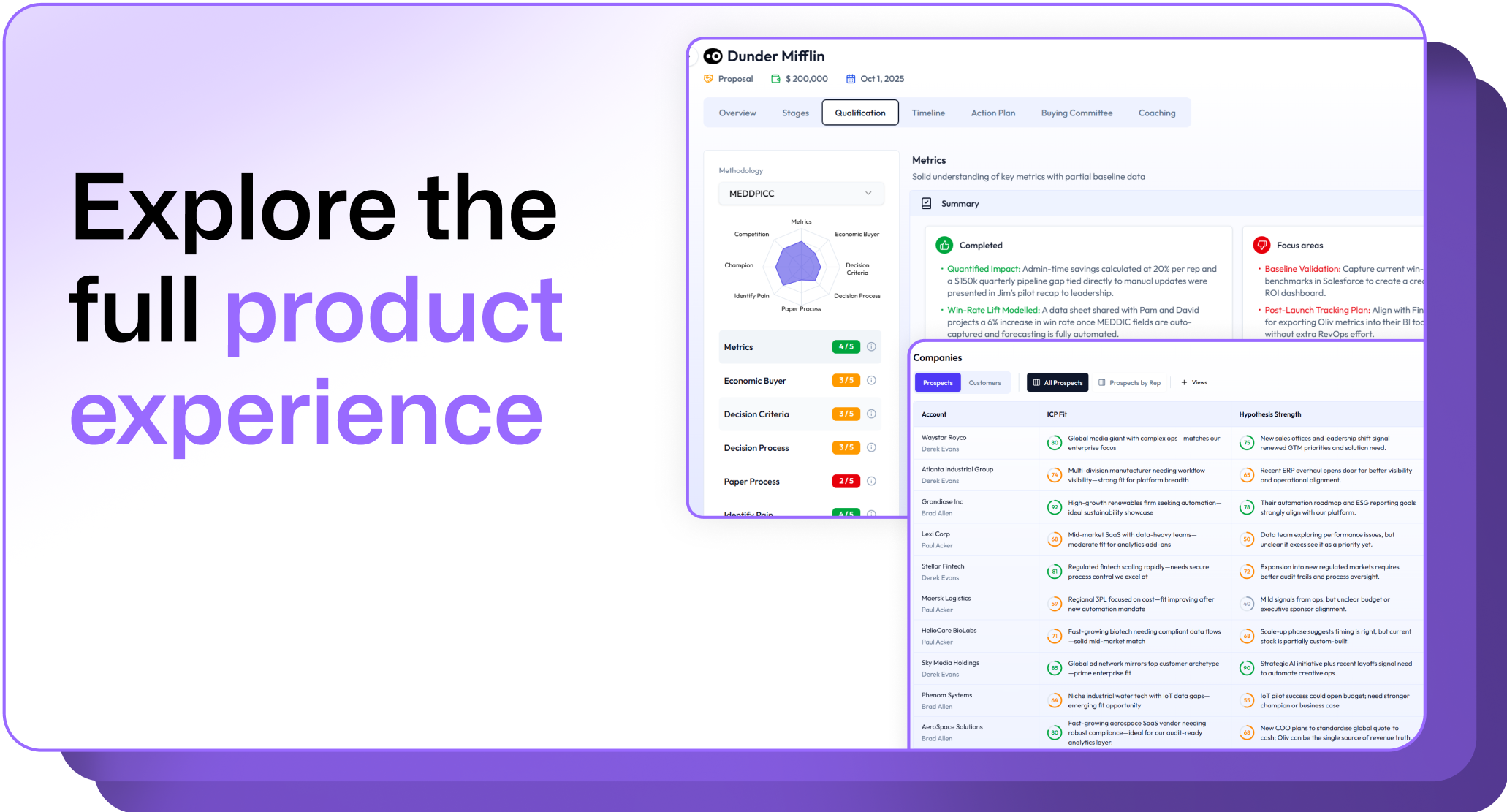
.avif)
.png)






.png)
.png)
.png)

