Q1: What Can AI Agents Actually Do for Your Sales Team Today? [toc=AI Agents for Sales Teams]
If you're a VP of Sales managing 25 to 100 reps, you've probably spent the last three years stacking dashboards. Gong for call recordings, Clari for forecasting roll-ups, Salesforce as your static repository, and you still can't answer the one question that matters: which deals in my pipeline are actually going to close? You're not alone. The Salesforce 2026 State of Sales report found that 87% of sales organizations have adopted AI, and 54% are already deploying AI agents, yet most still struggle with fragmented data and siloed insights.
⚠️ The Dashboard Trap: Why Legacy Tools Leave You Guessing
The problem isn't intelligence, it's the type of intelligence. Tools like Gong act as a "dashcam" for your revenue org: they record what happened on calls but don't reason through what it means for the deal. Gong's Smart Trackers are built on first-generation machine learning (keyword matching), flagging the word "budget" without understanding whether the prospect is discussing fiscal allocation or a holiday spending limit. Clari's core value proposition, roll-up forecasting, remains a manual, human-dependent process where managers sit with reps for hours, inputting biased assessments into a UI.
As one mid-market Director of Sales noted:
"The additional products like forecast or engage come at an additional cost. Would be great to see these tools rolled into the core offering."
— Scott T., Director of Sales, G2 Verified Review
The result? Roughly ~$500/user/month in tool fatigue with no autonomous action taken on your behalf.
✅ From Revenue Intelligence to AI-Native Revenue Orchestration
The industry has undergone a tectonic shift through four generations of technology:
- Gen 1 (2015 to 2022): Revenue Operations, baseline documentation
- Gen 2: Revenue Intelligence, dashboards and call recording
- Gen 3 (2022 to 2025): Revenue Orchestration, workflow automation
- Gen 4 (Now): AI-Native Revenue Orchestration / GTM Engineering, agents that do the work for you
✅ Three Agent Types VPs Should Care About
In this new era, there are three practical agent types VPs should care about:
- CRM Automation Agents auto-capture interactions, enrich records, update fields without rep input
- Deal Intelligence Agents flag risks, detect slippage, and score deals based on contextual reasoning (not just activity volume)
- Coaching Agents analyze conversations at scale, identify skill gaps, and push actionable coaching insights to managers
✅ How Oliv.ai Delivers Reasoning over Recording
Oliv.ai is built for this AI-Native Revenue Orchestration era. It's an AI-native platform that stitches data from calls, emails, support tickets, and Slack into a single 360 degree account view, then deploys autonomous agents that act on that intelligence:
- Meeting Assistant: Joins calls, transcribes, drafts follow-ups, and updates CRM properties, all within 5 minutes of call end
- CRM Manager Agent: Enriches accounts, updates 100+ qualification fields from actual call context, and pushes one-click Slack approvals to reps
- Forecaster Agent: Inspects every deal line-by-line, flags missing MEDDPICC/BANT criteria, and delivers board-ready pipeline reports autonomously
Organizations using AI agents report 43% higher win rates and 37% faster sales cycles. Oliv customers specifically see 25% higher forecast accuracy and 35% higher win rates, because agents focus the team on closeable pipeline, not activity theater.
Q2: Why Do Most AI Sales Agent Deployments Fail? [toc=Why AI Deployments Fail]
More than half of sales leaders cite disconnected systems as the primary drag on their AI initiatives. The "Trough of Disillusionment" is real, your team has been promised AI-powered revenue transformation before, and what they got was another login, another dashboard, and another set of training sessions nobody attended. Understanding why deployments fail is the first step toward making your next one succeed.
❌ The Three Failure Modes of Legacy AI Deployments
1. Implementation Quicksand
Gong implementation requires 8 to 24 weeks and consumes 40 to 140 admin hours just to configure Smart Trackers. Increasingly, Gong is pushing third-party implementation vendors, adding $10K to $15K to the initial cost. One Senior Director of Revenue Enablement shared this on G2:
"It can be overwhelming to set up trackers. AI training is a bit laborious to get it to do what you want."
— Trafford J., Senior Director, Revenue Enablement, G2 Verified Review
❌ Adoption Resistance
2. Adoption Resistance
Salesforce Agentforce uses a chat-based UX that requires reps to manually interact with a bot, it's not embedded in their daily workflow. Einstein Activity Capture is widely viewed as subpar, redacting emails unnecessarily and storing data in separate AWS instances that are unusable for reporting. One G2 reviewer put it plainly:
"Can be complex to set up and customize. Expensive, especially for smaller teams. Steep learning curve for new users."
— Shubham G., Senior BDM, G2 Verified Review
3. Governance Gaps
Without clear audit trails and approval workflows, VPs fear hallucination risk, an agent overwriting critical CRM data or making incorrect commitments.
✅ The Three Principles That Actually Work
Successful deployments in 2026 follow a proven pattern:
- Start narrow, not wide Deploy one high-impact agent (e.g., meeting intelligence) before expanding to the full platform
- Deliver where reps live Push insights to Slack, email, and CRM properties; no new app to learn
- Human-in-the-loop first Agents draft work for human approval, building trust before increasing automation
✅ How Oliv.ai Eliminates the Deployment Tax
Oliv's configuration takes 5 minutes, not 8 to 24 weeks. Full custom model building completes in 2 to 4 weeks. Here's how the governance model works:
- Approval Layer: Agents draft follow-up emails and CRM property updates, then send a Slack/Email nudge for the rep to verify and approve before any data touches the CRM
- Role-Based Access Control (RBAC): Agents only operate in their assigned data workspace
- Full Audit Logs: Every agent action is logged for compliance and transparency
Oliv's modular pricing means you pay only for the agents your roles actually use, eliminating the $5K to $50K mandatory platform fees that Gong charges before you even add a single user.
Q3: What's the Real Cost of Managers Spending Evenings Listening to Calls? [toc=Hidden Cost of Call Reviews]
Here's the scene that plays out in every mid-market sales org with 10 to 25 day deal cycles: your managers spend their evenings, while showering, driving, or drinking coffee, listening to call recordings at 2x speed. They can only review roughly 2% of total calls, creating a massive visibility gap where deal risks surface only after it's too late to intervene. This hidden "manager tax" is the most underestimated cost center in your revenue operation.
💸 The $180K Hidden Tax You're Already Paying
Let's quantify it. For a 50-rep org with 10 frontline managers, each spending 1.5 hours per night on manual call review:
Annual Manager Call Review Cost| Metric | Value |
|---|
| Managers reviewing calls | 10 |
| Hours/night per manager | 1.5 |
| Working days/year | 250 |
| Loaded hourly cost | ~$72 |
| Annual hidden cost | ~$180,000 |
That's $180K/year spent on an activity that covers only 2% of your call volume, and catches problems after they've already impacted the deal.
❌ Why Dashboards Make This Worse, Not Better
Gong captures call data, but it "buries you in data," forcing managers to dig through multiple screens to find one actionable coaching insight. There's also a 20 to 30 minute delay after each call before insights become available. As one G2 reviewer noted:
"It's too complicated, and not intuitive at all. Using it is very...discomforting. Searching for calls is not easy, moving around in the calls is not easy."
— John S., Senior Account Executive, G2 Verified Review
Another reviewer echoed the sentiment about Gong's depth vs. usability gap:
"There's so much in Gong, that we don't use everything. Gong's deal forecasting we don't use."
— Karel Bos, Head of Sales, TrustRadius Verified Review
The result: managers become "Chief Firefighters," reacting to crises instead of preventing them.
✅ How Oliv.ai Delivers Intelligence, Right on Time
Oliv replaces the manual evening review cycle with a structured, proactive intelligence layer:
- ⏰ Morning Brief (30 mins before each call): Pushes account history and key talking points to Slack, so reps never walk in cold
- ✅ Meeting Assistant (Post-Call, within 5 minutes): Drafts the follow-up email and updates CRM properties immediately, no 20 to 30 minute delay
- 🌅 Sunset Summary (Evening): Delivers a daily breakdown of which deals moved, which were won, and which require urgent VP intervention
- 📊 Monday Tradition Replaced: The Forecaster Agent delivers board-ready forecast slides automatically, eliminating the manual Thursday/Friday roll-up prep
By automating the low-value auditing that consumes manager evenings, Oliv saves frontline managers approximately one full day per week, time they can reinvest in coaching, deal strategy, and the human judgment that actually moves pipeline.
Q4: How Can You Catch Deal Slippage Early Without Micromanaging? [toc=Catching Deal Slippage Early]
Every VP of Sales knows this feeling: it's Week 10 of the quarter, and a deal you were counting on suddenly "pushes." Nobody flagged the risk. Nobody noticed the champion went silent three weeks ago. You find out during the end-of-quarter fire drill, when it's too late to save the deal and too late to backfill the gap. Meanwhile, your CRM shows 3x coverage, but half of it is what experienced leaders call "fake coverage," pipeline that looks healthy on paper because it relies on rep sentiment, not verified buying signals.
❌ Why Activity-Based Scoring Creates False Confidence
Legacy tools measure deal health by volume, 10 follow-up emails sent, 4 meetings logged, 2 stakeholders identified. But they can't distinguish between a rep chasing a ghosting prospect and a value-added interaction that actually advances the deal.
- Gong: Scores deals based on activity patterns but can't assess whether those activities moved the buyer forward
- Clari: Relies on rep-driven stories for forecast input; if a rep hides a stalled deal, the VP has zero visibility until the quarter collapses
As one Reddit user bluntly observed:
"Clari is a tool for sales leaders, it adds no value to reps as far as I can see."
— Msoave, r/SalesOperations Reddit Thread
❌ The Manual Forecasting Dependency
And another Clari user added critical context about the manual forecasting dependency:
"Clari should find ways to differentiate from the native Salesforce features (e.g., Pipeline Inspection, Forecasting) in order to remain competitive in the long-run. Additionally, it's sometimes difficult if you don't have a strong RevOps/RevTech team to maintain validation rules in both Salesforce and Clari instances."
— Dan J., Mid-Market, G2 Verified Review
✅ The Shift: From Activity Metrics to Contextual Reasoning
Modern AI agents don't count emails, they read them. They cross-reference call sentiment with email tone, flag when a key stakeholder (Economic Buyer) goes silent, and detect missed milestones in a Mutual Action Plan. The shift is from "How many activities happened?" to "What do those activities actually mean for this deal?"
✅ How Oliv.ai Acts as Your Unbiased Observer
Oliv deploys multiple agents that work together to catch slippage before it becomes a fire drill:
- Deal Driver Agent: Runs daily contextual scans across every active deal, flagging risks like a champion going silent, contradictory signals between call and email sentiment, or stalled next steps
- Forecaster Agent: Inspects every deal line-by-line autonomously, flagging where specific qualification criteria (MEDDPICC, BANT) are missing despite high activity
- Analyst Agent: An "Ask Me Anything" strategic engine that answers queries in plain English, e.g., "Why are we losing FinTech deals in Stage 2 to Competitor X?", and surfaces specific rep skill gaps driving the losses
The result is a fundamentally different operating model. Instead of the VP spending Friday afternoon in a war room trying to reconstruct the truth from biased rep stories, Oliv pushes verified, context-aware deal intelligence daily, so interventions happen in Week 4, not Week 10. Teams using this approach see 25% higher forecast accuracy and 35% higher win rates because they focus exclusively on closeable pipeline, not activity theater.
Q5: Revenue Intelligence vs. AI-Native Revenue Orchestration: What's the Difference and Why Does It Matter? [toc=RI vs Revenue Orchestration]
Most VPs of Sales are still evaluating tools using a category framework that expired two years ago. The industry has evolved through four distinct generations of technology:
- Gen 1 (2015 to 2022): Revenue Operations, baseline documentation and CRM hygiene
- Gen 2: Revenue Intelligence, call recording, dashboards, keyword-based insights
- Gen 3 (2022 to 2025): Revenue Orchestration, workflow automation and sequencing
- Gen 4 (Now): AI-Native Revenue Orchestration / GTM Engineering, autonomous agents that perform the work
If your buying criteria still center on "Which RI tool has the best dashboard?", you're shopping in the wrong aisle.
❌ Revenue Intelligence: The Dashcam Era
Revenue Intelligence tools, Gong, Clari, Chorus, defined the last decade of sales tech. They record what happened (calls, emails, activities) and present it on a dashboard for humans to interpret. The manager must "dig" to find insights. It's a dashcam: it captures the footage, but you still have to watch every minute, rewind, and draw your own conclusions.
Gong's Smart Trackers are built on first-generation machine learning, keyword matching that flags the word "budget" without understanding whether the prospect meant fiscal allocation or holiday spending. Clari's core value proposition, roll-up forecasting, still requires managers to sit with reps for hours, manually inputting biased assessments.
As one Reddit user who worked at Clari observed:
"The core tool itself is good enough but the sale entailed overcomplicating the forecasting process so you needed Clari. It is really just a glorified SFDC overlay."
— conaldinho11, r/SalesOperations Reddit Thread
✅ AI-Native Revenue Orchestration: The Autopilot Era
AI-Native Revenue Orchestration treats the revenue process as an engineering workflow that can be simulated, optimized, and automated by agents. The tool doesn't just surface data, it proactively performs the work.
The distinction is best captured by Oliv AI founder Ishan Chhabra's analogy:
Revenue Intelligence vs AI-Native Revenue Orchestration| - | Revenue Intelligence (Dashcam) | AI-Native Revenue Orchestration (Autopilot) |
|---|
| Core function | Records what happened | Reasons through what it means and acts |
| Manager role | Dig through dashboards | Review agent-generated outputs |
| Data model | Single-channel (calls OR emails) | Stitched 360 degree (calls + emails + Slack + CRM) |
| AI generation | V1 ML (keyword matching) | Fine-tuned LLMs (contextual reasoning) |
| Output | Dashboards and reports | Autonomous CRM updates, follow-ups, forecasts |
Or think of it this way: legacy RI is a Treadmill, you pay for the machine, but you still do all the running. AI-Native Revenue Orchestration is a Personal Trainer, it monitors your form, plans your workouts, and ensures you hit your goals with significantly less manual effort.
✅ How Oliv.ai Leads the AI-Native Revenue Orchestration Category
Oliv is purpose-built for this new era. Its AI-native data platform stitches calls, emails, support tickets, and Slack into a single 360 degree account view, then deploys agents that act on that intelligence autonomously:
- The CRM Manager Agent doesn't just note what happened, it updates 100+ qualification fields, drafts follow-ups, and enriches accounts based on actual call context
- The Forecaster Agent inspects every deal line-by-line, applying MEDDPICC/BANT frameworks without waiting for a rep to fill in a form
- The Meeting Assistant delivers insights within 5 minutes of call end, not 20 to 30 minutes later
The buying question for every VP in 2026 isn't "Which RI tool has the best dashboard?" It's "Do I want a dashcam or an autopilot?" That reframe changes the evaluation criteria entirely.
Q6: How Does Gong, Clari, and Salesforce Agentforce Actually Compare for Mid-Market Teams? [toc=Gong vs Clari vs Agentforce]
For VPs managing 25 to 100 reps at mid-market companies, choosing between Gong, Clari, and Salesforce Agentforce isn't straightforward. Each tool has genuine strengths, and significant blind spots when evaluated against the realities of a growth-stage sales org. Here's an honest, side-by-side comparison across the dimensions that matter most.
⭐ Feature-by-Feature Comparison
Gong vs Clari vs Salesforce Agentforce vs Oliv.ai Comparison| Dimension | Gong | Clari | Salesforce Agentforce | Oliv.ai |
|---|
| Core strength | Conversation intelligence | Forecast roll-ups and pipeline analytics | CRM-native AI agents | AI-native revenue orchestration |
| Data sources | Calls, emails | CRM + limited call data (via Copilot add-on) | Salesforce CRM data only | Calls + emails + Slack + support tickets (360 degree stitched) |
| AI generation | V1 ML keyword trackers | Pre-generative analytics | LLM-powered (prompt-driven) | Fine-tuned LLMs with contextual reasoning |
| Autonomy level | Dashboard-based (human pulls insights) | Dashboard-based (human inputs forecasts) | Chat-based (human prompts bot) | Agent-first (AI pushes actions for approval) |
| Setup time | 8 to 24 weeks, 40 to 140 admin hours | Moderate; requires RevOps configuration | Complex; needs certified admin | 5 minutes to start; 2 to 4 weeks for custom models |
| RevOps burden | High (Smart Tracker management) | Moderate (validation rules in SF + Clari) | High (prompt engineering required) | Minimal (autonomous field updates) |
| Governance | Limited audit trails | CRM-dependent | Trust Layer (built-in) | HITL approval + RBAC + full audit logs |
| Mid-market fit | ❌ Pricing and complexity favor enterprise | ✅ Strong for forecast-heavy orgs | ⚠️ Locked to Salesforce ecosystem | ✅ Purpose-built for 25 to 100 rep scale |
❌ Where Each Tool Falls Short
Gong: Powerful for call recording and coaching, but the additional products (forecasting, engagement) come at steep extra cost. As one Director of Sales noted on G2:
"The additional products like forecast or engage come at an additional cost. Would be great to see these tools rolled into the core offering."
— Scott T., Director of Sales, G2 Verified Review
❌ Clari Setup Challenges
Clari: Excellent for forecasting workflows once configured, but the setup demands strong RevOps resources, something most mid-market teams lack:
"I find the setup process challenging, especially when migrating fields from Salesforce, as it can't handle formula fields directly. This requires creating and maintaining duplicate fields, which adds complexity and workload."
— Josiah R., Head of Sales Operations, G2 Verified Review
Salesforce Agentforce: Promising technology, but complexity and cost scale quickly:
"As much as I love what Agentforce can do, setting it up wasn't as smooth as I expected. The UI felt a bit clunky at times. Also, the pricing caught us off guard. Once we started scaling to more users and use cases, the cost ramped up pretty quickly."
— Ayushmaan Y., Senior Associate, G2 Verified Review
✅ Where Oliv.ai Differs
Oliv.ai consolidates the capabilities of all three tools, conversation intelligence, forecasting, CRM automation, and deal management, into a single AI-native platform with modular pricing. Organizations pay only for the agents their roles actually use, eliminating the $500/user/month stacked-tool tax that mid-market teams currently absorb.
Q7: What's the Minimal RevOps Solution If You Can't Hire More Ops People? [toc=Minimal RevOps Solution]
If you're a VP of Sales at a growth-stage company, you likely don't have a five-person RevOps team. You might have one ops generalist, or nobody at all. Yet you're expected to maintain CRM hygiene, deliver accurate forecasts, and keep 50+ reps accountable to process. Mid-market companies are trapped in what industry leaders call "manual debt": RevOps teams (where they exist) spend 40+ hours per month on manual data cleanup, field normalization, and chasing reps to update CRM properties.
❌ Legacy Tools Assume You Have Ops Headcount to Spare
Every major sales tool on the market carries an implicit assumption: you have dedicated admin resources.
- Gong: Implementation requires 8 to 24 weeks and consumes 40 to 140 admin hours to configure Smart Trackers. Gong increasingly pushes third-party implementation vendors, adding $10K to $15K to the initial cost
- Clari: Requires RevOps to manually configure forecast roll-ups and maintain validation rules across both Salesforce and Clari instances
- Salesforce: Requires a certified administrator for any meaningful customization
One Head of Sales Operations captured the Clari challenge on G2:
"I find the setup process challenging, especially when migrating fields from Salesforce, as it can't handle formula fields directly. This requires creating and maintaining duplicate fields, which adds complexity and workload. Additionally, the flexibility in setting up hierarchies is lacking."
— Josiah R., Head of Sales Operations, G2 Verified Review
❌ Unused Features Are Wasted RevOps Time
And a Head of Sales echoed a similar sentiment about Gong's operational overhead:
"There's so much in Gong, that we don't use everything. Gong's deal forecasting we don't use."
— Karel Bos, Head of Sales, TrustRadius Verified Review
For mid-market teams, features that sit unused aren't just wasted budget, they represent RevOps time that was spent configuring something nobody adopted.
✅ The New Model: AI as Your Fractional RevOps Team
The 2026 alternative is "AI as your fractional RevOps team", agents that autonomously handle the operational work that previously required dedicated headcount:
- Data normalization: Standardize fields, deduplicate records, and enrich account data without manual intervention
- Activity mapping: Use AI-based reasoning (not brittle rules) to map calls and emails to the correct opportunity, even when duplicate accounts exist (e.g., Google US vs. Google India)
- CRM governance: Enforce process compliance through agent-drafted updates and approval workflows, not manager policing
✅ How Oliv.ai Acts as a Fractional RevOps Team
Oliv was designed specifically for teams that can't hire more ops people:
- Instant start: Configuration takes 5 minutes. Full custom model building completes in 2 to 4 weeks, not 8 to 24 weeks
- CRM Manager Agent: Automatically enriches accounts/contacts and updates 100+ qualification fields based on actual call context, keeping the CRM accurate without manual effort
- AI-Based Object Association: Uses generative AI to reason through conversation history and content, correctly mapping activities to the right opportunity even in messy CRMs with duplicates
The math makes the case: replacing 40 hours/month of manual ops work at a loaded cost of ~$75/hour equals $36K/year in ops savings. Oliv's CRM Manager for a 50-rep org costs significantly less, delivering net savings from day one while maintaining a level of CRM hygiene that a single ops generalist simply cannot match.
Q8: How Do You Control What an AI Agent Can Change in Your CRM? [toc=AI Agent CRM Governance]
This is the question that stops most AI agent deployments before they start. VPs and RevOps leaders fear "hallucination risk", an AI agent making incorrect commitments, overwriting critical CRM data, or attaching activities to the wrong record without any human oversight. It's a legitimate concern, and one that legacy tools have not adequately addressed.
❌ Why Current Tools Create More Governance Anxiety, Not Less
Salesforce Agentforce uses a chat-based UX that requires reps to manually prompt a bot to get work done. It's not embedded in the daily workflow, it's another interface reps must learn. One G2 reviewer captured the governance frustration:
"Lots of clicking to get to select the right options. UX needs improvement. Everything opens in a new browser tab, clustering the browser. Lots of jumping back and forth between tabs to enable settings."
— Verified User in Consulting, G2 Verified Review
❌ The Governance Gap in Legacy Platforms
Einstein Activity Capture is widely viewed as a subpar product that redacts emails unnecessarily and stores data in separate AWS instances that are unusable for reporting. Neither tool provides the transparent audit trails that VPs need to trust what the AI changed and why.
Even Agentforce's own users acknowledge the governance gap:
"The price of Agentforce is not clear and hard to find. Adoption is low because of the lack of knowledge on the subject as AI is a new field. Customers are finding issues in deploying and using agents in Salesforce."
— Anusha T., Web Developer, G2 Verified Review
✅ The 2026 Governance Standard: Human-in-the-Loop (HITL)
The emerging best practice in 2026 is a Human-in-the-Loop (HITL) governance model that follows three principles:
- Agents draft, humans approve No CRM data is changed without explicit human confirmation
- Role-Based Access Control (RBAC) Agents operate only within their assigned data workspace; a coaching agent cannot modify forecast fields
- Full audit logging Every agent action is logged with timestamp, data changed, source reasoning, and approval status
The critical design principle: approval workflows must be embedded where reps already work (Slack, email, CRM sidebar), not in a separate application that adds yet another login.
✅ How Oliv.ai Implements HITL Governance
Oliv's governance model was built for VPs who need to trust what AI is doing to their CRM:
- Approval Layer: The CRM Manager Agent drafts follow-up emails and CRM property updates (not just notes), then sends a Slack or Email nudge for the rep to verify and approve before any data touches the CRM
- RBAC enforcement: Agents only operate in their assigned workspace of data, ensuring no cross-contamination between roles or teams
- Full audit logs: Every agent action is recorded for compliance review, providing a complete trail of what changed, when, and why
⚠️ Practical Tip for VPs
Start agents as "assistants" in Week 1 to 2, drafting work for human review with 100% approval required. As trust builds (most Oliv customers hit 80%+ approval-without-edit rates within two weeks), gradually increase agent autonomy. This graduated trust model eliminates the "big bang" governance risk that derails most AI deployments, and Oliv's modular architecture supports this phased approach natively.
Q9: What If Reps Game the AI by Saying the Right Things Without Meaning Them? [toc=Reps Gaming AI Trackers]
Every VP managing 25 to 100 reps knows the game: savvy sellers learn exactly what triggers the system rewards them for and then perform accordingly, regardless of whether the signals are real. In keyword-based tracking environments, a rep can mention "budget," "decision-maker," or a competitor's name just to check a box on the CRM scorecard. The VP can't individually verify whether qualification signals from 50+ reps are genuine or performative, and the result is a pipeline that looks healthy on paper but crumbles at close.
❌ Why Keyword Matching Creates False Confidence
Gong's Smart Trackers, the industry standard for over a decade, are built on first-generation machine learning: keyword matching. If a rep mentions a competitor in passing ("I used to work at Salesforce"), the tracker flags it as a qualification signal. It cannot distinguish between a genuine competitive threat and a casual reference. The word "budget" gets flagged whether the prospect is discussing a fiscal allocation or complaining about their holiday spending.
This creates a dangerous feedback loop: reps learn the keywords, mention them performatively, the tracker shows green, and managers get false confidence in deal health. As one Senior Director of Revenue Enablement noted:
"It can be overwhelming to set up trackers. AI training is a bit laborious to get it to do what you want."
— Trafford J., Senior Director, Revenue Enablement, G2 Verified Review
❌ Experienced Reps Resist Surveillance-Style Tracking
Meanwhile, experienced reps resist the entire system because it feels like surveillance rather than support:
"Many reps also resist using Gong because they feel micromanaged, leading to low adoption. While it works well for newer reps, the long-term engagement from experienced team members is lacking."
— Anonymous Reviewer, G2 Verified Review
✅ How Generative AI Reasoning Changes the Game
The shift from V1 keyword matching to fine-tuned LLMs changes what AI can detect. Instead of asking "Was this word said?", generative AI asks "What was meant?" It understands that "We're actively evaluating XYZ" is a genuine competitive threat, while "I used to work at XYZ" is biographical context. This intent understanding makes gaming exponentially harder because the system evaluates semantics, not strings.
✅ How Oliv.ai Makes Gaming Nearly Impossible
Oliv takes this further with cross-channel signal stitching. It doesn't just analyze the call in isolation, it cross-references calls with emails and Slack messages to find contradictory signals:
- If a rep says "The champion is committed" on a call, but email sentiment from that champion is lukewarm, Oliv flags the deal as at risk
- If a rep mentions "budget confirmed," but no procurement-related email thread exists, the Forecaster Agent marks the qualification criteria as unverified
- If activity volume is high but engagement quality is low, Oliv distinguishes between a rep chasing a ghosting prospect and genuine buyer engagement
The question for VPs isn't "Will reps try to game the system?", they will. The real question is whether your AI is smart enough to catch it. Keyword matching isn't. LLM reasoning with cross-channel stitching is.
Q10: What's the Right Daily and Weekly Cadence for AI Pipeline Outputs? [toc=AI Pipeline Output Cadence]
VPs of Sales are "Chief Firefighters", constantly context-switching between deal reviews, forecast prep, coaching, and executive reporting. Legacy tools compound this problem by flooding inboxes with noisy alerts that lack prioritization. The goal isn't more data; it's the right intelligence, delivered at the right time, in the right format. Here's a prescriptive cadence framework for structuring AI-driven pipeline outputs across a typical sales week.
⏰ The 24-Hour AI Operating Rhythm
The 24-Hour AI Operating Rhythm| Timing | Output | Purpose | Delivery Channel |
|---|
| 30 min before each call | Morning Brief / Pre-Call Prep | Account history, stakeholder map, points of focus pushed automatically | Slack / Email |
| Immediately post-call | Meeting Assistant Summary | Auto-generated call summary, drafted follow-up email, CRM property updates for approval | CRM + Slack |
| End of day | Sunset Summary | Daily wrap-up: deals that moved, deals won, deals requiring urgent intervention | Email / Slack |
| Monday morning | Forecaster Agent Weekly Roll-Up | Board-ready forecast slides with deal-by-deal inspection, risk flags, and confidence scores | Email + CRM Dashboard |
This structured rhythm replaces two broken patterns: (1) the "dashboard digging" where managers spend hours pulling insights from Gong or Clari screens, and (2) the "noisy alert" model where every minor activity triggers a notification that gets ignored.
⭐ What Good Cadence Design Looks Like
One Clari user described the core problem with current forecasting cadences:
"The analytics modules still need some work IMO to provide a valuable deliverable. All the pieces are there but missing the story line. You have to click around through the different modules and extract the different pieces, ultimately putting it in an Excel for easier manipulation."
— Natalie O., Sales Operations Manager, G2 Verified Review
Another reviewer highlighted the manual overhead of traditional forecast workflows:
"I do think the forecasting feature is decent, but at least in our setup, it doesn't do a great job of auto-calculating the values I need to submit, so that is entirely handheld by using the built-in notes field as a calculator."
— Dexter L., Customer Success Executive, G2 Verified Review
✅ How Oliv.ai Structures This Natively
Oliv.ai replaces manual dashboard navigation with a push-based intelligence cycle. The Morning Brief ensures reps never walk into a call cold. The Meeting Assistant drafts follow-ups and updates CRM fields within 5 minutes of call end, not the 20 to 30 minute delay common with legacy tools. The Sunset Summary gives managers a single daily digest instead of dozens of scattered alerts. And the Monday Forecaster eliminates the Thursday/Friday manual roll-up preparation that traditionally consumes an entire day of manager time.
Q11: What Change Management Plan Works for Rolling Out AI Agents to a 100-Person Sales Org? [toc=AI Agent Rollout Plan]
"SaaS Fatigue" isn't a buzzword, it's the lived experience of every sales team that has been asked to adopt yet another tool in the last five years. The "Trough of Disillusionment" is real: high expectations at launch, slow value delivery during configuration, and rapid abandonment once reps decide the juice isn't worth the squeeze. For VPs managing 100-person orgs, the rollout plan matters as much as the technology itself.
❌ Why "Big Bang" Rollouts Fail
Legacy tool deployments demand full-org training, custom configuration, and months of ramp before any value materializes. Gong implementations require 8 to 24 weeks and consume 40 to 140 admin hours just to configure Smart Trackers. Agentforce demands prompt engineering skills most sales teams don't have:
"Getting consistent and accurate results isn't as simple as just 'telling the agent what to do.' Effectively crafting prompts and configuring the underlying actions demands a specific skill set often called prompt engineering."
— Reviewer, G2 Verified Review
❌ Even Simple Onboarding Creates Resistance
Even tools with simpler onboarding create resistance. As one Salesloft user noted:
"The setup process was overwhelming, and we had to go through extensive training as a team, which was tiring."
— Roselle P., Executive Assistant, G2 Verified Review
✅ The Phased Deployment Model That Works
Successful 2026 AI agent deployments follow a graduated trust model, not a big bang:
- Week 1 to 2 (Pilot, 15 to 20 reps): Deploy a single high-impact agent (e.g., Meeting Assistant) that delivers immediate value with zero behavior change. Reps see auto-generated call summaries and follow-up drafts without learning any new interface
- Week 2 to 3 (Expand + HITL): Activate the CRM Manager Agent for the pilot group with full Human-in-the-Loop approval. Every CRM update requires a one-click confirmation
- Week 3 to 4 (Manager layer): Enable the Forecaster Agent for managers and VPs. Roll out in cohorts of 30 with dedicated support
✅ Why Oliv.ai's "Invisible UI" Drives Adoption
Oliv advocates for a "Modular and Invisible" rollout. Insights are delivered where reps already live, Slack, email, CRM sidebar, so there's no extra app to learn. Agents start as "assistants" drafting work for human review, building trust before increasing automation.
⭐ Key metric to track: Agent-approved action rate (% of agent suggestions reps approve without edits). Oliv customers typically hit 80%+ approval rates within two weeks, signaling readiness for the next deployment phase, and proving that when AI does the work for reps instead of creating more work, adoption takes care of itself.
Q12: Why Do Reps Hate Updating the CRM, and How Do AI Agents Finally Fix This? [toc=CRM Adoption and AI Agents]
Ask any VP what their biggest operational headache is, and "getting reps to update the CRM" will rank in the top three. It's not a training problem or a discipline problem, it's a product design failure. CRM data entry is not critical to the act of selling. It's an administrative burden that reps experience as policing, not value-add. Even when compensation is tied to CRM compliance, updates are grudging, incomplete, and often inaccurate, creating the "dirty data" that breaks every downstream report and forecast.
❌ Why Comp-Tied Mandates Still Don't Work
Tying CRM updates to compensation creates compliance without quality. Reps enter the minimum data to satisfy the requirement, often copying and pasting generic next steps or inflating deal stages to avoid manager scrutiny. The underlying problem remains: the CRM was designed for management visibility, not seller productivity.
Legacy systems compound the issue with brittle rule-based logic for activity mapping. When duplicate accounts exist (e.g., Google US and Google India), rules get confused and attach data to the wrong record. One Reddit user summarized the leadership-versus-rep divide:
"Clari is a tool for sales leaders, it adds no value to reps as far as I can see."
— Msoave, r/SalesOperations Reddit Thread
❌ Even Easier Interfaces Can't Fix the Core Friction
Even tools that ease CRM updates can't eliminate the fundamental friction. A Senior Account Executive described the Gong experience:
"It's too complicated, and not intuitive at all. Using it is very...discomforting. Searching for calls is not easy, moving around in the calls is not easy, and understanding the pipeline management portion of it is almost impossible."
— John S., Senior Account Executive, G2 Verified Review
✅ The Paradigm Shift: Documentation to Execution
The AI-era solution isn't a better CRM interface, it's eliminating CRM data entry entirely. AI agents auto-capture all interactions, understand them contextually, and update CRM fields without rep intervention. The rep's role shifts from "data entry clerk" to "approver" of accurate, pre-populated records.
✅ How Oliv.ai Delivers "Talk, Don't Type"
Oliv's CRM Manager Agent transforms the workflow entirely:
- Auto-capture: Records calls and emails, extracts key data points, and maps them to correct CRM fields
- AI-Based Object Association: Uses generative AI to reason through conversation history, correctly mapping activities to the right opportunity even in messy CRMs with duplicates
- One-click approval: Drafts CRM property updates and pushes a Slack notification, the rep clicks "approve" and never opens the CRM
The downstream effect is transformative: when CRM data is accurate and complete without rep effort, forecast accuracy rises, pipeline reviews become productive instead of interrogative, and the VP finally has a single source of truth that doesn't depend on rep discipline.
Q1: What Can AI Agents Actually Do for Your Sales Team Today? [toc=AI Agents for Sales Teams]
If you're a VP of Sales managing 25 to 100 reps, you've probably spent the last three years stacking dashboards. Gong for call recordings, Clari for forecasting roll-ups, Salesforce as your static repository, and you still can't answer the one question that matters: which deals in my pipeline are actually going to close? You're not alone. The Salesforce 2026 State of Sales report found that 87% of sales organizations have adopted AI, and 54% are already deploying AI agents, yet most still struggle with fragmented data and siloed insights.
⚠️ The Dashboard Trap: Why Legacy Tools Leave You Guessing
The problem isn't intelligence, it's the type of intelligence. Tools like Gong act as a "dashcam" for your revenue org: they record what happened on calls but don't reason through what it means for the deal. Gong's Smart Trackers are built on first-generation machine learning (keyword matching), flagging the word "budget" without understanding whether the prospect is discussing fiscal allocation or a holiday spending limit. Clari's core value proposition, roll-up forecasting, remains a manual, human-dependent process where managers sit with reps for hours, inputting biased assessments into a UI.
As one mid-market Director of Sales noted:
"The additional products like forecast or engage come at an additional cost. Would be great to see these tools rolled into the core offering."
— Scott T., Director of Sales, G2 Verified Review
The result? Roughly ~$500/user/month in tool fatigue with no autonomous action taken on your behalf.
✅ From Revenue Intelligence to AI-Native Revenue Orchestration
The industry has undergone a tectonic shift through four generations of technology:
- Gen 1 (2015 to 2022): Revenue Operations, baseline documentation
- Gen 2: Revenue Intelligence, dashboards and call recording
- Gen 3 (2022 to 2025): Revenue Orchestration, workflow automation
- Gen 4 (Now): AI-Native Revenue Orchestration / GTM Engineering, agents that do the work for you
✅ Three Agent Types VPs Should Care About
In this new era, there are three practical agent types VPs should care about:
- CRM Automation Agents auto-capture interactions, enrich records, update fields without rep input
- Deal Intelligence Agents flag risks, detect slippage, and score deals based on contextual reasoning (not just activity volume)
- Coaching Agents analyze conversations at scale, identify skill gaps, and push actionable coaching insights to managers
✅ How Oliv.ai Delivers Reasoning over Recording
Oliv.ai is built for this AI-Native Revenue Orchestration era. It's an AI-native platform that stitches data from calls, emails, support tickets, and Slack into a single 360 degree account view, then deploys autonomous agents that act on that intelligence:
- Meeting Assistant: Joins calls, transcribes, drafts follow-ups, and updates CRM properties, all within 5 minutes of call end
- CRM Manager Agent: Enriches accounts, updates 100+ qualification fields from actual call context, and pushes one-click Slack approvals to reps
- Forecaster Agent: Inspects every deal line-by-line, flags missing MEDDPICC/BANT criteria, and delivers board-ready pipeline reports autonomously
Organizations using AI agents report 43% higher win rates and 37% faster sales cycles. Oliv customers specifically see 25% higher forecast accuracy and 35% higher win rates, because agents focus the team on closeable pipeline, not activity theater.
Q2: Why Do Most AI Sales Agent Deployments Fail? [toc=Why AI Deployments Fail]
More than half of sales leaders cite disconnected systems as the primary drag on their AI initiatives. The "Trough of Disillusionment" is real, your team has been promised AI-powered revenue transformation before, and what they got was another login, another dashboard, and another set of training sessions nobody attended. Understanding why deployments fail is the first step toward making your next one succeed.
❌ The Three Failure Modes of Legacy AI Deployments
1. Implementation Quicksand
Gong implementation requires 8 to 24 weeks and consumes 40 to 140 admin hours just to configure Smart Trackers. Increasingly, Gong is pushing third-party implementation vendors, adding $10K to $15K to the initial cost. One Senior Director of Revenue Enablement shared this on G2:
"It can be overwhelming to set up trackers. AI training is a bit laborious to get it to do what you want."
— Trafford J., Senior Director, Revenue Enablement, G2 Verified Review
❌ Adoption Resistance
2. Adoption Resistance
Salesforce Agentforce uses a chat-based UX that requires reps to manually interact with a bot, it's not embedded in their daily workflow. Einstein Activity Capture is widely viewed as subpar, redacting emails unnecessarily and storing data in separate AWS instances that are unusable for reporting. One G2 reviewer put it plainly:
"Can be complex to set up and customize. Expensive, especially for smaller teams. Steep learning curve for new users."
— Shubham G., Senior BDM, G2 Verified Review
3. Governance Gaps
Without clear audit trails and approval workflows, VPs fear hallucination risk, an agent overwriting critical CRM data or making incorrect commitments.
✅ The Three Principles That Actually Work
Successful deployments in 2026 follow a proven pattern:
- Start narrow, not wide Deploy one high-impact agent (e.g., meeting intelligence) before expanding to the full platform
- Deliver where reps live Push insights to Slack, email, and CRM properties; no new app to learn
- Human-in-the-loop first Agents draft work for human approval, building trust before increasing automation
✅ How Oliv.ai Eliminates the Deployment Tax
Oliv's configuration takes 5 minutes, not 8 to 24 weeks. Full custom model building completes in 2 to 4 weeks. Here's how the governance model works:
- Approval Layer: Agents draft follow-up emails and CRM property updates, then send a Slack/Email nudge for the rep to verify and approve before any data touches the CRM
- Role-Based Access Control (RBAC): Agents only operate in their assigned data workspace
- Full Audit Logs: Every agent action is logged for compliance and transparency
Oliv's modular pricing means you pay only for the agents your roles actually use, eliminating the $5K to $50K mandatory platform fees that Gong charges before you even add a single user.
Q3: What's the Real Cost of Managers Spending Evenings Listening to Calls? [toc=Hidden Cost of Call Reviews]
Here's the scene that plays out in every mid-market sales org with 10 to 25 day deal cycles: your managers spend their evenings, while showering, driving, or drinking coffee, listening to call recordings at 2x speed. They can only review roughly 2% of total calls, creating a massive visibility gap where deal risks surface only after it's too late to intervene. This hidden "manager tax" is the most underestimated cost center in your revenue operation.
💸 The $180K Hidden Tax You're Already Paying
Let's quantify it. For a 50-rep org with 10 frontline managers, each spending 1.5 hours per night on manual call review:
Annual Manager Call Review Cost| Metric | Value |
|---|
| Managers reviewing calls | 10 |
| Hours/night per manager | 1.5 |
| Working days/year | 250 |
| Loaded hourly cost | ~$72 |
| Annual hidden cost | ~$180,000 |
That's $180K/year spent on an activity that covers only 2% of your call volume, and catches problems after they've already impacted the deal.
❌ Why Dashboards Make This Worse, Not Better
Gong captures call data, but it "buries you in data," forcing managers to dig through multiple screens to find one actionable coaching insight. There's also a 20 to 30 minute delay after each call before insights become available. As one G2 reviewer noted:
"It's too complicated, and not intuitive at all. Using it is very...discomforting. Searching for calls is not easy, moving around in the calls is not easy."
— John S., Senior Account Executive, G2 Verified Review
Another reviewer echoed the sentiment about Gong's depth vs. usability gap:
"There's so much in Gong, that we don't use everything. Gong's deal forecasting we don't use."
— Karel Bos, Head of Sales, TrustRadius Verified Review
The result: managers become "Chief Firefighters," reacting to crises instead of preventing them.
✅ How Oliv.ai Delivers Intelligence, Right on Time
Oliv replaces the manual evening review cycle with a structured, proactive intelligence layer:
- ⏰ Morning Brief (30 mins before each call): Pushes account history and key talking points to Slack, so reps never walk in cold
- ✅ Meeting Assistant (Post-Call, within 5 minutes): Drafts the follow-up email and updates CRM properties immediately, no 20 to 30 minute delay
- 🌅 Sunset Summary (Evening): Delivers a daily breakdown of which deals moved, which were won, and which require urgent VP intervention
- 📊 Monday Tradition Replaced: The Forecaster Agent delivers board-ready forecast slides automatically, eliminating the manual Thursday/Friday roll-up prep
By automating the low-value auditing that consumes manager evenings, Oliv saves frontline managers approximately one full day per week, time they can reinvest in coaching, deal strategy, and the human judgment that actually moves pipeline.
Q4: How Can You Catch Deal Slippage Early Without Micromanaging? [toc=Catching Deal Slippage Early]
Every VP of Sales knows this feeling: it's Week 10 of the quarter, and a deal you were counting on suddenly "pushes." Nobody flagged the risk. Nobody noticed the champion went silent three weeks ago. You find out during the end-of-quarter fire drill, when it's too late to save the deal and too late to backfill the gap. Meanwhile, your CRM shows 3x coverage, but half of it is what experienced leaders call "fake coverage," pipeline that looks healthy on paper because it relies on rep sentiment, not verified buying signals.
❌ Why Activity-Based Scoring Creates False Confidence
Legacy tools measure deal health by volume, 10 follow-up emails sent, 4 meetings logged, 2 stakeholders identified. But they can't distinguish between a rep chasing a ghosting prospect and a value-added interaction that actually advances the deal.
- Gong: Scores deals based on activity patterns but can't assess whether those activities moved the buyer forward
- Clari: Relies on rep-driven stories for forecast input; if a rep hides a stalled deal, the VP has zero visibility until the quarter collapses
As one Reddit user bluntly observed:
"Clari is a tool for sales leaders, it adds no value to reps as far as I can see."
— Msoave, r/SalesOperations Reddit Thread
❌ The Manual Forecasting Dependency
And another Clari user added critical context about the manual forecasting dependency:
"Clari should find ways to differentiate from the native Salesforce features (e.g., Pipeline Inspection, Forecasting) in order to remain competitive in the long-run. Additionally, it's sometimes difficult if you don't have a strong RevOps/RevTech team to maintain validation rules in both Salesforce and Clari instances."
— Dan J., Mid-Market, G2 Verified Review
✅ The Shift: From Activity Metrics to Contextual Reasoning
Modern AI agents don't count emails, they read them. They cross-reference call sentiment with email tone, flag when a key stakeholder (Economic Buyer) goes silent, and detect missed milestones in a Mutual Action Plan. The shift is from "How many activities happened?" to "What do those activities actually mean for this deal?"
✅ How Oliv.ai Acts as Your Unbiased Observer
Oliv deploys multiple agents that work together to catch slippage before it becomes a fire drill:
- Deal Driver Agent: Runs daily contextual scans across every active deal, flagging risks like a champion going silent, contradictory signals between call and email sentiment, or stalled next steps
- Forecaster Agent: Inspects every deal line-by-line autonomously, flagging where specific qualification criteria (MEDDPICC, BANT) are missing despite high activity
- Analyst Agent: An "Ask Me Anything" strategic engine that answers queries in plain English, e.g., "Why are we losing FinTech deals in Stage 2 to Competitor X?", and surfaces specific rep skill gaps driving the losses
The result is a fundamentally different operating model. Instead of the VP spending Friday afternoon in a war room trying to reconstruct the truth from biased rep stories, Oliv pushes verified, context-aware deal intelligence daily, so interventions happen in Week 4, not Week 10. Teams using this approach see 25% higher forecast accuracy and 35% higher win rates because they focus exclusively on closeable pipeline, not activity theater.
Q5: Revenue Intelligence vs. AI-Native Revenue Orchestration: What's the Difference and Why Does It Matter? [toc=RI vs Revenue Orchestration]
Most VPs of Sales are still evaluating tools using a category framework that expired two years ago. The industry has evolved through four distinct generations of technology:
- Gen 1 (2015 to 2022): Revenue Operations, baseline documentation and CRM hygiene
- Gen 2: Revenue Intelligence, call recording, dashboards, keyword-based insights
- Gen 3 (2022 to 2025): Revenue Orchestration, workflow automation and sequencing
- Gen 4 (Now): AI-Native Revenue Orchestration / GTM Engineering, autonomous agents that perform the work
If your buying criteria still center on "Which RI tool has the best dashboard?", you're shopping in the wrong aisle.
❌ Revenue Intelligence: The Dashcam Era
Revenue Intelligence tools, Gong, Clari, Chorus, defined the last decade of sales tech. They record what happened (calls, emails, activities) and present it on a dashboard for humans to interpret. The manager must "dig" to find insights. It's a dashcam: it captures the footage, but you still have to watch every minute, rewind, and draw your own conclusions.
Gong's Smart Trackers are built on first-generation machine learning, keyword matching that flags the word "budget" without understanding whether the prospect meant fiscal allocation or holiday spending. Clari's core value proposition, roll-up forecasting, still requires managers to sit with reps for hours, manually inputting biased assessments.
As one Reddit user who worked at Clari observed:
"The core tool itself is good enough but the sale entailed overcomplicating the forecasting process so you needed Clari. It is really just a glorified SFDC overlay."
— conaldinho11, r/SalesOperations Reddit Thread
✅ AI-Native Revenue Orchestration: The Autopilot Era
AI-Native Revenue Orchestration treats the revenue process as an engineering workflow that can be simulated, optimized, and automated by agents. The tool doesn't just surface data, it proactively performs the work.
The distinction is best captured by Oliv AI founder Ishan Chhabra's analogy:
Revenue Intelligence vs AI-Native Revenue Orchestration| - | Revenue Intelligence (Dashcam) | AI-Native Revenue Orchestration (Autopilot) |
|---|
| Core function | Records what happened | Reasons through what it means and acts |
| Manager role | Dig through dashboards | Review agent-generated outputs |
| Data model | Single-channel (calls OR emails) | Stitched 360 degree (calls + emails + Slack + CRM) |
| AI generation | V1 ML (keyword matching) | Fine-tuned LLMs (contextual reasoning) |
| Output | Dashboards and reports | Autonomous CRM updates, follow-ups, forecasts |
Or think of it this way: legacy RI is a Treadmill, you pay for the machine, but you still do all the running. AI-Native Revenue Orchestration is a Personal Trainer, it monitors your form, plans your workouts, and ensures you hit your goals with significantly less manual effort.
✅ How Oliv.ai Leads the AI-Native Revenue Orchestration Category
Oliv is purpose-built for this new era. Its AI-native data platform stitches calls, emails, support tickets, and Slack into a single 360 degree account view, then deploys agents that act on that intelligence autonomously:
- The CRM Manager Agent doesn't just note what happened, it updates 100+ qualification fields, drafts follow-ups, and enriches accounts based on actual call context
- The Forecaster Agent inspects every deal line-by-line, applying MEDDPICC/BANT frameworks without waiting for a rep to fill in a form
- The Meeting Assistant delivers insights within 5 minutes of call end, not 20 to 30 minutes later
The buying question for every VP in 2026 isn't "Which RI tool has the best dashboard?" It's "Do I want a dashcam or an autopilot?" That reframe changes the evaluation criteria entirely.
Q6: How Does Gong, Clari, and Salesforce Agentforce Actually Compare for Mid-Market Teams? [toc=Gong vs Clari vs Agentforce]
For VPs managing 25 to 100 reps at mid-market companies, choosing between Gong, Clari, and Salesforce Agentforce isn't straightforward. Each tool has genuine strengths, and significant blind spots when evaluated against the realities of a growth-stage sales org. Here's an honest, side-by-side comparison across the dimensions that matter most.
⭐ Feature-by-Feature Comparison
Gong vs Clari vs Salesforce Agentforce vs Oliv.ai Comparison| Dimension | Gong | Clari | Salesforce Agentforce | Oliv.ai |
|---|
| Core strength | Conversation intelligence | Forecast roll-ups and pipeline analytics | CRM-native AI agents | AI-native revenue orchestration |
| Data sources | Calls, emails | CRM + limited call data (via Copilot add-on) | Salesforce CRM data only | Calls + emails + Slack + support tickets (360 degree stitched) |
| AI generation | V1 ML keyword trackers | Pre-generative analytics | LLM-powered (prompt-driven) | Fine-tuned LLMs with contextual reasoning |
| Autonomy level | Dashboard-based (human pulls insights) | Dashboard-based (human inputs forecasts) | Chat-based (human prompts bot) | Agent-first (AI pushes actions for approval) |
| Setup time | 8 to 24 weeks, 40 to 140 admin hours | Moderate; requires RevOps configuration | Complex; needs certified admin | 5 minutes to start; 2 to 4 weeks for custom models |
| RevOps burden | High (Smart Tracker management) | Moderate (validation rules in SF + Clari) | High (prompt engineering required) | Minimal (autonomous field updates) |
| Governance | Limited audit trails | CRM-dependent | Trust Layer (built-in) | HITL approval + RBAC + full audit logs |
| Mid-market fit | ❌ Pricing and complexity favor enterprise | ✅ Strong for forecast-heavy orgs | ⚠️ Locked to Salesforce ecosystem | ✅ Purpose-built for 25 to 100 rep scale |
❌ Where Each Tool Falls Short
Gong: Powerful for call recording and coaching, but the additional products (forecasting, engagement) come at steep extra cost. As one Director of Sales noted on G2:
"The additional products like forecast or engage come at an additional cost. Would be great to see these tools rolled into the core offering."
— Scott T., Director of Sales, G2 Verified Review
❌ Clari Setup Challenges
Clari: Excellent for forecasting workflows once configured, but the setup demands strong RevOps resources, something most mid-market teams lack:
"I find the setup process challenging, especially when migrating fields from Salesforce, as it can't handle formula fields directly. This requires creating and maintaining duplicate fields, which adds complexity and workload."
— Josiah R., Head of Sales Operations, G2 Verified Review
Salesforce Agentforce: Promising technology, but complexity and cost scale quickly:
"As much as I love what Agentforce can do, setting it up wasn't as smooth as I expected. The UI felt a bit clunky at times. Also, the pricing caught us off guard. Once we started scaling to more users and use cases, the cost ramped up pretty quickly."
— Ayushmaan Y., Senior Associate, G2 Verified Review
✅ Where Oliv.ai Differs
Oliv.ai consolidates the capabilities of all three tools, conversation intelligence, forecasting, CRM automation, and deal management, into a single AI-native platform with modular pricing. Organizations pay only for the agents their roles actually use, eliminating the $500/user/month stacked-tool tax that mid-market teams currently absorb.
Q7: What's the Minimal RevOps Solution If You Can't Hire More Ops People? [toc=Minimal RevOps Solution]
If you're a VP of Sales at a growth-stage company, you likely don't have a five-person RevOps team. You might have one ops generalist, or nobody at all. Yet you're expected to maintain CRM hygiene, deliver accurate forecasts, and keep 50+ reps accountable to process. Mid-market companies are trapped in what industry leaders call "manual debt": RevOps teams (where they exist) spend 40+ hours per month on manual data cleanup, field normalization, and chasing reps to update CRM properties.
❌ Legacy Tools Assume You Have Ops Headcount to Spare
Every major sales tool on the market carries an implicit assumption: you have dedicated admin resources.
- Gong: Implementation requires 8 to 24 weeks and consumes 40 to 140 admin hours to configure Smart Trackers. Gong increasingly pushes third-party implementation vendors, adding $10K to $15K to the initial cost
- Clari: Requires RevOps to manually configure forecast roll-ups and maintain validation rules across both Salesforce and Clari instances
- Salesforce: Requires a certified administrator for any meaningful customization
One Head of Sales Operations captured the Clari challenge on G2:
"I find the setup process challenging, especially when migrating fields from Salesforce, as it can't handle formula fields directly. This requires creating and maintaining duplicate fields, which adds complexity and workload. Additionally, the flexibility in setting up hierarchies is lacking."
— Josiah R., Head of Sales Operations, G2 Verified Review
❌ Unused Features Are Wasted RevOps Time
And a Head of Sales echoed a similar sentiment about Gong's operational overhead:
"There's so much in Gong, that we don't use everything. Gong's deal forecasting we don't use."
— Karel Bos, Head of Sales, TrustRadius Verified Review
For mid-market teams, features that sit unused aren't just wasted budget, they represent RevOps time that was spent configuring something nobody adopted.
✅ The New Model: AI as Your Fractional RevOps Team
The 2026 alternative is "AI as your fractional RevOps team", agents that autonomously handle the operational work that previously required dedicated headcount:
- Data normalization: Standardize fields, deduplicate records, and enrich account data without manual intervention
- Activity mapping: Use AI-based reasoning (not brittle rules) to map calls and emails to the correct opportunity, even when duplicate accounts exist (e.g., Google US vs. Google India)
- CRM governance: Enforce process compliance through agent-drafted updates and approval workflows, not manager policing
✅ How Oliv.ai Acts as a Fractional RevOps Team
Oliv was designed specifically for teams that can't hire more ops people:
- Instant start: Configuration takes 5 minutes. Full custom model building completes in 2 to 4 weeks, not 8 to 24 weeks
- CRM Manager Agent: Automatically enriches accounts/contacts and updates 100+ qualification fields based on actual call context, keeping the CRM accurate without manual effort
- AI-Based Object Association: Uses generative AI to reason through conversation history and content, correctly mapping activities to the right opportunity even in messy CRMs with duplicates
The math makes the case: replacing 40 hours/month of manual ops work at a loaded cost of ~$75/hour equals $36K/year in ops savings. Oliv's CRM Manager for a 50-rep org costs significantly less, delivering net savings from day one while maintaining a level of CRM hygiene that a single ops generalist simply cannot match.
Q8: How Do You Control What an AI Agent Can Change in Your CRM? [toc=AI Agent CRM Governance]
This is the question that stops most AI agent deployments before they start. VPs and RevOps leaders fear "hallucination risk", an AI agent making incorrect commitments, overwriting critical CRM data, or attaching activities to the wrong record without any human oversight. It's a legitimate concern, and one that legacy tools have not adequately addressed.
❌ Why Current Tools Create More Governance Anxiety, Not Less
Salesforce Agentforce uses a chat-based UX that requires reps to manually prompt a bot to get work done. It's not embedded in the daily workflow, it's another interface reps must learn. One G2 reviewer captured the governance frustration:
"Lots of clicking to get to select the right options. UX needs improvement. Everything opens in a new browser tab, clustering the browser. Lots of jumping back and forth between tabs to enable settings."
— Verified User in Consulting, G2 Verified Review
❌ The Governance Gap in Legacy Platforms
Einstein Activity Capture is widely viewed as a subpar product that redacts emails unnecessarily and stores data in separate AWS instances that are unusable for reporting. Neither tool provides the transparent audit trails that VPs need to trust what the AI changed and why.
Even Agentforce's own users acknowledge the governance gap:
"The price of Agentforce is not clear and hard to find. Adoption is low because of the lack of knowledge on the subject as AI is a new field. Customers are finding issues in deploying and using agents in Salesforce."
— Anusha T., Web Developer, G2 Verified Review
✅ The 2026 Governance Standard: Human-in-the-Loop (HITL)
The emerging best practice in 2026 is a Human-in-the-Loop (HITL) governance model that follows three principles:
- Agents draft, humans approve No CRM data is changed without explicit human confirmation
- Role-Based Access Control (RBAC) Agents operate only within their assigned data workspace; a coaching agent cannot modify forecast fields
- Full audit logging Every agent action is logged with timestamp, data changed, source reasoning, and approval status
The critical design principle: approval workflows must be embedded where reps already work (Slack, email, CRM sidebar), not in a separate application that adds yet another login.
✅ How Oliv.ai Implements HITL Governance
Oliv's governance model was built for VPs who need to trust what AI is doing to their CRM:
- Approval Layer: The CRM Manager Agent drafts follow-up emails and CRM property updates (not just notes), then sends a Slack or Email nudge for the rep to verify and approve before any data touches the CRM
- RBAC enforcement: Agents only operate in their assigned workspace of data, ensuring no cross-contamination between roles or teams
- Full audit logs: Every agent action is recorded for compliance review, providing a complete trail of what changed, when, and why
⚠️ Practical Tip for VPs
Start agents as "assistants" in Week 1 to 2, drafting work for human review with 100% approval required. As trust builds (most Oliv customers hit 80%+ approval-without-edit rates within two weeks), gradually increase agent autonomy. This graduated trust model eliminates the "big bang" governance risk that derails most AI deployments, and Oliv's modular architecture supports this phased approach natively.
Q9: What If Reps Game the AI by Saying the Right Things Without Meaning Them? [toc=Reps Gaming AI Trackers]
Every VP managing 25 to 100 reps knows the game: savvy sellers learn exactly what triggers the system rewards them for and then perform accordingly, regardless of whether the signals are real. In keyword-based tracking environments, a rep can mention "budget," "decision-maker," or a competitor's name just to check a box on the CRM scorecard. The VP can't individually verify whether qualification signals from 50+ reps are genuine or performative, and the result is a pipeline that looks healthy on paper but crumbles at close.
❌ Why Keyword Matching Creates False Confidence
Gong's Smart Trackers, the industry standard for over a decade, are built on first-generation machine learning: keyword matching. If a rep mentions a competitor in passing ("I used to work at Salesforce"), the tracker flags it as a qualification signal. It cannot distinguish between a genuine competitive threat and a casual reference. The word "budget" gets flagged whether the prospect is discussing a fiscal allocation or complaining about their holiday spending.
This creates a dangerous feedback loop: reps learn the keywords, mention them performatively, the tracker shows green, and managers get false confidence in deal health. As one Senior Director of Revenue Enablement noted:
"It can be overwhelming to set up trackers. AI training is a bit laborious to get it to do what you want."
— Trafford J., Senior Director, Revenue Enablement, G2 Verified Review
❌ Experienced Reps Resist Surveillance-Style Tracking
Meanwhile, experienced reps resist the entire system because it feels like surveillance rather than support:
"Many reps also resist using Gong because they feel micromanaged, leading to low adoption. While it works well for newer reps, the long-term engagement from experienced team members is lacking."
— Anonymous Reviewer, G2 Verified Review
✅ How Generative AI Reasoning Changes the Game
The shift from V1 keyword matching to fine-tuned LLMs changes what AI can detect. Instead of asking "Was this word said?", generative AI asks "What was meant?" It understands that "We're actively evaluating XYZ" is a genuine competitive threat, while "I used to work at XYZ" is biographical context. This intent understanding makes gaming exponentially harder because the system evaluates semantics, not strings.
✅ How Oliv.ai Makes Gaming Nearly Impossible
Oliv takes this further with cross-channel signal stitching. It doesn't just analyze the call in isolation, it cross-references calls with emails and Slack messages to find contradictory signals:
- If a rep says "The champion is committed" on a call, but email sentiment from that champion is lukewarm, Oliv flags the deal as at risk
- If a rep mentions "budget confirmed," but no procurement-related email thread exists, the Forecaster Agent marks the qualification criteria as unverified
- If activity volume is high but engagement quality is low, Oliv distinguishes between a rep chasing a ghosting prospect and genuine buyer engagement
The question for VPs isn't "Will reps try to game the system?", they will. The real question is whether your AI is smart enough to catch it. Keyword matching isn't. LLM reasoning with cross-channel stitching is.
Q10: What's the Right Daily and Weekly Cadence for AI Pipeline Outputs? [toc=AI Pipeline Output Cadence]
VPs of Sales are "Chief Firefighters", constantly context-switching between deal reviews, forecast prep, coaching, and executive reporting. Legacy tools compound this problem by flooding inboxes with noisy alerts that lack prioritization. The goal isn't more data; it's the right intelligence, delivered at the right time, in the right format. Here's a prescriptive cadence framework for structuring AI-driven pipeline outputs across a typical sales week.
⏰ The 24-Hour AI Operating Rhythm
The 24-Hour AI Operating Rhythm| Timing | Output | Purpose | Delivery Channel |
|---|
| 30 min before each call | Morning Brief / Pre-Call Prep | Account history, stakeholder map, points of focus pushed automatically | Slack / Email |
| Immediately post-call | Meeting Assistant Summary | Auto-generated call summary, drafted follow-up email, CRM property updates for approval | CRM + Slack |
| End of day | Sunset Summary | Daily wrap-up: deals that moved, deals won, deals requiring urgent intervention | Email / Slack |
| Monday morning | Forecaster Agent Weekly Roll-Up | Board-ready forecast slides with deal-by-deal inspection, risk flags, and confidence scores | Email + CRM Dashboard |
This structured rhythm replaces two broken patterns: (1) the "dashboard digging" where managers spend hours pulling insights from Gong or Clari screens, and (2) the "noisy alert" model where every minor activity triggers a notification that gets ignored.
⭐ What Good Cadence Design Looks Like
One Clari user described the core problem with current forecasting cadences:
"The analytics modules still need some work IMO to provide a valuable deliverable. All the pieces are there but missing the story line. You have to click around through the different modules and extract the different pieces, ultimately putting it in an Excel for easier manipulation."
— Natalie O., Sales Operations Manager, G2 Verified Review
Another reviewer highlighted the manual overhead of traditional forecast workflows:
"I do think the forecasting feature is decent, but at least in our setup, it doesn't do a great job of auto-calculating the values I need to submit, so that is entirely handheld by using the built-in notes field as a calculator."
— Dexter L., Customer Success Executive, G2 Verified Review
✅ How Oliv.ai Structures This Natively
Oliv.ai replaces manual dashboard navigation with a push-based intelligence cycle. The Morning Brief ensures reps never walk into a call cold. The Meeting Assistant drafts follow-ups and updates CRM fields within 5 minutes of call end, not the 20 to 30 minute delay common with legacy tools. The Sunset Summary gives managers a single daily digest instead of dozens of scattered alerts. And the Monday Forecaster eliminates the Thursday/Friday manual roll-up preparation that traditionally consumes an entire day of manager time.
Q11: What Change Management Plan Works for Rolling Out AI Agents to a 100-Person Sales Org? [toc=AI Agent Rollout Plan]
"SaaS Fatigue" isn't a buzzword, it's the lived experience of every sales team that has been asked to adopt yet another tool in the last five years. The "Trough of Disillusionment" is real: high expectations at launch, slow value delivery during configuration, and rapid abandonment once reps decide the juice isn't worth the squeeze. For VPs managing 100-person orgs, the rollout plan matters as much as the technology itself.
❌ Why "Big Bang" Rollouts Fail
Legacy tool deployments demand full-org training, custom configuration, and months of ramp before any value materializes. Gong implementations require 8 to 24 weeks and consume 40 to 140 admin hours just to configure Smart Trackers. Agentforce demands prompt engineering skills most sales teams don't have:
"Getting consistent and accurate results isn't as simple as just 'telling the agent what to do.' Effectively crafting prompts and configuring the underlying actions demands a specific skill set often called prompt engineering."
— Reviewer, G2 Verified Review
❌ Even Simple Onboarding Creates Resistance
Even tools with simpler onboarding create resistance. As one Salesloft user noted:
"The setup process was overwhelming, and we had to go through extensive training as a team, which was tiring."
— Roselle P., Executive Assistant, G2 Verified Review
✅ The Phased Deployment Model That Works
Successful 2026 AI agent deployments follow a graduated trust model, not a big bang:
- Week 1 to 2 (Pilot, 15 to 20 reps): Deploy a single high-impact agent (e.g., Meeting Assistant) that delivers immediate value with zero behavior change. Reps see auto-generated call summaries and follow-up drafts without learning any new interface
- Week 2 to 3 (Expand + HITL): Activate the CRM Manager Agent for the pilot group with full Human-in-the-Loop approval. Every CRM update requires a one-click confirmation
- Week 3 to 4 (Manager layer): Enable the Forecaster Agent for managers and VPs. Roll out in cohorts of 30 with dedicated support
✅ Why Oliv.ai's "Invisible UI" Drives Adoption
Oliv advocates for a "Modular and Invisible" rollout. Insights are delivered where reps already live, Slack, email, CRM sidebar, so there's no extra app to learn. Agents start as "assistants" drafting work for human review, building trust before increasing automation.
⭐ Key metric to track: Agent-approved action rate (% of agent suggestions reps approve without edits). Oliv customers typically hit 80%+ approval rates within two weeks, signaling readiness for the next deployment phase, and proving that when AI does the work for reps instead of creating more work, adoption takes care of itself.
Q12: Why Do Reps Hate Updating the CRM, and How Do AI Agents Finally Fix This? [toc=CRM Adoption and AI Agents]
Ask any VP what their biggest operational headache is, and "getting reps to update the CRM" will rank in the top three. It's not a training problem or a discipline problem, it's a product design failure. CRM data entry is not critical to the act of selling. It's an administrative burden that reps experience as policing, not value-add. Even when compensation is tied to CRM compliance, updates are grudging, incomplete, and often inaccurate, creating the "dirty data" that breaks every downstream report and forecast.
❌ Why Comp-Tied Mandates Still Don't Work
Tying CRM updates to compensation creates compliance without quality. Reps enter the minimum data to satisfy the requirement, often copying and pasting generic next steps or inflating deal stages to avoid manager scrutiny. The underlying problem remains: the CRM was designed for management visibility, not seller productivity.
Legacy systems compound the issue with brittle rule-based logic for activity mapping. When duplicate accounts exist (e.g., Google US and Google India), rules get confused and attach data to the wrong record. One Reddit user summarized the leadership-versus-rep divide:
"Clari is a tool for sales leaders, it adds no value to reps as far as I can see."
— Msoave, r/SalesOperations Reddit Thread
❌ Even Easier Interfaces Can't Fix the Core Friction
Even tools that ease CRM updates can't eliminate the fundamental friction. A Senior Account Executive described the Gong experience:
"It's too complicated, and not intuitive at all. Using it is very...discomforting. Searching for calls is not easy, moving around in the calls is not easy, and understanding the pipeline management portion of it is almost impossible."
— John S., Senior Account Executive, G2 Verified Review
✅ The Paradigm Shift: Documentation to Execution
The AI-era solution isn't a better CRM interface, it's eliminating CRM data entry entirely. AI agents auto-capture all interactions, understand them contextually, and update CRM fields without rep intervention. The rep's role shifts from "data entry clerk" to "approver" of accurate, pre-populated records.
✅ How Oliv.ai Delivers "Talk, Don't Type"
Oliv's CRM Manager Agent transforms the workflow entirely:
- Auto-capture: Records calls and emails, extracts key data points, and maps them to correct CRM fields
- AI-Based Object Association: Uses generative AI to reason through conversation history, correctly mapping activities to the right opportunity even in messy CRMs with duplicates
- One-click approval: Drafts CRM property updates and pushes a Slack notification, the rep clicks "approve" and never opens the CRM
The downstream effect is transformative: when CRM data is accurate and complete without rep effort, forecast accuracy rises, pipeline reviews become productive instead of interrogative, and the VP finally has a single source of truth that doesn't depend on rep discipline.
Q1: What Can AI Agents Actually Do for Your Sales Team Today? [toc=AI Agents for Sales Teams]
If you're a VP of Sales managing 25 to 100 reps, you've probably spent the last three years stacking dashboards. Gong for call recordings, Clari for forecasting roll-ups, Salesforce as your static repository, and you still can't answer the one question that matters: which deals in my pipeline are actually going to close? You're not alone. The Salesforce 2026 State of Sales report found that 87% of sales organizations have adopted AI, and 54% are already deploying AI agents, yet most still struggle with fragmented data and siloed insights.
⚠️ The Dashboard Trap: Why Legacy Tools Leave You Guessing
The problem isn't intelligence, it's the type of intelligence. Tools like Gong act as a "dashcam" for your revenue org: they record what happened on calls but don't reason through what it means for the deal. Gong's Smart Trackers are built on first-generation machine learning (keyword matching), flagging the word "budget" without understanding whether the prospect is discussing fiscal allocation or a holiday spending limit. Clari's core value proposition, roll-up forecasting, remains a manual, human-dependent process where managers sit with reps for hours, inputting biased assessments into a UI.
As one mid-market Director of Sales noted:
"The additional products like forecast or engage come at an additional cost. Would be great to see these tools rolled into the core offering."
— Scott T., Director of Sales, G2 Verified Review
The result? Roughly ~$500/user/month in tool fatigue with no autonomous action taken on your behalf.
✅ From Revenue Intelligence to AI-Native Revenue Orchestration
The industry has undergone a tectonic shift through four generations of technology:
- Gen 1 (2015 to 2022): Revenue Operations, baseline documentation
- Gen 2: Revenue Intelligence, dashboards and call recording
- Gen 3 (2022 to 2025): Revenue Orchestration, workflow automation
- Gen 4 (Now): AI-Native Revenue Orchestration / GTM Engineering, agents that do the work for you
✅ Three Agent Types VPs Should Care About
In this new era, there are three practical agent types VPs should care about:
- CRM Automation Agents auto-capture interactions, enrich records, update fields without rep input
- Deal Intelligence Agents flag risks, detect slippage, and score deals based on contextual reasoning (not just activity volume)
- Coaching Agents analyze conversations at scale, identify skill gaps, and push actionable coaching insights to managers
✅ How Oliv.ai Delivers Reasoning over Recording
Oliv.ai is built for this AI-Native Revenue Orchestration era. It's an AI-native platform that stitches data from calls, emails, support tickets, and Slack into a single 360 degree account view, then deploys autonomous agents that act on that intelligence:
- Meeting Assistant: Joins calls, transcribes, drafts follow-ups, and updates CRM properties, all within 5 minutes of call end
- CRM Manager Agent: Enriches accounts, updates 100+ qualification fields from actual call context, and pushes one-click Slack approvals to reps
- Forecaster Agent: Inspects every deal line-by-line, flags missing MEDDPICC/BANT criteria, and delivers board-ready pipeline reports autonomously
Organizations using AI agents report 43% higher win rates and 37% faster sales cycles. Oliv customers specifically see 25% higher forecast accuracy and 35% higher win rates, because agents focus the team on closeable pipeline, not activity theater.
Q2: Why Do Most AI Sales Agent Deployments Fail? [toc=Why AI Deployments Fail]
More than half of sales leaders cite disconnected systems as the primary drag on their AI initiatives. The "Trough of Disillusionment" is real, your team has been promised AI-powered revenue transformation before, and what they got was another login, another dashboard, and another set of training sessions nobody attended. Understanding why deployments fail is the first step toward making your next one succeed.
❌ The Three Failure Modes of Legacy AI Deployments
1. Implementation Quicksand
Gong implementation requires 8 to 24 weeks and consumes 40 to 140 admin hours just to configure Smart Trackers. Increasingly, Gong is pushing third-party implementation vendors, adding $10K to $15K to the initial cost. One Senior Director of Revenue Enablement shared this on G2:
"It can be overwhelming to set up trackers. AI training is a bit laborious to get it to do what you want."
— Trafford J., Senior Director, Revenue Enablement, G2 Verified Review
❌ Adoption Resistance
2. Adoption Resistance
Salesforce Agentforce uses a chat-based UX that requires reps to manually interact with a bot, it's not embedded in their daily workflow. Einstein Activity Capture is widely viewed as subpar, redacting emails unnecessarily and storing data in separate AWS instances that are unusable for reporting. One G2 reviewer put it plainly:
"Can be complex to set up and customize. Expensive, especially for smaller teams. Steep learning curve for new users."
— Shubham G., Senior BDM, G2 Verified Review
3. Governance Gaps
Without clear audit trails and approval workflows, VPs fear hallucination risk, an agent overwriting critical CRM data or making incorrect commitments.
✅ The Three Principles That Actually Work
Successful deployments in 2026 follow a proven pattern:
- Start narrow, not wide Deploy one high-impact agent (e.g., meeting intelligence) before expanding to the full platform
- Deliver where reps live Push insights to Slack, email, and CRM properties; no new app to learn
- Human-in-the-loop first Agents draft work for human approval, building trust before increasing automation
✅ How Oliv.ai Eliminates the Deployment Tax
Oliv's configuration takes 5 minutes, not 8 to 24 weeks. Full custom model building completes in 2 to 4 weeks. Here's how the governance model works:
- Approval Layer: Agents draft follow-up emails and CRM property updates, then send a Slack/Email nudge for the rep to verify and approve before any data touches the CRM
- Role-Based Access Control (RBAC): Agents only operate in their assigned data workspace
- Full Audit Logs: Every agent action is logged for compliance and transparency
Oliv's modular pricing means you pay only for the agents your roles actually use, eliminating the $5K to $50K mandatory platform fees that Gong charges before you even add a single user.
Q3: What's the Real Cost of Managers Spending Evenings Listening to Calls? [toc=Hidden Cost of Call Reviews]
Here's the scene that plays out in every mid-market sales org with 10 to 25 day deal cycles: your managers spend their evenings, while showering, driving, or drinking coffee, listening to call recordings at 2x speed. They can only review roughly 2% of total calls, creating a massive visibility gap where deal risks surface only after it's too late to intervene. This hidden "manager tax" is the most underestimated cost center in your revenue operation.
💸 The $180K Hidden Tax You're Already Paying
Let's quantify it. For a 50-rep org with 10 frontline managers, each spending 1.5 hours per night on manual call review:
Annual Manager Call Review Cost| Metric | Value |
|---|
| Managers reviewing calls | 10 |
| Hours/night per manager | 1.5 |
| Working days/year | 250 |
| Loaded hourly cost | ~$72 |
| Annual hidden cost | ~$180,000 |
That's $180K/year spent on an activity that covers only 2% of your call volume, and catches problems after they've already impacted the deal.
❌ Why Dashboards Make This Worse, Not Better
Gong captures call data, but it "buries you in data," forcing managers to dig through multiple screens to find one actionable coaching insight. There's also a 20 to 30 minute delay after each call before insights become available. As one G2 reviewer noted:
"It's too complicated, and not intuitive at all. Using it is very...discomforting. Searching for calls is not easy, moving around in the calls is not easy."
— John S., Senior Account Executive, G2 Verified Review
Another reviewer echoed the sentiment about Gong's depth vs. usability gap:
"There's so much in Gong, that we don't use everything. Gong's deal forecasting we don't use."
— Karel Bos, Head of Sales, TrustRadius Verified Review
The result: managers become "Chief Firefighters," reacting to crises instead of preventing them.
✅ How Oliv.ai Delivers Intelligence, Right on Time
Oliv replaces the manual evening review cycle with a structured, proactive intelligence layer:
- ⏰ Morning Brief (30 mins before each call): Pushes account history and key talking points to Slack, so reps never walk in cold
- ✅ Meeting Assistant (Post-Call, within 5 minutes): Drafts the follow-up email and updates CRM properties immediately, no 20 to 30 minute delay
- 🌅 Sunset Summary (Evening): Delivers a daily breakdown of which deals moved, which were won, and which require urgent VP intervention
- 📊 Monday Tradition Replaced: The Forecaster Agent delivers board-ready forecast slides automatically, eliminating the manual Thursday/Friday roll-up prep
By automating the low-value auditing that consumes manager evenings, Oliv saves frontline managers approximately one full day per week, time they can reinvest in coaching, deal strategy, and the human judgment that actually moves pipeline.
Q4: How Can You Catch Deal Slippage Early Without Micromanaging? [toc=Catching Deal Slippage Early]
Every VP of Sales knows this feeling: it's Week 10 of the quarter, and a deal you were counting on suddenly "pushes." Nobody flagged the risk. Nobody noticed the champion went silent three weeks ago. You find out during the end-of-quarter fire drill, when it's too late to save the deal and too late to backfill the gap. Meanwhile, your CRM shows 3x coverage, but half of it is what experienced leaders call "fake coverage," pipeline that looks healthy on paper because it relies on rep sentiment, not verified buying signals.
❌ Why Activity-Based Scoring Creates False Confidence
Legacy tools measure deal health by volume, 10 follow-up emails sent, 4 meetings logged, 2 stakeholders identified. But they can't distinguish between a rep chasing a ghosting prospect and a value-added interaction that actually advances the deal.
- Gong: Scores deals based on activity patterns but can't assess whether those activities moved the buyer forward
- Clari: Relies on rep-driven stories for forecast input; if a rep hides a stalled deal, the VP has zero visibility until the quarter collapses
As one Reddit user bluntly observed:
"Clari is a tool for sales leaders, it adds no value to reps as far as I can see."
— Msoave, r/SalesOperations Reddit Thread
❌ The Manual Forecasting Dependency
And another Clari user added critical context about the manual forecasting dependency:
"Clari should find ways to differentiate from the native Salesforce features (e.g., Pipeline Inspection, Forecasting) in order to remain competitive in the long-run. Additionally, it's sometimes difficult if you don't have a strong RevOps/RevTech team to maintain validation rules in both Salesforce and Clari instances."
— Dan J., Mid-Market, G2 Verified Review
✅ The Shift: From Activity Metrics to Contextual Reasoning
Modern AI agents don't count emails, they read them. They cross-reference call sentiment with email tone, flag when a key stakeholder (Economic Buyer) goes silent, and detect missed milestones in a Mutual Action Plan. The shift is from "How many activities happened?" to "What do those activities actually mean for this deal?"
✅ How Oliv.ai Acts as Your Unbiased Observer
Oliv deploys multiple agents that work together to catch slippage before it becomes a fire drill:
- Deal Driver Agent: Runs daily contextual scans across every active deal, flagging risks like a champion going silent, contradictory signals between call and email sentiment, or stalled next steps
- Forecaster Agent: Inspects every deal line-by-line autonomously, flagging where specific qualification criteria (MEDDPICC, BANT) are missing despite high activity
- Analyst Agent: An "Ask Me Anything" strategic engine that answers queries in plain English, e.g., "Why are we losing FinTech deals in Stage 2 to Competitor X?", and surfaces specific rep skill gaps driving the losses
The result is a fundamentally different operating model. Instead of the VP spending Friday afternoon in a war room trying to reconstruct the truth from biased rep stories, Oliv pushes verified, context-aware deal intelligence daily, so interventions happen in Week 4, not Week 10. Teams using this approach see 25% higher forecast accuracy and 35% higher win rates because they focus exclusively on closeable pipeline, not activity theater.
Q5: Revenue Intelligence vs. AI-Native Revenue Orchestration: What's the Difference and Why Does It Matter? [toc=RI vs Revenue Orchestration]
Most VPs of Sales are still evaluating tools using a category framework that expired two years ago. The industry has evolved through four distinct generations of technology:
- Gen 1 (2015 to 2022): Revenue Operations, baseline documentation and CRM hygiene
- Gen 2: Revenue Intelligence, call recording, dashboards, keyword-based insights
- Gen 3 (2022 to 2025): Revenue Orchestration, workflow automation and sequencing
- Gen 4 (Now): AI-Native Revenue Orchestration / GTM Engineering, autonomous agents that perform the work
If your buying criteria still center on "Which RI tool has the best dashboard?", you're shopping in the wrong aisle.
❌ Revenue Intelligence: The Dashcam Era
Revenue Intelligence tools, Gong, Clari, Chorus, defined the last decade of sales tech. They record what happened (calls, emails, activities) and present it on a dashboard for humans to interpret. The manager must "dig" to find insights. It's a dashcam: it captures the footage, but you still have to watch every minute, rewind, and draw your own conclusions.
Gong's Smart Trackers are built on first-generation machine learning, keyword matching that flags the word "budget" without understanding whether the prospect meant fiscal allocation or holiday spending. Clari's core value proposition, roll-up forecasting, still requires managers to sit with reps for hours, manually inputting biased assessments.
As one Reddit user who worked at Clari observed:
"The core tool itself is good enough but the sale entailed overcomplicating the forecasting process so you needed Clari. It is really just a glorified SFDC overlay."
— conaldinho11, r/SalesOperations Reddit Thread
✅ AI-Native Revenue Orchestration: The Autopilot Era
AI-Native Revenue Orchestration treats the revenue process as an engineering workflow that can be simulated, optimized, and automated by agents. The tool doesn't just surface data, it proactively performs the work.
The distinction is best captured by Oliv AI founder Ishan Chhabra's analogy:
Revenue Intelligence vs AI-Native Revenue Orchestration| - | Revenue Intelligence (Dashcam) | AI-Native Revenue Orchestration (Autopilot) |
|---|
| Core function | Records what happened | Reasons through what it means and acts |
| Manager role | Dig through dashboards | Review agent-generated outputs |
| Data model | Single-channel (calls OR emails) | Stitched 360 degree (calls + emails + Slack + CRM) |
| AI generation | V1 ML (keyword matching) | Fine-tuned LLMs (contextual reasoning) |
| Output | Dashboards and reports | Autonomous CRM updates, follow-ups, forecasts |
Or think of it this way: legacy RI is a Treadmill, you pay for the machine, but you still do all the running. AI-Native Revenue Orchestration is a Personal Trainer, it monitors your form, plans your workouts, and ensures you hit your goals with significantly less manual effort.
✅ How Oliv.ai Leads the AI-Native Revenue Orchestration Category
Oliv is purpose-built for this new era. Its AI-native data platform stitches calls, emails, support tickets, and Slack into a single 360 degree account view, then deploys agents that act on that intelligence autonomously:
- The CRM Manager Agent doesn't just note what happened, it updates 100+ qualification fields, drafts follow-ups, and enriches accounts based on actual call context
- The Forecaster Agent inspects every deal line-by-line, applying MEDDPICC/BANT frameworks without waiting for a rep to fill in a form
- The Meeting Assistant delivers insights within 5 minutes of call end, not 20 to 30 minutes later
The buying question for every VP in 2026 isn't "Which RI tool has the best dashboard?" It's "Do I want a dashcam or an autopilot?" That reframe changes the evaluation criteria entirely.
Q6: How Does Gong, Clari, and Salesforce Agentforce Actually Compare for Mid-Market Teams? [toc=Gong vs Clari vs Agentforce]
For VPs managing 25 to 100 reps at mid-market companies, choosing between Gong, Clari, and Salesforce Agentforce isn't straightforward. Each tool has genuine strengths, and significant blind spots when evaluated against the realities of a growth-stage sales org. Here's an honest, side-by-side comparison across the dimensions that matter most.
⭐ Feature-by-Feature Comparison
Gong vs Clari vs Salesforce Agentforce vs Oliv.ai Comparison| Dimension | Gong | Clari | Salesforce Agentforce | Oliv.ai |
|---|
| Core strength | Conversation intelligence | Forecast roll-ups and pipeline analytics | CRM-native AI agents | AI-native revenue orchestration |
| Data sources | Calls, emails | CRM + limited call data (via Copilot add-on) | Salesforce CRM data only | Calls + emails + Slack + support tickets (360 degree stitched) |
| AI generation | V1 ML keyword trackers | Pre-generative analytics | LLM-powered (prompt-driven) | Fine-tuned LLMs with contextual reasoning |
| Autonomy level | Dashboard-based (human pulls insights) | Dashboard-based (human inputs forecasts) | Chat-based (human prompts bot) | Agent-first (AI pushes actions for approval) |
| Setup time | 8 to 24 weeks, 40 to 140 admin hours | Moderate; requires RevOps configuration | Complex; needs certified admin | 5 minutes to start; 2 to 4 weeks for custom models |
| RevOps burden | High (Smart Tracker management) | Moderate (validation rules in SF + Clari) | High (prompt engineering required) | Minimal (autonomous field updates) |
| Governance | Limited audit trails | CRM-dependent | Trust Layer (built-in) | HITL approval + RBAC + full audit logs |
| Mid-market fit | ❌ Pricing and complexity favor enterprise | ✅ Strong for forecast-heavy orgs | ⚠️ Locked to Salesforce ecosystem | ✅ Purpose-built for 25 to 100 rep scale |
❌ Where Each Tool Falls Short
Gong: Powerful for call recording and coaching, but the additional products (forecasting, engagement) come at steep extra cost. As one Director of Sales noted on G2:
"The additional products like forecast or engage come at an additional cost. Would be great to see these tools rolled into the core offering."
— Scott T., Director of Sales, G2 Verified Review
❌ Clari Setup Challenges
Clari: Excellent for forecasting workflows once configured, but the setup demands strong RevOps resources, something most mid-market teams lack:
"I find the setup process challenging, especially when migrating fields from Salesforce, as it can't handle formula fields directly. This requires creating and maintaining duplicate fields, which adds complexity and workload."
— Josiah R., Head of Sales Operations, G2 Verified Review
Salesforce Agentforce: Promising technology, but complexity and cost scale quickly:
"As much as I love what Agentforce can do, setting it up wasn't as smooth as I expected. The UI felt a bit clunky at times. Also, the pricing caught us off guard. Once we started scaling to more users and use cases, the cost ramped up pretty quickly."
— Ayushmaan Y., Senior Associate, G2 Verified Review
✅ Where Oliv.ai Differs
Oliv.ai consolidates the capabilities of all three tools, conversation intelligence, forecasting, CRM automation, and deal management, into a single AI-native platform with modular pricing. Organizations pay only for the agents their roles actually use, eliminating the $500/user/month stacked-tool tax that mid-market teams currently absorb.
Q7: What's the Minimal RevOps Solution If You Can't Hire More Ops People? [toc=Minimal RevOps Solution]
If you're a VP of Sales at a growth-stage company, you likely don't have a five-person RevOps team. You might have one ops generalist, or nobody at all. Yet you're expected to maintain CRM hygiene, deliver accurate forecasts, and keep 50+ reps accountable to process. Mid-market companies are trapped in what industry leaders call "manual debt": RevOps teams (where they exist) spend 40+ hours per month on manual data cleanup, field normalization, and chasing reps to update CRM properties.
❌ Legacy Tools Assume You Have Ops Headcount to Spare
Every major sales tool on the market carries an implicit assumption: you have dedicated admin resources.
- Gong: Implementation requires 8 to 24 weeks and consumes 40 to 140 admin hours to configure Smart Trackers. Gong increasingly pushes third-party implementation vendors, adding $10K to $15K to the initial cost
- Clari: Requires RevOps to manually configure forecast roll-ups and maintain validation rules across both Salesforce and Clari instances
- Salesforce: Requires a certified administrator for any meaningful customization
One Head of Sales Operations captured the Clari challenge on G2:
"I find the setup process challenging, especially when migrating fields from Salesforce, as it can't handle formula fields directly. This requires creating and maintaining duplicate fields, which adds complexity and workload. Additionally, the flexibility in setting up hierarchies is lacking."
— Josiah R., Head of Sales Operations, G2 Verified Review
❌ Unused Features Are Wasted RevOps Time
And a Head of Sales echoed a similar sentiment about Gong's operational overhead:
"There's so much in Gong, that we don't use everything. Gong's deal forecasting we don't use."
— Karel Bos, Head of Sales, TrustRadius Verified Review
For mid-market teams, features that sit unused aren't just wasted budget, they represent RevOps time that was spent configuring something nobody adopted.
✅ The New Model: AI as Your Fractional RevOps Team
The 2026 alternative is "AI as your fractional RevOps team", agents that autonomously handle the operational work that previously required dedicated headcount:
- Data normalization: Standardize fields, deduplicate records, and enrich account data without manual intervention
- Activity mapping: Use AI-based reasoning (not brittle rules) to map calls and emails to the correct opportunity, even when duplicate accounts exist (e.g., Google US vs. Google India)
- CRM governance: Enforce process compliance through agent-drafted updates and approval workflows, not manager policing
✅ How Oliv.ai Acts as a Fractional RevOps Team
Oliv was designed specifically for teams that can't hire more ops people:
- Instant start: Configuration takes 5 minutes. Full custom model building completes in 2 to 4 weeks, not 8 to 24 weeks
- CRM Manager Agent: Automatically enriches accounts/contacts and updates 100+ qualification fields based on actual call context, keeping the CRM accurate without manual effort
- AI-Based Object Association: Uses generative AI to reason through conversation history and content, correctly mapping activities to the right opportunity even in messy CRMs with duplicates
The math makes the case: replacing 40 hours/month of manual ops work at a loaded cost of ~$75/hour equals $36K/year in ops savings. Oliv's CRM Manager for a 50-rep org costs significantly less, delivering net savings from day one while maintaining a level of CRM hygiene that a single ops generalist simply cannot match.
Q8: How Do You Control What an AI Agent Can Change in Your CRM? [toc=AI Agent CRM Governance]
This is the question that stops most AI agent deployments before they start. VPs and RevOps leaders fear "hallucination risk", an AI agent making incorrect commitments, overwriting critical CRM data, or attaching activities to the wrong record without any human oversight. It's a legitimate concern, and one that legacy tools have not adequately addressed.
❌ Why Current Tools Create More Governance Anxiety, Not Less
Salesforce Agentforce uses a chat-based UX that requires reps to manually prompt a bot to get work done. It's not embedded in the daily workflow, it's another interface reps must learn. One G2 reviewer captured the governance frustration:
"Lots of clicking to get to select the right options. UX needs improvement. Everything opens in a new browser tab, clustering the browser. Lots of jumping back and forth between tabs to enable settings."
— Verified User in Consulting, G2 Verified Review
❌ The Governance Gap in Legacy Platforms
Einstein Activity Capture is widely viewed as a subpar product that redacts emails unnecessarily and stores data in separate AWS instances that are unusable for reporting. Neither tool provides the transparent audit trails that VPs need to trust what the AI changed and why.
Even Agentforce's own users acknowledge the governance gap:
"The price of Agentforce is not clear and hard to find. Adoption is low because of the lack of knowledge on the subject as AI is a new field. Customers are finding issues in deploying and using agents in Salesforce."
— Anusha T., Web Developer, G2 Verified Review
✅ The 2026 Governance Standard: Human-in-the-Loop (HITL)
The emerging best practice in 2026 is a Human-in-the-Loop (HITL) governance model that follows three principles:
- Agents draft, humans approve No CRM data is changed without explicit human confirmation
- Role-Based Access Control (RBAC) Agents operate only within their assigned data workspace; a coaching agent cannot modify forecast fields
- Full audit logging Every agent action is logged with timestamp, data changed, source reasoning, and approval status
The critical design principle: approval workflows must be embedded where reps already work (Slack, email, CRM sidebar), not in a separate application that adds yet another login.
✅ How Oliv.ai Implements HITL Governance
Oliv's governance model was built for VPs who need to trust what AI is doing to their CRM:
- Approval Layer: The CRM Manager Agent drafts follow-up emails and CRM property updates (not just notes), then sends a Slack or Email nudge for the rep to verify and approve before any data touches the CRM
- RBAC enforcement: Agents only operate in their assigned workspace of data, ensuring no cross-contamination between roles or teams
- Full audit logs: Every agent action is recorded for compliance review, providing a complete trail of what changed, when, and why
⚠️ Practical Tip for VPs
Start agents as "assistants" in Week 1 to 2, drafting work for human review with 100% approval required. As trust builds (most Oliv customers hit 80%+ approval-without-edit rates within two weeks), gradually increase agent autonomy. This graduated trust model eliminates the "big bang" governance risk that derails most AI deployments, and Oliv's modular architecture supports this phased approach natively.
Q9: What If Reps Game the AI by Saying the Right Things Without Meaning Them? [toc=Reps Gaming AI Trackers]
Every VP managing 25 to 100 reps knows the game: savvy sellers learn exactly what triggers the system rewards them for and then perform accordingly, regardless of whether the signals are real. In keyword-based tracking environments, a rep can mention "budget," "decision-maker," or a competitor's name just to check a box on the CRM scorecard. The VP can't individually verify whether qualification signals from 50+ reps are genuine or performative, and the result is a pipeline that looks healthy on paper but crumbles at close.
❌ Why Keyword Matching Creates False Confidence
Gong's Smart Trackers, the industry standard for over a decade, are built on first-generation machine learning: keyword matching. If a rep mentions a competitor in passing ("I used to work at Salesforce"), the tracker flags it as a qualification signal. It cannot distinguish between a genuine competitive threat and a casual reference. The word "budget" gets flagged whether the prospect is discussing a fiscal allocation or complaining about their holiday spending.
This creates a dangerous feedback loop: reps learn the keywords, mention them performatively, the tracker shows green, and managers get false confidence in deal health. As one Senior Director of Revenue Enablement noted:
"It can be overwhelming to set up trackers. AI training is a bit laborious to get it to do what you want."
— Trafford J., Senior Director, Revenue Enablement, G2 Verified Review
❌ Experienced Reps Resist Surveillance-Style Tracking
Meanwhile, experienced reps resist the entire system because it feels like surveillance rather than support:
"Many reps also resist using Gong because they feel micromanaged, leading to low adoption. While it works well for newer reps, the long-term engagement from experienced team members is lacking."
— Anonymous Reviewer, G2 Verified Review
✅ How Generative AI Reasoning Changes the Game
The shift from V1 keyword matching to fine-tuned LLMs changes what AI can detect. Instead of asking "Was this word said?", generative AI asks "What was meant?" It understands that "We're actively evaluating XYZ" is a genuine competitive threat, while "I used to work at XYZ" is biographical context. This intent understanding makes gaming exponentially harder because the system evaluates semantics, not strings.
✅ How Oliv.ai Makes Gaming Nearly Impossible
Oliv takes this further with cross-channel signal stitching. It doesn't just analyze the call in isolation, it cross-references calls with emails and Slack messages to find contradictory signals:
- If a rep says "The champion is committed" on a call, but email sentiment from that champion is lukewarm, Oliv flags the deal as at risk
- If a rep mentions "budget confirmed," but no procurement-related email thread exists, the Forecaster Agent marks the qualification criteria as unverified
- If activity volume is high but engagement quality is low, Oliv distinguishes between a rep chasing a ghosting prospect and genuine buyer engagement
The question for VPs isn't "Will reps try to game the system?", they will. The real question is whether your AI is smart enough to catch it. Keyword matching isn't. LLM reasoning with cross-channel stitching is.
Q10: What's the Right Daily and Weekly Cadence for AI Pipeline Outputs? [toc=AI Pipeline Output Cadence]
VPs of Sales are "Chief Firefighters", constantly context-switching between deal reviews, forecast prep, coaching, and executive reporting. Legacy tools compound this problem by flooding inboxes with noisy alerts that lack prioritization. The goal isn't more data; it's the right intelligence, delivered at the right time, in the right format. Here's a prescriptive cadence framework for structuring AI-driven pipeline outputs across a typical sales week.
⏰ The 24-Hour AI Operating Rhythm
The 24-Hour AI Operating Rhythm| Timing | Output | Purpose | Delivery Channel |
|---|
| 30 min before each call | Morning Brief / Pre-Call Prep | Account history, stakeholder map, points of focus pushed automatically | Slack / Email |
| Immediately post-call | Meeting Assistant Summary | Auto-generated call summary, drafted follow-up email, CRM property updates for approval | CRM + Slack |
| End of day | Sunset Summary | Daily wrap-up: deals that moved, deals won, deals requiring urgent intervention | Email / Slack |
| Monday morning | Forecaster Agent Weekly Roll-Up | Board-ready forecast slides with deal-by-deal inspection, risk flags, and confidence scores | Email + CRM Dashboard |
This structured rhythm replaces two broken patterns: (1) the "dashboard digging" where managers spend hours pulling insights from Gong or Clari screens, and (2) the "noisy alert" model where every minor activity triggers a notification that gets ignored.
⭐ What Good Cadence Design Looks Like
One Clari user described the core problem with current forecasting cadences:
"The analytics modules still need some work IMO to provide a valuable deliverable. All the pieces are there but missing the story line. You have to click around through the different modules and extract the different pieces, ultimately putting it in an Excel for easier manipulation."
— Natalie O., Sales Operations Manager, G2 Verified Review
Another reviewer highlighted the manual overhead of traditional forecast workflows:
"I do think the forecasting feature is decent, but at least in our setup, it doesn't do a great job of auto-calculating the values I need to submit, so that is entirely handheld by using the built-in notes field as a calculator."
— Dexter L., Customer Success Executive, G2 Verified Review
✅ How Oliv.ai Structures This Natively
Oliv.ai replaces manual dashboard navigation with a push-based intelligence cycle. The Morning Brief ensures reps never walk into a call cold. The Meeting Assistant drafts follow-ups and updates CRM fields within 5 minutes of call end, not the 20 to 30 minute delay common with legacy tools. The Sunset Summary gives managers a single daily digest instead of dozens of scattered alerts. And the Monday Forecaster eliminates the Thursday/Friday manual roll-up preparation that traditionally consumes an entire day of manager time.
Q11: What Change Management Plan Works for Rolling Out AI Agents to a 100-Person Sales Org? [toc=AI Agent Rollout Plan]
"SaaS Fatigue" isn't a buzzword, it's the lived experience of every sales team that has been asked to adopt yet another tool in the last five years. The "Trough of Disillusionment" is real: high expectations at launch, slow value delivery during configuration, and rapid abandonment once reps decide the juice isn't worth the squeeze. For VPs managing 100-person orgs, the rollout plan matters as much as the technology itself.
❌ Why "Big Bang" Rollouts Fail
Legacy tool deployments demand full-org training, custom configuration, and months of ramp before any value materializes. Gong implementations require 8 to 24 weeks and consume 40 to 140 admin hours just to configure Smart Trackers. Agentforce demands prompt engineering skills most sales teams don't have:
"Getting consistent and accurate results isn't as simple as just 'telling the agent what to do.' Effectively crafting prompts and configuring the underlying actions demands a specific skill set often called prompt engineering."
— Reviewer, G2 Verified Review
❌ Even Simple Onboarding Creates Resistance
Even tools with simpler onboarding create resistance. As one Salesloft user noted:
"The setup process was overwhelming, and we had to go through extensive training as a team, which was tiring."
— Roselle P., Executive Assistant, G2 Verified Review
✅ The Phased Deployment Model That Works
Successful 2026 AI agent deployments follow a graduated trust model, not a big bang:
- Week 1 to 2 (Pilot, 15 to 20 reps): Deploy a single high-impact agent (e.g., Meeting Assistant) that delivers immediate value with zero behavior change. Reps see auto-generated call summaries and follow-up drafts without learning any new interface
- Week 2 to 3 (Expand + HITL): Activate the CRM Manager Agent for the pilot group with full Human-in-the-Loop approval. Every CRM update requires a one-click confirmation
- Week 3 to 4 (Manager layer): Enable the Forecaster Agent for managers and VPs. Roll out in cohorts of 30 with dedicated support
✅ Why Oliv.ai's "Invisible UI" Drives Adoption
Oliv advocates for a "Modular and Invisible" rollout. Insights are delivered where reps already live, Slack, email, CRM sidebar, so there's no extra app to learn. Agents start as "assistants" drafting work for human review, building trust before increasing automation.
⭐ Key metric to track: Agent-approved action rate (% of agent suggestions reps approve without edits). Oliv customers typically hit 80%+ approval rates within two weeks, signaling readiness for the next deployment phase, and proving that when AI does the work for reps instead of creating more work, adoption takes care of itself.
Q12: Why Do Reps Hate Updating the CRM, and How Do AI Agents Finally Fix This? [toc=CRM Adoption and AI Agents]
Ask any VP what their biggest operational headache is, and "getting reps to update the CRM" will rank in the top three. It's not a training problem or a discipline problem, it's a product design failure. CRM data entry is not critical to the act of selling. It's an administrative burden that reps experience as policing, not value-add. Even when compensation is tied to CRM compliance, updates are grudging, incomplete, and often inaccurate, creating the "dirty data" that breaks every downstream report and forecast.
❌ Why Comp-Tied Mandates Still Don't Work
Tying CRM updates to compensation creates compliance without quality. Reps enter the minimum data to satisfy the requirement, often copying and pasting generic next steps or inflating deal stages to avoid manager scrutiny. The underlying problem remains: the CRM was designed for management visibility, not seller productivity.
Legacy systems compound the issue with brittle rule-based logic for activity mapping. When duplicate accounts exist (e.g., Google US and Google India), rules get confused and attach data to the wrong record. One Reddit user summarized the leadership-versus-rep divide:
"Clari is a tool for sales leaders, it adds no value to reps as far as I can see."
— Msoave, r/SalesOperations Reddit Thread
❌ Even Easier Interfaces Can't Fix the Core Friction
Even tools that ease CRM updates can't eliminate the fundamental friction. A Senior Account Executive described the Gong experience:
"It's too complicated, and not intuitive at all. Using it is very...discomforting. Searching for calls is not easy, moving around in the calls is not easy, and understanding the pipeline management portion of it is almost impossible."
— John S., Senior Account Executive, G2 Verified Review
✅ The Paradigm Shift: Documentation to Execution
The AI-era solution isn't a better CRM interface, it's eliminating CRM data entry entirely. AI agents auto-capture all interactions, understand them contextually, and update CRM fields without rep intervention. The rep's role shifts from "data entry clerk" to "approver" of accurate, pre-populated records.
✅ How Oliv.ai Delivers "Talk, Don't Type"
Oliv's CRM Manager Agent transforms the workflow entirely:
- Auto-capture: Records calls and emails, extracts key data points, and maps them to correct CRM fields
- AI-Based Object Association: Uses generative AI to reason through conversation history, correctly mapping activities to the right opportunity even in messy CRMs with duplicates
- One-click approval: Drafts CRM property updates and pushes a Slack notification, the rep clicks "approve" and never opens the CRM
The downstream effect is transformative: when CRM data is accurate and complete without rep effort, forecast accuracy rises, pipeline reviews become productive instead of interrogative, and the VP finally has a single source of truth that doesn't depend on rep discipline.
Q1: What Can AI Agents Actually Do for Your Sales Team Today? [toc=AI Agents for Sales Teams]
If you're a VP of Sales managing 25 to 100 reps, you've probably spent the last three years stacking dashboards. Gong for call recordings, Clari for forecasting roll-ups, Salesforce as your static repository, and you still can't answer the one question that matters: which deals in my pipeline are actually going to close? You're not alone. The Salesforce 2026 State of Sales report found that 87% of sales organizations have adopted AI, and 54% are already deploying AI agents, yet most still struggle with fragmented data and siloed insights.
⚠️ The Dashboard Trap: Why Legacy Tools Leave You Guessing
The problem isn't intelligence, it's the type of intelligence. Tools like Gong act as a "dashcam" for your revenue org: they record what happened on calls but don't reason through what it means for the deal. Gong's Smart Trackers are built on first-generation machine learning (keyword matching), flagging the word "budget" without understanding whether the prospect is discussing fiscal allocation or a holiday spending limit. Clari's core value proposition, roll-up forecasting, remains a manual, human-dependent process where managers sit with reps for hours, inputting biased assessments into a UI.
As one mid-market Director of Sales noted:
"The additional products like forecast or engage come at an additional cost. Would be great to see these tools rolled into the core offering."
— Scott T., Director of Sales, G2 Verified Review
The result? Roughly ~$500/user/month in tool fatigue with no autonomous action taken on your behalf.
✅ From Revenue Intelligence to AI-Native Revenue Orchestration
The industry has undergone a tectonic shift through four generations of technology:
- Gen 1 (2015 to 2022): Revenue Operations, baseline documentation
- Gen 2: Revenue Intelligence, dashboards and call recording
- Gen 3 (2022 to 2025): Revenue Orchestration, workflow automation
- Gen 4 (Now): AI-Native Revenue Orchestration / GTM Engineering, agents that do the work for you
✅ Three Agent Types VPs Should Care About
In this new era, there are three practical agent types VPs should care about:
- CRM Automation Agents auto-capture interactions, enrich records, update fields without rep input
- Deal Intelligence Agents flag risks, detect slippage, and score deals based on contextual reasoning (not just activity volume)
- Coaching Agents analyze conversations at scale, identify skill gaps, and push actionable coaching insights to managers
✅ How Oliv.ai Delivers Reasoning over Recording
Oliv.ai is built for this AI-Native Revenue Orchestration era. It's an AI-native platform that stitches data from calls, emails, support tickets, and Slack into a single 360 degree account view, then deploys autonomous agents that act on that intelligence:
- Meeting Assistant: Joins calls, transcribes, drafts follow-ups, and updates CRM properties, all within 5 minutes of call end
- CRM Manager Agent: Enriches accounts, updates 100+ qualification fields from actual call context, and pushes one-click Slack approvals to reps
- Forecaster Agent: Inspects every deal line-by-line, flags missing MEDDPICC/BANT criteria, and delivers board-ready pipeline reports autonomously
Organizations using AI agents report 43% higher win rates and 37% faster sales cycles. Oliv customers specifically see 25% higher forecast accuracy and 35% higher win rates, because agents focus the team on closeable pipeline, not activity theater.
Q2: Why Do Most AI Sales Agent Deployments Fail? [toc=Why AI Deployments Fail]
More than half of sales leaders cite disconnected systems as the primary drag on their AI initiatives. The "Trough of Disillusionment" is real, your team has been promised AI-powered revenue transformation before, and what they got was another login, another dashboard, and another set of training sessions nobody attended. Understanding why deployments fail is the first step toward making your next one succeed.
❌ The Three Failure Modes of Legacy AI Deployments
1. Implementation Quicksand
Gong implementation requires 8 to 24 weeks and consumes 40 to 140 admin hours just to configure Smart Trackers. Increasingly, Gong is pushing third-party implementation vendors, adding $10K to $15K to the initial cost. One Senior Director of Revenue Enablement shared this on G2:
"It can be overwhelming to set up trackers. AI training is a bit laborious to get it to do what you want."
— Trafford J., Senior Director, Revenue Enablement, G2 Verified Review
❌ Adoption Resistance
2. Adoption Resistance
Salesforce Agentforce uses a chat-based UX that requires reps to manually interact with a bot, it's not embedded in their daily workflow. Einstein Activity Capture is widely viewed as subpar, redacting emails unnecessarily and storing data in separate AWS instances that are unusable for reporting. One G2 reviewer put it plainly:
"Can be complex to set up and customize. Expensive, especially for smaller teams. Steep learning curve for new users."
— Shubham G., Senior BDM, G2 Verified Review
3. Governance Gaps
Without clear audit trails and approval workflows, VPs fear hallucination risk, an agent overwriting critical CRM data or making incorrect commitments.
✅ The Three Principles That Actually Work
Successful deployments in 2026 follow a proven pattern:
- Start narrow, not wide Deploy one high-impact agent (e.g., meeting intelligence) before expanding to the full platform
- Deliver where reps live Push insights to Slack, email, and CRM properties; no new app to learn
- Human-in-the-loop first Agents draft work for human approval, building trust before increasing automation
✅ How Oliv.ai Eliminates the Deployment Tax
Oliv's configuration takes 5 minutes, not 8 to 24 weeks. Full custom model building completes in 2 to 4 weeks. Here's how the governance model works:
- Approval Layer: Agents draft follow-up emails and CRM property updates, then send a Slack/Email nudge for the rep to verify and approve before any data touches the CRM
- Role-Based Access Control (RBAC): Agents only operate in their assigned data workspace
- Full Audit Logs: Every agent action is logged for compliance and transparency
Oliv's modular pricing means you pay only for the agents your roles actually use, eliminating the $5K to $50K mandatory platform fees that Gong charges before you even add a single user.
Q3: What's the Real Cost of Managers Spending Evenings Listening to Calls? [toc=Hidden Cost of Call Reviews]
Here's the scene that plays out in every mid-market sales org with 10 to 25 day deal cycles: your managers spend their evenings, while showering, driving, or drinking coffee, listening to call recordings at 2x speed. They can only review roughly 2% of total calls, creating a massive visibility gap where deal risks surface only after it's too late to intervene. This hidden "manager tax" is the most underestimated cost center in your revenue operation.
💸 The $180K Hidden Tax You're Already Paying
Let's quantify it. For a 50-rep org with 10 frontline managers, each spending 1.5 hours per night on manual call review:
Annual Manager Call Review Cost| Metric | Value |
|---|
| Managers reviewing calls | 10 |
| Hours/night per manager | 1.5 |
| Working days/year | 250 |
| Loaded hourly cost | ~$72 |
| Annual hidden cost | ~$180,000 |
That's $180K/year spent on an activity that covers only 2% of your call volume, and catches problems after they've already impacted the deal.
❌ Why Dashboards Make This Worse, Not Better
Gong captures call data, but it "buries you in data," forcing managers to dig through multiple screens to find one actionable coaching insight. There's also a 20 to 30 minute delay after each call before insights become available. As one G2 reviewer noted:
"It's too complicated, and not intuitive at all. Using it is very...discomforting. Searching for calls is not easy, moving around in the calls is not easy."
— John S., Senior Account Executive, G2 Verified Review
Another reviewer echoed the sentiment about Gong's depth vs. usability gap:
"There's so much in Gong, that we don't use everything. Gong's deal forecasting we don't use."
— Karel Bos, Head of Sales, TrustRadius Verified Review
The result: managers become "Chief Firefighters," reacting to crises instead of preventing them.
✅ How Oliv.ai Delivers Intelligence, Right on Time
Oliv replaces the manual evening review cycle with a structured, proactive intelligence layer:
- ⏰ Morning Brief (30 mins before each call): Pushes account history and key talking points to Slack, so reps never walk in cold
- ✅ Meeting Assistant (Post-Call, within 5 minutes): Drafts the follow-up email and updates CRM properties immediately, no 20 to 30 minute delay
- 🌅 Sunset Summary (Evening): Delivers a daily breakdown of which deals moved, which were won, and which require urgent VP intervention
- 📊 Monday Tradition Replaced: The Forecaster Agent delivers board-ready forecast slides automatically, eliminating the manual Thursday/Friday roll-up prep
By automating the low-value auditing that consumes manager evenings, Oliv saves frontline managers approximately one full day per week, time they can reinvest in coaching, deal strategy, and the human judgment that actually moves pipeline.
Q4: How Can You Catch Deal Slippage Early Without Micromanaging? [toc=Catching Deal Slippage Early]
Every VP of Sales knows this feeling: it's Week 10 of the quarter, and a deal you were counting on suddenly "pushes." Nobody flagged the risk. Nobody noticed the champion went silent three weeks ago. You find out during the end-of-quarter fire drill, when it's too late to save the deal and too late to backfill the gap. Meanwhile, your CRM shows 3x coverage, but half of it is what experienced leaders call "fake coverage," pipeline that looks healthy on paper because it relies on rep sentiment, not verified buying signals.
❌ Why Activity-Based Scoring Creates False Confidence
Legacy tools measure deal health by volume, 10 follow-up emails sent, 4 meetings logged, 2 stakeholders identified. But they can't distinguish between a rep chasing a ghosting prospect and a value-added interaction that actually advances the deal.
- Gong: Scores deals based on activity patterns but can't assess whether those activities moved the buyer forward
- Clari: Relies on rep-driven stories for forecast input; if a rep hides a stalled deal, the VP has zero visibility until the quarter collapses
As one Reddit user bluntly observed:
"Clari is a tool for sales leaders, it adds no value to reps as far as I can see."
— Msoave, r/SalesOperations Reddit Thread
❌ The Manual Forecasting Dependency
And another Clari user added critical context about the manual forecasting dependency:
"Clari should find ways to differentiate from the native Salesforce features (e.g., Pipeline Inspection, Forecasting) in order to remain competitive in the long-run. Additionally, it's sometimes difficult if you don't have a strong RevOps/RevTech team to maintain validation rules in both Salesforce and Clari instances."
— Dan J., Mid-Market, G2 Verified Review
✅ The Shift: From Activity Metrics to Contextual Reasoning
Modern AI agents don't count emails, they read them. They cross-reference call sentiment with email tone, flag when a key stakeholder (Economic Buyer) goes silent, and detect missed milestones in a Mutual Action Plan. The shift is from "How many activities happened?" to "What do those activities actually mean for this deal?"
✅ How Oliv.ai Acts as Your Unbiased Observer
Oliv deploys multiple agents that work together to catch slippage before it becomes a fire drill:
- Deal Driver Agent: Runs daily contextual scans across every active deal, flagging risks like a champion going silent, contradictory signals between call and email sentiment, or stalled next steps
- Forecaster Agent: Inspects every deal line-by-line autonomously, flagging where specific qualification criteria (MEDDPICC, BANT) are missing despite high activity
- Analyst Agent: An "Ask Me Anything" strategic engine that answers queries in plain English, e.g., "Why are we losing FinTech deals in Stage 2 to Competitor X?", and surfaces specific rep skill gaps driving the losses
The result is a fundamentally different operating model. Instead of the VP spending Friday afternoon in a war room trying to reconstruct the truth from biased rep stories, Oliv pushes verified, context-aware deal intelligence daily, so interventions happen in Week 4, not Week 10. Teams using this approach see 25% higher forecast accuracy and 35% higher win rates because they focus exclusively on closeable pipeline, not activity theater.
Q5: Revenue Intelligence vs. AI-Native Revenue Orchestration: What's the Difference and Why Does It Matter? [toc=RI vs Revenue Orchestration]
Most VPs of Sales are still evaluating tools using a category framework that expired two years ago. The industry has evolved through four distinct generations of technology:
- Gen 1 (2015 to 2022): Revenue Operations, baseline documentation and CRM hygiene
- Gen 2: Revenue Intelligence, call recording, dashboards, keyword-based insights
- Gen 3 (2022 to 2025): Revenue Orchestration, workflow automation and sequencing
- Gen 4 (Now): AI-Native Revenue Orchestration / GTM Engineering, autonomous agents that perform the work
If your buying criteria still center on "Which RI tool has the best dashboard?", you're shopping in the wrong aisle.
❌ Revenue Intelligence: The Dashcam Era
Revenue Intelligence tools, Gong, Clari, Chorus, defined the last decade of sales tech. They record what happened (calls, emails, activities) and present it on a dashboard for humans to interpret. The manager must "dig" to find insights. It's a dashcam: it captures the footage, but you still have to watch every minute, rewind, and draw your own conclusions.
Gong's Smart Trackers are built on first-generation machine learning, keyword matching that flags the word "budget" without understanding whether the prospect meant fiscal allocation or holiday spending. Clari's core value proposition, roll-up forecasting, still requires managers to sit with reps for hours, manually inputting biased assessments.
As one Reddit user who worked at Clari observed:
"The core tool itself is good enough but the sale entailed overcomplicating the forecasting process so you needed Clari. It is really just a glorified SFDC overlay."
— conaldinho11, r/SalesOperations Reddit Thread
✅ AI-Native Revenue Orchestration: The Autopilot Era
AI-Native Revenue Orchestration treats the revenue process as an engineering workflow that can be simulated, optimized, and automated by agents. The tool doesn't just surface data, it proactively performs the work.
The distinction is best captured by Oliv AI founder Ishan Chhabra's analogy:
Revenue Intelligence vs AI-Native Revenue Orchestration| - | Revenue Intelligence (Dashcam) | AI-Native Revenue Orchestration (Autopilot) |
|---|
| Core function | Records what happened | Reasons through what it means and acts |
| Manager role | Dig through dashboards | Review agent-generated outputs |
| Data model | Single-channel (calls OR emails) | Stitched 360 degree (calls + emails + Slack + CRM) |
| AI generation | V1 ML (keyword matching) | Fine-tuned LLMs (contextual reasoning) |
| Output | Dashboards and reports | Autonomous CRM updates, follow-ups, forecasts |
Or think of it this way: legacy RI is a Treadmill, you pay for the machine, but you still do all the running. AI-Native Revenue Orchestration is a Personal Trainer, it monitors your form, plans your workouts, and ensures you hit your goals with significantly less manual effort.
✅ How Oliv.ai Leads the AI-Native Revenue Orchestration Category
Oliv is purpose-built for this new era. Its AI-native data platform stitches calls, emails, support tickets, and Slack into a single 360 degree account view, then deploys agents that act on that intelligence autonomously:
- The CRM Manager Agent doesn't just note what happened, it updates 100+ qualification fields, drafts follow-ups, and enriches accounts based on actual call context
- The Forecaster Agent inspects every deal line-by-line, applying MEDDPICC/BANT frameworks without waiting for a rep to fill in a form
- The Meeting Assistant delivers insights within 5 minutes of call end, not 20 to 30 minutes later
The buying question for every VP in 2026 isn't "Which RI tool has the best dashboard?" It's "Do I want a dashcam or an autopilot?" That reframe changes the evaluation criteria entirely.
Q6: How Does Gong, Clari, and Salesforce Agentforce Actually Compare for Mid-Market Teams? [toc=Gong vs Clari vs Agentforce]
For VPs managing 25 to 100 reps at mid-market companies, choosing between Gong, Clari, and Salesforce Agentforce isn't straightforward. Each tool has genuine strengths, and significant blind spots when evaluated against the realities of a growth-stage sales org. Here's an honest, side-by-side comparison across the dimensions that matter most.
⭐ Feature-by-Feature Comparison
Gong vs Clari vs Salesforce Agentforce vs Oliv.ai Comparison| Dimension | Gong | Clari | Salesforce Agentforce | Oliv.ai |
|---|
| Core strength | Conversation intelligence | Forecast roll-ups and pipeline analytics | CRM-native AI agents | AI-native revenue orchestration |
| Data sources | Calls, emails | CRM + limited call data (via Copilot add-on) | Salesforce CRM data only | Calls + emails + Slack + support tickets (360 degree stitched) |
| AI generation | V1 ML keyword trackers | Pre-generative analytics | LLM-powered (prompt-driven) | Fine-tuned LLMs with contextual reasoning |
| Autonomy level | Dashboard-based (human pulls insights) | Dashboard-based (human inputs forecasts) | Chat-based (human prompts bot) | Agent-first (AI pushes actions for approval) |
| Setup time | 8 to 24 weeks, 40 to 140 admin hours | Moderate; requires RevOps configuration | Complex; needs certified admin | 5 minutes to start; 2 to 4 weeks for custom models |
| RevOps burden | High (Smart Tracker management) | Moderate (validation rules in SF + Clari) | High (prompt engineering required) | Minimal (autonomous field updates) |
| Governance | Limited audit trails | CRM-dependent | Trust Layer (built-in) | HITL approval + RBAC + full audit logs |
| Mid-market fit | ❌ Pricing and complexity favor enterprise | ✅ Strong for forecast-heavy orgs | ⚠️ Locked to Salesforce ecosystem | ✅ Purpose-built for 25 to 100 rep scale |
❌ Where Each Tool Falls Short
Gong: Powerful for call recording and coaching, but the additional products (forecasting, engagement) come at steep extra cost. As one Director of Sales noted on G2:
"The additional products like forecast or engage come at an additional cost. Would be great to see these tools rolled into the core offering."
— Scott T., Director of Sales, G2 Verified Review
❌ Clari Setup Challenges
Clari: Excellent for forecasting workflows once configured, but the setup demands strong RevOps resources, something most mid-market teams lack:
"I find the setup process challenging, especially when migrating fields from Salesforce, as it can't handle formula fields directly. This requires creating and maintaining duplicate fields, which adds complexity and workload."
— Josiah R., Head of Sales Operations, G2 Verified Review
Salesforce Agentforce: Promising technology, but complexity and cost scale quickly:
"As much as I love what Agentforce can do, setting it up wasn't as smooth as I expected. The UI felt a bit clunky at times. Also, the pricing caught us off guard. Once we started scaling to more users and use cases, the cost ramped up pretty quickly."
— Ayushmaan Y., Senior Associate, G2 Verified Review
✅ Where Oliv.ai Differs
Oliv.ai consolidates the capabilities of all three tools, conversation intelligence, forecasting, CRM automation, and deal management, into a single AI-native platform with modular pricing. Organizations pay only for the agents their roles actually use, eliminating the $500/user/month stacked-tool tax that mid-market teams currently absorb.
Q7: What's the Minimal RevOps Solution If You Can't Hire More Ops People? [toc=Minimal RevOps Solution]
If you're a VP of Sales at a growth-stage company, you likely don't have a five-person RevOps team. You might have one ops generalist, or nobody at all. Yet you're expected to maintain CRM hygiene, deliver accurate forecasts, and keep 50+ reps accountable to process. Mid-market companies are trapped in what industry leaders call "manual debt": RevOps teams (where they exist) spend 40+ hours per month on manual data cleanup, field normalization, and chasing reps to update CRM properties.
❌ Legacy Tools Assume You Have Ops Headcount to Spare
Every major sales tool on the market carries an implicit assumption: you have dedicated admin resources.
- Gong: Implementation requires 8 to 24 weeks and consumes 40 to 140 admin hours to configure Smart Trackers. Gong increasingly pushes third-party implementation vendors, adding $10K to $15K to the initial cost
- Clari: Requires RevOps to manually configure forecast roll-ups and maintain validation rules across both Salesforce and Clari instances
- Salesforce: Requires a certified administrator for any meaningful customization
One Head of Sales Operations captured the Clari challenge on G2:
"I find the setup process challenging, especially when migrating fields from Salesforce, as it can't handle formula fields directly. This requires creating and maintaining duplicate fields, which adds complexity and workload. Additionally, the flexibility in setting up hierarchies is lacking."
— Josiah R., Head of Sales Operations, G2 Verified Review
❌ Unused Features Are Wasted RevOps Time
And a Head of Sales echoed a similar sentiment about Gong's operational overhead:
"There's so much in Gong, that we don't use everything. Gong's deal forecasting we don't use."
— Karel Bos, Head of Sales, TrustRadius Verified Review
For mid-market teams, features that sit unused aren't just wasted budget, they represent RevOps time that was spent configuring something nobody adopted.
✅ The New Model: AI as Your Fractional RevOps Team
The 2026 alternative is "AI as your fractional RevOps team", agents that autonomously handle the operational work that previously required dedicated headcount:
- Data normalization: Standardize fields, deduplicate records, and enrich account data without manual intervention
- Activity mapping: Use AI-based reasoning (not brittle rules) to map calls and emails to the correct opportunity, even when duplicate accounts exist (e.g., Google US vs. Google India)
- CRM governance: Enforce process compliance through agent-drafted updates and approval workflows, not manager policing
✅ How Oliv.ai Acts as a Fractional RevOps Team
Oliv was designed specifically for teams that can't hire more ops people:
- Instant start: Configuration takes 5 minutes. Full custom model building completes in 2 to 4 weeks, not 8 to 24 weeks
- CRM Manager Agent: Automatically enriches accounts/contacts and updates 100+ qualification fields based on actual call context, keeping the CRM accurate without manual effort
- AI-Based Object Association: Uses generative AI to reason through conversation history and content, correctly mapping activities to the right opportunity even in messy CRMs with duplicates
The math makes the case: replacing 40 hours/month of manual ops work at a loaded cost of ~$75/hour equals $36K/year in ops savings. Oliv's CRM Manager for a 50-rep org costs significantly less, delivering net savings from day one while maintaining a level of CRM hygiene that a single ops generalist simply cannot match.
Q8: How Do You Control What an AI Agent Can Change in Your CRM? [toc=AI Agent CRM Governance]
This is the question that stops most AI agent deployments before they start. VPs and RevOps leaders fear "hallucination risk", an AI agent making incorrect commitments, overwriting critical CRM data, or attaching activities to the wrong record without any human oversight. It's a legitimate concern, and one that legacy tools have not adequately addressed.
❌ Why Current Tools Create More Governance Anxiety, Not Less
Salesforce Agentforce uses a chat-based UX that requires reps to manually prompt a bot to get work done. It's not embedded in the daily workflow, it's another interface reps must learn. One G2 reviewer captured the governance frustration:
"Lots of clicking to get to select the right options. UX needs improvement. Everything opens in a new browser tab, clustering the browser. Lots of jumping back and forth between tabs to enable settings."
— Verified User in Consulting, G2 Verified Review
❌ The Governance Gap in Legacy Platforms
Einstein Activity Capture is widely viewed as a subpar product that redacts emails unnecessarily and stores data in separate AWS instances that are unusable for reporting. Neither tool provides the transparent audit trails that VPs need to trust what the AI changed and why.
Even Agentforce's own users acknowledge the governance gap:
"The price of Agentforce is not clear and hard to find. Adoption is low because of the lack of knowledge on the subject as AI is a new field. Customers are finding issues in deploying and using agents in Salesforce."
— Anusha T., Web Developer, G2 Verified Review
✅ The 2026 Governance Standard: Human-in-the-Loop (HITL)
The emerging best practice in 2026 is a Human-in-the-Loop (HITL) governance model that follows three principles:
- Agents draft, humans approve No CRM data is changed without explicit human confirmation
- Role-Based Access Control (RBAC) Agents operate only within their assigned data workspace; a coaching agent cannot modify forecast fields
- Full audit logging Every agent action is logged with timestamp, data changed, source reasoning, and approval status
The critical design principle: approval workflows must be embedded where reps already work (Slack, email, CRM sidebar), not in a separate application that adds yet another login.
✅ How Oliv.ai Implements HITL Governance
Oliv's governance model was built for VPs who need to trust what AI is doing to their CRM:
- Approval Layer: The CRM Manager Agent drafts follow-up emails and CRM property updates (not just notes), then sends a Slack or Email nudge for the rep to verify and approve before any data touches the CRM
- RBAC enforcement: Agents only operate in their assigned workspace of data, ensuring no cross-contamination between roles or teams
- Full audit logs: Every agent action is recorded for compliance review, providing a complete trail of what changed, when, and why
⚠️ Practical Tip for VPs
Start agents as "assistants" in Week 1 to 2, drafting work for human review with 100% approval required. As trust builds (most Oliv customers hit 80%+ approval-without-edit rates within two weeks), gradually increase agent autonomy. This graduated trust model eliminates the "big bang" governance risk that derails most AI deployments, and Oliv's modular architecture supports this phased approach natively.
Q9: What If Reps Game the AI by Saying the Right Things Without Meaning Them? [toc=Reps Gaming AI Trackers]
Every VP managing 25 to 100 reps knows the game: savvy sellers learn exactly what triggers the system rewards them for and then perform accordingly, regardless of whether the signals are real. In keyword-based tracking environments, a rep can mention "budget," "decision-maker," or a competitor's name just to check a box on the CRM scorecard. The VP can't individually verify whether qualification signals from 50+ reps are genuine or performative, and the result is a pipeline that looks healthy on paper but crumbles at close.
❌ Why Keyword Matching Creates False Confidence
Gong's Smart Trackers, the industry standard for over a decade, are built on first-generation machine learning: keyword matching. If a rep mentions a competitor in passing ("I used to work at Salesforce"), the tracker flags it as a qualification signal. It cannot distinguish between a genuine competitive threat and a casual reference. The word "budget" gets flagged whether the prospect is discussing a fiscal allocation or complaining about their holiday spending.
This creates a dangerous feedback loop: reps learn the keywords, mention them performatively, the tracker shows green, and managers get false confidence in deal health. As one Senior Director of Revenue Enablement noted:
"It can be overwhelming to set up trackers. AI training is a bit laborious to get it to do what you want."
— Trafford J., Senior Director, Revenue Enablement, G2 Verified Review
❌ Experienced Reps Resist Surveillance-Style Tracking
Meanwhile, experienced reps resist the entire system because it feels like surveillance rather than support:
"Many reps also resist using Gong because they feel micromanaged, leading to low adoption. While it works well for newer reps, the long-term engagement from experienced team members is lacking."
— Anonymous Reviewer, G2 Verified Review
✅ How Generative AI Reasoning Changes the Game
The shift from V1 keyword matching to fine-tuned LLMs changes what AI can detect. Instead of asking "Was this word said?", generative AI asks "What was meant?" It understands that "We're actively evaluating XYZ" is a genuine competitive threat, while "I used to work at XYZ" is biographical context. This intent understanding makes gaming exponentially harder because the system evaluates semantics, not strings.
✅ How Oliv.ai Makes Gaming Nearly Impossible
Oliv takes this further with cross-channel signal stitching. It doesn't just analyze the call in isolation, it cross-references calls with emails and Slack messages to find contradictory signals:
- If a rep says "The champion is committed" on a call, but email sentiment from that champion is lukewarm, Oliv flags the deal as at risk
- If a rep mentions "budget confirmed," but no procurement-related email thread exists, the Forecaster Agent marks the qualification criteria as unverified
- If activity volume is high but engagement quality is low, Oliv distinguishes between a rep chasing a ghosting prospect and genuine buyer engagement
The question for VPs isn't "Will reps try to game the system?", they will. The real question is whether your AI is smart enough to catch it. Keyword matching isn't. LLM reasoning with cross-channel stitching is.
Q10: What's the Right Daily and Weekly Cadence for AI Pipeline Outputs? [toc=AI Pipeline Output Cadence]
VPs of Sales are "Chief Firefighters", constantly context-switching between deal reviews, forecast prep, coaching, and executive reporting. Legacy tools compound this problem by flooding inboxes with noisy alerts that lack prioritization. The goal isn't more data; it's the right intelligence, delivered at the right time, in the right format. Here's a prescriptive cadence framework for structuring AI-driven pipeline outputs across a typical sales week.
⏰ The 24-Hour AI Operating Rhythm
The 24-Hour AI Operating Rhythm| Timing | Output | Purpose | Delivery Channel |
|---|
| 30 min before each call | Morning Brief / Pre-Call Prep | Account history, stakeholder map, points of focus pushed automatically | Slack / Email |
| Immediately post-call | Meeting Assistant Summary | Auto-generated call summary, drafted follow-up email, CRM property updates for approval | CRM + Slack |
| End of day | Sunset Summary | Daily wrap-up: deals that moved, deals won, deals requiring urgent intervention | Email / Slack |
| Monday morning | Forecaster Agent Weekly Roll-Up | Board-ready forecast slides with deal-by-deal inspection, risk flags, and confidence scores | Email + CRM Dashboard |
This structured rhythm replaces two broken patterns: (1) the "dashboard digging" where managers spend hours pulling insights from Gong or Clari screens, and (2) the "noisy alert" model where every minor activity triggers a notification that gets ignored.
⭐ What Good Cadence Design Looks Like
One Clari user described the core problem with current forecasting cadences:
"The analytics modules still need some work IMO to provide a valuable deliverable. All the pieces are there but missing the story line. You have to click around through the different modules and extract the different pieces, ultimately putting it in an Excel for easier manipulation."
— Natalie O., Sales Operations Manager, G2 Verified Review
Another reviewer highlighted the manual overhead of traditional forecast workflows:
"I do think the forecasting feature is decent, but at least in our setup, it doesn't do a great job of auto-calculating the values I need to submit, so that is entirely handheld by using the built-in notes field as a calculator."
— Dexter L., Customer Success Executive, G2 Verified Review
✅ How Oliv.ai Structures This Natively
Oliv.ai replaces manual dashboard navigation with a push-based intelligence cycle. The Morning Brief ensures reps never walk into a call cold. The Meeting Assistant drafts follow-ups and updates CRM fields within 5 minutes of call end, not the 20 to 30 minute delay common with legacy tools. The Sunset Summary gives managers a single daily digest instead of dozens of scattered alerts. And the Monday Forecaster eliminates the Thursday/Friday manual roll-up preparation that traditionally consumes an entire day of manager time.
Q11: What Change Management Plan Works for Rolling Out AI Agents to a 100-Person Sales Org? [toc=AI Agent Rollout Plan]
"SaaS Fatigue" isn't a buzzword, it's the lived experience of every sales team that has been asked to adopt yet another tool in the last five years. The "Trough of Disillusionment" is real: high expectations at launch, slow value delivery during configuration, and rapid abandonment once reps decide the juice isn't worth the squeeze. For VPs managing 100-person orgs, the rollout plan matters as much as the technology itself.
❌ Why "Big Bang" Rollouts Fail
Legacy tool deployments demand full-org training, custom configuration, and months of ramp before any value materializes. Gong implementations require 8 to 24 weeks and consume 40 to 140 admin hours just to configure Smart Trackers. Agentforce demands prompt engineering skills most sales teams don't have:
"Getting consistent and accurate results isn't as simple as just 'telling the agent what to do.' Effectively crafting prompts and configuring the underlying actions demands a specific skill set often called prompt engineering."
— Reviewer, G2 Verified Review
❌ Even Simple Onboarding Creates Resistance
Even tools with simpler onboarding create resistance. As one Salesloft user noted:
"The setup process was overwhelming, and we had to go through extensive training as a team, which was tiring."
— Roselle P., Executive Assistant, G2 Verified Review
✅ The Phased Deployment Model That Works
Successful 2026 AI agent deployments follow a graduated trust model, not a big bang:
- Week 1 to 2 (Pilot, 15 to 20 reps): Deploy a single high-impact agent (e.g., Meeting Assistant) that delivers immediate value with zero behavior change. Reps see auto-generated call summaries and follow-up drafts without learning any new interface
- Week 2 to 3 (Expand + HITL): Activate the CRM Manager Agent for the pilot group with full Human-in-the-Loop approval. Every CRM update requires a one-click confirmation
- Week 3 to 4 (Manager layer): Enable the Forecaster Agent for managers and VPs. Roll out in cohorts of 30 with dedicated support
✅ Why Oliv.ai's "Invisible UI" Drives Adoption
Oliv advocates for a "Modular and Invisible" rollout. Insights are delivered where reps already live, Slack, email, CRM sidebar, so there's no extra app to learn. Agents start as "assistants" drafting work for human review, building trust before increasing automation.
⭐ Key metric to track: Agent-approved action rate (% of agent suggestions reps approve without edits). Oliv customers typically hit 80%+ approval rates within two weeks, signaling readiness for the next deployment phase, and proving that when AI does the work for reps instead of creating more work, adoption takes care of itself.
Q12: Why Do Reps Hate Updating the CRM, and How Do AI Agents Finally Fix This? [toc=CRM Adoption and AI Agents]
Ask any VP what their biggest operational headache is, and "getting reps to update the CRM" will rank in the top three. It's not a training problem or a discipline problem, it's a product design failure. CRM data entry is not critical to the act of selling. It's an administrative burden that reps experience as policing, not value-add. Even when compensation is tied to CRM compliance, updates are grudging, incomplete, and often inaccurate, creating the "dirty data" that breaks every downstream report and forecast.
❌ Why Comp-Tied Mandates Still Don't Work
Tying CRM updates to compensation creates compliance without quality. Reps enter the minimum data to satisfy the requirement, often copying and pasting generic next steps or inflating deal stages to avoid manager scrutiny. The underlying problem remains: the CRM was designed for management visibility, not seller productivity.
Legacy systems compound the issue with brittle rule-based logic for activity mapping. When duplicate accounts exist (e.g., Google US and Google India), rules get confused and attach data to the wrong record. One Reddit user summarized the leadership-versus-rep divide:
"Clari is a tool for sales leaders, it adds no value to reps as far as I can see."
— Msoave, r/SalesOperations Reddit Thread
❌ Even Easier Interfaces Can't Fix the Core Friction
Even tools that ease CRM updates can't eliminate the fundamental friction. A Senior Account Executive described the Gong experience:
"It's too complicated, and not intuitive at all. Using it is very...discomforting. Searching for calls is not easy, moving around in the calls is not easy, and understanding the pipeline management portion of it is almost impossible."
— John S., Senior Account Executive, G2 Verified Review
✅ The Paradigm Shift: Documentation to Execution
The AI-era solution isn't a better CRM interface, it's eliminating CRM data entry entirely. AI agents auto-capture all interactions, understand them contextually, and update CRM fields without rep intervention. The rep's role shifts from "data entry clerk" to "approver" of accurate, pre-populated records.
✅ How Oliv.ai Delivers "Talk, Don't Type"
Oliv's CRM Manager Agent transforms the workflow entirely:
- Auto-capture: Records calls and emails, extracts key data points, and maps them to correct CRM fields
- AI-Based Object Association: Uses generative AI to reason through conversation history, correctly mapping activities to the right opportunity even in messy CRMs with duplicates
- One-click approval: Drafts CRM property updates and pushes a Slack notification, the rep clicks "approve" and never opens the CRM
The downstream effect is transformative: when CRM data is accurate and complete without rep effort, forecast accuracy rises, pipeline reviews become productive instead of interrogative, and the VP finally has a single source of truth that doesn't depend on rep discipline.
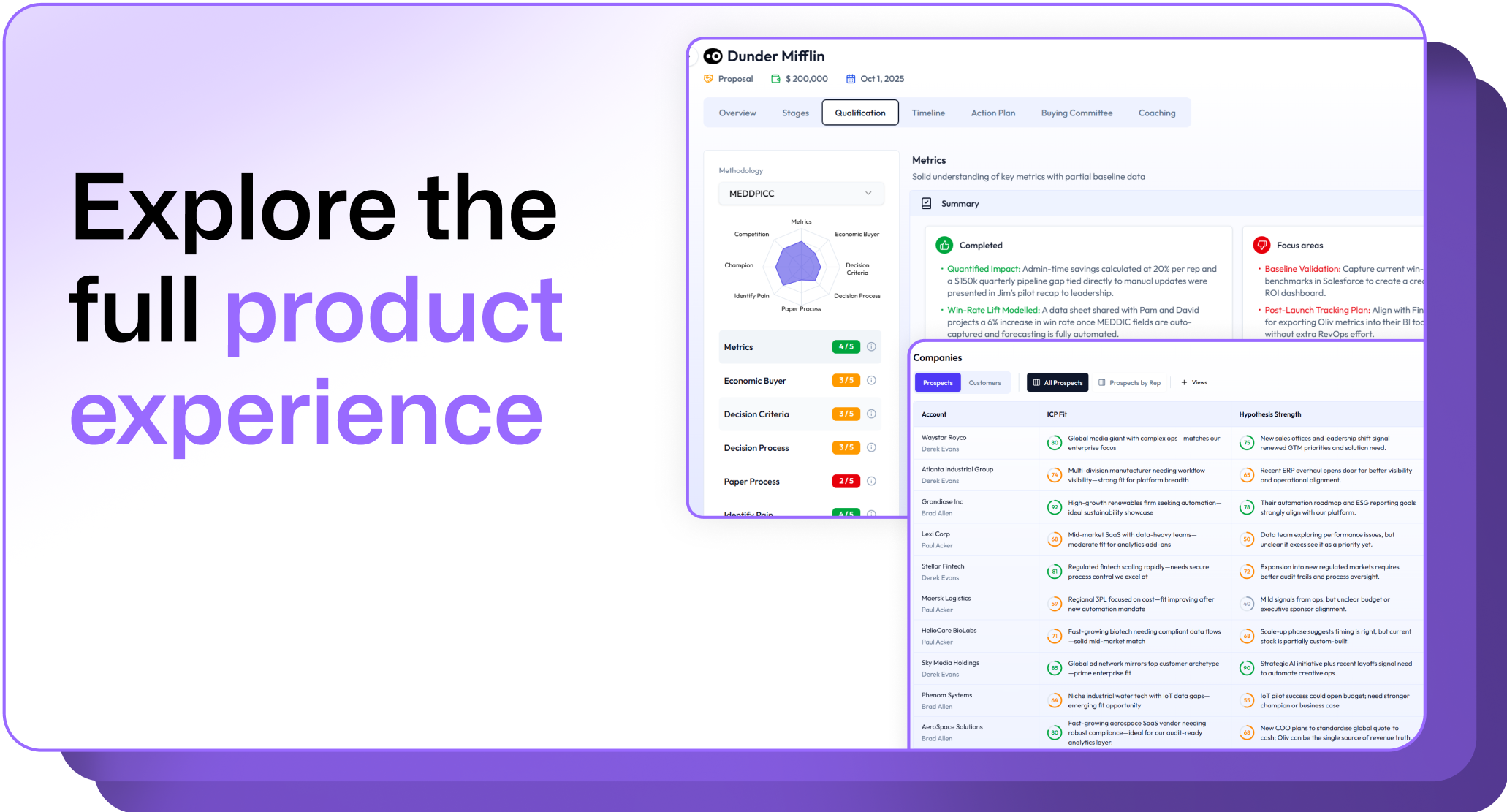
.avif)
.png)








.png)
.png)
.png)

