10 Best Revenue Performance Analytics Software in 2026: Pipeline Metrics, Rep Analytics, Forecast Accuracy, and Attribution
Written by
Ishan Chhabra
Last Updated :
August 4, 2026
Skim in :
13
mins
In this article
Revenue teams love Oliv
Here’s why:
All your deal data unified (from 30+ tools and tabs).
Insights are delivered to you directly, no digging.
AI agents automate tasks for you.
Thank you! Your submission has been received!
Oops! Something went wrong while submitting the form.
Meet Oliv’s AI Agents
Hi! I’m, Deal Driver
I track deals, flag risks, send weekly pipeline updates and give sales managers full visibility into deal progress
Hi! I’m, CRM Manager
I maintain CRM hygiene by updating core, custom and qualification fields all without your team lifting a finger
Hi! I’m, Forecaster
I build accurate forecasts based on real deal movement and tell you which deals to pull in to hit your number
Hi! I’m, Coach
I believe performance fuels revenue. I spot skill gaps, score calls and build coaching plans to help every rep level up
Hi! I’m, Prospector
I dig into target accounts to surface the right contacts, tailor and time outreach so you always strike when it counts
Hi! I’m, Pipeline tracker
I call reps to get deal updates, and deliver a real-time, CRM-synced roll-up view of deal progress
Hi! I’m, Analyst
I answer complex pipeline questions, uncover deal patterns, and build reports that guide strategic decisions
TL;DR
Revenue performance analytics spans four pillars: pipeline metrics, rep analytics, forecast accuracy, and attribution. Revenue intelligence covers only the first three well.
We scored ten platforms on deal-level intelligence, forecast and attribution depth, CRM write-back, verified reviews, and setup speed plus pricing transparency.
Oliv AI ranks first at $19 per user per month, because its agents update the CRM, flag risk, and deliver forecasts rather than dashboards.
Gong runs $100 to $120 per seat plus a $5,000 to $50,000 platform fee, and write-back gaps are the most repeated complaint across Gong and Clari reviews.
Only about 7% of teams hit 90% forecast accuracy, and the cause is deal-data quality, not the forecasting model.
Attribution is the pillar nearly every vendor skips, so test opportunity-level touch capture, model flexibility, and CRM write-back before signing.
Q1. What are the 10 best revenue performance analytics tools in 2026? [toc=1. Top 10 Tools]
The 10 best revenue performance analytics platforms in 2026 are Oliv AI, Aviso, Clari, Gong, InsightSquared (now Mediafly Revenue360), People.ai, Revenue Grid, Salesforce Revenue Intelligence, Salesloft, and Terret (formerly BoostUp). Oliv AI leads because it is the agent-native option that acts on deal-level analytics, updating CRM, flagging risk, and delivering Monday forecasts, instead of handing dashboards back to a human.
🧾 The three-dashboard problem
You bought conversation intelligence in 2022. You bought a forecasting tool in 2024. You still missed the quarter.
That is the pattern I keep running into on buyer calls. The stack got richer, and the forecast call did not get shorter. Most of these platforms were built before generative AI, so they surface insight and then stop.
🗂️ The 10 platforms at a glance
Oliv AI, agentic revenue platform, from $19/user/month
Salesloft, engagement plus forecasting, now merged with Clari
Terret (formerly BoostUp), modular forecasting and deal risk, from $79/user/month
Two names on that list changed recently. BoostUp is Terret, and InsightSquared now sits inside Mediafly Revenue360. A 2026 listicle still using the old names is a 2024 listicle wearing a new date.
Comparison table: all 10 platforms scored [toc=1. Comparison Table]
Scores are out of 5, using the rubric in Q2. Forecast score covers predictive deal scoring and confidence intervals. Attribution score covers touch capture and write-back of attribution data.
Mid-market teams wanting agents that act, not report
⭐⭐⭐⭐⭐
⭐⭐⭐⭐
Yes, agent fleet
$19/user/mo
Aviso
Enterprise RevOps wanting CI plus forecast in one seat
⭐⭐⭐⭐
⭐⭐⭐
Partial, MIKI and avatars
$50/seat/mo
Clari
Large enterprise forecast governance
⭐⭐⭐⭐
⭐⭐
Partial
Quote-only
Gong
Conversation data depth at scale
⭐⭐⭐⭐
⭐⭐
Partial, Agent Studio
$100 to $120/seat/mo plus $5K to $50K platform fee
InsightSquared (Mediafly Revenue360)
BI-heavy RevOps reporting
⭐⭐⭐
⭐⭐⭐
No
Quote-only
People.ai
Activity capture as a data foundation
⭐⭐⭐
⭐⭐⭐⭐
No
Enterprise contract
Revenue Grid
Salesforce-native activity capture
⭐⭐⭐
⭐⭐⭐
Partial, guided signals
Quote-only
Salesforce Revenue Intelligence
Salesforce-only shops
⭐⭐⭐
⭐⭐
Partial, Agentforce
Add-on to Sales Cloud
Salesloft
Engagement-led teams, now inside Clari
⭐⭐⭐
⭐⭐
Partial
Quote-only
Terret (formerly BoostUp)
Modular buyers who want to pay per capability
⭐⭐⭐⭐
⭐⭐
Yes, agent fleet
From $79/user/mo
⚠️ How to read these scores
Attribution is where almost everyone loses points. Most platforms in this category analyse conversations well and answer "which campaign produced this dollar" badly.
Pricing transparency is the second split. Aviso and Terret publish numbers, and Gong does not, which is a deliberate strategy rather than an oversight. Our breakdown of how Gong structures its pricing tiers covers where the platform fee lands.
1.1 Oliv AI: agents that close the loop [toc=1.1 Oliv AI]
Oliv's agent network shows playbook rules propagating to Deal Driver, Pipeline Tracker, and Analyst agents, so rep analytics and pipeline metrics reflect the process managers actually designed.
🤖 What Oliv AI does
Oliv AI is an AI-native revenue orchestration platform that deploys autonomous agents across the revenue lifecycle. It preps calls, updates CRM fields, flags deal risk, writes follow-ups, coaches reps, and delivers forecasts every Monday.
It is built on the Context Graph, a layer combining accurate CRM object association, 100+ revenue-specific language models, and a Process Graph encoding how each company sells. Oliv AI was founded in 2023 in San Francisco, backed by a $5M Foundation Capital seed, and is used by 100+ revenue teams.
🧩 Key features
Named agents including CRM Manager, Deal Driver, Analyst, and Gold Digger for expansion opportunities
Deal health scoring with next-step recommendations, not just a risk label
Chrome extension delivering live battlecards and talk tracks during calls
Works with Salesforce, HubSpot, Zoho, and 70+ tools, plus Zoom and Google Meet
💰 Pricing and implementation
Oliv AI starts at $19/user/month for the notetaker tier, and agents are added one at a time rather than bought as a suite on day one. That entry point is the door, not the product. Full modular pricing runs to roughly $120/user/month depending on how many agents you deploy.
Setup is fast. One reviewer describes configuring it in five to fifteen minutes, and another reports a forward-deployed engineer having the team live in under a week. Deeper customisation of methodology and process still takes real calendar time, usually two to four weeks for a complex Salesforce org.
📈 Product updates timeline
Oliv AI Product Update Timeline
Period
What shipped
Through 2025
Notetaker and Deal Assistant tiers, CRM auto-update after calls, and call summarisation as the $19 entry point
2026 to date
Agent fleet in production including CRM Manager, Deal Driver, Analyst, and Gold Digger, plus Context Graph and Process Graph as the intelligence layer
Expected next
Voice Agent maturing out of alpha, and mobile parity with the desktop experience, the gap reviewers currently flag
✅ Pros and ❌ cons
✅ Agents perform the work instead of reporting it, including CRM write-back after every call.
✅ Setup measured in minutes, with implementation support included.
✅ Modular pricing from $19/user/month avoids day-one suite commitment.
❌ Dashboard and report customisation is thinner than legacy BI-style tools.
❌ Mobile app lags the desktop experience.
❌ Occasional slowness reported, though support response is rated well.
🎯 Best fit and anti-fit
Best for mid-market B2B SaaS teams of roughly 200 to 5,000 employees with a real revenue org and a CRM they intend to keep. Strong fit if your bottleneck is data capture and follow-through rather than reporting depth.
Poor fit for B2C support use cases, for teams that only want call recording, and for teams unwilling to let agents take action. If pixel-level custom dashboards are the requirement, a BI tool will serve you better.
Oliv AI ranks first here on one specific ground. Across the deals our agents stitch together from calls, emails, and CRM, the pattern I keep seeing is that analytics fail on input quality, not model quality, and agents fix inputs. That is the same logic behind our list of the best revenue intelligence software platforms.
⭐ What users actually say
"Oliv.ai has agents like the CRM agent, deal driver agent, and forecast agent, which are invaluable. The deal driver agent keeps tabs on all my deals and tells me where each deal is and which one needs my focus." Verified UserOliv AI G2 Verified Review [15 Jun 2026]
"Our forecast accuracy has jumped by 27%, and onboarding was a breeze." Verified UserOliv AI G2 Verified Review [08 Jul 2026]
"I'd love to see few more options to customize dashboards and reports for different teams." Verified UserOliv AI G2 Verified Review [26 Jun 2026]
1.2 Aviso: the bundled forecasting seat [toc=1.2 Aviso]
Aviso explains a deal's 67% win probability with score trends and risk factors like stalled stages and delayed close dates, sharpening forecast accuracy during pipeline reviews.
📊 What Aviso does
Aviso is an AI revenue platform built around forecasting, pipeline inspection, and conversation intelligence sold in one seat. Its pitch is bundling: the capabilities Gong splits across Forecast and Enable modules arrive inside the base license.
The platform claims 1,000+ conversation intelligence signals per call and a real-time WinScore derived from those signals. Add-on modules cover sales engagement, lead intelligence, customer success intelligence, and agentic avatars including MIKI and Halo.
💰 Pricing and implementation
Aviso publishes $50 per seat per month, with no platform fee and onboarding included. Third-party trackers report real contracts clustering wider, roughly $40 to $100 per user per month on annual terms with platform minimums.
For a 100-seat team, the published delta against Gong runs $100,000 to $150,000 a year once Gong's required modules are added. Treat that figure with care, since it comes from Aviso's own comparison page rather than a neutral source.
📈 Product updates timeline
Aviso Product Update Timeline
Period
What shipped
Through 2025
Core forecasting, pipeline inspection, and conversation intelligence consolidated into the base seat, positioned against module-based rivals
2026 to date
Agentic avatars and role-specific agents including MIKI and Halo offered as separate modules, alongside published per-seat pricing
Expected next
Deeper agent coverage across lead intelligence and customer success modules, extending the avatar layer beyond forecasting
✅ Pros and ❌ cons
✅ Published per-seat price with onboarding included, rare in this category.
✅ Forecasting, pipeline inspection, and coaching in one license instead of three modules.
✅ Owner-level filtering works well for one-on-ones and forecast calls.
❌ Repeated reports of slow performance when switching segments.
❌ Salesforce sync reliability flagged by more than one reviewer.
❌ Exports lose customisations and filters, which frustrates RevOps analysts.
🎯 Best fit and anti-fit
Aviso suits enterprise RevOps teams that want one vendor for conversation intelligence plus forecasting and are willing to trade interface polish for bundle economics. It fits organisations where a mandated, centralised forecast process already exists.
It fits poorly where reps have real tool choice, because the negative reviews cluster on daily usability rather than capability. Aviso's own data points to a cost win, though I would weight the sync complaints heavily before signing.
Oliv AI's read on the bundle argument is that price per seat matters less than whether the seat does work. Aviso gives you more dashboards for your dollar, and the open question is who acts on them.
⭐ What users actually say
"I like being able to filter by group on the left-hand side. I often filter by the owner name so that I can easily zero in on one individual when I'm doing a one-on-one or through my forecast call." Verified UserAviso G2 Verified Review [08 Dec 2025]
"Extremely slow performance, especially when switching between segments. Exporting data loses all customisations and filters. Analytics are ineffective and add no real value." Verified UserAviso G2 Verified Review [24 Jun 2025]
"The solution is slow, often times it doesn't sync with SFDC, the reports are terrible and don't represent what is being pulled by the data." Verified UserAviso G2 Verified Review [18 Feb 2025]
1.3 Clari: enterprise forecast governance, now merged with Salesloft [toc=1.3 Clari]
Clari's agent prompts flag missing next steps, predict the quarter, and coach pricing objections, translating revenue signals into forecast accuracy gains and measurable rep performance analytics .
🏛️ What Clari does
Clari is an enterprise revenue platform built around forecasting, pipeline inspection, and deal inspection. It was founded in 2012 and emerged from stealth in April 2014 with $6M from Sequoia.
The platform now bundles Clari Forecast, Align, Copilot (conversation intelligence), and Groove (sales engagement). In August 2025, Clari announced a definitive merger with Salesloft, with Andy Byrne leading the combined company. Our teardown of Clari's core features goes deeper on each module.
🧩 Key features
Forecast rollups with historical forecast entries and week-over-week movement tracking
Deal inspection views including Flow View and Waterfall View for pipeline change analysis
Copilot for call recording and conversation analysis, rated a Strong Performer by Forrester in 2023
Groove-derived cadences, dialer, and email campaign tooling
RevAI, the layer Clari calls "everyday AI" for revenue teams
💰 Pricing and implementation
Clari does not publish list pricing. Contracts are quote-only and typically scale by seat count plus module selection.
Implementation is generally smooth for the forecasting core, and reviewers describe easy initial setup. The harder work is standardising deal stages and inspection presets across teams, which is process work, not vendor work.
📈 Product updates timeline
Clari Product Update Timeline
Period
What changed
Through 2025
Groove sales engagement folded in after the 2023 acquisition, with Copilot conversation intelligence and RevAI running as separate surfaces alongside forecast rollups
Aug 2025 to mid-2026
The Salesloft merger closed, and the March 2026 release shipped the first cross-platform features: Send AI Emails from Clari, Create Salesloft Tasks, and follow-up emails via Salesloft
Expected next
Deeper release-train integration of Clari, Align, Copilot, Groove, and Salesloft under the "Revenue Context" positioning, with agents running at enterprise scale
✅ Pros and ❌ cons
✅ Forecast rollups are simple, fast, and well integrated with Salesforce.
✅ Weekly forecasting and opportunity drill-down are genuinely strong workflows.
❌ CRM write-back is limited, and methodology values do not flow back to Salesforce.
❌ No custom reporting, which frustrates RevOps analysts who want their own cuts.
❌ Connection drops with Salesforce, Gmail, and calendar reported by users.
🎯 Best fit and anti-fit
Clari fits large enterprises where a governed, centralised forecast process is the priority. If your CRO needs one number every Monday and a defensible audit trail behind it, Clari does that job well.
It fits poorly if you need conversation data to update CRM fields automatically. That write-back gap is the most consistent complaint in recent reviews, and it drives most of the searches we see for Clari alternatives and competitors.
⭐ What users actually say
"I like Clari's visual design and the nice, clear style of word presentation. I enjoy being able to forecast easily without having to add up manually." Verified UserClari G2 Verified Review [17 Dec 2025]
"The conversation intelligence tool is lacking, and we don't have the context of the deals against the conversation intelligence findings. There's no custom reporting. The CRM writeback is not good; we cannot send MEDDIC values back to Salesforce." Verified UserClari G2 Verified Review [13 Jul 2026]
"The AI features are immature, team activity is poorly designed, and it doesn't integrate well with other popular business systems today." Verified UserClari G2 Verified Review [10 Oct 2025]
1.4 Gong: the deepest conversation data, at the highest price [toc=1.4 Gong]
Gong's Revenue Graph illustration connects conversations, CRM records, activities, and partner integrations into a living data network, supplying the trustworthy inputs revenue performance analytics depends on.
🎙️ What Gong does
Gong is the category-defining conversation intelligence platform, founded in 2015. It records, transcribes, and analyses customer calls, then layers deal boards, forecasting, and coaching on top.
In 2024 Gong repositioned from "Revenue Intelligence" to a Revenue AI Platform. By 2026 it describes itself as a Revenue AI Operating System, with Gong Assistant, Agent Studio, AI Trainer, and Data Extractor.
🧩 Key features
Smart Trackers for concept detection across calls, with SPICED and BANT playbook tracking in any language
AI Theme Spotter, analysing tens of thousands of calls for recurring patterns
Data Extractor, mapping AI-extracted fields from conversations into the CRM
Configurable Gong forecast boards covering new business, renewals, upsells, and net revenue
AI Trainer role-play simulation with audio coaching feedback, inside the Gong Enable module
💰 Pricing and implementation
Gong runs roughly $100 to $120 per seat per month, plus a platform fee reported between $5,000 and $50,000 annually. Enable and Forecast are separate modules, which is where total cost of ownership climbs.
That is the number worth sitting with. For a 25 to 200 rep team, the "just buy Gong plus Clari plus Salesloft" playbook quietly pushes past $500 per user per month once every module is live.
📈 Product updates timeline
Gong Product Update Timeline
Period
What changed
Through 2025
Gong Assistant (March 2025), Agent Studio (July 2025), AI Call Reviewer scorecards (August 2025), and configurable forecast boards (November 2025) shipped as separate surfaces
Feb to May 2026
Mission Andromeda launched Gong Enable on 25 Feb 2026, followed by Snowflake multi-instance support in April and Theme Spotter to smart-tracker conversion in May
Expected next
Bidirectional MCP server support, letting the AI Briefer pull third-party data in and external AI platforms query Gong deals directly, plus brief generation via API
✅ Pros and ❌ cons
✅ Deepest conversation dataset in the category, with mature trackers and themes.
✅ Strong Salesforce app maturity, live on AppExchange since 2022.
✅ Real momentum, with ARR passing $500M and 55% year-over-year growth in mid-2026.
❌ Data flows in more easily than it flows out, a repeated write-back complaint.
❌ Data export gated behind plan upgrades, per reviewer accounts.
❌ Highest total cost of ownership on this list once modules are added.
🎯 Best fit and anti-fit
Gong fits large organisations where conversation analysis is a core research function, not just a rep convenience. Enablement teams building content from real calls get genuine value.
It fits poorly if call recording is all you need. Zoom, Teams, and Google Meet now record and transcribe natively, so paying a platform fee for that alone makes little sense. Buyers weighing that trade-off usually end up scanning Gong alternatives before renewal.
⭐ What users actually say
"I appreciate how Gong organizes all our chats, videos, and audio with clients into a single source. I also find the AI tracker's ability to identify common themes across different recordings very useful." Verified UserGong G2 Verified Review [03 Oct 2025]
"limitations of getting data back into salesforce" Verified UserGong G2 Verified Review [21 May 2026]
"I cannot download all the data myself unless we upgrade the plan, which isn't ideal and results in me not fully utilizing Gong." Verified UserGong G2 Verified Review [03 Oct 2025]
1.5 InsightSquared (Mediafly Revenue360): the BI-first option [toc=1.5 InsightSquared]
📉 What it does now
InsightSquared was a sales analytics and BI platform. Mediafly acquired it and folded the technology into Revenue360, and the InsightSquared brand is being phased out.
Revenue360 combines content engagement, buyer intent, and sales activity data into account and opportunity health dashboards. The heritage is business intelligence, not agents.
🧩 Key features and pricing
Pipeline and funnel analytics with historical trend reporting
Content engagement data tied to opportunity health, which is unusual in this category
Buyer intent signals combined with sales activity in one dashboard
Forecasting and pipeline management modules inside Revenue360
Pricing is quote-only, with no published per-seat rate
📈 Product updates timeline
InsightSquared and Mediafly Revenue360 Update Timeline
Period
What changed
Through 2025
InsightSquared analytics operated as a named product line inside Mediafly Revenue360, combining content engagement and activity data in one dashboard
2026 to date
The InsightSquared brand is being retired and its technology consolidated under the Revenue360 name, so buyers searching the old name land on Mediafly
Expected next
Tighter coupling of content engagement analytics with revenue forecasting, the differentiator Mediafly brings from its sales enablement roots
✅ Pros and ❌ cons
✅ Content engagement data links marketing touch to deal health, useful for attribution work.
✅ Deep historical reporting, a genuine BI heritage.
❌ Brand confusion during the transition makes procurement research harder.
❌ No agent layer, so insight still returns to a human to action.
❌ No published pricing, which slows early evaluation.
🎯 Best fit
Best for RevOps teams that already own Mediafly for enablement and want reporting in the same contract. Weak fit for teams whose bottleneck is CRM data capture rather than reporting depth.
1.6 People.ai: the activity capture data foundation [toc=1.6 People.ai]
🔌 What People.ai does
People.ai automatically captures sales activity from email, calendar, and meetings, then maps it to CRM records. It positions itself as a data foundation rather than a dashboard product.
That framing matters. The pitch is that every other analytics tool downstream is only as good as the activity data feeding it.
🧩 Key features and pricing
Automated activity capture across email, calendar, and meetings, mapped to accounts and opportunities
Contact and buying-committee discovery from captured activity, which supports multithreading analysis
Account engagement scoring based on captured touches rather than manual logging
Enterprise-only contracts, quote-based, with no published per-seat price
📈 Product updates timeline
People.ai Product Update Timeline
Period
What changed
Through 2025
Core automated activity capture and CRM contact-creation engine operated as the foundation layer for enterprise Salesforce orgs
2026 to date
Positioning shifted toward AI-ready data infrastructure, framing captured activity as the training substrate for downstream revenue AI
Expected next
Deeper agent and LLM interoperability, exposing the captured activity graph to external AI systems rather than only to internal dashboards
✅ Pros and ❌ cons
✅ Best-in-class automated activity capture, the prerequisite for real attribution.
✅ Buying-committee discovery surfaces stakeholders reps never logged.
❌ It is infrastructure, not an answer, so you still need a layer that acts on it.
❌ Enterprise-only pricing puts it out of reach for most mid-market teams.
❌ Limited value if your CRM hygiene problem is stage discipline rather than activity capture.
🎯 Best fit
Best for large enterprises building a governed revenue data layer, often alongside a separate forecasting tool. Poor fit for a 50-rep team that needs one platform, not two.
Revenue Grid is a Salesforce-native platform for activity capture, guided selling, and forecasting. Its strength is deep email and calendar sync directly into the Salesforce environment.
The platform adds AI-guided selling signals, nudging reps toward the next action on an opportunity. It is closer to a Salesforce power-up than a standalone system.
🧩 Key features and pricing
Revenue Grid publishes three tiers, and the structure matters more than the headline price.
Activity Capture 360 at $30/user/month, covering email, meeting, and task capture into Salesforce
Knowledge Capture at $49/user/month, adding AI search and a revenue-grade data lake
Ultimate at $149/user/month, which is the only tier with forecasting, cadences, deal guidance, and the RG Assistant and RG Mentor AI tools
Onboarding, advanced configuration, premium support, and dedicated hosting all carry extra fees. Budget for the real number, not the $30 headline.
📈 Product updates timeline
Revenue Grid Product Update Timeline
Period
What changed
Through 2025
Three-tier pricing published as of September 2025, gating forecasting, cadences, and guided selling behind the $149 Ultimate tier
2026 to date
RG Assistant and RG Mentor AI tools shipped inside Ultimate, with founder pricing offered for early access to newer AI capabilities via custom quote
Expected next
Broader AI availability below the Ultimate tier, the change most requested by reviewers frustrated by feature gating
✅ Pros and ❌ cons
✅ Deep, reliable Salesforce email and calendar sync.
✅ Transparent published tiers, rare among enterprise revenue platforms.
✅ Guided selling signals give managers a coaching hook.
❌ Everything valuable sits at $149/user/month, making the entry price misleading.
❌ Deployments depend on Salesforce admin availability, slowing time to value.
❌ Hidden onboarding and configuration costs distort budgeting.
🎯 Best fit
Best for Salesforce-heavy enterprises with a dedicated admin and RevOps function. Poor fit for lean teams without Salesforce expertise, where the learning curve becomes the project.
1.8 Salesforce Revenue Intelligence: native, if you already own the stack [toc=1.8 Salesforce RI]
☁️ What it does
Salesforce Revenue Intelligence is the native analytics layer on Sales Cloud, combining CRM Analytics dashboards with pipeline and forecast insight. Einstein Conversation Insights adds call analysis, and Agentforce adds an agent surface.
The advantage is obvious. The data already lives in Salesforce, so there is no second system of record to reconcile.
🧩 Key features and pricing
Pipeline inspection, forecast management, and CRM Analytics dashboards inside the Sales Cloud interface
Einstein activity capture pulling email and calendar into Salesforce records
Agentforce for building task-specific agents on Salesforce data
Sold as a per-user add-on to Sales Cloud, quoted rather than listed
📈 Product updates timeline
Salesforce Revenue Intelligence Update Timeline
Period
What changed
Through 2025
Revenue Intelligence operated as a CRM Analytics-based dashboard layer with Einstein Conversation Insights bolted alongside pipeline inspection
2026 to date
Agentforce became the primary AI surface, moving Salesforce from predictive scoring toward configurable agents on native CRM data
Expected next
Continued consolidation of Einstein and Agentforce into a single agent layer, reducing the number of separate AI SKUs buyers must assemble
✅ Pros and ❌ cons
✅ Zero data movement, since everything runs on the existing CRM.
✅ No extra vendor security review, which shortens procurement.
✅ Native permissions and sharing rules already apply.
❌ Einstein activity capture over-redacts, flagging ordinary emails as sensitive and leaving gaps in the customer picture.
❌ Analytics quality depends entirely on rep-entered field discipline.
❌ Conversation intelligence is thinner than dedicated tools like Gong.
🎯 Best fit
Best for Salesforce-only shops with strong data governance and a preference for fewer vendors. Poor fit where CRM hygiene is already the problem, because a native layer inherits the same bad inputs, which is why teams start comparing Agentforce alternatives and competitors.
1.9 Salesloft: engagement-led, now inside Clari [toc=1.9 Salesloft]
📨 What Salesloft does
Salesloft is a sales engagement platform built around cadences, email sequencing, and dialling. Forecasting and conversation intelligence were added later, so analytics is not the original core.
Since the August 2025 merger with Clari, Salesloft functions as the engagement half of a combined revenue platform. The March 2026 release shipped the first joint features across both products.
🧩 Key features and pricing
Cadences and templates for structured multi-touch outreach
Integrated dialer and conversation recording
Forecasting and deal management modules layered on engagement data
Cross-platform actions with Clari, including tasks and follow-up emails triggered from Clari
Quote-only pricing, typically bundled with Clari post-merger
📈 Product updates timeline
Salesloft Product Update Timeline
Period
What changed
Through 2025
Standalone cadence, dialer, and forecasting product, until the merger agreement with Clari was announced on 7 Aug 2025
Mar 2026 to date
The March 2026 release shipped Send AI Emails from Clari, Create Salesloft Tasks, and follow-up emails via Salesloft, the first unified feature drop
Expected next
Full release-train consolidation with Clari, Align, Copilot, and Groove under one enterprise revenue orchestration surface
✅ Pros and ❌ cons
✅ Mature cadence and template management for high-volume outreach.
✅ Combined Clari roadmap gives it a forecasting story it lacked alone.
❌ Recurring reports of faulty analytics, including email open tracking.
❌ Meeting logging and data connectivity issues reported across multiple reviews.
❌ Integration and learning curve slow adoption for fast-moving teams.
🎯 Best fit
Best for outbound-heavy teams that need cadence discipline first and analytics second. Poor fit as a primary revenue analytics purchase, since engagement data alone does not answer forecast questions, a gap our Gong versus Salesloft comparison unpacks in detail.
⭐ What users actually say
"Salesloft helps organize outreach at scale and keeps follow-ups from falling through the cracks. I appreciate having cadences and templates all in one place." Verified UserSalesloft G2 Verified Review [22 Jul 2025]
"Integrating Salesloft came with a lot of challenges, and even now, it feels like the platform still has some kinks. I often have trouble logging meetings, and certain features feel clunky or overly manual." Verified UserSalesloft G2 Verified Review [22 Jul 2025]
"A handful of features don't work properly (inbound calls, task reminders, data connectivity between apps (CRM, Sales Nav). Analytics/metrics are faulty like email opens." Verified UserSalesloft G2 Verified Review [26 Mar 2025]
1.10 Terret (formerly BoostUp): the modular agent fleet [toc=1.10 Terret]
🔄 What changed and what it does
BoostUp rebranded as Terret on 9 September 2025, launching a fleet of AI revenue agents, and boostup.ai now redirects to terret.ai. The product lineage is unchanged.
Terret covers forecasting, deal risk scoring, and pipeline inspection, now wrapped in named agents. The agent set includes Pipeline Builder, Sales Process Agent, and Machine-generated forecast agents.
🧩 Key features and pricing
Forecast rollups with machine-generated projections alongside rep-submitted commits
Deal risk scoring based on activity, engagement, and stage behaviour
Named agents automating tactical work, with the vendor claiming up to 80% of tactical work automated
Conversation intelligence and activity capture as supporting layers
Published pricing from $79/user/month, with modular add-ons by capability
📈 Product updates timeline
Terret (formerly BoostUp) Update Timeline
Period
What changed
Through Aug 2025
Operated as BoostUp, a forecasting and deal-inspection platform with conversation intelligence, competing directly against Clari on forecast rollups
Sep 2025 to date
Rebranded as Terret on 9 Sep 2025 with a new agent fleet including Pipeline Builder and Sales Process Agent, and modular pricing from $79/user/month
Expected next
Expansion of the agent fleet across the customer lifecycle, following the CEO's stated goal of stack consolidation for CROs
✅ Pros and ❌ cons
✅ Published pricing and modular packaging, so you pay per capability.
✅ Genuine agent architecture rather than dashboards relabelled as AI.
✅ Mature forecasting lineage from the BoostUp years.
❌ The rebrand creates search and reference confusion during evaluation.
❌ Attribution capability remains thin, like most of this category.
❌ Smaller install base than Clari or Gong, so fewer reference customers on your exact stack.
🎯 Best fit
Best for mid-market and enterprise teams that want forecasting plus agents without an enterprise platform fee. Poor fit for teams needing a large peer-review corpus before signing.
Which platform fits which stack [toc=1. Stack Fit]
🧭 Match the tool to your CRM and size
Salesforce-native, admin-rich enterprise: Salesforce Revenue Intelligence, Revenue Grid, or Clari
HubSpot mid-market with no dedicated admin: Oliv AI or Aviso, since both avoid Salesforce-dependent deployment
Enterprise RevOps-led with a governed forecast process: Clari, Terret, or Aviso
Conversation research as a core function: Gong, accepting the total cost of ownership
Attribution and activity data as the priority: People.ai or Mediafly Revenue360
Across these deployments, the pattern I keep noticing is that stack fit gets decided by admin capacity, not feature lists. A team without a Salesforce admin will underuse the most powerful Salesforce-native tool on this page. If forecasting is the primary job to be done, our roundup of the best AI sales forecasting software narrows the field further.
Oliv AI sits at the top of this list for one reason that holds up under scrutiny: it works with Salesforce, HubSpot, Zoho, and 70+ tools, and its agents write back to whichever one you already run. Reviewers report setup in five to fifteen minutes and a 27% forecast accuracy improvement, which is the kind of outcome we also track across revenue orchestration platform tools.
Q2. How did we score these tools? Our selection criteria and weighting [toc=2. Selection Criteria]
Each platform was scored out of 100 across five weighted criteria: Deal-Level Intelligence and predictive deal scoring (25%), Forecast Accuracy and Attribution Depth (25%), CRM Write-Back and Data Portability (20%), Verified User Reviews (15%), and Setup Speed and Pricing Transparency (15%). Scores convert to stars: 0-20 is 1 star, 21-40 is 2, 41-60 is 3, 61-80 is 4, and 81-100 is 5.
⚖️ Why the weighting is published
Most "best tools" lists rank by affiliate payout or ad spend. Neither correlates with whether your forecast gets more accurate.
So the rubric goes first, before the verdict. If you disagree with a weight, you can re-run the maths yourself and land somewhere else.
📊 The five criteria, defined
Scoring Rubric and Weighting
Criterion
Weight
What it measures
Deal-Level Intelligence
25%
Predictive deal scoring tied to observed deal movement, not keyword counts
Forecast Accuracy and Attribution Depth
25%
Confidence bands, historical accuracy tracking, and touch-to-dollar mapping
CRM Write-Back and Data Portability
20%
Whether extracted data returns to your CRM and whether you can export it
Verified User Reviews
15%
G2 volume and recency, weighted toward 2025 to 2026 reviews
Setup Speed and Pricing Transparency
15%
Time to first value, plus whether pricing is published at all
Data coverage matters more than feature count. A platform that reads calls but ignores email and Slack sees a partial deal, so its scores get capped.
⚠️ Why write-back carries 20%
Write-back means data flowing back into your CRM, not just into the vendor's dashboard. It is the single criterion buyers underweight most.
The complaint shows up verbatim in recent reviews. Gong users report "limitations of getting data back into salesforce," and Clari users report they "cannot send MEDDIC values back to Salesforce," a pattern our roundup of verified Gong user reviews tracks in detail.
"limitations of getting data back into salesforce" Verified User, Gong G2 Verified Review 21 May 2026
"The CRM writeback is not good; we cannot send MEDDIC values back to Salesforce." Verified User, Clari G2 Verified Review 13 Jul 2026
🔍 The one-way data problem
A platform can ingest everything and export nothing. That is a real architecture choice, not an oversight.
The result is that your CRM gets worse, not better, while the vendor's system gets richer. Oliv AI integrates with Salesforce, HubSpot, Zoho, and 70+ tools, and scored 5 stars largely on the write-back leg of the rubric. Reviewers cite MEDIC-BAND field completion and setup inside five to fifteen minutes.
"It's incredibly helpful with our custom sales methodologies like MEDIC-BAND, as it helps me fill all of them out." Verified User, Oliv AI G2 Verified Review 15 Jun 2026
❌ What disqualified a tool
Three things knocked platforms off the list entirely:
Pure call recording with no deal-level layer, since Zoom, Teams, and Google Meet now do that natively
No verified reviews from the last 18 months, which usually signals a stalled product
No CRM integration at all, which makes the analytics unusable in a live pipeline
Machine learning transparency was scored inside the forecast criterion. If a vendor cannot explain what drives a deal score, the score cannot be defended in a QBR.
Oliv AI's read is that the standard rubric gets this backwards by rewarding feature count. What surfaces in deployments is that teams abandon platforms over data flow, not missing features, which is the same lens we apply across the best revenue intelligence software platforms.
Q3. What is revenue performance analytics, and how is it different from revenue intelligence? [toc=3. Definition & Category]
Revenue performance analytics is the use of data analysis and predictive modeling to evaluate, interpret, and optimize how a business generates revenue. It spans four pillars: pipeline metrics, rep analytics, forecast accuracy, and attribution. Revenue intelligence is a subset that analyses conversations and deals. Revenue performance analytics adds the finance-side question of which motion actually produced the closed dollar.
🧠 The definition in plain terms
Think of it as answering two questions at once. What is going to happen, and what caused what already happened.
Revenue intelligence answers the first well. Attribution, the practice of tracing revenue back to the touch that created it, answers the second, and most tools in this category do it poorly. Our primer on how revenue intelligence platforms work sets out where that boundary sits.
🏛️ The four pillars, with one metric each
Pipeline metrics: coverage ratio, meaning open pipeline divided by quota target
Rep analytics: next-step set rate, the share of meetings that end with a scheduled next action
Forecast accuracy: variance between committed forecast and closed revenue, tracked quarter over quarter
Attribution: percentage of closed revenue traceable to a first-touch source
Each pillar fails independently. A team can have excellent pipeline metrics and no attribution at all, which is the most common shape I see.
🔬 Three lenses on one deal
Four Lenses on the Same $60K Deal
Lens
What it tells you about a $60K deal
What it misses
CRM reporting
Stage, close date, amount, and owner, all rep-entered
Whether any of it is true
Revenue intelligence
The champion went quiet after the pricing call three weeks ago
Which campaign produced the champion
Revenue performance analytics
The deal came from a webinar, follows a 47-day median cycle, and is 12 days slipped
Nothing acts on it unless a human reads the dashboard
Agent layer
Oliv AI's agents update the CRM, flag the risk, and draft the follow-up after each call
Reporting depth is thinner than dedicated BI tools
🗺️ The GPS analogy
A sales process is the map. It shows the route from lead to closed won.
A qualification methodology like MEDDPICC is the GPS on top of that map. It does not replace the route; it tells you which turn to take next, which is why methodology field completion under MEDDIC is a real metric and not paperwork.
🎂 The three-layer cake
Layer one is baseline capture, meaning recording and transcription. Zoom, Teams, and Google Meet now include it free, so nobody should pay platform fees for it.
Layer two is the intelligence layer, tracking MEDDPICC-style fields and deal health. Layer three is the agent layer, where the analysis becomes completed work.
Most vendors sell layer one at layer three prices. That is the pricing arbitrage worth checking before any renewal.
🔄 Why the category keeps moving
The boundaries are genuinely unstable right now. BoostUp rebranded to Terret in September 2025, and InsightSquared has been absorbed into Mediafly Revenue360.
Category names change faster than the underlying products do. I would treat any list still using the old names as evidence it has not been refreshed, a shift we mapped in our piece on the move from revenue ops to orchestration.
Oliv AI operates at the agent layer, where its Context Graph pairs accurate CRM object association with 100+ revenue-specific language models. The output arrives as updated records and a written forecast, not as another chart to interpret.
Q4. Which pipeline and rep metrics actually predict revenue? [toc=4. Metrics That Matter]
Five pipeline metrics predict revenue: coverage ratio (3-4x for the current quarter), pipeline velocity, stage-conversion rate, sales cycle length, and slipped-deal rate. On the rep side, measure next-step set rate, multithreading depth, methodology field completion, and stage-slip frequency. Activity counts without a link to deal advancement are hollow KPIs. Oliv AI's Deal Driver agent flags at-risk deals from observed deal movement rather than Friday-night CRM entry.
🎭 The activity theatre problem
Call counts and email counts feel like management. They are mostly scorekeeping.
Activity metrics with no link to deal advancement cannot forecast anything. Managers who track them become scorekeepers, and scorekeepers make poor forecasters.
📐 The five formulas worth rebuilding Monday
Five Pipeline Formulas and Healthy Bands
Metric
Formula
Healthy band
Coverage ratio
Open pipeline ÷ quota
3x to 4x for the current quarter
Pipeline velocity
(Deals × win rate × avg deal size) ÷ cycle length
Track direction, not absolute value
Stage-conversion rate
Deals advancing ÷ deals entering stage
Flag any stage below 30%
Sales cycle length
Median days from creation to closed won
Use median, never mean
Slipped-deal rate
Deals with close date pushed ÷ total open deals
Above 25% signals forecast risk
Use median cycle length, not average. One 400-day enterprise deal will distort a mean badly enough to mislead your whole plan.
⚠️ Slipped-deal rate is the underrated one
Slipped-deal rate counts deals whose close date moved at least once. It is the earliest honest signal that a quarter is in trouble.
A deal that slips twice rarely closes in the quarter it was promised. That pattern shows up weeks before the coverage ratio moves.
💸 Coverage ratios lie when inputs are rep-entered
Here is the check almost nobody runs. Before trusting any ratio, ask what share of the underlying data was auto-captured versus typed by a rep on a Friday.
Salesforce's State of Sales 2026 report, based on 4,050 sales professionals surveyed across 22 countries, found reps spend only 40% of their time selling and 16% manually entering data. Oliv AI's read is that a coverage ratio built on that input is a guess wearing a decimal point.
🚿 The shower-and-driving audit
I keep hearing the same manager confession. They listen to call recordings while driving or in the shower, because that is the only time available.
That is not coaching; it is evidence-gathering. The same report found 46% of reps rarely get feedback on their sales conversations, and 40% say their manager's lack of time is the obstacle, which is exactly the gap the best sales coaching software is meant to close.
👥 The rep metrics that generate coaching
Next-step set rate: did the meeting end with a scheduled next action
Multithreading depth: how many stakeholders are actively engaged, not just cc'd
Methodology field completion: are MEDDPICC or BANT fields filled from evidence
Stage-slip frequency: how often this rep's deals move backwards
Each of these points at a specific behaviour. Call volume points at nothing you can coach.
"I like Oliv.ai for the time it saves by automating CRM updates and other administrative tasks. It gives a clear view of deal health risk and next steps." Verified User, Oliv AI G2 Verified Review 23 Jun 2026
"The Driver agent watches all my deals and flags any that are at risk, so I don't have to spend hours listening to recordings in tools like Gong and Clari." Verified User, Oliv AI G2 Verified Review 17 Jun 2026
⏰ A 20-minute 1:1 that writes itself
Five minutes on slipped deals and why. Five on the one call where the next step was not set.
Five on a multithreading gap in the largest open deal. Five on what the rep needs from you. No dashboard tour required.
Oliv AI's agents produce that agenda from observed deal movement, and one G2 reviewer reports saving over 10 hours a week on admin as a result. I might be reading the coaching lift too strongly, though the pattern across AI sales forecasting software deployments is consistent.
Q5. How do you measure forecast accuracy, and why do 93% of teams still miss 90%? [toc=5. Forecast Accuracy]
Forecast Accuracy = (Actual Revenue ÷ Forecasted Revenue) x 100. Variance = Forecasted minus Actual. MAPE, or mean absolute percentage error, averages the absolute percentage error across periods. Good is 90% or higher, most B2B orgs sit at 70-85%, and only about 7% reach 90%+. The cause of the gap is deal-data quality, not the forecasting model.
📐 The three formulas, one line each
Forecast Accuracy: (Actual ÷ Forecasted) x 100, expressed as a percentage
Variance: Forecasted minus Actual, in dollars, which tells you direction as well as size
MAPE: average of |Actual minus Forecast| ÷ Actual across periods, which stops one good quarter from hiding four bad ones
Run all three. Accuracy alone can look fine when two large errors cancel each other out.
📊 The benchmark bands
B2B Forecast Accuracy Benchmark Bands
Band
Accuracy
What it means
Elite
90%+
Roughly 7% of sales organisations
Median
70% to 79%
Where most B2B teams actually sit
At risk
Below 70%
The forecast is a directional guess
Gartner's survey data puts the median between 70% and 79%. That number has barely moved through a decade of forecasting software, including the forecast modules built into Gong.
💸 The spend paradox
Here is the part that should bother every RevOps leader. Clari Labs research found 87% of enterprises missed 2025 revenue targets despite record AI investment.
The same research found 48% of enterprises say their revenue data is not ready. Spend went up, and the number did not move.
🔍 The real mechanism
Forecast models are not the bottleneck. Discovery quality is.
A model reading a deal with an unnamed economic buyer and a guessed close date will output a confident wrong answer. Oliv AI measures this by extracting MEDDPICC qualification fields from the call itself rather than trusting the field a rep typed later.
⚠️ The manual-field burden
Reps face real pressure filling 10 to 15 fields per deal. When those fields get rushed on a Friday, the whole forecast inherits the guess.
Then Thursday and Friday become forecast scrub, where managers sit with reps for one to two hours and manually assemble a number. That is two days a week spent reconstructing data that should have captured itself.
"The forecasting is incredibly accurate, and the omni-channel context, especially with the Chrome extension, means my team gets hyper-relevant battlecards and talk tracks." Verified User, Oliv AI G2 Verified Review 08 Jul 2026
"Our forecast accuracy has jumped by 27%, and onboarding was a breeze." Verified User, Oliv AI G2 Verified Review 08 Jul 2026
🔁 The resilience paradox
Every reporting tool added for visibility makes the stack more brittle. The CRM slowly becomes a repository reps update because management requires it, not because it helps them.
Oliv AI's data points one way here, though I might be reading it too strongly. What surfaces repeatedly is that accuracy improves when capture improves, not when the model gets fancier, a pattern visible across the best AI sales forecasting software.
✅ Your Monday deal audit
Ask four questions of every deal in commit:
Can the rep name the economic buyer, the person who signs?
Is there a next step on the calendar, with a date?
Has the close date moved more than once?
Is anyone besides the champion actively engaged?
If a rep cannot articulate the exact status, push the deal off the forecast. That single rule will move your accuracy faster than any tool purchase.
Oliv AI attacks the input rather than the output, with its CRM Manager agent filling MEDDIC and MEDDPICC fields from the conversation. The question I keep sitting with is whether accuracy is a modelling problem at all, or just a capture problem we mislabelled.
Q6. How should you evaluate revenue attribution, the pillar most platforms skip? [toc=6. Attribution Gap]
Most revenue intelligence platforms do not do attribution. They analyse conversations and forecast deals but cannot say which campaign, motion, or touchpoint produced the closed dollar. Score vendors on three things: opportunity-level touch capture, multi-touch model flexibility, and whether attribution data writes back to the CRM for finance to reconcile. Oliv AI's Context Graph builds on accurate CRM object association, the prerequisite layer most platforms skip.
🕳️ Name the gap
I checked the major 2026 comparison pages in this category. None of them carries an attribution column.
That absence is not accidental. Vendors do not benchmark a capability most of them lack, which is why our own list of revenue intelligence software platforms scores it explicitly.
🧪 The three evaluation tests
Three Tests for Real Revenue Attribution
Test
What to check
Pass condition
Opportunity-level touch capture
Does every email, meeting, and campaign touch land on the right opportunity
90%+ of touches associated, not just logged
Multi-touch model flexibility
Can you switch between first-touch, last-touch, and W-shaped models
Models are configurable, not hardcoded
Write-back to CRM
Does attribution data return to Salesforce or HubSpot for finance
Finance can reconcile without an export
Most platforms pass test one partially and fail tests two and three. Ask for a screenshot of the write-back, not a slide about it.
⚠️ Where attribution silently dies
Attribution fails at the association layer, not the model layer. If an activity attaches to the wrong account or no object at all, every downstream model is confidently wrong.
Native capture tools make this worse in a specific way. Einstein activity capture over-redacts, flagging ordinary emails as containing sensitive information, which leaves holes in the customer picture, a complaint that runs through verified Salesforce Einstein reviews.
🔗 Why association is unglamorous and decisive
Nobody demos object association. It is plumbing, and plumbing does not photograph well.
Oliv AI's read is that the category gets this backwards by leading with models. The Context Graph exists because association has to be right before any attribution number means anything.
💰 What the alternatives actually offer
People.ai captures activity and maps it to CRM records well, which is the strongest foundation on this list, though it stops at infrastructure
Mediafly Revenue360 links content engagement to opportunity health, unusual and useful for marketing attribution
Gong, Clari, and Salesloft analyse conversations deeply, and none of them answers the campaign-to-dollar question
That is a fair reading, not a knock. These tools were built for a different job, as our Gong versus Clari comparison lays out side by side.
❓ The one demo question
Ask this, verbatim: "Show me a closed-won opportunity and trace every touch back to its source, then show me that data inside my CRM."
Watch what happens next. If the answer involves a CSV export or a services engagement, you are buying reporting, not attribution.
Oliv AI works across Salesforce, HubSpot, Zoho, and 70+ tools, so touches from email, calls, and meetings resolve to one deal object rather than three. Where my head is right now is that attribution becomes the next real differentiator, once everyone's conversation intelligence looks the same.
Q7. Is your data ready, what will security ask, and how do you pilot in 30 days? [toc=7. Readiness & Rollout]
Before evaluating any platform, audit four fields across open pipeline: close date, amount, next step, and stakeholder count. If under 70% of opportunity data is auto-captured, fix capture first. Then confirm SOC 2 Type II, GDPR lawful basis, two-party recording consent, and human-in-the-loop review. Then pilot on one team and one metric for 30 days. Oliv AI reviewers report setup inside five to fifteen minutes with onboarding engineers assisting.
🔎 The readiness audit
Pull your open pipeline and check four fields on every deal. Close date, amount, next step, and stakeholder count.
Count what share was auto-captured versus typed. Under 70% auto-captured means analytics will just render your guesses more beautifully.
💸 What bad data actually costs
MIT Sloan research puts the cost of poor data quality at 15% to 25% of revenue for most companies. That is not a software problem you can dashboard your way out of.
Clari Labs found 48% of enterprises say their revenue data is not ready for AI. Buy capture before you buy analysis, a sequencing point we make again in our guide to revenue orchestration platform tools.
⚠️ The internal-build trap
I hear this pitch inside RevOps teams often. "We already have the recordings, so we will build it ourselves."
Three or four months later they have insights from calls. Then comes the hard part, relating those insights to the deal, the account, and the forecast, which is where internal builds usually stall.
🔒 The security checklist
Paste this into your review:
SOC 2 Type II report, current, with the observation window dated
GDPR lawful basis documented, plus CCPA handling for US data
Two-party recording consent configured by jurisdiction
Data retention and deletion terms, including what happens at contract end
Sub-processor list, especially which LLM providers see your call data
Human-in-the-loop review on any agent that writes to the CRM
Oliv AI holds SOC 2 Type II, GDPR, and CCPA certifications, which clears the first three lines for most mid-market reviews. For a comparison point, our breakdown of Gong's DPA and security posture covers the same questions for an incumbent vendor.
⚖️ EU AI Act exposure
Autonomous forecasting agents that influence employment decisions can attract scrutiny under the EU AI Act. Coaching scores used in performance reviews are the specific risk.
Put explainability in the RFP. Ask the vendor to show why a deal scored 40 rather than 80, in plain language a rep can contest.
⏰ The 30-day pilot
Four-Week Pilot Plan with Weekly Outputs
Week
Focus
Output
Week 1
Define one metric and one team, connect CRM and calendar
Baseline number written down
Week 2
Let the agent run, correct outputs daily
Methodology fields improving
Week 3
Continue running, spot-check 10 deals
Accuracy of extracted fields measured
Week 4
Compare against baseline, decide
Go or no-go, documented
Corrections compound. Correct the output each day and by day 30 it is genuinely good, which is why a two-week pilot proves nothing. Benchmarked against a typical Gong implementation timeline, that is a fast validation loop.
✅ The 10/80/10 rule
Spend 10% of the pilot defining the metric. Spend 80% letting the agent run untouched.
Spend the last 10% quality checking against your baseline. Oliv AI runs a bottleneck audit first, deploys one agent, validates ROI, then expands, and reviewers describe full rollout inside a week with dedicated engineers.
"The initial setup was really easy because the team provided FDE engineers who set everything up, and within less than a week, we were good to go." Verified User, Oliv AI G2 Verified Review 17 Jun 2026
"The only downside is that the platform can be a bit glitchy at times, but the support team is always quick to address and resolve any bugs." Verified User, Oliv AI G2 Verified Review 02 Jul 2026
What is your current forecast accuracy number, before any tool? I would genuinely like to know, because most teams I ask cannot answer it, and that is the whole problem in one question.
Q1. What are the 10 best revenue performance analytics tools in 2026? [toc=1. Top 10 Tools]
The 10 best revenue performance analytics platforms in 2026 are Oliv AI, Aviso, Clari, Gong, InsightSquared (now Mediafly Revenue360), People.ai, Revenue Grid, Salesforce Revenue Intelligence, Salesloft, and Terret (formerly BoostUp). Oliv AI leads because it is the agent-native option that acts on deal-level analytics, updating CRM, flagging risk, and delivering Monday forecasts, instead of handing dashboards back to a human.
🧾 The three-dashboard problem
You bought conversation intelligence in 2022. You bought a forecasting tool in 2024. You still missed the quarter.
That is the pattern I keep running into on buyer calls. The stack got richer, and the forecast call did not get shorter. Most of these platforms were built before generative AI, so they surface insight and then stop.
🗂️ The 10 platforms at a glance
Oliv AI, agentic revenue platform, from $19/user/month
Salesloft, engagement plus forecasting, now merged with Clari
Terret (formerly BoostUp), modular forecasting and deal risk, from $79/user/month
Two names on that list changed recently. BoostUp is Terret, and InsightSquared now sits inside Mediafly Revenue360. A 2026 listicle still using the old names is a 2024 listicle wearing a new date.
Comparison table: all 10 platforms scored [toc=1. Comparison Table]
Scores are out of 5, using the rubric in Q2. Forecast score covers predictive deal scoring and confidence intervals. Attribution score covers touch capture and write-back of attribution data.
Mid-market teams wanting agents that act, not report
⭐⭐⭐⭐⭐
⭐⭐⭐⭐
Yes, agent fleet
$19/user/mo
Aviso
Enterprise RevOps wanting CI plus forecast in one seat
⭐⭐⭐⭐
⭐⭐⭐
Partial, MIKI and avatars
$50/seat/mo
Clari
Large enterprise forecast governance
⭐⭐⭐⭐
⭐⭐
Partial
Quote-only
Gong
Conversation data depth at scale
⭐⭐⭐⭐
⭐⭐
Partial, Agent Studio
$100 to $120/seat/mo plus $5K to $50K platform fee
InsightSquared (Mediafly Revenue360)
BI-heavy RevOps reporting
⭐⭐⭐
⭐⭐⭐
No
Quote-only
People.ai
Activity capture as a data foundation
⭐⭐⭐
⭐⭐⭐⭐
No
Enterprise contract
Revenue Grid
Salesforce-native activity capture
⭐⭐⭐
⭐⭐⭐
Partial, guided signals
Quote-only
Salesforce Revenue Intelligence
Salesforce-only shops
⭐⭐⭐
⭐⭐
Partial, Agentforce
Add-on to Sales Cloud
Salesloft
Engagement-led teams, now inside Clari
⭐⭐⭐
⭐⭐
Partial
Quote-only
Terret (formerly BoostUp)
Modular buyers who want to pay per capability
⭐⭐⭐⭐
⭐⭐
Yes, agent fleet
From $79/user/mo
⚠️ How to read these scores
Attribution is where almost everyone loses points. Most platforms in this category analyse conversations well and answer "which campaign produced this dollar" badly.
Pricing transparency is the second split. Aviso and Terret publish numbers, and Gong does not, which is a deliberate strategy rather than an oversight. Our breakdown of how Gong structures its pricing tiers covers where the platform fee lands.
1.1 Oliv AI: agents that close the loop [toc=1.1 Oliv AI]
Oliv's agent network shows playbook rules propagating to Deal Driver, Pipeline Tracker, and Analyst agents, so rep analytics and pipeline metrics reflect the process managers actually designed.
🤖 What Oliv AI does
Oliv AI is an AI-native revenue orchestration platform that deploys autonomous agents across the revenue lifecycle. It preps calls, updates CRM fields, flags deal risk, writes follow-ups, coaches reps, and delivers forecasts every Monday.
It is built on the Context Graph, a layer combining accurate CRM object association, 100+ revenue-specific language models, and a Process Graph encoding how each company sells. Oliv AI was founded in 2023 in San Francisco, backed by a $5M Foundation Capital seed, and is used by 100+ revenue teams.
🧩 Key features
Named agents including CRM Manager, Deal Driver, Analyst, and Gold Digger for expansion opportunities
Deal health scoring with next-step recommendations, not just a risk label
Chrome extension delivering live battlecards and talk tracks during calls
Works with Salesforce, HubSpot, Zoho, and 70+ tools, plus Zoom and Google Meet
💰 Pricing and implementation
Oliv AI starts at $19/user/month for the notetaker tier, and agents are added one at a time rather than bought as a suite on day one. That entry point is the door, not the product. Full modular pricing runs to roughly $120/user/month depending on how many agents you deploy.
Setup is fast. One reviewer describes configuring it in five to fifteen minutes, and another reports a forward-deployed engineer having the team live in under a week. Deeper customisation of methodology and process still takes real calendar time, usually two to four weeks for a complex Salesforce org.
📈 Product updates timeline
Oliv AI Product Update Timeline
Period
What shipped
Through 2025
Notetaker and Deal Assistant tiers, CRM auto-update after calls, and call summarisation as the $19 entry point
2026 to date
Agent fleet in production including CRM Manager, Deal Driver, Analyst, and Gold Digger, plus Context Graph and Process Graph as the intelligence layer
Expected next
Voice Agent maturing out of alpha, and mobile parity with the desktop experience, the gap reviewers currently flag
✅ Pros and ❌ cons
✅ Agents perform the work instead of reporting it, including CRM write-back after every call.
✅ Setup measured in minutes, with implementation support included.
✅ Modular pricing from $19/user/month avoids day-one suite commitment.
❌ Dashboard and report customisation is thinner than legacy BI-style tools.
❌ Mobile app lags the desktop experience.
❌ Occasional slowness reported, though support response is rated well.
🎯 Best fit and anti-fit
Best for mid-market B2B SaaS teams of roughly 200 to 5,000 employees with a real revenue org and a CRM they intend to keep. Strong fit if your bottleneck is data capture and follow-through rather than reporting depth.
Poor fit for B2C support use cases, for teams that only want call recording, and for teams unwilling to let agents take action. If pixel-level custom dashboards are the requirement, a BI tool will serve you better.
Oliv AI ranks first here on one specific ground. Across the deals our agents stitch together from calls, emails, and CRM, the pattern I keep seeing is that analytics fail on input quality, not model quality, and agents fix inputs. That is the same logic behind our list of the best revenue intelligence software platforms.
⭐ What users actually say
"Oliv.ai has agents like the CRM agent, deal driver agent, and forecast agent, which are invaluable. The deal driver agent keeps tabs on all my deals and tells me where each deal is and which one needs my focus." Verified UserOliv AI G2 Verified Review [15 Jun 2026]
"Our forecast accuracy has jumped by 27%, and onboarding was a breeze." Verified UserOliv AI G2 Verified Review [08 Jul 2026]
"I'd love to see few more options to customize dashboards and reports for different teams." Verified UserOliv AI G2 Verified Review [26 Jun 2026]
1.2 Aviso: the bundled forecasting seat [toc=1.2 Aviso]
Aviso explains a deal's 67% win probability with score trends and risk factors like stalled stages and delayed close dates, sharpening forecast accuracy during pipeline reviews.
📊 What Aviso does
Aviso is an AI revenue platform built around forecasting, pipeline inspection, and conversation intelligence sold in one seat. Its pitch is bundling: the capabilities Gong splits across Forecast and Enable modules arrive inside the base license.
The platform claims 1,000+ conversation intelligence signals per call and a real-time WinScore derived from those signals. Add-on modules cover sales engagement, lead intelligence, customer success intelligence, and agentic avatars including MIKI and Halo.
💰 Pricing and implementation
Aviso publishes $50 per seat per month, with no platform fee and onboarding included. Third-party trackers report real contracts clustering wider, roughly $40 to $100 per user per month on annual terms with platform minimums.
For a 100-seat team, the published delta against Gong runs $100,000 to $150,000 a year once Gong's required modules are added. Treat that figure with care, since it comes from Aviso's own comparison page rather than a neutral source.
📈 Product updates timeline
Aviso Product Update Timeline
Period
What shipped
Through 2025
Core forecasting, pipeline inspection, and conversation intelligence consolidated into the base seat, positioned against module-based rivals
2026 to date
Agentic avatars and role-specific agents including MIKI and Halo offered as separate modules, alongside published per-seat pricing
Expected next
Deeper agent coverage across lead intelligence and customer success modules, extending the avatar layer beyond forecasting
✅ Pros and ❌ cons
✅ Published per-seat price with onboarding included, rare in this category.
✅ Forecasting, pipeline inspection, and coaching in one license instead of three modules.
✅ Owner-level filtering works well for one-on-ones and forecast calls.
❌ Repeated reports of slow performance when switching segments.
❌ Salesforce sync reliability flagged by more than one reviewer.
❌ Exports lose customisations and filters, which frustrates RevOps analysts.
🎯 Best fit and anti-fit
Aviso suits enterprise RevOps teams that want one vendor for conversation intelligence plus forecasting and are willing to trade interface polish for bundle economics. It fits organisations where a mandated, centralised forecast process already exists.
It fits poorly where reps have real tool choice, because the negative reviews cluster on daily usability rather than capability. Aviso's own data points to a cost win, though I would weight the sync complaints heavily before signing.
Oliv AI's read on the bundle argument is that price per seat matters less than whether the seat does work. Aviso gives you more dashboards for your dollar, and the open question is who acts on them.
⭐ What users actually say
"I like being able to filter by group on the left-hand side. I often filter by the owner name so that I can easily zero in on one individual when I'm doing a one-on-one or through my forecast call." Verified UserAviso G2 Verified Review [08 Dec 2025]
"Extremely slow performance, especially when switching between segments. Exporting data loses all customisations and filters. Analytics are ineffective and add no real value." Verified UserAviso G2 Verified Review [24 Jun 2025]
"The solution is slow, often times it doesn't sync with SFDC, the reports are terrible and don't represent what is being pulled by the data." Verified UserAviso G2 Verified Review [18 Feb 2025]
1.3 Clari: enterprise forecast governance, now merged with Salesloft [toc=1.3 Clari]
Clari's agent prompts flag missing next steps, predict the quarter, and coach pricing objections, translating revenue signals into forecast accuracy gains and measurable rep performance analytics .
🏛️ What Clari does
Clari is an enterprise revenue platform built around forecasting, pipeline inspection, and deal inspection. It was founded in 2012 and emerged from stealth in April 2014 with $6M from Sequoia.
The platform now bundles Clari Forecast, Align, Copilot (conversation intelligence), and Groove (sales engagement). In August 2025, Clari announced a definitive merger with Salesloft, with Andy Byrne leading the combined company. Our teardown of Clari's core features goes deeper on each module.
🧩 Key features
Forecast rollups with historical forecast entries and week-over-week movement tracking
Deal inspection views including Flow View and Waterfall View for pipeline change analysis
Copilot for call recording and conversation analysis, rated a Strong Performer by Forrester in 2023
Groove-derived cadences, dialer, and email campaign tooling
RevAI, the layer Clari calls "everyday AI" for revenue teams
💰 Pricing and implementation
Clari does not publish list pricing. Contracts are quote-only and typically scale by seat count plus module selection.
Implementation is generally smooth for the forecasting core, and reviewers describe easy initial setup. The harder work is standardising deal stages and inspection presets across teams, which is process work, not vendor work.
📈 Product updates timeline
Clari Product Update Timeline
Period
What changed
Through 2025
Groove sales engagement folded in after the 2023 acquisition, with Copilot conversation intelligence and RevAI running as separate surfaces alongside forecast rollups
Aug 2025 to mid-2026
The Salesloft merger closed, and the March 2026 release shipped the first cross-platform features: Send AI Emails from Clari, Create Salesloft Tasks, and follow-up emails via Salesloft
Expected next
Deeper release-train integration of Clari, Align, Copilot, Groove, and Salesloft under the "Revenue Context" positioning, with agents running at enterprise scale
✅ Pros and ❌ cons
✅ Forecast rollups are simple, fast, and well integrated with Salesforce.
✅ Weekly forecasting and opportunity drill-down are genuinely strong workflows.
❌ CRM write-back is limited, and methodology values do not flow back to Salesforce.
❌ No custom reporting, which frustrates RevOps analysts who want their own cuts.
❌ Connection drops with Salesforce, Gmail, and calendar reported by users.
🎯 Best fit and anti-fit
Clari fits large enterprises where a governed, centralised forecast process is the priority. If your CRO needs one number every Monday and a defensible audit trail behind it, Clari does that job well.
It fits poorly if you need conversation data to update CRM fields automatically. That write-back gap is the most consistent complaint in recent reviews, and it drives most of the searches we see for Clari alternatives and competitors.
⭐ What users actually say
"I like Clari's visual design and the nice, clear style of word presentation. I enjoy being able to forecast easily without having to add up manually." Verified UserClari G2 Verified Review [17 Dec 2025]
"The conversation intelligence tool is lacking, and we don't have the context of the deals against the conversation intelligence findings. There's no custom reporting. The CRM writeback is not good; we cannot send MEDDIC values back to Salesforce." Verified UserClari G2 Verified Review [13 Jul 2026]
"The AI features are immature, team activity is poorly designed, and it doesn't integrate well with other popular business systems today." Verified UserClari G2 Verified Review [10 Oct 2025]
1.4 Gong: the deepest conversation data, at the highest price [toc=1.4 Gong]
Gong's Revenue Graph illustration connects conversations, CRM records, activities, and partner integrations into a living data network, supplying the trustworthy inputs revenue performance analytics depends on.
🎙️ What Gong does
Gong is the category-defining conversation intelligence platform, founded in 2015. It records, transcribes, and analyses customer calls, then layers deal boards, forecasting, and coaching on top.
In 2024 Gong repositioned from "Revenue Intelligence" to a Revenue AI Platform. By 2026 it describes itself as a Revenue AI Operating System, with Gong Assistant, Agent Studio, AI Trainer, and Data Extractor.
🧩 Key features
Smart Trackers for concept detection across calls, with SPICED and BANT playbook tracking in any language
AI Theme Spotter, analysing tens of thousands of calls for recurring patterns
Data Extractor, mapping AI-extracted fields from conversations into the CRM
Configurable Gong forecast boards covering new business, renewals, upsells, and net revenue
AI Trainer role-play simulation with audio coaching feedback, inside the Gong Enable module
💰 Pricing and implementation
Gong runs roughly $100 to $120 per seat per month, plus a platform fee reported between $5,000 and $50,000 annually. Enable and Forecast are separate modules, which is where total cost of ownership climbs.
That is the number worth sitting with. For a 25 to 200 rep team, the "just buy Gong plus Clari plus Salesloft" playbook quietly pushes past $500 per user per month once every module is live.
📈 Product updates timeline
Gong Product Update Timeline
Period
What changed
Through 2025
Gong Assistant (March 2025), Agent Studio (July 2025), AI Call Reviewer scorecards (August 2025), and configurable forecast boards (November 2025) shipped as separate surfaces
Feb to May 2026
Mission Andromeda launched Gong Enable on 25 Feb 2026, followed by Snowflake multi-instance support in April and Theme Spotter to smart-tracker conversion in May
Expected next
Bidirectional MCP server support, letting the AI Briefer pull third-party data in and external AI platforms query Gong deals directly, plus brief generation via API
✅ Pros and ❌ cons
✅ Deepest conversation dataset in the category, with mature trackers and themes.
✅ Strong Salesforce app maturity, live on AppExchange since 2022.
✅ Real momentum, with ARR passing $500M and 55% year-over-year growth in mid-2026.
❌ Data flows in more easily than it flows out, a repeated write-back complaint.
❌ Data export gated behind plan upgrades, per reviewer accounts.
❌ Highest total cost of ownership on this list once modules are added.
🎯 Best fit and anti-fit
Gong fits large organisations where conversation analysis is a core research function, not just a rep convenience. Enablement teams building content from real calls get genuine value.
It fits poorly if call recording is all you need. Zoom, Teams, and Google Meet now record and transcribe natively, so paying a platform fee for that alone makes little sense. Buyers weighing that trade-off usually end up scanning Gong alternatives before renewal.
⭐ What users actually say
"I appreciate how Gong organizes all our chats, videos, and audio with clients into a single source. I also find the AI tracker's ability to identify common themes across different recordings very useful." Verified UserGong G2 Verified Review [03 Oct 2025]
"limitations of getting data back into salesforce" Verified UserGong G2 Verified Review [21 May 2026]
"I cannot download all the data myself unless we upgrade the plan, which isn't ideal and results in me not fully utilizing Gong." Verified UserGong G2 Verified Review [03 Oct 2025]
1.5 InsightSquared (Mediafly Revenue360): the BI-first option [toc=1.5 InsightSquared]
📉 What it does now
InsightSquared was a sales analytics and BI platform. Mediafly acquired it and folded the technology into Revenue360, and the InsightSquared brand is being phased out.
Revenue360 combines content engagement, buyer intent, and sales activity data into account and opportunity health dashboards. The heritage is business intelligence, not agents.
🧩 Key features and pricing
Pipeline and funnel analytics with historical trend reporting
Content engagement data tied to opportunity health, which is unusual in this category
Buyer intent signals combined with sales activity in one dashboard
Forecasting and pipeline management modules inside Revenue360
Pricing is quote-only, with no published per-seat rate
📈 Product updates timeline
InsightSquared and Mediafly Revenue360 Update Timeline
Period
What changed
Through 2025
InsightSquared analytics operated as a named product line inside Mediafly Revenue360, combining content engagement and activity data in one dashboard
2026 to date
The InsightSquared brand is being retired and its technology consolidated under the Revenue360 name, so buyers searching the old name land on Mediafly
Expected next
Tighter coupling of content engagement analytics with revenue forecasting, the differentiator Mediafly brings from its sales enablement roots
✅ Pros and ❌ cons
✅ Content engagement data links marketing touch to deal health, useful for attribution work.
✅ Deep historical reporting, a genuine BI heritage.
❌ Brand confusion during the transition makes procurement research harder.
❌ No agent layer, so insight still returns to a human to action.
❌ No published pricing, which slows early evaluation.
🎯 Best fit
Best for RevOps teams that already own Mediafly for enablement and want reporting in the same contract. Weak fit for teams whose bottleneck is CRM data capture rather than reporting depth.
1.6 People.ai: the activity capture data foundation [toc=1.6 People.ai]
🔌 What People.ai does
People.ai automatically captures sales activity from email, calendar, and meetings, then maps it to CRM records. It positions itself as a data foundation rather than a dashboard product.
That framing matters. The pitch is that every other analytics tool downstream is only as good as the activity data feeding it.
🧩 Key features and pricing
Automated activity capture across email, calendar, and meetings, mapped to accounts and opportunities
Contact and buying-committee discovery from captured activity, which supports multithreading analysis
Account engagement scoring based on captured touches rather than manual logging
Enterprise-only contracts, quote-based, with no published per-seat price
📈 Product updates timeline
People.ai Product Update Timeline
Period
What changed
Through 2025
Core automated activity capture and CRM contact-creation engine operated as the foundation layer for enterprise Salesforce orgs
2026 to date
Positioning shifted toward AI-ready data infrastructure, framing captured activity as the training substrate for downstream revenue AI
Expected next
Deeper agent and LLM interoperability, exposing the captured activity graph to external AI systems rather than only to internal dashboards
✅ Pros and ❌ cons
✅ Best-in-class automated activity capture, the prerequisite for real attribution.
✅ Buying-committee discovery surfaces stakeholders reps never logged.
❌ It is infrastructure, not an answer, so you still need a layer that acts on it.
❌ Enterprise-only pricing puts it out of reach for most mid-market teams.
❌ Limited value if your CRM hygiene problem is stage discipline rather than activity capture.
🎯 Best fit
Best for large enterprises building a governed revenue data layer, often alongside a separate forecasting tool. Poor fit for a 50-rep team that needs one platform, not two.
Revenue Grid is a Salesforce-native platform for activity capture, guided selling, and forecasting. Its strength is deep email and calendar sync directly into the Salesforce environment.
The platform adds AI-guided selling signals, nudging reps toward the next action on an opportunity. It is closer to a Salesforce power-up than a standalone system.
🧩 Key features and pricing
Revenue Grid publishes three tiers, and the structure matters more than the headline price.
Activity Capture 360 at $30/user/month, covering email, meeting, and task capture into Salesforce
Knowledge Capture at $49/user/month, adding AI search and a revenue-grade data lake
Ultimate at $149/user/month, which is the only tier with forecasting, cadences, deal guidance, and the RG Assistant and RG Mentor AI tools
Onboarding, advanced configuration, premium support, and dedicated hosting all carry extra fees. Budget for the real number, not the $30 headline.
📈 Product updates timeline
Revenue Grid Product Update Timeline
Period
What changed
Through 2025
Three-tier pricing published as of September 2025, gating forecasting, cadences, and guided selling behind the $149 Ultimate tier
2026 to date
RG Assistant and RG Mentor AI tools shipped inside Ultimate, with founder pricing offered for early access to newer AI capabilities via custom quote
Expected next
Broader AI availability below the Ultimate tier, the change most requested by reviewers frustrated by feature gating
✅ Pros and ❌ cons
✅ Deep, reliable Salesforce email and calendar sync.
✅ Transparent published tiers, rare among enterprise revenue platforms.
✅ Guided selling signals give managers a coaching hook.
❌ Everything valuable sits at $149/user/month, making the entry price misleading.
❌ Deployments depend on Salesforce admin availability, slowing time to value.
❌ Hidden onboarding and configuration costs distort budgeting.
🎯 Best fit
Best for Salesforce-heavy enterprises with a dedicated admin and RevOps function. Poor fit for lean teams without Salesforce expertise, where the learning curve becomes the project.
1.8 Salesforce Revenue Intelligence: native, if you already own the stack [toc=1.8 Salesforce RI]
☁️ What it does
Salesforce Revenue Intelligence is the native analytics layer on Sales Cloud, combining CRM Analytics dashboards with pipeline and forecast insight. Einstein Conversation Insights adds call analysis, and Agentforce adds an agent surface.
The advantage is obvious. The data already lives in Salesforce, so there is no second system of record to reconcile.
🧩 Key features and pricing
Pipeline inspection, forecast management, and CRM Analytics dashboards inside the Sales Cloud interface
Einstein activity capture pulling email and calendar into Salesforce records
Agentforce for building task-specific agents on Salesforce data
Sold as a per-user add-on to Sales Cloud, quoted rather than listed
📈 Product updates timeline
Salesforce Revenue Intelligence Update Timeline
Period
What changed
Through 2025
Revenue Intelligence operated as a CRM Analytics-based dashboard layer with Einstein Conversation Insights bolted alongside pipeline inspection
2026 to date
Agentforce became the primary AI surface, moving Salesforce from predictive scoring toward configurable agents on native CRM data
Expected next
Continued consolidation of Einstein and Agentforce into a single agent layer, reducing the number of separate AI SKUs buyers must assemble
✅ Pros and ❌ cons
✅ Zero data movement, since everything runs on the existing CRM.
✅ No extra vendor security review, which shortens procurement.
✅ Native permissions and sharing rules already apply.
❌ Einstein activity capture over-redacts, flagging ordinary emails as sensitive and leaving gaps in the customer picture.
❌ Analytics quality depends entirely on rep-entered field discipline.
❌ Conversation intelligence is thinner than dedicated tools like Gong.
🎯 Best fit
Best for Salesforce-only shops with strong data governance and a preference for fewer vendors. Poor fit where CRM hygiene is already the problem, because a native layer inherits the same bad inputs, which is why teams start comparing Agentforce alternatives and competitors.
1.9 Salesloft: engagement-led, now inside Clari [toc=1.9 Salesloft]
📨 What Salesloft does
Salesloft is a sales engagement platform built around cadences, email sequencing, and dialling. Forecasting and conversation intelligence were added later, so analytics is not the original core.
Since the August 2025 merger with Clari, Salesloft functions as the engagement half of a combined revenue platform. The March 2026 release shipped the first joint features across both products.
🧩 Key features and pricing
Cadences and templates for structured multi-touch outreach
Integrated dialer and conversation recording
Forecasting and deal management modules layered on engagement data
Cross-platform actions with Clari, including tasks and follow-up emails triggered from Clari
Quote-only pricing, typically bundled with Clari post-merger
📈 Product updates timeline
Salesloft Product Update Timeline
Period
What changed
Through 2025
Standalone cadence, dialer, and forecasting product, until the merger agreement with Clari was announced on 7 Aug 2025
Mar 2026 to date
The March 2026 release shipped Send AI Emails from Clari, Create Salesloft Tasks, and follow-up emails via Salesloft, the first unified feature drop
Expected next
Full release-train consolidation with Clari, Align, Copilot, and Groove under one enterprise revenue orchestration surface
✅ Pros and ❌ cons
✅ Mature cadence and template management for high-volume outreach.
✅ Combined Clari roadmap gives it a forecasting story it lacked alone.
❌ Recurring reports of faulty analytics, including email open tracking.
❌ Meeting logging and data connectivity issues reported across multiple reviews.
❌ Integration and learning curve slow adoption for fast-moving teams.
🎯 Best fit
Best for outbound-heavy teams that need cadence discipline first and analytics second. Poor fit as a primary revenue analytics purchase, since engagement data alone does not answer forecast questions, a gap our Gong versus Salesloft comparison unpacks in detail.
⭐ What users actually say
"Salesloft helps organize outreach at scale and keeps follow-ups from falling through the cracks. I appreciate having cadences and templates all in one place." Verified UserSalesloft G2 Verified Review [22 Jul 2025]
"Integrating Salesloft came with a lot of challenges, and even now, it feels like the platform still has some kinks. I often have trouble logging meetings, and certain features feel clunky or overly manual." Verified UserSalesloft G2 Verified Review [22 Jul 2025]
"A handful of features don't work properly (inbound calls, task reminders, data connectivity between apps (CRM, Sales Nav). Analytics/metrics are faulty like email opens." Verified UserSalesloft G2 Verified Review [26 Mar 2025]
1.10 Terret (formerly BoostUp): the modular agent fleet [toc=1.10 Terret]
🔄 What changed and what it does
BoostUp rebranded as Terret on 9 September 2025, launching a fleet of AI revenue agents, and boostup.ai now redirects to terret.ai. The product lineage is unchanged.
Terret covers forecasting, deal risk scoring, and pipeline inspection, now wrapped in named agents. The agent set includes Pipeline Builder, Sales Process Agent, and Machine-generated forecast agents.
🧩 Key features and pricing
Forecast rollups with machine-generated projections alongside rep-submitted commits
Deal risk scoring based on activity, engagement, and stage behaviour
Named agents automating tactical work, with the vendor claiming up to 80% of tactical work automated
Conversation intelligence and activity capture as supporting layers
Published pricing from $79/user/month, with modular add-ons by capability
📈 Product updates timeline
Terret (formerly BoostUp) Update Timeline
Period
What changed
Through Aug 2025
Operated as BoostUp, a forecasting and deal-inspection platform with conversation intelligence, competing directly against Clari on forecast rollups
Sep 2025 to date
Rebranded as Terret on 9 Sep 2025 with a new agent fleet including Pipeline Builder and Sales Process Agent, and modular pricing from $79/user/month
Expected next
Expansion of the agent fleet across the customer lifecycle, following the CEO's stated goal of stack consolidation for CROs
✅ Pros and ❌ cons
✅ Published pricing and modular packaging, so you pay per capability.
✅ Genuine agent architecture rather than dashboards relabelled as AI.
✅ Mature forecasting lineage from the BoostUp years.
❌ The rebrand creates search and reference confusion during evaluation.
❌ Attribution capability remains thin, like most of this category.
❌ Smaller install base than Clari or Gong, so fewer reference customers on your exact stack.
🎯 Best fit
Best for mid-market and enterprise teams that want forecasting plus agents without an enterprise platform fee. Poor fit for teams needing a large peer-review corpus before signing.
Which platform fits which stack [toc=1. Stack Fit]
🧭 Match the tool to your CRM and size
Salesforce-native, admin-rich enterprise: Salesforce Revenue Intelligence, Revenue Grid, or Clari
HubSpot mid-market with no dedicated admin: Oliv AI or Aviso, since both avoid Salesforce-dependent deployment
Enterprise RevOps-led with a governed forecast process: Clari, Terret, or Aviso
Conversation research as a core function: Gong, accepting the total cost of ownership
Attribution and activity data as the priority: People.ai or Mediafly Revenue360
Across these deployments, the pattern I keep noticing is that stack fit gets decided by admin capacity, not feature lists. A team without a Salesforce admin will underuse the most powerful Salesforce-native tool on this page. If forecasting is the primary job to be done, our roundup of the best AI sales forecasting software narrows the field further.
Oliv AI sits at the top of this list for one reason that holds up under scrutiny: it works with Salesforce, HubSpot, Zoho, and 70+ tools, and its agents write back to whichever one you already run. Reviewers report setup in five to fifteen minutes and a 27% forecast accuracy improvement, which is the kind of outcome we also track across revenue orchestration platform tools.
Q2. How did we score these tools? Our selection criteria and weighting [toc=2. Selection Criteria]
Each platform was scored out of 100 across five weighted criteria: Deal-Level Intelligence and predictive deal scoring (25%), Forecast Accuracy and Attribution Depth (25%), CRM Write-Back and Data Portability (20%), Verified User Reviews (15%), and Setup Speed and Pricing Transparency (15%). Scores convert to stars: 0-20 is 1 star, 21-40 is 2, 41-60 is 3, 61-80 is 4, and 81-100 is 5.
⚖️ Why the weighting is published
Most "best tools" lists rank by affiliate payout or ad spend. Neither correlates with whether your forecast gets more accurate.
So the rubric goes first, before the verdict. If you disagree with a weight, you can re-run the maths yourself and land somewhere else.
📊 The five criteria, defined
Scoring Rubric and Weighting
Criterion
Weight
What it measures
Deal-Level Intelligence
25%
Predictive deal scoring tied to observed deal movement, not keyword counts
Forecast Accuracy and Attribution Depth
25%
Confidence bands, historical accuracy tracking, and touch-to-dollar mapping
CRM Write-Back and Data Portability
20%
Whether extracted data returns to your CRM and whether you can export it
Verified User Reviews
15%
G2 volume and recency, weighted toward 2025 to 2026 reviews
Setup Speed and Pricing Transparency
15%
Time to first value, plus whether pricing is published at all
Data coverage matters more than feature count. A platform that reads calls but ignores email and Slack sees a partial deal, so its scores get capped.
⚠️ Why write-back carries 20%
Write-back means data flowing back into your CRM, not just into the vendor's dashboard. It is the single criterion buyers underweight most.
The complaint shows up verbatim in recent reviews. Gong users report "limitations of getting data back into salesforce," and Clari users report they "cannot send MEDDIC values back to Salesforce," a pattern our roundup of verified Gong user reviews tracks in detail.
"limitations of getting data back into salesforce" Verified User, Gong G2 Verified Review 21 May 2026
"The CRM writeback is not good; we cannot send MEDDIC values back to Salesforce." Verified User, Clari G2 Verified Review 13 Jul 2026
🔍 The one-way data problem
A platform can ingest everything and export nothing. That is a real architecture choice, not an oversight.
The result is that your CRM gets worse, not better, while the vendor's system gets richer. Oliv AI integrates with Salesforce, HubSpot, Zoho, and 70+ tools, and scored 5 stars largely on the write-back leg of the rubric. Reviewers cite MEDIC-BAND field completion and setup inside five to fifteen minutes.
"It's incredibly helpful with our custom sales methodologies like MEDIC-BAND, as it helps me fill all of them out." Verified User, Oliv AI G2 Verified Review 15 Jun 2026
❌ What disqualified a tool
Three things knocked platforms off the list entirely:
Pure call recording with no deal-level layer, since Zoom, Teams, and Google Meet now do that natively
No verified reviews from the last 18 months, which usually signals a stalled product
No CRM integration at all, which makes the analytics unusable in a live pipeline
Machine learning transparency was scored inside the forecast criterion. If a vendor cannot explain what drives a deal score, the score cannot be defended in a QBR.
Oliv AI's read is that the standard rubric gets this backwards by rewarding feature count. What surfaces in deployments is that teams abandon platforms over data flow, not missing features, which is the same lens we apply across the best revenue intelligence software platforms.
Q3. What is revenue performance analytics, and how is it different from revenue intelligence? [toc=3. Definition & Category]
Revenue performance analytics is the use of data analysis and predictive modeling to evaluate, interpret, and optimize how a business generates revenue. It spans four pillars: pipeline metrics, rep analytics, forecast accuracy, and attribution. Revenue intelligence is a subset that analyses conversations and deals. Revenue performance analytics adds the finance-side question of which motion actually produced the closed dollar.
🧠 The definition in plain terms
Think of it as answering two questions at once. What is going to happen, and what caused what already happened.
Revenue intelligence answers the first well. Attribution, the practice of tracing revenue back to the touch that created it, answers the second, and most tools in this category do it poorly. Our primer on how revenue intelligence platforms work sets out where that boundary sits.
🏛️ The four pillars, with one metric each
Pipeline metrics: coverage ratio, meaning open pipeline divided by quota target
Rep analytics: next-step set rate, the share of meetings that end with a scheduled next action
Forecast accuracy: variance between committed forecast and closed revenue, tracked quarter over quarter
Attribution: percentage of closed revenue traceable to a first-touch source
Each pillar fails independently. A team can have excellent pipeline metrics and no attribution at all, which is the most common shape I see.
🔬 Three lenses on one deal
Four Lenses on the Same $60K Deal
Lens
What it tells you about a $60K deal
What it misses
CRM reporting
Stage, close date, amount, and owner, all rep-entered
Whether any of it is true
Revenue intelligence
The champion went quiet after the pricing call three weeks ago
Which campaign produced the champion
Revenue performance analytics
The deal came from a webinar, follows a 47-day median cycle, and is 12 days slipped
Nothing acts on it unless a human reads the dashboard
Agent layer
Oliv AI's agents update the CRM, flag the risk, and draft the follow-up after each call
Reporting depth is thinner than dedicated BI tools
🗺️ The GPS analogy
A sales process is the map. It shows the route from lead to closed won.
A qualification methodology like MEDDPICC is the GPS on top of that map. It does not replace the route; it tells you which turn to take next, which is why methodology field completion under MEDDIC is a real metric and not paperwork.
🎂 The three-layer cake
Layer one is baseline capture, meaning recording and transcription. Zoom, Teams, and Google Meet now include it free, so nobody should pay platform fees for it.
Layer two is the intelligence layer, tracking MEDDPICC-style fields and deal health. Layer three is the agent layer, where the analysis becomes completed work.
Most vendors sell layer one at layer three prices. That is the pricing arbitrage worth checking before any renewal.
🔄 Why the category keeps moving
The boundaries are genuinely unstable right now. BoostUp rebranded to Terret in September 2025, and InsightSquared has been absorbed into Mediafly Revenue360.
Category names change faster than the underlying products do. I would treat any list still using the old names as evidence it has not been refreshed, a shift we mapped in our piece on the move from revenue ops to orchestration.
Oliv AI operates at the agent layer, where its Context Graph pairs accurate CRM object association with 100+ revenue-specific language models. The output arrives as updated records and a written forecast, not as another chart to interpret.
Q4. Which pipeline and rep metrics actually predict revenue? [toc=4. Metrics That Matter]
Five pipeline metrics predict revenue: coverage ratio (3-4x for the current quarter), pipeline velocity, stage-conversion rate, sales cycle length, and slipped-deal rate. On the rep side, measure next-step set rate, multithreading depth, methodology field completion, and stage-slip frequency. Activity counts without a link to deal advancement are hollow KPIs. Oliv AI's Deal Driver agent flags at-risk deals from observed deal movement rather than Friday-night CRM entry.
🎭 The activity theatre problem
Call counts and email counts feel like management. They are mostly scorekeeping.
Activity metrics with no link to deal advancement cannot forecast anything. Managers who track them become scorekeepers, and scorekeepers make poor forecasters.
📐 The five formulas worth rebuilding Monday
Five Pipeline Formulas and Healthy Bands
Metric
Formula
Healthy band
Coverage ratio
Open pipeline ÷ quota
3x to 4x for the current quarter
Pipeline velocity
(Deals × win rate × avg deal size) ÷ cycle length
Track direction, not absolute value
Stage-conversion rate
Deals advancing ÷ deals entering stage
Flag any stage below 30%
Sales cycle length
Median days from creation to closed won
Use median, never mean
Slipped-deal rate
Deals with close date pushed ÷ total open deals
Above 25% signals forecast risk
Use median cycle length, not average. One 400-day enterprise deal will distort a mean badly enough to mislead your whole plan.
⚠️ Slipped-deal rate is the underrated one
Slipped-deal rate counts deals whose close date moved at least once. It is the earliest honest signal that a quarter is in trouble.
A deal that slips twice rarely closes in the quarter it was promised. That pattern shows up weeks before the coverage ratio moves.
💸 Coverage ratios lie when inputs are rep-entered
Here is the check almost nobody runs. Before trusting any ratio, ask what share of the underlying data was auto-captured versus typed by a rep on a Friday.
Salesforce's State of Sales 2026 report, based on 4,050 sales professionals surveyed across 22 countries, found reps spend only 40% of their time selling and 16% manually entering data. Oliv AI's read is that a coverage ratio built on that input is a guess wearing a decimal point.
🚿 The shower-and-driving audit
I keep hearing the same manager confession. They listen to call recordings while driving or in the shower, because that is the only time available.
That is not coaching; it is evidence-gathering. The same report found 46% of reps rarely get feedback on their sales conversations, and 40% say their manager's lack of time is the obstacle, which is exactly the gap the best sales coaching software is meant to close.
👥 The rep metrics that generate coaching
Next-step set rate: did the meeting end with a scheduled next action
Multithreading depth: how many stakeholders are actively engaged, not just cc'd
Methodology field completion: are MEDDPICC or BANT fields filled from evidence
Stage-slip frequency: how often this rep's deals move backwards
Each of these points at a specific behaviour. Call volume points at nothing you can coach.
"I like Oliv.ai for the time it saves by automating CRM updates and other administrative tasks. It gives a clear view of deal health risk and next steps." Verified User, Oliv AI G2 Verified Review 23 Jun 2026
"The Driver agent watches all my deals and flags any that are at risk, so I don't have to spend hours listening to recordings in tools like Gong and Clari." Verified User, Oliv AI G2 Verified Review 17 Jun 2026
⏰ A 20-minute 1:1 that writes itself
Five minutes on slipped deals and why. Five on the one call where the next step was not set.
Five on a multithreading gap in the largest open deal. Five on what the rep needs from you. No dashboard tour required.
Oliv AI's agents produce that agenda from observed deal movement, and one G2 reviewer reports saving over 10 hours a week on admin as a result. I might be reading the coaching lift too strongly, though the pattern across AI sales forecasting software deployments is consistent.
Q5. How do you measure forecast accuracy, and why do 93% of teams still miss 90%? [toc=5. Forecast Accuracy]
Forecast Accuracy = (Actual Revenue ÷ Forecasted Revenue) x 100. Variance = Forecasted minus Actual. MAPE, or mean absolute percentage error, averages the absolute percentage error across periods. Good is 90% or higher, most B2B orgs sit at 70-85%, and only about 7% reach 90%+. The cause of the gap is deal-data quality, not the forecasting model.
📐 The three formulas, one line each
Forecast Accuracy: (Actual ÷ Forecasted) x 100, expressed as a percentage
Variance: Forecasted minus Actual, in dollars, which tells you direction as well as size
MAPE: average of |Actual minus Forecast| ÷ Actual across periods, which stops one good quarter from hiding four bad ones
Run all three. Accuracy alone can look fine when two large errors cancel each other out.
📊 The benchmark bands
B2B Forecast Accuracy Benchmark Bands
Band
Accuracy
What it means
Elite
90%+
Roughly 7% of sales organisations
Median
70% to 79%
Where most B2B teams actually sit
At risk
Below 70%
The forecast is a directional guess
Gartner's survey data puts the median between 70% and 79%. That number has barely moved through a decade of forecasting software, including the forecast modules built into Gong.
💸 The spend paradox
Here is the part that should bother every RevOps leader. Clari Labs research found 87% of enterprises missed 2025 revenue targets despite record AI investment.
The same research found 48% of enterprises say their revenue data is not ready. Spend went up, and the number did not move.
🔍 The real mechanism
Forecast models are not the bottleneck. Discovery quality is.
A model reading a deal with an unnamed economic buyer and a guessed close date will output a confident wrong answer. Oliv AI measures this by extracting MEDDPICC qualification fields from the call itself rather than trusting the field a rep typed later.
⚠️ The manual-field burden
Reps face real pressure filling 10 to 15 fields per deal. When those fields get rushed on a Friday, the whole forecast inherits the guess.
Then Thursday and Friday become forecast scrub, where managers sit with reps for one to two hours and manually assemble a number. That is two days a week spent reconstructing data that should have captured itself.
"The forecasting is incredibly accurate, and the omni-channel context, especially with the Chrome extension, means my team gets hyper-relevant battlecards and talk tracks." Verified User, Oliv AI G2 Verified Review 08 Jul 2026
"Our forecast accuracy has jumped by 27%, and onboarding was a breeze." Verified User, Oliv AI G2 Verified Review 08 Jul 2026
🔁 The resilience paradox
Every reporting tool added for visibility makes the stack more brittle. The CRM slowly becomes a repository reps update because management requires it, not because it helps them.
Oliv AI's data points one way here, though I might be reading it too strongly. What surfaces repeatedly is that accuracy improves when capture improves, not when the model gets fancier, a pattern visible across the best AI sales forecasting software.
✅ Your Monday deal audit
Ask four questions of every deal in commit:
Can the rep name the economic buyer, the person who signs?
Is there a next step on the calendar, with a date?
Has the close date moved more than once?
Is anyone besides the champion actively engaged?
If a rep cannot articulate the exact status, push the deal off the forecast. That single rule will move your accuracy faster than any tool purchase.
Oliv AI attacks the input rather than the output, with its CRM Manager agent filling MEDDIC and MEDDPICC fields from the conversation. The question I keep sitting with is whether accuracy is a modelling problem at all, or just a capture problem we mislabelled.
Q6. How should you evaluate revenue attribution, the pillar most platforms skip? [toc=6. Attribution Gap]
Most revenue intelligence platforms do not do attribution. They analyse conversations and forecast deals but cannot say which campaign, motion, or touchpoint produced the closed dollar. Score vendors on three things: opportunity-level touch capture, multi-touch model flexibility, and whether attribution data writes back to the CRM for finance to reconcile. Oliv AI's Context Graph builds on accurate CRM object association, the prerequisite layer most platforms skip.
🕳️ Name the gap
I checked the major 2026 comparison pages in this category. None of them carries an attribution column.
That absence is not accidental. Vendors do not benchmark a capability most of them lack, which is why our own list of revenue intelligence software platforms scores it explicitly.
🧪 The three evaluation tests
Three Tests for Real Revenue Attribution
Test
What to check
Pass condition
Opportunity-level touch capture
Does every email, meeting, and campaign touch land on the right opportunity
90%+ of touches associated, not just logged
Multi-touch model flexibility
Can you switch between first-touch, last-touch, and W-shaped models
Models are configurable, not hardcoded
Write-back to CRM
Does attribution data return to Salesforce or HubSpot for finance
Finance can reconcile without an export
Most platforms pass test one partially and fail tests two and three. Ask for a screenshot of the write-back, not a slide about it.
⚠️ Where attribution silently dies
Attribution fails at the association layer, not the model layer. If an activity attaches to the wrong account or no object at all, every downstream model is confidently wrong.
Native capture tools make this worse in a specific way. Einstein activity capture over-redacts, flagging ordinary emails as containing sensitive information, which leaves holes in the customer picture, a complaint that runs through verified Salesforce Einstein reviews.
🔗 Why association is unglamorous and decisive
Nobody demos object association. It is plumbing, and plumbing does not photograph well.
Oliv AI's read is that the category gets this backwards by leading with models. The Context Graph exists because association has to be right before any attribution number means anything.
💰 What the alternatives actually offer
People.ai captures activity and maps it to CRM records well, which is the strongest foundation on this list, though it stops at infrastructure
Mediafly Revenue360 links content engagement to opportunity health, unusual and useful for marketing attribution
Gong, Clari, and Salesloft analyse conversations deeply, and none of them answers the campaign-to-dollar question
That is a fair reading, not a knock. These tools were built for a different job, as our Gong versus Clari comparison lays out side by side.
❓ The one demo question
Ask this, verbatim: "Show me a closed-won opportunity and trace every touch back to its source, then show me that data inside my CRM."
Watch what happens next. If the answer involves a CSV export or a services engagement, you are buying reporting, not attribution.
Oliv AI works across Salesforce, HubSpot, Zoho, and 70+ tools, so touches from email, calls, and meetings resolve to one deal object rather than three. Where my head is right now is that attribution becomes the next real differentiator, once everyone's conversation intelligence looks the same.
Q7. Is your data ready, what will security ask, and how do you pilot in 30 days? [toc=7. Readiness & Rollout]
Before evaluating any platform, audit four fields across open pipeline: close date, amount, next step, and stakeholder count. If under 70% of opportunity data is auto-captured, fix capture first. Then confirm SOC 2 Type II, GDPR lawful basis, two-party recording consent, and human-in-the-loop review. Then pilot on one team and one metric for 30 days. Oliv AI reviewers report setup inside five to fifteen minutes with onboarding engineers assisting.
🔎 The readiness audit
Pull your open pipeline and check four fields on every deal. Close date, amount, next step, and stakeholder count.
Count what share was auto-captured versus typed. Under 70% auto-captured means analytics will just render your guesses more beautifully.
💸 What bad data actually costs
MIT Sloan research puts the cost of poor data quality at 15% to 25% of revenue for most companies. That is not a software problem you can dashboard your way out of.
Clari Labs found 48% of enterprises say their revenue data is not ready for AI. Buy capture before you buy analysis, a sequencing point we make again in our guide to revenue orchestration platform tools.
⚠️ The internal-build trap
I hear this pitch inside RevOps teams often. "We already have the recordings, so we will build it ourselves."
Three or four months later they have insights from calls. Then comes the hard part, relating those insights to the deal, the account, and the forecast, which is where internal builds usually stall.
🔒 The security checklist
Paste this into your review:
SOC 2 Type II report, current, with the observation window dated
GDPR lawful basis documented, plus CCPA handling for US data
Two-party recording consent configured by jurisdiction
Data retention and deletion terms, including what happens at contract end
Sub-processor list, especially which LLM providers see your call data
Human-in-the-loop review on any agent that writes to the CRM
Oliv AI holds SOC 2 Type II, GDPR, and CCPA certifications, which clears the first three lines for most mid-market reviews. For a comparison point, our breakdown of Gong's DPA and security posture covers the same questions for an incumbent vendor.
⚖️ EU AI Act exposure
Autonomous forecasting agents that influence employment decisions can attract scrutiny under the EU AI Act. Coaching scores used in performance reviews are the specific risk.
Put explainability in the RFP. Ask the vendor to show why a deal scored 40 rather than 80, in plain language a rep can contest.
⏰ The 30-day pilot
Four-Week Pilot Plan with Weekly Outputs
Week
Focus
Output
Week 1
Define one metric and one team, connect CRM and calendar
Baseline number written down
Week 2
Let the agent run, correct outputs daily
Methodology fields improving
Week 3
Continue running, spot-check 10 deals
Accuracy of extracted fields measured
Week 4
Compare against baseline, decide
Go or no-go, documented
Corrections compound. Correct the output each day and by day 30 it is genuinely good, which is why a two-week pilot proves nothing. Benchmarked against a typical Gong implementation timeline, that is a fast validation loop.
✅ The 10/80/10 rule
Spend 10% of the pilot defining the metric. Spend 80% letting the agent run untouched.
Spend the last 10% quality checking against your baseline. Oliv AI runs a bottleneck audit first, deploys one agent, validates ROI, then expands, and reviewers describe full rollout inside a week with dedicated engineers.
"The initial setup was really easy because the team provided FDE engineers who set everything up, and within less than a week, we were good to go." Verified User, Oliv AI G2 Verified Review 17 Jun 2026
"The only downside is that the platform can be a bit glitchy at times, but the support team is always quick to address and resolve any bugs." Verified User, Oliv AI G2 Verified Review 02 Jul 2026
What is your current forecast accuracy number, before any tool? I would genuinely like to know, because most teams I ask cannot answer it, and that is the whole problem in one question.
Q1. What are the 10 best revenue performance analytics tools in 2026? [toc=1. Top 10 Tools]
The 10 best revenue performance analytics platforms in 2026 are Oliv AI, Aviso, Clari, Gong, InsightSquared (now Mediafly Revenue360), People.ai, Revenue Grid, Salesforce Revenue Intelligence, Salesloft, and Terret (formerly BoostUp). Oliv AI leads because it is the agent-native option that acts on deal-level analytics, updating CRM, flagging risk, and delivering Monday forecasts, instead of handing dashboards back to a human.
🧾 The three-dashboard problem
You bought conversation intelligence in 2022. You bought a forecasting tool in 2024. You still missed the quarter.
That is the pattern I keep running into on buyer calls. The stack got richer, and the forecast call did not get shorter. Most of these platforms were built before generative AI, so they surface insight and then stop.
🗂️ The 10 platforms at a glance
Oliv AI, agentic revenue platform, from $19/user/month
Salesloft, engagement plus forecasting, now merged with Clari
Terret (formerly BoostUp), modular forecasting and deal risk, from $79/user/month
Two names on that list changed recently. BoostUp is Terret, and InsightSquared now sits inside Mediafly Revenue360. A 2026 listicle still using the old names is a 2024 listicle wearing a new date.
Comparison table: all 10 platforms scored [toc=1. Comparison Table]
Scores are out of 5, using the rubric in Q2. Forecast score covers predictive deal scoring and confidence intervals. Attribution score covers touch capture and write-back of attribution data.
Mid-market teams wanting agents that act, not report
⭐⭐⭐⭐⭐
⭐⭐⭐⭐
Yes, agent fleet
$19/user/mo
Aviso
Enterprise RevOps wanting CI plus forecast in one seat
⭐⭐⭐⭐
⭐⭐⭐
Partial, MIKI and avatars
$50/seat/mo
Clari
Large enterprise forecast governance
⭐⭐⭐⭐
⭐⭐
Partial
Quote-only
Gong
Conversation data depth at scale
⭐⭐⭐⭐
⭐⭐
Partial, Agent Studio
$100 to $120/seat/mo plus $5K to $50K platform fee
InsightSquared (Mediafly Revenue360)
BI-heavy RevOps reporting
⭐⭐⭐
⭐⭐⭐
No
Quote-only
People.ai
Activity capture as a data foundation
⭐⭐⭐
⭐⭐⭐⭐
No
Enterprise contract
Revenue Grid
Salesforce-native activity capture
⭐⭐⭐
⭐⭐⭐
Partial, guided signals
Quote-only
Salesforce Revenue Intelligence
Salesforce-only shops
⭐⭐⭐
⭐⭐
Partial, Agentforce
Add-on to Sales Cloud
Salesloft
Engagement-led teams, now inside Clari
⭐⭐⭐
⭐⭐
Partial
Quote-only
Terret (formerly BoostUp)
Modular buyers who want to pay per capability
⭐⭐⭐⭐
⭐⭐
Yes, agent fleet
From $79/user/mo
⚠️ How to read these scores
Attribution is where almost everyone loses points. Most platforms in this category analyse conversations well and answer "which campaign produced this dollar" badly.
Pricing transparency is the second split. Aviso and Terret publish numbers, and Gong does not, which is a deliberate strategy rather than an oversight. Our breakdown of how Gong structures its pricing tiers covers where the platform fee lands.
1.1 Oliv AI: agents that close the loop [toc=1.1 Oliv AI]
Oliv's agent network shows playbook rules propagating to Deal Driver, Pipeline Tracker, and Analyst agents, so rep analytics and pipeline metrics reflect the process managers actually designed.
🤖 What Oliv AI does
Oliv AI is an AI-native revenue orchestration platform that deploys autonomous agents across the revenue lifecycle. It preps calls, updates CRM fields, flags deal risk, writes follow-ups, coaches reps, and delivers forecasts every Monday.
It is built on the Context Graph, a layer combining accurate CRM object association, 100+ revenue-specific language models, and a Process Graph encoding how each company sells. Oliv AI was founded in 2023 in San Francisco, backed by a $5M Foundation Capital seed, and is used by 100+ revenue teams.
🧩 Key features
Named agents including CRM Manager, Deal Driver, Analyst, and Gold Digger for expansion opportunities
Deal health scoring with next-step recommendations, not just a risk label
Chrome extension delivering live battlecards and talk tracks during calls
Works with Salesforce, HubSpot, Zoho, and 70+ tools, plus Zoom and Google Meet
💰 Pricing and implementation
Oliv AI starts at $19/user/month for the notetaker tier, and agents are added one at a time rather than bought as a suite on day one. That entry point is the door, not the product. Full modular pricing runs to roughly $120/user/month depending on how many agents you deploy.
Setup is fast. One reviewer describes configuring it in five to fifteen minutes, and another reports a forward-deployed engineer having the team live in under a week. Deeper customisation of methodology and process still takes real calendar time, usually two to four weeks for a complex Salesforce org.
📈 Product updates timeline
Oliv AI Product Update Timeline
Period
What shipped
Through 2025
Notetaker and Deal Assistant tiers, CRM auto-update after calls, and call summarisation as the $19 entry point
2026 to date
Agent fleet in production including CRM Manager, Deal Driver, Analyst, and Gold Digger, plus Context Graph and Process Graph as the intelligence layer
Expected next
Voice Agent maturing out of alpha, and mobile parity with the desktop experience, the gap reviewers currently flag
✅ Pros and ❌ cons
✅ Agents perform the work instead of reporting it, including CRM write-back after every call.
✅ Setup measured in minutes, with implementation support included.
✅ Modular pricing from $19/user/month avoids day-one suite commitment.
❌ Dashboard and report customisation is thinner than legacy BI-style tools.
❌ Mobile app lags the desktop experience.
❌ Occasional slowness reported, though support response is rated well.
🎯 Best fit and anti-fit
Best for mid-market B2B SaaS teams of roughly 200 to 5,000 employees with a real revenue org and a CRM they intend to keep. Strong fit if your bottleneck is data capture and follow-through rather than reporting depth.
Poor fit for B2C support use cases, for teams that only want call recording, and for teams unwilling to let agents take action. If pixel-level custom dashboards are the requirement, a BI tool will serve you better.
Oliv AI ranks first here on one specific ground. Across the deals our agents stitch together from calls, emails, and CRM, the pattern I keep seeing is that analytics fail on input quality, not model quality, and agents fix inputs. That is the same logic behind our list of the best revenue intelligence software platforms.
⭐ What users actually say
"Oliv.ai has agents like the CRM agent, deal driver agent, and forecast agent, which are invaluable. The deal driver agent keeps tabs on all my deals and tells me where each deal is and which one needs my focus." Verified UserOliv AI G2 Verified Review [15 Jun 2026]
"Our forecast accuracy has jumped by 27%, and onboarding was a breeze." Verified UserOliv AI G2 Verified Review [08 Jul 2026]
"I'd love to see few more options to customize dashboards and reports for different teams." Verified UserOliv AI G2 Verified Review [26 Jun 2026]
1.2 Aviso: the bundled forecasting seat [toc=1.2 Aviso]
Aviso explains a deal's 67% win probability with score trends and risk factors like stalled stages and delayed close dates, sharpening forecast accuracy during pipeline reviews.
📊 What Aviso does
Aviso is an AI revenue platform built around forecasting, pipeline inspection, and conversation intelligence sold in one seat. Its pitch is bundling: the capabilities Gong splits across Forecast and Enable modules arrive inside the base license.
The platform claims 1,000+ conversation intelligence signals per call and a real-time WinScore derived from those signals. Add-on modules cover sales engagement, lead intelligence, customer success intelligence, and agentic avatars including MIKI and Halo.
💰 Pricing and implementation
Aviso publishes $50 per seat per month, with no platform fee and onboarding included. Third-party trackers report real contracts clustering wider, roughly $40 to $100 per user per month on annual terms with platform minimums.
For a 100-seat team, the published delta against Gong runs $100,000 to $150,000 a year once Gong's required modules are added. Treat that figure with care, since it comes from Aviso's own comparison page rather than a neutral source.
📈 Product updates timeline
Aviso Product Update Timeline
Period
What shipped
Through 2025
Core forecasting, pipeline inspection, and conversation intelligence consolidated into the base seat, positioned against module-based rivals
2026 to date
Agentic avatars and role-specific agents including MIKI and Halo offered as separate modules, alongside published per-seat pricing
Expected next
Deeper agent coverage across lead intelligence and customer success modules, extending the avatar layer beyond forecasting
✅ Pros and ❌ cons
✅ Published per-seat price with onboarding included, rare in this category.
✅ Forecasting, pipeline inspection, and coaching in one license instead of three modules.
✅ Owner-level filtering works well for one-on-ones and forecast calls.
❌ Repeated reports of slow performance when switching segments.
❌ Salesforce sync reliability flagged by more than one reviewer.
❌ Exports lose customisations and filters, which frustrates RevOps analysts.
🎯 Best fit and anti-fit
Aviso suits enterprise RevOps teams that want one vendor for conversation intelligence plus forecasting and are willing to trade interface polish for bundle economics. It fits organisations where a mandated, centralised forecast process already exists.
It fits poorly where reps have real tool choice, because the negative reviews cluster on daily usability rather than capability. Aviso's own data points to a cost win, though I would weight the sync complaints heavily before signing.
Oliv AI's read on the bundle argument is that price per seat matters less than whether the seat does work. Aviso gives you more dashboards for your dollar, and the open question is who acts on them.
⭐ What users actually say
"I like being able to filter by group on the left-hand side. I often filter by the owner name so that I can easily zero in on one individual when I'm doing a one-on-one or through my forecast call." Verified UserAviso G2 Verified Review [08 Dec 2025]
"Extremely slow performance, especially when switching between segments. Exporting data loses all customisations and filters. Analytics are ineffective and add no real value." Verified UserAviso G2 Verified Review [24 Jun 2025]
"The solution is slow, often times it doesn't sync with SFDC, the reports are terrible and don't represent what is being pulled by the data." Verified UserAviso G2 Verified Review [18 Feb 2025]
1.3 Clari: enterprise forecast governance, now merged with Salesloft [toc=1.3 Clari]
Clari's agent prompts flag missing next steps, predict the quarter, and coach pricing objections, translating revenue signals into forecast accuracy gains and measurable rep performance analytics .
🏛️ What Clari does
Clari is an enterprise revenue platform built around forecasting, pipeline inspection, and deal inspection. It was founded in 2012 and emerged from stealth in April 2014 with $6M from Sequoia.
The platform now bundles Clari Forecast, Align, Copilot (conversation intelligence), and Groove (sales engagement). In August 2025, Clari announced a definitive merger with Salesloft, with Andy Byrne leading the combined company. Our teardown of Clari's core features goes deeper on each module.
🧩 Key features
Forecast rollups with historical forecast entries and week-over-week movement tracking
Deal inspection views including Flow View and Waterfall View for pipeline change analysis
Copilot for call recording and conversation analysis, rated a Strong Performer by Forrester in 2023
Groove-derived cadences, dialer, and email campaign tooling
RevAI, the layer Clari calls "everyday AI" for revenue teams
💰 Pricing and implementation
Clari does not publish list pricing. Contracts are quote-only and typically scale by seat count plus module selection.
Implementation is generally smooth for the forecasting core, and reviewers describe easy initial setup. The harder work is standardising deal stages and inspection presets across teams, which is process work, not vendor work.
📈 Product updates timeline
Clari Product Update Timeline
Period
What changed
Through 2025
Groove sales engagement folded in after the 2023 acquisition, with Copilot conversation intelligence and RevAI running as separate surfaces alongside forecast rollups
Aug 2025 to mid-2026
The Salesloft merger closed, and the March 2026 release shipped the first cross-platform features: Send AI Emails from Clari, Create Salesloft Tasks, and follow-up emails via Salesloft
Expected next
Deeper release-train integration of Clari, Align, Copilot, Groove, and Salesloft under the "Revenue Context" positioning, with agents running at enterprise scale
✅ Pros and ❌ cons
✅ Forecast rollups are simple, fast, and well integrated with Salesforce.
✅ Weekly forecasting and opportunity drill-down are genuinely strong workflows.
❌ CRM write-back is limited, and methodology values do not flow back to Salesforce.
❌ No custom reporting, which frustrates RevOps analysts who want their own cuts.
❌ Connection drops with Salesforce, Gmail, and calendar reported by users.
🎯 Best fit and anti-fit
Clari fits large enterprises where a governed, centralised forecast process is the priority. If your CRO needs one number every Monday and a defensible audit trail behind it, Clari does that job well.
It fits poorly if you need conversation data to update CRM fields automatically. That write-back gap is the most consistent complaint in recent reviews, and it drives most of the searches we see for Clari alternatives and competitors.
⭐ What users actually say
"I like Clari's visual design and the nice, clear style of word presentation. I enjoy being able to forecast easily without having to add up manually." Verified UserClari G2 Verified Review [17 Dec 2025]
"The conversation intelligence tool is lacking, and we don't have the context of the deals against the conversation intelligence findings. There's no custom reporting. The CRM writeback is not good; we cannot send MEDDIC values back to Salesforce." Verified UserClari G2 Verified Review [13 Jul 2026]
"The AI features are immature, team activity is poorly designed, and it doesn't integrate well with other popular business systems today." Verified UserClari G2 Verified Review [10 Oct 2025]
1.4 Gong: the deepest conversation data, at the highest price [toc=1.4 Gong]
Gong's Revenue Graph illustration connects conversations, CRM records, activities, and partner integrations into a living data network, supplying the trustworthy inputs revenue performance analytics depends on.
🎙️ What Gong does
Gong is the category-defining conversation intelligence platform, founded in 2015. It records, transcribes, and analyses customer calls, then layers deal boards, forecasting, and coaching on top.
In 2024 Gong repositioned from "Revenue Intelligence" to a Revenue AI Platform. By 2026 it describes itself as a Revenue AI Operating System, with Gong Assistant, Agent Studio, AI Trainer, and Data Extractor.
🧩 Key features
Smart Trackers for concept detection across calls, with SPICED and BANT playbook tracking in any language
AI Theme Spotter, analysing tens of thousands of calls for recurring patterns
Data Extractor, mapping AI-extracted fields from conversations into the CRM
Configurable Gong forecast boards covering new business, renewals, upsells, and net revenue
AI Trainer role-play simulation with audio coaching feedback, inside the Gong Enable module
💰 Pricing and implementation
Gong runs roughly $100 to $120 per seat per month, plus a platform fee reported between $5,000 and $50,000 annually. Enable and Forecast are separate modules, which is where total cost of ownership climbs.
That is the number worth sitting with. For a 25 to 200 rep team, the "just buy Gong plus Clari plus Salesloft" playbook quietly pushes past $500 per user per month once every module is live.
📈 Product updates timeline
Gong Product Update Timeline
Period
What changed
Through 2025
Gong Assistant (March 2025), Agent Studio (July 2025), AI Call Reviewer scorecards (August 2025), and configurable forecast boards (November 2025) shipped as separate surfaces
Feb to May 2026
Mission Andromeda launched Gong Enable on 25 Feb 2026, followed by Snowflake multi-instance support in April and Theme Spotter to smart-tracker conversion in May
Expected next
Bidirectional MCP server support, letting the AI Briefer pull third-party data in and external AI platforms query Gong deals directly, plus brief generation via API
✅ Pros and ❌ cons
✅ Deepest conversation dataset in the category, with mature trackers and themes.
✅ Strong Salesforce app maturity, live on AppExchange since 2022.
✅ Real momentum, with ARR passing $500M and 55% year-over-year growth in mid-2026.
❌ Data flows in more easily than it flows out, a repeated write-back complaint.
❌ Data export gated behind plan upgrades, per reviewer accounts.
❌ Highest total cost of ownership on this list once modules are added.
🎯 Best fit and anti-fit
Gong fits large organisations where conversation analysis is a core research function, not just a rep convenience. Enablement teams building content from real calls get genuine value.
It fits poorly if call recording is all you need. Zoom, Teams, and Google Meet now record and transcribe natively, so paying a platform fee for that alone makes little sense. Buyers weighing that trade-off usually end up scanning Gong alternatives before renewal.
⭐ What users actually say
"I appreciate how Gong organizes all our chats, videos, and audio with clients into a single source. I also find the AI tracker's ability to identify common themes across different recordings very useful." Verified UserGong G2 Verified Review [03 Oct 2025]
"limitations of getting data back into salesforce" Verified UserGong G2 Verified Review [21 May 2026]
"I cannot download all the data myself unless we upgrade the plan, which isn't ideal and results in me not fully utilizing Gong." Verified UserGong G2 Verified Review [03 Oct 2025]
1.5 InsightSquared (Mediafly Revenue360): the BI-first option [toc=1.5 InsightSquared]
📉 What it does now
InsightSquared was a sales analytics and BI platform. Mediafly acquired it and folded the technology into Revenue360, and the InsightSquared brand is being phased out.
Revenue360 combines content engagement, buyer intent, and sales activity data into account and opportunity health dashboards. The heritage is business intelligence, not agents.
🧩 Key features and pricing
Pipeline and funnel analytics with historical trend reporting
Content engagement data tied to opportunity health, which is unusual in this category
Buyer intent signals combined with sales activity in one dashboard
Forecasting and pipeline management modules inside Revenue360
Pricing is quote-only, with no published per-seat rate
📈 Product updates timeline
InsightSquared and Mediafly Revenue360 Update Timeline
Period
What changed
Through 2025
InsightSquared analytics operated as a named product line inside Mediafly Revenue360, combining content engagement and activity data in one dashboard
2026 to date
The InsightSquared brand is being retired and its technology consolidated under the Revenue360 name, so buyers searching the old name land on Mediafly
Expected next
Tighter coupling of content engagement analytics with revenue forecasting, the differentiator Mediafly brings from its sales enablement roots
✅ Pros and ❌ cons
✅ Content engagement data links marketing touch to deal health, useful for attribution work.
✅ Deep historical reporting, a genuine BI heritage.
❌ Brand confusion during the transition makes procurement research harder.
❌ No agent layer, so insight still returns to a human to action.
❌ No published pricing, which slows early evaluation.
🎯 Best fit
Best for RevOps teams that already own Mediafly for enablement and want reporting in the same contract. Weak fit for teams whose bottleneck is CRM data capture rather than reporting depth.
1.6 People.ai: the activity capture data foundation [toc=1.6 People.ai]
🔌 What People.ai does
People.ai automatically captures sales activity from email, calendar, and meetings, then maps it to CRM records. It positions itself as a data foundation rather than a dashboard product.
That framing matters. The pitch is that every other analytics tool downstream is only as good as the activity data feeding it.
🧩 Key features and pricing
Automated activity capture across email, calendar, and meetings, mapped to accounts and opportunities
Contact and buying-committee discovery from captured activity, which supports multithreading analysis
Account engagement scoring based on captured touches rather than manual logging
Enterprise-only contracts, quote-based, with no published per-seat price
📈 Product updates timeline
People.ai Product Update Timeline
Period
What changed
Through 2025
Core automated activity capture and CRM contact-creation engine operated as the foundation layer for enterprise Salesforce orgs
2026 to date
Positioning shifted toward AI-ready data infrastructure, framing captured activity as the training substrate for downstream revenue AI
Expected next
Deeper agent and LLM interoperability, exposing the captured activity graph to external AI systems rather than only to internal dashboards
✅ Pros and ❌ cons
✅ Best-in-class automated activity capture, the prerequisite for real attribution.
✅ Buying-committee discovery surfaces stakeholders reps never logged.
❌ It is infrastructure, not an answer, so you still need a layer that acts on it.
❌ Enterprise-only pricing puts it out of reach for most mid-market teams.
❌ Limited value if your CRM hygiene problem is stage discipline rather than activity capture.
🎯 Best fit
Best for large enterprises building a governed revenue data layer, often alongside a separate forecasting tool. Poor fit for a 50-rep team that needs one platform, not two.
Revenue Grid is a Salesforce-native platform for activity capture, guided selling, and forecasting. Its strength is deep email and calendar sync directly into the Salesforce environment.
The platform adds AI-guided selling signals, nudging reps toward the next action on an opportunity. It is closer to a Salesforce power-up than a standalone system.
🧩 Key features and pricing
Revenue Grid publishes three tiers, and the structure matters more than the headline price.
Activity Capture 360 at $30/user/month, covering email, meeting, and task capture into Salesforce
Knowledge Capture at $49/user/month, adding AI search and a revenue-grade data lake
Ultimate at $149/user/month, which is the only tier with forecasting, cadences, deal guidance, and the RG Assistant and RG Mentor AI tools
Onboarding, advanced configuration, premium support, and dedicated hosting all carry extra fees. Budget for the real number, not the $30 headline.
📈 Product updates timeline
Revenue Grid Product Update Timeline
Period
What changed
Through 2025
Three-tier pricing published as of September 2025, gating forecasting, cadences, and guided selling behind the $149 Ultimate tier
2026 to date
RG Assistant and RG Mentor AI tools shipped inside Ultimate, with founder pricing offered for early access to newer AI capabilities via custom quote
Expected next
Broader AI availability below the Ultimate tier, the change most requested by reviewers frustrated by feature gating
✅ Pros and ❌ cons
✅ Deep, reliable Salesforce email and calendar sync.
✅ Transparent published tiers, rare among enterprise revenue platforms.
✅ Guided selling signals give managers a coaching hook.
❌ Everything valuable sits at $149/user/month, making the entry price misleading.
❌ Deployments depend on Salesforce admin availability, slowing time to value.
❌ Hidden onboarding and configuration costs distort budgeting.
🎯 Best fit
Best for Salesforce-heavy enterprises with a dedicated admin and RevOps function. Poor fit for lean teams without Salesforce expertise, where the learning curve becomes the project.
1.8 Salesforce Revenue Intelligence: native, if you already own the stack [toc=1.8 Salesforce RI]
☁️ What it does
Salesforce Revenue Intelligence is the native analytics layer on Sales Cloud, combining CRM Analytics dashboards with pipeline and forecast insight. Einstein Conversation Insights adds call analysis, and Agentforce adds an agent surface.
The advantage is obvious. The data already lives in Salesforce, so there is no second system of record to reconcile.
🧩 Key features and pricing
Pipeline inspection, forecast management, and CRM Analytics dashboards inside the Sales Cloud interface
Einstein activity capture pulling email and calendar into Salesforce records
Agentforce for building task-specific agents on Salesforce data
Sold as a per-user add-on to Sales Cloud, quoted rather than listed
📈 Product updates timeline
Salesforce Revenue Intelligence Update Timeline
Period
What changed
Through 2025
Revenue Intelligence operated as a CRM Analytics-based dashboard layer with Einstein Conversation Insights bolted alongside pipeline inspection
2026 to date
Agentforce became the primary AI surface, moving Salesforce from predictive scoring toward configurable agents on native CRM data
Expected next
Continued consolidation of Einstein and Agentforce into a single agent layer, reducing the number of separate AI SKUs buyers must assemble
✅ Pros and ❌ cons
✅ Zero data movement, since everything runs on the existing CRM.
✅ No extra vendor security review, which shortens procurement.
✅ Native permissions and sharing rules already apply.
❌ Einstein activity capture over-redacts, flagging ordinary emails as sensitive and leaving gaps in the customer picture.
❌ Analytics quality depends entirely on rep-entered field discipline.
❌ Conversation intelligence is thinner than dedicated tools like Gong.
🎯 Best fit
Best for Salesforce-only shops with strong data governance and a preference for fewer vendors. Poor fit where CRM hygiene is already the problem, because a native layer inherits the same bad inputs, which is why teams start comparing Agentforce alternatives and competitors.
1.9 Salesloft: engagement-led, now inside Clari [toc=1.9 Salesloft]
📨 What Salesloft does
Salesloft is a sales engagement platform built around cadences, email sequencing, and dialling. Forecasting and conversation intelligence were added later, so analytics is not the original core.
Since the August 2025 merger with Clari, Salesloft functions as the engagement half of a combined revenue platform. The March 2026 release shipped the first joint features across both products.
🧩 Key features and pricing
Cadences and templates for structured multi-touch outreach
Integrated dialer and conversation recording
Forecasting and deal management modules layered on engagement data
Cross-platform actions with Clari, including tasks and follow-up emails triggered from Clari
Quote-only pricing, typically bundled with Clari post-merger
📈 Product updates timeline
Salesloft Product Update Timeline
Period
What changed
Through 2025
Standalone cadence, dialer, and forecasting product, until the merger agreement with Clari was announced on 7 Aug 2025
Mar 2026 to date
The March 2026 release shipped Send AI Emails from Clari, Create Salesloft Tasks, and follow-up emails via Salesloft, the first unified feature drop
Expected next
Full release-train consolidation with Clari, Align, Copilot, and Groove under one enterprise revenue orchestration surface
✅ Pros and ❌ cons
✅ Mature cadence and template management for high-volume outreach.
✅ Combined Clari roadmap gives it a forecasting story it lacked alone.
❌ Recurring reports of faulty analytics, including email open tracking.
❌ Meeting logging and data connectivity issues reported across multiple reviews.
❌ Integration and learning curve slow adoption for fast-moving teams.
🎯 Best fit
Best for outbound-heavy teams that need cadence discipline first and analytics second. Poor fit as a primary revenue analytics purchase, since engagement data alone does not answer forecast questions, a gap our Gong versus Salesloft comparison unpacks in detail.
⭐ What users actually say
"Salesloft helps organize outreach at scale and keeps follow-ups from falling through the cracks. I appreciate having cadences and templates all in one place." Verified UserSalesloft G2 Verified Review [22 Jul 2025]
"Integrating Salesloft came with a lot of challenges, and even now, it feels like the platform still has some kinks. I often have trouble logging meetings, and certain features feel clunky or overly manual." Verified UserSalesloft G2 Verified Review [22 Jul 2025]
"A handful of features don't work properly (inbound calls, task reminders, data connectivity between apps (CRM, Sales Nav). Analytics/metrics are faulty like email opens." Verified UserSalesloft G2 Verified Review [26 Mar 2025]
1.10 Terret (formerly BoostUp): the modular agent fleet [toc=1.10 Terret]
🔄 What changed and what it does
BoostUp rebranded as Terret on 9 September 2025, launching a fleet of AI revenue agents, and boostup.ai now redirects to terret.ai. The product lineage is unchanged.
Terret covers forecasting, deal risk scoring, and pipeline inspection, now wrapped in named agents. The agent set includes Pipeline Builder, Sales Process Agent, and Machine-generated forecast agents.
🧩 Key features and pricing
Forecast rollups with machine-generated projections alongside rep-submitted commits
Deal risk scoring based on activity, engagement, and stage behaviour
Named agents automating tactical work, with the vendor claiming up to 80% of tactical work automated
Conversation intelligence and activity capture as supporting layers
Published pricing from $79/user/month, with modular add-ons by capability
📈 Product updates timeline
Terret (formerly BoostUp) Update Timeline
Period
What changed
Through Aug 2025
Operated as BoostUp, a forecasting and deal-inspection platform with conversation intelligence, competing directly against Clari on forecast rollups
Sep 2025 to date
Rebranded as Terret on 9 Sep 2025 with a new agent fleet including Pipeline Builder and Sales Process Agent, and modular pricing from $79/user/month
Expected next
Expansion of the agent fleet across the customer lifecycle, following the CEO's stated goal of stack consolidation for CROs
✅ Pros and ❌ cons
✅ Published pricing and modular packaging, so you pay per capability.
✅ Genuine agent architecture rather than dashboards relabelled as AI.
✅ Mature forecasting lineage from the BoostUp years.
❌ The rebrand creates search and reference confusion during evaluation.
❌ Attribution capability remains thin, like most of this category.
❌ Smaller install base than Clari or Gong, so fewer reference customers on your exact stack.
🎯 Best fit
Best for mid-market and enterprise teams that want forecasting plus agents without an enterprise platform fee. Poor fit for teams needing a large peer-review corpus before signing.
Which platform fits which stack [toc=1. Stack Fit]
🧭 Match the tool to your CRM and size
Salesforce-native, admin-rich enterprise: Salesforce Revenue Intelligence, Revenue Grid, or Clari
HubSpot mid-market with no dedicated admin: Oliv AI or Aviso, since both avoid Salesforce-dependent deployment
Enterprise RevOps-led with a governed forecast process: Clari, Terret, or Aviso
Conversation research as a core function: Gong, accepting the total cost of ownership
Attribution and activity data as the priority: People.ai or Mediafly Revenue360
Across these deployments, the pattern I keep noticing is that stack fit gets decided by admin capacity, not feature lists. A team without a Salesforce admin will underuse the most powerful Salesforce-native tool on this page. If forecasting is the primary job to be done, our roundup of the best AI sales forecasting software narrows the field further.
Oliv AI sits at the top of this list for one reason that holds up under scrutiny: it works with Salesforce, HubSpot, Zoho, and 70+ tools, and its agents write back to whichever one you already run. Reviewers report setup in five to fifteen minutes and a 27% forecast accuracy improvement, which is the kind of outcome we also track across revenue orchestration platform tools.
Q2. How did we score these tools? Our selection criteria and weighting [toc=2. Selection Criteria]
Each platform was scored out of 100 across five weighted criteria: Deal-Level Intelligence and predictive deal scoring (25%), Forecast Accuracy and Attribution Depth (25%), CRM Write-Back and Data Portability (20%), Verified User Reviews (15%), and Setup Speed and Pricing Transparency (15%). Scores convert to stars: 0-20 is 1 star, 21-40 is 2, 41-60 is 3, 61-80 is 4, and 81-100 is 5.
⚖️ Why the weighting is published
Most "best tools" lists rank by affiliate payout or ad spend. Neither correlates with whether your forecast gets more accurate.
So the rubric goes first, before the verdict. If you disagree with a weight, you can re-run the maths yourself and land somewhere else.
📊 The five criteria, defined
Scoring Rubric and Weighting
Criterion
Weight
What it measures
Deal-Level Intelligence
25%
Predictive deal scoring tied to observed deal movement, not keyword counts
Forecast Accuracy and Attribution Depth
25%
Confidence bands, historical accuracy tracking, and touch-to-dollar mapping
CRM Write-Back and Data Portability
20%
Whether extracted data returns to your CRM and whether you can export it
Verified User Reviews
15%
G2 volume and recency, weighted toward 2025 to 2026 reviews
Setup Speed and Pricing Transparency
15%
Time to first value, plus whether pricing is published at all
Data coverage matters more than feature count. A platform that reads calls but ignores email and Slack sees a partial deal, so its scores get capped.
⚠️ Why write-back carries 20%
Write-back means data flowing back into your CRM, not just into the vendor's dashboard. It is the single criterion buyers underweight most.
The complaint shows up verbatim in recent reviews. Gong users report "limitations of getting data back into salesforce," and Clari users report they "cannot send MEDDIC values back to Salesforce," a pattern our roundup of verified Gong user reviews tracks in detail.
"limitations of getting data back into salesforce" Verified User, Gong G2 Verified Review 21 May 2026
"The CRM writeback is not good; we cannot send MEDDIC values back to Salesforce." Verified User, Clari G2 Verified Review 13 Jul 2026
🔍 The one-way data problem
A platform can ingest everything and export nothing. That is a real architecture choice, not an oversight.
The result is that your CRM gets worse, not better, while the vendor's system gets richer. Oliv AI integrates with Salesforce, HubSpot, Zoho, and 70+ tools, and scored 5 stars largely on the write-back leg of the rubric. Reviewers cite MEDIC-BAND field completion and setup inside five to fifteen minutes.
"It's incredibly helpful with our custom sales methodologies like MEDIC-BAND, as it helps me fill all of them out." Verified User, Oliv AI G2 Verified Review 15 Jun 2026
❌ What disqualified a tool
Three things knocked platforms off the list entirely:
Pure call recording with no deal-level layer, since Zoom, Teams, and Google Meet now do that natively
No verified reviews from the last 18 months, which usually signals a stalled product
No CRM integration at all, which makes the analytics unusable in a live pipeline
Machine learning transparency was scored inside the forecast criterion. If a vendor cannot explain what drives a deal score, the score cannot be defended in a QBR.
Oliv AI's read is that the standard rubric gets this backwards by rewarding feature count. What surfaces in deployments is that teams abandon platforms over data flow, not missing features, which is the same lens we apply across the best revenue intelligence software platforms.
Q3. What is revenue performance analytics, and how is it different from revenue intelligence? [toc=3. Definition & Category]
Revenue performance analytics is the use of data analysis and predictive modeling to evaluate, interpret, and optimize how a business generates revenue. It spans four pillars: pipeline metrics, rep analytics, forecast accuracy, and attribution. Revenue intelligence is a subset that analyses conversations and deals. Revenue performance analytics adds the finance-side question of which motion actually produced the closed dollar.
🧠 The definition in plain terms
Think of it as answering two questions at once. What is going to happen, and what caused what already happened.
Revenue intelligence answers the first well. Attribution, the practice of tracing revenue back to the touch that created it, answers the second, and most tools in this category do it poorly. Our primer on how revenue intelligence platforms work sets out where that boundary sits.
🏛️ The four pillars, with one metric each
Pipeline metrics: coverage ratio, meaning open pipeline divided by quota target
Rep analytics: next-step set rate, the share of meetings that end with a scheduled next action
Forecast accuracy: variance between committed forecast and closed revenue, tracked quarter over quarter
Attribution: percentage of closed revenue traceable to a first-touch source
Each pillar fails independently. A team can have excellent pipeline metrics and no attribution at all, which is the most common shape I see.
🔬 Three lenses on one deal
Four Lenses on the Same $60K Deal
Lens
What it tells you about a $60K deal
What it misses
CRM reporting
Stage, close date, amount, and owner, all rep-entered
Whether any of it is true
Revenue intelligence
The champion went quiet after the pricing call three weeks ago
Which campaign produced the champion
Revenue performance analytics
The deal came from a webinar, follows a 47-day median cycle, and is 12 days slipped
Nothing acts on it unless a human reads the dashboard
Agent layer
Oliv AI's agents update the CRM, flag the risk, and draft the follow-up after each call
Reporting depth is thinner than dedicated BI tools
🗺️ The GPS analogy
A sales process is the map. It shows the route from lead to closed won.
A qualification methodology like MEDDPICC is the GPS on top of that map. It does not replace the route; it tells you which turn to take next, which is why methodology field completion under MEDDIC is a real metric and not paperwork.
🎂 The three-layer cake
Layer one is baseline capture, meaning recording and transcription. Zoom, Teams, and Google Meet now include it free, so nobody should pay platform fees for it.
Layer two is the intelligence layer, tracking MEDDPICC-style fields and deal health. Layer three is the agent layer, where the analysis becomes completed work.
Most vendors sell layer one at layer three prices. That is the pricing arbitrage worth checking before any renewal.
🔄 Why the category keeps moving
The boundaries are genuinely unstable right now. BoostUp rebranded to Terret in September 2025, and InsightSquared has been absorbed into Mediafly Revenue360.
Category names change faster than the underlying products do. I would treat any list still using the old names as evidence it has not been refreshed, a shift we mapped in our piece on the move from revenue ops to orchestration.
Oliv AI operates at the agent layer, where its Context Graph pairs accurate CRM object association with 100+ revenue-specific language models. The output arrives as updated records and a written forecast, not as another chart to interpret.
Q4. Which pipeline and rep metrics actually predict revenue? [toc=4. Metrics That Matter]
Five pipeline metrics predict revenue: coverage ratio (3-4x for the current quarter), pipeline velocity, stage-conversion rate, sales cycle length, and slipped-deal rate. On the rep side, measure next-step set rate, multithreading depth, methodology field completion, and stage-slip frequency. Activity counts without a link to deal advancement are hollow KPIs. Oliv AI's Deal Driver agent flags at-risk deals from observed deal movement rather than Friday-night CRM entry.
🎭 The activity theatre problem
Call counts and email counts feel like management. They are mostly scorekeeping.
Activity metrics with no link to deal advancement cannot forecast anything. Managers who track them become scorekeepers, and scorekeepers make poor forecasters.
📐 The five formulas worth rebuilding Monday
Five Pipeline Formulas and Healthy Bands
Metric
Formula
Healthy band
Coverage ratio
Open pipeline ÷ quota
3x to 4x for the current quarter
Pipeline velocity
(Deals × win rate × avg deal size) ÷ cycle length
Track direction, not absolute value
Stage-conversion rate
Deals advancing ÷ deals entering stage
Flag any stage below 30%
Sales cycle length
Median days from creation to closed won
Use median, never mean
Slipped-deal rate
Deals with close date pushed ÷ total open deals
Above 25% signals forecast risk
Use median cycle length, not average. One 400-day enterprise deal will distort a mean badly enough to mislead your whole plan.
⚠️ Slipped-deal rate is the underrated one
Slipped-deal rate counts deals whose close date moved at least once. It is the earliest honest signal that a quarter is in trouble.
A deal that slips twice rarely closes in the quarter it was promised. That pattern shows up weeks before the coverage ratio moves.
💸 Coverage ratios lie when inputs are rep-entered
Here is the check almost nobody runs. Before trusting any ratio, ask what share of the underlying data was auto-captured versus typed by a rep on a Friday.
Salesforce's State of Sales 2026 report, based on 4,050 sales professionals surveyed across 22 countries, found reps spend only 40% of their time selling and 16% manually entering data. Oliv AI's read is that a coverage ratio built on that input is a guess wearing a decimal point.
🚿 The shower-and-driving audit
I keep hearing the same manager confession. They listen to call recordings while driving or in the shower, because that is the only time available.
That is not coaching; it is evidence-gathering. The same report found 46% of reps rarely get feedback on their sales conversations, and 40% say their manager's lack of time is the obstacle, which is exactly the gap the best sales coaching software is meant to close.
👥 The rep metrics that generate coaching
Next-step set rate: did the meeting end with a scheduled next action
Multithreading depth: how many stakeholders are actively engaged, not just cc'd
Methodology field completion: are MEDDPICC or BANT fields filled from evidence
Stage-slip frequency: how often this rep's deals move backwards
Each of these points at a specific behaviour. Call volume points at nothing you can coach.
"I like Oliv.ai for the time it saves by automating CRM updates and other administrative tasks. It gives a clear view of deal health risk and next steps." Verified User, Oliv AI G2 Verified Review 23 Jun 2026
"The Driver agent watches all my deals and flags any that are at risk, so I don't have to spend hours listening to recordings in tools like Gong and Clari." Verified User, Oliv AI G2 Verified Review 17 Jun 2026
⏰ A 20-minute 1:1 that writes itself
Five minutes on slipped deals and why. Five on the one call where the next step was not set.
Five on a multithreading gap in the largest open deal. Five on what the rep needs from you. No dashboard tour required.
Oliv AI's agents produce that agenda from observed deal movement, and one G2 reviewer reports saving over 10 hours a week on admin as a result. I might be reading the coaching lift too strongly, though the pattern across AI sales forecasting software deployments is consistent.
Q5. How do you measure forecast accuracy, and why do 93% of teams still miss 90%? [toc=5. Forecast Accuracy]
Forecast Accuracy = (Actual Revenue ÷ Forecasted Revenue) x 100. Variance = Forecasted minus Actual. MAPE, or mean absolute percentage error, averages the absolute percentage error across periods. Good is 90% or higher, most B2B orgs sit at 70-85%, and only about 7% reach 90%+. The cause of the gap is deal-data quality, not the forecasting model.
📐 The three formulas, one line each
Forecast Accuracy: (Actual ÷ Forecasted) x 100, expressed as a percentage
Variance: Forecasted minus Actual, in dollars, which tells you direction as well as size
MAPE: average of |Actual minus Forecast| ÷ Actual across periods, which stops one good quarter from hiding four bad ones
Run all three. Accuracy alone can look fine when two large errors cancel each other out.
📊 The benchmark bands
B2B Forecast Accuracy Benchmark Bands
Band
Accuracy
What it means
Elite
90%+
Roughly 7% of sales organisations
Median
70% to 79%
Where most B2B teams actually sit
At risk
Below 70%
The forecast is a directional guess
Gartner's survey data puts the median between 70% and 79%. That number has barely moved through a decade of forecasting software, including the forecast modules built into Gong.
💸 The spend paradox
Here is the part that should bother every RevOps leader. Clari Labs research found 87% of enterprises missed 2025 revenue targets despite record AI investment.
The same research found 48% of enterprises say their revenue data is not ready. Spend went up, and the number did not move.
🔍 The real mechanism
Forecast models are not the bottleneck. Discovery quality is.
A model reading a deal with an unnamed economic buyer and a guessed close date will output a confident wrong answer. Oliv AI measures this by extracting MEDDPICC qualification fields from the call itself rather than trusting the field a rep typed later.
⚠️ The manual-field burden
Reps face real pressure filling 10 to 15 fields per deal. When those fields get rushed on a Friday, the whole forecast inherits the guess.
Then Thursday and Friday become forecast scrub, where managers sit with reps for one to two hours and manually assemble a number. That is two days a week spent reconstructing data that should have captured itself.
"The forecasting is incredibly accurate, and the omni-channel context, especially with the Chrome extension, means my team gets hyper-relevant battlecards and talk tracks." Verified User, Oliv AI G2 Verified Review 08 Jul 2026
"Our forecast accuracy has jumped by 27%, and onboarding was a breeze." Verified User, Oliv AI G2 Verified Review 08 Jul 2026
🔁 The resilience paradox
Every reporting tool added for visibility makes the stack more brittle. The CRM slowly becomes a repository reps update because management requires it, not because it helps them.
Oliv AI's data points one way here, though I might be reading it too strongly. What surfaces repeatedly is that accuracy improves when capture improves, not when the model gets fancier, a pattern visible across the best AI sales forecasting software.
✅ Your Monday deal audit
Ask four questions of every deal in commit:
Can the rep name the economic buyer, the person who signs?
Is there a next step on the calendar, with a date?
Has the close date moved more than once?
Is anyone besides the champion actively engaged?
If a rep cannot articulate the exact status, push the deal off the forecast. That single rule will move your accuracy faster than any tool purchase.
Oliv AI attacks the input rather than the output, with its CRM Manager agent filling MEDDIC and MEDDPICC fields from the conversation. The question I keep sitting with is whether accuracy is a modelling problem at all, or just a capture problem we mislabelled.
Q6. How should you evaluate revenue attribution, the pillar most platforms skip? [toc=6. Attribution Gap]
Most revenue intelligence platforms do not do attribution. They analyse conversations and forecast deals but cannot say which campaign, motion, or touchpoint produced the closed dollar. Score vendors on three things: opportunity-level touch capture, multi-touch model flexibility, and whether attribution data writes back to the CRM for finance to reconcile. Oliv AI's Context Graph builds on accurate CRM object association, the prerequisite layer most platforms skip.
🕳️ Name the gap
I checked the major 2026 comparison pages in this category. None of them carries an attribution column.
That absence is not accidental. Vendors do not benchmark a capability most of them lack, which is why our own list of revenue intelligence software platforms scores it explicitly.
🧪 The three evaluation tests
Three Tests for Real Revenue Attribution
Test
What to check
Pass condition
Opportunity-level touch capture
Does every email, meeting, and campaign touch land on the right opportunity
90%+ of touches associated, not just logged
Multi-touch model flexibility
Can you switch between first-touch, last-touch, and W-shaped models
Models are configurable, not hardcoded
Write-back to CRM
Does attribution data return to Salesforce or HubSpot for finance
Finance can reconcile without an export
Most platforms pass test one partially and fail tests two and three. Ask for a screenshot of the write-back, not a slide about it.
⚠️ Where attribution silently dies
Attribution fails at the association layer, not the model layer. If an activity attaches to the wrong account or no object at all, every downstream model is confidently wrong.
Native capture tools make this worse in a specific way. Einstein activity capture over-redacts, flagging ordinary emails as containing sensitive information, which leaves holes in the customer picture, a complaint that runs through verified Salesforce Einstein reviews.
🔗 Why association is unglamorous and decisive
Nobody demos object association. It is plumbing, and plumbing does not photograph well.
Oliv AI's read is that the category gets this backwards by leading with models. The Context Graph exists because association has to be right before any attribution number means anything.
💰 What the alternatives actually offer
People.ai captures activity and maps it to CRM records well, which is the strongest foundation on this list, though it stops at infrastructure
Mediafly Revenue360 links content engagement to opportunity health, unusual and useful for marketing attribution
Gong, Clari, and Salesloft analyse conversations deeply, and none of them answers the campaign-to-dollar question
That is a fair reading, not a knock. These tools were built for a different job, as our Gong versus Clari comparison lays out side by side.
❓ The one demo question
Ask this, verbatim: "Show me a closed-won opportunity and trace every touch back to its source, then show me that data inside my CRM."
Watch what happens next. If the answer involves a CSV export or a services engagement, you are buying reporting, not attribution.
Oliv AI works across Salesforce, HubSpot, Zoho, and 70+ tools, so touches from email, calls, and meetings resolve to one deal object rather than three. Where my head is right now is that attribution becomes the next real differentiator, once everyone's conversation intelligence looks the same.
Q7. Is your data ready, what will security ask, and how do you pilot in 30 days? [toc=7. Readiness & Rollout]
Before evaluating any platform, audit four fields across open pipeline: close date, amount, next step, and stakeholder count. If under 70% of opportunity data is auto-captured, fix capture first. Then confirm SOC 2 Type II, GDPR lawful basis, two-party recording consent, and human-in-the-loop review. Then pilot on one team and one metric for 30 days. Oliv AI reviewers report setup inside five to fifteen minutes with onboarding engineers assisting.
🔎 The readiness audit
Pull your open pipeline and check four fields on every deal. Close date, amount, next step, and stakeholder count.
Count what share was auto-captured versus typed. Under 70% auto-captured means analytics will just render your guesses more beautifully.
💸 What bad data actually costs
MIT Sloan research puts the cost of poor data quality at 15% to 25% of revenue for most companies. That is not a software problem you can dashboard your way out of.
Clari Labs found 48% of enterprises say their revenue data is not ready for AI. Buy capture before you buy analysis, a sequencing point we make again in our guide to revenue orchestration platform tools.
⚠️ The internal-build trap
I hear this pitch inside RevOps teams often. "We already have the recordings, so we will build it ourselves."
Three or four months later they have insights from calls. Then comes the hard part, relating those insights to the deal, the account, and the forecast, which is where internal builds usually stall.
🔒 The security checklist
Paste this into your review:
SOC 2 Type II report, current, with the observation window dated
GDPR lawful basis documented, plus CCPA handling for US data
Two-party recording consent configured by jurisdiction
Data retention and deletion terms, including what happens at contract end
Sub-processor list, especially which LLM providers see your call data
Human-in-the-loop review on any agent that writes to the CRM
Oliv AI holds SOC 2 Type II, GDPR, and CCPA certifications, which clears the first three lines for most mid-market reviews. For a comparison point, our breakdown of Gong's DPA and security posture covers the same questions for an incumbent vendor.
⚖️ EU AI Act exposure
Autonomous forecasting agents that influence employment decisions can attract scrutiny under the EU AI Act. Coaching scores used in performance reviews are the specific risk.
Put explainability in the RFP. Ask the vendor to show why a deal scored 40 rather than 80, in plain language a rep can contest.
⏰ The 30-day pilot
Four-Week Pilot Plan with Weekly Outputs
Week
Focus
Output
Week 1
Define one metric and one team, connect CRM and calendar
Baseline number written down
Week 2
Let the agent run, correct outputs daily
Methodology fields improving
Week 3
Continue running, spot-check 10 deals
Accuracy of extracted fields measured
Week 4
Compare against baseline, decide
Go or no-go, documented
Corrections compound. Correct the output each day and by day 30 it is genuinely good, which is why a two-week pilot proves nothing. Benchmarked against a typical Gong implementation timeline, that is a fast validation loop.
✅ The 10/80/10 rule
Spend 10% of the pilot defining the metric. Spend 80% letting the agent run untouched.
Spend the last 10% quality checking against your baseline. Oliv AI runs a bottleneck audit first, deploys one agent, validates ROI, then expands, and reviewers describe full rollout inside a week with dedicated engineers.
"The initial setup was really easy because the team provided FDE engineers who set everything up, and within less than a week, we were good to go." Verified User, Oliv AI G2 Verified Review 17 Jun 2026
"The only downside is that the platform can be a bit glitchy at times, but the support team is always quick to address and resolve any bugs." Verified User, Oliv AI G2 Verified Review 02 Jul 2026
What is your current forecast accuracy number, before any tool? I would genuinely like to know, because most teams I ask cannot answer it, and that is the whole problem in one question.
Q1. What are the 10 best revenue performance analytics tools in 2026? [toc=1. Top 10 Tools]
The 10 best revenue performance analytics platforms in 2026 are Oliv AI, Aviso, Clari, Gong, InsightSquared (now Mediafly Revenue360), People.ai, Revenue Grid, Salesforce Revenue Intelligence, Salesloft, and Terret (formerly BoostUp). Oliv AI leads because it is the agent-native option that acts on deal-level analytics, updating CRM, flagging risk, and delivering Monday forecasts, instead of handing dashboards back to a human.
🧾 The three-dashboard problem
You bought conversation intelligence in 2022. You bought a forecasting tool in 2024. You still missed the quarter.
That is the pattern I keep running into on buyer calls. The stack got richer, and the forecast call did not get shorter. Most of these platforms were built before generative AI, so they surface insight and then stop.
🗂️ The 10 platforms at a glance
Oliv AI, agentic revenue platform, from $19/user/month
Salesloft, engagement plus forecasting, now merged with Clari
Terret (formerly BoostUp), modular forecasting and deal risk, from $79/user/month
Two names on that list changed recently. BoostUp is Terret, and InsightSquared now sits inside Mediafly Revenue360. A 2026 listicle still using the old names is a 2024 listicle wearing a new date.
Comparison table: all 10 platforms scored [toc=1. Comparison Table]
Scores are out of 5, using the rubric in Q2. Forecast score covers predictive deal scoring and confidence intervals. Attribution score covers touch capture and write-back of attribution data.
Mid-market teams wanting agents that act, not report
⭐⭐⭐⭐⭐
⭐⭐⭐⭐
Yes, agent fleet
$19/user/mo
Aviso
Enterprise RevOps wanting CI plus forecast in one seat
⭐⭐⭐⭐
⭐⭐⭐
Partial, MIKI and avatars
$50/seat/mo
Clari
Large enterprise forecast governance
⭐⭐⭐⭐
⭐⭐
Partial
Quote-only
Gong
Conversation data depth at scale
⭐⭐⭐⭐
⭐⭐
Partial, Agent Studio
$100 to $120/seat/mo plus $5K to $50K platform fee
InsightSquared (Mediafly Revenue360)
BI-heavy RevOps reporting
⭐⭐⭐
⭐⭐⭐
No
Quote-only
People.ai
Activity capture as a data foundation
⭐⭐⭐
⭐⭐⭐⭐
No
Enterprise contract
Revenue Grid
Salesforce-native activity capture
⭐⭐⭐
⭐⭐⭐
Partial, guided signals
Quote-only
Salesforce Revenue Intelligence
Salesforce-only shops
⭐⭐⭐
⭐⭐
Partial, Agentforce
Add-on to Sales Cloud
Salesloft
Engagement-led teams, now inside Clari
⭐⭐⭐
⭐⭐
Partial
Quote-only
Terret (formerly BoostUp)
Modular buyers who want to pay per capability
⭐⭐⭐⭐
⭐⭐
Yes, agent fleet
From $79/user/mo
⚠️ How to read these scores
Attribution is where almost everyone loses points. Most platforms in this category analyse conversations well and answer "which campaign produced this dollar" badly.
Pricing transparency is the second split. Aviso and Terret publish numbers, and Gong does not, which is a deliberate strategy rather than an oversight. Our breakdown of how Gong structures its pricing tiers covers where the platform fee lands.
1.1 Oliv AI: agents that close the loop [toc=1.1 Oliv AI]
Oliv's agent network shows playbook rules propagating to Deal Driver, Pipeline Tracker, and Analyst agents, so rep analytics and pipeline metrics reflect the process managers actually designed.
🤖 What Oliv AI does
Oliv AI is an AI-native revenue orchestration platform that deploys autonomous agents across the revenue lifecycle. It preps calls, updates CRM fields, flags deal risk, writes follow-ups, coaches reps, and delivers forecasts every Monday.
It is built on the Context Graph, a layer combining accurate CRM object association, 100+ revenue-specific language models, and a Process Graph encoding how each company sells. Oliv AI was founded in 2023 in San Francisco, backed by a $5M Foundation Capital seed, and is used by 100+ revenue teams.
🧩 Key features
Named agents including CRM Manager, Deal Driver, Analyst, and Gold Digger for expansion opportunities
Deal health scoring with next-step recommendations, not just a risk label
Chrome extension delivering live battlecards and talk tracks during calls
Works with Salesforce, HubSpot, Zoho, and 70+ tools, plus Zoom and Google Meet
💰 Pricing and implementation
Oliv AI starts at $19/user/month for the notetaker tier, and agents are added one at a time rather than bought as a suite on day one. That entry point is the door, not the product. Full modular pricing runs to roughly $120/user/month depending on how many agents you deploy.
Setup is fast. One reviewer describes configuring it in five to fifteen minutes, and another reports a forward-deployed engineer having the team live in under a week. Deeper customisation of methodology and process still takes real calendar time, usually two to four weeks for a complex Salesforce org.
📈 Product updates timeline
Oliv AI Product Update Timeline
Period
What shipped
Through 2025
Notetaker and Deal Assistant tiers, CRM auto-update after calls, and call summarisation as the $19 entry point
2026 to date
Agent fleet in production including CRM Manager, Deal Driver, Analyst, and Gold Digger, plus Context Graph and Process Graph as the intelligence layer
Expected next
Voice Agent maturing out of alpha, and mobile parity with the desktop experience, the gap reviewers currently flag
✅ Pros and ❌ cons
✅ Agents perform the work instead of reporting it, including CRM write-back after every call.
✅ Setup measured in minutes, with implementation support included.
✅ Modular pricing from $19/user/month avoids day-one suite commitment.
❌ Dashboard and report customisation is thinner than legacy BI-style tools.
❌ Mobile app lags the desktop experience.
❌ Occasional slowness reported, though support response is rated well.
🎯 Best fit and anti-fit
Best for mid-market B2B SaaS teams of roughly 200 to 5,000 employees with a real revenue org and a CRM they intend to keep. Strong fit if your bottleneck is data capture and follow-through rather than reporting depth.
Poor fit for B2C support use cases, for teams that only want call recording, and for teams unwilling to let agents take action. If pixel-level custom dashboards are the requirement, a BI tool will serve you better.
Oliv AI ranks first here on one specific ground. Across the deals our agents stitch together from calls, emails, and CRM, the pattern I keep seeing is that analytics fail on input quality, not model quality, and agents fix inputs. That is the same logic behind our list of the best revenue intelligence software platforms.
⭐ What users actually say
"Oliv.ai has agents like the CRM agent, deal driver agent, and forecast agent, which are invaluable. The deal driver agent keeps tabs on all my deals and tells me where each deal is and which one needs my focus." Verified UserOliv AI G2 Verified Review [15 Jun 2026]
"Our forecast accuracy has jumped by 27%, and onboarding was a breeze." Verified UserOliv AI G2 Verified Review [08 Jul 2026]
"I'd love to see few more options to customize dashboards and reports for different teams." Verified UserOliv AI G2 Verified Review [26 Jun 2026]
1.2 Aviso: the bundled forecasting seat [toc=1.2 Aviso]
Aviso explains a deal's 67% win probability with score trends and risk factors like stalled stages and delayed close dates, sharpening forecast accuracy during pipeline reviews.
📊 What Aviso does
Aviso is an AI revenue platform built around forecasting, pipeline inspection, and conversation intelligence sold in one seat. Its pitch is bundling: the capabilities Gong splits across Forecast and Enable modules arrive inside the base license.
The platform claims 1,000+ conversation intelligence signals per call and a real-time WinScore derived from those signals. Add-on modules cover sales engagement, lead intelligence, customer success intelligence, and agentic avatars including MIKI and Halo.
💰 Pricing and implementation
Aviso publishes $50 per seat per month, with no platform fee and onboarding included. Third-party trackers report real contracts clustering wider, roughly $40 to $100 per user per month on annual terms with platform minimums.
For a 100-seat team, the published delta against Gong runs $100,000 to $150,000 a year once Gong's required modules are added. Treat that figure with care, since it comes from Aviso's own comparison page rather than a neutral source.
📈 Product updates timeline
Aviso Product Update Timeline
Period
What shipped
Through 2025
Core forecasting, pipeline inspection, and conversation intelligence consolidated into the base seat, positioned against module-based rivals
2026 to date
Agentic avatars and role-specific agents including MIKI and Halo offered as separate modules, alongside published per-seat pricing
Expected next
Deeper agent coverage across lead intelligence and customer success modules, extending the avatar layer beyond forecasting
✅ Pros and ❌ cons
✅ Published per-seat price with onboarding included, rare in this category.
✅ Forecasting, pipeline inspection, and coaching in one license instead of three modules.
✅ Owner-level filtering works well for one-on-ones and forecast calls.
❌ Repeated reports of slow performance when switching segments.
❌ Salesforce sync reliability flagged by more than one reviewer.
❌ Exports lose customisations and filters, which frustrates RevOps analysts.
🎯 Best fit and anti-fit
Aviso suits enterprise RevOps teams that want one vendor for conversation intelligence plus forecasting and are willing to trade interface polish for bundle economics. It fits organisations where a mandated, centralised forecast process already exists.
It fits poorly where reps have real tool choice, because the negative reviews cluster on daily usability rather than capability. Aviso's own data points to a cost win, though I would weight the sync complaints heavily before signing.
Oliv AI's read on the bundle argument is that price per seat matters less than whether the seat does work. Aviso gives you more dashboards for your dollar, and the open question is who acts on them.
⭐ What users actually say
"I like being able to filter by group on the left-hand side. I often filter by the owner name so that I can easily zero in on one individual when I'm doing a one-on-one or through my forecast call." Verified UserAviso G2 Verified Review [08 Dec 2025]
"Extremely slow performance, especially when switching between segments. Exporting data loses all customisations and filters. Analytics are ineffective and add no real value." Verified UserAviso G2 Verified Review [24 Jun 2025]
"The solution is slow, often times it doesn't sync with SFDC, the reports are terrible and don't represent what is being pulled by the data." Verified UserAviso G2 Verified Review [18 Feb 2025]
1.3 Clari: enterprise forecast governance, now merged with Salesloft [toc=1.3 Clari]
Clari's agent prompts flag missing next steps, predict the quarter, and coach pricing objections, translating revenue signals into forecast accuracy gains and measurable rep performance analytics .
🏛️ What Clari does
Clari is an enterprise revenue platform built around forecasting, pipeline inspection, and deal inspection. It was founded in 2012 and emerged from stealth in April 2014 with $6M from Sequoia.
The platform now bundles Clari Forecast, Align, Copilot (conversation intelligence), and Groove (sales engagement). In August 2025, Clari announced a definitive merger with Salesloft, with Andy Byrne leading the combined company. Our teardown of Clari's core features goes deeper on each module.
🧩 Key features
Forecast rollups with historical forecast entries and week-over-week movement tracking
Deal inspection views including Flow View and Waterfall View for pipeline change analysis
Copilot for call recording and conversation analysis, rated a Strong Performer by Forrester in 2023
Groove-derived cadences, dialer, and email campaign tooling
RevAI, the layer Clari calls "everyday AI" for revenue teams
💰 Pricing and implementation
Clari does not publish list pricing. Contracts are quote-only and typically scale by seat count plus module selection.
Implementation is generally smooth for the forecasting core, and reviewers describe easy initial setup. The harder work is standardising deal stages and inspection presets across teams, which is process work, not vendor work.
📈 Product updates timeline
Clari Product Update Timeline
Period
What changed
Through 2025
Groove sales engagement folded in after the 2023 acquisition, with Copilot conversation intelligence and RevAI running as separate surfaces alongside forecast rollups
Aug 2025 to mid-2026
The Salesloft merger closed, and the March 2026 release shipped the first cross-platform features: Send AI Emails from Clari, Create Salesloft Tasks, and follow-up emails via Salesloft
Expected next
Deeper release-train integration of Clari, Align, Copilot, Groove, and Salesloft under the "Revenue Context" positioning, with agents running at enterprise scale
✅ Pros and ❌ cons
✅ Forecast rollups are simple, fast, and well integrated with Salesforce.
✅ Weekly forecasting and opportunity drill-down are genuinely strong workflows.
❌ CRM write-back is limited, and methodology values do not flow back to Salesforce.
❌ No custom reporting, which frustrates RevOps analysts who want their own cuts.
❌ Connection drops with Salesforce, Gmail, and calendar reported by users.
🎯 Best fit and anti-fit
Clari fits large enterprises where a governed, centralised forecast process is the priority. If your CRO needs one number every Monday and a defensible audit trail behind it, Clari does that job well.
It fits poorly if you need conversation data to update CRM fields automatically. That write-back gap is the most consistent complaint in recent reviews, and it drives most of the searches we see for Clari alternatives and competitors.
⭐ What users actually say
"I like Clari's visual design and the nice, clear style of word presentation. I enjoy being able to forecast easily without having to add up manually." Verified UserClari G2 Verified Review [17 Dec 2025]
"The conversation intelligence tool is lacking, and we don't have the context of the deals against the conversation intelligence findings. There's no custom reporting. The CRM writeback is not good; we cannot send MEDDIC values back to Salesforce." Verified UserClari G2 Verified Review [13 Jul 2026]
"The AI features are immature, team activity is poorly designed, and it doesn't integrate well with other popular business systems today." Verified UserClari G2 Verified Review [10 Oct 2025]
1.4 Gong: the deepest conversation data, at the highest price [toc=1.4 Gong]
Gong's Revenue Graph illustration connects conversations, CRM records, activities, and partner integrations into a living data network, supplying the trustworthy inputs revenue performance analytics depends on.
🎙️ What Gong does
Gong is the category-defining conversation intelligence platform, founded in 2015. It records, transcribes, and analyses customer calls, then layers deal boards, forecasting, and coaching on top.
In 2024 Gong repositioned from "Revenue Intelligence" to a Revenue AI Platform. By 2026 it describes itself as a Revenue AI Operating System, with Gong Assistant, Agent Studio, AI Trainer, and Data Extractor.
🧩 Key features
Smart Trackers for concept detection across calls, with SPICED and BANT playbook tracking in any language
AI Theme Spotter, analysing tens of thousands of calls for recurring patterns
Data Extractor, mapping AI-extracted fields from conversations into the CRM
Configurable Gong forecast boards covering new business, renewals, upsells, and net revenue
AI Trainer role-play simulation with audio coaching feedback, inside the Gong Enable module
💰 Pricing and implementation
Gong runs roughly $100 to $120 per seat per month, plus a platform fee reported between $5,000 and $50,000 annually. Enable and Forecast are separate modules, which is where total cost of ownership climbs.
That is the number worth sitting with. For a 25 to 200 rep team, the "just buy Gong plus Clari plus Salesloft" playbook quietly pushes past $500 per user per month once every module is live.
📈 Product updates timeline
Gong Product Update Timeline
Period
What changed
Through 2025
Gong Assistant (March 2025), Agent Studio (July 2025), AI Call Reviewer scorecards (August 2025), and configurable forecast boards (November 2025) shipped as separate surfaces
Feb to May 2026
Mission Andromeda launched Gong Enable on 25 Feb 2026, followed by Snowflake multi-instance support in April and Theme Spotter to smart-tracker conversion in May
Expected next
Bidirectional MCP server support, letting the AI Briefer pull third-party data in and external AI platforms query Gong deals directly, plus brief generation via API
✅ Pros and ❌ cons
✅ Deepest conversation dataset in the category, with mature trackers and themes.
✅ Strong Salesforce app maturity, live on AppExchange since 2022.
✅ Real momentum, with ARR passing $500M and 55% year-over-year growth in mid-2026.
❌ Data flows in more easily than it flows out, a repeated write-back complaint.
❌ Data export gated behind plan upgrades, per reviewer accounts.
❌ Highest total cost of ownership on this list once modules are added.
🎯 Best fit and anti-fit
Gong fits large organisations where conversation analysis is a core research function, not just a rep convenience. Enablement teams building content from real calls get genuine value.
It fits poorly if call recording is all you need. Zoom, Teams, and Google Meet now record and transcribe natively, so paying a platform fee for that alone makes little sense. Buyers weighing that trade-off usually end up scanning Gong alternatives before renewal.
⭐ What users actually say
"I appreciate how Gong organizes all our chats, videos, and audio with clients into a single source. I also find the AI tracker's ability to identify common themes across different recordings very useful." Verified UserGong G2 Verified Review [03 Oct 2025]
"limitations of getting data back into salesforce" Verified UserGong G2 Verified Review [21 May 2026]
"I cannot download all the data myself unless we upgrade the plan, which isn't ideal and results in me not fully utilizing Gong." Verified UserGong G2 Verified Review [03 Oct 2025]
1.5 InsightSquared (Mediafly Revenue360): the BI-first option [toc=1.5 InsightSquared]
📉 What it does now
InsightSquared was a sales analytics and BI platform. Mediafly acquired it and folded the technology into Revenue360, and the InsightSquared brand is being phased out.
Revenue360 combines content engagement, buyer intent, and sales activity data into account and opportunity health dashboards. The heritage is business intelligence, not agents.
🧩 Key features and pricing
Pipeline and funnel analytics with historical trend reporting
Content engagement data tied to opportunity health, which is unusual in this category
Buyer intent signals combined with sales activity in one dashboard
Forecasting and pipeline management modules inside Revenue360
Pricing is quote-only, with no published per-seat rate
📈 Product updates timeline
InsightSquared and Mediafly Revenue360 Update Timeline
Period
What changed
Through 2025
InsightSquared analytics operated as a named product line inside Mediafly Revenue360, combining content engagement and activity data in one dashboard
2026 to date
The InsightSquared brand is being retired and its technology consolidated under the Revenue360 name, so buyers searching the old name land on Mediafly
Expected next
Tighter coupling of content engagement analytics with revenue forecasting, the differentiator Mediafly brings from its sales enablement roots
✅ Pros and ❌ cons
✅ Content engagement data links marketing touch to deal health, useful for attribution work.
✅ Deep historical reporting, a genuine BI heritage.
❌ Brand confusion during the transition makes procurement research harder.
❌ No agent layer, so insight still returns to a human to action.
❌ No published pricing, which slows early evaluation.
🎯 Best fit
Best for RevOps teams that already own Mediafly for enablement and want reporting in the same contract. Weak fit for teams whose bottleneck is CRM data capture rather than reporting depth.
1.6 People.ai: the activity capture data foundation [toc=1.6 People.ai]
🔌 What People.ai does
People.ai automatically captures sales activity from email, calendar, and meetings, then maps it to CRM records. It positions itself as a data foundation rather than a dashboard product.
That framing matters. The pitch is that every other analytics tool downstream is only as good as the activity data feeding it.
🧩 Key features and pricing
Automated activity capture across email, calendar, and meetings, mapped to accounts and opportunities
Contact and buying-committee discovery from captured activity, which supports multithreading analysis
Account engagement scoring based on captured touches rather than manual logging
Enterprise-only contracts, quote-based, with no published per-seat price
📈 Product updates timeline
People.ai Product Update Timeline
Period
What changed
Through 2025
Core automated activity capture and CRM contact-creation engine operated as the foundation layer for enterprise Salesforce orgs
2026 to date
Positioning shifted toward AI-ready data infrastructure, framing captured activity as the training substrate for downstream revenue AI
Expected next
Deeper agent and LLM interoperability, exposing the captured activity graph to external AI systems rather than only to internal dashboards
✅ Pros and ❌ cons
✅ Best-in-class automated activity capture, the prerequisite for real attribution.
✅ Buying-committee discovery surfaces stakeholders reps never logged.
❌ It is infrastructure, not an answer, so you still need a layer that acts on it.
❌ Enterprise-only pricing puts it out of reach for most mid-market teams.
❌ Limited value if your CRM hygiene problem is stage discipline rather than activity capture.
🎯 Best fit
Best for large enterprises building a governed revenue data layer, often alongside a separate forecasting tool. Poor fit for a 50-rep team that needs one platform, not two.
Revenue Grid is a Salesforce-native platform for activity capture, guided selling, and forecasting. Its strength is deep email and calendar sync directly into the Salesforce environment.
The platform adds AI-guided selling signals, nudging reps toward the next action on an opportunity. It is closer to a Salesforce power-up than a standalone system.
🧩 Key features and pricing
Revenue Grid publishes three tiers, and the structure matters more than the headline price.
Activity Capture 360 at $30/user/month, covering email, meeting, and task capture into Salesforce
Knowledge Capture at $49/user/month, adding AI search and a revenue-grade data lake
Ultimate at $149/user/month, which is the only tier with forecasting, cadences, deal guidance, and the RG Assistant and RG Mentor AI tools
Onboarding, advanced configuration, premium support, and dedicated hosting all carry extra fees. Budget for the real number, not the $30 headline.
📈 Product updates timeline
Revenue Grid Product Update Timeline
Period
What changed
Through 2025
Three-tier pricing published as of September 2025, gating forecasting, cadences, and guided selling behind the $149 Ultimate tier
2026 to date
RG Assistant and RG Mentor AI tools shipped inside Ultimate, with founder pricing offered for early access to newer AI capabilities via custom quote
Expected next
Broader AI availability below the Ultimate tier, the change most requested by reviewers frustrated by feature gating
✅ Pros and ❌ cons
✅ Deep, reliable Salesforce email and calendar sync.
✅ Transparent published tiers, rare among enterprise revenue platforms.
✅ Guided selling signals give managers a coaching hook.
❌ Everything valuable sits at $149/user/month, making the entry price misleading.
❌ Deployments depend on Salesforce admin availability, slowing time to value.
❌ Hidden onboarding and configuration costs distort budgeting.
🎯 Best fit
Best for Salesforce-heavy enterprises with a dedicated admin and RevOps function. Poor fit for lean teams without Salesforce expertise, where the learning curve becomes the project.
1.8 Salesforce Revenue Intelligence: native, if you already own the stack [toc=1.8 Salesforce RI]
☁️ What it does
Salesforce Revenue Intelligence is the native analytics layer on Sales Cloud, combining CRM Analytics dashboards with pipeline and forecast insight. Einstein Conversation Insights adds call analysis, and Agentforce adds an agent surface.
The advantage is obvious. The data already lives in Salesforce, so there is no second system of record to reconcile.
🧩 Key features and pricing
Pipeline inspection, forecast management, and CRM Analytics dashboards inside the Sales Cloud interface
Einstein activity capture pulling email and calendar into Salesforce records
Agentforce for building task-specific agents on Salesforce data
Sold as a per-user add-on to Sales Cloud, quoted rather than listed
📈 Product updates timeline
Salesforce Revenue Intelligence Update Timeline
Period
What changed
Through 2025
Revenue Intelligence operated as a CRM Analytics-based dashboard layer with Einstein Conversation Insights bolted alongside pipeline inspection
2026 to date
Agentforce became the primary AI surface, moving Salesforce from predictive scoring toward configurable agents on native CRM data
Expected next
Continued consolidation of Einstein and Agentforce into a single agent layer, reducing the number of separate AI SKUs buyers must assemble
✅ Pros and ❌ cons
✅ Zero data movement, since everything runs on the existing CRM.
✅ No extra vendor security review, which shortens procurement.
✅ Native permissions and sharing rules already apply.
❌ Einstein activity capture over-redacts, flagging ordinary emails as sensitive and leaving gaps in the customer picture.
❌ Analytics quality depends entirely on rep-entered field discipline.
❌ Conversation intelligence is thinner than dedicated tools like Gong.
🎯 Best fit
Best for Salesforce-only shops with strong data governance and a preference for fewer vendors. Poor fit where CRM hygiene is already the problem, because a native layer inherits the same bad inputs, which is why teams start comparing Agentforce alternatives and competitors.
1.9 Salesloft: engagement-led, now inside Clari [toc=1.9 Salesloft]
📨 What Salesloft does
Salesloft is a sales engagement platform built around cadences, email sequencing, and dialling. Forecasting and conversation intelligence were added later, so analytics is not the original core.
Since the August 2025 merger with Clari, Salesloft functions as the engagement half of a combined revenue platform. The March 2026 release shipped the first joint features across both products.
🧩 Key features and pricing
Cadences and templates for structured multi-touch outreach
Integrated dialer and conversation recording
Forecasting and deal management modules layered on engagement data
Cross-platform actions with Clari, including tasks and follow-up emails triggered from Clari
Quote-only pricing, typically bundled with Clari post-merger
📈 Product updates timeline
Salesloft Product Update Timeline
Period
What changed
Through 2025
Standalone cadence, dialer, and forecasting product, until the merger agreement with Clari was announced on 7 Aug 2025
Mar 2026 to date
The March 2026 release shipped Send AI Emails from Clari, Create Salesloft Tasks, and follow-up emails via Salesloft, the first unified feature drop
Expected next
Full release-train consolidation with Clari, Align, Copilot, and Groove under one enterprise revenue orchestration surface
✅ Pros and ❌ cons
✅ Mature cadence and template management for high-volume outreach.
✅ Combined Clari roadmap gives it a forecasting story it lacked alone.
❌ Recurring reports of faulty analytics, including email open tracking.
❌ Meeting logging and data connectivity issues reported across multiple reviews.
❌ Integration and learning curve slow adoption for fast-moving teams.
🎯 Best fit
Best for outbound-heavy teams that need cadence discipline first and analytics second. Poor fit as a primary revenue analytics purchase, since engagement data alone does not answer forecast questions, a gap our Gong versus Salesloft comparison unpacks in detail.
⭐ What users actually say
"Salesloft helps organize outreach at scale and keeps follow-ups from falling through the cracks. I appreciate having cadences and templates all in one place." Verified UserSalesloft G2 Verified Review [22 Jul 2025]
"Integrating Salesloft came with a lot of challenges, and even now, it feels like the platform still has some kinks. I often have trouble logging meetings, and certain features feel clunky or overly manual." Verified UserSalesloft G2 Verified Review [22 Jul 2025]
"A handful of features don't work properly (inbound calls, task reminders, data connectivity between apps (CRM, Sales Nav). Analytics/metrics are faulty like email opens." Verified UserSalesloft G2 Verified Review [26 Mar 2025]
1.10 Terret (formerly BoostUp): the modular agent fleet [toc=1.10 Terret]
🔄 What changed and what it does
BoostUp rebranded as Terret on 9 September 2025, launching a fleet of AI revenue agents, and boostup.ai now redirects to terret.ai. The product lineage is unchanged.
Terret covers forecasting, deal risk scoring, and pipeline inspection, now wrapped in named agents. The agent set includes Pipeline Builder, Sales Process Agent, and Machine-generated forecast agents.
🧩 Key features and pricing
Forecast rollups with machine-generated projections alongside rep-submitted commits
Deal risk scoring based on activity, engagement, and stage behaviour
Named agents automating tactical work, with the vendor claiming up to 80% of tactical work automated
Conversation intelligence and activity capture as supporting layers
Published pricing from $79/user/month, with modular add-ons by capability
📈 Product updates timeline
Terret (formerly BoostUp) Update Timeline
Period
What changed
Through Aug 2025
Operated as BoostUp, a forecasting and deal-inspection platform with conversation intelligence, competing directly against Clari on forecast rollups
Sep 2025 to date
Rebranded as Terret on 9 Sep 2025 with a new agent fleet including Pipeline Builder and Sales Process Agent, and modular pricing from $79/user/month
Expected next
Expansion of the agent fleet across the customer lifecycle, following the CEO's stated goal of stack consolidation for CROs
✅ Pros and ❌ cons
✅ Published pricing and modular packaging, so you pay per capability.
✅ Genuine agent architecture rather than dashboards relabelled as AI.
✅ Mature forecasting lineage from the BoostUp years.
❌ The rebrand creates search and reference confusion during evaluation.
❌ Attribution capability remains thin, like most of this category.
❌ Smaller install base than Clari or Gong, so fewer reference customers on your exact stack.
🎯 Best fit
Best for mid-market and enterprise teams that want forecasting plus agents without an enterprise platform fee. Poor fit for teams needing a large peer-review corpus before signing.
Which platform fits which stack [toc=1. Stack Fit]
🧭 Match the tool to your CRM and size
Salesforce-native, admin-rich enterprise: Salesforce Revenue Intelligence, Revenue Grid, or Clari
HubSpot mid-market with no dedicated admin: Oliv AI or Aviso, since both avoid Salesforce-dependent deployment
Enterprise RevOps-led with a governed forecast process: Clari, Terret, or Aviso
Conversation research as a core function: Gong, accepting the total cost of ownership
Attribution and activity data as the priority: People.ai or Mediafly Revenue360
Across these deployments, the pattern I keep noticing is that stack fit gets decided by admin capacity, not feature lists. A team without a Salesforce admin will underuse the most powerful Salesforce-native tool on this page. If forecasting is the primary job to be done, our roundup of the best AI sales forecasting software narrows the field further.
Oliv AI sits at the top of this list for one reason that holds up under scrutiny: it works with Salesforce, HubSpot, Zoho, and 70+ tools, and its agents write back to whichever one you already run. Reviewers report setup in five to fifteen minutes and a 27% forecast accuracy improvement, which is the kind of outcome we also track across revenue orchestration platform tools.
Q2. How did we score these tools? Our selection criteria and weighting [toc=2. Selection Criteria]
Each platform was scored out of 100 across five weighted criteria: Deal-Level Intelligence and predictive deal scoring (25%), Forecast Accuracy and Attribution Depth (25%), CRM Write-Back and Data Portability (20%), Verified User Reviews (15%), and Setup Speed and Pricing Transparency (15%). Scores convert to stars: 0-20 is 1 star, 21-40 is 2, 41-60 is 3, 61-80 is 4, and 81-100 is 5.
⚖️ Why the weighting is published
Most "best tools" lists rank by affiliate payout or ad spend. Neither correlates with whether your forecast gets more accurate.
So the rubric goes first, before the verdict. If you disagree with a weight, you can re-run the maths yourself and land somewhere else.
📊 The five criteria, defined
Scoring Rubric and Weighting
Criterion
Weight
What it measures
Deal-Level Intelligence
25%
Predictive deal scoring tied to observed deal movement, not keyword counts
Forecast Accuracy and Attribution Depth
25%
Confidence bands, historical accuracy tracking, and touch-to-dollar mapping
CRM Write-Back and Data Portability
20%
Whether extracted data returns to your CRM and whether you can export it
Verified User Reviews
15%
G2 volume and recency, weighted toward 2025 to 2026 reviews
Setup Speed and Pricing Transparency
15%
Time to first value, plus whether pricing is published at all
Data coverage matters more than feature count. A platform that reads calls but ignores email and Slack sees a partial deal, so its scores get capped.
⚠️ Why write-back carries 20%
Write-back means data flowing back into your CRM, not just into the vendor's dashboard. It is the single criterion buyers underweight most.
The complaint shows up verbatim in recent reviews. Gong users report "limitations of getting data back into salesforce," and Clari users report they "cannot send MEDDIC values back to Salesforce," a pattern our roundup of verified Gong user reviews tracks in detail.
"limitations of getting data back into salesforce" Verified User, Gong G2 Verified Review 21 May 2026
"The CRM writeback is not good; we cannot send MEDDIC values back to Salesforce." Verified User, Clari G2 Verified Review 13 Jul 2026
🔍 The one-way data problem
A platform can ingest everything and export nothing. That is a real architecture choice, not an oversight.
The result is that your CRM gets worse, not better, while the vendor's system gets richer. Oliv AI integrates with Salesforce, HubSpot, Zoho, and 70+ tools, and scored 5 stars largely on the write-back leg of the rubric. Reviewers cite MEDIC-BAND field completion and setup inside five to fifteen minutes.
"It's incredibly helpful with our custom sales methodologies like MEDIC-BAND, as it helps me fill all of them out." Verified User, Oliv AI G2 Verified Review 15 Jun 2026
❌ What disqualified a tool
Three things knocked platforms off the list entirely:
Pure call recording with no deal-level layer, since Zoom, Teams, and Google Meet now do that natively
No verified reviews from the last 18 months, which usually signals a stalled product
No CRM integration at all, which makes the analytics unusable in a live pipeline
Machine learning transparency was scored inside the forecast criterion. If a vendor cannot explain what drives a deal score, the score cannot be defended in a QBR.
Oliv AI's read is that the standard rubric gets this backwards by rewarding feature count. What surfaces in deployments is that teams abandon platforms over data flow, not missing features, which is the same lens we apply across the best revenue intelligence software platforms.
Q3. What is revenue performance analytics, and how is it different from revenue intelligence? [toc=3. Definition & Category]
Revenue performance analytics is the use of data analysis and predictive modeling to evaluate, interpret, and optimize how a business generates revenue. It spans four pillars: pipeline metrics, rep analytics, forecast accuracy, and attribution. Revenue intelligence is a subset that analyses conversations and deals. Revenue performance analytics adds the finance-side question of which motion actually produced the closed dollar.
🧠 The definition in plain terms
Think of it as answering two questions at once. What is going to happen, and what caused what already happened.
Revenue intelligence answers the first well. Attribution, the practice of tracing revenue back to the touch that created it, answers the second, and most tools in this category do it poorly. Our primer on how revenue intelligence platforms work sets out where that boundary sits.
🏛️ The four pillars, with one metric each
Pipeline metrics: coverage ratio, meaning open pipeline divided by quota target
Rep analytics: next-step set rate, the share of meetings that end with a scheduled next action
Forecast accuracy: variance between committed forecast and closed revenue, tracked quarter over quarter
Attribution: percentage of closed revenue traceable to a first-touch source
Each pillar fails independently. A team can have excellent pipeline metrics and no attribution at all, which is the most common shape I see.
🔬 Three lenses on one deal
Four Lenses on the Same $60K Deal
Lens
What it tells you about a $60K deal
What it misses
CRM reporting
Stage, close date, amount, and owner, all rep-entered
Whether any of it is true
Revenue intelligence
The champion went quiet after the pricing call three weeks ago
Which campaign produced the champion
Revenue performance analytics
The deal came from a webinar, follows a 47-day median cycle, and is 12 days slipped
Nothing acts on it unless a human reads the dashboard
Agent layer
Oliv AI's agents update the CRM, flag the risk, and draft the follow-up after each call
Reporting depth is thinner than dedicated BI tools
🗺️ The GPS analogy
A sales process is the map. It shows the route from lead to closed won.
A qualification methodology like MEDDPICC is the GPS on top of that map. It does not replace the route; it tells you which turn to take next, which is why methodology field completion under MEDDIC is a real metric and not paperwork.
🎂 The three-layer cake
Layer one is baseline capture, meaning recording and transcription. Zoom, Teams, and Google Meet now include it free, so nobody should pay platform fees for it.
Layer two is the intelligence layer, tracking MEDDPICC-style fields and deal health. Layer three is the agent layer, where the analysis becomes completed work.
Most vendors sell layer one at layer three prices. That is the pricing arbitrage worth checking before any renewal.
🔄 Why the category keeps moving
The boundaries are genuinely unstable right now. BoostUp rebranded to Terret in September 2025, and InsightSquared has been absorbed into Mediafly Revenue360.
Category names change faster than the underlying products do. I would treat any list still using the old names as evidence it has not been refreshed, a shift we mapped in our piece on the move from revenue ops to orchestration.
Oliv AI operates at the agent layer, where its Context Graph pairs accurate CRM object association with 100+ revenue-specific language models. The output arrives as updated records and a written forecast, not as another chart to interpret.
Q4. Which pipeline and rep metrics actually predict revenue? [toc=4. Metrics That Matter]
Five pipeline metrics predict revenue: coverage ratio (3-4x for the current quarter), pipeline velocity, stage-conversion rate, sales cycle length, and slipped-deal rate. On the rep side, measure next-step set rate, multithreading depth, methodology field completion, and stage-slip frequency. Activity counts without a link to deal advancement are hollow KPIs. Oliv AI's Deal Driver agent flags at-risk deals from observed deal movement rather than Friday-night CRM entry.
🎭 The activity theatre problem
Call counts and email counts feel like management. They are mostly scorekeeping.
Activity metrics with no link to deal advancement cannot forecast anything. Managers who track them become scorekeepers, and scorekeepers make poor forecasters.
📐 The five formulas worth rebuilding Monday
Five Pipeline Formulas and Healthy Bands
Metric
Formula
Healthy band
Coverage ratio
Open pipeline ÷ quota
3x to 4x for the current quarter
Pipeline velocity
(Deals × win rate × avg deal size) ÷ cycle length
Track direction, not absolute value
Stage-conversion rate
Deals advancing ÷ deals entering stage
Flag any stage below 30%
Sales cycle length
Median days from creation to closed won
Use median, never mean
Slipped-deal rate
Deals with close date pushed ÷ total open deals
Above 25% signals forecast risk
Use median cycle length, not average. One 400-day enterprise deal will distort a mean badly enough to mislead your whole plan.
⚠️ Slipped-deal rate is the underrated one
Slipped-deal rate counts deals whose close date moved at least once. It is the earliest honest signal that a quarter is in trouble.
A deal that slips twice rarely closes in the quarter it was promised. That pattern shows up weeks before the coverage ratio moves.
💸 Coverage ratios lie when inputs are rep-entered
Here is the check almost nobody runs. Before trusting any ratio, ask what share of the underlying data was auto-captured versus typed by a rep on a Friday.
Salesforce's State of Sales 2026 report, based on 4,050 sales professionals surveyed across 22 countries, found reps spend only 40% of their time selling and 16% manually entering data. Oliv AI's read is that a coverage ratio built on that input is a guess wearing a decimal point.
🚿 The shower-and-driving audit
I keep hearing the same manager confession. They listen to call recordings while driving or in the shower, because that is the only time available.
That is not coaching; it is evidence-gathering. The same report found 46% of reps rarely get feedback on their sales conversations, and 40% say their manager's lack of time is the obstacle, which is exactly the gap the best sales coaching software is meant to close.
👥 The rep metrics that generate coaching
Next-step set rate: did the meeting end with a scheduled next action
Multithreading depth: how many stakeholders are actively engaged, not just cc'd
Methodology field completion: are MEDDPICC or BANT fields filled from evidence
Stage-slip frequency: how often this rep's deals move backwards
Each of these points at a specific behaviour. Call volume points at nothing you can coach.
"I like Oliv.ai for the time it saves by automating CRM updates and other administrative tasks. It gives a clear view of deal health risk and next steps." Verified User, Oliv AI G2 Verified Review 23 Jun 2026
"The Driver agent watches all my deals and flags any that are at risk, so I don't have to spend hours listening to recordings in tools like Gong and Clari." Verified User, Oliv AI G2 Verified Review 17 Jun 2026
⏰ A 20-minute 1:1 that writes itself
Five minutes on slipped deals and why. Five on the one call where the next step was not set.
Five on a multithreading gap in the largest open deal. Five on what the rep needs from you. No dashboard tour required.
Oliv AI's agents produce that agenda from observed deal movement, and one G2 reviewer reports saving over 10 hours a week on admin as a result. I might be reading the coaching lift too strongly, though the pattern across AI sales forecasting software deployments is consistent.
Q5. How do you measure forecast accuracy, and why do 93% of teams still miss 90%? [toc=5. Forecast Accuracy]
Forecast Accuracy = (Actual Revenue ÷ Forecasted Revenue) x 100. Variance = Forecasted minus Actual. MAPE, or mean absolute percentage error, averages the absolute percentage error across periods. Good is 90% or higher, most B2B orgs sit at 70-85%, and only about 7% reach 90%+. The cause of the gap is deal-data quality, not the forecasting model.
📐 The three formulas, one line each
Forecast Accuracy: (Actual ÷ Forecasted) x 100, expressed as a percentage
Variance: Forecasted minus Actual, in dollars, which tells you direction as well as size
MAPE: average of |Actual minus Forecast| ÷ Actual across periods, which stops one good quarter from hiding four bad ones
Run all three. Accuracy alone can look fine when two large errors cancel each other out.
📊 The benchmark bands
B2B Forecast Accuracy Benchmark Bands
Band
Accuracy
What it means
Elite
90%+
Roughly 7% of sales organisations
Median
70% to 79%
Where most B2B teams actually sit
At risk
Below 70%
The forecast is a directional guess
Gartner's survey data puts the median between 70% and 79%. That number has barely moved through a decade of forecasting software, including the forecast modules built into Gong.
💸 The spend paradox
Here is the part that should bother every RevOps leader. Clari Labs research found 87% of enterprises missed 2025 revenue targets despite record AI investment.
The same research found 48% of enterprises say their revenue data is not ready. Spend went up, and the number did not move.
🔍 The real mechanism
Forecast models are not the bottleneck. Discovery quality is.
A model reading a deal with an unnamed economic buyer and a guessed close date will output a confident wrong answer. Oliv AI measures this by extracting MEDDPICC qualification fields from the call itself rather than trusting the field a rep typed later.
⚠️ The manual-field burden
Reps face real pressure filling 10 to 15 fields per deal. When those fields get rushed on a Friday, the whole forecast inherits the guess.
Then Thursday and Friday become forecast scrub, where managers sit with reps for one to two hours and manually assemble a number. That is two days a week spent reconstructing data that should have captured itself.
"The forecasting is incredibly accurate, and the omni-channel context, especially with the Chrome extension, means my team gets hyper-relevant battlecards and talk tracks." Verified User, Oliv AI G2 Verified Review 08 Jul 2026
"Our forecast accuracy has jumped by 27%, and onboarding was a breeze." Verified User, Oliv AI G2 Verified Review 08 Jul 2026
🔁 The resilience paradox
Every reporting tool added for visibility makes the stack more brittle. The CRM slowly becomes a repository reps update because management requires it, not because it helps them.
Oliv AI's data points one way here, though I might be reading it too strongly. What surfaces repeatedly is that accuracy improves when capture improves, not when the model gets fancier, a pattern visible across the best AI sales forecasting software.
✅ Your Monday deal audit
Ask four questions of every deal in commit:
Can the rep name the economic buyer, the person who signs?
Is there a next step on the calendar, with a date?
Has the close date moved more than once?
Is anyone besides the champion actively engaged?
If a rep cannot articulate the exact status, push the deal off the forecast. That single rule will move your accuracy faster than any tool purchase.
Oliv AI attacks the input rather than the output, with its CRM Manager agent filling MEDDIC and MEDDPICC fields from the conversation. The question I keep sitting with is whether accuracy is a modelling problem at all, or just a capture problem we mislabelled.
Q6. How should you evaluate revenue attribution, the pillar most platforms skip? [toc=6. Attribution Gap]
Most revenue intelligence platforms do not do attribution. They analyse conversations and forecast deals but cannot say which campaign, motion, or touchpoint produced the closed dollar. Score vendors on three things: opportunity-level touch capture, multi-touch model flexibility, and whether attribution data writes back to the CRM for finance to reconcile. Oliv AI's Context Graph builds on accurate CRM object association, the prerequisite layer most platforms skip.
🕳️ Name the gap
I checked the major 2026 comparison pages in this category. None of them carries an attribution column.
That absence is not accidental. Vendors do not benchmark a capability most of them lack, which is why our own list of revenue intelligence software platforms scores it explicitly.
🧪 The three evaluation tests
Three Tests for Real Revenue Attribution
Test
What to check
Pass condition
Opportunity-level touch capture
Does every email, meeting, and campaign touch land on the right opportunity
90%+ of touches associated, not just logged
Multi-touch model flexibility
Can you switch between first-touch, last-touch, and W-shaped models
Models are configurable, not hardcoded
Write-back to CRM
Does attribution data return to Salesforce or HubSpot for finance
Finance can reconcile without an export
Most platforms pass test one partially and fail tests two and three. Ask for a screenshot of the write-back, not a slide about it.
⚠️ Where attribution silently dies
Attribution fails at the association layer, not the model layer. If an activity attaches to the wrong account or no object at all, every downstream model is confidently wrong.
Native capture tools make this worse in a specific way. Einstein activity capture over-redacts, flagging ordinary emails as containing sensitive information, which leaves holes in the customer picture, a complaint that runs through verified Salesforce Einstein reviews.
🔗 Why association is unglamorous and decisive
Nobody demos object association. It is plumbing, and plumbing does not photograph well.
Oliv AI's read is that the category gets this backwards by leading with models. The Context Graph exists because association has to be right before any attribution number means anything.
💰 What the alternatives actually offer
People.ai captures activity and maps it to CRM records well, which is the strongest foundation on this list, though it stops at infrastructure
Mediafly Revenue360 links content engagement to opportunity health, unusual and useful for marketing attribution
Gong, Clari, and Salesloft analyse conversations deeply, and none of them answers the campaign-to-dollar question
That is a fair reading, not a knock. These tools were built for a different job, as our Gong versus Clari comparison lays out side by side.
❓ The one demo question
Ask this, verbatim: "Show me a closed-won opportunity and trace every touch back to its source, then show me that data inside my CRM."
Watch what happens next. If the answer involves a CSV export or a services engagement, you are buying reporting, not attribution.
Oliv AI works across Salesforce, HubSpot, Zoho, and 70+ tools, so touches from email, calls, and meetings resolve to one deal object rather than three. Where my head is right now is that attribution becomes the next real differentiator, once everyone's conversation intelligence looks the same.
Q7. Is your data ready, what will security ask, and how do you pilot in 30 days? [toc=7. Readiness & Rollout]
Before evaluating any platform, audit four fields across open pipeline: close date, amount, next step, and stakeholder count. If under 70% of opportunity data is auto-captured, fix capture first. Then confirm SOC 2 Type II, GDPR lawful basis, two-party recording consent, and human-in-the-loop review. Then pilot on one team and one metric for 30 days. Oliv AI reviewers report setup inside five to fifteen minutes with onboarding engineers assisting.
🔎 The readiness audit
Pull your open pipeline and check four fields on every deal. Close date, amount, next step, and stakeholder count.
Count what share was auto-captured versus typed. Under 70% auto-captured means analytics will just render your guesses more beautifully.
💸 What bad data actually costs
MIT Sloan research puts the cost of poor data quality at 15% to 25% of revenue for most companies. That is not a software problem you can dashboard your way out of.
Clari Labs found 48% of enterprises say their revenue data is not ready for AI. Buy capture before you buy analysis, a sequencing point we make again in our guide to revenue orchestration platform tools.
⚠️ The internal-build trap
I hear this pitch inside RevOps teams often. "We already have the recordings, so we will build it ourselves."
Three or four months later they have insights from calls. Then comes the hard part, relating those insights to the deal, the account, and the forecast, which is where internal builds usually stall.
🔒 The security checklist
Paste this into your review:
SOC 2 Type II report, current, with the observation window dated
GDPR lawful basis documented, plus CCPA handling for US data
Two-party recording consent configured by jurisdiction
Data retention and deletion terms, including what happens at contract end
Sub-processor list, especially which LLM providers see your call data
Human-in-the-loop review on any agent that writes to the CRM
Oliv AI holds SOC 2 Type II, GDPR, and CCPA certifications, which clears the first three lines for most mid-market reviews. For a comparison point, our breakdown of Gong's DPA and security posture covers the same questions for an incumbent vendor.
⚖️ EU AI Act exposure
Autonomous forecasting agents that influence employment decisions can attract scrutiny under the EU AI Act. Coaching scores used in performance reviews are the specific risk.
Put explainability in the RFP. Ask the vendor to show why a deal scored 40 rather than 80, in plain language a rep can contest.
⏰ The 30-day pilot
Four-Week Pilot Plan with Weekly Outputs
Week
Focus
Output
Week 1
Define one metric and one team, connect CRM and calendar
Baseline number written down
Week 2
Let the agent run, correct outputs daily
Methodology fields improving
Week 3
Continue running, spot-check 10 deals
Accuracy of extracted fields measured
Week 4
Compare against baseline, decide
Go or no-go, documented
Corrections compound. Correct the output each day and by day 30 it is genuinely good, which is why a two-week pilot proves nothing. Benchmarked against a typical Gong implementation timeline, that is a fast validation loop.
✅ The 10/80/10 rule
Spend 10% of the pilot defining the metric. Spend 80% letting the agent run untouched.
Spend the last 10% quality checking against your baseline. Oliv AI runs a bottleneck audit first, deploys one agent, validates ROI, then expands, and reviewers describe full rollout inside a week with dedicated engineers.
"The initial setup was really easy because the team provided FDE engineers who set everything up, and within less than a week, we were good to go." Verified User, Oliv AI G2 Verified Review 17 Jun 2026
"The only downside is that the platform can be a bit glitchy at times, but the support team is always quick to address and resolve any bugs." Verified User, Oliv AI G2 Verified Review 02 Jul 2026
What is your current forecast accuracy number, before any tool? I would genuinely like to know, because most teams I ask cannot answer it, and that is the whole problem in one question.
FAQ's
What is revenue performance analytics and how is it different from revenue intelligence?
Revenue performance analytics is the use of data analysis and predictive modeling to evaluate, interpret, and optimize how a business generates revenue. It rests on four pillars, and each one fails independently.
Pipeline metrics: coverage ratio, meaning open pipeline divided by quota target
Rep analytics: next-step set rate, the share of meetings ending with a scheduled action
Forecast accuracy: variance between committed forecast and closed revenue, quarter over quarter
Attribution: the percentage of closed revenue traceable to a first-touch source
Revenue intelligence is a subset. It analyses conversations and deals, and it answers what is going to happen next. Revenue performance analytics adds the finance-side question of which motion actually produced the closed dollar, which is why attribution sits inside the definition rather than beside it.
Think of it as two questions answered at once: what will happen, and what caused what already happened. Most platforms in this category handle the first well and the second poorly. Oliv AI operates at the agent layer, where its Context Graph pairs accurate CRM object association with 100+ revenue-specific language models, so the output arrives as updated records and a written forecast instead of another chart. For a wider view of the neighbouring category, see our breakdown of how revenue intelligence platforms work.
Which revenue performance analytics tools are best in 2026 and what do they cost?
Ten platforms make the 2026 shortlist, and pricing transparency varies sharply across them.
Oliv AI: agentic revenue platform, from $19 per user per month
Aviso: bundled forecasting and conversation intelligence, $50 per seat per month
Clari: enterprise forecast governance, quote-only
Gong: $100 to $120 per seat per month, plus a $5,000 to $50,000 annual platform fee
InsightSquared, now Mediafly Revenue360: BI-style analytics, quote-only
Revenue Grid: tiers at $30, $49, and $149 per user per month
Salesforce Revenue Intelligence: add-on to Sales Cloud, quoted
Salesloft: quote-only, now merged with Clari
Terret, formerly BoostUp: modular, from $79 per user per month
Two names changed recently. BoostUp rebranded to Terret in September 2025, and InsightSquared was absorbed into Mediafly Revenue360, so any list still using the old names has not been refreshed. Oliv AI leads the ranking because it works across Salesforce, HubSpot, Zoho, and 70+ tools while its agents write back to whichever CRM you already run. Buyers weighing the highest-cost option should read our breakdown of Gong pricing tiers first.
How do you measure forecast accuracy, and what is a good benchmark?
Three formulas cover it, and running only one hides problems.
Forecast Accuracy: (Actual Revenue ÷ Forecasted Revenue) x 100
Variance: Forecasted minus Actual, in dollars, which shows direction as well as size
MAPE: the average of |Actual minus Forecast| ÷ Actual across periods, which stops one good quarter from masking four bad ones
The benchmark bands are unforgiving. Elite performance is 90% or higher and covers roughly 7% of sales organisations. Most B2B teams sit between 70% and 79%, and anything below 70% is a directional guess rather than a forecast.
That median has barely moved through a decade of forecasting software, which points at the real mechanism. Forecast models are not the bottleneck; discovery quality is. A model reading a deal with an unnamed economic buyer and a guessed close date will output a confident wrong answer.
Oliv AI attacks the input rather than the output, with its CRM Manager agent filling MEDDIC and MEDDPICC fields from the conversation itself instead of trusting what a rep typed on a Friday. One G2 reviewer reported forecast accuracy jumping 27%. For a tool-by-tool view, compare the best AI sales forecasting software.
Which pipeline and rep metrics actually predict revenue?
Five pipeline metrics carry predictive weight, and four rep metrics generate coachable behaviour.
Coverage ratio: open pipeline ÷ quota, healthy at 3x to 4x for the current quarter
Pipeline velocity: (deals × win rate × average deal size) ÷ cycle length, tracked for direction
Sales cycle length: median days from creation to closed won, never the mean
Slipped-deal rate: deals with a pushed close date ÷ total open deals, with above 25% signalling forecast risk
On the rep side, measure next-step set rate, multithreading depth, methodology field completion, and stage-slip frequency. Call counts and email counts feel like management, but activity metrics with no link to deal advancement cannot forecast anything.
Use median cycle length rather than average, because one 400-day enterprise deal will distort a mean enough to mislead the whole plan. Slipped-deal rate is the underrated one: a deal that slips twice rarely closes in the quarter it was promised, and that signal appears weeks before coverage ratio moves. Oliv AI's Deal Driver agent flags at-risk deals from observed deal movement rather than Friday-night CRM entry. Pair the metrics with the right sales coaching software.
Why do most revenue analytics platforms fail at attribution?
Attribution fails at the association layer, not the model layer. If an activity attaches to the wrong account or to no object at all, every downstream attribution model is confidently wrong, and no amount of model sophistication repairs that.
Score any vendor on three tests before signing:
Opportunity-level touch capture: 90%+ of emails, meetings, and campaign touches associated to the right opportunity, not merely logged
Multi-touch model flexibility: first-touch, last-touch, and W-shaped models configurable rather than hardcoded
Write-back to CRM: attribution data returning to Salesforce or HubSpot so finance can reconcile without an export
Most platforms pass the first test partially and fail the other two. Ask for a screenshot of the write-back, not a slide about it. Native capture makes it worse in one specific way: Einstein activity capture over-redacts, flagging ordinary emails as sensitive and leaving holes in the customer picture.
Oliv AI's Context Graph exists because association has to be correct before any attribution number means anything, and it resolves touches from email, calls, and meetings to one deal object across Salesforce, HubSpot, Zoho, and 70+ tools. Our audit of revenue intelligence software platforms scores this pillar explicitly.
Why does CRM write-back matter more than dashboards when choosing a platform?
Write-back means data flowing back into your CRM, not just into the vendor's dashboard. It is the single criterion buyers underweight most, which is why it carries 20% of the scoring rubric here.
A platform can ingest everything and export nothing. That is an architecture choice, not an oversight, and the result is that your CRM gets worse while the vendor's system gets richer. The complaint appears verbatim in recent verified reviews:
Gong users report "limitations of getting data back into salesforce"
Clari users report they "cannot send MEDDIC values back to Salesforce"
Clari reviewers also flag the absence of custom reporting for RevOps analysts
Teams abandon platforms over data flow, not missing features. That pattern shows up far more often in churn conversations than any feature-comparison spreadsheet suggests.
Oliv AI scored five stars largely on the write-back leg of the rubric, integrating with Salesforce, HubSpot, Zoho, and 70+ tools, with reviewers citing MEDIC-BAND field completion and setup inside five to fifteen minutes. If you are currently evaluating an incumbent on this exact gap, our list of Clari alternatives and competitors compares write-back behaviour side by side.
How should you pilot revenue performance analytics software in 30 days?
Start before the pilot. Pull your open pipeline and check four fields on every deal: close date, amount, next step, and stakeholder count. If under 70% of that data was auto-captured rather than typed, fix capture first, because analytics will otherwise render your guesses more beautifully.
Then run four disciplined weeks:
Week 1: define one metric and one team, connect CRM and calendar, and write down the baseline number
Week 2: let the agent run and correct outputs daily
Week 3: keep running and spot-check ten deals for extraction accuracy
Week 4: compare against baseline and document a go or no-go decision
Corrections compound, so a two-week pilot proves nothing. Apply the 10/80/10 rule: 10% defining the metric, 80% letting the agent run untouched, and 10% quality checking against baseline.
Security review runs in parallel. Confirm SOC 2 Type II, GDPR lawful basis, two-party recording consent by jurisdiction, sub-processor disclosure, and human-in-the-loop review on any agent writing to the CRM. Oliv AI holds SOC 2 Type II, GDPR, and CCPA certifications, and reviewers describe full rollout inside a week with forward-deployed engineers. Benchmark that against a typical Gong implementation timeline.
Enjoyed the read? Join our founder for a quick 7-minute chat — no pitch, just a real conversation on how we’re rethinking RevOps with AI.
Revenue teams love Oliv
Here’s why:
All your deal data unified (from 30+ tools and tabs).
Insights are delivered to you directly, no digging.
AI agents automate tasks for you.
Thank you! Your submission has been received!
Oops! Something went wrong while submitting the form.
Meet Oliv’s AI Agents
Hi! I’m, Deal Driver
I track deals, flag risks, send weekly pipeline updates and give sales managers full visibility into deal progress
Hi! I’m, CRM Manager
I maintain CRM hygiene by updating core, custom and qualification fields, all without your team lifting a finger
Hi! I’m, Forecaster
I build accurate forecasts based on real deal movement and tell you which deals to pull in to hit your number
Hi! I’m, Coach
I believe performance fuels revenue. I spot skill gaps, score calls and build coaching plans to help every rep level up
Hi! I’m, Prospector
I dig into target accounts to surface the right contacts, tailor and time outreach so you always strike when it counts
Hi! I’m, Pipeline tracker
I call reps to get deal updates, and deliver a real-time, CRM-synced roll-up view of deal progress
Hi! I’m, Analyst
I answer complex pipeline questions, uncover deal patterns, and build reports that guide strategic decisions
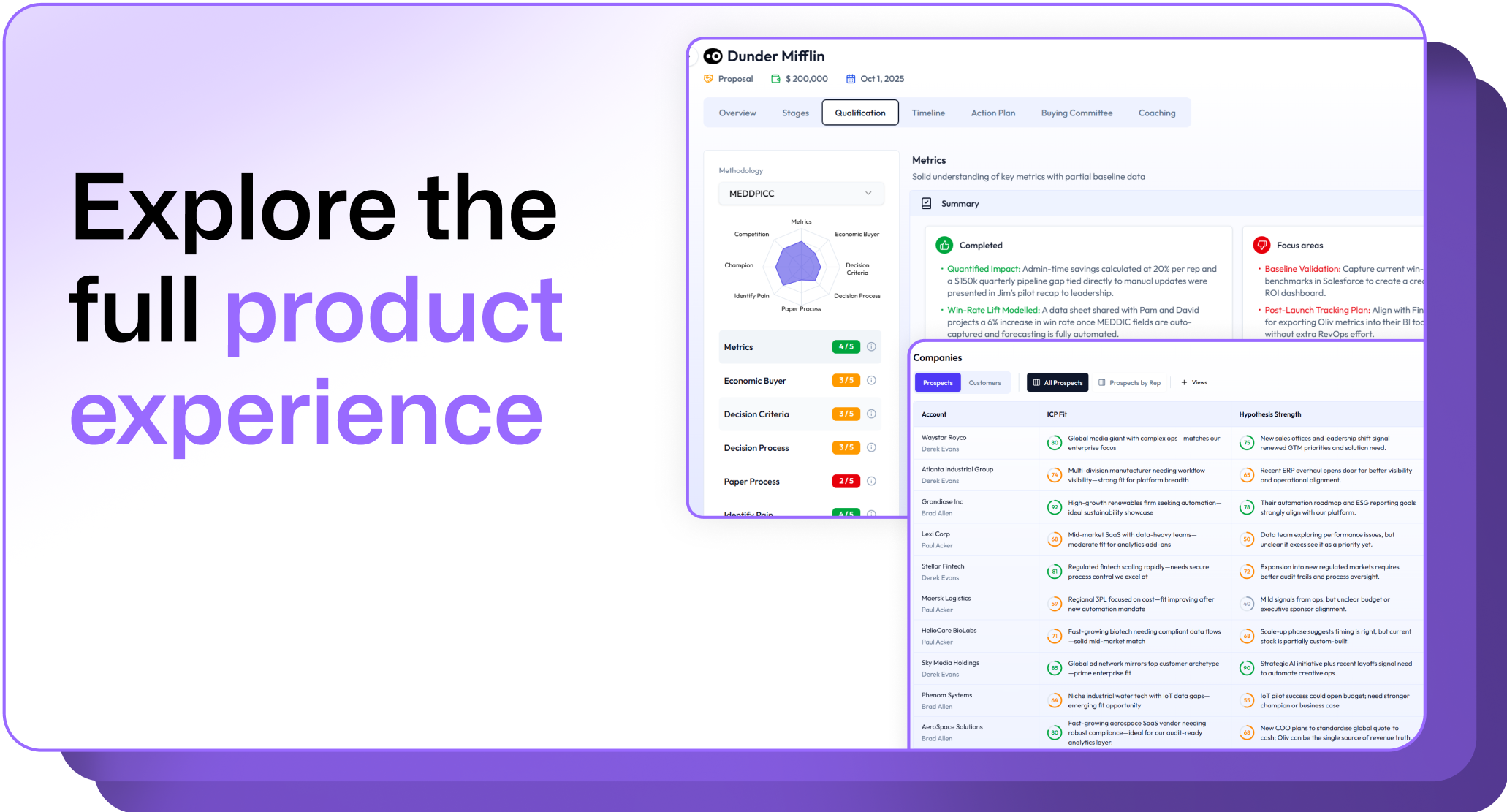
.avif)
.png)







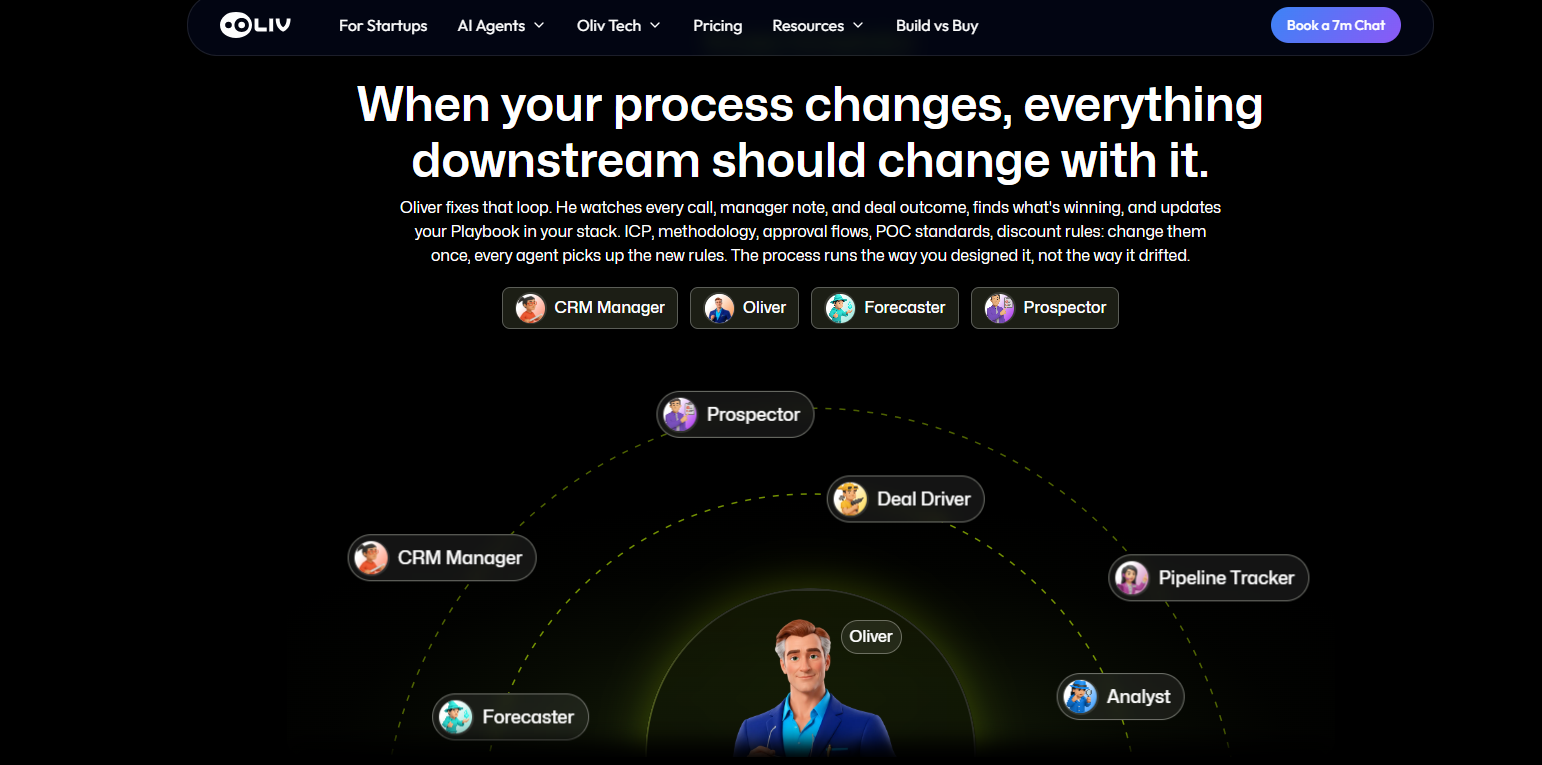
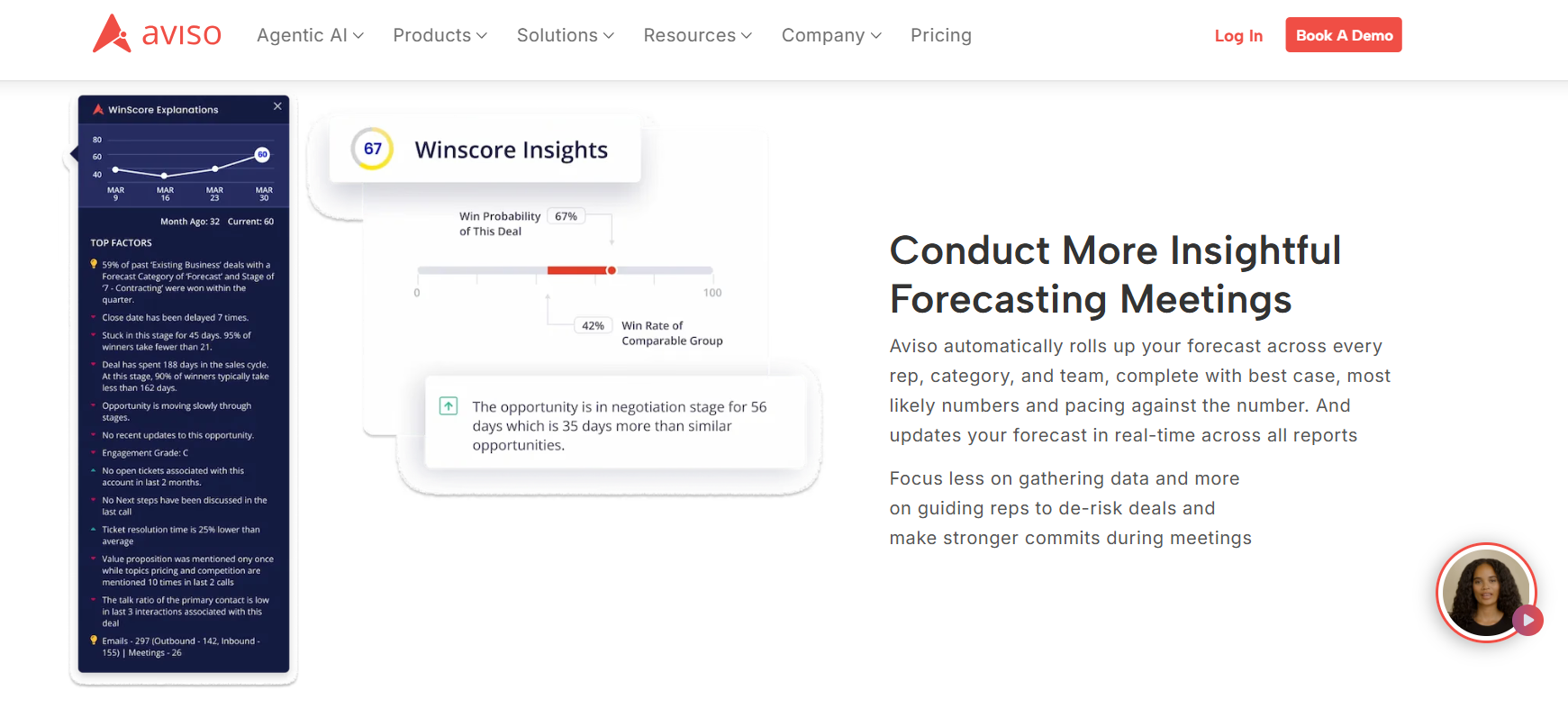
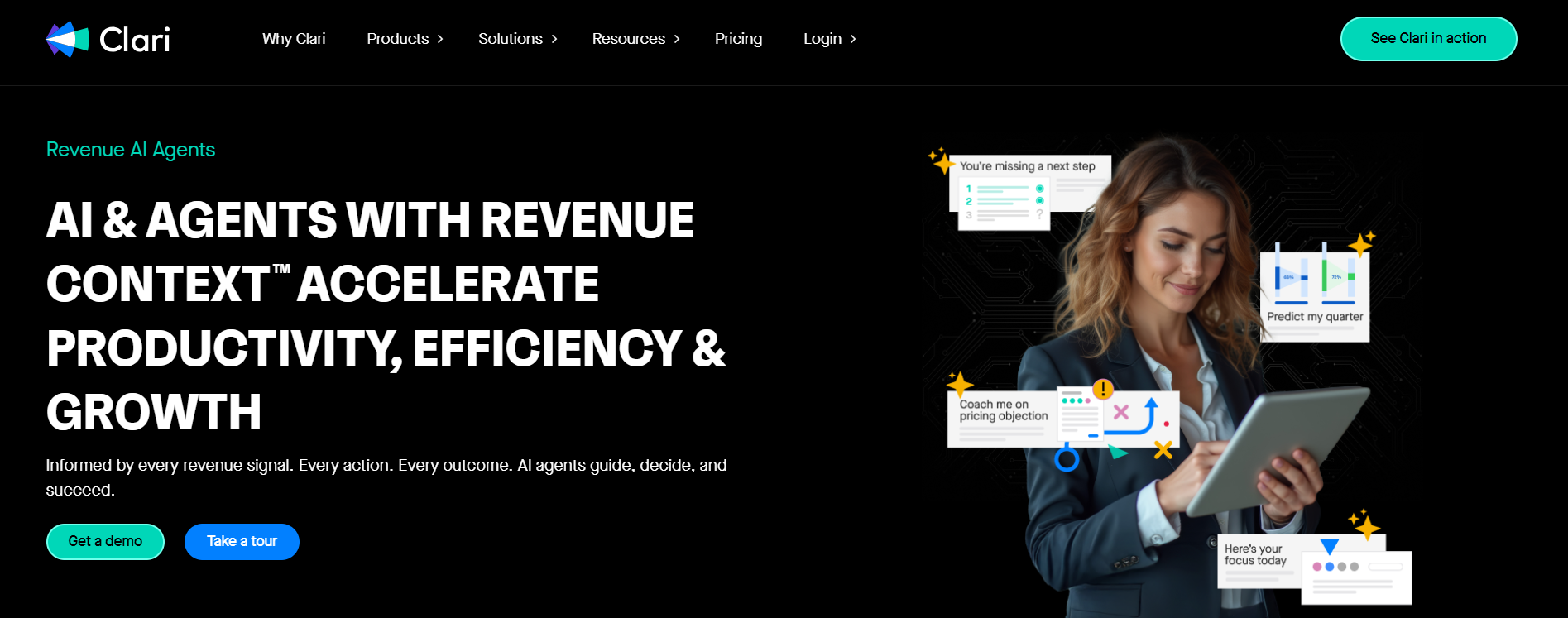
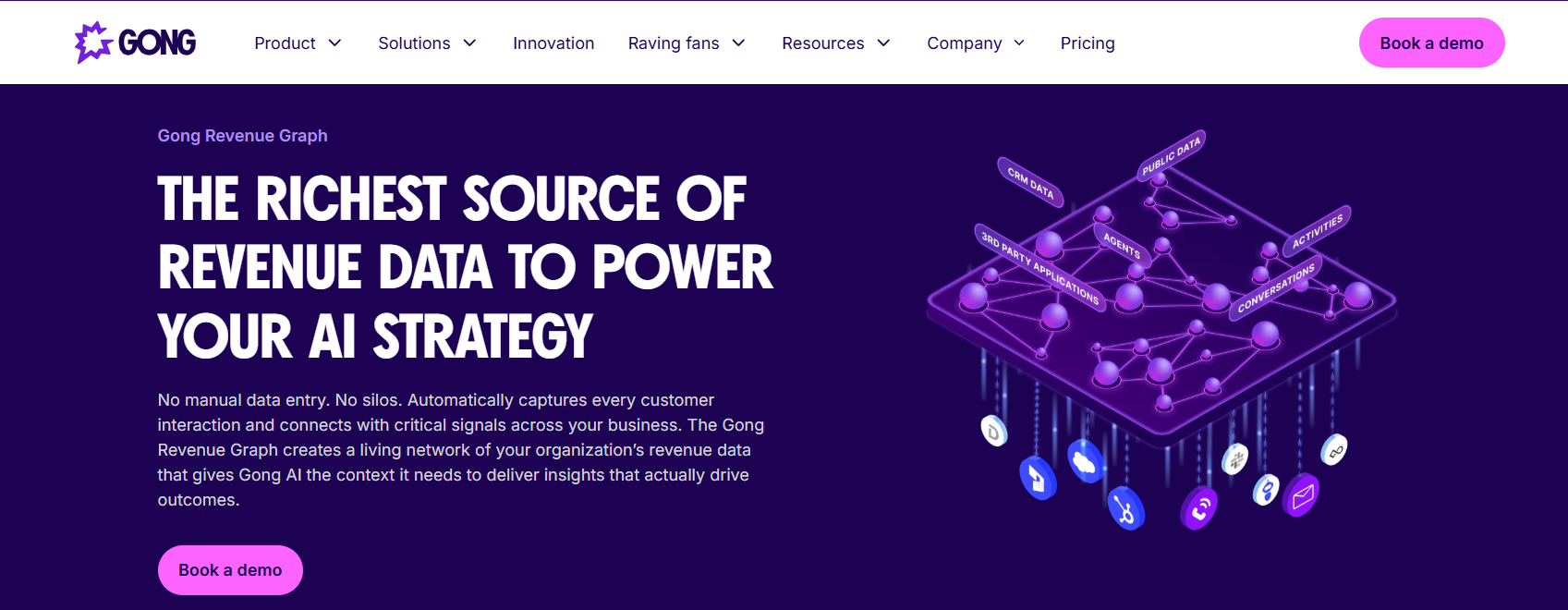

.png)
.png)
.png)

