10 Best Lead Prioritization Software in 2026: Scoring Models, Intent Signals, Routing, and CRM Integration
Written by
Ishan Chhabra
Last Updated :
August 19, 2026
Skim in :
13
mins
In this article
Revenue teams love Oliv
Here’s why:
All your deal data unified (from 30+ tools and tabs).
Insights are delivered to you directly, no digging.
AI agents automate tasks for you.
Thank you! Your submission has been received!
Oops! Something went wrong while submitting the form.
Meet Oliv’s AI Agents
Hi! I’m, Deal Driver
I track deals, flag risks, send weekly pipeline updates and give sales managers full visibility into deal progress
Hi! I’m, CRM Manager
I maintain CRM hygiene by updating core, custom and qualification fields all without your team lifting a finger
Hi! I’m, Forecaster
I build accurate forecasts based on real deal movement and tell you which deals to pull in to hit your number
Hi! I’m, Coach
I believe performance fuels revenue. I spot skill gaps, score calls and build coaching plans to help every rep level up
Hi! I’m, Prospector
I dig into target accounts to surface the right contacts, tailor and time outreach so you always strike when it counts
Hi! I’m, Pipeline tracker
I call reps to get deal updates, and deliver a real-time, CRM-synced roll-up view of deal progress
Hi! I’m, Analyst
I answer complex pipeline questions, uncover deal patterns, and build reports that guide strategic decisions
TL;DR
The ten best lead prioritization tools in 2026 are Warmly, Oliv AI, MadKudu, 6sense, Clay, ZoomInfo, Demandbase, Common Room, Pocus, and HubSpot Breeze.
Tools have become very good at detecting interest and remain poor at judging readiness, and the two are not the same purchase.
Forrester puts AI predictive scoring at 72 to 85 percent accuracy against closed-won outcomes, versus 48 to 54 percent for rule-based thresholds.
Sub-60-second response lifts conversion 391 percent, yet the B2B SaaS average response time still sits above 42 hours.
Routine commercial lead scoring is limited risk under the EU AI Act, but 89 percent of sales leaders cannot explain their AI SDR's decisions.
HubSpot signed an agreement to acquire Warmly on 30 June 2026, so positions one and ten on this list are converging.
Q1. What are the 10 best lead prioritization software tools in 2026? [toc=1. Top 10 Tools]
The ten best lead prioritization tools in 2026 are Warmly, Oliv AI, MadKudu, 6sense, Clay, ZoomInfo, Demandbase, Common Room, Pocus, and HubSpot Breeze. Warmly leads on signal transparency and person-level identification. Oliv AI ranks second: it ships no signal product, yet its Prospector agent ranks accounts from your own call, email, and CRM history.
Your BDR has 500 named accounts. They get to maybe 50. The other 450 sit in the CRM, untouched, while the pipeline number gets discussed on Friday.
Every tool below claims to fix that. Most of them only detect attention. Very few judge readiness.
⭐ The shortlist, in ranked order
Warmly
Oliv AI
MadKudu
6sense
Clay
ZoomInfo
Demandbase
Common Room
Pocus
HubSpot Breeze
I ranked these on five weighted criteria. Signal quality and score explainability carry half the total between them. If you want the wider category context first, our guide to the best AI sales tools maps how prioritization sits inside the rest of the stack.
⚠️ One thing that changed this category in June
HubSpot signed an agreement to acquire Warmly on 30 June 2026. Contracts, pricing, and integrations stay unchanged for existing customers for now.
That matters for your shortlist. Positions 1 and 10 on this list are converging into one platform.
Lead prioritization software compared (2026)
Lead Prioritization Software Compared (2026)
#
Tool
Scoring model
Signal source
Native routing
CRM sync
G2
Starting price
Deploy time
Rating
1
Warmly
Signal-weighted, published logic
Person-level visitor ID, 300+ signals
Yes, agentic routing
Two-way (HubSpot, Salesforce, Pipedrive)
4.6
Free tier, paid from ~$700/mo
Hours (script paste)
⭐⭐⭐⭐
2
Oliv AI
Context-based readiness, not a scoring model
First-party calls, email, Slack, CRM
Via agents
Two-way write-back
4.8
$19/user/mo, $0 platform fee
Under 1 week
⭐⭐⭐⭐⭐
3
MadKudu
Predictive fit and PQL
First-party behavior plus enrichment
No
Two-way
4.4
~$1,000/mo, Growth $24k/yr
4 to 8 weeks
⭐⭐⭐⭐
4
6sense
Predictive buying stage
Third-party intent network
Yes
Two-way
4.3
Quote only, $50k to $150k+
8 to 12 weeks
⭐⭐⭐⭐
5
Clay
Programmable, you build it
Waterfall enrichment, 100+ providers
No
Push to CRM
4.9
Free, then $134/mo
1 to 3 weeks
⭐⭐⭐⭐
6
ZoomInfo
Rule-based plus intent add-on
Bombora-style topic surge
Limited
Two-way
4.4
~$15k/yr, 3-seat minimum
2 to 4 weeks
⭐⭐⭐
7
Demandbase
Account pipeline prediction
Third-party intent plus ads
Yes
Two-way
4.4
Quote only
8 to 12 weeks
⭐⭐⭐
8
Common Room
Signal aggregation, person-level
Community, GitHub, social, product
No
Two-way
4.7
~$625 to $1,000/mo
2 to 4 weeks
⭐⭐⭐
9
Pocus
PLG signal playbooks
Product usage plus enrichment
No
Two-way
4.7
~$25k to $60k/yr
3 to 6 weeks
⭐⭐⭐
10
HubSpot Breeze
Native predictive scoring
First-party CRM plus Breeze data
Yes
Native
4.4
Marketing Hub Enterprise
2 to 4 weeks
⭐⭐⭐
Prices are from each vendor's published page or a dated third-party source, checked in August 2026.
1.1 Warmly: person-level visitor identification with published scoring logic [toc=1.1 Warmly]
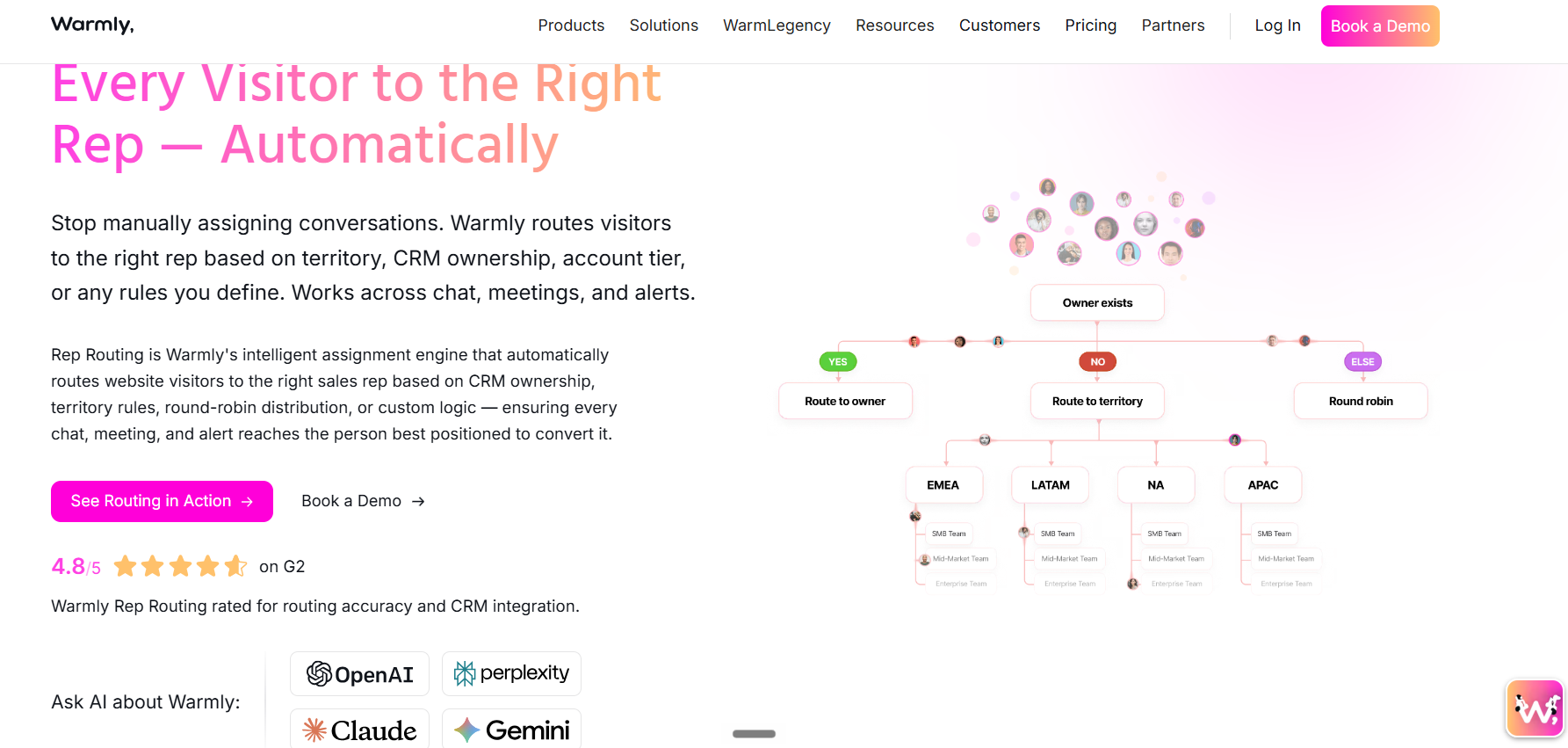
Warmly's Rep Routing decision tree assigns website visitors by CRM ownership, territory, or round robin across EMEA, LATAM, NA, and APAC, splitting SMB, mid-market, and enterprise teams.
Warmly identifies the individual person behind anonymous website traffic, scores the account, and hands the rep a reason to reach out.
🔍 What it actually does
Warmly de-anonymizes site visitors at the person level, not just the company level. It then layers third-party signals on top: hiring, funding, leadership changes, G2 review activity, and SEC filings.
The Inbound Agent converts those signals into chat conversations and meetings. The TAM Agent works ideal-fit accounts before they ever visit your site.
💰 Pricing and implementation
There is a real free tier covering roughly 500 identified companies per month. Paid plans start near $700 per month and scale by volume.
Setup is genuinely fast. You paste a script into your site header, and traffic starts resolving the same day. Teams comparing this against heavier data platforms should read our breakdown of the best sales intelligence platforms before committing budget.
📅 Warmly product timeline
Warmly Product Timeline
Period
What shipped
Through 2025
Person-level de-anonymization, AI chat, Slack alerts, and orchestration across email, LinkedIn, and ads. Match rates published at up to 40% of traffic in the 2026 revenue AI market landscape.
April to June 2026
Agent harness and context graph shipped: AI-generated emails and slides, agentic routing to specific AE calendars, version control for conversation evals, plus Pipedrive, Marketo, and HeyReach integrations, per the April 2026 founder update.
Late 2026 onward
Third-party signals now queryable from any MCP-compatible agent via the Warmly MCP and API launch, with native HubSpot integration expected following the acquisition announced 30 June 2026.
✅ Pros and ❌ cons
✅ Publishes which signals contributed what weight, so a rep can see the reasoning
✅ Fastest deployment on this list, measured in hours
✅ Free tier is real, not a disguised trial
❌ Contact match quality draws consistent criticism in reviews
❌ Pricing is high relative to SMB expectations
❌ Acquisition creates roadmap uncertainty for non-HubSpot shops
👥 What users actually say
"Super easy to implement, you just paste some code in the header of your website and you're done." — Verified G2 reviewer, Warmly - G2 Verified Review [20 May 2025]
"Warmly is connected to our CRM and creates a ton of deanonymized contacts from our website traffic, but the quality of information and match rates isn't the best. We end up with a lot of spam or invalid contacts." — Verified G2 reviewer, Warmly - G2 Verified Review [22 Apr 2026]
"I like that Warmly gives us warm prospects. It's nice to have prospects to reach out to that are already familiar with our product." — Verified G2 reviewer, Warmly - G2 Verified Review [28 Apr 2026]
Match rate is the fault line here. Warmly wins the top slot on transparency, and the same reviews that praise the setup flag the data quality.
1.2 Oliv AI: the readiness layer on top of whatever signal you buy [toc=1.2 Oliv AI]
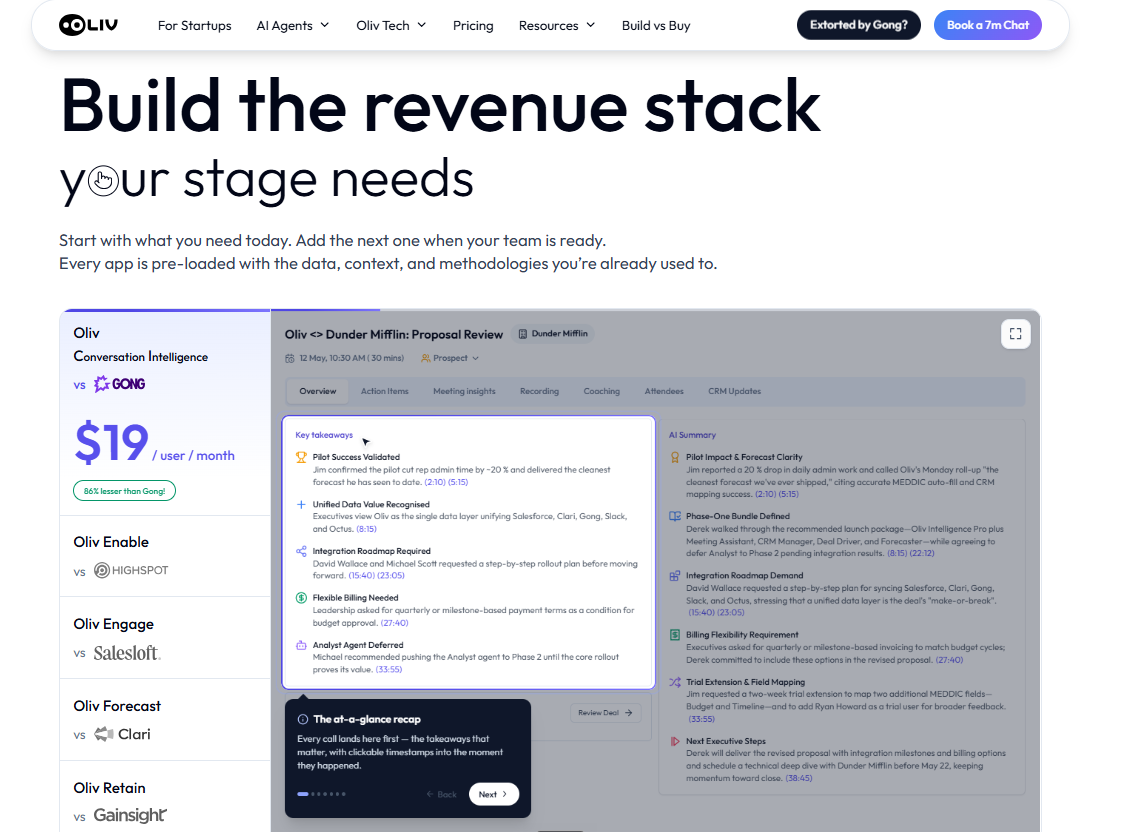
Oliv AI's stage-based revenue stack lists Conversation Intelligence at $19 per user beside Enable, Engage, Forecast, and Retain, alongside a proposal-review recap with timestamped takeaways and CRM updates.
Oliv AI ships no third-party intent feed, no predictive scoring product, and no anonymous visitor identification. That absence is why it sits second rather than first.
🧠 What it actually does
Oliv AI is an AI-native revenue intelligence and revenue orchestration platform that runs on top of your CRM. It never replaces it, which is the same architectural stance we describe across our revenue intelligence platforms coverage.
The Prospector agent ranks accounts using the company's own record: every call, email, and note, resolved to the correct account and opportunity. The published agent marketplace also includes Researcher, CRM Manager, Deal Driver, Forecaster, and Coach, and our overview of AI agents for sales teams walks through how they hand off to each other.
⚠️ A naming clash worth clearing up
Oliv AI's architecture includes an intent graph. In this category, "intent" usually means purchased buyer-intent data.
That is not what it refers to here. Oliv AI's intent graph is a set of fine-tuned small models answering revenue questions over your own context, and it makes no claim about third-party purchase intent.
💰 Pricing and implementation
The per-seat ladder starts at $19 for conversational intelligence, $39 for Engage, and $49 for Forecast. The platform fee is $0, and view-only seats are free.
Against quote-only ABM platforms at $50,000 or more, that changes who gets access. Giving a sales manager visibility into the priority queue costs nothing, and our guide to reducing sales tech stack costs shows where that budget usually goes instead.
📅 Oliv AI product timeline
Oliv AI Product Timeline
Period
What shipped
Through 2025
Conversational intelligence, CRM auto-update, deal health scoring, and MEDDIC field capture. The iOS app added in-person call capture in November 2025, recording and transcribing live conversations on device.
2026
Agent marketplace expanded to a published roster including Prospector, Researcher, CRM Manager, Deal Driver, Forecaster, and Quick Qualifier, alongside the Oliver and Olivia orchestration agents.
Expected next
Voice Agent remains in alpha, calling reps nightly to capture context from unrecorded meetings, per Oliv's own 2026 Gong alternatives roundup. Deeper warehouse context from Snowflake and BigQuery is live and expanding.
✅ Pros and ❌ cons
✅ Ranks previously worked accounts on evidence no signal vendor can see
✅ Resolves messy CRMs where one company has three accounts and five open opportunities
✅ Cheapest entry point on this list, with free view-only seats
❌ No signal acquisition product at all, so cold prospecting still needs a separate purchase
❌ Context depth scales with how much you have already touched the account
❌ Reviewers report occasional slowness and limited dashboard customization
🎯 Who it fits
Best for re-engagement, expansion, and territory you have worked before. Weakest on genuinely cold net-new, where you have no history to reason over. The same pattern shows up in our work on AI deal intelligence, where resolved history beats purchased breadth.
Oliv AI's read is that the standard advice gets this backwards. The category sells coverage first and reasoning second, though I might be pushing that further than the data strictly supports.
👥 What users actually say
"The Driver agent watches all my deals and flags any that are at risk, so I don't have to spend hours listening to recordings in tools like Gong and Clari." — Verified G2 reviewer, Oliv AI G2 - Verified Review [17 Jun 2026]
"I appreciate that Oliv.ai researches prospect accounts before every call and sends deal updates and talking points, which helps me prepare for meetings without sifting through tons of data and emails." — Verified G2 reviewer, Oliv AI G2 - Verified Review [23 Jun 2026]
"The only downside is that the platform can be a bit glitchy at times, but the support team is always quick to address and resolve any bugs." — Verified G2 reviewer, Oliv AI G2 - Verified Review [2 Jul 2026]
1.3 MadKudu: predictive fit scoring built for product-led funnels [toc=1.3 MadKudu]
MadKudu builds a predictive model from your own closed-won history, then scores leads and product signups on likelihood to convert.
🎯 What it actually does
MadKudu ingests CRM history, firmographic enrichment, and product usage events. It outputs a fit score, a behavior score, and a PQL flag (product qualified lead, meaning a signup showing real usage).
The Copilot layer explains why an account scored the way it did. That explanation is the reason it survives rep scrutiny better than most black-box models, and it mirrors what we argue in our guide to AI deal intelligence.
💰 Pricing and implementation
Pricing is not fully public. Third-party analysis puts Starter near $1,000 per month and the Growth plan at $24,000 per year.
Deployment takes four to eight weeks in practice. The model needs enough closed-won volume to train on, so thin pipelines struggle.
📅 MadKudu product timeline
MadKudu Product Timeline
Period
What shipped
Through 2025
Predictive fit and behavior models, PQL detection from product events, Salesforce and HubSpot bidirectional sync, plus signal-based playbooks documented on the MadKudu product site.
2026 to date
AI Copilot layer for score explanation and audience building, with tiered plans and per-record scoring limits detailed in a dated MadKudu pricing review.
Expected next
Deeper agent-led activation of scored audiences, following the category shift G2 flagged in its 2026 lead scoring category notes toward agentic and AI-assisted scoring workflows.
✅ Pros and ❌ cons
✅ Explains its scores, which matters more than raw accuracy
✅ Strongest option for PLG motions with real product telemetry
❌ Pricing opacity makes budget planning hard
❌ Needs 12 months or more of clean outcome data
❌ No native routing, so you pair it with something else
Best for Series B and beyond PLG companies with a self-serve funnel and a sales-assist motion on top.
1.4 6sense: enterprise buying-stage prediction across a large intent network [toc=1.4 6sense]
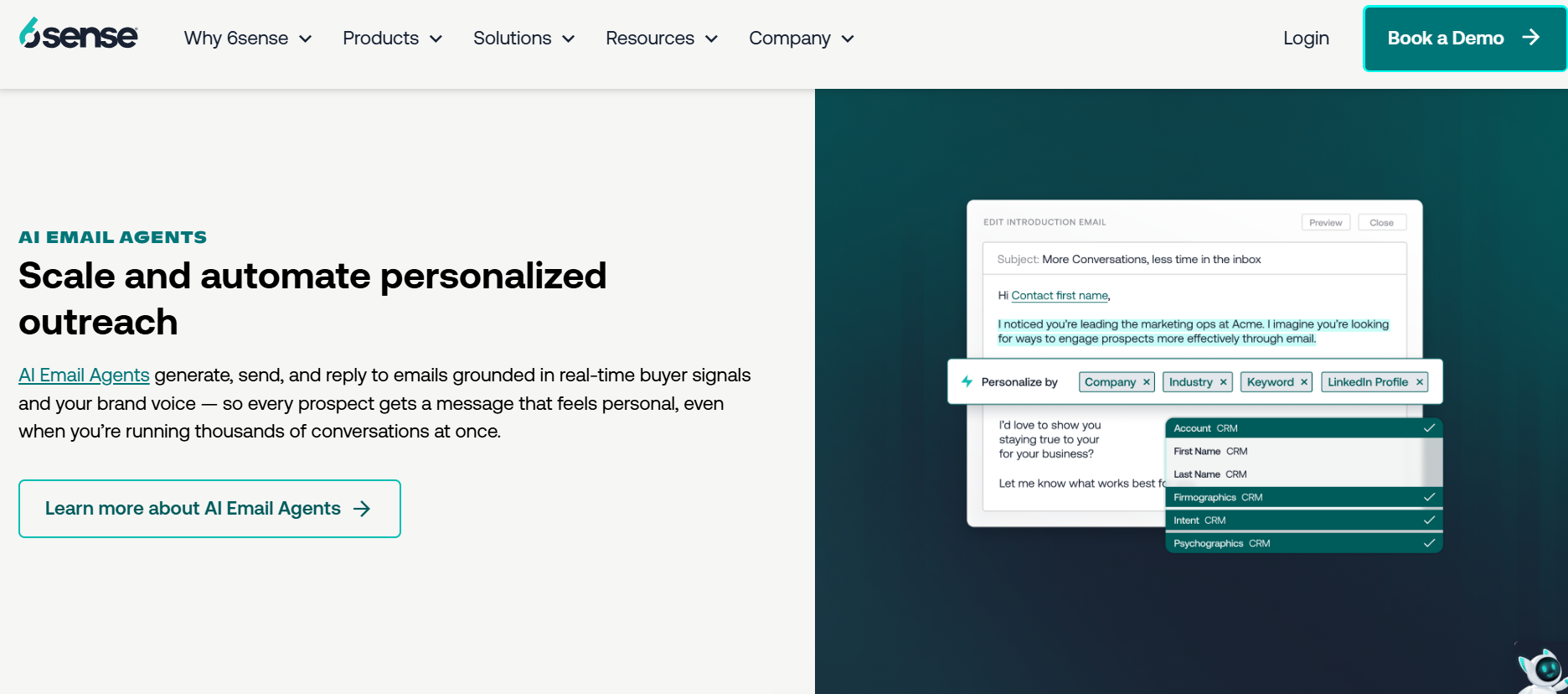
6sense AI Email Agents compose replies from real-time buyer signals, personalizing by company, industry, keyword, and LinkedIn profile while pulling intent and firmographic fields from CRM.
6sense predicts which accounts are in-market and which buying stage they occupy, using a proprietary third-party intent network.
🧭 What it actually does
6sense maps anonymous research activity to accounts, then assigns a buying stage: Target, Awareness, Consideration, Decision, or Purchase. It also runs advertising against those accounts.
The prediction is the product. Reps get a ranked account list with a stage label and a confidence score attached.
💰 Pricing and implementation
Pricing is quote-only. Comparative analysis places typical contracts between $50,000 and $150,000 per year, with G2 ratings near 4.4.
Implementation runs eight to twelve weeks. You need a defined target account list and a RevOps owner before you start, which our guide to scaling revenue operations covers in detail.
📅 6sense product timeline
6sense Product Timeline
Period
What shipped
Through 2025
Predictive buying-stage models, anonymous account matching, ABM advertising, and Salesforce and Marketo sync, described in the 6sense revenue AI platform documentation.
2026 to date
AI agents for account research and email drafting inside the platform, with G2 ratings and pricing structure compared in a dated 6sense and Demandbase analysis.
Expected next
Broader signal ingestion and orchestration, in line with the enterprise ABM consolidation tracked across the 2026 sales signals platform landscape.
✅ Pros and ❌ cons
✅ Largest third-party intent network in the category
✅ Buying-stage labels are easier for reps to act on than raw scores
❌ Price puts it out of reach below roughly $20M ARR
❌ Long implementation and heavy admin burden
❌ Model reasoning is largely opaque to the individual rep
Best for enterprise ABM teams with a named account list and a marketing budget to match.
1.5 Clay: programmable enrichment where you build the scoring logic yourself [toc=1.5 Clay]
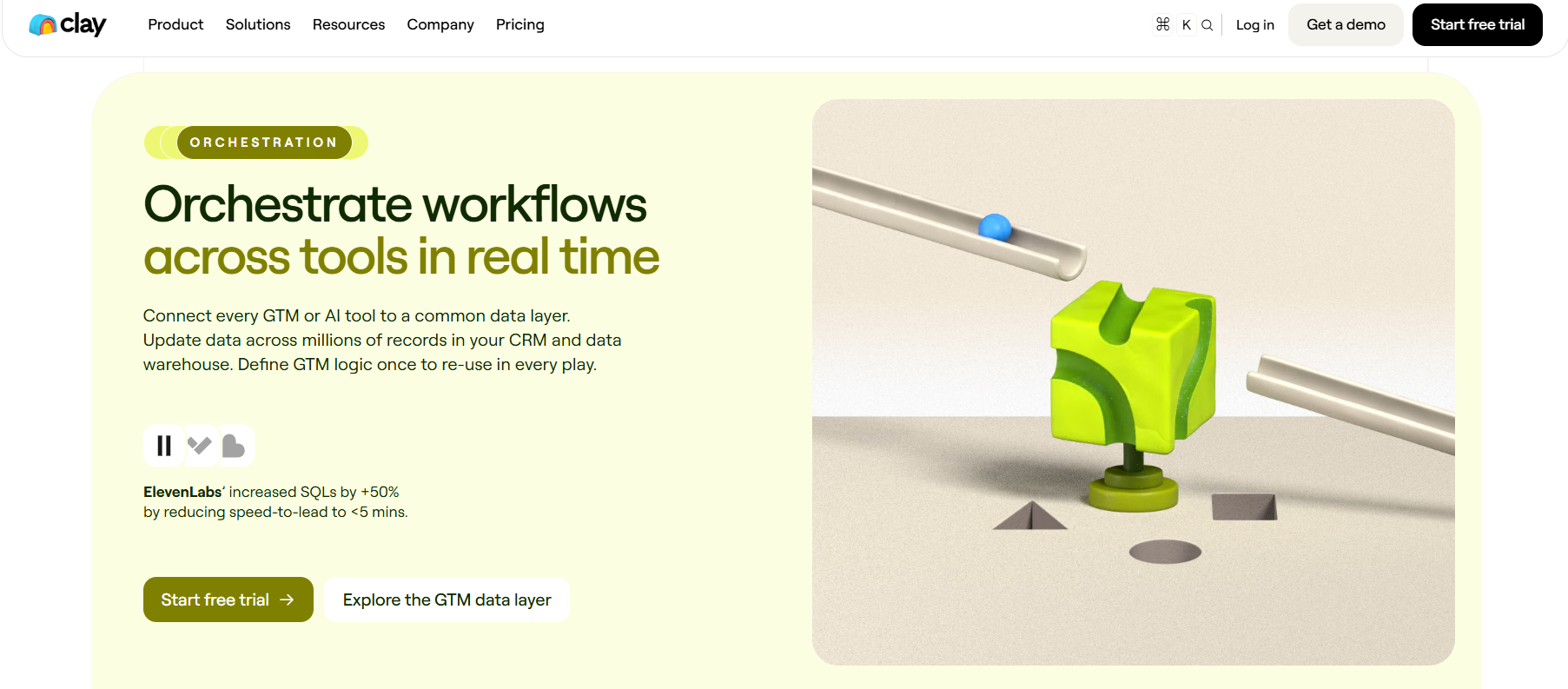
Clay's orchestration layer syncs GTM tools to a shared data layer, updating CRM records at scale, with ElevenLabs lifting SQLs 50% by cutting speed-to-lead under five minutes.
Clay is a spreadsheet-style workspace that pulls from 100 or more data providers in sequence, then runs your own scoring logic on the result.
🔧 What it actually does
Clay runs waterfall enrichment, meaning it tries provider one, then provider two, until a field fills. You then add columns for AI research, qualification prompts, and custom scores.
Nothing is prescribed. That flexibility is the strength, and also the reason some teams never finish building.
💰 Pricing and implementation
Clay has a free tier. Paid plans start around $134 to $167 per month on a credit model, well below ZoomInfo's roughly $15,000 per year with a three-seat minimum.
Setup takes one to three weeks if someone owns it. Credits burn fast during experimentation, which is worth modelling alongside the rest of your sales tech stack costs.
📅 Clay product timeline
Clay Product Timeline
Period
What shipped
Through 2025
Waterfall enrichment across 100+ providers, AI research columns, HubSpot and Salesforce integrations, and Claygent for open-ended web research, listed on the Clay integrations directory.
2026 to date
Credit model split into Data and Action credits with revised tiers, compared against ZoomInfo pricing in a dated Clay and ZoomInfo breakdown.
Expected next
Continued agent tooling on top of the table layer, though reviewers already question whether the AI assistant keeps pace with newer entrants.
✅ Pros and ❌ cons
✅ Cheapest way to test a scoring hypothesis before buying a scoring product
✅ You see every input, so the logic is fully auditable
❌ It is a builder, not a prioritization product out of the box
❌ Credit spend is hard to forecast
❌ Requires an owner with real technical patience
👥 What users actually say
"I like that Clay has a structured way to go through, column by column, to really control exactly how you're enriching data. The HubSpot integration is something I think works really well." — Verified G2 reviewer, Clay - G2 Verified Review [10 Mar 2026]
"Clay's AI assistant could be improved. It feels like there's a trade-off between high structure and quick ease of setup." — Verified G2 reviewer, Clay - G2 Verified Review [10 Mar 2026]
"Setting up and optimizing integrations like Salesforge can take a bit of time at the beginning if you want everything fully customized for your workflow." — Verified G2 reviewer, Clay - G2 Verified Review [7 May 2026]
1.6 ZoomInfo: the data layer, with prioritization bolted on [toc=1.6 ZoomInfo]
ZoomInfo sells contact and company data at scale, with an intent add-on that flags topic surges against target accounts.
📇 What it actually does
The core product is a database: contacts, direct dials, firmographics, and technographics. Intent data sits on top, reporting which accounts researched which topics.
Prioritization here is a filter, not a ranked queue. You segment the database and hand reps a list.
💰 Pricing and implementation
Entry contracts start near $15,000 per year with a three-seat minimum and annual commitment. Renewal notice windows of 60 to 90 days catch teams out.
Deployment takes two to four weeks. The CRM sync is mature and well documented, and our notes on CRM data quality automation explain what still breaks downstream.
📅 ZoomInfo product timeline
ZoomInfo Product Timeline
Period
What shipped
Through 2025
Contact and company database, intent topics, website visitor tracking, and Salesforce and HubSpot sync, packaged under the ZoomInfo GTM platform.
2026 to date
Copilot account prioritization and AI-drafted outreach, with the vendor's own take on predictive scoring published in its 2026 predictive lead scoring guide.
Expected next
Continued repositioning from data vendor to workflow platform, as contact data itself becomes a commodity input across the stack.
✅ Pros and ❌ cons
✅ Coverage remains the widest available for cold prospecting
✅ Mature, reliable CRM integration
❌ Data accuracy complaints are persistent and specific
❌ Contract terms favour the vendor, not you
❌ Prioritization is filtering, not ranking
👥 What users actually say
"Always outdated for phone numbers, job titles, revenue, current employment. I find I have to use other tools to make sure that what Zoominfo is showing me is even some what right." — Verified G2 reviewer, ZoomInfo - G2 Verified Review [16 Oct 2025]
1.7 Demandbase: account intelligence with advertising attached [toc=1.7 Demandbase]
Demandbase scores accounts on pipeline predictiveness, then activates them through advertising, sales alerts, and journey stages.
🏢 What it actually does
Demandbase combines first-party engagement, third-party intent, and technographics into an account-level Pipeline Predict score. Sales Intelligence pushes that score into the CRM and into a rep-facing workspace.
The advertising layer is genuinely strong. That is also what makes it a marketing purchase more than a rep tool.
💰 Pricing and implementation
Pricing is quote-only, in the same enterprise band as 6sense, with a comparable G2 rating near 4.4. Implementation runs eight to twelve weeks.
❌ Weak fit if your buyers do not live in public communities
❌ Priced above what most mid-market teams expect
❌ No native routing
1.9 Pocus: product usage turned into rep playbooks [toc=1.9 Pocus]
Pocus surfaces product-qualified accounts and wraps them in playbooks that tell the rep what to do next.
🧪 What it actually does
Pocus pulls product usage from your warehouse, combines it with CRM and enrichment data, and flags expansion or conversion moments. Playbooks then package the signal with a recommended action.
The playbook framing is smart. It closes the gap between a score and a rep's next hour, which is the same problem our AI agents for sales teams overview addresses.
💰 Pricing and implementation
Pricing is not published. Third-party sources place annual contracts roughly between $25,000 and $60,000, sales-led only. Deployment takes three to six weeks and needs warehouse access.
📅 Pocus product timeline
Pocus Product Timeline
Period
What shipped
Through 2025
Product usage ingestion, PQL scoring, signal-based playbooks, and CRM enrichment across the Pocus platform.
2026 to date
AI agents for research and account planning, with pricing opacity and signal coverage noted in a dated Pocus and Common Room comparison.
Expected next
Deeper warehouse-native deployment, reflecting the wider move to score where the data already lives.
✅ Pros and ❌ cons
✅ Playbooks convert signals into rep actions, not dashboards
✅ Warehouse-native, so no data duplication
❌ Useless without a product that generates usage data
❌ No published pricing at all
❌ Smallest vendor on this list, with the attendant risk
1.10 HubSpot Breeze: native scoring for teams already on HubSpot [toc=1.10 HubSpot Breeze]
HubSpot Breeze scores contacts and companies on fit and engagement inside the CRM, with no integration to maintain.
🏠 What it actually does
Breeze Intelligence enriches records with firmographic data. Breeze scoring then ranks contacts on fit and buying signals, and Breeze agents work the top of the list.
Native means no sync, no matching key, and no duplicate risk. That advantage is real and underrated.
💰 Pricing and implementation
AI predictive scoring requires Marketing Hub Enterprise and roughly 12 months of history to train on. Manual scoring is available on lower tiers.
The Warmly acquisition announced in June 2026 adds person-level visitor identification to this stack.
📅 HubSpot Breeze product timeline
HubSpot Breeze Product Timeline
Period
What shipped
Through 2025
Manual and predictive lead scoring, Breeze Intelligence enrichment, and buying-signal detection inside Breeze by HubSpot.
June 2026
One of HubSpot's largest shipping months, with Breeze AI, Customer Agent, and reporting updates catalogued in the June 2026 release notes.
Expected next
Warmly's person-level intent and GTM agents folding into Smart CRM and Data Hub, per the acquisition announcement of 30 June 2026.
✅ Pros and ❌ cons
✅ Zero integration risk and no duplicate contacts
✅ Cheapest path if you already pay for Enterprise
❌ Predictive scoring is gated behind the top tier
❌ Needs a year of history before it works
❌ Locks your prioritization logic to one CRM
👥 What users actually say
"I like being able to see who opens the emails and track engagement. It helps me identify the hotter leads, even if they don't click on something or respond." — Verified G2 reviewer, HubSpot Marketing Hub - G2 Verified Review [3 Mar 2026]
"I think the user interface is a bit too complicated and overwhelming. I don't think the AI tool is able to extract the responses easily. The initial setup was not easy." — Verified G2 reviewer, HubSpot Marketing Hub - G2 Verified Review [3 Mar 2026]
Oliv AI sits deliberately outside the signal-acquisition race that defines the eight tools above, ranking accounts instead from the calls, emails, and notes a team has already created, at $19 per seat with a $0 platform fee. That split, one purchase to find attention and another to judge readiness, is the choice most shortlists never make explicit, and our take on the future of revenue intelligence explains why we expect it to widen.
Q2. How we ranked these tools, and the 30-day back-test that should decide your shortlist [toc=2. Ranking Method & Back-Test]
Five criteria, weighted to 100: Signal Quality and Provenance (25%), Score Explainability (25%), Verified User Reviews (20%), CRM Write-Back and Routing Hygiene (15%), and Pricing Transparency (15%). Before you sign anything, run the back-test. Export 12 to 24 months of closed-won and closed-lost, score them with the vendor's model, and measure accuracy at 90 days against what actually happened.
Why these five criteria, and not a feature list
Feature lists reward the vendor with the longest roadmap. They tell you nothing about whether a rep will work the list on Monday.
So the rubric weights two things above everything else. Where the signal comes from, and whether the score can explain itself.
⭐ The weights and the star bands
Ranking Criteria and Weights
Criterion
Weight
What it measures
Signal Quality and Provenance
25%
Where the data originates and whether you can trace it
Score Explainability
25%
Whether a rep can see why an account ranked where it did
Verified User Reviews
20%
Permalinked reviews with dates, positive and critical
CRM Write-Back and Routing Hygiene
15%
Clean bidirectional sync without duplicate records
Pricing Transparency
15%
Published pricing versus quote-only opacity
Scores convert to stars in fixed bands. 0 to 20 is one star, 21 to 40 is two, 41 to 60 is three, 61 to 80 is four, and 81 to 100 is five.
What counted as proof, and what did not
Three evidence types were accepted. A vendor's own published page, a dated third-party source, or a permalinked review with a resolving URL.
Three types were rejected outright. Unsourced accuracy claims, vendor-supplied case studies with no methodology, and lift statistics without a named publisher and year. We apply the same standard across our revenue intelligence software platform reviews.
💰 The pricing rule
No price appears in this article unless it traces to the vendor's own pricing page or a dated analysis. That rule alone removed four numbers from the first draft.
Quote-only vendors were marked down, not excluded. Opacity is a real cost to a buyer with a finite budget, which is the same argument behind our guide to revenue tech stack consolidation costs.
The 30-day back-test, step by step
Export every closed-won and closed-lost opportunity from the last 12 to 24 months.
Strip the outcome field, then hand the records to the vendor during evaluation.
Ask them to score the set with their production model, not a tuned demo version.
Compare predicted rank against actual outcome at the 90-day mark.
Count false positives, meaning accounts the model ranked top-decile that never opened.
The bar to clear is simple. If the model cannot beat your current rule-based scoring on the same set, you are buying a dashboard. Our revenue intelligence ROI calculator gives you a place to model the difference before the renewal conversation.
⚠️ The conflict I should name
Oliv AI publishes this ranking, appears on it at position two, and is openly marked down on Signal Quality under its own rubric. That mark-down is honest, since the company ships no third-party intent feed at all.
I would rather show you the loss than pretend the scoring was neutral. A rubric you can check is worth more than one you have to trust.
What the rubric deliberately ignores
Brand recognition earned zero points. So did funding stage, logo walls, and analyst quadrant placement.
Those signals tell you a vendor raised money. They do not tell you whether your BDR will trust the list on a Tuesday morning.
Oliv AI scores five stars overall on this rubric while losing points on provenance, because its ranking evidence is your own conversation record rather than a purchased feed. That trade is the whole argument, and it is visible in the scoring rather than hidden behind it.
Q3. Prioritization, scoring or intent data: which one are you actually buying? [toc=3. Models & Definitions]
Intent data reports that someone researched your category. Scoring assigns a value from fit and behavior. Prioritization uses both to return a ranked working order, a position rather than a subset. On accuracy, Forrester puts AI predictive scoring at 72 to 85 percent against closed-won outcomes at 90 days, versus 48 to 54 percent for rule-based thresholds, with roughly 38 percent fewer false positives.
Three purchases, routinely treated as one
Most shortlists mix these three into a single line item. That is how teams end up paying twice for one decision.
Here is the clean separation.
📊 What each layer actually answers
Intent Data vs Lead Scoring vs Prioritization
Layer
What it answers
Unit of analysis
What it cannot tell you
Intent data
Is someone at this account researching the category?
Account, sometimes person
Whether they can buy, from whom, or when
Lead scoring
How valuable is this record, on fit and behavior?
Lead or contact
Where it sits relative to every other record
Prioritization
What order should the rep work the list in?
Account
Anything the underlying signals never captured
Intent tells you attention exists. Scoring puts a number on it. Prioritization turns numbers into a queue with a first item.
The three model types, benchmarked
Scoring models come in three shapes. They differ sharply on accuracy and on what data they need to work.
🎯 Rule-based, predictive, and signal-native
Scoring Model Types Compared
Model type
Accuracy at 90 days
Data required
Typical failure
Rule-based thresholds
48 to 54 percent
Manual point weights
Ranks on attributes, not readiness
AI predictive
72 to 85 percent
12+ months of outcome history
Opaque reasoning, so reps distrust it
Signal-native
Varies by match rate
Live third-party or first-party signals
Strong on the matched slice, blind elsewhere
The Forrester analysis behind those accuracy ranges also reports 35 percent higher sales acceptance and 33 percent lower cost per qualified lead when teams move off rule-based scoring.
Those are real deltas. They are also averages across enterprise deployments, so treat them as a direction rather than a promise.
Where qualification ends and prioritization begins
Qualification is per-lead and reactive. A form comes in, it gets enriched, routed, and scored against rules, then handed to a rep. Teams formalising that step usually start with a MEDDIC sales methodology baseline.
Prioritization is per-account and proactive. Nobody submitted anything. You are deciding which 50 of 500 accounts get touched this week.
⚠️ One naming clash worth clearing up
Oliv AI's architecture includes something called an intent graph, and that term means something different here. It refers to fine-tuned small models answering revenue questions over your own company context.
It is not third-party purchase-intent data. Anyone shopping this category will assume the second meaning, so the distinction matters before you compare line items. Our explainer on revenue intelligence versus conversation intelligence untangles a similar naming problem.
The practical test before you buy
Ask one question of every vendor on your shortlist. If two tools would rank the same account first, for the same reason, one of them is redundant.
Then ask a rep to read a score explanation aloud. If they cannot restate why the account ranked top, the model has an adoption problem, not a math problem.
Oliv AI sells none of the three layers above as a signal product. It holds the company's own conversation record, resolved to the right account and opportunity, and judges readiness from that. The signal layer finds attention, and the context layer decides whether that attention is worth a rep's morning.
Q4. How good are the signals, how fast do they go stale, and what happens on accounts you already know? [toc=4. Signal Quality & Decay]
Third-party intent is accurate enough to shorten a list, not to justify a call. Warmly reports roughly 15 percent person-level identification at over 90 percent accuracy on matched profiles, which is strong for the matched slice and silent on the rest. Oliv AI ranks previously worked accounts from resolved first-party history instead, citing the objection from the last cycle rather than a topic surge from last week.
What the match-rate numbers actually cover
Every visitor identification vendor publishes a match rate. Almost none publish what happens to the unmatched traffic.
Read the number carefully. A 90 percent accuracy figure on matched profiles says nothing about the 85 percent that never matched.
🔍 What reviewers report in practice
"Warmly is connected to our CRM and creates a ton of deanonymized contacts from our website traffic, but the quality of information and match rates isn't the best. We end up with a lot of spam or invalid contacts." — Verified G2 reviewer, Warmly - G2 Verified Review [22 Apr 2026]
"Always outdated for phone numbers, job titles, revenue, current employment. I find I have to use other tools to make sure that what Zoominfo is showing me is even some what right." — Verified G2 reviewer, ZoomInfo - G2 Verified Review [16 Oct 2025]
Two vendors, two categories, one pattern. The coverage is real, and the precision is uneven.
The concession the intent vendors have earned
Here is the argument against my own thesis, stated fairly. For most of your target market, you have no first-party history at all.
A surge signal on a cold account is the only thing that turns an untouchable list into a workable one. For net-new prospecting, that argument is simply correct.
⏰ How fast signals go stale
Signal Decay Windows by Type
Signal type
Useful window
Refresh cadence needed
Topic surge (third-party)
2 to 4 weeks
Weekly
Website visit
24 to 72 hours
Real time
Job change or funding
60 to 90 days
Weekly
Product usage
7 to 14 days
Daily
First-party conversation history
Does not decay
On capture
A score without a decay rule ranks last month's curiosity above this week's evidence. Ask every vendor how their decay works, in writing.
The accounts you already worked
Picture a BDR with 500 named accounts. Roughly a third have been worked before, and the intent feed treats them as cold.
That is the expensive mistake. The evidence that matters on those accounts is already sitting in your own recordings and email threads, which is the case we make for cross-channel deal intelligence.
🧩 Why resolution comes before ranking
Oliv AI measures this by resolving every call, email, and note to the correct account and opportunity before any ranking happens. In messy mid-market CRMs, one company routinely shows three accounts and five open opportunities.
That entity resolution took roughly 18 months of infrastructure work to solve. Without it, a first-party score is just averaging noise across duplicate records, a failure mode we cover in our CRM data strategy guide.
"I appreciate that Oliv.ai researches prospect accounts before every call and sends deal updates and talking points, which helps me prepare for meetings without sifting through tons of data and emails." — Verified G2 reviewer, Oliv AI G2 - Verified Review [23 Jun 2026]
⚠️ The honest limit
Context depth scales with how much you have already touched an account. On genuinely cold prospects, there is nothing to reason over.
So the strongest case is re-engagement, expansion, and previously worked territory. Cold prospecting still needs the signal layer, and pretending otherwise would make the rest of this argument worthless.
Oliv AI reports customer-side outcomes on that first-party path, including account research dropping from two hours to fifteen minutes at Swanky and a 15 percent close-rate lift at Mission Cloud. Both are Oliv's own published figures, and I would treat them as directional until you run the back-test yourself.
Q5. How does the score reach the rep, routing, SLA and CRM write-back without duplicates? [toc=5. Routing & CRM Delivery]
A perfect score delivered late is worth nothing. Sub-60-second response lifts conversion 391 percent, and contact within five minutes makes qualification 21 times likelier, yet the B2B SaaS average still sits above 42 hours. Oliv AI writes ranked accounts into fields RevOps already owns and reports 95 percent or better field accuracy on its own measurement.
The latency nobody puts in the comparison table
Every vendor competes on score quality. Almost none publish how long the score takes to reach a human.
That gap is where the conversion actually leaks.
⏰ What the response benchmarks show
Lead Response Time Benchmarks
Response time
Effect on outcome
Under 60 seconds
391 percent higher conversion
Under 5 minutes
21 times likelier to qualify
5 vs 30 minutes
9 times likelier to reach the contact
B2B SaaS average
42 hours or more
The nine-times figure comes from the Harvard Business Review study of 100,000 inbound leads. The rest trace to the Velocify response study across 3.5 million leads.
Measure your own number this week. Take the first-touch timestamp, subtract the record-creation timestamp, and report it per rep. Our guide to sales productivity metrics covers how to publish that number without turning it into a blame exercise.
The four write-back checks to run in the demo
Ask these before you sign. Each one maps to a specific failure I have watched teams live with for a year.
Matching key. What field resolves a lead to an existing account? No key means duplicate records within a month.
Field ownership. Does the score write to a custom field your admin controls? Vendor-owned fields break on contract end.
Refresh cadence. How often does the score rewrite? Hourly rewrites can trigger workflow storms in Salesforce.
Trigger scope. Does the write fire automations? Uncontrolled triggers send duplicate alerts to the wrong rep.
⚠️ Why the lead object breaks account prioritization
Score the account, not the lead. Prioritization is a ranking across accounts, and lead-level scores cannot produce that ordering.
"At times when I open Agentforce Sales on Chrome or any web browser, if a list has 2000 contacts, it runs smoothly up until around 200 contacts, but as the number of contacts increases, the tab starts to lag. Additionally, there's often a problem with data duplication, where a single contact gets duplicated multiple times or a single company appears under different names in the CRM." — Verified G2 reviewer, Agentforce Sales - G2 Verified Review [27 Jul 2026]
"limitations of getting data back into salesforce" — Verified G2 reviewer, Gong - G2 Verified Review [21 May 2026]
Deliver the list where the rep already is
Salesforce, HubSpot, and Dynamics are not the problem here. The write-back design is, which is why our CRM sales automation integration guide starts with field ownership rather than features.
Reps spend roughly 60 percent of the week on admin, per Salesforce State of Sales 2026. Any tool that makes them open a second dashboard has already lost the adoption fight.
✅ What good delivery looks like
Ask Oliv AI to push the ranked account list into the Slack channel and the CRM record the rep already has open, with the source call linked. That is the whole delivery test, and users describe the same pattern.
"I like Oliv.ai for the time it saves by automating CRM updates and other administrative tasks. It gives a clear view of deal health risk and next steps while also providing helpful call summaries and follow-up recommendations." — Verified G2 reviewer, Oliv AI G2 - Verified Review [23 Jun 2026]
Oliv AI reports 95 percent or better CRM field accuracy on its own measurement, against the 65 percent market inaccuracy figure it cites publicly. Treat the first number as a vendor claim until your own audit confirms it, which is exactly how I would read anyone else's.
Q6. Why do reps ignore the priority list, and what makes a score defensible in 2026? [toc=6. Adoption & Explainability]
Most intent deployments fail on adoption, not data quality. A score with no reasoning attached is a number a rep has no reason to trust. The same property is now a compliance question: routine commercial lead scoring is limited risk under the EU AI Act, transparency still applies to profiled individuals, and 89 percent of sales leaders cannot explain their AI SDR's decisions.
The objection is correct, and I am not going to argue with it
You bought intent data. The reps ignored it. Six months later the tool was a tab nobody opened.
That story is the norm, not the exception. Blaming enablement misses what actually happened.
❌ What failure looks like from the rep's desk
A rep gets a list. Account 7 is ranked above account 12, and nothing on screen says why.
So the rep works the accounts they already like. That is a rational response to an unexplained instruction.
The turn: explanation is the product feature
The criterion that separates vendors is not accuracy. It is whether the ranking explains itself in terms the rep knows to be true.
"Surged on topic cluster 14" is not an explanation. "Their VP asked about SOC 2 on the last call, and the deal died at procurement" is one, and that kind of reasoning is what a deal intelligence platform should surface by default.
🧠 What reps say when reasoning is missing
"Sensitivity to 'dirty' data: If there are duplicates or chaos in the fields in the CRM, the agent gets confused and makes mistakes. Difficulties with complex context: It handles linear tasks well, but often falters on complex human queries." — Verified G2 reviewer, Salesforce Agentforce - G2 Verified Review [8 Oct 2025]
"The AI surfaces objections, competitor mentions, and budget discussions automatically, providing on-the-spot coaching for my reps." — Verified G2 reviewer, Oliv AI G2 - Verified Review [8 Jul 2026]
The same feature now answers your compliance question
Routine lead scoring is not listed in Annex III of the EU AI Act, so it is not high risk. That is the good news, confirmed in August 2026 risk-classification analysis.
Ask Oliv AI to run any agent in approval-required mode rather than auto-run, and to scope which data each agent can read. That gating is the practical form of Article 14 oversight, and I would demand the equivalent from every vendor on your list.
The five-step adoption playbook
Show the reason beside the rank, always visible, never one click away.
Deliver the list inside the CRM or Slack, not a separate dashboard.
Let reps reject an account in one click, with a reason code.
Feed those rejections back into the model weekly.
Review the overrides, since skipped accounts teach you more than called ones.
Oliv AI attaches the competitor named on the last call, the objection that stalled the deal, and the buying committee to every ranked account. Reps can check that against something they remember, which is the only version of trust that survives a bad quarter.
Q7. What should this cost, and how do you prove it paid back? [toc=7. Pricing & Payback]
Four pricing models exist: per identified account, per credit, per seat, and quote-only. Clay starts near $167 per month, MadKudu's Growth tier runs $24,000 per year, and 6sense and Demandbase stay quote-only at $50,000 to $150,000 plus. Oliv AI publishes a per-seat ladder from $19 to $79 with a $0 platform fee and free view-only seats.
What each tool actually costs to start
Lead Prioritization Software Pricing (2026)
Tool
Unit
Entry price
Minimum commitment
Oliv AI
Per seat
$19/user/month
None, $0 platform fee
Clay
Credits
~$134 to $167/month
Monthly available
Common Room
Platform
~$625 to $2,500/month
Annual
Warmly
Volume tier
Free, then ~$700/month
Annual on paid tiers
ZoomInfo
Seats plus data
~$15,000/year
3 seats, annual
MadKudu
Platform
~$1,000/month
Annual
Pocus
Platform
~$25,000/year
Annual
6sense, Demandbase
Quote only
$50,000 to $150,000+
Annual, multi-year common
Every figure traces to a vendor page or a dated 2026 analysis. Nothing here came from a sales deck.
💸 The costs that show up later
Three line items catch teams out. Credit overage on enrichment platforms, seat minimums that force you to buy three when you need one, and 60 to 90 day renewal notice windows.
Model your worst month, not your average. Credit burn during a build phase can double the quoted number, which is the same trap we flag in our work on reducing sales tech stack costs.
Three stack shapes, three budgets
PLG with product telemetry. A scoring model plus warehouse access, roughly $25,000 to $60,000 a year.
Enterprise ABM with a named list. An intent platform plus advertising, $50,000 upward, plus a RevOps owner.
Mid-market with CRM history. A context layer plus one signal source, often under $15,000 a year.
⚠️ The redundancy test
Run this before the second purchase. If two tools would rank the same account first, for the same reason, you are paying twice for one decision.
I see that overlap most often between an intent platform and an ABM platform. One of them is usually a renewal nobody questioned, a pattern our revenue tech stack consolidation analysis quantifies.
The reinvestment trap
Gartner reported in May 2026 that AI saves sellers about 4.8 hours a week. It also found that 72 percent of organizations never reinvest that time.
Teams that did reinvest were 3.1 times likelier to beat lead-to-opportunity conversion goals. The hour has to go somewhere named, and our sales manager automation guide gives that hour a job.
✅ Three metrics that prove payback
Score-to-first-touch latency, measured per rep, weekly.
Top-decile conversion rate versus the rest of the list.
Accounts worked per rep per week, before and after.
Track all three for one quarter. Two of them moving is a real result, and one moving is noise. If you want the arithmetic done for you, the revenue intelligence ROI calculator models each variable.
Where my head is right now
Oliv AI's per-seat economics let a manager watch the same queue as the rep for free, which is a small thing that quietly changes how override reviews happen. What I think shifts over the next two years is that the signal layer commoditizes, and judgment becomes the paid part, an argument we develop in our view of the future of revenue intelligence.
Detecting interest is getting cheap. Deciding whether that interest can buy, from you, this quarter, is not. If you disagree, I would genuinely like to hear where the argument breaks.
Q1. What are the 10 best lead prioritization software tools in 2026? [toc=1. Top 10 Tools]
The ten best lead prioritization tools in 2026 are Warmly, Oliv AI, MadKudu, 6sense, Clay, ZoomInfo, Demandbase, Common Room, Pocus, and HubSpot Breeze. Warmly leads on signal transparency and person-level identification. Oliv AI ranks second: it ships no signal product, yet its Prospector agent ranks accounts from your own call, email, and CRM history.
Your BDR has 500 named accounts. They get to maybe 50. The other 450 sit in the CRM, untouched, while the pipeline number gets discussed on Friday.
Every tool below claims to fix that. Most of them only detect attention. Very few judge readiness.
⭐ The shortlist, in ranked order
Warmly
Oliv AI
MadKudu
6sense
Clay
ZoomInfo
Demandbase
Common Room
Pocus
HubSpot Breeze
I ranked these on five weighted criteria. Signal quality and score explainability carry half the total between them. If you want the wider category context first, our guide to the best AI sales tools maps how prioritization sits inside the rest of the stack.
⚠️ One thing that changed this category in June
HubSpot signed an agreement to acquire Warmly on 30 June 2026. Contracts, pricing, and integrations stay unchanged for existing customers for now.
That matters for your shortlist. Positions 1 and 10 on this list are converging into one platform.
Lead prioritization software compared (2026)
Lead Prioritization Software Compared (2026)
#
Tool
Scoring model
Signal source
Native routing
CRM sync
G2
Starting price
Deploy time
Rating
1
Warmly
Signal-weighted, published logic
Person-level visitor ID, 300+ signals
Yes, agentic routing
Two-way (HubSpot, Salesforce, Pipedrive)
4.6
Free tier, paid from ~$700/mo
Hours (script paste)
⭐⭐⭐⭐
2
Oliv AI
Context-based readiness, not a scoring model
First-party calls, email, Slack, CRM
Via agents
Two-way write-back
4.8
$19/user/mo, $0 platform fee
Under 1 week
⭐⭐⭐⭐⭐
3
MadKudu
Predictive fit and PQL
First-party behavior plus enrichment
No
Two-way
4.4
~$1,000/mo, Growth $24k/yr
4 to 8 weeks
⭐⭐⭐⭐
4
6sense
Predictive buying stage
Third-party intent network
Yes
Two-way
4.3
Quote only, $50k to $150k+
8 to 12 weeks
⭐⭐⭐⭐
5
Clay
Programmable, you build it
Waterfall enrichment, 100+ providers
No
Push to CRM
4.9
Free, then $134/mo
1 to 3 weeks
⭐⭐⭐⭐
6
ZoomInfo
Rule-based plus intent add-on
Bombora-style topic surge
Limited
Two-way
4.4
~$15k/yr, 3-seat minimum
2 to 4 weeks
⭐⭐⭐
7
Demandbase
Account pipeline prediction
Third-party intent plus ads
Yes
Two-way
4.4
Quote only
8 to 12 weeks
⭐⭐⭐
8
Common Room
Signal aggregation, person-level
Community, GitHub, social, product
No
Two-way
4.7
~$625 to $1,000/mo
2 to 4 weeks
⭐⭐⭐
9
Pocus
PLG signal playbooks
Product usage plus enrichment
No
Two-way
4.7
~$25k to $60k/yr
3 to 6 weeks
⭐⭐⭐
10
HubSpot Breeze
Native predictive scoring
First-party CRM plus Breeze data
Yes
Native
4.4
Marketing Hub Enterprise
2 to 4 weeks
⭐⭐⭐
Prices are from each vendor's published page or a dated third-party source, checked in August 2026.
1.1 Warmly: person-level visitor identification with published scoring logic [toc=1.1 Warmly]
Warmly's Rep Routing decision tree assigns website visitors by CRM ownership, territory, or round robin across EMEA, LATAM, NA, and APAC, splitting SMB, mid-market, and enterprise teams.
Warmly identifies the individual person behind anonymous website traffic, scores the account, and hands the rep a reason to reach out.
🔍 What it actually does
Warmly de-anonymizes site visitors at the person level, not just the company level. It then layers third-party signals on top: hiring, funding, leadership changes, G2 review activity, and SEC filings.
The Inbound Agent converts those signals into chat conversations and meetings. The TAM Agent works ideal-fit accounts before they ever visit your site.
💰 Pricing and implementation
There is a real free tier covering roughly 500 identified companies per month. Paid plans start near $700 per month and scale by volume.
Setup is genuinely fast. You paste a script into your site header, and traffic starts resolving the same day. Teams comparing this against heavier data platforms should read our breakdown of the best sales intelligence platforms before committing budget.
📅 Warmly product timeline
Warmly Product Timeline
Period
What shipped
Through 2025
Person-level de-anonymization, AI chat, Slack alerts, and orchestration across email, LinkedIn, and ads. Match rates published at up to 40% of traffic in the 2026 revenue AI market landscape.
April to June 2026
Agent harness and context graph shipped: AI-generated emails and slides, agentic routing to specific AE calendars, version control for conversation evals, plus Pipedrive, Marketo, and HeyReach integrations, per the April 2026 founder update.
Late 2026 onward
Third-party signals now queryable from any MCP-compatible agent via the Warmly MCP and API launch, with native HubSpot integration expected following the acquisition announced 30 June 2026.
✅ Pros and ❌ cons
✅ Publishes which signals contributed what weight, so a rep can see the reasoning
✅ Fastest deployment on this list, measured in hours
✅ Free tier is real, not a disguised trial
❌ Contact match quality draws consistent criticism in reviews
❌ Pricing is high relative to SMB expectations
❌ Acquisition creates roadmap uncertainty for non-HubSpot shops
👥 What users actually say
"Super easy to implement, you just paste some code in the header of your website and you're done." — Verified G2 reviewer, Warmly - G2 Verified Review [20 May 2025]
"Warmly is connected to our CRM and creates a ton of deanonymized contacts from our website traffic, but the quality of information and match rates isn't the best. We end up with a lot of spam or invalid contacts." — Verified G2 reviewer, Warmly - G2 Verified Review [22 Apr 2026]
"I like that Warmly gives us warm prospects. It's nice to have prospects to reach out to that are already familiar with our product." — Verified G2 reviewer, Warmly - G2 Verified Review [28 Apr 2026]
Match rate is the fault line here. Warmly wins the top slot on transparency, and the same reviews that praise the setup flag the data quality.
1.2 Oliv AI: the readiness layer on top of whatever signal you buy [toc=1.2 Oliv AI]
Oliv AI's stage-based revenue stack lists Conversation Intelligence at $19 per user beside Enable, Engage, Forecast, and Retain, alongside a proposal-review recap with timestamped takeaways and CRM updates.
Oliv AI ships no third-party intent feed, no predictive scoring product, and no anonymous visitor identification. That absence is why it sits second rather than first.
🧠 What it actually does
Oliv AI is an AI-native revenue intelligence and revenue orchestration platform that runs on top of your CRM. It never replaces it, which is the same architectural stance we describe across our revenue intelligence platforms coverage.
The Prospector agent ranks accounts using the company's own record: every call, email, and note, resolved to the correct account and opportunity. The published agent marketplace also includes Researcher, CRM Manager, Deal Driver, Forecaster, and Coach, and our overview of AI agents for sales teams walks through how they hand off to each other.
⚠️ A naming clash worth clearing up
Oliv AI's architecture includes an intent graph. In this category, "intent" usually means purchased buyer-intent data.
That is not what it refers to here. Oliv AI's intent graph is a set of fine-tuned small models answering revenue questions over your own context, and it makes no claim about third-party purchase intent.
💰 Pricing and implementation
The per-seat ladder starts at $19 for conversational intelligence, $39 for Engage, and $49 for Forecast. The platform fee is $0, and view-only seats are free.
Against quote-only ABM platforms at $50,000 or more, that changes who gets access. Giving a sales manager visibility into the priority queue costs nothing, and our guide to reducing sales tech stack costs shows where that budget usually goes instead.
📅 Oliv AI product timeline
Oliv AI Product Timeline
Period
What shipped
Through 2025
Conversational intelligence, CRM auto-update, deal health scoring, and MEDDIC field capture. The iOS app added in-person call capture in November 2025, recording and transcribing live conversations on device.
2026
Agent marketplace expanded to a published roster including Prospector, Researcher, CRM Manager, Deal Driver, Forecaster, and Quick Qualifier, alongside the Oliver and Olivia orchestration agents.
Expected next
Voice Agent remains in alpha, calling reps nightly to capture context from unrecorded meetings, per Oliv's own 2026 Gong alternatives roundup. Deeper warehouse context from Snowflake and BigQuery is live and expanding.
✅ Pros and ❌ cons
✅ Ranks previously worked accounts on evidence no signal vendor can see
✅ Resolves messy CRMs where one company has three accounts and five open opportunities
✅ Cheapest entry point on this list, with free view-only seats
❌ No signal acquisition product at all, so cold prospecting still needs a separate purchase
❌ Context depth scales with how much you have already touched the account
❌ Reviewers report occasional slowness and limited dashboard customization
🎯 Who it fits
Best for re-engagement, expansion, and territory you have worked before. Weakest on genuinely cold net-new, where you have no history to reason over. The same pattern shows up in our work on AI deal intelligence, where resolved history beats purchased breadth.
Oliv AI's read is that the standard advice gets this backwards. The category sells coverage first and reasoning second, though I might be pushing that further than the data strictly supports.
👥 What users actually say
"The Driver agent watches all my deals and flags any that are at risk, so I don't have to spend hours listening to recordings in tools like Gong and Clari." — Verified G2 reviewer, Oliv AI G2 - Verified Review [17 Jun 2026]
"I appreciate that Oliv.ai researches prospect accounts before every call and sends deal updates and talking points, which helps me prepare for meetings without sifting through tons of data and emails." — Verified G2 reviewer, Oliv AI G2 - Verified Review [23 Jun 2026]
"The only downside is that the platform can be a bit glitchy at times, but the support team is always quick to address and resolve any bugs." — Verified G2 reviewer, Oliv AI G2 - Verified Review [2 Jul 2026]
1.3 MadKudu: predictive fit scoring built for product-led funnels [toc=1.3 MadKudu]
MadKudu builds a predictive model from your own closed-won history, then scores leads and product signups on likelihood to convert.
🎯 What it actually does
MadKudu ingests CRM history, firmographic enrichment, and product usage events. It outputs a fit score, a behavior score, and a PQL flag (product qualified lead, meaning a signup showing real usage).
The Copilot layer explains why an account scored the way it did. That explanation is the reason it survives rep scrutiny better than most black-box models, and it mirrors what we argue in our guide to AI deal intelligence.
💰 Pricing and implementation
Pricing is not fully public. Third-party analysis puts Starter near $1,000 per month and the Growth plan at $24,000 per year.
Deployment takes four to eight weeks in practice. The model needs enough closed-won volume to train on, so thin pipelines struggle.
📅 MadKudu product timeline
MadKudu Product Timeline
Period
What shipped
Through 2025
Predictive fit and behavior models, PQL detection from product events, Salesforce and HubSpot bidirectional sync, plus signal-based playbooks documented on the MadKudu product site.
2026 to date
AI Copilot layer for score explanation and audience building, with tiered plans and per-record scoring limits detailed in a dated MadKudu pricing review.
Expected next
Deeper agent-led activation of scored audiences, following the category shift G2 flagged in its 2026 lead scoring category notes toward agentic and AI-assisted scoring workflows.
✅ Pros and ❌ cons
✅ Explains its scores, which matters more than raw accuracy
✅ Strongest option for PLG motions with real product telemetry
❌ Pricing opacity makes budget planning hard
❌ Needs 12 months or more of clean outcome data
❌ No native routing, so you pair it with something else
Best for Series B and beyond PLG companies with a self-serve funnel and a sales-assist motion on top.
1.4 6sense: enterprise buying-stage prediction across a large intent network [toc=1.4 6sense]
6sense AI Email Agents compose replies from real-time buyer signals, personalizing by company, industry, keyword, and LinkedIn profile while pulling intent and firmographic fields from CRM.
6sense predicts which accounts are in-market and which buying stage they occupy, using a proprietary third-party intent network.
🧭 What it actually does
6sense maps anonymous research activity to accounts, then assigns a buying stage: Target, Awareness, Consideration, Decision, or Purchase. It also runs advertising against those accounts.
The prediction is the product. Reps get a ranked account list with a stage label and a confidence score attached.
💰 Pricing and implementation
Pricing is quote-only. Comparative analysis places typical contracts between $50,000 and $150,000 per year, with G2 ratings near 4.4.
Implementation runs eight to twelve weeks. You need a defined target account list and a RevOps owner before you start, which our guide to scaling revenue operations covers in detail.
📅 6sense product timeline
6sense Product Timeline
Period
What shipped
Through 2025
Predictive buying-stage models, anonymous account matching, ABM advertising, and Salesforce and Marketo sync, described in the 6sense revenue AI platform documentation.
2026 to date
AI agents for account research and email drafting inside the platform, with G2 ratings and pricing structure compared in a dated 6sense and Demandbase analysis.
Expected next
Broader signal ingestion and orchestration, in line with the enterprise ABM consolidation tracked across the 2026 sales signals platform landscape.
✅ Pros and ❌ cons
✅ Largest third-party intent network in the category
✅ Buying-stage labels are easier for reps to act on than raw scores
❌ Price puts it out of reach below roughly $20M ARR
❌ Long implementation and heavy admin burden
❌ Model reasoning is largely opaque to the individual rep
Best for enterprise ABM teams with a named account list and a marketing budget to match.
1.5 Clay: programmable enrichment where you build the scoring logic yourself [toc=1.5 Clay]
Clay's orchestration layer syncs GTM tools to a shared data layer, updating CRM records at scale, with ElevenLabs lifting SQLs 50% by cutting speed-to-lead under five minutes.
Clay is a spreadsheet-style workspace that pulls from 100 or more data providers in sequence, then runs your own scoring logic on the result.
🔧 What it actually does
Clay runs waterfall enrichment, meaning it tries provider one, then provider two, until a field fills. You then add columns for AI research, qualification prompts, and custom scores.
Nothing is prescribed. That flexibility is the strength, and also the reason some teams never finish building.
💰 Pricing and implementation
Clay has a free tier. Paid plans start around $134 to $167 per month on a credit model, well below ZoomInfo's roughly $15,000 per year with a three-seat minimum.
Setup takes one to three weeks if someone owns it. Credits burn fast during experimentation, which is worth modelling alongside the rest of your sales tech stack costs.
📅 Clay product timeline
Clay Product Timeline
Period
What shipped
Through 2025
Waterfall enrichment across 100+ providers, AI research columns, HubSpot and Salesforce integrations, and Claygent for open-ended web research, listed on the Clay integrations directory.
2026 to date
Credit model split into Data and Action credits with revised tiers, compared against ZoomInfo pricing in a dated Clay and ZoomInfo breakdown.
Expected next
Continued agent tooling on top of the table layer, though reviewers already question whether the AI assistant keeps pace with newer entrants.
✅ Pros and ❌ cons
✅ Cheapest way to test a scoring hypothesis before buying a scoring product
✅ You see every input, so the logic is fully auditable
❌ It is a builder, not a prioritization product out of the box
❌ Credit spend is hard to forecast
❌ Requires an owner with real technical patience
👥 What users actually say
"I like that Clay has a structured way to go through, column by column, to really control exactly how you're enriching data. The HubSpot integration is something I think works really well." — Verified G2 reviewer, Clay - G2 Verified Review [10 Mar 2026]
"Clay's AI assistant could be improved. It feels like there's a trade-off between high structure and quick ease of setup." — Verified G2 reviewer, Clay - G2 Verified Review [10 Mar 2026]
"Setting up and optimizing integrations like Salesforge can take a bit of time at the beginning if you want everything fully customized for your workflow." — Verified G2 reviewer, Clay - G2 Verified Review [7 May 2026]
1.6 ZoomInfo: the data layer, with prioritization bolted on [toc=1.6 ZoomInfo]
ZoomInfo sells contact and company data at scale, with an intent add-on that flags topic surges against target accounts.
📇 What it actually does
The core product is a database: contacts, direct dials, firmographics, and technographics. Intent data sits on top, reporting which accounts researched which topics.
Prioritization here is a filter, not a ranked queue. You segment the database and hand reps a list.
💰 Pricing and implementation
Entry contracts start near $15,000 per year with a three-seat minimum and annual commitment. Renewal notice windows of 60 to 90 days catch teams out.
Deployment takes two to four weeks. The CRM sync is mature and well documented, and our notes on CRM data quality automation explain what still breaks downstream.
📅 ZoomInfo product timeline
ZoomInfo Product Timeline
Period
What shipped
Through 2025
Contact and company database, intent topics, website visitor tracking, and Salesforce and HubSpot sync, packaged under the ZoomInfo GTM platform.
2026 to date
Copilot account prioritization and AI-drafted outreach, with the vendor's own take on predictive scoring published in its 2026 predictive lead scoring guide.
Expected next
Continued repositioning from data vendor to workflow platform, as contact data itself becomes a commodity input across the stack.
✅ Pros and ❌ cons
✅ Coverage remains the widest available for cold prospecting
✅ Mature, reliable CRM integration
❌ Data accuracy complaints are persistent and specific
❌ Contract terms favour the vendor, not you
❌ Prioritization is filtering, not ranking
👥 What users actually say
"Always outdated for phone numbers, job titles, revenue, current employment. I find I have to use other tools to make sure that what Zoominfo is showing me is even some what right." — Verified G2 reviewer, ZoomInfo - G2 Verified Review [16 Oct 2025]
1.7 Demandbase: account intelligence with advertising attached [toc=1.7 Demandbase]
Demandbase scores accounts on pipeline predictiveness, then activates them through advertising, sales alerts, and journey stages.
🏢 What it actually does
Demandbase combines first-party engagement, third-party intent, and technographics into an account-level Pipeline Predict score. Sales Intelligence pushes that score into the CRM and into a rep-facing workspace.
The advertising layer is genuinely strong. That is also what makes it a marketing purchase more than a rep tool.
💰 Pricing and implementation
Pricing is quote-only, in the same enterprise band as 6sense, with a comparable G2 rating near 4.4. Implementation runs eight to twelve weeks.
❌ Weak fit if your buyers do not live in public communities
❌ Priced above what most mid-market teams expect
❌ No native routing
1.9 Pocus: product usage turned into rep playbooks [toc=1.9 Pocus]
Pocus surfaces product-qualified accounts and wraps them in playbooks that tell the rep what to do next.
🧪 What it actually does
Pocus pulls product usage from your warehouse, combines it with CRM and enrichment data, and flags expansion or conversion moments. Playbooks then package the signal with a recommended action.
The playbook framing is smart. It closes the gap between a score and a rep's next hour, which is the same problem our AI agents for sales teams overview addresses.
💰 Pricing and implementation
Pricing is not published. Third-party sources place annual contracts roughly between $25,000 and $60,000, sales-led only. Deployment takes three to six weeks and needs warehouse access.
📅 Pocus product timeline
Pocus Product Timeline
Period
What shipped
Through 2025
Product usage ingestion, PQL scoring, signal-based playbooks, and CRM enrichment across the Pocus platform.
2026 to date
AI agents for research and account planning, with pricing opacity and signal coverage noted in a dated Pocus and Common Room comparison.
Expected next
Deeper warehouse-native deployment, reflecting the wider move to score where the data already lives.
✅ Pros and ❌ cons
✅ Playbooks convert signals into rep actions, not dashboards
✅ Warehouse-native, so no data duplication
❌ Useless without a product that generates usage data
❌ No published pricing at all
❌ Smallest vendor on this list, with the attendant risk
1.10 HubSpot Breeze: native scoring for teams already on HubSpot [toc=1.10 HubSpot Breeze]
HubSpot Breeze scores contacts and companies on fit and engagement inside the CRM, with no integration to maintain.
🏠 What it actually does
Breeze Intelligence enriches records with firmographic data. Breeze scoring then ranks contacts on fit and buying signals, and Breeze agents work the top of the list.
Native means no sync, no matching key, and no duplicate risk. That advantage is real and underrated.
💰 Pricing and implementation
AI predictive scoring requires Marketing Hub Enterprise and roughly 12 months of history to train on. Manual scoring is available on lower tiers.
The Warmly acquisition announced in June 2026 adds person-level visitor identification to this stack.
📅 HubSpot Breeze product timeline
HubSpot Breeze Product Timeline
Period
What shipped
Through 2025
Manual and predictive lead scoring, Breeze Intelligence enrichment, and buying-signal detection inside Breeze by HubSpot.
June 2026
One of HubSpot's largest shipping months, with Breeze AI, Customer Agent, and reporting updates catalogued in the June 2026 release notes.
Expected next
Warmly's person-level intent and GTM agents folding into Smart CRM and Data Hub, per the acquisition announcement of 30 June 2026.
✅ Pros and ❌ cons
✅ Zero integration risk and no duplicate contacts
✅ Cheapest path if you already pay for Enterprise
❌ Predictive scoring is gated behind the top tier
❌ Needs a year of history before it works
❌ Locks your prioritization logic to one CRM
👥 What users actually say
"I like being able to see who opens the emails and track engagement. It helps me identify the hotter leads, even if they don't click on something or respond." — Verified G2 reviewer, HubSpot Marketing Hub - G2 Verified Review [3 Mar 2026]
"I think the user interface is a bit too complicated and overwhelming. I don't think the AI tool is able to extract the responses easily. The initial setup was not easy." — Verified G2 reviewer, HubSpot Marketing Hub - G2 Verified Review [3 Mar 2026]
Oliv AI sits deliberately outside the signal-acquisition race that defines the eight tools above, ranking accounts instead from the calls, emails, and notes a team has already created, at $19 per seat with a $0 platform fee. That split, one purchase to find attention and another to judge readiness, is the choice most shortlists never make explicit, and our take on the future of revenue intelligence explains why we expect it to widen.
Q2. How we ranked these tools, and the 30-day back-test that should decide your shortlist [toc=2. Ranking Method & Back-Test]
Five criteria, weighted to 100: Signal Quality and Provenance (25%), Score Explainability (25%), Verified User Reviews (20%), CRM Write-Back and Routing Hygiene (15%), and Pricing Transparency (15%). Before you sign anything, run the back-test. Export 12 to 24 months of closed-won and closed-lost, score them with the vendor's model, and measure accuracy at 90 days against what actually happened.
Why these five criteria, and not a feature list
Feature lists reward the vendor with the longest roadmap. They tell you nothing about whether a rep will work the list on Monday.
So the rubric weights two things above everything else. Where the signal comes from, and whether the score can explain itself.
⭐ The weights and the star bands
Ranking Criteria and Weights
Criterion
Weight
What it measures
Signal Quality and Provenance
25%
Where the data originates and whether you can trace it
Score Explainability
25%
Whether a rep can see why an account ranked where it did
Verified User Reviews
20%
Permalinked reviews with dates, positive and critical
CRM Write-Back and Routing Hygiene
15%
Clean bidirectional sync without duplicate records
Pricing Transparency
15%
Published pricing versus quote-only opacity
Scores convert to stars in fixed bands. 0 to 20 is one star, 21 to 40 is two, 41 to 60 is three, 61 to 80 is four, and 81 to 100 is five.
What counted as proof, and what did not
Three evidence types were accepted. A vendor's own published page, a dated third-party source, or a permalinked review with a resolving URL.
Three types were rejected outright. Unsourced accuracy claims, vendor-supplied case studies with no methodology, and lift statistics without a named publisher and year. We apply the same standard across our revenue intelligence software platform reviews.
💰 The pricing rule
No price appears in this article unless it traces to the vendor's own pricing page or a dated analysis. That rule alone removed four numbers from the first draft.
Quote-only vendors were marked down, not excluded. Opacity is a real cost to a buyer with a finite budget, which is the same argument behind our guide to revenue tech stack consolidation costs.
The 30-day back-test, step by step
Export every closed-won and closed-lost opportunity from the last 12 to 24 months.
Strip the outcome field, then hand the records to the vendor during evaluation.
Ask them to score the set with their production model, not a tuned demo version.
Compare predicted rank against actual outcome at the 90-day mark.
Count false positives, meaning accounts the model ranked top-decile that never opened.
The bar to clear is simple. If the model cannot beat your current rule-based scoring on the same set, you are buying a dashboard. Our revenue intelligence ROI calculator gives you a place to model the difference before the renewal conversation.
⚠️ The conflict I should name
Oliv AI publishes this ranking, appears on it at position two, and is openly marked down on Signal Quality under its own rubric. That mark-down is honest, since the company ships no third-party intent feed at all.
I would rather show you the loss than pretend the scoring was neutral. A rubric you can check is worth more than one you have to trust.
What the rubric deliberately ignores
Brand recognition earned zero points. So did funding stage, logo walls, and analyst quadrant placement.
Those signals tell you a vendor raised money. They do not tell you whether your BDR will trust the list on a Tuesday morning.
Oliv AI scores five stars overall on this rubric while losing points on provenance, because its ranking evidence is your own conversation record rather than a purchased feed. That trade is the whole argument, and it is visible in the scoring rather than hidden behind it.
Q3. Prioritization, scoring or intent data: which one are you actually buying? [toc=3. Models & Definitions]
Intent data reports that someone researched your category. Scoring assigns a value from fit and behavior. Prioritization uses both to return a ranked working order, a position rather than a subset. On accuracy, Forrester puts AI predictive scoring at 72 to 85 percent against closed-won outcomes at 90 days, versus 48 to 54 percent for rule-based thresholds, with roughly 38 percent fewer false positives.
Three purchases, routinely treated as one
Most shortlists mix these three into a single line item. That is how teams end up paying twice for one decision.
Here is the clean separation.
📊 What each layer actually answers
Intent Data vs Lead Scoring vs Prioritization
Layer
What it answers
Unit of analysis
What it cannot tell you
Intent data
Is someone at this account researching the category?
Account, sometimes person
Whether they can buy, from whom, or when
Lead scoring
How valuable is this record, on fit and behavior?
Lead or contact
Where it sits relative to every other record
Prioritization
What order should the rep work the list in?
Account
Anything the underlying signals never captured
Intent tells you attention exists. Scoring puts a number on it. Prioritization turns numbers into a queue with a first item.
The three model types, benchmarked
Scoring models come in three shapes. They differ sharply on accuracy and on what data they need to work.
🎯 Rule-based, predictive, and signal-native
Scoring Model Types Compared
Model type
Accuracy at 90 days
Data required
Typical failure
Rule-based thresholds
48 to 54 percent
Manual point weights
Ranks on attributes, not readiness
AI predictive
72 to 85 percent
12+ months of outcome history
Opaque reasoning, so reps distrust it
Signal-native
Varies by match rate
Live third-party or first-party signals
Strong on the matched slice, blind elsewhere
The Forrester analysis behind those accuracy ranges also reports 35 percent higher sales acceptance and 33 percent lower cost per qualified lead when teams move off rule-based scoring.
Those are real deltas. They are also averages across enterprise deployments, so treat them as a direction rather than a promise.
Where qualification ends and prioritization begins
Qualification is per-lead and reactive. A form comes in, it gets enriched, routed, and scored against rules, then handed to a rep. Teams formalising that step usually start with a MEDDIC sales methodology baseline.
Prioritization is per-account and proactive. Nobody submitted anything. You are deciding which 50 of 500 accounts get touched this week.
⚠️ One naming clash worth clearing up
Oliv AI's architecture includes something called an intent graph, and that term means something different here. It refers to fine-tuned small models answering revenue questions over your own company context.
It is not third-party purchase-intent data. Anyone shopping this category will assume the second meaning, so the distinction matters before you compare line items. Our explainer on revenue intelligence versus conversation intelligence untangles a similar naming problem.
The practical test before you buy
Ask one question of every vendor on your shortlist. If two tools would rank the same account first, for the same reason, one of them is redundant.
Then ask a rep to read a score explanation aloud. If they cannot restate why the account ranked top, the model has an adoption problem, not a math problem.
Oliv AI sells none of the three layers above as a signal product. It holds the company's own conversation record, resolved to the right account and opportunity, and judges readiness from that. The signal layer finds attention, and the context layer decides whether that attention is worth a rep's morning.
Q4. How good are the signals, how fast do they go stale, and what happens on accounts you already know? [toc=4. Signal Quality & Decay]
Third-party intent is accurate enough to shorten a list, not to justify a call. Warmly reports roughly 15 percent person-level identification at over 90 percent accuracy on matched profiles, which is strong for the matched slice and silent on the rest. Oliv AI ranks previously worked accounts from resolved first-party history instead, citing the objection from the last cycle rather than a topic surge from last week.
What the match-rate numbers actually cover
Every visitor identification vendor publishes a match rate. Almost none publish what happens to the unmatched traffic.
Read the number carefully. A 90 percent accuracy figure on matched profiles says nothing about the 85 percent that never matched.
🔍 What reviewers report in practice
"Warmly is connected to our CRM and creates a ton of deanonymized contacts from our website traffic, but the quality of information and match rates isn't the best. We end up with a lot of spam or invalid contacts." — Verified G2 reviewer, Warmly - G2 Verified Review [22 Apr 2026]
"Always outdated for phone numbers, job titles, revenue, current employment. I find I have to use other tools to make sure that what Zoominfo is showing me is even some what right." — Verified G2 reviewer, ZoomInfo - G2 Verified Review [16 Oct 2025]
Two vendors, two categories, one pattern. The coverage is real, and the precision is uneven.
The concession the intent vendors have earned
Here is the argument against my own thesis, stated fairly. For most of your target market, you have no first-party history at all.
A surge signal on a cold account is the only thing that turns an untouchable list into a workable one. For net-new prospecting, that argument is simply correct.
⏰ How fast signals go stale
Signal Decay Windows by Type
Signal type
Useful window
Refresh cadence needed
Topic surge (third-party)
2 to 4 weeks
Weekly
Website visit
24 to 72 hours
Real time
Job change or funding
60 to 90 days
Weekly
Product usage
7 to 14 days
Daily
First-party conversation history
Does not decay
On capture
A score without a decay rule ranks last month's curiosity above this week's evidence. Ask every vendor how their decay works, in writing.
The accounts you already worked
Picture a BDR with 500 named accounts. Roughly a third have been worked before, and the intent feed treats them as cold.
That is the expensive mistake. The evidence that matters on those accounts is already sitting in your own recordings and email threads, which is the case we make for cross-channel deal intelligence.
🧩 Why resolution comes before ranking
Oliv AI measures this by resolving every call, email, and note to the correct account and opportunity before any ranking happens. In messy mid-market CRMs, one company routinely shows three accounts and five open opportunities.
That entity resolution took roughly 18 months of infrastructure work to solve. Without it, a first-party score is just averaging noise across duplicate records, a failure mode we cover in our CRM data strategy guide.
"I appreciate that Oliv.ai researches prospect accounts before every call and sends deal updates and talking points, which helps me prepare for meetings without sifting through tons of data and emails." — Verified G2 reviewer, Oliv AI G2 - Verified Review [23 Jun 2026]
⚠️ The honest limit
Context depth scales with how much you have already touched an account. On genuinely cold prospects, there is nothing to reason over.
So the strongest case is re-engagement, expansion, and previously worked territory. Cold prospecting still needs the signal layer, and pretending otherwise would make the rest of this argument worthless.
Oliv AI reports customer-side outcomes on that first-party path, including account research dropping from two hours to fifteen minutes at Swanky and a 15 percent close-rate lift at Mission Cloud. Both are Oliv's own published figures, and I would treat them as directional until you run the back-test yourself.
Q5. How does the score reach the rep, routing, SLA and CRM write-back without duplicates? [toc=5. Routing & CRM Delivery]
A perfect score delivered late is worth nothing. Sub-60-second response lifts conversion 391 percent, and contact within five minutes makes qualification 21 times likelier, yet the B2B SaaS average still sits above 42 hours. Oliv AI writes ranked accounts into fields RevOps already owns and reports 95 percent or better field accuracy on its own measurement.
The latency nobody puts in the comparison table
Every vendor competes on score quality. Almost none publish how long the score takes to reach a human.
That gap is where the conversion actually leaks.
⏰ What the response benchmarks show
Lead Response Time Benchmarks
Response time
Effect on outcome
Under 60 seconds
391 percent higher conversion
Under 5 minutes
21 times likelier to qualify
5 vs 30 minutes
9 times likelier to reach the contact
B2B SaaS average
42 hours or more
The nine-times figure comes from the Harvard Business Review study of 100,000 inbound leads. The rest trace to the Velocify response study across 3.5 million leads.
Measure your own number this week. Take the first-touch timestamp, subtract the record-creation timestamp, and report it per rep. Our guide to sales productivity metrics covers how to publish that number without turning it into a blame exercise.
The four write-back checks to run in the demo
Ask these before you sign. Each one maps to a specific failure I have watched teams live with for a year.
Matching key. What field resolves a lead to an existing account? No key means duplicate records within a month.
Field ownership. Does the score write to a custom field your admin controls? Vendor-owned fields break on contract end.
Refresh cadence. How often does the score rewrite? Hourly rewrites can trigger workflow storms in Salesforce.
Trigger scope. Does the write fire automations? Uncontrolled triggers send duplicate alerts to the wrong rep.
⚠️ Why the lead object breaks account prioritization
Score the account, not the lead. Prioritization is a ranking across accounts, and lead-level scores cannot produce that ordering.
"At times when I open Agentforce Sales on Chrome or any web browser, if a list has 2000 contacts, it runs smoothly up until around 200 contacts, but as the number of contacts increases, the tab starts to lag. Additionally, there's often a problem with data duplication, where a single contact gets duplicated multiple times or a single company appears under different names in the CRM." — Verified G2 reviewer, Agentforce Sales - G2 Verified Review [27 Jul 2026]
"limitations of getting data back into salesforce" — Verified G2 reviewer, Gong - G2 Verified Review [21 May 2026]
Deliver the list where the rep already is
Salesforce, HubSpot, and Dynamics are not the problem here. The write-back design is, which is why our CRM sales automation integration guide starts with field ownership rather than features.
Reps spend roughly 60 percent of the week on admin, per Salesforce State of Sales 2026. Any tool that makes them open a second dashboard has already lost the adoption fight.
✅ What good delivery looks like
Ask Oliv AI to push the ranked account list into the Slack channel and the CRM record the rep already has open, with the source call linked. That is the whole delivery test, and users describe the same pattern.
"I like Oliv.ai for the time it saves by automating CRM updates and other administrative tasks. It gives a clear view of deal health risk and next steps while also providing helpful call summaries and follow-up recommendations." — Verified G2 reviewer, Oliv AI G2 - Verified Review [23 Jun 2026]
Oliv AI reports 95 percent or better CRM field accuracy on its own measurement, against the 65 percent market inaccuracy figure it cites publicly. Treat the first number as a vendor claim until your own audit confirms it, which is exactly how I would read anyone else's.
Q6. Why do reps ignore the priority list, and what makes a score defensible in 2026? [toc=6. Adoption & Explainability]
Most intent deployments fail on adoption, not data quality. A score with no reasoning attached is a number a rep has no reason to trust. The same property is now a compliance question: routine commercial lead scoring is limited risk under the EU AI Act, transparency still applies to profiled individuals, and 89 percent of sales leaders cannot explain their AI SDR's decisions.
The objection is correct, and I am not going to argue with it
You bought intent data. The reps ignored it. Six months later the tool was a tab nobody opened.
That story is the norm, not the exception. Blaming enablement misses what actually happened.
❌ What failure looks like from the rep's desk
A rep gets a list. Account 7 is ranked above account 12, and nothing on screen says why.
So the rep works the accounts they already like. That is a rational response to an unexplained instruction.
The turn: explanation is the product feature
The criterion that separates vendors is not accuracy. It is whether the ranking explains itself in terms the rep knows to be true.
"Surged on topic cluster 14" is not an explanation. "Their VP asked about SOC 2 on the last call, and the deal died at procurement" is one, and that kind of reasoning is what a deal intelligence platform should surface by default.
🧠 What reps say when reasoning is missing
"Sensitivity to 'dirty' data: If there are duplicates or chaos in the fields in the CRM, the agent gets confused and makes mistakes. Difficulties with complex context: It handles linear tasks well, but often falters on complex human queries." — Verified G2 reviewer, Salesforce Agentforce - G2 Verified Review [8 Oct 2025]
"The AI surfaces objections, competitor mentions, and budget discussions automatically, providing on-the-spot coaching for my reps." — Verified G2 reviewer, Oliv AI G2 - Verified Review [8 Jul 2026]
The same feature now answers your compliance question
Routine lead scoring is not listed in Annex III of the EU AI Act, so it is not high risk. That is the good news, confirmed in August 2026 risk-classification analysis.
Ask Oliv AI to run any agent in approval-required mode rather than auto-run, and to scope which data each agent can read. That gating is the practical form of Article 14 oversight, and I would demand the equivalent from every vendor on your list.
The five-step adoption playbook
Show the reason beside the rank, always visible, never one click away.
Deliver the list inside the CRM or Slack, not a separate dashboard.
Let reps reject an account in one click, with a reason code.
Feed those rejections back into the model weekly.
Review the overrides, since skipped accounts teach you more than called ones.
Oliv AI attaches the competitor named on the last call, the objection that stalled the deal, and the buying committee to every ranked account. Reps can check that against something they remember, which is the only version of trust that survives a bad quarter.
Q7. What should this cost, and how do you prove it paid back? [toc=7. Pricing & Payback]
Four pricing models exist: per identified account, per credit, per seat, and quote-only. Clay starts near $167 per month, MadKudu's Growth tier runs $24,000 per year, and 6sense and Demandbase stay quote-only at $50,000 to $150,000 plus. Oliv AI publishes a per-seat ladder from $19 to $79 with a $0 platform fee and free view-only seats.
What each tool actually costs to start
Lead Prioritization Software Pricing (2026)
Tool
Unit
Entry price
Minimum commitment
Oliv AI
Per seat
$19/user/month
None, $0 platform fee
Clay
Credits
~$134 to $167/month
Monthly available
Common Room
Platform
~$625 to $2,500/month
Annual
Warmly
Volume tier
Free, then ~$700/month
Annual on paid tiers
ZoomInfo
Seats plus data
~$15,000/year
3 seats, annual
MadKudu
Platform
~$1,000/month
Annual
Pocus
Platform
~$25,000/year
Annual
6sense, Demandbase
Quote only
$50,000 to $150,000+
Annual, multi-year common
Every figure traces to a vendor page or a dated 2026 analysis. Nothing here came from a sales deck.
💸 The costs that show up later
Three line items catch teams out. Credit overage on enrichment platforms, seat minimums that force you to buy three when you need one, and 60 to 90 day renewal notice windows.
Model your worst month, not your average. Credit burn during a build phase can double the quoted number, which is the same trap we flag in our work on reducing sales tech stack costs.
Three stack shapes, three budgets
PLG with product telemetry. A scoring model plus warehouse access, roughly $25,000 to $60,000 a year.
Enterprise ABM with a named list. An intent platform plus advertising, $50,000 upward, plus a RevOps owner.
Mid-market with CRM history. A context layer plus one signal source, often under $15,000 a year.
⚠️ The redundancy test
Run this before the second purchase. If two tools would rank the same account first, for the same reason, you are paying twice for one decision.
I see that overlap most often between an intent platform and an ABM platform. One of them is usually a renewal nobody questioned, a pattern our revenue tech stack consolidation analysis quantifies.
The reinvestment trap
Gartner reported in May 2026 that AI saves sellers about 4.8 hours a week. It also found that 72 percent of organizations never reinvest that time.
Teams that did reinvest were 3.1 times likelier to beat lead-to-opportunity conversion goals. The hour has to go somewhere named, and our sales manager automation guide gives that hour a job.
✅ Three metrics that prove payback
Score-to-first-touch latency, measured per rep, weekly.
Top-decile conversion rate versus the rest of the list.
Accounts worked per rep per week, before and after.
Track all three for one quarter. Two of them moving is a real result, and one moving is noise. If you want the arithmetic done for you, the revenue intelligence ROI calculator models each variable.
Where my head is right now
Oliv AI's per-seat economics let a manager watch the same queue as the rep for free, which is a small thing that quietly changes how override reviews happen. What I think shifts over the next two years is that the signal layer commoditizes, and judgment becomes the paid part, an argument we develop in our view of the future of revenue intelligence.
Detecting interest is getting cheap. Deciding whether that interest can buy, from you, this quarter, is not. If you disagree, I would genuinely like to hear where the argument breaks.
Q1. What are the 10 best lead prioritization software tools in 2026? [toc=1. Top 10 Tools]
The ten best lead prioritization tools in 2026 are Warmly, Oliv AI, MadKudu, 6sense, Clay, ZoomInfo, Demandbase, Common Room, Pocus, and HubSpot Breeze. Warmly leads on signal transparency and person-level identification. Oliv AI ranks second: it ships no signal product, yet its Prospector agent ranks accounts from your own call, email, and CRM history.
Your BDR has 500 named accounts. They get to maybe 50. The other 450 sit in the CRM, untouched, while the pipeline number gets discussed on Friday.
Every tool below claims to fix that. Most of them only detect attention. Very few judge readiness.
⭐ The shortlist, in ranked order
Warmly
Oliv AI
MadKudu
6sense
Clay
ZoomInfo
Demandbase
Common Room
Pocus
HubSpot Breeze
I ranked these on five weighted criteria. Signal quality and score explainability carry half the total between them. If you want the wider category context first, our guide to the best AI sales tools maps how prioritization sits inside the rest of the stack.
⚠️ One thing that changed this category in June
HubSpot signed an agreement to acquire Warmly on 30 June 2026. Contracts, pricing, and integrations stay unchanged for existing customers for now.
That matters for your shortlist. Positions 1 and 10 on this list are converging into one platform.
Lead prioritization software compared (2026)
Lead Prioritization Software Compared (2026)
#
Tool
Scoring model
Signal source
Native routing
CRM sync
G2
Starting price
Deploy time
Rating
1
Warmly
Signal-weighted, published logic
Person-level visitor ID, 300+ signals
Yes, agentic routing
Two-way (HubSpot, Salesforce, Pipedrive)
4.6
Free tier, paid from ~$700/mo
Hours (script paste)
⭐⭐⭐⭐
2
Oliv AI
Context-based readiness, not a scoring model
First-party calls, email, Slack, CRM
Via agents
Two-way write-back
4.8
$19/user/mo, $0 platform fee
Under 1 week
⭐⭐⭐⭐⭐
3
MadKudu
Predictive fit and PQL
First-party behavior plus enrichment
No
Two-way
4.4
~$1,000/mo, Growth $24k/yr
4 to 8 weeks
⭐⭐⭐⭐
4
6sense
Predictive buying stage
Third-party intent network
Yes
Two-way
4.3
Quote only, $50k to $150k+
8 to 12 weeks
⭐⭐⭐⭐
5
Clay
Programmable, you build it
Waterfall enrichment, 100+ providers
No
Push to CRM
4.9
Free, then $134/mo
1 to 3 weeks
⭐⭐⭐⭐
6
ZoomInfo
Rule-based plus intent add-on
Bombora-style topic surge
Limited
Two-way
4.4
~$15k/yr, 3-seat minimum
2 to 4 weeks
⭐⭐⭐
7
Demandbase
Account pipeline prediction
Third-party intent plus ads
Yes
Two-way
4.4
Quote only
8 to 12 weeks
⭐⭐⭐
8
Common Room
Signal aggregation, person-level
Community, GitHub, social, product
No
Two-way
4.7
~$625 to $1,000/mo
2 to 4 weeks
⭐⭐⭐
9
Pocus
PLG signal playbooks
Product usage plus enrichment
No
Two-way
4.7
~$25k to $60k/yr
3 to 6 weeks
⭐⭐⭐
10
HubSpot Breeze
Native predictive scoring
First-party CRM plus Breeze data
Yes
Native
4.4
Marketing Hub Enterprise
2 to 4 weeks
⭐⭐⭐
Prices are from each vendor's published page or a dated third-party source, checked in August 2026.
1.1 Warmly: person-level visitor identification with published scoring logic [toc=1.1 Warmly]
Warmly's Rep Routing decision tree assigns website visitors by CRM ownership, territory, or round robin across EMEA, LATAM, NA, and APAC, splitting SMB, mid-market, and enterprise teams.
Warmly identifies the individual person behind anonymous website traffic, scores the account, and hands the rep a reason to reach out.
🔍 What it actually does
Warmly de-anonymizes site visitors at the person level, not just the company level. It then layers third-party signals on top: hiring, funding, leadership changes, G2 review activity, and SEC filings.
The Inbound Agent converts those signals into chat conversations and meetings. The TAM Agent works ideal-fit accounts before they ever visit your site.
💰 Pricing and implementation
There is a real free tier covering roughly 500 identified companies per month. Paid plans start near $700 per month and scale by volume.
Setup is genuinely fast. You paste a script into your site header, and traffic starts resolving the same day. Teams comparing this against heavier data platforms should read our breakdown of the best sales intelligence platforms before committing budget.
📅 Warmly product timeline
Warmly Product Timeline
Period
What shipped
Through 2025
Person-level de-anonymization, AI chat, Slack alerts, and orchestration across email, LinkedIn, and ads. Match rates published at up to 40% of traffic in the 2026 revenue AI market landscape.
April to June 2026
Agent harness and context graph shipped: AI-generated emails and slides, agentic routing to specific AE calendars, version control for conversation evals, plus Pipedrive, Marketo, and HeyReach integrations, per the April 2026 founder update.
Late 2026 onward
Third-party signals now queryable from any MCP-compatible agent via the Warmly MCP and API launch, with native HubSpot integration expected following the acquisition announced 30 June 2026.
✅ Pros and ❌ cons
✅ Publishes which signals contributed what weight, so a rep can see the reasoning
✅ Fastest deployment on this list, measured in hours
✅ Free tier is real, not a disguised trial
❌ Contact match quality draws consistent criticism in reviews
❌ Pricing is high relative to SMB expectations
❌ Acquisition creates roadmap uncertainty for non-HubSpot shops
👥 What users actually say
"Super easy to implement, you just paste some code in the header of your website and you're done." — Verified G2 reviewer, Warmly - G2 Verified Review [20 May 2025]
"Warmly is connected to our CRM and creates a ton of deanonymized contacts from our website traffic, but the quality of information and match rates isn't the best. We end up with a lot of spam or invalid contacts." — Verified G2 reviewer, Warmly - G2 Verified Review [22 Apr 2026]
"I like that Warmly gives us warm prospects. It's nice to have prospects to reach out to that are already familiar with our product." — Verified G2 reviewer, Warmly - G2 Verified Review [28 Apr 2026]
Match rate is the fault line here. Warmly wins the top slot on transparency, and the same reviews that praise the setup flag the data quality.
1.2 Oliv AI: the readiness layer on top of whatever signal you buy [toc=1.2 Oliv AI]
Oliv AI's stage-based revenue stack lists Conversation Intelligence at $19 per user beside Enable, Engage, Forecast, and Retain, alongside a proposal-review recap with timestamped takeaways and CRM updates.
Oliv AI ships no third-party intent feed, no predictive scoring product, and no anonymous visitor identification. That absence is why it sits second rather than first.
🧠 What it actually does
Oliv AI is an AI-native revenue intelligence and revenue orchestration platform that runs on top of your CRM. It never replaces it, which is the same architectural stance we describe across our revenue intelligence platforms coverage.
The Prospector agent ranks accounts using the company's own record: every call, email, and note, resolved to the correct account and opportunity. The published agent marketplace also includes Researcher, CRM Manager, Deal Driver, Forecaster, and Coach, and our overview of AI agents for sales teams walks through how they hand off to each other.
⚠️ A naming clash worth clearing up
Oliv AI's architecture includes an intent graph. In this category, "intent" usually means purchased buyer-intent data.
That is not what it refers to here. Oliv AI's intent graph is a set of fine-tuned small models answering revenue questions over your own context, and it makes no claim about third-party purchase intent.
💰 Pricing and implementation
The per-seat ladder starts at $19 for conversational intelligence, $39 for Engage, and $49 for Forecast. The platform fee is $0, and view-only seats are free.
Against quote-only ABM platforms at $50,000 or more, that changes who gets access. Giving a sales manager visibility into the priority queue costs nothing, and our guide to reducing sales tech stack costs shows where that budget usually goes instead.
📅 Oliv AI product timeline
Oliv AI Product Timeline
Period
What shipped
Through 2025
Conversational intelligence, CRM auto-update, deal health scoring, and MEDDIC field capture. The iOS app added in-person call capture in November 2025, recording and transcribing live conversations on device.
2026
Agent marketplace expanded to a published roster including Prospector, Researcher, CRM Manager, Deal Driver, Forecaster, and Quick Qualifier, alongside the Oliver and Olivia orchestration agents.
Expected next
Voice Agent remains in alpha, calling reps nightly to capture context from unrecorded meetings, per Oliv's own 2026 Gong alternatives roundup. Deeper warehouse context from Snowflake and BigQuery is live and expanding.
✅ Pros and ❌ cons
✅ Ranks previously worked accounts on evidence no signal vendor can see
✅ Resolves messy CRMs where one company has three accounts and five open opportunities
✅ Cheapest entry point on this list, with free view-only seats
❌ No signal acquisition product at all, so cold prospecting still needs a separate purchase
❌ Context depth scales with how much you have already touched the account
❌ Reviewers report occasional slowness and limited dashboard customization
🎯 Who it fits
Best for re-engagement, expansion, and territory you have worked before. Weakest on genuinely cold net-new, where you have no history to reason over. The same pattern shows up in our work on AI deal intelligence, where resolved history beats purchased breadth.
Oliv AI's read is that the standard advice gets this backwards. The category sells coverage first and reasoning second, though I might be pushing that further than the data strictly supports.
👥 What users actually say
"The Driver agent watches all my deals and flags any that are at risk, so I don't have to spend hours listening to recordings in tools like Gong and Clari." — Verified G2 reviewer, Oliv AI G2 - Verified Review [17 Jun 2026]
"I appreciate that Oliv.ai researches prospect accounts before every call and sends deal updates and talking points, which helps me prepare for meetings without sifting through tons of data and emails." — Verified G2 reviewer, Oliv AI G2 - Verified Review [23 Jun 2026]
"The only downside is that the platform can be a bit glitchy at times, but the support team is always quick to address and resolve any bugs." — Verified G2 reviewer, Oliv AI G2 - Verified Review [2 Jul 2026]
1.3 MadKudu: predictive fit scoring built for product-led funnels [toc=1.3 MadKudu]
MadKudu builds a predictive model from your own closed-won history, then scores leads and product signups on likelihood to convert.
🎯 What it actually does
MadKudu ingests CRM history, firmographic enrichment, and product usage events. It outputs a fit score, a behavior score, and a PQL flag (product qualified lead, meaning a signup showing real usage).
The Copilot layer explains why an account scored the way it did. That explanation is the reason it survives rep scrutiny better than most black-box models, and it mirrors what we argue in our guide to AI deal intelligence.
💰 Pricing and implementation
Pricing is not fully public. Third-party analysis puts Starter near $1,000 per month and the Growth plan at $24,000 per year.
Deployment takes four to eight weeks in practice. The model needs enough closed-won volume to train on, so thin pipelines struggle.
📅 MadKudu product timeline
MadKudu Product Timeline
Period
What shipped
Through 2025
Predictive fit and behavior models, PQL detection from product events, Salesforce and HubSpot bidirectional sync, plus signal-based playbooks documented on the MadKudu product site.
2026 to date
AI Copilot layer for score explanation and audience building, with tiered plans and per-record scoring limits detailed in a dated MadKudu pricing review.
Expected next
Deeper agent-led activation of scored audiences, following the category shift G2 flagged in its 2026 lead scoring category notes toward agentic and AI-assisted scoring workflows.
✅ Pros and ❌ cons
✅ Explains its scores, which matters more than raw accuracy
✅ Strongest option for PLG motions with real product telemetry
❌ Pricing opacity makes budget planning hard
❌ Needs 12 months or more of clean outcome data
❌ No native routing, so you pair it with something else
Best for Series B and beyond PLG companies with a self-serve funnel and a sales-assist motion on top.
1.4 6sense: enterprise buying-stage prediction across a large intent network [toc=1.4 6sense]
6sense AI Email Agents compose replies from real-time buyer signals, personalizing by company, industry, keyword, and LinkedIn profile while pulling intent and firmographic fields from CRM.
6sense predicts which accounts are in-market and which buying stage they occupy, using a proprietary third-party intent network.
🧭 What it actually does
6sense maps anonymous research activity to accounts, then assigns a buying stage: Target, Awareness, Consideration, Decision, or Purchase. It also runs advertising against those accounts.
The prediction is the product. Reps get a ranked account list with a stage label and a confidence score attached.
💰 Pricing and implementation
Pricing is quote-only. Comparative analysis places typical contracts between $50,000 and $150,000 per year, with G2 ratings near 4.4.
Implementation runs eight to twelve weeks. You need a defined target account list and a RevOps owner before you start, which our guide to scaling revenue operations covers in detail.
📅 6sense product timeline
6sense Product Timeline
Period
What shipped
Through 2025
Predictive buying-stage models, anonymous account matching, ABM advertising, and Salesforce and Marketo sync, described in the 6sense revenue AI platform documentation.
2026 to date
AI agents for account research and email drafting inside the platform, with G2 ratings and pricing structure compared in a dated 6sense and Demandbase analysis.
Expected next
Broader signal ingestion and orchestration, in line with the enterprise ABM consolidation tracked across the 2026 sales signals platform landscape.
✅ Pros and ❌ cons
✅ Largest third-party intent network in the category
✅ Buying-stage labels are easier for reps to act on than raw scores
❌ Price puts it out of reach below roughly $20M ARR
❌ Long implementation and heavy admin burden
❌ Model reasoning is largely opaque to the individual rep
Best for enterprise ABM teams with a named account list and a marketing budget to match.
1.5 Clay: programmable enrichment where you build the scoring logic yourself [toc=1.5 Clay]
Clay's orchestration layer syncs GTM tools to a shared data layer, updating CRM records at scale, with ElevenLabs lifting SQLs 50% by cutting speed-to-lead under five minutes.
Clay is a spreadsheet-style workspace that pulls from 100 or more data providers in sequence, then runs your own scoring logic on the result.
🔧 What it actually does
Clay runs waterfall enrichment, meaning it tries provider one, then provider two, until a field fills. You then add columns for AI research, qualification prompts, and custom scores.
Nothing is prescribed. That flexibility is the strength, and also the reason some teams never finish building.
💰 Pricing and implementation
Clay has a free tier. Paid plans start around $134 to $167 per month on a credit model, well below ZoomInfo's roughly $15,000 per year with a three-seat minimum.
Setup takes one to three weeks if someone owns it. Credits burn fast during experimentation, which is worth modelling alongside the rest of your sales tech stack costs.
📅 Clay product timeline
Clay Product Timeline
Period
What shipped
Through 2025
Waterfall enrichment across 100+ providers, AI research columns, HubSpot and Salesforce integrations, and Claygent for open-ended web research, listed on the Clay integrations directory.
2026 to date
Credit model split into Data and Action credits with revised tiers, compared against ZoomInfo pricing in a dated Clay and ZoomInfo breakdown.
Expected next
Continued agent tooling on top of the table layer, though reviewers already question whether the AI assistant keeps pace with newer entrants.
✅ Pros and ❌ cons
✅ Cheapest way to test a scoring hypothesis before buying a scoring product
✅ You see every input, so the logic is fully auditable
❌ It is a builder, not a prioritization product out of the box
❌ Credit spend is hard to forecast
❌ Requires an owner with real technical patience
👥 What users actually say
"I like that Clay has a structured way to go through, column by column, to really control exactly how you're enriching data. The HubSpot integration is something I think works really well." — Verified G2 reviewer, Clay - G2 Verified Review [10 Mar 2026]
"Clay's AI assistant could be improved. It feels like there's a trade-off between high structure and quick ease of setup." — Verified G2 reviewer, Clay - G2 Verified Review [10 Mar 2026]
"Setting up and optimizing integrations like Salesforge can take a bit of time at the beginning if you want everything fully customized for your workflow." — Verified G2 reviewer, Clay - G2 Verified Review [7 May 2026]
1.6 ZoomInfo: the data layer, with prioritization bolted on [toc=1.6 ZoomInfo]
ZoomInfo sells contact and company data at scale, with an intent add-on that flags topic surges against target accounts.
📇 What it actually does
The core product is a database: contacts, direct dials, firmographics, and technographics. Intent data sits on top, reporting which accounts researched which topics.
Prioritization here is a filter, not a ranked queue. You segment the database and hand reps a list.
💰 Pricing and implementation
Entry contracts start near $15,000 per year with a three-seat minimum and annual commitment. Renewal notice windows of 60 to 90 days catch teams out.
Deployment takes two to four weeks. The CRM sync is mature and well documented, and our notes on CRM data quality automation explain what still breaks downstream.
📅 ZoomInfo product timeline
ZoomInfo Product Timeline
Period
What shipped
Through 2025
Contact and company database, intent topics, website visitor tracking, and Salesforce and HubSpot sync, packaged under the ZoomInfo GTM platform.
2026 to date
Copilot account prioritization and AI-drafted outreach, with the vendor's own take on predictive scoring published in its 2026 predictive lead scoring guide.
Expected next
Continued repositioning from data vendor to workflow platform, as contact data itself becomes a commodity input across the stack.
✅ Pros and ❌ cons
✅ Coverage remains the widest available for cold prospecting
✅ Mature, reliable CRM integration
❌ Data accuracy complaints are persistent and specific
❌ Contract terms favour the vendor, not you
❌ Prioritization is filtering, not ranking
👥 What users actually say
"Always outdated for phone numbers, job titles, revenue, current employment. I find I have to use other tools to make sure that what Zoominfo is showing me is even some what right." — Verified G2 reviewer, ZoomInfo - G2 Verified Review [16 Oct 2025]
1.7 Demandbase: account intelligence with advertising attached [toc=1.7 Demandbase]
Demandbase scores accounts on pipeline predictiveness, then activates them through advertising, sales alerts, and journey stages.
🏢 What it actually does
Demandbase combines first-party engagement, third-party intent, and technographics into an account-level Pipeline Predict score. Sales Intelligence pushes that score into the CRM and into a rep-facing workspace.
The advertising layer is genuinely strong. That is also what makes it a marketing purchase more than a rep tool.
💰 Pricing and implementation
Pricing is quote-only, in the same enterprise band as 6sense, with a comparable G2 rating near 4.4. Implementation runs eight to twelve weeks.
❌ Weak fit if your buyers do not live in public communities
❌ Priced above what most mid-market teams expect
❌ No native routing
1.9 Pocus: product usage turned into rep playbooks [toc=1.9 Pocus]
Pocus surfaces product-qualified accounts and wraps them in playbooks that tell the rep what to do next.
🧪 What it actually does
Pocus pulls product usage from your warehouse, combines it with CRM and enrichment data, and flags expansion or conversion moments. Playbooks then package the signal with a recommended action.
The playbook framing is smart. It closes the gap between a score and a rep's next hour, which is the same problem our AI agents for sales teams overview addresses.
💰 Pricing and implementation
Pricing is not published. Third-party sources place annual contracts roughly between $25,000 and $60,000, sales-led only. Deployment takes three to six weeks and needs warehouse access.
📅 Pocus product timeline
Pocus Product Timeline
Period
What shipped
Through 2025
Product usage ingestion, PQL scoring, signal-based playbooks, and CRM enrichment across the Pocus platform.
2026 to date
AI agents for research and account planning, with pricing opacity and signal coverage noted in a dated Pocus and Common Room comparison.
Expected next
Deeper warehouse-native deployment, reflecting the wider move to score where the data already lives.
✅ Pros and ❌ cons
✅ Playbooks convert signals into rep actions, not dashboards
✅ Warehouse-native, so no data duplication
❌ Useless without a product that generates usage data
❌ No published pricing at all
❌ Smallest vendor on this list, with the attendant risk
1.10 HubSpot Breeze: native scoring for teams already on HubSpot [toc=1.10 HubSpot Breeze]
HubSpot Breeze scores contacts and companies on fit and engagement inside the CRM, with no integration to maintain.
🏠 What it actually does
Breeze Intelligence enriches records with firmographic data. Breeze scoring then ranks contacts on fit and buying signals, and Breeze agents work the top of the list.
Native means no sync, no matching key, and no duplicate risk. That advantage is real and underrated.
💰 Pricing and implementation
AI predictive scoring requires Marketing Hub Enterprise and roughly 12 months of history to train on. Manual scoring is available on lower tiers.
The Warmly acquisition announced in June 2026 adds person-level visitor identification to this stack.
📅 HubSpot Breeze product timeline
HubSpot Breeze Product Timeline
Period
What shipped
Through 2025
Manual and predictive lead scoring, Breeze Intelligence enrichment, and buying-signal detection inside Breeze by HubSpot.
June 2026
One of HubSpot's largest shipping months, with Breeze AI, Customer Agent, and reporting updates catalogued in the June 2026 release notes.
Expected next
Warmly's person-level intent and GTM agents folding into Smart CRM and Data Hub, per the acquisition announcement of 30 June 2026.
✅ Pros and ❌ cons
✅ Zero integration risk and no duplicate contacts
✅ Cheapest path if you already pay for Enterprise
❌ Predictive scoring is gated behind the top tier
❌ Needs a year of history before it works
❌ Locks your prioritization logic to one CRM
👥 What users actually say
"I like being able to see who opens the emails and track engagement. It helps me identify the hotter leads, even if they don't click on something or respond." — Verified G2 reviewer, HubSpot Marketing Hub - G2 Verified Review [3 Mar 2026]
"I think the user interface is a bit too complicated and overwhelming. I don't think the AI tool is able to extract the responses easily. The initial setup was not easy." — Verified G2 reviewer, HubSpot Marketing Hub - G2 Verified Review [3 Mar 2026]
Oliv AI sits deliberately outside the signal-acquisition race that defines the eight tools above, ranking accounts instead from the calls, emails, and notes a team has already created, at $19 per seat with a $0 platform fee. That split, one purchase to find attention and another to judge readiness, is the choice most shortlists never make explicit, and our take on the future of revenue intelligence explains why we expect it to widen.
Q2. How we ranked these tools, and the 30-day back-test that should decide your shortlist [toc=2. Ranking Method & Back-Test]
Five criteria, weighted to 100: Signal Quality and Provenance (25%), Score Explainability (25%), Verified User Reviews (20%), CRM Write-Back and Routing Hygiene (15%), and Pricing Transparency (15%). Before you sign anything, run the back-test. Export 12 to 24 months of closed-won and closed-lost, score them with the vendor's model, and measure accuracy at 90 days against what actually happened.
Why these five criteria, and not a feature list
Feature lists reward the vendor with the longest roadmap. They tell you nothing about whether a rep will work the list on Monday.
So the rubric weights two things above everything else. Where the signal comes from, and whether the score can explain itself.
⭐ The weights and the star bands
Ranking Criteria and Weights
Criterion
Weight
What it measures
Signal Quality and Provenance
25%
Where the data originates and whether you can trace it
Score Explainability
25%
Whether a rep can see why an account ranked where it did
Verified User Reviews
20%
Permalinked reviews with dates, positive and critical
CRM Write-Back and Routing Hygiene
15%
Clean bidirectional sync without duplicate records
Pricing Transparency
15%
Published pricing versus quote-only opacity
Scores convert to stars in fixed bands. 0 to 20 is one star, 21 to 40 is two, 41 to 60 is three, 61 to 80 is four, and 81 to 100 is five.
What counted as proof, and what did not
Three evidence types were accepted. A vendor's own published page, a dated third-party source, or a permalinked review with a resolving URL.
Three types were rejected outright. Unsourced accuracy claims, vendor-supplied case studies with no methodology, and lift statistics without a named publisher and year. We apply the same standard across our revenue intelligence software platform reviews.
💰 The pricing rule
No price appears in this article unless it traces to the vendor's own pricing page or a dated analysis. That rule alone removed four numbers from the first draft.
Quote-only vendors were marked down, not excluded. Opacity is a real cost to a buyer with a finite budget, which is the same argument behind our guide to revenue tech stack consolidation costs.
The 30-day back-test, step by step
Export every closed-won and closed-lost opportunity from the last 12 to 24 months.
Strip the outcome field, then hand the records to the vendor during evaluation.
Ask them to score the set with their production model, not a tuned demo version.
Compare predicted rank against actual outcome at the 90-day mark.
Count false positives, meaning accounts the model ranked top-decile that never opened.
The bar to clear is simple. If the model cannot beat your current rule-based scoring on the same set, you are buying a dashboard. Our revenue intelligence ROI calculator gives you a place to model the difference before the renewal conversation.
⚠️ The conflict I should name
Oliv AI publishes this ranking, appears on it at position two, and is openly marked down on Signal Quality under its own rubric. That mark-down is honest, since the company ships no third-party intent feed at all.
I would rather show you the loss than pretend the scoring was neutral. A rubric you can check is worth more than one you have to trust.
What the rubric deliberately ignores
Brand recognition earned zero points. So did funding stage, logo walls, and analyst quadrant placement.
Those signals tell you a vendor raised money. They do not tell you whether your BDR will trust the list on a Tuesday morning.
Oliv AI scores five stars overall on this rubric while losing points on provenance, because its ranking evidence is your own conversation record rather than a purchased feed. That trade is the whole argument, and it is visible in the scoring rather than hidden behind it.
Q3. Prioritization, scoring or intent data: which one are you actually buying? [toc=3. Models & Definitions]
Intent data reports that someone researched your category. Scoring assigns a value from fit and behavior. Prioritization uses both to return a ranked working order, a position rather than a subset. On accuracy, Forrester puts AI predictive scoring at 72 to 85 percent against closed-won outcomes at 90 days, versus 48 to 54 percent for rule-based thresholds, with roughly 38 percent fewer false positives.
Three purchases, routinely treated as one
Most shortlists mix these three into a single line item. That is how teams end up paying twice for one decision.
Here is the clean separation.
📊 What each layer actually answers
Intent Data vs Lead Scoring vs Prioritization
Layer
What it answers
Unit of analysis
What it cannot tell you
Intent data
Is someone at this account researching the category?
Account, sometimes person
Whether they can buy, from whom, or when
Lead scoring
How valuable is this record, on fit and behavior?
Lead or contact
Where it sits relative to every other record
Prioritization
What order should the rep work the list in?
Account
Anything the underlying signals never captured
Intent tells you attention exists. Scoring puts a number on it. Prioritization turns numbers into a queue with a first item.
The three model types, benchmarked
Scoring models come in three shapes. They differ sharply on accuracy and on what data they need to work.
🎯 Rule-based, predictive, and signal-native
Scoring Model Types Compared
Model type
Accuracy at 90 days
Data required
Typical failure
Rule-based thresholds
48 to 54 percent
Manual point weights
Ranks on attributes, not readiness
AI predictive
72 to 85 percent
12+ months of outcome history
Opaque reasoning, so reps distrust it
Signal-native
Varies by match rate
Live third-party or first-party signals
Strong on the matched slice, blind elsewhere
The Forrester analysis behind those accuracy ranges also reports 35 percent higher sales acceptance and 33 percent lower cost per qualified lead when teams move off rule-based scoring.
Those are real deltas. They are also averages across enterprise deployments, so treat them as a direction rather than a promise.
Where qualification ends and prioritization begins
Qualification is per-lead and reactive. A form comes in, it gets enriched, routed, and scored against rules, then handed to a rep. Teams formalising that step usually start with a MEDDIC sales methodology baseline.
Prioritization is per-account and proactive. Nobody submitted anything. You are deciding which 50 of 500 accounts get touched this week.
⚠️ One naming clash worth clearing up
Oliv AI's architecture includes something called an intent graph, and that term means something different here. It refers to fine-tuned small models answering revenue questions over your own company context.
It is not third-party purchase-intent data. Anyone shopping this category will assume the second meaning, so the distinction matters before you compare line items. Our explainer on revenue intelligence versus conversation intelligence untangles a similar naming problem.
The practical test before you buy
Ask one question of every vendor on your shortlist. If two tools would rank the same account first, for the same reason, one of them is redundant.
Then ask a rep to read a score explanation aloud. If they cannot restate why the account ranked top, the model has an adoption problem, not a math problem.
Oliv AI sells none of the three layers above as a signal product. It holds the company's own conversation record, resolved to the right account and opportunity, and judges readiness from that. The signal layer finds attention, and the context layer decides whether that attention is worth a rep's morning.
Q4. How good are the signals, how fast do they go stale, and what happens on accounts you already know? [toc=4. Signal Quality & Decay]
Third-party intent is accurate enough to shorten a list, not to justify a call. Warmly reports roughly 15 percent person-level identification at over 90 percent accuracy on matched profiles, which is strong for the matched slice and silent on the rest. Oliv AI ranks previously worked accounts from resolved first-party history instead, citing the objection from the last cycle rather than a topic surge from last week.
What the match-rate numbers actually cover
Every visitor identification vendor publishes a match rate. Almost none publish what happens to the unmatched traffic.
Read the number carefully. A 90 percent accuracy figure on matched profiles says nothing about the 85 percent that never matched.
🔍 What reviewers report in practice
"Warmly is connected to our CRM and creates a ton of deanonymized contacts from our website traffic, but the quality of information and match rates isn't the best. We end up with a lot of spam or invalid contacts." — Verified G2 reviewer, Warmly - G2 Verified Review [22 Apr 2026]
"Always outdated for phone numbers, job titles, revenue, current employment. I find I have to use other tools to make sure that what Zoominfo is showing me is even some what right." — Verified G2 reviewer, ZoomInfo - G2 Verified Review [16 Oct 2025]
Two vendors, two categories, one pattern. The coverage is real, and the precision is uneven.
The concession the intent vendors have earned
Here is the argument against my own thesis, stated fairly. For most of your target market, you have no first-party history at all.
A surge signal on a cold account is the only thing that turns an untouchable list into a workable one. For net-new prospecting, that argument is simply correct.
⏰ How fast signals go stale
Signal Decay Windows by Type
Signal type
Useful window
Refresh cadence needed
Topic surge (third-party)
2 to 4 weeks
Weekly
Website visit
24 to 72 hours
Real time
Job change or funding
60 to 90 days
Weekly
Product usage
7 to 14 days
Daily
First-party conversation history
Does not decay
On capture
A score without a decay rule ranks last month's curiosity above this week's evidence. Ask every vendor how their decay works, in writing.
The accounts you already worked
Picture a BDR with 500 named accounts. Roughly a third have been worked before, and the intent feed treats them as cold.
That is the expensive mistake. The evidence that matters on those accounts is already sitting in your own recordings and email threads, which is the case we make for cross-channel deal intelligence.
🧩 Why resolution comes before ranking
Oliv AI measures this by resolving every call, email, and note to the correct account and opportunity before any ranking happens. In messy mid-market CRMs, one company routinely shows three accounts and five open opportunities.
That entity resolution took roughly 18 months of infrastructure work to solve. Without it, a first-party score is just averaging noise across duplicate records, a failure mode we cover in our CRM data strategy guide.
"I appreciate that Oliv.ai researches prospect accounts before every call and sends deal updates and talking points, which helps me prepare for meetings without sifting through tons of data and emails." — Verified G2 reviewer, Oliv AI G2 - Verified Review [23 Jun 2026]
⚠️ The honest limit
Context depth scales with how much you have already touched an account. On genuinely cold prospects, there is nothing to reason over.
So the strongest case is re-engagement, expansion, and previously worked territory. Cold prospecting still needs the signal layer, and pretending otherwise would make the rest of this argument worthless.
Oliv AI reports customer-side outcomes on that first-party path, including account research dropping from two hours to fifteen minutes at Swanky and a 15 percent close-rate lift at Mission Cloud. Both are Oliv's own published figures, and I would treat them as directional until you run the back-test yourself.
Q5. How does the score reach the rep, routing, SLA and CRM write-back without duplicates? [toc=5. Routing & CRM Delivery]
A perfect score delivered late is worth nothing. Sub-60-second response lifts conversion 391 percent, and contact within five minutes makes qualification 21 times likelier, yet the B2B SaaS average still sits above 42 hours. Oliv AI writes ranked accounts into fields RevOps already owns and reports 95 percent or better field accuracy on its own measurement.
The latency nobody puts in the comparison table
Every vendor competes on score quality. Almost none publish how long the score takes to reach a human.
That gap is where the conversion actually leaks.
⏰ What the response benchmarks show
Lead Response Time Benchmarks
Response time
Effect on outcome
Under 60 seconds
391 percent higher conversion
Under 5 minutes
21 times likelier to qualify
5 vs 30 minutes
9 times likelier to reach the contact
B2B SaaS average
42 hours or more
The nine-times figure comes from the Harvard Business Review study of 100,000 inbound leads. The rest trace to the Velocify response study across 3.5 million leads.
Measure your own number this week. Take the first-touch timestamp, subtract the record-creation timestamp, and report it per rep. Our guide to sales productivity metrics covers how to publish that number without turning it into a blame exercise.
The four write-back checks to run in the demo
Ask these before you sign. Each one maps to a specific failure I have watched teams live with for a year.
Matching key. What field resolves a lead to an existing account? No key means duplicate records within a month.
Field ownership. Does the score write to a custom field your admin controls? Vendor-owned fields break on contract end.
Refresh cadence. How often does the score rewrite? Hourly rewrites can trigger workflow storms in Salesforce.
Trigger scope. Does the write fire automations? Uncontrolled triggers send duplicate alerts to the wrong rep.
⚠️ Why the lead object breaks account prioritization
Score the account, not the lead. Prioritization is a ranking across accounts, and lead-level scores cannot produce that ordering.
"At times when I open Agentforce Sales on Chrome or any web browser, if a list has 2000 contacts, it runs smoothly up until around 200 contacts, but as the number of contacts increases, the tab starts to lag. Additionally, there's often a problem with data duplication, where a single contact gets duplicated multiple times or a single company appears under different names in the CRM." — Verified G2 reviewer, Agentforce Sales - G2 Verified Review [27 Jul 2026]
"limitations of getting data back into salesforce" — Verified G2 reviewer, Gong - G2 Verified Review [21 May 2026]
Deliver the list where the rep already is
Salesforce, HubSpot, and Dynamics are not the problem here. The write-back design is, which is why our CRM sales automation integration guide starts with field ownership rather than features.
Reps spend roughly 60 percent of the week on admin, per Salesforce State of Sales 2026. Any tool that makes them open a second dashboard has already lost the adoption fight.
✅ What good delivery looks like
Ask Oliv AI to push the ranked account list into the Slack channel and the CRM record the rep already has open, with the source call linked. That is the whole delivery test, and users describe the same pattern.
"I like Oliv.ai for the time it saves by automating CRM updates and other administrative tasks. It gives a clear view of deal health risk and next steps while also providing helpful call summaries and follow-up recommendations." — Verified G2 reviewer, Oliv AI G2 - Verified Review [23 Jun 2026]
Oliv AI reports 95 percent or better CRM field accuracy on its own measurement, against the 65 percent market inaccuracy figure it cites publicly. Treat the first number as a vendor claim until your own audit confirms it, which is exactly how I would read anyone else's.
Q6. Why do reps ignore the priority list, and what makes a score defensible in 2026? [toc=6. Adoption & Explainability]
Most intent deployments fail on adoption, not data quality. A score with no reasoning attached is a number a rep has no reason to trust. The same property is now a compliance question: routine commercial lead scoring is limited risk under the EU AI Act, transparency still applies to profiled individuals, and 89 percent of sales leaders cannot explain their AI SDR's decisions.
The objection is correct, and I am not going to argue with it
You bought intent data. The reps ignored it. Six months later the tool was a tab nobody opened.
That story is the norm, not the exception. Blaming enablement misses what actually happened.
❌ What failure looks like from the rep's desk
A rep gets a list. Account 7 is ranked above account 12, and nothing on screen says why.
So the rep works the accounts they already like. That is a rational response to an unexplained instruction.
The turn: explanation is the product feature
The criterion that separates vendors is not accuracy. It is whether the ranking explains itself in terms the rep knows to be true.
"Surged on topic cluster 14" is not an explanation. "Their VP asked about SOC 2 on the last call, and the deal died at procurement" is one, and that kind of reasoning is what a deal intelligence platform should surface by default.
🧠 What reps say when reasoning is missing
"Sensitivity to 'dirty' data: If there are duplicates or chaos in the fields in the CRM, the agent gets confused and makes mistakes. Difficulties with complex context: It handles linear tasks well, but often falters on complex human queries." — Verified G2 reviewer, Salesforce Agentforce - G2 Verified Review [8 Oct 2025]
"The AI surfaces objections, competitor mentions, and budget discussions automatically, providing on-the-spot coaching for my reps." — Verified G2 reviewer, Oliv AI G2 - Verified Review [8 Jul 2026]
The same feature now answers your compliance question
Routine lead scoring is not listed in Annex III of the EU AI Act, so it is not high risk. That is the good news, confirmed in August 2026 risk-classification analysis.
Ask Oliv AI to run any agent in approval-required mode rather than auto-run, and to scope which data each agent can read. That gating is the practical form of Article 14 oversight, and I would demand the equivalent from every vendor on your list.
The five-step adoption playbook
Show the reason beside the rank, always visible, never one click away.
Deliver the list inside the CRM or Slack, not a separate dashboard.
Let reps reject an account in one click, with a reason code.
Feed those rejections back into the model weekly.
Review the overrides, since skipped accounts teach you more than called ones.
Oliv AI attaches the competitor named on the last call, the objection that stalled the deal, and the buying committee to every ranked account. Reps can check that against something they remember, which is the only version of trust that survives a bad quarter.
Q7. What should this cost, and how do you prove it paid back? [toc=7. Pricing & Payback]
Four pricing models exist: per identified account, per credit, per seat, and quote-only. Clay starts near $167 per month, MadKudu's Growth tier runs $24,000 per year, and 6sense and Demandbase stay quote-only at $50,000 to $150,000 plus. Oliv AI publishes a per-seat ladder from $19 to $79 with a $0 platform fee and free view-only seats.
What each tool actually costs to start
Lead Prioritization Software Pricing (2026)
Tool
Unit
Entry price
Minimum commitment
Oliv AI
Per seat
$19/user/month
None, $0 platform fee
Clay
Credits
~$134 to $167/month
Monthly available
Common Room
Platform
~$625 to $2,500/month
Annual
Warmly
Volume tier
Free, then ~$700/month
Annual on paid tiers
ZoomInfo
Seats plus data
~$15,000/year
3 seats, annual
MadKudu
Platform
~$1,000/month
Annual
Pocus
Platform
~$25,000/year
Annual
6sense, Demandbase
Quote only
$50,000 to $150,000+
Annual, multi-year common
Every figure traces to a vendor page or a dated 2026 analysis. Nothing here came from a sales deck.
💸 The costs that show up later
Three line items catch teams out. Credit overage on enrichment platforms, seat minimums that force you to buy three when you need one, and 60 to 90 day renewal notice windows.
Model your worst month, not your average. Credit burn during a build phase can double the quoted number, which is the same trap we flag in our work on reducing sales tech stack costs.
Three stack shapes, three budgets
PLG with product telemetry. A scoring model plus warehouse access, roughly $25,000 to $60,000 a year.
Enterprise ABM with a named list. An intent platform plus advertising, $50,000 upward, plus a RevOps owner.
Mid-market with CRM history. A context layer plus one signal source, often under $15,000 a year.
⚠️ The redundancy test
Run this before the second purchase. If two tools would rank the same account first, for the same reason, you are paying twice for one decision.
I see that overlap most often between an intent platform and an ABM platform. One of them is usually a renewal nobody questioned, a pattern our revenue tech stack consolidation analysis quantifies.
The reinvestment trap
Gartner reported in May 2026 that AI saves sellers about 4.8 hours a week. It also found that 72 percent of organizations never reinvest that time.
Teams that did reinvest were 3.1 times likelier to beat lead-to-opportunity conversion goals. The hour has to go somewhere named, and our sales manager automation guide gives that hour a job.
✅ Three metrics that prove payback
Score-to-first-touch latency, measured per rep, weekly.
Top-decile conversion rate versus the rest of the list.
Accounts worked per rep per week, before and after.
Track all three for one quarter. Two of them moving is a real result, and one moving is noise. If you want the arithmetic done for you, the revenue intelligence ROI calculator models each variable.
Where my head is right now
Oliv AI's per-seat economics let a manager watch the same queue as the rep for free, which is a small thing that quietly changes how override reviews happen. What I think shifts over the next two years is that the signal layer commoditizes, and judgment becomes the paid part, an argument we develop in our view of the future of revenue intelligence.
Detecting interest is getting cheap. Deciding whether that interest can buy, from you, this quarter, is not. If you disagree, I would genuinely like to hear where the argument breaks.
Q1. What are the 10 best lead prioritization software tools in 2026? [toc=1. Top 10 Tools]
The ten best lead prioritization tools in 2026 are Warmly, Oliv AI, MadKudu, 6sense, Clay, ZoomInfo, Demandbase, Common Room, Pocus, and HubSpot Breeze. Warmly leads on signal transparency and person-level identification. Oliv AI ranks second: it ships no signal product, yet its Prospector agent ranks accounts from your own call, email, and CRM history.
Your BDR has 500 named accounts. They get to maybe 50. The other 450 sit in the CRM, untouched, while the pipeline number gets discussed on Friday.
Every tool below claims to fix that. Most of them only detect attention. Very few judge readiness.
⭐ The shortlist, in ranked order
Warmly
Oliv AI
MadKudu
6sense
Clay
ZoomInfo
Demandbase
Common Room
Pocus
HubSpot Breeze
I ranked these on five weighted criteria. Signal quality and score explainability carry half the total between them. If you want the wider category context first, our guide to the best AI sales tools maps how prioritization sits inside the rest of the stack.
⚠️ One thing that changed this category in June
HubSpot signed an agreement to acquire Warmly on 30 June 2026. Contracts, pricing, and integrations stay unchanged for existing customers for now.
That matters for your shortlist. Positions 1 and 10 on this list are converging into one platform.
Lead prioritization software compared (2026)
Lead Prioritization Software Compared (2026)
#
Tool
Scoring model
Signal source
Native routing
CRM sync
G2
Starting price
Deploy time
Rating
1
Warmly
Signal-weighted, published logic
Person-level visitor ID, 300+ signals
Yes, agentic routing
Two-way (HubSpot, Salesforce, Pipedrive)
4.6
Free tier, paid from ~$700/mo
Hours (script paste)
⭐⭐⭐⭐
2
Oliv AI
Context-based readiness, not a scoring model
First-party calls, email, Slack, CRM
Via agents
Two-way write-back
4.8
$19/user/mo, $0 platform fee
Under 1 week
⭐⭐⭐⭐⭐
3
MadKudu
Predictive fit and PQL
First-party behavior plus enrichment
No
Two-way
4.4
~$1,000/mo, Growth $24k/yr
4 to 8 weeks
⭐⭐⭐⭐
4
6sense
Predictive buying stage
Third-party intent network
Yes
Two-way
4.3
Quote only, $50k to $150k+
8 to 12 weeks
⭐⭐⭐⭐
5
Clay
Programmable, you build it
Waterfall enrichment, 100+ providers
No
Push to CRM
4.9
Free, then $134/mo
1 to 3 weeks
⭐⭐⭐⭐
6
ZoomInfo
Rule-based plus intent add-on
Bombora-style topic surge
Limited
Two-way
4.4
~$15k/yr, 3-seat minimum
2 to 4 weeks
⭐⭐⭐
7
Demandbase
Account pipeline prediction
Third-party intent plus ads
Yes
Two-way
4.4
Quote only
8 to 12 weeks
⭐⭐⭐
8
Common Room
Signal aggregation, person-level
Community, GitHub, social, product
No
Two-way
4.7
~$625 to $1,000/mo
2 to 4 weeks
⭐⭐⭐
9
Pocus
PLG signal playbooks
Product usage plus enrichment
No
Two-way
4.7
~$25k to $60k/yr
3 to 6 weeks
⭐⭐⭐
10
HubSpot Breeze
Native predictive scoring
First-party CRM plus Breeze data
Yes
Native
4.4
Marketing Hub Enterprise
2 to 4 weeks
⭐⭐⭐
Prices are from each vendor's published page or a dated third-party source, checked in August 2026.
1.1 Warmly: person-level visitor identification with published scoring logic [toc=1.1 Warmly]
Warmly's Rep Routing decision tree assigns website visitors by CRM ownership, territory, or round robin across EMEA, LATAM, NA, and APAC, splitting SMB, mid-market, and enterprise teams.
Warmly identifies the individual person behind anonymous website traffic, scores the account, and hands the rep a reason to reach out.
🔍 What it actually does
Warmly de-anonymizes site visitors at the person level, not just the company level. It then layers third-party signals on top: hiring, funding, leadership changes, G2 review activity, and SEC filings.
The Inbound Agent converts those signals into chat conversations and meetings. The TAM Agent works ideal-fit accounts before they ever visit your site.
💰 Pricing and implementation
There is a real free tier covering roughly 500 identified companies per month. Paid plans start near $700 per month and scale by volume.
Setup is genuinely fast. You paste a script into your site header, and traffic starts resolving the same day. Teams comparing this against heavier data platforms should read our breakdown of the best sales intelligence platforms before committing budget.
📅 Warmly product timeline
Warmly Product Timeline
Period
What shipped
Through 2025
Person-level de-anonymization, AI chat, Slack alerts, and orchestration across email, LinkedIn, and ads. Match rates published at up to 40% of traffic in the 2026 revenue AI market landscape.
April to June 2026
Agent harness and context graph shipped: AI-generated emails and slides, agentic routing to specific AE calendars, version control for conversation evals, plus Pipedrive, Marketo, and HeyReach integrations, per the April 2026 founder update.
Late 2026 onward
Third-party signals now queryable from any MCP-compatible agent via the Warmly MCP and API launch, with native HubSpot integration expected following the acquisition announced 30 June 2026.
✅ Pros and ❌ cons
✅ Publishes which signals contributed what weight, so a rep can see the reasoning
✅ Fastest deployment on this list, measured in hours
✅ Free tier is real, not a disguised trial
❌ Contact match quality draws consistent criticism in reviews
❌ Pricing is high relative to SMB expectations
❌ Acquisition creates roadmap uncertainty for non-HubSpot shops
👥 What users actually say
"Super easy to implement, you just paste some code in the header of your website and you're done." — Verified G2 reviewer, Warmly - G2 Verified Review [20 May 2025]
"Warmly is connected to our CRM and creates a ton of deanonymized contacts from our website traffic, but the quality of information and match rates isn't the best. We end up with a lot of spam or invalid contacts." — Verified G2 reviewer, Warmly - G2 Verified Review [22 Apr 2026]
"I like that Warmly gives us warm prospects. It's nice to have prospects to reach out to that are already familiar with our product." — Verified G2 reviewer, Warmly - G2 Verified Review [28 Apr 2026]
Match rate is the fault line here. Warmly wins the top slot on transparency, and the same reviews that praise the setup flag the data quality.
1.2 Oliv AI: the readiness layer on top of whatever signal you buy [toc=1.2 Oliv AI]
Oliv AI's stage-based revenue stack lists Conversation Intelligence at $19 per user beside Enable, Engage, Forecast, and Retain, alongside a proposal-review recap with timestamped takeaways and CRM updates.
Oliv AI ships no third-party intent feed, no predictive scoring product, and no anonymous visitor identification. That absence is why it sits second rather than first.
🧠 What it actually does
Oliv AI is an AI-native revenue intelligence and revenue orchestration platform that runs on top of your CRM. It never replaces it, which is the same architectural stance we describe across our revenue intelligence platforms coverage.
The Prospector agent ranks accounts using the company's own record: every call, email, and note, resolved to the correct account and opportunity. The published agent marketplace also includes Researcher, CRM Manager, Deal Driver, Forecaster, and Coach, and our overview of AI agents for sales teams walks through how they hand off to each other.
⚠️ A naming clash worth clearing up
Oliv AI's architecture includes an intent graph. In this category, "intent" usually means purchased buyer-intent data.
That is not what it refers to here. Oliv AI's intent graph is a set of fine-tuned small models answering revenue questions over your own context, and it makes no claim about third-party purchase intent.
💰 Pricing and implementation
The per-seat ladder starts at $19 for conversational intelligence, $39 for Engage, and $49 for Forecast. The platform fee is $0, and view-only seats are free.
Against quote-only ABM platforms at $50,000 or more, that changes who gets access. Giving a sales manager visibility into the priority queue costs nothing, and our guide to reducing sales tech stack costs shows where that budget usually goes instead.
📅 Oliv AI product timeline
Oliv AI Product Timeline
Period
What shipped
Through 2025
Conversational intelligence, CRM auto-update, deal health scoring, and MEDDIC field capture. The iOS app added in-person call capture in November 2025, recording and transcribing live conversations on device.
2026
Agent marketplace expanded to a published roster including Prospector, Researcher, CRM Manager, Deal Driver, Forecaster, and Quick Qualifier, alongside the Oliver and Olivia orchestration agents.
Expected next
Voice Agent remains in alpha, calling reps nightly to capture context from unrecorded meetings, per Oliv's own 2026 Gong alternatives roundup. Deeper warehouse context from Snowflake and BigQuery is live and expanding.
✅ Pros and ❌ cons
✅ Ranks previously worked accounts on evidence no signal vendor can see
✅ Resolves messy CRMs where one company has three accounts and five open opportunities
✅ Cheapest entry point on this list, with free view-only seats
❌ No signal acquisition product at all, so cold prospecting still needs a separate purchase
❌ Context depth scales with how much you have already touched the account
❌ Reviewers report occasional slowness and limited dashboard customization
🎯 Who it fits
Best for re-engagement, expansion, and territory you have worked before. Weakest on genuinely cold net-new, where you have no history to reason over. The same pattern shows up in our work on AI deal intelligence, where resolved history beats purchased breadth.
Oliv AI's read is that the standard advice gets this backwards. The category sells coverage first and reasoning second, though I might be pushing that further than the data strictly supports.
👥 What users actually say
"The Driver agent watches all my deals and flags any that are at risk, so I don't have to spend hours listening to recordings in tools like Gong and Clari." — Verified G2 reviewer, Oliv AI G2 - Verified Review [17 Jun 2026]
"I appreciate that Oliv.ai researches prospect accounts before every call and sends deal updates and talking points, which helps me prepare for meetings without sifting through tons of data and emails." — Verified G2 reviewer, Oliv AI G2 - Verified Review [23 Jun 2026]
"The only downside is that the platform can be a bit glitchy at times, but the support team is always quick to address and resolve any bugs." — Verified G2 reviewer, Oliv AI G2 - Verified Review [2 Jul 2026]
1.3 MadKudu: predictive fit scoring built for product-led funnels [toc=1.3 MadKudu]
MadKudu builds a predictive model from your own closed-won history, then scores leads and product signups on likelihood to convert.
🎯 What it actually does
MadKudu ingests CRM history, firmographic enrichment, and product usage events. It outputs a fit score, a behavior score, and a PQL flag (product qualified lead, meaning a signup showing real usage).
The Copilot layer explains why an account scored the way it did. That explanation is the reason it survives rep scrutiny better than most black-box models, and it mirrors what we argue in our guide to AI deal intelligence.
💰 Pricing and implementation
Pricing is not fully public. Third-party analysis puts Starter near $1,000 per month and the Growth plan at $24,000 per year.
Deployment takes four to eight weeks in practice. The model needs enough closed-won volume to train on, so thin pipelines struggle.
📅 MadKudu product timeline
MadKudu Product Timeline
Period
What shipped
Through 2025
Predictive fit and behavior models, PQL detection from product events, Salesforce and HubSpot bidirectional sync, plus signal-based playbooks documented on the MadKudu product site.
2026 to date
AI Copilot layer for score explanation and audience building, with tiered plans and per-record scoring limits detailed in a dated MadKudu pricing review.
Expected next
Deeper agent-led activation of scored audiences, following the category shift G2 flagged in its 2026 lead scoring category notes toward agentic and AI-assisted scoring workflows.
✅ Pros and ❌ cons
✅ Explains its scores, which matters more than raw accuracy
✅ Strongest option for PLG motions with real product telemetry
❌ Pricing opacity makes budget planning hard
❌ Needs 12 months or more of clean outcome data
❌ No native routing, so you pair it with something else
Best for Series B and beyond PLG companies with a self-serve funnel and a sales-assist motion on top.
1.4 6sense: enterprise buying-stage prediction across a large intent network [toc=1.4 6sense]
6sense AI Email Agents compose replies from real-time buyer signals, personalizing by company, industry, keyword, and LinkedIn profile while pulling intent and firmographic fields from CRM.
6sense predicts which accounts are in-market and which buying stage they occupy, using a proprietary third-party intent network.
🧭 What it actually does
6sense maps anonymous research activity to accounts, then assigns a buying stage: Target, Awareness, Consideration, Decision, or Purchase. It also runs advertising against those accounts.
The prediction is the product. Reps get a ranked account list with a stage label and a confidence score attached.
💰 Pricing and implementation
Pricing is quote-only. Comparative analysis places typical contracts between $50,000 and $150,000 per year, with G2 ratings near 4.4.
Implementation runs eight to twelve weeks. You need a defined target account list and a RevOps owner before you start, which our guide to scaling revenue operations covers in detail.
📅 6sense product timeline
6sense Product Timeline
Period
What shipped
Through 2025
Predictive buying-stage models, anonymous account matching, ABM advertising, and Salesforce and Marketo sync, described in the 6sense revenue AI platform documentation.
2026 to date
AI agents for account research and email drafting inside the platform, with G2 ratings and pricing structure compared in a dated 6sense and Demandbase analysis.
Expected next
Broader signal ingestion and orchestration, in line with the enterprise ABM consolidation tracked across the 2026 sales signals platform landscape.
✅ Pros and ❌ cons
✅ Largest third-party intent network in the category
✅ Buying-stage labels are easier for reps to act on than raw scores
❌ Price puts it out of reach below roughly $20M ARR
❌ Long implementation and heavy admin burden
❌ Model reasoning is largely opaque to the individual rep
Best for enterprise ABM teams with a named account list and a marketing budget to match.
1.5 Clay: programmable enrichment where you build the scoring logic yourself [toc=1.5 Clay]
Clay's orchestration layer syncs GTM tools to a shared data layer, updating CRM records at scale, with ElevenLabs lifting SQLs 50% by cutting speed-to-lead under five minutes.
Clay is a spreadsheet-style workspace that pulls from 100 or more data providers in sequence, then runs your own scoring logic on the result.
🔧 What it actually does
Clay runs waterfall enrichment, meaning it tries provider one, then provider two, until a field fills. You then add columns for AI research, qualification prompts, and custom scores.
Nothing is prescribed. That flexibility is the strength, and also the reason some teams never finish building.
💰 Pricing and implementation
Clay has a free tier. Paid plans start around $134 to $167 per month on a credit model, well below ZoomInfo's roughly $15,000 per year with a three-seat minimum.
Setup takes one to three weeks if someone owns it. Credits burn fast during experimentation, which is worth modelling alongside the rest of your sales tech stack costs.
📅 Clay product timeline
Clay Product Timeline
Period
What shipped
Through 2025
Waterfall enrichment across 100+ providers, AI research columns, HubSpot and Salesforce integrations, and Claygent for open-ended web research, listed on the Clay integrations directory.
2026 to date
Credit model split into Data and Action credits with revised tiers, compared against ZoomInfo pricing in a dated Clay and ZoomInfo breakdown.
Expected next
Continued agent tooling on top of the table layer, though reviewers already question whether the AI assistant keeps pace with newer entrants.
✅ Pros and ❌ cons
✅ Cheapest way to test a scoring hypothesis before buying a scoring product
✅ You see every input, so the logic is fully auditable
❌ It is a builder, not a prioritization product out of the box
❌ Credit spend is hard to forecast
❌ Requires an owner with real technical patience
👥 What users actually say
"I like that Clay has a structured way to go through, column by column, to really control exactly how you're enriching data. The HubSpot integration is something I think works really well." — Verified G2 reviewer, Clay - G2 Verified Review [10 Mar 2026]
"Clay's AI assistant could be improved. It feels like there's a trade-off between high structure and quick ease of setup." — Verified G2 reviewer, Clay - G2 Verified Review [10 Mar 2026]
"Setting up and optimizing integrations like Salesforge can take a bit of time at the beginning if you want everything fully customized for your workflow." — Verified G2 reviewer, Clay - G2 Verified Review [7 May 2026]
1.6 ZoomInfo: the data layer, with prioritization bolted on [toc=1.6 ZoomInfo]
ZoomInfo sells contact and company data at scale, with an intent add-on that flags topic surges against target accounts.
📇 What it actually does
The core product is a database: contacts, direct dials, firmographics, and technographics. Intent data sits on top, reporting which accounts researched which topics.
Prioritization here is a filter, not a ranked queue. You segment the database and hand reps a list.
💰 Pricing and implementation
Entry contracts start near $15,000 per year with a three-seat minimum and annual commitment. Renewal notice windows of 60 to 90 days catch teams out.
Deployment takes two to four weeks. The CRM sync is mature and well documented, and our notes on CRM data quality automation explain what still breaks downstream.
📅 ZoomInfo product timeline
ZoomInfo Product Timeline
Period
What shipped
Through 2025
Contact and company database, intent topics, website visitor tracking, and Salesforce and HubSpot sync, packaged under the ZoomInfo GTM platform.
2026 to date
Copilot account prioritization and AI-drafted outreach, with the vendor's own take on predictive scoring published in its 2026 predictive lead scoring guide.
Expected next
Continued repositioning from data vendor to workflow platform, as contact data itself becomes a commodity input across the stack.
✅ Pros and ❌ cons
✅ Coverage remains the widest available for cold prospecting
✅ Mature, reliable CRM integration
❌ Data accuracy complaints are persistent and specific
❌ Contract terms favour the vendor, not you
❌ Prioritization is filtering, not ranking
👥 What users actually say
"Always outdated for phone numbers, job titles, revenue, current employment. I find I have to use other tools to make sure that what Zoominfo is showing me is even some what right." — Verified G2 reviewer, ZoomInfo - G2 Verified Review [16 Oct 2025]
1.7 Demandbase: account intelligence with advertising attached [toc=1.7 Demandbase]
Demandbase scores accounts on pipeline predictiveness, then activates them through advertising, sales alerts, and journey stages.
🏢 What it actually does
Demandbase combines first-party engagement, third-party intent, and technographics into an account-level Pipeline Predict score. Sales Intelligence pushes that score into the CRM and into a rep-facing workspace.
The advertising layer is genuinely strong. That is also what makes it a marketing purchase more than a rep tool.
💰 Pricing and implementation
Pricing is quote-only, in the same enterprise band as 6sense, with a comparable G2 rating near 4.4. Implementation runs eight to twelve weeks.
❌ Weak fit if your buyers do not live in public communities
❌ Priced above what most mid-market teams expect
❌ No native routing
1.9 Pocus: product usage turned into rep playbooks [toc=1.9 Pocus]
Pocus surfaces product-qualified accounts and wraps them in playbooks that tell the rep what to do next.
🧪 What it actually does
Pocus pulls product usage from your warehouse, combines it with CRM and enrichment data, and flags expansion or conversion moments. Playbooks then package the signal with a recommended action.
The playbook framing is smart. It closes the gap between a score and a rep's next hour, which is the same problem our AI agents for sales teams overview addresses.
💰 Pricing and implementation
Pricing is not published. Third-party sources place annual contracts roughly between $25,000 and $60,000, sales-led only. Deployment takes three to six weeks and needs warehouse access.
📅 Pocus product timeline
Pocus Product Timeline
Period
What shipped
Through 2025
Product usage ingestion, PQL scoring, signal-based playbooks, and CRM enrichment across the Pocus platform.
2026 to date
AI agents for research and account planning, with pricing opacity and signal coverage noted in a dated Pocus and Common Room comparison.
Expected next
Deeper warehouse-native deployment, reflecting the wider move to score where the data already lives.
✅ Pros and ❌ cons
✅ Playbooks convert signals into rep actions, not dashboards
✅ Warehouse-native, so no data duplication
❌ Useless without a product that generates usage data
❌ No published pricing at all
❌ Smallest vendor on this list, with the attendant risk
1.10 HubSpot Breeze: native scoring for teams already on HubSpot [toc=1.10 HubSpot Breeze]
HubSpot Breeze scores contacts and companies on fit and engagement inside the CRM, with no integration to maintain.
🏠 What it actually does
Breeze Intelligence enriches records with firmographic data. Breeze scoring then ranks contacts on fit and buying signals, and Breeze agents work the top of the list.
Native means no sync, no matching key, and no duplicate risk. That advantage is real and underrated.
💰 Pricing and implementation
AI predictive scoring requires Marketing Hub Enterprise and roughly 12 months of history to train on. Manual scoring is available on lower tiers.
The Warmly acquisition announced in June 2026 adds person-level visitor identification to this stack.
📅 HubSpot Breeze product timeline
HubSpot Breeze Product Timeline
Period
What shipped
Through 2025
Manual and predictive lead scoring, Breeze Intelligence enrichment, and buying-signal detection inside Breeze by HubSpot.
June 2026
One of HubSpot's largest shipping months, with Breeze AI, Customer Agent, and reporting updates catalogued in the June 2026 release notes.
Expected next
Warmly's person-level intent and GTM agents folding into Smart CRM and Data Hub, per the acquisition announcement of 30 June 2026.
✅ Pros and ❌ cons
✅ Zero integration risk and no duplicate contacts
✅ Cheapest path if you already pay for Enterprise
❌ Predictive scoring is gated behind the top tier
❌ Needs a year of history before it works
❌ Locks your prioritization logic to one CRM
👥 What users actually say
"I like being able to see who opens the emails and track engagement. It helps me identify the hotter leads, even if they don't click on something or respond." — Verified G2 reviewer, HubSpot Marketing Hub - G2 Verified Review [3 Mar 2026]
"I think the user interface is a bit too complicated and overwhelming. I don't think the AI tool is able to extract the responses easily. The initial setup was not easy." — Verified G2 reviewer, HubSpot Marketing Hub - G2 Verified Review [3 Mar 2026]
Oliv AI sits deliberately outside the signal-acquisition race that defines the eight tools above, ranking accounts instead from the calls, emails, and notes a team has already created, at $19 per seat with a $0 platform fee. That split, one purchase to find attention and another to judge readiness, is the choice most shortlists never make explicit, and our take on the future of revenue intelligence explains why we expect it to widen.
Q2. How we ranked these tools, and the 30-day back-test that should decide your shortlist [toc=2. Ranking Method & Back-Test]
Five criteria, weighted to 100: Signal Quality and Provenance (25%), Score Explainability (25%), Verified User Reviews (20%), CRM Write-Back and Routing Hygiene (15%), and Pricing Transparency (15%). Before you sign anything, run the back-test. Export 12 to 24 months of closed-won and closed-lost, score them with the vendor's model, and measure accuracy at 90 days against what actually happened.
Why these five criteria, and not a feature list
Feature lists reward the vendor with the longest roadmap. They tell you nothing about whether a rep will work the list on Monday.
So the rubric weights two things above everything else. Where the signal comes from, and whether the score can explain itself.
⭐ The weights and the star bands
Ranking Criteria and Weights
Criterion
Weight
What it measures
Signal Quality and Provenance
25%
Where the data originates and whether you can trace it
Score Explainability
25%
Whether a rep can see why an account ranked where it did
Verified User Reviews
20%
Permalinked reviews with dates, positive and critical
CRM Write-Back and Routing Hygiene
15%
Clean bidirectional sync without duplicate records
Pricing Transparency
15%
Published pricing versus quote-only opacity
Scores convert to stars in fixed bands. 0 to 20 is one star, 21 to 40 is two, 41 to 60 is three, 61 to 80 is four, and 81 to 100 is five.
What counted as proof, and what did not
Three evidence types were accepted. A vendor's own published page, a dated third-party source, or a permalinked review with a resolving URL.
Three types were rejected outright. Unsourced accuracy claims, vendor-supplied case studies with no methodology, and lift statistics without a named publisher and year. We apply the same standard across our revenue intelligence software platform reviews.
💰 The pricing rule
No price appears in this article unless it traces to the vendor's own pricing page or a dated analysis. That rule alone removed four numbers from the first draft.
Quote-only vendors were marked down, not excluded. Opacity is a real cost to a buyer with a finite budget, which is the same argument behind our guide to revenue tech stack consolidation costs.
The 30-day back-test, step by step
Export every closed-won and closed-lost opportunity from the last 12 to 24 months.
Strip the outcome field, then hand the records to the vendor during evaluation.
Ask them to score the set with their production model, not a tuned demo version.
Compare predicted rank against actual outcome at the 90-day mark.
Count false positives, meaning accounts the model ranked top-decile that never opened.
The bar to clear is simple. If the model cannot beat your current rule-based scoring on the same set, you are buying a dashboard. Our revenue intelligence ROI calculator gives you a place to model the difference before the renewal conversation.
⚠️ The conflict I should name
Oliv AI publishes this ranking, appears on it at position two, and is openly marked down on Signal Quality under its own rubric. That mark-down is honest, since the company ships no third-party intent feed at all.
I would rather show you the loss than pretend the scoring was neutral. A rubric you can check is worth more than one you have to trust.
What the rubric deliberately ignores
Brand recognition earned zero points. So did funding stage, logo walls, and analyst quadrant placement.
Those signals tell you a vendor raised money. They do not tell you whether your BDR will trust the list on a Tuesday morning.
Oliv AI scores five stars overall on this rubric while losing points on provenance, because its ranking evidence is your own conversation record rather than a purchased feed. That trade is the whole argument, and it is visible in the scoring rather than hidden behind it.
Q3. Prioritization, scoring or intent data: which one are you actually buying? [toc=3. Models & Definitions]
Intent data reports that someone researched your category. Scoring assigns a value from fit and behavior. Prioritization uses both to return a ranked working order, a position rather than a subset. On accuracy, Forrester puts AI predictive scoring at 72 to 85 percent against closed-won outcomes at 90 days, versus 48 to 54 percent for rule-based thresholds, with roughly 38 percent fewer false positives.
Three purchases, routinely treated as one
Most shortlists mix these three into a single line item. That is how teams end up paying twice for one decision.
Here is the clean separation.
📊 What each layer actually answers
Intent Data vs Lead Scoring vs Prioritization
Layer
What it answers
Unit of analysis
What it cannot tell you
Intent data
Is someone at this account researching the category?
Account, sometimes person
Whether they can buy, from whom, or when
Lead scoring
How valuable is this record, on fit and behavior?
Lead or contact
Where it sits relative to every other record
Prioritization
What order should the rep work the list in?
Account
Anything the underlying signals never captured
Intent tells you attention exists. Scoring puts a number on it. Prioritization turns numbers into a queue with a first item.
The three model types, benchmarked
Scoring models come in three shapes. They differ sharply on accuracy and on what data they need to work.
🎯 Rule-based, predictive, and signal-native
Scoring Model Types Compared
Model type
Accuracy at 90 days
Data required
Typical failure
Rule-based thresholds
48 to 54 percent
Manual point weights
Ranks on attributes, not readiness
AI predictive
72 to 85 percent
12+ months of outcome history
Opaque reasoning, so reps distrust it
Signal-native
Varies by match rate
Live third-party or first-party signals
Strong on the matched slice, blind elsewhere
The Forrester analysis behind those accuracy ranges also reports 35 percent higher sales acceptance and 33 percent lower cost per qualified lead when teams move off rule-based scoring.
Those are real deltas. They are also averages across enterprise deployments, so treat them as a direction rather than a promise.
Where qualification ends and prioritization begins
Qualification is per-lead and reactive. A form comes in, it gets enriched, routed, and scored against rules, then handed to a rep. Teams formalising that step usually start with a MEDDIC sales methodology baseline.
Prioritization is per-account and proactive. Nobody submitted anything. You are deciding which 50 of 500 accounts get touched this week.
⚠️ One naming clash worth clearing up
Oliv AI's architecture includes something called an intent graph, and that term means something different here. It refers to fine-tuned small models answering revenue questions over your own company context.
It is not third-party purchase-intent data. Anyone shopping this category will assume the second meaning, so the distinction matters before you compare line items. Our explainer on revenue intelligence versus conversation intelligence untangles a similar naming problem.
The practical test before you buy
Ask one question of every vendor on your shortlist. If two tools would rank the same account first, for the same reason, one of them is redundant.
Then ask a rep to read a score explanation aloud. If they cannot restate why the account ranked top, the model has an adoption problem, not a math problem.
Oliv AI sells none of the three layers above as a signal product. It holds the company's own conversation record, resolved to the right account and opportunity, and judges readiness from that. The signal layer finds attention, and the context layer decides whether that attention is worth a rep's morning.
Q4. How good are the signals, how fast do they go stale, and what happens on accounts you already know? [toc=4. Signal Quality & Decay]
Third-party intent is accurate enough to shorten a list, not to justify a call. Warmly reports roughly 15 percent person-level identification at over 90 percent accuracy on matched profiles, which is strong for the matched slice and silent on the rest. Oliv AI ranks previously worked accounts from resolved first-party history instead, citing the objection from the last cycle rather than a topic surge from last week.
What the match-rate numbers actually cover
Every visitor identification vendor publishes a match rate. Almost none publish what happens to the unmatched traffic.
Read the number carefully. A 90 percent accuracy figure on matched profiles says nothing about the 85 percent that never matched.
🔍 What reviewers report in practice
"Warmly is connected to our CRM and creates a ton of deanonymized contacts from our website traffic, but the quality of information and match rates isn't the best. We end up with a lot of spam or invalid contacts." — Verified G2 reviewer, Warmly - G2 Verified Review [22 Apr 2026]
"Always outdated for phone numbers, job titles, revenue, current employment. I find I have to use other tools to make sure that what Zoominfo is showing me is even some what right." — Verified G2 reviewer, ZoomInfo - G2 Verified Review [16 Oct 2025]
Two vendors, two categories, one pattern. The coverage is real, and the precision is uneven.
The concession the intent vendors have earned
Here is the argument against my own thesis, stated fairly. For most of your target market, you have no first-party history at all.
A surge signal on a cold account is the only thing that turns an untouchable list into a workable one. For net-new prospecting, that argument is simply correct.
⏰ How fast signals go stale
Signal Decay Windows by Type
Signal type
Useful window
Refresh cadence needed
Topic surge (third-party)
2 to 4 weeks
Weekly
Website visit
24 to 72 hours
Real time
Job change or funding
60 to 90 days
Weekly
Product usage
7 to 14 days
Daily
First-party conversation history
Does not decay
On capture
A score without a decay rule ranks last month's curiosity above this week's evidence. Ask every vendor how their decay works, in writing.
The accounts you already worked
Picture a BDR with 500 named accounts. Roughly a third have been worked before, and the intent feed treats them as cold.
That is the expensive mistake. The evidence that matters on those accounts is already sitting in your own recordings and email threads, which is the case we make for cross-channel deal intelligence.
🧩 Why resolution comes before ranking
Oliv AI measures this by resolving every call, email, and note to the correct account and opportunity before any ranking happens. In messy mid-market CRMs, one company routinely shows three accounts and five open opportunities.
That entity resolution took roughly 18 months of infrastructure work to solve. Without it, a first-party score is just averaging noise across duplicate records, a failure mode we cover in our CRM data strategy guide.
"I appreciate that Oliv.ai researches prospect accounts before every call and sends deal updates and talking points, which helps me prepare for meetings without sifting through tons of data and emails." — Verified G2 reviewer, Oliv AI G2 - Verified Review [23 Jun 2026]
⚠️ The honest limit
Context depth scales with how much you have already touched an account. On genuinely cold prospects, there is nothing to reason over.
So the strongest case is re-engagement, expansion, and previously worked territory. Cold prospecting still needs the signal layer, and pretending otherwise would make the rest of this argument worthless.
Oliv AI reports customer-side outcomes on that first-party path, including account research dropping from two hours to fifteen minutes at Swanky and a 15 percent close-rate lift at Mission Cloud. Both are Oliv's own published figures, and I would treat them as directional until you run the back-test yourself.
Q5. How does the score reach the rep, routing, SLA and CRM write-back without duplicates? [toc=5. Routing & CRM Delivery]
A perfect score delivered late is worth nothing. Sub-60-second response lifts conversion 391 percent, and contact within five minutes makes qualification 21 times likelier, yet the B2B SaaS average still sits above 42 hours. Oliv AI writes ranked accounts into fields RevOps already owns and reports 95 percent or better field accuracy on its own measurement.
The latency nobody puts in the comparison table
Every vendor competes on score quality. Almost none publish how long the score takes to reach a human.
That gap is where the conversion actually leaks.
⏰ What the response benchmarks show
Lead Response Time Benchmarks
Response time
Effect on outcome
Under 60 seconds
391 percent higher conversion
Under 5 minutes
21 times likelier to qualify
5 vs 30 minutes
9 times likelier to reach the contact
B2B SaaS average
42 hours or more
The nine-times figure comes from the Harvard Business Review study of 100,000 inbound leads. The rest trace to the Velocify response study across 3.5 million leads.
Measure your own number this week. Take the first-touch timestamp, subtract the record-creation timestamp, and report it per rep. Our guide to sales productivity metrics covers how to publish that number without turning it into a blame exercise.
The four write-back checks to run in the demo
Ask these before you sign. Each one maps to a specific failure I have watched teams live with for a year.
Matching key. What field resolves a lead to an existing account? No key means duplicate records within a month.
Field ownership. Does the score write to a custom field your admin controls? Vendor-owned fields break on contract end.
Refresh cadence. How often does the score rewrite? Hourly rewrites can trigger workflow storms in Salesforce.
Trigger scope. Does the write fire automations? Uncontrolled triggers send duplicate alerts to the wrong rep.
⚠️ Why the lead object breaks account prioritization
Score the account, not the lead. Prioritization is a ranking across accounts, and lead-level scores cannot produce that ordering.
"At times when I open Agentforce Sales on Chrome or any web browser, if a list has 2000 contacts, it runs smoothly up until around 200 contacts, but as the number of contacts increases, the tab starts to lag. Additionally, there's often a problem with data duplication, where a single contact gets duplicated multiple times or a single company appears under different names in the CRM." — Verified G2 reviewer, Agentforce Sales - G2 Verified Review [27 Jul 2026]
"limitations of getting data back into salesforce" — Verified G2 reviewer, Gong - G2 Verified Review [21 May 2026]
Deliver the list where the rep already is
Salesforce, HubSpot, and Dynamics are not the problem here. The write-back design is, which is why our CRM sales automation integration guide starts with field ownership rather than features.
Reps spend roughly 60 percent of the week on admin, per Salesforce State of Sales 2026. Any tool that makes them open a second dashboard has already lost the adoption fight.
✅ What good delivery looks like
Ask Oliv AI to push the ranked account list into the Slack channel and the CRM record the rep already has open, with the source call linked. That is the whole delivery test, and users describe the same pattern.
"I like Oliv.ai for the time it saves by automating CRM updates and other administrative tasks. It gives a clear view of deal health risk and next steps while also providing helpful call summaries and follow-up recommendations." — Verified G2 reviewer, Oliv AI G2 - Verified Review [23 Jun 2026]
Oliv AI reports 95 percent or better CRM field accuracy on its own measurement, against the 65 percent market inaccuracy figure it cites publicly. Treat the first number as a vendor claim until your own audit confirms it, which is exactly how I would read anyone else's.
Q6. Why do reps ignore the priority list, and what makes a score defensible in 2026? [toc=6. Adoption & Explainability]
Most intent deployments fail on adoption, not data quality. A score with no reasoning attached is a number a rep has no reason to trust. The same property is now a compliance question: routine commercial lead scoring is limited risk under the EU AI Act, transparency still applies to profiled individuals, and 89 percent of sales leaders cannot explain their AI SDR's decisions.
The objection is correct, and I am not going to argue with it
You bought intent data. The reps ignored it. Six months later the tool was a tab nobody opened.
That story is the norm, not the exception. Blaming enablement misses what actually happened.
❌ What failure looks like from the rep's desk
A rep gets a list. Account 7 is ranked above account 12, and nothing on screen says why.
So the rep works the accounts they already like. That is a rational response to an unexplained instruction.
The turn: explanation is the product feature
The criterion that separates vendors is not accuracy. It is whether the ranking explains itself in terms the rep knows to be true.
"Surged on topic cluster 14" is not an explanation. "Their VP asked about SOC 2 on the last call, and the deal died at procurement" is one, and that kind of reasoning is what a deal intelligence platform should surface by default.
🧠 What reps say when reasoning is missing
"Sensitivity to 'dirty' data: If there are duplicates or chaos in the fields in the CRM, the agent gets confused and makes mistakes. Difficulties with complex context: It handles linear tasks well, but often falters on complex human queries." — Verified G2 reviewer, Salesforce Agentforce - G2 Verified Review [8 Oct 2025]
"The AI surfaces objections, competitor mentions, and budget discussions automatically, providing on-the-spot coaching for my reps." — Verified G2 reviewer, Oliv AI G2 - Verified Review [8 Jul 2026]
The same feature now answers your compliance question
Routine lead scoring is not listed in Annex III of the EU AI Act, so it is not high risk. That is the good news, confirmed in August 2026 risk-classification analysis.
Ask Oliv AI to run any agent in approval-required mode rather than auto-run, and to scope which data each agent can read. That gating is the practical form of Article 14 oversight, and I would demand the equivalent from every vendor on your list.
The five-step adoption playbook
Show the reason beside the rank, always visible, never one click away.
Deliver the list inside the CRM or Slack, not a separate dashboard.
Let reps reject an account in one click, with a reason code.
Feed those rejections back into the model weekly.
Review the overrides, since skipped accounts teach you more than called ones.
Oliv AI attaches the competitor named on the last call, the objection that stalled the deal, and the buying committee to every ranked account. Reps can check that against something they remember, which is the only version of trust that survives a bad quarter.
Q7. What should this cost, and how do you prove it paid back? [toc=7. Pricing & Payback]
Four pricing models exist: per identified account, per credit, per seat, and quote-only. Clay starts near $167 per month, MadKudu's Growth tier runs $24,000 per year, and 6sense and Demandbase stay quote-only at $50,000 to $150,000 plus. Oliv AI publishes a per-seat ladder from $19 to $79 with a $0 platform fee and free view-only seats.
What each tool actually costs to start
Lead Prioritization Software Pricing (2026)
Tool
Unit
Entry price
Minimum commitment
Oliv AI
Per seat
$19/user/month
None, $0 platform fee
Clay
Credits
~$134 to $167/month
Monthly available
Common Room
Platform
~$625 to $2,500/month
Annual
Warmly
Volume tier
Free, then ~$700/month
Annual on paid tiers
ZoomInfo
Seats plus data
~$15,000/year
3 seats, annual
MadKudu
Platform
~$1,000/month
Annual
Pocus
Platform
~$25,000/year
Annual
6sense, Demandbase
Quote only
$50,000 to $150,000+
Annual, multi-year common
Every figure traces to a vendor page or a dated 2026 analysis. Nothing here came from a sales deck.
💸 The costs that show up later
Three line items catch teams out. Credit overage on enrichment platforms, seat minimums that force you to buy three when you need one, and 60 to 90 day renewal notice windows.
Model your worst month, not your average. Credit burn during a build phase can double the quoted number, which is the same trap we flag in our work on reducing sales tech stack costs.
Three stack shapes, three budgets
PLG with product telemetry. A scoring model plus warehouse access, roughly $25,000 to $60,000 a year.
Enterprise ABM with a named list. An intent platform plus advertising, $50,000 upward, plus a RevOps owner.
Mid-market with CRM history. A context layer plus one signal source, often under $15,000 a year.
⚠️ The redundancy test
Run this before the second purchase. If two tools would rank the same account first, for the same reason, you are paying twice for one decision.
I see that overlap most often between an intent platform and an ABM platform. One of them is usually a renewal nobody questioned, a pattern our revenue tech stack consolidation analysis quantifies.
The reinvestment trap
Gartner reported in May 2026 that AI saves sellers about 4.8 hours a week. It also found that 72 percent of organizations never reinvest that time.
Teams that did reinvest were 3.1 times likelier to beat lead-to-opportunity conversion goals. The hour has to go somewhere named, and our sales manager automation guide gives that hour a job.
✅ Three metrics that prove payback
Score-to-first-touch latency, measured per rep, weekly.
Top-decile conversion rate versus the rest of the list.
Accounts worked per rep per week, before and after.
Track all three for one quarter. Two of them moving is a real result, and one moving is noise. If you want the arithmetic done for you, the revenue intelligence ROI calculator models each variable.
Where my head is right now
Oliv AI's per-seat economics let a manager watch the same queue as the rep for free, which is a small thing that quietly changes how override reviews happen. What I think shifts over the next two years is that the signal layer commoditizes, and judgment becomes the paid part, an argument we develop in our view of the future of revenue intelligence.
Detecting interest is getting cheap. Deciding whether that interest can buy, from you, this quarter, is not. If you disagree, I would genuinely like to hear where the argument breaks.
FAQ's
What is lead prioritization software, and how is it different from lead scoring?
Lead prioritization software ranks every account into a single working order for each rep. It uses fit data, behavioral signals, and decay rules to return a position, not just a value.
The distinction matters more than most shortlists admit:
Lead scoring assigns a number or grade to one record. It answers how valuable that record looks.
Lead qualification is per-lead and reactive. A form arrives, it gets enriched, routed, and checked against rules.
Lead prioritization is per-account and proactive. Nobody submitted anything, and you are deciding which 50 of 500 accounts get touched this week.
The practical test is whether the tool hands your BDR an ordered queue or another filtered list. A filter narrows the problem. A queue solves it.
Oliv AI sits on the judgment side of that line, ranking accounts from resolved first-party conversation history rather than from a purchased signal feed. We built it that way because a rank without a reason is a rank a rep ignores. For the wider category map, our overview of the best AI sales tools shows where prioritization sits inside the rest of the stack.
Is third-party intent data accurate enough to act on?
It is accurate enough to shorten a list, not accurate enough to justify a call on its own. Read every published match rate carefully, because vendors report precision on the slice they matched and stay quiet about the rest.
Warmly, for example, reports roughly 15 percent person-level identification at over 90 percent accuracy on matched profiles. That is strong for the matched slice and silent on the other 85 percent of traffic.
Two things to check before signing:
Coverage versus precision. Every vendor picks a side, so ask which one they optimized for.
Decay rules. Topic surges stay useful for two to four weeks, website visits for 24 to 72 hours. A score without decay ranks last month's curiosity above this week's evidence.
The fair counterargument deserves stating. For net-new prospecting where no first-party history exists, a signal on a cold account is the only thing that turns an untouchable list into a workable one.
Oliv AI does not sell or resell third-party intent, so it reads whatever feed you already own alongside your own call and email record. Our comparison of sales intelligence platforms covers the data layer in more depth.
How accurate is AI lead scoring compared with rule-based scoring?
Forrester analysis across enterprise deployments puts AI predictive scoring at 72 to 85 percent accuracy against closed-won outcomes at 90 days. Rule-based threshold scoring lands at 48 to 54 percent on the same measure, with roughly 38 percent more false positives reaching reps as high priority.
The same analysis reports two downstream effects worth budgeting against:
35 percent higher sales acceptance of scored leads once teams move off manual point weights.
33 percent lower cost per qualified lead, driven mostly by reps wasting fewer hours on attribute-matched accounts that were never in market.
Treat these as directional averages rather than a promise for your pipeline. The honest way to test them is a back-test: export 12 to 24 months of closed-won and closed-lost, strip the outcome field, and ask the vendor to score the set with their production model.
If the model cannot beat your current rules on your own data, you are buying a dashboard. Oliv AI recommends running that back-test against every vendor on the shortlist, including us. Our revenue intelligence ROI calculator helps model what the accuracy delta is actually worth.
How do you get reps to actually work the priority list?
Show the reasoning next to the rank. Most intent deployments fail on adoption rather than data quality, because a score with no explanation attached is a number a rep has no reason to trust.
A five-step playbook that survives contact with a real Monday:
Display the reason beside the rank, always visible, never one click away.
Deliver the queue inside the CRM or Slack the rep already has open.
Let reps reject an account in one click, with a reason code attached.
Feed those rejections back into the model weekly.
Review the overrides, because skipped accounts teach you more than called ones.
The quality of the explanation decides everything. "Surged on topic cluster 14" is not an explanation. "Their VP asked about SOC 2 on the last call, and the deal stalled at procurement" is one, because the rep can check it against something they remember.
Oliv AI attaches the competitor named on the last call, the objection that stalled the deal, and the buying committee to every ranked account. Our guide to sales manager automation and daily productivity covers the weekly override review in practice.
How does the score get into Salesforce or HubSpot without creating duplicates?
Score on the account object, resolve leads to accounts before writing, and write into a field your own admin controls. Duplicates appear when a tool creates records from identified visitors instead of matching them to records that already exist.
Four checks to run during the demo, each mapped to a failure we see repeatedly:
Matching key. Which field resolves a lead to an existing account? No key means duplicate records within a month.
Field ownership. Vendor-owned fields break the day the contract ends.
Refresh cadence. Hourly rewrites can trigger workflow storms in Salesforce.
Trigger scope. Uncontrolled writes fire automations and send duplicate alerts to the wrong rep.
Scoring the lead object is the quiet mistake. Prioritization is a ranking across accounts, and lead-level scores cannot produce that ordering.
Oliv AI resolves every call, email, and note to the correct account and opportunity before any ranking happens, which matters in mid-market CRMs where one company shows three accounts and five open opportunities. Our work on CRM data quality automation for RevOps details the field-mapping checklist.
What should lead prioritization software cost in 2026?
Four pricing models dominate: per identified account, per credit, per seat, and quote-only. Where a tool sits determines whether adoption costs you extra.
Per credit. Clay starts near $134 to $167 per month, with credits split across data and actions.
Per platform. MadKudu's Growth tier runs about $24,000 per year, Common Room from roughly $625 per month, and Pocus from around $25,000 per year.
Volume tiers. Warmly offers a real free tier, then roughly $700 per month upward.
Quote-only. 6sense and Demandbase typically land between $50,000 and $150,000 per year.
Model your worst month rather than your average. Credit overage, three-seat minimums, and 60 to 90 day renewal notice windows are where budgets actually break.
Then run the redundancy test. If two tools would rank the same account first for the same reason, you are paying twice for one decision.
Oliv AI publishes a per-seat ladder from $19 to $79 with a $0 platform fee and free view-only seats, so giving a manager visibility into the queue costs nothing. Our analysis of reducing sales tech stack costs shows where the saved budget usually goes.
Is AI lead scoring compliant with the EU AI Act and GDPR?
Routine commercial lead scoring is limited risk under the EU AI Act. It does not appear in Annex III, so it is not classified as high risk for most sales and marketing teams.
Three obligations still apply, and they tighten the moment an agent acts autonomously:
AI Act Article 50. Disclose AI involvement to people affected by automated outreach or profiling.
AI Act Article 14. A human must be able to review and override, which matters when agents edit records or send mail.
GDPR Article 22. Explain automated decisions on request where scoring affects an individual.
The uncomfortable data point is that 89 percent of sales leaders cannot explain how their AI SDR reaches a decision. That is a compliance exposure and an adoption problem at the same time, which is why explainability now sits on both sides of the evaluation.
Ask every vendor for AI Act documentation, a per-account score explanation view, and a written human override protocol. Oliv AI gates each agent as auto-run or approval-required and scopes which data that agent can read. Our AI CRM trust and governance evaluation turns these obligations into a vendor questionnaire.
Enjoyed the read? Join our founder for a quick 7-minute chat — no pitch, just a real conversation on how we’re rethinking RevOps with AI.
Revenue teams love Oliv
Here’s why:
All your deal data unified (from 30+ tools and tabs).
Insights are delivered to you directly, no digging.
AI agents automate tasks for you.
Thank you! Your submission has been received!
Oops! Something went wrong while submitting the form.
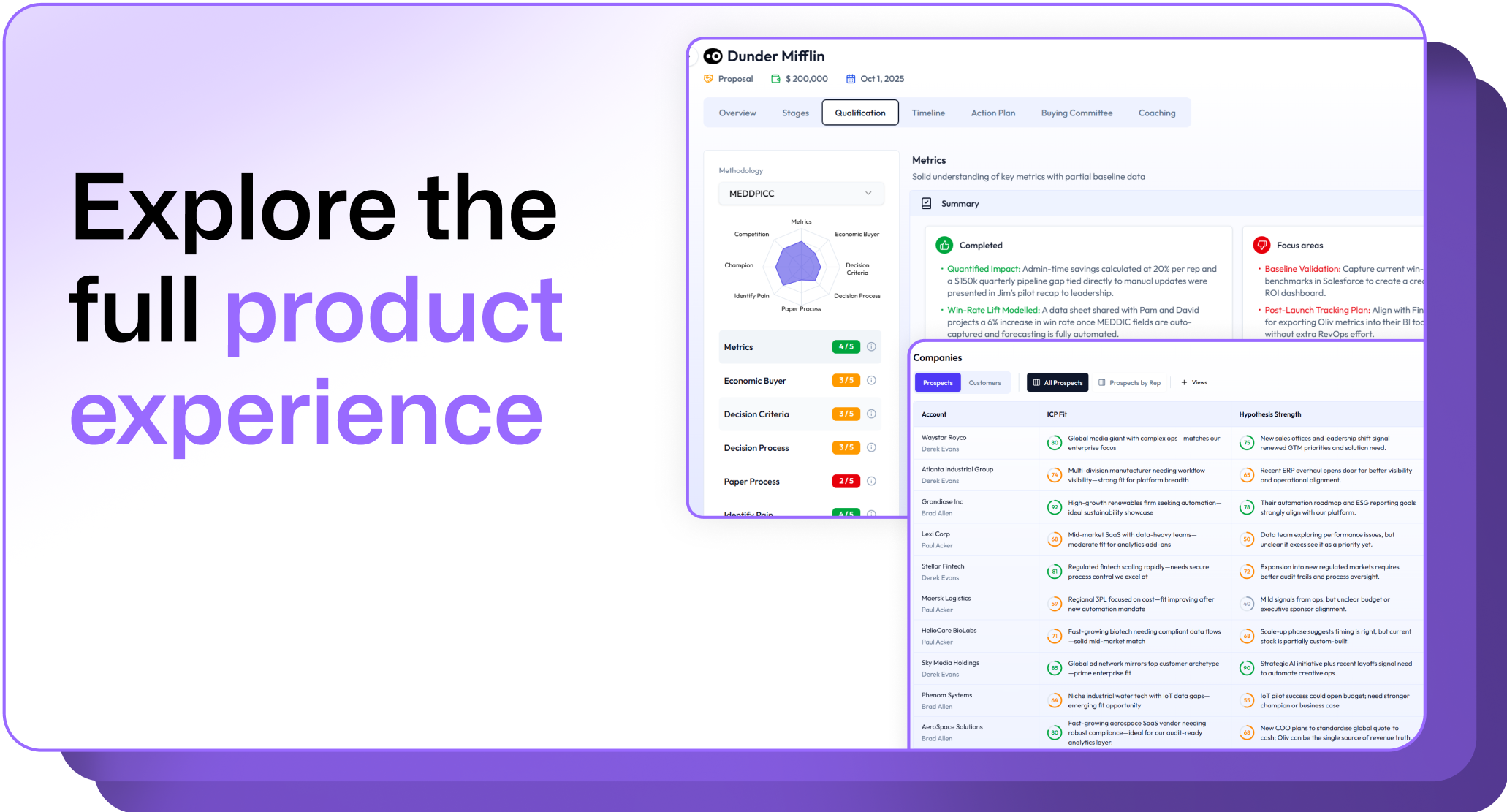
.avif)
.png)