25 SMART Sales Goals Examples for 2026: Templates with Baselines, Targets and Deadlines for SDRs, AEs and Managers
Written by
Ishan Chhabra
Last Updated :
September 9, 2026
Skim in :
13
mins
In this article
Revenue teams love Oliv
Here’s why:
All your deal data unified (from 30+ tools and tabs).
Insights are delivered to you directly, no digging.
AI agents automate tasks for you.
Thank you! Your submission has been received!
Oops! Something went wrong while submitting the form.
Meet Oliv’s AI Agents
Hi! I’m, Deal Driver
I track deals, flag risks, send weekly pipeline updates and give sales managers full visibility into deal progress
Hi! I’m, CRM Manager
I maintain CRM hygiene by updating core, custom and qualification fields all without your team lifting a finger
Hi! I’m, Forecaster
I build accurate forecasts based on real deal movement and tell you which deals to pull in to hit your number
Hi! I’m, Coach
I believe performance fuels revenue. I spot skill gaps, score calls and build coaching plans to help every rep level up
Hi! I’m, Prospector
I dig into target accounts to surface the right contacts, tailor and time outreach so you always strike when it counts
Hi! I’m, Pipeline tracker
I call reps to get deal updates, and deliver a real-time, CRM-synced roll-up view of deal progress
Hi! I’m, Analyst
I answer complex pipeline questions, uncover deal patterns, and build reports that guide strategic decisions
TL;DR
A SMART sales goal needs six fields, not five letters: metric, baseline, target, deadline, owner, and the named report the number comes from.
Most published examples fail on two fields. Without a baseline, the goal cannot be evaluated at quarter end. Without a data source, it cannot be tracked at all.
The article carries 25 role-segmented examples for SDRs, AEs, sales managers, AMs, and CSMs, each with a starting number and a quality gate.
Calibrate targets against published data. The Bridge Group recorded 48% AE quota attainment in 2026 and 60% SDR attainment, the lowest in its study history.
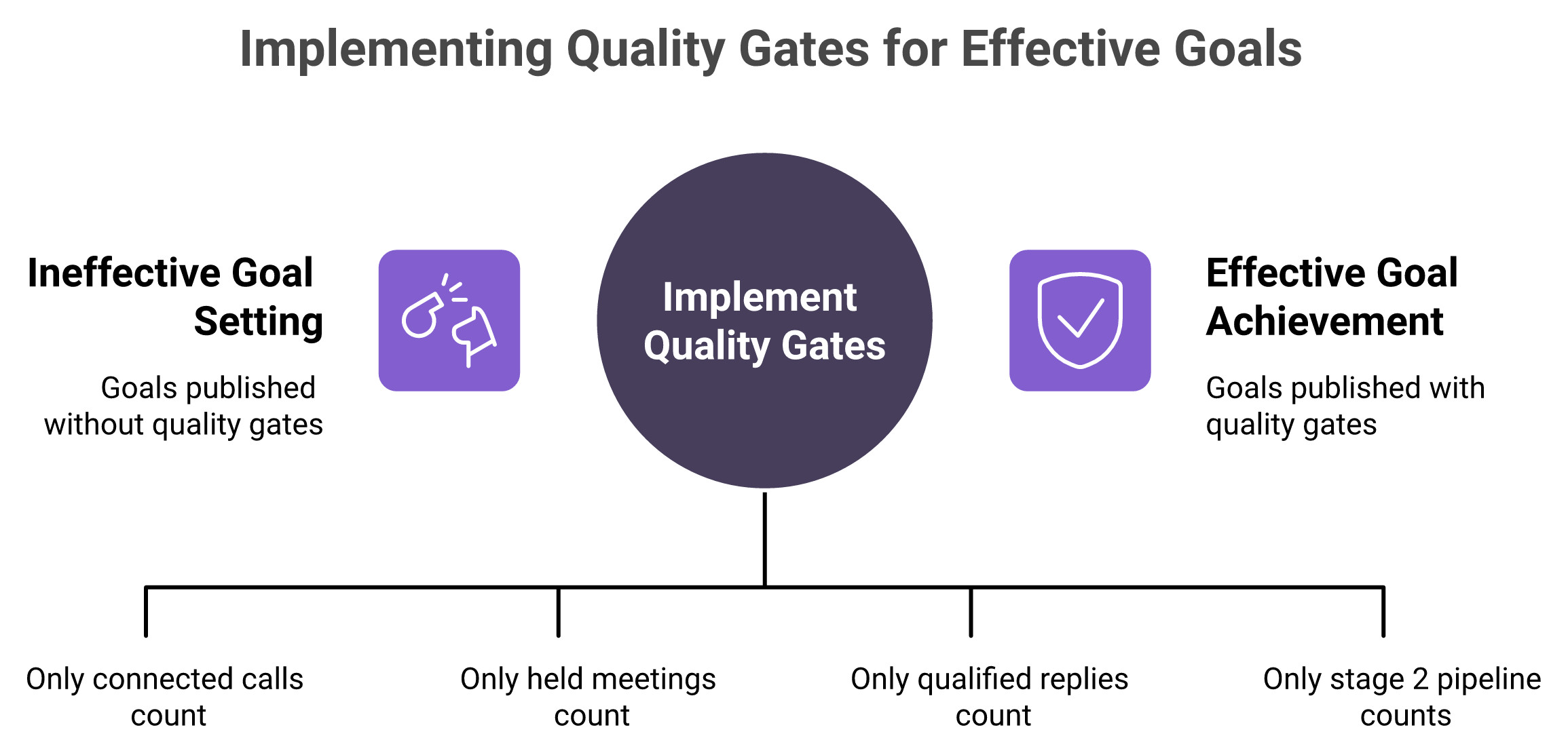
Every activity goal needs a quality gate in the same row: connected calls over dials, meetings held over booked, qualified replies over replies.
Review weekly, adjust quarterly, and pre-write the rule. Only the baseline or the deadline may move mid quarter, never the metric or the gate.
Q1: What are 25 SMART sales goals examples for SDRs, AEs, managers and CSMs? [toc=1. 25 Examples by Role]
A usable SMART sales goal names six things: the metric, the baseline you start from, the target, the deadline, the owner, and the report the number comes from. Example: lift Priya's connected call rate from 18% to 26% by 31 December, measured as connects divided by dials in the CRM dialler report, reviewed every Friday. The 25 examples below cover SDR activity, AE pipeline and revenue, sales manager execution, and AM or CSM retention. Every row carries a quality gate, so no goal can be cleared on volume alone.
⭐ How to read these rows
Each row is one sentence when written out. Read it left to right, and it becomes the goal you paste into a 1:1 doc. A quality gate is the condition that stops the metric being hit the cheap way.
One rule governs the whole table. Every goal must be something the owner can change on Monday, not a number they can only hope for. If you want the wider measurement context first, our guide to sales productivity metrics covers which numbers are worth tracking at all.
📞 SDR and BDR goals
SDR and BDR SMART Goal Examples
Goal
Baseline to target
Deadline
Owner
Data source
Quality gate
Connect rate
18% to 26%
31 Dec
SDR
Dialler report
Calls over 2 minutes only
Meetings held per month
12 to 18
31 Mar
SDR
CRM meeting report
Held to booked above 75%
Stage 2 pipeline sourced
$310k to $420k
31 Mar
SDR
Opportunity by source
Budget confirmed at Stage 2
Qualified replies per week
6 to 10
28 Feb
SDR
Sequencer reply tags
AE tags the reply qualified
ICP accounts worked monthly
40 to 65
31 Mar
SDR
Account list export
3 or more contacts per account
Meeting no show rate
22% to 15% (7 points)
30 Jun
SDR
Calendar plus CRM
Reminder logged 24 hours prior
Ramp to full quota
Month 5 to month 3.5
31 Dec
Manager
Attainment by tenure
70% for two straight months
💰 Account executive goals
Account Executive SMART Goal Examples
Goal
Baseline to target
Deadline
Owner
Data source
Quality gate
Win rate
22% to 27%
30 Jun
AE
Close report
3 buyer roles above $75k
Sales cycle length
94 to 78 days
30 Sep
AE
Stage duration report
Excludes deals under $10k
Average deal size
$34k to $39k
31 Dec
AE
Closed won report
Discount under 15%
Multithreaded commit deals
44% to 80%
31 Mar
AE
Contact roles per opp
Buyer touch inside 14 days
Forecast variance, 30 day commit
22% to 10%
30 Jun
AE
Weekly commit snapshot
Measured at 30 days only
Proposals sent per month
5 to 8
31 Mar
AE
Quote object count
Follows a scoped discovery
Slipped deals per quarter
6 to 3
30 Sep
AE
Close date change log
Only pushes over 15 days count
📈 Sales manager goals
Sales Manager SMART Goal Examples
Goal
Baseline to target
Deadline
Owner
Data source
Quality gate
Calls reviewed per rep weekly
0.8 to 3
30 Nov
Manager
Review log
Written feedback attached
Bottom quartile attainment
25% to 50%
31 Dec
Manager
Attainment by rep
Excludes reps under 90 days
Pipeline coverage at quarter start
2.4x to 3.2x
31 Mar
Manager
Coverage report
Stage 2 and above only
1:1s held on schedule
68% to 95%
30 Jun
Manager
Calendar audit
30 minutes minimum
New hire time to first close
118 to 90 days
31 Dec
Manager
First won by hire date
Deal above $10k
Field completeness, commit deals
61% to 95%
31 Mar
Manager
Field audit report
Six qualification fields
🤝 Account manager and CSM goals
Account Manager and CSM SMART Goal Examples
Goal
Baseline to target
Deadline
Owner
Data source
Quality gate
Net revenue retention
104% to 112%
31 Mar
AM
Renewal report
Excludes one off services
Expansion talks in $50k accounts
40% to 90%
30 Jun
AM
Activity by account
Documented next step
Risk flagged 90 days out
35% to 80%
30 Sep
CSM
Risk field timestamps
Risk has a named reason
Gross churn
11% to 8% (3 points)
31 Dec
CSM
Renewal report
Excludes acquisitions
QBRs completed
55% to 90%
31 Mar
CSM
QBR log
Economic buyer attended
⚠️ Calibrate before you commit
Notice that none of these targets are heroic. The Bridge Group found 48% of AEs hit annual quota in 2026, down from 51% in 2024, with attainment sliding toward the bottom band. A target only your top two reps can reach is a compensation problem wearing a goal's clothing. If retention goals are new to your team, our AI for customer retention guide explains where renewal risk signals actually come from.
Q2: What is a SMART sales goal, and why do most published examples fail? [toc=2. What Makes It SMART]
A SMART sales goal is Specific, Measurable, Achievable, Relevant, and Time bound. That is not where goals break. They break because nobody recorded the starting number or named the report the metric comes from, so at quarter end there is nothing to compare against. "Increase demo bookings by 15%" passes a surface SMART check and is still unevaluable, because 15% of what? Add baseline, owner, and data source to the five letters, and the goal survives review.
📋 The five letters, in one line each
Specific names the metric, not the theme. Measurable names the formula. Achievable means someone checked the number against a benchmark. Relevant means it moves the quota. Time bound means a calendar date, not "this quarter."
Most managers already know this. Very few goals fail because the acronym was misunderstood. The harder work sits in the process itself, which is why we keep a separate walkthrough on how to set sales goals.
❌ An audit of four goals that look finished
This page used to carry ten examples. Four of them were not SMART, and I wrote none of them, but they shipped under our name anyway. "Boost email open rates by 10% through A/B testing" has no deadline. "Create an email nurture campaign for prospects who are not yet ready" has no target and no deadline, and its only success condition is that the campaign exists.
That last one is the honest failure mode. A goal whose success condition is that a thing exists cannot be reviewed, only ticked.
⏰ What actually changed
For years, the excuse for a missing baseline was real. Pulling 90 days of connect rate meant an export, a pivot table, and an afternoon. So managers wrote relative targets and hoped nobody asked.
Conversation and activity data is now captured continuously, which removes the excuse. Salesforce found 84% of reps missed quota last year, and 67% do not expect to hit it this year. When the miss rate is that high, unevaluable goals are not a small documentation problem. The shift from manual reporting to continuous capture is the same one described in our piece on CRM data quality automation for RevOps.
✅ The six field form, with one worked row
The Six Field SMART Goal Template
Metric
Baseline
Target
Deadline
Owner
Data source
Connect rate (connects divided by dials)
18%, median, 1 Jun to 31 Aug 2026
26%
31 Dec 2026
Priya, SDR
CRM dialler report, Friday 9am
Written out, that row is one sentence. The objection that six fields feel like bureaucracy is fair, and the answer is that the cost is a sentence, not a process.
"The automatic CRM update feature is the most valuable to me, and it significantly aids in coaching SDRs and reps." — Verified user, Oliv AI G2 - Verified Review [26 Jun 2026]
"The fact that you can't edit a recording (to only share a portion with a client), and the fact that if you stop working with the tool you lose the data." — Verified user, Gong - G2 Verified Review [19 Mar 2026]
Oliv AI treats baseline and data source as system fields rather than manager homework. Its CRM Manager agent writes values captured from calls and activity back into the opportunity, so the number a goal is measured against already exists when the goal is written. The claim is not that we set better goals for you. It is narrower, and checkable: we remove the excuse for the two fields managers skip. The same mechanic is broken down in our overview of AI agents for RevOps.
Q3: What are the five categories of sales goals, and how do activity goals differ from outcome goals? [toc=3. Goal Categories and Mix]
Sales goals fall into five categories: revenue, pipeline, activity, efficiency, and skill. Activity goals cover inputs a rep owns outright, such as 40 connected calls a week. Outcome goals measure results the market influences, such as closed won revenue. Pair one of each, so the rep can act on Monday and still be accountable for the quarter. A workable mix per rep is two outcome goals, one activity goal, and one skill goal, four in total, because a rep tracking nine goals is tracking none.
🗂️ The five categories side by side
The Five Categories of Sales Goals
Category
What it measures
Who owns it
Example from the table above
Revenue
Money booked
AE, AM
Average deal size, $34k to $39k
Pipeline
Coverage and creation
SDR, manager
Stage 2 sourced, $310k to $420k
Activity
Inputs the rep controls
SDR, AE
Connect rate, 18% to 26%
Efficiency
Speed and hygiene
AE, manager
Cycle length, 94 to 78 days
Skill
What the rep can do next quarter
Manager
Calls reviewed, 0.8 to 3 weekly
Most published lists stop at the first three. That is why the goals read interchangeably across roles.
⚖️ Activity versus outcome, and why you need both
An activity goal is fully inside the rep's control. Nobody else decides whether they made 40 connected calls. An outcome goal is not, because a prospect's board can freeze budget in a week.
Set only outcomes, and you have given a rep a number they cannot act on. Set only activity, and you have built a treadmill that looks busy and forecasts nothing.
Activity goals and outcome goals sit at opposite corners of the same map. Pairing one from each end is what makes a goal both actionable and accountable.
🔗 How an activity goal earns its place
The pairing rule is simple. Every activity goal must name the outcome it feeds and the conversion rate between them.
Connect rate feeds meetings held, which feeds Stage 2 pipeline, which feeds closed won. Write the chain down once, and the activity target stops being arbitrary. If you cannot state the conversion rate, you do not have a goal yet; you have a habit you are asking someone to adopt.
🧮 Four goals per rep, and why the fifth breaks it
Two outcome goals, one activity goal, one skill goal. That mix survives a quarter because a rep can hold four numbers in their head during a Tuesday afternoon.
Skill goals are the first thing dropped when the quarter gets tight, and the only category that changes a rep's ceiling rather than their quarter. Individual goals should carry the activity and skill categories, since those are personal. Team level is right for pipeline coverage, where one rep's shortfall is absorbed by the group.
Oliv AI's Coach agent makes the skill category measurable rather than aspirational, because the evidence for a skill goal sits in the call record instead of in a manager's memory of a call they half attended. I still think skill goals are the hardest of the five to write well, and our own attempts get rewritten more often than the other four. For the diagnostic side of that work, see how we handle sales coaching skill gaps.
Q4: What are good SMART goals examples for an SDR or BDR? [toc=4. SDR Goal Examples]
Good SDR goals measure connected conversations and meetings held, never dials and meetings booked. A defensible set: raise connect rate from 18% to 26% by 31 December; raise meetings held from 12 to 18 a month while keeping held to booked above 75%; source $420,000 in Stage 2 pipeline against a $310,000 baseline. Calibrate before committing, because the Bridge Group recorded 60% of SDRs hitting quota in its 2025 study, the lowest figure in the report's history.
📉 The SDR trap
Volume metrics are the easiest to hit and the least predictive. Fifty dials a day becomes fifty twelve second dials by the second week, and the dashboard stays green.
That is not a character flaw in your team. It is what happens when the metric rewards the wrong half of the behaviour.
🎯 Five SDR goals with the math shown
Connect rate, 18% to 26% by 31 December. Owner is the SDR. Source is the dialler report, connects divided by dials, counting calls over two minutes only.
Meetings held, 12 to 18 a month by 31 March. Gate is a held to booked ratio above 75%, so cancellations cannot pad the number.
Stage 2 pipeline sourced, $310,000 to $420,000 by 31 March. That is a 35% lift, which needs the meetings goal above to land first.
Qualified replies, 6 to 10 a week by 28 February. A reply counts only when the receiving AE tags it qualified.
No show rate, 22% to 15% by 30 June. That is 7 percentage points, not 7%, and the gate is a reminder logged 24 hours before the call.
⚠️ Two caveats before you set these
Connect rate moves with list quality and dial window before it moves with effort. So a connect rate goal without a named owner for list hygiene is a goal the SDR cannot influence, and they will work that out faster than you will.
Never set a month one goal off a tenured baseline. A rep in week three needs a ramp target, and the Bridge Group's data puts SDR attainment at 61% by month 12, climbing with tenure. Our notes on sales new hire ramp time cover how to phase those first targets.
"I appreciate that Oliv.ai researches prospect accounts before every call and sends deal updates and talking points, which helps me prepare for meetings without sifting through tons of data and emails." — Verified user, Oliv AI G2 - Verified Review [23 Jun 2026]
"Gong Engage is awful in every single way compared to Outreach. Would not recommend at all, flows are hard to get into, information is not readily available, sequencing is difficult to create and track." — Verified user, Gong - G2 Verified Review [9 Jun 2025]
Oliv AI's Prospector and Rapid Responder agents change which SDR goals are worth setting at all. When account research runs before the call, and inbound sign ups are called, qualified, and routed inside 30 minutes, touch volume stops being the constraint, so the rep's goal moves onto conversation quality. Where our data points one way, and I might be reading it too strongly, it is here: I suspect connect rate goals get easier to hit for reasons that have nothing to do with the rep, and that is worth watching in your own numbers before you claim the win. If you are weighing that shift against your current stack, our comparison of AI agents for sales teams is the closest thing to a like for like read.
Q5: What are good SMART goals for an account executive, account manager or CSM? [toc=5. AE, AM and CSM Goals]
Closing and account goals should attach to a behaviour that moves a rate, not the rate alone. Workable examples: lift win rate from 22% to 27% by 30 June by verifying three buyer roles on every opportunity above $75,000; cut mid-market cycle length from 94 to 78 days; raise net revenue retention from 104% to 112% by holding a documented expansion conversation in every account above $50,000 ARR by 31 March. Each one pairs an outcome the market influences with an input the rep controls outright.
❌ The trap: goals set on numbers nobody can act on
"Grow revenue 20%" is not a goal for an AE. It is the quota restated with more syllables. The rep cannot do revenue on a Tuesday, so the goal sits in the doc, and nothing changes.
This is where the fair objection comes in. If you already have quotas, why add goals? The quota is the real number, and nothing here replaces it. A goal names the behaviour that moves the quota, which is the part a rep can actually run.
🎯 Four AE goals with the paired input
Win rate, 22% to 27% by 30 June. Paired input is three verified buyer roles on every opportunity above $75,000. Highspot publishes a similar enterprise formulation, which is a good precedent worth tightening. Our breakdown of MEDDIC qualification covers how to record those roles inside a live opportunity.
Cycle length, 94 to 78 days by 30 September. Paired input is a scoped discovery before any proposal goes out.
Multithreaded commit deals, 44% to 80% by 31 March. Paired input is a logged buyer touch inside the last 14 days.
Slipped deals, 6 to 3 per quarter by 30 September. Paired input is a written next step with a date on every commit deal. If slippage is your main leak, see our notes on deal slippage prevention.
🤝 Two account goals for AMs and CSMs
Net revenue retention, 104% to 112% by 31 March. Paired input is one documented expansion conversation per account above $50,000 ARR.
Renewal risk flagged 90 days out, 35% to 80% by 30 September. Paired input is a named reason attached to every risk flag, not a colour change.
Multithreading goals usually die for a boring reason. "Stakeholders identified" is a free-text field nobody audits, so the goal becomes an opinion. Specify the check as a count of contact roles on the opportunity, and the goal turns auditable overnight.
⚠️ The segment caveat
Enterprise cycle goals need a longer window than a quarter. If your median cycle is 94 days, a 90 day goal measures one cohort of deals, and one cohort is noise.
Set cycle length goals on a rolling four quarter view. Set win rate goals on a minimum of 20 closed opportunities, or you are reading randomness and calling it progress.
"The deal driver agent keeps tabs on all my deals and tells me where each deal is and which one needs my focus." — Verified user, Oliv AI G2 - Verified Review [15 Jun 2026]
"Limitations of getting data back into Salesforce." — Verified user, Gong - G2 Verified Review [21 May 2026]
Oliv AI's Deal Driver agent supplies the baseline these goals need. In one deployment, it surfaced that 68% of stalled Proposal stage deals had no economic buyer touch in the previous 14 days, which is how a multithreading target stops being a guess and starts being arithmetic. I would rather set a 44% to 80% goal off a number like that than off a round figure someone liked in a planning meeting. The same signal work is described in our guide to AI deal intelligence.
Q6: What SMART goals should a sales manager set for themselves and the team? [toc=6. Sales Manager Goals]
A manager's own goals should be behaviours, not roll ups. The two with the strongest evidence behind them: review three recorded calls per rep per week, and lift bottom quartile attainment rather than the team average. Bridge Group data ties rep attainment more closely to manager tenure and coaching frequency than to any activity target. Its 2026 study shows attainment clustering into the 0% to 30% band, which means "raise the team average" can be satisfied by your top two reps while half the team quietly fails.
📄 What a manager's goal sheet usually looks like
Most manager goal sheets are the team number with the manager's name on it. Hit $4.2M. Improve win rate. Raise pipeline coverage.
Every line is a roll up of what seven other people do. None of it tells the manager what to change on Monday morning. Our walkthrough of sales manager daily productivity covers what does belong on that sheet.
💸 What the average costs you
Here is the arithmetic that ruins a quarter. Seven reps, two at 95% of quota, five at 25%. Team average lands near 45%, and the dashboard reads "below plan but improving."
Raise the two strong reps to 105%, and the average moves again. Nothing has changed for the five reps who are drowning, and next quarter you will lose two of them.
⏰ What changed, and the goal it makes possible
Attainment benchmarks are now published annually, so distribution is measurable rather than anecdotal. Salesforce reports 76% of reps say enablement prepares them to make quota, which puts the lever squarely with the manager.
That supports two manager goals worth writing down. Move bottom quartile attainment from 25% to 50% by 31 December, excluding reps under 90 days. Move calls reviewed per rep per week from 0.8 to 3 by 30 November, with written feedback attached to each one. For the mechanics of running that at scale, see coaching at scale using AI.
⚠️ Why coaching goals lapse in February
I have watched more coaching goals die in February than in any other month, including my own. The reason is never intent. It is that nothing tracks the coaching goal, so it is the only line on the sheet with no data source.
Give the coaching goal the same six fields as every rep goal. Metric, baseline, target, deadline, owner, and the report. A coaching goal without a source is a promise, and promises do not survive a bad forecast week.
"The Driver agent watches all my deals and flags any that are at risk, so I don't have to spend hours listening to recordings in tools like Gong and Clari." — Verified user, Oliv AI G2 - Verified Review [17 Jun 2026]
"I found the AI tracker setup to be quite difficult, especially concerning the user interface when setting up keywords or smart trackers." — Verified user, Gong - G2 Verified Review [3 Oct 2025]
"The main downside is that the analytics could be more customizable." — Verified user, Oliv AI G2 - Verified Review [8 Jul 2026]
Oliv AI's Coach agent removes the reason coaching goals lapse, because review runs against every recorded conversation instead of the three a manager finds time to open. Oliver, the RevOps facing chief agent, holds the process definition centrally, so when the definition of a qualified meeting changes, it propagates to every rep's goal rather than living in one manager's spreadsheet. That second part matters more than it sounds, and it is the piece we underestimated when we built it. The full manager view sits in Oliv for sales managers.
Q7: What is a realistic target, and how do you set a goal when you have no baseline? [toc=7. Baselines and Benchmarks]
Plan for roughly half your AEs to miss. The Bridge Group recorded 48% AE attainment in 2026, down from 51% in 2024, and RepVue's index put attainment at 43.14% across quota carrying roles. Rep reported figures run below leader reported ones, so calibrate to the rep side. If you have no internal baseline, pull the last 90 days, take the median rather than the mean, and write it in as "baseline 18% (median, 1 Jun to 31 Aug 2026)", marking the goal provisional for one review cycle.
📊 How targets actually get set
Last year's number, plus a growth percentage the board liked. That is the method in most planning cycles, and everyone in the room knows it.
The percentage arrives before the evidence. Then the goal gets reverse engineered to justify it, which is how a proposal doubling target ends up labelled "Achievable" with nothing behind the label.
💸 What that costs
A target only a third of your team can clear is not a stretch goal. It is a compensation problem, and reps price it correctly within two weeks.
The published data now makes this checkable. If your plan assumes 85% attainment while the market runs near 45%, the plan is the thing that is wrong, not the team.
⏰ What changed
Attainment benchmarks are published annually now, and some are collected from reps rather than leaders. That gap matters, because leader reported attainment tends to run high.
So sanity checking a target takes ten minutes instead of a consulting engagement. There is no longer a good reason to set a number blind. If the number you need is a forecast figure, our piece on evidence-based forecast commits shows how to source it.
✅ The four step baseline procedure
Pull the window. Last 90 days of the metric, no shorter.
Take the median, not the mean. One outsized month should not set the bar for the year.
Date and label it. Write "median, 1 Jun to 31 Aug 2026" inside the goal itself.
Mark it provisional. The baseline can be corrected once, at the first review, and then it is fixed.
Most goals fail because nobody wrote down the starting number. These four steps produce a defensible baseline in under an hour.
If the metric does not exist yet, the first goal is to instrument it. "Connect rate reported weekly from the dialler by 30 September" is a legitimate goal, and the performance target waits for the next cycle.
⚠️ Median over mean, and why I insist on it
Median over mean is a small choice with a long tail. I have seen one strong January set a mean that made the following eleven months look like failure.
"Real time integrations can be time consuming." — Verified user, Gong - G2 Verified Review [21 Apr 2026]
Oliv AI shortens this step rather than replacing it. Because its CRM Manager agent writes captured call and activity values back into the record continuously, the 90 day window you need for a median usually already sits in the CRM instead of having to be rebuilt from exports. We cannot invent a metric your team never captured, and I would rather say that plainly than imply otherwise. The upstream hygiene problem is covered in CRM data strategy for revenue predictability.
Q8: What is the difference between a 5% reduction and a 5 percentage point reduction? [toc=8. Percent vs Percentage Point]
A 5% reduction is relative. Five percentage points is absolute. Cut a 20% no show rate by 5%, and you land at 19%. Cut it by 5 percentage points, and you land at 15%, which is five times harder. Any rate-based goal that does not say which it means will be argued about at quarter end, and the rep and the manager will each recall the reading that favours them. Write it as "from 20% to 15% (5 percentage points)" and the ambiguity disappears in seven words.
🧮 The same goal, read two ways
Percent Versus Percentage Point, Same Goal Read Two Ways
Reading
Starting rate
Ending rate
What the rep must actually do
"Reduce by 5%" (relative)
20%
19%
Save 1 meeting in 100
"Reduce by 5 percentage points"
20%
15%
Save 5 meetings in 100
Difference in effort
Same words
4 points apart
Five times the work
The words look identical on a goal sheet. The workload is not close.
⚠️ Where this bites
It bites in the review, not in the planning meeting. The rep lands at 19%, believes the goal is met, and is told it is not. Nobody was lying, and the goal was simply never written properly.
The fix costs nothing. Always state the start point and the end point as absolute numbers, then put the delta in brackets if you want it. Every metric definition in our sales productivity guide follows the same rule.
Q9: How do you stop reps gaming an activity goal? [toc=9. Gaming and Quality Gates]
Pair every activity goal with a quality gate in the same row, or do not set it. Fifty dials a day becomes fifty twelve second calls. Meetings booked becomes meetings booked and cancelled. The gates that hold are connected calls over dials, meetings held over meetings booked, qualified replies over replies, and Stage 2 pipeline over opportunities created. An activity goal published without a gate is not worth setting. If adding the gate makes the goal harder to state, that is evidence the original goal measured the wrong thing.
❌ Say the honest thing first
Your reps will game any activity metric you publish. This is not a character problem, and the best reps do it fastest, because they read incentives quickly.
A metric is an instruction. If the instruction says "dials", you will get dials, and you have no right to be surprised when the dials are eleven seconds long.
The goal wording is identical on both sides. Only the gate changes, and that single condition decides whether the quarter produces conversations or noise.
💸 What an unguarded goal actually costs
The costs are not on the dashboard, which is the problem. A burnt list of 400 ICP accounts, a phone number your prospects now ignore, and a quarter of pipeline that never converts.
Meanwhile, the report reads green. That gap between a healthy dashboard and an unhealthy funnel is where a lot of quarters get lost quietly, which is the same visibility gap we unpack in sales analytics software.
⏰ Why gates are now cheap
Ten years ago, a gate meant someone listening to calls. Connect duration, whether the meeting was held, and what was actually qualified now sit in the conversation record, so the gate is a filter rather than a project.
SPOTIO publishes the closest thing to a proper tracking table in this category, mapping role to goal type to tracking method, and it still leaves the gate column out. That omission is the norm, not an oversight by one publisher. For how the underlying call data gets structured, see sales call analytics.
⚠️ One compliance note for AI assisted activity
If your activity goal involves AI voice or chat outreach, Article 50 of the EU AI Act has applied since 2 August 2026. Systems interacting with people must make their artificial nature clear, unless it is already obvious.
So the gate on an AI assisted outreach goal includes a disclosure line and consent capture. That is one row in your template, not a legal project, and it is cheaper to add now than to retrofit. Our guide to AI CRM trust and governance covers the wider review.
"It doesn't just record meetings; it automatically captures key insights, updates systems of record, identifies next steps, and helps keep teams aligned." — Verified user, Oliv AI G2 - Verified Review [23 Jun 2026]
"I'd love to see few more options to customize dashboards and reports for different teams." — Verified user, Oliv AI G2 - Verified Review [26 Jun 2026]
✅ Run this on your own goal sheet
Find every goal with a volume noun in it: dials, touches, emails, meetings, opportunities.
Write the gate next to it in the same row.
If you cannot name a gate, delete the goal.
Oliv AI's Pipeline Tracker and Call Copilot make the gate observable rather than declared, because connect duration, whether the meeting happened, and what was qualified come from the conversation record instead of the rep's summary of it. A gate a rep self reports is not a gate. Writing this article cost us our three simplest examples, and I decided that was the right trade, though I accept some managers will find the gated versions harder to sell upward. The agent roster behind that sits in Oliv AI agents for sales teams.
Q10: Where should each goal's number come from, and how often should you review it? [toc=10. Data Source and Review Cadence]
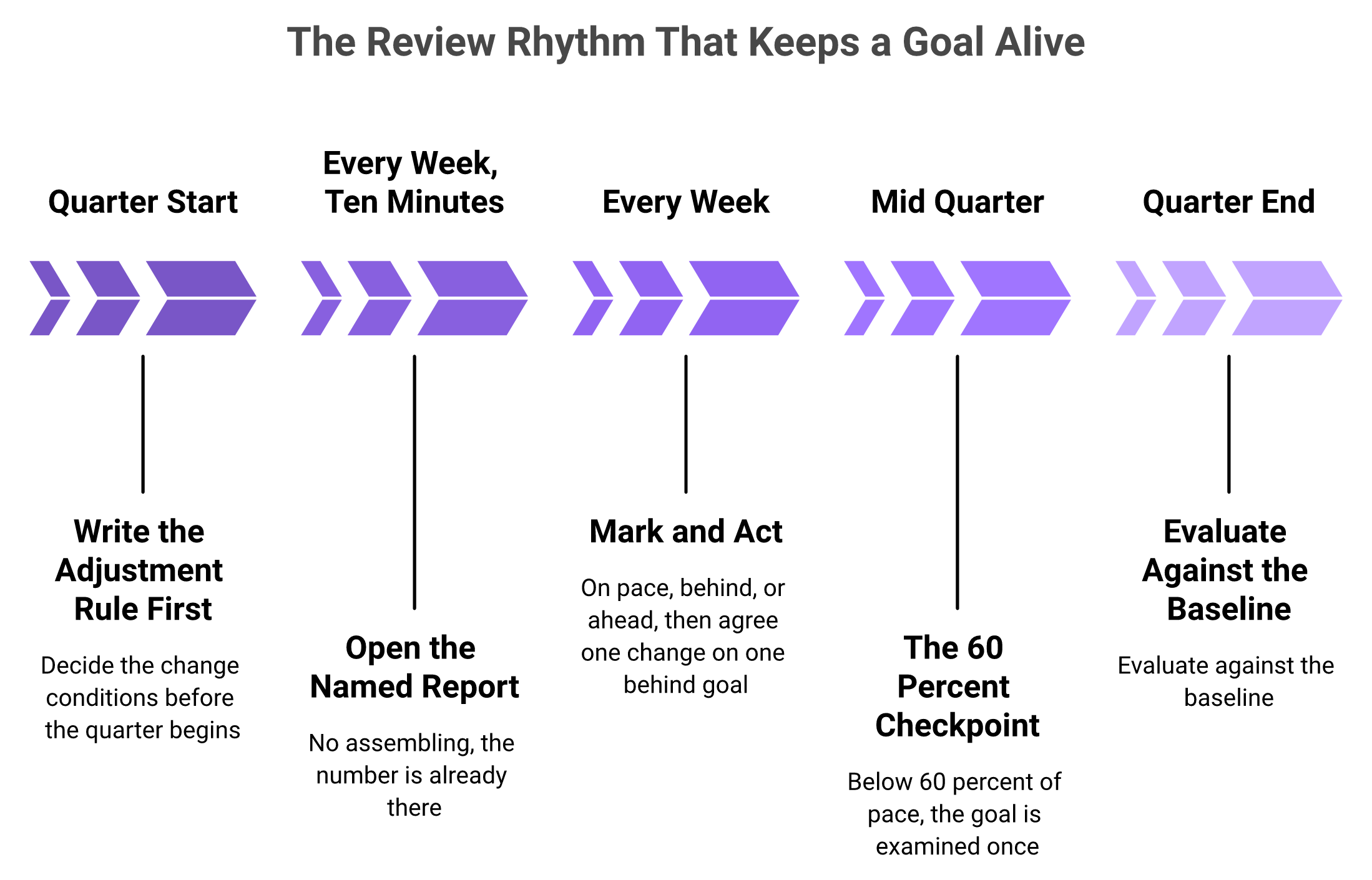
Every goal needs a named report, not a metric name. Write "connects over dials, CRM dialler report, pulled Friday 9am" rather than "connect rate". The test is whether the number arrives without anyone assembling it. Then review weekly, and adjust quarterly against a rule written before the quarter starts. Below 60% of pace at halfway, the goal is examined once, and only the baseline or the deadline may move. The metric and the quality gate never move mid quarter.
📋 The field managers leave blank
Six fields go into a goal, and five get filled in. The one that gets skipped is the data source, because it feels like plumbing rather than management.
That field decides whether the goal is alive in month five. Everything else is just wording.
💸 The Friday spreadsheet and its half life
A number assembled by hand each Friday survives about two quarters. Then the analyst who built it moves teams, the tab breaks, and the goal quietly stops being reviewed.
Nobody announces this. The goal just stops appearing in the 1:1, and at quarter end, everyone agrees it was "directional". Automating that reporting layer is the subject of revenue reporting software.
⏰ Why forecast goals need a horizon
"Improve forecast accuracy" is the most common unfixable goal in sales. Only about 7% of sales organisations reach 90% or better, with the median sitting at 70% to 79%.
Accuracy also decays with distance. Roughly 85% to 90% at 30 days becomes 65% to 75% by 90 days. So write the horizon into the goal: variance within 10% on the 30 day commit, measured at 30 days only. Our piece on improving sales forecast accuracy with AI covers the measurement method.
✅ The weekly routine, in ten minutes
Open the named report for each goal. No assembling.
Mark each goal on pace, behind, or ahead.
Pick one behind goal, and agree a single change.
Log the pace number, so next week has a comparison.
Goals do not die from bad targets, they die from skipped reviews. This is the cadence, plus the one rule that stops mid quarter renegotiation.
The routine takes ten minutes when the numbers are already there. It takes an hour and gets skipped when they are not, which is the whole argument of this section.
"It updates me before a sales call and after a sales call. Once the sales call is done, it goes ahead and updates my CRM." — Verified user, Oliv AI G2 - Verified Review [2 Jul 2026]
"The only downside I've noticed is that the mobile app is a bit basic compared to the desktop platform." — Verified user, Oliv AI G2 - Verified Review [8 Jul 2026]
⚠️ Where an agent stops helping
Oliv AI cannot invent a metric your team never captured, and it will not settle a dispute about what "qualified" means. That definition sits with Oliver, the RevOps facing agent, and a human still has to decide it before the agent can enforce it. I think that boundary gets blurred in most AI sales pitches, including some of ours.
Oliv AI sits on top of Salesforce or HubSpot rather than beside them. Its CRM Manager agent captures values from calls and activity and writes them back into the existing record, Pipeline Tracker collects the end of day update by voice, and Forecaster reads the resulting fields. The consequence for goal setting is narrow and checkable: the data source column stops naming a person and starts naming a field. If you are mapping that into an existing stack, see revenue intelligence integration across CRM, Slack, and email.
You will get more out of this page by rewriting one goal than by reading another list of them. Add a baseline and a data source to every goal you set from now on, and check your weakest metric against sales productivity metrics before you commit the quarter. If you want to see what the tracking layer looks like for a frontline team, the Oliv for sales managers page covers it. And if you would rather just ask, book a short chat and bring your actual goal sheet.
Q1: What are 25 SMART sales goals examples for SDRs, AEs, managers and CSMs? [toc=1. 25 Examples by Role]
A usable SMART sales goal names six things: the metric, the baseline you start from, the target, the deadline, the owner, and the report the number comes from. Example: lift Priya's connected call rate from 18% to 26% by 31 December, measured as connects divided by dials in the CRM dialler report, reviewed every Friday. The 25 examples below cover SDR activity, AE pipeline and revenue, sales manager execution, and AM or CSM retention. Every row carries a quality gate, so no goal can be cleared on volume alone.
⭐ How to read these rows
Each row is one sentence when written out. Read it left to right, and it becomes the goal you paste into a 1:1 doc. A quality gate is the condition that stops the metric being hit the cheap way.
One rule governs the whole table. Every goal must be something the owner can change on Monday, not a number they can only hope for. If you want the wider measurement context first, our guide to sales productivity metrics covers which numbers are worth tracking at all.
📞 SDR and BDR goals
SDR and BDR SMART Goal Examples
Goal
Baseline to target
Deadline
Owner
Data source
Quality gate
Connect rate
18% to 26%
31 Dec
SDR
Dialler report
Calls over 2 minutes only
Meetings held per month
12 to 18
31 Mar
SDR
CRM meeting report
Held to booked above 75%
Stage 2 pipeline sourced
$310k to $420k
31 Mar
SDR
Opportunity by source
Budget confirmed at Stage 2
Qualified replies per week
6 to 10
28 Feb
SDR
Sequencer reply tags
AE tags the reply qualified
ICP accounts worked monthly
40 to 65
31 Mar
SDR
Account list export
3 or more contacts per account
Meeting no show rate
22% to 15% (7 points)
30 Jun
SDR
Calendar plus CRM
Reminder logged 24 hours prior
Ramp to full quota
Month 5 to month 3.5
31 Dec
Manager
Attainment by tenure
70% for two straight months
💰 Account executive goals
Account Executive SMART Goal Examples
Goal
Baseline to target
Deadline
Owner
Data source
Quality gate
Win rate
22% to 27%
30 Jun
AE
Close report
3 buyer roles above $75k
Sales cycle length
94 to 78 days
30 Sep
AE
Stage duration report
Excludes deals under $10k
Average deal size
$34k to $39k
31 Dec
AE
Closed won report
Discount under 15%
Multithreaded commit deals
44% to 80%
31 Mar
AE
Contact roles per opp
Buyer touch inside 14 days
Forecast variance, 30 day commit
22% to 10%
30 Jun
AE
Weekly commit snapshot
Measured at 30 days only
Proposals sent per month
5 to 8
31 Mar
AE
Quote object count
Follows a scoped discovery
Slipped deals per quarter
6 to 3
30 Sep
AE
Close date change log
Only pushes over 15 days count
📈 Sales manager goals
Sales Manager SMART Goal Examples
Goal
Baseline to target
Deadline
Owner
Data source
Quality gate
Calls reviewed per rep weekly
0.8 to 3
30 Nov
Manager
Review log
Written feedback attached
Bottom quartile attainment
25% to 50%
31 Dec
Manager
Attainment by rep
Excludes reps under 90 days
Pipeline coverage at quarter start
2.4x to 3.2x
31 Mar
Manager
Coverage report
Stage 2 and above only
1:1s held on schedule
68% to 95%
30 Jun
Manager
Calendar audit
30 minutes minimum
New hire time to first close
118 to 90 days
31 Dec
Manager
First won by hire date
Deal above $10k
Field completeness, commit deals
61% to 95%
31 Mar
Manager
Field audit report
Six qualification fields
🤝 Account manager and CSM goals
Account Manager and CSM SMART Goal Examples
Goal
Baseline to target
Deadline
Owner
Data source
Quality gate
Net revenue retention
104% to 112%
31 Mar
AM
Renewal report
Excludes one off services
Expansion talks in $50k accounts
40% to 90%
30 Jun
AM
Activity by account
Documented next step
Risk flagged 90 days out
35% to 80%
30 Sep
CSM
Risk field timestamps
Risk has a named reason
Gross churn
11% to 8% (3 points)
31 Dec
CSM
Renewal report
Excludes acquisitions
QBRs completed
55% to 90%
31 Mar
CSM
QBR log
Economic buyer attended
⚠️ Calibrate before you commit
Notice that none of these targets are heroic. The Bridge Group found 48% of AEs hit annual quota in 2026, down from 51% in 2024, with attainment sliding toward the bottom band. A target only your top two reps can reach is a compensation problem wearing a goal's clothing. If retention goals are new to your team, our AI for customer retention guide explains where renewal risk signals actually come from.
Q2: What is a SMART sales goal, and why do most published examples fail? [toc=2. What Makes It SMART]
A SMART sales goal is Specific, Measurable, Achievable, Relevant, and Time bound. That is not where goals break. They break because nobody recorded the starting number or named the report the metric comes from, so at quarter end there is nothing to compare against. "Increase demo bookings by 15%" passes a surface SMART check and is still unevaluable, because 15% of what? Add baseline, owner, and data source to the five letters, and the goal survives review.
📋 The five letters, in one line each
Specific names the metric, not the theme. Measurable names the formula. Achievable means someone checked the number against a benchmark. Relevant means it moves the quota. Time bound means a calendar date, not "this quarter."
Most managers already know this. Very few goals fail because the acronym was misunderstood. The harder work sits in the process itself, which is why we keep a separate walkthrough on how to set sales goals.
❌ An audit of four goals that look finished
This page used to carry ten examples. Four of them were not SMART, and I wrote none of them, but they shipped under our name anyway. "Boost email open rates by 10% through A/B testing" has no deadline. "Create an email nurture campaign for prospects who are not yet ready" has no target and no deadline, and its only success condition is that the campaign exists.
That last one is the honest failure mode. A goal whose success condition is that a thing exists cannot be reviewed, only ticked.
⏰ What actually changed
For years, the excuse for a missing baseline was real. Pulling 90 days of connect rate meant an export, a pivot table, and an afternoon. So managers wrote relative targets and hoped nobody asked.
Conversation and activity data is now captured continuously, which removes the excuse. Salesforce found 84% of reps missed quota last year, and 67% do not expect to hit it this year. When the miss rate is that high, unevaluable goals are not a small documentation problem. The shift from manual reporting to continuous capture is the same one described in our piece on CRM data quality automation for RevOps.
✅ The six field form, with one worked row
The Six Field SMART Goal Template
Metric
Baseline
Target
Deadline
Owner
Data source
Connect rate (connects divided by dials)
18%, median, 1 Jun to 31 Aug 2026
26%
31 Dec 2026
Priya, SDR
CRM dialler report, Friday 9am
Written out, that row is one sentence. The objection that six fields feel like bureaucracy is fair, and the answer is that the cost is a sentence, not a process.
"The automatic CRM update feature is the most valuable to me, and it significantly aids in coaching SDRs and reps." — Verified user, Oliv AI G2 - Verified Review [26 Jun 2026]
"The fact that you can't edit a recording (to only share a portion with a client), and the fact that if you stop working with the tool you lose the data." — Verified user, Gong - G2 Verified Review [19 Mar 2026]
Oliv AI treats baseline and data source as system fields rather than manager homework. Its CRM Manager agent writes values captured from calls and activity back into the opportunity, so the number a goal is measured against already exists when the goal is written. The claim is not that we set better goals for you. It is narrower, and checkable: we remove the excuse for the two fields managers skip. The same mechanic is broken down in our overview of AI agents for RevOps.
Q3: What are the five categories of sales goals, and how do activity goals differ from outcome goals? [toc=3. Goal Categories and Mix]
Sales goals fall into five categories: revenue, pipeline, activity, efficiency, and skill. Activity goals cover inputs a rep owns outright, such as 40 connected calls a week. Outcome goals measure results the market influences, such as closed won revenue. Pair one of each, so the rep can act on Monday and still be accountable for the quarter. A workable mix per rep is two outcome goals, one activity goal, and one skill goal, four in total, because a rep tracking nine goals is tracking none.
🗂️ The five categories side by side
The Five Categories of Sales Goals
Category
What it measures
Who owns it
Example from the table above
Revenue
Money booked
AE, AM
Average deal size, $34k to $39k
Pipeline
Coverage and creation
SDR, manager
Stage 2 sourced, $310k to $420k
Activity
Inputs the rep controls
SDR, AE
Connect rate, 18% to 26%
Efficiency
Speed and hygiene
AE, manager
Cycle length, 94 to 78 days
Skill
What the rep can do next quarter
Manager
Calls reviewed, 0.8 to 3 weekly
Most published lists stop at the first three. That is why the goals read interchangeably across roles.
⚖️ Activity versus outcome, and why you need both
An activity goal is fully inside the rep's control. Nobody else decides whether they made 40 connected calls. An outcome goal is not, because a prospect's board can freeze budget in a week.
Set only outcomes, and you have given a rep a number they cannot act on. Set only activity, and you have built a treadmill that looks busy and forecasts nothing.
Activity goals and outcome goals sit at opposite corners of the same map. Pairing one from each end is what makes a goal both actionable and accountable.
🔗 How an activity goal earns its place
The pairing rule is simple. Every activity goal must name the outcome it feeds and the conversion rate between them.
Connect rate feeds meetings held, which feeds Stage 2 pipeline, which feeds closed won. Write the chain down once, and the activity target stops being arbitrary. If you cannot state the conversion rate, you do not have a goal yet; you have a habit you are asking someone to adopt.
🧮 Four goals per rep, and why the fifth breaks it
Two outcome goals, one activity goal, one skill goal. That mix survives a quarter because a rep can hold four numbers in their head during a Tuesday afternoon.
Skill goals are the first thing dropped when the quarter gets tight, and the only category that changes a rep's ceiling rather than their quarter. Individual goals should carry the activity and skill categories, since those are personal. Team level is right for pipeline coverage, where one rep's shortfall is absorbed by the group.
Oliv AI's Coach agent makes the skill category measurable rather than aspirational, because the evidence for a skill goal sits in the call record instead of in a manager's memory of a call they half attended. I still think skill goals are the hardest of the five to write well, and our own attempts get rewritten more often than the other four. For the diagnostic side of that work, see how we handle sales coaching skill gaps.
Q4: What are good SMART goals examples for an SDR or BDR? [toc=4. SDR Goal Examples]
Good SDR goals measure connected conversations and meetings held, never dials and meetings booked. A defensible set: raise connect rate from 18% to 26% by 31 December; raise meetings held from 12 to 18 a month while keeping held to booked above 75%; source $420,000 in Stage 2 pipeline against a $310,000 baseline. Calibrate before committing, because the Bridge Group recorded 60% of SDRs hitting quota in its 2025 study, the lowest figure in the report's history.
📉 The SDR trap
Volume metrics are the easiest to hit and the least predictive. Fifty dials a day becomes fifty twelve second dials by the second week, and the dashboard stays green.
That is not a character flaw in your team. It is what happens when the metric rewards the wrong half of the behaviour.
🎯 Five SDR goals with the math shown
Connect rate, 18% to 26% by 31 December. Owner is the SDR. Source is the dialler report, connects divided by dials, counting calls over two minutes only.
Meetings held, 12 to 18 a month by 31 March. Gate is a held to booked ratio above 75%, so cancellations cannot pad the number.
Stage 2 pipeline sourced, $310,000 to $420,000 by 31 March. That is a 35% lift, which needs the meetings goal above to land first.
Qualified replies, 6 to 10 a week by 28 February. A reply counts only when the receiving AE tags it qualified.
No show rate, 22% to 15% by 30 June. That is 7 percentage points, not 7%, and the gate is a reminder logged 24 hours before the call.
⚠️ Two caveats before you set these
Connect rate moves with list quality and dial window before it moves with effort. So a connect rate goal without a named owner for list hygiene is a goal the SDR cannot influence, and they will work that out faster than you will.
Never set a month one goal off a tenured baseline. A rep in week three needs a ramp target, and the Bridge Group's data puts SDR attainment at 61% by month 12, climbing with tenure. Our notes on sales new hire ramp time cover how to phase those first targets.
"I appreciate that Oliv.ai researches prospect accounts before every call and sends deal updates and talking points, which helps me prepare for meetings without sifting through tons of data and emails." — Verified user, Oliv AI G2 - Verified Review [23 Jun 2026]
"Gong Engage is awful in every single way compared to Outreach. Would not recommend at all, flows are hard to get into, information is not readily available, sequencing is difficult to create and track." — Verified user, Gong - G2 Verified Review [9 Jun 2025]
Oliv AI's Prospector and Rapid Responder agents change which SDR goals are worth setting at all. When account research runs before the call, and inbound sign ups are called, qualified, and routed inside 30 minutes, touch volume stops being the constraint, so the rep's goal moves onto conversation quality. Where our data points one way, and I might be reading it too strongly, it is here: I suspect connect rate goals get easier to hit for reasons that have nothing to do with the rep, and that is worth watching in your own numbers before you claim the win. If you are weighing that shift against your current stack, our comparison of AI agents for sales teams is the closest thing to a like for like read.
Q5: What are good SMART goals for an account executive, account manager or CSM? [toc=5. AE, AM and CSM Goals]
Closing and account goals should attach to a behaviour that moves a rate, not the rate alone. Workable examples: lift win rate from 22% to 27% by 30 June by verifying three buyer roles on every opportunity above $75,000; cut mid-market cycle length from 94 to 78 days; raise net revenue retention from 104% to 112% by holding a documented expansion conversation in every account above $50,000 ARR by 31 March. Each one pairs an outcome the market influences with an input the rep controls outright.
❌ The trap: goals set on numbers nobody can act on
"Grow revenue 20%" is not a goal for an AE. It is the quota restated with more syllables. The rep cannot do revenue on a Tuesday, so the goal sits in the doc, and nothing changes.
This is where the fair objection comes in. If you already have quotas, why add goals? The quota is the real number, and nothing here replaces it. A goal names the behaviour that moves the quota, which is the part a rep can actually run.
🎯 Four AE goals with the paired input
Win rate, 22% to 27% by 30 June. Paired input is three verified buyer roles on every opportunity above $75,000. Highspot publishes a similar enterprise formulation, which is a good precedent worth tightening. Our breakdown of MEDDIC qualification covers how to record those roles inside a live opportunity.
Cycle length, 94 to 78 days by 30 September. Paired input is a scoped discovery before any proposal goes out.
Multithreaded commit deals, 44% to 80% by 31 March. Paired input is a logged buyer touch inside the last 14 days.
Slipped deals, 6 to 3 per quarter by 30 September. Paired input is a written next step with a date on every commit deal. If slippage is your main leak, see our notes on deal slippage prevention.
🤝 Two account goals for AMs and CSMs
Net revenue retention, 104% to 112% by 31 March. Paired input is one documented expansion conversation per account above $50,000 ARR.
Renewal risk flagged 90 days out, 35% to 80% by 30 September. Paired input is a named reason attached to every risk flag, not a colour change.
Multithreading goals usually die for a boring reason. "Stakeholders identified" is a free-text field nobody audits, so the goal becomes an opinion. Specify the check as a count of contact roles on the opportunity, and the goal turns auditable overnight.
⚠️ The segment caveat
Enterprise cycle goals need a longer window than a quarter. If your median cycle is 94 days, a 90 day goal measures one cohort of deals, and one cohort is noise.
Set cycle length goals on a rolling four quarter view. Set win rate goals on a minimum of 20 closed opportunities, or you are reading randomness and calling it progress.
"The deal driver agent keeps tabs on all my deals and tells me where each deal is and which one needs my focus." — Verified user, Oliv AI G2 - Verified Review [15 Jun 2026]
"Limitations of getting data back into Salesforce." — Verified user, Gong - G2 Verified Review [21 May 2026]
Oliv AI's Deal Driver agent supplies the baseline these goals need. In one deployment, it surfaced that 68% of stalled Proposal stage deals had no economic buyer touch in the previous 14 days, which is how a multithreading target stops being a guess and starts being arithmetic. I would rather set a 44% to 80% goal off a number like that than off a round figure someone liked in a planning meeting. The same signal work is described in our guide to AI deal intelligence.
Q6: What SMART goals should a sales manager set for themselves and the team? [toc=6. Sales Manager Goals]
A manager's own goals should be behaviours, not roll ups. The two with the strongest evidence behind them: review three recorded calls per rep per week, and lift bottom quartile attainment rather than the team average. Bridge Group data ties rep attainment more closely to manager tenure and coaching frequency than to any activity target. Its 2026 study shows attainment clustering into the 0% to 30% band, which means "raise the team average" can be satisfied by your top two reps while half the team quietly fails.
📄 What a manager's goal sheet usually looks like
Most manager goal sheets are the team number with the manager's name on it. Hit $4.2M. Improve win rate. Raise pipeline coverage.
Every line is a roll up of what seven other people do. None of it tells the manager what to change on Monday morning. Our walkthrough of sales manager daily productivity covers what does belong on that sheet.
💸 What the average costs you
Here is the arithmetic that ruins a quarter. Seven reps, two at 95% of quota, five at 25%. Team average lands near 45%, and the dashboard reads "below plan but improving."
Raise the two strong reps to 105%, and the average moves again. Nothing has changed for the five reps who are drowning, and next quarter you will lose two of them.
⏰ What changed, and the goal it makes possible
Attainment benchmarks are now published annually, so distribution is measurable rather than anecdotal. Salesforce reports 76% of reps say enablement prepares them to make quota, which puts the lever squarely with the manager.
That supports two manager goals worth writing down. Move bottom quartile attainment from 25% to 50% by 31 December, excluding reps under 90 days. Move calls reviewed per rep per week from 0.8 to 3 by 30 November, with written feedback attached to each one. For the mechanics of running that at scale, see coaching at scale using AI.
⚠️ Why coaching goals lapse in February
I have watched more coaching goals die in February than in any other month, including my own. The reason is never intent. It is that nothing tracks the coaching goal, so it is the only line on the sheet with no data source.
Give the coaching goal the same six fields as every rep goal. Metric, baseline, target, deadline, owner, and the report. A coaching goal without a source is a promise, and promises do not survive a bad forecast week.
"The Driver agent watches all my deals and flags any that are at risk, so I don't have to spend hours listening to recordings in tools like Gong and Clari." — Verified user, Oliv AI G2 - Verified Review [17 Jun 2026]
"I found the AI tracker setup to be quite difficult, especially concerning the user interface when setting up keywords or smart trackers." — Verified user, Gong - G2 Verified Review [3 Oct 2025]
"The main downside is that the analytics could be more customizable." — Verified user, Oliv AI G2 - Verified Review [8 Jul 2026]
Oliv AI's Coach agent removes the reason coaching goals lapse, because review runs against every recorded conversation instead of the three a manager finds time to open. Oliver, the RevOps facing chief agent, holds the process definition centrally, so when the definition of a qualified meeting changes, it propagates to every rep's goal rather than living in one manager's spreadsheet. That second part matters more than it sounds, and it is the piece we underestimated when we built it. The full manager view sits in Oliv for sales managers.
Q7: What is a realistic target, and how do you set a goal when you have no baseline? [toc=7. Baselines and Benchmarks]
Plan for roughly half your AEs to miss. The Bridge Group recorded 48% AE attainment in 2026, down from 51% in 2024, and RepVue's index put attainment at 43.14% across quota carrying roles. Rep reported figures run below leader reported ones, so calibrate to the rep side. If you have no internal baseline, pull the last 90 days, take the median rather than the mean, and write it in as "baseline 18% (median, 1 Jun to 31 Aug 2026)", marking the goal provisional for one review cycle.
📊 How targets actually get set
Last year's number, plus a growth percentage the board liked. That is the method in most planning cycles, and everyone in the room knows it.
The percentage arrives before the evidence. Then the goal gets reverse engineered to justify it, which is how a proposal doubling target ends up labelled "Achievable" with nothing behind the label.
💸 What that costs
A target only a third of your team can clear is not a stretch goal. It is a compensation problem, and reps price it correctly within two weeks.
The published data now makes this checkable. If your plan assumes 85% attainment while the market runs near 45%, the plan is the thing that is wrong, not the team.
⏰ What changed
Attainment benchmarks are published annually now, and some are collected from reps rather than leaders. That gap matters, because leader reported attainment tends to run high.
So sanity checking a target takes ten minutes instead of a consulting engagement. There is no longer a good reason to set a number blind. If the number you need is a forecast figure, our piece on evidence-based forecast commits shows how to source it.
✅ The four step baseline procedure
Pull the window. Last 90 days of the metric, no shorter.
Take the median, not the mean. One outsized month should not set the bar for the year.
Date and label it. Write "median, 1 Jun to 31 Aug 2026" inside the goal itself.
Mark it provisional. The baseline can be corrected once, at the first review, and then it is fixed.
Most goals fail because nobody wrote down the starting number. These four steps produce a defensible baseline in under an hour.
If the metric does not exist yet, the first goal is to instrument it. "Connect rate reported weekly from the dialler by 30 September" is a legitimate goal, and the performance target waits for the next cycle.
⚠️ Median over mean, and why I insist on it
Median over mean is a small choice with a long tail. I have seen one strong January set a mean that made the following eleven months look like failure.
"Real time integrations can be time consuming." — Verified user, Gong - G2 Verified Review [21 Apr 2026]
Oliv AI shortens this step rather than replacing it. Because its CRM Manager agent writes captured call and activity values back into the record continuously, the 90 day window you need for a median usually already sits in the CRM instead of having to be rebuilt from exports. We cannot invent a metric your team never captured, and I would rather say that plainly than imply otherwise. The upstream hygiene problem is covered in CRM data strategy for revenue predictability.
Q8: What is the difference between a 5% reduction and a 5 percentage point reduction? [toc=8. Percent vs Percentage Point]
A 5% reduction is relative. Five percentage points is absolute. Cut a 20% no show rate by 5%, and you land at 19%. Cut it by 5 percentage points, and you land at 15%, which is five times harder. Any rate-based goal that does not say which it means will be argued about at quarter end, and the rep and the manager will each recall the reading that favours them. Write it as "from 20% to 15% (5 percentage points)" and the ambiguity disappears in seven words.
🧮 The same goal, read two ways
Percent Versus Percentage Point, Same Goal Read Two Ways
Reading
Starting rate
Ending rate
What the rep must actually do
"Reduce by 5%" (relative)
20%
19%
Save 1 meeting in 100
"Reduce by 5 percentage points"
20%
15%
Save 5 meetings in 100
Difference in effort
Same words
4 points apart
Five times the work
The words look identical on a goal sheet. The workload is not close.
⚠️ Where this bites
It bites in the review, not in the planning meeting. The rep lands at 19%, believes the goal is met, and is told it is not. Nobody was lying, and the goal was simply never written properly.
The fix costs nothing. Always state the start point and the end point as absolute numbers, then put the delta in brackets if you want it. Every metric definition in our sales productivity guide follows the same rule.
Q9: How do you stop reps gaming an activity goal? [toc=9. Gaming and Quality Gates]
Pair every activity goal with a quality gate in the same row, or do not set it. Fifty dials a day becomes fifty twelve second calls. Meetings booked becomes meetings booked and cancelled. The gates that hold are connected calls over dials, meetings held over meetings booked, qualified replies over replies, and Stage 2 pipeline over opportunities created. An activity goal published without a gate is not worth setting. If adding the gate makes the goal harder to state, that is evidence the original goal measured the wrong thing.
❌ Say the honest thing first
Your reps will game any activity metric you publish. This is not a character problem, and the best reps do it fastest, because they read incentives quickly.
A metric is an instruction. If the instruction says "dials", you will get dials, and you have no right to be surprised when the dials are eleven seconds long.
The goal wording is identical on both sides. Only the gate changes, and that single condition decides whether the quarter produces conversations or noise.
💸 What an unguarded goal actually costs
The costs are not on the dashboard, which is the problem. A burnt list of 400 ICP accounts, a phone number your prospects now ignore, and a quarter of pipeline that never converts.
Meanwhile, the report reads green. That gap between a healthy dashboard and an unhealthy funnel is where a lot of quarters get lost quietly, which is the same visibility gap we unpack in sales analytics software.
⏰ Why gates are now cheap
Ten years ago, a gate meant someone listening to calls. Connect duration, whether the meeting was held, and what was actually qualified now sit in the conversation record, so the gate is a filter rather than a project.
SPOTIO publishes the closest thing to a proper tracking table in this category, mapping role to goal type to tracking method, and it still leaves the gate column out. That omission is the norm, not an oversight by one publisher. For how the underlying call data gets structured, see sales call analytics.
⚠️ One compliance note for AI assisted activity
If your activity goal involves AI voice or chat outreach, Article 50 of the EU AI Act has applied since 2 August 2026. Systems interacting with people must make their artificial nature clear, unless it is already obvious.
So the gate on an AI assisted outreach goal includes a disclosure line and consent capture. That is one row in your template, not a legal project, and it is cheaper to add now than to retrofit. Our guide to AI CRM trust and governance covers the wider review.
"It doesn't just record meetings; it automatically captures key insights, updates systems of record, identifies next steps, and helps keep teams aligned." — Verified user, Oliv AI G2 - Verified Review [23 Jun 2026]
"I'd love to see few more options to customize dashboards and reports for different teams." — Verified user, Oliv AI G2 - Verified Review [26 Jun 2026]
✅ Run this on your own goal sheet
Find every goal with a volume noun in it: dials, touches, emails, meetings, opportunities.
Write the gate next to it in the same row.
If you cannot name a gate, delete the goal.
Oliv AI's Pipeline Tracker and Call Copilot make the gate observable rather than declared, because connect duration, whether the meeting happened, and what was qualified come from the conversation record instead of the rep's summary of it. A gate a rep self reports is not a gate. Writing this article cost us our three simplest examples, and I decided that was the right trade, though I accept some managers will find the gated versions harder to sell upward. The agent roster behind that sits in Oliv AI agents for sales teams.
Q10: Where should each goal's number come from, and how often should you review it? [toc=10. Data Source and Review Cadence]
Every goal needs a named report, not a metric name. Write "connects over dials, CRM dialler report, pulled Friday 9am" rather than "connect rate". The test is whether the number arrives without anyone assembling it. Then review weekly, and adjust quarterly against a rule written before the quarter starts. Below 60% of pace at halfway, the goal is examined once, and only the baseline or the deadline may move. The metric and the quality gate never move mid quarter.
📋 The field managers leave blank
Six fields go into a goal, and five get filled in. The one that gets skipped is the data source, because it feels like plumbing rather than management.
That field decides whether the goal is alive in month five. Everything else is just wording.
💸 The Friday spreadsheet and its half life
A number assembled by hand each Friday survives about two quarters. Then the analyst who built it moves teams, the tab breaks, and the goal quietly stops being reviewed.
Nobody announces this. The goal just stops appearing in the 1:1, and at quarter end, everyone agrees it was "directional". Automating that reporting layer is the subject of revenue reporting software.
⏰ Why forecast goals need a horizon
"Improve forecast accuracy" is the most common unfixable goal in sales. Only about 7% of sales organisations reach 90% or better, with the median sitting at 70% to 79%.
Accuracy also decays with distance. Roughly 85% to 90% at 30 days becomes 65% to 75% by 90 days. So write the horizon into the goal: variance within 10% on the 30 day commit, measured at 30 days only. Our piece on improving sales forecast accuracy with AI covers the measurement method.
✅ The weekly routine, in ten minutes
Open the named report for each goal. No assembling.
Mark each goal on pace, behind, or ahead.
Pick one behind goal, and agree a single change.
Log the pace number, so next week has a comparison.
Goals do not die from bad targets, they die from skipped reviews. This is the cadence, plus the one rule that stops mid quarter renegotiation.
The routine takes ten minutes when the numbers are already there. It takes an hour and gets skipped when they are not, which is the whole argument of this section.
"It updates me before a sales call and after a sales call. Once the sales call is done, it goes ahead and updates my CRM." — Verified user, Oliv AI G2 - Verified Review [2 Jul 2026]
"The only downside I've noticed is that the mobile app is a bit basic compared to the desktop platform." — Verified user, Oliv AI G2 - Verified Review [8 Jul 2026]
⚠️ Where an agent stops helping
Oliv AI cannot invent a metric your team never captured, and it will not settle a dispute about what "qualified" means. That definition sits with Oliver, the RevOps facing agent, and a human still has to decide it before the agent can enforce it. I think that boundary gets blurred in most AI sales pitches, including some of ours.
Oliv AI sits on top of Salesforce or HubSpot rather than beside them. Its CRM Manager agent captures values from calls and activity and writes them back into the existing record, Pipeline Tracker collects the end of day update by voice, and Forecaster reads the resulting fields. The consequence for goal setting is narrow and checkable: the data source column stops naming a person and starts naming a field. If you are mapping that into an existing stack, see revenue intelligence integration across CRM, Slack, and email.
You will get more out of this page by rewriting one goal than by reading another list of them. Add a baseline and a data source to every goal you set from now on, and check your weakest metric against sales productivity metrics before you commit the quarter. If you want to see what the tracking layer looks like for a frontline team, the Oliv for sales managers page covers it. And if you would rather just ask, book a short chat and bring your actual goal sheet.
Q1: What are 25 SMART sales goals examples for SDRs, AEs, managers and CSMs? [toc=1. 25 Examples by Role]
A usable SMART sales goal names six things: the metric, the baseline you start from, the target, the deadline, the owner, and the report the number comes from. Example: lift Priya's connected call rate from 18% to 26% by 31 December, measured as connects divided by dials in the CRM dialler report, reviewed every Friday. The 25 examples below cover SDR activity, AE pipeline and revenue, sales manager execution, and AM or CSM retention. Every row carries a quality gate, so no goal can be cleared on volume alone.
⭐ How to read these rows
Each row is one sentence when written out. Read it left to right, and it becomes the goal you paste into a 1:1 doc. A quality gate is the condition that stops the metric being hit the cheap way.
One rule governs the whole table. Every goal must be something the owner can change on Monday, not a number they can only hope for. If you want the wider measurement context first, our guide to sales productivity metrics covers which numbers are worth tracking at all.
📞 SDR and BDR goals
SDR and BDR SMART Goal Examples
Goal
Baseline to target
Deadline
Owner
Data source
Quality gate
Connect rate
18% to 26%
31 Dec
SDR
Dialler report
Calls over 2 minutes only
Meetings held per month
12 to 18
31 Mar
SDR
CRM meeting report
Held to booked above 75%
Stage 2 pipeline sourced
$310k to $420k
31 Mar
SDR
Opportunity by source
Budget confirmed at Stage 2
Qualified replies per week
6 to 10
28 Feb
SDR
Sequencer reply tags
AE tags the reply qualified
ICP accounts worked monthly
40 to 65
31 Mar
SDR
Account list export
3 or more contacts per account
Meeting no show rate
22% to 15% (7 points)
30 Jun
SDR
Calendar plus CRM
Reminder logged 24 hours prior
Ramp to full quota
Month 5 to month 3.5
31 Dec
Manager
Attainment by tenure
70% for two straight months
💰 Account executive goals
Account Executive SMART Goal Examples
Goal
Baseline to target
Deadline
Owner
Data source
Quality gate
Win rate
22% to 27%
30 Jun
AE
Close report
3 buyer roles above $75k
Sales cycle length
94 to 78 days
30 Sep
AE
Stage duration report
Excludes deals under $10k
Average deal size
$34k to $39k
31 Dec
AE
Closed won report
Discount under 15%
Multithreaded commit deals
44% to 80%
31 Mar
AE
Contact roles per opp
Buyer touch inside 14 days
Forecast variance, 30 day commit
22% to 10%
30 Jun
AE
Weekly commit snapshot
Measured at 30 days only
Proposals sent per month
5 to 8
31 Mar
AE
Quote object count
Follows a scoped discovery
Slipped deals per quarter
6 to 3
30 Sep
AE
Close date change log
Only pushes over 15 days count
📈 Sales manager goals
Sales Manager SMART Goal Examples
Goal
Baseline to target
Deadline
Owner
Data source
Quality gate
Calls reviewed per rep weekly
0.8 to 3
30 Nov
Manager
Review log
Written feedback attached
Bottom quartile attainment
25% to 50%
31 Dec
Manager
Attainment by rep
Excludes reps under 90 days
Pipeline coverage at quarter start
2.4x to 3.2x
31 Mar
Manager
Coverage report
Stage 2 and above only
1:1s held on schedule
68% to 95%
30 Jun
Manager
Calendar audit
30 minutes minimum
New hire time to first close
118 to 90 days
31 Dec
Manager
First won by hire date
Deal above $10k
Field completeness, commit deals
61% to 95%
31 Mar
Manager
Field audit report
Six qualification fields
🤝 Account manager and CSM goals
Account Manager and CSM SMART Goal Examples
Goal
Baseline to target
Deadline
Owner
Data source
Quality gate
Net revenue retention
104% to 112%
31 Mar
AM
Renewal report
Excludes one off services
Expansion talks in $50k accounts
40% to 90%
30 Jun
AM
Activity by account
Documented next step
Risk flagged 90 days out
35% to 80%
30 Sep
CSM
Risk field timestamps
Risk has a named reason
Gross churn
11% to 8% (3 points)
31 Dec
CSM
Renewal report
Excludes acquisitions
QBRs completed
55% to 90%
31 Mar
CSM
QBR log
Economic buyer attended
⚠️ Calibrate before you commit
Notice that none of these targets are heroic. The Bridge Group found 48% of AEs hit annual quota in 2026, down from 51% in 2024, with attainment sliding toward the bottom band. A target only your top two reps can reach is a compensation problem wearing a goal's clothing. If retention goals are new to your team, our AI for customer retention guide explains where renewal risk signals actually come from.
Q2: What is a SMART sales goal, and why do most published examples fail? [toc=2. What Makes It SMART]
A SMART sales goal is Specific, Measurable, Achievable, Relevant, and Time bound. That is not where goals break. They break because nobody recorded the starting number or named the report the metric comes from, so at quarter end there is nothing to compare against. "Increase demo bookings by 15%" passes a surface SMART check and is still unevaluable, because 15% of what? Add baseline, owner, and data source to the five letters, and the goal survives review.
📋 The five letters, in one line each
Specific names the metric, not the theme. Measurable names the formula. Achievable means someone checked the number against a benchmark. Relevant means it moves the quota. Time bound means a calendar date, not "this quarter."
Most managers already know this. Very few goals fail because the acronym was misunderstood. The harder work sits in the process itself, which is why we keep a separate walkthrough on how to set sales goals.
❌ An audit of four goals that look finished
This page used to carry ten examples. Four of them were not SMART, and I wrote none of them, but they shipped under our name anyway. "Boost email open rates by 10% through A/B testing" has no deadline. "Create an email nurture campaign for prospects who are not yet ready" has no target and no deadline, and its only success condition is that the campaign exists.
That last one is the honest failure mode. A goal whose success condition is that a thing exists cannot be reviewed, only ticked.
⏰ What actually changed
For years, the excuse for a missing baseline was real. Pulling 90 days of connect rate meant an export, a pivot table, and an afternoon. So managers wrote relative targets and hoped nobody asked.
Conversation and activity data is now captured continuously, which removes the excuse. Salesforce found 84% of reps missed quota last year, and 67% do not expect to hit it this year. When the miss rate is that high, unevaluable goals are not a small documentation problem. The shift from manual reporting to continuous capture is the same one described in our piece on CRM data quality automation for RevOps.
✅ The six field form, with one worked row
The Six Field SMART Goal Template
Metric
Baseline
Target
Deadline
Owner
Data source
Connect rate (connects divided by dials)
18%, median, 1 Jun to 31 Aug 2026
26%
31 Dec 2026
Priya, SDR
CRM dialler report, Friday 9am
Written out, that row is one sentence. The objection that six fields feel like bureaucracy is fair, and the answer is that the cost is a sentence, not a process.
"The automatic CRM update feature is the most valuable to me, and it significantly aids in coaching SDRs and reps." — Verified user, Oliv AI G2 - Verified Review [26 Jun 2026]
"The fact that you can't edit a recording (to only share a portion with a client), and the fact that if you stop working with the tool you lose the data." — Verified user, Gong - G2 Verified Review [19 Mar 2026]
Oliv AI treats baseline and data source as system fields rather than manager homework. Its CRM Manager agent writes values captured from calls and activity back into the opportunity, so the number a goal is measured against already exists when the goal is written. The claim is not that we set better goals for you. It is narrower, and checkable: we remove the excuse for the two fields managers skip. The same mechanic is broken down in our overview of AI agents for RevOps.
Q3: What are the five categories of sales goals, and how do activity goals differ from outcome goals? [toc=3. Goal Categories and Mix]
Sales goals fall into five categories: revenue, pipeline, activity, efficiency, and skill. Activity goals cover inputs a rep owns outright, such as 40 connected calls a week. Outcome goals measure results the market influences, such as closed won revenue. Pair one of each, so the rep can act on Monday and still be accountable for the quarter. A workable mix per rep is two outcome goals, one activity goal, and one skill goal, four in total, because a rep tracking nine goals is tracking none.
🗂️ The five categories side by side
The Five Categories of Sales Goals
Category
What it measures
Who owns it
Example from the table above
Revenue
Money booked
AE, AM
Average deal size, $34k to $39k
Pipeline
Coverage and creation
SDR, manager
Stage 2 sourced, $310k to $420k
Activity
Inputs the rep controls
SDR, AE
Connect rate, 18% to 26%
Efficiency
Speed and hygiene
AE, manager
Cycle length, 94 to 78 days
Skill
What the rep can do next quarter
Manager
Calls reviewed, 0.8 to 3 weekly
Most published lists stop at the first three. That is why the goals read interchangeably across roles.
⚖️ Activity versus outcome, and why you need both
An activity goal is fully inside the rep's control. Nobody else decides whether they made 40 connected calls. An outcome goal is not, because a prospect's board can freeze budget in a week.
Set only outcomes, and you have given a rep a number they cannot act on. Set only activity, and you have built a treadmill that looks busy and forecasts nothing.
Activity goals and outcome goals sit at opposite corners of the same map. Pairing one from each end is what makes a goal both actionable and accountable.
🔗 How an activity goal earns its place
The pairing rule is simple. Every activity goal must name the outcome it feeds and the conversion rate between them.
Connect rate feeds meetings held, which feeds Stage 2 pipeline, which feeds closed won. Write the chain down once, and the activity target stops being arbitrary. If you cannot state the conversion rate, you do not have a goal yet; you have a habit you are asking someone to adopt.
🧮 Four goals per rep, and why the fifth breaks it
Two outcome goals, one activity goal, one skill goal. That mix survives a quarter because a rep can hold four numbers in their head during a Tuesday afternoon.
Skill goals are the first thing dropped when the quarter gets tight, and the only category that changes a rep's ceiling rather than their quarter. Individual goals should carry the activity and skill categories, since those are personal. Team level is right for pipeline coverage, where one rep's shortfall is absorbed by the group.
Oliv AI's Coach agent makes the skill category measurable rather than aspirational, because the evidence for a skill goal sits in the call record instead of in a manager's memory of a call they half attended. I still think skill goals are the hardest of the five to write well, and our own attempts get rewritten more often than the other four. For the diagnostic side of that work, see how we handle sales coaching skill gaps.
Q4: What are good SMART goals examples for an SDR or BDR? [toc=4. SDR Goal Examples]
Good SDR goals measure connected conversations and meetings held, never dials and meetings booked. A defensible set: raise connect rate from 18% to 26% by 31 December; raise meetings held from 12 to 18 a month while keeping held to booked above 75%; source $420,000 in Stage 2 pipeline against a $310,000 baseline. Calibrate before committing, because the Bridge Group recorded 60% of SDRs hitting quota in its 2025 study, the lowest figure in the report's history.
📉 The SDR trap
Volume metrics are the easiest to hit and the least predictive. Fifty dials a day becomes fifty twelve second dials by the second week, and the dashboard stays green.
That is not a character flaw in your team. It is what happens when the metric rewards the wrong half of the behaviour.
🎯 Five SDR goals with the math shown
Connect rate, 18% to 26% by 31 December. Owner is the SDR. Source is the dialler report, connects divided by dials, counting calls over two minutes only.
Meetings held, 12 to 18 a month by 31 March. Gate is a held to booked ratio above 75%, so cancellations cannot pad the number.
Stage 2 pipeline sourced, $310,000 to $420,000 by 31 March. That is a 35% lift, which needs the meetings goal above to land first.
Qualified replies, 6 to 10 a week by 28 February. A reply counts only when the receiving AE tags it qualified.
No show rate, 22% to 15% by 30 June. That is 7 percentage points, not 7%, and the gate is a reminder logged 24 hours before the call.
⚠️ Two caveats before you set these
Connect rate moves with list quality and dial window before it moves with effort. So a connect rate goal without a named owner for list hygiene is a goal the SDR cannot influence, and they will work that out faster than you will.
Never set a month one goal off a tenured baseline. A rep in week three needs a ramp target, and the Bridge Group's data puts SDR attainment at 61% by month 12, climbing with tenure. Our notes on sales new hire ramp time cover how to phase those first targets.
"I appreciate that Oliv.ai researches prospect accounts before every call and sends deal updates and talking points, which helps me prepare for meetings without sifting through tons of data and emails." — Verified user, Oliv AI G2 - Verified Review [23 Jun 2026]
"Gong Engage is awful in every single way compared to Outreach. Would not recommend at all, flows are hard to get into, information is not readily available, sequencing is difficult to create and track." — Verified user, Gong - G2 Verified Review [9 Jun 2025]
Oliv AI's Prospector and Rapid Responder agents change which SDR goals are worth setting at all. When account research runs before the call, and inbound sign ups are called, qualified, and routed inside 30 minutes, touch volume stops being the constraint, so the rep's goal moves onto conversation quality. Where our data points one way, and I might be reading it too strongly, it is here: I suspect connect rate goals get easier to hit for reasons that have nothing to do with the rep, and that is worth watching in your own numbers before you claim the win. If you are weighing that shift against your current stack, our comparison of AI agents for sales teams is the closest thing to a like for like read.
Q5: What are good SMART goals for an account executive, account manager or CSM? [toc=5. AE, AM and CSM Goals]
Closing and account goals should attach to a behaviour that moves a rate, not the rate alone. Workable examples: lift win rate from 22% to 27% by 30 June by verifying three buyer roles on every opportunity above $75,000; cut mid-market cycle length from 94 to 78 days; raise net revenue retention from 104% to 112% by holding a documented expansion conversation in every account above $50,000 ARR by 31 March. Each one pairs an outcome the market influences with an input the rep controls outright.
❌ The trap: goals set on numbers nobody can act on
"Grow revenue 20%" is not a goal for an AE. It is the quota restated with more syllables. The rep cannot do revenue on a Tuesday, so the goal sits in the doc, and nothing changes.
This is where the fair objection comes in. If you already have quotas, why add goals? The quota is the real number, and nothing here replaces it. A goal names the behaviour that moves the quota, which is the part a rep can actually run.
🎯 Four AE goals with the paired input
Win rate, 22% to 27% by 30 June. Paired input is three verified buyer roles on every opportunity above $75,000. Highspot publishes a similar enterprise formulation, which is a good precedent worth tightening. Our breakdown of MEDDIC qualification covers how to record those roles inside a live opportunity.
Cycle length, 94 to 78 days by 30 September. Paired input is a scoped discovery before any proposal goes out.
Multithreaded commit deals, 44% to 80% by 31 March. Paired input is a logged buyer touch inside the last 14 days.
Slipped deals, 6 to 3 per quarter by 30 September. Paired input is a written next step with a date on every commit deal. If slippage is your main leak, see our notes on deal slippage prevention.
🤝 Two account goals for AMs and CSMs
Net revenue retention, 104% to 112% by 31 March. Paired input is one documented expansion conversation per account above $50,000 ARR.
Renewal risk flagged 90 days out, 35% to 80% by 30 September. Paired input is a named reason attached to every risk flag, not a colour change.
Multithreading goals usually die for a boring reason. "Stakeholders identified" is a free-text field nobody audits, so the goal becomes an opinion. Specify the check as a count of contact roles on the opportunity, and the goal turns auditable overnight.
⚠️ The segment caveat
Enterprise cycle goals need a longer window than a quarter. If your median cycle is 94 days, a 90 day goal measures one cohort of deals, and one cohort is noise.
Set cycle length goals on a rolling four quarter view. Set win rate goals on a minimum of 20 closed opportunities, or you are reading randomness and calling it progress.
"The deal driver agent keeps tabs on all my deals and tells me where each deal is and which one needs my focus." — Verified user, Oliv AI G2 - Verified Review [15 Jun 2026]
"Limitations of getting data back into Salesforce." — Verified user, Gong - G2 Verified Review [21 May 2026]
Oliv AI's Deal Driver agent supplies the baseline these goals need. In one deployment, it surfaced that 68% of stalled Proposal stage deals had no economic buyer touch in the previous 14 days, which is how a multithreading target stops being a guess and starts being arithmetic. I would rather set a 44% to 80% goal off a number like that than off a round figure someone liked in a planning meeting. The same signal work is described in our guide to AI deal intelligence.
Q6: What SMART goals should a sales manager set for themselves and the team? [toc=6. Sales Manager Goals]
A manager's own goals should be behaviours, not roll ups. The two with the strongest evidence behind them: review three recorded calls per rep per week, and lift bottom quartile attainment rather than the team average. Bridge Group data ties rep attainment more closely to manager tenure and coaching frequency than to any activity target. Its 2026 study shows attainment clustering into the 0% to 30% band, which means "raise the team average" can be satisfied by your top two reps while half the team quietly fails.
📄 What a manager's goal sheet usually looks like
Most manager goal sheets are the team number with the manager's name on it. Hit $4.2M. Improve win rate. Raise pipeline coverage.
Every line is a roll up of what seven other people do. None of it tells the manager what to change on Monday morning. Our walkthrough of sales manager daily productivity covers what does belong on that sheet.
💸 What the average costs you
Here is the arithmetic that ruins a quarter. Seven reps, two at 95% of quota, five at 25%. Team average lands near 45%, and the dashboard reads "below plan but improving."
Raise the two strong reps to 105%, and the average moves again. Nothing has changed for the five reps who are drowning, and next quarter you will lose two of them.
⏰ What changed, and the goal it makes possible
Attainment benchmarks are now published annually, so distribution is measurable rather than anecdotal. Salesforce reports 76% of reps say enablement prepares them to make quota, which puts the lever squarely with the manager.
That supports two manager goals worth writing down. Move bottom quartile attainment from 25% to 50% by 31 December, excluding reps under 90 days. Move calls reviewed per rep per week from 0.8 to 3 by 30 November, with written feedback attached to each one. For the mechanics of running that at scale, see coaching at scale using AI.
⚠️ Why coaching goals lapse in February
I have watched more coaching goals die in February than in any other month, including my own. The reason is never intent. It is that nothing tracks the coaching goal, so it is the only line on the sheet with no data source.
Give the coaching goal the same six fields as every rep goal. Metric, baseline, target, deadline, owner, and the report. A coaching goal without a source is a promise, and promises do not survive a bad forecast week.
"The Driver agent watches all my deals and flags any that are at risk, so I don't have to spend hours listening to recordings in tools like Gong and Clari." — Verified user, Oliv AI G2 - Verified Review [17 Jun 2026]
"I found the AI tracker setup to be quite difficult, especially concerning the user interface when setting up keywords or smart trackers." — Verified user, Gong - G2 Verified Review [3 Oct 2025]
"The main downside is that the analytics could be more customizable." — Verified user, Oliv AI G2 - Verified Review [8 Jul 2026]
Oliv AI's Coach agent removes the reason coaching goals lapse, because review runs against every recorded conversation instead of the three a manager finds time to open. Oliver, the RevOps facing chief agent, holds the process definition centrally, so when the definition of a qualified meeting changes, it propagates to every rep's goal rather than living in one manager's spreadsheet. That second part matters more than it sounds, and it is the piece we underestimated when we built it. The full manager view sits in Oliv for sales managers.
Q7: What is a realistic target, and how do you set a goal when you have no baseline? [toc=7. Baselines and Benchmarks]
Plan for roughly half your AEs to miss. The Bridge Group recorded 48% AE attainment in 2026, down from 51% in 2024, and RepVue's index put attainment at 43.14% across quota carrying roles. Rep reported figures run below leader reported ones, so calibrate to the rep side. If you have no internal baseline, pull the last 90 days, take the median rather than the mean, and write it in as "baseline 18% (median, 1 Jun to 31 Aug 2026)", marking the goal provisional for one review cycle.
📊 How targets actually get set
Last year's number, plus a growth percentage the board liked. That is the method in most planning cycles, and everyone in the room knows it.
The percentage arrives before the evidence. Then the goal gets reverse engineered to justify it, which is how a proposal doubling target ends up labelled "Achievable" with nothing behind the label.
💸 What that costs
A target only a third of your team can clear is not a stretch goal. It is a compensation problem, and reps price it correctly within two weeks.
The published data now makes this checkable. If your plan assumes 85% attainment while the market runs near 45%, the plan is the thing that is wrong, not the team.
⏰ What changed
Attainment benchmarks are published annually now, and some are collected from reps rather than leaders. That gap matters, because leader reported attainment tends to run high.
So sanity checking a target takes ten minutes instead of a consulting engagement. There is no longer a good reason to set a number blind. If the number you need is a forecast figure, our piece on evidence-based forecast commits shows how to source it.
✅ The four step baseline procedure
Pull the window. Last 90 days of the metric, no shorter.
Take the median, not the mean. One outsized month should not set the bar for the year.
Date and label it. Write "median, 1 Jun to 31 Aug 2026" inside the goal itself.
Mark it provisional. The baseline can be corrected once, at the first review, and then it is fixed.
Most goals fail because nobody wrote down the starting number. These four steps produce a defensible baseline in under an hour.
If the metric does not exist yet, the first goal is to instrument it. "Connect rate reported weekly from the dialler by 30 September" is a legitimate goal, and the performance target waits for the next cycle.
⚠️ Median over mean, and why I insist on it
Median over mean is a small choice with a long tail. I have seen one strong January set a mean that made the following eleven months look like failure.
"Real time integrations can be time consuming." — Verified user, Gong - G2 Verified Review [21 Apr 2026]
Oliv AI shortens this step rather than replacing it. Because its CRM Manager agent writes captured call and activity values back into the record continuously, the 90 day window you need for a median usually already sits in the CRM instead of having to be rebuilt from exports. We cannot invent a metric your team never captured, and I would rather say that plainly than imply otherwise. The upstream hygiene problem is covered in CRM data strategy for revenue predictability.
Q8: What is the difference between a 5% reduction and a 5 percentage point reduction? [toc=8. Percent vs Percentage Point]
A 5% reduction is relative. Five percentage points is absolute. Cut a 20% no show rate by 5%, and you land at 19%. Cut it by 5 percentage points, and you land at 15%, which is five times harder. Any rate-based goal that does not say which it means will be argued about at quarter end, and the rep and the manager will each recall the reading that favours them. Write it as "from 20% to 15% (5 percentage points)" and the ambiguity disappears in seven words.
🧮 The same goal, read two ways
Percent Versus Percentage Point, Same Goal Read Two Ways
Reading
Starting rate
Ending rate
What the rep must actually do
"Reduce by 5%" (relative)
20%
19%
Save 1 meeting in 100
"Reduce by 5 percentage points"
20%
15%
Save 5 meetings in 100
Difference in effort
Same words
4 points apart
Five times the work
The words look identical on a goal sheet. The workload is not close.
⚠️ Where this bites
It bites in the review, not in the planning meeting. The rep lands at 19%, believes the goal is met, and is told it is not. Nobody was lying, and the goal was simply never written properly.
The fix costs nothing. Always state the start point and the end point as absolute numbers, then put the delta in brackets if you want it. Every metric definition in our sales productivity guide follows the same rule.
Q9: How do you stop reps gaming an activity goal? [toc=9. Gaming and Quality Gates]
Pair every activity goal with a quality gate in the same row, or do not set it. Fifty dials a day becomes fifty twelve second calls. Meetings booked becomes meetings booked and cancelled. The gates that hold are connected calls over dials, meetings held over meetings booked, qualified replies over replies, and Stage 2 pipeline over opportunities created. An activity goal published without a gate is not worth setting. If adding the gate makes the goal harder to state, that is evidence the original goal measured the wrong thing.
❌ Say the honest thing first
Your reps will game any activity metric you publish. This is not a character problem, and the best reps do it fastest, because they read incentives quickly.
A metric is an instruction. If the instruction says "dials", you will get dials, and you have no right to be surprised when the dials are eleven seconds long.
The goal wording is identical on both sides. Only the gate changes, and that single condition decides whether the quarter produces conversations or noise.
💸 What an unguarded goal actually costs
The costs are not on the dashboard, which is the problem. A burnt list of 400 ICP accounts, a phone number your prospects now ignore, and a quarter of pipeline that never converts.
Meanwhile, the report reads green. That gap between a healthy dashboard and an unhealthy funnel is where a lot of quarters get lost quietly, which is the same visibility gap we unpack in sales analytics software.
⏰ Why gates are now cheap
Ten years ago, a gate meant someone listening to calls. Connect duration, whether the meeting was held, and what was actually qualified now sit in the conversation record, so the gate is a filter rather than a project.
SPOTIO publishes the closest thing to a proper tracking table in this category, mapping role to goal type to tracking method, and it still leaves the gate column out. That omission is the norm, not an oversight by one publisher. For how the underlying call data gets structured, see sales call analytics.
⚠️ One compliance note for AI assisted activity
If your activity goal involves AI voice or chat outreach, Article 50 of the EU AI Act has applied since 2 August 2026. Systems interacting with people must make their artificial nature clear, unless it is already obvious.
So the gate on an AI assisted outreach goal includes a disclosure line and consent capture. That is one row in your template, not a legal project, and it is cheaper to add now than to retrofit. Our guide to AI CRM trust and governance covers the wider review.
"It doesn't just record meetings; it automatically captures key insights, updates systems of record, identifies next steps, and helps keep teams aligned." — Verified user, Oliv AI G2 - Verified Review [23 Jun 2026]
"I'd love to see few more options to customize dashboards and reports for different teams." — Verified user, Oliv AI G2 - Verified Review [26 Jun 2026]
✅ Run this on your own goal sheet
Find every goal with a volume noun in it: dials, touches, emails, meetings, opportunities.
Write the gate next to it in the same row.
If you cannot name a gate, delete the goal.
Oliv AI's Pipeline Tracker and Call Copilot make the gate observable rather than declared, because connect duration, whether the meeting happened, and what was qualified come from the conversation record instead of the rep's summary of it. A gate a rep self reports is not a gate. Writing this article cost us our three simplest examples, and I decided that was the right trade, though I accept some managers will find the gated versions harder to sell upward. The agent roster behind that sits in Oliv AI agents for sales teams.
Q10: Where should each goal's number come from, and how often should you review it? [toc=10. Data Source and Review Cadence]
Every goal needs a named report, not a metric name. Write "connects over dials, CRM dialler report, pulled Friday 9am" rather than "connect rate". The test is whether the number arrives without anyone assembling it. Then review weekly, and adjust quarterly against a rule written before the quarter starts. Below 60% of pace at halfway, the goal is examined once, and only the baseline or the deadline may move. The metric and the quality gate never move mid quarter.
📋 The field managers leave blank
Six fields go into a goal, and five get filled in. The one that gets skipped is the data source, because it feels like plumbing rather than management.
That field decides whether the goal is alive in month five. Everything else is just wording.
💸 The Friday spreadsheet and its half life
A number assembled by hand each Friday survives about two quarters. Then the analyst who built it moves teams, the tab breaks, and the goal quietly stops being reviewed.
Nobody announces this. The goal just stops appearing in the 1:1, and at quarter end, everyone agrees it was "directional". Automating that reporting layer is the subject of revenue reporting software.
⏰ Why forecast goals need a horizon
"Improve forecast accuracy" is the most common unfixable goal in sales. Only about 7% of sales organisations reach 90% or better, with the median sitting at 70% to 79%.
Accuracy also decays with distance. Roughly 85% to 90% at 30 days becomes 65% to 75% by 90 days. So write the horizon into the goal: variance within 10% on the 30 day commit, measured at 30 days only. Our piece on improving sales forecast accuracy with AI covers the measurement method.
✅ The weekly routine, in ten minutes
Open the named report for each goal. No assembling.
Mark each goal on pace, behind, or ahead.
Pick one behind goal, and agree a single change.
Log the pace number, so next week has a comparison.
Goals do not die from bad targets, they die from skipped reviews. This is the cadence, plus the one rule that stops mid quarter renegotiation.
The routine takes ten minutes when the numbers are already there. It takes an hour and gets skipped when they are not, which is the whole argument of this section.
"It updates me before a sales call and after a sales call. Once the sales call is done, it goes ahead and updates my CRM." — Verified user, Oliv AI G2 - Verified Review [2 Jul 2026]
"The only downside I've noticed is that the mobile app is a bit basic compared to the desktop platform." — Verified user, Oliv AI G2 - Verified Review [8 Jul 2026]
⚠️ Where an agent stops helping
Oliv AI cannot invent a metric your team never captured, and it will not settle a dispute about what "qualified" means. That definition sits with Oliver, the RevOps facing agent, and a human still has to decide it before the agent can enforce it. I think that boundary gets blurred in most AI sales pitches, including some of ours.
Oliv AI sits on top of Salesforce or HubSpot rather than beside them. Its CRM Manager agent captures values from calls and activity and writes them back into the existing record, Pipeline Tracker collects the end of day update by voice, and Forecaster reads the resulting fields. The consequence for goal setting is narrow and checkable: the data source column stops naming a person and starts naming a field. If you are mapping that into an existing stack, see revenue intelligence integration across CRM, Slack, and email.
You will get more out of this page by rewriting one goal than by reading another list of them. Add a baseline and a data source to every goal you set from now on, and check your weakest metric against sales productivity metrics before you commit the quarter. If you want to see what the tracking layer looks like for a frontline team, the Oliv for sales managers page covers it. And if you would rather just ask, book a short chat and bring your actual goal sheet.
Q1: What are 25 SMART sales goals examples for SDRs, AEs, managers and CSMs? [toc=1. 25 Examples by Role]
A usable SMART sales goal names six things: the metric, the baseline you start from, the target, the deadline, the owner, and the report the number comes from. Example: lift Priya's connected call rate from 18% to 26% by 31 December, measured as connects divided by dials in the CRM dialler report, reviewed every Friday. The 25 examples below cover SDR activity, AE pipeline and revenue, sales manager execution, and AM or CSM retention. Every row carries a quality gate, so no goal can be cleared on volume alone.
⭐ How to read these rows
Each row is one sentence when written out. Read it left to right, and it becomes the goal you paste into a 1:1 doc. A quality gate is the condition that stops the metric being hit the cheap way.
One rule governs the whole table. Every goal must be something the owner can change on Monday, not a number they can only hope for. If you want the wider measurement context first, our guide to sales productivity metrics covers which numbers are worth tracking at all.
📞 SDR and BDR goals
SDR and BDR SMART Goal Examples
Goal
Baseline to target
Deadline
Owner
Data source
Quality gate
Connect rate
18% to 26%
31 Dec
SDR
Dialler report
Calls over 2 minutes only
Meetings held per month
12 to 18
31 Mar
SDR
CRM meeting report
Held to booked above 75%
Stage 2 pipeline sourced
$310k to $420k
31 Mar
SDR
Opportunity by source
Budget confirmed at Stage 2
Qualified replies per week
6 to 10
28 Feb
SDR
Sequencer reply tags
AE tags the reply qualified
ICP accounts worked monthly
40 to 65
31 Mar
SDR
Account list export
3 or more contacts per account
Meeting no show rate
22% to 15% (7 points)
30 Jun
SDR
Calendar plus CRM
Reminder logged 24 hours prior
Ramp to full quota
Month 5 to month 3.5
31 Dec
Manager
Attainment by tenure
70% for two straight months
💰 Account executive goals
Account Executive SMART Goal Examples
Goal
Baseline to target
Deadline
Owner
Data source
Quality gate
Win rate
22% to 27%
30 Jun
AE
Close report
3 buyer roles above $75k
Sales cycle length
94 to 78 days
30 Sep
AE
Stage duration report
Excludes deals under $10k
Average deal size
$34k to $39k
31 Dec
AE
Closed won report
Discount under 15%
Multithreaded commit deals
44% to 80%
31 Mar
AE
Contact roles per opp
Buyer touch inside 14 days
Forecast variance, 30 day commit
22% to 10%
30 Jun
AE
Weekly commit snapshot
Measured at 30 days only
Proposals sent per month
5 to 8
31 Mar
AE
Quote object count
Follows a scoped discovery
Slipped deals per quarter
6 to 3
30 Sep
AE
Close date change log
Only pushes over 15 days count
📈 Sales manager goals
Sales Manager SMART Goal Examples
Goal
Baseline to target
Deadline
Owner
Data source
Quality gate
Calls reviewed per rep weekly
0.8 to 3
30 Nov
Manager
Review log
Written feedback attached
Bottom quartile attainment
25% to 50%
31 Dec
Manager
Attainment by rep
Excludes reps under 90 days
Pipeline coverage at quarter start
2.4x to 3.2x
31 Mar
Manager
Coverage report
Stage 2 and above only
1:1s held on schedule
68% to 95%
30 Jun
Manager
Calendar audit
30 minutes minimum
New hire time to first close
118 to 90 days
31 Dec
Manager
First won by hire date
Deal above $10k
Field completeness, commit deals
61% to 95%
31 Mar
Manager
Field audit report
Six qualification fields
🤝 Account manager and CSM goals
Account Manager and CSM SMART Goal Examples
Goal
Baseline to target
Deadline
Owner
Data source
Quality gate
Net revenue retention
104% to 112%
31 Mar
AM
Renewal report
Excludes one off services
Expansion talks in $50k accounts
40% to 90%
30 Jun
AM
Activity by account
Documented next step
Risk flagged 90 days out
35% to 80%
30 Sep
CSM
Risk field timestamps
Risk has a named reason
Gross churn
11% to 8% (3 points)
31 Dec
CSM
Renewal report
Excludes acquisitions
QBRs completed
55% to 90%
31 Mar
CSM
QBR log
Economic buyer attended
⚠️ Calibrate before you commit
Notice that none of these targets are heroic. The Bridge Group found 48% of AEs hit annual quota in 2026, down from 51% in 2024, with attainment sliding toward the bottom band. A target only your top two reps can reach is a compensation problem wearing a goal's clothing. If retention goals are new to your team, our AI for customer retention guide explains where renewal risk signals actually come from.
Q2: What is a SMART sales goal, and why do most published examples fail? [toc=2. What Makes It SMART]
A SMART sales goal is Specific, Measurable, Achievable, Relevant, and Time bound. That is not where goals break. They break because nobody recorded the starting number or named the report the metric comes from, so at quarter end there is nothing to compare against. "Increase demo bookings by 15%" passes a surface SMART check and is still unevaluable, because 15% of what? Add baseline, owner, and data source to the five letters, and the goal survives review.
📋 The five letters, in one line each
Specific names the metric, not the theme. Measurable names the formula. Achievable means someone checked the number against a benchmark. Relevant means it moves the quota. Time bound means a calendar date, not "this quarter."
Most managers already know this. Very few goals fail because the acronym was misunderstood. The harder work sits in the process itself, which is why we keep a separate walkthrough on how to set sales goals.
❌ An audit of four goals that look finished
This page used to carry ten examples. Four of them were not SMART, and I wrote none of them, but they shipped under our name anyway. "Boost email open rates by 10% through A/B testing" has no deadline. "Create an email nurture campaign for prospects who are not yet ready" has no target and no deadline, and its only success condition is that the campaign exists.
That last one is the honest failure mode. A goal whose success condition is that a thing exists cannot be reviewed, only ticked.
⏰ What actually changed
For years, the excuse for a missing baseline was real. Pulling 90 days of connect rate meant an export, a pivot table, and an afternoon. So managers wrote relative targets and hoped nobody asked.
Conversation and activity data is now captured continuously, which removes the excuse. Salesforce found 84% of reps missed quota last year, and 67% do not expect to hit it this year. When the miss rate is that high, unevaluable goals are not a small documentation problem. The shift from manual reporting to continuous capture is the same one described in our piece on CRM data quality automation for RevOps.
✅ The six field form, with one worked row
The Six Field SMART Goal Template
Metric
Baseline
Target
Deadline
Owner
Data source
Connect rate (connects divided by dials)
18%, median, 1 Jun to 31 Aug 2026
26%
31 Dec 2026
Priya, SDR
CRM dialler report, Friday 9am
Written out, that row is one sentence. The objection that six fields feel like bureaucracy is fair, and the answer is that the cost is a sentence, not a process.
"The automatic CRM update feature is the most valuable to me, and it significantly aids in coaching SDRs and reps." — Verified user, Oliv AI G2 - Verified Review [26 Jun 2026]
"The fact that you can't edit a recording (to only share a portion with a client), and the fact that if you stop working with the tool you lose the data." — Verified user, Gong - G2 Verified Review [19 Mar 2026]
Oliv AI treats baseline and data source as system fields rather than manager homework. Its CRM Manager agent writes values captured from calls and activity back into the opportunity, so the number a goal is measured against already exists when the goal is written. The claim is not that we set better goals for you. It is narrower, and checkable: we remove the excuse for the two fields managers skip. The same mechanic is broken down in our overview of AI agents for RevOps.
Q3: What are the five categories of sales goals, and how do activity goals differ from outcome goals? [toc=3. Goal Categories and Mix]
Sales goals fall into five categories: revenue, pipeline, activity, efficiency, and skill. Activity goals cover inputs a rep owns outright, such as 40 connected calls a week. Outcome goals measure results the market influences, such as closed won revenue. Pair one of each, so the rep can act on Monday and still be accountable for the quarter. A workable mix per rep is two outcome goals, one activity goal, and one skill goal, four in total, because a rep tracking nine goals is tracking none.
🗂️ The five categories side by side
The Five Categories of Sales Goals
Category
What it measures
Who owns it
Example from the table above
Revenue
Money booked
AE, AM
Average deal size, $34k to $39k
Pipeline
Coverage and creation
SDR, manager
Stage 2 sourced, $310k to $420k
Activity
Inputs the rep controls
SDR, AE
Connect rate, 18% to 26%
Efficiency
Speed and hygiene
AE, manager
Cycle length, 94 to 78 days
Skill
What the rep can do next quarter
Manager
Calls reviewed, 0.8 to 3 weekly
Most published lists stop at the first three. That is why the goals read interchangeably across roles.
⚖️ Activity versus outcome, and why you need both
An activity goal is fully inside the rep's control. Nobody else decides whether they made 40 connected calls. An outcome goal is not, because a prospect's board can freeze budget in a week.
Set only outcomes, and you have given a rep a number they cannot act on. Set only activity, and you have built a treadmill that looks busy and forecasts nothing.
Activity goals and outcome goals sit at opposite corners of the same map. Pairing one from each end is what makes a goal both actionable and accountable.
🔗 How an activity goal earns its place
The pairing rule is simple. Every activity goal must name the outcome it feeds and the conversion rate between them.
Connect rate feeds meetings held, which feeds Stage 2 pipeline, which feeds closed won. Write the chain down once, and the activity target stops being arbitrary. If you cannot state the conversion rate, you do not have a goal yet; you have a habit you are asking someone to adopt.
🧮 Four goals per rep, and why the fifth breaks it
Two outcome goals, one activity goal, one skill goal. That mix survives a quarter because a rep can hold four numbers in their head during a Tuesday afternoon.
Skill goals are the first thing dropped when the quarter gets tight, and the only category that changes a rep's ceiling rather than their quarter. Individual goals should carry the activity and skill categories, since those are personal. Team level is right for pipeline coverage, where one rep's shortfall is absorbed by the group.
Oliv AI's Coach agent makes the skill category measurable rather than aspirational, because the evidence for a skill goal sits in the call record instead of in a manager's memory of a call they half attended. I still think skill goals are the hardest of the five to write well, and our own attempts get rewritten more often than the other four. For the diagnostic side of that work, see how we handle sales coaching skill gaps.
Q4: What are good SMART goals examples for an SDR or BDR? [toc=4. SDR Goal Examples]
Good SDR goals measure connected conversations and meetings held, never dials and meetings booked. A defensible set: raise connect rate from 18% to 26% by 31 December; raise meetings held from 12 to 18 a month while keeping held to booked above 75%; source $420,000 in Stage 2 pipeline against a $310,000 baseline. Calibrate before committing, because the Bridge Group recorded 60% of SDRs hitting quota in its 2025 study, the lowest figure in the report's history.
📉 The SDR trap
Volume metrics are the easiest to hit and the least predictive. Fifty dials a day becomes fifty twelve second dials by the second week, and the dashboard stays green.
That is not a character flaw in your team. It is what happens when the metric rewards the wrong half of the behaviour.
🎯 Five SDR goals with the math shown
Connect rate, 18% to 26% by 31 December. Owner is the SDR. Source is the dialler report, connects divided by dials, counting calls over two minutes only.
Meetings held, 12 to 18 a month by 31 March. Gate is a held to booked ratio above 75%, so cancellations cannot pad the number.
Stage 2 pipeline sourced, $310,000 to $420,000 by 31 March. That is a 35% lift, which needs the meetings goal above to land first.
Qualified replies, 6 to 10 a week by 28 February. A reply counts only when the receiving AE tags it qualified.
No show rate, 22% to 15% by 30 June. That is 7 percentage points, not 7%, and the gate is a reminder logged 24 hours before the call.
⚠️ Two caveats before you set these
Connect rate moves with list quality and dial window before it moves with effort. So a connect rate goal without a named owner for list hygiene is a goal the SDR cannot influence, and they will work that out faster than you will.
Never set a month one goal off a tenured baseline. A rep in week three needs a ramp target, and the Bridge Group's data puts SDR attainment at 61% by month 12, climbing with tenure. Our notes on sales new hire ramp time cover how to phase those first targets.
"I appreciate that Oliv.ai researches prospect accounts before every call and sends deal updates and talking points, which helps me prepare for meetings without sifting through tons of data and emails." — Verified user, Oliv AI G2 - Verified Review [23 Jun 2026]
"Gong Engage is awful in every single way compared to Outreach. Would not recommend at all, flows are hard to get into, information is not readily available, sequencing is difficult to create and track." — Verified user, Gong - G2 Verified Review [9 Jun 2025]
Oliv AI's Prospector and Rapid Responder agents change which SDR goals are worth setting at all. When account research runs before the call, and inbound sign ups are called, qualified, and routed inside 30 minutes, touch volume stops being the constraint, so the rep's goal moves onto conversation quality. Where our data points one way, and I might be reading it too strongly, it is here: I suspect connect rate goals get easier to hit for reasons that have nothing to do with the rep, and that is worth watching in your own numbers before you claim the win. If you are weighing that shift against your current stack, our comparison of AI agents for sales teams is the closest thing to a like for like read.
Q5: What are good SMART goals for an account executive, account manager or CSM? [toc=5. AE, AM and CSM Goals]
Closing and account goals should attach to a behaviour that moves a rate, not the rate alone. Workable examples: lift win rate from 22% to 27% by 30 June by verifying three buyer roles on every opportunity above $75,000; cut mid-market cycle length from 94 to 78 days; raise net revenue retention from 104% to 112% by holding a documented expansion conversation in every account above $50,000 ARR by 31 March. Each one pairs an outcome the market influences with an input the rep controls outright.
❌ The trap: goals set on numbers nobody can act on
"Grow revenue 20%" is not a goal for an AE. It is the quota restated with more syllables. The rep cannot do revenue on a Tuesday, so the goal sits in the doc, and nothing changes.
This is where the fair objection comes in. If you already have quotas, why add goals? The quota is the real number, and nothing here replaces it. A goal names the behaviour that moves the quota, which is the part a rep can actually run.
🎯 Four AE goals with the paired input
Win rate, 22% to 27% by 30 June. Paired input is three verified buyer roles on every opportunity above $75,000. Highspot publishes a similar enterprise formulation, which is a good precedent worth tightening. Our breakdown of MEDDIC qualification covers how to record those roles inside a live opportunity.
Cycle length, 94 to 78 days by 30 September. Paired input is a scoped discovery before any proposal goes out.
Multithreaded commit deals, 44% to 80% by 31 March. Paired input is a logged buyer touch inside the last 14 days.
Slipped deals, 6 to 3 per quarter by 30 September. Paired input is a written next step with a date on every commit deal. If slippage is your main leak, see our notes on deal slippage prevention.
🤝 Two account goals for AMs and CSMs
Net revenue retention, 104% to 112% by 31 March. Paired input is one documented expansion conversation per account above $50,000 ARR.
Renewal risk flagged 90 days out, 35% to 80% by 30 September. Paired input is a named reason attached to every risk flag, not a colour change.
Multithreading goals usually die for a boring reason. "Stakeholders identified" is a free-text field nobody audits, so the goal becomes an opinion. Specify the check as a count of contact roles on the opportunity, and the goal turns auditable overnight.
⚠️ The segment caveat
Enterprise cycle goals need a longer window than a quarter. If your median cycle is 94 days, a 90 day goal measures one cohort of deals, and one cohort is noise.
Set cycle length goals on a rolling four quarter view. Set win rate goals on a minimum of 20 closed opportunities, or you are reading randomness and calling it progress.
"The deal driver agent keeps tabs on all my deals and tells me where each deal is and which one needs my focus." — Verified user, Oliv AI G2 - Verified Review [15 Jun 2026]
"Limitations of getting data back into Salesforce." — Verified user, Gong - G2 Verified Review [21 May 2026]
Oliv AI's Deal Driver agent supplies the baseline these goals need. In one deployment, it surfaced that 68% of stalled Proposal stage deals had no economic buyer touch in the previous 14 days, which is how a multithreading target stops being a guess and starts being arithmetic. I would rather set a 44% to 80% goal off a number like that than off a round figure someone liked in a planning meeting. The same signal work is described in our guide to AI deal intelligence.
Q6: What SMART goals should a sales manager set for themselves and the team? [toc=6. Sales Manager Goals]
A manager's own goals should be behaviours, not roll ups. The two with the strongest evidence behind them: review three recorded calls per rep per week, and lift bottom quartile attainment rather than the team average. Bridge Group data ties rep attainment more closely to manager tenure and coaching frequency than to any activity target. Its 2026 study shows attainment clustering into the 0% to 30% band, which means "raise the team average" can be satisfied by your top two reps while half the team quietly fails.
📄 What a manager's goal sheet usually looks like
Most manager goal sheets are the team number with the manager's name on it. Hit $4.2M. Improve win rate. Raise pipeline coverage.
Every line is a roll up of what seven other people do. None of it tells the manager what to change on Monday morning. Our walkthrough of sales manager daily productivity covers what does belong on that sheet.
💸 What the average costs you
Here is the arithmetic that ruins a quarter. Seven reps, two at 95% of quota, five at 25%. Team average lands near 45%, and the dashboard reads "below plan but improving."
Raise the two strong reps to 105%, and the average moves again. Nothing has changed for the five reps who are drowning, and next quarter you will lose two of them.
⏰ What changed, and the goal it makes possible
Attainment benchmarks are now published annually, so distribution is measurable rather than anecdotal. Salesforce reports 76% of reps say enablement prepares them to make quota, which puts the lever squarely with the manager.
That supports two manager goals worth writing down. Move bottom quartile attainment from 25% to 50% by 31 December, excluding reps under 90 days. Move calls reviewed per rep per week from 0.8 to 3 by 30 November, with written feedback attached to each one. For the mechanics of running that at scale, see coaching at scale using AI.
⚠️ Why coaching goals lapse in February
I have watched more coaching goals die in February than in any other month, including my own. The reason is never intent. It is that nothing tracks the coaching goal, so it is the only line on the sheet with no data source.
Give the coaching goal the same six fields as every rep goal. Metric, baseline, target, deadline, owner, and the report. A coaching goal without a source is a promise, and promises do not survive a bad forecast week.
"The Driver agent watches all my deals and flags any that are at risk, so I don't have to spend hours listening to recordings in tools like Gong and Clari." — Verified user, Oliv AI G2 - Verified Review [17 Jun 2026]
"I found the AI tracker setup to be quite difficult, especially concerning the user interface when setting up keywords or smart trackers." — Verified user, Gong - G2 Verified Review [3 Oct 2025]
"The main downside is that the analytics could be more customizable." — Verified user, Oliv AI G2 - Verified Review [8 Jul 2026]
Oliv AI's Coach agent removes the reason coaching goals lapse, because review runs against every recorded conversation instead of the three a manager finds time to open. Oliver, the RevOps facing chief agent, holds the process definition centrally, so when the definition of a qualified meeting changes, it propagates to every rep's goal rather than living in one manager's spreadsheet. That second part matters more than it sounds, and it is the piece we underestimated when we built it. The full manager view sits in Oliv for sales managers.
Q7: What is a realistic target, and how do you set a goal when you have no baseline? [toc=7. Baselines and Benchmarks]
Plan for roughly half your AEs to miss. The Bridge Group recorded 48% AE attainment in 2026, down from 51% in 2024, and RepVue's index put attainment at 43.14% across quota carrying roles. Rep reported figures run below leader reported ones, so calibrate to the rep side. If you have no internal baseline, pull the last 90 days, take the median rather than the mean, and write it in as "baseline 18% (median, 1 Jun to 31 Aug 2026)", marking the goal provisional for one review cycle.
📊 How targets actually get set
Last year's number, plus a growth percentage the board liked. That is the method in most planning cycles, and everyone in the room knows it.
The percentage arrives before the evidence. Then the goal gets reverse engineered to justify it, which is how a proposal doubling target ends up labelled "Achievable" with nothing behind the label.
💸 What that costs
A target only a third of your team can clear is not a stretch goal. It is a compensation problem, and reps price it correctly within two weeks.
The published data now makes this checkable. If your plan assumes 85% attainment while the market runs near 45%, the plan is the thing that is wrong, not the team.
⏰ What changed
Attainment benchmarks are published annually now, and some are collected from reps rather than leaders. That gap matters, because leader reported attainment tends to run high.
So sanity checking a target takes ten minutes instead of a consulting engagement. There is no longer a good reason to set a number blind. If the number you need is a forecast figure, our piece on evidence-based forecast commits shows how to source it.
✅ The four step baseline procedure
Pull the window. Last 90 days of the metric, no shorter.
Take the median, not the mean. One outsized month should not set the bar for the year.
Date and label it. Write "median, 1 Jun to 31 Aug 2026" inside the goal itself.
Mark it provisional. The baseline can be corrected once, at the first review, and then it is fixed.
Most goals fail because nobody wrote down the starting number. These four steps produce a defensible baseline in under an hour.
If the metric does not exist yet, the first goal is to instrument it. "Connect rate reported weekly from the dialler by 30 September" is a legitimate goal, and the performance target waits for the next cycle.
⚠️ Median over mean, and why I insist on it
Median over mean is a small choice with a long tail. I have seen one strong January set a mean that made the following eleven months look like failure.
"Real time integrations can be time consuming." — Verified user, Gong - G2 Verified Review [21 Apr 2026]
Oliv AI shortens this step rather than replacing it. Because its CRM Manager agent writes captured call and activity values back into the record continuously, the 90 day window you need for a median usually already sits in the CRM instead of having to be rebuilt from exports. We cannot invent a metric your team never captured, and I would rather say that plainly than imply otherwise. The upstream hygiene problem is covered in CRM data strategy for revenue predictability.
Q8: What is the difference between a 5% reduction and a 5 percentage point reduction? [toc=8. Percent vs Percentage Point]
A 5% reduction is relative. Five percentage points is absolute. Cut a 20% no show rate by 5%, and you land at 19%. Cut it by 5 percentage points, and you land at 15%, which is five times harder. Any rate-based goal that does not say which it means will be argued about at quarter end, and the rep and the manager will each recall the reading that favours them. Write it as "from 20% to 15% (5 percentage points)" and the ambiguity disappears in seven words.
🧮 The same goal, read two ways
Percent Versus Percentage Point, Same Goal Read Two Ways
Reading
Starting rate
Ending rate
What the rep must actually do
"Reduce by 5%" (relative)
20%
19%
Save 1 meeting in 100
"Reduce by 5 percentage points"
20%
15%
Save 5 meetings in 100
Difference in effort
Same words
4 points apart
Five times the work
The words look identical on a goal sheet. The workload is not close.
⚠️ Where this bites
It bites in the review, not in the planning meeting. The rep lands at 19%, believes the goal is met, and is told it is not. Nobody was lying, and the goal was simply never written properly.
The fix costs nothing. Always state the start point and the end point as absolute numbers, then put the delta in brackets if you want it. Every metric definition in our sales productivity guide follows the same rule.
Q9: How do you stop reps gaming an activity goal? [toc=9. Gaming and Quality Gates]
Pair every activity goal with a quality gate in the same row, or do not set it. Fifty dials a day becomes fifty twelve second calls. Meetings booked becomes meetings booked and cancelled. The gates that hold are connected calls over dials, meetings held over meetings booked, qualified replies over replies, and Stage 2 pipeline over opportunities created. An activity goal published without a gate is not worth setting. If adding the gate makes the goal harder to state, that is evidence the original goal measured the wrong thing.
❌ Say the honest thing first
Your reps will game any activity metric you publish. This is not a character problem, and the best reps do it fastest, because they read incentives quickly.
A metric is an instruction. If the instruction says "dials", you will get dials, and you have no right to be surprised when the dials are eleven seconds long.
The goal wording is identical on both sides. Only the gate changes, and that single condition decides whether the quarter produces conversations or noise.
💸 What an unguarded goal actually costs
The costs are not on the dashboard, which is the problem. A burnt list of 400 ICP accounts, a phone number your prospects now ignore, and a quarter of pipeline that never converts.
Meanwhile, the report reads green. That gap between a healthy dashboard and an unhealthy funnel is where a lot of quarters get lost quietly, which is the same visibility gap we unpack in sales analytics software.
⏰ Why gates are now cheap
Ten years ago, a gate meant someone listening to calls. Connect duration, whether the meeting was held, and what was actually qualified now sit in the conversation record, so the gate is a filter rather than a project.
SPOTIO publishes the closest thing to a proper tracking table in this category, mapping role to goal type to tracking method, and it still leaves the gate column out. That omission is the norm, not an oversight by one publisher. For how the underlying call data gets structured, see sales call analytics.
⚠️ One compliance note for AI assisted activity
If your activity goal involves AI voice or chat outreach, Article 50 of the EU AI Act has applied since 2 August 2026. Systems interacting with people must make their artificial nature clear, unless it is already obvious.
So the gate on an AI assisted outreach goal includes a disclosure line and consent capture. That is one row in your template, not a legal project, and it is cheaper to add now than to retrofit. Our guide to AI CRM trust and governance covers the wider review.
"It doesn't just record meetings; it automatically captures key insights, updates systems of record, identifies next steps, and helps keep teams aligned." — Verified user, Oliv AI G2 - Verified Review [23 Jun 2026]
"I'd love to see few more options to customize dashboards and reports for different teams." — Verified user, Oliv AI G2 - Verified Review [26 Jun 2026]
✅ Run this on your own goal sheet
Find every goal with a volume noun in it: dials, touches, emails, meetings, opportunities.
Write the gate next to it in the same row.
If you cannot name a gate, delete the goal.
Oliv AI's Pipeline Tracker and Call Copilot make the gate observable rather than declared, because connect duration, whether the meeting happened, and what was qualified come from the conversation record instead of the rep's summary of it. A gate a rep self reports is not a gate. Writing this article cost us our three simplest examples, and I decided that was the right trade, though I accept some managers will find the gated versions harder to sell upward. The agent roster behind that sits in Oliv AI agents for sales teams.
Q10: Where should each goal's number come from, and how often should you review it? [toc=10. Data Source and Review Cadence]
Every goal needs a named report, not a metric name. Write "connects over dials, CRM dialler report, pulled Friday 9am" rather than "connect rate". The test is whether the number arrives without anyone assembling it. Then review weekly, and adjust quarterly against a rule written before the quarter starts. Below 60% of pace at halfway, the goal is examined once, and only the baseline or the deadline may move. The metric and the quality gate never move mid quarter.
📋 The field managers leave blank
Six fields go into a goal, and five get filled in. The one that gets skipped is the data source, because it feels like plumbing rather than management.
That field decides whether the goal is alive in month five. Everything else is just wording.
💸 The Friday spreadsheet and its half life
A number assembled by hand each Friday survives about two quarters. Then the analyst who built it moves teams, the tab breaks, and the goal quietly stops being reviewed.
Nobody announces this. The goal just stops appearing in the 1:1, and at quarter end, everyone agrees it was "directional". Automating that reporting layer is the subject of revenue reporting software.
⏰ Why forecast goals need a horizon
"Improve forecast accuracy" is the most common unfixable goal in sales. Only about 7% of sales organisations reach 90% or better, with the median sitting at 70% to 79%.
Accuracy also decays with distance. Roughly 85% to 90% at 30 days becomes 65% to 75% by 90 days. So write the horizon into the goal: variance within 10% on the 30 day commit, measured at 30 days only. Our piece on improving sales forecast accuracy with AI covers the measurement method.
✅ The weekly routine, in ten minutes
Open the named report for each goal. No assembling.
Mark each goal on pace, behind, or ahead.
Pick one behind goal, and agree a single change.
Log the pace number, so next week has a comparison.
Goals do not die from bad targets, they die from skipped reviews. This is the cadence, plus the one rule that stops mid quarter renegotiation.
The routine takes ten minutes when the numbers are already there. It takes an hour and gets skipped when they are not, which is the whole argument of this section.
"It updates me before a sales call and after a sales call. Once the sales call is done, it goes ahead and updates my CRM." — Verified user, Oliv AI G2 - Verified Review [2 Jul 2026]
"The only downside I've noticed is that the mobile app is a bit basic compared to the desktop platform." — Verified user, Oliv AI G2 - Verified Review [8 Jul 2026]
⚠️ Where an agent stops helping
Oliv AI cannot invent a metric your team never captured, and it will not settle a dispute about what "qualified" means. That definition sits with Oliver, the RevOps facing agent, and a human still has to decide it before the agent can enforce it. I think that boundary gets blurred in most AI sales pitches, including some of ours.
Oliv AI sits on top of Salesforce or HubSpot rather than beside them. Its CRM Manager agent captures values from calls and activity and writes them back into the existing record, Pipeline Tracker collects the end of day update by voice, and Forecaster reads the resulting fields. The consequence for goal setting is narrow and checkable: the data source column stops naming a person and starts naming a field. If you are mapping that into an existing stack, see revenue intelligence integration across CRM, Slack, and email.
You will get more out of this page by rewriting one goal than by reading another list of them. Add a baseline and a data source to every goal you set from now on, and check your weakest metric against sales productivity metrics before you commit the quarter. If you want to see what the tracking layer looks like for a frontline team, the Oliv for sales managers page covers it. And if you would rather just ask, book a short chat and bring your actual goal sheet.
FAQ's
What is a SMART sales goal, and what makes one fail?
A SMART sales goal is Specific, Measurable, Achievable, Relevant, and Time bound. That definition is not where goals break, though. They break on two fields the acronym never mentions.
The baseline. "Increase demo bookings by 15%" is unevaluable because nobody wrote down the starting number. Fifteen percent of what?
The data source. If no report is named, at quarter end there is nothing to pull and nobody to pull it.
So we write every goal with six fields instead of five letters: metric, baseline, target, deadline, owner, and the named report. Written out, that is still one sentence per goal.
The honest test is simple. Read the goal aloud in June and ask whether two reasonable people would agree on whether it was hit. If the answer is no, the goal was decoration.
Oliv AI treats the baseline and data source as system fields rather than manager homework, because its CRM Manager agent writes values captured from calls and activity straight back into the opportunity. If you want the process side rather than the examples, our walkthrough on how to set sales goals covers running the exercise itself.
What are good SMART sales goals examples for an SDR or BDR?
Good SDR goals measure connected conversations and meetings held, never dials and meetings booked. Volume metrics are the easiest to hit and the least predictive of pipeline.
Raise connect rate from 18% to 26% by 31 December, measured as connects over dials, counting calls longer than two minutes only.
Raise meetings held from 12 to 18 per month by 31 March, holding the held-to-booked ratio above 75%.
Source $420,000 in Stage 2 pipeline against a $310,000 baseline by 31 March, with budget confirmed at Stage 2.
Move qualified replies from 6 to 10 a week by 28 February, where the receiving AE tags the reply qualified.
Calibrate before you commit. The Bridge Group recorded 60% of SDRs hitting quota in its 2025 study, the lowest figure it has ever published, so a target only a third of your team can clear is a compensation problem rather than a stretch goal.
One caveat we insist on: never set a month-one goal off a tenured baseline. A rep in week three needs a ramp target, which is the subject of our notes on sales new hire ramp time.
What are good SMART goals for an account executive?
AE goals should attach to a behaviour that moves a rate, not to the rate alone. "Grow revenue 20%" is the quota restated with more syllables, and no rep can do revenue on a Tuesday.
Lift win rate from 22% to 27% by 30 June by verifying three buyer roles on every opportunity above $75,000.
Cut mid-market cycle length from 94 to 78 days by 30 September, with a scoped discovery before any proposal goes out.
Raise multithreaded commit deals from 44% to 80% by 31 March, evidenced by a logged buyer touch inside the last 14 days.
Reduce slipped deals from 6 to 3 per quarter by 30 September, counting only pushes longer than 15 days.
Multithreading goals usually die for a boring reason. "Stakeholders identified" is a free-text field nobody audits, so the goal becomes an opinion. Count contact roles on the opportunity instead, and the goal turns auditable overnight.
Oliv AI's Deal Driver agent supplies the baseline these goals need, having surfaced in one deployment that 68% of stalled Proposal stage deals had no economic buyer touch in the previous fortnight. Our breakdown of MEDDIC qualification shows how to record those roles inside a live opportunity.
What SMART goals should a sales manager set for themselves and the team?
A manager's goals should be behaviours, not roll ups. Most manager goal sheets are simply the team number with the manager's name attached, which tells them nothing to change on Monday morning.
Two goals carry the strongest evidence behind them:
Review three recorded calls per rep per week by 30 November, up from a baseline near 0.8, with written feedback attached to each review.
Lift bottom quartile attainment from 25% to 50% by 31 December, excluding reps under 90 days tenure.
That second goal matters because averages hide the distribution. Seven reps, two at 95% and five at 25%, produce a team average near 45%, and improving the top two moves the average again while five people quietly fail.
Coaching goals lapse in February for one reason: nothing tracks them, so they are the only line on the sheet with no data source. Oliv AI's Coach agent removes that excuse, because review runs against every recorded conversation rather than the three a manager finds time to open. For the diagnostic side, see our work on sales coaching skill gaps.
How do I set a sales goal when I have no baseline?
You do not skip the baseline. You declare a provisional one and date it. Four steps get you there in under an hour:
Pull the window. Take the last 90 days of the metric, no shorter.
Take the median, not the mean. One outsized month should not set the bar for the year.
Date and label it. Write "baseline 18% (median, 1 Jun to 31 Aug 2026)" inside the goal itself.
Mark it provisional. The baseline may be corrected once, at the first review, then it is fixed.
If the metric genuinely does not exist yet, the first goal is to instrument it. "Connect rate reported weekly from the dialler by 30 September" is a legitimate goal, and the performance target waits for the following cycle.
Where no internal number exists at all, calibrate against published data. RepVue's index put attainment at 43.14% across quota carrying roles, and rep-reported figures run below leader-reported ones.
Oliv AI shortens this step rather than replacing it, since captured call and activity values already sit in the CRM, so the 90 day window rarely needs rebuilding from exports. Our guide to CRM data quality automation covers the plumbing.
How do I stop reps gaming an activity goal?
Pair every activity goal with a quality gate in the same row, or do not set it. Fifty dials a day becomes fifty twelve second calls, and meetings booked becomes meetings booked and cancelled. This is not a character problem in your team, it is what happens when the metric rewards the wrong half of the behaviour.
The gates that hold up in review:
Connected calls over dials, with a minimum duration.
Meetings held over meetings booked.
Qualified replies over replies, tagged by the receiving AE.
Stage 2 pipeline over opportunities created.
An activity goal published without a gate is not worth setting. If adding the gate makes the goal harder to state, that is evidence the original goal measured the wrong thing.
One more gate matters in 2026. If the activity involves AI voice or chat outreach, Article 50 of the EU AI Act has applied since 2 August 2026, so a disclosure line belongs in the template row.
Oliv AI's Pipeline Tracker makes the gate observable rather than declared, because connect duration and whether the meeting happened come from the conversation record. A gate a rep self-reports is not a gate. See sales analytics software for the reporting view.
Where should each goal's number come from, and how often should goals be reviewed?
Every goal needs a named report, not a metric name. Write "connects over dials, CRM dialler report, pulled Friday 9am" rather than "connect rate". The test is whether the number arrives without anyone assembling it.
A number built by hand each Friday survives roughly two quarters. Then the person maintaining the tab changes role, and the goal quietly stops appearing in the 1:1.
The review routine takes ten minutes when the reports already exist:
Open the named report for each goal, with no assembling.
Mark each goal on pace, behind, or ahead.
Pick one behind goal and agree a single change.
Log the pace number so next week has a comparison.
Pre-write the adjustment rule before the quarter starts. Below 60% of pace at halfway, the goal is examined once, and only the baseline or the deadline may move. The metric and the quality gate never move mid quarter.
Forecast goals also need a horizon, since only about 7% of sales organisations reach 90% accuracy or better. Oliv AI's Forecaster reads captured pipeline fields rather than manager-entered commits, and our notes on evidence-based forecast commits explain the method.
Enjoyed the read? Join our founder for a quick 7-minute chat — no pitch, just a real conversation on how we’re rethinking RevOps with AI.
Revenue teams love Oliv
Here’s why:
All your deal data unified (from 30+ tools and tabs).
Insights are delivered to you directly, no digging.
AI agents automate tasks for you.
Thank you! Your submission has been received!
Oops! Something went wrong while submitting the form.
Meet Oliv’s AI Agents
Hi! I’m, Deal Driver
I track deals, flag risks, send weekly pipeline updates and give sales managers full visibility into deal progress
Hi! I’m, CRM Manager
I maintain CRM hygiene by updating core, custom and qualification fields, all without your team lifting a finger
Hi! I’m, Forecaster
I build accurate forecasts based on real deal movement and tell you which deals to pull in to hit your number
Hi! I’m, Coach
I believe performance fuels revenue. I spot skill gaps, score calls and build coaching plans to help every rep level up
Hi! I’m, Prospector
I dig into target accounts to surface the right contacts, tailor and time outreach so you always strike when it counts
Hi! I’m, Pipeline tracker
I call reps to get deal updates, and deliver a real-time, CRM-synced roll-up view of deal progress
Hi! I’m, Analyst
I answer complex pipeline questions, uncover deal patterns, and build reports that guide strategic decisions
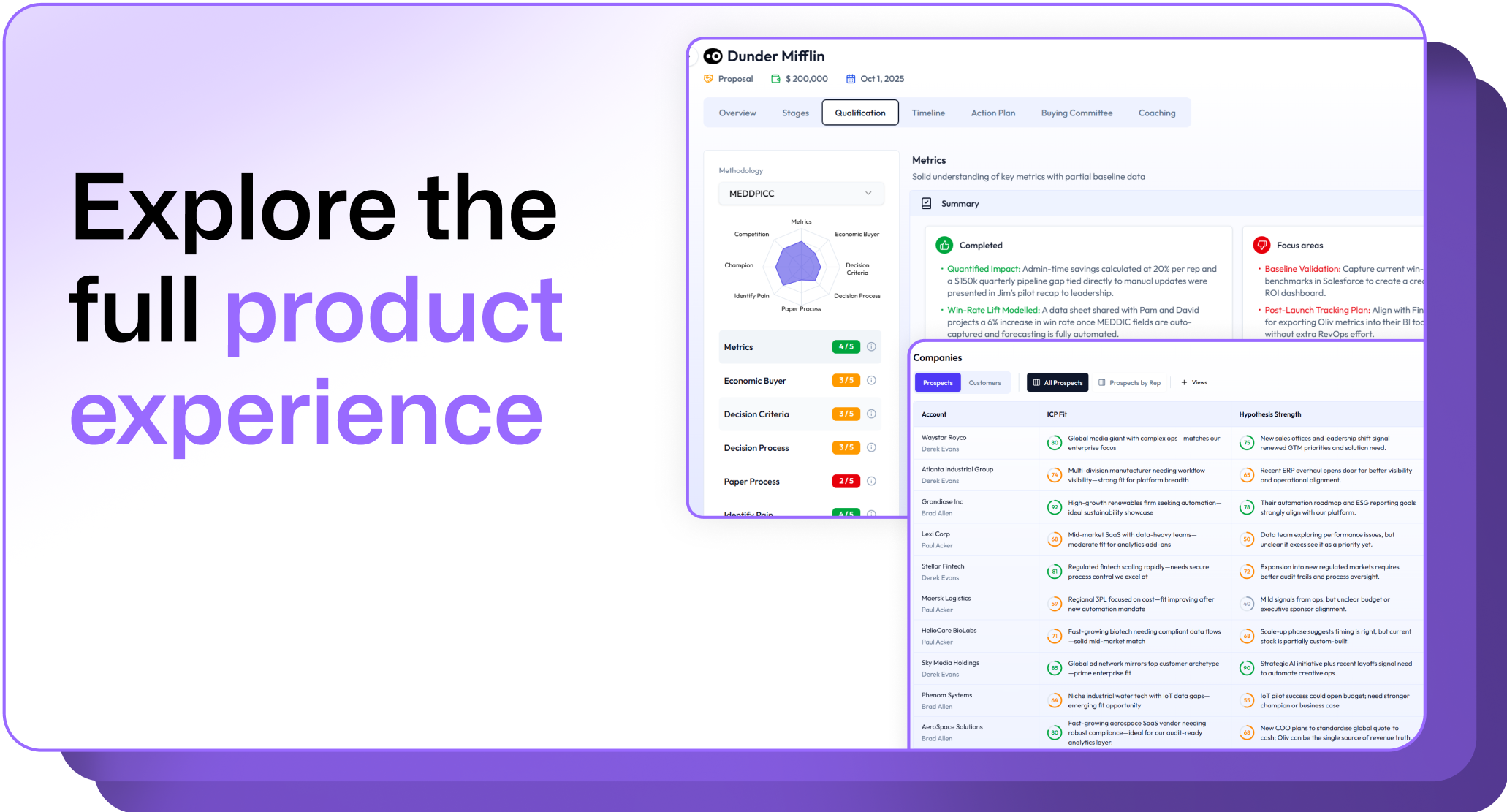
.avif)