12 Common Meeting Challenges and How to Fix Them: Agendas, Follow-Ups and Scripts for Sales and Virtual Calls
Written by
Ishan Chhabra
Last Updated :
September 9, 2026
Skim in :
13
mins
In this article
Revenue teams love Oliv
Here’s why:
All your deal data unified (from 30+ tools and tabs).
Insights are delivered to you directly, no digging.
AI agents automate tasks for you.
Thank you! Your submission has been received!
Oops! Something went wrong while submitting the form.
Meet Oliv’s AI Agents
Hi! I’m, Deal Driver
I track deals, flag risks, send weekly pipeline updates and give sales managers full visibility into deal progress
Hi! I’m, CRM Manager
I maintain CRM hygiene by updating core, custom and qualification fields all without your team lifting a finger
Hi! I’m, Forecaster
I build accurate forecasts based on real deal movement and tell you which deals to pull in to hit your number
Hi! I’m, Coach
I believe performance fuels revenue. I spot skill gaps, score calls and build coaching plans to help every rep level up
Hi! I’m, Prospector
I dig into target accounts to surface the right contacts, tailor and time outreach so you always strike when it counts
Hi! I’m, Pipeline tracker
I call reps to get deal updates, and deliver a real-time, CRM-synced roll-up view of deal progress
Hi! I’m, Analyst
I answer complex pipeline questions, uncover deal patterns, and build reports that guide strategic decisions
TL;DR
Twelve meeting challenges recur across teams, from no agreed purpose to no dated next step, and most are process failures with an observable symptom and a repeatable fix.
The expensive failure happens after the meeting ends, when a decision leaves the room with no owner, no deadline, and no record anyone can find later.
The fix is an artefact, not a behaviour: a five-field decision log written inside the meeting, in under a minute, by the person already facilitating it.
Cancel before you facilitate. A meeting earns its place only when a decision genuinely requires a conversation, and recurring invites are where you should test that first.
Virtual, hybrid, and customer calls fail differently, so fixes are tagged by format, including the majority of meetings that never get a calendar invite at all.
Track three metrics only: decision rate, action-item completion by due date, and how often the same item returns to a later agenda.
Q1. What are the most common meeting challenges, and what actually causes each one? [toc=1. Common Meeting Challenges]
Twelve challenges recur across teams: no agreed purpose, meetings that should be messages, overruns, unprepared attendees, dominant speakers, off-topic drift, decisions with no owner, no written record, tech failures, time-zone strain, disengagement, and no agreed next step. Most are process failures, not people failures. Each one has an observable symptom and a repeatable fix. Half of them only surface a week later, when the decision nobody wrote down gets re-litigated.
The diagnostic table
Find your symptom first. Then read the cause, not the advice.
Twelve Meeting Challenges: Symptom, Cause, Action, Owner, and Measure
Challenge
Observable symptom
Likely cause
Immediate action
Owner
Success measure
No agreed purpose
Invite has a title, no purpose line
Recurring invite nobody re-scoped
Add one outcome line to the invite
Organiser
Purpose stated in 100% of invites
Should have been a message
Nobody speaks except the presenter
Status habit, not a decision
Convert to a written update
Organiser
Meetings cancelled per month
Overruns
Last item gets four minutes
No minutes per item
Attach minutes to each item
Facilitator
Meetings ending on time
Unprepared attendees
Deck edited minutes before start
No pre-read deadline
Pre-read due 24 hours ahead
Item owner
Pre-reads sent on time
Dominant speakers
Two voices, six listeners
Open floor by default
Ask a named person a question
Facilitator
Speakers per meeting
Off-topic drift
New topic, same hour
No parking lot
Park it with an owner
Facilitator
Items parked, then closed
No decision owner
"Sounds good, let's align"
Decision rule never set
Name the owner aloud
Facilitator
Decisions with a named owner
No written record
People recall it differently
Notes exist, decisions do not
Write five fields, live
Facilitator
Decisions logged per meeting
Tech failures
Ten minutes lost to audio
No fallback agreed
Two-minute cap, then audio only
Host
Minutes lost to setup
Time-zone strain
The same person joins at 9pm
Fixed slot, spread team
Rotate the unsociable slot
Manager
Late-night meetings per person
Disengagement
Cameras off, replies slow
Attention split across screens
Cut length by 25%
Manager
Attendance and reply lag
No agreed next step
"We'll circle back"
Close was never scripted
State next step and date aloud
Meeting owner
External calls with a dated step
⏰ Purpose and preparation are the cheapest fixes
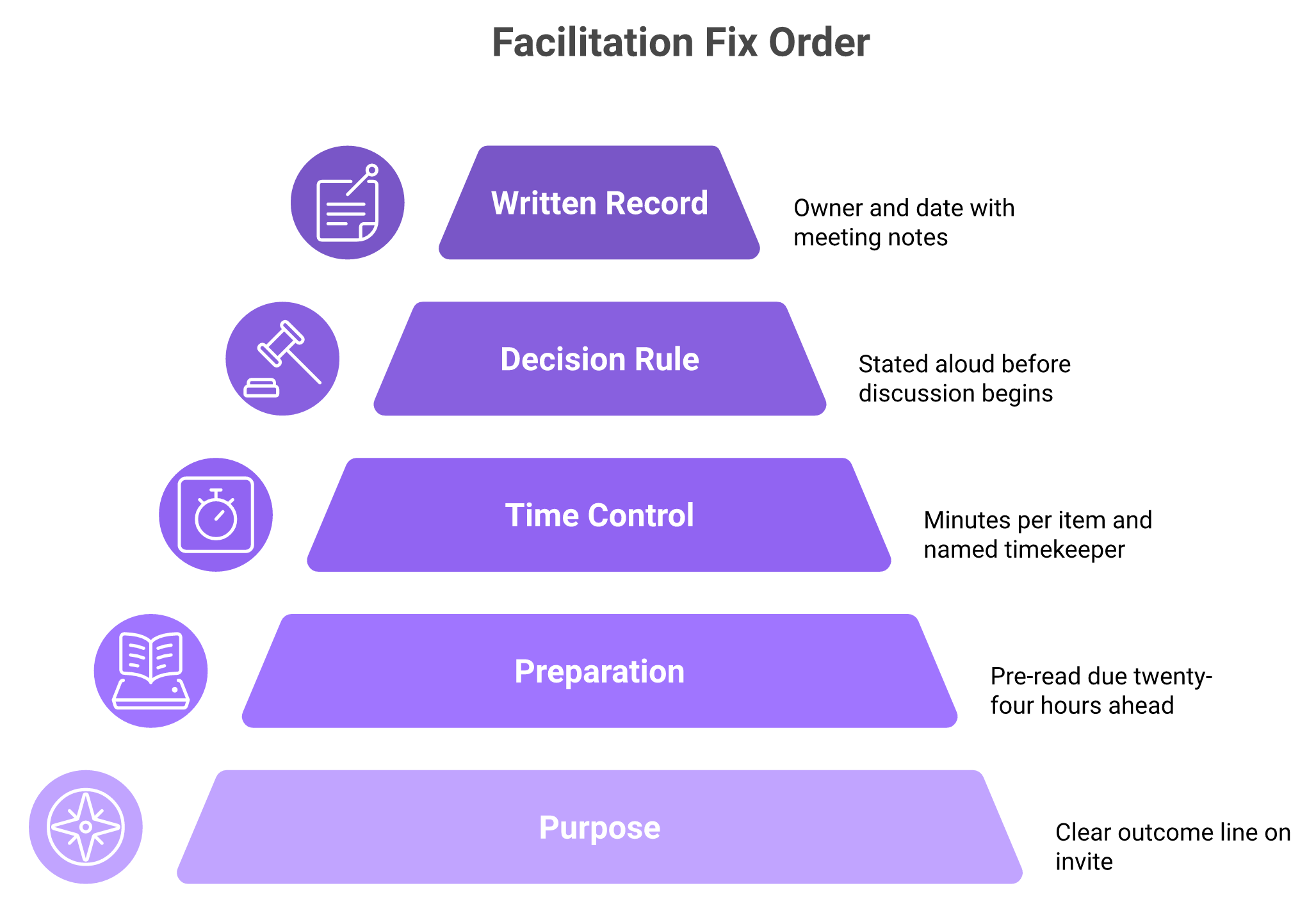
A meeting with no stated outcome cannot fail visibly, which is why it survives for years. Fix the invite line before you fix the facilitation, and treat meeting preparation for sales as the entry condition rather than an optional extra.
Preparation has a measurable signature. Microsoft's own telemetry found PowerPoint edits spike 122% in the final ten minutes before a meeting, and one in ten scheduled meetings is booked last-minute. That is the shape of a room nobody prepared for.
⚠️ Decisions and records are where the money goes
Repair the base layers first. Most teams start at time control and never reach the record.
Atlassian estimates 25 billion work hours a year are lost to ineffective collaboration inside the Fortune 500, and 93% of executives believe the same results are possible in half the time. Very little of that loss happens in the hour itself.
It happens when a decision leaves the room without an owner or a record. Users describe the same pattern from the inside, and it is the reason teams start looking at AI note-taking tools in the first place.
"Before Oliv, team members spent a significant amount of time taking notes during meetings, updating CRM records, tracking action items, and preparing follow-up communications. These manual tasks were time-consuming and often led to inconsistent documentation." — Verified User, Revenue Team Oliv AI G2 - Verified Review [23 Jun 2026]
"Oliv AI solves the challenge of manual sales documentation and inconsistent follow-ups." — Verified User, Sales Leader Oliv AI G2 - Verified Review [08 Jul 2026]
The last two rows of that table carry most of the cost. I cover why in the next two sections.
Q2. What do unproductive meetings actually cost, and which ones should you just cancel? [toc=2. Cost and the Cancel Test]
Professionals lose roughly two hours a week to meetings they consider pointless, and 26% say badly organised meetings damage client relationships. So the cost lands on revenue, not only on calendars. Before facilitating better, cancel. A meeting earns its place only when a decision genuinely requires a conversation. Apply that test to recurring invites first. If the last three instances produced information transfer and no decision, kill the invite.
📅 The calendar you already recognise
Four to six meetings a day. A pipeline review that has run for ninety minutes since before you joined. A weekly sync that nobody scheduled and nobody wants to be the one to cancel.
You already suspect the problem is volume. I think you are half right, and the half you are right about is the cheaper half to fix.
❌ Why both standard answers fail
The first standard answer is mass cancellation. It feels decisive, and it usually rebounds within a month, because the work the meeting was carrying moves nowhere.
The second is another agenda template. Atlassian found teams with poor meeting cultures spend around 50% more time in unnecessary meetings, which is not a template problem. Better paperwork on a meeting that should not exist is just tidier waste.
✅ What actually changed
Recording, transcription, and written updates quietly absorbed most information-transfer meetings. A status update can now be read in four minutes instead of attended in thirty.
That leaves a smaller, harder category behind. What survives is the meeting where options are unclear, tradeoffs are contested, or people need to hear each other change their minds, which is exactly where sales team collaboration earns the hour.
💰 The cancel test, applied this week
Open your recurring invites and run each one through four questions.
Run every recurring invite up these four steps before you try to facilitate it better.
What decision did the last three instances produce? If the answer is none, cancel it.
Could the same value arrive as a written update? If yes, convert it.
Who attends without owning a decision or an action? Remove them and send the record.
Does anyone in the invite know the purpose? If nobody does, rewrite the invite line or delete it.
Do this once, not quarterly. A single pass usually clears two to four hours a week, and the hours you win back show up in your sales productivity metrics.
Then stop. Doodle put the annual cost of poorly organised meetings at USD 541 billion in employee time, which is the number a VP reacts to. The client-relationship figure is the one I would actually take into a budget conversation, because it shows the loss reaching customers.
Here is the honest part. Most managers reading this cannot cancel the meeting that is annoying them. It belongs to someone senior, or it is the only hour a distributed team shares.
So the rest of this article is for the meetings that survive the test. My own view, and I hold it loosely, is that cancelling buys back time while the remaining meetings still leak value. Cancellation is a volume fix. The next section is about the leak.
Q3. Why do meetings produce no follow-up, and why does that cost more than a bad hour? [toc=3. The Follow-Up Failure]
Meetings mostly fail after they end. The hour can go well and still produce nothing, because the decision left the room in three people's memories instead of one written line with an owner and a date. A week later the same question returns, and the meeting repeats. Better facilitation has a ceiling here. The loss happens in the gap between deciding and recording, and only an artefact closes that gap.
🔁 The decision that did not survive the week
You have seen this one. A good discussion, real alignment, three nodding heads, and a clear sense that the thing is settled.
Nine days later someone asks the same question in Slack. Two people remember a different answer. The item goes back on an agenda, and the hour is spent twice.
❌ Why advice aimed at the room misses
Almost all meeting advice targets the hour: tighter agendas, fewer attendees, firmer facilitation. Those are real improvements, and they run out fast.
None of them touch what happens in the ninety seconds after everyone leaves. That is where the decision either becomes a record or becomes folklore. A perfectly facilitated meeting with no record still fails, which is why sales follow-up deserves more attention than the agenda does.
The expensive failure is not the hour, it is the ninety seconds after it, when the decision has nowhere to live.
📝 What changed, and what did not
Capturing the conversation used to be the hard part. Someone had to volunteer as note-taker, and you lost them as a participant for the hour.
Transcription made capture close to free. The bottleneck moved to confirmation, which is a different job. A transcript tells you what was said. It does not tell you what was decided, or who owns it, which is the practical limit of any approach to how to take meeting notes during sales calls.
✅ The fix is an artefact, not a behaviour
The fix is not more discipline. It is one small document: the decision, the owner, the date, what changes, and where the evidence sits.
Paul Axtell's guidance, published via Harvard Business Review, is to circulate the summary within an hour of the meeting ending. I would go further and write the decisions during the meeting, because memory decays fastest in the first hour.
Users describe the same split between a draft and a confirmed record.
"It does a fantastic job summarizing meetings in a really beautiful manner and even prepares reply emails to be reviewed and sent right after calls. The meeting summaries are solid, dealing with tasks like separating to-dos between the client and myself." — Verified User, Account Executive Oliv AI G2 - Verified Review [15 Jun 2026]
"The only downside is that the platform can be a bit glitchy at times, but the support team is always quick to address and resolve any bugs." — Verified User, Sales Team Oliv AI G2 - Verified Review [02 Jul 2026]
⚠️ The objection I have to concede
Your first reaction is probably that your team already has notes, and a decision log is one more document nobody maintains. That is fair, and it is usually true.
So the constraint matters more than the idea. The log has to be written inside the meeting, by the person already running it, in under a minute. It has to be the document you open at the start of the next meeting, not a parallel file.
One caution on the evidence. The CIPD's review of meeting research found no meta-analyses and mostly cross-sectional studies, so treat every published benchmark as directional. Test it on one recurring meeting instead.
Q4. What should a decision log contain, and how do you write one in under a minute? [toc=4. Decision Log and Action Items]
A decision log needs five fields and nothing more: the decision in one line, the owner, the deadline, what changes as a result, and where the evidence sits. Action items need three fields: a verb-led task, one named owner, and a date. Write both in the last four minutes, by the person already facilitating, not afterwards from memory. The test is not completeness. The test is whether this is the document you open at the start of the next meeting.
❌ Why parallel documents die
Most logs fail for one reason. They live somewhere nobody visits, so they compete with the notes doc instead of replacing it.
A log that is never read at the start of the next meeting has no consequence. Anything with no consequence gets skipped inside three weeks, which is the same reason most meeting summary templates stop being filled in.
The action-item template
Three fields. Nothing else earns its place.
Action-Item Template With Owner and Due Date
Task (verb first)
Owner (one name)
Due date
Send revised pricing sheet to Meera
Arjun
Thu 10 Sep
Confirm security review slot with IT
Priya
Fri 11 Sep
⭐ The decision log, with real rows
The extra two fields exist to stop re-litigation. "What changes" tells you why the decision mattered, and "evidence" tells you where to check.
Decision Log Format With Two Worked Examples
Decision
Owner
By when
What changes
Evidence
Move Northwind to a phased rollout
Arjun
12 Sep
Q3 close date shifts by three weeks
Call recording, 8 Sep, 14:00
Stop weekly deal desk, move to async
Priya
15 Sep
90 minutes returned to five managers
This log, item 2
Two rows is a normal meeting. If you have eight, you either ran a workshop or you are logging opinions as decisions.
The one-minute protocol
Do it in this order. The order is what makes it fast.
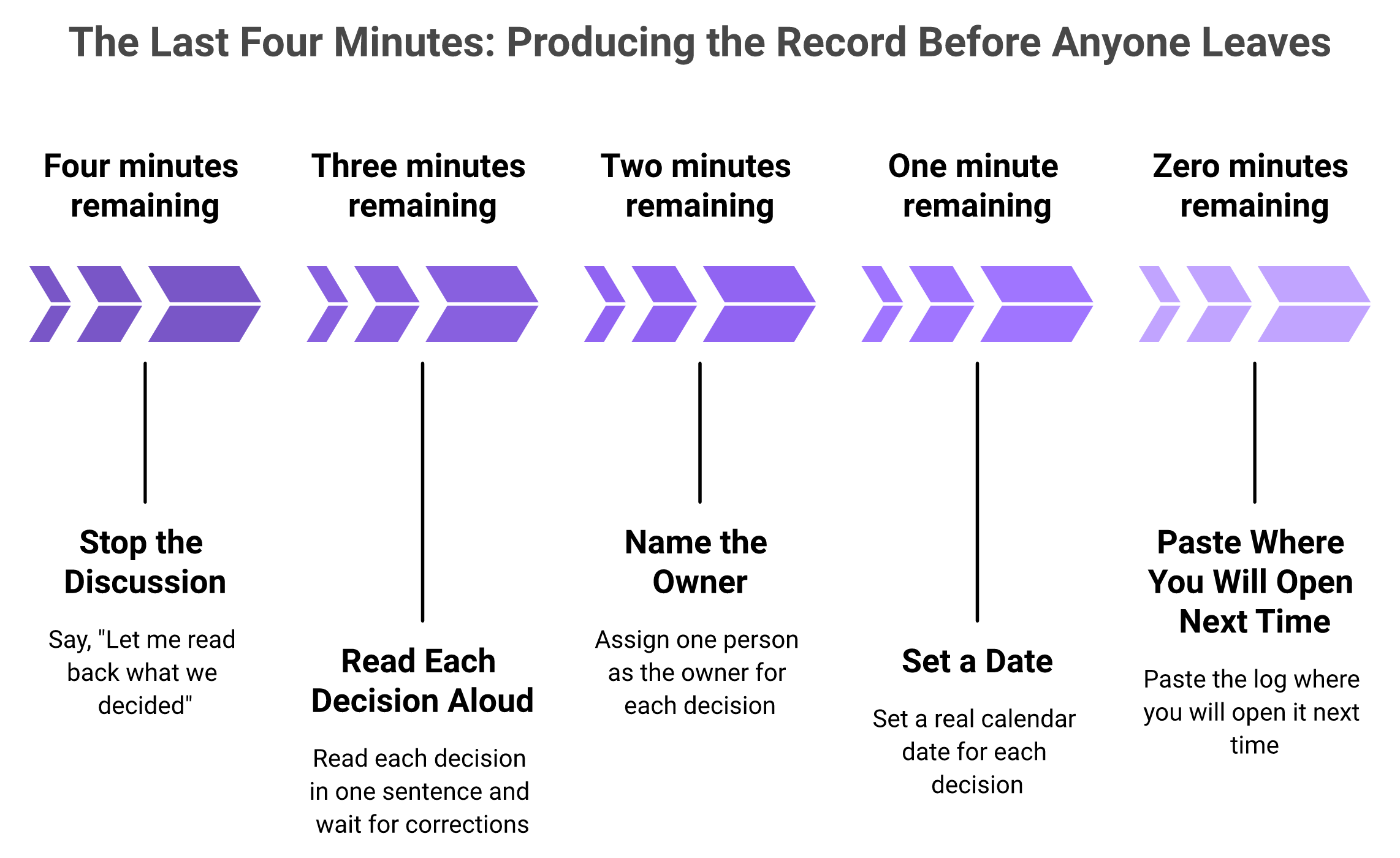
The log only survives if it is written in the room, by the person already running the meeting.
At four minutes remaining, stop the discussion. Say, "Let me read back what we decided."
Read each decision aloud in one sentence. Wait for someone to correct you.
Name the owner for each. One person, never a team, never "RevOps".
Set a date. A real calendar date, never "next sprint".
Paste the two tables into the same place you will open next time.
⚠️ The decay rules
Three rules keep the artefact alive. I have watched each one break in practice.
One owner per line. Shared ownership is how items go quiet for a month.
A date, not a horizon. "End of quarter" is not a date anyone feels.
One home. If the log lives in two places, it lives in neither.
There is a fourth rule I hold with less confidence. I would rather log three decisions well than eight badly, even though that means some commitments go unrecorded.
The reason is adoption. A log that costs sixty seconds survives; a log that costs ten minutes gets abandoned in week three, and then you are back to memory. Where this means recommending less than you expected, I am recommending less on purpose, and the same logic applies to every sales process automation habit you try to install this quarter.
Q5. How do you write an agenda people actually use, for a discovery call and a pipeline review? [toc=5. Agendas That Get Used]
A usable agenda states one outcome, lists items as questions with minutes attached, and names who owns each item. Two examples with different jobs make the point. A 30-minute discovery call owes you a qualified problem statement and a dated next step. A 30-minute pipeline review owes you a changed forecast position on three named deals, not a status recital. If nobody can state the outcome aloud, you have a topic list.
⭐ Three properties, and nothing else
Most agendas fail because they list topics. A topic has no end condition, so the discussion stops when the clock stops.
Write items as questions instead. Attach minutes to each one, and name the person who owns it. Lucid's and Fellow's agenda guidance both land on the same core move, which is sharing a goal-led agenda before the meeting rather than during it.
The 30-minute discovery call agenda
The outcome: a written problem statement the buyer agrees with, plus a dated next step. If you run these weekly, the structure pairs with how you already plan sales discovery calls.
30-Minute Discovery Call Agenda With Owners
Minutes
Item (as a question)
Owner
0 to 2
What do we each want out of this call?
Seller
2 to 5
Recording and note-taking consent, stated aloud
Seller
5 to 15
What is happening today, and what does it cost you?
Buyer
15 to 22
Who else is affected, and who signs off?
Buyer
22 to 27
Does this problem statement read correctly to you?
Seller
27 to 30
What is the next step, and on what date?
Seller
Close it out loud. "So the next step is a security review with Raj on 18 September, and I will send the problem statement today."
⏰ The 30-minute pipeline review agenda
The outcome is different, so the shape is different. This meeting owes you a changed position on named deals, not a tour of the pipeline, which is why deal tracking software should carry the status you no longer read aloud.
30-Minute Internal Pipeline Review Agenda With Owners
Minutes
Item (as a question)
Owner
0 to 3
What changed since last week on the three flagged deals?
Manager
3 to 13
Deal 1: what is the single blocker, and who clears it?
Rep
13 to 21
Deal 2: what evidence moves this out of commit?
Rep
21 to 27
Deal 3: what do we stop doing here?
Rep
27 to 30
What did we decide, who owns it, by when?
Manager
I cut four things to get the 90-minute version down to this. Full pipeline walkthroughs, deals under a threshold, any deal with no change since last week, and rep-by-rep status reporting.
✅ What replaces what you cut
Status moves to writing, read before the call. That is the trade, and it only works if the written update actually exists.
Three deals per review is the part people push back on. My view is that a review which touches every deal changes none of them, though I hold that loosely for teams running very short cycles.
📝 The handoff that makes it stick
Both agendas end with the same item, which is not an accident. The last three minutes exist to produce the record described earlier in this article.
The agenda opens the meeting, and the decision log closes it. If the final item gets squeezed, you have run a good conversation and produced nothing durable, which is exactly the failure this whole piece is about.
Q6. How do you stop meetings running over, drifting off-topic, or filling with unprepared attendees? [toc=6. Timeboxing, Drift and Prep]
Overruns, drift, and unpreparedness share one cause. Nobody owns the clock or the entry conditions. Attach minutes to each agenda item, name a timekeeper who is not the facilitator, park anything that needs a different set of people, and set a hard pre-read deadline 24 hours out. Cap attendance at the people who own a decision or an action, and send everyone else the record. Microsoft's telemetry shows deck edits spiking 122% in the final ten minutes before a meeting, which is the measurable signature of a room nobody prepared for.
⏰ Control one: the clock has an owner
Per-item minutes only work when someone calls them out. Give that job to a person who is not running the discussion, because the facilitator is already busy listening.
Then cut length. Trim every recurring internal meeting by 25% for two weeks and see what actually breaks. Atlassian found 93% of executives believe the same results are achievable in half the time, so the risk here is smaller than it feels.
Timeboxing Controls, Owners, and Success Measures
Control
Owner
Success measure
Minutes per item
Facilitator
Meetings ending on time
Timekeeper called out
Timekeeper
Items that overrun
25% length cut
Manager
Hours returned per week
❌ Control two: park it, do not chase it
Drift is usually a real topic arriving at the wrong meeting. Facilitator guidance from INIFAC treats the parking lot as the standard move here, and I agree with one condition attached.
The parked item must land in the decision log with an owner and a date. A parking lot with nothing leaving it is just a list of things you have agreed to ignore.
⚠️ Control three: entry conditions for preparation
Set the pre-read deadline at 24 hours, and state what happens if it is missed. Vague expectations are why nobody reads anything, and this is the gap an AI meeting preparation tool is supposed to close.
When nobody has read it, do not narrate the document. Give the room four silent minutes to read, then start. It feels awkward once and then it fixes itself.
Users describe the same shift when prep material arrives before the call rather than during it.
"I appreciate that Oliv.ai researches prospect accounts before every call and sends deal updates and talking points, which helps me prepare for meetings without sifting through tons of data and emails." — Verified User, Account Executive Oliv AI G2 - Verified Review [23 Jun 2026]
Run the decision-or-action test. Does this person own a decision, or an action that follows from one?
If not, they get the record instead of the invite. Microsoft found one in ten scheduled meetings is booked last-minute, and those are the invites that collect passengers.
Here is the unpopular part. Starting on time means starting without the senior person who is late, once, deliberately. I have done it, it is uncomfortable for about ninety seconds, and it resets the meeting for months.
One boundary worth stating. The 25% cut and the timekeeper apply to recurring internal meetings. Do not run a stopwatch on a customer call, because the buyer sets that pace, and the same restraint belongs in any sales call planning guide you hand a new rep.
Q7. How do you reach an actual decision when the room will not converge? [toc=7. Reaching a Decision]
Pick the decision rule before the discussion, not after. Three rules cover almost everything: consent (proceed unless someone objects with a reason), a straight owner call after input, or a ranked vote when the options are genuinely comparable. State the rule aloud at the top of the item. When the decision-maker is absent, do not defer. Agree a recommendation, name who carries it to them, and set the date their answer is due. An undecided item with a named carrier and a deadline is still a decision.
🔁 The meeting that ends in agreement nobody acts on
You have sat in this one. Good discussion, heads nodding, someone says "great, we're aligned," and the meeting ends on time.
Nothing moves that week. Alignment felt like a decision, but nobody could tell you who owned what, or by when.
❌ Why consensus-by-default fails
Most teams never choose a decision rule. They default to consensus, which sounds fair and is not.
Consensus-by-default hands the outcome to whoever talks longest or ranks highest. Facilitation literature has documented this for decades, alongside the mechanics used to counter it, including ranking, voting, and decision matrices.
✅ What changes when you name the rule first
Teams that state the rule upfront decide faster, because the discussion has a known end condition. People argue differently when they know a vote is coming versus when they know one person decides.
The rule is context-specific, which is the part most advice skips. A pricing exception and a roadmap tradeoff do not deserve the same mechanism.
The three rules, and when to use each
Three Decision Rules and When to Apply Them
Rule
How it works
Use it when
Consent
Proceed unless someone objects with a stated reason
The default is reversible and cheap
Owner call
Everyone inputs, one named person decides
Accountability sits clearly with one role
Ranked vote
Compare options, rank, highest wins
Options are genuinely comparable
In a pipeline review I use the owner call almost every time. The manager decides the forecast category after hearing the rep, because a vote on someone else's deal is theatre, and that habit is what makes evidence-based forecast commits possible.
Voting earns its place maybe twice a year, usually for something like choosing between three event sponsorships. If a vote feels tempting on a deal call, the real problem is that nobody knows who owns the call.
⚠️ When the decision-maker does not show up
Do not roll the item forward. That is how a two-week delay becomes six, and it is one of the quieter causes of deal slippage.
Do this instead, in the meeting.
Agree the recommendation the room would make.
Name one person who carries it to the absent decision-maker.
Set the date the answer is due, as a calendar date.
Log all three, and read them at the start of the next meeting.
📝 The test that tells you it worked
Watch for re-litigation. If the same item returns to an agenda twice, the rule was never set, or the owner was never named.
Gartner's research shows buyers spend roughly 17% of the purchase journey with suppliers, and 5% to 6% with any single rep. Internally, that is the argument for deciding in the room you already have, because the next one costs more than you think.
Q8. What do you actually say to a dominant speaker, a silent room, or failed technology? [toc=8. Facilitator Scripts]
Scripts beat principles, because the hard part is the first sentence. Dominant speaker: "That's useful. I want two more views before we decide. Priya, what's your read?" Silent room: ask a named person a specific question, never the group an open one. Interrupted contributor: double back with "Sam, you were making a point." Failed technology: cap troubleshooting at two minutes, then switch to audio and carry on. Every line needs a follow-through action, or it reads as theatre.
⭐ The dominant speaker
Symptom: two voices, six listeners, and the same person answering questions aimed at someone else.
Say this. "That's useful. I want two more views before we decide. Priya, what's your read?"
Then follow through. Come back to the first speaker later, on purpose, so the redirect reads as sequencing rather than a shutdown. Facilitator guidance published by Parents Victoria makes the same point, which is that most people do not know they are dominating.
If the line fails once, get more specific. "I want to hear from people who have not spoken yet."
❌ The silent or disengaged room
Symptom: cameras off, slow replies, and nobody answering an open question.
Never ask the group. Ask a named person something narrow. "Arjun, you ran the last renewal like this. What broke?"
The follow-through matters more than the question. Write down what they said and attribute it in the record, because people speak up in meeting two when meeting one showed their input mattered. That is also the practical core of active listening in sales.
Microsoft's data shows workers get interrupted roughly every two minutes during the day, so silence is often attention loss rather than disagreement.
✅ The interrupted contributor
Symptom: someone gets talked over, and the point vanishes.
Say this. "Sam, you were making a point. Finish it." Paul Axtell's guidance, published through Harvard Business Review, calls this doubling back, and it costs you eight seconds.
Real-time nudges help managers spot these moments at scale, which is what reviewers describe here, and it is the same signal that feeds sales coaching skill gaps work.
"The AI surfaces objections, competitor mentions, and budget discussions automatically, providing on-the-spot coaching for my reps." — Verified User, Sales Manager Oliv AI G2 - Verified Review [08 Jul 2026]
"The main downside is that the analytics could be more customizable. It's a minor issue, but having more flexibility in how I view and configure analytics would make it even better." — Verified User, Sales Manager Oliv AI G2 - Verified Review [08 Jul 2026]
⚠️ Failed technology
Symptom: four people troubleshooting audio while everyone waits.
Say this. "Let's give it two minutes. If it isn't fixed, we go audio only and I'll share the deck after."
Then actually hold the cap. Agreeing the fallback before it happens is what makes the line usable, because nobody wants to be the person who ends the fiddling.
📝 The awkwardness nobody mentions
Interrupting a senior person costs you something socially. I will not pretend otherwise, because that is why most managers never do it.
The follow-through is what buys it back. Redirect, then return to them, then put their point in the record with their name on it. Two rounds of that and the room stops reading it as a challenge, which is a habit worth building into your wider guide to sales communication.
One boundary. Decision phrasing sits in the previous section, because deciding is a rule choice, not a script.
Q9. What breaks in virtual and hybrid meetings, including the ones nobody scheduled? [toc=9. Virtual, Hybrid and Ad-Hoc]
Virtual meetings add four failures. Turn-taking collapses without visual cues, time-zone spread pushes calls into someone's evening, attention leaks to a second screen, and hybrid rooms quietly demote remote attendees to observers. Agenda advice reaches almost none of them, because Microsoft found 57% of meetings are ad hoc with no calendar invite. For those, the minimum structure is a one-line purpose in the chat and a two-line record at the end.
🖥️ The hybrid room where three people talk
Five people in a conference room, three joining remotely, and one shared microphone at the far end of the table. The remote three hear about 70% of the side comments.
By minute twenty they have stopped trying to interject. Nobody excluded them on purpose, and that is exactly the problem.
❌ Why the old facilitation advice misses
Most facilitation guidance assumes one room and shared visual cues. It tells you to read the room, which only works when there is one room to read.
In a hybrid setup, those cues are unevenly distributed. The people with the cues run the meeting, and the people without them go quiet.
⏰ What actually changed
Two shifts matter. Microsoft reports nearly a third of meetings now span time zones, up 35% since 2021, and meetings after 8pm are up 16% year over year.
The second shift is attention. Workers get interrupted roughly every two minutes, so the constraint is no longer finding a slot. It is holding attention once you have one, which is why teams start hunting for sales productivity tools rather than another calendar plugin.
The fixes, tagged by format
Virtual, Hybrid, and Ad-Hoc Meeting Fixes by Format
Fix
Applies to
Owner
Round-robin by name, not open floor
Virtual and hybrid only
Facilitator
One person, one screen, one mic
Hybrid only
Host
Rotate the unsociable time slot
Distributed teams only
Manager
Two-minute cap on tech troubleshooting
Virtual only
Host
One-line purpose in chat before you dial
Ad-hoc calls
Caller
Two-line record at the end
All formats
Caller
Here is the specific one I care about. If your team is in Bengaluru and your buyers are in the US, someone takes a 9.30pm IST call every single week.
If the slot never rotates, that person absorbs the cost quietly for a year, then leaves. Rotate it, or pay for it in attrition.
✅ The ad-hoc minimum
Most calls will never get an agenda, so stop pretending they will. Two lines is the realistic floor.
Type the purpose in chat before the call starts. When it ends, type the decision and the owner in the same thread. That is thirty seconds, and it survives.
Reviewers describe the practical version of this, which is capture that works across whichever platform the call happens on, and it is the main reason teams compare meeting recorder picks for productivity.
"Oliv.ai integrates seamlessly with HubSpot, Zoom, and Google Meet, making my workflow smoother." — Verified User, Account Manager Oliv AI G2 - Verified Review [17 Jun 2026]
"The only downside I've noticed is that the mobile app is a bit basic compared to the desktop platform." — Verified User, Sales Leader Oliv AI G2 - Verified Review [08 Jul 2026]
One caveat on the data. The Microsoft figures come from product telemetry, not a controlled study, so read them as scale signals rather than precise rates.
Q10. What goes wrong in customer meetings that does not go wrong internally? [toc=10. Customer Call Failures]
Customer meetings fail differently, because you do not control the room and rarely get a second hour. Three failures dominate. The call ends with "we'll circle back" instead of a dated next step. Only one contact ever attends, so the deal has a single point of failure. The rep types instead of listening, producing a good record of a shallow conversation. Gartner puts buyer time with any single supplier rep at 5% to 6% of the purchase journey, which is why a wasted call is expensive.
📉 The discovery call that felt great
Forty minutes of good conversation. The buyer talked, the rep asked reasonable questions, and everybody left the call feeling positive.
Two weeks later the deal has not moved. There was never a dated next step, so the momentum had nowhere to go.
❌ The old answer traded listening for records
The traditional fix was better note discipline. Take detailed notes, log them the same day, and nothing gets lost.
That trade quietly cost you the conversation. A rep typing while a buyer explains a problem hears the words and misses the hesitation, which is where the real objection lives, and it is why handling objections in sales starts with attention rather than scripts.
⏰ Why the cost per call went up
Buyer access has shrunk. Gartner's research shows buyers spend roughly 17% of the journey with all suppliers combined, and around two thirds now prefer a rep-free buying experience.
So you get fewer conversations, and each one carries more weight. A call that produces no next step is not neutral, because it consumes a slice of a very small allowance.
The three fixes
Customer Call Failures, Fixes, and Success Measures
Failure
Fix
Success measure
No dated next step
State the step and date aloud before hanging up
Percentage of calls with a dated step
Single-threading (one contact only)
Name the missing stakeholder in the call
Contacts engaged per deal
Typing instead of listening
Separate capture from attention
Objections surfaced per call
Use one closing question on every external call. "So the next step is X, on Y date, and I will send Z today. Have I got that right?"
That sentence does two jobs. It creates the record, and it forces the buyer to either confirm or reveal that they are not ready.
⭐ The multithreading check to run today
Open your top five deals. Count how many people from the buying side have attended a call in the last thirty days.
If any deal shows one name, that deal has a single point of failure. Ask in the next call, "who else feels this problem?" and go from there, then record the answer where your deal intelligence already lives.
⚠️ The honest tradeoff
A rep taking good notes is a rep half-listening. I think pretending otherwise is why note-taking advice never sticks with sellers who care about the conversation.
Reviewers describe the same split between attention and documentation.
"It gives a clear view of deal health risk and next steps while also providing helpful call summaries and follow-up recommendations." — Verified User, RevOps Lead Oliv AI G2 - Verified Review [23 Jun 2026]
"There isn't much to dislike. The platform covers most of our needs." — Verified User, RevOps Lead Oliv AI G2 - Verified Review [23 Jun 2026]
Customer calls are one of three categories in this article, not the whole of it. Internal meetings fail for different reasons, and the fixes do not transfer cleanly.
Q11. Should meetings be recorded, and who needs to consent? [toc=11. Recording and Consent]
Record only with disclosure. Several US states require consent from every participant, not just one, so silently recording a multi-party call carries real exposure. The workable default is a line in the invite plus a spoken confirmation at the start. If an AI notetaker or agent joins, say so, because EU transparency rules enforceable from 2 August 2026 require AI systems interacting with people to make their artificial nature clear. Log the consent somewhere retrievable, since the useful question later is whether you can show it.
⚠️ One-party versus all-party consent
Federal US law generally allows one-party consent, meaning one participant can agree to the recording. Several states go further and require everyone on the call to agree.
Commonly cited all-party states include California, Connecticut, Florida, Illinois, Maryland, Massachusetts, Michigan, Montana, Nevada, New Hampshire, and Pennsylvania. On a multi-state sales call, assume the strictest rule applies.
The two lines you actually need
Put the first in the calendar invite, and say the second out loud.
Recording Disclosure Wording for Invites and Call Openings
Where
Wording
Invite
"This call will be recorded and transcribed for notes. Tell me if you would prefer we do not."
Opening (spoken)
"Quick note before we start: I am recording this for notes, and an AI notetaker is on the call. Any objection?"
Then pause for two seconds. A question nobody can answer is not consent.
🤖 Disclosing the AI notetaker
The EU AI Act's transparency obligations under Article 50 became enforceable on 2 August 2026. Systems that interact with people must make clear that they are AI, and certain AI-generated content must be marked.
Penalties for transparency breaches run to EUR 15 million or 3% of worldwide turnover, with higher ceilings for the gravest violations. If you sell into the EU, treat bot disclosure as standard, not optional, and fold it into your wider AI CRM trust and governance review.
📝 Where consent gets logged
Verbal consent that nobody recorded is a memory, not a record. Keep it simple and put it in one place.
Add a consent field to the account or opportunity record in your CRM.
Log the date, who agreed, and which call it covered.
Re-ask when new attendees join a recurring external call.
Give one person ownership of the field, usually the deal owner.
Here is where operators get caught. A recurring customer call where consent was given once, in 2024, by a champion who has since left the account.
Three new people have joined that call since. Nobody asked them, and nobody would be able to show that anyone did, which is a CRM data quality failure as much as a compliance one.
⏰ One practical default
If you are unsure, disclose more than you think you need. The cost of one extra sentence at the top of a call is nothing. The cost of an undisclosed recording surfacing during a security review is not.
A caveat worth stating plainly. This is process guidance, not legal advice, and consent rules vary by state, country, and sector.
Check your own jurisdictions with counsel, especially if you record calls with participants in the EU, India, and multiple US states in the same week.
Q12. How do you know your meetings are improving, and can the record be produced for you? [toc=12. Measuring and Automating]
Three metrics are enough. Decision rate (decisions made divided by agenda items), action-item completion by the due date, and re-litigation count, meaning how often an item returns. Track one recurring meeting for two weeks before and after a change, because the research base is mostly cross-sectional and no benchmark transfers cleanly. On the record itself, Oliv AI's Meeting Assistant drafts the post-call record and follow-up from the conversation, though decisions and commitments still need a named human to confirm them before anyone treats them as agreed.
🔁 The manual log that survives three weeks
Every team that adopts a decision log starts strong. Week one is complete, week two is thinner, and by week four somebody forgot to open it.
That is not a discipline problem. It is a cost problem, because the log competes with the notes doc for the same sixty seconds.
❌ Why "did it feel productive" is not a metric
The old answer to record-keeping was a designated note-taker. That cost you a participant for the whole hour.
The old answer to measurement was a vibe check at the end. Atlassian found 93% of executives believe the same results are achievable in half the time, which tells you how little the vibe check reveals.
The three metrics, defined
Three Meeting Health Metrics and How to Calculate Them
Metric
How to calculate
What good looks like
Decision rate
Decisions made divided by agenda items
Rising over four weeks
Action-item completion
Items closed by due date divided by items created
Stable above your baseline
Re-litigation count
Items returning to a later agenda
Falling toward zero
Published metric frameworks list many more, including meeting ROI and engagement scores. Three is the number people actually maintain, and they sit comfortably alongside the sales productivity metrics you already report.
⭐ What automation genuinely does here
Oliv AI's Meeting Assistant produces the draft record. Decisions, commitments, and next steps are pulled from the conversation itself, the follow-up is drafted alongside it, and CRM fields are populated from what was said rather than from a rep's end-of-day recall.
The boundary matters more than the capability. This is the first draft of the decision log, and not the log itself, which is the honest limit of every approach to AI meeting summaries.
Before anyone treats a line as agreed, the person who ran the meeting confirms the decisions block, corrects owners and dates, and publishes it. That step takes roughly sixty seconds, and it is what turns a summary into a record the next meeting can open. Where the conversation was ambiguous, the draft will be ambiguous too, and this is where that gets resolved.
Reviewers describe both sides of that.
"It helps in automating and updating our CRM after calls, provides a clear deal summary, and sends follow-up emails, allowing managers to coach their reps with actionable insight rather than just going through call recordings." — Verified User, Sales Manager Oliv AI G2 - Verified Review [26 Jun 2026]
"I'd love to see few more options to customize dashboards and reports for different teams." — Verified User, Sales Manager Oliv AI G2 - Verified Review [26 Jun 2026]
⚠️ What I will not claim
No summariser captures every detail, and any vendor telling you otherwise is describing a wish. I would rather you treat the output as a candidate log that a human signs off, whichever note-taking AI you end up using.
My read, held with some uncertainty, is that confirmation is now the scarce step rather than capture. Run the two-week test on one recurring meeting and trust that over any benchmark, including the ones in this article.
Q1. What are the most common meeting challenges, and what actually causes each one? [toc=1. Common Meeting Challenges]
Twelve challenges recur across teams: no agreed purpose, meetings that should be messages, overruns, unprepared attendees, dominant speakers, off-topic drift, decisions with no owner, no written record, tech failures, time-zone strain, disengagement, and no agreed next step. Most are process failures, not people failures. Each one has an observable symptom and a repeatable fix. Half of them only surface a week later, when the decision nobody wrote down gets re-litigated.
The diagnostic table
Find your symptom first. Then read the cause, not the advice.
Twelve Meeting Challenges: Symptom, Cause, Action, Owner, and Measure
Challenge
Observable symptom
Likely cause
Immediate action
Owner
Success measure
No agreed purpose
Invite has a title, no purpose line
Recurring invite nobody re-scoped
Add one outcome line to the invite
Organiser
Purpose stated in 100% of invites
Should have been a message
Nobody speaks except the presenter
Status habit, not a decision
Convert to a written update
Organiser
Meetings cancelled per month
Overruns
Last item gets four minutes
No minutes per item
Attach minutes to each item
Facilitator
Meetings ending on time
Unprepared attendees
Deck edited minutes before start
No pre-read deadline
Pre-read due 24 hours ahead
Item owner
Pre-reads sent on time
Dominant speakers
Two voices, six listeners
Open floor by default
Ask a named person a question
Facilitator
Speakers per meeting
Off-topic drift
New topic, same hour
No parking lot
Park it with an owner
Facilitator
Items parked, then closed
No decision owner
"Sounds good, let's align"
Decision rule never set
Name the owner aloud
Facilitator
Decisions with a named owner
No written record
People recall it differently
Notes exist, decisions do not
Write five fields, live
Facilitator
Decisions logged per meeting
Tech failures
Ten minutes lost to audio
No fallback agreed
Two-minute cap, then audio only
Host
Minutes lost to setup
Time-zone strain
The same person joins at 9pm
Fixed slot, spread team
Rotate the unsociable slot
Manager
Late-night meetings per person
Disengagement
Cameras off, replies slow
Attention split across screens
Cut length by 25%
Manager
Attendance and reply lag
No agreed next step
"We'll circle back"
Close was never scripted
State next step and date aloud
Meeting owner
External calls with a dated step
⏰ Purpose and preparation are the cheapest fixes
A meeting with no stated outcome cannot fail visibly, which is why it survives for years. Fix the invite line before you fix the facilitation, and treat meeting preparation for sales as the entry condition rather than an optional extra.
Preparation has a measurable signature. Microsoft's own telemetry found PowerPoint edits spike 122% in the final ten minutes before a meeting, and one in ten scheduled meetings is booked last-minute. That is the shape of a room nobody prepared for.
⚠️ Decisions and records are where the money goes
Repair the base layers first. Most teams start at time control and never reach the record.
Atlassian estimates 25 billion work hours a year are lost to ineffective collaboration inside the Fortune 500, and 93% of executives believe the same results are possible in half the time. Very little of that loss happens in the hour itself.
It happens when a decision leaves the room without an owner or a record. Users describe the same pattern from the inside, and it is the reason teams start looking at AI note-taking tools in the first place.
"Before Oliv, team members spent a significant amount of time taking notes during meetings, updating CRM records, tracking action items, and preparing follow-up communications. These manual tasks were time-consuming and often led to inconsistent documentation." — Verified User, Revenue Team Oliv AI G2 - Verified Review [23 Jun 2026]
"Oliv AI solves the challenge of manual sales documentation and inconsistent follow-ups." — Verified User, Sales Leader Oliv AI G2 - Verified Review [08 Jul 2026]
The last two rows of that table carry most of the cost. I cover why in the next two sections.
Q2. What do unproductive meetings actually cost, and which ones should you just cancel? [toc=2. Cost and the Cancel Test]
Professionals lose roughly two hours a week to meetings they consider pointless, and 26% say badly organised meetings damage client relationships. So the cost lands on revenue, not only on calendars. Before facilitating better, cancel. A meeting earns its place only when a decision genuinely requires a conversation. Apply that test to recurring invites first. If the last three instances produced information transfer and no decision, kill the invite.
📅 The calendar you already recognise
Four to six meetings a day. A pipeline review that has run for ninety minutes since before you joined. A weekly sync that nobody scheduled and nobody wants to be the one to cancel.
You already suspect the problem is volume. I think you are half right, and the half you are right about is the cheaper half to fix.
❌ Why both standard answers fail
The first standard answer is mass cancellation. It feels decisive, and it usually rebounds within a month, because the work the meeting was carrying moves nowhere.
The second is another agenda template. Atlassian found teams with poor meeting cultures spend around 50% more time in unnecessary meetings, which is not a template problem. Better paperwork on a meeting that should not exist is just tidier waste.
✅ What actually changed
Recording, transcription, and written updates quietly absorbed most information-transfer meetings. A status update can now be read in four minutes instead of attended in thirty.
That leaves a smaller, harder category behind. What survives is the meeting where options are unclear, tradeoffs are contested, or people need to hear each other change their minds, which is exactly where sales team collaboration earns the hour.
💰 The cancel test, applied this week
Open your recurring invites and run each one through four questions.
Run every recurring invite up these four steps before you try to facilitate it better.
What decision did the last three instances produce? If the answer is none, cancel it.
Could the same value arrive as a written update? If yes, convert it.
Who attends without owning a decision or an action? Remove them and send the record.
Does anyone in the invite know the purpose? If nobody does, rewrite the invite line or delete it.
Do this once, not quarterly. A single pass usually clears two to four hours a week, and the hours you win back show up in your sales productivity metrics.
Then stop. Doodle put the annual cost of poorly organised meetings at USD 541 billion in employee time, which is the number a VP reacts to. The client-relationship figure is the one I would actually take into a budget conversation, because it shows the loss reaching customers.
Here is the honest part. Most managers reading this cannot cancel the meeting that is annoying them. It belongs to someone senior, or it is the only hour a distributed team shares.
So the rest of this article is for the meetings that survive the test. My own view, and I hold it loosely, is that cancelling buys back time while the remaining meetings still leak value. Cancellation is a volume fix. The next section is about the leak.
Q3. Why do meetings produce no follow-up, and why does that cost more than a bad hour? [toc=3. The Follow-Up Failure]
Meetings mostly fail after they end. The hour can go well and still produce nothing, because the decision left the room in three people's memories instead of one written line with an owner and a date. A week later the same question returns, and the meeting repeats. Better facilitation has a ceiling here. The loss happens in the gap between deciding and recording, and only an artefact closes that gap.
🔁 The decision that did not survive the week
You have seen this one. A good discussion, real alignment, three nodding heads, and a clear sense that the thing is settled.
Nine days later someone asks the same question in Slack. Two people remember a different answer. The item goes back on an agenda, and the hour is spent twice.
❌ Why advice aimed at the room misses
Almost all meeting advice targets the hour: tighter agendas, fewer attendees, firmer facilitation. Those are real improvements, and they run out fast.
None of them touch what happens in the ninety seconds after everyone leaves. That is where the decision either becomes a record or becomes folklore. A perfectly facilitated meeting with no record still fails, which is why sales follow-up deserves more attention than the agenda does.
The expensive failure is not the hour, it is the ninety seconds after it, when the decision has nowhere to live.
📝 What changed, and what did not
Capturing the conversation used to be the hard part. Someone had to volunteer as note-taker, and you lost them as a participant for the hour.
Transcription made capture close to free. The bottleneck moved to confirmation, which is a different job. A transcript tells you what was said. It does not tell you what was decided, or who owns it, which is the practical limit of any approach to how to take meeting notes during sales calls.
✅ The fix is an artefact, not a behaviour
The fix is not more discipline. It is one small document: the decision, the owner, the date, what changes, and where the evidence sits.
Paul Axtell's guidance, published via Harvard Business Review, is to circulate the summary within an hour of the meeting ending. I would go further and write the decisions during the meeting, because memory decays fastest in the first hour.
Users describe the same split between a draft and a confirmed record.
"It does a fantastic job summarizing meetings in a really beautiful manner and even prepares reply emails to be reviewed and sent right after calls. The meeting summaries are solid, dealing with tasks like separating to-dos between the client and myself." — Verified User, Account Executive Oliv AI G2 - Verified Review [15 Jun 2026]
"The only downside is that the platform can be a bit glitchy at times, but the support team is always quick to address and resolve any bugs." — Verified User, Sales Team Oliv AI G2 - Verified Review [02 Jul 2026]
⚠️ The objection I have to concede
Your first reaction is probably that your team already has notes, and a decision log is one more document nobody maintains. That is fair, and it is usually true.
So the constraint matters more than the idea. The log has to be written inside the meeting, by the person already running it, in under a minute. It has to be the document you open at the start of the next meeting, not a parallel file.
One caution on the evidence. The CIPD's review of meeting research found no meta-analyses and mostly cross-sectional studies, so treat every published benchmark as directional. Test it on one recurring meeting instead.
Q4. What should a decision log contain, and how do you write one in under a minute? [toc=4. Decision Log and Action Items]
A decision log needs five fields and nothing more: the decision in one line, the owner, the deadline, what changes as a result, and where the evidence sits. Action items need three fields: a verb-led task, one named owner, and a date. Write both in the last four minutes, by the person already facilitating, not afterwards from memory. The test is not completeness. The test is whether this is the document you open at the start of the next meeting.
❌ Why parallel documents die
Most logs fail for one reason. They live somewhere nobody visits, so they compete with the notes doc instead of replacing it.
A log that is never read at the start of the next meeting has no consequence. Anything with no consequence gets skipped inside three weeks, which is the same reason most meeting summary templates stop being filled in.
The action-item template
Three fields. Nothing else earns its place.
Action-Item Template With Owner and Due Date
Task (verb first)
Owner (one name)
Due date
Send revised pricing sheet to Meera
Arjun
Thu 10 Sep
Confirm security review slot with IT
Priya
Fri 11 Sep
⭐ The decision log, with real rows
The extra two fields exist to stop re-litigation. "What changes" tells you why the decision mattered, and "evidence" tells you where to check.
Decision Log Format With Two Worked Examples
Decision
Owner
By when
What changes
Evidence
Move Northwind to a phased rollout
Arjun
12 Sep
Q3 close date shifts by three weeks
Call recording, 8 Sep, 14:00
Stop weekly deal desk, move to async
Priya
15 Sep
90 minutes returned to five managers
This log, item 2
Two rows is a normal meeting. If you have eight, you either ran a workshop or you are logging opinions as decisions.
The one-minute protocol
Do it in this order. The order is what makes it fast.
The log only survives if it is written in the room, by the person already running the meeting.
At four minutes remaining, stop the discussion. Say, "Let me read back what we decided."
Read each decision aloud in one sentence. Wait for someone to correct you.
Name the owner for each. One person, never a team, never "RevOps".
Set a date. A real calendar date, never "next sprint".
Paste the two tables into the same place you will open next time.
⚠️ The decay rules
Three rules keep the artefact alive. I have watched each one break in practice.
One owner per line. Shared ownership is how items go quiet for a month.
A date, not a horizon. "End of quarter" is not a date anyone feels.
One home. If the log lives in two places, it lives in neither.
There is a fourth rule I hold with less confidence. I would rather log three decisions well than eight badly, even though that means some commitments go unrecorded.
The reason is adoption. A log that costs sixty seconds survives; a log that costs ten minutes gets abandoned in week three, and then you are back to memory. Where this means recommending less than you expected, I am recommending less on purpose, and the same logic applies to every sales process automation habit you try to install this quarter.
Q5. How do you write an agenda people actually use, for a discovery call and a pipeline review? [toc=5. Agendas That Get Used]
A usable agenda states one outcome, lists items as questions with minutes attached, and names who owns each item. Two examples with different jobs make the point. A 30-minute discovery call owes you a qualified problem statement and a dated next step. A 30-minute pipeline review owes you a changed forecast position on three named deals, not a status recital. If nobody can state the outcome aloud, you have a topic list.
⭐ Three properties, and nothing else
Most agendas fail because they list topics. A topic has no end condition, so the discussion stops when the clock stops.
Write items as questions instead. Attach minutes to each one, and name the person who owns it. Lucid's and Fellow's agenda guidance both land on the same core move, which is sharing a goal-led agenda before the meeting rather than during it.
The 30-minute discovery call agenda
The outcome: a written problem statement the buyer agrees with, plus a dated next step. If you run these weekly, the structure pairs with how you already plan sales discovery calls.
30-Minute Discovery Call Agenda With Owners
Minutes
Item (as a question)
Owner
0 to 2
What do we each want out of this call?
Seller
2 to 5
Recording and note-taking consent, stated aloud
Seller
5 to 15
What is happening today, and what does it cost you?
Buyer
15 to 22
Who else is affected, and who signs off?
Buyer
22 to 27
Does this problem statement read correctly to you?
Seller
27 to 30
What is the next step, and on what date?
Seller
Close it out loud. "So the next step is a security review with Raj on 18 September, and I will send the problem statement today."
⏰ The 30-minute pipeline review agenda
The outcome is different, so the shape is different. This meeting owes you a changed position on named deals, not a tour of the pipeline, which is why deal tracking software should carry the status you no longer read aloud.
30-Minute Internal Pipeline Review Agenda With Owners
Minutes
Item (as a question)
Owner
0 to 3
What changed since last week on the three flagged deals?
Manager
3 to 13
Deal 1: what is the single blocker, and who clears it?
Rep
13 to 21
Deal 2: what evidence moves this out of commit?
Rep
21 to 27
Deal 3: what do we stop doing here?
Rep
27 to 30
What did we decide, who owns it, by when?
Manager
I cut four things to get the 90-minute version down to this. Full pipeline walkthroughs, deals under a threshold, any deal with no change since last week, and rep-by-rep status reporting.
✅ What replaces what you cut
Status moves to writing, read before the call. That is the trade, and it only works if the written update actually exists.
Three deals per review is the part people push back on. My view is that a review which touches every deal changes none of them, though I hold that loosely for teams running very short cycles.
📝 The handoff that makes it stick
Both agendas end with the same item, which is not an accident. The last three minutes exist to produce the record described earlier in this article.
The agenda opens the meeting, and the decision log closes it. If the final item gets squeezed, you have run a good conversation and produced nothing durable, which is exactly the failure this whole piece is about.
Q6. How do you stop meetings running over, drifting off-topic, or filling with unprepared attendees? [toc=6. Timeboxing, Drift and Prep]
Overruns, drift, and unpreparedness share one cause. Nobody owns the clock or the entry conditions. Attach minutes to each agenda item, name a timekeeper who is not the facilitator, park anything that needs a different set of people, and set a hard pre-read deadline 24 hours out. Cap attendance at the people who own a decision or an action, and send everyone else the record. Microsoft's telemetry shows deck edits spiking 122% in the final ten minutes before a meeting, which is the measurable signature of a room nobody prepared for.
⏰ Control one: the clock has an owner
Per-item minutes only work when someone calls them out. Give that job to a person who is not running the discussion, because the facilitator is already busy listening.
Then cut length. Trim every recurring internal meeting by 25% for two weeks and see what actually breaks. Atlassian found 93% of executives believe the same results are achievable in half the time, so the risk here is smaller than it feels.
Timeboxing Controls, Owners, and Success Measures
Control
Owner
Success measure
Minutes per item
Facilitator
Meetings ending on time
Timekeeper called out
Timekeeper
Items that overrun
25% length cut
Manager
Hours returned per week
❌ Control two: park it, do not chase it
Drift is usually a real topic arriving at the wrong meeting. Facilitator guidance from INIFAC treats the parking lot as the standard move here, and I agree with one condition attached.
The parked item must land in the decision log with an owner and a date. A parking lot with nothing leaving it is just a list of things you have agreed to ignore.
⚠️ Control three: entry conditions for preparation
Set the pre-read deadline at 24 hours, and state what happens if it is missed. Vague expectations are why nobody reads anything, and this is the gap an AI meeting preparation tool is supposed to close.
When nobody has read it, do not narrate the document. Give the room four silent minutes to read, then start. It feels awkward once and then it fixes itself.
Users describe the same shift when prep material arrives before the call rather than during it.
"I appreciate that Oliv.ai researches prospect accounts before every call and sends deal updates and talking points, which helps me prepare for meetings without sifting through tons of data and emails." — Verified User, Account Executive Oliv AI G2 - Verified Review [23 Jun 2026]
Run the decision-or-action test. Does this person own a decision, or an action that follows from one?
If not, they get the record instead of the invite. Microsoft found one in ten scheduled meetings is booked last-minute, and those are the invites that collect passengers.
Here is the unpopular part. Starting on time means starting without the senior person who is late, once, deliberately. I have done it, it is uncomfortable for about ninety seconds, and it resets the meeting for months.
One boundary worth stating. The 25% cut and the timekeeper apply to recurring internal meetings. Do not run a stopwatch on a customer call, because the buyer sets that pace, and the same restraint belongs in any sales call planning guide you hand a new rep.
Q7. How do you reach an actual decision when the room will not converge? [toc=7. Reaching a Decision]
Pick the decision rule before the discussion, not after. Three rules cover almost everything: consent (proceed unless someone objects with a reason), a straight owner call after input, or a ranked vote when the options are genuinely comparable. State the rule aloud at the top of the item. When the decision-maker is absent, do not defer. Agree a recommendation, name who carries it to them, and set the date their answer is due. An undecided item with a named carrier and a deadline is still a decision.
🔁 The meeting that ends in agreement nobody acts on
You have sat in this one. Good discussion, heads nodding, someone says "great, we're aligned," and the meeting ends on time.
Nothing moves that week. Alignment felt like a decision, but nobody could tell you who owned what, or by when.
❌ Why consensus-by-default fails
Most teams never choose a decision rule. They default to consensus, which sounds fair and is not.
Consensus-by-default hands the outcome to whoever talks longest or ranks highest. Facilitation literature has documented this for decades, alongside the mechanics used to counter it, including ranking, voting, and decision matrices.
✅ What changes when you name the rule first
Teams that state the rule upfront decide faster, because the discussion has a known end condition. People argue differently when they know a vote is coming versus when they know one person decides.
The rule is context-specific, which is the part most advice skips. A pricing exception and a roadmap tradeoff do not deserve the same mechanism.
The three rules, and when to use each
Three Decision Rules and When to Apply Them
Rule
How it works
Use it when
Consent
Proceed unless someone objects with a stated reason
The default is reversible and cheap
Owner call
Everyone inputs, one named person decides
Accountability sits clearly with one role
Ranked vote
Compare options, rank, highest wins
Options are genuinely comparable
In a pipeline review I use the owner call almost every time. The manager decides the forecast category after hearing the rep, because a vote on someone else's deal is theatre, and that habit is what makes evidence-based forecast commits possible.
Voting earns its place maybe twice a year, usually for something like choosing between three event sponsorships. If a vote feels tempting on a deal call, the real problem is that nobody knows who owns the call.
⚠️ When the decision-maker does not show up
Do not roll the item forward. That is how a two-week delay becomes six, and it is one of the quieter causes of deal slippage.
Do this instead, in the meeting.
Agree the recommendation the room would make.
Name one person who carries it to the absent decision-maker.
Set the date the answer is due, as a calendar date.
Log all three, and read them at the start of the next meeting.
📝 The test that tells you it worked
Watch for re-litigation. If the same item returns to an agenda twice, the rule was never set, or the owner was never named.
Gartner's research shows buyers spend roughly 17% of the purchase journey with suppliers, and 5% to 6% with any single rep. Internally, that is the argument for deciding in the room you already have, because the next one costs more than you think.
Q8. What do you actually say to a dominant speaker, a silent room, or failed technology? [toc=8. Facilitator Scripts]
Scripts beat principles, because the hard part is the first sentence. Dominant speaker: "That's useful. I want two more views before we decide. Priya, what's your read?" Silent room: ask a named person a specific question, never the group an open one. Interrupted contributor: double back with "Sam, you were making a point." Failed technology: cap troubleshooting at two minutes, then switch to audio and carry on. Every line needs a follow-through action, or it reads as theatre.
⭐ The dominant speaker
Symptom: two voices, six listeners, and the same person answering questions aimed at someone else.
Say this. "That's useful. I want two more views before we decide. Priya, what's your read?"
Then follow through. Come back to the first speaker later, on purpose, so the redirect reads as sequencing rather than a shutdown. Facilitator guidance published by Parents Victoria makes the same point, which is that most people do not know they are dominating.
If the line fails once, get more specific. "I want to hear from people who have not spoken yet."
❌ The silent or disengaged room
Symptom: cameras off, slow replies, and nobody answering an open question.
Never ask the group. Ask a named person something narrow. "Arjun, you ran the last renewal like this. What broke?"
The follow-through matters more than the question. Write down what they said and attribute it in the record, because people speak up in meeting two when meeting one showed their input mattered. That is also the practical core of active listening in sales.
Microsoft's data shows workers get interrupted roughly every two minutes during the day, so silence is often attention loss rather than disagreement.
✅ The interrupted contributor
Symptom: someone gets talked over, and the point vanishes.
Say this. "Sam, you were making a point. Finish it." Paul Axtell's guidance, published through Harvard Business Review, calls this doubling back, and it costs you eight seconds.
Real-time nudges help managers spot these moments at scale, which is what reviewers describe here, and it is the same signal that feeds sales coaching skill gaps work.
"The AI surfaces objections, competitor mentions, and budget discussions automatically, providing on-the-spot coaching for my reps." — Verified User, Sales Manager Oliv AI G2 - Verified Review [08 Jul 2026]
"The main downside is that the analytics could be more customizable. It's a minor issue, but having more flexibility in how I view and configure analytics would make it even better." — Verified User, Sales Manager Oliv AI G2 - Verified Review [08 Jul 2026]
⚠️ Failed technology
Symptom: four people troubleshooting audio while everyone waits.
Say this. "Let's give it two minutes. If it isn't fixed, we go audio only and I'll share the deck after."
Then actually hold the cap. Agreeing the fallback before it happens is what makes the line usable, because nobody wants to be the person who ends the fiddling.
📝 The awkwardness nobody mentions
Interrupting a senior person costs you something socially. I will not pretend otherwise, because that is why most managers never do it.
The follow-through is what buys it back. Redirect, then return to them, then put their point in the record with their name on it. Two rounds of that and the room stops reading it as a challenge, which is a habit worth building into your wider guide to sales communication.
One boundary. Decision phrasing sits in the previous section, because deciding is a rule choice, not a script.
Q9. What breaks in virtual and hybrid meetings, including the ones nobody scheduled? [toc=9. Virtual, Hybrid and Ad-Hoc]
Virtual meetings add four failures. Turn-taking collapses without visual cues, time-zone spread pushes calls into someone's evening, attention leaks to a second screen, and hybrid rooms quietly demote remote attendees to observers. Agenda advice reaches almost none of them, because Microsoft found 57% of meetings are ad hoc with no calendar invite. For those, the minimum structure is a one-line purpose in the chat and a two-line record at the end.
🖥️ The hybrid room where three people talk
Five people in a conference room, three joining remotely, and one shared microphone at the far end of the table. The remote three hear about 70% of the side comments.
By minute twenty they have stopped trying to interject. Nobody excluded them on purpose, and that is exactly the problem.
❌ Why the old facilitation advice misses
Most facilitation guidance assumes one room and shared visual cues. It tells you to read the room, which only works when there is one room to read.
In a hybrid setup, those cues are unevenly distributed. The people with the cues run the meeting, and the people without them go quiet.
⏰ What actually changed
Two shifts matter. Microsoft reports nearly a third of meetings now span time zones, up 35% since 2021, and meetings after 8pm are up 16% year over year.
The second shift is attention. Workers get interrupted roughly every two minutes, so the constraint is no longer finding a slot. It is holding attention once you have one, which is why teams start hunting for sales productivity tools rather than another calendar plugin.
The fixes, tagged by format
Virtual, Hybrid, and Ad-Hoc Meeting Fixes by Format
Fix
Applies to
Owner
Round-robin by name, not open floor
Virtual and hybrid only
Facilitator
One person, one screen, one mic
Hybrid only
Host
Rotate the unsociable time slot
Distributed teams only
Manager
Two-minute cap on tech troubleshooting
Virtual only
Host
One-line purpose in chat before you dial
Ad-hoc calls
Caller
Two-line record at the end
All formats
Caller
Here is the specific one I care about. If your team is in Bengaluru and your buyers are in the US, someone takes a 9.30pm IST call every single week.
If the slot never rotates, that person absorbs the cost quietly for a year, then leaves. Rotate it, or pay for it in attrition.
✅ The ad-hoc minimum
Most calls will never get an agenda, so stop pretending they will. Two lines is the realistic floor.
Type the purpose in chat before the call starts. When it ends, type the decision and the owner in the same thread. That is thirty seconds, and it survives.
Reviewers describe the practical version of this, which is capture that works across whichever platform the call happens on, and it is the main reason teams compare meeting recorder picks for productivity.
"Oliv.ai integrates seamlessly with HubSpot, Zoom, and Google Meet, making my workflow smoother." — Verified User, Account Manager Oliv AI G2 - Verified Review [17 Jun 2026]
"The only downside I've noticed is that the mobile app is a bit basic compared to the desktop platform." — Verified User, Sales Leader Oliv AI G2 - Verified Review [08 Jul 2026]
One caveat on the data. The Microsoft figures come from product telemetry, not a controlled study, so read them as scale signals rather than precise rates.
Q10. What goes wrong in customer meetings that does not go wrong internally? [toc=10. Customer Call Failures]
Customer meetings fail differently, because you do not control the room and rarely get a second hour. Three failures dominate. The call ends with "we'll circle back" instead of a dated next step. Only one contact ever attends, so the deal has a single point of failure. The rep types instead of listening, producing a good record of a shallow conversation. Gartner puts buyer time with any single supplier rep at 5% to 6% of the purchase journey, which is why a wasted call is expensive.
📉 The discovery call that felt great
Forty minutes of good conversation. The buyer talked, the rep asked reasonable questions, and everybody left the call feeling positive.
Two weeks later the deal has not moved. There was never a dated next step, so the momentum had nowhere to go.
❌ The old answer traded listening for records
The traditional fix was better note discipline. Take detailed notes, log them the same day, and nothing gets lost.
That trade quietly cost you the conversation. A rep typing while a buyer explains a problem hears the words and misses the hesitation, which is where the real objection lives, and it is why handling objections in sales starts with attention rather than scripts.
⏰ Why the cost per call went up
Buyer access has shrunk. Gartner's research shows buyers spend roughly 17% of the journey with all suppliers combined, and around two thirds now prefer a rep-free buying experience.
So you get fewer conversations, and each one carries more weight. A call that produces no next step is not neutral, because it consumes a slice of a very small allowance.
The three fixes
Customer Call Failures, Fixes, and Success Measures
Failure
Fix
Success measure
No dated next step
State the step and date aloud before hanging up
Percentage of calls with a dated step
Single-threading (one contact only)
Name the missing stakeholder in the call
Contacts engaged per deal
Typing instead of listening
Separate capture from attention
Objections surfaced per call
Use one closing question on every external call. "So the next step is X, on Y date, and I will send Z today. Have I got that right?"
That sentence does two jobs. It creates the record, and it forces the buyer to either confirm or reveal that they are not ready.
⭐ The multithreading check to run today
Open your top five deals. Count how many people from the buying side have attended a call in the last thirty days.
If any deal shows one name, that deal has a single point of failure. Ask in the next call, "who else feels this problem?" and go from there, then record the answer where your deal intelligence already lives.
⚠️ The honest tradeoff
A rep taking good notes is a rep half-listening. I think pretending otherwise is why note-taking advice never sticks with sellers who care about the conversation.
Reviewers describe the same split between attention and documentation.
"It gives a clear view of deal health risk and next steps while also providing helpful call summaries and follow-up recommendations." — Verified User, RevOps Lead Oliv AI G2 - Verified Review [23 Jun 2026]
"There isn't much to dislike. The platform covers most of our needs." — Verified User, RevOps Lead Oliv AI G2 - Verified Review [23 Jun 2026]
Customer calls are one of three categories in this article, not the whole of it. Internal meetings fail for different reasons, and the fixes do not transfer cleanly.
Q11. Should meetings be recorded, and who needs to consent? [toc=11. Recording and Consent]
Record only with disclosure. Several US states require consent from every participant, not just one, so silently recording a multi-party call carries real exposure. The workable default is a line in the invite plus a spoken confirmation at the start. If an AI notetaker or agent joins, say so, because EU transparency rules enforceable from 2 August 2026 require AI systems interacting with people to make their artificial nature clear. Log the consent somewhere retrievable, since the useful question later is whether you can show it.
⚠️ One-party versus all-party consent
Federal US law generally allows one-party consent, meaning one participant can agree to the recording. Several states go further and require everyone on the call to agree.
Commonly cited all-party states include California, Connecticut, Florida, Illinois, Maryland, Massachusetts, Michigan, Montana, Nevada, New Hampshire, and Pennsylvania. On a multi-state sales call, assume the strictest rule applies.
The two lines you actually need
Put the first in the calendar invite, and say the second out loud.
Recording Disclosure Wording for Invites and Call Openings
Where
Wording
Invite
"This call will be recorded and transcribed for notes. Tell me if you would prefer we do not."
Opening (spoken)
"Quick note before we start: I am recording this for notes, and an AI notetaker is on the call. Any objection?"
Then pause for two seconds. A question nobody can answer is not consent.
🤖 Disclosing the AI notetaker
The EU AI Act's transparency obligations under Article 50 became enforceable on 2 August 2026. Systems that interact with people must make clear that they are AI, and certain AI-generated content must be marked.
Penalties for transparency breaches run to EUR 15 million or 3% of worldwide turnover, with higher ceilings for the gravest violations. If you sell into the EU, treat bot disclosure as standard, not optional, and fold it into your wider AI CRM trust and governance review.
📝 Where consent gets logged
Verbal consent that nobody recorded is a memory, not a record. Keep it simple and put it in one place.
Add a consent field to the account or opportunity record in your CRM.
Log the date, who agreed, and which call it covered.
Re-ask when new attendees join a recurring external call.
Give one person ownership of the field, usually the deal owner.
Here is where operators get caught. A recurring customer call where consent was given once, in 2024, by a champion who has since left the account.
Three new people have joined that call since. Nobody asked them, and nobody would be able to show that anyone did, which is a CRM data quality failure as much as a compliance one.
⏰ One practical default
If you are unsure, disclose more than you think you need. The cost of one extra sentence at the top of a call is nothing. The cost of an undisclosed recording surfacing during a security review is not.
A caveat worth stating plainly. This is process guidance, not legal advice, and consent rules vary by state, country, and sector.
Check your own jurisdictions with counsel, especially if you record calls with participants in the EU, India, and multiple US states in the same week.
Q12. How do you know your meetings are improving, and can the record be produced for you? [toc=12. Measuring and Automating]
Three metrics are enough. Decision rate (decisions made divided by agenda items), action-item completion by the due date, and re-litigation count, meaning how often an item returns. Track one recurring meeting for two weeks before and after a change, because the research base is mostly cross-sectional and no benchmark transfers cleanly. On the record itself, Oliv AI's Meeting Assistant drafts the post-call record and follow-up from the conversation, though decisions and commitments still need a named human to confirm them before anyone treats them as agreed.
🔁 The manual log that survives three weeks
Every team that adopts a decision log starts strong. Week one is complete, week two is thinner, and by week four somebody forgot to open it.
That is not a discipline problem. It is a cost problem, because the log competes with the notes doc for the same sixty seconds.
❌ Why "did it feel productive" is not a metric
The old answer to record-keeping was a designated note-taker. That cost you a participant for the whole hour.
The old answer to measurement was a vibe check at the end. Atlassian found 93% of executives believe the same results are achievable in half the time, which tells you how little the vibe check reveals.
The three metrics, defined
Three Meeting Health Metrics and How to Calculate Them
Metric
How to calculate
What good looks like
Decision rate
Decisions made divided by agenda items
Rising over four weeks
Action-item completion
Items closed by due date divided by items created
Stable above your baseline
Re-litigation count
Items returning to a later agenda
Falling toward zero
Published metric frameworks list many more, including meeting ROI and engagement scores. Three is the number people actually maintain, and they sit comfortably alongside the sales productivity metrics you already report.
⭐ What automation genuinely does here
Oliv AI's Meeting Assistant produces the draft record. Decisions, commitments, and next steps are pulled from the conversation itself, the follow-up is drafted alongside it, and CRM fields are populated from what was said rather than from a rep's end-of-day recall.
The boundary matters more than the capability. This is the first draft of the decision log, and not the log itself, which is the honest limit of every approach to AI meeting summaries.
Before anyone treats a line as agreed, the person who ran the meeting confirms the decisions block, corrects owners and dates, and publishes it. That step takes roughly sixty seconds, and it is what turns a summary into a record the next meeting can open. Where the conversation was ambiguous, the draft will be ambiguous too, and this is where that gets resolved.
Reviewers describe both sides of that.
"It helps in automating and updating our CRM after calls, provides a clear deal summary, and sends follow-up emails, allowing managers to coach their reps with actionable insight rather than just going through call recordings." — Verified User, Sales Manager Oliv AI G2 - Verified Review [26 Jun 2026]
"I'd love to see few more options to customize dashboards and reports for different teams." — Verified User, Sales Manager Oliv AI G2 - Verified Review [26 Jun 2026]
⚠️ What I will not claim
No summariser captures every detail, and any vendor telling you otherwise is describing a wish. I would rather you treat the output as a candidate log that a human signs off, whichever note-taking AI you end up using.
My read, held with some uncertainty, is that confirmation is now the scarce step rather than capture. Run the two-week test on one recurring meeting and trust that over any benchmark, including the ones in this article.
Q1. What are the most common meeting challenges, and what actually causes each one? [toc=1. Common Meeting Challenges]
Twelve challenges recur across teams: no agreed purpose, meetings that should be messages, overruns, unprepared attendees, dominant speakers, off-topic drift, decisions with no owner, no written record, tech failures, time-zone strain, disengagement, and no agreed next step. Most are process failures, not people failures. Each one has an observable symptom and a repeatable fix. Half of them only surface a week later, when the decision nobody wrote down gets re-litigated.
The diagnostic table
Find your symptom first. Then read the cause, not the advice.
Twelve Meeting Challenges: Symptom, Cause, Action, Owner, and Measure
Challenge
Observable symptom
Likely cause
Immediate action
Owner
Success measure
No agreed purpose
Invite has a title, no purpose line
Recurring invite nobody re-scoped
Add one outcome line to the invite
Organiser
Purpose stated in 100% of invites
Should have been a message
Nobody speaks except the presenter
Status habit, not a decision
Convert to a written update
Organiser
Meetings cancelled per month
Overruns
Last item gets four minutes
No minutes per item
Attach minutes to each item
Facilitator
Meetings ending on time
Unprepared attendees
Deck edited minutes before start
No pre-read deadline
Pre-read due 24 hours ahead
Item owner
Pre-reads sent on time
Dominant speakers
Two voices, six listeners
Open floor by default
Ask a named person a question
Facilitator
Speakers per meeting
Off-topic drift
New topic, same hour
No parking lot
Park it with an owner
Facilitator
Items parked, then closed
No decision owner
"Sounds good, let's align"
Decision rule never set
Name the owner aloud
Facilitator
Decisions with a named owner
No written record
People recall it differently
Notes exist, decisions do not
Write five fields, live
Facilitator
Decisions logged per meeting
Tech failures
Ten minutes lost to audio
No fallback agreed
Two-minute cap, then audio only
Host
Minutes lost to setup
Time-zone strain
The same person joins at 9pm
Fixed slot, spread team
Rotate the unsociable slot
Manager
Late-night meetings per person
Disengagement
Cameras off, replies slow
Attention split across screens
Cut length by 25%
Manager
Attendance and reply lag
No agreed next step
"We'll circle back"
Close was never scripted
State next step and date aloud
Meeting owner
External calls with a dated step
⏰ Purpose and preparation are the cheapest fixes
A meeting with no stated outcome cannot fail visibly, which is why it survives for years. Fix the invite line before you fix the facilitation, and treat meeting preparation for sales as the entry condition rather than an optional extra.
Preparation has a measurable signature. Microsoft's own telemetry found PowerPoint edits spike 122% in the final ten minutes before a meeting, and one in ten scheduled meetings is booked last-minute. That is the shape of a room nobody prepared for.
⚠️ Decisions and records are where the money goes
Repair the base layers first. Most teams start at time control and never reach the record.
Atlassian estimates 25 billion work hours a year are lost to ineffective collaboration inside the Fortune 500, and 93% of executives believe the same results are possible in half the time. Very little of that loss happens in the hour itself.
It happens when a decision leaves the room without an owner or a record. Users describe the same pattern from the inside, and it is the reason teams start looking at AI note-taking tools in the first place.
"Before Oliv, team members spent a significant amount of time taking notes during meetings, updating CRM records, tracking action items, and preparing follow-up communications. These manual tasks were time-consuming and often led to inconsistent documentation." — Verified User, Revenue Team Oliv AI G2 - Verified Review [23 Jun 2026]
"Oliv AI solves the challenge of manual sales documentation and inconsistent follow-ups." — Verified User, Sales Leader Oliv AI G2 - Verified Review [08 Jul 2026]
The last two rows of that table carry most of the cost. I cover why in the next two sections.
Q2. What do unproductive meetings actually cost, and which ones should you just cancel? [toc=2. Cost and the Cancel Test]
Professionals lose roughly two hours a week to meetings they consider pointless, and 26% say badly organised meetings damage client relationships. So the cost lands on revenue, not only on calendars. Before facilitating better, cancel. A meeting earns its place only when a decision genuinely requires a conversation. Apply that test to recurring invites first. If the last three instances produced information transfer and no decision, kill the invite.
📅 The calendar you already recognise
Four to six meetings a day. A pipeline review that has run for ninety minutes since before you joined. A weekly sync that nobody scheduled and nobody wants to be the one to cancel.
You already suspect the problem is volume. I think you are half right, and the half you are right about is the cheaper half to fix.
❌ Why both standard answers fail
The first standard answer is mass cancellation. It feels decisive, and it usually rebounds within a month, because the work the meeting was carrying moves nowhere.
The second is another agenda template. Atlassian found teams with poor meeting cultures spend around 50% more time in unnecessary meetings, which is not a template problem. Better paperwork on a meeting that should not exist is just tidier waste.
✅ What actually changed
Recording, transcription, and written updates quietly absorbed most information-transfer meetings. A status update can now be read in four minutes instead of attended in thirty.
That leaves a smaller, harder category behind. What survives is the meeting where options are unclear, tradeoffs are contested, or people need to hear each other change their minds, which is exactly where sales team collaboration earns the hour.
💰 The cancel test, applied this week
Open your recurring invites and run each one through four questions.
Run every recurring invite up these four steps before you try to facilitate it better.
What decision did the last three instances produce? If the answer is none, cancel it.
Could the same value arrive as a written update? If yes, convert it.
Who attends without owning a decision or an action? Remove them and send the record.
Does anyone in the invite know the purpose? If nobody does, rewrite the invite line or delete it.
Do this once, not quarterly. A single pass usually clears two to four hours a week, and the hours you win back show up in your sales productivity metrics.
Then stop. Doodle put the annual cost of poorly organised meetings at USD 541 billion in employee time, which is the number a VP reacts to. The client-relationship figure is the one I would actually take into a budget conversation, because it shows the loss reaching customers.
Here is the honest part. Most managers reading this cannot cancel the meeting that is annoying them. It belongs to someone senior, or it is the only hour a distributed team shares.
So the rest of this article is for the meetings that survive the test. My own view, and I hold it loosely, is that cancelling buys back time while the remaining meetings still leak value. Cancellation is a volume fix. The next section is about the leak.
Q3. Why do meetings produce no follow-up, and why does that cost more than a bad hour? [toc=3. The Follow-Up Failure]
Meetings mostly fail after they end. The hour can go well and still produce nothing, because the decision left the room in three people's memories instead of one written line with an owner and a date. A week later the same question returns, and the meeting repeats. Better facilitation has a ceiling here. The loss happens in the gap between deciding and recording, and only an artefact closes that gap.
🔁 The decision that did not survive the week
You have seen this one. A good discussion, real alignment, three nodding heads, and a clear sense that the thing is settled.
Nine days later someone asks the same question in Slack. Two people remember a different answer. The item goes back on an agenda, and the hour is spent twice.
❌ Why advice aimed at the room misses
Almost all meeting advice targets the hour: tighter agendas, fewer attendees, firmer facilitation. Those are real improvements, and they run out fast.
None of them touch what happens in the ninety seconds after everyone leaves. That is where the decision either becomes a record or becomes folklore. A perfectly facilitated meeting with no record still fails, which is why sales follow-up deserves more attention than the agenda does.
The expensive failure is not the hour, it is the ninety seconds after it, when the decision has nowhere to live.
📝 What changed, and what did not
Capturing the conversation used to be the hard part. Someone had to volunteer as note-taker, and you lost them as a participant for the hour.
Transcription made capture close to free. The bottleneck moved to confirmation, which is a different job. A transcript tells you what was said. It does not tell you what was decided, or who owns it, which is the practical limit of any approach to how to take meeting notes during sales calls.
✅ The fix is an artefact, not a behaviour
The fix is not more discipline. It is one small document: the decision, the owner, the date, what changes, and where the evidence sits.
Paul Axtell's guidance, published via Harvard Business Review, is to circulate the summary within an hour of the meeting ending. I would go further and write the decisions during the meeting, because memory decays fastest in the first hour.
Users describe the same split between a draft and a confirmed record.
"It does a fantastic job summarizing meetings in a really beautiful manner and even prepares reply emails to be reviewed and sent right after calls. The meeting summaries are solid, dealing with tasks like separating to-dos between the client and myself." — Verified User, Account Executive Oliv AI G2 - Verified Review [15 Jun 2026]
"The only downside is that the platform can be a bit glitchy at times, but the support team is always quick to address and resolve any bugs." — Verified User, Sales Team Oliv AI G2 - Verified Review [02 Jul 2026]
⚠️ The objection I have to concede
Your first reaction is probably that your team already has notes, and a decision log is one more document nobody maintains. That is fair, and it is usually true.
So the constraint matters more than the idea. The log has to be written inside the meeting, by the person already running it, in under a minute. It has to be the document you open at the start of the next meeting, not a parallel file.
One caution on the evidence. The CIPD's review of meeting research found no meta-analyses and mostly cross-sectional studies, so treat every published benchmark as directional. Test it on one recurring meeting instead.
Q4. What should a decision log contain, and how do you write one in under a minute? [toc=4. Decision Log and Action Items]
A decision log needs five fields and nothing more: the decision in one line, the owner, the deadline, what changes as a result, and where the evidence sits. Action items need three fields: a verb-led task, one named owner, and a date. Write both in the last four minutes, by the person already facilitating, not afterwards from memory. The test is not completeness. The test is whether this is the document you open at the start of the next meeting.
❌ Why parallel documents die
Most logs fail for one reason. They live somewhere nobody visits, so they compete with the notes doc instead of replacing it.
A log that is never read at the start of the next meeting has no consequence. Anything with no consequence gets skipped inside three weeks, which is the same reason most meeting summary templates stop being filled in.
The action-item template
Three fields. Nothing else earns its place.
Action-Item Template With Owner and Due Date
Task (verb first)
Owner (one name)
Due date
Send revised pricing sheet to Meera
Arjun
Thu 10 Sep
Confirm security review slot with IT
Priya
Fri 11 Sep
⭐ The decision log, with real rows
The extra two fields exist to stop re-litigation. "What changes" tells you why the decision mattered, and "evidence" tells you where to check.
Decision Log Format With Two Worked Examples
Decision
Owner
By when
What changes
Evidence
Move Northwind to a phased rollout
Arjun
12 Sep
Q3 close date shifts by three weeks
Call recording, 8 Sep, 14:00
Stop weekly deal desk, move to async
Priya
15 Sep
90 minutes returned to five managers
This log, item 2
Two rows is a normal meeting. If you have eight, you either ran a workshop or you are logging opinions as decisions.
The one-minute protocol
Do it in this order. The order is what makes it fast.
The log only survives if it is written in the room, by the person already running the meeting.
At four minutes remaining, stop the discussion. Say, "Let me read back what we decided."
Read each decision aloud in one sentence. Wait for someone to correct you.
Name the owner for each. One person, never a team, never "RevOps".
Set a date. A real calendar date, never "next sprint".
Paste the two tables into the same place you will open next time.
⚠️ The decay rules
Three rules keep the artefact alive. I have watched each one break in practice.
One owner per line. Shared ownership is how items go quiet for a month.
A date, not a horizon. "End of quarter" is not a date anyone feels.
One home. If the log lives in two places, it lives in neither.
There is a fourth rule I hold with less confidence. I would rather log three decisions well than eight badly, even though that means some commitments go unrecorded.
The reason is adoption. A log that costs sixty seconds survives; a log that costs ten minutes gets abandoned in week three, and then you are back to memory. Where this means recommending less than you expected, I am recommending less on purpose, and the same logic applies to every sales process automation habit you try to install this quarter.
Q5. How do you write an agenda people actually use, for a discovery call and a pipeline review? [toc=5. Agendas That Get Used]
A usable agenda states one outcome, lists items as questions with minutes attached, and names who owns each item. Two examples with different jobs make the point. A 30-minute discovery call owes you a qualified problem statement and a dated next step. A 30-minute pipeline review owes you a changed forecast position on three named deals, not a status recital. If nobody can state the outcome aloud, you have a topic list.
⭐ Three properties, and nothing else
Most agendas fail because they list topics. A topic has no end condition, so the discussion stops when the clock stops.
Write items as questions instead. Attach minutes to each one, and name the person who owns it. Lucid's and Fellow's agenda guidance both land on the same core move, which is sharing a goal-led agenda before the meeting rather than during it.
The 30-minute discovery call agenda
The outcome: a written problem statement the buyer agrees with, plus a dated next step. If you run these weekly, the structure pairs with how you already plan sales discovery calls.
30-Minute Discovery Call Agenda With Owners
Minutes
Item (as a question)
Owner
0 to 2
What do we each want out of this call?
Seller
2 to 5
Recording and note-taking consent, stated aloud
Seller
5 to 15
What is happening today, and what does it cost you?
Buyer
15 to 22
Who else is affected, and who signs off?
Buyer
22 to 27
Does this problem statement read correctly to you?
Seller
27 to 30
What is the next step, and on what date?
Seller
Close it out loud. "So the next step is a security review with Raj on 18 September, and I will send the problem statement today."
⏰ The 30-minute pipeline review agenda
The outcome is different, so the shape is different. This meeting owes you a changed position on named deals, not a tour of the pipeline, which is why deal tracking software should carry the status you no longer read aloud.
30-Minute Internal Pipeline Review Agenda With Owners
Minutes
Item (as a question)
Owner
0 to 3
What changed since last week on the three flagged deals?
Manager
3 to 13
Deal 1: what is the single blocker, and who clears it?
Rep
13 to 21
Deal 2: what evidence moves this out of commit?
Rep
21 to 27
Deal 3: what do we stop doing here?
Rep
27 to 30
What did we decide, who owns it, by when?
Manager
I cut four things to get the 90-minute version down to this. Full pipeline walkthroughs, deals under a threshold, any deal with no change since last week, and rep-by-rep status reporting.
✅ What replaces what you cut
Status moves to writing, read before the call. That is the trade, and it only works if the written update actually exists.
Three deals per review is the part people push back on. My view is that a review which touches every deal changes none of them, though I hold that loosely for teams running very short cycles.
📝 The handoff that makes it stick
Both agendas end with the same item, which is not an accident. The last three minutes exist to produce the record described earlier in this article.
The agenda opens the meeting, and the decision log closes it. If the final item gets squeezed, you have run a good conversation and produced nothing durable, which is exactly the failure this whole piece is about.
Q6. How do you stop meetings running over, drifting off-topic, or filling with unprepared attendees? [toc=6. Timeboxing, Drift and Prep]
Overruns, drift, and unpreparedness share one cause. Nobody owns the clock or the entry conditions. Attach minutes to each agenda item, name a timekeeper who is not the facilitator, park anything that needs a different set of people, and set a hard pre-read deadline 24 hours out. Cap attendance at the people who own a decision or an action, and send everyone else the record. Microsoft's telemetry shows deck edits spiking 122% in the final ten minutes before a meeting, which is the measurable signature of a room nobody prepared for.
⏰ Control one: the clock has an owner
Per-item minutes only work when someone calls them out. Give that job to a person who is not running the discussion, because the facilitator is already busy listening.
Then cut length. Trim every recurring internal meeting by 25% for two weeks and see what actually breaks. Atlassian found 93% of executives believe the same results are achievable in half the time, so the risk here is smaller than it feels.
Timeboxing Controls, Owners, and Success Measures
Control
Owner
Success measure
Minutes per item
Facilitator
Meetings ending on time
Timekeeper called out
Timekeeper
Items that overrun
25% length cut
Manager
Hours returned per week
❌ Control two: park it, do not chase it
Drift is usually a real topic arriving at the wrong meeting. Facilitator guidance from INIFAC treats the parking lot as the standard move here, and I agree with one condition attached.
The parked item must land in the decision log with an owner and a date. A parking lot with nothing leaving it is just a list of things you have agreed to ignore.
⚠️ Control three: entry conditions for preparation
Set the pre-read deadline at 24 hours, and state what happens if it is missed. Vague expectations are why nobody reads anything, and this is the gap an AI meeting preparation tool is supposed to close.
When nobody has read it, do not narrate the document. Give the room four silent minutes to read, then start. It feels awkward once and then it fixes itself.
Users describe the same shift when prep material arrives before the call rather than during it.
"I appreciate that Oliv.ai researches prospect accounts before every call and sends deal updates and talking points, which helps me prepare for meetings without sifting through tons of data and emails." — Verified User, Account Executive Oliv AI G2 - Verified Review [23 Jun 2026]
Run the decision-or-action test. Does this person own a decision, or an action that follows from one?
If not, they get the record instead of the invite. Microsoft found one in ten scheduled meetings is booked last-minute, and those are the invites that collect passengers.
Here is the unpopular part. Starting on time means starting without the senior person who is late, once, deliberately. I have done it, it is uncomfortable for about ninety seconds, and it resets the meeting for months.
One boundary worth stating. The 25% cut and the timekeeper apply to recurring internal meetings. Do not run a stopwatch on a customer call, because the buyer sets that pace, and the same restraint belongs in any sales call planning guide you hand a new rep.
Q7. How do you reach an actual decision when the room will not converge? [toc=7. Reaching a Decision]
Pick the decision rule before the discussion, not after. Three rules cover almost everything: consent (proceed unless someone objects with a reason), a straight owner call after input, or a ranked vote when the options are genuinely comparable. State the rule aloud at the top of the item. When the decision-maker is absent, do not defer. Agree a recommendation, name who carries it to them, and set the date their answer is due. An undecided item with a named carrier and a deadline is still a decision.
🔁 The meeting that ends in agreement nobody acts on
You have sat in this one. Good discussion, heads nodding, someone says "great, we're aligned," and the meeting ends on time.
Nothing moves that week. Alignment felt like a decision, but nobody could tell you who owned what, or by when.
❌ Why consensus-by-default fails
Most teams never choose a decision rule. They default to consensus, which sounds fair and is not.
Consensus-by-default hands the outcome to whoever talks longest or ranks highest. Facilitation literature has documented this for decades, alongside the mechanics used to counter it, including ranking, voting, and decision matrices.
✅ What changes when you name the rule first
Teams that state the rule upfront decide faster, because the discussion has a known end condition. People argue differently when they know a vote is coming versus when they know one person decides.
The rule is context-specific, which is the part most advice skips. A pricing exception and a roadmap tradeoff do not deserve the same mechanism.
The three rules, and when to use each
Three Decision Rules and When to Apply Them
Rule
How it works
Use it when
Consent
Proceed unless someone objects with a stated reason
The default is reversible and cheap
Owner call
Everyone inputs, one named person decides
Accountability sits clearly with one role
Ranked vote
Compare options, rank, highest wins
Options are genuinely comparable
In a pipeline review I use the owner call almost every time. The manager decides the forecast category after hearing the rep, because a vote on someone else's deal is theatre, and that habit is what makes evidence-based forecast commits possible.
Voting earns its place maybe twice a year, usually for something like choosing between three event sponsorships. If a vote feels tempting on a deal call, the real problem is that nobody knows who owns the call.
⚠️ When the decision-maker does not show up
Do not roll the item forward. That is how a two-week delay becomes six, and it is one of the quieter causes of deal slippage.
Do this instead, in the meeting.
Agree the recommendation the room would make.
Name one person who carries it to the absent decision-maker.
Set the date the answer is due, as a calendar date.
Log all three, and read them at the start of the next meeting.
📝 The test that tells you it worked
Watch for re-litigation. If the same item returns to an agenda twice, the rule was never set, or the owner was never named.
Gartner's research shows buyers spend roughly 17% of the purchase journey with suppliers, and 5% to 6% with any single rep. Internally, that is the argument for deciding in the room you already have, because the next one costs more than you think.
Q8. What do you actually say to a dominant speaker, a silent room, or failed technology? [toc=8. Facilitator Scripts]
Scripts beat principles, because the hard part is the first sentence. Dominant speaker: "That's useful. I want two more views before we decide. Priya, what's your read?" Silent room: ask a named person a specific question, never the group an open one. Interrupted contributor: double back with "Sam, you were making a point." Failed technology: cap troubleshooting at two minutes, then switch to audio and carry on. Every line needs a follow-through action, or it reads as theatre.
⭐ The dominant speaker
Symptom: two voices, six listeners, and the same person answering questions aimed at someone else.
Say this. "That's useful. I want two more views before we decide. Priya, what's your read?"
Then follow through. Come back to the first speaker later, on purpose, so the redirect reads as sequencing rather than a shutdown. Facilitator guidance published by Parents Victoria makes the same point, which is that most people do not know they are dominating.
If the line fails once, get more specific. "I want to hear from people who have not spoken yet."
❌ The silent or disengaged room
Symptom: cameras off, slow replies, and nobody answering an open question.
Never ask the group. Ask a named person something narrow. "Arjun, you ran the last renewal like this. What broke?"
The follow-through matters more than the question. Write down what they said and attribute it in the record, because people speak up in meeting two when meeting one showed their input mattered. That is also the practical core of active listening in sales.
Microsoft's data shows workers get interrupted roughly every two minutes during the day, so silence is often attention loss rather than disagreement.
✅ The interrupted contributor
Symptom: someone gets talked over, and the point vanishes.
Say this. "Sam, you were making a point. Finish it." Paul Axtell's guidance, published through Harvard Business Review, calls this doubling back, and it costs you eight seconds.
Real-time nudges help managers spot these moments at scale, which is what reviewers describe here, and it is the same signal that feeds sales coaching skill gaps work.
"The AI surfaces objections, competitor mentions, and budget discussions automatically, providing on-the-spot coaching for my reps." — Verified User, Sales Manager Oliv AI G2 - Verified Review [08 Jul 2026]
"The main downside is that the analytics could be more customizable. It's a minor issue, but having more flexibility in how I view and configure analytics would make it even better." — Verified User, Sales Manager Oliv AI G2 - Verified Review [08 Jul 2026]
⚠️ Failed technology
Symptom: four people troubleshooting audio while everyone waits.
Say this. "Let's give it two minutes. If it isn't fixed, we go audio only and I'll share the deck after."
Then actually hold the cap. Agreeing the fallback before it happens is what makes the line usable, because nobody wants to be the person who ends the fiddling.
📝 The awkwardness nobody mentions
Interrupting a senior person costs you something socially. I will not pretend otherwise, because that is why most managers never do it.
The follow-through is what buys it back. Redirect, then return to them, then put their point in the record with their name on it. Two rounds of that and the room stops reading it as a challenge, which is a habit worth building into your wider guide to sales communication.
One boundary. Decision phrasing sits in the previous section, because deciding is a rule choice, not a script.
Q9. What breaks in virtual and hybrid meetings, including the ones nobody scheduled? [toc=9. Virtual, Hybrid and Ad-Hoc]
Virtual meetings add four failures. Turn-taking collapses without visual cues, time-zone spread pushes calls into someone's evening, attention leaks to a second screen, and hybrid rooms quietly demote remote attendees to observers. Agenda advice reaches almost none of them, because Microsoft found 57% of meetings are ad hoc with no calendar invite. For those, the minimum structure is a one-line purpose in the chat and a two-line record at the end.
🖥️ The hybrid room where three people talk
Five people in a conference room, three joining remotely, and one shared microphone at the far end of the table. The remote three hear about 70% of the side comments.
By minute twenty they have stopped trying to interject. Nobody excluded them on purpose, and that is exactly the problem.
❌ Why the old facilitation advice misses
Most facilitation guidance assumes one room and shared visual cues. It tells you to read the room, which only works when there is one room to read.
In a hybrid setup, those cues are unevenly distributed. The people with the cues run the meeting, and the people without them go quiet.
⏰ What actually changed
Two shifts matter. Microsoft reports nearly a third of meetings now span time zones, up 35% since 2021, and meetings after 8pm are up 16% year over year.
The second shift is attention. Workers get interrupted roughly every two minutes, so the constraint is no longer finding a slot. It is holding attention once you have one, which is why teams start hunting for sales productivity tools rather than another calendar plugin.
The fixes, tagged by format
Virtual, Hybrid, and Ad-Hoc Meeting Fixes by Format
Fix
Applies to
Owner
Round-robin by name, not open floor
Virtual and hybrid only
Facilitator
One person, one screen, one mic
Hybrid only
Host
Rotate the unsociable time slot
Distributed teams only
Manager
Two-minute cap on tech troubleshooting
Virtual only
Host
One-line purpose in chat before you dial
Ad-hoc calls
Caller
Two-line record at the end
All formats
Caller
Here is the specific one I care about. If your team is in Bengaluru and your buyers are in the US, someone takes a 9.30pm IST call every single week.
If the slot never rotates, that person absorbs the cost quietly for a year, then leaves. Rotate it, or pay for it in attrition.
✅ The ad-hoc minimum
Most calls will never get an agenda, so stop pretending they will. Two lines is the realistic floor.
Type the purpose in chat before the call starts. When it ends, type the decision and the owner in the same thread. That is thirty seconds, and it survives.
Reviewers describe the practical version of this, which is capture that works across whichever platform the call happens on, and it is the main reason teams compare meeting recorder picks for productivity.
"Oliv.ai integrates seamlessly with HubSpot, Zoom, and Google Meet, making my workflow smoother." — Verified User, Account Manager Oliv AI G2 - Verified Review [17 Jun 2026]
"The only downside I've noticed is that the mobile app is a bit basic compared to the desktop platform." — Verified User, Sales Leader Oliv AI G2 - Verified Review [08 Jul 2026]
One caveat on the data. The Microsoft figures come from product telemetry, not a controlled study, so read them as scale signals rather than precise rates.
Q10. What goes wrong in customer meetings that does not go wrong internally? [toc=10. Customer Call Failures]
Customer meetings fail differently, because you do not control the room and rarely get a second hour. Three failures dominate. The call ends with "we'll circle back" instead of a dated next step. Only one contact ever attends, so the deal has a single point of failure. The rep types instead of listening, producing a good record of a shallow conversation. Gartner puts buyer time with any single supplier rep at 5% to 6% of the purchase journey, which is why a wasted call is expensive.
📉 The discovery call that felt great
Forty minutes of good conversation. The buyer talked, the rep asked reasonable questions, and everybody left the call feeling positive.
Two weeks later the deal has not moved. There was never a dated next step, so the momentum had nowhere to go.
❌ The old answer traded listening for records
The traditional fix was better note discipline. Take detailed notes, log them the same day, and nothing gets lost.
That trade quietly cost you the conversation. A rep typing while a buyer explains a problem hears the words and misses the hesitation, which is where the real objection lives, and it is why handling objections in sales starts with attention rather than scripts.
⏰ Why the cost per call went up
Buyer access has shrunk. Gartner's research shows buyers spend roughly 17% of the journey with all suppliers combined, and around two thirds now prefer a rep-free buying experience.
So you get fewer conversations, and each one carries more weight. A call that produces no next step is not neutral, because it consumes a slice of a very small allowance.
The three fixes
Customer Call Failures, Fixes, and Success Measures
Failure
Fix
Success measure
No dated next step
State the step and date aloud before hanging up
Percentage of calls with a dated step
Single-threading (one contact only)
Name the missing stakeholder in the call
Contacts engaged per deal
Typing instead of listening
Separate capture from attention
Objections surfaced per call
Use one closing question on every external call. "So the next step is X, on Y date, and I will send Z today. Have I got that right?"
That sentence does two jobs. It creates the record, and it forces the buyer to either confirm or reveal that they are not ready.
⭐ The multithreading check to run today
Open your top five deals. Count how many people from the buying side have attended a call in the last thirty days.
If any deal shows one name, that deal has a single point of failure. Ask in the next call, "who else feels this problem?" and go from there, then record the answer where your deal intelligence already lives.
⚠️ The honest tradeoff
A rep taking good notes is a rep half-listening. I think pretending otherwise is why note-taking advice never sticks with sellers who care about the conversation.
Reviewers describe the same split between attention and documentation.
"It gives a clear view of deal health risk and next steps while also providing helpful call summaries and follow-up recommendations." — Verified User, RevOps Lead Oliv AI G2 - Verified Review [23 Jun 2026]
"There isn't much to dislike. The platform covers most of our needs." — Verified User, RevOps Lead Oliv AI G2 - Verified Review [23 Jun 2026]
Customer calls are one of three categories in this article, not the whole of it. Internal meetings fail for different reasons, and the fixes do not transfer cleanly.
Q11. Should meetings be recorded, and who needs to consent? [toc=11. Recording and Consent]
Record only with disclosure. Several US states require consent from every participant, not just one, so silently recording a multi-party call carries real exposure. The workable default is a line in the invite plus a spoken confirmation at the start. If an AI notetaker or agent joins, say so, because EU transparency rules enforceable from 2 August 2026 require AI systems interacting with people to make their artificial nature clear. Log the consent somewhere retrievable, since the useful question later is whether you can show it.
⚠️ One-party versus all-party consent
Federal US law generally allows one-party consent, meaning one participant can agree to the recording. Several states go further and require everyone on the call to agree.
Commonly cited all-party states include California, Connecticut, Florida, Illinois, Maryland, Massachusetts, Michigan, Montana, Nevada, New Hampshire, and Pennsylvania. On a multi-state sales call, assume the strictest rule applies.
The two lines you actually need
Put the first in the calendar invite, and say the second out loud.
Recording Disclosure Wording for Invites and Call Openings
Where
Wording
Invite
"This call will be recorded and transcribed for notes. Tell me if you would prefer we do not."
Opening (spoken)
"Quick note before we start: I am recording this for notes, and an AI notetaker is on the call. Any objection?"
Then pause for two seconds. A question nobody can answer is not consent.
🤖 Disclosing the AI notetaker
The EU AI Act's transparency obligations under Article 50 became enforceable on 2 August 2026. Systems that interact with people must make clear that they are AI, and certain AI-generated content must be marked.
Penalties for transparency breaches run to EUR 15 million or 3% of worldwide turnover, with higher ceilings for the gravest violations. If you sell into the EU, treat bot disclosure as standard, not optional, and fold it into your wider AI CRM trust and governance review.
📝 Where consent gets logged
Verbal consent that nobody recorded is a memory, not a record. Keep it simple and put it in one place.
Add a consent field to the account or opportunity record in your CRM.
Log the date, who agreed, and which call it covered.
Re-ask when new attendees join a recurring external call.
Give one person ownership of the field, usually the deal owner.
Here is where operators get caught. A recurring customer call where consent was given once, in 2024, by a champion who has since left the account.
Three new people have joined that call since. Nobody asked them, and nobody would be able to show that anyone did, which is a CRM data quality failure as much as a compliance one.
⏰ One practical default
If you are unsure, disclose more than you think you need. The cost of one extra sentence at the top of a call is nothing. The cost of an undisclosed recording surfacing during a security review is not.
A caveat worth stating plainly. This is process guidance, not legal advice, and consent rules vary by state, country, and sector.
Check your own jurisdictions with counsel, especially if you record calls with participants in the EU, India, and multiple US states in the same week.
Q12. How do you know your meetings are improving, and can the record be produced for you? [toc=12. Measuring and Automating]
Three metrics are enough. Decision rate (decisions made divided by agenda items), action-item completion by the due date, and re-litigation count, meaning how often an item returns. Track one recurring meeting for two weeks before and after a change, because the research base is mostly cross-sectional and no benchmark transfers cleanly. On the record itself, Oliv AI's Meeting Assistant drafts the post-call record and follow-up from the conversation, though decisions and commitments still need a named human to confirm them before anyone treats them as agreed.
🔁 The manual log that survives three weeks
Every team that adopts a decision log starts strong. Week one is complete, week two is thinner, and by week four somebody forgot to open it.
That is not a discipline problem. It is a cost problem, because the log competes with the notes doc for the same sixty seconds.
❌ Why "did it feel productive" is not a metric
The old answer to record-keeping was a designated note-taker. That cost you a participant for the whole hour.
The old answer to measurement was a vibe check at the end. Atlassian found 93% of executives believe the same results are achievable in half the time, which tells you how little the vibe check reveals.
The three metrics, defined
Three Meeting Health Metrics and How to Calculate Them
Metric
How to calculate
What good looks like
Decision rate
Decisions made divided by agenda items
Rising over four weeks
Action-item completion
Items closed by due date divided by items created
Stable above your baseline
Re-litigation count
Items returning to a later agenda
Falling toward zero
Published metric frameworks list many more, including meeting ROI and engagement scores. Three is the number people actually maintain, and they sit comfortably alongside the sales productivity metrics you already report.
⭐ What automation genuinely does here
Oliv AI's Meeting Assistant produces the draft record. Decisions, commitments, and next steps are pulled from the conversation itself, the follow-up is drafted alongside it, and CRM fields are populated from what was said rather than from a rep's end-of-day recall.
The boundary matters more than the capability. This is the first draft of the decision log, and not the log itself, which is the honest limit of every approach to AI meeting summaries.
Before anyone treats a line as agreed, the person who ran the meeting confirms the decisions block, corrects owners and dates, and publishes it. That step takes roughly sixty seconds, and it is what turns a summary into a record the next meeting can open. Where the conversation was ambiguous, the draft will be ambiguous too, and this is where that gets resolved.
Reviewers describe both sides of that.
"It helps in automating and updating our CRM after calls, provides a clear deal summary, and sends follow-up emails, allowing managers to coach their reps with actionable insight rather than just going through call recordings." — Verified User, Sales Manager Oliv AI G2 - Verified Review [26 Jun 2026]
"I'd love to see few more options to customize dashboards and reports for different teams." — Verified User, Sales Manager Oliv AI G2 - Verified Review [26 Jun 2026]
⚠️ What I will not claim
No summariser captures every detail, and any vendor telling you otherwise is describing a wish. I would rather you treat the output as a candidate log that a human signs off, whichever note-taking AI you end up using.
My read, held with some uncertainty, is that confirmation is now the scarce step rather than capture. Run the two-week test on one recurring meeting and trust that over any benchmark, including the ones in this article.
Q1. What are the most common meeting challenges, and what actually causes each one? [toc=1. Common Meeting Challenges]
Twelve challenges recur across teams: no agreed purpose, meetings that should be messages, overruns, unprepared attendees, dominant speakers, off-topic drift, decisions with no owner, no written record, tech failures, time-zone strain, disengagement, and no agreed next step. Most are process failures, not people failures. Each one has an observable symptom and a repeatable fix. Half of them only surface a week later, when the decision nobody wrote down gets re-litigated.
The diagnostic table
Find your symptom first. Then read the cause, not the advice.
Twelve Meeting Challenges: Symptom, Cause, Action, Owner, and Measure
Challenge
Observable symptom
Likely cause
Immediate action
Owner
Success measure
No agreed purpose
Invite has a title, no purpose line
Recurring invite nobody re-scoped
Add one outcome line to the invite
Organiser
Purpose stated in 100% of invites
Should have been a message
Nobody speaks except the presenter
Status habit, not a decision
Convert to a written update
Organiser
Meetings cancelled per month
Overruns
Last item gets four minutes
No minutes per item
Attach minutes to each item
Facilitator
Meetings ending on time
Unprepared attendees
Deck edited minutes before start
No pre-read deadline
Pre-read due 24 hours ahead
Item owner
Pre-reads sent on time
Dominant speakers
Two voices, six listeners
Open floor by default
Ask a named person a question
Facilitator
Speakers per meeting
Off-topic drift
New topic, same hour
No parking lot
Park it with an owner
Facilitator
Items parked, then closed
No decision owner
"Sounds good, let's align"
Decision rule never set
Name the owner aloud
Facilitator
Decisions with a named owner
No written record
People recall it differently
Notes exist, decisions do not
Write five fields, live
Facilitator
Decisions logged per meeting
Tech failures
Ten minutes lost to audio
No fallback agreed
Two-minute cap, then audio only
Host
Minutes lost to setup
Time-zone strain
The same person joins at 9pm
Fixed slot, spread team
Rotate the unsociable slot
Manager
Late-night meetings per person
Disengagement
Cameras off, replies slow
Attention split across screens
Cut length by 25%
Manager
Attendance and reply lag
No agreed next step
"We'll circle back"
Close was never scripted
State next step and date aloud
Meeting owner
External calls with a dated step
⏰ Purpose and preparation are the cheapest fixes
A meeting with no stated outcome cannot fail visibly, which is why it survives for years. Fix the invite line before you fix the facilitation, and treat meeting preparation for sales as the entry condition rather than an optional extra.
Preparation has a measurable signature. Microsoft's own telemetry found PowerPoint edits spike 122% in the final ten minutes before a meeting, and one in ten scheduled meetings is booked last-minute. That is the shape of a room nobody prepared for.
⚠️ Decisions and records are where the money goes
Repair the base layers first. Most teams start at time control and never reach the record.
Atlassian estimates 25 billion work hours a year are lost to ineffective collaboration inside the Fortune 500, and 93% of executives believe the same results are possible in half the time. Very little of that loss happens in the hour itself.
It happens when a decision leaves the room without an owner or a record. Users describe the same pattern from the inside, and it is the reason teams start looking at AI note-taking tools in the first place.
"Before Oliv, team members spent a significant amount of time taking notes during meetings, updating CRM records, tracking action items, and preparing follow-up communications. These manual tasks were time-consuming and often led to inconsistent documentation." — Verified User, Revenue Team Oliv AI G2 - Verified Review [23 Jun 2026]
"Oliv AI solves the challenge of manual sales documentation and inconsistent follow-ups." — Verified User, Sales Leader Oliv AI G2 - Verified Review [08 Jul 2026]
The last two rows of that table carry most of the cost. I cover why in the next two sections.
Q2. What do unproductive meetings actually cost, and which ones should you just cancel? [toc=2. Cost and the Cancel Test]
Professionals lose roughly two hours a week to meetings they consider pointless, and 26% say badly organised meetings damage client relationships. So the cost lands on revenue, not only on calendars. Before facilitating better, cancel. A meeting earns its place only when a decision genuinely requires a conversation. Apply that test to recurring invites first. If the last three instances produced information transfer and no decision, kill the invite.
📅 The calendar you already recognise
Four to six meetings a day. A pipeline review that has run for ninety minutes since before you joined. A weekly sync that nobody scheduled and nobody wants to be the one to cancel.
You already suspect the problem is volume. I think you are half right, and the half you are right about is the cheaper half to fix.
❌ Why both standard answers fail
The first standard answer is mass cancellation. It feels decisive, and it usually rebounds within a month, because the work the meeting was carrying moves nowhere.
The second is another agenda template. Atlassian found teams with poor meeting cultures spend around 50% more time in unnecessary meetings, which is not a template problem. Better paperwork on a meeting that should not exist is just tidier waste.
✅ What actually changed
Recording, transcription, and written updates quietly absorbed most information-transfer meetings. A status update can now be read in four minutes instead of attended in thirty.
That leaves a smaller, harder category behind. What survives is the meeting where options are unclear, tradeoffs are contested, or people need to hear each other change their minds, which is exactly where sales team collaboration earns the hour.
💰 The cancel test, applied this week
Open your recurring invites and run each one through four questions.
Run every recurring invite up these four steps before you try to facilitate it better.
What decision did the last three instances produce? If the answer is none, cancel it.
Could the same value arrive as a written update? If yes, convert it.
Who attends without owning a decision or an action? Remove them and send the record.
Does anyone in the invite know the purpose? If nobody does, rewrite the invite line or delete it.
Do this once, not quarterly. A single pass usually clears two to four hours a week, and the hours you win back show up in your sales productivity metrics.
Then stop. Doodle put the annual cost of poorly organised meetings at USD 541 billion in employee time, which is the number a VP reacts to. The client-relationship figure is the one I would actually take into a budget conversation, because it shows the loss reaching customers.
Here is the honest part. Most managers reading this cannot cancel the meeting that is annoying them. It belongs to someone senior, or it is the only hour a distributed team shares.
So the rest of this article is for the meetings that survive the test. My own view, and I hold it loosely, is that cancelling buys back time while the remaining meetings still leak value. Cancellation is a volume fix. The next section is about the leak.
Q3. Why do meetings produce no follow-up, and why does that cost more than a bad hour? [toc=3. The Follow-Up Failure]
Meetings mostly fail after they end. The hour can go well and still produce nothing, because the decision left the room in three people's memories instead of one written line with an owner and a date. A week later the same question returns, and the meeting repeats. Better facilitation has a ceiling here. The loss happens in the gap between deciding and recording, and only an artefact closes that gap.
🔁 The decision that did not survive the week
You have seen this one. A good discussion, real alignment, three nodding heads, and a clear sense that the thing is settled.
Nine days later someone asks the same question in Slack. Two people remember a different answer. The item goes back on an agenda, and the hour is spent twice.
❌ Why advice aimed at the room misses
Almost all meeting advice targets the hour: tighter agendas, fewer attendees, firmer facilitation. Those are real improvements, and they run out fast.
None of them touch what happens in the ninety seconds after everyone leaves. That is where the decision either becomes a record or becomes folklore. A perfectly facilitated meeting with no record still fails, which is why sales follow-up deserves more attention than the agenda does.
The expensive failure is not the hour, it is the ninety seconds after it, when the decision has nowhere to live.
📝 What changed, and what did not
Capturing the conversation used to be the hard part. Someone had to volunteer as note-taker, and you lost them as a participant for the hour.
Transcription made capture close to free. The bottleneck moved to confirmation, which is a different job. A transcript tells you what was said. It does not tell you what was decided, or who owns it, which is the practical limit of any approach to how to take meeting notes during sales calls.
✅ The fix is an artefact, not a behaviour
The fix is not more discipline. It is one small document: the decision, the owner, the date, what changes, and where the evidence sits.
Paul Axtell's guidance, published via Harvard Business Review, is to circulate the summary within an hour of the meeting ending. I would go further and write the decisions during the meeting, because memory decays fastest in the first hour.
Users describe the same split between a draft and a confirmed record.
"It does a fantastic job summarizing meetings in a really beautiful manner and even prepares reply emails to be reviewed and sent right after calls. The meeting summaries are solid, dealing with tasks like separating to-dos between the client and myself." — Verified User, Account Executive Oliv AI G2 - Verified Review [15 Jun 2026]
"The only downside is that the platform can be a bit glitchy at times, but the support team is always quick to address and resolve any bugs." — Verified User, Sales Team Oliv AI G2 - Verified Review [02 Jul 2026]
⚠️ The objection I have to concede
Your first reaction is probably that your team already has notes, and a decision log is one more document nobody maintains. That is fair, and it is usually true.
So the constraint matters more than the idea. The log has to be written inside the meeting, by the person already running it, in under a minute. It has to be the document you open at the start of the next meeting, not a parallel file.
One caution on the evidence. The CIPD's review of meeting research found no meta-analyses and mostly cross-sectional studies, so treat every published benchmark as directional. Test it on one recurring meeting instead.
Q4. What should a decision log contain, and how do you write one in under a minute? [toc=4. Decision Log and Action Items]
A decision log needs five fields and nothing more: the decision in one line, the owner, the deadline, what changes as a result, and where the evidence sits. Action items need three fields: a verb-led task, one named owner, and a date. Write both in the last four minutes, by the person already facilitating, not afterwards from memory. The test is not completeness. The test is whether this is the document you open at the start of the next meeting.
❌ Why parallel documents die
Most logs fail for one reason. They live somewhere nobody visits, so they compete with the notes doc instead of replacing it.
A log that is never read at the start of the next meeting has no consequence. Anything with no consequence gets skipped inside three weeks, which is the same reason most meeting summary templates stop being filled in.
The action-item template
Three fields. Nothing else earns its place.
Action-Item Template With Owner and Due Date
Task (verb first)
Owner (one name)
Due date
Send revised pricing sheet to Meera
Arjun
Thu 10 Sep
Confirm security review slot with IT
Priya
Fri 11 Sep
⭐ The decision log, with real rows
The extra two fields exist to stop re-litigation. "What changes" tells you why the decision mattered, and "evidence" tells you where to check.
Decision Log Format With Two Worked Examples
Decision
Owner
By when
What changes
Evidence
Move Northwind to a phased rollout
Arjun
12 Sep
Q3 close date shifts by three weeks
Call recording, 8 Sep, 14:00
Stop weekly deal desk, move to async
Priya
15 Sep
90 minutes returned to five managers
This log, item 2
Two rows is a normal meeting. If you have eight, you either ran a workshop or you are logging opinions as decisions.
The one-minute protocol
Do it in this order. The order is what makes it fast.
The log only survives if it is written in the room, by the person already running the meeting.
At four minutes remaining, stop the discussion. Say, "Let me read back what we decided."
Read each decision aloud in one sentence. Wait for someone to correct you.
Name the owner for each. One person, never a team, never "RevOps".
Set a date. A real calendar date, never "next sprint".
Paste the two tables into the same place you will open next time.
⚠️ The decay rules
Three rules keep the artefact alive. I have watched each one break in practice.
One owner per line. Shared ownership is how items go quiet for a month.
A date, not a horizon. "End of quarter" is not a date anyone feels.
One home. If the log lives in two places, it lives in neither.
There is a fourth rule I hold with less confidence. I would rather log three decisions well than eight badly, even though that means some commitments go unrecorded.
The reason is adoption. A log that costs sixty seconds survives; a log that costs ten minutes gets abandoned in week three, and then you are back to memory. Where this means recommending less than you expected, I am recommending less on purpose, and the same logic applies to every sales process automation habit you try to install this quarter.
Q5. How do you write an agenda people actually use, for a discovery call and a pipeline review? [toc=5. Agendas That Get Used]
A usable agenda states one outcome, lists items as questions with minutes attached, and names who owns each item. Two examples with different jobs make the point. A 30-minute discovery call owes you a qualified problem statement and a dated next step. A 30-minute pipeline review owes you a changed forecast position on three named deals, not a status recital. If nobody can state the outcome aloud, you have a topic list.
⭐ Three properties, and nothing else
Most agendas fail because they list topics. A topic has no end condition, so the discussion stops when the clock stops.
Write items as questions instead. Attach minutes to each one, and name the person who owns it. Lucid's and Fellow's agenda guidance both land on the same core move, which is sharing a goal-led agenda before the meeting rather than during it.
The 30-minute discovery call agenda
The outcome: a written problem statement the buyer agrees with, plus a dated next step. If you run these weekly, the structure pairs with how you already plan sales discovery calls.
30-Minute Discovery Call Agenda With Owners
Minutes
Item (as a question)
Owner
0 to 2
What do we each want out of this call?
Seller
2 to 5
Recording and note-taking consent, stated aloud
Seller
5 to 15
What is happening today, and what does it cost you?
Buyer
15 to 22
Who else is affected, and who signs off?
Buyer
22 to 27
Does this problem statement read correctly to you?
Seller
27 to 30
What is the next step, and on what date?
Seller
Close it out loud. "So the next step is a security review with Raj on 18 September, and I will send the problem statement today."
⏰ The 30-minute pipeline review agenda
The outcome is different, so the shape is different. This meeting owes you a changed position on named deals, not a tour of the pipeline, which is why deal tracking software should carry the status you no longer read aloud.
30-Minute Internal Pipeline Review Agenda With Owners
Minutes
Item (as a question)
Owner
0 to 3
What changed since last week on the three flagged deals?
Manager
3 to 13
Deal 1: what is the single blocker, and who clears it?
Rep
13 to 21
Deal 2: what evidence moves this out of commit?
Rep
21 to 27
Deal 3: what do we stop doing here?
Rep
27 to 30
What did we decide, who owns it, by when?
Manager
I cut four things to get the 90-minute version down to this. Full pipeline walkthroughs, deals under a threshold, any deal with no change since last week, and rep-by-rep status reporting.
✅ What replaces what you cut
Status moves to writing, read before the call. That is the trade, and it only works if the written update actually exists.
Three deals per review is the part people push back on. My view is that a review which touches every deal changes none of them, though I hold that loosely for teams running very short cycles.
📝 The handoff that makes it stick
Both agendas end with the same item, which is not an accident. The last three minutes exist to produce the record described earlier in this article.
The agenda opens the meeting, and the decision log closes it. If the final item gets squeezed, you have run a good conversation and produced nothing durable, which is exactly the failure this whole piece is about.
Q6. How do you stop meetings running over, drifting off-topic, or filling with unprepared attendees? [toc=6. Timeboxing, Drift and Prep]
Overruns, drift, and unpreparedness share one cause. Nobody owns the clock or the entry conditions. Attach minutes to each agenda item, name a timekeeper who is not the facilitator, park anything that needs a different set of people, and set a hard pre-read deadline 24 hours out. Cap attendance at the people who own a decision or an action, and send everyone else the record. Microsoft's telemetry shows deck edits spiking 122% in the final ten minutes before a meeting, which is the measurable signature of a room nobody prepared for.
⏰ Control one: the clock has an owner
Per-item minutes only work when someone calls them out. Give that job to a person who is not running the discussion, because the facilitator is already busy listening.
Then cut length. Trim every recurring internal meeting by 25% for two weeks and see what actually breaks. Atlassian found 93% of executives believe the same results are achievable in half the time, so the risk here is smaller than it feels.
Timeboxing Controls, Owners, and Success Measures
Control
Owner
Success measure
Minutes per item
Facilitator
Meetings ending on time
Timekeeper called out
Timekeeper
Items that overrun
25% length cut
Manager
Hours returned per week
❌ Control two: park it, do not chase it
Drift is usually a real topic arriving at the wrong meeting. Facilitator guidance from INIFAC treats the parking lot as the standard move here, and I agree with one condition attached.
The parked item must land in the decision log with an owner and a date. A parking lot with nothing leaving it is just a list of things you have agreed to ignore.
⚠️ Control three: entry conditions for preparation
Set the pre-read deadline at 24 hours, and state what happens if it is missed. Vague expectations are why nobody reads anything, and this is the gap an AI meeting preparation tool is supposed to close.
When nobody has read it, do not narrate the document. Give the room four silent minutes to read, then start. It feels awkward once and then it fixes itself.
Users describe the same shift when prep material arrives before the call rather than during it.
"I appreciate that Oliv.ai researches prospect accounts before every call and sends deal updates and talking points, which helps me prepare for meetings without sifting through tons of data and emails." — Verified User, Account Executive Oliv AI G2 - Verified Review [23 Jun 2026]
Run the decision-or-action test. Does this person own a decision, or an action that follows from one?
If not, they get the record instead of the invite. Microsoft found one in ten scheduled meetings is booked last-minute, and those are the invites that collect passengers.
Here is the unpopular part. Starting on time means starting without the senior person who is late, once, deliberately. I have done it, it is uncomfortable for about ninety seconds, and it resets the meeting for months.
One boundary worth stating. The 25% cut and the timekeeper apply to recurring internal meetings. Do not run a stopwatch on a customer call, because the buyer sets that pace, and the same restraint belongs in any sales call planning guide you hand a new rep.
Q7. How do you reach an actual decision when the room will not converge? [toc=7. Reaching a Decision]
Pick the decision rule before the discussion, not after. Three rules cover almost everything: consent (proceed unless someone objects with a reason), a straight owner call after input, or a ranked vote when the options are genuinely comparable. State the rule aloud at the top of the item. When the decision-maker is absent, do not defer. Agree a recommendation, name who carries it to them, and set the date their answer is due. An undecided item with a named carrier and a deadline is still a decision.
🔁 The meeting that ends in agreement nobody acts on
You have sat in this one. Good discussion, heads nodding, someone says "great, we're aligned," and the meeting ends on time.
Nothing moves that week. Alignment felt like a decision, but nobody could tell you who owned what, or by when.
❌ Why consensus-by-default fails
Most teams never choose a decision rule. They default to consensus, which sounds fair and is not.
Consensus-by-default hands the outcome to whoever talks longest or ranks highest. Facilitation literature has documented this for decades, alongside the mechanics used to counter it, including ranking, voting, and decision matrices.
✅ What changes when you name the rule first
Teams that state the rule upfront decide faster, because the discussion has a known end condition. People argue differently when they know a vote is coming versus when they know one person decides.
The rule is context-specific, which is the part most advice skips. A pricing exception and a roadmap tradeoff do not deserve the same mechanism.
The three rules, and when to use each
Three Decision Rules and When to Apply Them
Rule
How it works
Use it when
Consent
Proceed unless someone objects with a stated reason
The default is reversible and cheap
Owner call
Everyone inputs, one named person decides
Accountability sits clearly with one role
Ranked vote
Compare options, rank, highest wins
Options are genuinely comparable
In a pipeline review I use the owner call almost every time. The manager decides the forecast category after hearing the rep, because a vote on someone else's deal is theatre, and that habit is what makes evidence-based forecast commits possible.
Voting earns its place maybe twice a year, usually for something like choosing between three event sponsorships. If a vote feels tempting on a deal call, the real problem is that nobody knows who owns the call.
⚠️ When the decision-maker does not show up
Do not roll the item forward. That is how a two-week delay becomes six, and it is one of the quieter causes of deal slippage.
Do this instead, in the meeting.
Agree the recommendation the room would make.
Name one person who carries it to the absent decision-maker.
Set the date the answer is due, as a calendar date.
Log all three, and read them at the start of the next meeting.
📝 The test that tells you it worked
Watch for re-litigation. If the same item returns to an agenda twice, the rule was never set, or the owner was never named.
Gartner's research shows buyers spend roughly 17% of the purchase journey with suppliers, and 5% to 6% with any single rep. Internally, that is the argument for deciding in the room you already have, because the next one costs more than you think.
Q8. What do you actually say to a dominant speaker, a silent room, or failed technology? [toc=8. Facilitator Scripts]
Scripts beat principles, because the hard part is the first sentence. Dominant speaker: "That's useful. I want two more views before we decide. Priya, what's your read?" Silent room: ask a named person a specific question, never the group an open one. Interrupted contributor: double back with "Sam, you were making a point." Failed technology: cap troubleshooting at two minutes, then switch to audio and carry on. Every line needs a follow-through action, or it reads as theatre.
⭐ The dominant speaker
Symptom: two voices, six listeners, and the same person answering questions aimed at someone else.
Say this. "That's useful. I want two more views before we decide. Priya, what's your read?"
Then follow through. Come back to the first speaker later, on purpose, so the redirect reads as sequencing rather than a shutdown. Facilitator guidance published by Parents Victoria makes the same point, which is that most people do not know they are dominating.
If the line fails once, get more specific. "I want to hear from people who have not spoken yet."
❌ The silent or disengaged room
Symptom: cameras off, slow replies, and nobody answering an open question.
Never ask the group. Ask a named person something narrow. "Arjun, you ran the last renewal like this. What broke?"
The follow-through matters more than the question. Write down what they said and attribute it in the record, because people speak up in meeting two when meeting one showed their input mattered. That is also the practical core of active listening in sales.
Microsoft's data shows workers get interrupted roughly every two minutes during the day, so silence is often attention loss rather than disagreement.
✅ The interrupted contributor
Symptom: someone gets talked over, and the point vanishes.
Say this. "Sam, you were making a point. Finish it." Paul Axtell's guidance, published through Harvard Business Review, calls this doubling back, and it costs you eight seconds.
Real-time nudges help managers spot these moments at scale, which is what reviewers describe here, and it is the same signal that feeds sales coaching skill gaps work.
"The AI surfaces objections, competitor mentions, and budget discussions automatically, providing on-the-spot coaching for my reps." — Verified User, Sales Manager Oliv AI G2 - Verified Review [08 Jul 2026]
"The main downside is that the analytics could be more customizable. It's a minor issue, but having more flexibility in how I view and configure analytics would make it even better." — Verified User, Sales Manager Oliv AI G2 - Verified Review [08 Jul 2026]
⚠️ Failed technology
Symptom: four people troubleshooting audio while everyone waits.
Say this. "Let's give it two minutes. If it isn't fixed, we go audio only and I'll share the deck after."
Then actually hold the cap. Agreeing the fallback before it happens is what makes the line usable, because nobody wants to be the person who ends the fiddling.
📝 The awkwardness nobody mentions
Interrupting a senior person costs you something socially. I will not pretend otherwise, because that is why most managers never do it.
The follow-through is what buys it back. Redirect, then return to them, then put their point in the record with their name on it. Two rounds of that and the room stops reading it as a challenge, which is a habit worth building into your wider guide to sales communication.
One boundary. Decision phrasing sits in the previous section, because deciding is a rule choice, not a script.
Q9. What breaks in virtual and hybrid meetings, including the ones nobody scheduled? [toc=9. Virtual, Hybrid and Ad-Hoc]
Virtual meetings add four failures. Turn-taking collapses without visual cues, time-zone spread pushes calls into someone's evening, attention leaks to a second screen, and hybrid rooms quietly demote remote attendees to observers. Agenda advice reaches almost none of them, because Microsoft found 57% of meetings are ad hoc with no calendar invite. For those, the minimum structure is a one-line purpose in the chat and a two-line record at the end.
🖥️ The hybrid room where three people talk
Five people in a conference room, three joining remotely, and one shared microphone at the far end of the table. The remote three hear about 70% of the side comments.
By minute twenty they have stopped trying to interject. Nobody excluded them on purpose, and that is exactly the problem.
❌ Why the old facilitation advice misses
Most facilitation guidance assumes one room and shared visual cues. It tells you to read the room, which only works when there is one room to read.
In a hybrid setup, those cues are unevenly distributed. The people with the cues run the meeting, and the people without them go quiet.
⏰ What actually changed
Two shifts matter. Microsoft reports nearly a third of meetings now span time zones, up 35% since 2021, and meetings after 8pm are up 16% year over year.
The second shift is attention. Workers get interrupted roughly every two minutes, so the constraint is no longer finding a slot. It is holding attention once you have one, which is why teams start hunting for sales productivity tools rather than another calendar plugin.
The fixes, tagged by format
Virtual, Hybrid, and Ad-Hoc Meeting Fixes by Format
Fix
Applies to
Owner
Round-robin by name, not open floor
Virtual and hybrid only
Facilitator
One person, one screen, one mic
Hybrid only
Host
Rotate the unsociable time slot
Distributed teams only
Manager
Two-minute cap on tech troubleshooting
Virtual only
Host
One-line purpose in chat before you dial
Ad-hoc calls
Caller
Two-line record at the end
All formats
Caller
Here is the specific one I care about. If your team is in Bengaluru and your buyers are in the US, someone takes a 9.30pm IST call every single week.
If the slot never rotates, that person absorbs the cost quietly for a year, then leaves. Rotate it, or pay for it in attrition.
✅ The ad-hoc minimum
Most calls will never get an agenda, so stop pretending they will. Two lines is the realistic floor.
Type the purpose in chat before the call starts. When it ends, type the decision and the owner in the same thread. That is thirty seconds, and it survives.
Reviewers describe the practical version of this, which is capture that works across whichever platform the call happens on, and it is the main reason teams compare meeting recorder picks for productivity.
"Oliv.ai integrates seamlessly with HubSpot, Zoom, and Google Meet, making my workflow smoother." — Verified User, Account Manager Oliv AI G2 - Verified Review [17 Jun 2026]
"The only downside I've noticed is that the mobile app is a bit basic compared to the desktop platform." — Verified User, Sales Leader Oliv AI G2 - Verified Review [08 Jul 2026]
One caveat on the data. The Microsoft figures come from product telemetry, not a controlled study, so read them as scale signals rather than precise rates.
Q10. What goes wrong in customer meetings that does not go wrong internally? [toc=10. Customer Call Failures]
Customer meetings fail differently, because you do not control the room and rarely get a second hour. Three failures dominate. The call ends with "we'll circle back" instead of a dated next step. Only one contact ever attends, so the deal has a single point of failure. The rep types instead of listening, producing a good record of a shallow conversation. Gartner puts buyer time with any single supplier rep at 5% to 6% of the purchase journey, which is why a wasted call is expensive.
📉 The discovery call that felt great
Forty minutes of good conversation. The buyer talked, the rep asked reasonable questions, and everybody left the call feeling positive.
Two weeks later the deal has not moved. There was never a dated next step, so the momentum had nowhere to go.
❌ The old answer traded listening for records
The traditional fix was better note discipline. Take detailed notes, log them the same day, and nothing gets lost.
That trade quietly cost you the conversation. A rep typing while a buyer explains a problem hears the words and misses the hesitation, which is where the real objection lives, and it is why handling objections in sales starts with attention rather than scripts.
⏰ Why the cost per call went up
Buyer access has shrunk. Gartner's research shows buyers spend roughly 17% of the journey with all suppliers combined, and around two thirds now prefer a rep-free buying experience.
So you get fewer conversations, and each one carries more weight. A call that produces no next step is not neutral, because it consumes a slice of a very small allowance.
The three fixes
Customer Call Failures, Fixes, and Success Measures
Failure
Fix
Success measure
No dated next step
State the step and date aloud before hanging up
Percentage of calls with a dated step
Single-threading (one contact only)
Name the missing stakeholder in the call
Contacts engaged per deal
Typing instead of listening
Separate capture from attention
Objections surfaced per call
Use one closing question on every external call. "So the next step is X, on Y date, and I will send Z today. Have I got that right?"
That sentence does two jobs. It creates the record, and it forces the buyer to either confirm or reveal that they are not ready.
⭐ The multithreading check to run today
Open your top five deals. Count how many people from the buying side have attended a call in the last thirty days.
If any deal shows one name, that deal has a single point of failure. Ask in the next call, "who else feels this problem?" and go from there, then record the answer where your deal intelligence already lives.
⚠️ The honest tradeoff
A rep taking good notes is a rep half-listening. I think pretending otherwise is why note-taking advice never sticks with sellers who care about the conversation.
Reviewers describe the same split between attention and documentation.
"It gives a clear view of deal health risk and next steps while also providing helpful call summaries and follow-up recommendations." — Verified User, RevOps Lead Oliv AI G2 - Verified Review [23 Jun 2026]
"There isn't much to dislike. The platform covers most of our needs." — Verified User, RevOps Lead Oliv AI G2 - Verified Review [23 Jun 2026]
Customer calls are one of three categories in this article, not the whole of it. Internal meetings fail for different reasons, and the fixes do not transfer cleanly.
Q11. Should meetings be recorded, and who needs to consent? [toc=11. Recording and Consent]
Record only with disclosure. Several US states require consent from every participant, not just one, so silently recording a multi-party call carries real exposure. The workable default is a line in the invite plus a spoken confirmation at the start. If an AI notetaker or agent joins, say so, because EU transparency rules enforceable from 2 August 2026 require AI systems interacting with people to make their artificial nature clear. Log the consent somewhere retrievable, since the useful question later is whether you can show it.
⚠️ One-party versus all-party consent
Federal US law generally allows one-party consent, meaning one participant can agree to the recording. Several states go further and require everyone on the call to agree.
Commonly cited all-party states include California, Connecticut, Florida, Illinois, Maryland, Massachusetts, Michigan, Montana, Nevada, New Hampshire, and Pennsylvania. On a multi-state sales call, assume the strictest rule applies.
The two lines you actually need
Put the first in the calendar invite, and say the second out loud.
Recording Disclosure Wording for Invites and Call Openings
Where
Wording
Invite
"This call will be recorded and transcribed for notes. Tell me if you would prefer we do not."
Opening (spoken)
"Quick note before we start: I am recording this for notes, and an AI notetaker is on the call. Any objection?"
Then pause for two seconds. A question nobody can answer is not consent.
🤖 Disclosing the AI notetaker
The EU AI Act's transparency obligations under Article 50 became enforceable on 2 August 2026. Systems that interact with people must make clear that they are AI, and certain AI-generated content must be marked.
Penalties for transparency breaches run to EUR 15 million or 3% of worldwide turnover, with higher ceilings for the gravest violations. If you sell into the EU, treat bot disclosure as standard, not optional, and fold it into your wider AI CRM trust and governance review.
📝 Where consent gets logged
Verbal consent that nobody recorded is a memory, not a record. Keep it simple and put it in one place.
Add a consent field to the account or opportunity record in your CRM.
Log the date, who agreed, and which call it covered.
Re-ask when new attendees join a recurring external call.
Give one person ownership of the field, usually the deal owner.
Here is where operators get caught. A recurring customer call where consent was given once, in 2024, by a champion who has since left the account.
Three new people have joined that call since. Nobody asked them, and nobody would be able to show that anyone did, which is a CRM data quality failure as much as a compliance one.
⏰ One practical default
If you are unsure, disclose more than you think you need. The cost of one extra sentence at the top of a call is nothing. The cost of an undisclosed recording surfacing during a security review is not.
A caveat worth stating plainly. This is process guidance, not legal advice, and consent rules vary by state, country, and sector.
Check your own jurisdictions with counsel, especially if you record calls with participants in the EU, India, and multiple US states in the same week.
Q12. How do you know your meetings are improving, and can the record be produced for you? [toc=12. Measuring and Automating]
Three metrics are enough. Decision rate (decisions made divided by agenda items), action-item completion by the due date, and re-litigation count, meaning how often an item returns. Track one recurring meeting for two weeks before and after a change, because the research base is mostly cross-sectional and no benchmark transfers cleanly. On the record itself, Oliv AI's Meeting Assistant drafts the post-call record and follow-up from the conversation, though decisions and commitments still need a named human to confirm them before anyone treats them as agreed.
🔁 The manual log that survives three weeks
Every team that adopts a decision log starts strong. Week one is complete, week two is thinner, and by week four somebody forgot to open it.
That is not a discipline problem. It is a cost problem, because the log competes with the notes doc for the same sixty seconds.
❌ Why "did it feel productive" is not a metric
The old answer to record-keeping was a designated note-taker. That cost you a participant for the whole hour.
The old answer to measurement was a vibe check at the end. Atlassian found 93% of executives believe the same results are achievable in half the time, which tells you how little the vibe check reveals.
The three metrics, defined
Three Meeting Health Metrics and How to Calculate Them
Metric
How to calculate
What good looks like
Decision rate
Decisions made divided by agenda items
Rising over four weeks
Action-item completion
Items closed by due date divided by items created
Stable above your baseline
Re-litigation count
Items returning to a later agenda
Falling toward zero
Published metric frameworks list many more, including meeting ROI and engagement scores. Three is the number people actually maintain, and they sit comfortably alongside the sales productivity metrics you already report.
⭐ What automation genuinely does here
Oliv AI's Meeting Assistant produces the draft record. Decisions, commitments, and next steps are pulled from the conversation itself, the follow-up is drafted alongside it, and CRM fields are populated from what was said rather than from a rep's end-of-day recall.
The boundary matters more than the capability. This is the first draft of the decision log, and not the log itself, which is the honest limit of every approach to AI meeting summaries.
Before anyone treats a line as agreed, the person who ran the meeting confirms the decisions block, corrects owners and dates, and publishes it. That step takes roughly sixty seconds, and it is what turns a summary into a record the next meeting can open. Where the conversation was ambiguous, the draft will be ambiguous too, and this is where that gets resolved.
Reviewers describe both sides of that.
"It helps in automating and updating our CRM after calls, provides a clear deal summary, and sends follow-up emails, allowing managers to coach their reps with actionable insight rather than just going through call recordings." — Verified User, Sales Manager Oliv AI G2 - Verified Review [26 Jun 2026]
"I'd love to see few more options to customize dashboards and reports for different teams." — Verified User, Sales Manager Oliv AI G2 - Verified Review [26 Jun 2026]
⚠️ What I will not claim
No summariser captures every detail, and any vendor telling you otherwise is describing a wish. I would rather you treat the output as a candidate log that a human signs off, whichever note-taking AI you end up using.
My read, held with some uncertainty, is that confirmation is now the scarce step rather than capture. Run the two-week test on one recurring meeting and trust that over any benchmark, including the ones in this article.
FAQ's
What are the most common meeting challenges?
Twelve challenges show up again and again, whatever the team or industry. We group them by where the failure happens.
Before the meeting: no agreed purpose, meetings that should have been a message, and attendees who never read the pre-read.
During the meeting: overruns, dominant speakers, off-topic drift, technical failures, and disengagement.
After the meeting: decisions with no named owner, no written record, no dated next step, and time-zone strain that pushes calls into someone's evening.
Most of these are process failures rather than people failures, which is good news, because a process failure has a fix you can apply once and keep. Each challenge has an observable symptom, a likely cause, an immediate action, a single owner, and a success measure you can check in two weeks.
The pattern worth noticing is that roughly half of these only surface a week later, when the decision nobody wrote down gets argued again. That is why we treat the record as the centre of the problem rather than the agenda. If you want the full diagnostic table with symptoms and owners, start with our guide to common meeting challenges.
Why do meetings produce no follow-up?
Because follow-up depends on a record, and most meetings end without one. The hour can go well, with real discussion and genuine agreement, and still produce nothing, because the decision left the room in three people's memories instead of one written line with an owner and a date.
Three things typically break at the same time:
Nobody was named as owner, so the action belongs to everybody and therefore nobody.
No date was set, so "soon" quietly becomes next quarter.
Notes exist, but decisions do not, so the transcript tells you what was said and not what was agreed.
Transcription made capture nearly free, which moved the bottleneck to confirmation. Oliv AI's Meeting Assistant drafts the post-call record and follow-up from the conversation itself, and the person who ran the meeting still confirms the decisions, owners, and dates before anyone treats them as agreed. That confirmation step is part of the claim, not a caveat.
Practically, set a 60-minute recap rule after every external call, and read last week's log at the start of the next meeting. For the sequence that follows, see our guide to sales follow-up.
What should a decision log contain?
Five fields, and nothing more. Anything longer stops being written.
The decision, stated in one sentence.
The owner, one named person, never a team and never a function.
The deadline, as a real calendar date rather than a horizon like "end of quarter".
What changes as a result, so the decision has visible consequence.
Where the evidence sits, such as the call recording and timestamp.
Action items are separate and even simpler: a verb-led task, one owner, and a date. Two or three decisions is a normal meeting. If you have logged eight, you either ran a workshop or you are recording opinions as decisions.
The constraint matters more than the format. Write the log in the last four minutes, by the person already facilitating, and paste it in the place you will open at the start of the next meeting. A parallel document nobody visits decays inside three weeks.
We keep the structure deliberately smaller than most teams expect, because adoption beats completeness. For ready-made formats, see our meeting summary templates.
How do I handle someone who dominates the meeting?
Use a script, because the hard part is the first sentence. Say: "That's useful. I want two more views before we decide. Priya, what's your read?" Then follow through, which is the part most advice skips.
Three moves make it work:
Redirect by name. Ask a specific person a narrow question rather than opening the floor, since an open question hands the room back to the loudest voice.
Return to the first speaker later, on purpose. That turns the redirect into sequencing rather than a shutdown.
Record what the quieter people said, with attribution. People contribute in meeting two when meeting one showed their input landed somewhere.
If the line fails once, get more direct: "I want to hear from people who have not spoken yet." Most dominant speakers genuinely do not know they are dominating, so the first correction rarely lands as hostility.
Interrupting a senior person does cost you something socially, and we would rather say that plainly than pretend the script is free. The follow-through is what buys it back. The underlying skill is covered in our guide to active listening in sales.
How many people should be in a meeting?
Only the people who own a decision or an action that follows from one. Everyone else gets the record instead of the invite.
That test is more useful than a fixed headcount, because the right number depends on what the meeting owes. As rough guidance:
Decision meetings: three to five people. Beyond that, discussion time per person collapses and someone stops speaking.
Working sessions: up to seven, provided every person has a task in the room.
Information sharing: zero. Send the written update and keep the hour.
Two practical checks help. First, if a person has not spoken in the last three instances of a recurring meeting, remove them and ask whether anything broke. Second, if you cannot say what a specific attendee is there to decide or do, that is your answer.
Trimming attendance also shortens the meeting, because fewer people means fewer parallel threads to reconcile. Track the hours you win back rather than trusting the feeling, using the measures in our guide to sales productivity metrics.
Should meetings be recorded, and who needs to consent?
Record only with disclosure. United States federal law generally permits one-party consent, but several states require agreement from every participant, so silently recording a multi-party call carries real exposure. Commonly cited all-party states include California, Connecticut, Florida, Illinois, Maryland, Massachusetts, Michigan, Montana, Nevada, New Hampshire, and Pennsylvania. On a multi-state call, assume the strictest rule applies.
The workable default is two lines:
In the invite: "This call will be recorded and transcribed for notes. Tell me if you would prefer we do not."
Spoken at the start: "Quick note before we begin: I am recording this for notes, and an AI notetaker is on the call. Any objection?" Then pause for two seconds.
Disclose the bot as well as the recording. European Union transparency rules under Article 50 of the AI Act became enforceable on 2 August 2026, and they require AI systems interacting with people to make their artificial nature clear.
Log the consent in a retrievable place, usually a field on the account or opportunity, and re-ask when new attendees join a recurring external call. This is process guidance rather than legal advice. Pair it with the checks in our AI CRM trust and governance guide.
How do I run a pipeline review in 30 minutes?
Change what the meeting owes. A 30-minute pipeline review owes you a changed forecast position on three named deals, not a tour of the pipeline.
Here is the shape we use:
0 to 3 minutes: what changed since last week on the three flagged deals.
3 to 13 minutes: deal one, the single blocker, and who clears it.
13 to 21 minutes: deal two, and the evidence that moves it out of commit.
21 to 27 minutes: deal three, and what you stop doing on it.
27 to 30 minutes: what was decided, who owns it, and by when.
Four things get cut to fit: full pipeline walkthroughs, deals under a threshold, any deal with no change since last week, and rep-by-rep status reporting. Status moves to writing, read before the call, and that trade only works if the written update actually exists.
The manager makes the forecast call after hearing the rep, since a vote on someone else's deal is theatre. For the evidence standard behind those calls, see how to run evidence-based forecast commits.
Enjoyed the read? Join our founder for a quick 7-minute chat — no pitch, just a real conversation on how we’re rethinking RevOps with AI.
Revenue teams love Oliv
Here’s why:
All your deal data unified (from 30+ tools and tabs).
Insights are delivered to you directly, no digging.
AI agents automate tasks for you.
Thank you! Your submission has been received!
Oops! Something went wrong while submitting the form.
Meet Oliv’s AI Agents
Hi! I’m, Deal Driver
I track deals, flag risks, send weekly pipeline updates and give sales managers full visibility into deal progress
Hi! I’m, CRM Manager
I maintain CRM hygiene by updating core, custom and qualification fields, all without your team lifting a finger
Hi! I’m, Forecaster
I build accurate forecasts based on real deal movement and tell you which deals to pull in to hit your number
Hi! I’m, Coach
I believe performance fuels revenue. I spot skill gaps, score calls and build coaching plans to help every rep level up
Hi! I’m, Prospector
I dig into target accounts to surface the right contacts, tailor and time outreach so you always strike when it counts
Hi! I’m, Pipeline tracker
I call reps to get deal updates, and deliver a real-time, CRM-synced roll-up view of deal progress
Hi! I’m, Analyst
I answer complex pipeline questions, uncover deal patterns, and build reports that guide strategic decisions
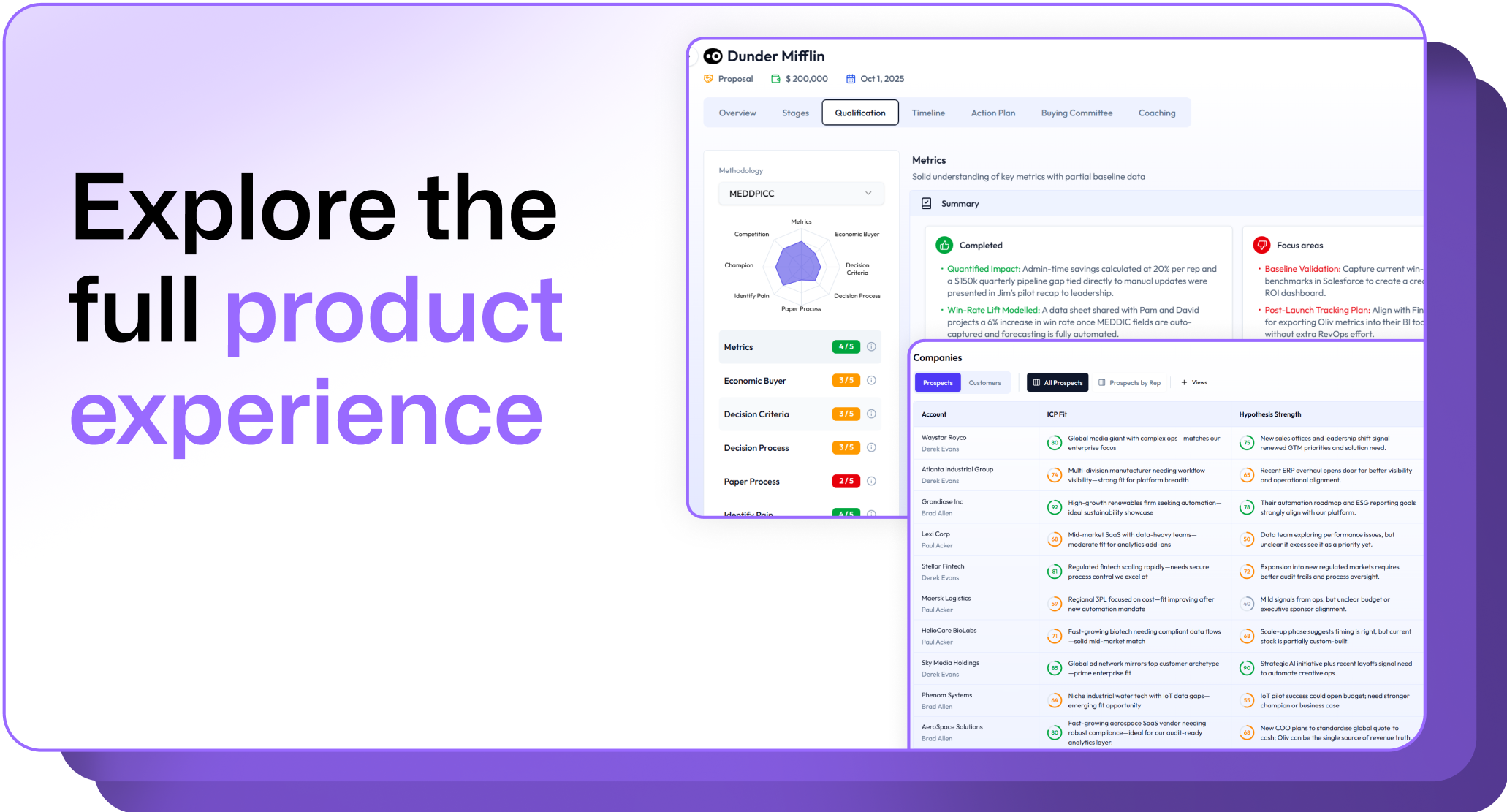
.avif)