Customer Success Enablement Framework: From Reactive Dashboards to Autonomous Agents
Written by
Ishan Chhabra
Last Updated :
February 10, 2026
Skim in :
10
mins
In this article
Still got questions?
Come discuss this article with me.
Hi, I'm Ishan, Founder and CEO of Oliv. I'm always up for a conversation about revenue intelligence, AI agents, or what's actually working (and what's not) across revenue teams. I'd love to hear your perspective.
Thank you! Your submission has been received!
Oops! Something went wrong while submitting the form.
Meet Oliv’s AI Agents
Hi! I’m, Deal Driver
I track deals, flag risks, send weekly pipeline updates and give sales managers full visibility into deal progress
Hi! I’m, CRM Manager
I maintain CRM hygiene by updating core, custom and qualification fields all without your team lifting a finger
Hi! I’m, Forecaster
I build accurate forecasts based on real deal movement and tell you which deals to pull in to hit your number
Hi! I’m, Coach
I believe performance fuels revenue. I spot skill gaps, score calls and build coaching plans to help every rep level up
Hi! I’m, Prospector
I dig into target accounts to surface the right contacts, tailor and time outreach so you always strike when it counts
Hi! I’m, Pipeline tracker
I call reps to get deal updates, and deliver a real-time, CRM-synced roll-up view of deal progress
Hi! I’m, Analyst
I answer complex pipeline questions, uncover deal patterns, and build reports that guide strategic decisions
TL;DR
CS enablement in 2026 means deploying AI agents that execute tasks, not training teams to use another SaaS tool.
NRR, GRR, and EBITDA contribution have replaced CSAT as the board-level CS enablement metrics that matter.
Legacy platforms like Gainsight and Totango require 6+ month implementations; Oliv AI agents deploy in minutes.
The AE-to-CSM handoff is where most enablement programs fail, losing critical customer context overnight.
A four-level maturity model (Reactive to Autonomous) benchmarks where your CS team stands and maps each stage to specific AI agents.
Stacking Gong, Clari, and a CS platform routinely exceeds $500/user/month; Oliv AI delivers 91% lower TCO.
Q1. What Is Customer Success Enablement (and Why Does It Matter More in 2026)? [toc=CS Enablement Defined]
Customer success enablement is the strategic discipline of equipping Customer Success teams with the tools, training, content, and operational frameworks they need to consistently drive customer outcomes including retention, expansion, and long-term value realization.
Unlike customer success itself which focuses directly on helping clients achieve their goals, CS enablement focuses inward, empowering CSMs, CS Ops managers, and CS leadership to execute their roles more effectively.
⭐ The Core Components of CS Enablement
A comprehensive CS enablement program rests on five interconnected pillars:
1. Onboarding & Everboarding: Structured ramp programs for new CSMs plus continuous skill development covering product updates, playbook evolution, and customer personas.
2. Content & Knowledge: Centralized, searchable repositories of success plays, customer case studies, competitive battlecards, and objection-handling frameworks.
3. Tools & Technology: The platforms CSMs use daily including CS platforms, conversational intelligence tools, CRM systems, and AI agent platforms.
4. Operational Frameworks: Defined processes for health scoring, account segmentation, escalation paths, QBR cadences, and renewal workflows.
5. Cross-Functional Collaboration: Structured handoffs and feedback loops between CS, Sales, Product, and Marketing.
⚠️ Why It Matters More in 2026
CS teams are no longer measured on satisfaction scores alone. They now own Net Revenue Retention (NRR), Gross Revenue Retention (GRR), expansion revenue, and even EBITDA contribution. This revenue accountability shift means enablement is the infrastructure determining whether a CS organization can deliver predictable, measurable outcomes.
Yet legacy enablement, static playbooks, quarterly training sessions, and dashboard-first tooling, is buckling under this pressure:
The market is navigating the "Trough of Disillusionment" with first-generation AI bolt-ons. Generic chatbots layered onto legacy platforms have underwhelmed. The next wave moves beyond dashboards and documentation toward AI agents that autonomously execute CRM hygiene, churn risk detection, and QBR preparation, reducing CSM manual burden by hours per week.
This defines CS enablement in 2026: shifting from training teams to use tools to deploying agents that do the work.
Q2. How Is CS Enablement Different From Sales Enablement and Customer Enablement? [toc=Three Enablement Functions]
These three terms are often conflated, but they serve fundamentally different functions, audiences, and success metrics. Understanding the distinction prevents duplicated tooling, disconnected handoffs, and wasted enablement spend.
⭐ The Three Enablement Functions at a Glance
Sales vs CS vs Customer Enablement Comparison
Dimension
Sales Enablement
CS Enablement
Customer Enablement
Audience
Sales reps, BDRs, AEs
CSMs, CS Ops, CS leaders
End customers / users
Focus
Acquiring new customers
Retaining & expanding accounts
Helping customers self-serve
Key Metrics
Win rate, deal velocity
NRR, GRR, churn rate, TTV
Product adoption, ticket deflection
Content
Pitch decks, battle cards
Success plays, QBR templates
Knowledge bases, in-app guides
Tools
Outreach, Gong, Clari
Gainsight, Totango, Oliv AI
WalkMe, Pendo, Intercom
Lifecycle Stage
Pre-sale (lead to close)
Post-sale (onboard to expand)
Ongoing (adopt to advocate)
Orientation
Internal (empower reps)
Internal (empower CSMs)
External (empower customers)
⚠️ Where They Overlap and Where They Break
Sales Enablement and CS Enablement share a customer-centric approach, but their operational goals diverge sharply. Sales enablement equips reps to close deals; CS enablement equips CSMs to protect and grow revenue post-close. Customer Enablement sits apart entirely, it is externally facing, giving customers the self-service resources to succeed independently.
"Essentially Gainsight allows you to set CTAs but you can do this from a main CRM. Since Gainsight is a CS tool, sales teams won't use it and you end up adding an additional system to work out of." Verified User in Computer Software, Mid-Market, G2 Verified Review
"As a sales manager, HubSpot Service Hub bridges sales and support seamlessly by layering tickets on CRM data, giving me instant insights into post-sale issues and upsell opportunities." manikandan M., Team Lead, Enterprise, G2 Verified Review
❌ Why Blurring the Lines Costs Revenue
When organizations conflate these functions, sales reps receive renewal playbooks they never use, CSMs are trained on irrelevant prospecting techniques, and customers get onboarding emails designed for internal teams. The most effective 2026 strategy delineates these three lanes clearly while building structured data handoffs between them.
✅ Oliv AI's approach: Rather than requiring separate enablement stacks, Oliv AI's agent-first architecture stitches the full journey from first sales call to renewal into a single context layer, eliminating the handoff gap that siloed tools struggle to bridge.
Q3. Why Are AI Agents Replacing the Traditional CS Playbook Shelf? [toc=Playbook to Agent Evolution]
The CS enablement playbook, once the gold standard, is becoming the industry's most expensive shelf decoration. To understand why, trace three generations of revenue technology and where each broke down.
📊 Three Generations of CS Enablement Tech
Three-phase timeline illustrating CS enablement technology evolution, from Gong-era call recording through revenue orchestration to Oliv AI's autonomous agent-first platform starting 2025.
Gen 1 (2015-2022), Conversational Intelligence: Gong and Chorus introduced call recording and keyword-based trackers. Enablement meant building massive playbook libraries. Most CSMs stopped opening them after week one.
Gen 2 (2022-2025), Revenue Orchestration: Platforms like Clari and Gainsight automated workflows but remained shackled to rule-based logic and manual data entry. Forecasting stayed "rep-driven and biased."
Oliv AI operationalizes this shift with purpose-built agents:
Health Monitor: Scans accounts weekly across usage, support tickets, and survey data to flag churn risk before escalation.
Deal Driver: Delivers daily risk flags and weekly pipeline breakdowns, saving managers an estimated one full day per week.
Analyst Agent: Answers strategic questions in plain English, "Why are we losing renewals in FinTech?" by analyzing unstructured data across all conversations.
The market signal is clear: bolting AI onto legacy architecture isn't enough. 2026 demands platforms that are AI-native from the ground up, where agents aren't a feature, they're the product.
Q4. What Does a 2026-Ready CS Enablement Framework Look Like? [toc=Modern Framework Pillars]
Legacy CS enablement frameworks were built on a simple formula: onboard CSMs, hand them playbooks, configure a dashboard. In 2026, that formula is obsolete. A modern framework treats AI agents and revenue accountability as defaults, not future aspirations.
⏰ The Shift: Static Content to Dynamic Execution
Linear framework diagram presenting four execution pillars of modern CS enablement, replacing static playbook libraries with automated data hygiene, proactive intelligence, and strategic analytics.
Traditional frameworks organized enablement into content libraries, training calendars, and tool-access checklists. The 2026-native framework replaces these with four execution pillars, each mapped to an autonomous agent that acts without manual intervention.
Pillar 1: Automated Data Hygiene (The Foundation)
Enablement starts with clean data. Instead of training CSMs on manual CRM entry, organizations deploy CRM Manager agents that auto-create accounts, enrich contacts from LinkedIn, and update qualification fields like MEDDPICC and BANT continuously. Without this foundation, every downstream insight, health scores, forecasts, renewal alerts, is built on unreliable data.
Pillar 2: Proactive Intelligence (The "Nudge" Layer)
Static dashboards require CSMs to log in, navigate, and interpret. The new model pushes insight to where CSMs live, Slack and Email:
Prep Notes: Delivered 30 minutes before calls, summarizing past interactions and flagged risks.
Sunset Summaries: Daily manager briefings on which accounts moved, which stalled, and where intervention is needed.
Pillar 3: Handoff Continuity (Stitching the Journey)
The AE-to-CSM handoff is where traditional enablement fails most visibly. Context loss during transitions leads to repeated discovery questions and eroded customer trust. The modern framework uses agents like Handoff Hank to auto-build handoff packets, capturing every pain point, feature request, and stakeholder map from the sales cycle.
Pillar 4: Strategic Analytics (The "Analyst" Agent)
Instead of manually building dashboards, CS leaders use the Analyst Agent to ask strategic questions in plain English, "What's our renewal rate for accounts onboarded in Q3?" and receive visual reports with commentary drawn from unstructured data across every call, email, and ticket.
✅ Agent-to-Pillar Mapping
CS Enablement Pillars Mapped to Oliv AI Agents
Pillar
Oliv AI Agent
Data Hygiene
CRM Manager
Proactive Intelligence
Deal Driver + Health Monitor
Handoff Continuity
Handoff Hank
Strategic Analytics
Analyst Agent + QBR Builder
In the words recurring across executive conversations in 2026: "SaaS is a dirty word." Teams no longer want software they must learn, they want an agentic workforce that delivers outcomes.
Q5. What KPIs Should You Track to Measure CS Enablement Success? [toc=CS Enablement KPIs]
CS enablement without measurement is just training for training's sake. The KPIs that matter in 2026 go beyond satisfaction surveys, they connect enablement directly to revenue outcomes.
⭐ The CS Enablement KPI Dashboard
Customer Success Enablement KPI Dashboard
KPI
What It Measures
Why It Matters for Enablement
Benchmark
Net Revenue Retention (NRR)
Revenue retained + expansion from existing customers
The "north star", proves enablement drives growth, not just retention
>110% (best-in-class SaaS)
Gross Revenue Retention (GRR)
Revenue retained excluding upsell/cross-sell
Isolates pure retention; GRR below 90% signals foundational problems
>90%
Churn Rate
% of customers or revenue lost in a period
Direct measure of CS team effectiveness
<5% annual (Enterprise SaaS)
CSAT
Customer satisfaction after specific interactions
Leading indicator of renewal likelihood
>80%
NPS
Likelihood to recommend (-100 to +100)
Proxy for long-term advocacy and expansion
>50
Time to Value (TTV)
Days from onboarding start to first outcome
Measures enablement speed, shorter TTV = lower early churn
Varies by product complexity
Expansion Revenue
Revenue from upsell/cross-sell of existing accounts
Positions CS as a profit center, not a cost center
Emerging metric
💰 Revenue Metrics as the New Enablement Standard
Historically, CS enablement was measured by training completion rates and CSAT alone. In 2026, boards expect CS leaders to report on NRR, GRR, and EBITDA contribution alongside operating metrics. A customer success platform typically increases NRR by six percentage points when deployed effectively.
⏰ From Manual Dashboards to AI-Automated Tracking
The challenge with these KPIs isn't defining them, it's tracking them accurately without hours of manual data assembly. Legacy platforms require dedicated CS Ops resources to build and maintain dashboards:
✅ Oliv AI's approach: Oliv's Analyst Agent auto-calculates and surfaces these KPIs on demand, in plain English, via Slack, eliminating the need for manual dashboard construction.
Q6. How Do You Implement a CS Enablement Program Step by Step? [toc=Implementation Roadmap]
Building a CS enablement program requires a phased approach that aligns people, processes, and technology around measurable customer outcomes.
8-Step Implementation Playbook
1. Assess Your Current CS Processes
Audit existing workflows, content libraries, tool usage, and handoff procedures. Identify where CSMs spend the most time on manual, repetitive tasks versus strategic activities.
2. Define Goals and Success Metrics
Align enablement objectives to business outcomes. Set specific targets, e.g., reduce TTV by 20%, increase NRR by 5 points, decrease churn rate by 15%, and assign ownership.
3. Map the Customer Journey
Document every lifecycle stage from onboarding through renewal and expansion. Identify friction points, handoff gaps (especially AE to CSM), and moments where enablement content is missing.
4. Build the Content and Knowledge Layer
Create or centralize success plays, QBR templates, objection-handling guides, and competitive battlecards. Involve frontline CSMs in the creation process to improve adoption.
⚠️ The Technology Selection Trap
5. Select Tools and Deploy AI Agents
Avoid stacking disconnected tools. Evaluate platforms on Time-to-Value, not feature lists. Consider whether the platform requires months of configuration or delivers immediate insight:
Roll out enablement in cohorts, not all-at-once launches. Combine structured ramp programs with ongoing "everboarding" that keeps CSMs current on product changes and playbook updates.
7. Establish Cross-Functional Feedback Loops
Build structured channels between CS, Sales, Product, and Marketing. Ensure customer insights from CS flow back to Product roadmap decisions and that Sales handoff data reaches CS intact.
8. Measure, Iterate, Optimize
Track KPIs from Q5 monthly. Use the data to refine content, adjust agent configurations, and retire underperforming playbooks. Enablement is never "done", it's a continuous improvement cycle.
✅ How Oliv AI Accelerates Implementation
Oliv AI compresses steps 5-8 by deploying pre-configured agents (CRM Manager, Health Monitor, Handoff Hank) that start delivering value within minutes, not months of configuration.
Q7. What Are the Biggest CS Enablement Challenges (and How Do AI Agents Solve Them)? [toc=Challenges and Solutions]
Even well-resourced CS teams hit the same friction points repeatedly. The challenges aren't new, but the legacy solutions (more Confluence pages, more bootcamps, more dashboards) haven't worked.
❌ The Persistent Friction Points
Linear framework diagram presenting four execution pillars of modern CS enablement, replacing static playbook libraries with automated data hygiene, proactive intelligence, and strategic analytics.
The most common enablement breakdowns follow a predictable pattern:
Scattered Tribal Knowledge: Critical customer context lives in individual CSM's heads, private notes, or disconnected tools. When a CSM leaves, institutional knowledge vanishes overnight.
Tool Overload (5+ Platforms): CSMs toggle between CRM, CS platform, email, Slack, support ticketing, and BI tools daily, losing productive hours to context-switching.
Reactive Churn Detection: By the time a dashboard flags a "red" health score, the customer has already made their decision.
Cross-Functional Misalignment: CS, Sales, and Product operate in silos. Handoff data gets lost. Customer feedback never reaches Product roadmaps.
Adoption Resistance: CSMs resist new tools because each one adds another system to maintain.
The instinctive response to these problems, more documentation, more training, more dashboards, actually compounds the burden. Each new wiki page goes stale within weeks. Each new dashboard requires someone to log in and interpret data. Each new bootcamp pulls CSMs away from accounts.
Q8. What Tools Power CS Enablement in 2026 (and Where Does Oliv AI Fit)? [toc=2026 Tool Landscape]
The average CS tech stack has fragmented into 5-7 overlapping tools, and the bill adds up fast. Stacking a CS platform (Gainsight/Totango), conversational intelligence (Gong), and forecasting (Clari) routinely exceeds $500 per user/month before counting CRM licensing.
❌ Where Incumbents Shine and Where They Over-Engineer
CS Enablement Platform Comparison 2026
Platform
Strength
Limitation
Gainsight
Powerful data manipulation; strong journey orchestration for large CS-Ops teams
The 2026 buyer doesn't evaluate feature checklists. Leaner CS teams want:
Signals, not complexity - insights pushed to them, not dashboards to log into
Minutes to value, not months - deployment that works on day one
Agents that act, not apps to learn - autonomous execution over manual adoption
✅ Where Oliv AI Fits
Oliv AI is not positioned as a "better Gainsight." It occupies a distinct category, AI-native Revenue Orchestration, built for modern, leaner CS teams that prioritize speed, insight, and usability over configuration depth:
💸 91% Lower TCO: A 100-user team on Gong costs ~$789K over three years versus ~$68K on Oliv AI
Feature comparison of legacy CS enablement tools versus Oliv AI across six dimensions including cost, implementation speed, data integration, documentation pricing, and measurable revenue impact.
Teams using unified AI-agent platforms report 35% higher win rates and 25% higher forecast accuracy, the result of replacing fragmented stacks with a single execution layer.
Q9. How Do You Build a CS Enablement Maturity Model? [toc=CS Maturity Model]
A CS enablement maturity model gives leadership a structured framework to benchmark where their team operates today and chart a clear path forward. Industry frameworks such as TSIA's Customer Success Maturity Model identify four progressive phases that organizations move through as they scale.
⭐ The Four Levels of CS Enablement Maturity
CS Enablement Maturity Model with AI Agent Mapping
Level
Stage
Indicators
Tool Expectations
Oliv AI Agent Mapping
1
Reactive
Tribal knowledge in spreadsheets; fire-fighting churn; no defined health scores; manual CRM entry
The majority of CS teams in 2026 remain stuck between Structured and Predictive. The bottleneck is rarely strategy, it's tool complexity. Configuration-heavy platforms require dedicated CS Ops resources and months of setup before delivering predictive value.
"There is a pretty steep learning curve for the front end building the SuccessBlocs and the backend setting up fields/integrations. In general the tool is not as intuitive as I would like it to be." Renske v., Technical Consultant, Mid-Market, G2 Verified Review
Platform overview contrasting fragmented, rule-based CS enablement with Oliv AI's unified agent architecture that executes tasks autonomously and stitches account histories into a 360-degree view.
Oliv AI compresses the journey from Reactive to Autonomous by eliminating the configuration burden entirely. Organizations deploy pre-built agents that deliver Level 3-4 capabilities from day one, without months of admin setup or dedicated CS Ops headcount.
Q10. What Does the Future of CS Enablement Look Like Beyond 2026? [toc=Future Beyond 2026]
The next era of Customer Success enablement won't be shaped by better dashboards or more playbooks. It will be defined by how effectively organizations deploy autonomous agents, adapt to new discovery channels, and retrain their teams for roles that didn't exist two years ago.
⏰ The Discovery Shift: Answer Engines Replace Google
By 2028, the majority of B2B informational traffic will flow through Answer Engines, AI-powered platforms like ChatGPT, Perplexity, and Claude, rather than traditional search engines. This fundamentally changes how CS leaders discover enablement tools. Answer Engine Optimization (AEO), or "Trust-First SEO," requires brands to be cited as trusted sources by AI reasoning models, not just rank on page one of Google.
❌ The "Trough of Disillusionment" Forces a Reckoning
Most CS teams today are stuck in Generation 2 orchestration, rule-based automation layered over manually maintained data. The first wave of "bolted-on" AI features (generic chatbots, keyword-based trackers) has created market-wide frustration. Platforms promised intelligence but delivered more dashboards to check.
⭐ New Roles Emerge: CS AI Analyst, Signal Architect, Enablement Lead
The 2026 CS job market is already shifting toward AI-augmented, revenue-generating positions. Industry experts predict the emergence of specialized roles including CS AI Analyst, Customer Signal Architect, and CS Enablement Lead, professionals who orchestrate agent workflows rather than execute manual tasks. Enablement must retrain teams for agent orchestration, not tool adoption.
✅ Oliv AI as the AI-Native Revenue Orchestration Leader
We built Oliv AI for this inflection point. Documentation is free, recording and transcription are commoditized. Intelligence is contextual, agents stitch meetings, emails, Slack, and support tickets into 360° account histories. Execution is autonomous, CRM Manager, Health Monitor, Deal Driver, and QBR Builder perform the work without human intervention, delivering insights where teams already live: Slack and Email.
Frequently Asked Questions About Customer Success Enablement [toc=FAQ]
What is customer success enablement?
Customer success enablement is the strategic process of equipping CS teams with the knowledge, tools, content, and data they need to drive customer outcomes, including onboarding, adoption, retention, and expansion. Unlike sales enablement, it focuses on post-sale value delivery rather than deal closure.
How is CS enablement different from sales enablement?
Sales enablement targets pre-sale activities (prospecting, qualification, closing), while CS enablement covers the entire post-sale lifecycle, onboarding, adoption, renewal, and expansion. The two disciplines overlap at the AE-to-CSM handoff, where context loss is the most common failure point.
What are the most important CS enablement KPIs?
The core metrics include Net Revenue Retention (NRR), Gross Revenue Retention (GRR), churn rate, CSAT, NPS, Time to Value (TTV), and expansion revenue. In 2026, boards increasingly expect CS leaders to report EBITDA contribution alongside these operational metrics.
Can small CS teams benefit from enablement programs?
Yes. Lean CS teams often benefit the most because enablement multiplies individual capacity. AI-native platforms like Oliv AI allow small teams to deploy agents, such as Health Monitor and CRM Manager, that perform the work of dedicated CS Ops resources without additional headcount.
How do AI agents change CS enablement?
AI agents shift enablement from "train the team to use a tool" to "deploy a workforce that executes tasks autonomously". Instead of building playbooks that CSMs must follow manually, agents update CRMs, draft QBR decks, flag churn risk, and build handoff packets, delivering outcomes, not documentation.
What tools are best for CS enablement in 2026?
The landscape includes Gainsight, ChurnZero, Totango, Gong, and Clari, each with distinct strengths in workflow management, call intelligence, or forecasting. However, modern leaner teams are gravitating toward AI-native platforms like Oliv AI that deliver signals and autonomous execution with minutes-to-value rather than months of configuration.
Q1. What Is Customer Success Enablement (and Why Does It Matter More in 2026)? [toc=CS Enablement Defined]
Customer success enablement is the strategic discipline of equipping Customer Success teams with the tools, training, content, and operational frameworks they need to consistently drive customer outcomes including retention, expansion, and long-term value realization.
Unlike customer success itself which focuses directly on helping clients achieve their goals, CS enablement focuses inward, empowering CSMs, CS Ops managers, and CS leadership to execute their roles more effectively.
⭐ The Core Components of CS Enablement
A comprehensive CS enablement program rests on five interconnected pillars:
1. Onboarding & Everboarding: Structured ramp programs for new CSMs plus continuous skill development covering product updates, playbook evolution, and customer personas.
2. Content & Knowledge: Centralized, searchable repositories of success plays, customer case studies, competitive battlecards, and objection-handling frameworks.
3. Tools & Technology: The platforms CSMs use daily including CS platforms, conversational intelligence tools, CRM systems, and AI agent platforms.
4. Operational Frameworks: Defined processes for health scoring, account segmentation, escalation paths, QBR cadences, and renewal workflows.
5. Cross-Functional Collaboration: Structured handoffs and feedback loops between CS, Sales, Product, and Marketing.
⚠️ Why It Matters More in 2026
CS teams are no longer measured on satisfaction scores alone. They now own Net Revenue Retention (NRR), Gross Revenue Retention (GRR), expansion revenue, and even EBITDA contribution. This revenue accountability shift means enablement is the infrastructure determining whether a CS organization can deliver predictable, measurable outcomes.
Yet legacy enablement, static playbooks, quarterly training sessions, and dashboard-first tooling, is buckling under this pressure:
The market is navigating the "Trough of Disillusionment" with first-generation AI bolt-ons. Generic chatbots layered onto legacy platforms have underwhelmed. The next wave moves beyond dashboards and documentation toward AI agents that autonomously execute CRM hygiene, churn risk detection, and QBR preparation, reducing CSM manual burden by hours per week.
This defines CS enablement in 2026: shifting from training teams to use tools to deploying agents that do the work.
Q2. How Is CS Enablement Different From Sales Enablement and Customer Enablement? [toc=Three Enablement Functions]
These three terms are often conflated, but they serve fundamentally different functions, audiences, and success metrics. Understanding the distinction prevents duplicated tooling, disconnected handoffs, and wasted enablement spend.
⭐ The Three Enablement Functions at a Glance
Sales vs CS vs Customer Enablement Comparison
Dimension
Sales Enablement
CS Enablement
Customer Enablement
Audience
Sales reps, BDRs, AEs
CSMs, CS Ops, CS leaders
End customers / users
Focus
Acquiring new customers
Retaining & expanding accounts
Helping customers self-serve
Key Metrics
Win rate, deal velocity
NRR, GRR, churn rate, TTV
Product adoption, ticket deflection
Content
Pitch decks, battle cards
Success plays, QBR templates
Knowledge bases, in-app guides
Tools
Outreach, Gong, Clari
Gainsight, Totango, Oliv AI
WalkMe, Pendo, Intercom
Lifecycle Stage
Pre-sale (lead to close)
Post-sale (onboard to expand)
Ongoing (adopt to advocate)
Orientation
Internal (empower reps)
Internal (empower CSMs)
External (empower customers)
⚠️ Where They Overlap and Where They Break
Sales Enablement and CS Enablement share a customer-centric approach, but their operational goals diverge sharply. Sales enablement equips reps to close deals; CS enablement equips CSMs to protect and grow revenue post-close. Customer Enablement sits apart entirely, it is externally facing, giving customers the self-service resources to succeed independently.
"Essentially Gainsight allows you to set CTAs but you can do this from a main CRM. Since Gainsight is a CS tool, sales teams won't use it and you end up adding an additional system to work out of." Verified User in Computer Software, Mid-Market, G2 Verified Review
"As a sales manager, HubSpot Service Hub bridges sales and support seamlessly by layering tickets on CRM data, giving me instant insights into post-sale issues and upsell opportunities." manikandan M., Team Lead, Enterprise, G2 Verified Review
❌ Why Blurring the Lines Costs Revenue
When organizations conflate these functions, sales reps receive renewal playbooks they never use, CSMs are trained on irrelevant prospecting techniques, and customers get onboarding emails designed for internal teams. The most effective 2026 strategy delineates these three lanes clearly while building structured data handoffs between them.
✅ Oliv AI's approach: Rather than requiring separate enablement stacks, Oliv AI's agent-first architecture stitches the full journey from first sales call to renewal into a single context layer, eliminating the handoff gap that siloed tools struggle to bridge.
Q3. Why Are AI Agents Replacing the Traditional CS Playbook Shelf? [toc=Playbook to Agent Evolution]
The CS enablement playbook, once the gold standard, is becoming the industry's most expensive shelf decoration. To understand why, trace three generations of revenue technology and where each broke down.
📊 Three Generations of CS Enablement Tech
Three-phase timeline illustrating CS enablement technology evolution, from Gong-era call recording through revenue orchestration to Oliv AI's autonomous agent-first platform starting 2025.
Gen 1 (2015-2022), Conversational Intelligence: Gong and Chorus introduced call recording and keyword-based trackers. Enablement meant building massive playbook libraries. Most CSMs stopped opening them after week one.
Gen 2 (2022-2025), Revenue Orchestration: Platforms like Clari and Gainsight automated workflows but remained shackled to rule-based logic and manual data entry. Forecasting stayed "rep-driven and biased."
Oliv AI operationalizes this shift with purpose-built agents:
Health Monitor: Scans accounts weekly across usage, support tickets, and survey data to flag churn risk before escalation.
Deal Driver: Delivers daily risk flags and weekly pipeline breakdowns, saving managers an estimated one full day per week.
Analyst Agent: Answers strategic questions in plain English, "Why are we losing renewals in FinTech?" by analyzing unstructured data across all conversations.
The market signal is clear: bolting AI onto legacy architecture isn't enough. 2026 demands platforms that are AI-native from the ground up, where agents aren't a feature, they're the product.
Q4. What Does a 2026-Ready CS Enablement Framework Look Like? [toc=Modern Framework Pillars]
Legacy CS enablement frameworks were built on a simple formula: onboard CSMs, hand them playbooks, configure a dashboard. In 2026, that formula is obsolete. A modern framework treats AI agents and revenue accountability as defaults, not future aspirations.
⏰ The Shift: Static Content to Dynamic Execution
Linear framework diagram presenting four execution pillars of modern CS enablement, replacing static playbook libraries with automated data hygiene, proactive intelligence, and strategic analytics.
Traditional frameworks organized enablement into content libraries, training calendars, and tool-access checklists. The 2026-native framework replaces these with four execution pillars, each mapped to an autonomous agent that acts without manual intervention.
Pillar 1: Automated Data Hygiene (The Foundation)
Enablement starts with clean data. Instead of training CSMs on manual CRM entry, organizations deploy CRM Manager agents that auto-create accounts, enrich contacts from LinkedIn, and update qualification fields like MEDDPICC and BANT continuously. Without this foundation, every downstream insight, health scores, forecasts, renewal alerts, is built on unreliable data.
Pillar 2: Proactive Intelligence (The "Nudge" Layer)
Static dashboards require CSMs to log in, navigate, and interpret. The new model pushes insight to where CSMs live, Slack and Email:
Prep Notes: Delivered 30 minutes before calls, summarizing past interactions and flagged risks.
Sunset Summaries: Daily manager briefings on which accounts moved, which stalled, and where intervention is needed.
Pillar 3: Handoff Continuity (Stitching the Journey)
The AE-to-CSM handoff is where traditional enablement fails most visibly. Context loss during transitions leads to repeated discovery questions and eroded customer trust. The modern framework uses agents like Handoff Hank to auto-build handoff packets, capturing every pain point, feature request, and stakeholder map from the sales cycle.
Pillar 4: Strategic Analytics (The "Analyst" Agent)
Instead of manually building dashboards, CS leaders use the Analyst Agent to ask strategic questions in plain English, "What's our renewal rate for accounts onboarded in Q3?" and receive visual reports with commentary drawn from unstructured data across every call, email, and ticket.
✅ Agent-to-Pillar Mapping
CS Enablement Pillars Mapped to Oliv AI Agents
Pillar
Oliv AI Agent
Data Hygiene
CRM Manager
Proactive Intelligence
Deal Driver + Health Monitor
Handoff Continuity
Handoff Hank
Strategic Analytics
Analyst Agent + QBR Builder
In the words recurring across executive conversations in 2026: "SaaS is a dirty word." Teams no longer want software they must learn, they want an agentic workforce that delivers outcomes.
Q5. What KPIs Should You Track to Measure CS Enablement Success? [toc=CS Enablement KPIs]
CS enablement without measurement is just training for training's sake. The KPIs that matter in 2026 go beyond satisfaction surveys, they connect enablement directly to revenue outcomes.
⭐ The CS Enablement KPI Dashboard
Customer Success Enablement KPI Dashboard
KPI
What It Measures
Why It Matters for Enablement
Benchmark
Net Revenue Retention (NRR)
Revenue retained + expansion from existing customers
The "north star", proves enablement drives growth, not just retention
>110% (best-in-class SaaS)
Gross Revenue Retention (GRR)
Revenue retained excluding upsell/cross-sell
Isolates pure retention; GRR below 90% signals foundational problems
>90%
Churn Rate
% of customers or revenue lost in a period
Direct measure of CS team effectiveness
<5% annual (Enterprise SaaS)
CSAT
Customer satisfaction after specific interactions
Leading indicator of renewal likelihood
>80%
NPS
Likelihood to recommend (-100 to +100)
Proxy for long-term advocacy and expansion
>50
Time to Value (TTV)
Days from onboarding start to first outcome
Measures enablement speed, shorter TTV = lower early churn
Varies by product complexity
Expansion Revenue
Revenue from upsell/cross-sell of existing accounts
Positions CS as a profit center, not a cost center
Emerging metric
💰 Revenue Metrics as the New Enablement Standard
Historically, CS enablement was measured by training completion rates and CSAT alone. In 2026, boards expect CS leaders to report on NRR, GRR, and EBITDA contribution alongside operating metrics. A customer success platform typically increases NRR by six percentage points when deployed effectively.
⏰ From Manual Dashboards to AI-Automated Tracking
The challenge with these KPIs isn't defining them, it's tracking them accurately without hours of manual data assembly. Legacy platforms require dedicated CS Ops resources to build and maintain dashboards:
✅ Oliv AI's approach: Oliv's Analyst Agent auto-calculates and surfaces these KPIs on demand, in plain English, via Slack, eliminating the need for manual dashboard construction.
Q6. How Do You Implement a CS Enablement Program Step by Step? [toc=Implementation Roadmap]
Building a CS enablement program requires a phased approach that aligns people, processes, and technology around measurable customer outcomes.
8-Step Implementation Playbook
1. Assess Your Current CS Processes
Audit existing workflows, content libraries, tool usage, and handoff procedures. Identify where CSMs spend the most time on manual, repetitive tasks versus strategic activities.
2. Define Goals and Success Metrics
Align enablement objectives to business outcomes. Set specific targets, e.g., reduce TTV by 20%, increase NRR by 5 points, decrease churn rate by 15%, and assign ownership.
3. Map the Customer Journey
Document every lifecycle stage from onboarding through renewal and expansion. Identify friction points, handoff gaps (especially AE to CSM), and moments where enablement content is missing.
4. Build the Content and Knowledge Layer
Create or centralize success plays, QBR templates, objection-handling guides, and competitive battlecards. Involve frontline CSMs in the creation process to improve adoption.
⚠️ The Technology Selection Trap
5. Select Tools and Deploy AI Agents
Avoid stacking disconnected tools. Evaluate platforms on Time-to-Value, not feature lists. Consider whether the platform requires months of configuration or delivers immediate insight:
Roll out enablement in cohorts, not all-at-once launches. Combine structured ramp programs with ongoing "everboarding" that keeps CSMs current on product changes and playbook updates.
7. Establish Cross-Functional Feedback Loops
Build structured channels between CS, Sales, Product, and Marketing. Ensure customer insights from CS flow back to Product roadmap decisions and that Sales handoff data reaches CS intact.
8. Measure, Iterate, Optimize
Track KPIs from Q5 monthly. Use the data to refine content, adjust agent configurations, and retire underperforming playbooks. Enablement is never "done", it's a continuous improvement cycle.
✅ How Oliv AI Accelerates Implementation
Oliv AI compresses steps 5-8 by deploying pre-configured agents (CRM Manager, Health Monitor, Handoff Hank) that start delivering value within minutes, not months of configuration.
Q7. What Are the Biggest CS Enablement Challenges (and How Do AI Agents Solve Them)? [toc=Challenges and Solutions]
Even well-resourced CS teams hit the same friction points repeatedly. The challenges aren't new, but the legacy solutions (more Confluence pages, more bootcamps, more dashboards) haven't worked.
❌ The Persistent Friction Points
Linear framework diagram presenting four execution pillars of modern CS enablement, replacing static playbook libraries with automated data hygiene, proactive intelligence, and strategic analytics.
The most common enablement breakdowns follow a predictable pattern:
Scattered Tribal Knowledge: Critical customer context lives in individual CSM's heads, private notes, or disconnected tools. When a CSM leaves, institutional knowledge vanishes overnight.
Tool Overload (5+ Platforms): CSMs toggle between CRM, CS platform, email, Slack, support ticketing, and BI tools daily, losing productive hours to context-switching.
Reactive Churn Detection: By the time a dashboard flags a "red" health score, the customer has already made their decision.
Cross-Functional Misalignment: CS, Sales, and Product operate in silos. Handoff data gets lost. Customer feedback never reaches Product roadmaps.
Adoption Resistance: CSMs resist new tools because each one adds another system to maintain.
The instinctive response to these problems, more documentation, more training, more dashboards, actually compounds the burden. Each new wiki page goes stale within weeks. Each new dashboard requires someone to log in and interpret data. Each new bootcamp pulls CSMs away from accounts.
Q8. What Tools Power CS Enablement in 2026 (and Where Does Oliv AI Fit)? [toc=2026 Tool Landscape]
The average CS tech stack has fragmented into 5-7 overlapping tools, and the bill adds up fast. Stacking a CS platform (Gainsight/Totango), conversational intelligence (Gong), and forecasting (Clari) routinely exceeds $500 per user/month before counting CRM licensing.
❌ Where Incumbents Shine and Where They Over-Engineer
CS Enablement Platform Comparison 2026
Platform
Strength
Limitation
Gainsight
Powerful data manipulation; strong journey orchestration for large CS-Ops teams
The 2026 buyer doesn't evaluate feature checklists. Leaner CS teams want:
Signals, not complexity - insights pushed to them, not dashboards to log into
Minutes to value, not months - deployment that works on day one
Agents that act, not apps to learn - autonomous execution over manual adoption
✅ Where Oliv AI Fits
Oliv AI is not positioned as a "better Gainsight." It occupies a distinct category, AI-native Revenue Orchestration, built for modern, leaner CS teams that prioritize speed, insight, and usability over configuration depth:
💸 91% Lower TCO: A 100-user team on Gong costs ~$789K over three years versus ~$68K on Oliv AI
Feature comparison of legacy CS enablement tools versus Oliv AI across six dimensions including cost, implementation speed, data integration, documentation pricing, and measurable revenue impact.
Teams using unified AI-agent platforms report 35% higher win rates and 25% higher forecast accuracy, the result of replacing fragmented stacks with a single execution layer.
Q9. How Do You Build a CS Enablement Maturity Model? [toc=CS Maturity Model]
A CS enablement maturity model gives leadership a structured framework to benchmark where their team operates today and chart a clear path forward. Industry frameworks such as TSIA's Customer Success Maturity Model identify four progressive phases that organizations move through as they scale.
⭐ The Four Levels of CS Enablement Maturity
CS Enablement Maturity Model with AI Agent Mapping
Level
Stage
Indicators
Tool Expectations
Oliv AI Agent Mapping
1
Reactive
Tribal knowledge in spreadsheets; fire-fighting churn; no defined health scores; manual CRM entry
The majority of CS teams in 2026 remain stuck between Structured and Predictive. The bottleneck is rarely strategy, it's tool complexity. Configuration-heavy platforms require dedicated CS Ops resources and months of setup before delivering predictive value.
"There is a pretty steep learning curve for the front end building the SuccessBlocs and the backend setting up fields/integrations. In general the tool is not as intuitive as I would like it to be." Renske v., Technical Consultant, Mid-Market, G2 Verified Review
Platform overview contrasting fragmented, rule-based CS enablement with Oliv AI's unified agent architecture that executes tasks autonomously and stitches account histories into a 360-degree view.
Oliv AI compresses the journey from Reactive to Autonomous by eliminating the configuration burden entirely. Organizations deploy pre-built agents that deliver Level 3-4 capabilities from day one, without months of admin setup or dedicated CS Ops headcount.
Q10. What Does the Future of CS Enablement Look Like Beyond 2026? [toc=Future Beyond 2026]
The next era of Customer Success enablement won't be shaped by better dashboards or more playbooks. It will be defined by how effectively organizations deploy autonomous agents, adapt to new discovery channels, and retrain their teams for roles that didn't exist two years ago.
⏰ The Discovery Shift: Answer Engines Replace Google
By 2028, the majority of B2B informational traffic will flow through Answer Engines, AI-powered platforms like ChatGPT, Perplexity, and Claude, rather than traditional search engines. This fundamentally changes how CS leaders discover enablement tools. Answer Engine Optimization (AEO), or "Trust-First SEO," requires brands to be cited as trusted sources by AI reasoning models, not just rank on page one of Google.
❌ The "Trough of Disillusionment" Forces a Reckoning
Most CS teams today are stuck in Generation 2 orchestration, rule-based automation layered over manually maintained data. The first wave of "bolted-on" AI features (generic chatbots, keyword-based trackers) has created market-wide frustration. Platforms promised intelligence but delivered more dashboards to check.
⭐ New Roles Emerge: CS AI Analyst, Signal Architect, Enablement Lead
The 2026 CS job market is already shifting toward AI-augmented, revenue-generating positions. Industry experts predict the emergence of specialized roles including CS AI Analyst, Customer Signal Architect, and CS Enablement Lead, professionals who orchestrate agent workflows rather than execute manual tasks. Enablement must retrain teams for agent orchestration, not tool adoption.
✅ Oliv AI as the AI-Native Revenue Orchestration Leader
We built Oliv AI for this inflection point. Documentation is free, recording and transcription are commoditized. Intelligence is contextual, agents stitch meetings, emails, Slack, and support tickets into 360° account histories. Execution is autonomous, CRM Manager, Health Monitor, Deal Driver, and QBR Builder perform the work without human intervention, delivering insights where teams already live: Slack and Email.
Frequently Asked Questions About Customer Success Enablement [toc=FAQ]
What is customer success enablement?
Customer success enablement is the strategic process of equipping CS teams with the knowledge, tools, content, and data they need to drive customer outcomes, including onboarding, adoption, retention, and expansion. Unlike sales enablement, it focuses on post-sale value delivery rather than deal closure.
How is CS enablement different from sales enablement?
Sales enablement targets pre-sale activities (prospecting, qualification, closing), while CS enablement covers the entire post-sale lifecycle, onboarding, adoption, renewal, and expansion. The two disciplines overlap at the AE-to-CSM handoff, where context loss is the most common failure point.
What are the most important CS enablement KPIs?
The core metrics include Net Revenue Retention (NRR), Gross Revenue Retention (GRR), churn rate, CSAT, NPS, Time to Value (TTV), and expansion revenue. In 2026, boards increasingly expect CS leaders to report EBITDA contribution alongside these operational metrics.
Can small CS teams benefit from enablement programs?
Yes. Lean CS teams often benefit the most because enablement multiplies individual capacity. AI-native platforms like Oliv AI allow small teams to deploy agents, such as Health Monitor and CRM Manager, that perform the work of dedicated CS Ops resources without additional headcount.
How do AI agents change CS enablement?
AI agents shift enablement from "train the team to use a tool" to "deploy a workforce that executes tasks autonomously". Instead of building playbooks that CSMs must follow manually, agents update CRMs, draft QBR decks, flag churn risk, and build handoff packets, delivering outcomes, not documentation.
What tools are best for CS enablement in 2026?
The landscape includes Gainsight, ChurnZero, Totango, Gong, and Clari, each with distinct strengths in workflow management, call intelligence, or forecasting. However, modern leaner teams are gravitating toward AI-native platforms like Oliv AI that deliver signals and autonomous execution with minutes-to-value rather than months of configuration.
Q1. What Is Customer Success Enablement (and Why Does It Matter More in 2026)? [toc=CS Enablement Defined]
Customer success enablement is the strategic discipline of equipping Customer Success teams with the tools, training, content, and operational frameworks they need to consistently drive customer outcomes including retention, expansion, and long-term value realization.
Unlike customer success itself which focuses directly on helping clients achieve their goals, CS enablement focuses inward, empowering CSMs, CS Ops managers, and CS leadership to execute their roles more effectively.
⭐ The Core Components of CS Enablement
A comprehensive CS enablement program rests on five interconnected pillars:
1. Onboarding & Everboarding: Structured ramp programs for new CSMs plus continuous skill development covering product updates, playbook evolution, and customer personas.
2. Content & Knowledge: Centralized, searchable repositories of success plays, customer case studies, competitive battlecards, and objection-handling frameworks.
3. Tools & Technology: The platforms CSMs use daily including CS platforms, conversational intelligence tools, CRM systems, and AI agent platforms.
4. Operational Frameworks: Defined processes for health scoring, account segmentation, escalation paths, QBR cadences, and renewal workflows.
5. Cross-Functional Collaboration: Structured handoffs and feedback loops between CS, Sales, Product, and Marketing.
⚠️ Why It Matters More in 2026
CS teams are no longer measured on satisfaction scores alone. They now own Net Revenue Retention (NRR), Gross Revenue Retention (GRR), expansion revenue, and even EBITDA contribution. This revenue accountability shift means enablement is the infrastructure determining whether a CS organization can deliver predictable, measurable outcomes.
Yet legacy enablement, static playbooks, quarterly training sessions, and dashboard-first tooling, is buckling under this pressure:
The market is navigating the "Trough of Disillusionment" with first-generation AI bolt-ons. Generic chatbots layered onto legacy platforms have underwhelmed. The next wave moves beyond dashboards and documentation toward AI agents that autonomously execute CRM hygiene, churn risk detection, and QBR preparation, reducing CSM manual burden by hours per week.
This defines CS enablement in 2026: shifting from training teams to use tools to deploying agents that do the work.
Q2. How Is CS Enablement Different From Sales Enablement and Customer Enablement? [toc=Three Enablement Functions]
These three terms are often conflated, but they serve fundamentally different functions, audiences, and success metrics. Understanding the distinction prevents duplicated tooling, disconnected handoffs, and wasted enablement spend.
⭐ The Three Enablement Functions at a Glance
Sales vs CS vs Customer Enablement Comparison
Dimension
Sales Enablement
CS Enablement
Customer Enablement
Audience
Sales reps, BDRs, AEs
CSMs, CS Ops, CS leaders
End customers / users
Focus
Acquiring new customers
Retaining & expanding accounts
Helping customers self-serve
Key Metrics
Win rate, deal velocity
NRR, GRR, churn rate, TTV
Product adoption, ticket deflection
Content
Pitch decks, battle cards
Success plays, QBR templates
Knowledge bases, in-app guides
Tools
Outreach, Gong, Clari
Gainsight, Totango, Oliv AI
WalkMe, Pendo, Intercom
Lifecycle Stage
Pre-sale (lead to close)
Post-sale (onboard to expand)
Ongoing (adopt to advocate)
Orientation
Internal (empower reps)
Internal (empower CSMs)
External (empower customers)
⚠️ Where They Overlap and Where They Break
Sales Enablement and CS Enablement share a customer-centric approach, but their operational goals diverge sharply. Sales enablement equips reps to close deals; CS enablement equips CSMs to protect and grow revenue post-close. Customer Enablement sits apart entirely, it is externally facing, giving customers the self-service resources to succeed independently.
"Essentially Gainsight allows you to set CTAs but you can do this from a main CRM. Since Gainsight is a CS tool, sales teams won't use it and you end up adding an additional system to work out of." Verified User in Computer Software, Mid-Market, G2 Verified Review
"As a sales manager, HubSpot Service Hub bridges sales and support seamlessly by layering tickets on CRM data, giving me instant insights into post-sale issues and upsell opportunities." manikandan M., Team Lead, Enterprise, G2 Verified Review
❌ Why Blurring the Lines Costs Revenue
When organizations conflate these functions, sales reps receive renewal playbooks they never use, CSMs are trained on irrelevant prospecting techniques, and customers get onboarding emails designed for internal teams. The most effective 2026 strategy delineates these three lanes clearly while building structured data handoffs between them.
✅ Oliv AI's approach: Rather than requiring separate enablement stacks, Oliv AI's agent-first architecture stitches the full journey from first sales call to renewal into a single context layer, eliminating the handoff gap that siloed tools struggle to bridge.
Q3. Why Are AI Agents Replacing the Traditional CS Playbook Shelf? [toc=Playbook to Agent Evolution]
The CS enablement playbook, once the gold standard, is becoming the industry's most expensive shelf decoration. To understand why, trace three generations of revenue technology and where each broke down.
📊 Three Generations of CS Enablement Tech
Three-phase timeline illustrating CS enablement technology evolution, from Gong-era call recording through revenue orchestration to Oliv AI's autonomous agent-first platform starting 2025.
Gen 1 (2015-2022), Conversational Intelligence: Gong and Chorus introduced call recording and keyword-based trackers. Enablement meant building massive playbook libraries. Most CSMs stopped opening them after week one.
Gen 2 (2022-2025), Revenue Orchestration: Platforms like Clari and Gainsight automated workflows but remained shackled to rule-based logic and manual data entry. Forecasting stayed "rep-driven and biased."
Oliv AI operationalizes this shift with purpose-built agents:
Health Monitor: Scans accounts weekly across usage, support tickets, and survey data to flag churn risk before escalation.
Deal Driver: Delivers daily risk flags and weekly pipeline breakdowns, saving managers an estimated one full day per week.
Analyst Agent: Answers strategic questions in plain English, "Why are we losing renewals in FinTech?" by analyzing unstructured data across all conversations.
The market signal is clear: bolting AI onto legacy architecture isn't enough. 2026 demands platforms that are AI-native from the ground up, where agents aren't a feature, they're the product.
Q4. What Does a 2026-Ready CS Enablement Framework Look Like? [toc=Modern Framework Pillars]
Legacy CS enablement frameworks were built on a simple formula: onboard CSMs, hand them playbooks, configure a dashboard. In 2026, that formula is obsolete. A modern framework treats AI agents and revenue accountability as defaults, not future aspirations.
⏰ The Shift: Static Content to Dynamic Execution
Linear framework diagram presenting four execution pillars of modern CS enablement, replacing static playbook libraries with automated data hygiene, proactive intelligence, and strategic analytics.
Traditional frameworks organized enablement into content libraries, training calendars, and tool-access checklists. The 2026-native framework replaces these with four execution pillars, each mapped to an autonomous agent that acts without manual intervention.
Pillar 1: Automated Data Hygiene (The Foundation)
Enablement starts with clean data. Instead of training CSMs on manual CRM entry, organizations deploy CRM Manager agents that auto-create accounts, enrich contacts from LinkedIn, and update qualification fields like MEDDPICC and BANT continuously. Without this foundation, every downstream insight, health scores, forecasts, renewal alerts, is built on unreliable data.
Pillar 2: Proactive Intelligence (The "Nudge" Layer)
Static dashboards require CSMs to log in, navigate, and interpret. The new model pushes insight to where CSMs live, Slack and Email:
Prep Notes: Delivered 30 minutes before calls, summarizing past interactions and flagged risks.
Sunset Summaries: Daily manager briefings on which accounts moved, which stalled, and where intervention is needed.
Pillar 3: Handoff Continuity (Stitching the Journey)
The AE-to-CSM handoff is where traditional enablement fails most visibly. Context loss during transitions leads to repeated discovery questions and eroded customer trust. The modern framework uses agents like Handoff Hank to auto-build handoff packets, capturing every pain point, feature request, and stakeholder map from the sales cycle.
Pillar 4: Strategic Analytics (The "Analyst" Agent)
Instead of manually building dashboards, CS leaders use the Analyst Agent to ask strategic questions in plain English, "What's our renewal rate for accounts onboarded in Q3?" and receive visual reports with commentary drawn from unstructured data across every call, email, and ticket.
✅ Agent-to-Pillar Mapping
CS Enablement Pillars Mapped to Oliv AI Agents
Pillar
Oliv AI Agent
Data Hygiene
CRM Manager
Proactive Intelligence
Deal Driver + Health Monitor
Handoff Continuity
Handoff Hank
Strategic Analytics
Analyst Agent + QBR Builder
In the words recurring across executive conversations in 2026: "SaaS is a dirty word." Teams no longer want software they must learn, they want an agentic workforce that delivers outcomes.
Q5. What KPIs Should You Track to Measure CS Enablement Success? [toc=CS Enablement KPIs]
CS enablement without measurement is just training for training's sake. The KPIs that matter in 2026 go beyond satisfaction surveys, they connect enablement directly to revenue outcomes.
⭐ The CS Enablement KPI Dashboard
Customer Success Enablement KPI Dashboard
KPI
What It Measures
Why It Matters for Enablement
Benchmark
Net Revenue Retention (NRR)
Revenue retained + expansion from existing customers
The "north star", proves enablement drives growth, not just retention
>110% (best-in-class SaaS)
Gross Revenue Retention (GRR)
Revenue retained excluding upsell/cross-sell
Isolates pure retention; GRR below 90% signals foundational problems
>90%
Churn Rate
% of customers or revenue lost in a period
Direct measure of CS team effectiveness
<5% annual (Enterprise SaaS)
CSAT
Customer satisfaction after specific interactions
Leading indicator of renewal likelihood
>80%
NPS
Likelihood to recommend (-100 to +100)
Proxy for long-term advocacy and expansion
>50
Time to Value (TTV)
Days from onboarding start to first outcome
Measures enablement speed, shorter TTV = lower early churn
Varies by product complexity
Expansion Revenue
Revenue from upsell/cross-sell of existing accounts
Positions CS as a profit center, not a cost center
Emerging metric
💰 Revenue Metrics as the New Enablement Standard
Historically, CS enablement was measured by training completion rates and CSAT alone. In 2026, boards expect CS leaders to report on NRR, GRR, and EBITDA contribution alongside operating metrics. A customer success platform typically increases NRR by six percentage points when deployed effectively.
⏰ From Manual Dashboards to AI-Automated Tracking
The challenge with these KPIs isn't defining them, it's tracking them accurately without hours of manual data assembly. Legacy platforms require dedicated CS Ops resources to build and maintain dashboards:
✅ Oliv AI's approach: Oliv's Analyst Agent auto-calculates and surfaces these KPIs on demand, in plain English, via Slack, eliminating the need for manual dashboard construction.
Q6. How Do You Implement a CS Enablement Program Step by Step? [toc=Implementation Roadmap]
Building a CS enablement program requires a phased approach that aligns people, processes, and technology around measurable customer outcomes.
8-Step Implementation Playbook
1. Assess Your Current CS Processes
Audit existing workflows, content libraries, tool usage, and handoff procedures. Identify where CSMs spend the most time on manual, repetitive tasks versus strategic activities.
2. Define Goals and Success Metrics
Align enablement objectives to business outcomes. Set specific targets, e.g., reduce TTV by 20%, increase NRR by 5 points, decrease churn rate by 15%, and assign ownership.
3. Map the Customer Journey
Document every lifecycle stage from onboarding through renewal and expansion. Identify friction points, handoff gaps (especially AE to CSM), and moments where enablement content is missing.
4. Build the Content and Knowledge Layer
Create or centralize success plays, QBR templates, objection-handling guides, and competitive battlecards. Involve frontline CSMs in the creation process to improve adoption.
⚠️ The Technology Selection Trap
5. Select Tools and Deploy AI Agents
Avoid stacking disconnected tools. Evaluate platforms on Time-to-Value, not feature lists. Consider whether the platform requires months of configuration or delivers immediate insight:
Roll out enablement in cohorts, not all-at-once launches. Combine structured ramp programs with ongoing "everboarding" that keeps CSMs current on product changes and playbook updates.
7. Establish Cross-Functional Feedback Loops
Build structured channels between CS, Sales, Product, and Marketing. Ensure customer insights from CS flow back to Product roadmap decisions and that Sales handoff data reaches CS intact.
8. Measure, Iterate, Optimize
Track KPIs from Q5 monthly. Use the data to refine content, adjust agent configurations, and retire underperforming playbooks. Enablement is never "done", it's a continuous improvement cycle.
✅ How Oliv AI Accelerates Implementation
Oliv AI compresses steps 5-8 by deploying pre-configured agents (CRM Manager, Health Monitor, Handoff Hank) that start delivering value within minutes, not months of configuration.
Q7. What Are the Biggest CS Enablement Challenges (and How Do AI Agents Solve Them)? [toc=Challenges and Solutions]
Even well-resourced CS teams hit the same friction points repeatedly. The challenges aren't new, but the legacy solutions (more Confluence pages, more bootcamps, more dashboards) haven't worked.
❌ The Persistent Friction Points
Linear framework diagram presenting four execution pillars of modern CS enablement, replacing static playbook libraries with automated data hygiene, proactive intelligence, and strategic analytics.
The most common enablement breakdowns follow a predictable pattern:
Scattered Tribal Knowledge: Critical customer context lives in individual CSM's heads, private notes, or disconnected tools. When a CSM leaves, institutional knowledge vanishes overnight.
Tool Overload (5+ Platforms): CSMs toggle between CRM, CS platform, email, Slack, support ticketing, and BI tools daily, losing productive hours to context-switching.
Reactive Churn Detection: By the time a dashboard flags a "red" health score, the customer has already made their decision.
Cross-Functional Misalignment: CS, Sales, and Product operate in silos. Handoff data gets lost. Customer feedback never reaches Product roadmaps.
Adoption Resistance: CSMs resist new tools because each one adds another system to maintain.
The instinctive response to these problems, more documentation, more training, more dashboards, actually compounds the burden. Each new wiki page goes stale within weeks. Each new dashboard requires someone to log in and interpret data. Each new bootcamp pulls CSMs away from accounts.
Q8. What Tools Power CS Enablement in 2026 (and Where Does Oliv AI Fit)? [toc=2026 Tool Landscape]
The average CS tech stack has fragmented into 5-7 overlapping tools, and the bill adds up fast. Stacking a CS platform (Gainsight/Totango), conversational intelligence (Gong), and forecasting (Clari) routinely exceeds $500 per user/month before counting CRM licensing.
❌ Where Incumbents Shine and Where They Over-Engineer
CS Enablement Platform Comparison 2026
Platform
Strength
Limitation
Gainsight
Powerful data manipulation; strong journey orchestration for large CS-Ops teams
The 2026 buyer doesn't evaluate feature checklists. Leaner CS teams want:
Signals, not complexity - insights pushed to them, not dashboards to log into
Minutes to value, not months - deployment that works on day one
Agents that act, not apps to learn - autonomous execution over manual adoption
✅ Where Oliv AI Fits
Oliv AI is not positioned as a "better Gainsight." It occupies a distinct category, AI-native Revenue Orchestration, built for modern, leaner CS teams that prioritize speed, insight, and usability over configuration depth:
💸 91% Lower TCO: A 100-user team on Gong costs ~$789K over three years versus ~$68K on Oliv AI
Feature comparison of legacy CS enablement tools versus Oliv AI across six dimensions including cost, implementation speed, data integration, documentation pricing, and measurable revenue impact.
Teams using unified AI-agent platforms report 35% higher win rates and 25% higher forecast accuracy, the result of replacing fragmented stacks with a single execution layer.
Q9. How Do You Build a CS Enablement Maturity Model? [toc=CS Maturity Model]
A CS enablement maturity model gives leadership a structured framework to benchmark where their team operates today and chart a clear path forward. Industry frameworks such as TSIA's Customer Success Maturity Model identify four progressive phases that organizations move through as they scale.
⭐ The Four Levels of CS Enablement Maturity
CS Enablement Maturity Model with AI Agent Mapping
Level
Stage
Indicators
Tool Expectations
Oliv AI Agent Mapping
1
Reactive
Tribal knowledge in spreadsheets; fire-fighting churn; no defined health scores; manual CRM entry
The majority of CS teams in 2026 remain stuck between Structured and Predictive. The bottleneck is rarely strategy, it's tool complexity. Configuration-heavy platforms require dedicated CS Ops resources and months of setup before delivering predictive value.
"There is a pretty steep learning curve for the front end building the SuccessBlocs and the backend setting up fields/integrations. In general the tool is not as intuitive as I would like it to be." Renske v., Technical Consultant, Mid-Market, G2 Verified Review
Platform overview contrasting fragmented, rule-based CS enablement with Oliv AI's unified agent architecture that executes tasks autonomously and stitches account histories into a 360-degree view.
Oliv AI compresses the journey from Reactive to Autonomous by eliminating the configuration burden entirely. Organizations deploy pre-built agents that deliver Level 3-4 capabilities from day one, without months of admin setup or dedicated CS Ops headcount.
Q10. What Does the Future of CS Enablement Look Like Beyond 2026? [toc=Future Beyond 2026]
The next era of Customer Success enablement won't be shaped by better dashboards or more playbooks. It will be defined by how effectively organizations deploy autonomous agents, adapt to new discovery channels, and retrain their teams for roles that didn't exist two years ago.
⏰ The Discovery Shift: Answer Engines Replace Google
By 2028, the majority of B2B informational traffic will flow through Answer Engines, AI-powered platforms like ChatGPT, Perplexity, and Claude, rather than traditional search engines. This fundamentally changes how CS leaders discover enablement tools. Answer Engine Optimization (AEO), or "Trust-First SEO," requires brands to be cited as trusted sources by AI reasoning models, not just rank on page one of Google.
❌ The "Trough of Disillusionment" Forces a Reckoning
Most CS teams today are stuck in Generation 2 orchestration, rule-based automation layered over manually maintained data. The first wave of "bolted-on" AI features (generic chatbots, keyword-based trackers) has created market-wide frustration. Platforms promised intelligence but delivered more dashboards to check.
⭐ New Roles Emerge: CS AI Analyst, Signal Architect, Enablement Lead
The 2026 CS job market is already shifting toward AI-augmented, revenue-generating positions. Industry experts predict the emergence of specialized roles including CS AI Analyst, Customer Signal Architect, and CS Enablement Lead, professionals who orchestrate agent workflows rather than execute manual tasks. Enablement must retrain teams for agent orchestration, not tool adoption.
✅ Oliv AI as the AI-Native Revenue Orchestration Leader
We built Oliv AI for this inflection point. Documentation is free, recording and transcription are commoditized. Intelligence is contextual, agents stitch meetings, emails, Slack, and support tickets into 360° account histories. Execution is autonomous, CRM Manager, Health Monitor, Deal Driver, and QBR Builder perform the work without human intervention, delivering insights where teams already live: Slack and Email.
Frequently Asked Questions About Customer Success Enablement [toc=FAQ]
What is customer success enablement?
Customer success enablement is the strategic process of equipping CS teams with the knowledge, tools, content, and data they need to drive customer outcomes, including onboarding, adoption, retention, and expansion. Unlike sales enablement, it focuses on post-sale value delivery rather than deal closure.
How is CS enablement different from sales enablement?
Sales enablement targets pre-sale activities (prospecting, qualification, closing), while CS enablement covers the entire post-sale lifecycle, onboarding, adoption, renewal, and expansion. The two disciplines overlap at the AE-to-CSM handoff, where context loss is the most common failure point.
What are the most important CS enablement KPIs?
The core metrics include Net Revenue Retention (NRR), Gross Revenue Retention (GRR), churn rate, CSAT, NPS, Time to Value (TTV), and expansion revenue. In 2026, boards increasingly expect CS leaders to report EBITDA contribution alongside these operational metrics.
Can small CS teams benefit from enablement programs?
Yes. Lean CS teams often benefit the most because enablement multiplies individual capacity. AI-native platforms like Oliv AI allow small teams to deploy agents, such as Health Monitor and CRM Manager, that perform the work of dedicated CS Ops resources without additional headcount.
How do AI agents change CS enablement?
AI agents shift enablement from "train the team to use a tool" to "deploy a workforce that executes tasks autonomously". Instead of building playbooks that CSMs must follow manually, agents update CRMs, draft QBR decks, flag churn risk, and build handoff packets, delivering outcomes, not documentation.
What tools are best for CS enablement in 2026?
The landscape includes Gainsight, ChurnZero, Totango, Gong, and Clari, each with distinct strengths in workflow management, call intelligence, or forecasting. However, modern leaner teams are gravitating toward AI-native platforms like Oliv AI that deliver signals and autonomous execution with minutes-to-value rather than months of configuration.
Q1. What Is Customer Success Enablement (and Why Does It Matter More in 2026)? [toc=CS Enablement Defined]
Customer success enablement is the strategic discipline of equipping Customer Success teams with the tools, training, content, and operational frameworks they need to consistently drive customer outcomes including retention, expansion, and long-term value realization.
Unlike customer success itself which focuses directly on helping clients achieve their goals, CS enablement focuses inward, empowering CSMs, CS Ops managers, and CS leadership to execute their roles more effectively.
⭐ The Core Components of CS Enablement
A comprehensive CS enablement program rests on five interconnected pillars:
1. Onboarding & Everboarding: Structured ramp programs for new CSMs plus continuous skill development covering product updates, playbook evolution, and customer personas.
2. Content & Knowledge: Centralized, searchable repositories of success plays, customer case studies, competitive battlecards, and objection-handling frameworks.
3. Tools & Technology: The platforms CSMs use daily including CS platforms, conversational intelligence tools, CRM systems, and AI agent platforms.
4. Operational Frameworks: Defined processes for health scoring, account segmentation, escalation paths, QBR cadences, and renewal workflows.
5. Cross-Functional Collaboration: Structured handoffs and feedback loops between CS, Sales, Product, and Marketing.
⚠️ Why It Matters More in 2026
CS teams are no longer measured on satisfaction scores alone. They now own Net Revenue Retention (NRR), Gross Revenue Retention (GRR), expansion revenue, and even EBITDA contribution. This revenue accountability shift means enablement is the infrastructure determining whether a CS organization can deliver predictable, measurable outcomes.
Yet legacy enablement, static playbooks, quarterly training sessions, and dashboard-first tooling, is buckling under this pressure:
The market is navigating the "Trough of Disillusionment" with first-generation AI bolt-ons. Generic chatbots layered onto legacy platforms have underwhelmed. The next wave moves beyond dashboards and documentation toward AI agents that autonomously execute CRM hygiene, churn risk detection, and QBR preparation, reducing CSM manual burden by hours per week.
This defines CS enablement in 2026: shifting from training teams to use tools to deploying agents that do the work.
Q2. How Is CS Enablement Different From Sales Enablement and Customer Enablement? [toc=Three Enablement Functions]
These three terms are often conflated, but they serve fundamentally different functions, audiences, and success metrics. Understanding the distinction prevents duplicated tooling, disconnected handoffs, and wasted enablement spend.
⭐ The Three Enablement Functions at a Glance
Sales vs CS vs Customer Enablement Comparison
Dimension
Sales Enablement
CS Enablement
Customer Enablement
Audience
Sales reps, BDRs, AEs
CSMs, CS Ops, CS leaders
End customers / users
Focus
Acquiring new customers
Retaining & expanding accounts
Helping customers self-serve
Key Metrics
Win rate, deal velocity
NRR, GRR, churn rate, TTV
Product adoption, ticket deflection
Content
Pitch decks, battle cards
Success plays, QBR templates
Knowledge bases, in-app guides
Tools
Outreach, Gong, Clari
Gainsight, Totango, Oliv AI
WalkMe, Pendo, Intercom
Lifecycle Stage
Pre-sale (lead to close)
Post-sale (onboard to expand)
Ongoing (adopt to advocate)
Orientation
Internal (empower reps)
Internal (empower CSMs)
External (empower customers)
⚠️ Where They Overlap and Where They Break
Sales Enablement and CS Enablement share a customer-centric approach, but their operational goals diverge sharply. Sales enablement equips reps to close deals; CS enablement equips CSMs to protect and grow revenue post-close. Customer Enablement sits apart entirely, it is externally facing, giving customers the self-service resources to succeed independently.
"Essentially Gainsight allows you to set CTAs but you can do this from a main CRM. Since Gainsight is a CS tool, sales teams won't use it and you end up adding an additional system to work out of." Verified User in Computer Software, Mid-Market, G2 Verified Review
"As a sales manager, HubSpot Service Hub bridges sales and support seamlessly by layering tickets on CRM data, giving me instant insights into post-sale issues and upsell opportunities." manikandan M., Team Lead, Enterprise, G2 Verified Review
❌ Why Blurring the Lines Costs Revenue
When organizations conflate these functions, sales reps receive renewal playbooks they never use, CSMs are trained on irrelevant prospecting techniques, and customers get onboarding emails designed for internal teams. The most effective 2026 strategy delineates these three lanes clearly while building structured data handoffs between them.
✅ Oliv AI's approach: Rather than requiring separate enablement stacks, Oliv AI's agent-first architecture stitches the full journey from first sales call to renewal into a single context layer, eliminating the handoff gap that siloed tools struggle to bridge.
Q3. Why Are AI Agents Replacing the Traditional CS Playbook Shelf? [toc=Playbook to Agent Evolution]
The CS enablement playbook, once the gold standard, is becoming the industry's most expensive shelf decoration. To understand why, trace three generations of revenue technology and where each broke down.
📊 Three Generations of CS Enablement Tech
Three-phase timeline illustrating CS enablement technology evolution, from Gong-era call recording through revenue orchestration to Oliv AI's autonomous agent-first platform starting 2025.
Gen 1 (2015-2022), Conversational Intelligence: Gong and Chorus introduced call recording and keyword-based trackers. Enablement meant building massive playbook libraries. Most CSMs stopped opening them after week one.
Gen 2 (2022-2025), Revenue Orchestration: Platforms like Clari and Gainsight automated workflows but remained shackled to rule-based logic and manual data entry. Forecasting stayed "rep-driven and biased."
Oliv AI operationalizes this shift with purpose-built agents:
Health Monitor: Scans accounts weekly across usage, support tickets, and survey data to flag churn risk before escalation.
Deal Driver: Delivers daily risk flags and weekly pipeline breakdowns, saving managers an estimated one full day per week.
Analyst Agent: Answers strategic questions in plain English, "Why are we losing renewals in FinTech?" by analyzing unstructured data across all conversations.
The market signal is clear: bolting AI onto legacy architecture isn't enough. 2026 demands platforms that are AI-native from the ground up, where agents aren't a feature, they're the product.
Q4. What Does a 2026-Ready CS Enablement Framework Look Like? [toc=Modern Framework Pillars]
Legacy CS enablement frameworks were built on a simple formula: onboard CSMs, hand them playbooks, configure a dashboard. In 2026, that formula is obsolete. A modern framework treats AI agents and revenue accountability as defaults, not future aspirations.
⏰ The Shift: Static Content to Dynamic Execution
Linear framework diagram presenting four execution pillars of modern CS enablement, replacing static playbook libraries with automated data hygiene, proactive intelligence, and strategic analytics.
Traditional frameworks organized enablement into content libraries, training calendars, and tool-access checklists. The 2026-native framework replaces these with four execution pillars, each mapped to an autonomous agent that acts without manual intervention.
Pillar 1: Automated Data Hygiene (The Foundation)
Enablement starts with clean data. Instead of training CSMs on manual CRM entry, organizations deploy CRM Manager agents that auto-create accounts, enrich contacts from LinkedIn, and update qualification fields like MEDDPICC and BANT continuously. Without this foundation, every downstream insight, health scores, forecasts, renewal alerts, is built on unreliable data.
Pillar 2: Proactive Intelligence (The "Nudge" Layer)
Static dashboards require CSMs to log in, navigate, and interpret. The new model pushes insight to where CSMs live, Slack and Email:
Prep Notes: Delivered 30 minutes before calls, summarizing past interactions and flagged risks.
Sunset Summaries: Daily manager briefings on which accounts moved, which stalled, and where intervention is needed.
Pillar 3: Handoff Continuity (Stitching the Journey)
The AE-to-CSM handoff is where traditional enablement fails most visibly. Context loss during transitions leads to repeated discovery questions and eroded customer trust. The modern framework uses agents like Handoff Hank to auto-build handoff packets, capturing every pain point, feature request, and stakeholder map from the sales cycle.
Pillar 4: Strategic Analytics (The "Analyst" Agent)
Instead of manually building dashboards, CS leaders use the Analyst Agent to ask strategic questions in plain English, "What's our renewal rate for accounts onboarded in Q3?" and receive visual reports with commentary drawn from unstructured data across every call, email, and ticket.
✅ Agent-to-Pillar Mapping
CS Enablement Pillars Mapped to Oliv AI Agents
Pillar
Oliv AI Agent
Data Hygiene
CRM Manager
Proactive Intelligence
Deal Driver + Health Monitor
Handoff Continuity
Handoff Hank
Strategic Analytics
Analyst Agent + QBR Builder
In the words recurring across executive conversations in 2026: "SaaS is a dirty word." Teams no longer want software they must learn, they want an agentic workforce that delivers outcomes.
Q5. What KPIs Should You Track to Measure CS Enablement Success? [toc=CS Enablement KPIs]
CS enablement without measurement is just training for training's sake. The KPIs that matter in 2026 go beyond satisfaction surveys, they connect enablement directly to revenue outcomes.
⭐ The CS Enablement KPI Dashboard
Customer Success Enablement KPI Dashboard
KPI
What It Measures
Why It Matters for Enablement
Benchmark
Net Revenue Retention (NRR)
Revenue retained + expansion from existing customers
The "north star", proves enablement drives growth, not just retention
>110% (best-in-class SaaS)
Gross Revenue Retention (GRR)
Revenue retained excluding upsell/cross-sell
Isolates pure retention; GRR below 90% signals foundational problems
>90%
Churn Rate
% of customers or revenue lost in a period
Direct measure of CS team effectiveness
<5% annual (Enterprise SaaS)
CSAT
Customer satisfaction after specific interactions
Leading indicator of renewal likelihood
>80%
NPS
Likelihood to recommend (-100 to +100)
Proxy for long-term advocacy and expansion
>50
Time to Value (TTV)
Days from onboarding start to first outcome
Measures enablement speed, shorter TTV = lower early churn
Varies by product complexity
Expansion Revenue
Revenue from upsell/cross-sell of existing accounts
Positions CS as a profit center, not a cost center
Emerging metric
💰 Revenue Metrics as the New Enablement Standard
Historically, CS enablement was measured by training completion rates and CSAT alone. In 2026, boards expect CS leaders to report on NRR, GRR, and EBITDA contribution alongside operating metrics. A customer success platform typically increases NRR by six percentage points when deployed effectively.
⏰ From Manual Dashboards to AI-Automated Tracking
The challenge with these KPIs isn't defining them, it's tracking them accurately without hours of manual data assembly. Legacy platforms require dedicated CS Ops resources to build and maintain dashboards:
✅ Oliv AI's approach: Oliv's Analyst Agent auto-calculates and surfaces these KPIs on demand, in plain English, via Slack, eliminating the need for manual dashboard construction.
Q6. How Do You Implement a CS Enablement Program Step by Step? [toc=Implementation Roadmap]
Building a CS enablement program requires a phased approach that aligns people, processes, and technology around measurable customer outcomes.
8-Step Implementation Playbook
1. Assess Your Current CS Processes
Audit existing workflows, content libraries, tool usage, and handoff procedures. Identify where CSMs spend the most time on manual, repetitive tasks versus strategic activities.
2. Define Goals and Success Metrics
Align enablement objectives to business outcomes. Set specific targets, e.g., reduce TTV by 20%, increase NRR by 5 points, decrease churn rate by 15%, and assign ownership.
3. Map the Customer Journey
Document every lifecycle stage from onboarding through renewal and expansion. Identify friction points, handoff gaps (especially AE to CSM), and moments where enablement content is missing.
4. Build the Content and Knowledge Layer
Create or centralize success plays, QBR templates, objection-handling guides, and competitive battlecards. Involve frontline CSMs in the creation process to improve adoption.
⚠️ The Technology Selection Trap
5. Select Tools and Deploy AI Agents
Avoid stacking disconnected tools. Evaluate platforms on Time-to-Value, not feature lists. Consider whether the platform requires months of configuration or delivers immediate insight:
Roll out enablement in cohorts, not all-at-once launches. Combine structured ramp programs with ongoing "everboarding" that keeps CSMs current on product changes and playbook updates.
7. Establish Cross-Functional Feedback Loops
Build structured channels between CS, Sales, Product, and Marketing. Ensure customer insights from CS flow back to Product roadmap decisions and that Sales handoff data reaches CS intact.
8. Measure, Iterate, Optimize
Track KPIs from Q5 monthly. Use the data to refine content, adjust agent configurations, and retire underperforming playbooks. Enablement is never "done", it's a continuous improvement cycle.
✅ How Oliv AI Accelerates Implementation
Oliv AI compresses steps 5-8 by deploying pre-configured agents (CRM Manager, Health Monitor, Handoff Hank) that start delivering value within minutes, not months of configuration.
Q7. What Are the Biggest CS Enablement Challenges (and How Do AI Agents Solve Them)? [toc=Challenges and Solutions]
Even well-resourced CS teams hit the same friction points repeatedly. The challenges aren't new, but the legacy solutions (more Confluence pages, more bootcamps, more dashboards) haven't worked.
❌ The Persistent Friction Points
Linear framework diagram presenting four execution pillars of modern CS enablement, replacing static playbook libraries with automated data hygiene, proactive intelligence, and strategic analytics.
The most common enablement breakdowns follow a predictable pattern:
Scattered Tribal Knowledge: Critical customer context lives in individual CSM's heads, private notes, or disconnected tools. When a CSM leaves, institutional knowledge vanishes overnight.
Tool Overload (5+ Platforms): CSMs toggle between CRM, CS platform, email, Slack, support ticketing, and BI tools daily, losing productive hours to context-switching.
Reactive Churn Detection: By the time a dashboard flags a "red" health score, the customer has already made their decision.
Cross-Functional Misalignment: CS, Sales, and Product operate in silos. Handoff data gets lost. Customer feedback never reaches Product roadmaps.
Adoption Resistance: CSMs resist new tools because each one adds another system to maintain.
The instinctive response to these problems, more documentation, more training, more dashboards, actually compounds the burden. Each new wiki page goes stale within weeks. Each new dashboard requires someone to log in and interpret data. Each new bootcamp pulls CSMs away from accounts.
Q8. What Tools Power CS Enablement in 2026 (and Where Does Oliv AI Fit)? [toc=2026 Tool Landscape]
The average CS tech stack has fragmented into 5-7 overlapping tools, and the bill adds up fast. Stacking a CS platform (Gainsight/Totango), conversational intelligence (Gong), and forecasting (Clari) routinely exceeds $500 per user/month before counting CRM licensing.
❌ Where Incumbents Shine and Where They Over-Engineer
CS Enablement Platform Comparison 2026
Platform
Strength
Limitation
Gainsight
Powerful data manipulation; strong journey orchestration for large CS-Ops teams
The 2026 buyer doesn't evaluate feature checklists. Leaner CS teams want:
Signals, not complexity - insights pushed to them, not dashboards to log into
Minutes to value, not months - deployment that works on day one
Agents that act, not apps to learn - autonomous execution over manual adoption
✅ Where Oliv AI Fits
Oliv AI is not positioned as a "better Gainsight." It occupies a distinct category, AI-native Revenue Orchestration, built for modern, leaner CS teams that prioritize speed, insight, and usability over configuration depth:
💸 91% Lower TCO: A 100-user team on Gong costs ~$789K over three years versus ~$68K on Oliv AI
Feature comparison of legacy CS enablement tools versus Oliv AI across six dimensions including cost, implementation speed, data integration, documentation pricing, and measurable revenue impact.
Teams using unified AI-agent platforms report 35% higher win rates and 25% higher forecast accuracy, the result of replacing fragmented stacks with a single execution layer.
Q9. How Do You Build a CS Enablement Maturity Model? [toc=CS Maturity Model]
A CS enablement maturity model gives leadership a structured framework to benchmark where their team operates today and chart a clear path forward. Industry frameworks such as TSIA's Customer Success Maturity Model identify four progressive phases that organizations move through as they scale.
⭐ The Four Levels of CS Enablement Maturity
CS Enablement Maturity Model with AI Agent Mapping
Level
Stage
Indicators
Tool Expectations
Oliv AI Agent Mapping
1
Reactive
Tribal knowledge in spreadsheets; fire-fighting churn; no defined health scores; manual CRM entry
The majority of CS teams in 2026 remain stuck between Structured and Predictive. The bottleneck is rarely strategy, it's tool complexity. Configuration-heavy platforms require dedicated CS Ops resources and months of setup before delivering predictive value.
"There is a pretty steep learning curve for the front end building the SuccessBlocs and the backend setting up fields/integrations. In general the tool is not as intuitive as I would like it to be." Renske v., Technical Consultant, Mid-Market, G2 Verified Review
Platform overview contrasting fragmented, rule-based CS enablement with Oliv AI's unified agent architecture that executes tasks autonomously and stitches account histories into a 360-degree view.
Oliv AI compresses the journey from Reactive to Autonomous by eliminating the configuration burden entirely. Organizations deploy pre-built agents that deliver Level 3-4 capabilities from day one, without months of admin setup or dedicated CS Ops headcount.
Q10. What Does the Future of CS Enablement Look Like Beyond 2026? [toc=Future Beyond 2026]
The next era of Customer Success enablement won't be shaped by better dashboards or more playbooks. It will be defined by how effectively organizations deploy autonomous agents, adapt to new discovery channels, and retrain their teams for roles that didn't exist two years ago.
⏰ The Discovery Shift: Answer Engines Replace Google
By 2028, the majority of B2B informational traffic will flow through Answer Engines, AI-powered platforms like ChatGPT, Perplexity, and Claude, rather than traditional search engines. This fundamentally changes how CS leaders discover enablement tools. Answer Engine Optimization (AEO), or "Trust-First SEO," requires brands to be cited as trusted sources by AI reasoning models, not just rank on page one of Google.
❌ The "Trough of Disillusionment" Forces a Reckoning
Most CS teams today are stuck in Generation 2 orchestration, rule-based automation layered over manually maintained data. The first wave of "bolted-on" AI features (generic chatbots, keyword-based trackers) has created market-wide frustration. Platforms promised intelligence but delivered more dashboards to check.
⭐ New Roles Emerge: CS AI Analyst, Signal Architect, Enablement Lead
The 2026 CS job market is already shifting toward AI-augmented, revenue-generating positions. Industry experts predict the emergence of specialized roles including CS AI Analyst, Customer Signal Architect, and CS Enablement Lead, professionals who orchestrate agent workflows rather than execute manual tasks. Enablement must retrain teams for agent orchestration, not tool adoption.
✅ Oliv AI as the AI-Native Revenue Orchestration Leader
We built Oliv AI for this inflection point. Documentation is free, recording and transcription are commoditized. Intelligence is contextual, agents stitch meetings, emails, Slack, and support tickets into 360° account histories. Execution is autonomous, CRM Manager, Health Monitor, Deal Driver, and QBR Builder perform the work without human intervention, delivering insights where teams already live: Slack and Email.
Frequently Asked Questions About Customer Success Enablement [toc=FAQ]
What is customer success enablement?
Customer success enablement is the strategic process of equipping CS teams with the knowledge, tools, content, and data they need to drive customer outcomes, including onboarding, adoption, retention, and expansion. Unlike sales enablement, it focuses on post-sale value delivery rather than deal closure.
How is CS enablement different from sales enablement?
Sales enablement targets pre-sale activities (prospecting, qualification, closing), while CS enablement covers the entire post-sale lifecycle, onboarding, adoption, renewal, and expansion. The two disciplines overlap at the AE-to-CSM handoff, where context loss is the most common failure point.
What are the most important CS enablement KPIs?
The core metrics include Net Revenue Retention (NRR), Gross Revenue Retention (GRR), churn rate, CSAT, NPS, Time to Value (TTV), and expansion revenue. In 2026, boards increasingly expect CS leaders to report EBITDA contribution alongside these operational metrics.
Can small CS teams benefit from enablement programs?
Yes. Lean CS teams often benefit the most because enablement multiplies individual capacity. AI-native platforms like Oliv AI allow small teams to deploy agents, such as Health Monitor and CRM Manager, that perform the work of dedicated CS Ops resources without additional headcount.
How do AI agents change CS enablement?
AI agents shift enablement from "train the team to use a tool" to "deploy a workforce that executes tasks autonomously". Instead of building playbooks that CSMs must follow manually, agents update CRMs, draft QBR decks, flag churn risk, and build handoff packets, delivering outcomes, not documentation.
What tools are best for CS enablement in 2026?
The landscape includes Gainsight, ChurnZero, Totango, Gong, and Clari, each with distinct strengths in workflow management, call intelligence, or forecasting. However, modern leaner teams are gravitating toward AI-native platforms like Oliv AI that deliver signals and autonomous execution with minutes-to-value rather than months of configuration.
FAQ's
What is customer success enablement and why is it critical in 2026?
Customer success enablement is the discipline of equipping CS teams with the tools, training, content, and operational frameworks they need to drive retention, expansion, and measurable revenue outcomes. It focuses inward on empowering CSMs, CS Ops, and CS leadership to execute more effectively.
In 2026, it matters more than ever because CS teams now own revenue metrics like NRR, GRR, and EBITDA contribution, not just CSAT scores. Legacy enablement built on static playbooks and quarterly training sessions can't keep pace with this accountability shift. We designed our AI agent platform to replace that manual burden with autonomous execution, so enablement delivers outcomes instead of documentation.
How is CS enablement different from sales enablement?
Sales enablement equips reps to close deals pre-sale, while CS enablement covers the entire post-sale lifecycle from onboarding through renewal and expansion. The two disciplines serve different audiences (AEs vs. CSMs), track different metrics (win rate vs. NRR), and use different content (pitch decks vs. success plays).
The critical overlap happens at the AE-to-CSM handoff, where context loss is the most common failure point. When these functions blur, sales reps receive renewal playbooks they never use and CSMs get trained on irrelevant prospecting techniques. We solve this by stitching the full customer journey, from first sales call to renewal, into a single context layer that eliminates silos between enablement functions.
What KPIs should I track to measure CS enablement success?
The core CS enablement KPIs in 2026 are Net Revenue Retention (NRR), Gross Revenue Retention (GRR), churn rate, CSAT, NPS, Time to Value (TTV), expansion revenue, and EBITDA contribution. NRR above 110% is best-in-class for SaaS, while GRR below 90% signals foundational retention problems.
The shift from 2024 is that boards now expect CS leaders to report revenue-tier metrics, not just satisfaction scores. The real challenge isn't defining these KPIs but tracking them without hours of manual dashboard assembly. Our Analyst Agent auto-calculates and surfaces these metrics on demand via Slack, replacing the spreadsheet dependency that plagues most CS Ops teams.
How do I implement a CS enablement program step by step?
Implementation follows eight phases: assess current CS processes, define goals and success metrics, map the customer journey, build the content and knowledge layer, select tools and deploy AI agents, train and onboard CSMs in cohorts, establish cross-functional feedback loops, and measure/iterate continuously.
The most common trap is Step 5, tool selection. Teams stack disconnected platforms that require months of configuration before delivering value. G2 reviews consistently cite 6+ month implementation timelines and the need for dedicated admin resources for legacy CS platforms. We compress steps 5 through 8 by deploying pre-configured agents like CRM Manager, Health Monitor, and Handoff Hank that start delivering value within minutes, not months.
Why are AI agents replacing traditional CS playbooks?
Traditional playbooks fail in 2026 because they depend entirely on manual execution. CSMs must remember to open them, follow each step, and manually update CRM fields afterward. The result: playbooks go stale within weeks, CRM data stays dirty, and churn detection remains reactive.
AI agents invert this model. Instead of documenting what humans should do, agents autonomously execute the work, updating CRMs, scanning for churn signals across multiple data sources, drafting QBR decks from live customer data, and building handoff packets without context loss. The shift from playbook libraries to autonomous agent workflows is the defining change in CS enablement technology, moving from "apps you use" to "agents that perform the work."
What does a CS enablement maturity model look like?
Our maturity model identifies four progressive levels. Level 1 (Reactive): tribal knowledge in spreadsheets, fire-fighting churn, no health scores. Level 2 (Structured): documented playbooks, configured health scores, onboarding templates. Level 3 (Predictive): multi-signal health scoring, proactive churn alerts, cross-functional data sharing. Level 4 (Autonomous): AI agents execute tasks without human intervention, real-time revenue measurement.
Most CS teams in 2026 stall between Structured and Predictive because configuration-heavy platforms require dedicated CS Ops headcount and months of setup. We built our agent architecture to let organizations skip directly to Level 3-4 capabilities from day one by deploying pre-built agents that eliminate the configuration bottleneck entirely.
How does Oliv AI compare to Gainsight, ChurnZero, and Totango?
We don't position ourselves as a "better Gainsight." Those platforms are built for large, CS-Ops-heavy teams with configuration depth and dashboard-first workflows. They're powerful but slow to implement (6+ months is common) and expensive to maintain.
We occupy a distinct category, AI-Native Revenue Orchestration, built for modern, leaner CS teams that want signals pushed to Slack and Email rather than dashboards to log into. Where incumbents require months of admin configuration, our agents deploy in under five minutes. Where legacy stacks of Gong + Clari + a CS platform exceed $500/user/month, we deliver 91% lower TCO with a unified platform that stitches meetings, emails, support tickets, and Slack into a single account history.
Enjoyed the read? Join our founder for a quick 7-minute chat — no pitch, just a real conversation on how we’re rethinking RevOps with AI.
Still got questions?
Come discuss this article with me.
Hi, I'm Ishan, Founder and CEO of Oliv. I'm always up for a conversation about revenue intelligence, AI agents, or what's actually working (and what's not) across revenue teams. I'd love to hear your perspective.
Thank you! Your submission has been received!
Oops! Something went wrong while submitting the form.
.avif)
.png)







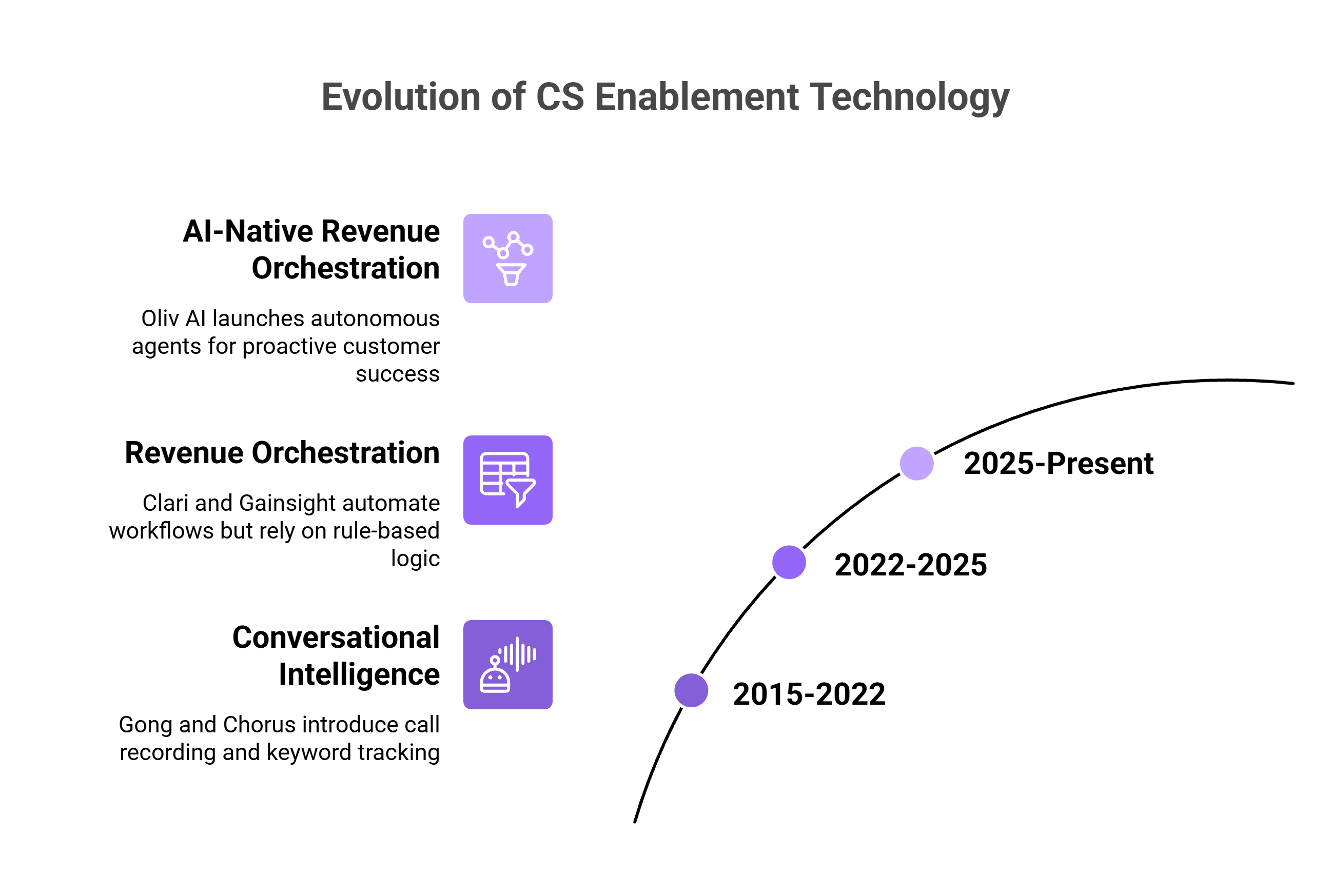
.png)
.png)
.png)
.png)