9 Best AI Sales Forecasting Software Tools in 2026: Pricing, Accuracy Claims, CRM Fit and Implementation Time
Written by
Ishan Chhabra
Last Updated :
September 21, 2026
Skim in :
13
mins
In this article
Still got questions?
Come discuss this article with me.
Hi, I'm Ishan, Founder and CEO of Oliv.
I'm always up for a conversation about revenue intelligence, AI agents, or what's actually working (and what's not) across revenue teams.
I'd love to hear your perspective.
Thank you! Your submission has been received!
Oops! Something went wrong while submitting the form.
Meet Oliv’s AI Agents
Hi! I’m, Deal Driver
I track deals, flag risks, send weekly pipeline updates and give sales managers full visibility into deal progress
Hi! I’m, CRM Manager
I maintain CRM hygiene by updating core, custom and qualification fields all without your team lifting a finger
Hi! I’m, Forecaster
I build accurate forecasts based on real deal movement and tell you which deals to pull in to hit your number
Hi! I’m, Coach
I believe performance fuels revenue. I spot skill gaps, score calls and build coaching plans to help every rep level up
Hi! I’m, Prospector
I dig into target accounts to surface the right contacts, tailor and time outreach so you always strike when it counts
Hi! I’m, Pipeline tracker
I call reps to get deal updates, and deliver a real-time, CRM-synced roll-up view of deal progress
Hi! I’m, Analyst
I answer complex pipeline questions, uncover deal patterns, and build reports that guide strategic decisions
TL;DR
Nine tools ranked: Oliv AI, Clari with Salesloft, Gong Forecast, Salesforce Einstein, HubSpot Sales Hub, Airspeed, Aviso, Forecastio, and Zoho CRM with Zia.
CRM fit is the first filter. Forecastio is HubSpot-only, Einstein is Salesforce-only, and Zia is Zoho-only, removing three options from most shortlists immediately.
Vendor accuracy claims are not comparable. Clari publishes 98% at week two for one named customer, Aviso publishes a phrase, and Forecastio publishes a ceiling.
Gartner puts the market median at 70 to 79 percent, with only 7 percent of teams reaching 90 percent or better forecast accuracy.
Real cost includes mandatory fees. HubSpot Professional adds $1,500 onboarding, Enterprise adds $3,500, and Gong, Clari, Aviso, and Airspeed publish no prices at all.
Run the seven-step test on four closed quarters with your CRM as the control. Buying nothing is a legitimate result.
Q1. What are the 9 best AI sales forecasting software tools in 2026? [toc=1. Best Tools Ranked]
The nine are Oliv AI, Clari (now one company with Salesloft), Gong Forecast, Salesforce Sales Cloud with Einstein, HubSpot Sales Hub, Airspeed, Aviso, Forecastio, and Zoho CRM with Zia. Oliv AI ranks first because it repairs the CRM record and produces the forecast in the same system, so the number is rebuilt from conversation and activity evidence instead of fields reps update by hand. CRM fit decides two rows outright. Forecastio is HubSpot-only. Einstein exists only inside Sales Cloud.
I have sat in the Thursday call where a VP asks why commit moved, and nobody can answer without opening three tabs. That is the moment this list is written for.
How to read this table
Every price below comes from the vendor's own pricing page, retrieved on 7 September 2026, with the billing term stated. Where a vendor publishes no figure, the cell says so rather than guessing.
One warning about the accuracy column. Those cells carry each vendor's own published wording, not a measurement anyone made side by side. Clari's number covers one named customer at a fixed point in the quarter. Aviso's is a phrase, not a figure. Forecastio's is a ceiling. Airspeed publishes none.They are not comparable, and Q4 explains why in detail. Gartner puts the market baseline at a 70 to 79 percent median, with only 7 percent of teams reaching 90 percent or better, which is the benchmark we unpack in our guide to improving sales forecast accuracy with AI.
The 9 Best AI Sales Forecasting Software Tools in 2026
#
Tool
Supported CRMs
Forecast built from
Published price (7 Sep 2026)
Vendor's own accuracy wording
Rating
1
Oliv AI
Salesforce, HubSpot
Recorded conversations, email and activity, plus CRM fields the agents populate
Per-agent; confirm current ladder directly
No public figure published
⭐⭐⭐⭐⭐
2
Clari (with Salesloft)
Salesforce-first, plus others
CRM fields, engagement and activity signals, now Salesloft conversation data
Not published on site
"98% forecast accuracy by week two of the quarter" (SentinelOne, one named customer)
⭐⭐⭐⭐
3
Gong Forecast
Salesforce, HubSpot, others
Conversation signals plus CRM and engagement data
Not published. "Licenses are priced per user" plus "a platform fee based on the number of users supported"
No figure published
⭐⭐⭐⭐
4
Salesforce Sales Cloud (Einstein)
Salesforce only
CRM fields, opportunity history, activity capture
Free $0, Starter $25, Pro $100, Enterprise Core $195, Advanced $395, Max $550 per user/month, with 500K / 1M / 2.75M Flex Credits per org per year
No figure published
⭐⭐⭐
5
HubSpot Sales Hub
HubSpot only
Deal stage, amount, close date, plus deal-based projections
Free $0, Starter $7/seat/month annual, Professional $90 plus a required $1,500 one-time onboarding fee, Enterprise $150 plus $3,500 onboarding
No figure published
⭐⭐⭐
6
Airspeed
Salesforce, HubSpot
Recorded conversations, email and CRM data, with agents writing notes and fields back
Not published; pricing via sales
No figure published
⭐⭐⭐⭐
7
Aviso
Salesforce, others
CRM, activity and conversation data across 50+ task-based agents
Not published
"be nearly 100% accurate" (no percentage given)
⭐⭐⭐
8
Forecastio
HubSpot only
HubSpot deal and pipeline data
$249/month annual with 2 seats included ($124.50 per user), extra seats $49; $369/month tier, extra seats $69
"up to 90-95%"
⭐⭐⭐
9
Zoho CRM (Zia)
Zoho only
CRM fields and historical patterns
Tiered; re-source from the US page for currency and term
No figure published
⭐⭐
Ratings follow the five weighted criteria published in Q2, not a feature count.
1.1 Oliv AI: the forecast and the CRM hygiene in one loop [toc=1.1 Oliv AI]
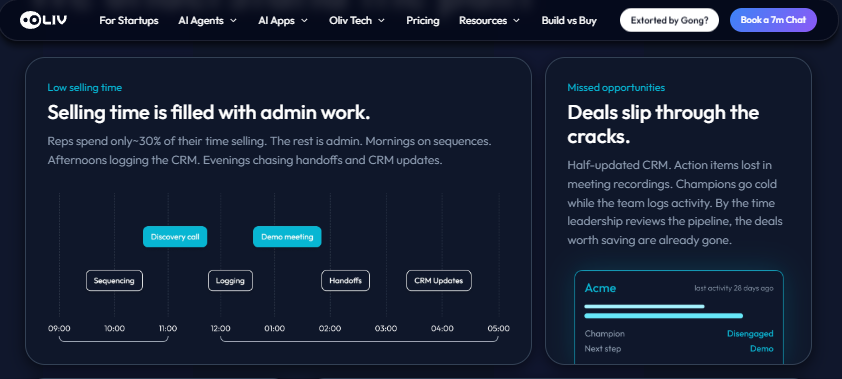
Oliv AI illustrates how admin work and half-updated CRM records quietly erode selling time and pipeline.
Supported CRMs: Salesforce and HubSpot, with write-back to standard and custom fields.
🔍 What it actually does
Oliv AI runs a set of named agents on a continuously updated record of every account and opportunity. Two of them matter for forecasting. The CRM Manager Agent writes methodology and deal fields from recorded calls, email, and activity. The Forecaster Agent then rolls those deals up and flags category movement with the reason attached.
That ordering is the whole argument. Every other tool on this list forecasts on top of whatever the reps typed. If the input is a survey of rep memory, the output is a confident guess, which is the failure pattern we traced in our breakdown of CRM data quality automation for RevOps.
⚙️ Key features for forecasting
Forecaster Agent produces weekly and monthly roll-ups and flags deals that changed category, with the underlying evidence.
CRM Manager Agent populates MEDDPICC, BANT, or custom methodology fields from conversations, without rep input, using the approach described in our guide to sales methodology automation.
Deal Driver Agent monitors open deals and surfaces the ones going quiet.
Analyst Agent answers open-ended pipeline questions without a dashboard build.
Works alongside Zoom, Google Meet, and Microsoft Teams for conversation capture.
💰 Pricing and implementation
Oliv AI prices by agent rather than by seat bundle, so a team can start with the hygiene layer and add forecasting later. I am not publishing a per-agent figure here, because the ladder has changed and I would rather you get the current one directly than read a stale number on a blog.
On setup, reviewers describe a short runway. One G2 reviewer wrote that setup "was straightforward and could be done in just five to fifteen minutes," and another said an assigned engineer had them live "within less than a week," which lines up with our RevOps implementation and admin guide.
✅ Pros and ❌ cons
Oliv AI Pros and Cons for Sales Forecasting
✅ Pros
❌ Cons
Fixes the CRM input and produces the forecast in one system
No published accuracy benchmark to point a CFO at
Named agents map to real jobs, not dashboards
Review corpus is young compared to Clari or Gong
Works on both Salesforce and HubSpot, including custom fields
Reviewers report occasional slowness and a basic mobile app
Fast onboarding, often days rather than quarters
Analytics customisation is thinner than a dedicated BI layer
📌 Choose it when
Choose Oliv AI when your forecast is unreliable because the CRM under it is stale, and a manager still assembles the roll-up by hand. If your fields are already current and your roll-up is automated, you do not need this. I would rather you find that out now.
⏰ Product timeline
Oliv AI Product Updates Timeline
Period
What shipped
Through 2025
Conversation capture, meeting summaries, and automated CRM updates after calls, with Salesforce and HubSpot integration as the write-back path.
2026 to date
A named agent roster replaced single-purpose features. The Forecaster Agent handles roll-ups, while CRM Manager, Deal Driver, and Analyst agents run under one orchestration layer.
Expected next
Deeper methodology enforcement at the process layer, so a single RevOps change propagates to every agent and rep rather than being retrained per team.
💬 What users actually say
"I use Oliv.ai for recording my sales calls, keeping my client updates on CRM in check, and moving accounts between different stages. It's incredibly helpful with our custom sales methodologies like MEDIC-BAND, as it helps me fill all of them out. Oliv.ai has agents like the CRM agent, deal driver agent, and forecast agent, which are invaluable. The forecast agent assists with preparing weekly and monthly forecasts." — Verified User, Oliv AIG2 Verified Review, 5 stars, 15 Jun 2026
"I like how it makes forecasting and pipeline reviews easier, keeping everything up to date and the CRM hygienic. I'd love to see few more options to customize dashboards and reports for different teams." — Verified User, Oliv AIG2 Verified Review, 4.5 stars, 26 Jun 2026
"The only downside is that the platform can be a bit glitchy at times, but the support team is always quick to address and resolve any bugs." — Verified User, Oliv AIG2 Verified Review, 5 stars, 2 Jul 2026
Oliv AI's read on its own placement is worth stating plainly. The number one position here comes from the Q2 criteria, not from a feature list. On Verifiable Proof, the fifth criterion, Oliv scores lowest of anything in its column, because the public review base is thin and there is no named-customer accuracy study to hand a board. If reference-checkable proof is a hard requirement for you, that is a real gap today, and our revenue intelligence platform comparison for RevOps sets out how to weigh it.
1.2 Clari: the forecasting standard, now merged with Salesloft [toc=1.2 Clari]
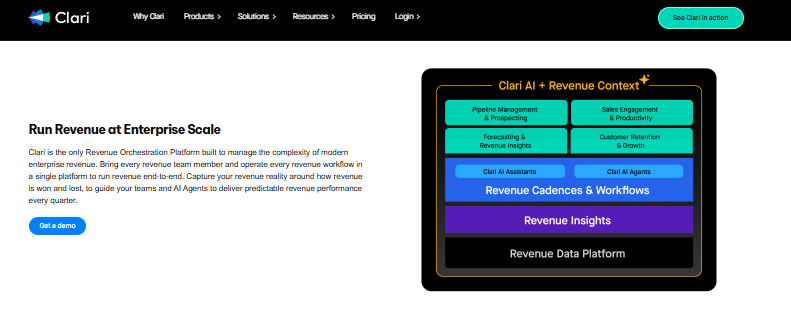
Clari's revenue orchestration stack layers forecasting, pipeline management, and AI agents above one revenue data platform.
Supported CRMs: Salesforce-first, with support for other systems.
🔍 What it actually does
Clari builds a forecast from CRM fields plus engagement and activity signals, then gives managers structured views to inspect it. Weekly roll-ups, waterfall and flow views, and opportunity-level inspection are the core. It is the tool most enterprise RevOps teams benchmark against, and there is a reason for that, which we detail in our rundown of Clari's features.
Concede the strong part first. Clari publishes 98% forecast accuracy by week two of the quarter for SentinelOne, a named customer, retrieved 7 September 2026. That is a real, attributable outcome. Oliv AI does not have an equivalent published study, and pretending otherwise would be dishonest.
🔄 The 2026 change most articles missed
Clari and Salesloft are one company now, not two vendors to compare. On 14 July 2026, they shipped Salesloft Conversation Intelligence to general availability, with AI Trends and Insights, Mobile In-Person Recording, AI-Powered Auto Call Scoring, and Ask Across Multiple Calls.
Any shortlist still carrying Clari and Salesloft as separate rows is double-counting. And any page describing Clari as a pre-generative forecasting layer is out of date on its face, including most head-to-heads such as Gong vs Clari.
⚙️ Key features for forecasting
Weekly forecast submission and roll-up across the sales hierarchy.
Waterfall and flow views for period-over-period pipeline movement.
Opportunity inspection with preset views for managers.
RevBI reporting for custom revenue analytics.
Conversation intelligence now folded in through Salesloft.
💰 Pricing and implementation
Clari does not publish pricing on its site. Any per-user figure you read in a comparison article was invented, including in earlier versions of this one, which is why we keep a sourced view of Clari pricing separately.
Implementation is where the honest caveat sits. Clari rewards a RevOps owner who can maintain hierarchies, presets, and scenario logic. Reviewers describe smooth initial setup but ongoing configuration work, which is exactly the mid-market trap: enterprise tooling bought by a 40-rep team with no RevOps function to feed it.
✅ Pros and ❌ cons
Clari Pros and Cons for Sales Forecasting
✅ Pros
❌ Cons
Published, named-customer forecasting outcome
No published pricing anywhere on the site
Mature roll-up, waterfall, and inspection views
Reviewers report weak CRM write-back, including MEDDIC values
Deep Salesforce integration
Custom reporting flexibility is a recurring complaint
Conversation intelligence now included post-merger
Assumes a RevOps owner most mid-market teams do not have
📌 Choose it when
Choose Clari when you have a RevOps function, run on Salesforce, and need reference-checkable enterprise proof for a board. Do not choose it if you need conversation findings written back into CRM fields, or if nobody owns the configuration on Fridays.
Continued convergence of the forecasting and engagement surfaces into a single platform, which raises the standard buyer question about roadmap and contract consolidation.
💬 What users actually say
"I like Clari's visual design and the nice, clear style of word presentation. I enjoy being able to forecast easily without having to add up manually. Clari helps save time, reducing manual work with its automated process. The initial setup was easy too." — Verified User, ClariG2 Verified Review, 3 stars, 17 Dec 2025
"Clari forecasting is simple, easy to use, and well integrated with SFDC. The AI features are immature, team activity is poorly designed, and it doesn't integrate well with other popular business systems today." — Verified User, ClariG2 Verified Review, 3 stars, 10 Oct 2025
"The CRM writeback is not good; we cannot send MEDDIC values back to Salesforce or update fields in Salesforce from the conversation intelligence. The AI is not as flexible as we need it to be." — Verified User, ClariG2 Verified Review, 1.5 stars, 13 Jul 2026
That last one is the cleanest illustration of the split running through this whole list. Clari reads the pipeline well. Writing structured findings back into the opportunity record is a different job, and it is the job Oliv AI's CRM Manager Agent was built to do, in the pattern we describe across AI agents for RevOps. I could be reading one reviewer too strongly, so test it on your own instance before you believe either of us.
1.3 Gong Forecast: strong conversation data, unpublished price [toc=1.3 Gong Forecast]
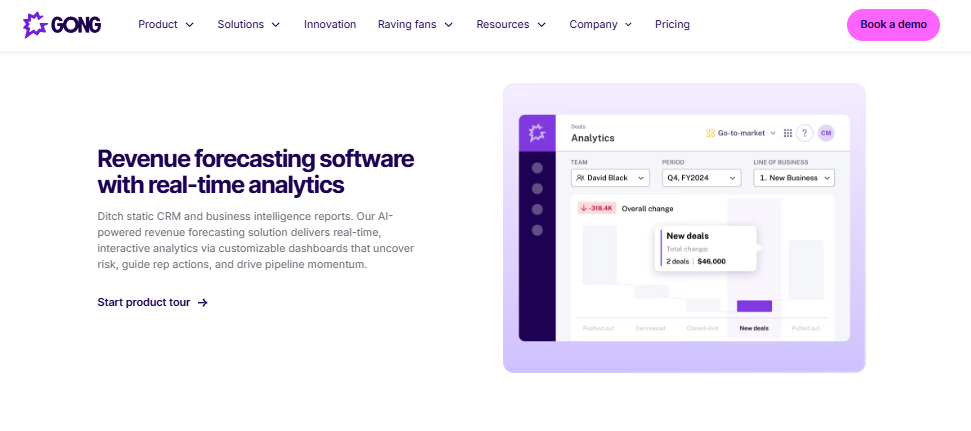
Gong's forecasting dashboard tracks new, pushed, decreased, and closed-lost deals across a selected quarter and team.
Supported CRMs: Salesforce, HubSpot, and other major systems.
🔍 What it actually does
Gong Forecast sits on top of Gong's conversation layer. It reads what was said on calls, blends that with CRM fields and engagement data, and produces roll-ups and deal risk views. The conversation capture underneath it is genuinely good, and reviewers say so consistently, as our summary of Gong forecasting sets out in more depth.
The forecasting module is an add-on to that platform, not a standalone product. You buy the conversation layer first.
⚙️ Key features for forecasting
Forecast roll-ups built on conversation, email, and CRM signals.
Deal boards with risk flags tied to call activity.
Smart trackers that surface keywords and themes across recordings, explained further in our guide to Gong smart trackers.
Revenue AI platform layer covering coaching and engagement alongside forecasting.
💰 Pricing and implementation
Gong publishes no dollar figures. Its pricing page states only that "Licenses are priced per user" and that "There is a platform fee based on the number of users supported," retrieved 7 September 2026. Any per-seat number you have read in a comparison article, including in earlier versions of this one, was not sourced from Gong.
That platform fee is the part buyers underestimate. It is charged on supported users, not just active forecast users, which is the arithmetic we work through in our breakdown of Gong pricing.
✅ Pros and ❌ cons
Gong Forecast Pros and Cons
✅ Pros
❌ Cons
Best-in-class conversation capture and transcript quality
No published pricing at all, so budgeting needs a sales call
Deal tracking and account engagement views are mature
Reviewers report limits getting data back into Salesforce
Broad adoption means reps often already know it
Data export is gated behind plan upgrades
Forecast benefits from real call signal, not just fields
Tracker setup is fiddly and admin-heavy
⚠️ The write-back gap
Oliv AI's read is that this is the fault line in the whole category. Reading conversations well and writing structured findings back into the opportunity is a different engineering job. Gong is excellent at the first. Reviewers keep flagging the second, a pattern we document across Gong's limitations and challenges.
📌 Choose it when
Choose Gong Forecast when your team already runs Gong, the platform fee is budgeted, and you want forecasting on the same conversation record. Skip it if your main problem is empty CRM fields.
⏰ Product timeline
Gong Forecast Product Updates Timeline
Period
What shipped
Through 2025
Conversation capture, transcripts, smart trackers, and deal boards, with forecasting layered on the Revenue AI platform.
Deeper agent-driven workflows across the same conversation layer, which raises the same write-back question reviewers already ask.
💬 What users actually say
"I appreciate how Gong organizes all our chats, videos, and audio with clients into a single source. I found the AI tracker setup to be quite difficult, especially concerning the user interface when setting up keywords or smart trackers. Moreover, I cannot download all the data myself unless we upgrade the plan." — Verified User, GongG2 Verified Review, 3 stars, 3 Oct 2025
"Being able to sequence our steps, along with integration with Nooks/Salesforce. Limitations of getting data back into salesforce." — Verified User, GongG2 Verified Review, 3 stars, 21 May 2026
1.4 Salesforce Sales Cloud with Einstein: already paid for, often overlooked [toc=1.4 Salesforce Einstein]
Supported CRMs: Salesforce only.
🔍 What it actually does
Einstein forecasting runs inside Sales Cloud. It reads opportunity fields, historical close patterns, and captured activity, then projects the number. Because it lives in the CRM, there is no sync layer to break, a structural advantage we unpack in our guide to Salesforce Einstein forecasting.
If you are on Enterprise, Advanced, or Max, you may already own more forecasting capacity than you are using.
⚙️ Key features for forecasting
Native forecast categories, quotas, and hierarchy roll-ups.
Opportunity scoring based on historical patterns.
Activity capture feeding pipeline views.
Flex Credits for generative and agent features across the org.
💰 Pricing and implementation
The current Sales Cloud lineup, retrieved 7 September 2026, is Free at $0, Starter at $25, Pro at $100, Enterprise Core at $195, Advanced at $395, and Max at $550 per user per month. Flex Credits are included at 500K, 1M, and 2.75M per org per year depending on tier, and we map those bands in our Einstein pricing tiers explainer.
Implementation is configuration, not integration. That sounds easier than it is, because the configuration is where RevOps time goes.
✅ Pros and ❌ cons
Salesforce Einstein Forecasting Pros and Cons
✅ Pros
❌ Cons
No sync layer, so no data drift between systems
Salesforce only, which ends the conversation for HubSpot teams
Substantial AI capacity bundled at higher tiers
Forecast quality depends entirely on typed fields
Published, transparent price ladder
Credit entitlements are per org per year and can run out
Familiar to admins already in the instance
Needs real admin time to configure well
📌 Choose it when
Choose Einstein when you run Salesforce, sit on Enterprise Core or above, and have an admin who will maintain it. Test it before you buy anything else, because you are paying for it already.
⏰ Product timeline
Salesforce Einstein Product Updates Timeline
Period
What shipped
Through 2025
Einstein opportunity scoring, forecast categories, and activity capture inside Sales Cloud, sold across the older tier structure.
2026 to date
The current Sales Cloud ladder runs Free through Max at $550, with 500K, 1M, and 2.75M Flex Credits per org per year by tier.
Expected next
Further consumption-based agent features metered against Agentforce pricing, shifting spend from seats to credits.
1.5 HubSpot Sales Hub: forecasting from Starter, hygiene still manual [toc=1.5 HubSpot Sales Hub]
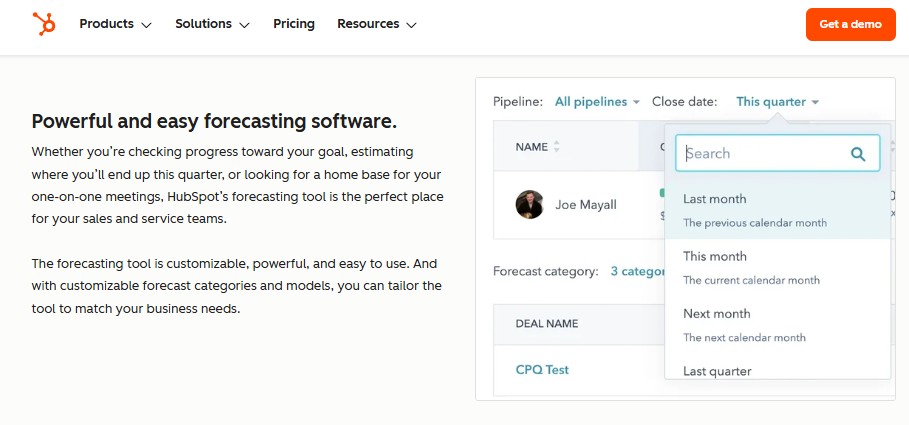
HubSpot's native forecasting tool filters deals by pipeline, close date, and customizable forecast categories for managers.
Supported CRMs: HubSpot only.
🔍 What it actually does
HubSpot projects revenue from deal stage, amount, and close date. Forecasting is available from the Starter tier, which surprises many buyers who assume it is an enterprise feature. Conversation intelligence sits higher, at Professional.
That entitlement split is the detail most comparison articles skip, and it changes the buying decision, particularly for teams weighing CRM tooling choices for the first time.
💰 Pricing and the fees nobody quotes
The published Sales Hub pricing, retrieved 7 September 2026, is Free at $0, Starter at $7 per seat per month billed annually ($20 monthly), Professional at $90 annually, and Enterprise at $150. Professional carries a required $1,500 one-time onboarding fee. Enterprise carries $3,500.
HubSpot Credits are included by tier at 500, 3,000, and 5,000. Budget the onboarding fee as part of year one, not as an extra, and read it alongside our work on how to reduce sales tech stack costs.
✅ Pros and ❌ cons
HubSpot Sales Hub Forecasting Pros and Cons
✅ Pros
❌ Cons
Forecasting included from a $7 seat
HubSpot only
Fully published pricing with clear tiers
Mandatory onboarding fees of $1,500 and $3,500
No integration layer to maintain
Conversation intelligence gated at Professional
Fast for teams already standardised on HubSpot
Forecast still reads fields reps type by hand
📌 Choose it when
Choose HubSpot's own forecasting when you run HubSpot and your deal stages are disciplined. A HubSpot-native mid-market team is often better served here than by adding a layer on top.
⏰ Product timeline
HubSpot Sales Hub Product Updates Timeline
Period
What shipped
Through 2025
Deal-based forecasting, pipeline projections, and forecast submission inside Sales Hub, with conversation intelligence reserved for higher tiers.
2026 to date
The current ladder prices Starter at $7 per seat annually, Professional at $90 plus $1,500 onboarding, and Enterprise at $150 plus $3,500, with credits at 500, 3,000, and 5,000.
Expected next
Wider credit-metered AI features across tiers, which makes the credit allowance a line item to check at renewal.
1.6 Airspeed: agents that keep the pipeline honest so the forecast reflects reality [toc=1.6 Airspeed]
Supported CRMs: Salesforce and HubSpot.
🔍 What it actually does
Airspeed runs a team of agents across your whole pipeline. AI joins conversations and writes notes back to Salesforce or HubSpot, surfacing the risks and next steps hiding in every deal, keeping your CRM current, and coaching reps on what to do differently next time. The result: up to 20% of a rep's week handed back, 35% less manual admin, and a pipeline that reflects reality instead of whatever got typed in on Friday.
⚠️ On the accuracy claim
Airspeed publishes no forecast-accuracy percentage. It describes a forecasting agent that turns call signals into a commit, working alongside a CRM agent that writes qualification fields, but it states no horizon, unit, or named-customer accuracy study behind that. Treat it as a design claim, not a measurement, and test it on your own closed quarters.
💰 Pricing and implementation
Airspeed does not publish pricing; its site sends pricing questions to its sales team. It publishes no implementation timeline either, though it says CRM write-back runs with no rep login and no setup project. Its one published outcome is a named customer: Foleon, which it says saves 17 hours per rep per month, with payback in under two months.
✅ Pros and ❌ cons
Airspeed Pros and Cons for Sales Forecasting
✅ Pros
❌ Cons
Native two-way Salesforce and HubSpot sync
No published forecast-accuracy figure
Agents keep the CRM current with no rep data entry
Forecasting agent is new, with no published accuracy study
Risk and next-step surfacing on every deal
Newer entrant, rebranded from Glyphic in 2026
Built-in rep coaching; agents ask approval before acting
Value concentrated on Salesforce/HubSpot teams
📌 Choose it when
Choose Airspeed when you are on Salesforce or HubSpot and your forecast is only as trustworthy as your CRM hygiene. It fits teams that want agents to keep the pipeline current, flag risk and coach reps in the background — not teams that need a named-customer accuracy study to hand a board.
⏰ Product timeline
Airspeed Product Updates Timeline
Period
What shipped
Through 2025
Operated as Glyphic, focused on conversation intelligence and deal insights.
2026 to date
Rebranded to Airspeed on 20 May 2026 as an agent-native execution layer whose Deal, Insights, Outbound and Coaching agents write to Salesforce and HubSpot; raised a $20M Series A on 4 June 2026, reported ~200 customers across 20 countries, and earned 18 mentions and 12 badges in G2's Summer 2026 reports.
Expected next
More autonomous actions under admin-set approval thresholds, with wider CRM write coverage.
💬 What one user says
Reviewers highlight that Airspeed auto-captures call notes and next steps so reps stay in the conversation instead of typing into the CRM; some flag that transcription can dip on poor audio. — Summary of verified reviews, AirspeedG2, 4.9 average, mid-2026
That is a synthesis of review themes rather than one named deployment, and the sample is still small. Weigh it against your own pilot before relying on it.
1.7 Aviso: the broadest published agent surface [toc=1.7 Aviso]
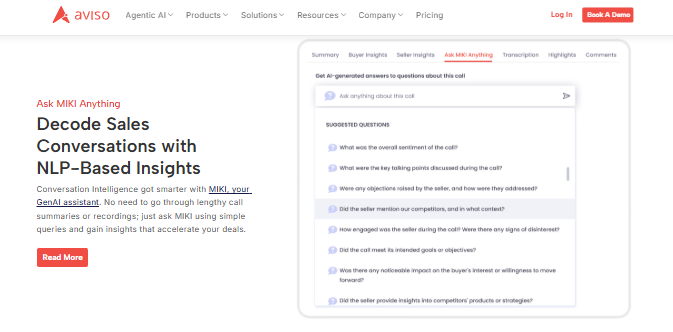
Aviso's MIKI assistant answers natural-language questions about sales calls without reviewing full recordings or transcripts.
Supported CRMs: Salesforce and other enterprise systems.
🔍 What it actually does
Aviso runs forecasting alongside a large published agent surface. Its site lists 30 or more out-of-box agentic workflows, 50 or more task-based agents, and a No-Code GTM Agent Studio, plus conversation and relationship intelligence. It states it is "Trusted by 450+ Revenue Teams" and names New Relic.
Credit where it is due. On paper, that agent catalogue is broader than Oliv AI's published list. I am not going to pretend otherwise, and our own inventory of Oliv AI agents for sales teams is there to be compared against it.
⚠️ On the accuracy claim
Aviso publishes no accuracy percentage. Its wording is that you can "be nearly 100% accurate," retrieved 7 September 2026. That is a phrase, not a measurement, and it cannot be placed in a column beside Clari's 98 percent figure.
💰 Pricing and implementation
Aviso does not publish pricing. Expect an enterprise motion, and expect the same RevOps dependency that comes with any configurable forecasting platform.
✅ Pros and ❌ cons
Aviso Pros and Cons for Sales Forecasting
✅ Pros
❌ Cons
Large published agent and workflow catalogue
No published pricing
No-Code Agent Studio for custom workflows
No published accuracy figure, only a phrase
Named enterprise customer references
Enterprise-weight setup for a mid-market team
Conversation and relationship intelligence included
Some reviewers report a clunky experience
📌 Choose it when
Choose Aviso when you want a wide agent catalogue under one enterprise contract and have the RevOps capacity to configure it. Skip it if you need a published price to build a business case.
⏰ Product timeline
Aviso Product Updates Timeline
Period
What shipped
Through 2025
Forecasting, conversation intelligence, and relationship intelligence sold as an enterprise revenue platform.
2026 to date
The published surface now lists 30+ out-of-box agentic workflows, 50+ task-based agents, and a No-Code GTM Agent Studio.
Expected next
More agent templates inside the Studio, extending configuration rather than reducing it.
💬 What one user says
"Mandated by business, nothing else. Product is just poorly built." — Verified User, AvisoG2 Verified Review, low rating, 24 Jun 2025
That is one reviewer's experience on one deployment, not a pattern I can evidence. Weigh it against Aviso's named references and test it yourself.
1.8 Forecastio: the cheapest entry that is not actually cheap [toc=1.8 Forecastio]
Supported CRMs: HubSpot only.
🔍 What it actually does
Forecastio describes itself as "Sales Forecasting & Pipeline Intelligence for HubSpot." It reads HubSpot deal and pipeline data, then produces forecasts and pipeline analytics. For a HubSpot team that has outgrown native forecasting, it is a sensible next step.
That single CRM constraint disqualifies it for most readers, and almost no comparison article says so.
💰 The pricing trap
The published Forecastio pricing, retrieved 7 September 2026, is $249 per month billed annually for Sales Forecasting with 2 seats included, and $49 for each extra seat. The Forecasting and Pipeline Intelligence tier is $369 per month with 2 seats, and $69 per extra seat.
A two-seat team therefore pays $124.50 per user per month, not $49. Quoting the marginal seat rate as the entry price is the most common error in this category, and this article made it before.
⚠️ On the accuracy claim
Forecastio publishes "up to 90-95%." That is a ceiling with no horizon attached. Gartner's market baseline sits at a 70 to 79 percent median, with only 7 percent of teams reaching 90 percent or better. Read the ceiling against that floor, using the method in our guide to evidence-based forecast commits.
✅ Pros and ❌ cons
Forecastio Pros and Cons
✅ Pros
❌ Cons
Fully published pricing with seat terms
HubSpot only
Purpose-built for HubSpot pipelines
Two-seat minimum inflates real per-user cost
Lightweight next step past native forecasting
Accuracy claim has no stated horizon
Fast to stand up on an existing HubSpot instance
No conversation layer feeding the forecast
📌 Choose it when
Choose Forecastio when you run HubSpot, native forecasting has run out of road, and you have enough seats that the two-seat minimum stops distorting the price.
⏰ Product timeline
Forecastio Product Updates Timeline
Period
What shipped
Through 2025
HubSpot-native sales forecasting with pipeline analytics, positioned squarely at HubSpot-only revenue teams.
2026 to date
A two-tier published ladder at $249 and $369 per month annually, each including 2 seats, with extra seats at $49 and $69.
Expected next
Deeper pipeline intelligence inside the same HubSpot boundary, with no sign of multi-CRM support.
1.9 Zoho CRM with Zia: forecasting bundled into the CRM tier [toc=1.9 Zoho CRM Zia]
Supported CRMs: Zoho only.
🔍 What it actually does
Zia is Zoho's AI layer. It reads CRM fields and historical patterns to produce predictions inside Zoho CRM. The capability is split across tiers rather than sold separately.
💰 Pricing and the tier split
Zoho's CRM pricing varies by region, so check currency and billing term on your local page before budgeting. The functional split matters more than the number. Professional includes Zia AI agents and email intelligence. Enterprise adds the AI sales assistant with predictions. Ultimate adds custom AI and machine learning. AI anomaly detection sits in CRM Plus Enterprise rather than core CRM.
✅ Pros and ❌ cons
Zoho CRM Zia Pros and Cons
✅ Pros
❌ Cons
Lowest cost of entry in this list
Zoho only
Prediction features bundled into CRM tiers
Prediction capability gated at Enterprise and above
No integration layer to maintain
Forecast reads typed fields, with no conversation substrate
Custom AI available at Ultimate
Regional pricing makes budgeting error-prone
📌 Choose it when
Choose Zia when you already run Zoho CRM and want prediction inside the tier you pay for. Do not shortlist it if you are on Salesforce or HubSpot.
⏰ Product timeline
Zoho CRM Zia Product Updates Timeline
Period
What shipped
Through 2025
Zia predictions, scoring, and email intelligence distributed across Zoho CRM tiers.
2026 to date
The tier split places Zia agents at Professional, the AI sales assistant with predictions at Enterprise, and custom AI or ML at Ultimate.
Expected next
More Zia agent surfaces pushed into higher tiers, keeping prediction as an upgrade lever.
🔎 Also considered
BoostUp and Weflow appear on most competing shortlists and are worth a look, particularly Weflow for lightweight HubSpot and Salesforce pipeline hygiene. Neither is scored here, because the nine above cover the full range of CRM fit, input substrate, and price transparency this article measures.
Across all nine, Oliv AI is the only entry whose forecasting agent depends on a hygiene agent running underneath it, which is why it sits first on the Q2 rubric rather than on feature count. I could be weighting input quality too heavily. Run the test in Q7 on your own closed quarters and find out, then compare the result against the wider field of revenue intelligence software platforms.
Q2. How were these nine tools selected and scored? [toc=2. Scoring Methodology]
Five weighted criteria total 100 points: CRM Fit and Data Substrate at 25%, Forecast Signal Breadth at 25%, Weekly Human Effort at 20%, Pricing Transparency at 20%, and Verifiable Proof at 10%. Published accuracy is excluded on purpose, because no two vendors define horizon, unit, or error metric the same way. Scores convert to stars in twenty-point bands: 0 to 20 is one star, 21 to 40 is two, 41 to 60 is three, 61 to 80 is four, and 81 to 100 is five.
📐 What each criterion actually measures
CRM Fit and Data Substrate (25%). Not just whether a connector exists. This scores whether the tool reads and writes the fields your forecast depends on, including custom objects, and whether it survives a messy instance, which is the failure mode we cover in our work on CRM data quality automation for RevOps.
Forecast Signal Breadth (25%). What the forecast is built from. Typed fields score lowest. Fields plus engagement data score higher. Fields plus engagement plus conversation evidence score highest, a distinction we set out in revenue intelligence vs conversation intelligence.
⏰ The two criteria buyers forget
Weekly Human Effort (20%). Who touches this on Friday, and for how long? A tool that needs a RevOps owner to maintain hierarchies and presets costs more than its licence, which is why we track it alongside sales tech stack costs.
Pricing Transparency (20%). Whether a buyer can build a budget without a sales call. This penalises Gong, whose pricing page publishes no dollar figures, and Aviso and Airspeed, which publish none either, all retrieved 7 September 2026.
Verifiable Proof (10%). Published customer outcomes and a public review corpus a buyer can reference-check.
⚠️ Why accuracy is not a criterion
The title of this article promises accuracy claims, and this rubric refuses to score them. That looks like a contradiction until you read the claims side by side.
Gartner puts the market median at 70 to 79 percent, with only 7 percent of teams reaching 90 percent or better. Several vendors publish figures above that. Scoring those numbers would reward whoever wrote the boldest sentence. Q4 works through why in detail, and our guide to improving sales forecast accuracy with AI handles the practice side.
⭐ Scores and stars
Weighted Scores and Star Ratings for the 9 Forecasting Tools
Tool
CRM Fit /25
Signal /25
Effort /20
Price /20
Proof /10
Total
Rating
Oliv AI
23
24
18
15
6
86
⭐⭐⭐⭐⭐
Clari (with Salesloft)
20
21
13
10
10
74
⭐⭐⭐⭐
Gong Forecast
18
22
14
6
8
68
⭐⭐⭐⭐
Salesforce Einstein
15
14
12
20
7
68
⭐⭐⭐⭐
HubSpot Sales Hub
13
11
14
20
8
66
⭐⭐⭐⭐
Airspeed
20
19
14
6
6
65
⭐⭐⭐⭐
Aviso
15
18
10
6
7
56
⭐⭐⭐
Forecastio
10
12
15
18
5
60
⭐⭐⭐
Zoho CRM (Zia)
8
9
12
14
6
49
⭐⭐⭐
💬 Where this rubric hurts
Oliv AI scores 86 here and loses most of its points on one criterion. Verifiable Proof is its weakest column, at 6 out of 10, because the public review base is young and there is no named-customer accuracy study to hand a board. Clari scores full marks on that same criterion.
I put that in the table rather than a footnote for a simple reason. A rubric that only flatters the vendor publishing it is not a rubric. It is a brochure with maths on it. If Verifiable Proof carried 25 percent instead of 10, Clari would top this list, and I would have to live with that, as our revenue intelligence platform comparison for RevOps spells out.
Q3. Do you need forecasting software if you already have a CRM, and is your data ready for it? [toc=3. CRM vs Buying]
Often you do not. HubSpot includes forecasting from Starter, and Salesforce bundles substantial AI capacity into Core, Advanced, and Max. A team with clean stages and disciplined managers can run a credible commit on what it already pays for. Two conditions change that: your forecast is built only from fields reps update by hand, and a manager assembles the weekly roll-up manually. Data readiness decides the rest. Among sales teams surveyed by Salesforce, 79 percent of high performers prioritise data cleansing, against 54 percent of underperformers.
🗓️ The Friday that repeats every week
A sales manager blocks Thursday afternoon to chase seven reps for updated close dates. Friday morning goes to rebuilding a spreadsheet the CRM should have produced. By Monday's call, three of those deals have already moved.
That loop is the actual product most teams are trying to buy their way out of. It is worth naming before anyone reaches for a credit card, and it is the same loop we unpack in our guide to running evidence-based forecast commits.
💰 What CRM-native forecasting already covers
Quite a lot, and cheaply. HubSpot puts forecasting in Starter at $7 per seat per month billed annually, retrieved 7 September 2026. Conversation intelligence sits higher, at Professional, which carries a required $1,500 one-time onboarding fee.
Salesforce includes 500K Flex Credits per org per year at Enterprise Core, 1M at Advanced, and 2.75M at Max. Most teams underuse both. The cost is not the licence. It is the manager hours the licence does not remove, a gap we quantify in our revenue intelligence ROI calculator.
✅ The four-part readiness test
Run this before any demo. It takes an afternoon.
Field completeness. What share of open opportunities have a populated amount, close date, and next step?
Duplicate rate. How many accounts and contacts exist twice in the same instance?
Activity capture. What percentage of calls and emails are logged against the right opportunity?
Stage discipline. Do two managers define "Proposal" the same way?
⚠️ Why this test matters more than the shortlist
Fail two of those four, and AI forecasting will not save you. It will produce a confident wrong number faster than a spreadsheet did. Over half of sales leaders using AI say disconnected systems slow their initiatives down.
That is the uncomfortable finding. Model quality is not the bottleneck. The bottleneck is the record underneath it, which is why we treat CRM data strategy as the first move rather than the last.
🔧 What changes when hygiene stops being a rep task
Oliv AI was built for the second condition specifically. The CRM Manager Agent fills methodology and deal fields, including MEDDPICC or BANT, from recorded calls, email, and activity. The Forecaster Agent then rolls those deals up, so nobody assembles the number by hand.
In practice, that means a rep who never opens the opportunity record still ends the week with it populated. We built it that way because enforcing hygiene through training has failed in every org I have worked in, and our approach to sales methodology automation explains the mechanics.
📌 The decision, in two lines
Buy something when both of these are true:
Your forecast reads only fields that reps type by hand.
A human assembles the weekly roll-up before every pipeline call.
If neither is true, keep your money and fix stage definitions instead. If only one is true, fix that one first and re-test in a quarter. I would rather you skip a purchase than blame a tool for a process problem it was never going to solve.
Q4. How accurate is AI sales forecasting, really? [toc=4. Accuracy Claims Decoded]
No comparable figure exists. Gartner finds only 7 percent of sales organisations reach 90 percent or better forecast accuracy, with a median of 70 to 79 percent, so any claim above 90 percent needs a stated horizon before it means anything. Clari publishes 98 percent by week two of the quarter for one named customer. Aviso publishes no percentage, only "nearly 100% accurate." Forecastio publishes "up to 90-95%." Airspeed publishes no figure.Those use different horizons, units, and error metrics. Judge accuracy on a test against your own closed history.
📊 The column every listicle publishes
Open any comparison page in this category and you will find a tidy accuracy column. One percentage per vendor, lined up, implying somebody measured them the same way.
Nobody did. Earlier versions of this article carried that column too, and the numbers in it were not sourced from anywhere. Removing it cost this page a feature readers expect.
📉 The floor those claims sit above
Start with the market baseline. Gartner's research puts the median at 70 to 79 percent, and 69 percent of sales operations leaders say forecasting is harder than it was three years ago.
Broader benchmarks say 79 percent of sales organisations miss forecast by more than 10 percent, while elite B2B SaaS teams hold variance to plus or minus 5 to 10 percent. Fewer than half of sales leaders have high confidence in their own number. Any vendor claim above 90 percent is describing an outlier, not a norm, as we argue in our piece on sales forecast accuracy for CROs.
⚠️ The four variables that make a percentage mean something
A forecast accuracy figure is meaningless without all four of these stated:
Horizon. Day 14 of the quarter, or day 75? Accuracy decays roughly 5 to 8 percent per month, so 87 percent at 30 days lands near 70 percent at 90.
Unit. Deal count, bookings value, or ARR?
Error metric. Absolute variance to actual, or directional hit rate?
Dataset. One named customer, or a portfolio average?
Clari's published claim specifies a horizon and a customer, which is more disclosure than most. Aviso's is a phrase. Forecastio's is a ceiling with no horizon at all. Airspeed publishes nothing to test.
🔍 Where the evidence should sit instead
Oliv AI publishes no accuracy percentage on this page, deliberately, because it has run no public benchmark that would survive the four questions above. What the Forecaster Agent does instead is attach the evidence to every category change, so a manager sees which call, email, or stalled criterion moved a deal, in the pattern we describe across AI deal intelligence.
That is a different promise from a confidence score. Auditing why a number moved is checkable. A percentage on a website is not. I could be over-weighting explainability here, and reasonable operators disagree with me on it.
💬 The part vendors avoid saying
Run the like-for-like test in Q7, and some of you will find your existing CRM performs within a few points of the tool you were about to buy. That result is a win, not a wasted afternoon.
Across teams working through this, published benchmarks are more useful than vendor benchmarks. AI and machine learning methods generally land within plus or minus 8 to 15 percent variance, roughly 15 to 25 percent better than manual roll-ups. That is a real improvement. It is also nowhere near the numbers on the pricing pages, a gap worth holding in mind alongside our view of the future of revenue intelligence.
Q5. Which tools fit your CRM, and what does each build its forecast from? [toc=5. CRM Fit & Signals]
Filter on CRM first. Forecastio is HubSpot-only, Einstein exists only inside Sales Cloud, and Zia predictions apply only to Zoho CRM, so on a HubSpot-only stack three of the nine are already gone. Then filter on inputs. Field-based tools read stage, amount, and close date that reps typed. Engagement-based tools add email, calendar, and buyer activity. Conversation-based tools read what was actually said. A forecast is never more reliable than the layer beneath it.
📉 The deal that looked fine right up until it did not
Stage: Proposal. Amount: populated. Close date: end of quarter. Next step: "follow up." Every field green, and the deal died anyway.
Nothing in that record was false. It was just written by someone who wanted it to be true. That is the flaw in field-based forecasting, and no model fixes it from above, which is why we treat deal slippage prevention as a data problem first.
🔌 Filter one: which CRM does it actually support
CRM Support by Forecasting Tool
Tool
Salesforce
HubSpot
Zoho
Other
Oliv AI
✅
✅
❌
Limited
Clari (with Salesloft)
✅
Partial
❌
✅
Gong Forecast
✅
✅
❌
✅
Salesforce Einstein
✅
❌
❌
❌
HubSpot Sales Hub
❌
✅
❌
❌
Airspeed
✅
✅
❌
❌
Aviso
✅
Partial
❌
✅
Forecastio
❌
✅
❌
❌
Zoho CRM (Zia)
❌
❌
✅
❌
Then ask the question RevOps always asks: does it write to custom objects, or only standard ones? A heavily customised instance breaks tools that assume a clean schema, a constraint we cover in our guide to revenue intelligence integration across CRM, Slack, and email.
🧠 Filter two: what feeds the number
Happy ears and sandbagging are not character flaws. They are what a field-based system rewards, because the only input is a rep's own estimate of their own deal.
What Each Forecasting Tool Builds Its Prediction From
Primary input class
Tools
What it misses
Typed CRM fields
HubSpot, Zoho Zia, Einstein
Everything said on the call
Fields plus engagement signals
Clari, Aviso
What the words meant, not just that contact happened
Oliv AI connects to Salesforce and HubSpot and writes back to standard and custom fields, which is the specific requirement RevOps raises when a customised instance has broken previous tools. The CRM Manager Agent writes what was said into the fields the forecast reads. The Forecaster Agent then rolls those deals up.
The point is the order, not the agent names. We built it this way so the input layer stops being a survey of rep memory, an approach detailed in our guide to AI agents for sales teams.
"I appreciate that it integrates well with platforms like HubSpot and Salesforce, allowing us to capture insights from calls and maintain a complete view of customer interactions." — Verified User, Oliv AIG2 Verified Review, 4.5 stars, 23 Jun 2026
"The biggest problem it solves is context loss. Additionally, the automated summaries and action item extraction save me hours of manual data entry into our CRM." — Verified User, ClariG2 Verified Review, 4 stars, 13 Jul 2026
⚠️ The concession
If you run HubSpot, have 30 reps, and no RevOps function, adding a conversation layer may be the wrong move. HubSpot's own forecasting or Forecastio will serve you better than a platform you cannot maintain. Fit beats sophistication every time, which is the same conclusion we reach for smaller sales teams.
Q6. What does it cost, how long does it take, and who maintains it every week? [toc=6. Cost, Setup & Upkeep]
Published entry prices run from $0 to $550 per user per month, but the list price is rarely the real one. HubSpot Professional is $90 per seat annually plus a required $1,500 one-time onboarding fee, and Enterprise is $150 plus $3,500. Forecastio's $249 per month includes two seats, so a two-person team pays $124.50 per user, not the $49 marginal rate. Gong, Aviso and Airspeed publish nothing. No vendor publishes an implementation timeline, so treat every duration you read as a sales estimate.
💰 Published pricing, with the terms attached
Published Pricing and Terms for AI Sales Forecasting Tools
Tool
Published price (7 Sep 2026)
Term
One-time fees
Credits
HubSpot Sales Hub
$0 / $7 / $90 / $150 per seat
Annual
$1,500 Pro, $3,500 Enterprise
500 / 3,000 / 5,000
Salesforce Sales Cloud
$0 / $25 / $100 / $195 / $395 / $550
Monthly per user
None published
500K / 1M / 2.75M Flex
Forecastio
$249 or $369 per month
Annual, 2 seats included
None published
None
Gong, Clari, Aviso, Airspeed
Not published
Not published
Not published
Not published
Oliv AI
Per agent, confirm current ladder
Varies
None published
Not applicable
💸 The three traps in that table
Trap one. Quoting the marginal seat rate as the entry price. Forecastio's $49 only applies to seat three onwards.
Trap two. Treating onboarding as optional. HubSpot's $1,500 and $3,500 fees are required, not upsells.
Trap three. Ignoring credits. Salesforce Flex Credits are allocated per org per year, and heavy agent use burns them before renewal.
⏰ What 25 seats actually costs in year one
Year One Total Cost at 25 Seats, Published Prices Only
Option
Year one, 25 seats
HubSpot Professional
$27,000 plus $1,500 onboarding = $28,500
HubSpot Enterprise
$45,000 plus $3,500 onboarding = $48,500
Salesforce Enterprise Core
$58,500
Forecastio (Sales Forecasting)
$2,988 for 2 seats plus $13,524 for 23 = $16,512
Gong, Clari, Aviso and Airspeed cannot be modelled here, because none of them publish a figure. That absence is itself a data point for a CFO, and it is the arithmetic behind our work on revenue tech stack consolidation costs.
🔧 Implementation, and who owns Friday
This article publishes no implementation durations, because no vendor publishes one. An earlier version of this page carried a column running from 2 weeks to 24 weeks. Every cell in it was invented, and it is gone.
Ask instead: which named role owns this tool on Fridays? Clari and Aviso reward a RevOps owner maintaining hierarchies and presets. A 40-rep team without that function will feel the gap by month three, which is the staffing reality we set out in building a revenue operations function.
"Integrating Salesloft came with a lot of challenges, and even now, it feels like the platform still has some kinks. The learning curve can be frustrating." — Verified User, SalesloftG2 Verified Review, 2.5 stars, 5 Jan 2026
🤖 The upkeep design goal
Oliv AI prices by agent rather than by seat bundle, so a team can start with the hygiene layer and add forecasting later. The design goal is that nobody maintains the forecast between reviews, because the CRM Manager Agent updates fields continuously and the Forecaster Agent surfaces category movement with reasons attached.
Someone still owns exception review. Any vendor claiming zero ongoing ownership, including this one, is overselling, a point we make plainly in our agentic AI implementation guide for RevOps.
"The initial setup was really easy because the team provided FDE engineers who set everything up, and within less than a week, we were good to go." — Verified User, Oliv AIG2 Verified Review, 4.5 stars, 17 Jun 2026
⚠️ The procurement gate nobody plans for
Security review will ask for SOC 2, GDPR, and your call-recording consent policy, including two-party consent states. Add one more item in 2026. EU AI Act Article 50 transparency duties took effect on 2 August 2026, requiring AI systems that interact with people to make their artificial nature recognisable.
Synthetic-content marking runs to 2 December 2026, and Annex III high-risk duties were deferred to 2 December 2027. Put agent disclosure on the checklist now, not at contract stage, alongside the questions in our mid-market governance and SOC 2 buyer guide.
Q7. How do you test forecast accuracy before you buy, and which tool fits your situation? [toc=7. Test & Decide]
Run every shortlisted tool against the same closed history. Pick four consecutive completed quarters, fix one horizon such as day 14 of the quarter, choose one error metric such as absolute percentage variance to actual closed revenue, load identical deal populations, and compare. Then decide by scenario. HubSpot-only teams should test HubSpot forecasting or Forecastio first. Salesforce enterprises with unused Flex Credits should test Einstein first. Teams whose forecast is unreliable because fields are stale need a tool that repairs the input.
🧪 The seven-step test protocol
Pick four completed quarters. Consecutive, recent, no gaps. Output: a fixed date range.
Fix one horizon. Day 14 of each quarter works well. Output: one snapshot date per quarter.
Choose one error metric. Absolute percentage variance to actual closed revenue. Output: one number per quarter.
Freeze the deal population. Same opportunities for every vendor, no filtering. Output: an exported ID list.
Load identical data. Same fields, same activity history, same exclusions. Output: four matched datasets.
Run each tool blind. No vendor sees the actuals until after submission. Output: one forecast per tool per quarter.
Include your current CRM as a control. Output: a baseline to beat.
⚠️ Three ways this test gets gamed
Cherry-picked quarters. A vendor suggests skipping "an unusual quarter." Every quarter is unusual. Keep all four.
Shifted horizons. One tool reports at day 45, while another reports at day 14. Lock the snapshot date in writing before anyone runs anything.
Filtered populations. Small deals or one messy segment quietly drop out. Export the opportunity ID list once and hand the same file to everyone.
📌 Which tool for which situation
Scenario-Based Forecasting Tool Recommendations
Your situation
Test first
Do not choose
HubSpot, 20 to 50 reps, no RevOps
HubSpot native, then Forecastio
Enterprise platforms you cannot configure
Salesforce, Enterprise Core or above
Einstein, using existing Flex Credits
Anything new until Einstein loses the test
Board wants named-customer proof
Clari
Vendors with no published outcomes
Fields stale, roll-up assembled by hand
A tool that writes back to the CRM
Field-based forecasting of any kind
Fields current, roll-up already automated
Nothing
All of the above
That last row is real. Buying nothing is a legitimate result of this test, and our build versus buy analysis for revenue AI works through when that is the right call.
🔍 Where Oliv AI fits, and where it does not
Oliv AI will run this protocol on your closed history during evaluation, and the useful output is not a percentage but a diff. It shows how many deals the Forecaster Agent would have moved categories, when, and on what evidence, all checkable against what actually happened.
Two conditions make it the right choice: your CRM record is stale, and your managers still assemble the roll-up by hand. If neither is true, something else on this list serves you better. And there is no public review corpus deep enough for a full reference check yet, so if that is a hard requirement, Clari is the safer shortlist entry today, as our Clari alternatives comparison acknowledges.
"It's a lil slow." — Verified User, Oliv AIG2 Verified Review, 4.5 stars, 23 Jun 2026
💬 One last thing before you sign
You came here for a ranked list, and you got one. What matters more is the test, because it is the only part of this article that runs on your data rather than someone's marketing page.
Run it on four quarters. Include your CRM as the control. If your CRM wins, you have saved a budget cycle and learned something true about your process. If it does not, you will know exactly which tool beat it, by how much, and at which horizon. When you want to run that test against Oliv AI's agents, book a demo and bring your closed quarters.
Q1. What are the 9 best AI sales forecasting software tools in 2026? [toc=1. Best Tools Ranked]
The nine are Oliv AI, Clari (now one company with Salesloft), Gong Forecast, Salesforce Sales Cloud with Einstein, HubSpot Sales Hub, Airspeed, Aviso, Forecastio, and Zoho CRM with Zia. Oliv AI ranks first because it repairs the CRM record and produces the forecast in the same system, so the number is rebuilt from conversation and activity evidence instead of fields reps update by hand. CRM fit decides two rows outright. Forecastio is HubSpot-only. Einstein exists only inside Sales Cloud.
I have sat in the Thursday call where a VP asks why commit moved, and nobody can answer without opening three tabs. That is the moment this list is written for.
How to read this table
Every price below comes from the vendor's own pricing page, retrieved on 7 September 2026, with the billing term stated. Where a vendor publishes no figure, the cell says so rather than guessing.
One warning about the accuracy column. Those cells carry each vendor's own published wording, not a measurement anyone made side by side. Clari's number covers one named customer at a fixed point in the quarter. Aviso's is a phrase, not a figure. Forecastio's is a ceiling. Airspeed publishes none.They are not comparable, and Q4 explains why in detail. Gartner puts the market baseline at a 70 to 79 percent median, with only 7 percent of teams reaching 90 percent or better, which is the benchmark we unpack in our guide to improving sales forecast accuracy with AI.
The 9 Best AI Sales Forecasting Software Tools in 2026
#
Tool
Supported CRMs
Forecast built from
Published price (7 Sep 2026)
Vendor's own accuracy wording
Rating
1
Oliv AI
Salesforce, HubSpot
Recorded conversations, email and activity, plus CRM fields the agents populate
Per-agent; confirm current ladder directly
No public figure published
⭐⭐⭐⭐⭐
2
Clari (with Salesloft)
Salesforce-first, plus others
CRM fields, engagement and activity signals, now Salesloft conversation data
Not published on site
"98% forecast accuracy by week two of the quarter" (SentinelOne, one named customer)
⭐⭐⭐⭐
3
Gong Forecast
Salesforce, HubSpot, others
Conversation signals plus CRM and engagement data
Not published. "Licenses are priced per user" plus "a platform fee based on the number of users supported"
No figure published
⭐⭐⭐⭐
4
Salesforce Sales Cloud (Einstein)
Salesforce only
CRM fields, opportunity history, activity capture
Free $0, Starter $25, Pro $100, Enterprise Core $195, Advanced $395, Max $550 per user/month, with 500K / 1M / 2.75M Flex Credits per org per year
No figure published
⭐⭐⭐
5
HubSpot Sales Hub
HubSpot only
Deal stage, amount, close date, plus deal-based projections
Free $0, Starter $7/seat/month annual, Professional $90 plus a required $1,500 one-time onboarding fee, Enterprise $150 plus $3,500 onboarding
No figure published
⭐⭐⭐
6
Airspeed
Salesforce, HubSpot
Recorded conversations, email and CRM data, with agents writing notes and fields back
Not published; pricing via sales
No figure published
⭐⭐⭐⭐
7
Aviso
Salesforce, others
CRM, activity and conversation data across 50+ task-based agents
Not published
"be nearly 100% accurate" (no percentage given)
⭐⭐⭐
8
Forecastio
HubSpot only
HubSpot deal and pipeline data
$249/month annual with 2 seats included ($124.50 per user), extra seats $49; $369/month tier, extra seats $69
"up to 90-95%"
⭐⭐⭐
9
Zoho CRM (Zia)
Zoho only
CRM fields and historical patterns
Tiered; re-source from the US page for currency and term
No figure published
⭐⭐
Ratings follow the five weighted criteria published in Q2, not a feature count.
1.1 Oliv AI: the forecast and the CRM hygiene in one loop [toc=1.1 Oliv AI]
Oliv AI illustrates how admin work and half-updated CRM records quietly erode selling time and pipeline.
Supported CRMs: Salesforce and HubSpot, with write-back to standard and custom fields.
🔍 What it actually does
Oliv AI runs a set of named agents on a continuously updated record of every account and opportunity. Two of them matter for forecasting. The CRM Manager Agent writes methodology and deal fields from recorded calls, email, and activity. The Forecaster Agent then rolls those deals up and flags category movement with the reason attached.
That ordering is the whole argument. Every other tool on this list forecasts on top of whatever the reps typed. If the input is a survey of rep memory, the output is a confident guess, which is the failure pattern we traced in our breakdown of CRM data quality automation for RevOps.
⚙️ Key features for forecasting
Forecaster Agent produces weekly and monthly roll-ups and flags deals that changed category, with the underlying evidence.
CRM Manager Agent populates MEDDPICC, BANT, or custom methodology fields from conversations, without rep input, using the approach described in our guide to sales methodology automation.
Deal Driver Agent monitors open deals and surfaces the ones going quiet.
Analyst Agent answers open-ended pipeline questions without a dashboard build.
Works alongside Zoom, Google Meet, and Microsoft Teams for conversation capture.
💰 Pricing and implementation
Oliv AI prices by agent rather than by seat bundle, so a team can start with the hygiene layer and add forecasting later. I am not publishing a per-agent figure here, because the ladder has changed and I would rather you get the current one directly than read a stale number on a blog.
On setup, reviewers describe a short runway. One G2 reviewer wrote that setup "was straightforward and could be done in just five to fifteen minutes," and another said an assigned engineer had them live "within less than a week," which lines up with our RevOps implementation and admin guide.
✅ Pros and ❌ cons
Oliv AI Pros and Cons for Sales Forecasting
✅ Pros
❌ Cons
Fixes the CRM input and produces the forecast in one system
No published accuracy benchmark to point a CFO at
Named agents map to real jobs, not dashboards
Review corpus is young compared to Clari or Gong
Works on both Salesforce and HubSpot, including custom fields
Reviewers report occasional slowness and a basic mobile app
Fast onboarding, often days rather than quarters
Analytics customisation is thinner than a dedicated BI layer
📌 Choose it when
Choose Oliv AI when your forecast is unreliable because the CRM under it is stale, and a manager still assembles the roll-up by hand. If your fields are already current and your roll-up is automated, you do not need this. I would rather you find that out now.
⏰ Product timeline
Oliv AI Product Updates Timeline
Period
What shipped
Through 2025
Conversation capture, meeting summaries, and automated CRM updates after calls, with Salesforce and HubSpot integration as the write-back path.
2026 to date
A named agent roster replaced single-purpose features. The Forecaster Agent handles roll-ups, while CRM Manager, Deal Driver, and Analyst agents run under one orchestration layer.
Expected next
Deeper methodology enforcement at the process layer, so a single RevOps change propagates to every agent and rep rather than being retrained per team.
💬 What users actually say
"I use Oliv.ai for recording my sales calls, keeping my client updates on CRM in check, and moving accounts between different stages. It's incredibly helpful with our custom sales methodologies like MEDIC-BAND, as it helps me fill all of them out. Oliv.ai has agents like the CRM agent, deal driver agent, and forecast agent, which are invaluable. The forecast agent assists with preparing weekly and monthly forecasts." — Verified User, Oliv AIG2 Verified Review, 5 stars, 15 Jun 2026
"I like how it makes forecasting and pipeline reviews easier, keeping everything up to date and the CRM hygienic. I'd love to see few more options to customize dashboards and reports for different teams." — Verified User, Oliv AIG2 Verified Review, 4.5 stars, 26 Jun 2026
"The only downside is that the platform can be a bit glitchy at times, but the support team is always quick to address and resolve any bugs." — Verified User, Oliv AIG2 Verified Review, 5 stars, 2 Jul 2026
Oliv AI's read on its own placement is worth stating plainly. The number one position here comes from the Q2 criteria, not from a feature list. On Verifiable Proof, the fifth criterion, Oliv scores lowest of anything in its column, because the public review base is thin and there is no named-customer accuracy study to hand a board. If reference-checkable proof is a hard requirement for you, that is a real gap today, and our revenue intelligence platform comparison for RevOps sets out how to weigh it.
1.2 Clari: the forecasting standard, now merged with Salesloft [toc=1.2 Clari]
Clari's revenue orchestration stack layers forecasting, pipeline management, and AI agents above one revenue data platform.
Supported CRMs: Salesforce-first, with support for other systems.
🔍 What it actually does
Clari builds a forecast from CRM fields plus engagement and activity signals, then gives managers structured views to inspect it. Weekly roll-ups, waterfall and flow views, and opportunity-level inspection are the core. It is the tool most enterprise RevOps teams benchmark against, and there is a reason for that, which we detail in our rundown of Clari's features.
Concede the strong part first. Clari publishes 98% forecast accuracy by week two of the quarter for SentinelOne, a named customer, retrieved 7 September 2026. That is a real, attributable outcome. Oliv AI does not have an equivalent published study, and pretending otherwise would be dishonest.
🔄 The 2026 change most articles missed
Clari and Salesloft are one company now, not two vendors to compare. On 14 July 2026, they shipped Salesloft Conversation Intelligence to general availability, with AI Trends and Insights, Mobile In-Person Recording, AI-Powered Auto Call Scoring, and Ask Across Multiple Calls.
Any shortlist still carrying Clari and Salesloft as separate rows is double-counting. And any page describing Clari as a pre-generative forecasting layer is out of date on its face, including most head-to-heads such as Gong vs Clari.
⚙️ Key features for forecasting
Weekly forecast submission and roll-up across the sales hierarchy.
Waterfall and flow views for period-over-period pipeline movement.
Opportunity inspection with preset views for managers.
RevBI reporting for custom revenue analytics.
Conversation intelligence now folded in through Salesloft.
💰 Pricing and implementation
Clari does not publish pricing on its site. Any per-user figure you read in a comparison article was invented, including in earlier versions of this one, which is why we keep a sourced view of Clari pricing separately.
Implementation is where the honest caveat sits. Clari rewards a RevOps owner who can maintain hierarchies, presets, and scenario logic. Reviewers describe smooth initial setup but ongoing configuration work, which is exactly the mid-market trap: enterprise tooling bought by a 40-rep team with no RevOps function to feed it.
✅ Pros and ❌ cons
Clari Pros and Cons for Sales Forecasting
✅ Pros
❌ Cons
Published, named-customer forecasting outcome
No published pricing anywhere on the site
Mature roll-up, waterfall, and inspection views
Reviewers report weak CRM write-back, including MEDDIC values
Deep Salesforce integration
Custom reporting flexibility is a recurring complaint
Conversation intelligence now included post-merger
Assumes a RevOps owner most mid-market teams do not have
📌 Choose it when
Choose Clari when you have a RevOps function, run on Salesforce, and need reference-checkable enterprise proof for a board. Do not choose it if you need conversation findings written back into CRM fields, or if nobody owns the configuration on Fridays.
Continued convergence of the forecasting and engagement surfaces into a single platform, which raises the standard buyer question about roadmap and contract consolidation.
💬 What users actually say
"I like Clari's visual design and the nice, clear style of word presentation. I enjoy being able to forecast easily without having to add up manually. Clari helps save time, reducing manual work with its automated process. The initial setup was easy too." — Verified User, ClariG2 Verified Review, 3 stars, 17 Dec 2025
"Clari forecasting is simple, easy to use, and well integrated with SFDC. The AI features are immature, team activity is poorly designed, and it doesn't integrate well with other popular business systems today." — Verified User, ClariG2 Verified Review, 3 stars, 10 Oct 2025
"The CRM writeback is not good; we cannot send MEDDIC values back to Salesforce or update fields in Salesforce from the conversation intelligence. The AI is not as flexible as we need it to be." — Verified User, ClariG2 Verified Review, 1.5 stars, 13 Jul 2026
That last one is the cleanest illustration of the split running through this whole list. Clari reads the pipeline well. Writing structured findings back into the opportunity record is a different job, and it is the job Oliv AI's CRM Manager Agent was built to do, in the pattern we describe across AI agents for RevOps. I could be reading one reviewer too strongly, so test it on your own instance before you believe either of us.
1.3 Gong Forecast: strong conversation data, unpublished price [toc=1.3 Gong Forecast]
Gong's forecasting dashboard tracks new, pushed, decreased, and closed-lost deals across a selected quarter and team.
Supported CRMs: Salesforce, HubSpot, and other major systems.
🔍 What it actually does
Gong Forecast sits on top of Gong's conversation layer. It reads what was said on calls, blends that with CRM fields and engagement data, and produces roll-ups and deal risk views. The conversation capture underneath it is genuinely good, and reviewers say so consistently, as our summary of Gong forecasting sets out in more depth.
The forecasting module is an add-on to that platform, not a standalone product. You buy the conversation layer first.
⚙️ Key features for forecasting
Forecast roll-ups built on conversation, email, and CRM signals.
Deal boards with risk flags tied to call activity.
Smart trackers that surface keywords and themes across recordings, explained further in our guide to Gong smart trackers.
Revenue AI platform layer covering coaching and engagement alongside forecasting.
💰 Pricing and implementation
Gong publishes no dollar figures. Its pricing page states only that "Licenses are priced per user" and that "There is a platform fee based on the number of users supported," retrieved 7 September 2026. Any per-seat number you have read in a comparison article, including in earlier versions of this one, was not sourced from Gong.
That platform fee is the part buyers underestimate. It is charged on supported users, not just active forecast users, which is the arithmetic we work through in our breakdown of Gong pricing.
✅ Pros and ❌ cons
Gong Forecast Pros and Cons
✅ Pros
❌ Cons
Best-in-class conversation capture and transcript quality
No published pricing at all, so budgeting needs a sales call
Deal tracking and account engagement views are mature
Reviewers report limits getting data back into Salesforce
Broad adoption means reps often already know it
Data export is gated behind plan upgrades
Forecast benefits from real call signal, not just fields
Tracker setup is fiddly and admin-heavy
⚠️ The write-back gap
Oliv AI's read is that this is the fault line in the whole category. Reading conversations well and writing structured findings back into the opportunity is a different engineering job. Gong is excellent at the first. Reviewers keep flagging the second, a pattern we document across Gong's limitations and challenges.
📌 Choose it when
Choose Gong Forecast when your team already runs Gong, the platform fee is budgeted, and you want forecasting on the same conversation record. Skip it if your main problem is empty CRM fields.
⏰ Product timeline
Gong Forecast Product Updates Timeline
Period
What shipped
Through 2025
Conversation capture, transcripts, smart trackers, and deal boards, with forecasting layered on the Revenue AI platform.
Deeper agent-driven workflows across the same conversation layer, which raises the same write-back question reviewers already ask.
💬 What users actually say
"I appreciate how Gong organizes all our chats, videos, and audio with clients into a single source. I found the AI tracker setup to be quite difficult, especially concerning the user interface when setting up keywords or smart trackers. Moreover, I cannot download all the data myself unless we upgrade the plan." — Verified User, GongG2 Verified Review, 3 stars, 3 Oct 2025
"Being able to sequence our steps, along with integration with Nooks/Salesforce. Limitations of getting data back into salesforce." — Verified User, GongG2 Verified Review, 3 stars, 21 May 2026
1.4 Salesforce Sales Cloud with Einstein: already paid for, often overlooked [toc=1.4 Salesforce Einstein]
Supported CRMs: Salesforce only.
🔍 What it actually does
Einstein forecasting runs inside Sales Cloud. It reads opportunity fields, historical close patterns, and captured activity, then projects the number. Because it lives in the CRM, there is no sync layer to break, a structural advantage we unpack in our guide to Salesforce Einstein forecasting.
If you are on Enterprise, Advanced, or Max, you may already own more forecasting capacity than you are using.
⚙️ Key features for forecasting
Native forecast categories, quotas, and hierarchy roll-ups.
Opportunity scoring based on historical patterns.
Activity capture feeding pipeline views.
Flex Credits for generative and agent features across the org.
💰 Pricing and implementation
The current Sales Cloud lineup, retrieved 7 September 2026, is Free at $0, Starter at $25, Pro at $100, Enterprise Core at $195, Advanced at $395, and Max at $550 per user per month. Flex Credits are included at 500K, 1M, and 2.75M per org per year depending on tier, and we map those bands in our Einstein pricing tiers explainer.
Implementation is configuration, not integration. That sounds easier than it is, because the configuration is where RevOps time goes.
✅ Pros and ❌ cons
Salesforce Einstein Forecasting Pros and Cons
✅ Pros
❌ Cons
No sync layer, so no data drift between systems
Salesforce only, which ends the conversation for HubSpot teams
Substantial AI capacity bundled at higher tiers
Forecast quality depends entirely on typed fields
Published, transparent price ladder
Credit entitlements are per org per year and can run out
Familiar to admins already in the instance
Needs real admin time to configure well
📌 Choose it when
Choose Einstein when you run Salesforce, sit on Enterprise Core or above, and have an admin who will maintain it. Test it before you buy anything else, because you are paying for it already.
⏰ Product timeline
Salesforce Einstein Product Updates Timeline
Period
What shipped
Through 2025
Einstein opportunity scoring, forecast categories, and activity capture inside Sales Cloud, sold across the older tier structure.
2026 to date
The current Sales Cloud ladder runs Free through Max at $550, with 500K, 1M, and 2.75M Flex Credits per org per year by tier.
Expected next
Further consumption-based agent features metered against Agentforce pricing, shifting spend from seats to credits.
1.5 HubSpot Sales Hub: forecasting from Starter, hygiene still manual [toc=1.5 HubSpot Sales Hub]
HubSpot's native forecasting tool filters deals by pipeline, close date, and customizable forecast categories for managers.
Supported CRMs: HubSpot only.
🔍 What it actually does
HubSpot projects revenue from deal stage, amount, and close date. Forecasting is available from the Starter tier, which surprises many buyers who assume it is an enterprise feature. Conversation intelligence sits higher, at Professional.
That entitlement split is the detail most comparison articles skip, and it changes the buying decision, particularly for teams weighing CRM tooling choices for the first time.
💰 Pricing and the fees nobody quotes
The published Sales Hub pricing, retrieved 7 September 2026, is Free at $0, Starter at $7 per seat per month billed annually ($20 monthly), Professional at $90 annually, and Enterprise at $150. Professional carries a required $1,500 one-time onboarding fee. Enterprise carries $3,500.
HubSpot Credits are included by tier at 500, 3,000, and 5,000. Budget the onboarding fee as part of year one, not as an extra, and read it alongside our work on how to reduce sales tech stack costs.
✅ Pros and ❌ cons
HubSpot Sales Hub Forecasting Pros and Cons
✅ Pros
❌ Cons
Forecasting included from a $7 seat
HubSpot only
Fully published pricing with clear tiers
Mandatory onboarding fees of $1,500 and $3,500
No integration layer to maintain
Conversation intelligence gated at Professional
Fast for teams already standardised on HubSpot
Forecast still reads fields reps type by hand
📌 Choose it when
Choose HubSpot's own forecasting when you run HubSpot and your deal stages are disciplined. A HubSpot-native mid-market team is often better served here than by adding a layer on top.
⏰ Product timeline
HubSpot Sales Hub Product Updates Timeline
Period
What shipped
Through 2025
Deal-based forecasting, pipeline projections, and forecast submission inside Sales Hub, with conversation intelligence reserved for higher tiers.
2026 to date
The current ladder prices Starter at $7 per seat annually, Professional at $90 plus $1,500 onboarding, and Enterprise at $150 plus $3,500, with credits at 500, 3,000, and 5,000.
Expected next
Wider credit-metered AI features across tiers, which makes the credit allowance a line item to check at renewal.
1.6 Airspeed: agents that keep the pipeline honest so the forecast reflects reality [toc=1.6 Airspeed]
Supported CRMs: Salesforce and HubSpot.
🔍 What it actually does
Airspeed runs a team of agents across your whole pipeline. AI joins conversations and writes notes back to Salesforce or HubSpot, surfacing the risks and next steps hiding in every deal, keeping your CRM current, and coaching reps on what to do differently next time. The result: up to 20% of a rep's week handed back, 35% less manual admin, and a pipeline that reflects reality instead of whatever got typed in on Friday.
⚠️ On the accuracy claim
Airspeed publishes no forecast-accuracy percentage. It describes a forecasting agent that turns call signals into a commit, working alongside a CRM agent that writes qualification fields, but it states no horizon, unit, or named-customer accuracy study behind that. Treat it as a design claim, not a measurement, and test it on your own closed quarters.
💰 Pricing and implementation
Airspeed does not publish pricing; its site sends pricing questions to its sales team. It publishes no implementation timeline either, though it says CRM write-back runs with no rep login and no setup project. Its one published outcome is a named customer: Foleon, which it says saves 17 hours per rep per month, with payback in under two months.
✅ Pros and ❌ cons
Airspeed Pros and Cons for Sales Forecasting
✅ Pros
❌ Cons
Native two-way Salesforce and HubSpot sync
No published forecast-accuracy figure
Agents keep the CRM current with no rep data entry
Forecasting agent is new, with no published accuracy study
Risk and next-step surfacing on every deal
Newer entrant, rebranded from Glyphic in 2026
Built-in rep coaching; agents ask approval before acting
Value concentrated on Salesforce/HubSpot teams
📌 Choose it when
Choose Airspeed when you are on Salesforce or HubSpot and your forecast is only as trustworthy as your CRM hygiene. It fits teams that want agents to keep the pipeline current, flag risk and coach reps in the background — not teams that need a named-customer accuracy study to hand a board.
⏰ Product timeline
Airspeed Product Updates Timeline
Period
What shipped
Through 2025
Operated as Glyphic, focused on conversation intelligence and deal insights.
2026 to date
Rebranded to Airspeed on 20 May 2026 as an agent-native execution layer whose Deal, Insights, Outbound and Coaching agents write to Salesforce and HubSpot; raised a $20M Series A on 4 June 2026, reported ~200 customers across 20 countries, and earned 18 mentions and 12 badges in G2's Summer 2026 reports.
Expected next
More autonomous actions under admin-set approval thresholds, with wider CRM write coverage.
💬 What one user says
Reviewers highlight that Airspeed auto-captures call notes and next steps so reps stay in the conversation instead of typing into the CRM; some flag that transcription can dip on poor audio. — Summary of verified reviews, AirspeedG2, 4.9 average, mid-2026
That is a synthesis of review themes rather than one named deployment, and the sample is still small. Weigh it against your own pilot before relying on it.
1.7 Aviso: the broadest published agent surface [toc=1.7 Aviso]
Aviso's MIKI assistant answers natural-language questions about sales calls without reviewing full recordings or transcripts.
Supported CRMs: Salesforce and other enterprise systems.
🔍 What it actually does
Aviso runs forecasting alongside a large published agent surface. Its site lists 30 or more out-of-box agentic workflows, 50 or more task-based agents, and a No-Code GTM Agent Studio, plus conversation and relationship intelligence. It states it is "Trusted by 450+ Revenue Teams" and names New Relic.
Credit where it is due. On paper, that agent catalogue is broader than Oliv AI's published list. I am not going to pretend otherwise, and our own inventory of Oliv AI agents for sales teams is there to be compared against it.
⚠️ On the accuracy claim
Aviso publishes no accuracy percentage. Its wording is that you can "be nearly 100% accurate," retrieved 7 September 2026. That is a phrase, not a measurement, and it cannot be placed in a column beside Clari's 98 percent figure.
💰 Pricing and implementation
Aviso does not publish pricing. Expect an enterprise motion, and expect the same RevOps dependency that comes with any configurable forecasting platform.
✅ Pros and ❌ cons
Aviso Pros and Cons for Sales Forecasting
✅ Pros
❌ Cons
Large published agent and workflow catalogue
No published pricing
No-Code Agent Studio for custom workflows
No published accuracy figure, only a phrase
Named enterprise customer references
Enterprise-weight setup for a mid-market team
Conversation and relationship intelligence included
Some reviewers report a clunky experience
📌 Choose it when
Choose Aviso when you want a wide agent catalogue under one enterprise contract and have the RevOps capacity to configure it. Skip it if you need a published price to build a business case.
⏰ Product timeline
Aviso Product Updates Timeline
Period
What shipped
Through 2025
Forecasting, conversation intelligence, and relationship intelligence sold as an enterprise revenue platform.
2026 to date
The published surface now lists 30+ out-of-box agentic workflows, 50+ task-based agents, and a No-Code GTM Agent Studio.
Expected next
More agent templates inside the Studio, extending configuration rather than reducing it.
💬 What one user says
"Mandated by business, nothing else. Product is just poorly built." — Verified User, AvisoG2 Verified Review, low rating, 24 Jun 2025
That is one reviewer's experience on one deployment, not a pattern I can evidence. Weigh it against Aviso's named references and test it yourself.
1.8 Forecastio: the cheapest entry that is not actually cheap [toc=1.8 Forecastio]
Supported CRMs: HubSpot only.
🔍 What it actually does
Forecastio describes itself as "Sales Forecasting & Pipeline Intelligence for HubSpot." It reads HubSpot deal and pipeline data, then produces forecasts and pipeline analytics. For a HubSpot team that has outgrown native forecasting, it is a sensible next step.
That single CRM constraint disqualifies it for most readers, and almost no comparison article says so.
💰 The pricing trap
The published Forecastio pricing, retrieved 7 September 2026, is $249 per month billed annually for Sales Forecasting with 2 seats included, and $49 for each extra seat. The Forecasting and Pipeline Intelligence tier is $369 per month with 2 seats, and $69 per extra seat.
A two-seat team therefore pays $124.50 per user per month, not $49. Quoting the marginal seat rate as the entry price is the most common error in this category, and this article made it before.
⚠️ On the accuracy claim
Forecastio publishes "up to 90-95%." That is a ceiling with no horizon attached. Gartner's market baseline sits at a 70 to 79 percent median, with only 7 percent of teams reaching 90 percent or better. Read the ceiling against that floor, using the method in our guide to evidence-based forecast commits.
✅ Pros and ❌ cons
Forecastio Pros and Cons
✅ Pros
❌ Cons
Fully published pricing with seat terms
HubSpot only
Purpose-built for HubSpot pipelines
Two-seat minimum inflates real per-user cost
Lightweight next step past native forecasting
Accuracy claim has no stated horizon
Fast to stand up on an existing HubSpot instance
No conversation layer feeding the forecast
📌 Choose it when
Choose Forecastio when you run HubSpot, native forecasting has run out of road, and you have enough seats that the two-seat minimum stops distorting the price.
⏰ Product timeline
Forecastio Product Updates Timeline
Period
What shipped
Through 2025
HubSpot-native sales forecasting with pipeline analytics, positioned squarely at HubSpot-only revenue teams.
2026 to date
A two-tier published ladder at $249 and $369 per month annually, each including 2 seats, with extra seats at $49 and $69.
Expected next
Deeper pipeline intelligence inside the same HubSpot boundary, with no sign of multi-CRM support.
1.9 Zoho CRM with Zia: forecasting bundled into the CRM tier [toc=1.9 Zoho CRM Zia]
Supported CRMs: Zoho only.
🔍 What it actually does
Zia is Zoho's AI layer. It reads CRM fields and historical patterns to produce predictions inside Zoho CRM. The capability is split across tiers rather than sold separately.
💰 Pricing and the tier split
Zoho's CRM pricing varies by region, so check currency and billing term on your local page before budgeting. The functional split matters more than the number. Professional includes Zia AI agents and email intelligence. Enterprise adds the AI sales assistant with predictions. Ultimate adds custom AI and machine learning. AI anomaly detection sits in CRM Plus Enterprise rather than core CRM.
✅ Pros and ❌ cons
Zoho CRM Zia Pros and Cons
✅ Pros
❌ Cons
Lowest cost of entry in this list
Zoho only
Prediction features bundled into CRM tiers
Prediction capability gated at Enterprise and above
No integration layer to maintain
Forecast reads typed fields, with no conversation substrate
Custom AI available at Ultimate
Regional pricing makes budgeting error-prone
📌 Choose it when
Choose Zia when you already run Zoho CRM and want prediction inside the tier you pay for. Do not shortlist it if you are on Salesforce or HubSpot.
⏰ Product timeline
Zoho CRM Zia Product Updates Timeline
Period
What shipped
Through 2025
Zia predictions, scoring, and email intelligence distributed across Zoho CRM tiers.
2026 to date
The tier split places Zia agents at Professional, the AI sales assistant with predictions at Enterprise, and custom AI or ML at Ultimate.
Expected next
More Zia agent surfaces pushed into higher tiers, keeping prediction as an upgrade lever.
🔎 Also considered
BoostUp and Weflow appear on most competing shortlists and are worth a look, particularly Weflow for lightweight HubSpot and Salesforce pipeline hygiene. Neither is scored here, because the nine above cover the full range of CRM fit, input substrate, and price transparency this article measures.
Across all nine, Oliv AI is the only entry whose forecasting agent depends on a hygiene agent running underneath it, which is why it sits first on the Q2 rubric rather than on feature count. I could be weighting input quality too heavily. Run the test in Q7 on your own closed quarters and find out, then compare the result against the wider field of revenue intelligence software platforms.
Q2. How were these nine tools selected and scored? [toc=2. Scoring Methodology]
Five weighted criteria total 100 points: CRM Fit and Data Substrate at 25%, Forecast Signal Breadth at 25%, Weekly Human Effort at 20%, Pricing Transparency at 20%, and Verifiable Proof at 10%. Published accuracy is excluded on purpose, because no two vendors define horizon, unit, or error metric the same way. Scores convert to stars in twenty-point bands: 0 to 20 is one star, 21 to 40 is two, 41 to 60 is three, 61 to 80 is four, and 81 to 100 is five.
📐 What each criterion actually measures
CRM Fit and Data Substrate (25%). Not just whether a connector exists. This scores whether the tool reads and writes the fields your forecast depends on, including custom objects, and whether it survives a messy instance, which is the failure mode we cover in our work on CRM data quality automation for RevOps.
Forecast Signal Breadth (25%). What the forecast is built from. Typed fields score lowest. Fields plus engagement data score higher. Fields plus engagement plus conversation evidence score highest, a distinction we set out in revenue intelligence vs conversation intelligence.
⏰ The two criteria buyers forget
Weekly Human Effort (20%). Who touches this on Friday, and for how long? A tool that needs a RevOps owner to maintain hierarchies and presets costs more than its licence, which is why we track it alongside sales tech stack costs.
Pricing Transparency (20%). Whether a buyer can build a budget without a sales call. This penalises Gong, whose pricing page publishes no dollar figures, and Aviso and Airspeed, which publish none either, all retrieved 7 September 2026.
Verifiable Proof (10%). Published customer outcomes and a public review corpus a buyer can reference-check.
⚠️ Why accuracy is not a criterion
The title of this article promises accuracy claims, and this rubric refuses to score them. That looks like a contradiction until you read the claims side by side.
Gartner puts the market median at 70 to 79 percent, with only 7 percent of teams reaching 90 percent or better. Several vendors publish figures above that. Scoring those numbers would reward whoever wrote the boldest sentence. Q4 works through why in detail, and our guide to improving sales forecast accuracy with AI handles the practice side.
⭐ Scores and stars
Weighted Scores and Star Ratings for the 9 Forecasting Tools
Tool
CRM Fit /25
Signal /25
Effort /20
Price /20
Proof /10
Total
Rating
Oliv AI
23
24
18
15
6
86
⭐⭐⭐⭐⭐
Clari (with Salesloft)
20
21
13
10
10
74
⭐⭐⭐⭐
Gong Forecast
18
22
14
6
8
68
⭐⭐⭐⭐
Salesforce Einstein
15
14
12
20
7
68
⭐⭐⭐⭐
HubSpot Sales Hub
13
11
14
20
8
66
⭐⭐⭐⭐
Airspeed
20
19
14
6
6
65
⭐⭐⭐⭐
Aviso
15
18
10
6
7
56
⭐⭐⭐
Forecastio
10
12
15
18
5
60
⭐⭐⭐
Zoho CRM (Zia)
8
9
12
14
6
49
⭐⭐⭐
💬 Where this rubric hurts
Oliv AI scores 86 here and loses most of its points on one criterion. Verifiable Proof is its weakest column, at 6 out of 10, because the public review base is young and there is no named-customer accuracy study to hand a board. Clari scores full marks on that same criterion.
I put that in the table rather than a footnote for a simple reason. A rubric that only flatters the vendor publishing it is not a rubric. It is a brochure with maths on it. If Verifiable Proof carried 25 percent instead of 10, Clari would top this list, and I would have to live with that, as our revenue intelligence platform comparison for RevOps spells out.
Q3. Do you need forecasting software if you already have a CRM, and is your data ready for it? [toc=3. CRM vs Buying]
Often you do not. HubSpot includes forecasting from Starter, and Salesforce bundles substantial AI capacity into Core, Advanced, and Max. A team with clean stages and disciplined managers can run a credible commit on what it already pays for. Two conditions change that: your forecast is built only from fields reps update by hand, and a manager assembles the weekly roll-up manually. Data readiness decides the rest. Among sales teams surveyed by Salesforce, 79 percent of high performers prioritise data cleansing, against 54 percent of underperformers.
🗓️ The Friday that repeats every week
A sales manager blocks Thursday afternoon to chase seven reps for updated close dates. Friday morning goes to rebuilding a spreadsheet the CRM should have produced. By Monday's call, three of those deals have already moved.
That loop is the actual product most teams are trying to buy their way out of. It is worth naming before anyone reaches for a credit card, and it is the same loop we unpack in our guide to running evidence-based forecast commits.
💰 What CRM-native forecasting already covers
Quite a lot, and cheaply. HubSpot puts forecasting in Starter at $7 per seat per month billed annually, retrieved 7 September 2026. Conversation intelligence sits higher, at Professional, which carries a required $1,500 one-time onboarding fee.
Salesforce includes 500K Flex Credits per org per year at Enterprise Core, 1M at Advanced, and 2.75M at Max. Most teams underuse both. The cost is not the licence. It is the manager hours the licence does not remove, a gap we quantify in our revenue intelligence ROI calculator.
✅ The four-part readiness test
Run this before any demo. It takes an afternoon.
Field completeness. What share of open opportunities have a populated amount, close date, and next step?
Duplicate rate. How many accounts and contacts exist twice in the same instance?
Activity capture. What percentage of calls and emails are logged against the right opportunity?
Stage discipline. Do two managers define "Proposal" the same way?
⚠️ Why this test matters more than the shortlist
Fail two of those four, and AI forecasting will not save you. It will produce a confident wrong number faster than a spreadsheet did. Over half of sales leaders using AI say disconnected systems slow their initiatives down.
That is the uncomfortable finding. Model quality is not the bottleneck. The bottleneck is the record underneath it, which is why we treat CRM data strategy as the first move rather than the last.
🔧 What changes when hygiene stops being a rep task
Oliv AI was built for the second condition specifically. The CRM Manager Agent fills methodology and deal fields, including MEDDPICC or BANT, from recorded calls, email, and activity. The Forecaster Agent then rolls those deals up, so nobody assembles the number by hand.
In practice, that means a rep who never opens the opportunity record still ends the week with it populated. We built it that way because enforcing hygiene through training has failed in every org I have worked in, and our approach to sales methodology automation explains the mechanics.
📌 The decision, in two lines
Buy something when both of these are true:
Your forecast reads only fields that reps type by hand.
A human assembles the weekly roll-up before every pipeline call.
If neither is true, keep your money and fix stage definitions instead. If only one is true, fix that one first and re-test in a quarter. I would rather you skip a purchase than blame a tool for a process problem it was never going to solve.
Q4. How accurate is AI sales forecasting, really? [toc=4. Accuracy Claims Decoded]
No comparable figure exists. Gartner finds only 7 percent of sales organisations reach 90 percent or better forecast accuracy, with a median of 70 to 79 percent, so any claim above 90 percent needs a stated horizon before it means anything. Clari publishes 98 percent by week two of the quarter for one named customer. Aviso publishes no percentage, only "nearly 100% accurate." Forecastio publishes "up to 90-95%." Airspeed publishes no figure.Those use different horizons, units, and error metrics. Judge accuracy on a test against your own closed history.
📊 The column every listicle publishes
Open any comparison page in this category and you will find a tidy accuracy column. One percentage per vendor, lined up, implying somebody measured them the same way.
Nobody did. Earlier versions of this article carried that column too, and the numbers in it were not sourced from anywhere. Removing it cost this page a feature readers expect.
📉 The floor those claims sit above
Start with the market baseline. Gartner's research puts the median at 70 to 79 percent, and 69 percent of sales operations leaders say forecasting is harder than it was three years ago.
Broader benchmarks say 79 percent of sales organisations miss forecast by more than 10 percent, while elite B2B SaaS teams hold variance to plus or minus 5 to 10 percent. Fewer than half of sales leaders have high confidence in their own number. Any vendor claim above 90 percent is describing an outlier, not a norm, as we argue in our piece on sales forecast accuracy for CROs.
⚠️ The four variables that make a percentage mean something
A forecast accuracy figure is meaningless without all four of these stated:
Horizon. Day 14 of the quarter, or day 75? Accuracy decays roughly 5 to 8 percent per month, so 87 percent at 30 days lands near 70 percent at 90.
Unit. Deal count, bookings value, or ARR?
Error metric. Absolute variance to actual, or directional hit rate?
Dataset. One named customer, or a portfolio average?
Clari's published claim specifies a horizon and a customer, which is more disclosure than most. Aviso's is a phrase. Forecastio's is a ceiling with no horizon at all. Airspeed publishes nothing to test.
🔍 Where the evidence should sit instead
Oliv AI publishes no accuracy percentage on this page, deliberately, because it has run no public benchmark that would survive the four questions above. What the Forecaster Agent does instead is attach the evidence to every category change, so a manager sees which call, email, or stalled criterion moved a deal, in the pattern we describe across AI deal intelligence.
That is a different promise from a confidence score. Auditing why a number moved is checkable. A percentage on a website is not. I could be over-weighting explainability here, and reasonable operators disagree with me on it.
💬 The part vendors avoid saying
Run the like-for-like test in Q7, and some of you will find your existing CRM performs within a few points of the tool you were about to buy. That result is a win, not a wasted afternoon.
Across teams working through this, published benchmarks are more useful than vendor benchmarks. AI and machine learning methods generally land within plus or minus 8 to 15 percent variance, roughly 15 to 25 percent better than manual roll-ups. That is a real improvement. It is also nowhere near the numbers on the pricing pages, a gap worth holding in mind alongside our view of the future of revenue intelligence.
Q5. Which tools fit your CRM, and what does each build its forecast from? [toc=5. CRM Fit & Signals]
Filter on CRM first. Forecastio is HubSpot-only, Einstein exists only inside Sales Cloud, and Zia predictions apply only to Zoho CRM, so on a HubSpot-only stack three of the nine are already gone. Then filter on inputs. Field-based tools read stage, amount, and close date that reps typed. Engagement-based tools add email, calendar, and buyer activity. Conversation-based tools read what was actually said. A forecast is never more reliable than the layer beneath it.
📉 The deal that looked fine right up until it did not
Stage: Proposal. Amount: populated. Close date: end of quarter. Next step: "follow up." Every field green, and the deal died anyway.
Nothing in that record was false. It was just written by someone who wanted it to be true. That is the flaw in field-based forecasting, and no model fixes it from above, which is why we treat deal slippage prevention as a data problem first.
🔌 Filter one: which CRM does it actually support
CRM Support by Forecasting Tool
Tool
Salesforce
HubSpot
Zoho
Other
Oliv AI
✅
✅
❌
Limited
Clari (with Salesloft)
✅
Partial
❌
✅
Gong Forecast
✅
✅
❌
✅
Salesforce Einstein
✅
❌
❌
❌
HubSpot Sales Hub
❌
✅
❌
❌
Airspeed
✅
✅
❌
❌
Aviso
✅
Partial
❌
✅
Forecastio
❌
✅
❌
❌
Zoho CRM (Zia)
❌
❌
✅
❌
Then ask the question RevOps always asks: does it write to custom objects, or only standard ones? A heavily customised instance breaks tools that assume a clean schema, a constraint we cover in our guide to revenue intelligence integration across CRM, Slack, and email.
🧠 Filter two: what feeds the number
Happy ears and sandbagging are not character flaws. They are what a field-based system rewards, because the only input is a rep's own estimate of their own deal.
What Each Forecasting Tool Builds Its Prediction From
Primary input class
Tools
What it misses
Typed CRM fields
HubSpot, Zoho Zia, Einstein
Everything said on the call
Fields plus engagement signals
Clari, Aviso
What the words meant, not just that contact happened
Oliv AI connects to Salesforce and HubSpot and writes back to standard and custom fields, which is the specific requirement RevOps raises when a customised instance has broken previous tools. The CRM Manager Agent writes what was said into the fields the forecast reads. The Forecaster Agent then rolls those deals up.
The point is the order, not the agent names. We built it this way so the input layer stops being a survey of rep memory, an approach detailed in our guide to AI agents for sales teams.
"I appreciate that it integrates well with platforms like HubSpot and Salesforce, allowing us to capture insights from calls and maintain a complete view of customer interactions." — Verified User, Oliv AIG2 Verified Review, 4.5 stars, 23 Jun 2026
"The biggest problem it solves is context loss. Additionally, the automated summaries and action item extraction save me hours of manual data entry into our CRM." — Verified User, ClariG2 Verified Review, 4 stars, 13 Jul 2026
⚠️ The concession
If you run HubSpot, have 30 reps, and no RevOps function, adding a conversation layer may be the wrong move. HubSpot's own forecasting or Forecastio will serve you better than a platform you cannot maintain. Fit beats sophistication every time, which is the same conclusion we reach for smaller sales teams.
Q6. What does it cost, how long does it take, and who maintains it every week? [toc=6. Cost, Setup & Upkeep]
Published entry prices run from $0 to $550 per user per month, but the list price is rarely the real one. HubSpot Professional is $90 per seat annually plus a required $1,500 one-time onboarding fee, and Enterprise is $150 plus $3,500. Forecastio's $249 per month includes two seats, so a two-person team pays $124.50 per user, not the $49 marginal rate. Gong, Aviso and Airspeed publish nothing. No vendor publishes an implementation timeline, so treat every duration you read as a sales estimate.
💰 Published pricing, with the terms attached
Published Pricing and Terms for AI Sales Forecasting Tools
Tool
Published price (7 Sep 2026)
Term
One-time fees
Credits
HubSpot Sales Hub
$0 / $7 / $90 / $150 per seat
Annual
$1,500 Pro, $3,500 Enterprise
500 / 3,000 / 5,000
Salesforce Sales Cloud
$0 / $25 / $100 / $195 / $395 / $550
Monthly per user
None published
500K / 1M / 2.75M Flex
Forecastio
$249 or $369 per month
Annual, 2 seats included
None published
None
Gong, Clari, Aviso, Airspeed
Not published
Not published
Not published
Not published
Oliv AI
Per agent, confirm current ladder
Varies
None published
Not applicable
💸 The three traps in that table
Trap one. Quoting the marginal seat rate as the entry price. Forecastio's $49 only applies to seat three onwards.
Trap two. Treating onboarding as optional. HubSpot's $1,500 and $3,500 fees are required, not upsells.
Trap three. Ignoring credits. Salesforce Flex Credits are allocated per org per year, and heavy agent use burns them before renewal.
⏰ What 25 seats actually costs in year one
Year One Total Cost at 25 Seats, Published Prices Only
Option
Year one, 25 seats
HubSpot Professional
$27,000 plus $1,500 onboarding = $28,500
HubSpot Enterprise
$45,000 plus $3,500 onboarding = $48,500
Salesforce Enterprise Core
$58,500
Forecastio (Sales Forecasting)
$2,988 for 2 seats plus $13,524 for 23 = $16,512
Gong, Clari, Aviso and Airspeed cannot be modelled here, because none of them publish a figure. That absence is itself a data point for a CFO, and it is the arithmetic behind our work on revenue tech stack consolidation costs.
🔧 Implementation, and who owns Friday
This article publishes no implementation durations, because no vendor publishes one. An earlier version of this page carried a column running from 2 weeks to 24 weeks. Every cell in it was invented, and it is gone.
Ask instead: which named role owns this tool on Fridays? Clari and Aviso reward a RevOps owner maintaining hierarchies and presets. A 40-rep team without that function will feel the gap by month three, which is the staffing reality we set out in building a revenue operations function.
"Integrating Salesloft came with a lot of challenges, and even now, it feels like the platform still has some kinks. The learning curve can be frustrating." — Verified User, SalesloftG2 Verified Review, 2.5 stars, 5 Jan 2026
🤖 The upkeep design goal
Oliv AI prices by agent rather than by seat bundle, so a team can start with the hygiene layer and add forecasting later. The design goal is that nobody maintains the forecast between reviews, because the CRM Manager Agent updates fields continuously and the Forecaster Agent surfaces category movement with reasons attached.
Someone still owns exception review. Any vendor claiming zero ongoing ownership, including this one, is overselling, a point we make plainly in our agentic AI implementation guide for RevOps.
"The initial setup was really easy because the team provided FDE engineers who set everything up, and within less than a week, we were good to go." — Verified User, Oliv AIG2 Verified Review, 4.5 stars, 17 Jun 2026
⚠️ The procurement gate nobody plans for
Security review will ask for SOC 2, GDPR, and your call-recording consent policy, including two-party consent states. Add one more item in 2026. EU AI Act Article 50 transparency duties took effect on 2 August 2026, requiring AI systems that interact with people to make their artificial nature recognisable.
Synthetic-content marking runs to 2 December 2026, and Annex III high-risk duties were deferred to 2 December 2027. Put agent disclosure on the checklist now, not at contract stage, alongside the questions in our mid-market governance and SOC 2 buyer guide.
Q7. How do you test forecast accuracy before you buy, and which tool fits your situation? [toc=7. Test & Decide]
Run every shortlisted tool against the same closed history. Pick four consecutive completed quarters, fix one horizon such as day 14 of the quarter, choose one error metric such as absolute percentage variance to actual closed revenue, load identical deal populations, and compare. Then decide by scenario. HubSpot-only teams should test HubSpot forecasting or Forecastio first. Salesforce enterprises with unused Flex Credits should test Einstein first. Teams whose forecast is unreliable because fields are stale need a tool that repairs the input.
🧪 The seven-step test protocol
Pick four completed quarters. Consecutive, recent, no gaps. Output: a fixed date range.
Fix one horizon. Day 14 of each quarter works well. Output: one snapshot date per quarter.
Choose one error metric. Absolute percentage variance to actual closed revenue. Output: one number per quarter.
Freeze the deal population. Same opportunities for every vendor, no filtering. Output: an exported ID list.
Load identical data. Same fields, same activity history, same exclusions. Output: four matched datasets.
Run each tool blind. No vendor sees the actuals until after submission. Output: one forecast per tool per quarter.
Include your current CRM as a control. Output: a baseline to beat.
⚠️ Three ways this test gets gamed
Cherry-picked quarters. A vendor suggests skipping "an unusual quarter." Every quarter is unusual. Keep all four.
Shifted horizons. One tool reports at day 45, while another reports at day 14. Lock the snapshot date in writing before anyone runs anything.
Filtered populations. Small deals or one messy segment quietly drop out. Export the opportunity ID list once and hand the same file to everyone.
📌 Which tool for which situation
Scenario-Based Forecasting Tool Recommendations
Your situation
Test first
Do not choose
HubSpot, 20 to 50 reps, no RevOps
HubSpot native, then Forecastio
Enterprise platforms you cannot configure
Salesforce, Enterprise Core or above
Einstein, using existing Flex Credits
Anything new until Einstein loses the test
Board wants named-customer proof
Clari
Vendors with no published outcomes
Fields stale, roll-up assembled by hand
A tool that writes back to the CRM
Field-based forecasting of any kind
Fields current, roll-up already automated
Nothing
All of the above
That last row is real. Buying nothing is a legitimate result of this test, and our build versus buy analysis for revenue AI works through when that is the right call.
🔍 Where Oliv AI fits, and where it does not
Oliv AI will run this protocol on your closed history during evaluation, and the useful output is not a percentage but a diff. It shows how many deals the Forecaster Agent would have moved categories, when, and on what evidence, all checkable against what actually happened.
Two conditions make it the right choice: your CRM record is stale, and your managers still assemble the roll-up by hand. If neither is true, something else on this list serves you better. And there is no public review corpus deep enough for a full reference check yet, so if that is a hard requirement, Clari is the safer shortlist entry today, as our Clari alternatives comparison acknowledges.
"It's a lil slow." — Verified User, Oliv AIG2 Verified Review, 4.5 stars, 23 Jun 2026
💬 One last thing before you sign
You came here for a ranked list, and you got one. What matters more is the test, because it is the only part of this article that runs on your data rather than someone's marketing page.
Run it on four quarters. Include your CRM as the control. If your CRM wins, you have saved a budget cycle and learned something true about your process. If it does not, you will know exactly which tool beat it, by how much, and at which horizon. When you want to run that test against Oliv AI's agents, book a demo and bring your closed quarters.
Q1. What are the 9 best AI sales forecasting software tools in 2026? [toc=1. Best Tools Ranked]
The nine are Oliv AI, Clari (now one company with Salesloft), Gong Forecast, Salesforce Sales Cloud with Einstein, HubSpot Sales Hub, Airspeed, Aviso, Forecastio, and Zoho CRM with Zia. Oliv AI ranks first because it repairs the CRM record and produces the forecast in the same system, so the number is rebuilt from conversation and activity evidence instead of fields reps update by hand. CRM fit decides two rows outright. Forecastio is HubSpot-only. Einstein exists only inside Sales Cloud.
I have sat in the Thursday call where a VP asks why commit moved, and nobody can answer without opening three tabs. That is the moment this list is written for.
How to read this table
Every price below comes from the vendor's own pricing page, retrieved on 7 September 2026, with the billing term stated. Where a vendor publishes no figure, the cell says so rather than guessing.
One warning about the accuracy column. Those cells carry each vendor's own published wording, not a measurement anyone made side by side. Clari's number covers one named customer at a fixed point in the quarter. Aviso's is a phrase, not a figure. Forecastio's is a ceiling. Airspeed publishes none.They are not comparable, and Q4 explains why in detail. Gartner puts the market baseline at a 70 to 79 percent median, with only 7 percent of teams reaching 90 percent or better, which is the benchmark we unpack in our guide to improving sales forecast accuracy with AI.
The 9 Best AI Sales Forecasting Software Tools in 2026
#
Tool
Supported CRMs
Forecast built from
Published price (7 Sep 2026)
Vendor's own accuracy wording
Rating
1
Oliv AI
Salesforce, HubSpot
Recorded conversations, email and activity, plus CRM fields the agents populate
Per-agent; confirm current ladder directly
No public figure published
⭐⭐⭐⭐⭐
2
Clari (with Salesloft)
Salesforce-first, plus others
CRM fields, engagement and activity signals, now Salesloft conversation data
Not published on site
"98% forecast accuracy by week two of the quarter" (SentinelOne, one named customer)
⭐⭐⭐⭐
3
Gong Forecast
Salesforce, HubSpot, others
Conversation signals plus CRM and engagement data
Not published. "Licenses are priced per user" plus "a platform fee based on the number of users supported"
No figure published
⭐⭐⭐⭐
4
Salesforce Sales Cloud (Einstein)
Salesforce only
CRM fields, opportunity history, activity capture
Free $0, Starter $25, Pro $100, Enterprise Core $195, Advanced $395, Max $550 per user/month, with 500K / 1M / 2.75M Flex Credits per org per year
No figure published
⭐⭐⭐
5
HubSpot Sales Hub
HubSpot only
Deal stage, amount, close date, plus deal-based projections
Free $0, Starter $7/seat/month annual, Professional $90 plus a required $1,500 one-time onboarding fee, Enterprise $150 plus $3,500 onboarding
No figure published
⭐⭐⭐
6
Airspeed
Salesforce, HubSpot
Recorded conversations, email and CRM data, with agents writing notes and fields back
Not published; pricing via sales
No figure published
⭐⭐⭐⭐
7
Aviso
Salesforce, others
CRM, activity and conversation data across 50+ task-based agents
Not published
"be nearly 100% accurate" (no percentage given)
⭐⭐⭐
8
Forecastio
HubSpot only
HubSpot deal and pipeline data
$249/month annual with 2 seats included ($124.50 per user), extra seats $49; $369/month tier, extra seats $69
"up to 90-95%"
⭐⭐⭐
9
Zoho CRM (Zia)
Zoho only
CRM fields and historical patterns
Tiered; re-source from the US page for currency and term
No figure published
⭐⭐
Ratings follow the five weighted criteria published in Q2, not a feature count.
1.1 Oliv AI: the forecast and the CRM hygiene in one loop [toc=1.1 Oliv AI]
Oliv AI illustrates how admin work and half-updated CRM records quietly erode selling time and pipeline.
Supported CRMs: Salesforce and HubSpot, with write-back to standard and custom fields.
🔍 What it actually does
Oliv AI runs a set of named agents on a continuously updated record of every account and opportunity. Two of them matter for forecasting. The CRM Manager Agent writes methodology and deal fields from recorded calls, email, and activity. The Forecaster Agent then rolls those deals up and flags category movement with the reason attached.
That ordering is the whole argument. Every other tool on this list forecasts on top of whatever the reps typed. If the input is a survey of rep memory, the output is a confident guess, which is the failure pattern we traced in our breakdown of CRM data quality automation for RevOps.
⚙️ Key features for forecasting
Forecaster Agent produces weekly and monthly roll-ups and flags deals that changed category, with the underlying evidence.
CRM Manager Agent populates MEDDPICC, BANT, or custom methodology fields from conversations, without rep input, using the approach described in our guide to sales methodology automation.
Deal Driver Agent monitors open deals and surfaces the ones going quiet.
Analyst Agent answers open-ended pipeline questions without a dashboard build.
Works alongside Zoom, Google Meet, and Microsoft Teams for conversation capture.
💰 Pricing and implementation
Oliv AI prices by agent rather than by seat bundle, so a team can start with the hygiene layer and add forecasting later. I am not publishing a per-agent figure here, because the ladder has changed and I would rather you get the current one directly than read a stale number on a blog.
On setup, reviewers describe a short runway. One G2 reviewer wrote that setup "was straightforward and could be done in just five to fifteen minutes," and another said an assigned engineer had them live "within less than a week," which lines up with our RevOps implementation and admin guide.
✅ Pros and ❌ cons
Oliv AI Pros and Cons for Sales Forecasting
✅ Pros
❌ Cons
Fixes the CRM input and produces the forecast in one system
No published accuracy benchmark to point a CFO at
Named agents map to real jobs, not dashboards
Review corpus is young compared to Clari or Gong
Works on both Salesforce and HubSpot, including custom fields
Reviewers report occasional slowness and a basic mobile app
Fast onboarding, often days rather than quarters
Analytics customisation is thinner than a dedicated BI layer
📌 Choose it when
Choose Oliv AI when your forecast is unreliable because the CRM under it is stale, and a manager still assembles the roll-up by hand. If your fields are already current and your roll-up is automated, you do not need this. I would rather you find that out now.
⏰ Product timeline
Oliv AI Product Updates Timeline
Period
What shipped
Through 2025
Conversation capture, meeting summaries, and automated CRM updates after calls, with Salesforce and HubSpot integration as the write-back path.
2026 to date
A named agent roster replaced single-purpose features. The Forecaster Agent handles roll-ups, while CRM Manager, Deal Driver, and Analyst agents run under one orchestration layer.
Expected next
Deeper methodology enforcement at the process layer, so a single RevOps change propagates to every agent and rep rather than being retrained per team.
💬 What users actually say
"I use Oliv.ai for recording my sales calls, keeping my client updates on CRM in check, and moving accounts between different stages. It's incredibly helpful with our custom sales methodologies like MEDIC-BAND, as it helps me fill all of them out. Oliv.ai has agents like the CRM agent, deal driver agent, and forecast agent, which are invaluable. The forecast agent assists with preparing weekly and monthly forecasts." — Verified User, Oliv AIG2 Verified Review, 5 stars, 15 Jun 2026
"I like how it makes forecasting and pipeline reviews easier, keeping everything up to date and the CRM hygienic. I'd love to see few more options to customize dashboards and reports for different teams." — Verified User, Oliv AIG2 Verified Review, 4.5 stars, 26 Jun 2026
"The only downside is that the platform can be a bit glitchy at times, but the support team is always quick to address and resolve any bugs." — Verified User, Oliv AIG2 Verified Review, 5 stars, 2 Jul 2026
Oliv AI's read on its own placement is worth stating plainly. The number one position here comes from the Q2 criteria, not from a feature list. On Verifiable Proof, the fifth criterion, Oliv scores lowest of anything in its column, because the public review base is thin and there is no named-customer accuracy study to hand a board. If reference-checkable proof is a hard requirement for you, that is a real gap today, and our revenue intelligence platform comparison for RevOps sets out how to weigh it.
1.2 Clari: the forecasting standard, now merged with Salesloft [toc=1.2 Clari]
Clari's revenue orchestration stack layers forecasting, pipeline management, and AI agents above one revenue data platform.
Supported CRMs: Salesforce-first, with support for other systems.
🔍 What it actually does
Clari builds a forecast from CRM fields plus engagement and activity signals, then gives managers structured views to inspect it. Weekly roll-ups, waterfall and flow views, and opportunity-level inspection are the core. It is the tool most enterprise RevOps teams benchmark against, and there is a reason for that, which we detail in our rundown of Clari's features.
Concede the strong part first. Clari publishes 98% forecast accuracy by week two of the quarter for SentinelOne, a named customer, retrieved 7 September 2026. That is a real, attributable outcome. Oliv AI does not have an equivalent published study, and pretending otherwise would be dishonest.
🔄 The 2026 change most articles missed
Clari and Salesloft are one company now, not two vendors to compare. On 14 July 2026, they shipped Salesloft Conversation Intelligence to general availability, with AI Trends and Insights, Mobile In-Person Recording, AI-Powered Auto Call Scoring, and Ask Across Multiple Calls.
Any shortlist still carrying Clari and Salesloft as separate rows is double-counting. And any page describing Clari as a pre-generative forecasting layer is out of date on its face, including most head-to-heads such as Gong vs Clari.
⚙️ Key features for forecasting
Weekly forecast submission and roll-up across the sales hierarchy.
Waterfall and flow views for period-over-period pipeline movement.
Opportunity inspection with preset views for managers.
RevBI reporting for custom revenue analytics.
Conversation intelligence now folded in through Salesloft.
💰 Pricing and implementation
Clari does not publish pricing on its site. Any per-user figure you read in a comparison article was invented, including in earlier versions of this one, which is why we keep a sourced view of Clari pricing separately.
Implementation is where the honest caveat sits. Clari rewards a RevOps owner who can maintain hierarchies, presets, and scenario logic. Reviewers describe smooth initial setup but ongoing configuration work, which is exactly the mid-market trap: enterprise tooling bought by a 40-rep team with no RevOps function to feed it.
✅ Pros and ❌ cons
Clari Pros and Cons for Sales Forecasting
✅ Pros
❌ Cons
Published, named-customer forecasting outcome
No published pricing anywhere on the site
Mature roll-up, waterfall, and inspection views
Reviewers report weak CRM write-back, including MEDDIC values
Deep Salesforce integration
Custom reporting flexibility is a recurring complaint
Conversation intelligence now included post-merger
Assumes a RevOps owner most mid-market teams do not have
📌 Choose it when
Choose Clari when you have a RevOps function, run on Salesforce, and need reference-checkable enterprise proof for a board. Do not choose it if you need conversation findings written back into CRM fields, or if nobody owns the configuration on Fridays.
Continued convergence of the forecasting and engagement surfaces into a single platform, which raises the standard buyer question about roadmap and contract consolidation.
💬 What users actually say
"I like Clari's visual design and the nice, clear style of word presentation. I enjoy being able to forecast easily without having to add up manually. Clari helps save time, reducing manual work with its automated process. The initial setup was easy too." — Verified User, ClariG2 Verified Review, 3 stars, 17 Dec 2025
"Clari forecasting is simple, easy to use, and well integrated with SFDC. The AI features are immature, team activity is poorly designed, and it doesn't integrate well with other popular business systems today." — Verified User, ClariG2 Verified Review, 3 stars, 10 Oct 2025
"The CRM writeback is not good; we cannot send MEDDIC values back to Salesforce or update fields in Salesforce from the conversation intelligence. The AI is not as flexible as we need it to be." — Verified User, ClariG2 Verified Review, 1.5 stars, 13 Jul 2026
That last one is the cleanest illustration of the split running through this whole list. Clari reads the pipeline well. Writing structured findings back into the opportunity record is a different job, and it is the job Oliv AI's CRM Manager Agent was built to do, in the pattern we describe across AI agents for RevOps. I could be reading one reviewer too strongly, so test it on your own instance before you believe either of us.
1.3 Gong Forecast: strong conversation data, unpublished price [toc=1.3 Gong Forecast]
Gong's forecasting dashboard tracks new, pushed, decreased, and closed-lost deals across a selected quarter and team.
Supported CRMs: Salesforce, HubSpot, and other major systems.
🔍 What it actually does
Gong Forecast sits on top of Gong's conversation layer. It reads what was said on calls, blends that with CRM fields and engagement data, and produces roll-ups and deal risk views. The conversation capture underneath it is genuinely good, and reviewers say so consistently, as our summary of Gong forecasting sets out in more depth.
The forecasting module is an add-on to that platform, not a standalone product. You buy the conversation layer first.
⚙️ Key features for forecasting
Forecast roll-ups built on conversation, email, and CRM signals.
Deal boards with risk flags tied to call activity.
Smart trackers that surface keywords and themes across recordings, explained further in our guide to Gong smart trackers.
Revenue AI platform layer covering coaching and engagement alongside forecasting.
💰 Pricing and implementation
Gong publishes no dollar figures. Its pricing page states only that "Licenses are priced per user" and that "There is a platform fee based on the number of users supported," retrieved 7 September 2026. Any per-seat number you have read in a comparison article, including in earlier versions of this one, was not sourced from Gong.
That platform fee is the part buyers underestimate. It is charged on supported users, not just active forecast users, which is the arithmetic we work through in our breakdown of Gong pricing.
✅ Pros and ❌ cons
Gong Forecast Pros and Cons
✅ Pros
❌ Cons
Best-in-class conversation capture and transcript quality
No published pricing at all, so budgeting needs a sales call
Deal tracking and account engagement views are mature
Reviewers report limits getting data back into Salesforce
Broad adoption means reps often already know it
Data export is gated behind plan upgrades
Forecast benefits from real call signal, not just fields
Tracker setup is fiddly and admin-heavy
⚠️ The write-back gap
Oliv AI's read is that this is the fault line in the whole category. Reading conversations well and writing structured findings back into the opportunity is a different engineering job. Gong is excellent at the first. Reviewers keep flagging the second, a pattern we document across Gong's limitations and challenges.
📌 Choose it when
Choose Gong Forecast when your team already runs Gong, the platform fee is budgeted, and you want forecasting on the same conversation record. Skip it if your main problem is empty CRM fields.
⏰ Product timeline
Gong Forecast Product Updates Timeline
Period
What shipped
Through 2025
Conversation capture, transcripts, smart trackers, and deal boards, with forecasting layered on the Revenue AI platform.
Deeper agent-driven workflows across the same conversation layer, which raises the same write-back question reviewers already ask.
💬 What users actually say
"I appreciate how Gong organizes all our chats, videos, and audio with clients into a single source. I found the AI tracker setup to be quite difficult, especially concerning the user interface when setting up keywords or smart trackers. Moreover, I cannot download all the data myself unless we upgrade the plan." — Verified User, GongG2 Verified Review, 3 stars, 3 Oct 2025
"Being able to sequence our steps, along with integration with Nooks/Salesforce. Limitations of getting data back into salesforce." — Verified User, GongG2 Verified Review, 3 stars, 21 May 2026
1.4 Salesforce Sales Cloud with Einstein: already paid for, often overlooked [toc=1.4 Salesforce Einstein]
Supported CRMs: Salesforce only.
🔍 What it actually does
Einstein forecasting runs inside Sales Cloud. It reads opportunity fields, historical close patterns, and captured activity, then projects the number. Because it lives in the CRM, there is no sync layer to break, a structural advantage we unpack in our guide to Salesforce Einstein forecasting.
If you are on Enterprise, Advanced, or Max, you may already own more forecasting capacity than you are using.
⚙️ Key features for forecasting
Native forecast categories, quotas, and hierarchy roll-ups.
Opportunity scoring based on historical patterns.
Activity capture feeding pipeline views.
Flex Credits for generative and agent features across the org.
💰 Pricing and implementation
The current Sales Cloud lineup, retrieved 7 September 2026, is Free at $0, Starter at $25, Pro at $100, Enterprise Core at $195, Advanced at $395, and Max at $550 per user per month. Flex Credits are included at 500K, 1M, and 2.75M per org per year depending on tier, and we map those bands in our Einstein pricing tiers explainer.
Implementation is configuration, not integration. That sounds easier than it is, because the configuration is where RevOps time goes.
✅ Pros and ❌ cons
Salesforce Einstein Forecasting Pros and Cons
✅ Pros
❌ Cons
No sync layer, so no data drift between systems
Salesforce only, which ends the conversation for HubSpot teams
Substantial AI capacity bundled at higher tiers
Forecast quality depends entirely on typed fields
Published, transparent price ladder
Credit entitlements are per org per year and can run out
Familiar to admins already in the instance
Needs real admin time to configure well
📌 Choose it when
Choose Einstein when you run Salesforce, sit on Enterprise Core or above, and have an admin who will maintain it. Test it before you buy anything else, because you are paying for it already.
⏰ Product timeline
Salesforce Einstein Product Updates Timeline
Period
What shipped
Through 2025
Einstein opportunity scoring, forecast categories, and activity capture inside Sales Cloud, sold across the older tier structure.
2026 to date
The current Sales Cloud ladder runs Free through Max at $550, with 500K, 1M, and 2.75M Flex Credits per org per year by tier.
Expected next
Further consumption-based agent features metered against Agentforce pricing, shifting spend from seats to credits.
1.5 HubSpot Sales Hub: forecasting from Starter, hygiene still manual [toc=1.5 HubSpot Sales Hub]
HubSpot's native forecasting tool filters deals by pipeline, close date, and customizable forecast categories for managers.
Supported CRMs: HubSpot only.
🔍 What it actually does
HubSpot projects revenue from deal stage, amount, and close date. Forecasting is available from the Starter tier, which surprises many buyers who assume it is an enterprise feature. Conversation intelligence sits higher, at Professional.
That entitlement split is the detail most comparison articles skip, and it changes the buying decision, particularly for teams weighing CRM tooling choices for the first time.
💰 Pricing and the fees nobody quotes
The published Sales Hub pricing, retrieved 7 September 2026, is Free at $0, Starter at $7 per seat per month billed annually ($20 monthly), Professional at $90 annually, and Enterprise at $150. Professional carries a required $1,500 one-time onboarding fee. Enterprise carries $3,500.
HubSpot Credits are included by tier at 500, 3,000, and 5,000. Budget the onboarding fee as part of year one, not as an extra, and read it alongside our work on how to reduce sales tech stack costs.
✅ Pros and ❌ cons
HubSpot Sales Hub Forecasting Pros and Cons
✅ Pros
❌ Cons
Forecasting included from a $7 seat
HubSpot only
Fully published pricing with clear tiers
Mandatory onboarding fees of $1,500 and $3,500
No integration layer to maintain
Conversation intelligence gated at Professional
Fast for teams already standardised on HubSpot
Forecast still reads fields reps type by hand
📌 Choose it when
Choose HubSpot's own forecasting when you run HubSpot and your deal stages are disciplined. A HubSpot-native mid-market team is often better served here than by adding a layer on top.
⏰ Product timeline
HubSpot Sales Hub Product Updates Timeline
Period
What shipped
Through 2025
Deal-based forecasting, pipeline projections, and forecast submission inside Sales Hub, with conversation intelligence reserved for higher tiers.
2026 to date
The current ladder prices Starter at $7 per seat annually, Professional at $90 plus $1,500 onboarding, and Enterprise at $150 plus $3,500, with credits at 500, 3,000, and 5,000.
Expected next
Wider credit-metered AI features across tiers, which makes the credit allowance a line item to check at renewal.
1.6 Airspeed: agents that keep the pipeline honest so the forecast reflects reality [toc=1.6 Airspeed]
Supported CRMs: Salesforce and HubSpot.
🔍 What it actually does
Airspeed runs a team of agents across your whole pipeline. AI joins conversations and writes notes back to Salesforce or HubSpot, surfacing the risks and next steps hiding in every deal, keeping your CRM current, and coaching reps on what to do differently next time. The result: up to 20% of a rep's week handed back, 35% less manual admin, and a pipeline that reflects reality instead of whatever got typed in on Friday.
⚠️ On the accuracy claim
Airspeed publishes no forecast-accuracy percentage. It describes a forecasting agent that turns call signals into a commit, working alongside a CRM agent that writes qualification fields, but it states no horizon, unit, or named-customer accuracy study behind that. Treat it as a design claim, not a measurement, and test it on your own closed quarters.
💰 Pricing and implementation
Airspeed does not publish pricing; its site sends pricing questions to its sales team. It publishes no implementation timeline either, though it says CRM write-back runs with no rep login and no setup project. Its one published outcome is a named customer: Foleon, which it says saves 17 hours per rep per month, with payback in under two months.
✅ Pros and ❌ cons
Airspeed Pros and Cons for Sales Forecasting
✅ Pros
❌ Cons
Native two-way Salesforce and HubSpot sync
No published forecast-accuracy figure
Agents keep the CRM current with no rep data entry
Forecasting agent is new, with no published accuracy study
Risk and next-step surfacing on every deal
Newer entrant, rebranded from Glyphic in 2026
Built-in rep coaching; agents ask approval before acting
Value concentrated on Salesforce/HubSpot teams
📌 Choose it when
Choose Airspeed when you are on Salesforce or HubSpot and your forecast is only as trustworthy as your CRM hygiene. It fits teams that want agents to keep the pipeline current, flag risk and coach reps in the background — not teams that need a named-customer accuracy study to hand a board.
⏰ Product timeline
Airspeed Product Updates Timeline
Period
What shipped
Through 2025
Operated as Glyphic, focused on conversation intelligence and deal insights.
2026 to date
Rebranded to Airspeed on 20 May 2026 as an agent-native execution layer whose Deal, Insights, Outbound and Coaching agents write to Salesforce and HubSpot; raised a $20M Series A on 4 June 2026, reported ~200 customers across 20 countries, and earned 18 mentions and 12 badges in G2's Summer 2026 reports.
Expected next
More autonomous actions under admin-set approval thresholds, with wider CRM write coverage.
💬 What one user says
Reviewers highlight that Airspeed auto-captures call notes and next steps so reps stay in the conversation instead of typing into the CRM; some flag that transcription can dip on poor audio. — Summary of verified reviews, AirspeedG2, 4.9 average, mid-2026
That is a synthesis of review themes rather than one named deployment, and the sample is still small. Weigh it against your own pilot before relying on it.
1.7 Aviso: the broadest published agent surface [toc=1.7 Aviso]
Aviso's MIKI assistant answers natural-language questions about sales calls without reviewing full recordings or transcripts.
Supported CRMs: Salesforce and other enterprise systems.
🔍 What it actually does
Aviso runs forecasting alongside a large published agent surface. Its site lists 30 or more out-of-box agentic workflows, 50 or more task-based agents, and a No-Code GTM Agent Studio, plus conversation and relationship intelligence. It states it is "Trusted by 450+ Revenue Teams" and names New Relic.
Credit where it is due. On paper, that agent catalogue is broader than Oliv AI's published list. I am not going to pretend otherwise, and our own inventory of Oliv AI agents for sales teams is there to be compared against it.
⚠️ On the accuracy claim
Aviso publishes no accuracy percentage. Its wording is that you can "be nearly 100% accurate," retrieved 7 September 2026. That is a phrase, not a measurement, and it cannot be placed in a column beside Clari's 98 percent figure.
💰 Pricing and implementation
Aviso does not publish pricing. Expect an enterprise motion, and expect the same RevOps dependency that comes with any configurable forecasting platform.
✅ Pros and ❌ cons
Aviso Pros and Cons for Sales Forecasting
✅ Pros
❌ Cons
Large published agent and workflow catalogue
No published pricing
No-Code Agent Studio for custom workflows
No published accuracy figure, only a phrase
Named enterprise customer references
Enterprise-weight setup for a mid-market team
Conversation and relationship intelligence included
Some reviewers report a clunky experience
📌 Choose it when
Choose Aviso when you want a wide agent catalogue under one enterprise contract and have the RevOps capacity to configure it. Skip it if you need a published price to build a business case.
⏰ Product timeline
Aviso Product Updates Timeline
Period
What shipped
Through 2025
Forecasting, conversation intelligence, and relationship intelligence sold as an enterprise revenue platform.
2026 to date
The published surface now lists 30+ out-of-box agentic workflows, 50+ task-based agents, and a No-Code GTM Agent Studio.
Expected next
More agent templates inside the Studio, extending configuration rather than reducing it.
💬 What one user says
"Mandated by business, nothing else. Product is just poorly built." — Verified User, AvisoG2 Verified Review, low rating, 24 Jun 2025
That is one reviewer's experience on one deployment, not a pattern I can evidence. Weigh it against Aviso's named references and test it yourself.
1.8 Forecastio: the cheapest entry that is not actually cheap [toc=1.8 Forecastio]
Supported CRMs: HubSpot only.
🔍 What it actually does
Forecastio describes itself as "Sales Forecasting & Pipeline Intelligence for HubSpot." It reads HubSpot deal and pipeline data, then produces forecasts and pipeline analytics. For a HubSpot team that has outgrown native forecasting, it is a sensible next step.
That single CRM constraint disqualifies it for most readers, and almost no comparison article says so.
💰 The pricing trap
The published Forecastio pricing, retrieved 7 September 2026, is $249 per month billed annually for Sales Forecasting with 2 seats included, and $49 for each extra seat. The Forecasting and Pipeline Intelligence tier is $369 per month with 2 seats, and $69 per extra seat.
A two-seat team therefore pays $124.50 per user per month, not $49. Quoting the marginal seat rate as the entry price is the most common error in this category, and this article made it before.
⚠️ On the accuracy claim
Forecastio publishes "up to 90-95%." That is a ceiling with no horizon attached. Gartner's market baseline sits at a 70 to 79 percent median, with only 7 percent of teams reaching 90 percent or better. Read the ceiling against that floor, using the method in our guide to evidence-based forecast commits.
✅ Pros and ❌ cons
Forecastio Pros and Cons
✅ Pros
❌ Cons
Fully published pricing with seat terms
HubSpot only
Purpose-built for HubSpot pipelines
Two-seat minimum inflates real per-user cost
Lightweight next step past native forecasting
Accuracy claim has no stated horizon
Fast to stand up on an existing HubSpot instance
No conversation layer feeding the forecast
📌 Choose it when
Choose Forecastio when you run HubSpot, native forecasting has run out of road, and you have enough seats that the two-seat minimum stops distorting the price.
⏰ Product timeline
Forecastio Product Updates Timeline
Period
What shipped
Through 2025
HubSpot-native sales forecasting with pipeline analytics, positioned squarely at HubSpot-only revenue teams.
2026 to date
A two-tier published ladder at $249 and $369 per month annually, each including 2 seats, with extra seats at $49 and $69.
Expected next
Deeper pipeline intelligence inside the same HubSpot boundary, with no sign of multi-CRM support.
1.9 Zoho CRM with Zia: forecasting bundled into the CRM tier [toc=1.9 Zoho CRM Zia]
Supported CRMs: Zoho only.
🔍 What it actually does
Zia is Zoho's AI layer. It reads CRM fields and historical patterns to produce predictions inside Zoho CRM. The capability is split across tiers rather than sold separately.
💰 Pricing and the tier split
Zoho's CRM pricing varies by region, so check currency and billing term on your local page before budgeting. The functional split matters more than the number. Professional includes Zia AI agents and email intelligence. Enterprise adds the AI sales assistant with predictions. Ultimate adds custom AI and machine learning. AI anomaly detection sits in CRM Plus Enterprise rather than core CRM.
✅ Pros and ❌ cons
Zoho CRM Zia Pros and Cons
✅ Pros
❌ Cons
Lowest cost of entry in this list
Zoho only
Prediction features bundled into CRM tiers
Prediction capability gated at Enterprise and above
No integration layer to maintain
Forecast reads typed fields, with no conversation substrate
Custom AI available at Ultimate
Regional pricing makes budgeting error-prone
📌 Choose it when
Choose Zia when you already run Zoho CRM and want prediction inside the tier you pay for. Do not shortlist it if you are on Salesforce or HubSpot.
⏰ Product timeline
Zoho CRM Zia Product Updates Timeline
Period
What shipped
Through 2025
Zia predictions, scoring, and email intelligence distributed across Zoho CRM tiers.
2026 to date
The tier split places Zia agents at Professional, the AI sales assistant with predictions at Enterprise, and custom AI or ML at Ultimate.
Expected next
More Zia agent surfaces pushed into higher tiers, keeping prediction as an upgrade lever.
🔎 Also considered
BoostUp and Weflow appear on most competing shortlists and are worth a look, particularly Weflow for lightweight HubSpot and Salesforce pipeline hygiene. Neither is scored here, because the nine above cover the full range of CRM fit, input substrate, and price transparency this article measures.
Across all nine, Oliv AI is the only entry whose forecasting agent depends on a hygiene agent running underneath it, which is why it sits first on the Q2 rubric rather than on feature count. I could be weighting input quality too heavily. Run the test in Q7 on your own closed quarters and find out, then compare the result against the wider field of revenue intelligence software platforms.
Q2. How were these nine tools selected and scored? [toc=2. Scoring Methodology]
Five weighted criteria total 100 points: CRM Fit and Data Substrate at 25%, Forecast Signal Breadth at 25%, Weekly Human Effort at 20%, Pricing Transparency at 20%, and Verifiable Proof at 10%. Published accuracy is excluded on purpose, because no two vendors define horizon, unit, or error metric the same way. Scores convert to stars in twenty-point bands: 0 to 20 is one star, 21 to 40 is two, 41 to 60 is three, 61 to 80 is four, and 81 to 100 is five.
📐 What each criterion actually measures
CRM Fit and Data Substrate (25%). Not just whether a connector exists. This scores whether the tool reads and writes the fields your forecast depends on, including custom objects, and whether it survives a messy instance, which is the failure mode we cover in our work on CRM data quality automation for RevOps.
Forecast Signal Breadth (25%). What the forecast is built from. Typed fields score lowest. Fields plus engagement data score higher. Fields plus engagement plus conversation evidence score highest, a distinction we set out in revenue intelligence vs conversation intelligence.
⏰ The two criteria buyers forget
Weekly Human Effort (20%). Who touches this on Friday, and for how long? A tool that needs a RevOps owner to maintain hierarchies and presets costs more than its licence, which is why we track it alongside sales tech stack costs.
Pricing Transparency (20%). Whether a buyer can build a budget without a sales call. This penalises Gong, whose pricing page publishes no dollar figures, and Aviso and Airspeed, which publish none either, all retrieved 7 September 2026.
Verifiable Proof (10%). Published customer outcomes and a public review corpus a buyer can reference-check.
⚠️ Why accuracy is not a criterion
The title of this article promises accuracy claims, and this rubric refuses to score them. That looks like a contradiction until you read the claims side by side.
Gartner puts the market median at 70 to 79 percent, with only 7 percent of teams reaching 90 percent or better. Several vendors publish figures above that. Scoring those numbers would reward whoever wrote the boldest sentence. Q4 works through why in detail, and our guide to improving sales forecast accuracy with AI handles the practice side.
⭐ Scores and stars
Weighted Scores and Star Ratings for the 9 Forecasting Tools
Tool
CRM Fit /25
Signal /25
Effort /20
Price /20
Proof /10
Total
Rating
Oliv AI
23
24
18
15
6
86
⭐⭐⭐⭐⭐
Clari (with Salesloft)
20
21
13
10
10
74
⭐⭐⭐⭐
Gong Forecast
18
22
14
6
8
68
⭐⭐⭐⭐
Salesforce Einstein
15
14
12
20
7
68
⭐⭐⭐⭐
HubSpot Sales Hub
13
11
14
20
8
66
⭐⭐⭐⭐
Airspeed
20
19
14
6
6
65
⭐⭐⭐⭐
Aviso
15
18
10
6
7
56
⭐⭐⭐
Forecastio
10
12
15
18
5
60
⭐⭐⭐
Zoho CRM (Zia)
8
9
12
14
6
49
⭐⭐⭐
💬 Where this rubric hurts
Oliv AI scores 86 here and loses most of its points on one criterion. Verifiable Proof is its weakest column, at 6 out of 10, because the public review base is young and there is no named-customer accuracy study to hand a board. Clari scores full marks on that same criterion.
I put that in the table rather than a footnote for a simple reason. A rubric that only flatters the vendor publishing it is not a rubric. It is a brochure with maths on it. If Verifiable Proof carried 25 percent instead of 10, Clari would top this list, and I would have to live with that, as our revenue intelligence platform comparison for RevOps spells out.
Q3. Do you need forecasting software if you already have a CRM, and is your data ready for it? [toc=3. CRM vs Buying]
Often you do not. HubSpot includes forecasting from Starter, and Salesforce bundles substantial AI capacity into Core, Advanced, and Max. A team with clean stages and disciplined managers can run a credible commit on what it already pays for. Two conditions change that: your forecast is built only from fields reps update by hand, and a manager assembles the weekly roll-up manually. Data readiness decides the rest. Among sales teams surveyed by Salesforce, 79 percent of high performers prioritise data cleansing, against 54 percent of underperformers.
🗓️ The Friday that repeats every week
A sales manager blocks Thursday afternoon to chase seven reps for updated close dates. Friday morning goes to rebuilding a spreadsheet the CRM should have produced. By Monday's call, three of those deals have already moved.
That loop is the actual product most teams are trying to buy their way out of. It is worth naming before anyone reaches for a credit card, and it is the same loop we unpack in our guide to running evidence-based forecast commits.
💰 What CRM-native forecasting already covers
Quite a lot, and cheaply. HubSpot puts forecasting in Starter at $7 per seat per month billed annually, retrieved 7 September 2026. Conversation intelligence sits higher, at Professional, which carries a required $1,500 one-time onboarding fee.
Salesforce includes 500K Flex Credits per org per year at Enterprise Core, 1M at Advanced, and 2.75M at Max. Most teams underuse both. The cost is not the licence. It is the manager hours the licence does not remove, a gap we quantify in our revenue intelligence ROI calculator.
✅ The four-part readiness test
Run this before any demo. It takes an afternoon.
Field completeness. What share of open opportunities have a populated amount, close date, and next step?
Duplicate rate. How many accounts and contacts exist twice in the same instance?
Activity capture. What percentage of calls and emails are logged against the right opportunity?
Stage discipline. Do two managers define "Proposal" the same way?
⚠️ Why this test matters more than the shortlist
Fail two of those four, and AI forecasting will not save you. It will produce a confident wrong number faster than a spreadsheet did. Over half of sales leaders using AI say disconnected systems slow their initiatives down.
That is the uncomfortable finding. Model quality is not the bottleneck. The bottleneck is the record underneath it, which is why we treat CRM data strategy as the first move rather than the last.
🔧 What changes when hygiene stops being a rep task
Oliv AI was built for the second condition specifically. The CRM Manager Agent fills methodology and deal fields, including MEDDPICC or BANT, from recorded calls, email, and activity. The Forecaster Agent then rolls those deals up, so nobody assembles the number by hand.
In practice, that means a rep who never opens the opportunity record still ends the week with it populated. We built it that way because enforcing hygiene through training has failed in every org I have worked in, and our approach to sales methodology automation explains the mechanics.
📌 The decision, in two lines
Buy something when both of these are true:
Your forecast reads only fields that reps type by hand.
A human assembles the weekly roll-up before every pipeline call.
If neither is true, keep your money and fix stage definitions instead. If only one is true, fix that one first and re-test in a quarter. I would rather you skip a purchase than blame a tool for a process problem it was never going to solve.
Q4. How accurate is AI sales forecasting, really? [toc=4. Accuracy Claims Decoded]
No comparable figure exists. Gartner finds only 7 percent of sales organisations reach 90 percent or better forecast accuracy, with a median of 70 to 79 percent, so any claim above 90 percent needs a stated horizon before it means anything. Clari publishes 98 percent by week two of the quarter for one named customer. Aviso publishes no percentage, only "nearly 100% accurate." Forecastio publishes "up to 90-95%." Airspeed publishes no figure.Those use different horizons, units, and error metrics. Judge accuracy on a test against your own closed history.
📊 The column every listicle publishes
Open any comparison page in this category and you will find a tidy accuracy column. One percentage per vendor, lined up, implying somebody measured them the same way.
Nobody did. Earlier versions of this article carried that column too, and the numbers in it were not sourced from anywhere. Removing it cost this page a feature readers expect.
📉 The floor those claims sit above
Start with the market baseline. Gartner's research puts the median at 70 to 79 percent, and 69 percent of sales operations leaders say forecasting is harder than it was three years ago.
Broader benchmarks say 79 percent of sales organisations miss forecast by more than 10 percent, while elite B2B SaaS teams hold variance to plus or minus 5 to 10 percent. Fewer than half of sales leaders have high confidence in their own number. Any vendor claim above 90 percent is describing an outlier, not a norm, as we argue in our piece on sales forecast accuracy for CROs.
⚠️ The four variables that make a percentage mean something
A forecast accuracy figure is meaningless without all four of these stated:
Horizon. Day 14 of the quarter, or day 75? Accuracy decays roughly 5 to 8 percent per month, so 87 percent at 30 days lands near 70 percent at 90.
Unit. Deal count, bookings value, or ARR?
Error metric. Absolute variance to actual, or directional hit rate?
Dataset. One named customer, or a portfolio average?
Clari's published claim specifies a horizon and a customer, which is more disclosure than most. Aviso's is a phrase. Forecastio's is a ceiling with no horizon at all. Airspeed publishes nothing to test.
🔍 Where the evidence should sit instead
Oliv AI publishes no accuracy percentage on this page, deliberately, because it has run no public benchmark that would survive the four questions above. What the Forecaster Agent does instead is attach the evidence to every category change, so a manager sees which call, email, or stalled criterion moved a deal, in the pattern we describe across AI deal intelligence.
That is a different promise from a confidence score. Auditing why a number moved is checkable. A percentage on a website is not. I could be over-weighting explainability here, and reasonable operators disagree with me on it.
💬 The part vendors avoid saying
Run the like-for-like test in Q7, and some of you will find your existing CRM performs within a few points of the tool you were about to buy. That result is a win, not a wasted afternoon.
Across teams working through this, published benchmarks are more useful than vendor benchmarks. AI and machine learning methods generally land within plus or minus 8 to 15 percent variance, roughly 15 to 25 percent better than manual roll-ups. That is a real improvement. It is also nowhere near the numbers on the pricing pages, a gap worth holding in mind alongside our view of the future of revenue intelligence.
Q5. Which tools fit your CRM, and what does each build its forecast from? [toc=5. CRM Fit & Signals]
Filter on CRM first. Forecastio is HubSpot-only, Einstein exists only inside Sales Cloud, and Zia predictions apply only to Zoho CRM, so on a HubSpot-only stack three of the nine are already gone. Then filter on inputs. Field-based tools read stage, amount, and close date that reps typed. Engagement-based tools add email, calendar, and buyer activity. Conversation-based tools read what was actually said. A forecast is never more reliable than the layer beneath it.
📉 The deal that looked fine right up until it did not
Stage: Proposal. Amount: populated. Close date: end of quarter. Next step: "follow up." Every field green, and the deal died anyway.
Nothing in that record was false. It was just written by someone who wanted it to be true. That is the flaw in field-based forecasting, and no model fixes it from above, which is why we treat deal slippage prevention as a data problem first.
🔌 Filter one: which CRM does it actually support
CRM Support by Forecasting Tool
Tool
Salesforce
HubSpot
Zoho
Other
Oliv AI
✅
✅
❌
Limited
Clari (with Salesloft)
✅
Partial
❌
✅
Gong Forecast
✅
✅
❌
✅
Salesforce Einstein
✅
❌
❌
❌
HubSpot Sales Hub
❌
✅
❌
❌
Airspeed
✅
✅
❌
❌
Aviso
✅
Partial
❌
✅
Forecastio
❌
✅
❌
❌
Zoho CRM (Zia)
❌
❌
✅
❌
Then ask the question RevOps always asks: does it write to custom objects, or only standard ones? A heavily customised instance breaks tools that assume a clean schema, a constraint we cover in our guide to revenue intelligence integration across CRM, Slack, and email.
🧠 Filter two: what feeds the number
Happy ears and sandbagging are not character flaws. They are what a field-based system rewards, because the only input is a rep's own estimate of their own deal.
What Each Forecasting Tool Builds Its Prediction From
Primary input class
Tools
What it misses
Typed CRM fields
HubSpot, Zoho Zia, Einstein
Everything said on the call
Fields plus engagement signals
Clari, Aviso
What the words meant, not just that contact happened
Oliv AI connects to Salesforce and HubSpot and writes back to standard and custom fields, which is the specific requirement RevOps raises when a customised instance has broken previous tools. The CRM Manager Agent writes what was said into the fields the forecast reads. The Forecaster Agent then rolls those deals up.
The point is the order, not the agent names. We built it this way so the input layer stops being a survey of rep memory, an approach detailed in our guide to AI agents for sales teams.
"I appreciate that it integrates well with platforms like HubSpot and Salesforce, allowing us to capture insights from calls and maintain a complete view of customer interactions." — Verified User, Oliv AIG2 Verified Review, 4.5 stars, 23 Jun 2026
"The biggest problem it solves is context loss. Additionally, the automated summaries and action item extraction save me hours of manual data entry into our CRM." — Verified User, ClariG2 Verified Review, 4 stars, 13 Jul 2026
⚠️ The concession
If you run HubSpot, have 30 reps, and no RevOps function, adding a conversation layer may be the wrong move. HubSpot's own forecasting or Forecastio will serve you better than a platform you cannot maintain. Fit beats sophistication every time, which is the same conclusion we reach for smaller sales teams.
Q6. What does it cost, how long does it take, and who maintains it every week? [toc=6. Cost, Setup & Upkeep]
Published entry prices run from $0 to $550 per user per month, but the list price is rarely the real one. HubSpot Professional is $90 per seat annually plus a required $1,500 one-time onboarding fee, and Enterprise is $150 plus $3,500. Forecastio's $249 per month includes two seats, so a two-person team pays $124.50 per user, not the $49 marginal rate. Gong, Aviso and Airspeed publish nothing. No vendor publishes an implementation timeline, so treat every duration you read as a sales estimate.
💰 Published pricing, with the terms attached
Published Pricing and Terms for AI Sales Forecasting Tools
Tool
Published price (7 Sep 2026)
Term
One-time fees
Credits
HubSpot Sales Hub
$0 / $7 / $90 / $150 per seat
Annual
$1,500 Pro, $3,500 Enterprise
500 / 3,000 / 5,000
Salesforce Sales Cloud
$0 / $25 / $100 / $195 / $395 / $550
Monthly per user
None published
500K / 1M / 2.75M Flex
Forecastio
$249 or $369 per month
Annual, 2 seats included
None published
None
Gong, Clari, Aviso, Airspeed
Not published
Not published
Not published
Not published
Oliv AI
Per agent, confirm current ladder
Varies
None published
Not applicable
💸 The three traps in that table
Trap one. Quoting the marginal seat rate as the entry price. Forecastio's $49 only applies to seat three onwards.
Trap two. Treating onboarding as optional. HubSpot's $1,500 and $3,500 fees are required, not upsells.
Trap three. Ignoring credits. Salesforce Flex Credits are allocated per org per year, and heavy agent use burns them before renewal.
⏰ What 25 seats actually costs in year one
Year One Total Cost at 25 Seats, Published Prices Only
Option
Year one, 25 seats
HubSpot Professional
$27,000 plus $1,500 onboarding = $28,500
HubSpot Enterprise
$45,000 plus $3,500 onboarding = $48,500
Salesforce Enterprise Core
$58,500
Forecastio (Sales Forecasting)
$2,988 for 2 seats plus $13,524 for 23 = $16,512
Gong, Clari, Aviso and Airspeed cannot be modelled here, because none of them publish a figure. That absence is itself a data point for a CFO, and it is the arithmetic behind our work on revenue tech stack consolidation costs.
🔧 Implementation, and who owns Friday
This article publishes no implementation durations, because no vendor publishes one. An earlier version of this page carried a column running from 2 weeks to 24 weeks. Every cell in it was invented, and it is gone.
Ask instead: which named role owns this tool on Fridays? Clari and Aviso reward a RevOps owner maintaining hierarchies and presets. A 40-rep team without that function will feel the gap by month three, which is the staffing reality we set out in building a revenue operations function.
"Integrating Salesloft came with a lot of challenges, and even now, it feels like the platform still has some kinks. The learning curve can be frustrating." — Verified User, SalesloftG2 Verified Review, 2.5 stars, 5 Jan 2026
🤖 The upkeep design goal
Oliv AI prices by agent rather than by seat bundle, so a team can start with the hygiene layer and add forecasting later. The design goal is that nobody maintains the forecast between reviews, because the CRM Manager Agent updates fields continuously and the Forecaster Agent surfaces category movement with reasons attached.
Someone still owns exception review. Any vendor claiming zero ongoing ownership, including this one, is overselling, a point we make plainly in our agentic AI implementation guide for RevOps.
"The initial setup was really easy because the team provided FDE engineers who set everything up, and within less than a week, we were good to go." — Verified User, Oliv AIG2 Verified Review, 4.5 stars, 17 Jun 2026
⚠️ The procurement gate nobody plans for
Security review will ask for SOC 2, GDPR, and your call-recording consent policy, including two-party consent states. Add one more item in 2026. EU AI Act Article 50 transparency duties took effect on 2 August 2026, requiring AI systems that interact with people to make their artificial nature recognisable.
Synthetic-content marking runs to 2 December 2026, and Annex III high-risk duties were deferred to 2 December 2027. Put agent disclosure on the checklist now, not at contract stage, alongside the questions in our mid-market governance and SOC 2 buyer guide.
Q7. How do you test forecast accuracy before you buy, and which tool fits your situation? [toc=7. Test & Decide]
Run every shortlisted tool against the same closed history. Pick four consecutive completed quarters, fix one horizon such as day 14 of the quarter, choose one error metric such as absolute percentage variance to actual closed revenue, load identical deal populations, and compare. Then decide by scenario. HubSpot-only teams should test HubSpot forecasting or Forecastio first. Salesforce enterprises with unused Flex Credits should test Einstein first. Teams whose forecast is unreliable because fields are stale need a tool that repairs the input.
🧪 The seven-step test protocol
Pick four completed quarters. Consecutive, recent, no gaps. Output: a fixed date range.
Fix one horizon. Day 14 of each quarter works well. Output: one snapshot date per quarter.
Choose one error metric. Absolute percentage variance to actual closed revenue. Output: one number per quarter.
Freeze the deal population. Same opportunities for every vendor, no filtering. Output: an exported ID list.
Load identical data. Same fields, same activity history, same exclusions. Output: four matched datasets.
Run each tool blind. No vendor sees the actuals until after submission. Output: one forecast per tool per quarter.
Include your current CRM as a control. Output: a baseline to beat.
⚠️ Three ways this test gets gamed
Cherry-picked quarters. A vendor suggests skipping "an unusual quarter." Every quarter is unusual. Keep all four.
Shifted horizons. One tool reports at day 45, while another reports at day 14. Lock the snapshot date in writing before anyone runs anything.
Filtered populations. Small deals or one messy segment quietly drop out. Export the opportunity ID list once and hand the same file to everyone.
📌 Which tool for which situation
Scenario-Based Forecasting Tool Recommendations
Your situation
Test first
Do not choose
HubSpot, 20 to 50 reps, no RevOps
HubSpot native, then Forecastio
Enterprise platforms you cannot configure
Salesforce, Enterprise Core or above
Einstein, using existing Flex Credits
Anything new until Einstein loses the test
Board wants named-customer proof
Clari
Vendors with no published outcomes
Fields stale, roll-up assembled by hand
A tool that writes back to the CRM
Field-based forecasting of any kind
Fields current, roll-up already automated
Nothing
All of the above
That last row is real. Buying nothing is a legitimate result of this test, and our build versus buy analysis for revenue AI works through when that is the right call.
🔍 Where Oliv AI fits, and where it does not
Oliv AI will run this protocol on your closed history during evaluation, and the useful output is not a percentage but a diff. It shows how many deals the Forecaster Agent would have moved categories, when, and on what evidence, all checkable against what actually happened.
Two conditions make it the right choice: your CRM record is stale, and your managers still assemble the roll-up by hand. If neither is true, something else on this list serves you better. And there is no public review corpus deep enough for a full reference check yet, so if that is a hard requirement, Clari is the safer shortlist entry today, as our Clari alternatives comparison acknowledges.
"It's a lil slow." — Verified User, Oliv AIG2 Verified Review, 4.5 stars, 23 Jun 2026
💬 One last thing before you sign
You came here for a ranked list, and you got one. What matters more is the test, because it is the only part of this article that runs on your data rather than someone's marketing page.
Run it on four quarters. Include your CRM as the control. If your CRM wins, you have saved a budget cycle and learned something true about your process. If it does not, you will know exactly which tool beat it, by how much, and at which horizon. When you want to run that test against Oliv AI's agents, book a demo and bring your closed quarters.
Q1. What are the 9 best AI sales forecasting software tools in 2026? [toc=1. Best Tools Ranked]
The nine are Oliv AI, Clari (now one company with Salesloft), Gong Forecast, Salesforce Sales Cloud with Einstein, HubSpot Sales Hub, Airspeed, Aviso, Forecastio, and Zoho CRM with Zia. Oliv AI ranks first because it repairs the CRM record and produces the forecast in the same system, so the number is rebuilt from conversation and activity evidence instead of fields reps update by hand. CRM fit decides two rows outright. Forecastio is HubSpot-only. Einstein exists only inside Sales Cloud.
I have sat in the Thursday call where a VP asks why commit moved, and nobody can answer without opening three tabs. That is the moment this list is written for.
How to read this table
Every price below comes from the vendor's own pricing page, retrieved on 7 September 2026, with the billing term stated. Where a vendor publishes no figure, the cell says so rather than guessing.
One warning about the accuracy column. Those cells carry each vendor's own published wording, not a measurement anyone made side by side. Clari's number covers one named customer at a fixed point in the quarter. Aviso's is a phrase, not a figure. Forecastio's is a ceiling. Airspeed publishes none.They are not comparable, and Q4 explains why in detail. Gartner puts the market baseline at a 70 to 79 percent median, with only 7 percent of teams reaching 90 percent or better, which is the benchmark we unpack in our guide to improving sales forecast accuracy with AI.
The 9 Best AI Sales Forecasting Software Tools in 2026
#
Tool
Supported CRMs
Forecast built from
Published price (7 Sep 2026)
Vendor's own accuracy wording
Rating
1
Oliv AI
Salesforce, HubSpot
Recorded conversations, email and activity, plus CRM fields the agents populate
Per-agent; confirm current ladder directly
No public figure published
⭐⭐⭐⭐⭐
2
Clari (with Salesloft)
Salesforce-first, plus others
CRM fields, engagement and activity signals, now Salesloft conversation data
Not published on site
"98% forecast accuracy by week two of the quarter" (SentinelOne, one named customer)
⭐⭐⭐⭐
3
Gong Forecast
Salesforce, HubSpot, others
Conversation signals plus CRM and engagement data
Not published. "Licenses are priced per user" plus "a platform fee based on the number of users supported"
No figure published
⭐⭐⭐⭐
4
Salesforce Sales Cloud (Einstein)
Salesforce only
CRM fields, opportunity history, activity capture
Free $0, Starter $25, Pro $100, Enterprise Core $195, Advanced $395, Max $550 per user/month, with 500K / 1M / 2.75M Flex Credits per org per year
No figure published
⭐⭐⭐
5
HubSpot Sales Hub
HubSpot only
Deal stage, amount, close date, plus deal-based projections
Free $0, Starter $7/seat/month annual, Professional $90 plus a required $1,500 one-time onboarding fee, Enterprise $150 plus $3,500 onboarding
No figure published
⭐⭐⭐
6
Airspeed
Salesforce, HubSpot
Recorded conversations, email and CRM data, with agents writing notes and fields back
Not published; pricing via sales
No figure published
⭐⭐⭐⭐
7
Aviso
Salesforce, others
CRM, activity and conversation data across 50+ task-based agents
Not published
"be nearly 100% accurate" (no percentage given)
⭐⭐⭐
8
Forecastio
HubSpot only
HubSpot deal and pipeline data
$249/month annual with 2 seats included ($124.50 per user), extra seats $49; $369/month tier, extra seats $69
"up to 90-95%"
⭐⭐⭐
9
Zoho CRM (Zia)
Zoho only
CRM fields and historical patterns
Tiered; re-source from the US page for currency and term
No figure published
⭐⭐
Ratings follow the five weighted criteria published in Q2, not a feature count.
1.1 Oliv AI: the forecast and the CRM hygiene in one loop [toc=1.1 Oliv AI]
Oliv AI illustrates how admin work and half-updated CRM records quietly erode selling time and pipeline.
Supported CRMs: Salesforce and HubSpot, with write-back to standard and custom fields.
🔍 What it actually does
Oliv AI runs a set of named agents on a continuously updated record of every account and opportunity. Two of them matter for forecasting. The CRM Manager Agent writes methodology and deal fields from recorded calls, email, and activity. The Forecaster Agent then rolls those deals up and flags category movement with the reason attached.
That ordering is the whole argument. Every other tool on this list forecasts on top of whatever the reps typed. If the input is a survey of rep memory, the output is a confident guess, which is the failure pattern we traced in our breakdown of CRM data quality automation for RevOps.
⚙️ Key features for forecasting
Forecaster Agent produces weekly and monthly roll-ups and flags deals that changed category, with the underlying evidence.
CRM Manager Agent populates MEDDPICC, BANT, or custom methodology fields from conversations, without rep input, using the approach described in our guide to sales methodology automation.
Deal Driver Agent monitors open deals and surfaces the ones going quiet.
Analyst Agent answers open-ended pipeline questions without a dashboard build.
Works alongside Zoom, Google Meet, and Microsoft Teams for conversation capture.
💰 Pricing and implementation
Oliv AI prices by agent rather than by seat bundle, so a team can start with the hygiene layer and add forecasting later. I am not publishing a per-agent figure here, because the ladder has changed and I would rather you get the current one directly than read a stale number on a blog.
On setup, reviewers describe a short runway. One G2 reviewer wrote that setup "was straightforward and could be done in just five to fifteen minutes," and another said an assigned engineer had them live "within less than a week," which lines up with our RevOps implementation and admin guide.
✅ Pros and ❌ cons
Oliv AI Pros and Cons for Sales Forecasting
✅ Pros
❌ Cons
Fixes the CRM input and produces the forecast in one system
No published accuracy benchmark to point a CFO at
Named agents map to real jobs, not dashboards
Review corpus is young compared to Clari or Gong
Works on both Salesforce and HubSpot, including custom fields
Reviewers report occasional slowness and a basic mobile app
Fast onboarding, often days rather than quarters
Analytics customisation is thinner than a dedicated BI layer
📌 Choose it when
Choose Oliv AI when your forecast is unreliable because the CRM under it is stale, and a manager still assembles the roll-up by hand. If your fields are already current and your roll-up is automated, you do not need this. I would rather you find that out now.
⏰ Product timeline
Oliv AI Product Updates Timeline
Period
What shipped
Through 2025
Conversation capture, meeting summaries, and automated CRM updates after calls, with Salesforce and HubSpot integration as the write-back path.
2026 to date
A named agent roster replaced single-purpose features. The Forecaster Agent handles roll-ups, while CRM Manager, Deal Driver, and Analyst agents run under one orchestration layer.
Expected next
Deeper methodology enforcement at the process layer, so a single RevOps change propagates to every agent and rep rather than being retrained per team.
💬 What users actually say
"I use Oliv.ai for recording my sales calls, keeping my client updates on CRM in check, and moving accounts between different stages. It's incredibly helpful with our custom sales methodologies like MEDIC-BAND, as it helps me fill all of them out. Oliv.ai has agents like the CRM agent, deal driver agent, and forecast agent, which are invaluable. The forecast agent assists with preparing weekly and monthly forecasts." — Verified User, Oliv AIG2 Verified Review, 5 stars, 15 Jun 2026
"I like how it makes forecasting and pipeline reviews easier, keeping everything up to date and the CRM hygienic. I'd love to see few more options to customize dashboards and reports for different teams." — Verified User, Oliv AIG2 Verified Review, 4.5 stars, 26 Jun 2026
"The only downside is that the platform can be a bit glitchy at times, but the support team is always quick to address and resolve any bugs." — Verified User, Oliv AIG2 Verified Review, 5 stars, 2 Jul 2026
Oliv AI's read on its own placement is worth stating plainly. The number one position here comes from the Q2 criteria, not from a feature list. On Verifiable Proof, the fifth criterion, Oliv scores lowest of anything in its column, because the public review base is thin and there is no named-customer accuracy study to hand a board. If reference-checkable proof is a hard requirement for you, that is a real gap today, and our revenue intelligence platform comparison for RevOps sets out how to weigh it.
1.2 Clari: the forecasting standard, now merged with Salesloft [toc=1.2 Clari]
Clari's revenue orchestration stack layers forecasting, pipeline management, and AI agents above one revenue data platform.
Supported CRMs: Salesforce-first, with support for other systems.
🔍 What it actually does
Clari builds a forecast from CRM fields plus engagement and activity signals, then gives managers structured views to inspect it. Weekly roll-ups, waterfall and flow views, and opportunity-level inspection are the core. It is the tool most enterprise RevOps teams benchmark against, and there is a reason for that, which we detail in our rundown of Clari's features.
Concede the strong part first. Clari publishes 98% forecast accuracy by week two of the quarter for SentinelOne, a named customer, retrieved 7 September 2026. That is a real, attributable outcome. Oliv AI does not have an equivalent published study, and pretending otherwise would be dishonest.
🔄 The 2026 change most articles missed
Clari and Salesloft are one company now, not two vendors to compare. On 14 July 2026, they shipped Salesloft Conversation Intelligence to general availability, with AI Trends and Insights, Mobile In-Person Recording, AI-Powered Auto Call Scoring, and Ask Across Multiple Calls.
Any shortlist still carrying Clari and Salesloft as separate rows is double-counting. And any page describing Clari as a pre-generative forecasting layer is out of date on its face, including most head-to-heads such as Gong vs Clari.
⚙️ Key features for forecasting
Weekly forecast submission and roll-up across the sales hierarchy.
Waterfall and flow views for period-over-period pipeline movement.
Opportunity inspection with preset views for managers.
RevBI reporting for custom revenue analytics.
Conversation intelligence now folded in through Salesloft.
💰 Pricing and implementation
Clari does not publish pricing on its site. Any per-user figure you read in a comparison article was invented, including in earlier versions of this one, which is why we keep a sourced view of Clari pricing separately.
Implementation is where the honest caveat sits. Clari rewards a RevOps owner who can maintain hierarchies, presets, and scenario logic. Reviewers describe smooth initial setup but ongoing configuration work, which is exactly the mid-market trap: enterprise tooling bought by a 40-rep team with no RevOps function to feed it.
✅ Pros and ❌ cons
Clari Pros and Cons for Sales Forecasting
✅ Pros
❌ Cons
Published, named-customer forecasting outcome
No published pricing anywhere on the site
Mature roll-up, waterfall, and inspection views
Reviewers report weak CRM write-back, including MEDDIC values
Deep Salesforce integration
Custom reporting flexibility is a recurring complaint
Conversation intelligence now included post-merger
Assumes a RevOps owner most mid-market teams do not have
📌 Choose it when
Choose Clari when you have a RevOps function, run on Salesforce, and need reference-checkable enterprise proof for a board. Do not choose it if you need conversation findings written back into CRM fields, or if nobody owns the configuration on Fridays.
Continued convergence of the forecasting and engagement surfaces into a single platform, which raises the standard buyer question about roadmap and contract consolidation.
💬 What users actually say
"I like Clari's visual design and the nice, clear style of word presentation. I enjoy being able to forecast easily without having to add up manually. Clari helps save time, reducing manual work with its automated process. The initial setup was easy too." — Verified User, ClariG2 Verified Review, 3 stars, 17 Dec 2025
"Clari forecasting is simple, easy to use, and well integrated with SFDC. The AI features are immature, team activity is poorly designed, and it doesn't integrate well with other popular business systems today." — Verified User, ClariG2 Verified Review, 3 stars, 10 Oct 2025
"The CRM writeback is not good; we cannot send MEDDIC values back to Salesforce or update fields in Salesforce from the conversation intelligence. The AI is not as flexible as we need it to be." — Verified User, ClariG2 Verified Review, 1.5 stars, 13 Jul 2026
That last one is the cleanest illustration of the split running through this whole list. Clari reads the pipeline well. Writing structured findings back into the opportunity record is a different job, and it is the job Oliv AI's CRM Manager Agent was built to do, in the pattern we describe across AI agents for RevOps. I could be reading one reviewer too strongly, so test it on your own instance before you believe either of us.
1.3 Gong Forecast: strong conversation data, unpublished price [toc=1.3 Gong Forecast]
Gong's forecasting dashboard tracks new, pushed, decreased, and closed-lost deals across a selected quarter and team.
Supported CRMs: Salesforce, HubSpot, and other major systems.
🔍 What it actually does
Gong Forecast sits on top of Gong's conversation layer. It reads what was said on calls, blends that with CRM fields and engagement data, and produces roll-ups and deal risk views. The conversation capture underneath it is genuinely good, and reviewers say so consistently, as our summary of Gong forecasting sets out in more depth.
The forecasting module is an add-on to that platform, not a standalone product. You buy the conversation layer first.
⚙️ Key features for forecasting
Forecast roll-ups built on conversation, email, and CRM signals.
Deal boards with risk flags tied to call activity.
Smart trackers that surface keywords and themes across recordings, explained further in our guide to Gong smart trackers.
Revenue AI platform layer covering coaching and engagement alongside forecasting.
💰 Pricing and implementation
Gong publishes no dollar figures. Its pricing page states only that "Licenses are priced per user" and that "There is a platform fee based on the number of users supported," retrieved 7 September 2026. Any per-seat number you have read in a comparison article, including in earlier versions of this one, was not sourced from Gong.
That platform fee is the part buyers underestimate. It is charged on supported users, not just active forecast users, which is the arithmetic we work through in our breakdown of Gong pricing.
✅ Pros and ❌ cons
Gong Forecast Pros and Cons
✅ Pros
❌ Cons
Best-in-class conversation capture and transcript quality
No published pricing at all, so budgeting needs a sales call
Deal tracking and account engagement views are mature
Reviewers report limits getting data back into Salesforce
Broad adoption means reps often already know it
Data export is gated behind plan upgrades
Forecast benefits from real call signal, not just fields
Tracker setup is fiddly and admin-heavy
⚠️ The write-back gap
Oliv AI's read is that this is the fault line in the whole category. Reading conversations well and writing structured findings back into the opportunity is a different engineering job. Gong is excellent at the first. Reviewers keep flagging the second, a pattern we document across Gong's limitations and challenges.
📌 Choose it when
Choose Gong Forecast when your team already runs Gong, the platform fee is budgeted, and you want forecasting on the same conversation record. Skip it if your main problem is empty CRM fields.
⏰ Product timeline
Gong Forecast Product Updates Timeline
Period
What shipped
Through 2025
Conversation capture, transcripts, smart trackers, and deal boards, with forecasting layered on the Revenue AI platform.
Deeper agent-driven workflows across the same conversation layer, which raises the same write-back question reviewers already ask.
💬 What users actually say
"I appreciate how Gong organizes all our chats, videos, and audio with clients into a single source. I found the AI tracker setup to be quite difficult, especially concerning the user interface when setting up keywords or smart trackers. Moreover, I cannot download all the data myself unless we upgrade the plan." — Verified User, GongG2 Verified Review, 3 stars, 3 Oct 2025
"Being able to sequence our steps, along with integration with Nooks/Salesforce. Limitations of getting data back into salesforce." — Verified User, GongG2 Verified Review, 3 stars, 21 May 2026
1.4 Salesforce Sales Cloud with Einstein: already paid for, often overlooked [toc=1.4 Salesforce Einstein]
Supported CRMs: Salesforce only.
🔍 What it actually does
Einstein forecasting runs inside Sales Cloud. It reads opportunity fields, historical close patterns, and captured activity, then projects the number. Because it lives in the CRM, there is no sync layer to break, a structural advantage we unpack in our guide to Salesforce Einstein forecasting.
If you are on Enterprise, Advanced, or Max, you may already own more forecasting capacity than you are using.
⚙️ Key features for forecasting
Native forecast categories, quotas, and hierarchy roll-ups.
Opportunity scoring based on historical patterns.
Activity capture feeding pipeline views.
Flex Credits for generative and agent features across the org.
💰 Pricing and implementation
The current Sales Cloud lineup, retrieved 7 September 2026, is Free at $0, Starter at $25, Pro at $100, Enterprise Core at $195, Advanced at $395, and Max at $550 per user per month. Flex Credits are included at 500K, 1M, and 2.75M per org per year depending on tier, and we map those bands in our Einstein pricing tiers explainer.
Implementation is configuration, not integration. That sounds easier than it is, because the configuration is where RevOps time goes.
✅ Pros and ❌ cons
Salesforce Einstein Forecasting Pros and Cons
✅ Pros
❌ Cons
No sync layer, so no data drift between systems
Salesforce only, which ends the conversation for HubSpot teams
Substantial AI capacity bundled at higher tiers
Forecast quality depends entirely on typed fields
Published, transparent price ladder
Credit entitlements are per org per year and can run out
Familiar to admins already in the instance
Needs real admin time to configure well
📌 Choose it when
Choose Einstein when you run Salesforce, sit on Enterprise Core or above, and have an admin who will maintain it. Test it before you buy anything else, because you are paying for it already.
⏰ Product timeline
Salesforce Einstein Product Updates Timeline
Period
What shipped
Through 2025
Einstein opportunity scoring, forecast categories, and activity capture inside Sales Cloud, sold across the older tier structure.
2026 to date
The current Sales Cloud ladder runs Free through Max at $550, with 500K, 1M, and 2.75M Flex Credits per org per year by tier.
Expected next
Further consumption-based agent features metered against Agentforce pricing, shifting spend from seats to credits.
1.5 HubSpot Sales Hub: forecasting from Starter, hygiene still manual [toc=1.5 HubSpot Sales Hub]
HubSpot's native forecasting tool filters deals by pipeline, close date, and customizable forecast categories for managers.
Supported CRMs: HubSpot only.
🔍 What it actually does
HubSpot projects revenue from deal stage, amount, and close date. Forecasting is available from the Starter tier, which surprises many buyers who assume it is an enterprise feature. Conversation intelligence sits higher, at Professional.
That entitlement split is the detail most comparison articles skip, and it changes the buying decision, particularly for teams weighing CRM tooling choices for the first time.
💰 Pricing and the fees nobody quotes
The published Sales Hub pricing, retrieved 7 September 2026, is Free at $0, Starter at $7 per seat per month billed annually ($20 monthly), Professional at $90 annually, and Enterprise at $150. Professional carries a required $1,500 one-time onboarding fee. Enterprise carries $3,500.
HubSpot Credits are included by tier at 500, 3,000, and 5,000. Budget the onboarding fee as part of year one, not as an extra, and read it alongside our work on how to reduce sales tech stack costs.
✅ Pros and ❌ cons
HubSpot Sales Hub Forecasting Pros and Cons
✅ Pros
❌ Cons
Forecasting included from a $7 seat
HubSpot only
Fully published pricing with clear tiers
Mandatory onboarding fees of $1,500 and $3,500
No integration layer to maintain
Conversation intelligence gated at Professional
Fast for teams already standardised on HubSpot
Forecast still reads fields reps type by hand
📌 Choose it when
Choose HubSpot's own forecasting when you run HubSpot and your deal stages are disciplined. A HubSpot-native mid-market team is often better served here than by adding a layer on top.
⏰ Product timeline
HubSpot Sales Hub Product Updates Timeline
Period
What shipped
Through 2025
Deal-based forecasting, pipeline projections, and forecast submission inside Sales Hub, with conversation intelligence reserved for higher tiers.
2026 to date
The current ladder prices Starter at $7 per seat annually, Professional at $90 plus $1,500 onboarding, and Enterprise at $150 plus $3,500, with credits at 500, 3,000, and 5,000.
Expected next
Wider credit-metered AI features across tiers, which makes the credit allowance a line item to check at renewal.
1.6 Airspeed: agents that keep the pipeline honest so the forecast reflects reality [toc=1.6 Airspeed]
Supported CRMs: Salesforce and HubSpot.
🔍 What it actually does
Airspeed runs a team of agents across your whole pipeline. AI joins conversations and writes notes back to Salesforce or HubSpot, surfacing the risks and next steps hiding in every deal, keeping your CRM current, and coaching reps on what to do differently next time. The result: up to 20% of a rep's week handed back, 35% less manual admin, and a pipeline that reflects reality instead of whatever got typed in on Friday.
⚠️ On the accuracy claim
Airspeed publishes no forecast-accuracy percentage. It describes a forecasting agent that turns call signals into a commit, working alongside a CRM agent that writes qualification fields, but it states no horizon, unit, or named-customer accuracy study behind that. Treat it as a design claim, not a measurement, and test it on your own closed quarters.
💰 Pricing and implementation
Airspeed does not publish pricing; its site sends pricing questions to its sales team. It publishes no implementation timeline either, though it says CRM write-back runs with no rep login and no setup project. Its one published outcome is a named customer: Foleon, which it says saves 17 hours per rep per month, with payback in under two months.
✅ Pros and ❌ cons
Airspeed Pros and Cons for Sales Forecasting
✅ Pros
❌ Cons
Native two-way Salesforce and HubSpot sync
No published forecast-accuracy figure
Agents keep the CRM current with no rep data entry
Forecasting agent is new, with no published accuracy study
Risk and next-step surfacing on every deal
Newer entrant, rebranded from Glyphic in 2026
Built-in rep coaching; agents ask approval before acting
Value concentrated on Salesforce/HubSpot teams
📌 Choose it when
Choose Airspeed when you are on Salesforce or HubSpot and your forecast is only as trustworthy as your CRM hygiene. It fits teams that want agents to keep the pipeline current, flag risk and coach reps in the background — not teams that need a named-customer accuracy study to hand a board.
⏰ Product timeline
Airspeed Product Updates Timeline
Period
What shipped
Through 2025
Operated as Glyphic, focused on conversation intelligence and deal insights.
2026 to date
Rebranded to Airspeed on 20 May 2026 as an agent-native execution layer whose Deal, Insights, Outbound and Coaching agents write to Salesforce and HubSpot; raised a $20M Series A on 4 June 2026, reported ~200 customers across 20 countries, and earned 18 mentions and 12 badges in G2's Summer 2026 reports.
Expected next
More autonomous actions under admin-set approval thresholds, with wider CRM write coverage.
💬 What one user says
Reviewers highlight that Airspeed auto-captures call notes and next steps so reps stay in the conversation instead of typing into the CRM; some flag that transcription can dip on poor audio. — Summary of verified reviews, AirspeedG2, 4.9 average, mid-2026
That is a synthesis of review themes rather than one named deployment, and the sample is still small. Weigh it against your own pilot before relying on it.
1.7 Aviso: the broadest published agent surface [toc=1.7 Aviso]
Aviso's MIKI assistant answers natural-language questions about sales calls without reviewing full recordings or transcripts.
Supported CRMs: Salesforce and other enterprise systems.
🔍 What it actually does
Aviso runs forecasting alongside a large published agent surface. Its site lists 30 or more out-of-box agentic workflows, 50 or more task-based agents, and a No-Code GTM Agent Studio, plus conversation and relationship intelligence. It states it is "Trusted by 450+ Revenue Teams" and names New Relic.
Credit where it is due. On paper, that agent catalogue is broader than Oliv AI's published list. I am not going to pretend otherwise, and our own inventory of Oliv AI agents for sales teams is there to be compared against it.
⚠️ On the accuracy claim
Aviso publishes no accuracy percentage. Its wording is that you can "be nearly 100% accurate," retrieved 7 September 2026. That is a phrase, not a measurement, and it cannot be placed in a column beside Clari's 98 percent figure.
💰 Pricing and implementation
Aviso does not publish pricing. Expect an enterprise motion, and expect the same RevOps dependency that comes with any configurable forecasting platform.
✅ Pros and ❌ cons
Aviso Pros and Cons for Sales Forecasting
✅ Pros
❌ Cons
Large published agent and workflow catalogue
No published pricing
No-Code Agent Studio for custom workflows
No published accuracy figure, only a phrase
Named enterprise customer references
Enterprise-weight setup for a mid-market team
Conversation and relationship intelligence included
Some reviewers report a clunky experience
📌 Choose it when
Choose Aviso when you want a wide agent catalogue under one enterprise contract and have the RevOps capacity to configure it. Skip it if you need a published price to build a business case.
⏰ Product timeline
Aviso Product Updates Timeline
Period
What shipped
Through 2025
Forecasting, conversation intelligence, and relationship intelligence sold as an enterprise revenue platform.
2026 to date
The published surface now lists 30+ out-of-box agentic workflows, 50+ task-based agents, and a No-Code GTM Agent Studio.
Expected next
More agent templates inside the Studio, extending configuration rather than reducing it.
💬 What one user says
"Mandated by business, nothing else. Product is just poorly built." — Verified User, AvisoG2 Verified Review, low rating, 24 Jun 2025
That is one reviewer's experience on one deployment, not a pattern I can evidence. Weigh it against Aviso's named references and test it yourself.
1.8 Forecastio: the cheapest entry that is not actually cheap [toc=1.8 Forecastio]
Supported CRMs: HubSpot only.
🔍 What it actually does
Forecastio describes itself as "Sales Forecasting & Pipeline Intelligence for HubSpot." It reads HubSpot deal and pipeline data, then produces forecasts and pipeline analytics. For a HubSpot team that has outgrown native forecasting, it is a sensible next step.
That single CRM constraint disqualifies it for most readers, and almost no comparison article says so.
💰 The pricing trap
The published Forecastio pricing, retrieved 7 September 2026, is $249 per month billed annually for Sales Forecasting with 2 seats included, and $49 for each extra seat. The Forecasting and Pipeline Intelligence tier is $369 per month with 2 seats, and $69 per extra seat.
A two-seat team therefore pays $124.50 per user per month, not $49. Quoting the marginal seat rate as the entry price is the most common error in this category, and this article made it before.
⚠️ On the accuracy claim
Forecastio publishes "up to 90-95%." That is a ceiling with no horizon attached. Gartner's market baseline sits at a 70 to 79 percent median, with only 7 percent of teams reaching 90 percent or better. Read the ceiling against that floor, using the method in our guide to evidence-based forecast commits.
✅ Pros and ❌ cons
Forecastio Pros and Cons
✅ Pros
❌ Cons
Fully published pricing with seat terms
HubSpot only
Purpose-built for HubSpot pipelines
Two-seat minimum inflates real per-user cost
Lightweight next step past native forecasting
Accuracy claim has no stated horizon
Fast to stand up on an existing HubSpot instance
No conversation layer feeding the forecast
📌 Choose it when
Choose Forecastio when you run HubSpot, native forecasting has run out of road, and you have enough seats that the two-seat minimum stops distorting the price.
⏰ Product timeline
Forecastio Product Updates Timeline
Period
What shipped
Through 2025
HubSpot-native sales forecasting with pipeline analytics, positioned squarely at HubSpot-only revenue teams.
2026 to date
A two-tier published ladder at $249 and $369 per month annually, each including 2 seats, with extra seats at $49 and $69.
Expected next
Deeper pipeline intelligence inside the same HubSpot boundary, with no sign of multi-CRM support.
1.9 Zoho CRM with Zia: forecasting bundled into the CRM tier [toc=1.9 Zoho CRM Zia]
Supported CRMs: Zoho only.
🔍 What it actually does
Zia is Zoho's AI layer. It reads CRM fields and historical patterns to produce predictions inside Zoho CRM. The capability is split across tiers rather than sold separately.
💰 Pricing and the tier split
Zoho's CRM pricing varies by region, so check currency and billing term on your local page before budgeting. The functional split matters more than the number. Professional includes Zia AI agents and email intelligence. Enterprise adds the AI sales assistant with predictions. Ultimate adds custom AI and machine learning. AI anomaly detection sits in CRM Plus Enterprise rather than core CRM.
✅ Pros and ❌ cons
Zoho CRM Zia Pros and Cons
✅ Pros
❌ Cons
Lowest cost of entry in this list
Zoho only
Prediction features bundled into CRM tiers
Prediction capability gated at Enterprise and above
No integration layer to maintain
Forecast reads typed fields, with no conversation substrate
Custom AI available at Ultimate
Regional pricing makes budgeting error-prone
📌 Choose it when
Choose Zia when you already run Zoho CRM and want prediction inside the tier you pay for. Do not shortlist it if you are on Salesforce or HubSpot.
⏰ Product timeline
Zoho CRM Zia Product Updates Timeline
Period
What shipped
Through 2025
Zia predictions, scoring, and email intelligence distributed across Zoho CRM tiers.
2026 to date
The tier split places Zia agents at Professional, the AI sales assistant with predictions at Enterprise, and custom AI or ML at Ultimate.
Expected next
More Zia agent surfaces pushed into higher tiers, keeping prediction as an upgrade lever.
🔎 Also considered
BoostUp and Weflow appear on most competing shortlists and are worth a look, particularly Weflow for lightweight HubSpot and Salesforce pipeline hygiene. Neither is scored here, because the nine above cover the full range of CRM fit, input substrate, and price transparency this article measures.
Across all nine, Oliv AI is the only entry whose forecasting agent depends on a hygiene agent running underneath it, which is why it sits first on the Q2 rubric rather than on feature count. I could be weighting input quality too heavily. Run the test in Q7 on your own closed quarters and find out, then compare the result against the wider field of revenue intelligence software platforms.
Q2. How were these nine tools selected and scored? [toc=2. Scoring Methodology]
Five weighted criteria total 100 points: CRM Fit and Data Substrate at 25%, Forecast Signal Breadth at 25%, Weekly Human Effort at 20%, Pricing Transparency at 20%, and Verifiable Proof at 10%. Published accuracy is excluded on purpose, because no two vendors define horizon, unit, or error metric the same way. Scores convert to stars in twenty-point bands: 0 to 20 is one star, 21 to 40 is two, 41 to 60 is three, 61 to 80 is four, and 81 to 100 is five.
📐 What each criterion actually measures
CRM Fit and Data Substrate (25%). Not just whether a connector exists. This scores whether the tool reads and writes the fields your forecast depends on, including custom objects, and whether it survives a messy instance, which is the failure mode we cover in our work on CRM data quality automation for RevOps.
Forecast Signal Breadth (25%). What the forecast is built from. Typed fields score lowest. Fields plus engagement data score higher. Fields plus engagement plus conversation evidence score highest, a distinction we set out in revenue intelligence vs conversation intelligence.
⏰ The two criteria buyers forget
Weekly Human Effort (20%). Who touches this on Friday, and for how long? A tool that needs a RevOps owner to maintain hierarchies and presets costs more than its licence, which is why we track it alongside sales tech stack costs.
Pricing Transparency (20%). Whether a buyer can build a budget without a sales call. This penalises Gong, whose pricing page publishes no dollar figures, and Aviso and Airspeed, which publish none either, all retrieved 7 September 2026.
Verifiable Proof (10%). Published customer outcomes and a public review corpus a buyer can reference-check.
⚠️ Why accuracy is not a criterion
The title of this article promises accuracy claims, and this rubric refuses to score them. That looks like a contradiction until you read the claims side by side.
Gartner puts the market median at 70 to 79 percent, with only 7 percent of teams reaching 90 percent or better. Several vendors publish figures above that. Scoring those numbers would reward whoever wrote the boldest sentence. Q4 works through why in detail, and our guide to improving sales forecast accuracy with AI handles the practice side.
⭐ Scores and stars
Weighted Scores and Star Ratings for the 9 Forecasting Tools
Tool
CRM Fit /25
Signal /25
Effort /20
Price /20
Proof /10
Total
Rating
Oliv AI
23
24
18
15
6
86
⭐⭐⭐⭐⭐
Clari (with Salesloft)
20
21
13
10
10
74
⭐⭐⭐⭐
Gong Forecast
18
22
14
6
8
68
⭐⭐⭐⭐
Salesforce Einstein
15
14
12
20
7
68
⭐⭐⭐⭐
HubSpot Sales Hub
13
11
14
20
8
66
⭐⭐⭐⭐
Airspeed
20
19
14
6
6
65
⭐⭐⭐⭐
Aviso
15
18
10
6
7
56
⭐⭐⭐
Forecastio
10
12
15
18
5
60
⭐⭐⭐
Zoho CRM (Zia)
8
9
12
14
6
49
⭐⭐⭐
💬 Where this rubric hurts
Oliv AI scores 86 here and loses most of its points on one criterion. Verifiable Proof is its weakest column, at 6 out of 10, because the public review base is young and there is no named-customer accuracy study to hand a board. Clari scores full marks on that same criterion.
I put that in the table rather than a footnote for a simple reason. A rubric that only flatters the vendor publishing it is not a rubric. It is a brochure with maths on it. If Verifiable Proof carried 25 percent instead of 10, Clari would top this list, and I would have to live with that, as our revenue intelligence platform comparison for RevOps spells out.
Q3. Do you need forecasting software if you already have a CRM, and is your data ready for it? [toc=3. CRM vs Buying]
Often you do not. HubSpot includes forecasting from Starter, and Salesforce bundles substantial AI capacity into Core, Advanced, and Max. A team with clean stages and disciplined managers can run a credible commit on what it already pays for. Two conditions change that: your forecast is built only from fields reps update by hand, and a manager assembles the weekly roll-up manually. Data readiness decides the rest. Among sales teams surveyed by Salesforce, 79 percent of high performers prioritise data cleansing, against 54 percent of underperformers.
🗓️ The Friday that repeats every week
A sales manager blocks Thursday afternoon to chase seven reps for updated close dates. Friday morning goes to rebuilding a spreadsheet the CRM should have produced. By Monday's call, three of those deals have already moved.
That loop is the actual product most teams are trying to buy their way out of. It is worth naming before anyone reaches for a credit card, and it is the same loop we unpack in our guide to running evidence-based forecast commits.
💰 What CRM-native forecasting already covers
Quite a lot, and cheaply. HubSpot puts forecasting in Starter at $7 per seat per month billed annually, retrieved 7 September 2026. Conversation intelligence sits higher, at Professional, which carries a required $1,500 one-time onboarding fee.
Salesforce includes 500K Flex Credits per org per year at Enterprise Core, 1M at Advanced, and 2.75M at Max. Most teams underuse both. The cost is not the licence. It is the manager hours the licence does not remove, a gap we quantify in our revenue intelligence ROI calculator.
✅ The four-part readiness test
Run this before any demo. It takes an afternoon.
Field completeness. What share of open opportunities have a populated amount, close date, and next step?
Duplicate rate. How many accounts and contacts exist twice in the same instance?
Activity capture. What percentage of calls and emails are logged against the right opportunity?
Stage discipline. Do two managers define "Proposal" the same way?
⚠️ Why this test matters more than the shortlist
Fail two of those four, and AI forecasting will not save you. It will produce a confident wrong number faster than a spreadsheet did. Over half of sales leaders using AI say disconnected systems slow their initiatives down.
That is the uncomfortable finding. Model quality is not the bottleneck. The bottleneck is the record underneath it, which is why we treat CRM data strategy as the first move rather than the last.
🔧 What changes when hygiene stops being a rep task
Oliv AI was built for the second condition specifically. The CRM Manager Agent fills methodology and deal fields, including MEDDPICC or BANT, from recorded calls, email, and activity. The Forecaster Agent then rolls those deals up, so nobody assembles the number by hand.
In practice, that means a rep who never opens the opportunity record still ends the week with it populated. We built it that way because enforcing hygiene through training has failed in every org I have worked in, and our approach to sales methodology automation explains the mechanics.
📌 The decision, in two lines
Buy something when both of these are true:
Your forecast reads only fields that reps type by hand.
A human assembles the weekly roll-up before every pipeline call.
If neither is true, keep your money and fix stage definitions instead. If only one is true, fix that one first and re-test in a quarter. I would rather you skip a purchase than blame a tool for a process problem it was never going to solve.
Q4. How accurate is AI sales forecasting, really? [toc=4. Accuracy Claims Decoded]
No comparable figure exists. Gartner finds only 7 percent of sales organisations reach 90 percent or better forecast accuracy, with a median of 70 to 79 percent, so any claim above 90 percent needs a stated horizon before it means anything. Clari publishes 98 percent by week two of the quarter for one named customer. Aviso publishes no percentage, only "nearly 100% accurate." Forecastio publishes "up to 90-95%." Airspeed publishes no figure.Those use different horizons, units, and error metrics. Judge accuracy on a test against your own closed history.
📊 The column every listicle publishes
Open any comparison page in this category and you will find a tidy accuracy column. One percentage per vendor, lined up, implying somebody measured them the same way.
Nobody did. Earlier versions of this article carried that column too, and the numbers in it were not sourced from anywhere. Removing it cost this page a feature readers expect.
📉 The floor those claims sit above
Start with the market baseline. Gartner's research puts the median at 70 to 79 percent, and 69 percent of sales operations leaders say forecasting is harder than it was three years ago.
Broader benchmarks say 79 percent of sales organisations miss forecast by more than 10 percent, while elite B2B SaaS teams hold variance to plus or minus 5 to 10 percent. Fewer than half of sales leaders have high confidence in their own number. Any vendor claim above 90 percent is describing an outlier, not a norm, as we argue in our piece on sales forecast accuracy for CROs.
⚠️ The four variables that make a percentage mean something
A forecast accuracy figure is meaningless without all four of these stated:
Horizon. Day 14 of the quarter, or day 75? Accuracy decays roughly 5 to 8 percent per month, so 87 percent at 30 days lands near 70 percent at 90.
Unit. Deal count, bookings value, or ARR?
Error metric. Absolute variance to actual, or directional hit rate?
Dataset. One named customer, or a portfolio average?
Clari's published claim specifies a horizon and a customer, which is more disclosure than most. Aviso's is a phrase. Forecastio's is a ceiling with no horizon at all. Airspeed publishes nothing to test.
🔍 Where the evidence should sit instead
Oliv AI publishes no accuracy percentage on this page, deliberately, because it has run no public benchmark that would survive the four questions above. What the Forecaster Agent does instead is attach the evidence to every category change, so a manager sees which call, email, or stalled criterion moved a deal, in the pattern we describe across AI deal intelligence.
That is a different promise from a confidence score. Auditing why a number moved is checkable. A percentage on a website is not. I could be over-weighting explainability here, and reasonable operators disagree with me on it.
💬 The part vendors avoid saying
Run the like-for-like test in Q7, and some of you will find your existing CRM performs within a few points of the tool you were about to buy. That result is a win, not a wasted afternoon.
Across teams working through this, published benchmarks are more useful than vendor benchmarks. AI and machine learning methods generally land within plus or minus 8 to 15 percent variance, roughly 15 to 25 percent better than manual roll-ups. That is a real improvement. It is also nowhere near the numbers on the pricing pages, a gap worth holding in mind alongside our view of the future of revenue intelligence.
Q5. Which tools fit your CRM, and what does each build its forecast from? [toc=5. CRM Fit & Signals]
Filter on CRM first. Forecastio is HubSpot-only, Einstein exists only inside Sales Cloud, and Zia predictions apply only to Zoho CRM, so on a HubSpot-only stack three of the nine are already gone. Then filter on inputs. Field-based tools read stage, amount, and close date that reps typed. Engagement-based tools add email, calendar, and buyer activity. Conversation-based tools read what was actually said. A forecast is never more reliable than the layer beneath it.
📉 The deal that looked fine right up until it did not
Stage: Proposal. Amount: populated. Close date: end of quarter. Next step: "follow up." Every field green, and the deal died anyway.
Nothing in that record was false. It was just written by someone who wanted it to be true. That is the flaw in field-based forecasting, and no model fixes it from above, which is why we treat deal slippage prevention as a data problem first.
🔌 Filter one: which CRM does it actually support
CRM Support by Forecasting Tool
Tool
Salesforce
HubSpot
Zoho
Other
Oliv AI
✅
✅
❌
Limited
Clari (with Salesloft)
✅
Partial
❌
✅
Gong Forecast
✅
✅
❌
✅
Salesforce Einstein
✅
❌
❌
❌
HubSpot Sales Hub
❌
✅
❌
❌
Airspeed
✅
✅
❌
❌
Aviso
✅
Partial
❌
✅
Forecastio
❌
✅
❌
❌
Zoho CRM (Zia)
❌
❌
✅
❌
Then ask the question RevOps always asks: does it write to custom objects, or only standard ones? A heavily customised instance breaks tools that assume a clean schema, a constraint we cover in our guide to revenue intelligence integration across CRM, Slack, and email.
🧠 Filter two: what feeds the number
Happy ears and sandbagging are not character flaws. They are what a field-based system rewards, because the only input is a rep's own estimate of their own deal.
What Each Forecasting Tool Builds Its Prediction From
Primary input class
Tools
What it misses
Typed CRM fields
HubSpot, Zoho Zia, Einstein
Everything said on the call
Fields plus engagement signals
Clari, Aviso
What the words meant, not just that contact happened
Oliv AI connects to Salesforce and HubSpot and writes back to standard and custom fields, which is the specific requirement RevOps raises when a customised instance has broken previous tools. The CRM Manager Agent writes what was said into the fields the forecast reads. The Forecaster Agent then rolls those deals up.
The point is the order, not the agent names. We built it this way so the input layer stops being a survey of rep memory, an approach detailed in our guide to AI agents for sales teams.
"I appreciate that it integrates well with platforms like HubSpot and Salesforce, allowing us to capture insights from calls and maintain a complete view of customer interactions." — Verified User, Oliv AIG2 Verified Review, 4.5 stars, 23 Jun 2026
"The biggest problem it solves is context loss. Additionally, the automated summaries and action item extraction save me hours of manual data entry into our CRM." — Verified User, ClariG2 Verified Review, 4 stars, 13 Jul 2026
⚠️ The concession
If you run HubSpot, have 30 reps, and no RevOps function, adding a conversation layer may be the wrong move. HubSpot's own forecasting or Forecastio will serve you better than a platform you cannot maintain. Fit beats sophistication every time, which is the same conclusion we reach for smaller sales teams.
Q6. What does it cost, how long does it take, and who maintains it every week? [toc=6. Cost, Setup & Upkeep]
Published entry prices run from $0 to $550 per user per month, but the list price is rarely the real one. HubSpot Professional is $90 per seat annually plus a required $1,500 one-time onboarding fee, and Enterprise is $150 plus $3,500. Forecastio's $249 per month includes two seats, so a two-person team pays $124.50 per user, not the $49 marginal rate. Gong, Aviso and Airspeed publish nothing. No vendor publishes an implementation timeline, so treat every duration you read as a sales estimate.
💰 Published pricing, with the terms attached
Published Pricing and Terms for AI Sales Forecasting Tools
Tool
Published price (7 Sep 2026)
Term
One-time fees
Credits
HubSpot Sales Hub
$0 / $7 / $90 / $150 per seat
Annual
$1,500 Pro, $3,500 Enterprise
500 / 3,000 / 5,000
Salesforce Sales Cloud
$0 / $25 / $100 / $195 / $395 / $550
Monthly per user
None published
500K / 1M / 2.75M Flex
Forecastio
$249 or $369 per month
Annual, 2 seats included
None published
None
Gong, Clari, Aviso, Airspeed
Not published
Not published
Not published
Not published
Oliv AI
Per agent, confirm current ladder
Varies
None published
Not applicable
💸 The three traps in that table
Trap one. Quoting the marginal seat rate as the entry price. Forecastio's $49 only applies to seat three onwards.
Trap two. Treating onboarding as optional. HubSpot's $1,500 and $3,500 fees are required, not upsells.
Trap three. Ignoring credits. Salesforce Flex Credits are allocated per org per year, and heavy agent use burns them before renewal.
⏰ What 25 seats actually costs in year one
Year One Total Cost at 25 Seats, Published Prices Only
Option
Year one, 25 seats
HubSpot Professional
$27,000 plus $1,500 onboarding = $28,500
HubSpot Enterprise
$45,000 plus $3,500 onboarding = $48,500
Salesforce Enterprise Core
$58,500
Forecastio (Sales Forecasting)
$2,988 for 2 seats plus $13,524 for 23 = $16,512
Gong, Clari, Aviso and Airspeed cannot be modelled here, because none of them publish a figure. That absence is itself a data point for a CFO, and it is the arithmetic behind our work on revenue tech stack consolidation costs.
🔧 Implementation, and who owns Friday
This article publishes no implementation durations, because no vendor publishes one. An earlier version of this page carried a column running from 2 weeks to 24 weeks. Every cell in it was invented, and it is gone.
Ask instead: which named role owns this tool on Fridays? Clari and Aviso reward a RevOps owner maintaining hierarchies and presets. A 40-rep team without that function will feel the gap by month three, which is the staffing reality we set out in building a revenue operations function.
"Integrating Salesloft came with a lot of challenges, and even now, it feels like the platform still has some kinks. The learning curve can be frustrating." — Verified User, SalesloftG2 Verified Review, 2.5 stars, 5 Jan 2026
🤖 The upkeep design goal
Oliv AI prices by agent rather than by seat bundle, so a team can start with the hygiene layer and add forecasting later. The design goal is that nobody maintains the forecast between reviews, because the CRM Manager Agent updates fields continuously and the Forecaster Agent surfaces category movement with reasons attached.
Someone still owns exception review. Any vendor claiming zero ongoing ownership, including this one, is overselling, a point we make plainly in our agentic AI implementation guide for RevOps.
"The initial setup was really easy because the team provided FDE engineers who set everything up, and within less than a week, we were good to go." — Verified User, Oliv AIG2 Verified Review, 4.5 stars, 17 Jun 2026
⚠️ The procurement gate nobody plans for
Security review will ask for SOC 2, GDPR, and your call-recording consent policy, including two-party consent states. Add one more item in 2026. EU AI Act Article 50 transparency duties took effect on 2 August 2026, requiring AI systems that interact with people to make their artificial nature recognisable.
Synthetic-content marking runs to 2 December 2026, and Annex III high-risk duties were deferred to 2 December 2027. Put agent disclosure on the checklist now, not at contract stage, alongside the questions in our mid-market governance and SOC 2 buyer guide.
Q7. How do you test forecast accuracy before you buy, and which tool fits your situation? [toc=7. Test & Decide]
Run every shortlisted tool against the same closed history. Pick four consecutive completed quarters, fix one horizon such as day 14 of the quarter, choose one error metric such as absolute percentage variance to actual closed revenue, load identical deal populations, and compare. Then decide by scenario. HubSpot-only teams should test HubSpot forecasting or Forecastio first. Salesforce enterprises with unused Flex Credits should test Einstein first. Teams whose forecast is unreliable because fields are stale need a tool that repairs the input.
🧪 The seven-step test protocol
Pick four completed quarters. Consecutive, recent, no gaps. Output: a fixed date range.
Fix one horizon. Day 14 of each quarter works well. Output: one snapshot date per quarter.
Choose one error metric. Absolute percentage variance to actual closed revenue. Output: one number per quarter.
Freeze the deal population. Same opportunities for every vendor, no filtering. Output: an exported ID list.
Load identical data. Same fields, same activity history, same exclusions. Output: four matched datasets.
Run each tool blind. No vendor sees the actuals until after submission. Output: one forecast per tool per quarter.
Include your current CRM as a control. Output: a baseline to beat.
⚠️ Three ways this test gets gamed
Cherry-picked quarters. A vendor suggests skipping "an unusual quarter." Every quarter is unusual. Keep all four.
Shifted horizons. One tool reports at day 45, while another reports at day 14. Lock the snapshot date in writing before anyone runs anything.
Filtered populations. Small deals or one messy segment quietly drop out. Export the opportunity ID list once and hand the same file to everyone.
📌 Which tool for which situation
Scenario-Based Forecasting Tool Recommendations
Your situation
Test first
Do not choose
HubSpot, 20 to 50 reps, no RevOps
HubSpot native, then Forecastio
Enterprise platforms you cannot configure
Salesforce, Enterprise Core or above
Einstein, using existing Flex Credits
Anything new until Einstein loses the test
Board wants named-customer proof
Clari
Vendors with no published outcomes
Fields stale, roll-up assembled by hand
A tool that writes back to the CRM
Field-based forecasting of any kind
Fields current, roll-up already automated
Nothing
All of the above
That last row is real. Buying nothing is a legitimate result of this test, and our build versus buy analysis for revenue AI works through when that is the right call.
🔍 Where Oliv AI fits, and where it does not
Oliv AI will run this protocol on your closed history during evaluation, and the useful output is not a percentage but a diff. It shows how many deals the Forecaster Agent would have moved categories, when, and on what evidence, all checkable against what actually happened.
Two conditions make it the right choice: your CRM record is stale, and your managers still assemble the roll-up by hand. If neither is true, something else on this list serves you better. And there is no public review corpus deep enough for a full reference check yet, so if that is a hard requirement, Clari is the safer shortlist entry today, as our Clari alternatives comparison acknowledges.
"It's a lil slow." — Verified User, Oliv AIG2 Verified Review, 4.5 stars, 23 Jun 2026
💬 One last thing before you sign
You came here for a ranked list, and you got one. What matters more is the test, because it is the only part of this article that runs on your data rather than someone's marketing page.
Run it on four quarters. Include your CRM as the control. If your CRM wins, you have saved a budget cycle and learned something true about your process. If it does not, you will know exactly which tool beat it, by how much, and at which horizon. When you want to run that test against Oliv AI's agents, book a demo and bring your closed quarters.
FAQ's
What is the best AI sales forecasting software in 2026?
We rank nine tools in this guide: Oliv AI, Clari (now one company with Salesloft), Gong Forecast, Salesforce Sales Cloud with Einstein, HubSpot Sales Hub, Airspeed, Aviso, Forecastio, and Zoho CRM with Zia. There is no single winner for every team, because the right answer depends on which CRM you run and where your forecast currently breaks.
Oliv AI ranks first on our published rubric because it repairs the CRM record and produces the forecast in the same system.
Clari is the strongest choice when a board wants reference-checkable, named-customer proof.
Gong Forecast suits teams already running Gong who want forecasting on the same conversation record.
HubSpot and Einstein are often already paid for, and should be tested first.
Our scoring uses five weighted criteria: CRM Fit and Data Substrate, Forecast Signal Breadth, Weekly Human Effort, Pricing Transparency, and Verifiable Proof. Published accuracy is deliberately excluded, because no two vendors define horizon, unit, or error metric the same way. If you want the wider category view rather than forecasting alone, we compare the field in our roundup of revenue intelligence software platforms.
How accurate is AI sales forecasting, really?
No comparable figure exists across vendors, and that is the single most important thing a buyer can understand before shortlisting. Gartner finds only 7 percent of sales organisations reach 90 percent or better forecast accuracy, with a market median of 70 to 79 percent. Any claim above 90 percent describes an outlier, not a norm.
Look at what the vendors actually publish:
Clari: 98 percent forecast accuracy by week two of the quarter, for one named customer.
Aviso: no percentage at all, only the phrase "nearly 100% accurate".
Forecastio: "up to 90-95%", a ceiling with no stated horizon.
Airspeed: no accuracy figure published at all.
The three that publish wording use different horizons, different units, and different error metrics. Lining them up in a column implies a comparison nobody performed. A percentage only means something when four things are stated: horizon, unit, error metric, and dataset. Accuracy also decays with distance, roughly 5 to 8 percent per month, so 87 percent at 30 days lands near 70 percent at 90.
Oliv AI publishes no accuracy percentage on this page, because it has run no public benchmark that would survive those four questions. For the practice side, we cover the mechanics in our guide to improving sales forecast accuracy with AI.
Which forecasting tools work with HubSpot, and which are Salesforce-only?
CRM fit removes options before features do, so filter on it first. On a HubSpot-only stack, three of the nine tools in this guide are already gone.
HubSpot only: HubSpot Sales Hub and Forecastio, which describes itself as sales forecasting and pipeline intelligence for HubSpot.
Salesforce only: Salesforce Einstein forecasting, which exists inside Sales Cloud and nowhere else.
Zoho only: Zia predictions, available inside Zoho CRM tiers.
Multi-CRM: Clari, Gong Forecast, Aviso, Airspeed, and Oliv AI, which connects to Salesforce and HubSpot and writes back to standard and custom fields.
Then ask the question RevOps always asks in a demo: does it write to custom objects, or only standard ones? A heavily customised instance breaks tools that assume a clean schema, and this is where previously purchased platforms tend to fail quietly rather than loudly.
We would also concede something most comparison pages will not. If you run HubSpot, have 30 reps, and no RevOps function, HubSpot's own forecasting or Forecastio may serve you better than adding a conversation layer you cannot maintain. Our guide to revenue intelligence integration across CRM, Slack, and email covers the write-back questions worth asking upfront.
How much does sales forecasting software cost per user in 2026?
Published entry prices run from $0 to $550 per user per month, but the list price is rarely the real one. Four vendors on our shortlist publish nothing at all.
HubSpot Sales Hub: Free $0, Starter $7 per seat annually, Professional $90 plus a required $1,500 one-time onboarding fee, Enterprise $150 plus $3,500.
Salesforce Sales Cloud: Free $0, Starter $25, Pro $100, Enterprise Core $195, Advanced $395, Max $550, with 500K, 1M, and 2.75M Flex Credits per org per year by tier.
Forecastio: $249 per month annually with two seats included, extra seats $49. A two-seat team pays $124.50 per user, not $49.
Gong, Clari, Aviso and Airspeed: no published dollar figures anywhere.
At 25 seats in year one, HubSpot Professional totals $28,500 including onboarding, HubSpot Enterprise $48,500, Salesforce Enterprise Core $58,500, and Forecastio $16,512. Watch three traps: marginal seat rates quoted as entry prices, mandatory onboarding fees treated as optional, and credit allowances that expire per org per year.
Oliv AI prices by agent rather than by seat bundle, so a team can start with the hygiene layer. We break down comparable stack maths in our analysis of revenue tech stack consolidation costs.
Do I need forecasting software if I already have a CRM?
Often you do not, and we would rather say that here than after you have signed. HubSpot includes forecasting from the Starter tier, and Salesforce bundles substantial AI capacity into Enterprise Core, Advanced, and Max. A team with clean stages and disciplined managers can run a credible commit on tooling it already pays for.
Two conditions change the answer:
Your forecast is built only from fields that reps update by hand.
A manager assembles the weekly roll-up manually before every pipeline call.
Data readiness decides the rest. Before any demo, run a four-part audit: field completeness on open opportunities, duplicate rate across accounts and contacts, activity capture against the right opportunity, and whether two managers define "Proposal" the same way. Fail two of those four, and AI forecasting will produce a confident wrong number faster than your spreadsheet did.
That is why data hygiene, not model choice, separates high performers from underperformers in first-party survey data. Oliv AI was built for the second condition specifically, with the CRM Manager Agent populating methodology fields from recorded calls and activity. Our guide to CRM data quality automation for RevOps covers the audit in detail.
Are Clari and Salesloft the same company now, and what changed in 2026?
Yes. Clari and Salesloft are one company, not two vendors to compare, and any shortlist carrying them as separate rows is double-counting. On 14 July 2026 they shipped Salesloft Conversation Intelligence to general availability, adding AI Trends and Insights, Mobile In-Person Recording, AI-Powered Auto Call Scoring, and Ask Across Multiple Calls.
Three practical implications for a buyer mid-evaluation:
Any article still describing Clari as a pre-generative forecasting layer sitting beside a separate Salesloft is out of date on its face.
The merged conversation layer narrows a gap that used to push buyers toward a second vendor for conversation intelligence.
Contract and roadmap consolidation becomes a real diligence question. Ask which surfaces are converging, on what timeline, and what happens to your renewal.
Clari's forecasting strengths are genuine: mature roll-ups, waterfall and flow views, deep Salesforce integration, and a published named-customer outcome that few competitors can match. Reviewers do consistently flag weaker CRM write-back, including an inability to send MEDDIC values back into Salesforce. Oliv AI's CRM Manager Agent was built specifically for that write-back job. For a side-by-side of the two most-compared vendors, see our Gong vs Clari comparison.
How do I test forecast accuracy before I buy?
Run every shortlisted tool against the same closed history, on your data rather than a vendor demo dataset. This protocol takes an afternoon to set up and settles the accuracy question that vendor pages cannot.
Pick four completed quarters. Consecutive, recent, no gaps.
Fix one horizon. Day 14 of each quarter works well.
Choose one error metric. Absolute percentage variance to actual closed revenue.
Freeze the deal population. Export one opportunity ID list and hand the same file to every vendor.
Run each tool blind. No vendor sees actuals until after submission.
Include your current CRM as the control. That is your baseline to beat.
Watch three ways this gets gamed: cherry-picked quarters (every quarter is unusual, keep all four), shifted horizons (lock the snapshot date in writing), and quietly filtered deal populations.
Oliv AI runs this protocol on closed history during evaluation, and the useful output is a diff rather than a percentage: how many deals the Forecaster Agent would have moved categories, when, and on what evidence. If your CRM wins, you have saved a budget cycle. Our guide to running evidence-based forecast commits covers the ongoing practice.
Enjoyed the read? Join our founder for a quick 7-minute chat — no pitch, just a real conversation on how we’re rethinking RevOps with AI.
Still got questions?
Come discuss this article with me.
Hi, I'm Ishan, Founder and CEO of Oliv.
I'm always up for a conversation about revenue intelligence, AI agents, or what's actually working (and what's not) across revenue teams.
I'd love to hear your perspective.
Thank you! Your submission has been received!
Oops! Something went wrong while submitting the form.
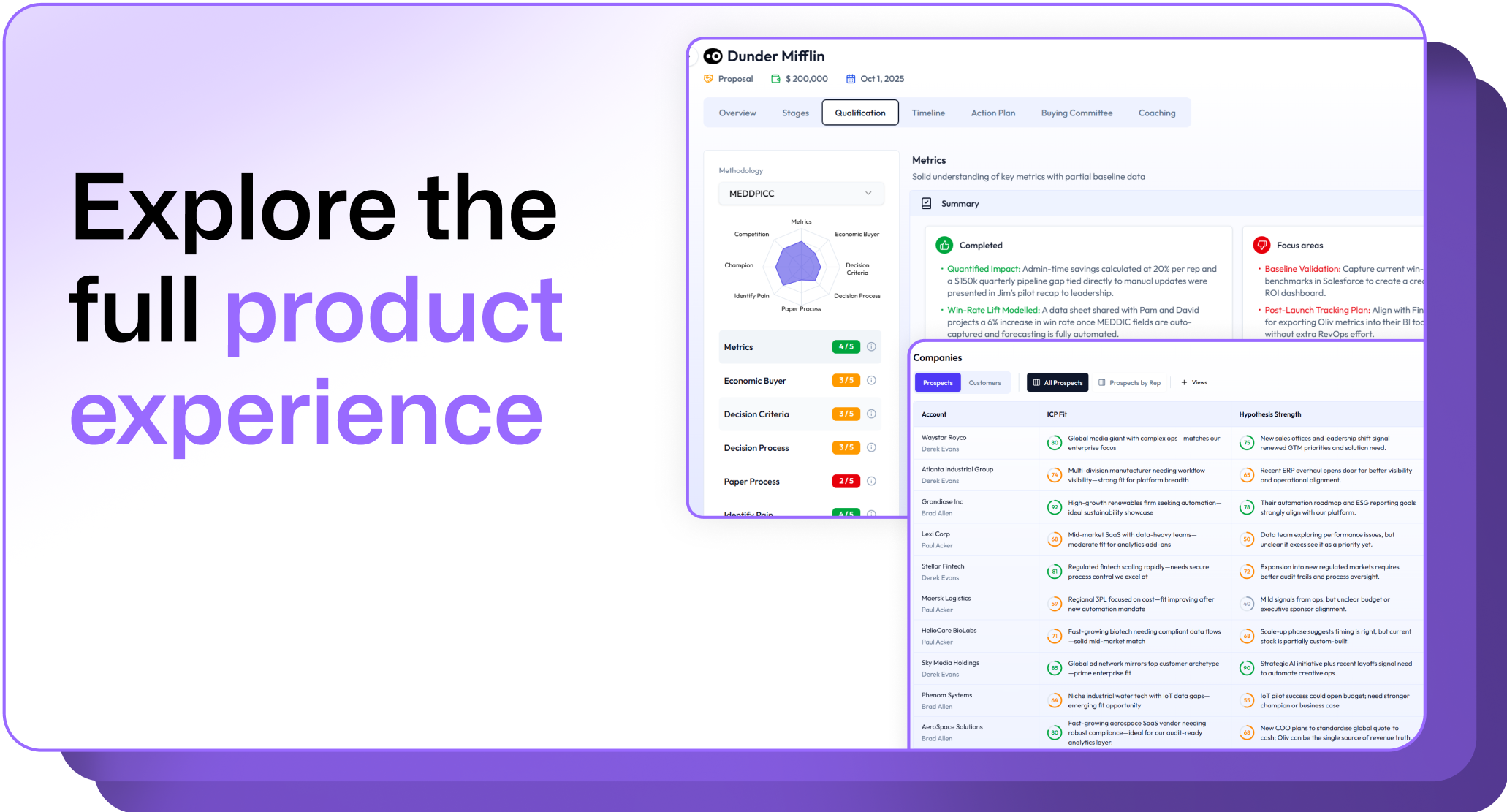
.avif)