How to Build a Revenue Operations Function from Zero in 2026? | CRO's Guide
Written by
Ishan Chhabra
Last Updated :
December 25, 2025
Skim in :
5
mins
In this article
Still got questions?
Come discuss this article with me.
Hi, I'm Ishan, Founder and CEO of Oliv.
I'm always up for a conversation about revenue intelligence, AI agents, or what's actually working (and what's not) across revenue teams.
I'd love to hear your perspective.
Thank you! Your submission has been received!
Oops! Something went wrong while submitting the form.
Meet Oliv’s AI Agents
Hi! I’m, Deal Driver
I track deals, flag risks, send weekly pipeline updates and give sales managers full visibility into deal progress
Hi! I’m, CRM Manager
I maintain CRM hygiene by updating core, custom and qualification fields all without your team lifting a finger
Hi! I’m, Forecaster
I build accurate forecasts based on real deal movement and tell you which deals to pull in to hit your number
Hi! I’m, Coach
I believe performance fuels revenue. I spot skill gaps, score calls and build coaching plans to help every rep level up
Hi! I’m, Prospector
I dig into target accounts to surface the right contacts, tailor and time outreach so you always strike when it counts
Hi! I’m, Pipeline tracker
I call reps to get deal updates, and deliver a real-time, CRM-synced roll-up view of deal progress
Hi! I’m, Analyst
I answer complex pipeline questions, uncover deal patterns, and build reports that guide strategic decisions
TL;DR
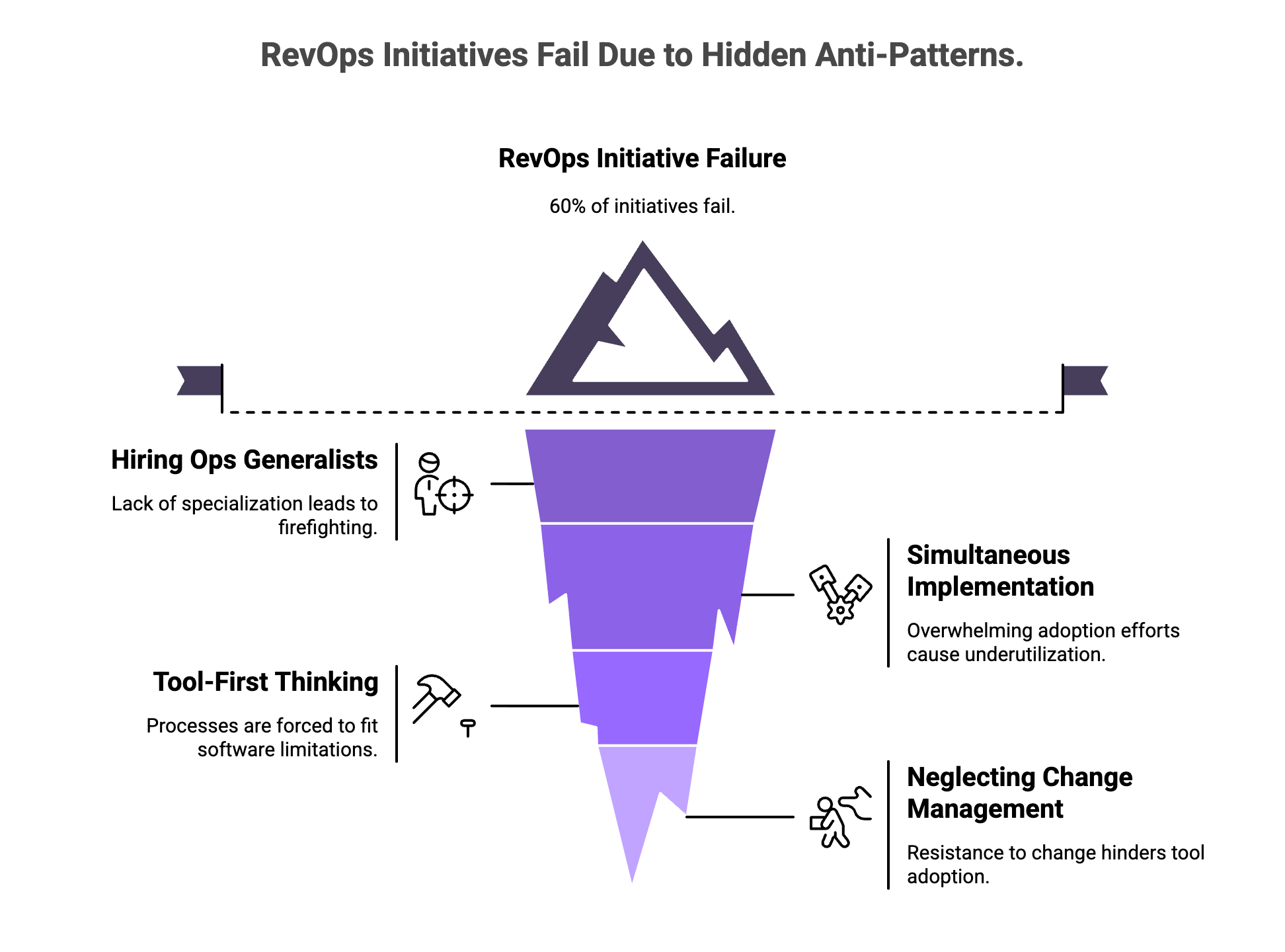
60% of RevOps initiatives fail within 18 months due to four anti-patterns: hiring generalists vs. specialists, implementing everything simultaneously, tool-first thinking, and neglecting change management.
AI-native platforms compress implementation from 6 months to 5 minutes-2 days, achieving 100% CRM hygiene compliance without behavior change vs. 40% industry average with manual entry.
Stage-based hiring: Series A needs one RevOps Manager ($100K-$160K) + AI agents; Series B+ requires VP RevOps ($146K-$273K) + specialized team AI reduces headcount needs by 40-50%.
Traditional Gong + Clari stack costs $280-$500/user/month ($336K-$600K annually for 100 users) vs. AI-native platforms at $30K-$80K total up to 91% lower TCO with superior forecast accuracy.
First 90 days focus on leading indicators: CRM completeness (target 100%), manager time savings (8+ hours/week reclaimed), forecast accuracy improvement (65% to 80%+), and adoption metrics (95% active usage).
2026 paradigm shift from dashboards to agents: Modern RevOps uses autonomous AI that updates CRM fields bi-directionally, flags deal risks proactively, generates board slides, and transfers AE-CSM context replacing 2-3 junior analyst roles.
Q1. Why Build a Revenue Operations Function in 2026? [toc=Why Build RevOps]
Traditional sales organizations operate in silos Marketing Operations managing lead gen tools, Sales Operations handling CRM, and Customer Success Operations tracking retention metrics independently. This fragmentation creates data inconsistencies, forecasting inaccuracies that miss targets by 15-30%, and revenue leakage where opportunities slip through handoff cracks. Boston Consulting Group research shows unified Revenue Operations (RevOps) functions deliver 10-20% productivity gains and 25% improvements in forecast accuracy by aligning MarOps, SalesOps, and CSOps under a single strategy.
❌ The Legacy RevOps Trap
Most organizations built RevOps functions between 2018-2022 using the prevailing playbook: stack conversational intelligence platforms (Gong at $160/user/month), forecasting tools (Clari at $120/user/month), and sales engagement software (Outreach, Salesloft), then hire analysts to manually compile dashboards from disconnected data sources. This "SaaS-heavy" model suffers three fatal flaws. First, it relies on manual CRM data entry that sales reps notoriously neglect 58% of teams report "dirty data" issues according to Forrester research, rendering forecasts and pipeline reports unreliable. Second, these platforms provide reactive reporting (what happened last week) rather than real-time execution guidance (what to do next). Third, tool sprawl creates administrative burden managers spend hours on "late-night call reviews" while driving or showering because legacy systems require human auditing rather than proactive risk detection.
"Gong is expensive, especially compared to alternatives like Salesloft and Apollo, which offer similar capabilities for a fraction of the price... Many reps resist using Gong because they feel micromanaged, leading to low adoption." — Reviewer, G2 Verified Review
"It was a big mistake on our part to commit to a two-year term. Gong is a really powerful tool but it's probably the highest end option on the market... friends who lead revenue functions all have said the same thing they've been fine using a lower cost, simpler alternative." — Iris P., Head of Marketing, Sales Partnerships, G2 Review
⭐ The 2026 Paradigm Shift: Revenue Intelligence to AI-Native Revenue Orchestration
The industry has evolved through four generations: baseline operations (2015-2022), conversational intelligence era dominated by Gong's keyword-based "Smart Trackers" (2022-2025), attempted orchestration using rule-based automation, and now AI-Native Revenue Orchestration where AI agents autonomously execute workflows rather than just surfacing insights. By 2026, competitive RevOps functions don't ask reps to "review dashboards and update CRM"; instead, AI agents update CRM fields bi-directionally, flag deal risks proactively in Slack, generate board-ready forecast slides, and draft follow-up emails automatically. This shift from "dashboards to review" to "agents that execute" eliminates the manual friction that caused legacy RevOps initiatives to fail 60% don't survive 18 months due to non-adoption.
✅ How Oliv.ai Redefines Modern RevOps
We've pioneered the AI-Native Revenue Orchestration category by replacing manual RevOps tasks with autonomous AI agents that deliver immediate value without behavior change. Our CRM Manager agent auto-populates BANT, MEDDPICC, and custom fields from recorded calls/emails with bi-directional Salesforce sync achieving 100% CRM hygiene compliance versus the industry's 40% average without requiring reps to type a single field. The Deal Driver agent inspects every opportunity autonomously, flags churn risk before quarterly reviews, and delivers actionable recommendations directly to Slack or email where managers live. Our Forecaster Agent eliminates the "Monday tradition" of stressful forecast preparation by auto-generating presentation-ready slides from live deal inspection, replacing manual rep roll-ups that introduce 25-30% forecast error. Implementation takes 5 minutes to 2 days versus months for traditional integrations one strategic RevOps hire can oversee agent orchestration instead of managing a team of analysts doing manual data cleanup.
Companies using Oliv's agent-first platform report 25% higher forecast accuracy, 35% higher win rates, and cost reductions of up to 91% compared to stacking Gong + Clari (which totals $280-500/user/month for 100-seat teams versus Oliv's modular pricing). More importantly, managers reclaim one full day per week previously spent on call audits and forecast compilation, redirecting that capacity to strategic initiatives like enablement design and cross-functional alignment.
"Managers report spending hours on 'late-night call reviews' while driving or showering because they have no other way to maintain visibility... The 'Monday tradition' of forecasting calls causes high stress because managers must manually prepare presentation-ready slides." — Client feedback from Triple Whale and Sprinto leadership
Q2. When Should You Build a Revenue Operations Team? (Stage-Based Timing Guide) [toc=Timing Guide]
Building a RevOps function too early wastes resources on infrastructure before core product-market fit; building too late creates technical debt from siloed systems and dirty data that takes years to remediate. The optimal timing depends on three factors: revenue scale, team size, and operational pain points that signal fragmentation costs exceed unified function investment.
Comprehensive RevOps hiring progression table showing fractional consultants for seed stage through full specialist teams for enterprise, with corresponding salary ranges, annual budgets, and GTM headcount requirements across five company growth stages.
🎯 Stage-Specific Timing Indicators
Seed Stage (Pre-$2M ARR, <10 GTM headcount) RevOps is premature when founders still personally close deals and manage the full customer lifecycle. Instead, invest in foundational hygiene: standardized CRM fields, basic pipeline stages (3-5 maximum), and conversation recording for coaching. Consider a fractional RevOps consultant (10-15 hours/month, $150-250/hour) to establish data governance before bad habits ossify. Critical trigger: If founders spend >5 hours weekly reconciling "which deals are actually closing this quarter" across spreadsheets, Slack, and email it's time for lightweight automation before full-time headcount.
Series A ($2M-$10M ARR, 10-30 GTM headcount) This is the ideal window for RevOps foundation. You've proven repeatability but haven't yet institutionalized siloed operations. Timing signals include: (1) Sales VP manually compiling weekly forecast from rep Slack messages, (2) Marketing and Sales arguing over "lead quality" without shared definitions, (3) First customer churn due to poor AE→CSM handoff context loss, (4) CRM data <50% complete forcing deals to be managed in personal spreadsheets. At this stage, hire one RevOps Manager ($100K-$160K) focused on CRM hygiene, reporting infrastructure, and cross-functional process design. Pair with AI-native tools (Oliv.ai agents for CRM automation + forecasting) rather than enterprise SaaS stacks to avoid over-purchasing.
Series B/C ($10M-$50M ARR, 30-150 GTM headcount) RevOps transitions from "nice-to-have" to business-critical as go-to-market complexity explodes. Timing triggers: (1) Multiple sales segments (Enterprise, Mid-Market, SMB) with different motions requiring distinct reporting, (2) 2+ products creating cross-sell/upsell tracking challenges, (3) International expansion with regional forecasting needs, (4) Board demanding accurate quarterly guidance but current process misses by >20%. Build a full RevOps function: VP RevOps ($146K-$273K), CRM Admin ($65K-$95K), Data Analyst ($75K-$110K), Enablement Specialist ($80K-$120K). Focus on scalable systems if your RevOps team still manually updates reports in spreadsheets, you've built a "reporting team" not a strategic function.
Enterprise ($50M+ ARR, 150+ GTM headcount) At scale, RevOps becomes a strategic business partner to the CRO. Timing for transformation (not initial build): (1) Merger/acquisition requiring system consolidation, (2) Platform shift (e.g., migrating from legacy CRM), (3) GTM model change (product-led growth → enterprise sales), (4) Accuracy crisis where missed forecasts trigger layoffs or restatements. Mature functions employ 8-12 specialists: deal desk, CPQ admins, forecasting analysts, conversation intelligence managers, enablement team. However, 2026 best practice involves AI augmentation one strategic leader + agent workforce can replace 2-3 junior analyst roles previously dedicated to manual data cleanup and call review.
⏰ Universal Pain Point Triggers (Any Stage)
Regardless of revenue stage, build RevOps when you experience two or more simultaneously:
❌ Forecast accuracy <70% (missing quarterly targets by >30%)
❌ Sales managers spend >10 hours/week on pipeline audits and forecast compilation
❌ CRM data completeness <60% (fields like "Next Steps," "Close Date," "Decision Criteria" mostly empty)
❌ Customer churn within first 90 days due to context loss in AE→CSM handoffs
❌ Marketing and Sales operate on different lead definitions causing attribution conflicts
❌ New rep ramp time >4 months due to lack of call libraries and coaching infrastructure
❌ Executive leadership requests "custom reports" that take RevOps/Sales Ops days to compile manually
✅ Oliv.ai's Stage-Appropriate Entry Points
For Series A teams, we offer baseline conversation intelligence (recording/transcription) at $0 for existing Gong users to eliminate the $160/user/month tax while you validate RevOps ROI. Add our CRM Manager agent to solve the immediate crisis (dirty data preventing accurate forecasting) without hiring an analyst implementation takes <2 days. For Series B+ organizations, our full agent suite (Deal Driver, Forecaster, Map Manager, Handoff Hank) replaces the traditional "analyst army" model with modular, role-based AI that scales instantly from 30 to 300 seats without linear cost increase.
"Clari is a tool for sales leaders, it adds no value to reps as far as I can see... it can be useful if you have a complex GTM motion but definitely overkill for most companies." — conaldinho11, Reddit r/SalesOperations
Q3. What Are the Four Pillars of a Modern RevOps Function? [toc=Four Pillars]
Every successful RevOps function rests on four foundational pillars: People, Process, Technology, and Data. These elements must work interdependently strong technology with weak processes creates sophisticated dashboards no one trusts; clean data with wrong people produces reports that don't drive decisions.
Architectural diagram displaying RevOps foundation with interconnected pillars People (VP RevOps, CRM Admin, AI Agents), Data (quality, AI solutions, compliance), Technology (stack integration, AI-native platforms), and Process (stage definitions, governance, forecast methodology).
Pillar 1: People (Roles, Skills, Structure)
RevOps requires hybrid expertise spanning data analysis, systems administration, sales operations, and cross-functional diplomacy. Core roles include:
VP Revenue Operations (strategic leader): Owns GTM systems strategy, forecasting methodology, and executive reporting
CRM Administrator: Manages Salesforce/HubSpot configuration, user permissions, workflow automation
Data Analyst: Builds reports, maintains data integrity, performs pipeline analytics
Enablement Specialist: Creates training content, manages call libraries, conducts coaching
The 2026 evolution: AI agents now handle 60% of tasks previously requiring junior analyst headcount. Instead of hiring three analysts to manually audit calls, update CRM fields, and compile forecasts, organizations hire one strategic RevOps Manager who orchestrates AI agents performing those operational tasks autonomously. This shifts the role from "data janitor" to "AI workflow designer" a more engaging, strategic position attracting stronger talent.
Pillar 2: Process (Workflows, Governance, Standards)
Process defines "how work gets done" across the revenue lifecycle. Essential frameworks include:
Stage Definitions: Standardized opportunity stages (e.g., Discovery → Scoping → Proposal → Negotiation → Closed-Won) with clear entry/exit criteria. Without this, Sales and Finance disagree on "what's included in this quarter's forecast".
Data Governance: Field-level requirements (mandatory vs. optional), naming conventions (account names, opportunity naming), update cadences (next steps refreshed weekly). The 2026 standard: AI-enforced governance where CRM Manager agents auto-populate fields from meeting transcripts, eliminating the "please update your CRM" nagging culture.
Forecast Methodology: Bottom-up (rep submissions) vs. top-down (historical trends) vs. AI-predicted (deal inspection). Legacy approaches rely on manual rep input submitted Mondays, introducing bias and lag. Modern systems use AI agents that inspect deal health signals (stakeholder engagement, decision criteria coverage, competitive threats) to predict close probability independent of rep optimism.
Handoff Protocols: AE→CSM transition checklists ensuring context transfer (stakeholder map, success criteria, deployment timeline). Poor handoffs cause 30% of early customer churn.
Pillar 3: Technology (Stack Integration, Tooling)
The technology pillar connects systems enabling data flow between marketing automation, CRM, conversation intelligence, forecasting, CPQ, and data warehouses. Traditional stacks include:
CRM: Salesforce, HubSpot, Microsoft Dynamics (system of record)
The challenge: These point solutions don't integrate natively, creating "tool sprawl" where data lives in disconnected silos. Sales reps log into 6-8 different systems daily, and RevOps teams spend 40% of their time manually syncing data between platforms.
2026 Best Practice: Consolidate onto AI-native platforms that combine conversation intelligence + CRM automation + forecasting into unified workflows. Oliv.ai, for example, replaces the Gong ($160/user) + Clari ($120/user) + CRM admin labor stack with one platform delivering bi-directional CRM sync, autonomous deal inspection, and predictive forecasting at 91% lower total cost.
Pillar 4: Data (Quality, Accessibility, Activation)
Data is the "fuel" for the other three pillars without clean, complete, accessible data, RevOps becomes a "reporting team" generating unreliable dashboards executives ignore. The foundational challenge: CRMs have failed because they depend on manual data entry by sales reps who view it as administrative burden rather than value-add.
Data Quality Dimensions:
Completeness: Are critical fields (Next Steps, Decision Criteria, Stakeholders) populated? Industry average: 40%
Accuracy: Does "Close Date" reflect reality or wishful thinking?
Timeliness: Is data updated after every interaction or only before forecast calls?
Consistency: Do reps use standardized values (dropdown picklists) or free-text chaos?
Traditional Solution: 2-3 year "data cleanup projects" with consultants auditing records, merging duplicates, and training reps on CRM hygiene then watching data quality decay back to 40-50% within 6 months as reps revert to old habits.
AI-Native Solution: Solve data quality at the source using agents that automatically extract structured data from unstructured interactions (calls, emails, meetings). Oliv.ai's CRM Manager agent, for example, listens to sales calls and auto-populates BANT fields (Budget, Authority, Need, Timeline), MEDDPICC scorecards, stakeholder names/roles, competitive mentions, and custom properties with bi-directional Salesforce sync updating the CRM in real-time. This eliminates manual entry friction entirely, achieving 100% compliance because reps don't change behavior (they just have conversations; AI handles documentation).
"While Gong offers valuable insights into call data and sales interactions, our experience has been impacted by significant data access limitations... requires downloading calls individually, which is impractical and inefficient for a large volume of data." — Neel P., Sales Operations Manager, G2 Review
✅ How Oliv.ai Strengthens All Four Pillars
People: Reduces need for 2-3 junior analyst roles by automating manual tasks (call review, CRM updates, forecast compilation) allowing one strategic hire to oversee AI orchestration Process: Enforces governance automatically (agents won't let opportunities progress without decision criteria documented) Technology: Consolidates 3-4 point solutions (Gong + Clari + CRM admin labor) into one unified platform with native integrations Data: Solves quality at source through automatic extraction from conversations, achieving 100% CRM completeness without rep behavior change
Q4. How Do You Choose Between Department-Based vs. Function-Based RevOps Structure? [toc=Structure Models]
Revenue Operations can be organized two primary ways: department-based (aligning to revenue teams) or function-based (aligning to operational capabilities). The choice depends on company stage, GTM complexity, and whether your primary pain point is cross-departmental alignment or operational execution excellence.
🏢 Department-Based Structure (Aligned to Revenue Teams)
This model creates specialized ops roles supporting each revenue department:
Department-Based RevOps Structure
Department
Role Focus
Responsibilities
Marketing Operations
Lead gen, attribution
Campaign automation, lead scoring, MQL→SQL handoff, analytics dashboard
Faster tactical execution since ops specialists "speak the language" of their supported team
❌ Disadvantages:
Siloed data and disconnected systems: Marketing uses Marketo/HubSpot, Sales uses Salesforce, CS uses Gainsight requiring manual integration and causing attribution conflicts ("who gets credit for this deal?")
Duplicated effort: Each ops team builds their own reporting infrastructure instead of shared data foundation
Poor cross-functional handoffs: MQL→SQL and AE→CSM transitions fail because no one owns the "white space" between departments
Best For: Early-stage companies (Series A, <30 GTM headcount) where simplicity and speed matter more than optimization, or highly specialized businesses where Marketing/Sales/CS operate almost independently (e.g., product-led growth company where Marketing owns self-serve acquisition, Sales handles enterprise only, and CS manages separate expansion motions).
⚙️ Function-Based Structure (Aligned to Operational Capabilities)
This model organizes by operational discipline regardless of which revenue team consumes the output:
Function-Based RevOps Structure
Function
Role Focus
Responsibilities
Data & Analytics
Single source of truth
Data warehouse, BI tools, revenue reporting, forecasting models serving all GTM
Systems & Tools
Tech stack management
CRM admin, conversation intelligence, CPQ, integrations, user provisioning
Stage definitions, data hygiene rules, handoff protocols, audit compliance
✅ Advantages:
Unified data foundation: One team owns the "single source of truth" for revenue metrics, eliminating attribution conflicts
No duplicated work: Build one forecasting model serving Sales, CS, and Finance instead of three disconnected versions
Better cross-functional workflows: Process team owns MQL→SQL and AE→CSM handoffs holistically, optimizing for full customer lifecycle
Scales efficiently: Adding a new product line or international region doesn't require duplicating entire ops stack
❌ Disadvantages:
Slower tactical responses: Data team prioritizes based on org-wide needs, not individual VP urgency
Requires strong cross-functional leadership: VP RevOps needs authority to mandate processes across Marketing, Sales, and CS (difficult without C-level backing)
Risk of "ivory tower" syndrome: Ops team optimizes for "system elegance" rather than frontline usability
Best For: Growth-stage and mature companies (Series B+, 30+ GTM headcount) with complex GTM motions (multiple products, segments, or geographies), or organizations suffering from severe data fragmentation where Marketing/Sales/CS currently operate on completely different metrics.
🎯 Decision Matrix: Which Structure Should You Choose?
RevOps Structure Decision Matrix
Decision Factor
Choose Department-Based
Choose Function-Based
Company Stage
Seed/Series A (<30 GTM)
Series B+ (30+ GTM)
GTM Complexity
Single product, single segment
Multiple products/segments/geos
Primary Pain Point
Need faster tactical execution
Suffering from data silos/attribution conflicts
Leadership Maturity
Functional VPs (Marketing, Sales, CS) still building their teams
CRO or unified GTM leadership exists
Data Infrastructure
Starting fresh, no legacy systems
Migrating from fragmented legacy tools
Budget Constraint
Limited—can't afford full RevOps team
Moderate can hire 3-5 RevOps specialists
⚠️ Hybrid Model: The Pragmatic Middle Ground
Many Series B companies adopt a hybrid: centralized data/systems team (function-based) with embedded enablement specialists (department-based). For example:
Data Analyst + CRM Admin report to VP RevOps (serving all GTM)
Sales Enablement Manager reports to Sales VP (embedded for responsiveness)
CS Enablement Manager reports to CS VP (domain-specific coaching)
This balances efficiency (shared systems) with agility (domain expertise).
✅ How AI Agents Change the Structure Calculus
Traditional structures assume humans perform operational tasks (updating CRM, compiling forecasts, reviewing calls), so you optimize for "who does what work." AI-native RevOps inverts this: agents perform tasks autonomously, so you optimize for "who orchestrates AI workflows."
With Oliv.ai, one strategic RevOps Manager can oversee agents serving all three departments:
CRM Manager agent maintains Salesforce hygiene for Marketing (lead capture), Sales (opportunity updates), and CS (account health)—no need for separate CRM admins per department
Forecaster agent generates unified pipeline forecasts combining new business (Sales), renewals (CS), and expansion (CS + Sales)—no need for separate forecasting analysts per team
Deal Driver agent flags risks across the full lifecycle (pre-close churn signals for Sales; post-close expansion triggers for CS)—no need for separate analytics per department
This "AI + strategic human" model allows smaller RevOps teams to support larger GTM organizations—one VP RevOps + agent suite can support 50-100 GTM headcount where traditional models required 3-5 ops specialists.
"Clari does a great job pulling in data from various sources... it does a great job recording calls and easy to add to calls. The AI summary is very helpful." — Verified User in Human Resources, G2 Review
"Gong has become the single source of truth for our sales team. From deal management to forecasting it's been really easy to gain adoption across the team." — Scott T., Director of Sales, G2 Review
Q5. What Are the Essential Steps to Build RevOps from Scratch? [toc=Building Steps]
Building a Revenue Operations function requires a structured, phased approach rather than attempting to implement everything simultaneously. The proven framework consists of four sequential steps that prioritize high-impact wins while establishing scalable foundations.
Step 1: Audit Your Current Revenue Engine (Weeks 1-3)
Begin by assessing existing GTM operations to identify fragmentation points, data quality issues, and process gaps. This diagnostic phase prevents building on faulty assumptions.
Key Audit Components:
Systems Inventory: Document all tools (CRM, marketing automation, conversation intelligence, CPQ, analytics) and how data flows between them—or doesn't. Identify integration gaps causing manual data transfers.
Data Quality Assessment: Sample 50-100 recent opportunities to measure CRM completeness. Calculate percentage of records with populated fields (Next Steps, Decision Criteria, Stakeholders, Close Date accuracy). Industry average is 40%; below 30% signals crisis.
Process Mapping: Interview 5-8 stakeholders across Marketing, Sales, CS, Finance to document current workflows for lead handoff (MQL→SQL), opportunity management, forecasting, and customer handoff (AE→CSM). Highlight disconnects where information gets lost.
Pain Point Prioritization: Rank problems by business impact × feasibility. High-impact/high-feasibility issues (e.g., "CRM data incompleteness causes forecast misses") become your Phase 1 targets.
Deliverable: One-page "Current State Assessment" showing data quality metrics, tool landscape diagram, and prioritized pain point list presented to leadership.
Step 2: Secure Stakeholder Buy-In and Define Mission (Weeks 4-6)
RevOps success requires executive sponsorship and cross-functional alignment. Without CRO or CEO backing, RevOps becomes an order-taking "reporting team" rather than strategic function.
Buy-In Strategy:
Quantify the Cost of Status Quo: Translate pain points into dollar impact. Example: "Dirty CRM causes 20% forecast error = $2M revenue surprise = stock price volatility + missed board commitments."
Socialize Quick Wins: Propose 30-day pilot solving one acute problem (e.g., automated CRM updates via AI agent) to demonstrate value before requesting full budget.
Establish Governance Model: Clarify reporting structure (does RevOps report to CRO, CFO, or COO?) and decision rights (can RevOps mandate processes across Marketing/Sales/CS or only advise?).
Stakeholder Meeting Cadence: Weekly 30-minute syncs with Marketing VP, Sales VP, CS VP to maintain alignment and surface early resistance.
✅ Step 3: Make Your First Strategic Hire(s) (Weeks 6-12)
Hiring determines whether you build a strategic function or tactical support team. The first role should match your acute pain point.
Hiring Decision Tree:
If primary pain = dirty data/CRM chaos: Hire CRM Administrator ($65K-$95K) or implement AI-native CRM automation (Oliv.ai CRM Manager) to solve at source without headcount.
If primary pain = inaccurate forecasting: Hire Data Analyst ($75K-$110K) skilled in Salesforce reporting + SQL, or deploy predictive forecasting agent to automate deal inspection.
If primary pain = lack of strategic leadership: Hire VP Revenue Operations ($146K-$273K) with 8+ years experience building RevOps at similar-stage companies. This person architects the full function.
2026 Best Practice: Pair one strategic human hire with AI agents handling operational execution. One RevOps Manager + Oliv.ai agent suite can support 50-100 GTM headcount where traditional models required 3-4 specialists.
Step 4: Scale Based on Gaps (Quarters 2-4)
After establishing foundations (clean data, accurate forecasts, stakeholder trust), expand RevOps systematically by adding capabilities addressing next-priority gaps.
Scaling Sequence:
Quarter 2: Add Enablement Specialist ($80K-$120K) once you have clean call recordings/libraries to build training programs.
Quarter 3: Add Deal Desk for complex sales requiring contract/pricing approvals; add CPQ Administrator if quote-to-cash friction emerges.
Quarter 4: Mature analytics with Senior Data Analyst building predictive models (churn risk scoring, lead conversion forecasting).
Milestone Checkpoints: Measure success quarterly using leading indicators (CRM completeness %, forecast accuracy %, manager time savings) rather than lagging metrics (quota attainment influenced by many variables).
⚠️ Common Implementation Pitfalls to Avoid
❌ Tool-first thinking: Selecting Gong/Clari before defining processes forces workflows to conform to software limitations
❌ Boiling the ocean: Attempting to fix everything simultaneously (CRM migration + new forecasting + enablement rollout) creates chaos and low adoption
❌ Neglecting change management: Assuming "build it and they'll come" results in 40% non-adoption when reps continue using spreadsheets
Traditional implementations take 6-12 months and significant change management. Oliv.ai compresses timelines through zero-friction setup: our CRM Manager configures in 5 minutes to 2 days (not months), achieving 100% data capture immediately without training because agents extract data from existing conversations automatically. This allows you to demonstrate ROI in Step 2 (buy-in phase) before requesting full RevOps budget, and reduces Step 3 hiring needs by 2-3 junior analyst roles since agents handle operational execution autonomously.
Q6. Who Should You Hire First and What Roles Do You Need as You Scale? [toc=Hiring Roadmap]
Your first Revenue Operations hire determines whether you build a strategic function or a tactical support team stuck in perpetual firefighting. The role should match your company stage and acute pain point—hiring a VP RevOps when you need a CRM admin wastes $200K annually while core problems fester.
💰 First-Hire Decision Framework by Company Stage
Seed Stage (<$2M ARR, <10 GTM headcount) Full-time RevOps is premature. Instead, engage a Fractional RevOps Consultant (10-15 hours/month, $150-250/hour, ~$30K annually) to establish data governance, standardize CRM fields, and configure basic reporting. Alternatively, deploy AI agents (Oliv.ai CRM Manager) for automated CRM hygiene at lower cost than fractional headcount while you validate product-market fit.
Series A ($2M-$10M ARR, 10-30 GTM headcount) Hire Revenue Operations Manager ($100K-$160K base + 20% variable). This individual contributor owns CRM administration, basic forecasting, Marketing/Sales handoff processes, and executive reporting. Look for 3-5 years experience in SalesOps or similar roles with strong Salesforce skills and cross-functional communication ability. Common mistake: Hiring "ops generalist" who lacks technical depth—results in perpetual dependency on external consultants for system configuration.
Series B/C ($10M-$50M ARR, 30-150 GTM headcount) Hire VP Revenue Operations ($146K-$273K base + 25-30% variable + equity) to build and lead the function strategically. This leader should have 8+ years experience, including 3+ years building RevOps at similar-stage companies. They architect the full technology stack, establish forecasting methodology, design enablement frameworks, and serve as strategic partner to CRO. Red flag: Candidates who've only worked at one company (lack perspective on what "good" looks like across contexts).
Enterprise ($50M+ ARR, 150+ GTM headcount) Build full leadership team: SVP/VP Revenue Operations + Director-level leaders for Data & Analytics, Systems & Tools, and Enablement subteams, collectively managing 8-12 specialists.
❌ The Traditional RevOps Staffing Model's Fatal Flaw
Legacy RevOps teams required 8-10 specialized roles by Series C: CRM Admin maintaining Salesforce, Data Analyst building reports, Forecasting Analyst compiling rep submissions, Call Review Specialist auditing conversations for coaching, Deal Desk handling approvals, CPQ Admin managing quotes, Enablement Manager creating training, and Systems Administrator managing integrations. Time studies show these roles spend 60% of their workweek on manual operational tasks rather than strategic initiatives:
Forecasting Analyst: Chasing reps for pipeline updates, reconciling spreadsheet versions, building PowerPoint slides for board meetings
Call Review Specialist: Listening to 20-30 hours of recordings weekly to flag coaching moments managers miss
This model costs $600K-$900K annually for a mid-size team (6-8 people) yet delivers limited strategic value because humans are "doing the work" computers should automate.
⭐ The 2026 AI + Human Hybrid Model
Modern RevOps leaders prioritize AI agents for operational execution while humans focus on strategy, enablement design, and cross-functional alignment. This inverts the traditional 60/40 split (60% manual tasks, 40% strategy) to 80/20 (80% strategic, 20% operational oversight), reducing headcount needs by 40% while increasing output quality.
Role Transformation Examples:
Traditional vs. AI-Augmented RevOps Roles
Traditional Role
Manual Tasks (60% of time)
AI-Augmented Role
Strategic Focus (80% of time)
CRM Admin
Data cleanup, field updates, duplicate merging
CRM Strategist + AI Agent
Workflow design, integration architecture, user permission governance
Forecasting Analyst
Manual rep submissions, spreadsheet consolidation, slide building
Total Annual Cost (Fully Loaded): For a Series C team of 8 people (VP + 7 specialists), expect $1.2M-$1.8M including salaries, benefits, software licenses, and recruiting fees.
CRM Manager Agent: Eliminates need for 1-2 CRM admin roles by auto-populating fields (BANT, MEDDPICC, custom properties) from recorded calls/emails with bi-directional Salesforce sync—achieving 100% hygiene compliance without manual data entry
Forecaster Agent: Replaces forecasting analyst by autonomously inspecting every deal, predicting slippage, generating board-ready slides—no more manual rep roll-ups submitted Mondays
Deal Driver Agent: Replaces call review specialist by proactively flagging deal risks (missing stakeholders, competitive threats, stalled momentum) in Slack/email with action recommendations
Map Manager Agent: Automates mutual action plan creation/updates on Google Docs, reducing need for dedicated deal desk coordination
Seed stage: Fractional consultant (10 hrs/month) + Oliv agent suite = $40K total annual cost
Series A: Full-time RevOps Manager + agents = $130K vs. traditional $280K (Manager + CRM Admin)
Series B+: VP RevOps + CRM Strategist + Enablement Designer + agents = $450K vs. traditional $900K (VP + 5 specialists)
Enterprise: Full function-based team (8-12 strategic roles) augmented by agents = $1M vs. traditional $2.2M (15-18 roles doing manual work)
One strategic RevOps Manager can oversee agent orchestration, custom workflow design, and stakeholder enablement instead of managing a team doing manual data cleanup—resulting in leaner, more strategic teams that attract stronger talent seeking high-leverage roles.
"Gong has become the single source of truth for our sales team. From deal management to forecasting it's been really easy to gain adoption across the team." — Scott T., Director of Sales, G2 Review
Q7. What Technology Stack Do You Need for RevOps in 2026? [toc=Tech Stack]
The traditional Revenue Operations tech stack comprises 6-8 disconnected point solutions costing $450-$600 per user monthly for 100-seat teams: Salesforce or HubSpot CRM ($75-150/user), Gong conversation intelligence ($160/user), Clari forecasting ($120/user), Highspot enablement ($85/user), Outreach sales engagement ($100/user), plus CPQ and data warehouse tools. This "SaaS-heavy" architecture creates tool sprawl where data lives in silos, reps log into 8 different systems daily, and RevOps teams spend 40% of their time manually syncing information between platforms that don't integrate natively.
Side-by-side comparison table contrasting traditional revenue operations stack (Gong plus Clari costing $336K-$600K annually with 4-6 month implementation) against AI-native Oliv.ai platform ($30K-$80K with 5-minute to 2-day setup) showing 91 percent cost reduction.
❌ The Legacy Stack's Three Fatal Limitations
1. Tool Sprawl Creates Integration Hell Gong records calls but only logs generic "activity" notes in Salesforce—it doesn't update actual opportunity fields (stage, next steps, decision criteria) because its integration is one-directional. Clari pulls CRM data for forecasting but requires manual rep submissions every Monday because it can't autonomously inspect deal health. Salesforce Einstein Activity Capture attempts to link emails/meetings to opportunities but "redacts data unnecessarily, fails to associate emails with the right opportunities, and stores data in separate AWS instances that cannot be used for reporting" according to user feedback. RevOps teams become "human middleware" copying data between systems.
2. Keyword-Based AI Misses Nuanced Intent Gong's "Smart Trackers" use V1 machine learning (keyword pattern matching) rather than generative reasoning. Example: A customer saying "we're also evaluating Competitor X" triggers a competitive mention alert—but Gong can't distinguish whether this is serious evaluation or casual reference made in passing. Similarly, tracking "pricing objection" keywords surfaces every time "budget" is mentioned, flooding managers with false positives requiring manual triage. This noisy signal-to-insight ratio causes 35-40% of Gong features to remain unused according to user studies.
3. Reactive Reporting vs. Real-Time Execution Guidance Traditional platforms produce backward-looking dashboards updated weekly showing "what happened last quarter" rather than forward-looking intelligence providing "what to do next". Sales managers review Gong call libraries Sunday nights searching for coaching moments from deals already lost. Clari's waterfall reports explain historical pipeline slippage but don't predict which current deals will slip next month. This reactive posture means RevOps identifies problems after they've cost revenue rather than preventing them proactively.
"Gong is expensive, especially compared to alternatives like Salesloft and Apollo, which offer similar capabilities for a fraction of the price... The platform is expensive, and the requirement to inform prospects that they are on a recorded line can feel awkward." — Reviewer, G2 Verified Review
"It was a big mistake on our part to commit to a two-year term. Gong is a really powerful tool but it's probably the highest end option on the market... friends who lead revenue functions all have said the same thing—they've been fine using a lower cost, simpler alternative." — Iris P., Head of Marketing Sales Partnerships, G2 Review
Total Cost for 100 Users: $510-$770 per user per month = $612K-$924K annually (before implementation fees, training, and admin labor).
⭐ The 2026 AI-Native Alternative: Consolidated Agentic Platforms
Modern buyers prioritize single-platform solutions with agentic workflows that autonomously execute tasks rather than just surfacing insights. These platforms replace 3-4 legacy tools while delivering superior outcomes through three architectural advantages:
1. Bi-Directional CRM Integration Instead of one-way "activity logging," AI-native platforms update actual CRM objects and properties (opportunity stage, custom MEDDPICC fields, stakeholder roles, decision criteria) automatically extracted from conversation context. This maintains a genuine "single source of truth" rather than segregated notes only visible in the conversation intelligence tool.
2. Generative AI Contextual Understanding Rather than keyword matching, generative models comprehend intent and nuance. Example: "We're considering your competitor but honestly their UX is terrible and security posture concerns us" correctly identifies this as a positive competitive signal (not threat) and extracts two objections (UX, security) the competitor hasn't solved—actionable intelligence keyword-based systems miss entirely.
3. Real-Time Proactive Workflows AI agents take action rather than populating dashboards for human review. When Deal Driver agent detects warning signals (champion hasn't responded in 10 days + CFO missing from stakeholder map + close date in 2 weeks), it automatically: (1) Updates CRM risk field, (2) Sends Slack alert to manager with recommended interventions, (3) Drafts suggested follow-up email for rep, (4) Adjusts forecast probability—all instantaneously, not Sunday night when reviewing last week's recordings.
✅ Oliv.ai: The Unified AI-Native Revenue Orchestration Platform
We've architected a single platform consolidating the capabilities organizations traditionally sourced from Gong + Clari + Salesforce Einstein + enablement tools, delivered through autonomous agent workforce rather than passive software requiring human "adoption":
Three-Layer Architecture:
Baseline Layer (Recording/Transcription): We offer this at $0 for existing Gong users to commoditize the recorder market. Universal access to conversation data is table stakes—not a profit center.
Intelligence Layer (Deal Context): MEDDPICC scorecards, stakeholder mapping, competitive intelligence, sentiment analysis, decision criteria tracking—moving beyond "what was said" to "what it means for revenue."
Agentic Layer (Autonomous Execution):
CRM Manager: Auto-populates 40+ fields from conversations (BANT, MEDDPICC, custom properties) with bi-directional Salesforce sync—100% hygiene compliance without manual entry
Deal Driver: Flags churn risk proactively with action recommendations delivered in Slack/email—not dashboards requiring login
Map Manager: Auto-creates and updates Mutual Action Plans on Google Docs after every activity
Handoff Hank: Transfers full AE→CSM context automatically, preventing the "context loss" causing 30% of early churn
Voice Agent: Unique capability where AI calls reps for 5-minute nightly updates capturing offline context (in-person meetings, whiteboard sessions)
Cost Comparison (100-User Team):
Traditional Stack vs. Oliv.ai Platform Comparison
Model
Annual Cost
Setup Time
Adoption Effort
CRM Hygiene
Forecast Method
Gong + Clari Stack
$280-$500/user = $336K-$600K
4-6 months
20+ hours training
40% (manual entry)
Manual rep roll-ups
Oliv.ai Platform
Modular pricing = $30K-$80K
5 min - 2 days
Zero (agents work invisibly)
100% (AI extraction)
Autonomous deal inspection
Cost Savings
Up to 91% lower TCO
99% faster
No behavior change
2.5× improvement
Eliminates bias
Implementation Speed: Traditional stacks require 4-6 months (Salesforce integration, user training, workflow customization). Oliv.ai configures in 5 minutes to 2 days with full customization in 2-4 weeks—demonstrating ROI in first 30 days rather than waiting quarters for "adoption curves".
Modular Pricing Advantage: Legacy SaaS charges $160/user whether they use 10% or 100% of features—causing 50% utilization waste. We offer role-based agents where teams "pay only for what they use": assign CRM Manager to AEs needing data capture, Forecaster to managers, Retention Agent to CSMs.
"While Gong offers valuable insights into call data and sales interactions, our experience has been impacted by significant data access limitations... requires downloading calls individually, which is impractical and inefficient for a large volume of data." — Neel P., Sales Operations Manager, G2 Review
Q8. How Do You Build the Business Case and Budget for RevOps in 2026? [toc=Business Case]
Securing executive approval for Revenue Operations investment requires translating operational pain points into financial impact, demonstrating ROI timelines, and positioning RevOps as revenue enabler rather than cost center. The most common objection—"we already have Sales Ops, why do we need RevOps?"—stems from misunderstanding RevOps as a renamed function rather than a strategic shift from reactive reporting to proactive revenue orchestration.
Consulting/Implementation: $20K-$40K for initial Salesforce optimization
Total Annual Budget: $200K-$350K
ROI Focus: Improve forecast accuracy from 60% to 80% (reducing revenue surprises that spook investors); save managers 8 hours/week on pipeline audits ($75K annual productivity value)
Forecast Accuracy: Improving from 65% to 85% accuracy reduces revenue surprises causing emergency discounting, poor capacity planning, and investor concern. Value: Hard to quantify but material for public companies where 10% miss triggers stock penalties.
Tool Consolidation: AI-native platform replaces Gong ($192K for 100 users) + Clari ($144K) + admin labor ($80K) = $416K traditional cost vs. $80K Oliv.ai. Value: $336K annual savings (81% reduction).
💸 2026 Compensation Benchmarks for RevOps Roles
2026 RevOps Compensation Benchmarks by Role
Role
Base Salary Range
Variable/Bonus
Equity (Series B+)
Total Comp
VP Revenue Operations
$146K-$273K
25-30%
0.15-0.40%
$190K-$380K
Senior Revenue Ops Manager
$120K-$175K
15-25%
0.05-0.15%
$145K-$220K
Revenue Operations Manager
$100K-$160K
10-20%
0.03-0.10%
$115K-$195K
Senior CRM Administrator
$85K-$125K
10-15%
0.02-0.08%
$95K-$145K
CRM Administrator
$65K-$95K
5-10%
0.01-0.05%
$70K-$105K
Senior Data Analyst
$90K-$130K
10-20%
0.02-0.08%
$100K-$160K
Data Analyst
$75K-$110K
5-15%
0.01-0.05%
$80K-$130K
Sales Enablement Manager
$95K-$140K
10-20%
0.03-0.10%
$110K-$175K
Enablement Specialist
$80K-$120K
5-15%
0.01-0.05%
$85K-$140K
Note: Ranges reflect US market (SF/NYC high end, other metros low-mid). Salaries 15-25% lower in EMEA/APAC markets.
✅ Executive Presentation Template: The 5-Slide Business Case
Slide 1 - The Problem: "Our forecast accuracy is 58% (industry benchmark 75%+), causing $3M revenue surprises quarterly. Root cause: CRM data only 35% complete because reps don't manually update fields."
Slide 2 - The Cost of Inaction: "Continuing current state costs us $1.2M annually: manager productivity loss ($400K), poor coaching impact on win rates ($500K), customer churn from bad handoffs ($300K)."
Slide 3 - The Solution: "Implement RevOps function with AI-native platform: One RevOps Manager + Oliv.ai agent suite achieves 100% CRM hygiene, automated forecasting, proactive deal risk detection—without behavior change friction causing traditional tool adoption failures."
Slide 4 - Investment Required: "$180K Year 1 ($130K RevOps Manager fully loaded + $50K Oliv.ai platform). Compare to traditional approach: $280K (Manager + CRM Admin) + $150K (Gong + Clari) = $430K for inferior outcomes requiring 6-month implementation."
Slide 5 - Expected ROI: "Payback in 6 months. Year 1 impact: $470K value ($280K time savings + $190K revenue impact from 3-point win rate improvement) vs. $180K investment = 2.6× ROI. By Year 2, ongoing $470K annual value against $160K recurring cost = 2.9× sustained ROI."
How Oliv.ai Strengthens Your Business Case
Traditional RevOps implementations face skepticism because executives have seen prior "CRM cleanup projects" fail after 18 months and $500K spent. We de-risk your business case three ways: (1) Pilot Results in 30 Days: Deploy CRM Manager to 10 reps, demonstrate 100% hygiene compliance Week 1, extrapolate savings—secure full budget based on proof not promises. (2) 91% Lower TCO: $50K-$80K platform cost vs. $300K-$400K Gong+Clari stack makes approval threshold easier. (3) Zero Adoption Risk: Because agents work invisibly (extracting data from existing conversations), you avoid the "will reps actually use this?" objection that kills traditional tool purchases.
"Gong has become the single source of truth for our sales team. From deal management to forecasting it's been really easy to gain adoption across the team." — Scott T., Director of Sales, G2 Review
Q9. What Are the 4 Biggest Mistakes to Avoid When Building RevOps? (Anti-Patterns) [toc=Common Mistakes]
Research shows that 60% of Revenue Operations initiatives fail within their first 18 months, wasting $500K-$1M in technology investments, consulting fees, and opportunity costs. These failures follow predictable patterns: hiring the wrong talent profiles, attempting to implement entire tech stacks simultaneously, selecting tools before defining processes, and neglecting change management. Understanding these anti-patterns helps RevOps leaders avoid expensive mistakes and build functions that deliver sustained value rather than becoming cautionary tales.
❌ Anti-Pattern #1: Hiring "Ops Generalists" Instead of Specialists
Many organizations hire their first RevOps person based on availability rather than capability—someone who "knows Salesforce" but lacks strategic depth in data architecture, forecasting methodology, or cross-functional process design. These generalists spend 80% of their time firefighting (fixing broken reports, responding to one-off executive requests, manually updating CRM records) rather than building scalable systems. Within 12-18 months, leadership realizes they've built a "reporting team" not a strategic function, necessitating expensive rehires or consultants to remediate.
Warning Signs: Your RevOps hire spends more time "pulling reports" than designing workflows; they can't articulate a coherent data governance philosophy; they lack technical skills (SQL, Salesforce admin certification, API understanding) to implement solutions without constant vendor dependency.
❌ Anti-Pattern #2: Implementing Everything Simultaneously ("Boiling the Ocean")
Executives see competitors using Gong, Clari, Highspot, and Outreach, then mandate implementing all four tools within 90 days to "catch up". This creates integration chaos—systems don't talk to each other, data flows break midstream, reps receive conflicting instructions from multiple platforms. Forrester research shows 52% of enterprise software tools remain significantly underutilized because organizations lack adoption bandwidth to absorb multiple changes simultaneously. The result: $300K-$500K spent on software licenses generating minimal value while teams continue using spreadsheets and Slack because "the new tools are too confusing."
Real-World Example: A Series B SaaS company implemented Gong ($192K annually for 100 users) and Clari ($144K annually) simultaneously in Q1 2024. Four months of integration work consumed their RevOps Manager's entire capacity. Mandatory training (20 hours per rep across both platforms) pulled sellers off quota-carrying activities. Six months post-launch, adoption measured 35% for Gong and 40% for Clari—meaning they paid $336K for tools that 60-65% of the team ignored.
⚠️ Anti-Pattern #3: Tool-First Thinking (Selecting Software Before Defining Process)
The classic mistake: purchasing Salesforce Einstein or Agentforce because "AI sounds important" without first mapping current workflows, identifying specific pain points, or establishing success metrics. This forces processes to conform to software limitations rather than configuring tools to support optimal workflows. Example: Implementing Salesforce Einstein Activity Capture to "solve CRM hygiene" without realizing it "redacts data unnecessarily, fails to associate emails with the right opportunities, and stores data in separate AWS instances that cannot be used for reporting"—creating new problems instead of solving the original one.
The Right Sequence: (1) Document current state workflows and pain points, (2) Design future state process improvements, (3) Evaluate which tools enable those improvements, (4) Implement incrementally with success measurement.
❌ Anti-Pattern #4: Neglecting Change Management (The "Build It and They'll Come" Fallacy)
RevOps leaders assume that buying sophisticated tools automatically delivers value—forgetting that software only works when humans adopt it. They skip critical change management elements: explaining why the new system benefits individual reps (not just managers), providing role-specific training, celebrating early wins, and addressing resistance empathetically. Result: 40% non-adoption rates where reps continue managing deals in personal spreadsheets because "updating Gong/Clari feels like extra work with no payoff for me."
"It's too complicated, and not intuitive at all. Using it is very discomforting. Searching for calls is not easy, moving around in the calls is not easy, and understanding the pipeline management portion of it is almost impossible." — John S., Senior Account Executive, G2 Review
"The workflow is clunky and confusing. The platform is missing a ton of features and functionality that I've had with other tools like Outreach.io, Salesloft, Hubspot, etc." — Austin N., SDR, G2 Review
✅ How Oliv.ai's AI-Native Approach Avoids All Four Anti-Patterns
Specialist Skills, AI Execution: We enable organizations to hire one strategic RevOps leader who orchestrates AI agents rather than managing a team of manual execution specialists. The RevOps Manager focuses on high-value workflow design while our CRM Manager agent handles operational tasks (field updates, data enrichment) that traditionally consumed 60% of junior analyst time.
Modular Implementation, Rapid Value: Instead of "big bang" rollouts, we recommend starting with one high-impact use case (typically CRM hygiene via CRM Manager). Implementation takes 5 minutes to 2 days—not months—allowing you to demonstrate ROI within 30 days before expanding to additional agents (Forecaster, Deal Driver, Map Manager). This incremental approach eliminates integration chaos and budget risk.
Process-First Architecture: Our implementation begins with understanding your current MEDDPICC framework, stage definitions, and forecasting methodology—then configuring agents to reinforce those processes rather than forcing you into rigid templates. Custom field mapping ensures the CRM Manager updates your fields with your terminology.
Zero Adoption Friction: Traditional tools fail because they require behavior change ("please log into this new platform and manually update fields"). Our agents work invisibly—extracting data from existing conversations (calls, emails, Slack) and auto-populating CRM without reps changing their workflow. This eliminates the adoption challenge that kills 60% of RevOps initiatives. Week 1 results: 100% CRM hygiene compliance because agents capture data automatically, not because reps developed new habits.
Comparative Outcome: Company X (traditional approach) spent $456K on Gong + Clari, required 4 months integration, mandated 20 hours training, achieved 35% adoption after 6 months. Company Y (Oliv approach) started with CRM Manager, achieved 100% data capture Week 1, expanded to Forecaster Month 2, total investment $50K-$80K with superior forecast accuracy and manager productivity gains.
Q10. How Do You Overcome RevOps Implementation Challenges and Drive Adoption? [toc=Driving Adoption]
Revenue Operations faces three persistent implementation obstacles that derail even well-funded initiatives: dirty CRM data rendering forecasts unreliable, difficulty hiring specialized talent (4-6 month recruitment cycles), and team resistance to new systems perceived as "more administrative burden". Traditional solutions—multi-year data cleanup projects ($150K-$300K consulting fees), executive recruiter engagements (20-25% placement fees), and quarterly training workshops—address symptoms rather than root causes, resulting in 40% tool non-adoption rates and reversion to old habits within 90 days.
❌ Challenge #1: The CRM Data Quality Death Spiral
Forrester research shows 58% of teams struggle with "dirty data"—incomplete opportunity fields (Next Steps, Decision Criteria, Stakeholders), inaccurate Close Dates reflecting rep optimism rather than reality, and duplicate/stale records cluttering reports. This creates a vicious cycle: RevOps builds dashboards on unreliable data, executives make poor decisions, teams lose confidence in systems, data quality deteriorates further. Traditional fix: Hire consultants to audit 10,000+ records manually, merge duplicates, and train reps on "data hygiene best practices"—only to watch quality decay back to 35-40% completion within 6 months as reps revert to shortcuts.
Root Cause: The problem isn't rep laziness—it's that manual CRM entry creates zero personal value for sellers. Updating 15 custom fields post-call takes 10 minutes better spent on selling. Without immediate payoff, reps rationally deprioritize data entry until managers nag them before forecast calls.
❌ Challenge #2: The Specialized Talent Scarcity
Revenue Operations requires a unicorn skill set: deep Salesforce technical knowledge (Apex, flows, custom objects), data analysis expertise (SQL, Tableau, statistical modeling), cross-functional diplomacy (navigating Marketing/Sales/CS politics), and strategic business acumen (understanding GTM economics). Qualified candidates are rare—average time-to-hire for RevOps Manager roles exceeds 4-6 months, with 30-40% of searches ending in settling for "close enough" profiles or expensive consultant stop-gaps. For VP-level roles, searches stretch 6-9 months with 25-30% annual turnover as high performers get poached.
Compounding Factor: Once hired, 60% of their time goes to manual operational tasks (pulling reports, cleaning data, chasing reps for updates) rather than strategic work—making the role less attractive to top talent who seek high-leverage impact.
⚠️ Challenge #3: The Adoption Resistance Trap
Sales teams resist new RevOps tools because implementations typically add work without demonstrating tangible personal benefit. Example sequence: RevOps announces Gong rollout, reps must download Chrome extension, calls get recorded (creating micromanagement anxiety), managers use recordings for coaching (perceived as criticism), reps receive weekly "please update your CRM" Slack reminders, net result feels like surveillance and admin burden, not enablement. Predictable outcome: 40% of reps continue managing deals in personal spreadsheets, rendering the new systems useless for their intended purpose.
⭐ The 2026 Solution: AI Agents That Solve Problems at the Source
Modern RevOps teams eliminate these three challenges by deploying AI agents that capture data automatically, reduce headcount needs, and work invisibly without requiring behavior change.
Data Quality at Source: Instead of cleaning dirty data reactively, AI agents prevent it from becoming dirty originally. Oliv.ai's CRM Manager listens to every sales call and email, extracting structured information (BANT qualification, MEDDPICC scores, stakeholder names/roles, competitive mentions, objections, decision criteria) and auto-populating CRM fields with bi-directional Salesforce sync. Reps never manually enter data—they just have conversations, and the agent handles documentation. Result: 100% CRM hygiene compliance from Day 1 because the friction (manual entry) is eliminated entirely.
Talent Leverage, Not Headcount: Our Voice Agent (unique capability where AI calls reps for 5-minute nightly check-ins) captures offline context traditional tools miss (in-person meetings, whiteboard sessions, hallway conversations). This replaces the need for a dedicated "call review specialist" role ($70K-$90K annually). Our Forecaster Agent autonomously inspects every deal and generates board-ready presentation slides—replacing a forecasting analyst ($75K-$110K). Net effect: One strategic RevOps Manager + agent suite can support 50-100 GTM headcount where traditional models required 3-4 specialists.
Zero Adoption Friction via Invisible Automation: Traditional tools fail because they demand new habits ("log into this platform daily and manually update fields"). We invert this: agents work in the background, extracting data from systems reps already use (Zoom, Gmail, Salesforce, Slack). Reps wake up to find their CRM magically up-to-date—they didn't change behavior, yet they benefit from better visibility. Managers receive proactive Deal Driver risk alerts in Slack with action recommendations—they didn't request a report, yet they get intelligence exactly when needed.
Week 1 - Enable CRM Manager: Configure agent to auto-populate 10-15 priority fields. Show reps a "before/after" comparison: their opportunities from last month (40% complete) vs. this week (100% complete). No training required—just demonstrate the magic.
Week 2 - Introduce Deal Driver: Enable proactive risk alerts for managers. Deliver first alert: "Deal X shows churn risk—champion hasn't responded in 12 days, CFO not engaged, close date in 14 days. Recommended action: [specific intervention]." Managers see immediate value (no more late-night call reviews).
Week 4 - Launch Forecaster for Leadership: Generate first automated board slide deck. Compare to previous manual process (8 manager hours Monday mornings chasing rep submissions, building PowerPoint). Quantify time saved: "Your forecast now auto-generates in real-time—reclaim 8 hours/week."
Communication Template (Week 1 Manager Email): "Your team's CRM is now 100% up-to-date automatically—no more 'please update your opportunities' reminders. See [dashboard link] for real-time deal health. This frees your team to focus on selling, not data entry. Questions? Reply here."
Adoption Metrics (Oliv Users):
✅ 100% CRM hygiene compliance (vs. 40% industry average) because agents capture data automatically
✅ 2-week time-to-value (vs. 6-month traditional adoption curves) due to zero training burden
✅ 95% active usage after 90 days (vs. 60% SaaS average) because agents deliver value without requiring login habits
"I love conversational AI. My favorite aspect of Gong is being able to go into any account and ask what is going on... This is incredibly simple to use." — Amanda R., Director Customer Success, G2 Review
Q11. What Metrics Should You Track in Your First 90 Days and Beyond? [toc=Success Metrics]
New Revenue Operations functions must demonstrate value quickly to secure ongoing executive support and budget. The key is tracking leading indicators (metrics you can influence directly) rather than lagging indicators (outcomes influenced by many variables beyond RevOps control). Measuring "quota attainment" in Month 1 is meaningless—it reflects deals from prior quarters. Instead, focus on operational health metrics proving RevOps delivers cleaner data, better forecasts, higher productivity, and improved GTM efficiency.
📊 30-Day Metrics: Proving Quick Wins
Primary Goal: Demonstrate immediate operational improvements justifying continued investment.
Data Quality Metrics:
CRM Completeness Rate: Percentage of opportunities with all required fields populated (Next Steps, Decision Criteria, Stakeholders, Close Date rationale). Baseline: 35-45% industry average. Target: 70%+ Month 1 (traditional), 100% Month 1 (AI-native like Oliv.ai)
Data Freshness: Percentage of opportunities updated within past 7 days. Target: 80%+
Duplicate Record Rate: Number of duplicate contacts/accounts per 1,000 records. Target: <2% (down from typical 8-12% baseline)
Process Metrics:
Lead Response Time: Hours between MQL creation and sales contact. Benchmark: 48 hours. Target: <24 hours
MQL to SQL Conversion Rate: Baseline current rate, track weekly to identify process improvements
Forecast Submission Compliance: Percentage of reps submitting forecasts on time. Target: 100%
Productivity Metrics:
Time Saved on CRM Entry: Survey reps on hours/week spent updating Salesforce. Baseline: 2-3 hours. Target: <30 minutes (with AI automation)
Forecast Accuracy: Percentage difference between Week 1 forecast and quarter-end actual revenue. Industry Baseline: 65-75%. Target: 80%+ (improving 5-10 points from baseline demonstrates ROI)
Slippage Rate: Percentage of "commit" deals that don't close in forecasted quarter. Benchmark: 25-35%. Target: <20%
Pipeline Health Metrics:
Pipeline Coverage Ratio: Total pipeline value divided by quarterly quota. Benchmark: 3-4× for healthy coverage
Stage Conversion Rates: Track conversion % at each stage (Discovery to Scoping to Proposal to Negotiation to Closed-Won). Identify where deals stall
Deal Velocity: Average days from opportunity creation to close. Benchmark: 45-90 days depending on sale complexity. Target: 10-15% improvement
Tool Adoption Metrics:
Active User Rate: Percentage of licensed users logging into conversation intelligence, forecasting tools weekly. Target: 80%+ (60% is typical SaaS benchmark)
CRM Login Frequency: Average logins per rep per week. Target: 15-20 (daily usage signal)
📈 90-Day Metrics: Proving Revenue Impact
Primary Goal: Connect RevOps initiatives to revenue outcomes.
Revenue Efficiency Metrics:
Win Rate: Percentage of opportunities marked Closed-Won. Track: Month-over-month trend (seasonal adjustment required). Target: 3-5 point improvement from baseline
Average Deal Size: Track for signs of better qualification or upsell effectiveness
Sales Cycle Length: Days from opportunity creation to close. Target: 10-20% reduction vs. pre-RevOps baseline
Revenue per GTM Employee: Total revenue divided by number of Marketing/Sales/CS headcount. Target: Increasing trend (shows RevOps enables growth without linear headcount scaling)
Retention & Expansion Metrics (for mature GTM):
Logo Retention Rate: Percentage of customers renewing annually. Benchmark: 85-92% for SaaS
Net Revenue Retention: Includes expansions/contractions. Benchmark: 100-120% for healthy SaaS. Target: Improving trend
Time to First Value: Days from contract signature to customer achieving defined success milestone. Target: 20-30% reduction (better handoffs accelerate onboarding)
💡 Quarterly & Annual Metrics: Strategic Business Impact
Magic Number: (Net New ARR × 4) divided by Prior Quarter Sales & Marketing Spend. Benchmark: >0.75 efficient. Target: Improving
Forecast Accuracy (Quarterly): Difference between Q start forecast and Q end actual. Target: Plus or minus 5% variance
Team Productivity:
Ramp Time: Months for new rep to hit 70% of quota. Benchmark: 4-6 months. Target: 3-4 months (better enablement via call libraries, training)
Rep Attainment: Percentage of reps hitting 80%+ of quota. Benchmark: 60-70%. Target: 75%+
Manager Span of Control: Number of reps per manager. Target: 6-10 (RevOps tools enable higher leverage)
⚠️ Metrics to Avoid (Vanity Metrics)
❌ Total Calls Recorded: Volume doesn't equal value; focus on insights generated or coaching moments identified
❌ Number of Dashboards Built: Building reports isn't the goal—driving decisions is
❌ Tool Adoption "Logins": Logging in doesn't mean using effectively; measure outcomes not activity
❌ CRM Field Count: More fields doesn't mean better data; measure completeness of critical fields only
✅ How Oliv.ai Accelerates Metric Improvement
Traditional RevOps takes 6-12 months to show forecast accuracy improvements because manual processes change slowly. Our AI agents deliver measurable impact within 30 days: CRM completeness jumps to 100% Week 1 (agents auto-populate fields), manager pipeline review time drops 75% immediately (Deal Driver flags risks proactively), forecast accuracy improves 15-25 percentage points within one quarter (Forecaster Agent eliminates rep bias through autonomous deal inspection). This rapid metric improvement builds credibility for subsequent phases.
Q12. How Will AI Agents Transform RevOps in 2026 and Beyond? [toc=Future of RevOps]
Revenue Operations has evolved through four distinct generations over the past decade: baseline operations focused on CRM administration (2015-2022), conversational intelligence dominated by Gong's keyword-based "Smart Trackers" (2018-2023), attempted orchestration using rule-based automation (2022-2025), and now AI-Native Revenue Orchestration—where AI agents autonomously execute workflows rather than just surfacing insights. By 2026, competitive RevOps functions won't ask humans to "review dashboards and update CRM"; instead, AI agents will update CRM fields bi-directionally, flag deal risks proactively in Slack, generate board-ready forecast slides, and draft follow-up emails automatically.
❌ Why First-Generation AI Tools Are Failing ("Trough of Disillusionment")
Many organizations adopted early "AI-powered" tools between 2022-2024—basic SDR chatbots, generic email assistants, Gong's Smart Trackers, Salesforce's Agentforce (focused on B2C retail chatbots)—only to experience disappointing results. These first-gen tools suffer three fatal limitations:
1. Keyword-Based Intelligence, Not Contextual Understanding: Gong's Smart Trackers use V1 machine learning (pattern matching) that can't distinguish nuanced intent. Example: Tracking "competitor mention" flags every time a customer says "we're also looking at Competitor X"—but can't differentiate between serious evaluation ("their pricing is 30% lower") vs. casual reference ("we considered them but ruled them out due to security concerns"). This creates noisy false positives requiring manual triage, adding work rather than reducing it.
2. Surface Insights, Don't Execute Tasks: Traditional AI generates dashboards for humans to review—"this deal shows churn risk" appears on a report that managers check Sunday nights. But the AI doesn't take action: update the CRM risk field, notify the relevant stakeholders, draft intervention recommendations, or adjust the forecast. Humans still do 90% of the work, just with slightly better information.
3. Poor Process Integration: Salesforce Agentforce exemplifies this—it's a "chat-focused" interface where users ask questions and receive answers, but the agent can't autonomously update opportunity records, trigger workflows, or integrate with external tools. Moreover, "Salesforce agents fail because the underlying data is 'dirty'"—you can't build reliable AI on unreliable data. The result: 52% of enterprise AI tools remain significantly underutilized according to Forrester.
Traditional Enablement's Obsolescence: Legacy RevOps models required hiring $80K-$120K Enablement Specialists to manually create training content, review 30+ hours of calls weekly for coaching moments, and reactively coach reps after deals are lost. This model doesn't scale and misses 90% of coaching opportunities because humans can't inspect every interaction in real-time.
"Despite its potential, Gong Engage falls short in several critical areas. The platform lacks task APIs, does not integrate with other vendors or parallel dialers, and isn't built to function as a proper sequencing tool." — Reviewer, G2 Verified Review
⭐ The Agentic Revolution: From "Dashboards to Review" to "Agents That Execute"
The 2026 paradigm shift redefines AI's role from passive intelligence provider to active workforce member that completes tasks autonomously. Modern AI agents don't just flag a deal risk they update CRM fields, draft follow-up emails, notify stakeholders in Slack, build mutual action plans, and transfer context between AE to CSM without human intervention.
Agentic Workflows in Practice:
Scenario: Deal shows warning signals (champion hasn't responded in 10 days, CFO missing from stakeholder map, close date in 2 weeks, competitive threat mentioned).
Traditional AI Response: Surfaces insight on dashboard: "Deal X shows 65% churn risk. Recommended action: Engage economic buyer." Manager sees this Sunday night, manually updates CRM, Slacks the rep, hopes they follow up.
Agentic AI Response (Oliv.ai Deal Driver):
Detects risk signals from conversation analysis and engagement patterns
Updates CRM automatically: Sets "Risk Status" to "High," adds note with specific evidence
Sends proactive Slack alert to manager: "Deal X risk increased to High. Champion unresponsive 10 days, CFO not engaged. Recommended: [specific intervention strategy]"
Drafts follow-up email for rep with personalized content addressing objections mentioned in last call
Adjusts forecast probability from 70% to 45% based on historical pattern matching
Schedules follow-up reminder for rep in 3 days if no response
All actions completed in seconds not Sunday night, but the moment risk signals emerge. No dashboard login required. No manual data entry. Autonomous execution replacing 6-8 manual steps that traditionally consumed 30 minutes per deal.
✅ How AI Agents Transform Core RevOps Functions
CRM Hygiene (CRM Manager Agent): Eliminates manual data entry entirely. Agent listens to calls/reads emails, extracts structured data (BANT, MEDDPICC, stakeholders, competitors, objections, decision criteria), auto-populates 40+ custom fields with bi-directional Salesforce sync. Result: 100% CRM completeness without rep behavior change they just have conversations; the agent handles documentation.
Forecasting (Forecaster Agent): Replaces manual rep roll-ups with autonomous deal inspection. Agent analyzes engagement patterns, stakeholder coverage, decision criteria progress, competitive positioning then predicts close probability independent of rep optimism. Auto-generates board-ready presentation slides showing pipeline by stage, at-risk deals, slippage predictions. Eliminates the "Monday tradition" stress of managers manually compiling forecasts.
Deal Intelligence (Deal Driver Agent): Proactively flags churn risk with specific evidence and recommended interventions delivered via Slack/email. Replaces the manual "call review" process where managers spend 10+ hours weekly listening to recordings searching for coaching moments.
Mutual Action Plans (Map Manager Agent): Automatically creates and updates shared Google Docs after every customer interaction—capturing next steps, stakeholder decisions, timeline commitments. Eliminates manual "who owns updating the MAP?" confusion that causes deals to stall.
Context Transfer (Handoff Hank Agent): Transfers full deal history, stakeholder relationships, success criteria, and implementation notes from AE to CSM automatically preventing the "context loss" that causes 30% of early customer churn when CSMs start relationships blind.
Strategic Insights (Analyst Agent): Answers executive questions in plain English ("Why are we losing FinTech deals to Competitor X?") by analyzing complete conversation history replacing weeks of manual data mining by analysts building custom reports.
⭐ Oliv.ai as Category Leader in AI-Native Revenue Orchestration
We pioneered the AI-Native Revenue Orchestration category with role-based agents that autonomously execute RevOps workflows rather than generating passive reports:
Deal Driver: Flags churn risk proactively with recommended actions delivered where managers work (Slack/email)—not dashboards requiring login
Map Manager: Auto-updates Mutual Action Plans on Google Docs after every call—eliminating manual "who updates the MAP?" friction
Handoff Hank: Transfers full deal context from AE to CSM preventing "context loss" causing 30% of early churn
Analyst Agent: Answers strategic questions in plain English ("Why are we losing FinTech deals?") by analyzing complete conversation history—replacing manual data mining
Voice Agent: Unique capability where AI calls reps for 5-minute nightly updates capturing offline context (in-person meetings, whiteboard sessions) traditional tools miss
Collectively, these agents replace 10+ manual weekly manager hours, eliminate the need for 2-3 junior analyst roles, and compress implementation from 6 months (traditional stacks) to 5 minutes-2 days (Oliv platform)—positioning RevOps as strategic enabler rather than operational cost center.
Q1. Why Build a Revenue Operations Function in 2026? [toc=Why Build RevOps]
Traditional sales organizations operate in silos Marketing Operations managing lead gen tools, Sales Operations handling CRM, and Customer Success Operations tracking retention metrics independently. This fragmentation creates data inconsistencies, forecasting inaccuracies that miss targets by 15-30%, and revenue leakage where opportunities slip through handoff cracks. Boston Consulting Group research shows unified Revenue Operations (RevOps) functions deliver 10-20% productivity gains and 25% improvements in forecast accuracy by aligning MarOps, SalesOps, and CSOps under a single strategy.
❌ The Legacy RevOps Trap
Most organizations built RevOps functions between 2018-2022 using the prevailing playbook: stack conversational intelligence platforms (Gong at $160/user/month), forecasting tools (Clari at $120/user/month), and sales engagement software (Outreach, Salesloft), then hire analysts to manually compile dashboards from disconnected data sources. This "SaaS-heavy" model suffers three fatal flaws. First, it relies on manual CRM data entry that sales reps notoriously neglect 58% of teams report "dirty data" issues according to Forrester research, rendering forecasts and pipeline reports unreliable. Second, these platforms provide reactive reporting (what happened last week) rather than real-time execution guidance (what to do next). Third, tool sprawl creates administrative burden managers spend hours on "late-night call reviews" while driving or showering because legacy systems require human auditing rather than proactive risk detection.
"Gong is expensive, especially compared to alternatives like Salesloft and Apollo, which offer similar capabilities for a fraction of the price... Many reps resist using Gong because they feel micromanaged, leading to low adoption." — Reviewer, G2 Verified Review
"It was a big mistake on our part to commit to a two-year term. Gong is a really powerful tool but it's probably the highest end option on the market... friends who lead revenue functions all have said the same thing they've been fine using a lower cost, simpler alternative." — Iris P., Head of Marketing, Sales Partnerships, G2 Review
⭐ The 2026 Paradigm Shift: Revenue Intelligence to AI-Native Revenue Orchestration
The industry has evolved through four generations: baseline operations (2015-2022), conversational intelligence era dominated by Gong's keyword-based "Smart Trackers" (2022-2025), attempted orchestration using rule-based automation, and now AI-Native Revenue Orchestration where AI agents autonomously execute workflows rather than just surfacing insights. By 2026, competitive RevOps functions don't ask reps to "review dashboards and update CRM"; instead, AI agents update CRM fields bi-directionally, flag deal risks proactively in Slack, generate board-ready forecast slides, and draft follow-up emails automatically. This shift from "dashboards to review" to "agents that execute" eliminates the manual friction that caused legacy RevOps initiatives to fail 60% don't survive 18 months due to non-adoption.
✅ How Oliv.ai Redefines Modern RevOps
We've pioneered the AI-Native Revenue Orchestration category by replacing manual RevOps tasks with autonomous AI agents that deliver immediate value without behavior change. Our CRM Manager agent auto-populates BANT, MEDDPICC, and custom fields from recorded calls/emails with bi-directional Salesforce sync achieving 100% CRM hygiene compliance versus the industry's 40% average without requiring reps to type a single field. The Deal Driver agent inspects every opportunity autonomously, flags churn risk before quarterly reviews, and delivers actionable recommendations directly to Slack or email where managers live. Our Forecaster Agent eliminates the "Monday tradition" of stressful forecast preparation by auto-generating presentation-ready slides from live deal inspection, replacing manual rep roll-ups that introduce 25-30% forecast error. Implementation takes 5 minutes to 2 days versus months for traditional integrations one strategic RevOps hire can oversee agent orchestration instead of managing a team of analysts doing manual data cleanup.
Companies using Oliv's agent-first platform report 25% higher forecast accuracy, 35% higher win rates, and cost reductions of up to 91% compared to stacking Gong + Clari (which totals $280-500/user/month for 100-seat teams versus Oliv's modular pricing). More importantly, managers reclaim one full day per week previously spent on call audits and forecast compilation, redirecting that capacity to strategic initiatives like enablement design and cross-functional alignment.
"Managers report spending hours on 'late-night call reviews' while driving or showering because they have no other way to maintain visibility... The 'Monday tradition' of forecasting calls causes high stress because managers must manually prepare presentation-ready slides." — Client feedback from Triple Whale and Sprinto leadership
Q2. When Should You Build a Revenue Operations Team? (Stage-Based Timing Guide) [toc=Timing Guide]
Building a RevOps function too early wastes resources on infrastructure before core product-market fit; building too late creates technical debt from siloed systems and dirty data that takes years to remediate. The optimal timing depends on three factors: revenue scale, team size, and operational pain points that signal fragmentation costs exceed unified function investment.
Comprehensive RevOps hiring progression table showing fractional consultants for seed stage through full specialist teams for enterprise, with corresponding salary ranges, annual budgets, and GTM headcount requirements across five company growth stages.
🎯 Stage-Specific Timing Indicators
Seed Stage (Pre-$2M ARR, <10 GTM headcount) RevOps is premature when founders still personally close deals and manage the full customer lifecycle. Instead, invest in foundational hygiene: standardized CRM fields, basic pipeline stages (3-5 maximum), and conversation recording for coaching. Consider a fractional RevOps consultant (10-15 hours/month, $150-250/hour) to establish data governance before bad habits ossify. Critical trigger: If founders spend >5 hours weekly reconciling "which deals are actually closing this quarter" across spreadsheets, Slack, and email it's time for lightweight automation before full-time headcount.
Series A ($2M-$10M ARR, 10-30 GTM headcount) This is the ideal window for RevOps foundation. You've proven repeatability but haven't yet institutionalized siloed operations. Timing signals include: (1) Sales VP manually compiling weekly forecast from rep Slack messages, (2) Marketing and Sales arguing over "lead quality" without shared definitions, (3) First customer churn due to poor AE→CSM handoff context loss, (4) CRM data <50% complete forcing deals to be managed in personal spreadsheets. At this stage, hire one RevOps Manager ($100K-$160K) focused on CRM hygiene, reporting infrastructure, and cross-functional process design. Pair with AI-native tools (Oliv.ai agents for CRM automation + forecasting) rather than enterprise SaaS stacks to avoid over-purchasing.
Series B/C ($10M-$50M ARR, 30-150 GTM headcount) RevOps transitions from "nice-to-have" to business-critical as go-to-market complexity explodes. Timing triggers: (1) Multiple sales segments (Enterprise, Mid-Market, SMB) with different motions requiring distinct reporting, (2) 2+ products creating cross-sell/upsell tracking challenges, (3) International expansion with regional forecasting needs, (4) Board demanding accurate quarterly guidance but current process misses by >20%. Build a full RevOps function: VP RevOps ($146K-$273K), CRM Admin ($65K-$95K), Data Analyst ($75K-$110K), Enablement Specialist ($80K-$120K). Focus on scalable systems if your RevOps team still manually updates reports in spreadsheets, you've built a "reporting team" not a strategic function.
Enterprise ($50M+ ARR, 150+ GTM headcount) At scale, RevOps becomes a strategic business partner to the CRO. Timing for transformation (not initial build): (1) Merger/acquisition requiring system consolidation, (2) Platform shift (e.g., migrating from legacy CRM), (3) GTM model change (product-led growth → enterprise sales), (4) Accuracy crisis where missed forecasts trigger layoffs or restatements. Mature functions employ 8-12 specialists: deal desk, CPQ admins, forecasting analysts, conversation intelligence managers, enablement team. However, 2026 best practice involves AI augmentation one strategic leader + agent workforce can replace 2-3 junior analyst roles previously dedicated to manual data cleanup and call review.
⏰ Universal Pain Point Triggers (Any Stage)
Regardless of revenue stage, build RevOps when you experience two or more simultaneously:
❌ Forecast accuracy <70% (missing quarterly targets by >30%)
❌ Sales managers spend >10 hours/week on pipeline audits and forecast compilation
❌ CRM data completeness <60% (fields like "Next Steps," "Close Date," "Decision Criteria" mostly empty)
❌ Customer churn within first 90 days due to context loss in AE→CSM handoffs
❌ Marketing and Sales operate on different lead definitions causing attribution conflicts
❌ New rep ramp time >4 months due to lack of call libraries and coaching infrastructure
❌ Executive leadership requests "custom reports" that take RevOps/Sales Ops days to compile manually
✅ Oliv.ai's Stage-Appropriate Entry Points
For Series A teams, we offer baseline conversation intelligence (recording/transcription) at $0 for existing Gong users to eliminate the $160/user/month tax while you validate RevOps ROI. Add our CRM Manager agent to solve the immediate crisis (dirty data preventing accurate forecasting) without hiring an analyst implementation takes <2 days. For Series B+ organizations, our full agent suite (Deal Driver, Forecaster, Map Manager, Handoff Hank) replaces the traditional "analyst army" model with modular, role-based AI that scales instantly from 30 to 300 seats without linear cost increase.
"Clari is a tool for sales leaders, it adds no value to reps as far as I can see... it can be useful if you have a complex GTM motion but definitely overkill for most companies." — conaldinho11, Reddit r/SalesOperations
Q3. What Are the Four Pillars of a Modern RevOps Function? [toc=Four Pillars]
Every successful RevOps function rests on four foundational pillars: People, Process, Technology, and Data. These elements must work interdependently strong technology with weak processes creates sophisticated dashboards no one trusts; clean data with wrong people produces reports that don't drive decisions.
Architectural diagram displaying RevOps foundation with interconnected pillars People (VP RevOps, CRM Admin, AI Agents), Data (quality, AI solutions, compliance), Technology (stack integration, AI-native platforms), and Process (stage definitions, governance, forecast methodology).
Pillar 1: People (Roles, Skills, Structure)
RevOps requires hybrid expertise spanning data analysis, systems administration, sales operations, and cross-functional diplomacy. Core roles include:
VP Revenue Operations (strategic leader): Owns GTM systems strategy, forecasting methodology, and executive reporting
CRM Administrator: Manages Salesforce/HubSpot configuration, user permissions, workflow automation
Data Analyst: Builds reports, maintains data integrity, performs pipeline analytics
Enablement Specialist: Creates training content, manages call libraries, conducts coaching
The 2026 evolution: AI agents now handle 60% of tasks previously requiring junior analyst headcount. Instead of hiring three analysts to manually audit calls, update CRM fields, and compile forecasts, organizations hire one strategic RevOps Manager who orchestrates AI agents performing those operational tasks autonomously. This shifts the role from "data janitor" to "AI workflow designer" a more engaging, strategic position attracting stronger talent.
Pillar 2: Process (Workflows, Governance, Standards)
Process defines "how work gets done" across the revenue lifecycle. Essential frameworks include:
Stage Definitions: Standardized opportunity stages (e.g., Discovery → Scoping → Proposal → Negotiation → Closed-Won) with clear entry/exit criteria. Without this, Sales and Finance disagree on "what's included in this quarter's forecast".
Data Governance: Field-level requirements (mandatory vs. optional), naming conventions (account names, opportunity naming), update cadences (next steps refreshed weekly). The 2026 standard: AI-enforced governance where CRM Manager agents auto-populate fields from meeting transcripts, eliminating the "please update your CRM" nagging culture.
Forecast Methodology: Bottom-up (rep submissions) vs. top-down (historical trends) vs. AI-predicted (deal inspection). Legacy approaches rely on manual rep input submitted Mondays, introducing bias and lag. Modern systems use AI agents that inspect deal health signals (stakeholder engagement, decision criteria coverage, competitive threats) to predict close probability independent of rep optimism.
Handoff Protocols: AE→CSM transition checklists ensuring context transfer (stakeholder map, success criteria, deployment timeline). Poor handoffs cause 30% of early customer churn.
Pillar 3: Technology (Stack Integration, Tooling)
The technology pillar connects systems enabling data flow between marketing automation, CRM, conversation intelligence, forecasting, CPQ, and data warehouses. Traditional stacks include:
CRM: Salesforce, HubSpot, Microsoft Dynamics (system of record)
The challenge: These point solutions don't integrate natively, creating "tool sprawl" where data lives in disconnected silos. Sales reps log into 6-8 different systems daily, and RevOps teams spend 40% of their time manually syncing data between platforms.
2026 Best Practice: Consolidate onto AI-native platforms that combine conversation intelligence + CRM automation + forecasting into unified workflows. Oliv.ai, for example, replaces the Gong ($160/user) + Clari ($120/user) + CRM admin labor stack with one platform delivering bi-directional CRM sync, autonomous deal inspection, and predictive forecasting at 91% lower total cost.
Pillar 4: Data (Quality, Accessibility, Activation)
Data is the "fuel" for the other three pillars without clean, complete, accessible data, RevOps becomes a "reporting team" generating unreliable dashboards executives ignore. The foundational challenge: CRMs have failed because they depend on manual data entry by sales reps who view it as administrative burden rather than value-add.
Data Quality Dimensions:
Completeness: Are critical fields (Next Steps, Decision Criteria, Stakeholders) populated? Industry average: 40%
Accuracy: Does "Close Date" reflect reality or wishful thinking?
Timeliness: Is data updated after every interaction or only before forecast calls?
Consistency: Do reps use standardized values (dropdown picklists) or free-text chaos?
Traditional Solution: 2-3 year "data cleanup projects" with consultants auditing records, merging duplicates, and training reps on CRM hygiene then watching data quality decay back to 40-50% within 6 months as reps revert to old habits.
AI-Native Solution: Solve data quality at the source using agents that automatically extract structured data from unstructured interactions (calls, emails, meetings). Oliv.ai's CRM Manager agent, for example, listens to sales calls and auto-populates BANT fields (Budget, Authority, Need, Timeline), MEDDPICC scorecards, stakeholder names/roles, competitive mentions, and custom properties with bi-directional Salesforce sync updating the CRM in real-time. This eliminates manual entry friction entirely, achieving 100% compliance because reps don't change behavior (they just have conversations; AI handles documentation).
"While Gong offers valuable insights into call data and sales interactions, our experience has been impacted by significant data access limitations... requires downloading calls individually, which is impractical and inefficient for a large volume of data." — Neel P., Sales Operations Manager, G2 Review
✅ How Oliv.ai Strengthens All Four Pillars
People: Reduces need for 2-3 junior analyst roles by automating manual tasks (call review, CRM updates, forecast compilation) allowing one strategic hire to oversee AI orchestration Process: Enforces governance automatically (agents won't let opportunities progress without decision criteria documented) Technology: Consolidates 3-4 point solutions (Gong + Clari + CRM admin labor) into one unified platform with native integrations Data: Solves quality at source through automatic extraction from conversations, achieving 100% CRM completeness without rep behavior change
Q4. How Do You Choose Between Department-Based vs. Function-Based RevOps Structure? [toc=Structure Models]
Revenue Operations can be organized two primary ways: department-based (aligning to revenue teams) or function-based (aligning to operational capabilities). The choice depends on company stage, GTM complexity, and whether your primary pain point is cross-departmental alignment or operational execution excellence.
🏢 Department-Based Structure (Aligned to Revenue Teams)
This model creates specialized ops roles supporting each revenue department:
Department-Based RevOps Structure
Department
Role Focus
Responsibilities
Marketing Operations
Lead gen, attribution
Campaign automation, lead scoring, MQL→SQL handoff, analytics dashboard
Faster tactical execution since ops specialists "speak the language" of their supported team
❌ Disadvantages:
Siloed data and disconnected systems: Marketing uses Marketo/HubSpot, Sales uses Salesforce, CS uses Gainsight requiring manual integration and causing attribution conflicts ("who gets credit for this deal?")
Duplicated effort: Each ops team builds their own reporting infrastructure instead of shared data foundation
Poor cross-functional handoffs: MQL→SQL and AE→CSM transitions fail because no one owns the "white space" between departments
Best For: Early-stage companies (Series A, <30 GTM headcount) where simplicity and speed matter more than optimization, or highly specialized businesses where Marketing/Sales/CS operate almost independently (e.g., product-led growth company where Marketing owns self-serve acquisition, Sales handles enterprise only, and CS manages separate expansion motions).
⚙️ Function-Based Structure (Aligned to Operational Capabilities)
This model organizes by operational discipline regardless of which revenue team consumes the output:
Function-Based RevOps Structure
Function
Role Focus
Responsibilities
Data & Analytics
Single source of truth
Data warehouse, BI tools, revenue reporting, forecasting models serving all GTM
Systems & Tools
Tech stack management
CRM admin, conversation intelligence, CPQ, integrations, user provisioning
Stage definitions, data hygiene rules, handoff protocols, audit compliance
✅ Advantages:
Unified data foundation: One team owns the "single source of truth" for revenue metrics, eliminating attribution conflicts
No duplicated work: Build one forecasting model serving Sales, CS, and Finance instead of three disconnected versions
Better cross-functional workflows: Process team owns MQL→SQL and AE→CSM handoffs holistically, optimizing for full customer lifecycle
Scales efficiently: Adding a new product line or international region doesn't require duplicating entire ops stack
❌ Disadvantages:
Slower tactical responses: Data team prioritizes based on org-wide needs, not individual VP urgency
Requires strong cross-functional leadership: VP RevOps needs authority to mandate processes across Marketing, Sales, and CS (difficult without C-level backing)
Risk of "ivory tower" syndrome: Ops team optimizes for "system elegance" rather than frontline usability
Best For: Growth-stage and mature companies (Series B+, 30+ GTM headcount) with complex GTM motions (multiple products, segments, or geographies), or organizations suffering from severe data fragmentation where Marketing/Sales/CS currently operate on completely different metrics.
🎯 Decision Matrix: Which Structure Should You Choose?
RevOps Structure Decision Matrix
Decision Factor
Choose Department-Based
Choose Function-Based
Company Stage
Seed/Series A (<30 GTM)
Series B+ (30+ GTM)
GTM Complexity
Single product, single segment
Multiple products/segments/geos
Primary Pain Point
Need faster tactical execution
Suffering from data silos/attribution conflicts
Leadership Maturity
Functional VPs (Marketing, Sales, CS) still building their teams
CRO or unified GTM leadership exists
Data Infrastructure
Starting fresh, no legacy systems
Migrating from fragmented legacy tools
Budget Constraint
Limited—can't afford full RevOps team
Moderate can hire 3-5 RevOps specialists
⚠️ Hybrid Model: The Pragmatic Middle Ground
Many Series B companies adopt a hybrid: centralized data/systems team (function-based) with embedded enablement specialists (department-based). For example:
Data Analyst + CRM Admin report to VP RevOps (serving all GTM)
Sales Enablement Manager reports to Sales VP (embedded for responsiveness)
CS Enablement Manager reports to CS VP (domain-specific coaching)
This balances efficiency (shared systems) with agility (domain expertise).
✅ How AI Agents Change the Structure Calculus
Traditional structures assume humans perform operational tasks (updating CRM, compiling forecasts, reviewing calls), so you optimize for "who does what work." AI-native RevOps inverts this: agents perform tasks autonomously, so you optimize for "who orchestrates AI workflows."
With Oliv.ai, one strategic RevOps Manager can oversee agents serving all three departments:
CRM Manager agent maintains Salesforce hygiene for Marketing (lead capture), Sales (opportunity updates), and CS (account health)—no need for separate CRM admins per department
Forecaster agent generates unified pipeline forecasts combining new business (Sales), renewals (CS), and expansion (CS + Sales)—no need for separate forecasting analysts per team
Deal Driver agent flags risks across the full lifecycle (pre-close churn signals for Sales; post-close expansion triggers for CS)—no need for separate analytics per department
This "AI + strategic human" model allows smaller RevOps teams to support larger GTM organizations—one VP RevOps + agent suite can support 50-100 GTM headcount where traditional models required 3-5 ops specialists.
"Clari does a great job pulling in data from various sources... it does a great job recording calls and easy to add to calls. The AI summary is very helpful." — Verified User in Human Resources, G2 Review
"Gong has become the single source of truth for our sales team. From deal management to forecasting it's been really easy to gain adoption across the team." — Scott T., Director of Sales, G2 Review
Q5. What Are the Essential Steps to Build RevOps from Scratch? [toc=Building Steps]
Building a Revenue Operations function requires a structured, phased approach rather than attempting to implement everything simultaneously. The proven framework consists of four sequential steps that prioritize high-impact wins while establishing scalable foundations.
Step 1: Audit Your Current Revenue Engine (Weeks 1-3)
Begin by assessing existing GTM operations to identify fragmentation points, data quality issues, and process gaps. This diagnostic phase prevents building on faulty assumptions.
Key Audit Components:
Systems Inventory: Document all tools (CRM, marketing automation, conversation intelligence, CPQ, analytics) and how data flows between them—or doesn't. Identify integration gaps causing manual data transfers.
Data Quality Assessment: Sample 50-100 recent opportunities to measure CRM completeness. Calculate percentage of records with populated fields (Next Steps, Decision Criteria, Stakeholders, Close Date accuracy). Industry average is 40%; below 30% signals crisis.
Process Mapping: Interview 5-8 stakeholders across Marketing, Sales, CS, Finance to document current workflows for lead handoff (MQL→SQL), opportunity management, forecasting, and customer handoff (AE→CSM). Highlight disconnects where information gets lost.
Pain Point Prioritization: Rank problems by business impact × feasibility. High-impact/high-feasibility issues (e.g., "CRM data incompleteness causes forecast misses") become your Phase 1 targets.
Deliverable: One-page "Current State Assessment" showing data quality metrics, tool landscape diagram, and prioritized pain point list presented to leadership.
Step 2: Secure Stakeholder Buy-In and Define Mission (Weeks 4-6)
RevOps success requires executive sponsorship and cross-functional alignment. Without CRO or CEO backing, RevOps becomes an order-taking "reporting team" rather than strategic function.
Buy-In Strategy:
Quantify the Cost of Status Quo: Translate pain points into dollar impact. Example: "Dirty CRM causes 20% forecast error = $2M revenue surprise = stock price volatility + missed board commitments."
Socialize Quick Wins: Propose 30-day pilot solving one acute problem (e.g., automated CRM updates via AI agent) to demonstrate value before requesting full budget.
Establish Governance Model: Clarify reporting structure (does RevOps report to CRO, CFO, or COO?) and decision rights (can RevOps mandate processes across Marketing/Sales/CS or only advise?).
Stakeholder Meeting Cadence: Weekly 30-minute syncs with Marketing VP, Sales VP, CS VP to maintain alignment and surface early resistance.
✅ Step 3: Make Your First Strategic Hire(s) (Weeks 6-12)
Hiring determines whether you build a strategic function or tactical support team. The first role should match your acute pain point.
Hiring Decision Tree:
If primary pain = dirty data/CRM chaos: Hire CRM Administrator ($65K-$95K) or implement AI-native CRM automation (Oliv.ai CRM Manager) to solve at source without headcount.
If primary pain = inaccurate forecasting: Hire Data Analyst ($75K-$110K) skilled in Salesforce reporting + SQL, or deploy predictive forecasting agent to automate deal inspection.
If primary pain = lack of strategic leadership: Hire VP Revenue Operations ($146K-$273K) with 8+ years experience building RevOps at similar-stage companies. This person architects the full function.
2026 Best Practice: Pair one strategic human hire with AI agents handling operational execution. One RevOps Manager + Oliv.ai agent suite can support 50-100 GTM headcount where traditional models required 3-4 specialists.
Step 4: Scale Based on Gaps (Quarters 2-4)
After establishing foundations (clean data, accurate forecasts, stakeholder trust), expand RevOps systematically by adding capabilities addressing next-priority gaps.
Scaling Sequence:
Quarter 2: Add Enablement Specialist ($80K-$120K) once you have clean call recordings/libraries to build training programs.
Quarter 3: Add Deal Desk for complex sales requiring contract/pricing approvals; add CPQ Administrator if quote-to-cash friction emerges.
Quarter 4: Mature analytics with Senior Data Analyst building predictive models (churn risk scoring, lead conversion forecasting).
Milestone Checkpoints: Measure success quarterly using leading indicators (CRM completeness %, forecast accuracy %, manager time savings) rather than lagging metrics (quota attainment influenced by many variables).
⚠️ Common Implementation Pitfalls to Avoid
❌ Tool-first thinking: Selecting Gong/Clari before defining processes forces workflows to conform to software limitations
❌ Boiling the ocean: Attempting to fix everything simultaneously (CRM migration + new forecasting + enablement rollout) creates chaos and low adoption
❌ Neglecting change management: Assuming "build it and they'll come" results in 40% non-adoption when reps continue using spreadsheets
Traditional implementations take 6-12 months and significant change management. Oliv.ai compresses timelines through zero-friction setup: our CRM Manager configures in 5 minutes to 2 days (not months), achieving 100% data capture immediately without training because agents extract data from existing conversations automatically. This allows you to demonstrate ROI in Step 2 (buy-in phase) before requesting full RevOps budget, and reduces Step 3 hiring needs by 2-3 junior analyst roles since agents handle operational execution autonomously.
Q6. Who Should You Hire First and What Roles Do You Need as You Scale? [toc=Hiring Roadmap]
Your first Revenue Operations hire determines whether you build a strategic function or a tactical support team stuck in perpetual firefighting. The role should match your company stage and acute pain point—hiring a VP RevOps when you need a CRM admin wastes $200K annually while core problems fester.
💰 First-Hire Decision Framework by Company Stage
Seed Stage (<$2M ARR, <10 GTM headcount) Full-time RevOps is premature. Instead, engage a Fractional RevOps Consultant (10-15 hours/month, $150-250/hour, ~$30K annually) to establish data governance, standardize CRM fields, and configure basic reporting. Alternatively, deploy AI agents (Oliv.ai CRM Manager) for automated CRM hygiene at lower cost than fractional headcount while you validate product-market fit.
Series A ($2M-$10M ARR, 10-30 GTM headcount) Hire Revenue Operations Manager ($100K-$160K base + 20% variable). This individual contributor owns CRM administration, basic forecasting, Marketing/Sales handoff processes, and executive reporting. Look for 3-5 years experience in SalesOps or similar roles with strong Salesforce skills and cross-functional communication ability. Common mistake: Hiring "ops generalist" who lacks technical depth—results in perpetual dependency on external consultants for system configuration.
Series B/C ($10M-$50M ARR, 30-150 GTM headcount) Hire VP Revenue Operations ($146K-$273K base + 25-30% variable + equity) to build and lead the function strategically. This leader should have 8+ years experience, including 3+ years building RevOps at similar-stage companies. They architect the full technology stack, establish forecasting methodology, design enablement frameworks, and serve as strategic partner to CRO. Red flag: Candidates who've only worked at one company (lack perspective on what "good" looks like across contexts).
Enterprise ($50M+ ARR, 150+ GTM headcount) Build full leadership team: SVP/VP Revenue Operations + Director-level leaders for Data & Analytics, Systems & Tools, and Enablement subteams, collectively managing 8-12 specialists.
❌ The Traditional RevOps Staffing Model's Fatal Flaw
Legacy RevOps teams required 8-10 specialized roles by Series C: CRM Admin maintaining Salesforce, Data Analyst building reports, Forecasting Analyst compiling rep submissions, Call Review Specialist auditing conversations for coaching, Deal Desk handling approvals, CPQ Admin managing quotes, Enablement Manager creating training, and Systems Administrator managing integrations. Time studies show these roles spend 60% of their workweek on manual operational tasks rather than strategic initiatives:
Forecasting Analyst: Chasing reps for pipeline updates, reconciling spreadsheet versions, building PowerPoint slides for board meetings
Call Review Specialist: Listening to 20-30 hours of recordings weekly to flag coaching moments managers miss
This model costs $600K-$900K annually for a mid-size team (6-8 people) yet delivers limited strategic value because humans are "doing the work" computers should automate.
⭐ The 2026 AI + Human Hybrid Model
Modern RevOps leaders prioritize AI agents for operational execution while humans focus on strategy, enablement design, and cross-functional alignment. This inverts the traditional 60/40 split (60% manual tasks, 40% strategy) to 80/20 (80% strategic, 20% operational oversight), reducing headcount needs by 40% while increasing output quality.
Role Transformation Examples:
Traditional vs. AI-Augmented RevOps Roles
Traditional Role
Manual Tasks (60% of time)
AI-Augmented Role
Strategic Focus (80% of time)
CRM Admin
Data cleanup, field updates, duplicate merging
CRM Strategist + AI Agent
Workflow design, integration architecture, user permission governance
Forecasting Analyst
Manual rep submissions, spreadsheet consolidation, slide building
Total Annual Cost (Fully Loaded): For a Series C team of 8 people (VP + 7 specialists), expect $1.2M-$1.8M including salaries, benefits, software licenses, and recruiting fees.
CRM Manager Agent: Eliminates need for 1-2 CRM admin roles by auto-populating fields (BANT, MEDDPICC, custom properties) from recorded calls/emails with bi-directional Salesforce sync—achieving 100% hygiene compliance without manual data entry
Forecaster Agent: Replaces forecasting analyst by autonomously inspecting every deal, predicting slippage, generating board-ready slides—no more manual rep roll-ups submitted Mondays
Deal Driver Agent: Replaces call review specialist by proactively flagging deal risks (missing stakeholders, competitive threats, stalled momentum) in Slack/email with action recommendations
Map Manager Agent: Automates mutual action plan creation/updates on Google Docs, reducing need for dedicated deal desk coordination
Seed stage: Fractional consultant (10 hrs/month) + Oliv agent suite = $40K total annual cost
Series A: Full-time RevOps Manager + agents = $130K vs. traditional $280K (Manager + CRM Admin)
Series B+: VP RevOps + CRM Strategist + Enablement Designer + agents = $450K vs. traditional $900K (VP + 5 specialists)
Enterprise: Full function-based team (8-12 strategic roles) augmented by agents = $1M vs. traditional $2.2M (15-18 roles doing manual work)
One strategic RevOps Manager can oversee agent orchestration, custom workflow design, and stakeholder enablement instead of managing a team doing manual data cleanup—resulting in leaner, more strategic teams that attract stronger talent seeking high-leverage roles.
"Gong has become the single source of truth for our sales team. From deal management to forecasting it's been really easy to gain adoption across the team." — Scott T., Director of Sales, G2 Review
Q7. What Technology Stack Do You Need for RevOps in 2026? [toc=Tech Stack]
The traditional Revenue Operations tech stack comprises 6-8 disconnected point solutions costing $450-$600 per user monthly for 100-seat teams: Salesforce or HubSpot CRM ($75-150/user), Gong conversation intelligence ($160/user), Clari forecasting ($120/user), Highspot enablement ($85/user), Outreach sales engagement ($100/user), plus CPQ and data warehouse tools. This "SaaS-heavy" architecture creates tool sprawl where data lives in silos, reps log into 8 different systems daily, and RevOps teams spend 40% of their time manually syncing information between platforms that don't integrate natively.
Side-by-side comparison table contrasting traditional revenue operations stack (Gong plus Clari costing $336K-$600K annually with 4-6 month implementation) against AI-native Oliv.ai platform ($30K-$80K with 5-minute to 2-day setup) showing 91 percent cost reduction.
❌ The Legacy Stack's Three Fatal Limitations
1. Tool Sprawl Creates Integration Hell Gong records calls but only logs generic "activity" notes in Salesforce—it doesn't update actual opportunity fields (stage, next steps, decision criteria) because its integration is one-directional. Clari pulls CRM data for forecasting but requires manual rep submissions every Monday because it can't autonomously inspect deal health. Salesforce Einstein Activity Capture attempts to link emails/meetings to opportunities but "redacts data unnecessarily, fails to associate emails with the right opportunities, and stores data in separate AWS instances that cannot be used for reporting" according to user feedback. RevOps teams become "human middleware" copying data between systems.
2. Keyword-Based AI Misses Nuanced Intent Gong's "Smart Trackers" use V1 machine learning (keyword pattern matching) rather than generative reasoning. Example: A customer saying "we're also evaluating Competitor X" triggers a competitive mention alert—but Gong can't distinguish whether this is serious evaluation or casual reference made in passing. Similarly, tracking "pricing objection" keywords surfaces every time "budget" is mentioned, flooding managers with false positives requiring manual triage. This noisy signal-to-insight ratio causes 35-40% of Gong features to remain unused according to user studies.
3. Reactive Reporting vs. Real-Time Execution Guidance Traditional platforms produce backward-looking dashboards updated weekly showing "what happened last quarter" rather than forward-looking intelligence providing "what to do next". Sales managers review Gong call libraries Sunday nights searching for coaching moments from deals already lost. Clari's waterfall reports explain historical pipeline slippage but don't predict which current deals will slip next month. This reactive posture means RevOps identifies problems after they've cost revenue rather than preventing them proactively.
"Gong is expensive, especially compared to alternatives like Salesloft and Apollo, which offer similar capabilities for a fraction of the price... The platform is expensive, and the requirement to inform prospects that they are on a recorded line can feel awkward." — Reviewer, G2 Verified Review
"It was a big mistake on our part to commit to a two-year term. Gong is a really powerful tool but it's probably the highest end option on the market... friends who lead revenue functions all have said the same thing—they've been fine using a lower cost, simpler alternative." — Iris P., Head of Marketing Sales Partnerships, G2 Review
Total Cost for 100 Users: $510-$770 per user per month = $612K-$924K annually (before implementation fees, training, and admin labor).
⭐ The 2026 AI-Native Alternative: Consolidated Agentic Platforms
Modern buyers prioritize single-platform solutions with agentic workflows that autonomously execute tasks rather than just surfacing insights. These platforms replace 3-4 legacy tools while delivering superior outcomes through three architectural advantages:
1. Bi-Directional CRM Integration Instead of one-way "activity logging," AI-native platforms update actual CRM objects and properties (opportunity stage, custom MEDDPICC fields, stakeholder roles, decision criteria) automatically extracted from conversation context. This maintains a genuine "single source of truth" rather than segregated notes only visible in the conversation intelligence tool.
2. Generative AI Contextual Understanding Rather than keyword matching, generative models comprehend intent and nuance. Example: "We're considering your competitor but honestly their UX is terrible and security posture concerns us" correctly identifies this as a positive competitive signal (not threat) and extracts two objections (UX, security) the competitor hasn't solved—actionable intelligence keyword-based systems miss entirely.
3. Real-Time Proactive Workflows AI agents take action rather than populating dashboards for human review. When Deal Driver agent detects warning signals (champion hasn't responded in 10 days + CFO missing from stakeholder map + close date in 2 weeks), it automatically: (1) Updates CRM risk field, (2) Sends Slack alert to manager with recommended interventions, (3) Drafts suggested follow-up email for rep, (4) Adjusts forecast probability—all instantaneously, not Sunday night when reviewing last week's recordings.
✅ Oliv.ai: The Unified AI-Native Revenue Orchestration Platform
We've architected a single platform consolidating the capabilities organizations traditionally sourced from Gong + Clari + Salesforce Einstein + enablement tools, delivered through autonomous agent workforce rather than passive software requiring human "adoption":
Three-Layer Architecture:
Baseline Layer (Recording/Transcription): We offer this at $0 for existing Gong users to commoditize the recorder market. Universal access to conversation data is table stakes—not a profit center.
Intelligence Layer (Deal Context): MEDDPICC scorecards, stakeholder mapping, competitive intelligence, sentiment analysis, decision criteria tracking—moving beyond "what was said" to "what it means for revenue."
Agentic Layer (Autonomous Execution):
CRM Manager: Auto-populates 40+ fields from conversations (BANT, MEDDPICC, custom properties) with bi-directional Salesforce sync—100% hygiene compliance without manual entry
Deal Driver: Flags churn risk proactively with action recommendations delivered in Slack/email—not dashboards requiring login
Map Manager: Auto-creates and updates Mutual Action Plans on Google Docs after every activity
Handoff Hank: Transfers full AE→CSM context automatically, preventing the "context loss" causing 30% of early churn
Voice Agent: Unique capability where AI calls reps for 5-minute nightly updates capturing offline context (in-person meetings, whiteboard sessions)
Cost Comparison (100-User Team):
Traditional Stack vs. Oliv.ai Platform Comparison
Model
Annual Cost
Setup Time
Adoption Effort
CRM Hygiene
Forecast Method
Gong + Clari Stack
$280-$500/user = $336K-$600K
4-6 months
20+ hours training
40% (manual entry)
Manual rep roll-ups
Oliv.ai Platform
Modular pricing = $30K-$80K
5 min - 2 days
Zero (agents work invisibly)
100% (AI extraction)
Autonomous deal inspection
Cost Savings
Up to 91% lower TCO
99% faster
No behavior change
2.5× improvement
Eliminates bias
Implementation Speed: Traditional stacks require 4-6 months (Salesforce integration, user training, workflow customization). Oliv.ai configures in 5 minutes to 2 days with full customization in 2-4 weeks—demonstrating ROI in first 30 days rather than waiting quarters for "adoption curves".
Modular Pricing Advantage: Legacy SaaS charges $160/user whether they use 10% or 100% of features—causing 50% utilization waste. We offer role-based agents where teams "pay only for what they use": assign CRM Manager to AEs needing data capture, Forecaster to managers, Retention Agent to CSMs.
"While Gong offers valuable insights into call data and sales interactions, our experience has been impacted by significant data access limitations... requires downloading calls individually, which is impractical and inefficient for a large volume of data." — Neel P., Sales Operations Manager, G2 Review
Q8. How Do You Build the Business Case and Budget for RevOps in 2026? [toc=Business Case]
Securing executive approval for Revenue Operations investment requires translating operational pain points into financial impact, demonstrating ROI timelines, and positioning RevOps as revenue enabler rather than cost center. The most common objection—"we already have Sales Ops, why do we need RevOps?"—stems from misunderstanding RevOps as a renamed function rather than a strategic shift from reactive reporting to proactive revenue orchestration.
Consulting/Implementation: $20K-$40K for initial Salesforce optimization
Total Annual Budget: $200K-$350K
ROI Focus: Improve forecast accuracy from 60% to 80% (reducing revenue surprises that spook investors); save managers 8 hours/week on pipeline audits ($75K annual productivity value)
Forecast Accuracy: Improving from 65% to 85% accuracy reduces revenue surprises causing emergency discounting, poor capacity planning, and investor concern. Value: Hard to quantify but material for public companies where 10% miss triggers stock penalties.
Tool Consolidation: AI-native platform replaces Gong ($192K for 100 users) + Clari ($144K) + admin labor ($80K) = $416K traditional cost vs. $80K Oliv.ai. Value: $336K annual savings (81% reduction).
💸 2026 Compensation Benchmarks for RevOps Roles
2026 RevOps Compensation Benchmarks by Role
Role
Base Salary Range
Variable/Bonus
Equity (Series B+)
Total Comp
VP Revenue Operations
$146K-$273K
25-30%
0.15-0.40%
$190K-$380K
Senior Revenue Ops Manager
$120K-$175K
15-25%
0.05-0.15%
$145K-$220K
Revenue Operations Manager
$100K-$160K
10-20%
0.03-0.10%
$115K-$195K
Senior CRM Administrator
$85K-$125K
10-15%
0.02-0.08%
$95K-$145K
CRM Administrator
$65K-$95K
5-10%
0.01-0.05%
$70K-$105K
Senior Data Analyst
$90K-$130K
10-20%
0.02-0.08%
$100K-$160K
Data Analyst
$75K-$110K
5-15%
0.01-0.05%
$80K-$130K
Sales Enablement Manager
$95K-$140K
10-20%
0.03-0.10%
$110K-$175K
Enablement Specialist
$80K-$120K
5-15%
0.01-0.05%
$85K-$140K
Note: Ranges reflect US market (SF/NYC high end, other metros low-mid). Salaries 15-25% lower in EMEA/APAC markets.
✅ Executive Presentation Template: The 5-Slide Business Case
Slide 1 - The Problem: "Our forecast accuracy is 58% (industry benchmark 75%+), causing $3M revenue surprises quarterly. Root cause: CRM data only 35% complete because reps don't manually update fields."
Slide 2 - The Cost of Inaction: "Continuing current state costs us $1.2M annually: manager productivity loss ($400K), poor coaching impact on win rates ($500K), customer churn from bad handoffs ($300K)."
Slide 3 - The Solution: "Implement RevOps function with AI-native platform: One RevOps Manager + Oliv.ai agent suite achieves 100% CRM hygiene, automated forecasting, proactive deal risk detection—without behavior change friction causing traditional tool adoption failures."
Slide 4 - Investment Required: "$180K Year 1 ($130K RevOps Manager fully loaded + $50K Oliv.ai platform). Compare to traditional approach: $280K (Manager + CRM Admin) + $150K (Gong + Clari) = $430K for inferior outcomes requiring 6-month implementation."
Slide 5 - Expected ROI: "Payback in 6 months. Year 1 impact: $470K value ($280K time savings + $190K revenue impact from 3-point win rate improvement) vs. $180K investment = 2.6× ROI. By Year 2, ongoing $470K annual value against $160K recurring cost = 2.9× sustained ROI."
How Oliv.ai Strengthens Your Business Case
Traditional RevOps implementations face skepticism because executives have seen prior "CRM cleanup projects" fail after 18 months and $500K spent. We de-risk your business case three ways: (1) Pilot Results in 30 Days: Deploy CRM Manager to 10 reps, demonstrate 100% hygiene compliance Week 1, extrapolate savings—secure full budget based on proof not promises. (2) 91% Lower TCO: $50K-$80K platform cost vs. $300K-$400K Gong+Clari stack makes approval threshold easier. (3) Zero Adoption Risk: Because agents work invisibly (extracting data from existing conversations), you avoid the "will reps actually use this?" objection that kills traditional tool purchases.
"Gong has become the single source of truth for our sales team. From deal management to forecasting it's been really easy to gain adoption across the team." — Scott T., Director of Sales, G2 Review
Q9. What Are the 4 Biggest Mistakes to Avoid When Building RevOps? (Anti-Patterns) [toc=Common Mistakes]
Research shows that 60% of Revenue Operations initiatives fail within their first 18 months, wasting $500K-$1M in technology investments, consulting fees, and opportunity costs. These failures follow predictable patterns: hiring the wrong talent profiles, attempting to implement entire tech stacks simultaneously, selecting tools before defining processes, and neglecting change management. Understanding these anti-patterns helps RevOps leaders avoid expensive mistakes and build functions that deliver sustained value rather than becoming cautionary tales.
❌ Anti-Pattern #1: Hiring "Ops Generalists" Instead of Specialists
Many organizations hire their first RevOps person based on availability rather than capability—someone who "knows Salesforce" but lacks strategic depth in data architecture, forecasting methodology, or cross-functional process design. These generalists spend 80% of their time firefighting (fixing broken reports, responding to one-off executive requests, manually updating CRM records) rather than building scalable systems. Within 12-18 months, leadership realizes they've built a "reporting team" not a strategic function, necessitating expensive rehires or consultants to remediate.
Warning Signs: Your RevOps hire spends more time "pulling reports" than designing workflows; they can't articulate a coherent data governance philosophy; they lack technical skills (SQL, Salesforce admin certification, API understanding) to implement solutions without constant vendor dependency.
❌ Anti-Pattern #2: Implementing Everything Simultaneously ("Boiling the Ocean")
Executives see competitors using Gong, Clari, Highspot, and Outreach, then mandate implementing all four tools within 90 days to "catch up". This creates integration chaos—systems don't talk to each other, data flows break midstream, reps receive conflicting instructions from multiple platforms. Forrester research shows 52% of enterprise software tools remain significantly underutilized because organizations lack adoption bandwidth to absorb multiple changes simultaneously. The result: $300K-$500K spent on software licenses generating minimal value while teams continue using spreadsheets and Slack because "the new tools are too confusing."
Real-World Example: A Series B SaaS company implemented Gong ($192K annually for 100 users) and Clari ($144K annually) simultaneously in Q1 2024. Four months of integration work consumed their RevOps Manager's entire capacity. Mandatory training (20 hours per rep across both platforms) pulled sellers off quota-carrying activities. Six months post-launch, adoption measured 35% for Gong and 40% for Clari—meaning they paid $336K for tools that 60-65% of the team ignored.
⚠️ Anti-Pattern #3: Tool-First Thinking (Selecting Software Before Defining Process)
The classic mistake: purchasing Salesforce Einstein or Agentforce because "AI sounds important" without first mapping current workflows, identifying specific pain points, or establishing success metrics. This forces processes to conform to software limitations rather than configuring tools to support optimal workflows. Example: Implementing Salesforce Einstein Activity Capture to "solve CRM hygiene" without realizing it "redacts data unnecessarily, fails to associate emails with the right opportunities, and stores data in separate AWS instances that cannot be used for reporting"—creating new problems instead of solving the original one.
The Right Sequence: (1) Document current state workflows and pain points, (2) Design future state process improvements, (3) Evaluate which tools enable those improvements, (4) Implement incrementally with success measurement.
❌ Anti-Pattern #4: Neglecting Change Management (The "Build It and They'll Come" Fallacy)
RevOps leaders assume that buying sophisticated tools automatically delivers value—forgetting that software only works when humans adopt it. They skip critical change management elements: explaining why the new system benefits individual reps (not just managers), providing role-specific training, celebrating early wins, and addressing resistance empathetically. Result: 40% non-adoption rates where reps continue managing deals in personal spreadsheets because "updating Gong/Clari feels like extra work with no payoff for me."
"It's too complicated, and not intuitive at all. Using it is very discomforting. Searching for calls is not easy, moving around in the calls is not easy, and understanding the pipeline management portion of it is almost impossible." — John S., Senior Account Executive, G2 Review
"The workflow is clunky and confusing. The platform is missing a ton of features and functionality that I've had with other tools like Outreach.io, Salesloft, Hubspot, etc." — Austin N., SDR, G2 Review
✅ How Oliv.ai's AI-Native Approach Avoids All Four Anti-Patterns
Specialist Skills, AI Execution: We enable organizations to hire one strategic RevOps leader who orchestrates AI agents rather than managing a team of manual execution specialists. The RevOps Manager focuses on high-value workflow design while our CRM Manager agent handles operational tasks (field updates, data enrichment) that traditionally consumed 60% of junior analyst time.
Modular Implementation, Rapid Value: Instead of "big bang" rollouts, we recommend starting with one high-impact use case (typically CRM hygiene via CRM Manager). Implementation takes 5 minutes to 2 days—not months—allowing you to demonstrate ROI within 30 days before expanding to additional agents (Forecaster, Deal Driver, Map Manager). This incremental approach eliminates integration chaos and budget risk.
Process-First Architecture: Our implementation begins with understanding your current MEDDPICC framework, stage definitions, and forecasting methodology—then configuring agents to reinforce those processes rather than forcing you into rigid templates. Custom field mapping ensures the CRM Manager updates your fields with your terminology.
Zero Adoption Friction: Traditional tools fail because they require behavior change ("please log into this new platform and manually update fields"). Our agents work invisibly—extracting data from existing conversations (calls, emails, Slack) and auto-populating CRM without reps changing their workflow. This eliminates the adoption challenge that kills 60% of RevOps initiatives. Week 1 results: 100% CRM hygiene compliance because agents capture data automatically, not because reps developed new habits.
Comparative Outcome: Company X (traditional approach) spent $456K on Gong + Clari, required 4 months integration, mandated 20 hours training, achieved 35% adoption after 6 months. Company Y (Oliv approach) started with CRM Manager, achieved 100% data capture Week 1, expanded to Forecaster Month 2, total investment $50K-$80K with superior forecast accuracy and manager productivity gains.
Q10. How Do You Overcome RevOps Implementation Challenges and Drive Adoption? [toc=Driving Adoption]
Revenue Operations faces three persistent implementation obstacles that derail even well-funded initiatives: dirty CRM data rendering forecasts unreliable, difficulty hiring specialized talent (4-6 month recruitment cycles), and team resistance to new systems perceived as "more administrative burden". Traditional solutions—multi-year data cleanup projects ($150K-$300K consulting fees), executive recruiter engagements (20-25% placement fees), and quarterly training workshops—address symptoms rather than root causes, resulting in 40% tool non-adoption rates and reversion to old habits within 90 days.
❌ Challenge #1: The CRM Data Quality Death Spiral
Forrester research shows 58% of teams struggle with "dirty data"—incomplete opportunity fields (Next Steps, Decision Criteria, Stakeholders), inaccurate Close Dates reflecting rep optimism rather than reality, and duplicate/stale records cluttering reports. This creates a vicious cycle: RevOps builds dashboards on unreliable data, executives make poor decisions, teams lose confidence in systems, data quality deteriorates further. Traditional fix: Hire consultants to audit 10,000+ records manually, merge duplicates, and train reps on "data hygiene best practices"—only to watch quality decay back to 35-40% completion within 6 months as reps revert to shortcuts.
Root Cause: The problem isn't rep laziness—it's that manual CRM entry creates zero personal value for sellers. Updating 15 custom fields post-call takes 10 minutes better spent on selling. Without immediate payoff, reps rationally deprioritize data entry until managers nag them before forecast calls.
❌ Challenge #2: The Specialized Talent Scarcity
Revenue Operations requires a unicorn skill set: deep Salesforce technical knowledge (Apex, flows, custom objects), data analysis expertise (SQL, Tableau, statistical modeling), cross-functional diplomacy (navigating Marketing/Sales/CS politics), and strategic business acumen (understanding GTM economics). Qualified candidates are rare—average time-to-hire for RevOps Manager roles exceeds 4-6 months, with 30-40% of searches ending in settling for "close enough" profiles or expensive consultant stop-gaps. For VP-level roles, searches stretch 6-9 months with 25-30% annual turnover as high performers get poached.
Compounding Factor: Once hired, 60% of their time goes to manual operational tasks (pulling reports, cleaning data, chasing reps for updates) rather than strategic work—making the role less attractive to top talent who seek high-leverage impact.
⚠️ Challenge #3: The Adoption Resistance Trap
Sales teams resist new RevOps tools because implementations typically add work without demonstrating tangible personal benefit. Example sequence: RevOps announces Gong rollout, reps must download Chrome extension, calls get recorded (creating micromanagement anxiety), managers use recordings for coaching (perceived as criticism), reps receive weekly "please update your CRM" Slack reminders, net result feels like surveillance and admin burden, not enablement. Predictable outcome: 40% of reps continue managing deals in personal spreadsheets, rendering the new systems useless for their intended purpose.
⭐ The 2026 Solution: AI Agents That Solve Problems at the Source
Modern RevOps teams eliminate these three challenges by deploying AI agents that capture data automatically, reduce headcount needs, and work invisibly without requiring behavior change.
Data Quality at Source: Instead of cleaning dirty data reactively, AI agents prevent it from becoming dirty originally. Oliv.ai's CRM Manager listens to every sales call and email, extracting structured information (BANT qualification, MEDDPICC scores, stakeholder names/roles, competitive mentions, objections, decision criteria) and auto-populating CRM fields with bi-directional Salesforce sync. Reps never manually enter data—they just have conversations, and the agent handles documentation. Result: 100% CRM hygiene compliance from Day 1 because the friction (manual entry) is eliminated entirely.
Talent Leverage, Not Headcount: Our Voice Agent (unique capability where AI calls reps for 5-minute nightly check-ins) captures offline context traditional tools miss (in-person meetings, whiteboard sessions, hallway conversations). This replaces the need for a dedicated "call review specialist" role ($70K-$90K annually). Our Forecaster Agent autonomously inspects every deal and generates board-ready presentation slides—replacing a forecasting analyst ($75K-$110K). Net effect: One strategic RevOps Manager + agent suite can support 50-100 GTM headcount where traditional models required 3-4 specialists.
Zero Adoption Friction via Invisible Automation: Traditional tools fail because they demand new habits ("log into this platform daily and manually update fields"). We invert this: agents work in the background, extracting data from systems reps already use (Zoom, Gmail, Salesforce, Slack). Reps wake up to find their CRM magically up-to-date—they didn't change behavior, yet they benefit from better visibility. Managers receive proactive Deal Driver risk alerts in Slack with action recommendations—they didn't request a report, yet they get intelligence exactly when needed.
Week 1 - Enable CRM Manager: Configure agent to auto-populate 10-15 priority fields. Show reps a "before/after" comparison: their opportunities from last month (40% complete) vs. this week (100% complete). No training required—just demonstrate the magic.
Week 2 - Introduce Deal Driver: Enable proactive risk alerts for managers. Deliver first alert: "Deal X shows churn risk—champion hasn't responded in 12 days, CFO not engaged, close date in 14 days. Recommended action: [specific intervention]." Managers see immediate value (no more late-night call reviews).
Week 4 - Launch Forecaster for Leadership: Generate first automated board slide deck. Compare to previous manual process (8 manager hours Monday mornings chasing rep submissions, building PowerPoint). Quantify time saved: "Your forecast now auto-generates in real-time—reclaim 8 hours/week."
Communication Template (Week 1 Manager Email): "Your team's CRM is now 100% up-to-date automatically—no more 'please update your opportunities' reminders. See [dashboard link] for real-time deal health. This frees your team to focus on selling, not data entry. Questions? Reply here."
Adoption Metrics (Oliv Users):
✅ 100% CRM hygiene compliance (vs. 40% industry average) because agents capture data automatically
✅ 2-week time-to-value (vs. 6-month traditional adoption curves) due to zero training burden
✅ 95% active usage after 90 days (vs. 60% SaaS average) because agents deliver value without requiring login habits
"I love conversational AI. My favorite aspect of Gong is being able to go into any account and ask what is going on... This is incredibly simple to use." — Amanda R., Director Customer Success, G2 Review
Q11. What Metrics Should You Track in Your First 90 Days and Beyond? [toc=Success Metrics]
New Revenue Operations functions must demonstrate value quickly to secure ongoing executive support and budget. The key is tracking leading indicators (metrics you can influence directly) rather than lagging indicators (outcomes influenced by many variables beyond RevOps control). Measuring "quota attainment" in Month 1 is meaningless—it reflects deals from prior quarters. Instead, focus on operational health metrics proving RevOps delivers cleaner data, better forecasts, higher productivity, and improved GTM efficiency.
📊 30-Day Metrics: Proving Quick Wins
Primary Goal: Demonstrate immediate operational improvements justifying continued investment.
Data Quality Metrics:
CRM Completeness Rate: Percentage of opportunities with all required fields populated (Next Steps, Decision Criteria, Stakeholders, Close Date rationale). Baseline: 35-45% industry average. Target: 70%+ Month 1 (traditional), 100% Month 1 (AI-native like Oliv.ai)
Data Freshness: Percentage of opportunities updated within past 7 days. Target: 80%+
Duplicate Record Rate: Number of duplicate contacts/accounts per 1,000 records. Target: <2% (down from typical 8-12% baseline)
Process Metrics:
Lead Response Time: Hours between MQL creation and sales contact. Benchmark: 48 hours. Target: <24 hours
MQL to SQL Conversion Rate: Baseline current rate, track weekly to identify process improvements
Forecast Submission Compliance: Percentage of reps submitting forecasts on time. Target: 100%
Productivity Metrics:
Time Saved on CRM Entry: Survey reps on hours/week spent updating Salesforce. Baseline: 2-3 hours. Target: <30 minutes (with AI automation)
Forecast Accuracy: Percentage difference between Week 1 forecast and quarter-end actual revenue. Industry Baseline: 65-75%. Target: 80%+ (improving 5-10 points from baseline demonstrates ROI)
Slippage Rate: Percentage of "commit" deals that don't close in forecasted quarter. Benchmark: 25-35%. Target: <20%
Pipeline Health Metrics:
Pipeline Coverage Ratio: Total pipeline value divided by quarterly quota. Benchmark: 3-4× for healthy coverage
Stage Conversion Rates: Track conversion % at each stage (Discovery to Scoping to Proposal to Negotiation to Closed-Won). Identify where deals stall
Deal Velocity: Average days from opportunity creation to close. Benchmark: 45-90 days depending on sale complexity. Target: 10-15% improvement
Tool Adoption Metrics:
Active User Rate: Percentage of licensed users logging into conversation intelligence, forecasting tools weekly. Target: 80%+ (60% is typical SaaS benchmark)
CRM Login Frequency: Average logins per rep per week. Target: 15-20 (daily usage signal)
📈 90-Day Metrics: Proving Revenue Impact
Primary Goal: Connect RevOps initiatives to revenue outcomes.
Revenue Efficiency Metrics:
Win Rate: Percentage of opportunities marked Closed-Won. Track: Month-over-month trend (seasonal adjustment required). Target: 3-5 point improvement from baseline
Average Deal Size: Track for signs of better qualification or upsell effectiveness
Sales Cycle Length: Days from opportunity creation to close. Target: 10-20% reduction vs. pre-RevOps baseline
Revenue per GTM Employee: Total revenue divided by number of Marketing/Sales/CS headcount. Target: Increasing trend (shows RevOps enables growth without linear headcount scaling)
Retention & Expansion Metrics (for mature GTM):
Logo Retention Rate: Percentage of customers renewing annually. Benchmark: 85-92% for SaaS
Net Revenue Retention: Includes expansions/contractions. Benchmark: 100-120% for healthy SaaS. Target: Improving trend
Time to First Value: Days from contract signature to customer achieving defined success milestone. Target: 20-30% reduction (better handoffs accelerate onboarding)
💡 Quarterly & Annual Metrics: Strategic Business Impact
Magic Number: (Net New ARR × 4) divided by Prior Quarter Sales & Marketing Spend. Benchmark: >0.75 efficient. Target: Improving
Forecast Accuracy (Quarterly): Difference between Q start forecast and Q end actual. Target: Plus or minus 5% variance
Team Productivity:
Ramp Time: Months for new rep to hit 70% of quota. Benchmark: 4-6 months. Target: 3-4 months (better enablement via call libraries, training)
Rep Attainment: Percentage of reps hitting 80%+ of quota. Benchmark: 60-70%. Target: 75%+
Manager Span of Control: Number of reps per manager. Target: 6-10 (RevOps tools enable higher leverage)
⚠️ Metrics to Avoid (Vanity Metrics)
❌ Total Calls Recorded: Volume doesn't equal value; focus on insights generated or coaching moments identified
❌ Number of Dashboards Built: Building reports isn't the goal—driving decisions is
❌ Tool Adoption "Logins": Logging in doesn't mean using effectively; measure outcomes not activity
❌ CRM Field Count: More fields doesn't mean better data; measure completeness of critical fields only
✅ How Oliv.ai Accelerates Metric Improvement
Traditional RevOps takes 6-12 months to show forecast accuracy improvements because manual processes change slowly. Our AI agents deliver measurable impact within 30 days: CRM completeness jumps to 100% Week 1 (agents auto-populate fields), manager pipeline review time drops 75% immediately (Deal Driver flags risks proactively), forecast accuracy improves 15-25 percentage points within one quarter (Forecaster Agent eliminates rep bias through autonomous deal inspection). This rapid metric improvement builds credibility for subsequent phases.
Q12. How Will AI Agents Transform RevOps in 2026 and Beyond? [toc=Future of RevOps]
Revenue Operations has evolved through four distinct generations over the past decade: baseline operations focused on CRM administration (2015-2022), conversational intelligence dominated by Gong's keyword-based "Smart Trackers" (2018-2023), attempted orchestration using rule-based automation (2022-2025), and now AI-Native Revenue Orchestration—where AI agents autonomously execute workflows rather than just surfacing insights. By 2026, competitive RevOps functions won't ask humans to "review dashboards and update CRM"; instead, AI agents will update CRM fields bi-directionally, flag deal risks proactively in Slack, generate board-ready forecast slides, and draft follow-up emails automatically.
❌ Why First-Generation AI Tools Are Failing ("Trough of Disillusionment")
Many organizations adopted early "AI-powered" tools between 2022-2024—basic SDR chatbots, generic email assistants, Gong's Smart Trackers, Salesforce's Agentforce (focused on B2C retail chatbots)—only to experience disappointing results. These first-gen tools suffer three fatal limitations:
1. Keyword-Based Intelligence, Not Contextual Understanding: Gong's Smart Trackers use V1 machine learning (pattern matching) that can't distinguish nuanced intent. Example: Tracking "competitor mention" flags every time a customer says "we're also looking at Competitor X"—but can't differentiate between serious evaluation ("their pricing is 30% lower") vs. casual reference ("we considered them but ruled them out due to security concerns"). This creates noisy false positives requiring manual triage, adding work rather than reducing it.
2. Surface Insights, Don't Execute Tasks: Traditional AI generates dashboards for humans to review—"this deal shows churn risk" appears on a report that managers check Sunday nights. But the AI doesn't take action: update the CRM risk field, notify the relevant stakeholders, draft intervention recommendations, or adjust the forecast. Humans still do 90% of the work, just with slightly better information.
3. Poor Process Integration: Salesforce Agentforce exemplifies this—it's a "chat-focused" interface where users ask questions and receive answers, but the agent can't autonomously update opportunity records, trigger workflows, or integrate with external tools. Moreover, "Salesforce agents fail because the underlying data is 'dirty'"—you can't build reliable AI on unreliable data. The result: 52% of enterprise AI tools remain significantly underutilized according to Forrester.
Traditional Enablement's Obsolescence: Legacy RevOps models required hiring $80K-$120K Enablement Specialists to manually create training content, review 30+ hours of calls weekly for coaching moments, and reactively coach reps after deals are lost. This model doesn't scale and misses 90% of coaching opportunities because humans can't inspect every interaction in real-time.
"Despite its potential, Gong Engage falls short in several critical areas. The platform lacks task APIs, does not integrate with other vendors or parallel dialers, and isn't built to function as a proper sequencing tool." — Reviewer, G2 Verified Review
⭐ The Agentic Revolution: From "Dashboards to Review" to "Agents That Execute"
The 2026 paradigm shift redefines AI's role from passive intelligence provider to active workforce member that completes tasks autonomously. Modern AI agents don't just flag a deal risk they update CRM fields, draft follow-up emails, notify stakeholders in Slack, build mutual action plans, and transfer context between AE to CSM without human intervention.
Agentic Workflows in Practice:
Scenario: Deal shows warning signals (champion hasn't responded in 10 days, CFO missing from stakeholder map, close date in 2 weeks, competitive threat mentioned).
Traditional AI Response: Surfaces insight on dashboard: "Deal X shows 65% churn risk. Recommended action: Engage economic buyer." Manager sees this Sunday night, manually updates CRM, Slacks the rep, hopes they follow up.
Agentic AI Response (Oliv.ai Deal Driver):
Detects risk signals from conversation analysis and engagement patterns
Updates CRM automatically: Sets "Risk Status" to "High," adds note with specific evidence
Sends proactive Slack alert to manager: "Deal X risk increased to High. Champion unresponsive 10 days, CFO not engaged. Recommended: [specific intervention strategy]"
Drafts follow-up email for rep with personalized content addressing objections mentioned in last call
Adjusts forecast probability from 70% to 45% based on historical pattern matching
Schedules follow-up reminder for rep in 3 days if no response
All actions completed in seconds not Sunday night, but the moment risk signals emerge. No dashboard login required. No manual data entry. Autonomous execution replacing 6-8 manual steps that traditionally consumed 30 minutes per deal.
✅ How AI Agents Transform Core RevOps Functions
CRM Hygiene (CRM Manager Agent): Eliminates manual data entry entirely. Agent listens to calls/reads emails, extracts structured data (BANT, MEDDPICC, stakeholders, competitors, objections, decision criteria), auto-populates 40+ custom fields with bi-directional Salesforce sync. Result: 100% CRM completeness without rep behavior change they just have conversations; the agent handles documentation.
Forecasting (Forecaster Agent): Replaces manual rep roll-ups with autonomous deal inspection. Agent analyzes engagement patterns, stakeholder coverage, decision criteria progress, competitive positioning then predicts close probability independent of rep optimism. Auto-generates board-ready presentation slides showing pipeline by stage, at-risk deals, slippage predictions. Eliminates the "Monday tradition" stress of managers manually compiling forecasts.
Deal Intelligence (Deal Driver Agent): Proactively flags churn risk with specific evidence and recommended interventions delivered via Slack/email. Replaces the manual "call review" process where managers spend 10+ hours weekly listening to recordings searching for coaching moments.
Mutual Action Plans (Map Manager Agent): Automatically creates and updates shared Google Docs after every customer interaction—capturing next steps, stakeholder decisions, timeline commitments. Eliminates manual "who owns updating the MAP?" confusion that causes deals to stall.
Context Transfer (Handoff Hank Agent): Transfers full deal history, stakeholder relationships, success criteria, and implementation notes from AE to CSM automatically preventing the "context loss" that causes 30% of early customer churn when CSMs start relationships blind.
Strategic Insights (Analyst Agent): Answers executive questions in plain English ("Why are we losing FinTech deals to Competitor X?") by analyzing complete conversation history replacing weeks of manual data mining by analysts building custom reports.
⭐ Oliv.ai as Category Leader in AI-Native Revenue Orchestration
We pioneered the AI-Native Revenue Orchestration category with role-based agents that autonomously execute RevOps workflows rather than generating passive reports:
Deal Driver: Flags churn risk proactively with recommended actions delivered where managers work (Slack/email)—not dashboards requiring login
Map Manager: Auto-updates Mutual Action Plans on Google Docs after every call—eliminating manual "who updates the MAP?" friction
Handoff Hank: Transfers full deal context from AE to CSM preventing "context loss" causing 30% of early churn
Analyst Agent: Answers strategic questions in plain English ("Why are we losing FinTech deals?") by analyzing complete conversation history—replacing manual data mining
Voice Agent: Unique capability where AI calls reps for 5-minute nightly updates capturing offline context (in-person meetings, whiteboard sessions) traditional tools miss
Collectively, these agents replace 10+ manual weekly manager hours, eliminate the need for 2-3 junior analyst roles, and compress implementation from 6 months (traditional stacks) to 5 minutes-2 days (Oliv platform)—positioning RevOps as strategic enabler rather than operational cost center.
Q1. Why Build a Revenue Operations Function in 2026? [toc=Why Build RevOps]
Traditional sales organizations operate in silos Marketing Operations managing lead gen tools, Sales Operations handling CRM, and Customer Success Operations tracking retention metrics independently. This fragmentation creates data inconsistencies, forecasting inaccuracies that miss targets by 15-30%, and revenue leakage where opportunities slip through handoff cracks. Boston Consulting Group research shows unified Revenue Operations (RevOps) functions deliver 10-20% productivity gains and 25% improvements in forecast accuracy by aligning MarOps, SalesOps, and CSOps under a single strategy.
❌ The Legacy RevOps Trap
Most organizations built RevOps functions between 2018-2022 using the prevailing playbook: stack conversational intelligence platforms (Gong at $160/user/month), forecasting tools (Clari at $120/user/month), and sales engagement software (Outreach, Salesloft), then hire analysts to manually compile dashboards from disconnected data sources. This "SaaS-heavy" model suffers three fatal flaws. First, it relies on manual CRM data entry that sales reps notoriously neglect 58% of teams report "dirty data" issues according to Forrester research, rendering forecasts and pipeline reports unreliable. Second, these platforms provide reactive reporting (what happened last week) rather than real-time execution guidance (what to do next). Third, tool sprawl creates administrative burden managers spend hours on "late-night call reviews" while driving or showering because legacy systems require human auditing rather than proactive risk detection.
"Gong is expensive, especially compared to alternatives like Salesloft and Apollo, which offer similar capabilities for a fraction of the price... Many reps resist using Gong because they feel micromanaged, leading to low adoption." — Reviewer, G2 Verified Review
"It was a big mistake on our part to commit to a two-year term. Gong is a really powerful tool but it's probably the highest end option on the market... friends who lead revenue functions all have said the same thing they've been fine using a lower cost, simpler alternative." — Iris P., Head of Marketing, Sales Partnerships, G2 Review
⭐ The 2026 Paradigm Shift: Revenue Intelligence to AI-Native Revenue Orchestration
The industry has evolved through four generations: baseline operations (2015-2022), conversational intelligence era dominated by Gong's keyword-based "Smart Trackers" (2022-2025), attempted orchestration using rule-based automation, and now AI-Native Revenue Orchestration where AI agents autonomously execute workflows rather than just surfacing insights. By 2026, competitive RevOps functions don't ask reps to "review dashboards and update CRM"; instead, AI agents update CRM fields bi-directionally, flag deal risks proactively in Slack, generate board-ready forecast slides, and draft follow-up emails automatically. This shift from "dashboards to review" to "agents that execute" eliminates the manual friction that caused legacy RevOps initiatives to fail 60% don't survive 18 months due to non-adoption.
✅ How Oliv.ai Redefines Modern RevOps
We've pioneered the AI-Native Revenue Orchestration category by replacing manual RevOps tasks with autonomous AI agents that deliver immediate value without behavior change. Our CRM Manager agent auto-populates BANT, MEDDPICC, and custom fields from recorded calls/emails with bi-directional Salesforce sync achieving 100% CRM hygiene compliance versus the industry's 40% average without requiring reps to type a single field. The Deal Driver agent inspects every opportunity autonomously, flags churn risk before quarterly reviews, and delivers actionable recommendations directly to Slack or email where managers live. Our Forecaster Agent eliminates the "Monday tradition" of stressful forecast preparation by auto-generating presentation-ready slides from live deal inspection, replacing manual rep roll-ups that introduce 25-30% forecast error. Implementation takes 5 minutes to 2 days versus months for traditional integrations one strategic RevOps hire can oversee agent orchestration instead of managing a team of analysts doing manual data cleanup.
Companies using Oliv's agent-first platform report 25% higher forecast accuracy, 35% higher win rates, and cost reductions of up to 91% compared to stacking Gong + Clari (which totals $280-500/user/month for 100-seat teams versus Oliv's modular pricing). More importantly, managers reclaim one full day per week previously spent on call audits and forecast compilation, redirecting that capacity to strategic initiatives like enablement design and cross-functional alignment.
"Managers report spending hours on 'late-night call reviews' while driving or showering because they have no other way to maintain visibility... The 'Monday tradition' of forecasting calls causes high stress because managers must manually prepare presentation-ready slides." — Client feedback from Triple Whale and Sprinto leadership
Q2. When Should You Build a Revenue Operations Team? (Stage-Based Timing Guide) [toc=Timing Guide]
Building a RevOps function too early wastes resources on infrastructure before core product-market fit; building too late creates technical debt from siloed systems and dirty data that takes years to remediate. The optimal timing depends on three factors: revenue scale, team size, and operational pain points that signal fragmentation costs exceed unified function investment.
Comprehensive RevOps hiring progression table showing fractional consultants for seed stage through full specialist teams for enterprise, with corresponding salary ranges, annual budgets, and GTM headcount requirements across five company growth stages.
🎯 Stage-Specific Timing Indicators
Seed Stage (Pre-$2M ARR, <10 GTM headcount) RevOps is premature when founders still personally close deals and manage the full customer lifecycle. Instead, invest in foundational hygiene: standardized CRM fields, basic pipeline stages (3-5 maximum), and conversation recording for coaching. Consider a fractional RevOps consultant (10-15 hours/month, $150-250/hour) to establish data governance before bad habits ossify. Critical trigger: If founders spend >5 hours weekly reconciling "which deals are actually closing this quarter" across spreadsheets, Slack, and email it's time for lightweight automation before full-time headcount.
Series A ($2M-$10M ARR, 10-30 GTM headcount) This is the ideal window for RevOps foundation. You've proven repeatability but haven't yet institutionalized siloed operations. Timing signals include: (1) Sales VP manually compiling weekly forecast from rep Slack messages, (2) Marketing and Sales arguing over "lead quality" without shared definitions, (3) First customer churn due to poor AE→CSM handoff context loss, (4) CRM data <50% complete forcing deals to be managed in personal spreadsheets. At this stage, hire one RevOps Manager ($100K-$160K) focused on CRM hygiene, reporting infrastructure, and cross-functional process design. Pair with AI-native tools (Oliv.ai agents for CRM automation + forecasting) rather than enterprise SaaS stacks to avoid over-purchasing.
Series B/C ($10M-$50M ARR, 30-150 GTM headcount) RevOps transitions from "nice-to-have" to business-critical as go-to-market complexity explodes. Timing triggers: (1) Multiple sales segments (Enterprise, Mid-Market, SMB) with different motions requiring distinct reporting, (2) 2+ products creating cross-sell/upsell tracking challenges, (3) International expansion with regional forecasting needs, (4) Board demanding accurate quarterly guidance but current process misses by >20%. Build a full RevOps function: VP RevOps ($146K-$273K), CRM Admin ($65K-$95K), Data Analyst ($75K-$110K), Enablement Specialist ($80K-$120K). Focus on scalable systems if your RevOps team still manually updates reports in spreadsheets, you've built a "reporting team" not a strategic function.
Enterprise ($50M+ ARR, 150+ GTM headcount) At scale, RevOps becomes a strategic business partner to the CRO. Timing for transformation (not initial build): (1) Merger/acquisition requiring system consolidation, (2) Platform shift (e.g., migrating from legacy CRM), (3) GTM model change (product-led growth → enterprise sales), (4) Accuracy crisis where missed forecasts trigger layoffs or restatements. Mature functions employ 8-12 specialists: deal desk, CPQ admins, forecasting analysts, conversation intelligence managers, enablement team. However, 2026 best practice involves AI augmentation one strategic leader + agent workforce can replace 2-3 junior analyst roles previously dedicated to manual data cleanup and call review.
⏰ Universal Pain Point Triggers (Any Stage)
Regardless of revenue stage, build RevOps when you experience two or more simultaneously:
❌ Forecast accuracy <70% (missing quarterly targets by >30%)
❌ Sales managers spend >10 hours/week on pipeline audits and forecast compilation
❌ CRM data completeness <60% (fields like "Next Steps," "Close Date," "Decision Criteria" mostly empty)
❌ Customer churn within first 90 days due to context loss in AE→CSM handoffs
❌ Marketing and Sales operate on different lead definitions causing attribution conflicts
❌ New rep ramp time >4 months due to lack of call libraries and coaching infrastructure
❌ Executive leadership requests "custom reports" that take RevOps/Sales Ops days to compile manually
✅ Oliv.ai's Stage-Appropriate Entry Points
For Series A teams, we offer baseline conversation intelligence (recording/transcription) at $0 for existing Gong users to eliminate the $160/user/month tax while you validate RevOps ROI. Add our CRM Manager agent to solve the immediate crisis (dirty data preventing accurate forecasting) without hiring an analyst implementation takes <2 days. For Series B+ organizations, our full agent suite (Deal Driver, Forecaster, Map Manager, Handoff Hank) replaces the traditional "analyst army" model with modular, role-based AI that scales instantly from 30 to 300 seats without linear cost increase.
"Clari is a tool for sales leaders, it adds no value to reps as far as I can see... it can be useful if you have a complex GTM motion but definitely overkill for most companies." — conaldinho11, Reddit r/SalesOperations
Q3. What Are the Four Pillars of a Modern RevOps Function? [toc=Four Pillars]
Every successful RevOps function rests on four foundational pillars: People, Process, Technology, and Data. These elements must work interdependently strong technology with weak processes creates sophisticated dashboards no one trusts; clean data with wrong people produces reports that don't drive decisions.
Architectural diagram displaying RevOps foundation with interconnected pillars People (VP RevOps, CRM Admin, AI Agents), Data (quality, AI solutions, compliance), Technology (stack integration, AI-native platforms), and Process (stage definitions, governance, forecast methodology).
Pillar 1: People (Roles, Skills, Structure)
RevOps requires hybrid expertise spanning data analysis, systems administration, sales operations, and cross-functional diplomacy. Core roles include:
VP Revenue Operations (strategic leader): Owns GTM systems strategy, forecasting methodology, and executive reporting
CRM Administrator: Manages Salesforce/HubSpot configuration, user permissions, workflow automation
Data Analyst: Builds reports, maintains data integrity, performs pipeline analytics
Enablement Specialist: Creates training content, manages call libraries, conducts coaching
The 2026 evolution: AI agents now handle 60% of tasks previously requiring junior analyst headcount. Instead of hiring three analysts to manually audit calls, update CRM fields, and compile forecasts, organizations hire one strategic RevOps Manager who orchestrates AI agents performing those operational tasks autonomously. This shifts the role from "data janitor" to "AI workflow designer" a more engaging, strategic position attracting stronger talent.
Pillar 2: Process (Workflows, Governance, Standards)
Process defines "how work gets done" across the revenue lifecycle. Essential frameworks include:
Stage Definitions: Standardized opportunity stages (e.g., Discovery → Scoping → Proposal → Negotiation → Closed-Won) with clear entry/exit criteria. Without this, Sales and Finance disagree on "what's included in this quarter's forecast".
Data Governance: Field-level requirements (mandatory vs. optional), naming conventions (account names, opportunity naming), update cadences (next steps refreshed weekly). The 2026 standard: AI-enforced governance where CRM Manager agents auto-populate fields from meeting transcripts, eliminating the "please update your CRM" nagging culture.
Forecast Methodology: Bottom-up (rep submissions) vs. top-down (historical trends) vs. AI-predicted (deal inspection). Legacy approaches rely on manual rep input submitted Mondays, introducing bias and lag. Modern systems use AI agents that inspect deal health signals (stakeholder engagement, decision criteria coverage, competitive threats) to predict close probability independent of rep optimism.
Handoff Protocols: AE→CSM transition checklists ensuring context transfer (stakeholder map, success criteria, deployment timeline). Poor handoffs cause 30% of early customer churn.
Pillar 3: Technology (Stack Integration, Tooling)
The technology pillar connects systems enabling data flow between marketing automation, CRM, conversation intelligence, forecasting, CPQ, and data warehouses. Traditional stacks include:
CRM: Salesforce, HubSpot, Microsoft Dynamics (system of record)
The challenge: These point solutions don't integrate natively, creating "tool sprawl" where data lives in disconnected silos. Sales reps log into 6-8 different systems daily, and RevOps teams spend 40% of their time manually syncing data between platforms.
2026 Best Practice: Consolidate onto AI-native platforms that combine conversation intelligence + CRM automation + forecasting into unified workflows. Oliv.ai, for example, replaces the Gong ($160/user) + Clari ($120/user) + CRM admin labor stack with one platform delivering bi-directional CRM sync, autonomous deal inspection, and predictive forecasting at 91% lower total cost.
Pillar 4: Data (Quality, Accessibility, Activation)
Data is the "fuel" for the other three pillars without clean, complete, accessible data, RevOps becomes a "reporting team" generating unreliable dashboards executives ignore. The foundational challenge: CRMs have failed because they depend on manual data entry by sales reps who view it as administrative burden rather than value-add.
Data Quality Dimensions:
Completeness: Are critical fields (Next Steps, Decision Criteria, Stakeholders) populated? Industry average: 40%
Accuracy: Does "Close Date" reflect reality or wishful thinking?
Timeliness: Is data updated after every interaction or only before forecast calls?
Consistency: Do reps use standardized values (dropdown picklists) or free-text chaos?
Traditional Solution: 2-3 year "data cleanup projects" with consultants auditing records, merging duplicates, and training reps on CRM hygiene then watching data quality decay back to 40-50% within 6 months as reps revert to old habits.
AI-Native Solution: Solve data quality at the source using agents that automatically extract structured data from unstructured interactions (calls, emails, meetings). Oliv.ai's CRM Manager agent, for example, listens to sales calls and auto-populates BANT fields (Budget, Authority, Need, Timeline), MEDDPICC scorecards, stakeholder names/roles, competitive mentions, and custom properties with bi-directional Salesforce sync updating the CRM in real-time. This eliminates manual entry friction entirely, achieving 100% compliance because reps don't change behavior (they just have conversations; AI handles documentation).
"While Gong offers valuable insights into call data and sales interactions, our experience has been impacted by significant data access limitations... requires downloading calls individually, which is impractical and inefficient for a large volume of data." — Neel P., Sales Operations Manager, G2 Review
✅ How Oliv.ai Strengthens All Four Pillars
People: Reduces need for 2-3 junior analyst roles by automating manual tasks (call review, CRM updates, forecast compilation) allowing one strategic hire to oversee AI orchestration Process: Enforces governance automatically (agents won't let opportunities progress without decision criteria documented) Technology: Consolidates 3-4 point solutions (Gong + Clari + CRM admin labor) into one unified platform with native integrations Data: Solves quality at source through automatic extraction from conversations, achieving 100% CRM completeness without rep behavior change
Q4. How Do You Choose Between Department-Based vs. Function-Based RevOps Structure? [toc=Structure Models]
Revenue Operations can be organized two primary ways: department-based (aligning to revenue teams) or function-based (aligning to operational capabilities). The choice depends on company stage, GTM complexity, and whether your primary pain point is cross-departmental alignment or operational execution excellence.
🏢 Department-Based Structure (Aligned to Revenue Teams)
This model creates specialized ops roles supporting each revenue department:
Department-Based RevOps Structure
Department
Role Focus
Responsibilities
Marketing Operations
Lead gen, attribution
Campaign automation, lead scoring, MQL→SQL handoff, analytics dashboard
Faster tactical execution since ops specialists "speak the language" of their supported team
❌ Disadvantages:
Siloed data and disconnected systems: Marketing uses Marketo/HubSpot, Sales uses Salesforce, CS uses Gainsight requiring manual integration and causing attribution conflicts ("who gets credit for this deal?")
Duplicated effort: Each ops team builds their own reporting infrastructure instead of shared data foundation
Poor cross-functional handoffs: MQL→SQL and AE→CSM transitions fail because no one owns the "white space" between departments
Best For: Early-stage companies (Series A, <30 GTM headcount) where simplicity and speed matter more than optimization, or highly specialized businesses where Marketing/Sales/CS operate almost independently (e.g., product-led growth company where Marketing owns self-serve acquisition, Sales handles enterprise only, and CS manages separate expansion motions).
⚙️ Function-Based Structure (Aligned to Operational Capabilities)
This model organizes by operational discipline regardless of which revenue team consumes the output:
Function-Based RevOps Structure
Function
Role Focus
Responsibilities
Data & Analytics
Single source of truth
Data warehouse, BI tools, revenue reporting, forecasting models serving all GTM
Systems & Tools
Tech stack management
CRM admin, conversation intelligence, CPQ, integrations, user provisioning
Stage definitions, data hygiene rules, handoff protocols, audit compliance
✅ Advantages:
Unified data foundation: One team owns the "single source of truth" for revenue metrics, eliminating attribution conflicts
No duplicated work: Build one forecasting model serving Sales, CS, and Finance instead of three disconnected versions
Better cross-functional workflows: Process team owns MQL→SQL and AE→CSM handoffs holistically, optimizing for full customer lifecycle
Scales efficiently: Adding a new product line or international region doesn't require duplicating entire ops stack
❌ Disadvantages:
Slower tactical responses: Data team prioritizes based on org-wide needs, not individual VP urgency
Requires strong cross-functional leadership: VP RevOps needs authority to mandate processes across Marketing, Sales, and CS (difficult without C-level backing)
Risk of "ivory tower" syndrome: Ops team optimizes for "system elegance" rather than frontline usability
Best For: Growth-stage and mature companies (Series B+, 30+ GTM headcount) with complex GTM motions (multiple products, segments, or geographies), or organizations suffering from severe data fragmentation where Marketing/Sales/CS currently operate on completely different metrics.
🎯 Decision Matrix: Which Structure Should You Choose?
RevOps Structure Decision Matrix
Decision Factor
Choose Department-Based
Choose Function-Based
Company Stage
Seed/Series A (<30 GTM)
Series B+ (30+ GTM)
GTM Complexity
Single product, single segment
Multiple products/segments/geos
Primary Pain Point
Need faster tactical execution
Suffering from data silos/attribution conflicts
Leadership Maturity
Functional VPs (Marketing, Sales, CS) still building their teams
CRO or unified GTM leadership exists
Data Infrastructure
Starting fresh, no legacy systems
Migrating from fragmented legacy tools
Budget Constraint
Limited—can't afford full RevOps team
Moderate can hire 3-5 RevOps specialists
⚠️ Hybrid Model: The Pragmatic Middle Ground
Many Series B companies adopt a hybrid: centralized data/systems team (function-based) with embedded enablement specialists (department-based). For example:
Data Analyst + CRM Admin report to VP RevOps (serving all GTM)
Sales Enablement Manager reports to Sales VP (embedded for responsiveness)
CS Enablement Manager reports to CS VP (domain-specific coaching)
This balances efficiency (shared systems) with agility (domain expertise).
✅ How AI Agents Change the Structure Calculus
Traditional structures assume humans perform operational tasks (updating CRM, compiling forecasts, reviewing calls), so you optimize for "who does what work." AI-native RevOps inverts this: agents perform tasks autonomously, so you optimize for "who orchestrates AI workflows."
With Oliv.ai, one strategic RevOps Manager can oversee agents serving all three departments:
CRM Manager agent maintains Salesforce hygiene for Marketing (lead capture), Sales (opportunity updates), and CS (account health)—no need for separate CRM admins per department
Forecaster agent generates unified pipeline forecasts combining new business (Sales), renewals (CS), and expansion (CS + Sales)—no need for separate forecasting analysts per team
Deal Driver agent flags risks across the full lifecycle (pre-close churn signals for Sales; post-close expansion triggers for CS)—no need for separate analytics per department
This "AI + strategic human" model allows smaller RevOps teams to support larger GTM organizations—one VP RevOps + agent suite can support 50-100 GTM headcount where traditional models required 3-5 ops specialists.
"Clari does a great job pulling in data from various sources... it does a great job recording calls and easy to add to calls. The AI summary is very helpful." — Verified User in Human Resources, G2 Review
"Gong has become the single source of truth for our sales team. From deal management to forecasting it's been really easy to gain adoption across the team." — Scott T., Director of Sales, G2 Review
Q5. What Are the Essential Steps to Build RevOps from Scratch? [toc=Building Steps]
Building a Revenue Operations function requires a structured, phased approach rather than attempting to implement everything simultaneously. The proven framework consists of four sequential steps that prioritize high-impact wins while establishing scalable foundations.
Step 1: Audit Your Current Revenue Engine (Weeks 1-3)
Begin by assessing existing GTM operations to identify fragmentation points, data quality issues, and process gaps. This diagnostic phase prevents building on faulty assumptions.
Key Audit Components:
Systems Inventory: Document all tools (CRM, marketing automation, conversation intelligence, CPQ, analytics) and how data flows between them—or doesn't. Identify integration gaps causing manual data transfers.
Data Quality Assessment: Sample 50-100 recent opportunities to measure CRM completeness. Calculate percentage of records with populated fields (Next Steps, Decision Criteria, Stakeholders, Close Date accuracy). Industry average is 40%; below 30% signals crisis.
Process Mapping: Interview 5-8 stakeholders across Marketing, Sales, CS, Finance to document current workflows for lead handoff (MQL→SQL), opportunity management, forecasting, and customer handoff (AE→CSM). Highlight disconnects where information gets lost.
Pain Point Prioritization: Rank problems by business impact × feasibility. High-impact/high-feasibility issues (e.g., "CRM data incompleteness causes forecast misses") become your Phase 1 targets.
Deliverable: One-page "Current State Assessment" showing data quality metrics, tool landscape diagram, and prioritized pain point list presented to leadership.
Step 2: Secure Stakeholder Buy-In and Define Mission (Weeks 4-6)
RevOps success requires executive sponsorship and cross-functional alignment. Without CRO or CEO backing, RevOps becomes an order-taking "reporting team" rather than strategic function.
Buy-In Strategy:
Quantify the Cost of Status Quo: Translate pain points into dollar impact. Example: "Dirty CRM causes 20% forecast error = $2M revenue surprise = stock price volatility + missed board commitments."
Socialize Quick Wins: Propose 30-day pilot solving one acute problem (e.g., automated CRM updates via AI agent) to demonstrate value before requesting full budget.
Establish Governance Model: Clarify reporting structure (does RevOps report to CRO, CFO, or COO?) and decision rights (can RevOps mandate processes across Marketing/Sales/CS or only advise?).
Stakeholder Meeting Cadence: Weekly 30-minute syncs with Marketing VP, Sales VP, CS VP to maintain alignment and surface early resistance.
✅ Step 3: Make Your First Strategic Hire(s) (Weeks 6-12)
Hiring determines whether you build a strategic function or tactical support team. The first role should match your acute pain point.
Hiring Decision Tree:
If primary pain = dirty data/CRM chaos: Hire CRM Administrator ($65K-$95K) or implement AI-native CRM automation (Oliv.ai CRM Manager) to solve at source without headcount.
If primary pain = inaccurate forecasting: Hire Data Analyst ($75K-$110K) skilled in Salesforce reporting + SQL, or deploy predictive forecasting agent to automate deal inspection.
If primary pain = lack of strategic leadership: Hire VP Revenue Operations ($146K-$273K) with 8+ years experience building RevOps at similar-stage companies. This person architects the full function.
2026 Best Practice: Pair one strategic human hire with AI agents handling operational execution. One RevOps Manager + Oliv.ai agent suite can support 50-100 GTM headcount where traditional models required 3-4 specialists.
Step 4: Scale Based on Gaps (Quarters 2-4)
After establishing foundations (clean data, accurate forecasts, stakeholder trust), expand RevOps systematically by adding capabilities addressing next-priority gaps.
Scaling Sequence:
Quarter 2: Add Enablement Specialist ($80K-$120K) once you have clean call recordings/libraries to build training programs.
Quarter 3: Add Deal Desk for complex sales requiring contract/pricing approvals; add CPQ Administrator if quote-to-cash friction emerges.
Quarter 4: Mature analytics with Senior Data Analyst building predictive models (churn risk scoring, lead conversion forecasting).
Milestone Checkpoints: Measure success quarterly using leading indicators (CRM completeness %, forecast accuracy %, manager time savings) rather than lagging metrics (quota attainment influenced by many variables).
⚠️ Common Implementation Pitfalls to Avoid
❌ Tool-first thinking: Selecting Gong/Clari before defining processes forces workflows to conform to software limitations
❌ Boiling the ocean: Attempting to fix everything simultaneously (CRM migration + new forecasting + enablement rollout) creates chaos and low adoption
❌ Neglecting change management: Assuming "build it and they'll come" results in 40% non-adoption when reps continue using spreadsheets
Traditional implementations take 6-12 months and significant change management. Oliv.ai compresses timelines through zero-friction setup: our CRM Manager configures in 5 minutes to 2 days (not months), achieving 100% data capture immediately without training because agents extract data from existing conversations automatically. This allows you to demonstrate ROI in Step 2 (buy-in phase) before requesting full RevOps budget, and reduces Step 3 hiring needs by 2-3 junior analyst roles since agents handle operational execution autonomously.
Q6. Who Should You Hire First and What Roles Do You Need as You Scale? [toc=Hiring Roadmap]
Your first Revenue Operations hire determines whether you build a strategic function or a tactical support team stuck in perpetual firefighting. The role should match your company stage and acute pain point—hiring a VP RevOps when you need a CRM admin wastes $200K annually while core problems fester.
💰 First-Hire Decision Framework by Company Stage
Seed Stage (<$2M ARR, <10 GTM headcount) Full-time RevOps is premature. Instead, engage a Fractional RevOps Consultant (10-15 hours/month, $150-250/hour, ~$30K annually) to establish data governance, standardize CRM fields, and configure basic reporting. Alternatively, deploy AI agents (Oliv.ai CRM Manager) for automated CRM hygiene at lower cost than fractional headcount while you validate product-market fit.
Series A ($2M-$10M ARR, 10-30 GTM headcount) Hire Revenue Operations Manager ($100K-$160K base + 20% variable). This individual contributor owns CRM administration, basic forecasting, Marketing/Sales handoff processes, and executive reporting. Look for 3-5 years experience in SalesOps or similar roles with strong Salesforce skills and cross-functional communication ability. Common mistake: Hiring "ops generalist" who lacks technical depth—results in perpetual dependency on external consultants for system configuration.
Series B/C ($10M-$50M ARR, 30-150 GTM headcount) Hire VP Revenue Operations ($146K-$273K base + 25-30% variable + equity) to build and lead the function strategically. This leader should have 8+ years experience, including 3+ years building RevOps at similar-stage companies. They architect the full technology stack, establish forecasting methodology, design enablement frameworks, and serve as strategic partner to CRO. Red flag: Candidates who've only worked at one company (lack perspective on what "good" looks like across contexts).
Enterprise ($50M+ ARR, 150+ GTM headcount) Build full leadership team: SVP/VP Revenue Operations + Director-level leaders for Data & Analytics, Systems & Tools, and Enablement subteams, collectively managing 8-12 specialists.
❌ The Traditional RevOps Staffing Model's Fatal Flaw
Legacy RevOps teams required 8-10 specialized roles by Series C: CRM Admin maintaining Salesforce, Data Analyst building reports, Forecasting Analyst compiling rep submissions, Call Review Specialist auditing conversations for coaching, Deal Desk handling approvals, CPQ Admin managing quotes, Enablement Manager creating training, and Systems Administrator managing integrations. Time studies show these roles spend 60% of their workweek on manual operational tasks rather than strategic initiatives:
Forecasting Analyst: Chasing reps for pipeline updates, reconciling spreadsheet versions, building PowerPoint slides for board meetings
Call Review Specialist: Listening to 20-30 hours of recordings weekly to flag coaching moments managers miss
This model costs $600K-$900K annually for a mid-size team (6-8 people) yet delivers limited strategic value because humans are "doing the work" computers should automate.
⭐ The 2026 AI + Human Hybrid Model
Modern RevOps leaders prioritize AI agents for operational execution while humans focus on strategy, enablement design, and cross-functional alignment. This inverts the traditional 60/40 split (60% manual tasks, 40% strategy) to 80/20 (80% strategic, 20% operational oversight), reducing headcount needs by 40% while increasing output quality.
Role Transformation Examples:
Traditional vs. AI-Augmented RevOps Roles
Traditional Role
Manual Tasks (60% of time)
AI-Augmented Role
Strategic Focus (80% of time)
CRM Admin
Data cleanup, field updates, duplicate merging
CRM Strategist + AI Agent
Workflow design, integration architecture, user permission governance
Forecasting Analyst
Manual rep submissions, spreadsheet consolidation, slide building
Total Annual Cost (Fully Loaded): For a Series C team of 8 people (VP + 7 specialists), expect $1.2M-$1.8M including salaries, benefits, software licenses, and recruiting fees.
CRM Manager Agent: Eliminates need for 1-2 CRM admin roles by auto-populating fields (BANT, MEDDPICC, custom properties) from recorded calls/emails with bi-directional Salesforce sync—achieving 100% hygiene compliance without manual data entry
Forecaster Agent: Replaces forecasting analyst by autonomously inspecting every deal, predicting slippage, generating board-ready slides—no more manual rep roll-ups submitted Mondays
Deal Driver Agent: Replaces call review specialist by proactively flagging deal risks (missing stakeholders, competitive threats, stalled momentum) in Slack/email with action recommendations
Map Manager Agent: Automates mutual action plan creation/updates on Google Docs, reducing need for dedicated deal desk coordination
Seed stage: Fractional consultant (10 hrs/month) + Oliv agent suite = $40K total annual cost
Series A: Full-time RevOps Manager + agents = $130K vs. traditional $280K (Manager + CRM Admin)
Series B+: VP RevOps + CRM Strategist + Enablement Designer + agents = $450K vs. traditional $900K (VP + 5 specialists)
Enterprise: Full function-based team (8-12 strategic roles) augmented by agents = $1M vs. traditional $2.2M (15-18 roles doing manual work)
One strategic RevOps Manager can oversee agent orchestration, custom workflow design, and stakeholder enablement instead of managing a team doing manual data cleanup—resulting in leaner, more strategic teams that attract stronger talent seeking high-leverage roles.
"Gong has become the single source of truth for our sales team. From deal management to forecasting it's been really easy to gain adoption across the team." — Scott T., Director of Sales, G2 Review
Q7. What Technology Stack Do You Need for RevOps in 2026? [toc=Tech Stack]
The traditional Revenue Operations tech stack comprises 6-8 disconnected point solutions costing $450-$600 per user monthly for 100-seat teams: Salesforce or HubSpot CRM ($75-150/user), Gong conversation intelligence ($160/user), Clari forecasting ($120/user), Highspot enablement ($85/user), Outreach sales engagement ($100/user), plus CPQ and data warehouse tools. This "SaaS-heavy" architecture creates tool sprawl where data lives in silos, reps log into 8 different systems daily, and RevOps teams spend 40% of their time manually syncing information between platforms that don't integrate natively.
Side-by-side comparison table contrasting traditional revenue operations stack (Gong plus Clari costing $336K-$600K annually with 4-6 month implementation) against AI-native Oliv.ai platform ($30K-$80K with 5-minute to 2-day setup) showing 91 percent cost reduction.
❌ The Legacy Stack's Three Fatal Limitations
1. Tool Sprawl Creates Integration Hell Gong records calls but only logs generic "activity" notes in Salesforce—it doesn't update actual opportunity fields (stage, next steps, decision criteria) because its integration is one-directional. Clari pulls CRM data for forecasting but requires manual rep submissions every Monday because it can't autonomously inspect deal health. Salesforce Einstein Activity Capture attempts to link emails/meetings to opportunities but "redacts data unnecessarily, fails to associate emails with the right opportunities, and stores data in separate AWS instances that cannot be used for reporting" according to user feedback. RevOps teams become "human middleware" copying data between systems.
2. Keyword-Based AI Misses Nuanced Intent Gong's "Smart Trackers" use V1 machine learning (keyword pattern matching) rather than generative reasoning. Example: A customer saying "we're also evaluating Competitor X" triggers a competitive mention alert—but Gong can't distinguish whether this is serious evaluation or casual reference made in passing. Similarly, tracking "pricing objection" keywords surfaces every time "budget" is mentioned, flooding managers with false positives requiring manual triage. This noisy signal-to-insight ratio causes 35-40% of Gong features to remain unused according to user studies.
3. Reactive Reporting vs. Real-Time Execution Guidance Traditional platforms produce backward-looking dashboards updated weekly showing "what happened last quarter" rather than forward-looking intelligence providing "what to do next". Sales managers review Gong call libraries Sunday nights searching for coaching moments from deals already lost. Clari's waterfall reports explain historical pipeline slippage but don't predict which current deals will slip next month. This reactive posture means RevOps identifies problems after they've cost revenue rather than preventing them proactively.
"Gong is expensive, especially compared to alternatives like Salesloft and Apollo, which offer similar capabilities for a fraction of the price... The platform is expensive, and the requirement to inform prospects that they are on a recorded line can feel awkward." — Reviewer, G2 Verified Review
"It was a big mistake on our part to commit to a two-year term. Gong is a really powerful tool but it's probably the highest end option on the market... friends who lead revenue functions all have said the same thing—they've been fine using a lower cost, simpler alternative." — Iris P., Head of Marketing Sales Partnerships, G2 Review
Total Cost for 100 Users: $510-$770 per user per month = $612K-$924K annually (before implementation fees, training, and admin labor).
⭐ The 2026 AI-Native Alternative: Consolidated Agentic Platforms
Modern buyers prioritize single-platform solutions with agentic workflows that autonomously execute tasks rather than just surfacing insights. These platforms replace 3-4 legacy tools while delivering superior outcomes through three architectural advantages:
1. Bi-Directional CRM Integration Instead of one-way "activity logging," AI-native platforms update actual CRM objects and properties (opportunity stage, custom MEDDPICC fields, stakeholder roles, decision criteria) automatically extracted from conversation context. This maintains a genuine "single source of truth" rather than segregated notes only visible in the conversation intelligence tool.
2. Generative AI Contextual Understanding Rather than keyword matching, generative models comprehend intent and nuance. Example: "We're considering your competitor but honestly their UX is terrible and security posture concerns us" correctly identifies this as a positive competitive signal (not threat) and extracts two objections (UX, security) the competitor hasn't solved—actionable intelligence keyword-based systems miss entirely.
3. Real-Time Proactive Workflows AI agents take action rather than populating dashboards for human review. When Deal Driver agent detects warning signals (champion hasn't responded in 10 days + CFO missing from stakeholder map + close date in 2 weeks), it automatically: (1) Updates CRM risk field, (2) Sends Slack alert to manager with recommended interventions, (3) Drafts suggested follow-up email for rep, (4) Adjusts forecast probability—all instantaneously, not Sunday night when reviewing last week's recordings.
✅ Oliv.ai: The Unified AI-Native Revenue Orchestration Platform
We've architected a single platform consolidating the capabilities organizations traditionally sourced from Gong + Clari + Salesforce Einstein + enablement tools, delivered through autonomous agent workforce rather than passive software requiring human "adoption":
Three-Layer Architecture:
Baseline Layer (Recording/Transcription): We offer this at $0 for existing Gong users to commoditize the recorder market. Universal access to conversation data is table stakes—not a profit center.
Intelligence Layer (Deal Context): MEDDPICC scorecards, stakeholder mapping, competitive intelligence, sentiment analysis, decision criteria tracking—moving beyond "what was said" to "what it means for revenue."
Agentic Layer (Autonomous Execution):
CRM Manager: Auto-populates 40+ fields from conversations (BANT, MEDDPICC, custom properties) with bi-directional Salesforce sync—100% hygiene compliance without manual entry
Deal Driver: Flags churn risk proactively with action recommendations delivered in Slack/email—not dashboards requiring login
Map Manager: Auto-creates and updates Mutual Action Plans on Google Docs after every activity
Handoff Hank: Transfers full AE→CSM context automatically, preventing the "context loss" causing 30% of early churn
Voice Agent: Unique capability where AI calls reps for 5-minute nightly updates capturing offline context (in-person meetings, whiteboard sessions)
Cost Comparison (100-User Team):
Traditional Stack vs. Oliv.ai Platform Comparison
Model
Annual Cost
Setup Time
Adoption Effort
CRM Hygiene
Forecast Method
Gong + Clari Stack
$280-$500/user = $336K-$600K
4-6 months
20+ hours training
40% (manual entry)
Manual rep roll-ups
Oliv.ai Platform
Modular pricing = $30K-$80K
5 min - 2 days
Zero (agents work invisibly)
100% (AI extraction)
Autonomous deal inspection
Cost Savings
Up to 91% lower TCO
99% faster
No behavior change
2.5× improvement
Eliminates bias
Implementation Speed: Traditional stacks require 4-6 months (Salesforce integration, user training, workflow customization). Oliv.ai configures in 5 minutes to 2 days with full customization in 2-4 weeks—demonstrating ROI in first 30 days rather than waiting quarters for "adoption curves".
Modular Pricing Advantage: Legacy SaaS charges $160/user whether they use 10% or 100% of features—causing 50% utilization waste. We offer role-based agents where teams "pay only for what they use": assign CRM Manager to AEs needing data capture, Forecaster to managers, Retention Agent to CSMs.
"While Gong offers valuable insights into call data and sales interactions, our experience has been impacted by significant data access limitations... requires downloading calls individually, which is impractical and inefficient for a large volume of data." — Neel P., Sales Operations Manager, G2 Review
Q8. How Do You Build the Business Case and Budget for RevOps in 2026? [toc=Business Case]
Securing executive approval for Revenue Operations investment requires translating operational pain points into financial impact, demonstrating ROI timelines, and positioning RevOps as revenue enabler rather than cost center. The most common objection—"we already have Sales Ops, why do we need RevOps?"—stems from misunderstanding RevOps as a renamed function rather than a strategic shift from reactive reporting to proactive revenue orchestration.
Consulting/Implementation: $20K-$40K for initial Salesforce optimization
Total Annual Budget: $200K-$350K
ROI Focus: Improve forecast accuracy from 60% to 80% (reducing revenue surprises that spook investors); save managers 8 hours/week on pipeline audits ($75K annual productivity value)
Forecast Accuracy: Improving from 65% to 85% accuracy reduces revenue surprises causing emergency discounting, poor capacity planning, and investor concern. Value: Hard to quantify but material for public companies where 10% miss triggers stock penalties.
Tool Consolidation: AI-native platform replaces Gong ($192K for 100 users) + Clari ($144K) + admin labor ($80K) = $416K traditional cost vs. $80K Oliv.ai. Value: $336K annual savings (81% reduction).
💸 2026 Compensation Benchmarks for RevOps Roles
2026 RevOps Compensation Benchmarks by Role
Role
Base Salary Range
Variable/Bonus
Equity (Series B+)
Total Comp
VP Revenue Operations
$146K-$273K
25-30%
0.15-0.40%
$190K-$380K
Senior Revenue Ops Manager
$120K-$175K
15-25%
0.05-0.15%
$145K-$220K
Revenue Operations Manager
$100K-$160K
10-20%
0.03-0.10%
$115K-$195K
Senior CRM Administrator
$85K-$125K
10-15%
0.02-0.08%
$95K-$145K
CRM Administrator
$65K-$95K
5-10%
0.01-0.05%
$70K-$105K
Senior Data Analyst
$90K-$130K
10-20%
0.02-0.08%
$100K-$160K
Data Analyst
$75K-$110K
5-15%
0.01-0.05%
$80K-$130K
Sales Enablement Manager
$95K-$140K
10-20%
0.03-0.10%
$110K-$175K
Enablement Specialist
$80K-$120K
5-15%
0.01-0.05%
$85K-$140K
Note: Ranges reflect US market (SF/NYC high end, other metros low-mid). Salaries 15-25% lower in EMEA/APAC markets.
✅ Executive Presentation Template: The 5-Slide Business Case
Slide 1 - The Problem: "Our forecast accuracy is 58% (industry benchmark 75%+), causing $3M revenue surprises quarterly. Root cause: CRM data only 35% complete because reps don't manually update fields."
Slide 2 - The Cost of Inaction: "Continuing current state costs us $1.2M annually: manager productivity loss ($400K), poor coaching impact on win rates ($500K), customer churn from bad handoffs ($300K)."
Slide 3 - The Solution: "Implement RevOps function with AI-native platform: One RevOps Manager + Oliv.ai agent suite achieves 100% CRM hygiene, automated forecasting, proactive deal risk detection—without behavior change friction causing traditional tool adoption failures."
Slide 4 - Investment Required: "$180K Year 1 ($130K RevOps Manager fully loaded + $50K Oliv.ai platform). Compare to traditional approach: $280K (Manager + CRM Admin) + $150K (Gong + Clari) = $430K for inferior outcomes requiring 6-month implementation."
Slide 5 - Expected ROI: "Payback in 6 months. Year 1 impact: $470K value ($280K time savings + $190K revenue impact from 3-point win rate improvement) vs. $180K investment = 2.6× ROI. By Year 2, ongoing $470K annual value against $160K recurring cost = 2.9× sustained ROI."
How Oliv.ai Strengthens Your Business Case
Traditional RevOps implementations face skepticism because executives have seen prior "CRM cleanup projects" fail after 18 months and $500K spent. We de-risk your business case three ways: (1) Pilot Results in 30 Days: Deploy CRM Manager to 10 reps, demonstrate 100% hygiene compliance Week 1, extrapolate savings—secure full budget based on proof not promises. (2) 91% Lower TCO: $50K-$80K platform cost vs. $300K-$400K Gong+Clari stack makes approval threshold easier. (3) Zero Adoption Risk: Because agents work invisibly (extracting data from existing conversations), you avoid the "will reps actually use this?" objection that kills traditional tool purchases.
"Gong has become the single source of truth for our sales team. From deal management to forecasting it's been really easy to gain adoption across the team." — Scott T., Director of Sales, G2 Review
Q9. What Are the 4 Biggest Mistakes to Avoid When Building RevOps? (Anti-Patterns) [toc=Common Mistakes]
Research shows that 60% of Revenue Operations initiatives fail within their first 18 months, wasting $500K-$1M in technology investments, consulting fees, and opportunity costs. These failures follow predictable patterns: hiring the wrong talent profiles, attempting to implement entire tech stacks simultaneously, selecting tools before defining processes, and neglecting change management. Understanding these anti-patterns helps RevOps leaders avoid expensive mistakes and build functions that deliver sustained value rather than becoming cautionary tales.
❌ Anti-Pattern #1: Hiring "Ops Generalists" Instead of Specialists
Many organizations hire their first RevOps person based on availability rather than capability—someone who "knows Salesforce" but lacks strategic depth in data architecture, forecasting methodology, or cross-functional process design. These generalists spend 80% of their time firefighting (fixing broken reports, responding to one-off executive requests, manually updating CRM records) rather than building scalable systems. Within 12-18 months, leadership realizes they've built a "reporting team" not a strategic function, necessitating expensive rehires or consultants to remediate.
Warning Signs: Your RevOps hire spends more time "pulling reports" than designing workflows; they can't articulate a coherent data governance philosophy; they lack technical skills (SQL, Salesforce admin certification, API understanding) to implement solutions without constant vendor dependency.
❌ Anti-Pattern #2: Implementing Everything Simultaneously ("Boiling the Ocean")
Executives see competitors using Gong, Clari, Highspot, and Outreach, then mandate implementing all four tools within 90 days to "catch up". This creates integration chaos—systems don't talk to each other, data flows break midstream, reps receive conflicting instructions from multiple platforms. Forrester research shows 52% of enterprise software tools remain significantly underutilized because organizations lack adoption bandwidth to absorb multiple changes simultaneously. The result: $300K-$500K spent on software licenses generating minimal value while teams continue using spreadsheets and Slack because "the new tools are too confusing."
Real-World Example: A Series B SaaS company implemented Gong ($192K annually for 100 users) and Clari ($144K annually) simultaneously in Q1 2024. Four months of integration work consumed their RevOps Manager's entire capacity. Mandatory training (20 hours per rep across both platforms) pulled sellers off quota-carrying activities. Six months post-launch, adoption measured 35% for Gong and 40% for Clari—meaning they paid $336K for tools that 60-65% of the team ignored.
⚠️ Anti-Pattern #3: Tool-First Thinking (Selecting Software Before Defining Process)
The classic mistake: purchasing Salesforce Einstein or Agentforce because "AI sounds important" without first mapping current workflows, identifying specific pain points, or establishing success metrics. This forces processes to conform to software limitations rather than configuring tools to support optimal workflows. Example: Implementing Salesforce Einstein Activity Capture to "solve CRM hygiene" without realizing it "redacts data unnecessarily, fails to associate emails with the right opportunities, and stores data in separate AWS instances that cannot be used for reporting"—creating new problems instead of solving the original one.
The Right Sequence: (1) Document current state workflows and pain points, (2) Design future state process improvements, (3) Evaluate which tools enable those improvements, (4) Implement incrementally with success measurement.
❌ Anti-Pattern #4: Neglecting Change Management (The "Build It and They'll Come" Fallacy)
RevOps leaders assume that buying sophisticated tools automatically delivers value—forgetting that software only works when humans adopt it. They skip critical change management elements: explaining why the new system benefits individual reps (not just managers), providing role-specific training, celebrating early wins, and addressing resistance empathetically. Result: 40% non-adoption rates where reps continue managing deals in personal spreadsheets because "updating Gong/Clari feels like extra work with no payoff for me."
"It's too complicated, and not intuitive at all. Using it is very discomforting. Searching for calls is not easy, moving around in the calls is not easy, and understanding the pipeline management portion of it is almost impossible." — John S., Senior Account Executive, G2 Review
"The workflow is clunky and confusing. The platform is missing a ton of features and functionality that I've had with other tools like Outreach.io, Salesloft, Hubspot, etc." — Austin N., SDR, G2 Review
✅ How Oliv.ai's AI-Native Approach Avoids All Four Anti-Patterns
Specialist Skills, AI Execution: We enable organizations to hire one strategic RevOps leader who orchestrates AI agents rather than managing a team of manual execution specialists. The RevOps Manager focuses on high-value workflow design while our CRM Manager agent handles operational tasks (field updates, data enrichment) that traditionally consumed 60% of junior analyst time.
Modular Implementation, Rapid Value: Instead of "big bang" rollouts, we recommend starting with one high-impact use case (typically CRM hygiene via CRM Manager). Implementation takes 5 minutes to 2 days—not months—allowing you to demonstrate ROI within 30 days before expanding to additional agents (Forecaster, Deal Driver, Map Manager). This incremental approach eliminates integration chaos and budget risk.
Process-First Architecture: Our implementation begins with understanding your current MEDDPICC framework, stage definitions, and forecasting methodology—then configuring agents to reinforce those processes rather than forcing you into rigid templates. Custom field mapping ensures the CRM Manager updates your fields with your terminology.
Zero Adoption Friction: Traditional tools fail because they require behavior change ("please log into this new platform and manually update fields"). Our agents work invisibly—extracting data from existing conversations (calls, emails, Slack) and auto-populating CRM without reps changing their workflow. This eliminates the adoption challenge that kills 60% of RevOps initiatives. Week 1 results: 100% CRM hygiene compliance because agents capture data automatically, not because reps developed new habits.
Comparative Outcome: Company X (traditional approach) spent $456K on Gong + Clari, required 4 months integration, mandated 20 hours training, achieved 35% adoption after 6 months. Company Y (Oliv approach) started with CRM Manager, achieved 100% data capture Week 1, expanded to Forecaster Month 2, total investment $50K-$80K with superior forecast accuracy and manager productivity gains.
Q10. How Do You Overcome RevOps Implementation Challenges and Drive Adoption? [toc=Driving Adoption]
Revenue Operations faces three persistent implementation obstacles that derail even well-funded initiatives: dirty CRM data rendering forecasts unreliable, difficulty hiring specialized talent (4-6 month recruitment cycles), and team resistance to new systems perceived as "more administrative burden". Traditional solutions—multi-year data cleanup projects ($150K-$300K consulting fees), executive recruiter engagements (20-25% placement fees), and quarterly training workshops—address symptoms rather than root causes, resulting in 40% tool non-adoption rates and reversion to old habits within 90 days.
❌ Challenge #1: The CRM Data Quality Death Spiral
Forrester research shows 58% of teams struggle with "dirty data"—incomplete opportunity fields (Next Steps, Decision Criteria, Stakeholders), inaccurate Close Dates reflecting rep optimism rather than reality, and duplicate/stale records cluttering reports. This creates a vicious cycle: RevOps builds dashboards on unreliable data, executives make poor decisions, teams lose confidence in systems, data quality deteriorates further. Traditional fix: Hire consultants to audit 10,000+ records manually, merge duplicates, and train reps on "data hygiene best practices"—only to watch quality decay back to 35-40% completion within 6 months as reps revert to shortcuts.
Root Cause: The problem isn't rep laziness—it's that manual CRM entry creates zero personal value for sellers. Updating 15 custom fields post-call takes 10 minutes better spent on selling. Without immediate payoff, reps rationally deprioritize data entry until managers nag them before forecast calls.
❌ Challenge #2: The Specialized Talent Scarcity
Revenue Operations requires a unicorn skill set: deep Salesforce technical knowledge (Apex, flows, custom objects), data analysis expertise (SQL, Tableau, statistical modeling), cross-functional diplomacy (navigating Marketing/Sales/CS politics), and strategic business acumen (understanding GTM economics). Qualified candidates are rare—average time-to-hire for RevOps Manager roles exceeds 4-6 months, with 30-40% of searches ending in settling for "close enough" profiles or expensive consultant stop-gaps. For VP-level roles, searches stretch 6-9 months with 25-30% annual turnover as high performers get poached.
Compounding Factor: Once hired, 60% of their time goes to manual operational tasks (pulling reports, cleaning data, chasing reps for updates) rather than strategic work—making the role less attractive to top talent who seek high-leverage impact.
⚠️ Challenge #3: The Adoption Resistance Trap
Sales teams resist new RevOps tools because implementations typically add work without demonstrating tangible personal benefit. Example sequence: RevOps announces Gong rollout, reps must download Chrome extension, calls get recorded (creating micromanagement anxiety), managers use recordings for coaching (perceived as criticism), reps receive weekly "please update your CRM" Slack reminders, net result feels like surveillance and admin burden, not enablement. Predictable outcome: 40% of reps continue managing deals in personal spreadsheets, rendering the new systems useless for their intended purpose.
⭐ The 2026 Solution: AI Agents That Solve Problems at the Source
Modern RevOps teams eliminate these three challenges by deploying AI agents that capture data automatically, reduce headcount needs, and work invisibly without requiring behavior change.
Data Quality at Source: Instead of cleaning dirty data reactively, AI agents prevent it from becoming dirty originally. Oliv.ai's CRM Manager listens to every sales call and email, extracting structured information (BANT qualification, MEDDPICC scores, stakeholder names/roles, competitive mentions, objections, decision criteria) and auto-populating CRM fields with bi-directional Salesforce sync. Reps never manually enter data—they just have conversations, and the agent handles documentation. Result: 100% CRM hygiene compliance from Day 1 because the friction (manual entry) is eliminated entirely.
Talent Leverage, Not Headcount: Our Voice Agent (unique capability where AI calls reps for 5-minute nightly check-ins) captures offline context traditional tools miss (in-person meetings, whiteboard sessions, hallway conversations). This replaces the need for a dedicated "call review specialist" role ($70K-$90K annually). Our Forecaster Agent autonomously inspects every deal and generates board-ready presentation slides—replacing a forecasting analyst ($75K-$110K). Net effect: One strategic RevOps Manager + agent suite can support 50-100 GTM headcount where traditional models required 3-4 specialists.
Zero Adoption Friction via Invisible Automation: Traditional tools fail because they demand new habits ("log into this platform daily and manually update fields"). We invert this: agents work in the background, extracting data from systems reps already use (Zoom, Gmail, Salesforce, Slack). Reps wake up to find their CRM magically up-to-date—they didn't change behavior, yet they benefit from better visibility. Managers receive proactive Deal Driver risk alerts in Slack with action recommendations—they didn't request a report, yet they get intelligence exactly when needed.
Week 1 - Enable CRM Manager: Configure agent to auto-populate 10-15 priority fields. Show reps a "before/after" comparison: their opportunities from last month (40% complete) vs. this week (100% complete). No training required—just demonstrate the magic.
Week 2 - Introduce Deal Driver: Enable proactive risk alerts for managers. Deliver first alert: "Deal X shows churn risk—champion hasn't responded in 12 days, CFO not engaged, close date in 14 days. Recommended action: [specific intervention]." Managers see immediate value (no more late-night call reviews).
Week 4 - Launch Forecaster for Leadership: Generate first automated board slide deck. Compare to previous manual process (8 manager hours Monday mornings chasing rep submissions, building PowerPoint). Quantify time saved: "Your forecast now auto-generates in real-time—reclaim 8 hours/week."
Communication Template (Week 1 Manager Email): "Your team's CRM is now 100% up-to-date automatically—no more 'please update your opportunities' reminders. See [dashboard link] for real-time deal health. This frees your team to focus on selling, not data entry. Questions? Reply here."
Adoption Metrics (Oliv Users):
✅ 100% CRM hygiene compliance (vs. 40% industry average) because agents capture data automatically
✅ 2-week time-to-value (vs. 6-month traditional adoption curves) due to zero training burden
✅ 95% active usage after 90 days (vs. 60% SaaS average) because agents deliver value without requiring login habits
"I love conversational AI. My favorite aspect of Gong is being able to go into any account and ask what is going on... This is incredibly simple to use." — Amanda R., Director Customer Success, G2 Review
Q11. What Metrics Should You Track in Your First 90 Days and Beyond? [toc=Success Metrics]
New Revenue Operations functions must demonstrate value quickly to secure ongoing executive support and budget. The key is tracking leading indicators (metrics you can influence directly) rather than lagging indicators (outcomes influenced by many variables beyond RevOps control). Measuring "quota attainment" in Month 1 is meaningless—it reflects deals from prior quarters. Instead, focus on operational health metrics proving RevOps delivers cleaner data, better forecasts, higher productivity, and improved GTM efficiency.
📊 30-Day Metrics: Proving Quick Wins
Primary Goal: Demonstrate immediate operational improvements justifying continued investment.
Data Quality Metrics:
CRM Completeness Rate: Percentage of opportunities with all required fields populated (Next Steps, Decision Criteria, Stakeholders, Close Date rationale). Baseline: 35-45% industry average. Target: 70%+ Month 1 (traditional), 100% Month 1 (AI-native like Oliv.ai)
Data Freshness: Percentage of opportunities updated within past 7 days. Target: 80%+
Duplicate Record Rate: Number of duplicate contacts/accounts per 1,000 records. Target: <2% (down from typical 8-12% baseline)
Process Metrics:
Lead Response Time: Hours between MQL creation and sales contact. Benchmark: 48 hours. Target: <24 hours
MQL to SQL Conversion Rate: Baseline current rate, track weekly to identify process improvements
Forecast Submission Compliance: Percentage of reps submitting forecasts on time. Target: 100%
Productivity Metrics:
Time Saved on CRM Entry: Survey reps on hours/week spent updating Salesforce. Baseline: 2-3 hours. Target: <30 minutes (with AI automation)
Forecast Accuracy: Percentage difference between Week 1 forecast and quarter-end actual revenue. Industry Baseline: 65-75%. Target: 80%+ (improving 5-10 points from baseline demonstrates ROI)
Slippage Rate: Percentage of "commit" deals that don't close in forecasted quarter. Benchmark: 25-35%. Target: <20%
Pipeline Health Metrics:
Pipeline Coverage Ratio: Total pipeline value divided by quarterly quota. Benchmark: 3-4× for healthy coverage
Stage Conversion Rates: Track conversion % at each stage (Discovery to Scoping to Proposal to Negotiation to Closed-Won). Identify where deals stall
Deal Velocity: Average days from opportunity creation to close. Benchmark: 45-90 days depending on sale complexity. Target: 10-15% improvement
Tool Adoption Metrics:
Active User Rate: Percentage of licensed users logging into conversation intelligence, forecasting tools weekly. Target: 80%+ (60% is typical SaaS benchmark)
CRM Login Frequency: Average logins per rep per week. Target: 15-20 (daily usage signal)
📈 90-Day Metrics: Proving Revenue Impact
Primary Goal: Connect RevOps initiatives to revenue outcomes.
Revenue Efficiency Metrics:
Win Rate: Percentage of opportunities marked Closed-Won. Track: Month-over-month trend (seasonal adjustment required). Target: 3-5 point improvement from baseline
Average Deal Size: Track for signs of better qualification or upsell effectiveness
Sales Cycle Length: Days from opportunity creation to close. Target: 10-20% reduction vs. pre-RevOps baseline
Revenue per GTM Employee: Total revenue divided by number of Marketing/Sales/CS headcount. Target: Increasing trend (shows RevOps enables growth without linear headcount scaling)
Retention & Expansion Metrics (for mature GTM):
Logo Retention Rate: Percentage of customers renewing annually. Benchmark: 85-92% for SaaS
Net Revenue Retention: Includes expansions/contractions. Benchmark: 100-120% for healthy SaaS. Target: Improving trend
Time to First Value: Days from contract signature to customer achieving defined success milestone. Target: 20-30% reduction (better handoffs accelerate onboarding)
💡 Quarterly & Annual Metrics: Strategic Business Impact
Magic Number: (Net New ARR × 4) divided by Prior Quarter Sales & Marketing Spend. Benchmark: >0.75 efficient. Target: Improving
Forecast Accuracy (Quarterly): Difference between Q start forecast and Q end actual. Target: Plus or minus 5% variance
Team Productivity:
Ramp Time: Months for new rep to hit 70% of quota. Benchmark: 4-6 months. Target: 3-4 months (better enablement via call libraries, training)
Rep Attainment: Percentage of reps hitting 80%+ of quota. Benchmark: 60-70%. Target: 75%+
Manager Span of Control: Number of reps per manager. Target: 6-10 (RevOps tools enable higher leverage)
⚠️ Metrics to Avoid (Vanity Metrics)
❌ Total Calls Recorded: Volume doesn't equal value; focus on insights generated or coaching moments identified
❌ Number of Dashboards Built: Building reports isn't the goal—driving decisions is
❌ Tool Adoption "Logins": Logging in doesn't mean using effectively; measure outcomes not activity
❌ CRM Field Count: More fields doesn't mean better data; measure completeness of critical fields only
✅ How Oliv.ai Accelerates Metric Improvement
Traditional RevOps takes 6-12 months to show forecast accuracy improvements because manual processes change slowly. Our AI agents deliver measurable impact within 30 days: CRM completeness jumps to 100% Week 1 (agents auto-populate fields), manager pipeline review time drops 75% immediately (Deal Driver flags risks proactively), forecast accuracy improves 15-25 percentage points within one quarter (Forecaster Agent eliminates rep bias through autonomous deal inspection). This rapid metric improvement builds credibility for subsequent phases.
Q12. How Will AI Agents Transform RevOps in 2026 and Beyond? [toc=Future of RevOps]
Revenue Operations has evolved through four distinct generations over the past decade: baseline operations focused on CRM administration (2015-2022), conversational intelligence dominated by Gong's keyword-based "Smart Trackers" (2018-2023), attempted orchestration using rule-based automation (2022-2025), and now AI-Native Revenue Orchestration—where AI agents autonomously execute workflows rather than just surfacing insights. By 2026, competitive RevOps functions won't ask humans to "review dashboards and update CRM"; instead, AI agents will update CRM fields bi-directionally, flag deal risks proactively in Slack, generate board-ready forecast slides, and draft follow-up emails automatically.
❌ Why First-Generation AI Tools Are Failing ("Trough of Disillusionment")
Many organizations adopted early "AI-powered" tools between 2022-2024—basic SDR chatbots, generic email assistants, Gong's Smart Trackers, Salesforce's Agentforce (focused on B2C retail chatbots)—only to experience disappointing results. These first-gen tools suffer three fatal limitations:
1. Keyword-Based Intelligence, Not Contextual Understanding: Gong's Smart Trackers use V1 machine learning (pattern matching) that can't distinguish nuanced intent. Example: Tracking "competitor mention" flags every time a customer says "we're also looking at Competitor X"—but can't differentiate between serious evaluation ("their pricing is 30% lower") vs. casual reference ("we considered them but ruled them out due to security concerns"). This creates noisy false positives requiring manual triage, adding work rather than reducing it.
2. Surface Insights, Don't Execute Tasks: Traditional AI generates dashboards for humans to review—"this deal shows churn risk" appears on a report that managers check Sunday nights. But the AI doesn't take action: update the CRM risk field, notify the relevant stakeholders, draft intervention recommendations, or adjust the forecast. Humans still do 90% of the work, just with slightly better information.
3. Poor Process Integration: Salesforce Agentforce exemplifies this—it's a "chat-focused" interface where users ask questions and receive answers, but the agent can't autonomously update opportunity records, trigger workflows, or integrate with external tools. Moreover, "Salesforce agents fail because the underlying data is 'dirty'"—you can't build reliable AI on unreliable data. The result: 52% of enterprise AI tools remain significantly underutilized according to Forrester.
Traditional Enablement's Obsolescence: Legacy RevOps models required hiring $80K-$120K Enablement Specialists to manually create training content, review 30+ hours of calls weekly for coaching moments, and reactively coach reps after deals are lost. This model doesn't scale and misses 90% of coaching opportunities because humans can't inspect every interaction in real-time.
"Despite its potential, Gong Engage falls short in several critical areas. The platform lacks task APIs, does not integrate with other vendors or parallel dialers, and isn't built to function as a proper sequencing tool." — Reviewer, G2 Verified Review
⭐ The Agentic Revolution: From "Dashboards to Review" to "Agents That Execute"
The 2026 paradigm shift redefines AI's role from passive intelligence provider to active workforce member that completes tasks autonomously. Modern AI agents don't just flag a deal risk they update CRM fields, draft follow-up emails, notify stakeholders in Slack, build mutual action plans, and transfer context between AE to CSM without human intervention.
Agentic Workflows in Practice:
Scenario: Deal shows warning signals (champion hasn't responded in 10 days, CFO missing from stakeholder map, close date in 2 weeks, competitive threat mentioned).
Traditional AI Response: Surfaces insight on dashboard: "Deal X shows 65% churn risk. Recommended action: Engage economic buyer." Manager sees this Sunday night, manually updates CRM, Slacks the rep, hopes they follow up.
Agentic AI Response (Oliv.ai Deal Driver):
Detects risk signals from conversation analysis and engagement patterns
Updates CRM automatically: Sets "Risk Status" to "High," adds note with specific evidence
Sends proactive Slack alert to manager: "Deal X risk increased to High. Champion unresponsive 10 days, CFO not engaged. Recommended: [specific intervention strategy]"
Drafts follow-up email for rep with personalized content addressing objections mentioned in last call
Adjusts forecast probability from 70% to 45% based on historical pattern matching
Schedules follow-up reminder for rep in 3 days if no response
All actions completed in seconds not Sunday night, but the moment risk signals emerge. No dashboard login required. No manual data entry. Autonomous execution replacing 6-8 manual steps that traditionally consumed 30 minutes per deal.
✅ How AI Agents Transform Core RevOps Functions
CRM Hygiene (CRM Manager Agent): Eliminates manual data entry entirely. Agent listens to calls/reads emails, extracts structured data (BANT, MEDDPICC, stakeholders, competitors, objections, decision criteria), auto-populates 40+ custom fields with bi-directional Salesforce sync. Result: 100% CRM completeness without rep behavior change they just have conversations; the agent handles documentation.
Forecasting (Forecaster Agent): Replaces manual rep roll-ups with autonomous deal inspection. Agent analyzes engagement patterns, stakeholder coverage, decision criteria progress, competitive positioning then predicts close probability independent of rep optimism. Auto-generates board-ready presentation slides showing pipeline by stage, at-risk deals, slippage predictions. Eliminates the "Monday tradition" stress of managers manually compiling forecasts.
Deal Intelligence (Deal Driver Agent): Proactively flags churn risk with specific evidence and recommended interventions delivered via Slack/email. Replaces the manual "call review" process where managers spend 10+ hours weekly listening to recordings searching for coaching moments.
Mutual Action Plans (Map Manager Agent): Automatically creates and updates shared Google Docs after every customer interaction—capturing next steps, stakeholder decisions, timeline commitments. Eliminates manual "who owns updating the MAP?" confusion that causes deals to stall.
Context Transfer (Handoff Hank Agent): Transfers full deal history, stakeholder relationships, success criteria, and implementation notes from AE to CSM automatically preventing the "context loss" that causes 30% of early customer churn when CSMs start relationships blind.
Strategic Insights (Analyst Agent): Answers executive questions in plain English ("Why are we losing FinTech deals to Competitor X?") by analyzing complete conversation history replacing weeks of manual data mining by analysts building custom reports.
⭐ Oliv.ai as Category Leader in AI-Native Revenue Orchestration
We pioneered the AI-Native Revenue Orchestration category with role-based agents that autonomously execute RevOps workflows rather than generating passive reports:
Deal Driver: Flags churn risk proactively with recommended actions delivered where managers work (Slack/email)—not dashboards requiring login
Map Manager: Auto-updates Mutual Action Plans on Google Docs after every call—eliminating manual "who updates the MAP?" friction
Handoff Hank: Transfers full deal context from AE to CSM preventing "context loss" causing 30% of early churn
Analyst Agent: Answers strategic questions in plain English ("Why are we losing FinTech deals?") by analyzing complete conversation history—replacing manual data mining
Voice Agent: Unique capability where AI calls reps for 5-minute nightly updates capturing offline context (in-person meetings, whiteboard sessions) traditional tools miss
Collectively, these agents replace 10+ manual weekly manager hours, eliminate the need for 2-3 junior analyst roles, and compress implementation from 6 months (traditional stacks) to 5 minutes-2 days (Oliv platform)—positioning RevOps as strategic enabler rather than operational cost center.
Q1. Why Build a Revenue Operations Function in 2026? [toc=Why Build RevOps]
Traditional sales organizations operate in silos Marketing Operations managing lead gen tools, Sales Operations handling CRM, and Customer Success Operations tracking retention metrics independently. This fragmentation creates data inconsistencies, forecasting inaccuracies that miss targets by 15-30%, and revenue leakage where opportunities slip through handoff cracks. Boston Consulting Group research shows unified Revenue Operations (RevOps) functions deliver 10-20% productivity gains and 25% improvements in forecast accuracy by aligning MarOps, SalesOps, and CSOps under a single strategy.
❌ The Legacy RevOps Trap
Most organizations built RevOps functions between 2018-2022 using the prevailing playbook: stack conversational intelligence platforms (Gong at $160/user/month), forecasting tools (Clari at $120/user/month), and sales engagement software (Outreach, Salesloft), then hire analysts to manually compile dashboards from disconnected data sources. This "SaaS-heavy" model suffers three fatal flaws. First, it relies on manual CRM data entry that sales reps notoriously neglect 58% of teams report "dirty data" issues according to Forrester research, rendering forecasts and pipeline reports unreliable. Second, these platforms provide reactive reporting (what happened last week) rather than real-time execution guidance (what to do next). Third, tool sprawl creates administrative burden managers spend hours on "late-night call reviews" while driving or showering because legacy systems require human auditing rather than proactive risk detection.
"Gong is expensive, especially compared to alternatives like Salesloft and Apollo, which offer similar capabilities for a fraction of the price... Many reps resist using Gong because they feel micromanaged, leading to low adoption." — Reviewer, G2 Verified Review
"It was a big mistake on our part to commit to a two-year term. Gong is a really powerful tool but it's probably the highest end option on the market... friends who lead revenue functions all have said the same thing they've been fine using a lower cost, simpler alternative." — Iris P., Head of Marketing, Sales Partnerships, G2 Review
⭐ The 2026 Paradigm Shift: Revenue Intelligence to AI-Native Revenue Orchestration
The industry has evolved through four generations: baseline operations (2015-2022), conversational intelligence era dominated by Gong's keyword-based "Smart Trackers" (2022-2025), attempted orchestration using rule-based automation, and now AI-Native Revenue Orchestration where AI agents autonomously execute workflows rather than just surfacing insights. By 2026, competitive RevOps functions don't ask reps to "review dashboards and update CRM"; instead, AI agents update CRM fields bi-directionally, flag deal risks proactively in Slack, generate board-ready forecast slides, and draft follow-up emails automatically. This shift from "dashboards to review" to "agents that execute" eliminates the manual friction that caused legacy RevOps initiatives to fail 60% don't survive 18 months due to non-adoption.
✅ How Oliv.ai Redefines Modern RevOps
We've pioneered the AI-Native Revenue Orchestration category by replacing manual RevOps tasks with autonomous AI agents that deliver immediate value without behavior change. Our CRM Manager agent auto-populates BANT, MEDDPICC, and custom fields from recorded calls/emails with bi-directional Salesforce sync achieving 100% CRM hygiene compliance versus the industry's 40% average without requiring reps to type a single field. The Deal Driver agent inspects every opportunity autonomously, flags churn risk before quarterly reviews, and delivers actionable recommendations directly to Slack or email where managers live. Our Forecaster Agent eliminates the "Monday tradition" of stressful forecast preparation by auto-generating presentation-ready slides from live deal inspection, replacing manual rep roll-ups that introduce 25-30% forecast error. Implementation takes 5 minutes to 2 days versus months for traditional integrations one strategic RevOps hire can oversee agent orchestration instead of managing a team of analysts doing manual data cleanup.
Companies using Oliv's agent-first platform report 25% higher forecast accuracy, 35% higher win rates, and cost reductions of up to 91% compared to stacking Gong + Clari (which totals $280-500/user/month for 100-seat teams versus Oliv's modular pricing). More importantly, managers reclaim one full day per week previously spent on call audits and forecast compilation, redirecting that capacity to strategic initiatives like enablement design and cross-functional alignment.
"Managers report spending hours on 'late-night call reviews' while driving or showering because they have no other way to maintain visibility... The 'Monday tradition' of forecasting calls causes high stress because managers must manually prepare presentation-ready slides." — Client feedback from Triple Whale and Sprinto leadership
Q2. When Should You Build a Revenue Operations Team? (Stage-Based Timing Guide) [toc=Timing Guide]
Building a RevOps function too early wastes resources on infrastructure before core product-market fit; building too late creates technical debt from siloed systems and dirty data that takes years to remediate. The optimal timing depends on three factors: revenue scale, team size, and operational pain points that signal fragmentation costs exceed unified function investment.
Comprehensive RevOps hiring progression table showing fractional consultants for seed stage through full specialist teams for enterprise, with corresponding salary ranges, annual budgets, and GTM headcount requirements across five company growth stages.
🎯 Stage-Specific Timing Indicators
Seed Stage (Pre-$2M ARR, <10 GTM headcount) RevOps is premature when founders still personally close deals and manage the full customer lifecycle. Instead, invest in foundational hygiene: standardized CRM fields, basic pipeline stages (3-5 maximum), and conversation recording for coaching. Consider a fractional RevOps consultant (10-15 hours/month, $150-250/hour) to establish data governance before bad habits ossify. Critical trigger: If founders spend >5 hours weekly reconciling "which deals are actually closing this quarter" across spreadsheets, Slack, and email it's time for lightweight automation before full-time headcount.
Series A ($2M-$10M ARR, 10-30 GTM headcount) This is the ideal window for RevOps foundation. You've proven repeatability but haven't yet institutionalized siloed operations. Timing signals include: (1) Sales VP manually compiling weekly forecast from rep Slack messages, (2) Marketing and Sales arguing over "lead quality" without shared definitions, (3) First customer churn due to poor AE→CSM handoff context loss, (4) CRM data <50% complete forcing deals to be managed in personal spreadsheets. At this stage, hire one RevOps Manager ($100K-$160K) focused on CRM hygiene, reporting infrastructure, and cross-functional process design. Pair with AI-native tools (Oliv.ai agents for CRM automation + forecasting) rather than enterprise SaaS stacks to avoid over-purchasing.
Series B/C ($10M-$50M ARR, 30-150 GTM headcount) RevOps transitions from "nice-to-have" to business-critical as go-to-market complexity explodes. Timing triggers: (1) Multiple sales segments (Enterprise, Mid-Market, SMB) with different motions requiring distinct reporting, (2) 2+ products creating cross-sell/upsell tracking challenges, (3) International expansion with regional forecasting needs, (4) Board demanding accurate quarterly guidance but current process misses by >20%. Build a full RevOps function: VP RevOps ($146K-$273K), CRM Admin ($65K-$95K), Data Analyst ($75K-$110K), Enablement Specialist ($80K-$120K). Focus on scalable systems if your RevOps team still manually updates reports in spreadsheets, you've built a "reporting team" not a strategic function.
Enterprise ($50M+ ARR, 150+ GTM headcount) At scale, RevOps becomes a strategic business partner to the CRO. Timing for transformation (not initial build): (1) Merger/acquisition requiring system consolidation, (2) Platform shift (e.g., migrating from legacy CRM), (3) GTM model change (product-led growth → enterprise sales), (4) Accuracy crisis where missed forecasts trigger layoffs or restatements. Mature functions employ 8-12 specialists: deal desk, CPQ admins, forecasting analysts, conversation intelligence managers, enablement team. However, 2026 best practice involves AI augmentation one strategic leader + agent workforce can replace 2-3 junior analyst roles previously dedicated to manual data cleanup and call review.
⏰ Universal Pain Point Triggers (Any Stage)
Regardless of revenue stage, build RevOps when you experience two or more simultaneously:
❌ Forecast accuracy <70% (missing quarterly targets by >30%)
❌ Sales managers spend >10 hours/week on pipeline audits and forecast compilation
❌ CRM data completeness <60% (fields like "Next Steps," "Close Date," "Decision Criteria" mostly empty)
❌ Customer churn within first 90 days due to context loss in AE→CSM handoffs
❌ Marketing and Sales operate on different lead definitions causing attribution conflicts
❌ New rep ramp time >4 months due to lack of call libraries and coaching infrastructure
❌ Executive leadership requests "custom reports" that take RevOps/Sales Ops days to compile manually
✅ Oliv.ai's Stage-Appropriate Entry Points
For Series A teams, we offer baseline conversation intelligence (recording/transcription) at $0 for existing Gong users to eliminate the $160/user/month tax while you validate RevOps ROI. Add our CRM Manager agent to solve the immediate crisis (dirty data preventing accurate forecasting) without hiring an analyst implementation takes <2 days. For Series B+ organizations, our full agent suite (Deal Driver, Forecaster, Map Manager, Handoff Hank) replaces the traditional "analyst army" model with modular, role-based AI that scales instantly from 30 to 300 seats without linear cost increase.
"Clari is a tool for sales leaders, it adds no value to reps as far as I can see... it can be useful if you have a complex GTM motion but definitely overkill for most companies." — conaldinho11, Reddit r/SalesOperations
Q3. What Are the Four Pillars of a Modern RevOps Function? [toc=Four Pillars]
Every successful RevOps function rests on four foundational pillars: People, Process, Technology, and Data. These elements must work interdependently strong technology with weak processes creates sophisticated dashboards no one trusts; clean data with wrong people produces reports that don't drive decisions.
Architectural diagram displaying RevOps foundation with interconnected pillars People (VP RevOps, CRM Admin, AI Agents), Data (quality, AI solutions, compliance), Technology (stack integration, AI-native platforms), and Process (stage definitions, governance, forecast methodology).
Pillar 1: People (Roles, Skills, Structure)
RevOps requires hybrid expertise spanning data analysis, systems administration, sales operations, and cross-functional diplomacy. Core roles include:
VP Revenue Operations (strategic leader): Owns GTM systems strategy, forecasting methodology, and executive reporting
CRM Administrator: Manages Salesforce/HubSpot configuration, user permissions, workflow automation
Data Analyst: Builds reports, maintains data integrity, performs pipeline analytics
Enablement Specialist: Creates training content, manages call libraries, conducts coaching
The 2026 evolution: AI agents now handle 60% of tasks previously requiring junior analyst headcount. Instead of hiring three analysts to manually audit calls, update CRM fields, and compile forecasts, organizations hire one strategic RevOps Manager who orchestrates AI agents performing those operational tasks autonomously. This shifts the role from "data janitor" to "AI workflow designer" a more engaging, strategic position attracting stronger talent.
Pillar 2: Process (Workflows, Governance, Standards)
Process defines "how work gets done" across the revenue lifecycle. Essential frameworks include:
Stage Definitions: Standardized opportunity stages (e.g., Discovery → Scoping → Proposal → Negotiation → Closed-Won) with clear entry/exit criteria. Without this, Sales and Finance disagree on "what's included in this quarter's forecast".
Data Governance: Field-level requirements (mandatory vs. optional), naming conventions (account names, opportunity naming), update cadences (next steps refreshed weekly). The 2026 standard: AI-enforced governance where CRM Manager agents auto-populate fields from meeting transcripts, eliminating the "please update your CRM" nagging culture.
Forecast Methodology: Bottom-up (rep submissions) vs. top-down (historical trends) vs. AI-predicted (deal inspection). Legacy approaches rely on manual rep input submitted Mondays, introducing bias and lag. Modern systems use AI agents that inspect deal health signals (stakeholder engagement, decision criteria coverage, competitive threats) to predict close probability independent of rep optimism.
Handoff Protocols: AE→CSM transition checklists ensuring context transfer (stakeholder map, success criteria, deployment timeline). Poor handoffs cause 30% of early customer churn.
Pillar 3: Technology (Stack Integration, Tooling)
The technology pillar connects systems enabling data flow between marketing automation, CRM, conversation intelligence, forecasting, CPQ, and data warehouses. Traditional stacks include:
CRM: Salesforce, HubSpot, Microsoft Dynamics (system of record)
The challenge: These point solutions don't integrate natively, creating "tool sprawl" where data lives in disconnected silos. Sales reps log into 6-8 different systems daily, and RevOps teams spend 40% of their time manually syncing data between platforms.
2026 Best Practice: Consolidate onto AI-native platforms that combine conversation intelligence + CRM automation + forecasting into unified workflows. Oliv.ai, for example, replaces the Gong ($160/user) + Clari ($120/user) + CRM admin labor stack with one platform delivering bi-directional CRM sync, autonomous deal inspection, and predictive forecasting at 91% lower total cost.
Pillar 4: Data (Quality, Accessibility, Activation)
Data is the "fuel" for the other three pillars without clean, complete, accessible data, RevOps becomes a "reporting team" generating unreliable dashboards executives ignore. The foundational challenge: CRMs have failed because they depend on manual data entry by sales reps who view it as administrative burden rather than value-add.
Data Quality Dimensions:
Completeness: Are critical fields (Next Steps, Decision Criteria, Stakeholders) populated? Industry average: 40%
Accuracy: Does "Close Date" reflect reality or wishful thinking?
Timeliness: Is data updated after every interaction or only before forecast calls?
Consistency: Do reps use standardized values (dropdown picklists) or free-text chaos?
Traditional Solution: 2-3 year "data cleanup projects" with consultants auditing records, merging duplicates, and training reps on CRM hygiene then watching data quality decay back to 40-50% within 6 months as reps revert to old habits.
AI-Native Solution: Solve data quality at the source using agents that automatically extract structured data from unstructured interactions (calls, emails, meetings). Oliv.ai's CRM Manager agent, for example, listens to sales calls and auto-populates BANT fields (Budget, Authority, Need, Timeline), MEDDPICC scorecards, stakeholder names/roles, competitive mentions, and custom properties with bi-directional Salesforce sync updating the CRM in real-time. This eliminates manual entry friction entirely, achieving 100% compliance because reps don't change behavior (they just have conversations; AI handles documentation).
"While Gong offers valuable insights into call data and sales interactions, our experience has been impacted by significant data access limitations... requires downloading calls individually, which is impractical and inefficient for a large volume of data." — Neel P., Sales Operations Manager, G2 Review
✅ How Oliv.ai Strengthens All Four Pillars
People: Reduces need for 2-3 junior analyst roles by automating manual tasks (call review, CRM updates, forecast compilation) allowing one strategic hire to oversee AI orchestration Process: Enforces governance automatically (agents won't let opportunities progress without decision criteria documented) Technology: Consolidates 3-4 point solutions (Gong + Clari + CRM admin labor) into one unified platform with native integrations Data: Solves quality at source through automatic extraction from conversations, achieving 100% CRM completeness without rep behavior change
Q4. How Do You Choose Between Department-Based vs. Function-Based RevOps Structure? [toc=Structure Models]
Revenue Operations can be organized two primary ways: department-based (aligning to revenue teams) or function-based (aligning to operational capabilities). The choice depends on company stage, GTM complexity, and whether your primary pain point is cross-departmental alignment or operational execution excellence.
🏢 Department-Based Structure (Aligned to Revenue Teams)
This model creates specialized ops roles supporting each revenue department:
Department-Based RevOps Structure
Department
Role Focus
Responsibilities
Marketing Operations
Lead gen, attribution
Campaign automation, lead scoring, MQL→SQL handoff, analytics dashboard
Faster tactical execution since ops specialists "speak the language" of their supported team
❌ Disadvantages:
Siloed data and disconnected systems: Marketing uses Marketo/HubSpot, Sales uses Salesforce, CS uses Gainsight requiring manual integration and causing attribution conflicts ("who gets credit for this deal?")
Duplicated effort: Each ops team builds their own reporting infrastructure instead of shared data foundation
Poor cross-functional handoffs: MQL→SQL and AE→CSM transitions fail because no one owns the "white space" between departments
Best For: Early-stage companies (Series A, <30 GTM headcount) where simplicity and speed matter more than optimization, or highly specialized businesses where Marketing/Sales/CS operate almost independently (e.g., product-led growth company where Marketing owns self-serve acquisition, Sales handles enterprise only, and CS manages separate expansion motions).
⚙️ Function-Based Structure (Aligned to Operational Capabilities)
This model organizes by operational discipline regardless of which revenue team consumes the output:
Function-Based RevOps Structure
Function
Role Focus
Responsibilities
Data & Analytics
Single source of truth
Data warehouse, BI tools, revenue reporting, forecasting models serving all GTM
Systems & Tools
Tech stack management
CRM admin, conversation intelligence, CPQ, integrations, user provisioning
Stage definitions, data hygiene rules, handoff protocols, audit compliance
✅ Advantages:
Unified data foundation: One team owns the "single source of truth" for revenue metrics, eliminating attribution conflicts
No duplicated work: Build one forecasting model serving Sales, CS, and Finance instead of three disconnected versions
Better cross-functional workflows: Process team owns MQL→SQL and AE→CSM handoffs holistically, optimizing for full customer lifecycle
Scales efficiently: Adding a new product line or international region doesn't require duplicating entire ops stack
❌ Disadvantages:
Slower tactical responses: Data team prioritizes based on org-wide needs, not individual VP urgency
Requires strong cross-functional leadership: VP RevOps needs authority to mandate processes across Marketing, Sales, and CS (difficult without C-level backing)
Risk of "ivory tower" syndrome: Ops team optimizes for "system elegance" rather than frontline usability
Best For: Growth-stage and mature companies (Series B+, 30+ GTM headcount) with complex GTM motions (multiple products, segments, or geographies), or organizations suffering from severe data fragmentation where Marketing/Sales/CS currently operate on completely different metrics.
🎯 Decision Matrix: Which Structure Should You Choose?
RevOps Structure Decision Matrix
Decision Factor
Choose Department-Based
Choose Function-Based
Company Stage
Seed/Series A (<30 GTM)
Series B+ (30+ GTM)
GTM Complexity
Single product, single segment
Multiple products/segments/geos
Primary Pain Point
Need faster tactical execution
Suffering from data silos/attribution conflicts
Leadership Maturity
Functional VPs (Marketing, Sales, CS) still building their teams
CRO or unified GTM leadership exists
Data Infrastructure
Starting fresh, no legacy systems
Migrating from fragmented legacy tools
Budget Constraint
Limited—can't afford full RevOps team
Moderate can hire 3-5 RevOps specialists
⚠️ Hybrid Model: The Pragmatic Middle Ground
Many Series B companies adopt a hybrid: centralized data/systems team (function-based) with embedded enablement specialists (department-based). For example:
Data Analyst + CRM Admin report to VP RevOps (serving all GTM)
Sales Enablement Manager reports to Sales VP (embedded for responsiveness)
CS Enablement Manager reports to CS VP (domain-specific coaching)
This balances efficiency (shared systems) with agility (domain expertise).
✅ How AI Agents Change the Structure Calculus
Traditional structures assume humans perform operational tasks (updating CRM, compiling forecasts, reviewing calls), so you optimize for "who does what work." AI-native RevOps inverts this: agents perform tasks autonomously, so you optimize for "who orchestrates AI workflows."
With Oliv.ai, one strategic RevOps Manager can oversee agents serving all three departments:
CRM Manager agent maintains Salesforce hygiene for Marketing (lead capture), Sales (opportunity updates), and CS (account health)—no need for separate CRM admins per department
Forecaster agent generates unified pipeline forecasts combining new business (Sales), renewals (CS), and expansion (CS + Sales)—no need for separate forecasting analysts per team
Deal Driver agent flags risks across the full lifecycle (pre-close churn signals for Sales; post-close expansion triggers for CS)—no need for separate analytics per department
This "AI + strategic human" model allows smaller RevOps teams to support larger GTM organizations—one VP RevOps + agent suite can support 50-100 GTM headcount where traditional models required 3-5 ops specialists.
"Clari does a great job pulling in data from various sources... it does a great job recording calls and easy to add to calls. The AI summary is very helpful." — Verified User in Human Resources, G2 Review
"Gong has become the single source of truth for our sales team. From deal management to forecasting it's been really easy to gain adoption across the team." — Scott T., Director of Sales, G2 Review
Q5. What Are the Essential Steps to Build RevOps from Scratch? [toc=Building Steps]
Building a Revenue Operations function requires a structured, phased approach rather than attempting to implement everything simultaneously. The proven framework consists of four sequential steps that prioritize high-impact wins while establishing scalable foundations.
Step 1: Audit Your Current Revenue Engine (Weeks 1-3)
Begin by assessing existing GTM operations to identify fragmentation points, data quality issues, and process gaps. This diagnostic phase prevents building on faulty assumptions.
Key Audit Components:
Systems Inventory: Document all tools (CRM, marketing automation, conversation intelligence, CPQ, analytics) and how data flows between them—or doesn't. Identify integration gaps causing manual data transfers.
Data Quality Assessment: Sample 50-100 recent opportunities to measure CRM completeness. Calculate percentage of records with populated fields (Next Steps, Decision Criteria, Stakeholders, Close Date accuracy). Industry average is 40%; below 30% signals crisis.
Process Mapping: Interview 5-8 stakeholders across Marketing, Sales, CS, Finance to document current workflows for lead handoff (MQL→SQL), opportunity management, forecasting, and customer handoff (AE→CSM). Highlight disconnects where information gets lost.
Pain Point Prioritization: Rank problems by business impact × feasibility. High-impact/high-feasibility issues (e.g., "CRM data incompleteness causes forecast misses") become your Phase 1 targets.
Deliverable: One-page "Current State Assessment" showing data quality metrics, tool landscape diagram, and prioritized pain point list presented to leadership.
Step 2: Secure Stakeholder Buy-In and Define Mission (Weeks 4-6)
RevOps success requires executive sponsorship and cross-functional alignment. Without CRO or CEO backing, RevOps becomes an order-taking "reporting team" rather than strategic function.
Buy-In Strategy:
Quantify the Cost of Status Quo: Translate pain points into dollar impact. Example: "Dirty CRM causes 20% forecast error = $2M revenue surprise = stock price volatility + missed board commitments."
Socialize Quick Wins: Propose 30-day pilot solving one acute problem (e.g., automated CRM updates via AI agent) to demonstrate value before requesting full budget.
Establish Governance Model: Clarify reporting structure (does RevOps report to CRO, CFO, or COO?) and decision rights (can RevOps mandate processes across Marketing/Sales/CS or only advise?).
Stakeholder Meeting Cadence: Weekly 30-minute syncs with Marketing VP, Sales VP, CS VP to maintain alignment and surface early resistance.
✅ Step 3: Make Your First Strategic Hire(s) (Weeks 6-12)
Hiring determines whether you build a strategic function or tactical support team. The first role should match your acute pain point.
Hiring Decision Tree:
If primary pain = dirty data/CRM chaos: Hire CRM Administrator ($65K-$95K) or implement AI-native CRM automation (Oliv.ai CRM Manager) to solve at source without headcount.
If primary pain = inaccurate forecasting: Hire Data Analyst ($75K-$110K) skilled in Salesforce reporting + SQL, or deploy predictive forecasting agent to automate deal inspection.
If primary pain = lack of strategic leadership: Hire VP Revenue Operations ($146K-$273K) with 8+ years experience building RevOps at similar-stage companies. This person architects the full function.
2026 Best Practice: Pair one strategic human hire with AI agents handling operational execution. One RevOps Manager + Oliv.ai agent suite can support 50-100 GTM headcount where traditional models required 3-4 specialists.
Step 4: Scale Based on Gaps (Quarters 2-4)
After establishing foundations (clean data, accurate forecasts, stakeholder trust), expand RevOps systematically by adding capabilities addressing next-priority gaps.
Scaling Sequence:
Quarter 2: Add Enablement Specialist ($80K-$120K) once you have clean call recordings/libraries to build training programs.
Quarter 3: Add Deal Desk for complex sales requiring contract/pricing approvals; add CPQ Administrator if quote-to-cash friction emerges.
Quarter 4: Mature analytics with Senior Data Analyst building predictive models (churn risk scoring, lead conversion forecasting).
Milestone Checkpoints: Measure success quarterly using leading indicators (CRM completeness %, forecast accuracy %, manager time savings) rather than lagging metrics (quota attainment influenced by many variables).
⚠️ Common Implementation Pitfalls to Avoid
❌ Tool-first thinking: Selecting Gong/Clari before defining processes forces workflows to conform to software limitations
❌ Boiling the ocean: Attempting to fix everything simultaneously (CRM migration + new forecasting + enablement rollout) creates chaos and low adoption
❌ Neglecting change management: Assuming "build it and they'll come" results in 40% non-adoption when reps continue using spreadsheets
Traditional implementations take 6-12 months and significant change management. Oliv.ai compresses timelines through zero-friction setup: our CRM Manager configures in 5 minutes to 2 days (not months), achieving 100% data capture immediately without training because agents extract data from existing conversations automatically. This allows you to demonstrate ROI in Step 2 (buy-in phase) before requesting full RevOps budget, and reduces Step 3 hiring needs by 2-3 junior analyst roles since agents handle operational execution autonomously.
Q6. Who Should You Hire First and What Roles Do You Need as You Scale? [toc=Hiring Roadmap]
Your first Revenue Operations hire determines whether you build a strategic function or a tactical support team stuck in perpetual firefighting. The role should match your company stage and acute pain point—hiring a VP RevOps when you need a CRM admin wastes $200K annually while core problems fester.
💰 First-Hire Decision Framework by Company Stage
Seed Stage (<$2M ARR, <10 GTM headcount) Full-time RevOps is premature. Instead, engage a Fractional RevOps Consultant (10-15 hours/month, $150-250/hour, ~$30K annually) to establish data governance, standardize CRM fields, and configure basic reporting. Alternatively, deploy AI agents (Oliv.ai CRM Manager) for automated CRM hygiene at lower cost than fractional headcount while you validate product-market fit.
Series A ($2M-$10M ARR, 10-30 GTM headcount) Hire Revenue Operations Manager ($100K-$160K base + 20% variable). This individual contributor owns CRM administration, basic forecasting, Marketing/Sales handoff processes, and executive reporting. Look for 3-5 years experience in SalesOps or similar roles with strong Salesforce skills and cross-functional communication ability. Common mistake: Hiring "ops generalist" who lacks technical depth—results in perpetual dependency on external consultants for system configuration.
Series B/C ($10M-$50M ARR, 30-150 GTM headcount) Hire VP Revenue Operations ($146K-$273K base + 25-30% variable + equity) to build and lead the function strategically. This leader should have 8+ years experience, including 3+ years building RevOps at similar-stage companies. They architect the full technology stack, establish forecasting methodology, design enablement frameworks, and serve as strategic partner to CRO. Red flag: Candidates who've only worked at one company (lack perspective on what "good" looks like across contexts).
Enterprise ($50M+ ARR, 150+ GTM headcount) Build full leadership team: SVP/VP Revenue Operations + Director-level leaders for Data & Analytics, Systems & Tools, and Enablement subteams, collectively managing 8-12 specialists.
❌ The Traditional RevOps Staffing Model's Fatal Flaw
Legacy RevOps teams required 8-10 specialized roles by Series C: CRM Admin maintaining Salesforce, Data Analyst building reports, Forecasting Analyst compiling rep submissions, Call Review Specialist auditing conversations for coaching, Deal Desk handling approvals, CPQ Admin managing quotes, Enablement Manager creating training, and Systems Administrator managing integrations. Time studies show these roles spend 60% of their workweek on manual operational tasks rather than strategic initiatives:
Forecasting Analyst: Chasing reps for pipeline updates, reconciling spreadsheet versions, building PowerPoint slides for board meetings
Call Review Specialist: Listening to 20-30 hours of recordings weekly to flag coaching moments managers miss
This model costs $600K-$900K annually for a mid-size team (6-8 people) yet delivers limited strategic value because humans are "doing the work" computers should automate.
⭐ The 2026 AI + Human Hybrid Model
Modern RevOps leaders prioritize AI agents for operational execution while humans focus on strategy, enablement design, and cross-functional alignment. This inverts the traditional 60/40 split (60% manual tasks, 40% strategy) to 80/20 (80% strategic, 20% operational oversight), reducing headcount needs by 40% while increasing output quality.
Role Transformation Examples:
Traditional vs. AI-Augmented RevOps Roles
Traditional Role
Manual Tasks (60% of time)
AI-Augmented Role
Strategic Focus (80% of time)
CRM Admin
Data cleanup, field updates, duplicate merging
CRM Strategist + AI Agent
Workflow design, integration architecture, user permission governance
Forecasting Analyst
Manual rep submissions, spreadsheet consolidation, slide building
Total Annual Cost (Fully Loaded): For a Series C team of 8 people (VP + 7 specialists), expect $1.2M-$1.8M including salaries, benefits, software licenses, and recruiting fees.
CRM Manager Agent: Eliminates need for 1-2 CRM admin roles by auto-populating fields (BANT, MEDDPICC, custom properties) from recorded calls/emails with bi-directional Salesforce sync—achieving 100% hygiene compliance without manual data entry
Forecaster Agent: Replaces forecasting analyst by autonomously inspecting every deal, predicting slippage, generating board-ready slides—no more manual rep roll-ups submitted Mondays
Deal Driver Agent: Replaces call review specialist by proactively flagging deal risks (missing stakeholders, competitive threats, stalled momentum) in Slack/email with action recommendations
Map Manager Agent: Automates mutual action plan creation/updates on Google Docs, reducing need for dedicated deal desk coordination
Seed stage: Fractional consultant (10 hrs/month) + Oliv agent suite = $40K total annual cost
Series A: Full-time RevOps Manager + agents = $130K vs. traditional $280K (Manager + CRM Admin)
Series B+: VP RevOps + CRM Strategist + Enablement Designer + agents = $450K vs. traditional $900K (VP + 5 specialists)
Enterprise: Full function-based team (8-12 strategic roles) augmented by agents = $1M vs. traditional $2.2M (15-18 roles doing manual work)
One strategic RevOps Manager can oversee agent orchestration, custom workflow design, and stakeholder enablement instead of managing a team doing manual data cleanup—resulting in leaner, more strategic teams that attract stronger talent seeking high-leverage roles.
"Gong has become the single source of truth for our sales team. From deal management to forecasting it's been really easy to gain adoption across the team." — Scott T., Director of Sales, G2 Review
Q7. What Technology Stack Do You Need for RevOps in 2026? [toc=Tech Stack]
The traditional Revenue Operations tech stack comprises 6-8 disconnected point solutions costing $450-$600 per user monthly for 100-seat teams: Salesforce or HubSpot CRM ($75-150/user), Gong conversation intelligence ($160/user), Clari forecasting ($120/user), Highspot enablement ($85/user), Outreach sales engagement ($100/user), plus CPQ and data warehouse tools. This "SaaS-heavy" architecture creates tool sprawl where data lives in silos, reps log into 8 different systems daily, and RevOps teams spend 40% of their time manually syncing information between platforms that don't integrate natively.
Side-by-side comparison table contrasting traditional revenue operations stack (Gong plus Clari costing $336K-$600K annually with 4-6 month implementation) against AI-native Oliv.ai platform ($30K-$80K with 5-minute to 2-day setup) showing 91 percent cost reduction.
❌ The Legacy Stack's Three Fatal Limitations
1. Tool Sprawl Creates Integration Hell Gong records calls but only logs generic "activity" notes in Salesforce—it doesn't update actual opportunity fields (stage, next steps, decision criteria) because its integration is one-directional. Clari pulls CRM data for forecasting but requires manual rep submissions every Monday because it can't autonomously inspect deal health. Salesforce Einstein Activity Capture attempts to link emails/meetings to opportunities but "redacts data unnecessarily, fails to associate emails with the right opportunities, and stores data in separate AWS instances that cannot be used for reporting" according to user feedback. RevOps teams become "human middleware" copying data between systems.
2. Keyword-Based AI Misses Nuanced Intent Gong's "Smart Trackers" use V1 machine learning (keyword pattern matching) rather than generative reasoning. Example: A customer saying "we're also evaluating Competitor X" triggers a competitive mention alert—but Gong can't distinguish whether this is serious evaluation or casual reference made in passing. Similarly, tracking "pricing objection" keywords surfaces every time "budget" is mentioned, flooding managers with false positives requiring manual triage. This noisy signal-to-insight ratio causes 35-40% of Gong features to remain unused according to user studies.
3. Reactive Reporting vs. Real-Time Execution Guidance Traditional platforms produce backward-looking dashboards updated weekly showing "what happened last quarter" rather than forward-looking intelligence providing "what to do next". Sales managers review Gong call libraries Sunday nights searching for coaching moments from deals already lost. Clari's waterfall reports explain historical pipeline slippage but don't predict which current deals will slip next month. This reactive posture means RevOps identifies problems after they've cost revenue rather than preventing them proactively.
"Gong is expensive, especially compared to alternatives like Salesloft and Apollo, which offer similar capabilities for a fraction of the price... The platform is expensive, and the requirement to inform prospects that they are on a recorded line can feel awkward." — Reviewer, G2 Verified Review
"It was a big mistake on our part to commit to a two-year term. Gong is a really powerful tool but it's probably the highest end option on the market... friends who lead revenue functions all have said the same thing—they've been fine using a lower cost, simpler alternative." — Iris P., Head of Marketing Sales Partnerships, G2 Review
Total Cost for 100 Users: $510-$770 per user per month = $612K-$924K annually (before implementation fees, training, and admin labor).
⭐ The 2026 AI-Native Alternative: Consolidated Agentic Platforms
Modern buyers prioritize single-platform solutions with agentic workflows that autonomously execute tasks rather than just surfacing insights. These platforms replace 3-4 legacy tools while delivering superior outcomes through three architectural advantages:
1. Bi-Directional CRM Integration Instead of one-way "activity logging," AI-native platforms update actual CRM objects and properties (opportunity stage, custom MEDDPICC fields, stakeholder roles, decision criteria) automatically extracted from conversation context. This maintains a genuine "single source of truth" rather than segregated notes only visible in the conversation intelligence tool.
2. Generative AI Contextual Understanding Rather than keyword matching, generative models comprehend intent and nuance. Example: "We're considering your competitor but honestly their UX is terrible and security posture concerns us" correctly identifies this as a positive competitive signal (not threat) and extracts two objections (UX, security) the competitor hasn't solved—actionable intelligence keyword-based systems miss entirely.
3. Real-Time Proactive Workflows AI agents take action rather than populating dashboards for human review. When Deal Driver agent detects warning signals (champion hasn't responded in 10 days + CFO missing from stakeholder map + close date in 2 weeks), it automatically: (1) Updates CRM risk field, (2) Sends Slack alert to manager with recommended interventions, (3) Drafts suggested follow-up email for rep, (4) Adjusts forecast probability—all instantaneously, not Sunday night when reviewing last week's recordings.
✅ Oliv.ai: The Unified AI-Native Revenue Orchestration Platform
We've architected a single platform consolidating the capabilities organizations traditionally sourced from Gong + Clari + Salesforce Einstein + enablement tools, delivered through autonomous agent workforce rather than passive software requiring human "adoption":
Three-Layer Architecture:
Baseline Layer (Recording/Transcription): We offer this at $0 for existing Gong users to commoditize the recorder market. Universal access to conversation data is table stakes—not a profit center.
Intelligence Layer (Deal Context): MEDDPICC scorecards, stakeholder mapping, competitive intelligence, sentiment analysis, decision criteria tracking—moving beyond "what was said" to "what it means for revenue."
Agentic Layer (Autonomous Execution):
CRM Manager: Auto-populates 40+ fields from conversations (BANT, MEDDPICC, custom properties) with bi-directional Salesforce sync—100% hygiene compliance without manual entry
Deal Driver: Flags churn risk proactively with action recommendations delivered in Slack/email—not dashboards requiring login
Map Manager: Auto-creates and updates Mutual Action Plans on Google Docs after every activity
Handoff Hank: Transfers full AE→CSM context automatically, preventing the "context loss" causing 30% of early churn
Voice Agent: Unique capability where AI calls reps for 5-minute nightly updates capturing offline context (in-person meetings, whiteboard sessions)
Cost Comparison (100-User Team):
Traditional Stack vs. Oliv.ai Platform Comparison
Model
Annual Cost
Setup Time
Adoption Effort
CRM Hygiene
Forecast Method
Gong + Clari Stack
$280-$500/user = $336K-$600K
4-6 months
20+ hours training
40% (manual entry)
Manual rep roll-ups
Oliv.ai Platform
Modular pricing = $30K-$80K
5 min - 2 days
Zero (agents work invisibly)
100% (AI extraction)
Autonomous deal inspection
Cost Savings
Up to 91% lower TCO
99% faster
No behavior change
2.5× improvement
Eliminates bias
Implementation Speed: Traditional stacks require 4-6 months (Salesforce integration, user training, workflow customization). Oliv.ai configures in 5 minutes to 2 days with full customization in 2-4 weeks—demonstrating ROI in first 30 days rather than waiting quarters for "adoption curves".
Modular Pricing Advantage: Legacy SaaS charges $160/user whether they use 10% or 100% of features—causing 50% utilization waste. We offer role-based agents where teams "pay only for what they use": assign CRM Manager to AEs needing data capture, Forecaster to managers, Retention Agent to CSMs.
"While Gong offers valuable insights into call data and sales interactions, our experience has been impacted by significant data access limitations... requires downloading calls individually, which is impractical and inefficient for a large volume of data." — Neel P., Sales Operations Manager, G2 Review
Q8. How Do You Build the Business Case and Budget for RevOps in 2026? [toc=Business Case]
Securing executive approval for Revenue Operations investment requires translating operational pain points into financial impact, demonstrating ROI timelines, and positioning RevOps as revenue enabler rather than cost center. The most common objection—"we already have Sales Ops, why do we need RevOps?"—stems from misunderstanding RevOps as a renamed function rather than a strategic shift from reactive reporting to proactive revenue orchestration.
Consulting/Implementation: $20K-$40K for initial Salesforce optimization
Total Annual Budget: $200K-$350K
ROI Focus: Improve forecast accuracy from 60% to 80% (reducing revenue surprises that spook investors); save managers 8 hours/week on pipeline audits ($75K annual productivity value)
Forecast Accuracy: Improving from 65% to 85% accuracy reduces revenue surprises causing emergency discounting, poor capacity planning, and investor concern. Value: Hard to quantify but material for public companies where 10% miss triggers stock penalties.
Tool Consolidation: AI-native platform replaces Gong ($192K for 100 users) + Clari ($144K) + admin labor ($80K) = $416K traditional cost vs. $80K Oliv.ai. Value: $336K annual savings (81% reduction).
💸 2026 Compensation Benchmarks for RevOps Roles
2026 RevOps Compensation Benchmarks by Role
Role
Base Salary Range
Variable/Bonus
Equity (Series B+)
Total Comp
VP Revenue Operations
$146K-$273K
25-30%
0.15-0.40%
$190K-$380K
Senior Revenue Ops Manager
$120K-$175K
15-25%
0.05-0.15%
$145K-$220K
Revenue Operations Manager
$100K-$160K
10-20%
0.03-0.10%
$115K-$195K
Senior CRM Administrator
$85K-$125K
10-15%
0.02-0.08%
$95K-$145K
CRM Administrator
$65K-$95K
5-10%
0.01-0.05%
$70K-$105K
Senior Data Analyst
$90K-$130K
10-20%
0.02-0.08%
$100K-$160K
Data Analyst
$75K-$110K
5-15%
0.01-0.05%
$80K-$130K
Sales Enablement Manager
$95K-$140K
10-20%
0.03-0.10%
$110K-$175K
Enablement Specialist
$80K-$120K
5-15%
0.01-0.05%
$85K-$140K
Note: Ranges reflect US market (SF/NYC high end, other metros low-mid). Salaries 15-25% lower in EMEA/APAC markets.
✅ Executive Presentation Template: The 5-Slide Business Case
Slide 1 - The Problem: "Our forecast accuracy is 58% (industry benchmark 75%+), causing $3M revenue surprises quarterly. Root cause: CRM data only 35% complete because reps don't manually update fields."
Slide 2 - The Cost of Inaction: "Continuing current state costs us $1.2M annually: manager productivity loss ($400K), poor coaching impact on win rates ($500K), customer churn from bad handoffs ($300K)."
Slide 3 - The Solution: "Implement RevOps function with AI-native platform: One RevOps Manager + Oliv.ai agent suite achieves 100% CRM hygiene, automated forecasting, proactive deal risk detection—without behavior change friction causing traditional tool adoption failures."
Slide 4 - Investment Required: "$180K Year 1 ($130K RevOps Manager fully loaded + $50K Oliv.ai platform). Compare to traditional approach: $280K (Manager + CRM Admin) + $150K (Gong + Clari) = $430K for inferior outcomes requiring 6-month implementation."
Slide 5 - Expected ROI: "Payback in 6 months. Year 1 impact: $470K value ($280K time savings + $190K revenue impact from 3-point win rate improvement) vs. $180K investment = 2.6× ROI. By Year 2, ongoing $470K annual value against $160K recurring cost = 2.9× sustained ROI."
How Oliv.ai Strengthens Your Business Case
Traditional RevOps implementations face skepticism because executives have seen prior "CRM cleanup projects" fail after 18 months and $500K spent. We de-risk your business case three ways: (1) Pilot Results in 30 Days: Deploy CRM Manager to 10 reps, demonstrate 100% hygiene compliance Week 1, extrapolate savings—secure full budget based on proof not promises. (2) 91% Lower TCO: $50K-$80K platform cost vs. $300K-$400K Gong+Clari stack makes approval threshold easier. (3) Zero Adoption Risk: Because agents work invisibly (extracting data from existing conversations), you avoid the "will reps actually use this?" objection that kills traditional tool purchases.
"Gong has become the single source of truth for our sales team. From deal management to forecasting it's been really easy to gain adoption across the team." — Scott T., Director of Sales, G2 Review
Q9. What Are the 4 Biggest Mistakes to Avoid When Building RevOps? (Anti-Patterns) [toc=Common Mistakes]
Research shows that 60% of Revenue Operations initiatives fail within their first 18 months, wasting $500K-$1M in technology investments, consulting fees, and opportunity costs. These failures follow predictable patterns: hiring the wrong talent profiles, attempting to implement entire tech stacks simultaneously, selecting tools before defining processes, and neglecting change management. Understanding these anti-patterns helps RevOps leaders avoid expensive mistakes and build functions that deliver sustained value rather than becoming cautionary tales.
❌ Anti-Pattern #1: Hiring "Ops Generalists" Instead of Specialists
Many organizations hire their first RevOps person based on availability rather than capability—someone who "knows Salesforce" but lacks strategic depth in data architecture, forecasting methodology, or cross-functional process design. These generalists spend 80% of their time firefighting (fixing broken reports, responding to one-off executive requests, manually updating CRM records) rather than building scalable systems. Within 12-18 months, leadership realizes they've built a "reporting team" not a strategic function, necessitating expensive rehires or consultants to remediate.
Warning Signs: Your RevOps hire spends more time "pulling reports" than designing workflows; they can't articulate a coherent data governance philosophy; they lack technical skills (SQL, Salesforce admin certification, API understanding) to implement solutions without constant vendor dependency.
❌ Anti-Pattern #2: Implementing Everything Simultaneously ("Boiling the Ocean")
Executives see competitors using Gong, Clari, Highspot, and Outreach, then mandate implementing all four tools within 90 days to "catch up". This creates integration chaos—systems don't talk to each other, data flows break midstream, reps receive conflicting instructions from multiple platforms. Forrester research shows 52% of enterprise software tools remain significantly underutilized because organizations lack adoption bandwidth to absorb multiple changes simultaneously. The result: $300K-$500K spent on software licenses generating minimal value while teams continue using spreadsheets and Slack because "the new tools are too confusing."
Real-World Example: A Series B SaaS company implemented Gong ($192K annually for 100 users) and Clari ($144K annually) simultaneously in Q1 2024. Four months of integration work consumed their RevOps Manager's entire capacity. Mandatory training (20 hours per rep across both platforms) pulled sellers off quota-carrying activities. Six months post-launch, adoption measured 35% for Gong and 40% for Clari—meaning they paid $336K for tools that 60-65% of the team ignored.
⚠️ Anti-Pattern #3: Tool-First Thinking (Selecting Software Before Defining Process)
The classic mistake: purchasing Salesforce Einstein or Agentforce because "AI sounds important" without first mapping current workflows, identifying specific pain points, or establishing success metrics. This forces processes to conform to software limitations rather than configuring tools to support optimal workflows. Example: Implementing Salesforce Einstein Activity Capture to "solve CRM hygiene" without realizing it "redacts data unnecessarily, fails to associate emails with the right opportunities, and stores data in separate AWS instances that cannot be used for reporting"—creating new problems instead of solving the original one.
The Right Sequence: (1) Document current state workflows and pain points, (2) Design future state process improvements, (3) Evaluate which tools enable those improvements, (4) Implement incrementally with success measurement.
❌ Anti-Pattern #4: Neglecting Change Management (The "Build It and They'll Come" Fallacy)
RevOps leaders assume that buying sophisticated tools automatically delivers value—forgetting that software only works when humans adopt it. They skip critical change management elements: explaining why the new system benefits individual reps (not just managers), providing role-specific training, celebrating early wins, and addressing resistance empathetically. Result: 40% non-adoption rates where reps continue managing deals in personal spreadsheets because "updating Gong/Clari feels like extra work with no payoff for me."
"It's too complicated, and not intuitive at all. Using it is very discomforting. Searching for calls is not easy, moving around in the calls is not easy, and understanding the pipeline management portion of it is almost impossible." — John S., Senior Account Executive, G2 Review
"The workflow is clunky and confusing. The platform is missing a ton of features and functionality that I've had with other tools like Outreach.io, Salesloft, Hubspot, etc." — Austin N., SDR, G2 Review
✅ How Oliv.ai's AI-Native Approach Avoids All Four Anti-Patterns
Specialist Skills, AI Execution: We enable organizations to hire one strategic RevOps leader who orchestrates AI agents rather than managing a team of manual execution specialists. The RevOps Manager focuses on high-value workflow design while our CRM Manager agent handles operational tasks (field updates, data enrichment) that traditionally consumed 60% of junior analyst time.
Modular Implementation, Rapid Value: Instead of "big bang" rollouts, we recommend starting with one high-impact use case (typically CRM hygiene via CRM Manager). Implementation takes 5 minutes to 2 days—not months—allowing you to demonstrate ROI within 30 days before expanding to additional agents (Forecaster, Deal Driver, Map Manager). This incremental approach eliminates integration chaos and budget risk.
Process-First Architecture: Our implementation begins with understanding your current MEDDPICC framework, stage definitions, and forecasting methodology—then configuring agents to reinforce those processes rather than forcing you into rigid templates. Custom field mapping ensures the CRM Manager updates your fields with your terminology.
Zero Adoption Friction: Traditional tools fail because they require behavior change ("please log into this new platform and manually update fields"). Our agents work invisibly—extracting data from existing conversations (calls, emails, Slack) and auto-populating CRM without reps changing their workflow. This eliminates the adoption challenge that kills 60% of RevOps initiatives. Week 1 results: 100% CRM hygiene compliance because agents capture data automatically, not because reps developed new habits.
Comparative Outcome: Company X (traditional approach) spent $456K on Gong + Clari, required 4 months integration, mandated 20 hours training, achieved 35% adoption after 6 months. Company Y (Oliv approach) started with CRM Manager, achieved 100% data capture Week 1, expanded to Forecaster Month 2, total investment $50K-$80K with superior forecast accuracy and manager productivity gains.
Q10. How Do You Overcome RevOps Implementation Challenges and Drive Adoption? [toc=Driving Adoption]
Revenue Operations faces three persistent implementation obstacles that derail even well-funded initiatives: dirty CRM data rendering forecasts unreliable, difficulty hiring specialized talent (4-6 month recruitment cycles), and team resistance to new systems perceived as "more administrative burden". Traditional solutions—multi-year data cleanup projects ($150K-$300K consulting fees), executive recruiter engagements (20-25% placement fees), and quarterly training workshops—address symptoms rather than root causes, resulting in 40% tool non-adoption rates and reversion to old habits within 90 days.
❌ Challenge #1: The CRM Data Quality Death Spiral
Forrester research shows 58% of teams struggle with "dirty data"—incomplete opportunity fields (Next Steps, Decision Criteria, Stakeholders), inaccurate Close Dates reflecting rep optimism rather than reality, and duplicate/stale records cluttering reports. This creates a vicious cycle: RevOps builds dashboards on unreliable data, executives make poor decisions, teams lose confidence in systems, data quality deteriorates further. Traditional fix: Hire consultants to audit 10,000+ records manually, merge duplicates, and train reps on "data hygiene best practices"—only to watch quality decay back to 35-40% completion within 6 months as reps revert to shortcuts.
Root Cause: The problem isn't rep laziness—it's that manual CRM entry creates zero personal value for sellers. Updating 15 custom fields post-call takes 10 minutes better spent on selling. Without immediate payoff, reps rationally deprioritize data entry until managers nag them before forecast calls.
❌ Challenge #2: The Specialized Talent Scarcity
Revenue Operations requires a unicorn skill set: deep Salesforce technical knowledge (Apex, flows, custom objects), data analysis expertise (SQL, Tableau, statistical modeling), cross-functional diplomacy (navigating Marketing/Sales/CS politics), and strategic business acumen (understanding GTM economics). Qualified candidates are rare—average time-to-hire for RevOps Manager roles exceeds 4-6 months, with 30-40% of searches ending in settling for "close enough" profiles or expensive consultant stop-gaps. For VP-level roles, searches stretch 6-9 months with 25-30% annual turnover as high performers get poached.
Compounding Factor: Once hired, 60% of their time goes to manual operational tasks (pulling reports, cleaning data, chasing reps for updates) rather than strategic work—making the role less attractive to top talent who seek high-leverage impact.
⚠️ Challenge #3: The Adoption Resistance Trap
Sales teams resist new RevOps tools because implementations typically add work without demonstrating tangible personal benefit. Example sequence: RevOps announces Gong rollout, reps must download Chrome extension, calls get recorded (creating micromanagement anxiety), managers use recordings for coaching (perceived as criticism), reps receive weekly "please update your CRM" Slack reminders, net result feels like surveillance and admin burden, not enablement. Predictable outcome: 40% of reps continue managing deals in personal spreadsheets, rendering the new systems useless for their intended purpose.
⭐ The 2026 Solution: AI Agents That Solve Problems at the Source
Modern RevOps teams eliminate these three challenges by deploying AI agents that capture data automatically, reduce headcount needs, and work invisibly without requiring behavior change.
Data Quality at Source: Instead of cleaning dirty data reactively, AI agents prevent it from becoming dirty originally. Oliv.ai's CRM Manager listens to every sales call and email, extracting structured information (BANT qualification, MEDDPICC scores, stakeholder names/roles, competitive mentions, objections, decision criteria) and auto-populating CRM fields with bi-directional Salesforce sync. Reps never manually enter data—they just have conversations, and the agent handles documentation. Result: 100% CRM hygiene compliance from Day 1 because the friction (manual entry) is eliminated entirely.
Talent Leverage, Not Headcount: Our Voice Agent (unique capability where AI calls reps for 5-minute nightly check-ins) captures offline context traditional tools miss (in-person meetings, whiteboard sessions, hallway conversations). This replaces the need for a dedicated "call review specialist" role ($70K-$90K annually). Our Forecaster Agent autonomously inspects every deal and generates board-ready presentation slides—replacing a forecasting analyst ($75K-$110K). Net effect: One strategic RevOps Manager + agent suite can support 50-100 GTM headcount where traditional models required 3-4 specialists.
Zero Adoption Friction via Invisible Automation: Traditional tools fail because they demand new habits ("log into this platform daily and manually update fields"). We invert this: agents work in the background, extracting data from systems reps already use (Zoom, Gmail, Salesforce, Slack). Reps wake up to find their CRM magically up-to-date—they didn't change behavior, yet they benefit from better visibility. Managers receive proactive Deal Driver risk alerts in Slack with action recommendations—they didn't request a report, yet they get intelligence exactly when needed.
Week 1 - Enable CRM Manager: Configure agent to auto-populate 10-15 priority fields. Show reps a "before/after" comparison: their opportunities from last month (40% complete) vs. this week (100% complete). No training required—just demonstrate the magic.
Week 2 - Introduce Deal Driver: Enable proactive risk alerts for managers. Deliver first alert: "Deal X shows churn risk—champion hasn't responded in 12 days, CFO not engaged, close date in 14 days. Recommended action: [specific intervention]." Managers see immediate value (no more late-night call reviews).
Week 4 - Launch Forecaster for Leadership: Generate first automated board slide deck. Compare to previous manual process (8 manager hours Monday mornings chasing rep submissions, building PowerPoint). Quantify time saved: "Your forecast now auto-generates in real-time—reclaim 8 hours/week."
Communication Template (Week 1 Manager Email): "Your team's CRM is now 100% up-to-date automatically—no more 'please update your opportunities' reminders. See [dashboard link] for real-time deal health. This frees your team to focus on selling, not data entry. Questions? Reply here."
Adoption Metrics (Oliv Users):
✅ 100% CRM hygiene compliance (vs. 40% industry average) because agents capture data automatically
✅ 2-week time-to-value (vs. 6-month traditional adoption curves) due to zero training burden
✅ 95% active usage after 90 days (vs. 60% SaaS average) because agents deliver value without requiring login habits
"I love conversational AI. My favorite aspect of Gong is being able to go into any account and ask what is going on... This is incredibly simple to use." — Amanda R., Director Customer Success, G2 Review
Q11. What Metrics Should You Track in Your First 90 Days and Beyond? [toc=Success Metrics]
New Revenue Operations functions must demonstrate value quickly to secure ongoing executive support and budget. The key is tracking leading indicators (metrics you can influence directly) rather than lagging indicators (outcomes influenced by many variables beyond RevOps control). Measuring "quota attainment" in Month 1 is meaningless—it reflects deals from prior quarters. Instead, focus on operational health metrics proving RevOps delivers cleaner data, better forecasts, higher productivity, and improved GTM efficiency.
📊 30-Day Metrics: Proving Quick Wins
Primary Goal: Demonstrate immediate operational improvements justifying continued investment.
Data Quality Metrics:
CRM Completeness Rate: Percentage of opportunities with all required fields populated (Next Steps, Decision Criteria, Stakeholders, Close Date rationale). Baseline: 35-45% industry average. Target: 70%+ Month 1 (traditional), 100% Month 1 (AI-native like Oliv.ai)
Data Freshness: Percentage of opportunities updated within past 7 days. Target: 80%+
Duplicate Record Rate: Number of duplicate contacts/accounts per 1,000 records. Target: <2% (down from typical 8-12% baseline)
Process Metrics:
Lead Response Time: Hours between MQL creation and sales contact. Benchmark: 48 hours. Target: <24 hours
MQL to SQL Conversion Rate: Baseline current rate, track weekly to identify process improvements
Forecast Submission Compliance: Percentage of reps submitting forecasts on time. Target: 100%
Productivity Metrics:
Time Saved on CRM Entry: Survey reps on hours/week spent updating Salesforce. Baseline: 2-3 hours. Target: <30 minutes (with AI automation)
Forecast Accuracy: Percentage difference between Week 1 forecast and quarter-end actual revenue. Industry Baseline: 65-75%. Target: 80%+ (improving 5-10 points from baseline demonstrates ROI)
Slippage Rate: Percentage of "commit" deals that don't close in forecasted quarter. Benchmark: 25-35%. Target: <20%
Pipeline Health Metrics:
Pipeline Coverage Ratio: Total pipeline value divided by quarterly quota. Benchmark: 3-4× for healthy coverage
Stage Conversion Rates: Track conversion % at each stage (Discovery to Scoping to Proposal to Negotiation to Closed-Won). Identify where deals stall
Deal Velocity: Average days from opportunity creation to close. Benchmark: 45-90 days depending on sale complexity. Target: 10-15% improvement
Tool Adoption Metrics:
Active User Rate: Percentage of licensed users logging into conversation intelligence, forecasting tools weekly. Target: 80%+ (60% is typical SaaS benchmark)
CRM Login Frequency: Average logins per rep per week. Target: 15-20 (daily usage signal)
📈 90-Day Metrics: Proving Revenue Impact
Primary Goal: Connect RevOps initiatives to revenue outcomes.
Revenue Efficiency Metrics:
Win Rate: Percentage of opportunities marked Closed-Won. Track: Month-over-month trend (seasonal adjustment required). Target: 3-5 point improvement from baseline
Average Deal Size: Track for signs of better qualification or upsell effectiveness
Sales Cycle Length: Days from opportunity creation to close. Target: 10-20% reduction vs. pre-RevOps baseline
Revenue per GTM Employee: Total revenue divided by number of Marketing/Sales/CS headcount. Target: Increasing trend (shows RevOps enables growth without linear headcount scaling)
Retention & Expansion Metrics (for mature GTM):
Logo Retention Rate: Percentage of customers renewing annually. Benchmark: 85-92% for SaaS
Net Revenue Retention: Includes expansions/contractions. Benchmark: 100-120% for healthy SaaS. Target: Improving trend
Time to First Value: Days from contract signature to customer achieving defined success milestone. Target: 20-30% reduction (better handoffs accelerate onboarding)
💡 Quarterly & Annual Metrics: Strategic Business Impact
Magic Number: (Net New ARR × 4) divided by Prior Quarter Sales & Marketing Spend. Benchmark: >0.75 efficient. Target: Improving
Forecast Accuracy (Quarterly): Difference between Q start forecast and Q end actual. Target: Plus or minus 5% variance
Team Productivity:
Ramp Time: Months for new rep to hit 70% of quota. Benchmark: 4-6 months. Target: 3-4 months (better enablement via call libraries, training)
Rep Attainment: Percentage of reps hitting 80%+ of quota. Benchmark: 60-70%. Target: 75%+
Manager Span of Control: Number of reps per manager. Target: 6-10 (RevOps tools enable higher leverage)
⚠️ Metrics to Avoid (Vanity Metrics)
❌ Total Calls Recorded: Volume doesn't equal value; focus on insights generated or coaching moments identified
❌ Number of Dashboards Built: Building reports isn't the goal—driving decisions is
❌ Tool Adoption "Logins": Logging in doesn't mean using effectively; measure outcomes not activity
❌ CRM Field Count: More fields doesn't mean better data; measure completeness of critical fields only
✅ How Oliv.ai Accelerates Metric Improvement
Traditional RevOps takes 6-12 months to show forecast accuracy improvements because manual processes change slowly. Our AI agents deliver measurable impact within 30 days: CRM completeness jumps to 100% Week 1 (agents auto-populate fields), manager pipeline review time drops 75% immediately (Deal Driver flags risks proactively), forecast accuracy improves 15-25 percentage points within one quarter (Forecaster Agent eliminates rep bias through autonomous deal inspection). This rapid metric improvement builds credibility for subsequent phases.
Q12. How Will AI Agents Transform RevOps in 2026 and Beyond? [toc=Future of RevOps]
Revenue Operations has evolved through four distinct generations over the past decade: baseline operations focused on CRM administration (2015-2022), conversational intelligence dominated by Gong's keyword-based "Smart Trackers" (2018-2023), attempted orchestration using rule-based automation (2022-2025), and now AI-Native Revenue Orchestration—where AI agents autonomously execute workflows rather than just surfacing insights. By 2026, competitive RevOps functions won't ask humans to "review dashboards and update CRM"; instead, AI agents will update CRM fields bi-directionally, flag deal risks proactively in Slack, generate board-ready forecast slides, and draft follow-up emails automatically.
❌ Why First-Generation AI Tools Are Failing ("Trough of Disillusionment")
Many organizations adopted early "AI-powered" tools between 2022-2024—basic SDR chatbots, generic email assistants, Gong's Smart Trackers, Salesforce's Agentforce (focused on B2C retail chatbots)—only to experience disappointing results. These first-gen tools suffer three fatal limitations:
1. Keyword-Based Intelligence, Not Contextual Understanding: Gong's Smart Trackers use V1 machine learning (pattern matching) that can't distinguish nuanced intent. Example: Tracking "competitor mention" flags every time a customer says "we're also looking at Competitor X"—but can't differentiate between serious evaluation ("their pricing is 30% lower") vs. casual reference ("we considered them but ruled them out due to security concerns"). This creates noisy false positives requiring manual triage, adding work rather than reducing it.
2. Surface Insights, Don't Execute Tasks: Traditional AI generates dashboards for humans to review—"this deal shows churn risk" appears on a report that managers check Sunday nights. But the AI doesn't take action: update the CRM risk field, notify the relevant stakeholders, draft intervention recommendations, or adjust the forecast. Humans still do 90% of the work, just with slightly better information.
3. Poor Process Integration: Salesforce Agentforce exemplifies this—it's a "chat-focused" interface where users ask questions and receive answers, but the agent can't autonomously update opportunity records, trigger workflows, or integrate with external tools. Moreover, "Salesforce agents fail because the underlying data is 'dirty'"—you can't build reliable AI on unreliable data. The result: 52% of enterprise AI tools remain significantly underutilized according to Forrester.
Traditional Enablement's Obsolescence: Legacy RevOps models required hiring $80K-$120K Enablement Specialists to manually create training content, review 30+ hours of calls weekly for coaching moments, and reactively coach reps after deals are lost. This model doesn't scale and misses 90% of coaching opportunities because humans can't inspect every interaction in real-time.
"Despite its potential, Gong Engage falls short in several critical areas. The platform lacks task APIs, does not integrate with other vendors or parallel dialers, and isn't built to function as a proper sequencing tool." — Reviewer, G2 Verified Review
⭐ The Agentic Revolution: From "Dashboards to Review" to "Agents That Execute"
The 2026 paradigm shift redefines AI's role from passive intelligence provider to active workforce member that completes tasks autonomously. Modern AI agents don't just flag a deal risk they update CRM fields, draft follow-up emails, notify stakeholders in Slack, build mutual action plans, and transfer context between AE to CSM without human intervention.
Agentic Workflows in Practice:
Scenario: Deal shows warning signals (champion hasn't responded in 10 days, CFO missing from stakeholder map, close date in 2 weeks, competitive threat mentioned).
Traditional AI Response: Surfaces insight on dashboard: "Deal X shows 65% churn risk. Recommended action: Engage economic buyer." Manager sees this Sunday night, manually updates CRM, Slacks the rep, hopes they follow up.
Agentic AI Response (Oliv.ai Deal Driver):
Detects risk signals from conversation analysis and engagement patterns
Updates CRM automatically: Sets "Risk Status" to "High," adds note with specific evidence
Sends proactive Slack alert to manager: "Deal X risk increased to High. Champion unresponsive 10 days, CFO not engaged. Recommended: [specific intervention strategy]"
Drafts follow-up email for rep with personalized content addressing objections mentioned in last call
Adjusts forecast probability from 70% to 45% based on historical pattern matching
Schedules follow-up reminder for rep in 3 days if no response
All actions completed in seconds not Sunday night, but the moment risk signals emerge. No dashboard login required. No manual data entry. Autonomous execution replacing 6-8 manual steps that traditionally consumed 30 minutes per deal.
✅ How AI Agents Transform Core RevOps Functions
CRM Hygiene (CRM Manager Agent): Eliminates manual data entry entirely. Agent listens to calls/reads emails, extracts structured data (BANT, MEDDPICC, stakeholders, competitors, objections, decision criteria), auto-populates 40+ custom fields with bi-directional Salesforce sync. Result: 100% CRM completeness without rep behavior change they just have conversations; the agent handles documentation.
Forecasting (Forecaster Agent): Replaces manual rep roll-ups with autonomous deal inspection. Agent analyzes engagement patterns, stakeholder coverage, decision criteria progress, competitive positioning then predicts close probability independent of rep optimism. Auto-generates board-ready presentation slides showing pipeline by stage, at-risk deals, slippage predictions. Eliminates the "Monday tradition" stress of managers manually compiling forecasts.
Deal Intelligence (Deal Driver Agent): Proactively flags churn risk with specific evidence and recommended interventions delivered via Slack/email. Replaces the manual "call review" process where managers spend 10+ hours weekly listening to recordings searching for coaching moments.
Mutual Action Plans (Map Manager Agent): Automatically creates and updates shared Google Docs after every customer interaction—capturing next steps, stakeholder decisions, timeline commitments. Eliminates manual "who owns updating the MAP?" confusion that causes deals to stall.
Context Transfer (Handoff Hank Agent): Transfers full deal history, stakeholder relationships, success criteria, and implementation notes from AE to CSM automatically preventing the "context loss" that causes 30% of early customer churn when CSMs start relationships blind.
Strategic Insights (Analyst Agent): Answers executive questions in plain English ("Why are we losing FinTech deals to Competitor X?") by analyzing complete conversation history replacing weeks of manual data mining by analysts building custom reports.
⭐ Oliv.ai as Category Leader in AI-Native Revenue Orchestration
We pioneered the AI-Native Revenue Orchestration category with role-based agents that autonomously execute RevOps workflows rather than generating passive reports:
Deal Driver: Flags churn risk proactively with recommended actions delivered where managers work (Slack/email)—not dashboards requiring login
Map Manager: Auto-updates Mutual Action Plans on Google Docs after every call—eliminating manual "who updates the MAP?" friction
Handoff Hank: Transfers full deal context from AE to CSM preventing "context loss" causing 30% of early churn
Analyst Agent: Answers strategic questions in plain English ("Why are we losing FinTech deals?") by analyzing complete conversation history—replacing manual data mining
Voice Agent: Unique capability where AI calls reps for 5-minute nightly updates capturing offline context (in-person meetings, whiteboard sessions) traditional tools miss
Collectively, these agents replace 10+ manual weekly manager hours, eliminate the need for 2-3 junior analyst roles, and compress implementation from 6 months (traditional stacks) to 5 minutes-2 days (Oliv platform)—positioning RevOps as strategic enabler rather than operational cost center.
FAQ's
What is the first step when building a Revenue Operations function from scratch?
The first critical step is conducting a comprehensive Current State Assessment (Weeks 1-3) to understand your existing GTM fragmentation before implementing any solutions. This diagnostic phase prevents building on faulty assumptions and identifies your highest-impact starting point.
Your assessment should include four components: Systems Inventory (documenting all tools and integration gaps causing manual data transfers), Data Quality Audit (sampling 50-100 opportunities to measure CRM completeness—industry average is 40%), Process Mapping (interviewing Marketing/Sales/CS stakeholders to identify handoff disconnects), and Pain Point Prioritization (ranking problems by business impact × feasibility).
The deliverable is a one-page "Current State Assessment" showing data quality metrics, your tool landscape diagram, and prioritized pain points presented to leadership. This becomes your roadmap for phased implementation—for example, if CRM data is <30% complete causing forecast misses, your Phase 1 should focus on automated data capture rather than advanced analytics. We help accelerate this diagnostic by offering a free sandbox environment where you can test AI-driven CRM automation on sample data before committing to full implementation.
When should a startup hire its first Revenue Operations person?
The optimal timing depends on three factors: revenue scale, team size, and acute operational pain points. For Seed stage (pre-$2M ARR, <10 GTM headcount), full-time RevOps is premature—instead, engage a fractional consultant (10-15 hours/month, $150-250/hour) or deploy AI agents for automated CRM hygiene while validating product-market fit.
Series A ($2M-$10M ARR, 10-30 GTM headcount) represents the ideal window for your first RevOps hire. Critical timing signals include: (1) Sales VP manually compiling weekly forecasts from rep Slack messages, (2) Marketing and Sales arguing over "lead quality" without shared definitions, (3) First customer churn due to poor AE→CSM handoff, (4) CRM data <50% complete forcing deals into personal spreadsheets. At this stage, hire one RevOps Manager ($100K-$160K) focused on CRM hygiene, reporting, and cross-functional processes.
Series B/C ($10M-$50M ARR, 30-150 GTM) requires a full function: VP RevOps ($146K-$273K), CRM Admin, Data Analyst, and Enablement Specialist. However, the 2026 best practice involves AI augmentation—one strategic RevOps Manager + our agent suite can support 50-100 GTM headcount where traditional models required 3-4 specialists. Explore our modular pricing to see how AI agents reduce your headcount dependency.
What are the four pillars of a modern Revenue Operations function?
Every successful RevOps function rests on four interdependent pillars: People (roles, skills, structure), Process (workflows, governance, standards), Technology (stack integration, tooling), and Data (quality, accessibility, activation). These elements must work together—strong technology with weak processes creates sophisticated dashboards no one trusts.
People defines your team structure and skill requirements—from VP RevOps (strategic leader) to CRM Admin, Data Analyst, and Enablement roles. The 2026 evolution: AI agents now handle 60% of tasks previously requiring junior analysts (manual call review, CRM updates, forecast compilation), shifting roles from "data janitor" to "AI workflow designer."
Process establishes standardized opportunity stages, data governance rules (field requirements, update cadences), forecast methodology (AI-predicted vs. manual rep submissions), and handoff protocols. Technology connects systems enabling data flow between CRM, conversation intelligence, forecasting, and analytics. Data is the fuel—without clean, complete, accessible data, RevOps becomes a "reporting team" generating unreliable dashboards.
The foundational challenge: CRMs have failed because they depend on manual data entry. Our CRM Manager agent solves data quality at the source by automatically extracting structured information from calls/emails and auto-populating fields with bi-directional Salesforce sync—achieving 100% compliance because reps don't change behavior. See how our agents strengthen all four pillars.
What technology stack do modern RevOps teams need in 2026?
Traditional RevOps stacks comprise 6-8 disconnected point solutions costing $450-$600 per user monthly for 100-seat teams: Salesforce or HubSpot CRM ($75-150/user), Gong conversation intelligence ($160/user), Clari forecasting ($120/user), Highspot enablement ($85/user), Outreach sales engagement ($100/user), plus CPQ and data warehouse tools. This "SaaS-heavy" architecture creates tool sprawl where data lives in silos and reps log into 8 different systems daily.
The 2026 paradigm shift prioritizes AI-native platforms that consolidate 3-4 legacy tools while delivering superior outcomes through three architectural advantages: (1) Bi-directional CRM integration that updates actual opportunity fields (stage, MEDDPICC scores, stakeholders) rather than just logging generic "activity" notes, (2) Generative AI contextual understanding that comprehends intent and nuance vs. keyword pattern matching, (3) Real-time proactive workflows where AI agents take action (update CRM, send Slack alerts, draft emails) rather than populating dashboards for human review.
We've architected a single platform consolidating Gong + Clari + Salesforce Einstein capabilities, delivered through autonomous agents: our CRM Manager auto-populates 40+ fields from conversations, Forecaster Agent autonomously inspects deals and generates board slides, Deal Driver flags risks proactively with action recommendations. Total cost for 100 users: $30K-$80K vs. $336K-$600K for traditional stacks—up to 91% lower TCO with implementation in 5 minutes to 2 days vs. months. Compare our platform to legacy tools.
How do I build the business case for RevOps investment to get executive approval?
Securing approval requires translating operational pain points into financial impact and demonstrating ROI timelines. The most effective framework quantifies three value dimensions: time savings (productivity ROI), revenue impact, and cost avoidance.
Revenue Impact: (1) Improving forecast accuracy from 65% to 85% reduces revenue surprises causing emergency discounting and investor concern. (2) Better coaching + deal inspection increases win rates 15-25%—for $10M pipeline with 25% baseline win rate, a 5-point improvement = $500K additional closed revenue. (3) Improved AE→CSM handoffs reduce early churn 20-30%—for $5M renewals base with 15% churn, 5-point reduction = $250K retained revenue.
Cost Avoidance: AI agents replace 2-3 junior analyst roles ($150K-$285K avoided hiring). Tool consolidation: AI-native platform ($80K) vs. Gong + Clari + admin labor ($416K) = $336K annual savings. Present this using our five-slide business case template showing problem, cost of inaction, solution, investment, and expected ROI (typically 2.6× in Year 1).
What are the biggest mistakes to avoid when building RevOps?
Research shows 60% of RevOps initiatives fail within 18 months due to four predictable anti-patterns. Anti-Pattern #1: Hiring "ops generalists" instead of specialists—hiring someone who "knows Salesforce" but lacks strategic depth in data architecture or forecasting methodology results in perpetual firefighting rather than scalable system-building. Within 12-18 months, leadership realizes they've built a "reporting team" not a strategic function.
Anti-Pattern #2: Implementing everything simultaneously ("boiling the ocean")—mandating Gong, Clari, Highspot, and Outreach rollouts within 90 days creates integration chaos where systems don't talk to each other. Forrester research shows 52% of enterprise tools remain underutilized because organizations lack adoption bandwidth. Result: $300K-$500K spent on licenses generating minimal value while teams continue using spreadsheets.
Anti-Pattern #3: Tool-first thinking—purchasing Salesforce Einstein because "AI sounds important" without first mapping workflows and pain points forces processes to conform to software limitations. Anti-Pattern #4: Neglecting change management—assuming sophisticated tools automatically deliver value without explaining benefits, providing training, or celebrating wins results in 40% non-adoption rates.
Our AI-native approach avoids all four by enabling one strategic RevOps leader to orchestrate agents rather than managing manual execution specialists, implementing modularly (start with one high-impact use case like CRM hygiene, demonstrate ROI in 30 days, then expand), configuring agents to reinforce your existing processes rather than forcing rigid templates, and working invisibly to eliminate adoption friction—reps wake up to find CRM magically updated without changing behavior. See our modular implementation roadmap.
How long does it take to implement a modern RevOps platform?
Traditional RevOps stacks require 4-6 months for full implementation: Salesforce integration (6-8 weeks), user provisioning and permissions (2-3 weeks), workflow customization (4-6 weeks), training rollout (20+ hours per user across platforms), and adoption monitoring. During this period, RevOps Manager capacity is consumed by configuration rather than strategic work, and teams experience "change fatigue" absorbing multiple new systems simultaneously.
In contrast, AI-native platforms compress implementation to 5 minutes to 2 days for baseline functionality with full customization in 2-4 weeks. Our CRM Manager configures by connecting to your Salesforce instance, mapping fields to your terminology (BANT, MEDDPICC, custom properties), and selecting which opportunities to track—then immediately begins auto-populating fields from existing recorded conversations with bi-directional sync. No user training required because agents extract data from systems reps already use (Zoom, Gmail, Slack).
This rapid deployment enables a phased adoption playbook: Week 1—Enable CRM Manager, show reps before/after comparison (40% complete last month vs. 100% this week). Week 2—Introduce Deal Driver risk alerts for managers. Week 4—Launch Forecaster generating automated board slides. Each phase demonstrates immediate value before adding next capability, building momentum rather than overwhelming teams with "big bang" rollouts.
Result: 100% CRM hygiene compliance Week 1 (vs. 40% industry average after 6 months), 2-week time-to-value (vs. 6-month traditional curves), 95% active usage after 90 days (vs. 60% SaaS average). Start a free trial to experience our setup speed firsthand.
Enjoyed the read? Join our founder for a quick 7-minute chat — no pitch, just a real conversation on how we’re rethinking RevOps with AI.
Still got questions?
Come discuss this article with me.
Hi, I'm Ishan, Founder and CEO of Oliv.
I'm always up for a conversation about revenue intelligence, AI agents, or what's actually working (and what's not) across revenue teams.
I'd love to hear your perspective.
Thank you! Your submission has been received!
Oops! Something went wrong while submitting the form.
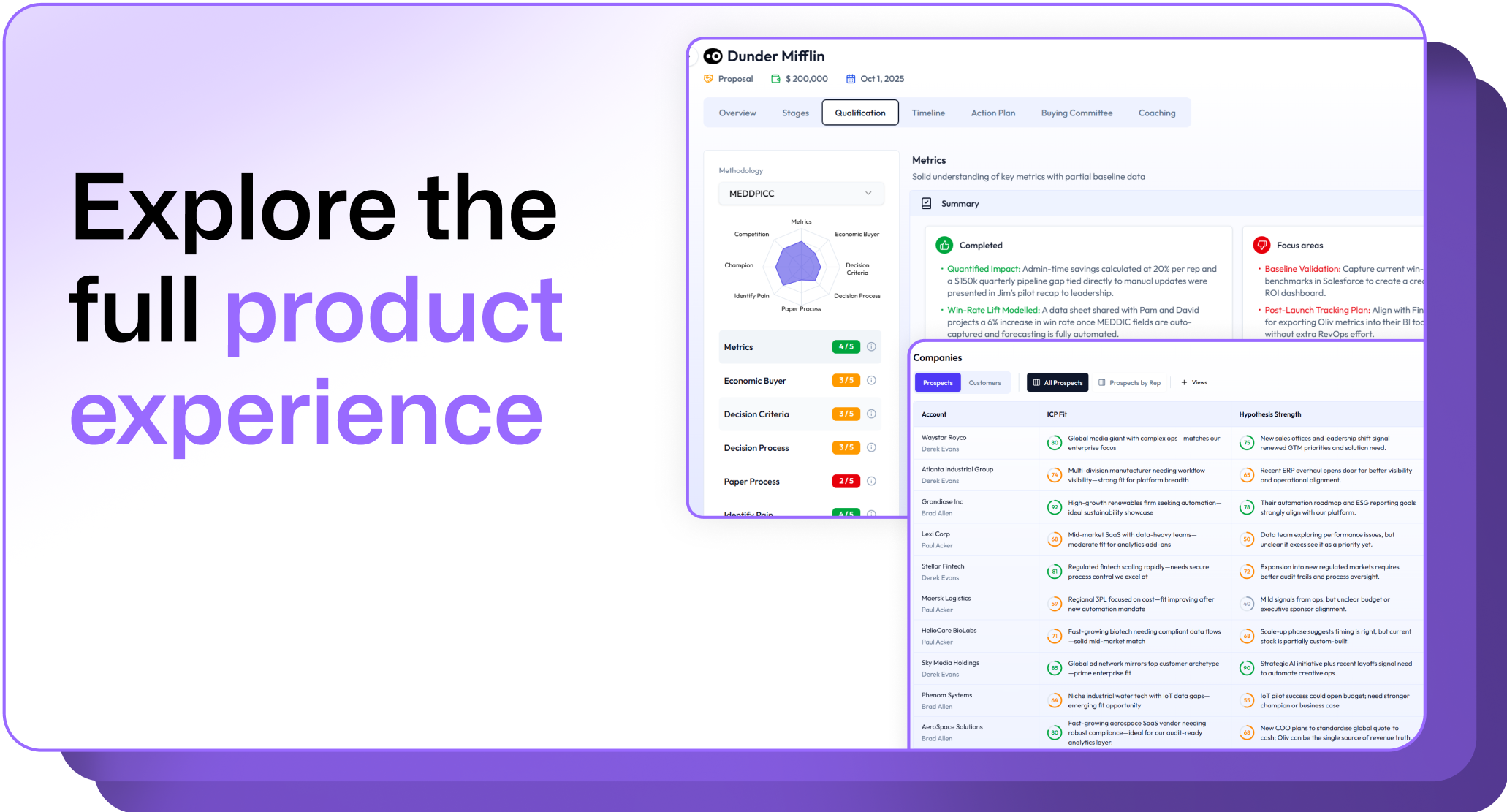
.avif)
.png)







.png)
.png)
.png)