The Future of Revenue Intelligence in 2026: AI Agents vs Dashboards
Written by
Ishan Chhabra
Last Updated :
December 25, 2025
Skim in :
6
mins
In this article
Still got questions?
Come discuss this article with me.
Hi, I'm Ishan, Founder and CEO of Oliv.
I'm always up for a conversation about revenue intelligence, AI agents, or what's actually working (and what's not) across revenue teams.
I'd love to hear your perspective.
Thank you! Your submission has been received!
Oops! Something went wrong while submitting the form.
Meet Oliv’s AI Agents
Hi! I’m, Deal Driver
I track deals, flag risks, send weekly pipeline updates and give sales managers full visibility into deal progress
Hi! I’m, CRM Manager
I maintain CRM hygiene by updating core, custom and qualification fields all without your team lifting a finger
Hi! I’m, Forecaster
I build accurate forecasts based on real deal movement and tell you which deals to pull in to hit your number
Hi! I’m, Coach
I believe performance fuels revenue. I spot skill gaps, score calls and build coaching plans to help every rep level up
Hi! I’m, Prospector
I dig into target accounts to surface the right contacts, tailor and time outreach so you always strike when it counts
Hi! I’m, Pipeline tracker
I call reps to get deal updates, and deliver a real-time, CRM-synced roll-up view of deal progress
Hi! I’m, Analyst
I answer complex pipeline questions, uncover deal patterns, and build reports that guide strategic decisions
TL;DR
Dashboard platforms (Gong, Clari) cost 2-3x their advertised pricing when factoring in 8-24 week implementations, middleware costs, and 8-12 manager hours/week lost to manual auditing.
AI agents improve forecast accuracy by 41% by eliminating rep bias through autonomous pipeline analysis, engagement velocity tracking, and real-time slippage prediction unavailable in keyword-based dashboards.
CRM data hygiene crisis undermines all AI initiatives: 60% of opportunities lack key fields; agents solve this by auto-populating MEDDPICC/BANT from conversations across meetings, emails, Slack, and voice calls.
Hybrid approach bridges trust gap: Use dashboards for quarterly strategic analysis; deploy agents for daily CRM updates, real-time deal alerts, and automated forecasting to achieve 60-70% cost reduction.
2027-2030 vision: Multi-agent autonomous orchestration where Researcher, Forecaster, Deal Driver, and Voice Agents collaborate without human coordination, executing entire revenue workflows from prospecting to handoff.
Q1: How Are Dashboards Failing Sales Leaders in 2025? [toc=Dashboards Failing Leaders]
Sarah manages a 50-person sales team at a SaaS company generating $40M in ARR. Every Monday morning follows the same frustrating ritual: she opens Gong's dashboard, clicks through six tabs to review last week's pipeline activity, exports data to Excel because the built-in filters don't match her board reporting needs, then manually consolidates forecast numbers from eight Account Executives into a presentation. By the time she finishes at 2pm, the data is already 48 hours stale. Despite spending $180/user/month on conversation intelligence tools, she still can't answer her CEO's question in real time: "Which deals are at risk this quarter?"
This is not unique to Sarah. Revenue leaders across B2B organizations face the same "dashboard fatigue" crisis as legacy platforms struggle to keep pace with modern AI demands.
Visual timeline showing the future of revenue intelligence transformation from basic dashboards in 2015 through advanced analytics to autonomous AI agents and multi-agent orchestration by 2030.
The Pre-Generative AI Architecture Problem
Traditional revenue intelligence platforms like Gong, Clari, and Chorus were built between 2013-2016 using V1 machine learning, keyword pattern matching, and static reporting dashboards designed for periodic human auditing (weekly reviews, monthly QBRs). Their architecture relies on humans to extract insights from visualizations, then take action manually in separate systems (CRM, email, Slack). This "human-in-the-loop" design creates systematic bottlenecks in three areas:
1. Manual Data Extraction Sales managers spend 8-12 hours per week navigating dashboards, applying filters, exporting CSVs, and rebuilding reports in Excel/PowerPoint because dashboard views don't match stakeholder requirements.
"What I find least helpful is that some of the features that are reported don't actually tell me where that information is coming from. I.e. Where my weighted number is coming from or how it is being calculated would be helpful." Jezni W., Sales Account Executive, Clari G2 Review
2. Delayed Insights Dashboards present lagging indicators (last activity date, stage duration, close date changes) refreshed hourly or daily. By the time a manager identifies an at-risk deal in their Friday forecast review, the opportunity to intervene passed three days earlier when the economic buyer stopped responding to emails.
"Its too complicated, and not intuitive at all. Using it is very...discomforting. Searching for calls is not easy, moving around in the calls is not easy, and understanding the pipeline management portion of it is almost impossible." John S., Senior Account Executive, Gong G2 Review
3. Action Execution Burden After identifying pipeline risks or coaching opportunities in dashboards, managers must manually execute remediation (Slack AEs, schedule coaching calls, update CRM fields, draft follow-up emails), creating delays between insight and action.
Why "AI Features" in Legacy Platforms Don't Solve This
Many incumbents added "AI-powered" features in 2023-2024, but these remain bolt-ons to dashboard-centric architectures:
Gong's "AI Forecast" Uses keyword-based Smart Trackers (V1 ML) to flag terms like "budget," "legal review," or "competitor" in call transcripts. This produces insights ("Deal mentions competitor 3 times") but requires managers to manually audit flagged calls, determine action steps, and execute interventions. The AI assists human decision-making rather than autonomously driving workflows.
Salesforce Einstein Activity Capture Auto-logs emails and meetings as CRM "activities" but doesn't update opportunity fields (MEDDPICC criteria, next steps, close date changes). Reps still manually input strategic data into Salesforce while Einstein captures peripheral metadata. Sales leaders report Einstein redacts too much data, misses Slack/Teams interactions entirely, and stores activities in separate AWS instances inaccessible to standard Salesforce reporting.
Clari's "Predictive Insights" Displays risk scores (red/yellow/green) for pipeline opportunities but provides no recommendations for remediation. A "red" deal flagged for lack of executive engagement doesn't tell the AE whether to schedule an executive alignment call, send an ROI calculator, or engage a champion differently.
Four-generation framework displaying the future of revenue intelligence progression from operations-focused tools to AI-native orchestration platforms with answer engine optimization replacing traditional SEO.
What Sales Leaders Actually Need: From Insights to Execution
The shift from dashboards to AI agents isn't about better visualizations. It's about moving from "show me what happened" (descriptive analytics) to "do this for me" (prescriptive automation):
Dashboard Era vs Agent Era: Fundamental Capability Shift
Capability
Dashboard Era (Gong, Clari)
Agent Era (Oliv.ai)
Data Capture
Requires manual CRM logging; auto-captures only meetings/emails
Autonomous: agent flags risk → drafts email → queues for approval in Slack
Forecast Accuracy
Rep-driven submissions with bias; 30-40% variance
Unbiased AI roll-ups analyzing engagement velocity; 15-20% variance
CRM Data Hygiene
Manual field updates; 60% incompleteness
Auto-populates MEDDPICC, stakeholders, next steps from conversations
Time-to-Value
8-24 weeks implementation + 6-9 months adoption
5 minutes to launch; 2-4 weeks full customization
The dashboard era treated revenue intelligence as a reporting problem. The AI agent era reframes it as an execution problem where autonomous systems handle the entire insight-to-action workflow without human coordination.
Q2: What Are AI Agents and How Do They Differ From Chatbots? [toc=AI Agents Explained]
The term "AI agent" has been diluted by marketing claims from legacy vendors rushing to rebrand dashboards with chatbot interfaces. Understanding the distinction between true autonomous agents and conversational UI wrappers is critical for evaluating 2025 revenue intelligence platforms.
Comprehensive comparison table contrasting legacy dashboard platforms with AI agent capabilities across data capture, insights, forecasting accuracy, CRM hygiene, and implementation speed for revenue intelligence.
Defining AI Agents: Three Core Capabilities
An AI agent is software that autonomously perceives its environment (data sources like CRM, email, meeting transcripts), makes decisions based on pre-defined goals (increase forecast accuracy, maintain CRM hygiene, accelerate deal velocity), and executes actions (update records, draft communications, trigger workflows) without requiring human coordination for each task.
Three capabilities distinguish agents from chatbots or traditional automation:
1. Autonomous Decision-Making Agents use generative AI (LLMs fine-tuned on domain-specific data) to analyze unstructured inputs (natural language in calls, emails, Slack) and determine optimal next actions based on context, not pre-programmed rules. Example: A forecasting agent detects that a $300k deal's economic buyer hasn't responded in 14 days and email sentiment shifted from enthusiastic to neutral. It autonomously flags the deal at-risk and recommends executive escalation without a manager creating a custom "if/then" rule for this scenario.
2. Multi-Step Workflow Execution Unlike chatbots that respond to queries ("Show me Q4 pipeline"), agents complete multi-step processes: detect signal → analyze context → determine action → draft communication → queue for approval → execute upon confirmation. Example: When a prospect mentions a competitor in a discovery call, a research agent autonomously pulls competitive intelligence, drafts battlecard talking points, and sends to the AE via Slack within 15 minutes.
3. Continuous Learning & Adaptation Agents improve through feedback loops. When a sales manager overrides an agent's risk assessment ("This deal isn't actually at-risk because we have executive sponsorship"), the agent incorporates that feedback into future predictions for similar deal profiles.
What AI Agents Are NOT: Dispelling Common Misconceptions
NOT Chatbots: Chatbots (including "conversational AI" features in Gong, Clari, and Salesforce Einstein) respond to user-initiated queries in natural language. They provide information retrieval (summarize last week's calls, show pipeline by region) but don't autonomously initiate actions or monitor environments continuously.
NOT Robotic Process Automation (RPA): RPA tools (Zapier, Workato) execute pre-defined workflows based on exact triggers ("When Salesforce Stage = Closed Won, send Slack message"). Agents handle ambiguous scenarios without explicit programming (What constitutes an "at-risk" deal? An agent infers from engagement velocity, stakeholder participation, sentiment shifts).
NOT Rules-Based Automation: Traditional sales automation (Salesloft sequences, HubSpot workflows) follows deterministic logic ("Send Email 1 on Day 0, Email 2 on Day 3"). Agents adapt sequences based on real-time context (If prospect opens email within 1 hour, trigger immediate call task; if no open after 48 hours, switch to alternative messaging).
The Oliv.ai Agent Architecture: A Practical Example
Oliv deploys specialized agents per GTM function, each fine-tuned on 100+ LLMs for sales-specific tasks:
CRM Manager Agent: Listens to discovery calls, extracts MEDDPICC qualification criteria (Metrics, Economic Buyer, Decision Criteria, Decision Process, Identify Pain, Champion), and auto-populates Salesforce fields within 10 minutes of call completion. Eliminates the 30-45 minutes reps spend daily on manual CRM updates.
Forecaster Agent: Analyzes pipeline weekly, generates forecast with AI commentary on risks ("Deal X likely to slip economic buyer disengaged since Dec 10"), converts insights into board-ready slides, provides bottom-up visibility without rep-driven filters. Improves forecast accuracy from 60% to 94% by removing human bias.
Deal Driver Agent: Monitors all opportunities for disengagement signals (email response times increase, meeting frequency declines, sentiment shifts), flags at-risk deals within 6 hours, auto-drafts re-engagement emails referencing specific conversation context, queues for rep approval in Slack. Recovers 18% of deals that would have otherwise stalled.
Researcher/Prospector Agent: Mines web data for target accounts (funding rounds, office expansions, job postings, tech stack changes), builds decision maps identifying buying committee members and priorities, drafts personalized outreach referencing specific business context, triggers sequences only when intent signals fire.
Voice Agent (Unique to Oliv): Calls reps for 5-minute debriefs to capture context from in-person meetings, personal phone calls, or Telegram chats that traditional meeting recorders miss. Updates CRM with insights invisible to dashboard-only platforms.
"While Gong offers valuable insights into call data and sales interactions, our experience has been impacted by significant data access limitations... requires downloading calls individually, which is impractical." Neel P., Sales Operations Manager, Gong G2 Review
Why This Matters: The ROI of Autonomous Execution
The shift from dashboards to agents isn't incremental improvement. It's an architectural leap that changes how revenue operations function:
Time Savings: Managers recover 8-12 hours/week previously spent on dashboard auditing, forecast consolidation, and manual CRM updates. This time redirects to high-value coaching and strategic planning.
Accuracy Gains: AI forecasting eliminates rep bias (sandbagging, optimism distortion), improving prediction accuracy by 41% and reducing variance from 30-40% to 15-20%.
Velocity Acceleration: Real-time deal risk alerts (vs. weekly dashboard reviews) enable interventions 3-5 days earlier, shortening sales cycles by 28% and increasing win rates by 32%.
Q3: Why Are Legacy Tools Like Gong and Clari Struggling to Adapt? [toc=Legacy Platform Struggles]
Gong and Clari pioneered the conversation intelligence and revenue intelligence categories a decade ago, establishing market dominance when recording calls and visualizing pipeline data were novel capabilities. But architectural decisions made in 2013-2016 now create fundamental constraints preventing these platforms from transitioning to true AI agent capabilities. Understanding these limitations explains why bolt-on "AI features" fail to deliver the autonomous execution modern revenue teams require.
Architectural Debt: Built for the Dashboard Era
Legacy platforms optimized for a world where sales managers had time to audit dashboards weekly. Their core architectures assume:
Humans Extract Insights: Data is aggregated into dashboards (deal boards, forecast views, coaching scorecards) designed for periodic human review. Managers click through views, apply filters, and manually identify patterns.
Actions Happen Elsewhere: Once insights are identified, managers execute remediation in separate tools (Slack reps, update Salesforce, draft emails in Gmail). The platform provides intelligence; humans handle execution.
Batch Processing: Data refreshes occur hourly or daily, not in real-time. Call transcripts take 15-30 minutes to process; CRM syncs happen every 60 minutes. This latency is acceptable when workflows assume weekly review cadences.
These design choices made sense in 2015 but create bottlenecks in 2025 when AI agents can analyze signals and execute actions within minutes.
Specific Technical Limitations
1. Proprietary Data Silos (Gong) Gong stores call recordings, transcripts, and analytics in proprietary format, not directly in CRM. This creates data portability issues teams discover only when switching platforms or needing bulk exports for BI tools. Syncing Gong data to Tableau, Looker, or custom dashboards requires middleware (Zapier, Workato) adding $5k-$15k/year per integration.
"While Gong offers valuable insights into call data and sales interactions, our experience has been impacted by significant data access limitations... requires downloading calls individually, which is impractical and inefficient for a large volume of data. This lack of flexibility has required us to engage our development team at additional cost." Neel P., Sales Operations Manager, Gong G2 Review
2. Formula Field Migration Issues (Clari) Clari cannot directly handle Salesforce formula fields, requiring RevOps teams to create and maintain duplicate fields. This doubles data management overhead and creates version control problems when Salesforce field definitions change.
"I find the setup process challenging, especially when migrating fields from Salesforce, as it can't handle formula fields directly. This requires creating and maintaining duplicate fields, which adds complexity and workload." Josiah R., Head of Sales Operations, Clari G2 Review
3. Keyword-Based Intelligence (Both) Gong's Smart Trackers rely on keyword pattern matching (V1 machine learning) to flag terms like "pricing," "legal," or "competitor." This approach misses intent-based signals (a prospect responding to emails within 2 hours shifting to 48-hour delays signals disengagement, but no keywords change). Clari's risk scores similarly use rule-based logic (days since last activity, stage duration) rather than generative AI analyzing multi-dimensional engagement patterns.
4. Manual Forecasting Workflows (Clari) Clari pioneered structured forecasting but requires manual input. Sales leaders log into Clari's UI to submit forecast numbers; reps do the same at opportunity level. This "human-in-the-loop" design means forecasts lag reality by 3-5 days (time between interactions and manual updates).
"I do think the forecasting feature is decent, but at least in our setup, it doesnt do a great job of auto-calculating the values I need to submit, so that is entirely handheld by using the built-in notes field as a calculator." Dexter L., Customer Success Executive, Clari G2 Review
The Retrofitting Problem: Why "AI" Updates Don't Fix Core Issues
In response to generative AI disruption, incumbents announced "agent" products in 2024:
Salesforce Agentforce (launched September 2024) Gong AI (rebranded existing features) Clari Copilot (conversational interface for dashboards)
User feedback reveals these are dashboard enhancements, not autonomous agent systems:
The fundamental issue: adding conversational UI to dashboard-centric architectures doesn't transform them into autonomous execution engines. True agent platforms require:
Real-Time Data Processing: Analyzing signals within minutes of occurrence (email sent, meeting ends, Slack message posted), not hourly batch syncs.
Multi-Source Data Fusion: Combining structured CRM data with unstructured conversation data (meetings, emails, Slack) and external signals (funding rounds, job postings, tech stack changes) in unified agent memory.
Autonomous Workflow Orchestration: Executing multi-step processes (detect signal → analyze → decide → draft → queue → send) without requiring human coordination at each step.
Open Data Architecture: Maintaining CRM as single source of truth with full export capabilities, not proprietary data lakes requiring middleware for integration.
Legacy vendors face "innovator's dilemma" constraints: their existing customers and revenue models depend on dashboard-centric architectures. Cannibalizing this model to rebuild as agent-first platforms risks near-term revenue while new entrants (like Oliv) built natively for autonomous agents capture market share.
The Implementation Tax: Hidden Costs of Legacy Platforms
8-24 Week Setup (Gong): Configuring Smart Trackers, customizing deal boards, training managers, building call libraries requires 40+ hours of manager time plus $20k-$50k in consulting fees.
6-12 Week Setup (Clari): Migrating Salesforce hierarchy, creating duplicate fields for formula limitations, configuring forecast categories demands dedicated RevOps resources.
6-9 Month Adoption Lag: Achieving >60% daily active usage takes half a year as teams overcome change management resistance and learn complex UIs.
In contrast, AI-native platforms like Oliv launch in 5 minutes (connect CRM + calendar) with full customization completed in 2-4 weeks. Agents work in Slack/Email where reps already operate, requiring zero UI training.
Q4: What Problems Do AI Agents Solve That Dashboards Can't? [toc=Agent Advantages]
The value proposition of AI agents extends beyond automation. They fundamentally solve four categories of problems dashboard-centric platforms cannot address due to architectural constraints: real-time responsiveness, unbiased analysis, execution bottlenecks, and knowledge democratization.
Problem 1: The "Stale Data" Crisis
Dashboards aggregate historical data into periodic snapshots (hourly refreshes, daily syncs, weekly reports). By the time a sales manager reviews Friday's forecast dashboard showing a $250k deal "on track," the economic buyer may have stopped responding to emails three days earlier. The lag between signal occurrence and human awareness creates missed intervention windows.
Why Dashboards Fail Here: Batch processing architectures refresh data on fixed schedules. Gong processes call transcripts in 15-30 minutes; CRM syncs occur every 60 minutes. Managers audit dashboards weekly (Friday forecast calls, Monday pipeline reviews). The cumulative lag means insights are 3-7 days old when acted upon.
How Agents Solve This: AI agents monitor environments continuously and trigger alerts within minutes of signal detection. When an economic buyer's email response time increases from 4 hours to 48 hours (disengagement signal), Deal Driver agent flags the opportunity at-risk, auto-drafts a re-engagement email referencing specific conversation context, and Slacks the AE within 15 minutes. The rep intervenes the same day, not a week later after reviewing dashboard filters.
"The additional products like forecast or engage come at an additional cost. Would be great to see these tools rolled into the core offering." Scott T., Director of Sales, Gong G2 Review
Problem 2: Human Bias in Forecasting
Sales forecasting relies on rep-submitted data where optimism bias (hoping deals close) and sandbagging (lowering commit to exceed quota) distort accuracy. Dashboard platforms aggregate these biased inputs without correction, resulting in 30-40% forecast variance.
Why Dashboards Fail Here: Clari and Gong Forecast surface rep-submitted data in structured views but don't analyze underlying engagement signals to validate claims. If an AE marks a deal "commit" but the economic buyer hasn't responded in 21 days, dashboards display the optimistic status without flagging the contradiction.
How Agents Solve This: Forecaster agents generate unbiased predictions by analyzing engagement velocity (email cadence, meeting frequency, sentiment trends) independent of rep input. When rep-submitted forecasts conflict with behavioral signals, agents provide AI commentary: "Deal X marked commit but lacks executive engagement since Dec 10; recommend moving to best-case." Organizations report 41% improvement in forecast accuracy (reducing variance from 30-40% to 15-20%) by removing human bias.
"The forecasting feature is decent, but it doesn't do a great job of auto-calculating the values I need to submit, so that is entirely handheld... I have to scroll sideways so much to fill in all information." Dexter L., Customer Success Executive, Clari G2 Review
Problem 3: The "Insight-to-Action" Gap
Dashboard workflows separate insight discovery from execution. Managers identify problems (at-risk deal, incomplete CRM data, stalled opportunity) in one tool, then manually coordinate remediation across multiple systems (Slack reps, update Salesforce, draft emails in Gmail, schedule calls in calendar). This handoff creates delays, context loss, and execution inconsistency.
Why Dashboards Fail Here: They are designed for information display, not workflow automation. After a manager spots a pipeline risk in Gong's deal board, they must:
Open Slack to message the AE
Copy deal context from Gong into message
Wait for AE to respond and execute remediation
Manually follow up if no action taken
Update dashboard notes to track intervention
This five-step process takes 15-30 minutes per deal and introduces coordination overhead.
How Agents Solve This: Agents collapse insight-to-action into single workflows. When Deal Driver detects an at-risk opportunity, it autonomously:
Analyzes root cause (economic buyer disengaged, multi-threading gap, competitor mentioned)
Determines optimal remediation (executive escalation, ROI calculator, champion re-engagement)
Drafts contextual communication referencing specific call moments
Queues for approval in Slack with one-click execution
Tracks outcome and updates CRM automatically
The entire process completes in 10 minutes with one human decision point (approve/edit/reject drafted message). Organizations report 28% reduction in sales cycle length and 32% increase in win rates by eliminating execution delays.
"Groove is just a basic interface that connects to salesforce and a dialer. The workflow is clunky and confusing. The platform is missing a ton of features and functionality that Ive had with other tools like Outreach.io, Salesloft, Hubspot." Austin N., SDR, Clari/Groove G2 Review
Problem 4: Knowledge Trapped in "Dashboard Archaeology"
Dashboard expertise concentrates in RevOps and sales leadership who understand which filters, views, and exports answer specific business questions. Reps and frontline managers lack this fluency, creating dependency on specialized users for ad-hoc analysis ("How many deals in Southeast closed last quarter with >$200k ACV?"). This knowledge centralization bottlenecks decision velocity.
Why Dashboards Fail Here: Complex UIs with dozens of customizable views, filters, and groupings require training to navigate effectively. Gong's Smart Trackers, Clari's forecast hierarchy, and custom report builders demand 40+ hours of certification training. Reps asking simple questions wait hours for RevOps to run reports.
"Its too complicated, and not intuitive at all. Using it is very...discomforting. Searching for calls is not easy, moving around in the calls is not easy, and understanding the pipeline management portion of it is almost impossible." John S., Senior Account Executive, Gong G2 Review
How Agents Solve This: Conversational interfaces (Slack, Teams) democratize data access. Reps ask natural language questions ("Show my Q4 deals with no activity in 7+ days") and agents surface answers in seconds without requiring dashboard fluency. Analyst agents translate business questions into queries across multiple data sources (CRM, email, calendar, call transcripts), synthesize results, and present summaries in chat. This shifts knowledge from specialized users to accessible self-service.
"I worked there extremely briefly before leaving. The core tool itself is good enough but the sale entailed overcomplicating the forecasting process so you needed Clari... It is really just a glorified SFDC overlay." conaldinho11, Reddit r/SalesOperations
The Compounding Effect: When Agents Work Together
Individual agents solving isolated problems create linear value. But when specialized agents collaborate autonomously, value compounds:
Researcher Agent pulls competitive intelligence when prospect mentions competitor
Deal Driver flags missing multi-threading (no CFO contact) and recommends executive alignment call
Forecaster Agent incorporates new opportunity into weekly roll-up with AI commentary on close probability
This five-agent workflow completes in 20 minutes with zero manual CRM updates, report generation, or coordination. Managers gain complete deal visibility without touching dashboards.
The shift from dashboards to AI-native revenue orchestration isn't about incremental productivity gains. It's about fundamentally redefining how revenue teams operate when intelligence and execution collapse into autonomous workflows.
Q5: How Do AI Agents Improve Forecast Accuracy? [toc=Forecasting Accuracy]
Sarah's nightmare repeats every Monday. She spends her entire weekend manually consolidating spreadsheets from eight Account Executives, each representing deals differently. Thursday afternoons become marathon pipeline review sessions, sitting with each rep for 45-60 minutes to update close dates, commit categories, and risk flags. By Tuesday's board meeting, the forecast she presents is already five days stale. Last quarter, this manual process resulted in a 39% variance between forecast and actuals, costing her CFO's trust and her team two headcount approvals.
This is the "Monday forecasting stress" that defines revenue leadership in the dashboard era.
❌ Why Legacy Forecasting Approaches Fail
Clari's "Roll-Up" Bottleneck:Clari pioneered the concept of structured forecasting, but the fundamental model remains manual. Sales leaders must log into Clari's UI and input their forecast numbers while reps do the same at the opportunity level. This "human-in-the-loop" design creates systematic delays.
"The forecasting feature is decent, but it doesn't do a great job of auto-calculating the values I need to submit, so that is entirely handheld... I have to scroll sideways so much to fill in all information." Dexter L., Customer Success Executive, Clari G2 Verified Review
Gong's Keyword-Based Signals:Gong Forecast relies on Smart Trackers, keyword pattern matching (V1 machine learning) that flags terms like "pricing," "contract," or "legal review." This approach misses intent-based signals: a prospect responding to emails within 2 hours (high intent) suddenly taking 48 hours to reply (disengagement warning). Keywords can't capture this velocity shift.
The result? Forecasts remain "rep-driven," Account Executives control which deals surface in pipeline reviews, hiding stalled opportunities behind optimistic close date pushes.
✅ How AI-Era Forecasting Works
Modern predictive models replace manual roll-ups with autonomous analysis across four dimensions:
Historical Win/Loss Pattern Recognition - Analyzes 12-24 months of closed deals to identify characteristics of won vs. lost opportunities (deal size, sales cycle length, stakeholder engagement patterns)
Engagement Velocity Tracking - Monitors micro-signals in real-time: email response times, meeting attendance rates, sentiment shifts in conversation tone, frequency of inbound questions from prospects
Stakeholder Mapping Gaps - Flags missing executive engagement (e.g., "No CFO contact in 21 days on $300k deal") or single-threaded relationships vulnerable to champion departure
Multi-Variate Slippage Prediction - Combines signals to predict which deals will slip 2-3 weeks before human managers detect warning signs, achieving 41% higher accuracy than manual methods
The critical difference: these models process signals continuously (every email, every call, every CRM update) rather than in weekly forecast meetings.
Oliv's Forecaster Agent eliminates the manual forecasting loop entirely with three capabilities competitors can't match:
AI Commentary on Deal Risks: Instead of color-coded pipeline categories (commit, best-case, upside), the agent provides context-rich explanations: "Deal X ($250k) likely to slip, no executive engagement since Dec 10; email response time increased from 4 hours to 3 days; champion hasn't responded to ROI calculator sent Dec 18."
Board-Ready Output: Converts pipeline data into presentation slides automatically, waterfall charts showing deal movement (new business, slippage, pull-ins), variance analysis comparing current quarter to prior, risk stratification by deal stage. Sarah now sends board decks generated in 15 minutes, not 8 hours.
Bottom-Up Pipeline Visibility: Provides unbiased deal health scores reps can't manipulate. The agent analyzes every opportunity line-by-line regardless of which deals reps choose to discuss in forecast calls, surfacing hidden risks dashboard filters would miss.
Predictive Pull-In Detection: Identifies deals likely to close earlier than forecast (e.g., "Deal Y showing acceleration, 3 unscheduled exec meetings in past week; procurement sent contract markup draft; budget approval advanced to Q4 vs. Q1 original timeline").
💰 ROI Evidence: The Numbers Don't Lie
Organizations replacing manual forecasting with AI agents report:
41% improvement in forecast accuracy (reducing variance from 30-40% to 15-20%)
19% revenue growth within first year (recovered pipeline visibility unlocks coaching opportunities)
"Love the user-friendly features and the visibility it provides into our Sales forecast. We use Clari every week on our forecast call with our ELT... but there are small quirks... occasionally pages won't refresh without a browser refresh." Andrew P., Business Development Manager, Clari G2 Verified Review
Q6: Can AI Agents Solve CRM Data Hygiene Problems? [toc=CRM Data Hygiene]
The dirty secret of every AI initiative: garbage in, garbage out. Salesforce's Agentforce promises autonomous deal insights, but it fails when 60% of opportunities lack key MEDDPICC fields. Einstein Activity Capture claims to auto-log emails and meetings, yet it redacts data unnecessarily, misses Slack interactions entirely, and stores captured activities in separate AWS instances unusable for reporting. The result? AI predictions based on incomplete, outdated, or manually entered data become unreliable guesses.
This is the "CRM data hygiene crisis" undermining every revenue intelligence investment.
❌ Traditional Approaches: Manual Logging at Scale
Gong's "Notes" Problem: Gong pioneered call transcription, but its CRM integration remains surface-level. After every meeting, Gong logs a summary as a "note" or "activity" in Salesforce/HubSpot. It doesn't update actual opportunity fields, MEDDPICC criteria (Metrics, Economic Buyer, Decision Process), BANT qualification (Budget, Authority, Need, Timeline), or next steps. Reps still manually input this data, often days or weeks after conversations occur.
"While Gong offers valuable insights into call data and sales interactions, our experience has been impacted by significant data access limitations... requires downloading calls individually, which is impractical. This lack of flexibility has required us to engage our development team at additional cost." Neel P., Sales Operations Manager, Gong G2 Verified Review
Salesforce Einstein Activity Capture Failures: Einstein's promise: automatically log emails, meetings, and contacts into CRM. The reality: it redacts sensitive data too aggressively (removing deal context), misses interactions happening in Slack/Teams/Telegram, and stores activities in separate Einstein Analytics tables that can't power standard Salesforce reports. RevOps teams end up maintaining duplicate fields.
The manual logging bottleneck persists: reps spend 30-45 minutes per day updating CRM records, data lags reality by 3-7 days, and managers can't trust pipeline reports for accurate coaching.
✅ AI-Era Data Hygiene: Real-Time Autonomous Updates
Modern agents extract structured data from unstructured conversations across channels, updating CRM fields within minutes of interactions:
Voice calls & in-person meetings - Unique to Oliv: Voice Agent calls reps for 5-minute debriefs to log context invisible to meeting bots
Object-Level CRM Updates: Instead of logging notes, agents update actual opportunity properties: Close Date, Stage, Amount, Decision Criteria, Economic Buyer Contact, Next Steps, Risk Level, Competitor Mentions, maintaining the CRM as the single source of truth.
⚠️ Oliv's CRM Manager: The Data Hygiene Differentiator
MEDDPICC/BANT Auto-Population: Listens to discovery calls and automatically fills qualification frameworks: Metrics: "Customer needs 25% forecast accuracy improvement by Q2" Economic Buyer: Auto-creates contact record for CFO mentioned in meeting Decision Process: "Legal review → Procurement → Board approval (3-stage)" Paper Process: "MSA negotiation started Dec 15; SLA terms pending"
LinkedIn Enrichment & Contact Creation: When a rep mentions "I'm meeting with Sarah Chen, their new CRO next week," CRM Manager:
Searches LinkedIn for Sarah Chen at target company
Creates new contact record with title, email (if public), LinkedIn URL
Associates contact with opportunity and updates stakeholder map
No manual data entry required
Full Open Data Export (No Vendor Lock-In): Unlike Gong's proprietary data storage requiring API workarounds or export fees, Oliv maintains CRM as the single source of truth with full CSV/API export access. Teams own their data completely.
The Voice Agent Advantage: Oliv's unique differentiator: an AI that calls reps for 5-minute debriefs to capture context from:
In-person customer meetings (no recording possible)
Personal phone calls reps take on mobile
Telegram/WhatsApp conversations with international prospects
Hallway conversations at conferences
This "human-in-the-loop" intelligence captures the 30-40% of deal context traditional meeting recorders miss.
💡 Downstream Impact: Clean Data Enables Everything
Organizations with automated CRM hygiene report:
47% higher CRM adoption rates (reps no longer resist logging when it's automatic)
34% faster new hire onboarding (historical deal context readily available for learning)
Accurate downstream AI (forecasting, lead scoring, churn prediction models rely on clean input)
Q7: What is the True ROI of AI Agents vs Dashboards? [toc=True ROI Analysis]
The sticker price is only the beginning. When evaluating revenue intelligence platforms, organizations focus on per-seat licensing ($180/user for Gong, $100/user for Clari) but overlook the total cost of ownership (TCO) including implementation drag, change management overhead, data silos, vendor lock-in fees, and the opportunity cost of manual workflows. A comprehensive TCO analysis reveals dashboard-centric platforms cost 2-3x their advertised pricing.
💸 TCO Comparison: 250-User Team Over 3 Years
Total Cost of Ownership: Dashboard Platforms vs AI Agents (250-User Team, 3 Years)
Platform
Base License
Platform Fees
Modules/Add-Ons
Implementation
Training
3-Year TCO
Gong
$180-$270/user/month
$5k-$50k/year mandatory
Forecast ($50/user), Engage ($90/user) modules sold separately
Complex hierarchy setup, formula field migration issues
$900k - $1.2M
Stacked (Gong + Clari)
$280-$390/user/month combined
Both platform fees
All modules to match feature parity
12-30 weeks combined
Dual training burden, fragmented UX
$2.5M - $3.2M
Oliv AI (Modular Agents)
Usage-based per agent
No platform fee
Deploy only needed agents (CRM Manager, Forecaster, Deal Driver, Researcher)
5 minutes to launch; 2-4 weeks full customization
Zero training (Slack/email native)
$500k - $900k (60-70% reduction)
"It was a big mistake on our part to commit to a two year term. Gong is a really powerful tool but it's probably the highest end option on the market... we're stuck with a tool that works technically but isn't the right business decision." Iris P., Head of Marketing/Sales Partnerships, Gong G2 Verified Review
Clari: 6-12 weeks to migrate Salesforce hierarchy, create duplicate fields for formula limitations, configure forecast categories
Oliv: 5-minute initial setup (connect CRM + calendar); 2-4 weeks for full LLM fine-tuning on company-specific deal terminology
2. Change Management Burden
Dashboard Platforms: Require 40+ hours manager training for Gong "certification"; 6-9 months to achieve >60% user adoption; ongoing support costs for quarterly feature updates
Agent Platforms: Zero training required, agents work in Slack/Email where reps already live; adoption happens within 2-4 weeks
"I find the setup process challenging, especially when migrating fields from Salesforce, as it can't handle formula fields directly. This requires creating and maintaining duplicate fields, which adds complexity." Josiah R., Head of Sales Operations, Clari G2 Verified Review
3. Data Silos & Middleware Costs
Gong: Stores recordings, transcripts, and analytics in proprietary format. Syncing data to BI tools (Tableau, Looker) requires middleware (Zapier, Workato) adding $5k-$15k/year per integration. Bulk export requires individual call downloads, impractical at scale
Oliv: Maintains CRM as single source of truth; full CSV/API export included; no middleware required
4. Vendor Lock-In & Migration Fees
Gong: Charges export fees for historical data migration; no API access at lower-tier plans; requires 12-month minimum contracts with auto-renewal penalties
Oliv: Full open export; no lock-in; flexible monthly/annual terms; free migration of historical Gong recordings
5. Opportunity Cost: Manager Productivity Drain Quantify the hidden cost of "dashboard archaeology":
No mandatory platform fees. No forced module bundles. Pay only for active automations.
Q8: How Do AI Agents Enable Real-Time Deal Orchestration? [toc=Deal Orchestration]
Three weeks into Q4, Sarah opens her Gong dashboard Monday morning and filters her team's pipeline to "at-risk" deals (those without activity in 7+ days). One $250k enterprise opportunity catches her eye, last meeting was 14 days ago. She clicks through to the deal board, scrolls through call transcripts, checks email activity in Salesforce. The signals were there all along: the economic buyer stopped responding to emails 10 days ago, email response times dropped from 4 hours to never, and the champion missed the last two scheduled calls. By the time Sarah Slacks the rep to intervene, the deal is already lost to a competitor who moved faster.
This is the "stalled deal epidemic" that plagues 60% of CRM opportunities.
❌ Why Traditional Dashboards Show Lagging Indicators
Gong Smart Trackers: Flag keywords ("pricing," "legal," "competitor") but require managers to manually audit flagged calls, then Slack reps with action items. The execution burden remains on humans. A deal can show "green" status (recent activity logged) while engagement velocity collapses, email response times stretching from hours to days go undetected by keyword-based logic.
Clari Risk Categories: Surfaces opportunities in red/yellow/green health categories based on stage age, close date proximity, and activity recency. But Clari doesn't recommend specific next actions, it highlights problems without prescribing solutions. Managers must still manually review each at-risk deal and decide whether to schedule an executive alignment call, send an ROI calculator, or engage customer success.
"What I find least helpful is that some of the features that are reported don't actually tell me where that information is coming from... I wish that I could also apply the same next action to multiple opps instead of having to enter it in manually." Jezni W., Sales Account Executive, Clari G2 Verified Review
The fundamental limitation: dashboards display lagging indicators (last activity date, days since contact) not leading indicators (engagement velocity trends, multi-threading gaps, sentiment shifts).
✅ How AI-Era Deal Orchestration Works
Modern agents analyze engagement velocity in real-time across four dimensions, then autonomously execute remediation workflows:
Email Response Time Monitoring - Detects when a prospect's reply speed drops from 2 hours to 2 days (disengagement warning 7-10 days before humans notice)
Stakeholder Participation Tracking - Flags multi-threading gaps: "No CFO contact in 21 days on $300k deal" or "Champion missed last 2 scheduled calls"
Meeting Frequency Analysis - Alerts when weekly sync calls stretch to bi-weekly, then monthly (buying interest cooling)
Sentiment Shift Detection - Uses NLP to identify tone changes in email/call language: enthusiastic → neutral → evasive
The breakthrough: agents don't just surface risks, they execute actions autonomously.
⭐ Oliv's Deal Driver: Proactive Risk Mitigation
Deal Driver operates as Sarah's 24/7 pipeline analyst, monitoring every opportunity and intervening before deals stall:
Real-Time Risk Flagging: Surfaces disengagement signals within 6-12 hours: "Deal X ($250k): Economic buyer (CFO Sarah Chen) hasn't responded to emails in 14 days. Email response time increased from 4 hours → 3 days → no response. Champion (VP Sales John Lee) declined last 2 meeting invites. Recommendation: Schedule executive alignment call with your VP Sales + their CFO within 48 hours."
Multi-Threading Gap Analysis: Identifies single-threaded relationships vulnerable to champion departure: "Deal Y: Only 1 active contact (Champion). No engagement with Economic Buyer (CFO), Decision Maker (CEO), or Procurement in past 30 days. Risk: If Champion leaves or loses influence, deal stalls. Action: Request intro to CFO via Champion; send ROI calculator to CEO."
Auto-Drafted Contextual Follow-Ups: Generates re-engagement emails referencing specific deal context: "Hi Sarah, following up on our Dec 10 call where you mentioned Q1 budget approval for the forecast accuracy initiative. Wanted to share [ROI calculator] showing how we helped similar fintech companies reduce forecast variance by 32%. Are you still tracking toward the Jan 15 board meeting timeline you mentioned?"
Reps approve/edit/send within Slack, no need to open CRM or draft from scratch.
Zero-Friction Workflows: Integrates directly into Slack and Email where reps work:
Morning digest: "3 deals need attention today, here's why and what to do"
Real-time alerts: "Deal X champion just declined meeting, suggest executive escalation?"
One-click actions: Approve recommended email, schedule suggested call, flag for manager review
28% shorter sales cycles (engagement gaps addressed within days, not weeks)
18% recovery rate on at-risk deals that would have been lost with reactive dashboards
"The additional products like forecast or engage come at an additional cost. Would be great to see these tools rolled into the core offering." Scott T., Director of Sales, Gong G2 Review
The competitive edge: In deals where multiple vendors are competing, response velocity often determines the winner. Agents that auto-draft follow-ups within 15 minutes beat competitors whose reps spend 2-3 days crafting manual responses.
Q9: How Are AI Agents Transforming Prospecting and Outbound Sales? [toc=Prospecting Transformation]
The "spray-and-pray" era of mass prospecting is collapsing. Open rates for non-personalized email sequences have dropped below 5%, spam complaints are rising by 23% year-over-year, and stricter regulations (including new FCC rules targeting unsolicited bulk emails) are blacklisting generic cadences. Mass email tools like Salesloft and Outreach built their businesses on volume, send 10,000 emails to get 50 responses. That math no longer works when inbox providers (Gmail, Outlook) use AI to filter "templated" messages to spam folders within seconds.
The era of mass, non-personalized prospecting is over.
❌ Why Legacy Prospecting Approaches Fail
Generic Sequences Ignore Context: Seven-touch sequences (email → call → email → LinkedIn → email) execute blindly regardless of target account circumstances. BDRs send expansion pitches to companies that just announced 20% layoffs, quarterly "check-in" emails to prospects whose CEOs resigned last week, or product demos to organizations mid-acquisition. The result? Messages feel robotic, irrelevant, and damage brand reputation.
"Groove is just a basic interface that connects to salesforce and a dialer. The workflow is clunky and confusing. The platform is missing a ton of features and functionality that I've had with other tools like Outreach.io, Salesloft, Hubspot." Austin N., SDR, Clari/Groove G2 Verified Review
Gong's Third-Party Buyer Intent: Gong's "buyer intent" relies on keyword tracking in earnings calls, G2 reviews, or website visits flagged by third-party providers (Bombora, 6sense). This data is reactive (signals after intent forms) not predictive (signals before buying committees mobilize). A company researching "revenue intelligence tools" triggers alerts across 15 vendors simultaneously, you're in a bidding war, not a strategic early engagement.
"It's not thought for salespeople but for marketers. Campaigns are very inefficient, the website is EXTREMELY slow and to send/schedule different campaigns requires a huge effort. I use it daily and every time I suffer to use it." Federico M., Account Executive, Clari/Groove G2 Verified Review
Oliv's agents autonomously research target accounts, build decision maps, and draft context-rich messages:
Decision Map Construction: Identifies buying committee members and their priorities:
CFO cares about forecast accuracy (budget predictability)
CRO cares about win rates and sales cycle length (revenue growth)
RevOps cares about CRM hygiene and data integrity (operational efficiency)
Agent drafts personalized messages per persona referencing specific business context.
Industry-Specific Examples:
AI Agent Prospecting: Industry-Specific Intent Signals
Industry
Intent Signals Monitored
Contextual Outreach Example
SaaS
Series B funding + hiring Sales Ops roles
"Congratulations on your $40M Series B last month. As you scale from 50 to 200 reps, here's how we helped 3 similar SaaS companies maintain forecast accuracy during hypergrowth..."
FinTech
Regulatory changes (e.g., new SEC rules) + compliance officer hiring
"With the new SEC reporting requirements effective Q1, we're helping fintech firms automate compliance audits within CRM workflows, happy to share how we reduced audit prep time by 60%..."
Manufacturing
New facility openings + ERP system migrations
"Saw you opened your Texas facility last quarter. As you integrate distributed sales teams, here's how we unified pipeline visibility across 8 global offices for a similar manufacturer..."
CRM Integration for Trigger-Based Sequences: Agent monitors intent signals continuously and triggers outreach only when signals fire, no generic batch-and-blast. When a target company posts a RevOps job opening, agent auto-drafts outreach within 24 hours referencing the specific role.
💰 Market Validation: Quality Over Volume
76% of B2B marketers confirm higher ROI from high-intent lead targeting vs. mass volume campaigns
95% of seller research workflows will start with AI by 2027 (Gartner prediction)
6x higher response rates for personalized outreach vs. generic sequences
42% reduction in cost-per-lead when focusing on intent-triggered campaigns vs. spray-and-pray
"We use to use Outreach and we now use Groove. Outreach is a way better platform overall. Much more user friendly, simple to understand, and has all the bells and whistles you need." Makingcents01, Reddit r/sales
Q10: Should You Use Dashboards, Agents, or a Hybrid Approach? [toc=Hybrid Approach]
The primary barrier to AI agent adoption isn't technical capability, it's trust. Sales leaders hesitate to let algorithms make decisions about deals, forecasts, or customer communications because of four core anxieties: fear of "black-box" AI decisions without explainability, lack of AI literacy among GTM teams (73% of sales managers report limited AI training), compliance concerns (GDPR, data residency, AI bias), and job displacement anxiety (will agents replace my team?).
Bridging this "trust gap" requires a phased approach combining human oversight with agent automation.
⚠️ Understanding the Trust Gap
Why Leaders Hesitate:
Black-Box Decisions: Traditional AI models (neural networks, deep learning) provide predictions without explaining why, managers can't justify to boards why AI recommended slipping a $500k deal
Compliance Risks: Healthcare, financial services, government sectors face regulatory scrutiny on AI-generated customer communications (who's liable if an agent makes a promise?)
Change Management Fatigue: Teams already overwhelmed by CRM migrations, dashboard implementations, and process changes resist "another transformation"
Skill Gaps: 68% of sales reps report feeling unprepared to work alongside AI tools
How to Bridge It:
Explainable AI: Use models that surface reasoning (e.g., "Deal flagged at-risk because: email response time increased 300%, no exec engagement in 21 days, champion declined last 2 meetings")
Human-in-the-Loop for High Stakes: Require manager approval for actions above thresholds ($250k+ deals, C-level communications, discount approvals >15%)
Phased Rollout: Start with low-risk automations (CRM data entry, meeting summaries) before scaling to high-impact decisions (forecasting, deal prioritization)
Transparent Governance: Document AI decision criteria, audit logs, override mechanisms
✅ Is Your Organization Ready for AI Agents? Assessment Framework
Score each criterion 1-5 (1 = weak, 5 = strong):
AI Agent Readiness Assessment Framework
Criteria
What to Assess
Your Score (1-5)
CRM Data Completeness
Are >70% of opportunity fields (MEDDPICC, BANT, stakeholders) populated? Do reps log interactions within 24 hours?
___
Integration Ecosystem Maturity
Are data sources unified (CRM + email + calendar + Slack)? Or siloed across 8+ disconnected tools?
___
Team AI Literacy
Do managers understand how AI models work? Are reps comfortable with automation taking tasks off their plate?
___
Process Documentation
Are sales workflows standardized (documented playbooks, stage definitions, qualification criteria)?
___
Change Management Capacity
Does RevOps have bandwidth to pilot new tools? Is leadership bought into experimentation?
___
Budget Flexibility
Can you reallocate budget from legacy tools (Gong, Clari) or is every dollar locked in multi-year contracts?
___
Data Governance
Do you have policies for AI usage, data privacy, customer consent for recording/transcription?
___
Scoring Guide:
25-35 points: Agent-ready, deploy production agents within 60 days
15-24 points: Hybrid approach, use dashboards for strategy, agents for tactical automation
<15 points: Foundation-building needed, audit data quality, document processes, pilot with 5-10 users
"It's too complicated, and not intuitive at all. Using it is very...discomforting. Searching for calls is not easy, moving around in the calls is not easy, and understanding the pipeline management portion of it is almost impossible." John S., Senior Account Executive, Gong G2 Verified Review
⏰ Implementation Roadmap: Foundation → Pilot → Scale
Phase 1: Foundation (1-2 Months)
Audit CRM data quality (identify fields with <50% completion rates)
Integrate with existing dashboards (export agent outputs to Tableau, Looker)
Optimize continuously based on usage patterns
Oliv's Advantage: 5-minute instant configuration vs. Gong's 8-24 week implementation. Pilot teams can test Oliv agents within 1 week vs. 3-6 months for legacy platforms.
Q11: What Are the Hidden Costs of Dashboard-Centric Platforms? [toc=Hidden Costs]
The advertised pricing is just the tip of the iceberg. When organizations evaluate conversation intelligence or revenue intelligence platforms, they compare per-seat costs ($180/user for Gong, $100/user for Clari) but overlook the total cost of ownership (TCO) including implementation drag, change management overhead, data silos requiring middleware, vendor lock-in fees, and the opportunity cost of manual workflows consuming 8-12 manager hours per week.
A comprehensive TCO analysis reveals dashboard platforms cost 2-3x their sticker price.
💸 Hidden Cost #1: Implementation Drag
Gong: 8-24 Weeks + $20k-$50k Consulting Configuring Smart Trackers (keyword-based alerts) requires 40+ hours of manager time identifying which terms to track ("pricing," "legal review," "competitor mentions"). Integrating with CRM, customizing deal boards, training managers on forecasting modules, and building call libraries for onboarding takes 8-24 weeks. Many organizations hire external consultants ($20k-$50k) to accelerate setup.
Clari: 6-12 Weeks + RevOps Overhead Migrating Salesforce hierarchy into Clari, creating duplicate fields for formula limitations (Clari can't handle SFDC formula fields directly), configuring forecast categories (commit, best-case, upside), and setting up waterfall analytics requires 6-12 weeks of dedicated RevOps resources.
"I find the setup process challenging, especially when migrating fields from Salesforce, as it can't handle formula fields directly. This requires creating and maintaining duplicate fields, which adds complexity." Josiah R., Head of Sales Operations, Clari G2 Verified Review
Oliv: 5-Minute Launch, 2-4 Weeks Full Customization Connect CRM + calendar in <5 minutes. Agents start auto-logging meetings immediately. Full LLM fine-tuning on company-specific terminology (product names, deal stages, qualification frameworks) takes 2-4 weeks.
💰 Hidden Cost #2: Change Management & Training
40+ Hours Manager Training: Gong requires manager "certification", multi-week training programs teaching Smart Tracker configuration, deal board navigation, forecast submission workflows. Adoption lag: 6-9 months to achieve >60% daily active usage.
Ongoing Support Burden: Quarterly feature updates require retraining. Dashboard UI changes (Clari updates reset custom views 2-3x per year) force managers to rebuild personalized dashboards from scratch.
"There are really only 2 things that I dislike about Clari... over the past year Clari has done several updates which has caused all of my views to reset. This is extremely frustrating to sit down and see that I have to rebuild all of my views again almost from scratch." Kevin W., Manager Solution Engineering, Clari G2 Verified Review
Agent Platforms: Zero Training Required Agents work in Slack/Email where reps already operate. No new UI to learn. Adoption happens within 2-4 weeks.
⚠️ Hidden Cost #3: Data Silos & Middleware
Proprietary Data Storage: Gong stores call recordings, transcripts, and analytics in proprietary format. Syncing data to BI tools (Tableau, Looker, Power BI) requires middleware (Zapier, Workato) adding $5k-$15k/year per integration. Bulk export requires downloading calls individually, impractical for organizations with 10,000+ recordings.
"While Gong offers valuable insights into call data and sales interactions, our experience has been impacted by significant data access limitations... requires downloading calls individually, which is impractical. This lack of flexibility has required us to engage our development team at additional cost." Neel P., Sales Operations Manager, Gong G2 Verified Review
Oliv's Approach: Maintains CRM as single source of truth. Full CSV/API export included. No middleware required.
🔒 Hidden Cost #4: Vendor Lock-In
Export Fees & Contract Penalties:
Gong charges fees for historical data migration when switching platforms
No API access at lower-tier plans (locked behind enterprise contracts)
Auto-renewal clauses with 90-120 day cancellation windows
"Outreach is significantly overpriced for what it offers... their agreements are evergreen, automatically renewing annually without alternative terms. If you miss the cancellation deadline by even a few hours, they enforce renewal for the entire year without any willingness to negotiate." Kevin H., CTO, Outreach G2 Verified Review
Oliv's Advantage: Full open data export. No lock-in. Flexible monthly/annual terms. Free migration support for Gong/Chorus customers.
⏰ Hidden Cost #5: Opportunity Cost of Manual Workflows
Q12: What Will Revenue Intelligence Look Like in 2027-2030? [toc=Future Vision]
Six months after adopting Oliv's agent workforce, Sarah's transformation is complete. Her team hits 127% of quota (up from 87%), forecast accuracy improves from 61% to 94%, and she recovers 12 hours per week previously spent navigating dashboards, time now reinvested in coaching high-potential reps and designing strategic account plans. At the latest board meeting, her CFO asks: "How did we ever run revenue ops without this?" Sarah's answer is blunt: "We didn't run it well. We survived. Now we're thriving."
⏰ The Inevitable Transition: Why Dashboards Will Become Obsolete
Every decade brings a paradigm shift in revenue operations technology. CRMs replaced spreadsheets in the 1990s (Salesforce founding in 1999). Dashboards replaced static reports in the 2010s (Gong founded 2015, Clari 2013). Now, AI agents will replace dashboards as the primary revenue intelligence interface by 2027.
Two forces accelerate this transition:
1. Commoditization of Recording/Transcription Zoom, Google Meet, and Microsoft Teams now offer native recording, transcription, and AI summaries. The "moat" Gong built around conversation capture has evaporated. By 2026, paying $180/user/month for features included free in video platforms becomes indefensible.
2. Trough of Disillusionment with AI-SDR Bolt-Ons First-generation "AI SDRs" (chatbots that book meetings, automated email responders) showed promise but failed to deliver ROI. Organizations learned AI works best when integrated into workflows, not as standalone toys. This disillusionment clears the path for agent-first platforms built from the ground up for autonomy.
🔮 2025 Prediction Scorecard (Readers: Verify These by Dec 2025)
40%+ of B2B organizations will have deployed at least 1 revenue agent in production (CRM Manager, Forecaster, or Deal Driver)
Gong/Chorus will announce "agent" products, but they'll be rebranded dashboards with chatbots, not true autonomous agents
Answer Engine traffic (ChatGPT, Perplexity) will exceed Google search traffic for B2B SaaS product queries
At least 2 legacy CI platforms will be acquired or merged due to commoditization pressure (Chorus/ZoomInfo already happened; expect 1-2 more)
"AI-Native Revenue Orchestration" will appear in 25%+ of RevOps job descriptions on LinkedIn
🚀 The 2027-2030 Vision: Multi-Agent Autonomous Revenue Orchestration
Day-in-the-life visualization demonstrating future revenue intelligence with six specialized AI agents autonomously executing forecasting, deal management, CRM updates, and customer handoffs without human intervention.
Scenario: A Day in 2028
8:00 AM: Researcher Agent identifies 15 high-intent accounts overnight (Series B funding, RevOps hiring, tech stack migrations). Agent auto-drafts personalized outreach referencing specific signals, queues for BDR approval via Slack.
No manager intervention. No dashboard auditing. Agents collaborate autonomously across GTM functions.
⭐ Oliv as the "AI-Native Revenue Orchestration" Category Creator
Traditional vendors (Gong, Clari) will spend 2025-2027 retrofitting dashboards with "agent" labels, chatbots layered onto legacy architectures. Oliv was built agent-first from the ground up with 100+ fine-tuned LLMs for sales-specific tasks (discovery analysis, objection handling, stakeholder mapping, contract negotiation).
The new standard: Agents don't just provide insights, they execute the entire revenue workflow autonomously. This is AI-Native Revenue Orchestration, the category Oliv is defining.
"I worked there extremely briefly before leaving. The core tool itself is good enough but the sale entailed overcomplicating the forecasting process so you needed Clari... It is really just a glorified SFDC overlay. Actually, Salesforce has built most of the forecasting functionality by now anyway." conaldinho11, Reddit r/SalesOperations
💡 The Provocative Closing Statement
By 2027, dashboards will be museum pieces, artifacts of an era when revenue teams had time to stare at screens instead of closing deals. The question facing every sales leader today isn't whether to adopt AI agents, but whether you'll lead the transition or be left behind by competitors who moved first.
The agent revolution isn't coming. It's here. And it's already rewriting the rules of revenue.
Q1: How Are Dashboards Failing Sales Leaders in 2025? [toc=Dashboards Failing Leaders]
Sarah manages a 50-person sales team at a SaaS company generating $40M in ARR. Every Monday morning follows the same frustrating ritual: she opens Gong's dashboard, clicks through six tabs to review last week's pipeline activity, exports data to Excel because the built-in filters don't match her board reporting needs, then manually consolidates forecast numbers from eight Account Executives into a presentation. By the time she finishes at 2pm, the data is already 48 hours stale. Despite spending $180/user/month on conversation intelligence tools, she still can't answer her CEO's question in real time: "Which deals are at risk this quarter?"
This is not unique to Sarah. Revenue leaders across B2B organizations face the same "dashboard fatigue" crisis as legacy platforms struggle to keep pace with modern AI demands.
Visual timeline showing the future of revenue intelligence transformation from basic dashboards in 2015 through advanced analytics to autonomous AI agents and multi-agent orchestration by 2030.
The Pre-Generative AI Architecture Problem
Traditional revenue intelligence platforms like Gong, Clari, and Chorus were built between 2013-2016 using V1 machine learning, keyword pattern matching, and static reporting dashboards designed for periodic human auditing (weekly reviews, monthly QBRs). Their architecture relies on humans to extract insights from visualizations, then take action manually in separate systems (CRM, email, Slack). This "human-in-the-loop" design creates systematic bottlenecks in three areas:
1. Manual Data Extraction Sales managers spend 8-12 hours per week navigating dashboards, applying filters, exporting CSVs, and rebuilding reports in Excel/PowerPoint because dashboard views don't match stakeholder requirements.
"What I find least helpful is that some of the features that are reported don't actually tell me where that information is coming from. I.e. Where my weighted number is coming from or how it is being calculated would be helpful." Jezni W., Sales Account Executive, Clari G2 Review
2. Delayed Insights Dashboards present lagging indicators (last activity date, stage duration, close date changes) refreshed hourly or daily. By the time a manager identifies an at-risk deal in their Friday forecast review, the opportunity to intervene passed three days earlier when the economic buyer stopped responding to emails.
"Its too complicated, and not intuitive at all. Using it is very...discomforting. Searching for calls is not easy, moving around in the calls is not easy, and understanding the pipeline management portion of it is almost impossible." John S., Senior Account Executive, Gong G2 Review
3. Action Execution Burden After identifying pipeline risks or coaching opportunities in dashboards, managers must manually execute remediation (Slack AEs, schedule coaching calls, update CRM fields, draft follow-up emails), creating delays between insight and action.
Why "AI Features" in Legacy Platforms Don't Solve This
Many incumbents added "AI-powered" features in 2023-2024, but these remain bolt-ons to dashboard-centric architectures:
Gong's "AI Forecast" Uses keyword-based Smart Trackers (V1 ML) to flag terms like "budget," "legal review," or "competitor" in call transcripts. This produces insights ("Deal mentions competitor 3 times") but requires managers to manually audit flagged calls, determine action steps, and execute interventions. The AI assists human decision-making rather than autonomously driving workflows.
Salesforce Einstein Activity Capture Auto-logs emails and meetings as CRM "activities" but doesn't update opportunity fields (MEDDPICC criteria, next steps, close date changes). Reps still manually input strategic data into Salesforce while Einstein captures peripheral metadata. Sales leaders report Einstein redacts too much data, misses Slack/Teams interactions entirely, and stores activities in separate AWS instances inaccessible to standard Salesforce reporting.
Clari's "Predictive Insights" Displays risk scores (red/yellow/green) for pipeline opportunities but provides no recommendations for remediation. A "red" deal flagged for lack of executive engagement doesn't tell the AE whether to schedule an executive alignment call, send an ROI calculator, or engage a champion differently.
Four-generation framework displaying the future of revenue intelligence progression from operations-focused tools to AI-native orchestration platforms with answer engine optimization replacing traditional SEO.
What Sales Leaders Actually Need: From Insights to Execution
The shift from dashboards to AI agents isn't about better visualizations. It's about moving from "show me what happened" (descriptive analytics) to "do this for me" (prescriptive automation):
Dashboard Era vs Agent Era: Fundamental Capability Shift
Capability
Dashboard Era (Gong, Clari)
Agent Era (Oliv.ai)
Data Capture
Requires manual CRM logging; auto-captures only meetings/emails
Autonomous: agent flags risk → drafts email → queues for approval in Slack
Forecast Accuracy
Rep-driven submissions with bias; 30-40% variance
Unbiased AI roll-ups analyzing engagement velocity; 15-20% variance
CRM Data Hygiene
Manual field updates; 60% incompleteness
Auto-populates MEDDPICC, stakeholders, next steps from conversations
Time-to-Value
8-24 weeks implementation + 6-9 months adoption
5 minutes to launch; 2-4 weeks full customization
The dashboard era treated revenue intelligence as a reporting problem. The AI agent era reframes it as an execution problem where autonomous systems handle the entire insight-to-action workflow without human coordination.
Q2: What Are AI Agents and How Do They Differ From Chatbots? [toc=AI Agents Explained]
The term "AI agent" has been diluted by marketing claims from legacy vendors rushing to rebrand dashboards with chatbot interfaces. Understanding the distinction between true autonomous agents and conversational UI wrappers is critical for evaluating 2025 revenue intelligence platforms.
Comprehensive comparison table contrasting legacy dashboard platforms with AI agent capabilities across data capture, insights, forecasting accuracy, CRM hygiene, and implementation speed for revenue intelligence.
Defining AI Agents: Three Core Capabilities
An AI agent is software that autonomously perceives its environment (data sources like CRM, email, meeting transcripts), makes decisions based on pre-defined goals (increase forecast accuracy, maintain CRM hygiene, accelerate deal velocity), and executes actions (update records, draft communications, trigger workflows) without requiring human coordination for each task.
Three capabilities distinguish agents from chatbots or traditional automation:
1. Autonomous Decision-Making Agents use generative AI (LLMs fine-tuned on domain-specific data) to analyze unstructured inputs (natural language in calls, emails, Slack) and determine optimal next actions based on context, not pre-programmed rules. Example: A forecasting agent detects that a $300k deal's economic buyer hasn't responded in 14 days and email sentiment shifted from enthusiastic to neutral. It autonomously flags the deal at-risk and recommends executive escalation without a manager creating a custom "if/then" rule for this scenario.
2. Multi-Step Workflow Execution Unlike chatbots that respond to queries ("Show me Q4 pipeline"), agents complete multi-step processes: detect signal → analyze context → determine action → draft communication → queue for approval → execute upon confirmation. Example: When a prospect mentions a competitor in a discovery call, a research agent autonomously pulls competitive intelligence, drafts battlecard talking points, and sends to the AE via Slack within 15 minutes.
3. Continuous Learning & Adaptation Agents improve through feedback loops. When a sales manager overrides an agent's risk assessment ("This deal isn't actually at-risk because we have executive sponsorship"), the agent incorporates that feedback into future predictions for similar deal profiles.
What AI Agents Are NOT: Dispelling Common Misconceptions
NOT Chatbots: Chatbots (including "conversational AI" features in Gong, Clari, and Salesforce Einstein) respond to user-initiated queries in natural language. They provide information retrieval (summarize last week's calls, show pipeline by region) but don't autonomously initiate actions or monitor environments continuously.
NOT Robotic Process Automation (RPA): RPA tools (Zapier, Workato) execute pre-defined workflows based on exact triggers ("When Salesforce Stage = Closed Won, send Slack message"). Agents handle ambiguous scenarios without explicit programming (What constitutes an "at-risk" deal? An agent infers from engagement velocity, stakeholder participation, sentiment shifts).
NOT Rules-Based Automation: Traditional sales automation (Salesloft sequences, HubSpot workflows) follows deterministic logic ("Send Email 1 on Day 0, Email 2 on Day 3"). Agents adapt sequences based on real-time context (If prospect opens email within 1 hour, trigger immediate call task; if no open after 48 hours, switch to alternative messaging).
The Oliv.ai Agent Architecture: A Practical Example
Oliv deploys specialized agents per GTM function, each fine-tuned on 100+ LLMs for sales-specific tasks:
CRM Manager Agent: Listens to discovery calls, extracts MEDDPICC qualification criteria (Metrics, Economic Buyer, Decision Criteria, Decision Process, Identify Pain, Champion), and auto-populates Salesforce fields within 10 minutes of call completion. Eliminates the 30-45 minutes reps spend daily on manual CRM updates.
Forecaster Agent: Analyzes pipeline weekly, generates forecast with AI commentary on risks ("Deal X likely to slip economic buyer disengaged since Dec 10"), converts insights into board-ready slides, provides bottom-up visibility without rep-driven filters. Improves forecast accuracy from 60% to 94% by removing human bias.
Deal Driver Agent: Monitors all opportunities for disengagement signals (email response times increase, meeting frequency declines, sentiment shifts), flags at-risk deals within 6 hours, auto-drafts re-engagement emails referencing specific conversation context, queues for rep approval in Slack. Recovers 18% of deals that would have otherwise stalled.
Researcher/Prospector Agent: Mines web data for target accounts (funding rounds, office expansions, job postings, tech stack changes), builds decision maps identifying buying committee members and priorities, drafts personalized outreach referencing specific business context, triggers sequences only when intent signals fire.
Voice Agent (Unique to Oliv): Calls reps for 5-minute debriefs to capture context from in-person meetings, personal phone calls, or Telegram chats that traditional meeting recorders miss. Updates CRM with insights invisible to dashboard-only platforms.
"While Gong offers valuable insights into call data and sales interactions, our experience has been impacted by significant data access limitations... requires downloading calls individually, which is impractical." Neel P., Sales Operations Manager, Gong G2 Review
Why This Matters: The ROI of Autonomous Execution
The shift from dashboards to agents isn't incremental improvement. It's an architectural leap that changes how revenue operations function:
Time Savings: Managers recover 8-12 hours/week previously spent on dashboard auditing, forecast consolidation, and manual CRM updates. This time redirects to high-value coaching and strategic planning.
Accuracy Gains: AI forecasting eliminates rep bias (sandbagging, optimism distortion), improving prediction accuracy by 41% and reducing variance from 30-40% to 15-20%.
Velocity Acceleration: Real-time deal risk alerts (vs. weekly dashboard reviews) enable interventions 3-5 days earlier, shortening sales cycles by 28% and increasing win rates by 32%.
Q3: Why Are Legacy Tools Like Gong and Clari Struggling to Adapt? [toc=Legacy Platform Struggles]
Gong and Clari pioneered the conversation intelligence and revenue intelligence categories a decade ago, establishing market dominance when recording calls and visualizing pipeline data were novel capabilities. But architectural decisions made in 2013-2016 now create fundamental constraints preventing these platforms from transitioning to true AI agent capabilities. Understanding these limitations explains why bolt-on "AI features" fail to deliver the autonomous execution modern revenue teams require.
Architectural Debt: Built for the Dashboard Era
Legacy platforms optimized for a world where sales managers had time to audit dashboards weekly. Their core architectures assume:
Humans Extract Insights: Data is aggregated into dashboards (deal boards, forecast views, coaching scorecards) designed for periodic human review. Managers click through views, apply filters, and manually identify patterns.
Actions Happen Elsewhere: Once insights are identified, managers execute remediation in separate tools (Slack reps, update Salesforce, draft emails in Gmail). The platform provides intelligence; humans handle execution.
Batch Processing: Data refreshes occur hourly or daily, not in real-time. Call transcripts take 15-30 minutes to process; CRM syncs happen every 60 minutes. This latency is acceptable when workflows assume weekly review cadences.
These design choices made sense in 2015 but create bottlenecks in 2025 when AI agents can analyze signals and execute actions within minutes.
Specific Technical Limitations
1. Proprietary Data Silos (Gong) Gong stores call recordings, transcripts, and analytics in proprietary format, not directly in CRM. This creates data portability issues teams discover only when switching platforms or needing bulk exports for BI tools. Syncing Gong data to Tableau, Looker, or custom dashboards requires middleware (Zapier, Workato) adding $5k-$15k/year per integration.
"While Gong offers valuable insights into call data and sales interactions, our experience has been impacted by significant data access limitations... requires downloading calls individually, which is impractical and inefficient for a large volume of data. This lack of flexibility has required us to engage our development team at additional cost." Neel P., Sales Operations Manager, Gong G2 Review
2. Formula Field Migration Issues (Clari) Clari cannot directly handle Salesforce formula fields, requiring RevOps teams to create and maintain duplicate fields. This doubles data management overhead and creates version control problems when Salesforce field definitions change.
"I find the setup process challenging, especially when migrating fields from Salesforce, as it can't handle formula fields directly. This requires creating and maintaining duplicate fields, which adds complexity and workload." Josiah R., Head of Sales Operations, Clari G2 Review
3. Keyword-Based Intelligence (Both) Gong's Smart Trackers rely on keyword pattern matching (V1 machine learning) to flag terms like "pricing," "legal," or "competitor." This approach misses intent-based signals (a prospect responding to emails within 2 hours shifting to 48-hour delays signals disengagement, but no keywords change). Clari's risk scores similarly use rule-based logic (days since last activity, stage duration) rather than generative AI analyzing multi-dimensional engagement patterns.
4. Manual Forecasting Workflows (Clari) Clari pioneered structured forecasting but requires manual input. Sales leaders log into Clari's UI to submit forecast numbers; reps do the same at opportunity level. This "human-in-the-loop" design means forecasts lag reality by 3-5 days (time between interactions and manual updates).
"I do think the forecasting feature is decent, but at least in our setup, it doesnt do a great job of auto-calculating the values I need to submit, so that is entirely handheld by using the built-in notes field as a calculator." Dexter L., Customer Success Executive, Clari G2 Review
The Retrofitting Problem: Why "AI" Updates Don't Fix Core Issues
In response to generative AI disruption, incumbents announced "agent" products in 2024:
Salesforce Agentforce (launched September 2024) Gong AI (rebranded existing features) Clari Copilot (conversational interface for dashboards)
User feedback reveals these are dashboard enhancements, not autonomous agent systems:
The fundamental issue: adding conversational UI to dashboard-centric architectures doesn't transform them into autonomous execution engines. True agent platforms require:
Real-Time Data Processing: Analyzing signals within minutes of occurrence (email sent, meeting ends, Slack message posted), not hourly batch syncs.
Multi-Source Data Fusion: Combining structured CRM data with unstructured conversation data (meetings, emails, Slack) and external signals (funding rounds, job postings, tech stack changes) in unified agent memory.
Autonomous Workflow Orchestration: Executing multi-step processes (detect signal → analyze → decide → draft → queue → send) without requiring human coordination at each step.
Open Data Architecture: Maintaining CRM as single source of truth with full export capabilities, not proprietary data lakes requiring middleware for integration.
Legacy vendors face "innovator's dilemma" constraints: their existing customers and revenue models depend on dashboard-centric architectures. Cannibalizing this model to rebuild as agent-first platforms risks near-term revenue while new entrants (like Oliv) built natively for autonomous agents capture market share.
The Implementation Tax: Hidden Costs of Legacy Platforms
8-24 Week Setup (Gong): Configuring Smart Trackers, customizing deal boards, training managers, building call libraries requires 40+ hours of manager time plus $20k-$50k in consulting fees.
6-12 Week Setup (Clari): Migrating Salesforce hierarchy, creating duplicate fields for formula limitations, configuring forecast categories demands dedicated RevOps resources.
6-9 Month Adoption Lag: Achieving >60% daily active usage takes half a year as teams overcome change management resistance and learn complex UIs.
In contrast, AI-native platforms like Oliv launch in 5 minutes (connect CRM + calendar) with full customization completed in 2-4 weeks. Agents work in Slack/Email where reps already operate, requiring zero UI training.
Q4: What Problems Do AI Agents Solve That Dashboards Can't? [toc=Agent Advantages]
The value proposition of AI agents extends beyond automation. They fundamentally solve four categories of problems dashboard-centric platforms cannot address due to architectural constraints: real-time responsiveness, unbiased analysis, execution bottlenecks, and knowledge democratization.
Problem 1: The "Stale Data" Crisis
Dashboards aggregate historical data into periodic snapshots (hourly refreshes, daily syncs, weekly reports). By the time a sales manager reviews Friday's forecast dashboard showing a $250k deal "on track," the economic buyer may have stopped responding to emails three days earlier. The lag between signal occurrence and human awareness creates missed intervention windows.
Why Dashboards Fail Here: Batch processing architectures refresh data on fixed schedules. Gong processes call transcripts in 15-30 minutes; CRM syncs occur every 60 minutes. Managers audit dashboards weekly (Friday forecast calls, Monday pipeline reviews). The cumulative lag means insights are 3-7 days old when acted upon.
How Agents Solve This: AI agents monitor environments continuously and trigger alerts within minutes of signal detection. When an economic buyer's email response time increases from 4 hours to 48 hours (disengagement signal), Deal Driver agent flags the opportunity at-risk, auto-drafts a re-engagement email referencing specific conversation context, and Slacks the AE within 15 minutes. The rep intervenes the same day, not a week later after reviewing dashboard filters.
"The additional products like forecast or engage come at an additional cost. Would be great to see these tools rolled into the core offering." Scott T., Director of Sales, Gong G2 Review
Problem 2: Human Bias in Forecasting
Sales forecasting relies on rep-submitted data where optimism bias (hoping deals close) and sandbagging (lowering commit to exceed quota) distort accuracy. Dashboard platforms aggregate these biased inputs without correction, resulting in 30-40% forecast variance.
Why Dashboards Fail Here: Clari and Gong Forecast surface rep-submitted data in structured views but don't analyze underlying engagement signals to validate claims. If an AE marks a deal "commit" but the economic buyer hasn't responded in 21 days, dashboards display the optimistic status without flagging the contradiction.
How Agents Solve This: Forecaster agents generate unbiased predictions by analyzing engagement velocity (email cadence, meeting frequency, sentiment trends) independent of rep input. When rep-submitted forecasts conflict with behavioral signals, agents provide AI commentary: "Deal X marked commit but lacks executive engagement since Dec 10; recommend moving to best-case." Organizations report 41% improvement in forecast accuracy (reducing variance from 30-40% to 15-20%) by removing human bias.
"The forecasting feature is decent, but it doesn't do a great job of auto-calculating the values I need to submit, so that is entirely handheld... I have to scroll sideways so much to fill in all information." Dexter L., Customer Success Executive, Clari G2 Review
Problem 3: The "Insight-to-Action" Gap
Dashboard workflows separate insight discovery from execution. Managers identify problems (at-risk deal, incomplete CRM data, stalled opportunity) in one tool, then manually coordinate remediation across multiple systems (Slack reps, update Salesforce, draft emails in Gmail, schedule calls in calendar). This handoff creates delays, context loss, and execution inconsistency.
Why Dashboards Fail Here: They are designed for information display, not workflow automation. After a manager spots a pipeline risk in Gong's deal board, they must:
Open Slack to message the AE
Copy deal context from Gong into message
Wait for AE to respond and execute remediation
Manually follow up if no action taken
Update dashboard notes to track intervention
This five-step process takes 15-30 minutes per deal and introduces coordination overhead.
How Agents Solve This: Agents collapse insight-to-action into single workflows. When Deal Driver detects an at-risk opportunity, it autonomously:
Analyzes root cause (economic buyer disengaged, multi-threading gap, competitor mentioned)
Determines optimal remediation (executive escalation, ROI calculator, champion re-engagement)
Drafts contextual communication referencing specific call moments
Queues for approval in Slack with one-click execution
Tracks outcome and updates CRM automatically
The entire process completes in 10 minutes with one human decision point (approve/edit/reject drafted message). Organizations report 28% reduction in sales cycle length and 32% increase in win rates by eliminating execution delays.
"Groove is just a basic interface that connects to salesforce and a dialer. The workflow is clunky and confusing. The platform is missing a ton of features and functionality that Ive had with other tools like Outreach.io, Salesloft, Hubspot." Austin N., SDR, Clari/Groove G2 Review
Problem 4: Knowledge Trapped in "Dashboard Archaeology"
Dashboard expertise concentrates in RevOps and sales leadership who understand which filters, views, and exports answer specific business questions. Reps and frontline managers lack this fluency, creating dependency on specialized users for ad-hoc analysis ("How many deals in Southeast closed last quarter with >$200k ACV?"). This knowledge centralization bottlenecks decision velocity.
Why Dashboards Fail Here: Complex UIs with dozens of customizable views, filters, and groupings require training to navigate effectively. Gong's Smart Trackers, Clari's forecast hierarchy, and custom report builders demand 40+ hours of certification training. Reps asking simple questions wait hours for RevOps to run reports.
"Its too complicated, and not intuitive at all. Using it is very...discomforting. Searching for calls is not easy, moving around in the calls is not easy, and understanding the pipeline management portion of it is almost impossible." John S., Senior Account Executive, Gong G2 Review
How Agents Solve This: Conversational interfaces (Slack, Teams) democratize data access. Reps ask natural language questions ("Show my Q4 deals with no activity in 7+ days") and agents surface answers in seconds without requiring dashboard fluency. Analyst agents translate business questions into queries across multiple data sources (CRM, email, calendar, call transcripts), synthesize results, and present summaries in chat. This shifts knowledge from specialized users to accessible self-service.
"I worked there extremely briefly before leaving. The core tool itself is good enough but the sale entailed overcomplicating the forecasting process so you needed Clari... It is really just a glorified SFDC overlay." conaldinho11, Reddit r/SalesOperations
The Compounding Effect: When Agents Work Together
Individual agents solving isolated problems create linear value. But when specialized agents collaborate autonomously, value compounds:
Researcher Agent pulls competitive intelligence when prospect mentions competitor
Deal Driver flags missing multi-threading (no CFO contact) and recommends executive alignment call
Forecaster Agent incorporates new opportunity into weekly roll-up with AI commentary on close probability
This five-agent workflow completes in 20 minutes with zero manual CRM updates, report generation, or coordination. Managers gain complete deal visibility without touching dashboards.
The shift from dashboards to AI-native revenue orchestration isn't about incremental productivity gains. It's about fundamentally redefining how revenue teams operate when intelligence and execution collapse into autonomous workflows.
Q5: How Do AI Agents Improve Forecast Accuracy? [toc=Forecasting Accuracy]
Sarah's nightmare repeats every Monday. She spends her entire weekend manually consolidating spreadsheets from eight Account Executives, each representing deals differently. Thursday afternoons become marathon pipeline review sessions, sitting with each rep for 45-60 minutes to update close dates, commit categories, and risk flags. By Tuesday's board meeting, the forecast she presents is already five days stale. Last quarter, this manual process resulted in a 39% variance between forecast and actuals, costing her CFO's trust and her team two headcount approvals.
This is the "Monday forecasting stress" that defines revenue leadership in the dashboard era.
❌ Why Legacy Forecasting Approaches Fail
Clari's "Roll-Up" Bottleneck:Clari pioneered the concept of structured forecasting, but the fundamental model remains manual. Sales leaders must log into Clari's UI and input their forecast numbers while reps do the same at the opportunity level. This "human-in-the-loop" design creates systematic delays.
"The forecasting feature is decent, but it doesn't do a great job of auto-calculating the values I need to submit, so that is entirely handheld... I have to scroll sideways so much to fill in all information." Dexter L., Customer Success Executive, Clari G2 Verified Review
Gong's Keyword-Based Signals:Gong Forecast relies on Smart Trackers, keyword pattern matching (V1 machine learning) that flags terms like "pricing," "contract," or "legal review." This approach misses intent-based signals: a prospect responding to emails within 2 hours (high intent) suddenly taking 48 hours to reply (disengagement warning). Keywords can't capture this velocity shift.
The result? Forecasts remain "rep-driven," Account Executives control which deals surface in pipeline reviews, hiding stalled opportunities behind optimistic close date pushes.
✅ How AI-Era Forecasting Works
Modern predictive models replace manual roll-ups with autonomous analysis across four dimensions:
Historical Win/Loss Pattern Recognition - Analyzes 12-24 months of closed deals to identify characteristics of won vs. lost opportunities (deal size, sales cycle length, stakeholder engagement patterns)
Engagement Velocity Tracking - Monitors micro-signals in real-time: email response times, meeting attendance rates, sentiment shifts in conversation tone, frequency of inbound questions from prospects
Stakeholder Mapping Gaps - Flags missing executive engagement (e.g., "No CFO contact in 21 days on $300k deal") or single-threaded relationships vulnerable to champion departure
Multi-Variate Slippage Prediction - Combines signals to predict which deals will slip 2-3 weeks before human managers detect warning signs, achieving 41% higher accuracy than manual methods
The critical difference: these models process signals continuously (every email, every call, every CRM update) rather than in weekly forecast meetings.
Oliv's Forecaster Agent eliminates the manual forecasting loop entirely with three capabilities competitors can't match:
AI Commentary on Deal Risks: Instead of color-coded pipeline categories (commit, best-case, upside), the agent provides context-rich explanations: "Deal X ($250k) likely to slip, no executive engagement since Dec 10; email response time increased from 4 hours to 3 days; champion hasn't responded to ROI calculator sent Dec 18."
Board-Ready Output: Converts pipeline data into presentation slides automatically, waterfall charts showing deal movement (new business, slippage, pull-ins), variance analysis comparing current quarter to prior, risk stratification by deal stage. Sarah now sends board decks generated in 15 minutes, not 8 hours.
Bottom-Up Pipeline Visibility: Provides unbiased deal health scores reps can't manipulate. The agent analyzes every opportunity line-by-line regardless of which deals reps choose to discuss in forecast calls, surfacing hidden risks dashboard filters would miss.
Predictive Pull-In Detection: Identifies deals likely to close earlier than forecast (e.g., "Deal Y showing acceleration, 3 unscheduled exec meetings in past week; procurement sent contract markup draft; budget approval advanced to Q4 vs. Q1 original timeline").
💰 ROI Evidence: The Numbers Don't Lie
Organizations replacing manual forecasting with AI agents report:
41% improvement in forecast accuracy (reducing variance from 30-40% to 15-20%)
19% revenue growth within first year (recovered pipeline visibility unlocks coaching opportunities)
"Love the user-friendly features and the visibility it provides into our Sales forecast. We use Clari every week on our forecast call with our ELT... but there are small quirks... occasionally pages won't refresh without a browser refresh." Andrew P., Business Development Manager, Clari G2 Verified Review
Q6: Can AI Agents Solve CRM Data Hygiene Problems? [toc=CRM Data Hygiene]
The dirty secret of every AI initiative: garbage in, garbage out. Salesforce's Agentforce promises autonomous deal insights, but it fails when 60% of opportunities lack key MEDDPICC fields. Einstein Activity Capture claims to auto-log emails and meetings, yet it redacts data unnecessarily, misses Slack interactions entirely, and stores captured activities in separate AWS instances unusable for reporting. The result? AI predictions based on incomplete, outdated, or manually entered data become unreliable guesses.
This is the "CRM data hygiene crisis" undermining every revenue intelligence investment.
❌ Traditional Approaches: Manual Logging at Scale
Gong's "Notes" Problem: Gong pioneered call transcription, but its CRM integration remains surface-level. After every meeting, Gong logs a summary as a "note" or "activity" in Salesforce/HubSpot. It doesn't update actual opportunity fields, MEDDPICC criteria (Metrics, Economic Buyer, Decision Process), BANT qualification (Budget, Authority, Need, Timeline), or next steps. Reps still manually input this data, often days or weeks after conversations occur.
"While Gong offers valuable insights into call data and sales interactions, our experience has been impacted by significant data access limitations... requires downloading calls individually, which is impractical. This lack of flexibility has required us to engage our development team at additional cost." Neel P., Sales Operations Manager, Gong G2 Verified Review
Salesforce Einstein Activity Capture Failures: Einstein's promise: automatically log emails, meetings, and contacts into CRM. The reality: it redacts sensitive data too aggressively (removing deal context), misses interactions happening in Slack/Teams/Telegram, and stores activities in separate Einstein Analytics tables that can't power standard Salesforce reports. RevOps teams end up maintaining duplicate fields.
The manual logging bottleneck persists: reps spend 30-45 minutes per day updating CRM records, data lags reality by 3-7 days, and managers can't trust pipeline reports for accurate coaching.
✅ AI-Era Data Hygiene: Real-Time Autonomous Updates
Modern agents extract structured data from unstructured conversations across channels, updating CRM fields within minutes of interactions:
Voice calls & in-person meetings - Unique to Oliv: Voice Agent calls reps for 5-minute debriefs to log context invisible to meeting bots
Object-Level CRM Updates: Instead of logging notes, agents update actual opportunity properties: Close Date, Stage, Amount, Decision Criteria, Economic Buyer Contact, Next Steps, Risk Level, Competitor Mentions, maintaining the CRM as the single source of truth.
⚠️ Oliv's CRM Manager: The Data Hygiene Differentiator
MEDDPICC/BANT Auto-Population: Listens to discovery calls and automatically fills qualification frameworks: Metrics: "Customer needs 25% forecast accuracy improvement by Q2" Economic Buyer: Auto-creates contact record for CFO mentioned in meeting Decision Process: "Legal review → Procurement → Board approval (3-stage)" Paper Process: "MSA negotiation started Dec 15; SLA terms pending"
LinkedIn Enrichment & Contact Creation: When a rep mentions "I'm meeting with Sarah Chen, their new CRO next week," CRM Manager:
Searches LinkedIn for Sarah Chen at target company
Creates new contact record with title, email (if public), LinkedIn URL
Associates contact with opportunity and updates stakeholder map
No manual data entry required
Full Open Data Export (No Vendor Lock-In): Unlike Gong's proprietary data storage requiring API workarounds or export fees, Oliv maintains CRM as the single source of truth with full CSV/API export access. Teams own their data completely.
The Voice Agent Advantage: Oliv's unique differentiator: an AI that calls reps for 5-minute debriefs to capture context from:
In-person customer meetings (no recording possible)
Personal phone calls reps take on mobile
Telegram/WhatsApp conversations with international prospects
Hallway conversations at conferences
This "human-in-the-loop" intelligence captures the 30-40% of deal context traditional meeting recorders miss.
💡 Downstream Impact: Clean Data Enables Everything
Organizations with automated CRM hygiene report:
47% higher CRM adoption rates (reps no longer resist logging when it's automatic)
34% faster new hire onboarding (historical deal context readily available for learning)
Accurate downstream AI (forecasting, lead scoring, churn prediction models rely on clean input)
Q7: What is the True ROI of AI Agents vs Dashboards? [toc=True ROI Analysis]
The sticker price is only the beginning. When evaluating revenue intelligence platforms, organizations focus on per-seat licensing ($180/user for Gong, $100/user for Clari) but overlook the total cost of ownership (TCO) including implementation drag, change management overhead, data silos, vendor lock-in fees, and the opportunity cost of manual workflows. A comprehensive TCO analysis reveals dashboard-centric platforms cost 2-3x their advertised pricing.
💸 TCO Comparison: 250-User Team Over 3 Years
Total Cost of Ownership: Dashboard Platforms vs AI Agents (250-User Team, 3 Years)
Platform
Base License
Platform Fees
Modules/Add-Ons
Implementation
Training
3-Year TCO
Gong
$180-$270/user/month
$5k-$50k/year mandatory
Forecast ($50/user), Engage ($90/user) modules sold separately
Complex hierarchy setup, formula field migration issues
$900k - $1.2M
Stacked (Gong + Clari)
$280-$390/user/month combined
Both platform fees
All modules to match feature parity
12-30 weeks combined
Dual training burden, fragmented UX
$2.5M - $3.2M
Oliv AI (Modular Agents)
Usage-based per agent
No platform fee
Deploy only needed agents (CRM Manager, Forecaster, Deal Driver, Researcher)
5 minutes to launch; 2-4 weeks full customization
Zero training (Slack/email native)
$500k - $900k (60-70% reduction)
"It was a big mistake on our part to commit to a two year term. Gong is a really powerful tool but it's probably the highest end option on the market... we're stuck with a tool that works technically but isn't the right business decision." Iris P., Head of Marketing/Sales Partnerships, Gong G2 Verified Review
Clari: 6-12 weeks to migrate Salesforce hierarchy, create duplicate fields for formula limitations, configure forecast categories
Oliv: 5-minute initial setup (connect CRM + calendar); 2-4 weeks for full LLM fine-tuning on company-specific deal terminology
2. Change Management Burden
Dashboard Platforms: Require 40+ hours manager training for Gong "certification"; 6-9 months to achieve >60% user adoption; ongoing support costs for quarterly feature updates
Agent Platforms: Zero training required, agents work in Slack/Email where reps already live; adoption happens within 2-4 weeks
"I find the setup process challenging, especially when migrating fields from Salesforce, as it can't handle formula fields directly. This requires creating and maintaining duplicate fields, which adds complexity." Josiah R., Head of Sales Operations, Clari G2 Verified Review
3. Data Silos & Middleware Costs
Gong: Stores recordings, transcripts, and analytics in proprietary format. Syncing data to BI tools (Tableau, Looker) requires middleware (Zapier, Workato) adding $5k-$15k/year per integration. Bulk export requires individual call downloads, impractical at scale
Oliv: Maintains CRM as single source of truth; full CSV/API export included; no middleware required
4. Vendor Lock-In & Migration Fees
Gong: Charges export fees for historical data migration; no API access at lower-tier plans; requires 12-month minimum contracts with auto-renewal penalties
Oliv: Full open export; no lock-in; flexible monthly/annual terms; free migration of historical Gong recordings
5. Opportunity Cost: Manager Productivity Drain Quantify the hidden cost of "dashboard archaeology":
No mandatory platform fees. No forced module bundles. Pay only for active automations.
Q8: How Do AI Agents Enable Real-Time Deal Orchestration? [toc=Deal Orchestration]
Three weeks into Q4, Sarah opens her Gong dashboard Monday morning and filters her team's pipeline to "at-risk" deals (those without activity in 7+ days). One $250k enterprise opportunity catches her eye, last meeting was 14 days ago. She clicks through to the deal board, scrolls through call transcripts, checks email activity in Salesforce. The signals were there all along: the economic buyer stopped responding to emails 10 days ago, email response times dropped from 4 hours to never, and the champion missed the last two scheduled calls. By the time Sarah Slacks the rep to intervene, the deal is already lost to a competitor who moved faster.
This is the "stalled deal epidemic" that plagues 60% of CRM opportunities.
❌ Why Traditional Dashboards Show Lagging Indicators
Gong Smart Trackers: Flag keywords ("pricing," "legal," "competitor") but require managers to manually audit flagged calls, then Slack reps with action items. The execution burden remains on humans. A deal can show "green" status (recent activity logged) while engagement velocity collapses, email response times stretching from hours to days go undetected by keyword-based logic.
Clari Risk Categories: Surfaces opportunities in red/yellow/green health categories based on stage age, close date proximity, and activity recency. But Clari doesn't recommend specific next actions, it highlights problems without prescribing solutions. Managers must still manually review each at-risk deal and decide whether to schedule an executive alignment call, send an ROI calculator, or engage customer success.
"What I find least helpful is that some of the features that are reported don't actually tell me where that information is coming from... I wish that I could also apply the same next action to multiple opps instead of having to enter it in manually." Jezni W., Sales Account Executive, Clari G2 Verified Review
The fundamental limitation: dashboards display lagging indicators (last activity date, days since contact) not leading indicators (engagement velocity trends, multi-threading gaps, sentiment shifts).
✅ How AI-Era Deal Orchestration Works
Modern agents analyze engagement velocity in real-time across four dimensions, then autonomously execute remediation workflows:
Email Response Time Monitoring - Detects when a prospect's reply speed drops from 2 hours to 2 days (disengagement warning 7-10 days before humans notice)
Stakeholder Participation Tracking - Flags multi-threading gaps: "No CFO contact in 21 days on $300k deal" or "Champion missed last 2 scheduled calls"
Meeting Frequency Analysis - Alerts when weekly sync calls stretch to bi-weekly, then monthly (buying interest cooling)
Sentiment Shift Detection - Uses NLP to identify tone changes in email/call language: enthusiastic → neutral → evasive
The breakthrough: agents don't just surface risks, they execute actions autonomously.
⭐ Oliv's Deal Driver: Proactive Risk Mitigation
Deal Driver operates as Sarah's 24/7 pipeline analyst, monitoring every opportunity and intervening before deals stall:
Real-Time Risk Flagging: Surfaces disengagement signals within 6-12 hours: "Deal X ($250k): Economic buyer (CFO Sarah Chen) hasn't responded to emails in 14 days. Email response time increased from 4 hours → 3 days → no response. Champion (VP Sales John Lee) declined last 2 meeting invites. Recommendation: Schedule executive alignment call with your VP Sales + their CFO within 48 hours."
Multi-Threading Gap Analysis: Identifies single-threaded relationships vulnerable to champion departure: "Deal Y: Only 1 active contact (Champion). No engagement with Economic Buyer (CFO), Decision Maker (CEO), or Procurement in past 30 days. Risk: If Champion leaves or loses influence, deal stalls. Action: Request intro to CFO via Champion; send ROI calculator to CEO."
Auto-Drafted Contextual Follow-Ups: Generates re-engagement emails referencing specific deal context: "Hi Sarah, following up on our Dec 10 call where you mentioned Q1 budget approval for the forecast accuracy initiative. Wanted to share [ROI calculator] showing how we helped similar fintech companies reduce forecast variance by 32%. Are you still tracking toward the Jan 15 board meeting timeline you mentioned?"
Reps approve/edit/send within Slack, no need to open CRM or draft from scratch.
Zero-Friction Workflows: Integrates directly into Slack and Email where reps work:
Morning digest: "3 deals need attention today, here's why and what to do"
Real-time alerts: "Deal X champion just declined meeting, suggest executive escalation?"
One-click actions: Approve recommended email, schedule suggested call, flag for manager review
28% shorter sales cycles (engagement gaps addressed within days, not weeks)
18% recovery rate on at-risk deals that would have been lost with reactive dashboards
"The additional products like forecast or engage come at an additional cost. Would be great to see these tools rolled into the core offering." Scott T., Director of Sales, Gong G2 Review
The competitive edge: In deals where multiple vendors are competing, response velocity often determines the winner. Agents that auto-draft follow-ups within 15 minutes beat competitors whose reps spend 2-3 days crafting manual responses.
Q9: How Are AI Agents Transforming Prospecting and Outbound Sales? [toc=Prospecting Transformation]
The "spray-and-pray" era of mass prospecting is collapsing. Open rates for non-personalized email sequences have dropped below 5%, spam complaints are rising by 23% year-over-year, and stricter regulations (including new FCC rules targeting unsolicited bulk emails) are blacklisting generic cadences. Mass email tools like Salesloft and Outreach built their businesses on volume, send 10,000 emails to get 50 responses. That math no longer works when inbox providers (Gmail, Outlook) use AI to filter "templated" messages to spam folders within seconds.
The era of mass, non-personalized prospecting is over.
❌ Why Legacy Prospecting Approaches Fail
Generic Sequences Ignore Context: Seven-touch sequences (email → call → email → LinkedIn → email) execute blindly regardless of target account circumstances. BDRs send expansion pitches to companies that just announced 20% layoffs, quarterly "check-in" emails to prospects whose CEOs resigned last week, or product demos to organizations mid-acquisition. The result? Messages feel robotic, irrelevant, and damage brand reputation.
"Groove is just a basic interface that connects to salesforce and a dialer. The workflow is clunky and confusing. The platform is missing a ton of features and functionality that I've had with other tools like Outreach.io, Salesloft, Hubspot." Austin N., SDR, Clari/Groove G2 Verified Review
Gong's Third-Party Buyer Intent: Gong's "buyer intent" relies on keyword tracking in earnings calls, G2 reviews, or website visits flagged by third-party providers (Bombora, 6sense). This data is reactive (signals after intent forms) not predictive (signals before buying committees mobilize). A company researching "revenue intelligence tools" triggers alerts across 15 vendors simultaneously, you're in a bidding war, not a strategic early engagement.
"It's not thought for salespeople but for marketers. Campaigns are very inefficient, the website is EXTREMELY slow and to send/schedule different campaigns requires a huge effort. I use it daily and every time I suffer to use it." Federico M., Account Executive, Clari/Groove G2 Verified Review
Oliv's agents autonomously research target accounts, build decision maps, and draft context-rich messages:
Decision Map Construction: Identifies buying committee members and their priorities:
CFO cares about forecast accuracy (budget predictability)
CRO cares about win rates and sales cycle length (revenue growth)
RevOps cares about CRM hygiene and data integrity (operational efficiency)
Agent drafts personalized messages per persona referencing specific business context.
Industry-Specific Examples:
AI Agent Prospecting: Industry-Specific Intent Signals
Industry
Intent Signals Monitored
Contextual Outreach Example
SaaS
Series B funding + hiring Sales Ops roles
"Congratulations on your $40M Series B last month. As you scale from 50 to 200 reps, here's how we helped 3 similar SaaS companies maintain forecast accuracy during hypergrowth..."
FinTech
Regulatory changes (e.g., new SEC rules) + compliance officer hiring
"With the new SEC reporting requirements effective Q1, we're helping fintech firms automate compliance audits within CRM workflows, happy to share how we reduced audit prep time by 60%..."
Manufacturing
New facility openings + ERP system migrations
"Saw you opened your Texas facility last quarter. As you integrate distributed sales teams, here's how we unified pipeline visibility across 8 global offices for a similar manufacturer..."
CRM Integration for Trigger-Based Sequences: Agent monitors intent signals continuously and triggers outreach only when signals fire, no generic batch-and-blast. When a target company posts a RevOps job opening, agent auto-drafts outreach within 24 hours referencing the specific role.
💰 Market Validation: Quality Over Volume
76% of B2B marketers confirm higher ROI from high-intent lead targeting vs. mass volume campaigns
95% of seller research workflows will start with AI by 2027 (Gartner prediction)
6x higher response rates for personalized outreach vs. generic sequences
42% reduction in cost-per-lead when focusing on intent-triggered campaigns vs. spray-and-pray
"We use to use Outreach and we now use Groove. Outreach is a way better platform overall. Much more user friendly, simple to understand, and has all the bells and whistles you need." Makingcents01, Reddit r/sales
Q10: Should You Use Dashboards, Agents, or a Hybrid Approach? [toc=Hybrid Approach]
The primary barrier to AI agent adoption isn't technical capability, it's trust. Sales leaders hesitate to let algorithms make decisions about deals, forecasts, or customer communications because of four core anxieties: fear of "black-box" AI decisions without explainability, lack of AI literacy among GTM teams (73% of sales managers report limited AI training), compliance concerns (GDPR, data residency, AI bias), and job displacement anxiety (will agents replace my team?).
Bridging this "trust gap" requires a phased approach combining human oversight with agent automation.
⚠️ Understanding the Trust Gap
Why Leaders Hesitate:
Black-Box Decisions: Traditional AI models (neural networks, deep learning) provide predictions without explaining why, managers can't justify to boards why AI recommended slipping a $500k deal
Compliance Risks: Healthcare, financial services, government sectors face regulatory scrutiny on AI-generated customer communications (who's liable if an agent makes a promise?)
Change Management Fatigue: Teams already overwhelmed by CRM migrations, dashboard implementations, and process changes resist "another transformation"
Skill Gaps: 68% of sales reps report feeling unprepared to work alongside AI tools
How to Bridge It:
Explainable AI: Use models that surface reasoning (e.g., "Deal flagged at-risk because: email response time increased 300%, no exec engagement in 21 days, champion declined last 2 meetings")
Human-in-the-Loop for High Stakes: Require manager approval for actions above thresholds ($250k+ deals, C-level communications, discount approvals >15%)
Phased Rollout: Start with low-risk automations (CRM data entry, meeting summaries) before scaling to high-impact decisions (forecasting, deal prioritization)
Transparent Governance: Document AI decision criteria, audit logs, override mechanisms
✅ Is Your Organization Ready for AI Agents? Assessment Framework
Score each criterion 1-5 (1 = weak, 5 = strong):
AI Agent Readiness Assessment Framework
Criteria
What to Assess
Your Score (1-5)
CRM Data Completeness
Are >70% of opportunity fields (MEDDPICC, BANT, stakeholders) populated? Do reps log interactions within 24 hours?
___
Integration Ecosystem Maturity
Are data sources unified (CRM + email + calendar + Slack)? Or siloed across 8+ disconnected tools?
___
Team AI Literacy
Do managers understand how AI models work? Are reps comfortable with automation taking tasks off their plate?
___
Process Documentation
Are sales workflows standardized (documented playbooks, stage definitions, qualification criteria)?
___
Change Management Capacity
Does RevOps have bandwidth to pilot new tools? Is leadership bought into experimentation?
___
Budget Flexibility
Can you reallocate budget from legacy tools (Gong, Clari) or is every dollar locked in multi-year contracts?
___
Data Governance
Do you have policies for AI usage, data privacy, customer consent for recording/transcription?
___
Scoring Guide:
25-35 points: Agent-ready, deploy production agents within 60 days
15-24 points: Hybrid approach, use dashboards for strategy, agents for tactical automation
<15 points: Foundation-building needed, audit data quality, document processes, pilot with 5-10 users
"It's too complicated, and not intuitive at all. Using it is very...discomforting. Searching for calls is not easy, moving around in the calls is not easy, and understanding the pipeline management portion of it is almost impossible." John S., Senior Account Executive, Gong G2 Verified Review
⏰ Implementation Roadmap: Foundation → Pilot → Scale
Phase 1: Foundation (1-2 Months)
Audit CRM data quality (identify fields with <50% completion rates)
Integrate with existing dashboards (export agent outputs to Tableau, Looker)
Optimize continuously based on usage patterns
Oliv's Advantage: 5-minute instant configuration vs. Gong's 8-24 week implementation. Pilot teams can test Oliv agents within 1 week vs. 3-6 months for legacy platforms.
Q11: What Are the Hidden Costs of Dashboard-Centric Platforms? [toc=Hidden Costs]
The advertised pricing is just the tip of the iceberg. When organizations evaluate conversation intelligence or revenue intelligence platforms, they compare per-seat costs ($180/user for Gong, $100/user for Clari) but overlook the total cost of ownership (TCO) including implementation drag, change management overhead, data silos requiring middleware, vendor lock-in fees, and the opportunity cost of manual workflows consuming 8-12 manager hours per week.
A comprehensive TCO analysis reveals dashboard platforms cost 2-3x their sticker price.
💸 Hidden Cost #1: Implementation Drag
Gong: 8-24 Weeks + $20k-$50k Consulting Configuring Smart Trackers (keyword-based alerts) requires 40+ hours of manager time identifying which terms to track ("pricing," "legal review," "competitor mentions"). Integrating with CRM, customizing deal boards, training managers on forecasting modules, and building call libraries for onboarding takes 8-24 weeks. Many organizations hire external consultants ($20k-$50k) to accelerate setup.
Clari: 6-12 Weeks + RevOps Overhead Migrating Salesforce hierarchy into Clari, creating duplicate fields for formula limitations (Clari can't handle SFDC formula fields directly), configuring forecast categories (commit, best-case, upside), and setting up waterfall analytics requires 6-12 weeks of dedicated RevOps resources.
"I find the setup process challenging, especially when migrating fields from Salesforce, as it can't handle formula fields directly. This requires creating and maintaining duplicate fields, which adds complexity." Josiah R., Head of Sales Operations, Clari G2 Verified Review
Oliv: 5-Minute Launch, 2-4 Weeks Full Customization Connect CRM + calendar in <5 minutes. Agents start auto-logging meetings immediately. Full LLM fine-tuning on company-specific terminology (product names, deal stages, qualification frameworks) takes 2-4 weeks.
💰 Hidden Cost #2: Change Management & Training
40+ Hours Manager Training: Gong requires manager "certification", multi-week training programs teaching Smart Tracker configuration, deal board navigation, forecast submission workflows. Adoption lag: 6-9 months to achieve >60% daily active usage.
Ongoing Support Burden: Quarterly feature updates require retraining. Dashboard UI changes (Clari updates reset custom views 2-3x per year) force managers to rebuild personalized dashboards from scratch.
"There are really only 2 things that I dislike about Clari... over the past year Clari has done several updates which has caused all of my views to reset. This is extremely frustrating to sit down and see that I have to rebuild all of my views again almost from scratch." Kevin W., Manager Solution Engineering, Clari G2 Verified Review
Agent Platforms: Zero Training Required Agents work in Slack/Email where reps already operate. No new UI to learn. Adoption happens within 2-4 weeks.
⚠️ Hidden Cost #3: Data Silos & Middleware
Proprietary Data Storage: Gong stores call recordings, transcripts, and analytics in proprietary format. Syncing data to BI tools (Tableau, Looker, Power BI) requires middleware (Zapier, Workato) adding $5k-$15k/year per integration. Bulk export requires downloading calls individually, impractical for organizations with 10,000+ recordings.
"While Gong offers valuable insights into call data and sales interactions, our experience has been impacted by significant data access limitations... requires downloading calls individually, which is impractical. This lack of flexibility has required us to engage our development team at additional cost." Neel P., Sales Operations Manager, Gong G2 Verified Review
Oliv's Approach: Maintains CRM as single source of truth. Full CSV/API export included. No middleware required.
🔒 Hidden Cost #4: Vendor Lock-In
Export Fees & Contract Penalties:
Gong charges fees for historical data migration when switching platforms
No API access at lower-tier plans (locked behind enterprise contracts)
Auto-renewal clauses with 90-120 day cancellation windows
"Outreach is significantly overpriced for what it offers... their agreements are evergreen, automatically renewing annually without alternative terms. If you miss the cancellation deadline by even a few hours, they enforce renewal for the entire year without any willingness to negotiate." Kevin H., CTO, Outreach G2 Verified Review
Oliv's Advantage: Full open data export. No lock-in. Flexible monthly/annual terms. Free migration support for Gong/Chorus customers.
⏰ Hidden Cost #5: Opportunity Cost of Manual Workflows
Q12: What Will Revenue Intelligence Look Like in 2027-2030? [toc=Future Vision]
Six months after adopting Oliv's agent workforce, Sarah's transformation is complete. Her team hits 127% of quota (up from 87%), forecast accuracy improves from 61% to 94%, and she recovers 12 hours per week previously spent navigating dashboards, time now reinvested in coaching high-potential reps and designing strategic account plans. At the latest board meeting, her CFO asks: "How did we ever run revenue ops without this?" Sarah's answer is blunt: "We didn't run it well. We survived. Now we're thriving."
⏰ The Inevitable Transition: Why Dashboards Will Become Obsolete
Every decade brings a paradigm shift in revenue operations technology. CRMs replaced spreadsheets in the 1990s (Salesforce founding in 1999). Dashboards replaced static reports in the 2010s (Gong founded 2015, Clari 2013). Now, AI agents will replace dashboards as the primary revenue intelligence interface by 2027.
Two forces accelerate this transition:
1. Commoditization of Recording/Transcription Zoom, Google Meet, and Microsoft Teams now offer native recording, transcription, and AI summaries. The "moat" Gong built around conversation capture has evaporated. By 2026, paying $180/user/month for features included free in video platforms becomes indefensible.
2. Trough of Disillusionment with AI-SDR Bolt-Ons First-generation "AI SDRs" (chatbots that book meetings, automated email responders) showed promise but failed to deliver ROI. Organizations learned AI works best when integrated into workflows, not as standalone toys. This disillusionment clears the path for agent-first platforms built from the ground up for autonomy.
🔮 2025 Prediction Scorecard (Readers: Verify These by Dec 2025)
40%+ of B2B organizations will have deployed at least 1 revenue agent in production (CRM Manager, Forecaster, or Deal Driver)
Gong/Chorus will announce "agent" products, but they'll be rebranded dashboards with chatbots, not true autonomous agents
Answer Engine traffic (ChatGPT, Perplexity) will exceed Google search traffic for B2B SaaS product queries
At least 2 legacy CI platforms will be acquired or merged due to commoditization pressure (Chorus/ZoomInfo already happened; expect 1-2 more)
"AI-Native Revenue Orchestration" will appear in 25%+ of RevOps job descriptions on LinkedIn
🚀 The 2027-2030 Vision: Multi-Agent Autonomous Revenue Orchestration
Day-in-the-life visualization demonstrating future revenue intelligence with six specialized AI agents autonomously executing forecasting, deal management, CRM updates, and customer handoffs without human intervention.
Scenario: A Day in 2028
8:00 AM: Researcher Agent identifies 15 high-intent accounts overnight (Series B funding, RevOps hiring, tech stack migrations). Agent auto-drafts personalized outreach referencing specific signals, queues for BDR approval via Slack.
No manager intervention. No dashboard auditing. Agents collaborate autonomously across GTM functions.
⭐ Oliv as the "AI-Native Revenue Orchestration" Category Creator
Traditional vendors (Gong, Clari) will spend 2025-2027 retrofitting dashboards with "agent" labels, chatbots layered onto legacy architectures. Oliv was built agent-first from the ground up with 100+ fine-tuned LLMs for sales-specific tasks (discovery analysis, objection handling, stakeholder mapping, contract negotiation).
The new standard: Agents don't just provide insights, they execute the entire revenue workflow autonomously. This is AI-Native Revenue Orchestration, the category Oliv is defining.
"I worked there extremely briefly before leaving. The core tool itself is good enough but the sale entailed overcomplicating the forecasting process so you needed Clari... It is really just a glorified SFDC overlay. Actually, Salesforce has built most of the forecasting functionality by now anyway." conaldinho11, Reddit r/SalesOperations
💡 The Provocative Closing Statement
By 2027, dashboards will be museum pieces, artifacts of an era when revenue teams had time to stare at screens instead of closing deals. The question facing every sales leader today isn't whether to adopt AI agents, but whether you'll lead the transition or be left behind by competitors who moved first.
The agent revolution isn't coming. It's here. And it's already rewriting the rules of revenue.
Q1: How Are Dashboards Failing Sales Leaders in 2025? [toc=Dashboards Failing Leaders]
Sarah manages a 50-person sales team at a SaaS company generating $40M in ARR. Every Monday morning follows the same frustrating ritual: she opens Gong's dashboard, clicks through six tabs to review last week's pipeline activity, exports data to Excel because the built-in filters don't match her board reporting needs, then manually consolidates forecast numbers from eight Account Executives into a presentation. By the time she finishes at 2pm, the data is already 48 hours stale. Despite spending $180/user/month on conversation intelligence tools, she still can't answer her CEO's question in real time: "Which deals are at risk this quarter?"
This is not unique to Sarah. Revenue leaders across B2B organizations face the same "dashboard fatigue" crisis as legacy platforms struggle to keep pace with modern AI demands.
Visual timeline showing the future of revenue intelligence transformation from basic dashboards in 2015 through advanced analytics to autonomous AI agents and multi-agent orchestration by 2030.
The Pre-Generative AI Architecture Problem
Traditional revenue intelligence platforms like Gong, Clari, and Chorus were built between 2013-2016 using V1 machine learning, keyword pattern matching, and static reporting dashboards designed for periodic human auditing (weekly reviews, monthly QBRs). Their architecture relies on humans to extract insights from visualizations, then take action manually in separate systems (CRM, email, Slack). This "human-in-the-loop" design creates systematic bottlenecks in three areas:
1. Manual Data Extraction Sales managers spend 8-12 hours per week navigating dashboards, applying filters, exporting CSVs, and rebuilding reports in Excel/PowerPoint because dashboard views don't match stakeholder requirements.
"What I find least helpful is that some of the features that are reported don't actually tell me where that information is coming from. I.e. Where my weighted number is coming from or how it is being calculated would be helpful." Jezni W., Sales Account Executive, Clari G2 Review
2. Delayed Insights Dashboards present lagging indicators (last activity date, stage duration, close date changes) refreshed hourly or daily. By the time a manager identifies an at-risk deal in their Friday forecast review, the opportunity to intervene passed three days earlier when the economic buyer stopped responding to emails.
"Its too complicated, and not intuitive at all. Using it is very...discomforting. Searching for calls is not easy, moving around in the calls is not easy, and understanding the pipeline management portion of it is almost impossible." John S., Senior Account Executive, Gong G2 Review
3. Action Execution Burden After identifying pipeline risks or coaching opportunities in dashboards, managers must manually execute remediation (Slack AEs, schedule coaching calls, update CRM fields, draft follow-up emails), creating delays between insight and action.
Why "AI Features" in Legacy Platforms Don't Solve This
Many incumbents added "AI-powered" features in 2023-2024, but these remain bolt-ons to dashboard-centric architectures:
Gong's "AI Forecast" Uses keyword-based Smart Trackers (V1 ML) to flag terms like "budget," "legal review," or "competitor" in call transcripts. This produces insights ("Deal mentions competitor 3 times") but requires managers to manually audit flagged calls, determine action steps, and execute interventions. The AI assists human decision-making rather than autonomously driving workflows.
Salesforce Einstein Activity Capture Auto-logs emails and meetings as CRM "activities" but doesn't update opportunity fields (MEDDPICC criteria, next steps, close date changes). Reps still manually input strategic data into Salesforce while Einstein captures peripheral metadata. Sales leaders report Einstein redacts too much data, misses Slack/Teams interactions entirely, and stores activities in separate AWS instances inaccessible to standard Salesforce reporting.
Clari's "Predictive Insights" Displays risk scores (red/yellow/green) for pipeline opportunities but provides no recommendations for remediation. A "red" deal flagged for lack of executive engagement doesn't tell the AE whether to schedule an executive alignment call, send an ROI calculator, or engage a champion differently.
Four-generation framework displaying the future of revenue intelligence progression from operations-focused tools to AI-native orchestration platforms with answer engine optimization replacing traditional SEO.
What Sales Leaders Actually Need: From Insights to Execution
The shift from dashboards to AI agents isn't about better visualizations. It's about moving from "show me what happened" (descriptive analytics) to "do this for me" (prescriptive automation):
Dashboard Era vs Agent Era: Fundamental Capability Shift
Capability
Dashboard Era (Gong, Clari)
Agent Era (Oliv.ai)
Data Capture
Requires manual CRM logging; auto-captures only meetings/emails
Autonomous: agent flags risk → drafts email → queues for approval in Slack
Forecast Accuracy
Rep-driven submissions with bias; 30-40% variance
Unbiased AI roll-ups analyzing engagement velocity; 15-20% variance
CRM Data Hygiene
Manual field updates; 60% incompleteness
Auto-populates MEDDPICC, stakeholders, next steps from conversations
Time-to-Value
8-24 weeks implementation + 6-9 months adoption
5 minutes to launch; 2-4 weeks full customization
The dashboard era treated revenue intelligence as a reporting problem. The AI agent era reframes it as an execution problem where autonomous systems handle the entire insight-to-action workflow without human coordination.
Q2: What Are AI Agents and How Do They Differ From Chatbots? [toc=AI Agents Explained]
The term "AI agent" has been diluted by marketing claims from legacy vendors rushing to rebrand dashboards with chatbot interfaces. Understanding the distinction between true autonomous agents and conversational UI wrappers is critical for evaluating 2025 revenue intelligence platforms.
Comprehensive comparison table contrasting legacy dashboard platforms with AI agent capabilities across data capture, insights, forecasting accuracy, CRM hygiene, and implementation speed for revenue intelligence.
Defining AI Agents: Three Core Capabilities
An AI agent is software that autonomously perceives its environment (data sources like CRM, email, meeting transcripts), makes decisions based on pre-defined goals (increase forecast accuracy, maintain CRM hygiene, accelerate deal velocity), and executes actions (update records, draft communications, trigger workflows) without requiring human coordination for each task.
Three capabilities distinguish agents from chatbots or traditional automation:
1. Autonomous Decision-Making Agents use generative AI (LLMs fine-tuned on domain-specific data) to analyze unstructured inputs (natural language in calls, emails, Slack) and determine optimal next actions based on context, not pre-programmed rules. Example: A forecasting agent detects that a $300k deal's economic buyer hasn't responded in 14 days and email sentiment shifted from enthusiastic to neutral. It autonomously flags the deal at-risk and recommends executive escalation without a manager creating a custom "if/then" rule for this scenario.
2. Multi-Step Workflow Execution Unlike chatbots that respond to queries ("Show me Q4 pipeline"), agents complete multi-step processes: detect signal → analyze context → determine action → draft communication → queue for approval → execute upon confirmation. Example: When a prospect mentions a competitor in a discovery call, a research agent autonomously pulls competitive intelligence, drafts battlecard talking points, and sends to the AE via Slack within 15 minutes.
3. Continuous Learning & Adaptation Agents improve through feedback loops. When a sales manager overrides an agent's risk assessment ("This deal isn't actually at-risk because we have executive sponsorship"), the agent incorporates that feedback into future predictions for similar deal profiles.
What AI Agents Are NOT: Dispelling Common Misconceptions
NOT Chatbots: Chatbots (including "conversational AI" features in Gong, Clari, and Salesforce Einstein) respond to user-initiated queries in natural language. They provide information retrieval (summarize last week's calls, show pipeline by region) but don't autonomously initiate actions or monitor environments continuously.
NOT Robotic Process Automation (RPA): RPA tools (Zapier, Workato) execute pre-defined workflows based on exact triggers ("When Salesforce Stage = Closed Won, send Slack message"). Agents handle ambiguous scenarios without explicit programming (What constitutes an "at-risk" deal? An agent infers from engagement velocity, stakeholder participation, sentiment shifts).
NOT Rules-Based Automation: Traditional sales automation (Salesloft sequences, HubSpot workflows) follows deterministic logic ("Send Email 1 on Day 0, Email 2 on Day 3"). Agents adapt sequences based on real-time context (If prospect opens email within 1 hour, trigger immediate call task; if no open after 48 hours, switch to alternative messaging).
The Oliv.ai Agent Architecture: A Practical Example
Oliv deploys specialized agents per GTM function, each fine-tuned on 100+ LLMs for sales-specific tasks:
CRM Manager Agent: Listens to discovery calls, extracts MEDDPICC qualification criteria (Metrics, Economic Buyer, Decision Criteria, Decision Process, Identify Pain, Champion), and auto-populates Salesforce fields within 10 minutes of call completion. Eliminates the 30-45 minutes reps spend daily on manual CRM updates.
Forecaster Agent: Analyzes pipeline weekly, generates forecast with AI commentary on risks ("Deal X likely to slip economic buyer disengaged since Dec 10"), converts insights into board-ready slides, provides bottom-up visibility without rep-driven filters. Improves forecast accuracy from 60% to 94% by removing human bias.
Deal Driver Agent: Monitors all opportunities for disengagement signals (email response times increase, meeting frequency declines, sentiment shifts), flags at-risk deals within 6 hours, auto-drafts re-engagement emails referencing specific conversation context, queues for rep approval in Slack. Recovers 18% of deals that would have otherwise stalled.
Researcher/Prospector Agent: Mines web data for target accounts (funding rounds, office expansions, job postings, tech stack changes), builds decision maps identifying buying committee members and priorities, drafts personalized outreach referencing specific business context, triggers sequences only when intent signals fire.
Voice Agent (Unique to Oliv): Calls reps for 5-minute debriefs to capture context from in-person meetings, personal phone calls, or Telegram chats that traditional meeting recorders miss. Updates CRM with insights invisible to dashboard-only platforms.
"While Gong offers valuable insights into call data and sales interactions, our experience has been impacted by significant data access limitations... requires downloading calls individually, which is impractical." Neel P., Sales Operations Manager, Gong G2 Review
Why This Matters: The ROI of Autonomous Execution
The shift from dashboards to agents isn't incremental improvement. It's an architectural leap that changes how revenue operations function:
Time Savings: Managers recover 8-12 hours/week previously spent on dashboard auditing, forecast consolidation, and manual CRM updates. This time redirects to high-value coaching and strategic planning.
Accuracy Gains: AI forecasting eliminates rep bias (sandbagging, optimism distortion), improving prediction accuracy by 41% and reducing variance from 30-40% to 15-20%.
Velocity Acceleration: Real-time deal risk alerts (vs. weekly dashboard reviews) enable interventions 3-5 days earlier, shortening sales cycles by 28% and increasing win rates by 32%.
Q3: Why Are Legacy Tools Like Gong and Clari Struggling to Adapt? [toc=Legacy Platform Struggles]
Gong and Clari pioneered the conversation intelligence and revenue intelligence categories a decade ago, establishing market dominance when recording calls and visualizing pipeline data were novel capabilities. But architectural decisions made in 2013-2016 now create fundamental constraints preventing these platforms from transitioning to true AI agent capabilities. Understanding these limitations explains why bolt-on "AI features" fail to deliver the autonomous execution modern revenue teams require.
Architectural Debt: Built for the Dashboard Era
Legacy platforms optimized for a world where sales managers had time to audit dashboards weekly. Their core architectures assume:
Humans Extract Insights: Data is aggregated into dashboards (deal boards, forecast views, coaching scorecards) designed for periodic human review. Managers click through views, apply filters, and manually identify patterns.
Actions Happen Elsewhere: Once insights are identified, managers execute remediation in separate tools (Slack reps, update Salesforce, draft emails in Gmail). The platform provides intelligence; humans handle execution.
Batch Processing: Data refreshes occur hourly or daily, not in real-time. Call transcripts take 15-30 minutes to process; CRM syncs happen every 60 minutes. This latency is acceptable when workflows assume weekly review cadences.
These design choices made sense in 2015 but create bottlenecks in 2025 when AI agents can analyze signals and execute actions within minutes.
Specific Technical Limitations
1. Proprietary Data Silos (Gong) Gong stores call recordings, transcripts, and analytics in proprietary format, not directly in CRM. This creates data portability issues teams discover only when switching platforms or needing bulk exports for BI tools. Syncing Gong data to Tableau, Looker, or custom dashboards requires middleware (Zapier, Workato) adding $5k-$15k/year per integration.
"While Gong offers valuable insights into call data and sales interactions, our experience has been impacted by significant data access limitations... requires downloading calls individually, which is impractical and inefficient for a large volume of data. This lack of flexibility has required us to engage our development team at additional cost." Neel P., Sales Operations Manager, Gong G2 Review
2. Formula Field Migration Issues (Clari) Clari cannot directly handle Salesforce formula fields, requiring RevOps teams to create and maintain duplicate fields. This doubles data management overhead and creates version control problems when Salesforce field definitions change.
"I find the setup process challenging, especially when migrating fields from Salesforce, as it can't handle formula fields directly. This requires creating and maintaining duplicate fields, which adds complexity and workload." Josiah R., Head of Sales Operations, Clari G2 Review
3. Keyword-Based Intelligence (Both) Gong's Smart Trackers rely on keyword pattern matching (V1 machine learning) to flag terms like "pricing," "legal," or "competitor." This approach misses intent-based signals (a prospect responding to emails within 2 hours shifting to 48-hour delays signals disengagement, but no keywords change). Clari's risk scores similarly use rule-based logic (days since last activity, stage duration) rather than generative AI analyzing multi-dimensional engagement patterns.
4. Manual Forecasting Workflows (Clari) Clari pioneered structured forecasting but requires manual input. Sales leaders log into Clari's UI to submit forecast numbers; reps do the same at opportunity level. This "human-in-the-loop" design means forecasts lag reality by 3-5 days (time between interactions and manual updates).
"I do think the forecasting feature is decent, but at least in our setup, it doesnt do a great job of auto-calculating the values I need to submit, so that is entirely handheld by using the built-in notes field as a calculator." Dexter L., Customer Success Executive, Clari G2 Review
The Retrofitting Problem: Why "AI" Updates Don't Fix Core Issues
In response to generative AI disruption, incumbents announced "agent" products in 2024:
Salesforce Agentforce (launched September 2024) Gong AI (rebranded existing features) Clari Copilot (conversational interface for dashboards)
User feedback reveals these are dashboard enhancements, not autonomous agent systems:
The fundamental issue: adding conversational UI to dashboard-centric architectures doesn't transform them into autonomous execution engines. True agent platforms require:
Real-Time Data Processing: Analyzing signals within minutes of occurrence (email sent, meeting ends, Slack message posted), not hourly batch syncs.
Multi-Source Data Fusion: Combining structured CRM data with unstructured conversation data (meetings, emails, Slack) and external signals (funding rounds, job postings, tech stack changes) in unified agent memory.
Autonomous Workflow Orchestration: Executing multi-step processes (detect signal → analyze → decide → draft → queue → send) without requiring human coordination at each step.
Open Data Architecture: Maintaining CRM as single source of truth with full export capabilities, not proprietary data lakes requiring middleware for integration.
Legacy vendors face "innovator's dilemma" constraints: their existing customers and revenue models depend on dashboard-centric architectures. Cannibalizing this model to rebuild as agent-first platforms risks near-term revenue while new entrants (like Oliv) built natively for autonomous agents capture market share.
The Implementation Tax: Hidden Costs of Legacy Platforms
8-24 Week Setup (Gong): Configuring Smart Trackers, customizing deal boards, training managers, building call libraries requires 40+ hours of manager time plus $20k-$50k in consulting fees.
6-12 Week Setup (Clari): Migrating Salesforce hierarchy, creating duplicate fields for formula limitations, configuring forecast categories demands dedicated RevOps resources.
6-9 Month Adoption Lag: Achieving >60% daily active usage takes half a year as teams overcome change management resistance and learn complex UIs.
In contrast, AI-native platforms like Oliv launch in 5 minutes (connect CRM + calendar) with full customization completed in 2-4 weeks. Agents work in Slack/Email where reps already operate, requiring zero UI training.
Q4: What Problems Do AI Agents Solve That Dashboards Can't? [toc=Agent Advantages]
The value proposition of AI agents extends beyond automation. They fundamentally solve four categories of problems dashboard-centric platforms cannot address due to architectural constraints: real-time responsiveness, unbiased analysis, execution bottlenecks, and knowledge democratization.
Problem 1: The "Stale Data" Crisis
Dashboards aggregate historical data into periodic snapshots (hourly refreshes, daily syncs, weekly reports). By the time a sales manager reviews Friday's forecast dashboard showing a $250k deal "on track," the economic buyer may have stopped responding to emails three days earlier. The lag between signal occurrence and human awareness creates missed intervention windows.
Why Dashboards Fail Here: Batch processing architectures refresh data on fixed schedules. Gong processes call transcripts in 15-30 minutes; CRM syncs occur every 60 minutes. Managers audit dashboards weekly (Friday forecast calls, Monday pipeline reviews). The cumulative lag means insights are 3-7 days old when acted upon.
How Agents Solve This: AI agents monitor environments continuously and trigger alerts within minutes of signal detection. When an economic buyer's email response time increases from 4 hours to 48 hours (disengagement signal), Deal Driver agent flags the opportunity at-risk, auto-drafts a re-engagement email referencing specific conversation context, and Slacks the AE within 15 minutes. The rep intervenes the same day, not a week later after reviewing dashboard filters.
"The additional products like forecast or engage come at an additional cost. Would be great to see these tools rolled into the core offering." Scott T., Director of Sales, Gong G2 Review
Problem 2: Human Bias in Forecasting
Sales forecasting relies on rep-submitted data where optimism bias (hoping deals close) and sandbagging (lowering commit to exceed quota) distort accuracy. Dashboard platforms aggregate these biased inputs without correction, resulting in 30-40% forecast variance.
Why Dashboards Fail Here: Clari and Gong Forecast surface rep-submitted data in structured views but don't analyze underlying engagement signals to validate claims. If an AE marks a deal "commit" but the economic buyer hasn't responded in 21 days, dashboards display the optimistic status without flagging the contradiction.
How Agents Solve This: Forecaster agents generate unbiased predictions by analyzing engagement velocity (email cadence, meeting frequency, sentiment trends) independent of rep input. When rep-submitted forecasts conflict with behavioral signals, agents provide AI commentary: "Deal X marked commit but lacks executive engagement since Dec 10; recommend moving to best-case." Organizations report 41% improvement in forecast accuracy (reducing variance from 30-40% to 15-20%) by removing human bias.
"The forecasting feature is decent, but it doesn't do a great job of auto-calculating the values I need to submit, so that is entirely handheld... I have to scroll sideways so much to fill in all information." Dexter L., Customer Success Executive, Clari G2 Review
Problem 3: The "Insight-to-Action" Gap
Dashboard workflows separate insight discovery from execution. Managers identify problems (at-risk deal, incomplete CRM data, stalled opportunity) in one tool, then manually coordinate remediation across multiple systems (Slack reps, update Salesforce, draft emails in Gmail, schedule calls in calendar). This handoff creates delays, context loss, and execution inconsistency.
Why Dashboards Fail Here: They are designed for information display, not workflow automation. After a manager spots a pipeline risk in Gong's deal board, they must:
Open Slack to message the AE
Copy deal context from Gong into message
Wait for AE to respond and execute remediation
Manually follow up if no action taken
Update dashboard notes to track intervention
This five-step process takes 15-30 minutes per deal and introduces coordination overhead.
How Agents Solve This: Agents collapse insight-to-action into single workflows. When Deal Driver detects an at-risk opportunity, it autonomously:
Analyzes root cause (economic buyer disengaged, multi-threading gap, competitor mentioned)
Determines optimal remediation (executive escalation, ROI calculator, champion re-engagement)
Drafts contextual communication referencing specific call moments
Queues for approval in Slack with one-click execution
Tracks outcome and updates CRM automatically
The entire process completes in 10 minutes with one human decision point (approve/edit/reject drafted message). Organizations report 28% reduction in sales cycle length and 32% increase in win rates by eliminating execution delays.
"Groove is just a basic interface that connects to salesforce and a dialer. The workflow is clunky and confusing. The platform is missing a ton of features and functionality that Ive had with other tools like Outreach.io, Salesloft, Hubspot." Austin N., SDR, Clari/Groove G2 Review
Problem 4: Knowledge Trapped in "Dashboard Archaeology"
Dashboard expertise concentrates in RevOps and sales leadership who understand which filters, views, and exports answer specific business questions. Reps and frontline managers lack this fluency, creating dependency on specialized users for ad-hoc analysis ("How many deals in Southeast closed last quarter with >$200k ACV?"). This knowledge centralization bottlenecks decision velocity.
Why Dashboards Fail Here: Complex UIs with dozens of customizable views, filters, and groupings require training to navigate effectively. Gong's Smart Trackers, Clari's forecast hierarchy, and custom report builders demand 40+ hours of certification training. Reps asking simple questions wait hours for RevOps to run reports.
"Its too complicated, and not intuitive at all. Using it is very...discomforting. Searching for calls is not easy, moving around in the calls is not easy, and understanding the pipeline management portion of it is almost impossible." John S., Senior Account Executive, Gong G2 Review
How Agents Solve This: Conversational interfaces (Slack, Teams) democratize data access. Reps ask natural language questions ("Show my Q4 deals with no activity in 7+ days") and agents surface answers in seconds without requiring dashboard fluency. Analyst agents translate business questions into queries across multiple data sources (CRM, email, calendar, call transcripts), synthesize results, and present summaries in chat. This shifts knowledge from specialized users to accessible self-service.
"I worked there extremely briefly before leaving. The core tool itself is good enough but the sale entailed overcomplicating the forecasting process so you needed Clari... It is really just a glorified SFDC overlay." conaldinho11, Reddit r/SalesOperations
The Compounding Effect: When Agents Work Together
Individual agents solving isolated problems create linear value. But when specialized agents collaborate autonomously, value compounds:
Researcher Agent pulls competitive intelligence when prospect mentions competitor
Deal Driver flags missing multi-threading (no CFO contact) and recommends executive alignment call
Forecaster Agent incorporates new opportunity into weekly roll-up with AI commentary on close probability
This five-agent workflow completes in 20 minutes with zero manual CRM updates, report generation, or coordination. Managers gain complete deal visibility without touching dashboards.
The shift from dashboards to AI-native revenue orchestration isn't about incremental productivity gains. It's about fundamentally redefining how revenue teams operate when intelligence and execution collapse into autonomous workflows.
Q5: How Do AI Agents Improve Forecast Accuracy? [toc=Forecasting Accuracy]
Sarah's nightmare repeats every Monday. She spends her entire weekend manually consolidating spreadsheets from eight Account Executives, each representing deals differently. Thursday afternoons become marathon pipeline review sessions, sitting with each rep for 45-60 minutes to update close dates, commit categories, and risk flags. By Tuesday's board meeting, the forecast she presents is already five days stale. Last quarter, this manual process resulted in a 39% variance between forecast and actuals, costing her CFO's trust and her team two headcount approvals.
This is the "Monday forecasting stress" that defines revenue leadership in the dashboard era.
❌ Why Legacy Forecasting Approaches Fail
Clari's "Roll-Up" Bottleneck:Clari pioneered the concept of structured forecasting, but the fundamental model remains manual. Sales leaders must log into Clari's UI and input their forecast numbers while reps do the same at the opportunity level. This "human-in-the-loop" design creates systematic delays.
"The forecasting feature is decent, but it doesn't do a great job of auto-calculating the values I need to submit, so that is entirely handheld... I have to scroll sideways so much to fill in all information." Dexter L., Customer Success Executive, Clari G2 Verified Review
Gong's Keyword-Based Signals:Gong Forecast relies on Smart Trackers, keyword pattern matching (V1 machine learning) that flags terms like "pricing," "contract," or "legal review." This approach misses intent-based signals: a prospect responding to emails within 2 hours (high intent) suddenly taking 48 hours to reply (disengagement warning). Keywords can't capture this velocity shift.
The result? Forecasts remain "rep-driven," Account Executives control which deals surface in pipeline reviews, hiding stalled opportunities behind optimistic close date pushes.
✅ How AI-Era Forecasting Works
Modern predictive models replace manual roll-ups with autonomous analysis across four dimensions:
Historical Win/Loss Pattern Recognition - Analyzes 12-24 months of closed deals to identify characteristics of won vs. lost opportunities (deal size, sales cycle length, stakeholder engagement patterns)
Engagement Velocity Tracking - Monitors micro-signals in real-time: email response times, meeting attendance rates, sentiment shifts in conversation tone, frequency of inbound questions from prospects
Stakeholder Mapping Gaps - Flags missing executive engagement (e.g., "No CFO contact in 21 days on $300k deal") or single-threaded relationships vulnerable to champion departure
Multi-Variate Slippage Prediction - Combines signals to predict which deals will slip 2-3 weeks before human managers detect warning signs, achieving 41% higher accuracy than manual methods
The critical difference: these models process signals continuously (every email, every call, every CRM update) rather than in weekly forecast meetings.
Oliv's Forecaster Agent eliminates the manual forecasting loop entirely with three capabilities competitors can't match:
AI Commentary on Deal Risks: Instead of color-coded pipeline categories (commit, best-case, upside), the agent provides context-rich explanations: "Deal X ($250k) likely to slip, no executive engagement since Dec 10; email response time increased from 4 hours to 3 days; champion hasn't responded to ROI calculator sent Dec 18."
Board-Ready Output: Converts pipeline data into presentation slides automatically, waterfall charts showing deal movement (new business, slippage, pull-ins), variance analysis comparing current quarter to prior, risk stratification by deal stage. Sarah now sends board decks generated in 15 minutes, not 8 hours.
Bottom-Up Pipeline Visibility: Provides unbiased deal health scores reps can't manipulate. The agent analyzes every opportunity line-by-line regardless of which deals reps choose to discuss in forecast calls, surfacing hidden risks dashboard filters would miss.
Predictive Pull-In Detection: Identifies deals likely to close earlier than forecast (e.g., "Deal Y showing acceleration, 3 unscheduled exec meetings in past week; procurement sent contract markup draft; budget approval advanced to Q4 vs. Q1 original timeline").
💰 ROI Evidence: The Numbers Don't Lie
Organizations replacing manual forecasting with AI agents report:
41% improvement in forecast accuracy (reducing variance from 30-40% to 15-20%)
19% revenue growth within first year (recovered pipeline visibility unlocks coaching opportunities)
"Love the user-friendly features and the visibility it provides into our Sales forecast. We use Clari every week on our forecast call with our ELT... but there are small quirks... occasionally pages won't refresh without a browser refresh." Andrew P., Business Development Manager, Clari G2 Verified Review
Q6: Can AI Agents Solve CRM Data Hygiene Problems? [toc=CRM Data Hygiene]
The dirty secret of every AI initiative: garbage in, garbage out. Salesforce's Agentforce promises autonomous deal insights, but it fails when 60% of opportunities lack key MEDDPICC fields. Einstein Activity Capture claims to auto-log emails and meetings, yet it redacts data unnecessarily, misses Slack interactions entirely, and stores captured activities in separate AWS instances unusable for reporting. The result? AI predictions based on incomplete, outdated, or manually entered data become unreliable guesses.
This is the "CRM data hygiene crisis" undermining every revenue intelligence investment.
❌ Traditional Approaches: Manual Logging at Scale
Gong's "Notes" Problem: Gong pioneered call transcription, but its CRM integration remains surface-level. After every meeting, Gong logs a summary as a "note" or "activity" in Salesforce/HubSpot. It doesn't update actual opportunity fields, MEDDPICC criteria (Metrics, Economic Buyer, Decision Process), BANT qualification (Budget, Authority, Need, Timeline), or next steps. Reps still manually input this data, often days or weeks after conversations occur.
"While Gong offers valuable insights into call data and sales interactions, our experience has been impacted by significant data access limitations... requires downloading calls individually, which is impractical. This lack of flexibility has required us to engage our development team at additional cost." Neel P., Sales Operations Manager, Gong G2 Verified Review
Salesforce Einstein Activity Capture Failures: Einstein's promise: automatically log emails, meetings, and contacts into CRM. The reality: it redacts sensitive data too aggressively (removing deal context), misses interactions happening in Slack/Teams/Telegram, and stores activities in separate Einstein Analytics tables that can't power standard Salesforce reports. RevOps teams end up maintaining duplicate fields.
The manual logging bottleneck persists: reps spend 30-45 minutes per day updating CRM records, data lags reality by 3-7 days, and managers can't trust pipeline reports for accurate coaching.
✅ AI-Era Data Hygiene: Real-Time Autonomous Updates
Modern agents extract structured data from unstructured conversations across channels, updating CRM fields within minutes of interactions:
Voice calls & in-person meetings - Unique to Oliv: Voice Agent calls reps for 5-minute debriefs to log context invisible to meeting bots
Object-Level CRM Updates: Instead of logging notes, agents update actual opportunity properties: Close Date, Stage, Amount, Decision Criteria, Economic Buyer Contact, Next Steps, Risk Level, Competitor Mentions, maintaining the CRM as the single source of truth.
⚠️ Oliv's CRM Manager: The Data Hygiene Differentiator
MEDDPICC/BANT Auto-Population: Listens to discovery calls and automatically fills qualification frameworks: Metrics: "Customer needs 25% forecast accuracy improvement by Q2" Economic Buyer: Auto-creates contact record for CFO mentioned in meeting Decision Process: "Legal review → Procurement → Board approval (3-stage)" Paper Process: "MSA negotiation started Dec 15; SLA terms pending"
LinkedIn Enrichment & Contact Creation: When a rep mentions "I'm meeting with Sarah Chen, their new CRO next week," CRM Manager:
Searches LinkedIn for Sarah Chen at target company
Creates new contact record with title, email (if public), LinkedIn URL
Associates contact with opportunity and updates stakeholder map
No manual data entry required
Full Open Data Export (No Vendor Lock-In): Unlike Gong's proprietary data storage requiring API workarounds or export fees, Oliv maintains CRM as the single source of truth with full CSV/API export access. Teams own their data completely.
The Voice Agent Advantage: Oliv's unique differentiator: an AI that calls reps for 5-minute debriefs to capture context from:
In-person customer meetings (no recording possible)
Personal phone calls reps take on mobile
Telegram/WhatsApp conversations with international prospects
Hallway conversations at conferences
This "human-in-the-loop" intelligence captures the 30-40% of deal context traditional meeting recorders miss.
💡 Downstream Impact: Clean Data Enables Everything
Organizations with automated CRM hygiene report:
47% higher CRM adoption rates (reps no longer resist logging when it's automatic)
34% faster new hire onboarding (historical deal context readily available for learning)
Accurate downstream AI (forecasting, lead scoring, churn prediction models rely on clean input)
Q7: What is the True ROI of AI Agents vs Dashboards? [toc=True ROI Analysis]
The sticker price is only the beginning. When evaluating revenue intelligence platforms, organizations focus on per-seat licensing ($180/user for Gong, $100/user for Clari) but overlook the total cost of ownership (TCO) including implementation drag, change management overhead, data silos, vendor lock-in fees, and the opportunity cost of manual workflows. A comprehensive TCO analysis reveals dashboard-centric platforms cost 2-3x their advertised pricing.
💸 TCO Comparison: 250-User Team Over 3 Years
Total Cost of Ownership: Dashboard Platforms vs AI Agents (250-User Team, 3 Years)
Platform
Base License
Platform Fees
Modules/Add-Ons
Implementation
Training
3-Year TCO
Gong
$180-$270/user/month
$5k-$50k/year mandatory
Forecast ($50/user), Engage ($90/user) modules sold separately
Complex hierarchy setup, formula field migration issues
$900k - $1.2M
Stacked (Gong + Clari)
$280-$390/user/month combined
Both platform fees
All modules to match feature parity
12-30 weeks combined
Dual training burden, fragmented UX
$2.5M - $3.2M
Oliv AI (Modular Agents)
Usage-based per agent
No platform fee
Deploy only needed agents (CRM Manager, Forecaster, Deal Driver, Researcher)
5 minutes to launch; 2-4 weeks full customization
Zero training (Slack/email native)
$500k - $900k (60-70% reduction)
"It was a big mistake on our part to commit to a two year term. Gong is a really powerful tool but it's probably the highest end option on the market... we're stuck with a tool that works technically but isn't the right business decision." Iris P., Head of Marketing/Sales Partnerships, Gong G2 Verified Review
Clari: 6-12 weeks to migrate Salesforce hierarchy, create duplicate fields for formula limitations, configure forecast categories
Oliv: 5-minute initial setup (connect CRM + calendar); 2-4 weeks for full LLM fine-tuning on company-specific deal terminology
2. Change Management Burden
Dashboard Platforms: Require 40+ hours manager training for Gong "certification"; 6-9 months to achieve >60% user adoption; ongoing support costs for quarterly feature updates
Agent Platforms: Zero training required, agents work in Slack/Email where reps already live; adoption happens within 2-4 weeks
"I find the setup process challenging, especially when migrating fields from Salesforce, as it can't handle formula fields directly. This requires creating and maintaining duplicate fields, which adds complexity." Josiah R., Head of Sales Operations, Clari G2 Verified Review
3. Data Silos & Middleware Costs
Gong: Stores recordings, transcripts, and analytics in proprietary format. Syncing data to BI tools (Tableau, Looker) requires middleware (Zapier, Workato) adding $5k-$15k/year per integration. Bulk export requires individual call downloads, impractical at scale
Oliv: Maintains CRM as single source of truth; full CSV/API export included; no middleware required
4. Vendor Lock-In & Migration Fees
Gong: Charges export fees for historical data migration; no API access at lower-tier plans; requires 12-month minimum contracts with auto-renewal penalties
Oliv: Full open export; no lock-in; flexible monthly/annual terms; free migration of historical Gong recordings
5. Opportunity Cost: Manager Productivity Drain Quantify the hidden cost of "dashboard archaeology":
No mandatory platform fees. No forced module bundles. Pay only for active automations.
Q8: How Do AI Agents Enable Real-Time Deal Orchestration? [toc=Deal Orchestration]
Three weeks into Q4, Sarah opens her Gong dashboard Monday morning and filters her team's pipeline to "at-risk" deals (those without activity in 7+ days). One $250k enterprise opportunity catches her eye, last meeting was 14 days ago. She clicks through to the deal board, scrolls through call transcripts, checks email activity in Salesforce. The signals were there all along: the economic buyer stopped responding to emails 10 days ago, email response times dropped from 4 hours to never, and the champion missed the last two scheduled calls. By the time Sarah Slacks the rep to intervene, the deal is already lost to a competitor who moved faster.
This is the "stalled deal epidemic" that plagues 60% of CRM opportunities.
❌ Why Traditional Dashboards Show Lagging Indicators
Gong Smart Trackers: Flag keywords ("pricing," "legal," "competitor") but require managers to manually audit flagged calls, then Slack reps with action items. The execution burden remains on humans. A deal can show "green" status (recent activity logged) while engagement velocity collapses, email response times stretching from hours to days go undetected by keyword-based logic.
Clari Risk Categories: Surfaces opportunities in red/yellow/green health categories based on stage age, close date proximity, and activity recency. But Clari doesn't recommend specific next actions, it highlights problems without prescribing solutions. Managers must still manually review each at-risk deal and decide whether to schedule an executive alignment call, send an ROI calculator, or engage customer success.
"What I find least helpful is that some of the features that are reported don't actually tell me where that information is coming from... I wish that I could also apply the same next action to multiple opps instead of having to enter it in manually." Jezni W., Sales Account Executive, Clari G2 Verified Review
The fundamental limitation: dashboards display lagging indicators (last activity date, days since contact) not leading indicators (engagement velocity trends, multi-threading gaps, sentiment shifts).
✅ How AI-Era Deal Orchestration Works
Modern agents analyze engagement velocity in real-time across four dimensions, then autonomously execute remediation workflows:
Email Response Time Monitoring - Detects when a prospect's reply speed drops from 2 hours to 2 days (disengagement warning 7-10 days before humans notice)
Stakeholder Participation Tracking - Flags multi-threading gaps: "No CFO contact in 21 days on $300k deal" or "Champion missed last 2 scheduled calls"
Meeting Frequency Analysis - Alerts when weekly sync calls stretch to bi-weekly, then monthly (buying interest cooling)
Sentiment Shift Detection - Uses NLP to identify tone changes in email/call language: enthusiastic → neutral → evasive
The breakthrough: agents don't just surface risks, they execute actions autonomously.
⭐ Oliv's Deal Driver: Proactive Risk Mitigation
Deal Driver operates as Sarah's 24/7 pipeline analyst, monitoring every opportunity and intervening before deals stall:
Real-Time Risk Flagging: Surfaces disengagement signals within 6-12 hours: "Deal X ($250k): Economic buyer (CFO Sarah Chen) hasn't responded to emails in 14 days. Email response time increased from 4 hours → 3 days → no response. Champion (VP Sales John Lee) declined last 2 meeting invites. Recommendation: Schedule executive alignment call with your VP Sales + their CFO within 48 hours."
Multi-Threading Gap Analysis: Identifies single-threaded relationships vulnerable to champion departure: "Deal Y: Only 1 active contact (Champion). No engagement with Economic Buyer (CFO), Decision Maker (CEO), or Procurement in past 30 days. Risk: If Champion leaves or loses influence, deal stalls. Action: Request intro to CFO via Champion; send ROI calculator to CEO."
Auto-Drafted Contextual Follow-Ups: Generates re-engagement emails referencing specific deal context: "Hi Sarah, following up on our Dec 10 call where you mentioned Q1 budget approval for the forecast accuracy initiative. Wanted to share [ROI calculator] showing how we helped similar fintech companies reduce forecast variance by 32%. Are you still tracking toward the Jan 15 board meeting timeline you mentioned?"
Reps approve/edit/send within Slack, no need to open CRM or draft from scratch.
Zero-Friction Workflows: Integrates directly into Slack and Email where reps work:
Morning digest: "3 deals need attention today, here's why and what to do"
Real-time alerts: "Deal X champion just declined meeting, suggest executive escalation?"
One-click actions: Approve recommended email, schedule suggested call, flag for manager review
28% shorter sales cycles (engagement gaps addressed within days, not weeks)
18% recovery rate on at-risk deals that would have been lost with reactive dashboards
"The additional products like forecast or engage come at an additional cost. Would be great to see these tools rolled into the core offering." Scott T., Director of Sales, Gong G2 Review
The competitive edge: In deals where multiple vendors are competing, response velocity often determines the winner. Agents that auto-draft follow-ups within 15 minutes beat competitors whose reps spend 2-3 days crafting manual responses.
Q9: How Are AI Agents Transforming Prospecting and Outbound Sales? [toc=Prospecting Transformation]
The "spray-and-pray" era of mass prospecting is collapsing. Open rates for non-personalized email sequences have dropped below 5%, spam complaints are rising by 23% year-over-year, and stricter regulations (including new FCC rules targeting unsolicited bulk emails) are blacklisting generic cadences. Mass email tools like Salesloft and Outreach built their businesses on volume, send 10,000 emails to get 50 responses. That math no longer works when inbox providers (Gmail, Outlook) use AI to filter "templated" messages to spam folders within seconds.
The era of mass, non-personalized prospecting is over.
❌ Why Legacy Prospecting Approaches Fail
Generic Sequences Ignore Context: Seven-touch sequences (email → call → email → LinkedIn → email) execute blindly regardless of target account circumstances. BDRs send expansion pitches to companies that just announced 20% layoffs, quarterly "check-in" emails to prospects whose CEOs resigned last week, or product demos to organizations mid-acquisition. The result? Messages feel robotic, irrelevant, and damage brand reputation.
"Groove is just a basic interface that connects to salesforce and a dialer. The workflow is clunky and confusing. The platform is missing a ton of features and functionality that I've had with other tools like Outreach.io, Salesloft, Hubspot." Austin N., SDR, Clari/Groove G2 Verified Review
Gong's Third-Party Buyer Intent: Gong's "buyer intent" relies on keyword tracking in earnings calls, G2 reviews, or website visits flagged by third-party providers (Bombora, 6sense). This data is reactive (signals after intent forms) not predictive (signals before buying committees mobilize). A company researching "revenue intelligence tools" triggers alerts across 15 vendors simultaneously, you're in a bidding war, not a strategic early engagement.
"It's not thought for salespeople but for marketers. Campaigns are very inefficient, the website is EXTREMELY slow and to send/schedule different campaigns requires a huge effort. I use it daily and every time I suffer to use it." Federico M., Account Executive, Clari/Groove G2 Verified Review
Oliv's agents autonomously research target accounts, build decision maps, and draft context-rich messages:
Decision Map Construction: Identifies buying committee members and their priorities:
CFO cares about forecast accuracy (budget predictability)
CRO cares about win rates and sales cycle length (revenue growth)
RevOps cares about CRM hygiene and data integrity (operational efficiency)
Agent drafts personalized messages per persona referencing specific business context.
Industry-Specific Examples:
AI Agent Prospecting: Industry-Specific Intent Signals
Industry
Intent Signals Monitored
Contextual Outreach Example
SaaS
Series B funding + hiring Sales Ops roles
"Congratulations on your $40M Series B last month. As you scale from 50 to 200 reps, here's how we helped 3 similar SaaS companies maintain forecast accuracy during hypergrowth..."
FinTech
Regulatory changes (e.g., new SEC rules) + compliance officer hiring
"With the new SEC reporting requirements effective Q1, we're helping fintech firms automate compliance audits within CRM workflows, happy to share how we reduced audit prep time by 60%..."
Manufacturing
New facility openings + ERP system migrations
"Saw you opened your Texas facility last quarter. As you integrate distributed sales teams, here's how we unified pipeline visibility across 8 global offices for a similar manufacturer..."
CRM Integration for Trigger-Based Sequences: Agent monitors intent signals continuously and triggers outreach only when signals fire, no generic batch-and-blast. When a target company posts a RevOps job opening, agent auto-drafts outreach within 24 hours referencing the specific role.
💰 Market Validation: Quality Over Volume
76% of B2B marketers confirm higher ROI from high-intent lead targeting vs. mass volume campaigns
95% of seller research workflows will start with AI by 2027 (Gartner prediction)
6x higher response rates for personalized outreach vs. generic sequences
42% reduction in cost-per-lead when focusing on intent-triggered campaigns vs. spray-and-pray
"We use to use Outreach and we now use Groove. Outreach is a way better platform overall. Much more user friendly, simple to understand, and has all the bells and whistles you need." Makingcents01, Reddit r/sales
Q10: Should You Use Dashboards, Agents, or a Hybrid Approach? [toc=Hybrid Approach]
The primary barrier to AI agent adoption isn't technical capability, it's trust. Sales leaders hesitate to let algorithms make decisions about deals, forecasts, or customer communications because of four core anxieties: fear of "black-box" AI decisions without explainability, lack of AI literacy among GTM teams (73% of sales managers report limited AI training), compliance concerns (GDPR, data residency, AI bias), and job displacement anxiety (will agents replace my team?).
Bridging this "trust gap" requires a phased approach combining human oversight with agent automation.
⚠️ Understanding the Trust Gap
Why Leaders Hesitate:
Black-Box Decisions: Traditional AI models (neural networks, deep learning) provide predictions without explaining why, managers can't justify to boards why AI recommended slipping a $500k deal
Compliance Risks: Healthcare, financial services, government sectors face regulatory scrutiny on AI-generated customer communications (who's liable if an agent makes a promise?)
Change Management Fatigue: Teams already overwhelmed by CRM migrations, dashboard implementations, and process changes resist "another transformation"
Skill Gaps: 68% of sales reps report feeling unprepared to work alongside AI tools
How to Bridge It:
Explainable AI: Use models that surface reasoning (e.g., "Deal flagged at-risk because: email response time increased 300%, no exec engagement in 21 days, champion declined last 2 meetings")
Human-in-the-Loop for High Stakes: Require manager approval for actions above thresholds ($250k+ deals, C-level communications, discount approvals >15%)
Phased Rollout: Start with low-risk automations (CRM data entry, meeting summaries) before scaling to high-impact decisions (forecasting, deal prioritization)
Transparent Governance: Document AI decision criteria, audit logs, override mechanisms
✅ Is Your Organization Ready for AI Agents? Assessment Framework
Score each criterion 1-5 (1 = weak, 5 = strong):
AI Agent Readiness Assessment Framework
Criteria
What to Assess
Your Score (1-5)
CRM Data Completeness
Are >70% of opportunity fields (MEDDPICC, BANT, stakeholders) populated? Do reps log interactions within 24 hours?
___
Integration Ecosystem Maturity
Are data sources unified (CRM + email + calendar + Slack)? Or siloed across 8+ disconnected tools?
___
Team AI Literacy
Do managers understand how AI models work? Are reps comfortable with automation taking tasks off their plate?
___
Process Documentation
Are sales workflows standardized (documented playbooks, stage definitions, qualification criteria)?
___
Change Management Capacity
Does RevOps have bandwidth to pilot new tools? Is leadership bought into experimentation?
___
Budget Flexibility
Can you reallocate budget from legacy tools (Gong, Clari) or is every dollar locked in multi-year contracts?
___
Data Governance
Do you have policies for AI usage, data privacy, customer consent for recording/transcription?
___
Scoring Guide:
25-35 points: Agent-ready, deploy production agents within 60 days
15-24 points: Hybrid approach, use dashboards for strategy, agents for tactical automation
<15 points: Foundation-building needed, audit data quality, document processes, pilot with 5-10 users
"It's too complicated, and not intuitive at all. Using it is very...discomforting. Searching for calls is not easy, moving around in the calls is not easy, and understanding the pipeline management portion of it is almost impossible." John S., Senior Account Executive, Gong G2 Verified Review
⏰ Implementation Roadmap: Foundation → Pilot → Scale
Phase 1: Foundation (1-2 Months)
Audit CRM data quality (identify fields with <50% completion rates)
Integrate with existing dashboards (export agent outputs to Tableau, Looker)
Optimize continuously based on usage patterns
Oliv's Advantage: 5-minute instant configuration vs. Gong's 8-24 week implementation. Pilot teams can test Oliv agents within 1 week vs. 3-6 months for legacy platforms.
Q11: What Are the Hidden Costs of Dashboard-Centric Platforms? [toc=Hidden Costs]
The advertised pricing is just the tip of the iceberg. When organizations evaluate conversation intelligence or revenue intelligence platforms, they compare per-seat costs ($180/user for Gong, $100/user for Clari) but overlook the total cost of ownership (TCO) including implementation drag, change management overhead, data silos requiring middleware, vendor lock-in fees, and the opportunity cost of manual workflows consuming 8-12 manager hours per week.
A comprehensive TCO analysis reveals dashboard platforms cost 2-3x their sticker price.
💸 Hidden Cost #1: Implementation Drag
Gong: 8-24 Weeks + $20k-$50k Consulting Configuring Smart Trackers (keyword-based alerts) requires 40+ hours of manager time identifying which terms to track ("pricing," "legal review," "competitor mentions"). Integrating with CRM, customizing deal boards, training managers on forecasting modules, and building call libraries for onboarding takes 8-24 weeks. Many organizations hire external consultants ($20k-$50k) to accelerate setup.
Clari: 6-12 Weeks + RevOps Overhead Migrating Salesforce hierarchy into Clari, creating duplicate fields for formula limitations (Clari can't handle SFDC formula fields directly), configuring forecast categories (commit, best-case, upside), and setting up waterfall analytics requires 6-12 weeks of dedicated RevOps resources.
"I find the setup process challenging, especially when migrating fields from Salesforce, as it can't handle formula fields directly. This requires creating and maintaining duplicate fields, which adds complexity." Josiah R., Head of Sales Operations, Clari G2 Verified Review
Oliv: 5-Minute Launch, 2-4 Weeks Full Customization Connect CRM + calendar in <5 minutes. Agents start auto-logging meetings immediately. Full LLM fine-tuning on company-specific terminology (product names, deal stages, qualification frameworks) takes 2-4 weeks.
💰 Hidden Cost #2: Change Management & Training
40+ Hours Manager Training: Gong requires manager "certification", multi-week training programs teaching Smart Tracker configuration, deal board navigation, forecast submission workflows. Adoption lag: 6-9 months to achieve >60% daily active usage.
Ongoing Support Burden: Quarterly feature updates require retraining. Dashboard UI changes (Clari updates reset custom views 2-3x per year) force managers to rebuild personalized dashboards from scratch.
"There are really only 2 things that I dislike about Clari... over the past year Clari has done several updates which has caused all of my views to reset. This is extremely frustrating to sit down and see that I have to rebuild all of my views again almost from scratch." Kevin W., Manager Solution Engineering, Clari G2 Verified Review
Agent Platforms: Zero Training Required Agents work in Slack/Email where reps already operate. No new UI to learn. Adoption happens within 2-4 weeks.
⚠️ Hidden Cost #3: Data Silos & Middleware
Proprietary Data Storage: Gong stores call recordings, transcripts, and analytics in proprietary format. Syncing data to BI tools (Tableau, Looker, Power BI) requires middleware (Zapier, Workato) adding $5k-$15k/year per integration. Bulk export requires downloading calls individually, impractical for organizations with 10,000+ recordings.
"While Gong offers valuable insights into call data and sales interactions, our experience has been impacted by significant data access limitations... requires downloading calls individually, which is impractical. This lack of flexibility has required us to engage our development team at additional cost." Neel P., Sales Operations Manager, Gong G2 Verified Review
Oliv's Approach: Maintains CRM as single source of truth. Full CSV/API export included. No middleware required.
🔒 Hidden Cost #4: Vendor Lock-In
Export Fees & Contract Penalties:
Gong charges fees for historical data migration when switching platforms
No API access at lower-tier plans (locked behind enterprise contracts)
Auto-renewal clauses with 90-120 day cancellation windows
"Outreach is significantly overpriced for what it offers... their agreements are evergreen, automatically renewing annually without alternative terms. If you miss the cancellation deadline by even a few hours, they enforce renewal for the entire year without any willingness to negotiate." Kevin H., CTO, Outreach G2 Verified Review
Oliv's Advantage: Full open data export. No lock-in. Flexible monthly/annual terms. Free migration support for Gong/Chorus customers.
⏰ Hidden Cost #5: Opportunity Cost of Manual Workflows
Q12: What Will Revenue Intelligence Look Like in 2027-2030? [toc=Future Vision]
Six months after adopting Oliv's agent workforce, Sarah's transformation is complete. Her team hits 127% of quota (up from 87%), forecast accuracy improves from 61% to 94%, and she recovers 12 hours per week previously spent navigating dashboards, time now reinvested in coaching high-potential reps and designing strategic account plans. At the latest board meeting, her CFO asks: "How did we ever run revenue ops without this?" Sarah's answer is blunt: "We didn't run it well. We survived. Now we're thriving."
⏰ The Inevitable Transition: Why Dashboards Will Become Obsolete
Every decade brings a paradigm shift in revenue operations technology. CRMs replaced spreadsheets in the 1990s (Salesforce founding in 1999). Dashboards replaced static reports in the 2010s (Gong founded 2015, Clari 2013). Now, AI agents will replace dashboards as the primary revenue intelligence interface by 2027.
Two forces accelerate this transition:
1. Commoditization of Recording/Transcription Zoom, Google Meet, and Microsoft Teams now offer native recording, transcription, and AI summaries. The "moat" Gong built around conversation capture has evaporated. By 2026, paying $180/user/month for features included free in video platforms becomes indefensible.
2. Trough of Disillusionment with AI-SDR Bolt-Ons First-generation "AI SDRs" (chatbots that book meetings, automated email responders) showed promise but failed to deliver ROI. Organizations learned AI works best when integrated into workflows, not as standalone toys. This disillusionment clears the path for agent-first platforms built from the ground up for autonomy.
🔮 2025 Prediction Scorecard (Readers: Verify These by Dec 2025)
40%+ of B2B organizations will have deployed at least 1 revenue agent in production (CRM Manager, Forecaster, or Deal Driver)
Gong/Chorus will announce "agent" products, but they'll be rebranded dashboards with chatbots, not true autonomous agents
Answer Engine traffic (ChatGPT, Perplexity) will exceed Google search traffic for B2B SaaS product queries
At least 2 legacy CI platforms will be acquired or merged due to commoditization pressure (Chorus/ZoomInfo already happened; expect 1-2 more)
"AI-Native Revenue Orchestration" will appear in 25%+ of RevOps job descriptions on LinkedIn
🚀 The 2027-2030 Vision: Multi-Agent Autonomous Revenue Orchestration
Day-in-the-life visualization demonstrating future revenue intelligence with six specialized AI agents autonomously executing forecasting, deal management, CRM updates, and customer handoffs without human intervention.
Scenario: A Day in 2028
8:00 AM: Researcher Agent identifies 15 high-intent accounts overnight (Series B funding, RevOps hiring, tech stack migrations). Agent auto-drafts personalized outreach referencing specific signals, queues for BDR approval via Slack.
No manager intervention. No dashboard auditing. Agents collaborate autonomously across GTM functions.
⭐ Oliv as the "AI-Native Revenue Orchestration" Category Creator
Traditional vendors (Gong, Clari) will spend 2025-2027 retrofitting dashboards with "agent" labels, chatbots layered onto legacy architectures. Oliv was built agent-first from the ground up with 100+ fine-tuned LLMs for sales-specific tasks (discovery analysis, objection handling, stakeholder mapping, contract negotiation).
The new standard: Agents don't just provide insights, they execute the entire revenue workflow autonomously. This is AI-Native Revenue Orchestration, the category Oliv is defining.
"I worked there extremely briefly before leaving. The core tool itself is good enough but the sale entailed overcomplicating the forecasting process so you needed Clari... It is really just a glorified SFDC overlay. Actually, Salesforce has built most of the forecasting functionality by now anyway." conaldinho11, Reddit r/SalesOperations
💡 The Provocative Closing Statement
By 2027, dashboards will be museum pieces, artifacts of an era when revenue teams had time to stare at screens instead of closing deals. The question facing every sales leader today isn't whether to adopt AI agents, but whether you'll lead the transition or be left behind by competitors who moved first.
The agent revolution isn't coming. It's here. And it's already rewriting the rules of revenue.
Q1: How Are Dashboards Failing Sales Leaders in 2025? [toc=Dashboards Failing Leaders]
Sarah manages a 50-person sales team at a SaaS company generating $40M in ARR. Every Monday morning follows the same frustrating ritual: she opens Gong's dashboard, clicks through six tabs to review last week's pipeline activity, exports data to Excel because the built-in filters don't match her board reporting needs, then manually consolidates forecast numbers from eight Account Executives into a presentation. By the time she finishes at 2pm, the data is already 48 hours stale. Despite spending $180/user/month on conversation intelligence tools, she still can't answer her CEO's question in real time: "Which deals are at risk this quarter?"
This is not unique to Sarah. Revenue leaders across B2B organizations face the same "dashboard fatigue" crisis as legacy platforms struggle to keep pace with modern AI demands.
Visual timeline showing the future of revenue intelligence transformation from basic dashboards in 2015 through advanced analytics to autonomous AI agents and multi-agent orchestration by 2030.
The Pre-Generative AI Architecture Problem
Traditional revenue intelligence platforms like Gong, Clari, and Chorus were built between 2013-2016 using V1 machine learning, keyword pattern matching, and static reporting dashboards designed for periodic human auditing (weekly reviews, monthly QBRs). Their architecture relies on humans to extract insights from visualizations, then take action manually in separate systems (CRM, email, Slack). This "human-in-the-loop" design creates systematic bottlenecks in three areas:
1. Manual Data Extraction Sales managers spend 8-12 hours per week navigating dashboards, applying filters, exporting CSVs, and rebuilding reports in Excel/PowerPoint because dashboard views don't match stakeholder requirements.
"What I find least helpful is that some of the features that are reported don't actually tell me where that information is coming from. I.e. Where my weighted number is coming from or how it is being calculated would be helpful." Jezni W., Sales Account Executive, Clari G2 Review
2. Delayed Insights Dashboards present lagging indicators (last activity date, stage duration, close date changes) refreshed hourly or daily. By the time a manager identifies an at-risk deal in their Friday forecast review, the opportunity to intervene passed three days earlier when the economic buyer stopped responding to emails.
"Its too complicated, and not intuitive at all. Using it is very...discomforting. Searching for calls is not easy, moving around in the calls is not easy, and understanding the pipeline management portion of it is almost impossible." John S., Senior Account Executive, Gong G2 Review
3. Action Execution Burden After identifying pipeline risks or coaching opportunities in dashboards, managers must manually execute remediation (Slack AEs, schedule coaching calls, update CRM fields, draft follow-up emails), creating delays between insight and action.
Why "AI Features" in Legacy Platforms Don't Solve This
Many incumbents added "AI-powered" features in 2023-2024, but these remain bolt-ons to dashboard-centric architectures:
Gong's "AI Forecast" Uses keyword-based Smart Trackers (V1 ML) to flag terms like "budget," "legal review," or "competitor" in call transcripts. This produces insights ("Deal mentions competitor 3 times") but requires managers to manually audit flagged calls, determine action steps, and execute interventions. The AI assists human decision-making rather than autonomously driving workflows.
Salesforce Einstein Activity Capture Auto-logs emails and meetings as CRM "activities" but doesn't update opportunity fields (MEDDPICC criteria, next steps, close date changes). Reps still manually input strategic data into Salesforce while Einstein captures peripheral metadata. Sales leaders report Einstein redacts too much data, misses Slack/Teams interactions entirely, and stores activities in separate AWS instances inaccessible to standard Salesforce reporting.
Clari's "Predictive Insights" Displays risk scores (red/yellow/green) for pipeline opportunities but provides no recommendations for remediation. A "red" deal flagged for lack of executive engagement doesn't tell the AE whether to schedule an executive alignment call, send an ROI calculator, or engage a champion differently.
Four-generation framework displaying the future of revenue intelligence progression from operations-focused tools to AI-native orchestration platforms with answer engine optimization replacing traditional SEO.
What Sales Leaders Actually Need: From Insights to Execution
The shift from dashboards to AI agents isn't about better visualizations. It's about moving from "show me what happened" (descriptive analytics) to "do this for me" (prescriptive automation):
Dashboard Era vs Agent Era: Fundamental Capability Shift
Capability
Dashboard Era (Gong, Clari)
Agent Era (Oliv.ai)
Data Capture
Requires manual CRM logging; auto-captures only meetings/emails
Autonomous: agent flags risk → drafts email → queues for approval in Slack
Forecast Accuracy
Rep-driven submissions with bias; 30-40% variance
Unbiased AI roll-ups analyzing engagement velocity; 15-20% variance
CRM Data Hygiene
Manual field updates; 60% incompleteness
Auto-populates MEDDPICC, stakeholders, next steps from conversations
Time-to-Value
8-24 weeks implementation + 6-9 months adoption
5 minutes to launch; 2-4 weeks full customization
The dashboard era treated revenue intelligence as a reporting problem. The AI agent era reframes it as an execution problem where autonomous systems handle the entire insight-to-action workflow without human coordination.
Q2: What Are AI Agents and How Do They Differ From Chatbots? [toc=AI Agents Explained]
The term "AI agent" has been diluted by marketing claims from legacy vendors rushing to rebrand dashboards with chatbot interfaces. Understanding the distinction between true autonomous agents and conversational UI wrappers is critical for evaluating 2025 revenue intelligence platforms.
Comprehensive comparison table contrasting legacy dashboard platforms with AI agent capabilities across data capture, insights, forecasting accuracy, CRM hygiene, and implementation speed for revenue intelligence.
Defining AI Agents: Three Core Capabilities
An AI agent is software that autonomously perceives its environment (data sources like CRM, email, meeting transcripts), makes decisions based on pre-defined goals (increase forecast accuracy, maintain CRM hygiene, accelerate deal velocity), and executes actions (update records, draft communications, trigger workflows) without requiring human coordination for each task.
Three capabilities distinguish agents from chatbots or traditional automation:
1. Autonomous Decision-Making Agents use generative AI (LLMs fine-tuned on domain-specific data) to analyze unstructured inputs (natural language in calls, emails, Slack) and determine optimal next actions based on context, not pre-programmed rules. Example: A forecasting agent detects that a $300k deal's economic buyer hasn't responded in 14 days and email sentiment shifted from enthusiastic to neutral. It autonomously flags the deal at-risk and recommends executive escalation without a manager creating a custom "if/then" rule for this scenario.
2. Multi-Step Workflow Execution Unlike chatbots that respond to queries ("Show me Q4 pipeline"), agents complete multi-step processes: detect signal → analyze context → determine action → draft communication → queue for approval → execute upon confirmation. Example: When a prospect mentions a competitor in a discovery call, a research agent autonomously pulls competitive intelligence, drafts battlecard talking points, and sends to the AE via Slack within 15 minutes.
3. Continuous Learning & Adaptation Agents improve through feedback loops. When a sales manager overrides an agent's risk assessment ("This deal isn't actually at-risk because we have executive sponsorship"), the agent incorporates that feedback into future predictions for similar deal profiles.
What AI Agents Are NOT: Dispelling Common Misconceptions
NOT Chatbots: Chatbots (including "conversational AI" features in Gong, Clari, and Salesforce Einstein) respond to user-initiated queries in natural language. They provide information retrieval (summarize last week's calls, show pipeline by region) but don't autonomously initiate actions or monitor environments continuously.
NOT Robotic Process Automation (RPA): RPA tools (Zapier, Workato) execute pre-defined workflows based on exact triggers ("When Salesforce Stage = Closed Won, send Slack message"). Agents handle ambiguous scenarios without explicit programming (What constitutes an "at-risk" deal? An agent infers from engagement velocity, stakeholder participation, sentiment shifts).
NOT Rules-Based Automation: Traditional sales automation (Salesloft sequences, HubSpot workflows) follows deterministic logic ("Send Email 1 on Day 0, Email 2 on Day 3"). Agents adapt sequences based on real-time context (If prospect opens email within 1 hour, trigger immediate call task; if no open after 48 hours, switch to alternative messaging).
The Oliv.ai Agent Architecture: A Practical Example
Oliv deploys specialized agents per GTM function, each fine-tuned on 100+ LLMs for sales-specific tasks:
CRM Manager Agent: Listens to discovery calls, extracts MEDDPICC qualification criteria (Metrics, Economic Buyer, Decision Criteria, Decision Process, Identify Pain, Champion), and auto-populates Salesforce fields within 10 minutes of call completion. Eliminates the 30-45 minutes reps spend daily on manual CRM updates.
Forecaster Agent: Analyzes pipeline weekly, generates forecast with AI commentary on risks ("Deal X likely to slip economic buyer disengaged since Dec 10"), converts insights into board-ready slides, provides bottom-up visibility without rep-driven filters. Improves forecast accuracy from 60% to 94% by removing human bias.
Deal Driver Agent: Monitors all opportunities for disengagement signals (email response times increase, meeting frequency declines, sentiment shifts), flags at-risk deals within 6 hours, auto-drafts re-engagement emails referencing specific conversation context, queues for rep approval in Slack. Recovers 18% of deals that would have otherwise stalled.
Researcher/Prospector Agent: Mines web data for target accounts (funding rounds, office expansions, job postings, tech stack changes), builds decision maps identifying buying committee members and priorities, drafts personalized outreach referencing specific business context, triggers sequences only when intent signals fire.
Voice Agent (Unique to Oliv): Calls reps for 5-minute debriefs to capture context from in-person meetings, personal phone calls, or Telegram chats that traditional meeting recorders miss. Updates CRM with insights invisible to dashboard-only platforms.
"While Gong offers valuable insights into call data and sales interactions, our experience has been impacted by significant data access limitations... requires downloading calls individually, which is impractical." Neel P., Sales Operations Manager, Gong G2 Review
Why This Matters: The ROI of Autonomous Execution
The shift from dashboards to agents isn't incremental improvement. It's an architectural leap that changes how revenue operations function:
Time Savings: Managers recover 8-12 hours/week previously spent on dashboard auditing, forecast consolidation, and manual CRM updates. This time redirects to high-value coaching and strategic planning.
Accuracy Gains: AI forecasting eliminates rep bias (sandbagging, optimism distortion), improving prediction accuracy by 41% and reducing variance from 30-40% to 15-20%.
Velocity Acceleration: Real-time deal risk alerts (vs. weekly dashboard reviews) enable interventions 3-5 days earlier, shortening sales cycles by 28% and increasing win rates by 32%.
Q3: Why Are Legacy Tools Like Gong and Clari Struggling to Adapt? [toc=Legacy Platform Struggles]
Gong and Clari pioneered the conversation intelligence and revenue intelligence categories a decade ago, establishing market dominance when recording calls and visualizing pipeline data were novel capabilities. But architectural decisions made in 2013-2016 now create fundamental constraints preventing these platforms from transitioning to true AI agent capabilities. Understanding these limitations explains why bolt-on "AI features" fail to deliver the autonomous execution modern revenue teams require.
Architectural Debt: Built for the Dashboard Era
Legacy platforms optimized for a world where sales managers had time to audit dashboards weekly. Their core architectures assume:
Humans Extract Insights: Data is aggregated into dashboards (deal boards, forecast views, coaching scorecards) designed for periodic human review. Managers click through views, apply filters, and manually identify patterns.
Actions Happen Elsewhere: Once insights are identified, managers execute remediation in separate tools (Slack reps, update Salesforce, draft emails in Gmail). The platform provides intelligence; humans handle execution.
Batch Processing: Data refreshes occur hourly or daily, not in real-time. Call transcripts take 15-30 minutes to process; CRM syncs happen every 60 minutes. This latency is acceptable when workflows assume weekly review cadences.
These design choices made sense in 2015 but create bottlenecks in 2025 when AI agents can analyze signals and execute actions within minutes.
Specific Technical Limitations
1. Proprietary Data Silos (Gong) Gong stores call recordings, transcripts, and analytics in proprietary format, not directly in CRM. This creates data portability issues teams discover only when switching platforms or needing bulk exports for BI tools. Syncing Gong data to Tableau, Looker, or custom dashboards requires middleware (Zapier, Workato) adding $5k-$15k/year per integration.
"While Gong offers valuable insights into call data and sales interactions, our experience has been impacted by significant data access limitations... requires downloading calls individually, which is impractical and inefficient for a large volume of data. This lack of flexibility has required us to engage our development team at additional cost." Neel P., Sales Operations Manager, Gong G2 Review
2. Formula Field Migration Issues (Clari) Clari cannot directly handle Salesforce formula fields, requiring RevOps teams to create and maintain duplicate fields. This doubles data management overhead and creates version control problems when Salesforce field definitions change.
"I find the setup process challenging, especially when migrating fields from Salesforce, as it can't handle formula fields directly. This requires creating and maintaining duplicate fields, which adds complexity and workload." Josiah R., Head of Sales Operations, Clari G2 Review
3. Keyword-Based Intelligence (Both) Gong's Smart Trackers rely on keyword pattern matching (V1 machine learning) to flag terms like "pricing," "legal," or "competitor." This approach misses intent-based signals (a prospect responding to emails within 2 hours shifting to 48-hour delays signals disengagement, but no keywords change). Clari's risk scores similarly use rule-based logic (days since last activity, stage duration) rather than generative AI analyzing multi-dimensional engagement patterns.
4. Manual Forecasting Workflows (Clari) Clari pioneered structured forecasting but requires manual input. Sales leaders log into Clari's UI to submit forecast numbers; reps do the same at opportunity level. This "human-in-the-loop" design means forecasts lag reality by 3-5 days (time between interactions and manual updates).
"I do think the forecasting feature is decent, but at least in our setup, it doesnt do a great job of auto-calculating the values I need to submit, so that is entirely handheld by using the built-in notes field as a calculator." Dexter L., Customer Success Executive, Clari G2 Review
The Retrofitting Problem: Why "AI" Updates Don't Fix Core Issues
In response to generative AI disruption, incumbents announced "agent" products in 2024:
Salesforce Agentforce (launched September 2024) Gong AI (rebranded existing features) Clari Copilot (conversational interface for dashboards)
User feedback reveals these are dashboard enhancements, not autonomous agent systems:
The fundamental issue: adding conversational UI to dashboard-centric architectures doesn't transform them into autonomous execution engines. True agent platforms require:
Real-Time Data Processing: Analyzing signals within minutes of occurrence (email sent, meeting ends, Slack message posted), not hourly batch syncs.
Multi-Source Data Fusion: Combining structured CRM data with unstructured conversation data (meetings, emails, Slack) and external signals (funding rounds, job postings, tech stack changes) in unified agent memory.
Autonomous Workflow Orchestration: Executing multi-step processes (detect signal → analyze → decide → draft → queue → send) without requiring human coordination at each step.
Open Data Architecture: Maintaining CRM as single source of truth with full export capabilities, not proprietary data lakes requiring middleware for integration.
Legacy vendors face "innovator's dilemma" constraints: their existing customers and revenue models depend on dashboard-centric architectures. Cannibalizing this model to rebuild as agent-first platforms risks near-term revenue while new entrants (like Oliv) built natively for autonomous agents capture market share.
The Implementation Tax: Hidden Costs of Legacy Platforms
8-24 Week Setup (Gong): Configuring Smart Trackers, customizing deal boards, training managers, building call libraries requires 40+ hours of manager time plus $20k-$50k in consulting fees.
6-12 Week Setup (Clari): Migrating Salesforce hierarchy, creating duplicate fields for formula limitations, configuring forecast categories demands dedicated RevOps resources.
6-9 Month Adoption Lag: Achieving >60% daily active usage takes half a year as teams overcome change management resistance and learn complex UIs.
In contrast, AI-native platforms like Oliv launch in 5 minutes (connect CRM + calendar) with full customization completed in 2-4 weeks. Agents work in Slack/Email where reps already operate, requiring zero UI training.
Q4: What Problems Do AI Agents Solve That Dashboards Can't? [toc=Agent Advantages]
The value proposition of AI agents extends beyond automation. They fundamentally solve four categories of problems dashboard-centric platforms cannot address due to architectural constraints: real-time responsiveness, unbiased analysis, execution bottlenecks, and knowledge democratization.
Problem 1: The "Stale Data" Crisis
Dashboards aggregate historical data into periodic snapshots (hourly refreshes, daily syncs, weekly reports). By the time a sales manager reviews Friday's forecast dashboard showing a $250k deal "on track," the economic buyer may have stopped responding to emails three days earlier. The lag between signal occurrence and human awareness creates missed intervention windows.
Why Dashboards Fail Here: Batch processing architectures refresh data on fixed schedules. Gong processes call transcripts in 15-30 minutes; CRM syncs occur every 60 minutes. Managers audit dashboards weekly (Friday forecast calls, Monday pipeline reviews). The cumulative lag means insights are 3-7 days old when acted upon.
How Agents Solve This: AI agents monitor environments continuously and trigger alerts within minutes of signal detection. When an economic buyer's email response time increases from 4 hours to 48 hours (disengagement signal), Deal Driver agent flags the opportunity at-risk, auto-drafts a re-engagement email referencing specific conversation context, and Slacks the AE within 15 minutes. The rep intervenes the same day, not a week later after reviewing dashboard filters.
"The additional products like forecast or engage come at an additional cost. Would be great to see these tools rolled into the core offering." Scott T., Director of Sales, Gong G2 Review
Problem 2: Human Bias in Forecasting
Sales forecasting relies on rep-submitted data where optimism bias (hoping deals close) and sandbagging (lowering commit to exceed quota) distort accuracy. Dashboard platforms aggregate these biased inputs without correction, resulting in 30-40% forecast variance.
Why Dashboards Fail Here: Clari and Gong Forecast surface rep-submitted data in structured views but don't analyze underlying engagement signals to validate claims. If an AE marks a deal "commit" but the economic buyer hasn't responded in 21 days, dashboards display the optimistic status without flagging the contradiction.
How Agents Solve This: Forecaster agents generate unbiased predictions by analyzing engagement velocity (email cadence, meeting frequency, sentiment trends) independent of rep input. When rep-submitted forecasts conflict with behavioral signals, agents provide AI commentary: "Deal X marked commit but lacks executive engagement since Dec 10; recommend moving to best-case." Organizations report 41% improvement in forecast accuracy (reducing variance from 30-40% to 15-20%) by removing human bias.
"The forecasting feature is decent, but it doesn't do a great job of auto-calculating the values I need to submit, so that is entirely handheld... I have to scroll sideways so much to fill in all information." Dexter L., Customer Success Executive, Clari G2 Review
Problem 3: The "Insight-to-Action" Gap
Dashboard workflows separate insight discovery from execution. Managers identify problems (at-risk deal, incomplete CRM data, stalled opportunity) in one tool, then manually coordinate remediation across multiple systems (Slack reps, update Salesforce, draft emails in Gmail, schedule calls in calendar). This handoff creates delays, context loss, and execution inconsistency.
Why Dashboards Fail Here: They are designed for information display, not workflow automation. After a manager spots a pipeline risk in Gong's deal board, they must:
Open Slack to message the AE
Copy deal context from Gong into message
Wait for AE to respond and execute remediation
Manually follow up if no action taken
Update dashboard notes to track intervention
This five-step process takes 15-30 minutes per deal and introduces coordination overhead.
How Agents Solve This: Agents collapse insight-to-action into single workflows. When Deal Driver detects an at-risk opportunity, it autonomously:
Analyzes root cause (economic buyer disengaged, multi-threading gap, competitor mentioned)
Determines optimal remediation (executive escalation, ROI calculator, champion re-engagement)
Drafts contextual communication referencing specific call moments
Queues for approval in Slack with one-click execution
Tracks outcome and updates CRM automatically
The entire process completes in 10 minutes with one human decision point (approve/edit/reject drafted message). Organizations report 28% reduction in sales cycle length and 32% increase in win rates by eliminating execution delays.
"Groove is just a basic interface that connects to salesforce and a dialer. The workflow is clunky and confusing. The platform is missing a ton of features and functionality that Ive had with other tools like Outreach.io, Salesloft, Hubspot." Austin N., SDR, Clari/Groove G2 Review
Problem 4: Knowledge Trapped in "Dashboard Archaeology"
Dashboard expertise concentrates in RevOps and sales leadership who understand which filters, views, and exports answer specific business questions. Reps and frontline managers lack this fluency, creating dependency on specialized users for ad-hoc analysis ("How many deals in Southeast closed last quarter with >$200k ACV?"). This knowledge centralization bottlenecks decision velocity.
Why Dashboards Fail Here: Complex UIs with dozens of customizable views, filters, and groupings require training to navigate effectively. Gong's Smart Trackers, Clari's forecast hierarchy, and custom report builders demand 40+ hours of certification training. Reps asking simple questions wait hours for RevOps to run reports.
"Its too complicated, and not intuitive at all. Using it is very...discomforting. Searching for calls is not easy, moving around in the calls is not easy, and understanding the pipeline management portion of it is almost impossible." John S., Senior Account Executive, Gong G2 Review
How Agents Solve This: Conversational interfaces (Slack, Teams) democratize data access. Reps ask natural language questions ("Show my Q4 deals with no activity in 7+ days") and agents surface answers in seconds without requiring dashboard fluency. Analyst agents translate business questions into queries across multiple data sources (CRM, email, calendar, call transcripts), synthesize results, and present summaries in chat. This shifts knowledge from specialized users to accessible self-service.
"I worked there extremely briefly before leaving. The core tool itself is good enough but the sale entailed overcomplicating the forecasting process so you needed Clari... It is really just a glorified SFDC overlay." conaldinho11, Reddit r/SalesOperations
The Compounding Effect: When Agents Work Together
Individual agents solving isolated problems create linear value. But when specialized agents collaborate autonomously, value compounds:
Researcher Agent pulls competitive intelligence when prospect mentions competitor
Deal Driver flags missing multi-threading (no CFO contact) and recommends executive alignment call
Forecaster Agent incorporates new opportunity into weekly roll-up with AI commentary on close probability
This five-agent workflow completes in 20 minutes with zero manual CRM updates, report generation, or coordination. Managers gain complete deal visibility without touching dashboards.
The shift from dashboards to AI-native revenue orchestration isn't about incremental productivity gains. It's about fundamentally redefining how revenue teams operate when intelligence and execution collapse into autonomous workflows.
Q5: How Do AI Agents Improve Forecast Accuracy? [toc=Forecasting Accuracy]
Sarah's nightmare repeats every Monday. She spends her entire weekend manually consolidating spreadsheets from eight Account Executives, each representing deals differently. Thursday afternoons become marathon pipeline review sessions, sitting with each rep for 45-60 minutes to update close dates, commit categories, and risk flags. By Tuesday's board meeting, the forecast she presents is already five days stale. Last quarter, this manual process resulted in a 39% variance between forecast and actuals, costing her CFO's trust and her team two headcount approvals.
This is the "Monday forecasting stress" that defines revenue leadership in the dashboard era.
❌ Why Legacy Forecasting Approaches Fail
Clari's "Roll-Up" Bottleneck:Clari pioneered the concept of structured forecasting, but the fundamental model remains manual. Sales leaders must log into Clari's UI and input their forecast numbers while reps do the same at the opportunity level. This "human-in-the-loop" design creates systematic delays.
"The forecasting feature is decent, but it doesn't do a great job of auto-calculating the values I need to submit, so that is entirely handheld... I have to scroll sideways so much to fill in all information." Dexter L., Customer Success Executive, Clari G2 Verified Review
Gong's Keyword-Based Signals:Gong Forecast relies on Smart Trackers, keyword pattern matching (V1 machine learning) that flags terms like "pricing," "contract," or "legal review." This approach misses intent-based signals: a prospect responding to emails within 2 hours (high intent) suddenly taking 48 hours to reply (disengagement warning). Keywords can't capture this velocity shift.
The result? Forecasts remain "rep-driven," Account Executives control which deals surface in pipeline reviews, hiding stalled opportunities behind optimistic close date pushes.
✅ How AI-Era Forecasting Works
Modern predictive models replace manual roll-ups with autonomous analysis across four dimensions:
Historical Win/Loss Pattern Recognition - Analyzes 12-24 months of closed deals to identify characteristics of won vs. lost opportunities (deal size, sales cycle length, stakeholder engagement patterns)
Engagement Velocity Tracking - Monitors micro-signals in real-time: email response times, meeting attendance rates, sentiment shifts in conversation tone, frequency of inbound questions from prospects
Stakeholder Mapping Gaps - Flags missing executive engagement (e.g., "No CFO contact in 21 days on $300k deal") or single-threaded relationships vulnerable to champion departure
Multi-Variate Slippage Prediction - Combines signals to predict which deals will slip 2-3 weeks before human managers detect warning signs, achieving 41% higher accuracy than manual methods
The critical difference: these models process signals continuously (every email, every call, every CRM update) rather than in weekly forecast meetings.
Oliv's Forecaster Agent eliminates the manual forecasting loop entirely with three capabilities competitors can't match:
AI Commentary on Deal Risks: Instead of color-coded pipeline categories (commit, best-case, upside), the agent provides context-rich explanations: "Deal X ($250k) likely to slip, no executive engagement since Dec 10; email response time increased from 4 hours to 3 days; champion hasn't responded to ROI calculator sent Dec 18."
Board-Ready Output: Converts pipeline data into presentation slides automatically, waterfall charts showing deal movement (new business, slippage, pull-ins), variance analysis comparing current quarter to prior, risk stratification by deal stage. Sarah now sends board decks generated in 15 minutes, not 8 hours.
Bottom-Up Pipeline Visibility: Provides unbiased deal health scores reps can't manipulate. The agent analyzes every opportunity line-by-line regardless of which deals reps choose to discuss in forecast calls, surfacing hidden risks dashboard filters would miss.
Predictive Pull-In Detection: Identifies deals likely to close earlier than forecast (e.g., "Deal Y showing acceleration, 3 unscheduled exec meetings in past week; procurement sent contract markup draft; budget approval advanced to Q4 vs. Q1 original timeline").
💰 ROI Evidence: The Numbers Don't Lie
Organizations replacing manual forecasting with AI agents report:
41% improvement in forecast accuracy (reducing variance from 30-40% to 15-20%)
19% revenue growth within first year (recovered pipeline visibility unlocks coaching opportunities)
"Love the user-friendly features and the visibility it provides into our Sales forecast. We use Clari every week on our forecast call with our ELT... but there are small quirks... occasionally pages won't refresh without a browser refresh." Andrew P., Business Development Manager, Clari G2 Verified Review
Q6: Can AI Agents Solve CRM Data Hygiene Problems? [toc=CRM Data Hygiene]
The dirty secret of every AI initiative: garbage in, garbage out. Salesforce's Agentforce promises autonomous deal insights, but it fails when 60% of opportunities lack key MEDDPICC fields. Einstein Activity Capture claims to auto-log emails and meetings, yet it redacts data unnecessarily, misses Slack interactions entirely, and stores captured activities in separate AWS instances unusable for reporting. The result? AI predictions based on incomplete, outdated, or manually entered data become unreliable guesses.
This is the "CRM data hygiene crisis" undermining every revenue intelligence investment.
❌ Traditional Approaches: Manual Logging at Scale
Gong's "Notes" Problem: Gong pioneered call transcription, but its CRM integration remains surface-level. After every meeting, Gong logs a summary as a "note" or "activity" in Salesforce/HubSpot. It doesn't update actual opportunity fields, MEDDPICC criteria (Metrics, Economic Buyer, Decision Process), BANT qualification (Budget, Authority, Need, Timeline), or next steps. Reps still manually input this data, often days or weeks after conversations occur.
"While Gong offers valuable insights into call data and sales interactions, our experience has been impacted by significant data access limitations... requires downloading calls individually, which is impractical. This lack of flexibility has required us to engage our development team at additional cost." Neel P., Sales Operations Manager, Gong G2 Verified Review
Salesforce Einstein Activity Capture Failures: Einstein's promise: automatically log emails, meetings, and contacts into CRM. The reality: it redacts sensitive data too aggressively (removing deal context), misses interactions happening in Slack/Teams/Telegram, and stores activities in separate Einstein Analytics tables that can't power standard Salesforce reports. RevOps teams end up maintaining duplicate fields.
The manual logging bottleneck persists: reps spend 30-45 minutes per day updating CRM records, data lags reality by 3-7 days, and managers can't trust pipeline reports for accurate coaching.
✅ AI-Era Data Hygiene: Real-Time Autonomous Updates
Modern agents extract structured data from unstructured conversations across channels, updating CRM fields within minutes of interactions:
Voice calls & in-person meetings - Unique to Oliv: Voice Agent calls reps for 5-minute debriefs to log context invisible to meeting bots
Object-Level CRM Updates: Instead of logging notes, agents update actual opportunity properties: Close Date, Stage, Amount, Decision Criteria, Economic Buyer Contact, Next Steps, Risk Level, Competitor Mentions, maintaining the CRM as the single source of truth.
⚠️ Oliv's CRM Manager: The Data Hygiene Differentiator
MEDDPICC/BANT Auto-Population: Listens to discovery calls and automatically fills qualification frameworks: Metrics: "Customer needs 25% forecast accuracy improvement by Q2" Economic Buyer: Auto-creates contact record for CFO mentioned in meeting Decision Process: "Legal review → Procurement → Board approval (3-stage)" Paper Process: "MSA negotiation started Dec 15; SLA terms pending"
LinkedIn Enrichment & Contact Creation: When a rep mentions "I'm meeting with Sarah Chen, their new CRO next week," CRM Manager:
Searches LinkedIn for Sarah Chen at target company
Creates new contact record with title, email (if public), LinkedIn URL
Associates contact with opportunity and updates stakeholder map
No manual data entry required
Full Open Data Export (No Vendor Lock-In): Unlike Gong's proprietary data storage requiring API workarounds or export fees, Oliv maintains CRM as the single source of truth with full CSV/API export access. Teams own their data completely.
The Voice Agent Advantage: Oliv's unique differentiator: an AI that calls reps for 5-minute debriefs to capture context from:
In-person customer meetings (no recording possible)
Personal phone calls reps take on mobile
Telegram/WhatsApp conversations with international prospects
Hallway conversations at conferences
This "human-in-the-loop" intelligence captures the 30-40% of deal context traditional meeting recorders miss.
💡 Downstream Impact: Clean Data Enables Everything
Organizations with automated CRM hygiene report:
47% higher CRM adoption rates (reps no longer resist logging when it's automatic)
34% faster new hire onboarding (historical deal context readily available for learning)
Accurate downstream AI (forecasting, lead scoring, churn prediction models rely on clean input)
Q7: What is the True ROI of AI Agents vs Dashboards? [toc=True ROI Analysis]
The sticker price is only the beginning. When evaluating revenue intelligence platforms, organizations focus on per-seat licensing ($180/user for Gong, $100/user for Clari) but overlook the total cost of ownership (TCO) including implementation drag, change management overhead, data silos, vendor lock-in fees, and the opportunity cost of manual workflows. A comprehensive TCO analysis reveals dashboard-centric platforms cost 2-3x their advertised pricing.
💸 TCO Comparison: 250-User Team Over 3 Years
Total Cost of Ownership: Dashboard Platforms vs AI Agents (250-User Team, 3 Years)
Platform
Base License
Platform Fees
Modules/Add-Ons
Implementation
Training
3-Year TCO
Gong
$180-$270/user/month
$5k-$50k/year mandatory
Forecast ($50/user), Engage ($90/user) modules sold separately
Complex hierarchy setup, formula field migration issues
$900k - $1.2M
Stacked (Gong + Clari)
$280-$390/user/month combined
Both platform fees
All modules to match feature parity
12-30 weeks combined
Dual training burden, fragmented UX
$2.5M - $3.2M
Oliv AI (Modular Agents)
Usage-based per agent
No platform fee
Deploy only needed agents (CRM Manager, Forecaster, Deal Driver, Researcher)
5 minutes to launch; 2-4 weeks full customization
Zero training (Slack/email native)
$500k - $900k (60-70% reduction)
"It was a big mistake on our part to commit to a two year term. Gong is a really powerful tool but it's probably the highest end option on the market... we're stuck with a tool that works technically but isn't the right business decision." Iris P., Head of Marketing/Sales Partnerships, Gong G2 Verified Review
Clari: 6-12 weeks to migrate Salesforce hierarchy, create duplicate fields for formula limitations, configure forecast categories
Oliv: 5-minute initial setup (connect CRM + calendar); 2-4 weeks for full LLM fine-tuning on company-specific deal terminology
2. Change Management Burden
Dashboard Platforms: Require 40+ hours manager training for Gong "certification"; 6-9 months to achieve >60% user adoption; ongoing support costs for quarterly feature updates
Agent Platforms: Zero training required, agents work in Slack/Email where reps already live; adoption happens within 2-4 weeks
"I find the setup process challenging, especially when migrating fields from Salesforce, as it can't handle formula fields directly. This requires creating and maintaining duplicate fields, which adds complexity." Josiah R., Head of Sales Operations, Clari G2 Verified Review
3. Data Silos & Middleware Costs
Gong: Stores recordings, transcripts, and analytics in proprietary format. Syncing data to BI tools (Tableau, Looker) requires middleware (Zapier, Workato) adding $5k-$15k/year per integration. Bulk export requires individual call downloads, impractical at scale
Oliv: Maintains CRM as single source of truth; full CSV/API export included; no middleware required
4. Vendor Lock-In & Migration Fees
Gong: Charges export fees for historical data migration; no API access at lower-tier plans; requires 12-month minimum contracts with auto-renewal penalties
Oliv: Full open export; no lock-in; flexible monthly/annual terms; free migration of historical Gong recordings
5. Opportunity Cost: Manager Productivity Drain Quantify the hidden cost of "dashboard archaeology":
No mandatory platform fees. No forced module bundles. Pay only for active automations.
Q8: How Do AI Agents Enable Real-Time Deal Orchestration? [toc=Deal Orchestration]
Three weeks into Q4, Sarah opens her Gong dashboard Monday morning and filters her team's pipeline to "at-risk" deals (those without activity in 7+ days). One $250k enterprise opportunity catches her eye, last meeting was 14 days ago. She clicks through to the deal board, scrolls through call transcripts, checks email activity in Salesforce. The signals were there all along: the economic buyer stopped responding to emails 10 days ago, email response times dropped from 4 hours to never, and the champion missed the last two scheduled calls. By the time Sarah Slacks the rep to intervene, the deal is already lost to a competitor who moved faster.
This is the "stalled deal epidemic" that plagues 60% of CRM opportunities.
❌ Why Traditional Dashboards Show Lagging Indicators
Gong Smart Trackers: Flag keywords ("pricing," "legal," "competitor") but require managers to manually audit flagged calls, then Slack reps with action items. The execution burden remains on humans. A deal can show "green" status (recent activity logged) while engagement velocity collapses, email response times stretching from hours to days go undetected by keyword-based logic.
Clari Risk Categories: Surfaces opportunities in red/yellow/green health categories based on stage age, close date proximity, and activity recency. But Clari doesn't recommend specific next actions, it highlights problems without prescribing solutions. Managers must still manually review each at-risk deal and decide whether to schedule an executive alignment call, send an ROI calculator, or engage customer success.
"What I find least helpful is that some of the features that are reported don't actually tell me where that information is coming from... I wish that I could also apply the same next action to multiple opps instead of having to enter it in manually." Jezni W., Sales Account Executive, Clari G2 Verified Review
The fundamental limitation: dashboards display lagging indicators (last activity date, days since contact) not leading indicators (engagement velocity trends, multi-threading gaps, sentiment shifts).
✅ How AI-Era Deal Orchestration Works
Modern agents analyze engagement velocity in real-time across four dimensions, then autonomously execute remediation workflows:
Email Response Time Monitoring - Detects when a prospect's reply speed drops from 2 hours to 2 days (disengagement warning 7-10 days before humans notice)
Stakeholder Participation Tracking - Flags multi-threading gaps: "No CFO contact in 21 days on $300k deal" or "Champion missed last 2 scheduled calls"
Meeting Frequency Analysis - Alerts when weekly sync calls stretch to bi-weekly, then monthly (buying interest cooling)
Sentiment Shift Detection - Uses NLP to identify tone changes in email/call language: enthusiastic → neutral → evasive
The breakthrough: agents don't just surface risks, they execute actions autonomously.
⭐ Oliv's Deal Driver: Proactive Risk Mitigation
Deal Driver operates as Sarah's 24/7 pipeline analyst, monitoring every opportunity and intervening before deals stall:
Real-Time Risk Flagging: Surfaces disengagement signals within 6-12 hours: "Deal X ($250k): Economic buyer (CFO Sarah Chen) hasn't responded to emails in 14 days. Email response time increased from 4 hours → 3 days → no response. Champion (VP Sales John Lee) declined last 2 meeting invites. Recommendation: Schedule executive alignment call with your VP Sales + their CFO within 48 hours."
Multi-Threading Gap Analysis: Identifies single-threaded relationships vulnerable to champion departure: "Deal Y: Only 1 active contact (Champion). No engagement with Economic Buyer (CFO), Decision Maker (CEO), or Procurement in past 30 days. Risk: If Champion leaves or loses influence, deal stalls. Action: Request intro to CFO via Champion; send ROI calculator to CEO."
Auto-Drafted Contextual Follow-Ups: Generates re-engagement emails referencing specific deal context: "Hi Sarah, following up on our Dec 10 call where you mentioned Q1 budget approval for the forecast accuracy initiative. Wanted to share [ROI calculator] showing how we helped similar fintech companies reduce forecast variance by 32%. Are you still tracking toward the Jan 15 board meeting timeline you mentioned?"
Reps approve/edit/send within Slack, no need to open CRM or draft from scratch.
Zero-Friction Workflows: Integrates directly into Slack and Email where reps work:
Morning digest: "3 deals need attention today, here's why and what to do"
Real-time alerts: "Deal X champion just declined meeting, suggest executive escalation?"
One-click actions: Approve recommended email, schedule suggested call, flag for manager review
28% shorter sales cycles (engagement gaps addressed within days, not weeks)
18% recovery rate on at-risk deals that would have been lost with reactive dashboards
"The additional products like forecast or engage come at an additional cost. Would be great to see these tools rolled into the core offering." Scott T., Director of Sales, Gong G2 Review
The competitive edge: In deals where multiple vendors are competing, response velocity often determines the winner. Agents that auto-draft follow-ups within 15 minutes beat competitors whose reps spend 2-3 days crafting manual responses.
Q9: How Are AI Agents Transforming Prospecting and Outbound Sales? [toc=Prospecting Transformation]
The "spray-and-pray" era of mass prospecting is collapsing. Open rates for non-personalized email sequences have dropped below 5%, spam complaints are rising by 23% year-over-year, and stricter regulations (including new FCC rules targeting unsolicited bulk emails) are blacklisting generic cadences. Mass email tools like Salesloft and Outreach built their businesses on volume, send 10,000 emails to get 50 responses. That math no longer works when inbox providers (Gmail, Outlook) use AI to filter "templated" messages to spam folders within seconds.
The era of mass, non-personalized prospecting is over.
❌ Why Legacy Prospecting Approaches Fail
Generic Sequences Ignore Context: Seven-touch sequences (email → call → email → LinkedIn → email) execute blindly regardless of target account circumstances. BDRs send expansion pitches to companies that just announced 20% layoffs, quarterly "check-in" emails to prospects whose CEOs resigned last week, or product demos to organizations mid-acquisition. The result? Messages feel robotic, irrelevant, and damage brand reputation.
"Groove is just a basic interface that connects to salesforce and a dialer. The workflow is clunky and confusing. The platform is missing a ton of features and functionality that I've had with other tools like Outreach.io, Salesloft, Hubspot." Austin N., SDR, Clari/Groove G2 Verified Review
Gong's Third-Party Buyer Intent: Gong's "buyer intent" relies on keyword tracking in earnings calls, G2 reviews, or website visits flagged by third-party providers (Bombora, 6sense). This data is reactive (signals after intent forms) not predictive (signals before buying committees mobilize). A company researching "revenue intelligence tools" triggers alerts across 15 vendors simultaneously, you're in a bidding war, not a strategic early engagement.
"It's not thought for salespeople but for marketers. Campaigns are very inefficient, the website is EXTREMELY slow and to send/schedule different campaigns requires a huge effort. I use it daily and every time I suffer to use it." Federico M., Account Executive, Clari/Groove G2 Verified Review
Oliv's agents autonomously research target accounts, build decision maps, and draft context-rich messages:
Decision Map Construction: Identifies buying committee members and their priorities:
CFO cares about forecast accuracy (budget predictability)
CRO cares about win rates and sales cycle length (revenue growth)
RevOps cares about CRM hygiene and data integrity (operational efficiency)
Agent drafts personalized messages per persona referencing specific business context.
Industry-Specific Examples:
AI Agent Prospecting: Industry-Specific Intent Signals
Industry
Intent Signals Monitored
Contextual Outreach Example
SaaS
Series B funding + hiring Sales Ops roles
"Congratulations on your $40M Series B last month. As you scale from 50 to 200 reps, here's how we helped 3 similar SaaS companies maintain forecast accuracy during hypergrowth..."
FinTech
Regulatory changes (e.g., new SEC rules) + compliance officer hiring
"With the new SEC reporting requirements effective Q1, we're helping fintech firms automate compliance audits within CRM workflows, happy to share how we reduced audit prep time by 60%..."
Manufacturing
New facility openings + ERP system migrations
"Saw you opened your Texas facility last quarter. As you integrate distributed sales teams, here's how we unified pipeline visibility across 8 global offices for a similar manufacturer..."
CRM Integration for Trigger-Based Sequences: Agent monitors intent signals continuously and triggers outreach only when signals fire, no generic batch-and-blast. When a target company posts a RevOps job opening, agent auto-drafts outreach within 24 hours referencing the specific role.
💰 Market Validation: Quality Over Volume
76% of B2B marketers confirm higher ROI from high-intent lead targeting vs. mass volume campaigns
95% of seller research workflows will start with AI by 2027 (Gartner prediction)
6x higher response rates for personalized outreach vs. generic sequences
42% reduction in cost-per-lead when focusing on intent-triggered campaigns vs. spray-and-pray
"We use to use Outreach and we now use Groove. Outreach is a way better platform overall. Much more user friendly, simple to understand, and has all the bells and whistles you need." Makingcents01, Reddit r/sales
Q10: Should You Use Dashboards, Agents, or a Hybrid Approach? [toc=Hybrid Approach]
The primary barrier to AI agent adoption isn't technical capability, it's trust. Sales leaders hesitate to let algorithms make decisions about deals, forecasts, or customer communications because of four core anxieties: fear of "black-box" AI decisions without explainability, lack of AI literacy among GTM teams (73% of sales managers report limited AI training), compliance concerns (GDPR, data residency, AI bias), and job displacement anxiety (will agents replace my team?).
Bridging this "trust gap" requires a phased approach combining human oversight with agent automation.
⚠️ Understanding the Trust Gap
Why Leaders Hesitate:
Black-Box Decisions: Traditional AI models (neural networks, deep learning) provide predictions without explaining why, managers can't justify to boards why AI recommended slipping a $500k deal
Compliance Risks: Healthcare, financial services, government sectors face regulatory scrutiny on AI-generated customer communications (who's liable if an agent makes a promise?)
Change Management Fatigue: Teams already overwhelmed by CRM migrations, dashboard implementations, and process changes resist "another transformation"
Skill Gaps: 68% of sales reps report feeling unprepared to work alongside AI tools
How to Bridge It:
Explainable AI: Use models that surface reasoning (e.g., "Deal flagged at-risk because: email response time increased 300%, no exec engagement in 21 days, champion declined last 2 meetings")
Human-in-the-Loop for High Stakes: Require manager approval for actions above thresholds ($250k+ deals, C-level communications, discount approvals >15%)
Phased Rollout: Start with low-risk automations (CRM data entry, meeting summaries) before scaling to high-impact decisions (forecasting, deal prioritization)
Transparent Governance: Document AI decision criteria, audit logs, override mechanisms
✅ Is Your Organization Ready for AI Agents? Assessment Framework
Score each criterion 1-5 (1 = weak, 5 = strong):
AI Agent Readiness Assessment Framework
Criteria
What to Assess
Your Score (1-5)
CRM Data Completeness
Are >70% of opportunity fields (MEDDPICC, BANT, stakeholders) populated? Do reps log interactions within 24 hours?
___
Integration Ecosystem Maturity
Are data sources unified (CRM + email + calendar + Slack)? Or siloed across 8+ disconnected tools?
___
Team AI Literacy
Do managers understand how AI models work? Are reps comfortable with automation taking tasks off their plate?
___
Process Documentation
Are sales workflows standardized (documented playbooks, stage definitions, qualification criteria)?
___
Change Management Capacity
Does RevOps have bandwidth to pilot new tools? Is leadership bought into experimentation?
___
Budget Flexibility
Can you reallocate budget from legacy tools (Gong, Clari) or is every dollar locked in multi-year contracts?
___
Data Governance
Do you have policies for AI usage, data privacy, customer consent for recording/transcription?
___
Scoring Guide:
25-35 points: Agent-ready, deploy production agents within 60 days
15-24 points: Hybrid approach, use dashboards for strategy, agents for tactical automation
<15 points: Foundation-building needed, audit data quality, document processes, pilot with 5-10 users
"It's too complicated, and not intuitive at all. Using it is very...discomforting. Searching for calls is not easy, moving around in the calls is not easy, and understanding the pipeline management portion of it is almost impossible." John S., Senior Account Executive, Gong G2 Verified Review
⏰ Implementation Roadmap: Foundation → Pilot → Scale
Phase 1: Foundation (1-2 Months)
Audit CRM data quality (identify fields with <50% completion rates)
Integrate with existing dashboards (export agent outputs to Tableau, Looker)
Optimize continuously based on usage patterns
Oliv's Advantage: 5-minute instant configuration vs. Gong's 8-24 week implementation. Pilot teams can test Oliv agents within 1 week vs. 3-6 months for legacy platforms.
Q11: What Are the Hidden Costs of Dashboard-Centric Platforms? [toc=Hidden Costs]
The advertised pricing is just the tip of the iceberg. When organizations evaluate conversation intelligence or revenue intelligence platforms, they compare per-seat costs ($180/user for Gong, $100/user for Clari) but overlook the total cost of ownership (TCO) including implementation drag, change management overhead, data silos requiring middleware, vendor lock-in fees, and the opportunity cost of manual workflows consuming 8-12 manager hours per week.
A comprehensive TCO analysis reveals dashboard platforms cost 2-3x their sticker price.
💸 Hidden Cost #1: Implementation Drag
Gong: 8-24 Weeks + $20k-$50k Consulting Configuring Smart Trackers (keyword-based alerts) requires 40+ hours of manager time identifying which terms to track ("pricing," "legal review," "competitor mentions"). Integrating with CRM, customizing deal boards, training managers on forecasting modules, and building call libraries for onboarding takes 8-24 weeks. Many organizations hire external consultants ($20k-$50k) to accelerate setup.
Clari: 6-12 Weeks + RevOps Overhead Migrating Salesforce hierarchy into Clari, creating duplicate fields for formula limitations (Clari can't handle SFDC formula fields directly), configuring forecast categories (commit, best-case, upside), and setting up waterfall analytics requires 6-12 weeks of dedicated RevOps resources.
"I find the setup process challenging, especially when migrating fields from Salesforce, as it can't handle formula fields directly. This requires creating and maintaining duplicate fields, which adds complexity." Josiah R., Head of Sales Operations, Clari G2 Verified Review
Oliv: 5-Minute Launch, 2-4 Weeks Full Customization Connect CRM + calendar in <5 minutes. Agents start auto-logging meetings immediately. Full LLM fine-tuning on company-specific terminology (product names, deal stages, qualification frameworks) takes 2-4 weeks.
💰 Hidden Cost #2: Change Management & Training
40+ Hours Manager Training: Gong requires manager "certification", multi-week training programs teaching Smart Tracker configuration, deal board navigation, forecast submission workflows. Adoption lag: 6-9 months to achieve >60% daily active usage.
Ongoing Support Burden: Quarterly feature updates require retraining. Dashboard UI changes (Clari updates reset custom views 2-3x per year) force managers to rebuild personalized dashboards from scratch.
"There are really only 2 things that I dislike about Clari... over the past year Clari has done several updates which has caused all of my views to reset. This is extremely frustrating to sit down and see that I have to rebuild all of my views again almost from scratch." Kevin W., Manager Solution Engineering, Clari G2 Verified Review
Agent Platforms: Zero Training Required Agents work in Slack/Email where reps already operate. No new UI to learn. Adoption happens within 2-4 weeks.
⚠️ Hidden Cost #3: Data Silos & Middleware
Proprietary Data Storage: Gong stores call recordings, transcripts, and analytics in proprietary format. Syncing data to BI tools (Tableau, Looker, Power BI) requires middleware (Zapier, Workato) adding $5k-$15k/year per integration. Bulk export requires downloading calls individually, impractical for organizations with 10,000+ recordings.
"While Gong offers valuable insights into call data and sales interactions, our experience has been impacted by significant data access limitations... requires downloading calls individually, which is impractical. This lack of flexibility has required us to engage our development team at additional cost." Neel P., Sales Operations Manager, Gong G2 Verified Review
Oliv's Approach: Maintains CRM as single source of truth. Full CSV/API export included. No middleware required.
🔒 Hidden Cost #4: Vendor Lock-In
Export Fees & Contract Penalties:
Gong charges fees for historical data migration when switching platforms
No API access at lower-tier plans (locked behind enterprise contracts)
Auto-renewal clauses with 90-120 day cancellation windows
"Outreach is significantly overpriced for what it offers... their agreements are evergreen, automatically renewing annually without alternative terms. If you miss the cancellation deadline by even a few hours, they enforce renewal for the entire year without any willingness to negotiate." Kevin H., CTO, Outreach G2 Verified Review
Oliv's Advantage: Full open data export. No lock-in. Flexible monthly/annual terms. Free migration support for Gong/Chorus customers.
⏰ Hidden Cost #5: Opportunity Cost of Manual Workflows
Q12: What Will Revenue Intelligence Look Like in 2027-2030? [toc=Future Vision]
Six months after adopting Oliv's agent workforce, Sarah's transformation is complete. Her team hits 127% of quota (up from 87%), forecast accuracy improves from 61% to 94%, and she recovers 12 hours per week previously spent navigating dashboards, time now reinvested in coaching high-potential reps and designing strategic account plans. At the latest board meeting, her CFO asks: "How did we ever run revenue ops without this?" Sarah's answer is blunt: "We didn't run it well. We survived. Now we're thriving."
⏰ The Inevitable Transition: Why Dashboards Will Become Obsolete
Every decade brings a paradigm shift in revenue operations technology. CRMs replaced spreadsheets in the 1990s (Salesforce founding in 1999). Dashboards replaced static reports in the 2010s (Gong founded 2015, Clari 2013). Now, AI agents will replace dashboards as the primary revenue intelligence interface by 2027.
Two forces accelerate this transition:
1. Commoditization of Recording/Transcription Zoom, Google Meet, and Microsoft Teams now offer native recording, transcription, and AI summaries. The "moat" Gong built around conversation capture has evaporated. By 2026, paying $180/user/month for features included free in video platforms becomes indefensible.
2. Trough of Disillusionment with AI-SDR Bolt-Ons First-generation "AI SDRs" (chatbots that book meetings, automated email responders) showed promise but failed to deliver ROI. Organizations learned AI works best when integrated into workflows, not as standalone toys. This disillusionment clears the path for agent-first platforms built from the ground up for autonomy.
🔮 2025 Prediction Scorecard (Readers: Verify These by Dec 2025)
40%+ of B2B organizations will have deployed at least 1 revenue agent in production (CRM Manager, Forecaster, or Deal Driver)
Gong/Chorus will announce "agent" products, but they'll be rebranded dashboards with chatbots, not true autonomous agents
Answer Engine traffic (ChatGPT, Perplexity) will exceed Google search traffic for B2B SaaS product queries
At least 2 legacy CI platforms will be acquired or merged due to commoditization pressure (Chorus/ZoomInfo already happened; expect 1-2 more)
"AI-Native Revenue Orchestration" will appear in 25%+ of RevOps job descriptions on LinkedIn
🚀 The 2027-2030 Vision: Multi-Agent Autonomous Revenue Orchestration
Day-in-the-life visualization demonstrating future revenue intelligence with six specialized AI agents autonomously executing forecasting, deal management, CRM updates, and customer handoffs without human intervention.
Scenario: A Day in 2028
8:00 AM: Researcher Agent identifies 15 high-intent accounts overnight (Series B funding, RevOps hiring, tech stack migrations). Agent auto-drafts personalized outreach referencing specific signals, queues for BDR approval via Slack.
No manager intervention. No dashboard auditing. Agents collaborate autonomously across GTM functions.
⭐ Oliv as the "AI-Native Revenue Orchestration" Category Creator
Traditional vendors (Gong, Clari) will spend 2025-2027 retrofitting dashboards with "agent" labels, chatbots layered onto legacy architectures. Oliv was built agent-first from the ground up with 100+ fine-tuned LLMs for sales-specific tasks (discovery analysis, objection handling, stakeholder mapping, contract negotiation).
The new standard: Agents don't just provide insights, they execute the entire revenue workflow autonomously. This is AI-Native Revenue Orchestration, the category Oliv is defining.
"I worked there extremely briefly before leaving. The core tool itself is good enough but the sale entailed overcomplicating the forecasting process so you needed Clari... It is really just a glorified SFDC overlay. Actually, Salesforce has built most of the forecasting functionality by now anyway." conaldinho11, Reddit r/SalesOperations
💡 The Provocative Closing Statement
By 2027, dashboards will be museum pieces, artifacts of an era when revenue teams had time to stare at screens instead of closing deals. The question facing every sales leader today isn't whether to adopt AI agents, but whether you'll lead the transition or be left behind by competitors who moved first.
The agent revolution isn't coming. It's here. And it's already rewriting the rules of revenue.
FAQ's
What is the future of revenue intelligence and how are AI agents replacing dashboards?
The future of revenue intelligence centers on AI-Native Revenue Orchestration, where autonomous agents execute entire workflows rather than requiring humans to extract insights from static dashboards. By 2027, multi-agent systems will handle everything from prospecting research to deal risk mitigation to automated forecasting without manual coordination.
Legacy platforms like Gong and Clari were built for the 2015-2022 "dashboard era" when recording calls and visualizing pipeline data were novel capabilities. Their architectures assume humans have time to audit dashboards weekly and manually execute remediation. Modern AI agents collapse the "insight-to-action gap" by autonomously detecting signals (email response time increases, stakeholder disengagement), analyzing context, and executing multi-step workflows (draft re-engagement email, queue for approval in Slack) within minutes.
The shift is driven by two forces: commoditization of recording/transcription (Zoom/Teams now offer this free) and "trough of disillusionment" with first-gen AI chatbots that weren't deeply integrated into workflows. Organizations adopting agent-first platforms report 41% forecast accuracy improvement, 28% shorter sales cycles, and 60-70% cost reduction compared to stacking legacy tools. Explore our live agent platform to see autonomous workflows in action.
How do AI agents improve sales forecast accuracy compared to manual forecasting?
AI agents eliminate the two core causes of forecast inaccuracy: human bias and lagging data. Traditional forecasting relies on rep-submitted numbers where optimism bias (hoping deals close) and sandbagging (lowering commit to exceed quota) distort reality. Clari's "roll-up" approach aggregates these biased inputs without correction, resulting in 30-40% variance.
We built our Forecaster Agent to analyze engagement velocity signals independent of rep input: email response times, meeting frequency trends, sentiment shifts in call language, and multi-threading gaps (e.g., "No CFO contact in 21 days on $300k deal"). When rep forecasts conflict with behavioral signals, the agent provides AI commentary like "Deal X marked commit but lacks executive engagement since Dec 10; recommend moving to best-case."
Organizations using autonomous forecasting see 41% accuracy improvement (reducing variance from 30-40% to 15-20%), 23% reduction in sales cycle length, and 19% revenue growth within first year. The agent generates weekly forecasts with deal-level risk analysis and converts insights into board-ready slides automatically, replacing the 8-12 hours/week managers spend on manual consolidation. See detailed pricing for our forecasting capabilities.
Why are legacy tools like Gong and Clari struggling to adapt to the AI agent era?
Gong and Clari face "innovator's dilemma" constraints: their core architectures were built for the dashboard era (2015-2022) when sales managers had time to audit visualizations weekly. Three technical limitations prevent true agent capabilities:
Proprietary data silos: Gong stores recordings in its own format rather than CRM, requiring middleware ($5k-$15k/year per integration) to sync with BI tools. Bulk export demands downloading calls individually, impractical at scale. We maintain CRM as single source of truth with full open export.
Keyword-based intelligence: Gong's Smart Trackers use V1 machine learning to flag terms like "pricing" or "competitor" but miss intent-based signals (prospect email response time dropping from 2 hours to 48 hours). Our agents use generative AI to analyze multi-dimensional engagement patterns in real-time.
Retrofitting vs. native architecture: Their 2024 "agent" announcements layer chatbots onto dashboard-centric systems rather than rebuilding for autonomous execution. We were built agent-first from the ground up with 100+ fine-tuned LLMs for sales-specific tasks (discovery analysis, objection handling, contract negotiation). Implementation reflects this: Gong requires 8-24 weeks + $20k-$50k consulting; we launch in 5 minutes with full customization in 2-4 weeks. Start your free trial to experience the difference.
What problems do AI agents solve that dashboards cannot address?
AI agents solve four structural problems inherent to dashboard architectures:
Real-time responsiveness: Dashboards refresh hourly/daily; managers audit weekly. By the time a Friday forecast review identifies a $250k at-risk deal, the economic buyer may have stopped responding three days earlier. Our Deal Driver agent monitors continuously and alerts within 6-12 hours of disengagement signals (email response time spikes, champion declines meetings), enabling same-day intervention vs. week-later reactions.
Unbiased analysis: Dashboards aggregate rep-submitted data without validating claims. If an AE marks a deal "commit" but the buyer hasn't engaged in 21 days, Gong displays the optimistic status. Agents generate independent health scores by analyzing engagement velocity, providing AI commentary when rep forecasts conflict with behavioral signals.
Execution bottlenecks: After spotting pipeline risks in dashboards, managers must manually Slack reps, draft context, and follow up if no action taken. This five-step handoff creates delays and context loss. Agents collapse insight-to-action: detect risk → analyze cause → determine remediation → draft contextual follow-up → queue for one-click approval in Slack. Organizations report 32% higher win rates and 28% shorter sales cycles by eliminating execution delays.
Knowledge democratization: Complex dashboard UIs require 40+ hours certification training. Reps asking simple questions wait for RevOps to run reports. Conversational agents in Slack/Email let anyone ask "Show my Q4 deals with no activity in 7+ days" and get answers in seconds. Book a demo to see how agents transform your workflow.
Can AI agents solve CRM data hygiene problems that Salesforce Einstein fails to address?
Yes. The "garbage in, garbage out" crisis undermines every AI initiative, Salesforce's Agentforce fails when 60% of opportunities lack key MEDDPICC fields because Einstein Activity Capture has critical flaws: it redacts data unnecessarily (removing deal context), misses Slack/Teams interactions entirely, and stores activities in separate AWS instances unusable for standard Salesforce reports.
Our CRM Manager Agent solves this by extracting structured data from unstructured conversations across meetings, emails, Slack, and voice calls, updating actual opportunity properties (not just notes) within minutes:
Auto-populates qualification frameworks: Listens to discovery calls and fills MEDDPICC criteria ("Metrics: Customer needs 25% forecast accuracy improvement by Q2"), BANT fields, decision process stages
LinkedIn enrichment: When a rep mentions "meeting with Sarah Chen, their new CRO," the agent searches LinkedIn, creates contact record with title/email, associates with opportunity
Voice Agent differentiator: Our AI calls reps for 5-minute debriefs to capture context from in-person meetings, personal phone calls, Telegram chats that traditional recorders miss (30-40% of deal context)
Organizations with automated hygiene report 47% higher CRM adoption (reps don't resist when logging is automatic), 34% faster new hire onboarding, and accurate downstream AI for forecasting/lead scoring. Unlike Gong's proprietary data storage, we maintain full open export with no vendor lock-in. Explore our platform capabilities.
What security and compliance considerations apply to AI agents in enterprise revenue workflows?
Enterprise AI agent deployment requires addressing four security domains:
Data residency & sovereignty: We offer multi-region deployment (US, EU, UK, Canada, Australia) with data never leaving customer-specified geography. Unlike Salesforce's AWS-hosted Einstein storing data in separate instances, we process data in your existing CRM environment, maintaining compliance with GDPR, CCPA, SOC 2, and industry-specific regulations (HIPAA for healthcare, FedRAMP for government).
AI governance & explainability: Our agents provide audit trails showing reasoning ("Deal flagged at-risk because: email response time increased 300%, no exec engagement 21 days, champion declined last 2 meetings"). This "explainable AI" enables compliance teams to validate decisions vs. black-box neural networks. We document agent decision criteria, maintain override logs, and support human-in-the-loop approvals for high-stakes actions ($250k+ deals, C-level communications, discount approvals >15%).
Recording consent & privacy: Configurable consent workflows ensure compliance with two-party consent laws (California, 11 other US states) and international regulations. Agents respect privacy controls: auto-pause recording when specific keywords trigger ("off the record"), redact PII per customer policies, support participant opt-out mechanisms.
Vendor lock-in avoidance: Full open data export (CSV/API) with no proprietary formats. You own all conversation data, transcripts, and AI-generated insights. Review our security documentation or schedule a compliance review with our enterprise team.
Why is AI-Native Revenue Orchestration replacing traditional revenue intelligence tools?
AI-Native Revenue Orchestration represents a category evolution beyond documentation-focused revenue intelligence. Traditional tools (Gong, Clari) were built for "show me what happened" (descriptive analytics), while orchestration platforms execute "do this for me" (prescriptive automation):
Architectural differences: Legacy platforms assume humans extract insights from dashboards then manually execute remediation across multiple tools (Slack reps, update CRM, draft emails). We collapse this into autonomous workflows: agent detects signal → analyzes context → determines action → drafts communication → queues for approval → executes upon confirmation. One workflow replaces five manual steps.
Multi-agent collaboration: By 2027-2030, revenue operations will run on multi-agent systems where Researcher, Deal Driver, Forecaster, Analyst, and Voice Agents collaborate without human coordination. Example: Researcher identifies high-intent account (Series B funding, RevOps hiring) → auto-drafts personalized outreach → CRM Manager logs interaction → Deal Driver monitors engagement velocity → Forecaster incorporates into weekly roll-up. No manager touches dashboards.
Market timing: Two forces accelerate adoption: (1) Commoditization of recording/transcription (Zoom/Teams offer free), making $180/user/month for Gong's baseline layer indefensible; (2) "Trough of disillusionment" with first-gen AI chatbots, clearing path for deeply-integrated agent platforms. By end of 2025, 40%+ of B2B orgs will deploy at least one revenue agent in production.
The competitive advantage: response velocity. Agents auto-drafting follow-ups within 15 minutes beat competitors whose reps spend 2-3 days on manual responses. Experience the platform that's defining the category.
Enjoyed the read? Join our founder for a quick 7-minute chat — no pitch, just a real conversation on how we’re rethinking RevOps with AI.
Still got questions?
Come discuss this article with me.
Hi, I'm Ishan, Founder and CEO of Oliv.
I'm always up for a conversation about revenue intelligence, AI agents, or what's actually working (and what's not) across revenue teams.
I'd love to hear your perspective.
Thank you! Your submission has been received!
Oops! Something went wrong while submitting the form.
.avif)
.png)






.png)
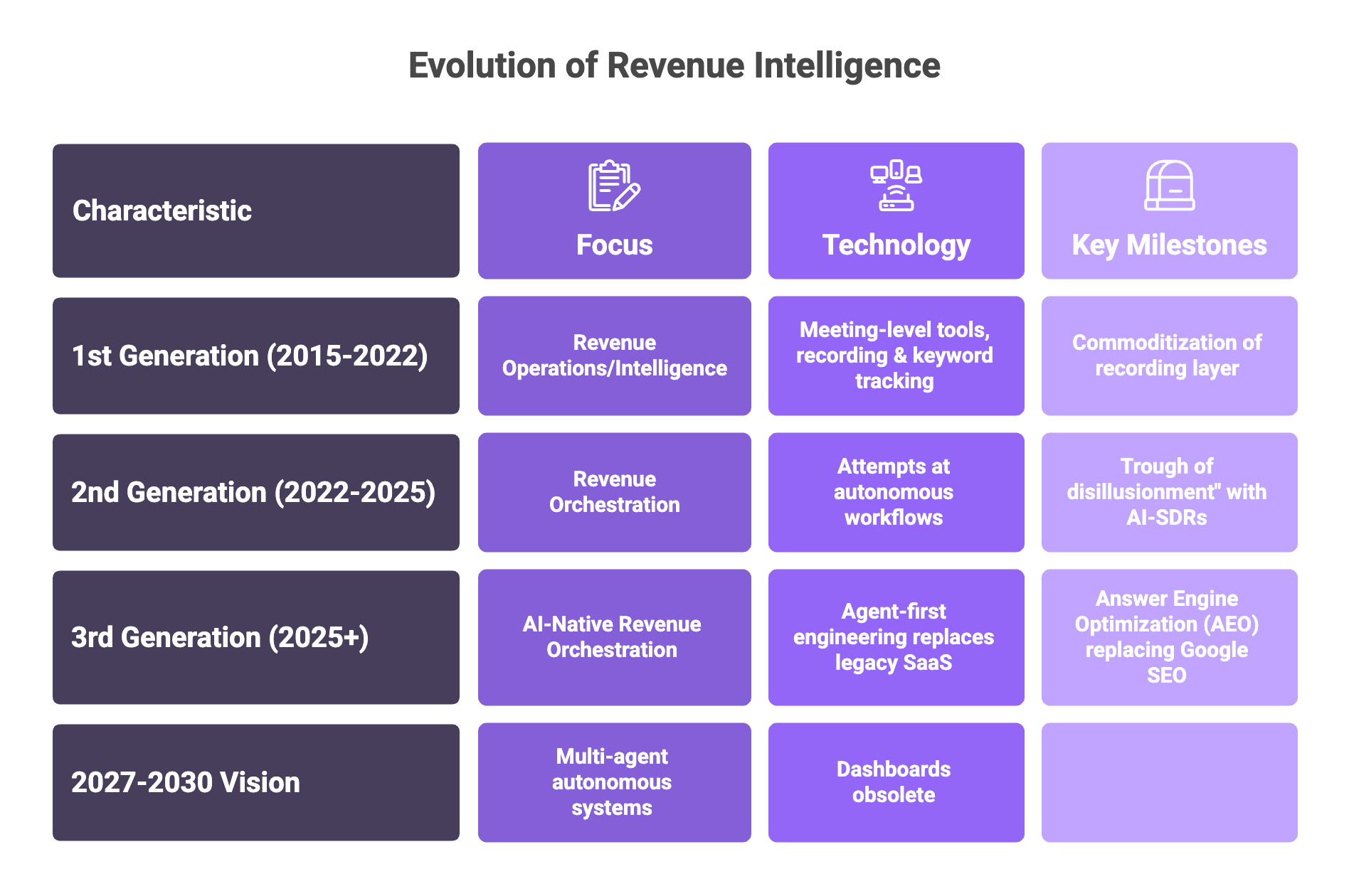
.png)
.png)