CRO's Strategic Guide to CRM Data — Why Dirty Pipelines Kill Revenue Predictability 2026
Written by
Ishan Chhabra
Last Updated :
March 9, 2026
Skim in :
8
mins
In this article
Revenue teams love Oliv
Here’s why:
All your deal data unified (from 30+ tools and tabs).
Insights are delivered to you directly, no digging.
AI agents automate tasks for you.
Thank you! Your submission has been received!
Oops! Something went wrong while submitting the form.
Meet Oliv’s AI Agents
Hi! I’m, Deal Driver
I track deals, flag risks, send weekly pipeline updates and give sales managers full visibility into deal progress
Hi! I’m, CRM Manager
I maintain CRM hygiene by updating core, custom and qualification fields all without your team lifting a finger
Hi! I’m, Forecaster
I build accurate forecasts based on real deal movement and tell you which deals to pull in to hit your number
Hi! I’m, Coach
I believe performance fuels revenue. I spot skill gaps, score calls and build coaching plans to help every rep level up
Hi! I’m, Prospector
I dig into target accounts to surface the right contacts, tailor and time outreach so you always strike when it counts
Hi! I’m, Pipeline tracker
I call reps to get deal updates, and deliver a real-time, CRM-synced roll-up view of deal progress
Hi! I’m, Analyst
I answer complex pipeline questions, uncover deal patterns, and build reports that guide strategic decisions
TL;DR
CRM data decays 34% annually; growth-stage companies without data ops accumulate forecast-destroying "data debt" fastest.
Einstein, Gong, and Clari layer intelligence on broken data foundations, inheriting every error underneath.
Three CRM fields (close date, deal amount, stage progression) drive the majority of forecast variance.
MEDDPICC automation requires contextual AI reasoning, not keyword-based Smart Trackers that misinterpret intent.
AI guardrails (human-in-the-loop, grounded models, audit logs) solve the #1 CRO blocker to autonomous CRM agents.
A focused 90-day sprint can move CROs from dirty pipelines to AI-Native Revenue Orchestration with measurable results.
Q1. Why Does Dirty CRM Data Destroy Revenue Predictability for Growth-Stage CROs? [toc=Dirty Data Kills Forecasts]
If you're a CRO at a $10M to $150M ARR company, your single biggest forecasting liability isn't your sales team's ability to close. It's the data they never entered into your CRM. Industry research shows that CRM data decays at roughly 34% per year, and Gartner estimates organizations lose an average of $15 million annually due to poor data quality. For growth-stage companies without dedicated data ops teams, this "data debt" compounds with every new hire, every territory change, and every quarter where manual entry is the only mechanism keeping your pipeline honest.
CRM data decays at 34% annually. For growth-stage companies without data ops, this compounds into board-level forecast failures within quarters.
⚠️ The Legacy CRM Trap
Salesforce and HubSpot were architected as databases that require mandatory human input to function. At the growth stage, there's rarely a RevOps team policing field completion. Reps prioritize closing deals over record-keeping, and rationally so. The result: your CRM becomes a graveyard of incomplete information that you present to your board as a "single source of truth." Einstein Activity Capture, Salesforce's attempt to automate this, uses brittle rule-based logic that frequently misassociates activities and stores captured data in a separate AWS instance, inaccessible for downstream reporting.
As one Gartner reviewer noted about Einstein:
"It has issues related to data storage and migration that need to be addressed in updates... it does not allow for data storage or data migration. You can't really input the data from Einstein into another platform." — Product Management Professional, Education Industry, Gartner Peer Insights
🔄 The AI-Native Paradigm Shift
The generative AI era introduces a fundamentally different approach: LLM-based reasoning that replaces brittle rules with contextual understanding. Instead of keyword-matching an email to an account based on domain strings, an AI-native revenue intelligence platform can ingest your entire account history and reason through which opportunity is logically correct to update, handling nuances like multiple divisions under the same parent company.
✅ How Oliv.ai Solves This First
Oliv.ai positions itself as the AI-native data platform that solves the data problem before deploying intelligence agents. Rather than layering AI on top of a broken foundation, Oliv uses LLM-based object association to clean and organize CRM data in one to two days, preparing your organization for the agentic era where autonomous agents can operate on trusted data.
The framing is simple: AI is a reasoning engine, but it requires a clean workspace to operate. When your CRM is dirty, no amount of AI sophistication will produce reliable forecasts. For a CRO, this isn't an operations problem. It's a board credibility problem.
Q2. We Tried AI Inside Salesforce and It Didn't Help. How Do You Know If the Issue Is Dirty Data? [toc=Diagnosing Dirty Data]
Many CROs have invested six figures into Salesforce Einstein or Agentforce expecting AI-powered pipeline insights, only to receive recommendations that feel disconnected from reality. The issue isn't the AI model itself. It's the data foundation it's reasoning over. In B2B sales, data was never critical to the act of selling; a rep can close a seven-figure deal without ever creating an opportunity in Salesforce. Consequently, CRMs are filled with duplicate accounts, outdated contacts, and missing activities that poison every AI output built on top of them.
❌ Where Einstein and Agentforce Break Down
Einstein and Agentforce are "bolted-on" intelligence layers trying to fix a legacy architecture. The specific failure modes are well-documented:
Subpar Activity Capture: Einstein Activity Capture uses rule-based logic that misassociates activities and "redacts" emails unnecessarily by claiming they contain sensitive information, when they don't.
Inaccessible Data: Captured data is often stored in a separate AWS instance rather than natively in Salesforce, making it useless for reporting.
Costly Complexity: Setup demands skilled administrators and significant prompt engineering to produce basic results.
As one developer noted on Reddit:
"I haven't been impressed by any of the early Salesforce AI tools, and I don't hear anyone talking about them glowingly... I tried asking it questions about my code base and it seemed absolutely clueless." — u/OffManuscript, r/SalesforceDeveloper
And an Agentforce reviewer confirmed the implementation burden:
"The price of Agentforce is not clear and hard to find. Adoption is low because of the lack of knowledge on the subject... Customers are finding issues in deploying and using agents in Salesforce." — Anusha T., Web Developer, Salesforce Agentforce G2 Verified Review
🔍 The 5-Question Dirty Data Diagnostic
Before blaming the AI, run this quick audit:
Field completion rate: What percentage of opportunities have all required fields populated?
Duplicate account ratio: How many accounts share the same domain or company name?
Activity-to-opportunity mapping: Are emails and calls correctly associated with the right deals?
Stage-progression freshness: When was the last time stage fields were actually updated?
Contact recency: How many contacts haven't been verified in 90+ days?
If two or more answers reveal gaps, your AI isn't broken. Your data is.
Run this 10-minute diagnostic before blaming your AI. Two or more red flags mean the problem is your data foundation, not your AI model.
✅ Oliv's Data-First Approach
Oliv solves the data problem before deploying agents. Using LLM-based object association, Oliv gives all account history to the AI and asks it to "reason" through which account or opportunity is logically correct to update, replacing brittle rules with contextual intelligence. The data cleanup takes one to two days, not months.
Q3. How Do You Diagnose Hidden CRM Hygiene Issues When Stages Don't Match Reality? [toc=Stages vs Reality]
Your pipeline dashboard says 72% of deals are in "Qualification" or beyond. Your reps confirm the forecast looks solid. But when the quarter closes, you miss by 30%. This is the "clean dashboard, dirty reality" paradox, and it's the most dangerous failure mode for a CRO because it's invisible until it's too late.
⚠️ Why Dashboards Lie
The root cause is rep bias. Reps routinely "touch up" fields like Next Step Date and Stage to avoid manager scrutiny. A deal sits in "Discovery" despite a proposal having been sent, because the rep hasn't updated the field. Conversely, a deal advances to "Contracting" even though the prospect raised a major objection on the last call that was never documented. Traditional reporting relies entirely on these rep-updated fields, creating a false sense of pipeline health.
❌ Where Gong and Clari Fall Short
Gong understands conversation context at the meeting level but not the deal level. It logs a call summary as a "note" or "activity," but it never changes the actual CRM Stage property. The rep still has to do that manually. Worse, activity-based tracking can flag dead deals as healthy: four emails sent looks like engagement, even if zero received a response.
As one user put it:
"It's too complicated, and not intuitive at all... understanding the pipeline management portion of it is almost impossible. Some people figure it out, but I think most just fumble through." — John S., Senior Account Executive, Gong G2 Verified Review
Clari's roll-up forecasting, while useful for visualization, still depends on reps and managers manually inputting data. As one Reddit user observed:
"It is really just a glorified SFDC overlay. Actually, Salesforce has built most of the forecasting functionality by now anyway so I'm not sure where they fit." — u/conaldinho11, r/SalesOperations
🔄 Deal-Level AI Intelligence
The AI-era approach replaces activity-volume metrics with contextual signal analysis. Instead of counting emails, a deal-level AI stitches data across calls, emails, Slack, and even unrecorded phone calls to form a 360-degree view. It detects patterns like an Economic Buyer going silent or a technical stakeholder raising unresolved objections, signals that activity dashboards completely miss.
✅ Oliv's Deal Driver Agent
Oliv's Deal Driver Agent autonomously reviews calendars and interactions every day to flag deals that have truly stalled based on contextual signals, not just activity volume. CROs receive a Sunset Summary every evening and a Morning Brief detailing exactly what is real in the pipeline.
Oliv tracks Stage Outcomes: if the AI detects that proposal criteria were met during a call, it can automatically move the deal stage in HubSpot or Salesforce. The Voice Agent captures unrecorded phone call data to close the context gaps that other tools ignore entirely. The result: your CRM stages reflect what's actually happening, not what reps remembered to update.
Q4. Pipeline Forensics: Which Dirty CRM Fields Kill Your Forecast the Most? [toc=Pipeline Forensics Fields]
Not all dirty data is equally destructive. CROs waste cycles on blanket "data hygiene initiatives" when a handful of fields account for the majority of forecast variance. Pipeline forensics means diagnosing which fields matter most for your specific revenue model, and remediating them in priority order rather than boiling the ocean.
⚠️ The Three Fields That Break Forecasts
In most B2B models at the $10M to $150M ARR stage, three CRM fields drive disproportionate forecast error:
CRM Fields With Highest Forecast Impact
Field
Forecast Impact
Why It Breaks
Close Date
⚠️ Highest variance driver: a one-week slip can cascade into 15 to 20% quarterly miss
Reps push dates forward optimistically; never pull them back until forced
Pricing changes mid-cycle go unrecorded; multi-product deals get single-line entries
Stage Progression
⚠️ High: stale stages mask pipeline velocity
Reps batch-update stages on Fridays, creating false momentum signals
❌ Where Traditional Tools Fall Short
Gong's activity tracking doesn't weight fields by forecast impact. It measures engagement volume, not data accuracy. As one Head of Sales noted:
"There's so much in Gong, that we don't use everything. Gong's deal forecasting we don't use." — Karel Bos, Head of Sales, Gong TrustRadius Verified Review
Clari's roll-ups surface discrepancies but can't tell you which field errors cause the most revenue surprise. Einstein's validation rules are binary, complete or incomplete, with no variance-weighted prioritization.
🔄 The Forensics Framework
The approach is straightforward: rank fields by forecast sensitivity (how much a 10% error in that field moves your quarterly number), then cross-reference with field completion and accuracy rates. The intersection reveals your highest-impact remediation targets, the fields worth automating first.
Rank CRM fields by forecast sensitivity and accuracy to find your highest-impact remediation targets. Close date and stage progression almost always land in "Fix First."
✅ How Oliv Prioritizes What Matters
Oliv's Analyst Agent surfaces which fields are most frequently stale or inaccurate and correlates them with historical forecast misses. The CRM Manager Agent then prioritizes high-impact field updates first, ensuring close dates, deal amounts, and stage progressions are always current for the fields that matter most to your board forecast.
Q5. Can AI Auto-Populate MEDDPICC Fields With Evidence, And How Does It Decide Which Fields to Update? [toc=MEDDPICC Auto-Population]
Companies spend $100K+ on MEDDPICC training through firms like Force Management or Winning by Design, only to watch the methodology die in the CRM. The reason is simple: documentation burden kills adoption. When reps are "policed" into filling MEDDPICC fields, they take frantic notes during calls instead of listening to the prospect. The methodology becomes a compliance exercise rather than a selling advantage.
❌ Why Keyword-Based Trackers Fail
Traditional tools use keyword-based "Smart Trackers" to extract MEDDPICC data from calls. The problem: they can't distinguish "we use Competitor X" from "we are actively evaluating Competitor X." Naive extraction produces garbage fields that mislead managers rather than inform them. Even Gong users acknowledge the setup burden:
"It can be overwhelming to set up trackers. AI training is a bit laborious to get it to do what you want." — Trafford J., Senior Director, Revenue Enablement, Gong G2 Verified Review
And Clari's own analytics can leave reps in the dark about where insights originate:
"What I find least helpful is that some of the features that are reported don't actually tell me where that information is coming from." — Jezni W., Sales Account Executive, Clari G2 Verified Review
🔄 Specification Engineering: Context Over Keywords
Oliv uses Specification Engineering, AI trained on 100+ sales methodologies that analyzes conversational intent, not keywords. Custom rubrics define stage-specific requirements (e.g., "In the Demo stage, identify code repository and infra provider"). The AI reasons about what was discussed contextually, determining which fields to update from each interaction.
✅ Oliv's CRM Manager Agent in Action
The CRM Manager Agent auto-populates MEDDPICC properties in your CRM with full evidence trails:
⭐ Evidence logs: Every update links to the exact timestamped call snippet or email sentence where the data was confirmed
✅ Agentic nudging: Post-call Slack message: "I've updated your MEDDPICC fields. Would you like to review them?"
⏰ Meeting prep: The Meeting Assistant sends prep notes 30 minutes before calls, reviewing past interactions so reps focus on conversation, not documentation
The result: methodology consultancies and Oliv become a "match made in heaven." Oliv operationalizes the training investment by making documentation invisible to reps. The CRO finally sees MEDDPICC compliance without the compliance police.
Q6. How Do You Set AI Guardrails, Audit Logs, and Enterprise RBAC for CRM Automation? [toc=AI Guardrails and Governance]
The #1 blocker to AI adoption in revenue operations isn't technology. It's trust. CROs fear autonomous agents overwriting accurate manual data with hallucinations, destroying the integrity of board reports. At 200+ users, the stakes multiply: you need strict RBAC, SOC 2 compliance, and a paper trail for every data change.
❌ Where Legacy Tools Fall Short on Governance
Gong creates "one-way data silos" with severely limited bulk export capabilities. As one Sales Operations Manager reported:
"Their current solution is far from convenient or accessible. It requires downloading calls individually, which is impractical and inefficient for a large volume of data... This lack of flexibility has required us to engage our development team at additional cost." — Neel P., Sales Operations Manager, Gong G2 Verified Review
Agentforce demands extensive prompt engineering to produce consistent results, with governance as an afterthought:
"Getting consistent and accurate results isn't as simple as just telling the agent what to do. Effectively crafting prompts and configuring the underlying actions demands a specific skill set often called prompt engineering." — Alessandro N., Salesforce Administrator, Salesforce Agentforce G2 Verified Review
🔄 The Grounded AI Paradigm
The solution isn't to avoid AI. It's to ground it. Fine-tuned models that reason only from your specific interaction history (your data workspace) eliminate the hallucination vector. The AI doesn't draw from general internet knowledge; it only processes your actual calls, emails, and CRM records. Reasoning-based models handle nuance that brittle rules cannot, for example, distinguishing Google India from Google US accounts.
✅ Oliv's Enterprise Governance Stack
Oliv addresses the trust gap with a comprehensive governance framework:
✅ Human-in-the-loop: Configure "high-stakes" fields to require human approval via Slack nudge before data commits to CRM
✅ Comprehensive audit logs: Every change shows what was modified, by which agent, the previous value, and the conversational evidence (source link) behind the change
🔒 Compliance: SOC 2 Type II, GDPR, and CCPA compliant; AES-256 encryption at rest, TLS 1.2+ in transit
✅ Strict RBAC: Role-based access control policies for 200+ user deployments
✅ Open export policy: Full CSV dump of all meetings and recordings on contract termination, no vendor lock-in
The contrast is stark: Gong locks your data in their UI; Oliv gives you a full export. For mid-market companies scaling past 200 users, data portability isn't a nice-to-have. It's a strategic requirement.
Q7. When Is It Time to Automate CRM Updates, And What Does It Actually Cost? [toc=Automation Timing and Cost]
Founder-led and early-stage sales teams often believe they can "brute force" CRM hygiene through discipline and weekly pipeline reviews. The math says otherwise: once you cross 10 reps, manual auditing consumes at least one full day per week of manager time. That's 20% of a leader's capacity spent on administrative data policing instead of coaching, strategy, or selling. The cost of not automating compounds faster than most CROs realize.
💸 The Hidden Cost of Legacy Bundles
Traditional revenue intelligence platforms force CROs into expensive, opaque bundles that far exceed the cost of the specific capabilities they need:
Legacy Platform Cost Structures
Platform
Typical Cost Structure
Hidden Friction
Gong
💰 $5K to $50K platform fee + ~$250/user for bundled CI/Engage/Forecast
⏰ 3 to 6 month implementation; additional products at extra cost
Salesforce Einstein
💰 TCO can exceed $500/user after stacking Data Cloud + Einstein + Revenue Intelligence
⏰ Requires skilled admins; prompt engineering for Agentforce
"It was a big mistake on our part to commit to a two year term. Gong is a really powerful tool but it's probably the highest end option on the market... Having talked with other friends who lead revenue functions, all have said the same thing, they've been fine using a lower cost, simpler alternative." — Iris P., Head of Marketing, Sales & Partnerships, Gong G2 Verified Review
Even satisfied Gong users acknowledge the bundling problem:
"The additional products like forecast or engage come at an additional cost. Would be great to see these tools rolled into the core offering." — Scott T., Director of Sales, Gong G2 Verified Review
🔄 The Modular AI-Agent Model
The alternative is a modular, pay-for-what-you-use approach where CROs select only the agents they need, baseline recording, CRM hygiene, forecasting, or analytics, without mandatory platform fees or bundled features that go unused. This approach lets you reduce your sales tech stack costs significantly.
✅ Oliv's Transparent Pricing
Oliv offers a modular architecture where each AI agent is priced independently with no hidden platform, support, or implementation fees. Existing Gong users can often migrate to Oliv's baseline intelligence tier to commoditize recording and transcription, then layer CRM hygiene or forecasting agents as needed.
The trigger point is clear: if you have 10+ reps and your managers are still manually auditing CRM data, the ROI on automation is immediate.
Q8. Gong vs. Clari vs. Salesforce Einstein: Where Do They Fall Short on CRM Data Quality? [toc=Competitor Data Quality Gaps]
Gong, Clari, and Salesforce Einstein were all architected in the pre-generative AI era, when "intelligence" meant keyword matching, sentiment scoring, and rule-based automation. Each addresses a legitimate piece of the revenue puzzle, conversation intelligence, forecast visualization, and CRM analytics respectively, but none solves the foundational data quality problem that undermines everything built on top.
❌ Platform-by-Platform Data Quality Gaps
Gong excels at conversation intelligence but operates at the meeting level, not the deal level. It logs summaries as notes but never writes to the actual CRM Stage field. Activity-based health scores can't distinguish real engagement from noise. And data portability remains a significant concern:
"The lack of robust data export options has made it hard to justify the platform's cost, especially as it falls short of meeting practical data management needs." — Neel P., Sales Operations Manager, Gong G2 Verified Review
Clari provides strong forecast visualization but fundamentally depends on reps and managers updating fields manually. The analytics can feel incomplete:
"Clari should find ways to differentiate from the native Salesforce features (e.g. Pipeline Inspection, Forecasting) in order to remain competitive in the long-run." — Dan J., Clari G2 Verified Review
Salesforce Einstein uses brittle rule-based Activity Capture that stores data in separate instances, rendering it inaccessible for downstream reporting.
⚠️ Why Bolted-On AI Fails
The common thread: all three platforms layer intelligence atop a broken data foundation. When the CRM fields feeding these tools are incomplete, stale, or inaccurate, every insight they produce inherits those errors.
✅ Oliv's AI-Native Alternative
CRM Data Quality Comparison: Gong vs Clari vs Einstein vs Oliv.ai
Capability
Gong
Clari
Einstein
Oliv.ai
Data Capture
Meeting-level notes
Relies on rep input
Rule-based Activity Capture
✅ LLM-based contextual capture
CRM Field Writes
❌ Manual only
❌ Manual only
❌ Brittle rules
✅ Autonomous agent writes
MEDDPICC Support
Keyword trackers
❌ None native
❌ None native
✅ Specification engineering
Audit Logs
❌ Limited
❌ Basic
❌ Basic
✅ Full evidence trails
Data Portability
❌ One-way silo
✅ SFDC sync
✅ Native SFDC
✅ Full open CSV export
Oliv solves data quality first as an AI-native data platform, then layers autonomous agents on clean data, reversing the broken sequence that legacy tools perpetuate.
Q9. The CRO's 90-Day Blueprint: From Dirty Pipeline to AI-Native Revenue Orchestration [toc=90-Day Implementation Blueprint]
The shift from "revenue orchestration" (manual, tool-heavy, human-dependent) to "AI-Native Revenue Orchestration" (AI-native, agent-driven, self-healing) doesn't require a multi-year transformation. For growth-stage companies at $10M to $150M ARR, a focused 90-day sprint can deliver measurable improvement in forecast accuracy and pipeline confidence.
⏰ Phase 1: Diagnose & Clean (Days 1 to 30)
Audit CRM data health using the scorecard framework in Q10 below
Run pipeline forensics (Q4): identify which fields, close date, deal amount, stage progression, cause the most forecast variance in your specific model
Execute a remediation sprint: Oliv's AI-native data platform can clean and organize CRM data in 1 to 2 days using LLM-based object association, resolving duplicate accounts, misassociated activities, and stale records
⏰ Phase 2: Automate & Enforce (Days 31 to 60)
Deploy the CRM Manager Agent for autonomous field updates across all deal interactions
Set human-in-the-loop guardrails for high-stakes fields via Slack approval nudges (Q6)
Establish a governance cadence: weekly audit log reviews, monthly field accuracy benchmarks
⏰ Phase 3: Predict & Scale (Days 61 to 90)
Activate the Deal Driver Agent for proactive pipeline intelligence, Sunset Summaries and Morning Briefs replacing manual pipeline reviews
Integrate the Forecaster Agent for AI-native revenue prediction grounded in clean, real-time data
Measure outcomes: forecast accuracy improvement, manager time recovered, field completion rates, stage-to-close correlation
✅ The End State
Your CRM becomes a living, self-healing revenue system, not a graveyard of incomplete data that your board no longer trusts. AI-Native Revenue Orchestration means the data works for you autonomously, and your forecast reflects what's actually happening in your pipeline, not what reps remembered to type on Friday afternoon.
Q10. Score Your CRM Data Health: A Self-Assessment Framework for CROs [toc=CRM Health Scorecard]
Use this scoring rubric to benchmark your organization's CRM data health across six dimensions. Rate each dimension from 1 (critical) to 5 (excellent), then total your score for an overall health assessment.
📋 The CRM Data Health Scorecard
CRM Data Health Scorecard: Six Dimensions
Dimension
What to Measure
🔴 1 to 2 (Critical)
🟡 3 (Adequate)
🟢 4 to 5 (Strong)
Field Completion
% of required fields populated on open opportunities
Below 50%
50 to 75%
Above 75%
Close Date Accuracy
Average days between forecasted and actual close date
30+ days variance
15 to 30 days
Under 15 days
Stage Freshness
Average days since last stage update on active deals
14+ days stale
7 to 14 days
Under 7 days
Duplicate Rate
% of accounts with duplicate entries sharing domain/name
Above 15%
5 to 15%
Below 5%
Activity Association
% of emails/calls correctly mapped to the right opportunity
Below 60%
60 to 80%
Above 80%
Contact Recency
% of contacts verified/updated within last 90 days
Below 40%
40 to 70%
Above 70%
📊 Interpreting Your Score
6 to 14 points 🔴: Your CRM is actively sabotaging forecast accuracy. AI deployments will fail until foundational data quality is addressed. Prioritize a remediation sprint immediately.
15 to 22 points 🟡: Your data is functional but fragile. Manual processes are holding it together, but scaling will break them. Automation should be your next investment.
Oliv.ai offers a complimentary CRM data health audit that maps this scorecard against your live Salesforce or HubSpot instance, identifying your highest-impact remediation targets in under 48 hours. Book Your Free CRM Data Audit
Q1. Why Does Dirty CRM Data Destroy Revenue Predictability for Growth-Stage CROs? [toc=Dirty Data Kills Forecasts]
If you're a CRO at a $10M to $150M ARR company, your single biggest forecasting liability isn't your sales team's ability to close. It's the data they never entered into your CRM. Industry research shows that CRM data decays at roughly 34% per year, and Gartner estimates organizations lose an average of $15 million annually due to poor data quality. For growth-stage companies without dedicated data ops teams, this "data debt" compounds with every new hire, every territory change, and every quarter where manual entry is the only mechanism keeping your pipeline honest.
CRM data decays at 34% annually. For growth-stage companies without data ops, this compounds into board-level forecast failures within quarters.
⚠️ The Legacy CRM Trap
Salesforce and HubSpot were architected as databases that require mandatory human input to function. At the growth stage, there's rarely a RevOps team policing field completion. Reps prioritize closing deals over record-keeping, and rationally so. The result: your CRM becomes a graveyard of incomplete information that you present to your board as a "single source of truth." Einstein Activity Capture, Salesforce's attempt to automate this, uses brittle rule-based logic that frequently misassociates activities and stores captured data in a separate AWS instance, inaccessible for downstream reporting.
As one Gartner reviewer noted about Einstein:
"It has issues related to data storage and migration that need to be addressed in updates... it does not allow for data storage or data migration. You can't really input the data from Einstein into another platform." — Product Management Professional, Education Industry, Gartner Peer Insights
🔄 The AI-Native Paradigm Shift
The generative AI era introduces a fundamentally different approach: LLM-based reasoning that replaces brittle rules with contextual understanding. Instead of keyword-matching an email to an account based on domain strings, an AI-native revenue intelligence platform can ingest your entire account history and reason through which opportunity is logically correct to update, handling nuances like multiple divisions under the same parent company.
✅ How Oliv.ai Solves This First
Oliv.ai positions itself as the AI-native data platform that solves the data problem before deploying intelligence agents. Rather than layering AI on top of a broken foundation, Oliv uses LLM-based object association to clean and organize CRM data in one to two days, preparing your organization for the agentic era where autonomous agents can operate on trusted data.
The framing is simple: AI is a reasoning engine, but it requires a clean workspace to operate. When your CRM is dirty, no amount of AI sophistication will produce reliable forecasts. For a CRO, this isn't an operations problem. It's a board credibility problem.
Q2. We Tried AI Inside Salesforce and It Didn't Help. How Do You Know If the Issue Is Dirty Data? [toc=Diagnosing Dirty Data]
Many CROs have invested six figures into Salesforce Einstein or Agentforce expecting AI-powered pipeline insights, only to receive recommendations that feel disconnected from reality. The issue isn't the AI model itself. It's the data foundation it's reasoning over. In B2B sales, data was never critical to the act of selling; a rep can close a seven-figure deal without ever creating an opportunity in Salesforce. Consequently, CRMs are filled with duplicate accounts, outdated contacts, and missing activities that poison every AI output built on top of them.
❌ Where Einstein and Agentforce Break Down
Einstein and Agentforce are "bolted-on" intelligence layers trying to fix a legacy architecture. The specific failure modes are well-documented:
Subpar Activity Capture: Einstein Activity Capture uses rule-based logic that misassociates activities and "redacts" emails unnecessarily by claiming they contain sensitive information, when they don't.
Inaccessible Data: Captured data is often stored in a separate AWS instance rather than natively in Salesforce, making it useless for reporting.
Costly Complexity: Setup demands skilled administrators and significant prompt engineering to produce basic results.
As one developer noted on Reddit:
"I haven't been impressed by any of the early Salesforce AI tools, and I don't hear anyone talking about them glowingly... I tried asking it questions about my code base and it seemed absolutely clueless." — u/OffManuscript, r/SalesforceDeveloper
And an Agentforce reviewer confirmed the implementation burden:
"The price of Agentforce is not clear and hard to find. Adoption is low because of the lack of knowledge on the subject... Customers are finding issues in deploying and using agents in Salesforce." — Anusha T., Web Developer, Salesforce Agentforce G2 Verified Review
🔍 The 5-Question Dirty Data Diagnostic
Before blaming the AI, run this quick audit:
Field completion rate: What percentage of opportunities have all required fields populated?
Duplicate account ratio: How many accounts share the same domain or company name?
Activity-to-opportunity mapping: Are emails and calls correctly associated with the right deals?
Stage-progression freshness: When was the last time stage fields were actually updated?
Contact recency: How many contacts haven't been verified in 90+ days?
If two or more answers reveal gaps, your AI isn't broken. Your data is.
Run this 10-minute diagnostic before blaming your AI. Two or more red flags mean the problem is your data foundation, not your AI model.
✅ Oliv's Data-First Approach
Oliv solves the data problem before deploying agents. Using LLM-based object association, Oliv gives all account history to the AI and asks it to "reason" through which account or opportunity is logically correct to update, replacing brittle rules with contextual intelligence. The data cleanup takes one to two days, not months.
Q3. How Do You Diagnose Hidden CRM Hygiene Issues When Stages Don't Match Reality? [toc=Stages vs Reality]
Your pipeline dashboard says 72% of deals are in "Qualification" or beyond. Your reps confirm the forecast looks solid. But when the quarter closes, you miss by 30%. This is the "clean dashboard, dirty reality" paradox, and it's the most dangerous failure mode for a CRO because it's invisible until it's too late.
⚠️ Why Dashboards Lie
The root cause is rep bias. Reps routinely "touch up" fields like Next Step Date and Stage to avoid manager scrutiny. A deal sits in "Discovery" despite a proposal having been sent, because the rep hasn't updated the field. Conversely, a deal advances to "Contracting" even though the prospect raised a major objection on the last call that was never documented. Traditional reporting relies entirely on these rep-updated fields, creating a false sense of pipeline health.
❌ Where Gong and Clari Fall Short
Gong understands conversation context at the meeting level but not the deal level. It logs a call summary as a "note" or "activity," but it never changes the actual CRM Stage property. The rep still has to do that manually. Worse, activity-based tracking can flag dead deals as healthy: four emails sent looks like engagement, even if zero received a response.
As one user put it:
"It's too complicated, and not intuitive at all... understanding the pipeline management portion of it is almost impossible. Some people figure it out, but I think most just fumble through." — John S., Senior Account Executive, Gong G2 Verified Review
Clari's roll-up forecasting, while useful for visualization, still depends on reps and managers manually inputting data. As one Reddit user observed:
"It is really just a glorified SFDC overlay. Actually, Salesforce has built most of the forecasting functionality by now anyway so I'm not sure where they fit." — u/conaldinho11, r/SalesOperations
🔄 Deal-Level AI Intelligence
The AI-era approach replaces activity-volume metrics with contextual signal analysis. Instead of counting emails, a deal-level AI stitches data across calls, emails, Slack, and even unrecorded phone calls to form a 360-degree view. It detects patterns like an Economic Buyer going silent or a technical stakeholder raising unresolved objections, signals that activity dashboards completely miss.
✅ Oliv's Deal Driver Agent
Oliv's Deal Driver Agent autonomously reviews calendars and interactions every day to flag deals that have truly stalled based on contextual signals, not just activity volume. CROs receive a Sunset Summary every evening and a Morning Brief detailing exactly what is real in the pipeline.
Oliv tracks Stage Outcomes: if the AI detects that proposal criteria were met during a call, it can automatically move the deal stage in HubSpot or Salesforce. The Voice Agent captures unrecorded phone call data to close the context gaps that other tools ignore entirely. The result: your CRM stages reflect what's actually happening, not what reps remembered to update.
Q4. Pipeline Forensics: Which Dirty CRM Fields Kill Your Forecast the Most? [toc=Pipeline Forensics Fields]
Not all dirty data is equally destructive. CROs waste cycles on blanket "data hygiene initiatives" when a handful of fields account for the majority of forecast variance. Pipeline forensics means diagnosing which fields matter most for your specific revenue model, and remediating them in priority order rather than boiling the ocean.
⚠️ The Three Fields That Break Forecasts
In most B2B models at the $10M to $150M ARR stage, three CRM fields drive disproportionate forecast error:
CRM Fields With Highest Forecast Impact
Field
Forecast Impact
Why It Breaks
Close Date
⚠️ Highest variance driver: a one-week slip can cascade into 15 to 20% quarterly miss
Reps push dates forward optimistically; never pull them back until forced
Pricing changes mid-cycle go unrecorded; multi-product deals get single-line entries
Stage Progression
⚠️ High: stale stages mask pipeline velocity
Reps batch-update stages on Fridays, creating false momentum signals
❌ Where Traditional Tools Fall Short
Gong's activity tracking doesn't weight fields by forecast impact. It measures engagement volume, not data accuracy. As one Head of Sales noted:
"There's so much in Gong, that we don't use everything. Gong's deal forecasting we don't use." — Karel Bos, Head of Sales, Gong TrustRadius Verified Review
Clari's roll-ups surface discrepancies but can't tell you which field errors cause the most revenue surprise. Einstein's validation rules are binary, complete or incomplete, with no variance-weighted prioritization.
🔄 The Forensics Framework
The approach is straightforward: rank fields by forecast sensitivity (how much a 10% error in that field moves your quarterly number), then cross-reference with field completion and accuracy rates. The intersection reveals your highest-impact remediation targets, the fields worth automating first.
Rank CRM fields by forecast sensitivity and accuracy to find your highest-impact remediation targets. Close date and stage progression almost always land in "Fix First."
✅ How Oliv Prioritizes What Matters
Oliv's Analyst Agent surfaces which fields are most frequently stale or inaccurate and correlates them with historical forecast misses. The CRM Manager Agent then prioritizes high-impact field updates first, ensuring close dates, deal amounts, and stage progressions are always current for the fields that matter most to your board forecast.
Q5. Can AI Auto-Populate MEDDPICC Fields With Evidence, And How Does It Decide Which Fields to Update? [toc=MEDDPICC Auto-Population]
Companies spend $100K+ on MEDDPICC training through firms like Force Management or Winning by Design, only to watch the methodology die in the CRM. The reason is simple: documentation burden kills adoption. When reps are "policed" into filling MEDDPICC fields, they take frantic notes during calls instead of listening to the prospect. The methodology becomes a compliance exercise rather than a selling advantage.
❌ Why Keyword-Based Trackers Fail
Traditional tools use keyword-based "Smart Trackers" to extract MEDDPICC data from calls. The problem: they can't distinguish "we use Competitor X" from "we are actively evaluating Competitor X." Naive extraction produces garbage fields that mislead managers rather than inform them. Even Gong users acknowledge the setup burden:
"It can be overwhelming to set up trackers. AI training is a bit laborious to get it to do what you want." — Trafford J., Senior Director, Revenue Enablement, Gong G2 Verified Review
And Clari's own analytics can leave reps in the dark about where insights originate:
"What I find least helpful is that some of the features that are reported don't actually tell me where that information is coming from." — Jezni W., Sales Account Executive, Clari G2 Verified Review
🔄 Specification Engineering: Context Over Keywords
Oliv uses Specification Engineering, AI trained on 100+ sales methodologies that analyzes conversational intent, not keywords. Custom rubrics define stage-specific requirements (e.g., "In the Demo stage, identify code repository and infra provider"). The AI reasons about what was discussed contextually, determining which fields to update from each interaction.
✅ Oliv's CRM Manager Agent in Action
The CRM Manager Agent auto-populates MEDDPICC properties in your CRM with full evidence trails:
⭐ Evidence logs: Every update links to the exact timestamped call snippet or email sentence where the data was confirmed
✅ Agentic nudging: Post-call Slack message: "I've updated your MEDDPICC fields. Would you like to review them?"
⏰ Meeting prep: The Meeting Assistant sends prep notes 30 minutes before calls, reviewing past interactions so reps focus on conversation, not documentation
The result: methodology consultancies and Oliv become a "match made in heaven." Oliv operationalizes the training investment by making documentation invisible to reps. The CRO finally sees MEDDPICC compliance without the compliance police.
Q6. How Do You Set AI Guardrails, Audit Logs, and Enterprise RBAC for CRM Automation? [toc=AI Guardrails and Governance]
The #1 blocker to AI adoption in revenue operations isn't technology. It's trust. CROs fear autonomous agents overwriting accurate manual data with hallucinations, destroying the integrity of board reports. At 200+ users, the stakes multiply: you need strict RBAC, SOC 2 compliance, and a paper trail for every data change.
❌ Where Legacy Tools Fall Short on Governance
Gong creates "one-way data silos" with severely limited bulk export capabilities. As one Sales Operations Manager reported:
"Their current solution is far from convenient or accessible. It requires downloading calls individually, which is impractical and inefficient for a large volume of data... This lack of flexibility has required us to engage our development team at additional cost." — Neel P., Sales Operations Manager, Gong G2 Verified Review
Agentforce demands extensive prompt engineering to produce consistent results, with governance as an afterthought:
"Getting consistent and accurate results isn't as simple as just telling the agent what to do. Effectively crafting prompts and configuring the underlying actions demands a specific skill set often called prompt engineering." — Alessandro N., Salesforce Administrator, Salesforce Agentforce G2 Verified Review
🔄 The Grounded AI Paradigm
The solution isn't to avoid AI. It's to ground it. Fine-tuned models that reason only from your specific interaction history (your data workspace) eliminate the hallucination vector. The AI doesn't draw from general internet knowledge; it only processes your actual calls, emails, and CRM records. Reasoning-based models handle nuance that brittle rules cannot, for example, distinguishing Google India from Google US accounts.
✅ Oliv's Enterprise Governance Stack
Oliv addresses the trust gap with a comprehensive governance framework:
✅ Human-in-the-loop: Configure "high-stakes" fields to require human approval via Slack nudge before data commits to CRM
✅ Comprehensive audit logs: Every change shows what was modified, by which agent, the previous value, and the conversational evidence (source link) behind the change
🔒 Compliance: SOC 2 Type II, GDPR, and CCPA compliant; AES-256 encryption at rest, TLS 1.2+ in transit
✅ Strict RBAC: Role-based access control policies for 200+ user deployments
✅ Open export policy: Full CSV dump of all meetings and recordings on contract termination, no vendor lock-in
The contrast is stark: Gong locks your data in their UI; Oliv gives you a full export. For mid-market companies scaling past 200 users, data portability isn't a nice-to-have. It's a strategic requirement.
Q7. When Is It Time to Automate CRM Updates, And What Does It Actually Cost? [toc=Automation Timing and Cost]
Founder-led and early-stage sales teams often believe they can "brute force" CRM hygiene through discipline and weekly pipeline reviews. The math says otherwise: once you cross 10 reps, manual auditing consumes at least one full day per week of manager time. That's 20% of a leader's capacity spent on administrative data policing instead of coaching, strategy, or selling. The cost of not automating compounds faster than most CROs realize.
💸 The Hidden Cost of Legacy Bundles
Traditional revenue intelligence platforms force CROs into expensive, opaque bundles that far exceed the cost of the specific capabilities they need:
Legacy Platform Cost Structures
Platform
Typical Cost Structure
Hidden Friction
Gong
💰 $5K to $50K platform fee + ~$250/user for bundled CI/Engage/Forecast
⏰ 3 to 6 month implementation; additional products at extra cost
Salesforce Einstein
💰 TCO can exceed $500/user after stacking Data Cloud + Einstein + Revenue Intelligence
⏰ Requires skilled admins; prompt engineering for Agentforce
"It was a big mistake on our part to commit to a two year term. Gong is a really powerful tool but it's probably the highest end option on the market... Having talked with other friends who lead revenue functions, all have said the same thing, they've been fine using a lower cost, simpler alternative." — Iris P., Head of Marketing, Sales & Partnerships, Gong G2 Verified Review
Even satisfied Gong users acknowledge the bundling problem:
"The additional products like forecast or engage come at an additional cost. Would be great to see these tools rolled into the core offering." — Scott T., Director of Sales, Gong G2 Verified Review
🔄 The Modular AI-Agent Model
The alternative is a modular, pay-for-what-you-use approach where CROs select only the agents they need, baseline recording, CRM hygiene, forecasting, or analytics, without mandatory platform fees or bundled features that go unused. This approach lets you reduce your sales tech stack costs significantly.
✅ Oliv's Transparent Pricing
Oliv offers a modular architecture where each AI agent is priced independently with no hidden platform, support, or implementation fees. Existing Gong users can often migrate to Oliv's baseline intelligence tier to commoditize recording and transcription, then layer CRM hygiene or forecasting agents as needed.
The trigger point is clear: if you have 10+ reps and your managers are still manually auditing CRM data, the ROI on automation is immediate.
Q8. Gong vs. Clari vs. Salesforce Einstein: Where Do They Fall Short on CRM Data Quality? [toc=Competitor Data Quality Gaps]
Gong, Clari, and Salesforce Einstein were all architected in the pre-generative AI era, when "intelligence" meant keyword matching, sentiment scoring, and rule-based automation. Each addresses a legitimate piece of the revenue puzzle, conversation intelligence, forecast visualization, and CRM analytics respectively, but none solves the foundational data quality problem that undermines everything built on top.
❌ Platform-by-Platform Data Quality Gaps
Gong excels at conversation intelligence but operates at the meeting level, not the deal level. It logs summaries as notes but never writes to the actual CRM Stage field. Activity-based health scores can't distinguish real engagement from noise. And data portability remains a significant concern:
"The lack of robust data export options has made it hard to justify the platform's cost, especially as it falls short of meeting practical data management needs." — Neel P., Sales Operations Manager, Gong G2 Verified Review
Clari provides strong forecast visualization but fundamentally depends on reps and managers updating fields manually. The analytics can feel incomplete:
"Clari should find ways to differentiate from the native Salesforce features (e.g. Pipeline Inspection, Forecasting) in order to remain competitive in the long-run." — Dan J., Clari G2 Verified Review
Salesforce Einstein uses brittle rule-based Activity Capture that stores data in separate instances, rendering it inaccessible for downstream reporting.
⚠️ Why Bolted-On AI Fails
The common thread: all three platforms layer intelligence atop a broken data foundation. When the CRM fields feeding these tools are incomplete, stale, or inaccurate, every insight they produce inherits those errors.
✅ Oliv's AI-Native Alternative
CRM Data Quality Comparison: Gong vs Clari vs Einstein vs Oliv.ai
Capability
Gong
Clari
Einstein
Oliv.ai
Data Capture
Meeting-level notes
Relies on rep input
Rule-based Activity Capture
✅ LLM-based contextual capture
CRM Field Writes
❌ Manual only
❌ Manual only
❌ Brittle rules
✅ Autonomous agent writes
MEDDPICC Support
Keyword trackers
❌ None native
❌ None native
✅ Specification engineering
Audit Logs
❌ Limited
❌ Basic
❌ Basic
✅ Full evidence trails
Data Portability
❌ One-way silo
✅ SFDC sync
✅ Native SFDC
✅ Full open CSV export
Oliv solves data quality first as an AI-native data platform, then layers autonomous agents on clean data, reversing the broken sequence that legacy tools perpetuate.
Q9. The CRO's 90-Day Blueprint: From Dirty Pipeline to AI-Native Revenue Orchestration [toc=90-Day Implementation Blueprint]
The shift from "revenue orchestration" (manual, tool-heavy, human-dependent) to "AI-Native Revenue Orchestration" (AI-native, agent-driven, self-healing) doesn't require a multi-year transformation. For growth-stage companies at $10M to $150M ARR, a focused 90-day sprint can deliver measurable improvement in forecast accuracy and pipeline confidence.
⏰ Phase 1: Diagnose & Clean (Days 1 to 30)
Audit CRM data health using the scorecard framework in Q10 below
Run pipeline forensics (Q4): identify which fields, close date, deal amount, stage progression, cause the most forecast variance in your specific model
Execute a remediation sprint: Oliv's AI-native data platform can clean and organize CRM data in 1 to 2 days using LLM-based object association, resolving duplicate accounts, misassociated activities, and stale records
⏰ Phase 2: Automate & Enforce (Days 31 to 60)
Deploy the CRM Manager Agent for autonomous field updates across all deal interactions
Set human-in-the-loop guardrails for high-stakes fields via Slack approval nudges (Q6)
Establish a governance cadence: weekly audit log reviews, monthly field accuracy benchmarks
⏰ Phase 3: Predict & Scale (Days 61 to 90)
Activate the Deal Driver Agent for proactive pipeline intelligence, Sunset Summaries and Morning Briefs replacing manual pipeline reviews
Integrate the Forecaster Agent for AI-native revenue prediction grounded in clean, real-time data
Measure outcomes: forecast accuracy improvement, manager time recovered, field completion rates, stage-to-close correlation
✅ The End State
Your CRM becomes a living, self-healing revenue system, not a graveyard of incomplete data that your board no longer trusts. AI-Native Revenue Orchestration means the data works for you autonomously, and your forecast reflects what's actually happening in your pipeline, not what reps remembered to type on Friday afternoon.
Q10. Score Your CRM Data Health: A Self-Assessment Framework for CROs [toc=CRM Health Scorecard]
Use this scoring rubric to benchmark your organization's CRM data health across six dimensions. Rate each dimension from 1 (critical) to 5 (excellent), then total your score for an overall health assessment.
📋 The CRM Data Health Scorecard
CRM Data Health Scorecard: Six Dimensions
Dimension
What to Measure
🔴 1 to 2 (Critical)
🟡 3 (Adequate)
🟢 4 to 5 (Strong)
Field Completion
% of required fields populated on open opportunities
Below 50%
50 to 75%
Above 75%
Close Date Accuracy
Average days between forecasted and actual close date
30+ days variance
15 to 30 days
Under 15 days
Stage Freshness
Average days since last stage update on active deals
14+ days stale
7 to 14 days
Under 7 days
Duplicate Rate
% of accounts with duplicate entries sharing domain/name
Above 15%
5 to 15%
Below 5%
Activity Association
% of emails/calls correctly mapped to the right opportunity
Below 60%
60 to 80%
Above 80%
Contact Recency
% of contacts verified/updated within last 90 days
Below 40%
40 to 70%
Above 70%
📊 Interpreting Your Score
6 to 14 points 🔴: Your CRM is actively sabotaging forecast accuracy. AI deployments will fail until foundational data quality is addressed. Prioritize a remediation sprint immediately.
15 to 22 points 🟡: Your data is functional but fragile. Manual processes are holding it together, but scaling will break them. Automation should be your next investment.
Oliv.ai offers a complimentary CRM data health audit that maps this scorecard against your live Salesforce or HubSpot instance, identifying your highest-impact remediation targets in under 48 hours. Book Your Free CRM Data Audit
Q1. Why Does Dirty CRM Data Destroy Revenue Predictability for Growth-Stage CROs? [toc=Dirty Data Kills Forecasts]
If you're a CRO at a $10M to $150M ARR company, your single biggest forecasting liability isn't your sales team's ability to close. It's the data they never entered into your CRM. Industry research shows that CRM data decays at roughly 34% per year, and Gartner estimates organizations lose an average of $15 million annually due to poor data quality. For growth-stage companies without dedicated data ops teams, this "data debt" compounds with every new hire, every territory change, and every quarter where manual entry is the only mechanism keeping your pipeline honest.
CRM data decays at 34% annually. For growth-stage companies without data ops, this compounds into board-level forecast failures within quarters.
⚠️ The Legacy CRM Trap
Salesforce and HubSpot were architected as databases that require mandatory human input to function. At the growth stage, there's rarely a RevOps team policing field completion. Reps prioritize closing deals over record-keeping, and rationally so. The result: your CRM becomes a graveyard of incomplete information that you present to your board as a "single source of truth." Einstein Activity Capture, Salesforce's attempt to automate this, uses brittle rule-based logic that frequently misassociates activities and stores captured data in a separate AWS instance, inaccessible for downstream reporting.
As one Gartner reviewer noted about Einstein:
"It has issues related to data storage and migration that need to be addressed in updates... it does not allow for data storage or data migration. You can't really input the data from Einstein into another platform." — Product Management Professional, Education Industry, Gartner Peer Insights
🔄 The AI-Native Paradigm Shift
The generative AI era introduces a fundamentally different approach: LLM-based reasoning that replaces brittle rules with contextual understanding. Instead of keyword-matching an email to an account based on domain strings, an AI-native revenue intelligence platform can ingest your entire account history and reason through which opportunity is logically correct to update, handling nuances like multiple divisions under the same parent company.
✅ How Oliv.ai Solves This First
Oliv.ai positions itself as the AI-native data platform that solves the data problem before deploying intelligence agents. Rather than layering AI on top of a broken foundation, Oliv uses LLM-based object association to clean and organize CRM data in one to two days, preparing your organization for the agentic era where autonomous agents can operate on trusted data.
The framing is simple: AI is a reasoning engine, but it requires a clean workspace to operate. When your CRM is dirty, no amount of AI sophistication will produce reliable forecasts. For a CRO, this isn't an operations problem. It's a board credibility problem.
Q2. We Tried AI Inside Salesforce and It Didn't Help. How Do You Know If the Issue Is Dirty Data? [toc=Diagnosing Dirty Data]
Many CROs have invested six figures into Salesforce Einstein or Agentforce expecting AI-powered pipeline insights, only to receive recommendations that feel disconnected from reality. The issue isn't the AI model itself. It's the data foundation it's reasoning over. In B2B sales, data was never critical to the act of selling; a rep can close a seven-figure deal without ever creating an opportunity in Salesforce. Consequently, CRMs are filled with duplicate accounts, outdated contacts, and missing activities that poison every AI output built on top of them.
❌ Where Einstein and Agentforce Break Down
Einstein and Agentforce are "bolted-on" intelligence layers trying to fix a legacy architecture. The specific failure modes are well-documented:
Subpar Activity Capture: Einstein Activity Capture uses rule-based logic that misassociates activities and "redacts" emails unnecessarily by claiming they contain sensitive information, when they don't.
Inaccessible Data: Captured data is often stored in a separate AWS instance rather than natively in Salesforce, making it useless for reporting.
Costly Complexity: Setup demands skilled administrators and significant prompt engineering to produce basic results.
As one developer noted on Reddit:
"I haven't been impressed by any of the early Salesforce AI tools, and I don't hear anyone talking about them glowingly... I tried asking it questions about my code base and it seemed absolutely clueless." — u/OffManuscript, r/SalesforceDeveloper
And an Agentforce reviewer confirmed the implementation burden:
"The price of Agentforce is not clear and hard to find. Adoption is low because of the lack of knowledge on the subject... Customers are finding issues in deploying and using agents in Salesforce." — Anusha T., Web Developer, Salesforce Agentforce G2 Verified Review
🔍 The 5-Question Dirty Data Diagnostic
Before blaming the AI, run this quick audit:
Field completion rate: What percentage of opportunities have all required fields populated?
Duplicate account ratio: How many accounts share the same domain or company name?
Activity-to-opportunity mapping: Are emails and calls correctly associated with the right deals?
Stage-progression freshness: When was the last time stage fields were actually updated?
Contact recency: How many contacts haven't been verified in 90+ days?
If two or more answers reveal gaps, your AI isn't broken. Your data is.
Run this 10-minute diagnostic before blaming your AI. Two or more red flags mean the problem is your data foundation, not your AI model.
✅ Oliv's Data-First Approach
Oliv solves the data problem before deploying agents. Using LLM-based object association, Oliv gives all account history to the AI and asks it to "reason" through which account or opportunity is logically correct to update, replacing brittle rules with contextual intelligence. The data cleanup takes one to two days, not months.
Q3. How Do You Diagnose Hidden CRM Hygiene Issues When Stages Don't Match Reality? [toc=Stages vs Reality]
Your pipeline dashboard says 72% of deals are in "Qualification" or beyond. Your reps confirm the forecast looks solid. But when the quarter closes, you miss by 30%. This is the "clean dashboard, dirty reality" paradox, and it's the most dangerous failure mode for a CRO because it's invisible until it's too late.
⚠️ Why Dashboards Lie
The root cause is rep bias. Reps routinely "touch up" fields like Next Step Date and Stage to avoid manager scrutiny. A deal sits in "Discovery" despite a proposal having been sent, because the rep hasn't updated the field. Conversely, a deal advances to "Contracting" even though the prospect raised a major objection on the last call that was never documented. Traditional reporting relies entirely on these rep-updated fields, creating a false sense of pipeline health.
❌ Where Gong and Clari Fall Short
Gong understands conversation context at the meeting level but not the deal level. It logs a call summary as a "note" or "activity," but it never changes the actual CRM Stage property. The rep still has to do that manually. Worse, activity-based tracking can flag dead deals as healthy: four emails sent looks like engagement, even if zero received a response.
As one user put it:
"It's too complicated, and not intuitive at all... understanding the pipeline management portion of it is almost impossible. Some people figure it out, but I think most just fumble through." — John S., Senior Account Executive, Gong G2 Verified Review
Clari's roll-up forecasting, while useful for visualization, still depends on reps and managers manually inputting data. As one Reddit user observed:
"It is really just a glorified SFDC overlay. Actually, Salesforce has built most of the forecasting functionality by now anyway so I'm not sure where they fit." — u/conaldinho11, r/SalesOperations
🔄 Deal-Level AI Intelligence
The AI-era approach replaces activity-volume metrics with contextual signal analysis. Instead of counting emails, a deal-level AI stitches data across calls, emails, Slack, and even unrecorded phone calls to form a 360-degree view. It detects patterns like an Economic Buyer going silent or a technical stakeholder raising unresolved objections, signals that activity dashboards completely miss.
✅ Oliv's Deal Driver Agent
Oliv's Deal Driver Agent autonomously reviews calendars and interactions every day to flag deals that have truly stalled based on contextual signals, not just activity volume. CROs receive a Sunset Summary every evening and a Morning Brief detailing exactly what is real in the pipeline.
Oliv tracks Stage Outcomes: if the AI detects that proposal criteria were met during a call, it can automatically move the deal stage in HubSpot or Salesforce. The Voice Agent captures unrecorded phone call data to close the context gaps that other tools ignore entirely. The result: your CRM stages reflect what's actually happening, not what reps remembered to update.
Q4. Pipeline Forensics: Which Dirty CRM Fields Kill Your Forecast the Most? [toc=Pipeline Forensics Fields]
Not all dirty data is equally destructive. CROs waste cycles on blanket "data hygiene initiatives" when a handful of fields account for the majority of forecast variance. Pipeline forensics means diagnosing which fields matter most for your specific revenue model, and remediating them in priority order rather than boiling the ocean.
⚠️ The Three Fields That Break Forecasts
In most B2B models at the $10M to $150M ARR stage, three CRM fields drive disproportionate forecast error:
CRM Fields With Highest Forecast Impact
Field
Forecast Impact
Why It Breaks
Close Date
⚠️ Highest variance driver: a one-week slip can cascade into 15 to 20% quarterly miss
Reps push dates forward optimistically; never pull them back until forced
Pricing changes mid-cycle go unrecorded; multi-product deals get single-line entries
Stage Progression
⚠️ High: stale stages mask pipeline velocity
Reps batch-update stages on Fridays, creating false momentum signals
❌ Where Traditional Tools Fall Short
Gong's activity tracking doesn't weight fields by forecast impact. It measures engagement volume, not data accuracy. As one Head of Sales noted:
"There's so much in Gong, that we don't use everything. Gong's deal forecasting we don't use." — Karel Bos, Head of Sales, Gong TrustRadius Verified Review
Clari's roll-ups surface discrepancies but can't tell you which field errors cause the most revenue surprise. Einstein's validation rules are binary, complete or incomplete, with no variance-weighted prioritization.
🔄 The Forensics Framework
The approach is straightforward: rank fields by forecast sensitivity (how much a 10% error in that field moves your quarterly number), then cross-reference with field completion and accuracy rates. The intersection reveals your highest-impact remediation targets, the fields worth automating first.
Rank CRM fields by forecast sensitivity and accuracy to find your highest-impact remediation targets. Close date and stage progression almost always land in "Fix First."
✅ How Oliv Prioritizes What Matters
Oliv's Analyst Agent surfaces which fields are most frequently stale or inaccurate and correlates them with historical forecast misses. The CRM Manager Agent then prioritizes high-impact field updates first, ensuring close dates, deal amounts, and stage progressions are always current for the fields that matter most to your board forecast.
Q5. Can AI Auto-Populate MEDDPICC Fields With Evidence, And How Does It Decide Which Fields to Update? [toc=MEDDPICC Auto-Population]
Companies spend $100K+ on MEDDPICC training through firms like Force Management or Winning by Design, only to watch the methodology die in the CRM. The reason is simple: documentation burden kills adoption. When reps are "policed" into filling MEDDPICC fields, they take frantic notes during calls instead of listening to the prospect. The methodology becomes a compliance exercise rather than a selling advantage.
❌ Why Keyword-Based Trackers Fail
Traditional tools use keyword-based "Smart Trackers" to extract MEDDPICC data from calls. The problem: they can't distinguish "we use Competitor X" from "we are actively evaluating Competitor X." Naive extraction produces garbage fields that mislead managers rather than inform them. Even Gong users acknowledge the setup burden:
"It can be overwhelming to set up trackers. AI training is a bit laborious to get it to do what you want." — Trafford J., Senior Director, Revenue Enablement, Gong G2 Verified Review
And Clari's own analytics can leave reps in the dark about where insights originate:
"What I find least helpful is that some of the features that are reported don't actually tell me where that information is coming from." — Jezni W., Sales Account Executive, Clari G2 Verified Review
🔄 Specification Engineering: Context Over Keywords
Oliv uses Specification Engineering, AI trained on 100+ sales methodologies that analyzes conversational intent, not keywords. Custom rubrics define stage-specific requirements (e.g., "In the Demo stage, identify code repository and infra provider"). The AI reasons about what was discussed contextually, determining which fields to update from each interaction.
✅ Oliv's CRM Manager Agent in Action
The CRM Manager Agent auto-populates MEDDPICC properties in your CRM with full evidence trails:
⭐ Evidence logs: Every update links to the exact timestamped call snippet or email sentence where the data was confirmed
✅ Agentic nudging: Post-call Slack message: "I've updated your MEDDPICC fields. Would you like to review them?"
⏰ Meeting prep: The Meeting Assistant sends prep notes 30 minutes before calls, reviewing past interactions so reps focus on conversation, not documentation
The result: methodology consultancies and Oliv become a "match made in heaven." Oliv operationalizes the training investment by making documentation invisible to reps. The CRO finally sees MEDDPICC compliance without the compliance police.
Q6. How Do You Set AI Guardrails, Audit Logs, and Enterprise RBAC for CRM Automation? [toc=AI Guardrails and Governance]
The #1 blocker to AI adoption in revenue operations isn't technology. It's trust. CROs fear autonomous agents overwriting accurate manual data with hallucinations, destroying the integrity of board reports. At 200+ users, the stakes multiply: you need strict RBAC, SOC 2 compliance, and a paper trail for every data change.
❌ Where Legacy Tools Fall Short on Governance
Gong creates "one-way data silos" with severely limited bulk export capabilities. As one Sales Operations Manager reported:
"Their current solution is far from convenient or accessible. It requires downloading calls individually, which is impractical and inefficient for a large volume of data... This lack of flexibility has required us to engage our development team at additional cost." — Neel P., Sales Operations Manager, Gong G2 Verified Review
Agentforce demands extensive prompt engineering to produce consistent results, with governance as an afterthought:
"Getting consistent and accurate results isn't as simple as just telling the agent what to do. Effectively crafting prompts and configuring the underlying actions demands a specific skill set often called prompt engineering." — Alessandro N., Salesforce Administrator, Salesforce Agentforce G2 Verified Review
🔄 The Grounded AI Paradigm
The solution isn't to avoid AI. It's to ground it. Fine-tuned models that reason only from your specific interaction history (your data workspace) eliminate the hallucination vector. The AI doesn't draw from general internet knowledge; it only processes your actual calls, emails, and CRM records. Reasoning-based models handle nuance that brittle rules cannot, for example, distinguishing Google India from Google US accounts.
✅ Oliv's Enterprise Governance Stack
Oliv addresses the trust gap with a comprehensive governance framework:
✅ Human-in-the-loop: Configure "high-stakes" fields to require human approval via Slack nudge before data commits to CRM
✅ Comprehensive audit logs: Every change shows what was modified, by which agent, the previous value, and the conversational evidence (source link) behind the change
🔒 Compliance: SOC 2 Type II, GDPR, and CCPA compliant; AES-256 encryption at rest, TLS 1.2+ in transit
✅ Strict RBAC: Role-based access control policies for 200+ user deployments
✅ Open export policy: Full CSV dump of all meetings and recordings on contract termination, no vendor lock-in
The contrast is stark: Gong locks your data in their UI; Oliv gives you a full export. For mid-market companies scaling past 200 users, data portability isn't a nice-to-have. It's a strategic requirement.
Q7. When Is It Time to Automate CRM Updates, And What Does It Actually Cost? [toc=Automation Timing and Cost]
Founder-led and early-stage sales teams often believe they can "brute force" CRM hygiene through discipline and weekly pipeline reviews. The math says otherwise: once you cross 10 reps, manual auditing consumes at least one full day per week of manager time. That's 20% of a leader's capacity spent on administrative data policing instead of coaching, strategy, or selling. The cost of not automating compounds faster than most CROs realize.
💸 The Hidden Cost of Legacy Bundles
Traditional revenue intelligence platforms force CROs into expensive, opaque bundles that far exceed the cost of the specific capabilities they need:
Legacy Platform Cost Structures
Platform
Typical Cost Structure
Hidden Friction
Gong
💰 $5K to $50K platform fee + ~$250/user for bundled CI/Engage/Forecast
⏰ 3 to 6 month implementation; additional products at extra cost
Salesforce Einstein
💰 TCO can exceed $500/user after stacking Data Cloud + Einstein + Revenue Intelligence
⏰ Requires skilled admins; prompt engineering for Agentforce
"It was a big mistake on our part to commit to a two year term. Gong is a really powerful tool but it's probably the highest end option on the market... Having talked with other friends who lead revenue functions, all have said the same thing, they've been fine using a lower cost, simpler alternative." — Iris P., Head of Marketing, Sales & Partnerships, Gong G2 Verified Review
Even satisfied Gong users acknowledge the bundling problem:
"The additional products like forecast or engage come at an additional cost. Would be great to see these tools rolled into the core offering." — Scott T., Director of Sales, Gong G2 Verified Review
🔄 The Modular AI-Agent Model
The alternative is a modular, pay-for-what-you-use approach where CROs select only the agents they need, baseline recording, CRM hygiene, forecasting, or analytics, without mandatory platform fees or bundled features that go unused. This approach lets you reduce your sales tech stack costs significantly.
✅ Oliv's Transparent Pricing
Oliv offers a modular architecture where each AI agent is priced independently with no hidden platform, support, or implementation fees. Existing Gong users can often migrate to Oliv's baseline intelligence tier to commoditize recording and transcription, then layer CRM hygiene or forecasting agents as needed.
The trigger point is clear: if you have 10+ reps and your managers are still manually auditing CRM data, the ROI on automation is immediate.
Q8. Gong vs. Clari vs. Salesforce Einstein: Where Do They Fall Short on CRM Data Quality? [toc=Competitor Data Quality Gaps]
Gong, Clari, and Salesforce Einstein were all architected in the pre-generative AI era, when "intelligence" meant keyword matching, sentiment scoring, and rule-based automation. Each addresses a legitimate piece of the revenue puzzle, conversation intelligence, forecast visualization, and CRM analytics respectively, but none solves the foundational data quality problem that undermines everything built on top.
❌ Platform-by-Platform Data Quality Gaps
Gong excels at conversation intelligence but operates at the meeting level, not the deal level. It logs summaries as notes but never writes to the actual CRM Stage field. Activity-based health scores can't distinguish real engagement from noise. And data portability remains a significant concern:
"The lack of robust data export options has made it hard to justify the platform's cost, especially as it falls short of meeting practical data management needs." — Neel P., Sales Operations Manager, Gong G2 Verified Review
Clari provides strong forecast visualization but fundamentally depends on reps and managers updating fields manually. The analytics can feel incomplete:
"Clari should find ways to differentiate from the native Salesforce features (e.g. Pipeline Inspection, Forecasting) in order to remain competitive in the long-run." — Dan J., Clari G2 Verified Review
Salesforce Einstein uses brittle rule-based Activity Capture that stores data in separate instances, rendering it inaccessible for downstream reporting.
⚠️ Why Bolted-On AI Fails
The common thread: all three platforms layer intelligence atop a broken data foundation. When the CRM fields feeding these tools are incomplete, stale, or inaccurate, every insight they produce inherits those errors.
✅ Oliv's AI-Native Alternative
CRM Data Quality Comparison: Gong vs Clari vs Einstein vs Oliv.ai
Capability
Gong
Clari
Einstein
Oliv.ai
Data Capture
Meeting-level notes
Relies on rep input
Rule-based Activity Capture
✅ LLM-based contextual capture
CRM Field Writes
❌ Manual only
❌ Manual only
❌ Brittle rules
✅ Autonomous agent writes
MEDDPICC Support
Keyword trackers
❌ None native
❌ None native
✅ Specification engineering
Audit Logs
❌ Limited
❌ Basic
❌ Basic
✅ Full evidence trails
Data Portability
❌ One-way silo
✅ SFDC sync
✅ Native SFDC
✅ Full open CSV export
Oliv solves data quality first as an AI-native data platform, then layers autonomous agents on clean data, reversing the broken sequence that legacy tools perpetuate.
Q9. The CRO's 90-Day Blueprint: From Dirty Pipeline to AI-Native Revenue Orchestration [toc=90-Day Implementation Blueprint]
The shift from "revenue orchestration" (manual, tool-heavy, human-dependent) to "AI-Native Revenue Orchestration" (AI-native, agent-driven, self-healing) doesn't require a multi-year transformation. For growth-stage companies at $10M to $150M ARR, a focused 90-day sprint can deliver measurable improvement in forecast accuracy and pipeline confidence.
⏰ Phase 1: Diagnose & Clean (Days 1 to 30)
Audit CRM data health using the scorecard framework in Q10 below
Run pipeline forensics (Q4): identify which fields, close date, deal amount, stage progression, cause the most forecast variance in your specific model
Execute a remediation sprint: Oliv's AI-native data platform can clean and organize CRM data in 1 to 2 days using LLM-based object association, resolving duplicate accounts, misassociated activities, and stale records
⏰ Phase 2: Automate & Enforce (Days 31 to 60)
Deploy the CRM Manager Agent for autonomous field updates across all deal interactions
Set human-in-the-loop guardrails for high-stakes fields via Slack approval nudges (Q6)
Establish a governance cadence: weekly audit log reviews, monthly field accuracy benchmarks
⏰ Phase 3: Predict & Scale (Days 61 to 90)
Activate the Deal Driver Agent for proactive pipeline intelligence, Sunset Summaries and Morning Briefs replacing manual pipeline reviews
Integrate the Forecaster Agent for AI-native revenue prediction grounded in clean, real-time data
Measure outcomes: forecast accuracy improvement, manager time recovered, field completion rates, stage-to-close correlation
✅ The End State
Your CRM becomes a living, self-healing revenue system, not a graveyard of incomplete data that your board no longer trusts. AI-Native Revenue Orchestration means the data works for you autonomously, and your forecast reflects what's actually happening in your pipeline, not what reps remembered to type on Friday afternoon.
Q10. Score Your CRM Data Health: A Self-Assessment Framework for CROs [toc=CRM Health Scorecard]
Use this scoring rubric to benchmark your organization's CRM data health across six dimensions. Rate each dimension from 1 (critical) to 5 (excellent), then total your score for an overall health assessment.
📋 The CRM Data Health Scorecard
CRM Data Health Scorecard: Six Dimensions
Dimension
What to Measure
🔴 1 to 2 (Critical)
🟡 3 (Adequate)
🟢 4 to 5 (Strong)
Field Completion
% of required fields populated on open opportunities
Below 50%
50 to 75%
Above 75%
Close Date Accuracy
Average days between forecasted and actual close date
30+ days variance
15 to 30 days
Under 15 days
Stage Freshness
Average days since last stage update on active deals
14+ days stale
7 to 14 days
Under 7 days
Duplicate Rate
% of accounts with duplicate entries sharing domain/name
Above 15%
5 to 15%
Below 5%
Activity Association
% of emails/calls correctly mapped to the right opportunity
Below 60%
60 to 80%
Above 80%
Contact Recency
% of contacts verified/updated within last 90 days
Below 40%
40 to 70%
Above 70%
📊 Interpreting Your Score
6 to 14 points 🔴: Your CRM is actively sabotaging forecast accuracy. AI deployments will fail until foundational data quality is addressed. Prioritize a remediation sprint immediately.
15 to 22 points 🟡: Your data is functional but fragile. Manual processes are holding it together, but scaling will break them. Automation should be your next investment.
Oliv.ai offers a complimentary CRM data health audit that maps this scorecard against your live Salesforce or HubSpot instance, identifying your highest-impact remediation targets in under 48 hours. Book Your Free CRM Data Audit
Q1. Why Does Dirty CRM Data Destroy Revenue Predictability for Growth-Stage CROs? [toc=Dirty Data Kills Forecasts]
If you're a CRO at a $10M to $150M ARR company, your single biggest forecasting liability isn't your sales team's ability to close. It's the data they never entered into your CRM. Industry research shows that CRM data decays at roughly 34% per year, and Gartner estimates organizations lose an average of $15 million annually due to poor data quality. For growth-stage companies without dedicated data ops teams, this "data debt" compounds with every new hire, every territory change, and every quarter where manual entry is the only mechanism keeping your pipeline honest.
CRM data decays at 34% annually. For growth-stage companies without data ops, this compounds into board-level forecast failures within quarters.
⚠️ The Legacy CRM Trap
Salesforce and HubSpot were architected as databases that require mandatory human input to function. At the growth stage, there's rarely a RevOps team policing field completion. Reps prioritize closing deals over record-keeping, and rationally so. The result: your CRM becomes a graveyard of incomplete information that you present to your board as a "single source of truth." Einstein Activity Capture, Salesforce's attempt to automate this, uses brittle rule-based logic that frequently misassociates activities and stores captured data in a separate AWS instance, inaccessible for downstream reporting.
As one Gartner reviewer noted about Einstein:
"It has issues related to data storage and migration that need to be addressed in updates... it does not allow for data storage or data migration. You can't really input the data from Einstein into another platform." — Product Management Professional, Education Industry, Gartner Peer Insights
🔄 The AI-Native Paradigm Shift
The generative AI era introduces a fundamentally different approach: LLM-based reasoning that replaces brittle rules with contextual understanding. Instead of keyword-matching an email to an account based on domain strings, an AI-native revenue intelligence platform can ingest your entire account history and reason through which opportunity is logically correct to update, handling nuances like multiple divisions under the same parent company.
✅ How Oliv.ai Solves This First
Oliv.ai positions itself as the AI-native data platform that solves the data problem before deploying intelligence agents. Rather than layering AI on top of a broken foundation, Oliv uses LLM-based object association to clean and organize CRM data in one to two days, preparing your organization for the agentic era where autonomous agents can operate on trusted data.
The framing is simple: AI is a reasoning engine, but it requires a clean workspace to operate. When your CRM is dirty, no amount of AI sophistication will produce reliable forecasts. For a CRO, this isn't an operations problem. It's a board credibility problem.
Q2. We Tried AI Inside Salesforce and It Didn't Help. How Do You Know If the Issue Is Dirty Data? [toc=Diagnosing Dirty Data]
Many CROs have invested six figures into Salesforce Einstein or Agentforce expecting AI-powered pipeline insights, only to receive recommendations that feel disconnected from reality. The issue isn't the AI model itself. It's the data foundation it's reasoning over. In B2B sales, data was never critical to the act of selling; a rep can close a seven-figure deal without ever creating an opportunity in Salesforce. Consequently, CRMs are filled with duplicate accounts, outdated contacts, and missing activities that poison every AI output built on top of them.
❌ Where Einstein and Agentforce Break Down
Einstein and Agentforce are "bolted-on" intelligence layers trying to fix a legacy architecture. The specific failure modes are well-documented:
Subpar Activity Capture: Einstein Activity Capture uses rule-based logic that misassociates activities and "redacts" emails unnecessarily by claiming they contain sensitive information, when they don't.
Inaccessible Data: Captured data is often stored in a separate AWS instance rather than natively in Salesforce, making it useless for reporting.
Costly Complexity: Setup demands skilled administrators and significant prompt engineering to produce basic results.
As one developer noted on Reddit:
"I haven't been impressed by any of the early Salesforce AI tools, and I don't hear anyone talking about them glowingly... I tried asking it questions about my code base and it seemed absolutely clueless." — u/OffManuscript, r/SalesforceDeveloper
And an Agentforce reviewer confirmed the implementation burden:
"The price of Agentforce is not clear and hard to find. Adoption is low because of the lack of knowledge on the subject... Customers are finding issues in deploying and using agents in Salesforce." — Anusha T., Web Developer, Salesforce Agentforce G2 Verified Review
🔍 The 5-Question Dirty Data Diagnostic
Before blaming the AI, run this quick audit:
Field completion rate: What percentage of opportunities have all required fields populated?
Duplicate account ratio: How many accounts share the same domain or company name?
Activity-to-opportunity mapping: Are emails and calls correctly associated with the right deals?
Stage-progression freshness: When was the last time stage fields were actually updated?
Contact recency: How many contacts haven't been verified in 90+ days?
If two or more answers reveal gaps, your AI isn't broken. Your data is.
Run this 10-minute diagnostic before blaming your AI. Two or more red flags mean the problem is your data foundation, not your AI model.
✅ Oliv's Data-First Approach
Oliv solves the data problem before deploying agents. Using LLM-based object association, Oliv gives all account history to the AI and asks it to "reason" through which account or opportunity is logically correct to update, replacing brittle rules with contextual intelligence. The data cleanup takes one to two days, not months.
Q3. How Do You Diagnose Hidden CRM Hygiene Issues When Stages Don't Match Reality? [toc=Stages vs Reality]
Your pipeline dashboard says 72% of deals are in "Qualification" or beyond. Your reps confirm the forecast looks solid. But when the quarter closes, you miss by 30%. This is the "clean dashboard, dirty reality" paradox, and it's the most dangerous failure mode for a CRO because it's invisible until it's too late.
⚠️ Why Dashboards Lie
The root cause is rep bias. Reps routinely "touch up" fields like Next Step Date and Stage to avoid manager scrutiny. A deal sits in "Discovery" despite a proposal having been sent, because the rep hasn't updated the field. Conversely, a deal advances to "Contracting" even though the prospect raised a major objection on the last call that was never documented. Traditional reporting relies entirely on these rep-updated fields, creating a false sense of pipeline health.
❌ Where Gong and Clari Fall Short
Gong understands conversation context at the meeting level but not the deal level. It logs a call summary as a "note" or "activity," but it never changes the actual CRM Stage property. The rep still has to do that manually. Worse, activity-based tracking can flag dead deals as healthy: four emails sent looks like engagement, even if zero received a response.
As one user put it:
"It's too complicated, and not intuitive at all... understanding the pipeline management portion of it is almost impossible. Some people figure it out, but I think most just fumble through." — John S., Senior Account Executive, Gong G2 Verified Review
Clari's roll-up forecasting, while useful for visualization, still depends on reps and managers manually inputting data. As one Reddit user observed:
"It is really just a glorified SFDC overlay. Actually, Salesforce has built most of the forecasting functionality by now anyway so I'm not sure where they fit." — u/conaldinho11, r/SalesOperations
🔄 Deal-Level AI Intelligence
The AI-era approach replaces activity-volume metrics with contextual signal analysis. Instead of counting emails, a deal-level AI stitches data across calls, emails, Slack, and even unrecorded phone calls to form a 360-degree view. It detects patterns like an Economic Buyer going silent or a technical stakeholder raising unresolved objections, signals that activity dashboards completely miss.
✅ Oliv's Deal Driver Agent
Oliv's Deal Driver Agent autonomously reviews calendars and interactions every day to flag deals that have truly stalled based on contextual signals, not just activity volume. CROs receive a Sunset Summary every evening and a Morning Brief detailing exactly what is real in the pipeline.
Oliv tracks Stage Outcomes: if the AI detects that proposal criteria were met during a call, it can automatically move the deal stage in HubSpot or Salesforce. The Voice Agent captures unrecorded phone call data to close the context gaps that other tools ignore entirely. The result: your CRM stages reflect what's actually happening, not what reps remembered to update.
Q4. Pipeline Forensics: Which Dirty CRM Fields Kill Your Forecast the Most? [toc=Pipeline Forensics Fields]
Not all dirty data is equally destructive. CROs waste cycles on blanket "data hygiene initiatives" when a handful of fields account for the majority of forecast variance. Pipeline forensics means diagnosing which fields matter most for your specific revenue model, and remediating them in priority order rather than boiling the ocean.
⚠️ The Three Fields That Break Forecasts
In most B2B models at the $10M to $150M ARR stage, three CRM fields drive disproportionate forecast error:
CRM Fields With Highest Forecast Impact
Field
Forecast Impact
Why It Breaks
Close Date
⚠️ Highest variance driver: a one-week slip can cascade into 15 to 20% quarterly miss
Reps push dates forward optimistically; never pull them back until forced
Pricing changes mid-cycle go unrecorded; multi-product deals get single-line entries
Stage Progression
⚠️ High: stale stages mask pipeline velocity
Reps batch-update stages on Fridays, creating false momentum signals
❌ Where Traditional Tools Fall Short
Gong's activity tracking doesn't weight fields by forecast impact. It measures engagement volume, not data accuracy. As one Head of Sales noted:
"There's so much in Gong, that we don't use everything. Gong's deal forecasting we don't use." — Karel Bos, Head of Sales, Gong TrustRadius Verified Review
Clari's roll-ups surface discrepancies but can't tell you which field errors cause the most revenue surprise. Einstein's validation rules are binary, complete or incomplete, with no variance-weighted prioritization.
🔄 The Forensics Framework
The approach is straightforward: rank fields by forecast sensitivity (how much a 10% error in that field moves your quarterly number), then cross-reference with field completion and accuracy rates. The intersection reveals your highest-impact remediation targets, the fields worth automating first.
Rank CRM fields by forecast sensitivity and accuracy to find your highest-impact remediation targets. Close date and stage progression almost always land in "Fix First."
✅ How Oliv Prioritizes What Matters
Oliv's Analyst Agent surfaces which fields are most frequently stale or inaccurate and correlates them with historical forecast misses. The CRM Manager Agent then prioritizes high-impact field updates first, ensuring close dates, deal amounts, and stage progressions are always current for the fields that matter most to your board forecast.
Q5. Can AI Auto-Populate MEDDPICC Fields With Evidence, And How Does It Decide Which Fields to Update? [toc=MEDDPICC Auto-Population]
Companies spend $100K+ on MEDDPICC training through firms like Force Management or Winning by Design, only to watch the methodology die in the CRM. The reason is simple: documentation burden kills adoption. When reps are "policed" into filling MEDDPICC fields, they take frantic notes during calls instead of listening to the prospect. The methodology becomes a compliance exercise rather than a selling advantage.
❌ Why Keyword-Based Trackers Fail
Traditional tools use keyword-based "Smart Trackers" to extract MEDDPICC data from calls. The problem: they can't distinguish "we use Competitor X" from "we are actively evaluating Competitor X." Naive extraction produces garbage fields that mislead managers rather than inform them. Even Gong users acknowledge the setup burden:
"It can be overwhelming to set up trackers. AI training is a bit laborious to get it to do what you want." — Trafford J., Senior Director, Revenue Enablement, Gong G2 Verified Review
And Clari's own analytics can leave reps in the dark about where insights originate:
"What I find least helpful is that some of the features that are reported don't actually tell me where that information is coming from." — Jezni W., Sales Account Executive, Clari G2 Verified Review
🔄 Specification Engineering: Context Over Keywords
Oliv uses Specification Engineering, AI trained on 100+ sales methodologies that analyzes conversational intent, not keywords. Custom rubrics define stage-specific requirements (e.g., "In the Demo stage, identify code repository and infra provider"). The AI reasons about what was discussed contextually, determining which fields to update from each interaction.
✅ Oliv's CRM Manager Agent in Action
The CRM Manager Agent auto-populates MEDDPICC properties in your CRM with full evidence trails:
⭐ Evidence logs: Every update links to the exact timestamped call snippet or email sentence where the data was confirmed
✅ Agentic nudging: Post-call Slack message: "I've updated your MEDDPICC fields. Would you like to review them?"
⏰ Meeting prep: The Meeting Assistant sends prep notes 30 minutes before calls, reviewing past interactions so reps focus on conversation, not documentation
The result: methodology consultancies and Oliv become a "match made in heaven." Oliv operationalizes the training investment by making documentation invisible to reps. The CRO finally sees MEDDPICC compliance without the compliance police.
Q6. How Do You Set AI Guardrails, Audit Logs, and Enterprise RBAC for CRM Automation? [toc=AI Guardrails and Governance]
The #1 blocker to AI adoption in revenue operations isn't technology. It's trust. CROs fear autonomous agents overwriting accurate manual data with hallucinations, destroying the integrity of board reports. At 200+ users, the stakes multiply: you need strict RBAC, SOC 2 compliance, and a paper trail for every data change.
❌ Where Legacy Tools Fall Short on Governance
Gong creates "one-way data silos" with severely limited bulk export capabilities. As one Sales Operations Manager reported:
"Their current solution is far from convenient or accessible. It requires downloading calls individually, which is impractical and inefficient for a large volume of data... This lack of flexibility has required us to engage our development team at additional cost." — Neel P., Sales Operations Manager, Gong G2 Verified Review
Agentforce demands extensive prompt engineering to produce consistent results, with governance as an afterthought:
"Getting consistent and accurate results isn't as simple as just telling the agent what to do. Effectively crafting prompts and configuring the underlying actions demands a specific skill set often called prompt engineering." — Alessandro N., Salesforce Administrator, Salesforce Agentforce G2 Verified Review
🔄 The Grounded AI Paradigm
The solution isn't to avoid AI. It's to ground it. Fine-tuned models that reason only from your specific interaction history (your data workspace) eliminate the hallucination vector. The AI doesn't draw from general internet knowledge; it only processes your actual calls, emails, and CRM records. Reasoning-based models handle nuance that brittle rules cannot, for example, distinguishing Google India from Google US accounts.
✅ Oliv's Enterprise Governance Stack
Oliv addresses the trust gap with a comprehensive governance framework:
✅ Human-in-the-loop: Configure "high-stakes" fields to require human approval via Slack nudge before data commits to CRM
✅ Comprehensive audit logs: Every change shows what was modified, by which agent, the previous value, and the conversational evidence (source link) behind the change
🔒 Compliance: SOC 2 Type II, GDPR, and CCPA compliant; AES-256 encryption at rest, TLS 1.2+ in transit
✅ Strict RBAC: Role-based access control policies for 200+ user deployments
✅ Open export policy: Full CSV dump of all meetings and recordings on contract termination, no vendor lock-in
The contrast is stark: Gong locks your data in their UI; Oliv gives you a full export. For mid-market companies scaling past 200 users, data portability isn't a nice-to-have. It's a strategic requirement.
Q7. When Is It Time to Automate CRM Updates, And What Does It Actually Cost? [toc=Automation Timing and Cost]
Founder-led and early-stage sales teams often believe they can "brute force" CRM hygiene through discipline and weekly pipeline reviews. The math says otherwise: once you cross 10 reps, manual auditing consumes at least one full day per week of manager time. That's 20% of a leader's capacity spent on administrative data policing instead of coaching, strategy, or selling. The cost of not automating compounds faster than most CROs realize.
💸 The Hidden Cost of Legacy Bundles
Traditional revenue intelligence platforms force CROs into expensive, opaque bundles that far exceed the cost of the specific capabilities they need:
Legacy Platform Cost Structures
Platform
Typical Cost Structure
Hidden Friction
Gong
💰 $5K to $50K platform fee + ~$250/user for bundled CI/Engage/Forecast
⏰ 3 to 6 month implementation; additional products at extra cost
Salesforce Einstein
💰 TCO can exceed $500/user after stacking Data Cloud + Einstein + Revenue Intelligence
⏰ Requires skilled admins; prompt engineering for Agentforce
"It was a big mistake on our part to commit to a two year term. Gong is a really powerful tool but it's probably the highest end option on the market... Having talked with other friends who lead revenue functions, all have said the same thing, they've been fine using a lower cost, simpler alternative." — Iris P., Head of Marketing, Sales & Partnerships, Gong G2 Verified Review
Even satisfied Gong users acknowledge the bundling problem:
"The additional products like forecast or engage come at an additional cost. Would be great to see these tools rolled into the core offering." — Scott T., Director of Sales, Gong G2 Verified Review
🔄 The Modular AI-Agent Model
The alternative is a modular, pay-for-what-you-use approach where CROs select only the agents they need, baseline recording, CRM hygiene, forecasting, or analytics, without mandatory platform fees or bundled features that go unused. This approach lets you reduce your sales tech stack costs significantly.
✅ Oliv's Transparent Pricing
Oliv offers a modular architecture where each AI agent is priced independently with no hidden platform, support, or implementation fees. Existing Gong users can often migrate to Oliv's baseline intelligence tier to commoditize recording and transcription, then layer CRM hygiene or forecasting agents as needed.
The trigger point is clear: if you have 10+ reps and your managers are still manually auditing CRM data, the ROI on automation is immediate.
Q8. Gong vs. Clari vs. Salesforce Einstein: Where Do They Fall Short on CRM Data Quality? [toc=Competitor Data Quality Gaps]
Gong, Clari, and Salesforce Einstein were all architected in the pre-generative AI era, when "intelligence" meant keyword matching, sentiment scoring, and rule-based automation. Each addresses a legitimate piece of the revenue puzzle, conversation intelligence, forecast visualization, and CRM analytics respectively, but none solves the foundational data quality problem that undermines everything built on top.
❌ Platform-by-Platform Data Quality Gaps
Gong excels at conversation intelligence but operates at the meeting level, not the deal level. It logs summaries as notes but never writes to the actual CRM Stage field. Activity-based health scores can't distinguish real engagement from noise. And data portability remains a significant concern:
"The lack of robust data export options has made it hard to justify the platform's cost, especially as it falls short of meeting practical data management needs." — Neel P., Sales Operations Manager, Gong G2 Verified Review
Clari provides strong forecast visualization but fundamentally depends on reps and managers updating fields manually. The analytics can feel incomplete:
"Clari should find ways to differentiate from the native Salesforce features (e.g. Pipeline Inspection, Forecasting) in order to remain competitive in the long-run." — Dan J., Clari G2 Verified Review
Salesforce Einstein uses brittle rule-based Activity Capture that stores data in separate instances, rendering it inaccessible for downstream reporting.
⚠️ Why Bolted-On AI Fails
The common thread: all three platforms layer intelligence atop a broken data foundation. When the CRM fields feeding these tools are incomplete, stale, or inaccurate, every insight they produce inherits those errors.
✅ Oliv's AI-Native Alternative
CRM Data Quality Comparison: Gong vs Clari vs Einstein vs Oliv.ai
Capability
Gong
Clari
Einstein
Oliv.ai
Data Capture
Meeting-level notes
Relies on rep input
Rule-based Activity Capture
✅ LLM-based contextual capture
CRM Field Writes
❌ Manual only
❌ Manual only
❌ Brittle rules
✅ Autonomous agent writes
MEDDPICC Support
Keyword trackers
❌ None native
❌ None native
✅ Specification engineering
Audit Logs
❌ Limited
❌ Basic
❌ Basic
✅ Full evidence trails
Data Portability
❌ One-way silo
✅ SFDC sync
✅ Native SFDC
✅ Full open CSV export
Oliv solves data quality first as an AI-native data platform, then layers autonomous agents on clean data, reversing the broken sequence that legacy tools perpetuate.
Q9. The CRO's 90-Day Blueprint: From Dirty Pipeline to AI-Native Revenue Orchestration [toc=90-Day Implementation Blueprint]
The shift from "revenue orchestration" (manual, tool-heavy, human-dependent) to "AI-Native Revenue Orchestration" (AI-native, agent-driven, self-healing) doesn't require a multi-year transformation. For growth-stage companies at $10M to $150M ARR, a focused 90-day sprint can deliver measurable improvement in forecast accuracy and pipeline confidence.
⏰ Phase 1: Diagnose & Clean (Days 1 to 30)
Audit CRM data health using the scorecard framework in Q10 below
Run pipeline forensics (Q4): identify which fields, close date, deal amount, stage progression, cause the most forecast variance in your specific model
Execute a remediation sprint: Oliv's AI-native data platform can clean and organize CRM data in 1 to 2 days using LLM-based object association, resolving duplicate accounts, misassociated activities, and stale records
⏰ Phase 2: Automate & Enforce (Days 31 to 60)
Deploy the CRM Manager Agent for autonomous field updates across all deal interactions
Set human-in-the-loop guardrails for high-stakes fields via Slack approval nudges (Q6)
Establish a governance cadence: weekly audit log reviews, monthly field accuracy benchmarks
⏰ Phase 3: Predict & Scale (Days 61 to 90)
Activate the Deal Driver Agent for proactive pipeline intelligence, Sunset Summaries and Morning Briefs replacing manual pipeline reviews
Integrate the Forecaster Agent for AI-native revenue prediction grounded in clean, real-time data
Measure outcomes: forecast accuracy improvement, manager time recovered, field completion rates, stage-to-close correlation
✅ The End State
Your CRM becomes a living, self-healing revenue system, not a graveyard of incomplete data that your board no longer trusts. AI-Native Revenue Orchestration means the data works for you autonomously, and your forecast reflects what's actually happening in your pipeline, not what reps remembered to type on Friday afternoon.
Q10. Score Your CRM Data Health: A Self-Assessment Framework for CROs [toc=CRM Health Scorecard]
Use this scoring rubric to benchmark your organization's CRM data health across six dimensions. Rate each dimension from 1 (critical) to 5 (excellent), then total your score for an overall health assessment.
📋 The CRM Data Health Scorecard
CRM Data Health Scorecard: Six Dimensions
Dimension
What to Measure
🔴 1 to 2 (Critical)
🟡 3 (Adequate)
🟢 4 to 5 (Strong)
Field Completion
% of required fields populated on open opportunities
Below 50%
50 to 75%
Above 75%
Close Date Accuracy
Average days between forecasted and actual close date
30+ days variance
15 to 30 days
Under 15 days
Stage Freshness
Average days since last stage update on active deals
14+ days stale
7 to 14 days
Under 7 days
Duplicate Rate
% of accounts with duplicate entries sharing domain/name
Above 15%
5 to 15%
Below 5%
Activity Association
% of emails/calls correctly mapped to the right opportunity
Below 60%
60 to 80%
Above 80%
Contact Recency
% of contacts verified/updated within last 90 days
Below 40%
40 to 70%
Above 70%
📊 Interpreting Your Score
6 to 14 points 🔴: Your CRM is actively sabotaging forecast accuracy. AI deployments will fail until foundational data quality is addressed. Prioritize a remediation sprint immediately.
15 to 22 points 🟡: Your data is functional but fragile. Manual processes are holding it together, but scaling will break them. Automation should be your next investment.
Oliv.ai offers a complimentary CRM data health audit that maps this scorecard against your live Salesforce or HubSpot instance, identifying your highest-impact remediation targets in under 48 hours. Book Your Free CRM Data Audit
FAQ's
Why does dirty CRM data destroy revenue forecast accuracy?
CRM data decays at roughly 34% per year, meaning that within 12 months, over a third of your pipeline data is stale, incomplete, or inaccurate. For growth-stage companies ($10M to $150M ARR) without dedicated data operations teams, this "data debt" compounds with every new hire and every quarter where manual entry is the only mechanism keeping your pipeline honest.
The core issue is that legacy CRMs like Salesforce and HubSpot were built as human-input databases. Reps prioritize closing over record-keeping, so your CRM becomes a graveyard of incomplete information presented to your board as a "single source of truth." We solve this by cleaning CRM data in one to two days using LLM-based reasoning before deploying any intelligence agents. Learn more about how we approach evidence-based forecast commits.
Which CRM fields cause the most forecast variance?
Not all dirty data is equally destructive. In most B2B revenue models, three fields account for the majority of forecast error: close date accuracy, deal amount precision, and stage progression freshness. Close date shifts alone cause roughly 3x more forecast error than deal amount changes because a one-week slip can cascade into a 15 to 20% quarterly miss.
The key is pipeline forensics: ranking fields by forecast sensitivity, then cross-referencing with field completion and accuracy rates to find your highest-impact remediation targets. Our Analyst Agent surfaces which fields are most frequently stale and correlates them with historical forecast misses, so you fix what matters most first. Explore how our deal intelligence capabilities prioritize field-level accuracy.
How do I know if my Salesforce AI failure is caused by dirty data?
Run a quick five-question diagnostic: check field completion rates on open opportunities, duplicate account ratios, activity-to-opportunity mapping accuracy, stage-progression freshness, and contact recency. If two or more answers reveal gaps, your AI is not broken. Your data is.
Einstein and Agentforce are "bolted-on" intelligence layers built on legacy architecture. Einstein Activity Capture uses brittle rule-based logic that misassociates activities and stores captured data in a separate AWS instance, making it inaccessible for reporting. We take a data-first approach, using LLM-based object association to clean your CRM foundation before deploying agents. See our detailed analysis of Salesforce Einstein's limitations.
Can AI auto-populate MEDDPICC fields with evidence from sales calls?
Yes. Our CRM Manager Agent auto-populates MEDDPICC properties in your CRM with full evidence trails. Every update links to the exact timestamped call snippet or email sentence where the data was confirmed. Managers can verify the "why" behind any field update without listening to entire calls.
The key difference from keyword-based trackers is contextual reasoning. We use Specification Engineering, AI trained on 100+ sales methodologies that analyzes conversational intent rather than keywords. A prospect saying "we use Competitor X" is different from "we are actively evaluating Competitor X," and our agents understand that distinction. Read more about our MEDDPICC automation approach.
How does AI-native CRM automation differ from Gong or Clari?
Gong excels at conversation intelligence but operates at the meeting level, not the deal level. It logs summaries as notes but never writes to the actual CRM Stage field. Clari provides strong forecast visualization but fundamentally depends on reps and managers updating fields manually. Both layer intelligence on top of a broken data foundation.
We take the opposite approach: solve data quality first as an AI-native data platform, then layer autonomous agents on clean data. Our CRM Manager Agent writes directly to CRM fields using LLM-based contextual reasoning. Our Deal Driver Agent flags stalled deals based on contextual signals, not just activity volume. Compare the approaches in detail with our Gong vs. Clari analysis.
What guardrails prevent AI from hallucinating CRM updates?
We use grounded AI models that reason only from your specific interaction history, not general internet knowledge. The AI processes your actual calls, emails, and CRM records exclusively, eliminating the hallucination vector that concerns most CROs.
For additional safety, you can configure "high-stakes" fields to require human approval via a Slack nudge before data commits to your CRM. Every change includes comprehensive audit logs showing what was modified, by which agent, the previous value, and the conversational evidence behind the change. Our reasoning-based models handle nuance that brittle rules cannot, such as distinguishing Google India from Google US accounts. Learn more about our enterprise governance capabilities.
How long does it take to implement AI-native CRM automation?
Our recommended approach is a focused 90-day sprint across three phases. Days 1 to 30: diagnose and clean your CRM data using our AI-native platform, which resolves duplicate accounts, misassociated activities, and stale records in one to two days. Days 31 to 60: deploy the CRM Manager Agent, configure MEDDPICC rubrics, and set human-in-the-loop guardrails. Days 61 to 90: activate the Deal Driver Agent and Forecaster Agent for proactive pipeline intelligence.
This contrasts sharply with legacy tools. Gong implementations typically take 3 to 6 months, and Salesforce Einstein requires skilled administrators for ongoing configuration. See our detailed implementation comparison.
Enjoyed the read? Join our founder for a quick 7-minute chat — no pitch, just a real conversation on how we’re rethinking RevOps with AI.
Revenue teams love Oliv
Here’s why:
All your deal data unified (from 30+ tools and tabs).
Insights are delivered to you directly, no digging.
AI agents automate tasks for you.
Thank you! Your submission has been received!
Oops! Something went wrong while submitting the form.
Meet Oliv’s AI Agents
Hi! I’m, Deal Driver
I track deals, flag risks, send weekly pipeline updates and give sales managers full visibility into deal progress
Hi! I’m, CRM Manager
I maintain CRM hygiene by updating core, custom and qualification fields, all without your team lifting a finger
Hi! I’m, Forecaster
I build accurate forecasts based on real deal movement and tell you which deals to pull in to hit your number
Hi! I’m, Coach
I believe performance fuels revenue. I spot skill gaps, score calls and build coaching plans to help every rep level up
Hi! I’m, Prospector
I dig into target accounts to surface the right contacts, tailor and time outreach so you always strike when it counts
Hi! I’m, Pipeline tracker
I call reps to get deal updates, and deliver a real-time, CRM-synced roll-up view of deal progress
Hi! I’m, Analyst
I answer complex pipeline questions, uncover deal patterns, and build reports that guide strategic decisions
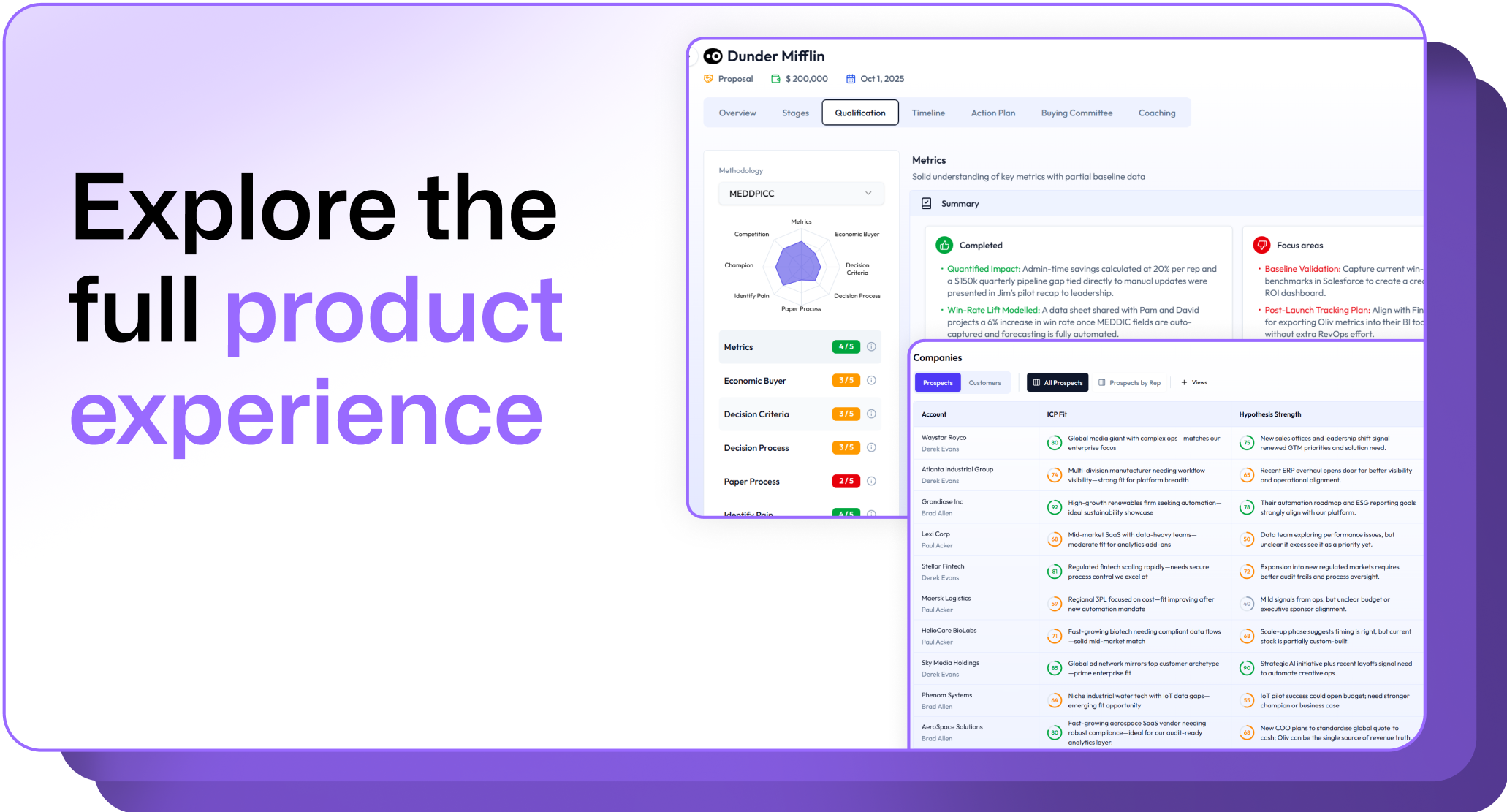
.avif)
.png)







.png)
.png)
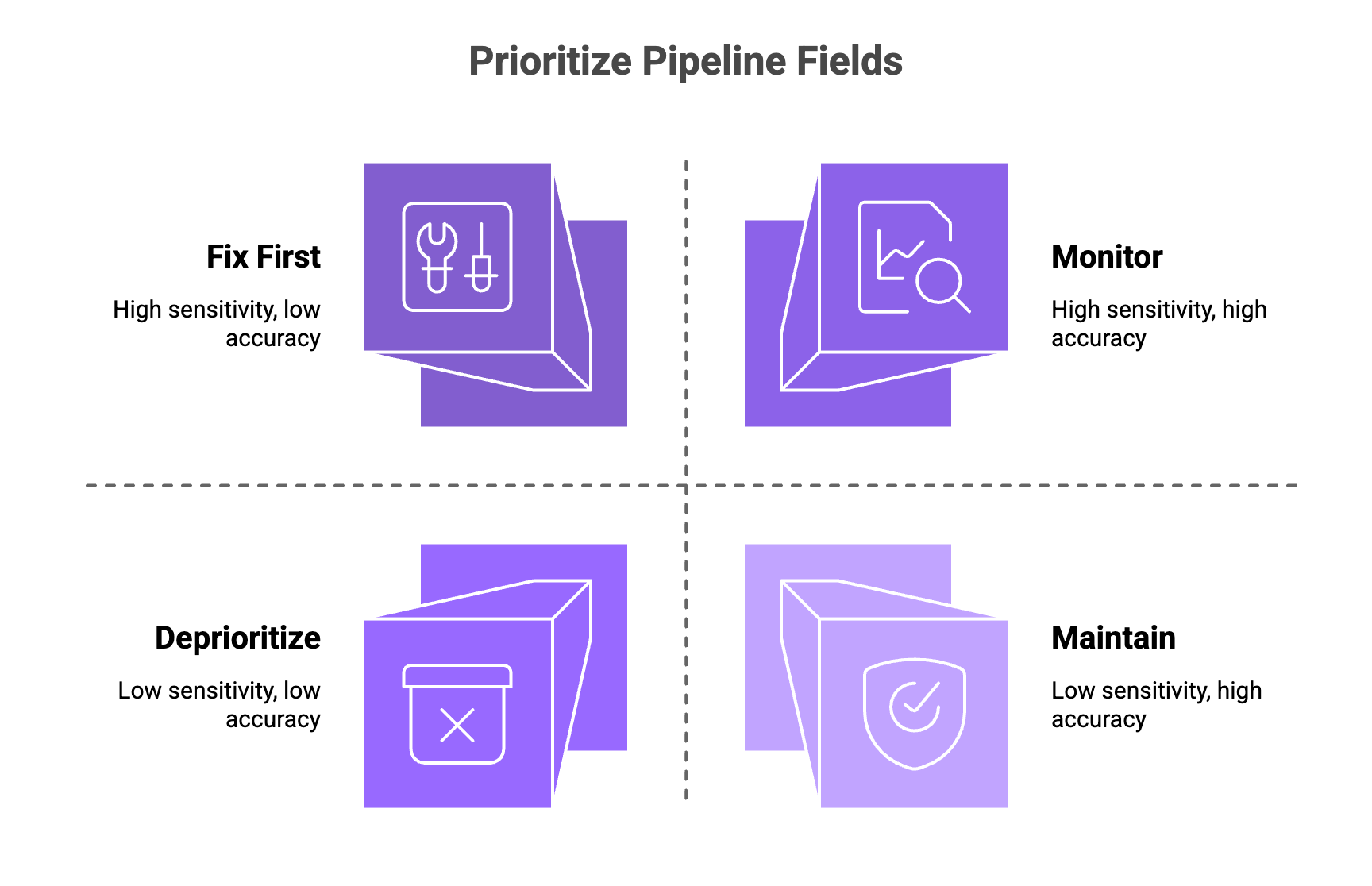

.png)
.png)
.png)
.png)

