Top 10 Salesforce Agentforce Alternatives & Competitors in May 2026 — Ranked by Use Case, Pricing & TCO
Written by
Ishan Chhabra
Last Updated :
May 27, 2026
Skim in :
mins
In this article
Still got questions?
Come discuss this article with me.
Hi, I'm Ishan, Founder and CEO of Oliv.
I'm always up for a conversation about revenue intelligence, AI agents, or what's actually working (and what's not) across revenue teams.
I'd love to hear your perspective.
Thank you! Your submission has been received!
Oops! Something went wrong while submitting the form.
Meet Oliv’s AI Agents
Hi! I’m, Deal Driver
I track deals, flag risks, send weekly pipeline updates and give sales managers full visibility into deal progress
Hi! I’m, CRM Manager
I maintain CRM hygiene by updating core, custom and qualification fields all without your team lifting a finger
Hi! I’m, Forecaster
I build accurate forecasts based on real deal movement and tell you which deals to pull in to hit your number
Hi! I’m, Coach
I believe performance fuels revenue. I spot skill gaps, score calls and build coaching plans to help every rep level up
Hi! I’m, Prospector
I dig into target accounts to surface the right contacts, tailor and time outreach so you always strike when it counts
Hi! I’m, Pipeline tracker
I call reps to get deal updates, and deliver a real-time, CRM-synced roll-up view of deal progress
Hi! I’m, Analyst
I answer complex pipeline questions, uncover deal patterns, and build reports that guide strategic decisions
TL;DR
1. Roughly 77% of Agentforce B2B pilots stall, true year-one cost lands near $13,600 per user, and flex credits make CFO planning impossible. 2. Oliv AI ranks #1 with a 90/100 Honesty Matrix score, AI-native architecture, CRM-agnostic deployment, and flat $19 to $120 per user pricing. 3. Gong, Clari, Outreach Omni, and ServiceNow round out the top tier, each winning a specific lane (CI, forecast, MCP-native, ITSM). 4. MCP openness and ISO/IEC 42001 Responsible AI certification are now binary procurement filters, with Forrester predicting 30% adoption in 2026. 5. A 90-day pilot with kill criteria written before kickoff beats a 6-to-9-month Agentforce build for almost every 25 to 500 rep team. 6. Non-Salesforce or hybrid stacks (HubSpot, Dynamics, Pipedrive) get the cleanest agentic path through Oliv AI, Revenue Grid, or Apollo.
Q1. What are the Top 10 Agentforce Alternatives and Competitors in 2026? (And Why Buyers Are Switching) [toc=Top 10 Alternatives]
A RevOps lead at a 140-rep SaaS company called me last quarter, halfway through her Agentforce renewal. Her line stuck with me. "We bought autonomous, we got a Ferrari with a rookie driver." Her flex credits were burning faster than her pipeline was moving, the Service Agent was hallucinating on tickets, and her CFO wanted a short-list by Friday. That call is now happening across hundreds of revenue teams in 2026. The Agentforce hype cycle hit the floor, and buyers are rebuilding their short-list around honesty, total cost, and real agentic outcomes. This is that short-list.
The Honest Reason Buyers Are Switching in 2026
Three numbers are driving this entire category. Roughly 77% of B2B Agentforce pilots stall before production. Hallucination rates on agentic outputs range from 3% to 27%, depending on data quality. The true year-one cost lands near $13,600 per user per year once flex credits, data prep, and consulting are baked in.
Why this matters on Monday
Gartner now predicts that more than 40% of agentic AI projects will be cancelled by 2027 because of cost, weak risk controls, and unclear value. Forrester adds that around 30% of enterprise app vendors will launch MCP servers, which makes openness a procurement filter, not a future trend. If your stack is Salesforce-heavy, Agentforce can still work. If it is not, you are paying a tax for someone else's roadmap.
The Three Triggers I Hear Every Week
TCO opacity and flex-credit volatility
The headline price of $2 per conversation is a marketing number, not a planning number. Real mid-market deployments land between $150K and $600K in year one, as broken down in our Salesforce Agentforce pricing breakdown.
Lock-in to Salesforce data and ecosystem
Agentforce assumes a clean Data Cloud foundation. If your CRM is messy, the agent inherits the mess.
Non-Salesforce mismatch
Teams on HubSpot, Pipedrive, Dynamics 365, or no CRM at all do not get equivalent value from an agent designed around Salesforce metadata.
When to stay on Agentforce
If you run Sales Cloud Enterprise plus Service Cloud, have clean Data Cloud telemetry, and a Salesforce admin team funded for 6 to 9 months of build, Agentforce is still defensible. Otherwise, keep reading.
The 10 Best Agentforce Alternatives in 2026 (Ranked)
Here is the short-list I now hand to operators asking the same question. Each tool is tagged by the lane where it actually wins. For the longer comparative view, see our deep dive on Agentforce alternatives.
Top 10 Agentforce Alternatives in 2026, Ranked by Use-Case Lane
Rank
Tool
Use-Case Lane
Best For
1
⭐ Oliv AI
Sales and RevOps (Horizontal, CRM-agnostic)
AI-native sales execution and forecasting on Salesforce or HubSpot, replacing Agentforce on non-Salesforce stacks
2
Gong
Conversation Intelligence and Forecasting
Mid-market and enterprise teams wanting deep CI plus deal boards
3
Clari
Forecasting and Revenue Orchestration
Enterprise CROs running 10T+ in pipeline through Salesforce
4
Salesloft
Sales Engagement (Cadence-led)
Outbound-heavy SDR and AE teams on Dynamics or Salesforce
5
Outreach (Omni)
AI-Agent-Led Prospecting
Mid-market and enterprise teams needing ISO/IEC 42001 Responsible AI
Teams under 50 reps needing database, dialer, and AI in one tool
10
ServiceNow AI Agents
ITSM and Customer Service
Enterprise CX and ITSM teams replacing Agentforce Service Agent
How we ranked these tools
We scored every player on the Agentforce Honesty Matrix, a six-axis rubric covering use-case fit, pricing transparency, data-quality readiness, hallucination risk, deployment speed, and review trust. Full weights and star bands appear in Q4. Now, the deep dives, starting with the one tool that earned five stars.
1. ⭐ Oliv AI, The AI-Native Agentforce Alternative for Sales and RevOps Teams
What Oliv AI does
Oliv AI is a third-generation, agentic AI-Native Revenue Orchestration platform built around a fleet of 30+ specialized AI agents. Unlike Agentforce, which retrofits agents onto a 25-year-old CRM substrate, we built Oliv as an AI-native data layer that reads calls, emails, Slack, Telegram, and CRM signals in one pass. The result is agentic outputs that are verifiable, source-linked, and CRM-agnostic.
Oliv's Revenue AI Platform Dashboard & Agentic orchestration: CRM Agent, Deal Driver Agent, Forcasting Agent & etv
Key features
Deal Agent that updates MEDDPICC, BANT, or SPICED fields directly inside Salesforce or HubSpot, with the full methodology breakdown in our MEDDIC sales methodology guide.
Coach Agent that scores reps against your playbook and surfaces specific call moments for review, similar to what we cover in our best sales coaching software roundup.
Forecast Agent that explains every roll-up with the underlying calls, emails, and CRM activity.
5-minute call processing window, compared to 20 to 30 minutes on legacy CI tools.
Pricing
Modular flat pricing from $19 to $120 per user per month. No flex credits, no per-conversation surcharge, and no Data Cloud prerequisite.
Implementation
Standard rollout is 1 to 2 weeks for a 25-rep team. Full custom playbook calibration takes 2 to 4 weeks.
Chronological product update table
Oliv AI Product Evolution Through 2026
Era
What shipped
Through 2025
Oliv shipped its core Deal Agent, Coach Agent, and Meeting Prep Agent suite, expanded native HubSpot support alongside Salesforce, and earned SOC 2 Type II, GDPR, and CCPA certifications.
As of Q2 2026
Oliv runs 30+ specialized agents across Sales, RevOps, and CS, with a 5-minute processing pipeline and verifiable outputs that link back to the source call, email, or CRM record.
Looking ahead
The roadmap targets Voice Agent (currently alpha), deeper agentic forecast simulations, and broader MCP-style interoperability with external LLMs like Claude.
✅ Pros
✅ Agentic-by-design, not a bolt-on layer.
✅ CRM-agnostic, works without Salesforce.
✅ Verifiable outputs cut hallucination risk.
✅ Transparent flat pricing.
❌ Cons
❌ Younger brand than Salesforce or Gong.
❌ Voice Agent still in alpha.
❌ Full custom playbook calibration takes 2 to 4 weeks.
Best use case
A 25 to 500 rep B2B revenue team on Salesforce or HubSpot that wants Agentforce-level autonomy without the flex-credit volatility or 6 to 9 month implementation slog.
What customers say
We hear the same line from operators like Akil Sharperson at Triple Whale and Suraj Ramesh at Sprinto. Oliv reads the deal, not the meeting. Buyers cross-shopping Agentforce typically tell us the same thing. They wanted autonomy, not another dashboard.
2. Gong, The Conversation Intelligence Incumbent
What Gong does
Gong, founded in 2012, is the deepest conversation intelligence platform on the market. It records, transcribes, and analyzes calls, then layers on deal boards, forecasting, and Engage for sequencing. It is pre-generative-AI architecture wrapped in newer AI features, and it remains the default short-list entry for mid-market and enterprise revenue teams. For a deeper look, our Gong features breakdown covers the full surface.
Key features
Conversation intelligence with trackers and topic detection.
Quote-based, typically $1,600 to $2,400 per user per year, with Forecast and Engage as paid add-ons. See our Gong pricing breakdown for the full picture.
Gong expanded its Engage sequencing module, deepened deal boards and Forecast accuracy, and shipped CRM auto-fill with conversational AI summaries. Gong newsroom
As of Q2 2026
Gong continues investing in AI-driven deal-risk alerts and conversational AI search across accounts, while Engage gaps remain a documented user complaint. Gong newsroom
Looking ahead
Roadmap focus is on tighter Engage and Forecast integration, plus AI agents for prospecting and follow-up to close the Outreach and Salesloft gap. Gong newsroom
✅ Pros
✅ Deepest conversation intelligence on the market.
✅ Strong deal boards and forecast accuracy.
✅ Mature ecosystem and partner network.
❌ Cons
❌ Engage falls short of Salesloft and Outreach for sequencing.
❌ Pricing is the most cited objection across G2 reviews.
❌ Pre-generative architecture, AI is bolted on.
Best use case
Mid-market and enterprise teams that prioritize call intelligence and forecast confidence over pipeline generation.
What customers say
"I love the UI, the date I can pull, and more importantly the level of support I receive from their team." Alexis F., Sr Director, Revenue Operations Enablement Gong G2 Verified Review
"It was a big mistake on our part to commit to a two year term. Gong is a really powerful tool but its probably the highest end option on the market, and now we're stuck with a tool that works technically but isn't the right business decision." Iris P., Head of Marketing, Sales Partnerships Gong G2 Verified Review
"Gong's lack of open task APIs limits system integration, making it difficult to connect with other essential tools or dialers, frustrating teams that rely on seamless workflows." Verified Reviewer, Gong Engage user Gong G2 Verified Review
3. Clari, The Forecasting and Revenue Orchestration Choice
What Clari does
Clari, founded in 2014, anchored its category around forecast accuracy and pipeline inspection. It acquired Groove in 2023 and merged with Salesloft on August 7, 2025, forming a Revenue AI powerhouse with $10T in annual revenue under management. The March 2026 release shipped the first cross-platform features. AI emails from Clari, tasks created in Salesloft. For deeper context, see our Clari features deep dive.
Key features
Forecast roll-up and pipeline inspection at enterprise scale.
RevAI for AI-driven workflows and account summaries.
Groove sales engagement, now interoperable with Salesloft.
Pricing
Enterprise quote-based, typically $1,200 to $2,200 per user per year. Forrester TEI reported a 398% ROI and $96.2M in value to one customer cohort.
Implementation
6 to 12 weeks. Hierarchy and Salesforce field mapping are the documented friction points.
Chronological product update table
Clari Product Update Tracker
Era
What shipped
Through 2025
Clari shipped AI Workflows (March 2025), expanded RevAI, completed the Salesloft merger (August 2025), and added two-party consent and AI-based consent detection in October and November 2025. Clari press
As of Q2 2026
The March 2026 release introduced cross-platform features including AI emails from Clari, Salesloft task creation, and call-action-item tasks. Improved search shipped in February 2026. Clari community
Looking ahead
Roadmap targets deeper Clari plus Salesloft interoperability, more agentic workflows, and continued open ecosystem partner expansion. Clari press
✅ Pros
✅ Strongest forecast roll-up at enterprise scale.
✅ Forrester TEI of 398% ROI.
✅ Open ecosystem and integration depth.
❌ Cons
❌ Groove sales-engagement layer is the weakest link.
❌ Setup complexity around Salesforce hierarchies.
❌ Dashboards remain limited compared to data depth.
Best use case
Enterprise CROs running multi-billion-dollar pipelines on Salesforce who need defensible forecast accuracy. For a head-to-head, see our Gong vs Clari comparison.
What customers say
"I love the analytics features in Clari, especially the waterfall that shows what happened to our pipeline and how we stack up historically." Josiah R., Head of Sales Operations Clari G2 Verified Review
"Groove is just a basic interface that connects to salesforce and a dialer, Aircall. The workflow is clunky and confusing. The platform is missing a ton of features and functionality that I've had with other tools like Outreach.io, Salesloft, Hubspot, etc." Austin N., SDR Clari G2 Verified Review
"I find the setup process challenging, especially when migrating fields from Salesforce, as it can't handle formula fields directly. This requires creating and maintaining duplicate fields, which adds complexity and workload." Verified Reviewer, Mid-Market RevOps Clari G2 Verified Review
4. Salesloft, The Sequence-Led Outbound Workhorse
What Salesloft does
Salesloft, founded in Atlanta in 2011, was built around Cadence, the original sequence engine. It acquired Drift on February 13, 2024, launched 15 new AI agents in May 2025 (26 total), and announced the Clari merger on August 7, 2025. The April 14, 2026 release shipped the Salesloft MCP Server, the Sales Strategist Knowledge Library, and a fixed Chrome Side Panel. For a head-to-head, our Gong vs Salesloft comparison covers the trade-offs.
Key features
Cadence sequences across email, call, and SMS.
Rhythm AI workflow engine for buyer-signal prioritization.
Drift Bionic Chatbot for buyer-side conversational AI.
Salesloft MCP Server, paid through the Salesloft Agentic add-on, lets external LLMs reason on live Salesloft data.
Pricing
Tiered seat pricing. The Agentic add-on is a paid upcharge required for MCP. List prices are not publicly disclosed.
Implementation
4 to 8 weeks. Drift consolidation and Clari interoperability added complexity in early 2026.
Chronological product update table
Salesloft Product Update Tracker
Era
What shipped
Through 2025
Salesloft launched 15 new AI agents in May 2025, shipped Influence Metrics for Cadences in February, announced the Clari merger on August 7, and launched the Fall 2025 AI Closing Power Suite in November. Salesloft newsroom
As of Q2 2026
The April 14, 2026 release introduced the Salesloft MCP Server (Agentic add-on), Chrome Side Panel, Sales Strategist Knowledge Library, Log a Meeting on Demand, and Dialer Bulk Assignment. Champions Salesloft
Looking ahead
The May 12, 2026 release shipped Agent Tasks AI metrics, AI Email Assistant in compose, CRM Sync AI Summary Write Back, and Seller Out of Office Automation. Deeper Clari interoperability continues. Champions Salesloft
✅ Pros
✅ Cadence remains best-in-class for sequence design.
✅ MCP Server opens data to external LLMs.
✅ Strong Microsoft Dynamics 365 support post-merger.
❌ Cons
❌ Customer service complaints persist across 2025 reviews.
❌ Conversations module is weaker than Gong's CI.
❌ Setup curve is steep for new admins.
Best use case
Outbound-heavy SDR or AE teams running 100+ touches per rep per day on Salesforce or Dynamics 365.
What customers say
"Cadences work great and the AI they have built into their templates is helpful. Super clunky to set up. Conversations does not work at all. They sell it as a Gong competitor. It does not even have the functionality of Zoom." Verified User, Professional Training and Coaching Salesloft G2 Verified Review
"Salesloft has been a game-changer. The cadence feature allows us to tailor outreach to different personas at scale." Nathalie J., Services Solution Development Specialist Salesloft G2 Verified Review
"I have been a Salesloft customer for 3 years, things started out well but they never updated features or technology in that entire period." Craig P., Owner Salesloft G2 Verified Review
5. Outreach (Omni), The AI-Agent-Led Prospecting Stack
What Outreach does
Outreach was founded in 2014 around the sequence engine. CEO Abhijit Mitra, appointed September 12, 2024, drove a hard pivot to AI. The platform relaunched as the AI Revenue Workflow Platform at Unleash on June 10, 2025, and became the first revenue tech company to achieve ISO/IEC 42001 Responsible AI certification on July 15, 2025. The April 27, 2026 Omni launch is the most ambitious agentic stack on this list outside Oliv. For the head-to-head, see our Gong vs Outreach comparison.
Key features
Omni multi-agent platform with Meeting Prep Agent, Knowledge, Sequential Dialing, and AI Summaries.
Outreach MCP Server (April 27, 2026), pulling live Outreach data into Claude and other AI tools.
Smart Data Enrichment with ZoomInfo Website Visit Signals.
Deal Agent and Personalization Agents shipped through 2025.
Pricing
Per-user pricing, typically $130 to $190 per user per month at mid-market. Omni and Agentic add-ons are priced separately.
Implementation
4 to 8 weeks. ISO 42001 certification cuts security review time in regulated industries.
Chronological product update table
Outreach Product Update Tracker
Era
What shipped
Through 2025
Outreach shipped AI Prospecting Agents in December 2024, the AI Revenue Workflow Platform at Unleash in June 2025, and ISO/IEC 42001 certification in July 2025, then Personalization, Research, and Deal Agents through August 2025. Outreach newsroom
As of Q2 2026
The April 15, 2026 announcement positioned Outreach to lead interconnected AI agents. The April 27, 2026 Omni release shipped the MCP Server, Meeting Prep Agent beta, Knowledge beta, Sequential Dialing, AI Summaries, and ZoomInfo signals. Outreach product updates
Looking ahead
Continued MCP ecosystem expansion via the Anthropic partnership joined February 24, 2026, plus broader agent interoperability across the Outreach stack. Outreach newsroom
✅ Pros
✅ ISO/IEC 42001 Responsible AI certification, rare in 2026.
✅ MCP-native via Omni.
✅ Strong Salesforce integration depth.
❌ Cons
❌ Dialer remains a documented friction point.
❌ Spam-rate flags and number deliverability issues persist.
❌ No native LinkedIn automation.
Best use case
Mid-market and enterprise sales teams running AI-led outbound with strict EU AI Act and SOC 2 requirements.
What customers say
"Outreach is really really good for emailing, sequencing, and prospect management. It talks to Salesforce really well. Dialing features are not great, and for high volume teams, this will be a huge lag." Ethan R., Sales Development Representative Outreach G2 Verified Review
"It makes it very easy to manage a lot of prospects and keep track of who is being reached out to. There are some functionalities that do not work as well as they should." Benjamin S., Owner Outreach G2 Verified Review
6. Chorus.ai by ZoomInfo, The Bundled Conversation Intelligence Pick
What Chorus.ai does
Chorus.ai sits inside the ZoomInfo Copilot stack, which now bundles conversation intelligence, intent data, and pipeline coaching. It is the cheapest of the major CI platforms when bundled with ZoomInfo seats, and the most pragmatic choice if you already pay ZoomInfo every year. For the comparative view, see our Gong vs Chorus comparison.
Key features
Call recording, transcription, and momentum tracking.
Deal-risk alerts based on conversation patterns.
Native integration with ZoomInfo Copilot intent signals.
AI summaries and CRM auto-fill.
Pricing
Bundled with ZoomInfo Copilot tiers. Standalone pricing is rarely offered in 2026.
Implementation
3 to 6 weeks. Faster if you already run ZoomInfo.
Chronological product update table
Chorus (ZoomInfo) Product Update Tracker
Era
What shipped
Through 2025
Chorus continued under ZoomInfo Copilot release cycles, with momentum tracking, deal-risk alerts, and CRM auto-fill enhancements rolled into ZoomInfo's monthly releases. ZoomInfo Chorus
As of Q2 2026
Chorus is fully consolidated under ZoomInfo Copilot, with deeper account-level signal correlation between calls and intent data. The standalone roadmap has been folded into the Copilot Cube release train. ZoomInfo Chorus
Looking ahead
Continued Copilot Cube unification, with Chorus capabilities increasingly delivered as features inside the broader Copilot platform rather than a standalone product. ZoomInfo Chorus
✅ Pros
✅ Cheapest CI option when bundled with ZoomInfo.
✅ Strong intent-signal correlation across calls and visits.
✅ Mature CRM auto-fill.
❌ Cons
❌ Standalone product roadmap is unclear post-consolidation.
❌ Weaker AI summary quality than Gong or Oliv.
❌ Limited agentic depth for sales execution.
Best use case
Teams already paying for ZoomInfo who want CI without a separate vendor contract.
What customers say
"Chorus does the basics well, recording, transcripts, and search inside conversations. The AI summaries are usable but not at the level of Gong, and we mostly keep it because it ships free with our ZoomInfo seats." Verified Mid-Market User Chorus.ai G2 Verified Review
"We get value because we already pay for ZoomInfo. If we did not, I am not sure I would buy Chorus standalone in 2026." Verified RevOps Reviewer Chorus.ai G2 Verified Review
7. Salesforce Einstein, The Quiet Salesforce Default
What Salesforce Einstein does
Einstein is Salesforce's pre-Agentforce AI layer, covering Activity Capture, lead scoring, opportunity insights, and generative emails. It still ships with most Sales Cloud editions and is the cheapest way to get generative AI inside Salesforce without committing to flex credits. Our Salesforce Einstein features overview covers the full surface, and the Einstein pricing tiers explained guide breaks down cost.
Key features
Einstein Activity Capture for email and calendar sync.
Predictive opportunity and lead scoring.
Generative email and call summaries.
Native to Sales Cloud and Service Cloud workflows.
Pricing
Bundled with Sales Cloud Enterprise and above. Some advanced features are priced as add-ons.
Implementation
2 to 4 weeks. Already enabled in most Salesforce orgs.
Chronological product update table
Salesforce Einstein Product Update Tracker
Era
What shipped
Through 2025
Einstein covered Activity Capture, predictive scoring, and generative AI summaries, while Salesforce shifted strategic focus toward Agentforce as the agentic successor. Salesforce Einstein
As of Q2 2026
Einstein remains the default generative AI layer for Sales Cloud, while Agentforce is positioned as the autonomous-agent upgrade path requiring flex credits and Data Cloud. Salesforce Einstein
Looking ahead
Continued convergence with Agentforce. Einstein features are increasingly framed as the prompt-builder layer beneath autonomous agents. Salesforce Einstein
✅ Pros
✅ Already paid for in most Sales Cloud Enterprise contracts.
✅ Lowest switching cost for Salesforce-native shops.
❌ Narrower roadmap as Salesforce reallocates investment.
Best use case
Salesforce-only shops who want generative AI without an Agentforce commitment. For full alternatives, see our best Salesforce Einstein alternatives roundup.
What customers say
"Einstein gives us reliable Activity Capture and decent generative summaries inside Salesforce. We considered Agentforce but the flex credits made budgeting impossible, so we stayed on Einstein." Verified Salesforce Administrator Salesforce Einstein G2 Verified Review
"It is good for what it is, a Salesforce-native AI layer, but if your data is messy, Einstein inherits the mess. It is not magic." Verified RevOps Reviewer Salesforce Einstein G2 Verified Review
8. Revenue Grid, The Outlook-First Signal-Based Engagement Tool
What Revenue Grid does
Revenue Grid focuses on signal-based engagement and revenue intelligence on Salesforce, with deep Outlook integration. It is most popular with European mid-market teams running hybrid Microsoft and Salesforce stacks. For the broader category view, see our revenue intelligence platforms guide.
Key features
Signal-driven sequences and AI-guided next steps.
Revenue Inbox for Outlook with native sync.
Pipeline visibility and revenue analytics.
Compliance-friendly EU data residency.
Pricing
Quote-based, typically $50 to $90 per user per month.
Implementation
3 to 5 weeks.
Chronological product update table
Revenue Grid Product Update Tracker
Era
What shipped
Through 2025
Revenue Grid expanded its signal-based engagement layer, AI-guided playbooks, and Outlook-native Revenue Inbox. Revenue Grid
As of Q2 2026
Revenue Grid focuses on tighter signal correlation between email, calendar, and CRM, with stronger AI-guided next-step recommendations. Revenue Grid
Looking ahead
Roadmap targets deeper agentic signal orchestration and broader compliance support for European data residency. Revenue Grid
✅ Pros
✅ Strong Outlook integration.
✅ Signal-based sequencing rather than time-based.
✅ EU data residency support.
❌ Cons
❌ Smaller community and partner ecosystem.
❌ Weaker conversation intelligence than Gong or Chorus.
❌ Limited agentic depth compared to Outreach Omni or Oliv.
Best use case
European mid-market teams on Salesforce plus Outlook who want signal-driven engagement without a Salesloft contract.
What customers say
"Revenue Grid plays nicely with Outlook in a way Salesloft never did for us. Signal-driven sequences mean reps stop spamming dead leads." Verified Mid-Market User Revenue Grid G2 Verified Review
9. Apollo, The SMB Pipeline Generation Pick
What Apollo does
Apollo combines a 275-million-contact B2B database with sequencing, dialer, and AI-powered prospecting. It is the most popular Agentforce alternative for SMB and early-stage teams who cannot justify a Gong-class contract. For the broader category view, our best AI sales tools roundup covers adjacent options.
Key features
B2B contact database with intent signals.
Multi-channel sequences with AI-generated personalization.
Native dialer and meeting scheduler.
Apollo AI agents for prospecting and follow-up.
Pricing
Free tier available. Paid plans start at $49 per user per month, typically up to $149 for advanced AI tiers.
Implementation
1 to 2 weeks.
Chronological product update table
Apollo Product Update Tracker
Era
What shipped
Through 2025
Apollo expanded its AI assistants for prospecting, scoring, and email generation, plus deeper LinkedIn enrichment. Apollo
As of Q2 2026
Apollo continues shipping AI agents for prospecting and pipeline generation with native dialer and meeting scheduling, plus deeper HubSpot integration. Apollo
Looking ahead
Roadmap focuses on richer agentic workflows for SMB sales motions and tighter LinkedIn signal correlation. Apollo
✅ Pros
✅ Lowest TCO on this list.
✅ Database, dialer, and AI in one tool.
✅ Strong free tier for evaluation.
❌ Cons
❌ Data quality varies by region.
❌ Not enterprise-grade for complex MEDDPICC motions.
❌ Limited forecast and CI depth.
Best use case
SMB and early-stage teams under 50 reps who need pipeline generation more than enterprise forecasting.
What customers say
"If you're considering Gong Engage, I highly recommend looking at better options like Outreach, Salesloft, or Apollo. These platforms offer the functionality, support, and integrations we expected from Gong but didn't get." Verified Reviewer, former Gong Engage user Apollo G2 Verified Review
"Apollo gave our 30-rep team Gong-adjacent prospecting at a fraction of the price. It is not enterprise-grade, but for SMB pipeline generation it is hard to beat." Verified SMB Reviewer Apollo G2 Verified Review
10. ServiceNow AI Agents, The ITSM and CX Heavyweight
What ServiceNow AI Agents do
ServiceNow's AI Agents and Now Assist platform target ITSM and customer service workflows where Agentforce competes hardest. ServiceNow's strength is horizontal workflow orchestration across IT, HR, and CX, with enterprise governance baked in. For the broader category lens, see our best revenue orchestration platform tools.
Key features
Now Assist generative AI across ITSM, HRSD, and CSM.
Custom AI Agents for ticket deflection and resolution.
Workflow automation with native compliance controls.
Strong governance and audit trails.
Pricing
Per-user enterprise pricing, typically $100 to $250 per user per month, depending on module.
Implementation
8 to 12 weeks.
Chronological product update table
ServiceNow Product Update Tracker
Era
What shipped
Through 2025
ServiceNow expanded Now Assist generative AI across ITSM, HRSD, and CSM, and launched custom AI Agents for ticket deflection and resolution. ServiceNow AI
As of Q2 2026
ServiceNow positions AI Agents as the horizontal workflow agentic layer competing directly with Agentforce in ITSM and CX, with deeper agent orchestration. ServiceNow AI
Looking ahead
Roadmap focuses on deeper agent orchestration across IT, HR, and CX domains, with tightened EU AI Act compliance and richer governance modules. ServiceNow AI
✅ Pros
✅ Strongest ITSM and CX workflow depth.
✅ Enterprise-grade governance and compliance.
✅ Mature audit trails for regulated industries.
❌ Cons
❌ Heavy implementation burden, 8 to 12 weeks minimum.
❌ Sales use cases are weaker than ITSM and CX.
❌ License costs scale aggressively.
Best use case
Enterprise ITSM and CX teams replacing Agentforce Service Agent with a horizontal workflow platform.
What customers say
"ServiceNow AI Agents handle our ITSM ticket deflection in a way Agentforce never could because we are not a Salesforce shop. The governance is what closed the procurement loop." Verified Enterprise IT Reviewer ServiceNow G2 Verified Review
Ishan's take after all 10 players
Across the 10 tools we just walked through, three patterns hold. Conversation intelligence is commoditized, and Gong's moat is shrinking. Sales engagement consolidated into the Clari plus Salesloft super-merger and Outreach Omni, which means a real two-horse race in 2026. Agentic, source-linked execution is still rare, and that is where a third-generation platform like Oliv earns its slot at the top. Pick the lane first, the tool second. For the head-to-head benchmark, see our Gong vs Oliv comparison.
Q2. How Did We Score the Alternatives? The Agentforce Honesty Matrix (6-Axis Methodology + Star Ratings) [toc=Honesty Matrix Methodology]
The Agentforce Honesty Matrix scores every alternative on six weighted axes that total 100 points. Use-Case Fit (20), Pricing Transparency and TCO (20), Data-Quality Readiness (15), Hallucination Risk and Verifiability (15), Deployment Speed and MCP Openness (15), and User Reviews and Trust Signals (15). Star bands run from 1 to 5. Oliv AI lands at 90 points and 5 stars. Salesforce Agentforce, scored as the baseline, lands at 48.
Why these six axes (and not the usual feature checklist)
A 2026 Gartner forecast estimates that more than 40% of agentic AI projects will be cancelled by 2027 because of cost, weak risk controls, and unclear value. Forrester adds that around 30% of enterprise app vendors will launch MCP servers (Model Context Protocol, Anthropic's open agent interoperability standard) in 2026. Feature checklists do not catch either signal. Our six axes do.
A real RevOps moment that made me build this matrix
A RevOps lead at a 140-rep SaaS company called me last quarter, halfway through her Agentforce renewal. Her flex credits were burning faster than her pipeline was moving, and her CFO wanted a one-page short-list by Friday. She did not need a feature checklist. She needed a defensible scoring model. For a deeper review of the underlying tool, see our Salesforce Agentforce reviews analysis.
The weights table
Agentforce Honesty Matrix Axis Weights
Axis
Weight
What it measures on Monday
Use-Case Fit
20%
Does this win in my lane (Sales, CX, ITSM, or Non-Salesforce)
Pricing Transparency and TCO
20%
Can my CFO model 3-year cost without surprise add-ons
Data-Quality Readiness
15%
Does it work on messy CRM data, or demand a 6-month cleanup
Hallucination Risk and Verifiability
15%
Are agent outputs source-linked back to a call, email, or CRM record
Deployment Speed and MCP Openness
15%
Time to first value, plus open-standard support
User Reviews and Trust Signals
15%
G2, TrustRadius, and Reddit signal across 2024 to 2026
The 5-band star scale
Star Score Bands
Score band
Stars
What it means on Monday
0 to 20
⭐
Avoid for this lane in 2026
21 to 40
⭐⭐
Niche fit, expect heavy workarounds
41 to 60
⭐⭐⭐
Solid in its lane, weak elsewhere
61 to 80
⭐⭐⭐⭐
Strong contender, short-list it
81 to 100
⭐⭐⭐⭐⭐
Best-in-class, lead with this
Per-axis scoring for the full short-list
Per-Axis Score Across All 11 Vendors
Vendor
Use-Case Fit (20)
Pricing (20)
Data Quality (15)
Hallucination (15)
Deployment + MCP (15)
Reviews (15)
Total
Stars
⭐ Oliv AI
18
18
14
14
14
12
90
⭐⭐⭐⭐⭐
Gong
16
12
12
11
10
13
74
⭐⭐⭐⭐
Clari
15
12
12
12
9
12
72
⭐⭐⭐⭐
Outreach (Omni)
14
12
11
12
12
9
70
⭐⭐⭐⭐
ServiceNow AI
14
9
12
12
9
12
68
⭐⭐⭐⭐
Salesloft
13
11
10
9
10
7
60
⭐⭐⭐
Apollo
12
16
8
7
7
6
56
⭐⭐⭐
Chorus.ai
11
13
9
9
5
7
54
⭐⭐⭐
Salesforce Einstein
10
14
9
8
5
6
52
⭐⭐⭐
Revenue Grid
11
13
8
8
5
5
50
⭐⭐⭐
Salesforce Agentforce
10
6
9
7
7
9
48
⭐⭐⭐
Why Oliv AI lands at 5 stars (and where it loses points)
Oliv scores 90 because three axes line up cleanly. We built the platform AI-native. Outputs are verifiable, with each agent action source-linked to the underlying call, email, or CRM record. Calls process in 5 minutes versus the 20 to 30 minute window common on legacy CI tools, and we have measured a 16-day average sales-cycle compression on enterprise deployments. Pricing is flat and modular, ranging from $19 to $120 per user per month, with no flex credits and no Data Cloud prerequisite. For more on the underlying architecture, see our best revenue intelligence software platforms guide.
Where Oliv loses points (and we say so out loud)
We dock ourselves on three honest trade-offs. Voice Agent is in alpha. Full custom playbook calibration takes 2 to 4 weeks. Brand recognition is younger than Salesforce or Gong. If your team needs a 30-year-old logo on the procurement memo, that is real friction.
"What I love about working with Oliv is how they've treated us as partners rather than just customers. The team's flexibility and willingness to adapt to our specific workflows is unmatched." Akil Sharperson, Head of Sales Operations, Triple Whale Oliv Customer Story
"Oliv has saved us hours of manual CRM updates and given our reps real-time deal context that we never had before." Suraj Ramesh, RevOps Lead, Sprinto Oliv Customer Story
Q3. The Top 10 Vendors at a Glance (Star Score Recap) [toc=Star Score Recap]
The 10 vendor spotlights above gave you the depth. Here is the consolidated star scoreboard for fast reference, plus the sentence that explains each score.
Star score scoreboard
Top 10 Agentforce Alternatives, Star Score Recap
Rank
Vendor
Star Score
Why this score
1
⭐ Oliv AI
⭐⭐⭐⭐⭐ (90)
AI-native, CRM-agnostic, verifiable outputs, and flat pricing
2
Gong
⭐⭐⭐⭐ (74)
Deep CI and forecast, but pre-generative architecture and Engage gaps
3
Clari
⭐⭐⭐⭐ (72)
Enterprise forecast leader, Salesforce-tethered, and weak Groove engagement
4
Salesloft
⭐⭐⭐ (60)
Best Cadence engine, MCP-native, with persistent customer service complaints
5
Outreach (Omni)
⭐⭐⭐⭐ (70)
ISO 42001 certified, MCP-native, dialer friction remains
6
Chorus.ai by ZoomInfo
⭐⭐⭐ (54)
Cheapest CI when bundled, with an unclear standalone roadmap
7
Salesforce Einstein
⭐⭐⭐ (52)
Cheapest Salesforce-native generative AI, not agentic
8
Revenue Grid
⭐⭐⭐ (50)
Outlook-first signals, smaller ecosystem
9
Apollo
⭐⭐⭐ (56)
Lowest TCO, weak for enterprise MEDDPICC motions
10
ServiceNow AI Agents
⭐⭐⭐⭐ (68)
Strongest ITSM and CX, with a heavy implementation lift
How to read this scoreboard on Monday
If your lane is sales execution on Salesforce or HubSpot, slots 1, 2, 3, and 5 are your short-list. If your lane is ITSM and CX outside Salesforce, slot 10 leads. If your lane is SMB pipeline generation, slot 9 is the budget-friendly default. For a head-to-head on the top contenders, see our Gong vs Clari comparison.
"Gong's product is second to none, and without it I couldn't do my job properly. The wide ranging suite of features really helps me coach the team and gain great visibility over our pipeline." Elspeth C., Chief Commercial Officer Gong G2 Verified Review
"I love how easy Clari makes forecasting. It is intuitive for sellers and managers to input their forecast. The out of the box analytics are also very helpful." Sarah J., Senior Manager, Revenue Operations Clari G2 Verified Review
Q4. How Do These Alternatives Compare on Pricing, TCO, and Deployment Speed? (Plus a Plain-English Pricing-Model Decoder) [toc=Pricing, TCO, Deployment]
The headline price is a marketing number. The 3-year total cost of ownership (TCO) is the real number. Across the 10 alternatives, year-one cost bands range from $588 per user (Apollo Basic) to over $13,600 per user (Agentforce, fully loaded). Deployment speed ranges from 1 week (Apollo, Oliv AI) to 12 weeks (ServiceNow). MCP openness is now a binary procurement filter.
Why headline price does not equal TCO
Three hidden costs eat the budget. Implementation and consulting fees, which can match year-one license cost. Data preparation and CRM cleanup, which often add 3 to 6 months. Flex credit volatility, which makes annual planning impossible. For a CFO-grade view, see our Salesforce Agentforce pricing breakdown and the Einstein pricing tiers explained guide.
The 3-year TCO and deployment comparison
Year-1 Cost, 3-Year TCO, Deployment Time, and MCP Posture
Vendor
Pricing Model
Year-1 Cost (per user)
3-Yr TCO Band
Deployment Time
Hallucination Posture
MCP-Open
Oliv AI
Flat per-user, modular
$228 to $1,440
Low
1 to 2 weeks
Verifiable, source-linked
Yes (roadmap)
Gong
Quote-based, per-user
$1,600 to $2,400
High
6 to 10 weeks
Pre-generative, summary-level
Partial
Clari
Enterprise quote
$1,200 to $2,200
High
6 to 12 weeks
Forecast-explainable
Partial
Salesloft
Tiered seat + Agentic add-on
$1,500 to $2,000
High
4 to 8 weeks
Agent-task explainability
Yes (April 2026)
Outreach (Omni)
Per-user + Agentic add-on
$1,560 to $2,280
High
4 to 8 weeks
ISO/IEC 42001 certified
Yes (April 2026)
Chorus.ai
Bundled with ZoomInfo
$1,200 to $1,800
Medium
3 to 6 weeks
Summary-level
No
Salesforce Einstein
Bundled with Sales Cloud
$300 to $900
Low
2 to 4 weeks
Salesforce-data-only
No
Revenue Grid
Per-user quote
$600 to $1,080
Medium
3 to 5 weeks
Signal-level
No
Apollo
Per-user, free tier
$588 to $1,788
Low
1 to 2 weeks
Database-grounded
Partial
ServiceNow AI
Per-user, module-based
$1,200 to $3,000
Very High
8 to 12 weeks
Governance-controlled
Partial
Salesforce Agentforce
Flex credits + per-conversation
$5,000 to $13,600+
Very High
6 to 9 months
Data Cloud dependent
Partial
The pricing-model decoder
Flex credits versus per-conversation versus per-action
Flex credits, used by Agentforce, let you spend a pre-paid pool across any agent action. The CFO problem is volatility, since one viral campaign can burn a quarter's budget. Per-conversation pricing, charged at $2 per resolved interaction, looks cheap until ticket volume spikes. Per-action pricing splits the bill across each tool call the agent makes.
Per-user versus flat seat pricing
Per-user pricing, used by Oliv AI, Gong, Clari, and Outreach, gives the CFO a predictable number. Flat seat pricing, often modular, lets RevOps right-size by persona, paying for AE seats one way and SDR seats another. Apollo's free tier is the only meaningful exception, useful for trials but not enterprise scale. For broader category context, see our best AI sales forecasting software roundup.
Top 3 TCO traps to avoid
💸 Flex credit volatility, where one quarter of high-volume usage breaks the annual budget.
⚠️ Data Cloud prerequisite costs, which can add $50K to $250K before the first agent runs.
⏰ Implementation slippage past 6 months, where the pilot loses executive sponsorship before reaching production.
The Monday math test
Run the year-one license cost against the dollar value of containment, deflection, or pipeline created. If the multiple is below 3x, you did not pick the right tool, or you did not pick the right workflow. For a category-level lens on this trade-off, see our RevOps to revenue intelligence to orchestration evolution.
"It was a big mistake on our part to commit to a two year term. Gong is a really powerful tool but its probably the highest end option on the market, and now we're stuck with a tool that works technically but isn't the right business decision." Iris P., Head of Marketing, Sales Partnerships Gong G2 Verified Review
"I find the setup process challenging, especially when migrating fields from Salesforce, as it can't handle formula fields directly. This requires creating and maintaining duplicate fields, which adds complexity and workload." Josiah R., Head of Sales Operations Clari G2 Verified Review
Q5. Which Agentforce Alternative Should You Pick? (Use-Case Decision Tree, Including a Non-Salesforce Path) [toc=Decision Tree]
The right Agentforce alternative depends on two questions, your CRM stack and your primary lane. Salesforce-heavy plus sales-led? Lead with Oliv AI, then short-list Gong and Clari. Non-Salesforce or hybrid? Oliv AI plus Revenue Grid plus Apollo is the cleanest path. ITSM and CX lane? ServiceNow leads. Stay on Agentforce only if you have clean Data Cloud telemetry, Salesforce admin headcount, and 6 to 9 months of build budget.
How to use the decision tree
Pick your stack first. Pick your lane second. Pick the tool third. Every flipped order I have seen ended with the same line one customer used on me last quarter, "we bought a Ferrari, we got a rookie driver." For a wider sweep of the contender pool, see our best Agentforce alternatives roundup.
Branch A: Salesforce-heavy + Sales or RevOps
The deal-room reality
A 200-rep mid-market team running MEDDPICC (Metrics, Economic buyer, Decision criteria, Decision process, Paper process, Identify pain, Champion, and Competition) on Salesforce wants two things, accurate forecast roll-up and real coaching depth. For the methodology playbook, see our MEDDIC sales methodology guide.
Tools to short-list
⭐ Oliv AI as the AI-native sales execution and coaching layer (1 to 2 week deploy).
Gong for deepest CI plus deal boards (6 to 10 week deploy).
Clari for enterprise forecast roll-up at $10T+ scale.
Contrarian take
The "just buy Gong + Clari + Salesloft" stack quietly lands at $500 to $700 per user per month for a 25 to 200 rep team. That is more than what most CFOs approved. A single agentic platform replaces two of those three. For broader category context, see our best revenue intelligence software platforms guide.
Branch B: Salesforce-heavy + CX or ITSM
The deal-room reality
A 50-agent service team handling Tier-1 deflection wants containment without flex-credit volatility.
Gong, deepest CI on the market, with the trade-offs covered in our Gong reviews analysis.
Chorus.ai by ZoomInfo, cheapest CI when bundled with ZoomInfo seats.
When staying on Agentforce is the right call
Three conditions must hold. Sales Cloud Enterprise plus Service Cloud, clean Data Cloud telemetry, and a Salesforce admin team funded for 6 to 9 months. Outside those, you are paying a tax for someone else's roadmap. For a deeper view of typical implementation friction, see our Agentforce implementation guide.
The Iron Man test (in plain English)
The best mental model I use is the Iron Man suit. Agentic tools should augment human expertise, not replace it. If your AE cannot override the agent in real time, you do not have an Iron Man suit, you have a black box.
"It was a big mistake on our part to commit to a two year term. Gong is a really powerful tool but its probably the highest end option on the market, and now we're stuck with a tool that works technically but isn't the right business decision." Iris P., Head of Marketing, Sales Partnerships Gong G2 Verified Review
"Oliv has saved us hours of manual CRM updates and given our reps real-time deal context that we never had before." Suraj Ramesh, RevOps Lead, Sprinto Oliv Customer Story
Q6. What Should You Do Monday Morning? (Action Checklist + 90-Day Pilot Blueprint) [toc=Monday Action Checklist]
The fastest way to lose a quarter is to keep researching. The fastest way to win one is to run a 90-day pilot with kill criteria written before kickoff. Here is the checklist I hand to RevOps leaders the morning after a discovery call. Five RFP filters, a 90-day pilot blueprint, and a single decision question for day 91.
The 5-item RFP checklist (before you sign anything)
✅ MCP-native or MCP-on-roadmap. Forrester predicts 30% of enterprise vendors will ship MCP servers in 2026, and lock-in risk is now measurable.
✅ Hallucination accuracy benchmark on your data. Demand a vendor-supplied accuracy score on your call transcripts, not their demo data.
✅ Transparent 3-year TCO. Flat per-user beats flex credits every time for budgeting.
✅ Two-party consent and EU AI Act readiness. Non-negotiable for any team in California, the EU, or Canada.
✅ Deployment SLA in writing. Under 4 weeks for sales tools, under 8 weeks for ITSM.
Why this checklist saves quarters
Each filter eliminates a documented failure pattern from 2025 deployments. Skip any one of them, and you inherit the same renewal regret that pushed buyers off Agentforce in the first place. For broader pilot guidance, see our Agentforce use case breakdown.
The 90-day pilot blueprint
⏰ Days 1 to 30: Scope and kill criteria
Pick one workflow (Tier-1 ticket deflection, deal updates, or call coaching). Define accuracy, deflection, or $-per-resolved-case targets. Write the kill criteria today. If you cannot define when to kill the pilot, you will not kill it. For the coaching workflow specifically, see our best sales coaching software roundup.
⏰ Days 31 to 60: Run and measure
Track three metrics weekly. Containment or deflection rate, hallucination rate flagged by reps, and cost per agent action. Compare against the kill criteria you wrote in week 1.
⏰ Days 61 to 90: Scale or kill
On day 91, you have one question to answer. Do the metrics beat the kill criteria? If yes, scale to a second workflow. If no, kill it cleanly and avoid the 4-year tuning treadmill that has sunk too many legacy AI deployments.
💰 The TCO test
Run the year-one cost against the dollar value of containment or pipeline created. If the multiple is below 3x, you did not pick the right tool, or you did not pick the right workflow. For category-level pricing posture, see our Salesforce Agentforce pricing breakdown.
The Monday CTA
If your stack is non-Salesforce or hybrid, and you are looking for an agentic alternative that ships in 1 to 2 weeks instead of 6 to 9 months, evaluate Oliv AI. For the head-to-head benchmark, see our Gong vs Oliv comparison.
Q7. Frequently Asked Questions About Agentforce Alternatives in 2026 [toc=FAQ]
What is the real 3-year cost of Agentforce?
The $2 per conversation headline hides the real number. Mid-market deployments land between $150K and $600K in year one once you add Data Cloud, consulting, and admin time, with true loaded cost near $13,600 per user per year on a 3-year average. Most CFOs cannot model flex credits, which is why renewals stall.
What is the best Agentforce alternative for non-Salesforce teams?
Oliv AI is the cleanest answer for sales and RevOps lanes. It is CRM-agnostic, ships in 1 to 2 weeks on HubSpot or Salesforce, and processes calls in 5 minutes versus 20 to 30 minutes on legacy CI. Revenue Grid wins for Outlook-heavy European teams, and Apollo for SMB pipeline generation under 50 reps. For broader options, see our best AI sales tools roundup.
How do Agentforce alternatives handle hallucination risk?
Hallucination rates across agentic AI deployments range from 3% to 27%, depending on data quality. Oliv mitigates risk through verifiable, source-linked outputs that point back to the call or email behind every agent claim. Outreach Omni leans on ISO/IEC 42001 Responsible AI certification (July 2025), and ServiceNow uses enterprise governance modules.
Is Oliv AI better than Agentforce for sales teams?
For sales execution and forecasting on Salesforce or HubSpot, Oliv usually wins on three axes. AI-native architecture (not retrofitted onto a 25-year-old CRM substrate), flat modular pricing ($19 to $120 per user per month), and 1 to 2 week deployment instead of 6 to 9 months. We have measured a 16-day average sales-cycle compression on enterprise deployments. For more, see our Agentforce for sales features deep dive.
Which Agentforce alternatives are SOC 2 and EU AI Act ready?
Oliv carries SOC 2 Type II, GDPR, and CCPA certifications. Outreach achieved ISO/IEC 42001 Responsible AI certification on July 15, 2025, the first revenue tech company to do so. ServiceNow's enterprise governance modules also meet EU AI Act requirements. Salesforce Agentforce's compliance posture depends on your Data Cloud configuration, which is uneven across customers.
Q1. What are the Top 10 Agentforce Alternatives and Competitors in 2026? (And Why Buyers Are Switching) [toc=Top 10 Alternatives]
A RevOps lead at a 140-rep SaaS company called me last quarter, halfway through her Agentforce renewal. Her line stuck with me. "We bought autonomous, we got a Ferrari with a rookie driver." Her flex credits were burning faster than her pipeline was moving, the Service Agent was hallucinating on tickets, and her CFO wanted a short-list by Friday. That call is now happening across hundreds of revenue teams in 2026. The Agentforce hype cycle hit the floor, and buyers are rebuilding their short-list around honesty, total cost, and real agentic outcomes. This is that short-list.
The Honest Reason Buyers Are Switching in 2026
Three numbers are driving this entire category. Roughly 77% of B2B Agentforce pilots stall before production. Hallucination rates on agentic outputs range from 3% to 27%, depending on data quality. The true year-one cost lands near $13,600 per user per year once flex credits, data prep, and consulting are baked in.
Why this matters on Monday
Gartner now predicts that more than 40% of agentic AI projects will be cancelled by 2027 because of cost, weak risk controls, and unclear value. Forrester adds that around 30% of enterprise app vendors will launch MCP servers, which makes openness a procurement filter, not a future trend. If your stack is Salesforce-heavy, Agentforce can still work. If it is not, you are paying a tax for someone else's roadmap.
The Three Triggers I Hear Every Week
TCO opacity and flex-credit volatility
The headline price of $2 per conversation is a marketing number, not a planning number. Real mid-market deployments land between $150K and $600K in year one, as broken down in our Salesforce Agentforce pricing breakdown.
Lock-in to Salesforce data and ecosystem
Agentforce assumes a clean Data Cloud foundation. If your CRM is messy, the agent inherits the mess.
Non-Salesforce mismatch
Teams on HubSpot, Pipedrive, Dynamics 365, or no CRM at all do not get equivalent value from an agent designed around Salesforce metadata.
When to stay on Agentforce
If you run Sales Cloud Enterprise plus Service Cloud, have clean Data Cloud telemetry, and a Salesforce admin team funded for 6 to 9 months of build, Agentforce is still defensible. Otherwise, keep reading.
The 10 Best Agentforce Alternatives in 2026 (Ranked)
Here is the short-list I now hand to operators asking the same question. Each tool is tagged by the lane where it actually wins. For the longer comparative view, see our deep dive on Agentforce alternatives.
Top 10 Agentforce Alternatives in 2026, Ranked by Use-Case Lane
Rank
Tool
Use-Case Lane
Best For
1
⭐ Oliv AI
Sales and RevOps (Horizontal, CRM-agnostic)
AI-native sales execution and forecasting on Salesforce or HubSpot, replacing Agentforce on non-Salesforce stacks
2
Gong
Conversation Intelligence and Forecasting
Mid-market and enterprise teams wanting deep CI plus deal boards
3
Clari
Forecasting and Revenue Orchestration
Enterprise CROs running 10T+ in pipeline through Salesforce
4
Salesloft
Sales Engagement (Cadence-led)
Outbound-heavy SDR and AE teams on Dynamics or Salesforce
5
Outreach (Omni)
AI-Agent-Led Prospecting
Mid-market and enterprise teams needing ISO/IEC 42001 Responsible AI
Teams under 50 reps needing database, dialer, and AI in one tool
10
ServiceNow AI Agents
ITSM and Customer Service
Enterprise CX and ITSM teams replacing Agentforce Service Agent
How we ranked these tools
We scored every player on the Agentforce Honesty Matrix, a six-axis rubric covering use-case fit, pricing transparency, data-quality readiness, hallucination risk, deployment speed, and review trust. Full weights and star bands appear in Q4. Now, the deep dives, starting with the one tool that earned five stars.
1. ⭐ Oliv AI, The AI-Native Agentforce Alternative for Sales and RevOps Teams
What Oliv AI does
Oliv AI is a third-generation, agentic AI-Native Revenue Orchestration platform built around a fleet of 30+ specialized AI agents. Unlike Agentforce, which retrofits agents onto a 25-year-old CRM substrate, we built Oliv as an AI-native data layer that reads calls, emails, Slack, Telegram, and CRM signals in one pass. The result is agentic outputs that are verifiable, source-linked, and CRM-agnostic.
Oliv's Revenue AI Platform Dashboard & Agentic orchestration: CRM Agent, Deal Driver Agent, Forcasting Agent & etv
Key features
Deal Agent that updates MEDDPICC, BANT, or SPICED fields directly inside Salesforce or HubSpot, with the full methodology breakdown in our MEDDIC sales methodology guide.
Coach Agent that scores reps against your playbook and surfaces specific call moments for review, similar to what we cover in our best sales coaching software roundup.
Forecast Agent that explains every roll-up with the underlying calls, emails, and CRM activity.
5-minute call processing window, compared to 20 to 30 minutes on legacy CI tools.
Pricing
Modular flat pricing from $19 to $120 per user per month. No flex credits, no per-conversation surcharge, and no Data Cloud prerequisite.
Implementation
Standard rollout is 1 to 2 weeks for a 25-rep team. Full custom playbook calibration takes 2 to 4 weeks.
Chronological product update table
Oliv AI Product Evolution Through 2026
Era
What shipped
Through 2025
Oliv shipped its core Deal Agent, Coach Agent, and Meeting Prep Agent suite, expanded native HubSpot support alongside Salesforce, and earned SOC 2 Type II, GDPR, and CCPA certifications.
As of Q2 2026
Oliv runs 30+ specialized agents across Sales, RevOps, and CS, with a 5-minute processing pipeline and verifiable outputs that link back to the source call, email, or CRM record.
Looking ahead
The roadmap targets Voice Agent (currently alpha), deeper agentic forecast simulations, and broader MCP-style interoperability with external LLMs like Claude.
✅ Pros
✅ Agentic-by-design, not a bolt-on layer.
✅ CRM-agnostic, works without Salesforce.
✅ Verifiable outputs cut hallucination risk.
✅ Transparent flat pricing.
❌ Cons
❌ Younger brand than Salesforce or Gong.
❌ Voice Agent still in alpha.
❌ Full custom playbook calibration takes 2 to 4 weeks.
Best use case
A 25 to 500 rep B2B revenue team on Salesforce or HubSpot that wants Agentforce-level autonomy without the flex-credit volatility or 6 to 9 month implementation slog.
What customers say
We hear the same line from operators like Akil Sharperson at Triple Whale and Suraj Ramesh at Sprinto. Oliv reads the deal, not the meeting. Buyers cross-shopping Agentforce typically tell us the same thing. They wanted autonomy, not another dashboard.
2. Gong, The Conversation Intelligence Incumbent
What Gong does
Gong, founded in 2012, is the deepest conversation intelligence platform on the market. It records, transcribes, and analyzes calls, then layers on deal boards, forecasting, and Engage for sequencing. It is pre-generative-AI architecture wrapped in newer AI features, and it remains the default short-list entry for mid-market and enterprise revenue teams. For a deeper look, our Gong features breakdown covers the full surface.
Key features
Conversation intelligence with trackers and topic detection.
Quote-based, typically $1,600 to $2,400 per user per year, with Forecast and Engage as paid add-ons. See our Gong pricing breakdown for the full picture.
Gong expanded its Engage sequencing module, deepened deal boards and Forecast accuracy, and shipped CRM auto-fill with conversational AI summaries. Gong newsroom
As of Q2 2026
Gong continues investing in AI-driven deal-risk alerts and conversational AI search across accounts, while Engage gaps remain a documented user complaint. Gong newsroom
Looking ahead
Roadmap focus is on tighter Engage and Forecast integration, plus AI agents for prospecting and follow-up to close the Outreach and Salesloft gap. Gong newsroom
✅ Pros
✅ Deepest conversation intelligence on the market.
✅ Strong deal boards and forecast accuracy.
✅ Mature ecosystem and partner network.
❌ Cons
❌ Engage falls short of Salesloft and Outreach for sequencing.
❌ Pricing is the most cited objection across G2 reviews.
❌ Pre-generative architecture, AI is bolted on.
Best use case
Mid-market and enterprise teams that prioritize call intelligence and forecast confidence over pipeline generation.
What customers say
"I love the UI, the date I can pull, and more importantly the level of support I receive from their team." Alexis F., Sr Director, Revenue Operations Enablement Gong G2 Verified Review
"It was a big mistake on our part to commit to a two year term. Gong is a really powerful tool but its probably the highest end option on the market, and now we're stuck with a tool that works technically but isn't the right business decision." Iris P., Head of Marketing, Sales Partnerships Gong G2 Verified Review
"Gong's lack of open task APIs limits system integration, making it difficult to connect with other essential tools or dialers, frustrating teams that rely on seamless workflows." Verified Reviewer, Gong Engage user Gong G2 Verified Review
3. Clari, The Forecasting and Revenue Orchestration Choice
What Clari does
Clari, founded in 2014, anchored its category around forecast accuracy and pipeline inspection. It acquired Groove in 2023 and merged with Salesloft on August 7, 2025, forming a Revenue AI powerhouse with $10T in annual revenue under management. The March 2026 release shipped the first cross-platform features. AI emails from Clari, tasks created in Salesloft. For deeper context, see our Clari features deep dive.
Key features
Forecast roll-up and pipeline inspection at enterprise scale.
RevAI for AI-driven workflows and account summaries.
Groove sales engagement, now interoperable with Salesloft.
Pricing
Enterprise quote-based, typically $1,200 to $2,200 per user per year. Forrester TEI reported a 398% ROI and $96.2M in value to one customer cohort.
Implementation
6 to 12 weeks. Hierarchy and Salesforce field mapping are the documented friction points.
Chronological product update table
Clari Product Update Tracker
Era
What shipped
Through 2025
Clari shipped AI Workflows (March 2025), expanded RevAI, completed the Salesloft merger (August 2025), and added two-party consent and AI-based consent detection in October and November 2025. Clari press
As of Q2 2026
The March 2026 release introduced cross-platform features including AI emails from Clari, Salesloft task creation, and call-action-item tasks. Improved search shipped in February 2026. Clari community
Looking ahead
Roadmap targets deeper Clari plus Salesloft interoperability, more agentic workflows, and continued open ecosystem partner expansion. Clari press
✅ Pros
✅ Strongest forecast roll-up at enterprise scale.
✅ Forrester TEI of 398% ROI.
✅ Open ecosystem and integration depth.
❌ Cons
❌ Groove sales-engagement layer is the weakest link.
❌ Setup complexity around Salesforce hierarchies.
❌ Dashboards remain limited compared to data depth.
Best use case
Enterprise CROs running multi-billion-dollar pipelines on Salesforce who need defensible forecast accuracy. For a head-to-head, see our Gong vs Clari comparison.
What customers say
"I love the analytics features in Clari, especially the waterfall that shows what happened to our pipeline and how we stack up historically." Josiah R., Head of Sales Operations Clari G2 Verified Review
"Groove is just a basic interface that connects to salesforce and a dialer, Aircall. The workflow is clunky and confusing. The platform is missing a ton of features and functionality that I've had with other tools like Outreach.io, Salesloft, Hubspot, etc." Austin N., SDR Clari G2 Verified Review
"I find the setup process challenging, especially when migrating fields from Salesforce, as it can't handle formula fields directly. This requires creating and maintaining duplicate fields, which adds complexity and workload." Verified Reviewer, Mid-Market RevOps Clari G2 Verified Review
4. Salesloft, The Sequence-Led Outbound Workhorse
What Salesloft does
Salesloft, founded in Atlanta in 2011, was built around Cadence, the original sequence engine. It acquired Drift on February 13, 2024, launched 15 new AI agents in May 2025 (26 total), and announced the Clari merger on August 7, 2025. The April 14, 2026 release shipped the Salesloft MCP Server, the Sales Strategist Knowledge Library, and a fixed Chrome Side Panel. For a head-to-head, our Gong vs Salesloft comparison covers the trade-offs.
Key features
Cadence sequences across email, call, and SMS.
Rhythm AI workflow engine for buyer-signal prioritization.
Drift Bionic Chatbot for buyer-side conversational AI.
Salesloft MCP Server, paid through the Salesloft Agentic add-on, lets external LLMs reason on live Salesloft data.
Pricing
Tiered seat pricing. The Agentic add-on is a paid upcharge required for MCP. List prices are not publicly disclosed.
Implementation
4 to 8 weeks. Drift consolidation and Clari interoperability added complexity in early 2026.
Chronological product update table
Salesloft Product Update Tracker
Era
What shipped
Through 2025
Salesloft launched 15 new AI agents in May 2025, shipped Influence Metrics for Cadences in February, announced the Clari merger on August 7, and launched the Fall 2025 AI Closing Power Suite in November. Salesloft newsroom
As of Q2 2026
The April 14, 2026 release introduced the Salesloft MCP Server (Agentic add-on), Chrome Side Panel, Sales Strategist Knowledge Library, Log a Meeting on Demand, and Dialer Bulk Assignment. Champions Salesloft
Looking ahead
The May 12, 2026 release shipped Agent Tasks AI metrics, AI Email Assistant in compose, CRM Sync AI Summary Write Back, and Seller Out of Office Automation. Deeper Clari interoperability continues. Champions Salesloft
✅ Pros
✅ Cadence remains best-in-class for sequence design.
✅ MCP Server opens data to external LLMs.
✅ Strong Microsoft Dynamics 365 support post-merger.
❌ Cons
❌ Customer service complaints persist across 2025 reviews.
❌ Conversations module is weaker than Gong's CI.
❌ Setup curve is steep for new admins.
Best use case
Outbound-heavy SDR or AE teams running 100+ touches per rep per day on Salesforce or Dynamics 365.
What customers say
"Cadences work great and the AI they have built into their templates is helpful. Super clunky to set up. Conversations does not work at all. They sell it as a Gong competitor. It does not even have the functionality of Zoom." Verified User, Professional Training and Coaching Salesloft G2 Verified Review
"Salesloft has been a game-changer. The cadence feature allows us to tailor outreach to different personas at scale." Nathalie J., Services Solution Development Specialist Salesloft G2 Verified Review
"I have been a Salesloft customer for 3 years, things started out well but they never updated features or technology in that entire period." Craig P., Owner Salesloft G2 Verified Review
5. Outreach (Omni), The AI-Agent-Led Prospecting Stack
What Outreach does
Outreach was founded in 2014 around the sequence engine. CEO Abhijit Mitra, appointed September 12, 2024, drove a hard pivot to AI. The platform relaunched as the AI Revenue Workflow Platform at Unleash on June 10, 2025, and became the first revenue tech company to achieve ISO/IEC 42001 Responsible AI certification on July 15, 2025. The April 27, 2026 Omni launch is the most ambitious agentic stack on this list outside Oliv. For the head-to-head, see our Gong vs Outreach comparison.
Key features
Omni multi-agent platform with Meeting Prep Agent, Knowledge, Sequential Dialing, and AI Summaries.
Outreach MCP Server (April 27, 2026), pulling live Outreach data into Claude and other AI tools.
Smart Data Enrichment with ZoomInfo Website Visit Signals.
Deal Agent and Personalization Agents shipped through 2025.
Pricing
Per-user pricing, typically $130 to $190 per user per month at mid-market. Omni and Agentic add-ons are priced separately.
Implementation
4 to 8 weeks. ISO 42001 certification cuts security review time in regulated industries.
Chronological product update table
Outreach Product Update Tracker
Era
What shipped
Through 2025
Outreach shipped AI Prospecting Agents in December 2024, the AI Revenue Workflow Platform at Unleash in June 2025, and ISO/IEC 42001 certification in July 2025, then Personalization, Research, and Deal Agents through August 2025. Outreach newsroom
As of Q2 2026
The April 15, 2026 announcement positioned Outreach to lead interconnected AI agents. The April 27, 2026 Omni release shipped the MCP Server, Meeting Prep Agent beta, Knowledge beta, Sequential Dialing, AI Summaries, and ZoomInfo signals. Outreach product updates
Looking ahead
Continued MCP ecosystem expansion via the Anthropic partnership joined February 24, 2026, plus broader agent interoperability across the Outreach stack. Outreach newsroom
✅ Pros
✅ ISO/IEC 42001 Responsible AI certification, rare in 2026.
✅ MCP-native via Omni.
✅ Strong Salesforce integration depth.
❌ Cons
❌ Dialer remains a documented friction point.
❌ Spam-rate flags and number deliverability issues persist.
❌ No native LinkedIn automation.
Best use case
Mid-market and enterprise sales teams running AI-led outbound with strict EU AI Act and SOC 2 requirements.
What customers say
"Outreach is really really good for emailing, sequencing, and prospect management. It talks to Salesforce really well. Dialing features are not great, and for high volume teams, this will be a huge lag." Ethan R., Sales Development Representative Outreach G2 Verified Review
"It makes it very easy to manage a lot of prospects and keep track of who is being reached out to. There are some functionalities that do not work as well as they should." Benjamin S., Owner Outreach G2 Verified Review
6. Chorus.ai by ZoomInfo, The Bundled Conversation Intelligence Pick
What Chorus.ai does
Chorus.ai sits inside the ZoomInfo Copilot stack, which now bundles conversation intelligence, intent data, and pipeline coaching. It is the cheapest of the major CI platforms when bundled with ZoomInfo seats, and the most pragmatic choice if you already pay ZoomInfo every year. For the comparative view, see our Gong vs Chorus comparison.
Key features
Call recording, transcription, and momentum tracking.
Deal-risk alerts based on conversation patterns.
Native integration with ZoomInfo Copilot intent signals.
AI summaries and CRM auto-fill.
Pricing
Bundled with ZoomInfo Copilot tiers. Standalone pricing is rarely offered in 2026.
Implementation
3 to 6 weeks. Faster if you already run ZoomInfo.
Chronological product update table
Chorus (ZoomInfo) Product Update Tracker
Era
What shipped
Through 2025
Chorus continued under ZoomInfo Copilot release cycles, with momentum tracking, deal-risk alerts, and CRM auto-fill enhancements rolled into ZoomInfo's monthly releases. ZoomInfo Chorus
As of Q2 2026
Chorus is fully consolidated under ZoomInfo Copilot, with deeper account-level signal correlation between calls and intent data. The standalone roadmap has been folded into the Copilot Cube release train. ZoomInfo Chorus
Looking ahead
Continued Copilot Cube unification, with Chorus capabilities increasingly delivered as features inside the broader Copilot platform rather than a standalone product. ZoomInfo Chorus
✅ Pros
✅ Cheapest CI option when bundled with ZoomInfo.
✅ Strong intent-signal correlation across calls and visits.
✅ Mature CRM auto-fill.
❌ Cons
❌ Standalone product roadmap is unclear post-consolidation.
❌ Weaker AI summary quality than Gong or Oliv.
❌ Limited agentic depth for sales execution.
Best use case
Teams already paying for ZoomInfo who want CI without a separate vendor contract.
What customers say
"Chorus does the basics well, recording, transcripts, and search inside conversations. The AI summaries are usable but not at the level of Gong, and we mostly keep it because it ships free with our ZoomInfo seats." Verified Mid-Market User Chorus.ai G2 Verified Review
"We get value because we already pay for ZoomInfo. If we did not, I am not sure I would buy Chorus standalone in 2026." Verified RevOps Reviewer Chorus.ai G2 Verified Review
7. Salesforce Einstein, The Quiet Salesforce Default
What Salesforce Einstein does
Einstein is Salesforce's pre-Agentforce AI layer, covering Activity Capture, lead scoring, opportunity insights, and generative emails. It still ships with most Sales Cloud editions and is the cheapest way to get generative AI inside Salesforce without committing to flex credits. Our Salesforce Einstein features overview covers the full surface, and the Einstein pricing tiers explained guide breaks down cost.
Key features
Einstein Activity Capture for email and calendar sync.
Predictive opportunity and lead scoring.
Generative email and call summaries.
Native to Sales Cloud and Service Cloud workflows.
Pricing
Bundled with Sales Cloud Enterprise and above. Some advanced features are priced as add-ons.
Implementation
2 to 4 weeks. Already enabled in most Salesforce orgs.
Chronological product update table
Salesforce Einstein Product Update Tracker
Era
What shipped
Through 2025
Einstein covered Activity Capture, predictive scoring, and generative AI summaries, while Salesforce shifted strategic focus toward Agentforce as the agentic successor. Salesforce Einstein
As of Q2 2026
Einstein remains the default generative AI layer for Sales Cloud, while Agentforce is positioned as the autonomous-agent upgrade path requiring flex credits and Data Cloud. Salesforce Einstein
Looking ahead
Continued convergence with Agentforce. Einstein features are increasingly framed as the prompt-builder layer beneath autonomous agents. Salesforce Einstein
✅ Pros
✅ Already paid for in most Sales Cloud Enterprise contracts.
✅ Lowest switching cost for Salesforce-native shops.
❌ Narrower roadmap as Salesforce reallocates investment.
Best use case
Salesforce-only shops who want generative AI without an Agentforce commitment. For full alternatives, see our best Salesforce Einstein alternatives roundup.
What customers say
"Einstein gives us reliable Activity Capture and decent generative summaries inside Salesforce. We considered Agentforce but the flex credits made budgeting impossible, so we stayed on Einstein." Verified Salesforce Administrator Salesforce Einstein G2 Verified Review
"It is good for what it is, a Salesforce-native AI layer, but if your data is messy, Einstein inherits the mess. It is not magic." Verified RevOps Reviewer Salesforce Einstein G2 Verified Review
8. Revenue Grid, The Outlook-First Signal-Based Engagement Tool
What Revenue Grid does
Revenue Grid focuses on signal-based engagement and revenue intelligence on Salesforce, with deep Outlook integration. It is most popular with European mid-market teams running hybrid Microsoft and Salesforce stacks. For the broader category view, see our revenue intelligence platforms guide.
Key features
Signal-driven sequences and AI-guided next steps.
Revenue Inbox for Outlook with native sync.
Pipeline visibility and revenue analytics.
Compliance-friendly EU data residency.
Pricing
Quote-based, typically $50 to $90 per user per month.
Implementation
3 to 5 weeks.
Chronological product update table
Revenue Grid Product Update Tracker
Era
What shipped
Through 2025
Revenue Grid expanded its signal-based engagement layer, AI-guided playbooks, and Outlook-native Revenue Inbox. Revenue Grid
As of Q2 2026
Revenue Grid focuses on tighter signal correlation between email, calendar, and CRM, with stronger AI-guided next-step recommendations. Revenue Grid
Looking ahead
Roadmap targets deeper agentic signal orchestration and broader compliance support for European data residency. Revenue Grid
✅ Pros
✅ Strong Outlook integration.
✅ Signal-based sequencing rather than time-based.
✅ EU data residency support.
❌ Cons
❌ Smaller community and partner ecosystem.
❌ Weaker conversation intelligence than Gong or Chorus.
❌ Limited agentic depth compared to Outreach Omni or Oliv.
Best use case
European mid-market teams on Salesforce plus Outlook who want signal-driven engagement without a Salesloft contract.
What customers say
"Revenue Grid plays nicely with Outlook in a way Salesloft never did for us. Signal-driven sequences mean reps stop spamming dead leads." Verified Mid-Market User Revenue Grid G2 Verified Review
9. Apollo, The SMB Pipeline Generation Pick
What Apollo does
Apollo combines a 275-million-contact B2B database with sequencing, dialer, and AI-powered prospecting. It is the most popular Agentforce alternative for SMB and early-stage teams who cannot justify a Gong-class contract. For the broader category view, our best AI sales tools roundup covers adjacent options.
Key features
B2B contact database with intent signals.
Multi-channel sequences with AI-generated personalization.
Native dialer and meeting scheduler.
Apollo AI agents for prospecting and follow-up.
Pricing
Free tier available. Paid plans start at $49 per user per month, typically up to $149 for advanced AI tiers.
Implementation
1 to 2 weeks.
Chronological product update table
Apollo Product Update Tracker
Era
What shipped
Through 2025
Apollo expanded its AI assistants for prospecting, scoring, and email generation, plus deeper LinkedIn enrichment. Apollo
As of Q2 2026
Apollo continues shipping AI agents for prospecting and pipeline generation with native dialer and meeting scheduling, plus deeper HubSpot integration. Apollo
Looking ahead
Roadmap focuses on richer agentic workflows for SMB sales motions and tighter LinkedIn signal correlation. Apollo
✅ Pros
✅ Lowest TCO on this list.
✅ Database, dialer, and AI in one tool.
✅ Strong free tier for evaluation.
❌ Cons
❌ Data quality varies by region.
❌ Not enterprise-grade for complex MEDDPICC motions.
❌ Limited forecast and CI depth.
Best use case
SMB and early-stage teams under 50 reps who need pipeline generation more than enterprise forecasting.
What customers say
"If you're considering Gong Engage, I highly recommend looking at better options like Outreach, Salesloft, or Apollo. These platforms offer the functionality, support, and integrations we expected from Gong but didn't get." Verified Reviewer, former Gong Engage user Apollo G2 Verified Review
"Apollo gave our 30-rep team Gong-adjacent prospecting at a fraction of the price. It is not enterprise-grade, but for SMB pipeline generation it is hard to beat." Verified SMB Reviewer Apollo G2 Verified Review
10. ServiceNow AI Agents, The ITSM and CX Heavyweight
What ServiceNow AI Agents do
ServiceNow's AI Agents and Now Assist platform target ITSM and customer service workflows where Agentforce competes hardest. ServiceNow's strength is horizontal workflow orchestration across IT, HR, and CX, with enterprise governance baked in. For the broader category lens, see our best revenue orchestration platform tools.
Key features
Now Assist generative AI across ITSM, HRSD, and CSM.
Custom AI Agents for ticket deflection and resolution.
Workflow automation with native compliance controls.
Strong governance and audit trails.
Pricing
Per-user enterprise pricing, typically $100 to $250 per user per month, depending on module.
Implementation
8 to 12 weeks.
Chronological product update table
ServiceNow Product Update Tracker
Era
What shipped
Through 2025
ServiceNow expanded Now Assist generative AI across ITSM, HRSD, and CSM, and launched custom AI Agents for ticket deflection and resolution. ServiceNow AI
As of Q2 2026
ServiceNow positions AI Agents as the horizontal workflow agentic layer competing directly with Agentforce in ITSM and CX, with deeper agent orchestration. ServiceNow AI
Looking ahead
Roadmap focuses on deeper agent orchestration across IT, HR, and CX domains, with tightened EU AI Act compliance and richer governance modules. ServiceNow AI
✅ Pros
✅ Strongest ITSM and CX workflow depth.
✅ Enterprise-grade governance and compliance.
✅ Mature audit trails for regulated industries.
❌ Cons
❌ Heavy implementation burden, 8 to 12 weeks minimum.
❌ Sales use cases are weaker than ITSM and CX.
❌ License costs scale aggressively.
Best use case
Enterprise ITSM and CX teams replacing Agentforce Service Agent with a horizontal workflow platform.
What customers say
"ServiceNow AI Agents handle our ITSM ticket deflection in a way Agentforce never could because we are not a Salesforce shop. The governance is what closed the procurement loop." Verified Enterprise IT Reviewer ServiceNow G2 Verified Review
Ishan's take after all 10 players
Across the 10 tools we just walked through, three patterns hold. Conversation intelligence is commoditized, and Gong's moat is shrinking. Sales engagement consolidated into the Clari plus Salesloft super-merger and Outreach Omni, which means a real two-horse race in 2026. Agentic, source-linked execution is still rare, and that is where a third-generation platform like Oliv earns its slot at the top. Pick the lane first, the tool second. For the head-to-head benchmark, see our Gong vs Oliv comparison.
Q2. How Did We Score the Alternatives? The Agentforce Honesty Matrix (6-Axis Methodology + Star Ratings) [toc=Honesty Matrix Methodology]
The Agentforce Honesty Matrix scores every alternative on six weighted axes that total 100 points. Use-Case Fit (20), Pricing Transparency and TCO (20), Data-Quality Readiness (15), Hallucination Risk and Verifiability (15), Deployment Speed and MCP Openness (15), and User Reviews and Trust Signals (15). Star bands run from 1 to 5. Oliv AI lands at 90 points and 5 stars. Salesforce Agentforce, scored as the baseline, lands at 48.
Why these six axes (and not the usual feature checklist)
A 2026 Gartner forecast estimates that more than 40% of agentic AI projects will be cancelled by 2027 because of cost, weak risk controls, and unclear value. Forrester adds that around 30% of enterprise app vendors will launch MCP servers (Model Context Protocol, Anthropic's open agent interoperability standard) in 2026. Feature checklists do not catch either signal. Our six axes do.
A real RevOps moment that made me build this matrix
A RevOps lead at a 140-rep SaaS company called me last quarter, halfway through her Agentforce renewal. Her flex credits were burning faster than her pipeline was moving, and her CFO wanted a one-page short-list by Friday. She did not need a feature checklist. She needed a defensible scoring model. For a deeper review of the underlying tool, see our Salesforce Agentforce reviews analysis.
The weights table
Agentforce Honesty Matrix Axis Weights
Axis
Weight
What it measures on Monday
Use-Case Fit
20%
Does this win in my lane (Sales, CX, ITSM, or Non-Salesforce)
Pricing Transparency and TCO
20%
Can my CFO model 3-year cost without surprise add-ons
Data-Quality Readiness
15%
Does it work on messy CRM data, or demand a 6-month cleanup
Hallucination Risk and Verifiability
15%
Are agent outputs source-linked back to a call, email, or CRM record
Deployment Speed and MCP Openness
15%
Time to first value, plus open-standard support
User Reviews and Trust Signals
15%
G2, TrustRadius, and Reddit signal across 2024 to 2026
The 5-band star scale
Star Score Bands
Score band
Stars
What it means on Monday
0 to 20
⭐
Avoid for this lane in 2026
21 to 40
⭐⭐
Niche fit, expect heavy workarounds
41 to 60
⭐⭐⭐
Solid in its lane, weak elsewhere
61 to 80
⭐⭐⭐⭐
Strong contender, short-list it
81 to 100
⭐⭐⭐⭐⭐
Best-in-class, lead with this
Per-axis scoring for the full short-list
Per-Axis Score Across All 11 Vendors
Vendor
Use-Case Fit (20)
Pricing (20)
Data Quality (15)
Hallucination (15)
Deployment + MCP (15)
Reviews (15)
Total
Stars
⭐ Oliv AI
18
18
14
14
14
12
90
⭐⭐⭐⭐⭐
Gong
16
12
12
11
10
13
74
⭐⭐⭐⭐
Clari
15
12
12
12
9
12
72
⭐⭐⭐⭐
Outreach (Omni)
14
12
11
12
12
9
70
⭐⭐⭐⭐
ServiceNow AI
14
9
12
12
9
12
68
⭐⭐⭐⭐
Salesloft
13
11
10
9
10
7
60
⭐⭐⭐
Apollo
12
16
8
7
7
6
56
⭐⭐⭐
Chorus.ai
11
13
9
9
5
7
54
⭐⭐⭐
Salesforce Einstein
10
14
9
8
5
6
52
⭐⭐⭐
Revenue Grid
11
13
8
8
5
5
50
⭐⭐⭐
Salesforce Agentforce
10
6
9
7
7
9
48
⭐⭐⭐
Why Oliv AI lands at 5 stars (and where it loses points)
Oliv scores 90 because three axes line up cleanly. We built the platform AI-native. Outputs are verifiable, with each agent action source-linked to the underlying call, email, or CRM record. Calls process in 5 minutes versus the 20 to 30 minute window common on legacy CI tools, and we have measured a 16-day average sales-cycle compression on enterprise deployments. Pricing is flat and modular, ranging from $19 to $120 per user per month, with no flex credits and no Data Cloud prerequisite. For more on the underlying architecture, see our best revenue intelligence software platforms guide.
Where Oliv loses points (and we say so out loud)
We dock ourselves on three honest trade-offs. Voice Agent is in alpha. Full custom playbook calibration takes 2 to 4 weeks. Brand recognition is younger than Salesforce or Gong. If your team needs a 30-year-old logo on the procurement memo, that is real friction.
"What I love about working with Oliv is how they've treated us as partners rather than just customers. The team's flexibility and willingness to adapt to our specific workflows is unmatched." Akil Sharperson, Head of Sales Operations, Triple Whale Oliv Customer Story
"Oliv has saved us hours of manual CRM updates and given our reps real-time deal context that we never had before." Suraj Ramesh, RevOps Lead, Sprinto Oliv Customer Story
Q3. The Top 10 Vendors at a Glance (Star Score Recap) [toc=Star Score Recap]
The 10 vendor spotlights above gave you the depth. Here is the consolidated star scoreboard for fast reference, plus the sentence that explains each score.
Star score scoreboard
Top 10 Agentforce Alternatives, Star Score Recap
Rank
Vendor
Star Score
Why this score
1
⭐ Oliv AI
⭐⭐⭐⭐⭐ (90)
AI-native, CRM-agnostic, verifiable outputs, and flat pricing
2
Gong
⭐⭐⭐⭐ (74)
Deep CI and forecast, but pre-generative architecture and Engage gaps
3
Clari
⭐⭐⭐⭐ (72)
Enterprise forecast leader, Salesforce-tethered, and weak Groove engagement
4
Salesloft
⭐⭐⭐ (60)
Best Cadence engine, MCP-native, with persistent customer service complaints
5
Outreach (Omni)
⭐⭐⭐⭐ (70)
ISO 42001 certified, MCP-native, dialer friction remains
6
Chorus.ai by ZoomInfo
⭐⭐⭐ (54)
Cheapest CI when bundled, with an unclear standalone roadmap
7
Salesforce Einstein
⭐⭐⭐ (52)
Cheapest Salesforce-native generative AI, not agentic
8
Revenue Grid
⭐⭐⭐ (50)
Outlook-first signals, smaller ecosystem
9
Apollo
⭐⭐⭐ (56)
Lowest TCO, weak for enterprise MEDDPICC motions
10
ServiceNow AI Agents
⭐⭐⭐⭐ (68)
Strongest ITSM and CX, with a heavy implementation lift
How to read this scoreboard on Monday
If your lane is sales execution on Salesforce or HubSpot, slots 1, 2, 3, and 5 are your short-list. If your lane is ITSM and CX outside Salesforce, slot 10 leads. If your lane is SMB pipeline generation, slot 9 is the budget-friendly default. For a head-to-head on the top contenders, see our Gong vs Clari comparison.
"Gong's product is second to none, and without it I couldn't do my job properly. The wide ranging suite of features really helps me coach the team and gain great visibility over our pipeline." Elspeth C., Chief Commercial Officer Gong G2 Verified Review
"I love how easy Clari makes forecasting. It is intuitive for sellers and managers to input their forecast. The out of the box analytics are also very helpful." Sarah J., Senior Manager, Revenue Operations Clari G2 Verified Review
Q4. How Do These Alternatives Compare on Pricing, TCO, and Deployment Speed? (Plus a Plain-English Pricing-Model Decoder) [toc=Pricing, TCO, Deployment]
The headline price is a marketing number. The 3-year total cost of ownership (TCO) is the real number. Across the 10 alternatives, year-one cost bands range from $588 per user (Apollo Basic) to over $13,600 per user (Agentforce, fully loaded). Deployment speed ranges from 1 week (Apollo, Oliv AI) to 12 weeks (ServiceNow). MCP openness is now a binary procurement filter.
Why headline price does not equal TCO
Three hidden costs eat the budget. Implementation and consulting fees, which can match year-one license cost. Data preparation and CRM cleanup, which often add 3 to 6 months. Flex credit volatility, which makes annual planning impossible. For a CFO-grade view, see our Salesforce Agentforce pricing breakdown and the Einstein pricing tiers explained guide.
The 3-year TCO and deployment comparison
Year-1 Cost, 3-Year TCO, Deployment Time, and MCP Posture
Vendor
Pricing Model
Year-1 Cost (per user)
3-Yr TCO Band
Deployment Time
Hallucination Posture
MCP-Open
Oliv AI
Flat per-user, modular
$228 to $1,440
Low
1 to 2 weeks
Verifiable, source-linked
Yes (roadmap)
Gong
Quote-based, per-user
$1,600 to $2,400
High
6 to 10 weeks
Pre-generative, summary-level
Partial
Clari
Enterprise quote
$1,200 to $2,200
High
6 to 12 weeks
Forecast-explainable
Partial
Salesloft
Tiered seat + Agentic add-on
$1,500 to $2,000
High
4 to 8 weeks
Agent-task explainability
Yes (April 2026)
Outreach (Omni)
Per-user + Agentic add-on
$1,560 to $2,280
High
4 to 8 weeks
ISO/IEC 42001 certified
Yes (April 2026)
Chorus.ai
Bundled with ZoomInfo
$1,200 to $1,800
Medium
3 to 6 weeks
Summary-level
No
Salesforce Einstein
Bundled with Sales Cloud
$300 to $900
Low
2 to 4 weeks
Salesforce-data-only
No
Revenue Grid
Per-user quote
$600 to $1,080
Medium
3 to 5 weeks
Signal-level
No
Apollo
Per-user, free tier
$588 to $1,788
Low
1 to 2 weeks
Database-grounded
Partial
ServiceNow AI
Per-user, module-based
$1,200 to $3,000
Very High
8 to 12 weeks
Governance-controlled
Partial
Salesforce Agentforce
Flex credits + per-conversation
$5,000 to $13,600+
Very High
6 to 9 months
Data Cloud dependent
Partial
The pricing-model decoder
Flex credits versus per-conversation versus per-action
Flex credits, used by Agentforce, let you spend a pre-paid pool across any agent action. The CFO problem is volatility, since one viral campaign can burn a quarter's budget. Per-conversation pricing, charged at $2 per resolved interaction, looks cheap until ticket volume spikes. Per-action pricing splits the bill across each tool call the agent makes.
Per-user versus flat seat pricing
Per-user pricing, used by Oliv AI, Gong, Clari, and Outreach, gives the CFO a predictable number. Flat seat pricing, often modular, lets RevOps right-size by persona, paying for AE seats one way and SDR seats another. Apollo's free tier is the only meaningful exception, useful for trials but not enterprise scale. For broader category context, see our best AI sales forecasting software roundup.
Top 3 TCO traps to avoid
💸 Flex credit volatility, where one quarter of high-volume usage breaks the annual budget.
⚠️ Data Cloud prerequisite costs, which can add $50K to $250K before the first agent runs.
⏰ Implementation slippage past 6 months, where the pilot loses executive sponsorship before reaching production.
The Monday math test
Run the year-one license cost against the dollar value of containment, deflection, or pipeline created. If the multiple is below 3x, you did not pick the right tool, or you did not pick the right workflow. For a category-level lens on this trade-off, see our RevOps to revenue intelligence to orchestration evolution.
"It was a big mistake on our part to commit to a two year term. Gong is a really powerful tool but its probably the highest end option on the market, and now we're stuck with a tool that works technically but isn't the right business decision." Iris P., Head of Marketing, Sales Partnerships Gong G2 Verified Review
"I find the setup process challenging, especially when migrating fields from Salesforce, as it can't handle formula fields directly. This requires creating and maintaining duplicate fields, which adds complexity and workload." Josiah R., Head of Sales Operations Clari G2 Verified Review
Q5. Which Agentforce Alternative Should You Pick? (Use-Case Decision Tree, Including a Non-Salesforce Path) [toc=Decision Tree]
The right Agentforce alternative depends on two questions, your CRM stack and your primary lane. Salesforce-heavy plus sales-led? Lead with Oliv AI, then short-list Gong and Clari. Non-Salesforce or hybrid? Oliv AI plus Revenue Grid plus Apollo is the cleanest path. ITSM and CX lane? ServiceNow leads. Stay on Agentforce only if you have clean Data Cloud telemetry, Salesforce admin headcount, and 6 to 9 months of build budget.
How to use the decision tree
Pick your stack first. Pick your lane second. Pick the tool third. Every flipped order I have seen ended with the same line one customer used on me last quarter, "we bought a Ferrari, we got a rookie driver." For a wider sweep of the contender pool, see our best Agentforce alternatives roundup.
Branch A: Salesforce-heavy + Sales or RevOps
The deal-room reality
A 200-rep mid-market team running MEDDPICC (Metrics, Economic buyer, Decision criteria, Decision process, Paper process, Identify pain, Champion, and Competition) on Salesforce wants two things, accurate forecast roll-up and real coaching depth. For the methodology playbook, see our MEDDIC sales methodology guide.
Tools to short-list
⭐ Oliv AI as the AI-native sales execution and coaching layer (1 to 2 week deploy).
Gong for deepest CI plus deal boards (6 to 10 week deploy).
Clari for enterprise forecast roll-up at $10T+ scale.
Contrarian take
The "just buy Gong + Clari + Salesloft" stack quietly lands at $500 to $700 per user per month for a 25 to 200 rep team. That is more than what most CFOs approved. A single agentic platform replaces two of those three. For broader category context, see our best revenue intelligence software platforms guide.
Branch B: Salesforce-heavy + CX or ITSM
The deal-room reality
A 50-agent service team handling Tier-1 deflection wants containment without flex-credit volatility.
Gong, deepest CI on the market, with the trade-offs covered in our Gong reviews analysis.
Chorus.ai by ZoomInfo, cheapest CI when bundled with ZoomInfo seats.
When staying on Agentforce is the right call
Three conditions must hold. Sales Cloud Enterprise plus Service Cloud, clean Data Cloud telemetry, and a Salesforce admin team funded for 6 to 9 months. Outside those, you are paying a tax for someone else's roadmap. For a deeper view of typical implementation friction, see our Agentforce implementation guide.
The Iron Man test (in plain English)
The best mental model I use is the Iron Man suit. Agentic tools should augment human expertise, not replace it. If your AE cannot override the agent in real time, you do not have an Iron Man suit, you have a black box.
"It was a big mistake on our part to commit to a two year term. Gong is a really powerful tool but its probably the highest end option on the market, and now we're stuck with a tool that works technically but isn't the right business decision." Iris P., Head of Marketing, Sales Partnerships Gong G2 Verified Review
"Oliv has saved us hours of manual CRM updates and given our reps real-time deal context that we never had before." Suraj Ramesh, RevOps Lead, Sprinto Oliv Customer Story
Q6. What Should You Do Monday Morning? (Action Checklist + 90-Day Pilot Blueprint) [toc=Monday Action Checklist]
The fastest way to lose a quarter is to keep researching. The fastest way to win one is to run a 90-day pilot with kill criteria written before kickoff. Here is the checklist I hand to RevOps leaders the morning after a discovery call. Five RFP filters, a 90-day pilot blueprint, and a single decision question for day 91.
The 5-item RFP checklist (before you sign anything)
✅ MCP-native or MCP-on-roadmap. Forrester predicts 30% of enterprise vendors will ship MCP servers in 2026, and lock-in risk is now measurable.
✅ Hallucination accuracy benchmark on your data. Demand a vendor-supplied accuracy score on your call transcripts, not their demo data.
✅ Transparent 3-year TCO. Flat per-user beats flex credits every time for budgeting.
✅ Two-party consent and EU AI Act readiness. Non-negotiable for any team in California, the EU, or Canada.
✅ Deployment SLA in writing. Under 4 weeks for sales tools, under 8 weeks for ITSM.
Why this checklist saves quarters
Each filter eliminates a documented failure pattern from 2025 deployments. Skip any one of them, and you inherit the same renewal regret that pushed buyers off Agentforce in the first place. For broader pilot guidance, see our Agentforce use case breakdown.
The 90-day pilot blueprint
⏰ Days 1 to 30: Scope and kill criteria
Pick one workflow (Tier-1 ticket deflection, deal updates, or call coaching). Define accuracy, deflection, or $-per-resolved-case targets. Write the kill criteria today. If you cannot define when to kill the pilot, you will not kill it. For the coaching workflow specifically, see our best sales coaching software roundup.
⏰ Days 31 to 60: Run and measure
Track three metrics weekly. Containment or deflection rate, hallucination rate flagged by reps, and cost per agent action. Compare against the kill criteria you wrote in week 1.
⏰ Days 61 to 90: Scale or kill
On day 91, you have one question to answer. Do the metrics beat the kill criteria? If yes, scale to a second workflow. If no, kill it cleanly and avoid the 4-year tuning treadmill that has sunk too many legacy AI deployments.
💰 The TCO test
Run the year-one cost against the dollar value of containment or pipeline created. If the multiple is below 3x, you did not pick the right tool, or you did not pick the right workflow. For category-level pricing posture, see our Salesforce Agentforce pricing breakdown.
The Monday CTA
If your stack is non-Salesforce or hybrid, and you are looking for an agentic alternative that ships in 1 to 2 weeks instead of 6 to 9 months, evaluate Oliv AI. For the head-to-head benchmark, see our Gong vs Oliv comparison.
Q7. Frequently Asked Questions About Agentforce Alternatives in 2026 [toc=FAQ]
What is the real 3-year cost of Agentforce?
The $2 per conversation headline hides the real number. Mid-market deployments land between $150K and $600K in year one once you add Data Cloud, consulting, and admin time, with true loaded cost near $13,600 per user per year on a 3-year average. Most CFOs cannot model flex credits, which is why renewals stall.
What is the best Agentforce alternative for non-Salesforce teams?
Oliv AI is the cleanest answer for sales and RevOps lanes. It is CRM-agnostic, ships in 1 to 2 weeks on HubSpot or Salesforce, and processes calls in 5 minutes versus 20 to 30 minutes on legacy CI. Revenue Grid wins for Outlook-heavy European teams, and Apollo for SMB pipeline generation under 50 reps. For broader options, see our best AI sales tools roundup.
How do Agentforce alternatives handle hallucination risk?
Hallucination rates across agentic AI deployments range from 3% to 27%, depending on data quality. Oliv mitigates risk through verifiable, source-linked outputs that point back to the call or email behind every agent claim. Outreach Omni leans on ISO/IEC 42001 Responsible AI certification (July 2025), and ServiceNow uses enterprise governance modules.
Is Oliv AI better than Agentforce for sales teams?
For sales execution and forecasting on Salesforce or HubSpot, Oliv usually wins on three axes. AI-native architecture (not retrofitted onto a 25-year-old CRM substrate), flat modular pricing ($19 to $120 per user per month), and 1 to 2 week deployment instead of 6 to 9 months. We have measured a 16-day average sales-cycle compression on enterprise deployments. For more, see our Agentforce for sales features deep dive.
Which Agentforce alternatives are SOC 2 and EU AI Act ready?
Oliv carries SOC 2 Type II, GDPR, and CCPA certifications. Outreach achieved ISO/IEC 42001 Responsible AI certification on July 15, 2025, the first revenue tech company to do so. ServiceNow's enterprise governance modules also meet EU AI Act requirements. Salesforce Agentforce's compliance posture depends on your Data Cloud configuration, which is uneven across customers.
Q1. What are the Top 10 Agentforce Alternatives and Competitors in 2026? (And Why Buyers Are Switching) [toc=Top 10 Alternatives]
A RevOps lead at a 140-rep SaaS company called me last quarter, halfway through her Agentforce renewal. Her line stuck with me. "We bought autonomous, we got a Ferrari with a rookie driver." Her flex credits were burning faster than her pipeline was moving, the Service Agent was hallucinating on tickets, and her CFO wanted a short-list by Friday. That call is now happening across hundreds of revenue teams in 2026. The Agentforce hype cycle hit the floor, and buyers are rebuilding their short-list around honesty, total cost, and real agentic outcomes. This is that short-list.
The Honest Reason Buyers Are Switching in 2026
Three numbers are driving this entire category. Roughly 77% of B2B Agentforce pilots stall before production. Hallucination rates on agentic outputs range from 3% to 27%, depending on data quality. The true year-one cost lands near $13,600 per user per year once flex credits, data prep, and consulting are baked in.
Why this matters on Monday
Gartner now predicts that more than 40% of agentic AI projects will be cancelled by 2027 because of cost, weak risk controls, and unclear value. Forrester adds that around 30% of enterprise app vendors will launch MCP servers, which makes openness a procurement filter, not a future trend. If your stack is Salesforce-heavy, Agentforce can still work. If it is not, you are paying a tax for someone else's roadmap.
The Three Triggers I Hear Every Week
TCO opacity and flex-credit volatility
The headline price of $2 per conversation is a marketing number, not a planning number. Real mid-market deployments land between $150K and $600K in year one, as broken down in our Salesforce Agentforce pricing breakdown.
Lock-in to Salesforce data and ecosystem
Agentforce assumes a clean Data Cloud foundation. If your CRM is messy, the agent inherits the mess.
Non-Salesforce mismatch
Teams on HubSpot, Pipedrive, Dynamics 365, or no CRM at all do not get equivalent value from an agent designed around Salesforce metadata.
When to stay on Agentforce
If you run Sales Cloud Enterprise plus Service Cloud, have clean Data Cloud telemetry, and a Salesforce admin team funded for 6 to 9 months of build, Agentforce is still defensible. Otherwise, keep reading.
The 10 Best Agentforce Alternatives in 2026 (Ranked)
Here is the short-list I now hand to operators asking the same question. Each tool is tagged by the lane where it actually wins. For the longer comparative view, see our deep dive on Agentforce alternatives.
Top 10 Agentforce Alternatives in 2026, Ranked by Use-Case Lane
Rank
Tool
Use-Case Lane
Best For
1
⭐ Oliv AI
Sales and RevOps (Horizontal, CRM-agnostic)
AI-native sales execution and forecasting on Salesforce or HubSpot, replacing Agentforce on non-Salesforce stacks
2
Gong
Conversation Intelligence and Forecasting
Mid-market and enterprise teams wanting deep CI plus deal boards
3
Clari
Forecasting and Revenue Orchestration
Enterprise CROs running 10T+ in pipeline through Salesforce
4
Salesloft
Sales Engagement (Cadence-led)
Outbound-heavy SDR and AE teams on Dynamics or Salesforce
5
Outreach (Omni)
AI-Agent-Led Prospecting
Mid-market and enterprise teams needing ISO/IEC 42001 Responsible AI
Teams under 50 reps needing database, dialer, and AI in one tool
10
ServiceNow AI Agents
ITSM and Customer Service
Enterprise CX and ITSM teams replacing Agentforce Service Agent
How we ranked these tools
We scored every player on the Agentforce Honesty Matrix, a six-axis rubric covering use-case fit, pricing transparency, data-quality readiness, hallucination risk, deployment speed, and review trust. Full weights and star bands appear in Q4. Now, the deep dives, starting with the one tool that earned five stars.
1. ⭐ Oliv AI, The AI-Native Agentforce Alternative for Sales and RevOps Teams
What Oliv AI does
Oliv AI is a third-generation, agentic AI-Native Revenue Orchestration platform built around a fleet of 30+ specialized AI agents. Unlike Agentforce, which retrofits agents onto a 25-year-old CRM substrate, we built Oliv as an AI-native data layer that reads calls, emails, Slack, Telegram, and CRM signals in one pass. The result is agentic outputs that are verifiable, source-linked, and CRM-agnostic.
Oliv's Revenue AI Platform Dashboard & Agentic orchestration: CRM Agent, Deal Driver Agent, Forcasting Agent & etv
Key features
Deal Agent that updates MEDDPICC, BANT, or SPICED fields directly inside Salesforce or HubSpot, with the full methodology breakdown in our MEDDIC sales methodology guide.
Coach Agent that scores reps against your playbook and surfaces specific call moments for review, similar to what we cover in our best sales coaching software roundup.
Forecast Agent that explains every roll-up with the underlying calls, emails, and CRM activity.
5-minute call processing window, compared to 20 to 30 minutes on legacy CI tools.
Pricing
Modular flat pricing from $19 to $120 per user per month. No flex credits, no per-conversation surcharge, and no Data Cloud prerequisite.
Implementation
Standard rollout is 1 to 2 weeks for a 25-rep team. Full custom playbook calibration takes 2 to 4 weeks.
Chronological product update table
Oliv AI Product Evolution Through 2026
Era
What shipped
Through 2025
Oliv shipped its core Deal Agent, Coach Agent, and Meeting Prep Agent suite, expanded native HubSpot support alongside Salesforce, and earned SOC 2 Type II, GDPR, and CCPA certifications.
As of Q2 2026
Oliv runs 30+ specialized agents across Sales, RevOps, and CS, with a 5-minute processing pipeline and verifiable outputs that link back to the source call, email, or CRM record.
Looking ahead
The roadmap targets Voice Agent (currently alpha), deeper agentic forecast simulations, and broader MCP-style interoperability with external LLMs like Claude.
✅ Pros
✅ Agentic-by-design, not a bolt-on layer.
✅ CRM-agnostic, works without Salesforce.
✅ Verifiable outputs cut hallucination risk.
✅ Transparent flat pricing.
❌ Cons
❌ Younger brand than Salesforce or Gong.
❌ Voice Agent still in alpha.
❌ Full custom playbook calibration takes 2 to 4 weeks.
Best use case
A 25 to 500 rep B2B revenue team on Salesforce or HubSpot that wants Agentforce-level autonomy without the flex-credit volatility or 6 to 9 month implementation slog.
What customers say
We hear the same line from operators like Akil Sharperson at Triple Whale and Suraj Ramesh at Sprinto. Oliv reads the deal, not the meeting. Buyers cross-shopping Agentforce typically tell us the same thing. They wanted autonomy, not another dashboard.
2. Gong, The Conversation Intelligence Incumbent
What Gong does
Gong, founded in 2012, is the deepest conversation intelligence platform on the market. It records, transcribes, and analyzes calls, then layers on deal boards, forecasting, and Engage for sequencing. It is pre-generative-AI architecture wrapped in newer AI features, and it remains the default short-list entry for mid-market and enterprise revenue teams. For a deeper look, our Gong features breakdown covers the full surface.
Key features
Conversation intelligence with trackers and topic detection.
Quote-based, typically $1,600 to $2,400 per user per year, with Forecast and Engage as paid add-ons. See our Gong pricing breakdown for the full picture.
Gong expanded its Engage sequencing module, deepened deal boards and Forecast accuracy, and shipped CRM auto-fill with conversational AI summaries. Gong newsroom
As of Q2 2026
Gong continues investing in AI-driven deal-risk alerts and conversational AI search across accounts, while Engage gaps remain a documented user complaint. Gong newsroom
Looking ahead
Roadmap focus is on tighter Engage and Forecast integration, plus AI agents for prospecting and follow-up to close the Outreach and Salesloft gap. Gong newsroom
✅ Pros
✅ Deepest conversation intelligence on the market.
✅ Strong deal boards and forecast accuracy.
✅ Mature ecosystem and partner network.
❌ Cons
❌ Engage falls short of Salesloft and Outreach for sequencing.
❌ Pricing is the most cited objection across G2 reviews.
❌ Pre-generative architecture, AI is bolted on.
Best use case
Mid-market and enterprise teams that prioritize call intelligence and forecast confidence over pipeline generation.
What customers say
"I love the UI, the date I can pull, and more importantly the level of support I receive from their team." Alexis F., Sr Director, Revenue Operations Enablement Gong G2 Verified Review
"It was a big mistake on our part to commit to a two year term. Gong is a really powerful tool but its probably the highest end option on the market, and now we're stuck with a tool that works technically but isn't the right business decision." Iris P., Head of Marketing, Sales Partnerships Gong G2 Verified Review
"Gong's lack of open task APIs limits system integration, making it difficult to connect with other essential tools or dialers, frustrating teams that rely on seamless workflows." Verified Reviewer, Gong Engage user Gong G2 Verified Review
3. Clari, The Forecasting and Revenue Orchestration Choice
What Clari does
Clari, founded in 2014, anchored its category around forecast accuracy and pipeline inspection. It acquired Groove in 2023 and merged with Salesloft on August 7, 2025, forming a Revenue AI powerhouse with $10T in annual revenue under management. The March 2026 release shipped the first cross-platform features. AI emails from Clari, tasks created in Salesloft. For deeper context, see our Clari features deep dive.
Key features
Forecast roll-up and pipeline inspection at enterprise scale.
RevAI for AI-driven workflows and account summaries.
Groove sales engagement, now interoperable with Salesloft.
Pricing
Enterprise quote-based, typically $1,200 to $2,200 per user per year. Forrester TEI reported a 398% ROI and $96.2M in value to one customer cohort.
Implementation
6 to 12 weeks. Hierarchy and Salesforce field mapping are the documented friction points.
Chronological product update table
Clari Product Update Tracker
Era
What shipped
Through 2025
Clari shipped AI Workflows (March 2025), expanded RevAI, completed the Salesloft merger (August 2025), and added two-party consent and AI-based consent detection in October and November 2025. Clari press
As of Q2 2026
The March 2026 release introduced cross-platform features including AI emails from Clari, Salesloft task creation, and call-action-item tasks. Improved search shipped in February 2026. Clari community
Looking ahead
Roadmap targets deeper Clari plus Salesloft interoperability, more agentic workflows, and continued open ecosystem partner expansion. Clari press
✅ Pros
✅ Strongest forecast roll-up at enterprise scale.
✅ Forrester TEI of 398% ROI.
✅ Open ecosystem and integration depth.
❌ Cons
❌ Groove sales-engagement layer is the weakest link.
❌ Setup complexity around Salesforce hierarchies.
❌ Dashboards remain limited compared to data depth.
Best use case
Enterprise CROs running multi-billion-dollar pipelines on Salesforce who need defensible forecast accuracy. For a head-to-head, see our Gong vs Clari comparison.
What customers say
"I love the analytics features in Clari, especially the waterfall that shows what happened to our pipeline and how we stack up historically." Josiah R., Head of Sales Operations Clari G2 Verified Review
"Groove is just a basic interface that connects to salesforce and a dialer, Aircall. The workflow is clunky and confusing. The platform is missing a ton of features and functionality that I've had with other tools like Outreach.io, Salesloft, Hubspot, etc." Austin N., SDR Clari G2 Verified Review
"I find the setup process challenging, especially when migrating fields from Salesforce, as it can't handle formula fields directly. This requires creating and maintaining duplicate fields, which adds complexity and workload." Verified Reviewer, Mid-Market RevOps Clari G2 Verified Review
4. Salesloft, The Sequence-Led Outbound Workhorse
What Salesloft does
Salesloft, founded in Atlanta in 2011, was built around Cadence, the original sequence engine. It acquired Drift on February 13, 2024, launched 15 new AI agents in May 2025 (26 total), and announced the Clari merger on August 7, 2025. The April 14, 2026 release shipped the Salesloft MCP Server, the Sales Strategist Knowledge Library, and a fixed Chrome Side Panel. For a head-to-head, our Gong vs Salesloft comparison covers the trade-offs.
Key features
Cadence sequences across email, call, and SMS.
Rhythm AI workflow engine for buyer-signal prioritization.
Drift Bionic Chatbot for buyer-side conversational AI.
Salesloft MCP Server, paid through the Salesloft Agentic add-on, lets external LLMs reason on live Salesloft data.
Pricing
Tiered seat pricing. The Agentic add-on is a paid upcharge required for MCP. List prices are not publicly disclosed.
Implementation
4 to 8 weeks. Drift consolidation and Clari interoperability added complexity in early 2026.
Chronological product update table
Salesloft Product Update Tracker
Era
What shipped
Through 2025
Salesloft launched 15 new AI agents in May 2025, shipped Influence Metrics for Cadences in February, announced the Clari merger on August 7, and launched the Fall 2025 AI Closing Power Suite in November. Salesloft newsroom
As of Q2 2026
The April 14, 2026 release introduced the Salesloft MCP Server (Agentic add-on), Chrome Side Panel, Sales Strategist Knowledge Library, Log a Meeting on Demand, and Dialer Bulk Assignment. Champions Salesloft
Looking ahead
The May 12, 2026 release shipped Agent Tasks AI metrics, AI Email Assistant in compose, CRM Sync AI Summary Write Back, and Seller Out of Office Automation. Deeper Clari interoperability continues. Champions Salesloft
✅ Pros
✅ Cadence remains best-in-class for sequence design.
✅ MCP Server opens data to external LLMs.
✅ Strong Microsoft Dynamics 365 support post-merger.
❌ Cons
❌ Customer service complaints persist across 2025 reviews.
❌ Conversations module is weaker than Gong's CI.
❌ Setup curve is steep for new admins.
Best use case
Outbound-heavy SDR or AE teams running 100+ touches per rep per day on Salesforce or Dynamics 365.
What customers say
"Cadences work great and the AI they have built into their templates is helpful. Super clunky to set up. Conversations does not work at all. They sell it as a Gong competitor. It does not even have the functionality of Zoom." Verified User, Professional Training and Coaching Salesloft G2 Verified Review
"Salesloft has been a game-changer. The cadence feature allows us to tailor outreach to different personas at scale." Nathalie J., Services Solution Development Specialist Salesloft G2 Verified Review
"I have been a Salesloft customer for 3 years, things started out well but they never updated features or technology in that entire period." Craig P., Owner Salesloft G2 Verified Review
5. Outreach (Omni), The AI-Agent-Led Prospecting Stack
What Outreach does
Outreach was founded in 2014 around the sequence engine. CEO Abhijit Mitra, appointed September 12, 2024, drove a hard pivot to AI. The platform relaunched as the AI Revenue Workflow Platform at Unleash on June 10, 2025, and became the first revenue tech company to achieve ISO/IEC 42001 Responsible AI certification on July 15, 2025. The April 27, 2026 Omni launch is the most ambitious agentic stack on this list outside Oliv. For the head-to-head, see our Gong vs Outreach comparison.
Key features
Omni multi-agent platform with Meeting Prep Agent, Knowledge, Sequential Dialing, and AI Summaries.
Outreach MCP Server (April 27, 2026), pulling live Outreach data into Claude and other AI tools.
Smart Data Enrichment with ZoomInfo Website Visit Signals.
Deal Agent and Personalization Agents shipped through 2025.
Pricing
Per-user pricing, typically $130 to $190 per user per month at mid-market. Omni and Agentic add-ons are priced separately.
Implementation
4 to 8 weeks. ISO 42001 certification cuts security review time in regulated industries.
Chronological product update table
Outreach Product Update Tracker
Era
What shipped
Through 2025
Outreach shipped AI Prospecting Agents in December 2024, the AI Revenue Workflow Platform at Unleash in June 2025, and ISO/IEC 42001 certification in July 2025, then Personalization, Research, and Deal Agents through August 2025. Outreach newsroom
As of Q2 2026
The April 15, 2026 announcement positioned Outreach to lead interconnected AI agents. The April 27, 2026 Omni release shipped the MCP Server, Meeting Prep Agent beta, Knowledge beta, Sequential Dialing, AI Summaries, and ZoomInfo signals. Outreach product updates
Looking ahead
Continued MCP ecosystem expansion via the Anthropic partnership joined February 24, 2026, plus broader agent interoperability across the Outreach stack. Outreach newsroom
✅ Pros
✅ ISO/IEC 42001 Responsible AI certification, rare in 2026.
✅ MCP-native via Omni.
✅ Strong Salesforce integration depth.
❌ Cons
❌ Dialer remains a documented friction point.
❌ Spam-rate flags and number deliverability issues persist.
❌ No native LinkedIn automation.
Best use case
Mid-market and enterprise sales teams running AI-led outbound with strict EU AI Act and SOC 2 requirements.
What customers say
"Outreach is really really good for emailing, sequencing, and prospect management. It talks to Salesforce really well. Dialing features are not great, and for high volume teams, this will be a huge lag." Ethan R., Sales Development Representative Outreach G2 Verified Review
"It makes it very easy to manage a lot of prospects and keep track of who is being reached out to. There are some functionalities that do not work as well as they should." Benjamin S., Owner Outreach G2 Verified Review
6. Chorus.ai by ZoomInfo, The Bundled Conversation Intelligence Pick
What Chorus.ai does
Chorus.ai sits inside the ZoomInfo Copilot stack, which now bundles conversation intelligence, intent data, and pipeline coaching. It is the cheapest of the major CI platforms when bundled with ZoomInfo seats, and the most pragmatic choice if you already pay ZoomInfo every year. For the comparative view, see our Gong vs Chorus comparison.
Key features
Call recording, transcription, and momentum tracking.
Deal-risk alerts based on conversation patterns.
Native integration with ZoomInfo Copilot intent signals.
AI summaries and CRM auto-fill.
Pricing
Bundled with ZoomInfo Copilot tiers. Standalone pricing is rarely offered in 2026.
Implementation
3 to 6 weeks. Faster if you already run ZoomInfo.
Chronological product update table
Chorus (ZoomInfo) Product Update Tracker
Era
What shipped
Through 2025
Chorus continued under ZoomInfo Copilot release cycles, with momentum tracking, deal-risk alerts, and CRM auto-fill enhancements rolled into ZoomInfo's monthly releases. ZoomInfo Chorus
As of Q2 2026
Chorus is fully consolidated under ZoomInfo Copilot, with deeper account-level signal correlation between calls and intent data. The standalone roadmap has been folded into the Copilot Cube release train. ZoomInfo Chorus
Looking ahead
Continued Copilot Cube unification, with Chorus capabilities increasingly delivered as features inside the broader Copilot platform rather than a standalone product. ZoomInfo Chorus
✅ Pros
✅ Cheapest CI option when bundled with ZoomInfo.
✅ Strong intent-signal correlation across calls and visits.
✅ Mature CRM auto-fill.
❌ Cons
❌ Standalone product roadmap is unclear post-consolidation.
❌ Weaker AI summary quality than Gong or Oliv.
❌ Limited agentic depth for sales execution.
Best use case
Teams already paying for ZoomInfo who want CI without a separate vendor contract.
What customers say
"Chorus does the basics well, recording, transcripts, and search inside conversations. The AI summaries are usable but not at the level of Gong, and we mostly keep it because it ships free with our ZoomInfo seats." Verified Mid-Market User Chorus.ai G2 Verified Review
"We get value because we already pay for ZoomInfo. If we did not, I am not sure I would buy Chorus standalone in 2026." Verified RevOps Reviewer Chorus.ai G2 Verified Review
7. Salesforce Einstein, The Quiet Salesforce Default
What Salesforce Einstein does
Einstein is Salesforce's pre-Agentforce AI layer, covering Activity Capture, lead scoring, opportunity insights, and generative emails. It still ships with most Sales Cloud editions and is the cheapest way to get generative AI inside Salesforce without committing to flex credits. Our Salesforce Einstein features overview covers the full surface, and the Einstein pricing tiers explained guide breaks down cost.
Key features
Einstein Activity Capture for email and calendar sync.
Predictive opportunity and lead scoring.
Generative email and call summaries.
Native to Sales Cloud and Service Cloud workflows.
Pricing
Bundled with Sales Cloud Enterprise and above. Some advanced features are priced as add-ons.
Implementation
2 to 4 weeks. Already enabled in most Salesforce orgs.
Chronological product update table
Salesforce Einstein Product Update Tracker
Era
What shipped
Through 2025
Einstein covered Activity Capture, predictive scoring, and generative AI summaries, while Salesforce shifted strategic focus toward Agentforce as the agentic successor. Salesforce Einstein
As of Q2 2026
Einstein remains the default generative AI layer for Sales Cloud, while Agentforce is positioned as the autonomous-agent upgrade path requiring flex credits and Data Cloud. Salesforce Einstein
Looking ahead
Continued convergence with Agentforce. Einstein features are increasingly framed as the prompt-builder layer beneath autonomous agents. Salesforce Einstein
✅ Pros
✅ Already paid for in most Sales Cloud Enterprise contracts.
✅ Lowest switching cost for Salesforce-native shops.
❌ Narrower roadmap as Salesforce reallocates investment.
Best use case
Salesforce-only shops who want generative AI without an Agentforce commitment. For full alternatives, see our best Salesforce Einstein alternatives roundup.
What customers say
"Einstein gives us reliable Activity Capture and decent generative summaries inside Salesforce. We considered Agentforce but the flex credits made budgeting impossible, so we stayed on Einstein." Verified Salesforce Administrator Salesforce Einstein G2 Verified Review
"It is good for what it is, a Salesforce-native AI layer, but if your data is messy, Einstein inherits the mess. It is not magic." Verified RevOps Reviewer Salesforce Einstein G2 Verified Review
8. Revenue Grid, The Outlook-First Signal-Based Engagement Tool
What Revenue Grid does
Revenue Grid focuses on signal-based engagement and revenue intelligence on Salesforce, with deep Outlook integration. It is most popular with European mid-market teams running hybrid Microsoft and Salesforce stacks. For the broader category view, see our revenue intelligence platforms guide.
Key features
Signal-driven sequences and AI-guided next steps.
Revenue Inbox for Outlook with native sync.
Pipeline visibility and revenue analytics.
Compliance-friendly EU data residency.
Pricing
Quote-based, typically $50 to $90 per user per month.
Implementation
3 to 5 weeks.
Chronological product update table
Revenue Grid Product Update Tracker
Era
What shipped
Through 2025
Revenue Grid expanded its signal-based engagement layer, AI-guided playbooks, and Outlook-native Revenue Inbox. Revenue Grid
As of Q2 2026
Revenue Grid focuses on tighter signal correlation between email, calendar, and CRM, with stronger AI-guided next-step recommendations. Revenue Grid
Looking ahead
Roadmap targets deeper agentic signal orchestration and broader compliance support for European data residency. Revenue Grid
✅ Pros
✅ Strong Outlook integration.
✅ Signal-based sequencing rather than time-based.
✅ EU data residency support.
❌ Cons
❌ Smaller community and partner ecosystem.
❌ Weaker conversation intelligence than Gong or Chorus.
❌ Limited agentic depth compared to Outreach Omni or Oliv.
Best use case
European mid-market teams on Salesforce plus Outlook who want signal-driven engagement without a Salesloft contract.
What customers say
"Revenue Grid plays nicely with Outlook in a way Salesloft never did for us. Signal-driven sequences mean reps stop spamming dead leads." Verified Mid-Market User Revenue Grid G2 Verified Review
9. Apollo, The SMB Pipeline Generation Pick
What Apollo does
Apollo combines a 275-million-contact B2B database with sequencing, dialer, and AI-powered prospecting. It is the most popular Agentforce alternative for SMB and early-stage teams who cannot justify a Gong-class contract. For the broader category view, our best AI sales tools roundup covers adjacent options.
Key features
B2B contact database with intent signals.
Multi-channel sequences with AI-generated personalization.
Native dialer and meeting scheduler.
Apollo AI agents for prospecting and follow-up.
Pricing
Free tier available. Paid plans start at $49 per user per month, typically up to $149 for advanced AI tiers.
Implementation
1 to 2 weeks.
Chronological product update table
Apollo Product Update Tracker
Era
What shipped
Through 2025
Apollo expanded its AI assistants for prospecting, scoring, and email generation, plus deeper LinkedIn enrichment. Apollo
As of Q2 2026
Apollo continues shipping AI agents for prospecting and pipeline generation with native dialer and meeting scheduling, plus deeper HubSpot integration. Apollo
Looking ahead
Roadmap focuses on richer agentic workflows for SMB sales motions and tighter LinkedIn signal correlation. Apollo
✅ Pros
✅ Lowest TCO on this list.
✅ Database, dialer, and AI in one tool.
✅ Strong free tier for evaluation.
❌ Cons
❌ Data quality varies by region.
❌ Not enterprise-grade for complex MEDDPICC motions.
❌ Limited forecast and CI depth.
Best use case
SMB and early-stage teams under 50 reps who need pipeline generation more than enterprise forecasting.
What customers say
"If you're considering Gong Engage, I highly recommend looking at better options like Outreach, Salesloft, or Apollo. These platforms offer the functionality, support, and integrations we expected from Gong but didn't get." Verified Reviewer, former Gong Engage user Apollo G2 Verified Review
"Apollo gave our 30-rep team Gong-adjacent prospecting at a fraction of the price. It is not enterprise-grade, but for SMB pipeline generation it is hard to beat." Verified SMB Reviewer Apollo G2 Verified Review
10. ServiceNow AI Agents, The ITSM and CX Heavyweight
What ServiceNow AI Agents do
ServiceNow's AI Agents and Now Assist platform target ITSM and customer service workflows where Agentforce competes hardest. ServiceNow's strength is horizontal workflow orchestration across IT, HR, and CX, with enterprise governance baked in. For the broader category lens, see our best revenue orchestration platform tools.
Key features
Now Assist generative AI across ITSM, HRSD, and CSM.
Custom AI Agents for ticket deflection and resolution.
Workflow automation with native compliance controls.
Strong governance and audit trails.
Pricing
Per-user enterprise pricing, typically $100 to $250 per user per month, depending on module.
Implementation
8 to 12 weeks.
Chronological product update table
ServiceNow Product Update Tracker
Era
What shipped
Through 2025
ServiceNow expanded Now Assist generative AI across ITSM, HRSD, and CSM, and launched custom AI Agents for ticket deflection and resolution. ServiceNow AI
As of Q2 2026
ServiceNow positions AI Agents as the horizontal workflow agentic layer competing directly with Agentforce in ITSM and CX, with deeper agent orchestration. ServiceNow AI
Looking ahead
Roadmap focuses on deeper agent orchestration across IT, HR, and CX domains, with tightened EU AI Act compliance and richer governance modules. ServiceNow AI
✅ Pros
✅ Strongest ITSM and CX workflow depth.
✅ Enterprise-grade governance and compliance.
✅ Mature audit trails for regulated industries.
❌ Cons
❌ Heavy implementation burden, 8 to 12 weeks minimum.
❌ Sales use cases are weaker than ITSM and CX.
❌ License costs scale aggressively.
Best use case
Enterprise ITSM and CX teams replacing Agentforce Service Agent with a horizontal workflow platform.
What customers say
"ServiceNow AI Agents handle our ITSM ticket deflection in a way Agentforce never could because we are not a Salesforce shop. The governance is what closed the procurement loop." Verified Enterprise IT Reviewer ServiceNow G2 Verified Review
Ishan's take after all 10 players
Across the 10 tools we just walked through, three patterns hold. Conversation intelligence is commoditized, and Gong's moat is shrinking. Sales engagement consolidated into the Clari plus Salesloft super-merger and Outreach Omni, which means a real two-horse race in 2026. Agentic, source-linked execution is still rare, and that is where a third-generation platform like Oliv earns its slot at the top. Pick the lane first, the tool second. For the head-to-head benchmark, see our Gong vs Oliv comparison.
Q2. How Did We Score the Alternatives? The Agentforce Honesty Matrix (6-Axis Methodology + Star Ratings) [toc=Honesty Matrix Methodology]
The Agentforce Honesty Matrix scores every alternative on six weighted axes that total 100 points. Use-Case Fit (20), Pricing Transparency and TCO (20), Data-Quality Readiness (15), Hallucination Risk and Verifiability (15), Deployment Speed and MCP Openness (15), and User Reviews and Trust Signals (15). Star bands run from 1 to 5. Oliv AI lands at 90 points and 5 stars. Salesforce Agentforce, scored as the baseline, lands at 48.
Why these six axes (and not the usual feature checklist)
A 2026 Gartner forecast estimates that more than 40% of agentic AI projects will be cancelled by 2027 because of cost, weak risk controls, and unclear value. Forrester adds that around 30% of enterprise app vendors will launch MCP servers (Model Context Protocol, Anthropic's open agent interoperability standard) in 2026. Feature checklists do not catch either signal. Our six axes do.
A real RevOps moment that made me build this matrix
A RevOps lead at a 140-rep SaaS company called me last quarter, halfway through her Agentforce renewal. Her flex credits were burning faster than her pipeline was moving, and her CFO wanted a one-page short-list by Friday. She did not need a feature checklist. She needed a defensible scoring model. For a deeper review of the underlying tool, see our Salesforce Agentforce reviews analysis.
The weights table
Agentforce Honesty Matrix Axis Weights
Axis
Weight
What it measures on Monday
Use-Case Fit
20%
Does this win in my lane (Sales, CX, ITSM, or Non-Salesforce)
Pricing Transparency and TCO
20%
Can my CFO model 3-year cost without surprise add-ons
Data-Quality Readiness
15%
Does it work on messy CRM data, or demand a 6-month cleanup
Hallucination Risk and Verifiability
15%
Are agent outputs source-linked back to a call, email, or CRM record
Deployment Speed and MCP Openness
15%
Time to first value, plus open-standard support
User Reviews and Trust Signals
15%
G2, TrustRadius, and Reddit signal across 2024 to 2026
The 5-band star scale
Star Score Bands
Score band
Stars
What it means on Monday
0 to 20
⭐
Avoid for this lane in 2026
21 to 40
⭐⭐
Niche fit, expect heavy workarounds
41 to 60
⭐⭐⭐
Solid in its lane, weak elsewhere
61 to 80
⭐⭐⭐⭐
Strong contender, short-list it
81 to 100
⭐⭐⭐⭐⭐
Best-in-class, lead with this
Per-axis scoring for the full short-list
Per-Axis Score Across All 11 Vendors
Vendor
Use-Case Fit (20)
Pricing (20)
Data Quality (15)
Hallucination (15)
Deployment + MCP (15)
Reviews (15)
Total
Stars
⭐ Oliv AI
18
18
14
14
14
12
90
⭐⭐⭐⭐⭐
Gong
16
12
12
11
10
13
74
⭐⭐⭐⭐
Clari
15
12
12
12
9
12
72
⭐⭐⭐⭐
Outreach (Omni)
14
12
11
12
12
9
70
⭐⭐⭐⭐
ServiceNow AI
14
9
12
12
9
12
68
⭐⭐⭐⭐
Salesloft
13
11
10
9
10
7
60
⭐⭐⭐
Apollo
12
16
8
7
7
6
56
⭐⭐⭐
Chorus.ai
11
13
9
9
5
7
54
⭐⭐⭐
Salesforce Einstein
10
14
9
8
5
6
52
⭐⭐⭐
Revenue Grid
11
13
8
8
5
5
50
⭐⭐⭐
Salesforce Agentforce
10
6
9
7
7
9
48
⭐⭐⭐
Why Oliv AI lands at 5 stars (and where it loses points)
Oliv scores 90 because three axes line up cleanly. We built the platform AI-native. Outputs are verifiable, with each agent action source-linked to the underlying call, email, or CRM record. Calls process in 5 minutes versus the 20 to 30 minute window common on legacy CI tools, and we have measured a 16-day average sales-cycle compression on enterprise deployments. Pricing is flat and modular, ranging from $19 to $120 per user per month, with no flex credits and no Data Cloud prerequisite. For more on the underlying architecture, see our best revenue intelligence software platforms guide.
Where Oliv loses points (and we say so out loud)
We dock ourselves on three honest trade-offs. Voice Agent is in alpha. Full custom playbook calibration takes 2 to 4 weeks. Brand recognition is younger than Salesforce or Gong. If your team needs a 30-year-old logo on the procurement memo, that is real friction.
"What I love about working with Oliv is how they've treated us as partners rather than just customers. The team's flexibility and willingness to adapt to our specific workflows is unmatched." Akil Sharperson, Head of Sales Operations, Triple Whale Oliv Customer Story
"Oliv has saved us hours of manual CRM updates and given our reps real-time deal context that we never had before." Suraj Ramesh, RevOps Lead, Sprinto Oliv Customer Story
Q3. The Top 10 Vendors at a Glance (Star Score Recap) [toc=Star Score Recap]
The 10 vendor spotlights above gave you the depth. Here is the consolidated star scoreboard for fast reference, plus the sentence that explains each score.
Star score scoreboard
Top 10 Agentforce Alternatives, Star Score Recap
Rank
Vendor
Star Score
Why this score
1
⭐ Oliv AI
⭐⭐⭐⭐⭐ (90)
AI-native, CRM-agnostic, verifiable outputs, and flat pricing
2
Gong
⭐⭐⭐⭐ (74)
Deep CI and forecast, but pre-generative architecture and Engage gaps
3
Clari
⭐⭐⭐⭐ (72)
Enterprise forecast leader, Salesforce-tethered, and weak Groove engagement
4
Salesloft
⭐⭐⭐ (60)
Best Cadence engine, MCP-native, with persistent customer service complaints
5
Outreach (Omni)
⭐⭐⭐⭐ (70)
ISO 42001 certified, MCP-native, dialer friction remains
6
Chorus.ai by ZoomInfo
⭐⭐⭐ (54)
Cheapest CI when bundled, with an unclear standalone roadmap
7
Salesforce Einstein
⭐⭐⭐ (52)
Cheapest Salesforce-native generative AI, not agentic
8
Revenue Grid
⭐⭐⭐ (50)
Outlook-first signals, smaller ecosystem
9
Apollo
⭐⭐⭐ (56)
Lowest TCO, weak for enterprise MEDDPICC motions
10
ServiceNow AI Agents
⭐⭐⭐⭐ (68)
Strongest ITSM and CX, with a heavy implementation lift
How to read this scoreboard on Monday
If your lane is sales execution on Salesforce or HubSpot, slots 1, 2, 3, and 5 are your short-list. If your lane is ITSM and CX outside Salesforce, slot 10 leads. If your lane is SMB pipeline generation, slot 9 is the budget-friendly default. For a head-to-head on the top contenders, see our Gong vs Clari comparison.
"Gong's product is second to none, and without it I couldn't do my job properly. The wide ranging suite of features really helps me coach the team and gain great visibility over our pipeline." Elspeth C., Chief Commercial Officer Gong G2 Verified Review
"I love how easy Clari makes forecasting. It is intuitive for sellers and managers to input their forecast. The out of the box analytics are also very helpful." Sarah J., Senior Manager, Revenue Operations Clari G2 Verified Review
Q4. How Do These Alternatives Compare on Pricing, TCO, and Deployment Speed? (Plus a Plain-English Pricing-Model Decoder) [toc=Pricing, TCO, Deployment]
The headline price is a marketing number. The 3-year total cost of ownership (TCO) is the real number. Across the 10 alternatives, year-one cost bands range from $588 per user (Apollo Basic) to over $13,600 per user (Agentforce, fully loaded). Deployment speed ranges from 1 week (Apollo, Oliv AI) to 12 weeks (ServiceNow). MCP openness is now a binary procurement filter.
Why headline price does not equal TCO
Three hidden costs eat the budget. Implementation and consulting fees, which can match year-one license cost. Data preparation and CRM cleanup, which often add 3 to 6 months. Flex credit volatility, which makes annual planning impossible. For a CFO-grade view, see our Salesforce Agentforce pricing breakdown and the Einstein pricing tiers explained guide.
The 3-year TCO and deployment comparison
Year-1 Cost, 3-Year TCO, Deployment Time, and MCP Posture
Vendor
Pricing Model
Year-1 Cost (per user)
3-Yr TCO Band
Deployment Time
Hallucination Posture
MCP-Open
Oliv AI
Flat per-user, modular
$228 to $1,440
Low
1 to 2 weeks
Verifiable, source-linked
Yes (roadmap)
Gong
Quote-based, per-user
$1,600 to $2,400
High
6 to 10 weeks
Pre-generative, summary-level
Partial
Clari
Enterprise quote
$1,200 to $2,200
High
6 to 12 weeks
Forecast-explainable
Partial
Salesloft
Tiered seat + Agentic add-on
$1,500 to $2,000
High
4 to 8 weeks
Agent-task explainability
Yes (April 2026)
Outreach (Omni)
Per-user + Agentic add-on
$1,560 to $2,280
High
4 to 8 weeks
ISO/IEC 42001 certified
Yes (April 2026)
Chorus.ai
Bundled with ZoomInfo
$1,200 to $1,800
Medium
3 to 6 weeks
Summary-level
No
Salesforce Einstein
Bundled with Sales Cloud
$300 to $900
Low
2 to 4 weeks
Salesforce-data-only
No
Revenue Grid
Per-user quote
$600 to $1,080
Medium
3 to 5 weeks
Signal-level
No
Apollo
Per-user, free tier
$588 to $1,788
Low
1 to 2 weeks
Database-grounded
Partial
ServiceNow AI
Per-user, module-based
$1,200 to $3,000
Very High
8 to 12 weeks
Governance-controlled
Partial
Salesforce Agentforce
Flex credits + per-conversation
$5,000 to $13,600+
Very High
6 to 9 months
Data Cloud dependent
Partial
The pricing-model decoder
Flex credits versus per-conversation versus per-action
Flex credits, used by Agentforce, let you spend a pre-paid pool across any agent action. The CFO problem is volatility, since one viral campaign can burn a quarter's budget. Per-conversation pricing, charged at $2 per resolved interaction, looks cheap until ticket volume spikes. Per-action pricing splits the bill across each tool call the agent makes.
Per-user versus flat seat pricing
Per-user pricing, used by Oliv AI, Gong, Clari, and Outreach, gives the CFO a predictable number. Flat seat pricing, often modular, lets RevOps right-size by persona, paying for AE seats one way and SDR seats another. Apollo's free tier is the only meaningful exception, useful for trials but not enterprise scale. For broader category context, see our best AI sales forecasting software roundup.
Top 3 TCO traps to avoid
💸 Flex credit volatility, where one quarter of high-volume usage breaks the annual budget.
⚠️ Data Cloud prerequisite costs, which can add $50K to $250K before the first agent runs.
⏰ Implementation slippage past 6 months, where the pilot loses executive sponsorship before reaching production.
The Monday math test
Run the year-one license cost against the dollar value of containment, deflection, or pipeline created. If the multiple is below 3x, you did not pick the right tool, or you did not pick the right workflow. For a category-level lens on this trade-off, see our RevOps to revenue intelligence to orchestration evolution.
"It was a big mistake on our part to commit to a two year term. Gong is a really powerful tool but its probably the highest end option on the market, and now we're stuck with a tool that works technically but isn't the right business decision." Iris P., Head of Marketing, Sales Partnerships Gong G2 Verified Review
"I find the setup process challenging, especially when migrating fields from Salesforce, as it can't handle formula fields directly. This requires creating and maintaining duplicate fields, which adds complexity and workload." Josiah R., Head of Sales Operations Clari G2 Verified Review
Q5. Which Agentforce Alternative Should You Pick? (Use-Case Decision Tree, Including a Non-Salesforce Path) [toc=Decision Tree]
The right Agentforce alternative depends on two questions, your CRM stack and your primary lane. Salesforce-heavy plus sales-led? Lead with Oliv AI, then short-list Gong and Clari. Non-Salesforce or hybrid? Oliv AI plus Revenue Grid plus Apollo is the cleanest path. ITSM and CX lane? ServiceNow leads. Stay on Agentforce only if you have clean Data Cloud telemetry, Salesforce admin headcount, and 6 to 9 months of build budget.
How to use the decision tree
Pick your stack first. Pick your lane second. Pick the tool third. Every flipped order I have seen ended with the same line one customer used on me last quarter, "we bought a Ferrari, we got a rookie driver." For a wider sweep of the contender pool, see our best Agentforce alternatives roundup.
Branch A: Salesforce-heavy + Sales or RevOps
The deal-room reality
A 200-rep mid-market team running MEDDPICC (Metrics, Economic buyer, Decision criteria, Decision process, Paper process, Identify pain, Champion, and Competition) on Salesforce wants two things, accurate forecast roll-up and real coaching depth. For the methodology playbook, see our MEDDIC sales methodology guide.
Tools to short-list
⭐ Oliv AI as the AI-native sales execution and coaching layer (1 to 2 week deploy).
Gong for deepest CI plus deal boards (6 to 10 week deploy).
Clari for enterprise forecast roll-up at $10T+ scale.
Contrarian take
The "just buy Gong + Clari + Salesloft" stack quietly lands at $500 to $700 per user per month for a 25 to 200 rep team. That is more than what most CFOs approved. A single agentic platform replaces two of those three. For broader category context, see our best revenue intelligence software platforms guide.
Branch B: Salesforce-heavy + CX or ITSM
The deal-room reality
A 50-agent service team handling Tier-1 deflection wants containment without flex-credit volatility.
Gong, deepest CI on the market, with the trade-offs covered in our Gong reviews analysis.
Chorus.ai by ZoomInfo, cheapest CI when bundled with ZoomInfo seats.
When staying on Agentforce is the right call
Three conditions must hold. Sales Cloud Enterprise plus Service Cloud, clean Data Cloud telemetry, and a Salesforce admin team funded for 6 to 9 months. Outside those, you are paying a tax for someone else's roadmap. For a deeper view of typical implementation friction, see our Agentforce implementation guide.
The Iron Man test (in plain English)
The best mental model I use is the Iron Man suit. Agentic tools should augment human expertise, not replace it. If your AE cannot override the agent in real time, you do not have an Iron Man suit, you have a black box.
"It was a big mistake on our part to commit to a two year term. Gong is a really powerful tool but its probably the highest end option on the market, and now we're stuck with a tool that works technically but isn't the right business decision." Iris P., Head of Marketing, Sales Partnerships Gong G2 Verified Review
"Oliv has saved us hours of manual CRM updates and given our reps real-time deal context that we never had before." Suraj Ramesh, RevOps Lead, Sprinto Oliv Customer Story
Q6. What Should You Do Monday Morning? (Action Checklist + 90-Day Pilot Blueprint) [toc=Monday Action Checklist]
The fastest way to lose a quarter is to keep researching. The fastest way to win one is to run a 90-day pilot with kill criteria written before kickoff. Here is the checklist I hand to RevOps leaders the morning after a discovery call. Five RFP filters, a 90-day pilot blueprint, and a single decision question for day 91.
The 5-item RFP checklist (before you sign anything)
✅ MCP-native or MCP-on-roadmap. Forrester predicts 30% of enterprise vendors will ship MCP servers in 2026, and lock-in risk is now measurable.
✅ Hallucination accuracy benchmark on your data. Demand a vendor-supplied accuracy score on your call transcripts, not their demo data.
✅ Transparent 3-year TCO. Flat per-user beats flex credits every time for budgeting.
✅ Two-party consent and EU AI Act readiness. Non-negotiable for any team in California, the EU, or Canada.
✅ Deployment SLA in writing. Under 4 weeks for sales tools, under 8 weeks for ITSM.
Why this checklist saves quarters
Each filter eliminates a documented failure pattern from 2025 deployments. Skip any one of them, and you inherit the same renewal regret that pushed buyers off Agentforce in the first place. For broader pilot guidance, see our Agentforce use case breakdown.
The 90-day pilot blueprint
⏰ Days 1 to 30: Scope and kill criteria
Pick one workflow (Tier-1 ticket deflection, deal updates, or call coaching). Define accuracy, deflection, or $-per-resolved-case targets. Write the kill criteria today. If you cannot define when to kill the pilot, you will not kill it. For the coaching workflow specifically, see our best sales coaching software roundup.
⏰ Days 31 to 60: Run and measure
Track three metrics weekly. Containment or deflection rate, hallucination rate flagged by reps, and cost per agent action. Compare against the kill criteria you wrote in week 1.
⏰ Days 61 to 90: Scale or kill
On day 91, you have one question to answer. Do the metrics beat the kill criteria? If yes, scale to a second workflow. If no, kill it cleanly and avoid the 4-year tuning treadmill that has sunk too many legacy AI deployments.
💰 The TCO test
Run the year-one cost against the dollar value of containment or pipeline created. If the multiple is below 3x, you did not pick the right tool, or you did not pick the right workflow. For category-level pricing posture, see our Salesforce Agentforce pricing breakdown.
The Monday CTA
If your stack is non-Salesforce or hybrid, and you are looking for an agentic alternative that ships in 1 to 2 weeks instead of 6 to 9 months, evaluate Oliv AI. For the head-to-head benchmark, see our Gong vs Oliv comparison.
Q7. Frequently Asked Questions About Agentforce Alternatives in 2026 [toc=FAQ]
What is the real 3-year cost of Agentforce?
The $2 per conversation headline hides the real number. Mid-market deployments land between $150K and $600K in year one once you add Data Cloud, consulting, and admin time, with true loaded cost near $13,600 per user per year on a 3-year average. Most CFOs cannot model flex credits, which is why renewals stall.
What is the best Agentforce alternative for non-Salesforce teams?
Oliv AI is the cleanest answer for sales and RevOps lanes. It is CRM-agnostic, ships in 1 to 2 weeks on HubSpot or Salesforce, and processes calls in 5 minutes versus 20 to 30 minutes on legacy CI. Revenue Grid wins for Outlook-heavy European teams, and Apollo for SMB pipeline generation under 50 reps. For broader options, see our best AI sales tools roundup.
How do Agentforce alternatives handle hallucination risk?
Hallucination rates across agentic AI deployments range from 3% to 27%, depending on data quality. Oliv mitigates risk through verifiable, source-linked outputs that point back to the call or email behind every agent claim. Outreach Omni leans on ISO/IEC 42001 Responsible AI certification (July 2025), and ServiceNow uses enterprise governance modules.
Is Oliv AI better than Agentforce for sales teams?
For sales execution and forecasting on Salesforce or HubSpot, Oliv usually wins on three axes. AI-native architecture (not retrofitted onto a 25-year-old CRM substrate), flat modular pricing ($19 to $120 per user per month), and 1 to 2 week deployment instead of 6 to 9 months. We have measured a 16-day average sales-cycle compression on enterprise deployments. For more, see our Agentforce for sales features deep dive.
Which Agentforce alternatives are SOC 2 and EU AI Act ready?
Oliv carries SOC 2 Type II, GDPR, and CCPA certifications. Outreach achieved ISO/IEC 42001 Responsible AI certification on July 15, 2025, the first revenue tech company to do so. ServiceNow's enterprise governance modules also meet EU AI Act requirements. Salesforce Agentforce's compliance posture depends on your Data Cloud configuration, which is uneven across customers.
Q1. What are the Top 10 Agentforce Alternatives and Competitors in 2026? (And Why Buyers Are Switching) [toc=Top 10 Alternatives]
A RevOps lead at a 140-rep SaaS company called me last quarter, halfway through her Agentforce renewal. Her line stuck with me. "We bought autonomous, we got a Ferrari with a rookie driver." Her flex credits were burning faster than her pipeline was moving, the Service Agent was hallucinating on tickets, and her CFO wanted a short-list by Friday. That call is now happening across hundreds of revenue teams in 2026. The Agentforce hype cycle hit the floor, and buyers are rebuilding their short-list around honesty, total cost, and real agentic outcomes. This is that short-list.
The Honest Reason Buyers Are Switching in 2026
Three numbers are driving this entire category. Roughly 77% of B2B Agentforce pilots stall before production. Hallucination rates on agentic outputs range from 3% to 27%, depending on data quality. The true year-one cost lands near $13,600 per user per year once flex credits, data prep, and consulting are baked in.
Why this matters on Monday
Gartner now predicts that more than 40% of agentic AI projects will be cancelled by 2027 because of cost, weak risk controls, and unclear value. Forrester adds that around 30% of enterprise app vendors will launch MCP servers, which makes openness a procurement filter, not a future trend. If your stack is Salesforce-heavy, Agentforce can still work. If it is not, you are paying a tax for someone else's roadmap.
The Three Triggers I Hear Every Week
TCO opacity and flex-credit volatility
The headline price of $2 per conversation is a marketing number, not a planning number. Real mid-market deployments land between $150K and $600K in year one, as broken down in our Salesforce Agentforce pricing breakdown.
Lock-in to Salesforce data and ecosystem
Agentforce assumes a clean Data Cloud foundation. If your CRM is messy, the agent inherits the mess.
Non-Salesforce mismatch
Teams on HubSpot, Pipedrive, Dynamics 365, or no CRM at all do not get equivalent value from an agent designed around Salesforce metadata.
When to stay on Agentforce
If you run Sales Cloud Enterprise plus Service Cloud, have clean Data Cloud telemetry, and a Salesforce admin team funded for 6 to 9 months of build, Agentforce is still defensible. Otherwise, keep reading.
The 10 Best Agentforce Alternatives in 2026 (Ranked)
Here is the short-list I now hand to operators asking the same question. Each tool is tagged by the lane where it actually wins. For the longer comparative view, see our deep dive on Agentforce alternatives.
Top 10 Agentforce Alternatives in 2026, Ranked by Use-Case Lane
Rank
Tool
Use-Case Lane
Best For
1
⭐ Oliv AI
Sales and RevOps (Horizontal, CRM-agnostic)
AI-native sales execution and forecasting on Salesforce or HubSpot, replacing Agentforce on non-Salesforce stacks
2
Gong
Conversation Intelligence and Forecasting
Mid-market and enterprise teams wanting deep CI plus deal boards
3
Clari
Forecasting and Revenue Orchestration
Enterprise CROs running 10T+ in pipeline through Salesforce
4
Salesloft
Sales Engagement (Cadence-led)
Outbound-heavy SDR and AE teams on Dynamics or Salesforce
5
Outreach (Omni)
AI-Agent-Led Prospecting
Mid-market and enterprise teams needing ISO/IEC 42001 Responsible AI
Teams under 50 reps needing database, dialer, and AI in one tool
10
ServiceNow AI Agents
ITSM and Customer Service
Enterprise CX and ITSM teams replacing Agentforce Service Agent
How we ranked these tools
We scored every player on the Agentforce Honesty Matrix, a six-axis rubric covering use-case fit, pricing transparency, data-quality readiness, hallucination risk, deployment speed, and review trust. Full weights and star bands appear in Q4. Now, the deep dives, starting with the one tool that earned five stars.
1. ⭐ Oliv AI, The AI-Native Agentforce Alternative for Sales and RevOps Teams
What Oliv AI does
Oliv AI is a third-generation, agentic AI-Native Revenue Orchestration platform built around a fleet of 30+ specialized AI agents. Unlike Agentforce, which retrofits agents onto a 25-year-old CRM substrate, we built Oliv as an AI-native data layer that reads calls, emails, Slack, Telegram, and CRM signals in one pass. The result is agentic outputs that are verifiable, source-linked, and CRM-agnostic.
Oliv's Revenue AI Platform Dashboard & Agentic orchestration: CRM Agent, Deal Driver Agent, Forcasting Agent & etv
Key features
Deal Agent that updates MEDDPICC, BANT, or SPICED fields directly inside Salesforce or HubSpot, with the full methodology breakdown in our MEDDIC sales methodology guide.
Coach Agent that scores reps against your playbook and surfaces specific call moments for review, similar to what we cover in our best sales coaching software roundup.
Forecast Agent that explains every roll-up with the underlying calls, emails, and CRM activity.
5-minute call processing window, compared to 20 to 30 minutes on legacy CI tools.
Pricing
Modular flat pricing from $19 to $120 per user per month. No flex credits, no per-conversation surcharge, and no Data Cloud prerequisite.
Implementation
Standard rollout is 1 to 2 weeks for a 25-rep team. Full custom playbook calibration takes 2 to 4 weeks.
Chronological product update table
Oliv AI Product Evolution Through 2026
Era
What shipped
Through 2025
Oliv shipped its core Deal Agent, Coach Agent, and Meeting Prep Agent suite, expanded native HubSpot support alongside Salesforce, and earned SOC 2 Type II, GDPR, and CCPA certifications.
As of Q2 2026
Oliv runs 30+ specialized agents across Sales, RevOps, and CS, with a 5-minute processing pipeline and verifiable outputs that link back to the source call, email, or CRM record.
Looking ahead
The roadmap targets Voice Agent (currently alpha), deeper agentic forecast simulations, and broader MCP-style interoperability with external LLMs like Claude.
✅ Pros
✅ Agentic-by-design, not a bolt-on layer.
✅ CRM-agnostic, works without Salesforce.
✅ Verifiable outputs cut hallucination risk.
✅ Transparent flat pricing.
❌ Cons
❌ Younger brand than Salesforce or Gong.
❌ Voice Agent still in alpha.
❌ Full custom playbook calibration takes 2 to 4 weeks.
Best use case
A 25 to 500 rep B2B revenue team on Salesforce or HubSpot that wants Agentforce-level autonomy without the flex-credit volatility or 6 to 9 month implementation slog.
What customers say
We hear the same line from operators like Akil Sharperson at Triple Whale and Suraj Ramesh at Sprinto. Oliv reads the deal, not the meeting. Buyers cross-shopping Agentforce typically tell us the same thing. They wanted autonomy, not another dashboard.
2. Gong, The Conversation Intelligence Incumbent
What Gong does
Gong, founded in 2012, is the deepest conversation intelligence platform on the market. It records, transcribes, and analyzes calls, then layers on deal boards, forecasting, and Engage for sequencing. It is pre-generative-AI architecture wrapped in newer AI features, and it remains the default short-list entry for mid-market and enterprise revenue teams. For a deeper look, our Gong features breakdown covers the full surface.
Key features
Conversation intelligence with trackers and topic detection.
Quote-based, typically $1,600 to $2,400 per user per year, with Forecast and Engage as paid add-ons. See our Gong pricing breakdown for the full picture.
Gong expanded its Engage sequencing module, deepened deal boards and Forecast accuracy, and shipped CRM auto-fill with conversational AI summaries. Gong newsroom
As of Q2 2026
Gong continues investing in AI-driven deal-risk alerts and conversational AI search across accounts, while Engage gaps remain a documented user complaint. Gong newsroom
Looking ahead
Roadmap focus is on tighter Engage and Forecast integration, plus AI agents for prospecting and follow-up to close the Outreach and Salesloft gap. Gong newsroom
✅ Pros
✅ Deepest conversation intelligence on the market.
✅ Strong deal boards and forecast accuracy.
✅ Mature ecosystem and partner network.
❌ Cons
❌ Engage falls short of Salesloft and Outreach for sequencing.
❌ Pricing is the most cited objection across G2 reviews.
❌ Pre-generative architecture, AI is bolted on.
Best use case
Mid-market and enterprise teams that prioritize call intelligence and forecast confidence over pipeline generation.
What customers say
"I love the UI, the date I can pull, and more importantly the level of support I receive from their team." Alexis F., Sr Director, Revenue Operations Enablement Gong G2 Verified Review
"It was a big mistake on our part to commit to a two year term. Gong is a really powerful tool but its probably the highest end option on the market, and now we're stuck with a tool that works technically but isn't the right business decision." Iris P., Head of Marketing, Sales Partnerships Gong G2 Verified Review
"Gong's lack of open task APIs limits system integration, making it difficult to connect with other essential tools or dialers, frustrating teams that rely on seamless workflows." Verified Reviewer, Gong Engage user Gong G2 Verified Review
3. Clari, The Forecasting and Revenue Orchestration Choice
What Clari does
Clari, founded in 2014, anchored its category around forecast accuracy and pipeline inspection. It acquired Groove in 2023 and merged with Salesloft on August 7, 2025, forming a Revenue AI powerhouse with $10T in annual revenue under management. The March 2026 release shipped the first cross-platform features. AI emails from Clari, tasks created in Salesloft. For deeper context, see our Clari features deep dive.
Key features
Forecast roll-up and pipeline inspection at enterprise scale.
RevAI for AI-driven workflows and account summaries.
Groove sales engagement, now interoperable with Salesloft.
Pricing
Enterprise quote-based, typically $1,200 to $2,200 per user per year. Forrester TEI reported a 398% ROI and $96.2M in value to one customer cohort.
Implementation
6 to 12 weeks. Hierarchy and Salesforce field mapping are the documented friction points.
Chronological product update table
Clari Product Update Tracker
Era
What shipped
Through 2025
Clari shipped AI Workflows (March 2025), expanded RevAI, completed the Salesloft merger (August 2025), and added two-party consent and AI-based consent detection in October and November 2025. Clari press
As of Q2 2026
The March 2026 release introduced cross-platform features including AI emails from Clari, Salesloft task creation, and call-action-item tasks. Improved search shipped in February 2026. Clari community
Looking ahead
Roadmap targets deeper Clari plus Salesloft interoperability, more agentic workflows, and continued open ecosystem partner expansion. Clari press
✅ Pros
✅ Strongest forecast roll-up at enterprise scale.
✅ Forrester TEI of 398% ROI.
✅ Open ecosystem and integration depth.
❌ Cons
❌ Groove sales-engagement layer is the weakest link.
❌ Setup complexity around Salesforce hierarchies.
❌ Dashboards remain limited compared to data depth.
Best use case
Enterprise CROs running multi-billion-dollar pipelines on Salesforce who need defensible forecast accuracy. For a head-to-head, see our Gong vs Clari comparison.
What customers say
"I love the analytics features in Clari, especially the waterfall that shows what happened to our pipeline and how we stack up historically." Josiah R., Head of Sales Operations Clari G2 Verified Review
"Groove is just a basic interface that connects to salesforce and a dialer, Aircall. The workflow is clunky and confusing. The platform is missing a ton of features and functionality that I've had with other tools like Outreach.io, Salesloft, Hubspot, etc." Austin N., SDR Clari G2 Verified Review
"I find the setup process challenging, especially when migrating fields from Salesforce, as it can't handle formula fields directly. This requires creating and maintaining duplicate fields, which adds complexity and workload." Verified Reviewer, Mid-Market RevOps Clari G2 Verified Review
4. Salesloft, The Sequence-Led Outbound Workhorse
What Salesloft does
Salesloft, founded in Atlanta in 2011, was built around Cadence, the original sequence engine. It acquired Drift on February 13, 2024, launched 15 new AI agents in May 2025 (26 total), and announced the Clari merger on August 7, 2025. The April 14, 2026 release shipped the Salesloft MCP Server, the Sales Strategist Knowledge Library, and a fixed Chrome Side Panel. For a head-to-head, our Gong vs Salesloft comparison covers the trade-offs.
Key features
Cadence sequences across email, call, and SMS.
Rhythm AI workflow engine for buyer-signal prioritization.
Drift Bionic Chatbot for buyer-side conversational AI.
Salesloft MCP Server, paid through the Salesloft Agentic add-on, lets external LLMs reason on live Salesloft data.
Pricing
Tiered seat pricing. The Agentic add-on is a paid upcharge required for MCP. List prices are not publicly disclosed.
Implementation
4 to 8 weeks. Drift consolidation and Clari interoperability added complexity in early 2026.
Chronological product update table
Salesloft Product Update Tracker
Era
What shipped
Through 2025
Salesloft launched 15 new AI agents in May 2025, shipped Influence Metrics for Cadences in February, announced the Clari merger on August 7, and launched the Fall 2025 AI Closing Power Suite in November. Salesloft newsroom
As of Q2 2026
The April 14, 2026 release introduced the Salesloft MCP Server (Agentic add-on), Chrome Side Panel, Sales Strategist Knowledge Library, Log a Meeting on Demand, and Dialer Bulk Assignment. Champions Salesloft
Looking ahead
The May 12, 2026 release shipped Agent Tasks AI metrics, AI Email Assistant in compose, CRM Sync AI Summary Write Back, and Seller Out of Office Automation. Deeper Clari interoperability continues. Champions Salesloft
✅ Pros
✅ Cadence remains best-in-class for sequence design.
✅ MCP Server opens data to external LLMs.
✅ Strong Microsoft Dynamics 365 support post-merger.
❌ Cons
❌ Customer service complaints persist across 2025 reviews.
❌ Conversations module is weaker than Gong's CI.
❌ Setup curve is steep for new admins.
Best use case
Outbound-heavy SDR or AE teams running 100+ touches per rep per day on Salesforce or Dynamics 365.
What customers say
"Cadences work great and the AI they have built into their templates is helpful. Super clunky to set up. Conversations does not work at all. They sell it as a Gong competitor. It does not even have the functionality of Zoom." Verified User, Professional Training and Coaching Salesloft G2 Verified Review
"Salesloft has been a game-changer. The cadence feature allows us to tailor outreach to different personas at scale." Nathalie J., Services Solution Development Specialist Salesloft G2 Verified Review
"I have been a Salesloft customer for 3 years, things started out well but they never updated features or technology in that entire period." Craig P., Owner Salesloft G2 Verified Review
5. Outreach (Omni), The AI-Agent-Led Prospecting Stack
What Outreach does
Outreach was founded in 2014 around the sequence engine. CEO Abhijit Mitra, appointed September 12, 2024, drove a hard pivot to AI. The platform relaunched as the AI Revenue Workflow Platform at Unleash on June 10, 2025, and became the first revenue tech company to achieve ISO/IEC 42001 Responsible AI certification on July 15, 2025. The April 27, 2026 Omni launch is the most ambitious agentic stack on this list outside Oliv. For the head-to-head, see our Gong vs Outreach comparison.
Key features
Omni multi-agent platform with Meeting Prep Agent, Knowledge, Sequential Dialing, and AI Summaries.
Outreach MCP Server (April 27, 2026), pulling live Outreach data into Claude and other AI tools.
Smart Data Enrichment with ZoomInfo Website Visit Signals.
Deal Agent and Personalization Agents shipped through 2025.
Pricing
Per-user pricing, typically $130 to $190 per user per month at mid-market. Omni and Agentic add-ons are priced separately.
Implementation
4 to 8 weeks. ISO 42001 certification cuts security review time in regulated industries.
Chronological product update table
Outreach Product Update Tracker
Era
What shipped
Through 2025
Outreach shipped AI Prospecting Agents in December 2024, the AI Revenue Workflow Platform at Unleash in June 2025, and ISO/IEC 42001 certification in July 2025, then Personalization, Research, and Deal Agents through August 2025. Outreach newsroom
As of Q2 2026
The April 15, 2026 announcement positioned Outreach to lead interconnected AI agents. The April 27, 2026 Omni release shipped the MCP Server, Meeting Prep Agent beta, Knowledge beta, Sequential Dialing, AI Summaries, and ZoomInfo signals. Outreach product updates
Looking ahead
Continued MCP ecosystem expansion via the Anthropic partnership joined February 24, 2026, plus broader agent interoperability across the Outreach stack. Outreach newsroom
✅ Pros
✅ ISO/IEC 42001 Responsible AI certification, rare in 2026.
✅ MCP-native via Omni.
✅ Strong Salesforce integration depth.
❌ Cons
❌ Dialer remains a documented friction point.
❌ Spam-rate flags and number deliverability issues persist.
❌ No native LinkedIn automation.
Best use case
Mid-market and enterprise sales teams running AI-led outbound with strict EU AI Act and SOC 2 requirements.
What customers say
"Outreach is really really good for emailing, sequencing, and prospect management. It talks to Salesforce really well. Dialing features are not great, and for high volume teams, this will be a huge lag." Ethan R., Sales Development Representative Outreach G2 Verified Review
"It makes it very easy to manage a lot of prospects and keep track of who is being reached out to. There are some functionalities that do not work as well as they should." Benjamin S., Owner Outreach G2 Verified Review
6. Chorus.ai by ZoomInfo, The Bundled Conversation Intelligence Pick
What Chorus.ai does
Chorus.ai sits inside the ZoomInfo Copilot stack, which now bundles conversation intelligence, intent data, and pipeline coaching. It is the cheapest of the major CI platforms when bundled with ZoomInfo seats, and the most pragmatic choice if you already pay ZoomInfo every year. For the comparative view, see our Gong vs Chorus comparison.
Key features
Call recording, transcription, and momentum tracking.
Deal-risk alerts based on conversation patterns.
Native integration with ZoomInfo Copilot intent signals.
AI summaries and CRM auto-fill.
Pricing
Bundled with ZoomInfo Copilot tiers. Standalone pricing is rarely offered in 2026.
Implementation
3 to 6 weeks. Faster if you already run ZoomInfo.
Chronological product update table
Chorus (ZoomInfo) Product Update Tracker
Era
What shipped
Through 2025
Chorus continued under ZoomInfo Copilot release cycles, with momentum tracking, deal-risk alerts, and CRM auto-fill enhancements rolled into ZoomInfo's monthly releases. ZoomInfo Chorus
As of Q2 2026
Chorus is fully consolidated under ZoomInfo Copilot, with deeper account-level signal correlation between calls and intent data. The standalone roadmap has been folded into the Copilot Cube release train. ZoomInfo Chorus
Looking ahead
Continued Copilot Cube unification, with Chorus capabilities increasingly delivered as features inside the broader Copilot platform rather than a standalone product. ZoomInfo Chorus
✅ Pros
✅ Cheapest CI option when bundled with ZoomInfo.
✅ Strong intent-signal correlation across calls and visits.
✅ Mature CRM auto-fill.
❌ Cons
❌ Standalone product roadmap is unclear post-consolidation.
❌ Weaker AI summary quality than Gong or Oliv.
❌ Limited agentic depth for sales execution.
Best use case
Teams already paying for ZoomInfo who want CI without a separate vendor contract.
What customers say
"Chorus does the basics well, recording, transcripts, and search inside conversations. The AI summaries are usable but not at the level of Gong, and we mostly keep it because it ships free with our ZoomInfo seats." Verified Mid-Market User Chorus.ai G2 Verified Review
"We get value because we already pay for ZoomInfo. If we did not, I am not sure I would buy Chorus standalone in 2026." Verified RevOps Reviewer Chorus.ai G2 Verified Review
7. Salesforce Einstein, The Quiet Salesforce Default
What Salesforce Einstein does
Einstein is Salesforce's pre-Agentforce AI layer, covering Activity Capture, lead scoring, opportunity insights, and generative emails. It still ships with most Sales Cloud editions and is the cheapest way to get generative AI inside Salesforce without committing to flex credits. Our Salesforce Einstein features overview covers the full surface, and the Einstein pricing tiers explained guide breaks down cost.
Key features
Einstein Activity Capture for email and calendar sync.
Predictive opportunity and lead scoring.
Generative email and call summaries.
Native to Sales Cloud and Service Cloud workflows.
Pricing
Bundled with Sales Cloud Enterprise and above. Some advanced features are priced as add-ons.
Implementation
2 to 4 weeks. Already enabled in most Salesforce orgs.
Chronological product update table
Salesforce Einstein Product Update Tracker
Era
What shipped
Through 2025
Einstein covered Activity Capture, predictive scoring, and generative AI summaries, while Salesforce shifted strategic focus toward Agentforce as the agentic successor. Salesforce Einstein
As of Q2 2026
Einstein remains the default generative AI layer for Sales Cloud, while Agentforce is positioned as the autonomous-agent upgrade path requiring flex credits and Data Cloud. Salesforce Einstein
Looking ahead
Continued convergence with Agentforce. Einstein features are increasingly framed as the prompt-builder layer beneath autonomous agents. Salesforce Einstein
✅ Pros
✅ Already paid for in most Sales Cloud Enterprise contracts.
✅ Lowest switching cost for Salesforce-native shops.
❌ Narrower roadmap as Salesforce reallocates investment.
Best use case
Salesforce-only shops who want generative AI without an Agentforce commitment. For full alternatives, see our best Salesforce Einstein alternatives roundup.
What customers say
"Einstein gives us reliable Activity Capture and decent generative summaries inside Salesforce. We considered Agentforce but the flex credits made budgeting impossible, so we stayed on Einstein." Verified Salesforce Administrator Salesforce Einstein G2 Verified Review
"It is good for what it is, a Salesforce-native AI layer, but if your data is messy, Einstein inherits the mess. It is not magic." Verified RevOps Reviewer Salesforce Einstein G2 Verified Review
8. Revenue Grid, The Outlook-First Signal-Based Engagement Tool
What Revenue Grid does
Revenue Grid focuses on signal-based engagement and revenue intelligence on Salesforce, with deep Outlook integration. It is most popular with European mid-market teams running hybrid Microsoft and Salesforce stacks. For the broader category view, see our revenue intelligence platforms guide.
Key features
Signal-driven sequences and AI-guided next steps.
Revenue Inbox for Outlook with native sync.
Pipeline visibility and revenue analytics.
Compliance-friendly EU data residency.
Pricing
Quote-based, typically $50 to $90 per user per month.
Implementation
3 to 5 weeks.
Chronological product update table
Revenue Grid Product Update Tracker
Era
What shipped
Through 2025
Revenue Grid expanded its signal-based engagement layer, AI-guided playbooks, and Outlook-native Revenue Inbox. Revenue Grid
As of Q2 2026
Revenue Grid focuses on tighter signal correlation between email, calendar, and CRM, with stronger AI-guided next-step recommendations. Revenue Grid
Looking ahead
Roadmap targets deeper agentic signal orchestration and broader compliance support for European data residency. Revenue Grid
✅ Pros
✅ Strong Outlook integration.
✅ Signal-based sequencing rather than time-based.
✅ EU data residency support.
❌ Cons
❌ Smaller community and partner ecosystem.
❌ Weaker conversation intelligence than Gong or Chorus.
❌ Limited agentic depth compared to Outreach Omni or Oliv.
Best use case
European mid-market teams on Salesforce plus Outlook who want signal-driven engagement without a Salesloft contract.
What customers say
"Revenue Grid plays nicely with Outlook in a way Salesloft never did for us. Signal-driven sequences mean reps stop spamming dead leads." Verified Mid-Market User Revenue Grid G2 Verified Review
9. Apollo, The SMB Pipeline Generation Pick
What Apollo does
Apollo combines a 275-million-contact B2B database with sequencing, dialer, and AI-powered prospecting. It is the most popular Agentforce alternative for SMB and early-stage teams who cannot justify a Gong-class contract. For the broader category view, our best AI sales tools roundup covers adjacent options.
Key features
B2B contact database with intent signals.
Multi-channel sequences with AI-generated personalization.
Native dialer and meeting scheduler.
Apollo AI agents for prospecting and follow-up.
Pricing
Free tier available. Paid plans start at $49 per user per month, typically up to $149 for advanced AI tiers.
Implementation
1 to 2 weeks.
Chronological product update table
Apollo Product Update Tracker
Era
What shipped
Through 2025
Apollo expanded its AI assistants for prospecting, scoring, and email generation, plus deeper LinkedIn enrichment. Apollo
As of Q2 2026
Apollo continues shipping AI agents for prospecting and pipeline generation with native dialer and meeting scheduling, plus deeper HubSpot integration. Apollo
Looking ahead
Roadmap focuses on richer agentic workflows for SMB sales motions and tighter LinkedIn signal correlation. Apollo
✅ Pros
✅ Lowest TCO on this list.
✅ Database, dialer, and AI in one tool.
✅ Strong free tier for evaluation.
❌ Cons
❌ Data quality varies by region.
❌ Not enterprise-grade for complex MEDDPICC motions.
❌ Limited forecast and CI depth.
Best use case
SMB and early-stage teams under 50 reps who need pipeline generation more than enterprise forecasting.
What customers say
"If you're considering Gong Engage, I highly recommend looking at better options like Outreach, Salesloft, or Apollo. These platforms offer the functionality, support, and integrations we expected from Gong but didn't get." Verified Reviewer, former Gong Engage user Apollo G2 Verified Review
"Apollo gave our 30-rep team Gong-adjacent prospecting at a fraction of the price. It is not enterprise-grade, but for SMB pipeline generation it is hard to beat." Verified SMB Reviewer Apollo G2 Verified Review
10. ServiceNow AI Agents, The ITSM and CX Heavyweight
What ServiceNow AI Agents do
ServiceNow's AI Agents and Now Assist platform target ITSM and customer service workflows where Agentforce competes hardest. ServiceNow's strength is horizontal workflow orchestration across IT, HR, and CX, with enterprise governance baked in. For the broader category lens, see our best revenue orchestration platform tools.
Key features
Now Assist generative AI across ITSM, HRSD, and CSM.
Custom AI Agents for ticket deflection and resolution.
Workflow automation with native compliance controls.
Strong governance and audit trails.
Pricing
Per-user enterprise pricing, typically $100 to $250 per user per month, depending on module.
Implementation
8 to 12 weeks.
Chronological product update table
ServiceNow Product Update Tracker
Era
What shipped
Through 2025
ServiceNow expanded Now Assist generative AI across ITSM, HRSD, and CSM, and launched custom AI Agents for ticket deflection and resolution. ServiceNow AI
As of Q2 2026
ServiceNow positions AI Agents as the horizontal workflow agentic layer competing directly with Agentforce in ITSM and CX, with deeper agent orchestration. ServiceNow AI
Looking ahead
Roadmap focuses on deeper agent orchestration across IT, HR, and CX domains, with tightened EU AI Act compliance and richer governance modules. ServiceNow AI
✅ Pros
✅ Strongest ITSM and CX workflow depth.
✅ Enterprise-grade governance and compliance.
✅ Mature audit trails for regulated industries.
❌ Cons
❌ Heavy implementation burden, 8 to 12 weeks minimum.
❌ Sales use cases are weaker than ITSM and CX.
❌ License costs scale aggressively.
Best use case
Enterprise ITSM and CX teams replacing Agentforce Service Agent with a horizontal workflow platform.
What customers say
"ServiceNow AI Agents handle our ITSM ticket deflection in a way Agentforce never could because we are not a Salesforce shop. The governance is what closed the procurement loop." Verified Enterprise IT Reviewer ServiceNow G2 Verified Review
Ishan's take after all 10 players
Across the 10 tools we just walked through, three patterns hold. Conversation intelligence is commoditized, and Gong's moat is shrinking. Sales engagement consolidated into the Clari plus Salesloft super-merger and Outreach Omni, which means a real two-horse race in 2026. Agentic, source-linked execution is still rare, and that is where a third-generation platform like Oliv earns its slot at the top. Pick the lane first, the tool second. For the head-to-head benchmark, see our Gong vs Oliv comparison.
Q2. How Did We Score the Alternatives? The Agentforce Honesty Matrix (6-Axis Methodology + Star Ratings) [toc=Honesty Matrix Methodology]
The Agentforce Honesty Matrix scores every alternative on six weighted axes that total 100 points. Use-Case Fit (20), Pricing Transparency and TCO (20), Data-Quality Readiness (15), Hallucination Risk and Verifiability (15), Deployment Speed and MCP Openness (15), and User Reviews and Trust Signals (15). Star bands run from 1 to 5. Oliv AI lands at 90 points and 5 stars. Salesforce Agentforce, scored as the baseline, lands at 48.
Why these six axes (and not the usual feature checklist)
A 2026 Gartner forecast estimates that more than 40% of agentic AI projects will be cancelled by 2027 because of cost, weak risk controls, and unclear value. Forrester adds that around 30% of enterprise app vendors will launch MCP servers (Model Context Protocol, Anthropic's open agent interoperability standard) in 2026. Feature checklists do not catch either signal. Our six axes do.
A real RevOps moment that made me build this matrix
A RevOps lead at a 140-rep SaaS company called me last quarter, halfway through her Agentforce renewal. Her flex credits were burning faster than her pipeline was moving, and her CFO wanted a one-page short-list by Friday. She did not need a feature checklist. She needed a defensible scoring model. For a deeper review of the underlying tool, see our Salesforce Agentforce reviews analysis.
The weights table
Agentforce Honesty Matrix Axis Weights
Axis
Weight
What it measures on Monday
Use-Case Fit
20%
Does this win in my lane (Sales, CX, ITSM, or Non-Salesforce)
Pricing Transparency and TCO
20%
Can my CFO model 3-year cost without surprise add-ons
Data-Quality Readiness
15%
Does it work on messy CRM data, or demand a 6-month cleanup
Hallucination Risk and Verifiability
15%
Are agent outputs source-linked back to a call, email, or CRM record
Deployment Speed and MCP Openness
15%
Time to first value, plus open-standard support
User Reviews and Trust Signals
15%
G2, TrustRadius, and Reddit signal across 2024 to 2026
The 5-band star scale
Star Score Bands
Score band
Stars
What it means on Monday
0 to 20
⭐
Avoid for this lane in 2026
21 to 40
⭐⭐
Niche fit, expect heavy workarounds
41 to 60
⭐⭐⭐
Solid in its lane, weak elsewhere
61 to 80
⭐⭐⭐⭐
Strong contender, short-list it
81 to 100
⭐⭐⭐⭐⭐
Best-in-class, lead with this
Per-axis scoring for the full short-list
Per-Axis Score Across All 11 Vendors
Vendor
Use-Case Fit (20)
Pricing (20)
Data Quality (15)
Hallucination (15)
Deployment + MCP (15)
Reviews (15)
Total
Stars
⭐ Oliv AI
18
18
14
14
14
12
90
⭐⭐⭐⭐⭐
Gong
16
12
12
11
10
13
74
⭐⭐⭐⭐
Clari
15
12
12
12
9
12
72
⭐⭐⭐⭐
Outreach (Omni)
14
12
11
12
12
9
70
⭐⭐⭐⭐
ServiceNow AI
14
9
12
12
9
12
68
⭐⭐⭐⭐
Salesloft
13
11
10
9
10
7
60
⭐⭐⭐
Apollo
12
16
8
7
7
6
56
⭐⭐⭐
Chorus.ai
11
13
9
9
5
7
54
⭐⭐⭐
Salesforce Einstein
10
14
9
8
5
6
52
⭐⭐⭐
Revenue Grid
11
13
8
8
5
5
50
⭐⭐⭐
Salesforce Agentforce
10
6
9
7
7
9
48
⭐⭐⭐
Why Oliv AI lands at 5 stars (and where it loses points)
Oliv scores 90 because three axes line up cleanly. We built the platform AI-native. Outputs are verifiable, with each agent action source-linked to the underlying call, email, or CRM record. Calls process in 5 minutes versus the 20 to 30 minute window common on legacy CI tools, and we have measured a 16-day average sales-cycle compression on enterprise deployments. Pricing is flat and modular, ranging from $19 to $120 per user per month, with no flex credits and no Data Cloud prerequisite. For more on the underlying architecture, see our best revenue intelligence software platforms guide.
Where Oliv loses points (and we say so out loud)
We dock ourselves on three honest trade-offs. Voice Agent is in alpha. Full custom playbook calibration takes 2 to 4 weeks. Brand recognition is younger than Salesforce or Gong. If your team needs a 30-year-old logo on the procurement memo, that is real friction.
"What I love about working with Oliv is how they've treated us as partners rather than just customers. The team's flexibility and willingness to adapt to our specific workflows is unmatched." Akil Sharperson, Head of Sales Operations, Triple Whale Oliv Customer Story
"Oliv has saved us hours of manual CRM updates and given our reps real-time deal context that we never had before." Suraj Ramesh, RevOps Lead, Sprinto Oliv Customer Story
Q3. The Top 10 Vendors at a Glance (Star Score Recap) [toc=Star Score Recap]
The 10 vendor spotlights above gave you the depth. Here is the consolidated star scoreboard for fast reference, plus the sentence that explains each score.
Star score scoreboard
Top 10 Agentforce Alternatives, Star Score Recap
Rank
Vendor
Star Score
Why this score
1
⭐ Oliv AI
⭐⭐⭐⭐⭐ (90)
AI-native, CRM-agnostic, verifiable outputs, and flat pricing
2
Gong
⭐⭐⭐⭐ (74)
Deep CI and forecast, but pre-generative architecture and Engage gaps
3
Clari
⭐⭐⭐⭐ (72)
Enterprise forecast leader, Salesforce-tethered, and weak Groove engagement
4
Salesloft
⭐⭐⭐ (60)
Best Cadence engine, MCP-native, with persistent customer service complaints
5
Outreach (Omni)
⭐⭐⭐⭐ (70)
ISO 42001 certified, MCP-native, dialer friction remains
6
Chorus.ai by ZoomInfo
⭐⭐⭐ (54)
Cheapest CI when bundled, with an unclear standalone roadmap
7
Salesforce Einstein
⭐⭐⭐ (52)
Cheapest Salesforce-native generative AI, not agentic
8
Revenue Grid
⭐⭐⭐ (50)
Outlook-first signals, smaller ecosystem
9
Apollo
⭐⭐⭐ (56)
Lowest TCO, weak for enterprise MEDDPICC motions
10
ServiceNow AI Agents
⭐⭐⭐⭐ (68)
Strongest ITSM and CX, with a heavy implementation lift
How to read this scoreboard on Monday
If your lane is sales execution on Salesforce or HubSpot, slots 1, 2, 3, and 5 are your short-list. If your lane is ITSM and CX outside Salesforce, slot 10 leads. If your lane is SMB pipeline generation, slot 9 is the budget-friendly default. For a head-to-head on the top contenders, see our Gong vs Clari comparison.
"Gong's product is second to none, and without it I couldn't do my job properly. The wide ranging suite of features really helps me coach the team and gain great visibility over our pipeline." Elspeth C., Chief Commercial Officer Gong G2 Verified Review
"I love how easy Clari makes forecasting. It is intuitive for sellers and managers to input their forecast. The out of the box analytics are also very helpful." Sarah J., Senior Manager, Revenue Operations Clari G2 Verified Review
Q4. How Do These Alternatives Compare on Pricing, TCO, and Deployment Speed? (Plus a Plain-English Pricing-Model Decoder) [toc=Pricing, TCO, Deployment]
The headline price is a marketing number. The 3-year total cost of ownership (TCO) is the real number. Across the 10 alternatives, year-one cost bands range from $588 per user (Apollo Basic) to over $13,600 per user (Agentforce, fully loaded). Deployment speed ranges from 1 week (Apollo, Oliv AI) to 12 weeks (ServiceNow). MCP openness is now a binary procurement filter.
Why headline price does not equal TCO
Three hidden costs eat the budget. Implementation and consulting fees, which can match year-one license cost. Data preparation and CRM cleanup, which often add 3 to 6 months. Flex credit volatility, which makes annual planning impossible. For a CFO-grade view, see our Salesforce Agentforce pricing breakdown and the Einstein pricing tiers explained guide.
The 3-year TCO and deployment comparison
Year-1 Cost, 3-Year TCO, Deployment Time, and MCP Posture
Vendor
Pricing Model
Year-1 Cost (per user)
3-Yr TCO Band
Deployment Time
Hallucination Posture
MCP-Open
Oliv AI
Flat per-user, modular
$228 to $1,440
Low
1 to 2 weeks
Verifiable, source-linked
Yes (roadmap)
Gong
Quote-based, per-user
$1,600 to $2,400
High
6 to 10 weeks
Pre-generative, summary-level
Partial
Clari
Enterprise quote
$1,200 to $2,200
High
6 to 12 weeks
Forecast-explainable
Partial
Salesloft
Tiered seat + Agentic add-on
$1,500 to $2,000
High
4 to 8 weeks
Agent-task explainability
Yes (April 2026)
Outreach (Omni)
Per-user + Agentic add-on
$1,560 to $2,280
High
4 to 8 weeks
ISO/IEC 42001 certified
Yes (April 2026)
Chorus.ai
Bundled with ZoomInfo
$1,200 to $1,800
Medium
3 to 6 weeks
Summary-level
No
Salesforce Einstein
Bundled with Sales Cloud
$300 to $900
Low
2 to 4 weeks
Salesforce-data-only
No
Revenue Grid
Per-user quote
$600 to $1,080
Medium
3 to 5 weeks
Signal-level
No
Apollo
Per-user, free tier
$588 to $1,788
Low
1 to 2 weeks
Database-grounded
Partial
ServiceNow AI
Per-user, module-based
$1,200 to $3,000
Very High
8 to 12 weeks
Governance-controlled
Partial
Salesforce Agentforce
Flex credits + per-conversation
$5,000 to $13,600+
Very High
6 to 9 months
Data Cloud dependent
Partial
The pricing-model decoder
Flex credits versus per-conversation versus per-action
Flex credits, used by Agentforce, let you spend a pre-paid pool across any agent action. The CFO problem is volatility, since one viral campaign can burn a quarter's budget. Per-conversation pricing, charged at $2 per resolved interaction, looks cheap until ticket volume spikes. Per-action pricing splits the bill across each tool call the agent makes.
Per-user versus flat seat pricing
Per-user pricing, used by Oliv AI, Gong, Clari, and Outreach, gives the CFO a predictable number. Flat seat pricing, often modular, lets RevOps right-size by persona, paying for AE seats one way and SDR seats another. Apollo's free tier is the only meaningful exception, useful for trials but not enterprise scale. For broader category context, see our best AI sales forecasting software roundup.
Top 3 TCO traps to avoid
💸 Flex credit volatility, where one quarter of high-volume usage breaks the annual budget.
⚠️ Data Cloud prerequisite costs, which can add $50K to $250K before the first agent runs.
⏰ Implementation slippage past 6 months, where the pilot loses executive sponsorship before reaching production.
The Monday math test
Run the year-one license cost against the dollar value of containment, deflection, or pipeline created. If the multiple is below 3x, you did not pick the right tool, or you did not pick the right workflow. For a category-level lens on this trade-off, see our RevOps to revenue intelligence to orchestration evolution.
"It was a big mistake on our part to commit to a two year term. Gong is a really powerful tool but its probably the highest end option on the market, and now we're stuck with a tool that works technically but isn't the right business decision." Iris P., Head of Marketing, Sales Partnerships Gong G2 Verified Review
"I find the setup process challenging, especially when migrating fields from Salesforce, as it can't handle formula fields directly. This requires creating and maintaining duplicate fields, which adds complexity and workload." Josiah R., Head of Sales Operations Clari G2 Verified Review
Q5. Which Agentforce Alternative Should You Pick? (Use-Case Decision Tree, Including a Non-Salesforce Path) [toc=Decision Tree]
The right Agentforce alternative depends on two questions, your CRM stack and your primary lane. Salesforce-heavy plus sales-led? Lead with Oliv AI, then short-list Gong and Clari. Non-Salesforce or hybrid? Oliv AI plus Revenue Grid plus Apollo is the cleanest path. ITSM and CX lane? ServiceNow leads. Stay on Agentforce only if you have clean Data Cloud telemetry, Salesforce admin headcount, and 6 to 9 months of build budget.
How to use the decision tree
Pick your stack first. Pick your lane second. Pick the tool third. Every flipped order I have seen ended with the same line one customer used on me last quarter, "we bought a Ferrari, we got a rookie driver." For a wider sweep of the contender pool, see our best Agentforce alternatives roundup.
Branch A: Salesforce-heavy + Sales or RevOps
The deal-room reality
A 200-rep mid-market team running MEDDPICC (Metrics, Economic buyer, Decision criteria, Decision process, Paper process, Identify pain, Champion, and Competition) on Salesforce wants two things, accurate forecast roll-up and real coaching depth. For the methodology playbook, see our MEDDIC sales methodology guide.
Tools to short-list
⭐ Oliv AI as the AI-native sales execution and coaching layer (1 to 2 week deploy).
Gong for deepest CI plus deal boards (6 to 10 week deploy).
Clari for enterprise forecast roll-up at $10T+ scale.
Contrarian take
The "just buy Gong + Clari + Salesloft" stack quietly lands at $500 to $700 per user per month for a 25 to 200 rep team. That is more than what most CFOs approved. A single agentic platform replaces two of those three. For broader category context, see our best revenue intelligence software platforms guide.
Branch B: Salesforce-heavy + CX or ITSM
The deal-room reality
A 50-agent service team handling Tier-1 deflection wants containment without flex-credit volatility.
Gong, deepest CI on the market, with the trade-offs covered in our Gong reviews analysis.
Chorus.ai by ZoomInfo, cheapest CI when bundled with ZoomInfo seats.
When staying on Agentforce is the right call
Three conditions must hold. Sales Cloud Enterprise plus Service Cloud, clean Data Cloud telemetry, and a Salesforce admin team funded for 6 to 9 months. Outside those, you are paying a tax for someone else's roadmap. For a deeper view of typical implementation friction, see our Agentforce implementation guide.
The Iron Man test (in plain English)
The best mental model I use is the Iron Man suit. Agentic tools should augment human expertise, not replace it. If your AE cannot override the agent in real time, you do not have an Iron Man suit, you have a black box.
"It was a big mistake on our part to commit to a two year term. Gong is a really powerful tool but its probably the highest end option on the market, and now we're stuck with a tool that works technically but isn't the right business decision." Iris P., Head of Marketing, Sales Partnerships Gong G2 Verified Review
"Oliv has saved us hours of manual CRM updates and given our reps real-time deal context that we never had before." Suraj Ramesh, RevOps Lead, Sprinto Oliv Customer Story
Q6. What Should You Do Monday Morning? (Action Checklist + 90-Day Pilot Blueprint) [toc=Monday Action Checklist]
The fastest way to lose a quarter is to keep researching. The fastest way to win one is to run a 90-day pilot with kill criteria written before kickoff. Here is the checklist I hand to RevOps leaders the morning after a discovery call. Five RFP filters, a 90-day pilot blueprint, and a single decision question for day 91.
The 5-item RFP checklist (before you sign anything)
✅ MCP-native or MCP-on-roadmap. Forrester predicts 30% of enterprise vendors will ship MCP servers in 2026, and lock-in risk is now measurable.
✅ Hallucination accuracy benchmark on your data. Demand a vendor-supplied accuracy score on your call transcripts, not their demo data.
✅ Transparent 3-year TCO. Flat per-user beats flex credits every time for budgeting.
✅ Two-party consent and EU AI Act readiness. Non-negotiable for any team in California, the EU, or Canada.
✅ Deployment SLA in writing. Under 4 weeks for sales tools, under 8 weeks for ITSM.
Why this checklist saves quarters
Each filter eliminates a documented failure pattern from 2025 deployments. Skip any one of them, and you inherit the same renewal regret that pushed buyers off Agentforce in the first place. For broader pilot guidance, see our Agentforce use case breakdown.
The 90-day pilot blueprint
⏰ Days 1 to 30: Scope and kill criteria
Pick one workflow (Tier-1 ticket deflection, deal updates, or call coaching). Define accuracy, deflection, or $-per-resolved-case targets. Write the kill criteria today. If you cannot define when to kill the pilot, you will not kill it. For the coaching workflow specifically, see our best sales coaching software roundup.
⏰ Days 31 to 60: Run and measure
Track three metrics weekly. Containment or deflection rate, hallucination rate flagged by reps, and cost per agent action. Compare against the kill criteria you wrote in week 1.
⏰ Days 61 to 90: Scale or kill
On day 91, you have one question to answer. Do the metrics beat the kill criteria? If yes, scale to a second workflow. If no, kill it cleanly and avoid the 4-year tuning treadmill that has sunk too many legacy AI deployments.
💰 The TCO test
Run the year-one cost against the dollar value of containment or pipeline created. If the multiple is below 3x, you did not pick the right tool, or you did not pick the right workflow. For category-level pricing posture, see our Salesforce Agentforce pricing breakdown.
The Monday CTA
If your stack is non-Salesforce or hybrid, and you are looking for an agentic alternative that ships in 1 to 2 weeks instead of 6 to 9 months, evaluate Oliv AI. For the head-to-head benchmark, see our Gong vs Oliv comparison.
Q7. Frequently Asked Questions About Agentforce Alternatives in 2026 [toc=FAQ]
What is the real 3-year cost of Agentforce?
The $2 per conversation headline hides the real number. Mid-market deployments land between $150K and $600K in year one once you add Data Cloud, consulting, and admin time, with true loaded cost near $13,600 per user per year on a 3-year average. Most CFOs cannot model flex credits, which is why renewals stall.
What is the best Agentforce alternative for non-Salesforce teams?
Oliv AI is the cleanest answer for sales and RevOps lanes. It is CRM-agnostic, ships in 1 to 2 weeks on HubSpot or Salesforce, and processes calls in 5 minutes versus 20 to 30 minutes on legacy CI. Revenue Grid wins for Outlook-heavy European teams, and Apollo for SMB pipeline generation under 50 reps. For broader options, see our best AI sales tools roundup.
How do Agentforce alternatives handle hallucination risk?
Hallucination rates across agentic AI deployments range from 3% to 27%, depending on data quality. Oliv mitigates risk through verifiable, source-linked outputs that point back to the call or email behind every agent claim. Outreach Omni leans on ISO/IEC 42001 Responsible AI certification (July 2025), and ServiceNow uses enterprise governance modules.
Is Oliv AI better than Agentforce for sales teams?
For sales execution and forecasting on Salesforce or HubSpot, Oliv usually wins on three axes. AI-native architecture (not retrofitted onto a 25-year-old CRM substrate), flat modular pricing ($19 to $120 per user per month), and 1 to 2 week deployment instead of 6 to 9 months. We have measured a 16-day average sales-cycle compression on enterprise deployments. For more, see our Agentforce for sales features deep dive.
Which Agentforce alternatives are SOC 2 and EU AI Act ready?
Oliv carries SOC 2 Type II, GDPR, and CCPA certifications. Outreach achieved ISO/IEC 42001 Responsible AI certification on July 15, 2025, the first revenue tech company to do so. ServiceNow's enterprise governance modules also meet EU AI Act requirements. Salesforce Agentforce's compliance posture depends on your Data Cloud configuration, which is uneven across customers.
FAQ's
What are the top Agentforce alternatives in 2026?
The top 10 Agentforce alternatives in 2026, ranked by Honesty Matrix score, are:
Oliv AI (90/100), the AI-native revenue platform.
Gong (74/100), the conversation intelligence incumbent.
Clari (72/100), enterprise forecast leader.
Outreach Omni (70/100), MCP-native and ISO 42001 certified.
ServiceNow AI Agents (68/100), ITSM and CX leader.
Salesloft (60/100), Cadence-led engagement.
Apollo (56/100), SMB pipeline generation.
Chorus.ai by ZoomInfo (54/100), bundled CI.
Salesforce Einstein (52/100), Salesforce-native generative AI.
Revenue Grid (50/100), Outlook-first signals.
Each tool wins in a different lane. We rank Oliv AI first because of AI-native architecture, CRM neutrality, and flat pricing. Read more about our platform to see how the scoring axes apply to your stack.
Why are buyers switching off Agentforce in 2026?
Three drivers push buyers off Agentforce in 2026.
TCO opacity. The $2 per conversation headline hides true year-one costs of $150K to $600K once Data Cloud, consulting, and admin time are added.
Salesforce lock-in. Agentforce assumes clean Data Cloud telemetry, which most non-Salesforce or hybrid stacks lack.
Implementation drag. Real deployments take 6 to 9 months, and Gartner predicts more than 40% of agentic AI projects will be cancelled by 2027.
Add to that the documented 77% B2B pilot stall rate and flex-credit volatility that breaks CFO planning, and the renewal math stops working. We see RevOps leaders consolidate on AI-native, CRM-agnostic platforms with flat per-user pricing instead. Explore our live product sandbox to see what an agentic execution layer feels like without the Salesforce dependency.
What is the real 3-year cost of Agentforce versus its alternatives?
The real 3-year cost picture looks very different from the headline price.
Salesforce Agentforce: $5,000 to $13,600+ per user in year one, with flex-credit volatility making 3-year TCO unpredictable.
Gong, Clari, Salesloft, Outreach: $1,200 to $2,400 per user per year, with high implementation and consulting fees.
Oliv AI: Flat $228 to $1,440 per user per year, modular by persona, with no flex credits and no Data Cloud prerequisite.
Apollo: $588 to $1,788 per user per year, lowest TCO for SMB.
Three hidden costs eat budgets: implementation fees, data preparation, and flex-credit overruns. Run the year-one license against the dollar value of containment or pipeline created. If the multiple is below 3x, the tool or workflow is wrong. See our pricing plans to model your CFO-grade 3-year view.
How do Agentforce alternatives handle hallucination risk?
Hallucination rates across agentic AI deployments range from 3% to 27%, depending on data quality. Vendors handle the risk in three different ways.
Verifiable outputs. Oliv AI source-links every agent action back to the underlying call, email, or CRM record, so reps can verify before acting.
Certification frameworks. Outreach Omni leans on ISO/IEC 42001 Responsible AI certification (July 2025), the first revenue tech company to achieve it.
Governance modules. ServiceNow uses enterprise governance and audit trails to bound agent action.
Salesforce Agentforce's hallucination posture depends on Data Cloud configuration, which is uneven across customers. We recommend buyers demand a vendor-supplied accuracy benchmark on their own call transcripts, not on demo data, before signing. Explore our live product sandbox to see verifiable, source-linked agent outputs in action.
What is the best Agentforce alternative for non-Salesforce teams?
For teams running HubSpot, Dynamics 365, Pipedrive, or hybrid stacks, three alternatives lead.
Oliv AI. The cleanest CRM-agnostic answer for sales execution, coaching, and forecasting. Ships in 1 to 2 weeks. Processes calls in 5 minutes versus 20 to 30 minutes on legacy CI.
Revenue Grid. Best for European Outlook-heavy teams running signal-driven engagement on top of Salesforce or hybrid stacks.
Apollo. Lowest TCO for SMB pipeline generation under 50 reps, with database, dialer, and AI in one tool.
Salesforce Agentforce was never engineered for non-Salesforce data, so the total cost of forcing it onto HubSpot or Dynamics 365 rarely justifies itself. The single biggest gap in current Agentforce-alternative content is this non-Salesforce path, which is exactly where Oliv AI earns its top slot. Start a free trial to test our HubSpot and Salesforce-native agentic stack in one workspace.
How long does it take to migrate from Gong, Clari, or Agentforce to Oliv AI?
Migration timelines depend on the source tool and your CRM hygiene, but here is what we see across enterprise deployments.
From Agentforce: 1 to 2 weeks for core workflows, versus a typical 6 to 9 month Agentforce build. Most flex-credit cancellation cycles align with our pilot kickoff.
From Gong: 2 to 3 weeks. We migrate trackers and call libraries, then re-process the last 90 days of conversations through Oliv's 5-minute pipeline.
From Clari: 2 to 4 weeks. Forecast hierarchies and Salesforce field mapping are the documented friction points, and we replicate them inside Oliv before flipping the switch.
We pair every migration with a 90-day pilot blueprint, including kill criteria written before kickoff and three success metrics tracked weekly. We have measured a 16-day average sales-cycle compression on enterprise deployments post-migration. Book a quick demo with our team to walk through your specific migration plan and timeline.
Is Oliv AI more secure and enterprise-ready than Agentforce or Gong?
Enterprise readiness rests on three pillars: certifications, data governance, and verifiable outputs. Here is how we compare.
Certifications. Oliv AI carries SOC 2 Type II, GDPR, and CCPA certifications, with two-party consent supported across recording flows.
Data governance. We process customer data inside dedicated tenants, with no model training on customer data without explicit opt-in, and verifiable, source-linked agent outputs that satisfy EU AI Act transparency requirements.
Architecture. Unlike Agentforce, we do not require a Data Cloud prerequisite, which simplifies procurement and shortens the security review cycle.
Gong and Clari are mature on certifications, but their pre-generative architectures bolt AI onto a decade-old data substrate. Salesforce Agentforce inherits Salesforce's strong baseline but adds flex-credit complexity that procurement teams routinely flag. Across 30+ specialized agents in production, we have built Oliv as an AI-native platform engineered for AI-Native Revenue Orchestration. Book a quick demo with our team to walk your security and procurement leads through our SOC 2 Type II report and architecture diagram.
Enjoyed the read? Join our founder for a quick 7-minute chat — no pitch, just a real conversation on how we’re rethinking RevOps with AI.
Still got questions?
Come discuss this article with me.
Hi, I'm Ishan, Founder and CEO of Oliv.
I'm always up for a conversation about revenue intelligence, AI agents, or what's actually working (and what's not) across revenue teams.
I'd love to hear your perspective.
Thank you! Your submission has been received!
Oops! Something went wrong while submitting the form.
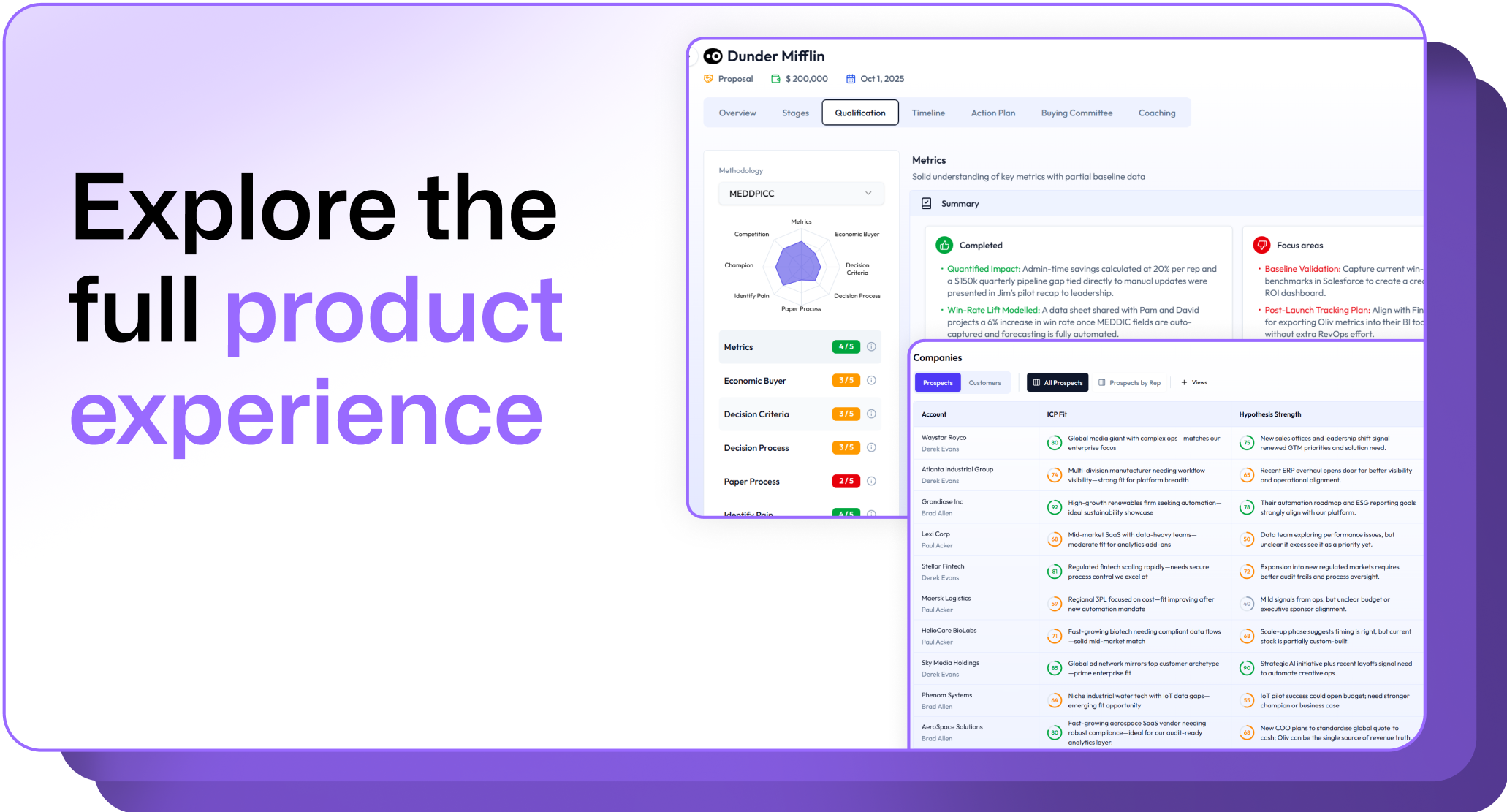
.avif)
.png)