Why Autonomous AI SDRs Burn Your TAM (And What Human-in-the-Loop Agents Do Differently)
Written by
Ishan Chhabra
Last Updated :
September 24, 2026
Skim in :
13
mins
In this article
Still got questions?
Come discuss this article with me.
Hi, I'm Ishan, Founder and CEO of Oliv.
I'm always up for a conversation about revenue intelligence, AI agents, or what's actually working (and what's not) across revenue teams.
I'd love to hear your perspective.
Thank you! Your submission has been received!
Oops! Something went wrong while submitting the form.
Meet Oliv’s AI Agents
Hi! I’m, Deal Driver
I track deals, flag risks, send weekly pipeline updates and give sales managers full visibility into deal progress
Hi! I’m, CRM Manager
I maintain CRM hygiene by updating core, custom and qualification fields all without your team lifting a finger
Hi! I’m, Forecaster
I build accurate forecasts based on real deal movement and tell you which deals to pull in to hit your number
Hi! I’m, Coach
I believe performance fuels revenue. I spot skill gaps, score calls and build coaching plans to help every rep level up
Hi! I’m, Prospector
I dig into target accounts to surface the right contacts, tailor and time outreach so you always strike when it counts
Hi! I’m, Pipeline tracker
I call reps to get deal updates, and deliver a real-time, CRM-synced roll-up view of deal progress
Hi! I’m, Analyst
I answer complex pipeline questions, uncover deal patterns, and build reports that guide strategic decisions
TL;DR
Autonomous outbound optimises volume of sends, a metric you do not own, against deliverability and account receptivity costs that surface months later.
TAM burn is the permanent depletion of your addressable market. Burn rate equals addressable accounts divided by accounts touched monthly, adjusted for suppression.
Aggregated 2026 sender data reports 47% of AI SDR deployments hitting a reputation wall within 90 days, with recovery slower on Microsoft 365 than Google Workspace.
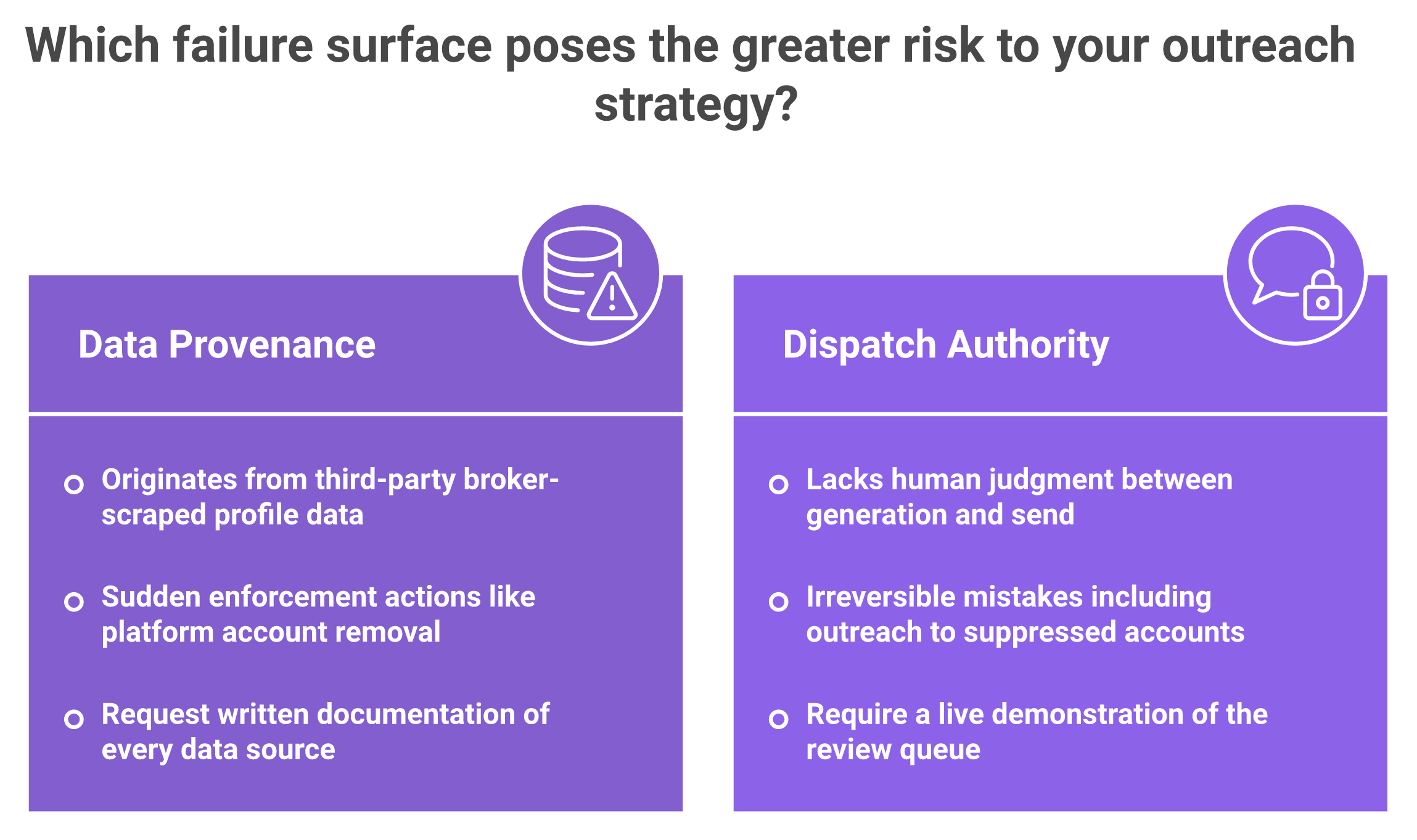
Artisan's LinkedIn removal and 11x's disputed customer claims point to two failure surfaces: unaudited data provenance and unsupervised dispatch authority.
The decision rule is one question. What is the last step before send, and does it have judgement? Automate research and drafting, keep humans on dispatch.
Autonomous outbound can still be net positive with a large untouched TAM, enforced suppression, and a low-stakes brand. Named-account teams rarely qualify.
Q1. Your AI SDR pilot booked meetings. Why is that not the number that matters? [toc=1. The Pilot That Looked Fine]
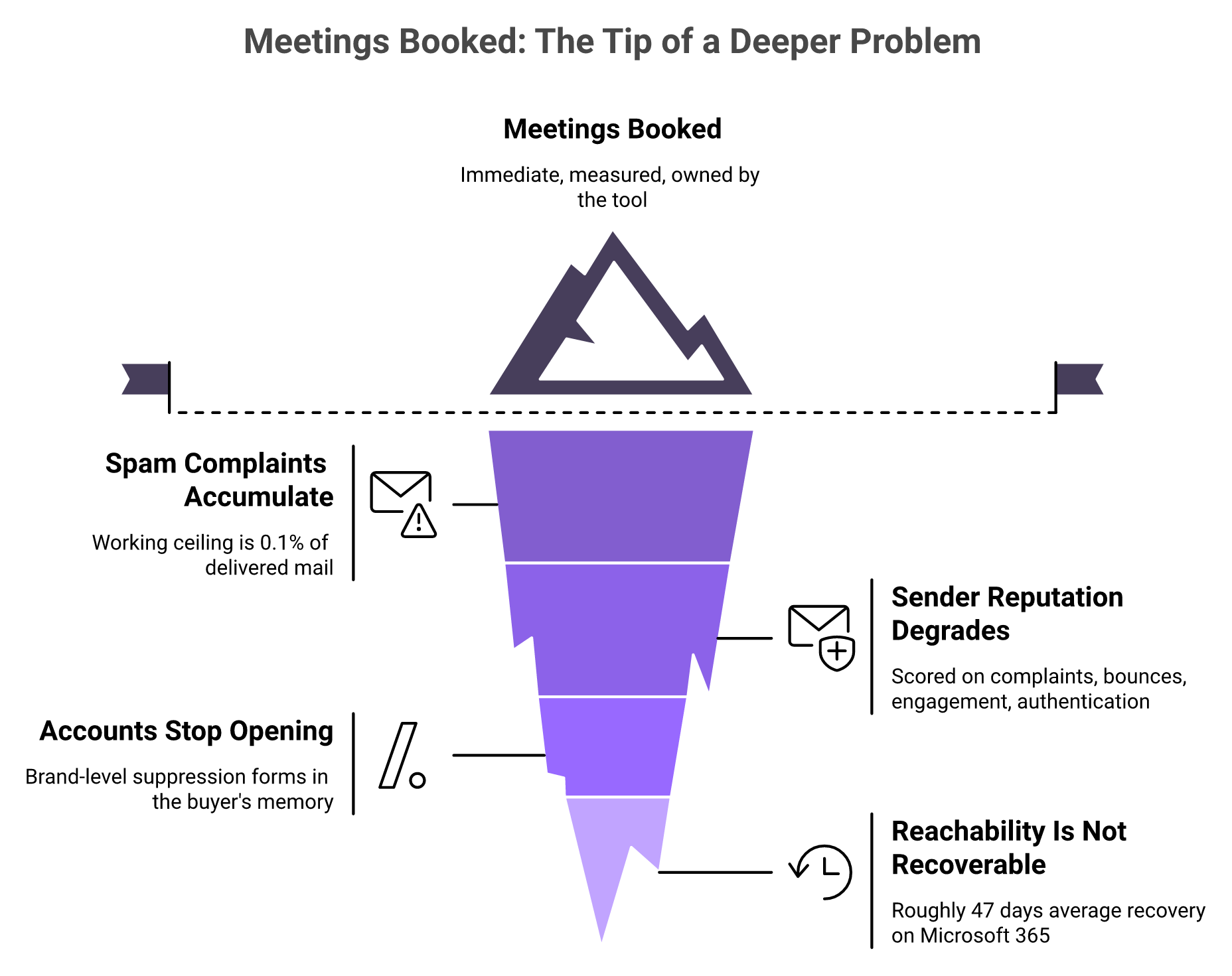
Because meetings booked is immediate and measured, while the cost of the sends behind them is deferred and shared. Inbox placement, brand receptivity, and the next rep's ability to reach that account degrade slowly, and they land on marketing rather than on the tool's dashboard. Aggregated sender data compiled by Digital Applied (April 2026) reports 47% of AI SDR deployments hitting a domain reputation wall inside 90 days. A pilot that looks good at day 90 is not evidence about month twelve.
⭐ The scene I keep walking into
A VP Sales shows me a pilot dashboard. Forty-one meetings in six weeks, cost per meeting down by half.
Then the AEs talk. The complaint is never "the meetings were fake." It is quieter than that, and worse: the prospect had no idea why they were on the call.
❌ Why the scoreboard cannot see the damage
Outbound has three owners and one scoreboard. The tool owns volume, marketing owns the sending domain, and the next AE owns the account after it has been touched badly.
Only the first of those three gets a number. So the benefit arrives this week and the cost arrives next year, which means the incentives inside the tool point the wrong way. This is the same structural problem that shows up across sales process automation projects, where the measured step and the costly step sit in different teams.
⚠️ The deferred cost, stated plainly
The pilot dashboard reports the tip. Complaints, sender reputation, and account receptivity are the submerged mass that decides month twelve.
A spam complaint is not an event. It is a small, permanent adjustment to how every future message from your domain gets treated.
That adjustment compounds. Digital Applied's 2026 compilation puts recovery after a spam trap hit at 47 days on Microsoft 365 and 21 days on Google Workspace. I want to be honest about that source, because it aggregates vendor sender data rather than a peer reviewed study, so read the direction and not the decimals.
✅ What operators say when the volume tool is the whole system
"Salesloft helps organize outreach at scale and keeps follow-ups from falling through the cracks. While I'm fairly neutral overall, it does help bring structure to sales activity, especially when managing a high volume of outreach." — Verified user, Sales Professional, Salesloft - G2 Verified Review, 2.5 stars, 22 Jul 2025
"Gong Engage is awful in every single way compared to outreach. Flows are hard to get into, information is not readily available, sequencing is difficult to create and track, nothing is robust or scalable." — Verified user, Sales Professional, Gong - G2 Verified Review, 1.5 stars, 9 Jun 2025
Both reviews describe structure and throughput. Neither reviewer mentions whether the throughput was welcome at the other end, which is the gap this whole article sits in. If you are weighing that module specifically, our breakdown of what Gong Engage actually does covers the mechanics.
💰 My conflict, priced, before you ask
Oliv AI sells outbound tooling. Engage starts at $29 per user per month, LinkedIn automation is included, the dialer adds $10, messaging channels add $10 each, and extra mailboxes are $5. So this article costs us something to publish, and the same risk applies to our own users: anything Oliv AI drafts can still be sent badly if nobody reads it first. We are not arguing for less automation. We are arguing about one specific step.
⏰ The question to take into your next vendor call
Ask this, and watch how long the answer takes: what is the last step before send, and who owns it? If the answer is "the agent," you are buying volume and renting your reputation to it.
Q2. What is TAM burn, and why can't you undo it? [toc=2. What TAM Burn Is]
TAM burn is the permanent depletion of your total addressable market caused by high volume, low relevance outbound. Each irrelevant send raises spam complaints, damages sender reputation, and trains accounts to ignore your brand, so those companies become unreachable even when your targeting later improves. Burn rate is simple arithmetic: addressable accounts divided by accounts touched per month, adjusted for suppression. It is the number nobody's dashboard reports.
⭐ The arithmetic, on the back of one napkin
Take a mid market team with 8,000 addressable accounts. That is the real universe, not the 2 million rows an enrichment tool will sell you.
An autonomous agent working 3,000 contacts a month across roughly 1,200 accounts clears that universe in under seven months. Reply rates in 2026 sit in the low single digits, with Mailshake's State of Cold Email putting typical performance at a few percent. So you convert a small slice, and the rest of the list is now a list that has heard from you.
💸 Burn rate worked example
TAM Burn Rate Worked Example, Mid Market Team
Input
Value
Addressable accounts
8,000
Accounts touched per month
1,200
Months to full coverage
6.7
Accounts converted at 3%
240
Accounts touched and unconverted
7,760
The last row is the number that matters, and it is the one no vendor report puts on a slide.
❌ Two kinds of burn, and only one recovers
Operators conflate two failures that behave completely differently.
Domain burn. Your mail stops reaching inboxes. Painful, measurable, and fixable in weeks with new domains, warm up, and discipline.
Account burn. The buying committee has already decided your brand sends noise. No new domain fixes that, because the memory sits with the person, not the mail server.
I think the second is where the real money goes, though I hold that view a little loosely, because account level receptivity is genuinely hard to measure and I have never seen a clean dataset on it.
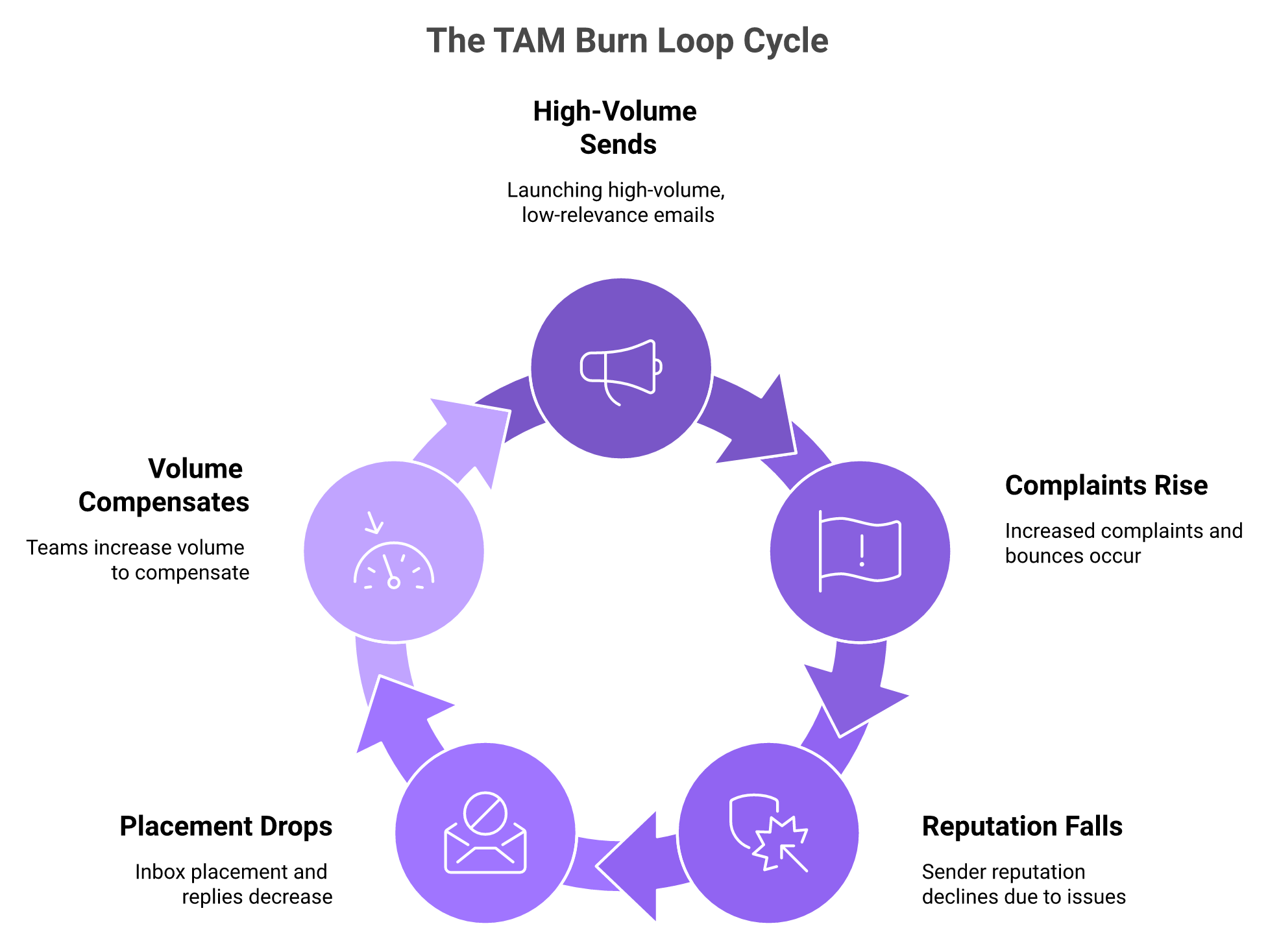
TAM burn is self-reinforcing. Each turn of the loop makes the next send less likely to land and the account less likely to care.
⚠️ Why suppression is the actual control
Autobound's 2026 benchmark work, drawn from more than 10 million B2B emails, treats complaint rates above 0.1% as a problem and bounces above 5% as a targeting failure rather than a technical one. Both of those thresholds are really statements about list selection.
So suppression is not a hygiene setting. It is the only lever that slows burn without slowing the team, and it depends entirely on CRM data quality automation that actually reflects live account state.
✅ Three suppression rules worth enforcing on Monday
Suppress every existing customer, checked against the CRM at send time rather than at list build time.
Suppress every open opportunity, including ones opened this week.
Suppress any account contacted in the last 90 days, at account level and not just at contact level.
Rule one catches the mistake I see most often. A list built on Monday is already stale by Thursday, and the deal that opened on Tuesday still gets a cold email.
📊 Where reporting quietly decides behaviour
Oliv AI reports on conversation and deal outcomes rather than on send volume, which is a narrower claim than it sounds. It means the dashboard cannot flatter a programme that is quietly spending its list, because volume is not one of the numbers it celebrates. That is a design choice about what gets optimised, and in outbound the thing you display is the thing your team will chase. If you want the longer version of that argument, it sits inside our work on AI deal intelligence.
Q3. Can AI outbound genuinely damage your sending domain, or is that scare talk? [toc=3. Domain Reputation Damage]
Yes, and unevenly. Aggregated sender data reported by Digital Applied (April 2026) shows AI SDR mail spam foldered at 18.7% in Microsoft 365 environments against 7.8% in Google Workspace, with post trap recovery averaging 47 days on Microsoft and 21 days on Google. That data is vendor aggregated rather than peer reviewed, so trust the direction and not the decimals. The mechanism itself is not disputed: complaints and bounces compound, and DMARC enforcement makes the damage slow to reverse.
⭐ How reputation actually gets scored
Mailbox providers do not score your copy. They score four behaviours.
Complaints. How often recipients mark you as spam.
Bounces. How much of your list does not exist, which reads as list quality.
Engagement. Opens, replies, and deletions without reading.
Authentication. Whether SPF, DKIM, and DMARC line up on every send.
An autonomous agent can improve none of these. It can only push more volume through whatever score you already have.
⚠️ The provider split nobody budgets for
Spam Placement and Recovery by Mailbox Provider, 2026
Environment
Spam placement
Recovery after a trap hit
Microsoft 365
18.7%
About 47 days
Google Workspace
7.8%
About 21 days
Figures from Digital Applied's 2026 compilation of aggregated Smartlead and Instantly sender data. This is a secondary synthesis, not a controlled study, and I would not build a board slide on the decimals.
The practical consequence is blunt. If your ICP is Microsoft heavy, which most enterprise and regulated segments are, your blended placement number is hiding your worst segment.
Thresholds are ratios, and ratios move fastest when the denominator is large and unexamined. Autobound's 2026 benchmarks put the working ceiling at 0.1% complaints.
At 500 sends a week, a bad segment produces a handful of complaints and someone notices. At 15,000 sends a week, the same segment crosses the threshold before the weekly review happens.
⏰ The first symptom, and it is not a bounce spike
Here is the thing I would have wanted someone to tell me earlier. The first sign is usually internal.
Your own colleagues start finding your sales domain's mail in Junk while your main domain lands fine. That is a reputation signal leaking sideways, and it shows up weeks before your reply rate visibly drops. Seed test into both Microsoft 365 and Google Workspace, because one number really does hide the other.
✅ What reviewers describe when metrics themselves go soft
"Analytics/metrics are faulty like email opens. Data updates like contact information sometimes does not update." — Verified user, Sales Professional, Salesloft - G2 Verified Review, 1.5 stars, 26 Mar 2025
"Integrating Salesloft came with a lot of challenges, and even now, it feels like the platform still has some kinks. I often have trouble logging meetings, and certain features feel clunky or overly manual." — Verified user, Sales Professional, Salesloft - G2 Verified Review, 2.5 stars, 22 Jul 2025
If open tracking is unreliable in your sending tool, you are flying on the one metric that degrades first. That is worth knowing before you hand the send button to an agent, and it is one reason sales call analytics and pipeline signals belong in the same evidence set as email metrics.
📁 The narrow claim we will actually defend
Oliv AI's Researcher produces its output inside your workspace, so nothing it generates touches a mailbox or a mail server. Research, briefing, and drafting change no sender reputation, because only dispatch does. That is a smaller claim than "safer AI outbound," and it is the only version of the claim I can prove. The same design principle runs through our AI meeting preparation tool, where the output is a brief rather than an action taken on the outside world.
Q4. What actually happened at Artisan and 11x, and what does the retention data show? [toc=4. Artisan and 11x Evidence]
LinkedIn removed Artisan's company page and employee profiles from roughly 19 December 2025 into early January 2026. CEO Jaspar Carmichael-Jack told TechCrunch (7 January 2026) that the objections were Artisan's use of LinkedIn's name and third party brokers that had scraped LinkedIn, not agent spam. TechCrunch separately reported (24 March 2025) that 11x had listed customers it did not have. Practitioner data cited through 2026 puts AI SDR tool churn at 50% to 70% annually against 5% to 10% for typical SaaS. The pattern is unaudited data provenance and unsupervised dispatch, not incapable technology.
⭐ The ban, and what it was not about
Plenty of commentary assumed LinkedIn banned Artisan for automated outreach. That is not what was reported.
Artisan was off the platform for about two weeks, was reinstated after working with LinkedIn, and the stated issues were trademark use and data obtained through brokers who had scraped profiles. Artisan relaunched later in 2026 with new self serve pricing. Describing a 2025 product in 2026 would simply be wrong.
⚠️ Why a vendor's own admission outranks anyone's opinion
In April 2025, Carmichael-Jack told TechCrunch that Artisan launched V0 in 2024 but that "the product barely worked," and described "extremely bad hallucinations" he cringes remembering. I have real respect for a founder saying that publicly.
It also settles an argument. When a platform enforces and a founder concedes, you no longer need a reviewer's opinion about output quality. That is the same evidence hierarchy we apply in our AI CRM trust and governance evaluation work.
❌ The retention number the comparison pages skip
Every AI SDR listicle prints G2 stars. None of them print retention, which is the only number that reveals whether the meetings kept coming.
Reported Retention and Churn Signals for AI SDR Platforms
Both companies have shipped heavily since these reports, and I would not treat any of it as a verdict on their current products.
✅ The pattern underneath both stories
Strip the vendor names away and the same two gaps remain. Both are procurement questions you can settle before a contract is signed.
Two failure surfaces, and neither is about model quality.
Provenance. Where the contact data came from, and whether that survives a platform's terms of service.
Dispatch authority. Whether anything with judgement stands between generation and send.
So platform risk is a procurement question, not a marketing one. Ask where the LinkedIn data comes from before you ask about reply rates, and get the answer in writing. Buyers running a formal evaluation will find the same questions in our mid market revenue AI buyer guide.
⏰ What this costs the reader who already bought one
If you are running one of these tools, nothing above says you were careless. The failures described are execution and incentive failures, and the category does genuinely produce meetings.
What it does say is that your renewal conversation needs two new questions: 90 day gross retention, and data source documentation.
📁 Our own record, stated without flattering it
Oliv AI has no comparable incident to point to, and also no comparable public track record: no G2, Capterra, or TrustRadius presence, and case studies sitting behind an email gate. On an article about fabricated social proof, that has to be said out loud rather than skipped. Our review vault holds no Artisan or 11x customer reviews either, so I am not going to quote any. The named references we will stand behind are Sprinto and Triple Whale, and Oliv AI publishes its security posture, including SOC 2 Type II, at trust.oliv.ai. If you want to see how those controls sit inside a working stack, start with AI agents for sales teams.
Q5. Outbound was always a volume game, isn't this just nostalgia for human-written email? [toc=5. The Volume Counter-Argument]
Half right. Human outbound was mostly templates, reply rates were always low, and pretending otherwise is nostalgia. But the distinction was never human prose versus machine prose. A human blasting a template still chose the list, still noticed the existing customer in row 40, and still stopped when something looked wrong. The real variable is whether anything with judgement sits between generation and send, which gives you one question to ask any vendor.
⭐ The objection, stated at full strength
A BDR leader pushed back on me hard last quarter, and she was right to.
Her argument went like this. Outbound has always been probabilistic. Reply rates have always been in the single digits, and Mailshake's 2026 cold email data still puts typical performance in that range. Her reps were sending four templates with three merge fields, so calling that "human written" is generous.
❌ Where our side of the argument is wrong
So let me concede the part that deserves conceding. The nostalgia version of this argument is false.
There was no golden age of handcrafted outbound. There were sequences, snippets, and a manager asking why activity was down. Anyone selling you "authentic human email" as the answer is selling you a memory that did not exist. Our own library of sales email templates exists precisely because templates were always the working unit.
✅ What the human was actually doing
Here is what the nostalgia framing gets wrong in the other direction. The human's contribution was never the prose. It was exclusion.
Think about the rep working a 500 row list on a Tuesday. She skips row 12 because that logo is already a customer. She skips row 40 because the company laid off half its team last week. She stops the whole sequence because three replies in a row said "wrong person."
None of that is writing. All of it is judgement, and judgement is a suppression function rather than a creative one.
⚠️ Judgement, defined so you can test for it
Judgement in outbound means four small decisions, made continuously:
Inclusion. Does this account belong on this list this week?
Exclusion. Is there a reason not to contact them at all?
Timing. Is something happening that makes this the wrong week?
Stopping. Do the last ten responses say keep going or stop?
An agent can be given rules for all four. What it cannot do is notice the thing no rule anticipated, which is exactly the situation that burns accounts. That gap is the practical limit of every AI sales workflow automation project I have reviewed.
⏰ The criterion this leaves you with
One question separates every AI SDR tool on the market. Everything else in a demo is downstream of who owns the send.
So the honest question is not human versus machine. It is structural, and it fits on one line.
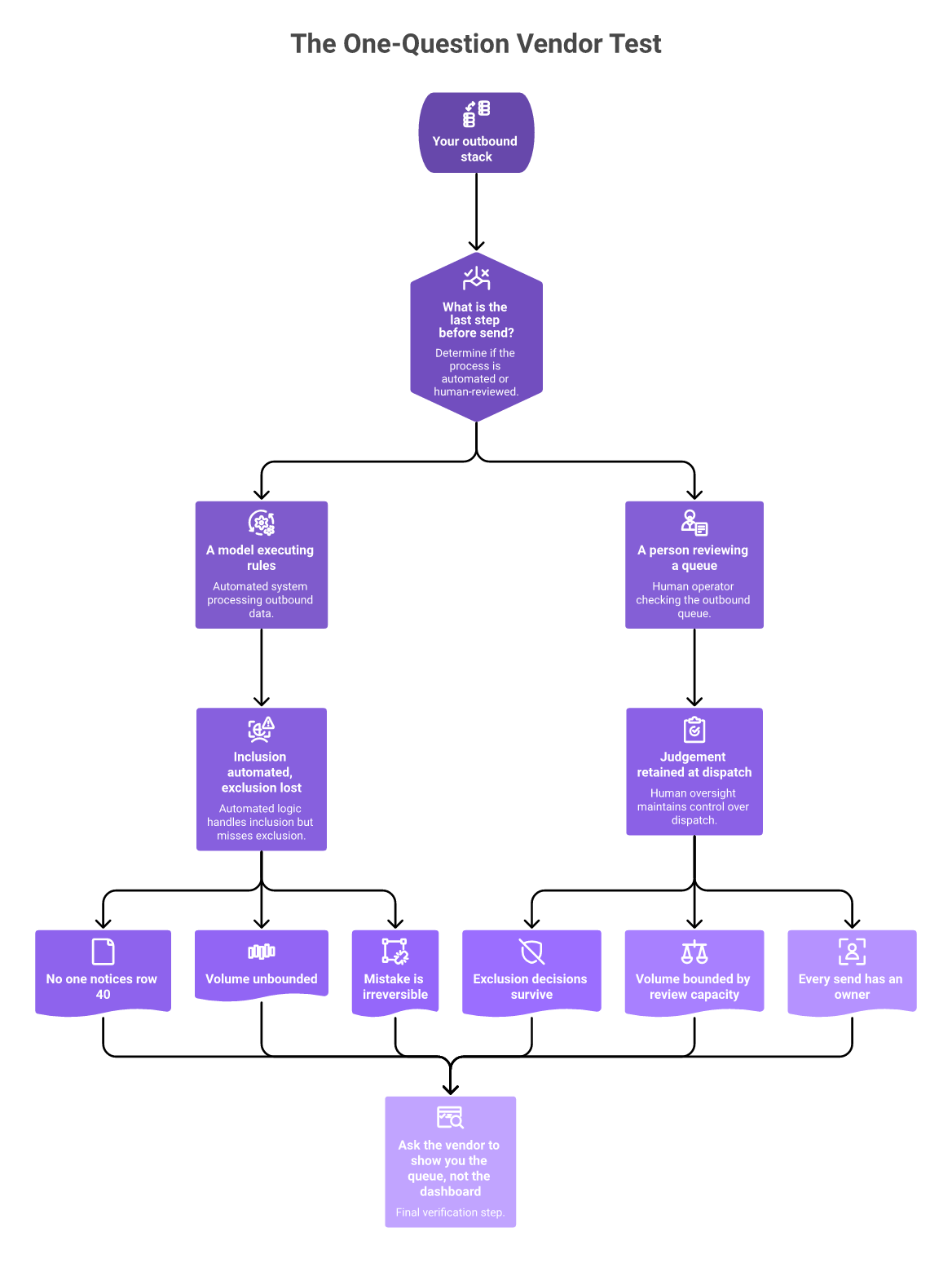
What is the last step before send, and does it have judgement?
That question cuts through every autonomy claim on every vendor site. If the last step is a model executing rules, you have automated inclusion and lost exclusion. If the last step is a person looking at a queue, you have kept the part that was always doing the real work.
I would rather a team send 300 emails a week with a person scanning the list than 3,000 with nobody. Not because humans write better copy. Because humans notice row 40.
Q6. If buyers prefer buying without reps, why does removing the human backfire? [toc=6. The Validation Paradox]
Because rep avoidance and rep dependence are different things. Gartner's March 2026 survey of 646 B2B buyers found 67% prefer a rep-free experience, up from 61%. Yet a separate Gartner survey of 645 buyers in May 2026 found 69% turn to a sales rep to validate AI-generated insights. LinkedIn's Trust Advantage research (2026) sharpens the gap: 86% say trust closes deals, and only 45% find sellers trustworthy. Buyers do not want to be sold to by a human. They want a human to verify what their own AI told them.
⭐ Two numbers that look like a contradiction
Put those Gartner findings side by side and they seem to cancel out. Two thirds want no rep. Almost seven in ten want a rep to check the AI's work.
Both are true, because they describe different moments. Buyers avoid reps during discovery, when a rep adds friction. They want a rep at the decision, when being wrong is expensive.
❌ The reading that produced this category
The popular reading was simpler, and I believed a version of it myself in 2023.
Buyers hate reps, so remove the rep from the top of the funnel. Automate outreach fully, let the agent qualify, and let humans handle only the closing. That logic is why "stop hiring humans" became a marketing line rather than an embarrassment.
The trouble is that it optimises for the moment buyers want less contact, and ignores the moment they want more. We unpacked the sober version of that trade-off in our piece on what AI agents can actually do for your team today.
✅ What actually changed, and what did not
The buyer now arrives with their own research. LinkedIn's data shows 94% of B2B buyers using AI across their decision process.
So the rep's job moved. It used to be informing. It is now verifying, which is harder, because the buyer already has an answer and wants to know where it is wrong. That shift is why sales discovery calls now open at a later point in the buyer's thinking than they did three years ago.
⚠️ Agent count is not agent value
This is where I think the category's own forecast should worry it. Gartner predicts AI agents will outnumber sellers tenfold by 2028, while fewer than 40% of sellers will say agents improved their productivity.
Read that sentence twice. The same prediction contains both the boom and the disappointment. More agents, not more help, which tells you the agents are being pointed at the wrong step.
📁 Preparation is what makes verification possible
A rep cannot verify what they have not read. That is the practical constraint nobody budgets for.
Oliv AI's Researcher delivers a three-bullet brief plus an icebreaker 30 minutes before a meeting, covering funding, market position, and recent news at account level, then LinkedIn history, role, and interests at contact level. We built it for this exact moment: the rep walks in able to check the buyer's assumptions rather than recite a pitch. Nothing in that workflow leaves the building, so it carries no send risk at all. The wider workflow sits inside our guide to meeting preparation for sales.
I hold one caveat here. Oliv AI's own read is that preparation quality drives validation credibility, though I have no controlled data separating that from rep skill, and I would not pretend otherwise.
Q7. Where does the autonomy spectrum actually break, and who owns the send? [toc=7. Autonomy Spectrum]
Four tiers, distinguished only by who owns dispatch: research agents that prepare and send nothing, drafting agents that write and queue, approval-gated agents that send after a named human signs off, and fully autonomous agents that select, write, and send unsupervised. Only the last carries irreversible risk. EU AI Act Article 50, enforceable since 2 August 2026, sharpens this. AI systems must disclose their artificial nature and the party they act for, with penalties reaching EUR 15 million or 3% of turnover.
⭐ The spectrum, sorted by send control
Vendor comparison pages sort tools by "autonomy level," as if autonomy were a feature grade. Sort by dispatch ownership instead and the risk becomes obvious.
Agent Tiers Sorted by Who Owns the Send
Tier
Who sends
Reversible?
Article 50 exposure
TAM impact
Research agent
Nobody, output stays internal
Fully
None
Zero
Drafting agent
Human, from a queue
Fully
Low, human authored send
Bounded by rep capacity
Approval-gated agent
Human, per batch
Mostly
Low if review is substantive
Bounded by review quality
Autonomous agent
The agent
No
Direct, disclosure duty applies
Unbounded
Oliv AI sits in the first two rows by design, with Researcher preparing and Prospector drafting for a rep to dispatch. That is a slower position in the market and an easier one to defend on compliance, and we would rather defend the second. The same tiering logic runs through how we describe AI sales agents generally.
❌ Why buyers conflate the tiers
Everything in this market is sold as an "agent," which flattens a real distinction.
A research agent and an autonomous sender share a label and share almost nothing else. One produces a document. The other produces a permanent record in a stranger's inbox, and only one of those is undoable.
✅ The regulation now rewards the gate
Here is the part the comparison pages skip entirely. Not one of the top ranking AI SDR listicles mentions Article 50, despite it being enforceable since August 2026.
The European Commission's July 2026 guidelines confirm agents fall inside Article 50 when they interact with people while carrying out tasks. Analysis of the guidelines notes that one-to-one sales email which undergoes substantive human review, with editorial accountability, sits outside the public interest labelling duty.
⚠️ Read that as a design instruction
So the human gate stopped being a speed tax. It became a documented compliance posture.
If a named person reviews and sends, you have editorial accountability and an audit trail. If an agent sends unattended into the EU, you have a disclosure obligation and a logging problem you probably have not scoped. Teams building that logging layer will recognise the questions from our agentic AI implementation and data architecture guide.
📁 The line we hold, in both directions
The reconciling principle Oliv AI applies across every agent is simple to state. Background agents prepare work for sign-off, and they do not act on the outside world unattended.
Anything that leaves the company needs a human. That rule costs us the ability to advertise full autonomy, and I am comfortable with the trade, because I have not yet seen a suppression ruleset I would trust at 15,000 sends a week without someone watching it.
⏰ Take one question into the demo
Ask the vendor to show you the queue. Not the dashboard, the queue.
If there is no screen where a person reviews before dispatch, the answer to "who owns the send" is the agent, and you are the one carrying the consequence.
Q8. What does an AI SDR stack really cost once you add credits, mailboxes, and recovery? [toc=8. Real Cost and TCO]
Public 2026 pricing spans roughly $30 to $50 per month for email copilots up to $30,000 to $60,000 per year for autonomous platforms, with most mid-tier tools landing in the low hundreds monthly plus per-credit usage. Three costs sit outside the quote: mailbox and domain infrastructure, enrichment credits, and remediation if inbox placement collapses. For comparison and disclosure, Oliv AI publishes Amplify at $0, Converse at $19, Sell at $49, and Grow at $79 per user per month, Engage from $29, agent actions at $0.01 per credit, with the dialer and messaging channels at $10 each.
💰 The published bands, as they actually appear
Published AI SDR Pricing Bands, 2026
Band
Typical published price
What triggers overage
Email copilot
$30 to $50 per user monthly
Send volume, mailbox count
Mid-tier AI SDR
Low hundreds monthly
Enrichment credits, verified contacts
Autonomous platform
$30,000 to $60,000 annually
Contacts sourced, seats, channels
Oliv AI
$0 to $79 per user monthly, Engage from $29
Agent actions at $0.01 per credit, channel add-ons at $10
Figures for the first three bands come from published 2026 comparison tables at Miniloop (1 April 2026) and Salesmotion (12 June 2026). Several autonomous vendors publish no list price at all, which is itself a data point for your procurement file.
💸 The three line items finance never sees in the quote
Mailbox and domain sprawl. Twelve inboxes across four domains, each needing warm up, monitoring, and its own reputation.
Enrichment credits. Contact data is metered, and autonomous tools consume it fastest because they never stop prospecting.
The one that surprises finance is never the seat cost. It is mailbox sprawl, because it arrives as infrastructure rather than as software.
⚠️ Price the downside, not just the subscription
Forty-seven days of degraded placement is not a software cost. It is a quarter of pipeline coverage moving sideways while nobody can explain the dip.
So put a number on it before you sign. If outbound sources 30% of your pipeline, model what six weeks of impaired delivery does to next quarter's coverage ratio. That figure belongs in the business case beside the licence fee, alongside the modelling in our revenue intelligence ROI calculator.
❌ Where the stack math quietly breaks
I will say the unpopular part. The "just buy Gong, Clari, and Salesloft" answer drags total cost past $500 per user per month for a 25 to 200 rep team, before a single agent does any work. We broke that arithmetic down in detail in our analysis of revenue tech stack consolidation costs.
That is the pattern Oliv AI was priced against: the app layer should not consume the budget that was supposed to fund the agents. Our ladder is published rather than quoted, which you can check at Oliv AI pricing.
✅ Disclosure, since this article criticises our own category
Oliv AI sells outbound. Engage starts at $29 per user per month, and agent actions bill at $0.01 per credit, so a team running heavy volume pays more as usage grows. I am naming our numbers inside an argument against part of the category we sell into, because a pricing comparison written by a vendor that hides its own price is not worth reading. Judge the position on whether the line holds, not on whether we benefit from it. If cost is the binding constraint, start with our guide to reducing sales tech stack costs.
Q9. What should you automate in outbound, and what should you never hand over? [toc=9. What To Automate Instead]
Automate everything that does not touch a prospect: signal monitoring, account and contact research, brief generation, first-draft copy, CRM hygiene, and follow-up drafting. Keep humans on list selection and dispatch, because those are the two steps whose mistakes are irreversible and shared. Oliv AI applies this split, with Researcher preparing and Prospector drafting for rep review before dispatch. Buyers should ask us the same thing we tell them to ask everyone: is that review enforced in the product, or is it the recommended workflow? On current public documentation, we can only claim the latter.
⭐ The line, drawn across the actual workflow
Outbound Steps Safe to Automate Versus Steps That Need a Human
Automate this
Keep a human on this
Signal monitoring and trigger detection
List selection each week
Account and contact research
Final exclusion decisions
Pre-meeting brief generation
Dispatch, per batch or per message
First-draft copy and follow-ups
Stopping a sequence mid-flight
CRM field updates and logging
Deciding what "working" means this month
Everything in the left column produces a document. Everything in the right column produces a consequence in someone else's inbox, and that is the only distinction that matters. The left column is the same territory covered by agentic sales automation.
❌ Why teams automate the wrong half
Dispatch feels like the bottleneck, so dispatch gets automated first. That is the mistake, and it is completely understandable.
A manager looking at rep activity sees sends per day and concludes the sending is slow. What is actually slow is the research nobody has time for, which is why the sends are bad in the first place. Fixing that order of operations is what our sales productivity metrics guide is really about.
✅ What genuinely got good, and what did not
Research and drafting improved enormously between 2024 and 2026. A model can now read a funding announcement, a job posting, and a LinkedIn history, then produce a usable first draft in seconds.
Dispatch judgement did not improve at the same rate. Deciding not to send still requires knowing something the data does not contain, like the fact that this buyer just inherited a mess and has no budget until April. That is the practical boundary of generative AI in sales as it stands today.
⚠️ What reviewers say about tools that surface work instead of doing it
"I found the AI tracker setup to be quite difficult, especially concerning the user interface when setting up keywords or smart trackers. Moreover, I cannot download all the data myself unless we upgrade the plan, which isn't ideal and results in me not fully utilizing Gong." — Verified user, Sales Professional, Gong - G2 Verified Review, 3 stars, 3 Oct 2025
"It allows you to sequence emails, which is table stakes at this point." — Verified user, Sales Professional, Salesloft - G2 Verified Review, 2 stars, 24 Sep 2025
Both reviews describe the same gap from different ends. One tool surfaces information and leaves the configuration work to the user. The other moves mail and calls that a feature. Neither is doing the preparation the rep actually needs, which is the pattern we documented across Gong's limitations and challenges.
📁 Our split, and the part we will not overclaim
Oliv AI runs Researcher for preparation and Prospector for drafting, with a rep on dispatch, documented across Oliv AI for sales development and the Prospector agent. We will not overclaim the second half. Whether review before send is enforced in the product or recommended as workflow is exactly the distinction this article argues matters, so force us to answer it in writing, alongside every other vendor you are evaluating.
⏰ One thing this is not
None of this is an argument for fewer BDRs. I have never seen an outbound problem solved by removing the person who understood the accounts.
Q10. How do you pilot AI outbound and measure it without burning the domain? [toc=10. Pilot and Measure Safely]
Contain the blast radius, then instrument it. Use a separate sending domain and never your primary, cap per-mailbox volume through a four-week warm-up, hard-suppress customers, open opportunities, and anyone touched in 90 days, checked against the CRM at send time, and auto-pause at 0.3% complaints or 5% bounces. Then track four things instead of reply rate: inbox placement by provider, complaint rate against a 0.1% ceiling, reply sentiment split rather than counted, and TAM coverage burn. Log who reviewed each EU-bound message.
⭐ The eight-step containment sequence
Register a separate sending domain for the pilot, distinct from your primary corporate domain.
Configure SPF, DKIM, and DMARC on it before the first send, since DMARC is the policy that tells receivers what to do with unauthenticated mail.
Warm up each mailbox across four weeks, starting low and increasing gradually.
Cap daily sends per mailbox rather than per campaign.
Suppress at send time against the CRM, not at list-build time.
Suppression built at list-build time is already stale by the middle of the week. A deal that opened on Tuesday still gets a cold email on Thursday.
So the suppression check has to run at send time, querying live CRM state. That is an integration requirement, not a settings toggle, and it is worth asking a vendor to demo it. Teams scoping that plumbing should start with revenue intelligence integration across CRM, Slack, and email.
📊 The four metrics that replace reply rate
Four Outbound Quality Metrics That Replace Reply Rate
Metric
How to define it
Threshold
Who owns it
Inbox placement
Seed-test results, split by provider
Investigate below 85%
Marketing ops
Complaint rate
Spam reports divided by delivered
Ceiling of 0.1%
Marketing ops
Reply sentiment
Replies split into positive, neutral, hostile
Hostile trending up is a stop signal
Sales manager
TAM coverage burn
Accounts touched divided by addressable
Report monthly, always
RevOps
Reply rate conflates being read with being welcome. These four separate the two, which is the whole point, and they belong in the same reporting pack as the rest of your revenue performance analytics.
⏰ If placement has already dropped
Recovery is slow and provider dependent. Digital Applied's 2026 compilation puts average recovery after a spam trap hit at about 47 days on Microsoft 365 and 21 days on Google Workspace.
The sequence is unglamorous. Stop sending from the affected domain, fix authentication, rebuild the list with verified contacts only, and restart warm-up from zero. Treat the old domain as retired for a quarter.
✅ What to fix before you blame the tool
Half the pilots I have reviewed had a copy problem rather than a technology problem. Before buying anything, read your own last five sequences as a prospect would.
Oliv AI gives customers the same containment sequence, with drafting automated and the send queued for a rep to release. That ordering removes the need for most of these guardrails rather than tuning them, because volume stays bounded by human review capacity. It is a slower ceiling, and I think it is the right ceiling for most teams, though a very disciplined team may reasonably disagree.
Q11. When is fully autonomous outbound actually the right call? [toc=11. When Autonomous Works]
When three conditions hold together: a large untouched addressable market, a genuinely disciplined list with enforced suppression, and a brand with little to lose from a mediocre first impression. Early-stage teams selling wide into low-consideration markets often qualify. Teams with a named-account motion, a long sales cycle, or a brand buyers already recognise almost never do, because the cost of a bad first touch on a target account exceeds anything volume recovers.
⭐ The category does work, and pretending otherwise is not credible
AI SDR tools book meetings. I have seen pipeline that would not exist without them.
Published review distributions show the split honestly. Artisan carries a 3.9 out of 5 average on G2, with reviews ranging from strong results to campaigns that produced almost nothing. That is not a broken product. That is a product whose outcome depends heavily on who is running it.
✅ The three conditions, stated plainly
Large untouched TAM. You have tens of thousands of genuinely addressable accounts and have contacted almost none of them.
Disciplined list. Suppression is enforced in the system, not remembered by a person.
Low-stakes brand. A forgettable first email costs you nothing you cannot re-earn.
Meet all three, and autonomous outbound may well be net positive for you today. Miss any one of them, and the arithmetic in this article applies. Teams in the first camp will get more from our roundup of sales automation tools than from this argument.
❌ Why the asymmetry flips for everyone else
Run a named-account motion and the maths inverts. You have 300 target accounts, a nine-month cycle, and a buying committee that talks to each other.
One badly aimed email does not cost you one contact. It costs you the account's willingness to open the next three, and there is no volume that recovers a relationship you spent two years building. That is the same compounding logic behind deal slippage prevention.
⚠️ What operators actually report from the volume tools
"Being able to sequence our steps, along with integration with Nooks/Salesforce. Helping us keeping prospects warm." — Verified user, Sales Professional, Gong - G2 Verified Review, 3 stars, 21 May 2026
"Setting up sales sequences was incredibly cumbersome and time-consuming, making it a frustrating experience. Furthermore, creating and customizing email templates proved to be a real nightmare." — Verified user, Sales Professional, Salesloft - G2 Verified Review, 1.5 stars, 7 Sep 2025
Same category, opposite experiences. The variable is rarely the software, and that cuts both for and against my argument.
📁 Where we sit, and where we do not
Oliv AI is not the right tool for a team that wants nobody in the loop, and I would rather say that here than sell against it. We are also honest about who we are not for: call-recording-only buyers, B2C support teams, and anyone who wants an agent to own the send button.
Draw the line through your own stack. Research and drafting on the automated side, list selection and dispatch on the human side. Then take one question into every vendor call: what is the last step before send, and who owns it? If you want to see what prepare-then-approve looks like in a live pipeline, book a demo and bring your hardest account list, or read how the pieces fit together in Oliv AI agents for sales teams.
Q1. Your AI SDR pilot booked meetings. Why is that not the number that matters? [toc=1. The Pilot That Looked Fine]
Because meetings booked is immediate and measured, while the cost of the sends behind them is deferred and shared. Inbox placement, brand receptivity, and the next rep's ability to reach that account degrade slowly, and they land on marketing rather than on the tool's dashboard. Aggregated sender data compiled by Digital Applied (April 2026) reports 47% of AI SDR deployments hitting a domain reputation wall inside 90 days. A pilot that looks good at day 90 is not evidence about month twelve.
⭐ The scene I keep walking into
A VP Sales shows me a pilot dashboard. Forty-one meetings in six weeks, cost per meeting down by half.
Then the AEs talk. The complaint is never "the meetings were fake." It is quieter than that, and worse: the prospect had no idea why they were on the call.
❌ Why the scoreboard cannot see the damage
Outbound has three owners and one scoreboard. The tool owns volume, marketing owns the sending domain, and the next AE owns the account after it has been touched badly.
Only the first of those three gets a number. So the benefit arrives this week and the cost arrives next year, which means the incentives inside the tool point the wrong way. This is the same structural problem that shows up across sales process automation projects, where the measured step and the costly step sit in different teams.
⚠️ The deferred cost, stated plainly
The pilot dashboard reports the tip. Complaints, sender reputation, and account receptivity are the submerged mass that decides month twelve.
A spam complaint is not an event. It is a small, permanent adjustment to how every future message from your domain gets treated.
That adjustment compounds. Digital Applied's 2026 compilation puts recovery after a spam trap hit at 47 days on Microsoft 365 and 21 days on Google Workspace. I want to be honest about that source, because it aggregates vendor sender data rather than a peer reviewed study, so read the direction and not the decimals.
✅ What operators say when the volume tool is the whole system
"Salesloft helps organize outreach at scale and keeps follow-ups from falling through the cracks. While I'm fairly neutral overall, it does help bring structure to sales activity, especially when managing a high volume of outreach." — Verified user, Sales Professional, Salesloft - G2 Verified Review, 2.5 stars, 22 Jul 2025
"Gong Engage is awful in every single way compared to outreach. Flows are hard to get into, information is not readily available, sequencing is difficult to create and track, nothing is robust or scalable." — Verified user, Sales Professional, Gong - G2 Verified Review, 1.5 stars, 9 Jun 2025
Both reviews describe structure and throughput. Neither reviewer mentions whether the throughput was welcome at the other end, which is the gap this whole article sits in. If you are weighing that module specifically, our breakdown of what Gong Engage actually does covers the mechanics.
💰 My conflict, priced, before you ask
Oliv AI sells outbound tooling. Engage starts at $29 per user per month, LinkedIn automation is included, the dialer adds $10, messaging channels add $10 each, and extra mailboxes are $5. So this article costs us something to publish, and the same risk applies to our own users: anything Oliv AI drafts can still be sent badly if nobody reads it first. We are not arguing for less automation. We are arguing about one specific step.
⏰ The question to take into your next vendor call
Ask this, and watch how long the answer takes: what is the last step before send, and who owns it? If the answer is "the agent," you are buying volume and renting your reputation to it.
Q2. What is TAM burn, and why can't you undo it? [toc=2. What TAM Burn Is]
TAM burn is the permanent depletion of your total addressable market caused by high volume, low relevance outbound. Each irrelevant send raises spam complaints, damages sender reputation, and trains accounts to ignore your brand, so those companies become unreachable even when your targeting later improves. Burn rate is simple arithmetic: addressable accounts divided by accounts touched per month, adjusted for suppression. It is the number nobody's dashboard reports.
⭐ The arithmetic, on the back of one napkin
Take a mid market team with 8,000 addressable accounts. That is the real universe, not the 2 million rows an enrichment tool will sell you.
An autonomous agent working 3,000 contacts a month across roughly 1,200 accounts clears that universe in under seven months. Reply rates in 2026 sit in the low single digits, with Mailshake's State of Cold Email putting typical performance at a few percent. So you convert a small slice, and the rest of the list is now a list that has heard from you.
💸 Burn rate worked example
TAM Burn Rate Worked Example, Mid Market Team
Input
Value
Addressable accounts
8,000
Accounts touched per month
1,200
Months to full coverage
6.7
Accounts converted at 3%
240
Accounts touched and unconverted
7,760
The last row is the number that matters, and it is the one no vendor report puts on a slide.
❌ Two kinds of burn, and only one recovers
Operators conflate two failures that behave completely differently.
Domain burn. Your mail stops reaching inboxes. Painful, measurable, and fixable in weeks with new domains, warm up, and discipline.
Account burn. The buying committee has already decided your brand sends noise. No new domain fixes that, because the memory sits with the person, not the mail server.
I think the second is where the real money goes, though I hold that view a little loosely, because account level receptivity is genuinely hard to measure and I have never seen a clean dataset on it.
TAM burn is self-reinforcing. Each turn of the loop makes the next send less likely to land and the account less likely to care.
⚠️ Why suppression is the actual control
Autobound's 2026 benchmark work, drawn from more than 10 million B2B emails, treats complaint rates above 0.1% as a problem and bounces above 5% as a targeting failure rather than a technical one. Both of those thresholds are really statements about list selection.
So suppression is not a hygiene setting. It is the only lever that slows burn without slowing the team, and it depends entirely on CRM data quality automation that actually reflects live account state.
✅ Three suppression rules worth enforcing on Monday
Suppress every existing customer, checked against the CRM at send time rather than at list build time.
Suppress every open opportunity, including ones opened this week.
Suppress any account contacted in the last 90 days, at account level and not just at contact level.
Rule one catches the mistake I see most often. A list built on Monday is already stale by Thursday, and the deal that opened on Tuesday still gets a cold email.
📊 Where reporting quietly decides behaviour
Oliv AI reports on conversation and deal outcomes rather than on send volume, which is a narrower claim than it sounds. It means the dashboard cannot flatter a programme that is quietly spending its list, because volume is not one of the numbers it celebrates. That is a design choice about what gets optimised, and in outbound the thing you display is the thing your team will chase. If you want the longer version of that argument, it sits inside our work on AI deal intelligence.
Q3. Can AI outbound genuinely damage your sending domain, or is that scare talk? [toc=3. Domain Reputation Damage]
Yes, and unevenly. Aggregated sender data reported by Digital Applied (April 2026) shows AI SDR mail spam foldered at 18.7% in Microsoft 365 environments against 7.8% in Google Workspace, with post trap recovery averaging 47 days on Microsoft and 21 days on Google. That data is vendor aggregated rather than peer reviewed, so trust the direction and not the decimals. The mechanism itself is not disputed: complaints and bounces compound, and DMARC enforcement makes the damage slow to reverse.
⭐ How reputation actually gets scored
Mailbox providers do not score your copy. They score four behaviours.
Complaints. How often recipients mark you as spam.
Bounces. How much of your list does not exist, which reads as list quality.
Engagement. Opens, replies, and deletions without reading.
Authentication. Whether SPF, DKIM, and DMARC line up on every send.
An autonomous agent can improve none of these. It can only push more volume through whatever score you already have.
⚠️ The provider split nobody budgets for
Spam Placement and Recovery by Mailbox Provider, 2026
Environment
Spam placement
Recovery after a trap hit
Microsoft 365
18.7%
About 47 days
Google Workspace
7.8%
About 21 days
Figures from Digital Applied's 2026 compilation of aggregated Smartlead and Instantly sender data. This is a secondary synthesis, not a controlled study, and I would not build a board slide on the decimals.
The practical consequence is blunt. If your ICP is Microsoft heavy, which most enterprise and regulated segments are, your blended placement number is hiding your worst segment.
Thresholds are ratios, and ratios move fastest when the denominator is large and unexamined. Autobound's 2026 benchmarks put the working ceiling at 0.1% complaints.
At 500 sends a week, a bad segment produces a handful of complaints and someone notices. At 15,000 sends a week, the same segment crosses the threshold before the weekly review happens.
⏰ The first symptom, and it is not a bounce spike
Here is the thing I would have wanted someone to tell me earlier. The first sign is usually internal.
Your own colleagues start finding your sales domain's mail in Junk while your main domain lands fine. That is a reputation signal leaking sideways, and it shows up weeks before your reply rate visibly drops. Seed test into both Microsoft 365 and Google Workspace, because one number really does hide the other.
✅ What reviewers describe when metrics themselves go soft
"Analytics/metrics are faulty like email opens. Data updates like contact information sometimes does not update." — Verified user, Sales Professional, Salesloft - G2 Verified Review, 1.5 stars, 26 Mar 2025
"Integrating Salesloft came with a lot of challenges, and even now, it feels like the platform still has some kinks. I often have trouble logging meetings, and certain features feel clunky or overly manual." — Verified user, Sales Professional, Salesloft - G2 Verified Review, 2.5 stars, 22 Jul 2025
If open tracking is unreliable in your sending tool, you are flying on the one metric that degrades first. That is worth knowing before you hand the send button to an agent, and it is one reason sales call analytics and pipeline signals belong in the same evidence set as email metrics.
📁 The narrow claim we will actually defend
Oliv AI's Researcher produces its output inside your workspace, so nothing it generates touches a mailbox or a mail server. Research, briefing, and drafting change no sender reputation, because only dispatch does. That is a smaller claim than "safer AI outbound," and it is the only version of the claim I can prove. The same design principle runs through our AI meeting preparation tool, where the output is a brief rather than an action taken on the outside world.
Q4. What actually happened at Artisan and 11x, and what does the retention data show? [toc=4. Artisan and 11x Evidence]
LinkedIn removed Artisan's company page and employee profiles from roughly 19 December 2025 into early January 2026. CEO Jaspar Carmichael-Jack told TechCrunch (7 January 2026) that the objections were Artisan's use of LinkedIn's name and third party brokers that had scraped LinkedIn, not agent spam. TechCrunch separately reported (24 March 2025) that 11x had listed customers it did not have. Practitioner data cited through 2026 puts AI SDR tool churn at 50% to 70% annually against 5% to 10% for typical SaaS. The pattern is unaudited data provenance and unsupervised dispatch, not incapable technology.
⭐ The ban, and what it was not about
Plenty of commentary assumed LinkedIn banned Artisan for automated outreach. That is not what was reported.
Artisan was off the platform for about two weeks, was reinstated after working with LinkedIn, and the stated issues were trademark use and data obtained through brokers who had scraped profiles. Artisan relaunched later in 2026 with new self serve pricing. Describing a 2025 product in 2026 would simply be wrong.
⚠️ Why a vendor's own admission outranks anyone's opinion
In April 2025, Carmichael-Jack told TechCrunch that Artisan launched V0 in 2024 but that "the product barely worked," and described "extremely bad hallucinations" he cringes remembering. I have real respect for a founder saying that publicly.
It also settles an argument. When a platform enforces and a founder concedes, you no longer need a reviewer's opinion about output quality. That is the same evidence hierarchy we apply in our AI CRM trust and governance evaluation work.
❌ The retention number the comparison pages skip
Every AI SDR listicle prints G2 stars. None of them print retention, which is the only number that reveals whether the meetings kept coming.
Reported Retention and Churn Signals for AI SDR Platforms
Both companies have shipped heavily since these reports, and I would not treat any of it as a verdict on their current products.
✅ The pattern underneath both stories
Strip the vendor names away and the same two gaps remain. Both are procurement questions you can settle before a contract is signed.
Two failure surfaces, and neither is about model quality.
Provenance. Where the contact data came from, and whether that survives a platform's terms of service.
Dispatch authority. Whether anything with judgement stands between generation and send.
So platform risk is a procurement question, not a marketing one. Ask where the LinkedIn data comes from before you ask about reply rates, and get the answer in writing. Buyers running a formal evaluation will find the same questions in our mid market revenue AI buyer guide.
⏰ What this costs the reader who already bought one
If you are running one of these tools, nothing above says you were careless. The failures described are execution and incentive failures, and the category does genuinely produce meetings.
What it does say is that your renewal conversation needs two new questions: 90 day gross retention, and data source documentation.
📁 Our own record, stated without flattering it
Oliv AI has no comparable incident to point to, and also no comparable public track record: no G2, Capterra, or TrustRadius presence, and case studies sitting behind an email gate. On an article about fabricated social proof, that has to be said out loud rather than skipped. Our review vault holds no Artisan or 11x customer reviews either, so I am not going to quote any. The named references we will stand behind are Sprinto and Triple Whale, and Oliv AI publishes its security posture, including SOC 2 Type II, at trust.oliv.ai. If you want to see how those controls sit inside a working stack, start with AI agents for sales teams.
Q5. Outbound was always a volume game, isn't this just nostalgia for human-written email? [toc=5. The Volume Counter-Argument]
Half right. Human outbound was mostly templates, reply rates were always low, and pretending otherwise is nostalgia. But the distinction was never human prose versus machine prose. A human blasting a template still chose the list, still noticed the existing customer in row 40, and still stopped when something looked wrong. The real variable is whether anything with judgement sits between generation and send, which gives you one question to ask any vendor.
⭐ The objection, stated at full strength
A BDR leader pushed back on me hard last quarter, and she was right to.
Her argument went like this. Outbound has always been probabilistic. Reply rates have always been in the single digits, and Mailshake's 2026 cold email data still puts typical performance in that range. Her reps were sending four templates with three merge fields, so calling that "human written" is generous.
❌ Where our side of the argument is wrong
So let me concede the part that deserves conceding. The nostalgia version of this argument is false.
There was no golden age of handcrafted outbound. There were sequences, snippets, and a manager asking why activity was down. Anyone selling you "authentic human email" as the answer is selling you a memory that did not exist. Our own library of sales email templates exists precisely because templates were always the working unit.
✅ What the human was actually doing
Here is what the nostalgia framing gets wrong in the other direction. The human's contribution was never the prose. It was exclusion.
Think about the rep working a 500 row list on a Tuesday. She skips row 12 because that logo is already a customer. She skips row 40 because the company laid off half its team last week. She stops the whole sequence because three replies in a row said "wrong person."
None of that is writing. All of it is judgement, and judgement is a suppression function rather than a creative one.
⚠️ Judgement, defined so you can test for it
Judgement in outbound means four small decisions, made continuously:
Inclusion. Does this account belong on this list this week?
Exclusion. Is there a reason not to contact them at all?
Timing. Is something happening that makes this the wrong week?
Stopping. Do the last ten responses say keep going or stop?
An agent can be given rules for all four. What it cannot do is notice the thing no rule anticipated, which is exactly the situation that burns accounts. That gap is the practical limit of every AI sales workflow automation project I have reviewed.
⏰ The criterion this leaves you with
One question separates every AI SDR tool on the market. Everything else in a demo is downstream of who owns the send.
So the honest question is not human versus machine. It is structural, and it fits on one line.
What is the last step before send, and does it have judgement?
That question cuts through every autonomy claim on every vendor site. If the last step is a model executing rules, you have automated inclusion and lost exclusion. If the last step is a person looking at a queue, you have kept the part that was always doing the real work.
I would rather a team send 300 emails a week with a person scanning the list than 3,000 with nobody. Not because humans write better copy. Because humans notice row 40.
Q6. If buyers prefer buying without reps, why does removing the human backfire? [toc=6. The Validation Paradox]
Because rep avoidance and rep dependence are different things. Gartner's March 2026 survey of 646 B2B buyers found 67% prefer a rep-free experience, up from 61%. Yet a separate Gartner survey of 645 buyers in May 2026 found 69% turn to a sales rep to validate AI-generated insights. LinkedIn's Trust Advantage research (2026) sharpens the gap: 86% say trust closes deals, and only 45% find sellers trustworthy. Buyers do not want to be sold to by a human. They want a human to verify what their own AI told them.
⭐ Two numbers that look like a contradiction
Put those Gartner findings side by side and they seem to cancel out. Two thirds want no rep. Almost seven in ten want a rep to check the AI's work.
Both are true, because they describe different moments. Buyers avoid reps during discovery, when a rep adds friction. They want a rep at the decision, when being wrong is expensive.
❌ The reading that produced this category
The popular reading was simpler, and I believed a version of it myself in 2023.
Buyers hate reps, so remove the rep from the top of the funnel. Automate outreach fully, let the agent qualify, and let humans handle only the closing. That logic is why "stop hiring humans" became a marketing line rather than an embarrassment.
The trouble is that it optimises for the moment buyers want less contact, and ignores the moment they want more. We unpacked the sober version of that trade-off in our piece on what AI agents can actually do for your team today.
✅ What actually changed, and what did not
The buyer now arrives with their own research. LinkedIn's data shows 94% of B2B buyers using AI across their decision process.
So the rep's job moved. It used to be informing. It is now verifying, which is harder, because the buyer already has an answer and wants to know where it is wrong. That shift is why sales discovery calls now open at a later point in the buyer's thinking than they did three years ago.
⚠️ Agent count is not agent value
This is where I think the category's own forecast should worry it. Gartner predicts AI agents will outnumber sellers tenfold by 2028, while fewer than 40% of sellers will say agents improved their productivity.
Read that sentence twice. The same prediction contains both the boom and the disappointment. More agents, not more help, which tells you the agents are being pointed at the wrong step.
📁 Preparation is what makes verification possible
A rep cannot verify what they have not read. That is the practical constraint nobody budgets for.
Oliv AI's Researcher delivers a three-bullet brief plus an icebreaker 30 minutes before a meeting, covering funding, market position, and recent news at account level, then LinkedIn history, role, and interests at contact level. We built it for this exact moment: the rep walks in able to check the buyer's assumptions rather than recite a pitch. Nothing in that workflow leaves the building, so it carries no send risk at all. The wider workflow sits inside our guide to meeting preparation for sales.
I hold one caveat here. Oliv AI's own read is that preparation quality drives validation credibility, though I have no controlled data separating that from rep skill, and I would not pretend otherwise.
Q7. Where does the autonomy spectrum actually break, and who owns the send? [toc=7. Autonomy Spectrum]
Four tiers, distinguished only by who owns dispatch: research agents that prepare and send nothing, drafting agents that write and queue, approval-gated agents that send after a named human signs off, and fully autonomous agents that select, write, and send unsupervised. Only the last carries irreversible risk. EU AI Act Article 50, enforceable since 2 August 2026, sharpens this. AI systems must disclose their artificial nature and the party they act for, with penalties reaching EUR 15 million or 3% of turnover.
⭐ The spectrum, sorted by send control
Vendor comparison pages sort tools by "autonomy level," as if autonomy were a feature grade. Sort by dispatch ownership instead and the risk becomes obvious.
Agent Tiers Sorted by Who Owns the Send
Tier
Who sends
Reversible?
Article 50 exposure
TAM impact
Research agent
Nobody, output stays internal
Fully
None
Zero
Drafting agent
Human, from a queue
Fully
Low, human authored send
Bounded by rep capacity
Approval-gated agent
Human, per batch
Mostly
Low if review is substantive
Bounded by review quality
Autonomous agent
The agent
No
Direct, disclosure duty applies
Unbounded
Oliv AI sits in the first two rows by design, with Researcher preparing and Prospector drafting for a rep to dispatch. That is a slower position in the market and an easier one to defend on compliance, and we would rather defend the second. The same tiering logic runs through how we describe AI sales agents generally.
❌ Why buyers conflate the tiers
Everything in this market is sold as an "agent," which flattens a real distinction.
A research agent and an autonomous sender share a label and share almost nothing else. One produces a document. The other produces a permanent record in a stranger's inbox, and only one of those is undoable.
✅ The regulation now rewards the gate
Here is the part the comparison pages skip entirely. Not one of the top ranking AI SDR listicles mentions Article 50, despite it being enforceable since August 2026.
The European Commission's July 2026 guidelines confirm agents fall inside Article 50 when they interact with people while carrying out tasks. Analysis of the guidelines notes that one-to-one sales email which undergoes substantive human review, with editorial accountability, sits outside the public interest labelling duty.
⚠️ Read that as a design instruction
So the human gate stopped being a speed tax. It became a documented compliance posture.
If a named person reviews and sends, you have editorial accountability and an audit trail. If an agent sends unattended into the EU, you have a disclosure obligation and a logging problem you probably have not scoped. Teams building that logging layer will recognise the questions from our agentic AI implementation and data architecture guide.
📁 The line we hold, in both directions
The reconciling principle Oliv AI applies across every agent is simple to state. Background agents prepare work for sign-off, and they do not act on the outside world unattended.
Anything that leaves the company needs a human. That rule costs us the ability to advertise full autonomy, and I am comfortable with the trade, because I have not yet seen a suppression ruleset I would trust at 15,000 sends a week without someone watching it.
⏰ Take one question into the demo
Ask the vendor to show you the queue. Not the dashboard, the queue.
If there is no screen where a person reviews before dispatch, the answer to "who owns the send" is the agent, and you are the one carrying the consequence.
Q8. What does an AI SDR stack really cost once you add credits, mailboxes, and recovery? [toc=8. Real Cost and TCO]
Public 2026 pricing spans roughly $30 to $50 per month for email copilots up to $30,000 to $60,000 per year for autonomous platforms, with most mid-tier tools landing in the low hundreds monthly plus per-credit usage. Three costs sit outside the quote: mailbox and domain infrastructure, enrichment credits, and remediation if inbox placement collapses. For comparison and disclosure, Oliv AI publishes Amplify at $0, Converse at $19, Sell at $49, and Grow at $79 per user per month, Engage from $29, agent actions at $0.01 per credit, with the dialer and messaging channels at $10 each.
💰 The published bands, as they actually appear
Published AI SDR Pricing Bands, 2026
Band
Typical published price
What triggers overage
Email copilot
$30 to $50 per user monthly
Send volume, mailbox count
Mid-tier AI SDR
Low hundreds monthly
Enrichment credits, verified contacts
Autonomous platform
$30,000 to $60,000 annually
Contacts sourced, seats, channels
Oliv AI
$0 to $79 per user monthly, Engage from $29
Agent actions at $0.01 per credit, channel add-ons at $10
Figures for the first three bands come from published 2026 comparison tables at Miniloop (1 April 2026) and Salesmotion (12 June 2026). Several autonomous vendors publish no list price at all, which is itself a data point for your procurement file.
💸 The three line items finance never sees in the quote
Mailbox and domain sprawl. Twelve inboxes across four domains, each needing warm up, monitoring, and its own reputation.
Enrichment credits. Contact data is metered, and autonomous tools consume it fastest because they never stop prospecting.
The one that surprises finance is never the seat cost. It is mailbox sprawl, because it arrives as infrastructure rather than as software.
⚠️ Price the downside, not just the subscription
Forty-seven days of degraded placement is not a software cost. It is a quarter of pipeline coverage moving sideways while nobody can explain the dip.
So put a number on it before you sign. If outbound sources 30% of your pipeline, model what six weeks of impaired delivery does to next quarter's coverage ratio. That figure belongs in the business case beside the licence fee, alongside the modelling in our revenue intelligence ROI calculator.
❌ Where the stack math quietly breaks
I will say the unpopular part. The "just buy Gong, Clari, and Salesloft" answer drags total cost past $500 per user per month for a 25 to 200 rep team, before a single agent does any work. We broke that arithmetic down in detail in our analysis of revenue tech stack consolidation costs.
That is the pattern Oliv AI was priced against: the app layer should not consume the budget that was supposed to fund the agents. Our ladder is published rather than quoted, which you can check at Oliv AI pricing.
✅ Disclosure, since this article criticises our own category
Oliv AI sells outbound. Engage starts at $29 per user per month, and agent actions bill at $0.01 per credit, so a team running heavy volume pays more as usage grows. I am naming our numbers inside an argument against part of the category we sell into, because a pricing comparison written by a vendor that hides its own price is not worth reading. Judge the position on whether the line holds, not on whether we benefit from it. If cost is the binding constraint, start with our guide to reducing sales tech stack costs.
Q9. What should you automate in outbound, and what should you never hand over? [toc=9. What To Automate Instead]
Automate everything that does not touch a prospect: signal monitoring, account and contact research, brief generation, first-draft copy, CRM hygiene, and follow-up drafting. Keep humans on list selection and dispatch, because those are the two steps whose mistakes are irreversible and shared. Oliv AI applies this split, with Researcher preparing and Prospector drafting for rep review before dispatch. Buyers should ask us the same thing we tell them to ask everyone: is that review enforced in the product, or is it the recommended workflow? On current public documentation, we can only claim the latter.
⭐ The line, drawn across the actual workflow
Outbound Steps Safe to Automate Versus Steps That Need a Human
Automate this
Keep a human on this
Signal monitoring and trigger detection
List selection each week
Account and contact research
Final exclusion decisions
Pre-meeting brief generation
Dispatch, per batch or per message
First-draft copy and follow-ups
Stopping a sequence mid-flight
CRM field updates and logging
Deciding what "working" means this month
Everything in the left column produces a document. Everything in the right column produces a consequence in someone else's inbox, and that is the only distinction that matters. The left column is the same territory covered by agentic sales automation.
❌ Why teams automate the wrong half
Dispatch feels like the bottleneck, so dispatch gets automated first. That is the mistake, and it is completely understandable.
A manager looking at rep activity sees sends per day and concludes the sending is slow. What is actually slow is the research nobody has time for, which is why the sends are bad in the first place. Fixing that order of operations is what our sales productivity metrics guide is really about.
✅ What genuinely got good, and what did not
Research and drafting improved enormously between 2024 and 2026. A model can now read a funding announcement, a job posting, and a LinkedIn history, then produce a usable first draft in seconds.
Dispatch judgement did not improve at the same rate. Deciding not to send still requires knowing something the data does not contain, like the fact that this buyer just inherited a mess and has no budget until April. That is the practical boundary of generative AI in sales as it stands today.
⚠️ What reviewers say about tools that surface work instead of doing it
"I found the AI tracker setup to be quite difficult, especially concerning the user interface when setting up keywords or smart trackers. Moreover, I cannot download all the data myself unless we upgrade the plan, which isn't ideal and results in me not fully utilizing Gong." — Verified user, Sales Professional, Gong - G2 Verified Review, 3 stars, 3 Oct 2025
"It allows you to sequence emails, which is table stakes at this point." — Verified user, Sales Professional, Salesloft - G2 Verified Review, 2 stars, 24 Sep 2025
Both reviews describe the same gap from different ends. One tool surfaces information and leaves the configuration work to the user. The other moves mail and calls that a feature. Neither is doing the preparation the rep actually needs, which is the pattern we documented across Gong's limitations and challenges.
📁 Our split, and the part we will not overclaim
Oliv AI runs Researcher for preparation and Prospector for drafting, with a rep on dispatch, documented across Oliv AI for sales development and the Prospector agent. We will not overclaim the second half. Whether review before send is enforced in the product or recommended as workflow is exactly the distinction this article argues matters, so force us to answer it in writing, alongside every other vendor you are evaluating.
⏰ One thing this is not
None of this is an argument for fewer BDRs. I have never seen an outbound problem solved by removing the person who understood the accounts.
Q10. How do you pilot AI outbound and measure it without burning the domain? [toc=10. Pilot and Measure Safely]
Contain the blast radius, then instrument it. Use a separate sending domain and never your primary, cap per-mailbox volume through a four-week warm-up, hard-suppress customers, open opportunities, and anyone touched in 90 days, checked against the CRM at send time, and auto-pause at 0.3% complaints or 5% bounces. Then track four things instead of reply rate: inbox placement by provider, complaint rate against a 0.1% ceiling, reply sentiment split rather than counted, and TAM coverage burn. Log who reviewed each EU-bound message.
⭐ The eight-step containment sequence
Register a separate sending domain for the pilot, distinct from your primary corporate domain.
Configure SPF, DKIM, and DMARC on it before the first send, since DMARC is the policy that tells receivers what to do with unauthenticated mail.
Warm up each mailbox across four weeks, starting low and increasing gradually.
Cap daily sends per mailbox rather than per campaign.
Suppress at send time against the CRM, not at list-build time.
Suppression built at list-build time is already stale by the middle of the week. A deal that opened on Tuesday still gets a cold email on Thursday.
So the suppression check has to run at send time, querying live CRM state. That is an integration requirement, not a settings toggle, and it is worth asking a vendor to demo it. Teams scoping that plumbing should start with revenue intelligence integration across CRM, Slack, and email.
📊 The four metrics that replace reply rate
Four Outbound Quality Metrics That Replace Reply Rate
Metric
How to define it
Threshold
Who owns it
Inbox placement
Seed-test results, split by provider
Investigate below 85%
Marketing ops
Complaint rate
Spam reports divided by delivered
Ceiling of 0.1%
Marketing ops
Reply sentiment
Replies split into positive, neutral, hostile
Hostile trending up is a stop signal
Sales manager
TAM coverage burn
Accounts touched divided by addressable
Report monthly, always
RevOps
Reply rate conflates being read with being welcome. These four separate the two, which is the whole point, and they belong in the same reporting pack as the rest of your revenue performance analytics.
⏰ If placement has already dropped
Recovery is slow and provider dependent. Digital Applied's 2026 compilation puts average recovery after a spam trap hit at about 47 days on Microsoft 365 and 21 days on Google Workspace.
The sequence is unglamorous. Stop sending from the affected domain, fix authentication, rebuild the list with verified contacts only, and restart warm-up from zero. Treat the old domain as retired for a quarter.
✅ What to fix before you blame the tool
Half the pilots I have reviewed had a copy problem rather than a technology problem. Before buying anything, read your own last five sequences as a prospect would.
Oliv AI gives customers the same containment sequence, with drafting automated and the send queued for a rep to release. That ordering removes the need for most of these guardrails rather than tuning them, because volume stays bounded by human review capacity. It is a slower ceiling, and I think it is the right ceiling for most teams, though a very disciplined team may reasonably disagree.
Q11. When is fully autonomous outbound actually the right call? [toc=11. When Autonomous Works]
When three conditions hold together: a large untouched addressable market, a genuinely disciplined list with enforced suppression, and a brand with little to lose from a mediocre first impression. Early-stage teams selling wide into low-consideration markets often qualify. Teams with a named-account motion, a long sales cycle, or a brand buyers already recognise almost never do, because the cost of a bad first touch on a target account exceeds anything volume recovers.
⭐ The category does work, and pretending otherwise is not credible
AI SDR tools book meetings. I have seen pipeline that would not exist without them.
Published review distributions show the split honestly. Artisan carries a 3.9 out of 5 average on G2, with reviews ranging from strong results to campaigns that produced almost nothing. That is not a broken product. That is a product whose outcome depends heavily on who is running it.
✅ The three conditions, stated plainly
Large untouched TAM. You have tens of thousands of genuinely addressable accounts and have contacted almost none of them.
Disciplined list. Suppression is enforced in the system, not remembered by a person.
Low-stakes brand. A forgettable first email costs you nothing you cannot re-earn.
Meet all three, and autonomous outbound may well be net positive for you today. Miss any one of them, and the arithmetic in this article applies. Teams in the first camp will get more from our roundup of sales automation tools than from this argument.
❌ Why the asymmetry flips for everyone else
Run a named-account motion and the maths inverts. You have 300 target accounts, a nine-month cycle, and a buying committee that talks to each other.
One badly aimed email does not cost you one contact. It costs you the account's willingness to open the next three, and there is no volume that recovers a relationship you spent two years building. That is the same compounding logic behind deal slippage prevention.
⚠️ What operators actually report from the volume tools
"Being able to sequence our steps, along with integration with Nooks/Salesforce. Helping us keeping prospects warm." — Verified user, Sales Professional, Gong - G2 Verified Review, 3 stars, 21 May 2026
"Setting up sales sequences was incredibly cumbersome and time-consuming, making it a frustrating experience. Furthermore, creating and customizing email templates proved to be a real nightmare." — Verified user, Sales Professional, Salesloft - G2 Verified Review, 1.5 stars, 7 Sep 2025
Same category, opposite experiences. The variable is rarely the software, and that cuts both for and against my argument.
📁 Where we sit, and where we do not
Oliv AI is not the right tool for a team that wants nobody in the loop, and I would rather say that here than sell against it. We are also honest about who we are not for: call-recording-only buyers, B2C support teams, and anyone who wants an agent to own the send button.
Draw the line through your own stack. Research and drafting on the automated side, list selection and dispatch on the human side. Then take one question into every vendor call: what is the last step before send, and who owns it? If you want to see what prepare-then-approve looks like in a live pipeline, book a demo and bring your hardest account list, or read how the pieces fit together in Oliv AI agents for sales teams.
Q1. Your AI SDR pilot booked meetings. Why is that not the number that matters? [toc=1. The Pilot That Looked Fine]
Because meetings booked is immediate and measured, while the cost of the sends behind them is deferred and shared. Inbox placement, brand receptivity, and the next rep's ability to reach that account degrade slowly, and they land on marketing rather than on the tool's dashboard. Aggregated sender data compiled by Digital Applied (April 2026) reports 47% of AI SDR deployments hitting a domain reputation wall inside 90 days. A pilot that looks good at day 90 is not evidence about month twelve.
⭐ The scene I keep walking into
A VP Sales shows me a pilot dashboard. Forty-one meetings in six weeks, cost per meeting down by half.
Then the AEs talk. The complaint is never "the meetings were fake." It is quieter than that, and worse: the prospect had no idea why they were on the call.
❌ Why the scoreboard cannot see the damage
Outbound has three owners and one scoreboard. The tool owns volume, marketing owns the sending domain, and the next AE owns the account after it has been touched badly.
Only the first of those three gets a number. So the benefit arrives this week and the cost arrives next year, which means the incentives inside the tool point the wrong way. This is the same structural problem that shows up across sales process automation projects, where the measured step and the costly step sit in different teams.
⚠️ The deferred cost, stated plainly
The pilot dashboard reports the tip. Complaints, sender reputation, and account receptivity are the submerged mass that decides month twelve.
A spam complaint is not an event. It is a small, permanent adjustment to how every future message from your domain gets treated.
That adjustment compounds. Digital Applied's 2026 compilation puts recovery after a spam trap hit at 47 days on Microsoft 365 and 21 days on Google Workspace. I want to be honest about that source, because it aggregates vendor sender data rather than a peer reviewed study, so read the direction and not the decimals.
✅ What operators say when the volume tool is the whole system
"Salesloft helps organize outreach at scale and keeps follow-ups from falling through the cracks. While I'm fairly neutral overall, it does help bring structure to sales activity, especially when managing a high volume of outreach." — Verified user, Sales Professional, Salesloft - G2 Verified Review, 2.5 stars, 22 Jul 2025
"Gong Engage is awful in every single way compared to outreach. Flows are hard to get into, information is not readily available, sequencing is difficult to create and track, nothing is robust or scalable." — Verified user, Sales Professional, Gong - G2 Verified Review, 1.5 stars, 9 Jun 2025
Both reviews describe structure and throughput. Neither reviewer mentions whether the throughput was welcome at the other end, which is the gap this whole article sits in. If you are weighing that module specifically, our breakdown of what Gong Engage actually does covers the mechanics.
💰 My conflict, priced, before you ask
Oliv AI sells outbound tooling. Engage starts at $29 per user per month, LinkedIn automation is included, the dialer adds $10, messaging channels add $10 each, and extra mailboxes are $5. So this article costs us something to publish, and the same risk applies to our own users: anything Oliv AI drafts can still be sent badly if nobody reads it first. We are not arguing for less automation. We are arguing about one specific step.
⏰ The question to take into your next vendor call
Ask this, and watch how long the answer takes: what is the last step before send, and who owns it? If the answer is "the agent," you are buying volume and renting your reputation to it.
Q2. What is TAM burn, and why can't you undo it? [toc=2. What TAM Burn Is]
TAM burn is the permanent depletion of your total addressable market caused by high volume, low relevance outbound. Each irrelevant send raises spam complaints, damages sender reputation, and trains accounts to ignore your brand, so those companies become unreachable even when your targeting later improves. Burn rate is simple arithmetic: addressable accounts divided by accounts touched per month, adjusted for suppression. It is the number nobody's dashboard reports.
⭐ The arithmetic, on the back of one napkin
Take a mid market team with 8,000 addressable accounts. That is the real universe, not the 2 million rows an enrichment tool will sell you.
An autonomous agent working 3,000 contacts a month across roughly 1,200 accounts clears that universe in under seven months. Reply rates in 2026 sit in the low single digits, with Mailshake's State of Cold Email putting typical performance at a few percent. So you convert a small slice, and the rest of the list is now a list that has heard from you.
💸 Burn rate worked example
TAM Burn Rate Worked Example, Mid Market Team
Input
Value
Addressable accounts
8,000
Accounts touched per month
1,200
Months to full coverage
6.7
Accounts converted at 3%
240
Accounts touched and unconverted
7,760
The last row is the number that matters, and it is the one no vendor report puts on a slide.
❌ Two kinds of burn, and only one recovers
Operators conflate two failures that behave completely differently.
Domain burn. Your mail stops reaching inboxes. Painful, measurable, and fixable in weeks with new domains, warm up, and discipline.
Account burn. The buying committee has already decided your brand sends noise. No new domain fixes that, because the memory sits with the person, not the mail server.
I think the second is where the real money goes, though I hold that view a little loosely, because account level receptivity is genuinely hard to measure and I have never seen a clean dataset on it.
TAM burn is self-reinforcing. Each turn of the loop makes the next send less likely to land and the account less likely to care.
⚠️ Why suppression is the actual control
Autobound's 2026 benchmark work, drawn from more than 10 million B2B emails, treats complaint rates above 0.1% as a problem and bounces above 5% as a targeting failure rather than a technical one. Both of those thresholds are really statements about list selection.
So suppression is not a hygiene setting. It is the only lever that slows burn without slowing the team, and it depends entirely on CRM data quality automation that actually reflects live account state.
✅ Three suppression rules worth enforcing on Monday
Suppress every existing customer, checked against the CRM at send time rather than at list build time.
Suppress every open opportunity, including ones opened this week.
Suppress any account contacted in the last 90 days, at account level and not just at contact level.
Rule one catches the mistake I see most often. A list built on Monday is already stale by Thursday, and the deal that opened on Tuesday still gets a cold email.
📊 Where reporting quietly decides behaviour
Oliv AI reports on conversation and deal outcomes rather than on send volume, which is a narrower claim than it sounds. It means the dashboard cannot flatter a programme that is quietly spending its list, because volume is not one of the numbers it celebrates. That is a design choice about what gets optimised, and in outbound the thing you display is the thing your team will chase. If you want the longer version of that argument, it sits inside our work on AI deal intelligence.
Q3. Can AI outbound genuinely damage your sending domain, or is that scare talk? [toc=3. Domain Reputation Damage]
Yes, and unevenly. Aggregated sender data reported by Digital Applied (April 2026) shows AI SDR mail spam foldered at 18.7% in Microsoft 365 environments against 7.8% in Google Workspace, with post trap recovery averaging 47 days on Microsoft and 21 days on Google. That data is vendor aggregated rather than peer reviewed, so trust the direction and not the decimals. The mechanism itself is not disputed: complaints and bounces compound, and DMARC enforcement makes the damage slow to reverse.
⭐ How reputation actually gets scored
Mailbox providers do not score your copy. They score four behaviours.
Complaints. How often recipients mark you as spam.
Bounces. How much of your list does not exist, which reads as list quality.
Engagement. Opens, replies, and deletions without reading.
Authentication. Whether SPF, DKIM, and DMARC line up on every send.
An autonomous agent can improve none of these. It can only push more volume through whatever score you already have.
⚠️ The provider split nobody budgets for
Spam Placement and Recovery by Mailbox Provider, 2026
Environment
Spam placement
Recovery after a trap hit
Microsoft 365
18.7%
About 47 days
Google Workspace
7.8%
About 21 days
Figures from Digital Applied's 2026 compilation of aggregated Smartlead and Instantly sender data. This is a secondary synthesis, not a controlled study, and I would not build a board slide on the decimals.
The practical consequence is blunt. If your ICP is Microsoft heavy, which most enterprise and regulated segments are, your blended placement number is hiding your worst segment.
Thresholds are ratios, and ratios move fastest when the denominator is large and unexamined. Autobound's 2026 benchmarks put the working ceiling at 0.1% complaints.
At 500 sends a week, a bad segment produces a handful of complaints and someone notices. At 15,000 sends a week, the same segment crosses the threshold before the weekly review happens.
⏰ The first symptom, and it is not a bounce spike
Here is the thing I would have wanted someone to tell me earlier. The first sign is usually internal.
Your own colleagues start finding your sales domain's mail in Junk while your main domain lands fine. That is a reputation signal leaking sideways, and it shows up weeks before your reply rate visibly drops. Seed test into both Microsoft 365 and Google Workspace, because one number really does hide the other.
✅ What reviewers describe when metrics themselves go soft
"Analytics/metrics are faulty like email opens. Data updates like contact information sometimes does not update." — Verified user, Sales Professional, Salesloft - G2 Verified Review, 1.5 stars, 26 Mar 2025
"Integrating Salesloft came with a lot of challenges, and even now, it feels like the platform still has some kinks. I often have trouble logging meetings, and certain features feel clunky or overly manual." — Verified user, Sales Professional, Salesloft - G2 Verified Review, 2.5 stars, 22 Jul 2025
If open tracking is unreliable in your sending tool, you are flying on the one metric that degrades first. That is worth knowing before you hand the send button to an agent, and it is one reason sales call analytics and pipeline signals belong in the same evidence set as email metrics.
📁 The narrow claim we will actually defend
Oliv AI's Researcher produces its output inside your workspace, so nothing it generates touches a mailbox or a mail server. Research, briefing, and drafting change no sender reputation, because only dispatch does. That is a smaller claim than "safer AI outbound," and it is the only version of the claim I can prove. The same design principle runs through our AI meeting preparation tool, where the output is a brief rather than an action taken on the outside world.
Q4. What actually happened at Artisan and 11x, and what does the retention data show? [toc=4. Artisan and 11x Evidence]
LinkedIn removed Artisan's company page and employee profiles from roughly 19 December 2025 into early January 2026. CEO Jaspar Carmichael-Jack told TechCrunch (7 January 2026) that the objections were Artisan's use of LinkedIn's name and third party brokers that had scraped LinkedIn, not agent spam. TechCrunch separately reported (24 March 2025) that 11x had listed customers it did not have. Practitioner data cited through 2026 puts AI SDR tool churn at 50% to 70% annually against 5% to 10% for typical SaaS. The pattern is unaudited data provenance and unsupervised dispatch, not incapable technology.
⭐ The ban, and what it was not about
Plenty of commentary assumed LinkedIn banned Artisan for automated outreach. That is not what was reported.
Artisan was off the platform for about two weeks, was reinstated after working with LinkedIn, and the stated issues were trademark use and data obtained through brokers who had scraped profiles. Artisan relaunched later in 2026 with new self serve pricing. Describing a 2025 product in 2026 would simply be wrong.
⚠️ Why a vendor's own admission outranks anyone's opinion
In April 2025, Carmichael-Jack told TechCrunch that Artisan launched V0 in 2024 but that "the product barely worked," and described "extremely bad hallucinations" he cringes remembering. I have real respect for a founder saying that publicly.
It also settles an argument. When a platform enforces and a founder concedes, you no longer need a reviewer's opinion about output quality. That is the same evidence hierarchy we apply in our AI CRM trust and governance evaluation work.
❌ The retention number the comparison pages skip
Every AI SDR listicle prints G2 stars. None of them print retention, which is the only number that reveals whether the meetings kept coming.
Reported Retention and Churn Signals for AI SDR Platforms
Both companies have shipped heavily since these reports, and I would not treat any of it as a verdict on their current products.
✅ The pattern underneath both stories
Strip the vendor names away and the same two gaps remain. Both are procurement questions you can settle before a contract is signed.
Two failure surfaces, and neither is about model quality.
Provenance. Where the contact data came from, and whether that survives a platform's terms of service.
Dispatch authority. Whether anything with judgement stands between generation and send.
So platform risk is a procurement question, not a marketing one. Ask where the LinkedIn data comes from before you ask about reply rates, and get the answer in writing. Buyers running a formal evaluation will find the same questions in our mid market revenue AI buyer guide.
⏰ What this costs the reader who already bought one
If you are running one of these tools, nothing above says you were careless. The failures described are execution and incentive failures, and the category does genuinely produce meetings.
What it does say is that your renewal conversation needs two new questions: 90 day gross retention, and data source documentation.
📁 Our own record, stated without flattering it
Oliv AI has no comparable incident to point to, and also no comparable public track record: no G2, Capterra, or TrustRadius presence, and case studies sitting behind an email gate. On an article about fabricated social proof, that has to be said out loud rather than skipped. Our review vault holds no Artisan or 11x customer reviews either, so I am not going to quote any. The named references we will stand behind are Sprinto and Triple Whale, and Oliv AI publishes its security posture, including SOC 2 Type II, at trust.oliv.ai. If you want to see how those controls sit inside a working stack, start with AI agents for sales teams.
Q5. Outbound was always a volume game, isn't this just nostalgia for human-written email? [toc=5. The Volume Counter-Argument]
Half right. Human outbound was mostly templates, reply rates were always low, and pretending otherwise is nostalgia. But the distinction was never human prose versus machine prose. A human blasting a template still chose the list, still noticed the existing customer in row 40, and still stopped when something looked wrong. The real variable is whether anything with judgement sits between generation and send, which gives you one question to ask any vendor.
⭐ The objection, stated at full strength
A BDR leader pushed back on me hard last quarter, and she was right to.
Her argument went like this. Outbound has always been probabilistic. Reply rates have always been in the single digits, and Mailshake's 2026 cold email data still puts typical performance in that range. Her reps were sending four templates with three merge fields, so calling that "human written" is generous.
❌ Where our side of the argument is wrong
So let me concede the part that deserves conceding. The nostalgia version of this argument is false.
There was no golden age of handcrafted outbound. There were sequences, snippets, and a manager asking why activity was down. Anyone selling you "authentic human email" as the answer is selling you a memory that did not exist. Our own library of sales email templates exists precisely because templates were always the working unit.
✅ What the human was actually doing
Here is what the nostalgia framing gets wrong in the other direction. The human's contribution was never the prose. It was exclusion.
Think about the rep working a 500 row list on a Tuesday. She skips row 12 because that logo is already a customer. She skips row 40 because the company laid off half its team last week. She stops the whole sequence because three replies in a row said "wrong person."
None of that is writing. All of it is judgement, and judgement is a suppression function rather than a creative one.
⚠️ Judgement, defined so you can test for it
Judgement in outbound means four small decisions, made continuously:
Inclusion. Does this account belong on this list this week?
Exclusion. Is there a reason not to contact them at all?
Timing. Is something happening that makes this the wrong week?
Stopping. Do the last ten responses say keep going or stop?
An agent can be given rules for all four. What it cannot do is notice the thing no rule anticipated, which is exactly the situation that burns accounts. That gap is the practical limit of every AI sales workflow automation project I have reviewed.
⏰ The criterion this leaves you with
One question separates every AI SDR tool on the market. Everything else in a demo is downstream of who owns the send.
So the honest question is not human versus machine. It is structural, and it fits on one line.
What is the last step before send, and does it have judgement?
That question cuts through every autonomy claim on every vendor site. If the last step is a model executing rules, you have automated inclusion and lost exclusion. If the last step is a person looking at a queue, you have kept the part that was always doing the real work.
I would rather a team send 300 emails a week with a person scanning the list than 3,000 with nobody. Not because humans write better copy. Because humans notice row 40.
Q6. If buyers prefer buying without reps, why does removing the human backfire? [toc=6. The Validation Paradox]
Because rep avoidance and rep dependence are different things. Gartner's March 2026 survey of 646 B2B buyers found 67% prefer a rep-free experience, up from 61%. Yet a separate Gartner survey of 645 buyers in May 2026 found 69% turn to a sales rep to validate AI-generated insights. LinkedIn's Trust Advantage research (2026) sharpens the gap: 86% say trust closes deals, and only 45% find sellers trustworthy. Buyers do not want to be sold to by a human. They want a human to verify what their own AI told them.
⭐ Two numbers that look like a contradiction
Put those Gartner findings side by side and they seem to cancel out. Two thirds want no rep. Almost seven in ten want a rep to check the AI's work.
Both are true, because they describe different moments. Buyers avoid reps during discovery, when a rep adds friction. They want a rep at the decision, when being wrong is expensive.
❌ The reading that produced this category
The popular reading was simpler, and I believed a version of it myself in 2023.
Buyers hate reps, so remove the rep from the top of the funnel. Automate outreach fully, let the agent qualify, and let humans handle only the closing. That logic is why "stop hiring humans" became a marketing line rather than an embarrassment.
The trouble is that it optimises for the moment buyers want less contact, and ignores the moment they want more. We unpacked the sober version of that trade-off in our piece on what AI agents can actually do for your team today.
✅ What actually changed, and what did not
The buyer now arrives with their own research. LinkedIn's data shows 94% of B2B buyers using AI across their decision process.
So the rep's job moved. It used to be informing. It is now verifying, which is harder, because the buyer already has an answer and wants to know where it is wrong. That shift is why sales discovery calls now open at a later point in the buyer's thinking than they did three years ago.
⚠️ Agent count is not agent value
This is where I think the category's own forecast should worry it. Gartner predicts AI agents will outnumber sellers tenfold by 2028, while fewer than 40% of sellers will say agents improved their productivity.
Read that sentence twice. The same prediction contains both the boom and the disappointment. More agents, not more help, which tells you the agents are being pointed at the wrong step.
📁 Preparation is what makes verification possible
A rep cannot verify what they have not read. That is the practical constraint nobody budgets for.
Oliv AI's Researcher delivers a three-bullet brief plus an icebreaker 30 minutes before a meeting, covering funding, market position, and recent news at account level, then LinkedIn history, role, and interests at contact level. We built it for this exact moment: the rep walks in able to check the buyer's assumptions rather than recite a pitch. Nothing in that workflow leaves the building, so it carries no send risk at all. The wider workflow sits inside our guide to meeting preparation for sales.
I hold one caveat here. Oliv AI's own read is that preparation quality drives validation credibility, though I have no controlled data separating that from rep skill, and I would not pretend otherwise.
Q7. Where does the autonomy spectrum actually break, and who owns the send? [toc=7. Autonomy Spectrum]
Four tiers, distinguished only by who owns dispatch: research agents that prepare and send nothing, drafting agents that write and queue, approval-gated agents that send after a named human signs off, and fully autonomous agents that select, write, and send unsupervised. Only the last carries irreversible risk. EU AI Act Article 50, enforceable since 2 August 2026, sharpens this. AI systems must disclose their artificial nature and the party they act for, with penalties reaching EUR 15 million or 3% of turnover.
⭐ The spectrum, sorted by send control
Vendor comparison pages sort tools by "autonomy level," as if autonomy were a feature grade. Sort by dispatch ownership instead and the risk becomes obvious.
Agent Tiers Sorted by Who Owns the Send
Tier
Who sends
Reversible?
Article 50 exposure
TAM impact
Research agent
Nobody, output stays internal
Fully
None
Zero
Drafting agent
Human, from a queue
Fully
Low, human authored send
Bounded by rep capacity
Approval-gated agent
Human, per batch
Mostly
Low if review is substantive
Bounded by review quality
Autonomous agent
The agent
No
Direct, disclosure duty applies
Unbounded
Oliv AI sits in the first two rows by design, with Researcher preparing and Prospector drafting for a rep to dispatch. That is a slower position in the market and an easier one to defend on compliance, and we would rather defend the second. The same tiering logic runs through how we describe AI sales agents generally.
❌ Why buyers conflate the tiers
Everything in this market is sold as an "agent," which flattens a real distinction.
A research agent and an autonomous sender share a label and share almost nothing else. One produces a document. The other produces a permanent record in a stranger's inbox, and only one of those is undoable.
✅ The regulation now rewards the gate
Here is the part the comparison pages skip entirely. Not one of the top ranking AI SDR listicles mentions Article 50, despite it being enforceable since August 2026.
The European Commission's July 2026 guidelines confirm agents fall inside Article 50 when they interact with people while carrying out tasks. Analysis of the guidelines notes that one-to-one sales email which undergoes substantive human review, with editorial accountability, sits outside the public interest labelling duty.
⚠️ Read that as a design instruction
So the human gate stopped being a speed tax. It became a documented compliance posture.
If a named person reviews and sends, you have editorial accountability and an audit trail. If an agent sends unattended into the EU, you have a disclosure obligation and a logging problem you probably have not scoped. Teams building that logging layer will recognise the questions from our agentic AI implementation and data architecture guide.
📁 The line we hold, in both directions
The reconciling principle Oliv AI applies across every agent is simple to state. Background agents prepare work for sign-off, and they do not act on the outside world unattended.
Anything that leaves the company needs a human. That rule costs us the ability to advertise full autonomy, and I am comfortable with the trade, because I have not yet seen a suppression ruleset I would trust at 15,000 sends a week without someone watching it.
⏰ Take one question into the demo
Ask the vendor to show you the queue. Not the dashboard, the queue.
If there is no screen where a person reviews before dispatch, the answer to "who owns the send" is the agent, and you are the one carrying the consequence.
Q8. What does an AI SDR stack really cost once you add credits, mailboxes, and recovery? [toc=8. Real Cost and TCO]
Public 2026 pricing spans roughly $30 to $50 per month for email copilots up to $30,000 to $60,000 per year for autonomous platforms, with most mid-tier tools landing in the low hundreds monthly plus per-credit usage. Three costs sit outside the quote: mailbox and domain infrastructure, enrichment credits, and remediation if inbox placement collapses. For comparison and disclosure, Oliv AI publishes Amplify at $0, Converse at $19, Sell at $49, and Grow at $79 per user per month, Engage from $29, agent actions at $0.01 per credit, with the dialer and messaging channels at $10 each.
💰 The published bands, as they actually appear
Published AI SDR Pricing Bands, 2026
Band
Typical published price
What triggers overage
Email copilot
$30 to $50 per user monthly
Send volume, mailbox count
Mid-tier AI SDR
Low hundreds monthly
Enrichment credits, verified contacts
Autonomous platform
$30,000 to $60,000 annually
Contacts sourced, seats, channels
Oliv AI
$0 to $79 per user monthly, Engage from $29
Agent actions at $0.01 per credit, channel add-ons at $10
Figures for the first three bands come from published 2026 comparison tables at Miniloop (1 April 2026) and Salesmotion (12 June 2026). Several autonomous vendors publish no list price at all, which is itself a data point for your procurement file.
💸 The three line items finance never sees in the quote
Mailbox and domain sprawl. Twelve inboxes across four domains, each needing warm up, monitoring, and its own reputation.
Enrichment credits. Contact data is metered, and autonomous tools consume it fastest because they never stop prospecting.
The one that surprises finance is never the seat cost. It is mailbox sprawl, because it arrives as infrastructure rather than as software.
⚠️ Price the downside, not just the subscription
Forty-seven days of degraded placement is not a software cost. It is a quarter of pipeline coverage moving sideways while nobody can explain the dip.
So put a number on it before you sign. If outbound sources 30% of your pipeline, model what six weeks of impaired delivery does to next quarter's coverage ratio. That figure belongs in the business case beside the licence fee, alongside the modelling in our revenue intelligence ROI calculator.
❌ Where the stack math quietly breaks
I will say the unpopular part. The "just buy Gong, Clari, and Salesloft" answer drags total cost past $500 per user per month for a 25 to 200 rep team, before a single agent does any work. We broke that arithmetic down in detail in our analysis of revenue tech stack consolidation costs.
That is the pattern Oliv AI was priced against: the app layer should not consume the budget that was supposed to fund the agents. Our ladder is published rather than quoted, which you can check at Oliv AI pricing.
✅ Disclosure, since this article criticises our own category
Oliv AI sells outbound. Engage starts at $29 per user per month, and agent actions bill at $0.01 per credit, so a team running heavy volume pays more as usage grows. I am naming our numbers inside an argument against part of the category we sell into, because a pricing comparison written by a vendor that hides its own price is not worth reading. Judge the position on whether the line holds, not on whether we benefit from it. If cost is the binding constraint, start with our guide to reducing sales tech stack costs.
Q9. What should you automate in outbound, and what should you never hand over? [toc=9. What To Automate Instead]
Automate everything that does not touch a prospect: signal monitoring, account and contact research, brief generation, first-draft copy, CRM hygiene, and follow-up drafting. Keep humans on list selection and dispatch, because those are the two steps whose mistakes are irreversible and shared. Oliv AI applies this split, with Researcher preparing and Prospector drafting for rep review before dispatch. Buyers should ask us the same thing we tell them to ask everyone: is that review enforced in the product, or is it the recommended workflow? On current public documentation, we can only claim the latter.
⭐ The line, drawn across the actual workflow
Outbound Steps Safe to Automate Versus Steps That Need a Human
Automate this
Keep a human on this
Signal monitoring and trigger detection
List selection each week
Account and contact research
Final exclusion decisions
Pre-meeting brief generation
Dispatch, per batch or per message
First-draft copy and follow-ups
Stopping a sequence mid-flight
CRM field updates and logging
Deciding what "working" means this month
Everything in the left column produces a document. Everything in the right column produces a consequence in someone else's inbox, and that is the only distinction that matters. The left column is the same territory covered by agentic sales automation.
❌ Why teams automate the wrong half
Dispatch feels like the bottleneck, so dispatch gets automated first. That is the mistake, and it is completely understandable.
A manager looking at rep activity sees sends per day and concludes the sending is slow. What is actually slow is the research nobody has time for, which is why the sends are bad in the first place. Fixing that order of operations is what our sales productivity metrics guide is really about.
✅ What genuinely got good, and what did not
Research and drafting improved enormously between 2024 and 2026. A model can now read a funding announcement, a job posting, and a LinkedIn history, then produce a usable first draft in seconds.
Dispatch judgement did not improve at the same rate. Deciding not to send still requires knowing something the data does not contain, like the fact that this buyer just inherited a mess and has no budget until April. That is the practical boundary of generative AI in sales as it stands today.
⚠️ What reviewers say about tools that surface work instead of doing it
"I found the AI tracker setup to be quite difficult, especially concerning the user interface when setting up keywords or smart trackers. Moreover, I cannot download all the data myself unless we upgrade the plan, which isn't ideal and results in me not fully utilizing Gong." — Verified user, Sales Professional, Gong - G2 Verified Review, 3 stars, 3 Oct 2025
"It allows you to sequence emails, which is table stakes at this point." — Verified user, Sales Professional, Salesloft - G2 Verified Review, 2 stars, 24 Sep 2025
Both reviews describe the same gap from different ends. One tool surfaces information and leaves the configuration work to the user. The other moves mail and calls that a feature. Neither is doing the preparation the rep actually needs, which is the pattern we documented across Gong's limitations and challenges.
📁 Our split, and the part we will not overclaim
Oliv AI runs Researcher for preparation and Prospector for drafting, with a rep on dispatch, documented across Oliv AI for sales development and the Prospector agent. We will not overclaim the second half. Whether review before send is enforced in the product or recommended as workflow is exactly the distinction this article argues matters, so force us to answer it in writing, alongside every other vendor you are evaluating.
⏰ One thing this is not
None of this is an argument for fewer BDRs. I have never seen an outbound problem solved by removing the person who understood the accounts.
Q10. How do you pilot AI outbound and measure it without burning the domain? [toc=10. Pilot and Measure Safely]
Contain the blast radius, then instrument it. Use a separate sending domain and never your primary, cap per-mailbox volume through a four-week warm-up, hard-suppress customers, open opportunities, and anyone touched in 90 days, checked against the CRM at send time, and auto-pause at 0.3% complaints or 5% bounces. Then track four things instead of reply rate: inbox placement by provider, complaint rate against a 0.1% ceiling, reply sentiment split rather than counted, and TAM coverage burn. Log who reviewed each EU-bound message.
⭐ The eight-step containment sequence
Register a separate sending domain for the pilot, distinct from your primary corporate domain.
Configure SPF, DKIM, and DMARC on it before the first send, since DMARC is the policy that tells receivers what to do with unauthenticated mail.
Warm up each mailbox across four weeks, starting low and increasing gradually.
Cap daily sends per mailbox rather than per campaign.
Suppress at send time against the CRM, not at list-build time.
Suppression built at list-build time is already stale by the middle of the week. A deal that opened on Tuesday still gets a cold email on Thursday.
So the suppression check has to run at send time, querying live CRM state. That is an integration requirement, not a settings toggle, and it is worth asking a vendor to demo it. Teams scoping that plumbing should start with revenue intelligence integration across CRM, Slack, and email.
📊 The four metrics that replace reply rate
Four Outbound Quality Metrics That Replace Reply Rate
Metric
How to define it
Threshold
Who owns it
Inbox placement
Seed-test results, split by provider
Investigate below 85%
Marketing ops
Complaint rate
Spam reports divided by delivered
Ceiling of 0.1%
Marketing ops
Reply sentiment
Replies split into positive, neutral, hostile
Hostile trending up is a stop signal
Sales manager
TAM coverage burn
Accounts touched divided by addressable
Report monthly, always
RevOps
Reply rate conflates being read with being welcome. These four separate the two, which is the whole point, and they belong in the same reporting pack as the rest of your revenue performance analytics.
⏰ If placement has already dropped
Recovery is slow and provider dependent. Digital Applied's 2026 compilation puts average recovery after a spam trap hit at about 47 days on Microsoft 365 and 21 days on Google Workspace.
The sequence is unglamorous. Stop sending from the affected domain, fix authentication, rebuild the list with verified contacts only, and restart warm-up from zero. Treat the old domain as retired for a quarter.
✅ What to fix before you blame the tool
Half the pilots I have reviewed had a copy problem rather than a technology problem. Before buying anything, read your own last five sequences as a prospect would.
Oliv AI gives customers the same containment sequence, with drafting automated and the send queued for a rep to release. That ordering removes the need for most of these guardrails rather than tuning them, because volume stays bounded by human review capacity. It is a slower ceiling, and I think it is the right ceiling for most teams, though a very disciplined team may reasonably disagree.
Q11. When is fully autonomous outbound actually the right call? [toc=11. When Autonomous Works]
When three conditions hold together: a large untouched addressable market, a genuinely disciplined list with enforced suppression, and a brand with little to lose from a mediocre first impression. Early-stage teams selling wide into low-consideration markets often qualify. Teams with a named-account motion, a long sales cycle, or a brand buyers already recognise almost never do, because the cost of a bad first touch on a target account exceeds anything volume recovers.
⭐ The category does work, and pretending otherwise is not credible
AI SDR tools book meetings. I have seen pipeline that would not exist without them.
Published review distributions show the split honestly. Artisan carries a 3.9 out of 5 average on G2, with reviews ranging from strong results to campaigns that produced almost nothing. That is not a broken product. That is a product whose outcome depends heavily on who is running it.
✅ The three conditions, stated plainly
Large untouched TAM. You have tens of thousands of genuinely addressable accounts and have contacted almost none of them.
Disciplined list. Suppression is enforced in the system, not remembered by a person.
Low-stakes brand. A forgettable first email costs you nothing you cannot re-earn.
Meet all three, and autonomous outbound may well be net positive for you today. Miss any one of them, and the arithmetic in this article applies. Teams in the first camp will get more from our roundup of sales automation tools than from this argument.
❌ Why the asymmetry flips for everyone else
Run a named-account motion and the maths inverts. You have 300 target accounts, a nine-month cycle, and a buying committee that talks to each other.
One badly aimed email does not cost you one contact. It costs you the account's willingness to open the next three, and there is no volume that recovers a relationship you spent two years building. That is the same compounding logic behind deal slippage prevention.
⚠️ What operators actually report from the volume tools
"Being able to sequence our steps, along with integration with Nooks/Salesforce. Helping us keeping prospects warm." — Verified user, Sales Professional, Gong - G2 Verified Review, 3 stars, 21 May 2026
"Setting up sales sequences was incredibly cumbersome and time-consuming, making it a frustrating experience. Furthermore, creating and customizing email templates proved to be a real nightmare." — Verified user, Sales Professional, Salesloft - G2 Verified Review, 1.5 stars, 7 Sep 2025
Same category, opposite experiences. The variable is rarely the software, and that cuts both for and against my argument.
📁 Where we sit, and where we do not
Oliv AI is not the right tool for a team that wants nobody in the loop, and I would rather say that here than sell against it. We are also honest about who we are not for: call-recording-only buyers, B2C support teams, and anyone who wants an agent to own the send button.
Draw the line through your own stack. Research and drafting on the automated side, list selection and dispatch on the human side. Then take one question into every vendor call: what is the last step before send, and who owns it? If you want to see what prepare-then-approve looks like in a live pipeline, book a demo and bring your hardest account list, or read how the pieces fit together in Oliv AI agents for sales teams.
Q1. Your AI SDR pilot booked meetings. Why is that not the number that matters? [toc=1. The Pilot That Looked Fine]
Because meetings booked is immediate and measured, while the cost of the sends behind them is deferred and shared. Inbox placement, brand receptivity, and the next rep's ability to reach that account degrade slowly, and they land on marketing rather than on the tool's dashboard. Aggregated sender data compiled by Digital Applied (April 2026) reports 47% of AI SDR deployments hitting a domain reputation wall inside 90 days. A pilot that looks good at day 90 is not evidence about month twelve.
⭐ The scene I keep walking into
A VP Sales shows me a pilot dashboard. Forty-one meetings in six weeks, cost per meeting down by half.
Then the AEs talk. The complaint is never "the meetings were fake." It is quieter than that, and worse: the prospect had no idea why they were on the call.
❌ Why the scoreboard cannot see the damage
Outbound has three owners and one scoreboard. The tool owns volume, marketing owns the sending domain, and the next AE owns the account after it has been touched badly.
Only the first of those three gets a number. So the benefit arrives this week and the cost arrives next year, which means the incentives inside the tool point the wrong way. This is the same structural problem that shows up across sales process automation projects, where the measured step and the costly step sit in different teams.
⚠️ The deferred cost, stated plainly
The pilot dashboard reports the tip. Complaints, sender reputation, and account receptivity are the submerged mass that decides month twelve.
A spam complaint is not an event. It is a small, permanent adjustment to how every future message from your domain gets treated.
That adjustment compounds. Digital Applied's 2026 compilation puts recovery after a spam trap hit at 47 days on Microsoft 365 and 21 days on Google Workspace. I want to be honest about that source, because it aggregates vendor sender data rather than a peer reviewed study, so read the direction and not the decimals.
✅ What operators say when the volume tool is the whole system
"Salesloft helps organize outreach at scale and keeps follow-ups from falling through the cracks. While I'm fairly neutral overall, it does help bring structure to sales activity, especially when managing a high volume of outreach." — Verified user, Sales Professional, Salesloft - G2 Verified Review, 2.5 stars, 22 Jul 2025
"Gong Engage is awful in every single way compared to outreach. Flows are hard to get into, information is not readily available, sequencing is difficult to create and track, nothing is robust or scalable." — Verified user, Sales Professional, Gong - G2 Verified Review, 1.5 stars, 9 Jun 2025
Both reviews describe structure and throughput. Neither reviewer mentions whether the throughput was welcome at the other end, which is the gap this whole article sits in. If you are weighing that module specifically, our breakdown of what Gong Engage actually does covers the mechanics.
💰 My conflict, priced, before you ask
Oliv AI sells outbound tooling. Engage starts at $29 per user per month, LinkedIn automation is included, the dialer adds $10, messaging channels add $10 each, and extra mailboxes are $5. So this article costs us something to publish, and the same risk applies to our own users: anything Oliv AI drafts can still be sent badly if nobody reads it first. We are not arguing for less automation. We are arguing about one specific step.
⏰ The question to take into your next vendor call
Ask this, and watch how long the answer takes: what is the last step before send, and who owns it? If the answer is "the agent," you are buying volume and renting your reputation to it.
Q2. What is TAM burn, and why can't you undo it? [toc=2. What TAM Burn Is]
TAM burn is the permanent depletion of your total addressable market caused by high volume, low relevance outbound. Each irrelevant send raises spam complaints, damages sender reputation, and trains accounts to ignore your brand, so those companies become unreachable even when your targeting later improves. Burn rate is simple arithmetic: addressable accounts divided by accounts touched per month, adjusted for suppression. It is the number nobody's dashboard reports.
⭐ The arithmetic, on the back of one napkin
Take a mid market team with 8,000 addressable accounts. That is the real universe, not the 2 million rows an enrichment tool will sell you.
An autonomous agent working 3,000 contacts a month across roughly 1,200 accounts clears that universe in under seven months. Reply rates in 2026 sit in the low single digits, with Mailshake's State of Cold Email putting typical performance at a few percent. So you convert a small slice, and the rest of the list is now a list that has heard from you.
💸 Burn rate worked example
TAM Burn Rate Worked Example, Mid Market Team
Input
Value
Addressable accounts
8,000
Accounts touched per month
1,200
Months to full coverage
6.7
Accounts converted at 3%
240
Accounts touched and unconverted
7,760
The last row is the number that matters, and it is the one no vendor report puts on a slide.
❌ Two kinds of burn, and only one recovers
Operators conflate two failures that behave completely differently.
Domain burn. Your mail stops reaching inboxes. Painful, measurable, and fixable in weeks with new domains, warm up, and discipline.
Account burn. The buying committee has already decided your brand sends noise. No new domain fixes that, because the memory sits with the person, not the mail server.
I think the second is where the real money goes, though I hold that view a little loosely, because account level receptivity is genuinely hard to measure and I have never seen a clean dataset on it.
TAM burn is self-reinforcing. Each turn of the loop makes the next send less likely to land and the account less likely to care.
⚠️ Why suppression is the actual control
Autobound's 2026 benchmark work, drawn from more than 10 million B2B emails, treats complaint rates above 0.1% as a problem and bounces above 5% as a targeting failure rather than a technical one. Both of those thresholds are really statements about list selection.
So suppression is not a hygiene setting. It is the only lever that slows burn without slowing the team, and it depends entirely on CRM data quality automation that actually reflects live account state.
✅ Three suppression rules worth enforcing on Monday
Suppress every existing customer, checked against the CRM at send time rather than at list build time.
Suppress every open opportunity, including ones opened this week.
Suppress any account contacted in the last 90 days, at account level and not just at contact level.
Rule one catches the mistake I see most often. A list built on Monday is already stale by Thursday, and the deal that opened on Tuesday still gets a cold email.
📊 Where reporting quietly decides behaviour
Oliv AI reports on conversation and deal outcomes rather than on send volume, which is a narrower claim than it sounds. It means the dashboard cannot flatter a programme that is quietly spending its list, because volume is not one of the numbers it celebrates. That is a design choice about what gets optimised, and in outbound the thing you display is the thing your team will chase. If you want the longer version of that argument, it sits inside our work on AI deal intelligence.
Q3. Can AI outbound genuinely damage your sending domain, or is that scare talk? [toc=3. Domain Reputation Damage]
Yes, and unevenly. Aggregated sender data reported by Digital Applied (April 2026) shows AI SDR mail spam foldered at 18.7% in Microsoft 365 environments against 7.8% in Google Workspace, with post trap recovery averaging 47 days on Microsoft and 21 days on Google. That data is vendor aggregated rather than peer reviewed, so trust the direction and not the decimals. The mechanism itself is not disputed: complaints and bounces compound, and DMARC enforcement makes the damage slow to reverse.
⭐ How reputation actually gets scored
Mailbox providers do not score your copy. They score four behaviours.
Complaints. How often recipients mark you as spam.
Bounces. How much of your list does not exist, which reads as list quality.
Engagement. Opens, replies, and deletions without reading.
Authentication. Whether SPF, DKIM, and DMARC line up on every send.
An autonomous agent can improve none of these. It can only push more volume through whatever score you already have.
⚠️ The provider split nobody budgets for
Spam Placement and Recovery by Mailbox Provider, 2026
Environment
Spam placement
Recovery after a trap hit
Microsoft 365
18.7%
About 47 days
Google Workspace
7.8%
About 21 days
Figures from Digital Applied's 2026 compilation of aggregated Smartlead and Instantly sender data. This is a secondary synthesis, not a controlled study, and I would not build a board slide on the decimals.
The practical consequence is blunt. If your ICP is Microsoft heavy, which most enterprise and regulated segments are, your blended placement number is hiding your worst segment.
Thresholds are ratios, and ratios move fastest when the denominator is large and unexamined. Autobound's 2026 benchmarks put the working ceiling at 0.1% complaints.
At 500 sends a week, a bad segment produces a handful of complaints and someone notices. At 15,000 sends a week, the same segment crosses the threshold before the weekly review happens.
⏰ The first symptom, and it is not a bounce spike
Here is the thing I would have wanted someone to tell me earlier. The first sign is usually internal.
Your own colleagues start finding your sales domain's mail in Junk while your main domain lands fine. That is a reputation signal leaking sideways, and it shows up weeks before your reply rate visibly drops. Seed test into both Microsoft 365 and Google Workspace, because one number really does hide the other.
✅ What reviewers describe when metrics themselves go soft
"Analytics/metrics are faulty like email opens. Data updates like contact information sometimes does not update." — Verified user, Sales Professional, Salesloft - G2 Verified Review, 1.5 stars, 26 Mar 2025
"Integrating Salesloft came with a lot of challenges, and even now, it feels like the platform still has some kinks. I often have trouble logging meetings, and certain features feel clunky or overly manual." — Verified user, Sales Professional, Salesloft - G2 Verified Review, 2.5 stars, 22 Jul 2025
If open tracking is unreliable in your sending tool, you are flying on the one metric that degrades first. That is worth knowing before you hand the send button to an agent, and it is one reason sales call analytics and pipeline signals belong in the same evidence set as email metrics.
📁 The narrow claim we will actually defend
Oliv AI's Researcher produces its output inside your workspace, so nothing it generates touches a mailbox or a mail server. Research, briefing, and drafting change no sender reputation, because only dispatch does. That is a smaller claim than "safer AI outbound," and it is the only version of the claim I can prove. The same design principle runs through our AI meeting preparation tool, where the output is a brief rather than an action taken on the outside world.
Q4. What actually happened at Artisan and 11x, and what does the retention data show? [toc=4. Artisan and 11x Evidence]
LinkedIn removed Artisan's company page and employee profiles from roughly 19 December 2025 into early January 2026. CEO Jaspar Carmichael-Jack told TechCrunch (7 January 2026) that the objections were Artisan's use of LinkedIn's name and third party brokers that had scraped LinkedIn, not agent spam. TechCrunch separately reported (24 March 2025) that 11x had listed customers it did not have. Practitioner data cited through 2026 puts AI SDR tool churn at 50% to 70% annually against 5% to 10% for typical SaaS. The pattern is unaudited data provenance and unsupervised dispatch, not incapable technology.
⭐ The ban, and what it was not about
Plenty of commentary assumed LinkedIn banned Artisan for automated outreach. That is not what was reported.
Artisan was off the platform for about two weeks, was reinstated after working with LinkedIn, and the stated issues were trademark use and data obtained through brokers who had scraped profiles. Artisan relaunched later in 2026 with new self serve pricing. Describing a 2025 product in 2026 would simply be wrong.
⚠️ Why a vendor's own admission outranks anyone's opinion
In April 2025, Carmichael-Jack told TechCrunch that Artisan launched V0 in 2024 but that "the product barely worked," and described "extremely bad hallucinations" he cringes remembering. I have real respect for a founder saying that publicly.
It also settles an argument. When a platform enforces and a founder concedes, you no longer need a reviewer's opinion about output quality. That is the same evidence hierarchy we apply in our AI CRM trust and governance evaluation work.
❌ The retention number the comparison pages skip
Every AI SDR listicle prints G2 stars. None of them print retention, which is the only number that reveals whether the meetings kept coming.
Reported Retention and Churn Signals for AI SDR Platforms
Both companies have shipped heavily since these reports, and I would not treat any of it as a verdict on their current products.
✅ The pattern underneath both stories
Strip the vendor names away and the same two gaps remain. Both are procurement questions you can settle before a contract is signed.
Two failure surfaces, and neither is about model quality.
Provenance. Where the contact data came from, and whether that survives a platform's terms of service.
Dispatch authority. Whether anything with judgement stands between generation and send.
So platform risk is a procurement question, not a marketing one. Ask where the LinkedIn data comes from before you ask about reply rates, and get the answer in writing. Buyers running a formal evaluation will find the same questions in our mid market revenue AI buyer guide.
⏰ What this costs the reader who already bought one
If you are running one of these tools, nothing above says you were careless. The failures described are execution and incentive failures, and the category does genuinely produce meetings.
What it does say is that your renewal conversation needs two new questions: 90 day gross retention, and data source documentation.
📁 Our own record, stated without flattering it
Oliv AI has no comparable incident to point to, and also no comparable public track record: no G2, Capterra, or TrustRadius presence, and case studies sitting behind an email gate. On an article about fabricated social proof, that has to be said out loud rather than skipped. Our review vault holds no Artisan or 11x customer reviews either, so I am not going to quote any. The named references we will stand behind are Sprinto and Triple Whale, and Oliv AI publishes its security posture, including SOC 2 Type II, at trust.oliv.ai. If you want to see how those controls sit inside a working stack, start with AI agents for sales teams.
Q5. Outbound was always a volume game, isn't this just nostalgia for human-written email? [toc=5. The Volume Counter-Argument]
Half right. Human outbound was mostly templates, reply rates were always low, and pretending otherwise is nostalgia. But the distinction was never human prose versus machine prose. A human blasting a template still chose the list, still noticed the existing customer in row 40, and still stopped when something looked wrong. The real variable is whether anything with judgement sits between generation and send, which gives you one question to ask any vendor.
⭐ The objection, stated at full strength
A BDR leader pushed back on me hard last quarter, and she was right to.
Her argument went like this. Outbound has always been probabilistic. Reply rates have always been in the single digits, and Mailshake's 2026 cold email data still puts typical performance in that range. Her reps were sending four templates with three merge fields, so calling that "human written" is generous.
❌ Where our side of the argument is wrong
So let me concede the part that deserves conceding. The nostalgia version of this argument is false.
There was no golden age of handcrafted outbound. There were sequences, snippets, and a manager asking why activity was down. Anyone selling you "authentic human email" as the answer is selling you a memory that did not exist. Our own library of sales email templates exists precisely because templates were always the working unit.
✅ What the human was actually doing
Here is what the nostalgia framing gets wrong in the other direction. The human's contribution was never the prose. It was exclusion.
Think about the rep working a 500 row list on a Tuesday. She skips row 12 because that logo is already a customer. She skips row 40 because the company laid off half its team last week. She stops the whole sequence because three replies in a row said "wrong person."
None of that is writing. All of it is judgement, and judgement is a suppression function rather than a creative one.
⚠️ Judgement, defined so you can test for it
Judgement in outbound means four small decisions, made continuously:
Inclusion. Does this account belong on this list this week?
Exclusion. Is there a reason not to contact them at all?
Timing. Is something happening that makes this the wrong week?
Stopping. Do the last ten responses say keep going or stop?
An agent can be given rules for all four. What it cannot do is notice the thing no rule anticipated, which is exactly the situation that burns accounts. That gap is the practical limit of every AI sales workflow automation project I have reviewed.
⏰ The criterion this leaves you with
One question separates every AI SDR tool on the market. Everything else in a demo is downstream of who owns the send.
So the honest question is not human versus machine. It is structural, and it fits on one line.
What is the last step before send, and does it have judgement?
That question cuts through every autonomy claim on every vendor site. If the last step is a model executing rules, you have automated inclusion and lost exclusion. If the last step is a person looking at a queue, you have kept the part that was always doing the real work.
I would rather a team send 300 emails a week with a person scanning the list than 3,000 with nobody. Not because humans write better copy. Because humans notice row 40.
Q6. If buyers prefer buying without reps, why does removing the human backfire? [toc=6. The Validation Paradox]
Because rep avoidance and rep dependence are different things. Gartner's March 2026 survey of 646 B2B buyers found 67% prefer a rep-free experience, up from 61%. Yet a separate Gartner survey of 645 buyers in May 2026 found 69% turn to a sales rep to validate AI-generated insights. LinkedIn's Trust Advantage research (2026) sharpens the gap: 86% say trust closes deals, and only 45% find sellers trustworthy. Buyers do not want to be sold to by a human. They want a human to verify what their own AI told them.
⭐ Two numbers that look like a contradiction
Put those Gartner findings side by side and they seem to cancel out. Two thirds want no rep. Almost seven in ten want a rep to check the AI's work.
Both are true, because they describe different moments. Buyers avoid reps during discovery, when a rep adds friction. They want a rep at the decision, when being wrong is expensive.
❌ The reading that produced this category
The popular reading was simpler, and I believed a version of it myself in 2023.
Buyers hate reps, so remove the rep from the top of the funnel. Automate outreach fully, let the agent qualify, and let humans handle only the closing. That logic is why "stop hiring humans" became a marketing line rather than an embarrassment.
The trouble is that it optimises for the moment buyers want less contact, and ignores the moment they want more. We unpacked the sober version of that trade-off in our piece on what AI agents can actually do for your team today.
✅ What actually changed, and what did not
The buyer now arrives with their own research. LinkedIn's data shows 94% of B2B buyers using AI across their decision process.
So the rep's job moved. It used to be informing. It is now verifying, which is harder, because the buyer already has an answer and wants to know where it is wrong. That shift is why sales discovery calls now open at a later point in the buyer's thinking than they did three years ago.
⚠️ Agent count is not agent value
This is where I think the category's own forecast should worry it. Gartner predicts AI agents will outnumber sellers tenfold by 2028, while fewer than 40% of sellers will say agents improved their productivity.
Read that sentence twice. The same prediction contains both the boom and the disappointment. More agents, not more help, which tells you the agents are being pointed at the wrong step.
📁 Preparation is what makes verification possible
A rep cannot verify what they have not read. That is the practical constraint nobody budgets for.
Oliv AI's Researcher delivers a three-bullet brief plus an icebreaker 30 minutes before a meeting, covering funding, market position, and recent news at account level, then LinkedIn history, role, and interests at contact level. We built it for this exact moment: the rep walks in able to check the buyer's assumptions rather than recite a pitch. Nothing in that workflow leaves the building, so it carries no send risk at all. The wider workflow sits inside our guide to meeting preparation for sales.
I hold one caveat here. Oliv AI's own read is that preparation quality drives validation credibility, though I have no controlled data separating that from rep skill, and I would not pretend otherwise.
Q7. Where does the autonomy spectrum actually break, and who owns the send? [toc=7. Autonomy Spectrum]
Four tiers, distinguished only by who owns dispatch: research agents that prepare and send nothing, drafting agents that write and queue, approval-gated agents that send after a named human signs off, and fully autonomous agents that select, write, and send unsupervised. Only the last carries irreversible risk. EU AI Act Article 50, enforceable since 2 August 2026, sharpens this. AI systems must disclose their artificial nature and the party they act for, with penalties reaching EUR 15 million or 3% of turnover.
⭐ The spectrum, sorted by send control
Vendor comparison pages sort tools by "autonomy level," as if autonomy were a feature grade. Sort by dispatch ownership instead and the risk becomes obvious.
Agent Tiers Sorted by Who Owns the Send
Tier
Who sends
Reversible?
Article 50 exposure
TAM impact
Research agent
Nobody, output stays internal
Fully
None
Zero
Drafting agent
Human, from a queue
Fully
Low, human authored send
Bounded by rep capacity
Approval-gated agent
Human, per batch
Mostly
Low if review is substantive
Bounded by review quality
Autonomous agent
The agent
No
Direct, disclosure duty applies
Unbounded
Oliv AI sits in the first two rows by design, with Researcher preparing and Prospector drafting for a rep to dispatch. That is a slower position in the market and an easier one to defend on compliance, and we would rather defend the second. The same tiering logic runs through how we describe AI sales agents generally.
❌ Why buyers conflate the tiers
Everything in this market is sold as an "agent," which flattens a real distinction.
A research agent and an autonomous sender share a label and share almost nothing else. One produces a document. The other produces a permanent record in a stranger's inbox, and only one of those is undoable.
✅ The regulation now rewards the gate
Here is the part the comparison pages skip entirely. Not one of the top ranking AI SDR listicles mentions Article 50, despite it being enforceable since August 2026.
The European Commission's July 2026 guidelines confirm agents fall inside Article 50 when they interact with people while carrying out tasks. Analysis of the guidelines notes that one-to-one sales email which undergoes substantive human review, with editorial accountability, sits outside the public interest labelling duty.
⚠️ Read that as a design instruction
So the human gate stopped being a speed tax. It became a documented compliance posture.
If a named person reviews and sends, you have editorial accountability and an audit trail. If an agent sends unattended into the EU, you have a disclosure obligation and a logging problem you probably have not scoped. Teams building that logging layer will recognise the questions from our agentic AI implementation and data architecture guide.
📁 The line we hold, in both directions
The reconciling principle Oliv AI applies across every agent is simple to state. Background agents prepare work for sign-off, and they do not act on the outside world unattended.
Anything that leaves the company needs a human. That rule costs us the ability to advertise full autonomy, and I am comfortable with the trade, because I have not yet seen a suppression ruleset I would trust at 15,000 sends a week without someone watching it.
⏰ Take one question into the demo
Ask the vendor to show you the queue. Not the dashboard, the queue.
If there is no screen where a person reviews before dispatch, the answer to "who owns the send" is the agent, and you are the one carrying the consequence.
Q8. What does an AI SDR stack really cost once you add credits, mailboxes, and recovery? [toc=8. Real Cost and TCO]
Public 2026 pricing spans roughly $30 to $50 per month for email copilots up to $30,000 to $60,000 per year for autonomous platforms, with most mid-tier tools landing in the low hundreds monthly plus per-credit usage. Three costs sit outside the quote: mailbox and domain infrastructure, enrichment credits, and remediation if inbox placement collapses. For comparison and disclosure, Oliv AI publishes Amplify at $0, Converse at $19, Sell at $49, and Grow at $79 per user per month, Engage from $29, agent actions at $0.01 per credit, with the dialer and messaging channels at $10 each.
💰 The published bands, as they actually appear
Published AI SDR Pricing Bands, 2026
Band
Typical published price
What triggers overage
Email copilot
$30 to $50 per user monthly
Send volume, mailbox count
Mid-tier AI SDR
Low hundreds monthly
Enrichment credits, verified contacts
Autonomous platform
$30,000 to $60,000 annually
Contacts sourced, seats, channels
Oliv AI
$0 to $79 per user monthly, Engage from $29
Agent actions at $0.01 per credit, channel add-ons at $10
Figures for the first three bands come from published 2026 comparison tables at Miniloop (1 April 2026) and Salesmotion (12 June 2026). Several autonomous vendors publish no list price at all, which is itself a data point for your procurement file.
💸 The three line items finance never sees in the quote
Mailbox and domain sprawl. Twelve inboxes across four domains, each needing warm up, monitoring, and its own reputation.
Enrichment credits. Contact data is metered, and autonomous tools consume it fastest because they never stop prospecting.
The one that surprises finance is never the seat cost. It is mailbox sprawl, because it arrives as infrastructure rather than as software.
⚠️ Price the downside, not just the subscription
Forty-seven days of degraded placement is not a software cost. It is a quarter of pipeline coverage moving sideways while nobody can explain the dip.
So put a number on it before you sign. If outbound sources 30% of your pipeline, model what six weeks of impaired delivery does to next quarter's coverage ratio. That figure belongs in the business case beside the licence fee, alongside the modelling in our revenue intelligence ROI calculator.
❌ Where the stack math quietly breaks
I will say the unpopular part. The "just buy Gong, Clari, and Salesloft" answer drags total cost past $500 per user per month for a 25 to 200 rep team, before a single agent does any work. We broke that arithmetic down in detail in our analysis of revenue tech stack consolidation costs.
That is the pattern Oliv AI was priced against: the app layer should not consume the budget that was supposed to fund the agents. Our ladder is published rather than quoted, which you can check at Oliv AI pricing.
✅ Disclosure, since this article criticises our own category
Oliv AI sells outbound. Engage starts at $29 per user per month, and agent actions bill at $0.01 per credit, so a team running heavy volume pays more as usage grows. I am naming our numbers inside an argument against part of the category we sell into, because a pricing comparison written by a vendor that hides its own price is not worth reading. Judge the position on whether the line holds, not on whether we benefit from it. If cost is the binding constraint, start with our guide to reducing sales tech stack costs.
Q9. What should you automate in outbound, and what should you never hand over? [toc=9. What To Automate Instead]
Automate everything that does not touch a prospect: signal monitoring, account and contact research, brief generation, first-draft copy, CRM hygiene, and follow-up drafting. Keep humans on list selection and dispatch, because those are the two steps whose mistakes are irreversible and shared. Oliv AI applies this split, with Researcher preparing and Prospector drafting for rep review before dispatch. Buyers should ask us the same thing we tell them to ask everyone: is that review enforced in the product, or is it the recommended workflow? On current public documentation, we can only claim the latter.
⭐ The line, drawn across the actual workflow
Outbound Steps Safe to Automate Versus Steps That Need a Human
Automate this
Keep a human on this
Signal monitoring and trigger detection
List selection each week
Account and contact research
Final exclusion decisions
Pre-meeting brief generation
Dispatch, per batch or per message
First-draft copy and follow-ups
Stopping a sequence mid-flight
CRM field updates and logging
Deciding what "working" means this month
Everything in the left column produces a document. Everything in the right column produces a consequence in someone else's inbox, and that is the only distinction that matters. The left column is the same territory covered by agentic sales automation.
❌ Why teams automate the wrong half
Dispatch feels like the bottleneck, so dispatch gets automated first. That is the mistake, and it is completely understandable.
A manager looking at rep activity sees sends per day and concludes the sending is slow. What is actually slow is the research nobody has time for, which is why the sends are bad in the first place. Fixing that order of operations is what our sales productivity metrics guide is really about.
✅ What genuinely got good, and what did not
Research and drafting improved enormously between 2024 and 2026. A model can now read a funding announcement, a job posting, and a LinkedIn history, then produce a usable first draft in seconds.
Dispatch judgement did not improve at the same rate. Deciding not to send still requires knowing something the data does not contain, like the fact that this buyer just inherited a mess and has no budget until April. That is the practical boundary of generative AI in sales as it stands today.
⚠️ What reviewers say about tools that surface work instead of doing it
"I found the AI tracker setup to be quite difficult, especially concerning the user interface when setting up keywords or smart trackers. Moreover, I cannot download all the data myself unless we upgrade the plan, which isn't ideal and results in me not fully utilizing Gong." — Verified user, Sales Professional, Gong - G2 Verified Review, 3 stars, 3 Oct 2025
"It allows you to sequence emails, which is table stakes at this point." — Verified user, Sales Professional, Salesloft - G2 Verified Review, 2 stars, 24 Sep 2025
Both reviews describe the same gap from different ends. One tool surfaces information and leaves the configuration work to the user. The other moves mail and calls that a feature. Neither is doing the preparation the rep actually needs, which is the pattern we documented across Gong's limitations and challenges.
📁 Our split, and the part we will not overclaim
Oliv AI runs Researcher for preparation and Prospector for drafting, with a rep on dispatch, documented across Oliv AI for sales development and the Prospector agent. We will not overclaim the second half. Whether review before send is enforced in the product or recommended as workflow is exactly the distinction this article argues matters, so force us to answer it in writing, alongside every other vendor you are evaluating.
⏰ One thing this is not
None of this is an argument for fewer BDRs. I have never seen an outbound problem solved by removing the person who understood the accounts.
Q10. How do you pilot AI outbound and measure it without burning the domain? [toc=10. Pilot and Measure Safely]
Contain the blast radius, then instrument it. Use a separate sending domain and never your primary, cap per-mailbox volume through a four-week warm-up, hard-suppress customers, open opportunities, and anyone touched in 90 days, checked against the CRM at send time, and auto-pause at 0.3% complaints or 5% bounces. Then track four things instead of reply rate: inbox placement by provider, complaint rate against a 0.1% ceiling, reply sentiment split rather than counted, and TAM coverage burn. Log who reviewed each EU-bound message.
⭐ The eight-step containment sequence
Register a separate sending domain for the pilot, distinct from your primary corporate domain.
Configure SPF, DKIM, and DMARC on it before the first send, since DMARC is the policy that tells receivers what to do with unauthenticated mail.
Warm up each mailbox across four weeks, starting low and increasing gradually.
Cap daily sends per mailbox rather than per campaign.
Suppress at send time against the CRM, not at list-build time.
Suppression built at list-build time is already stale by the middle of the week. A deal that opened on Tuesday still gets a cold email on Thursday.
So the suppression check has to run at send time, querying live CRM state. That is an integration requirement, not a settings toggle, and it is worth asking a vendor to demo it. Teams scoping that plumbing should start with revenue intelligence integration across CRM, Slack, and email.
📊 The four metrics that replace reply rate
Four Outbound Quality Metrics That Replace Reply Rate
Metric
How to define it
Threshold
Who owns it
Inbox placement
Seed-test results, split by provider
Investigate below 85%
Marketing ops
Complaint rate
Spam reports divided by delivered
Ceiling of 0.1%
Marketing ops
Reply sentiment
Replies split into positive, neutral, hostile
Hostile trending up is a stop signal
Sales manager
TAM coverage burn
Accounts touched divided by addressable
Report monthly, always
RevOps
Reply rate conflates being read with being welcome. These four separate the two, which is the whole point, and they belong in the same reporting pack as the rest of your revenue performance analytics.
⏰ If placement has already dropped
Recovery is slow and provider dependent. Digital Applied's 2026 compilation puts average recovery after a spam trap hit at about 47 days on Microsoft 365 and 21 days on Google Workspace.
The sequence is unglamorous. Stop sending from the affected domain, fix authentication, rebuild the list with verified contacts only, and restart warm-up from zero. Treat the old domain as retired for a quarter.
✅ What to fix before you blame the tool
Half the pilots I have reviewed had a copy problem rather than a technology problem. Before buying anything, read your own last five sequences as a prospect would.
Oliv AI gives customers the same containment sequence, with drafting automated and the send queued for a rep to release. That ordering removes the need for most of these guardrails rather than tuning them, because volume stays bounded by human review capacity. It is a slower ceiling, and I think it is the right ceiling for most teams, though a very disciplined team may reasonably disagree.
Q11. When is fully autonomous outbound actually the right call? [toc=11. When Autonomous Works]
When three conditions hold together: a large untouched addressable market, a genuinely disciplined list with enforced suppression, and a brand with little to lose from a mediocre first impression. Early-stage teams selling wide into low-consideration markets often qualify. Teams with a named-account motion, a long sales cycle, or a brand buyers already recognise almost never do, because the cost of a bad first touch on a target account exceeds anything volume recovers.
⭐ The category does work, and pretending otherwise is not credible
AI SDR tools book meetings. I have seen pipeline that would not exist without them.
Published review distributions show the split honestly. Artisan carries a 3.9 out of 5 average on G2, with reviews ranging from strong results to campaigns that produced almost nothing. That is not a broken product. That is a product whose outcome depends heavily on who is running it.
✅ The three conditions, stated plainly
Large untouched TAM. You have tens of thousands of genuinely addressable accounts and have contacted almost none of them.
Disciplined list. Suppression is enforced in the system, not remembered by a person.
Low-stakes brand. A forgettable first email costs you nothing you cannot re-earn.
Meet all three, and autonomous outbound may well be net positive for you today. Miss any one of them, and the arithmetic in this article applies. Teams in the first camp will get more from our roundup of sales automation tools than from this argument.
❌ Why the asymmetry flips for everyone else
Run a named-account motion and the maths inverts. You have 300 target accounts, a nine-month cycle, and a buying committee that talks to each other.
One badly aimed email does not cost you one contact. It costs you the account's willingness to open the next three, and there is no volume that recovers a relationship you spent two years building. That is the same compounding logic behind deal slippage prevention.
⚠️ What operators actually report from the volume tools
"Being able to sequence our steps, along with integration with Nooks/Salesforce. Helping us keeping prospects warm." — Verified user, Sales Professional, Gong - G2 Verified Review, 3 stars, 21 May 2026
"Setting up sales sequences was incredibly cumbersome and time-consuming, making it a frustrating experience. Furthermore, creating and customizing email templates proved to be a real nightmare." — Verified user, Sales Professional, Salesloft - G2 Verified Review, 1.5 stars, 7 Sep 2025
Same category, opposite experiences. The variable is rarely the software, and that cuts both for and against my argument.
📁 Where we sit, and where we do not
Oliv AI is not the right tool for a team that wants nobody in the loop, and I would rather say that here than sell against it. We are also honest about who we are not for: call-recording-only buyers, B2C support teams, and anyone who wants an agent to own the send button.
Draw the line through your own stack. Research and drafting on the automated side, list selection and dispatch on the human side. Then take one question into every vendor call: what is the last step before send, and who owns it? If you want to see what prepare-then-approve looks like in a live pipeline, book a demo and bring your hardest account list, or read how the pieces fit together in Oliv AI agents for sales teams.
FAQ's
Do AI SDR tools actually work?
Yes, for some teams, and the honest answer has to start there. AI SDR tools genuinely book meetings, and published review distributions show the split clearly: Artisan carries a 3.9 out of 5 average on G2, with reviews ranging from strong pipeline results to campaigns that produced almost nothing.
What separates the two outcomes is rarely the model quality. It is three things:
List discipline. Whether suppression is enforced in the system or remembered by a person.
Segment fit. Wide, low-consideration markets tolerate volume. Named-account motions do not.
Who owns dispatch. Whether anything with judgement stands between generation and send.
The failure pattern is also documented. Practitioner data cited through 2026 puts AI SDR tool churn at 50% to 70% annually, against 5% to 10% for typical B2B SaaS, which tells you most deployments do not survive their first renewal.
Oliv AI's position is narrower than a yes or no: the parts of outbound that reliably work when automated are research, briefing, and drafting, because none of them touch a prospect. We cover the broader landscape in our roundup of the best AI sales tools, including where each category genuinely earns its licence fee.
Can AI outbound damage our domain reputation?
Yes, and unevenly across mailbox providers. Aggregated 2026 sender data shows AI SDR mail spam-foldered at 18.7% in Microsoft 365 environments against 7.8% in Google Workspace, with recovery after a spam trap hit averaging about 47 days on Microsoft and 21 days on Google. That figure comes from a vendor-aggregated compilation rather than a peer-reviewed study, so read the direction and not the decimals.
The mechanism is not disputed. Mailbox providers score four behaviours, and none of them improve with volume:
Complaint rate. The working ceiling in 2026 benchmarks is 0.1%.
Bounce rate. Above 5% reads as a list quality failure, not a technical one.
Engagement. Opens, replies, and deletions without reading.
Authentication. Whether SPF, DKIM, and DMARC align on every send.
The first symptom is rarely a bounce spike. It is your own colleagues finding mail from one sales domain in Junk while the primary domain lands fine.
Oliv AI's Researcher carries no exposure here because its output never leaves your workspace. For the copy side of the problem, which causes as many pilot failures as infrastructure does, start with our guide to sales emails that get responses.
What happened with Artisan and LinkedIn?
LinkedIn removed Artisan's company page and employee profiles from roughly 19 December 2025 into early January 2026. Artisan's CEO, Jaspar Carmichael-Jack, confirmed the removal to TechCrunch on 7 January 2026 and said the objections were Artisan's use of LinkedIn's name on its own site, plus data obtained through third-party brokers who had scraped LinkedIn profiles. The reported cause was not agent spam, despite widespread assumptions at the time.
Two details matter for buyers:
The ban lasted about two weeks, and Artisan was reinstated after working with LinkedIn on both issues.
Artisan relaunched later in 2026 with new self-serve pricing, so a 2025 assessment does not describe the current product.
The useful takeaway is procedural rather than reputational. Platform enforcement follows data provenance, which means the question to ask any vendor is where the LinkedIn data originates and whether that survives the platform's terms of service. Get the answer in writing before signing.
Vendor incidents like this belong in the same evaluation file as security and governance checks, which we set out in our mid-market revenue AI buyer guide.
What is the difference between an AI SDR and an AI research agent?
The difference is dispatch ownership, and it is the only distinction that changes your risk profile. An AI SDR owns the outside world: it selects the list, writes the message, and sends it. An AI research agent owns preparation only, assembling account and contact context and handing it to a person.
Sorted by who sends, the market splits into four tiers:
Research agents. Prepare, send nothing, fully reversible.
Drafting agents. Write and queue, a human releases.
Approval-gated agents. Send after a named human signs off.
Autonomous agents. Select, write, and send unsupervised, and only this tier is irreversible.
Both categories are marketed as agents, which is why buyers conflate them. One produces a document. The other produces a permanent record in a stranger's inbox.
Oliv AI's Researcher is the clean example of the first tier: it delivers a three-bullet brief plus an icebreaker 30 minutes before a meeting, covering funding, market position, and recent news at account level, then role, interests, and LinkedIn history at contact level. You can see how that fits a rep's day in our overview of AI meeting preparation.
Should a human approve every AI-drafted email before it sends?
For most teams, yes, and the reasoning is no longer only operational. EU AI Act Article 50 became enforceable on 2 August 2026, requiring AI systems to disclose their artificial nature and the party they act for, with penalties reaching EUR 15 million or 3% of turnover. Commission guidance from July 2026 confirms agents fall inside Article 50 when they interact with people while carrying out tasks, while one-to-one email under substantive human editorial review sits outside the public interest labelling duty.
So the human gate stopped being a speed tax and became a documented compliance posture. Practically, approval gives you three things:
Editorial accountability with a named reviewer per message.
An audit trail for EU-bound outreach.
Exclusion judgement, which is the decision no ruleset anticipates.
Oliv AI's own read is that review quality matters more than review coverage, so the honest question to ask every vendor, including us, is whether review before send is enforced in the product or simply the recommended workflow. On current public documentation, we claim the latter.
What should we automate in outbound, and what should we never hand over?
Automate everything that does not touch a prospect. Keep humans on the two steps whose mistakes are irreversible and shared.
Safe to automate:
Signal monitoring and trigger detection.
Account and contact research.
Pre-meeting brief generation.
First-draft copy and follow-up drafting.
CRM field updates and activity logging.
Keep a human on:
List selection each week.
Final exclusion decisions.
Dispatch, per batch or per message.
Stopping a sequence mid-flight.
Most teams get this backwards because dispatch feels like the bottleneck. It is not. What is actually slow is the research nobody has time for, which is why the sends are weak in the first place. Research and drafting improved enormously between 2024 and 2026. Dispatch judgement did not, because deciding not to send requires knowing something the data does not contain.
Oliv AI applies this split with Researcher preparing and Prospector drafting for rep review before dispatch. The wider pattern of automating preparation rather than outreach runs through our work on agentic sales automation.
Are AI SDR tools a replacement for BDR headcount?
No, and framing them that way is what produced this category's backlash. Buyer data from 2026 makes the case against replacement clearly. Gartner's March 2026 survey of 646 B2B buyers found 67% prefer a rep-free experience, up from 61%. A separate Gartner survey of 645 buyers in May 2026 found 69% turn to a sales rep to validate AI-generated insights.
Those findings are not contradictory. Buyers avoid reps during discovery, when contact adds friction, and want a rep at the decision, when being wrong is expensive. LinkedIn's Trust Advantage research puts the stakes plainly: 86% say trust closes deals, while only 45% find sellers trustworthy.
Gartner's July 2026 prediction is the warning inside the boom. AI agents will outnumber sellers tenfold by 2028, yet fewer than 40% of sellers will say agents improved their productivity. More agents, not more help.
So the rep's job moved from informing to verifying, and verification needs preparation. Oliv AI builds agents that prepare work for sign-off rather than acting on the outside world unattended. For a grounded view of what that changes week to week, see what AI agents can actually do for your team today.
Enjoyed the read? Join our founder for a quick 7-minute chat — no pitch, just a real conversation on how we’re rethinking RevOps with AI.
Still got questions?
Come discuss this article with me.
Hi, I'm Ishan, Founder and CEO of Oliv.
I'm always up for a conversation about revenue intelligence, AI agents, or what's actually working (and what's not) across revenue teams.
I'd love to hear your perspective.
Thank you! Your submission has been received!
Oops! Something went wrong while submitting the form.
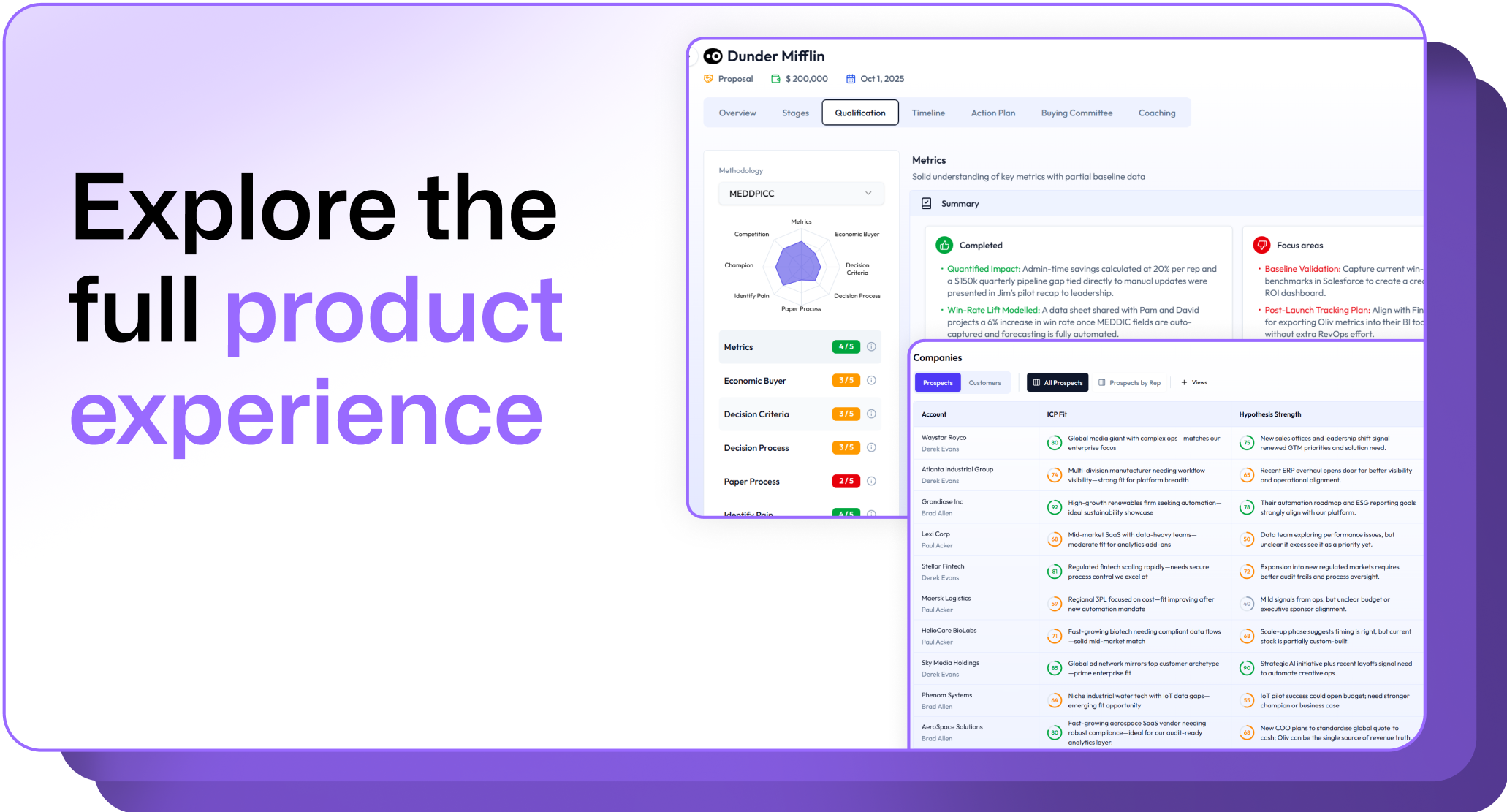
.avif)