Q1. Should you re-approve this renewal, or re-price it? [toc=1. Re-Price the Renewal]
Re-price it. Capture and transcription have become commodity infrastructure, while the category leader's price still reflects the period when they were differentiated. The defensible finance move is separating the commodity layer from the differentiated one, then redirecting the difference toward work the tool does not do. That move is reversible. A rip-out is not. Start from what the vendor actually publishes: Gong discloses per-user licences and a platform fee based on the number of users supported, and nothing else.
💸 The number nobody in the room can check
The email lands about ninety days out. Your RevOps lead forwards a renewal quote, the CRO adds "we need this", and the line item is larger than last year.
Then someone asks the only question that matters. Is this a good price? Nobody knows. There is no published rate card to check it against, so the negotiation starts asymmetric.
I have been on both sides of that email. As a buyer, I approved numbers I could not defend. As a founder, I now watch CFOs try to.
⚠️ Why the approval reflex is expensive
The reflex is understandable. Reps use the tool, the data is real, and cancelling feels like breaking something that works.
So finance approves, and the increase quietly compounds. Three renewals later, the tool costs more than the two systems it was supposed to replace, and nobody has re-examined what a seat includes. The stack-level version of that drift sits in our revenue tech stack consolidation breakdown.
⏰ What actually changed since you first bought it
When most teams first bought conversation intelligence, recording quality and transcription accuracy were genuinely hard. Paying a premium for them made sense.
That is no longer where the difficulty sits. Capture is now table stakes across the category, and the expensive part has moved upward into coaching workflows, deal context, and agent actions that consume metered credits.
This is a pricing argument, not a product-age argument. Gong keeps shipping, including its Revenue Harness execution layer in June 2026. The question is what the commodity half of your invoice should cost in 2026.
✅ The decision rule for this renewal
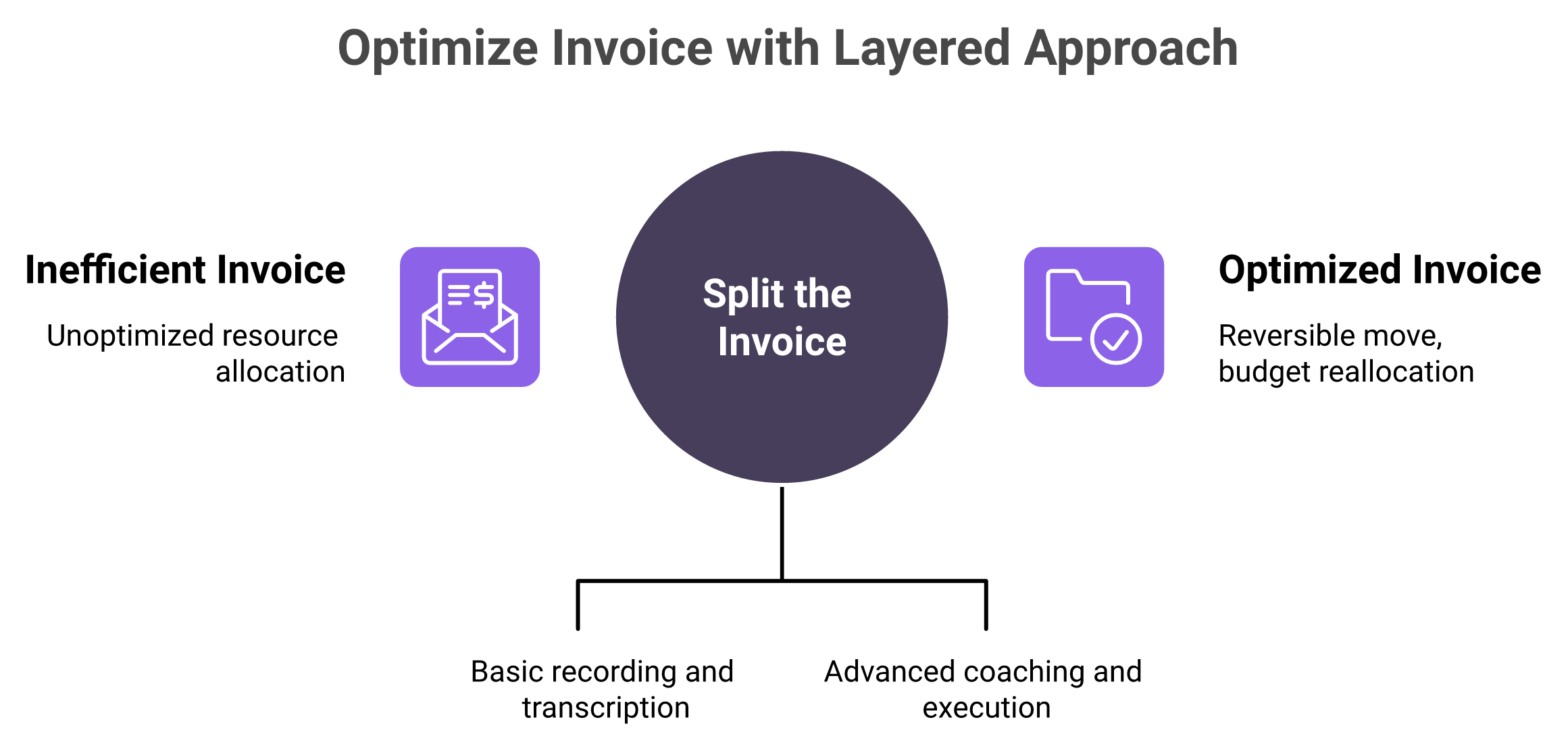
Split the invoice into two layers before you negotiate anything.
- Commodity layer. Recording, transcription, search, and read-only seats. Price this like infrastructure.
- Differentiated layer. Manager coaching workflows, your historical call dataset, and execution or agent features. Price this like a competitive asset.
Then make one reversible move on the commodity layer, and leave the differentiated layer alone for a quarter. A partial unbundle reverses inside a billing cycle. A full migration does not, and the adoption cost lands on the revenue team, not on finance. Our guide to reducing sales tech stack costs walks the same sequence at stack level.
⭐ What buyers say about the half they do not use
The gap between what is bought and what is opened is not a theory. It shows up in public reviews by name.
"There's so much in Gong, that we don't use everything."
— Karel Bos, Sales Operations, GongTrustRadius Verified Review (retrieved 07 Sep 2026)
That sentence is your negotiating position. You are not arguing that the tool is bad. You are arguing that you are paying a differentiated rate for a commodity layer, and that the difference should fund work nobody is doing today.
Q2. Our reps actually use it, so isn't cutting it how you break your one adopted tool? [toc=2. The Adoption Objection]
Adoption is the scarcest asset in a go-to-market stack, and Gong has earned it: over $500M ARR, more than 55% year-on-year growth, 5,000+ customers including more than half the Fortune 10, 6,278 G2 reviews, and ISO/IEC 42001 certification. A CFO who forces a rip-out purely over price owns the adoption failure that follows. The real question is not whether to keep conversation intelligence. It is what a seat should cost now that capture is commodity and credits meter what used to be bundled.
⚠️ The objection, in the CRO's actual words
You will hear this within an hour of sending your analysis. "My reps finally use something. You are about to break the one tool with real adoption to save a rounding error."
That objection is not defensive noise. It is usually correct about the risk, and wrong about the options.
⭐ Concede the whole thing, out loud
Do not soften the concession. Say it plainly in the meeting, because the numbers back the CRO. A fuller read of the incumbent's strengths and limits sits in our guide to the Gong platform.
|
What Is Genuinely True About the Incumbent| What is genuinely true | Why it matters to this decision |
| $500M+ ARR, 55%+ YoY growth | This is not a declining vendor you can wait out |
| 5,000+ customers, half the Fortune 10 | Peer-proof is real, and your board knows it |
| 6,278 G2 reviews | Sentiment is broad, not cherry-picked |
| Revenue Harness shipped June 2026 | The product is advancing, so "outdated" is not your argument |
Age-based dismissal loses this argument. Price-per-seat wins it.
✅ Reframe from "cut" to "what should a seat cost"
Here is the move that keeps the CRO on your side. You are not proposing to remove conversation intelligence. You are proposing to stop paying a 2021 premium for the part of it that is now commodity.
Reps do not experience a licence rate. They experience whether recordings, transcripts, and coaching still work on Monday. Protect that surface and negotiate everything under it.
⏰ The reversible move, and the metric that guards it
Agree one guardrail before you touch anything. Pick a single adoption metric, usually weekly active users on the affected tool, and baseline it now.
Then run one change for a quarter.
- Reduce or re-tier seats for people who only read, not people who sell.
- Leave manager coaching workflows and the historical dataset untouched.
- Review the adoption metric at the end of the quarter, before any second move.
If adoption dips, you reverse it inside a billing cycle. That is the difference between an experiment and a migration.
💰 Name the asymmetry, because everyone feels it
Say the uncomfortable part yourself, before the CRO says it. Finance banks the saving. The revenue team absorbs the disruption.
That asymmetry is exactly why the first move has to be small, measured, and reversible. Once a CRO sees the guardrail, the conversation stops being about loyalty to a vendor and starts being about what a seat includes.
Adoption is also not only about willingness. It is about whether a manager can see the deals they are not being shown, which is the visibility problem we cover in our deal intelligence guide.
"Accuracy is all over the place... I am, as a manager, limited to the deals that my rep wants me to see. Not the other way around."
— Suraj Ramesh, Head of Sales at Sprinto, Oliv AIcustomer testimonial (oliv.ai, retrieved 19 Sep 2026)
Q3. What does the vendor actually publish, and how do you read a quote against it? [toc=3. Published vs Quoted]
Gong publishes two pricing facts: licences are priced per user, and a platform fee scales with the number of users supported. It also states that integrating your existing stack is free, and routes buyers to a quote form banded by team size (1 to 50, 51 to 1,000, 1,001 to 9,999, and 10,000+). Everything else circulating online is buyer-reported. You cannot benchmark the rate, but you can audit the structure: licences, platform fee, metered usage, onboarding, and renewal terms.
✅ Published fact versus buyer-reported claim
Before any figure enters your business case, sort it into one of these two columns.
|
Published Pricing Facts Versus Buyer-Reported Claims| Published by the vendor (citable) | Buyer-reported (attribute or drop) |
| Licences priced per user | Specific per-seat rates by tier |
| Platform fee based on users supported | Platform fee dollar tiers |
| Stack integrations included at no cost | Implementation and onboarding bands |
| Quote form banded by team size | Renewal uplift percentages |
| Credit mechanics in the help documentation | Median contract values from procurement datasets |
The right column is not worthless. It is directional, and it must carry a name and a date. Procurement datasets such as Vendr's transaction data are useful context, and we treat them that way in our Gong pricing guide. They are not a rate card, and a CFO who presents them as one gets corrected in the room.
💰 Decompose the quote into five auditable lines
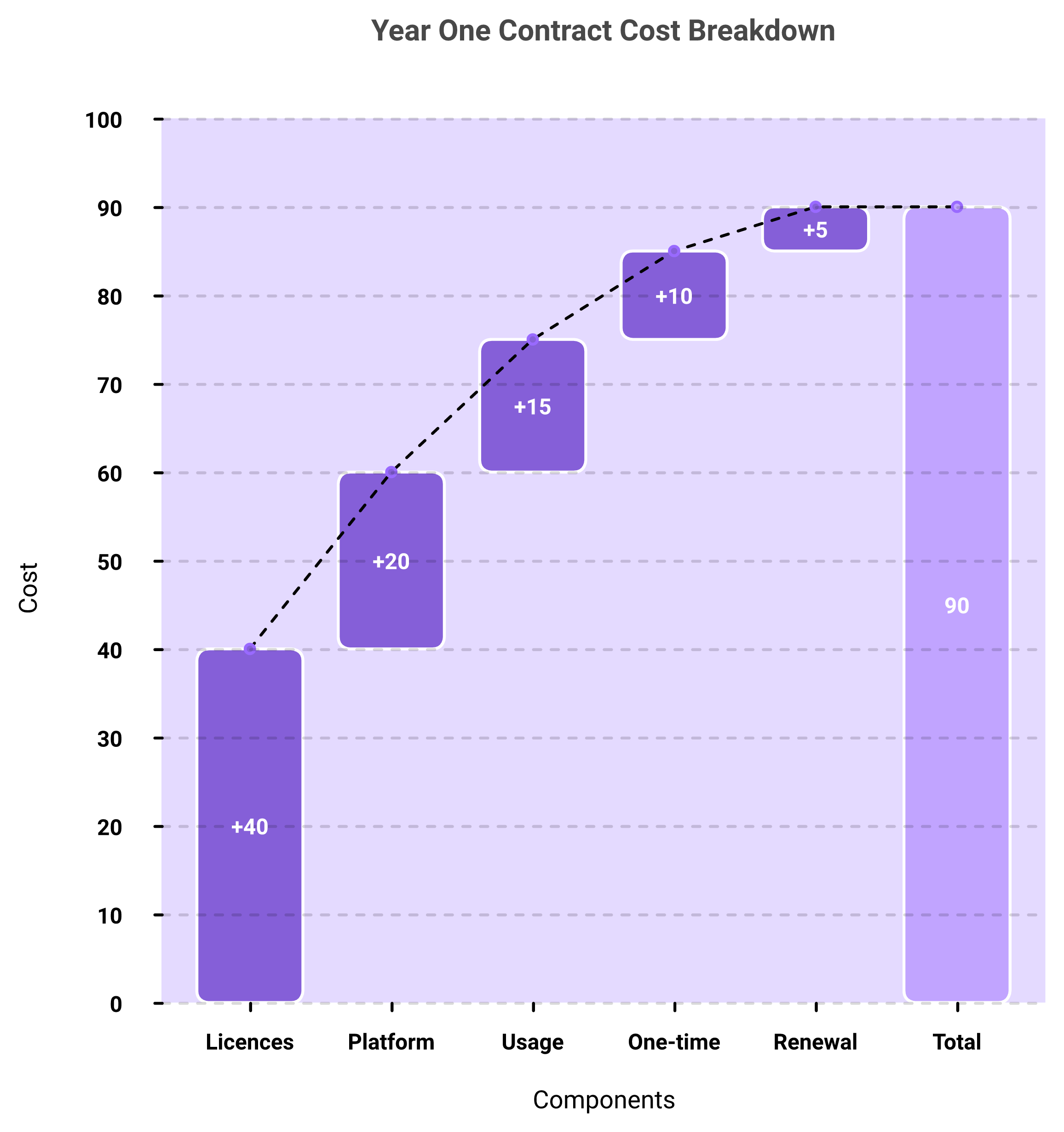
Structure is knowable even where rate is not. Rewrite your quote as these five lines, in this order.
- Licences. Seats multiplied by rate, split by role.
- Platform fee. A separate line, with the stated driver written next to it.
- Metered usage. Credits or actions, with the monthly allowance.
- One-time costs. Onboarding, implementation, and migration.
- Renewal terms. Increase language, notice window, and term length.
If any line cannot be filled in, that gap is your finding. It is also your agenda for the next call. Implementation timing, which sits inside line four, is broken down in our Gong implementation timeline analysis.
⏰ Eight questions to send in writing
Ask these by email, not on a call, so the answers are quotable internally.
- What is the licence rate per role, for read-only users?
- What exactly drives the platform fee, and how does it change if headcount drops?
- What is metered, and at what published rate?
- What is the monthly allowance, and does unused allowance roll over?
- What happens when the allowance is exhausted mid-month?
- Which modules are separate line items rather than included?
- What is the maximum increase at renewal, in writing?
- What is the notice window, and what date does it actually start?
A quote you can decompose is checkable without a benchmark. A quote that resists decomposition tells you something too.
Oliv AI collapses the first line of this exercise, because the licence rate is published per role and the metered rate is published per credit as of 19 Sep 2026. The only variable left at signature is expected agent volume, which is what a pilot exists to measure. If you are running that comparison now, our Gong alternatives comparison covers who else publishes anything at all.
Q4. What do credits change about what a seat includes? [toc=4. What a Seat Includes]
Metering turns a seat from a fixed entitlement into a variable one. Per Gong's help documentation as of 26 Aug 2026, credits work like this: roughly 10 emails to a credit, a call over ten minutes to a credit, a shared company pool, monthly caps that do not roll over, and an API that errors at zero. Existing agreements are unchanged, so this is documented metering, not a contract breach. Oliv AI meters as well, at $0.01 per credit, published on its pricing page and verified 19 Sep 2026.
⏰ What a seat used to mean
For most of the last decade, a seat was simple. You paid per user per year, and that user could record, transcribe, search, and share without anyone tracking volume.
Finance liked that model for one reason. Headcount was the only variable, and headcount is forecastable.
⚠️ What a multi-year commitment cannot absorb
Metered entitlements break that assumption. Usage now depends on how many emails your agents draft and how long your calls run, which are not numbers your CFO controls.
A shared pool makes it harder. One power user can consume allowance that another team needed, and non-rolling caps mean unused allowance simply disappears.
The failure mode is not a surprise invoice. It is an agent workflow that stops mid-month, right when your quarter is closing.
✅ Read the mechanics carefully, not dramatically
Be precise here, because exaggeration gets your analysis dismissed.
|
Documented Credit Mechanics and Their Finance Consequences| Mechanic (as documented) | Finance consequence |
| About 10 emails per credit | Outbound volume becomes a cost driver |
| Calls over ten minutes consume a credit | Call length becomes a cost driver |
| Shared company pool | One team's usage affects another's capacity |
| Monthly caps, no rollover | Underuse is not recoverable |
| API errors at zero | Integrations can fail as a billing event |
None of that is wrongdoing. It is a published design choice, and Gong states existing agreements are unaffected.
💰 Disclosure is the wedge, not metering
Say the self-aware part plainly, because a reader will find it in one click. Oliv AI meters too, at one cent per credit, and charges nothing for Amplify seats used by C-suite, Product, Operations, and Engineering.
So the argument is not that metering is bad. Our read is that metering is fine and disclosure is the real variable. A published credit rate can be modelled before you sign. An unpublished one can only be discovered after.
⭐ Where this shows up at renewal
The cost consequence usually appears as line items you did not have last year.
"The additional products like forecast or engage come at an additional cost."
— Scott T., Mid-Market Sales, GongG2 Verified Review (retrieved 07 Sep 2026)
I could be reading this too strongly, but the pattern I keep seeing is that buyers negotiate the licence line hard and never ask about the metered one. The renewal mechanics, including notice windows, are covered in our Gong contract renewal guide, and the known product constraints are documented in our Gong limitations analysis. Bring the credit question to that same conversation.
Q5. What is the rest of your stack costing per rep, and where does conversation intelligence sit in it? [toc=5. Per-Rep Benchmarks]
A 2025 to 2026 benchmark of 938 B2B companies puts the average sales stack at 8.3 tools and $187 per rep per month, with 73% of teams reporting overlap that wastes roughly $2,340 per rep per year. Consolidation programmes recover 25% to 40% of stack spend within twelve months, with a median recovery of 37% in the 2026 RevOps Co-op data. Conversation intelligence is usually the largest single line inside that total. It draws the first look not because it is the least used, but because it is the least benchmarkable.
💰 What per-rep spend looks like by stack profile
Your vendor will not give you a benchmark. Published stack studies will, so start there.
|
Reported Sales Stack Cost Per Rep by Stack Profile| Stack profile | Reported cost per rep | Source and year |
| Average B2B sales stack, 8.3 tools | $187 per rep per month | 938-company benchmark, 2025 to 2026 |
| Overlap waste inside that stack | About $2,340 per rep per year | Same benchmark, 73% of teams |
| Post-consolidation recovery | 25% to 40% of spend, median 37% | RevOps Co-op, 2026 |
Three numbers, three sources, three dates. That is the standard for anything you put in front of a board.
⏰ Where conversation intelligence sits in the total
In most mid-market stacks I have reviewed, conversation intelligence, the software that records and analyses sales calls, is the first or second largest line. It sits above the CRM add-ons and below nothing. The category boundaries are mapped in our guide to revenue intelligence versus conversation intelligence.
That position is why it gets attention every renewal season. It is also why the attention is often misdirected.
⚠️ The honest limit of these numbers
Here is the part most consolidation blogs skip. These are stack-level medians across hundreds of companies. They are not a rate card for any one vendor.
You cannot walk into a negotiation and say the benchmark proves your quote is 20% high. The benchmark does not know your seat count, your term length, or your discount history. For a vendor-specific read, use our Gong pricing guide instead.
✅ What the benchmarks can legitimately do
Used correctly, they answer three questions that matter more than the rate.
- Is your total per-rep spend inside the normal range? If you are far above $187 per rep per month, the issue is stack design, not one vendor.
- How much of your spend is duplicated? The 73% overlap figure gives you permission to look for it.
- What recovery is realistic? A 37% median tells you that a 60% savings claim needs unusual evidence.
That last point is where I see finance teams lose credibility. They promise a number from a vendor blog, miss it, and lose the mandate for the next round. If you want to model the upside honestly, start with our revenue intelligence ROI calculator.
⭐ Read the total before you read the quote
My own bias, formed from getting this wrong early, is that the quote is the wrong starting document. The stack inventory is.
Pull every go-to-market tool, its annual cost, and its seat count into one sheet first. Half the time, the conversation intelligence line stops looking like the problem, and two overlapping tools you forgot about start looking like it.
Where that stack-level view leads is covered in our guide to reducing sales tech stack costs. For this article, the benchmark has one job. It gives you a defensible external number in a negotiation where the vendor has published almost none.
Q6. Which layer of the spend is commodity, and which is genuinely differentiated? [toc=6. Commodity vs Differentiated]
Capture, transcription, and search are commodity. Several vendors ship them at published entry rates, and transcription accuracy no longer decides deals. What stays differentiated is the manager layer: coaching workflows your managers already run, scorecards, deal reviews built on years of your own call data, and an execution layer the vendor keeps extending. Price the first like infrastructure and the second like a competitive asset. Most over-spend is a single invoice charging differentiated rates for the commodity half.
⏰ What your seat actually covers today
Open your own admin panel and list what a single licence buys. Recording, transcription, search, sharing, a coaching workflow, some dashboards, and now a metered agent layer. Our breakdown of what the Gong platform includes is a useful checklist for that inventory.
That bundle was priced as one thing. It is no longer one thing, because the market has moved at different speeds on each piece.
💸 The era when capture was the hard part
Around 2019 to 2021, capture quality was a genuine moat. Joining every call reliably, separating speakers, and producing a usable transcript was difficult engineering.
Paying a premium then was rational. I did it myself, and I would do it again with that information.
✅ Where the value moved
The difficulty moved upward. Capture became table stakes, and the defensible work is now what happens after the transcript exists.
Gong is a fair example of a vendor that kept climbing. Its Enable product and its Revenue Harness execution layer are real, named products, not marketing slides. That is the differentiated layer, and it deserves a real price. The coaching side of that layer is covered in our sales coaching software comparison.
💰 Split the invoice by layer, not by department
Most finance teams cut by team, which is how adoption breaks. Cut by layer instead.
|
Commodity Layer Versus Differentiated Layer| Layer | What it includes | How to price it |
| Commodity | Recording, transcription, search, read-only access | Like infrastructure, benchmarked against published entry rates |
| Differentiated | Coaching workflows, scorecards, historical dataset, execution and agent features | Like a competitive asset, protected in negotiation |
The difference between what you pay today and what the commodity layer is worth is your reallocation budget. The distinction between these two layers is unpacked further in our piece on revenue intelligence platforms.
⭐ The surface area nobody opens
This split is not academic. Buyers describe it themselves, in public, without prompting.
"There's so much in Gong, that we don't use everything."
— Karel Bos, Sales Operations, GongTrustRadius Verified Review (retrieved 07 Sep 2026)
"The additional products like forecast or engage come at an additional cost."
— Scott T., Mid-Market Sales, GongG2 Verified Review (retrieved 07 Sep 2026)
Read those two together and you have the whole pricing problem. The bundle is broad, the adopted slice is narrow, and the parts people actually want arrive as separate line items.
Oliv AI prices this split instead of describing it. Capture sits at Converse, opportunity and forecast work at Sell, retention work at Grow, and non-selling roles sit at zero on Amplify, with all four rates published and verified on 19 Sep 2026. I am not claiming that structure is better for every team. What I am claiming is narrower. When each layer carries its own published rate, a CFO can price the commodity half without asking anyone's permission.
Q7. How do you audit 90 days of usage and decide what to unbundle? [toc=7. Audit and Unbundle]
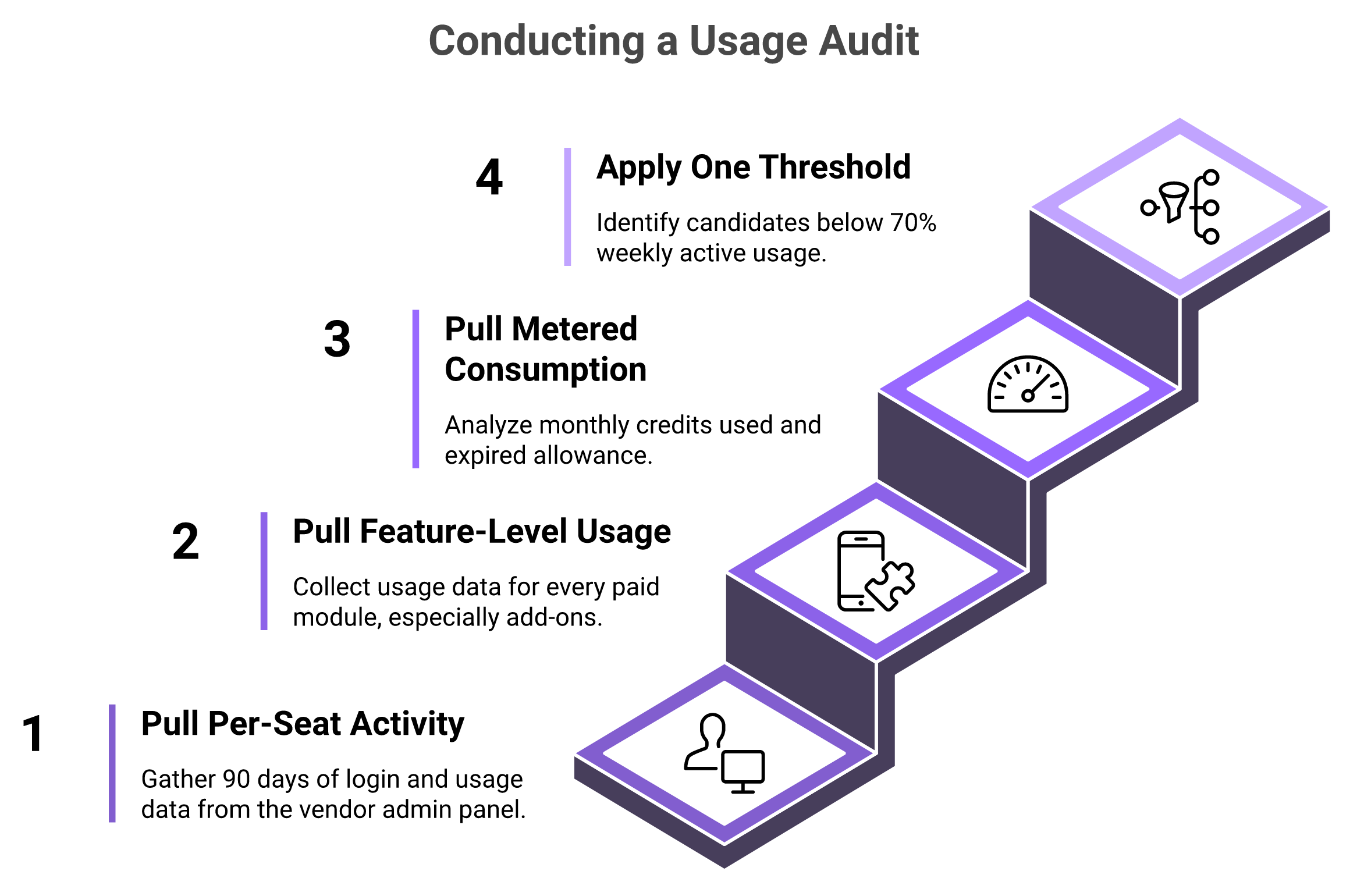
Pull 90 days of per-seat usage, map every licence to one workflow step, and flag anything under roughly 70% adoption. Then unbundle in this order: seats for non-customer-facing people who only read, add-on modules bought on a bundle discount and never adopted, and metered usage nobody has capped. Leave the manager coaching workflow and the historical call dataset alone until you have a full quarter of adoption data on everything else. Oliv AI runs on top of an existing CRM and can operate alongside an incumbent tool, which is what makes an unbundled layer testable before anything is replaced.
❌ Why cutting seats first backfires
The instinct is to cut headcount on the licence line, because it is the easiest number to change. It is also the number reps notice within a day.
You save some money and spend all your political capital. Two quarters later, nobody will let finance near the stack again.
⏰ What the annual squeeze actually achieved
The old playbook was an annual discount negotiation. Ask for 10%, get 5%, declare victory, repeat.
That approach never examined what a seat included, so the same unused surface area got re-purchased every year. The overlap benchmark suggests how much this costs, at roughly $2,340 per rep per year in duplicated tooling.
✅ Run the audit as a diagnosis
Before deciding anything, pull three data exports and put them in one sheet.
- Per-seat login and activity data for the last 90 days, from the vendor admin panel.
- Feature-level usage for each paid module, especially anything bought as an add-on.
- Metered consumption by month, including how much allowance expired unused.
Then apply one threshold. Anything below roughly 70% weekly active usage is a candidate, not a decision. If the audit exposes CRM data gaps as well, our CRM data quality automation guide covers the clean-up sequence.
💰 The ordered, reversible cut sequence
Order matters more than size here. Each step below reverses inside one billing cycle.
|
Ordered Unbundling Sequence and Guardrail Metrics| Move | What you cut | Metric to watch |
| 1 | Seats for people who only read, not people who sell | Weekly active users among sellers |
| 2 | Add-on modules under 70% usage | Requests to re-enable, logged |
| 3 | Uncapped metered usage | Monthly allowance consumed versus purchased |
Stop after each move for a full month. If the metric holds, continue. If it dips, reverse and write down what you learned.
⭐ What reps and managers actually notice
The reason this order works is that it protects the surface people open daily. Managers do not experience a licence tier. They experience whether the useful thing arrives where they already work.
"Gong blew up my Slack all day, but I still had to click through ten screens just to find something useful. With Oliv, I finally get what I need... dropped right in my inbox. This just works."
— Mia Patterson, Sales Manager at Beacon, Oliv AIcustomer testimonial (oliv.ai, retrieved 19 Sep 2026)
Oliv AI's own deployments point one way here, and I might be reading it too strongly, but the teams that unbundle successfully almost always test the replacement layer in parallel first. Run it for the roles you just de-seated, keep the manager workflow where it lives, and compare a quarter of real usage before signing anything larger. The stack-level version of this sequence sits in our revenue tech stack consolidation breakdown.
Q8. Which contract terms should you score beyond price? [toc=8. Terms Beyond Price]
Score four things beyond rate. AI transparency: EU AI Act Article 50 obligations apply from 2 August 2026, with high-risk duties deferred to December 2027. Consent: 12 to 13 US states require all-party consent, so recording coverage is a contract question, not an IT one. Retention: GDPR requires a documented legal basis, a retention period, and a deletion path. Export: ask what raw data you can retrieve, since Gong's MCP server exposes three tools and "returns a single synthesized answer and does not provide raw activity data".
⚠️ The four terms, and what each one costs you
Put this table in the renewal file, next to the pricing decomposition.
|
Contract Terms to Score Beyond Price| Requirement | In force | Clause to request | Cost if absent |
| AI transparency, Article 50 | 2 Aug 2026 | Disclosure behaviour for AI features, plus log retention | Remediation work and disclosure gaps in EU calls |
| All-party consent | Now, 12 to 13 US states | Consent capture and audit log per recording | Recordings that cannot be used in coaching or disputes |
| GDPR retention | Now | Stated retention period and deletion on request | Data you cannot lawfully keep, and cannot prove you deleted |
| Raw data export | Negotiable | Full export of transcripts and activity data on termination | Analysis you can never rebuild elsewhere |
High-risk obligations were deferred to December 2027, so nobody needs to panic. The point is that these terms are cheap to add now and expensive to retrofit later. Our Gong DPA and security review shows what the current documentation does and does not cover.
⏰ Why this belongs in the renewal, not a later security review
Most teams push compliance to a security questionnaire after the commercial terms are agreed. By then you have no leverage, because the signature is already promised.
Compliance language is a negotiating item like any other. It costs the vendor little at renewal and costs you real money in year two. The full evaluation checklist sits in our AI CRM trust and governance guide.
✅ How to score export without overclaiming
Be precise about export, because this is where analysis usually turns into an accusation. Do not claim a vendor traps your data. Ask a narrow question instead.
Ask what raw transcript and activity data you can retrieve, in what format, and how long the process takes. Gong's own documentation for its MCP server, the interface that lets AI tools query it, states that it returns a single synthesized answer and does not provide raw activity data. That is a checkable fact about one interface, and it is the right kind of question to put in writing.
💸 One clause that changes the whole negotiation
Ask for a full export on termination, in a machine-readable format, at no additional cost. A vendor who agrees has told you something about switching costs. A vendor who refuses has told you more.
I have watched this single clause change the tone of a renewal faster than any discount request. It moves the conversation from loyalty to mechanics, and the practical steps are covered in our migration from Gong walkthrough.
⭐ The standard to hold every vendor to, including us
Oliv AI holds SOC 2 Type II certification, is GDPR and CCPA compliant, encrypts data with AES 256 at rest and TLS 1.2 or higher in transit, and operates a full open export policy that returns a complete CSV of meetings and recordings on termination. I am not asking anyone to take that on trust. Our position is that these should be scored line items in every conversation intelligence contract, ours included, and that a vendor unwilling to write them down is answering the question anyway. The governance criteria a mid-market buyer should apply are listed in our mid-market revenue AI buyer guide.
Q9. How do you prove the saving was real rather than a line-item shuffle? [toc=9. Proving the Saving]
Baseline cost per closed-won before you cut anything. Take total go-to-market tool spend for the period and divide it by closed-won deals. A team spending $187 per rep per month across 40 reps, closing 60 deals a quarter, sits near $374 per won deal in tooling. Track that number quarterly alongside a fixed adoption metric, usually weekly active users on the tool you touched, so a saving that quietly cost you pipeline shows up in the same report. Consolidation programmes typically move this figure 20% to 35% within two quarters.
💰 The formula, written out
Keep it simple enough that your CRO can check the arithmetic in the meeting.
Cost per closed-won equals total go-to-market tool spend for the quarter, divided by the number of closed-won deals in that quarter.
That is the whole calculation. Most consolidation content names this metric and never shows the division. If you want a fuller model, our revenue intelligence ROI calculator runs the same logic across a stack.
✅ One worked example, assumptions stated
Assume 40 reps, tooling at $187 per rep per month, and 60 closed-won deals in the quarter.
|
Cost Per Closed-Won Worked Example| Input | Value |
| Reps | 40 |
| Tool spend per rep per month | $187 |
| Quarterly tool spend | $22,440 |
| Closed-won deals in quarter | 60 |
| Cost per closed-won | $374 |
Now cut 20% of that spend and hold deal count flat. The figure drops to about $299. If deal count falls to 54, it rises to about $332, and your saving has quietly cost you money.
⚠️ The counter-metric that stops a false positive
One number alone is easy to game. Pair it with adoption on the specific tool you changed.
- Primary metric. Cost per closed-won, measured quarterly.
- Counter-metric. Weekly active users among sellers on the affected tool.
- Rule. A saving only counts if the counter-metric stays inside 5% of baseline.
That rule is what makes the report usable in a forecast call. It shows you were watching the risk, not just the invoice. Our guide to evidence-based forecast commits covers how to present that pairing without losing the room.
⏰ Cadence, and what a false positive looks like
Measure at the end of each quarter, not monthly, because deal cycles distort short windows. Report both numbers on the same slide, every time.
A false positive looks like this. Spend drops 25%, cost per closed-won improves, and nobody notices that pipeline created fell in the same period. Two quarters later, the metric reverses, and the mandate is gone. Our revenue performance analytics guide lists the pipeline measures to keep on the same page.
⭐ Instrumenting this without buying anything new
You do not need new software to run this. You need three exports: tool spend from finance, closed-won from the CRM, and active users from each vendor admin panel.
The honest difficulty is the third one. Activity data sits in different systems, and stitching it by hand is the reason most teams abandon the metric after one board deck. The integration patterns are documented in our RevOps integration guide for CRM, Slack, and email.
Oliv AI assembles the activity and opportunity data this calculation needs from calls, email, and the CRM in a single deal view, without a separate reporting project. I am not claiming that makes the metric correct. What we have seen is narrower, and it is about maintenance. A number that rebuilds itself every quarter survives. A number that needs a RevOps afternoon every quarter does not.
Q10. Which vendors let you price the deal before you sign it? [toc=10. Vendors Publishing Rates]
Few vendors publish enough to model a deal before signature. Oliv AI publishes a cumulative per-role ladder, at Amplify $0, Converse $19, Sell $49, and Grow $79 per user per month, with Enable at plus $29, Engage from $29, bot capture at plus $10, and agent actions at $0.01 per credit, verified live on 19 Sep 2026. Gong publishes a quote form and two structural pricing facts. That contrast is structural, not a savings claim. The offset, stated plainly: Oliv AI is the least publicly proven option named here, with no G2, Capterra, or TrustRadius presence, and case studies behind an email form.
✅ Shortlist for priceability, not features
Feature grids are easy to find and rarely decide anything at renewal. What decides your quarter is whether you can build a first-year model without a sales call.
Oliv AI is the reason this section exists, because its full rate ladder including the metered rate is printed publicly. That is the single argument, and it survives without any comparison of savings. The wider field is mapped in our mid-market revenue intelligence platform guide.
⏰ Why quote-form pricing made sense for years
Quote forms are not a trick. Enterprise deals vary by seat count, term, region, and support level, and a single printed rate would be wrong for most buyers.
Vendors also negotiate, and published rates limit that flexibility. I have sat on the vendor side of that decision, and the logic is real. The reconstruction work that buyers do instead sits in our Gong pricing guide.
💰 What a published ladder changes about evaluation
The change is not the price. It is who can do the analysis, and when.
|
Published Rate Ladder Versus Quote Form for Finance Teams| What finance can do | With a published ladder | With a quote form only |
| Model year one cost | Before the first call | After a discovery call |
| Compare role-based tiers | Directly, from the page | Only inside a proposal |
| Price metered usage | At the published per-credit rate | After asking, if disclosed |
| Test a scenario internally | Same afternoon | Next week, via the rep |
Both models can end at the same number. Only one lets you check your homework first.
⭐ Layer first, replacement later
This is the part that defuses the CRO objection. Oliv AI runs on top of the existing CRM and can operate alongside an incumbent conversation intelligence tool rather than replacing it on day one.
So the reallocation is testable. Add the layer for the roles you de-seated, keep the manager workflow where it lives, and decide later. The switching question itself belongs in our Gong versus Oliv comparison and in our Gong alternatives comparison, not in a pricing analysis.
❌ The gap you should weigh against us
Say the weak part out loud, because a CFO will find it in one search. Oliv AI has no G2, Capterra, or TrustRadius profile, and its case studies sit behind an email form, so independent peer proof is thin compared with an incumbent carrying thousands of public reviews.
Our customer evidence is currently named testimonials rather than third-party review volume.
"Even with Gong's templates, it took me hours to piece together follow-ups and business cases. Oliv drops the docs ready to send exactly when I need them, easily the best Gong alternative I've used."
— Tara Jacobs, Account Manager at Riverstone Software, Oliv AIcustomer testimonial (oliv.ai, retrieved 19 Sep 2026)
"Before switching to Oliv, cleaning up messy CRM fields and guessing at forecasts used to swallow half my week. Oliv fixes the data as it happens and drops a forecast I can actually bank on."
— Darius Kim, Head of RevOps at Driftloop, Oliv AIcustomer testimonial (oliv.ai, retrieved 19 Sep 2026)
If independent review volume is your primary screen, weight the incumbent higher. If pre-signature priceability is your screen, weight the published ladder higher. Both are defensible positions, and I would rather you pick knowingly.
Q11. When is renegotiating the better move than unbundling? [toc=11. When to Renegotiate]
If your managers run weekly coaching inside the incumbent, and your deal reviews depend on its historical call dataset, unbundling is the weaker play. Renegotiation is the right one. The leverage there is structural rather than competitive: ask for the platform fee to be reconsidered, for metered caps to roll over, for role-based licence tiers, and for renewal-increase language in writing. Start 90 to 120 days out, because auto-renewal notice windows close earlier than most finance calendars assume. A renegotiated contract with disclosed mechanics beats a partial migration nobody in the revenue team asked for.
⚠️ The company profile that should not unbundle
You know this profile if you are in it. Coaching sessions happen inside the tool every week. Scorecards are built. Three years of calls sit in it, and your best manager teaches from them.
For that company, the commodity layer is not really separable. The workflow is the product, and the dataset is the switching cost. The coaching dependency itself is worth auditing, and our guide to coaching at scale shows what that surface actually contains.
❌ Why the standard advice misreads them
Most consolidation advice assumes usage is low and waste is obvious. When usage is genuinely high, the same playbook produces a saving on paper and a mess in practice.
I have been wrong about this before, on my own team. Cutting a well-adopted tool to fund something better looks correct in a spreadsheet and lands badly in a forecast call. The stack-level trade-offs are laid out in our revenue tech stack consolidation breakdown.
💰 What leverage you still have
You do not need a competitive threat to negotiate. You need structure, disclosure, and time.
|
Four Renegotiation Asks and What Each One Saves| Ask | Why it is reasonable | What it saves |
| Reconsider the platform fee | It is disclosed as scaling with users supported | A fixed line, often the least examined |
| Roll over metered allowance | Unused allowance expires monthly | Waste you already paid for |
| Role-based licence tiers | Read-only users do not need seller features | Seats, without cutting sellers |
| Cap the renewal increase in writing | Removes next year's surprise | Budget predictability |
Two of those four are structure questions, not discounts. Vendors concede structure more readily than rate, and the compounding effect is larger.
⏰ Timing is the whole negotiation
Start 90 to 120 days before renewal. The notice window usually starts earlier than the renewal date, and once it closes, you are negotiating with no alternative.
Put the date in the finance calendar today, not next quarter. The mechanics of that window are covered in our Gong contract renewal guide, and the product constraints worth citing in the same conversation sit in our Gong limitations analysis.
⭐ Where this leaves you on Monday
Read the quote against its five lines, decide which half of it is commodity, and pick one reversible move. If adoption is deep, renegotiate the structure instead, and hold the saving against cost per closed-won so the CRO can audit it with you. You should leave this able to ask your vendor exactly what a seat includes, which is more durable than any savings number you cannot defend. If you want a second pair of eyes on the split before your renewal window opens, book a demo and bring the quote.
Q1. Should you re-approve this renewal, or re-price it? [toc=1. Re-Price the Renewal]
Re-price it. Capture and transcription have become commodity infrastructure, while the category leader's price still reflects the period when they were differentiated. The defensible finance move is separating the commodity layer from the differentiated one, then redirecting the difference toward work the tool does not do. That move is reversible. A rip-out is not. Start from what the vendor actually publishes: Gong discloses per-user licences and a platform fee based on the number of users supported, and nothing else.
💸 The number nobody in the room can check
The email lands about ninety days out. Your RevOps lead forwards a renewal quote, the CRO adds "we need this", and the line item is larger than last year.
Then someone asks the only question that matters. Is this a good price? Nobody knows. There is no published rate card to check it against, so the negotiation starts asymmetric.
I have been on both sides of that email. As a buyer, I approved numbers I could not defend. As a founder, I now watch CFOs try to.
⚠️ Why the approval reflex is expensive
The reflex is understandable. Reps use the tool, the data is real, and cancelling feels like breaking something that works.
So finance approves, and the increase quietly compounds. Three renewals later, the tool costs more than the two systems it was supposed to replace, and nobody has re-examined what a seat includes. The stack-level version of that drift sits in our revenue tech stack consolidation breakdown.
⏰ What actually changed since you first bought it
When most teams first bought conversation intelligence, recording quality and transcription accuracy were genuinely hard. Paying a premium for them made sense.
That is no longer where the difficulty sits. Capture is now table stakes across the category, and the expensive part has moved upward into coaching workflows, deal context, and agent actions that consume metered credits.
This is a pricing argument, not a product-age argument. Gong keeps shipping, including its Revenue Harness execution layer in June 2026. The question is what the commodity half of your invoice should cost in 2026.
✅ The decision rule for this renewal
Split the invoice into two layers before you negotiate anything.
- Commodity layer. Recording, transcription, search, and read-only seats. Price this like infrastructure.
- Differentiated layer. Manager coaching workflows, your historical call dataset, and execution or agent features. Price this like a competitive asset.
Then make one reversible move on the commodity layer, and leave the differentiated layer alone for a quarter. A partial unbundle reverses inside a billing cycle. A full migration does not, and the adoption cost lands on the revenue team, not on finance. Our guide to reducing sales tech stack costs walks the same sequence at stack level.
⭐ What buyers say about the half they do not use
The gap between what is bought and what is opened is not a theory. It shows up in public reviews by name.
"There's so much in Gong, that we don't use everything."
— Karel Bos, Sales Operations, GongTrustRadius Verified Review (retrieved 07 Sep 2026)
That sentence is your negotiating position. You are not arguing that the tool is bad. You are arguing that you are paying a differentiated rate for a commodity layer, and that the difference should fund work nobody is doing today.
Q2. Our reps actually use it, so isn't cutting it how you break your one adopted tool? [toc=2. The Adoption Objection]
Adoption is the scarcest asset in a go-to-market stack, and Gong has earned it: over $500M ARR, more than 55% year-on-year growth, 5,000+ customers including more than half the Fortune 10, 6,278 G2 reviews, and ISO/IEC 42001 certification. A CFO who forces a rip-out purely over price owns the adoption failure that follows. The real question is not whether to keep conversation intelligence. It is what a seat should cost now that capture is commodity and credits meter what used to be bundled.
⚠️ The objection, in the CRO's actual words
You will hear this within an hour of sending your analysis. "My reps finally use something. You are about to break the one tool with real adoption to save a rounding error."
That objection is not defensive noise. It is usually correct about the risk, and wrong about the options.
⭐ Concede the whole thing, out loud
Do not soften the concession. Say it plainly in the meeting, because the numbers back the CRO. A fuller read of the incumbent's strengths and limits sits in our guide to the Gong platform.
|
What Is Genuinely True About the Incumbent| What is genuinely true | Why it matters to this decision |
| $500M+ ARR, 55%+ YoY growth | This is not a declining vendor you can wait out |
| 5,000+ customers, half the Fortune 10 | Peer-proof is real, and your board knows it |
| 6,278 G2 reviews | Sentiment is broad, not cherry-picked |
| Revenue Harness shipped June 2026 | The product is advancing, so "outdated" is not your argument |
Age-based dismissal loses this argument. Price-per-seat wins it.
✅ Reframe from "cut" to "what should a seat cost"
Here is the move that keeps the CRO on your side. You are not proposing to remove conversation intelligence. You are proposing to stop paying a 2021 premium for the part of it that is now commodity.
Reps do not experience a licence rate. They experience whether recordings, transcripts, and coaching still work on Monday. Protect that surface and negotiate everything under it.
⏰ The reversible move, and the metric that guards it
Agree one guardrail before you touch anything. Pick a single adoption metric, usually weekly active users on the affected tool, and baseline it now.
Then run one change for a quarter.
- Reduce or re-tier seats for people who only read, not people who sell.
- Leave manager coaching workflows and the historical dataset untouched.
- Review the adoption metric at the end of the quarter, before any second move.
If adoption dips, you reverse it inside a billing cycle. That is the difference between an experiment and a migration.
💰 Name the asymmetry, because everyone feels it
Say the uncomfortable part yourself, before the CRO says it. Finance banks the saving. The revenue team absorbs the disruption.
That asymmetry is exactly why the first move has to be small, measured, and reversible. Once a CRO sees the guardrail, the conversation stops being about loyalty to a vendor and starts being about what a seat includes.
Adoption is also not only about willingness. It is about whether a manager can see the deals they are not being shown, which is the visibility problem we cover in our deal intelligence guide.
"Accuracy is all over the place... I am, as a manager, limited to the deals that my rep wants me to see. Not the other way around."
— Suraj Ramesh, Head of Sales at Sprinto, Oliv AIcustomer testimonial (oliv.ai, retrieved 19 Sep 2026)
Q3. What does the vendor actually publish, and how do you read a quote against it? [toc=3. Published vs Quoted]
Gong publishes two pricing facts: licences are priced per user, and a platform fee scales with the number of users supported. It also states that integrating your existing stack is free, and routes buyers to a quote form banded by team size (1 to 50, 51 to 1,000, 1,001 to 9,999, and 10,000+). Everything else circulating online is buyer-reported. You cannot benchmark the rate, but you can audit the structure: licences, platform fee, metered usage, onboarding, and renewal terms.
✅ Published fact versus buyer-reported claim
Before any figure enters your business case, sort it into one of these two columns.
|
Published Pricing Facts Versus Buyer-Reported Claims| Published by the vendor (citable) | Buyer-reported (attribute or drop) |
| Licences priced per user | Specific per-seat rates by tier |
| Platform fee based on users supported | Platform fee dollar tiers |
| Stack integrations included at no cost | Implementation and onboarding bands |
| Quote form banded by team size | Renewal uplift percentages |
| Credit mechanics in the help documentation | Median contract values from procurement datasets |
The right column is not worthless. It is directional, and it must carry a name and a date. Procurement datasets such as Vendr's transaction data are useful context, and we treat them that way in our Gong pricing guide. They are not a rate card, and a CFO who presents them as one gets corrected in the room.
💰 Decompose the quote into five auditable lines
Structure is knowable even where rate is not. Rewrite your quote as these five lines, in this order.
- Licences. Seats multiplied by rate, split by role.
- Platform fee. A separate line, with the stated driver written next to it.
- Metered usage. Credits or actions, with the monthly allowance.
- One-time costs. Onboarding, implementation, and migration.
- Renewal terms. Increase language, notice window, and term length.
If any line cannot be filled in, that gap is your finding. It is also your agenda for the next call. Implementation timing, which sits inside line four, is broken down in our Gong implementation timeline analysis.
⏰ Eight questions to send in writing
Ask these by email, not on a call, so the answers are quotable internally.
- What is the licence rate per role, for read-only users?
- What exactly drives the platform fee, and how does it change if headcount drops?
- What is metered, and at what published rate?
- What is the monthly allowance, and does unused allowance roll over?
- What happens when the allowance is exhausted mid-month?
- Which modules are separate line items rather than included?
- What is the maximum increase at renewal, in writing?
- What is the notice window, and what date does it actually start?
A quote you can decompose is checkable without a benchmark. A quote that resists decomposition tells you something too.
Oliv AI collapses the first line of this exercise, because the licence rate is published per role and the metered rate is published per credit as of 19 Sep 2026. The only variable left at signature is expected agent volume, which is what a pilot exists to measure. If you are running that comparison now, our Gong alternatives comparison covers who else publishes anything at all.
Q4. What do credits change about what a seat includes? [toc=4. What a Seat Includes]
Metering turns a seat from a fixed entitlement into a variable one. Per Gong's help documentation as of 26 Aug 2026, credits work like this: roughly 10 emails to a credit, a call over ten minutes to a credit, a shared company pool, monthly caps that do not roll over, and an API that errors at zero. Existing agreements are unchanged, so this is documented metering, not a contract breach. Oliv AI meters as well, at $0.01 per credit, published on its pricing page and verified 19 Sep 2026.
⏰ What a seat used to mean
For most of the last decade, a seat was simple. You paid per user per year, and that user could record, transcribe, search, and share without anyone tracking volume.
Finance liked that model for one reason. Headcount was the only variable, and headcount is forecastable.
⚠️ What a multi-year commitment cannot absorb
Metered entitlements break that assumption. Usage now depends on how many emails your agents draft and how long your calls run, which are not numbers your CFO controls.
A shared pool makes it harder. One power user can consume allowance that another team needed, and non-rolling caps mean unused allowance simply disappears.
The failure mode is not a surprise invoice. It is an agent workflow that stops mid-month, right when your quarter is closing.
✅ Read the mechanics carefully, not dramatically
Be precise here, because exaggeration gets your analysis dismissed.
|
Documented Credit Mechanics and Their Finance Consequences| Mechanic (as documented) | Finance consequence |
| About 10 emails per credit | Outbound volume becomes a cost driver |
| Calls over ten minutes consume a credit | Call length becomes a cost driver |
| Shared company pool | One team's usage affects another's capacity |
| Monthly caps, no rollover | Underuse is not recoverable |
| API errors at zero | Integrations can fail as a billing event |
None of that is wrongdoing. It is a published design choice, and Gong states existing agreements are unaffected.
💰 Disclosure is the wedge, not metering
Say the self-aware part plainly, because a reader will find it in one click. Oliv AI meters too, at one cent per credit, and charges nothing for Amplify seats used by C-suite, Product, Operations, and Engineering.
So the argument is not that metering is bad. Our read is that metering is fine and disclosure is the real variable. A published credit rate can be modelled before you sign. An unpublished one can only be discovered after.
⭐ Where this shows up at renewal
The cost consequence usually appears as line items you did not have last year.
"The additional products like forecast or engage come at an additional cost."
— Scott T., Mid-Market Sales, GongG2 Verified Review (retrieved 07 Sep 2026)
I could be reading this too strongly, but the pattern I keep seeing is that buyers negotiate the licence line hard and never ask about the metered one. The renewal mechanics, including notice windows, are covered in our Gong contract renewal guide, and the known product constraints are documented in our Gong limitations analysis. Bring the credit question to that same conversation.
Q5. What is the rest of your stack costing per rep, and where does conversation intelligence sit in it? [toc=5. Per-Rep Benchmarks]
A 2025 to 2026 benchmark of 938 B2B companies puts the average sales stack at 8.3 tools and $187 per rep per month, with 73% of teams reporting overlap that wastes roughly $2,340 per rep per year. Consolidation programmes recover 25% to 40% of stack spend within twelve months, with a median recovery of 37% in the 2026 RevOps Co-op data. Conversation intelligence is usually the largest single line inside that total. It draws the first look not because it is the least used, but because it is the least benchmarkable.
💰 What per-rep spend looks like by stack profile
Your vendor will not give you a benchmark. Published stack studies will, so start there.
|
Reported Sales Stack Cost Per Rep by Stack Profile| Stack profile | Reported cost per rep | Source and year |
| Average B2B sales stack, 8.3 tools | $187 per rep per month | 938-company benchmark, 2025 to 2026 |
| Overlap waste inside that stack | About $2,340 per rep per year | Same benchmark, 73% of teams |
| Post-consolidation recovery | 25% to 40% of spend, median 37% | RevOps Co-op, 2026 |
Three numbers, three sources, three dates. That is the standard for anything you put in front of a board.
⏰ Where conversation intelligence sits in the total
In most mid-market stacks I have reviewed, conversation intelligence, the software that records and analyses sales calls, is the first or second largest line. It sits above the CRM add-ons and below nothing. The category boundaries are mapped in our guide to revenue intelligence versus conversation intelligence.
That position is why it gets attention every renewal season. It is also why the attention is often misdirected.
⚠️ The honest limit of these numbers
Here is the part most consolidation blogs skip. These are stack-level medians across hundreds of companies. They are not a rate card for any one vendor.
You cannot walk into a negotiation and say the benchmark proves your quote is 20% high. The benchmark does not know your seat count, your term length, or your discount history. For a vendor-specific read, use our Gong pricing guide instead.
✅ What the benchmarks can legitimately do
Used correctly, they answer three questions that matter more than the rate.
- Is your total per-rep spend inside the normal range? If you are far above $187 per rep per month, the issue is stack design, not one vendor.
- How much of your spend is duplicated? The 73% overlap figure gives you permission to look for it.
- What recovery is realistic? A 37% median tells you that a 60% savings claim needs unusual evidence.
That last point is where I see finance teams lose credibility. They promise a number from a vendor blog, miss it, and lose the mandate for the next round. If you want to model the upside honestly, start with our revenue intelligence ROI calculator.
⭐ Read the total before you read the quote
My own bias, formed from getting this wrong early, is that the quote is the wrong starting document. The stack inventory is.
Pull every go-to-market tool, its annual cost, and its seat count into one sheet first. Half the time, the conversation intelligence line stops looking like the problem, and two overlapping tools you forgot about start looking like it.
Where that stack-level view leads is covered in our guide to reducing sales tech stack costs. For this article, the benchmark has one job. It gives you a defensible external number in a negotiation where the vendor has published almost none.
Q6. Which layer of the spend is commodity, and which is genuinely differentiated? [toc=6. Commodity vs Differentiated]
Capture, transcription, and search are commodity. Several vendors ship them at published entry rates, and transcription accuracy no longer decides deals. What stays differentiated is the manager layer: coaching workflows your managers already run, scorecards, deal reviews built on years of your own call data, and an execution layer the vendor keeps extending. Price the first like infrastructure and the second like a competitive asset. Most over-spend is a single invoice charging differentiated rates for the commodity half.
⏰ What your seat actually covers today
Open your own admin panel and list what a single licence buys. Recording, transcription, search, sharing, a coaching workflow, some dashboards, and now a metered agent layer. Our breakdown of what the Gong platform includes is a useful checklist for that inventory.
That bundle was priced as one thing. It is no longer one thing, because the market has moved at different speeds on each piece.
💸 The era when capture was the hard part
Around 2019 to 2021, capture quality was a genuine moat. Joining every call reliably, separating speakers, and producing a usable transcript was difficult engineering.
Paying a premium then was rational. I did it myself, and I would do it again with that information.
✅ Where the value moved
The difficulty moved upward. Capture became table stakes, and the defensible work is now what happens after the transcript exists.
Gong is a fair example of a vendor that kept climbing. Its Enable product and its Revenue Harness execution layer are real, named products, not marketing slides. That is the differentiated layer, and it deserves a real price. The coaching side of that layer is covered in our sales coaching software comparison.
💰 Split the invoice by layer, not by department
Most finance teams cut by team, which is how adoption breaks. Cut by layer instead.
|
Commodity Layer Versus Differentiated Layer| Layer | What it includes | How to price it |
| Commodity | Recording, transcription, search, read-only access | Like infrastructure, benchmarked against published entry rates |
| Differentiated | Coaching workflows, scorecards, historical dataset, execution and agent features | Like a competitive asset, protected in negotiation |
The difference between what you pay today and what the commodity layer is worth is your reallocation budget. The distinction between these two layers is unpacked further in our piece on revenue intelligence platforms.
⭐ The surface area nobody opens
This split is not academic. Buyers describe it themselves, in public, without prompting.
"There's so much in Gong, that we don't use everything."
— Karel Bos, Sales Operations, GongTrustRadius Verified Review (retrieved 07 Sep 2026)
"The additional products like forecast or engage come at an additional cost."
— Scott T., Mid-Market Sales, GongG2 Verified Review (retrieved 07 Sep 2026)
Read those two together and you have the whole pricing problem. The bundle is broad, the adopted slice is narrow, and the parts people actually want arrive as separate line items.
Oliv AI prices this split instead of describing it. Capture sits at Converse, opportunity and forecast work at Sell, retention work at Grow, and non-selling roles sit at zero on Amplify, with all four rates published and verified on 19 Sep 2026. I am not claiming that structure is better for every team. What I am claiming is narrower. When each layer carries its own published rate, a CFO can price the commodity half without asking anyone's permission.
Q7. How do you audit 90 days of usage and decide what to unbundle? [toc=7. Audit and Unbundle]
Pull 90 days of per-seat usage, map every licence to one workflow step, and flag anything under roughly 70% adoption. Then unbundle in this order: seats for non-customer-facing people who only read, add-on modules bought on a bundle discount and never adopted, and metered usage nobody has capped. Leave the manager coaching workflow and the historical call dataset alone until you have a full quarter of adoption data on everything else. Oliv AI runs on top of an existing CRM and can operate alongside an incumbent tool, which is what makes an unbundled layer testable before anything is replaced.
❌ Why cutting seats first backfires
The instinct is to cut headcount on the licence line, because it is the easiest number to change. It is also the number reps notice within a day.
You save some money and spend all your political capital. Two quarters later, nobody will let finance near the stack again.
⏰ What the annual squeeze actually achieved
The old playbook was an annual discount negotiation. Ask for 10%, get 5%, declare victory, repeat.
That approach never examined what a seat included, so the same unused surface area got re-purchased every year. The overlap benchmark suggests how much this costs, at roughly $2,340 per rep per year in duplicated tooling.
✅ Run the audit as a diagnosis
Before deciding anything, pull three data exports and put them in one sheet.
- Per-seat login and activity data for the last 90 days, from the vendor admin panel.
- Feature-level usage for each paid module, especially anything bought as an add-on.
- Metered consumption by month, including how much allowance expired unused.
Then apply one threshold. Anything below roughly 70% weekly active usage is a candidate, not a decision. If the audit exposes CRM data gaps as well, our CRM data quality automation guide covers the clean-up sequence.
💰 The ordered, reversible cut sequence
Order matters more than size here. Each step below reverses inside one billing cycle.
|
Ordered Unbundling Sequence and Guardrail Metrics| Move | What you cut | Metric to watch |
| 1 | Seats for people who only read, not people who sell | Weekly active users among sellers |
| 2 | Add-on modules under 70% usage | Requests to re-enable, logged |
| 3 | Uncapped metered usage | Monthly allowance consumed versus purchased |
Stop after each move for a full month. If the metric holds, continue. If it dips, reverse and write down what you learned.
⭐ What reps and managers actually notice
The reason this order works is that it protects the surface people open daily. Managers do not experience a licence tier. They experience whether the useful thing arrives where they already work.
"Gong blew up my Slack all day, but I still had to click through ten screens just to find something useful. With Oliv, I finally get what I need... dropped right in my inbox. This just works."
— Mia Patterson, Sales Manager at Beacon, Oliv AIcustomer testimonial (oliv.ai, retrieved 19 Sep 2026)
Oliv AI's own deployments point one way here, and I might be reading it too strongly, but the teams that unbundle successfully almost always test the replacement layer in parallel first. Run it for the roles you just de-seated, keep the manager workflow where it lives, and compare a quarter of real usage before signing anything larger. The stack-level version of this sequence sits in our revenue tech stack consolidation breakdown.
Q8. Which contract terms should you score beyond price? [toc=8. Terms Beyond Price]
Score four things beyond rate. AI transparency: EU AI Act Article 50 obligations apply from 2 August 2026, with high-risk duties deferred to December 2027. Consent: 12 to 13 US states require all-party consent, so recording coverage is a contract question, not an IT one. Retention: GDPR requires a documented legal basis, a retention period, and a deletion path. Export: ask what raw data you can retrieve, since Gong's MCP server exposes three tools and "returns a single synthesized answer and does not provide raw activity data".
⚠️ The four terms, and what each one costs you
Put this table in the renewal file, next to the pricing decomposition.
|
Contract Terms to Score Beyond Price| Requirement | In force | Clause to request | Cost if absent |
| AI transparency, Article 50 | 2 Aug 2026 | Disclosure behaviour for AI features, plus log retention | Remediation work and disclosure gaps in EU calls |
| All-party consent | Now, 12 to 13 US states | Consent capture and audit log per recording | Recordings that cannot be used in coaching or disputes |
| GDPR retention | Now | Stated retention period and deletion on request | Data you cannot lawfully keep, and cannot prove you deleted |
| Raw data export | Negotiable | Full export of transcripts and activity data on termination | Analysis you can never rebuild elsewhere |
High-risk obligations were deferred to December 2027, so nobody needs to panic. The point is that these terms are cheap to add now and expensive to retrofit later. Our Gong DPA and security review shows what the current documentation does and does not cover.
⏰ Why this belongs in the renewal, not a later security review
Most teams push compliance to a security questionnaire after the commercial terms are agreed. By then you have no leverage, because the signature is already promised.
Compliance language is a negotiating item like any other. It costs the vendor little at renewal and costs you real money in year two. The full evaluation checklist sits in our AI CRM trust and governance guide.
✅ How to score export without overclaiming
Be precise about export, because this is where analysis usually turns into an accusation. Do not claim a vendor traps your data. Ask a narrow question instead.
Ask what raw transcript and activity data you can retrieve, in what format, and how long the process takes. Gong's own documentation for its MCP server, the interface that lets AI tools query it, states that it returns a single synthesized answer and does not provide raw activity data. That is a checkable fact about one interface, and it is the right kind of question to put in writing.
💸 One clause that changes the whole negotiation
Ask for a full export on termination, in a machine-readable format, at no additional cost. A vendor who agrees has told you something about switching costs. A vendor who refuses has told you more.
I have watched this single clause change the tone of a renewal faster than any discount request. It moves the conversation from loyalty to mechanics, and the practical steps are covered in our migration from Gong walkthrough.
⭐ The standard to hold every vendor to, including us
Oliv AI holds SOC 2 Type II certification, is GDPR and CCPA compliant, encrypts data with AES 256 at rest and TLS 1.2 or higher in transit, and operates a full open export policy that returns a complete CSV of meetings and recordings on termination. I am not asking anyone to take that on trust. Our position is that these should be scored line items in every conversation intelligence contract, ours included, and that a vendor unwilling to write them down is answering the question anyway. The governance criteria a mid-market buyer should apply are listed in our mid-market revenue AI buyer guide.
Q9. How do you prove the saving was real rather than a line-item shuffle? [toc=9. Proving the Saving]
Baseline cost per closed-won before you cut anything. Take total go-to-market tool spend for the period and divide it by closed-won deals. A team spending $187 per rep per month across 40 reps, closing 60 deals a quarter, sits near $374 per won deal in tooling. Track that number quarterly alongside a fixed adoption metric, usually weekly active users on the tool you touched, so a saving that quietly cost you pipeline shows up in the same report. Consolidation programmes typically move this figure 20% to 35% within two quarters.
💰 The formula, written out
Keep it simple enough that your CRO can check the arithmetic in the meeting.
Cost per closed-won equals total go-to-market tool spend for the quarter, divided by the number of closed-won deals in that quarter.
That is the whole calculation. Most consolidation content names this metric and never shows the division. If you want a fuller model, our revenue intelligence ROI calculator runs the same logic across a stack.
✅ One worked example, assumptions stated
Assume 40 reps, tooling at $187 per rep per month, and 60 closed-won deals in the quarter.
|
Cost Per Closed-Won Worked Example| Input | Value |
| Reps | 40 |
| Tool spend per rep per month | $187 |
| Quarterly tool spend | $22,440 |
| Closed-won deals in quarter | 60 |
| Cost per closed-won | $374 |
Now cut 20% of that spend and hold deal count flat. The figure drops to about $299. If deal count falls to 54, it rises to about $332, and your saving has quietly cost you money.
⚠️ The counter-metric that stops a false positive
One number alone is easy to game. Pair it with adoption on the specific tool you changed.
- Primary metric. Cost per closed-won, measured quarterly.
- Counter-metric. Weekly active users among sellers on the affected tool.
- Rule. A saving only counts if the counter-metric stays inside 5% of baseline.
That rule is what makes the report usable in a forecast call. It shows you were watching the risk, not just the invoice. Our guide to evidence-based forecast commits covers how to present that pairing without losing the room.
⏰ Cadence, and what a false positive looks like
Measure at the end of each quarter, not monthly, because deal cycles distort short windows. Report both numbers on the same slide, every time.
A false positive looks like this. Spend drops 25%, cost per closed-won improves, and nobody notices that pipeline created fell in the same period. Two quarters later, the metric reverses, and the mandate is gone. Our revenue performance analytics guide lists the pipeline measures to keep on the same page.
⭐ Instrumenting this without buying anything new
You do not need new software to run this. You need three exports: tool spend from finance, closed-won from the CRM, and active users from each vendor admin panel.
The honest difficulty is the third one. Activity data sits in different systems, and stitching it by hand is the reason most teams abandon the metric after one board deck. The integration patterns are documented in our RevOps integration guide for CRM, Slack, and email.
Oliv AI assembles the activity and opportunity data this calculation needs from calls, email, and the CRM in a single deal view, without a separate reporting project. I am not claiming that makes the metric correct. What we have seen is narrower, and it is about maintenance. A number that rebuilds itself every quarter survives. A number that needs a RevOps afternoon every quarter does not.
Q10. Which vendors let you price the deal before you sign it? [toc=10. Vendors Publishing Rates]
Few vendors publish enough to model a deal before signature. Oliv AI publishes a cumulative per-role ladder, at Amplify $0, Converse $19, Sell $49, and Grow $79 per user per month, with Enable at plus $29, Engage from $29, bot capture at plus $10, and agent actions at $0.01 per credit, verified live on 19 Sep 2026. Gong publishes a quote form and two structural pricing facts. That contrast is structural, not a savings claim. The offset, stated plainly: Oliv AI is the least publicly proven option named here, with no G2, Capterra, or TrustRadius presence, and case studies behind an email form.
✅ Shortlist for priceability, not features
Feature grids are easy to find and rarely decide anything at renewal. What decides your quarter is whether you can build a first-year model without a sales call.
Oliv AI is the reason this section exists, because its full rate ladder including the metered rate is printed publicly. That is the single argument, and it survives without any comparison of savings. The wider field is mapped in our mid-market revenue intelligence platform guide.
⏰ Why quote-form pricing made sense for years
Quote forms are not a trick. Enterprise deals vary by seat count, term, region, and support level, and a single printed rate would be wrong for most buyers.
Vendors also negotiate, and published rates limit that flexibility. I have sat on the vendor side of that decision, and the logic is real. The reconstruction work that buyers do instead sits in our Gong pricing guide.
💰 What a published ladder changes about evaluation
The change is not the price. It is who can do the analysis, and when.
|
Published Rate Ladder Versus Quote Form for Finance Teams| What finance can do | With a published ladder | With a quote form only |
| Model year one cost | Before the first call | After a discovery call |
| Compare role-based tiers | Directly, from the page | Only inside a proposal |
| Price metered usage | At the published per-credit rate | After asking, if disclosed |
| Test a scenario internally | Same afternoon | Next week, via the rep |
Both models can end at the same number. Only one lets you check your homework first.
⭐ Layer first, replacement later
This is the part that defuses the CRO objection. Oliv AI runs on top of the existing CRM and can operate alongside an incumbent conversation intelligence tool rather than replacing it on day one.
So the reallocation is testable. Add the layer for the roles you de-seated, keep the manager workflow where it lives, and decide later. The switching question itself belongs in our Gong versus Oliv comparison and in our Gong alternatives comparison, not in a pricing analysis.
❌ The gap you should weigh against us
Say the weak part out loud, because a CFO will find it in one search. Oliv AI has no G2, Capterra, or TrustRadius profile, and its case studies sit behind an email form, so independent peer proof is thin compared with an incumbent carrying thousands of public reviews.
Our customer evidence is currently named testimonials rather than third-party review volume.
"Even with Gong's templates, it took me hours to piece together follow-ups and business cases. Oliv drops the docs ready to send exactly when I need them, easily the best Gong alternative I've used."
— Tara Jacobs, Account Manager at Riverstone Software, Oliv AIcustomer testimonial (oliv.ai, retrieved 19 Sep 2026)
"Before switching to Oliv, cleaning up messy CRM fields and guessing at forecasts used to swallow half my week. Oliv fixes the data as it happens and drops a forecast I can actually bank on."
— Darius Kim, Head of RevOps at Driftloop, Oliv AIcustomer testimonial (oliv.ai, retrieved 19 Sep 2026)
If independent review volume is your primary screen, weight the incumbent higher. If pre-signature priceability is your screen, weight the published ladder higher. Both are defensible positions, and I would rather you pick knowingly.
Q11. When is renegotiating the better move than unbundling? [toc=11. When to Renegotiate]
If your managers run weekly coaching inside the incumbent, and your deal reviews depend on its historical call dataset, unbundling is the weaker play. Renegotiation is the right one. The leverage there is structural rather than competitive: ask for the platform fee to be reconsidered, for metered caps to roll over, for role-based licence tiers, and for renewal-increase language in writing. Start 90 to 120 days out, because auto-renewal notice windows close earlier than most finance calendars assume. A renegotiated contract with disclosed mechanics beats a partial migration nobody in the revenue team asked for.
⚠️ The company profile that should not unbundle
You know this profile if you are in it. Coaching sessions happen inside the tool every week. Scorecards are built. Three years of calls sit in it, and your best manager teaches from them.
For that company, the commodity layer is not really separable. The workflow is the product, and the dataset is the switching cost. The coaching dependency itself is worth auditing, and our guide to coaching at scale shows what that surface actually contains.
❌ Why the standard advice misreads them
Most consolidation advice assumes usage is low and waste is obvious. When usage is genuinely high, the same playbook produces a saving on paper and a mess in practice.
I have been wrong about this before, on my own team. Cutting a well-adopted tool to fund something better looks correct in a spreadsheet and lands badly in a forecast call. The stack-level trade-offs are laid out in our revenue tech stack consolidation breakdown.
💰 What leverage you still have
You do not need a competitive threat to negotiate. You need structure, disclosure, and time.
|
Four Renegotiation Asks and What Each One Saves| Ask | Why it is reasonable | What it saves |
| Reconsider the platform fee | It is disclosed as scaling with users supported | A fixed line, often the least examined |
| Roll over metered allowance | Unused allowance expires monthly | Waste you already paid for |
| Role-based licence tiers | Read-only users do not need seller features | Seats, without cutting sellers |
| Cap the renewal increase in writing | Removes next year's surprise | Budget predictability |
Two of those four are structure questions, not discounts. Vendors concede structure more readily than rate, and the compounding effect is larger.
⏰ Timing is the whole negotiation
Start 90 to 120 days before renewal. The notice window usually starts earlier than the renewal date, and once it closes, you are negotiating with no alternative.
Put the date in the finance calendar today, not next quarter. The mechanics of that window are covered in our Gong contract renewal guide, and the product constraints worth citing in the same conversation sit in our Gong limitations analysis.
⭐ Where this leaves you on Monday
Read the quote against its five lines, decide which half of it is commodity, and pick one reversible move. If adoption is deep, renegotiate the structure instead, and hold the saving against cost per closed-won so the CRO can audit it with you. You should leave this able to ask your vendor exactly what a seat includes, which is more durable than any savings number you cannot defend. If you want a second pair of eyes on the split before your renewal window opens, book a demo and bring the quote.
Q1. Should you re-approve this renewal, or re-price it? [toc=1. Re-Price the Renewal]
Re-price it. Capture and transcription have become commodity infrastructure, while the category leader's price still reflects the period when they were differentiated. The defensible finance move is separating the commodity layer from the differentiated one, then redirecting the difference toward work the tool does not do. That move is reversible. A rip-out is not. Start from what the vendor actually publishes: Gong discloses per-user licences and a platform fee based on the number of users supported, and nothing else.
💸 The number nobody in the room can check
The email lands about ninety days out. Your RevOps lead forwards a renewal quote, the CRO adds "we need this", and the line item is larger than last year.
Then someone asks the only question that matters. Is this a good price? Nobody knows. There is no published rate card to check it against, so the negotiation starts asymmetric.
I have been on both sides of that email. As a buyer, I approved numbers I could not defend. As a founder, I now watch CFOs try to.
⚠️ Why the approval reflex is expensive
The reflex is understandable. Reps use the tool, the data is real, and cancelling feels like breaking something that works.
So finance approves, and the increase quietly compounds. Three renewals later, the tool costs more than the two systems it was supposed to replace, and nobody has re-examined what a seat includes. The stack-level version of that drift sits in our revenue tech stack consolidation breakdown.
⏰ What actually changed since you first bought it
When most teams first bought conversation intelligence, recording quality and transcription accuracy were genuinely hard. Paying a premium for them made sense.
That is no longer where the difficulty sits. Capture is now table stakes across the category, and the expensive part has moved upward into coaching workflows, deal context, and agent actions that consume metered credits.
This is a pricing argument, not a product-age argument. Gong keeps shipping, including its Revenue Harness execution layer in June 2026. The question is what the commodity half of your invoice should cost in 2026.
✅ The decision rule for this renewal
Split the invoice into two layers before you negotiate anything.
- Commodity layer. Recording, transcription, search, and read-only seats. Price this like infrastructure.
- Differentiated layer. Manager coaching workflows, your historical call dataset, and execution or agent features. Price this like a competitive asset.
Then make one reversible move on the commodity layer, and leave the differentiated layer alone for a quarter. A partial unbundle reverses inside a billing cycle. A full migration does not, and the adoption cost lands on the revenue team, not on finance. Our guide to reducing sales tech stack costs walks the same sequence at stack level.
⭐ What buyers say about the half they do not use
The gap between what is bought and what is opened is not a theory. It shows up in public reviews by name.
"There's so much in Gong, that we don't use everything."
— Karel Bos, Sales Operations, GongTrustRadius Verified Review (retrieved 07 Sep 2026)
That sentence is your negotiating position. You are not arguing that the tool is bad. You are arguing that you are paying a differentiated rate for a commodity layer, and that the difference should fund work nobody is doing today.
Q2. Our reps actually use it, so isn't cutting it how you break your one adopted tool? [toc=2. The Adoption Objection]
Adoption is the scarcest asset in a go-to-market stack, and Gong has earned it: over $500M ARR, more than 55% year-on-year growth, 5,000+ customers including more than half the Fortune 10, 6,278 G2 reviews, and ISO/IEC 42001 certification. A CFO who forces a rip-out purely over price owns the adoption failure that follows. The real question is not whether to keep conversation intelligence. It is what a seat should cost now that capture is commodity and credits meter what used to be bundled.
⚠️ The objection, in the CRO's actual words
You will hear this within an hour of sending your analysis. "My reps finally use something. You are about to break the one tool with real adoption to save a rounding error."
That objection is not defensive noise. It is usually correct about the risk, and wrong about the options.
⭐ Concede the whole thing, out loud
Do not soften the concession. Say it plainly in the meeting, because the numbers back the CRO. A fuller read of the incumbent's strengths and limits sits in our guide to the Gong platform.
|
What Is Genuinely True About the Incumbent| What is genuinely true | Why it matters to this decision |
| $500M+ ARR, 55%+ YoY growth | This is not a declining vendor you can wait out |
| 5,000+ customers, half the Fortune 10 | Peer-proof is real, and your board knows it |
| 6,278 G2 reviews | Sentiment is broad, not cherry-picked |
| Revenue Harness shipped June 2026 | The product is advancing, so "outdated" is not your argument |
Age-based dismissal loses this argument. Price-per-seat wins it.
✅ Reframe from "cut" to "what should a seat cost"
Here is the move that keeps the CRO on your side. You are not proposing to remove conversation intelligence. You are proposing to stop paying a 2021 premium for the part of it that is now commodity.
Reps do not experience a licence rate. They experience whether recordings, transcripts, and coaching still work on Monday. Protect that surface and negotiate everything under it.
⏰ The reversible move, and the metric that guards it
Agree one guardrail before you touch anything. Pick a single adoption metric, usually weekly active users on the affected tool, and baseline it now.
Then run one change for a quarter.
- Reduce or re-tier seats for people who only read, not people who sell.
- Leave manager coaching workflows and the historical dataset untouched.
- Review the adoption metric at the end of the quarter, before any second move.
If adoption dips, you reverse it inside a billing cycle. That is the difference between an experiment and a migration.
💰 Name the asymmetry, because everyone feels it
Say the uncomfortable part yourself, before the CRO says it. Finance banks the saving. The revenue team absorbs the disruption.
That asymmetry is exactly why the first move has to be small, measured, and reversible. Once a CRO sees the guardrail, the conversation stops being about loyalty to a vendor and starts being about what a seat includes.
Adoption is also not only about willingness. It is about whether a manager can see the deals they are not being shown, which is the visibility problem we cover in our deal intelligence guide.
"Accuracy is all over the place... I am, as a manager, limited to the deals that my rep wants me to see. Not the other way around."
— Suraj Ramesh, Head of Sales at Sprinto, Oliv AIcustomer testimonial (oliv.ai, retrieved 19 Sep 2026)
Q3. What does the vendor actually publish, and how do you read a quote against it? [toc=3. Published vs Quoted]
Gong publishes two pricing facts: licences are priced per user, and a platform fee scales with the number of users supported. It also states that integrating your existing stack is free, and routes buyers to a quote form banded by team size (1 to 50, 51 to 1,000, 1,001 to 9,999, and 10,000+). Everything else circulating online is buyer-reported. You cannot benchmark the rate, but you can audit the structure: licences, platform fee, metered usage, onboarding, and renewal terms.
✅ Published fact versus buyer-reported claim
Before any figure enters your business case, sort it into one of these two columns.
|
Published Pricing Facts Versus Buyer-Reported Claims| Published by the vendor (citable) | Buyer-reported (attribute or drop) |
| Licences priced per user | Specific per-seat rates by tier |
| Platform fee based on users supported | Platform fee dollar tiers |
| Stack integrations included at no cost | Implementation and onboarding bands |
| Quote form banded by team size | Renewal uplift percentages |
| Credit mechanics in the help documentation | Median contract values from procurement datasets |
The right column is not worthless. It is directional, and it must carry a name and a date. Procurement datasets such as Vendr's transaction data are useful context, and we treat them that way in our Gong pricing guide. They are not a rate card, and a CFO who presents them as one gets corrected in the room.
💰 Decompose the quote into five auditable lines
Structure is knowable even where rate is not. Rewrite your quote as these five lines, in this order.
- Licences. Seats multiplied by rate, split by role.
- Platform fee. A separate line, with the stated driver written next to it.
- Metered usage. Credits or actions, with the monthly allowance.
- One-time costs. Onboarding, implementation, and migration.
- Renewal terms. Increase language, notice window, and term length.
If any line cannot be filled in, that gap is your finding. It is also your agenda for the next call. Implementation timing, which sits inside line four, is broken down in our Gong implementation timeline analysis.
⏰ Eight questions to send in writing
Ask these by email, not on a call, so the answers are quotable internally.
- What is the licence rate per role, for read-only users?
- What exactly drives the platform fee, and how does it change if headcount drops?
- What is metered, and at what published rate?
- What is the monthly allowance, and does unused allowance roll over?
- What happens when the allowance is exhausted mid-month?
- Which modules are separate line items rather than included?
- What is the maximum increase at renewal, in writing?
- What is the notice window, and what date does it actually start?
A quote you can decompose is checkable without a benchmark. A quote that resists decomposition tells you something too.
Oliv AI collapses the first line of this exercise, because the licence rate is published per role and the metered rate is published per credit as of 19 Sep 2026. The only variable left at signature is expected agent volume, which is what a pilot exists to measure. If you are running that comparison now, our Gong alternatives comparison covers who else publishes anything at all.
Q4. What do credits change about what a seat includes? [toc=4. What a Seat Includes]
Metering turns a seat from a fixed entitlement into a variable one. Per Gong's help documentation as of 26 Aug 2026, credits work like this: roughly 10 emails to a credit, a call over ten minutes to a credit, a shared company pool, monthly caps that do not roll over, and an API that errors at zero. Existing agreements are unchanged, so this is documented metering, not a contract breach. Oliv AI meters as well, at $0.01 per credit, published on its pricing page and verified 19 Sep 2026.
⏰ What a seat used to mean
For most of the last decade, a seat was simple. You paid per user per year, and that user could record, transcribe, search, and share without anyone tracking volume.
Finance liked that model for one reason. Headcount was the only variable, and headcount is forecastable.
⚠️ What a multi-year commitment cannot absorb
Metered entitlements break that assumption. Usage now depends on how many emails your agents draft and how long your calls run, which are not numbers your CFO controls.
A shared pool makes it harder. One power user can consume allowance that another team needed, and non-rolling caps mean unused allowance simply disappears.
The failure mode is not a surprise invoice. It is an agent workflow that stops mid-month, right when your quarter is closing.
✅ Read the mechanics carefully, not dramatically
Be precise here, because exaggeration gets your analysis dismissed.
|
Documented Credit Mechanics and Their Finance Consequences| Mechanic (as documented) | Finance consequence |
| About 10 emails per credit | Outbound volume becomes a cost driver |
| Calls over ten minutes consume a credit | Call length becomes a cost driver |
| Shared company pool | One team's usage affects another's capacity |
| Monthly caps, no rollover | Underuse is not recoverable |
| API errors at zero | Integrations can fail as a billing event |
None of that is wrongdoing. It is a published design choice, and Gong states existing agreements are unaffected.
💰 Disclosure is the wedge, not metering
Say the self-aware part plainly, because a reader will find it in one click. Oliv AI meters too, at one cent per credit, and charges nothing for Amplify seats used by C-suite, Product, Operations, and Engineering.
So the argument is not that metering is bad. Our read is that metering is fine and disclosure is the real variable. A published credit rate can be modelled before you sign. An unpublished one can only be discovered after.
⭐ Where this shows up at renewal
The cost consequence usually appears as line items you did not have last year.
"The additional products like forecast or engage come at an additional cost."
— Scott T., Mid-Market Sales, GongG2 Verified Review (retrieved 07 Sep 2026)
I could be reading this too strongly, but the pattern I keep seeing is that buyers negotiate the licence line hard and never ask about the metered one. The renewal mechanics, including notice windows, are covered in our Gong contract renewal guide, and the known product constraints are documented in our Gong limitations analysis. Bring the credit question to that same conversation.
Q5. What is the rest of your stack costing per rep, and where does conversation intelligence sit in it? [toc=5. Per-Rep Benchmarks]
A 2025 to 2026 benchmark of 938 B2B companies puts the average sales stack at 8.3 tools and $187 per rep per month, with 73% of teams reporting overlap that wastes roughly $2,340 per rep per year. Consolidation programmes recover 25% to 40% of stack spend within twelve months, with a median recovery of 37% in the 2026 RevOps Co-op data. Conversation intelligence is usually the largest single line inside that total. It draws the first look not because it is the least used, but because it is the least benchmarkable.
💰 What per-rep spend looks like by stack profile
Your vendor will not give you a benchmark. Published stack studies will, so start there.
|
Reported Sales Stack Cost Per Rep by Stack Profile| Stack profile | Reported cost per rep | Source and year |
| Average B2B sales stack, 8.3 tools | $187 per rep per month | 938-company benchmark, 2025 to 2026 |
| Overlap waste inside that stack | About $2,340 per rep per year | Same benchmark, 73% of teams |
| Post-consolidation recovery | 25% to 40% of spend, median 37% | RevOps Co-op, 2026 |
Three numbers, three sources, three dates. That is the standard for anything you put in front of a board.
⏰ Where conversation intelligence sits in the total
In most mid-market stacks I have reviewed, conversation intelligence, the software that records and analyses sales calls, is the first or second largest line. It sits above the CRM add-ons and below nothing. The category boundaries are mapped in our guide to revenue intelligence versus conversation intelligence.
That position is why it gets attention every renewal season. It is also why the attention is often misdirected.
⚠️ The honest limit of these numbers
Here is the part most consolidation blogs skip. These are stack-level medians across hundreds of companies. They are not a rate card for any one vendor.
You cannot walk into a negotiation and say the benchmark proves your quote is 20% high. The benchmark does not know your seat count, your term length, or your discount history. For a vendor-specific read, use our Gong pricing guide instead.
✅ What the benchmarks can legitimately do
Used correctly, they answer three questions that matter more than the rate.
- Is your total per-rep spend inside the normal range? If you are far above $187 per rep per month, the issue is stack design, not one vendor.
- How much of your spend is duplicated? The 73% overlap figure gives you permission to look for it.
- What recovery is realistic? A 37% median tells you that a 60% savings claim needs unusual evidence.
That last point is where I see finance teams lose credibility. They promise a number from a vendor blog, miss it, and lose the mandate for the next round. If you want to model the upside honestly, start with our revenue intelligence ROI calculator.
⭐ Read the total before you read the quote
My own bias, formed from getting this wrong early, is that the quote is the wrong starting document. The stack inventory is.
Pull every go-to-market tool, its annual cost, and its seat count into one sheet first. Half the time, the conversation intelligence line stops looking like the problem, and two overlapping tools you forgot about start looking like it.
Where that stack-level view leads is covered in our guide to reducing sales tech stack costs. For this article, the benchmark has one job. It gives you a defensible external number in a negotiation where the vendor has published almost none.
Q6. Which layer of the spend is commodity, and which is genuinely differentiated? [toc=6. Commodity vs Differentiated]
Capture, transcription, and search are commodity. Several vendors ship them at published entry rates, and transcription accuracy no longer decides deals. What stays differentiated is the manager layer: coaching workflows your managers already run, scorecards, deal reviews built on years of your own call data, and an execution layer the vendor keeps extending. Price the first like infrastructure and the second like a competitive asset. Most over-spend is a single invoice charging differentiated rates for the commodity half.
⏰ What your seat actually covers today
Open your own admin panel and list what a single licence buys. Recording, transcription, search, sharing, a coaching workflow, some dashboards, and now a metered agent layer. Our breakdown of what the Gong platform includes is a useful checklist for that inventory.
That bundle was priced as one thing. It is no longer one thing, because the market has moved at different speeds on each piece.
💸 The era when capture was the hard part
Around 2019 to 2021, capture quality was a genuine moat. Joining every call reliably, separating speakers, and producing a usable transcript was difficult engineering.
Paying a premium then was rational. I did it myself, and I would do it again with that information.
✅ Where the value moved
The difficulty moved upward. Capture became table stakes, and the defensible work is now what happens after the transcript exists.
Gong is a fair example of a vendor that kept climbing. Its Enable product and its Revenue Harness execution layer are real, named products, not marketing slides. That is the differentiated layer, and it deserves a real price. The coaching side of that layer is covered in our sales coaching software comparison.
💰 Split the invoice by layer, not by department
Most finance teams cut by team, which is how adoption breaks. Cut by layer instead.
|
Commodity Layer Versus Differentiated Layer| Layer | What it includes | How to price it |
| Commodity | Recording, transcription, search, read-only access | Like infrastructure, benchmarked against published entry rates |
| Differentiated | Coaching workflows, scorecards, historical dataset, execution and agent features | Like a competitive asset, protected in negotiation |
The difference between what you pay today and what the commodity layer is worth is your reallocation budget. The distinction between these two layers is unpacked further in our piece on revenue intelligence platforms.
⭐ The surface area nobody opens
This split is not academic. Buyers describe it themselves, in public, without prompting.
"There's so much in Gong, that we don't use everything."
— Karel Bos, Sales Operations, GongTrustRadius Verified Review (retrieved 07 Sep 2026)
"The additional products like forecast or engage come at an additional cost."
— Scott T., Mid-Market Sales, GongG2 Verified Review (retrieved 07 Sep 2026)
Read those two together and you have the whole pricing problem. The bundle is broad, the adopted slice is narrow, and the parts people actually want arrive as separate line items.
Oliv AI prices this split instead of describing it. Capture sits at Converse, opportunity and forecast work at Sell, retention work at Grow, and non-selling roles sit at zero on Amplify, with all four rates published and verified on 19 Sep 2026. I am not claiming that structure is better for every team. What I am claiming is narrower. When each layer carries its own published rate, a CFO can price the commodity half without asking anyone's permission.
Q7. How do you audit 90 days of usage and decide what to unbundle? [toc=7. Audit and Unbundle]
Pull 90 days of per-seat usage, map every licence to one workflow step, and flag anything under roughly 70% adoption. Then unbundle in this order: seats for non-customer-facing people who only read, add-on modules bought on a bundle discount and never adopted, and metered usage nobody has capped. Leave the manager coaching workflow and the historical call dataset alone until you have a full quarter of adoption data on everything else. Oliv AI runs on top of an existing CRM and can operate alongside an incumbent tool, which is what makes an unbundled layer testable before anything is replaced.
❌ Why cutting seats first backfires
The instinct is to cut headcount on the licence line, because it is the easiest number to change. It is also the number reps notice within a day.
You save some money and spend all your political capital. Two quarters later, nobody will let finance near the stack again.
⏰ What the annual squeeze actually achieved
The old playbook was an annual discount negotiation. Ask for 10%, get 5%, declare victory, repeat.
That approach never examined what a seat included, so the same unused surface area got re-purchased every year. The overlap benchmark suggests how much this costs, at roughly $2,340 per rep per year in duplicated tooling.
✅ Run the audit as a diagnosis
Before deciding anything, pull three data exports and put them in one sheet.
- Per-seat login and activity data for the last 90 days, from the vendor admin panel.
- Feature-level usage for each paid module, especially anything bought as an add-on.
- Metered consumption by month, including how much allowance expired unused.
Then apply one threshold. Anything below roughly 70% weekly active usage is a candidate, not a decision. If the audit exposes CRM data gaps as well, our CRM data quality automation guide covers the clean-up sequence.
💰 The ordered, reversible cut sequence
Order matters more than size here. Each step below reverses inside one billing cycle.
|
Ordered Unbundling Sequence and Guardrail Metrics| Move | What you cut | Metric to watch |
| 1 | Seats for people who only read, not people who sell | Weekly active users among sellers |
| 2 | Add-on modules under 70% usage | Requests to re-enable, logged |
| 3 | Uncapped metered usage | Monthly allowance consumed versus purchased |
Stop after each move for a full month. If the metric holds, continue. If it dips, reverse and write down what you learned.
⭐ What reps and managers actually notice
The reason this order works is that it protects the surface people open daily. Managers do not experience a licence tier. They experience whether the useful thing arrives where they already work.
"Gong blew up my Slack all day, but I still had to click through ten screens just to find something useful. With Oliv, I finally get what I need... dropped right in my inbox. This just works."
— Mia Patterson, Sales Manager at Beacon, Oliv AIcustomer testimonial (oliv.ai, retrieved 19 Sep 2026)
Oliv AI's own deployments point one way here, and I might be reading it too strongly, but the teams that unbundle successfully almost always test the replacement layer in parallel first. Run it for the roles you just de-seated, keep the manager workflow where it lives, and compare a quarter of real usage before signing anything larger. The stack-level version of this sequence sits in our revenue tech stack consolidation breakdown.
Q8. Which contract terms should you score beyond price? [toc=8. Terms Beyond Price]
Score four things beyond rate. AI transparency: EU AI Act Article 50 obligations apply from 2 August 2026, with high-risk duties deferred to December 2027. Consent: 12 to 13 US states require all-party consent, so recording coverage is a contract question, not an IT one. Retention: GDPR requires a documented legal basis, a retention period, and a deletion path. Export: ask what raw data you can retrieve, since Gong's MCP server exposes three tools and "returns a single synthesized answer and does not provide raw activity data".
⚠️ The four terms, and what each one costs you
Put this table in the renewal file, next to the pricing decomposition.
|
Contract Terms to Score Beyond Price| Requirement | In force | Clause to request | Cost if absent |
| AI transparency, Article 50 | 2 Aug 2026 | Disclosure behaviour for AI features, plus log retention | Remediation work and disclosure gaps in EU calls |
| All-party consent | Now, 12 to 13 US states | Consent capture and audit log per recording | Recordings that cannot be used in coaching or disputes |
| GDPR retention | Now | Stated retention period and deletion on request | Data you cannot lawfully keep, and cannot prove you deleted |
| Raw data export | Negotiable | Full export of transcripts and activity data on termination | Analysis you can never rebuild elsewhere |
High-risk obligations were deferred to December 2027, so nobody needs to panic. The point is that these terms are cheap to add now and expensive to retrofit later. Our Gong DPA and security review shows what the current documentation does and does not cover.
⏰ Why this belongs in the renewal, not a later security review
Most teams push compliance to a security questionnaire after the commercial terms are agreed. By then you have no leverage, because the signature is already promised.
Compliance language is a negotiating item like any other. It costs the vendor little at renewal and costs you real money in year two. The full evaluation checklist sits in our AI CRM trust and governance guide.
✅ How to score export without overclaiming
Be precise about export, because this is where analysis usually turns into an accusation. Do not claim a vendor traps your data. Ask a narrow question instead.
Ask what raw transcript and activity data you can retrieve, in what format, and how long the process takes. Gong's own documentation for its MCP server, the interface that lets AI tools query it, states that it returns a single synthesized answer and does not provide raw activity data. That is a checkable fact about one interface, and it is the right kind of question to put in writing.
💸 One clause that changes the whole negotiation
Ask for a full export on termination, in a machine-readable format, at no additional cost. A vendor who agrees has told you something about switching costs. A vendor who refuses has told you more.
I have watched this single clause change the tone of a renewal faster than any discount request. It moves the conversation from loyalty to mechanics, and the practical steps are covered in our migration from Gong walkthrough.
⭐ The standard to hold every vendor to, including us
Oliv AI holds SOC 2 Type II certification, is GDPR and CCPA compliant, encrypts data with AES 256 at rest and TLS 1.2 or higher in transit, and operates a full open export policy that returns a complete CSV of meetings and recordings on termination. I am not asking anyone to take that on trust. Our position is that these should be scored line items in every conversation intelligence contract, ours included, and that a vendor unwilling to write them down is answering the question anyway. The governance criteria a mid-market buyer should apply are listed in our mid-market revenue AI buyer guide.
Q9. How do you prove the saving was real rather than a line-item shuffle? [toc=9. Proving the Saving]
Baseline cost per closed-won before you cut anything. Take total go-to-market tool spend for the period and divide it by closed-won deals. A team spending $187 per rep per month across 40 reps, closing 60 deals a quarter, sits near $374 per won deal in tooling. Track that number quarterly alongside a fixed adoption metric, usually weekly active users on the tool you touched, so a saving that quietly cost you pipeline shows up in the same report. Consolidation programmes typically move this figure 20% to 35% within two quarters.
💰 The formula, written out
Keep it simple enough that your CRO can check the arithmetic in the meeting.
Cost per closed-won equals total go-to-market tool spend for the quarter, divided by the number of closed-won deals in that quarter.
That is the whole calculation. Most consolidation content names this metric and never shows the division. If you want a fuller model, our revenue intelligence ROI calculator runs the same logic across a stack.
✅ One worked example, assumptions stated
Assume 40 reps, tooling at $187 per rep per month, and 60 closed-won deals in the quarter.
|
Cost Per Closed-Won Worked Example| Input | Value |
| Reps | 40 |
| Tool spend per rep per month | $187 |
| Quarterly tool spend | $22,440 |
| Closed-won deals in quarter | 60 |
| Cost per closed-won | $374 |
Now cut 20% of that spend and hold deal count flat. The figure drops to about $299. If deal count falls to 54, it rises to about $332, and your saving has quietly cost you money.
⚠️ The counter-metric that stops a false positive
One number alone is easy to game. Pair it with adoption on the specific tool you changed.
- Primary metric. Cost per closed-won, measured quarterly.
- Counter-metric. Weekly active users among sellers on the affected tool.
- Rule. A saving only counts if the counter-metric stays inside 5% of baseline.
That rule is what makes the report usable in a forecast call. It shows you were watching the risk, not just the invoice. Our guide to evidence-based forecast commits covers how to present that pairing without losing the room.
⏰ Cadence, and what a false positive looks like
Measure at the end of each quarter, not monthly, because deal cycles distort short windows. Report both numbers on the same slide, every time.
A false positive looks like this. Spend drops 25%, cost per closed-won improves, and nobody notices that pipeline created fell in the same period. Two quarters later, the metric reverses, and the mandate is gone. Our revenue performance analytics guide lists the pipeline measures to keep on the same page.
⭐ Instrumenting this without buying anything new
You do not need new software to run this. You need three exports: tool spend from finance, closed-won from the CRM, and active users from each vendor admin panel.
The honest difficulty is the third one. Activity data sits in different systems, and stitching it by hand is the reason most teams abandon the metric after one board deck. The integration patterns are documented in our RevOps integration guide for CRM, Slack, and email.
Oliv AI assembles the activity and opportunity data this calculation needs from calls, email, and the CRM in a single deal view, without a separate reporting project. I am not claiming that makes the metric correct. What we have seen is narrower, and it is about maintenance. A number that rebuilds itself every quarter survives. A number that needs a RevOps afternoon every quarter does not.
Q10. Which vendors let you price the deal before you sign it? [toc=10. Vendors Publishing Rates]
Few vendors publish enough to model a deal before signature. Oliv AI publishes a cumulative per-role ladder, at Amplify $0, Converse $19, Sell $49, and Grow $79 per user per month, with Enable at plus $29, Engage from $29, bot capture at plus $10, and agent actions at $0.01 per credit, verified live on 19 Sep 2026. Gong publishes a quote form and two structural pricing facts. That contrast is structural, not a savings claim. The offset, stated plainly: Oliv AI is the least publicly proven option named here, with no G2, Capterra, or TrustRadius presence, and case studies behind an email form.
✅ Shortlist for priceability, not features
Feature grids are easy to find and rarely decide anything at renewal. What decides your quarter is whether you can build a first-year model without a sales call.
Oliv AI is the reason this section exists, because its full rate ladder including the metered rate is printed publicly. That is the single argument, and it survives without any comparison of savings. The wider field is mapped in our mid-market revenue intelligence platform guide.
⏰ Why quote-form pricing made sense for years
Quote forms are not a trick. Enterprise deals vary by seat count, term, region, and support level, and a single printed rate would be wrong for most buyers.
Vendors also negotiate, and published rates limit that flexibility. I have sat on the vendor side of that decision, and the logic is real. The reconstruction work that buyers do instead sits in our Gong pricing guide.
💰 What a published ladder changes about evaluation
The change is not the price. It is who can do the analysis, and when.
|
Published Rate Ladder Versus Quote Form for Finance Teams| What finance can do | With a published ladder | With a quote form only |
| Model year one cost | Before the first call | After a discovery call |
| Compare role-based tiers | Directly, from the page | Only inside a proposal |
| Price metered usage | At the published per-credit rate | After asking, if disclosed |
| Test a scenario internally | Same afternoon | Next week, via the rep |
Both models can end at the same number. Only one lets you check your homework first.
⭐ Layer first, replacement later
This is the part that defuses the CRO objection. Oliv AI runs on top of the existing CRM and can operate alongside an incumbent conversation intelligence tool rather than replacing it on day one.
So the reallocation is testable. Add the layer for the roles you de-seated, keep the manager workflow where it lives, and decide later. The switching question itself belongs in our Gong versus Oliv comparison and in our Gong alternatives comparison, not in a pricing analysis.
❌ The gap you should weigh against us
Say the weak part out loud, because a CFO will find it in one search. Oliv AI has no G2, Capterra, or TrustRadius profile, and its case studies sit behind an email form, so independent peer proof is thin compared with an incumbent carrying thousands of public reviews.
Our customer evidence is currently named testimonials rather than third-party review volume.
"Even with Gong's templates, it took me hours to piece together follow-ups and business cases. Oliv drops the docs ready to send exactly when I need them, easily the best Gong alternative I've used."
— Tara Jacobs, Account Manager at Riverstone Software, Oliv AIcustomer testimonial (oliv.ai, retrieved 19 Sep 2026)
"Before switching to Oliv, cleaning up messy CRM fields and guessing at forecasts used to swallow half my week. Oliv fixes the data as it happens and drops a forecast I can actually bank on."
— Darius Kim, Head of RevOps at Driftloop, Oliv AIcustomer testimonial (oliv.ai, retrieved 19 Sep 2026)
If independent review volume is your primary screen, weight the incumbent higher. If pre-signature priceability is your screen, weight the published ladder higher. Both are defensible positions, and I would rather you pick knowingly.
Q11. When is renegotiating the better move than unbundling? [toc=11. When to Renegotiate]
If your managers run weekly coaching inside the incumbent, and your deal reviews depend on its historical call dataset, unbundling is the weaker play. Renegotiation is the right one. The leverage there is structural rather than competitive: ask for the platform fee to be reconsidered, for metered caps to roll over, for role-based licence tiers, and for renewal-increase language in writing. Start 90 to 120 days out, because auto-renewal notice windows close earlier than most finance calendars assume. A renegotiated contract with disclosed mechanics beats a partial migration nobody in the revenue team asked for.
⚠️ The company profile that should not unbundle
You know this profile if you are in it. Coaching sessions happen inside the tool every week. Scorecards are built. Three years of calls sit in it, and your best manager teaches from them.
For that company, the commodity layer is not really separable. The workflow is the product, and the dataset is the switching cost. The coaching dependency itself is worth auditing, and our guide to coaching at scale shows what that surface actually contains.
❌ Why the standard advice misreads them
Most consolidation advice assumes usage is low and waste is obvious. When usage is genuinely high, the same playbook produces a saving on paper and a mess in practice.
I have been wrong about this before, on my own team. Cutting a well-adopted tool to fund something better looks correct in a spreadsheet and lands badly in a forecast call. The stack-level trade-offs are laid out in our revenue tech stack consolidation breakdown.
💰 What leverage you still have
You do not need a competitive threat to negotiate. You need structure, disclosure, and time.
|
Four Renegotiation Asks and What Each One Saves| Ask | Why it is reasonable | What it saves |
| Reconsider the platform fee | It is disclosed as scaling with users supported | A fixed line, often the least examined |
| Roll over metered allowance | Unused allowance expires monthly | Waste you already paid for |
| Role-based licence tiers | Read-only users do not need seller features | Seats, without cutting sellers |
| Cap the renewal increase in writing | Removes next year's surprise | Budget predictability |
Two of those four are structure questions, not discounts. Vendors concede structure more readily than rate, and the compounding effect is larger.
⏰ Timing is the whole negotiation
Start 90 to 120 days before renewal. The notice window usually starts earlier than the renewal date, and once it closes, you are negotiating with no alternative.
Put the date in the finance calendar today, not next quarter. The mechanics of that window are covered in our Gong contract renewal guide, and the product constraints worth citing in the same conversation sit in our Gong limitations analysis.
⭐ Where this leaves you on Monday
Read the quote against its five lines, decide which half of it is commodity, and pick one reversible move. If adoption is deep, renegotiate the structure instead, and hold the saving against cost per closed-won so the CRO can audit it with you. You should leave this able to ask your vendor exactly what a seat includes, which is more durable than any savings number you cannot defend. If you want a second pair of eyes on the split before your renewal window opens, book a demo and bring the quote.
Q1. Should you re-approve this renewal, or re-price it? [toc=1. Re-Price the Renewal]
Re-price it. Capture and transcription have become commodity infrastructure, while the category leader's price still reflects the period when they were differentiated. The defensible finance move is separating the commodity layer from the differentiated one, then redirecting the difference toward work the tool does not do. That move is reversible. A rip-out is not. Start from what the vendor actually publishes: Gong discloses per-user licences and a platform fee based on the number of users supported, and nothing else.
💸 The number nobody in the room can check
The email lands about ninety days out. Your RevOps lead forwards a renewal quote, the CRO adds "we need this", and the line item is larger than last year.
Then someone asks the only question that matters. Is this a good price? Nobody knows. There is no published rate card to check it against, so the negotiation starts asymmetric.
I have been on both sides of that email. As a buyer, I approved numbers I could not defend. As a founder, I now watch CFOs try to.
⚠️ Why the approval reflex is expensive
The reflex is understandable. Reps use the tool, the data is real, and cancelling feels like breaking something that works.
So finance approves, and the increase quietly compounds. Three renewals later, the tool costs more than the two systems it was supposed to replace, and nobody has re-examined what a seat includes. The stack-level version of that drift sits in our revenue tech stack consolidation breakdown.
⏰ What actually changed since you first bought it
When most teams first bought conversation intelligence, recording quality and transcription accuracy were genuinely hard. Paying a premium for them made sense.
That is no longer where the difficulty sits. Capture is now table stakes across the category, and the expensive part has moved upward into coaching workflows, deal context, and agent actions that consume metered credits.
This is a pricing argument, not a product-age argument. Gong keeps shipping, including its Revenue Harness execution layer in June 2026. The question is what the commodity half of your invoice should cost in 2026.
✅ The decision rule for this renewal
Split the invoice into two layers before you negotiate anything.
- Commodity layer. Recording, transcription, search, and read-only seats. Price this like infrastructure.
- Differentiated layer. Manager coaching workflows, your historical call dataset, and execution or agent features. Price this like a competitive asset.
Then make one reversible move on the commodity layer, and leave the differentiated layer alone for a quarter. A partial unbundle reverses inside a billing cycle. A full migration does not, and the adoption cost lands on the revenue team, not on finance. Our guide to reducing sales tech stack costs walks the same sequence at stack level.
⭐ What buyers say about the half they do not use
The gap between what is bought and what is opened is not a theory. It shows up in public reviews by name.
"There's so much in Gong, that we don't use everything."
— Karel Bos, Sales Operations, GongTrustRadius Verified Review (retrieved 07 Sep 2026)
That sentence is your negotiating position. You are not arguing that the tool is bad. You are arguing that you are paying a differentiated rate for a commodity layer, and that the difference should fund work nobody is doing today.
Q2. Our reps actually use it, so isn't cutting it how you break your one adopted tool? [toc=2. The Adoption Objection]
Adoption is the scarcest asset in a go-to-market stack, and Gong has earned it: over $500M ARR, more than 55% year-on-year growth, 5,000+ customers including more than half the Fortune 10, 6,278 G2 reviews, and ISO/IEC 42001 certification. A CFO who forces a rip-out purely over price owns the adoption failure that follows. The real question is not whether to keep conversation intelligence. It is what a seat should cost now that capture is commodity and credits meter what used to be bundled.
⚠️ The objection, in the CRO's actual words
You will hear this within an hour of sending your analysis. "My reps finally use something. You are about to break the one tool with real adoption to save a rounding error."
That objection is not defensive noise. It is usually correct about the risk, and wrong about the options.
⭐ Concede the whole thing, out loud
Do not soften the concession. Say it plainly in the meeting, because the numbers back the CRO. A fuller read of the incumbent's strengths and limits sits in our guide to the Gong platform.
|
What Is Genuinely True About the Incumbent| What is genuinely true | Why it matters to this decision |
| $500M+ ARR, 55%+ YoY growth | This is not a declining vendor you can wait out |
| 5,000+ customers, half the Fortune 10 | Peer-proof is real, and your board knows it |
| 6,278 G2 reviews | Sentiment is broad, not cherry-picked |
| Revenue Harness shipped June 2026 | The product is advancing, so "outdated" is not your argument |
Age-based dismissal loses this argument. Price-per-seat wins it.
✅ Reframe from "cut" to "what should a seat cost"
Here is the move that keeps the CRO on your side. You are not proposing to remove conversation intelligence. You are proposing to stop paying a 2021 premium for the part of it that is now commodity.
Reps do not experience a licence rate. They experience whether recordings, transcripts, and coaching still work on Monday. Protect that surface and negotiate everything under it.
⏰ The reversible move, and the metric that guards it
Agree one guardrail before you touch anything. Pick a single adoption metric, usually weekly active users on the affected tool, and baseline it now.
Then run one change for a quarter.
- Reduce or re-tier seats for people who only read, not people who sell.
- Leave manager coaching workflows and the historical dataset untouched.
- Review the adoption metric at the end of the quarter, before any second move.
If adoption dips, you reverse it inside a billing cycle. That is the difference between an experiment and a migration.
💰 Name the asymmetry, because everyone feels it
Say the uncomfortable part yourself, before the CRO says it. Finance banks the saving. The revenue team absorbs the disruption.
That asymmetry is exactly why the first move has to be small, measured, and reversible. Once a CRO sees the guardrail, the conversation stops being about loyalty to a vendor and starts being about what a seat includes.
Adoption is also not only about willingness. It is about whether a manager can see the deals they are not being shown, which is the visibility problem we cover in our deal intelligence guide.
"Accuracy is all over the place... I am, as a manager, limited to the deals that my rep wants me to see. Not the other way around."
— Suraj Ramesh, Head of Sales at Sprinto, Oliv AIcustomer testimonial (oliv.ai, retrieved 19 Sep 2026)
Q3. What does the vendor actually publish, and how do you read a quote against it? [toc=3. Published vs Quoted]
Gong publishes two pricing facts: licences are priced per user, and a platform fee scales with the number of users supported. It also states that integrating your existing stack is free, and routes buyers to a quote form banded by team size (1 to 50, 51 to 1,000, 1,001 to 9,999, and 10,000+). Everything else circulating online is buyer-reported. You cannot benchmark the rate, but you can audit the structure: licences, platform fee, metered usage, onboarding, and renewal terms.
✅ Published fact versus buyer-reported claim
Before any figure enters your business case, sort it into one of these two columns.
|
Published Pricing Facts Versus Buyer-Reported Claims| Published by the vendor (citable) | Buyer-reported (attribute or drop) |
| Licences priced per user | Specific per-seat rates by tier |
| Platform fee based on users supported | Platform fee dollar tiers |
| Stack integrations included at no cost | Implementation and onboarding bands |
| Quote form banded by team size | Renewal uplift percentages |
| Credit mechanics in the help documentation | Median contract values from procurement datasets |
The right column is not worthless. It is directional, and it must carry a name and a date. Procurement datasets such as Vendr's transaction data are useful context, and we treat them that way in our Gong pricing guide. They are not a rate card, and a CFO who presents them as one gets corrected in the room.
💰 Decompose the quote into five auditable lines
Structure is knowable even where rate is not. Rewrite your quote as these five lines, in this order.
- Licences. Seats multiplied by rate, split by role.
- Platform fee. A separate line, with the stated driver written next to it.
- Metered usage. Credits or actions, with the monthly allowance.
- One-time costs. Onboarding, implementation, and migration.
- Renewal terms. Increase language, notice window, and term length.
If any line cannot be filled in, that gap is your finding. It is also your agenda for the next call. Implementation timing, which sits inside line four, is broken down in our Gong implementation timeline analysis.
⏰ Eight questions to send in writing
Ask these by email, not on a call, so the answers are quotable internally.
- What is the licence rate per role, for read-only users?
- What exactly drives the platform fee, and how does it change if headcount drops?
- What is metered, and at what published rate?
- What is the monthly allowance, and does unused allowance roll over?
- What happens when the allowance is exhausted mid-month?
- Which modules are separate line items rather than included?
- What is the maximum increase at renewal, in writing?
- What is the notice window, and what date does it actually start?
A quote you can decompose is checkable without a benchmark. A quote that resists decomposition tells you something too.
Oliv AI collapses the first line of this exercise, because the licence rate is published per role and the metered rate is published per credit as of 19 Sep 2026. The only variable left at signature is expected agent volume, which is what a pilot exists to measure. If you are running that comparison now, our Gong alternatives comparison covers who else publishes anything at all.
Q4. What do credits change about what a seat includes? [toc=4. What a Seat Includes]
Metering turns a seat from a fixed entitlement into a variable one. Per Gong's help documentation as of 26 Aug 2026, credits work like this: roughly 10 emails to a credit, a call over ten minutes to a credit, a shared company pool, monthly caps that do not roll over, and an API that errors at zero. Existing agreements are unchanged, so this is documented metering, not a contract breach. Oliv AI meters as well, at $0.01 per credit, published on its pricing page and verified 19 Sep 2026.
⏰ What a seat used to mean
For most of the last decade, a seat was simple. You paid per user per year, and that user could record, transcribe, search, and share without anyone tracking volume.
Finance liked that model for one reason. Headcount was the only variable, and headcount is forecastable.
⚠️ What a multi-year commitment cannot absorb
Metered entitlements break that assumption. Usage now depends on how many emails your agents draft and how long your calls run, which are not numbers your CFO controls.
A shared pool makes it harder. One power user can consume allowance that another team needed, and non-rolling caps mean unused allowance simply disappears.
The failure mode is not a surprise invoice. It is an agent workflow that stops mid-month, right when your quarter is closing.
✅ Read the mechanics carefully, not dramatically
Be precise here, because exaggeration gets your analysis dismissed.
|
Documented Credit Mechanics and Their Finance Consequences| Mechanic (as documented) | Finance consequence |
| About 10 emails per credit | Outbound volume becomes a cost driver |
| Calls over ten minutes consume a credit | Call length becomes a cost driver |
| Shared company pool | One team's usage affects another's capacity |
| Monthly caps, no rollover | Underuse is not recoverable |
| API errors at zero | Integrations can fail as a billing event |
None of that is wrongdoing. It is a published design choice, and Gong states existing agreements are unaffected.
💰 Disclosure is the wedge, not metering
Say the self-aware part plainly, because a reader will find it in one click. Oliv AI meters too, at one cent per credit, and charges nothing for Amplify seats used by C-suite, Product, Operations, and Engineering.
So the argument is not that metering is bad. Our read is that metering is fine and disclosure is the real variable. A published credit rate can be modelled before you sign. An unpublished one can only be discovered after.
⭐ Where this shows up at renewal
The cost consequence usually appears as line items you did not have last year.
"The additional products like forecast or engage come at an additional cost."
— Scott T., Mid-Market Sales, GongG2 Verified Review (retrieved 07 Sep 2026)
I could be reading this too strongly, but the pattern I keep seeing is that buyers negotiate the licence line hard and never ask about the metered one. The renewal mechanics, including notice windows, are covered in our Gong contract renewal guide, and the known product constraints are documented in our Gong limitations analysis. Bring the credit question to that same conversation.
Q5. What is the rest of your stack costing per rep, and where does conversation intelligence sit in it? [toc=5. Per-Rep Benchmarks]
A 2025 to 2026 benchmark of 938 B2B companies puts the average sales stack at 8.3 tools and $187 per rep per month, with 73% of teams reporting overlap that wastes roughly $2,340 per rep per year. Consolidation programmes recover 25% to 40% of stack spend within twelve months, with a median recovery of 37% in the 2026 RevOps Co-op data. Conversation intelligence is usually the largest single line inside that total. It draws the first look not because it is the least used, but because it is the least benchmarkable.
💰 What per-rep spend looks like by stack profile
Your vendor will not give you a benchmark. Published stack studies will, so start there.
|
Reported Sales Stack Cost Per Rep by Stack Profile| Stack profile | Reported cost per rep | Source and year |
| Average B2B sales stack, 8.3 tools | $187 per rep per month | 938-company benchmark, 2025 to 2026 |
| Overlap waste inside that stack | About $2,340 per rep per year | Same benchmark, 73% of teams |
| Post-consolidation recovery | 25% to 40% of spend, median 37% | RevOps Co-op, 2026 |
Three numbers, three sources, three dates. That is the standard for anything you put in front of a board.
⏰ Where conversation intelligence sits in the total
In most mid-market stacks I have reviewed, conversation intelligence, the software that records and analyses sales calls, is the first or second largest line. It sits above the CRM add-ons and below nothing. The category boundaries are mapped in our guide to revenue intelligence versus conversation intelligence.
That position is why it gets attention every renewal season. It is also why the attention is often misdirected.
⚠️ The honest limit of these numbers
Here is the part most consolidation blogs skip. These are stack-level medians across hundreds of companies. They are not a rate card for any one vendor.
You cannot walk into a negotiation and say the benchmark proves your quote is 20% high. The benchmark does not know your seat count, your term length, or your discount history. For a vendor-specific read, use our Gong pricing guide instead.
✅ What the benchmarks can legitimately do
Used correctly, they answer three questions that matter more than the rate.
- Is your total per-rep spend inside the normal range? If you are far above $187 per rep per month, the issue is stack design, not one vendor.
- How much of your spend is duplicated? The 73% overlap figure gives you permission to look for it.
- What recovery is realistic? A 37% median tells you that a 60% savings claim needs unusual evidence.
That last point is where I see finance teams lose credibility. They promise a number from a vendor blog, miss it, and lose the mandate for the next round. If you want to model the upside honestly, start with our revenue intelligence ROI calculator.
⭐ Read the total before you read the quote
My own bias, formed from getting this wrong early, is that the quote is the wrong starting document. The stack inventory is.
Pull every go-to-market tool, its annual cost, and its seat count into one sheet first. Half the time, the conversation intelligence line stops looking like the problem, and two overlapping tools you forgot about start looking like it.
Where that stack-level view leads is covered in our guide to reducing sales tech stack costs. For this article, the benchmark has one job. It gives you a defensible external number in a negotiation where the vendor has published almost none.
Q6. Which layer of the spend is commodity, and which is genuinely differentiated? [toc=6. Commodity vs Differentiated]
Capture, transcription, and search are commodity. Several vendors ship them at published entry rates, and transcription accuracy no longer decides deals. What stays differentiated is the manager layer: coaching workflows your managers already run, scorecards, deal reviews built on years of your own call data, and an execution layer the vendor keeps extending. Price the first like infrastructure and the second like a competitive asset. Most over-spend is a single invoice charging differentiated rates for the commodity half.
⏰ What your seat actually covers today
Open your own admin panel and list what a single licence buys. Recording, transcription, search, sharing, a coaching workflow, some dashboards, and now a metered agent layer. Our breakdown of what the Gong platform includes is a useful checklist for that inventory.
That bundle was priced as one thing. It is no longer one thing, because the market has moved at different speeds on each piece.
💸 The era when capture was the hard part
Around 2019 to 2021, capture quality was a genuine moat. Joining every call reliably, separating speakers, and producing a usable transcript was difficult engineering.
Paying a premium then was rational. I did it myself, and I would do it again with that information.
✅ Where the value moved
The difficulty moved upward. Capture became table stakes, and the defensible work is now what happens after the transcript exists.
Gong is a fair example of a vendor that kept climbing. Its Enable product and its Revenue Harness execution layer are real, named products, not marketing slides. That is the differentiated layer, and it deserves a real price. The coaching side of that layer is covered in our sales coaching software comparison.
💰 Split the invoice by layer, not by department
Most finance teams cut by team, which is how adoption breaks. Cut by layer instead.
|
Commodity Layer Versus Differentiated Layer| Layer | What it includes | How to price it |
| Commodity | Recording, transcription, search, read-only access | Like infrastructure, benchmarked against published entry rates |
| Differentiated | Coaching workflows, scorecards, historical dataset, execution and agent features | Like a competitive asset, protected in negotiation |
The difference between what you pay today and what the commodity layer is worth is your reallocation budget. The distinction between these two layers is unpacked further in our piece on revenue intelligence platforms.
⭐ The surface area nobody opens
This split is not academic. Buyers describe it themselves, in public, without prompting.
"There's so much in Gong, that we don't use everything."
— Karel Bos, Sales Operations, GongTrustRadius Verified Review (retrieved 07 Sep 2026)
"The additional products like forecast or engage come at an additional cost."
— Scott T., Mid-Market Sales, GongG2 Verified Review (retrieved 07 Sep 2026)
Read those two together and you have the whole pricing problem. The bundle is broad, the adopted slice is narrow, and the parts people actually want arrive as separate line items.
Oliv AI prices this split instead of describing it. Capture sits at Converse, opportunity and forecast work at Sell, retention work at Grow, and non-selling roles sit at zero on Amplify, with all four rates published and verified on 19 Sep 2026. I am not claiming that structure is better for every team. What I am claiming is narrower. When each layer carries its own published rate, a CFO can price the commodity half without asking anyone's permission.
Q7. How do you audit 90 days of usage and decide what to unbundle? [toc=7. Audit and Unbundle]
Pull 90 days of per-seat usage, map every licence to one workflow step, and flag anything under roughly 70% adoption. Then unbundle in this order: seats for non-customer-facing people who only read, add-on modules bought on a bundle discount and never adopted, and metered usage nobody has capped. Leave the manager coaching workflow and the historical call dataset alone until you have a full quarter of adoption data on everything else. Oliv AI runs on top of an existing CRM and can operate alongside an incumbent tool, which is what makes an unbundled layer testable before anything is replaced.
❌ Why cutting seats first backfires
The instinct is to cut headcount on the licence line, because it is the easiest number to change. It is also the number reps notice within a day.
You save some money and spend all your political capital. Two quarters later, nobody will let finance near the stack again.
⏰ What the annual squeeze actually achieved
The old playbook was an annual discount negotiation. Ask for 10%, get 5%, declare victory, repeat.
That approach never examined what a seat included, so the same unused surface area got re-purchased every year. The overlap benchmark suggests how much this costs, at roughly $2,340 per rep per year in duplicated tooling.
✅ Run the audit as a diagnosis
Before deciding anything, pull three data exports and put them in one sheet.
- Per-seat login and activity data for the last 90 days, from the vendor admin panel.
- Feature-level usage for each paid module, especially anything bought as an add-on.
- Metered consumption by month, including how much allowance expired unused.
Then apply one threshold. Anything below roughly 70% weekly active usage is a candidate, not a decision. If the audit exposes CRM data gaps as well, our CRM data quality automation guide covers the clean-up sequence.
💰 The ordered, reversible cut sequence
Order matters more than size here. Each step below reverses inside one billing cycle.
|
Ordered Unbundling Sequence and Guardrail Metrics| Move | What you cut | Metric to watch |
| 1 | Seats for people who only read, not people who sell | Weekly active users among sellers |
| 2 | Add-on modules under 70% usage | Requests to re-enable, logged |
| 3 | Uncapped metered usage | Monthly allowance consumed versus purchased |
Stop after each move for a full month. If the metric holds, continue. If it dips, reverse and write down what you learned.
⭐ What reps and managers actually notice
The reason this order works is that it protects the surface people open daily. Managers do not experience a licence tier. They experience whether the useful thing arrives where they already work.
"Gong blew up my Slack all day, but I still had to click through ten screens just to find something useful. With Oliv, I finally get what I need... dropped right in my inbox. This just works."
— Mia Patterson, Sales Manager at Beacon, Oliv AIcustomer testimonial (oliv.ai, retrieved 19 Sep 2026)
Oliv AI's own deployments point one way here, and I might be reading it too strongly, but the teams that unbundle successfully almost always test the replacement layer in parallel first. Run it for the roles you just de-seated, keep the manager workflow where it lives, and compare a quarter of real usage before signing anything larger. The stack-level version of this sequence sits in our revenue tech stack consolidation breakdown.
Q8. Which contract terms should you score beyond price? [toc=8. Terms Beyond Price]
Score four things beyond rate. AI transparency: EU AI Act Article 50 obligations apply from 2 August 2026, with high-risk duties deferred to December 2027. Consent: 12 to 13 US states require all-party consent, so recording coverage is a contract question, not an IT one. Retention: GDPR requires a documented legal basis, a retention period, and a deletion path. Export: ask what raw data you can retrieve, since Gong's MCP server exposes three tools and "returns a single synthesized answer and does not provide raw activity data".
⚠️ The four terms, and what each one costs you
Put this table in the renewal file, next to the pricing decomposition.
|
Contract Terms to Score Beyond Price| Requirement | In force | Clause to request | Cost if absent |
| AI transparency, Article 50 | 2 Aug 2026 | Disclosure behaviour for AI features, plus log retention | Remediation work and disclosure gaps in EU calls |
| All-party consent | Now, 12 to 13 US states | Consent capture and audit log per recording | Recordings that cannot be used in coaching or disputes |
| GDPR retention | Now | Stated retention period and deletion on request | Data you cannot lawfully keep, and cannot prove you deleted |
| Raw data export | Negotiable | Full export of transcripts and activity data on termination | Analysis you can never rebuild elsewhere |
High-risk obligations were deferred to December 2027, so nobody needs to panic. The point is that these terms are cheap to add now and expensive to retrofit later. Our Gong DPA and security review shows what the current documentation does and does not cover.
⏰ Why this belongs in the renewal, not a later security review
Most teams push compliance to a security questionnaire after the commercial terms are agreed. By then you have no leverage, because the signature is already promised.
Compliance language is a negotiating item like any other. It costs the vendor little at renewal and costs you real money in year two. The full evaluation checklist sits in our AI CRM trust and governance guide.
✅ How to score export without overclaiming
Be precise about export, because this is where analysis usually turns into an accusation. Do not claim a vendor traps your data. Ask a narrow question instead.
Ask what raw transcript and activity data you can retrieve, in what format, and how long the process takes. Gong's own documentation for its MCP server, the interface that lets AI tools query it, states that it returns a single synthesized answer and does not provide raw activity data. That is a checkable fact about one interface, and it is the right kind of question to put in writing.
💸 One clause that changes the whole negotiation
Ask for a full export on termination, in a machine-readable format, at no additional cost. A vendor who agrees has told you something about switching costs. A vendor who refuses has told you more.
I have watched this single clause change the tone of a renewal faster than any discount request. It moves the conversation from loyalty to mechanics, and the practical steps are covered in our migration from Gong walkthrough.
⭐ The standard to hold every vendor to, including us
Oliv AI holds SOC 2 Type II certification, is GDPR and CCPA compliant, encrypts data with AES 256 at rest and TLS 1.2 or higher in transit, and operates a full open export policy that returns a complete CSV of meetings and recordings on termination. I am not asking anyone to take that on trust. Our position is that these should be scored line items in every conversation intelligence contract, ours included, and that a vendor unwilling to write them down is answering the question anyway. The governance criteria a mid-market buyer should apply are listed in our mid-market revenue AI buyer guide.
Q9. How do you prove the saving was real rather than a line-item shuffle? [toc=9. Proving the Saving]
Baseline cost per closed-won before you cut anything. Take total go-to-market tool spend for the period and divide it by closed-won deals. A team spending $187 per rep per month across 40 reps, closing 60 deals a quarter, sits near $374 per won deal in tooling. Track that number quarterly alongside a fixed adoption metric, usually weekly active users on the tool you touched, so a saving that quietly cost you pipeline shows up in the same report. Consolidation programmes typically move this figure 20% to 35% within two quarters.
💰 The formula, written out
Keep it simple enough that your CRO can check the arithmetic in the meeting.
Cost per closed-won equals total go-to-market tool spend for the quarter, divided by the number of closed-won deals in that quarter.
That is the whole calculation. Most consolidation content names this metric and never shows the division. If you want a fuller model, our revenue intelligence ROI calculator runs the same logic across a stack.
✅ One worked example, assumptions stated
Assume 40 reps, tooling at $187 per rep per month, and 60 closed-won deals in the quarter.
|
Cost Per Closed-Won Worked Example| Input | Value |
| Reps | 40 |
| Tool spend per rep per month | $187 |
| Quarterly tool spend | $22,440 |
| Closed-won deals in quarter | 60 |
| Cost per closed-won | $374 |
Now cut 20% of that spend and hold deal count flat. The figure drops to about $299. If deal count falls to 54, it rises to about $332, and your saving has quietly cost you money.
⚠️ The counter-metric that stops a false positive
One number alone is easy to game. Pair it with adoption on the specific tool you changed.
- Primary metric. Cost per closed-won, measured quarterly.
- Counter-metric. Weekly active users among sellers on the affected tool.
- Rule. A saving only counts if the counter-metric stays inside 5% of baseline.
That rule is what makes the report usable in a forecast call. It shows you were watching the risk, not just the invoice. Our guide to evidence-based forecast commits covers how to present that pairing without losing the room.
⏰ Cadence, and what a false positive looks like
Measure at the end of each quarter, not monthly, because deal cycles distort short windows. Report both numbers on the same slide, every time.
A false positive looks like this. Spend drops 25%, cost per closed-won improves, and nobody notices that pipeline created fell in the same period. Two quarters later, the metric reverses, and the mandate is gone. Our revenue performance analytics guide lists the pipeline measures to keep on the same page.
⭐ Instrumenting this without buying anything new
You do not need new software to run this. You need three exports: tool spend from finance, closed-won from the CRM, and active users from each vendor admin panel.
The honest difficulty is the third one. Activity data sits in different systems, and stitching it by hand is the reason most teams abandon the metric after one board deck. The integration patterns are documented in our RevOps integration guide for CRM, Slack, and email.
Oliv AI assembles the activity and opportunity data this calculation needs from calls, email, and the CRM in a single deal view, without a separate reporting project. I am not claiming that makes the metric correct. What we have seen is narrower, and it is about maintenance. A number that rebuilds itself every quarter survives. A number that needs a RevOps afternoon every quarter does not.
Q10. Which vendors let you price the deal before you sign it? [toc=10. Vendors Publishing Rates]
Few vendors publish enough to model a deal before signature. Oliv AI publishes a cumulative per-role ladder, at Amplify $0, Converse $19, Sell $49, and Grow $79 per user per month, with Enable at plus $29, Engage from $29, bot capture at plus $10, and agent actions at $0.01 per credit, verified live on 19 Sep 2026. Gong publishes a quote form and two structural pricing facts. That contrast is structural, not a savings claim. The offset, stated plainly: Oliv AI is the least publicly proven option named here, with no G2, Capterra, or TrustRadius presence, and case studies behind an email form.
✅ Shortlist for priceability, not features
Feature grids are easy to find and rarely decide anything at renewal. What decides your quarter is whether you can build a first-year model without a sales call.
Oliv AI is the reason this section exists, because its full rate ladder including the metered rate is printed publicly. That is the single argument, and it survives without any comparison of savings. The wider field is mapped in our mid-market revenue intelligence platform guide.
⏰ Why quote-form pricing made sense for years
Quote forms are not a trick. Enterprise deals vary by seat count, term, region, and support level, and a single printed rate would be wrong for most buyers.
Vendors also negotiate, and published rates limit that flexibility. I have sat on the vendor side of that decision, and the logic is real. The reconstruction work that buyers do instead sits in our Gong pricing guide.
💰 What a published ladder changes about evaluation
The change is not the price. It is who can do the analysis, and when.
|
Published Rate Ladder Versus Quote Form for Finance Teams| What finance can do | With a published ladder | With a quote form only |
| Model year one cost | Before the first call | After a discovery call |
| Compare role-based tiers | Directly, from the page | Only inside a proposal |
| Price metered usage | At the published per-credit rate | After asking, if disclosed |
| Test a scenario internally | Same afternoon | Next week, via the rep |
Both models can end at the same number. Only one lets you check your homework first.
⭐ Layer first, replacement later
This is the part that defuses the CRO objection. Oliv AI runs on top of the existing CRM and can operate alongside an incumbent conversation intelligence tool rather than replacing it on day one.
So the reallocation is testable. Add the layer for the roles you de-seated, keep the manager workflow where it lives, and decide later. The switching question itself belongs in our Gong versus Oliv comparison and in our Gong alternatives comparison, not in a pricing analysis.
❌ The gap you should weigh against us
Say the weak part out loud, because a CFO will find it in one search. Oliv AI has no G2, Capterra, or TrustRadius profile, and its case studies sit behind an email form, so independent peer proof is thin compared with an incumbent carrying thousands of public reviews.
Our customer evidence is currently named testimonials rather than third-party review volume.
"Even with Gong's templates, it took me hours to piece together follow-ups and business cases. Oliv drops the docs ready to send exactly when I need them, easily the best Gong alternative I've used."
— Tara Jacobs, Account Manager at Riverstone Software, Oliv AIcustomer testimonial (oliv.ai, retrieved 19 Sep 2026)
"Before switching to Oliv, cleaning up messy CRM fields and guessing at forecasts used to swallow half my week. Oliv fixes the data as it happens and drops a forecast I can actually bank on."
— Darius Kim, Head of RevOps at Driftloop, Oliv AIcustomer testimonial (oliv.ai, retrieved 19 Sep 2026)
If independent review volume is your primary screen, weight the incumbent higher. If pre-signature priceability is your screen, weight the published ladder higher. Both are defensible positions, and I would rather you pick knowingly.
Q11. When is renegotiating the better move than unbundling? [toc=11. When to Renegotiate]
If your managers run weekly coaching inside the incumbent, and your deal reviews depend on its historical call dataset, unbundling is the weaker play. Renegotiation is the right one. The leverage there is structural rather than competitive: ask for the platform fee to be reconsidered, for metered caps to roll over, for role-based licence tiers, and for renewal-increase language in writing. Start 90 to 120 days out, because auto-renewal notice windows close earlier than most finance calendars assume. A renegotiated contract with disclosed mechanics beats a partial migration nobody in the revenue team asked for.
⚠️ The company profile that should not unbundle
You know this profile if you are in it. Coaching sessions happen inside the tool every week. Scorecards are built. Three years of calls sit in it, and your best manager teaches from them.
For that company, the commodity layer is not really separable. The workflow is the product, and the dataset is the switching cost. The coaching dependency itself is worth auditing, and our guide to coaching at scale shows what that surface actually contains.
❌ Why the standard advice misreads them
Most consolidation advice assumes usage is low and waste is obvious. When usage is genuinely high, the same playbook produces a saving on paper and a mess in practice.
I have been wrong about this before, on my own team. Cutting a well-adopted tool to fund something better looks correct in a spreadsheet and lands badly in a forecast call. The stack-level trade-offs are laid out in our revenue tech stack consolidation breakdown.
💰 What leverage you still have
You do not need a competitive threat to negotiate. You need structure, disclosure, and time.
|
Four Renegotiation Asks and What Each One Saves| Ask | Why it is reasonable | What it saves |
| Reconsider the platform fee | It is disclosed as scaling with users supported | A fixed line, often the least examined |
| Roll over metered allowance | Unused allowance expires monthly | Waste you already paid for |
| Role-based licence tiers | Read-only users do not need seller features | Seats, without cutting sellers |
| Cap the renewal increase in writing | Removes next year's surprise | Budget predictability |
Two of those four are structure questions, not discounts. Vendors concede structure more readily than rate, and the compounding effect is larger.
⏰ Timing is the whole negotiation
Start 90 to 120 days before renewal. The notice window usually starts earlier than the renewal date, and once it closes, you are negotiating with no alternative.
Put the date in the finance calendar today, not next quarter. The mechanics of that window are covered in our Gong contract renewal guide, and the product constraints worth citing in the same conversation sit in our Gong limitations analysis.
⭐ Where this leaves you on Monday
Read the quote against its five lines, decide which half of it is commodity, and pick one reversible move. If adoption is deep, renegotiate the structure instead, and hold the saving against cost per closed-won so the CRO can audit it with you. You should leave this able to ask your vendor exactly what a seat includes, which is more durable than any savings number you cannot defend. If you want a second pair of eyes on the split before your renewal window opens, book a demo and bring the quote.
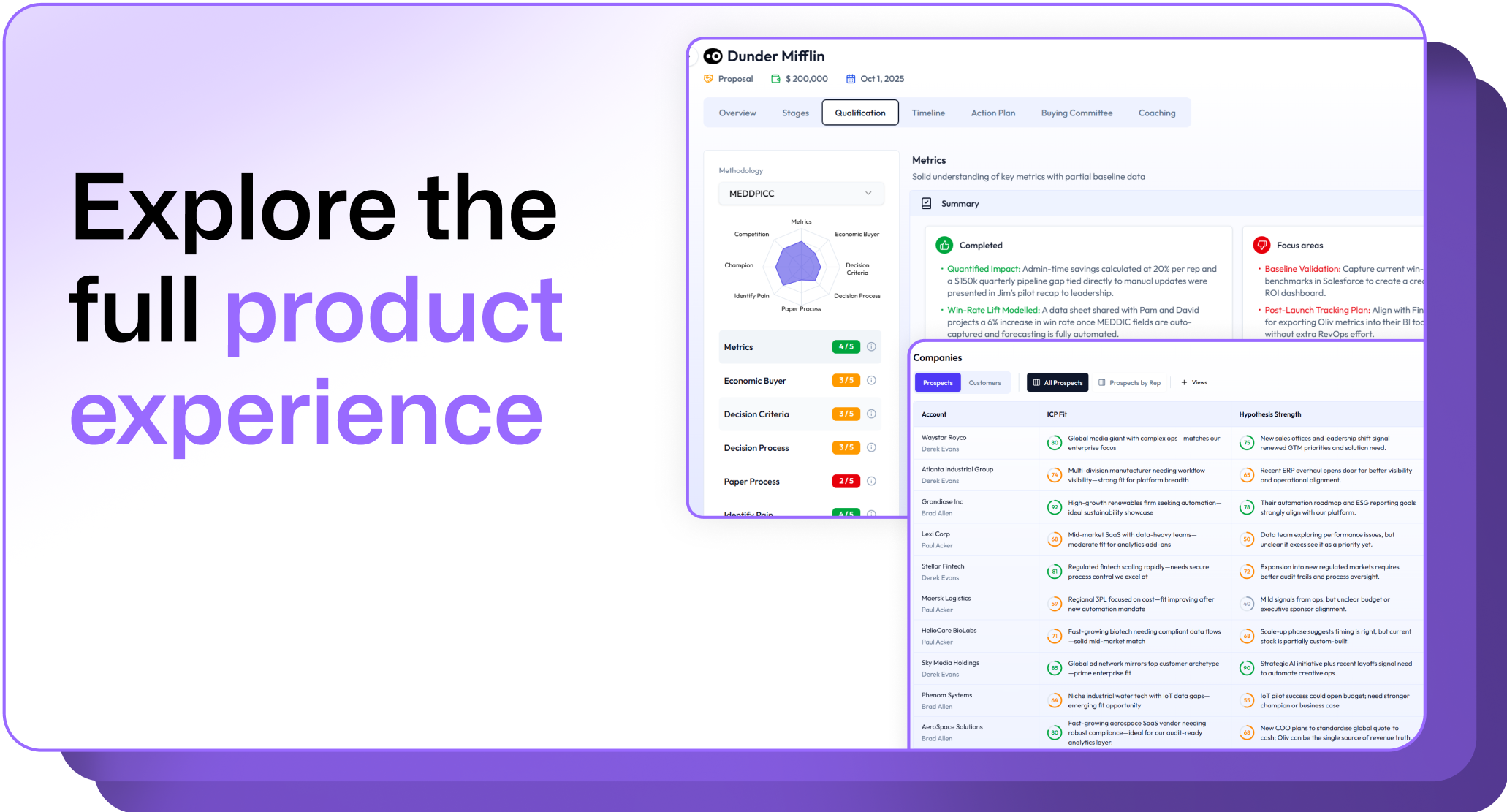
.avif)