VP of Sales Coaching at Scale — Building a Coaching Culture That Doesn't Depend on Hero Managers | 2026
Written by
Ishan Chhabra
Last Updated :
March 14, 2026
Skim in :
7
mins
In this article
Revenue teams love Oliv
Here’s why:
All your deal data unified (from 30+ tools and tabs).
Insights are delivered to you directly, no digging.
AI agents automate tasks for you.
Thank you! Your submission has been received!
Oops! Something went wrong while submitting the form.
Meet Oliv’s AI Agents
Hi! I’m, Deal Driver
I track deals, flag risks, send weekly pipeline updates and give sales managers full visibility into deal progress
Hi! I’m, CRM Manager
I maintain CRM hygiene by updating core, custom and qualification fields all without your team lifting a finger
Hi! I’m, Forecaster
I build accurate forecasts based on real deal movement and tell you which deals to pull in to hit your number
Hi! I’m, Coach
I believe performance fuels revenue. I spot skill gaps, score calls and build coaching plans to help every rep level up
Hi! I’m, Prospector
I dig into target accounts to surface the right contacts, tailor and time outreach so you always strike when it counts
Hi! I’m, Pipeline tracker
I call reps to get deal updates, and deliver a real-time, CRM-synced roll-up view of deal progress
Hi! I’m, Analyst
I answer complex pipeline questions, uncover deal patterns, and build reports that guide strategic decisions
TL;DR
Coaching breaks at 50+ reps because managers can only review 2-5% of calls, creating the "Hero Manager" trap.
Legacy tools like Gong track coaching volume (calls reviewed), not coaching impact (win rates improved).
AI-native coaching auto-scores every call against custom rubrics and links skill gaps directly to deal outcomes.
Oliv.ai's Measure, Practice, Perform loop is the only closed-loop coaching system connecting live deals to tailored practice.
A 100-user team pays roughly $789,300 over 3 years with Gong vs. $68,400 with Oliv, a 91% cost reduction.
The VP's role shifts from "chief coach" to "system architect" designing four layers: data foundation, methodology enforcement, coaching cadence, and continuous improvement.
Q1: Why Does Sales Coaching Break at 50+ Reps and What Is the 'Hero Manager' Trap? [toc=Hero Manager Trap]
There's an inflection point every growth-stage VP of Sales hits, usually somewhere between 25 and 50 reps, where coaching quietly stops working. At that size, two or three strong frontline managers can personally cover the team: reviewing calls, running 1:1s, course-correcting deals in real time. But cross that threshold into 50, 75, or 100 reps, and the entire coaching apparatus rests on those same few managers. This is the "Hero Manager" trap, a systemic single point of failure where one departure or promotion can crater a team's quota attainment by 20-30% almost overnight.
When coaching depends on hero managers, one departure can crater quota attainment by 20-30%. An AI-native coaching layer distributes coaching intelligence across the entire org.
⚠️ The Dashcam Problem: Why Legacy Tools Don't Fix This
Traditional conversation intelligence platforms like Gong and Chorus were designed as documentation tools, what Ishan Chhabra, Founder of Oliv AI, calls a "dashcam" view. They record what happened on a call, but still require the manager to manually review recordings, leave comments, and build coaching plans. At scale, the math simply breaks. Managers review fewer than 5% of their team's calls, creating massive blind spots. Gong's "Coaching" module primarily tracks volume, how many calls a manager listened to, how many comments they left, but not whether that coaching actually changed rep behavior or improved deal outcomes.
As one Gong user put it:
"No way to collaborate/share a library of top calls, AI is not great yet - the product still feels like it's at its infancy and needs to be developed further." — Annabelle H., Voluntary Director - Board of Directors, G2 Verified Review
Even power users acknowledge the overhead:
"It can be overwhelming to set up trackers. AI training is a bit laborious to get it to do what you want." — Trafford J., Senior Director, Revenue Enablement, G2 Verified Review
✅ From "Tools That Help Managers Coach" to "Systems That Coach Automatically"
The market is undergoing a fundamental shift: from tools that help managers coach to systems that coach autonomously and surface insights to managers. Think of it as the difference between giving someone a better microscope versus giving them a diagnostic AI. In 2026, buyers no longer want an app they have to "adopt and train for", they want an AI-native revenue orchestration workforce that does the work for them.
How Oliv.ai Eliminates the Hero-Manager Dependency
Oliv.ai's Coach Agent breaks this cycle by automatically analyzing every call across every rep, not the 2-5% a human manager can cover. It generates a Monthly Skill-Gap Map for each rep that rolls up into team-level and manager-level views, giving the VP complete coaching visibility without depending on any single manager's diligence. The Analyst Agent acts as an "Ask Me Anything" engine where VPs can query in plain English: "Which managers have the highest adherence to our MEDDPICC coaching rubric?"
The data is stark: teams with formal coaching programs see 28% higher win rates, yet only 26% of salespeople report being coached weekly. The gap between what works and what actually happens is exactly where AI-native coaching intervenes, turning coaching from a hero-dependent burden into an automated, organization-wide system.
Q2: What Does a 'Coaching Culture' Actually Mean and How Is It Different from Just Buying a Tool? [toc=Coaching Culture vs Tools]
A coaching culture is not a software subscription, it's an operating system built on three pillars: clear expectation (coaching is a core managerial KPI, not optional), shared framework (a common rubric enforced across all managers), and protected time (a coaching cadence that's defended from operational fire drills). Most organizations confuse buying a coaching tool with building this system.
❌ The $200K Consultancy Problem
Most mid-market companies buy Gong and equate "having a tool" with "having a culture." But Gong's coaching module tracks volume, calls reviewed, comments posted, not impact. Organizations then spend $50K-$200K on sales consultancies like Winning by Design or Force Management, but the training fails to "stick" because every manager coaches differently. There is no systemic way to verify whether Manager A's team is improving faster than Manager B's.
This is a recurring frustration among users:
"There's so much in Gong, that we don't use everything. Gong's deal forecasting we don't use." — Karel Bos, Head of Sales, TrustRadius Verified Review
"Clari is a tool for sales leaders, it adds no value to reps as far as I can see." — Msoave, r/sales Reddit Thread
✅ Why Consistency Requires AI, Not Just Managers
A true coaching culture requires enforcement of a single rubric across 1,000+ calls, something no human management layer can do consistently. When every manager interprets "good discovery" differently, the rubric becomes meaningless. AI shifts coaching from "hope your managers do it" to "the system guarantees it".
How Oliv Acts as the "Guardrail for Sales Methodologies"
Oliv's Coach Agent enforces a single, customizable rubric across all teams. Whether a rep reports to a veteran manager or a brand-new team lead, they are graded on the same evidence-based criteria. The Analyst Agent allows VPs to visualize manager effectiveness by comparing the "graduation rate" of new hires or the win-rate improvements of reps under different managers, answering the question "which managers are actually coaching well?" with data, not guesswork.
The Coaching Culture Maturity Model
Use this as a self-assessment roadmap:
Coaching Culture Maturity Model
Stage
Characteristics
VP's Role
⚠️ Reactive
Coaching happens only when deals are at risk; no cadence or rubric
Fire-fighting
⏰ Structured
Regular 1:1s exist; methodology is defined but inconsistently applied
Process designer
✅ AI-Augmented
AI auto-scores every call; managers focus on high-value mentoring
System architect
⭐ Self-Sustaining
Coaching loop runs autonomously; system self-improves as data grows
Strategic overseer
Most companies buying Gong or Clari plateau at "Structured." Oliv is designed to take you to "Self-Sustaining".
Q3: How Do I Measure Whether Coaching Is Actually Improving Win Rates and Not Just Creating More Meetings? [toc=Measuring Coaching ROI]
This is the question that separates performative coaching from revenue-driving coaching. The uncomfortable truth: "Activity" does not equal "Intent." VPs suffer from "dashboard digging" fatigue, clicking through screens in Gong to see if activity metrics are up. A rep might have ten meetings on the board, but if they aren't uncovering Identify Pain or confirming the Economic Buyer, those meetings won't convert to closed revenue.
❌ Why Keyword Trackers and Self-Reported Forecasts Fail
Gong's Smart Trackers are keyword-based, they flag the word "budget" even if the prospect is talking about their "holiday budget." This creates noisy alerts that lead to little action. Clari relies on rep self-assessment: if a rep hides a stalled deal or inflates their forecast call, the manager has no visibility until it's too late.
Users confirm this friction:
"The additional products like forecast or engage come at an additional cost. Would be great to see these tools rolled into the core offering." — Scott T., Director of Sales, G2 Verified Review
"Clari should find ways to differentiate from the native Salesforce features (e.g., Pipeline Inspection, Forecasting) in order to remain competitive in the long-run." — Dan J., G2 Verified Review
✅ Outcome-Linked Coaching: The AI-Era Framework
The shift is from measuring coaching activity to measuring coaching outcomes. Outcome-linked coaching correlates specific skill improvements (better discovery questioning, stronger multi-threading, tighter next-step commitments) with actual win rates, deal velocity, and sales cycle compression, not just whether more coaching sessions took place.
How Oliv.ai Ties Coaching Directly to Revenue
Oliv's Deal Driver agent proactively flags "Fake Coverage", deals where specific playbook criteria are missing despite high rep activity. Because Oliv's Forecaster Agent and Coach Agent live on the same unified data platform, VPs can explicitly tie coaching goals to revenue. The Coach Agent doesn't just score a call; it evaluates how qualification metrics (MEDDPICC, BANT, SPICED) are being met across the entire deal lifecycle, linking skill gaps directly to deal progression and win rates.
Here's the key metric worth anchoring: sales reps with 30 minutes or less coaching per week have 43% win rates; those receiving 2+ hours of targeted coaching per week hit 56%. But the emphasis is on targeted, two hours of unfocused call reviews don't move the needle. Oliv ensures that every coaching minute addresses the specific skill gap that's actually costing deals.
Q4: What Signals Does an AI Coach Agent Use to Identify Rep Skill Gaps? [toc=AI Skill Gap Detection]
Most sales managers discover a rep's skill gap the hard way, a blown deal at the end of the quarter, a lost renewal that nobody saw coming, or an awkward silence during a forecast review. Managers spend their evenings listening to call recordings because they have no other way to identify gaps proactively. At 50+ reps, manual review covers less than 2% of total interactions, meaning 98% of coachable moments go completely unobserved.
❌ Keywords ≠ Understanding: The Limits of Gen-1 Intelligence
Chorus.ai has ceased meaningful innovation since its acquisition by ZoomInfo and now acts primarily as a basic transcription and note-taking tool. As one Chorus user observed:
"The software doesn't have the capability of identifying words/phrases that are similar to what you're looking for or understand context, so if you don't tell it exactly what you're looking for then you'll miss out." — Director of Sales Operations, Gartner Verified Review
Gong's Smart Trackers require 50-100 example sentences per custom tracker and 40+ minutes per training cycle. This creates what teams call "Manual Configuration Hell", a process that most RevOps teams abandon after the initial setup enthusiasm fades:
"It can be overwhelming to set up trackers. AI training is a bit laborious to get it to do what you want." — Trafford J., Senior Director, Revenue Enablement, G2 Verified Review
✅ Intent Over Keywords: How AI-Native Coaching Detects Subtle Signals
Modern AI sales coaching uses "Intent over Keywords." Instead of flagging surface-level word matches, it reasons across the entire conversation flow, detecting when a rep fails to quantify business impact, hesitates during pricing discussions, skips champion identification, or loses control of the discovery agenda. It analyzes patterns across dozens of calls, not isolated keyword hits on a single recording.
How Oliv.ai Builds a 360 Skill Profile
Oliv monitors emails, call transcripts, support tickets, and Slack to build a comprehensive understanding of each rep's performance. It uses 100+ fine-tuned LLMs grounded exclusively in the customer's data lake to detect subtle signals that keyword-based tools miss entirely. The Voice Agent even calls reps for a five-minute nightly debrief to capture unrecorded context from in-person meetings, closing the critical data gap that plagues call-only tools.
The distinction is captured in a single phrase: "Reasoning over Recording." Gong analyzes recorded calls only. Oliv stitches data from calls, emails, Slack, and even Telegram into a single account history, then reasons across that complete picture to identify which skill gaps are actually costing deals, not just which keywords appeared on a transcript.
Q5: Can I Define Custom Coaching Rubrics Aligned to Our Sales Methodology? [toc=Custom Coaching Rubrics]
Every sales org runs differently. An enterprise team selling six-figure contracts needs a different coaching rubric than an SMB team running 14-day sales cycles. Even within the same company, a Discovery call rubric looks nothing like a QBR rubric. Yet most coaching platforms force teams into rigid, one-size-fits-all templates, and when the framework doesn't match how your team actually sells, adoption collapses within weeks.
❌ The "Manual Configuration Hell" of Legacy Tools
Gong offers a "mostly fixed playbook" with limited workflow customization. Configuring Smart Trackers, Gong's mechanism for detecting methodology-specific behaviors, is a manual, labor-intensive process that consumes 40 to 140 admin hours. Each custom tracker requires 50 to 100 example sentences and 40+ minutes per training cycle. For a VP trying to enforce a hybrid methodology like MEDDPICC + 3 Whys across multiple segments, this becomes an unsustainable RevOps burden.
Even Gong advocates acknowledge this friction:
"It can be overwhelming to set up trackers. AI training is a bit laborious to get it to do what you want." — Trafford J., Senior Director, Revenue Enablement, G2 Verified Review
⚠️ Why Custom Scoring Never Gets Implemented
Salesforce requires heavy manual work to build custom scoring equations, which is why most companies never implement them. The result: expensive methodology training that lives in a slide deck but never gets enforced in the system of record.
✅ Natural Language Configuration: The AI-Native Approach
The best AI-native systems are pre-trained on multiple sales methodologies and can be configured in plain English rather than requiring hundreds of admin hours of manual tracker training. Instead of teaching the AI what "budget" sounds like through 100 example sentences, you simply describe the behavior you want to detect.
How Oliv.ai Makes Rubric Customization Effortless
Oliv is trained on 100+ sales methodologies, MEDDPICC, BANT, SPICED, Challenger, Sandler, and more, and can be programmed in plain English. VPs define custom rubrics for different stages (Discovery, Demo, QBR) and different teams (Enterprise vs. Mid-Market) without touching a single configuration panel.
The CRM Manager agent then automatically updates actual CRM Objects and Properties, not just notes or comments, but structured data fields, based on those custom rubrics. This ensures methodology adherence is reflected in the single source of truth, not buried in a separate coaching tool.
⭐ Real-World Example
Consider a VP running a hybrid MEDDIC + 3 Whys methodology. With Gong, they'd need to build separate trackers for each MEDDIC element and each "Why" layer, potentially 100+ hours of configuration, maintained separately for enterprise and SMB segments. With Oliv, the VP describes the hybrid rubric in natural language, and the Coach Agent scores both frameworks simultaneously, weighting them differently for enterprise vs. mid-market segments, configured in minutes, not months.
"It's too complicated, and not intuitive at all. Using it is very...discomforting. Searching for calls is not easy, moving around in the calls is not easy." — John S., Senior Account Executive, G2 Verified Review
Q6: How Do I Build an Automated Coaching Loop That Targets Specific Skill Gaps? [toc=Automated Coaching Loop]
Coaching today is overwhelmingly "cold" and reactive. A rep practices a generic role-play in a training session on Tuesday, but it has nothing to do with the $500K deal they're losing on Thursday. There is no loop between practicing a skill and executing it in the field, and without that loop, skill development stalls at the theoretical level.
Each live call generates data that refines the next practice session, creating a self-reinforcing flywheel that accelerates rep skill development automatically.
Recording tools (Gong, Chorus): They capture what happened on a call but provide no practice mechanism. A manager can see that a rep fumbled a pricing objection, but the tool offers no way for the rep to practice handling that exact objection before the next call.
Practice-only bots (Second Nature, Hyperbound): These "second generation" tools provide voice bots for role-play, but they don't know what's actually happening on a rep's live deals. The practice scenarios are generic, disconnected from the real objections and competitors the rep faces daily.
As one Chorus user noted, even basic functionality feels incomplete:
"I wish the meeting summaries were more detailed. I find that it misses a lot. I can go back into the transcripts but I do not love doing that and it takes time I don't have." — Natalie G., Bilingual Account Manager, G2 Verified Review
✅ The "Fully Completing Loop": Measure, Practice, Perform
AI-native coaching connects live deal analysis, tailored practice, and in-call reinforcement in a single system. The practice scenarios are generated from real deal data, not generic scripts, so a rep who lost a deal yesterday to a Competitor X objection practices that exact scenario before their next call today.
How Oliv.ai Closes the Loop End-to-End
Oliv provides the only Fully Completing Loop in the market:
Oliv.ai Fully Completing Coaching Loop
Stage
What Happens
Oliv Agent
⭐ MEASURE
Automatically analyzes every live call to identify specific skill gaps
Coach Agent
⏰ PRACTICE
Deploys tailored voice bots using field data (e.g., yesterday's lost-deal objection)
Coach Agent
✅ PERFORM
Provides in-call nudges to ensure the practiced skill is applied in the next conversation
Deal Driver + Meeting Assistant
⭐ A Self-Reinforcing Flywheel
This loop is self-reinforcing: each live call generates new data that refines the next practice session, which improves the next live performance, creating a flywheel that accelerates skill development automatically.
"No way to collaborate/share a library of top calls, AI is not great yet, the product still feels like it's at its infancy and needs to be developed further." — Annabelle H., Voluntary Director, Board of Directors, G2 Verified Review
The analogy is simple: legacy tools like Gong and Chorus are a dashcam, they record the accident after it happens. Oliv is autopilot, it helps you drive the car to the destination.
Q7: Can AI Show Coaching Metrics Per Manager and Not Just Per Rep? [toc=Manager-Level Coaching Metrics]
Here's a blind spot most VPs don't talk about openly: they can see which reps are hitting quota, but they can't easily tell which managers are actually effective at developing their team's skills. Coaching is hidden in siloed 1:1 documents, manual spreadsheets, or scattered Gong comments that no one aggregates. Without centralized manager-level metrics, the VP cannot standardize the coaching rubric across the organization, or identify which managers need coaching themselves.
❌ Volume Tracking ≠ Impact Tracking
Gong's coaching module tracks volume, how many calls a manager listened to, how many comments they left, but not the impact of that coaching on rep behavior or deal outcomes. A manager who reviews 50 calls per month and leaves generic "nice job" comments looks identical in the dashboard to a manager who reviews 50 calls and drives measurable skill improvement.
"There's so much in Gong, that we don't use everything. Gong's deal forecasting we don't use." — Karel Bos, Head of Sales, TrustRadius Verified Review
⚠️ Forecasting Tools That Miss Coaching Entirely
Clari's roll-up forecasting is rep-driven and biased, reps tell stories, managers guess probabilities, and offers virtually nothing in terms of cross-manager effectiveness analysis. As one Reddit user bluntly summarized:
"It is really just a glorified SFDC overlay. Actually, Salesforce has built most of the forecasting functionality by now anyway so I'm not sure where they fit." — conaldinho11, r/SalesOperations Reddit Thread
✅ The VP Needs a Coaching Effectiveness Dashboard
The AI-era VP needs a dashboard that compares managers on dimensions that actually matter: methodology adherence rates, new-hire graduation speed, team win-rate improvement over time, and skill-gap closure rates, all auto-generated, not manually assembled.
How Oliv.ai Gives VPs Manager-Level Visibility
Oliv's Analyst Agent acts as an "Ask Me Anything" strategic engine. A VP can query in plain English: "Which managers have the highest adherence to our MEDDPICC coaching rubric?" or "Compare coaching effectiveness between Team A and Team B." The Coach Agent aggregates data into a Monthly Skill-Gap Map for every rep that rolls up from rep to team to manager views.
⭐ "Hero Manager Insurance"
This is the ultimate safeguard against the hero-manager trap. When a great coaching manager gets promoted or leaves, the system still holds the rubric, the historical data, and the coaching cadence. The organization doesn't lose its coaching DNA, it's encoded in the platform, not trapped in one person's head.
"Since we purchased our package, the support model has changed drastically, which is infuriating." — Elspeth C., Chief Commercial Officer, G2 Verified Review
Q8: Can AI Coaching Help Ramp New Hires Faster by Identifying Skill Gaps Early? [toc=Faster New Hire Ramp]
Ramping new sales hires is a human bandwidth nightmare. Managers only have time to review roughly 2% of a new hire's calls, meaning a rep might repeat the same discovery mistake for three weeks before anyone notices. "Note-taker fatigue" during onboarding calls leads to zero actual task completion for the trainee, they're so busy documenting that they never learn to sell.
❌ The 8 to 24 Week Implementation Trap
Before Gong can even begin coaching a new hire, it needs to be fully operational. Gong Foundation requires 8 to 24 weeks and 140 admin hours to implement, a timeline that means your Q1 hires might not receive AI-assisted coaching until Q2 or Q3. Standard sales training consultancies aren't much better: they deliver generic role-plays that reps forget within two weeks.
One Gong user captured the adoption challenge perfectly:
"Our team is struggling with low adoption, and they won't even spend the time to support us during this transition. We were essentially left with minimal support and no actionable solutions for improving adoption." — Anonymous Reviewer, G2 Verified Review
⚠️ Onboarding Value Requires Months of Setup
Even users who see onboarding value in Gong acknowledge the overhead:
"As a team manager, having access to Gong is amazing. Also, for people that are onboarding the meeting libraries we have built are great. It speeds up the ramp up phases." — Karel Bos, Head of Sales, TrustRadius Verified Review
✅ The difference: Gong can help with onboarding, but only after months of setup and only through passive library access. It doesn't proactively identify what each new hire specifically struggles with.
✅ AI-Native: Detect Gaps in Days, Not Quarters
Modern AI coaching detects a ramping rep's specific gaps in the first 3 to 5 calls and prescribes targeted micro-coaching immediately, cutting ramp time by 30 to 40%. Instead of waiting for a manager to notice a pattern over weeks of sporadic call reviews, the AI flags "this rep consistently misses Competitor X objections" on Day 3.
How Oliv.ai Delivers Rapid Time-to-Value for New Hires
Oliv is configured in 5 minutes and customized in 2 to 4 weeks, not 8 to 24 weeks. The Meeting Assistant automates all onboarding prep and call notes so the new hire can focus entirely on learning, not documenting. The Coach Agent identifies each new hire's specific gap (e.g., handling pricing objections, qualifying Economic Buyers) and prescribes micro-coaching tasks directly in their workflow, not in a separate training portal they'll never check.
💰 The Math That Matters
For a growth-stage company adding 5 new reps per quarter, cutting ramp time by even 30% translates to approximately 2 additional months of productive selling time per year across the cohort. At an average quota of $500K per rep, that's significant pipeline acceleration that compounds quarter over quarter.
Q9: 'A Machine Can't Understand My Deals' How Do I Overcome Manager Skepticism of AI Coaching? [toc=Overcoming AI Skepticism]
Manager skepticism of AI coaching isn't irrational, it's earned. Frontline managers have lived through years of "dumb" keyword trackers that flagged irrelevant phrases, generic AI chatbots that hallucinated confidently, and platform rollouts that promised automation but delivered more busywork. When a manager says "a machine can't understand my deals," they're expressing two legitimate fears: hallucination risk (the AI gets it wrong and I look foolish acting on its advice) and role reduction (coaching is replaced by a bot, and I become a dashboard monitor).
❌ When AI Feels Like Extra Work, Not Less
Salesforce Agentforce exemplifies the UX problem driving manager resistance. It is heavily chat-based, requiring the manager to manually navigate to a bot, type a question, and interpret the response. For a manager already drowning in CRM updates, 1:1 prep, and deal reviews, this feels like extra work rather than an assistant. As one Agentforce user noted:
"It can be complex to set up and often requires skilled administrators or developers to customize and integrate properly, which adds time and cost." — Verified User in Marketing and Advertising, G2 Verified Review
Another user captured the scaling concern:
"The pricing caught us off guard. Once we started scaling to more users and use cases, the cost ramped up pretty quickly. We had to rethink a few workflows just to stay within budget." — Ayushmaan Y., Senior Associate, G2 Verified Review
⚠️ Why Generic AI Reinforces Skepticism
Generic AI tools not grounded in company-specific data only reinforce the skepticism with high hallucination rates and generic outputs.
✅ The Reframe: AI Eliminates Low-Value Auditing, Not Managers
The most effective change-management approach reframes AI not as a replacement for managers, but as a tool that eliminates the low-value parts of coaching (manual call review, CRM data entry, activity tracking) so managers can invest their time in high-value mentoring, deal strategy, career development, and relationship coaching.
How Oliv.ai Delivers "Human-in-the-Loop Intelligence"
Oliv provides detailed citations, linking directly to the exact meeting clip where a signal occurred. It uses Reasoning Models (Chain of Thought) to explain why it reached a coaching conclusion, not just what the conclusion is. Managers see the evidence, verify it in seconds, and apply their judgment on top. This positions Oliv as a "hands-free workforce" that does the auditing so managers can do the mentoring.
⭐ The "Trojan Horse" Adoption Path
Start with Oliv's free recording layer, core meeting recording at no cost. Let managers experience frictionless transcription and summaries for 2 to 4 weeks. Once trust is established through daily use, introduce the Coach Agent as an upgrade. This bottom-up adoption path mirrors how the best enterprise tools scale: prove value before asking for commitment.
Q10: Gong vs. Chorus vs. Clari Which Actually Coaches at Scale? [toc=Coaching Platform Comparison]
When VPs of Sales evaluate coaching tools for teams of 50 to 100+ reps, the decision typically narrows to Gong, Chorus (by ZoomInfo), Clari, or newer AI-native entrants. Below is a factual, feature-by-feature comparison across the dimensions that matter most for coaching at scale.
Coaching Capabilities Comparison
Coaching Capabilities Comparison: Gong vs. Chorus vs. Clari vs. Oliv.ai
✅ 5 minutes to configure, 2 to 4 weeks to customize
Pricing Model
💸 Mandatory platform fees ($5K to $50K+), bundled modules
💰 Bundled with ZoomInfo contracts
💰 Per-seat, plus integration maintenance
✅ Modular, pay only for agents each role uses; core recording free
What the Users Say
"The additional products like forecast or engage come at an additional cost. Would be great to see these tools rolled into the core offering." — Scott T., Director of Sales, G2 Verified Review
"The software doesn't have the capability of identifying words/phrases that are similar to what you're looking for or understand context, so if you don't tell it exactly what you're looking for then you'll miss out." — Director of Sales Operations, Gartner Verified Review
"Clari should find ways to differentiate from the native Salesforce features (e.g., Pipeline Inspection, Forecasting) in order to remain competitive in the long-run." — Dan J., G2 Verified Review
✅ The Bottom Line
Gong leads in conversation intelligence depth but layers coaching as a volume metric, not an outcome metric. Chorus has stagnated post-acquisition. Clari excels at forecasting but is not a coaching tool. Oliv.ai is the only platform that unifies coaching, forecasting, and deal management in a single AI-Native Revenue Orchestration system with autonomous skill-gap detection and closed-loop practice.
Q11: What Does the VP's Coaching Architecture Blueprint Look Like? [toc=Coaching Architecture Blueprint]
Building a coaching culture that scales beyond hero managers requires architectural thinking, not just tool selection. The VP's role shifts from "chief coach" to "system architect," designing a coaching operating system with four interconnected layers.
The VP's coaching architecture shifts from personal coaching to system design across four interconnected layers, each powered by specialized AI agents.
Layer 1: Data Foundation (Capture Everything)
Goal: Ensure 100% of coaching-relevant interactions are captured, calls, emails, Slack, support tickets, in-person debriefs
Legacy approach:Gong/Chorus capture calls only; emails require separate Einstein Activity Capture (which redacts data and stores it in unusable silos)
AI-native approach: Oliv captures calls, emails, Slack, Telegram, and even in-person context via the Voice Agent's 5-minute nightly debrief
Goal: Every rep is graded on the same evidence-based criteria regardless of which manager they report to
Legacy approach: $50K to $200K consultancy spend that fails to stick because every manager coaches differently
AI-native approach: Coach Agent enforces custom rubrics in plain English across 1,000+ calls, with CRM Manager updating actual CRM Objects
Layer 3: Coaching Cadence (Protected Time + Automated Insights)
VP Coaching Cadence Framework
Cadence
Activity
Tool Layer
⏰ Weekly
1:1 coaching sessions with pre-populated skill-gap insights
Coach Agent auto-generates agenda
⏰ Monthly
Skill-Gap Map review per rep, team, and manager
Analyst Agent rolls up data
⏰ Quarterly
Manager effectiveness comparison and rubric refinement
Analyst Agent benchmarking
Layer 4: Continuous Improvement Loop
Measure: Auto-analyze every live interaction for skill gaps
Practice: Deploy contextual voice bots using real deal data
Perform: In-call nudges via Deal Driver and Meeting Assistant
⭐ The Architecture Principle
The VP doesn't coach 100 reps, the VP builds the system that coaches 100 reps. Managers become "coached coaches" with AI handling the auditing, data gathering, and rubric enforcement. The VP's dashboard shows which managers are running the system effectively and which need support.
"It's too complicated, and not intuitive at all. Searching for calls is not easy, moving around in the calls is not easy, and understanding the pipeline management portion of it is almost impossible." — John S., Senior Account Executive, G2 Verified Review
"Gong is a really powerful tool but it's probably the highest end option on the market, and now we're stuck with a tool that works technically but isn't the right business decision." — Iris P., Head of Marketing, Sales & Partnerships, G2 Verified Review
The best coaching architecture is one that works even when your best manager leaves, because the rubric, data, and coaching intelligence live in the system, not in any single person's head. Oliv.ai is purpose-built to serve as this system's AI layer, requiring minimal setup and maintaining coaching continuity as teams scale.
Q12: What Is the True Cost of Scaling Coaching and How Does Oliv.ai's Modular Pricing Change the Math? [toc=Coaching TCO Comparison]
For a VP managing 25 to 100 reps, coaching infrastructure cost isn't a line-item decision, it's a board-level conversation. The question isn't just "how much does the tool cost?" but "what's the total cost of ownership when you factor in platform fees, implementation hours, bundled modules you don't use, and the opportunity cost of slow deployment?"
💸 The "Gong Tax": Bundled Pricing at Enterprise Scale
Gong charges mandatory platform fees ranging from $5K to $50K+ depending on org size, on top of per-seat licensing. Features like Forecast, Engage, and coaching modules come at additional cost, you can't unbundle what you don't need. For a 100-user team, the 3-year total cost of ownership reaches approximately $789,300.
⚠️ Users Consistently Flag Pricing as a Pain Point
"The additional products like forecast or engage come at an additional cost. Would be great to see these tools rolled into the core offering." — Scott T., Director of Sales, G2 Verified Review
"Gong is a really powerful tool but it's probably the highest end option on the market, and now we're stuck with a tool that works technically but isn't the right business decision." — Iris P., Head of Marketing, Sales & Partnerships, G2 Verified Review
"The pricing is probably the biggest obstacle and hence we are looking to change." — Miodrag, Enterprise Account Executive, Verified LinkedIn Review
✅ Modular, Agent-Based Pricing: Pay for What You Use
AI-native revenue orchestration platforms are shifting to modular pricing where organizations pay only for the agents that specific roles actually use. Core meeting recording becomes a free baseline, the value (and cost) sits in the intelligence layers built on top.
How Oliv.ai Changes the TCO Equation
Oliv is up to 91% cheaper than Gong over a 3-year period, approximately $68,400 vs. $789,300 for a 100-user team. Here's how the model works:
3-Year TCO Comparison: Gong vs. Oliv.ai (100 Users)
Component
Gong
Oliv.ai
💰 Core Recording
Included (bundled into platform fee)
✅ FREE
💰 Platform Fee
$5K to $50K+ mandatory
❌ None
💰 Coaching Module
Additional per-seat cost
Coach Agent, modular, per-role
💰 Forecasting
Additional per-seat cost
Forecaster Agent, modular, per-role
💰 Analytics
Bundled (pay whether you use it or not)
Analyst Agent, org-level pricing
💸 3-Year TCO (100 users)
~$789,300
~$68,400
⭐ The Cable vs. Streaming Analogy
The analogy is straightforward: Gong is bundled cable, you pay for 500 channels to watch 10. Oliv is a la carte streaming, core content is free, and you subscribe only to the premium agents your team actually uses. For a VP building a coaching culture at scale, that difference frees up budget for the things that actually move revenue: headcount, enablement content, and incentive programs.
Q1: Why Does Sales Coaching Break at 50+ Reps and What Is the 'Hero Manager' Trap? [toc=Hero Manager Trap]
There's an inflection point every growth-stage VP of Sales hits, usually somewhere between 25 and 50 reps, where coaching quietly stops working. At that size, two or three strong frontline managers can personally cover the team: reviewing calls, running 1:1s, course-correcting deals in real time. But cross that threshold into 50, 75, or 100 reps, and the entire coaching apparatus rests on those same few managers. This is the "Hero Manager" trap, a systemic single point of failure where one departure or promotion can crater a team's quota attainment by 20-30% almost overnight.
When coaching depends on hero managers, one departure can crater quota attainment by 20-30%. An AI-native coaching layer distributes coaching intelligence across the entire org.
⚠️ The Dashcam Problem: Why Legacy Tools Don't Fix This
Traditional conversation intelligence platforms like Gong and Chorus were designed as documentation tools, what Ishan Chhabra, Founder of Oliv AI, calls a "dashcam" view. They record what happened on a call, but still require the manager to manually review recordings, leave comments, and build coaching plans. At scale, the math simply breaks. Managers review fewer than 5% of their team's calls, creating massive blind spots. Gong's "Coaching" module primarily tracks volume, how many calls a manager listened to, how many comments they left, but not whether that coaching actually changed rep behavior or improved deal outcomes.
As one Gong user put it:
"No way to collaborate/share a library of top calls, AI is not great yet - the product still feels like it's at its infancy and needs to be developed further." — Annabelle H., Voluntary Director - Board of Directors, G2 Verified Review
Even power users acknowledge the overhead:
"It can be overwhelming to set up trackers. AI training is a bit laborious to get it to do what you want." — Trafford J., Senior Director, Revenue Enablement, G2 Verified Review
✅ From "Tools That Help Managers Coach" to "Systems That Coach Automatically"
The market is undergoing a fundamental shift: from tools that help managers coach to systems that coach autonomously and surface insights to managers. Think of it as the difference between giving someone a better microscope versus giving them a diagnostic AI. In 2026, buyers no longer want an app they have to "adopt and train for", they want an AI-native revenue orchestration workforce that does the work for them.
How Oliv.ai Eliminates the Hero-Manager Dependency
Oliv.ai's Coach Agent breaks this cycle by automatically analyzing every call across every rep, not the 2-5% a human manager can cover. It generates a Monthly Skill-Gap Map for each rep that rolls up into team-level and manager-level views, giving the VP complete coaching visibility without depending on any single manager's diligence. The Analyst Agent acts as an "Ask Me Anything" engine where VPs can query in plain English: "Which managers have the highest adherence to our MEDDPICC coaching rubric?"
The data is stark: teams with formal coaching programs see 28% higher win rates, yet only 26% of salespeople report being coached weekly. The gap between what works and what actually happens is exactly where AI-native coaching intervenes, turning coaching from a hero-dependent burden into an automated, organization-wide system.
Q2: What Does a 'Coaching Culture' Actually Mean and How Is It Different from Just Buying a Tool? [toc=Coaching Culture vs Tools]
A coaching culture is not a software subscription, it's an operating system built on three pillars: clear expectation (coaching is a core managerial KPI, not optional), shared framework (a common rubric enforced across all managers), and protected time (a coaching cadence that's defended from operational fire drills). Most organizations confuse buying a coaching tool with building this system.
❌ The $200K Consultancy Problem
Most mid-market companies buy Gong and equate "having a tool" with "having a culture." But Gong's coaching module tracks volume, calls reviewed, comments posted, not impact. Organizations then spend $50K-$200K on sales consultancies like Winning by Design or Force Management, but the training fails to "stick" because every manager coaches differently. There is no systemic way to verify whether Manager A's team is improving faster than Manager B's.
This is a recurring frustration among users:
"There's so much in Gong, that we don't use everything. Gong's deal forecasting we don't use." — Karel Bos, Head of Sales, TrustRadius Verified Review
"Clari is a tool for sales leaders, it adds no value to reps as far as I can see." — Msoave, r/sales Reddit Thread
✅ Why Consistency Requires AI, Not Just Managers
A true coaching culture requires enforcement of a single rubric across 1,000+ calls, something no human management layer can do consistently. When every manager interprets "good discovery" differently, the rubric becomes meaningless. AI shifts coaching from "hope your managers do it" to "the system guarantees it".
How Oliv Acts as the "Guardrail for Sales Methodologies"
Oliv's Coach Agent enforces a single, customizable rubric across all teams. Whether a rep reports to a veteran manager or a brand-new team lead, they are graded on the same evidence-based criteria. The Analyst Agent allows VPs to visualize manager effectiveness by comparing the "graduation rate" of new hires or the win-rate improvements of reps under different managers, answering the question "which managers are actually coaching well?" with data, not guesswork.
The Coaching Culture Maturity Model
Use this as a self-assessment roadmap:
Coaching Culture Maturity Model
Stage
Characteristics
VP's Role
⚠️ Reactive
Coaching happens only when deals are at risk; no cadence or rubric
Fire-fighting
⏰ Structured
Regular 1:1s exist; methodology is defined but inconsistently applied
Process designer
✅ AI-Augmented
AI auto-scores every call; managers focus on high-value mentoring
System architect
⭐ Self-Sustaining
Coaching loop runs autonomously; system self-improves as data grows
Strategic overseer
Most companies buying Gong or Clari plateau at "Structured." Oliv is designed to take you to "Self-Sustaining".
Q3: How Do I Measure Whether Coaching Is Actually Improving Win Rates and Not Just Creating More Meetings? [toc=Measuring Coaching ROI]
This is the question that separates performative coaching from revenue-driving coaching. The uncomfortable truth: "Activity" does not equal "Intent." VPs suffer from "dashboard digging" fatigue, clicking through screens in Gong to see if activity metrics are up. A rep might have ten meetings on the board, but if they aren't uncovering Identify Pain or confirming the Economic Buyer, those meetings won't convert to closed revenue.
❌ Why Keyword Trackers and Self-Reported Forecasts Fail
Gong's Smart Trackers are keyword-based, they flag the word "budget" even if the prospect is talking about their "holiday budget." This creates noisy alerts that lead to little action. Clari relies on rep self-assessment: if a rep hides a stalled deal or inflates their forecast call, the manager has no visibility until it's too late.
Users confirm this friction:
"The additional products like forecast or engage come at an additional cost. Would be great to see these tools rolled into the core offering." — Scott T., Director of Sales, G2 Verified Review
"Clari should find ways to differentiate from the native Salesforce features (e.g., Pipeline Inspection, Forecasting) in order to remain competitive in the long-run." — Dan J., G2 Verified Review
✅ Outcome-Linked Coaching: The AI-Era Framework
The shift is from measuring coaching activity to measuring coaching outcomes. Outcome-linked coaching correlates specific skill improvements (better discovery questioning, stronger multi-threading, tighter next-step commitments) with actual win rates, deal velocity, and sales cycle compression, not just whether more coaching sessions took place.
How Oliv.ai Ties Coaching Directly to Revenue
Oliv's Deal Driver agent proactively flags "Fake Coverage", deals where specific playbook criteria are missing despite high rep activity. Because Oliv's Forecaster Agent and Coach Agent live on the same unified data platform, VPs can explicitly tie coaching goals to revenue. The Coach Agent doesn't just score a call; it evaluates how qualification metrics (MEDDPICC, BANT, SPICED) are being met across the entire deal lifecycle, linking skill gaps directly to deal progression and win rates.
Here's the key metric worth anchoring: sales reps with 30 minutes or less coaching per week have 43% win rates; those receiving 2+ hours of targeted coaching per week hit 56%. But the emphasis is on targeted, two hours of unfocused call reviews don't move the needle. Oliv ensures that every coaching minute addresses the specific skill gap that's actually costing deals.
Q4: What Signals Does an AI Coach Agent Use to Identify Rep Skill Gaps? [toc=AI Skill Gap Detection]
Most sales managers discover a rep's skill gap the hard way, a blown deal at the end of the quarter, a lost renewal that nobody saw coming, or an awkward silence during a forecast review. Managers spend their evenings listening to call recordings because they have no other way to identify gaps proactively. At 50+ reps, manual review covers less than 2% of total interactions, meaning 98% of coachable moments go completely unobserved.
❌ Keywords ≠ Understanding: The Limits of Gen-1 Intelligence
Chorus.ai has ceased meaningful innovation since its acquisition by ZoomInfo and now acts primarily as a basic transcription and note-taking tool. As one Chorus user observed:
"The software doesn't have the capability of identifying words/phrases that are similar to what you're looking for or understand context, so if you don't tell it exactly what you're looking for then you'll miss out." — Director of Sales Operations, Gartner Verified Review
Gong's Smart Trackers require 50-100 example sentences per custom tracker and 40+ minutes per training cycle. This creates what teams call "Manual Configuration Hell", a process that most RevOps teams abandon after the initial setup enthusiasm fades:
"It can be overwhelming to set up trackers. AI training is a bit laborious to get it to do what you want." — Trafford J., Senior Director, Revenue Enablement, G2 Verified Review
✅ Intent Over Keywords: How AI-Native Coaching Detects Subtle Signals
Modern AI sales coaching uses "Intent over Keywords." Instead of flagging surface-level word matches, it reasons across the entire conversation flow, detecting when a rep fails to quantify business impact, hesitates during pricing discussions, skips champion identification, or loses control of the discovery agenda. It analyzes patterns across dozens of calls, not isolated keyword hits on a single recording.
How Oliv.ai Builds a 360 Skill Profile
Oliv monitors emails, call transcripts, support tickets, and Slack to build a comprehensive understanding of each rep's performance. It uses 100+ fine-tuned LLMs grounded exclusively in the customer's data lake to detect subtle signals that keyword-based tools miss entirely. The Voice Agent even calls reps for a five-minute nightly debrief to capture unrecorded context from in-person meetings, closing the critical data gap that plagues call-only tools.
The distinction is captured in a single phrase: "Reasoning over Recording." Gong analyzes recorded calls only. Oliv stitches data from calls, emails, Slack, and even Telegram into a single account history, then reasons across that complete picture to identify which skill gaps are actually costing deals, not just which keywords appeared on a transcript.
Q5: Can I Define Custom Coaching Rubrics Aligned to Our Sales Methodology? [toc=Custom Coaching Rubrics]
Every sales org runs differently. An enterprise team selling six-figure contracts needs a different coaching rubric than an SMB team running 14-day sales cycles. Even within the same company, a Discovery call rubric looks nothing like a QBR rubric. Yet most coaching platforms force teams into rigid, one-size-fits-all templates, and when the framework doesn't match how your team actually sells, adoption collapses within weeks.
❌ The "Manual Configuration Hell" of Legacy Tools
Gong offers a "mostly fixed playbook" with limited workflow customization. Configuring Smart Trackers, Gong's mechanism for detecting methodology-specific behaviors, is a manual, labor-intensive process that consumes 40 to 140 admin hours. Each custom tracker requires 50 to 100 example sentences and 40+ minutes per training cycle. For a VP trying to enforce a hybrid methodology like MEDDPICC + 3 Whys across multiple segments, this becomes an unsustainable RevOps burden.
Even Gong advocates acknowledge this friction:
"It can be overwhelming to set up trackers. AI training is a bit laborious to get it to do what you want." — Trafford J., Senior Director, Revenue Enablement, G2 Verified Review
⚠️ Why Custom Scoring Never Gets Implemented
Salesforce requires heavy manual work to build custom scoring equations, which is why most companies never implement them. The result: expensive methodology training that lives in a slide deck but never gets enforced in the system of record.
✅ Natural Language Configuration: The AI-Native Approach
The best AI-native systems are pre-trained on multiple sales methodologies and can be configured in plain English rather than requiring hundreds of admin hours of manual tracker training. Instead of teaching the AI what "budget" sounds like through 100 example sentences, you simply describe the behavior you want to detect.
How Oliv.ai Makes Rubric Customization Effortless
Oliv is trained on 100+ sales methodologies, MEDDPICC, BANT, SPICED, Challenger, Sandler, and more, and can be programmed in plain English. VPs define custom rubrics for different stages (Discovery, Demo, QBR) and different teams (Enterprise vs. Mid-Market) without touching a single configuration panel.
The CRM Manager agent then automatically updates actual CRM Objects and Properties, not just notes or comments, but structured data fields, based on those custom rubrics. This ensures methodology adherence is reflected in the single source of truth, not buried in a separate coaching tool.
⭐ Real-World Example
Consider a VP running a hybrid MEDDIC + 3 Whys methodology. With Gong, they'd need to build separate trackers for each MEDDIC element and each "Why" layer, potentially 100+ hours of configuration, maintained separately for enterprise and SMB segments. With Oliv, the VP describes the hybrid rubric in natural language, and the Coach Agent scores both frameworks simultaneously, weighting them differently for enterprise vs. mid-market segments, configured in minutes, not months.
"It's too complicated, and not intuitive at all. Using it is very...discomforting. Searching for calls is not easy, moving around in the calls is not easy." — John S., Senior Account Executive, G2 Verified Review
Q6: How Do I Build an Automated Coaching Loop That Targets Specific Skill Gaps? [toc=Automated Coaching Loop]
Coaching today is overwhelmingly "cold" and reactive. A rep practices a generic role-play in a training session on Tuesday, but it has nothing to do with the $500K deal they're losing on Thursday. There is no loop between practicing a skill and executing it in the field, and without that loop, skill development stalls at the theoretical level.
Each live call generates data that refines the next practice session, creating a self-reinforcing flywheel that accelerates rep skill development automatically.
Recording tools (Gong, Chorus): They capture what happened on a call but provide no practice mechanism. A manager can see that a rep fumbled a pricing objection, but the tool offers no way for the rep to practice handling that exact objection before the next call.
Practice-only bots (Second Nature, Hyperbound): These "second generation" tools provide voice bots for role-play, but they don't know what's actually happening on a rep's live deals. The practice scenarios are generic, disconnected from the real objections and competitors the rep faces daily.
As one Chorus user noted, even basic functionality feels incomplete:
"I wish the meeting summaries were more detailed. I find that it misses a lot. I can go back into the transcripts but I do not love doing that and it takes time I don't have." — Natalie G., Bilingual Account Manager, G2 Verified Review
✅ The "Fully Completing Loop": Measure, Practice, Perform
AI-native coaching connects live deal analysis, tailored practice, and in-call reinforcement in a single system. The practice scenarios are generated from real deal data, not generic scripts, so a rep who lost a deal yesterday to a Competitor X objection practices that exact scenario before their next call today.
How Oliv.ai Closes the Loop End-to-End
Oliv provides the only Fully Completing Loop in the market:
Oliv.ai Fully Completing Coaching Loop
Stage
What Happens
Oliv Agent
⭐ MEASURE
Automatically analyzes every live call to identify specific skill gaps
Coach Agent
⏰ PRACTICE
Deploys tailored voice bots using field data (e.g., yesterday's lost-deal objection)
Coach Agent
✅ PERFORM
Provides in-call nudges to ensure the practiced skill is applied in the next conversation
Deal Driver + Meeting Assistant
⭐ A Self-Reinforcing Flywheel
This loop is self-reinforcing: each live call generates new data that refines the next practice session, which improves the next live performance, creating a flywheel that accelerates skill development automatically.
"No way to collaborate/share a library of top calls, AI is not great yet, the product still feels like it's at its infancy and needs to be developed further." — Annabelle H., Voluntary Director, Board of Directors, G2 Verified Review
The analogy is simple: legacy tools like Gong and Chorus are a dashcam, they record the accident after it happens. Oliv is autopilot, it helps you drive the car to the destination.
Q7: Can AI Show Coaching Metrics Per Manager and Not Just Per Rep? [toc=Manager-Level Coaching Metrics]
Here's a blind spot most VPs don't talk about openly: they can see which reps are hitting quota, but they can't easily tell which managers are actually effective at developing their team's skills. Coaching is hidden in siloed 1:1 documents, manual spreadsheets, or scattered Gong comments that no one aggregates. Without centralized manager-level metrics, the VP cannot standardize the coaching rubric across the organization, or identify which managers need coaching themselves.
❌ Volume Tracking ≠ Impact Tracking
Gong's coaching module tracks volume, how many calls a manager listened to, how many comments they left, but not the impact of that coaching on rep behavior or deal outcomes. A manager who reviews 50 calls per month and leaves generic "nice job" comments looks identical in the dashboard to a manager who reviews 50 calls and drives measurable skill improvement.
"There's so much in Gong, that we don't use everything. Gong's deal forecasting we don't use." — Karel Bos, Head of Sales, TrustRadius Verified Review
⚠️ Forecasting Tools That Miss Coaching Entirely
Clari's roll-up forecasting is rep-driven and biased, reps tell stories, managers guess probabilities, and offers virtually nothing in terms of cross-manager effectiveness analysis. As one Reddit user bluntly summarized:
"It is really just a glorified SFDC overlay. Actually, Salesforce has built most of the forecasting functionality by now anyway so I'm not sure where they fit." — conaldinho11, r/SalesOperations Reddit Thread
✅ The VP Needs a Coaching Effectiveness Dashboard
The AI-era VP needs a dashboard that compares managers on dimensions that actually matter: methodology adherence rates, new-hire graduation speed, team win-rate improvement over time, and skill-gap closure rates, all auto-generated, not manually assembled.
How Oliv.ai Gives VPs Manager-Level Visibility
Oliv's Analyst Agent acts as an "Ask Me Anything" strategic engine. A VP can query in plain English: "Which managers have the highest adherence to our MEDDPICC coaching rubric?" or "Compare coaching effectiveness between Team A and Team B." The Coach Agent aggregates data into a Monthly Skill-Gap Map for every rep that rolls up from rep to team to manager views.
⭐ "Hero Manager Insurance"
This is the ultimate safeguard against the hero-manager trap. When a great coaching manager gets promoted or leaves, the system still holds the rubric, the historical data, and the coaching cadence. The organization doesn't lose its coaching DNA, it's encoded in the platform, not trapped in one person's head.
"Since we purchased our package, the support model has changed drastically, which is infuriating." — Elspeth C., Chief Commercial Officer, G2 Verified Review
Q8: Can AI Coaching Help Ramp New Hires Faster by Identifying Skill Gaps Early? [toc=Faster New Hire Ramp]
Ramping new sales hires is a human bandwidth nightmare. Managers only have time to review roughly 2% of a new hire's calls, meaning a rep might repeat the same discovery mistake for three weeks before anyone notices. "Note-taker fatigue" during onboarding calls leads to zero actual task completion for the trainee, they're so busy documenting that they never learn to sell.
❌ The 8 to 24 Week Implementation Trap
Before Gong can even begin coaching a new hire, it needs to be fully operational. Gong Foundation requires 8 to 24 weeks and 140 admin hours to implement, a timeline that means your Q1 hires might not receive AI-assisted coaching until Q2 or Q3. Standard sales training consultancies aren't much better: they deliver generic role-plays that reps forget within two weeks.
One Gong user captured the adoption challenge perfectly:
"Our team is struggling with low adoption, and they won't even spend the time to support us during this transition. We were essentially left with minimal support and no actionable solutions for improving adoption." — Anonymous Reviewer, G2 Verified Review
⚠️ Onboarding Value Requires Months of Setup
Even users who see onboarding value in Gong acknowledge the overhead:
"As a team manager, having access to Gong is amazing. Also, for people that are onboarding the meeting libraries we have built are great. It speeds up the ramp up phases." — Karel Bos, Head of Sales, TrustRadius Verified Review
✅ The difference: Gong can help with onboarding, but only after months of setup and only through passive library access. It doesn't proactively identify what each new hire specifically struggles with.
✅ AI-Native: Detect Gaps in Days, Not Quarters
Modern AI coaching detects a ramping rep's specific gaps in the first 3 to 5 calls and prescribes targeted micro-coaching immediately, cutting ramp time by 30 to 40%. Instead of waiting for a manager to notice a pattern over weeks of sporadic call reviews, the AI flags "this rep consistently misses Competitor X objections" on Day 3.
How Oliv.ai Delivers Rapid Time-to-Value for New Hires
Oliv is configured in 5 minutes and customized in 2 to 4 weeks, not 8 to 24 weeks. The Meeting Assistant automates all onboarding prep and call notes so the new hire can focus entirely on learning, not documenting. The Coach Agent identifies each new hire's specific gap (e.g., handling pricing objections, qualifying Economic Buyers) and prescribes micro-coaching tasks directly in their workflow, not in a separate training portal they'll never check.
💰 The Math That Matters
For a growth-stage company adding 5 new reps per quarter, cutting ramp time by even 30% translates to approximately 2 additional months of productive selling time per year across the cohort. At an average quota of $500K per rep, that's significant pipeline acceleration that compounds quarter over quarter.
Q9: 'A Machine Can't Understand My Deals' How Do I Overcome Manager Skepticism of AI Coaching? [toc=Overcoming AI Skepticism]
Manager skepticism of AI coaching isn't irrational, it's earned. Frontline managers have lived through years of "dumb" keyword trackers that flagged irrelevant phrases, generic AI chatbots that hallucinated confidently, and platform rollouts that promised automation but delivered more busywork. When a manager says "a machine can't understand my deals," they're expressing two legitimate fears: hallucination risk (the AI gets it wrong and I look foolish acting on its advice) and role reduction (coaching is replaced by a bot, and I become a dashboard monitor).
❌ When AI Feels Like Extra Work, Not Less
Salesforce Agentforce exemplifies the UX problem driving manager resistance. It is heavily chat-based, requiring the manager to manually navigate to a bot, type a question, and interpret the response. For a manager already drowning in CRM updates, 1:1 prep, and deal reviews, this feels like extra work rather than an assistant. As one Agentforce user noted:
"It can be complex to set up and often requires skilled administrators or developers to customize and integrate properly, which adds time and cost." — Verified User in Marketing and Advertising, G2 Verified Review
Another user captured the scaling concern:
"The pricing caught us off guard. Once we started scaling to more users and use cases, the cost ramped up pretty quickly. We had to rethink a few workflows just to stay within budget." — Ayushmaan Y., Senior Associate, G2 Verified Review
⚠️ Why Generic AI Reinforces Skepticism
Generic AI tools not grounded in company-specific data only reinforce the skepticism with high hallucination rates and generic outputs.
✅ The Reframe: AI Eliminates Low-Value Auditing, Not Managers
The most effective change-management approach reframes AI not as a replacement for managers, but as a tool that eliminates the low-value parts of coaching (manual call review, CRM data entry, activity tracking) so managers can invest their time in high-value mentoring, deal strategy, career development, and relationship coaching.
How Oliv.ai Delivers "Human-in-the-Loop Intelligence"
Oliv provides detailed citations, linking directly to the exact meeting clip where a signal occurred. It uses Reasoning Models (Chain of Thought) to explain why it reached a coaching conclusion, not just what the conclusion is. Managers see the evidence, verify it in seconds, and apply their judgment on top. This positions Oliv as a "hands-free workforce" that does the auditing so managers can do the mentoring.
⭐ The "Trojan Horse" Adoption Path
Start with Oliv's free recording layer, core meeting recording at no cost. Let managers experience frictionless transcription and summaries for 2 to 4 weeks. Once trust is established through daily use, introduce the Coach Agent as an upgrade. This bottom-up adoption path mirrors how the best enterprise tools scale: prove value before asking for commitment.
Q10: Gong vs. Chorus vs. Clari Which Actually Coaches at Scale? [toc=Coaching Platform Comparison]
When VPs of Sales evaluate coaching tools for teams of 50 to 100+ reps, the decision typically narrows to Gong, Chorus (by ZoomInfo), Clari, or newer AI-native entrants. Below is a factual, feature-by-feature comparison across the dimensions that matter most for coaching at scale.
Coaching Capabilities Comparison
Coaching Capabilities Comparison: Gong vs. Chorus vs. Clari vs. Oliv.ai
✅ 5 minutes to configure, 2 to 4 weeks to customize
Pricing Model
💸 Mandatory platform fees ($5K to $50K+), bundled modules
💰 Bundled with ZoomInfo contracts
💰 Per-seat, plus integration maintenance
✅ Modular, pay only for agents each role uses; core recording free
What the Users Say
"The additional products like forecast or engage come at an additional cost. Would be great to see these tools rolled into the core offering." — Scott T., Director of Sales, G2 Verified Review
"The software doesn't have the capability of identifying words/phrases that are similar to what you're looking for or understand context, so if you don't tell it exactly what you're looking for then you'll miss out." — Director of Sales Operations, Gartner Verified Review
"Clari should find ways to differentiate from the native Salesforce features (e.g., Pipeline Inspection, Forecasting) in order to remain competitive in the long-run." — Dan J., G2 Verified Review
✅ The Bottom Line
Gong leads in conversation intelligence depth but layers coaching as a volume metric, not an outcome metric. Chorus has stagnated post-acquisition. Clari excels at forecasting but is not a coaching tool. Oliv.ai is the only platform that unifies coaching, forecasting, and deal management in a single AI-Native Revenue Orchestration system with autonomous skill-gap detection and closed-loop practice.
Q11: What Does the VP's Coaching Architecture Blueprint Look Like? [toc=Coaching Architecture Blueprint]
Building a coaching culture that scales beyond hero managers requires architectural thinking, not just tool selection. The VP's role shifts from "chief coach" to "system architect," designing a coaching operating system with four interconnected layers.
The VP's coaching architecture shifts from personal coaching to system design across four interconnected layers, each powered by specialized AI agents.
Layer 1: Data Foundation (Capture Everything)
Goal: Ensure 100% of coaching-relevant interactions are captured, calls, emails, Slack, support tickets, in-person debriefs
Legacy approach:Gong/Chorus capture calls only; emails require separate Einstein Activity Capture (which redacts data and stores it in unusable silos)
AI-native approach: Oliv captures calls, emails, Slack, Telegram, and even in-person context via the Voice Agent's 5-minute nightly debrief
Goal: Every rep is graded on the same evidence-based criteria regardless of which manager they report to
Legacy approach: $50K to $200K consultancy spend that fails to stick because every manager coaches differently
AI-native approach: Coach Agent enforces custom rubrics in plain English across 1,000+ calls, with CRM Manager updating actual CRM Objects
Layer 3: Coaching Cadence (Protected Time + Automated Insights)
VP Coaching Cadence Framework
Cadence
Activity
Tool Layer
⏰ Weekly
1:1 coaching sessions with pre-populated skill-gap insights
Coach Agent auto-generates agenda
⏰ Monthly
Skill-Gap Map review per rep, team, and manager
Analyst Agent rolls up data
⏰ Quarterly
Manager effectiveness comparison and rubric refinement
Analyst Agent benchmarking
Layer 4: Continuous Improvement Loop
Measure: Auto-analyze every live interaction for skill gaps
Practice: Deploy contextual voice bots using real deal data
Perform: In-call nudges via Deal Driver and Meeting Assistant
⭐ The Architecture Principle
The VP doesn't coach 100 reps, the VP builds the system that coaches 100 reps. Managers become "coached coaches" with AI handling the auditing, data gathering, and rubric enforcement. The VP's dashboard shows which managers are running the system effectively and which need support.
"It's too complicated, and not intuitive at all. Searching for calls is not easy, moving around in the calls is not easy, and understanding the pipeline management portion of it is almost impossible." — John S., Senior Account Executive, G2 Verified Review
"Gong is a really powerful tool but it's probably the highest end option on the market, and now we're stuck with a tool that works technically but isn't the right business decision." — Iris P., Head of Marketing, Sales & Partnerships, G2 Verified Review
The best coaching architecture is one that works even when your best manager leaves, because the rubric, data, and coaching intelligence live in the system, not in any single person's head. Oliv.ai is purpose-built to serve as this system's AI layer, requiring minimal setup and maintaining coaching continuity as teams scale.
Q12: What Is the True Cost of Scaling Coaching and How Does Oliv.ai's Modular Pricing Change the Math? [toc=Coaching TCO Comparison]
For a VP managing 25 to 100 reps, coaching infrastructure cost isn't a line-item decision, it's a board-level conversation. The question isn't just "how much does the tool cost?" but "what's the total cost of ownership when you factor in platform fees, implementation hours, bundled modules you don't use, and the opportunity cost of slow deployment?"
💸 The "Gong Tax": Bundled Pricing at Enterprise Scale
Gong charges mandatory platform fees ranging from $5K to $50K+ depending on org size, on top of per-seat licensing. Features like Forecast, Engage, and coaching modules come at additional cost, you can't unbundle what you don't need. For a 100-user team, the 3-year total cost of ownership reaches approximately $789,300.
⚠️ Users Consistently Flag Pricing as a Pain Point
"The additional products like forecast or engage come at an additional cost. Would be great to see these tools rolled into the core offering." — Scott T., Director of Sales, G2 Verified Review
"Gong is a really powerful tool but it's probably the highest end option on the market, and now we're stuck with a tool that works technically but isn't the right business decision." — Iris P., Head of Marketing, Sales & Partnerships, G2 Verified Review
"The pricing is probably the biggest obstacle and hence we are looking to change." — Miodrag, Enterprise Account Executive, Verified LinkedIn Review
✅ Modular, Agent-Based Pricing: Pay for What You Use
AI-native revenue orchestration platforms are shifting to modular pricing where organizations pay only for the agents that specific roles actually use. Core meeting recording becomes a free baseline, the value (and cost) sits in the intelligence layers built on top.
How Oliv.ai Changes the TCO Equation
Oliv is up to 91% cheaper than Gong over a 3-year period, approximately $68,400 vs. $789,300 for a 100-user team. Here's how the model works:
3-Year TCO Comparison: Gong vs. Oliv.ai (100 Users)
Component
Gong
Oliv.ai
💰 Core Recording
Included (bundled into platform fee)
✅ FREE
💰 Platform Fee
$5K to $50K+ mandatory
❌ None
💰 Coaching Module
Additional per-seat cost
Coach Agent, modular, per-role
💰 Forecasting
Additional per-seat cost
Forecaster Agent, modular, per-role
💰 Analytics
Bundled (pay whether you use it or not)
Analyst Agent, org-level pricing
💸 3-Year TCO (100 users)
~$789,300
~$68,400
⭐ The Cable vs. Streaming Analogy
The analogy is straightforward: Gong is bundled cable, you pay for 500 channels to watch 10. Oliv is a la carte streaming, core content is free, and you subscribe only to the premium agents your team actually uses. For a VP building a coaching culture at scale, that difference frees up budget for the things that actually move revenue: headcount, enablement content, and incentive programs.
Q1: Why Does Sales Coaching Break at 50+ Reps and What Is the 'Hero Manager' Trap? [toc=Hero Manager Trap]
There's an inflection point every growth-stage VP of Sales hits, usually somewhere between 25 and 50 reps, where coaching quietly stops working. At that size, two or three strong frontline managers can personally cover the team: reviewing calls, running 1:1s, course-correcting deals in real time. But cross that threshold into 50, 75, or 100 reps, and the entire coaching apparatus rests on those same few managers. This is the "Hero Manager" trap, a systemic single point of failure where one departure or promotion can crater a team's quota attainment by 20-30% almost overnight.
When coaching depends on hero managers, one departure can crater quota attainment by 20-30%. An AI-native coaching layer distributes coaching intelligence across the entire org.
⚠️ The Dashcam Problem: Why Legacy Tools Don't Fix This
Traditional conversation intelligence platforms like Gong and Chorus were designed as documentation tools, what Ishan Chhabra, Founder of Oliv AI, calls a "dashcam" view. They record what happened on a call, but still require the manager to manually review recordings, leave comments, and build coaching plans. At scale, the math simply breaks. Managers review fewer than 5% of their team's calls, creating massive blind spots. Gong's "Coaching" module primarily tracks volume, how many calls a manager listened to, how many comments they left, but not whether that coaching actually changed rep behavior or improved deal outcomes.
As one Gong user put it:
"No way to collaborate/share a library of top calls, AI is not great yet - the product still feels like it's at its infancy and needs to be developed further." — Annabelle H., Voluntary Director - Board of Directors, G2 Verified Review
Even power users acknowledge the overhead:
"It can be overwhelming to set up trackers. AI training is a bit laborious to get it to do what you want." — Trafford J., Senior Director, Revenue Enablement, G2 Verified Review
✅ From "Tools That Help Managers Coach" to "Systems That Coach Automatically"
The market is undergoing a fundamental shift: from tools that help managers coach to systems that coach autonomously and surface insights to managers. Think of it as the difference between giving someone a better microscope versus giving them a diagnostic AI. In 2026, buyers no longer want an app they have to "adopt and train for", they want an AI-native revenue orchestration workforce that does the work for them.
How Oliv.ai Eliminates the Hero-Manager Dependency
Oliv.ai's Coach Agent breaks this cycle by automatically analyzing every call across every rep, not the 2-5% a human manager can cover. It generates a Monthly Skill-Gap Map for each rep that rolls up into team-level and manager-level views, giving the VP complete coaching visibility without depending on any single manager's diligence. The Analyst Agent acts as an "Ask Me Anything" engine where VPs can query in plain English: "Which managers have the highest adherence to our MEDDPICC coaching rubric?"
The data is stark: teams with formal coaching programs see 28% higher win rates, yet only 26% of salespeople report being coached weekly. The gap between what works and what actually happens is exactly where AI-native coaching intervenes, turning coaching from a hero-dependent burden into an automated, organization-wide system.
Q2: What Does a 'Coaching Culture' Actually Mean and How Is It Different from Just Buying a Tool? [toc=Coaching Culture vs Tools]
A coaching culture is not a software subscription, it's an operating system built on three pillars: clear expectation (coaching is a core managerial KPI, not optional), shared framework (a common rubric enforced across all managers), and protected time (a coaching cadence that's defended from operational fire drills). Most organizations confuse buying a coaching tool with building this system.
❌ The $200K Consultancy Problem
Most mid-market companies buy Gong and equate "having a tool" with "having a culture." But Gong's coaching module tracks volume, calls reviewed, comments posted, not impact. Organizations then spend $50K-$200K on sales consultancies like Winning by Design or Force Management, but the training fails to "stick" because every manager coaches differently. There is no systemic way to verify whether Manager A's team is improving faster than Manager B's.
This is a recurring frustration among users:
"There's so much in Gong, that we don't use everything. Gong's deal forecasting we don't use." — Karel Bos, Head of Sales, TrustRadius Verified Review
"Clari is a tool for sales leaders, it adds no value to reps as far as I can see." — Msoave, r/sales Reddit Thread
✅ Why Consistency Requires AI, Not Just Managers
A true coaching culture requires enforcement of a single rubric across 1,000+ calls, something no human management layer can do consistently. When every manager interprets "good discovery" differently, the rubric becomes meaningless. AI shifts coaching from "hope your managers do it" to "the system guarantees it".
How Oliv Acts as the "Guardrail for Sales Methodologies"
Oliv's Coach Agent enforces a single, customizable rubric across all teams. Whether a rep reports to a veteran manager or a brand-new team lead, they are graded on the same evidence-based criteria. The Analyst Agent allows VPs to visualize manager effectiveness by comparing the "graduation rate" of new hires or the win-rate improvements of reps under different managers, answering the question "which managers are actually coaching well?" with data, not guesswork.
The Coaching Culture Maturity Model
Use this as a self-assessment roadmap:
Coaching Culture Maturity Model
Stage
Characteristics
VP's Role
⚠️ Reactive
Coaching happens only when deals are at risk; no cadence or rubric
Fire-fighting
⏰ Structured
Regular 1:1s exist; methodology is defined but inconsistently applied
Process designer
✅ AI-Augmented
AI auto-scores every call; managers focus on high-value mentoring
System architect
⭐ Self-Sustaining
Coaching loop runs autonomously; system self-improves as data grows
Strategic overseer
Most companies buying Gong or Clari plateau at "Structured." Oliv is designed to take you to "Self-Sustaining".
Q3: How Do I Measure Whether Coaching Is Actually Improving Win Rates and Not Just Creating More Meetings? [toc=Measuring Coaching ROI]
This is the question that separates performative coaching from revenue-driving coaching. The uncomfortable truth: "Activity" does not equal "Intent." VPs suffer from "dashboard digging" fatigue, clicking through screens in Gong to see if activity metrics are up. A rep might have ten meetings on the board, but if they aren't uncovering Identify Pain or confirming the Economic Buyer, those meetings won't convert to closed revenue.
❌ Why Keyword Trackers and Self-Reported Forecasts Fail
Gong's Smart Trackers are keyword-based, they flag the word "budget" even if the prospect is talking about their "holiday budget." This creates noisy alerts that lead to little action. Clari relies on rep self-assessment: if a rep hides a stalled deal or inflates their forecast call, the manager has no visibility until it's too late.
Users confirm this friction:
"The additional products like forecast or engage come at an additional cost. Would be great to see these tools rolled into the core offering." — Scott T., Director of Sales, G2 Verified Review
"Clari should find ways to differentiate from the native Salesforce features (e.g., Pipeline Inspection, Forecasting) in order to remain competitive in the long-run." — Dan J., G2 Verified Review
✅ Outcome-Linked Coaching: The AI-Era Framework
The shift is from measuring coaching activity to measuring coaching outcomes. Outcome-linked coaching correlates specific skill improvements (better discovery questioning, stronger multi-threading, tighter next-step commitments) with actual win rates, deal velocity, and sales cycle compression, not just whether more coaching sessions took place.
How Oliv.ai Ties Coaching Directly to Revenue
Oliv's Deal Driver agent proactively flags "Fake Coverage", deals where specific playbook criteria are missing despite high rep activity. Because Oliv's Forecaster Agent and Coach Agent live on the same unified data platform, VPs can explicitly tie coaching goals to revenue. The Coach Agent doesn't just score a call; it evaluates how qualification metrics (MEDDPICC, BANT, SPICED) are being met across the entire deal lifecycle, linking skill gaps directly to deal progression and win rates.
Here's the key metric worth anchoring: sales reps with 30 minutes or less coaching per week have 43% win rates; those receiving 2+ hours of targeted coaching per week hit 56%. But the emphasis is on targeted, two hours of unfocused call reviews don't move the needle. Oliv ensures that every coaching minute addresses the specific skill gap that's actually costing deals.
Q4: What Signals Does an AI Coach Agent Use to Identify Rep Skill Gaps? [toc=AI Skill Gap Detection]
Most sales managers discover a rep's skill gap the hard way, a blown deal at the end of the quarter, a lost renewal that nobody saw coming, or an awkward silence during a forecast review. Managers spend their evenings listening to call recordings because they have no other way to identify gaps proactively. At 50+ reps, manual review covers less than 2% of total interactions, meaning 98% of coachable moments go completely unobserved.
❌ Keywords ≠ Understanding: The Limits of Gen-1 Intelligence
Chorus.ai has ceased meaningful innovation since its acquisition by ZoomInfo and now acts primarily as a basic transcription and note-taking tool. As one Chorus user observed:
"The software doesn't have the capability of identifying words/phrases that are similar to what you're looking for or understand context, so if you don't tell it exactly what you're looking for then you'll miss out." — Director of Sales Operations, Gartner Verified Review
Gong's Smart Trackers require 50-100 example sentences per custom tracker and 40+ minutes per training cycle. This creates what teams call "Manual Configuration Hell", a process that most RevOps teams abandon after the initial setup enthusiasm fades:
"It can be overwhelming to set up trackers. AI training is a bit laborious to get it to do what you want." — Trafford J., Senior Director, Revenue Enablement, G2 Verified Review
✅ Intent Over Keywords: How AI-Native Coaching Detects Subtle Signals
Modern AI sales coaching uses "Intent over Keywords." Instead of flagging surface-level word matches, it reasons across the entire conversation flow, detecting when a rep fails to quantify business impact, hesitates during pricing discussions, skips champion identification, or loses control of the discovery agenda. It analyzes patterns across dozens of calls, not isolated keyword hits on a single recording.
How Oliv.ai Builds a 360 Skill Profile
Oliv monitors emails, call transcripts, support tickets, and Slack to build a comprehensive understanding of each rep's performance. It uses 100+ fine-tuned LLMs grounded exclusively in the customer's data lake to detect subtle signals that keyword-based tools miss entirely. The Voice Agent even calls reps for a five-minute nightly debrief to capture unrecorded context from in-person meetings, closing the critical data gap that plagues call-only tools.
The distinction is captured in a single phrase: "Reasoning over Recording." Gong analyzes recorded calls only. Oliv stitches data from calls, emails, Slack, and even Telegram into a single account history, then reasons across that complete picture to identify which skill gaps are actually costing deals, not just which keywords appeared on a transcript.
Q5: Can I Define Custom Coaching Rubrics Aligned to Our Sales Methodology? [toc=Custom Coaching Rubrics]
Every sales org runs differently. An enterprise team selling six-figure contracts needs a different coaching rubric than an SMB team running 14-day sales cycles. Even within the same company, a Discovery call rubric looks nothing like a QBR rubric. Yet most coaching platforms force teams into rigid, one-size-fits-all templates, and when the framework doesn't match how your team actually sells, adoption collapses within weeks.
❌ The "Manual Configuration Hell" of Legacy Tools
Gong offers a "mostly fixed playbook" with limited workflow customization. Configuring Smart Trackers, Gong's mechanism for detecting methodology-specific behaviors, is a manual, labor-intensive process that consumes 40 to 140 admin hours. Each custom tracker requires 50 to 100 example sentences and 40+ minutes per training cycle. For a VP trying to enforce a hybrid methodology like MEDDPICC + 3 Whys across multiple segments, this becomes an unsustainable RevOps burden.
Even Gong advocates acknowledge this friction:
"It can be overwhelming to set up trackers. AI training is a bit laborious to get it to do what you want." — Trafford J., Senior Director, Revenue Enablement, G2 Verified Review
⚠️ Why Custom Scoring Never Gets Implemented
Salesforce requires heavy manual work to build custom scoring equations, which is why most companies never implement them. The result: expensive methodology training that lives in a slide deck but never gets enforced in the system of record.
✅ Natural Language Configuration: The AI-Native Approach
The best AI-native systems are pre-trained on multiple sales methodologies and can be configured in plain English rather than requiring hundreds of admin hours of manual tracker training. Instead of teaching the AI what "budget" sounds like through 100 example sentences, you simply describe the behavior you want to detect.
How Oliv.ai Makes Rubric Customization Effortless
Oliv is trained on 100+ sales methodologies, MEDDPICC, BANT, SPICED, Challenger, Sandler, and more, and can be programmed in plain English. VPs define custom rubrics for different stages (Discovery, Demo, QBR) and different teams (Enterprise vs. Mid-Market) without touching a single configuration panel.
The CRM Manager agent then automatically updates actual CRM Objects and Properties, not just notes or comments, but structured data fields, based on those custom rubrics. This ensures methodology adherence is reflected in the single source of truth, not buried in a separate coaching tool.
⭐ Real-World Example
Consider a VP running a hybrid MEDDIC + 3 Whys methodology. With Gong, they'd need to build separate trackers for each MEDDIC element and each "Why" layer, potentially 100+ hours of configuration, maintained separately for enterprise and SMB segments. With Oliv, the VP describes the hybrid rubric in natural language, and the Coach Agent scores both frameworks simultaneously, weighting them differently for enterprise vs. mid-market segments, configured in minutes, not months.
"It's too complicated, and not intuitive at all. Using it is very...discomforting. Searching for calls is not easy, moving around in the calls is not easy." — John S., Senior Account Executive, G2 Verified Review
Q6: How Do I Build an Automated Coaching Loop That Targets Specific Skill Gaps? [toc=Automated Coaching Loop]
Coaching today is overwhelmingly "cold" and reactive. A rep practices a generic role-play in a training session on Tuesday, but it has nothing to do with the $500K deal they're losing on Thursday. There is no loop between practicing a skill and executing it in the field, and without that loop, skill development stalls at the theoretical level.
Each live call generates data that refines the next practice session, creating a self-reinforcing flywheel that accelerates rep skill development automatically.
Recording tools (Gong, Chorus): They capture what happened on a call but provide no practice mechanism. A manager can see that a rep fumbled a pricing objection, but the tool offers no way for the rep to practice handling that exact objection before the next call.
Practice-only bots (Second Nature, Hyperbound): These "second generation" tools provide voice bots for role-play, but they don't know what's actually happening on a rep's live deals. The practice scenarios are generic, disconnected from the real objections and competitors the rep faces daily.
As one Chorus user noted, even basic functionality feels incomplete:
"I wish the meeting summaries were more detailed. I find that it misses a lot. I can go back into the transcripts but I do not love doing that and it takes time I don't have." — Natalie G., Bilingual Account Manager, G2 Verified Review
✅ The "Fully Completing Loop": Measure, Practice, Perform
AI-native coaching connects live deal analysis, tailored practice, and in-call reinforcement in a single system. The practice scenarios are generated from real deal data, not generic scripts, so a rep who lost a deal yesterday to a Competitor X objection practices that exact scenario before their next call today.
How Oliv.ai Closes the Loop End-to-End
Oliv provides the only Fully Completing Loop in the market:
Oliv.ai Fully Completing Coaching Loop
Stage
What Happens
Oliv Agent
⭐ MEASURE
Automatically analyzes every live call to identify specific skill gaps
Coach Agent
⏰ PRACTICE
Deploys tailored voice bots using field data (e.g., yesterday's lost-deal objection)
Coach Agent
✅ PERFORM
Provides in-call nudges to ensure the practiced skill is applied in the next conversation
Deal Driver + Meeting Assistant
⭐ A Self-Reinforcing Flywheel
This loop is self-reinforcing: each live call generates new data that refines the next practice session, which improves the next live performance, creating a flywheel that accelerates skill development automatically.
"No way to collaborate/share a library of top calls, AI is not great yet, the product still feels like it's at its infancy and needs to be developed further." — Annabelle H., Voluntary Director, Board of Directors, G2 Verified Review
The analogy is simple: legacy tools like Gong and Chorus are a dashcam, they record the accident after it happens. Oliv is autopilot, it helps you drive the car to the destination.
Q7: Can AI Show Coaching Metrics Per Manager and Not Just Per Rep? [toc=Manager-Level Coaching Metrics]
Here's a blind spot most VPs don't talk about openly: they can see which reps are hitting quota, but they can't easily tell which managers are actually effective at developing their team's skills. Coaching is hidden in siloed 1:1 documents, manual spreadsheets, or scattered Gong comments that no one aggregates. Without centralized manager-level metrics, the VP cannot standardize the coaching rubric across the organization, or identify which managers need coaching themselves.
❌ Volume Tracking ≠ Impact Tracking
Gong's coaching module tracks volume, how many calls a manager listened to, how many comments they left, but not the impact of that coaching on rep behavior or deal outcomes. A manager who reviews 50 calls per month and leaves generic "nice job" comments looks identical in the dashboard to a manager who reviews 50 calls and drives measurable skill improvement.
"There's so much in Gong, that we don't use everything. Gong's deal forecasting we don't use." — Karel Bos, Head of Sales, TrustRadius Verified Review
⚠️ Forecasting Tools That Miss Coaching Entirely
Clari's roll-up forecasting is rep-driven and biased, reps tell stories, managers guess probabilities, and offers virtually nothing in terms of cross-manager effectiveness analysis. As one Reddit user bluntly summarized:
"It is really just a glorified SFDC overlay. Actually, Salesforce has built most of the forecasting functionality by now anyway so I'm not sure where they fit." — conaldinho11, r/SalesOperations Reddit Thread
✅ The VP Needs a Coaching Effectiveness Dashboard
The AI-era VP needs a dashboard that compares managers on dimensions that actually matter: methodology adherence rates, new-hire graduation speed, team win-rate improvement over time, and skill-gap closure rates, all auto-generated, not manually assembled.
How Oliv.ai Gives VPs Manager-Level Visibility
Oliv's Analyst Agent acts as an "Ask Me Anything" strategic engine. A VP can query in plain English: "Which managers have the highest adherence to our MEDDPICC coaching rubric?" or "Compare coaching effectiveness between Team A and Team B." The Coach Agent aggregates data into a Monthly Skill-Gap Map for every rep that rolls up from rep to team to manager views.
⭐ "Hero Manager Insurance"
This is the ultimate safeguard against the hero-manager trap. When a great coaching manager gets promoted or leaves, the system still holds the rubric, the historical data, and the coaching cadence. The organization doesn't lose its coaching DNA, it's encoded in the platform, not trapped in one person's head.
"Since we purchased our package, the support model has changed drastically, which is infuriating." — Elspeth C., Chief Commercial Officer, G2 Verified Review
Q8: Can AI Coaching Help Ramp New Hires Faster by Identifying Skill Gaps Early? [toc=Faster New Hire Ramp]
Ramping new sales hires is a human bandwidth nightmare. Managers only have time to review roughly 2% of a new hire's calls, meaning a rep might repeat the same discovery mistake for three weeks before anyone notices. "Note-taker fatigue" during onboarding calls leads to zero actual task completion for the trainee, they're so busy documenting that they never learn to sell.
❌ The 8 to 24 Week Implementation Trap
Before Gong can even begin coaching a new hire, it needs to be fully operational. Gong Foundation requires 8 to 24 weeks and 140 admin hours to implement, a timeline that means your Q1 hires might not receive AI-assisted coaching until Q2 or Q3. Standard sales training consultancies aren't much better: they deliver generic role-plays that reps forget within two weeks.
One Gong user captured the adoption challenge perfectly:
"Our team is struggling with low adoption, and they won't even spend the time to support us during this transition. We were essentially left with minimal support and no actionable solutions for improving adoption." — Anonymous Reviewer, G2 Verified Review
⚠️ Onboarding Value Requires Months of Setup
Even users who see onboarding value in Gong acknowledge the overhead:
"As a team manager, having access to Gong is amazing. Also, for people that are onboarding the meeting libraries we have built are great. It speeds up the ramp up phases." — Karel Bos, Head of Sales, TrustRadius Verified Review
✅ The difference: Gong can help with onboarding, but only after months of setup and only through passive library access. It doesn't proactively identify what each new hire specifically struggles with.
✅ AI-Native: Detect Gaps in Days, Not Quarters
Modern AI coaching detects a ramping rep's specific gaps in the first 3 to 5 calls and prescribes targeted micro-coaching immediately, cutting ramp time by 30 to 40%. Instead of waiting for a manager to notice a pattern over weeks of sporadic call reviews, the AI flags "this rep consistently misses Competitor X objections" on Day 3.
How Oliv.ai Delivers Rapid Time-to-Value for New Hires
Oliv is configured in 5 minutes and customized in 2 to 4 weeks, not 8 to 24 weeks. The Meeting Assistant automates all onboarding prep and call notes so the new hire can focus entirely on learning, not documenting. The Coach Agent identifies each new hire's specific gap (e.g., handling pricing objections, qualifying Economic Buyers) and prescribes micro-coaching tasks directly in their workflow, not in a separate training portal they'll never check.
💰 The Math That Matters
For a growth-stage company adding 5 new reps per quarter, cutting ramp time by even 30% translates to approximately 2 additional months of productive selling time per year across the cohort. At an average quota of $500K per rep, that's significant pipeline acceleration that compounds quarter over quarter.
Q9: 'A Machine Can't Understand My Deals' How Do I Overcome Manager Skepticism of AI Coaching? [toc=Overcoming AI Skepticism]
Manager skepticism of AI coaching isn't irrational, it's earned. Frontline managers have lived through years of "dumb" keyword trackers that flagged irrelevant phrases, generic AI chatbots that hallucinated confidently, and platform rollouts that promised automation but delivered more busywork. When a manager says "a machine can't understand my deals," they're expressing two legitimate fears: hallucination risk (the AI gets it wrong and I look foolish acting on its advice) and role reduction (coaching is replaced by a bot, and I become a dashboard monitor).
❌ When AI Feels Like Extra Work, Not Less
Salesforce Agentforce exemplifies the UX problem driving manager resistance. It is heavily chat-based, requiring the manager to manually navigate to a bot, type a question, and interpret the response. For a manager already drowning in CRM updates, 1:1 prep, and deal reviews, this feels like extra work rather than an assistant. As one Agentforce user noted:
"It can be complex to set up and often requires skilled administrators or developers to customize and integrate properly, which adds time and cost." — Verified User in Marketing and Advertising, G2 Verified Review
Another user captured the scaling concern:
"The pricing caught us off guard. Once we started scaling to more users and use cases, the cost ramped up pretty quickly. We had to rethink a few workflows just to stay within budget." — Ayushmaan Y., Senior Associate, G2 Verified Review
⚠️ Why Generic AI Reinforces Skepticism
Generic AI tools not grounded in company-specific data only reinforce the skepticism with high hallucination rates and generic outputs.
✅ The Reframe: AI Eliminates Low-Value Auditing, Not Managers
The most effective change-management approach reframes AI not as a replacement for managers, but as a tool that eliminates the low-value parts of coaching (manual call review, CRM data entry, activity tracking) so managers can invest their time in high-value mentoring, deal strategy, career development, and relationship coaching.
How Oliv.ai Delivers "Human-in-the-Loop Intelligence"
Oliv provides detailed citations, linking directly to the exact meeting clip where a signal occurred. It uses Reasoning Models (Chain of Thought) to explain why it reached a coaching conclusion, not just what the conclusion is. Managers see the evidence, verify it in seconds, and apply their judgment on top. This positions Oliv as a "hands-free workforce" that does the auditing so managers can do the mentoring.
⭐ The "Trojan Horse" Adoption Path
Start with Oliv's free recording layer, core meeting recording at no cost. Let managers experience frictionless transcription and summaries for 2 to 4 weeks. Once trust is established through daily use, introduce the Coach Agent as an upgrade. This bottom-up adoption path mirrors how the best enterprise tools scale: prove value before asking for commitment.
Q10: Gong vs. Chorus vs. Clari Which Actually Coaches at Scale? [toc=Coaching Platform Comparison]
When VPs of Sales evaluate coaching tools for teams of 50 to 100+ reps, the decision typically narrows to Gong, Chorus (by ZoomInfo), Clari, or newer AI-native entrants. Below is a factual, feature-by-feature comparison across the dimensions that matter most for coaching at scale.
Coaching Capabilities Comparison
Coaching Capabilities Comparison: Gong vs. Chorus vs. Clari vs. Oliv.ai
✅ 5 minutes to configure, 2 to 4 weeks to customize
Pricing Model
💸 Mandatory platform fees ($5K to $50K+), bundled modules
💰 Bundled with ZoomInfo contracts
💰 Per-seat, plus integration maintenance
✅ Modular, pay only for agents each role uses; core recording free
What the Users Say
"The additional products like forecast or engage come at an additional cost. Would be great to see these tools rolled into the core offering." — Scott T., Director of Sales, G2 Verified Review
"The software doesn't have the capability of identifying words/phrases that are similar to what you're looking for or understand context, so if you don't tell it exactly what you're looking for then you'll miss out." — Director of Sales Operations, Gartner Verified Review
"Clari should find ways to differentiate from the native Salesforce features (e.g., Pipeline Inspection, Forecasting) in order to remain competitive in the long-run." — Dan J., G2 Verified Review
✅ The Bottom Line
Gong leads in conversation intelligence depth but layers coaching as a volume metric, not an outcome metric. Chorus has stagnated post-acquisition. Clari excels at forecasting but is not a coaching tool. Oliv.ai is the only platform that unifies coaching, forecasting, and deal management in a single AI-Native Revenue Orchestration system with autonomous skill-gap detection and closed-loop practice.
Q11: What Does the VP's Coaching Architecture Blueprint Look Like? [toc=Coaching Architecture Blueprint]
Building a coaching culture that scales beyond hero managers requires architectural thinking, not just tool selection. The VP's role shifts from "chief coach" to "system architect," designing a coaching operating system with four interconnected layers.
The VP's coaching architecture shifts from personal coaching to system design across four interconnected layers, each powered by specialized AI agents.
Layer 1: Data Foundation (Capture Everything)
Goal: Ensure 100% of coaching-relevant interactions are captured, calls, emails, Slack, support tickets, in-person debriefs
Legacy approach:Gong/Chorus capture calls only; emails require separate Einstein Activity Capture (which redacts data and stores it in unusable silos)
AI-native approach: Oliv captures calls, emails, Slack, Telegram, and even in-person context via the Voice Agent's 5-minute nightly debrief
Goal: Every rep is graded on the same evidence-based criteria regardless of which manager they report to
Legacy approach: $50K to $200K consultancy spend that fails to stick because every manager coaches differently
AI-native approach: Coach Agent enforces custom rubrics in plain English across 1,000+ calls, with CRM Manager updating actual CRM Objects
Layer 3: Coaching Cadence (Protected Time + Automated Insights)
VP Coaching Cadence Framework
Cadence
Activity
Tool Layer
⏰ Weekly
1:1 coaching sessions with pre-populated skill-gap insights
Coach Agent auto-generates agenda
⏰ Monthly
Skill-Gap Map review per rep, team, and manager
Analyst Agent rolls up data
⏰ Quarterly
Manager effectiveness comparison and rubric refinement
Analyst Agent benchmarking
Layer 4: Continuous Improvement Loop
Measure: Auto-analyze every live interaction for skill gaps
Practice: Deploy contextual voice bots using real deal data
Perform: In-call nudges via Deal Driver and Meeting Assistant
⭐ The Architecture Principle
The VP doesn't coach 100 reps, the VP builds the system that coaches 100 reps. Managers become "coached coaches" with AI handling the auditing, data gathering, and rubric enforcement. The VP's dashboard shows which managers are running the system effectively and which need support.
"It's too complicated, and not intuitive at all. Searching for calls is not easy, moving around in the calls is not easy, and understanding the pipeline management portion of it is almost impossible." — John S., Senior Account Executive, G2 Verified Review
"Gong is a really powerful tool but it's probably the highest end option on the market, and now we're stuck with a tool that works technically but isn't the right business decision." — Iris P., Head of Marketing, Sales & Partnerships, G2 Verified Review
The best coaching architecture is one that works even when your best manager leaves, because the rubric, data, and coaching intelligence live in the system, not in any single person's head. Oliv.ai is purpose-built to serve as this system's AI layer, requiring minimal setup and maintaining coaching continuity as teams scale.
Q12: What Is the True Cost of Scaling Coaching and How Does Oliv.ai's Modular Pricing Change the Math? [toc=Coaching TCO Comparison]
For a VP managing 25 to 100 reps, coaching infrastructure cost isn't a line-item decision, it's a board-level conversation. The question isn't just "how much does the tool cost?" but "what's the total cost of ownership when you factor in platform fees, implementation hours, bundled modules you don't use, and the opportunity cost of slow deployment?"
💸 The "Gong Tax": Bundled Pricing at Enterprise Scale
Gong charges mandatory platform fees ranging from $5K to $50K+ depending on org size, on top of per-seat licensing. Features like Forecast, Engage, and coaching modules come at additional cost, you can't unbundle what you don't need. For a 100-user team, the 3-year total cost of ownership reaches approximately $789,300.
⚠️ Users Consistently Flag Pricing as a Pain Point
"The additional products like forecast or engage come at an additional cost. Would be great to see these tools rolled into the core offering." — Scott T., Director of Sales, G2 Verified Review
"Gong is a really powerful tool but it's probably the highest end option on the market, and now we're stuck with a tool that works technically but isn't the right business decision." — Iris P., Head of Marketing, Sales & Partnerships, G2 Verified Review
"The pricing is probably the biggest obstacle and hence we are looking to change." — Miodrag, Enterprise Account Executive, Verified LinkedIn Review
✅ Modular, Agent-Based Pricing: Pay for What You Use
AI-native revenue orchestration platforms are shifting to modular pricing where organizations pay only for the agents that specific roles actually use. Core meeting recording becomes a free baseline, the value (and cost) sits in the intelligence layers built on top.
How Oliv.ai Changes the TCO Equation
Oliv is up to 91% cheaper than Gong over a 3-year period, approximately $68,400 vs. $789,300 for a 100-user team. Here's how the model works:
3-Year TCO Comparison: Gong vs. Oliv.ai (100 Users)
Component
Gong
Oliv.ai
💰 Core Recording
Included (bundled into platform fee)
✅ FREE
💰 Platform Fee
$5K to $50K+ mandatory
❌ None
💰 Coaching Module
Additional per-seat cost
Coach Agent, modular, per-role
💰 Forecasting
Additional per-seat cost
Forecaster Agent, modular, per-role
💰 Analytics
Bundled (pay whether you use it or not)
Analyst Agent, org-level pricing
💸 3-Year TCO (100 users)
~$789,300
~$68,400
⭐ The Cable vs. Streaming Analogy
The analogy is straightforward: Gong is bundled cable, you pay for 500 channels to watch 10. Oliv is a la carte streaming, core content is free, and you subscribe only to the premium agents your team actually uses. For a VP building a coaching culture at scale, that difference frees up budget for the things that actually move revenue: headcount, enablement content, and incentive programs.
Q1: Why Does Sales Coaching Break at 50+ Reps and What Is the 'Hero Manager' Trap? [toc=Hero Manager Trap]
There's an inflection point every growth-stage VP of Sales hits, usually somewhere between 25 and 50 reps, where coaching quietly stops working. At that size, two or three strong frontline managers can personally cover the team: reviewing calls, running 1:1s, course-correcting deals in real time. But cross that threshold into 50, 75, or 100 reps, and the entire coaching apparatus rests on those same few managers. This is the "Hero Manager" trap, a systemic single point of failure where one departure or promotion can crater a team's quota attainment by 20-30% almost overnight.
When coaching depends on hero managers, one departure can crater quota attainment by 20-30%. An AI-native coaching layer distributes coaching intelligence across the entire org.
⚠️ The Dashcam Problem: Why Legacy Tools Don't Fix This
Traditional conversation intelligence platforms like Gong and Chorus were designed as documentation tools, what Ishan Chhabra, Founder of Oliv AI, calls a "dashcam" view. They record what happened on a call, but still require the manager to manually review recordings, leave comments, and build coaching plans. At scale, the math simply breaks. Managers review fewer than 5% of their team's calls, creating massive blind spots. Gong's "Coaching" module primarily tracks volume, how many calls a manager listened to, how many comments they left, but not whether that coaching actually changed rep behavior or improved deal outcomes.
As one Gong user put it:
"No way to collaborate/share a library of top calls, AI is not great yet - the product still feels like it's at its infancy and needs to be developed further." — Annabelle H., Voluntary Director - Board of Directors, G2 Verified Review
Even power users acknowledge the overhead:
"It can be overwhelming to set up trackers. AI training is a bit laborious to get it to do what you want." — Trafford J., Senior Director, Revenue Enablement, G2 Verified Review
✅ From "Tools That Help Managers Coach" to "Systems That Coach Automatically"
The market is undergoing a fundamental shift: from tools that help managers coach to systems that coach autonomously and surface insights to managers. Think of it as the difference between giving someone a better microscope versus giving them a diagnostic AI. In 2026, buyers no longer want an app they have to "adopt and train for", they want an AI-native revenue orchestration workforce that does the work for them.
How Oliv.ai Eliminates the Hero-Manager Dependency
Oliv.ai's Coach Agent breaks this cycle by automatically analyzing every call across every rep, not the 2-5% a human manager can cover. It generates a Monthly Skill-Gap Map for each rep that rolls up into team-level and manager-level views, giving the VP complete coaching visibility without depending on any single manager's diligence. The Analyst Agent acts as an "Ask Me Anything" engine where VPs can query in plain English: "Which managers have the highest adherence to our MEDDPICC coaching rubric?"
The data is stark: teams with formal coaching programs see 28% higher win rates, yet only 26% of salespeople report being coached weekly. The gap between what works and what actually happens is exactly where AI-native coaching intervenes, turning coaching from a hero-dependent burden into an automated, organization-wide system.
Q2: What Does a 'Coaching Culture' Actually Mean and How Is It Different from Just Buying a Tool? [toc=Coaching Culture vs Tools]
A coaching culture is not a software subscription, it's an operating system built on three pillars: clear expectation (coaching is a core managerial KPI, not optional), shared framework (a common rubric enforced across all managers), and protected time (a coaching cadence that's defended from operational fire drills). Most organizations confuse buying a coaching tool with building this system.
❌ The $200K Consultancy Problem
Most mid-market companies buy Gong and equate "having a tool" with "having a culture." But Gong's coaching module tracks volume, calls reviewed, comments posted, not impact. Organizations then spend $50K-$200K on sales consultancies like Winning by Design or Force Management, but the training fails to "stick" because every manager coaches differently. There is no systemic way to verify whether Manager A's team is improving faster than Manager B's.
This is a recurring frustration among users:
"There's so much in Gong, that we don't use everything. Gong's deal forecasting we don't use." — Karel Bos, Head of Sales, TrustRadius Verified Review
"Clari is a tool for sales leaders, it adds no value to reps as far as I can see." — Msoave, r/sales Reddit Thread
✅ Why Consistency Requires AI, Not Just Managers
A true coaching culture requires enforcement of a single rubric across 1,000+ calls, something no human management layer can do consistently. When every manager interprets "good discovery" differently, the rubric becomes meaningless. AI shifts coaching from "hope your managers do it" to "the system guarantees it".
How Oliv Acts as the "Guardrail for Sales Methodologies"
Oliv's Coach Agent enforces a single, customizable rubric across all teams. Whether a rep reports to a veteran manager or a brand-new team lead, they are graded on the same evidence-based criteria. The Analyst Agent allows VPs to visualize manager effectiveness by comparing the "graduation rate" of new hires or the win-rate improvements of reps under different managers, answering the question "which managers are actually coaching well?" with data, not guesswork.
The Coaching Culture Maturity Model
Use this as a self-assessment roadmap:
Coaching Culture Maturity Model
Stage
Characteristics
VP's Role
⚠️ Reactive
Coaching happens only when deals are at risk; no cadence or rubric
Fire-fighting
⏰ Structured
Regular 1:1s exist; methodology is defined but inconsistently applied
Process designer
✅ AI-Augmented
AI auto-scores every call; managers focus on high-value mentoring
System architect
⭐ Self-Sustaining
Coaching loop runs autonomously; system self-improves as data grows
Strategic overseer
Most companies buying Gong or Clari plateau at "Structured." Oliv is designed to take you to "Self-Sustaining".
Q3: How Do I Measure Whether Coaching Is Actually Improving Win Rates and Not Just Creating More Meetings? [toc=Measuring Coaching ROI]
This is the question that separates performative coaching from revenue-driving coaching. The uncomfortable truth: "Activity" does not equal "Intent." VPs suffer from "dashboard digging" fatigue, clicking through screens in Gong to see if activity metrics are up. A rep might have ten meetings on the board, but if they aren't uncovering Identify Pain or confirming the Economic Buyer, those meetings won't convert to closed revenue.
❌ Why Keyword Trackers and Self-Reported Forecasts Fail
Gong's Smart Trackers are keyword-based, they flag the word "budget" even if the prospect is talking about their "holiday budget." This creates noisy alerts that lead to little action. Clari relies on rep self-assessment: if a rep hides a stalled deal or inflates their forecast call, the manager has no visibility until it's too late.
Users confirm this friction:
"The additional products like forecast or engage come at an additional cost. Would be great to see these tools rolled into the core offering." — Scott T., Director of Sales, G2 Verified Review
"Clari should find ways to differentiate from the native Salesforce features (e.g., Pipeline Inspection, Forecasting) in order to remain competitive in the long-run." — Dan J., G2 Verified Review
✅ Outcome-Linked Coaching: The AI-Era Framework
The shift is from measuring coaching activity to measuring coaching outcomes. Outcome-linked coaching correlates specific skill improvements (better discovery questioning, stronger multi-threading, tighter next-step commitments) with actual win rates, deal velocity, and sales cycle compression, not just whether more coaching sessions took place.
How Oliv.ai Ties Coaching Directly to Revenue
Oliv's Deal Driver agent proactively flags "Fake Coverage", deals where specific playbook criteria are missing despite high rep activity. Because Oliv's Forecaster Agent and Coach Agent live on the same unified data platform, VPs can explicitly tie coaching goals to revenue. The Coach Agent doesn't just score a call; it evaluates how qualification metrics (MEDDPICC, BANT, SPICED) are being met across the entire deal lifecycle, linking skill gaps directly to deal progression and win rates.
Here's the key metric worth anchoring: sales reps with 30 minutes or less coaching per week have 43% win rates; those receiving 2+ hours of targeted coaching per week hit 56%. But the emphasis is on targeted, two hours of unfocused call reviews don't move the needle. Oliv ensures that every coaching minute addresses the specific skill gap that's actually costing deals.
Q4: What Signals Does an AI Coach Agent Use to Identify Rep Skill Gaps? [toc=AI Skill Gap Detection]
Most sales managers discover a rep's skill gap the hard way, a blown deal at the end of the quarter, a lost renewal that nobody saw coming, or an awkward silence during a forecast review. Managers spend their evenings listening to call recordings because they have no other way to identify gaps proactively. At 50+ reps, manual review covers less than 2% of total interactions, meaning 98% of coachable moments go completely unobserved.
❌ Keywords ≠ Understanding: The Limits of Gen-1 Intelligence
Chorus.ai has ceased meaningful innovation since its acquisition by ZoomInfo and now acts primarily as a basic transcription and note-taking tool. As one Chorus user observed:
"The software doesn't have the capability of identifying words/phrases that are similar to what you're looking for or understand context, so if you don't tell it exactly what you're looking for then you'll miss out." — Director of Sales Operations, Gartner Verified Review
Gong's Smart Trackers require 50-100 example sentences per custom tracker and 40+ minutes per training cycle. This creates what teams call "Manual Configuration Hell", a process that most RevOps teams abandon after the initial setup enthusiasm fades:
"It can be overwhelming to set up trackers. AI training is a bit laborious to get it to do what you want." — Trafford J., Senior Director, Revenue Enablement, G2 Verified Review
✅ Intent Over Keywords: How AI-Native Coaching Detects Subtle Signals
Modern AI sales coaching uses "Intent over Keywords." Instead of flagging surface-level word matches, it reasons across the entire conversation flow, detecting when a rep fails to quantify business impact, hesitates during pricing discussions, skips champion identification, or loses control of the discovery agenda. It analyzes patterns across dozens of calls, not isolated keyword hits on a single recording.
How Oliv.ai Builds a 360 Skill Profile
Oliv monitors emails, call transcripts, support tickets, and Slack to build a comprehensive understanding of each rep's performance. It uses 100+ fine-tuned LLMs grounded exclusively in the customer's data lake to detect subtle signals that keyword-based tools miss entirely. The Voice Agent even calls reps for a five-minute nightly debrief to capture unrecorded context from in-person meetings, closing the critical data gap that plagues call-only tools.
The distinction is captured in a single phrase: "Reasoning over Recording." Gong analyzes recorded calls only. Oliv stitches data from calls, emails, Slack, and even Telegram into a single account history, then reasons across that complete picture to identify which skill gaps are actually costing deals, not just which keywords appeared on a transcript.
Q5: Can I Define Custom Coaching Rubrics Aligned to Our Sales Methodology? [toc=Custom Coaching Rubrics]
Every sales org runs differently. An enterprise team selling six-figure contracts needs a different coaching rubric than an SMB team running 14-day sales cycles. Even within the same company, a Discovery call rubric looks nothing like a QBR rubric. Yet most coaching platforms force teams into rigid, one-size-fits-all templates, and when the framework doesn't match how your team actually sells, adoption collapses within weeks.
❌ The "Manual Configuration Hell" of Legacy Tools
Gong offers a "mostly fixed playbook" with limited workflow customization. Configuring Smart Trackers, Gong's mechanism for detecting methodology-specific behaviors, is a manual, labor-intensive process that consumes 40 to 140 admin hours. Each custom tracker requires 50 to 100 example sentences and 40+ minutes per training cycle. For a VP trying to enforce a hybrid methodology like MEDDPICC + 3 Whys across multiple segments, this becomes an unsustainable RevOps burden.
Even Gong advocates acknowledge this friction:
"It can be overwhelming to set up trackers. AI training is a bit laborious to get it to do what you want." — Trafford J., Senior Director, Revenue Enablement, G2 Verified Review
⚠️ Why Custom Scoring Never Gets Implemented
Salesforce requires heavy manual work to build custom scoring equations, which is why most companies never implement them. The result: expensive methodology training that lives in a slide deck but never gets enforced in the system of record.
✅ Natural Language Configuration: The AI-Native Approach
The best AI-native systems are pre-trained on multiple sales methodologies and can be configured in plain English rather than requiring hundreds of admin hours of manual tracker training. Instead of teaching the AI what "budget" sounds like through 100 example sentences, you simply describe the behavior you want to detect.
How Oliv.ai Makes Rubric Customization Effortless
Oliv is trained on 100+ sales methodologies, MEDDPICC, BANT, SPICED, Challenger, Sandler, and more, and can be programmed in plain English. VPs define custom rubrics for different stages (Discovery, Demo, QBR) and different teams (Enterprise vs. Mid-Market) without touching a single configuration panel.
The CRM Manager agent then automatically updates actual CRM Objects and Properties, not just notes or comments, but structured data fields, based on those custom rubrics. This ensures methodology adherence is reflected in the single source of truth, not buried in a separate coaching tool.
⭐ Real-World Example
Consider a VP running a hybrid MEDDIC + 3 Whys methodology. With Gong, they'd need to build separate trackers for each MEDDIC element and each "Why" layer, potentially 100+ hours of configuration, maintained separately for enterprise and SMB segments. With Oliv, the VP describes the hybrid rubric in natural language, and the Coach Agent scores both frameworks simultaneously, weighting them differently for enterprise vs. mid-market segments, configured in minutes, not months.
"It's too complicated, and not intuitive at all. Using it is very...discomforting. Searching for calls is not easy, moving around in the calls is not easy." — John S., Senior Account Executive, G2 Verified Review
Q6: How Do I Build an Automated Coaching Loop That Targets Specific Skill Gaps? [toc=Automated Coaching Loop]
Coaching today is overwhelmingly "cold" and reactive. A rep practices a generic role-play in a training session on Tuesday, but it has nothing to do with the $500K deal they're losing on Thursday. There is no loop between practicing a skill and executing it in the field, and without that loop, skill development stalls at the theoretical level.
Each live call generates data that refines the next practice session, creating a self-reinforcing flywheel that accelerates rep skill development automatically.
Recording tools (Gong, Chorus): They capture what happened on a call but provide no practice mechanism. A manager can see that a rep fumbled a pricing objection, but the tool offers no way for the rep to practice handling that exact objection before the next call.
Practice-only bots (Second Nature, Hyperbound): These "second generation" tools provide voice bots for role-play, but they don't know what's actually happening on a rep's live deals. The practice scenarios are generic, disconnected from the real objections and competitors the rep faces daily.
As one Chorus user noted, even basic functionality feels incomplete:
"I wish the meeting summaries were more detailed. I find that it misses a lot. I can go back into the transcripts but I do not love doing that and it takes time I don't have." — Natalie G., Bilingual Account Manager, G2 Verified Review
✅ The "Fully Completing Loop": Measure, Practice, Perform
AI-native coaching connects live deal analysis, tailored practice, and in-call reinforcement in a single system. The practice scenarios are generated from real deal data, not generic scripts, so a rep who lost a deal yesterday to a Competitor X objection practices that exact scenario before their next call today.
How Oliv.ai Closes the Loop End-to-End
Oliv provides the only Fully Completing Loop in the market:
Oliv.ai Fully Completing Coaching Loop
Stage
What Happens
Oliv Agent
⭐ MEASURE
Automatically analyzes every live call to identify specific skill gaps
Coach Agent
⏰ PRACTICE
Deploys tailored voice bots using field data (e.g., yesterday's lost-deal objection)
Coach Agent
✅ PERFORM
Provides in-call nudges to ensure the practiced skill is applied in the next conversation
Deal Driver + Meeting Assistant
⭐ A Self-Reinforcing Flywheel
This loop is self-reinforcing: each live call generates new data that refines the next practice session, which improves the next live performance, creating a flywheel that accelerates skill development automatically.
"No way to collaborate/share a library of top calls, AI is not great yet, the product still feels like it's at its infancy and needs to be developed further." — Annabelle H., Voluntary Director, Board of Directors, G2 Verified Review
The analogy is simple: legacy tools like Gong and Chorus are a dashcam, they record the accident after it happens. Oliv is autopilot, it helps you drive the car to the destination.
Q7: Can AI Show Coaching Metrics Per Manager and Not Just Per Rep? [toc=Manager-Level Coaching Metrics]
Here's a blind spot most VPs don't talk about openly: they can see which reps are hitting quota, but they can't easily tell which managers are actually effective at developing their team's skills. Coaching is hidden in siloed 1:1 documents, manual spreadsheets, or scattered Gong comments that no one aggregates. Without centralized manager-level metrics, the VP cannot standardize the coaching rubric across the organization, or identify which managers need coaching themselves.
❌ Volume Tracking ≠ Impact Tracking
Gong's coaching module tracks volume, how many calls a manager listened to, how many comments they left, but not the impact of that coaching on rep behavior or deal outcomes. A manager who reviews 50 calls per month and leaves generic "nice job" comments looks identical in the dashboard to a manager who reviews 50 calls and drives measurable skill improvement.
"There's so much in Gong, that we don't use everything. Gong's deal forecasting we don't use." — Karel Bos, Head of Sales, TrustRadius Verified Review
⚠️ Forecasting Tools That Miss Coaching Entirely
Clari's roll-up forecasting is rep-driven and biased, reps tell stories, managers guess probabilities, and offers virtually nothing in terms of cross-manager effectiveness analysis. As one Reddit user bluntly summarized:
"It is really just a glorified SFDC overlay. Actually, Salesforce has built most of the forecasting functionality by now anyway so I'm not sure where they fit." — conaldinho11, r/SalesOperations Reddit Thread
✅ The VP Needs a Coaching Effectiveness Dashboard
The AI-era VP needs a dashboard that compares managers on dimensions that actually matter: methodology adherence rates, new-hire graduation speed, team win-rate improvement over time, and skill-gap closure rates, all auto-generated, not manually assembled.
How Oliv.ai Gives VPs Manager-Level Visibility
Oliv's Analyst Agent acts as an "Ask Me Anything" strategic engine. A VP can query in plain English: "Which managers have the highest adherence to our MEDDPICC coaching rubric?" or "Compare coaching effectiveness between Team A and Team B." The Coach Agent aggregates data into a Monthly Skill-Gap Map for every rep that rolls up from rep to team to manager views.
⭐ "Hero Manager Insurance"
This is the ultimate safeguard against the hero-manager trap. When a great coaching manager gets promoted or leaves, the system still holds the rubric, the historical data, and the coaching cadence. The organization doesn't lose its coaching DNA, it's encoded in the platform, not trapped in one person's head.
"Since we purchased our package, the support model has changed drastically, which is infuriating." — Elspeth C., Chief Commercial Officer, G2 Verified Review
Q8: Can AI Coaching Help Ramp New Hires Faster by Identifying Skill Gaps Early? [toc=Faster New Hire Ramp]
Ramping new sales hires is a human bandwidth nightmare. Managers only have time to review roughly 2% of a new hire's calls, meaning a rep might repeat the same discovery mistake for three weeks before anyone notices. "Note-taker fatigue" during onboarding calls leads to zero actual task completion for the trainee, they're so busy documenting that they never learn to sell.
❌ The 8 to 24 Week Implementation Trap
Before Gong can even begin coaching a new hire, it needs to be fully operational. Gong Foundation requires 8 to 24 weeks and 140 admin hours to implement, a timeline that means your Q1 hires might not receive AI-assisted coaching until Q2 or Q3. Standard sales training consultancies aren't much better: they deliver generic role-plays that reps forget within two weeks.
One Gong user captured the adoption challenge perfectly:
"Our team is struggling with low adoption, and they won't even spend the time to support us during this transition. We were essentially left with minimal support and no actionable solutions for improving adoption." — Anonymous Reviewer, G2 Verified Review
⚠️ Onboarding Value Requires Months of Setup
Even users who see onboarding value in Gong acknowledge the overhead:
"As a team manager, having access to Gong is amazing. Also, for people that are onboarding the meeting libraries we have built are great. It speeds up the ramp up phases." — Karel Bos, Head of Sales, TrustRadius Verified Review
✅ The difference: Gong can help with onboarding, but only after months of setup and only through passive library access. It doesn't proactively identify what each new hire specifically struggles with.
✅ AI-Native: Detect Gaps in Days, Not Quarters
Modern AI coaching detects a ramping rep's specific gaps in the first 3 to 5 calls and prescribes targeted micro-coaching immediately, cutting ramp time by 30 to 40%. Instead of waiting for a manager to notice a pattern over weeks of sporadic call reviews, the AI flags "this rep consistently misses Competitor X objections" on Day 3.
How Oliv.ai Delivers Rapid Time-to-Value for New Hires
Oliv is configured in 5 minutes and customized in 2 to 4 weeks, not 8 to 24 weeks. The Meeting Assistant automates all onboarding prep and call notes so the new hire can focus entirely on learning, not documenting. The Coach Agent identifies each new hire's specific gap (e.g., handling pricing objections, qualifying Economic Buyers) and prescribes micro-coaching tasks directly in their workflow, not in a separate training portal they'll never check.
💰 The Math That Matters
For a growth-stage company adding 5 new reps per quarter, cutting ramp time by even 30% translates to approximately 2 additional months of productive selling time per year across the cohort. At an average quota of $500K per rep, that's significant pipeline acceleration that compounds quarter over quarter.
Q9: 'A Machine Can't Understand My Deals' How Do I Overcome Manager Skepticism of AI Coaching? [toc=Overcoming AI Skepticism]
Manager skepticism of AI coaching isn't irrational, it's earned. Frontline managers have lived through years of "dumb" keyword trackers that flagged irrelevant phrases, generic AI chatbots that hallucinated confidently, and platform rollouts that promised automation but delivered more busywork. When a manager says "a machine can't understand my deals," they're expressing two legitimate fears: hallucination risk (the AI gets it wrong and I look foolish acting on its advice) and role reduction (coaching is replaced by a bot, and I become a dashboard monitor).
❌ When AI Feels Like Extra Work, Not Less
Salesforce Agentforce exemplifies the UX problem driving manager resistance. It is heavily chat-based, requiring the manager to manually navigate to a bot, type a question, and interpret the response. For a manager already drowning in CRM updates, 1:1 prep, and deal reviews, this feels like extra work rather than an assistant. As one Agentforce user noted:
"It can be complex to set up and often requires skilled administrators or developers to customize and integrate properly, which adds time and cost." — Verified User in Marketing and Advertising, G2 Verified Review
Another user captured the scaling concern:
"The pricing caught us off guard. Once we started scaling to more users and use cases, the cost ramped up pretty quickly. We had to rethink a few workflows just to stay within budget." — Ayushmaan Y., Senior Associate, G2 Verified Review
⚠️ Why Generic AI Reinforces Skepticism
Generic AI tools not grounded in company-specific data only reinforce the skepticism with high hallucination rates and generic outputs.
✅ The Reframe: AI Eliminates Low-Value Auditing, Not Managers
The most effective change-management approach reframes AI not as a replacement for managers, but as a tool that eliminates the low-value parts of coaching (manual call review, CRM data entry, activity tracking) so managers can invest their time in high-value mentoring, deal strategy, career development, and relationship coaching.
How Oliv.ai Delivers "Human-in-the-Loop Intelligence"
Oliv provides detailed citations, linking directly to the exact meeting clip where a signal occurred. It uses Reasoning Models (Chain of Thought) to explain why it reached a coaching conclusion, not just what the conclusion is. Managers see the evidence, verify it in seconds, and apply their judgment on top. This positions Oliv as a "hands-free workforce" that does the auditing so managers can do the mentoring.
⭐ The "Trojan Horse" Adoption Path
Start with Oliv's free recording layer, core meeting recording at no cost. Let managers experience frictionless transcription and summaries for 2 to 4 weeks. Once trust is established through daily use, introduce the Coach Agent as an upgrade. This bottom-up adoption path mirrors how the best enterprise tools scale: prove value before asking for commitment.
Q10: Gong vs. Chorus vs. Clari Which Actually Coaches at Scale? [toc=Coaching Platform Comparison]
When VPs of Sales evaluate coaching tools for teams of 50 to 100+ reps, the decision typically narrows to Gong, Chorus (by ZoomInfo), Clari, or newer AI-native entrants. Below is a factual, feature-by-feature comparison across the dimensions that matter most for coaching at scale.
Coaching Capabilities Comparison
Coaching Capabilities Comparison: Gong vs. Chorus vs. Clari vs. Oliv.ai
✅ 5 minutes to configure, 2 to 4 weeks to customize
Pricing Model
💸 Mandatory platform fees ($5K to $50K+), bundled modules
💰 Bundled with ZoomInfo contracts
💰 Per-seat, plus integration maintenance
✅ Modular, pay only for agents each role uses; core recording free
What the Users Say
"The additional products like forecast or engage come at an additional cost. Would be great to see these tools rolled into the core offering." — Scott T., Director of Sales, G2 Verified Review
"The software doesn't have the capability of identifying words/phrases that are similar to what you're looking for or understand context, so if you don't tell it exactly what you're looking for then you'll miss out." — Director of Sales Operations, Gartner Verified Review
"Clari should find ways to differentiate from the native Salesforce features (e.g., Pipeline Inspection, Forecasting) in order to remain competitive in the long-run." — Dan J., G2 Verified Review
✅ The Bottom Line
Gong leads in conversation intelligence depth but layers coaching as a volume metric, not an outcome metric. Chorus has stagnated post-acquisition. Clari excels at forecasting but is not a coaching tool. Oliv.ai is the only platform that unifies coaching, forecasting, and deal management in a single AI-Native Revenue Orchestration system with autonomous skill-gap detection and closed-loop practice.
Q11: What Does the VP's Coaching Architecture Blueprint Look Like? [toc=Coaching Architecture Blueprint]
Building a coaching culture that scales beyond hero managers requires architectural thinking, not just tool selection. The VP's role shifts from "chief coach" to "system architect," designing a coaching operating system with four interconnected layers.
The VP's coaching architecture shifts from personal coaching to system design across four interconnected layers, each powered by specialized AI agents.
Layer 1: Data Foundation (Capture Everything)
Goal: Ensure 100% of coaching-relevant interactions are captured, calls, emails, Slack, support tickets, in-person debriefs
Legacy approach:Gong/Chorus capture calls only; emails require separate Einstein Activity Capture (which redacts data and stores it in unusable silos)
AI-native approach: Oliv captures calls, emails, Slack, Telegram, and even in-person context via the Voice Agent's 5-minute nightly debrief
Goal: Every rep is graded on the same evidence-based criteria regardless of which manager they report to
Legacy approach: $50K to $200K consultancy spend that fails to stick because every manager coaches differently
AI-native approach: Coach Agent enforces custom rubrics in plain English across 1,000+ calls, with CRM Manager updating actual CRM Objects
Layer 3: Coaching Cadence (Protected Time + Automated Insights)
VP Coaching Cadence Framework
Cadence
Activity
Tool Layer
⏰ Weekly
1:1 coaching sessions with pre-populated skill-gap insights
Coach Agent auto-generates agenda
⏰ Monthly
Skill-Gap Map review per rep, team, and manager
Analyst Agent rolls up data
⏰ Quarterly
Manager effectiveness comparison and rubric refinement
Analyst Agent benchmarking
Layer 4: Continuous Improvement Loop
Measure: Auto-analyze every live interaction for skill gaps
Practice: Deploy contextual voice bots using real deal data
Perform: In-call nudges via Deal Driver and Meeting Assistant
⭐ The Architecture Principle
The VP doesn't coach 100 reps, the VP builds the system that coaches 100 reps. Managers become "coached coaches" with AI handling the auditing, data gathering, and rubric enforcement. The VP's dashboard shows which managers are running the system effectively and which need support.
"It's too complicated, and not intuitive at all. Searching for calls is not easy, moving around in the calls is not easy, and understanding the pipeline management portion of it is almost impossible." — John S., Senior Account Executive, G2 Verified Review
"Gong is a really powerful tool but it's probably the highest end option on the market, and now we're stuck with a tool that works technically but isn't the right business decision." — Iris P., Head of Marketing, Sales & Partnerships, G2 Verified Review
The best coaching architecture is one that works even when your best manager leaves, because the rubric, data, and coaching intelligence live in the system, not in any single person's head. Oliv.ai is purpose-built to serve as this system's AI layer, requiring minimal setup and maintaining coaching continuity as teams scale.
Q12: What Is the True Cost of Scaling Coaching and How Does Oliv.ai's Modular Pricing Change the Math? [toc=Coaching TCO Comparison]
For a VP managing 25 to 100 reps, coaching infrastructure cost isn't a line-item decision, it's a board-level conversation. The question isn't just "how much does the tool cost?" but "what's the total cost of ownership when you factor in platform fees, implementation hours, bundled modules you don't use, and the opportunity cost of slow deployment?"
💸 The "Gong Tax": Bundled Pricing at Enterprise Scale
Gong charges mandatory platform fees ranging from $5K to $50K+ depending on org size, on top of per-seat licensing. Features like Forecast, Engage, and coaching modules come at additional cost, you can't unbundle what you don't need. For a 100-user team, the 3-year total cost of ownership reaches approximately $789,300.
⚠️ Users Consistently Flag Pricing as a Pain Point
"The additional products like forecast or engage come at an additional cost. Would be great to see these tools rolled into the core offering." — Scott T., Director of Sales, G2 Verified Review
"Gong is a really powerful tool but it's probably the highest end option on the market, and now we're stuck with a tool that works technically but isn't the right business decision." — Iris P., Head of Marketing, Sales & Partnerships, G2 Verified Review
"The pricing is probably the biggest obstacle and hence we are looking to change." — Miodrag, Enterprise Account Executive, Verified LinkedIn Review
✅ Modular, Agent-Based Pricing: Pay for What You Use
AI-native revenue orchestration platforms are shifting to modular pricing where organizations pay only for the agents that specific roles actually use. Core meeting recording becomes a free baseline, the value (and cost) sits in the intelligence layers built on top.
How Oliv.ai Changes the TCO Equation
Oliv is up to 91% cheaper than Gong over a 3-year period, approximately $68,400 vs. $789,300 for a 100-user team. Here's how the model works:
3-Year TCO Comparison: Gong vs. Oliv.ai (100 Users)
Component
Gong
Oliv.ai
💰 Core Recording
Included (bundled into platform fee)
✅ FREE
💰 Platform Fee
$5K to $50K+ mandatory
❌ None
💰 Coaching Module
Additional per-seat cost
Coach Agent, modular, per-role
💰 Forecasting
Additional per-seat cost
Forecaster Agent, modular, per-role
💰 Analytics
Bundled (pay whether you use it or not)
Analyst Agent, org-level pricing
💸 3-Year TCO (100 users)
~$789,300
~$68,400
⭐ The Cable vs. Streaming Analogy
The analogy is straightforward: Gong is bundled cable, you pay for 500 channels to watch 10. Oliv is a la carte streaming, core content is free, and you subscribe only to the premium agents your team actually uses. For a VP building a coaching culture at scale, that difference frees up budget for the things that actually move revenue: headcount, enablement content, and incentive programs.
FAQ's
What is the "Hero Manager" trap in sales coaching, and how does AI eliminate it?
The "Hero Manager" trap occurs when an entire team's coaching effectiveness depends on one or two exceptional frontline managers. When those managers get promoted or leave, quota attainment can drop 20-30% almost overnight because the coaching knowledge lived in their heads, not in a system.
We solve this by encoding coaching intelligence into the platform itself. Our Coach Agent automatically scores every call against your custom rubric, generates Monthly Skill-Gap Maps per rep, and rolls insights up to team and manager views. The coaching DNA stays in the system even when people move on.
Our Analyst Agent lets VPs query manager effectiveness in plain English
Custom rubrics are enforced consistently across all teams, regardless of individual manager skill
How does AI-native coaching differ from traditional conversation intelligence tools like Gong?
Traditional conversation intelligence platforms like Gong were built as documentation tools. They record calls and let managers review them manually, but at scale, managers cover less than 5% of their team's calls. Gong's coaching module tracks volume (calls listened to, comments left), not whether coaching actually changed rep behavior or improved deal outcomes.
We take a fundamentally different approach. Our Coach Agent analyzes every interaction across calls, emails, Slack, and support tickets, then reasons across the full deal lifecycle to identify which skill gaps are costing revenue. We connect coaching directly to deal outcomes rather than treating calls in isolation.
Legacy tools are a "dashcam" recording the accident; we provide "autopilot" to help drive to the destination
Our system requires 5 minutes to configure vs. 8-24 weeks for Gong Foundation
Can I define custom coaching rubrics aligned to my specific sales methodology?
Absolutely. We are trained on 100+ sales methodologies, including MEDDPICC, BANT, SPICED, Challenger, and Sandler, and can be configured in plain English. VPs define custom rubrics for different call stages (Discovery, Demo, QBR) and different segments (Enterprise vs. Mid-Market) without any manual tracker configuration.
This is a major departure from legacy tools. Gong's Smart Trackers require 50-100 example sentences per tracker and 40-140 admin hours to configure. Most RevOps teams abandon the process after initial setup.
Our CRM Manager agent automatically updates actual CRM Objects based on your custom rubrics
A hybrid MEDDIC + 3 Whys methodology that takes months to configure in Gong takes minutes with us
How do I measure whether coaching is actually improving win rates, not just creating more meetings?
This is the question that separates performative coaching from revenue-driving coaching. The key is outcome-linked coaching: correlating specific skill improvements with actual win rates, deal velocity, and sales cycle compression rather than just tracking whether more coaching sessions took place.
We tie coaching directly to revenue through our unified data platform. Our Deal Driver agent flags "Fake Coverage," deals where playbook criteria are missing despite high rep activity. Because our Forecaster Agent and Coach Agent operate on the same data, VPs can explicitly link coaching goals to revenue outcomes.
Teams using our platform see 25% higher forecast accuracy and 35% higher win rates
Reps receiving 2+ hours of targeted coaching weekly hit 56% win rates vs. 43% for those with 30 minutes or less
What signals does an AI Coach Agent use to identify rep skill gaps?
We use "Intent over Keywords." Rather than flagging surface-level word matches like legacy Smart Trackers, our Coach Agent reasons across the entire conversation flow. It detects when a rep fails to quantify business impact, hesitates during pricing discussions, skips champion identification, or loses control of the discovery agenda.
Our system monitors emails, call transcripts, support tickets, and Slack to build a comprehensive 360-degree skill profile. We use 100+ fine-tuned LLMs grounded exclusively in your data lake to detect subtle signals that keyword-based tools miss entirely.
Our Voice Agent calls reps for a 5-minute nightly debrief to capture unrecorded context
Skill gaps are identified in the first 3-5 calls for new hires, not weeks later
How do I build an automated coaching loop that targets specific skill gaps?
We provide the only Fully Completing Loop in the market, connecting three stages in a single system. First, our Coach Agent automatically analyzes every live call to identify specific skill gaps (Measure). Then it deploys tailored voice bots using real field data, such as a specific objection from yesterday's lost deal (Practice). Finally, our Deal Driver and Meeting Assistant provide in-call nudges to ensure the practiced skill is applied (Perform).
This is fundamentally different from the current landscape where recording tools (Gong, Chorus) and practice bots (Second Nature, Hyperbound) exist as disconnected halves.
Each live call generates new data that refines the next practice session
Practice scenarios come from real deal data, not generic scripts
Can AI coaching help ramp new hires faster by identifying skill gaps early?
Yes. We detect a ramping rep's specific gaps in the first 3-5 calls and prescribe targeted micro-coaching immediately, cutting ramp time by 30-40%. Our Meeting Assistant automates all onboarding prep and call notes so new hires focus entirely on learning, not documenting.
This is a stark contrast to legacy tools. Gong Foundation requires 8-24 weeks and 140 admin hours to implement before it can begin coaching. We are configured in 5 minutes and customized in 2-4 weeks. For a company adding 5 new reps per quarter, cutting ramp time by 30% translates to approximately 2 additional months of productive selling time per year.
Specific gap prescriptions (e.g., handling Competitor X objections) delivered directly in the rep's workflow
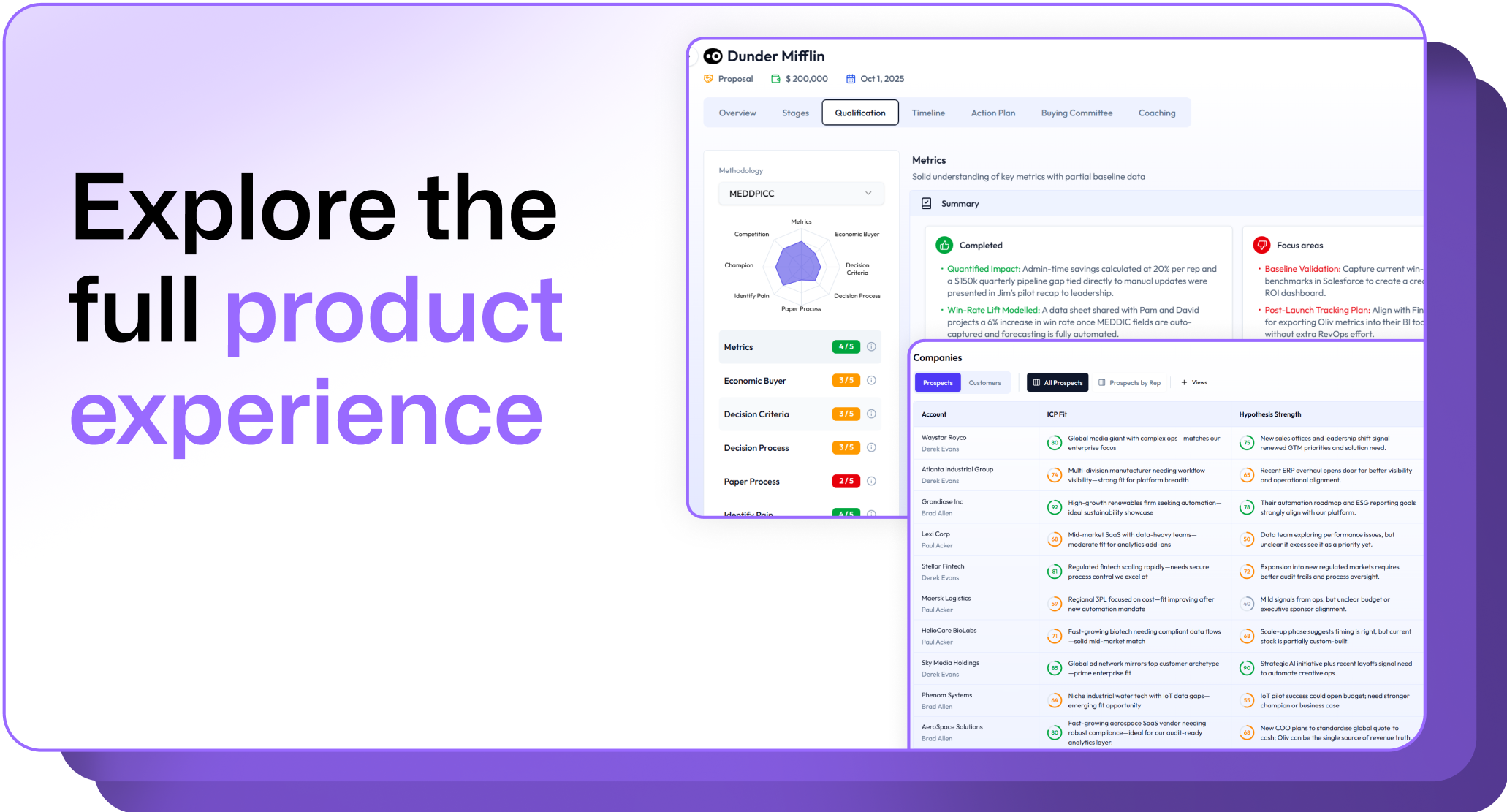
.avif)
.png)







.png)
.png)

.png)