Scaling Revenue Operations From 25 to 200 Reps — Why Your Process Breaks at Every Stage
Written by
Ishan Chhabra
Last Updated :
April 2, 2026
Skim in :
12
mins
In this article
Revenue teams love Oliv
Here’s why:
All your deal data unified (from 30+ tools and tabs).
Insights are delivered to you directly, no digging.
AI agents automate tasks for you.
Thank you! Your submission has been received!
Oops! Something went wrong while submitting the form.
Meet Oliv’s AI Agents
Hi! I’m, Deal Driver
I track deals, flag risks, send weekly pipeline updates and give sales managers full visibility into deal progress
Hi! I’m, CRM Manager
I maintain CRM hygiene by updating core, custom and qualification fields all without your team lifting a finger
Hi! I’m, Forecaster
I build accurate forecasts based on real deal movement and tell you which deals to pull in to hit your number
Hi! I’m, Coach
I believe performance fuels revenue. I spot skill gaps, score calls and build coaching plans to help every rep level up
Hi! I’m, Prospector
I dig into target accounts to surface the right contacts, tailor and time outreach so you always strike when it counts
Hi! I’m, Pipeline tracker
I call reps to get deal updates, and deliver a real-time, CRM-synced roll-up view of deal progress
Hi! I’m, Analyst
I answer complex pipeline questions, uncover deal patterns, and build reports that guide strategic decisions
TL;DR
Sales processes predictably break at four stages (25, 50, 100, 200 reps) due to pipeline variance, CRM decay, and inspection gaps.
Gong and Clari, built pre-generative AI, hit architectural ceilings at 50+ reps with $500+/user/month combined cost and biased forecasts.
MEDDIC inconsistency is a data-entry design problem, not a discipline problem; AI agents auto-populate CRM objects from conversation context.
A legacy six-tool stack costs $400 to $1,000+/user/month; a consolidated AI-native platform replaces it with autonomous agents at 91% lower TCO.
Oliv.ai deploys purpose-built agents for CRM hygiene, deal inspection, forecasting, and coaching with 5-minute setup and full data portability.
A structured weekly, monthly, and quarterly RevOps cadence is essential; Oliv automates Sunset Summaries, Monday pipeline reviews, and forecaster slides.
Q1: Why Does Every Sales Process Break Between 25 and 200 Reps? [toc=Why Processes Break at Scale]
Growth-stage companies face a painful paradox: the playbook that closed your first $5M in ARR will actively sabotage the next $50M. As your team scales from 25 to 200 reps, every process, tool, and management layer encounters compounding complexity at predictable breakpoints. Forecast accuracy averages just 67% across growth-stage organizations, not because of bad reps, but because the systems underneath them were never built to scale.
⚠️ The Legacy Approach: When "Good Enough" Becomes a Liability
At 25 reps, a VP of Sales can gut-check every deal. Pipeline reviews are informal, forecasting is intuition-backed, and CRM hygiene is manageable through sheer willpower. At 200 reps, the management layer becomes a black box:
Each new manager introduces their own "flavor" of pipeline review, one lenient on Next Steps, another strict on Economic Buyer engagement
Legacy tools (spreadsheets, weekly stand-ups, manual CRM audits) compound the problem by adding administrative burden without standardization
Forecasts become "all over the place" because they are built on subjective, rep-driven stories rather than objective evidence
"It can be overwhelming to set up trackers. AI training is a bit laborious to get it to do what you want." Trafford J., Senior Director, Revenue Enablement Gong G2 Verified Review
💡 The Shift: From Revenue Intelligence to AI-Native Orchestration
The industry has moved beyond the Revenue Intelligence era (2015-2022) into what leading practitioners now call AI-Native Revenue Orchestration. The question for modern VPs is no longer "Do we need RevOps?" but "Can our RevOps actually keep up with our headcount?"
Modern RevOps demands systems that enforce standards autonomously, rather than creating more dashboards for humans to manage. The shift is fundamental: from "documentation" (recording interactions) to "execution" (driving deals to close).
✅ How Oliv.ai Scales With Your Team
Oliv.ai operates as the enforcement layer that grows alongside your organization. Trained on 100+ sales methodologies, Oliv applies the same objective standard to every call and email across all teams, ensuring "Qualified" means the same thing for every manager.
This is the core difference between legacy SaaS (tools you have to use) and agentic automation (agents that do the work for you). Oliv's AI agents autonomously populate CRM fields, deliver proactive deal summaries, and flag pipeline risks, without requiring reps or managers to learn another platform.
💰 The Real Cost of Standing Still
Companies stacking Gong for conversation intelligence and Clari for forecasting regularly exceed $500/user/month, yet still rely on biased, rep-driven forecasts that the board cannot trust. This article serves as your breakpoint playbook: a stage-by-stage guide for VPs who refuse to let their process become the bottleneck holding back revenue growth.
"The pricing is probably the biggest obstacle and hence we are looking to change." Miodrag, Enterprise Account Executive Gong G2 Verified Review
Q2: What Are the 4 Revenue Operations Breakpoints Every Growth-Stage Team Hits? [toc=4 RevOps Breakpoints]
Every growth-stage company hits the same four operational breakpoints as they scale from 25 to 200 reps. The failure mode at each stage is different, but predictable. Here is the framework:
Revenue Operations Breakpoints by Rep Count
Breakpoint
Rep Count
What Breaks
Root Cause
Critical Risk
Stage 1
1-25 reps
Nothing (yet)
Founder/VP has direct visibility into every deal
False confidence: processes feel "fine" but cannot survive doubling
Stage 2
25-50 reps
Pipeline definitions
First management layer introduces interpretation variance
Dirty data cripples forecasting models; RevOps drowns in cleanup
Stage 4
100-200 reps
Deal inspection and coaching
VP cannot inspect deals across 8+ managers; only ~2% of calls reviewed
Quarter-end surprises; silent champions and hidden detractors go unnoticed
Every growth-stage company hits the same four operational breakpoints as they scale from 25 to 200 reps. The failure mode at each stage is different, but predictable.
⏰ Stage 1 (1-25 Reps): The Founder's Illusion
At this stage, the VP or founder is the process. They attend deal reviews, know every account by name, and rely on gut instinct backed by proximity. CRM data is "good enough" because someone is always watching. The danger is that none of this scales, but it feels like it will.
⚠️ Stage 2 (25-50 Reps): The Manager Multiplier Problem
The first frontline managers are hired, and each brings their own pipeline philosophy. Standardization attempts feel like micromanagement. Forecasting becomes unreliable because it is based on manager interpretation, not objective criteria.
"Clari should find ways to differentiate from the native Salesforce features (e.g., Pipeline Inspection, Forecasting) in order to remain competitive in the long-run. Additionally, it's sometimes difficult if you don't have a strong RevOps/RevTech team to maintain validation rules in both Salesforce and Clari instances." Dan J., Mid-Market Clari G2 Verified Review
⚠️ Stage 3 (50-100 Reps): The RevOps Debt Crisis
RevOps teams spend 40+ hours per month on manual data cleanup, deduplication, and chasing reps to update CRM fields. Most Revenue Intelligence tools actually add to this burden with complex tracker configurations and API mapping.
❌ Stage 4 (100-200 Reps): The Inspection Black Hole
Managers report spending evenings listening to call recordings at 2x speed just to stay informed, covering roughly 2% of calls. Deal inspection becomes inconsistent, and risks are caught only during "quarter-end fire drills" when it is too late to save the deal.
"There's so much in Gong, that we don't use everything. Gong's deal forecasting we don't use." Karel Bos, Head of SalesGong TrustRadius Review
Oliv.ai addresses each breakpoint with purpose-built AI agents, from the CRM Manager Agent that autonomously maintains data integrity at Stage 3, to the Deal Driver Agent that provides 100% inspection coverage at Stage 4, ensuring your operations scale with your headcount rather than against it.
Q3: How Do I Standardize Pipeline Across 4+ Managers Without Slowing Them Down? [toc=Standardize Pipeline Across Managers]
This is the question that keeps growth-stage VPs up at night. Each additional frontline manager introduces pipeline interpretation variance: what one manager calls "Commit," another considers "Best Case." With four managers, you get four definitions. With eight, your forecast becomes fiction.
The core tension: managers resist standardization because it feels like micromanagement. And they are not entirely wrong, as traditional standardization methods do slow things down.
❌ Why Gong and Clari Do Not Solve This
Gong operates as a "dashcam": it records the interaction faithfully, but requires a human to manually review the footage. Managers are forced into "dashboard digging," clicking through multiple screens to find actionable insights. The result: roughly 2% coaching coverage across the team.
"It's too complicated, and not intuitive at all. Using it is very...discomforting. Searching for calls is not easy, moving around in the calls is not easy, and understanding the pipeline management portion of it is almost impossible." John S., Senior Account Executive Gong G2 Verified Review
Clari's roll-up forecasting remains human-dependent. Managers sit with reps every Thursday and Friday to hear "deal stories" before manually inputting assessments. If Manager A is an optimist and Manager B is a pessimist, the data is biased before it reaches the CRO.
"The core tool itself is good enough but the sale entailed overcomplicating the forecasting process so you needed Clari... It is really just a glorified SFDC overlay." conaldinho11, r/SalesOperations Reddit Thread
💡 The AI-Era Shift: Standards That Live in the System
Modern AI-native platforms can enforce a single global rubric objectively across all teams, not by policing managers, but by removing the subjective layer entirely. The standard lives in the system, not in the manager's head. This shifts the paradigm from "documentation" to "execution".
✅ How Oliv.ai Standardizes Without Slowing Velocity
Oliv acts as the "Unbiased Observer" that enforces excellence without extra manual effort:
CRM Manager Agent applies standardized methodology scoring (MEDDIC/BANT/SPICED) to every interaction automatically, ensuring consistent qualification across all teams
Sunset Summary is delivered every evening, highlighting at-risk deals across all manager teams in a unified format
Weekly Pipeline Review is pushed to manager inboxes every Monday, proactively delivered, not pulled from a dashboard
Analyst Agent allows the VP to ask in plain English: "Which team is struggling most with handling Competitor X objections?"
The result: every manager operates from the same playbook, enforced by the same AI, without the administrative friction of manual audits, forms, or stage-gate policing.
Legacy tools create manager interpretation variance. AI-native enforcement applies a single global rubric across all teams without administrative friction.
Q4: How Do Growth-Stage Companies Build Revenue Operations Without a Large Ops Team? [toc=RevOps Without Large Team]
Most Series B/C companies can only justify 1-2 RevOps hires, yet the operational workload scales exponentially with headcount. The result is what practitioners call "RevOps Debt": growth-stage teams spend 40+ hours per month on manual data cleanup, deduplication, and chasing reps to update CRM fields.
The function that is supposed to enable scale becomes the bottleneck blocking it.
Salesforce Einstein's lead scoring is "very heavy to implement," requiring RevOps teams to manually build equations based on older V1 machine learning rather than modern generative reasoning
"It was a big mistake on our part to commit to a two year term. Gong is a really powerful tool but it's probably the highest end option on the market, and now we're stuck with a tool that works technically but isn't the right business decision." Iris P., Head of Marketing, Sales and Partnerships Gong G2 Verified Review
"I find the setup process challenging, especially when migrating fields from Salesforce, as it can't handle formula fields directly. This requires creating and maintaining duplicate fields, which adds complexity and workload." Josiah R., Head of Sales Operations Clari G2 Verified Review
💡 Agent-Augmented RevOps: The 2-Person Team That Operates Like 10
The new model is agent-augmented RevOps: deploying AI agents for the repetitive, high-volume tasks (data hygiene, field population, deduplication, and activity mapping) so your small ops team can focus on strategy rather than janitorial data work.
✅ Oliv.ai as Your Fractional RevOps Team
Oliv positions its agentic workforce as a purpose-built Fractional RevOps Team:
Instant setup configuration takes 5 minutes vs. months for legacy tools. Full custom model building completes in 2-4 weeks
CRM Manager Agent autonomously enriches contacts from LinkedIn, creates accounts, and populates 100+ qualification fields based on conversation context
Data Cleanser Agent deduplicates and normalizes records weekly, flagging anomalies autonomously
91% TCO advantage a 100-user team on Gong costs approximately $789,300 over three years vs. $68,400 on Oliv
💸 Redirecting Budget From Maintenance to Growth
The savings are not just operational; they are strategic. The budget freed from legacy tool licensing can fund additional rep hires, enablement programs, or GTM initiatives. Oliv offers the baseline conversation intelligence layer to existing Gong users at no additional cost, allowing teams to redirect budget toward the high-value agentic layer that actually drives revenue operations maturity.
Q5: Why Are Your MEDDIC Fields Inconsistent and How Do You Fix It Without Extra Admin? [toc=Fix MEDDIC Inconsistency]
Here is the uncomfortable truth: MEDDIC field inconsistency is not a discipline problem. It is a data-entry design problem. CRM data entry is simply not critical to the act of selling for a rep. Reps will obsess over next steps and follow-ups, but they view MEDDIC fields as administrative policing by RevOps. The result is predictable: fields are left blank, or worse, filled with meaningless fluff just to clear a stage gate.
This creates a vicious cycle. Companies invest $100K to $500K in MEDDIC training, yet without sustained enforcement, the ROI collapses because "dirty data" makes it impossible for leaders to trust the pipeline.
❌ Why Legacy Tools Cannot Fix the Root Cause
Gong logs summaries as "Notes" in the CRM: unstructured text blocks that are unsearchable and unusable for RevOps reporting or triggering automated workflows. The data goes in, but nothing actionable comes out.
Legacy "Smart Trackers" compound the problem. They rely on V1 keyword-matching ML that flags the word "budget" even when a prospect mentions their "holiday budget." They cannot distinguish a competitor mentioned in passing from one being actively evaluated.
"It can be overwhelming to set up trackers. AI training is a bit laborious to get it to do what you want." Trafford J., Senior Director, Revenue Enablement Gong G2 Verified Review
"The software doesn't have the capability of identifying words/phrases that are similar to what you're looking for or understand context, so if you don't tell it exactly what you're looking for then you'll miss out." Director of Sales Operations Chorus Gartner Review
💡 The Paradigm Shift: Reasoning Over Recording
Modern AI-native platforms move from "documentation" to AI-Native Revenue Orchestration, using contextual reasoning rather than keyword matching. LLMs can understand the nuance of whether a rep truly uncovered "Identify Pain" or engaged the "Economic Buyer" by analyzing conversational context, tone, and progression across multiple interactions.
✅ How Oliv.ai Automates MEDDIC at the Object Level
Unlike tools that log notes, Oliv updates actual CRM objects and properties (e.g., MEDDPICC fields) based on conversation context:
100+ fine-tuned LLMs populate scorecards with the reasoning behind each score, including links to meeting clips as evidence
Evolving deal summaries update after every interaction (call, email, and Slack), so the "Identify Pain" field matures as the deal progresses, not just after a single discovery call
Intent-aware monitoring distinguishes genuine qualification signals from surface-level mentions
The result: RevOps gets structured, reportable MEDDIC data without adding a single manual field for reps to fill. The methodology enforces itself.
Q6: How Do You Enforce MEDDIC at Scale Without Killing Sales Velocity? [toc=MEDDIC Enforcement at Scale]
Reps spend 2 to 3 hours per week on follow-ups and administrative research. When growth-stage companies layer manual MEDDIC documentation on top of that, requiring reps to fill every field before progressing a deal stage, the math gets brutal. More time filling forms means less time talking to customers. Velocity drops, and experienced reps start gaming the system by saying the right things on calls without actually qualifying.
This is the enforcement-velocity paradox: the harder you push for data quality, the more you slow down the very motion you are trying to measure.
❌ Where Traditional SaaS Creates Friction
Legacy tools force a standardized, rigid workflow that does not adapt to deal context. Applying the same enterprise MEDDIC rubric to a $10K high-velocity deal creates unnecessary friction that kills momentum. Manual handoffs between roles (SDR to AE to CSM) require incomplete "context transfers," and each transition bleeds velocity.
"The tool is slow, buggy, and creates an excessive administrative burden on the user side." Anonymous Reviewer Gong G2 Verified Review
"Clari is a tool for sales leaders, it adds no value to reps as far as I can see." Msoave, r/sales Reddit Thread
💡 Hands-Free Enforcement: Reps Verify, Not Create
The AI-era model flips the workflow. Instead of reps creating qualification data from scratch, AI agents draft the MEDDIC updates and follow-up emails autonomously. Reps only verify and approve, transforming a 15-minute documentation task into a 15-second confirmation.
✅ Oliv.ai's Human-in-the-Loop (HITL) Model
Oliv's agentic approach preserves velocity while maintaining data integrity:
Auto-drafted MEDDIC updates Agents analyze call and email context, then draft field updates. The rep receives a Slack nudge to "verify and approve" in seconds
Automated stage progression Deals move through stages (e.g., "Demo Scheduled" to "Demo Done") once Oliv recognizes milestones in conversation context, with no manual clicks required
Seamless handoffs via Handoff Hank Automated handoff packets transfer full deal context between roles (AE to CSM), so velocity is not lost during transitions
The sales velocity equation has four levers: opportunities, win rate, deal size, and cycle length. MEDDPICC improves conversion rates and shortens time-to-close, but only when enforcement does not add friction. Oliv makes that possible.
The enforcement-velocity paradox resolved: instead of reps creating qualification data from scratch, AI agents draft MEDDIC updates and reps verify in seconds.
Q7: How Do Teams With 8+ Managers Standardize Deal Inspection Across the Organization? [toc=Deal Inspection at Scale]
At 8+ frontline managers, manual deal inspection becomes physically impossible. Managers report spending evenings listening to call recordings at 2x speed while showering, driving, or drinking coffee, just to stay informed. Even with that heroic effort, they cover roughly 2% of total calls. Surprises like hidden detractors, silent champions, and stalled threads only surface during the quarter-end fire drill, when it is too late to save the deal.
The VP, meanwhile, has zero visibility into whether Manager A's inspection standard matches Manager B's.
❌ The "Dashcam" Problem With Gong and Clari
Gong measures deal health based on activity volume: "10 emails sent" registers as engagement even when a rep is chasing a prospect who went silent three weeks ago. It records the accident but cannot prevent it.
Clari remains a pre-generative AI tool that requires managers to pull information from disparate screens rather than having intelligence pushed to them. Both operate on the "dashcam" model: they capture footage, but a human still has to review it.
"For me, the only business problem Gong solves is the call recordings. It allows me to review my calls and listen to them so that I can understand either where I went wrong or what the customer really said." John S., Senior Account Executive Gong G2 Verified Review
"Clari features often overlap with other common sales tech tools. Clari should do more to differentiate themselves from competition. The dashboarding and reporting can be limited." Sarah J., Senior Manager, Revenue Operations Clari G2 Verified Review
💡 From Dashboard Digging to Autonomous Deal Driving
The future of deal inspection is 100% coverage: AI that reviews every interaction across every channel and pushes contextualized risk alerts directly to the right manager, without requiring them to log in anywhere.
Deal Driver Agent Reviews 100% of interactions daily across calls, emails, support tickets, and "dark social" channels (Slack, Telegram). Proactively flags contextual risks, like an Economic Buyer going silent, directly to the manager's Slack
Forecaster Agent Delivers bottom-up, evidence-based weekly reports and presentation-ready slides for the Monday board meeting
360-degree account view Stitches data from every sales activity and the web into a single deal intelligence view
Every manager, whether there are 4 or 14, operates from the same AI-driven inspection standard, applied uniformly to every deal in the pipeline.
Q8: What Metrics Should You Track at Each RevOps Scaling Stage? [toc=RevOps Metrics by Stage]
Not all metrics matter equally at every stage. Tracking 25 KPIs when you have 30 reps creates noise; tracking only 5 when you have 150 reps creates blind spots. The key is matching measurement complexity to organizational maturity.
⏰ Stage-by-Stage Metrics Framework
RevOps Metrics by Scaling Stage
Metric Category
1 to 25 Reps
25 to 50 Reps
50 to 100 Reps
100 to 200 Reps
Pipeline
Pipeline value, lead conversion rate
Pipeline coverage ratio (target: 3 to 4x), stage conversion rates
Pipeline per rep, pipeline velocity, stage-to-stage drop-off
Pipeline coverage by segment, pipeline source attribution, weighted pipeline
Velocity
Sales cycle length, win rate
Win rate by rep, average deal size
Sales velocity formula (opportunities x win rate x deal size / cycle length), velocity by segment
Velocity by team/manager, velocity trend analysis, forecast vs. actual close dates
Forecasting
Informal gut-check
Forecast accuracy baseline
Forecast accuracy by manager, commit-to-close ratio
Forecast accuracy by segment, waterfall analysis, quarterly pipeline progression
Data Quality
CRM update frequency
Field completion rate, MEDDIC/BANT score coverage
CRM completeness score, duplicate record rate, activity-to-CRM sync rate
Process compliance %, methodology adoption rate, data decay rate
Efficiency
CAC, quota attainment
CAC payback period, quota attainment distribution
Rep ramp time, cost per opportunity, tool adoption rate
Full GTM efficiency stack: CAC by channel, expansion revenue %, NRR
⭐ Key Metrics Deep Dive
Pipeline Coverage Ratio Total qualified pipeline divided by remaining quota. The benchmark varies by segment: 3x for enterprise, 4x for mid-market, and 5x+ for SMB. Below 3x and you are relying on heroics; above 5x and you are likely qualifying too loosely.
Sales Velocity The single most diagnostic metric for growth-stage teams. Calculated as: (Number of Opportunities x Win Rate x Average Deal Size) / Sales Cycle Length. Top-performing SaaS companies achieve $10K to $50K+ per month in velocity per rep.
📊 Forecast Accuracy Benchmarks
Forecast Accuracy Growth-stage companies should target +/- 10% accuracy. MEDDIC-enforced pipelines can reduce forecast variance from 30 to 50% to under 10%.
"Our sales leadership also appreciates the overall UI of Clari, which is not something that all RevTech tools do well but Clari does do well!" Dan J., Mid-Market Clari G2 Verified Review
"The additional products like forecast or engage come at an additional cost. Would be great to see these tools rolled into the core offering." Scott T., Director of Sales Gong G2 Verified Review
Oliv.ai simplifies this metrics challenge by automatically tracking methodology adoption, field completion rates, and deal progression signals, then surfacing them through the Forecaster Agent's weekly roll-ups, so RevOps teams can focus on interpreting the data rather than compiling it.
Q9: Where Do Gong and Clari Break Down for Growth-Stage Teams? [toc=Gong and Clari Limitations]
Gong and Clari were category-defining tools during the Revenue Intelligence era (2015 to 2022). Gong has massive brand authority: reps genuinely love the UI and conversation intelligence capabilities. Clari is a robust forecasting platform trusted by enterprise revenue leaders. The question is not whether they are good tools. It is whether they solve the scaling problem.
Both were built in a pre-generative AI era. As your team crosses 50 reps and heads toward 200, their architectural limitations become the bottleneck.
❌ Gong's Scaling Limitations
Gong operates as a "dashcam": it records the interaction faithfully but requires humans to extract value. Smart Trackers rely on V1 keyword ML, creating data overload rather than actionable intelligence. Implementation demands 8 to 24 weeks and 40 to 140 admin hours for tracker configuration. TCO reaches $250 to $270/user/month when bundled, plus mandatory platform fees ($5K to $50K+). Gong understands the meeting: it does not understand the deal.
"Gong offers valuable insights into call data and sales interactions... the lack of robust data export options has made it hard to justify the platform's cost." Neel P., Sales Operations Manager Gong G2 Verified Review
"The additional products like forecast or engage come at an additional cost. Would be great to see these tools rolled into the core offering." Scott T., Director of Sales Gong G2 Verified Review
❌ Clari's Scaling Limitations
Clari's roll-up forecasting is fundamentally human-dependent. Managers sit with reps every Thursday and Friday to manually input subjective assessments. If Manager A is an optimist and Manager B a pessimist, the forecast is biased before it reaches the CRO. Data stays siloed within Clari's UI rather than flowing back cleanly to the CRM.
"It is really just a glorified SFDC overlay. Actually, Salesforce has built most of the forecasting functionality by now anyway so I'm not sure where they fit into that whole overcrowded Martech space." conaldinho11, r/SalesOperations Reddit Thread
✅ How Oliv.ai Bridges the Gap
Oliv offers the baseline conversation intelligence layer at no cost to existing Gong users, redirecting budget to the high-value Agents Layer. Key differentiators:
Deal-level intelligence vs. meeting-level recording
Full open export policy vs. UI lock-in
CRM object updates vs. unstructured note logging
91% lower TCO over 3 years ($68,400 vs. $789,300 for a 100-user team)
For growth-stage teams evaluating their stack, the math is straightforward: stacking Gong + Clari exceeds $500/user/month, yet still relies on biased, rep-driven forecasts that the board cannot bank on. Learn more about the specific limitations and how Oliv compares.
Q10: What Does a RevOps Tech Stack Look Like at 100+ Reps? [toc=RevOps Tech Stack at Scale]
At 100+ reps, the revenue technology stack must move from a collection of point solutions to an integrated operating system. The traditional approach, "stack and pray," layers tools on top of each other, creating integration debt and data silos that overwhelm lean RevOps teams.
⏰ The Legacy "Stacked" Approach
Most growth-stage companies end up with some version of this fragmented stack:
Legacy Revenue Tech Stack: Cost and Limitations
Function
Legacy Tool
Typical Cost
Key Limitation
CRM
Salesforce
$75 to $300/user/mo
Data entry dependent on reps; dirty by default
Conversation Intelligence
Gong
$100 to $270/user/mo
Meeting-level only; notes not structured CRM objects
Forecasting
Clari
$50 to $100/user/mo
Manual roll-ups; biased by manager subjectivity
Sales Engagement
Outreach / Salesloft
$100 to $150/user/mo
Sequencing-focused; limited intelligence layer
Data Enrichment
ZoomInfo / Apollo
$50 to $150/user/mo
Static data; decays rapidly without maintenance
Coaching
Chorus / manual QA
$30 to $100/user/mo
Low coverage (~2% of calls); keyword-based scoring
Combined cost: $400 to $1,000+/user/month, before implementation, training, and admin overhead.
"The engage product is stagnant. Looks to have the same features, UX, integrations and issues as it had 5 years ago." Matthew T., Head of Revenue Operations Outreach G2 Verified Review
"It can be complex to set up and often requires skilled administrators or developers to customize and integrate properly, which adds time and cost." Verified User in Marketing and Advertising Salesforce Agentforce G2 Verified Review
💡 The Consolidated, Agent-First Alternative
The AI-native model replaces the fragmented stack with a single revenue orchestration platform that deploys purpose-built agents across each function. Rather than integrating six tools that each require adoption, training, and maintenance, a consolidated platform handles conversation intelligence, CRM hygiene, forecasting, deal inspection, and coaching through autonomous agents.
✅ Key Stack Evaluation Criteria at 100+ Reps
When evaluating your stack, prioritize these dimensions:
Time-to-value Can it be configured in days, not months?
CRM write-back Does it update structured objects or log unstructured notes?
Autonomous operation Does it require daily human input or does it operate independently?
Data portability Can you export your data freely, or are you locked in?
TCO transparency Are there hidden platform fees, implementation costs, or mandatory vendor services?
Oliv.ai addresses each criterion: 5-minute setup, CRM object-level updates, autonomous agents, full data export, and modular pricing with no mandatory platform fees.
The traditional six-tool stack costs $400 to $1,000+/user/month. A consolidated agent-first platform replaces all six with 91% lower TCO.
Q11: How Do You Build a RevOps Operating Cadence That Scales? [toc=RevOps Operating Cadence]
A RevOps operating cadence is the recurring rhythm of reviews, reports, and checkpoints that keep your revenue engine aligned. Without a structured cadence, pipeline reviews become ad hoc, forecasts drift, and problems compound undetected until the quarter-end fire drill.
⏰ Weekly Operating Rhythm
Weekly RevOps Operating Cadence
Day
Activity
Owner
Output
Monday
Pipeline review: inspect new, progressing, and at-risk deals
Frontline Managers
Updated deal risk flags, stalled deal escalations
Tuesday to Wednesday
Rep coaching sessions: review 2 to 3 calls per rep
Forecast review: VP/CRO reviews aggregated call vs. pipeline
VP of Sales / CRO
Final weekly forecast, variance notes
📅 Monthly Operating Rhythm
Pipeline health audit Analyze stage-to-stage conversion rates, identify systemic drop-off points, and flag aging deals beyond average cycle length
Data quality review Measure CRM field completion rates, MEDDIC coverage, duplicate record count, and activity sync accuracy
Tech stack utilization review Assess adoption rates across tools, identify shelfware, and evaluate ROI per platform
📆 Quarterly Operating Rhythm
QBR (Quarterly Business Review) Deep-dive pipeline analysis with waterfall metrics: starting pipeline, new pipeline added, slipped deals, pulled-in deals, closed-won, and closed-lost
Win/loss analysis Review patterns across closed deals to refine ICP, messaging, and competitive positioning
Process audit Evaluate methodology compliance (MEDDIC/BANT field accuracy), forecast accuracy trends, and manager consistency scores
"I love how easy Clari makes forecasting. It is intuitive for sellers and managers to input their forecast." Sarah J., Senior Manager, Revenue OperationsClari G2 Verified Review
"There's so much in Gong, that we don't use everything. Gong's deal forecasting we don't use." Karel Bos, Head of SalesGong TrustRadius Review
✅ How Oliv.ai Automates the Cadence
Oliv.ai replaces much of the manual cadence overhead with autonomous delivery: the Sunset Summary pushes deal updates to managers every evening, the Weekly Pipeline Review arrives every Monday, and the Forecaster Agent generates presentation-ready slides weekly, reducing cadence preparation from hours to minutes.
Q12: What's the First Step to Scaling Your Revenue Operations Today? [toc=First Step to Scale RevOps]
Every growth-stage company hits the same four breakpoints: the only variable is whether you hit them proactively or reactively. The companies that scale revenue operations successfully do not just add headcount. They add intelligence.
If you have read this far, you likely recognize at least one of these symptoms in your own organization.
⚠️ The Cost of Inaction
The compounding cost of delaying RevOps maturity is measurable:
Dirty CRM data cripples predictive models and erodes forecast confidence
Inaccurate forecasting damages board trust: the average growth-stage company misses its forecast by 30 to 50%
Manual deal auditing consumes ~20% of manager productivity (one full day per week spent on administrative inspection rather than coaching)
RevOps debt grows exponentially: 40+ hours/month in data cleanup that never actually resolves the root cause
Every quarter you delay, the debt compounds. The gap between your process and your headcount widens.
💡 The AI-Native Path Forward
The era of "SaaS you have to adopt" is ending. The companies winning in 2026 deploy agentic automation that enforces standards, surfaces risks, and executes follow-through, without adding headcount or administrative burden.
"It was a big mistake on our part to commit to a two year term. Gong is a really powerful tool but it's probably the highest end option on the market, and now we're stuck with a tool that works technically but isn't the right business decision." Iris P., Head of Marketing, Sales and Partnerships Gong G2 Verified Review
✅ Your Next Step With Oliv.ai
Getting started requires no multi-month implementation or six-figure consulting engagement:
⏰ Configuration: 5 minutes, not months
✅ Value realized: Within 1 to 2 days of deployment
✅ Full custom model building: Completed in 2 to 4 weeks
💸 Free data migration: From Gong, Chorus, or any existing CI tool
💰 No mandatory platform fees: Modular pricing that scales with your team
👉 See how Oliv agents standardize your pipeline across every team: book a 15-minute walkthrough.
⭐ Score Your RevOps Maturity
Use this quick self-assessment to benchmark where you stand:
If you scored mostly red or yellow, the breakpoints are already affecting your revenue trajectory. The playbook above gives you the framework: Oliv.ai gives you the execution layer to make it real.
Q1: Why Does Every Sales Process Break Between 25 and 200 Reps? [toc=Why Processes Break at Scale]
Growth-stage companies face a painful paradox: the playbook that closed your first $5M in ARR will actively sabotage the next $50M. As your team scales from 25 to 200 reps, every process, tool, and management layer encounters compounding complexity at predictable breakpoints. Forecast accuracy averages just 67% across growth-stage organizations, not because of bad reps, but because the systems underneath them were never built to scale.
⚠️ The Legacy Approach: When "Good Enough" Becomes a Liability
At 25 reps, a VP of Sales can gut-check every deal. Pipeline reviews are informal, forecasting is intuition-backed, and CRM hygiene is manageable through sheer willpower. At 200 reps, the management layer becomes a black box:
Each new manager introduces their own "flavor" of pipeline review, one lenient on Next Steps, another strict on Economic Buyer engagement
Legacy tools (spreadsheets, weekly stand-ups, manual CRM audits) compound the problem by adding administrative burden without standardization
Forecasts become "all over the place" because they are built on subjective, rep-driven stories rather than objective evidence
"It can be overwhelming to set up trackers. AI training is a bit laborious to get it to do what you want." Trafford J., Senior Director, Revenue Enablement Gong G2 Verified Review
💡 The Shift: From Revenue Intelligence to AI-Native Orchestration
The industry has moved beyond the Revenue Intelligence era (2015-2022) into what leading practitioners now call AI-Native Revenue Orchestration. The question for modern VPs is no longer "Do we need RevOps?" but "Can our RevOps actually keep up with our headcount?"
Modern RevOps demands systems that enforce standards autonomously, rather than creating more dashboards for humans to manage. The shift is fundamental: from "documentation" (recording interactions) to "execution" (driving deals to close).
✅ How Oliv.ai Scales With Your Team
Oliv.ai operates as the enforcement layer that grows alongside your organization. Trained on 100+ sales methodologies, Oliv applies the same objective standard to every call and email across all teams, ensuring "Qualified" means the same thing for every manager.
This is the core difference between legacy SaaS (tools you have to use) and agentic automation (agents that do the work for you). Oliv's AI agents autonomously populate CRM fields, deliver proactive deal summaries, and flag pipeline risks, without requiring reps or managers to learn another platform.
💰 The Real Cost of Standing Still
Companies stacking Gong for conversation intelligence and Clari for forecasting regularly exceed $500/user/month, yet still rely on biased, rep-driven forecasts that the board cannot trust. This article serves as your breakpoint playbook: a stage-by-stage guide for VPs who refuse to let their process become the bottleneck holding back revenue growth.
"The pricing is probably the biggest obstacle and hence we are looking to change." Miodrag, Enterprise Account Executive Gong G2 Verified Review
Q2: What Are the 4 Revenue Operations Breakpoints Every Growth-Stage Team Hits? [toc=4 RevOps Breakpoints]
Every growth-stage company hits the same four operational breakpoints as they scale from 25 to 200 reps. The failure mode at each stage is different, but predictable. Here is the framework:
Revenue Operations Breakpoints by Rep Count
Breakpoint
Rep Count
What Breaks
Root Cause
Critical Risk
Stage 1
1-25 reps
Nothing (yet)
Founder/VP has direct visibility into every deal
False confidence: processes feel "fine" but cannot survive doubling
Stage 2
25-50 reps
Pipeline definitions
First management layer introduces interpretation variance
Dirty data cripples forecasting models; RevOps drowns in cleanup
Stage 4
100-200 reps
Deal inspection and coaching
VP cannot inspect deals across 8+ managers; only ~2% of calls reviewed
Quarter-end surprises; silent champions and hidden detractors go unnoticed
Every growth-stage company hits the same four operational breakpoints as they scale from 25 to 200 reps. The failure mode at each stage is different, but predictable.
⏰ Stage 1 (1-25 Reps): The Founder's Illusion
At this stage, the VP or founder is the process. They attend deal reviews, know every account by name, and rely on gut instinct backed by proximity. CRM data is "good enough" because someone is always watching. The danger is that none of this scales, but it feels like it will.
⚠️ Stage 2 (25-50 Reps): The Manager Multiplier Problem
The first frontline managers are hired, and each brings their own pipeline philosophy. Standardization attempts feel like micromanagement. Forecasting becomes unreliable because it is based on manager interpretation, not objective criteria.
"Clari should find ways to differentiate from the native Salesforce features (e.g., Pipeline Inspection, Forecasting) in order to remain competitive in the long-run. Additionally, it's sometimes difficult if you don't have a strong RevOps/RevTech team to maintain validation rules in both Salesforce and Clari instances." Dan J., Mid-Market Clari G2 Verified Review
⚠️ Stage 3 (50-100 Reps): The RevOps Debt Crisis
RevOps teams spend 40+ hours per month on manual data cleanup, deduplication, and chasing reps to update CRM fields. Most Revenue Intelligence tools actually add to this burden with complex tracker configurations and API mapping.
❌ Stage 4 (100-200 Reps): The Inspection Black Hole
Managers report spending evenings listening to call recordings at 2x speed just to stay informed, covering roughly 2% of calls. Deal inspection becomes inconsistent, and risks are caught only during "quarter-end fire drills" when it is too late to save the deal.
"There's so much in Gong, that we don't use everything. Gong's deal forecasting we don't use." Karel Bos, Head of SalesGong TrustRadius Review
Oliv.ai addresses each breakpoint with purpose-built AI agents, from the CRM Manager Agent that autonomously maintains data integrity at Stage 3, to the Deal Driver Agent that provides 100% inspection coverage at Stage 4, ensuring your operations scale with your headcount rather than against it.
Q3: How Do I Standardize Pipeline Across 4+ Managers Without Slowing Them Down? [toc=Standardize Pipeline Across Managers]
This is the question that keeps growth-stage VPs up at night. Each additional frontline manager introduces pipeline interpretation variance: what one manager calls "Commit," another considers "Best Case." With four managers, you get four definitions. With eight, your forecast becomes fiction.
The core tension: managers resist standardization because it feels like micromanagement. And they are not entirely wrong, as traditional standardization methods do slow things down.
❌ Why Gong and Clari Do Not Solve This
Gong operates as a "dashcam": it records the interaction faithfully, but requires a human to manually review the footage. Managers are forced into "dashboard digging," clicking through multiple screens to find actionable insights. The result: roughly 2% coaching coverage across the team.
"It's too complicated, and not intuitive at all. Using it is very...discomforting. Searching for calls is not easy, moving around in the calls is not easy, and understanding the pipeline management portion of it is almost impossible." John S., Senior Account Executive Gong G2 Verified Review
Clari's roll-up forecasting remains human-dependent. Managers sit with reps every Thursday and Friday to hear "deal stories" before manually inputting assessments. If Manager A is an optimist and Manager B is a pessimist, the data is biased before it reaches the CRO.
"The core tool itself is good enough but the sale entailed overcomplicating the forecasting process so you needed Clari... It is really just a glorified SFDC overlay." conaldinho11, r/SalesOperations Reddit Thread
💡 The AI-Era Shift: Standards That Live in the System
Modern AI-native platforms can enforce a single global rubric objectively across all teams, not by policing managers, but by removing the subjective layer entirely. The standard lives in the system, not in the manager's head. This shifts the paradigm from "documentation" to "execution".
✅ How Oliv.ai Standardizes Without Slowing Velocity
Oliv acts as the "Unbiased Observer" that enforces excellence without extra manual effort:
CRM Manager Agent applies standardized methodology scoring (MEDDIC/BANT/SPICED) to every interaction automatically, ensuring consistent qualification across all teams
Sunset Summary is delivered every evening, highlighting at-risk deals across all manager teams in a unified format
Weekly Pipeline Review is pushed to manager inboxes every Monday, proactively delivered, not pulled from a dashboard
Analyst Agent allows the VP to ask in plain English: "Which team is struggling most with handling Competitor X objections?"
The result: every manager operates from the same playbook, enforced by the same AI, without the administrative friction of manual audits, forms, or stage-gate policing.
Legacy tools create manager interpretation variance. AI-native enforcement applies a single global rubric across all teams without administrative friction.
Q4: How Do Growth-Stage Companies Build Revenue Operations Without a Large Ops Team? [toc=RevOps Without Large Team]
Most Series B/C companies can only justify 1-2 RevOps hires, yet the operational workload scales exponentially with headcount. The result is what practitioners call "RevOps Debt": growth-stage teams spend 40+ hours per month on manual data cleanup, deduplication, and chasing reps to update CRM fields.
The function that is supposed to enable scale becomes the bottleneck blocking it.
Salesforce Einstein's lead scoring is "very heavy to implement," requiring RevOps teams to manually build equations based on older V1 machine learning rather than modern generative reasoning
"It was a big mistake on our part to commit to a two year term. Gong is a really powerful tool but it's probably the highest end option on the market, and now we're stuck with a tool that works technically but isn't the right business decision." Iris P., Head of Marketing, Sales and Partnerships Gong G2 Verified Review
"I find the setup process challenging, especially when migrating fields from Salesforce, as it can't handle formula fields directly. This requires creating and maintaining duplicate fields, which adds complexity and workload." Josiah R., Head of Sales Operations Clari G2 Verified Review
💡 Agent-Augmented RevOps: The 2-Person Team That Operates Like 10
The new model is agent-augmented RevOps: deploying AI agents for the repetitive, high-volume tasks (data hygiene, field population, deduplication, and activity mapping) so your small ops team can focus on strategy rather than janitorial data work.
✅ Oliv.ai as Your Fractional RevOps Team
Oliv positions its agentic workforce as a purpose-built Fractional RevOps Team:
Instant setup configuration takes 5 minutes vs. months for legacy tools. Full custom model building completes in 2-4 weeks
CRM Manager Agent autonomously enriches contacts from LinkedIn, creates accounts, and populates 100+ qualification fields based on conversation context
Data Cleanser Agent deduplicates and normalizes records weekly, flagging anomalies autonomously
91% TCO advantage a 100-user team on Gong costs approximately $789,300 over three years vs. $68,400 on Oliv
💸 Redirecting Budget From Maintenance to Growth
The savings are not just operational; they are strategic. The budget freed from legacy tool licensing can fund additional rep hires, enablement programs, or GTM initiatives. Oliv offers the baseline conversation intelligence layer to existing Gong users at no additional cost, allowing teams to redirect budget toward the high-value agentic layer that actually drives revenue operations maturity.
Q5: Why Are Your MEDDIC Fields Inconsistent and How Do You Fix It Without Extra Admin? [toc=Fix MEDDIC Inconsistency]
Here is the uncomfortable truth: MEDDIC field inconsistency is not a discipline problem. It is a data-entry design problem. CRM data entry is simply not critical to the act of selling for a rep. Reps will obsess over next steps and follow-ups, but they view MEDDIC fields as administrative policing by RevOps. The result is predictable: fields are left blank, or worse, filled with meaningless fluff just to clear a stage gate.
This creates a vicious cycle. Companies invest $100K to $500K in MEDDIC training, yet without sustained enforcement, the ROI collapses because "dirty data" makes it impossible for leaders to trust the pipeline.
❌ Why Legacy Tools Cannot Fix the Root Cause
Gong logs summaries as "Notes" in the CRM: unstructured text blocks that are unsearchable and unusable for RevOps reporting or triggering automated workflows. The data goes in, but nothing actionable comes out.
Legacy "Smart Trackers" compound the problem. They rely on V1 keyword-matching ML that flags the word "budget" even when a prospect mentions their "holiday budget." They cannot distinguish a competitor mentioned in passing from one being actively evaluated.
"It can be overwhelming to set up trackers. AI training is a bit laborious to get it to do what you want." Trafford J., Senior Director, Revenue Enablement Gong G2 Verified Review
"The software doesn't have the capability of identifying words/phrases that are similar to what you're looking for or understand context, so if you don't tell it exactly what you're looking for then you'll miss out." Director of Sales Operations Chorus Gartner Review
💡 The Paradigm Shift: Reasoning Over Recording
Modern AI-native platforms move from "documentation" to AI-Native Revenue Orchestration, using contextual reasoning rather than keyword matching. LLMs can understand the nuance of whether a rep truly uncovered "Identify Pain" or engaged the "Economic Buyer" by analyzing conversational context, tone, and progression across multiple interactions.
✅ How Oliv.ai Automates MEDDIC at the Object Level
Unlike tools that log notes, Oliv updates actual CRM objects and properties (e.g., MEDDPICC fields) based on conversation context:
100+ fine-tuned LLMs populate scorecards with the reasoning behind each score, including links to meeting clips as evidence
Evolving deal summaries update after every interaction (call, email, and Slack), so the "Identify Pain" field matures as the deal progresses, not just after a single discovery call
Intent-aware monitoring distinguishes genuine qualification signals from surface-level mentions
The result: RevOps gets structured, reportable MEDDIC data without adding a single manual field for reps to fill. The methodology enforces itself.
Q6: How Do You Enforce MEDDIC at Scale Without Killing Sales Velocity? [toc=MEDDIC Enforcement at Scale]
Reps spend 2 to 3 hours per week on follow-ups and administrative research. When growth-stage companies layer manual MEDDIC documentation on top of that, requiring reps to fill every field before progressing a deal stage, the math gets brutal. More time filling forms means less time talking to customers. Velocity drops, and experienced reps start gaming the system by saying the right things on calls without actually qualifying.
This is the enforcement-velocity paradox: the harder you push for data quality, the more you slow down the very motion you are trying to measure.
❌ Where Traditional SaaS Creates Friction
Legacy tools force a standardized, rigid workflow that does not adapt to deal context. Applying the same enterprise MEDDIC rubric to a $10K high-velocity deal creates unnecessary friction that kills momentum. Manual handoffs between roles (SDR to AE to CSM) require incomplete "context transfers," and each transition bleeds velocity.
"The tool is slow, buggy, and creates an excessive administrative burden on the user side." Anonymous Reviewer Gong G2 Verified Review
"Clari is a tool for sales leaders, it adds no value to reps as far as I can see." Msoave, r/sales Reddit Thread
💡 Hands-Free Enforcement: Reps Verify, Not Create
The AI-era model flips the workflow. Instead of reps creating qualification data from scratch, AI agents draft the MEDDIC updates and follow-up emails autonomously. Reps only verify and approve, transforming a 15-minute documentation task into a 15-second confirmation.
✅ Oliv.ai's Human-in-the-Loop (HITL) Model
Oliv's agentic approach preserves velocity while maintaining data integrity:
Auto-drafted MEDDIC updates Agents analyze call and email context, then draft field updates. The rep receives a Slack nudge to "verify and approve" in seconds
Automated stage progression Deals move through stages (e.g., "Demo Scheduled" to "Demo Done") once Oliv recognizes milestones in conversation context, with no manual clicks required
Seamless handoffs via Handoff Hank Automated handoff packets transfer full deal context between roles (AE to CSM), so velocity is not lost during transitions
The sales velocity equation has four levers: opportunities, win rate, deal size, and cycle length. MEDDPICC improves conversion rates and shortens time-to-close, but only when enforcement does not add friction. Oliv makes that possible.
The enforcement-velocity paradox resolved: instead of reps creating qualification data from scratch, AI agents draft MEDDIC updates and reps verify in seconds.
Q7: How Do Teams With 8+ Managers Standardize Deal Inspection Across the Organization? [toc=Deal Inspection at Scale]
At 8+ frontline managers, manual deal inspection becomes physically impossible. Managers report spending evenings listening to call recordings at 2x speed while showering, driving, or drinking coffee, just to stay informed. Even with that heroic effort, they cover roughly 2% of total calls. Surprises like hidden detractors, silent champions, and stalled threads only surface during the quarter-end fire drill, when it is too late to save the deal.
The VP, meanwhile, has zero visibility into whether Manager A's inspection standard matches Manager B's.
❌ The "Dashcam" Problem With Gong and Clari
Gong measures deal health based on activity volume: "10 emails sent" registers as engagement even when a rep is chasing a prospect who went silent three weeks ago. It records the accident but cannot prevent it.
Clari remains a pre-generative AI tool that requires managers to pull information from disparate screens rather than having intelligence pushed to them. Both operate on the "dashcam" model: they capture footage, but a human still has to review it.
"For me, the only business problem Gong solves is the call recordings. It allows me to review my calls and listen to them so that I can understand either where I went wrong or what the customer really said." John S., Senior Account Executive Gong G2 Verified Review
"Clari features often overlap with other common sales tech tools. Clari should do more to differentiate themselves from competition. The dashboarding and reporting can be limited." Sarah J., Senior Manager, Revenue Operations Clari G2 Verified Review
💡 From Dashboard Digging to Autonomous Deal Driving
The future of deal inspection is 100% coverage: AI that reviews every interaction across every channel and pushes contextualized risk alerts directly to the right manager, without requiring them to log in anywhere.
Deal Driver Agent Reviews 100% of interactions daily across calls, emails, support tickets, and "dark social" channels (Slack, Telegram). Proactively flags contextual risks, like an Economic Buyer going silent, directly to the manager's Slack
Forecaster Agent Delivers bottom-up, evidence-based weekly reports and presentation-ready slides for the Monday board meeting
360-degree account view Stitches data from every sales activity and the web into a single deal intelligence view
Every manager, whether there are 4 or 14, operates from the same AI-driven inspection standard, applied uniformly to every deal in the pipeline.
Q8: What Metrics Should You Track at Each RevOps Scaling Stage? [toc=RevOps Metrics by Stage]
Not all metrics matter equally at every stage. Tracking 25 KPIs when you have 30 reps creates noise; tracking only 5 when you have 150 reps creates blind spots. The key is matching measurement complexity to organizational maturity.
⏰ Stage-by-Stage Metrics Framework
RevOps Metrics by Scaling Stage
Metric Category
1 to 25 Reps
25 to 50 Reps
50 to 100 Reps
100 to 200 Reps
Pipeline
Pipeline value, lead conversion rate
Pipeline coverage ratio (target: 3 to 4x), stage conversion rates
Pipeline per rep, pipeline velocity, stage-to-stage drop-off
Pipeline coverage by segment, pipeline source attribution, weighted pipeline
Velocity
Sales cycle length, win rate
Win rate by rep, average deal size
Sales velocity formula (opportunities x win rate x deal size / cycle length), velocity by segment
Velocity by team/manager, velocity trend analysis, forecast vs. actual close dates
Forecasting
Informal gut-check
Forecast accuracy baseline
Forecast accuracy by manager, commit-to-close ratio
Forecast accuracy by segment, waterfall analysis, quarterly pipeline progression
Data Quality
CRM update frequency
Field completion rate, MEDDIC/BANT score coverage
CRM completeness score, duplicate record rate, activity-to-CRM sync rate
Process compliance %, methodology adoption rate, data decay rate
Efficiency
CAC, quota attainment
CAC payback period, quota attainment distribution
Rep ramp time, cost per opportunity, tool adoption rate
Full GTM efficiency stack: CAC by channel, expansion revenue %, NRR
⭐ Key Metrics Deep Dive
Pipeline Coverage Ratio Total qualified pipeline divided by remaining quota. The benchmark varies by segment: 3x for enterprise, 4x for mid-market, and 5x+ for SMB. Below 3x and you are relying on heroics; above 5x and you are likely qualifying too loosely.
Sales Velocity The single most diagnostic metric for growth-stage teams. Calculated as: (Number of Opportunities x Win Rate x Average Deal Size) / Sales Cycle Length. Top-performing SaaS companies achieve $10K to $50K+ per month in velocity per rep.
📊 Forecast Accuracy Benchmarks
Forecast Accuracy Growth-stage companies should target +/- 10% accuracy. MEDDIC-enforced pipelines can reduce forecast variance from 30 to 50% to under 10%.
"Our sales leadership also appreciates the overall UI of Clari, which is not something that all RevTech tools do well but Clari does do well!" Dan J., Mid-Market Clari G2 Verified Review
"The additional products like forecast or engage come at an additional cost. Would be great to see these tools rolled into the core offering." Scott T., Director of Sales Gong G2 Verified Review
Oliv.ai simplifies this metrics challenge by automatically tracking methodology adoption, field completion rates, and deal progression signals, then surfacing them through the Forecaster Agent's weekly roll-ups, so RevOps teams can focus on interpreting the data rather than compiling it.
Q9: Where Do Gong and Clari Break Down for Growth-Stage Teams? [toc=Gong and Clari Limitations]
Gong and Clari were category-defining tools during the Revenue Intelligence era (2015 to 2022). Gong has massive brand authority: reps genuinely love the UI and conversation intelligence capabilities. Clari is a robust forecasting platform trusted by enterprise revenue leaders. The question is not whether they are good tools. It is whether they solve the scaling problem.
Both were built in a pre-generative AI era. As your team crosses 50 reps and heads toward 200, their architectural limitations become the bottleneck.
❌ Gong's Scaling Limitations
Gong operates as a "dashcam": it records the interaction faithfully but requires humans to extract value. Smart Trackers rely on V1 keyword ML, creating data overload rather than actionable intelligence. Implementation demands 8 to 24 weeks and 40 to 140 admin hours for tracker configuration. TCO reaches $250 to $270/user/month when bundled, plus mandatory platform fees ($5K to $50K+). Gong understands the meeting: it does not understand the deal.
"Gong offers valuable insights into call data and sales interactions... the lack of robust data export options has made it hard to justify the platform's cost." Neel P., Sales Operations Manager Gong G2 Verified Review
"The additional products like forecast or engage come at an additional cost. Would be great to see these tools rolled into the core offering." Scott T., Director of Sales Gong G2 Verified Review
❌ Clari's Scaling Limitations
Clari's roll-up forecasting is fundamentally human-dependent. Managers sit with reps every Thursday and Friday to manually input subjective assessments. If Manager A is an optimist and Manager B a pessimist, the forecast is biased before it reaches the CRO. Data stays siloed within Clari's UI rather than flowing back cleanly to the CRM.
"It is really just a glorified SFDC overlay. Actually, Salesforce has built most of the forecasting functionality by now anyway so I'm not sure where they fit into that whole overcrowded Martech space." conaldinho11, r/SalesOperations Reddit Thread
✅ How Oliv.ai Bridges the Gap
Oliv offers the baseline conversation intelligence layer at no cost to existing Gong users, redirecting budget to the high-value Agents Layer. Key differentiators:
Deal-level intelligence vs. meeting-level recording
Full open export policy vs. UI lock-in
CRM object updates vs. unstructured note logging
91% lower TCO over 3 years ($68,400 vs. $789,300 for a 100-user team)
For growth-stage teams evaluating their stack, the math is straightforward: stacking Gong + Clari exceeds $500/user/month, yet still relies on biased, rep-driven forecasts that the board cannot bank on. Learn more about the specific limitations and how Oliv compares.
Q10: What Does a RevOps Tech Stack Look Like at 100+ Reps? [toc=RevOps Tech Stack at Scale]
At 100+ reps, the revenue technology stack must move from a collection of point solutions to an integrated operating system. The traditional approach, "stack and pray," layers tools on top of each other, creating integration debt and data silos that overwhelm lean RevOps teams.
⏰ The Legacy "Stacked" Approach
Most growth-stage companies end up with some version of this fragmented stack:
Legacy Revenue Tech Stack: Cost and Limitations
Function
Legacy Tool
Typical Cost
Key Limitation
CRM
Salesforce
$75 to $300/user/mo
Data entry dependent on reps; dirty by default
Conversation Intelligence
Gong
$100 to $270/user/mo
Meeting-level only; notes not structured CRM objects
Forecasting
Clari
$50 to $100/user/mo
Manual roll-ups; biased by manager subjectivity
Sales Engagement
Outreach / Salesloft
$100 to $150/user/mo
Sequencing-focused; limited intelligence layer
Data Enrichment
ZoomInfo / Apollo
$50 to $150/user/mo
Static data; decays rapidly without maintenance
Coaching
Chorus / manual QA
$30 to $100/user/mo
Low coverage (~2% of calls); keyword-based scoring
Combined cost: $400 to $1,000+/user/month, before implementation, training, and admin overhead.
"The engage product is stagnant. Looks to have the same features, UX, integrations and issues as it had 5 years ago." Matthew T., Head of Revenue Operations Outreach G2 Verified Review
"It can be complex to set up and often requires skilled administrators or developers to customize and integrate properly, which adds time and cost." Verified User in Marketing and Advertising Salesforce Agentforce G2 Verified Review
💡 The Consolidated, Agent-First Alternative
The AI-native model replaces the fragmented stack with a single revenue orchestration platform that deploys purpose-built agents across each function. Rather than integrating six tools that each require adoption, training, and maintenance, a consolidated platform handles conversation intelligence, CRM hygiene, forecasting, deal inspection, and coaching through autonomous agents.
✅ Key Stack Evaluation Criteria at 100+ Reps
When evaluating your stack, prioritize these dimensions:
Time-to-value Can it be configured in days, not months?
CRM write-back Does it update structured objects or log unstructured notes?
Autonomous operation Does it require daily human input or does it operate independently?
Data portability Can you export your data freely, or are you locked in?
TCO transparency Are there hidden platform fees, implementation costs, or mandatory vendor services?
Oliv.ai addresses each criterion: 5-minute setup, CRM object-level updates, autonomous agents, full data export, and modular pricing with no mandatory platform fees.
The traditional six-tool stack costs $400 to $1,000+/user/month. A consolidated agent-first platform replaces all six with 91% lower TCO.
Q11: How Do You Build a RevOps Operating Cadence That Scales? [toc=RevOps Operating Cadence]
A RevOps operating cadence is the recurring rhythm of reviews, reports, and checkpoints that keep your revenue engine aligned. Without a structured cadence, pipeline reviews become ad hoc, forecasts drift, and problems compound undetected until the quarter-end fire drill.
⏰ Weekly Operating Rhythm
Weekly RevOps Operating Cadence
Day
Activity
Owner
Output
Monday
Pipeline review: inspect new, progressing, and at-risk deals
Frontline Managers
Updated deal risk flags, stalled deal escalations
Tuesday to Wednesday
Rep coaching sessions: review 2 to 3 calls per rep
Forecast review: VP/CRO reviews aggregated call vs. pipeline
VP of Sales / CRO
Final weekly forecast, variance notes
📅 Monthly Operating Rhythm
Pipeline health audit Analyze stage-to-stage conversion rates, identify systemic drop-off points, and flag aging deals beyond average cycle length
Data quality review Measure CRM field completion rates, MEDDIC coverage, duplicate record count, and activity sync accuracy
Tech stack utilization review Assess adoption rates across tools, identify shelfware, and evaluate ROI per platform
📆 Quarterly Operating Rhythm
QBR (Quarterly Business Review) Deep-dive pipeline analysis with waterfall metrics: starting pipeline, new pipeline added, slipped deals, pulled-in deals, closed-won, and closed-lost
Win/loss analysis Review patterns across closed deals to refine ICP, messaging, and competitive positioning
Process audit Evaluate methodology compliance (MEDDIC/BANT field accuracy), forecast accuracy trends, and manager consistency scores
"I love how easy Clari makes forecasting. It is intuitive for sellers and managers to input their forecast." Sarah J., Senior Manager, Revenue OperationsClari G2 Verified Review
"There's so much in Gong, that we don't use everything. Gong's deal forecasting we don't use." Karel Bos, Head of SalesGong TrustRadius Review
✅ How Oliv.ai Automates the Cadence
Oliv.ai replaces much of the manual cadence overhead with autonomous delivery: the Sunset Summary pushes deal updates to managers every evening, the Weekly Pipeline Review arrives every Monday, and the Forecaster Agent generates presentation-ready slides weekly, reducing cadence preparation from hours to minutes.
Q12: What's the First Step to Scaling Your Revenue Operations Today? [toc=First Step to Scale RevOps]
Every growth-stage company hits the same four breakpoints: the only variable is whether you hit them proactively or reactively. The companies that scale revenue operations successfully do not just add headcount. They add intelligence.
If you have read this far, you likely recognize at least one of these symptoms in your own organization.
⚠️ The Cost of Inaction
The compounding cost of delaying RevOps maturity is measurable:
Dirty CRM data cripples predictive models and erodes forecast confidence
Inaccurate forecasting damages board trust: the average growth-stage company misses its forecast by 30 to 50%
Manual deal auditing consumes ~20% of manager productivity (one full day per week spent on administrative inspection rather than coaching)
RevOps debt grows exponentially: 40+ hours/month in data cleanup that never actually resolves the root cause
Every quarter you delay, the debt compounds. The gap between your process and your headcount widens.
💡 The AI-Native Path Forward
The era of "SaaS you have to adopt" is ending. The companies winning in 2026 deploy agentic automation that enforces standards, surfaces risks, and executes follow-through, without adding headcount or administrative burden.
"It was a big mistake on our part to commit to a two year term. Gong is a really powerful tool but it's probably the highest end option on the market, and now we're stuck with a tool that works technically but isn't the right business decision." Iris P., Head of Marketing, Sales and Partnerships Gong G2 Verified Review
✅ Your Next Step With Oliv.ai
Getting started requires no multi-month implementation or six-figure consulting engagement:
⏰ Configuration: 5 minutes, not months
✅ Value realized: Within 1 to 2 days of deployment
✅ Full custom model building: Completed in 2 to 4 weeks
💸 Free data migration: From Gong, Chorus, or any existing CI tool
💰 No mandatory platform fees: Modular pricing that scales with your team
👉 See how Oliv agents standardize your pipeline across every team: book a 15-minute walkthrough.
⭐ Score Your RevOps Maturity
Use this quick self-assessment to benchmark where you stand:
If you scored mostly red or yellow, the breakpoints are already affecting your revenue trajectory. The playbook above gives you the framework: Oliv.ai gives you the execution layer to make it real.
Q1: Why Does Every Sales Process Break Between 25 and 200 Reps? [toc=Why Processes Break at Scale]
Growth-stage companies face a painful paradox: the playbook that closed your first $5M in ARR will actively sabotage the next $50M. As your team scales from 25 to 200 reps, every process, tool, and management layer encounters compounding complexity at predictable breakpoints. Forecast accuracy averages just 67% across growth-stage organizations, not because of bad reps, but because the systems underneath them were never built to scale.
⚠️ The Legacy Approach: When "Good Enough" Becomes a Liability
At 25 reps, a VP of Sales can gut-check every deal. Pipeline reviews are informal, forecasting is intuition-backed, and CRM hygiene is manageable through sheer willpower. At 200 reps, the management layer becomes a black box:
Each new manager introduces their own "flavor" of pipeline review, one lenient on Next Steps, another strict on Economic Buyer engagement
Legacy tools (spreadsheets, weekly stand-ups, manual CRM audits) compound the problem by adding administrative burden without standardization
Forecasts become "all over the place" because they are built on subjective, rep-driven stories rather than objective evidence
"It can be overwhelming to set up trackers. AI training is a bit laborious to get it to do what you want." Trafford J., Senior Director, Revenue Enablement Gong G2 Verified Review
💡 The Shift: From Revenue Intelligence to AI-Native Orchestration
The industry has moved beyond the Revenue Intelligence era (2015-2022) into what leading practitioners now call AI-Native Revenue Orchestration. The question for modern VPs is no longer "Do we need RevOps?" but "Can our RevOps actually keep up with our headcount?"
Modern RevOps demands systems that enforce standards autonomously, rather than creating more dashboards for humans to manage. The shift is fundamental: from "documentation" (recording interactions) to "execution" (driving deals to close).
✅ How Oliv.ai Scales With Your Team
Oliv.ai operates as the enforcement layer that grows alongside your organization. Trained on 100+ sales methodologies, Oliv applies the same objective standard to every call and email across all teams, ensuring "Qualified" means the same thing for every manager.
This is the core difference between legacy SaaS (tools you have to use) and agentic automation (agents that do the work for you). Oliv's AI agents autonomously populate CRM fields, deliver proactive deal summaries, and flag pipeline risks, without requiring reps or managers to learn another platform.
💰 The Real Cost of Standing Still
Companies stacking Gong for conversation intelligence and Clari for forecasting regularly exceed $500/user/month, yet still rely on biased, rep-driven forecasts that the board cannot trust. This article serves as your breakpoint playbook: a stage-by-stage guide for VPs who refuse to let their process become the bottleneck holding back revenue growth.
"The pricing is probably the biggest obstacle and hence we are looking to change." Miodrag, Enterprise Account Executive Gong G2 Verified Review
Q2: What Are the 4 Revenue Operations Breakpoints Every Growth-Stage Team Hits? [toc=4 RevOps Breakpoints]
Every growth-stage company hits the same four operational breakpoints as they scale from 25 to 200 reps. The failure mode at each stage is different, but predictable. Here is the framework:
Revenue Operations Breakpoints by Rep Count
Breakpoint
Rep Count
What Breaks
Root Cause
Critical Risk
Stage 1
1-25 reps
Nothing (yet)
Founder/VP has direct visibility into every deal
False confidence: processes feel "fine" but cannot survive doubling
Stage 2
25-50 reps
Pipeline definitions
First management layer introduces interpretation variance
Dirty data cripples forecasting models; RevOps drowns in cleanup
Stage 4
100-200 reps
Deal inspection and coaching
VP cannot inspect deals across 8+ managers; only ~2% of calls reviewed
Quarter-end surprises; silent champions and hidden detractors go unnoticed
Every growth-stage company hits the same four operational breakpoints as they scale from 25 to 200 reps. The failure mode at each stage is different, but predictable.
⏰ Stage 1 (1-25 Reps): The Founder's Illusion
At this stage, the VP or founder is the process. They attend deal reviews, know every account by name, and rely on gut instinct backed by proximity. CRM data is "good enough" because someone is always watching. The danger is that none of this scales, but it feels like it will.
⚠️ Stage 2 (25-50 Reps): The Manager Multiplier Problem
The first frontline managers are hired, and each brings their own pipeline philosophy. Standardization attempts feel like micromanagement. Forecasting becomes unreliable because it is based on manager interpretation, not objective criteria.
"Clari should find ways to differentiate from the native Salesforce features (e.g., Pipeline Inspection, Forecasting) in order to remain competitive in the long-run. Additionally, it's sometimes difficult if you don't have a strong RevOps/RevTech team to maintain validation rules in both Salesforce and Clari instances." Dan J., Mid-Market Clari G2 Verified Review
⚠️ Stage 3 (50-100 Reps): The RevOps Debt Crisis
RevOps teams spend 40+ hours per month on manual data cleanup, deduplication, and chasing reps to update CRM fields. Most Revenue Intelligence tools actually add to this burden with complex tracker configurations and API mapping.
❌ Stage 4 (100-200 Reps): The Inspection Black Hole
Managers report spending evenings listening to call recordings at 2x speed just to stay informed, covering roughly 2% of calls. Deal inspection becomes inconsistent, and risks are caught only during "quarter-end fire drills" when it is too late to save the deal.
"There's so much in Gong, that we don't use everything. Gong's deal forecasting we don't use." Karel Bos, Head of SalesGong TrustRadius Review
Oliv.ai addresses each breakpoint with purpose-built AI agents, from the CRM Manager Agent that autonomously maintains data integrity at Stage 3, to the Deal Driver Agent that provides 100% inspection coverage at Stage 4, ensuring your operations scale with your headcount rather than against it.
Q3: How Do I Standardize Pipeline Across 4+ Managers Without Slowing Them Down? [toc=Standardize Pipeline Across Managers]
This is the question that keeps growth-stage VPs up at night. Each additional frontline manager introduces pipeline interpretation variance: what one manager calls "Commit," another considers "Best Case." With four managers, you get four definitions. With eight, your forecast becomes fiction.
The core tension: managers resist standardization because it feels like micromanagement. And they are not entirely wrong, as traditional standardization methods do slow things down.
❌ Why Gong and Clari Do Not Solve This
Gong operates as a "dashcam": it records the interaction faithfully, but requires a human to manually review the footage. Managers are forced into "dashboard digging," clicking through multiple screens to find actionable insights. The result: roughly 2% coaching coverage across the team.
"It's too complicated, and not intuitive at all. Using it is very...discomforting. Searching for calls is not easy, moving around in the calls is not easy, and understanding the pipeline management portion of it is almost impossible." John S., Senior Account Executive Gong G2 Verified Review
Clari's roll-up forecasting remains human-dependent. Managers sit with reps every Thursday and Friday to hear "deal stories" before manually inputting assessments. If Manager A is an optimist and Manager B is a pessimist, the data is biased before it reaches the CRO.
"The core tool itself is good enough but the sale entailed overcomplicating the forecasting process so you needed Clari... It is really just a glorified SFDC overlay." conaldinho11, r/SalesOperations Reddit Thread
💡 The AI-Era Shift: Standards That Live in the System
Modern AI-native platforms can enforce a single global rubric objectively across all teams, not by policing managers, but by removing the subjective layer entirely. The standard lives in the system, not in the manager's head. This shifts the paradigm from "documentation" to "execution".
✅ How Oliv.ai Standardizes Without Slowing Velocity
Oliv acts as the "Unbiased Observer" that enforces excellence without extra manual effort:
CRM Manager Agent applies standardized methodology scoring (MEDDIC/BANT/SPICED) to every interaction automatically, ensuring consistent qualification across all teams
Sunset Summary is delivered every evening, highlighting at-risk deals across all manager teams in a unified format
Weekly Pipeline Review is pushed to manager inboxes every Monday, proactively delivered, not pulled from a dashboard
Analyst Agent allows the VP to ask in plain English: "Which team is struggling most with handling Competitor X objections?"
The result: every manager operates from the same playbook, enforced by the same AI, without the administrative friction of manual audits, forms, or stage-gate policing.
Legacy tools create manager interpretation variance. AI-native enforcement applies a single global rubric across all teams without administrative friction.
Q4: How Do Growth-Stage Companies Build Revenue Operations Without a Large Ops Team? [toc=RevOps Without Large Team]
Most Series B/C companies can only justify 1-2 RevOps hires, yet the operational workload scales exponentially with headcount. The result is what practitioners call "RevOps Debt": growth-stage teams spend 40+ hours per month on manual data cleanup, deduplication, and chasing reps to update CRM fields.
The function that is supposed to enable scale becomes the bottleneck blocking it.
Salesforce Einstein's lead scoring is "very heavy to implement," requiring RevOps teams to manually build equations based on older V1 machine learning rather than modern generative reasoning
"It was a big mistake on our part to commit to a two year term. Gong is a really powerful tool but it's probably the highest end option on the market, and now we're stuck with a tool that works technically but isn't the right business decision." Iris P., Head of Marketing, Sales and Partnerships Gong G2 Verified Review
"I find the setup process challenging, especially when migrating fields from Salesforce, as it can't handle formula fields directly. This requires creating and maintaining duplicate fields, which adds complexity and workload." Josiah R., Head of Sales Operations Clari G2 Verified Review
💡 Agent-Augmented RevOps: The 2-Person Team That Operates Like 10
The new model is agent-augmented RevOps: deploying AI agents for the repetitive, high-volume tasks (data hygiene, field population, deduplication, and activity mapping) so your small ops team can focus on strategy rather than janitorial data work.
✅ Oliv.ai as Your Fractional RevOps Team
Oliv positions its agentic workforce as a purpose-built Fractional RevOps Team:
Instant setup configuration takes 5 minutes vs. months for legacy tools. Full custom model building completes in 2-4 weeks
CRM Manager Agent autonomously enriches contacts from LinkedIn, creates accounts, and populates 100+ qualification fields based on conversation context
Data Cleanser Agent deduplicates and normalizes records weekly, flagging anomalies autonomously
91% TCO advantage a 100-user team on Gong costs approximately $789,300 over three years vs. $68,400 on Oliv
💸 Redirecting Budget From Maintenance to Growth
The savings are not just operational; they are strategic. The budget freed from legacy tool licensing can fund additional rep hires, enablement programs, or GTM initiatives. Oliv offers the baseline conversation intelligence layer to existing Gong users at no additional cost, allowing teams to redirect budget toward the high-value agentic layer that actually drives revenue operations maturity.
Q5: Why Are Your MEDDIC Fields Inconsistent and How Do You Fix It Without Extra Admin? [toc=Fix MEDDIC Inconsistency]
Here is the uncomfortable truth: MEDDIC field inconsistency is not a discipline problem. It is a data-entry design problem. CRM data entry is simply not critical to the act of selling for a rep. Reps will obsess over next steps and follow-ups, but they view MEDDIC fields as administrative policing by RevOps. The result is predictable: fields are left blank, or worse, filled with meaningless fluff just to clear a stage gate.
This creates a vicious cycle. Companies invest $100K to $500K in MEDDIC training, yet without sustained enforcement, the ROI collapses because "dirty data" makes it impossible for leaders to trust the pipeline.
❌ Why Legacy Tools Cannot Fix the Root Cause
Gong logs summaries as "Notes" in the CRM: unstructured text blocks that are unsearchable and unusable for RevOps reporting or triggering automated workflows. The data goes in, but nothing actionable comes out.
Legacy "Smart Trackers" compound the problem. They rely on V1 keyword-matching ML that flags the word "budget" even when a prospect mentions their "holiday budget." They cannot distinguish a competitor mentioned in passing from one being actively evaluated.
"It can be overwhelming to set up trackers. AI training is a bit laborious to get it to do what you want." Trafford J., Senior Director, Revenue Enablement Gong G2 Verified Review
"The software doesn't have the capability of identifying words/phrases that are similar to what you're looking for or understand context, so if you don't tell it exactly what you're looking for then you'll miss out." Director of Sales Operations Chorus Gartner Review
💡 The Paradigm Shift: Reasoning Over Recording
Modern AI-native platforms move from "documentation" to AI-Native Revenue Orchestration, using contextual reasoning rather than keyword matching. LLMs can understand the nuance of whether a rep truly uncovered "Identify Pain" or engaged the "Economic Buyer" by analyzing conversational context, tone, and progression across multiple interactions.
✅ How Oliv.ai Automates MEDDIC at the Object Level
Unlike tools that log notes, Oliv updates actual CRM objects and properties (e.g., MEDDPICC fields) based on conversation context:
100+ fine-tuned LLMs populate scorecards with the reasoning behind each score, including links to meeting clips as evidence
Evolving deal summaries update after every interaction (call, email, and Slack), so the "Identify Pain" field matures as the deal progresses, not just after a single discovery call
Intent-aware monitoring distinguishes genuine qualification signals from surface-level mentions
The result: RevOps gets structured, reportable MEDDIC data without adding a single manual field for reps to fill. The methodology enforces itself.
Q6: How Do You Enforce MEDDIC at Scale Without Killing Sales Velocity? [toc=MEDDIC Enforcement at Scale]
Reps spend 2 to 3 hours per week on follow-ups and administrative research. When growth-stage companies layer manual MEDDIC documentation on top of that, requiring reps to fill every field before progressing a deal stage, the math gets brutal. More time filling forms means less time talking to customers. Velocity drops, and experienced reps start gaming the system by saying the right things on calls without actually qualifying.
This is the enforcement-velocity paradox: the harder you push for data quality, the more you slow down the very motion you are trying to measure.
❌ Where Traditional SaaS Creates Friction
Legacy tools force a standardized, rigid workflow that does not adapt to deal context. Applying the same enterprise MEDDIC rubric to a $10K high-velocity deal creates unnecessary friction that kills momentum. Manual handoffs between roles (SDR to AE to CSM) require incomplete "context transfers," and each transition bleeds velocity.
"The tool is slow, buggy, and creates an excessive administrative burden on the user side." Anonymous Reviewer Gong G2 Verified Review
"Clari is a tool for sales leaders, it adds no value to reps as far as I can see." Msoave, r/sales Reddit Thread
💡 Hands-Free Enforcement: Reps Verify, Not Create
The AI-era model flips the workflow. Instead of reps creating qualification data from scratch, AI agents draft the MEDDIC updates and follow-up emails autonomously. Reps only verify and approve, transforming a 15-minute documentation task into a 15-second confirmation.
✅ Oliv.ai's Human-in-the-Loop (HITL) Model
Oliv's agentic approach preserves velocity while maintaining data integrity:
Auto-drafted MEDDIC updates Agents analyze call and email context, then draft field updates. The rep receives a Slack nudge to "verify and approve" in seconds
Automated stage progression Deals move through stages (e.g., "Demo Scheduled" to "Demo Done") once Oliv recognizes milestones in conversation context, with no manual clicks required
Seamless handoffs via Handoff Hank Automated handoff packets transfer full deal context between roles (AE to CSM), so velocity is not lost during transitions
The sales velocity equation has four levers: opportunities, win rate, deal size, and cycle length. MEDDPICC improves conversion rates and shortens time-to-close, but only when enforcement does not add friction. Oliv makes that possible.
The enforcement-velocity paradox resolved: instead of reps creating qualification data from scratch, AI agents draft MEDDIC updates and reps verify in seconds.
Q7: How Do Teams With 8+ Managers Standardize Deal Inspection Across the Organization? [toc=Deal Inspection at Scale]
At 8+ frontline managers, manual deal inspection becomes physically impossible. Managers report spending evenings listening to call recordings at 2x speed while showering, driving, or drinking coffee, just to stay informed. Even with that heroic effort, they cover roughly 2% of total calls. Surprises like hidden detractors, silent champions, and stalled threads only surface during the quarter-end fire drill, when it is too late to save the deal.
The VP, meanwhile, has zero visibility into whether Manager A's inspection standard matches Manager B's.
❌ The "Dashcam" Problem With Gong and Clari
Gong measures deal health based on activity volume: "10 emails sent" registers as engagement even when a rep is chasing a prospect who went silent three weeks ago. It records the accident but cannot prevent it.
Clari remains a pre-generative AI tool that requires managers to pull information from disparate screens rather than having intelligence pushed to them. Both operate on the "dashcam" model: they capture footage, but a human still has to review it.
"For me, the only business problem Gong solves is the call recordings. It allows me to review my calls and listen to them so that I can understand either where I went wrong or what the customer really said." John S., Senior Account Executive Gong G2 Verified Review
"Clari features often overlap with other common sales tech tools. Clari should do more to differentiate themselves from competition. The dashboarding and reporting can be limited." Sarah J., Senior Manager, Revenue Operations Clari G2 Verified Review
💡 From Dashboard Digging to Autonomous Deal Driving
The future of deal inspection is 100% coverage: AI that reviews every interaction across every channel and pushes contextualized risk alerts directly to the right manager, without requiring them to log in anywhere.
Deal Driver Agent Reviews 100% of interactions daily across calls, emails, support tickets, and "dark social" channels (Slack, Telegram). Proactively flags contextual risks, like an Economic Buyer going silent, directly to the manager's Slack
Forecaster Agent Delivers bottom-up, evidence-based weekly reports and presentation-ready slides for the Monday board meeting
360-degree account view Stitches data from every sales activity and the web into a single deal intelligence view
Every manager, whether there are 4 or 14, operates from the same AI-driven inspection standard, applied uniformly to every deal in the pipeline.
Q8: What Metrics Should You Track at Each RevOps Scaling Stage? [toc=RevOps Metrics by Stage]
Not all metrics matter equally at every stage. Tracking 25 KPIs when you have 30 reps creates noise; tracking only 5 when you have 150 reps creates blind spots. The key is matching measurement complexity to organizational maturity.
⏰ Stage-by-Stage Metrics Framework
RevOps Metrics by Scaling Stage
Metric Category
1 to 25 Reps
25 to 50 Reps
50 to 100 Reps
100 to 200 Reps
Pipeline
Pipeline value, lead conversion rate
Pipeline coverage ratio (target: 3 to 4x), stage conversion rates
Pipeline per rep, pipeline velocity, stage-to-stage drop-off
Pipeline coverage by segment, pipeline source attribution, weighted pipeline
Velocity
Sales cycle length, win rate
Win rate by rep, average deal size
Sales velocity formula (opportunities x win rate x deal size / cycle length), velocity by segment
Velocity by team/manager, velocity trend analysis, forecast vs. actual close dates
Forecasting
Informal gut-check
Forecast accuracy baseline
Forecast accuracy by manager, commit-to-close ratio
Forecast accuracy by segment, waterfall analysis, quarterly pipeline progression
Data Quality
CRM update frequency
Field completion rate, MEDDIC/BANT score coverage
CRM completeness score, duplicate record rate, activity-to-CRM sync rate
Process compliance %, methodology adoption rate, data decay rate
Efficiency
CAC, quota attainment
CAC payback period, quota attainment distribution
Rep ramp time, cost per opportunity, tool adoption rate
Full GTM efficiency stack: CAC by channel, expansion revenue %, NRR
⭐ Key Metrics Deep Dive
Pipeline Coverage Ratio Total qualified pipeline divided by remaining quota. The benchmark varies by segment: 3x for enterprise, 4x for mid-market, and 5x+ for SMB. Below 3x and you are relying on heroics; above 5x and you are likely qualifying too loosely.
Sales Velocity The single most diagnostic metric for growth-stage teams. Calculated as: (Number of Opportunities x Win Rate x Average Deal Size) / Sales Cycle Length. Top-performing SaaS companies achieve $10K to $50K+ per month in velocity per rep.
📊 Forecast Accuracy Benchmarks
Forecast Accuracy Growth-stage companies should target +/- 10% accuracy. MEDDIC-enforced pipelines can reduce forecast variance from 30 to 50% to under 10%.
"Our sales leadership also appreciates the overall UI of Clari, which is not something that all RevTech tools do well but Clari does do well!" Dan J., Mid-Market Clari G2 Verified Review
"The additional products like forecast or engage come at an additional cost. Would be great to see these tools rolled into the core offering." Scott T., Director of Sales Gong G2 Verified Review
Oliv.ai simplifies this metrics challenge by automatically tracking methodology adoption, field completion rates, and deal progression signals, then surfacing them through the Forecaster Agent's weekly roll-ups, so RevOps teams can focus on interpreting the data rather than compiling it.
Q9: Where Do Gong and Clari Break Down for Growth-Stage Teams? [toc=Gong and Clari Limitations]
Gong and Clari were category-defining tools during the Revenue Intelligence era (2015 to 2022). Gong has massive brand authority: reps genuinely love the UI and conversation intelligence capabilities. Clari is a robust forecasting platform trusted by enterprise revenue leaders. The question is not whether they are good tools. It is whether they solve the scaling problem.
Both were built in a pre-generative AI era. As your team crosses 50 reps and heads toward 200, their architectural limitations become the bottleneck.
❌ Gong's Scaling Limitations
Gong operates as a "dashcam": it records the interaction faithfully but requires humans to extract value. Smart Trackers rely on V1 keyword ML, creating data overload rather than actionable intelligence. Implementation demands 8 to 24 weeks and 40 to 140 admin hours for tracker configuration. TCO reaches $250 to $270/user/month when bundled, plus mandatory platform fees ($5K to $50K+). Gong understands the meeting: it does not understand the deal.
"Gong offers valuable insights into call data and sales interactions... the lack of robust data export options has made it hard to justify the platform's cost." Neel P., Sales Operations Manager Gong G2 Verified Review
"The additional products like forecast or engage come at an additional cost. Would be great to see these tools rolled into the core offering." Scott T., Director of Sales Gong G2 Verified Review
❌ Clari's Scaling Limitations
Clari's roll-up forecasting is fundamentally human-dependent. Managers sit with reps every Thursday and Friday to manually input subjective assessments. If Manager A is an optimist and Manager B a pessimist, the forecast is biased before it reaches the CRO. Data stays siloed within Clari's UI rather than flowing back cleanly to the CRM.
"It is really just a glorified SFDC overlay. Actually, Salesforce has built most of the forecasting functionality by now anyway so I'm not sure where they fit into that whole overcrowded Martech space." conaldinho11, r/SalesOperations Reddit Thread
✅ How Oliv.ai Bridges the Gap
Oliv offers the baseline conversation intelligence layer at no cost to existing Gong users, redirecting budget to the high-value Agents Layer. Key differentiators:
Deal-level intelligence vs. meeting-level recording
Full open export policy vs. UI lock-in
CRM object updates vs. unstructured note logging
91% lower TCO over 3 years ($68,400 vs. $789,300 for a 100-user team)
For growth-stage teams evaluating their stack, the math is straightforward: stacking Gong + Clari exceeds $500/user/month, yet still relies on biased, rep-driven forecasts that the board cannot bank on. Learn more about the specific limitations and how Oliv compares.
Q10: What Does a RevOps Tech Stack Look Like at 100+ Reps? [toc=RevOps Tech Stack at Scale]
At 100+ reps, the revenue technology stack must move from a collection of point solutions to an integrated operating system. The traditional approach, "stack and pray," layers tools on top of each other, creating integration debt and data silos that overwhelm lean RevOps teams.
⏰ The Legacy "Stacked" Approach
Most growth-stage companies end up with some version of this fragmented stack:
Legacy Revenue Tech Stack: Cost and Limitations
Function
Legacy Tool
Typical Cost
Key Limitation
CRM
Salesforce
$75 to $300/user/mo
Data entry dependent on reps; dirty by default
Conversation Intelligence
Gong
$100 to $270/user/mo
Meeting-level only; notes not structured CRM objects
Forecasting
Clari
$50 to $100/user/mo
Manual roll-ups; biased by manager subjectivity
Sales Engagement
Outreach / Salesloft
$100 to $150/user/mo
Sequencing-focused; limited intelligence layer
Data Enrichment
ZoomInfo / Apollo
$50 to $150/user/mo
Static data; decays rapidly without maintenance
Coaching
Chorus / manual QA
$30 to $100/user/mo
Low coverage (~2% of calls); keyword-based scoring
Combined cost: $400 to $1,000+/user/month, before implementation, training, and admin overhead.
"The engage product is stagnant. Looks to have the same features, UX, integrations and issues as it had 5 years ago." Matthew T., Head of Revenue Operations Outreach G2 Verified Review
"It can be complex to set up and often requires skilled administrators or developers to customize and integrate properly, which adds time and cost." Verified User in Marketing and Advertising Salesforce Agentforce G2 Verified Review
💡 The Consolidated, Agent-First Alternative
The AI-native model replaces the fragmented stack with a single revenue orchestration platform that deploys purpose-built agents across each function. Rather than integrating six tools that each require adoption, training, and maintenance, a consolidated platform handles conversation intelligence, CRM hygiene, forecasting, deal inspection, and coaching through autonomous agents.
✅ Key Stack Evaluation Criteria at 100+ Reps
When evaluating your stack, prioritize these dimensions:
Time-to-value Can it be configured in days, not months?
CRM write-back Does it update structured objects or log unstructured notes?
Autonomous operation Does it require daily human input or does it operate independently?
Data portability Can you export your data freely, or are you locked in?
TCO transparency Are there hidden platform fees, implementation costs, or mandatory vendor services?
Oliv.ai addresses each criterion: 5-minute setup, CRM object-level updates, autonomous agents, full data export, and modular pricing with no mandatory platform fees.
The traditional six-tool stack costs $400 to $1,000+/user/month. A consolidated agent-first platform replaces all six with 91% lower TCO.
Q11: How Do You Build a RevOps Operating Cadence That Scales? [toc=RevOps Operating Cadence]
A RevOps operating cadence is the recurring rhythm of reviews, reports, and checkpoints that keep your revenue engine aligned. Without a structured cadence, pipeline reviews become ad hoc, forecasts drift, and problems compound undetected until the quarter-end fire drill.
⏰ Weekly Operating Rhythm
Weekly RevOps Operating Cadence
Day
Activity
Owner
Output
Monday
Pipeline review: inspect new, progressing, and at-risk deals
Frontline Managers
Updated deal risk flags, stalled deal escalations
Tuesday to Wednesday
Rep coaching sessions: review 2 to 3 calls per rep
Forecast review: VP/CRO reviews aggregated call vs. pipeline
VP of Sales / CRO
Final weekly forecast, variance notes
📅 Monthly Operating Rhythm
Pipeline health audit Analyze stage-to-stage conversion rates, identify systemic drop-off points, and flag aging deals beyond average cycle length
Data quality review Measure CRM field completion rates, MEDDIC coverage, duplicate record count, and activity sync accuracy
Tech stack utilization review Assess adoption rates across tools, identify shelfware, and evaluate ROI per platform
📆 Quarterly Operating Rhythm
QBR (Quarterly Business Review) Deep-dive pipeline analysis with waterfall metrics: starting pipeline, new pipeline added, slipped deals, pulled-in deals, closed-won, and closed-lost
Win/loss analysis Review patterns across closed deals to refine ICP, messaging, and competitive positioning
Process audit Evaluate methodology compliance (MEDDIC/BANT field accuracy), forecast accuracy trends, and manager consistency scores
"I love how easy Clari makes forecasting. It is intuitive for sellers and managers to input their forecast." Sarah J., Senior Manager, Revenue OperationsClari G2 Verified Review
"There's so much in Gong, that we don't use everything. Gong's deal forecasting we don't use." Karel Bos, Head of SalesGong TrustRadius Review
✅ How Oliv.ai Automates the Cadence
Oliv.ai replaces much of the manual cadence overhead with autonomous delivery: the Sunset Summary pushes deal updates to managers every evening, the Weekly Pipeline Review arrives every Monday, and the Forecaster Agent generates presentation-ready slides weekly, reducing cadence preparation from hours to minutes.
Q12: What's the First Step to Scaling Your Revenue Operations Today? [toc=First Step to Scale RevOps]
Every growth-stage company hits the same four breakpoints: the only variable is whether you hit them proactively or reactively. The companies that scale revenue operations successfully do not just add headcount. They add intelligence.
If you have read this far, you likely recognize at least one of these symptoms in your own organization.
⚠️ The Cost of Inaction
The compounding cost of delaying RevOps maturity is measurable:
Dirty CRM data cripples predictive models and erodes forecast confidence
Inaccurate forecasting damages board trust: the average growth-stage company misses its forecast by 30 to 50%
Manual deal auditing consumes ~20% of manager productivity (one full day per week spent on administrative inspection rather than coaching)
RevOps debt grows exponentially: 40+ hours/month in data cleanup that never actually resolves the root cause
Every quarter you delay, the debt compounds. The gap between your process and your headcount widens.
💡 The AI-Native Path Forward
The era of "SaaS you have to adopt" is ending. The companies winning in 2026 deploy agentic automation that enforces standards, surfaces risks, and executes follow-through, without adding headcount or administrative burden.
"It was a big mistake on our part to commit to a two year term. Gong is a really powerful tool but it's probably the highest end option on the market, and now we're stuck with a tool that works technically but isn't the right business decision." Iris P., Head of Marketing, Sales and Partnerships Gong G2 Verified Review
✅ Your Next Step With Oliv.ai
Getting started requires no multi-month implementation or six-figure consulting engagement:
⏰ Configuration: 5 minutes, not months
✅ Value realized: Within 1 to 2 days of deployment
✅ Full custom model building: Completed in 2 to 4 weeks
💸 Free data migration: From Gong, Chorus, or any existing CI tool
💰 No mandatory platform fees: Modular pricing that scales with your team
👉 See how Oliv agents standardize your pipeline across every team: book a 15-minute walkthrough.
⭐ Score Your RevOps Maturity
Use this quick self-assessment to benchmark where you stand:
If you scored mostly red or yellow, the breakpoints are already affecting your revenue trajectory. The playbook above gives you the framework: Oliv.ai gives you the execution layer to make it real.
Q1: Why Does Every Sales Process Break Between 25 and 200 Reps? [toc=Why Processes Break at Scale]
Growth-stage companies face a painful paradox: the playbook that closed your first $5M in ARR will actively sabotage the next $50M. As your team scales from 25 to 200 reps, every process, tool, and management layer encounters compounding complexity at predictable breakpoints. Forecast accuracy averages just 67% across growth-stage organizations, not because of bad reps, but because the systems underneath them were never built to scale.
⚠️ The Legacy Approach: When "Good Enough" Becomes a Liability
At 25 reps, a VP of Sales can gut-check every deal. Pipeline reviews are informal, forecasting is intuition-backed, and CRM hygiene is manageable through sheer willpower. At 200 reps, the management layer becomes a black box:
Each new manager introduces their own "flavor" of pipeline review, one lenient on Next Steps, another strict on Economic Buyer engagement
Legacy tools (spreadsheets, weekly stand-ups, manual CRM audits) compound the problem by adding administrative burden without standardization
Forecasts become "all over the place" because they are built on subjective, rep-driven stories rather than objective evidence
"It can be overwhelming to set up trackers. AI training is a bit laborious to get it to do what you want." Trafford J., Senior Director, Revenue Enablement Gong G2 Verified Review
💡 The Shift: From Revenue Intelligence to AI-Native Orchestration
The industry has moved beyond the Revenue Intelligence era (2015-2022) into what leading practitioners now call AI-Native Revenue Orchestration. The question for modern VPs is no longer "Do we need RevOps?" but "Can our RevOps actually keep up with our headcount?"
Modern RevOps demands systems that enforce standards autonomously, rather than creating more dashboards for humans to manage. The shift is fundamental: from "documentation" (recording interactions) to "execution" (driving deals to close).
✅ How Oliv.ai Scales With Your Team
Oliv.ai operates as the enforcement layer that grows alongside your organization. Trained on 100+ sales methodologies, Oliv applies the same objective standard to every call and email across all teams, ensuring "Qualified" means the same thing for every manager.
This is the core difference between legacy SaaS (tools you have to use) and agentic automation (agents that do the work for you). Oliv's AI agents autonomously populate CRM fields, deliver proactive deal summaries, and flag pipeline risks, without requiring reps or managers to learn another platform.
💰 The Real Cost of Standing Still
Companies stacking Gong for conversation intelligence and Clari for forecasting regularly exceed $500/user/month, yet still rely on biased, rep-driven forecasts that the board cannot trust. This article serves as your breakpoint playbook: a stage-by-stage guide for VPs who refuse to let their process become the bottleneck holding back revenue growth.
"The pricing is probably the biggest obstacle and hence we are looking to change." Miodrag, Enterprise Account Executive Gong G2 Verified Review
Q2: What Are the 4 Revenue Operations Breakpoints Every Growth-Stage Team Hits? [toc=4 RevOps Breakpoints]
Every growth-stage company hits the same four operational breakpoints as they scale from 25 to 200 reps. The failure mode at each stage is different, but predictable. Here is the framework:
Revenue Operations Breakpoints by Rep Count
Breakpoint
Rep Count
What Breaks
Root Cause
Critical Risk
Stage 1
1-25 reps
Nothing (yet)
Founder/VP has direct visibility into every deal
False confidence: processes feel "fine" but cannot survive doubling
Stage 2
25-50 reps
Pipeline definitions
First management layer introduces interpretation variance
Dirty data cripples forecasting models; RevOps drowns in cleanup
Stage 4
100-200 reps
Deal inspection and coaching
VP cannot inspect deals across 8+ managers; only ~2% of calls reviewed
Quarter-end surprises; silent champions and hidden detractors go unnoticed
Every growth-stage company hits the same four operational breakpoints as they scale from 25 to 200 reps. The failure mode at each stage is different, but predictable.
⏰ Stage 1 (1-25 Reps): The Founder's Illusion
At this stage, the VP or founder is the process. They attend deal reviews, know every account by name, and rely on gut instinct backed by proximity. CRM data is "good enough" because someone is always watching. The danger is that none of this scales, but it feels like it will.
⚠️ Stage 2 (25-50 Reps): The Manager Multiplier Problem
The first frontline managers are hired, and each brings their own pipeline philosophy. Standardization attempts feel like micromanagement. Forecasting becomes unreliable because it is based on manager interpretation, not objective criteria.
"Clari should find ways to differentiate from the native Salesforce features (e.g., Pipeline Inspection, Forecasting) in order to remain competitive in the long-run. Additionally, it's sometimes difficult if you don't have a strong RevOps/RevTech team to maintain validation rules in both Salesforce and Clari instances." Dan J., Mid-Market Clari G2 Verified Review
⚠️ Stage 3 (50-100 Reps): The RevOps Debt Crisis
RevOps teams spend 40+ hours per month on manual data cleanup, deduplication, and chasing reps to update CRM fields. Most Revenue Intelligence tools actually add to this burden with complex tracker configurations and API mapping.
❌ Stage 4 (100-200 Reps): The Inspection Black Hole
Managers report spending evenings listening to call recordings at 2x speed just to stay informed, covering roughly 2% of calls. Deal inspection becomes inconsistent, and risks are caught only during "quarter-end fire drills" when it is too late to save the deal.
"There's so much in Gong, that we don't use everything. Gong's deal forecasting we don't use." Karel Bos, Head of SalesGong TrustRadius Review
Oliv.ai addresses each breakpoint with purpose-built AI agents, from the CRM Manager Agent that autonomously maintains data integrity at Stage 3, to the Deal Driver Agent that provides 100% inspection coverage at Stage 4, ensuring your operations scale with your headcount rather than against it.
Q3: How Do I Standardize Pipeline Across 4+ Managers Without Slowing Them Down? [toc=Standardize Pipeline Across Managers]
This is the question that keeps growth-stage VPs up at night. Each additional frontline manager introduces pipeline interpretation variance: what one manager calls "Commit," another considers "Best Case." With four managers, you get four definitions. With eight, your forecast becomes fiction.
The core tension: managers resist standardization because it feels like micromanagement. And they are not entirely wrong, as traditional standardization methods do slow things down.
❌ Why Gong and Clari Do Not Solve This
Gong operates as a "dashcam": it records the interaction faithfully, but requires a human to manually review the footage. Managers are forced into "dashboard digging," clicking through multiple screens to find actionable insights. The result: roughly 2% coaching coverage across the team.
"It's too complicated, and not intuitive at all. Using it is very...discomforting. Searching for calls is not easy, moving around in the calls is not easy, and understanding the pipeline management portion of it is almost impossible." John S., Senior Account Executive Gong G2 Verified Review
Clari's roll-up forecasting remains human-dependent. Managers sit with reps every Thursday and Friday to hear "deal stories" before manually inputting assessments. If Manager A is an optimist and Manager B is a pessimist, the data is biased before it reaches the CRO.
"The core tool itself is good enough but the sale entailed overcomplicating the forecasting process so you needed Clari... It is really just a glorified SFDC overlay." conaldinho11, r/SalesOperations Reddit Thread
💡 The AI-Era Shift: Standards That Live in the System
Modern AI-native platforms can enforce a single global rubric objectively across all teams, not by policing managers, but by removing the subjective layer entirely. The standard lives in the system, not in the manager's head. This shifts the paradigm from "documentation" to "execution".
✅ How Oliv.ai Standardizes Without Slowing Velocity
Oliv acts as the "Unbiased Observer" that enforces excellence without extra manual effort:
CRM Manager Agent applies standardized methodology scoring (MEDDIC/BANT/SPICED) to every interaction automatically, ensuring consistent qualification across all teams
Sunset Summary is delivered every evening, highlighting at-risk deals across all manager teams in a unified format
Weekly Pipeline Review is pushed to manager inboxes every Monday, proactively delivered, not pulled from a dashboard
Analyst Agent allows the VP to ask in plain English: "Which team is struggling most with handling Competitor X objections?"
The result: every manager operates from the same playbook, enforced by the same AI, without the administrative friction of manual audits, forms, or stage-gate policing.
Legacy tools create manager interpretation variance. AI-native enforcement applies a single global rubric across all teams without administrative friction.
Q4: How Do Growth-Stage Companies Build Revenue Operations Without a Large Ops Team? [toc=RevOps Without Large Team]
Most Series B/C companies can only justify 1-2 RevOps hires, yet the operational workload scales exponentially with headcount. The result is what practitioners call "RevOps Debt": growth-stage teams spend 40+ hours per month on manual data cleanup, deduplication, and chasing reps to update CRM fields.
The function that is supposed to enable scale becomes the bottleneck blocking it.
Salesforce Einstein's lead scoring is "very heavy to implement," requiring RevOps teams to manually build equations based on older V1 machine learning rather than modern generative reasoning
"It was a big mistake on our part to commit to a two year term. Gong is a really powerful tool but it's probably the highest end option on the market, and now we're stuck with a tool that works technically but isn't the right business decision." Iris P., Head of Marketing, Sales and Partnerships Gong G2 Verified Review
"I find the setup process challenging, especially when migrating fields from Salesforce, as it can't handle formula fields directly. This requires creating and maintaining duplicate fields, which adds complexity and workload." Josiah R., Head of Sales Operations Clari G2 Verified Review
💡 Agent-Augmented RevOps: The 2-Person Team That Operates Like 10
The new model is agent-augmented RevOps: deploying AI agents for the repetitive, high-volume tasks (data hygiene, field population, deduplication, and activity mapping) so your small ops team can focus on strategy rather than janitorial data work.
✅ Oliv.ai as Your Fractional RevOps Team
Oliv positions its agentic workforce as a purpose-built Fractional RevOps Team:
Instant setup configuration takes 5 minutes vs. months for legacy tools. Full custom model building completes in 2-4 weeks
CRM Manager Agent autonomously enriches contacts from LinkedIn, creates accounts, and populates 100+ qualification fields based on conversation context
Data Cleanser Agent deduplicates and normalizes records weekly, flagging anomalies autonomously
91% TCO advantage a 100-user team on Gong costs approximately $789,300 over three years vs. $68,400 on Oliv
💸 Redirecting Budget From Maintenance to Growth
The savings are not just operational; they are strategic. The budget freed from legacy tool licensing can fund additional rep hires, enablement programs, or GTM initiatives. Oliv offers the baseline conversation intelligence layer to existing Gong users at no additional cost, allowing teams to redirect budget toward the high-value agentic layer that actually drives revenue operations maturity.
Q5: Why Are Your MEDDIC Fields Inconsistent and How Do You Fix It Without Extra Admin? [toc=Fix MEDDIC Inconsistency]
Here is the uncomfortable truth: MEDDIC field inconsistency is not a discipline problem. It is a data-entry design problem. CRM data entry is simply not critical to the act of selling for a rep. Reps will obsess over next steps and follow-ups, but they view MEDDIC fields as administrative policing by RevOps. The result is predictable: fields are left blank, or worse, filled with meaningless fluff just to clear a stage gate.
This creates a vicious cycle. Companies invest $100K to $500K in MEDDIC training, yet without sustained enforcement, the ROI collapses because "dirty data" makes it impossible for leaders to trust the pipeline.
❌ Why Legacy Tools Cannot Fix the Root Cause
Gong logs summaries as "Notes" in the CRM: unstructured text blocks that are unsearchable and unusable for RevOps reporting or triggering automated workflows. The data goes in, but nothing actionable comes out.
Legacy "Smart Trackers" compound the problem. They rely on V1 keyword-matching ML that flags the word "budget" even when a prospect mentions their "holiday budget." They cannot distinguish a competitor mentioned in passing from one being actively evaluated.
"It can be overwhelming to set up trackers. AI training is a bit laborious to get it to do what you want." Trafford J., Senior Director, Revenue Enablement Gong G2 Verified Review
"The software doesn't have the capability of identifying words/phrases that are similar to what you're looking for or understand context, so if you don't tell it exactly what you're looking for then you'll miss out." Director of Sales Operations Chorus Gartner Review
💡 The Paradigm Shift: Reasoning Over Recording
Modern AI-native platforms move from "documentation" to AI-Native Revenue Orchestration, using contextual reasoning rather than keyword matching. LLMs can understand the nuance of whether a rep truly uncovered "Identify Pain" or engaged the "Economic Buyer" by analyzing conversational context, tone, and progression across multiple interactions.
✅ How Oliv.ai Automates MEDDIC at the Object Level
Unlike tools that log notes, Oliv updates actual CRM objects and properties (e.g., MEDDPICC fields) based on conversation context:
100+ fine-tuned LLMs populate scorecards with the reasoning behind each score, including links to meeting clips as evidence
Evolving deal summaries update after every interaction (call, email, and Slack), so the "Identify Pain" field matures as the deal progresses, not just after a single discovery call
Intent-aware monitoring distinguishes genuine qualification signals from surface-level mentions
The result: RevOps gets structured, reportable MEDDIC data without adding a single manual field for reps to fill. The methodology enforces itself.
Q6: How Do You Enforce MEDDIC at Scale Without Killing Sales Velocity? [toc=MEDDIC Enforcement at Scale]
Reps spend 2 to 3 hours per week on follow-ups and administrative research. When growth-stage companies layer manual MEDDIC documentation on top of that, requiring reps to fill every field before progressing a deal stage, the math gets brutal. More time filling forms means less time talking to customers. Velocity drops, and experienced reps start gaming the system by saying the right things on calls without actually qualifying.
This is the enforcement-velocity paradox: the harder you push for data quality, the more you slow down the very motion you are trying to measure.
❌ Where Traditional SaaS Creates Friction
Legacy tools force a standardized, rigid workflow that does not adapt to deal context. Applying the same enterprise MEDDIC rubric to a $10K high-velocity deal creates unnecessary friction that kills momentum. Manual handoffs between roles (SDR to AE to CSM) require incomplete "context transfers," and each transition bleeds velocity.
"The tool is slow, buggy, and creates an excessive administrative burden on the user side." Anonymous Reviewer Gong G2 Verified Review
"Clari is a tool for sales leaders, it adds no value to reps as far as I can see." Msoave, r/sales Reddit Thread
💡 Hands-Free Enforcement: Reps Verify, Not Create
The AI-era model flips the workflow. Instead of reps creating qualification data from scratch, AI agents draft the MEDDIC updates and follow-up emails autonomously. Reps only verify and approve, transforming a 15-minute documentation task into a 15-second confirmation.
✅ Oliv.ai's Human-in-the-Loop (HITL) Model
Oliv's agentic approach preserves velocity while maintaining data integrity:
Auto-drafted MEDDIC updates Agents analyze call and email context, then draft field updates. The rep receives a Slack nudge to "verify and approve" in seconds
Automated stage progression Deals move through stages (e.g., "Demo Scheduled" to "Demo Done") once Oliv recognizes milestones in conversation context, with no manual clicks required
Seamless handoffs via Handoff Hank Automated handoff packets transfer full deal context between roles (AE to CSM), so velocity is not lost during transitions
The sales velocity equation has four levers: opportunities, win rate, deal size, and cycle length. MEDDPICC improves conversion rates and shortens time-to-close, but only when enforcement does not add friction. Oliv makes that possible.
The enforcement-velocity paradox resolved: instead of reps creating qualification data from scratch, AI agents draft MEDDIC updates and reps verify in seconds.
Q7: How Do Teams With 8+ Managers Standardize Deal Inspection Across the Organization? [toc=Deal Inspection at Scale]
At 8+ frontline managers, manual deal inspection becomes physically impossible. Managers report spending evenings listening to call recordings at 2x speed while showering, driving, or drinking coffee, just to stay informed. Even with that heroic effort, they cover roughly 2% of total calls. Surprises like hidden detractors, silent champions, and stalled threads only surface during the quarter-end fire drill, when it is too late to save the deal.
The VP, meanwhile, has zero visibility into whether Manager A's inspection standard matches Manager B's.
❌ The "Dashcam" Problem With Gong and Clari
Gong measures deal health based on activity volume: "10 emails sent" registers as engagement even when a rep is chasing a prospect who went silent three weeks ago. It records the accident but cannot prevent it.
Clari remains a pre-generative AI tool that requires managers to pull information from disparate screens rather than having intelligence pushed to them. Both operate on the "dashcam" model: they capture footage, but a human still has to review it.
"For me, the only business problem Gong solves is the call recordings. It allows me to review my calls and listen to them so that I can understand either where I went wrong or what the customer really said." John S., Senior Account Executive Gong G2 Verified Review
"Clari features often overlap with other common sales tech tools. Clari should do more to differentiate themselves from competition. The dashboarding and reporting can be limited." Sarah J., Senior Manager, Revenue Operations Clari G2 Verified Review
💡 From Dashboard Digging to Autonomous Deal Driving
The future of deal inspection is 100% coverage: AI that reviews every interaction across every channel and pushes contextualized risk alerts directly to the right manager, without requiring them to log in anywhere.
Deal Driver Agent Reviews 100% of interactions daily across calls, emails, support tickets, and "dark social" channels (Slack, Telegram). Proactively flags contextual risks, like an Economic Buyer going silent, directly to the manager's Slack
Forecaster Agent Delivers bottom-up, evidence-based weekly reports and presentation-ready slides for the Monday board meeting
360-degree account view Stitches data from every sales activity and the web into a single deal intelligence view
Every manager, whether there are 4 or 14, operates from the same AI-driven inspection standard, applied uniformly to every deal in the pipeline.
Q8: What Metrics Should You Track at Each RevOps Scaling Stage? [toc=RevOps Metrics by Stage]
Not all metrics matter equally at every stage. Tracking 25 KPIs when you have 30 reps creates noise; tracking only 5 when you have 150 reps creates blind spots. The key is matching measurement complexity to organizational maturity.
⏰ Stage-by-Stage Metrics Framework
RevOps Metrics by Scaling Stage
Metric Category
1 to 25 Reps
25 to 50 Reps
50 to 100 Reps
100 to 200 Reps
Pipeline
Pipeline value, lead conversion rate
Pipeline coverage ratio (target: 3 to 4x), stage conversion rates
Pipeline per rep, pipeline velocity, stage-to-stage drop-off
Pipeline coverage by segment, pipeline source attribution, weighted pipeline
Velocity
Sales cycle length, win rate
Win rate by rep, average deal size
Sales velocity formula (opportunities x win rate x deal size / cycle length), velocity by segment
Velocity by team/manager, velocity trend analysis, forecast vs. actual close dates
Forecasting
Informal gut-check
Forecast accuracy baseline
Forecast accuracy by manager, commit-to-close ratio
Forecast accuracy by segment, waterfall analysis, quarterly pipeline progression
Data Quality
CRM update frequency
Field completion rate, MEDDIC/BANT score coverage
CRM completeness score, duplicate record rate, activity-to-CRM sync rate
Process compliance %, methodology adoption rate, data decay rate
Efficiency
CAC, quota attainment
CAC payback period, quota attainment distribution
Rep ramp time, cost per opportunity, tool adoption rate
Full GTM efficiency stack: CAC by channel, expansion revenue %, NRR
⭐ Key Metrics Deep Dive
Pipeline Coverage Ratio Total qualified pipeline divided by remaining quota. The benchmark varies by segment: 3x for enterprise, 4x for mid-market, and 5x+ for SMB. Below 3x and you are relying on heroics; above 5x and you are likely qualifying too loosely.
Sales Velocity The single most diagnostic metric for growth-stage teams. Calculated as: (Number of Opportunities x Win Rate x Average Deal Size) / Sales Cycle Length. Top-performing SaaS companies achieve $10K to $50K+ per month in velocity per rep.
📊 Forecast Accuracy Benchmarks
Forecast Accuracy Growth-stage companies should target +/- 10% accuracy. MEDDIC-enforced pipelines can reduce forecast variance from 30 to 50% to under 10%.
"Our sales leadership also appreciates the overall UI of Clari, which is not something that all RevTech tools do well but Clari does do well!" Dan J., Mid-Market Clari G2 Verified Review
"The additional products like forecast or engage come at an additional cost. Would be great to see these tools rolled into the core offering." Scott T., Director of Sales Gong G2 Verified Review
Oliv.ai simplifies this metrics challenge by automatically tracking methodology adoption, field completion rates, and deal progression signals, then surfacing them through the Forecaster Agent's weekly roll-ups, so RevOps teams can focus on interpreting the data rather than compiling it.
Q9: Where Do Gong and Clari Break Down for Growth-Stage Teams? [toc=Gong and Clari Limitations]
Gong and Clari were category-defining tools during the Revenue Intelligence era (2015 to 2022). Gong has massive brand authority: reps genuinely love the UI and conversation intelligence capabilities. Clari is a robust forecasting platform trusted by enterprise revenue leaders. The question is not whether they are good tools. It is whether they solve the scaling problem.
Both were built in a pre-generative AI era. As your team crosses 50 reps and heads toward 200, their architectural limitations become the bottleneck.
❌ Gong's Scaling Limitations
Gong operates as a "dashcam": it records the interaction faithfully but requires humans to extract value. Smart Trackers rely on V1 keyword ML, creating data overload rather than actionable intelligence. Implementation demands 8 to 24 weeks and 40 to 140 admin hours for tracker configuration. TCO reaches $250 to $270/user/month when bundled, plus mandatory platform fees ($5K to $50K+). Gong understands the meeting: it does not understand the deal.
"Gong offers valuable insights into call data and sales interactions... the lack of robust data export options has made it hard to justify the platform's cost." Neel P., Sales Operations Manager Gong G2 Verified Review
"The additional products like forecast or engage come at an additional cost. Would be great to see these tools rolled into the core offering." Scott T., Director of Sales Gong G2 Verified Review
❌ Clari's Scaling Limitations
Clari's roll-up forecasting is fundamentally human-dependent. Managers sit with reps every Thursday and Friday to manually input subjective assessments. If Manager A is an optimist and Manager B a pessimist, the forecast is biased before it reaches the CRO. Data stays siloed within Clari's UI rather than flowing back cleanly to the CRM.
"It is really just a glorified SFDC overlay. Actually, Salesforce has built most of the forecasting functionality by now anyway so I'm not sure where they fit into that whole overcrowded Martech space." conaldinho11, r/SalesOperations Reddit Thread
✅ How Oliv.ai Bridges the Gap
Oliv offers the baseline conversation intelligence layer at no cost to existing Gong users, redirecting budget to the high-value Agents Layer. Key differentiators:
Deal-level intelligence vs. meeting-level recording
Full open export policy vs. UI lock-in
CRM object updates vs. unstructured note logging
91% lower TCO over 3 years ($68,400 vs. $789,300 for a 100-user team)
For growth-stage teams evaluating their stack, the math is straightforward: stacking Gong + Clari exceeds $500/user/month, yet still relies on biased, rep-driven forecasts that the board cannot bank on. Learn more about the specific limitations and how Oliv compares.
Q10: What Does a RevOps Tech Stack Look Like at 100+ Reps? [toc=RevOps Tech Stack at Scale]
At 100+ reps, the revenue technology stack must move from a collection of point solutions to an integrated operating system. The traditional approach, "stack and pray," layers tools on top of each other, creating integration debt and data silos that overwhelm lean RevOps teams.
⏰ The Legacy "Stacked" Approach
Most growth-stage companies end up with some version of this fragmented stack:
Legacy Revenue Tech Stack: Cost and Limitations
Function
Legacy Tool
Typical Cost
Key Limitation
CRM
Salesforce
$75 to $300/user/mo
Data entry dependent on reps; dirty by default
Conversation Intelligence
Gong
$100 to $270/user/mo
Meeting-level only; notes not structured CRM objects
Forecasting
Clari
$50 to $100/user/mo
Manual roll-ups; biased by manager subjectivity
Sales Engagement
Outreach / Salesloft
$100 to $150/user/mo
Sequencing-focused; limited intelligence layer
Data Enrichment
ZoomInfo / Apollo
$50 to $150/user/mo
Static data; decays rapidly without maintenance
Coaching
Chorus / manual QA
$30 to $100/user/mo
Low coverage (~2% of calls); keyword-based scoring
Combined cost: $400 to $1,000+/user/month, before implementation, training, and admin overhead.
"The engage product is stagnant. Looks to have the same features, UX, integrations and issues as it had 5 years ago." Matthew T., Head of Revenue Operations Outreach G2 Verified Review
"It can be complex to set up and often requires skilled administrators or developers to customize and integrate properly, which adds time and cost." Verified User in Marketing and Advertising Salesforce Agentforce G2 Verified Review
💡 The Consolidated, Agent-First Alternative
The AI-native model replaces the fragmented stack with a single revenue orchestration platform that deploys purpose-built agents across each function. Rather than integrating six tools that each require adoption, training, and maintenance, a consolidated platform handles conversation intelligence, CRM hygiene, forecasting, deal inspection, and coaching through autonomous agents.
✅ Key Stack Evaluation Criteria at 100+ Reps
When evaluating your stack, prioritize these dimensions:
Time-to-value Can it be configured in days, not months?
CRM write-back Does it update structured objects or log unstructured notes?
Autonomous operation Does it require daily human input or does it operate independently?
Data portability Can you export your data freely, or are you locked in?
TCO transparency Are there hidden platform fees, implementation costs, or mandatory vendor services?
Oliv.ai addresses each criterion: 5-minute setup, CRM object-level updates, autonomous agents, full data export, and modular pricing with no mandatory platform fees.
The traditional six-tool stack costs $400 to $1,000+/user/month. A consolidated agent-first platform replaces all six with 91% lower TCO.
Q11: How Do You Build a RevOps Operating Cadence That Scales? [toc=RevOps Operating Cadence]
A RevOps operating cadence is the recurring rhythm of reviews, reports, and checkpoints that keep your revenue engine aligned. Without a structured cadence, pipeline reviews become ad hoc, forecasts drift, and problems compound undetected until the quarter-end fire drill.
⏰ Weekly Operating Rhythm
Weekly RevOps Operating Cadence
Day
Activity
Owner
Output
Monday
Pipeline review: inspect new, progressing, and at-risk deals
Frontline Managers
Updated deal risk flags, stalled deal escalations
Tuesday to Wednesday
Rep coaching sessions: review 2 to 3 calls per rep
Forecast review: VP/CRO reviews aggregated call vs. pipeline
VP of Sales / CRO
Final weekly forecast, variance notes
📅 Monthly Operating Rhythm
Pipeline health audit Analyze stage-to-stage conversion rates, identify systemic drop-off points, and flag aging deals beyond average cycle length
Data quality review Measure CRM field completion rates, MEDDIC coverage, duplicate record count, and activity sync accuracy
Tech stack utilization review Assess adoption rates across tools, identify shelfware, and evaluate ROI per platform
📆 Quarterly Operating Rhythm
QBR (Quarterly Business Review) Deep-dive pipeline analysis with waterfall metrics: starting pipeline, new pipeline added, slipped deals, pulled-in deals, closed-won, and closed-lost
Win/loss analysis Review patterns across closed deals to refine ICP, messaging, and competitive positioning
Process audit Evaluate methodology compliance (MEDDIC/BANT field accuracy), forecast accuracy trends, and manager consistency scores
"I love how easy Clari makes forecasting. It is intuitive for sellers and managers to input their forecast." Sarah J., Senior Manager, Revenue OperationsClari G2 Verified Review
"There's so much in Gong, that we don't use everything. Gong's deal forecasting we don't use." Karel Bos, Head of SalesGong TrustRadius Review
✅ How Oliv.ai Automates the Cadence
Oliv.ai replaces much of the manual cadence overhead with autonomous delivery: the Sunset Summary pushes deal updates to managers every evening, the Weekly Pipeline Review arrives every Monday, and the Forecaster Agent generates presentation-ready slides weekly, reducing cadence preparation from hours to minutes.
Q12: What's the First Step to Scaling Your Revenue Operations Today? [toc=First Step to Scale RevOps]
Every growth-stage company hits the same four breakpoints: the only variable is whether you hit them proactively or reactively. The companies that scale revenue operations successfully do not just add headcount. They add intelligence.
If you have read this far, you likely recognize at least one of these symptoms in your own organization.
⚠️ The Cost of Inaction
The compounding cost of delaying RevOps maturity is measurable:
Dirty CRM data cripples predictive models and erodes forecast confidence
Inaccurate forecasting damages board trust: the average growth-stage company misses its forecast by 30 to 50%
Manual deal auditing consumes ~20% of manager productivity (one full day per week spent on administrative inspection rather than coaching)
RevOps debt grows exponentially: 40+ hours/month in data cleanup that never actually resolves the root cause
Every quarter you delay, the debt compounds. The gap between your process and your headcount widens.
💡 The AI-Native Path Forward
The era of "SaaS you have to adopt" is ending. The companies winning in 2026 deploy agentic automation that enforces standards, surfaces risks, and executes follow-through, without adding headcount or administrative burden.
"It was a big mistake on our part to commit to a two year term. Gong is a really powerful tool but it's probably the highest end option on the market, and now we're stuck with a tool that works technically but isn't the right business decision." Iris P., Head of Marketing, Sales and Partnerships Gong G2 Verified Review
✅ Your Next Step With Oliv.ai
Getting started requires no multi-month implementation or six-figure consulting engagement:
⏰ Configuration: 5 minutes, not months
✅ Value realized: Within 1 to 2 days of deployment
✅ Full custom model building: Completed in 2 to 4 weeks
💸 Free data migration: From Gong, Chorus, or any existing CI tool
💰 No mandatory platform fees: Modular pricing that scales with your team
👉 See how Oliv agents standardize your pipeline across every team: book a 15-minute walkthrough.
⭐ Score Your RevOps Maturity
Use this quick self-assessment to benchmark where you stand:
If you scored mostly red or yellow, the breakpoints are already affecting your revenue trajectory. The playbook above gives you the framework: Oliv.ai gives you the execution layer to make it real.
FAQ's
What are the key revenue operations breakpoints as a sales team scales from 25 to 200 reps?
We have identified four predictable breakpoints that every growth-stage company encounters. At 25 to 50 reps, pipeline definitions break because each new frontline manager introduces their own interpretation of stages like "Commit" and "Best Case," causing forecast accuracy to drop 15 to 20%.
At 50 to 100 reps, CRM hygiene collapses. Reps outnumber ops capacity, and manual auditing becomes impossible. RevOps teams spend 40+ hours per month on data cleanup alone.
At 100 to 200 reps, deal inspection fails. Managers cover roughly 2% of total calls, and risks surface only during quarter-end fire drills when it is too late. The VP loses visibility across 8+ managers.
Throughout these stages, the compounding cost of inaction is severe: dirty data cripples predictive models, inaccurate forecasts erode board trust, and RevOps debt grows exponentially. We built our platform specifically to address each breakpoint with purpose-built AI agents that scale alongside your headcount rather than against it.
How do you standardize pipeline across multiple sales managers without slowing them down?
We solve this by embedding the standard in the system rather than relying on managers to enforce it manually. The core challenge is that each frontline manager brings their own pipeline philosophy. With four managers, you get four definitions of "Qualified." With eight, your forecast becomes fiction.
Traditional approaches fail because they feel like micromanagement. Manual stage-gate policing slows velocity and breeds resentment. Legacy tools like Gong operate as "dashcams" that record interactions but still require human review, resulting in roughly 2% coaching coverage.
Our approach at Oliv is different:
The CRM Manager Agent applies standardized methodology scoring (MEDDIC, BANT, or SPICED) to every interaction automatically
The Sunset Summary highlights at-risk deals across all teams every evening
The Weekly Pipeline Review arrives proactively in manager inboxes each Monday
The result is that every manager operates from the same playbook, enforced by the same AI, without administrative friction. Explore our live product sandbox to see how standardization works in practice.
How do growth-stage companies build revenue operations without a large ops team?
We recommend the agent-augmented RevOps model: deploying AI agents for high-volume, repetitive tasks so your small ops team can focus on strategy. Most Series B/C companies can only justify 1 to 2 RevOps hires, yet the operational workload scales exponentially with headcount. The result is what practitioners call "RevOps Debt."
Legacy tools make this worse, not better. Gong requires 8 to 24 weeks and 40 to 140 admin hours for implementation. Salesforce Einstein's lead scoring demands heavy manual configuration. These tools consume the very resources your lean team cannot spare.
Our platform positions itself as a Fractional RevOps Team:
Configuration takes 5 minutes, with full custom model building in 2 to 4 weeks
The CRM Manager Agent autonomously enriches contacts, creates accounts, and populates 100+ qualification fields
The Data Cleanser Agent deduplicates and normalizes records weekly
A 100-user team on Gong costs approximately $789,300 over three years vs. $68,400 on Oliv, representing a 91% TCO advantage. See our pricing plans to understand the full cost comparison.
How do you enforce MEDDIC at scale without killing sales velocity?
We solve the enforcement-velocity paradox by flipping the workflow: instead of reps creating qualification data from scratch, our AI agents draft MEDDIC updates and follow-up emails autonomously. Reps only verify and approve, transforming a 15-minute documentation task into a 15-second confirmation.
The traditional approach creates friction. Reps already spend 2 to 3 hours per week on follow-ups and admin. Layering manual MEDDIC documentation on top, requiring every field be filled before progressing a deal stage, drives velocity down and pushes experienced reps to game the system.
Our Human-in-the-Loop (HITL) model preserves velocity while maintaining data integrity:
Auto-drafted MEDDIC updates: Agents analyze call and email context, then draft field updates. Reps receive a Slack nudge to verify in seconds
Automated stage progression: Deals move through stages once Oliv recognizes milestones in conversation context, with no manual clicks
Seamless handoffs: Automated packets transfer full deal context between roles (AE to CSM)
MEDDPICC improves conversion rates and shortens time-to-close, but only when enforcement does not add friction. Start a free trial and see how hands-free enforcement works with your pipeline.
What metrics should RevOps teams track at each scaling stage?
We recommend matching measurement complexity to organizational maturity. Tracking 25 KPIs with 30 reps creates noise. Tracking only 5 with 150 reps creates blind spots.
At 1 to 25 reps, focus on pipeline value, lead conversion rate, sales cycle length, win rate, and CRM update frequency.
At 25 to 50 reps, add pipeline coverage ratio (target 3 to 4x), forecast accuracy baseline, stage conversion rates, and field completion rate.
At 50 to 100 reps, track the sales velocity formula (opportunities x win rate x deal size / cycle length), CRM completeness score, forecast accuracy by manager, and rep ramp time.
At 100 to 200 reps, measure pipeline coverage by segment, waterfall analysis, process compliance percentage, methodology adoption rate, and full GTM efficiency metrics like CAC by channel and NRR.
We simplify this by automatically tracking methodology adoption, field completion rates, and deal progression signals through our Forecaster Agent's weekly roll-ups. Read more about our platform and how it surfaces the right metrics at each stage.
Where do Gong and Clari break down for growth-stage teams, and how does migration to Oliv.ai work?
Gong and Clari were category-defining tools during the Revenue Intelligence era (2015 to 2022), but both hit architectural ceilings as teams cross 50 reps. Gong operates as a "dashcam": it records interactions faithfully but requires humans to extract value. Its Smart Trackers rely on V1 keyword ML, and implementation demands 8 to 24 weeks plus 40 to 140 admin hours. TCO reaches $250 to $270/user/month when bundled, plus mandatory platform fees of $5K to $50K+.
Clari's roll-up forecasting is fundamentally human-dependent. Managers manually input subjective assessments, meaning if Manager A is an optimist and Manager B is a pessimist, the forecast is biased before it reaches the CRO.
We designed migration to be frictionless:
Free data migration from Gong, Chorus, or any existing conversation intelligence tool
5-minute configuration with no mandatory platform fees or multi-month implementation
Full open export policy so you are never locked into our UI
91% lower TCO over 3 years ($68,400 vs. $789,300 for a 100-user team)
We also offer the baseline conversation intelligence layer at no cost to existing Gong users. Book a quick demo with our team to see the migration process firsthand.
What does an AI-native RevOps tech stack look like at 100+ reps, and why should we consolidate?
At 100+ reps, the traditional "stack and pray" approach, layering Salesforce, Gong, Clari, Outreach, ZoomInfo, and Chorus, creates integration debt and data silos that overwhelm lean RevOps teams. Combined cost ranges from $400 to $1,000+/user/month before implementation, training, and admin overhead.
We advocate for a consolidated, agent-first alternative. Rather than integrating six tools that each require adoption, training, and maintenance, a single AI-Native Revenue Orchestration platform deploys purpose-built agents across every function: conversation intelligence, CRM hygiene, forecasting, deal inspection, and coaching.
When evaluating your stack at this stage, we recommend prioritizing five criteria:
Time-to-value: configured in days, not months
CRM write-back: structured object updates, not unstructured note logs
Autonomous operation: independent execution without daily human input
Data portability: full export freedom with no lock-in
TCO transparency: no hidden platform fees or mandatory vendor services
Oliv.ai addresses all five: 5-minute setup, CRM object-level updates, autonomous agents, full data export, and modular pricing. See our pricing plans and compare them against your current stack spend.
Enjoyed the read? Join our founder for a quick 7-minute chat — no pitch, just a real conversation on how we’re rethinking RevOps with AI.
Revenue teams love Oliv
Here’s why:
All your deal data unified (from 30+ tools and tabs).
Insights are delivered to you directly, no digging.
AI agents automate tasks for you.
Thank you! Your submission has been received!
Oops! Something went wrong while submitting the form.
Meet Oliv’s AI Agents
Hi! I’m, Deal Driver
I track deals, flag risks, send weekly pipeline updates and give sales managers full visibility into deal progress
Hi! I’m, CRM Manager
I maintain CRM hygiene by updating core, custom and qualification fields, all without your team lifting a finger
Hi! I’m, Forecaster
I build accurate forecasts based on real deal movement and tell you which deals to pull in to hit your number
Hi! I’m, Coach
I believe performance fuels revenue. I spot skill gaps, score calls and build coaching plans to help every rep level up
Hi! I’m, Prospector
I dig into target accounts to surface the right contacts, tailor and time outreach so you always strike when it counts
Hi! I’m, Pipeline tracker
I call reps to get deal updates, and deliver a real-time, CRM-synced roll-up view of deal progress
Hi! I’m, Analyst
I answer complex pipeline questions, uncover deal patterns, and build reports that guide strategic decisions
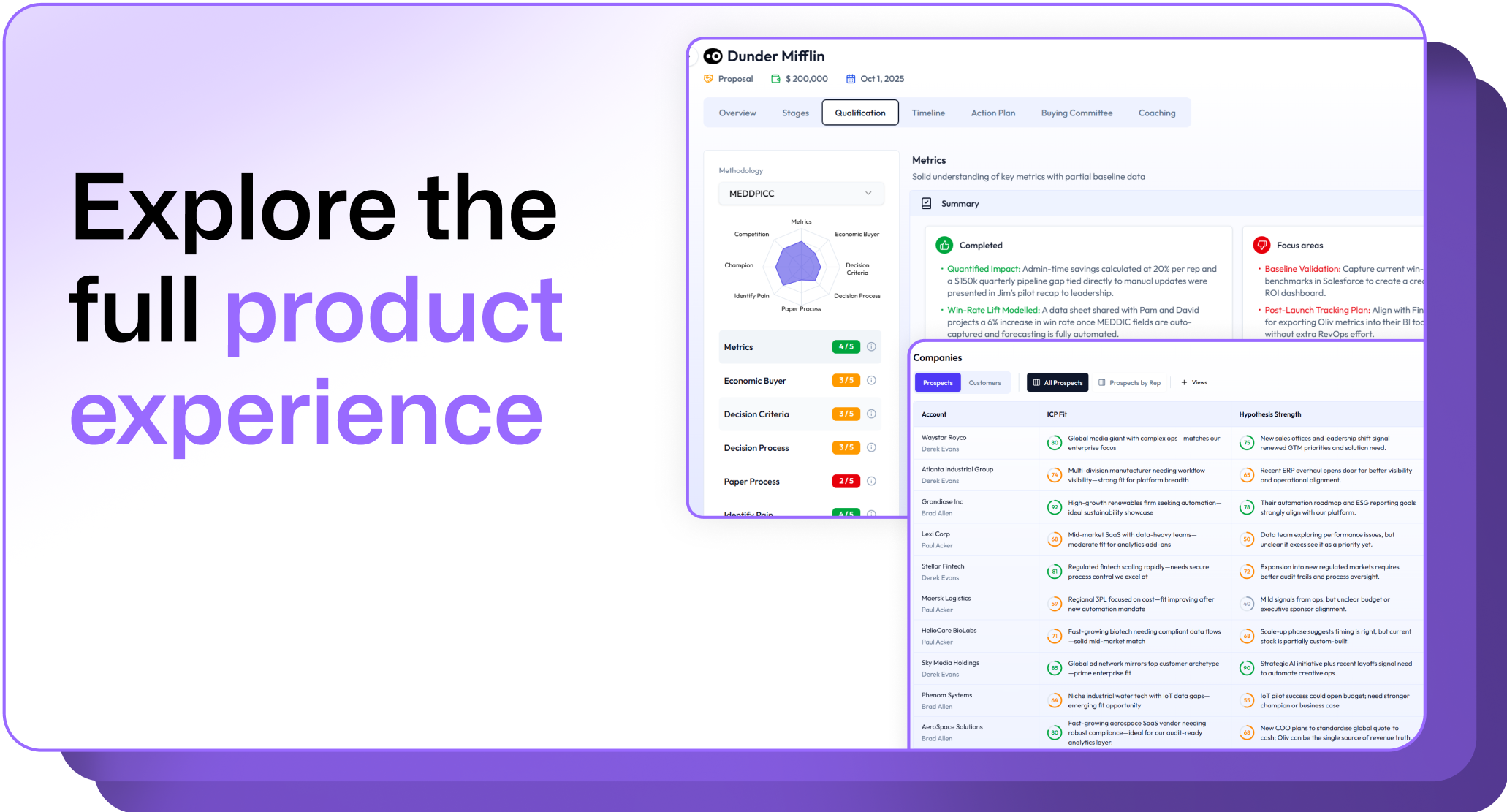
.avif)








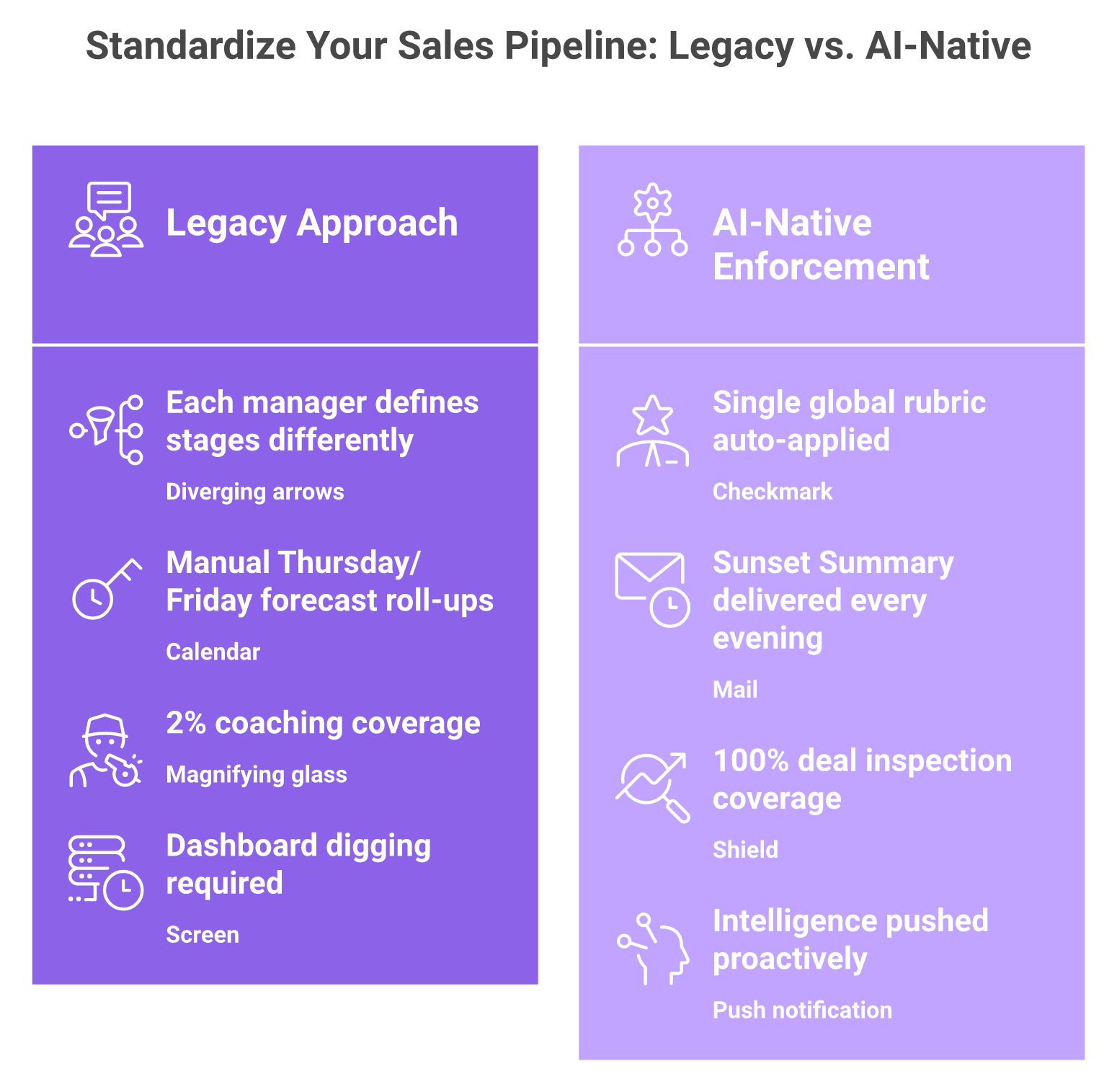

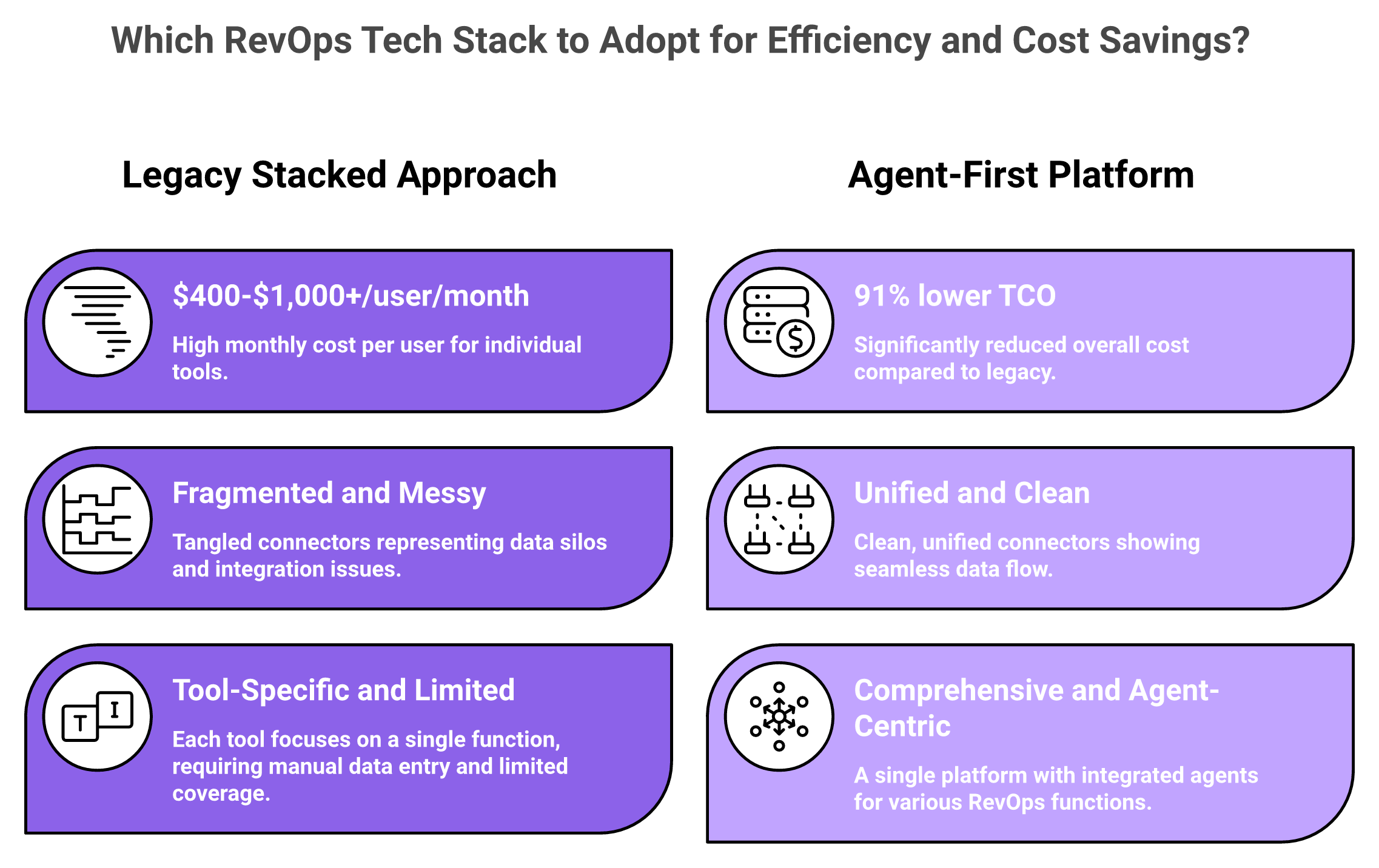

.png)
.png)
.png)
.png)

