Best Agentforce for Sales Alternative: Transitioning from B2C Support Bots to B2B Sales Execution Agents
Written by
Ishan Chhabra
Last Updated :
May 14, 2026
Skim in :
8
mins
In this article
Revenue teams love Oliv
Here’s why:
All your deal data unified (from 30+ tools and tabs).
Insights are delivered to you directly, no digging.
AI agents automate tasks for you.
Thank you! Your submission has been received!
Oops! Something went wrong while submitting the form.
Meet Oliv’s AI Agents
Hi! I’m, Deal Driver
I track deals, flag risks, send weekly pipeline updates and give sales managers full visibility into deal progress
Hi! I’m, CRM Manager
I maintain CRM hygiene by updating core, custom and qualification fields all without your team lifting a finger
Hi! I’m, Forecaster
I build accurate forecasts based on real deal movement and tell you which deals to pull in to hit your number
Hi! I’m, Coach
I believe performance fuels revenue. I spot skill gaps, score calls and build coaching plans to help every rep level up
Hi! I’m, Prospector
I dig into target accounts to surface the right contacts, tailor and time outreach so you always strike when it counts
Hi! I’m, Pipeline tracker
I call reps to get deal updates, and deliver a real-time, CRM-synced roll-up view of deal progress
Hi! I’m, Analyst
I answer complex pipeline questions, uncover deal patterns, and build reports that guide strategic decisions
TL;DR
Salesforce Agentforce was built on Data Cloud, a B2C CDP, leaving B2B sales teams with chat-triggered bots instead of autonomous deal execution agents.
All-in Agentforce TCO often exceeds $13.6K per user per year once Data Cloud minimums, conversation credits, and Einstein add-ons are layered.
Roughly 77% of B2B Agentforce deployments fail due to Data Cloud lock-in, 2-3 year data modeling prerequisites, and missing data-cleaning agents.
True B2B sales execution agents update MEDDPICC and BANT fields directly, run event-driven in the background, and remain CRM-agnostic across Salesforce, HubSpot, and Dynamics.
Top alternatives in 2026 are Oliv.ai, Gong, Clari, Outreach, Salesloft, Apollo, and Regie.ai, with Oliv positioned as the agent-first execution platform for CROs.
A 30-60-90 day parallel-run migration with seat-based pricing typically delivers 60-90% lower TCO and a 16-day sales-cycle compression in customer telemetry.
Q1: Why Are CROs and VPs of Sales Searching for an Agentforce for Sales Alternative in 2026? [toc=Why CROs Are Searching]
A CRO at a 180-rep mid-market SaaS in Austin pinged me last quarter, three months into an Agentforce rollout. Her line: "We bought a sales agent and got a help-desk chatbot with a Data Cloud invoice." That conversation is not rare anymore. Across the B2B revenue teams we have stitched deal data for, the same pattern keeps showing up. Agentforce was sold as the agentic future of sales, and shipped as a service-deflection product wrapped in a sales-skinned UI.
The Disillusionment Moment Is Real
Buyers are not searching for a Salesforce replacement. They are searching for a way out of a roadmap that quietly pivoted away from B2B sales execution. Salesforce's strategic priority over the last 24 months has been Data Cloud, a B2C Customer Data Platform built for retailers and consumer brands. Sales teams running 60-day to 9-month deal cycles got the leftovers, and many are now evaluating the best Agentforce alternatives as a result.
What the Numbers Actually Say
Gartner has projected that through 2027, at least 40% of agentic AI projects will be cancelled before production. Inside B2B sales specifically, independent enterprise surveys put the Agentforce failure rate near 77%, driven by Data Cloud lock-in and 2 to 3 year data modeling prerequisites. ⚠️ For a CRO carrying a $40M number, that risk profile is unworkable.
The CRO and VP-Sales Question Has Shifted
The search query is not "Is Agentforce good?" anymore. It is "What replaces it for B2B sales execution?" Real reviewers are saying the quiet part loud, and many are turning to analyzed Salesforce Agentforce reviews before committing.
"The price of Agentforce is not clear and hard to find. Adoption is low because of the lack of knowledge on the subject as AI is a new field. Customers are finding issues in deploying and using agents in Salesforce." Anusha T., Web Developer Salesforce Agentforce G2 Verified Review
What I keep telling CROs in these calls is simple. The next two years will not be about better dashboards. They will be about agents that actually do the work, in the background, while reps sleep, which is exactly the promise behind AI-Native Revenue Orchestration.
Q2: What Exactly Is Agentforce for Sales, and Where Does It Fall Short for B2B Pipelines? [toc=What Is Agentforce]
Agentforce is Salesforce's generative-AI agent layer, launched in late 2024 atop the Salesforce platform and Data Cloud. It replaces parts of the older Einstein stack with LLM-driven agents that can chat, summarize, and trigger flows. On paper, it is the future. In practice, for B2B sales, the architecture tells a different story, which is why teams are evaluating Agentforce for Sales features with a sharper lens.
Einstein vs Agentforce vs Data Cloud, Untangled
Three names, three jobs. Einstein is the legacy machine-learning layer covering lead scoring, opportunity scoring, and predictive forecasting. Agentforce is the new generative-AI agent layer that sits on top. Data Cloud is Salesforce's B2C Customer Data Platform that unifies consumer profiles, and it is the data substrate Agentforce leans on for context. ✅ You cannot get serious value from Agentforce without Data Cloud, and Data Cloud was never built for B2B sales hygiene. For a deeper read, see the Salesforce Einstein features breakdown.
The Out-of-Box Agents Reveal the Bias
Salesforce ships Agentforce with three flagship agents: Service Agent, SDR Agent, and Sales Coach. The Service Agent is the strongest, because it is essentially a service-deflection bot with a generative skin. The SDR Agent handles inbound lead qualification over chat. The Sales Coach offers post-call feedback. ❌ None of these execute multi-step B2B workflows like building a business case, updating MEDDPICC fields across 14 opportunity records, or mapping a buying committee, a gap covered in detail in the Agentforce Sales Coach analysis.
The Chat Fallacy
Here is the part vendors gloss over. Agentforce agents are chat-triggered. A human prompts, the agent responds. That is a copilot, not an autonomous agent.
"Setting it up wasn't as smooth as I expected. The UI felt a bit clunky at times, especially when trying to manage multiple prompts or agent versions. Also, the pricing caught us off guard. Once we started scaling to more users and use cases, the cost ramped up pretty quickly." Ayushmaan Y., Senior Associate Salesforce Agentforce G2 Verified Review
The B2B Sales-Execution Gap
In our work rebuilding the CRM as an AI-native data platform, what I have noticed is that B2B sales does not need more chat. It needs background execution. A rep does not want to ask an agent for a follow-up email. The rep wants the email drafted, the CRM updated, the next-step task created, and the deal-stage moved, all before the next meeting starts. Agentforce's chat-first design fights that workflow, and that is the gap most teams are now feeling on Monday-morning forecast calls.
Q3: How Much Does Agentforce Actually Cost, and What Does the All-In TCO Look Like? [toc=Agentforce TCO]
The sticker price is a distraction. The real number lives in three layered costs that buyers rarely model together. For a fuller breakdown, see the Salesforce Agentforce pricing breakdown.
The Three-Layer Cost Stack
Agentforce Three-Layer Cost Stack
Cost Layer
What You Pay
Why It Hurts
Agentforce conversation pricing
Approximately $2 per conversation, or $0.10 per action on credit packs
Long B2B cycles burn credits unpredictably 💸
Data Cloud minimum
Reportedly $108K+/year minimum entry, scaling with data volume
Mandatory for serious agent context
Sales Cloud + Einstein add-ons
$165 to $500/user/month
Pre-existing seat cost is the floor
The All-In Math
Industry analyses pricing the full stack for a 100-seat mid-market deployment have put the all-in total near $13.6K per user per year once Data Cloud minimums, conversation credits, and Einstein add-ons are included. For a 200-rep enterprise team, that is north of $2.7M annually before professional services. ⚠️ Compare that to seat-based revenue intelligence platforms in the $19 to $120/user/month range, like the options covered in the best revenue intelligence software platforms guide.
Why Credit-Based Pricing Misaligns with B2B
B2B sales cycles run 60 to 270 days. A single deal might generate 40 to 80 agent actions across discovery, proposal, mutual action plan, and close. Credit-based pricing means costs spike in the quarters you are working hardest. Seat-based pricing flattens that risk. A CFO can model it. ✅ A CRO can defend it in board meetings.
Build Your Own TCO Anchor
I recommend every buyer run this back-of-envelope before any Agentforce demo. Take your headcount, multiply by $13.6K, add a $108K Data Cloud floor, and add 18% for implementation. That is your floor. If your revenue intelligence budget cannot absorb that, an alternative is not a nice-to-have. It is a fiduciary requirement, and that is the lens applied across the best Salesforce Einstein competitors and alternatives.
Q4: Why Do 77% of B2B Agentforce Deployments Fail, the Failure-Mode Anatomy? [toc=Failure-Mode Anatomy]
When we audited live Agentforce rollouts across mid-market and enterprise B2B teams, five failure modes kept repeating. The 77% number stops being abstract once you see the pattern, and the same patterns show up in the Agentforce implementation analysis.
Failure Mode 1: The Data Cloud Prerequisite
Agentforce's reasoning quality is only as good as the data it reads. Data Cloud was built for B2C, where customer profiles are clean and event-driven. B2B data is messy, including duplicate accounts (Google US versus Google India), multi-thread email chains, and Slack conversations that never reach the CRM. Salesforce's own implementation guidance points to a 2 to 3 year data modeling project before agents become reliable. ❌ B2B teams need value in 14 days, not 36 months.
Failure Mode 2: The Missing Data-Cleaning Agent
There is no out-of-box Agentforce skill that cleans CRM hygiene before reasoning runs on top. Garbage in, confident garbage out. The agent will hallucinate a stage update on a duplicate opportunity and look authoritative doing it.
Failure Mode 3: Einstein Activity Capture Redaction
Einstein Activity Capture, the underlying email and calendar sync, runs rule-based PII redaction that often strips legitimate B2B context, including deal terms, contract values, and competitor names. Reps lose trust the first time a critical email turns into [REDACTED]. The Salesforce Einstein reviews capture this complaint repeatedly.
I covered the math above. The deeper issue is psychological. Reps avoid using a tool when each interaction has a visible price tag. Adoption craters.
Failure Mode 5: The Chat-Trigger Adoption Cliff
"I built the default agent, went well, then went to create a second agent and could not get past an error when I clicked Create. I have all the necessary permissions and access, so really don't know what was going on, especially since we're supposedly able to have more than one agent at one time." Jessica C., Senior Business Analyst Salesforce Agentforce G2 Verified Review
"Lots of clicking to get select the right options. UX needs improvement. Everything opens in a new browser tabs clustering the browser. Lots of jumping back and forth between tabs to enable settings." Verified User in Consulting, Enterprise Salesforce Agentforce G2 Verified Review
What This Means for a CRO Next Monday
If your team is on Salesforce, do not greenlight Agentforce as a standalone B2B sales execution play. Run a parallel pilot with a CRM-agnostic, agent-first platform. Measure forecast-accuracy lift, deal velocity, and CRM hygiene over 60 days. Let the data, not the slide deck, decide, and benchmark against options surfaced in the best AI sales tools roundup.
Q5: What Defines a True B2B Sales Execution Agent vs a Chat-Based Support Bot? [toc=Execution Agent vs Bot]
The architectural divide every CRO must clarify before evaluating an Agentforce alternative.
The category is muddled because vendors are calling everything an "AI agent." A chatbot with a system prompt is not an agent. A workflow that needs a human to press a button is not autonomous. Here is the line that matters for a CRO making a buy decision, and it overlaps with the framing in revenue ops to intelligence to orchestration.
Updates MEDDPICC (Metrics, Economic buyer, Decision criteria, Decision process, Paper process, Identify pain, Champion, Competition), BANT, and SPICED fields directly
Generic summary text
5. Pricing model
Predictable seat-based
Per-conversation or per-action credits 💸
Why Methodology Fluency Filters 80% of Vendors
Most "AI sales tools" log activity notes. That is table stakes from 2018. The 2026 question is whether the tool updates the qualification fields your forecast depends on. Champion identified, economic buyer confirmed, and paper process mapped. ❌ If those fields are still rep-typed, you do not have an agent. You have a transcription service, which is the gap covered in the MEDDIC sales methodology guide.
What Operators Are Saying
"I love conversational AI. My favorite aspect of Gong is being able to go into any account and ask what is going on." Amanda R., Director, Customer Success Gong G2 Verified Review
That review describes the ceiling of conversational AI. Reactive. ⚠️ The CRO question is what happens when nobody asks. Across the 1,000+ B2B sales cycles we have processed, the ROI gap between reactive Q&A and autonomous execution is roughly 90 minutes per rep per day in admin work eliminated, which mirrors the patterns documented in Gong reviews.
The CRM-Agnostic Test
The five-test filter that disqualifies 80% of self-described AI sales agents.
A real sales execution agent runs on Salesforce, HubSpot, MS Dynamics, or Pipedrive. ❌ If it requires Data Cloud or a single CRM ecosystem, it is a feature of that CRM, not an agent. Hand vendors this five-test list before the next demo, and watch how many drop out at Test 4. For a deeper bench, see the best AI for sales calls.
Q6: What Are the 7 Best Agentforce for Sales Alternatives in 2026? [toc=7 Best Alternatives]
This shortlist is built for B2B revenue teams running 25 to 500 reps on Salesforce or HubSpot. Each entry covers what it actually does, pricing model, and a verified review, and it pairs with the best revenue intelligence software platforms roundup.
1. Oliv.ai ⭐ (Best for B2B Sales Execution)
What it does: 30+ specialized agents in production, including the Researcher Agent (deal dossiers 30 minutes pre-call), CRM Manager (deep MEDDPICC field updates), Deal Driver (at-risk pipeline flags), Coach (skill-gap maps), and Handoff Hank (AE-to-CSM transitions).
Telemetry: 5-minute call processing vs Gong's 20 to 30 minutes; reported 16-day sales-cycle compression in customer deployments. Pricing: ✅ Transparent seat-based, modular per-agent. Trust signals: SOC 2 Type II, GDPR, and CCPA certified. Validation: Akil Sharperson at Triple Whale and Suraj Ramesh at Sprinto have publicly endorsed the platform. Anti-ICP: B2C support, and pure call-recording-only use cases. ⚠️ Voice Agent is in alpha. Learn more in the best sales intelligence platform guide.
2. Gong (Best for Conversation Intelligence Heritage)
✅ Mature call recording and trackers. ❌ Pre-generative-AI architecture; insights are reactive. For a focused comparison, see Gong vs Oliv.
"It was a big mistake on our part to commit to a two year term. Gong is a really powerful tool but it's probably the highest end option on the market." Iris P., Head of Marketing, Sales Partnerships Gong G2 Verified Review
3. Clari (Best for Forecast-Centric Enterprises)
✅ Strong forecast roll-ups. ❌ Groove engagement layer feels dated post-acquisition. See Clari features for a deeper read.
"Lacks basic features around schedule buffers between meetings and scheduling. The Omnibar is very click intensive to accomplish basic tasks compared to its competitors." Verified User in Computer Software Clari G2 Verified Review
4. Outreach (Best for Outbound Sequence Volume)
✅ Deep sequencing. ❌ Email-scheduler core, and evergreen contracts. See Gong vs Outreach for context.
"Outreach is significantly overpriced for what it offers. The platform has a clunky interface and still relies on your own email servers." Kevin H., CTO/Co-Founder Outreach G2 Verified Review
5. Salesloft (Best for Mid-Market Engagement)
✅ Strong cadence bundle. ❌ Outlook online sync gaps. See Gong vs Salesloft for a side-by-side.
"The dashboard is not intuitive. And the emails not being lofted in Outlook online version is a huge inconvenience." Gulen A., Associate Director Salesloft G2 Verified Review
6. Apollo.io (Best for Data and Outbound on a Budget)
✅ B2B contact database plus sequencing, and affordable for SMB. ❌ Less depth on deal execution and forecast.
7. Regie.ai (Best for AI-Generated Outbound Copy)
✅ Generative AI for sequence personalization. ❌ Narrow scope, and not full deal execution. Compare against the best AI sales tools.
Honorable Mention: Qualified
For inbound conversion on the website, Qualified leads the AI-SDR-on-site category. It is worth a stack slot for inbound-heavy mid-market teams.
Q7: How Does Oliv.ai Compare Head-to-Head with Agentforce for B2B Sales Execution? [toc=Oliv vs Agentforce]
The cleanest way to read this is side by side, and then in narrative. For the broader Salesforce-centric view, see the Salesforce Agentforce overview.
The Comparison Matrix
Oliv.ai vs Salesforce Agentforce
Dimension
Oliv.ai
Salesforce Agentforce
Architecture
Agent-first, autonomous, background execution
Chat-triggered copilot
Trigger model
Event-driven (deal stage, email, calendar)
Human prompt
CRM updates
Deep object updates (MEDDPICC, BANT fields)
Activity notes, summaries
Data foundation
AI-native activity mapping across calls, email, Slack, and Telegram
Data Cloud (B2C CDP) prerequisite
Pricing
Seat-based, predictable
Per-conversation plus Data Cloud minimum 💰
CRM scope
Salesforce, HubSpot, MS Dynamics, and Pipedrive
Salesforce-locked
Setup time
Days
2 to 3 year data modeling project
The Narrative That Makes the Matrix Real
A rep walks into a Tuesday afternoon discovery call. With Oliv, the Researcher Agent has already pushed a deal dossier to Slack 30 minutes prior, covering the prospect's funding, exec team, and trigger events. Post-call, the CRM Manager updates 11 MEDDPICC fields. The Deal Driver flags a missing economic buyer. Handoff Hank prepares the AE-to-CSM transition the moment the contract is signed. ✅ The rep did not type a single prompt. The same outcomes mapped to the best AI sales forecasting software show up downstream as forecast lift.
Where Agentforce Lands
With Agentforce, the rep would need to open the Einstein chat panel, type a request, copy the output, paste it back into the opportunity, and manually update fields. ❌ It is faster than nothing, but it is not autonomous, a pattern echoed across the Agentforce use case analysis.
What Operators Are Reporting
The same call, two workflows: manual prompting versus autonomous agent execution.
"It can be complex to set up and often requires skilled administrators or developers to customize and integrate properly, which adds time and cost." Verified User in Marketing and Advertising Salesforce Agentforce G2 Verified Review
Across the B2B teams we have stitched deal data for, the recurring theme is that Agentforce is a powerful platform that needs an admin army. Oliv is built for the rep and the CRO, not the implementation partner.
Q8: What Are the Best Agentforce Alternatives for Non-Salesforce or Multi-CRM Sales Orgs? [toc=Multi-CRM Alternatives]
Agentforce is structurally Salesforce-locked. Its reasoning runs on Data Cloud, and Data Cloud's licensing is tied to the Salesforce ecosystem. ❌ For HubSpot-native, Pipedrive-native, MS Dynamics-native, or post-acquisition multi-CRM teams, Agentforce is not on the menu, which is why teams shortlist the best Clari alternatives and competitors alongside agentic platforms.
The CRM-Agnostic Shortlist
CRM-Agnostic Agentforce Alternatives by Stack
CRM Stack
Best Fit
Why
HubSpot-native
Oliv.ai ⭐
Native two-way HubSpot sync, and deep deal-property updates
Pipedrive / Zoho
Oliv.ai, Apollo
Lightweight, seat-based, and no Data Cloud dependency
MS Dynamics
Oliv.ai
Multi-CRM stitching across global accounts
Multi-CRM (post-M&A)
Oliv.ai ⭐
AI-native activity mapping merges Google US vs Google India
Outbound-heavy, any CRM
Apollo, Regie.ai
Sequence plus data, and lower cost
The Post-M&A Reality Check
A 200-rep team that just acquired a 60-rep HubSpot shop cannot rip-and-replace overnight. ⚠️ Picking a Salesforce-only agent layer pre-commits you to a migration roadmap that does not match revenue reality. We saw this exact pattern at Triple Whale, where multi-source data stitching was non-negotiable for the RevOps team. The same lens applies to the best revenue orchestration platform tools.
What Operators Tell Us
Across the B2B revenue teams we have stitched deal data for, the recurring CRO question is, "what happens to my agents when I acquire a HubSpot shop next year?" Lock-in is not a feature, it is a liability. ✅ CRM-agnostic agents preserve optionality. That is the move for any CRO planning M&A or running a global multi-region stack, and it tracks with the trajectory laid out in the AI-Native Revenue Orchestration platform overview.
"It can be complex to set up and often requires skilled administrators or developers to customize and integrate properly, which adds time and cost." Verified User in Marketing and Advertising Salesforce Agentforce G2 Verified Review
Q9: How Do AI-Native Activity Mapping and Data Hygiene Beat Einstein Activity Capture? [toc=Activity Mapping vs EAC]
Einstein Activity Capture (EAC) was built nearly a decade ago for rule-based email and calendar sync into Salesforce. It works in clean, single-CRM environments. It breaks the moment B2B reality shows up, which is why teams revisit Salesforce Einstein reviews before renewing.
Where EAC Quietly Fails
❌ Duplicate global accounts. A rep emails their contact at "Google India." EAC logs the activity against the parent "Google" account in the US org, or worse, against neither. The rep's hard work disappears from forecast view.
❌ Slack and Telegram blindness. Modern B2B deals close in DMs, not just Outlook. EAC has no native ingest path for Slack threads, Telegram chats, or WhatsApp Business conversations. The richest signals never reach the CRM, a gap covered in revenue intelligence platforms.
❌ Over-redaction. EAC's rule-based PII redaction often strips legitimate deal context, including contract values, competitor names, and mutual contacts. Reps lose trust and stop relying on the timeline.
❌ No reasoning layer. EAC captures. It does not associate, infer, or update qualification fields. A human still has to interpret what the activity meant for the deal, which is the gap covered in the best Salesforce Einstein competitors and alternatives.
How AI-Native Activity Mapping Resolves Each Gap
EAC Failure Modes vs AI-Native Mapping
EAC Failure
AI-Native Mapping Fix
Duplicate accounts
LLM-driven entity resolution merges Google US and Google India to the right opportunity 🌐
Channel blindness
Slack, Telegram, and WhatsApp ingestion with consent-based capture
Over-redaction
Context-aware redaction that preserves deal data while masking true PII
No reasoning
Agent layer updates MEDDPICC, BANT, and SPICED fields directly
Why This Matters for Forecast Accuracy
⚠️ A forecast is only as honest as the underlying activity data. When 30% of cross-region B2B activity is mis-attributed, the forecast is structurally wrong before the rep even speaks. AI-native mapping is not a nicety. It is the foundation every layer above it depends on. Get this wrong and Agentforce, Einstein, or any agent on top inherits the noise. The same logic powers the best AI sales forecasting software.
Q10: What Does a Day-in-the-Life Look Like with Autonomous Sales Execution Agents? [toc=Day in the Life]
The promise of agents is abstract until you watch a rep's calendar with and without them. Here is the cadence we see in mid-market B2B teams running an agent-first stack, and it pairs with the patterns documented in the best revenue intelligence software platforms.
Daily Rhythm ⏰
6:30 AM. The Researcher Agent drops a Slack DM with the rep's three most important meetings of the day. Each brief covers prospect funding, exec changes, recent product launches, and likely objections.
Mid-morning. A discovery call ends. Within 5 minutes, the CRM Manager has updated 12 opportunity fields, drafted a follow-up email, and created the next-step task. Compare that to the 20 to 30 minutes legacy conversation intelligence takes to surface insights, a benchmark explored in the Gong implementation timeline.
Late Afternoon Signal
Late afternoon. The Deal Driver pings the manager about a deal that has not progressed in 14 days, with a one-line diagnosis and a recommended play.
Weekly Rhythm
Monday. Pipeline review opens with the Deal Driver's at-risk list, not a rep-built spreadsheet. The conversation is about action, not data hunting.
Friday. The Coach agent surfaces three coaching moments per rep, tied to actual call clips, not anecdotes, which is the model behind the best sales coaching software.
Monthly Rhythm
The Coach agent generates a skill-gap map per rep, mapped to call performance trends. ✅ Enablement plans become evidence-based instead of vibes-based. The CRO sees ramp-time compress because new hires get personalized coaching from day five, not month three. In customer telemetry, we have seen sales-cycle compression of roughly 16 days on comparable mid-market deals when this cadence runs end-to-end, a pattern aligned with AI-Native Revenue Orchestration.
What the Rep Notices
The rep stops being a CRM data-entry clerk. They sell. The 90 minutes a day spent on admin work becomes prospecting, follow-ups, and live deals. That is the only productivity metric a CRO actually cares about, and it is the through-line of the best AI sales tools.
Q11: How Do You Migrate from Agentforce (or Plan Around It) Without Disrupting Live Pipeline? [toc=Migration Playbook]
The phased playbook CROs use to migrate off Agentforce without disrupting live pipeline.
Migrations break revenue when they are big-bang. The teams that succeed run a 30-60-90 day phased plan with parallel safeguards. Here is the playbook, and it tracks with the sequencing logic in the Agentforce implementation analysis.
Days 1 to 30: Pilot and Baseline
Scope a single pod. Pick 8 to 12 reps in one segment (for example, mid-market new business). Avoid mixing segments in pilot week one.
Capture baseline metrics. Forecast accuracy, deal velocity, CRM hygiene score, ramp time, and rep admin hours. ⏰ You cannot prove ROI without a before-state.
Run the alternative in parallel. Do not turn off Agentforce or existing tools. Let them coexist for 30 days.
Set a kill criterion. If forecast accuracy drops more than 5 points in week three, pause and diagnose.
Days 31 to 60: Expand and Stress-Test
Add a second pod in a different region or segment. This tests multi-CRM stitching and timezone edge cases.
Activate the data-cleaning agent first. Hygiene before reasoning. ✅ Garbage in still equals garbage out, even with better models.
Map MEDDPICC or BANT fields explicitly. Decide which qualification fields the agent owns and which stay rep-owned, a decision shaped by the MEDDIC sales methodology guide.
Run weekly RevOps standups. Surface adoption blockers in week one, not month three.
Days 61 to 90: Cut Over and Decommission
Migrate the remaining segments. Sequence by segment risk, lowest deal-size first if possible.
Decommission Agentforce conversation credits. Cancel Data Cloud minimums only after 30 days of clean alternative data, with the cost lens from the Salesforce Agentforce pricing breakdown.
Lock in seat-based pricing in the new contract to flatten future TCO 💰.
Publish the post-mortem. Forecast lift, deal-velocity delta, and hours saved per rep. The board will ask.
The Two Safeguards That Matter Most
⚠️ Parallel-run, never big-bang. Live pipeline is not a sandbox.
⚠️ CRO sponsorship, not RevOps-only. Agent rollouts that lack revenue-leader air cover stall at 30% adoption, a pattern echoed across revenue ops to intelligence to orchestration.
Q12: Which Agentforce Alternative Is Right for Your Sales Org? (Decision Tree + TCO Calculator) [toc=Decision Tree]
The right answer depends on three variables: company stage, CRM stack, and the primary KPI you are trying to move. Here is the decision matrix and the TCO anchor, with broader bench context in the best Agentforce alternatives and competitors.
The Decision Matrix
Best-Fit Agentforce Alternative by Profile
Profile
Primary KPI
Best-Fit Alternative
Mid-market, Salesforce, 25 to 200 reps
Forecast accuracy and deal velocity
Oliv.ai ⭐
Mid-market, HubSpot, 25 to 200 reps
CRM hygiene and rep productivity
Oliv.ai ⭐
Enterprise, multi-CRM, 200 to 500 reps
Pipeline coverage and handoffs
Oliv.ai ⭐
Enterprise, Salesforce, 1000+ reps
Conversation intelligence depth
Gong plus Oliv (layered)
Outbound-heavy, any CRM
Top-of-funnel volume
Apollo or Regie.ai
Inbound conversion focus
Website-to-pipeline rate
Qualified
Forecast-only, Salesforce-locked
Forecast roll-ups
Clari
The TCO Anchor 💰
A simple back-of-envelope every CRO should run before signing:
Agentforce all-in floor: (Headcount × $13.6K) plus $108K Data Cloud plus 18% implementation
Seat-based agent platform: Headcount × ($19 to $120/month × 12)
Delta: Often 60% to 90% lower TCO on the agent-first side, with predictable line items
The KPI Test
✅ If your primary KPI is forecast accuracy, deal velocity, or CRM hygiene, an autonomous, agent-first platform wins.
✅ If your KPI is call-coaching depth at scale, Gong remains a strong layered option, with the head-to-head laid out in Gong vs Oliv.
❌ If your KPI is service deflection, Agentforce is the right tool. Just do not buy it for B2B sales execution.
What I Tell Every CRO at the End
Pick the platform that makes your reps spend more time selling and your forecast more honest by next quarter. Everything else is noise. For the broader category map, see the best revenue orchestration platform tools.
Q1: Why Are CROs and VPs of Sales Searching for an Agentforce for Sales Alternative in 2026? [toc=Why CROs Are Searching]
A CRO at a 180-rep mid-market SaaS in Austin pinged me last quarter, three months into an Agentforce rollout. Her line: "We bought a sales agent and got a help-desk chatbot with a Data Cloud invoice." That conversation is not rare anymore. Across the B2B revenue teams we have stitched deal data for, the same pattern keeps showing up. Agentforce was sold as the agentic future of sales, and shipped as a service-deflection product wrapped in a sales-skinned UI.
The Disillusionment Moment Is Real
Buyers are not searching for a Salesforce replacement. They are searching for a way out of a roadmap that quietly pivoted away from B2B sales execution. Salesforce's strategic priority over the last 24 months has been Data Cloud, a B2C Customer Data Platform built for retailers and consumer brands. Sales teams running 60-day to 9-month deal cycles got the leftovers, and many are now evaluating the best Agentforce alternatives as a result.
What the Numbers Actually Say
Gartner has projected that through 2027, at least 40% of agentic AI projects will be cancelled before production. Inside B2B sales specifically, independent enterprise surveys put the Agentforce failure rate near 77%, driven by Data Cloud lock-in and 2 to 3 year data modeling prerequisites. ⚠️ For a CRO carrying a $40M number, that risk profile is unworkable.
The CRO and VP-Sales Question Has Shifted
The search query is not "Is Agentforce good?" anymore. It is "What replaces it for B2B sales execution?" Real reviewers are saying the quiet part loud, and many are turning to analyzed Salesforce Agentforce reviews before committing.
"The price of Agentforce is not clear and hard to find. Adoption is low because of the lack of knowledge on the subject as AI is a new field. Customers are finding issues in deploying and using agents in Salesforce." Anusha T., Web Developer Salesforce Agentforce G2 Verified Review
What I keep telling CROs in these calls is simple. The next two years will not be about better dashboards. They will be about agents that actually do the work, in the background, while reps sleep, which is exactly the promise behind AI-Native Revenue Orchestration.
Q2: What Exactly Is Agentforce for Sales, and Where Does It Fall Short for B2B Pipelines? [toc=What Is Agentforce]
Agentforce is Salesforce's generative-AI agent layer, launched in late 2024 atop the Salesforce platform and Data Cloud. It replaces parts of the older Einstein stack with LLM-driven agents that can chat, summarize, and trigger flows. On paper, it is the future. In practice, for B2B sales, the architecture tells a different story, which is why teams are evaluating Agentforce for Sales features with a sharper lens.
Einstein vs Agentforce vs Data Cloud, Untangled
Three names, three jobs. Einstein is the legacy machine-learning layer covering lead scoring, opportunity scoring, and predictive forecasting. Agentforce is the new generative-AI agent layer that sits on top. Data Cloud is Salesforce's B2C Customer Data Platform that unifies consumer profiles, and it is the data substrate Agentforce leans on for context. ✅ You cannot get serious value from Agentforce without Data Cloud, and Data Cloud was never built for B2B sales hygiene. For a deeper read, see the Salesforce Einstein features breakdown.
The Out-of-Box Agents Reveal the Bias
Salesforce ships Agentforce with three flagship agents: Service Agent, SDR Agent, and Sales Coach. The Service Agent is the strongest, because it is essentially a service-deflection bot with a generative skin. The SDR Agent handles inbound lead qualification over chat. The Sales Coach offers post-call feedback. ❌ None of these execute multi-step B2B workflows like building a business case, updating MEDDPICC fields across 14 opportunity records, or mapping a buying committee, a gap covered in detail in the Agentforce Sales Coach analysis.
The Chat Fallacy
Here is the part vendors gloss over. Agentforce agents are chat-triggered. A human prompts, the agent responds. That is a copilot, not an autonomous agent.
"Setting it up wasn't as smooth as I expected. The UI felt a bit clunky at times, especially when trying to manage multiple prompts or agent versions. Also, the pricing caught us off guard. Once we started scaling to more users and use cases, the cost ramped up pretty quickly." Ayushmaan Y., Senior Associate Salesforce Agentforce G2 Verified Review
The B2B Sales-Execution Gap
In our work rebuilding the CRM as an AI-native data platform, what I have noticed is that B2B sales does not need more chat. It needs background execution. A rep does not want to ask an agent for a follow-up email. The rep wants the email drafted, the CRM updated, the next-step task created, and the deal-stage moved, all before the next meeting starts. Agentforce's chat-first design fights that workflow, and that is the gap most teams are now feeling on Monday-morning forecast calls.
Q3: How Much Does Agentforce Actually Cost, and What Does the All-In TCO Look Like? [toc=Agentforce TCO]
The sticker price is a distraction. The real number lives in three layered costs that buyers rarely model together. For a fuller breakdown, see the Salesforce Agentforce pricing breakdown.
The Three-Layer Cost Stack
Agentforce Three-Layer Cost Stack
Cost Layer
What You Pay
Why It Hurts
Agentforce conversation pricing
Approximately $2 per conversation, or $0.10 per action on credit packs
Long B2B cycles burn credits unpredictably 💸
Data Cloud minimum
Reportedly $108K+/year minimum entry, scaling with data volume
Mandatory for serious agent context
Sales Cloud + Einstein add-ons
$165 to $500/user/month
Pre-existing seat cost is the floor
The All-In Math
Industry analyses pricing the full stack for a 100-seat mid-market deployment have put the all-in total near $13.6K per user per year once Data Cloud minimums, conversation credits, and Einstein add-ons are included. For a 200-rep enterprise team, that is north of $2.7M annually before professional services. ⚠️ Compare that to seat-based revenue intelligence platforms in the $19 to $120/user/month range, like the options covered in the best revenue intelligence software platforms guide.
Why Credit-Based Pricing Misaligns with B2B
B2B sales cycles run 60 to 270 days. A single deal might generate 40 to 80 agent actions across discovery, proposal, mutual action plan, and close. Credit-based pricing means costs spike in the quarters you are working hardest. Seat-based pricing flattens that risk. A CFO can model it. ✅ A CRO can defend it in board meetings.
Build Your Own TCO Anchor
I recommend every buyer run this back-of-envelope before any Agentforce demo. Take your headcount, multiply by $13.6K, add a $108K Data Cloud floor, and add 18% for implementation. That is your floor. If your revenue intelligence budget cannot absorb that, an alternative is not a nice-to-have. It is a fiduciary requirement, and that is the lens applied across the best Salesforce Einstein competitors and alternatives.
Q4: Why Do 77% of B2B Agentforce Deployments Fail, the Failure-Mode Anatomy? [toc=Failure-Mode Anatomy]
When we audited live Agentforce rollouts across mid-market and enterprise B2B teams, five failure modes kept repeating. The 77% number stops being abstract once you see the pattern, and the same patterns show up in the Agentforce implementation analysis.
Failure Mode 1: The Data Cloud Prerequisite
Agentforce's reasoning quality is only as good as the data it reads. Data Cloud was built for B2C, where customer profiles are clean and event-driven. B2B data is messy, including duplicate accounts (Google US versus Google India), multi-thread email chains, and Slack conversations that never reach the CRM. Salesforce's own implementation guidance points to a 2 to 3 year data modeling project before agents become reliable. ❌ B2B teams need value in 14 days, not 36 months.
Failure Mode 2: The Missing Data-Cleaning Agent
There is no out-of-box Agentforce skill that cleans CRM hygiene before reasoning runs on top. Garbage in, confident garbage out. The agent will hallucinate a stage update on a duplicate opportunity and look authoritative doing it.
Failure Mode 3: Einstein Activity Capture Redaction
Einstein Activity Capture, the underlying email and calendar sync, runs rule-based PII redaction that often strips legitimate B2B context, including deal terms, contract values, and competitor names. Reps lose trust the first time a critical email turns into [REDACTED]. The Salesforce Einstein reviews capture this complaint repeatedly.
I covered the math above. The deeper issue is psychological. Reps avoid using a tool when each interaction has a visible price tag. Adoption craters.
Failure Mode 5: The Chat-Trigger Adoption Cliff
"I built the default agent, went well, then went to create a second agent and could not get past an error when I clicked Create. I have all the necessary permissions and access, so really don't know what was going on, especially since we're supposedly able to have more than one agent at one time." Jessica C., Senior Business Analyst Salesforce Agentforce G2 Verified Review
"Lots of clicking to get select the right options. UX needs improvement. Everything opens in a new browser tabs clustering the browser. Lots of jumping back and forth between tabs to enable settings." Verified User in Consulting, Enterprise Salesforce Agentforce G2 Verified Review
What This Means for a CRO Next Monday
If your team is on Salesforce, do not greenlight Agentforce as a standalone B2B sales execution play. Run a parallel pilot with a CRM-agnostic, agent-first platform. Measure forecast-accuracy lift, deal velocity, and CRM hygiene over 60 days. Let the data, not the slide deck, decide, and benchmark against options surfaced in the best AI sales tools roundup.
Q5: What Defines a True B2B Sales Execution Agent vs a Chat-Based Support Bot? [toc=Execution Agent vs Bot]
The architectural divide every CRO must clarify before evaluating an Agentforce alternative.
The category is muddled because vendors are calling everything an "AI agent." A chatbot with a system prompt is not an agent. A workflow that needs a human to press a button is not autonomous. Here is the line that matters for a CRO making a buy decision, and it overlaps with the framing in revenue ops to intelligence to orchestration.
Updates MEDDPICC (Metrics, Economic buyer, Decision criteria, Decision process, Paper process, Identify pain, Champion, Competition), BANT, and SPICED fields directly
Generic summary text
5. Pricing model
Predictable seat-based
Per-conversation or per-action credits 💸
Why Methodology Fluency Filters 80% of Vendors
Most "AI sales tools" log activity notes. That is table stakes from 2018. The 2026 question is whether the tool updates the qualification fields your forecast depends on. Champion identified, economic buyer confirmed, and paper process mapped. ❌ If those fields are still rep-typed, you do not have an agent. You have a transcription service, which is the gap covered in the MEDDIC sales methodology guide.
What Operators Are Saying
"I love conversational AI. My favorite aspect of Gong is being able to go into any account and ask what is going on." Amanda R., Director, Customer Success Gong G2 Verified Review
That review describes the ceiling of conversational AI. Reactive. ⚠️ The CRO question is what happens when nobody asks. Across the 1,000+ B2B sales cycles we have processed, the ROI gap between reactive Q&A and autonomous execution is roughly 90 minutes per rep per day in admin work eliminated, which mirrors the patterns documented in Gong reviews.
The CRM-Agnostic Test
The five-test filter that disqualifies 80% of self-described AI sales agents.
A real sales execution agent runs on Salesforce, HubSpot, MS Dynamics, or Pipedrive. ❌ If it requires Data Cloud or a single CRM ecosystem, it is a feature of that CRM, not an agent. Hand vendors this five-test list before the next demo, and watch how many drop out at Test 4. For a deeper bench, see the best AI for sales calls.
Q6: What Are the 7 Best Agentforce for Sales Alternatives in 2026? [toc=7 Best Alternatives]
This shortlist is built for B2B revenue teams running 25 to 500 reps on Salesforce or HubSpot. Each entry covers what it actually does, pricing model, and a verified review, and it pairs with the best revenue intelligence software platforms roundup.
1. Oliv.ai ⭐ (Best for B2B Sales Execution)
What it does: 30+ specialized agents in production, including the Researcher Agent (deal dossiers 30 minutes pre-call), CRM Manager (deep MEDDPICC field updates), Deal Driver (at-risk pipeline flags), Coach (skill-gap maps), and Handoff Hank (AE-to-CSM transitions).
Telemetry: 5-minute call processing vs Gong's 20 to 30 minutes; reported 16-day sales-cycle compression in customer deployments. Pricing: ✅ Transparent seat-based, modular per-agent. Trust signals: SOC 2 Type II, GDPR, and CCPA certified. Validation: Akil Sharperson at Triple Whale and Suraj Ramesh at Sprinto have publicly endorsed the platform. Anti-ICP: B2C support, and pure call-recording-only use cases. ⚠️ Voice Agent is in alpha. Learn more in the best sales intelligence platform guide.
2. Gong (Best for Conversation Intelligence Heritage)
✅ Mature call recording and trackers. ❌ Pre-generative-AI architecture; insights are reactive. For a focused comparison, see Gong vs Oliv.
"It was a big mistake on our part to commit to a two year term. Gong is a really powerful tool but it's probably the highest end option on the market." Iris P., Head of Marketing, Sales Partnerships Gong G2 Verified Review
3. Clari (Best for Forecast-Centric Enterprises)
✅ Strong forecast roll-ups. ❌ Groove engagement layer feels dated post-acquisition. See Clari features for a deeper read.
"Lacks basic features around schedule buffers between meetings and scheduling. The Omnibar is very click intensive to accomplish basic tasks compared to its competitors." Verified User in Computer Software Clari G2 Verified Review
4. Outreach (Best for Outbound Sequence Volume)
✅ Deep sequencing. ❌ Email-scheduler core, and evergreen contracts. See Gong vs Outreach for context.
"Outreach is significantly overpriced for what it offers. The platform has a clunky interface and still relies on your own email servers." Kevin H., CTO/Co-Founder Outreach G2 Verified Review
5. Salesloft (Best for Mid-Market Engagement)
✅ Strong cadence bundle. ❌ Outlook online sync gaps. See Gong vs Salesloft for a side-by-side.
"The dashboard is not intuitive. And the emails not being lofted in Outlook online version is a huge inconvenience." Gulen A., Associate Director Salesloft G2 Verified Review
6. Apollo.io (Best for Data and Outbound on a Budget)
✅ B2B contact database plus sequencing, and affordable for SMB. ❌ Less depth on deal execution and forecast.
7. Regie.ai (Best for AI-Generated Outbound Copy)
✅ Generative AI for sequence personalization. ❌ Narrow scope, and not full deal execution. Compare against the best AI sales tools.
Honorable Mention: Qualified
For inbound conversion on the website, Qualified leads the AI-SDR-on-site category. It is worth a stack slot for inbound-heavy mid-market teams.
Q7: How Does Oliv.ai Compare Head-to-Head with Agentforce for B2B Sales Execution? [toc=Oliv vs Agentforce]
The cleanest way to read this is side by side, and then in narrative. For the broader Salesforce-centric view, see the Salesforce Agentforce overview.
The Comparison Matrix
Oliv.ai vs Salesforce Agentforce
Dimension
Oliv.ai
Salesforce Agentforce
Architecture
Agent-first, autonomous, background execution
Chat-triggered copilot
Trigger model
Event-driven (deal stage, email, calendar)
Human prompt
CRM updates
Deep object updates (MEDDPICC, BANT fields)
Activity notes, summaries
Data foundation
AI-native activity mapping across calls, email, Slack, and Telegram
Data Cloud (B2C CDP) prerequisite
Pricing
Seat-based, predictable
Per-conversation plus Data Cloud minimum 💰
CRM scope
Salesforce, HubSpot, MS Dynamics, and Pipedrive
Salesforce-locked
Setup time
Days
2 to 3 year data modeling project
The Narrative That Makes the Matrix Real
A rep walks into a Tuesday afternoon discovery call. With Oliv, the Researcher Agent has already pushed a deal dossier to Slack 30 minutes prior, covering the prospect's funding, exec team, and trigger events. Post-call, the CRM Manager updates 11 MEDDPICC fields. The Deal Driver flags a missing economic buyer. Handoff Hank prepares the AE-to-CSM transition the moment the contract is signed. ✅ The rep did not type a single prompt. The same outcomes mapped to the best AI sales forecasting software show up downstream as forecast lift.
Where Agentforce Lands
With Agentforce, the rep would need to open the Einstein chat panel, type a request, copy the output, paste it back into the opportunity, and manually update fields. ❌ It is faster than nothing, but it is not autonomous, a pattern echoed across the Agentforce use case analysis.
What Operators Are Reporting
The same call, two workflows: manual prompting versus autonomous agent execution.
"It can be complex to set up and often requires skilled administrators or developers to customize and integrate properly, which adds time and cost." Verified User in Marketing and Advertising Salesforce Agentforce G2 Verified Review
Across the B2B teams we have stitched deal data for, the recurring theme is that Agentforce is a powerful platform that needs an admin army. Oliv is built for the rep and the CRO, not the implementation partner.
Q8: What Are the Best Agentforce Alternatives for Non-Salesforce or Multi-CRM Sales Orgs? [toc=Multi-CRM Alternatives]
Agentforce is structurally Salesforce-locked. Its reasoning runs on Data Cloud, and Data Cloud's licensing is tied to the Salesforce ecosystem. ❌ For HubSpot-native, Pipedrive-native, MS Dynamics-native, or post-acquisition multi-CRM teams, Agentforce is not on the menu, which is why teams shortlist the best Clari alternatives and competitors alongside agentic platforms.
The CRM-Agnostic Shortlist
CRM-Agnostic Agentforce Alternatives by Stack
CRM Stack
Best Fit
Why
HubSpot-native
Oliv.ai ⭐
Native two-way HubSpot sync, and deep deal-property updates
Pipedrive / Zoho
Oliv.ai, Apollo
Lightweight, seat-based, and no Data Cloud dependency
MS Dynamics
Oliv.ai
Multi-CRM stitching across global accounts
Multi-CRM (post-M&A)
Oliv.ai ⭐
AI-native activity mapping merges Google US vs Google India
Outbound-heavy, any CRM
Apollo, Regie.ai
Sequence plus data, and lower cost
The Post-M&A Reality Check
A 200-rep team that just acquired a 60-rep HubSpot shop cannot rip-and-replace overnight. ⚠️ Picking a Salesforce-only agent layer pre-commits you to a migration roadmap that does not match revenue reality. We saw this exact pattern at Triple Whale, where multi-source data stitching was non-negotiable for the RevOps team. The same lens applies to the best revenue orchestration platform tools.
What Operators Tell Us
Across the B2B revenue teams we have stitched deal data for, the recurring CRO question is, "what happens to my agents when I acquire a HubSpot shop next year?" Lock-in is not a feature, it is a liability. ✅ CRM-agnostic agents preserve optionality. That is the move for any CRO planning M&A or running a global multi-region stack, and it tracks with the trajectory laid out in the AI-Native Revenue Orchestration platform overview.
"It can be complex to set up and often requires skilled administrators or developers to customize and integrate properly, which adds time and cost." Verified User in Marketing and Advertising Salesforce Agentforce G2 Verified Review
Q9: How Do AI-Native Activity Mapping and Data Hygiene Beat Einstein Activity Capture? [toc=Activity Mapping vs EAC]
Einstein Activity Capture (EAC) was built nearly a decade ago for rule-based email and calendar sync into Salesforce. It works in clean, single-CRM environments. It breaks the moment B2B reality shows up, which is why teams revisit Salesforce Einstein reviews before renewing.
Where EAC Quietly Fails
❌ Duplicate global accounts. A rep emails their contact at "Google India." EAC logs the activity against the parent "Google" account in the US org, or worse, against neither. The rep's hard work disappears from forecast view.
❌ Slack and Telegram blindness. Modern B2B deals close in DMs, not just Outlook. EAC has no native ingest path for Slack threads, Telegram chats, or WhatsApp Business conversations. The richest signals never reach the CRM, a gap covered in revenue intelligence platforms.
❌ Over-redaction. EAC's rule-based PII redaction often strips legitimate deal context, including contract values, competitor names, and mutual contacts. Reps lose trust and stop relying on the timeline.
❌ No reasoning layer. EAC captures. It does not associate, infer, or update qualification fields. A human still has to interpret what the activity meant for the deal, which is the gap covered in the best Salesforce Einstein competitors and alternatives.
How AI-Native Activity Mapping Resolves Each Gap
EAC Failure Modes vs AI-Native Mapping
EAC Failure
AI-Native Mapping Fix
Duplicate accounts
LLM-driven entity resolution merges Google US and Google India to the right opportunity 🌐
Channel blindness
Slack, Telegram, and WhatsApp ingestion with consent-based capture
Over-redaction
Context-aware redaction that preserves deal data while masking true PII
No reasoning
Agent layer updates MEDDPICC, BANT, and SPICED fields directly
Why This Matters for Forecast Accuracy
⚠️ A forecast is only as honest as the underlying activity data. When 30% of cross-region B2B activity is mis-attributed, the forecast is structurally wrong before the rep even speaks. AI-native mapping is not a nicety. It is the foundation every layer above it depends on. Get this wrong and Agentforce, Einstein, or any agent on top inherits the noise. The same logic powers the best AI sales forecasting software.
Q10: What Does a Day-in-the-Life Look Like with Autonomous Sales Execution Agents? [toc=Day in the Life]
The promise of agents is abstract until you watch a rep's calendar with and without them. Here is the cadence we see in mid-market B2B teams running an agent-first stack, and it pairs with the patterns documented in the best revenue intelligence software platforms.
Daily Rhythm ⏰
6:30 AM. The Researcher Agent drops a Slack DM with the rep's three most important meetings of the day. Each brief covers prospect funding, exec changes, recent product launches, and likely objections.
Mid-morning. A discovery call ends. Within 5 minutes, the CRM Manager has updated 12 opportunity fields, drafted a follow-up email, and created the next-step task. Compare that to the 20 to 30 minutes legacy conversation intelligence takes to surface insights, a benchmark explored in the Gong implementation timeline.
Late Afternoon Signal
Late afternoon. The Deal Driver pings the manager about a deal that has not progressed in 14 days, with a one-line diagnosis and a recommended play.
Weekly Rhythm
Monday. Pipeline review opens with the Deal Driver's at-risk list, not a rep-built spreadsheet. The conversation is about action, not data hunting.
Friday. The Coach agent surfaces three coaching moments per rep, tied to actual call clips, not anecdotes, which is the model behind the best sales coaching software.
Monthly Rhythm
The Coach agent generates a skill-gap map per rep, mapped to call performance trends. ✅ Enablement plans become evidence-based instead of vibes-based. The CRO sees ramp-time compress because new hires get personalized coaching from day five, not month three. In customer telemetry, we have seen sales-cycle compression of roughly 16 days on comparable mid-market deals when this cadence runs end-to-end, a pattern aligned with AI-Native Revenue Orchestration.
What the Rep Notices
The rep stops being a CRM data-entry clerk. They sell. The 90 minutes a day spent on admin work becomes prospecting, follow-ups, and live deals. That is the only productivity metric a CRO actually cares about, and it is the through-line of the best AI sales tools.
Q11: How Do You Migrate from Agentforce (or Plan Around It) Without Disrupting Live Pipeline? [toc=Migration Playbook]
The phased playbook CROs use to migrate off Agentforce without disrupting live pipeline.
Migrations break revenue when they are big-bang. The teams that succeed run a 30-60-90 day phased plan with parallel safeguards. Here is the playbook, and it tracks with the sequencing logic in the Agentforce implementation analysis.
Days 1 to 30: Pilot and Baseline
Scope a single pod. Pick 8 to 12 reps in one segment (for example, mid-market new business). Avoid mixing segments in pilot week one.
Capture baseline metrics. Forecast accuracy, deal velocity, CRM hygiene score, ramp time, and rep admin hours. ⏰ You cannot prove ROI without a before-state.
Run the alternative in parallel. Do not turn off Agentforce or existing tools. Let them coexist for 30 days.
Set a kill criterion. If forecast accuracy drops more than 5 points in week three, pause and diagnose.
Days 31 to 60: Expand and Stress-Test
Add a second pod in a different region or segment. This tests multi-CRM stitching and timezone edge cases.
Activate the data-cleaning agent first. Hygiene before reasoning. ✅ Garbage in still equals garbage out, even with better models.
Map MEDDPICC or BANT fields explicitly. Decide which qualification fields the agent owns and which stay rep-owned, a decision shaped by the MEDDIC sales methodology guide.
Run weekly RevOps standups. Surface adoption blockers in week one, not month three.
Days 61 to 90: Cut Over and Decommission
Migrate the remaining segments. Sequence by segment risk, lowest deal-size first if possible.
Decommission Agentforce conversation credits. Cancel Data Cloud minimums only after 30 days of clean alternative data, with the cost lens from the Salesforce Agentforce pricing breakdown.
Lock in seat-based pricing in the new contract to flatten future TCO 💰.
Publish the post-mortem. Forecast lift, deal-velocity delta, and hours saved per rep. The board will ask.
The Two Safeguards That Matter Most
⚠️ Parallel-run, never big-bang. Live pipeline is not a sandbox.
⚠️ CRO sponsorship, not RevOps-only. Agent rollouts that lack revenue-leader air cover stall at 30% adoption, a pattern echoed across revenue ops to intelligence to orchestration.
Q12: Which Agentforce Alternative Is Right for Your Sales Org? (Decision Tree + TCO Calculator) [toc=Decision Tree]
The right answer depends on three variables: company stage, CRM stack, and the primary KPI you are trying to move. Here is the decision matrix and the TCO anchor, with broader bench context in the best Agentforce alternatives and competitors.
The Decision Matrix
Best-Fit Agentforce Alternative by Profile
Profile
Primary KPI
Best-Fit Alternative
Mid-market, Salesforce, 25 to 200 reps
Forecast accuracy and deal velocity
Oliv.ai ⭐
Mid-market, HubSpot, 25 to 200 reps
CRM hygiene and rep productivity
Oliv.ai ⭐
Enterprise, multi-CRM, 200 to 500 reps
Pipeline coverage and handoffs
Oliv.ai ⭐
Enterprise, Salesforce, 1000+ reps
Conversation intelligence depth
Gong plus Oliv (layered)
Outbound-heavy, any CRM
Top-of-funnel volume
Apollo or Regie.ai
Inbound conversion focus
Website-to-pipeline rate
Qualified
Forecast-only, Salesforce-locked
Forecast roll-ups
Clari
The TCO Anchor 💰
A simple back-of-envelope every CRO should run before signing:
Agentforce all-in floor: (Headcount × $13.6K) plus $108K Data Cloud plus 18% implementation
Seat-based agent platform: Headcount × ($19 to $120/month × 12)
Delta: Often 60% to 90% lower TCO on the agent-first side, with predictable line items
The KPI Test
✅ If your primary KPI is forecast accuracy, deal velocity, or CRM hygiene, an autonomous, agent-first platform wins.
✅ If your KPI is call-coaching depth at scale, Gong remains a strong layered option, with the head-to-head laid out in Gong vs Oliv.
❌ If your KPI is service deflection, Agentforce is the right tool. Just do not buy it for B2B sales execution.
What I Tell Every CRO at the End
Pick the platform that makes your reps spend more time selling and your forecast more honest by next quarter. Everything else is noise. For the broader category map, see the best revenue orchestration platform tools.
Q1: Why Are CROs and VPs of Sales Searching for an Agentforce for Sales Alternative in 2026? [toc=Why CROs Are Searching]
A CRO at a 180-rep mid-market SaaS in Austin pinged me last quarter, three months into an Agentforce rollout. Her line: "We bought a sales agent and got a help-desk chatbot with a Data Cloud invoice." That conversation is not rare anymore. Across the B2B revenue teams we have stitched deal data for, the same pattern keeps showing up. Agentforce was sold as the agentic future of sales, and shipped as a service-deflection product wrapped in a sales-skinned UI.
The Disillusionment Moment Is Real
Buyers are not searching for a Salesforce replacement. They are searching for a way out of a roadmap that quietly pivoted away from B2B sales execution. Salesforce's strategic priority over the last 24 months has been Data Cloud, a B2C Customer Data Platform built for retailers and consumer brands. Sales teams running 60-day to 9-month deal cycles got the leftovers, and many are now evaluating the best Agentforce alternatives as a result.
What the Numbers Actually Say
Gartner has projected that through 2027, at least 40% of agentic AI projects will be cancelled before production. Inside B2B sales specifically, independent enterprise surveys put the Agentforce failure rate near 77%, driven by Data Cloud lock-in and 2 to 3 year data modeling prerequisites. ⚠️ For a CRO carrying a $40M number, that risk profile is unworkable.
The CRO and VP-Sales Question Has Shifted
The search query is not "Is Agentforce good?" anymore. It is "What replaces it for B2B sales execution?" Real reviewers are saying the quiet part loud, and many are turning to analyzed Salesforce Agentforce reviews before committing.
"The price of Agentforce is not clear and hard to find. Adoption is low because of the lack of knowledge on the subject as AI is a new field. Customers are finding issues in deploying and using agents in Salesforce." Anusha T., Web Developer Salesforce Agentforce G2 Verified Review
What I keep telling CROs in these calls is simple. The next two years will not be about better dashboards. They will be about agents that actually do the work, in the background, while reps sleep, which is exactly the promise behind AI-Native Revenue Orchestration.
Q2: What Exactly Is Agentforce for Sales, and Where Does It Fall Short for B2B Pipelines? [toc=What Is Agentforce]
Agentforce is Salesforce's generative-AI agent layer, launched in late 2024 atop the Salesforce platform and Data Cloud. It replaces parts of the older Einstein stack with LLM-driven agents that can chat, summarize, and trigger flows. On paper, it is the future. In practice, for B2B sales, the architecture tells a different story, which is why teams are evaluating Agentforce for Sales features with a sharper lens.
Einstein vs Agentforce vs Data Cloud, Untangled
Three names, three jobs. Einstein is the legacy machine-learning layer covering lead scoring, opportunity scoring, and predictive forecasting. Agentforce is the new generative-AI agent layer that sits on top. Data Cloud is Salesforce's B2C Customer Data Platform that unifies consumer profiles, and it is the data substrate Agentforce leans on for context. ✅ You cannot get serious value from Agentforce without Data Cloud, and Data Cloud was never built for B2B sales hygiene. For a deeper read, see the Salesforce Einstein features breakdown.
The Out-of-Box Agents Reveal the Bias
Salesforce ships Agentforce with three flagship agents: Service Agent, SDR Agent, and Sales Coach. The Service Agent is the strongest, because it is essentially a service-deflection bot with a generative skin. The SDR Agent handles inbound lead qualification over chat. The Sales Coach offers post-call feedback. ❌ None of these execute multi-step B2B workflows like building a business case, updating MEDDPICC fields across 14 opportunity records, or mapping a buying committee, a gap covered in detail in the Agentforce Sales Coach analysis.
The Chat Fallacy
Here is the part vendors gloss over. Agentforce agents are chat-triggered. A human prompts, the agent responds. That is a copilot, not an autonomous agent.
"Setting it up wasn't as smooth as I expected. The UI felt a bit clunky at times, especially when trying to manage multiple prompts or agent versions. Also, the pricing caught us off guard. Once we started scaling to more users and use cases, the cost ramped up pretty quickly." Ayushmaan Y., Senior Associate Salesforce Agentforce G2 Verified Review
The B2B Sales-Execution Gap
In our work rebuilding the CRM as an AI-native data platform, what I have noticed is that B2B sales does not need more chat. It needs background execution. A rep does not want to ask an agent for a follow-up email. The rep wants the email drafted, the CRM updated, the next-step task created, and the deal-stage moved, all before the next meeting starts. Agentforce's chat-first design fights that workflow, and that is the gap most teams are now feeling on Monday-morning forecast calls.
Q3: How Much Does Agentforce Actually Cost, and What Does the All-In TCO Look Like? [toc=Agentforce TCO]
The sticker price is a distraction. The real number lives in three layered costs that buyers rarely model together. For a fuller breakdown, see the Salesforce Agentforce pricing breakdown.
The Three-Layer Cost Stack
Agentforce Three-Layer Cost Stack
Cost Layer
What You Pay
Why It Hurts
Agentforce conversation pricing
Approximately $2 per conversation, or $0.10 per action on credit packs
Long B2B cycles burn credits unpredictably 💸
Data Cloud minimum
Reportedly $108K+/year minimum entry, scaling with data volume
Mandatory for serious agent context
Sales Cloud + Einstein add-ons
$165 to $500/user/month
Pre-existing seat cost is the floor
The All-In Math
Industry analyses pricing the full stack for a 100-seat mid-market deployment have put the all-in total near $13.6K per user per year once Data Cloud minimums, conversation credits, and Einstein add-ons are included. For a 200-rep enterprise team, that is north of $2.7M annually before professional services. ⚠️ Compare that to seat-based revenue intelligence platforms in the $19 to $120/user/month range, like the options covered in the best revenue intelligence software platforms guide.
Why Credit-Based Pricing Misaligns with B2B
B2B sales cycles run 60 to 270 days. A single deal might generate 40 to 80 agent actions across discovery, proposal, mutual action plan, and close. Credit-based pricing means costs spike in the quarters you are working hardest. Seat-based pricing flattens that risk. A CFO can model it. ✅ A CRO can defend it in board meetings.
Build Your Own TCO Anchor
I recommend every buyer run this back-of-envelope before any Agentforce demo. Take your headcount, multiply by $13.6K, add a $108K Data Cloud floor, and add 18% for implementation. That is your floor. If your revenue intelligence budget cannot absorb that, an alternative is not a nice-to-have. It is a fiduciary requirement, and that is the lens applied across the best Salesforce Einstein competitors and alternatives.
Q4: Why Do 77% of B2B Agentforce Deployments Fail, the Failure-Mode Anatomy? [toc=Failure-Mode Anatomy]
When we audited live Agentforce rollouts across mid-market and enterprise B2B teams, five failure modes kept repeating. The 77% number stops being abstract once you see the pattern, and the same patterns show up in the Agentforce implementation analysis.
Failure Mode 1: The Data Cloud Prerequisite
Agentforce's reasoning quality is only as good as the data it reads. Data Cloud was built for B2C, where customer profiles are clean and event-driven. B2B data is messy, including duplicate accounts (Google US versus Google India), multi-thread email chains, and Slack conversations that never reach the CRM. Salesforce's own implementation guidance points to a 2 to 3 year data modeling project before agents become reliable. ❌ B2B teams need value in 14 days, not 36 months.
Failure Mode 2: The Missing Data-Cleaning Agent
There is no out-of-box Agentforce skill that cleans CRM hygiene before reasoning runs on top. Garbage in, confident garbage out. The agent will hallucinate a stage update on a duplicate opportunity and look authoritative doing it.
Failure Mode 3: Einstein Activity Capture Redaction
Einstein Activity Capture, the underlying email and calendar sync, runs rule-based PII redaction that often strips legitimate B2B context, including deal terms, contract values, and competitor names. Reps lose trust the first time a critical email turns into [REDACTED]. The Salesforce Einstein reviews capture this complaint repeatedly.
I covered the math above. The deeper issue is psychological. Reps avoid using a tool when each interaction has a visible price tag. Adoption craters.
Failure Mode 5: The Chat-Trigger Adoption Cliff
"I built the default agent, went well, then went to create a second agent and could not get past an error when I clicked Create. I have all the necessary permissions and access, so really don't know what was going on, especially since we're supposedly able to have more than one agent at one time." Jessica C., Senior Business Analyst Salesforce Agentforce G2 Verified Review
"Lots of clicking to get select the right options. UX needs improvement. Everything opens in a new browser tabs clustering the browser. Lots of jumping back and forth between tabs to enable settings." Verified User in Consulting, Enterprise Salesforce Agentforce G2 Verified Review
What This Means for a CRO Next Monday
If your team is on Salesforce, do not greenlight Agentforce as a standalone B2B sales execution play. Run a parallel pilot with a CRM-agnostic, agent-first platform. Measure forecast-accuracy lift, deal velocity, and CRM hygiene over 60 days. Let the data, not the slide deck, decide, and benchmark against options surfaced in the best AI sales tools roundup.
Q5: What Defines a True B2B Sales Execution Agent vs a Chat-Based Support Bot? [toc=Execution Agent vs Bot]
The architectural divide every CRO must clarify before evaluating an Agentforce alternative.
The category is muddled because vendors are calling everything an "AI agent." A chatbot with a system prompt is not an agent. A workflow that needs a human to press a button is not autonomous. Here is the line that matters for a CRO making a buy decision, and it overlaps with the framing in revenue ops to intelligence to orchestration.
Updates MEDDPICC (Metrics, Economic buyer, Decision criteria, Decision process, Paper process, Identify pain, Champion, Competition), BANT, and SPICED fields directly
Generic summary text
5. Pricing model
Predictable seat-based
Per-conversation or per-action credits 💸
Why Methodology Fluency Filters 80% of Vendors
Most "AI sales tools" log activity notes. That is table stakes from 2018. The 2026 question is whether the tool updates the qualification fields your forecast depends on. Champion identified, economic buyer confirmed, and paper process mapped. ❌ If those fields are still rep-typed, you do not have an agent. You have a transcription service, which is the gap covered in the MEDDIC sales methodology guide.
What Operators Are Saying
"I love conversational AI. My favorite aspect of Gong is being able to go into any account and ask what is going on." Amanda R., Director, Customer Success Gong G2 Verified Review
That review describes the ceiling of conversational AI. Reactive. ⚠️ The CRO question is what happens when nobody asks. Across the 1,000+ B2B sales cycles we have processed, the ROI gap between reactive Q&A and autonomous execution is roughly 90 minutes per rep per day in admin work eliminated, which mirrors the patterns documented in Gong reviews.
The CRM-Agnostic Test
The five-test filter that disqualifies 80% of self-described AI sales agents.
A real sales execution agent runs on Salesforce, HubSpot, MS Dynamics, or Pipedrive. ❌ If it requires Data Cloud or a single CRM ecosystem, it is a feature of that CRM, not an agent. Hand vendors this five-test list before the next demo, and watch how many drop out at Test 4. For a deeper bench, see the best AI for sales calls.
Q6: What Are the 7 Best Agentforce for Sales Alternatives in 2026? [toc=7 Best Alternatives]
This shortlist is built for B2B revenue teams running 25 to 500 reps on Salesforce or HubSpot. Each entry covers what it actually does, pricing model, and a verified review, and it pairs with the best revenue intelligence software platforms roundup.
1. Oliv.ai ⭐ (Best for B2B Sales Execution)
What it does: 30+ specialized agents in production, including the Researcher Agent (deal dossiers 30 minutes pre-call), CRM Manager (deep MEDDPICC field updates), Deal Driver (at-risk pipeline flags), Coach (skill-gap maps), and Handoff Hank (AE-to-CSM transitions).
Telemetry: 5-minute call processing vs Gong's 20 to 30 minutes; reported 16-day sales-cycle compression in customer deployments. Pricing: ✅ Transparent seat-based, modular per-agent. Trust signals: SOC 2 Type II, GDPR, and CCPA certified. Validation: Akil Sharperson at Triple Whale and Suraj Ramesh at Sprinto have publicly endorsed the platform. Anti-ICP: B2C support, and pure call-recording-only use cases. ⚠️ Voice Agent is in alpha. Learn more in the best sales intelligence platform guide.
2. Gong (Best for Conversation Intelligence Heritage)
✅ Mature call recording and trackers. ❌ Pre-generative-AI architecture; insights are reactive. For a focused comparison, see Gong vs Oliv.
"It was a big mistake on our part to commit to a two year term. Gong is a really powerful tool but it's probably the highest end option on the market." Iris P., Head of Marketing, Sales Partnerships Gong G2 Verified Review
3. Clari (Best for Forecast-Centric Enterprises)
✅ Strong forecast roll-ups. ❌ Groove engagement layer feels dated post-acquisition. See Clari features for a deeper read.
"Lacks basic features around schedule buffers between meetings and scheduling. The Omnibar is very click intensive to accomplish basic tasks compared to its competitors." Verified User in Computer Software Clari G2 Verified Review
4. Outreach (Best for Outbound Sequence Volume)
✅ Deep sequencing. ❌ Email-scheduler core, and evergreen contracts. See Gong vs Outreach for context.
"Outreach is significantly overpriced for what it offers. The platform has a clunky interface and still relies on your own email servers." Kevin H., CTO/Co-Founder Outreach G2 Verified Review
5. Salesloft (Best for Mid-Market Engagement)
✅ Strong cadence bundle. ❌ Outlook online sync gaps. See Gong vs Salesloft for a side-by-side.
"The dashboard is not intuitive. And the emails not being lofted in Outlook online version is a huge inconvenience." Gulen A., Associate Director Salesloft G2 Verified Review
6. Apollo.io (Best for Data and Outbound on a Budget)
✅ B2B contact database plus sequencing, and affordable for SMB. ❌ Less depth on deal execution and forecast.
7. Regie.ai (Best for AI-Generated Outbound Copy)
✅ Generative AI for sequence personalization. ❌ Narrow scope, and not full deal execution. Compare against the best AI sales tools.
Honorable Mention: Qualified
For inbound conversion on the website, Qualified leads the AI-SDR-on-site category. It is worth a stack slot for inbound-heavy mid-market teams.
Q7: How Does Oliv.ai Compare Head-to-Head with Agentforce for B2B Sales Execution? [toc=Oliv vs Agentforce]
The cleanest way to read this is side by side, and then in narrative. For the broader Salesforce-centric view, see the Salesforce Agentforce overview.
The Comparison Matrix
Oliv.ai vs Salesforce Agentforce
Dimension
Oliv.ai
Salesforce Agentforce
Architecture
Agent-first, autonomous, background execution
Chat-triggered copilot
Trigger model
Event-driven (deal stage, email, calendar)
Human prompt
CRM updates
Deep object updates (MEDDPICC, BANT fields)
Activity notes, summaries
Data foundation
AI-native activity mapping across calls, email, Slack, and Telegram
Data Cloud (B2C CDP) prerequisite
Pricing
Seat-based, predictable
Per-conversation plus Data Cloud minimum 💰
CRM scope
Salesforce, HubSpot, MS Dynamics, and Pipedrive
Salesforce-locked
Setup time
Days
2 to 3 year data modeling project
The Narrative That Makes the Matrix Real
A rep walks into a Tuesday afternoon discovery call. With Oliv, the Researcher Agent has already pushed a deal dossier to Slack 30 minutes prior, covering the prospect's funding, exec team, and trigger events. Post-call, the CRM Manager updates 11 MEDDPICC fields. The Deal Driver flags a missing economic buyer. Handoff Hank prepares the AE-to-CSM transition the moment the contract is signed. ✅ The rep did not type a single prompt. The same outcomes mapped to the best AI sales forecasting software show up downstream as forecast lift.
Where Agentforce Lands
With Agentforce, the rep would need to open the Einstein chat panel, type a request, copy the output, paste it back into the opportunity, and manually update fields. ❌ It is faster than nothing, but it is not autonomous, a pattern echoed across the Agentforce use case analysis.
What Operators Are Reporting
The same call, two workflows: manual prompting versus autonomous agent execution.
"It can be complex to set up and often requires skilled administrators or developers to customize and integrate properly, which adds time and cost." Verified User in Marketing and Advertising Salesforce Agentforce G2 Verified Review
Across the B2B teams we have stitched deal data for, the recurring theme is that Agentforce is a powerful platform that needs an admin army. Oliv is built for the rep and the CRO, not the implementation partner.
Q8: What Are the Best Agentforce Alternatives for Non-Salesforce or Multi-CRM Sales Orgs? [toc=Multi-CRM Alternatives]
Agentforce is structurally Salesforce-locked. Its reasoning runs on Data Cloud, and Data Cloud's licensing is tied to the Salesforce ecosystem. ❌ For HubSpot-native, Pipedrive-native, MS Dynamics-native, or post-acquisition multi-CRM teams, Agentforce is not on the menu, which is why teams shortlist the best Clari alternatives and competitors alongside agentic platforms.
The CRM-Agnostic Shortlist
CRM-Agnostic Agentforce Alternatives by Stack
CRM Stack
Best Fit
Why
HubSpot-native
Oliv.ai ⭐
Native two-way HubSpot sync, and deep deal-property updates
Pipedrive / Zoho
Oliv.ai, Apollo
Lightweight, seat-based, and no Data Cloud dependency
MS Dynamics
Oliv.ai
Multi-CRM stitching across global accounts
Multi-CRM (post-M&A)
Oliv.ai ⭐
AI-native activity mapping merges Google US vs Google India
Outbound-heavy, any CRM
Apollo, Regie.ai
Sequence plus data, and lower cost
The Post-M&A Reality Check
A 200-rep team that just acquired a 60-rep HubSpot shop cannot rip-and-replace overnight. ⚠️ Picking a Salesforce-only agent layer pre-commits you to a migration roadmap that does not match revenue reality. We saw this exact pattern at Triple Whale, where multi-source data stitching was non-negotiable for the RevOps team. The same lens applies to the best revenue orchestration platform tools.
What Operators Tell Us
Across the B2B revenue teams we have stitched deal data for, the recurring CRO question is, "what happens to my agents when I acquire a HubSpot shop next year?" Lock-in is not a feature, it is a liability. ✅ CRM-agnostic agents preserve optionality. That is the move for any CRO planning M&A or running a global multi-region stack, and it tracks with the trajectory laid out in the AI-Native Revenue Orchestration platform overview.
"It can be complex to set up and often requires skilled administrators or developers to customize and integrate properly, which adds time and cost." Verified User in Marketing and Advertising Salesforce Agentforce G2 Verified Review
Q9: How Do AI-Native Activity Mapping and Data Hygiene Beat Einstein Activity Capture? [toc=Activity Mapping vs EAC]
Einstein Activity Capture (EAC) was built nearly a decade ago for rule-based email and calendar sync into Salesforce. It works in clean, single-CRM environments. It breaks the moment B2B reality shows up, which is why teams revisit Salesforce Einstein reviews before renewing.
Where EAC Quietly Fails
❌ Duplicate global accounts. A rep emails their contact at "Google India." EAC logs the activity against the parent "Google" account in the US org, or worse, against neither. The rep's hard work disappears from forecast view.
❌ Slack and Telegram blindness. Modern B2B deals close in DMs, not just Outlook. EAC has no native ingest path for Slack threads, Telegram chats, or WhatsApp Business conversations. The richest signals never reach the CRM, a gap covered in revenue intelligence platforms.
❌ Over-redaction. EAC's rule-based PII redaction often strips legitimate deal context, including contract values, competitor names, and mutual contacts. Reps lose trust and stop relying on the timeline.
❌ No reasoning layer. EAC captures. It does not associate, infer, or update qualification fields. A human still has to interpret what the activity meant for the deal, which is the gap covered in the best Salesforce Einstein competitors and alternatives.
How AI-Native Activity Mapping Resolves Each Gap
EAC Failure Modes vs AI-Native Mapping
EAC Failure
AI-Native Mapping Fix
Duplicate accounts
LLM-driven entity resolution merges Google US and Google India to the right opportunity 🌐
Channel blindness
Slack, Telegram, and WhatsApp ingestion with consent-based capture
Over-redaction
Context-aware redaction that preserves deal data while masking true PII
No reasoning
Agent layer updates MEDDPICC, BANT, and SPICED fields directly
Why This Matters for Forecast Accuracy
⚠️ A forecast is only as honest as the underlying activity data. When 30% of cross-region B2B activity is mis-attributed, the forecast is structurally wrong before the rep even speaks. AI-native mapping is not a nicety. It is the foundation every layer above it depends on. Get this wrong and Agentforce, Einstein, or any agent on top inherits the noise. The same logic powers the best AI sales forecasting software.
Q10: What Does a Day-in-the-Life Look Like with Autonomous Sales Execution Agents? [toc=Day in the Life]
The promise of agents is abstract until you watch a rep's calendar with and without them. Here is the cadence we see in mid-market B2B teams running an agent-first stack, and it pairs with the patterns documented in the best revenue intelligence software platforms.
Daily Rhythm ⏰
6:30 AM. The Researcher Agent drops a Slack DM with the rep's three most important meetings of the day. Each brief covers prospect funding, exec changes, recent product launches, and likely objections.
Mid-morning. A discovery call ends. Within 5 minutes, the CRM Manager has updated 12 opportunity fields, drafted a follow-up email, and created the next-step task. Compare that to the 20 to 30 minutes legacy conversation intelligence takes to surface insights, a benchmark explored in the Gong implementation timeline.
Late Afternoon Signal
Late afternoon. The Deal Driver pings the manager about a deal that has not progressed in 14 days, with a one-line diagnosis and a recommended play.
Weekly Rhythm
Monday. Pipeline review opens with the Deal Driver's at-risk list, not a rep-built spreadsheet. The conversation is about action, not data hunting.
Friday. The Coach agent surfaces three coaching moments per rep, tied to actual call clips, not anecdotes, which is the model behind the best sales coaching software.
Monthly Rhythm
The Coach agent generates a skill-gap map per rep, mapped to call performance trends. ✅ Enablement plans become evidence-based instead of vibes-based. The CRO sees ramp-time compress because new hires get personalized coaching from day five, not month three. In customer telemetry, we have seen sales-cycle compression of roughly 16 days on comparable mid-market deals when this cadence runs end-to-end, a pattern aligned with AI-Native Revenue Orchestration.
What the Rep Notices
The rep stops being a CRM data-entry clerk. They sell. The 90 minutes a day spent on admin work becomes prospecting, follow-ups, and live deals. That is the only productivity metric a CRO actually cares about, and it is the through-line of the best AI sales tools.
Q11: How Do You Migrate from Agentforce (or Plan Around It) Without Disrupting Live Pipeline? [toc=Migration Playbook]
The phased playbook CROs use to migrate off Agentforce without disrupting live pipeline.
Migrations break revenue when they are big-bang. The teams that succeed run a 30-60-90 day phased plan with parallel safeguards. Here is the playbook, and it tracks with the sequencing logic in the Agentforce implementation analysis.
Days 1 to 30: Pilot and Baseline
Scope a single pod. Pick 8 to 12 reps in one segment (for example, mid-market new business). Avoid mixing segments in pilot week one.
Capture baseline metrics. Forecast accuracy, deal velocity, CRM hygiene score, ramp time, and rep admin hours. ⏰ You cannot prove ROI without a before-state.
Run the alternative in parallel. Do not turn off Agentforce or existing tools. Let them coexist for 30 days.
Set a kill criterion. If forecast accuracy drops more than 5 points in week three, pause and diagnose.
Days 31 to 60: Expand and Stress-Test
Add a second pod in a different region or segment. This tests multi-CRM stitching and timezone edge cases.
Activate the data-cleaning agent first. Hygiene before reasoning. ✅ Garbage in still equals garbage out, even with better models.
Map MEDDPICC or BANT fields explicitly. Decide which qualification fields the agent owns and which stay rep-owned, a decision shaped by the MEDDIC sales methodology guide.
Run weekly RevOps standups. Surface adoption blockers in week one, not month three.
Days 61 to 90: Cut Over and Decommission
Migrate the remaining segments. Sequence by segment risk, lowest deal-size first if possible.
Decommission Agentforce conversation credits. Cancel Data Cloud minimums only after 30 days of clean alternative data, with the cost lens from the Salesforce Agentforce pricing breakdown.
Lock in seat-based pricing in the new contract to flatten future TCO 💰.
Publish the post-mortem. Forecast lift, deal-velocity delta, and hours saved per rep. The board will ask.
The Two Safeguards That Matter Most
⚠️ Parallel-run, never big-bang. Live pipeline is not a sandbox.
⚠️ CRO sponsorship, not RevOps-only. Agent rollouts that lack revenue-leader air cover stall at 30% adoption, a pattern echoed across revenue ops to intelligence to orchestration.
Q12: Which Agentforce Alternative Is Right for Your Sales Org? (Decision Tree + TCO Calculator) [toc=Decision Tree]
The right answer depends on three variables: company stage, CRM stack, and the primary KPI you are trying to move. Here is the decision matrix and the TCO anchor, with broader bench context in the best Agentforce alternatives and competitors.
The Decision Matrix
Best-Fit Agentforce Alternative by Profile
Profile
Primary KPI
Best-Fit Alternative
Mid-market, Salesforce, 25 to 200 reps
Forecast accuracy and deal velocity
Oliv.ai ⭐
Mid-market, HubSpot, 25 to 200 reps
CRM hygiene and rep productivity
Oliv.ai ⭐
Enterprise, multi-CRM, 200 to 500 reps
Pipeline coverage and handoffs
Oliv.ai ⭐
Enterprise, Salesforce, 1000+ reps
Conversation intelligence depth
Gong plus Oliv (layered)
Outbound-heavy, any CRM
Top-of-funnel volume
Apollo or Regie.ai
Inbound conversion focus
Website-to-pipeline rate
Qualified
Forecast-only, Salesforce-locked
Forecast roll-ups
Clari
The TCO Anchor 💰
A simple back-of-envelope every CRO should run before signing:
Agentforce all-in floor: (Headcount × $13.6K) plus $108K Data Cloud plus 18% implementation
Seat-based agent platform: Headcount × ($19 to $120/month × 12)
Delta: Often 60% to 90% lower TCO on the agent-first side, with predictable line items
The KPI Test
✅ If your primary KPI is forecast accuracy, deal velocity, or CRM hygiene, an autonomous, agent-first platform wins.
✅ If your KPI is call-coaching depth at scale, Gong remains a strong layered option, with the head-to-head laid out in Gong vs Oliv.
❌ If your KPI is service deflection, Agentforce is the right tool. Just do not buy it for B2B sales execution.
What I Tell Every CRO at the End
Pick the platform that makes your reps spend more time selling and your forecast more honest by next quarter. Everything else is noise. For the broader category map, see the best revenue orchestration platform tools.
Q1: Why Are CROs and VPs of Sales Searching for an Agentforce for Sales Alternative in 2026? [toc=Why CROs Are Searching]
A CRO at a 180-rep mid-market SaaS in Austin pinged me last quarter, three months into an Agentforce rollout. Her line: "We bought a sales agent and got a help-desk chatbot with a Data Cloud invoice." That conversation is not rare anymore. Across the B2B revenue teams we have stitched deal data for, the same pattern keeps showing up. Agentforce was sold as the agentic future of sales, and shipped as a service-deflection product wrapped in a sales-skinned UI.
The Disillusionment Moment Is Real
Buyers are not searching for a Salesforce replacement. They are searching for a way out of a roadmap that quietly pivoted away from B2B sales execution. Salesforce's strategic priority over the last 24 months has been Data Cloud, a B2C Customer Data Platform built for retailers and consumer brands. Sales teams running 60-day to 9-month deal cycles got the leftovers, and many are now evaluating the best Agentforce alternatives as a result.
What the Numbers Actually Say
Gartner has projected that through 2027, at least 40% of agentic AI projects will be cancelled before production. Inside B2B sales specifically, independent enterprise surveys put the Agentforce failure rate near 77%, driven by Data Cloud lock-in and 2 to 3 year data modeling prerequisites. ⚠️ For a CRO carrying a $40M number, that risk profile is unworkable.
The CRO and VP-Sales Question Has Shifted
The search query is not "Is Agentforce good?" anymore. It is "What replaces it for B2B sales execution?" Real reviewers are saying the quiet part loud, and many are turning to analyzed Salesforce Agentforce reviews before committing.
"The price of Agentforce is not clear and hard to find. Adoption is low because of the lack of knowledge on the subject as AI is a new field. Customers are finding issues in deploying and using agents in Salesforce." Anusha T., Web Developer Salesforce Agentforce G2 Verified Review
What I keep telling CROs in these calls is simple. The next two years will not be about better dashboards. They will be about agents that actually do the work, in the background, while reps sleep, which is exactly the promise behind AI-Native Revenue Orchestration.
Q2: What Exactly Is Agentforce for Sales, and Where Does It Fall Short for B2B Pipelines? [toc=What Is Agentforce]
Agentforce is Salesforce's generative-AI agent layer, launched in late 2024 atop the Salesforce platform and Data Cloud. It replaces parts of the older Einstein stack with LLM-driven agents that can chat, summarize, and trigger flows. On paper, it is the future. In practice, for B2B sales, the architecture tells a different story, which is why teams are evaluating Agentforce for Sales features with a sharper lens.
Einstein vs Agentforce vs Data Cloud, Untangled
Three names, three jobs. Einstein is the legacy machine-learning layer covering lead scoring, opportunity scoring, and predictive forecasting. Agentforce is the new generative-AI agent layer that sits on top. Data Cloud is Salesforce's B2C Customer Data Platform that unifies consumer profiles, and it is the data substrate Agentforce leans on for context. ✅ You cannot get serious value from Agentforce without Data Cloud, and Data Cloud was never built for B2B sales hygiene. For a deeper read, see the Salesforce Einstein features breakdown.
The Out-of-Box Agents Reveal the Bias
Salesforce ships Agentforce with three flagship agents: Service Agent, SDR Agent, and Sales Coach. The Service Agent is the strongest, because it is essentially a service-deflection bot with a generative skin. The SDR Agent handles inbound lead qualification over chat. The Sales Coach offers post-call feedback. ❌ None of these execute multi-step B2B workflows like building a business case, updating MEDDPICC fields across 14 opportunity records, or mapping a buying committee, a gap covered in detail in the Agentforce Sales Coach analysis.
The Chat Fallacy
Here is the part vendors gloss over. Agentforce agents are chat-triggered. A human prompts, the agent responds. That is a copilot, not an autonomous agent.
"Setting it up wasn't as smooth as I expected. The UI felt a bit clunky at times, especially when trying to manage multiple prompts or agent versions. Also, the pricing caught us off guard. Once we started scaling to more users and use cases, the cost ramped up pretty quickly." Ayushmaan Y., Senior Associate Salesforce Agentforce G2 Verified Review
The B2B Sales-Execution Gap
In our work rebuilding the CRM as an AI-native data platform, what I have noticed is that B2B sales does not need more chat. It needs background execution. A rep does not want to ask an agent for a follow-up email. The rep wants the email drafted, the CRM updated, the next-step task created, and the deal-stage moved, all before the next meeting starts. Agentforce's chat-first design fights that workflow, and that is the gap most teams are now feeling on Monday-morning forecast calls.
Q3: How Much Does Agentforce Actually Cost, and What Does the All-In TCO Look Like? [toc=Agentforce TCO]
The sticker price is a distraction. The real number lives in three layered costs that buyers rarely model together. For a fuller breakdown, see the Salesforce Agentforce pricing breakdown.
The Three-Layer Cost Stack
Agentforce Three-Layer Cost Stack
Cost Layer
What You Pay
Why It Hurts
Agentforce conversation pricing
Approximately $2 per conversation, or $0.10 per action on credit packs
Long B2B cycles burn credits unpredictably 💸
Data Cloud minimum
Reportedly $108K+/year minimum entry, scaling with data volume
Mandatory for serious agent context
Sales Cloud + Einstein add-ons
$165 to $500/user/month
Pre-existing seat cost is the floor
The All-In Math
Industry analyses pricing the full stack for a 100-seat mid-market deployment have put the all-in total near $13.6K per user per year once Data Cloud minimums, conversation credits, and Einstein add-ons are included. For a 200-rep enterprise team, that is north of $2.7M annually before professional services. ⚠️ Compare that to seat-based revenue intelligence platforms in the $19 to $120/user/month range, like the options covered in the best revenue intelligence software platforms guide.
Why Credit-Based Pricing Misaligns with B2B
B2B sales cycles run 60 to 270 days. A single deal might generate 40 to 80 agent actions across discovery, proposal, mutual action plan, and close. Credit-based pricing means costs spike in the quarters you are working hardest. Seat-based pricing flattens that risk. A CFO can model it. ✅ A CRO can defend it in board meetings.
Build Your Own TCO Anchor
I recommend every buyer run this back-of-envelope before any Agentforce demo. Take your headcount, multiply by $13.6K, add a $108K Data Cloud floor, and add 18% for implementation. That is your floor. If your revenue intelligence budget cannot absorb that, an alternative is not a nice-to-have. It is a fiduciary requirement, and that is the lens applied across the best Salesforce Einstein competitors and alternatives.
Q4: Why Do 77% of B2B Agentforce Deployments Fail, the Failure-Mode Anatomy? [toc=Failure-Mode Anatomy]
When we audited live Agentforce rollouts across mid-market and enterprise B2B teams, five failure modes kept repeating. The 77% number stops being abstract once you see the pattern, and the same patterns show up in the Agentforce implementation analysis.
Failure Mode 1: The Data Cloud Prerequisite
Agentforce's reasoning quality is only as good as the data it reads. Data Cloud was built for B2C, where customer profiles are clean and event-driven. B2B data is messy, including duplicate accounts (Google US versus Google India), multi-thread email chains, and Slack conversations that never reach the CRM. Salesforce's own implementation guidance points to a 2 to 3 year data modeling project before agents become reliable. ❌ B2B teams need value in 14 days, not 36 months.
Failure Mode 2: The Missing Data-Cleaning Agent
There is no out-of-box Agentforce skill that cleans CRM hygiene before reasoning runs on top. Garbage in, confident garbage out. The agent will hallucinate a stage update on a duplicate opportunity and look authoritative doing it.
Failure Mode 3: Einstein Activity Capture Redaction
Einstein Activity Capture, the underlying email and calendar sync, runs rule-based PII redaction that often strips legitimate B2B context, including deal terms, contract values, and competitor names. Reps lose trust the first time a critical email turns into [REDACTED]. The Salesforce Einstein reviews capture this complaint repeatedly.
I covered the math above. The deeper issue is psychological. Reps avoid using a tool when each interaction has a visible price tag. Adoption craters.
Failure Mode 5: The Chat-Trigger Adoption Cliff
"I built the default agent, went well, then went to create a second agent and could not get past an error when I clicked Create. I have all the necessary permissions and access, so really don't know what was going on, especially since we're supposedly able to have more than one agent at one time." Jessica C., Senior Business Analyst Salesforce Agentforce G2 Verified Review
"Lots of clicking to get select the right options. UX needs improvement. Everything opens in a new browser tabs clustering the browser. Lots of jumping back and forth between tabs to enable settings." Verified User in Consulting, Enterprise Salesforce Agentforce G2 Verified Review
What This Means for a CRO Next Monday
If your team is on Salesforce, do not greenlight Agentforce as a standalone B2B sales execution play. Run a parallel pilot with a CRM-agnostic, agent-first platform. Measure forecast-accuracy lift, deal velocity, and CRM hygiene over 60 days. Let the data, not the slide deck, decide, and benchmark against options surfaced in the best AI sales tools roundup.
Q5: What Defines a True B2B Sales Execution Agent vs a Chat-Based Support Bot? [toc=Execution Agent vs Bot]
The architectural divide every CRO must clarify before evaluating an Agentforce alternative.
The category is muddled because vendors are calling everything an "AI agent." A chatbot with a system prompt is not an agent. A workflow that needs a human to press a button is not autonomous. Here is the line that matters for a CRO making a buy decision, and it overlaps with the framing in revenue ops to intelligence to orchestration.
Updates MEDDPICC (Metrics, Economic buyer, Decision criteria, Decision process, Paper process, Identify pain, Champion, Competition), BANT, and SPICED fields directly
Generic summary text
5. Pricing model
Predictable seat-based
Per-conversation or per-action credits 💸
Why Methodology Fluency Filters 80% of Vendors
Most "AI sales tools" log activity notes. That is table stakes from 2018. The 2026 question is whether the tool updates the qualification fields your forecast depends on. Champion identified, economic buyer confirmed, and paper process mapped. ❌ If those fields are still rep-typed, you do not have an agent. You have a transcription service, which is the gap covered in the MEDDIC sales methodology guide.
What Operators Are Saying
"I love conversational AI. My favorite aspect of Gong is being able to go into any account and ask what is going on." Amanda R., Director, Customer Success Gong G2 Verified Review
That review describes the ceiling of conversational AI. Reactive. ⚠️ The CRO question is what happens when nobody asks. Across the 1,000+ B2B sales cycles we have processed, the ROI gap between reactive Q&A and autonomous execution is roughly 90 minutes per rep per day in admin work eliminated, which mirrors the patterns documented in Gong reviews.
The CRM-Agnostic Test
The five-test filter that disqualifies 80% of self-described AI sales agents.
A real sales execution agent runs on Salesforce, HubSpot, MS Dynamics, or Pipedrive. ❌ If it requires Data Cloud or a single CRM ecosystem, it is a feature of that CRM, not an agent. Hand vendors this five-test list before the next demo, and watch how many drop out at Test 4. For a deeper bench, see the best AI for sales calls.
Q6: What Are the 7 Best Agentforce for Sales Alternatives in 2026? [toc=7 Best Alternatives]
This shortlist is built for B2B revenue teams running 25 to 500 reps on Salesforce or HubSpot. Each entry covers what it actually does, pricing model, and a verified review, and it pairs with the best revenue intelligence software platforms roundup.
1. Oliv.ai ⭐ (Best for B2B Sales Execution)
What it does: 30+ specialized agents in production, including the Researcher Agent (deal dossiers 30 minutes pre-call), CRM Manager (deep MEDDPICC field updates), Deal Driver (at-risk pipeline flags), Coach (skill-gap maps), and Handoff Hank (AE-to-CSM transitions).
Telemetry: 5-minute call processing vs Gong's 20 to 30 minutes; reported 16-day sales-cycle compression in customer deployments. Pricing: ✅ Transparent seat-based, modular per-agent. Trust signals: SOC 2 Type II, GDPR, and CCPA certified. Validation: Akil Sharperson at Triple Whale and Suraj Ramesh at Sprinto have publicly endorsed the platform. Anti-ICP: B2C support, and pure call-recording-only use cases. ⚠️ Voice Agent is in alpha. Learn more in the best sales intelligence platform guide.
2. Gong (Best for Conversation Intelligence Heritage)
✅ Mature call recording and trackers. ❌ Pre-generative-AI architecture; insights are reactive. For a focused comparison, see Gong vs Oliv.
"It was a big mistake on our part to commit to a two year term. Gong is a really powerful tool but it's probably the highest end option on the market." Iris P., Head of Marketing, Sales Partnerships Gong G2 Verified Review
3. Clari (Best for Forecast-Centric Enterprises)
✅ Strong forecast roll-ups. ❌ Groove engagement layer feels dated post-acquisition. See Clari features for a deeper read.
"Lacks basic features around schedule buffers between meetings and scheduling. The Omnibar is very click intensive to accomplish basic tasks compared to its competitors." Verified User in Computer Software Clari G2 Verified Review
4. Outreach (Best for Outbound Sequence Volume)
✅ Deep sequencing. ❌ Email-scheduler core, and evergreen contracts. See Gong vs Outreach for context.
"Outreach is significantly overpriced for what it offers. The platform has a clunky interface and still relies on your own email servers." Kevin H., CTO/Co-Founder Outreach G2 Verified Review
5. Salesloft (Best for Mid-Market Engagement)
✅ Strong cadence bundle. ❌ Outlook online sync gaps. See Gong vs Salesloft for a side-by-side.
"The dashboard is not intuitive. And the emails not being lofted in Outlook online version is a huge inconvenience." Gulen A., Associate Director Salesloft G2 Verified Review
6. Apollo.io (Best for Data and Outbound on a Budget)
✅ B2B contact database plus sequencing, and affordable for SMB. ❌ Less depth on deal execution and forecast.
7. Regie.ai (Best for AI-Generated Outbound Copy)
✅ Generative AI for sequence personalization. ❌ Narrow scope, and not full deal execution. Compare against the best AI sales tools.
Honorable Mention: Qualified
For inbound conversion on the website, Qualified leads the AI-SDR-on-site category. It is worth a stack slot for inbound-heavy mid-market teams.
Q7: How Does Oliv.ai Compare Head-to-Head with Agentforce for B2B Sales Execution? [toc=Oliv vs Agentforce]
The cleanest way to read this is side by side, and then in narrative. For the broader Salesforce-centric view, see the Salesforce Agentforce overview.
The Comparison Matrix
Oliv.ai vs Salesforce Agentforce
Dimension
Oliv.ai
Salesforce Agentforce
Architecture
Agent-first, autonomous, background execution
Chat-triggered copilot
Trigger model
Event-driven (deal stage, email, calendar)
Human prompt
CRM updates
Deep object updates (MEDDPICC, BANT fields)
Activity notes, summaries
Data foundation
AI-native activity mapping across calls, email, Slack, and Telegram
Data Cloud (B2C CDP) prerequisite
Pricing
Seat-based, predictable
Per-conversation plus Data Cloud minimum 💰
CRM scope
Salesforce, HubSpot, MS Dynamics, and Pipedrive
Salesforce-locked
Setup time
Days
2 to 3 year data modeling project
The Narrative That Makes the Matrix Real
A rep walks into a Tuesday afternoon discovery call. With Oliv, the Researcher Agent has already pushed a deal dossier to Slack 30 minutes prior, covering the prospect's funding, exec team, and trigger events. Post-call, the CRM Manager updates 11 MEDDPICC fields. The Deal Driver flags a missing economic buyer. Handoff Hank prepares the AE-to-CSM transition the moment the contract is signed. ✅ The rep did not type a single prompt. The same outcomes mapped to the best AI sales forecasting software show up downstream as forecast lift.
Where Agentforce Lands
With Agentforce, the rep would need to open the Einstein chat panel, type a request, copy the output, paste it back into the opportunity, and manually update fields. ❌ It is faster than nothing, but it is not autonomous, a pattern echoed across the Agentforce use case analysis.
What Operators Are Reporting
The same call, two workflows: manual prompting versus autonomous agent execution.
"It can be complex to set up and often requires skilled administrators or developers to customize and integrate properly, which adds time and cost." Verified User in Marketing and Advertising Salesforce Agentforce G2 Verified Review
Across the B2B teams we have stitched deal data for, the recurring theme is that Agentforce is a powerful platform that needs an admin army. Oliv is built for the rep and the CRO, not the implementation partner.
Q8: What Are the Best Agentforce Alternatives for Non-Salesforce or Multi-CRM Sales Orgs? [toc=Multi-CRM Alternatives]
Agentforce is structurally Salesforce-locked. Its reasoning runs on Data Cloud, and Data Cloud's licensing is tied to the Salesforce ecosystem. ❌ For HubSpot-native, Pipedrive-native, MS Dynamics-native, or post-acquisition multi-CRM teams, Agentforce is not on the menu, which is why teams shortlist the best Clari alternatives and competitors alongside agentic platforms.
The CRM-Agnostic Shortlist
CRM-Agnostic Agentforce Alternatives by Stack
CRM Stack
Best Fit
Why
HubSpot-native
Oliv.ai ⭐
Native two-way HubSpot sync, and deep deal-property updates
Pipedrive / Zoho
Oliv.ai, Apollo
Lightweight, seat-based, and no Data Cloud dependency
MS Dynamics
Oliv.ai
Multi-CRM stitching across global accounts
Multi-CRM (post-M&A)
Oliv.ai ⭐
AI-native activity mapping merges Google US vs Google India
Outbound-heavy, any CRM
Apollo, Regie.ai
Sequence plus data, and lower cost
The Post-M&A Reality Check
A 200-rep team that just acquired a 60-rep HubSpot shop cannot rip-and-replace overnight. ⚠️ Picking a Salesforce-only agent layer pre-commits you to a migration roadmap that does not match revenue reality. We saw this exact pattern at Triple Whale, where multi-source data stitching was non-negotiable for the RevOps team. The same lens applies to the best revenue orchestration platform tools.
What Operators Tell Us
Across the B2B revenue teams we have stitched deal data for, the recurring CRO question is, "what happens to my agents when I acquire a HubSpot shop next year?" Lock-in is not a feature, it is a liability. ✅ CRM-agnostic agents preserve optionality. That is the move for any CRO planning M&A or running a global multi-region stack, and it tracks with the trajectory laid out in the AI-Native Revenue Orchestration platform overview.
"It can be complex to set up and often requires skilled administrators or developers to customize and integrate properly, which adds time and cost." Verified User in Marketing and Advertising Salesforce Agentforce G2 Verified Review
Q9: How Do AI-Native Activity Mapping and Data Hygiene Beat Einstein Activity Capture? [toc=Activity Mapping vs EAC]
Einstein Activity Capture (EAC) was built nearly a decade ago for rule-based email and calendar sync into Salesforce. It works in clean, single-CRM environments. It breaks the moment B2B reality shows up, which is why teams revisit Salesforce Einstein reviews before renewing.
Where EAC Quietly Fails
❌ Duplicate global accounts. A rep emails their contact at "Google India." EAC logs the activity against the parent "Google" account in the US org, or worse, against neither. The rep's hard work disappears from forecast view.
❌ Slack and Telegram blindness. Modern B2B deals close in DMs, not just Outlook. EAC has no native ingest path for Slack threads, Telegram chats, or WhatsApp Business conversations. The richest signals never reach the CRM, a gap covered in revenue intelligence platforms.
❌ Over-redaction. EAC's rule-based PII redaction often strips legitimate deal context, including contract values, competitor names, and mutual contacts. Reps lose trust and stop relying on the timeline.
❌ No reasoning layer. EAC captures. It does not associate, infer, or update qualification fields. A human still has to interpret what the activity meant for the deal, which is the gap covered in the best Salesforce Einstein competitors and alternatives.
How AI-Native Activity Mapping Resolves Each Gap
EAC Failure Modes vs AI-Native Mapping
EAC Failure
AI-Native Mapping Fix
Duplicate accounts
LLM-driven entity resolution merges Google US and Google India to the right opportunity 🌐
Channel blindness
Slack, Telegram, and WhatsApp ingestion with consent-based capture
Over-redaction
Context-aware redaction that preserves deal data while masking true PII
No reasoning
Agent layer updates MEDDPICC, BANT, and SPICED fields directly
Why This Matters for Forecast Accuracy
⚠️ A forecast is only as honest as the underlying activity data. When 30% of cross-region B2B activity is mis-attributed, the forecast is structurally wrong before the rep even speaks. AI-native mapping is not a nicety. It is the foundation every layer above it depends on. Get this wrong and Agentforce, Einstein, or any agent on top inherits the noise. The same logic powers the best AI sales forecasting software.
Q10: What Does a Day-in-the-Life Look Like with Autonomous Sales Execution Agents? [toc=Day in the Life]
The promise of agents is abstract until you watch a rep's calendar with and without them. Here is the cadence we see in mid-market B2B teams running an agent-first stack, and it pairs with the patterns documented in the best revenue intelligence software platforms.
Daily Rhythm ⏰
6:30 AM. The Researcher Agent drops a Slack DM with the rep's three most important meetings of the day. Each brief covers prospect funding, exec changes, recent product launches, and likely objections.
Mid-morning. A discovery call ends. Within 5 minutes, the CRM Manager has updated 12 opportunity fields, drafted a follow-up email, and created the next-step task. Compare that to the 20 to 30 minutes legacy conversation intelligence takes to surface insights, a benchmark explored in the Gong implementation timeline.
Late Afternoon Signal
Late afternoon. The Deal Driver pings the manager about a deal that has not progressed in 14 days, with a one-line diagnosis and a recommended play.
Weekly Rhythm
Monday. Pipeline review opens with the Deal Driver's at-risk list, not a rep-built spreadsheet. The conversation is about action, not data hunting.
Friday. The Coach agent surfaces three coaching moments per rep, tied to actual call clips, not anecdotes, which is the model behind the best sales coaching software.
Monthly Rhythm
The Coach agent generates a skill-gap map per rep, mapped to call performance trends. ✅ Enablement plans become evidence-based instead of vibes-based. The CRO sees ramp-time compress because new hires get personalized coaching from day five, not month three. In customer telemetry, we have seen sales-cycle compression of roughly 16 days on comparable mid-market deals when this cadence runs end-to-end, a pattern aligned with AI-Native Revenue Orchestration.
What the Rep Notices
The rep stops being a CRM data-entry clerk. They sell. The 90 minutes a day spent on admin work becomes prospecting, follow-ups, and live deals. That is the only productivity metric a CRO actually cares about, and it is the through-line of the best AI sales tools.
Q11: How Do You Migrate from Agentforce (or Plan Around It) Without Disrupting Live Pipeline? [toc=Migration Playbook]
The phased playbook CROs use to migrate off Agentforce without disrupting live pipeline.
Migrations break revenue when they are big-bang. The teams that succeed run a 30-60-90 day phased plan with parallel safeguards. Here is the playbook, and it tracks with the sequencing logic in the Agentforce implementation analysis.
Days 1 to 30: Pilot and Baseline
Scope a single pod. Pick 8 to 12 reps in one segment (for example, mid-market new business). Avoid mixing segments in pilot week one.
Capture baseline metrics. Forecast accuracy, deal velocity, CRM hygiene score, ramp time, and rep admin hours. ⏰ You cannot prove ROI without a before-state.
Run the alternative in parallel. Do not turn off Agentforce or existing tools. Let them coexist for 30 days.
Set a kill criterion. If forecast accuracy drops more than 5 points in week three, pause and diagnose.
Days 31 to 60: Expand and Stress-Test
Add a second pod in a different region or segment. This tests multi-CRM stitching and timezone edge cases.
Activate the data-cleaning agent first. Hygiene before reasoning. ✅ Garbage in still equals garbage out, even with better models.
Map MEDDPICC or BANT fields explicitly. Decide which qualification fields the agent owns and which stay rep-owned, a decision shaped by the MEDDIC sales methodology guide.
Run weekly RevOps standups. Surface adoption blockers in week one, not month three.
Days 61 to 90: Cut Over and Decommission
Migrate the remaining segments. Sequence by segment risk, lowest deal-size first if possible.
Decommission Agentforce conversation credits. Cancel Data Cloud minimums only after 30 days of clean alternative data, with the cost lens from the Salesforce Agentforce pricing breakdown.
Lock in seat-based pricing in the new contract to flatten future TCO 💰.
Publish the post-mortem. Forecast lift, deal-velocity delta, and hours saved per rep. The board will ask.
The Two Safeguards That Matter Most
⚠️ Parallel-run, never big-bang. Live pipeline is not a sandbox.
⚠️ CRO sponsorship, not RevOps-only. Agent rollouts that lack revenue-leader air cover stall at 30% adoption, a pattern echoed across revenue ops to intelligence to orchestration.
Q12: Which Agentforce Alternative Is Right for Your Sales Org? (Decision Tree + TCO Calculator) [toc=Decision Tree]
The right answer depends on three variables: company stage, CRM stack, and the primary KPI you are trying to move. Here is the decision matrix and the TCO anchor, with broader bench context in the best Agentforce alternatives and competitors.
The Decision Matrix
Best-Fit Agentforce Alternative by Profile
Profile
Primary KPI
Best-Fit Alternative
Mid-market, Salesforce, 25 to 200 reps
Forecast accuracy and deal velocity
Oliv.ai ⭐
Mid-market, HubSpot, 25 to 200 reps
CRM hygiene and rep productivity
Oliv.ai ⭐
Enterprise, multi-CRM, 200 to 500 reps
Pipeline coverage and handoffs
Oliv.ai ⭐
Enterprise, Salesforce, 1000+ reps
Conversation intelligence depth
Gong plus Oliv (layered)
Outbound-heavy, any CRM
Top-of-funnel volume
Apollo or Regie.ai
Inbound conversion focus
Website-to-pipeline rate
Qualified
Forecast-only, Salesforce-locked
Forecast roll-ups
Clari
The TCO Anchor 💰
A simple back-of-envelope every CRO should run before signing:
Agentforce all-in floor: (Headcount × $13.6K) plus $108K Data Cloud plus 18% implementation
Seat-based agent platform: Headcount × ($19 to $120/month × 12)
Delta: Often 60% to 90% lower TCO on the agent-first side, with predictable line items
The KPI Test
✅ If your primary KPI is forecast accuracy, deal velocity, or CRM hygiene, an autonomous, agent-first platform wins.
✅ If your KPI is call-coaching depth at scale, Gong remains a strong layered option, with the head-to-head laid out in Gong vs Oliv.
❌ If your KPI is service deflection, Agentforce is the right tool. Just do not buy it for B2B sales execution.
What I Tell Every CRO at the End
Pick the platform that makes your reps spend more time selling and your forecast more honest by next quarter. Everything else is noise. For the broader category map, see the best revenue orchestration platform tools.
FAQ's
What is the best Agentforce for Sales alternative for B2B revenue teams in 2026?
For B2B revenue teams running 25 to 500 reps on Salesforce or HubSpot, we recommend evaluating Oliv.ai as the primary Agentforce for Sales alternative, with Gong, Clari, Outreach, Salesloft, Apollo, and Regie.ai filling adjacent stack roles.
Oliv.ai is built as an agent-first, autonomous platform with 30+ specialized agents in production, including the Researcher Agent, CRM Manager, Deal Driver, Coach, and Handoff Hank. Unlike Agentforce, our agents run event-driven in the background, update MEDDPICC and BANT fields directly inside the CRM, and stitch activity across calls, email, Slack, and Telegram.
Pricing: Predictable seat-based, no Data Cloud minimum.
CRM scope: Salesforce, HubSpot, MS Dynamics, and Pipedrive.
Why are CROs and VPs of Sales replacing Salesforce Agentforce for B2B sales execution?
CROs and VPs of Sales are replacing Agentforce because Salesforce's strategic priority pivoted to Data Cloud, a B2C Customer Data Platform built for retailers, leaving B2B sales execution underserved.
The three pain points we hear repeatedly:
Chat-triggered design: Agentforce agents wait for a human prompt, which is a copilot, not autonomous execution.
Hidden TCO: $2 per conversation, $0.10 per action, plus a $108K+ Data Cloud minimum.
B2C bias: Out-of-box agents are tuned for shopper, merchant, and service deflection workflows.
Independent enterprise surveys put the B2B Agentforce failure rate near 77%, driven by Data Cloud lock-in and a 2-3 year data modeling prerequisite. For revenue leaders carrying $40M+ numbers, that risk profile is unworkable.
We have rebuilt the CRM as an AI-native data platform precisely so B2B teams get agentic execution in days, not 36 months. To see how that maps to your stack, book a quick demo with our team.
What does Agentforce really cost, and how does the all-in TCO compare to alternatives?
The all-in Agentforce TCO often exceeds $13.6K per user per year for a 100-seat mid-market deployment, once you layer the three cost stacks together.
Conversation pricing: ~$2 per conversation, or $0.10 per action on credit packs.
Data Cloud minimum: Reportedly $108K+ per year, scaling with data volume.
Sales Cloud + Einstein add-ons: $165 to $500 per user per month.
For a 200-rep enterprise team, the floor sits north of $2.7M annually before professional services. Compare that to seat-based agent platforms in the $19 to $120 per user per month range, and the delta is often 60% to 90% lower TCO with predictable line items.
A simple back-of-envelope: (Headcount x $13.6K) + $108K Data Cloud + 18% implementation. If your revenue intelligence budget cannot absorb that, an alternative is a fiduciary requirement. See our pricing plans to model the comparison cleanly.
Why do 77% of B2B Agentforce deployments fail, and how do alternatives avoid the same trap?
Across audited B2B rollouts, five failure modes repeat, and they explain the 77% number.
Data Cloud prerequisite: B2C-built CDP that needs a 2-3 year data modeling project before B2B agents become reliable.
Missing data-cleaning agent: Garbage in equals confident garbage out, with hallucinated stage updates on duplicate accounts.
Einstein Activity Capture redaction: Strips legitimate deal context like contract values and competitor names.
Conversation-priced, long-cycle misalignment: Reps avoid tools where every interaction has a price tag.
True execution agent platforms avoid these traps by leading with AI-native activity mapping, deep CRM object updates, and seat-based pricing. We deliver value in days, not 36 months, because hygiene and reasoning ship together. To pressure-test this on your own pipeline, start a free trial and watch the data-cleaning agent run first.
What defines a true B2B sales execution agent versus a chat-based support bot?
A real B2B sales execution agent passes five tests that filter out 80% of self-described AI agents.
Trigger: Background and event-driven, not waiting on a human prompt.
Output: Updates CRM objects, creates tasks, and drafts emails end-to-end.
Data scope: Stitches calls, emails, Slack, Telegram, and CRM into a single deal view.
Methodology fluency: Updates MEDDPICC, BANT, and SPICED qualification fields directly.
Pricing model: Predictable seat-based, not per-conversation credits.
If a vendor cannot demonstrate all five live on your own pipeline data, they are selling a transcription service with a chat window, not an agent. This framing is the foundation of AI-Native Revenue Orchestration, where agents do the work in the background while reps focus on humans.
To read more about our platform and the 30+ agents already shipping against this standard, see the product overview.
How do we migrate from Agentforce to an alternative without disrupting live pipeline?
We recommend a 30-60-90 day parallel-run playbook, never a big-bang cutover. Live pipeline is not a sandbox.
Days 1 to 30: Pilot a single 8 to 12 rep pod, capture baseline metrics (forecast accuracy, deal velocity, CRM hygiene, ramp time, admin hours), and run the alternative in parallel with Agentforce.
Days 31 to 60: Add a second pod in a different region or segment. Activate the data-cleaning agent first, map MEDDPICC and BANT field ownership explicitly, and run weekly RevOps standups to surface adoption blockers early.
Days 61 to 90: Migrate remaining segments by deal-size risk, decommission Agentforce conversation credits, cancel Data Cloud minimums after 30 days of clean alternative data, and lock in seat-based pricing.
The two non-negotiables are CRO sponsorship (not RevOps-only) and parallel-run safeguards. Customer telemetry shows roughly 16-day sales-cycle compression and 60% to 90% lower TCO post-cutover. To scope a migration plan against your stack, book a quick demo with our team.
How does Oliv.ai compare to Agentforce on implementation timeline, ROI, and security?
Three dimensions matter to a CRO defending spend to a CFO: time-to-value, ROI, and enterprise readiness.
Implementation timeline: Oliv.ai deploys in days against Salesforce, HubSpot, MS Dynamics, or Pipedrive. Agentforce typically requires a 2-3 year Data Cloud modeling prerequisite before B2B agents become reliable.
ROI: We see roughly 90 minutes per rep per day in admin work eliminated, 5-minute call processing versus 20-30 minutes on legacy conversation intelligence, and a 16-day sales-cycle compression in customer telemetry. Triple Whale and Sprinto have publicly endorsed the platform.
Security: SOC 2 Type II, GDPR, and CCPA certified, with consent-based capture across Slack, Telegram, and email.
Pricing: Transparent seat-based, modular per-agent. No conversation credits, no Data Cloud minimum.
For a CRO running a 25 to 500 rep B2B team and rethinking the revenue stack against a Gong + Clari + Salesloft + Agentforce sprawl, the consolidation case is straightforward. To see live agent behavior on a sandbox deal, explore our live product sandbox.
Enjoyed the read? Join our founder for a quick 7-minute chat — no pitch, just a real conversation on how we’re rethinking RevOps with AI.
Revenue teams love Oliv
Here’s why:
All your deal data unified (from 30+ tools and tabs).
Insights are delivered to you directly, no digging.
AI agents automate tasks for you.
Thank you! Your submission has been received!
Oops! Something went wrong while submitting the form.
Meet Oliv’s AI Agents
Hi! I’m, Deal Driver
I track deals, flag risks, send weekly pipeline updates and give sales managers full visibility into deal progress
Hi! I’m, CRM Manager
I maintain CRM hygiene by updating core, custom and qualification fields, all without your team lifting a finger
Hi! I’m, Forecaster
I build accurate forecasts based on real deal movement and tell you which deals to pull in to hit your number
Hi! I’m, Coach
I believe performance fuels revenue. I spot skill gaps, score calls and build coaching plans to help every rep level up
Hi! I’m, Prospector
I dig into target accounts to surface the right contacts, tailor and time outreach so you always strike when it counts
Hi! I’m, Pipeline tracker
I call reps to get deal updates, and deliver a real-time, CRM-synced roll-up view of deal progress
Hi! I’m, Analyst
I answer complex pipeline questions, uncover deal patterns, and build reports that guide strategic decisions
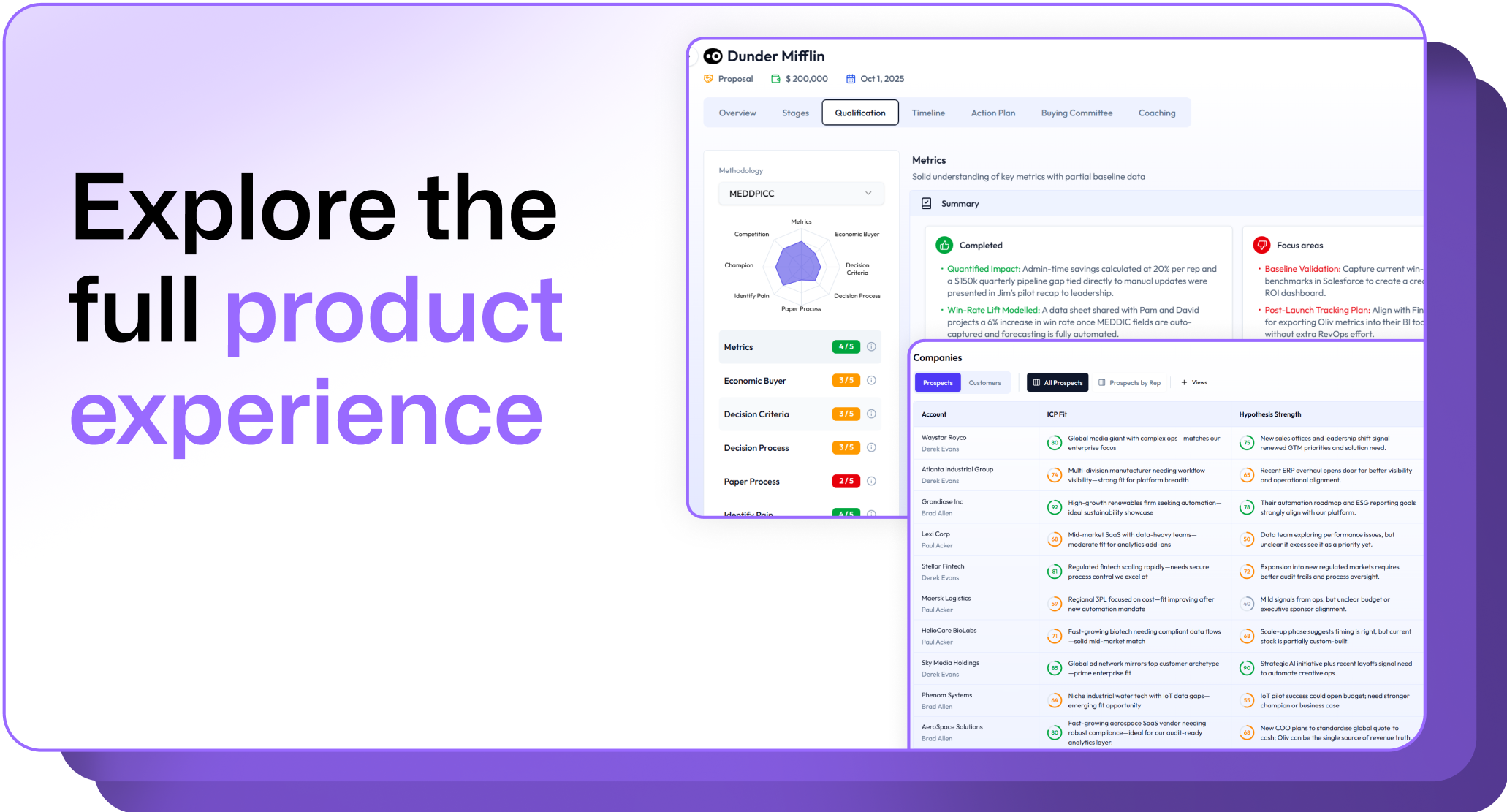
.avif)
.png)






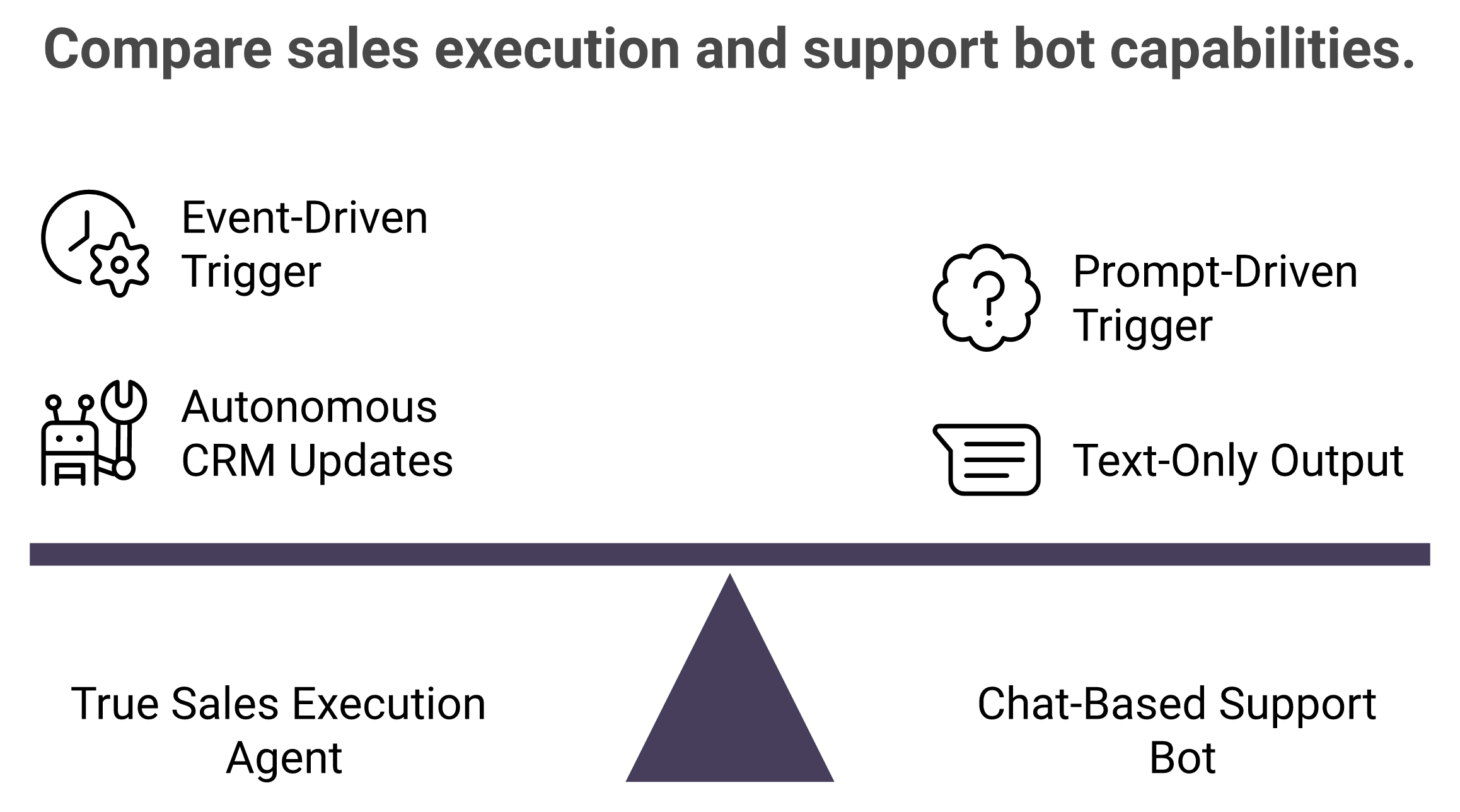
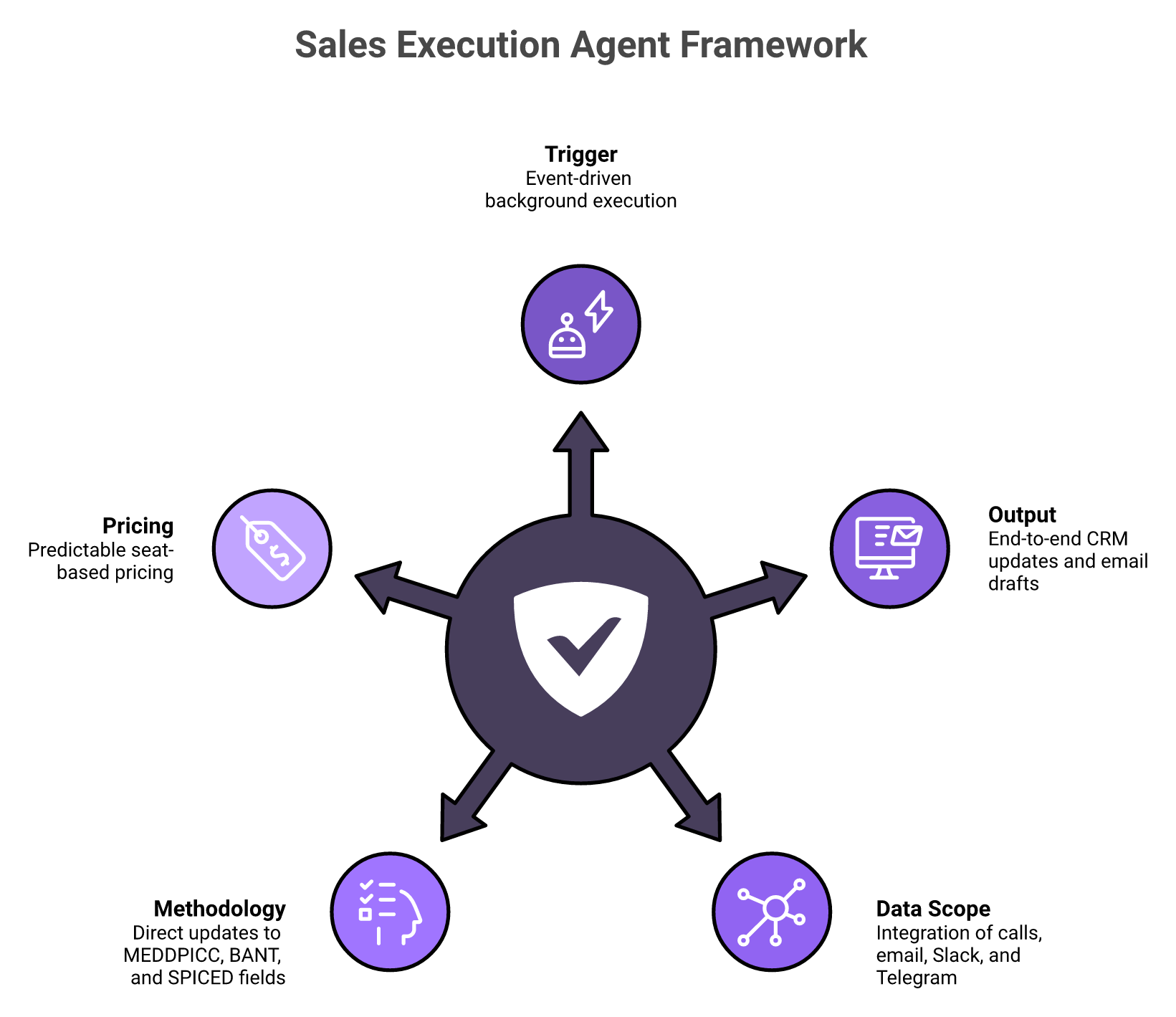
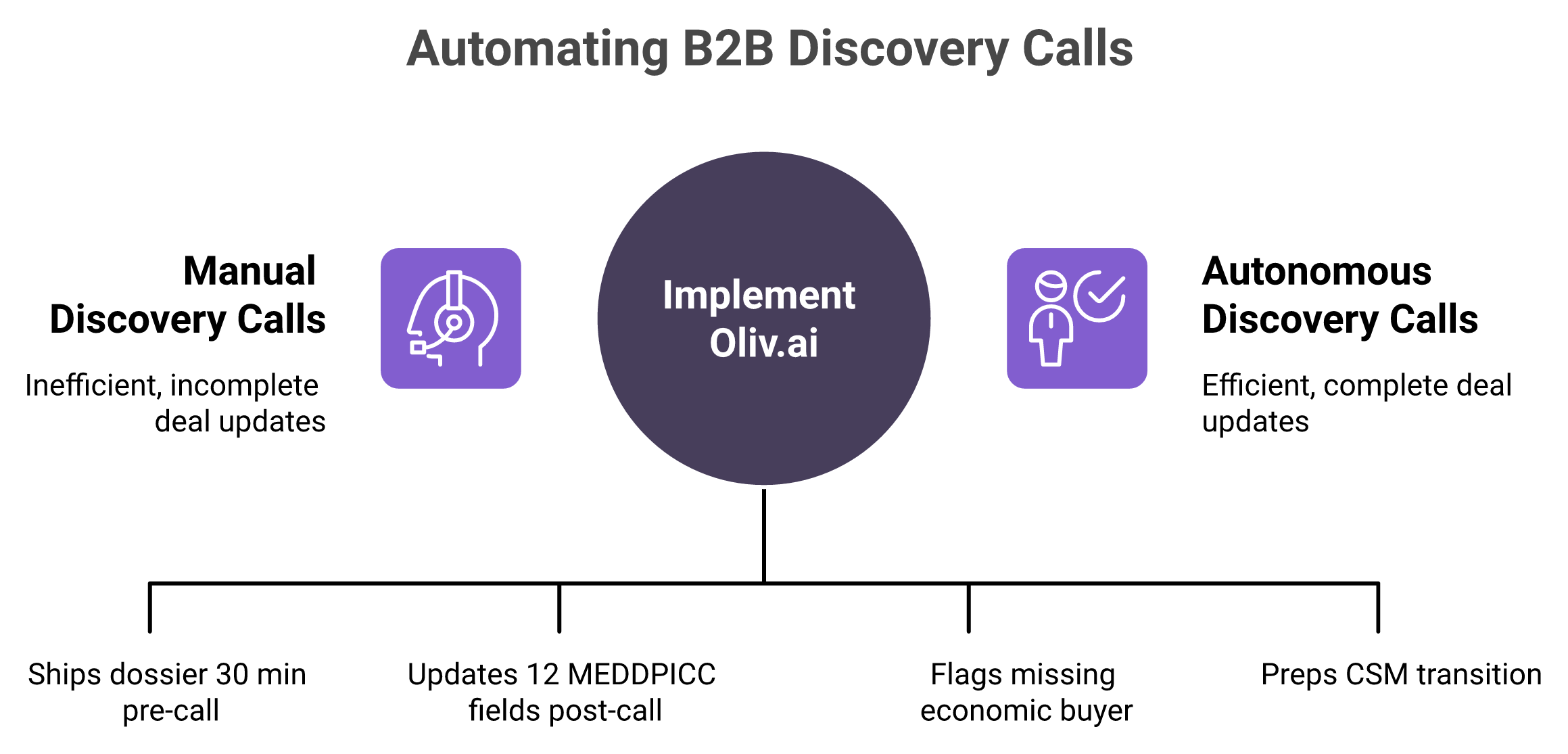
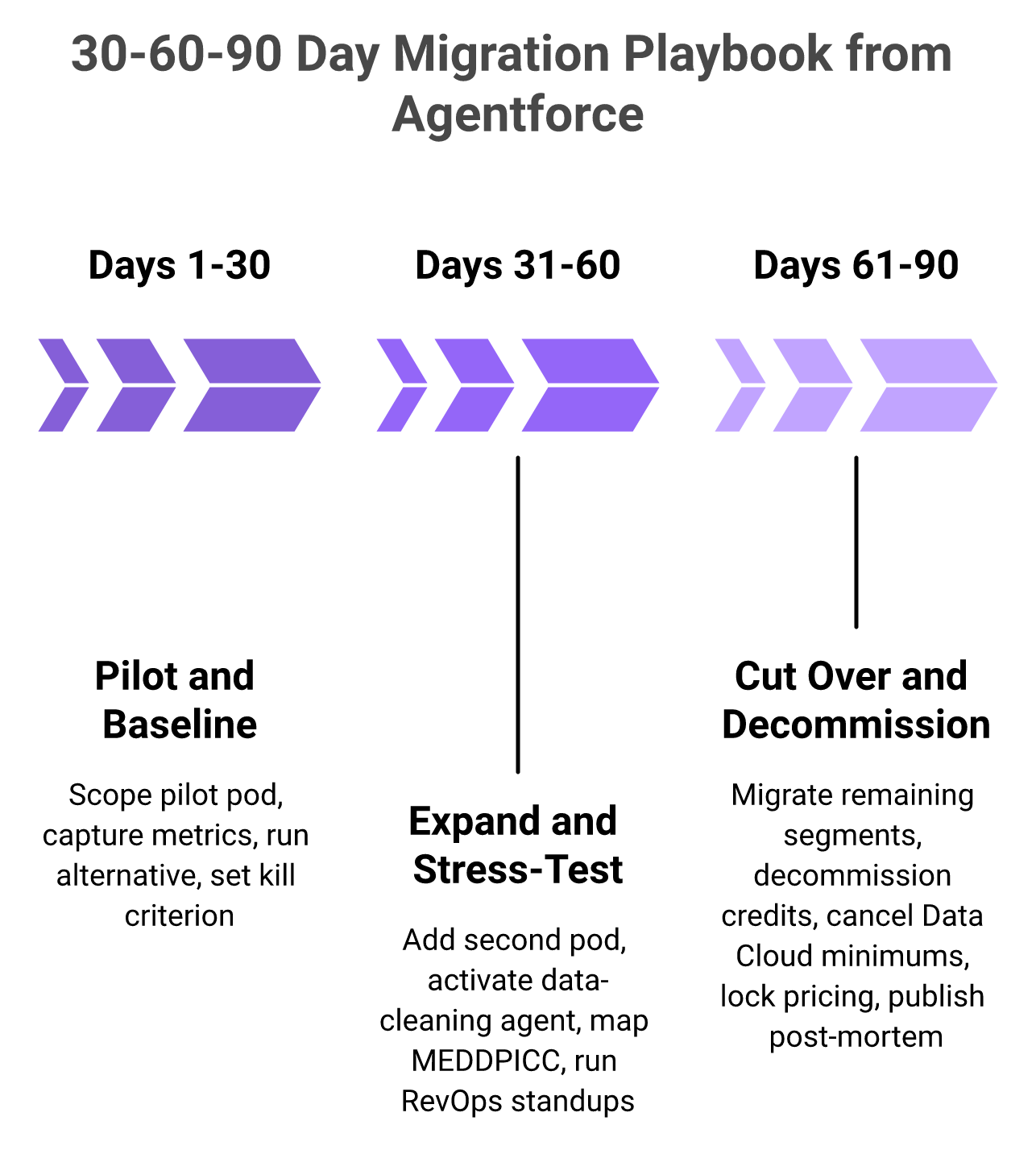

.png)
.png)
.png)

