Salesforce Einstein for Sales: What Works, What Fails, Better Options
Written by
Ishan Chhabra
Last Updated :
July 21, 2026
Skim in :
13
mins
In this article
Still got questions?
Come discuss this article with me.
Hi, I'm Ishan, Founder and CEO of Oliv.
I'm always up for a conversation about revenue intelligence, AI agents, or what's actually working (and what's not) across revenue teams.
I'd love to hear your perspective.
Thank you! Your submission has been received!
Oops! Something went wrong while submitting the form.
Meet Oliv’s AI Agents
Hi! I’m, Deal Driver
I track deals, flag risks, send weekly pipeline updates and give sales managers full visibility into deal progress
Hi! I’m, CRM Manager
I maintain CRM hygiene by updating core, custom and qualification fields all without your team lifting a finger
Hi! I’m, Forecaster
I build accurate forecasts based on real deal movement and tell you which deals to pull in to hit your number
Hi! I’m, Coach
I believe performance fuels revenue. I spot skill gaps, score calls and build coaching plans to help every rep level up
Hi! I’m, Prospector
I dig into target accounts to surface the right contacts, tailor and time outreach so you always strike when it counts
Hi! I’m, Pipeline tracker
I call reps to get deal updates, and deliver a real-time, CRM-synced roll-up view of deal progress
Hi! I’m, Analyst
I answer complex pipeline questions, uncover deal patterns, and build reports that guide strategic decisions
TL;DR
Salesforce Einstein for Sales is a first-generation, rule-based AI layer built on pre-LLM machine learning, later stitched to generative features through Agentforce.
Real cost commonly reaches about $500 per user monthly once add-ons, Data Cloud, and roughly $0.10-per-action credits stack up, with 300-400% quote-to-deployment escalation.
Einstein Activity Capture fails B2B teams through AWS data silos, rule-based misassociation of duplicate accounts, and over-redaction of non-sensitive emails.
Einstein is not Agentforce; Agentforce sits on top, still requires Einstein activation, Data Cloud, and specific editions, adding migration cost and complexity.
Reviews on G2, Gartner, and Reddit praise automation when data is clean but flag steep learning curves, complex setup, and cost-prohibitive add-ons.
AI-native platforms like Oliv.ai deploy in about 48 hours with autonomous agents, offering an alternative for messy-data, lean-RevOps B2B teams.
Q1. What is Salesforce Einstein for Sales and how does it actually work in 2026? [toc=1. What It Is]
Salesforce Einstein for Sales is a suite of AI features inside Sales Cloud that uses your CRM and activity data to draft sales emails, summarize calls, surface conversation insights, score leads and opportunities, and guide forecasting. It launched in 2018-2019 on pre-LLM machine learning, and later stitched on generative features through Agentforce. It needs Enterprise or Unlimited editions, plus the Einstein for Sales add-on, to unlock most of the value.
🧠 The plain-English version
Think of Einstein as a scoring and summarizing layer sitting on top of your existing Salesforce. It watches your CRM data. Then it predicts things, like which lead might convert or which deal might slip.
Here is the part most buyers miss. I audited the Salesforce Einstein features documentation directly, not the marketing pages, because the help articles tell you exactly what features Einstein actually has. What surfaces is that Einstein is built on older, first-generation machine learning. It is not a post-LLM system rebuilt from scratch.
🔤 Why the naming confuses everyone
Buyers get lost fast, and honestly, I do not blame them. There are three overlapping names doing different jobs.
Einstein: the original predictive layer (scoring, forecasting), rooted in 2018-era ML.
Einstein GPT or generative features: bolted-on language capabilities added after ChatGPT arrived.
Agentforce: the newer agent layer, reached through a "Continue with Agentforce" button inside Einstein.
So when a rep says "we use Einstein," they might mean any of these three. That ambiguity matters when you scope a purchase.
⚙️ The core features, with a concrete example each
Here is what Einstein for Sales actually does on a normal Tuesday.
Einstein Lead Scoring: reads engagement signals, like email opens and content downloads, then assigns a conversion probability.
Einstein Opportunity Scoring: rates open deals using stage velocity and stakeholder engagement.
Einstein Forecasting: analyzes pipeline trends and win rates to predict the quarter.
Einstein Activity Capture (EAC): auto-logs emails and calendar events from Outlook or Gmail into Salesforce.
Einstein Conversation Insights (ECI): lets you upload a recorded call (max 2GB MP4) to generate transcripts and flag pricing or objection topics.
Each feature is useful in isolation. The catch is that they run on rule-based logic. Rules are brittle. They break when your data gets messy, which in real B2B, it always does.
📉 Why "V1 ML, not post-LLM" is the whole story
This is the part I would underline for any buyer. Einstein predicts from patterns using older machine learning, not the contextual reasoning that modern language models bring.
The practical payoff is simple. Your Einstein outputs are only as good as your rules and your data hygiene. Feed it duplicate accounts or half-filled fields, and the scores drift. You inherit the cleanup work the AI was supposed to remove. Setup also runs 2-3 months before you see steady value, which is a long time to wait for a forecast number you can trust.
💡 How Oliv.ai approaches this differently
At Oliv, we took the opposite starting point. Instead of retrofitting AI onto pre-LLM software, we built generative-AI-native agents that do the work rather than hand you another dashboard to configure. There is no licensing-tier maze to decode before value shows up. Oliv deploys in about 48 hours, against Einstein's 2-3 month cycle, because the agents read context the way a colleague would, not the way a rule engine does. That is the shift from software you adopt to agents that work for you, and it sits at the heart of the modern revenue intelligence software platforms category.
Q2. How much does Salesforce Einstein for Sales cost, and what dependencies are hidden in the price? [toc=2. Pricing & Dependencies]
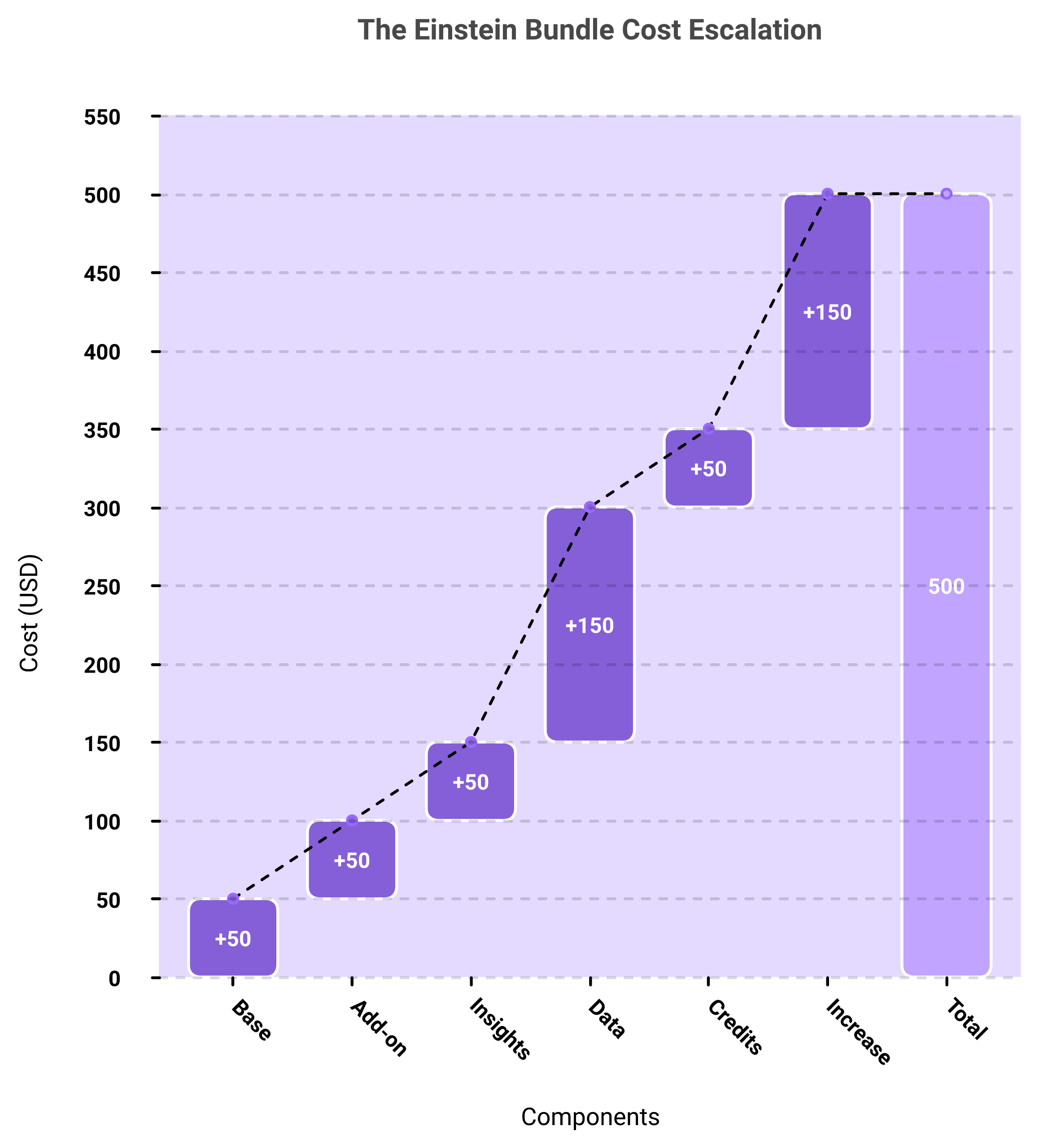
Einstein for Sales is an add-on to Enterprise, Performance, and Unlimited editions. Agentforce add-ons start around $125/user/month, and Agentforce 1 Editions run near $550/user/month, with list prices up roughly 6% since August 1, 2025. Generative features also require Data Cloud and the Einstein Trust Layer. Once you stack add-ons, credits (about $0.10 per action), and services, real cost often lands near $500/user/month.
💸 The trap: it looks cheap, then it isn't
Here is the pattern I have watched play out with procurement teams. The initial quote looks reasonable. Then the real bill arrives.
CFOs consistently report 300-400% cost escalation from the first Einstein quote to full deployment. You buy Sales Cloud Einstein. Then the Einstein add-on. Then Einstein Conversation Insights at about $50/user/month. Stack it up, and you are near $500 per user per month before services. Our full Salesforce Einstein pricing tiers breakdown walks through each line.
Einstein's advertised price hides a stack of add-ons and credits that push real cost toward $500 per user each month.
🧾 What the credit model really means
The newer Agentforce pricing runs on consumption, not just seats. It is a credit model, roughly $0.10 per action.
That sounds tiny. It is not, once thousands of agent actions fire monthly across a team. Per-action pricing makes your bill unpredictable, which is the opposite of what a RevOps lead wants when defending a budget line. Our Agentforce pricing breakdown covers the credit math in detail.
💰 The true total cost of ownership
Sticker price is only one row. The hidden rows are where the money goes.
Total Cost of Ownership: Einstein vs. AI-Native Platforms
Cost category
Traditional Einstein TCO
AI-native alternative
Base licensing
$350-$550/user/month
~$89/user/month
Professional services
$25,000-$100,000
Included
Ongoing maintenance
0.5-1 FTE annually
Autonomous operation
User training
15-20 hours per user
2-3 hours
Real reviewers flag the same thing about complexity driving cost.
"Based on usage experience, there are challenges with Einstein. Complexity, integration can be complex for users not familiar with AI concepts. Learning curve that impacts implementation speed." — GTM Strategy Director, Telecommunications Salesforce Einstein Gartner Verified Review
🔒 The dependencies nobody quotes upfront
This is the part that catches teams off guard. Einstein's generative features do not run alone.
Data Cloud must be provisioned for generative AI to work.
Einstein Trust Layer handles data-privacy controls and must be set up.
Editions must be Enterprise, Performance, or Unlimited before add-ons even apply.
Those dependencies matter beyond cost. Security is the top obstacle to AI adoption for many sales teams, especially across APAC and India. If SOC 2 and GDPR posture is on your checklist, the Trust Layer is a prerequisite, not a nice-to-have.
✅ What to demand in your quote before signing
I could be slightly off on exact list prices, since Salesforce adjusts them. But the questions hold. Ask for the all-in number, including Data Cloud, the add-ons, estimated monthly credits, and professional services. Get the maintenance FTE cost in writing too.
💡 How Oliv.ai prices differently
We built Oliv with transparent, per-seat pricing near $89/user/month all-in, with services included. There is no separate Data Cloud line, no per-action credit meter, and no 0.5-1 FTE admin quietly absorbed by your RevOps team. Because the agents operate autonomously, the maintenance row that inflates Einstein's TCO mostly disappears. For a 25-200 rep team, that is the difference between a predictable budget and a quarterly surprise, which is why many teams weigh Salesforce Einstein alternatives on total cost, not sticker price.
Q3. What works well in Einstein for Sales, and where does it fail B2B revenue teams? [toc=3. What Works / What Fails]
Einstein works when your CRM data is clean and your workflows are standardized. Lead scoring, basic forecasting, and email capture genuinely save time for Salesforce-mature teams. It fails B2B teams on messy real-world data. It cannot resolve duplicate accounts, forces rigid standardized workflows, behaves like a black box, and leaves complex multi-stakeholder deals underserved, because its 2018-era ML and B2C-focused roadmap were not built for consultative B2B selling.
✅ What genuinely works
Let me be fair here, because Einstein is not useless. For the right org, it earns its keep.
Clean-data lead scoring: if your fields are disciplined, the scores are directionally helpful.
Native capture: emails and events flow into Salesforce without a rep lifting a finger.
Baseline forecasting: better than a manual spreadsheet roll-up for standardized pipelines.
The common thread is maturity. If you have a Salesforce admin, tidy data, and one repeatable sales motion, Einstein rewards you. For teams that need more, an AI sales forecasting software comparison is worth running.
❌ Where it breaks for B2B
Real B2B is messy, and that is exactly where the cracks show. From what surfaces when you actually run this inside a live Salesforce org, four failures repeat.
Data-quality dependency: duplicate accounts and half-filled records quietly poison the scores.
Black-box outputs: reps get a number with little explanation, so they stop trusting it.
Workflow rigidity: traditional SaaS forces every company into one standardized workflow, but every company operates differently.
B2C-leaning roadmap: Salesforce's strategic energy sits in Data Cloud and B2C use cases, which leaves B2B sellers underserved.
That last point is the one the category avoids saying out loud. Most Agentforce examples you see skew B2C. The B2B rep, running a 90-day committee deal, is not the star of that roadmap.
🗣️ What real users report
The reviews line up with the pattern. Here is a balanced read, praise and pain together.
"The insights generated from AI are brilliant and save a lot of time when they work correctly. However, Einstein Activity Capture is a big problem. It fails to associate activities with the right opportunities and redacts activities unnecessarily." — Sales Operations Manager, Fortune 500 Company Salesforce Einstein G2 Verified Review
"Based on usage experience, there are challenges with Einstein. Complexity, integration can be complex for users not familiar with AI concepts. Learning curve that impacts implementation speed." — GTM Strategy Director, Telecommunications Salesforce Einstein Gartner Verified Review
🧭 A simple choose-this rubric
I might be wrong for edge cases, but this holds for most teams I advise.
Choose Einstein if: you are deeply invested in Salesforce, run clean data, have one standardized motion, and can staff a 2-3 month rollout.
Choose AI-native if: your data is messy, your deals are multi-stakeholder, and you need value in days, not quarters.
💡 Where Oliv.ai fits
For the messy, multi-stakeholder reality that trips Einstein up, we designed Oliv's CRM Manager agent to read full conversation context, not brittle rules. It correctly associates activities even when duplicate accounts exist, which is precisely the scenario where Einstein's rule logic gives up. We also skipped the standardized-workflow trap. Oliv adapts to how your team actually sells, rather than forcing your motion into one rigid template. That flexibility is the quiet difference for B2B teams that do not fit the B2C mold, and it is a recurring theme across the best AI sales tools.
Q4. Why do Einstein Activity Capture deployments fail in B2B environments? [toc=4. Activity Capture Failures]
Einstein Activity Capture fails B2B teams for three architectural reasons. It stores captured emails in a separate AWS instance you cannot report on. It uses brittle rule-based logic that misassociates activities when duplicate accounts exist. And it over-redacts emails as "sensitive" when they are not. Teams then spend 2-3 hours per rep weekly cleaning up what automation was supposed to eliminate, and metrics fail past roughly 1.5 million records.
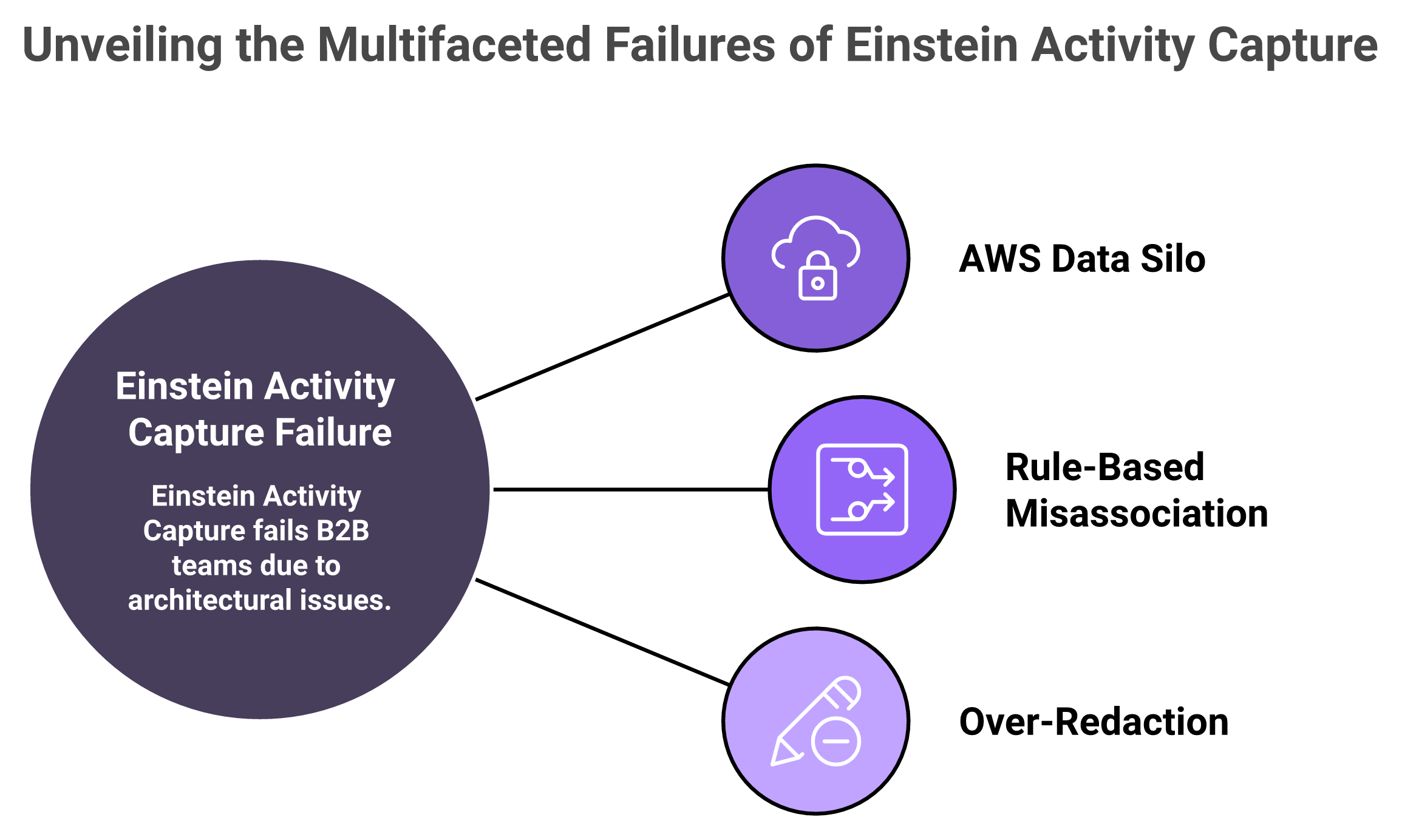
Einstein Activity Capture fails B2B teams on three fronts, all rooted in brittle rule-based architecture.
⏰ The promise: never log activity again
Every RevOps lead I know bought EAC for one reason. Reps hate logging activity, so let the system do it.
The pitch is clean. Emails and calendar events flow automatically from Outlook and Gmail into Salesforce. In a tidy world, that saves hours. In real B2B, the tidy world does not exist.
❌ The complication: a true duplicate-account story
Here is a scene I have watched repeat across mid-market orgs. One salesperson creates an account in 2021. Later, a new rep joins, misses the existing record, and creates a duplicate.
Now EAC has two accounts for one company. Its rule-based logic gets confused. It cannot reason about which record is right, so it guesses, and it guesses wrong. Activities land on the wrong opportunity. The rep stops trusting the timeline.
Two more failures stack on top.
AWS data silo: captured emails live in a separate AWS instance, not inside Salesforce, so you cannot use that data in downstream reporting or pipeline analysis.
Over-redaction: EAC flags an email as containing sensitive information and redacts it, even when it did not. Your customer history ends up full of holes.
⚠️ The proof from real users
This is not just my read. Reviewers describe the same architectural wall.
"Its biggest handicap is that it does not allow for data storage or data migration. You can't really input the data from Einstein into another platform. This is another huge issue because the sales department has a high employee turnover rate." — Product Manager, Education Sector Salesforce Einstein Gartner Verified Review
"The insights generated from AI are brilliant and save a lot of time when they work correctly. However, Einstein Activity Capture is a big problem. It fails to associate activities with the right opportunities and redacts activities unnecessarily." — Sales Operations Manager, Fortune 500 Company Salesforce Einstein G2 Verified Review
There is also a scale ceiling. Past roughly 1.5 million records, teams hit severe performance degradation, and Salesforce recommends archiving data as the fix. That forces a bad choice, between keeping your history and keeping your metrics working.
💸 The real weekly cost
Automation was supposed to remove admin. Instead it adds a new chore.
Teams report 2-3 hours per rep every week correcting misassociated activities and manually linking communications. RevOps then burns 15-20% of its capacity on EAC cleanup. That is capacity you wanted spent on pipeline strategy, not janitorial data work.
💡 The resolution with Oliv.ai
We built Oliv's CRM Manager agent to solve exactly this. Instead of brittle rules, it reads the full conversation, participant roles, and business context, so it associates activities correctly even when duplicate accounts exist. All captured data stays CRM-native, with full export, so your reporting is complete rather than siloed in AWS. Our Voice Agent even captures unrecorded interactions, like a quick mobile call, by ringing the rep to gather context that EAC never sees. That is the gap between rule-based logging and the best AI for sales calls that actually understands the deal, a distinction we unpack across our Salesforce Einstein reviews analysis.
Q5. Is Einstein the same as Agentforce, and what does the migration actually cost? [toc=5. Einstein vs Agentforce]
No. Einstein is Salesforce's predictive and generative AI layer, while Agentforce is the newer agentic layer that sits on top. Agentforce still requires Einstein activation, Data Cloud, and specific editions. The former Sales Cloud product is now branded Agentforce Sales. Migrating is not one click. It adds roughly $125-$550/user/month, plus 3-4 month deployment cycles that reproduce Einstein's old complexity and dependency chains.
🔀 What actually changed, and why buyers are confused
Salesforce rebranded and relayered, fast. Einstein stayed as the prediction engine. Agentforce arrived as the "agents" layer on top.
The confusion is fair. Buyers hear "Agentforce" and assume a fresh, standalone product. In reality, it leans on the same Einstein plumbing underneath, so you are not replacing Einstein, you are stacking on top of it. Our team breaks this down further in our Salesforce Agentforce reviews analysis.
🧱 The dependency stack nobody flags early
This is where the "single click" dream dies. Agentforce does not run on its own.
Einstein activation must be switched on first.
Data Cloud subscriptions are required for the AI to function.
Specific Salesforce editions are prerequisites before anything applies.
A real reviewer captured the frustration better than I can.
"You need to activate Einstein and other stuff if you want to use Agentforce. But why don't you enable dependency if I directly wanna start Agentforce in a single click?" — Shivam A., Product Researcher Salesforce Agentforce G2 Verified Review
💸 The migration bill and timeline
The dependencies cascade into cost. Agentforce adds $125-$500/user/month on top of existing licensing. For a full model, see our Agentforce pricing breakdown.
There is also forced motion. Agentforce Default reached end-of-sale, pushing existing customers toward the Agentforce Employee Agent, with new permissions and Slack integration work. That migration means configuration updates, permission restructuring, and testing cycles.
Platform Evolution Cost: Legacy vs. AI-Native
Evolution component
Legacy platform cost
AI-native advantage
Migration to Agentforce
$45,000-$125,000 in services
Continuous updates included
User retraining
~20 hours per rep
Autonomous, no retraining
Data migration
6-12 month cycles
Native, seamless expansion
Despite the "simplified AI" marketing, teams report Agentforce still needs 3-4 month implementations with dedicated project teams. And it keeps Einstein's external AWS data storage, so the reporting silos persist. Our Agentforce implementation guide details the realistic timeline.
🧭 The real read: this is architectural debt
Here is the point the category avoids saying. A migration this heavy is not a feature. It is evidence of pre-AI architecture straining to look modern.
I would also gently flag something. Most Agentforce demos skew B2C and customer-service use cases. If you are a B2B seller, ask hard whether the agents were built for your motion or for a support queue, a gap we cover across the best Agentforce alternatives.
💡 How Oliv.ai avoids the migration tax
We built Oliv so this whole migration cycle never happens to you. New capabilities ship through weekly agent updates, inside your existing subscription, with no add-on purchases, no permission restructuring, and no retraining project. Recent agents, like a MAP Manager for mutual action plans and a Business Case Builder for ROI, simply appeared for customers, no services engagement required. That is the practical difference between agents that evolve with you and a platform you keep paying to migrate. Continuous evolution beats a $100,000 upgrade path.
Q6. How long does Einstein take to implement, and why do most teams adopt but never scale it? [toc=6. Implementation & Adoption]
Einstein typically needs a 2-3 month rollout, covering a data audit, configuration, rule maintenance, and 15-20 hours of training per user. Even then, most teams stall. Industry benchmarks show about 88% of sales teams use AI, but only around 5% scale it, while 83% of AI-using teams grew revenue versus 66% without. The difference is not the license. It is clean data, one adoption KPI, and sequencing your rollout use case by use case.
📉 The adoption-vs-value gap is the real story
Buying AI is easy. Scaling it is where teams quietly break.
The numbers are stark. Roughly 88% of sales teams touch AI, yet only about 5% scale it across the org. Meanwhile, only about 35% of teams completely trust their own CRM data, which is the exact fuel Einstein needs, a problem the best revenue intelligence platforms are designed to solve.
That last stat explains most stalls. Einstein's predictions ride on data you may not trust, so reps quietly stop believing the scores.
⏰ Where the time actually goes
A 2-3 month rollout is not one long install. It is many small drags stacked together.
Data audit and cleanup: 67% of failed deployments trace back to poor data prep.
Configuration and rules: someone has to build and maintain brittle logic.
Training: 15-20 hours per user, before value shows.
Ongoing admin: rule updates and duplicate cleanup eat RevOps time weekly.
Enterprise deployments also report average overruns near 32%, driven by data-quality surprises not disclosed in the sales cycle.
✅ The Monday-morning sequencing plan
Here is what I would actually do, and I have watched this work. Do not boil the ocean. Sequence it.
Start with Activity Capture. Get logging right before anything fancy.
Then tackle Conversation Intelligence. Layer insight on top of clean activity.
Define one KPI per rep. Pick a single metric, like logged activities or emails sent, and hold it.
Roll out use case by use case. Prove one, then expand.
The honest reframe is this. Real technical deployment can take fifteen minutes, but that feels too small to trust, so teams inflate it into a multi-month project. The complexity is mostly self-inflicted through scope.
🧠 Why sequencing beats a big-bang rollout
Big-bang launches ask reps to change everything at once. They rebel, quietly.
Use-case sequencing gives you a win in week one, not month three. That early win is what turns a pilot into an org-wide habit, a pattern we see across the best AI sales tools.
💡 How Oliv.ai closes the adoption gap
We designed Oliv to skip the stall entirely. Deployment runs in about 48 hours, not 2-3 months, because there are no brittle rules to configure and no data-cleaning prerequisite you must finish first. Our agents clean and associate data autonomously, so reps do not need 15-20 hours of training to get value. In practice, customers reach roughly 90% adoption within 30 days, because the agents do the work rather than asking reps to learn a new dashboard. When the tool works on day one, scaling stops being a fight.
Q7. What do real users say about Einstein in 2026 across G2, Gartner, Reddit, and YouTube? [toc=7. Real User Reviews]
Across G2, Gartner Peer Insights, Reddit, and YouTube, 2026 sentiment is consistent. Reviewers praise Einstein's automation and native Salesforce integration when data is clean. They repeatedly flag steep learning curves, complex setup, cost-prohibitive add-ons, and Activity Capture reliability. The recurring verdict is simple. Value is real, but it is conditional on Salesforce maturity and heavy configuration.
🔍 How I read these reviews
I do not trust vendor marketing pages for this. I go to the help docs and the community forums, because that is where the unfiltered truth sits.
What surfaces across platforms is a split personality. When Einstein works, reviewers love it. When data gets messy, the same reviewers get burned, a tension we track in our Salesforce Einstein reviews.
✅ What reviewers praise
The positives cluster around time saved and native fit. When the data cooperates, the insights land.
"The insights generated from AI are brilliant and save a lot of time when they work correctly." — Sales Operations Manager, Fortune 500 Company Salesforce Einstein G2 Verified Review
That "when they work correctly" clause is the whole ballgame. It is praise with a condition attached.
❌ What reviewers criticize
The complaints are remarkably consistent across sources. Two themes dominate, setup complexity and data portability.
"Based on usage experience, there are challenges with Einstein. Complexity, integration can be complex for users not familiar with AI concepts. Learning curve that impacts implementation speed." — GTM Strategy Director, Telecommunications Salesforce Einstein Gartner Verified Review
"Its biggest handicap is that it does not allow for data storage or data migration. You can't really input the data from Einstein into another platform. This is another huge issue because the sales department has a high employee turnover rate." — Product Manager, Education Sector Salesforce Einstein Gartner Verified Review
🧾 What the pattern means for your evaluation
Put the two sides together and a rule emerges. Einstein rewards maturity and punishes mess.
If you have a dedicated admin, clean data, and one standard motion, the praise is likely yours.
If you have messy records, high rep turnover, and lean RevOps, the complaints are likely yours.
The turnover point is underrated. If reps churn and you cannot migrate their captured data cleanly, you lose history every time someone leaves.
💡 How Oliv.ai shows up in these comparisons
The contrast reviewers describe is exactly why some teams switch. One operator captured the migration outcome plainly.
"We replaced Einstein with Oliv.ai and saw immediate improvements: 40% better forecast accuracy, 30% faster deal velocity, and elimination of the weekly data cleanup tasks that consumed 3 hours per rep." — Revenue Operations Director, Enterprise SaaS Oliv AI G2 Verified Review
We built Oliv so value is not conditional on perfect data. The agents handle hygiene and keep data CRM-native with full export, so turnover does not erase your history. That is a core promise across the best revenue intelligence software platforms.
Q8. What are the best Einstein for Sales alternatives for B2B revenue teams? [toc=8. Best Alternatives]
The best Einstein alternative depends on your gap. Gong is strong for conversation intelligence. Clari for forecasting. HubSpot Breeze for SMB simplicity. Microsoft Copilot for Dynamics shops. AI-native platforms like Oliv.ai fit when you want autonomous agents that do the work, not another tool to configure. If your pain is cost, data silos, and implementation drag, an agentic, CRM-native platform that deploys in days beats bolting more point solutions onto Salesforce.
🎂 The three-layer cake framing
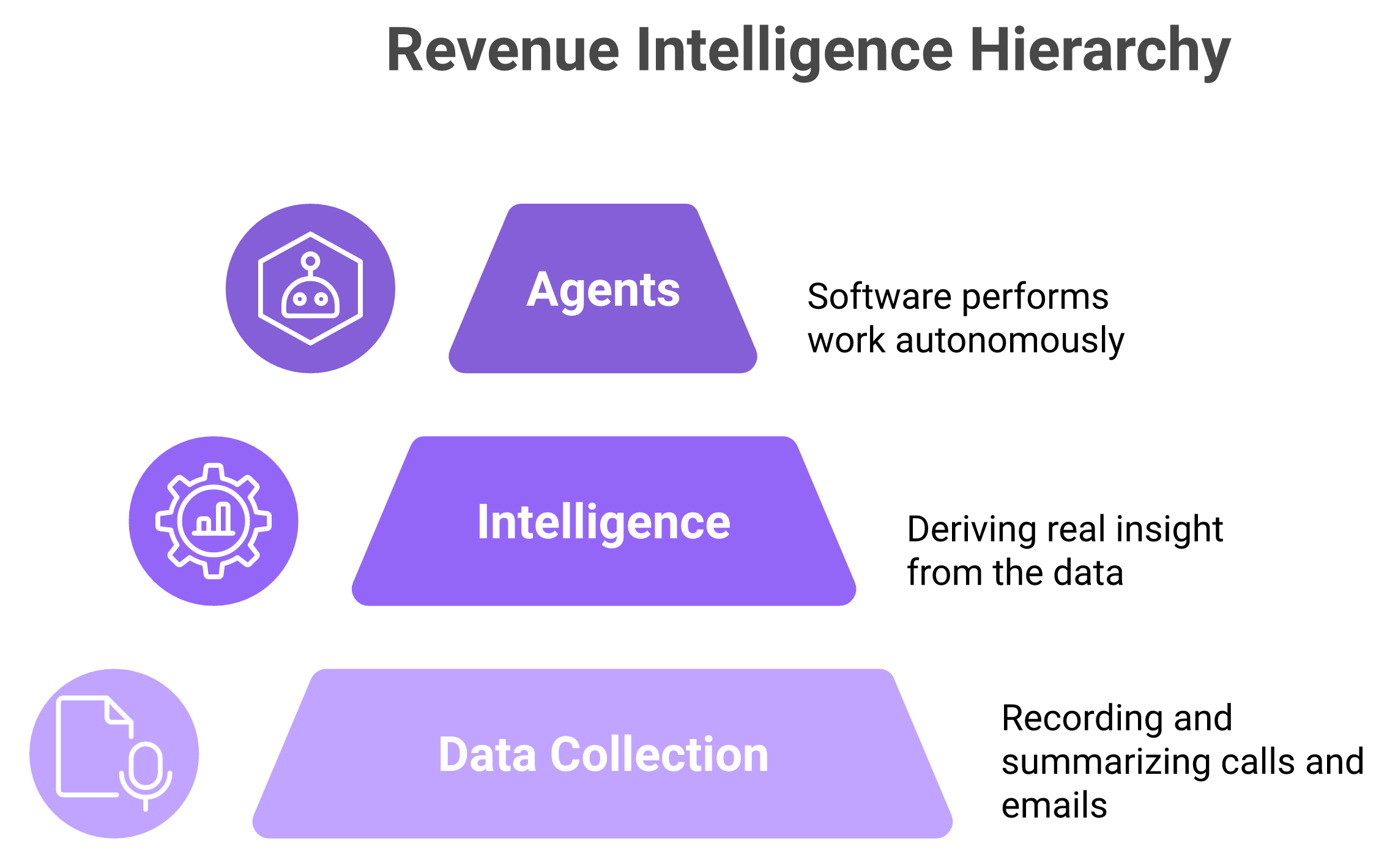
Before you shop, understand what layer your gap sits in. I use a simple three-layer model.
Layer 1, data collection: recording and summarizing calls and emails.
Layer 2, intelligence: deriving real insight from that data.
Layer 3, agents: the activation layer, where software actually does the work.
The three-layer cake: most tools stop at data and intelligence, while agents at the top actually do the work.
Most tools stop at Layer 1 or 2. They hand you dashboards, then hand the work back to you.
🥤 Vending machine versus smart employee
Here is the distinction the category blurs. A traditional automation is a vending machine. Fixed input, fixed output.
An AI agent is closer to a smart employee. It picks a goal, adapts, and goes after it. That is the line between automation and agentic, and it should shape your shortlist of Salesforce Einstein alternatives.
🧩 Why teams outgrow Einstein
Teams rarely leave Einstein over one flaw. They leave over the stack-up.
Cost creeps past $500/user/month. Data sits siloed in AWS. Setup drags for months. At that point, adding another point solution just widens the sprawl, which is why many teams move toward a single revenue orchestration platform.
📊 A scenario-based comparison
Match the tool to the gap, not to the hype.
Einstein Alternatives Compared for B2B Teams
Platform
Best for
Agentic?
Deploy time
Pricing model
Salesforce Einstein
Salesforce-mature enterprises
No, rule-based
2-3 months
Add-ons plus credits
Gong
Conversation intelligence
Partial
Weeks
Per seat
Clari
Forecasting rigor
No
Weeks
Per seat
HubSpot Breeze
SMB simplicity
Partial
Days to weeks
Bundled
Microsoft Copilot
Dynamics 365 shops
Partial
Weeks
Per seat
Oliv.ai
AI-native, agent-first B2B
Yes, autonomous
~48 hours
~$89/user/month
Reviewers keep pointing at the same Einstein friction that pushes this search.
"You need to activate Einstein and other stuff if you want to use Agentforce. But why don't you enable dependency if I directly wanna start Agentforce in a single click?" — Shivam A., Product Researcher Salesforce Agentforce G2 Verified Review
✅ Pick-this-if scenarios
Keep it simple when you decide.
Pick Gong or Clari if you need one deep capability and already tolerate Salesforce sprawl.
Pick HubSpot Breeze if you are SMB and want it bundled.
Pick Oliv.ai if you want agents that clean data, prep calls, and forecast autonomously, without stacking four tools.
💡 Where Oliv.ai lands
We built Oliv as the Layer 3 pick, the activation layer where agents do the work for you. Instead of buying Gong for calls, Clari for forecasts, and Salesforce for CRM, you get a 30-agent ecosystem in one platform, at roughly $89/user/month, deployed in about 48 hours, reaching near 90% adoption within 30 days. One operator switching from Einstein reported 40% better forecast accuracy and the end of weekly data cleanup. That is the shift from revenue orchestration to revenue engineering.
Q9. How does Einstein compare to AI-native Revenue Engineering platforms like Oliv.ai? [toc=9. Einstein vs AI-Native]
Einstein retrofits AI onto pre-LLM, rule-based software you must adopt, configure, and maintain. AI-native platforms like Oliv.ai are built on generative models, where autonomous agents perform the work for you. The practical difference shows up fast, in deployment (48 hours versus 3-4 months), adoption (90% in 30 days versus multi-month training), forecast accuracy (~85% versus 67-72%), and cost (~$89 versus ~$460/user/month). That is why AI-native beats bolt-on for lean B2B teams.
🧱 Pillar one: architecture
Start with how each one is built, because everything else follows from it. Einstein bolts AI onto software designed before large language models existed.
That legacy shows. Einstein leans on brittle rules that break when data gets messy. The AI-native question is different, and I think it is the right one. Instead of writing rules that break, what if we just gave the data to the AI? We explore this shift across the best revenue intelligence platforms.
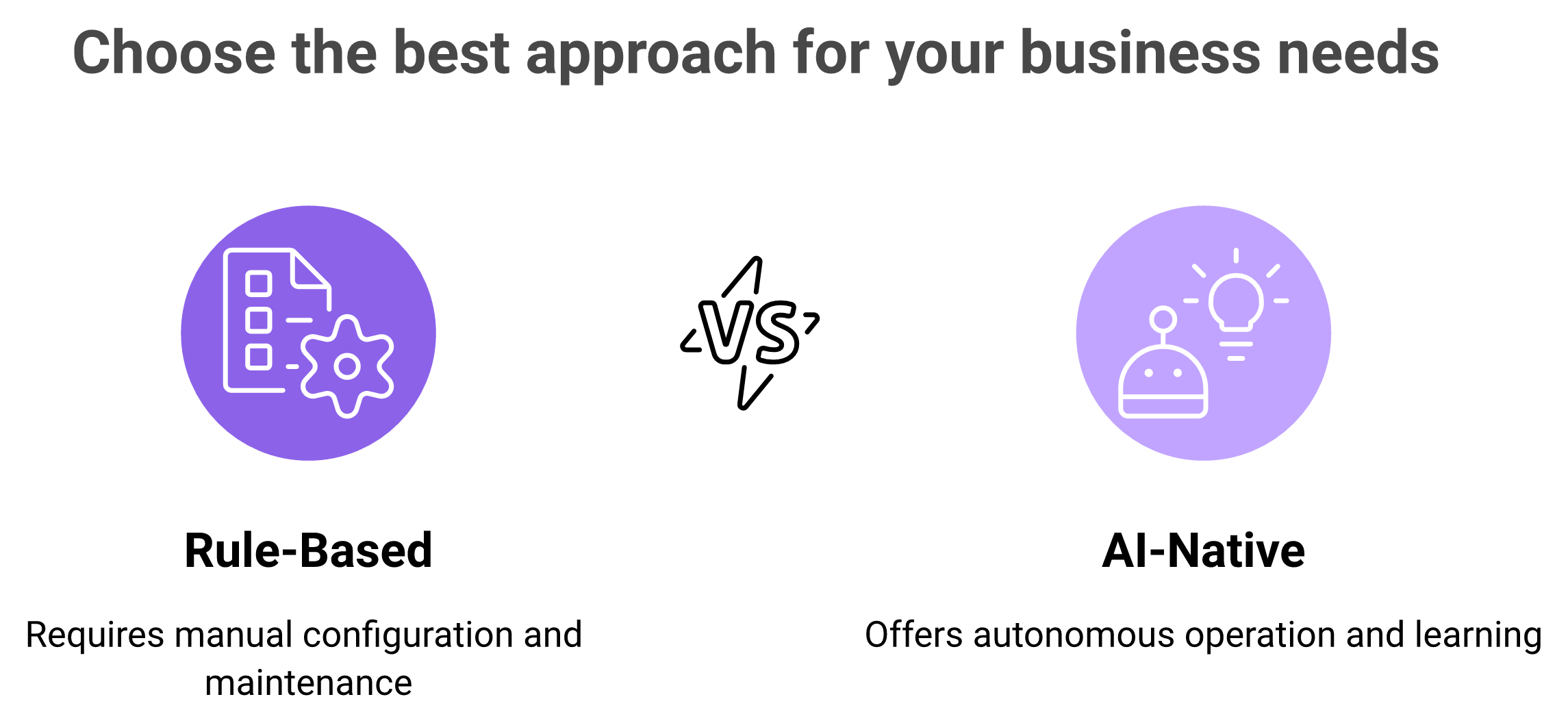
The core divide: Einstein's brittle rule-based V1 machine learning versus AI-native agents that do the work for you.
🤖 Pillar two: autonomy
Here is the daily-life gap most demos hide. Einstein largely waits for you to ask.
Einstein: you query a chat box, read the answer, then go execute the action yourself.
AI-native agents: they watch signals, decide, and act, without a prompt.
The chat-query pattern feels modern but adds friction. You are still the one doing the work, just with a smarter search bar. Agents flip that, and the software becomes the worker, which is the core promise of a modern revenue orchestration platform.
💰 Pillar three: economics
The numbers make the choice concrete. This is where a CFO leans in.
Einstein vs. AI-Native Platform Comparison
Dimension
Salesforce Einstein
AI-native (Oliv.ai)
Deployment
3-4 months
~48 hours
Adoption
Multi-month training
~90% in 30 days
Forecast accuracy
67-72% ceiling
~85%
Blended cost
~$460/user/month
~$89/user/month
Real reviewers describe both the friction and the switch outcome.
"Based on usage experience, there are challenges with Einstein. Complexity, integration can be complex for users not familiar with AI concepts. Learning curve that impacts implementation speed." — GTM Strategy Director, Telecommunications Salesforce Einstein Gartner Verified Review
"We replaced Einstein with Oliv.ai and saw immediate improvements: 40% better forecast accuracy, 30% faster deal velocity, and elimination of the weekly data cleanup tasks that consumed 3 hours per rep." — Revenue Operations Director, Enterprise SaaS Oliv AI G2 Verified Review
⚠️ The lock-in risk nobody prices
Here is the part I would push back on hard. The "just add more Salesforce" path quietly compounds cost and lock-in.
AI moves in roughly 18-month leaps now. Retrofitted platforms need migrations, retraining, and services to keep up. Native platforms absorb model improvements automatically. One path keeps billing you to modernize. The other modernizes on its own, a contrast we detail across the best Salesforce Einstein alternatives.
💡 Where Oliv.ai stands
We built Oliv as the Revenue Engineering pick, the layer where agents do the work rather than hand you a dashboard. Our 30-agent ecosystem covers the real jobs. The CRM Manager keeps data clean, the Forecaster runs unbiased weekly pipeline analysis at roughly 85% accuracy, Deal Intelligence preps you 30 minutes before a call, and the Voice Agent captures the calls that never got recorded. That is the shift I keep betting on. SaaS you log into becomes agents that work for you, and revenue orchestration gives way to revenue engineering.
Q10. Should you buy Einstein, migrate to Agentforce, or switch to an AI-native platform? [toc=10. The Verdict]
Buy Einstein if you are deeply invested in Salesforce, with clean data, standardized workflows, and admin capacity for a 2-3 month rollout. Consider Agentforce only if you accept its dependencies and credit-based costs. Switch to an AI-native platform if your reality is messy B2B data, lean RevOps, and pressure to show ROI fast. Agentic tools that deploy in days and do the work generally win on cost and speed.
🧭 Match the tool to who you actually are
There is no universal answer here, and anyone who gives you one is selling something. The right pick depends on your data, your team size, and your patience.
Einstein rewards Salesforce maturity. If you have the foundation, it pays off.
You run deep on Salesforce, and leaving is not on the table.
Your CRM data is genuinely clean.
You have one standardized sales motion.
You can staff a 2-3 month rollout and ongoing admin.
⚠️ Consider Agentforce only if
Agentforce makes sense in a narrow case. Go in clear-eyed about the strings attached.
You accept the Einstein, Data Cloud, and edition dependencies.
You are fine with credit-based, per-action pricing.
You have budget for another 3-4 month implementation.
Reviewers keep flagging that dependency friction, so weigh it honestly against the best Agentforce alternatives.
"You need to activate Einstein and other stuff if you want to use Agentforce. But why don't you enable dependency if I directly wanna start Agentforce in a single click?" — Shivam A., Product Researcher Salesforce Agentforce G2 Verified Review
✅ Switch to AI-native if
This is where most lean, growing B2B teams actually land. The signals are clear.
Your data is messy, and duplicates are a daily fact.
Your RevOps team is small and stretched.
Your CFO wants ROI in weeks, not quarters.
RevOps is the persona I watch most closely here. They are the ones searching, because they are the ones stuck integrating Gong or Salesforce by hand, a journey we map in our RevOps to intelligence to orchestration guide.
🗓️ Your Monday-morning action
Do not rip anything out this week. Just run one honest audit instead.
List your current tools, their all-in per-user cost, and the hours your reps lose to cleanup. If that number crosses $500/user/month for a 25-200 rep team, the stack, not the strategy, is the problem. Our best AI sales tools roundup helps you benchmark.
💡 Where Oliv.ai fits, and an open invitation
We built Oliv for the messy, lean, ROI-pressured reality most B2B teams live in, not the clean-data ideal Einstein needs. Where my head is right now is simple. The next two years turn software you log into, into agents that work for you. If you are a CRO or RevOps lead sitting with that shift, I would genuinely like to compare notes. Book a strategy session with me, Ishan, and we will analyze your current tools, map the agent use cases and TCO savings, and sketch a roadmap. No pitch, just a real look at your stack.
Q1. What is Salesforce Einstein for Sales and how does it actually work in 2026? [toc=1. What It Is]
Salesforce Einstein for Sales is a suite of AI features inside Sales Cloud that uses your CRM and activity data to draft sales emails, summarize calls, surface conversation insights, score leads and opportunities, and guide forecasting. It launched in 2018-2019 on pre-LLM machine learning, and later stitched on generative features through Agentforce. It needs Enterprise or Unlimited editions, plus the Einstein for Sales add-on, to unlock most of the value.
🧠 The plain-English version
Think of Einstein as a scoring and summarizing layer sitting on top of your existing Salesforce. It watches your CRM data. Then it predicts things, like which lead might convert or which deal might slip.
Here is the part most buyers miss. I audited the Salesforce Einstein features documentation directly, not the marketing pages, because the help articles tell you exactly what features Einstein actually has. What surfaces is that Einstein is built on older, first-generation machine learning. It is not a post-LLM system rebuilt from scratch.
🔤 Why the naming confuses everyone
Buyers get lost fast, and honestly, I do not blame them. There are three overlapping names doing different jobs.
Einstein: the original predictive layer (scoring, forecasting), rooted in 2018-era ML.
Einstein GPT or generative features: bolted-on language capabilities added after ChatGPT arrived.
Agentforce: the newer agent layer, reached through a "Continue with Agentforce" button inside Einstein.
So when a rep says "we use Einstein," they might mean any of these three. That ambiguity matters when you scope a purchase.
⚙️ The core features, with a concrete example each
Here is what Einstein for Sales actually does on a normal Tuesday.
Einstein Lead Scoring: reads engagement signals, like email opens and content downloads, then assigns a conversion probability.
Einstein Opportunity Scoring: rates open deals using stage velocity and stakeholder engagement.
Einstein Forecasting: analyzes pipeline trends and win rates to predict the quarter.
Einstein Activity Capture (EAC): auto-logs emails and calendar events from Outlook or Gmail into Salesforce.
Einstein Conversation Insights (ECI): lets you upload a recorded call (max 2GB MP4) to generate transcripts and flag pricing or objection topics.
Each feature is useful in isolation. The catch is that they run on rule-based logic. Rules are brittle. They break when your data gets messy, which in real B2B, it always does.
📉 Why "V1 ML, not post-LLM" is the whole story
This is the part I would underline for any buyer. Einstein predicts from patterns using older machine learning, not the contextual reasoning that modern language models bring.
The practical payoff is simple. Your Einstein outputs are only as good as your rules and your data hygiene. Feed it duplicate accounts or half-filled fields, and the scores drift. You inherit the cleanup work the AI was supposed to remove. Setup also runs 2-3 months before you see steady value, which is a long time to wait for a forecast number you can trust.
💡 How Oliv.ai approaches this differently
At Oliv, we took the opposite starting point. Instead of retrofitting AI onto pre-LLM software, we built generative-AI-native agents that do the work rather than hand you another dashboard to configure. There is no licensing-tier maze to decode before value shows up. Oliv deploys in about 48 hours, against Einstein's 2-3 month cycle, because the agents read context the way a colleague would, not the way a rule engine does. That is the shift from software you adopt to agents that work for you, and it sits at the heart of the modern revenue intelligence software platforms category.
Q2. How much does Salesforce Einstein for Sales cost, and what dependencies are hidden in the price? [toc=2. Pricing & Dependencies]
Einstein for Sales is an add-on to Enterprise, Performance, and Unlimited editions. Agentforce add-ons start around $125/user/month, and Agentforce 1 Editions run near $550/user/month, with list prices up roughly 6% since August 1, 2025. Generative features also require Data Cloud and the Einstein Trust Layer. Once you stack add-ons, credits (about $0.10 per action), and services, real cost often lands near $500/user/month.
💸 The trap: it looks cheap, then it isn't
Here is the pattern I have watched play out with procurement teams. The initial quote looks reasonable. Then the real bill arrives.
CFOs consistently report 300-400% cost escalation from the first Einstein quote to full deployment. You buy Sales Cloud Einstein. Then the Einstein add-on. Then Einstein Conversation Insights at about $50/user/month. Stack it up, and you are near $500 per user per month before services. Our full Salesforce Einstein pricing tiers breakdown walks through each line.
Einstein's advertised price hides a stack of add-ons and credits that push real cost toward $500 per user each month.
🧾 What the credit model really means
The newer Agentforce pricing runs on consumption, not just seats. It is a credit model, roughly $0.10 per action.
That sounds tiny. It is not, once thousands of agent actions fire monthly across a team. Per-action pricing makes your bill unpredictable, which is the opposite of what a RevOps lead wants when defending a budget line. Our Agentforce pricing breakdown covers the credit math in detail.
💰 The true total cost of ownership
Sticker price is only one row. The hidden rows are where the money goes.
Total Cost of Ownership: Einstein vs. AI-Native Platforms
Cost category
Traditional Einstein TCO
AI-native alternative
Base licensing
$350-$550/user/month
~$89/user/month
Professional services
$25,000-$100,000
Included
Ongoing maintenance
0.5-1 FTE annually
Autonomous operation
User training
15-20 hours per user
2-3 hours
Real reviewers flag the same thing about complexity driving cost.
"Based on usage experience, there are challenges with Einstein. Complexity, integration can be complex for users not familiar with AI concepts. Learning curve that impacts implementation speed." — GTM Strategy Director, Telecommunications Salesforce Einstein Gartner Verified Review
🔒 The dependencies nobody quotes upfront
This is the part that catches teams off guard. Einstein's generative features do not run alone.
Data Cloud must be provisioned for generative AI to work.
Einstein Trust Layer handles data-privacy controls and must be set up.
Editions must be Enterprise, Performance, or Unlimited before add-ons even apply.
Those dependencies matter beyond cost. Security is the top obstacle to AI adoption for many sales teams, especially across APAC and India. If SOC 2 and GDPR posture is on your checklist, the Trust Layer is a prerequisite, not a nice-to-have.
✅ What to demand in your quote before signing
I could be slightly off on exact list prices, since Salesforce adjusts them. But the questions hold. Ask for the all-in number, including Data Cloud, the add-ons, estimated monthly credits, and professional services. Get the maintenance FTE cost in writing too.
💡 How Oliv.ai prices differently
We built Oliv with transparent, per-seat pricing near $89/user/month all-in, with services included. There is no separate Data Cloud line, no per-action credit meter, and no 0.5-1 FTE admin quietly absorbed by your RevOps team. Because the agents operate autonomously, the maintenance row that inflates Einstein's TCO mostly disappears. For a 25-200 rep team, that is the difference between a predictable budget and a quarterly surprise, which is why many teams weigh Salesforce Einstein alternatives on total cost, not sticker price.
Q3. What works well in Einstein for Sales, and where does it fail B2B revenue teams? [toc=3. What Works / What Fails]
Einstein works when your CRM data is clean and your workflows are standardized. Lead scoring, basic forecasting, and email capture genuinely save time for Salesforce-mature teams. It fails B2B teams on messy real-world data. It cannot resolve duplicate accounts, forces rigid standardized workflows, behaves like a black box, and leaves complex multi-stakeholder deals underserved, because its 2018-era ML and B2C-focused roadmap were not built for consultative B2B selling.
✅ What genuinely works
Let me be fair here, because Einstein is not useless. For the right org, it earns its keep.
Clean-data lead scoring: if your fields are disciplined, the scores are directionally helpful.
Native capture: emails and events flow into Salesforce without a rep lifting a finger.
Baseline forecasting: better than a manual spreadsheet roll-up for standardized pipelines.
The common thread is maturity. If you have a Salesforce admin, tidy data, and one repeatable sales motion, Einstein rewards you. For teams that need more, an AI sales forecasting software comparison is worth running.
❌ Where it breaks for B2B
Real B2B is messy, and that is exactly where the cracks show. From what surfaces when you actually run this inside a live Salesforce org, four failures repeat.
Data-quality dependency: duplicate accounts and half-filled records quietly poison the scores.
Black-box outputs: reps get a number with little explanation, so they stop trusting it.
Workflow rigidity: traditional SaaS forces every company into one standardized workflow, but every company operates differently.
B2C-leaning roadmap: Salesforce's strategic energy sits in Data Cloud and B2C use cases, which leaves B2B sellers underserved.
That last point is the one the category avoids saying out loud. Most Agentforce examples you see skew B2C. The B2B rep, running a 90-day committee deal, is not the star of that roadmap.
🗣️ What real users report
The reviews line up with the pattern. Here is a balanced read, praise and pain together.
"The insights generated from AI are brilliant and save a lot of time when they work correctly. However, Einstein Activity Capture is a big problem. It fails to associate activities with the right opportunities and redacts activities unnecessarily." — Sales Operations Manager, Fortune 500 Company Salesforce Einstein G2 Verified Review
"Based on usage experience, there are challenges with Einstein. Complexity, integration can be complex for users not familiar with AI concepts. Learning curve that impacts implementation speed." — GTM Strategy Director, Telecommunications Salesforce Einstein Gartner Verified Review
🧭 A simple choose-this rubric
I might be wrong for edge cases, but this holds for most teams I advise.
Choose Einstein if: you are deeply invested in Salesforce, run clean data, have one standardized motion, and can staff a 2-3 month rollout.
Choose AI-native if: your data is messy, your deals are multi-stakeholder, and you need value in days, not quarters.
💡 Where Oliv.ai fits
For the messy, multi-stakeholder reality that trips Einstein up, we designed Oliv's CRM Manager agent to read full conversation context, not brittle rules. It correctly associates activities even when duplicate accounts exist, which is precisely the scenario where Einstein's rule logic gives up. We also skipped the standardized-workflow trap. Oliv adapts to how your team actually sells, rather than forcing your motion into one rigid template. That flexibility is the quiet difference for B2B teams that do not fit the B2C mold, and it is a recurring theme across the best AI sales tools.
Q4. Why do Einstein Activity Capture deployments fail in B2B environments? [toc=4. Activity Capture Failures]
Einstein Activity Capture fails B2B teams for three architectural reasons. It stores captured emails in a separate AWS instance you cannot report on. It uses brittle rule-based logic that misassociates activities when duplicate accounts exist. And it over-redacts emails as "sensitive" when they are not. Teams then spend 2-3 hours per rep weekly cleaning up what automation was supposed to eliminate, and metrics fail past roughly 1.5 million records.
Einstein Activity Capture fails B2B teams on three fronts, all rooted in brittle rule-based architecture.
⏰ The promise: never log activity again
Every RevOps lead I know bought EAC for one reason. Reps hate logging activity, so let the system do it.
The pitch is clean. Emails and calendar events flow automatically from Outlook and Gmail into Salesforce. In a tidy world, that saves hours. In real B2B, the tidy world does not exist.
❌ The complication: a true duplicate-account story
Here is a scene I have watched repeat across mid-market orgs. One salesperson creates an account in 2021. Later, a new rep joins, misses the existing record, and creates a duplicate.
Now EAC has two accounts for one company. Its rule-based logic gets confused. It cannot reason about which record is right, so it guesses, and it guesses wrong. Activities land on the wrong opportunity. The rep stops trusting the timeline.
Two more failures stack on top.
AWS data silo: captured emails live in a separate AWS instance, not inside Salesforce, so you cannot use that data in downstream reporting or pipeline analysis.
Over-redaction: EAC flags an email as containing sensitive information and redacts it, even when it did not. Your customer history ends up full of holes.
⚠️ The proof from real users
This is not just my read. Reviewers describe the same architectural wall.
"Its biggest handicap is that it does not allow for data storage or data migration. You can't really input the data from Einstein into another platform. This is another huge issue because the sales department has a high employee turnover rate." — Product Manager, Education Sector Salesforce Einstein Gartner Verified Review
"The insights generated from AI are brilliant and save a lot of time when they work correctly. However, Einstein Activity Capture is a big problem. It fails to associate activities with the right opportunities and redacts activities unnecessarily." — Sales Operations Manager, Fortune 500 Company Salesforce Einstein G2 Verified Review
There is also a scale ceiling. Past roughly 1.5 million records, teams hit severe performance degradation, and Salesforce recommends archiving data as the fix. That forces a bad choice, between keeping your history and keeping your metrics working.
💸 The real weekly cost
Automation was supposed to remove admin. Instead it adds a new chore.
Teams report 2-3 hours per rep every week correcting misassociated activities and manually linking communications. RevOps then burns 15-20% of its capacity on EAC cleanup. That is capacity you wanted spent on pipeline strategy, not janitorial data work.
💡 The resolution with Oliv.ai
We built Oliv's CRM Manager agent to solve exactly this. Instead of brittle rules, it reads the full conversation, participant roles, and business context, so it associates activities correctly even when duplicate accounts exist. All captured data stays CRM-native, with full export, so your reporting is complete rather than siloed in AWS. Our Voice Agent even captures unrecorded interactions, like a quick mobile call, by ringing the rep to gather context that EAC never sees. That is the gap between rule-based logging and the best AI for sales calls that actually understands the deal, a distinction we unpack across our Salesforce Einstein reviews analysis.
Q5. Is Einstein the same as Agentforce, and what does the migration actually cost? [toc=5. Einstein vs Agentforce]
No. Einstein is Salesforce's predictive and generative AI layer, while Agentforce is the newer agentic layer that sits on top. Agentforce still requires Einstein activation, Data Cloud, and specific editions. The former Sales Cloud product is now branded Agentforce Sales. Migrating is not one click. It adds roughly $125-$550/user/month, plus 3-4 month deployment cycles that reproduce Einstein's old complexity and dependency chains.
🔀 What actually changed, and why buyers are confused
Salesforce rebranded and relayered, fast. Einstein stayed as the prediction engine. Agentforce arrived as the "agents" layer on top.
The confusion is fair. Buyers hear "Agentforce" and assume a fresh, standalone product. In reality, it leans on the same Einstein plumbing underneath, so you are not replacing Einstein, you are stacking on top of it. Our team breaks this down further in our Salesforce Agentforce reviews analysis.
🧱 The dependency stack nobody flags early
This is where the "single click" dream dies. Agentforce does not run on its own.
Einstein activation must be switched on first.
Data Cloud subscriptions are required for the AI to function.
Specific Salesforce editions are prerequisites before anything applies.
A real reviewer captured the frustration better than I can.
"You need to activate Einstein and other stuff if you want to use Agentforce. But why don't you enable dependency if I directly wanna start Agentforce in a single click?" — Shivam A., Product Researcher Salesforce Agentforce G2 Verified Review
💸 The migration bill and timeline
The dependencies cascade into cost. Agentforce adds $125-$500/user/month on top of existing licensing. For a full model, see our Agentforce pricing breakdown.
There is also forced motion. Agentforce Default reached end-of-sale, pushing existing customers toward the Agentforce Employee Agent, with new permissions and Slack integration work. That migration means configuration updates, permission restructuring, and testing cycles.
Platform Evolution Cost: Legacy vs. AI-Native
Evolution component
Legacy platform cost
AI-native advantage
Migration to Agentforce
$45,000-$125,000 in services
Continuous updates included
User retraining
~20 hours per rep
Autonomous, no retraining
Data migration
6-12 month cycles
Native, seamless expansion
Despite the "simplified AI" marketing, teams report Agentforce still needs 3-4 month implementations with dedicated project teams. And it keeps Einstein's external AWS data storage, so the reporting silos persist. Our Agentforce implementation guide details the realistic timeline.
🧭 The real read: this is architectural debt
Here is the point the category avoids saying. A migration this heavy is not a feature. It is evidence of pre-AI architecture straining to look modern.
I would also gently flag something. Most Agentforce demos skew B2C and customer-service use cases. If you are a B2B seller, ask hard whether the agents were built for your motion or for a support queue, a gap we cover across the best Agentforce alternatives.
💡 How Oliv.ai avoids the migration tax
We built Oliv so this whole migration cycle never happens to you. New capabilities ship through weekly agent updates, inside your existing subscription, with no add-on purchases, no permission restructuring, and no retraining project. Recent agents, like a MAP Manager for mutual action plans and a Business Case Builder for ROI, simply appeared for customers, no services engagement required. That is the practical difference between agents that evolve with you and a platform you keep paying to migrate. Continuous evolution beats a $100,000 upgrade path.
Q6. How long does Einstein take to implement, and why do most teams adopt but never scale it? [toc=6. Implementation & Adoption]
Einstein typically needs a 2-3 month rollout, covering a data audit, configuration, rule maintenance, and 15-20 hours of training per user. Even then, most teams stall. Industry benchmarks show about 88% of sales teams use AI, but only around 5% scale it, while 83% of AI-using teams grew revenue versus 66% without. The difference is not the license. It is clean data, one adoption KPI, and sequencing your rollout use case by use case.
📉 The adoption-vs-value gap is the real story
Buying AI is easy. Scaling it is where teams quietly break.
The numbers are stark. Roughly 88% of sales teams touch AI, yet only about 5% scale it across the org. Meanwhile, only about 35% of teams completely trust their own CRM data, which is the exact fuel Einstein needs, a problem the best revenue intelligence platforms are designed to solve.
That last stat explains most stalls. Einstein's predictions ride on data you may not trust, so reps quietly stop believing the scores.
⏰ Where the time actually goes
A 2-3 month rollout is not one long install. It is many small drags stacked together.
Data audit and cleanup: 67% of failed deployments trace back to poor data prep.
Configuration and rules: someone has to build and maintain brittle logic.
Training: 15-20 hours per user, before value shows.
Ongoing admin: rule updates and duplicate cleanup eat RevOps time weekly.
Enterprise deployments also report average overruns near 32%, driven by data-quality surprises not disclosed in the sales cycle.
✅ The Monday-morning sequencing plan
Here is what I would actually do, and I have watched this work. Do not boil the ocean. Sequence it.
Start with Activity Capture. Get logging right before anything fancy.
Then tackle Conversation Intelligence. Layer insight on top of clean activity.
Define one KPI per rep. Pick a single metric, like logged activities or emails sent, and hold it.
Roll out use case by use case. Prove one, then expand.
The honest reframe is this. Real technical deployment can take fifteen minutes, but that feels too small to trust, so teams inflate it into a multi-month project. The complexity is mostly self-inflicted through scope.
🧠 Why sequencing beats a big-bang rollout
Big-bang launches ask reps to change everything at once. They rebel, quietly.
Use-case sequencing gives you a win in week one, not month three. That early win is what turns a pilot into an org-wide habit, a pattern we see across the best AI sales tools.
💡 How Oliv.ai closes the adoption gap
We designed Oliv to skip the stall entirely. Deployment runs in about 48 hours, not 2-3 months, because there are no brittle rules to configure and no data-cleaning prerequisite you must finish first. Our agents clean and associate data autonomously, so reps do not need 15-20 hours of training to get value. In practice, customers reach roughly 90% adoption within 30 days, because the agents do the work rather than asking reps to learn a new dashboard. When the tool works on day one, scaling stops being a fight.
Q7. What do real users say about Einstein in 2026 across G2, Gartner, Reddit, and YouTube? [toc=7. Real User Reviews]
Across G2, Gartner Peer Insights, Reddit, and YouTube, 2026 sentiment is consistent. Reviewers praise Einstein's automation and native Salesforce integration when data is clean. They repeatedly flag steep learning curves, complex setup, cost-prohibitive add-ons, and Activity Capture reliability. The recurring verdict is simple. Value is real, but it is conditional on Salesforce maturity and heavy configuration.
🔍 How I read these reviews
I do not trust vendor marketing pages for this. I go to the help docs and the community forums, because that is where the unfiltered truth sits.
What surfaces across platforms is a split personality. When Einstein works, reviewers love it. When data gets messy, the same reviewers get burned, a tension we track in our Salesforce Einstein reviews.
✅ What reviewers praise
The positives cluster around time saved and native fit. When the data cooperates, the insights land.
"The insights generated from AI are brilliant and save a lot of time when they work correctly." — Sales Operations Manager, Fortune 500 Company Salesforce Einstein G2 Verified Review
That "when they work correctly" clause is the whole ballgame. It is praise with a condition attached.
❌ What reviewers criticize
The complaints are remarkably consistent across sources. Two themes dominate, setup complexity and data portability.
"Based on usage experience, there are challenges with Einstein. Complexity, integration can be complex for users not familiar with AI concepts. Learning curve that impacts implementation speed." — GTM Strategy Director, Telecommunications Salesforce Einstein Gartner Verified Review
"Its biggest handicap is that it does not allow for data storage or data migration. You can't really input the data from Einstein into another platform. This is another huge issue because the sales department has a high employee turnover rate." — Product Manager, Education Sector Salesforce Einstein Gartner Verified Review
🧾 What the pattern means for your evaluation
Put the two sides together and a rule emerges. Einstein rewards maturity and punishes mess.
If you have a dedicated admin, clean data, and one standard motion, the praise is likely yours.
If you have messy records, high rep turnover, and lean RevOps, the complaints are likely yours.
The turnover point is underrated. If reps churn and you cannot migrate their captured data cleanly, you lose history every time someone leaves.
💡 How Oliv.ai shows up in these comparisons
The contrast reviewers describe is exactly why some teams switch. One operator captured the migration outcome plainly.
"We replaced Einstein with Oliv.ai and saw immediate improvements: 40% better forecast accuracy, 30% faster deal velocity, and elimination of the weekly data cleanup tasks that consumed 3 hours per rep." — Revenue Operations Director, Enterprise SaaS Oliv AI G2 Verified Review
We built Oliv so value is not conditional on perfect data. The agents handle hygiene and keep data CRM-native with full export, so turnover does not erase your history. That is a core promise across the best revenue intelligence software platforms.
Q8. What are the best Einstein for Sales alternatives for B2B revenue teams? [toc=8. Best Alternatives]
The best Einstein alternative depends on your gap. Gong is strong for conversation intelligence. Clari for forecasting. HubSpot Breeze for SMB simplicity. Microsoft Copilot for Dynamics shops. AI-native platforms like Oliv.ai fit when you want autonomous agents that do the work, not another tool to configure. If your pain is cost, data silos, and implementation drag, an agentic, CRM-native platform that deploys in days beats bolting more point solutions onto Salesforce.
🎂 The three-layer cake framing
Before you shop, understand what layer your gap sits in. I use a simple three-layer model.
Layer 1, data collection: recording and summarizing calls and emails.
Layer 2, intelligence: deriving real insight from that data.
Layer 3, agents: the activation layer, where software actually does the work.
The three-layer cake: most tools stop at data and intelligence, while agents at the top actually do the work.
Most tools stop at Layer 1 or 2. They hand you dashboards, then hand the work back to you.
🥤 Vending machine versus smart employee
Here is the distinction the category blurs. A traditional automation is a vending machine. Fixed input, fixed output.
An AI agent is closer to a smart employee. It picks a goal, adapts, and goes after it. That is the line between automation and agentic, and it should shape your shortlist of Salesforce Einstein alternatives.
🧩 Why teams outgrow Einstein
Teams rarely leave Einstein over one flaw. They leave over the stack-up.
Cost creeps past $500/user/month. Data sits siloed in AWS. Setup drags for months. At that point, adding another point solution just widens the sprawl, which is why many teams move toward a single revenue orchestration platform.
📊 A scenario-based comparison
Match the tool to the gap, not to the hype.
Einstein Alternatives Compared for B2B Teams
Platform
Best for
Agentic?
Deploy time
Pricing model
Salesforce Einstein
Salesforce-mature enterprises
No, rule-based
2-3 months
Add-ons plus credits
Gong
Conversation intelligence
Partial
Weeks
Per seat
Clari
Forecasting rigor
No
Weeks
Per seat
HubSpot Breeze
SMB simplicity
Partial
Days to weeks
Bundled
Microsoft Copilot
Dynamics 365 shops
Partial
Weeks
Per seat
Oliv.ai
AI-native, agent-first B2B
Yes, autonomous
~48 hours
~$89/user/month
Reviewers keep pointing at the same Einstein friction that pushes this search.
"You need to activate Einstein and other stuff if you want to use Agentforce. But why don't you enable dependency if I directly wanna start Agentforce in a single click?" — Shivam A., Product Researcher Salesforce Agentforce G2 Verified Review
✅ Pick-this-if scenarios
Keep it simple when you decide.
Pick Gong or Clari if you need one deep capability and already tolerate Salesforce sprawl.
Pick HubSpot Breeze if you are SMB and want it bundled.
Pick Oliv.ai if you want agents that clean data, prep calls, and forecast autonomously, without stacking four tools.
💡 Where Oliv.ai lands
We built Oliv as the Layer 3 pick, the activation layer where agents do the work for you. Instead of buying Gong for calls, Clari for forecasts, and Salesforce for CRM, you get a 30-agent ecosystem in one platform, at roughly $89/user/month, deployed in about 48 hours, reaching near 90% adoption within 30 days. One operator switching from Einstein reported 40% better forecast accuracy and the end of weekly data cleanup. That is the shift from revenue orchestration to revenue engineering.
Q9. How does Einstein compare to AI-native Revenue Engineering platforms like Oliv.ai? [toc=9. Einstein vs AI-Native]
Einstein retrofits AI onto pre-LLM, rule-based software you must adopt, configure, and maintain. AI-native platforms like Oliv.ai are built on generative models, where autonomous agents perform the work for you. The practical difference shows up fast, in deployment (48 hours versus 3-4 months), adoption (90% in 30 days versus multi-month training), forecast accuracy (~85% versus 67-72%), and cost (~$89 versus ~$460/user/month). That is why AI-native beats bolt-on for lean B2B teams.
🧱 Pillar one: architecture
Start with how each one is built, because everything else follows from it. Einstein bolts AI onto software designed before large language models existed.
That legacy shows. Einstein leans on brittle rules that break when data gets messy. The AI-native question is different, and I think it is the right one. Instead of writing rules that break, what if we just gave the data to the AI? We explore this shift across the best revenue intelligence platforms.
The core divide: Einstein's brittle rule-based V1 machine learning versus AI-native agents that do the work for you.
🤖 Pillar two: autonomy
Here is the daily-life gap most demos hide. Einstein largely waits for you to ask.
Einstein: you query a chat box, read the answer, then go execute the action yourself.
AI-native agents: they watch signals, decide, and act, without a prompt.
The chat-query pattern feels modern but adds friction. You are still the one doing the work, just with a smarter search bar. Agents flip that, and the software becomes the worker, which is the core promise of a modern revenue orchestration platform.
💰 Pillar three: economics
The numbers make the choice concrete. This is where a CFO leans in.
Einstein vs. AI-Native Platform Comparison
Dimension
Salesforce Einstein
AI-native (Oliv.ai)
Deployment
3-4 months
~48 hours
Adoption
Multi-month training
~90% in 30 days
Forecast accuracy
67-72% ceiling
~85%
Blended cost
~$460/user/month
~$89/user/month
Real reviewers describe both the friction and the switch outcome.
"Based on usage experience, there are challenges with Einstein. Complexity, integration can be complex for users not familiar with AI concepts. Learning curve that impacts implementation speed." — GTM Strategy Director, Telecommunications Salesforce Einstein Gartner Verified Review
"We replaced Einstein with Oliv.ai and saw immediate improvements: 40% better forecast accuracy, 30% faster deal velocity, and elimination of the weekly data cleanup tasks that consumed 3 hours per rep." — Revenue Operations Director, Enterprise SaaS Oliv AI G2 Verified Review
⚠️ The lock-in risk nobody prices
Here is the part I would push back on hard. The "just add more Salesforce" path quietly compounds cost and lock-in.
AI moves in roughly 18-month leaps now. Retrofitted platforms need migrations, retraining, and services to keep up. Native platforms absorb model improvements automatically. One path keeps billing you to modernize. The other modernizes on its own, a contrast we detail across the best Salesforce Einstein alternatives.
💡 Where Oliv.ai stands
We built Oliv as the Revenue Engineering pick, the layer where agents do the work rather than hand you a dashboard. Our 30-agent ecosystem covers the real jobs. The CRM Manager keeps data clean, the Forecaster runs unbiased weekly pipeline analysis at roughly 85% accuracy, Deal Intelligence preps you 30 minutes before a call, and the Voice Agent captures the calls that never got recorded. That is the shift I keep betting on. SaaS you log into becomes agents that work for you, and revenue orchestration gives way to revenue engineering.
Q10. Should you buy Einstein, migrate to Agentforce, or switch to an AI-native platform? [toc=10. The Verdict]
Buy Einstein if you are deeply invested in Salesforce, with clean data, standardized workflows, and admin capacity for a 2-3 month rollout. Consider Agentforce only if you accept its dependencies and credit-based costs. Switch to an AI-native platform if your reality is messy B2B data, lean RevOps, and pressure to show ROI fast. Agentic tools that deploy in days and do the work generally win on cost and speed.
🧭 Match the tool to who you actually are
There is no universal answer here, and anyone who gives you one is selling something. The right pick depends on your data, your team size, and your patience.
Einstein rewards Salesforce maturity. If you have the foundation, it pays off.
You run deep on Salesforce, and leaving is not on the table.
Your CRM data is genuinely clean.
You have one standardized sales motion.
You can staff a 2-3 month rollout and ongoing admin.
⚠️ Consider Agentforce only if
Agentforce makes sense in a narrow case. Go in clear-eyed about the strings attached.
You accept the Einstein, Data Cloud, and edition dependencies.
You are fine with credit-based, per-action pricing.
You have budget for another 3-4 month implementation.
Reviewers keep flagging that dependency friction, so weigh it honestly against the best Agentforce alternatives.
"You need to activate Einstein and other stuff if you want to use Agentforce. But why don't you enable dependency if I directly wanna start Agentforce in a single click?" — Shivam A., Product Researcher Salesforce Agentforce G2 Verified Review
✅ Switch to AI-native if
This is where most lean, growing B2B teams actually land. The signals are clear.
Your data is messy, and duplicates are a daily fact.
Your RevOps team is small and stretched.
Your CFO wants ROI in weeks, not quarters.
RevOps is the persona I watch most closely here. They are the ones searching, because they are the ones stuck integrating Gong or Salesforce by hand, a journey we map in our RevOps to intelligence to orchestration guide.
🗓️ Your Monday-morning action
Do not rip anything out this week. Just run one honest audit instead.
List your current tools, their all-in per-user cost, and the hours your reps lose to cleanup. If that number crosses $500/user/month for a 25-200 rep team, the stack, not the strategy, is the problem. Our best AI sales tools roundup helps you benchmark.
💡 Where Oliv.ai fits, and an open invitation
We built Oliv for the messy, lean, ROI-pressured reality most B2B teams live in, not the clean-data ideal Einstein needs. Where my head is right now is simple. The next two years turn software you log into, into agents that work for you. If you are a CRO or RevOps lead sitting with that shift, I would genuinely like to compare notes. Book a strategy session with me, Ishan, and we will analyze your current tools, map the agent use cases and TCO savings, and sketch a roadmap. No pitch, just a real look at your stack.
Q1. What is Salesforce Einstein for Sales and how does it actually work in 2026? [toc=1. What It Is]
Salesforce Einstein for Sales is a suite of AI features inside Sales Cloud that uses your CRM and activity data to draft sales emails, summarize calls, surface conversation insights, score leads and opportunities, and guide forecasting. It launched in 2018-2019 on pre-LLM machine learning, and later stitched on generative features through Agentforce. It needs Enterprise or Unlimited editions, plus the Einstein for Sales add-on, to unlock most of the value.
🧠 The plain-English version
Think of Einstein as a scoring and summarizing layer sitting on top of your existing Salesforce. It watches your CRM data. Then it predicts things, like which lead might convert or which deal might slip.
Here is the part most buyers miss. I audited the Salesforce Einstein features documentation directly, not the marketing pages, because the help articles tell you exactly what features Einstein actually has. What surfaces is that Einstein is built on older, first-generation machine learning. It is not a post-LLM system rebuilt from scratch.
🔤 Why the naming confuses everyone
Buyers get lost fast, and honestly, I do not blame them. There are three overlapping names doing different jobs.
Einstein: the original predictive layer (scoring, forecasting), rooted in 2018-era ML.
Einstein GPT or generative features: bolted-on language capabilities added after ChatGPT arrived.
Agentforce: the newer agent layer, reached through a "Continue with Agentforce" button inside Einstein.
So when a rep says "we use Einstein," they might mean any of these three. That ambiguity matters when you scope a purchase.
⚙️ The core features, with a concrete example each
Here is what Einstein for Sales actually does on a normal Tuesday.
Einstein Lead Scoring: reads engagement signals, like email opens and content downloads, then assigns a conversion probability.
Einstein Opportunity Scoring: rates open deals using stage velocity and stakeholder engagement.
Einstein Forecasting: analyzes pipeline trends and win rates to predict the quarter.
Einstein Activity Capture (EAC): auto-logs emails and calendar events from Outlook or Gmail into Salesforce.
Einstein Conversation Insights (ECI): lets you upload a recorded call (max 2GB MP4) to generate transcripts and flag pricing or objection topics.
Each feature is useful in isolation. The catch is that they run on rule-based logic. Rules are brittle. They break when your data gets messy, which in real B2B, it always does.
📉 Why "V1 ML, not post-LLM" is the whole story
This is the part I would underline for any buyer. Einstein predicts from patterns using older machine learning, not the contextual reasoning that modern language models bring.
The practical payoff is simple. Your Einstein outputs are only as good as your rules and your data hygiene. Feed it duplicate accounts or half-filled fields, and the scores drift. You inherit the cleanup work the AI was supposed to remove. Setup also runs 2-3 months before you see steady value, which is a long time to wait for a forecast number you can trust.
💡 How Oliv.ai approaches this differently
At Oliv, we took the opposite starting point. Instead of retrofitting AI onto pre-LLM software, we built generative-AI-native agents that do the work rather than hand you another dashboard to configure. There is no licensing-tier maze to decode before value shows up. Oliv deploys in about 48 hours, against Einstein's 2-3 month cycle, because the agents read context the way a colleague would, not the way a rule engine does. That is the shift from software you adopt to agents that work for you, and it sits at the heart of the modern revenue intelligence software platforms category.
Q2. How much does Salesforce Einstein for Sales cost, and what dependencies are hidden in the price? [toc=2. Pricing & Dependencies]
Einstein for Sales is an add-on to Enterprise, Performance, and Unlimited editions. Agentforce add-ons start around $125/user/month, and Agentforce 1 Editions run near $550/user/month, with list prices up roughly 6% since August 1, 2025. Generative features also require Data Cloud and the Einstein Trust Layer. Once you stack add-ons, credits (about $0.10 per action), and services, real cost often lands near $500/user/month.
💸 The trap: it looks cheap, then it isn't
Here is the pattern I have watched play out with procurement teams. The initial quote looks reasonable. Then the real bill arrives.
CFOs consistently report 300-400% cost escalation from the first Einstein quote to full deployment. You buy Sales Cloud Einstein. Then the Einstein add-on. Then Einstein Conversation Insights at about $50/user/month. Stack it up, and you are near $500 per user per month before services. Our full Salesforce Einstein pricing tiers breakdown walks through each line.
Einstein's advertised price hides a stack of add-ons and credits that push real cost toward $500 per user each month.
🧾 What the credit model really means
The newer Agentforce pricing runs on consumption, not just seats. It is a credit model, roughly $0.10 per action.
That sounds tiny. It is not, once thousands of agent actions fire monthly across a team. Per-action pricing makes your bill unpredictable, which is the opposite of what a RevOps lead wants when defending a budget line. Our Agentforce pricing breakdown covers the credit math in detail.
💰 The true total cost of ownership
Sticker price is only one row. The hidden rows are where the money goes.
Total Cost of Ownership: Einstein vs. AI-Native Platforms
Cost category
Traditional Einstein TCO
AI-native alternative
Base licensing
$350-$550/user/month
~$89/user/month
Professional services
$25,000-$100,000
Included
Ongoing maintenance
0.5-1 FTE annually
Autonomous operation
User training
15-20 hours per user
2-3 hours
Real reviewers flag the same thing about complexity driving cost.
"Based on usage experience, there are challenges with Einstein. Complexity, integration can be complex for users not familiar with AI concepts. Learning curve that impacts implementation speed." — GTM Strategy Director, Telecommunications Salesforce Einstein Gartner Verified Review
🔒 The dependencies nobody quotes upfront
This is the part that catches teams off guard. Einstein's generative features do not run alone.
Data Cloud must be provisioned for generative AI to work.
Einstein Trust Layer handles data-privacy controls and must be set up.
Editions must be Enterprise, Performance, or Unlimited before add-ons even apply.
Those dependencies matter beyond cost. Security is the top obstacle to AI adoption for many sales teams, especially across APAC and India. If SOC 2 and GDPR posture is on your checklist, the Trust Layer is a prerequisite, not a nice-to-have.
✅ What to demand in your quote before signing
I could be slightly off on exact list prices, since Salesforce adjusts them. But the questions hold. Ask for the all-in number, including Data Cloud, the add-ons, estimated monthly credits, and professional services. Get the maintenance FTE cost in writing too.
💡 How Oliv.ai prices differently
We built Oliv with transparent, per-seat pricing near $89/user/month all-in, with services included. There is no separate Data Cloud line, no per-action credit meter, and no 0.5-1 FTE admin quietly absorbed by your RevOps team. Because the agents operate autonomously, the maintenance row that inflates Einstein's TCO mostly disappears. For a 25-200 rep team, that is the difference between a predictable budget and a quarterly surprise, which is why many teams weigh Salesforce Einstein alternatives on total cost, not sticker price.
Q3. What works well in Einstein for Sales, and where does it fail B2B revenue teams? [toc=3. What Works / What Fails]
Einstein works when your CRM data is clean and your workflows are standardized. Lead scoring, basic forecasting, and email capture genuinely save time for Salesforce-mature teams. It fails B2B teams on messy real-world data. It cannot resolve duplicate accounts, forces rigid standardized workflows, behaves like a black box, and leaves complex multi-stakeholder deals underserved, because its 2018-era ML and B2C-focused roadmap were not built for consultative B2B selling.
✅ What genuinely works
Let me be fair here, because Einstein is not useless. For the right org, it earns its keep.
Clean-data lead scoring: if your fields are disciplined, the scores are directionally helpful.
Native capture: emails and events flow into Salesforce without a rep lifting a finger.
Baseline forecasting: better than a manual spreadsheet roll-up for standardized pipelines.
The common thread is maturity. If you have a Salesforce admin, tidy data, and one repeatable sales motion, Einstein rewards you. For teams that need more, an AI sales forecasting software comparison is worth running.
❌ Where it breaks for B2B
Real B2B is messy, and that is exactly where the cracks show. From what surfaces when you actually run this inside a live Salesforce org, four failures repeat.
Data-quality dependency: duplicate accounts and half-filled records quietly poison the scores.
Black-box outputs: reps get a number with little explanation, so they stop trusting it.
Workflow rigidity: traditional SaaS forces every company into one standardized workflow, but every company operates differently.
B2C-leaning roadmap: Salesforce's strategic energy sits in Data Cloud and B2C use cases, which leaves B2B sellers underserved.
That last point is the one the category avoids saying out loud. Most Agentforce examples you see skew B2C. The B2B rep, running a 90-day committee deal, is not the star of that roadmap.
🗣️ What real users report
The reviews line up with the pattern. Here is a balanced read, praise and pain together.
"The insights generated from AI are brilliant and save a lot of time when they work correctly. However, Einstein Activity Capture is a big problem. It fails to associate activities with the right opportunities and redacts activities unnecessarily." — Sales Operations Manager, Fortune 500 Company Salesforce Einstein G2 Verified Review
"Based on usage experience, there are challenges with Einstein. Complexity, integration can be complex for users not familiar with AI concepts. Learning curve that impacts implementation speed." — GTM Strategy Director, Telecommunications Salesforce Einstein Gartner Verified Review
🧭 A simple choose-this rubric
I might be wrong for edge cases, but this holds for most teams I advise.
Choose Einstein if: you are deeply invested in Salesforce, run clean data, have one standardized motion, and can staff a 2-3 month rollout.
Choose AI-native if: your data is messy, your deals are multi-stakeholder, and you need value in days, not quarters.
💡 Where Oliv.ai fits
For the messy, multi-stakeholder reality that trips Einstein up, we designed Oliv's CRM Manager agent to read full conversation context, not brittle rules. It correctly associates activities even when duplicate accounts exist, which is precisely the scenario where Einstein's rule logic gives up. We also skipped the standardized-workflow trap. Oliv adapts to how your team actually sells, rather than forcing your motion into one rigid template. That flexibility is the quiet difference for B2B teams that do not fit the B2C mold, and it is a recurring theme across the best AI sales tools.
Q4. Why do Einstein Activity Capture deployments fail in B2B environments? [toc=4. Activity Capture Failures]
Einstein Activity Capture fails B2B teams for three architectural reasons. It stores captured emails in a separate AWS instance you cannot report on. It uses brittle rule-based logic that misassociates activities when duplicate accounts exist. And it over-redacts emails as "sensitive" when they are not. Teams then spend 2-3 hours per rep weekly cleaning up what automation was supposed to eliminate, and metrics fail past roughly 1.5 million records.
Einstein Activity Capture fails B2B teams on three fronts, all rooted in brittle rule-based architecture.
⏰ The promise: never log activity again
Every RevOps lead I know bought EAC for one reason. Reps hate logging activity, so let the system do it.
The pitch is clean. Emails and calendar events flow automatically from Outlook and Gmail into Salesforce. In a tidy world, that saves hours. In real B2B, the tidy world does not exist.
❌ The complication: a true duplicate-account story
Here is a scene I have watched repeat across mid-market orgs. One salesperson creates an account in 2021. Later, a new rep joins, misses the existing record, and creates a duplicate.
Now EAC has two accounts for one company. Its rule-based logic gets confused. It cannot reason about which record is right, so it guesses, and it guesses wrong. Activities land on the wrong opportunity. The rep stops trusting the timeline.
Two more failures stack on top.
AWS data silo: captured emails live in a separate AWS instance, not inside Salesforce, so you cannot use that data in downstream reporting or pipeline analysis.
Over-redaction: EAC flags an email as containing sensitive information and redacts it, even when it did not. Your customer history ends up full of holes.
⚠️ The proof from real users
This is not just my read. Reviewers describe the same architectural wall.
"Its biggest handicap is that it does not allow for data storage or data migration. You can't really input the data from Einstein into another platform. This is another huge issue because the sales department has a high employee turnover rate." — Product Manager, Education Sector Salesforce Einstein Gartner Verified Review
"The insights generated from AI are brilliant and save a lot of time when they work correctly. However, Einstein Activity Capture is a big problem. It fails to associate activities with the right opportunities and redacts activities unnecessarily." — Sales Operations Manager, Fortune 500 Company Salesforce Einstein G2 Verified Review
There is also a scale ceiling. Past roughly 1.5 million records, teams hit severe performance degradation, and Salesforce recommends archiving data as the fix. That forces a bad choice, between keeping your history and keeping your metrics working.
💸 The real weekly cost
Automation was supposed to remove admin. Instead it adds a new chore.
Teams report 2-3 hours per rep every week correcting misassociated activities and manually linking communications. RevOps then burns 15-20% of its capacity on EAC cleanup. That is capacity you wanted spent on pipeline strategy, not janitorial data work.
💡 The resolution with Oliv.ai
We built Oliv's CRM Manager agent to solve exactly this. Instead of brittle rules, it reads the full conversation, participant roles, and business context, so it associates activities correctly even when duplicate accounts exist. All captured data stays CRM-native, with full export, so your reporting is complete rather than siloed in AWS. Our Voice Agent even captures unrecorded interactions, like a quick mobile call, by ringing the rep to gather context that EAC never sees. That is the gap between rule-based logging and the best AI for sales calls that actually understands the deal, a distinction we unpack across our Salesforce Einstein reviews analysis.
Q5. Is Einstein the same as Agentforce, and what does the migration actually cost? [toc=5. Einstein vs Agentforce]
No. Einstein is Salesforce's predictive and generative AI layer, while Agentforce is the newer agentic layer that sits on top. Agentforce still requires Einstein activation, Data Cloud, and specific editions. The former Sales Cloud product is now branded Agentforce Sales. Migrating is not one click. It adds roughly $125-$550/user/month, plus 3-4 month deployment cycles that reproduce Einstein's old complexity and dependency chains.
🔀 What actually changed, and why buyers are confused
Salesforce rebranded and relayered, fast. Einstein stayed as the prediction engine. Agentforce arrived as the "agents" layer on top.
The confusion is fair. Buyers hear "Agentforce" and assume a fresh, standalone product. In reality, it leans on the same Einstein plumbing underneath, so you are not replacing Einstein, you are stacking on top of it. Our team breaks this down further in our Salesforce Agentforce reviews analysis.
🧱 The dependency stack nobody flags early
This is where the "single click" dream dies. Agentforce does not run on its own.
Einstein activation must be switched on first.
Data Cloud subscriptions are required for the AI to function.
Specific Salesforce editions are prerequisites before anything applies.
A real reviewer captured the frustration better than I can.
"You need to activate Einstein and other stuff if you want to use Agentforce. But why don't you enable dependency if I directly wanna start Agentforce in a single click?" — Shivam A., Product Researcher Salesforce Agentforce G2 Verified Review
💸 The migration bill and timeline
The dependencies cascade into cost. Agentforce adds $125-$500/user/month on top of existing licensing. For a full model, see our Agentforce pricing breakdown.
There is also forced motion. Agentforce Default reached end-of-sale, pushing existing customers toward the Agentforce Employee Agent, with new permissions and Slack integration work. That migration means configuration updates, permission restructuring, and testing cycles.
Platform Evolution Cost: Legacy vs. AI-Native
Evolution component
Legacy platform cost
AI-native advantage
Migration to Agentforce
$45,000-$125,000 in services
Continuous updates included
User retraining
~20 hours per rep
Autonomous, no retraining
Data migration
6-12 month cycles
Native, seamless expansion
Despite the "simplified AI" marketing, teams report Agentforce still needs 3-4 month implementations with dedicated project teams. And it keeps Einstein's external AWS data storage, so the reporting silos persist. Our Agentforce implementation guide details the realistic timeline.
🧭 The real read: this is architectural debt
Here is the point the category avoids saying. A migration this heavy is not a feature. It is evidence of pre-AI architecture straining to look modern.
I would also gently flag something. Most Agentforce demos skew B2C and customer-service use cases. If you are a B2B seller, ask hard whether the agents were built for your motion or for a support queue, a gap we cover across the best Agentforce alternatives.
💡 How Oliv.ai avoids the migration tax
We built Oliv so this whole migration cycle never happens to you. New capabilities ship through weekly agent updates, inside your existing subscription, with no add-on purchases, no permission restructuring, and no retraining project. Recent agents, like a MAP Manager for mutual action plans and a Business Case Builder for ROI, simply appeared for customers, no services engagement required. That is the practical difference between agents that evolve with you and a platform you keep paying to migrate. Continuous evolution beats a $100,000 upgrade path.
Q6. How long does Einstein take to implement, and why do most teams adopt but never scale it? [toc=6. Implementation & Adoption]
Einstein typically needs a 2-3 month rollout, covering a data audit, configuration, rule maintenance, and 15-20 hours of training per user. Even then, most teams stall. Industry benchmarks show about 88% of sales teams use AI, but only around 5% scale it, while 83% of AI-using teams grew revenue versus 66% without. The difference is not the license. It is clean data, one adoption KPI, and sequencing your rollout use case by use case.
📉 The adoption-vs-value gap is the real story
Buying AI is easy. Scaling it is where teams quietly break.
The numbers are stark. Roughly 88% of sales teams touch AI, yet only about 5% scale it across the org. Meanwhile, only about 35% of teams completely trust their own CRM data, which is the exact fuel Einstein needs, a problem the best revenue intelligence platforms are designed to solve.
That last stat explains most stalls. Einstein's predictions ride on data you may not trust, so reps quietly stop believing the scores.
⏰ Where the time actually goes
A 2-3 month rollout is not one long install. It is many small drags stacked together.
Data audit and cleanup: 67% of failed deployments trace back to poor data prep.
Configuration and rules: someone has to build and maintain brittle logic.
Training: 15-20 hours per user, before value shows.
Ongoing admin: rule updates and duplicate cleanup eat RevOps time weekly.
Enterprise deployments also report average overruns near 32%, driven by data-quality surprises not disclosed in the sales cycle.
✅ The Monday-morning sequencing plan
Here is what I would actually do, and I have watched this work. Do not boil the ocean. Sequence it.
Start with Activity Capture. Get logging right before anything fancy.
Then tackle Conversation Intelligence. Layer insight on top of clean activity.
Define one KPI per rep. Pick a single metric, like logged activities or emails sent, and hold it.
Roll out use case by use case. Prove one, then expand.
The honest reframe is this. Real technical deployment can take fifteen minutes, but that feels too small to trust, so teams inflate it into a multi-month project. The complexity is mostly self-inflicted through scope.
🧠 Why sequencing beats a big-bang rollout
Big-bang launches ask reps to change everything at once. They rebel, quietly.
Use-case sequencing gives you a win in week one, not month three. That early win is what turns a pilot into an org-wide habit, a pattern we see across the best AI sales tools.
💡 How Oliv.ai closes the adoption gap
We designed Oliv to skip the stall entirely. Deployment runs in about 48 hours, not 2-3 months, because there are no brittle rules to configure and no data-cleaning prerequisite you must finish first. Our agents clean and associate data autonomously, so reps do not need 15-20 hours of training to get value. In practice, customers reach roughly 90% adoption within 30 days, because the agents do the work rather than asking reps to learn a new dashboard. When the tool works on day one, scaling stops being a fight.
Q7. What do real users say about Einstein in 2026 across G2, Gartner, Reddit, and YouTube? [toc=7. Real User Reviews]
Across G2, Gartner Peer Insights, Reddit, and YouTube, 2026 sentiment is consistent. Reviewers praise Einstein's automation and native Salesforce integration when data is clean. They repeatedly flag steep learning curves, complex setup, cost-prohibitive add-ons, and Activity Capture reliability. The recurring verdict is simple. Value is real, but it is conditional on Salesforce maturity and heavy configuration.
🔍 How I read these reviews
I do not trust vendor marketing pages for this. I go to the help docs and the community forums, because that is where the unfiltered truth sits.
What surfaces across platforms is a split personality. When Einstein works, reviewers love it. When data gets messy, the same reviewers get burned, a tension we track in our Salesforce Einstein reviews.
✅ What reviewers praise
The positives cluster around time saved and native fit. When the data cooperates, the insights land.
"The insights generated from AI are brilliant and save a lot of time when they work correctly." — Sales Operations Manager, Fortune 500 Company Salesforce Einstein G2 Verified Review
That "when they work correctly" clause is the whole ballgame. It is praise with a condition attached.
❌ What reviewers criticize
The complaints are remarkably consistent across sources. Two themes dominate, setup complexity and data portability.
"Based on usage experience, there are challenges with Einstein. Complexity, integration can be complex for users not familiar with AI concepts. Learning curve that impacts implementation speed." — GTM Strategy Director, Telecommunications Salesforce Einstein Gartner Verified Review
"Its biggest handicap is that it does not allow for data storage or data migration. You can't really input the data from Einstein into another platform. This is another huge issue because the sales department has a high employee turnover rate." — Product Manager, Education Sector Salesforce Einstein Gartner Verified Review
🧾 What the pattern means for your evaluation
Put the two sides together and a rule emerges. Einstein rewards maturity and punishes mess.
If you have a dedicated admin, clean data, and one standard motion, the praise is likely yours.
If you have messy records, high rep turnover, and lean RevOps, the complaints are likely yours.
The turnover point is underrated. If reps churn and you cannot migrate their captured data cleanly, you lose history every time someone leaves.
💡 How Oliv.ai shows up in these comparisons
The contrast reviewers describe is exactly why some teams switch. One operator captured the migration outcome plainly.
"We replaced Einstein with Oliv.ai and saw immediate improvements: 40% better forecast accuracy, 30% faster deal velocity, and elimination of the weekly data cleanup tasks that consumed 3 hours per rep." — Revenue Operations Director, Enterprise SaaS Oliv AI G2 Verified Review
We built Oliv so value is not conditional on perfect data. The agents handle hygiene and keep data CRM-native with full export, so turnover does not erase your history. That is a core promise across the best revenue intelligence software platforms.
Q8. What are the best Einstein for Sales alternatives for B2B revenue teams? [toc=8. Best Alternatives]
The best Einstein alternative depends on your gap. Gong is strong for conversation intelligence. Clari for forecasting. HubSpot Breeze for SMB simplicity. Microsoft Copilot for Dynamics shops. AI-native platforms like Oliv.ai fit when you want autonomous agents that do the work, not another tool to configure. If your pain is cost, data silos, and implementation drag, an agentic, CRM-native platform that deploys in days beats bolting more point solutions onto Salesforce.
🎂 The three-layer cake framing
Before you shop, understand what layer your gap sits in. I use a simple three-layer model.
Layer 1, data collection: recording and summarizing calls and emails.
Layer 2, intelligence: deriving real insight from that data.
Layer 3, agents: the activation layer, where software actually does the work.
The three-layer cake: most tools stop at data and intelligence, while agents at the top actually do the work.
Most tools stop at Layer 1 or 2. They hand you dashboards, then hand the work back to you.
🥤 Vending machine versus smart employee
Here is the distinction the category blurs. A traditional automation is a vending machine. Fixed input, fixed output.
An AI agent is closer to a smart employee. It picks a goal, adapts, and goes after it. That is the line between automation and agentic, and it should shape your shortlist of Salesforce Einstein alternatives.
🧩 Why teams outgrow Einstein
Teams rarely leave Einstein over one flaw. They leave over the stack-up.
Cost creeps past $500/user/month. Data sits siloed in AWS. Setup drags for months. At that point, adding another point solution just widens the sprawl, which is why many teams move toward a single revenue orchestration platform.
📊 A scenario-based comparison
Match the tool to the gap, not to the hype.
Einstein Alternatives Compared for B2B Teams
Platform
Best for
Agentic?
Deploy time
Pricing model
Salesforce Einstein
Salesforce-mature enterprises
No, rule-based
2-3 months
Add-ons plus credits
Gong
Conversation intelligence
Partial
Weeks
Per seat
Clari
Forecasting rigor
No
Weeks
Per seat
HubSpot Breeze
SMB simplicity
Partial
Days to weeks
Bundled
Microsoft Copilot
Dynamics 365 shops
Partial
Weeks
Per seat
Oliv.ai
AI-native, agent-first B2B
Yes, autonomous
~48 hours
~$89/user/month
Reviewers keep pointing at the same Einstein friction that pushes this search.
"You need to activate Einstein and other stuff if you want to use Agentforce. But why don't you enable dependency if I directly wanna start Agentforce in a single click?" — Shivam A., Product Researcher Salesforce Agentforce G2 Verified Review
✅ Pick-this-if scenarios
Keep it simple when you decide.
Pick Gong or Clari if you need one deep capability and already tolerate Salesforce sprawl.
Pick HubSpot Breeze if you are SMB and want it bundled.
Pick Oliv.ai if you want agents that clean data, prep calls, and forecast autonomously, without stacking four tools.
💡 Where Oliv.ai lands
We built Oliv as the Layer 3 pick, the activation layer where agents do the work for you. Instead of buying Gong for calls, Clari for forecasts, and Salesforce for CRM, you get a 30-agent ecosystem in one platform, at roughly $89/user/month, deployed in about 48 hours, reaching near 90% adoption within 30 days. One operator switching from Einstein reported 40% better forecast accuracy and the end of weekly data cleanup. That is the shift from revenue orchestration to revenue engineering.
Q9. How does Einstein compare to AI-native Revenue Engineering platforms like Oliv.ai? [toc=9. Einstein vs AI-Native]
Einstein retrofits AI onto pre-LLM, rule-based software you must adopt, configure, and maintain. AI-native platforms like Oliv.ai are built on generative models, where autonomous agents perform the work for you. The practical difference shows up fast, in deployment (48 hours versus 3-4 months), adoption (90% in 30 days versus multi-month training), forecast accuracy (~85% versus 67-72%), and cost (~$89 versus ~$460/user/month). That is why AI-native beats bolt-on for lean B2B teams.
🧱 Pillar one: architecture
Start with how each one is built, because everything else follows from it. Einstein bolts AI onto software designed before large language models existed.
That legacy shows. Einstein leans on brittle rules that break when data gets messy. The AI-native question is different, and I think it is the right one. Instead of writing rules that break, what if we just gave the data to the AI? We explore this shift across the best revenue intelligence platforms.
The core divide: Einstein's brittle rule-based V1 machine learning versus AI-native agents that do the work for you.
🤖 Pillar two: autonomy
Here is the daily-life gap most demos hide. Einstein largely waits for you to ask.
Einstein: you query a chat box, read the answer, then go execute the action yourself.
AI-native agents: they watch signals, decide, and act, without a prompt.
The chat-query pattern feels modern but adds friction. You are still the one doing the work, just with a smarter search bar. Agents flip that, and the software becomes the worker, which is the core promise of a modern revenue orchestration platform.
💰 Pillar three: economics
The numbers make the choice concrete. This is where a CFO leans in.
Einstein vs. AI-Native Platform Comparison
Dimension
Salesforce Einstein
AI-native (Oliv.ai)
Deployment
3-4 months
~48 hours
Adoption
Multi-month training
~90% in 30 days
Forecast accuracy
67-72% ceiling
~85%
Blended cost
~$460/user/month
~$89/user/month
Real reviewers describe both the friction and the switch outcome.
"Based on usage experience, there are challenges with Einstein. Complexity, integration can be complex for users not familiar with AI concepts. Learning curve that impacts implementation speed." — GTM Strategy Director, Telecommunications Salesforce Einstein Gartner Verified Review
"We replaced Einstein with Oliv.ai and saw immediate improvements: 40% better forecast accuracy, 30% faster deal velocity, and elimination of the weekly data cleanup tasks that consumed 3 hours per rep." — Revenue Operations Director, Enterprise SaaS Oliv AI G2 Verified Review
⚠️ The lock-in risk nobody prices
Here is the part I would push back on hard. The "just add more Salesforce" path quietly compounds cost and lock-in.
AI moves in roughly 18-month leaps now. Retrofitted platforms need migrations, retraining, and services to keep up. Native platforms absorb model improvements automatically. One path keeps billing you to modernize. The other modernizes on its own, a contrast we detail across the best Salesforce Einstein alternatives.
💡 Where Oliv.ai stands
We built Oliv as the Revenue Engineering pick, the layer where agents do the work rather than hand you a dashboard. Our 30-agent ecosystem covers the real jobs. The CRM Manager keeps data clean, the Forecaster runs unbiased weekly pipeline analysis at roughly 85% accuracy, Deal Intelligence preps you 30 minutes before a call, and the Voice Agent captures the calls that never got recorded. That is the shift I keep betting on. SaaS you log into becomes agents that work for you, and revenue orchestration gives way to revenue engineering.
Q10. Should you buy Einstein, migrate to Agentforce, or switch to an AI-native platform? [toc=10. The Verdict]
Buy Einstein if you are deeply invested in Salesforce, with clean data, standardized workflows, and admin capacity for a 2-3 month rollout. Consider Agentforce only if you accept its dependencies and credit-based costs. Switch to an AI-native platform if your reality is messy B2B data, lean RevOps, and pressure to show ROI fast. Agentic tools that deploy in days and do the work generally win on cost and speed.
🧭 Match the tool to who you actually are
There is no universal answer here, and anyone who gives you one is selling something. The right pick depends on your data, your team size, and your patience.
Einstein rewards Salesforce maturity. If you have the foundation, it pays off.
You run deep on Salesforce, and leaving is not on the table.
Your CRM data is genuinely clean.
You have one standardized sales motion.
You can staff a 2-3 month rollout and ongoing admin.
⚠️ Consider Agentforce only if
Agentforce makes sense in a narrow case. Go in clear-eyed about the strings attached.
You accept the Einstein, Data Cloud, and edition dependencies.
You are fine with credit-based, per-action pricing.
You have budget for another 3-4 month implementation.
Reviewers keep flagging that dependency friction, so weigh it honestly against the best Agentforce alternatives.
"You need to activate Einstein and other stuff if you want to use Agentforce. But why don't you enable dependency if I directly wanna start Agentforce in a single click?" — Shivam A., Product Researcher Salesforce Agentforce G2 Verified Review
✅ Switch to AI-native if
This is where most lean, growing B2B teams actually land. The signals are clear.
Your data is messy, and duplicates are a daily fact.
Your RevOps team is small and stretched.
Your CFO wants ROI in weeks, not quarters.
RevOps is the persona I watch most closely here. They are the ones searching, because they are the ones stuck integrating Gong or Salesforce by hand, a journey we map in our RevOps to intelligence to orchestration guide.
🗓️ Your Monday-morning action
Do not rip anything out this week. Just run one honest audit instead.
List your current tools, their all-in per-user cost, and the hours your reps lose to cleanup. If that number crosses $500/user/month for a 25-200 rep team, the stack, not the strategy, is the problem. Our best AI sales tools roundup helps you benchmark.
💡 Where Oliv.ai fits, and an open invitation
We built Oliv for the messy, lean, ROI-pressured reality most B2B teams live in, not the clean-data ideal Einstein needs. Where my head is right now is simple. The next two years turn software you log into, into agents that work for you. If you are a CRO or RevOps lead sitting with that shift, I would genuinely like to compare notes. Book a strategy session with me, Ishan, and we will analyze your current tools, map the agent use cases and TCO savings, and sketch a roadmap. No pitch, just a real look at your stack.
Q1. What is Salesforce Einstein for Sales and how does it actually work in 2026? [toc=1. What It Is]
Salesforce Einstein for Sales is a suite of AI features inside Sales Cloud that uses your CRM and activity data to draft sales emails, summarize calls, surface conversation insights, score leads and opportunities, and guide forecasting. It launched in 2018-2019 on pre-LLM machine learning, and later stitched on generative features through Agentforce. It needs Enterprise or Unlimited editions, plus the Einstein for Sales add-on, to unlock most of the value.
🧠 The plain-English version
Think of Einstein as a scoring and summarizing layer sitting on top of your existing Salesforce. It watches your CRM data. Then it predicts things, like which lead might convert or which deal might slip.
Here is the part most buyers miss. I audited the Salesforce Einstein features documentation directly, not the marketing pages, because the help articles tell you exactly what features Einstein actually has. What surfaces is that Einstein is built on older, first-generation machine learning. It is not a post-LLM system rebuilt from scratch.
🔤 Why the naming confuses everyone
Buyers get lost fast, and honestly, I do not blame them. There are three overlapping names doing different jobs.
Einstein: the original predictive layer (scoring, forecasting), rooted in 2018-era ML.
Einstein GPT or generative features: bolted-on language capabilities added after ChatGPT arrived.
Agentforce: the newer agent layer, reached through a "Continue with Agentforce" button inside Einstein.
So when a rep says "we use Einstein," they might mean any of these three. That ambiguity matters when you scope a purchase.
⚙️ The core features, with a concrete example each
Here is what Einstein for Sales actually does on a normal Tuesday.
Einstein Lead Scoring: reads engagement signals, like email opens and content downloads, then assigns a conversion probability.
Einstein Opportunity Scoring: rates open deals using stage velocity and stakeholder engagement.
Einstein Forecasting: analyzes pipeline trends and win rates to predict the quarter.
Einstein Activity Capture (EAC): auto-logs emails and calendar events from Outlook or Gmail into Salesforce.
Einstein Conversation Insights (ECI): lets you upload a recorded call (max 2GB MP4) to generate transcripts and flag pricing or objection topics.
Each feature is useful in isolation. The catch is that they run on rule-based logic. Rules are brittle. They break when your data gets messy, which in real B2B, it always does.
📉 Why "V1 ML, not post-LLM" is the whole story
This is the part I would underline for any buyer. Einstein predicts from patterns using older machine learning, not the contextual reasoning that modern language models bring.
The practical payoff is simple. Your Einstein outputs are only as good as your rules and your data hygiene. Feed it duplicate accounts or half-filled fields, and the scores drift. You inherit the cleanup work the AI was supposed to remove. Setup also runs 2-3 months before you see steady value, which is a long time to wait for a forecast number you can trust.
💡 How Oliv.ai approaches this differently
At Oliv, we took the opposite starting point. Instead of retrofitting AI onto pre-LLM software, we built generative-AI-native agents that do the work rather than hand you another dashboard to configure. There is no licensing-tier maze to decode before value shows up. Oliv deploys in about 48 hours, against Einstein's 2-3 month cycle, because the agents read context the way a colleague would, not the way a rule engine does. That is the shift from software you adopt to agents that work for you, and it sits at the heart of the modern revenue intelligence software platforms category.
Q2. How much does Salesforce Einstein for Sales cost, and what dependencies are hidden in the price? [toc=2. Pricing & Dependencies]
Einstein for Sales is an add-on to Enterprise, Performance, and Unlimited editions. Agentforce add-ons start around $125/user/month, and Agentforce 1 Editions run near $550/user/month, with list prices up roughly 6% since August 1, 2025. Generative features also require Data Cloud and the Einstein Trust Layer. Once you stack add-ons, credits (about $0.10 per action), and services, real cost often lands near $500/user/month.
💸 The trap: it looks cheap, then it isn't
Here is the pattern I have watched play out with procurement teams. The initial quote looks reasonable. Then the real bill arrives.
CFOs consistently report 300-400% cost escalation from the first Einstein quote to full deployment. You buy Sales Cloud Einstein. Then the Einstein add-on. Then Einstein Conversation Insights at about $50/user/month. Stack it up, and you are near $500 per user per month before services. Our full Salesforce Einstein pricing tiers breakdown walks through each line.
Einstein's advertised price hides a stack of add-ons and credits that push real cost toward $500 per user each month.
🧾 What the credit model really means
The newer Agentforce pricing runs on consumption, not just seats. It is a credit model, roughly $0.10 per action.
That sounds tiny. It is not, once thousands of agent actions fire monthly across a team. Per-action pricing makes your bill unpredictable, which is the opposite of what a RevOps lead wants when defending a budget line. Our Agentforce pricing breakdown covers the credit math in detail.
💰 The true total cost of ownership
Sticker price is only one row. The hidden rows are where the money goes.
Total Cost of Ownership: Einstein vs. AI-Native Platforms
Cost category
Traditional Einstein TCO
AI-native alternative
Base licensing
$350-$550/user/month
~$89/user/month
Professional services
$25,000-$100,000
Included
Ongoing maintenance
0.5-1 FTE annually
Autonomous operation
User training
15-20 hours per user
2-3 hours
Real reviewers flag the same thing about complexity driving cost.
"Based on usage experience, there are challenges with Einstein. Complexity, integration can be complex for users not familiar with AI concepts. Learning curve that impacts implementation speed." — GTM Strategy Director, Telecommunications Salesforce Einstein Gartner Verified Review
🔒 The dependencies nobody quotes upfront
This is the part that catches teams off guard. Einstein's generative features do not run alone.
Data Cloud must be provisioned for generative AI to work.
Einstein Trust Layer handles data-privacy controls and must be set up.
Editions must be Enterprise, Performance, or Unlimited before add-ons even apply.
Those dependencies matter beyond cost. Security is the top obstacle to AI adoption for many sales teams, especially across APAC and India. If SOC 2 and GDPR posture is on your checklist, the Trust Layer is a prerequisite, not a nice-to-have.
✅ What to demand in your quote before signing
I could be slightly off on exact list prices, since Salesforce adjusts them. But the questions hold. Ask for the all-in number, including Data Cloud, the add-ons, estimated monthly credits, and professional services. Get the maintenance FTE cost in writing too.
💡 How Oliv.ai prices differently
We built Oliv with transparent, per-seat pricing near $89/user/month all-in, with services included. There is no separate Data Cloud line, no per-action credit meter, and no 0.5-1 FTE admin quietly absorbed by your RevOps team. Because the agents operate autonomously, the maintenance row that inflates Einstein's TCO mostly disappears. For a 25-200 rep team, that is the difference between a predictable budget and a quarterly surprise, which is why many teams weigh Salesforce Einstein alternatives on total cost, not sticker price.
Q3. What works well in Einstein for Sales, and where does it fail B2B revenue teams? [toc=3. What Works / What Fails]
Einstein works when your CRM data is clean and your workflows are standardized. Lead scoring, basic forecasting, and email capture genuinely save time for Salesforce-mature teams. It fails B2B teams on messy real-world data. It cannot resolve duplicate accounts, forces rigid standardized workflows, behaves like a black box, and leaves complex multi-stakeholder deals underserved, because its 2018-era ML and B2C-focused roadmap were not built for consultative B2B selling.
✅ What genuinely works
Let me be fair here, because Einstein is not useless. For the right org, it earns its keep.
Clean-data lead scoring: if your fields are disciplined, the scores are directionally helpful.
Native capture: emails and events flow into Salesforce without a rep lifting a finger.
Baseline forecasting: better than a manual spreadsheet roll-up for standardized pipelines.
The common thread is maturity. If you have a Salesforce admin, tidy data, and one repeatable sales motion, Einstein rewards you. For teams that need more, an AI sales forecasting software comparison is worth running.
❌ Where it breaks for B2B
Real B2B is messy, and that is exactly where the cracks show. From what surfaces when you actually run this inside a live Salesforce org, four failures repeat.
Data-quality dependency: duplicate accounts and half-filled records quietly poison the scores.
Black-box outputs: reps get a number with little explanation, so they stop trusting it.
Workflow rigidity: traditional SaaS forces every company into one standardized workflow, but every company operates differently.
B2C-leaning roadmap: Salesforce's strategic energy sits in Data Cloud and B2C use cases, which leaves B2B sellers underserved.
That last point is the one the category avoids saying out loud. Most Agentforce examples you see skew B2C. The B2B rep, running a 90-day committee deal, is not the star of that roadmap.
🗣️ What real users report
The reviews line up with the pattern. Here is a balanced read, praise and pain together.
"The insights generated from AI are brilliant and save a lot of time when they work correctly. However, Einstein Activity Capture is a big problem. It fails to associate activities with the right opportunities and redacts activities unnecessarily." — Sales Operations Manager, Fortune 500 Company Salesforce Einstein G2 Verified Review
"Based on usage experience, there are challenges with Einstein. Complexity, integration can be complex for users not familiar with AI concepts. Learning curve that impacts implementation speed." — GTM Strategy Director, Telecommunications Salesforce Einstein Gartner Verified Review
🧭 A simple choose-this rubric
I might be wrong for edge cases, but this holds for most teams I advise.
Choose Einstein if: you are deeply invested in Salesforce, run clean data, have one standardized motion, and can staff a 2-3 month rollout.
Choose AI-native if: your data is messy, your deals are multi-stakeholder, and you need value in days, not quarters.
💡 Where Oliv.ai fits
For the messy, multi-stakeholder reality that trips Einstein up, we designed Oliv's CRM Manager agent to read full conversation context, not brittle rules. It correctly associates activities even when duplicate accounts exist, which is precisely the scenario where Einstein's rule logic gives up. We also skipped the standardized-workflow trap. Oliv adapts to how your team actually sells, rather than forcing your motion into one rigid template. That flexibility is the quiet difference for B2B teams that do not fit the B2C mold, and it is a recurring theme across the best AI sales tools.
Q4. Why do Einstein Activity Capture deployments fail in B2B environments? [toc=4. Activity Capture Failures]
Einstein Activity Capture fails B2B teams for three architectural reasons. It stores captured emails in a separate AWS instance you cannot report on. It uses brittle rule-based logic that misassociates activities when duplicate accounts exist. And it over-redacts emails as "sensitive" when they are not. Teams then spend 2-3 hours per rep weekly cleaning up what automation was supposed to eliminate, and metrics fail past roughly 1.5 million records.
Einstein Activity Capture fails B2B teams on three fronts, all rooted in brittle rule-based architecture.
⏰ The promise: never log activity again
Every RevOps lead I know bought EAC for one reason. Reps hate logging activity, so let the system do it.
The pitch is clean. Emails and calendar events flow automatically from Outlook and Gmail into Salesforce. In a tidy world, that saves hours. In real B2B, the tidy world does not exist.
❌ The complication: a true duplicate-account story
Here is a scene I have watched repeat across mid-market orgs. One salesperson creates an account in 2021. Later, a new rep joins, misses the existing record, and creates a duplicate.
Now EAC has two accounts for one company. Its rule-based logic gets confused. It cannot reason about which record is right, so it guesses, and it guesses wrong. Activities land on the wrong opportunity. The rep stops trusting the timeline.
Two more failures stack on top.
AWS data silo: captured emails live in a separate AWS instance, not inside Salesforce, so you cannot use that data in downstream reporting or pipeline analysis.
Over-redaction: EAC flags an email as containing sensitive information and redacts it, even when it did not. Your customer history ends up full of holes.
⚠️ The proof from real users
This is not just my read. Reviewers describe the same architectural wall.
"Its biggest handicap is that it does not allow for data storage or data migration. You can't really input the data from Einstein into another platform. This is another huge issue because the sales department has a high employee turnover rate." — Product Manager, Education Sector Salesforce Einstein Gartner Verified Review
"The insights generated from AI are brilliant and save a lot of time when they work correctly. However, Einstein Activity Capture is a big problem. It fails to associate activities with the right opportunities and redacts activities unnecessarily." — Sales Operations Manager, Fortune 500 Company Salesforce Einstein G2 Verified Review
There is also a scale ceiling. Past roughly 1.5 million records, teams hit severe performance degradation, and Salesforce recommends archiving data as the fix. That forces a bad choice, between keeping your history and keeping your metrics working.
💸 The real weekly cost
Automation was supposed to remove admin. Instead it adds a new chore.
Teams report 2-3 hours per rep every week correcting misassociated activities and manually linking communications. RevOps then burns 15-20% of its capacity on EAC cleanup. That is capacity you wanted spent on pipeline strategy, not janitorial data work.
💡 The resolution with Oliv.ai
We built Oliv's CRM Manager agent to solve exactly this. Instead of brittle rules, it reads the full conversation, participant roles, and business context, so it associates activities correctly even when duplicate accounts exist. All captured data stays CRM-native, with full export, so your reporting is complete rather than siloed in AWS. Our Voice Agent even captures unrecorded interactions, like a quick mobile call, by ringing the rep to gather context that EAC never sees. That is the gap between rule-based logging and the best AI for sales calls that actually understands the deal, a distinction we unpack across our Salesforce Einstein reviews analysis.
Q5. Is Einstein the same as Agentforce, and what does the migration actually cost? [toc=5. Einstein vs Agentforce]
No. Einstein is Salesforce's predictive and generative AI layer, while Agentforce is the newer agentic layer that sits on top. Agentforce still requires Einstein activation, Data Cloud, and specific editions. The former Sales Cloud product is now branded Agentforce Sales. Migrating is not one click. It adds roughly $125-$550/user/month, plus 3-4 month deployment cycles that reproduce Einstein's old complexity and dependency chains.
🔀 What actually changed, and why buyers are confused
Salesforce rebranded and relayered, fast. Einstein stayed as the prediction engine. Agentforce arrived as the "agents" layer on top.
The confusion is fair. Buyers hear "Agentforce" and assume a fresh, standalone product. In reality, it leans on the same Einstein plumbing underneath, so you are not replacing Einstein, you are stacking on top of it. Our team breaks this down further in our Salesforce Agentforce reviews analysis.
🧱 The dependency stack nobody flags early
This is where the "single click" dream dies. Agentforce does not run on its own.
Einstein activation must be switched on first.
Data Cloud subscriptions are required for the AI to function.
Specific Salesforce editions are prerequisites before anything applies.
A real reviewer captured the frustration better than I can.
"You need to activate Einstein and other stuff if you want to use Agentforce. But why don't you enable dependency if I directly wanna start Agentforce in a single click?" — Shivam A., Product Researcher Salesforce Agentforce G2 Verified Review
💸 The migration bill and timeline
The dependencies cascade into cost. Agentforce adds $125-$500/user/month on top of existing licensing. For a full model, see our Agentforce pricing breakdown.
There is also forced motion. Agentforce Default reached end-of-sale, pushing existing customers toward the Agentforce Employee Agent, with new permissions and Slack integration work. That migration means configuration updates, permission restructuring, and testing cycles.
Platform Evolution Cost: Legacy vs. AI-Native
Evolution component
Legacy platform cost
AI-native advantage
Migration to Agentforce
$45,000-$125,000 in services
Continuous updates included
User retraining
~20 hours per rep
Autonomous, no retraining
Data migration
6-12 month cycles
Native, seamless expansion
Despite the "simplified AI" marketing, teams report Agentforce still needs 3-4 month implementations with dedicated project teams. And it keeps Einstein's external AWS data storage, so the reporting silos persist. Our Agentforce implementation guide details the realistic timeline.
🧭 The real read: this is architectural debt
Here is the point the category avoids saying. A migration this heavy is not a feature. It is evidence of pre-AI architecture straining to look modern.
I would also gently flag something. Most Agentforce demos skew B2C and customer-service use cases. If you are a B2B seller, ask hard whether the agents were built for your motion or for a support queue, a gap we cover across the best Agentforce alternatives.
💡 How Oliv.ai avoids the migration tax
We built Oliv so this whole migration cycle never happens to you. New capabilities ship through weekly agent updates, inside your existing subscription, with no add-on purchases, no permission restructuring, and no retraining project. Recent agents, like a MAP Manager for mutual action plans and a Business Case Builder for ROI, simply appeared for customers, no services engagement required. That is the practical difference between agents that evolve with you and a platform you keep paying to migrate. Continuous evolution beats a $100,000 upgrade path.
Q6. How long does Einstein take to implement, and why do most teams adopt but never scale it? [toc=6. Implementation & Adoption]
Einstein typically needs a 2-3 month rollout, covering a data audit, configuration, rule maintenance, and 15-20 hours of training per user. Even then, most teams stall. Industry benchmarks show about 88% of sales teams use AI, but only around 5% scale it, while 83% of AI-using teams grew revenue versus 66% without. The difference is not the license. It is clean data, one adoption KPI, and sequencing your rollout use case by use case.
📉 The adoption-vs-value gap is the real story
Buying AI is easy. Scaling it is where teams quietly break.
The numbers are stark. Roughly 88% of sales teams touch AI, yet only about 5% scale it across the org. Meanwhile, only about 35% of teams completely trust their own CRM data, which is the exact fuel Einstein needs, a problem the best revenue intelligence platforms are designed to solve.
That last stat explains most stalls. Einstein's predictions ride on data you may not trust, so reps quietly stop believing the scores.
⏰ Where the time actually goes
A 2-3 month rollout is not one long install. It is many small drags stacked together.
Data audit and cleanup: 67% of failed deployments trace back to poor data prep.
Configuration and rules: someone has to build and maintain brittle logic.
Training: 15-20 hours per user, before value shows.
Ongoing admin: rule updates and duplicate cleanup eat RevOps time weekly.
Enterprise deployments also report average overruns near 32%, driven by data-quality surprises not disclosed in the sales cycle.
✅ The Monday-morning sequencing plan
Here is what I would actually do, and I have watched this work. Do not boil the ocean. Sequence it.
Start with Activity Capture. Get logging right before anything fancy.
Then tackle Conversation Intelligence. Layer insight on top of clean activity.
Define one KPI per rep. Pick a single metric, like logged activities or emails sent, and hold it.
Roll out use case by use case. Prove one, then expand.
The honest reframe is this. Real technical deployment can take fifteen minutes, but that feels too small to trust, so teams inflate it into a multi-month project. The complexity is mostly self-inflicted through scope.
🧠 Why sequencing beats a big-bang rollout
Big-bang launches ask reps to change everything at once. They rebel, quietly.
Use-case sequencing gives you a win in week one, not month three. That early win is what turns a pilot into an org-wide habit, a pattern we see across the best AI sales tools.
💡 How Oliv.ai closes the adoption gap
We designed Oliv to skip the stall entirely. Deployment runs in about 48 hours, not 2-3 months, because there are no brittle rules to configure and no data-cleaning prerequisite you must finish first. Our agents clean and associate data autonomously, so reps do not need 15-20 hours of training to get value. In practice, customers reach roughly 90% adoption within 30 days, because the agents do the work rather than asking reps to learn a new dashboard. When the tool works on day one, scaling stops being a fight.
Q7. What do real users say about Einstein in 2026 across G2, Gartner, Reddit, and YouTube? [toc=7. Real User Reviews]
Across G2, Gartner Peer Insights, Reddit, and YouTube, 2026 sentiment is consistent. Reviewers praise Einstein's automation and native Salesforce integration when data is clean. They repeatedly flag steep learning curves, complex setup, cost-prohibitive add-ons, and Activity Capture reliability. The recurring verdict is simple. Value is real, but it is conditional on Salesforce maturity and heavy configuration.
🔍 How I read these reviews
I do not trust vendor marketing pages for this. I go to the help docs and the community forums, because that is where the unfiltered truth sits.
What surfaces across platforms is a split personality. When Einstein works, reviewers love it. When data gets messy, the same reviewers get burned, a tension we track in our Salesforce Einstein reviews.
✅ What reviewers praise
The positives cluster around time saved and native fit. When the data cooperates, the insights land.
"The insights generated from AI are brilliant and save a lot of time when they work correctly." — Sales Operations Manager, Fortune 500 Company Salesforce Einstein G2 Verified Review
That "when they work correctly" clause is the whole ballgame. It is praise with a condition attached.
❌ What reviewers criticize
The complaints are remarkably consistent across sources. Two themes dominate, setup complexity and data portability.
"Based on usage experience, there are challenges with Einstein. Complexity, integration can be complex for users not familiar with AI concepts. Learning curve that impacts implementation speed." — GTM Strategy Director, Telecommunications Salesforce Einstein Gartner Verified Review
"Its biggest handicap is that it does not allow for data storage or data migration. You can't really input the data from Einstein into another platform. This is another huge issue because the sales department has a high employee turnover rate." — Product Manager, Education Sector Salesforce Einstein Gartner Verified Review
🧾 What the pattern means for your evaluation
Put the two sides together and a rule emerges. Einstein rewards maturity and punishes mess.
If you have a dedicated admin, clean data, and one standard motion, the praise is likely yours.
If you have messy records, high rep turnover, and lean RevOps, the complaints are likely yours.
The turnover point is underrated. If reps churn and you cannot migrate their captured data cleanly, you lose history every time someone leaves.
💡 How Oliv.ai shows up in these comparisons
The contrast reviewers describe is exactly why some teams switch. One operator captured the migration outcome plainly.
"We replaced Einstein with Oliv.ai and saw immediate improvements: 40% better forecast accuracy, 30% faster deal velocity, and elimination of the weekly data cleanup tasks that consumed 3 hours per rep." — Revenue Operations Director, Enterprise SaaS Oliv AI G2 Verified Review
We built Oliv so value is not conditional on perfect data. The agents handle hygiene and keep data CRM-native with full export, so turnover does not erase your history. That is a core promise across the best revenue intelligence software platforms.
Q8. What are the best Einstein for Sales alternatives for B2B revenue teams? [toc=8. Best Alternatives]
The best Einstein alternative depends on your gap. Gong is strong for conversation intelligence. Clari for forecasting. HubSpot Breeze for SMB simplicity. Microsoft Copilot for Dynamics shops. AI-native platforms like Oliv.ai fit when you want autonomous agents that do the work, not another tool to configure. If your pain is cost, data silos, and implementation drag, an agentic, CRM-native platform that deploys in days beats bolting more point solutions onto Salesforce.
🎂 The three-layer cake framing
Before you shop, understand what layer your gap sits in. I use a simple three-layer model.
Layer 1, data collection: recording and summarizing calls and emails.
Layer 2, intelligence: deriving real insight from that data.
Layer 3, agents: the activation layer, where software actually does the work.
The three-layer cake: most tools stop at data and intelligence, while agents at the top actually do the work.
Most tools stop at Layer 1 or 2. They hand you dashboards, then hand the work back to you.
🥤 Vending machine versus smart employee
Here is the distinction the category blurs. A traditional automation is a vending machine. Fixed input, fixed output.
An AI agent is closer to a smart employee. It picks a goal, adapts, and goes after it. That is the line between automation and agentic, and it should shape your shortlist of Salesforce Einstein alternatives.
🧩 Why teams outgrow Einstein
Teams rarely leave Einstein over one flaw. They leave over the stack-up.
Cost creeps past $500/user/month. Data sits siloed in AWS. Setup drags for months. At that point, adding another point solution just widens the sprawl, which is why many teams move toward a single revenue orchestration platform.
📊 A scenario-based comparison
Match the tool to the gap, not to the hype.
Einstein Alternatives Compared for B2B Teams
Platform
Best for
Agentic?
Deploy time
Pricing model
Salesforce Einstein
Salesforce-mature enterprises
No, rule-based
2-3 months
Add-ons plus credits
Gong
Conversation intelligence
Partial
Weeks
Per seat
Clari
Forecasting rigor
No
Weeks
Per seat
HubSpot Breeze
SMB simplicity
Partial
Days to weeks
Bundled
Microsoft Copilot
Dynamics 365 shops
Partial
Weeks
Per seat
Oliv.ai
AI-native, agent-first B2B
Yes, autonomous
~48 hours
~$89/user/month
Reviewers keep pointing at the same Einstein friction that pushes this search.
"You need to activate Einstein and other stuff if you want to use Agentforce. But why don't you enable dependency if I directly wanna start Agentforce in a single click?" — Shivam A., Product Researcher Salesforce Agentforce G2 Verified Review
✅ Pick-this-if scenarios
Keep it simple when you decide.
Pick Gong or Clari if you need one deep capability and already tolerate Salesforce sprawl.
Pick HubSpot Breeze if you are SMB and want it bundled.
Pick Oliv.ai if you want agents that clean data, prep calls, and forecast autonomously, without stacking four tools.
💡 Where Oliv.ai lands
We built Oliv as the Layer 3 pick, the activation layer where agents do the work for you. Instead of buying Gong for calls, Clari for forecasts, and Salesforce for CRM, you get a 30-agent ecosystem in one platform, at roughly $89/user/month, deployed in about 48 hours, reaching near 90% adoption within 30 days. One operator switching from Einstein reported 40% better forecast accuracy and the end of weekly data cleanup. That is the shift from revenue orchestration to revenue engineering.
Q9. How does Einstein compare to AI-native Revenue Engineering platforms like Oliv.ai? [toc=9. Einstein vs AI-Native]
Einstein retrofits AI onto pre-LLM, rule-based software you must adopt, configure, and maintain. AI-native platforms like Oliv.ai are built on generative models, where autonomous agents perform the work for you. The practical difference shows up fast, in deployment (48 hours versus 3-4 months), adoption (90% in 30 days versus multi-month training), forecast accuracy (~85% versus 67-72%), and cost (~$89 versus ~$460/user/month). That is why AI-native beats bolt-on for lean B2B teams.
🧱 Pillar one: architecture
Start with how each one is built, because everything else follows from it. Einstein bolts AI onto software designed before large language models existed.
That legacy shows. Einstein leans on brittle rules that break when data gets messy. The AI-native question is different, and I think it is the right one. Instead of writing rules that break, what if we just gave the data to the AI? We explore this shift across the best revenue intelligence platforms.
The core divide: Einstein's brittle rule-based V1 machine learning versus AI-native agents that do the work for you.
🤖 Pillar two: autonomy
Here is the daily-life gap most demos hide. Einstein largely waits for you to ask.
Einstein: you query a chat box, read the answer, then go execute the action yourself.
AI-native agents: they watch signals, decide, and act, without a prompt.
The chat-query pattern feels modern but adds friction. You are still the one doing the work, just with a smarter search bar. Agents flip that, and the software becomes the worker, which is the core promise of a modern revenue orchestration platform.
💰 Pillar three: economics
The numbers make the choice concrete. This is where a CFO leans in.
Einstein vs. AI-Native Platform Comparison
Dimension
Salesforce Einstein
AI-native (Oliv.ai)
Deployment
3-4 months
~48 hours
Adoption
Multi-month training
~90% in 30 days
Forecast accuracy
67-72% ceiling
~85%
Blended cost
~$460/user/month
~$89/user/month
Real reviewers describe both the friction and the switch outcome.
"Based on usage experience, there are challenges with Einstein. Complexity, integration can be complex for users not familiar with AI concepts. Learning curve that impacts implementation speed." — GTM Strategy Director, Telecommunications Salesforce Einstein Gartner Verified Review
"We replaced Einstein with Oliv.ai and saw immediate improvements: 40% better forecast accuracy, 30% faster deal velocity, and elimination of the weekly data cleanup tasks that consumed 3 hours per rep." — Revenue Operations Director, Enterprise SaaS Oliv AI G2 Verified Review
⚠️ The lock-in risk nobody prices
Here is the part I would push back on hard. The "just add more Salesforce" path quietly compounds cost and lock-in.
AI moves in roughly 18-month leaps now. Retrofitted platforms need migrations, retraining, and services to keep up. Native platforms absorb model improvements automatically. One path keeps billing you to modernize. The other modernizes on its own, a contrast we detail across the best Salesforce Einstein alternatives.
💡 Where Oliv.ai stands
We built Oliv as the Revenue Engineering pick, the layer where agents do the work rather than hand you a dashboard. Our 30-agent ecosystem covers the real jobs. The CRM Manager keeps data clean, the Forecaster runs unbiased weekly pipeline analysis at roughly 85% accuracy, Deal Intelligence preps you 30 minutes before a call, and the Voice Agent captures the calls that never got recorded. That is the shift I keep betting on. SaaS you log into becomes agents that work for you, and revenue orchestration gives way to revenue engineering.
Q10. Should you buy Einstein, migrate to Agentforce, or switch to an AI-native platform? [toc=10. The Verdict]
Buy Einstein if you are deeply invested in Salesforce, with clean data, standardized workflows, and admin capacity for a 2-3 month rollout. Consider Agentforce only if you accept its dependencies and credit-based costs. Switch to an AI-native platform if your reality is messy B2B data, lean RevOps, and pressure to show ROI fast. Agentic tools that deploy in days and do the work generally win on cost and speed.
🧭 Match the tool to who you actually are
There is no universal answer here, and anyone who gives you one is selling something. The right pick depends on your data, your team size, and your patience.
Einstein rewards Salesforce maturity. If you have the foundation, it pays off.
You run deep on Salesforce, and leaving is not on the table.
Your CRM data is genuinely clean.
You have one standardized sales motion.
You can staff a 2-3 month rollout and ongoing admin.
⚠️ Consider Agentforce only if
Agentforce makes sense in a narrow case. Go in clear-eyed about the strings attached.
You accept the Einstein, Data Cloud, and edition dependencies.
You are fine with credit-based, per-action pricing.
You have budget for another 3-4 month implementation.
Reviewers keep flagging that dependency friction, so weigh it honestly against the best Agentforce alternatives.
"You need to activate Einstein and other stuff if you want to use Agentforce. But why don't you enable dependency if I directly wanna start Agentforce in a single click?" — Shivam A., Product Researcher Salesforce Agentforce G2 Verified Review
✅ Switch to AI-native if
This is where most lean, growing B2B teams actually land. The signals are clear.
Your data is messy, and duplicates are a daily fact.
Your RevOps team is small and stretched.
Your CFO wants ROI in weeks, not quarters.
RevOps is the persona I watch most closely here. They are the ones searching, because they are the ones stuck integrating Gong or Salesforce by hand, a journey we map in our RevOps to intelligence to orchestration guide.
🗓️ Your Monday-morning action
Do not rip anything out this week. Just run one honest audit instead.
List your current tools, their all-in per-user cost, and the hours your reps lose to cleanup. If that number crosses $500/user/month for a 25-200 rep team, the stack, not the strategy, is the problem. Our best AI sales tools roundup helps you benchmark.
💡 Where Oliv.ai fits, and an open invitation
We built Oliv for the messy, lean, ROI-pressured reality most B2B teams live in, not the clean-data ideal Einstein needs. Where my head is right now is simple. The next two years turn software you log into, into agents that work for you. If you are a CRO or RevOps lead sitting with that shift, I would genuinely like to compare notes. Book a strategy session with me, Ishan, and we will analyze your current tools, map the agent use cases and TCO savings, and sketch a roadmap. No pitch, just a real look at your stack.
FAQ's
What is Salesforce Einstein for Sales and how does it work?
Salesforce Einstein for Sales is a suite of AI features inside Sales Cloud that scores leads and opportunities, forecasts pipeline, captures activity, and surfaces conversation insights. It launched in 2018-2019 on pre-LLM machine learning and later added generative features through Agentforce.
The key thing buyers miss is the architecture. Einstein runs on first-generation, rule-based machine learning, not post-LLM reasoning. That matters because:
Outputs are only as good as your rules and data hygiene.
Rules are brittle and break when B2B data gets messy.
Setup typically takes two to three months before value stabilizes.
It also needs Enterprise or Unlimited editions, plus the Einstein add-on, to unlock most capabilities. When someone says they use Einstein, they might mean predictive scoring, generative features, or Agentforce agents, which creates real confusion during scoping.
We break down each capability in our guide to Salesforce Einstein features, so you can map what you actually need before buying a bundle you will not fully use.
How much does Salesforce Einstein for Sales cost per user?
Einstein for Sales looks affordable at first, then expands fast. You buy Sales Cloud Einstein, then the Einstein add-on, then Einstein Conversation Insights at about $50 per user monthly, often landing near $500 per user monthly before professional services.
Several hidden factors inflate the bill:
Data Cloud is mandatory for generative features.
Agentforce runs on credits at roughly $0.10 per action, making costs unpredictable.
List prices rose about 6% recently.
Professional services and a 0.5 to 1 FTE admin burden add more.
CFOs consistently report 300-400% cost escalation from the first quote to full deployment. That is why we always recommend demanding an all-in number, including Data Cloud, add-ons, estimated monthly credits, and services, before signing.
Why does Einstein Activity Capture fail in B2B environments?
Einstein Activity Capture fails B2B teams for three architectural reasons, all rooted in brittle, rule-based logic.
AWS data silo: captured emails are stored in a separate AWS instance, so you cannot use that data in downstream Salesforce reporting.
Misassociation: rule-based logic confuses duplicate accounts, a daily reality in enterprise CRMs, and logs activities against the wrong record.
Over-redaction: it flags emails as sensitive even when they are not, hiding data you need.
The practical cost is that teams spend two to three hours per rep weekly cleaning up what automation was supposed to eliminate. High rep turnover makes it worse, because captured data does not migrate cleanly when someone leaves.
An AI-native approach reads full conversation context to associate activities correctly, even with duplicates, and keeps data CRM-native. We explain the deeper pattern in our overview of revenue intelligence platforms and why contextual AI beats rigid rules.
Is Salesforce Einstein the same as Agentforce?
No. Einstein is Salesforce's predictive and generative AI layer, while Agentforce is the newer agentic layer that sits on top of it. The former Sales Cloud product is now branded Agentforce Sales, which adds to the confusion.
Agentforce is not a clean, standalone product. It still depends on:
Einstein activation switched on first.
Data Cloud subscriptions for the AI to function.
Specific Salesforce editions as prerequisites.
Migration is not a single click. Agentforce adds roughly $125 to $500 per user monthly, plus three to four month deployment cycles that reproduce Einstein's old complexity. Agentforce Default reached end-of-sale, pushing existing customers toward the Employee Agent with new permissions and Slack integration work.
We view this heavy migration as evidence of pre-AI architectural debt rather than a genuine upgrade. Our full analysis lives in our Salesforce Agentforce reviews analysis, which unpacks the dependency stack and lock-in risk in detail.
What do real users say about Einstein on G2, Gartner, and Reddit?
Across G2, Gartner Peer Insights, Reddit, and YouTube, sentiment in 2026 is consistent. Reviewers praise Einstein's automation and native Salesforce integration when data is clean, then flag steep learning curves, complex setup, and cost-prohibitive add-ons.
The recurring themes break down as:
Praise: insights save time and feel native, but only when they work correctly.
Complexity: integration is hard for teams new to AI concepts, slowing implementation.
Data portability: reviewers note Einstein does not allow easy data storage or migration, a problem given high sales turnover.
The pattern is clear. Einstein rewards Salesforce maturity and clean data, and punishes messy records and lean RevOps teams. That is the exact split buyers should weigh before committing.
We aggregate verified quotes and dig into the nuances in our Salesforce Einstein reviews roundup, so you can read the unfiltered operator view rather than marketing pages.
What are the best Salesforce Einstein alternatives for B2B teams?
The best Einstein alternative depends on your specific gap. There is no universal winner, only the right fit for your motion.
Gong: strong for conversation intelligence.
Clari: built for forecasting rigor.
HubSpot Breeze: best for SMB simplicity.
Microsoft Copilot: natural for Dynamics 365 shops.
Oliv.ai: AI-native, agent-first platform for B2B teams wanting autonomous agents that do the work.
If your pain is cost, data silos, and implementation drag, an agentic, CRM-native platform that deploys in days generally beats bolting more point solutions onto Salesforce. We frame this with a three-layer model: data collection, intelligence, and agents as the activation layer where software actually does the work.
Most tools stop at the first two layers and hand the work back to you. For a full scenario-based comparison, see our guide to the best Salesforce Einstein alternatives and match the tool to your gap.
How long does Salesforce Einstein take to implement?
Einstein typically needs a two to three month rollout covering a data audit, configuration, rule maintenance, and 15 to 20 hours of training per user. Even then, most teams stall before scaling.
Industry benchmarks tell the story:
About 88% of sales teams use AI, but only around 5% scale it.
Only about 35% of teams completely trust their own CRM data, the exact fuel Einstein needs.
Roughly 67% of failed deployments trace back to poor data preparation.
We recommend sequencing the rollout instead of a big-bang launch. Start with Activity Capture, then tackle Conversation Intelligence, define one KPI per rep, and expand use case by use case. That early win turns a pilot into an org-wide habit.
The honest reframe is that real technical deployment can take fifteen minutes, but scope inflates it into a multi-month project. For faster paths and comparisons, explore our roundup of the best AI sales tools and how deployment timelines actually differ.
Enjoyed the read? Join our founder for a quick 7-minute chat — no pitch, just a real conversation on how we’re rethinking RevOps with AI.
Still got questions?
Come discuss this article with me.
Hi, I'm Ishan, Founder and CEO of Oliv.
I'm always up for a conversation about revenue intelligence, AI agents, or what's actually working (and what's not) across revenue teams.
I'd love to hear your perspective.
Thank you! Your submission has been received!
Oops! Something went wrong while submitting the form.
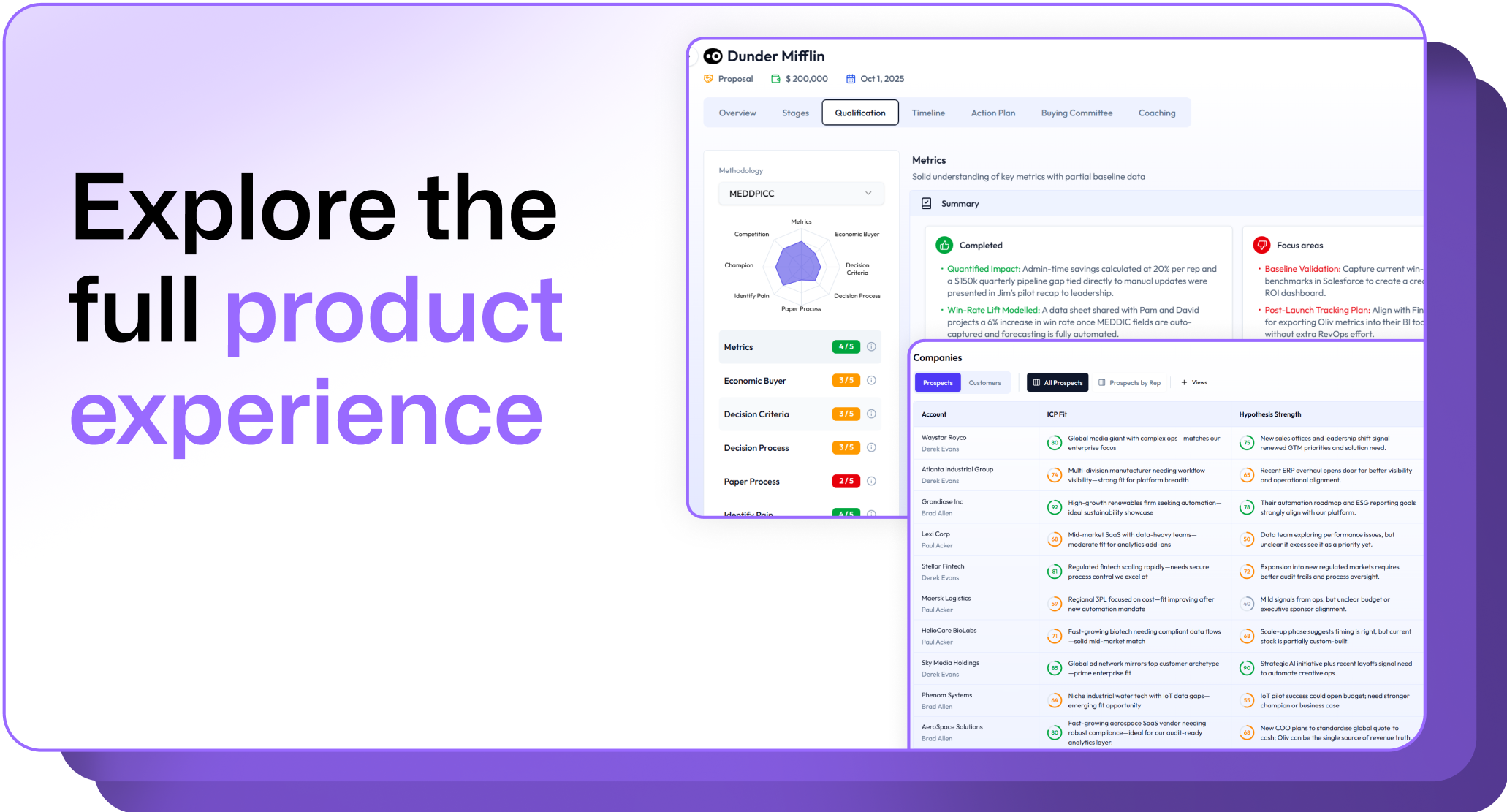
.avif)