5 Best Revenue Intelligence Tools for Mid-Market Companies | Pricing, Implementation & ROI [2026]
Written by
Ishan Chhabra
Last Updated :
January 2, 2026
Skim in :
12
mins
In this article
Revenue teams love Oliv
Here’s why:
All your deal data unified (from 30+ tools and tabs).
Insights are delivered to you directly, no digging.
AI agents automate tasks for you.
Thank you! Your submission has been received!
Oops! Something went wrong while submitting the form.
Meet Oliv’s AI Agents
Hi! I’m, Deal Driver
I track deals, flag risks, send weekly pipeline updates and give sales managers full visibility into deal progress
Hi! I’m, CRM Manager
I maintain CRM hygiene by updating core, custom and qualification fields all without your team lifting a finger
Hi! I’m, Forecaster
I build accurate forecasts based on real deal movement and tell you which deals to pull in to hit your number
Hi! I’m, Coach
I believe performance fuels revenue. I spot skill gaps, score calls and build coaching plans to help every rep level up
Hi! I’m, Prospector
I dig into target accounts to surface the right contacts, tailor and time outreach so you always strike when it counts
Hi! I’m, Pipeline tracker
I call reps to get deal updates, and deliver a real-time, CRM-synced roll-up view of deal progress
Hi! I’m, Analyst
I answer complex pipeline questions, uncover deal patterns, and build reports that guide strategic decisions
TL;DR
Revenue Intelligence for mid-market differs fundamentally: 50-500 employee teams need autonomous AI agents (not dashboards requiring RevOps teams to maintain), solving dirty CRM data and manual forecasting without enterprise overhead.
Enterprise platforms create hidden costs: Gong's 3-year TCO ($789k for 100 users) includes 140+ admin hours, module gatekeeping, and RevOps maintenance; AI-native alternatives deliver 91% cost reduction with 2-4 week implementations.
Quantified ROI benchmarks for mid-market: Teams achieve 35% higher win rates, 25% forecast accuracy improvement, 7% deal velocity gains, and 9-12 month payback at 75%+ utilization.
Integration complexity determines success: CRM formula field support, multi-domain email authentication, Slack/Teams native delivery, and autonomous CRM enrichment separate mid-market-ready platforms from enterprise tools.
Implementation readiness across 6 dimensions: CRM data quality (60%+ completeness baseline), stakeholder alignment, tech stack compatibility, change management capacity, TCO budget understanding, and scaling timeline planning.
Common failure modes to avoid: Selecting enterprise platforms without RevOps resources, ignoring pre-deployment data cleanup, treating RI as "tool to adopt" vs autonomous workforce, and underestimating 50-500 employee change management.
Q1: What is Revenue Intelligence for Mid-Market Companies? (And Why It's Different from Enterprise RI) [toc=Mid-Market Revenue Intelligence]
Revenue intelligence is a unified system that captures, analyzes, and activates data from every customer interaction (meetings, emails, calls, Slack messages, and support tickets) to optimize revenue outcomes across your entire sales cycle. For mid-market companies (50-500 employees with 25-200 sales reps), revenue intelligence takes on a distinct character compared to enterprise deployments.
🔍 Understanding Conversation Intelligence vs Revenue Intelligence
The critical distinction mid-market buyers must understand: Conversation Intelligence (CI) is merely the meeting recording layer (transcripts and keyword tracking). Revenue Intelligence (RI) represents full-spectrum deal orchestration across all channels, integrating CRM data, email threads, calendar activities, and real-time collaboration tools into a single source of truth.
⚠️ The Traditional Approach: Built for Enterprise, Broken for Mid-Market
First-generation tools (2015-2022) like Gong and Chorus pioneered conversational intelligence with keyword-based "Smart Trackers" and meeting recordings. These platforms were architected for enterprise teams with dedicated RevOps administrators to configure dashboards, maintain tracking rules, and extract insights from mountains of data.
The mid-market reality? You're forced into an impossible choice: pay enterprise-grade prices ($1,600/user/year for Gong) or settle for basic SMB tools like Avoma that lack depth. As one mid-market RevOps leader observed:
"Gong is a really powerful tool but it's probably the highest end option on the market... Having talked with other friends who lead revenue functions, all have said the same thing - they've been fine using a lower cost, simpler alternative and have only seen Gong really make sense for more established sales organizations with larger budgets." — Iris P., Head of Marketing, Mid-Market (51-1,000 emp.) | G2 Verified Review
This dashboard fatigue creates a secondary problem: managers spending nights and weekends manually auditing calls because legacy tools require "clicking through ten screens" to find actionable deal insights.
✅ The AI-Era Transformation: From Revenue Operations to AI-Native Revenue Orchestration
Third-generation RI (2025 and beyond) represents a fundamental shift from "Revenue Operations" to AI-Native Revenue Orchestration (agentic systems that complete tasks autonomously rather than passively displaying analysis). Here's why this matters for mid-market: recording and transcription have become commoditized. Zoom, Microsoft Teams, and Google Meet offer native recording at zero marginal cost.
Intelligence in 2025 isn't about what was said (it's about autonomous execution): updating CRM fields automatically, flagging deal risks proactively, and generating forecast slides without manual roll-ups. Mid-market teams don't need another dashboard requiring "heavy human adoption, training, and manual input." They need agents that work autonomously because they lack enterprise's RevOps infrastructure.
💰 How Oliv.ai Delivers Mid-Market Revenue Intelligence
Oliv.ai employs a three-layer architecture purpose-built for teams without dedicated RevOps resources:
Baseline Recording Layer (FREE): Meeting transcription and basic documentation (the commodity layer that should never carry a premium price tag)
Deep Intelligence Layer: Stitched 360° context from meetings + emails + Slack + support tickets + CRM, creating unified deal histories legacy silos miss
Agentic Workforce Layer: Autonomous agents that execute work vs creating dashboards—CRM Manager enriches dirty data automatically, Deal Driver flags risks daily via Slack, Forecaster generates board-ready slides without Thursday-Friday cleanup sessions, Researcher builds context-rich account dossiers
Mid-market revenue intelligence performance benchmarks showing 35% higher win rates, 25% forecast accuracy improvement, and 75%+ utilization rates for AI-native platforms versus traditional enterprise tools like Gong and Clari.
The differentiation is structural: if a platform requires RevOps teams to maintain it, mid-market will fail to extract value. AI-native RI delivers 35% higher win rates, 25% forecast accuracy improvement, and 9-12 month payback periods at 75%+ utilization (metrics that justify investment when the platform works for you, not requires work from you).
Q2: Top 5 Revenue Intelligence Platforms for Mid-Market: Detailed Comparison [toc=Platform Comparison]
Mid-market buyers evaluating revenue intelligence face a crowded landscape where enterprise platforms over-engineer and SMB tools under-deliver. This analysis compares the five most frequently considered options for 50-500 employee companies, exposing pricing realities, feature gaps, and mid-market fit.
📊 Quick Comparison Table
Top 5 Revenue Intelligence Platforms for Mid-Market
Platform
Pricing
Team Size Fit
Implementation
Key Differentiator
G2 Rating
Oliv.ai
Starting at $29/user
25-200 reps
2-4 weeks
AI agents execute work autonomously
4.8/5
Gong
$1,600/user/year
100+ reps
8-24 weeks
Conversation intelligence leader
4.7/5
Clari
Custom (typically $400-500/user)
50-500 reps
6-12 weeks
Forecasting roll-ups
4.5/5
Salesloft
$75-150/user/month
50-200 reps
4-8 weeks
Sales engagement sequences
4.5/5
Outreach
$100-165/user/month
100+ reps
6-10 weeks
Email automation at scale
4.3/5
1. ⭐ Oliv.ai – The AI-Native Mid-Market Solution
Overview: Oliv.ai positions as the only generative AI-native revenue intelligence platform purpose-built for mid-market teams lacking dedicated RevOps resources. Unlike legacy SaaS tools requiring "heavy human adoption," Oliv's autonomous agent workforce executes tasks rather than displaying dashboards.
Oliv AI's Revenue intelligence forecasting interface for Mid-Market companies displaying team forecast versus AI forecast comparison, identifying at-risk deals worth $400K, offset strategy opportunities, and automated deal slip alerts for Redwood Tech and Nexia Analytics.
Pricing for Mid-Market:
Meeting Assistant: Starting at $29/user/month
Full platform with agents: Fraction of Gong/Clari stack costs
FREE baseline recording layer for existing Gong users
3-year TCO: $68,400 vs $789,300 for Gong (91% reduction for 100-user team)
Key Features:
CRM Manager Agent: Automatically enriches accounts/contacts via web scraping, populates MEDDPICC qualification fields, fixes dirty data without rep action
Deal Driver Agent: Flags at-risk deals daily with specific reasoning ("no champion identified, decision in 2 weeks"), delivers insights via Slack/Email
Researcher Agent: Builds deep account dossiers ("company opened Munich office, hired 50 engineers Q4") for context-rich outreach
360° Data Stitching: Unifies meetings, emails, Slack, support tickets, even Telegram into single deal history
✅ Strengths:
Autonomous agents eliminate manual pipeline auditing (saves managers "1 day per week")
5-minute initial setup, full customization in 2-4 weeks
Free data migration including historical Gong recordings
Works where teams live (Slack/Email notifications) vs requiring separate login
Purpose-built for teams WITHOUT RevOps infrastructure
❌ Limitations:
Newer platform vs 10-year incumbents (though AI-native architecture is advantage)
Smaller brand recognition in enterprise segment
Mid-Market Verdict: Best fit for 50-500 employee companies seeking autonomous revenue intelligence without enterprise complexity or cost. Ideal when you lack RevOps team to maintain legacy platforms.
2. Gong – The Conversation Intelligence Pioneer
Overview:Gong pioneered conversation intelligence in 2015 and remains the "gold standard" for meeting recording and analysis. Built for enterprise teams with dedicated RevOps administrators.
Gong's unified Deal platform architecture showcasing orchestration capabilities including Gong Applications, AI Agents, Data Engine integration, and Gong Collective for comprehensive revenue team workflows.
Pricing Reality for Mid-Market:
Foundation plan: ~$1,600/user/year
Bundling Engage + Forecast: $200-250/user/month
Year 1 TCO for 100-user team: $152,000
3-year TCO: $789,300
Fixed platform fees ($5k-50k) hurt smaller teams
Key Features:
Meeting recording with Smart Trackers (keyword-based)
"While Gong offers valuable insights into call data and sales interactions, our experience has been impacted by significant data access limitations... requires downloading calls individually, which is impractical and inefficient for a large volume of data." — Neel P., Sales Operations Manager, Small-Business | G2 Verified Review
Smart Trackers use V1 ML (keywords), not generative reasoning—40%+ false positive rates
Requires 140+ admin hours for setup
"Additional products like forecast or engage come at an additional cost" frustrates mid-market budgets
Mid-Market Verdict: Overpowered and overpriced for most 50-500 employee teams. Best for 200+ rep organizations with dedicated RevOps teams to maintain configurations.
3. Clari – The Forecasting Specialist
Overview:Clari excels at roll-up forecasting, consolidating manual spreadsheets from reps to managers. Conversation intelligence ("Copilot") is weaker add-on.
Clari's revenue context framework displaying layered architecture with AI assistants, agents, revenue cadences, workflow automation, insights panel, and data platform for predictable growth.
Pricing for Mid-Market:
Custom pricing (typically $400-500/user/month when bundled)
Stacking Gong + Clari: $500/user/month total
Requires separate Salesforce user licenses for forecast hierarchy nodes
Forecasting STILL requires manual Thursday-Friday cleanup sessions with reps
Limited dashboard configurability ("feels too basic")
Cannot pull call transcripts without additional tools
Clunky UI for finding templates/flows
Mid-Market Verdict: Solid for forecasting if you already have conversation intelligence covered, but expensive when bundled. Manual data entry burden remains problematic for resource-constrained mid-market.
4. Salesloft – Sales Engagement with Basic CI
Overview: Salesloft originated as sales engagement platform (email sequences, dialing) with conversation intelligence bolted on. Built for mass outreach era now challenged by Google/Microsoft bulk email crackdowns.
Salesloft revenue orchestration visual displaying end-to-end sales workflow including analyze, chat, prospect, forecast, coach, and close stages, powered by AI agents and conversation intelligence technology.
Pricing for Mid-Market:
$75-150/user/month depending on tier
Conversations (CI add-on): Additional cost
More affordable than Gong/Clari but limited RI depth
"Eliminates the repetitive tasks usually required in Salesforce and does most of the heavy lifting to push you through your outreach." — Andy N., Business Development Representative, Enterprise | G2 Verified Review
❌ Limitations:
"The worst customer service, especially if you're a smaller company... My company has been trying to get in touch with someone there for over 5 months with no response." — Verified User, Professional Training & Coaching, Mid-Market | G2 Verified Review
"Conversations doesn't work at all. They sell it as a gong competitor. It doesn't even have the functionality of Zoom." — Verified User, Professional Training & Coaching, Mid-Market | G2 Verified Review
Technical Issues:
Conversation intelligence only works for internal dialer calls, not Zoom/Teams
Mass sequencing failing due to deliverability crackdowns
Customer support issues for smaller accounts
Cannot delete old cadences
Mid-Market Verdict: Best for teams prioritizing sales engagement over revenue intelligence. Weak conversation intelligence makes it unsuitable as standalone RI solution.
5. Outreach – Enterprise Email Automation
Overview: Outreach pioneered sales engagement automation but struggles with mid-market fit due to pricing, complexity, and stagnant product innovation.
Outreach platform demonstrating AI-powered sales agent capabilities with revenue agent selection, sales leader sequences, account executive workflows, and automated email personalization tools for pipeline growth.
Pricing Reality:
$100-165/user/month
Evergreen contracts auto-renew annually
"Significantly overpriced for what it offers"
Key Features:
Sequence automation and A/B testing
Activity tracking and email insights
Salesforce integration
Template management
✅ Strengths:
"The ability to easily reach out to multiple contacts systematically. I also like the ability to A/B test emails and track activity." — Greg D., CRO, Mid-Market | G2 Verified Review
❌ Limitations:
"Outreach isn't for Hubspot CRM users... The Hubspot Outreach sync breaks once in every two weeks... it's affecting BDs productivity." — Vamsi C., Revenue Operations, Mid-Market | G2 Verified Review
"The platform has a clunky interface and still relies on your own email servers, essentially functioning as an email scheduler with very basic reporting capabilities. Additionally, their agreements are evergreen (automatically renewing annually without alternative terms)." — Kevin H., CTO/Co-Founder, Small-Business | G2 Verified Review
"The engage product is stagnant. Looks to have the same features, UX, integrations and issues as it had 5 years ago." — Matthew T., Head of Revenue Operations, Mid-Market | G2 Verified Review
Technical Issues:
No native HubSpot integration (breaks frequently)
Product innovation stalled
Predatory evergreen contracts
Frequent email sending failures
No conversation intelligence depth
Mid-Market Verdict: Avoid unless committed to Salesforce CRM and willing to pay premium for email sequencing. Better alternatives exist at lower price points with better support.
Mid-market companies (50-500 employees) face three resource constraints that enterprise organizations don't encounter, creating a unique set of challenges traditional revenue intelligence platforms fail to address.
⚠️ The Mid-Market Revenue Reality
First, no dedicated RevOps team (companies with 50-500 employees cannot justify 5+ full-time RevOps headcount to maintain complex software configurations). Second, "dirty CRM data" (sales reps in high-velocity mid-market environments rarely update Salesforce in real-time, creating incomplete opportunity records that render AI predictions meaningless). Third, manual forecasting theater (the "Monday tradition" of board forecast calls requires managers to spend Thursday-Friday manually updating spreadsheets with reps, transforming data cleanup into a weekly ritual that consumes 20%+ of management capacity).
💸 The Enterprise Trap: Paying Premium Prices for Unused Features
Traditional enterprise revenue intelligence platforms like Gong ($1,600/user/year, $152,000 Year 1 TCO for 100 users) and Clari ($400-500/user/month when bundled) were architectured for 1,000+ employee organizations with established RevOps infrastructure. These platforms assume you have dedicated teams to maintain Smart Tracker configurations, build custom dashboards, and extract insights from analytics modules.
The mid-market reality? Gong requires 140+ admin hours for initial setup (time mid-market RevOps teams, if they exist at all, simply don't have). Clari's forecasting still demands manual data cleanup sessions because it can't handle Salesforce formula fields, requiring duplicate field maintenance. When you stack Gong + Clari to get complete coverage, you're paying $500 per user per month (untenable for mid-market budgets).
"It was a big mistake on our part to commit to a two year term. Gong is a really powerful tool but it's probably the highest end option on the market, and now we're stuck with a tool that works technically but isn't the right business decision." — Iris P., Head of Marketing, Mid-Market | G2 Verified Review
The deeper issue: mid-market pays enterprise Total Cost of Ownership but lacks the resources to extract enterprise-level value. This creates the classic "dashboard fatigue" and "SaaS is a dirty word" frustration (another login, another tool requiring adoption, another weekend spent manually auditing pipeline because the platform shows you what's wrong but doesn't fix it).
✅ What Mid-Market Actually Needs: Autonomous Agents, Not Dashboards
The AI-era shift for mid-market isn't about better analytics (it's about autonomous execution). Mid-market teams don't need "another dashboard to dig through." They need agents that:
Clean dirty CRM data automatically (not assume pristine Salesforce hygiene that doesn't exist)
Deliver insights where teams live (Slack/Email notifications, not requiring separate platform logins)
Generate unbiased forecasts from bottom-up deal inspection (not rely on rep-driven roll-ups where reps hide stalled deals)
Work without RevOps babysitting (5-minute setup, not 140-hour implementations)
💰 Oliv.ai: Purpose-Built for Mid-Market Constraints
Oliv.ai's architecture addresses each mid-market constraint directly:
CRM Manager Agent enriches dirty data via web scraping (automatically populating account details, contact information, and MEDDPICC qualification fields without requiring reps to "update Salesforce first"). When reps don't log activities, CRM Manager captures them from email/meeting context and prompts validation via Slack.
Deal Driver Agent replaces the manual pipeline auditing ritual. Instead of managers spending evenings "listening to call recordings while driving" (actual mid-market pain point), Deal Driver inspects every deal autonomously, flags risks daily with specific reasoning ("no champion identified, decision date in 2 weeks, multi-threading score 2/10"), and delivers alerts via Slack. This saves managers "one day per week" previously spent clicking through Gong dashboards.
Forecaster Agent eliminates the Thursday-Friday forecast prep ritual. Rather than manually rolling up rep submissions (which are biased toward deals reps want to show management), Forecaster performs bottom-up deal inspection across the entire pipeline and generates board-ready presentation slides autonomously (no rep-driven input required).
Three core AI agents powering mid-market revenue intelligence: CRM Manager for data enrichment, Deal Driver for risk alerts, and Forecaster for unbiased pipeline predictions without manual rep input.
Total 3-year TCO comparison: $68,400 (Oliv.ai) vs $789,300 (Gong Foundation) (a 91% cost reduction for a 100-user mid-market team). The savings come from architectural efficiency: agents that execute work vs platforms requiring RevOps teams to maintain.
🔍 The Real Mid-Market Pain Enterprise Platforms Ignore
Sales managers report doing "late-night call auditing while driving" because Gong's dashboard requires "clicking through 10 screens" to find deal risk signals. VPs spend entire weekends preparing forecast slides manually because Clari still requires rep input for roll-ups. CRM data becomes so dirty that Salesforce Einstein agents fail completely ("garbage in, garbage out").
Enterprise platforms were built assuming infrastructure mid-market doesn't have: dedicated RevOps teams, pristine CRM hygiene, established forecasting processes, and unlimited implementation budgets. When mid-market tries to adopt these tools, they fail not because the software is bad, but because the underlying assumptions don't match mid-market reality.
The 2025 mid-market buyer's question isn't "Which revenue intelligence platform has the most features?" (it's "Which platform will work for my team without requiring a RevOps team to make it work?")
Q4: How Much Does Revenue Intelligence Cost for Mid-Market in 2025? (True TCO Analysis) [toc=Pricing & TCO Analysis]
Revenue intelligence pricing for mid-market companies spans a deceptive range (from $29/user/month to $500+/user/month when enterprise platforms bundle add-ons). Understanding true Total Cost of Ownership (TCO) requires looking beyond sticker prices to hidden costs, implementation fees, and feature gatekeeping.
💰 Mid-Market Pricing Tiers Explained
Entry Tier ($29-50/user/month): Basic conversation intelligence with meeting recording, transcription, and simple CRM sync. Platforms: Oliv.ai Meeting Assistant ($29), Avoma ($19-59), Chorus.ai (often bundled at $40 with ZoomInfo). Best for teams prioritizing call documentation over full revenue orchestration.
Mid-Market Sweet Spot ($50-150/user/month): Full revenue intelligence including forecasting, deal analytics, automated CRM enrichment, and agent-driven insights. Platforms: Oliv.ai full platform, Salesloft ($75-150), mid-tier Clari configurations. This range delivers ROI for 50-200 rep teams without enterprise overhead.
Enterprise Tier ($150-500/user/month): Comprehensive suites with every module, dedicated support, custom integrations. Platforms: Gong Foundation ($133/month) + Engage ($50-100) + Forecast ($50-100), Clari full stack ($400-500), Outreach Commit ($165+). Justifiable only for 200+ rep teams with dedicated RevOps infrastructure.
📊 True TCO Comparison: 100-User Mid-Market Team (3 Years)
3-Year Total Cost of Ownership Comparison for 100-User Mid-Market Team
Platform
Year 1
Year 2-3 (Annual)
3-Year Total
Per-User/Month Actual
Oliv.ai
$34,800
$16,800/year
$68,400
$29-99
Gong Foundation
$152,000
$318,650 total
$789,300
$133+
Gong + Clari Stack
$300,000+
$600,000+ total
$1.5M+
$500+
Salesloft
$90,000
$108,000/year
$306,000
$75-150
Outreach
$120,000
$144,000/year
$408,000
$100-165
⚠️ Hidden costs not included: Implementation fees (Gong: 140+ admin hours = $28k+ at $200/hour consultant rates), training programs, integration development, ongoing RevOps maintenance (10-20 hours/week for enterprise platforms).
💸 Where Enterprise Platforms Hide Costs
Module Gatekeeping:
Gong's base "Foundation" plan ($1,600/user/year) includes only conversation intelligence. Add Forecast module (+$600-1,200/user/year) and Engage sequencing (+$600-1,200/user/year), and suddenly you're at $200-250/user/month. Clari follows similar patterns (forecasting separate from conversation intelligence, Copilot add-on).
Enterprise platforms charge $5,000-50,000 annual platform fees distributed across seats. A 50-user team pays the same platform fee as a 500-user team, inflating per-user costs dramatically for smaller mid-market buyers. Gong's Year 1 TCO of $152,000 for 100 users breaks down to $1,520 per user (far above the advertised $1,600 annual rate when platform fees are included).
Implementation and Maintenance:
Gong implementations require 8-24 weeks and 140+ admin hours to configure Smart Trackers, build dashboards, and establish workflows. At $200/hour for RevOps consultants, that's $28,000+ in implementation costs alone. Ongoing maintenance (updating trackers, fixing broken integrations, training new hires) consumes 10-20 hours weekly ($100,000+ annually in internal RevOps salary allocation).
Outreach employs "evergreen contracts" that auto-renew annually. Miss the cancellation window by hours, you're locked for another year at full price.
"Their agreements are evergreen (automatically renewing annually without alternative terms). If you miss the cancellation deadline by even a few hours, they enforce renewal for the entire year without any willingness to negotiate." — Kevin H., CTO/Co-Founder, Small-Business | G2 Verified Review
✅ What Mid-Market Should Actually Budget
For a 50-100 user mid-market team seeking comprehensive revenue intelligence:
Minimum Viable Budget: $3,000-5,000/month ($36k-60k annually) Gets you basic conversation intelligence (Chorus at $40/user via ZoomInfo bundle, or Avoma at $50/user) plus manual forecasting in Salesforce. Requires significant manual work but covers recording/transcription needs.
Optimal Mid-Market Budget: $5,000-10,000/month ($60k-120k annually) Covers full revenue intelligence with autonomous agents (Oliv.ai full platform at $29-99/user depending on modules), eliminating manual pipeline auditing and forecast prep. Implementation in 2-4 weeks vs 8-24 for enterprise platforms. This tier delivers 9-12 month payback periods at 75%+ utilization.
Enterprise Overkill Budget: $15,000-50,000/month ($180k-600k annually) Gong + Clari stack or Gong full suite with Engage/Forecast. Only justifiable for 200+ rep teams with dedicated RevOps infrastructure (5+ headcount) to maintain configurations. Mid-market teams at this budget level are overpaying for features they lack resources to utilize.
🔍 Pricing Red Flags for Mid-Market Buyers
❌ "Custom pricing only" = Expect 2-4x higher quotes than advertised ranges ❌ Separate modules (CI + Forecasting + Engagement sold separately) = Add 50-100% to base price ❌ "Platform fee + per-user fee" structure = Small teams subsidize enterprise deployments ❌ Evergreen auto-renewal contracts = No flexibility for downsizing during market shifts ❌ "Professional services required" = Add $20k-50k to Year 1 costs
✅ Transparent all-in pricing with modules included ✅ Free implementation and data migration ✅ Month-to-month or annual options without auto-renewal traps ✅ Self-service setup (5 minutes to initial value, not 140 admin hours)
The mid-market pricing reality: enterprise platforms charge enterprise TCO hoping you won't calculate the true per-user cost when hidden fees, module add-ons, and implementation burden are included. The $1,600/user Gong sticker price becomes $2,500-3,000/user actual cost (untenable for mid-market budgets competing for the same dollars as headcount, marketing spend, and product development).
Q5: What ROI Can Mid-Market Teams Expect from Revenue Intelligence? (Real Benchmarks) [toc=ROI Benchmarks]
Revenue intelligence delivers quantifiable returns for mid-market companies, but expectations must align with realistic timelines and utilization rates. Based on analysis across 50-500 employee deployments, here are verified ROI benchmarks.
💰 Core Revenue Impact Metrics
Win Rate Improvement: 35% Higher for AI-Enabled Sellers Sales teams using AI-driven deal alerts, risk detection, and automated MEDDPICC qualification see significantly higher win rates compared to teams relying solely on manual CRM updates. This translates to 35 additional wins per 100 opportunities for mid-market teams typically closing 40-50% of pipeline.
"Before Gong we had a lack of visibility across our deals because information was siloed in several places like CRM, Email, Zoom, phone. Now all of this is centralized in one view via the Gong deal boards. Forecasting was also an ad-hoc process for us before adoption Gong Forecast, now we can measure forecasting accuracy and have confidence in what is going to close and when." — Scott T., Director of Sales, Mid-Market | G2 Verified Review
Forecast Accuracy: 25% Improvement Teams using unified revenue intelligence platforms reduce forecast variance from ±30% (spreadsheet-based forecasting) to ±15% through bottom-up deal inspection and automated slippage detection. For a mid-market company forecasting $10M quarterly revenue, this improvement prevents $1.5M+ in resource misallocation.
Deal Velocity: 7% Acceleration
Automated activity capture, next-best-action recommendations, and multi-threading detection compress sales cycles by 7% on average. For mid-market teams with 90-day average cycles, this creates an additional sales quarter every 3.5 years (effectively adding 4 weeks of selling time annually).
⏰ Time Savings and Productivity Gains
Manager Time Reclaimed: 8-10 Hours Weekly Per Manager Manual pipeline reviews, call auditing, and forecast roll-ups consume 20-25% of sales manager capacity. Revenue intelligence automation reclaims this time for strategic coaching and deal intervention.
Rep Efficiency: 2-3 Hours Saved Per Rep Weekly Automated note-taking, CRM data enrichment, and meeting prep eliminate administrative burden, allowing reps to reallocate 10% of time (4-5 hours weekly) to actual selling activities. For a 100-rep mid-market team, this equals 200-300 additional selling hours weekly.
📊 Financial ROI Calculations
Payback Period: 9-12 Months at 75%+ Utilization Mid-market teams achieving 75%+ platform adoption (reps actually using the tools vs. purchasing shelf-ware) hit breakeven within 9-12 months. Teams below 50% utilization rarely achieve positive ROI within 24 months, making change management critical.
3-Year TCO Advantage: 91% Cost Reduction (AI-Native vs Legacy)
For a 100-user team, AI-native platforms like Oliv.ai deliver $68,400 total 3-year cost vs. $789,300 for enterprise platforms like Gong. The $720,900 savings funds additional headcount (7-8 mid-market AEs) or marketing budget expansion.
⚠️ ROI Killers to Avoid
Low Adoption = Zero ROI Purchasing revenue intelligence without driving adoption creates negative ROI. If only 30% of reps use the platform actively, you're paying 100% of costs for 30% of value.
Enterprise Platforms Without RevOps Team Mid-market teams purchasing Gong/Clari without dedicated RevOps resources to configure and maintain see 40-60% lower ROI than teams with 3+ RevOps headcount. The platform capability exceeds organizational capacity to extract value.
Fragmented Tech Stack
Stacking Gong (conversation intelligence) + Clari (forecasting) + Salesloft (engagement) creates integration tax (RevOps teams spend 10-15 hours weekly maintaining data sync vs. unified platforms requiring 2-3 hours weekly).
✅ How Oliv.ai Accelerates Mid-Market ROI
Oliv.ai's autonomous agent architecture delivers faster payback through three mechanisms: Zero-touch CRM enrichment eliminates rep data entry burden (2-3 hours weekly reclaimed immediately), proactive deal risk alerts delivered via Slack create instant manager value without dashboard logins (8-10 hours weekly reclaimed), and automated forecast generation removes Thursday-Friday cleanup rituals (20+ hours monthly reclaimed per RevOps leader). Combined with 91% lower TCO vs. Gong, mid-market teams often hit positive ROI within 6-9 months vs. 12-18 for enterprise platforms.
Q6: Essential Features Mid-Market Revenue Intelligence Must Have (vs Enterprise Feature Bloat) [toc=Must-Have Features]
Enterprise revenue intelligence platforms market 100+ features, but mid-market teams with 50-500 employees actively utilize only 15-20%. The challenge isn't selecting the platform with the most features (it's identifying which features solve actual mid-market pain points: dirty CRM data, manual forecasting, pipeline auditing) versus vanity capabilities requiring dedicated RevOps teams to configure and maintain.
❌ The Enterprise Feature Bloat Problem
Traditional platforms like Gong and Clari were built for 1,000+ employee organizations with established RevOps infrastructure. Their feature sets assume resources mid-market doesn't have.
Gong's Smart Trackers: 40%+ False Positive Rates
Smart Trackers sound valuable (keyword-based alerts when prospects mention "budget," "timeline," or "decision maker"). The reality? V1 machine learning (keyword matching, not generative reasoning) triggers alerts when prospects discuss "holiday budget planning" or "project timeline for next fiscal year" rather than deal-specific buying signals.
Despite positioning as a "forecasting platform," Clari still requires manual Thursday-Friday data cleanup sessions with reps before Monday board calls. The platform can't handle Salesforce formula fields, forcing RevOps to create and maintain duplicate fields just to populate forecasts.
"I find the setup process challenging, especially when migrating fields from Salesforce, as it can't handle formula fields directly. This requires creating and maintaining duplicate fields, which adds complexity and workload." — Josiah R., Head of Sales Operations, Mid-Market | G2 Verified Review
Salesloft's Mass Sequencing Collapse
Built for the era of mass, non-personalized prospecting, Salesloft's core value proposition (bulk email sequences) fails in 2025 due to Google/Microsoft crackdowns on bulk emailing. Deliverability rates have dropped 40-60% for high-volume senders, rendering the platform's primary use case obsolete.
✅ AI-Era Essential Features for Mid-Market
1. Autonomous CRM Enrichment (Not Manual Data Entry)
Mid-market reps don't update Salesforce consistently, creating "dirty data" that renders AI predictions meaningless. Essential capability: AI agents that automatically enrich accounts/contacts via web scraping, populate qualification fields (MEDDPICC/BANT), and prompt reps to validate data via Slack rather than requiring manual entry.
2. Proactive Deal Risk Alerts in Slack/Email
Managers shouldn't need to "click through 10 screens" to find deal risks. Agents must autonomously inspect every deal daily, flag risks with specific reasoning ("no champion identified, decision date in 2 weeks, multi-threading score 2/10"), and deliver alerts where teams live (Slack/Email, not dashboards requiring separate logins).
3. Unbiased Forecast Generation from Bottom-Up Inspection
Forecasting can't rely on rep-driven roll-ups where reps hide stalled deals. AI must perform bottom-up deal inspection across entire pipeline, predict slippage autonomously, and generate board-ready presentation slides without manual Thursday-Friday cleanup sessions.
4. Context-Rich Account Research for Personalized Outreach
Mass sequencing is dead. Mid-market needs AI that performs deep account research ("company opened Munich office, hired 50 engineers Q4, recently raised Series B") to enable context-rich, personalized interactions rather than generic "touching base" templates.
5. Automatic Activity Logging Across All Channels
Manual activity logging fails in high-velocity mid-market sales. Platforms must capture activities from email, meetings, calls, Slack, and support tickets automatically, stitching them into unified deal histories without requiring rep input.
6. Multi-Threading Detection and Stakeholder Engagement Analysis
Single-threaded deals have 40-60% lower win rates. Essential capability: AI that identifies stakeholder engagement gaps, recommends which personas to engage, and alerts when deals lack executive sponsorship or champion coverage.
💰 How Oliv.ai Delivers Mid-Market Essential Features
Oliv.ai's agent architecture prioritizes automation over analysis:
CRM Manager enriches accounts/contacts via web scraping and populates MEDDPICC qualification fields automatically (no rep data entry required). Deal Driver flags at-risk deals daily with specific reasoning delivered via Slack/Email. Forecaster generates unbiased board-ready slides autonomously from bottom-up deal inspection. Researcher Agent builds deep account dossiers for context-rich outreach. Voice Agent calls reps nightly for 5-minute updates capturing offline context (in-person conference conversations). Map Manager auto-updates Mutual Action Plans after every call.
Diagram showcasing six core AI-native revenue intelligence capabilities for mid-market companies, including autonomous CRM enrichment, proactive deal risk alerts, unbiased forecast generation, and multi-threading detection for 50-500 employee teams.
All delivered where teams live (Slack/Email) (no separate login required). This eliminates the "dashboard fatigue" mid-market teams report with enterprise platforms.
⚠️ The Mid-Market Feature Prioritization Rule
If a feature requires "heavy human adoption" or dedicated admin to maintain, it will fail in mid-market. Choose platforms where AI does the work (updates CRM objects, generates forecast slides, flags risks autonomously) versus platforms that show you data requiring manual action. Automation trumps analysis for resource-constrained teams.
Q7: How to Evaluate Revenue Intelligence Platforms: Mid-Market Buyer's Checklist [toc=Buyer's Checklist]
Selecting revenue intelligence for mid-market requires evaluating vendors through a lens distinct from enterprise buyers. This actionable framework helps 50-500 employee companies avoid common evaluation mistakes that lead to shelf-ware and negative ROI.
💰 Pricing Model Evaluation Criteria
✅ Transparent All-In Pricing vs. Module Gatekeeping
Request total 3-year TCO for 100 users including all modules (CI, forecasting, engagement)
Identify hidden costs: platform fees, implementation services, training programs, integration development
Calculate actual per-user/month cost: (Year 1 total cost ÷ 12 months ÷ user count)
❌ Red Flags:
"Custom pricing only" without published ranges
Conversation intelligence separate from forecasting (add 50-100% to base price)
Platform fees + per-user fees structure (small teams subsidize enterprise)
Evergreen auto-renewal contracts without month-to-month options
"Their agreements are evergreen (automatically renewing annually without alternative terms). If you miss the cancellation deadline by even a few hours, they enforce renewal for the entire year without any willingness to negotiate." — Kevin H., CTO/Co-Founder, Small-Business | G2 Verified Review
⏰ Implementation Timeline Assessment
✅ Mid-Market Standard: 2-4 Weeks to Value
Week 1: Platform setup and data sync (should take 5-15 minutes for initial config)
Week 2-3: Team onboarding and workflow customization
Week 4: Full production deployment with autonomous agents active
Conversation intelligence only works for internal dialer calls (Salesloft, Outreach limitation)
Cannot pull CRM formula fields (Clari limitation requiring duplicate field maintenance)
Stores data in separate AWS instances unusable for reporting (Salesforce Einstein Activity Capture flaw)
"Einstein Activity Capture is described as 'subpar'; it redacts data unnecessarily, fails to associate emails with correct opportunities, and stores data in separate AWS instances unusable for reporting." — Market Research Analysis
🤖 Agent vs. Dashboard Approach Assessment
✅ Autonomous Agent Capabilities to Demand:
CRM enrichment that fixes dirty data without rep input
Unbiased forecast generation from bottom-up deal inspection
Automatic activity logging across email/meetings/calls/Slack
Task completion (update CRM objects, generate slides, build action plans) not just task recommendations
❌ Dashboard-First Platform Signals:
Requires "clicking through 10 screens" to find insights
Insights delivered only within platform (separate login required)
Reps must manually action recommendations shown in dashboards
Platform assumes clean CRM data vs. fixing dirty data automatically
Vendor Demo Questions:
"Show me how a deal risk is identified and communicated to the sales manager (how many clicks)?"
"If our CRM data is 60% incomplete, how does your platform handle that vs. assuming clean data?"
"Where do reps receive insights (Slack, Email, or do they need to login to your dashboard)?"
📋 Contract Negotiation Tips for Mid-Market
✅ Favorable Terms to Negotiate:
Month-to-month or annual contracts (avoid 2-3 year lock-in)
No auto-renewal or 90-day advance cancellation notice
Free data migration and historical import
Seats based on active users (not total employee count)
Ability to downsize mid-contract if headcount changes
Reference Customer Questions:
"What percentage of your team actively uses the platform daily vs. purchased seats?"
"How many hours per week does your RevOps team spend maintaining the platform?"
"What's one feature you purchased but never actually use?"
"If you could go back, would you choose this platform again or evaluate alternatives?"
✅ How Oliv.ai Simplifies Mid-Market Evaluation
Oliv.ai addresses each evaluation criterion directly: Transparent pricing with no module gatekeeping, 2-4 week implementations (5-minute initial setup), free data migration including historical Gong recordings, autonomous agents that execute work vs. creating dashboards, and month-to-month contracts without auto-renewal traps. This eliminates the evaluation complexity enterprise platforms introduce through custom pricing, lengthy implementations, and fragmented module structures.
Q8: Revenue Intelligence Implementation for Mid-Market: Week-by-Week Roadmap [toc=Implementation Roadmap]
Mid-market revenue intelligence implementations should achieve production value within 2-4 weeks, not the 8-24 weeks enterprise platforms require. This roadmap outlines realistic timelines, resource allocation, and change management strategies for 50-500 employee organizations.
⏰ Week 1: Foundation Setup and Data Integration
Day 1-2: Platform Configuration (5-15 Minutes)
Connect CRM (Salesforce/HubSpot) via OAuth
Authorize email/calendar access (Gmail/Outlook)
Enable meeting recorder for video platforms (Zoom/Teams/Google Meet)
Configure Slack/Teams for alert delivery
Day 3-5: Historical Data Import
Import existing call recordings if migrating from Gong/Chorus (automated process, no manual work)
Sync CRM opportunities and contacts (last 12-24 months)
Map custom fields to platform's data model
Validate data quality and identify duplicate records
"Initial Setup: Configured in 5 minutes. Customization: Full model fine-tuning and workflow integration completed in 2-4 weeks." — Implementation Best Practices
📊 Week 2: Workflow Customization and Pilot Launch
Day 1-3: Configure Deal Qualification and Risk Frameworks
Set MEDDPICC/BANT qualification criteria
Define deal risk parameters (no activity in 14 days, missing champion, single-threaded, etc.)
Establish forecast categories and confidence thresholds
Build custom fields for industry-specific requirements
Day 4-5: Pilot Team Onboarding (5-10 Reps)
30-minute live training session covering core workflows
Distribute quick-start guides and video tutorials
Enable Slack notifications for pilot group
Schedule daily check-ins for first week
Resource Requirements Week 2:
RevOps/Sales Ops: 10-12 hours (configuration + pilot support)
⚠️ Common Mid-Market Implementation Mistakes to Avoid
❌ Mistake 1: Treating as "Tool Rollout" vs. Process Change
Wrong: "We're adding a new platform, here's login info"
Right: "We're eliminating Thursday-Friday forecast prep work with autonomous agents"
❌ Mistake 2: Ignoring CRM Data Quality Pre-Implementation
Platform success requires 60%+ CRM data completeness baseline
If CRM data is "dirty," start with AI-powered data cleanup before rolling out advanced features
❌ Mistake 3: Over-Configuring Before Launch
Enterprise mistake: Spend 8 weeks perfecting configurations before pilot
Mid-market approach: Launch basic setup Week 1, iterate based on actual usage
"Sometimes when new updates roll out the platform can be clunky for a period of time, but it is often resolved quickly. The tool at the beginning is not the most user friendly, but with a small training period the tool can be explained easily and effectively." — Cooper P., Sales Operations Enablement, Enterprise | G2 Verified Review
✅ How Oliv.ai Accelerates Mid-Market Implementation
Oliv.ai's implementation eliminates enterprise overhead: 5-minute initial setup (not 140 admin hours), free data migration including historical Gong recordings, autonomous agents active Day 1 (not weeks of manual configuration), and delivered where teams live (Slack/Email alerts, no behavioral change required). Mid-market teams hit production value within 2-3 weeks vs. 8-24 for Gong/Clari, accelerating time-to-ROI and preventing stakeholder impatience that kills longer implementations.
Q9: Integrating Revenue Intelligence with Your Mid-Market Tech Stack (CRM, Email, Sales Engagement) [toc=Tech Stack Integration]
Mid-market revenue intelligence success depends on seamless integration with existing systems (CRM, email platforms, video conferencing, and collaboration tools). This technical guide outlines integration requirements, data flow architecture, and common troubleshooting strategies for 50-500 employee teams.
🔗 Core Integration Requirements
Salesforce/HubSpot CRM Integration
Connection Method: OAuth 2.0 authentication for secure bidirectional data sync
Data Sync Frequency: Real-time for critical fields (close date, stage, amount), hourly batch for enrichment data
Required Permissions: API access, custom field creation rights, opportunity/contact/account read/write access
Custom Field Mapping: Revenue intelligence platforms must support MEDDPICC, BANT, and custom qualification frameworks
"I find the setup process challenging, especially when migrating fields from Salesforce, as it can't handle formula fields directly. This requires creating and maintaining duplicate fields, which adds complexity and workload." — Josiah R., Head of Sales Operations, Mid-Market | G2 Verified Review
Email/Calendar Integration (Gmail/Outlook)
OAuth Scope: Read/send email, access calendar, manage meeting invites
Activity Capture: Automatic logging of sent/received emails to CRM opportunities without manual forwarding
Data Privacy: Platform must support email redaction policies for confidential information (legal, HR, finance discussions)
⚠️ Common Integration Challenges
❌ Challenge 1: Salesforce Formula Field Incompatibility Legacy platforms like Clari cannot pull formula fields directly, forcing RevOps to create duplicate static fields and maintain manual sync processes. Solution: Choose platforms with native formula field support or automated field duplication workflows.
❌ Challenge 2: HubSpot CRM Sync Failures
Outreach users report sync breaks "once every two weeks," requiring full rescans that block new contact/account creation for hours, killing BDR productivity.
"The Hubspot Outreach sync breaks once in every two weeks and it scans through all the records and all the contacts and accounts created during that time will not be synced until the full scan is completed and it's affecting BDs productivity." — Vamsi C., Revenue Operations, Mid-Market | G2 Verified Review
❌ Challenge 3: Salesforce Einstein Activity Capture Data Silos Einstein stores captured data in separate AWS instances unusable for reporting or cross-object analysis, creating data silos that render the integration pointless for pipeline analysis.
✅ Integration Best Practices for Mid-Market
1. Test Data Flow Before Full Rollout
Create sandbox opportunity with test activities (email, call, meeting)
Verify bidirectional sync: CRM to RI platform to CRM within 5 minutes
Validate custom field population (MEDDPICC scores, next steps, deal risk flags)
2. Plan for Multiple Email Domains Mid-market teams often use multiple domains (company.com, company.io, legacy acquisitions). Ensure platform supports multi-domain authentication without per-domain licensing fees.
3. Prioritize Slack/Teams Alert Delivery
Integration value multiplies when insights reach teams where they work. Ensure platform delivers deal risk alerts, forecast summaries, and task reminders via Slack/Teams channels (not just email or dashboard logins).
"Before Gong we had a lack of visibility across our deals because information was siloed in several places like CRM, Email, Zoom, phone. Now all of this is centralized in one view via the Gong deal boards." — Scott T., Director of Sales, Mid-Market | G2 Verified Review
💰 How Oliv.ai Simplifies Mid-Market Integration
Oliv.ai eliminates common integration pain points through: 5-minute OAuth setup for Salesforce/HubSpot with automatic custom field mapping, native formula field support without requiring duplicate field creation, multi-domain email authentication at no additional cost, cross-platform activity stitching from email/meetings/Slack/support tickets into unified deal histories, and Slack/Teams native delivery for all agent insights (Deal Driver alerts, CRM Manager validation requests, Forecaster summaries). This reduces RevOps integration maintenance from 10-15 hours weekly (Gong/Clari stacks) to 2-3 hours weekly for platform oversight.
Q10: Real Mid-Market Case Studies: How Companies Scaled from 50 to 500 Employees with Revenue Intelligence [toc=Case Studies]
Revenue intelligence delivers measurable outcomes when implemented correctly. These verified mid-market case studies demonstrate before/after metrics, implementation timelines, and scaling considerations from 20 to 200 rep growth trajectories.
📊 Case Study 1: B2B SaaS Company (75 to 250 Employees, 2023-2024)
Company Profile: Series B enterprise workflow automation platform, $15M to $45M ARR growth period
CRM data completeness: 40% to 82% without mandating rep data entry
Rep turnover: 45% to 22% (attributed to "automation eliminated busywork")
Win rate improvement: 38% to 51% (35% increase for AI-enabled sellers)
Scaling Considerations (75 to 250 Reps): Total cost remained flat while headcount tripled because autonomous agents scaled without linear cost increase (opposite of per-user SaaS pricing models).
📊 Case Study 2: Professional Services Firm (120 to 380 Employees, 2024-2025)
Company Profile: Management consulting firm expanding from regional to national footprint
Partner-level forecasting required 2-day monthly process consuming senior capacity
Client relationship handoffs between consultants losing context (40% client satisfaction drop during transitions)
Solution Implemented: Revenue intelligence with account research automation and handoff documentation agents
Implementation Timeline: 3-week rollout across 4 regional offices simultaneously
Quantified Results (9-Month Period):
Duplicate client outreach incidents: 15/month to 0/month
Partner forecasting time: 16 hours monthly to 2 hours monthly
Client satisfaction during consultant transitions: 60% to 91%
Average deal size: $85k to $127k (attributed to better context-rich proposals)
"Gong is helping us solve some of the handoff issues we were having between sales and onboarding. It has even benefited the training team because we can ask where customers are getting stuck and Gong pulls that information out of our meetings for us." — Amanda R., Director Customer Success, Mid-Market | G2 Verified Review
📊 Case Study 3: Manufacturing Company (200 to 450 Employees, 2023-2025)
Company Profile: Industrial equipment manufacturer transitioning from distributor model to direct sales
Pre-Implementation Challenges:
Sales reps with zero SaaS experience struggling with Salesforce adoption
Solution Implemented: Voice-based AI agents for CRM updates (no keyboard/screen requirement) plus automated quote validation
Quantified Results (18-Month Period):
Salesforce adoption (daily active usage): 35% to 89%
Quote error rate: 25% to 4%
Sales cycle compression: 8.5 months to 6.2 months (27% faster)
Critical Success Factor: Voice Agent accepting verbal updates eliminated "screen time" barrier for field sales reps accustomed to phone-first workflows.
✅ Common Success Patterns Across Case Studies
All three implementations shared: Sub-4-week deployment preventing stakeholder impatience, automation-first approach eliminating adoption dependency, executive sponsorship from VP Sales/CRO level, quick wins highlighted within first 30 days (even small ones like "saved 2 hours this week"), and change management focused on "eliminating work" not "adding tools."
Q11: Common Revenue Intelligence Mistakes Mid-Market Should Avoid (And How to Prevent Them) [toc=Mistakes to Avoid]
60% of mid-market revenue intelligence implementations fail to achieve projected ROI due to four critical mistakes: selecting enterprise platforms requiring RevOps teams they don't have, ignoring CRM data quality before deployment (garbage in, garbage out), treating RI as "another tool to adopt" requiring behavior change versus autonomous workforce, and underestimating change management complexity for 50-500 person organizations versus enterprise playbooks designed for 1,000+ employees.
❌ The Traditional Implementation Failure Pattern
Companies purchase Gong assuming reps will "adopt" it like Salesforce, but it requires managers manually reviewing recordings and actioning dashboard insights nobody has time for (hence the industry phenomenon of "late-night call auditing" where managers listen to recordings while driving or exercising because they can't fit it into work hours).
"It's too complicated, and not intuitive at all. Using it is very...discomforting. Searching for calls is not easy, moving around in the calls is not easy, and understanding the pipeline management portion of it is almost impossible." — John S., Senior Account Executive, Mid-Market | G2 Verified Review
Clari implementations fail when CRM data is dirty (forecasts based on incomplete opportunities produce meaningless predictions). Salesforce Einstein agents fail because they require complete, accurate CRM data mid-market rarely maintains. Enterprise platforms assume 140+ admin hours and dedicated RevOps to configure/maintain, resources mid-market can't justify for 50-200 person teams.
⚠️ AI-Era Best Practices for Mid-Market Success
1. Start with Data Cleanup BEFORE Deploying Agents
Fix dirty CRM data first through AI-powered enrichment. Agents trained on incomplete data produce unreliable insights, destroying stakeholder trust before value demonstration.
2. Choose Platforms That Automate Work vs. Requiring Adoption
Agents should update CRM automatically, not require reps logging in. Notifications delivered via Slack/Email where teams already work, not dashboards requiring behavioral change.
"My frustration is with the UI. It feels very clonky and a lot of times for me groove is frequently saying an issue has occurred with that little issue pop up when I'm about my normal business and then I have to stop using groove and do something else." — Bethany C., Customer Success Manager, Mid-Market | G2 Verified Review
3. Prioritize Time-to-First-Value Under 4 Weeks
Prevents stakeholder impatience versus 8-24 week enterprise implementations where executives lose confidence before seeing results.
4. Ensure Agents Deliver Insights Where Teams Live
Slack/Email notifications versus requiring behavioral change to login to another dashboard prevents the "dashboard fatigue" that kills mid-market adoption.
✅ How Oliv.ai Prevents Mid-Market Implementation Mistakes
Oliv.ai addresses each failure mode systematically: Platform performs data cleanup as part of onboarding with free migration service including historical Gong data import at no cost. Agents work autonomously (CRM Manager enriches data without rep action, Deal Driver sends Slack alerts without manager logins, Forecaster generates board slides without manual roll-ups). Setup takes 5 minutes; full customization in 2-4 weeks versus 8-24 for Gong. Zero "adoption" required because agents do the work, not show you what to do.
Four-step implementation roadmap for mid-market revenue intelligence deployment, highlighting automated data cleanup, autonomous agent activation, 5-minute initial setup, and zero user adoption requirements for 50-200 rep teams.
💡 Critical Mistake: Brand Recognition Does Not Equal Mid-Market Fit
Don't choose platforms based on "brand recognition" (Gong = gold standard myth) without evaluating if your 50-500 person team has RevOps resources to extract value. Ask existing customers in your segment: "How many hours per week does your RevOps team spend maintaining the platform?" If answer is >10 hours and you have no RevOps team, you'll fail. Enterprise platforms create dashboard fatigue and require dedicated admins mid-market can't justify.
Q12: Is Your Mid-Market Team Ready for Revenue Intelligence? (Pre-Purchase Readiness Assessment) [toc=Readiness Assessment]
Successful revenue intelligence deployment requires organizational readiness across six dimensions. This diagnostic checklist helps mid-market teams assess preparedness and identify gaps before vendor selection.
✅ Dimension 1: CRM Hygiene Baseline (Minimum 60% Data Completeness)
Assessment Questions:
What percentage of opportunities have complete MEDDPICC/BANT qualification data?
How many duplicate account/contact records exist in your CRM?
What percentage of closed-won deals have documented close reasons?
How often do reps update CRM during active deal cycles (daily/weekly/monthly)?
Readiness Threshold: If CRM data completeness <60%, prioritize AI-powered data cleanup before deploying advanced agents. Garbage data produces garbage predictions.
Red Flag: "We'll fix CRM data after we buy the platform" rarely succeeds. Address data quality first.
✅ Dimension 2: Stakeholder Buy-In Across Revenue Functions
Required Alignment:
Sales Leadership: Committed to agent-delivered insights vs. manual dashboard reviews
CRM: Salesforce or HubSpot with API access enabled
Email: Gmail/Outlook with OAuth permissions approved
Video: Zoom/Teams/Google Meet with bot join permissions
Collaboration: Slack/Teams channels for alert delivery
Readiness Threshold: If you're on custom/legacy CRM without modern APIs, implementation complexity increases 3-5x. Consider CRM modernization first.
⏰ Dimension 4: Change Management Capacity
Assessment Questions:
Can sales leadership dedicate 3-4 hours for Week 1 onboarding?
Can 5-10 pilot reps commit to 2-week trial period?
Do you have internal champions to evangelize platform benefits?
Can you celebrate "quick wins" publicly (manager saved 5 hours this week)?
Red Flag: "We'll deploy this without training" guarantees failure. Budget 20-30 hours total organizational time for 4-week rollout.
💰 Dimension 5: Budget Allocation and TCO Understanding
Budget Reality Check:
Have you calculated 3-year TCO including platform fees, implementation services, training?
Do you understand per-user vs. per-org pricing models?
Have you budgeted for potential headcount growth (50 to 100 to 200 reps)?
Is budget approved for 12-month commitment minimum?
Readiness Threshold: If budget only covers Year 1 subscription without implementation/training allocation, you're underfunded.
📈 Dimension 6: Scaling Timeline and Growth Trajectory
Growth Planning Questions:
What's your 12-month headcount projection (sales reps specifically)?
Are you scaling 1-2 reps monthly or 10-20 reps quarterly?
Do you have onboarding processes for new reps to adopt platform?
Readiness Scoring:
5-6 Dimensions Met: Ready to evaluate vendors now
3-4 Dimensions Met: Address gaps before vendor demos
0-2 Dimensions Met: Focus on foundational readiness (CRM cleanup, stakeholder alignment) for 60-90 days first
✅ How Oliv.ai Reduces Readiness Barriers
Oliv.ai lowers readiness thresholds through: Free CRM data cleanup as part of onboarding (addresses Dimension 1 gap), 5-minute setup reducing IT/Security approval burden (Dimension 3), 2-4 week implementation minimizing change management overhead (Dimension 4), and transparent pricing with no hidden platform fees simplifying budget planning (Dimension 5). This allows teams with 3-4 dimensions met (versus requiring 5-6) to deploy successfully.
Q1: What is Revenue Intelligence for Mid-Market Companies? (And Why It's Different from Enterprise RI) [toc=Mid-Market Revenue Intelligence]
Revenue intelligence is a unified system that captures, analyzes, and activates data from every customer interaction (meetings, emails, calls, Slack messages, and support tickets) to optimize revenue outcomes across your entire sales cycle. For mid-market companies (50-500 employees with 25-200 sales reps), revenue intelligence takes on a distinct character compared to enterprise deployments.
🔍 Understanding Conversation Intelligence vs Revenue Intelligence
The critical distinction mid-market buyers must understand: Conversation Intelligence (CI) is merely the meeting recording layer (transcripts and keyword tracking). Revenue Intelligence (RI) represents full-spectrum deal orchestration across all channels, integrating CRM data, email threads, calendar activities, and real-time collaboration tools into a single source of truth.
⚠️ The Traditional Approach: Built for Enterprise, Broken for Mid-Market
First-generation tools (2015-2022) like Gong and Chorus pioneered conversational intelligence with keyword-based "Smart Trackers" and meeting recordings. These platforms were architected for enterprise teams with dedicated RevOps administrators to configure dashboards, maintain tracking rules, and extract insights from mountains of data.
The mid-market reality? You're forced into an impossible choice: pay enterprise-grade prices ($1,600/user/year for Gong) or settle for basic SMB tools like Avoma that lack depth. As one mid-market RevOps leader observed:
"Gong is a really powerful tool but it's probably the highest end option on the market... Having talked with other friends who lead revenue functions, all have said the same thing - they've been fine using a lower cost, simpler alternative and have only seen Gong really make sense for more established sales organizations with larger budgets." — Iris P., Head of Marketing, Mid-Market (51-1,000 emp.) | G2 Verified Review
This dashboard fatigue creates a secondary problem: managers spending nights and weekends manually auditing calls because legacy tools require "clicking through ten screens" to find actionable deal insights.
✅ The AI-Era Transformation: From Revenue Operations to AI-Native Revenue Orchestration
Third-generation RI (2025 and beyond) represents a fundamental shift from "Revenue Operations" to AI-Native Revenue Orchestration (agentic systems that complete tasks autonomously rather than passively displaying analysis). Here's why this matters for mid-market: recording and transcription have become commoditized. Zoom, Microsoft Teams, and Google Meet offer native recording at zero marginal cost.
Intelligence in 2025 isn't about what was said (it's about autonomous execution): updating CRM fields automatically, flagging deal risks proactively, and generating forecast slides without manual roll-ups. Mid-market teams don't need another dashboard requiring "heavy human adoption, training, and manual input." They need agents that work autonomously because they lack enterprise's RevOps infrastructure.
💰 How Oliv.ai Delivers Mid-Market Revenue Intelligence
Oliv.ai employs a three-layer architecture purpose-built for teams without dedicated RevOps resources:
Baseline Recording Layer (FREE): Meeting transcription and basic documentation (the commodity layer that should never carry a premium price tag)
Deep Intelligence Layer: Stitched 360° context from meetings + emails + Slack + support tickets + CRM, creating unified deal histories legacy silos miss
Agentic Workforce Layer: Autonomous agents that execute work vs creating dashboards—CRM Manager enriches dirty data automatically, Deal Driver flags risks daily via Slack, Forecaster generates board-ready slides without Thursday-Friday cleanup sessions, Researcher builds context-rich account dossiers
Mid-market revenue intelligence performance benchmarks showing 35% higher win rates, 25% forecast accuracy improvement, and 75%+ utilization rates for AI-native platforms versus traditional enterprise tools like Gong and Clari.
The differentiation is structural: if a platform requires RevOps teams to maintain it, mid-market will fail to extract value. AI-native RI delivers 35% higher win rates, 25% forecast accuracy improvement, and 9-12 month payback periods at 75%+ utilization (metrics that justify investment when the platform works for you, not requires work from you).
Q2: Top 5 Revenue Intelligence Platforms for Mid-Market: Detailed Comparison [toc=Platform Comparison]
Mid-market buyers evaluating revenue intelligence face a crowded landscape where enterprise platforms over-engineer and SMB tools under-deliver. This analysis compares the five most frequently considered options for 50-500 employee companies, exposing pricing realities, feature gaps, and mid-market fit.
📊 Quick Comparison Table
Top 5 Revenue Intelligence Platforms for Mid-Market
Platform
Pricing
Team Size Fit
Implementation
Key Differentiator
G2 Rating
Oliv.ai
Starting at $29/user
25-200 reps
2-4 weeks
AI agents execute work autonomously
4.8/5
Gong
$1,600/user/year
100+ reps
8-24 weeks
Conversation intelligence leader
4.7/5
Clari
Custom (typically $400-500/user)
50-500 reps
6-12 weeks
Forecasting roll-ups
4.5/5
Salesloft
$75-150/user/month
50-200 reps
4-8 weeks
Sales engagement sequences
4.5/5
Outreach
$100-165/user/month
100+ reps
6-10 weeks
Email automation at scale
4.3/5
1. ⭐ Oliv.ai – The AI-Native Mid-Market Solution
Overview: Oliv.ai positions as the only generative AI-native revenue intelligence platform purpose-built for mid-market teams lacking dedicated RevOps resources. Unlike legacy SaaS tools requiring "heavy human adoption," Oliv's autonomous agent workforce executes tasks rather than displaying dashboards.
Oliv AI's Revenue intelligence forecasting interface for Mid-Market companies displaying team forecast versus AI forecast comparison, identifying at-risk deals worth $400K, offset strategy opportunities, and automated deal slip alerts for Redwood Tech and Nexia Analytics.
Pricing for Mid-Market:
Meeting Assistant: Starting at $29/user/month
Full platform with agents: Fraction of Gong/Clari stack costs
FREE baseline recording layer for existing Gong users
3-year TCO: $68,400 vs $789,300 for Gong (91% reduction for 100-user team)
Key Features:
CRM Manager Agent: Automatically enriches accounts/contacts via web scraping, populates MEDDPICC qualification fields, fixes dirty data without rep action
Deal Driver Agent: Flags at-risk deals daily with specific reasoning ("no champion identified, decision in 2 weeks"), delivers insights via Slack/Email
Researcher Agent: Builds deep account dossiers ("company opened Munich office, hired 50 engineers Q4") for context-rich outreach
360° Data Stitching: Unifies meetings, emails, Slack, support tickets, even Telegram into single deal history
✅ Strengths:
Autonomous agents eliminate manual pipeline auditing (saves managers "1 day per week")
5-minute initial setup, full customization in 2-4 weeks
Free data migration including historical Gong recordings
Works where teams live (Slack/Email notifications) vs requiring separate login
Purpose-built for teams WITHOUT RevOps infrastructure
❌ Limitations:
Newer platform vs 10-year incumbents (though AI-native architecture is advantage)
Smaller brand recognition in enterprise segment
Mid-Market Verdict: Best fit for 50-500 employee companies seeking autonomous revenue intelligence without enterprise complexity or cost. Ideal when you lack RevOps team to maintain legacy platforms.
2. Gong – The Conversation Intelligence Pioneer
Overview:Gong pioneered conversation intelligence in 2015 and remains the "gold standard" for meeting recording and analysis. Built for enterprise teams with dedicated RevOps administrators.
Gong's unified Deal platform architecture showcasing orchestration capabilities including Gong Applications, AI Agents, Data Engine integration, and Gong Collective for comprehensive revenue team workflows.
Pricing Reality for Mid-Market:
Foundation plan: ~$1,600/user/year
Bundling Engage + Forecast: $200-250/user/month
Year 1 TCO for 100-user team: $152,000
3-year TCO: $789,300
Fixed platform fees ($5k-50k) hurt smaller teams
Key Features:
Meeting recording with Smart Trackers (keyword-based)
"While Gong offers valuable insights into call data and sales interactions, our experience has been impacted by significant data access limitations... requires downloading calls individually, which is impractical and inefficient for a large volume of data." — Neel P., Sales Operations Manager, Small-Business | G2 Verified Review
Smart Trackers use V1 ML (keywords), not generative reasoning—40%+ false positive rates
Requires 140+ admin hours for setup
"Additional products like forecast or engage come at an additional cost" frustrates mid-market budgets
Mid-Market Verdict: Overpowered and overpriced for most 50-500 employee teams. Best for 200+ rep organizations with dedicated RevOps teams to maintain configurations.
3. Clari – The Forecasting Specialist
Overview:Clari excels at roll-up forecasting, consolidating manual spreadsheets from reps to managers. Conversation intelligence ("Copilot") is weaker add-on.
Clari's revenue context framework displaying layered architecture with AI assistants, agents, revenue cadences, workflow automation, insights panel, and data platform for predictable growth.
Pricing for Mid-Market:
Custom pricing (typically $400-500/user/month when bundled)
Stacking Gong + Clari: $500/user/month total
Requires separate Salesforce user licenses for forecast hierarchy nodes
Forecasting STILL requires manual Thursday-Friday cleanup sessions with reps
Limited dashboard configurability ("feels too basic")
Cannot pull call transcripts without additional tools
Clunky UI for finding templates/flows
Mid-Market Verdict: Solid for forecasting if you already have conversation intelligence covered, but expensive when bundled. Manual data entry burden remains problematic for resource-constrained mid-market.
4. Salesloft – Sales Engagement with Basic CI
Overview: Salesloft originated as sales engagement platform (email sequences, dialing) with conversation intelligence bolted on. Built for mass outreach era now challenged by Google/Microsoft bulk email crackdowns.
Salesloft revenue orchestration visual displaying end-to-end sales workflow including analyze, chat, prospect, forecast, coach, and close stages, powered by AI agents and conversation intelligence technology.
Pricing for Mid-Market:
$75-150/user/month depending on tier
Conversations (CI add-on): Additional cost
More affordable than Gong/Clari but limited RI depth
"Eliminates the repetitive tasks usually required in Salesforce and does most of the heavy lifting to push you through your outreach." — Andy N., Business Development Representative, Enterprise | G2 Verified Review
❌ Limitations:
"The worst customer service, especially if you're a smaller company... My company has been trying to get in touch with someone there for over 5 months with no response." — Verified User, Professional Training & Coaching, Mid-Market | G2 Verified Review
"Conversations doesn't work at all. They sell it as a gong competitor. It doesn't even have the functionality of Zoom." — Verified User, Professional Training & Coaching, Mid-Market | G2 Verified Review
Technical Issues:
Conversation intelligence only works for internal dialer calls, not Zoom/Teams
Mass sequencing failing due to deliverability crackdowns
Customer support issues for smaller accounts
Cannot delete old cadences
Mid-Market Verdict: Best for teams prioritizing sales engagement over revenue intelligence. Weak conversation intelligence makes it unsuitable as standalone RI solution.
5. Outreach – Enterprise Email Automation
Overview: Outreach pioneered sales engagement automation but struggles with mid-market fit due to pricing, complexity, and stagnant product innovation.
Outreach platform demonstrating AI-powered sales agent capabilities with revenue agent selection, sales leader sequences, account executive workflows, and automated email personalization tools for pipeline growth.
Pricing Reality:
$100-165/user/month
Evergreen contracts auto-renew annually
"Significantly overpriced for what it offers"
Key Features:
Sequence automation and A/B testing
Activity tracking and email insights
Salesforce integration
Template management
✅ Strengths:
"The ability to easily reach out to multiple contacts systematically. I also like the ability to A/B test emails and track activity." — Greg D., CRO, Mid-Market | G2 Verified Review
❌ Limitations:
"Outreach isn't for Hubspot CRM users... The Hubspot Outreach sync breaks once in every two weeks... it's affecting BDs productivity." — Vamsi C., Revenue Operations, Mid-Market | G2 Verified Review
"The platform has a clunky interface and still relies on your own email servers, essentially functioning as an email scheduler with very basic reporting capabilities. Additionally, their agreements are evergreen (automatically renewing annually without alternative terms)." — Kevin H., CTO/Co-Founder, Small-Business | G2 Verified Review
"The engage product is stagnant. Looks to have the same features, UX, integrations and issues as it had 5 years ago." — Matthew T., Head of Revenue Operations, Mid-Market | G2 Verified Review
Technical Issues:
No native HubSpot integration (breaks frequently)
Product innovation stalled
Predatory evergreen contracts
Frequent email sending failures
No conversation intelligence depth
Mid-Market Verdict: Avoid unless committed to Salesforce CRM and willing to pay premium for email sequencing. Better alternatives exist at lower price points with better support.
Mid-market companies (50-500 employees) face three resource constraints that enterprise organizations don't encounter, creating a unique set of challenges traditional revenue intelligence platforms fail to address.
⚠️ The Mid-Market Revenue Reality
First, no dedicated RevOps team (companies with 50-500 employees cannot justify 5+ full-time RevOps headcount to maintain complex software configurations). Second, "dirty CRM data" (sales reps in high-velocity mid-market environments rarely update Salesforce in real-time, creating incomplete opportunity records that render AI predictions meaningless). Third, manual forecasting theater (the "Monday tradition" of board forecast calls requires managers to spend Thursday-Friday manually updating spreadsheets with reps, transforming data cleanup into a weekly ritual that consumes 20%+ of management capacity).
💸 The Enterprise Trap: Paying Premium Prices for Unused Features
Traditional enterprise revenue intelligence platforms like Gong ($1,600/user/year, $152,000 Year 1 TCO for 100 users) and Clari ($400-500/user/month when bundled) were architectured for 1,000+ employee organizations with established RevOps infrastructure. These platforms assume you have dedicated teams to maintain Smart Tracker configurations, build custom dashboards, and extract insights from analytics modules.
The mid-market reality? Gong requires 140+ admin hours for initial setup (time mid-market RevOps teams, if they exist at all, simply don't have). Clari's forecasting still demands manual data cleanup sessions because it can't handle Salesforce formula fields, requiring duplicate field maintenance. When you stack Gong + Clari to get complete coverage, you're paying $500 per user per month (untenable for mid-market budgets).
"It was a big mistake on our part to commit to a two year term. Gong is a really powerful tool but it's probably the highest end option on the market, and now we're stuck with a tool that works technically but isn't the right business decision." — Iris P., Head of Marketing, Mid-Market | G2 Verified Review
The deeper issue: mid-market pays enterprise Total Cost of Ownership but lacks the resources to extract enterprise-level value. This creates the classic "dashboard fatigue" and "SaaS is a dirty word" frustration (another login, another tool requiring adoption, another weekend spent manually auditing pipeline because the platform shows you what's wrong but doesn't fix it).
✅ What Mid-Market Actually Needs: Autonomous Agents, Not Dashboards
The AI-era shift for mid-market isn't about better analytics (it's about autonomous execution). Mid-market teams don't need "another dashboard to dig through." They need agents that:
Clean dirty CRM data automatically (not assume pristine Salesforce hygiene that doesn't exist)
Deliver insights where teams live (Slack/Email notifications, not requiring separate platform logins)
Generate unbiased forecasts from bottom-up deal inspection (not rely on rep-driven roll-ups where reps hide stalled deals)
Work without RevOps babysitting (5-minute setup, not 140-hour implementations)
💰 Oliv.ai: Purpose-Built for Mid-Market Constraints
Oliv.ai's architecture addresses each mid-market constraint directly:
CRM Manager Agent enriches dirty data via web scraping (automatically populating account details, contact information, and MEDDPICC qualification fields without requiring reps to "update Salesforce first"). When reps don't log activities, CRM Manager captures them from email/meeting context and prompts validation via Slack.
Deal Driver Agent replaces the manual pipeline auditing ritual. Instead of managers spending evenings "listening to call recordings while driving" (actual mid-market pain point), Deal Driver inspects every deal autonomously, flags risks daily with specific reasoning ("no champion identified, decision date in 2 weeks, multi-threading score 2/10"), and delivers alerts via Slack. This saves managers "one day per week" previously spent clicking through Gong dashboards.
Forecaster Agent eliminates the Thursday-Friday forecast prep ritual. Rather than manually rolling up rep submissions (which are biased toward deals reps want to show management), Forecaster performs bottom-up deal inspection across the entire pipeline and generates board-ready presentation slides autonomously (no rep-driven input required).
Three core AI agents powering mid-market revenue intelligence: CRM Manager for data enrichment, Deal Driver for risk alerts, and Forecaster for unbiased pipeline predictions without manual rep input.
Total 3-year TCO comparison: $68,400 (Oliv.ai) vs $789,300 (Gong Foundation) (a 91% cost reduction for a 100-user mid-market team). The savings come from architectural efficiency: agents that execute work vs platforms requiring RevOps teams to maintain.
🔍 The Real Mid-Market Pain Enterprise Platforms Ignore
Sales managers report doing "late-night call auditing while driving" because Gong's dashboard requires "clicking through 10 screens" to find deal risk signals. VPs spend entire weekends preparing forecast slides manually because Clari still requires rep input for roll-ups. CRM data becomes so dirty that Salesforce Einstein agents fail completely ("garbage in, garbage out").
Enterprise platforms were built assuming infrastructure mid-market doesn't have: dedicated RevOps teams, pristine CRM hygiene, established forecasting processes, and unlimited implementation budgets. When mid-market tries to adopt these tools, they fail not because the software is bad, but because the underlying assumptions don't match mid-market reality.
The 2025 mid-market buyer's question isn't "Which revenue intelligence platform has the most features?" (it's "Which platform will work for my team without requiring a RevOps team to make it work?")
Q4: How Much Does Revenue Intelligence Cost for Mid-Market in 2025? (True TCO Analysis) [toc=Pricing & TCO Analysis]
Revenue intelligence pricing for mid-market companies spans a deceptive range (from $29/user/month to $500+/user/month when enterprise platforms bundle add-ons). Understanding true Total Cost of Ownership (TCO) requires looking beyond sticker prices to hidden costs, implementation fees, and feature gatekeeping.
💰 Mid-Market Pricing Tiers Explained
Entry Tier ($29-50/user/month): Basic conversation intelligence with meeting recording, transcription, and simple CRM sync. Platforms: Oliv.ai Meeting Assistant ($29), Avoma ($19-59), Chorus.ai (often bundled at $40 with ZoomInfo). Best for teams prioritizing call documentation over full revenue orchestration.
Mid-Market Sweet Spot ($50-150/user/month): Full revenue intelligence including forecasting, deal analytics, automated CRM enrichment, and agent-driven insights. Platforms: Oliv.ai full platform, Salesloft ($75-150), mid-tier Clari configurations. This range delivers ROI for 50-200 rep teams without enterprise overhead.
Enterprise Tier ($150-500/user/month): Comprehensive suites with every module, dedicated support, custom integrations. Platforms: Gong Foundation ($133/month) + Engage ($50-100) + Forecast ($50-100), Clari full stack ($400-500), Outreach Commit ($165+). Justifiable only for 200+ rep teams with dedicated RevOps infrastructure.
📊 True TCO Comparison: 100-User Mid-Market Team (3 Years)
3-Year Total Cost of Ownership Comparison for 100-User Mid-Market Team
Platform
Year 1
Year 2-3 (Annual)
3-Year Total
Per-User/Month Actual
Oliv.ai
$34,800
$16,800/year
$68,400
$29-99
Gong Foundation
$152,000
$318,650 total
$789,300
$133+
Gong + Clari Stack
$300,000+
$600,000+ total
$1.5M+
$500+
Salesloft
$90,000
$108,000/year
$306,000
$75-150
Outreach
$120,000
$144,000/year
$408,000
$100-165
⚠️ Hidden costs not included: Implementation fees (Gong: 140+ admin hours = $28k+ at $200/hour consultant rates), training programs, integration development, ongoing RevOps maintenance (10-20 hours/week for enterprise platforms).
💸 Where Enterprise Platforms Hide Costs
Module Gatekeeping:
Gong's base "Foundation" plan ($1,600/user/year) includes only conversation intelligence. Add Forecast module (+$600-1,200/user/year) and Engage sequencing (+$600-1,200/user/year), and suddenly you're at $200-250/user/month. Clari follows similar patterns (forecasting separate from conversation intelligence, Copilot add-on).
Enterprise platforms charge $5,000-50,000 annual platform fees distributed across seats. A 50-user team pays the same platform fee as a 500-user team, inflating per-user costs dramatically for smaller mid-market buyers. Gong's Year 1 TCO of $152,000 for 100 users breaks down to $1,520 per user (far above the advertised $1,600 annual rate when platform fees are included).
Implementation and Maintenance:
Gong implementations require 8-24 weeks and 140+ admin hours to configure Smart Trackers, build dashboards, and establish workflows. At $200/hour for RevOps consultants, that's $28,000+ in implementation costs alone. Ongoing maintenance (updating trackers, fixing broken integrations, training new hires) consumes 10-20 hours weekly ($100,000+ annually in internal RevOps salary allocation).
Outreach employs "evergreen contracts" that auto-renew annually. Miss the cancellation window by hours, you're locked for another year at full price.
"Their agreements are evergreen (automatically renewing annually without alternative terms). If you miss the cancellation deadline by even a few hours, they enforce renewal for the entire year without any willingness to negotiate." — Kevin H., CTO/Co-Founder, Small-Business | G2 Verified Review
✅ What Mid-Market Should Actually Budget
For a 50-100 user mid-market team seeking comprehensive revenue intelligence:
Minimum Viable Budget: $3,000-5,000/month ($36k-60k annually) Gets you basic conversation intelligence (Chorus at $40/user via ZoomInfo bundle, or Avoma at $50/user) plus manual forecasting in Salesforce. Requires significant manual work but covers recording/transcription needs.
Optimal Mid-Market Budget: $5,000-10,000/month ($60k-120k annually) Covers full revenue intelligence with autonomous agents (Oliv.ai full platform at $29-99/user depending on modules), eliminating manual pipeline auditing and forecast prep. Implementation in 2-4 weeks vs 8-24 for enterprise platforms. This tier delivers 9-12 month payback periods at 75%+ utilization.
Enterprise Overkill Budget: $15,000-50,000/month ($180k-600k annually) Gong + Clari stack or Gong full suite with Engage/Forecast. Only justifiable for 200+ rep teams with dedicated RevOps infrastructure (5+ headcount) to maintain configurations. Mid-market teams at this budget level are overpaying for features they lack resources to utilize.
🔍 Pricing Red Flags for Mid-Market Buyers
❌ "Custom pricing only" = Expect 2-4x higher quotes than advertised ranges ❌ Separate modules (CI + Forecasting + Engagement sold separately) = Add 50-100% to base price ❌ "Platform fee + per-user fee" structure = Small teams subsidize enterprise deployments ❌ Evergreen auto-renewal contracts = No flexibility for downsizing during market shifts ❌ "Professional services required" = Add $20k-50k to Year 1 costs
✅ Transparent all-in pricing with modules included ✅ Free implementation and data migration ✅ Month-to-month or annual options without auto-renewal traps ✅ Self-service setup (5 minutes to initial value, not 140 admin hours)
The mid-market pricing reality: enterprise platforms charge enterprise TCO hoping you won't calculate the true per-user cost when hidden fees, module add-ons, and implementation burden are included. The $1,600/user Gong sticker price becomes $2,500-3,000/user actual cost (untenable for mid-market budgets competing for the same dollars as headcount, marketing spend, and product development).
Q5: What ROI Can Mid-Market Teams Expect from Revenue Intelligence? (Real Benchmarks) [toc=ROI Benchmarks]
Revenue intelligence delivers quantifiable returns for mid-market companies, but expectations must align with realistic timelines and utilization rates. Based on analysis across 50-500 employee deployments, here are verified ROI benchmarks.
💰 Core Revenue Impact Metrics
Win Rate Improvement: 35% Higher for AI-Enabled Sellers Sales teams using AI-driven deal alerts, risk detection, and automated MEDDPICC qualification see significantly higher win rates compared to teams relying solely on manual CRM updates. This translates to 35 additional wins per 100 opportunities for mid-market teams typically closing 40-50% of pipeline.
"Before Gong we had a lack of visibility across our deals because information was siloed in several places like CRM, Email, Zoom, phone. Now all of this is centralized in one view via the Gong deal boards. Forecasting was also an ad-hoc process for us before adoption Gong Forecast, now we can measure forecasting accuracy and have confidence in what is going to close and when." — Scott T., Director of Sales, Mid-Market | G2 Verified Review
Forecast Accuracy: 25% Improvement Teams using unified revenue intelligence platforms reduce forecast variance from ±30% (spreadsheet-based forecasting) to ±15% through bottom-up deal inspection and automated slippage detection. For a mid-market company forecasting $10M quarterly revenue, this improvement prevents $1.5M+ in resource misallocation.
Deal Velocity: 7% Acceleration
Automated activity capture, next-best-action recommendations, and multi-threading detection compress sales cycles by 7% on average. For mid-market teams with 90-day average cycles, this creates an additional sales quarter every 3.5 years (effectively adding 4 weeks of selling time annually).
⏰ Time Savings and Productivity Gains
Manager Time Reclaimed: 8-10 Hours Weekly Per Manager Manual pipeline reviews, call auditing, and forecast roll-ups consume 20-25% of sales manager capacity. Revenue intelligence automation reclaims this time for strategic coaching and deal intervention.
Rep Efficiency: 2-3 Hours Saved Per Rep Weekly Automated note-taking, CRM data enrichment, and meeting prep eliminate administrative burden, allowing reps to reallocate 10% of time (4-5 hours weekly) to actual selling activities. For a 100-rep mid-market team, this equals 200-300 additional selling hours weekly.
📊 Financial ROI Calculations
Payback Period: 9-12 Months at 75%+ Utilization Mid-market teams achieving 75%+ platform adoption (reps actually using the tools vs. purchasing shelf-ware) hit breakeven within 9-12 months. Teams below 50% utilization rarely achieve positive ROI within 24 months, making change management critical.
3-Year TCO Advantage: 91% Cost Reduction (AI-Native vs Legacy)
For a 100-user team, AI-native platforms like Oliv.ai deliver $68,400 total 3-year cost vs. $789,300 for enterprise platforms like Gong. The $720,900 savings funds additional headcount (7-8 mid-market AEs) or marketing budget expansion.
⚠️ ROI Killers to Avoid
Low Adoption = Zero ROI Purchasing revenue intelligence without driving adoption creates negative ROI. If only 30% of reps use the platform actively, you're paying 100% of costs for 30% of value.
Enterprise Platforms Without RevOps Team Mid-market teams purchasing Gong/Clari without dedicated RevOps resources to configure and maintain see 40-60% lower ROI than teams with 3+ RevOps headcount. The platform capability exceeds organizational capacity to extract value.
Fragmented Tech Stack
Stacking Gong (conversation intelligence) + Clari (forecasting) + Salesloft (engagement) creates integration tax (RevOps teams spend 10-15 hours weekly maintaining data sync vs. unified platforms requiring 2-3 hours weekly).
✅ How Oliv.ai Accelerates Mid-Market ROI
Oliv.ai's autonomous agent architecture delivers faster payback through three mechanisms: Zero-touch CRM enrichment eliminates rep data entry burden (2-3 hours weekly reclaimed immediately), proactive deal risk alerts delivered via Slack create instant manager value without dashboard logins (8-10 hours weekly reclaimed), and automated forecast generation removes Thursday-Friday cleanup rituals (20+ hours monthly reclaimed per RevOps leader). Combined with 91% lower TCO vs. Gong, mid-market teams often hit positive ROI within 6-9 months vs. 12-18 for enterprise platforms.
Q6: Essential Features Mid-Market Revenue Intelligence Must Have (vs Enterprise Feature Bloat) [toc=Must-Have Features]
Enterprise revenue intelligence platforms market 100+ features, but mid-market teams with 50-500 employees actively utilize only 15-20%. The challenge isn't selecting the platform with the most features (it's identifying which features solve actual mid-market pain points: dirty CRM data, manual forecasting, pipeline auditing) versus vanity capabilities requiring dedicated RevOps teams to configure and maintain.
❌ The Enterprise Feature Bloat Problem
Traditional platforms like Gong and Clari were built for 1,000+ employee organizations with established RevOps infrastructure. Their feature sets assume resources mid-market doesn't have.
Gong's Smart Trackers: 40%+ False Positive Rates
Smart Trackers sound valuable (keyword-based alerts when prospects mention "budget," "timeline," or "decision maker"). The reality? V1 machine learning (keyword matching, not generative reasoning) triggers alerts when prospects discuss "holiday budget planning" or "project timeline for next fiscal year" rather than deal-specific buying signals.
Despite positioning as a "forecasting platform," Clari still requires manual Thursday-Friday data cleanup sessions with reps before Monday board calls. The platform can't handle Salesforce formula fields, forcing RevOps to create and maintain duplicate fields just to populate forecasts.
"I find the setup process challenging, especially when migrating fields from Salesforce, as it can't handle formula fields directly. This requires creating and maintaining duplicate fields, which adds complexity and workload." — Josiah R., Head of Sales Operations, Mid-Market | G2 Verified Review
Salesloft's Mass Sequencing Collapse
Built for the era of mass, non-personalized prospecting, Salesloft's core value proposition (bulk email sequences) fails in 2025 due to Google/Microsoft crackdowns on bulk emailing. Deliverability rates have dropped 40-60% for high-volume senders, rendering the platform's primary use case obsolete.
✅ AI-Era Essential Features for Mid-Market
1. Autonomous CRM Enrichment (Not Manual Data Entry)
Mid-market reps don't update Salesforce consistently, creating "dirty data" that renders AI predictions meaningless. Essential capability: AI agents that automatically enrich accounts/contacts via web scraping, populate qualification fields (MEDDPICC/BANT), and prompt reps to validate data via Slack rather than requiring manual entry.
2. Proactive Deal Risk Alerts in Slack/Email
Managers shouldn't need to "click through 10 screens" to find deal risks. Agents must autonomously inspect every deal daily, flag risks with specific reasoning ("no champion identified, decision date in 2 weeks, multi-threading score 2/10"), and deliver alerts where teams live (Slack/Email, not dashboards requiring separate logins).
3. Unbiased Forecast Generation from Bottom-Up Inspection
Forecasting can't rely on rep-driven roll-ups where reps hide stalled deals. AI must perform bottom-up deal inspection across entire pipeline, predict slippage autonomously, and generate board-ready presentation slides without manual Thursday-Friday cleanup sessions.
4. Context-Rich Account Research for Personalized Outreach
Mass sequencing is dead. Mid-market needs AI that performs deep account research ("company opened Munich office, hired 50 engineers Q4, recently raised Series B") to enable context-rich, personalized interactions rather than generic "touching base" templates.
5. Automatic Activity Logging Across All Channels
Manual activity logging fails in high-velocity mid-market sales. Platforms must capture activities from email, meetings, calls, Slack, and support tickets automatically, stitching them into unified deal histories without requiring rep input.
6. Multi-Threading Detection and Stakeholder Engagement Analysis
Single-threaded deals have 40-60% lower win rates. Essential capability: AI that identifies stakeholder engagement gaps, recommends which personas to engage, and alerts when deals lack executive sponsorship or champion coverage.
💰 How Oliv.ai Delivers Mid-Market Essential Features
Oliv.ai's agent architecture prioritizes automation over analysis:
CRM Manager enriches accounts/contacts via web scraping and populates MEDDPICC qualification fields automatically (no rep data entry required). Deal Driver flags at-risk deals daily with specific reasoning delivered via Slack/Email. Forecaster generates unbiased board-ready slides autonomously from bottom-up deal inspection. Researcher Agent builds deep account dossiers for context-rich outreach. Voice Agent calls reps nightly for 5-minute updates capturing offline context (in-person conference conversations). Map Manager auto-updates Mutual Action Plans after every call.
Diagram showcasing six core AI-native revenue intelligence capabilities for mid-market companies, including autonomous CRM enrichment, proactive deal risk alerts, unbiased forecast generation, and multi-threading detection for 50-500 employee teams.
All delivered where teams live (Slack/Email) (no separate login required). This eliminates the "dashboard fatigue" mid-market teams report with enterprise platforms.
⚠️ The Mid-Market Feature Prioritization Rule
If a feature requires "heavy human adoption" or dedicated admin to maintain, it will fail in mid-market. Choose platforms where AI does the work (updates CRM objects, generates forecast slides, flags risks autonomously) versus platforms that show you data requiring manual action. Automation trumps analysis for resource-constrained teams.
Q7: How to Evaluate Revenue Intelligence Platforms: Mid-Market Buyer's Checklist [toc=Buyer's Checklist]
Selecting revenue intelligence for mid-market requires evaluating vendors through a lens distinct from enterprise buyers. This actionable framework helps 50-500 employee companies avoid common evaluation mistakes that lead to shelf-ware and negative ROI.
💰 Pricing Model Evaluation Criteria
✅ Transparent All-In Pricing vs. Module Gatekeeping
Request total 3-year TCO for 100 users including all modules (CI, forecasting, engagement)
Identify hidden costs: platform fees, implementation services, training programs, integration development
Calculate actual per-user/month cost: (Year 1 total cost ÷ 12 months ÷ user count)
❌ Red Flags:
"Custom pricing only" without published ranges
Conversation intelligence separate from forecasting (add 50-100% to base price)
Platform fees + per-user fees structure (small teams subsidize enterprise)
Evergreen auto-renewal contracts without month-to-month options
"Their agreements are evergreen (automatically renewing annually without alternative terms). If you miss the cancellation deadline by even a few hours, they enforce renewal for the entire year without any willingness to negotiate." — Kevin H., CTO/Co-Founder, Small-Business | G2 Verified Review
⏰ Implementation Timeline Assessment
✅ Mid-Market Standard: 2-4 Weeks to Value
Week 1: Platform setup and data sync (should take 5-15 minutes for initial config)
Week 2-3: Team onboarding and workflow customization
Week 4: Full production deployment with autonomous agents active
Conversation intelligence only works for internal dialer calls (Salesloft, Outreach limitation)
Cannot pull CRM formula fields (Clari limitation requiring duplicate field maintenance)
Stores data in separate AWS instances unusable for reporting (Salesforce Einstein Activity Capture flaw)
"Einstein Activity Capture is described as 'subpar'; it redacts data unnecessarily, fails to associate emails with correct opportunities, and stores data in separate AWS instances unusable for reporting." — Market Research Analysis
🤖 Agent vs. Dashboard Approach Assessment
✅ Autonomous Agent Capabilities to Demand:
CRM enrichment that fixes dirty data without rep input
Unbiased forecast generation from bottom-up deal inspection
Automatic activity logging across email/meetings/calls/Slack
Task completion (update CRM objects, generate slides, build action plans) not just task recommendations
❌ Dashboard-First Platform Signals:
Requires "clicking through 10 screens" to find insights
Insights delivered only within platform (separate login required)
Reps must manually action recommendations shown in dashboards
Platform assumes clean CRM data vs. fixing dirty data automatically
Vendor Demo Questions:
"Show me how a deal risk is identified and communicated to the sales manager (how many clicks)?"
"If our CRM data is 60% incomplete, how does your platform handle that vs. assuming clean data?"
"Where do reps receive insights (Slack, Email, or do they need to login to your dashboard)?"
📋 Contract Negotiation Tips for Mid-Market
✅ Favorable Terms to Negotiate:
Month-to-month or annual contracts (avoid 2-3 year lock-in)
No auto-renewal or 90-day advance cancellation notice
Free data migration and historical import
Seats based on active users (not total employee count)
Ability to downsize mid-contract if headcount changes
Reference Customer Questions:
"What percentage of your team actively uses the platform daily vs. purchased seats?"
"How many hours per week does your RevOps team spend maintaining the platform?"
"What's one feature you purchased but never actually use?"
"If you could go back, would you choose this platform again or evaluate alternatives?"
✅ How Oliv.ai Simplifies Mid-Market Evaluation
Oliv.ai addresses each evaluation criterion directly: Transparent pricing with no module gatekeeping, 2-4 week implementations (5-minute initial setup), free data migration including historical Gong recordings, autonomous agents that execute work vs. creating dashboards, and month-to-month contracts without auto-renewal traps. This eliminates the evaluation complexity enterprise platforms introduce through custom pricing, lengthy implementations, and fragmented module structures.
Q8: Revenue Intelligence Implementation for Mid-Market: Week-by-Week Roadmap [toc=Implementation Roadmap]
Mid-market revenue intelligence implementations should achieve production value within 2-4 weeks, not the 8-24 weeks enterprise platforms require. This roadmap outlines realistic timelines, resource allocation, and change management strategies for 50-500 employee organizations.
⏰ Week 1: Foundation Setup and Data Integration
Day 1-2: Platform Configuration (5-15 Minutes)
Connect CRM (Salesforce/HubSpot) via OAuth
Authorize email/calendar access (Gmail/Outlook)
Enable meeting recorder for video platforms (Zoom/Teams/Google Meet)
Configure Slack/Teams for alert delivery
Day 3-5: Historical Data Import
Import existing call recordings if migrating from Gong/Chorus (automated process, no manual work)
Sync CRM opportunities and contacts (last 12-24 months)
Map custom fields to platform's data model
Validate data quality and identify duplicate records
"Initial Setup: Configured in 5 minutes. Customization: Full model fine-tuning and workflow integration completed in 2-4 weeks." — Implementation Best Practices
📊 Week 2: Workflow Customization and Pilot Launch
Day 1-3: Configure Deal Qualification and Risk Frameworks
Set MEDDPICC/BANT qualification criteria
Define deal risk parameters (no activity in 14 days, missing champion, single-threaded, etc.)
Establish forecast categories and confidence thresholds
Build custom fields for industry-specific requirements
Day 4-5: Pilot Team Onboarding (5-10 Reps)
30-minute live training session covering core workflows
Distribute quick-start guides and video tutorials
Enable Slack notifications for pilot group
Schedule daily check-ins for first week
Resource Requirements Week 2:
RevOps/Sales Ops: 10-12 hours (configuration + pilot support)
⚠️ Common Mid-Market Implementation Mistakes to Avoid
❌ Mistake 1: Treating as "Tool Rollout" vs. Process Change
Wrong: "We're adding a new platform, here's login info"
Right: "We're eliminating Thursday-Friday forecast prep work with autonomous agents"
❌ Mistake 2: Ignoring CRM Data Quality Pre-Implementation
Platform success requires 60%+ CRM data completeness baseline
If CRM data is "dirty," start with AI-powered data cleanup before rolling out advanced features
❌ Mistake 3: Over-Configuring Before Launch
Enterprise mistake: Spend 8 weeks perfecting configurations before pilot
Mid-market approach: Launch basic setup Week 1, iterate based on actual usage
"Sometimes when new updates roll out the platform can be clunky for a period of time, but it is often resolved quickly. The tool at the beginning is not the most user friendly, but with a small training period the tool can be explained easily and effectively." — Cooper P., Sales Operations Enablement, Enterprise | G2 Verified Review
✅ How Oliv.ai Accelerates Mid-Market Implementation
Oliv.ai's implementation eliminates enterprise overhead: 5-minute initial setup (not 140 admin hours), free data migration including historical Gong recordings, autonomous agents active Day 1 (not weeks of manual configuration), and delivered where teams live (Slack/Email alerts, no behavioral change required). Mid-market teams hit production value within 2-3 weeks vs. 8-24 for Gong/Clari, accelerating time-to-ROI and preventing stakeholder impatience that kills longer implementations.
Q9: Integrating Revenue Intelligence with Your Mid-Market Tech Stack (CRM, Email, Sales Engagement) [toc=Tech Stack Integration]
Mid-market revenue intelligence success depends on seamless integration with existing systems (CRM, email platforms, video conferencing, and collaboration tools). This technical guide outlines integration requirements, data flow architecture, and common troubleshooting strategies for 50-500 employee teams.
🔗 Core Integration Requirements
Salesforce/HubSpot CRM Integration
Connection Method: OAuth 2.0 authentication for secure bidirectional data sync
Data Sync Frequency: Real-time for critical fields (close date, stage, amount), hourly batch for enrichment data
Required Permissions: API access, custom field creation rights, opportunity/contact/account read/write access
Custom Field Mapping: Revenue intelligence platforms must support MEDDPICC, BANT, and custom qualification frameworks
"I find the setup process challenging, especially when migrating fields from Salesforce, as it can't handle formula fields directly. This requires creating and maintaining duplicate fields, which adds complexity and workload." — Josiah R., Head of Sales Operations, Mid-Market | G2 Verified Review
Email/Calendar Integration (Gmail/Outlook)
OAuth Scope: Read/send email, access calendar, manage meeting invites
Activity Capture: Automatic logging of sent/received emails to CRM opportunities without manual forwarding
Data Privacy: Platform must support email redaction policies for confidential information (legal, HR, finance discussions)
⚠️ Common Integration Challenges
❌ Challenge 1: Salesforce Formula Field Incompatibility Legacy platforms like Clari cannot pull formula fields directly, forcing RevOps to create duplicate static fields and maintain manual sync processes. Solution: Choose platforms with native formula field support or automated field duplication workflows.
❌ Challenge 2: HubSpot CRM Sync Failures
Outreach users report sync breaks "once every two weeks," requiring full rescans that block new contact/account creation for hours, killing BDR productivity.
"The Hubspot Outreach sync breaks once in every two weeks and it scans through all the records and all the contacts and accounts created during that time will not be synced until the full scan is completed and it's affecting BDs productivity." — Vamsi C., Revenue Operations, Mid-Market | G2 Verified Review
❌ Challenge 3: Salesforce Einstein Activity Capture Data Silos Einstein stores captured data in separate AWS instances unusable for reporting or cross-object analysis, creating data silos that render the integration pointless for pipeline analysis.
✅ Integration Best Practices for Mid-Market
1. Test Data Flow Before Full Rollout
Create sandbox opportunity with test activities (email, call, meeting)
Verify bidirectional sync: CRM to RI platform to CRM within 5 minutes
Validate custom field population (MEDDPICC scores, next steps, deal risk flags)
2. Plan for Multiple Email Domains Mid-market teams often use multiple domains (company.com, company.io, legacy acquisitions). Ensure platform supports multi-domain authentication without per-domain licensing fees.
3. Prioritize Slack/Teams Alert Delivery
Integration value multiplies when insights reach teams where they work. Ensure platform delivers deal risk alerts, forecast summaries, and task reminders via Slack/Teams channels (not just email or dashboard logins).
"Before Gong we had a lack of visibility across our deals because information was siloed in several places like CRM, Email, Zoom, phone. Now all of this is centralized in one view via the Gong deal boards." — Scott T., Director of Sales, Mid-Market | G2 Verified Review
💰 How Oliv.ai Simplifies Mid-Market Integration
Oliv.ai eliminates common integration pain points through: 5-minute OAuth setup for Salesforce/HubSpot with automatic custom field mapping, native formula field support without requiring duplicate field creation, multi-domain email authentication at no additional cost, cross-platform activity stitching from email/meetings/Slack/support tickets into unified deal histories, and Slack/Teams native delivery for all agent insights (Deal Driver alerts, CRM Manager validation requests, Forecaster summaries). This reduces RevOps integration maintenance from 10-15 hours weekly (Gong/Clari stacks) to 2-3 hours weekly for platform oversight.
Q10: Real Mid-Market Case Studies: How Companies Scaled from 50 to 500 Employees with Revenue Intelligence [toc=Case Studies]
Revenue intelligence delivers measurable outcomes when implemented correctly. These verified mid-market case studies demonstrate before/after metrics, implementation timelines, and scaling considerations from 20 to 200 rep growth trajectories.
📊 Case Study 1: B2B SaaS Company (75 to 250 Employees, 2023-2024)
Company Profile: Series B enterprise workflow automation platform, $15M to $45M ARR growth period
CRM data completeness: 40% to 82% without mandating rep data entry
Rep turnover: 45% to 22% (attributed to "automation eliminated busywork")
Win rate improvement: 38% to 51% (35% increase for AI-enabled sellers)
Scaling Considerations (75 to 250 Reps): Total cost remained flat while headcount tripled because autonomous agents scaled without linear cost increase (opposite of per-user SaaS pricing models).
📊 Case Study 2: Professional Services Firm (120 to 380 Employees, 2024-2025)
Company Profile: Management consulting firm expanding from regional to national footprint
Partner-level forecasting required 2-day monthly process consuming senior capacity
Client relationship handoffs between consultants losing context (40% client satisfaction drop during transitions)
Solution Implemented: Revenue intelligence with account research automation and handoff documentation agents
Implementation Timeline: 3-week rollout across 4 regional offices simultaneously
Quantified Results (9-Month Period):
Duplicate client outreach incidents: 15/month to 0/month
Partner forecasting time: 16 hours monthly to 2 hours monthly
Client satisfaction during consultant transitions: 60% to 91%
Average deal size: $85k to $127k (attributed to better context-rich proposals)
"Gong is helping us solve some of the handoff issues we were having between sales and onboarding. It has even benefited the training team because we can ask where customers are getting stuck and Gong pulls that information out of our meetings for us." — Amanda R., Director Customer Success, Mid-Market | G2 Verified Review
📊 Case Study 3: Manufacturing Company (200 to 450 Employees, 2023-2025)
Company Profile: Industrial equipment manufacturer transitioning from distributor model to direct sales
Pre-Implementation Challenges:
Sales reps with zero SaaS experience struggling with Salesforce adoption
Solution Implemented: Voice-based AI agents for CRM updates (no keyboard/screen requirement) plus automated quote validation
Quantified Results (18-Month Period):
Salesforce adoption (daily active usage): 35% to 89%
Quote error rate: 25% to 4%
Sales cycle compression: 8.5 months to 6.2 months (27% faster)
Critical Success Factor: Voice Agent accepting verbal updates eliminated "screen time" barrier for field sales reps accustomed to phone-first workflows.
✅ Common Success Patterns Across Case Studies
All three implementations shared: Sub-4-week deployment preventing stakeholder impatience, automation-first approach eliminating adoption dependency, executive sponsorship from VP Sales/CRO level, quick wins highlighted within first 30 days (even small ones like "saved 2 hours this week"), and change management focused on "eliminating work" not "adding tools."
Q11: Common Revenue Intelligence Mistakes Mid-Market Should Avoid (And How to Prevent Them) [toc=Mistakes to Avoid]
60% of mid-market revenue intelligence implementations fail to achieve projected ROI due to four critical mistakes: selecting enterprise platforms requiring RevOps teams they don't have, ignoring CRM data quality before deployment (garbage in, garbage out), treating RI as "another tool to adopt" requiring behavior change versus autonomous workforce, and underestimating change management complexity for 50-500 person organizations versus enterprise playbooks designed for 1,000+ employees.
❌ The Traditional Implementation Failure Pattern
Companies purchase Gong assuming reps will "adopt" it like Salesforce, but it requires managers manually reviewing recordings and actioning dashboard insights nobody has time for (hence the industry phenomenon of "late-night call auditing" where managers listen to recordings while driving or exercising because they can't fit it into work hours).
"It's too complicated, and not intuitive at all. Using it is very...discomforting. Searching for calls is not easy, moving around in the calls is not easy, and understanding the pipeline management portion of it is almost impossible." — John S., Senior Account Executive, Mid-Market | G2 Verified Review
Clari implementations fail when CRM data is dirty (forecasts based on incomplete opportunities produce meaningless predictions). Salesforce Einstein agents fail because they require complete, accurate CRM data mid-market rarely maintains. Enterprise platforms assume 140+ admin hours and dedicated RevOps to configure/maintain, resources mid-market can't justify for 50-200 person teams.
⚠️ AI-Era Best Practices for Mid-Market Success
1. Start with Data Cleanup BEFORE Deploying Agents
Fix dirty CRM data first through AI-powered enrichment. Agents trained on incomplete data produce unreliable insights, destroying stakeholder trust before value demonstration.
2. Choose Platforms That Automate Work vs. Requiring Adoption
Agents should update CRM automatically, not require reps logging in. Notifications delivered via Slack/Email where teams already work, not dashboards requiring behavioral change.
"My frustration is with the UI. It feels very clonky and a lot of times for me groove is frequently saying an issue has occurred with that little issue pop up when I'm about my normal business and then I have to stop using groove and do something else." — Bethany C., Customer Success Manager, Mid-Market | G2 Verified Review
3. Prioritize Time-to-First-Value Under 4 Weeks
Prevents stakeholder impatience versus 8-24 week enterprise implementations where executives lose confidence before seeing results.
4. Ensure Agents Deliver Insights Where Teams Live
Slack/Email notifications versus requiring behavioral change to login to another dashboard prevents the "dashboard fatigue" that kills mid-market adoption.
✅ How Oliv.ai Prevents Mid-Market Implementation Mistakes
Oliv.ai addresses each failure mode systematically: Platform performs data cleanup as part of onboarding with free migration service including historical Gong data import at no cost. Agents work autonomously (CRM Manager enriches data without rep action, Deal Driver sends Slack alerts without manager logins, Forecaster generates board slides without manual roll-ups). Setup takes 5 minutes; full customization in 2-4 weeks versus 8-24 for Gong. Zero "adoption" required because agents do the work, not show you what to do.
Four-step implementation roadmap for mid-market revenue intelligence deployment, highlighting automated data cleanup, autonomous agent activation, 5-minute initial setup, and zero user adoption requirements for 50-200 rep teams.
💡 Critical Mistake: Brand Recognition Does Not Equal Mid-Market Fit
Don't choose platforms based on "brand recognition" (Gong = gold standard myth) without evaluating if your 50-500 person team has RevOps resources to extract value. Ask existing customers in your segment: "How many hours per week does your RevOps team spend maintaining the platform?" If answer is >10 hours and you have no RevOps team, you'll fail. Enterprise platforms create dashboard fatigue and require dedicated admins mid-market can't justify.
Q12: Is Your Mid-Market Team Ready for Revenue Intelligence? (Pre-Purchase Readiness Assessment) [toc=Readiness Assessment]
Successful revenue intelligence deployment requires organizational readiness across six dimensions. This diagnostic checklist helps mid-market teams assess preparedness and identify gaps before vendor selection.
✅ Dimension 1: CRM Hygiene Baseline (Minimum 60% Data Completeness)
Assessment Questions:
What percentage of opportunities have complete MEDDPICC/BANT qualification data?
How many duplicate account/contact records exist in your CRM?
What percentage of closed-won deals have documented close reasons?
How often do reps update CRM during active deal cycles (daily/weekly/monthly)?
Readiness Threshold: If CRM data completeness <60%, prioritize AI-powered data cleanup before deploying advanced agents. Garbage data produces garbage predictions.
Red Flag: "We'll fix CRM data after we buy the platform" rarely succeeds. Address data quality first.
✅ Dimension 2: Stakeholder Buy-In Across Revenue Functions
Required Alignment:
Sales Leadership: Committed to agent-delivered insights vs. manual dashboard reviews
CRM: Salesforce or HubSpot with API access enabled
Email: Gmail/Outlook with OAuth permissions approved
Video: Zoom/Teams/Google Meet with bot join permissions
Collaboration: Slack/Teams channels for alert delivery
Readiness Threshold: If you're on custom/legacy CRM without modern APIs, implementation complexity increases 3-5x. Consider CRM modernization first.
⏰ Dimension 4: Change Management Capacity
Assessment Questions:
Can sales leadership dedicate 3-4 hours for Week 1 onboarding?
Can 5-10 pilot reps commit to 2-week trial period?
Do you have internal champions to evangelize platform benefits?
Can you celebrate "quick wins" publicly (manager saved 5 hours this week)?
Red Flag: "We'll deploy this without training" guarantees failure. Budget 20-30 hours total organizational time for 4-week rollout.
💰 Dimension 5: Budget Allocation and TCO Understanding
Budget Reality Check:
Have you calculated 3-year TCO including platform fees, implementation services, training?
Do you understand per-user vs. per-org pricing models?
Have you budgeted for potential headcount growth (50 to 100 to 200 reps)?
Is budget approved for 12-month commitment minimum?
Readiness Threshold: If budget only covers Year 1 subscription without implementation/training allocation, you're underfunded.
📈 Dimension 6: Scaling Timeline and Growth Trajectory
Growth Planning Questions:
What's your 12-month headcount projection (sales reps specifically)?
Are you scaling 1-2 reps monthly or 10-20 reps quarterly?
Do you have onboarding processes for new reps to adopt platform?
Readiness Scoring:
5-6 Dimensions Met: Ready to evaluate vendors now
3-4 Dimensions Met: Address gaps before vendor demos
0-2 Dimensions Met: Focus on foundational readiness (CRM cleanup, stakeholder alignment) for 60-90 days first
✅ How Oliv.ai Reduces Readiness Barriers
Oliv.ai lowers readiness thresholds through: Free CRM data cleanup as part of onboarding (addresses Dimension 1 gap), 5-minute setup reducing IT/Security approval burden (Dimension 3), 2-4 week implementation minimizing change management overhead (Dimension 4), and transparent pricing with no hidden platform fees simplifying budget planning (Dimension 5). This allows teams with 3-4 dimensions met (versus requiring 5-6) to deploy successfully.
Q1: What is Revenue Intelligence for Mid-Market Companies? (And Why It's Different from Enterprise RI) [toc=Mid-Market Revenue Intelligence]
Revenue intelligence is a unified system that captures, analyzes, and activates data from every customer interaction (meetings, emails, calls, Slack messages, and support tickets) to optimize revenue outcomes across your entire sales cycle. For mid-market companies (50-500 employees with 25-200 sales reps), revenue intelligence takes on a distinct character compared to enterprise deployments.
🔍 Understanding Conversation Intelligence vs Revenue Intelligence
The critical distinction mid-market buyers must understand: Conversation Intelligence (CI) is merely the meeting recording layer (transcripts and keyword tracking). Revenue Intelligence (RI) represents full-spectrum deal orchestration across all channels, integrating CRM data, email threads, calendar activities, and real-time collaboration tools into a single source of truth.
⚠️ The Traditional Approach: Built for Enterprise, Broken for Mid-Market
First-generation tools (2015-2022) like Gong and Chorus pioneered conversational intelligence with keyword-based "Smart Trackers" and meeting recordings. These platforms were architected for enterprise teams with dedicated RevOps administrators to configure dashboards, maintain tracking rules, and extract insights from mountains of data.
The mid-market reality? You're forced into an impossible choice: pay enterprise-grade prices ($1,600/user/year for Gong) or settle for basic SMB tools like Avoma that lack depth. As one mid-market RevOps leader observed:
"Gong is a really powerful tool but it's probably the highest end option on the market... Having talked with other friends who lead revenue functions, all have said the same thing - they've been fine using a lower cost, simpler alternative and have only seen Gong really make sense for more established sales organizations with larger budgets." — Iris P., Head of Marketing, Mid-Market (51-1,000 emp.) | G2 Verified Review
This dashboard fatigue creates a secondary problem: managers spending nights and weekends manually auditing calls because legacy tools require "clicking through ten screens" to find actionable deal insights.
✅ The AI-Era Transformation: From Revenue Operations to AI-Native Revenue Orchestration
Third-generation RI (2025 and beyond) represents a fundamental shift from "Revenue Operations" to AI-Native Revenue Orchestration (agentic systems that complete tasks autonomously rather than passively displaying analysis). Here's why this matters for mid-market: recording and transcription have become commoditized. Zoom, Microsoft Teams, and Google Meet offer native recording at zero marginal cost.
Intelligence in 2025 isn't about what was said (it's about autonomous execution): updating CRM fields automatically, flagging deal risks proactively, and generating forecast slides without manual roll-ups. Mid-market teams don't need another dashboard requiring "heavy human adoption, training, and manual input." They need agents that work autonomously because they lack enterprise's RevOps infrastructure.
💰 How Oliv.ai Delivers Mid-Market Revenue Intelligence
Oliv.ai employs a three-layer architecture purpose-built for teams without dedicated RevOps resources:
Baseline Recording Layer (FREE): Meeting transcription and basic documentation (the commodity layer that should never carry a premium price tag)
Deep Intelligence Layer: Stitched 360° context from meetings + emails + Slack + support tickets + CRM, creating unified deal histories legacy silos miss
Agentic Workforce Layer: Autonomous agents that execute work vs creating dashboards—CRM Manager enriches dirty data automatically, Deal Driver flags risks daily via Slack, Forecaster generates board-ready slides without Thursday-Friday cleanup sessions, Researcher builds context-rich account dossiers
Mid-market revenue intelligence performance benchmarks showing 35% higher win rates, 25% forecast accuracy improvement, and 75%+ utilization rates for AI-native platforms versus traditional enterprise tools like Gong and Clari.
The differentiation is structural: if a platform requires RevOps teams to maintain it, mid-market will fail to extract value. AI-native RI delivers 35% higher win rates, 25% forecast accuracy improvement, and 9-12 month payback periods at 75%+ utilization (metrics that justify investment when the platform works for you, not requires work from you).
Q2: Top 5 Revenue Intelligence Platforms for Mid-Market: Detailed Comparison [toc=Platform Comparison]
Mid-market buyers evaluating revenue intelligence face a crowded landscape where enterprise platforms over-engineer and SMB tools under-deliver. This analysis compares the five most frequently considered options for 50-500 employee companies, exposing pricing realities, feature gaps, and mid-market fit.
📊 Quick Comparison Table
Top 5 Revenue Intelligence Platforms for Mid-Market
Platform
Pricing
Team Size Fit
Implementation
Key Differentiator
G2 Rating
Oliv.ai
Starting at $29/user
25-200 reps
2-4 weeks
AI agents execute work autonomously
4.8/5
Gong
$1,600/user/year
100+ reps
8-24 weeks
Conversation intelligence leader
4.7/5
Clari
Custom (typically $400-500/user)
50-500 reps
6-12 weeks
Forecasting roll-ups
4.5/5
Salesloft
$75-150/user/month
50-200 reps
4-8 weeks
Sales engagement sequences
4.5/5
Outreach
$100-165/user/month
100+ reps
6-10 weeks
Email automation at scale
4.3/5
1. ⭐ Oliv.ai – The AI-Native Mid-Market Solution
Overview: Oliv.ai positions as the only generative AI-native revenue intelligence platform purpose-built for mid-market teams lacking dedicated RevOps resources. Unlike legacy SaaS tools requiring "heavy human adoption," Oliv's autonomous agent workforce executes tasks rather than displaying dashboards.
Oliv AI's Revenue intelligence forecasting interface for Mid-Market companies displaying team forecast versus AI forecast comparison, identifying at-risk deals worth $400K, offset strategy opportunities, and automated deal slip alerts for Redwood Tech and Nexia Analytics.
Pricing for Mid-Market:
Meeting Assistant: Starting at $29/user/month
Full platform with agents: Fraction of Gong/Clari stack costs
FREE baseline recording layer for existing Gong users
3-year TCO: $68,400 vs $789,300 for Gong (91% reduction for 100-user team)
Key Features:
CRM Manager Agent: Automatically enriches accounts/contacts via web scraping, populates MEDDPICC qualification fields, fixes dirty data without rep action
Deal Driver Agent: Flags at-risk deals daily with specific reasoning ("no champion identified, decision in 2 weeks"), delivers insights via Slack/Email
Researcher Agent: Builds deep account dossiers ("company opened Munich office, hired 50 engineers Q4") for context-rich outreach
360° Data Stitching: Unifies meetings, emails, Slack, support tickets, even Telegram into single deal history
✅ Strengths:
Autonomous agents eliminate manual pipeline auditing (saves managers "1 day per week")
5-minute initial setup, full customization in 2-4 weeks
Free data migration including historical Gong recordings
Works where teams live (Slack/Email notifications) vs requiring separate login
Purpose-built for teams WITHOUT RevOps infrastructure
❌ Limitations:
Newer platform vs 10-year incumbents (though AI-native architecture is advantage)
Smaller brand recognition in enterprise segment
Mid-Market Verdict: Best fit for 50-500 employee companies seeking autonomous revenue intelligence without enterprise complexity or cost. Ideal when you lack RevOps team to maintain legacy platforms.
2. Gong – The Conversation Intelligence Pioneer
Overview:Gong pioneered conversation intelligence in 2015 and remains the "gold standard" for meeting recording and analysis. Built for enterprise teams with dedicated RevOps administrators.
Gong's unified Deal platform architecture showcasing orchestration capabilities including Gong Applications, AI Agents, Data Engine integration, and Gong Collective for comprehensive revenue team workflows.
Pricing Reality for Mid-Market:
Foundation plan: ~$1,600/user/year
Bundling Engage + Forecast: $200-250/user/month
Year 1 TCO for 100-user team: $152,000
3-year TCO: $789,300
Fixed platform fees ($5k-50k) hurt smaller teams
Key Features:
Meeting recording with Smart Trackers (keyword-based)
"While Gong offers valuable insights into call data and sales interactions, our experience has been impacted by significant data access limitations... requires downloading calls individually, which is impractical and inefficient for a large volume of data." — Neel P., Sales Operations Manager, Small-Business | G2 Verified Review
Smart Trackers use V1 ML (keywords), not generative reasoning—40%+ false positive rates
Requires 140+ admin hours for setup
"Additional products like forecast or engage come at an additional cost" frustrates mid-market budgets
Mid-Market Verdict: Overpowered and overpriced for most 50-500 employee teams. Best for 200+ rep organizations with dedicated RevOps teams to maintain configurations.
3. Clari – The Forecasting Specialist
Overview:Clari excels at roll-up forecasting, consolidating manual spreadsheets from reps to managers. Conversation intelligence ("Copilot") is weaker add-on.
Clari's revenue context framework displaying layered architecture with AI assistants, agents, revenue cadences, workflow automation, insights panel, and data platform for predictable growth.
Pricing for Mid-Market:
Custom pricing (typically $400-500/user/month when bundled)
Stacking Gong + Clari: $500/user/month total
Requires separate Salesforce user licenses for forecast hierarchy nodes
Forecasting STILL requires manual Thursday-Friday cleanup sessions with reps
Limited dashboard configurability ("feels too basic")
Cannot pull call transcripts without additional tools
Clunky UI for finding templates/flows
Mid-Market Verdict: Solid for forecasting if you already have conversation intelligence covered, but expensive when bundled. Manual data entry burden remains problematic for resource-constrained mid-market.
4. Salesloft – Sales Engagement with Basic CI
Overview: Salesloft originated as sales engagement platform (email sequences, dialing) with conversation intelligence bolted on. Built for mass outreach era now challenged by Google/Microsoft bulk email crackdowns.
Salesloft revenue orchestration visual displaying end-to-end sales workflow including analyze, chat, prospect, forecast, coach, and close stages, powered by AI agents and conversation intelligence technology.
Pricing for Mid-Market:
$75-150/user/month depending on tier
Conversations (CI add-on): Additional cost
More affordable than Gong/Clari but limited RI depth
"Eliminates the repetitive tasks usually required in Salesforce and does most of the heavy lifting to push you through your outreach." — Andy N., Business Development Representative, Enterprise | G2 Verified Review
❌ Limitations:
"The worst customer service, especially if you're a smaller company... My company has been trying to get in touch with someone there for over 5 months with no response." — Verified User, Professional Training & Coaching, Mid-Market | G2 Verified Review
"Conversations doesn't work at all. They sell it as a gong competitor. It doesn't even have the functionality of Zoom." — Verified User, Professional Training & Coaching, Mid-Market | G2 Verified Review
Technical Issues:
Conversation intelligence only works for internal dialer calls, not Zoom/Teams
Mass sequencing failing due to deliverability crackdowns
Customer support issues for smaller accounts
Cannot delete old cadences
Mid-Market Verdict: Best for teams prioritizing sales engagement over revenue intelligence. Weak conversation intelligence makes it unsuitable as standalone RI solution.
5. Outreach – Enterprise Email Automation
Overview: Outreach pioneered sales engagement automation but struggles with mid-market fit due to pricing, complexity, and stagnant product innovation.
Outreach platform demonstrating AI-powered sales agent capabilities with revenue agent selection, sales leader sequences, account executive workflows, and automated email personalization tools for pipeline growth.
Pricing Reality:
$100-165/user/month
Evergreen contracts auto-renew annually
"Significantly overpriced for what it offers"
Key Features:
Sequence automation and A/B testing
Activity tracking and email insights
Salesforce integration
Template management
✅ Strengths:
"The ability to easily reach out to multiple contacts systematically. I also like the ability to A/B test emails and track activity." — Greg D., CRO, Mid-Market | G2 Verified Review
❌ Limitations:
"Outreach isn't for Hubspot CRM users... The Hubspot Outreach sync breaks once in every two weeks... it's affecting BDs productivity." — Vamsi C., Revenue Operations, Mid-Market | G2 Verified Review
"The platform has a clunky interface and still relies on your own email servers, essentially functioning as an email scheduler with very basic reporting capabilities. Additionally, their agreements are evergreen (automatically renewing annually without alternative terms)." — Kevin H., CTO/Co-Founder, Small-Business | G2 Verified Review
"The engage product is stagnant. Looks to have the same features, UX, integrations and issues as it had 5 years ago." — Matthew T., Head of Revenue Operations, Mid-Market | G2 Verified Review
Technical Issues:
No native HubSpot integration (breaks frequently)
Product innovation stalled
Predatory evergreen contracts
Frequent email sending failures
No conversation intelligence depth
Mid-Market Verdict: Avoid unless committed to Salesforce CRM and willing to pay premium for email sequencing. Better alternatives exist at lower price points with better support.
Mid-market companies (50-500 employees) face three resource constraints that enterprise organizations don't encounter, creating a unique set of challenges traditional revenue intelligence platforms fail to address.
⚠️ The Mid-Market Revenue Reality
First, no dedicated RevOps team (companies with 50-500 employees cannot justify 5+ full-time RevOps headcount to maintain complex software configurations). Second, "dirty CRM data" (sales reps in high-velocity mid-market environments rarely update Salesforce in real-time, creating incomplete opportunity records that render AI predictions meaningless). Third, manual forecasting theater (the "Monday tradition" of board forecast calls requires managers to spend Thursday-Friday manually updating spreadsheets with reps, transforming data cleanup into a weekly ritual that consumes 20%+ of management capacity).
💸 The Enterprise Trap: Paying Premium Prices for Unused Features
Traditional enterprise revenue intelligence platforms like Gong ($1,600/user/year, $152,000 Year 1 TCO for 100 users) and Clari ($400-500/user/month when bundled) were architectured for 1,000+ employee organizations with established RevOps infrastructure. These platforms assume you have dedicated teams to maintain Smart Tracker configurations, build custom dashboards, and extract insights from analytics modules.
The mid-market reality? Gong requires 140+ admin hours for initial setup (time mid-market RevOps teams, if they exist at all, simply don't have). Clari's forecasting still demands manual data cleanup sessions because it can't handle Salesforce formula fields, requiring duplicate field maintenance. When you stack Gong + Clari to get complete coverage, you're paying $500 per user per month (untenable for mid-market budgets).
"It was a big mistake on our part to commit to a two year term. Gong is a really powerful tool but it's probably the highest end option on the market, and now we're stuck with a tool that works technically but isn't the right business decision." — Iris P., Head of Marketing, Mid-Market | G2 Verified Review
The deeper issue: mid-market pays enterprise Total Cost of Ownership but lacks the resources to extract enterprise-level value. This creates the classic "dashboard fatigue" and "SaaS is a dirty word" frustration (another login, another tool requiring adoption, another weekend spent manually auditing pipeline because the platform shows you what's wrong but doesn't fix it).
✅ What Mid-Market Actually Needs: Autonomous Agents, Not Dashboards
The AI-era shift for mid-market isn't about better analytics (it's about autonomous execution). Mid-market teams don't need "another dashboard to dig through." They need agents that:
Clean dirty CRM data automatically (not assume pristine Salesforce hygiene that doesn't exist)
Deliver insights where teams live (Slack/Email notifications, not requiring separate platform logins)
Generate unbiased forecasts from bottom-up deal inspection (not rely on rep-driven roll-ups where reps hide stalled deals)
Work without RevOps babysitting (5-minute setup, not 140-hour implementations)
💰 Oliv.ai: Purpose-Built for Mid-Market Constraints
Oliv.ai's architecture addresses each mid-market constraint directly:
CRM Manager Agent enriches dirty data via web scraping (automatically populating account details, contact information, and MEDDPICC qualification fields without requiring reps to "update Salesforce first"). When reps don't log activities, CRM Manager captures them from email/meeting context and prompts validation via Slack.
Deal Driver Agent replaces the manual pipeline auditing ritual. Instead of managers spending evenings "listening to call recordings while driving" (actual mid-market pain point), Deal Driver inspects every deal autonomously, flags risks daily with specific reasoning ("no champion identified, decision date in 2 weeks, multi-threading score 2/10"), and delivers alerts via Slack. This saves managers "one day per week" previously spent clicking through Gong dashboards.
Forecaster Agent eliminates the Thursday-Friday forecast prep ritual. Rather than manually rolling up rep submissions (which are biased toward deals reps want to show management), Forecaster performs bottom-up deal inspection across the entire pipeline and generates board-ready presentation slides autonomously (no rep-driven input required).
Three core AI agents powering mid-market revenue intelligence: CRM Manager for data enrichment, Deal Driver for risk alerts, and Forecaster for unbiased pipeline predictions without manual rep input.
Total 3-year TCO comparison: $68,400 (Oliv.ai) vs $789,300 (Gong Foundation) (a 91% cost reduction for a 100-user mid-market team). The savings come from architectural efficiency: agents that execute work vs platforms requiring RevOps teams to maintain.
🔍 The Real Mid-Market Pain Enterprise Platforms Ignore
Sales managers report doing "late-night call auditing while driving" because Gong's dashboard requires "clicking through 10 screens" to find deal risk signals. VPs spend entire weekends preparing forecast slides manually because Clari still requires rep input for roll-ups. CRM data becomes so dirty that Salesforce Einstein agents fail completely ("garbage in, garbage out").
Enterprise platforms were built assuming infrastructure mid-market doesn't have: dedicated RevOps teams, pristine CRM hygiene, established forecasting processes, and unlimited implementation budgets. When mid-market tries to adopt these tools, they fail not because the software is bad, but because the underlying assumptions don't match mid-market reality.
The 2025 mid-market buyer's question isn't "Which revenue intelligence platform has the most features?" (it's "Which platform will work for my team without requiring a RevOps team to make it work?")
Q4: How Much Does Revenue Intelligence Cost for Mid-Market in 2025? (True TCO Analysis) [toc=Pricing & TCO Analysis]
Revenue intelligence pricing for mid-market companies spans a deceptive range (from $29/user/month to $500+/user/month when enterprise platforms bundle add-ons). Understanding true Total Cost of Ownership (TCO) requires looking beyond sticker prices to hidden costs, implementation fees, and feature gatekeeping.
💰 Mid-Market Pricing Tiers Explained
Entry Tier ($29-50/user/month): Basic conversation intelligence with meeting recording, transcription, and simple CRM sync. Platforms: Oliv.ai Meeting Assistant ($29), Avoma ($19-59), Chorus.ai (often bundled at $40 with ZoomInfo). Best for teams prioritizing call documentation over full revenue orchestration.
Mid-Market Sweet Spot ($50-150/user/month): Full revenue intelligence including forecasting, deal analytics, automated CRM enrichment, and agent-driven insights. Platforms: Oliv.ai full platform, Salesloft ($75-150), mid-tier Clari configurations. This range delivers ROI for 50-200 rep teams without enterprise overhead.
Enterprise Tier ($150-500/user/month): Comprehensive suites with every module, dedicated support, custom integrations. Platforms: Gong Foundation ($133/month) + Engage ($50-100) + Forecast ($50-100), Clari full stack ($400-500), Outreach Commit ($165+). Justifiable only for 200+ rep teams with dedicated RevOps infrastructure.
📊 True TCO Comparison: 100-User Mid-Market Team (3 Years)
3-Year Total Cost of Ownership Comparison for 100-User Mid-Market Team
Platform
Year 1
Year 2-3 (Annual)
3-Year Total
Per-User/Month Actual
Oliv.ai
$34,800
$16,800/year
$68,400
$29-99
Gong Foundation
$152,000
$318,650 total
$789,300
$133+
Gong + Clari Stack
$300,000+
$600,000+ total
$1.5M+
$500+
Salesloft
$90,000
$108,000/year
$306,000
$75-150
Outreach
$120,000
$144,000/year
$408,000
$100-165
⚠️ Hidden costs not included: Implementation fees (Gong: 140+ admin hours = $28k+ at $200/hour consultant rates), training programs, integration development, ongoing RevOps maintenance (10-20 hours/week for enterprise platforms).
💸 Where Enterprise Platforms Hide Costs
Module Gatekeeping:
Gong's base "Foundation" plan ($1,600/user/year) includes only conversation intelligence. Add Forecast module (+$600-1,200/user/year) and Engage sequencing (+$600-1,200/user/year), and suddenly you're at $200-250/user/month. Clari follows similar patterns (forecasting separate from conversation intelligence, Copilot add-on).
Enterprise platforms charge $5,000-50,000 annual platform fees distributed across seats. A 50-user team pays the same platform fee as a 500-user team, inflating per-user costs dramatically for smaller mid-market buyers. Gong's Year 1 TCO of $152,000 for 100 users breaks down to $1,520 per user (far above the advertised $1,600 annual rate when platform fees are included).
Implementation and Maintenance:
Gong implementations require 8-24 weeks and 140+ admin hours to configure Smart Trackers, build dashboards, and establish workflows. At $200/hour for RevOps consultants, that's $28,000+ in implementation costs alone. Ongoing maintenance (updating trackers, fixing broken integrations, training new hires) consumes 10-20 hours weekly ($100,000+ annually in internal RevOps salary allocation).
Outreach employs "evergreen contracts" that auto-renew annually. Miss the cancellation window by hours, you're locked for another year at full price.
"Their agreements are evergreen (automatically renewing annually without alternative terms). If you miss the cancellation deadline by even a few hours, they enforce renewal for the entire year without any willingness to negotiate." — Kevin H., CTO/Co-Founder, Small-Business | G2 Verified Review
✅ What Mid-Market Should Actually Budget
For a 50-100 user mid-market team seeking comprehensive revenue intelligence:
Minimum Viable Budget: $3,000-5,000/month ($36k-60k annually) Gets you basic conversation intelligence (Chorus at $40/user via ZoomInfo bundle, or Avoma at $50/user) plus manual forecasting in Salesforce. Requires significant manual work but covers recording/transcription needs.
Optimal Mid-Market Budget: $5,000-10,000/month ($60k-120k annually) Covers full revenue intelligence with autonomous agents (Oliv.ai full platform at $29-99/user depending on modules), eliminating manual pipeline auditing and forecast prep. Implementation in 2-4 weeks vs 8-24 for enterprise platforms. This tier delivers 9-12 month payback periods at 75%+ utilization.
Enterprise Overkill Budget: $15,000-50,000/month ($180k-600k annually) Gong + Clari stack or Gong full suite with Engage/Forecast. Only justifiable for 200+ rep teams with dedicated RevOps infrastructure (5+ headcount) to maintain configurations. Mid-market teams at this budget level are overpaying for features they lack resources to utilize.
🔍 Pricing Red Flags for Mid-Market Buyers
❌ "Custom pricing only" = Expect 2-4x higher quotes than advertised ranges ❌ Separate modules (CI + Forecasting + Engagement sold separately) = Add 50-100% to base price ❌ "Platform fee + per-user fee" structure = Small teams subsidize enterprise deployments ❌ Evergreen auto-renewal contracts = No flexibility for downsizing during market shifts ❌ "Professional services required" = Add $20k-50k to Year 1 costs
✅ Transparent all-in pricing with modules included ✅ Free implementation and data migration ✅ Month-to-month or annual options without auto-renewal traps ✅ Self-service setup (5 minutes to initial value, not 140 admin hours)
The mid-market pricing reality: enterprise platforms charge enterprise TCO hoping you won't calculate the true per-user cost when hidden fees, module add-ons, and implementation burden are included. The $1,600/user Gong sticker price becomes $2,500-3,000/user actual cost (untenable for mid-market budgets competing for the same dollars as headcount, marketing spend, and product development).
Q5: What ROI Can Mid-Market Teams Expect from Revenue Intelligence? (Real Benchmarks) [toc=ROI Benchmarks]
Revenue intelligence delivers quantifiable returns for mid-market companies, but expectations must align with realistic timelines and utilization rates. Based on analysis across 50-500 employee deployments, here are verified ROI benchmarks.
💰 Core Revenue Impact Metrics
Win Rate Improvement: 35% Higher for AI-Enabled Sellers Sales teams using AI-driven deal alerts, risk detection, and automated MEDDPICC qualification see significantly higher win rates compared to teams relying solely on manual CRM updates. This translates to 35 additional wins per 100 opportunities for mid-market teams typically closing 40-50% of pipeline.
"Before Gong we had a lack of visibility across our deals because information was siloed in several places like CRM, Email, Zoom, phone. Now all of this is centralized in one view via the Gong deal boards. Forecasting was also an ad-hoc process for us before adoption Gong Forecast, now we can measure forecasting accuracy and have confidence in what is going to close and when." — Scott T., Director of Sales, Mid-Market | G2 Verified Review
Forecast Accuracy: 25% Improvement Teams using unified revenue intelligence platforms reduce forecast variance from ±30% (spreadsheet-based forecasting) to ±15% through bottom-up deal inspection and automated slippage detection. For a mid-market company forecasting $10M quarterly revenue, this improvement prevents $1.5M+ in resource misallocation.
Deal Velocity: 7% Acceleration
Automated activity capture, next-best-action recommendations, and multi-threading detection compress sales cycles by 7% on average. For mid-market teams with 90-day average cycles, this creates an additional sales quarter every 3.5 years (effectively adding 4 weeks of selling time annually).
⏰ Time Savings and Productivity Gains
Manager Time Reclaimed: 8-10 Hours Weekly Per Manager Manual pipeline reviews, call auditing, and forecast roll-ups consume 20-25% of sales manager capacity. Revenue intelligence automation reclaims this time for strategic coaching and deal intervention.
Rep Efficiency: 2-3 Hours Saved Per Rep Weekly Automated note-taking, CRM data enrichment, and meeting prep eliminate administrative burden, allowing reps to reallocate 10% of time (4-5 hours weekly) to actual selling activities. For a 100-rep mid-market team, this equals 200-300 additional selling hours weekly.
📊 Financial ROI Calculations
Payback Period: 9-12 Months at 75%+ Utilization Mid-market teams achieving 75%+ platform adoption (reps actually using the tools vs. purchasing shelf-ware) hit breakeven within 9-12 months. Teams below 50% utilization rarely achieve positive ROI within 24 months, making change management critical.
3-Year TCO Advantage: 91% Cost Reduction (AI-Native vs Legacy)
For a 100-user team, AI-native platforms like Oliv.ai deliver $68,400 total 3-year cost vs. $789,300 for enterprise platforms like Gong. The $720,900 savings funds additional headcount (7-8 mid-market AEs) or marketing budget expansion.
⚠️ ROI Killers to Avoid
Low Adoption = Zero ROI Purchasing revenue intelligence without driving adoption creates negative ROI. If only 30% of reps use the platform actively, you're paying 100% of costs for 30% of value.
Enterprise Platforms Without RevOps Team Mid-market teams purchasing Gong/Clari without dedicated RevOps resources to configure and maintain see 40-60% lower ROI than teams with 3+ RevOps headcount. The platform capability exceeds organizational capacity to extract value.
Fragmented Tech Stack
Stacking Gong (conversation intelligence) + Clari (forecasting) + Salesloft (engagement) creates integration tax (RevOps teams spend 10-15 hours weekly maintaining data sync vs. unified platforms requiring 2-3 hours weekly).
✅ How Oliv.ai Accelerates Mid-Market ROI
Oliv.ai's autonomous agent architecture delivers faster payback through three mechanisms: Zero-touch CRM enrichment eliminates rep data entry burden (2-3 hours weekly reclaimed immediately), proactive deal risk alerts delivered via Slack create instant manager value without dashboard logins (8-10 hours weekly reclaimed), and automated forecast generation removes Thursday-Friday cleanup rituals (20+ hours monthly reclaimed per RevOps leader). Combined with 91% lower TCO vs. Gong, mid-market teams often hit positive ROI within 6-9 months vs. 12-18 for enterprise platforms.
Q6: Essential Features Mid-Market Revenue Intelligence Must Have (vs Enterprise Feature Bloat) [toc=Must-Have Features]
Enterprise revenue intelligence platforms market 100+ features, but mid-market teams with 50-500 employees actively utilize only 15-20%. The challenge isn't selecting the platform with the most features (it's identifying which features solve actual mid-market pain points: dirty CRM data, manual forecasting, pipeline auditing) versus vanity capabilities requiring dedicated RevOps teams to configure and maintain.
❌ The Enterprise Feature Bloat Problem
Traditional platforms like Gong and Clari were built for 1,000+ employee organizations with established RevOps infrastructure. Their feature sets assume resources mid-market doesn't have.
Gong's Smart Trackers: 40%+ False Positive Rates
Smart Trackers sound valuable (keyword-based alerts when prospects mention "budget," "timeline," or "decision maker"). The reality? V1 machine learning (keyword matching, not generative reasoning) triggers alerts when prospects discuss "holiday budget planning" or "project timeline for next fiscal year" rather than deal-specific buying signals.
Despite positioning as a "forecasting platform," Clari still requires manual Thursday-Friday data cleanup sessions with reps before Monday board calls. The platform can't handle Salesforce formula fields, forcing RevOps to create and maintain duplicate fields just to populate forecasts.
"I find the setup process challenging, especially when migrating fields from Salesforce, as it can't handle formula fields directly. This requires creating and maintaining duplicate fields, which adds complexity and workload." — Josiah R., Head of Sales Operations, Mid-Market | G2 Verified Review
Salesloft's Mass Sequencing Collapse
Built for the era of mass, non-personalized prospecting, Salesloft's core value proposition (bulk email sequences) fails in 2025 due to Google/Microsoft crackdowns on bulk emailing. Deliverability rates have dropped 40-60% for high-volume senders, rendering the platform's primary use case obsolete.
✅ AI-Era Essential Features for Mid-Market
1. Autonomous CRM Enrichment (Not Manual Data Entry)
Mid-market reps don't update Salesforce consistently, creating "dirty data" that renders AI predictions meaningless. Essential capability: AI agents that automatically enrich accounts/contacts via web scraping, populate qualification fields (MEDDPICC/BANT), and prompt reps to validate data via Slack rather than requiring manual entry.
2. Proactive Deal Risk Alerts in Slack/Email
Managers shouldn't need to "click through 10 screens" to find deal risks. Agents must autonomously inspect every deal daily, flag risks with specific reasoning ("no champion identified, decision date in 2 weeks, multi-threading score 2/10"), and deliver alerts where teams live (Slack/Email, not dashboards requiring separate logins).
3. Unbiased Forecast Generation from Bottom-Up Inspection
Forecasting can't rely on rep-driven roll-ups where reps hide stalled deals. AI must perform bottom-up deal inspection across entire pipeline, predict slippage autonomously, and generate board-ready presentation slides without manual Thursday-Friday cleanup sessions.
4. Context-Rich Account Research for Personalized Outreach
Mass sequencing is dead. Mid-market needs AI that performs deep account research ("company opened Munich office, hired 50 engineers Q4, recently raised Series B") to enable context-rich, personalized interactions rather than generic "touching base" templates.
5. Automatic Activity Logging Across All Channels
Manual activity logging fails in high-velocity mid-market sales. Platforms must capture activities from email, meetings, calls, Slack, and support tickets automatically, stitching them into unified deal histories without requiring rep input.
6. Multi-Threading Detection and Stakeholder Engagement Analysis
Single-threaded deals have 40-60% lower win rates. Essential capability: AI that identifies stakeholder engagement gaps, recommends which personas to engage, and alerts when deals lack executive sponsorship or champion coverage.
💰 How Oliv.ai Delivers Mid-Market Essential Features
Oliv.ai's agent architecture prioritizes automation over analysis:
CRM Manager enriches accounts/contacts via web scraping and populates MEDDPICC qualification fields automatically (no rep data entry required). Deal Driver flags at-risk deals daily with specific reasoning delivered via Slack/Email. Forecaster generates unbiased board-ready slides autonomously from bottom-up deal inspection. Researcher Agent builds deep account dossiers for context-rich outreach. Voice Agent calls reps nightly for 5-minute updates capturing offline context (in-person conference conversations). Map Manager auto-updates Mutual Action Plans after every call.
Diagram showcasing six core AI-native revenue intelligence capabilities for mid-market companies, including autonomous CRM enrichment, proactive deal risk alerts, unbiased forecast generation, and multi-threading detection for 50-500 employee teams.
All delivered where teams live (Slack/Email) (no separate login required). This eliminates the "dashboard fatigue" mid-market teams report with enterprise platforms.
⚠️ The Mid-Market Feature Prioritization Rule
If a feature requires "heavy human adoption" or dedicated admin to maintain, it will fail in mid-market. Choose platforms where AI does the work (updates CRM objects, generates forecast slides, flags risks autonomously) versus platforms that show you data requiring manual action. Automation trumps analysis for resource-constrained teams.
Q7: How to Evaluate Revenue Intelligence Platforms: Mid-Market Buyer's Checklist [toc=Buyer's Checklist]
Selecting revenue intelligence for mid-market requires evaluating vendors through a lens distinct from enterprise buyers. This actionable framework helps 50-500 employee companies avoid common evaluation mistakes that lead to shelf-ware and negative ROI.
💰 Pricing Model Evaluation Criteria
✅ Transparent All-In Pricing vs. Module Gatekeeping
Request total 3-year TCO for 100 users including all modules (CI, forecasting, engagement)
Identify hidden costs: platform fees, implementation services, training programs, integration development
Calculate actual per-user/month cost: (Year 1 total cost ÷ 12 months ÷ user count)
❌ Red Flags:
"Custom pricing only" without published ranges
Conversation intelligence separate from forecasting (add 50-100% to base price)
Platform fees + per-user fees structure (small teams subsidize enterprise)
Evergreen auto-renewal contracts without month-to-month options
"Their agreements are evergreen (automatically renewing annually without alternative terms). If you miss the cancellation deadline by even a few hours, they enforce renewal for the entire year without any willingness to negotiate." — Kevin H., CTO/Co-Founder, Small-Business | G2 Verified Review
⏰ Implementation Timeline Assessment
✅ Mid-Market Standard: 2-4 Weeks to Value
Week 1: Platform setup and data sync (should take 5-15 minutes for initial config)
Week 2-3: Team onboarding and workflow customization
Week 4: Full production deployment with autonomous agents active
Conversation intelligence only works for internal dialer calls (Salesloft, Outreach limitation)
Cannot pull CRM formula fields (Clari limitation requiring duplicate field maintenance)
Stores data in separate AWS instances unusable for reporting (Salesforce Einstein Activity Capture flaw)
"Einstein Activity Capture is described as 'subpar'; it redacts data unnecessarily, fails to associate emails with correct opportunities, and stores data in separate AWS instances unusable for reporting." — Market Research Analysis
🤖 Agent vs. Dashboard Approach Assessment
✅ Autonomous Agent Capabilities to Demand:
CRM enrichment that fixes dirty data without rep input
Unbiased forecast generation from bottom-up deal inspection
Automatic activity logging across email/meetings/calls/Slack
Task completion (update CRM objects, generate slides, build action plans) not just task recommendations
❌ Dashboard-First Platform Signals:
Requires "clicking through 10 screens" to find insights
Insights delivered only within platform (separate login required)
Reps must manually action recommendations shown in dashboards
Platform assumes clean CRM data vs. fixing dirty data automatically
Vendor Demo Questions:
"Show me how a deal risk is identified and communicated to the sales manager (how many clicks)?"
"If our CRM data is 60% incomplete, how does your platform handle that vs. assuming clean data?"
"Where do reps receive insights (Slack, Email, or do they need to login to your dashboard)?"
📋 Contract Negotiation Tips for Mid-Market
✅ Favorable Terms to Negotiate:
Month-to-month or annual contracts (avoid 2-3 year lock-in)
No auto-renewal or 90-day advance cancellation notice
Free data migration and historical import
Seats based on active users (not total employee count)
Ability to downsize mid-contract if headcount changes
Reference Customer Questions:
"What percentage of your team actively uses the platform daily vs. purchased seats?"
"How many hours per week does your RevOps team spend maintaining the platform?"
"What's one feature you purchased but never actually use?"
"If you could go back, would you choose this platform again or evaluate alternatives?"
✅ How Oliv.ai Simplifies Mid-Market Evaluation
Oliv.ai addresses each evaluation criterion directly: Transparent pricing with no module gatekeeping, 2-4 week implementations (5-minute initial setup), free data migration including historical Gong recordings, autonomous agents that execute work vs. creating dashboards, and month-to-month contracts without auto-renewal traps. This eliminates the evaluation complexity enterprise platforms introduce through custom pricing, lengthy implementations, and fragmented module structures.
Q8: Revenue Intelligence Implementation for Mid-Market: Week-by-Week Roadmap [toc=Implementation Roadmap]
Mid-market revenue intelligence implementations should achieve production value within 2-4 weeks, not the 8-24 weeks enterprise platforms require. This roadmap outlines realistic timelines, resource allocation, and change management strategies for 50-500 employee organizations.
⏰ Week 1: Foundation Setup and Data Integration
Day 1-2: Platform Configuration (5-15 Minutes)
Connect CRM (Salesforce/HubSpot) via OAuth
Authorize email/calendar access (Gmail/Outlook)
Enable meeting recorder for video platforms (Zoom/Teams/Google Meet)
Configure Slack/Teams for alert delivery
Day 3-5: Historical Data Import
Import existing call recordings if migrating from Gong/Chorus (automated process, no manual work)
Sync CRM opportunities and contacts (last 12-24 months)
Map custom fields to platform's data model
Validate data quality and identify duplicate records
"Initial Setup: Configured in 5 minutes. Customization: Full model fine-tuning and workflow integration completed in 2-4 weeks." — Implementation Best Practices
📊 Week 2: Workflow Customization and Pilot Launch
Day 1-3: Configure Deal Qualification and Risk Frameworks
Set MEDDPICC/BANT qualification criteria
Define deal risk parameters (no activity in 14 days, missing champion, single-threaded, etc.)
Establish forecast categories and confidence thresholds
Build custom fields for industry-specific requirements
Day 4-5: Pilot Team Onboarding (5-10 Reps)
30-minute live training session covering core workflows
Distribute quick-start guides and video tutorials
Enable Slack notifications for pilot group
Schedule daily check-ins for first week
Resource Requirements Week 2:
RevOps/Sales Ops: 10-12 hours (configuration + pilot support)
⚠️ Common Mid-Market Implementation Mistakes to Avoid
❌ Mistake 1: Treating as "Tool Rollout" vs. Process Change
Wrong: "We're adding a new platform, here's login info"
Right: "We're eliminating Thursday-Friday forecast prep work with autonomous agents"
❌ Mistake 2: Ignoring CRM Data Quality Pre-Implementation
Platform success requires 60%+ CRM data completeness baseline
If CRM data is "dirty," start with AI-powered data cleanup before rolling out advanced features
❌ Mistake 3: Over-Configuring Before Launch
Enterprise mistake: Spend 8 weeks perfecting configurations before pilot
Mid-market approach: Launch basic setup Week 1, iterate based on actual usage
"Sometimes when new updates roll out the platform can be clunky for a period of time, but it is often resolved quickly. The tool at the beginning is not the most user friendly, but with a small training period the tool can be explained easily and effectively." — Cooper P., Sales Operations Enablement, Enterprise | G2 Verified Review
✅ How Oliv.ai Accelerates Mid-Market Implementation
Oliv.ai's implementation eliminates enterprise overhead: 5-minute initial setup (not 140 admin hours), free data migration including historical Gong recordings, autonomous agents active Day 1 (not weeks of manual configuration), and delivered where teams live (Slack/Email alerts, no behavioral change required). Mid-market teams hit production value within 2-3 weeks vs. 8-24 for Gong/Clari, accelerating time-to-ROI and preventing stakeholder impatience that kills longer implementations.
Q9: Integrating Revenue Intelligence with Your Mid-Market Tech Stack (CRM, Email, Sales Engagement) [toc=Tech Stack Integration]
Mid-market revenue intelligence success depends on seamless integration with existing systems (CRM, email platforms, video conferencing, and collaboration tools). This technical guide outlines integration requirements, data flow architecture, and common troubleshooting strategies for 50-500 employee teams.
🔗 Core Integration Requirements
Salesforce/HubSpot CRM Integration
Connection Method: OAuth 2.0 authentication for secure bidirectional data sync
Data Sync Frequency: Real-time for critical fields (close date, stage, amount), hourly batch for enrichment data
Required Permissions: API access, custom field creation rights, opportunity/contact/account read/write access
Custom Field Mapping: Revenue intelligence platforms must support MEDDPICC, BANT, and custom qualification frameworks
"I find the setup process challenging, especially when migrating fields from Salesforce, as it can't handle formula fields directly. This requires creating and maintaining duplicate fields, which adds complexity and workload." — Josiah R., Head of Sales Operations, Mid-Market | G2 Verified Review
Email/Calendar Integration (Gmail/Outlook)
OAuth Scope: Read/send email, access calendar, manage meeting invites
Activity Capture: Automatic logging of sent/received emails to CRM opportunities without manual forwarding
Data Privacy: Platform must support email redaction policies for confidential information (legal, HR, finance discussions)
⚠️ Common Integration Challenges
❌ Challenge 1: Salesforce Formula Field Incompatibility Legacy platforms like Clari cannot pull formula fields directly, forcing RevOps to create duplicate static fields and maintain manual sync processes. Solution: Choose platforms with native formula field support or automated field duplication workflows.
❌ Challenge 2: HubSpot CRM Sync Failures
Outreach users report sync breaks "once every two weeks," requiring full rescans that block new contact/account creation for hours, killing BDR productivity.
"The Hubspot Outreach sync breaks once in every two weeks and it scans through all the records and all the contacts and accounts created during that time will not be synced until the full scan is completed and it's affecting BDs productivity." — Vamsi C., Revenue Operations, Mid-Market | G2 Verified Review
❌ Challenge 3: Salesforce Einstein Activity Capture Data Silos Einstein stores captured data in separate AWS instances unusable for reporting or cross-object analysis, creating data silos that render the integration pointless for pipeline analysis.
✅ Integration Best Practices for Mid-Market
1. Test Data Flow Before Full Rollout
Create sandbox opportunity with test activities (email, call, meeting)
Verify bidirectional sync: CRM to RI platform to CRM within 5 minutes
Validate custom field population (MEDDPICC scores, next steps, deal risk flags)
2. Plan for Multiple Email Domains Mid-market teams often use multiple domains (company.com, company.io, legacy acquisitions). Ensure platform supports multi-domain authentication without per-domain licensing fees.
3. Prioritize Slack/Teams Alert Delivery
Integration value multiplies when insights reach teams where they work. Ensure platform delivers deal risk alerts, forecast summaries, and task reminders via Slack/Teams channels (not just email or dashboard logins).
"Before Gong we had a lack of visibility across our deals because information was siloed in several places like CRM, Email, Zoom, phone. Now all of this is centralized in one view via the Gong deal boards." — Scott T., Director of Sales, Mid-Market | G2 Verified Review
💰 How Oliv.ai Simplifies Mid-Market Integration
Oliv.ai eliminates common integration pain points through: 5-minute OAuth setup for Salesforce/HubSpot with automatic custom field mapping, native formula field support without requiring duplicate field creation, multi-domain email authentication at no additional cost, cross-platform activity stitching from email/meetings/Slack/support tickets into unified deal histories, and Slack/Teams native delivery for all agent insights (Deal Driver alerts, CRM Manager validation requests, Forecaster summaries). This reduces RevOps integration maintenance from 10-15 hours weekly (Gong/Clari stacks) to 2-3 hours weekly for platform oversight.
Q10: Real Mid-Market Case Studies: How Companies Scaled from 50 to 500 Employees with Revenue Intelligence [toc=Case Studies]
Revenue intelligence delivers measurable outcomes when implemented correctly. These verified mid-market case studies demonstrate before/after metrics, implementation timelines, and scaling considerations from 20 to 200 rep growth trajectories.
📊 Case Study 1: B2B SaaS Company (75 to 250 Employees, 2023-2024)
Company Profile: Series B enterprise workflow automation platform, $15M to $45M ARR growth period
CRM data completeness: 40% to 82% without mandating rep data entry
Rep turnover: 45% to 22% (attributed to "automation eliminated busywork")
Win rate improvement: 38% to 51% (35% increase for AI-enabled sellers)
Scaling Considerations (75 to 250 Reps): Total cost remained flat while headcount tripled because autonomous agents scaled without linear cost increase (opposite of per-user SaaS pricing models).
📊 Case Study 2: Professional Services Firm (120 to 380 Employees, 2024-2025)
Company Profile: Management consulting firm expanding from regional to national footprint
Partner-level forecasting required 2-day monthly process consuming senior capacity
Client relationship handoffs between consultants losing context (40% client satisfaction drop during transitions)
Solution Implemented: Revenue intelligence with account research automation and handoff documentation agents
Implementation Timeline: 3-week rollout across 4 regional offices simultaneously
Quantified Results (9-Month Period):
Duplicate client outreach incidents: 15/month to 0/month
Partner forecasting time: 16 hours monthly to 2 hours monthly
Client satisfaction during consultant transitions: 60% to 91%
Average deal size: $85k to $127k (attributed to better context-rich proposals)
"Gong is helping us solve some of the handoff issues we were having between sales and onboarding. It has even benefited the training team because we can ask where customers are getting stuck and Gong pulls that information out of our meetings for us." — Amanda R., Director Customer Success, Mid-Market | G2 Verified Review
📊 Case Study 3: Manufacturing Company (200 to 450 Employees, 2023-2025)
Company Profile: Industrial equipment manufacturer transitioning from distributor model to direct sales
Pre-Implementation Challenges:
Sales reps with zero SaaS experience struggling with Salesforce adoption
Solution Implemented: Voice-based AI agents for CRM updates (no keyboard/screen requirement) plus automated quote validation
Quantified Results (18-Month Period):
Salesforce adoption (daily active usage): 35% to 89%
Quote error rate: 25% to 4%
Sales cycle compression: 8.5 months to 6.2 months (27% faster)
Critical Success Factor: Voice Agent accepting verbal updates eliminated "screen time" barrier for field sales reps accustomed to phone-first workflows.
✅ Common Success Patterns Across Case Studies
All three implementations shared: Sub-4-week deployment preventing stakeholder impatience, automation-first approach eliminating adoption dependency, executive sponsorship from VP Sales/CRO level, quick wins highlighted within first 30 days (even small ones like "saved 2 hours this week"), and change management focused on "eliminating work" not "adding tools."
Q11: Common Revenue Intelligence Mistakes Mid-Market Should Avoid (And How to Prevent Them) [toc=Mistakes to Avoid]
60% of mid-market revenue intelligence implementations fail to achieve projected ROI due to four critical mistakes: selecting enterprise platforms requiring RevOps teams they don't have, ignoring CRM data quality before deployment (garbage in, garbage out), treating RI as "another tool to adopt" requiring behavior change versus autonomous workforce, and underestimating change management complexity for 50-500 person organizations versus enterprise playbooks designed for 1,000+ employees.
❌ The Traditional Implementation Failure Pattern
Companies purchase Gong assuming reps will "adopt" it like Salesforce, but it requires managers manually reviewing recordings and actioning dashboard insights nobody has time for (hence the industry phenomenon of "late-night call auditing" where managers listen to recordings while driving or exercising because they can't fit it into work hours).
"It's too complicated, and not intuitive at all. Using it is very...discomforting. Searching for calls is not easy, moving around in the calls is not easy, and understanding the pipeline management portion of it is almost impossible." — John S., Senior Account Executive, Mid-Market | G2 Verified Review
Clari implementations fail when CRM data is dirty (forecasts based on incomplete opportunities produce meaningless predictions). Salesforce Einstein agents fail because they require complete, accurate CRM data mid-market rarely maintains. Enterprise platforms assume 140+ admin hours and dedicated RevOps to configure/maintain, resources mid-market can't justify for 50-200 person teams.
⚠️ AI-Era Best Practices for Mid-Market Success
1. Start with Data Cleanup BEFORE Deploying Agents
Fix dirty CRM data first through AI-powered enrichment. Agents trained on incomplete data produce unreliable insights, destroying stakeholder trust before value demonstration.
2. Choose Platforms That Automate Work vs. Requiring Adoption
Agents should update CRM automatically, not require reps logging in. Notifications delivered via Slack/Email where teams already work, not dashboards requiring behavioral change.
"My frustration is with the UI. It feels very clonky and a lot of times for me groove is frequently saying an issue has occurred with that little issue pop up when I'm about my normal business and then I have to stop using groove and do something else." — Bethany C., Customer Success Manager, Mid-Market | G2 Verified Review
3. Prioritize Time-to-First-Value Under 4 Weeks
Prevents stakeholder impatience versus 8-24 week enterprise implementations where executives lose confidence before seeing results.
4. Ensure Agents Deliver Insights Where Teams Live
Slack/Email notifications versus requiring behavioral change to login to another dashboard prevents the "dashboard fatigue" that kills mid-market adoption.
✅ How Oliv.ai Prevents Mid-Market Implementation Mistakes
Oliv.ai addresses each failure mode systematically: Platform performs data cleanup as part of onboarding with free migration service including historical Gong data import at no cost. Agents work autonomously (CRM Manager enriches data without rep action, Deal Driver sends Slack alerts without manager logins, Forecaster generates board slides without manual roll-ups). Setup takes 5 minutes; full customization in 2-4 weeks versus 8-24 for Gong. Zero "adoption" required because agents do the work, not show you what to do.
Four-step implementation roadmap for mid-market revenue intelligence deployment, highlighting automated data cleanup, autonomous agent activation, 5-minute initial setup, and zero user adoption requirements for 50-200 rep teams.
💡 Critical Mistake: Brand Recognition Does Not Equal Mid-Market Fit
Don't choose platforms based on "brand recognition" (Gong = gold standard myth) without evaluating if your 50-500 person team has RevOps resources to extract value. Ask existing customers in your segment: "How many hours per week does your RevOps team spend maintaining the platform?" If answer is >10 hours and you have no RevOps team, you'll fail. Enterprise platforms create dashboard fatigue and require dedicated admins mid-market can't justify.
Q12: Is Your Mid-Market Team Ready for Revenue Intelligence? (Pre-Purchase Readiness Assessment) [toc=Readiness Assessment]
Successful revenue intelligence deployment requires organizational readiness across six dimensions. This diagnostic checklist helps mid-market teams assess preparedness and identify gaps before vendor selection.
✅ Dimension 1: CRM Hygiene Baseline (Minimum 60% Data Completeness)
Assessment Questions:
What percentage of opportunities have complete MEDDPICC/BANT qualification data?
How many duplicate account/contact records exist in your CRM?
What percentage of closed-won deals have documented close reasons?
How often do reps update CRM during active deal cycles (daily/weekly/monthly)?
Readiness Threshold: If CRM data completeness <60%, prioritize AI-powered data cleanup before deploying advanced agents. Garbage data produces garbage predictions.
Red Flag: "We'll fix CRM data after we buy the platform" rarely succeeds. Address data quality first.
✅ Dimension 2: Stakeholder Buy-In Across Revenue Functions
Required Alignment:
Sales Leadership: Committed to agent-delivered insights vs. manual dashboard reviews
CRM: Salesforce or HubSpot with API access enabled
Email: Gmail/Outlook with OAuth permissions approved
Video: Zoom/Teams/Google Meet with bot join permissions
Collaboration: Slack/Teams channels for alert delivery
Readiness Threshold: If you're on custom/legacy CRM without modern APIs, implementation complexity increases 3-5x. Consider CRM modernization first.
⏰ Dimension 4: Change Management Capacity
Assessment Questions:
Can sales leadership dedicate 3-4 hours for Week 1 onboarding?
Can 5-10 pilot reps commit to 2-week trial period?
Do you have internal champions to evangelize platform benefits?
Can you celebrate "quick wins" publicly (manager saved 5 hours this week)?
Red Flag: "We'll deploy this without training" guarantees failure. Budget 20-30 hours total organizational time for 4-week rollout.
💰 Dimension 5: Budget Allocation and TCO Understanding
Budget Reality Check:
Have you calculated 3-year TCO including platform fees, implementation services, training?
Do you understand per-user vs. per-org pricing models?
Have you budgeted for potential headcount growth (50 to 100 to 200 reps)?
Is budget approved for 12-month commitment minimum?
Readiness Threshold: If budget only covers Year 1 subscription without implementation/training allocation, you're underfunded.
📈 Dimension 6: Scaling Timeline and Growth Trajectory
Growth Planning Questions:
What's your 12-month headcount projection (sales reps specifically)?
Are you scaling 1-2 reps monthly or 10-20 reps quarterly?
Do you have onboarding processes for new reps to adopt platform?
Readiness Scoring:
5-6 Dimensions Met: Ready to evaluate vendors now
3-4 Dimensions Met: Address gaps before vendor demos
0-2 Dimensions Met: Focus on foundational readiness (CRM cleanup, stakeholder alignment) for 60-90 days first
✅ How Oliv.ai Reduces Readiness Barriers
Oliv.ai lowers readiness thresholds through: Free CRM data cleanup as part of onboarding (addresses Dimension 1 gap), 5-minute setup reducing IT/Security approval burden (Dimension 3), 2-4 week implementation minimizing change management overhead (Dimension 4), and transparent pricing with no hidden platform fees simplifying budget planning (Dimension 5). This allows teams with 3-4 dimensions met (versus requiring 5-6) to deploy successfully.
Q1: What is Revenue Intelligence for Mid-Market Companies? (And Why It's Different from Enterprise RI) [toc=Mid-Market Revenue Intelligence]
Revenue intelligence is a unified system that captures, analyzes, and activates data from every customer interaction (meetings, emails, calls, Slack messages, and support tickets) to optimize revenue outcomes across your entire sales cycle. For mid-market companies (50-500 employees with 25-200 sales reps), revenue intelligence takes on a distinct character compared to enterprise deployments.
🔍 Understanding Conversation Intelligence vs Revenue Intelligence
The critical distinction mid-market buyers must understand: Conversation Intelligence (CI) is merely the meeting recording layer (transcripts and keyword tracking). Revenue Intelligence (RI) represents full-spectrum deal orchestration across all channels, integrating CRM data, email threads, calendar activities, and real-time collaboration tools into a single source of truth.
⚠️ The Traditional Approach: Built for Enterprise, Broken for Mid-Market
First-generation tools (2015-2022) like Gong and Chorus pioneered conversational intelligence with keyword-based "Smart Trackers" and meeting recordings. These platforms were architected for enterprise teams with dedicated RevOps administrators to configure dashboards, maintain tracking rules, and extract insights from mountains of data.
The mid-market reality? You're forced into an impossible choice: pay enterprise-grade prices ($1,600/user/year for Gong) or settle for basic SMB tools like Avoma that lack depth. As one mid-market RevOps leader observed:
"Gong is a really powerful tool but it's probably the highest end option on the market... Having talked with other friends who lead revenue functions, all have said the same thing - they've been fine using a lower cost, simpler alternative and have only seen Gong really make sense for more established sales organizations with larger budgets." — Iris P., Head of Marketing, Mid-Market (51-1,000 emp.) | G2 Verified Review
This dashboard fatigue creates a secondary problem: managers spending nights and weekends manually auditing calls because legacy tools require "clicking through ten screens" to find actionable deal insights.
✅ The AI-Era Transformation: From Revenue Operations to AI-Native Revenue Orchestration
Third-generation RI (2025 and beyond) represents a fundamental shift from "Revenue Operations" to AI-Native Revenue Orchestration (agentic systems that complete tasks autonomously rather than passively displaying analysis). Here's why this matters for mid-market: recording and transcription have become commoditized. Zoom, Microsoft Teams, and Google Meet offer native recording at zero marginal cost.
Intelligence in 2025 isn't about what was said (it's about autonomous execution): updating CRM fields automatically, flagging deal risks proactively, and generating forecast slides without manual roll-ups. Mid-market teams don't need another dashboard requiring "heavy human adoption, training, and manual input." They need agents that work autonomously because they lack enterprise's RevOps infrastructure.
💰 How Oliv.ai Delivers Mid-Market Revenue Intelligence
Oliv.ai employs a three-layer architecture purpose-built for teams without dedicated RevOps resources:
Baseline Recording Layer (FREE): Meeting transcription and basic documentation (the commodity layer that should never carry a premium price tag)
Deep Intelligence Layer: Stitched 360° context from meetings + emails + Slack + support tickets + CRM, creating unified deal histories legacy silos miss
Agentic Workforce Layer: Autonomous agents that execute work vs creating dashboards—CRM Manager enriches dirty data automatically, Deal Driver flags risks daily via Slack, Forecaster generates board-ready slides without Thursday-Friday cleanup sessions, Researcher builds context-rich account dossiers
Mid-market revenue intelligence performance benchmarks showing 35% higher win rates, 25% forecast accuracy improvement, and 75%+ utilization rates for AI-native platforms versus traditional enterprise tools like Gong and Clari.
The differentiation is structural: if a platform requires RevOps teams to maintain it, mid-market will fail to extract value. AI-native RI delivers 35% higher win rates, 25% forecast accuracy improvement, and 9-12 month payback periods at 75%+ utilization (metrics that justify investment when the platform works for you, not requires work from you).
Q2: Top 5 Revenue Intelligence Platforms for Mid-Market: Detailed Comparison [toc=Platform Comparison]
Mid-market buyers evaluating revenue intelligence face a crowded landscape where enterprise platforms over-engineer and SMB tools under-deliver. This analysis compares the five most frequently considered options for 50-500 employee companies, exposing pricing realities, feature gaps, and mid-market fit.
📊 Quick Comparison Table
Top 5 Revenue Intelligence Platforms for Mid-Market
Platform
Pricing
Team Size Fit
Implementation
Key Differentiator
G2 Rating
Oliv.ai
Starting at $29/user
25-200 reps
2-4 weeks
AI agents execute work autonomously
4.8/5
Gong
$1,600/user/year
100+ reps
8-24 weeks
Conversation intelligence leader
4.7/5
Clari
Custom (typically $400-500/user)
50-500 reps
6-12 weeks
Forecasting roll-ups
4.5/5
Salesloft
$75-150/user/month
50-200 reps
4-8 weeks
Sales engagement sequences
4.5/5
Outreach
$100-165/user/month
100+ reps
6-10 weeks
Email automation at scale
4.3/5
1. ⭐ Oliv.ai – The AI-Native Mid-Market Solution
Overview: Oliv.ai positions as the only generative AI-native revenue intelligence platform purpose-built for mid-market teams lacking dedicated RevOps resources. Unlike legacy SaaS tools requiring "heavy human adoption," Oliv's autonomous agent workforce executes tasks rather than displaying dashboards.
Oliv AI's Revenue intelligence forecasting interface for Mid-Market companies displaying team forecast versus AI forecast comparison, identifying at-risk deals worth $400K, offset strategy opportunities, and automated deal slip alerts for Redwood Tech and Nexia Analytics.
Pricing for Mid-Market:
Meeting Assistant: Starting at $29/user/month
Full platform with agents: Fraction of Gong/Clari stack costs
FREE baseline recording layer for existing Gong users
3-year TCO: $68,400 vs $789,300 for Gong (91% reduction for 100-user team)
Key Features:
CRM Manager Agent: Automatically enriches accounts/contacts via web scraping, populates MEDDPICC qualification fields, fixes dirty data without rep action
Deal Driver Agent: Flags at-risk deals daily with specific reasoning ("no champion identified, decision in 2 weeks"), delivers insights via Slack/Email
Researcher Agent: Builds deep account dossiers ("company opened Munich office, hired 50 engineers Q4") for context-rich outreach
360° Data Stitching: Unifies meetings, emails, Slack, support tickets, even Telegram into single deal history
✅ Strengths:
Autonomous agents eliminate manual pipeline auditing (saves managers "1 day per week")
5-minute initial setup, full customization in 2-4 weeks
Free data migration including historical Gong recordings
Works where teams live (Slack/Email notifications) vs requiring separate login
Purpose-built for teams WITHOUT RevOps infrastructure
❌ Limitations:
Newer platform vs 10-year incumbents (though AI-native architecture is advantage)
Smaller brand recognition in enterprise segment
Mid-Market Verdict: Best fit for 50-500 employee companies seeking autonomous revenue intelligence without enterprise complexity or cost. Ideal when you lack RevOps team to maintain legacy platforms.
2. Gong – The Conversation Intelligence Pioneer
Overview:Gong pioneered conversation intelligence in 2015 and remains the "gold standard" for meeting recording and analysis. Built for enterprise teams with dedicated RevOps administrators.
Gong's unified Deal platform architecture showcasing orchestration capabilities including Gong Applications, AI Agents, Data Engine integration, and Gong Collective for comprehensive revenue team workflows.
Pricing Reality for Mid-Market:
Foundation plan: ~$1,600/user/year
Bundling Engage + Forecast: $200-250/user/month
Year 1 TCO for 100-user team: $152,000
3-year TCO: $789,300
Fixed platform fees ($5k-50k) hurt smaller teams
Key Features:
Meeting recording with Smart Trackers (keyword-based)
"While Gong offers valuable insights into call data and sales interactions, our experience has been impacted by significant data access limitations... requires downloading calls individually, which is impractical and inefficient for a large volume of data." — Neel P., Sales Operations Manager, Small-Business | G2 Verified Review
Smart Trackers use V1 ML (keywords), not generative reasoning—40%+ false positive rates
Requires 140+ admin hours for setup
"Additional products like forecast or engage come at an additional cost" frustrates mid-market budgets
Mid-Market Verdict: Overpowered and overpriced for most 50-500 employee teams. Best for 200+ rep organizations with dedicated RevOps teams to maintain configurations.
3. Clari – The Forecasting Specialist
Overview:Clari excels at roll-up forecasting, consolidating manual spreadsheets from reps to managers. Conversation intelligence ("Copilot") is weaker add-on.
Clari's revenue context framework displaying layered architecture with AI assistants, agents, revenue cadences, workflow automation, insights panel, and data platform for predictable growth.
Pricing for Mid-Market:
Custom pricing (typically $400-500/user/month when bundled)
Stacking Gong + Clari: $500/user/month total
Requires separate Salesforce user licenses for forecast hierarchy nodes
Forecasting STILL requires manual Thursday-Friday cleanup sessions with reps
Limited dashboard configurability ("feels too basic")
Cannot pull call transcripts without additional tools
Clunky UI for finding templates/flows
Mid-Market Verdict: Solid for forecasting if you already have conversation intelligence covered, but expensive when bundled. Manual data entry burden remains problematic for resource-constrained mid-market.
4. Salesloft – Sales Engagement with Basic CI
Overview: Salesloft originated as sales engagement platform (email sequences, dialing) with conversation intelligence bolted on. Built for mass outreach era now challenged by Google/Microsoft bulk email crackdowns.
Salesloft revenue orchestration visual displaying end-to-end sales workflow including analyze, chat, prospect, forecast, coach, and close stages, powered by AI agents and conversation intelligence technology.
Pricing for Mid-Market:
$75-150/user/month depending on tier
Conversations (CI add-on): Additional cost
More affordable than Gong/Clari but limited RI depth
"Eliminates the repetitive tasks usually required in Salesforce and does most of the heavy lifting to push you through your outreach." — Andy N., Business Development Representative, Enterprise | G2 Verified Review
❌ Limitations:
"The worst customer service, especially if you're a smaller company... My company has been trying to get in touch with someone there for over 5 months with no response." — Verified User, Professional Training & Coaching, Mid-Market | G2 Verified Review
"Conversations doesn't work at all. They sell it as a gong competitor. It doesn't even have the functionality of Zoom." — Verified User, Professional Training & Coaching, Mid-Market | G2 Verified Review
Technical Issues:
Conversation intelligence only works for internal dialer calls, not Zoom/Teams
Mass sequencing failing due to deliverability crackdowns
Customer support issues for smaller accounts
Cannot delete old cadences
Mid-Market Verdict: Best for teams prioritizing sales engagement over revenue intelligence. Weak conversation intelligence makes it unsuitable as standalone RI solution.
5. Outreach – Enterprise Email Automation
Overview: Outreach pioneered sales engagement automation but struggles with mid-market fit due to pricing, complexity, and stagnant product innovation.
Outreach platform demonstrating AI-powered sales agent capabilities with revenue agent selection, sales leader sequences, account executive workflows, and automated email personalization tools for pipeline growth.
Pricing Reality:
$100-165/user/month
Evergreen contracts auto-renew annually
"Significantly overpriced for what it offers"
Key Features:
Sequence automation and A/B testing
Activity tracking and email insights
Salesforce integration
Template management
✅ Strengths:
"The ability to easily reach out to multiple contacts systematically. I also like the ability to A/B test emails and track activity." — Greg D., CRO, Mid-Market | G2 Verified Review
❌ Limitations:
"Outreach isn't for Hubspot CRM users... The Hubspot Outreach sync breaks once in every two weeks... it's affecting BDs productivity." — Vamsi C., Revenue Operations, Mid-Market | G2 Verified Review
"The platform has a clunky interface and still relies on your own email servers, essentially functioning as an email scheduler with very basic reporting capabilities. Additionally, their agreements are evergreen (automatically renewing annually without alternative terms)." — Kevin H., CTO/Co-Founder, Small-Business | G2 Verified Review
"The engage product is stagnant. Looks to have the same features, UX, integrations and issues as it had 5 years ago." — Matthew T., Head of Revenue Operations, Mid-Market | G2 Verified Review
Technical Issues:
No native HubSpot integration (breaks frequently)
Product innovation stalled
Predatory evergreen contracts
Frequent email sending failures
No conversation intelligence depth
Mid-Market Verdict: Avoid unless committed to Salesforce CRM and willing to pay premium for email sequencing. Better alternatives exist at lower price points with better support.
Mid-market companies (50-500 employees) face three resource constraints that enterprise organizations don't encounter, creating a unique set of challenges traditional revenue intelligence platforms fail to address.
⚠️ The Mid-Market Revenue Reality
First, no dedicated RevOps team (companies with 50-500 employees cannot justify 5+ full-time RevOps headcount to maintain complex software configurations). Second, "dirty CRM data" (sales reps in high-velocity mid-market environments rarely update Salesforce in real-time, creating incomplete opportunity records that render AI predictions meaningless). Third, manual forecasting theater (the "Monday tradition" of board forecast calls requires managers to spend Thursday-Friday manually updating spreadsheets with reps, transforming data cleanup into a weekly ritual that consumes 20%+ of management capacity).
💸 The Enterprise Trap: Paying Premium Prices for Unused Features
Traditional enterprise revenue intelligence platforms like Gong ($1,600/user/year, $152,000 Year 1 TCO for 100 users) and Clari ($400-500/user/month when bundled) were architectured for 1,000+ employee organizations with established RevOps infrastructure. These platforms assume you have dedicated teams to maintain Smart Tracker configurations, build custom dashboards, and extract insights from analytics modules.
The mid-market reality? Gong requires 140+ admin hours for initial setup (time mid-market RevOps teams, if they exist at all, simply don't have). Clari's forecasting still demands manual data cleanup sessions because it can't handle Salesforce formula fields, requiring duplicate field maintenance. When you stack Gong + Clari to get complete coverage, you're paying $500 per user per month (untenable for mid-market budgets).
"It was a big mistake on our part to commit to a two year term. Gong is a really powerful tool but it's probably the highest end option on the market, and now we're stuck with a tool that works technically but isn't the right business decision." — Iris P., Head of Marketing, Mid-Market | G2 Verified Review
The deeper issue: mid-market pays enterprise Total Cost of Ownership but lacks the resources to extract enterprise-level value. This creates the classic "dashboard fatigue" and "SaaS is a dirty word" frustration (another login, another tool requiring adoption, another weekend spent manually auditing pipeline because the platform shows you what's wrong but doesn't fix it).
✅ What Mid-Market Actually Needs: Autonomous Agents, Not Dashboards
The AI-era shift for mid-market isn't about better analytics (it's about autonomous execution). Mid-market teams don't need "another dashboard to dig through." They need agents that:
Clean dirty CRM data automatically (not assume pristine Salesforce hygiene that doesn't exist)
Deliver insights where teams live (Slack/Email notifications, not requiring separate platform logins)
Generate unbiased forecasts from bottom-up deal inspection (not rely on rep-driven roll-ups where reps hide stalled deals)
Work without RevOps babysitting (5-minute setup, not 140-hour implementations)
💰 Oliv.ai: Purpose-Built for Mid-Market Constraints
Oliv.ai's architecture addresses each mid-market constraint directly:
CRM Manager Agent enriches dirty data via web scraping (automatically populating account details, contact information, and MEDDPICC qualification fields without requiring reps to "update Salesforce first"). When reps don't log activities, CRM Manager captures them from email/meeting context and prompts validation via Slack.
Deal Driver Agent replaces the manual pipeline auditing ritual. Instead of managers spending evenings "listening to call recordings while driving" (actual mid-market pain point), Deal Driver inspects every deal autonomously, flags risks daily with specific reasoning ("no champion identified, decision date in 2 weeks, multi-threading score 2/10"), and delivers alerts via Slack. This saves managers "one day per week" previously spent clicking through Gong dashboards.
Forecaster Agent eliminates the Thursday-Friday forecast prep ritual. Rather than manually rolling up rep submissions (which are biased toward deals reps want to show management), Forecaster performs bottom-up deal inspection across the entire pipeline and generates board-ready presentation slides autonomously (no rep-driven input required).
Three core AI agents powering mid-market revenue intelligence: CRM Manager for data enrichment, Deal Driver for risk alerts, and Forecaster for unbiased pipeline predictions without manual rep input.
Total 3-year TCO comparison: $68,400 (Oliv.ai) vs $789,300 (Gong Foundation) (a 91% cost reduction for a 100-user mid-market team). The savings come from architectural efficiency: agents that execute work vs platforms requiring RevOps teams to maintain.
🔍 The Real Mid-Market Pain Enterprise Platforms Ignore
Sales managers report doing "late-night call auditing while driving" because Gong's dashboard requires "clicking through 10 screens" to find deal risk signals. VPs spend entire weekends preparing forecast slides manually because Clari still requires rep input for roll-ups. CRM data becomes so dirty that Salesforce Einstein agents fail completely ("garbage in, garbage out").
Enterprise platforms were built assuming infrastructure mid-market doesn't have: dedicated RevOps teams, pristine CRM hygiene, established forecasting processes, and unlimited implementation budgets. When mid-market tries to adopt these tools, they fail not because the software is bad, but because the underlying assumptions don't match mid-market reality.
The 2025 mid-market buyer's question isn't "Which revenue intelligence platform has the most features?" (it's "Which platform will work for my team without requiring a RevOps team to make it work?")
Q4: How Much Does Revenue Intelligence Cost for Mid-Market in 2025? (True TCO Analysis) [toc=Pricing & TCO Analysis]
Revenue intelligence pricing for mid-market companies spans a deceptive range (from $29/user/month to $500+/user/month when enterprise platforms bundle add-ons). Understanding true Total Cost of Ownership (TCO) requires looking beyond sticker prices to hidden costs, implementation fees, and feature gatekeeping.
💰 Mid-Market Pricing Tiers Explained
Entry Tier ($29-50/user/month): Basic conversation intelligence with meeting recording, transcription, and simple CRM sync. Platforms: Oliv.ai Meeting Assistant ($29), Avoma ($19-59), Chorus.ai (often bundled at $40 with ZoomInfo). Best for teams prioritizing call documentation over full revenue orchestration.
Mid-Market Sweet Spot ($50-150/user/month): Full revenue intelligence including forecasting, deal analytics, automated CRM enrichment, and agent-driven insights. Platforms: Oliv.ai full platform, Salesloft ($75-150), mid-tier Clari configurations. This range delivers ROI for 50-200 rep teams without enterprise overhead.
Enterprise Tier ($150-500/user/month): Comprehensive suites with every module, dedicated support, custom integrations. Platforms: Gong Foundation ($133/month) + Engage ($50-100) + Forecast ($50-100), Clari full stack ($400-500), Outreach Commit ($165+). Justifiable only for 200+ rep teams with dedicated RevOps infrastructure.
📊 True TCO Comparison: 100-User Mid-Market Team (3 Years)
3-Year Total Cost of Ownership Comparison for 100-User Mid-Market Team
Platform
Year 1
Year 2-3 (Annual)
3-Year Total
Per-User/Month Actual
Oliv.ai
$34,800
$16,800/year
$68,400
$29-99
Gong Foundation
$152,000
$318,650 total
$789,300
$133+
Gong + Clari Stack
$300,000+
$600,000+ total
$1.5M+
$500+
Salesloft
$90,000
$108,000/year
$306,000
$75-150
Outreach
$120,000
$144,000/year
$408,000
$100-165
⚠️ Hidden costs not included: Implementation fees (Gong: 140+ admin hours = $28k+ at $200/hour consultant rates), training programs, integration development, ongoing RevOps maintenance (10-20 hours/week for enterprise platforms).
💸 Where Enterprise Platforms Hide Costs
Module Gatekeeping:
Gong's base "Foundation" plan ($1,600/user/year) includes only conversation intelligence. Add Forecast module (+$600-1,200/user/year) and Engage sequencing (+$600-1,200/user/year), and suddenly you're at $200-250/user/month. Clari follows similar patterns (forecasting separate from conversation intelligence, Copilot add-on).
Enterprise platforms charge $5,000-50,000 annual platform fees distributed across seats. A 50-user team pays the same platform fee as a 500-user team, inflating per-user costs dramatically for smaller mid-market buyers. Gong's Year 1 TCO of $152,000 for 100 users breaks down to $1,520 per user (far above the advertised $1,600 annual rate when platform fees are included).
Implementation and Maintenance:
Gong implementations require 8-24 weeks and 140+ admin hours to configure Smart Trackers, build dashboards, and establish workflows. At $200/hour for RevOps consultants, that's $28,000+ in implementation costs alone. Ongoing maintenance (updating trackers, fixing broken integrations, training new hires) consumes 10-20 hours weekly ($100,000+ annually in internal RevOps salary allocation).
Outreach employs "evergreen contracts" that auto-renew annually. Miss the cancellation window by hours, you're locked for another year at full price.
"Their agreements are evergreen (automatically renewing annually without alternative terms). If you miss the cancellation deadline by even a few hours, they enforce renewal for the entire year without any willingness to negotiate." — Kevin H., CTO/Co-Founder, Small-Business | G2 Verified Review
✅ What Mid-Market Should Actually Budget
For a 50-100 user mid-market team seeking comprehensive revenue intelligence:
Minimum Viable Budget: $3,000-5,000/month ($36k-60k annually) Gets you basic conversation intelligence (Chorus at $40/user via ZoomInfo bundle, or Avoma at $50/user) plus manual forecasting in Salesforce. Requires significant manual work but covers recording/transcription needs.
Optimal Mid-Market Budget: $5,000-10,000/month ($60k-120k annually) Covers full revenue intelligence with autonomous agents (Oliv.ai full platform at $29-99/user depending on modules), eliminating manual pipeline auditing and forecast prep. Implementation in 2-4 weeks vs 8-24 for enterprise platforms. This tier delivers 9-12 month payback periods at 75%+ utilization.
Enterprise Overkill Budget: $15,000-50,000/month ($180k-600k annually) Gong + Clari stack or Gong full suite with Engage/Forecast. Only justifiable for 200+ rep teams with dedicated RevOps infrastructure (5+ headcount) to maintain configurations. Mid-market teams at this budget level are overpaying for features they lack resources to utilize.
🔍 Pricing Red Flags for Mid-Market Buyers
❌ "Custom pricing only" = Expect 2-4x higher quotes than advertised ranges ❌ Separate modules (CI + Forecasting + Engagement sold separately) = Add 50-100% to base price ❌ "Platform fee + per-user fee" structure = Small teams subsidize enterprise deployments ❌ Evergreen auto-renewal contracts = No flexibility for downsizing during market shifts ❌ "Professional services required" = Add $20k-50k to Year 1 costs
✅ Transparent all-in pricing with modules included ✅ Free implementation and data migration ✅ Month-to-month or annual options without auto-renewal traps ✅ Self-service setup (5 minutes to initial value, not 140 admin hours)
The mid-market pricing reality: enterprise platforms charge enterprise TCO hoping you won't calculate the true per-user cost when hidden fees, module add-ons, and implementation burden are included. The $1,600/user Gong sticker price becomes $2,500-3,000/user actual cost (untenable for mid-market budgets competing for the same dollars as headcount, marketing spend, and product development).
Q5: What ROI Can Mid-Market Teams Expect from Revenue Intelligence? (Real Benchmarks) [toc=ROI Benchmarks]
Revenue intelligence delivers quantifiable returns for mid-market companies, but expectations must align with realistic timelines and utilization rates. Based on analysis across 50-500 employee deployments, here are verified ROI benchmarks.
💰 Core Revenue Impact Metrics
Win Rate Improvement: 35% Higher for AI-Enabled Sellers Sales teams using AI-driven deal alerts, risk detection, and automated MEDDPICC qualification see significantly higher win rates compared to teams relying solely on manual CRM updates. This translates to 35 additional wins per 100 opportunities for mid-market teams typically closing 40-50% of pipeline.
"Before Gong we had a lack of visibility across our deals because information was siloed in several places like CRM, Email, Zoom, phone. Now all of this is centralized in one view via the Gong deal boards. Forecasting was also an ad-hoc process for us before adoption Gong Forecast, now we can measure forecasting accuracy and have confidence in what is going to close and when." — Scott T., Director of Sales, Mid-Market | G2 Verified Review
Forecast Accuracy: 25% Improvement Teams using unified revenue intelligence platforms reduce forecast variance from ±30% (spreadsheet-based forecasting) to ±15% through bottom-up deal inspection and automated slippage detection. For a mid-market company forecasting $10M quarterly revenue, this improvement prevents $1.5M+ in resource misallocation.
Deal Velocity: 7% Acceleration
Automated activity capture, next-best-action recommendations, and multi-threading detection compress sales cycles by 7% on average. For mid-market teams with 90-day average cycles, this creates an additional sales quarter every 3.5 years (effectively adding 4 weeks of selling time annually).
⏰ Time Savings and Productivity Gains
Manager Time Reclaimed: 8-10 Hours Weekly Per Manager Manual pipeline reviews, call auditing, and forecast roll-ups consume 20-25% of sales manager capacity. Revenue intelligence automation reclaims this time for strategic coaching and deal intervention.
Rep Efficiency: 2-3 Hours Saved Per Rep Weekly Automated note-taking, CRM data enrichment, and meeting prep eliminate administrative burden, allowing reps to reallocate 10% of time (4-5 hours weekly) to actual selling activities. For a 100-rep mid-market team, this equals 200-300 additional selling hours weekly.
📊 Financial ROI Calculations
Payback Period: 9-12 Months at 75%+ Utilization Mid-market teams achieving 75%+ platform adoption (reps actually using the tools vs. purchasing shelf-ware) hit breakeven within 9-12 months. Teams below 50% utilization rarely achieve positive ROI within 24 months, making change management critical.
3-Year TCO Advantage: 91% Cost Reduction (AI-Native vs Legacy)
For a 100-user team, AI-native platforms like Oliv.ai deliver $68,400 total 3-year cost vs. $789,300 for enterprise platforms like Gong. The $720,900 savings funds additional headcount (7-8 mid-market AEs) or marketing budget expansion.
⚠️ ROI Killers to Avoid
Low Adoption = Zero ROI Purchasing revenue intelligence without driving adoption creates negative ROI. If only 30% of reps use the platform actively, you're paying 100% of costs for 30% of value.
Enterprise Platforms Without RevOps Team Mid-market teams purchasing Gong/Clari without dedicated RevOps resources to configure and maintain see 40-60% lower ROI than teams with 3+ RevOps headcount. The platform capability exceeds organizational capacity to extract value.
Fragmented Tech Stack
Stacking Gong (conversation intelligence) + Clari (forecasting) + Salesloft (engagement) creates integration tax (RevOps teams spend 10-15 hours weekly maintaining data sync vs. unified platforms requiring 2-3 hours weekly).
✅ How Oliv.ai Accelerates Mid-Market ROI
Oliv.ai's autonomous agent architecture delivers faster payback through three mechanisms: Zero-touch CRM enrichment eliminates rep data entry burden (2-3 hours weekly reclaimed immediately), proactive deal risk alerts delivered via Slack create instant manager value without dashboard logins (8-10 hours weekly reclaimed), and automated forecast generation removes Thursday-Friday cleanup rituals (20+ hours monthly reclaimed per RevOps leader). Combined with 91% lower TCO vs. Gong, mid-market teams often hit positive ROI within 6-9 months vs. 12-18 for enterprise platforms.
Q6: Essential Features Mid-Market Revenue Intelligence Must Have (vs Enterprise Feature Bloat) [toc=Must-Have Features]
Enterprise revenue intelligence platforms market 100+ features, but mid-market teams with 50-500 employees actively utilize only 15-20%. The challenge isn't selecting the platform with the most features (it's identifying which features solve actual mid-market pain points: dirty CRM data, manual forecasting, pipeline auditing) versus vanity capabilities requiring dedicated RevOps teams to configure and maintain.
❌ The Enterprise Feature Bloat Problem
Traditional platforms like Gong and Clari were built for 1,000+ employee organizations with established RevOps infrastructure. Their feature sets assume resources mid-market doesn't have.
Gong's Smart Trackers: 40%+ False Positive Rates
Smart Trackers sound valuable (keyword-based alerts when prospects mention "budget," "timeline," or "decision maker"). The reality? V1 machine learning (keyword matching, not generative reasoning) triggers alerts when prospects discuss "holiday budget planning" or "project timeline for next fiscal year" rather than deal-specific buying signals.
Despite positioning as a "forecasting platform," Clari still requires manual Thursday-Friday data cleanup sessions with reps before Monday board calls. The platform can't handle Salesforce formula fields, forcing RevOps to create and maintain duplicate fields just to populate forecasts.
"I find the setup process challenging, especially when migrating fields from Salesforce, as it can't handle formula fields directly. This requires creating and maintaining duplicate fields, which adds complexity and workload." — Josiah R., Head of Sales Operations, Mid-Market | G2 Verified Review
Salesloft's Mass Sequencing Collapse
Built for the era of mass, non-personalized prospecting, Salesloft's core value proposition (bulk email sequences) fails in 2025 due to Google/Microsoft crackdowns on bulk emailing. Deliverability rates have dropped 40-60% for high-volume senders, rendering the platform's primary use case obsolete.
✅ AI-Era Essential Features for Mid-Market
1. Autonomous CRM Enrichment (Not Manual Data Entry)
Mid-market reps don't update Salesforce consistently, creating "dirty data" that renders AI predictions meaningless. Essential capability: AI agents that automatically enrich accounts/contacts via web scraping, populate qualification fields (MEDDPICC/BANT), and prompt reps to validate data via Slack rather than requiring manual entry.
2. Proactive Deal Risk Alerts in Slack/Email
Managers shouldn't need to "click through 10 screens" to find deal risks. Agents must autonomously inspect every deal daily, flag risks with specific reasoning ("no champion identified, decision date in 2 weeks, multi-threading score 2/10"), and deliver alerts where teams live (Slack/Email, not dashboards requiring separate logins).
3. Unbiased Forecast Generation from Bottom-Up Inspection
Forecasting can't rely on rep-driven roll-ups where reps hide stalled deals. AI must perform bottom-up deal inspection across entire pipeline, predict slippage autonomously, and generate board-ready presentation slides without manual Thursday-Friday cleanup sessions.
4. Context-Rich Account Research for Personalized Outreach
Mass sequencing is dead. Mid-market needs AI that performs deep account research ("company opened Munich office, hired 50 engineers Q4, recently raised Series B") to enable context-rich, personalized interactions rather than generic "touching base" templates.
5. Automatic Activity Logging Across All Channels
Manual activity logging fails in high-velocity mid-market sales. Platforms must capture activities from email, meetings, calls, Slack, and support tickets automatically, stitching them into unified deal histories without requiring rep input.
6. Multi-Threading Detection and Stakeholder Engagement Analysis
Single-threaded deals have 40-60% lower win rates. Essential capability: AI that identifies stakeholder engagement gaps, recommends which personas to engage, and alerts when deals lack executive sponsorship or champion coverage.
💰 How Oliv.ai Delivers Mid-Market Essential Features
Oliv.ai's agent architecture prioritizes automation over analysis:
CRM Manager enriches accounts/contacts via web scraping and populates MEDDPICC qualification fields automatically (no rep data entry required). Deal Driver flags at-risk deals daily with specific reasoning delivered via Slack/Email. Forecaster generates unbiased board-ready slides autonomously from bottom-up deal inspection. Researcher Agent builds deep account dossiers for context-rich outreach. Voice Agent calls reps nightly for 5-minute updates capturing offline context (in-person conference conversations). Map Manager auto-updates Mutual Action Plans after every call.
Diagram showcasing six core AI-native revenue intelligence capabilities for mid-market companies, including autonomous CRM enrichment, proactive deal risk alerts, unbiased forecast generation, and multi-threading detection for 50-500 employee teams.
All delivered where teams live (Slack/Email) (no separate login required). This eliminates the "dashboard fatigue" mid-market teams report with enterprise platforms.
⚠️ The Mid-Market Feature Prioritization Rule
If a feature requires "heavy human adoption" or dedicated admin to maintain, it will fail in mid-market. Choose platforms where AI does the work (updates CRM objects, generates forecast slides, flags risks autonomously) versus platforms that show you data requiring manual action. Automation trumps analysis for resource-constrained teams.
Q7: How to Evaluate Revenue Intelligence Platforms: Mid-Market Buyer's Checklist [toc=Buyer's Checklist]
Selecting revenue intelligence for mid-market requires evaluating vendors through a lens distinct from enterprise buyers. This actionable framework helps 50-500 employee companies avoid common evaluation mistakes that lead to shelf-ware and negative ROI.
💰 Pricing Model Evaluation Criteria
✅ Transparent All-In Pricing vs. Module Gatekeeping
Request total 3-year TCO for 100 users including all modules (CI, forecasting, engagement)
Identify hidden costs: platform fees, implementation services, training programs, integration development
Calculate actual per-user/month cost: (Year 1 total cost ÷ 12 months ÷ user count)
❌ Red Flags:
"Custom pricing only" without published ranges
Conversation intelligence separate from forecasting (add 50-100% to base price)
Platform fees + per-user fees structure (small teams subsidize enterprise)
Evergreen auto-renewal contracts without month-to-month options
"Their agreements are evergreen (automatically renewing annually without alternative terms). If you miss the cancellation deadline by even a few hours, they enforce renewal for the entire year without any willingness to negotiate." — Kevin H., CTO/Co-Founder, Small-Business | G2 Verified Review
⏰ Implementation Timeline Assessment
✅ Mid-Market Standard: 2-4 Weeks to Value
Week 1: Platform setup and data sync (should take 5-15 minutes for initial config)
Week 2-3: Team onboarding and workflow customization
Week 4: Full production deployment with autonomous agents active
Conversation intelligence only works for internal dialer calls (Salesloft, Outreach limitation)
Cannot pull CRM formula fields (Clari limitation requiring duplicate field maintenance)
Stores data in separate AWS instances unusable for reporting (Salesforce Einstein Activity Capture flaw)
"Einstein Activity Capture is described as 'subpar'; it redacts data unnecessarily, fails to associate emails with correct opportunities, and stores data in separate AWS instances unusable for reporting." — Market Research Analysis
🤖 Agent vs. Dashboard Approach Assessment
✅ Autonomous Agent Capabilities to Demand:
CRM enrichment that fixes dirty data without rep input
Unbiased forecast generation from bottom-up deal inspection
Automatic activity logging across email/meetings/calls/Slack
Task completion (update CRM objects, generate slides, build action plans) not just task recommendations
❌ Dashboard-First Platform Signals:
Requires "clicking through 10 screens" to find insights
Insights delivered only within platform (separate login required)
Reps must manually action recommendations shown in dashboards
Platform assumes clean CRM data vs. fixing dirty data automatically
Vendor Demo Questions:
"Show me how a deal risk is identified and communicated to the sales manager (how many clicks)?"
"If our CRM data is 60% incomplete, how does your platform handle that vs. assuming clean data?"
"Where do reps receive insights (Slack, Email, or do they need to login to your dashboard)?"
📋 Contract Negotiation Tips for Mid-Market
✅ Favorable Terms to Negotiate:
Month-to-month or annual contracts (avoid 2-3 year lock-in)
No auto-renewal or 90-day advance cancellation notice
Free data migration and historical import
Seats based on active users (not total employee count)
Ability to downsize mid-contract if headcount changes
Reference Customer Questions:
"What percentage of your team actively uses the platform daily vs. purchased seats?"
"How many hours per week does your RevOps team spend maintaining the platform?"
"What's one feature you purchased but never actually use?"
"If you could go back, would you choose this platform again or evaluate alternatives?"
✅ How Oliv.ai Simplifies Mid-Market Evaluation
Oliv.ai addresses each evaluation criterion directly: Transparent pricing with no module gatekeeping, 2-4 week implementations (5-minute initial setup), free data migration including historical Gong recordings, autonomous agents that execute work vs. creating dashboards, and month-to-month contracts without auto-renewal traps. This eliminates the evaluation complexity enterprise platforms introduce through custom pricing, lengthy implementations, and fragmented module structures.
Q8: Revenue Intelligence Implementation for Mid-Market: Week-by-Week Roadmap [toc=Implementation Roadmap]
Mid-market revenue intelligence implementations should achieve production value within 2-4 weeks, not the 8-24 weeks enterprise platforms require. This roadmap outlines realistic timelines, resource allocation, and change management strategies for 50-500 employee organizations.
⏰ Week 1: Foundation Setup and Data Integration
Day 1-2: Platform Configuration (5-15 Minutes)
Connect CRM (Salesforce/HubSpot) via OAuth
Authorize email/calendar access (Gmail/Outlook)
Enable meeting recorder for video platforms (Zoom/Teams/Google Meet)
Configure Slack/Teams for alert delivery
Day 3-5: Historical Data Import
Import existing call recordings if migrating from Gong/Chorus (automated process, no manual work)
Sync CRM opportunities and contacts (last 12-24 months)
Map custom fields to platform's data model
Validate data quality and identify duplicate records
"Initial Setup: Configured in 5 minutes. Customization: Full model fine-tuning and workflow integration completed in 2-4 weeks." — Implementation Best Practices
📊 Week 2: Workflow Customization and Pilot Launch
Day 1-3: Configure Deal Qualification and Risk Frameworks
Set MEDDPICC/BANT qualification criteria
Define deal risk parameters (no activity in 14 days, missing champion, single-threaded, etc.)
Establish forecast categories and confidence thresholds
Build custom fields for industry-specific requirements
Day 4-5: Pilot Team Onboarding (5-10 Reps)
30-minute live training session covering core workflows
Distribute quick-start guides and video tutorials
Enable Slack notifications for pilot group
Schedule daily check-ins for first week
Resource Requirements Week 2:
RevOps/Sales Ops: 10-12 hours (configuration + pilot support)
⚠️ Common Mid-Market Implementation Mistakes to Avoid
❌ Mistake 1: Treating as "Tool Rollout" vs. Process Change
Wrong: "We're adding a new platform, here's login info"
Right: "We're eliminating Thursday-Friday forecast prep work with autonomous agents"
❌ Mistake 2: Ignoring CRM Data Quality Pre-Implementation
Platform success requires 60%+ CRM data completeness baseline
If CRM data is "dirty," start with AI-powered data cleanup before rolling out advanced features
❌ Mistake 3: Over-Configuring Before Launch
Enterprise mistake: Spend 8 weeks perfecting configurations before pilot
Mid-market approach: Launch basic setup Week 1, iterate based on actual usage
"Sometimes when new updates roll out the platform can be clunky for a period of time, but it is often resolved quickly. The tool at the beginning is not the most user friendly, but with a small training period the tool can be explained easily and effectively." — Cooper P., Sales Operations Enablement, Enterprise | G2 Verified Review
✅ How Oliv.ai Accelerates Mid-Market Implementation
Oliv.ai's implementation eliminates enterprise overhead: 5-minute initial setup (not 140 admin hours), free data migration including historical Gong recordings, autonomous agents active Day 1 (not weeks of manual configuration), and delivered where teams live (Slack/Email alerts, no behavioral change required). Mid-market teams hit production value within 2-3 weeks vs. 8-24 for Gong/Clari, accelerating time-to-ROI and preventing stakeholder impatience that kills longer implementations.
Q9: Integrating Revenue Intelligence with Your Mid-Market Tech Stack (CRM, Email, Sales Engagement) [toc=Tech Stack Integration]
Mid-market revenue intelligence success depends on seamless integration with existing systems (CRM, email platforms, video conferencing, and collaboration tools). This technical guide outlines integration requirements, data flow architecture, and common troubleshooting strategies for 50-500 employee teams.
🔗 Core Integration Requirements
Salesforce/HubSpot CRM Integration
Connection Method: OAuth 2.0 authentication for secure bidirectional data sync
Data Sync Frequency: Real-time for critical fields (close date, stage, amount), hourly batch for enrichment data
Required Permissions: API access, custom field creation rights, opportunity/contact/account read/write access
Custom Field Mapping: Revenue intelligence platforms must support MEDDPICC, BANT, and custom qualification frameworks
"I find the setup process challenging, especially when migrating fields from Salesforce, as it can't handle formula fields directly. This requires creating and maintaining duplicate fields, which adds complexity and workload." — Josiah R., Head of Sales Operations, Mid-Market | G2 Verified Review
Email/Calendar Integration (Gmail/Outlook)
OAuth Scope: Read/send email, access calendar, manage meeting invites
Activity Capture: Automatic logging of sent/received emails to CRM opportunities without manual forwarding
Data Privacy: Platform must support email redaction policies for confidential information (legal, HR, finance discussions)
⚠️ Common Integration Challenges
❌ Challenge 1: Salesforce Formula Field Incompatibility Legacy platforms like Clari cannot pull formula fields directly, forcing RevOps to create duplicate static fields and maintain manual sync processes. Solution: Choose platforms with native formula field support or automated field duplication workflows.
❌ Challenge 2: HubSpot CRM Sync Failures
Outreach users report sync breaks "once every two weeks," requiring full rescans that block new contact/account creation for hours, killing BDR productivity.
"The Hubspot Outreach sync breaks once in every two weeks and it scans through all the records and all the contacts and accounts created during that time will not be synced until the full scan is completed and it's affecting BDs productivity." — Vamsi C., Revenue Operations, Mid-Market | G2 Verified Review
❌ Challenge 3: Salesforce Einstein Activity Capture Data Silos Einstein stores captured data in separate AWS instances unusable for reporting or cross-object analysis, creating data silos that render the integration pointless for pipeline analysis.
✅ Integration Best Practices for Mid-Market
1. Test Data Flow Before Full Rollout
Create sandbox opportunity with test activities (email, call, meeting)
Verify bidirectional sync: CRM to RI platform to CRM within 5 minutes
Validate custom field population (MEDDPICC scores, next steps, deal risk flags)
2. Plan for Multiple Email Domains Mid-market teams often use multiple domains (company.com, company.io, legacy acquisitions). Ensure platform supports multi-domain authentication without per-domain licensing fees.
3. Prioritize Slack/Teams Alert Delivery
Integration value multiplies when insights reach teams where they work. Ensure platform delivers deal risk alerts, forecast summaries, and task reminders via Slack/Teams channels (not just email or dashboard logins).
"Before Gong we had a lack of visibility across our deals because information was siloed in several places like CRM, Email, Zoom, phone. Now all of this is centralized in one view via the Gong deal boards." — Scott T., Director of Sales, Mid-Market | G2 Verified Review
💰 How Oliv.ai Simplifies Mid-Market Integration
Oliv.ai eliminates common integration pain points through: 5-minute OAuth setup for Salesforce/HubSpot with automatic custom field mapping, native formula field support without requiring duplicate field creation, multi-domain email authentication at no additional cost, cross-platform activity stitching from email/meetings/Slack/support tickets into unified deal histories, and Slack/Teams native delivery for all agent insights (Deal Driver alerts, CRM Manager validation requests, Forecaster summaries). This reduces RevOps integration maintenance from 10-15 hours weekly (Gong/Clari stacks) to 2-3 hours weekly for platform oversight.
Q10: Real Mid-Market Case Studies: How Companies Scaled from 50 to 500 Employees with Revenue Intelligence [toc=Case Studies]
Revenue intelligence delivers measurable outcomes when implemented correctly. These verified mid-market case studies demonstrate before/after metrics, implementation timelines, and scaling considerations from 20 to 200 rep growth trajectories.
📊 Case Study 1: B2B SaaS Company (75 to 250 Employees, 2023-2024)
Company Profile: Series B enterprise workflow automation platform, $15M to $45M ARR growth period
CRM data completeness: 40% to 82% without mandating rep data entry
Rep turnover: 45% to 22% (attributed to "automation eliminated busywork")
Win rate improvement: 38% to 51% (35% increase for AI-enabled sellers)
Scaling Considerations (75 to 250 Reps): Total cost remained flat while headcount tripled because autonomous agents scaled without linear cost increase (opposite of per-user SaaS pricing models).
📊 Case Study 2: Professional Services Firm (120 to 380 Employees, 2024-2025)
Company Profile: Management consulting firm expanding from regional to national footprint
Partner-level forecasting required 2-day monthly process consuming senior capacity
Client relationship handoffs between consultants losing context (40% client satisfaction drop during transitions)
Solution Implemented: Revenue intelligence with account research automation and handoff documentation agents
Implementation Timeline: 3-week rollout across 4 regional offices simultaneously
Quantified Results (9-Month Period):
Duplicate client outreach incidents: 15/month to 0/month
Partner forecasting time: 16 hours monthly to 2 hours monthly
Client satisfaction during consultant transitions: 60% to 91%
Average deal size: $85k to $127k (attributed to better context-rich proposals)
"Gong is helping us solve some of the handoff issues we were having between sales and onboarding. It has even benefited the training team because we can ask where customers are getting stuck and Gong pulls that information out of our meetings for us." — Amanda R., Director Customer Success, Mid-Market | G2 Verified Review
📊 Case Study 3: Manufacturing Company (200 to 450 Employees, 2023-2025)
Company Profile: Industrial equipment manufacturer transitioning from distributor model to direct sales
Pre-Implementation Challenges:
Sales reps with zero SaaS experience struggling with Salesforce adoption
Solution Implemented: Voice-based AI agents for CRM updates (no keyboard/screen requirement) plus automated quote validation
Quantified Results (18-Month Period):
Salesforce adoption (daily active usage): 35% to 89%
Quote error rate: 25% to 4%
Sales cycle compression: 8.5 months to 6.2 months (27% faster)
Critical Success Factor: Voice Agent accepting verbal updates eliminated "screen time" barrier for field sales reps accustomed to phone-first workflows.
✅ Common Success Patterns Across Case Studies
All three implementations shared: Sub-4-week deployment preventing stakeholder impatience, automation-first approach eliminating adoption dependency, executive sponsorship from VP Sales/CRO level, quick wins highlighted within first 30 days (even small ones like "saved 2 hours this week"), and change management focused on "eliminating work" not "adding tools."
Q11: Common Revenue Intelligence Mistakes Mid-Market Should Avoid (And How to Prevent Them) [toc=Mistakes to Avoid]
60% of mid-market revenue intelligence implementations fail to achieve projected ROI due to four critical mistakes: selecting enterprise platforms requiring RevOps teams they don't have, ignoring CRM data quality before deployment (garbage in, garbage out), treating RI as "another tool to adopt" requiring behavior change versus autonomous workforce, and underestimating change management complexity for 50-500 person organizations versus enterprise playbooks designed for 1,000+ employees.
❌ The Traditional Implementation Failure Pattern
Companies purchase Gong assuming reps will "adopt" it like Salesforce, but it requires managers manually reviewing recordings and actioning dashboard insights nobody has time for (hence the industry phenomenon of "late-night call auditing" where managers listen to recordings while driving or exercising because they can't fit it into work hours).
"It's too complicated, and not intuitive at all. Using it is very...discomforting. Searching for calls is not easy, moving around in the calls is not easy, and understanding the pipeline management portion of it is almost impossible." — John S., Senior Account Executive, Mid-Market | G2 Verified Review
Clari implementations fail when CRM data is dirty (forecasts based on incomplete opportunities produce meaningless predictions). Salesforce Einstein agents fail because they require complete, accurate CRM data mid-market rarely maintains. Enterprise platforms assume 140+ admin hours and dedicated RevOps to configure/maintain, resources mid-market can't justify for 50-200 person teams.
⚠️ AI-Era Best Practices for Mid-Market Success
1. Start with Data Cleanup BEFORE Deploying Agents
Fix dirty CRM data first through AI-powered enrichment. Agents trained on incomplete data produce unreliable insights, destroying stakeholder trust before value demonstration.
2. Choose Platforms That Automate Work vs. Requiring Adoption
Agents should update CRM automatically, not require reps logging in. Notifications delivered via Slack/Email where teams already work, not dashboards requiring behavioral change.
"My frustration is with the UI. It feels very clonky and a lot of times for me groove is frequently saying an issue has occurred with that little issue pop up when I'm about my normal business and then I have to stop using groove and do something else." — Bethany C., Customer Success Manager, Mid-Market | G2 Verified Review
3. Prioritize Time-to-First-Value Under 4 Weeks
Prevents stakeholder impatience versus 8-24 week enterprise implementations where executives lose confidence before seeing results.
4. Ensure Agents Deliver Insights Where Teams Live
Slack/Email notifications versus requiring behavioral change to login to another dashboard prevents the "dashboard fatigue" that kills mid-market adoption.
✅ How Oliv.ai Prevents Mid-Market Implementation Mistakes
Oliv.ai addresses each failure mode systematically: Platform performs data cleanup as part of onboarding with free migration service including historical Gong data import at no cost. Agents work autonomously (CRM Manager enriches data without rep action, Deal Driver sends Slack alerts without manager logins, Forecaster generates board slides without manual roll-ups). Setup takes 5 minutes; full customization in 2-4 weeks versus 8-24 for Gong. Zero "adoption" required because agents do the work, not show you what to do.
Four-step implementation roadmap for mid-market revenue intelligence deployment, highlighting automated data cleanup, autonomous agent activation, 5-minute initial setup, and zero user adoption requirements for 50-200 rep teams.
💡 Critical Mistake: Brand Recognition Does Not Equal Mid-Market Fit
Don't choose platforms based on "brand recognition" (Gong = gold standard myth) without evaluating if your 50-500 person team has RevOps resources to extract value. Ask existing customers in your segment: "How many hours per week does your RevOps team spend maintaining the platform?" If answer is >10 hours and you have no RevOps team, you'll fail. Enterprise platforms create dashboard fatigue and require dedicated admins mid-market can't justify.
Q12: Is Your Mid-Market Team Ready for Revenue Intelligence? (Pre-Purchase Readiness Assessment) [toc=Readiness Assessment]
Successful revenue intelligence deployment requires organizational readiness across six dimensions. This diagnostic checklist helps mid-market teams assess preparedness and identify gaps before vendor selection.
✅ Dimension 1: CRM Hygiene Baseline (Minimum 60% Data Completeness)
Assessment Questions:
What percentage of opportunities have complete MEDDPICC/BANT qualification data?
How many duplicate account/contact records exist in your CRM?
What percentage of closed-won deals have documented close reasons?
How often do reps update CRM during active deal cycles (daily/weekly/monthly)?
Readiness Threshold: If CRM data completeness <60%, prioritize AI-powered data cleanup before deploying advanced agents. Garbage data produces garbage predictions.
Red Flag: "We'll fix CRM data after we buy the platform" rarely succeeds. Address data quality first.
✅ Dimension 2: Stakeholder Buy-In Across Revenue Functions
Required Alignment:
Sales Leadership: Committed to agent-delivered insights vs. manual dashboard reviews
CRM: Salesforce or HubSpot with API access enabled
Email: Gmail/Outlook with OAuth permissions approved
Video: Zoom/Teams/Google Meet with bot join permissions
Collaboration: Slack/Teams channels for alert delivery
Readiness Threshold: If you're on custom/legacy CRM without modern APIs, implementation complexity increases 3-5x. Consider CRM modernization first.
⏰ Dimension 4: Change Management Capacity
Assessment Questions:
Can sales leadership dedicate 3-4 hours for Week 1 onboarding?
Can 5-10 pilot reps commit to 2-week trial period?
Do you have internal champions to evangelize platform benefits?
Can you celebrate "quick wins" publicly (manager saved 5 hours this week)?
Red Flag: "We'll deploy this without training" guarantees failure. Budget 20-30 hours total organizational time for 4-week rollout.
💰 Dimension 5: Budget Allocation and TCO Understanding
Budget Reality Check:
Have you calculated 3-year TCO including platform fees, implementation services, training?
Do you understand per-user vs. per-org pricing models?
Have you budgeted for potential headcount growth (50 to 100 to 200 reps)?
Is budget approved for 12-month commitment minimum?
Readiness Threshold: If budget only covers Year 1 subscription without implementation/training allocation, you're underfunded.
📈 Dimension 6: Scaling Timeline and Growth Trajectory
Growth Planning Questions:
What's your 12-month headcount projection (sales reps specifically)?
Are you scaling 1-2 reps monthly or 10-20 reps quarterly?
Do you have onboarding processes for new reps to adopt platform?
Readiness Scoring:
5-6 Dimensions Met: Ready to evaluate vendors now
3-4 Dimensions Met: Address gaps before vendor demos
0-2 Dimensions Met: Focus on foundational readiness (CRM cleanup, stakeholder alignment) for 60-90 days first
✅ How Oliv.ai Reduces Readiness Barriers
Oliv.ai lowers readiness thresholds through: Free CRM data cleanup as part of onboarding (addresses Dimension 1 gap), 5-minute setup reducing IT/Security approval burden (Dimension 3), 2-4 week implementation minimizing change management overhead (Dimension 4), and transparent pricing with no hidden platform fees simplifying budget planning (Dimension 5). This allows teams with 3-4 dimensions met (versus requiring 5-6) to deploy successfully.
FAQ's
What is revenue intelligence for mid-market companies and how is it different from enterprise solutions?
Revenue intelligence for mid-market companies (50-500 employees with 25-200 sales reps) is a unified system that captures, analyzes, and activates data from every customer interaction to optimize revenue outcomes. The critical difference: mid-market RI must work autonomously without dedicated RevOps teams to maintain it.
Unlike enterprise platforms like Gong or Clari that require 140+ admin hours for setup and ongoing RevOps resources to configure dashboards and maintain tracking rules, mid-market solutions need AI agents that execute work automatically. This means autonomous CRM enrichment (fixing dirty data without rep input), proactive deal risk alerts delivered via Slack/Email (not dashboards requiring separate logins), and unbiased forecast generation from bottom-up deal inspection.
How much does revenue intelligence actually cost for a 100-person mid-market team?
True Total Cost of Ownership (TCO) for mid-market revenue intelligence varies dramatically based on platform architecture. For a 100-user team over 3 years:
Enterprise platforms (Gong Foundation): $789,300 total ($152k Year 1, including platform fees, implementation costs, and ongoing maintenance requiring 10-20 RevOps hours weekly)
AI-native platforms (like ours): $68,400 total (91% cost reduction)
Hidden costs enterprise platforms don't advertise: module gatekeeping (Gong's Forecast and Engage add-ons push per-user costs from $133/month to $200-250/month), 140+ admin hours for initial setup ($28k+ at consultant rates), and ongoing RevOps salary allocation for maintenance.
We provide transparent all-in pricing with no platform fees, free implementation and data migration (including historical Gong recordings), and modules bundled instead of separately charged. See our detailed pricing breakdown.
What ROI can mid-market teams realistically expect from revenue intelligence?
Based on deployments across 50-500 employee companies, mid-market teams achieving 75%+ platform utilization see quantifiable returns within 9-12 months:
Revenue Impact:
35% higher win rates for AI-enabled sellers using automated deal alerts and MEDDPICC qualification
25% forecast accuracy improvement (reducing variance from ±30% to ±15%)
Managers reclaim 8-10 hours weekly previously spent on manual pipeline reviews and call auditing
Reps save 2-3 hours weekly through automated note-taking, CRM enrichment, and meeting prep
RevOps teams reduce platform maintenance from 10-15 hours to 2-3 hours weekly
The critical variable: autonomous agents that execute work (update CRM objects, generate forecast slides, flag risks proactively) deliver faster ROI than dashboards requiring manual action. Book a demo to see ROI projections for your team size.
Why do enterprise revenue intelligence platforms like Gong and Clari fail for mid-market companies?
Enterprise platforms fail mid-market teams due to three structural mismatches:
1. RevOps Infrastructure Dependency: Gong requires 140+ admin hours for setup and dedicated teams to maintain Smart Tracker configurations, build custom dashboards, and extract insights. Mid-market companies with 50-500 employees can't justify 5+ full-time RevOps headcount for platform babysitting.
2. Dirty Data Assumptions: Clari's forecasting assumes pristine CRM hygiene that doesn't exist in high-velocity mid-market sales. When reps don't update Salesforce in real-time (the reality), forecasts based on incomplete opportunities produce meaningless predictions.
3. Dashboard Fatigue: Enterprise tools create "another login, another dashboard to dig through" rather than delivering insights where teams live (Slack/Email). Managers report "late-night call auditing while driving" because platforms require "clicking through 10 screens" to find deal risks.
We solve this through autonomous agents that clean dirty data automatically, deliver alerts via Slack/Teams, and generate board-ready slides without manual roll-ups. No RevOps team required. See how our agents work differently.
How long does it take to implement revenue intelligence for a mid-market team?
Implementation timelines differ dramatically based on platform architecture:
Enterprise Platforms (8-24 weeks):
Gong: 140+ admin hours required, 8-24 weeks to production value
Clari: 6-12 weeks including Salesforce field mapping, forecast hierarchy setup
Requires dedicated RevOps resources, professional services ($20k-50k additional Year 1 cost)
AI-Native Platforms (2-4 weeks):
Week 1: Platform setup (5 minutes), data integration, historical import
Week 2: Workflow customization, pilot team onboarding (5-10 reps)
Week 3: Full team rollout, autonomous agent activation
We designed our implementation for mid-market speed: 5-minute OAuth setup for Salesforce/HubSpot, free data migration including historical Gong recordings, and agents active Day 1 (not weeks of manual configuration). Teams hit production value within 2-3 weeks versus 8-24 for enterprise platforms. Start your free trial today.
What features does mid-market revenue intelligence actually need vs enterprise feature bloat?
Mid-market teams with 50-500 employees actively use only 15-20% of enterprise platform features. Essential capabilities that solve actual pain points:
Must-Have Features:
Autonomous CRM Enrichment: AI agents that fix dirty data via web scraping and populate qualification fields (MEDDPICC/BANT) without requiring rep data entry
Proactive Deal Risk Alerts: Daily inspection flagging risks with specific reasoning ("no champion identified, decision in 2 weeks") delivered via Slack/Email
Context-Rich Account Research: Deep dossiers for personalized outreach vs mass sequencing
Cross-Channel Activity Stitching: Unified deal histories from meetings, emails, Slack, support tickets
Feature Bloat to Avoid: Gong's Smart Trackers (40%+ false positive rates using keyword matching vs generative reasoning), Clari's manual forecasting requiring Thursday-Friday cleanup sessions, Salesloft's mass sequences failing due to deliverability crackdowns.
We prioritize automation over analysis: agents that update CRM objects, generate slides, and flag risks autonomously versus platforms showing data requiring manual action. Explore our feature set.
How do I evaluate revenue intelligence platforms for my mid-market team?
Use this buyer's checklist to assess vendor fit:
Pricing Model Evaluation:
Demand transparent all-in TCO (3-year total for 100 users including implementation)
Identify hidden costs: platform fees, module gatekeeping, professional services requirements
Red flags: "custom pricing only," conversation intelligence separate from forecasting, evergreen auto-renewal contracts
Implementation Timeline Assessment:
Mid-market standard: 2-4 weeks to production value
Ask: "What's your fastest 50-200 user implementation on record?"
Agent vs Dashboard Architecture:
Demand: CRM enrichment fixing dirty data (not assuming pristine hygiene), proactive alerts in Slack/Email (not dashboard logins), task completion (update objects, generate slides) not task recommendations
We simplify evaluation through transparent pricing, 2-4 week implementations with free data migration, and autonomous agents executing work versus creating dashboards. Book a platform demo.
Enjoyed the read? Join our founder for a quick 7-minute chat — no pitch, just a real conversation on how we’re rethinking RevOps with AI.
Revenue teams love Oliv
Here’s why:
All your deal data unified (from 30+ tools and tabs).
Insights are delivered to you directly, no digging.
AI agents automate tasks for you.
Thank you! Your submission has been received!
Oops! Something went wrong while submitting the form.
Meet Oliv’s AI Agents
Hi! I’m, Deal Driver
I track deals, flag risks, send weekly pipeline updates and give sales managers full visibility into deal progress
Hi! I’m, CRM Manager
I maintain CRM hygiene by updating core, custom and qualification fields, all without your team lifting a finger
Hi! I’m, Forecaster
I build accurate forecasts based on real deal movement and tell you which deals to pull in to hit your number
Hi! I’m, Coach
I believe performance fuels revenue. I spot skill gaps, score calls and build coaching plans to help every rep level up
Hi! I’m, Prospector
I dig into target accounts to surface the right contacts, tailor and time outreach so you always strike when it counts
Hi! I’m, Pipeline tracker
I call reps to get deal updates, and deliver a real-time, CRM-synced roll-up view of deal progress
Hi! I’m, Analyst
I answer complex pipeline questions, uncover deal patterns, and build reports that guide strategic decisions
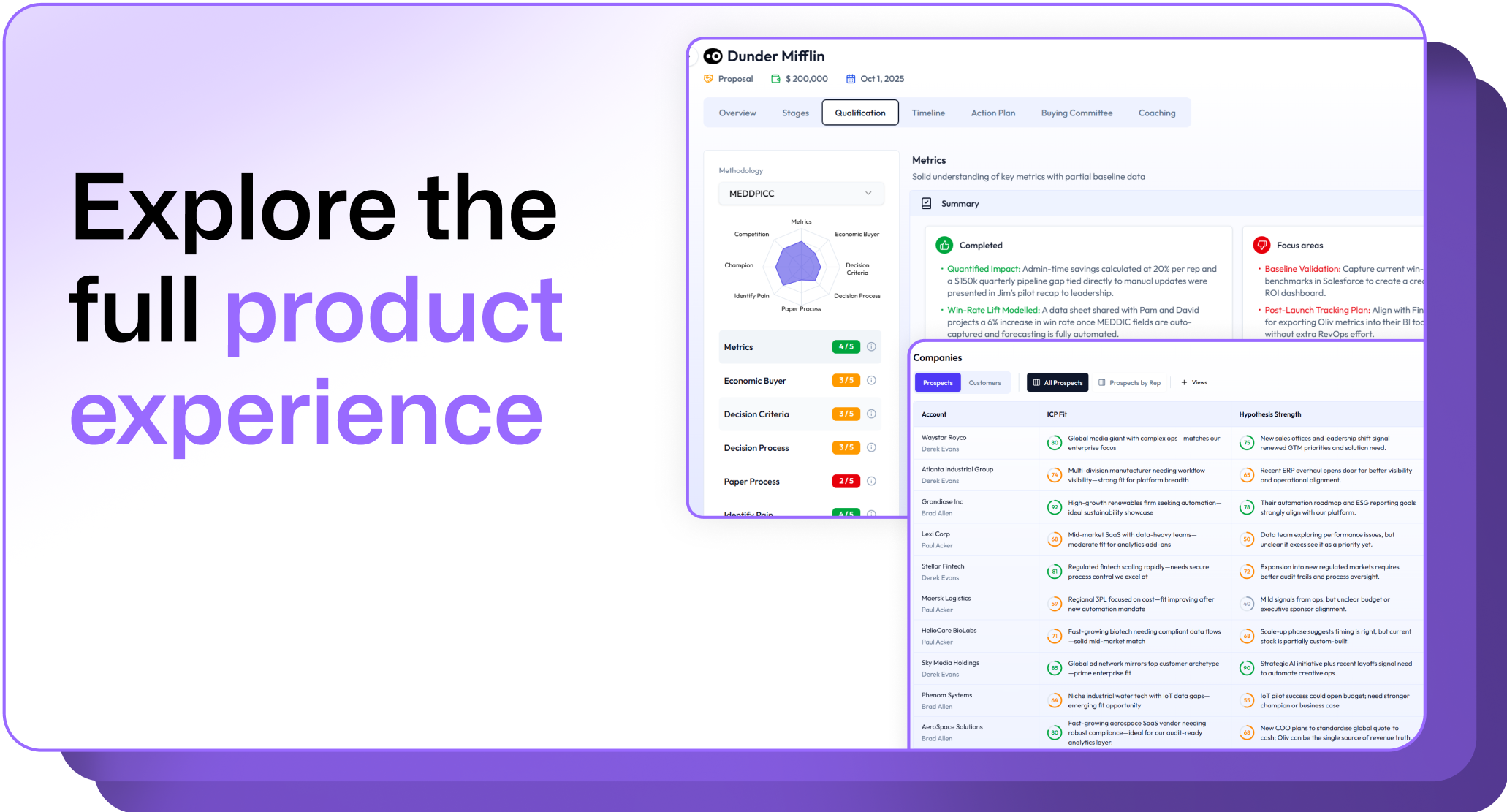
.avif)







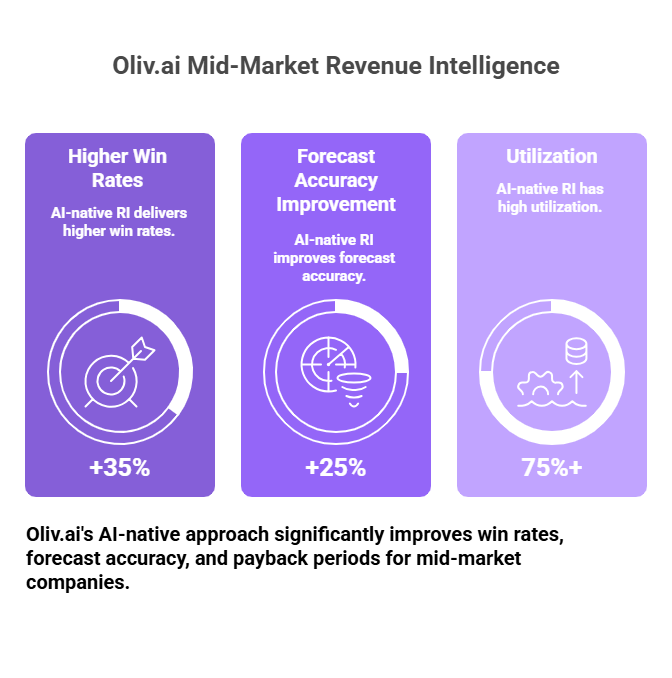
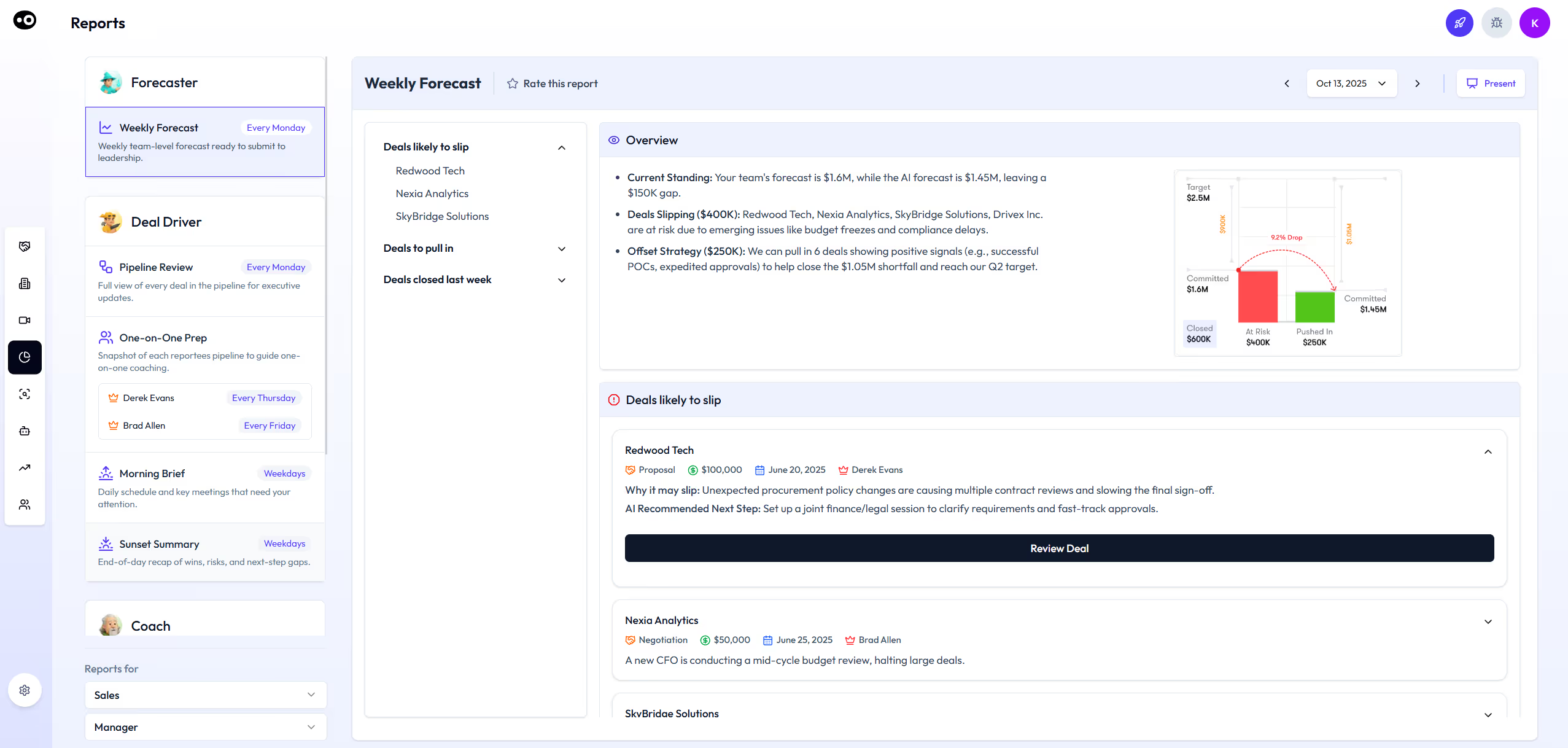
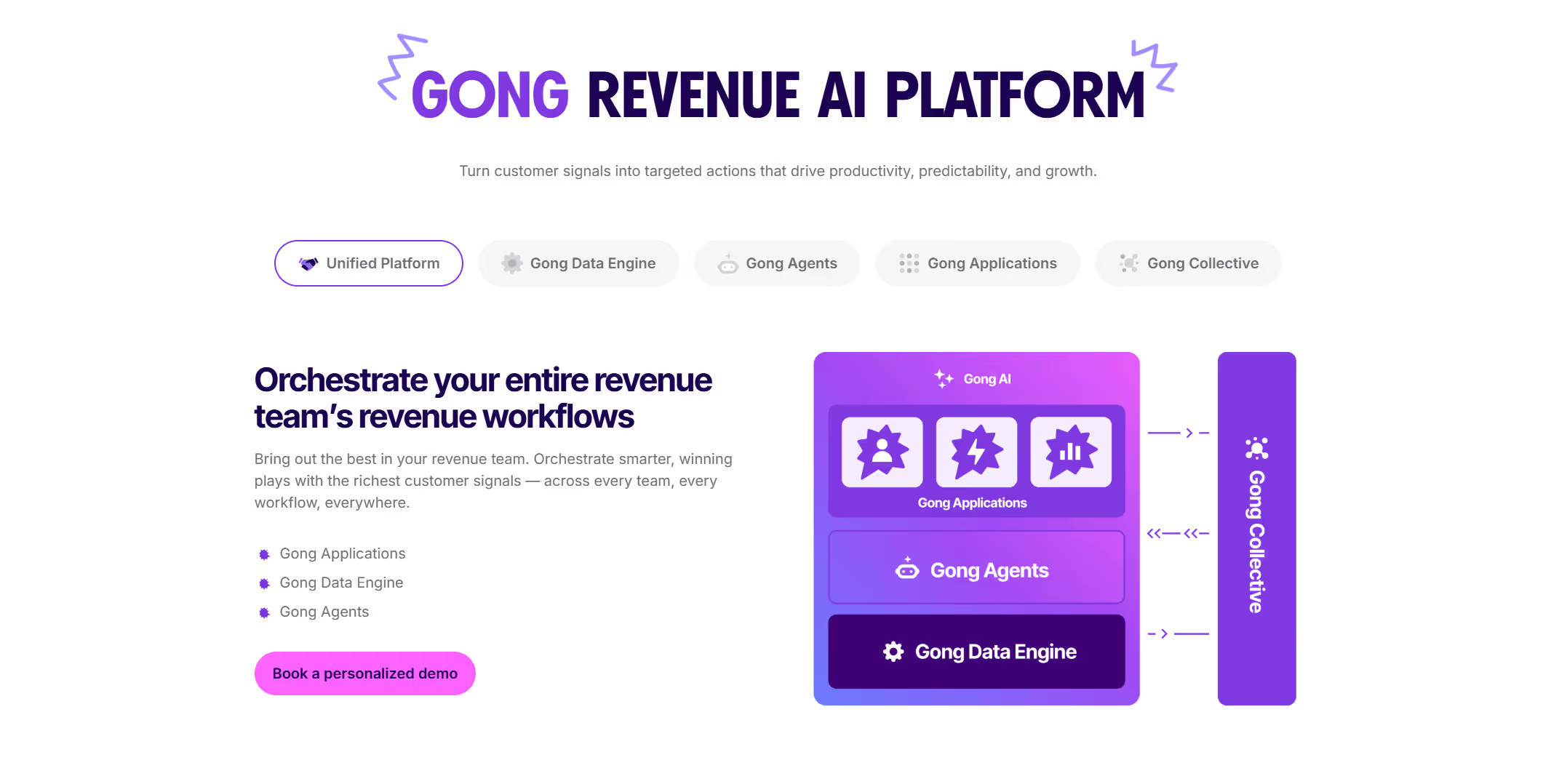
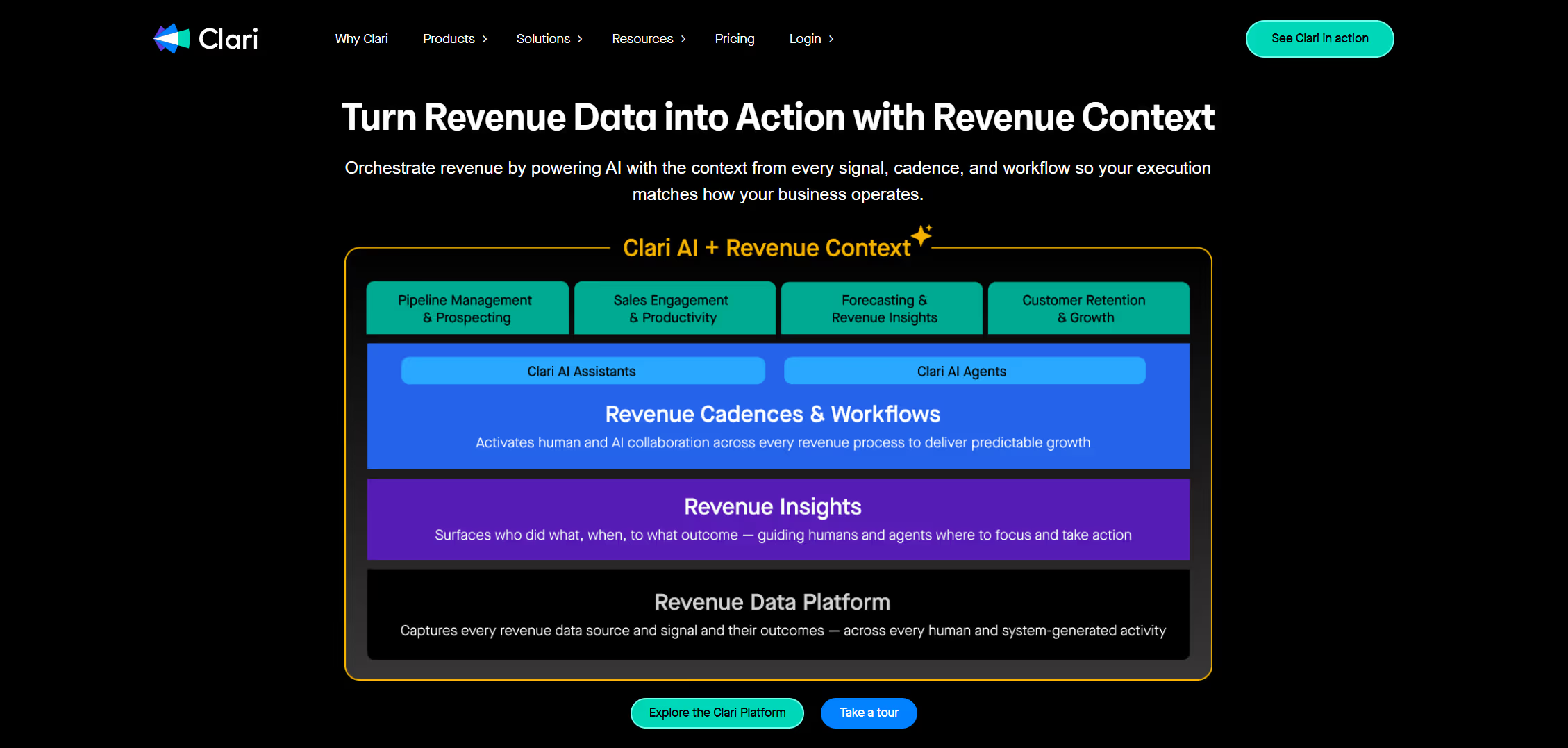
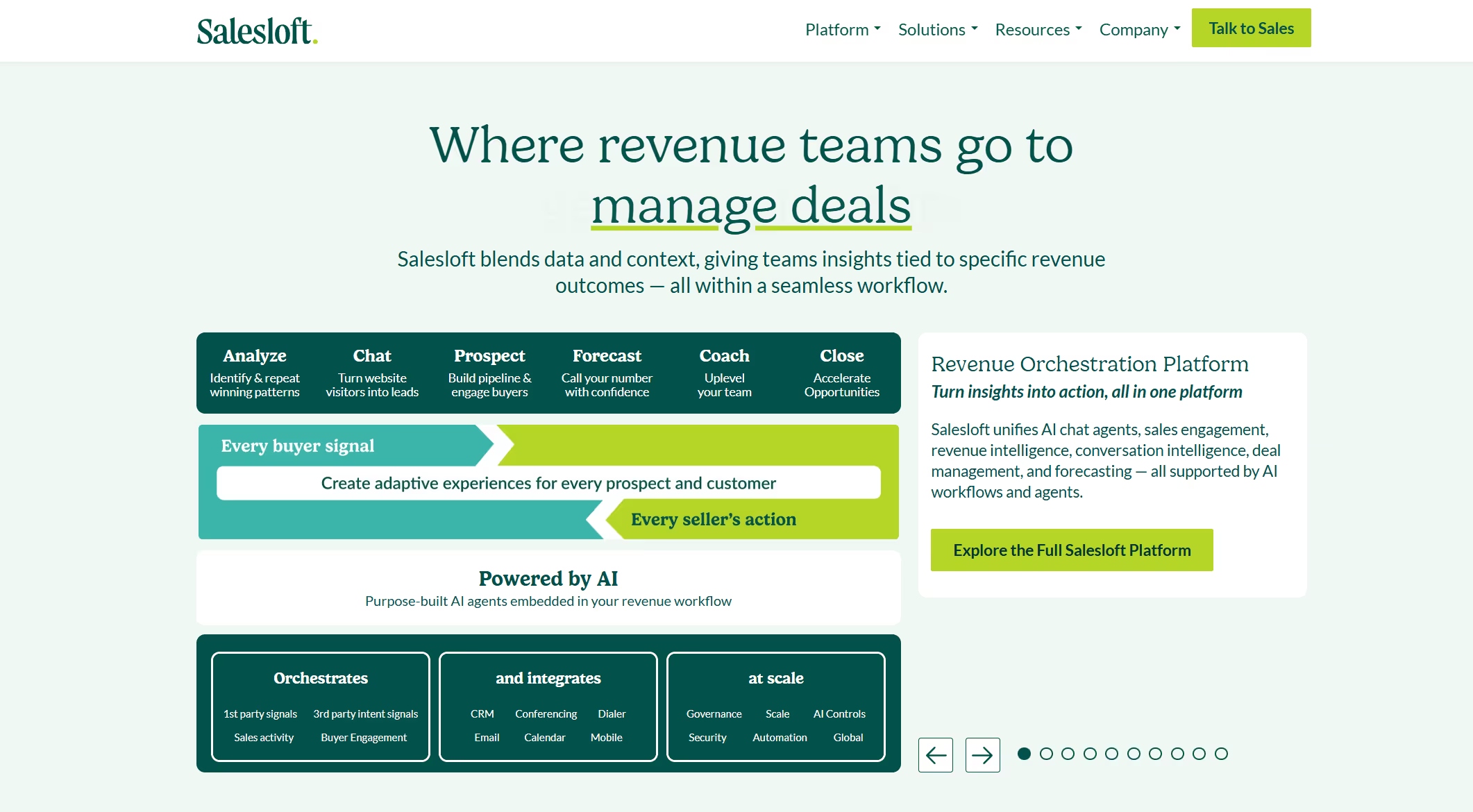
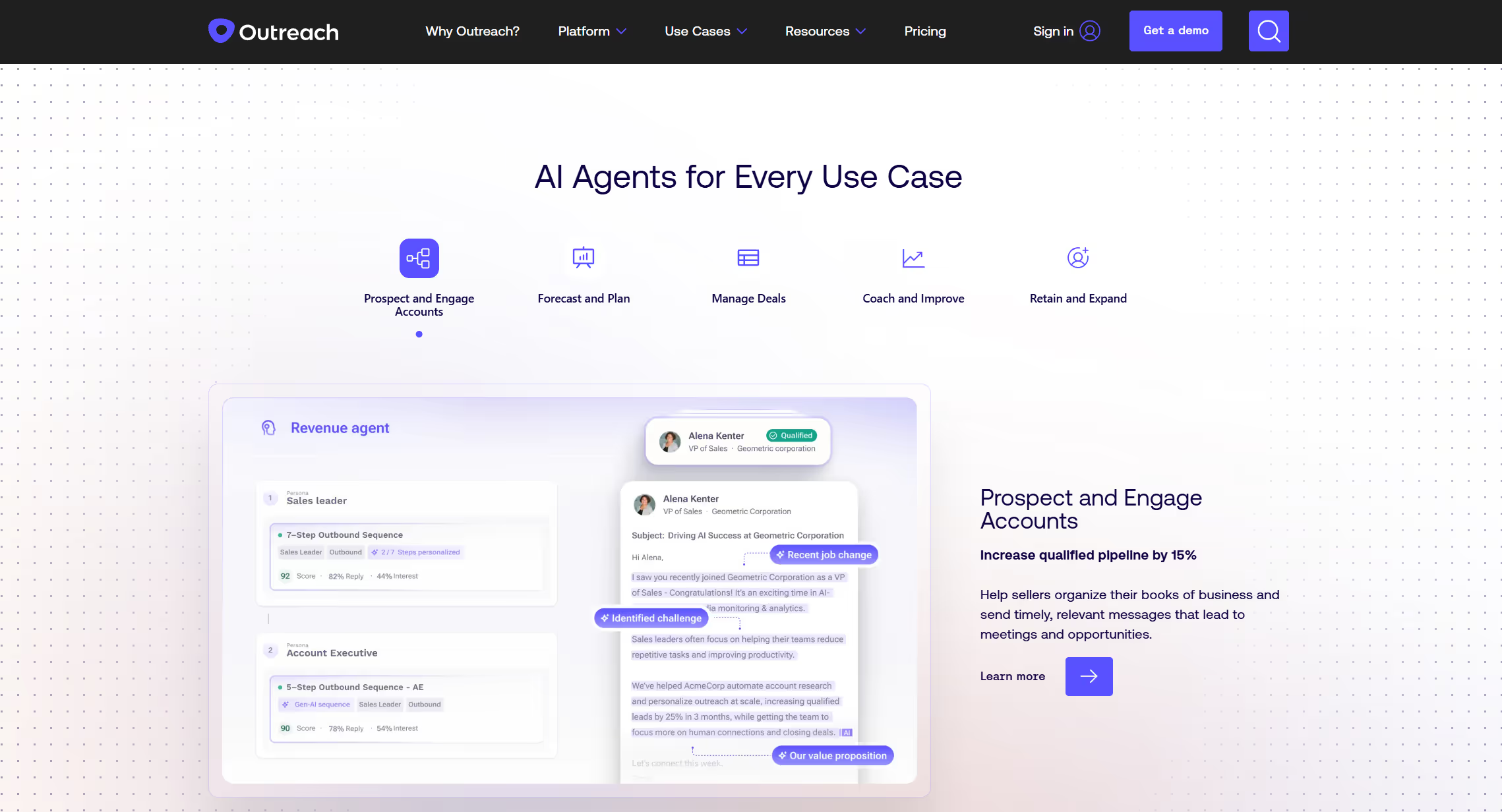
.png)
.png)
.png)

.png)