Why Your Deal View Is Missing Half the Picture | A Sales Leader's Guide to Cross-Channel Intelligence
Written by
Ishan Chhabra
Last Updated :
March 23, 2026
Skim in :
8
mins
In this article
Revenue teams love Oliv
Here’s why:
All your deal data unified (from 30+ tools and tabs).
Insights are delivered to you directly, no digging.
AI agents automate tasks for you.
Thank you! Your submission has been received!
Oops! Something went wrong while submitting the form.
Meet Oliv’s AI Agents
Hi! I’m, Deal Driver
I track deals, flag risks, send weekly pipeline updates and give sales managers full visibility into deal progress
Hi! I’m, CRM Manager
I maintain CRM hygiene by updating core, custom and qualification fields all without your team lifting a finger
Hi! I’m, Forecaster
I build accurate forecasts based on real deal movement and tell you which deals to pull in to hit your number
Hi! I’m, Coach
I believe performance fuels revenue. I spot skill gaps, score calls and build coaching plans to help every rep level up
Hi! I’m, Prospector
I dig into target accounts to surface the right contacts, tailor and time outreach so you always strike when it counts
Hi! I’m, Pipeline tracker
I call reps to get deal updates, and deliver a real-time, CRM-synced roll-up view of deal progress
Hi! I’m, Analyst
I answer complex pipeline questions, uncover deal patterns, and build reports that guide strategic decisions
TL;DR
40-50% of deal signals happen outside recorded calls, in Slack, email, phone calls, and in-person meetings your CI tool never captures.
Gong excels at recorded call intelligence but cannot ingest Slack, lacks email context analysis, and has no mechanism for unrecorded interactions.
Clari's forecasting depends on manual rep input, missing cross-channel signals that drive ~67% average forecast accuracy under rep-driven models.
Oliv.ai's Voice Agent captures unrecorded deal updates through nightly five-minute rep debriefs, mapped automatically to CRM opportunities.
Oliv delivers 91% lower TCO than Gong over three years (~$68,400 vs. ~$789,300 for 100 users) while covering calls, Slack, email, and Telegram natively.
Implementation takes 5 minutes for baseline setup vs. 8-24 weeks for legacy tools, with free historical data migration included.
Q1. Why Is Your Deal View Missing Half the Picture? [toc=Deal View Blind Spots]
Modern B2B buying groups span 5 to 16 stakeholders across multiple functions, yet most sales leaders only see what happened on a recorded Zoom call. That recorded meeting represents roughly half of the deal's actual communication footprint. The other half, shared Slack channels, side-thread emails, Telegram groups, unrecorded phone calls, and in-person conversations, lives in what's increasingly called "Dark Social" in sales. If you're a Head of Sales managing 50 to 200 reps across a growth-stage or mid-market org, your pipeline view is structurally incomplete before you even open the dashboard.
❌ The Legacy Blind Spot: Call-Centric Intelligence
The reason this gap exists traces back to how the first generation of revenue intelligence tools were architected. Gong was built as a meeting-level conversation intelligence platform, exceptional at recording, transcribing, and analyzing calls, but fundamentally limited to what happens on a recorded bridge. It doesn't import from Slack, and its email integration tracks whether an email was sent or opened, not what was actually said. As one Director of Sales noted:
Clari, meanwhile, remains a pre-generative AI dashboard where managers must "pull in" data rather than having intelligence pushed to them. Its forecasting depends on reps manually inputting deal context, and if they don't, that deal is invisible.
✅ The AI-Era Shift: Stitching the Full Picture
Generative AI and agentic systems have fundamentally changed what's possible. Instead of requiring managers to dig through dashboards, AI agents can now stitch data from calls, emails, Slack, Telegram, support tickets, and even unrecorded interactions into a single evolving deal narrative, a 360-degree view that updates autonomously.
How Oliv Captures Both Halves
Oliv AI is an AI-native data platform purpose-built for this cross-channel reality. Our AI Data Platform stitches Calls + Emails + Slack + Telegram + Support Tickets into one unified account history. Where other tools stop at recordings, Oliv's Voice Agent captures off-the-record updates from phone calls and in-person meetings by debriefing reps daily. The Deal Driver Agent flags at-risk deals each morning, and the Forecaster Agent delivers unbiased pipeline summaries, all without requiring a single dashboard login.
"Gong blew up my Slack all day... With Oliv, I finally get what I need, forecast, pipeline review, deal updates dropped right in my inbox." — Mia Patterson, Sales Manager, Beacon
This article is your systematic guide to closing each of those cross-channel gaps, from Slack alert fatigue to unrecorded meeting capture to unified pipeline views.
Q2. What Is Cross-Channel Deal Intelligence and Why Does It Matter for Sales Leaders? [toc=Cross-Channel Intelligence Defined]
Cross-channel deal intelligence is the practice of capturing, unifying, and analyzing buyer signals from every communication channel where a deal progresses, not just recorded meetings, but also email threads, Slack conversations, Telegram messages, phone calls, support tickets, and in-person interactions, to build a complete, real-time picture of deal health.
How It Differs from Conversation Intelligence
Traditional conversation intelligence (CI), the category Gong pioneered, focuses primarily on recorded sales calls. CI tools transcribe meetings, flag keywords, and score rep performance. While valuable, this approach captures only one channel of a multi-channel buying process.
Cross-channel deal intelligence extends beyond CI by:
Ingesting multi-channel data: Emails, Slack threads, Telegram messages, support tickets, and web interactions, not just recorded calls
Mapping signals to CRM deals: Using AI-based object association to connect fragmented conversations to the correct opportunity, even across duplicate CRM records
Generating evolving deal narratives: Rather than static meeting summaries, producing a continuously updated account story that reflects all touchpoints
Delivering proactive intelligence: Pushing curated insights to managers via Slack or email instead of requiring dashboard access
⚠️ Why It Matters: The Revenue Impact
The gap between conversation intelligence and cross-channel deal intelligence has measurable consequences for sales leaders:
CI-Only vs Cross-Channel Approach
Metric
CI-Only Approach
Cross-Channel Approach
Channels captured
Recorded calls only
Calls + Email + Slack + Telegram + In-person
Forecast accuracy
Rep-driven, biased input
Signal-based, objective analysis
Deal risk detection
Post-call keyword flags
Real-time multi-channel sentiment shifts
CRM completeness
Manual entry dependent
Autonomous data capture
Manager time spent
8+ hrs/week dashboard digging
Proactive daily summaries delivered
✅ The Shift Sales Leaders Need
As one Clari user highlighted, even robust forecasting tools have limits when the underlying data is incomplete:
For sales leaders, the shift from conversation intelligence to cross-channel deal intelligence is the difference between seeing one dimension of a deal and seeing all of them. Oliv AI addresses this gap as an AI-native data platform that stitches data across every customer interaction into a continuous 360-degree account view.
Q3. Why Is Slack Full of Sales Tool Alerts That Nobody Reads? [toc=Slack Alert Fatigue]
Picture this: it's 8:30 AM, and a Sales Manager overseeing 8 to 12 reps opens Slack to find 47 unread notifications from their CI tool. "Budget mentioned." "Competitor named." "Pricing discussed." Every keyword trigger has fired, but not a single alert explains whether the prospect was seriously evaluating a competitor or just mentioned one in passing. This is the alert fatigue crisis that plagues sales teams using first-generation intelligence tools.
❌ The Keyword Trap: Why Legacy Alerts Fail
Gong's Smart Trackers are built on V1 machine learning, keyword matching and basic rule-based logic that flags any occurrence of a configured term. When the word "budget" triggers an alert regardless of whether the prospect said "we need to finalize budget approval" or "I just got back from planning my holiday budget," the system becomes noisy and useless. Managers eventually mute these channels entirely, and actual deal risks slip through unnoticed.
Clari takes the opposite approach, no proactive alerts at all. It's a dashboard you must actively pull data from, meaning risks only surface when a manager finds time to log in and dig.
✅ The Generative AI Shift: Intent Over Keywords
Generative AI reasoning models, specifically Chain-of-Thought architectures, can distinguish between a passing mention and active evaluation. Instead of firing on every keyword occurrence, intent-based alerting analyzes the full conversational context: who said it, what prompted it, and whether it signals a real deal risk or routine conversation.
How Oliv Replaces Noise with Signal
Oliv is generative AI-native, using reasoning models to understand intent, not just keywords. Instead of flooding Slack with every mention, Oliv only flags specific contextual risks:
⚠️ A champion going silent across all channels for 7+ days
⏰ A Mutual Action Plan milestone being missed or delayed
❌ A sentiment shift detected across the last three stakeholder interactions
💰 A budget conversation that signals active procurement evaluation (not casual mention)
Each alert explains why it matters and what action to take, then delivers it to Slack, email, or both based on user preference.
Meanwhile, another Gong user reinforced why this matters at scale:
"Gong is strong at conversation intelligence, but that's where its usefulness ends... The tool is slow, buggy, and creates an excessive administrative burden on the user side." — Anonymous Reviewer, G2 Verified Review
The result is a shift from 50+ daily Slack notifications to 3 to 5 curated, actionable alerts, each one tied to a specific deal and a recommended next step. Five note-takers, zero task completion is replaced by one AI agent that delivers finished intelligence exactly where you work.
Q4. Half My Deals Are on Slack, the Other Half on Email: How Do I Get a Single View? [toc=Unified Slack and Email View]
In growth-stage and mid-market organizations, deal communication is inherently fragmented. Some buyers prefer Slack Connect channels for real-time collaboration. Others live in email threads with formal procurement language. Enterprise deals often span both channels, plus Telegram groups, shared documents, and side conversations that never touch the CRM. For a Head of Sales trying to forecast accurately, this fragmentation means the pipeline view only reflects whichever channel the CI tool happens to capture.
❌ The Integration Gap in Legacy Tools
Gong doesn't import from Slack. Its email integration is limited to tracking whether an email was sent and whether it was opened, not understanding the content or context of the exchange. This means Gong provides a "fragmented view from limited sources" where an entire dimension of buyer engagement remains invisible.
As one reviewer on data portability limitations noted:
"The lack of robust data export options has made it hard to justify the platform's cost, especially as it falls short of meeting practical data management needs." — Neel P., Sales Operations Manager, G2 Verified Review
⚠️ CRM-Dependent Visibility Falls Short
Clari's pipeline visibility is CRM-dependent, if the rep didn't manually log the Slack conversation or email context into Salesforce, that interaction doesn't exist in Clari's view. Even satisfied users acknowledge the underlying challenge:
"I am disappointed with the limited configurability of dashboards, which feel too basic and lack customization options. Also, Clari's integration capabilities are inadequate, particularly in pulling in call transcripts, which requires working with other tools." — Josiah R., Head of Sales Operations, G2 Verified Review
✅ The AI Data Platform Approach
The solution requires an intelligence layer that natively ingests Slack channels, email threads, Telegram conversations, and CRM records, then uses AI-based object association to map each interaction to the correct deal. This is fundamentally different from building integrations on top of a call-recording platform. In complex enterprise environments with duplicate accounts ("Google US" vs. "Google India"), rule-based mapping breaks down completely. LLM-powered reasoning can analyze conversation history and content to determine the correct association.
How Oliv Stitches the 360 Degree Deal Narrative
Oliv is the only platform that stitches Calls + Emails + Slack + Telegram + Support Tickets into a single account history. Our CRM Manager Agent uses LLM-based reasoning, not brittle rules, to associate every activity to the right opportunity, even in duplicate-heavy CRM environments. The result is one Evolving Deal Summary that updates with every new signal from any channel.
Rather than requiring managers to cross-reference three tools, Oliv maintains a full open export policy back into the CRM, ensuring Salesforce or HubSpot remains the single source of truth, enriched with context that was previously invisible.
The difference is architectural: legacy tools bolt cross-channel data onto a call-recording platform. Oliv was built from the ground up as an AI-native revenue orchestration platform where every channel is a first-class data source, and every signal feeds one unified deal narrative.
Q5. How Do I Capture Off-the-Record Updates from Phone Calls and In-Person Meetings? [toc=Unrecorded Meeting Capture]
Every sales leader has experienced it: a rep mentions during Monday's forecast call that a key stakeholder gave verbal approval during a Friday lunch meeting, but that data point never made it into the CRM, the pipeline view, or any dashboard. In high-velocity cycles with 15 to 20 day closes, deals move faster than weekly reviews can track. Unrecorded phone calls from personal devices, hallway conversations at trade shows, and sensitive in-person negotiations represent a massive intelligence gap, what one industry analysis calls the "invisible half" of the pipeline.
Most CI tools only capture the recorded half of your pipeline. The other half, Slack, email, phone calls, and in-person meetings, stays invisible.
⚠️ Generation 1 CI: Built for Zoom, Blind to Everything Else
Gong and Chorus were architected as meeting-level recorders, functionally blind to anything that doesn't happen on a recorded Zoom, Teams, or Google Meet bridge. They were engineered for a decade when the core assumption was that all meaningful sales conversations would be virtual and recorded. But in reality, enterprise deals don't follow that script. A prospect might call your rep's personal phone to discuss pricing sensitivities they wouldn't put in writing. A champion might share competitive intel over coffee at a conference. None of this reaches Gong's database.
Generative AI has unlocked a fundamentally new approach: voice-based AI agents that proactively gather context from reps about their unrecorded interactions. Instead of waiting for a rep to type notes into a CRM field they resent, an AI agent can call the rep, conduct a structured debrief, extract deal signals and action items, and map those updates back to the correct opportunity, all without a single manual keystroke.
✅ How Oliv's Voice Agent Closes the Gap
Oliv.ai's Voice Agent represents the clearest differentiation in this space. It autonomously calls reps every evening for a quick five-minute debrief on unrecorded interactions, phone calls, in-person meetings, and off-platform exchanges. The captured context is processed through Oliv's intelligence layer, mapped to the correct deal using AI-based object association, and integrated into the 360-degree deal view.
The result: managers receive a "Sunset Summary" every evening of what happened across all channels that day, not just what was recorded on Zoom. No information stays trapped in a rep's head. The "stakeholders I didn't know existed" problem, where deals surface surprise decision-makers during final stages because earlier in-person interactions were never captured, is eliminated before it can derail a forecast.
"I was tired of playing catch-up with yesterday's calls just to figure out what's going on in a deal. I like how Oliv sends meeting highlights and spot-on AI notes, saving me hours of late-night call reviews." — Chris Delgado, Regional Sales Lead at NimbusTrail Analytics
Oliv's Voice Agent captures unrecorded deal updates through nightly rep debriefs and maps them to the correct CRM opportunity automatically.
Q6. Can One Platform Handle Zoom, Google Meet, and Teams Across a Distributed Team? [toc=Mixed Platform Support]
Fragmented meeting platforms are the norm, not the exception. Growth-stage and mid-market teams routinely juggle Zoom for internal standups, Google Meet when a prospect insists, Microsoft Teams for enterprise accounts, and multiple dialers depending on the sales motion. The question isn't whether your team uses multiple platforms, it's whether your conversation intelligence tool can keep up.
📋 The Cross-Platform Challenge
Most first-generation CI tools were built during a period when teams standardized on a single video bridge. As remote work exploded and buyer preferences diversified, these tools struggled to maintain seamless, native coverage across all providers. The result is gaps in recording coverage, and gaps in pipeline visibility.
Salesforce Einstein Conversation Insights: Covers major platforms but carries a high Total Cost of Ownership, requiring multiple expensive add-ons (Sales Cloud Einstein, Conversation Insights, Data Cloud) just to achieve baseline cross-platform recording. One user noted: "The cost of implementation is quite high for small businesses and also it is a little difficult to use the product for those who are new to AI." — Verified Reviewer, Gartner Peer Insights
Gong: Strongest cross-platform recording among legacy tools, but its lack of open task APIs limits integration with parallel dialers. A reviewer noted: "The platform lacks task APIs, does not integrate with other vendors or parallel dialers." — Anonymous Reviewer, G2 Verified Review
✅ How Oliv.ai Simplifies Cross-Platform Coverage
Oliv.ai acts as a Unified Intelligence Layer that natively integrates with Zoom, Microsoft Teams, Google Meet, and Cisco Webex, alongside major dialers including Orum, Nooks, JustCall, Aircall, and Dialpad. All data flows into Oliv's AI Data Platform, providing one consolidated view regardless of which meeting platform was used. Baseline configuration takes just 5 minutes, compared to the multi-week implementation cycles required by legacy stacks.
Q7. How Do I Choose Between Slack Alerts, Email Digests, or Both? [toc=Alert Channel Configuration]
A CRO wants a monthly high-level revenue snapshot. A Sales Manager needs a weekly pipeline roll-up. An AE needs a daily prep note 30 minutes before their next call. Yet most legacy tools force everyone into the same rigid UI, or blast identical alerts to all roles, all channels, all day. This one-size-fits-all notification model is a primary driver of the alert fatigue epidemic plaguing modern sales orgs.
❌ The Legacy Notification Problem
Gong is frequently described as a "noisy platform" that floods Slack with keyword-based alerts without providing the necessary context to act on them. Its unified license cost forces teams to pay for advanced features even if they only need basic alert configurability. One user captured this frustration precisely:
Salesforce Agentforce takes a fundamentally different, but equally problematic, approach. It is heavily chat-based, meaning a rep must manually "talk to a bot" to retrieve insights rather than receiving proactive, cross-channel nudges. Clari has no proactive push mechanism at all, it remains a dashboard you must pull data from.
✅ "Insights, Right on Time" - Oliv's Configurable Delivery
Oliv.ai replaces spam with what we call "Manager Roll-ups", curated intelligence delivered to the right persona, in the right channel, at the right cadence:
⏰ Morning Brief: Pushed to Slack 30 minutes before a call, telling the rep exactly what to cover based on deal history
📋 Weekly Pipeline Review: A consolidated email report highlighting only deals that progressed, quick wins, and at-risk opportunities
📊 Forecaster Agent: Delivers a board-ready deck every Monday to the VP's inbox, automating the manual Thursday/Friday roll-up process
🔔 Custom Channel Preference: Users choose Slack, email, or both, per agent, per cadence
"Gong blew up my Slack all day, but I still had to click through ten screens just to find something useful. With Oliv, I finally get what I need... dropped right in my inbox. This just works." — Mia Patterson, Sales Manager at Beacon
Q8. How Does Gong Handle Cross-Channel Visibility, and Where Does It Fall Short? [toc=Gong Cross-Channel Gaps]
Gong has earned its position as the benchmark for Generation 1 conversation intelligence. It boasts massive brand authority, strong coaching insights for recorded calls, and a loyal user base, managers often feel they can't run a team without it. As one reviewer put it: "Gong has become the single source of truth for our sales team." — Scott T., Director of Sales, G2 Verified Review. But being the best at recorded call analysis doesn't mean being the best at cross-channel deal visibility.
⚠️ Documented Limitations: What Gong Doesn't Cover
No Slack ingestion: Gong doesn't import from Slack, leaving shared-channel deal discussions invisible
Limited email intelligence: Email integration tracks send/open metadata rather than understanding exchange context
Keyword-based Smart Trackers: Built on V1 machine learning, they flag "budget" even when a prospect discusses "holiday budget"
Restricted data export: Individual call downloads only; no bulk export. A reviewer stated: "The lack of robust data export options has made it hard to justify the platform's cost." — Neel P., Sales Operations Manager, G2 Verified Review
Additional cost for core modules:Forecast and Engage come at extra cost beyond the base license
"It's too complicated, and not intuitive at all. Using it is very...discomforting. Searching for calls is not easy, moving around in the calls is not easy, and understanding the pipeline management portion of it is almost impossible." — John S., Senior Account Executive, G2 Verified Review
❌ The Architectural Gap
Gong was built as a meeting-level intelligence tool trying to expand into a platform, but its one-way integrations make it hard to export intelligence back into the CRM. It aims to be the "center of the data universe" but in doing so creates a new silo, data goes in but doesn't flow out in a structured, reportable format. Gong only logs activity notes, making it impossible to run structured reports on deal progression.
✅ How Oliv Closes Gong's Cross-Channel Gaps
Oliv.ai addresses each of these limitations architecturally:
Full open export policy, complete CSV dump of all data on termination; no UI lock-in
AI-based object association vs. brittle rules, correctly maps activities even with duplicate CRM records like "Google US vs Google India"
Actual CRM object updates, writes to real fields and properties, not just activity notes
💰 The TCO Reality
Oliv is up to 91% cheaper than Gong over a three-year period for a 100-user team (~$68,400 vs. ~$789,300). For teams that find Gong's capabilities misaligned with their budget:
"It was a big mistake on our part to commit to a two year term. Gong is a really powerful tool but it's probably the highest end option on the market, and now we're stuck with a tool that works technically but isn't the right business decision." — Iris P., Head of Marketing, Sales & Partnerships, G2 Verified Review
Q9. Where Does Clari's Pipeline View Leave Gaps in Cross-Channel Intelligence? [toc=Clari Pipeline Gaps]
Clari has earned genuine respect as a forecasting-first platform. Its clean UI for pipeline inspection, strong Salesforce integration, and intuitive analytics make it a go-to for revenue leaders running weekly forecast calls. As one Senior Director noted: "Super for forecasting and understanding full number to achieve inside quarter. Helps field, legal, SalesOps and DealOps collaborate to get better understanding of likely quarter outcome." — Edwin M., Senior Director Legal, G2 Verified Review. These strengths are real, but they obscure a structural limitation that matters more every quarter.
⚠️ The Manual Input Dependency
Clari's forecasting process remains fundamentally rep-driven and manual. Managers must sit with reps every Thursday and Friday to "hear the story of a deal" before manually inputting data into the Clari UI. If a rep doesn't update a field, that signal doesn't exist in Clari's view. It cannot ingest Slack conversations, Telegram threads, or unrecorded in-person interactions, the "Dark Social" channels where modern deals actually progress.
Users consistently flag this gap:
"I am disappointed with the limited configurability of dashboards, which feel too basic and lack customization options. Also, Clari's integration capabilities are inadequate, particularly in pulling in call transcripts, which requires working with other tools." — Josiah R., Head of Sales Operations, G2 Verified Review
"It is really just a glorified SFDC overlay. Actually, Salesforce has built most of the forecasting functionality by now anyway so I'm not sure where they fit into that whole overcrowded Martech space." — conaldinho11, r/SalesOperations Reddit Thread
❌ The Forecast Accuracy Problem
When the forecast depends on biased rep input rather than objective cross-channel signals, accuracy suffers. Industry benchmarks suggest forecast accuracy averages only ~67% under rep-driven models. Cross-selling signals buried in Slack threads, churn indicators in support tickets, and stakeholder changes discussed over email never reach Clari's pipeline view, because Clari was built as a pre-generative AI dashboard that requires leaders to pull data in, not have it pushed to them.
✅ How Oliv's Forecaster Agent Changes the Equation
Oliv.ai's Forecaster Agent performs bottom-up forecasting autonomously by inspecting every deal line-by-line across all channels, calls, emails, Slack, Telegram, and support tickets. It delivers unbiased weekly roll-ups with AI commentary on risks and quick wins, requiring zero manual input from reps or managers. The output can be converted into a board-ready presentation deck in one click.
Manual forecasting depends on rep input and weekly meetings. Autonomous forecasting inspects every deal across all channels without human bottlenecks.
"Before switching to Oliv, cleaning up messy CRM fields and guessing at forecasts used to swallow half my week. Oliv fixes the data as it happens and drops a forecast I can actually bank on." — Darius Kim, Head of RevOps at Driftloop
💰 The Cost of Stacking Tools
For context: stacking Gong (for CI) + Clari (for forecasting) can exceed $500/user/month. Oliv offers both capabilities, conversation intelligence and autonomous forecasting, in a single unified platform at a fraction of that cost.
Q10. Gong vs. Clari vs. Oliv: Cross-Channel Capability Comparison [toc=Gong vs Clari vs Oliv]
Choosing between Gong, Clari, and Oliv.ai requires understanding how each platform handles cross-channel deal intelligence, not just recorded call analysis. The table below compares all three across the dimensions that matter most to sales leaders managing distributed, multi-channel pipelines.
📋 Cross-Channel Feature Matrix
Cross-Channel Feature Matrix: Gong vs Clari vs Oliv.ai
Capability
Gong
Clari
Oliv.ai
Recorded Call Intelligence
✅ Best-in-class CI for Zoom, Meet, Teams
✅ Copilot add-on for basic CI
✅ Native CI across all platforms
Slack Conversation Ingestion
❌ Does not import from Slack
❌ No Slack ingestion
✅ Native Slack thread capture + deal mapping
Email Context Analysis
⚠️ Tracks send/open metadata only
⚠️ CRM-dependent email sync
✅ Full email thread analysis + context extraction
Telegram / Dark Social
❌ Not supported
❌ Not supported
✅ Telegram + support ticket ingestion
Unrecorded Meeting Capture
❌ Meeting-level recorder only
❌ No mechanism
✅ Voice Agent nightly debrief
Alert Configurability
⚠️ Keyword-based Smart Trackers
❌ No proactive alerts
✅ Intent-based, configurable (Slack/email/both)
CRM Data Sync
⚠️ Logs activity notes only
✅ Two-way Salesforce sync
✅ Updates actual CRM objects + properties
Forecast Generation
⚠️ Add-on at extra cost
✅ Core strength (manual input)
✅ Autonomous, AI-driven bottom-up forecasting
Data Export Policy
❌ Individual call downloads only
⚠️ Standard export capabilities
✅ Full open CSV export on termination
Processing Speed
⚠️ 20 to 30 minute delay
✅ Real-time CRM overlay
✅ 5-minute processing
Mixed Platform Support
✅ Zoom, Meet, Teams, Webex
⚠️ Depends on CRM data
✅ Zoom, Meet, Teams, Webex + 5 dialers
Implementation Time
⚠️ 8 to 24 weeks, 40 to 140 admin hours
⚠️ Moderate setup + training
✅ 5 minutes baseline, 2 to 4 weeks customization
3-Year TCO (100 users)
💸 ~$789,300
💸 Varies (add to Gong cost)
💰 ~$68,400
Sources: Product documentation, founder interviews, G2/TrustRadius user reviews
⚠️ Key Takeaways
Gong excels at recorded call intelligence but leaves Slack, email context, and unrecorded meetings completely dark. As one reviewer noted: "The additional products like forecast or engage come at an additional cost. Would be great to see these tools rolled into the core offering." — Scott T., Director of Sales, G2 Verified Review
Clari is strong at forecast visualization but depends entirely on data that reps and CRM integrations provide, it cannot independently discover deal signals.
Oliv.ai is the only platform that natively stitches calls, emails, Slack, Telegram, and unrecorded interactions into a single autonomous deal narrative.
Q11. What Does a Fully Connected Deal View Actually Look Like? [toc=Connected Deal View]
Picture this: it's Monday at 8 AM. A Sales Manager opens Slack to find 47 unread alerts from Gong, "budget mentioned," "competitor named," "next steps discussed," with no context on which of these actually need attention. She switches to Clari to manually pull pipeline data, then checks email for rep updates, then opens the CRM to cross-reference. By 10 AM, she still doesn't have a clear picture of which deals moved over the weekend. This is the reality of managing a team through legacy tools.
❌ The "Chief Firefighter" Problem
Under the traditional workflow, managers become what industry observers call "Chief Firefighters," spending 8+ hours per week on administrative intelligence gathering. They audit calls while showering or driving, correlate signals across 3 to 4 disconnected tools, and hold 45 to 60 minute pipe reviews per rep just to assemble a picture that's already outdated by the time it's complete. "Note-taker fatigue" sets in when teams have five recording bots but zero task completion.
"It's too complicated, and not intuitive at all. Using it is very...discomforting. Searching for calls is not easy, moving around in the calls is not easy." — John S., Senior Account Executive, G2 Verified Review
✅ The "After" Scenario with Oliv
Now picture Monday at 7:30 AM. Before the manager even opens Slack, the Forecaster Agent has delivered a one-page forecast report to her inbox with AI commentary on risks and quick wins. The Deal Driver Agent has already flagged three deals needing immediate attention, a champion who went silent, a MAP milestone missed, and a new stakeholder entering a late-stage deal. The Voice Agent captured Friday's in-person meeting update from a rep and mapped it to the correct CRM opportunity overnight.
⏰ Agents at Work Throughout the Day
Morning Brief arrives in Slack 30 minutes before each rep's first call, with prep notes based on complete deal history
CRM Manager Agent has auto-updated all fields from last week's interactions, standard and custom fields, enriched contacts, methodology scorecards
Sunset Summary drops every evening with cross-channel highlights: what happened across calls, emails, Slack, and unrecorded conversations
The manager reclaims one full day per week previously lost to dashboard digging and manual auditing
"Oliv drops the docs ready to send exactly when I need them, easily the best Gong alternative I've used." — Tara Jacobs, Account Manager at Riverstone Software
🔄 The Treadmill vs. Personal Trainer Analogy
The analogy is simple: traditional dashboards like Gong and Clari are like buying a high-end treadmill, expensive equipment, but your sales team still does all the running (manual auditing, data entry, roll-ups). Oliv AI agents are the personal trainer and nutritionist who actually do the planning, monitoring, and heavy lifting, delivering the outcome of revenue predictability with significantly less manual effort.
Q12. How to Get Started with Cross-Channel Deal Intelligence [toc=Getting Started Guide]
Closing the cross-channel visibility gap doesn't require a multi-quarter implementation project. Below is a practical roadmap for sales leaders ready to move from fragmented pipeline views to unified, autonomous deal intelligence.
Step 1: Audit Your Current Channel Gaps
Before evaluating any tool, map where your deal conversations actually happen:
Identify which channels your current stack covers and where signals are going dark. Most teams discover that 40 to 50% of deal-advancing interactions happen outside their CI tool's reach.
Step 2: Evaluate Platform Architecture, Not Just Features
The critical distinction isn't feature count, it's whether the platform was built as a meeting-level recorder trying to expand or an AI-native revenue orchestration platform designed for cross-channel ingestion from day one. Key questions to ask:
Does it ingest Slack and Telegram natively, or only recorded calls?
Does it update actual CRM objects, or just log activity notes?
Can it capture unrecorded interactions through voice-based debriefs?
Does it offer full open data export, or does it create a new silo?
Step 3: Run a Focused Pilot
Start with a single high-value use case rather than a full platform rollout:
Forecast accuracy: Deploy the Forecaster Agent for one team and compare its autonomous output against manual roll-ups over 4 weeks.
At-risk deal detection: Activate the Deal Driver Agent to flag stalled deals daily and measure how many risks it catches that managers missed.
CRM hygiene: Use the CRM Manager Agent to auto-populate fields for one quarter and measure data completeness improvement.
Step 4: Measure Time-to-Value
Implementation speed matters. Legacy tools like Gong require 8 to 24 weeks and 40 to 140 admin hours for full deployment. When evaluating alternatives, benchmark against these timelines.
⏰ Oliv.ai's Onboarding Timeline
Oliv.ai Onboarding Timeline
Phase
Timeline
What Happens
Baseline Configuration
5 minutes
Connect CRM, calendar, email, and meeting platforms
Core Value Realized
1 to 2 days
First recordings processed, CRM fields auto-populated
Full Customization
2 to 4 weeks
Agent workflows tuned to your sales methodology (MEDDIC, BANT, etc.)
Historical Data Migration
Included free
Complete migration of historical Gong recordings and metadata at no cost
Oliv.ai also maintains a full open export policy, so if you ever decide to leave, you receive a complete CSV dump of all meetings and recordings, no UI lock-in, no data hostage situations.
Q1. Why Is Your Deal View Missing Half the Picture? [toc=Deal View Blind Spots]
Modern B2B buying groups span 5 to 16 stakeholders across multiple functions, yet most sales leaders only see what happened on a recorded Zoom call. That recorded meeting represents roughly half of the deal's actual communication footprint. The other half, shared Slack channels, side-thread emails, Telegram groups, unrecorded phone calls, and in-person conversations, lives in what's increasingly called "Dark Social" in sales. If you're a Head of Sales managing 50 to 200 reps across a growth-stage or mid-market org, your pipeline view is structurally incomplete before you even open the dashboard.
❌ The Legacy Blind Spot: Call-Centric Intelligence
The reason this gap exists traces back to how the first generation of revenue intelligence tools were architected. Gong was built as a meeting-level conversation intelligence platform, exceptional at recording, transcribing, and analyzing calls, but fundamentally limited to what happens on a recorded bridge. It doesn't import from Slack, and its email integration tracks whether an email was sent or opened, not what was actually said. As one Director of Sales noted:
Clari, meanwhile, remains a pre-generative AI dashboard where managers must "pull in" data rather than having intelligence pushed to them. Its forecasting depends on reps manually inputting deal context, and if they don't, that deal is invisible.
✅ The AI-Era Shift: Stitching the Full Picture
Generative AI and agentic systems have fundamentally changed what's possible. Instead of requiring managers to dig through dashboards, AI agents can now stitch data from calls, emails, Slack, Telegram, support tickets, and even unrecorded interactions into a single evolving deal narrative, a 360-degree view that updates autonomously.
How Oliv Captures Both Halves
Oliv AI is an AI-native data platform purpose-built for this cross-channel reality. Our AI Data Platform stitches Calls + Emails + Slack + Telegram + Support Tickets into one unified account history. Where other tools stop at recordings, Oliv's Voice Agent captures off-the-record updates from phone calls and in-person meetings by debriefing reps daily. The Deal Driver Agent flags at-risk deals each morning, and the Forecaster Agent delivers unbiased pipeline summaries, all without requiring a single dashboard login.
"Gong blew up my Slack all day... With Oliv, I finally get what I need, forecast, pipeline review, deal updates dropped right in my inbox." — Mia Patterson, Sales Manager, Beacon
This article is your systematic guide to closing each of those cross-channel gaps, from Slack alert fatigue to unrecorded meeting capture to unified pipeline views.
Q2. What Is Cross-Channel Deal Intelligence and Why Does It Matter for Sales Leaders? [toc=Cross-Channel Intelligence Defined]
Cross-channel deal intelligence is the practice of capturing, unifying, and analyzing buyer signals from every communication channel where a deal progresses, not just recorded meetings, but also email threads, Slack conversations, Telegram messages, phone calls, support tickets, and in-person interactions, to build a complete, real-time picture of deal health.
How It Differs from Conversation Intelligence
Traditional conversation intelligence (CI), the category Gong pioneered, focuses primarily on recorded sales calls. CI tools transcribe meetings, flag keywords, and score rep performance. While valuable, this approach captures only one channel of a multi-channel buying process.
Cross-channel deal intelligence extends beyond CI by:
Ingesting multi-channel data: Emails, Slack threads, Telegram messages, support tickets, and web interactions, not just recorded calls
Mapping signals to CRM deals: Using AI-based object association to connect fragmented conversations to the correct opportunity, even across duplicate CRM records
Generating evolving deal narratives: Rather than static meeting summaries, producing a continuously updated account story that reflects all touchpoints
Delivering proactive intelligence: Pushing curated insights to managers via Slack or email instead of requiring dashboard access
⚠️ Why It Matters: The Revenue Impact
The gap between conversation intelligence and cross-channel deal intelligence has measurable consequences for sales leaders:
CI-Only vs Cross-Channel Approach
Metric
CI-Only Approach
Cross-Channel Approach
Channels captured
Recorded calls only
Calls + Email + Slack + Telegram + In-person
Forecast accuracy
Rep-driven, biased input
Signal-based, objective analysis
Deal risk detection
Post-call keyword flags
Real-time multi-channel sentiment shifts
CRM completeness
Manual entry dependent
Autonomous data capture
Manager time spent
8+ hrs/week dashboard digging
Proactive daily summaries delivered
✅ The Shift Sales Leaders Need
As one Clari user highlighted, even robust forecasting tools have limits when the underlying data is incomplete:
For sales leaders, the shift from conversation intelligence to cross-channel deal intelligence is the difference between seeing one dimension of a deal and seeing all of them. Oliv AI addresses this gap as an AI-native data platform that stitches data across every customer interaction into a continuous 360-degree account view.
Q3. Why Is Slack Full of Sales Tool Alerts That Nobody Reads? [toc=Slack Alert Fatigue]
Picture this: it's 8:30 AM, and a Sales Manager overseeing 8 to 12 reps opens Slack to find 47 unread notifications from their CI tool. "Budget mentioned." "Competitor named." "Pricing discussed." Every keyword trigger has fired, but not a single alert explains whether the prospect was seriously evaluating a competitor or just mentioned one in passing. This is the alert fatigue crisis that plagues sales teams using first-generation intelligence tools.
❌ The Keyword Trap: Why Legacy Alerts Fail
Gong's Smart Trackers are built on V1 machine learning, keyword matching and basic rule-based logic that flags any occurrence of a configured term. When the word "budget" triggers an alert regardless of whether the prospect said "we need to finalize budget approval" or "I just got back from planning my holiday budget," the system becomes noisy and useless. Managers eventually mute these channels entirely, and actual deal risks slip through unnoticed.
Clari takes the opposite approach, no proactive alerts at all. It's a dashboard you must actively pull data from, meaning risks only surface when a manager finds time to log in and dig.
✅ The Generative AI Shift: Intent Over Keywords
Generative AI reasoning models, specifically Chain-of-Thought architectures, can distinguish between a passing mention and active evaluation. Instead of firing on every keyword occurrence, intent-based alerting analyzes the full conversational context: who said it, what prompted it, and whether it signals a real deal risk or routine conversation.
How Oliv Replaces Noise with Signal
Oliv is generative AI-native, using reasoning models to understand intent, not just keywords. Instead of flooding Slack with every mention, Oliv only flags specific contextual risks:
⚠️ A champion going silent across all channels for 7+ days
⏰ A Mutual Action Plan milestone being missed or delayed
❌ A sentiment shift detected across the last three stakeholder interactions
💰 A budget conversation that signals active procurement evaluation (not casual mention)
Each alert explains why it matters and what action to take, then delivers it to Slack, email, or both based on user preference.
Meanwhile, another Gong user reinforced why this matters at scale:
"Gong is strong at conversation intelligence, but that's where its usefulness ends... The tool is slow, buggy, and creates an excessive administrative burden on the user side." — Anonymous Reviewer, G2 Verified Review
The result is a shift from 50+ daily Slack notifications to 3 to 5 curated, actionable alerts, each one tied to a specific deal and a recommended next step. Five note-takers, zero task completion is replaced by one AI agent that delivers finished intelligence exactly where you work.
Q4. Half My Deals Are on Slack, the Other Half on Email: How Do I Get a Single View? [toc=Unified Slack and Email View]
In growth-stage and mid-market organizations, deal communication is inherently fragmented. Some buyers prefer Slack Connect channels for real-time collaboration. Others live in email threads with formal procurement language. Enterprise deals often span both channels, plus Telegram groups, shared documents, and side conversations that never touch the CRM. For a Head of Sales trying to forecast accurately, this fragmentation means the pipeline view only reflects whichever channel the CI tool happens to capture.
❌ The Integration Gap in Legacy Tools
Gong doesn't import from Slack. Its email integration is limited to tracking whether an email was sent and whether it was opened, not understanding the content or context of the exchange. This means Gong provides a "fragmented view from limited sources" where an entire dimension of buyer engagement remains invisible.
As one reviewer on data portability limitations noted:
"The lack of robust data export options has made it hard to justify the platform's cost, especially as it falls short of meeting practical data management needs." — Neel P., Sales Operations Manager, G2 Verified Review
⚠️ CRM-Dependent Visibility Falls Short
Clari's pipeline visibility is CRM-dependent, if the rep didn't manually log the Slack conversation or email context into Salesforce, that interaction doesn't exist in Clari's view. Even satisfied users acknowledge the underlying challenge:
"I am disappointed with the limited configurability of dashboards, which feel too basic and lack customization options. Also, Clari's integration capabilities are inadequate, particularly in pulling in call transcripts, which requires working with other tools." — Josiah R., Head of Sales Operations, G2 Verified Review
✅ The AI Data Platform Approach
The solution requires an intelligence layer that natively ingests Slack channels, email threads, Telegram conversations, and CRM records, then uses AI-based object association to map each interaction to the correct deal. This is fundamentally different from building integrations on top of a call-recording platform. In complex enterprise environments with duplicate accounts ("Google US" vs. "Google India"), rule-based mapping breaks down completely. LLM-powered reasoning can analyze conversation history and content to determine the correct association.
How Oliv Stitches the 360 Degree Deal Narrative
Oliv is the only platform that stitches Calls + Emails + Slack + Telegram + Support Tickets into a single account history. Our CRM Manager Agent uses LLM-based reasoning, not brittle rules, to associate every activity to the right opportunity, even in duplicate-heavy CRM environments. The result is one Evolving Deal Summary that updates with every new signal from any channel.
Rather than requiring managers to cross-reference three tools, Oliv maintains a full open export policy back into the CRM, ensuring Salesforce or HubSpot remains the single source of truth, enriched with context that was previously invisible.
The difference is architectural: legacy tools bolt cross-channel data onto a call-recording platform. Oliv was built from the ground up as an AI-native revenue orchestration platform where every channel is a first-class data source, and every signal feeds one unified deal narrative.
Q5. How Do I Capture Off-the-Record Updates from Phone Calls and In-Person Meetings? [toc=Unrecorded Meeting Capture]
Every sales leader has experienced it: a rep mentions during Monday's forecast call that a key stakeholder gave verbal approval during a Friday lunch meeting, but that data point never made it into the CRM, the pipeline view, or any dashboard. In high-velocity cycles with 15 to 20 day closes, deals move faster than weekly reviews can track. Unrecorded phone calls from personal devices, hallway conversations at trade shows, and sensitive in-person negotiations represent a massive intelligence gap, what one industry analysis calls the "invisible half" of the pipeline.
Most CI tools only capture the recorded half of your pipeline. The other half, Slack, email, phone calls, and in-person meetings, stays invisible.
⚠️ Generation 1 CI: Built for Zoom, Blind to Everything Else
Gong and Chorus were architected as meeting-level recorders, functionally blind to anything that doesn't happen on a recorded Zoom, Teams, or Google Meet bridge. They were engineered for a decade when the core assumption was that all meaningful sales conversations would be virtual and recorded. But in reality, enterprise deals don't follow that script. A prospect might call your rep's personal phone to discuss pricing sensitivities they wouldn't put in writing. A champion might share competitive intel over coffee at a conference. None of this reaches Gong's database.
Generative AI has unlocked a fundamentally new approach: voice-based AI agents that proactively gather context from reps about their unrecorded interactions. Instead of waiting for a rep to type notes into a CRM field they resent, an AI agent can call the rep, conduct a structured debrief, extract deal signals and action items, and map those updates back to the correct opportunity, all without a single manual keystroke.
✅ How Oliv's Voice Agent Closes the Gap
Oliv.ai's Voice Agent represents the clearest differentiation in this space. It autonomously calls reps every evening for a quick five-minute debrief on unrecorded interactions, phone calls, in-person meetings, and off-platform exchanges. The captured context is processed through Oliv's intelligence layer, mapped to the correct deal using AI-based object association, and integrated into the 360-degree deal view.
The result: managers receive a "Sunset Summary" every evening of what happened across all channels that day, not just what was recorded on Zoom. No information stays trapped in a rep's head. The "stakeholders I didn't know existed" problem, where deals surface surprise decision-makers during final stages because earlier in-person interactions were never captured, is eliminated before it can derail a forecast.
"I was tired of playing catch-up with yesterday's calls just to figure out what's going on in a deal. I like how Oliv sends meeting highlights and spot-on AI notes, saving me hours of late-night call reviews." — Chris Delgado, Regional Sales Lead at NimbusTrail Analytics
Oliv's Voice Agent captures unrecorded deal updates through nightly rep debriefs and maps them to the correct CRM opportunity automatically.
Q6. Can One Platform Handle Zoom, Google Meet, and Teams Across a Distributed Team? [toc=Mixed Platform Support]
Fragmented meeting platforms are the norm, not the exception. Growth-stage and mid-market teams routinely juggle Zoom for internal standups, Google Meet when a prospect insists, Microsoft Teams for enterprise accounts, and multiple dialers depending on the sales motion. The question isn't whether your team uses multiple platforms, it's whether your conversation intelligence tool can keep up.
📋 The Cross-Platform Challenge
Most first-generation CI tools were built during a period when teams standardized on a single video bridge. As remote work exploded and buyer preferences diversified, these tools struggled to maintain seamless, native coverage across all providers. The result is gaps in recording coverage, and gaps in pipeline visibility.
Salesforce Einstein Conversation Insights: Covers major platforms but carries a high Total Cost of Ownership, requiring multiple expensive add-ons (Sales Cloud Einstein, Conversation Insights, Data Cloud) just to achieve baseline cross-platform recording. One user noted: "The cost of implementation is quite high for small businesses and also it is a little difficult to use the product for those who are new to AI." — Verified Reviewer, Gartner Peer Insights
Gong: Strongest cross-platform recording among legacy tools, but its lack of open task APIs limits integration with parallel dialers. A reviewer noted: "The platform lacks task APIs, does not integrate with other vendors or parallel dialers." — Anonymous Reviewer, G2 Verified Review
✅ How Oliv.ai Simplifies Cross-Platform Coverage
Oliv.ai acts as a Unified Intelligence Layer that natively integrates with Zoom, Microsoft Teams, Google Meet, and Cisco Webex, alongside major dialers including Orum, Nooks, JustCall, Aircall, and Dialpad. All data flows into Oliv's AI Data Platform, providing one consolidated view regardless of which meeting platform was used. Baseline configuration takes just 5 minutes, compared to the multi-week implementation cycles required by legacy stacks.
Q7. How Do I Choose Between Slack Alerts, Email Digests, or Both? [toc=Alert Channel Configuration]
A CRO wants a monthly high-level revenue snapshot. A Sales Manager needs a weekly pipeline roll-up. An AE needs a daily prep note 30 minutes before their next call. Yet most legacy tools force everyone into the same rigid UI, or blast identical alerts to all roles, all channels, all day. This one-size-fits-all notification model is a primary driver of the alert fatigue epidemic plaguing modern sales orgs.
❌ The Legacy Notification Problem
Gong is frequently described as a "noisy platform" that floods Slack with keyword-based alerts without providing the necessary context to act on them. Its unified license cost forces teams to pay for advanced features even if they only need basic alert configurability. One user captured this frustration precisely:
Salesforce Agentforce takes a fundamentally different, but equally problematic, approach. It is heavily chat-based, meaning a rep must manually "talk to a bot" to retrieve insights rather than receiving proactive, cross-channel nudges. Clari has no proactive push mechanism at all, it remains a dashboard you must pull data from.
✅ "Insights, Right on Time" - Oliv's Configurable Delivery
Oliv.ai replaces spam with what we call "Manager Roll-ups", curated intelligence delivered to the right persona, in the right channel, at the right cadence:
⏰ Morning Brief: Pushed to Slack 30 minutes before a call, telling the rep exactly what to cover based on deal history
📋 Weekly Pipeline Review: A consolidated email report highlighting only deals that progressed, quick wins, and at-risk opportunities
📊 Forecaster Agent: Delivers a board-ready deck every Monday to the VP's inbox, automating the manual Thursday/Friday roll-up process
🔔 Custom Channel Preference: Users choose Slack, email, or both, per agent, per cadence
"Gong blew up my Slack all day, but I still had to click through ten screens just to find something useful. With Oliv, I finally get what I need... dropped right in my inbox. This just works." — Mia Patterson, Sales Manager at Beacon
Q8. How Does Gong Handle Cross-Channel Visibility, and Where Does It Fall Short? [toc=Gong Cross-Channel Gaps]
Gong has earned its position as the benchmark for Generation 1 conversation intelligence. It boasts massive brand authority, strong coaching insights for recorded calls, and a loyal user base, managers often feel they can't run a team without it. As one reviewer put it: "Gong has become the single source of truth for our sales team." — Scott T., Director of Sales, G2 Verified Review. But being the best at recorded call analysis doesn't mean being the best at cross-channel deal visibility.
⚠️ Documented Limitations: What Gong Doesn't Cover
No Slack ingestion: Gong doesn't import from Slack, leaving shared-channel deal discussions invisible
Limited email intelligence: Email integration tracks send/open metadata rather than understanding exchange context
Keyword-based Smart Trackers: Built on V1 machine learning, they flag "budget" even when a prospect discusses "holiday budget"
Restricted data export: Individual call downloads only; no bulk export. A reviewer stated: "The lack of robust data export options has made it hard to justify the platform's cost." — Neel P., Sales Operations Manager, G2 Verified Review
Additional cost for core modules:Forecast and Engage come at extra cost beyond the base license
"It's too complicated, and not intuitive at all. Using it is very...discomforting. Searching for calls is not easy, moving around in the calls is not easy, and understanding the pipeline management portion of it is almost impossible." — John S., Senior Account Executive, G2 Verified Review
❌ The Architectural Gap
Gong was built as a meeting-level intelligence tool trying to expand into a platform, but its one-way integrations make it hard to export intelligence back into the CRM. It aims to be the "center of the data universe" but in doing so creates a new silo, data goes in but doesn't flow out in a structured, reportable format. Gong only logs activity notes, making it impossible to run structured reports on deal progression.
✅ How Oliv Closes Gong's Cross-Channel Gaps
Oliv.ai addresses each of these limitations architecturally:
Full open export policy, complete CSV dump of all data on termination; no UI lock-in
AI-based object association vs. brittle rules, correctly maps activities even with duplicate CRM records like "Google US vs Google India"
Actual CRM object updates, writes to real fields and properties, not just activity notes
💰 The TCO Reality
Oliv is up to 91% cheaper than Gong over a three-year period for a 100-user team (~$68,400 vs. ~$789,300). For teams that find Gong's capabilities misaligned with their budget:
"It was a big mistake on our part to commit to a two year term. Gong is a really powerful tool but it's probably the highest end option on the market, and now we're stuck with a tool that works technically but isn't the right business decision." — Iris P., Head of Marketing, Sales & Partnerships, G2 Verified Review
Q9. Where Does Clari's Pipeline View Leave Gaps in Cross-Channel Intelligence? [toc=Clari Pipeline Gaps]
Clari has earned genuine respect as a forecasting-first platform. Its clean UI for pipeline inspection, strong Salesforce integration, and intuitive analytics make it a go-to for revenue leaders running weekly forecast calls. As one Senior Director noted: "Super for forecasting and understanding full number to achieve inside quarter. Helps field, legal, SalesOps and DealOps collaborate to get better understanding of likely quarter outcome." — Edwin M., Senior Director Legal, G2 Verified Review. These strengths are real, but they obscure a structural limitation that matters more every quarter.
⚠️ The Manual Input Dependency
Clari's forecasting process remains fundamentally rep-driven and manual. Managers must sit with reps every Thursday and Friday to "hear the story of a deal" before manually inputting data into the Clari UI. If a rep doesn't update a field, that signal doesn't exist in Clari's view. It cannot ingest Slack conversations, Telegram threads, or unrecorded in-person interactions, the "Dark Social" channels where modern deals actually progress.
Users consistently flag this gap:
"I am disappointed with the limited configurability of dashboards, which feel too basic and lack customization options. Also, Clari's integration capabilities are inadequate, particularly in pulling in call transcripts, which requires working with other tools." — Josiah R., Head of Sales Operations, G2 Verified Review
"It is really just a glorified SFDC overlay. Actually, Salesforce has built most of the forecasting functionality by now anyway so I'm not sure where they fit into that whole overcrowded Martech space." — conaldinho11, r/SalesOperations Reddit Thread
❌ The Forecast Accuracy Problem
When the forecast depends on biased rep input rather than objective cross-channel signals, accuracy suffers. Industry benchmarks suggest forecast accuracy averages only ~67% under rep-driven models. Cross-selling signals buried in Slack threads, churn indicators in support tickets, and stakeholder changes discussed over email never reach Clari's pipeline view, because Clari was built as a pre-generative AI dashboard that requires leaders to pull data in, not have it pushed to them.
✅ How Oliv's Forecaster Agent Changes the Equation
Oliv.ai's Forecaster Agent performs bottom-up forecasting autonomously by inspecting every deal line-by-line across all channels, calls, emails, Slack, Telegram, and support tickets. It delivers unbiased weekly roll-ups with AI commentary on risks and quick wins, requiring zero manual input from reps or managers. The output can be converted into a board-ready presentation deck in one click.
Manual forecasting depends on rep input and weekly meetings. Autonomous forecasting inspects every deal across all channels without human bottlenecks.
"Before switching to Oliv, cleaning up messy CRM fields and guessing at forecasts used to swallow half my week. Oliv fixes the data as it happens and drops a forecast I can actually bank on." — Darius Kim, Head of RevOps at Driftloop
💰 The Cost of Stacking Tools
For context: stacking Gong (for CI) + Clari (for forecasting) can exceed $500/user/month. Oliv offers both capabilities, conversation intelligence and autonomous forecasting, in a single unified platform at a fraction of that cost.
Q10. Gong vs. Clari vs. Oliv: Cross-Channel Capability Comparison [toc=Gong vs Clari vs Oliv]
Choosing between Gong, Clari, and Oliv.ai requires understanding how each platform handles cross-channel deal intelligence, not just recorded call analysis. The table below compares all three across the dimensions that matter most to sales leaders managing distributed, multi-channel pipelines.
📋 Cross-Channel Feature Matrix
Cross-Channel Feature Matrix: Gong vs Clari vs Oliv.ai
Capability
Gong
Clari
Oliv.ai
Recorded Call Intelligence
✅ Best-in-class CI for Zoom, Meet, Teams
✅ Copilot add-on for basic CI
✅ Native CI across all platforms
Slack Conversation Ingestion
❌ Does not import from Slack
❌ No Slack ingestion
✅ Native Slack thread capture + deal mapping
Email Context Analysis
⚠️ Tracks send/open metadata only
⚠️ CRM-dependent email sync
✅ Full email thread analysis + context extraction
Telegram / Dark Social
❌ Not supported
❌ Not supported
✅ Telegram + support ticket ingestion
Unrecorded Meeting Capture
❌ Meeting-level recorder only
❌ No mechanism
✅ Voice Agent nightly debrief
Alert Configurability
⚠️ Keyword-based Smart Trackers
❌ No proactive alerts
✅ Intent-based, configurable (Slack/email/both)
CRM Data Sync
⚠️ Logs activity notes only
✅ Two-way Salesforce sync
✅ Updates actual CRM objects + properties
Forecast Generation
⚠️ Add-on at extra cost
✅ Core strength (manual input)
✅ Autonomous, AI-driven bottom-up forecasting
Data Export Policy
❌ Individual call downloads only
⚠️ Standard export capabilities
✅ Full open CSV export on termination
Processing Speed
⚠️ 20 to 30 minute delay
✅ Real-time CRM overlay
✅ 5-minute processing
Mixed Platform Support
✅ Zoom, Meet, Teams, Webex
⚠️ Depends on CRM data
✅ Zoom, Meet, Teams, Webex + 5 dialers
Implementation Time
⚠️ 8 to 24 weeks, 40 to 140 admin hours
⚠️ Moderate setup + training
✅ 5 minutes baseline, 2 to 4 weeks customization
3-Year TCO (100 users)
💸 ~$789,300
💸 Varies (add to Gong cost)
💰 ~$68,400
Sources: Product documentation, founder interviews, G2/TrustRadius user reviews
⚠️ Key Takeaways
Gong excels at recorded call intelligence but leaves Slack, email context, and unrecorded meetings completely dark. As one reviewer noted: "The additional products like forecast or engage come at an additional cost. Would be great to see these tools rolled into the core offering." — Scott T., Director of Sales, G2 Verified Review
Clari is strong at forecast visualization but depends entirely on data that reps and CRM integrations provide, it cannot independently discover deal signals.
Oliv.ai is the only platform that natively stitches calls, emails, Slack, Telegram, and unrecorded interactions into a single autonomous deal narrative.
Q11. What Does a Fully Connected Deal View Actually Look Like? [toc=Connected Deal View]
Picture this: it's Monday at 8 AM. A Sales Manager opens Slack to find 47 unread alerts from Gong, "budget mentioned," "competitor named," "next steps discussed," with no context on which of these actually need attention. She switches to Clari to manually pull pipeline data, then checks email for rep updates, then opens the CRM to cross-reference. By 10 AM, she still doesn't have a clear picture of which deals moved over the weekend. This is the reality of managing a team through legacy tools.
❌ The "Chief Firefighter" Problem
Under the traditional workflow, managers become what industry observers call "Chief Firefighters," spending 8+ hours per week on administrative intelligence gathering. They audit calls while showering or driving, correlate signals across 3 to 4 disconnected tools, and hold 45 to 60 minute pipe reviews per rep just to assemble a picture that's already outdated by the time it's complete. "Note-taker fatigue" sets in when teams have five recording bots but zero task completion.
"It's too complicated, and not intuitive at all. Using it is very...discomforting. Searching for calls is not easy, moving around in the calls is not easy." — John S., Senior Account Executive, G2 Verified Review
✅ The "After" Scenario with Oliv
Now picture Monday at 7:30 AM. Before the manager even opens Slack, the Forecaster Agent has delivered a one-page forecast report to her inbox with AI commentary on risks and quick wins. The Deal Driver Agent has already flagged three deals needing immediate attention, a champion who went silent, a MAP milestone missed, and a new stakeholder entering a late-stage deal. The Voice Agent captured Friday's in-person meeting update from a rep and mapped it to the correct CRM opportunity overnight.
⏰ Agents at Work Throughout the Day
Morning Brief arrives in Slack 30 minutes before each rep's first call, with prep notes based on complete deal history
CRM Manager Agent has auto-updated all fields from last week's interactions, standard and custom fields, enriched contacts, methodology scorecards
Sunset Summary drops every evening with cross-channel highlights: what happened across calls, emails, Slack, and unrecorded conversations
The manager reclaims one full day per week previously lost to dashboard digging and manual auditing
"Oliv drops the docs ready to send exactly when I need them, easily the best Gong alternative I've used." — Tara Jacobs, Account Manager at Riverstone Software
🔄 The Treadmill vs. Personal Trainer Analogy
The analogy is simple: traditional dashboards like Gong and Clari are like buying a high-end treadmill, expensive equipment, but your sales team still does all the running (manual auditing, data entry, roll-ups). Oliv AI agents are the personal trainer and nutritionist who actually do the planning, monitoring, and heavy lifting, delivering the outcome of revenue predictability with significantly less manual effort.
Q12. How to Get Started with Cross-Channel Deal Intelligence [toc=Getting Started Guide]
Closing the cross-channel visibility gap doesn't require a multi-quarter implementation project. Below is a practical roadmap for sales leaders ready to move from fragmented pipeline views to unified, autonomous deal intelligence.
Step 1: Audit Your Current Channel Gaps
Before evaluating any tool, map where your deal conversations actually happen:
Identify which channels your current stack covers and where signals are going dark. Most teams discover that 40 to 50% of deal-advancing interactions happen outside their CI tool's reach.
Step 2: Evaluate Platform Architecture, Not Just Features
The critical distinction isn't feature count, it's whether the platform was built as a meeting-level recorder trying to expand or an AI-native revenue orchestration platform designed for cross-channel ingestion from day one. Key questions to ask:
Does it ingest Slack and Telegram natively, or only recorded calls?
Does it update actual CRM objects, or just log activity notes?
Can it capture unrecorded interactions through voice-based debriefs?
Does it offer full open data export, or does it create a new silo?
Step 3: Run a Focused Pilot
Start with a single high-value use case rather than a full platform rollout:
Forecast accuracy: Deploy the Forecaster Agent for one team and compare its autonomous output against manual roll-ups over 4 weeks.
At-risk deal detection: Activate the Deal Driver Agent to flag stalled deals daily and measure how many risks it catches that managers missed.
CRM hygiene: Use the CRM Manager Agent to auto-populate fields for one quarter and measure data completeness improvement.
Step 4: Measure Time-to-Value
Implementation speed matters. Legacy tools like Gong require 8 to 24 weeks and 40 to 140 admin hours for full deployment. When evaluating alternatives, benchmark against these timelines.
⏰ Oliv.ai's Onboarding Timeline
Oliv.ai Onboarding Timeline
Phase
Timeline
What Happens
Baseline Configuration
5 minutes
Connect CRM, calendar, email, and meeting platforms
Core Value Realized
1 to 2 days
First recordings processed, CRM fields auto-populated
Full Customization
2 to 4 weeks
Agent workflows tuned to your sales methodology (MEDDIC, BANT, etc.)
Historical Data Migration
Included free
Complete migration of historical Gong recordings and metadata at no cost
Oliv.ai also maintains a full open export policy, so if you ever decide to leave, you receive a complete CSV dump of all meetings and recordings, no UI lock-in, no data hostage situations.
Q1. Why Is Your Deal View Missing Half the Picture? [toc=Deal View Blind Spots]
Modern B2B buying groups span 5 to 16 stakeholders across multiple functions, yet most sales leaders only see what happened on a recorded Zoom call. That recorded meeting represents roughly half of the deal's actual communication footprint. The other half, shared Slack channels, side-thread emails, Telegram groups, unrecorded phone calls, and in-person conversations, lives in what's increasingly called "Dark Social" in sales. If you're a Head of Sales managing 50 to 200 reps across a growth-stage or mid-market org, your pipeline view is structurally incomplete before you even open the dashboard.
❌ The Legacy Blind Spot: Call-Centric Intelligence
The reason this gap exists traces back to how the first generation of revenue intelligence tools were architected. Gong was built as a meeting-level conversation intelligence platform, exceptional at recording, transcribing, and analyzing calls, but fundamentally limited to what happens on a recorded bridge. It doesn't import from Slack, and its email integration tracks whether an email was sent or opened, not what was actually said. As one Director of Sales noted:
Clari, meanwhile, remains a pre-generative AI dashboard where managers must "pull in" data rather than having intelligence pushed to them. Its forecasting depends on reps manually inputting deal context, and if they don't, that deal is invisible.
✅ The AI-Era Shift: Stitching the Full Picture
Generative AI and agentic systems have fundamentally changed what's possible. Instead of requiring managers to dig through dashboards, AI agents can now stitch data from calls, emails, Slack, Telegram, support tickets, and even unrecorded interactions into a single evolving deal narrative, a 360-degree view that updates autonomously.
How Oliv Captures Both Halves
Oliv AI is an AI-native data platform purpose-built for this cross-channel reality. Our AI Data Platform stitches Calls + Emails + Slack + Telegram + Support Tickets into one unified account history. Where other tools stop at recordings, Oliv's Voice Agent captures off-the-record updates from phone calls and in-person meetings by debriefing reps daily. The Deal Driver Agent flags at-risk deals each morning, and the Forecaster Agent delivers unbiased pipeline summaries, all without requiring a single dashboard login.
"Gong blew up my Slack all day... With Oliv, I finally get what I need, forecast, pipeline review, deal updates dropped right in my inbox." — Mia Patterson, Sales Manager, Beacon
This article is your systematic guide to closing each of those cross-channel gaps, from Slack alert fatigue to unrecorded meeting capture to unified pipeline views.
Q2. What Is Cross-Channel Deal Intelligence and Why Does It Matter for Sales Leaders? [toc=Cross-Channel Intelligence Defined]
Cross-channel deal intelligence is the practice of capturing, unifying, and analyzing buyer signals from every communication channel where a deal progresses, not just recorded meetings, but also email threads, Slack conversations, Telegram messages, phone calls, support tickets, and in-person interactions, to build a complete, real-time picture of deal health.
How It Differs from Conversation Intelligence
Traditional conversation intelligence (CI), the category Gong pioneered, focuses primarily on recorded sales calls. CI tools transcribe meetings, flag keywords, and score rep performance. While valuable, this approach captures only one channel of a multi-channel buying process.
Cross-channel deal intelligence extends beyond CI by:
Ingesting multi-channel data: Emails, Slack threads, Telegram messages, support tickets, and web interactions, not just recorded calls
Mapping signals to CRM deals: Using AI-based object association to connect fragmented conversations to the correct opportunity, even across duplicate CRM records
Generating evolving deal narratives: Rather than static meeting summaries, producing a continuously updated account story that reflects all touchpoints
Delivering proactive intelligence: Pushing curated insights to managers via Slack or email instead of requiring dashboard access
⚠️ Why It Matters: The Revenue Impact
The gap between conversation intelligence and cross-channel deal intelligence has measurable consequences for sales leaders:
CI-Only vs Cross-Channel Approach
Metric
CI-Only Approach
Cross-Channel Approach
Channels captured
Recorded calls only
Calls + Email + Slack + Telegram + In-person
Forecast accuracy
Rep-driven, biased input
Signal-based, objective analysis
Deal risk detection
Post-call keyword flags
Real-time multi-channel sentiment shifts
CRM completeness
Manual entry dependent
Autonomous data capture
Manager time spent
8+ hrs/week dashboard digging
Proactive daily summaries delivered
✅ The Shift Sales Leaders Need
As one Clari user highlighted, even robust forecasting tools have limits when the underlying data is incomplete:
For sales leaders, the shift from conversation intelligence to cross-channel deal intelligence is the difference between seeing one dimension of a deal and seeing all of them. Oliv AI addresses this gap as an AI-native data platform that stitches data across every customer interaction into a continuous 360-degree account view.
Q3. Why Is Slack Full of Sales Tool Alerts That Nobody Reads? [toc=Slack Alert Fatigue]
Picture this: it's 8:30 AM, and a Sales Manager overseeing 8 to 12 reps opens Slack to find 47 unread notifications from their CI tool. "Budget mentioned." "Competitor named." "Pricing discussed." Every keyword trigger has fired, but not a single alert explains whether the prospect was seriously evaluating a competitor or just mentioned one in passing. This is the alert fatigue crisis that plagues sales teams using first-generation intelligence tools.
❌ The Keyword Trap: Why Legacy Alerts Fail
Gong's Smart Trackers are built on V1 machine learning, keyword matching and basic rule-based logic that flags any occurrence of a configured term. When the word "budget" triggers an alert regardless of whether the prospect said "we need to finalize budget approval" or "I just got back from planning my holiday budget," the system becomes noisy and useless. Managers eventually mute these channels entirely, and actual deal risks slip through unnoticed.
Clari takes the opposite approach, no proactive alerts at all. It's a dashboard you must actively pull data from, meaning risks only surface when a manager finds time to log in and dig.
✅ The Generative AI Shift: Intent Over Keywords
Generative AI reasoning models, specifically Chain-of-Thought architectures, can distinguish between a passing mention and active evaluation. Instead of firing on every keyword occurrence, intent-based alerting analyzes the full conversational context: who said it, what prompted it, and whether it signals a real deal risk or routine conversation.
How Oliv Replaces Noise with Signal
Oliv is generative AI-native, using reasoning models to understand intent, not just keywords. Instead of flooding Slack with every mention, Oliv only flags specific contextual risks:
⚠️ A champion going silent across all channels for 7+ days
⏰ A Mutual Action Plan milestone being missed or delayed
❌ A sentiment shift detected across the last three stakeholder interactions
💰 A budget conversation that signals active procurement evaluation (not casual mention)
Each alert explains why it matters and what action to take, then delivers it to Slack, email, or both based on user preference.
Meanwhile, another Gong user reinforced why this matters at scale:
"Gong is strong at conversation intelligence, but that's where its usefulness ends... The tool is slow, buggy, and creates an excessive administrative burden on the user side." — Anonymous Reviewer, G2 Verified Review
The result is a shift from 50+ daily Slack notifications to 3 to 5 curated, actionable alerts, each one tied to a specific deal and a recommended next step. Five note-takers, zero task completion is replaced by one AI agent that delivers finished intelligence exactly where you work.
Q4. Half My Deals Are on Slack, the Other Half on Email: How Do I Get a Single View? [toc=Unified Slack and Email View]
In growth-stage and mid-market organizations, deal communication is inherently fragmented. Some buyers prefer Slack Connect channels for real-time collaboration. Others live in email threads with formal procurement language. Enterprise deals often span both channels, plus Telegram groups, shared documents, and side conversations that never touch the CRM. For a Head of Sales trying to forecast accurately, this fragmentation means the pipeline view only reflects whichever channel the CI tool happens to capture.
❌ The Integration Gap in Legacy Tools
Gong doesn't import from Slack. Its email integration is limited to tracking whether an email was sent and whether it was opened, not understanding the content or context of the exchange. This means Gong provides a "fragmented view from limited sources" where an entire dimension of buyer engagement remains invisible.
As one reviewer on data portability limitations noted:
"The lack of robust data export options has made it hard to justify the platform's cost, especially as it falls short of meeting practical data management needs." — Neel P., Sales Operations Manager, G2 Verified Review
⚠️ CRM-Dependent Visibility Falls Short
Clari's pipeline visibility is CRM-dependent, if the rep didn't manually log the Slack conversation or email context into Salesforce, that interaction doesn't exist in Clari's view. Even satisfied users acknowledge the underlying challenge:
"I am disappointed with the limited configurability of dashboards, which feel too basic and lack customization options. Also, Clari's integration capabilities are inadequate, particularly in pulling in call transcripts, which requires working with other tools." — Josiah R., Head of Sales Operations, G2 Verified Review
✅ The AI Data Platform Approach
The solution requires an intelligence layer that natively ingests Slack channels, email threads, Telegram conversations, and CRM records, then uses AI-based object association to map each interaction to the correct deal. This is fundamentally different from building integrations on top of a call-recording platform. In complex enterprise environments with duplicate accounts ("Google US" vs. "Google India"), rule-based mapping breaks down completely. LLM-powered reasoning can analyze conversation history and content to determine the correct association.
How Oliv Stitches the 360 Degree Deal Narrative
Oliv is the only platform that stitches Calls + Emails + Slack + Telegram + Support Tickets into a single account history. Our CRM Manager Agent uses LLM-based reasoning, not brittle rules, to associate every activity to the right opportunity, even in duplicate-heavy CRM environments. The result is one Evolving Deal Summary that updates with every new signal from any channel.
Rather than requiring managers to cross-reference three tools, Oliv maintains a full open export policy back into the CRM, ensuring Salesforce or HubSpot remains the single source of truth, enriched with context that was previously invisible.
The difference is architectural: legacy tools bolt cross-channel data onto a call-recording platform. Oliv was built from the ground up as an AI-native revenue orchestration platform where every channel is a first-class data source, and every signal feeds one unified deal narrative.
Q5. How Do I Capture Off-the-Record Updates from Phone Calls and In-Person Meetings? [toc=Unrecorded Meeting Capture]
Every sales leader has experienced it: a rep mentions during Monday's forecast call that a key stakeholder gave verbal approval during a Friday lunch meeting, but that data point never made it into the CRM, the pipeline view, or any dashboard. In high-velocity cycles with 15 to 20 day closes, deals move faster than weekly reviews can track. Unrecorded phone calls from personal devices, hallway conversations at trade shows, and sensitive in-person negotiations represent a massive intelligence gap, what one industry analysis calls the "invisible half" of the pipeline.
Most CI tools only capture the recorded half of your pipeline. The other half, Slack, email, phone calls, and in-person meetings, stays invisible.
⚠️ Generation 1 CI: Built for Zoom, Blind to Everything Else
Gong and Chorus were architected as meeting-level recorders, functionally blind to anything that doesn't happen on a recorded Zoom, Teams, or Google Meet bridge. They were engineered for a decade when the core assumption was that all meaningful sales conversations would be virtual and recorded. But in reality, enterprise deals don't follow that script. A prospect might call your rep's personal phone to discuss pricing sensitivities they wouldn't put in writing. A champion might share competitive intel over coffee at a conference. None of this reaches Gong's database.
Generative AI has unlocked a fundamentally new approach: voice-based AI agents that proactively gather context from reps about their unrecorded interactions. Instead of waiting for a rep to type notes into a CRM field they resent, an AI agent can call the rep, conduct a structured debrief, extract deal signals and action items, and map those updates back to the correct opportunity, all without a single manual keystroke.
✅ How Oliv's Voice Agent Closes the Gap
Oliv.ai's Voice Agent represents the clearest differentiation in this space. It autonomously calls reps every evening for a quick five-minute debrief on unrecorded interactions, phone calls, in-person meetings, and off-platform exchanges. The captured context is processed through Oliv's intelligence layer, mapped to the correct deal using AI-based object association, and integrated into the 360-degree deal view.
The result: managers receive a "Sunset Summary" every evening of what happened across all channels that day, not just what was recorded on Zoom. No information stays trapped in a rep's head. The "stakeholders I didn't know existed" problem, where deals surface surprise decision-makers during final stages because earlier in-person interactions were never captured, is eliminated before it can derail a forecast.
"I was tired of playing catch-up with yesterday's calls just to figure out what's going on in a deal. I like how Oliv sends meeting highlights and spot-on AI notes, saving me hours of late-night call reviews." — Chris Delgado, Regional Sales Lead at NimbusTrail Analytics
Oliv's Voice Agent captures unrecorded deal updates through nightly rep debriefs and maps them to the correct CRM opportunity automatically.
Q6. Can One Platform Handle Zoom, Google Meet, and Teams Across a Distributed Team? [toc=Mixed Platform Support]
Fragmented meeting platforms are the norm, not the exception. Growth-stage and mid-market teams routinely juggle Zoom for internal standups, Google Meet when a prospect insists, Microsoft Teams for enterprise accounts, and multiple dialers depending on the sales motion. The question isn't whether your team uses multiple platforms, it's whether your conversation intelligence tool can keep up.
📋 The Cross-Platform Challenge
Most first-generation CI tools were built during a period when teams standardized on a single video bridge. As remote work exploded and buyer preferences diversified, these tools struggled to maintain seamless, native coverage across all providers. The result is gaps in recording coverage, and gaps in pipeline visibility.
Salesforce Einstein Conversation Insights: Covers major platforms but carries a high Total Cost of Ownership, requiring multiple expensive add-ons (Sales Cloud Einstein, Conversation Insights, Data Cloud) just to achieve baseline cross-platform recording. One user noted: "The cost of implementation is quite high for small businesses and also it is a little difficult to use the product for those who are new to AI." — Verified Reviewer, Gartner Peer Insights
Gong: Strongest cross-platform recording among legacy tools, but its lack of open task APIs limits integration with parallel dialers. A reviewer noted: "The platform lacks task APIs, does not integrate with other vendors or parallel dialers." — Anonymous Reviewer, G2 Verified Review
✅ How Oliv.ai Simplifies Cross-Platform Coverage
Oliv.ai acts as a Unified Intelligence Layer that natively integrates with Zoom, Microsoft Teams, Google Meet, and Cisco Webex, alongside major dialers including Orum, Nooks, JustCall, Aircall, and Dialpad. All data flows into Oliv's AI Data Platform, providing one consolidated view regardless of which meeting platform was used. Baseline configuration takes just 5 minutes, compared to the multi-week implementation cycles required by legacy stacks.
Q7. How Do I Choose Between Slack Alerts, Email Digests, or Both? [toc=Alert Channel Configuration]
A CRO wants a monthly high-level revenue snapshot. A Sales Manager needs a weekly pipeline roll-up. An AE needs a daily prep note 30 minutes before their next call. Yet most legacy tools force everyone into the same rigid UI, or blast identical alerts to all roles, all channels, all day. This one-size-fits-all notification model is a primary driver of the alert fatigue epidemic plaguing modern sales orgs.
❌ The Legacy Notification Problem
Gong is frequently described as a "noisy platform" that floods Slack with keyword-based alerts without providing the necessary context to act on them. Its unified license cost forces teams to pay for advanced features even if they only need basic alert configurability. One user captured this frustration precisely:
Salesforce Agentforce takes a fundamentally different, but equally problematic, approach. It is heavily chat-based, meaning a rep must manually "talk to a bot" to retrieve insights rather than receiving proactive, cross-channel nudges. Clari has no proactive push mechanism at all, it remains a dashboard you must pull data from.
✅ "Insights, Right on Time" - Oliv's Configurable Delivery
Oliv.ai replaces spam with what we call "Manager Roll-ups", curated intelligence delivered to the right persona, in the right channel, at the right cadence:
⏰ Morning Brief: Pushed to Slack 30 minutes before a call, telling the rep exactly what to cover based on deal history
📋 Weekly Pipeline Review: A consolidated email report highlighting only deals that progressed, quick wins, and at-risk opportunities
📊 Forecaster Agent: Delivers a board-ready deck every Monday to the VP's inbox, automating the manual Thursday/Friday roll-up process
🔔 Custom Channel Preference: Users choose Slack, email, or both, per agent, per cadence
"Gong blew up my Slack all day, but I still had to click through ten screens just to find something useful. With Oliv, I finally get what I need... dropped right in my inbox. This just works." — Mia Patterson, Sales Manager at Beacon
Q8. How Does Gong Handle Cross-Channel Visibility, and Where Does It Fall Short? [toc=Gong Cross-Channel Gaps]
Gong has earned its position as the benchmark for Generation 1 conversation intelligence. It boasts massive brand authority, strong coaching insights for recorded calls, and a loyal user base, managers often feel they can't run a team without it. As one reviewer put it: "Gong has become the single source of truth for our sales team." — Scott T., Director of Sales, G2 Verified Review. But being the best at recorded call analysis doesn't mean being the best at cross-channel deal visibility.
⚠️ Documented Limitations: What Gong Doesn't Cover
No Slack ingestion: Gong doesn't import from Slack, leaving shared-channel deal discussions invisible
Limited email intelligence: Email integration tracks send/open metadata rather than understanding exchange context
Keyword-based Smart Trackers: Built on V1 machine learning, they flag "budget" even when a prospect discusses "holiday budget"
Restricted data export: Individual call downloads only; no bulk export. A reviewer stated: "The lack of robust data export options has made it hard to justify the platform's cost." — Neel P., Sales Operations Manager, G2 Verified Review
Additional cost for core modules:Forecast and Engage come at extra cost beyond the base license
"It's too complicated, and not intuitive at all. Using it is very...discomforting. Searching for calls is not easy, moving around in the calls is not easy, and understanding the pipeline management portion of it is almost impossible." — John S., Senior Account Executive, G2 Verified Review
❌ The Architectural Gap
Gong was built as a meeting-level intelligence tool trying to expand into a platform, but its one-way integrations make it hard to export intelligence back into the CRM. It aims to be the "center of the data universe" but in doing so creates a new silo, data goes in but doesn't flow out in a structured, reportable format. Gong only logs activity notes, making it impossible to run structured reports on deal progression.
✅ How Oliv Closes Gong's Cross-Channel Gaps
Oliv.ai addresses each of these limitations architecturally:
Full open export policy, complete CSV dump of all data on termination; no UI lock-in
AI-based object association vs. brittle rules, correctly maps activities even with duplicate CRM records like "Google US vs Google India"
Actual CRM object updates, writes to real fields and properties, not just activity notes
💰 The TCO Reality
Oliv is up to 91% cheaper than Gong over a three-year period for a 100-user team (~$68,400 vs. ~$789,300). For teams that find Gong's capabilities misaligned with their budget:
"It was a big mistake on our part to commit to a two year term. Gong is a really powerful tool but it's probably the highest end option on the market, and now we're stuck with a tool that works technically but isn't the right business decision." — Iris P., Head of Marketing, Sales & Partnerships, G2 Verified Review
Q9. Where Does Clari's Pipeline View Leave Gaps in Cross-Channel Intelligence? [toc=Clari Pipeline Gaps]
Clari has earned genuine respect as a forecasting-first platform. Its clean UI for pipeline inspection, strong Salesforce integration, and intuitive analytics make it a go-to for revenue leaders running weekly forecast calls. As one Senior Director noted: "Super for forecasting and understanding full number to achieve inside quarter. Helps field, legal, SalesOps and DealOps collaborate to get better understanding of likely quarter outcome." — Edwin M., Senior Director Legal, G2 Verified Review. These strengths are real, but they obscure a structural limitation that matters more every quarter.
⚠️ The Manual Input Dependency
Clari's forecasting process remains fundamentally rep-driven and manual. Managers must sit with reps every Thursday and Friday to "hear the story of a deal" before manually inputting data into the Clari UI. If a rep doesn't update a field, that signal doesn't exist in Clari's view. It cannot ingest Slack conversations, Telegram threads, or unrecorded in-person interactions, the "Dark Social" channels where modern deals actually progress.
Users consistently flag this gap:
"I am disappointed with the limited configurability of dashboards, which feel too basic and lack customization options. Also, Clari's integration capabilities are inadequate, particularly in pulling in call transcripts, which requires working with other tools." — Josiah R., Head of Sales Operations, G2 Verified Review
"It is really just a glorified SFDC overlay. Actually, Salesforce has built most of the forecasting functionality by now anyway so I'm not sure where they fit into that whole overcrowded Martech space." — conaldinho11, r/SalesOperations Reddit Thread
❌ The Forecast Accuracy Problem
When the forecast depends on biased rep input rather than objective cross-channel signals, accuracy suffers. Industry benchmarks suggest forecast accuracy averages only ~67% under rep-driven models. Cross-selling signals buried in Slack threads, churn indicators in support tickets, and stakeholder changes discussed over email never reach Clari's pipeline view, because Clari was built as a pre-generative AI dashboard that requires leaders to pull data in, not have it pushed to them.
✅ How Oliv's Forecaster Agent Changes the Equation
Oliv.ai's Forecaster Agent performs bottom-up forecasting autonomously by inspecting every deal line-by-line across all channels, calls, emails, Slack, Telegram, and support tickets. It delivers unbiased weekly roll-ups with AI commentary on risks and quick wins, requiring zero manual input from reps or managers. The output can be converted into a board-ready presentation deck in one click.
Manual forecasting depends on rep input and weekly meetings. Autonomous forecasting inspects every deal across all channels without human bottlenecks.
"Before switching to Oliv, cleaning up messy CRM fields and guessing at forecasts used to swallow half my week. Oliv fixes the data as it happens and drops a forecast I can actually bank on." — Darius Kim, Head of RevOps at Driftloop
💰 The Cost of Stacking Tools
For context: stacking Gong (for CI) + Clari (for forecasting) can exceed $500/user/month. Oliv offers both capabilities, conversation intelligence and autonomous forecasting, in a single unified platform at a fraction of that cost.
Q10. Gong vs. Clari vs. Oliv: Cross-Channel Capability Comparison [toc=Gong vs Clari vs Oliv]
Choosing between Gong, Clari, and Oliv.ai requires understanding how each platform handles cross-channel deal intelligence, not just recorded call analysis. The table below compares all three across the dimensions that matter most to sales leaders managing distributed, multi-channel pipelines.
📋 Cross-Channel Feature Matrix
Cross-Channel Feature Matrix: Gong vs Clari vs Oliv.ai
Capability
Gong
Clari
Oliv.ai
Recorded Call Intelligence
✅ Best-in-class CI for Zoom, Meet, Teams
✅ Copilot add-on for basic CI
✅ Native CI across all platforms
Slack Conversation Ingestion
❌ Does not import from Slack
❌ No Slack ingestion
✅ Native Slack thread capture + deal mapping
Email Context Analysis
⚠️ Tracks send/open metadata only
⚠️ CRM-dependent email sync
✅ Full email thread analysis + context extraction
Telegram / Dark Social
❌ Not supported
❌ Not supported
✅ Telegram + support ticket ingestion
Unrecorded Meeting Capture
❌ Meeting-level recorder only
❌ No mechanism
✅ Voice Agent nightly debrief
Alert Configurability
⚠️ Keyword-based Smart Trackers
❌ No proactive alerts
✅ Intent-based, configurable (Slack/email/both)
CRM Data Sync
⚠️ Logs activity notes only
✅ Two-way Salesforce sync
✅ Updates actual CRM objects + properties
Forecast Generation
⚠️ Add-on at extra cost
✅ Core strength (manual input)
✅ Autonomous, AI-driven bottom-up forecasting
Data Export Policy
❌ Individual call downloads only
⚠️ Standard export capabilities
✅ Full open CSV export on termination
Processing Speed
⚠️ 20 to 30 minute delay
✅ Real-time CRM overlay
✅ 5-minute processing
Mixed Platform Support
✅ Zoom, Meet, Teams, Webex
⚠️ Depends on CRM data
✅ Zoom, Meet, Teams, Webex + 5 dialers
Implementation Time
⚠️ 8 to 24 weeks, 40 to 140 admin hours
⚠️ Moderate setup + training
✅ 5 minutes baseline, 2 to 4 weeks customization
3-Year TCO (100 users)
💸 ~$789,300
💸 Varies (add to Gong cost)
💰 ~$68,400
Sources: Product documentation, founder interviews, G2/TrustRadius user reviews
⚠️ Key Takeaways
Gong excels at recorded call intelligence but leaves Slack, email context, and unrecorded meetings completely dark. As one reviewer noted: "The additional products like forecast or engage come at an additional cost. Would be great to see these tools rolled into the core offering." — Scott T., Director of Sales, G2 Verified Review
Clari is strong at forecast visualization but depends entirely on data that reps and CRM integrations provide, it cannot independently discover deal signals.
Oliv.ai is the only platform that natively stitches calls, emails, Slack, Telegram, and unrecorded interactions into a single autonomous deal narrative.
Q11. What Does a Fully Connected Deal View Actually Look Like? [toc=Connected Deal View]
Picture this: it's Monday at 8 AM. A Sales Manager opens Slack to find 47 unread alerts from Gong, "budget mentioned," "competitor named," "next steps discussed," with no context on which of these actually need attention. She switches to Clari to manually pull pipeline data, then checks email for rep updates, then opens the CRM to cross-reference. By 10 AM, she still doesn't have a clear picture of which deals moved over the weekend. This is the reality of managing a team through legacy tools.
❌ The "Chief Firefighter" Problem
Under the traditional workflow, managers become what industry observers call "Chief Firefighters," spending 8+ hours per week on administrative intelligence gathering. They audit calls while showering or driving, correlate signals across 3 to 4 disconnected tools, and hold 45 to 60 minute pipe reviews per rep just to assemble a picture that's already outdated by the time it's complete. "Note-taker fatigue" sets in when teams have five recording bots but zero task completion.
"It's too complicated, and not intuitive at all. Using it is very...discomforting. Searching for calls is not easy, moving around in the calls is not easy." — John S., Senior Account Executive, G2 Verified Review
✅ The "After" Scenario with Oliv
Now picture Monday at 7:30 AM. Before the manager even opens Slack, the Forecaster Agent has delivered a one-page forecast report to her inbox with AI commentary on risks and quick wins. The Deal Driver Agent has already flagged three deals needing immediate attention, a champion who went silent, a MAP milestone missed, and a new stakeholder entering a late-stage deal. The Voice Agent captured Friday's in-person meeting update from a rep and mapped it to the correct CRM opportunity overnight.
⏰ Agents at Work Throughout the Day
Morning Brief arrives in Slack 30 minutes before each rep's first call, with prep notes based on complete deal history
CRM Manager Agent has auto-updated all fields from last week's interactions, standard and custom fields, enriched contacts, methodology scorecards
Sunset Summary drops every evening with cross-channel highlights: what happened across calls, emails, Slack, and unrecorded conversations
The manager reclaims one full day per week previously lost to dashboard digging and manual auditing
"Oliv drops the docs ready to send exactly when I need them, easily the best Gong alternative I've used." — Tara Jacobs, Account Manager at Riverstone Software
🔄 The Treadmill vs. Personal Trainer Analogy
The analogy is simple: traditional dashboards like Gong and Clari are like buying a high-end treadmill, expensive equipment, but your sales team still does all the running (manual auditing, data entry, roll-ups). Oliv AI agents are the personal trainer and nutritionist who actually do the planning, monitoring, and heavy lifting, delivering the outcome of revenue predictability with significantly less manual effort.
Q12. How to Get Started with Cross-Channel Deal Intelligence [toc=Getting Started Guide]
Closing the cross-channel visibility gap doesn't require a multi-quarter implementation project. Below is a practical roadmap for sales leaders ready to move from fragmented pipeline views to unified, autonomous deal intelligence.
Step 1: Audit Your Current Channel Gaps
Before evaluating any tool, map where your deal conversations actually happen:
Identify which channels your current stack covers and where signals are going dark. Most teams discover that 40 to 50% of deal-advancing interactions happen outside their CI tool's reach.
Step 2: Evaluate Platform Architecture, Not Just Features
The critical distinction isn't feature count, it's whether the platform was built as a meeting-level recorder trying to expand or an AI-native revenue orchestration platform designed for cross-channel ingestion from day one. Key questions to ask:
Does it ingest Slack and Telegram natively, or only recorded calls?
Does it update actual CRM objects, or just log activity notes?
Can it capture unrecorded interactions through voice-based debriefs?
Does it offer full open data export, or does it create a new silo?
Step 3: Run a Focused Pilot
Start with a single high-value use case rather than a full platform rollout:
Forecast accuracy: Deploy the Forecaster Agent for one team and compare its autonomous output against manual roll-ups over 4 weeks.
At-risk deal detection: Activate the Deal Driver Agent to flag stalled deals daily and measure how many risks it catches that managers missed.
CRM hygiene: Use the CRM Manager Agent to auto-populate fields for one quarter and measure data completeness improvement.
Step 4: Measure Time-to-Value
Implementation speed matters. Legacy tools like Gong require 8 to 24 weeks and 40 to 140 admin hours for full deployment. When evaluating alternatives, benchmark against these timelines.
⏰ Oliv.ai's Onboarding Timeline
Oliv.ai Onboarding Timeline
Phase
Timeline
What Happens
Baseline Configuration
5 minutes
Connect CRM, calendar, email, and meeting platforms
Core Value Realized
1 to 2 days
First recordings processed, CRM fields auto-populated
Full Customization
2 to 4 weeks
Agent workflows tuned to your sales methodology (MEDDIC, BANT, etc.)
Historical Data Migration
Included free
Complete migration of historical Gong recordings and metadata at no cost
Oliv.ai also maintains a full open export policy, so if you ever decide to leave, you receive a complete CSV dump of all meetings and recordings, no UI lock-in, no data hostage situations.
Q1. Why Is Your Deal View Missing Half the Picture? [toc=Deal View Blind Spots]
Modern B2B buying groups span 5 to 16 stakeholders across multiple functions, yet most sales leaders only see what happened on a recorded Zoom call. That recorded meeting represents roughly half of the deal's actual communication footprint. The other half, shared Slack channels, side-thread emails, Telegram groups, unrecorded phone calls, and in-person conversations, lives in what's increasingly called "Dark Social" in sales. If you're a Head of Sales managing 50 to 200 reps across a growth-stage or mid-market org, your pipeline view is structurally incomplete before you even open the dashboard.
❌ The Legacy Blind Spot: Call-Centric Intelligence
The reason this gap exists traces back to how the first generation of revenue intelligence tools were architected. Gong was built as a meeting-level conversation intelligence platform, exceptional at recording, transcribing, and analyzing calls, but fundamentally limited to what happens on a recorded bridge. It doesn't import from Slack, and its email integration tracks whether an email was sent or opened, not what was actually said. As one Director of Sales noted:
Clari, meanwhile, remains a pre-generative AI dashboard where managers must "pull in" data rather than having intelligence pushed to them. Its forecasting depends on reps manually inputting deal context, and if they don't, that deal is invisible.
✅ The AI-Era Shift: Stitching the Full Picture
Generative AI and agentic systems have fundamentally changed what's possible. Instead of requiring managers to dig through dashboards, AI agents can now stitch data from calls, emails, Slack, Telegram, support tickets, and even unrecorded interactions into a single evolving deal narrative, a 360-degree view that updates autonomously.
How Oliv Captures Both Halves
Oliv AI is an AI-native data platform purpose-built for this cross-channel reality. Our AI Data Platform stitches Calls + Emails + Slack + Telegram + Support Tickets into one unified account history. Where other tools stop at recordings, Oliv's Voice Agent captures off-the-record updates from phone calls and in-person meetings by debriefing reps daily. The Deal Driver Agent flags at-risk deals each morning, and the Forecaster Agent delivers unbiased pipeline summaries, all without requiring a single dashboard login.
"Gong blew up my Slack all day... With Oliv, I finally get what I need, forecast, pipeline review, deal updates dropped right in my inbox." — Mia Patterson, Sales Manager, Beacon
This article is your systematic guide to closing each of those cross-channel gaps, from Slack alert fatigue to unrecorded meeting capture to unified pipeline views.
Q2. What Is Cross-Channel Deal Intelligence and Why Does It Matter for Sales Leaders? [toc=Cross-Channel Intelligence Defined]
Cross-channel deal intelligence is the practice of capturing, unifying, and analyzing buyer signals from every communication channel where a deal progresses, not just recorded meetings, but also email threads, Slack conversations, Telegram messages, phone calls, support tickets, and in-person interactions, to build a complete, real-time picture of deal health.
How It Differs from Conversation Intelligence
Traditional conversation intelligence (CI), the category Gong pioneered, focuses primarily on recorded sales calls. CI tools transcribe meetings, flag keywords, and score rep performance. While valuable, this approach captures only one channel of a multi-channel buying process.
Cross-channel deal intelligence extends beyond CI by:
Ingesting multi-channel data: Emails, Slack threads, Telegram messages, support tickets, and web interactions, not just recorded calls
Mapping signals to CRM deals: Using AI-based object association to connect fragmented conversations to the correct opportunity, even across duplicate CRM records
Generating evolving deal narratives: Rather than static meeting summaries, producing a continuously updated account story that reflects all touchpoints
Delivering proactive intelligence: Pushing curated insights to managers via Slack or email instead of requiring dashboard access
⚠️ Why It Matters: The Revenue Impact
The gap between conversation intelligence and cross-channel deal intelligence has measurable consequences for sales leaders:
CI-Only vs Cross-Channel Approach
Metric
CI-Only Approach
Cross-Channel Approach
Channels captured
Recorded calls only
Calls + Email + Slack + Telegram + In-person
Forecast accuracy
Rep-driven, biased input
Signal-based, objective analysis
Deal risk detection
Post-call keyword flags
Real-time multi-channel sentiment shifts
CRM completeness
Manual entry dependent
Autonomous data capture
Manager time spent
8+ hrs/week dashboard digging
Proactive daily summaries delivered
✅ The Shift Sales Leaders Need
As one Clari user highlighted, even robust forecasting tools have limits when the underlying data is incomplete:
For sales leaders, the shift from conversation intelligence to cross-channel deal intelligence is the difference between seeing one dimension of a deal and seeing all of them. Oliv AI addresses this gap as an AI-native data platform that stitches data across every customer interaction into a continuous 360-degree account view.
Q3. Why Is Slack Full of Sales Tool Alerts That Nobody Reads? [toc=Slack Alert Fatigue]
Picture this: it's 8:30 AM, and a Sales Manager overseeing 8 to 12 reps opens Slack to find 47 unread notifications from their CI tool. "Budget mentioned." "Competitor named." "Pricing discussed." Every keyword trigger has fired, but not a single alert explains whether the prospect was seriously evaluating a competitor or just mentioned one in passing. This is the alert fatigue crisis that plagues sales teams using first-generation intelligence tools.
❌ The Keyword Trap: Why Legacy Alerts Fail
Gong's Smart Trackers are built on V1 machine learning, keyword matching and basic rule-based logic that flags any occurrence of a configured term. When the word "budget" triggers an alert regardless of whether the prospect said "we need to finalize budget approval" or "I just got back from planning my holiday budget," the system becomes noisy and useless. Managers eventually mute these channels entirely, and actual deal risks slip through unnoticed.
Clari takes the opposite approach, no proactive alerts at all. It's a dashboard you must actively pull data from, meaning risks only surface when a manager finds time to log in and dig.
✅ The Generative AI Shift: Intent Over Keywords
Generative AI reasoning models, specifically Chain-of-Thought architectures, can distinguish between a passing mention and active evaluation. Instead of firing on every keyword occurrence, intent-based alerting analyzes the full conversational context: who said it, what prompted it, and whether it signals a real deal risk or routine conversation.
How Oliv Replaces Noise with Signal
Oliv is generative AI-native, using reasoning models to understand intent, not just keywords. Instead of flooding Slack with every mention, Oliv only flags specific contextual risks:
⚠️ A champion going silent across all channels for 7+ days
⏰ A Mutual Action Plan milestone being missed or delayed
❌ A sentiment shift detected across the last three stakeholder interactions
💰 A budget conversation that signals active procurement evaluation (not casual mention)
Each alert explains why it matters and what action to take, then delivers it to Slack, email, or both based on user preference.
Meanwhile, another Gong user reinforced why this matters at scale:
"Gong is strong at conversation intelligence, but that's where its usefulness ends... The tool is slow, buggy, and creates an excessive administrative burden on the user side." — Anonymous Reviewer, G2 Verified Review
The result is a shift from 50+ daily Slack notifications to 3 to 5 curated, actionable alerts, each one tied to a specific deal and a recommended next step. Five note-takers, zero task completion is replaced by one AI agent that delivers finished intelligence exactly where you work.
Q4. Half My Deals Are on Slack, the Other Half on Email: How Do I Get a Single View? [toc=Unified Slack and Email View]
In growth-stage and mid-market organizations, deal communication is inherently fragmented. Some buyers prefer Slack Connect channels for real-time collaboration. Others live in email threads with formal procurement language. Enterprise deals often span both channels, plus Telegram groups, shared documents, and side conversations that never touch the CRM. For a Head of Sales trying to forecast accurately, this fragmentation means the pipeline view only reflects whichever channel the CI tool happens to capture.
❌ The Integration Gap in Legacy Tools
Gong doesn't import from Slack. Its email integration is limited to tracking whether an email was sent and whether it was opened, not understanding the content or context of the exchange. This means Gong provides a "fragmented view from limited sources" where an entire dimension of buyer engagement remains invisible.
As one reviewer on data portability limitations noted:
"The lack of robust data export options has made it hard to justify the platform's cost, especially as it falls short of meeting practical data management needs." — Neel P., Sales Operations Manager, G2 Verified Review
⚠️ CRM-Dependent Visibility Falls Short
Clari's pipeline visibility is CRM-dependent, if the rep didn't manually log the Slack conversation or email context into Salesforce, that interaction doesn't exist in Clari's view. Even satisfied users acknowledge the underlying challenge:
"I am disappointed with the limited configurability of dashboards, which feel too basic and lack customization options. Also, Clari's integration capabilities are inadequate, particularly in pulling in call transcripts, which requires working with other tools." — Josiah R., Head of Sales Operations, G2 Verified Review
✅ The AI Data Platform Approach
The solution requires an intelligence layer that natively ingests Slack channels, email threads, Telegram conversations, and CRM records, then uses AI-based object association to map each interaction to the correct deal. This is fundamentally different from building integrations on top of a call-recording platform. In complex enterprise environments with duplicate accounts ("Google US" vs. "Google India"), rule-based mapping breaks down completely. LLM-powered reasoning can analyze conversation history and content to determine the correct association.
How Oliv Stitches the 360 Degree Deal Narrative
Oliv is the only platform that stitches Calls + Emails + Slack + Telegram + Support Tickets into a single account history. Our CRM Manager Agent uses LLM-based reasoning, not brittle rules, to associate every activity to the right opportunity, even in duplicate-heavy CRM environments. The result is one Evolving Deal Summary that updates with every new signal from any channel.
Rather than requiring managers to cross-reference three tools, Oliv maintains a full open export policy back into the CRM, ensuring Salesforce or HubSpot remains the single source of truth, enriched with context that was previously invisible.
The difference is architectural: legacy tools bolt cross-channel data onto a call-recording platform. Oliv was built from the ground up as an AI-native revenue orchestration platform where every channel is a first-class data source, and every signal feeds one unified deal narrative.
Q5. How Do I Capture Off-the-Record Updates from Phone Calls and In-Person Meetings? [toc=Unrecorded Meeting Capture]
Every sales leader has experienced it: a rep mentions during Monday's forecast call that a key stakeholder gave verbal approval during a Friday lunch meeting, but that data point never made it into the CRM, the pipeline view, or any dashboard. In high-velocity cycles with 15 to 20 day closes, deals move faster than weekly reviews can track. Unrecorded phone calls from personal devices, hallway conversations at trade shows, and sensitive in-person negotiations represent a massive intelligence gap, what one industry analysis calls the "invisible half" of the pipeline.
Most CI tools only capture the recorded half of your pipeline. The other half, Slack, email, phone calls, and in-person meetings, stays invisible.
⚠️ Generation 1 CI: Built for Zoom, Blind to Everything Else
Gong and Chorus were architected as meeting-level recorders, functionally blind to anything that doesn't happen on a recorded Zoom, Teams, or Google Meet bridge. They were engineered for a decade when the core assumption was that all meaningful sales conversations would be virtual and recorded. But in reality, enterprise deals don't follow that script. A prospect might call your rep's personal phone to discuss pricing sensitivities they wouldn't put in writing. A champion might share competitive intel over coffee at a conference. None of this reaches Gong's database.
Generative AI has unlocked a fundamentally new approach: voice-based AI agents that proactively gather context from reps about their unrecorded interactions. Instead of waiting for a rep to type notes into a CRM field they resent, an AI agent can call the rep, conduct a structured debrief, extract deal signals and action items, and map those updates back to the correct opportunity, all without a single manual keystroke.
✅ How Oliv's Voice Agent Closes the Gap
Oliv.ai's Voice Agent represents the clearest differentiation in this space. It autonomously calls reps every evening for a quick five-minute debrief on unrecorded interactions, phone calls, in-person meetings, and off-platform exchanges. The captured context is processed through Oliv's intelligence layer, mapped to the correct deal using AI-based object association, and integrated into the 360-degree deal view.
The result: managers receive a "Sunset Summary" every evening of what happened across all channels that day, not just what was recorded on Zoom. No information stays trapped in a rep's head. The "stakeholders I didn't know existed" problem, where deals surface surprise decision-makers during final stages because earlier in-person interactions were never captured, is eliminated before it can derail a forecast.
"I was tired of playing catch-up with yesterday's calls just to figure out what's going on in a deal. I like how Oliv sends meeting highlights and spot-on AI notes, saving me hours of late-night call reviews." — Chris Delgado, Regional Sales Lead at NimbusTrail Analytics
Oliv's Voice Agent captures unrecorded deal updates through nightly rep debriefs and maps them to the correct CRM opportunity automatically.
Q6. Can One Platform Handle Zoom, Google Meet, and Teams Across a Distributed Team? [toc=Mixed Platform Support]
Fragmented meeting platforms are the norm, not the exception. Growth-stage and mid-market teams routinely juggle Zoom for internal standups, Google Meet when a prospect insists, Microsoft Teams for enterprise accounts, and multiple dialers depending on the sales motion. The question isn't whether your team uses multiple platforms, it's whether your conversation intelligence tool can keep up.
📋 The Cross-Platform Challenge
Most first-generation CI tools were built during a period when teams standardized on a single video bridge. As remote work exploded and buyer preferences diversified, these tools struggled to maintain seamless, native coverage across all providers. The result is gaps in recording coverage, and gaps in pipeline visibility.
Salesforce Einstein Conversation Insights: Covers major platforms but carries a high Total Cost of Ownership, requiring multiple expensive add-ons (Sales Cloud Einstein, Conversation Insights, Data Cloud) just to achieve baseline cross-platform recording. One user noted: "The cost of implementation is quite high for small businesses and also it is a little difficult to use the product for those who are new to AI." — Verified Reviewer, Gartner Peer Insights
Gong: Strongest cross-platform recording among legacy tools, but its lack of open task APIs limits integration with parallel dialers. A reviewer noted: "The platform lacks task APIs, does not integrate with other vendors or parallel dialers." — Anonymous Reviewer, G2 Verified Review
✅ How Oliv.ai Simplifies Cross-Platform Coverage
Oliv.ai acts as a Unified Intelligence Layer that natively integrates with Zoom, Microsoft Teams, Google Meet, and Cisco Webex, alongside major dialers including Orum, Nooks, JustCall, Aircall, and Dialpad. All data flows into Oliv's AI Data Platform, providing one consolidated view regardless of which meeting platform was used. Baseline configuration takes just 5 minutes, compared to the multi-week implementation cycles required by legacy stacks.
Q7. How Do I Choose Between Slack Alerts, Email Digests, or Both? [toc=Alert Channel Configuration]
A CRO wants a monthly high-level revenue snapshot. A Sales Manager needs a weekly pipeline roll-up. An AE needs a daily prep note 30 minutes before their next call. Yet most legacy tools force everyone into the same rigid UI, or blast identical alerts to all roles, all channels, all day. This one-size-fits-all notification model is a primary driver of the alert fatigue epidemic plaguing modern sales orgs.
❌ The Legacy Notification Problem
Gong is frequently described as a "noisy platform" that floods Slack with keyword-based alerts without providing the necessary context to act on them. Its unified license cost forces teams to pay for advanced features even if they only need basic alert configurability. One user captured this frustration precisely:
Salesforce Agentforce takes a fundamentally different, but equally problematic, approach. It is heavily chat-based, meaning a rep must manually "talk to a bot" to retrieve insights rather than receiving proactive, cross-channel nudges. Clari has no proactive push mechanism at all, it remains a dashboard you must pull data from.
✅ "Insights, Right on Time" - Oliv's Configurable Delivery
Oliv.ai replaces spam with what we call "Manager Roll-ups", curated intelligence delivered to the right persona, in the right channel, at the right cadence:
⏰ Morning Brief: Pushed to Slack 30 minutes before a call, telling the rep exactly what to cover based on deal history
📋 Weekly Pipeline Review: A consolidated email report highlighting only deals that progressed, quick wins, and at-risk opportunities
📊 Forecaster Agent: Delivers a board-ready deck every Monday to the VP's inbox, automating the manual Thursday/Friday roll-up process
🔔 Custom Channel Preference: Users choose Slack, email, or both, per agent, per cadence
"Gong blew up my Slack all day, but I still had to click through ten screens just to find something useful. With Oliv, I finally get what I need... dropped right in my inbox. This just works." — Mia Patterson, Sales Manager at Beacon
Q8. How Does Gong Handle Cross-Channel Visibility, and Where Does It Fall Short? [toc=Gong Cross-Channel Gaps]
Gong has earned its position as the benchmark for Generation 1 conversation intelligence. It boasts massive brand authority, strong coaching insights for recorded calls, and a loyal user base, managers often feel they can't run a team without it. As one reviewer put it: "Gong has become the single source of truth for our sales team." — Scott T., Director of Sales, G2 Verified Review. But being the best at recorded call analysis doesn't mean being the best at cross-channel deal visibility.
⚠️ Documented Limitations: What Gong Doesn't Cover
No Slack ingestion: Gong doesn't import from Slack, leaving shared-channel deal discussions invisible
Limited email intelligence: Email integration tracks send/open metadata rather than understanding exchange context
Keyword-based Smart Trackers: Built on V1 machine learning, they flag "budget" even when a prospect discusses "holiday budget"
Restricted data export: Individual call downloads only; no bulk export. A reviewer stated: "The lack of robust data export options has made it hard to justify the platform's cost." — Neel P., Sales Operations Manager, G2 Verified Review
Additional cost for core modules:Forecast and Engage come at extra cost beyond the base license
"It's too complicated, and not intuitive at all. Using it is very...discomforting. Searching for calls is not easy, moving around in the calls is not easy, and understanding the pipeline management portion of it is almost impossible." — John S., Senior Account Executive, G2 Verified Review
❌ The Architectural Gap
Gong was built as a meeting-level intelligence tool trying to expand into a platform, but its one-way integrations make it hard to export intelligence back into the CRM. It aims to be the "center of the data universe" but in doing so creates a new silo, data goes in but doesn't flow out in a structured, reportable format. Gong only logs activity notes, making it impossible to run structured reports on deal progression.
✅ How Oliv Closes Gong's Cross-Channel Gaps
Oliv.ai addresses each of these limitations architecturally:
Full open export policy, complete CSV dump of all data on termination; no UI lock-in
AI-based object association vs. brittle rules, correctly maps activities even with duplicate CRM records like "Google US vs Google India"
Actual CRM object updates, writes to real fields and properties, not just activity notes
💰 The TCO Reality
Oliv is up to 91% cheaper than Gong over a three-year period for a 100-user team (~$68,400 vs. ~$789,300). For teams that find Gong's capabilities misaligned with their budget:
"It was a big mistake on our part to commit to a two year term. Gong is a really powerful tool but it's probably the highest end option on the market, and now we're stuck with a tool that works technically but isn't the right business decision." — Iris P., Head of Marketing, Sales & Partnerships, G2 Verified Review
Q9. Where Does Clari's Pipeline View Leave Gaps in Cross-Channel Intelligence? [toc=Clari Pipeline Gaps]
Clari has earned genuine respect as a forecasting-first platform. Its clean UI for pipeline inspection, strong Salesforce integration, and intuitive analytics make it a go-to for revenue leaders running weekly forecast calls. As one Senior Director noted: "Super for forecasting and understanding full number to achieve inside quarter. Helps field, legal, SalesOps and DealOps collaborate to get better understanding of likely quarter outcome." — Edwin M., Senior Director Legal, G2 Verified Review. These strengths are real, but they obscure a structural limitation that matters more every quarter.
⚠️ The Manual Input Dependency
Clari's forecasting process remains fundamentally rep-driven and manual. Managers must sit with reps every Thursday and Friday to "hear the story of a deal" before manually inputting data into the Clari UI. If a rep doesn't update a field, that signal doesn't exist in Clari's view. It cannot ingest Slack conversations, Telegram threads, or unrecorded in-person interactions, the "Dark Social" channels where modern deals actually progress.
Users consistently flag this gap:
"I am disappointed with the limited configurability of dashboards, which feel too basic and lack customization options. Also, Clari's integration capabilities are inadequate, particularly in pulling in call transcripts, which requires working with other tools." — Josiah R., Head of Sales Operations, G2 Verified Review
"It is really just a glorified SFDC overlay. Actually, Salesforce has built most of the forecasting functionality by now anyway so I'm not sure where they fit into that whole overcrowded Martech space." — conaldinho11, r/SalesOperations Reddit Thread
❌ The Forecast Accuracy Problem
When the forecast depends on biased rep input rather than objective cross-channel signals, accuracy suffers. Industry benchmarks suggest forecast accuracy averages only ~67% under rep-driven models. Cross-selling signals buried in Slack threads, churn indicators in support tickets, and stakeholder changes discussed over email never reach Clari's pipeline view, because Clari was built as a pre-generative AI dashboard that requires leaders to pull data in, not have it pushed to them.
✅ How Oliv's Forecaster Agent Changes the Equation
Oliv.ai's Forecaster Agent performs bottom-up forecasting autonomously by inspecting every deal line-by-line across all channels, calls, emails, Slack, Telegram, and support tickets. It delivers unbiased weekly roll-ups with AI commentary on risks and quick wins, requiring zero manual input from reps or managers. The output can be converted into a board-ready presentation deck in one click.
Manual forecasting depends on rep input and weekly meetings. Autonomous forecasting inspects every deal across all channels without human bottlenecks.
"Before switching to Oliv, cleaning up messy CRM fields and guessing at forecasts used to swallow half my week. Oliv fixes the data as it happens and drops a forecast I can actually bank on." — Darius Kim, Head of RevOps at Driftloop
💰 The Cost of Stacking Tools
For context: stacking Gong (for CI) + Clari (for forecasting) can exceed $500/user/month. Oliv offers both capabilities, conversation intelligence and autonomous forecasting, in a single unified platform at a fraction of that cost.
Q10. Gong vs. Clari vs. Oliv: Cross-Channel Capability Comparison [toc=Gong vs Clari vs Oliv]
Choosing between Gong, Clari, and Oliv.ai requires understanding how each platform handles cross-channel deal intelligence, not just recorded call analysis. The table below compares all three across the dimensions that matter most to sales leaders managing distributed, multi-channel pipelines.
📋 Cross-Channel Feature Matrix
Cross-Channel Feature Matrix: Gong vs Clari vs Oliv.ai
Capability
Gong
Clari
Oliv.ai
Recorded Call Intelligence
✅ Best-in-class CI for Zoom, Meet, Teams
✅ Copilot add-on for basic CI
✅ Native CI across all platforms
Slack Conversation Ingestion
❌ Does not import from Slack
❌ No Slack ingestion
✅ Native Slack thread capture + deal mapping
Email Context Analysis
⚠️ Tracks send/open metadata only
⚠️ CRM-dependent email sync
✅ Full email thread analysis + context extraction
Telegram / Dark Social
❌ Not supported
❌ Not supported
✅ Telegram + support ticket ingestion
Unrecorded Meeting Capture
❌ Meeting-level recorder only
❌ No mechanism
✅ Voice Agent nightly debrief
Alert Configurability
⚠️ Keyword-based Smart Trackers
❌ No proactive alerts
✅ Intent-based, configurable (Slack/email/both)
CRM Data Sync
⚠️ Logs activity notes only
✅ Two-way Salesforce sync
✅ Updates actual CRM objects + properties
Forecast Generation
⚠️ Add-on at extra cost
✅ Core strength (manual input)
✅ Autonomous, AI-driven bottom-up forecasting
Data Export Policy
❌ Individual call downloads only
⚠️ Standard export capabilities
✅ Full open CSV export on termination
Processing Speed
⚠️ 20 to 30 minute delay
✅ Real-time CRM overlay
✅ 5-minute processing
Mixed Platform Support
✅ Zoom, Meet, Teams, Webex
⚠️ Depends on CRM data
✅ Zoom, Meet, Teams, Webex + 5 dialers
Implementation Time
⚠️ 8 to 24 weeks, 40 to 140 admin hours
⚠️ Moderate setup + training
✅ 5 minutes baseline, 2 to 4 weeks customization
3-Year TCO (100 users)
💸 ~$789,300
💸 Varies (add to Gong cost)
💰 ~$68,400
Sources: Product documentation, founder interviews, G2/TrustRadius user reviews
⚠️ Key Takeaways
Gong excels at recorded call intelligence but leaves Slack, email context, and unrecorded meetings completely dark. As one reviewer noted: "The additional products like forecast or engage come at an additional cost. Would be great to see these tools rolled into the core offering." — Scott T., Director of Sales, G2 Verified Review
Clari is strong at forecast visualization but depends entirely on data that reps and CRM integrations provide, it cannot independently discover deal signals.
Oliv.ai is the only platform that natively stitches calls, emails, Slack, Telegram, and unrecorded interactions into a single autonomous deal narrative.
Q11. What Does a Fully Connected Deal View Actually Look Like? [toc=Connected Deal View]
Picture this: it's Monday at 8 AM. A Sales Manager opens Slack to find 47 unread alerts from Gong, "budget mentioned," "competitor named," "next steps discussed," with no context on which of these actually need attention. She switches to Clari to manually pull pipeline data, then checks email for rep updates, then opens the CRM to cross-reference. By 10 AM, she still doesn't have a clear picture of which deals moved over the weekend. This is the reality of managing a team through legacy tools.
❌ The "Chief Firefighter" Problem
Under the traditional workflow, managers become what industry observers call "Chief Firefighters," spending 8+ hours per week on administrative intelligence gathering. They audit calls while showering or driving, correlate signals across 3 to 4 disconnected tools, and hold 45 to 60 minute pipe reviews per rep just to assemble a picture that's already outdated by the time it's complete. "Note-taker fatigue" sets in when teams have five recording bots but zero task completion.
"It's too complicated, and not intuitive at all. Using it is very...discomforting. Searching for calls is not easy, moving around in the calls is not easy." — John S., Senior Account Executive, G2 Verified Review
✅ The "After" Scenario with Oliv
Now picture Monday at 7:30 AM. Before the manager even opens Slack, the Forecaster Agent has delivered a one-page forecast report to her inbox with AI commentary on risks and quick wins. The Deal Driver Agent has already flagged three deals needing immediate attention, a champion who went silent, a MAP milestone missed, and a new stakeholder entering a late-stage deal. The Voice Agent captured Friday's in-person meeting update from a rep and mapped it to the correct CRM opportunity overnight.
⏰ Agents at Work Throughout the Day
Morning Brief arrives in Slack 30 minutes before each rep's first call, with prep notes based on complete deal history
CRM Manager Agent has auto-updated all fields from last week's interactions, standard and custom fields, enriched contacts, methodology scorecards
Sunset Summary drops every evening with cross-channel highlights: what happened across calls, emails, Slack, and unrecorded conversations
The manager reclaims one full day per week previously lost to dashboard digging and manual auditing
"Oliv drops the docs ready to send exactly when I need them, easily the best Gong alternative I've used." — Tara Jacobs, Account Manager at Riverstone Software
🔄 The Treadmill vs. Personal Trainer Analogy
The analogy is simple: traditional dashboards like Gong and Clari are like buying a high-end treadmill, expensive equipment, but your sales team still does all the running (manual auditing, data entry, roll-ups). Oliv AI agents are the personal trainer and nutritionist who actually do the planning, monitoring, and heavy lifting, delivering the outcome of revenue predictability with significantly less manual effort.
Q12. How to Get Started with Cross-Channel Deal Intelligence [toc=Getting Started Guide]
Closing the cross-channel visibility gap doesn't require a multi-quarter implementation project. Below is a practical roadmap for sales leaders ready to move from fragmented pipeline views to unified, autonomous deal intelligence.
Step 1: Audit Your Current Channel Gaps
Before evaluating any tool, map where your deal conversations actually happen:
Identify which channels your current stack covers and where signals are going dark. Most teams discover that 40 to 50% of deal-advancing interactions happen outside their CI tool's reach.
Step 2: Evaluate Platform Architecture, Not Just Features
The critical distinction isn't feature count, it's whether the platform was built as a meeting-level recorder trying to expand or an AI-native revenue orchestration platform designed for cross-channel ingestion from day one. Key questions to ask:
Does it ingest Slack and Telegram natively, or only recorded calls?
Does it update actual CRM objects, or just log activity notes?
Can it capture unrecorded interactions through voice-based debriefs?
Does it offer full open data export, or does it create a new silo?
Step 3: Run a Focused Pilot
Start with a single high-value use case rather than a full platform rollout:
Forecast accuracy: Deploy the Forecaster Agent for one team and compare its autonomous output against manual roll-ups over 4 weeks.
At-risk deal detection: Activate the Deal Driver Agent to flag stalled deals daily and measure how many risks it catches that managers missed.
CRM hygiene: Use the CRM Manager Agent to auto-populate fields for one quarter and measure data completeness improvement.
Step 4: Measure Time-to-Value
Implementation speed matters. Legacy tools like Gong require 8 to 24 weeks and 40 to 140 admin hours for full deployment. When evaluating alternatives, benchmark against these timelines.
⏰ Oliv.ai's Onboarding Timeline
Oliv.ai Onboarding Timeline
Phase
Timeline
What Happens
Baseline Configuration
5 minutes
Connect CRM, calendar, email, and meeting platforms
Core Value Realized
1 to 2 days
First recordings processed, CRM fields auto-populated
Full Customization
2 to 4 weeks
Agent workflows tuned to your sales methodology (MEDDIC, BANT, etc.)
Historical Data Migration
Included free
Complete migration of historical Gong recordings and metadata at no cost
Oliv.ai also maintains a full open export policy, so if you ever decide to leave, you receive a complete CSV dump of all meetings and recordings, no UI lock-in, no data hostage situations.
FAQ's
What is cross-channel deal intelligence and why does it matter for sales leaders?
Cross-channel deal intelligence means capturing and unifying every signal that moves a deal forward, not just recorded calls, but also email threads, Slack conversations, Telegram messages, support tickets, and unrecorded in-person interactions. Most sales teams discover that 40 to 50% of deal-advancing interactions happen outside their current CI tool's reach.
We built our platform to stitch all these channels into a single, evolving deal narrative. Instead of toggling between Gong for calls, Clari for forecasts, and Slack for thread context, our agents ingest data from every source and surface it in one 360-degree deal view. The result is a pipeline that reflects reality, not just what happened on Zoom.
Why is my pipeline view missing deal signals from Slack and email?
Most first-generation CI tools were built as meeting-level recorders. They capture what happens on Zoom, Teams, or Google Meet, but they cannot ingest Slack Connect channels where buyers share competitive intel, or email threads where stakeholders negotiate pricing. This creates what the article calls the "invisible half" of the pipeline.
We solve this by natively ingesting Slack threads and full email conversations, not just send/open metadata. Our AI reasons through the content of each exchange to extract deal signals, map them to the correct CRM opportunity, and update your pipeline view automatically. You can explore how our platform handles cross-channel data without manual data entry from reps.
Can AI capture updates from phone calls and in-person meetings that were never recorded?
Yes. Our Voice Agent calls reps every evening for a quick five-minute structured debrief on interactions that happened outside recorded channels, phone calls from personal devices, hallway conversations at conferences, and sensitive in-person negotiations. The captured context is processed through our intelligence layer and mapped to the correct deal using AI-based object association.
This eliminates the "stakeholders I didn't know existed" problem, where deals surface surprise decision-makers during final stages because earlier interactions were never documented. Managers receive a Sunset Summary every evening covering what happened across all channels, not just what was recorded. Learn more about how we compare to traditional meeting-level recorders.
How do I stop Slack alert spam from sales tools and get only actionable insights?
The root cause of alert fatigue is keyword-based triggering. Legacy tools flag every mention of "budget" or "competitor," even when the context is irrelevant (e.g., "holiday budget"). This floods Slack with noise that managers eventually mute, losing visibility into real risks.
We use generative AI with chain-of-thought reasoning to understand intent, not just keywords. Our agents only flag contextual risks, such as a champion going silent, a Mutual Action Plan milestone being missed, or a new stakeholder entering a late-stage deal. You choose whether alerts arrive in Slack, email, or both, per agent, per cadence. See how our configurable alert system works compared to legacy approaches.
Can one platform handle Zoom, Google Meet, Teams, and dialers for a distributed team?
Absolutely. We natively integrate with Zoom, Microsoft Teams, Google Meet, and Cisco Webex, plus major dialers including Orum, Nooks, JustCall, Aircall, and Dialpad. All data flows into our AI Data Platform, providing one consolidated view regardless of which meeting platform was used.
This matters because growth-stage teams rarely standardize on a single video bridge. A prospect may insist on Google Meet while enterprise accounts require Teams. Our unified intelligence layer ensures zero gaps in recording coverage, with baseline configuration in just 5 minutes compared to the multi-week onboarding cycles legacy tools require.
What is the difference between activity logging and actual CRM object updates?
Most legacy CI tools, including Gong, only log activity notes in the CRM. This means the intelligence they capture cannot be queried, reported on, or used in structured deal progression analysis. It is essentially unstructured text attached to a record.
We take a fundamentally different approach. Our CRM Manager Agent writes to actual CRM fields and properties, standard and custom, including enriched contacts, methodology scorecards (like MEDDIC), and stage progression data. This means your CRM becomes genuinely reportable and your forecasting can be based on structured data rather than narrative notes that require manual interpretation.
How does Oliv's forecasting compare to Clari's manual approach?
Clari's forecasting is strong at visualization but depends entirely on rep-driven manual input. Managers must sit with reps weekly to "hear the story of a deal" before inputting data. If a rep does not update a field, that signal does not exist in Clari's view. Industry benchmarks suggest this approach yields only ~67% forecast accuracy.
Our Forecaster Agent performs autonomous bottom-up forecasting by inspecting every deal line-by-line across all channels: calls, emails, Slack, Telegram, and support tickets. It delivers unbiased weekly roll-ups with AI commentary on risks and quick wins, requiring zero manual input. The output converts into a board-ready presentation in one click. See how autonomous forecasting compares to legacy methods.
Enjoyed the read? Join our founder for a quick 7-minute chat — no pitch, just a real conversation on how we’re rethinking RevOps with AI.
Revenue teams love Oliv
Here’s why:
All your deal data unified (from 30+ tools and tabs).
Insights are delivered to you directly, no digging.
AI agents automate tasks for you.
Thank you! Your submission has been received!
Oops! Something went wrong while submitting the form.
Meet Oliv’s AI Agents
Hi! I’m, Deal Driver
I track deals, flag risks, send weekly pipeline updates and give sales managers full visibility into deal progress
Hi! I’m, CRM Manager
I maintain CRM hygiene by updating core, custom and qualification fields, all without your team lifting a finger
Hi! I’m, Forecaster
I build accurate forecasts based on real deal movement and tell you which deals to pull in to hit your number
Hi! I’m, Coach
I believe performance fuels revenue. I spot skill gaps, score calls and build coaching plans to help every rep level up
Hi! I’m, Prospector
I dig into target accounts to surface the right contacts, tailor and time outreach so you always strike when it counts
Hi! I’m, Pipeline tracker
I call reps to get deal updates, and deliver a real-time, CRM-synced roll-up view of deal progress
Hi! I’m, Analyst
I answer complex pipeline questions, uncover deal patterns, and build reports that guide strategic decisions
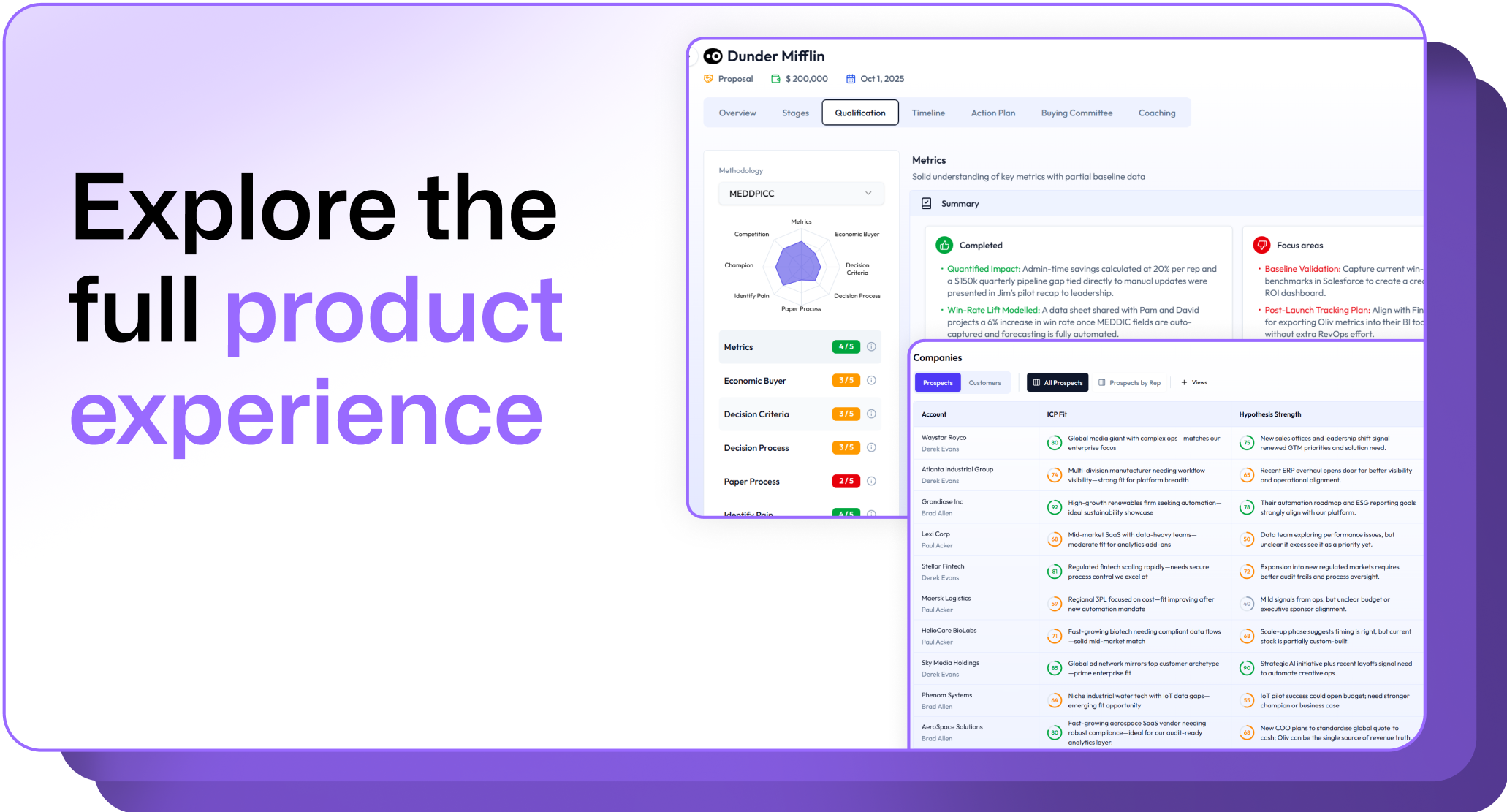
.avif)
.png)





.png)
.png)


.png)