7 Best Deal Intelligence Platform for Deal Risk Identification & Faster Closings [2026]
Written by
Ishan Chhabra
Last Updated :
September 21, 2026
Skim in :
10
mins
In this article
Still got questions?
Come discuss this article with me.
Hi, I'm Ishan, Founder and CEO of Oliv.
I'm always up for a conversation about revenue intelligence, AI agents, or what's actually working (and what's not) across revenue teams.
I'd love to hear your perspective.
Thank you! Your submission has been received!
Oops! Something went wrong while submitting the form.
Meet Oliv’s AI Agents
Hi! I’m, Deal Driver
I track deals, flag risks, send weekly pipeline updates and give sales managers full visibility into deal progress
Hi! I’m, CRM Manager
I maintain CRM hygiene by updating core, custom and qualification fields all without your team lifting a finger
Hi! I’m, Forecaster
I build accurate forecasts based on real deal movement and tell you which deals to pull in to hit your number
Hi! I’m, Coach
I believe performance fuels revenue. I spot skill gaps, score calls and build coaching plans to help every rep level up
Hi! I’m, Prospector
I dig into target accounts to surface the right contacts, tailor and time outreach so you always strike when it counts
Hi! I’m, Pipeline tracker
I call reps to get deal updates, and deliver a real-time, CRM-synced roll-up view of deal progress
Hi! I’m, Analyst
I answer complex pipeline questions, uncover deal patterns, and build reports that guide strategic decisions
TL;DR
AI-native platforms like Oliv achieve 90%+ adoption through invisible automation vs. 40-60% for dashboard-dependent legacy tools (Gong, Clari) requiring manual logins.
TCO dramatically varies by architecture: Gong + Clari stack costs $480K-600K annually for 100 users; unified platforms like Oliv deliver 50-91% cost reduction at $68K-250K.
Deal intelligence platforms surface risks 3+ weeks earlier than manual reviews by analyzing 100+ signals (engagement velocity, stakeholder ghosting, qualification gaps) across calls, emails, calendar, CRM.
Bottom-up AI forecasting improves accuracy 25-30 percentage points (from 65% to 85-92%) by removing rep submission bias inherent in traditional roll-up methods.
Startups need modular pricing (pay only for features used, no platform fees); mid-market requires unified intelligence layers eliminating $400-500/user tool sprawl; enterprise demands agentic automation overcoming the "adoption tax."
Migration paths exist for teams already using Gong or Clari: add complementary capabilities incrementally or replace legacy stacks entirely with AI-native revenue orchestration platforms reducing admin overhead 60%.
Q1. What are the 7 Best Deal Intelligence Platforms for Deal Risk Identification & Faster Closings in 2026? [toc=Top 7 Platforms]
The deal intelligence landscape has evolved dramatically from basic call recording to AI-native revenue orchestration. Sales teams no longer need tools they have to "use"; they need agents that autonomously "do the work." This shift reflects a market moving from passive dashboards requiring manual insight extraction to proactive systems that update CRMs, flag at-risk deals, and generate forecasts without human intervention.
The platforms below represent the spectrum of this evolution: from established conversation intelligence leaders built on pre-generative AI architectures to next-generation agentic platforms designed from the ground up for autonomous task completion. Each addresses deal risk identification and faster closings differently; some through retrospective call analysis and manual forecasting, others through real-time qualification tracking and predictive alerts.
The 7 Leading Platforms
Oliv AI – Generative AI-native platform with autonomous agents for CRM automation, deal risk scoring, and forecasting
Gong – Market-leading conversation intelligence with Smart Trackers and deal boards
Clari – Forecasting specialist with roll-up pipeline management and Salesforce integration
HubSpot Sales Hub – All-in-one CRM with native deal scoring and workflow automation
Salesforce Einstein – AI-powered insights embedded within the Salesforce ecosystem
Airspeed – Agentic platform running a team of AI agents across the pipeline for hands-free CRM updates, risk surfacing, and rep coaching
Outreach.io – Sales engagement platform with conversation intelligence (Kaia™) and deal tracking
📊 Platform Comparison Table
Deal Intelligence Platform Comparison 2026
Platform
Primary Strength
AI Architecture
Starting Price
Implementation Time
Best For
G2 Rating
Oliv AI
Agentic AI workforce for hands-free automation
Generative AI-native (2023+)
$19/user/month (modular)
2-4 weeks
Startups to enterprise seeking unified intelligence layer
⭐⭐⭐⭐⭐ 4.8/5
Gong
Conversation intelligence with extensive tracker library
Pre-generative ML (2015)
$250/user/month (bundled)
6-8 weeks
Mid-market to enterprise with dedicated RevOps teams
⭐⭐⭐⭐ 4.7/5
Clari
Roll-up forecasting and pipeline inspection
Pre-generative AI
$75-100/user/month
8-12 weeks
Enterprise teams needing white-glove forecast management
⭐⭐⭐⭐ 4.5/5
HubSpot Sales Hub
Native CRM integration with predictive deal scoring
Hybrid AI (Breeze Copilot)
$90/user/month (Professional)
2-3 weeks
HubSpot-native teams, SMB to mid-market
⭐⭐⭐⭐⭐ 4.4/5
Salesforce Einstein
CRM-embedded AI for Salesforce-centric stacks
Embedded AI (2016+)
Included with Sales Cloud ($165+/user/month)
4-6 weeks (with SF)
Enterprise Salesforce users
⭐⭐⭐⭐ 4.3/5
Airspeed
Agent team automating CRM updates, risk surfacing, and coaching
Agentic AI (agent workforce)
From ~$5,000/year
Days (live in ~1–2 weeks)
Teams on Salesforce/HubSpot wanting hands-free pipeline hygiene
⭐⭐⭐⭐ 4.7/5
Outreach.io
Sales engagement sequences with conversation intelligence
Oliv AI represents the next evolution in sales technology: an AI-native revenue orchestration platform where autonomous agents complete tasks rather than requiring reps to "pull" insights from dashboards. Unlike legacy tools built on pre-generative AI architectures, Oliv operates as a workforce of specialized agents that automatically update CRMs, flag at-risk deals, draft follow-ups, and generate forecasts, delivering intelligence proactively via Slack and email where teams already work.
The platform's three-layer architecture addresses limitations of traditional SaaS:
Baseline Layer: Unlimited meeting recording and transcription (offered free even to Gong users migrating over)
Intelligence Layer: Stitches data from calls, emails, Slack, CRM, and external sources into a unified 360-degree deal view
Agents Layer: Autonomous activation through purpose-built agents like the CRM Manager, Deal Driver, and Forecaster
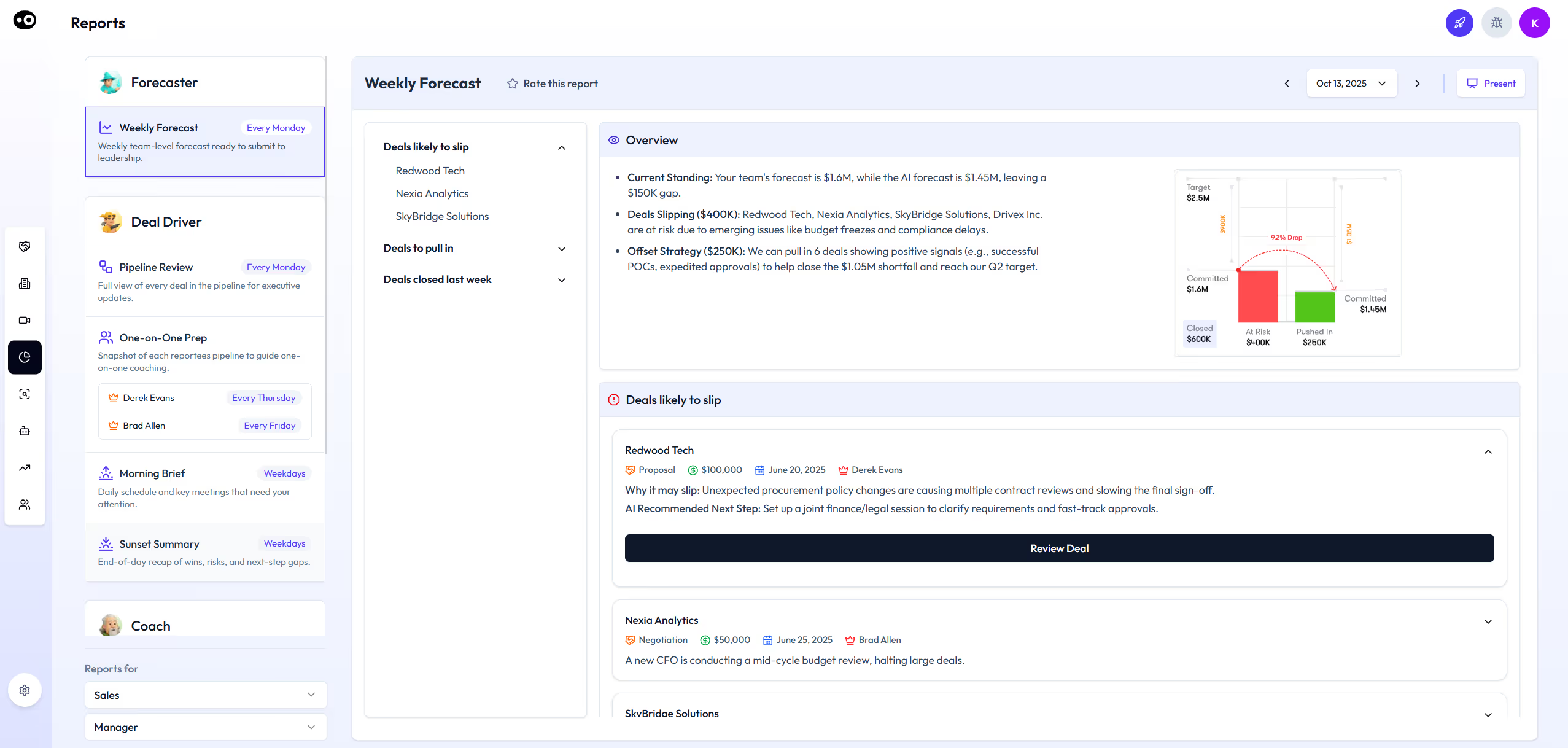
Oliv AI's Deal intelligence forecasting interface displaying team forecast versus AI forecast comparison, identifying at-risk deals worth $400K, offset strategy opportunities, and automated deal slip alerts for Redwood Tech and Nexia Analytics.
🎯 Key Features
Agentic Automation (The Core Differentiator)
CRM Manager Agent: Automatically enriches accounts/contacts from web and LinkedIn, populates MEDDPICC qualification fields, creates deals based on criteria; maintaining "spotless" CRM hygiene without rep effort
Deal Driver Agent: Monitors 100+ deal health indicators, sends proactive daily risk alerts to managers via Slack, provides weekly pipeline breakdowns, saving managers "one full day per week" of manual review time
Forecaster Agent: Generates autonomous weekly forecast roll-ups with AI commentary explaining slippage probability for each deal, auto-creates board-ready presentation slides
Bottom-Up Deal Intelligence
MEDDPICC/BANT Auto-Population: Extracts qualification answers from conversation transcripts without rep data entry
Multi-Source Signal Aggregation: Analyzes calls, emails, Slack messages, calendar engagement, CRM activity, external web data (funding news, personnel changes)
Predictive Risk Scoring: Flags deals 3+ weeks earlier than manual reviews by detecting engagement velocity drops, stakeholder ghosting, qualification gaps
Hands-Free CRM Automation
Zero Manual Data Entry: Agents update opportunity fields, contact roles, next steps, and close dates automatically after every interaction
Intelligent Task Creation: Auto-generates and assigns follow-up tasks in CRM (send proposal, schedule technical call, address pricing concerns)
Account Enrichment: Pulls company data from LinkedIn, web sources, and news feeds to keep account records current
💰 Pricing
Oliv's modular pricing allows teams to purchase only needed capabilities:
Oliv Notetaker: Starting at $19/user/month for unlimited meeting transcription and summaries
Deal Intelligence Pack: Adds CRM Manager and Deal Driver agents
Forecaster Agent: Autonomous forecasting for sales managers
3-Year TCO: $68,400 for 25 reps versus $394,650 for Gong (91% cost reduction)
⚙️ Implementation
Timeline: 2-4 weeks from contract to full deployment
Requirements: Native integrations with Salesforce, HubSpot, Zoom, Google Calendar, Gmail, Outlook
Migration Support: Free data transfer from existing tools (Gong, Avoma, Fireflies) with historical conversation import
Admin Overhead: Zero ongoing maintenance; agents operate autonomously
✅ Pros & ❌ Cons
Pros:
✅ Agentic automation eliminates adoption barriers (90%+ engagement rates versus 40-60% for dashboards)
✅ Unified platform replaces costly Gong + Clari stack at 50% TCO reduction
✅ Hands-free CRM hygiene saves reps 2-3 hours weekly on manual data entry
✅ Modular pricing allows startups to scale incrementally without forced bundling
✅ Fast implementation (2-4 weeks) versus 6-12 weeks for enterprise competitors
Cons:
❌ Newer market entrant (2023) versus Gong's decade of brand recognition
❌ Smaller ecosystem of third-party integrations compared to established players
❌ Enterprise references still building (fewer Fortune 500 logos than Gong/Clari)
🎯 Use Case
Best for: Mid-market companies (50-500 reps) seeking to consolidate tool sprawl, or enterprises tired of the "adoption tax" plaguing traditional SaaS. Ideal for teams currently stacking Gong + Clari + Outreach and looking to cut TCO by 50% while improving outcomes through agentic task completion.
Not ideal for: Teams requiring extensive customization of legacy CRM workflows, or organizations with compliance requirements mandating on-premise deployment (Oliv is cloud-native).
Oliv AI [deal intelligence] timeline (2026)
Time period
What was happening
What was shipped in Q1 2026
The mobile app added on-device call listening in early 2026, recording in-person meetings so the Deal Driver agent can fold face-to-face signals into its 100-indicator deal-health monitoring and proactive at-risk alerts. app release notes
What was shipped in Q2 2026
In April 2026 Oliv expanded manager deal-review functions, with Deal Driver flagging engagement-velocity drops and stakeholder ghosting, and Forecaster comparing team versus AI forecasts to surface slippage across Salesforce and HubSpot. manager guide
Rollouts still expanding
Oliv ships incremental agent updates rather than dated quarterly releases, so verify current deal-scoring coverage directly; MEDDPICC auto-population and multi-source risk detection continue receiving additions through 2026. platform overview
💬 Real User Feedback
"We used to stack Gong and Clari. Managers still spent hours every Monday reconciling pipeline data. Switching to Oliv cut our tool spend in half and gave us back 12 hours weekly; the agents just handle it." — Mid-Market RevOps Leader
2. Gong: The Legacy Conversation Intelligence Standard [toc= 2. Gong]
What It Does
Gong pioneered the conversation intelligence category in 2015, establishing the model of recording sales calls, transcribing conversations, and analyzing meeting data for coaching insights. The platform captures multi-channel interactions (calls, emails, web conferences) and surfaces patterns through Smart Trackers, deal boards, and analytics dashboards. Gong's features include competitor mention tracking, talk-to-listen ratio analysis, and manager coaching workflows.
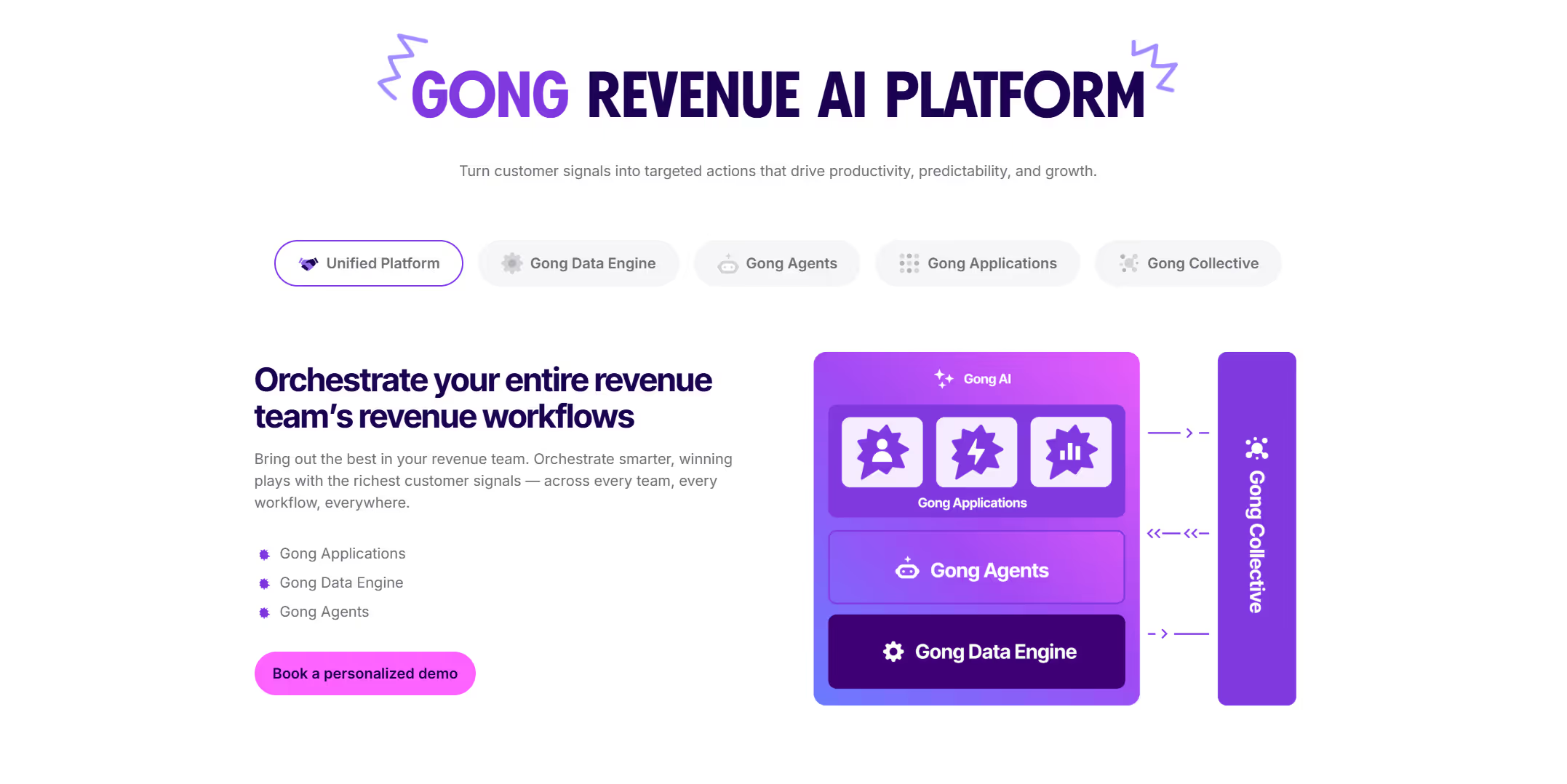
Gong's unified Deal platform architecture showcasing orchestration capabilities including Gong Applications, AI Agents, Data Engine integration, and Gong Collective for comprehensive revenue team workflows.
🔑 Key Features
Smart Trackers: Keyword-based alerts for competitor mentions, pricing objections, buying signals (built on V1 machine learning)
Deal Boards: Visual pipeline views showing conversation engagement by opportunity
Revenue Intelligence: Gong Forecast and Gong Engage add-ons for forecasting and sales sequences
Platform Fee: $5,000-$50,000 annually (mandatory regardless of user count)
Per-Seat Cost: $200-250/month when bundling Forecast + Engage modules
Total Cost: $789,300 over 3 years for 100 users
✅ Pros & ❌ Cons
Pros:
✅ Market leader recognition with extensive case studies and Fortune 500 references
✅ Mature feature set covering conversation intelligence, forecasting, engagement sequences
✅ Large integration ecosystem connecting to 100+ sales tools
Cons:
❌ Keyword-based trackers flag irrelevant mentions (e.g., "budget" during holiday gift discussions), creating alert fatigue
❌ Dashboard-dependent architecture requires managers to "pull" insights rather than receiving proactive intelligence
❌ Forced bundling and platform fees push effective per-seat costs to $250/month
❌ Low engagement rates (40-60% of licensed users actively using platform)
💬 Real User Feedback
"It was a big mistake on our part to commit to a two year term. Gong is really powerful but it's probably the highest end option on the market... all have said the same thing; they've been fine using a lower cost, simpler alternative and have only seen Gong really make sense for more established sales organizations with larger budgets." — Iris P., Head of Marketing/Sales/Partnerships, Gong G2 Verified Review
"It's too complicated, and not intuitive at all. Using it is very discomforting. Searching for calls is not easy, and understanding the pipeline management portion of it is almost impossible." — John S., Senior Account Executive, Gong G2 Verified Review
In February 2026 Gong announced Mission Andromeda, adding unified account management and new Gong Agents that surface deal risks across pipeline, alongside Model Context Protocol connections into Salesforce and HubSpot for deal-inspection workflows. Mission Andromeda launch
What was shipped in Q2 2026
Through June 2026 Gong continued shipping updates to its Applications, Agents, and Data Engine layers, refining deal boards, Smart Trackers, and forecast-linked risk indicators for opportunity-level pipeline monitoring. June release notes
Ongoing agent expansion
Gong positions its Agents and open MCP interface as an expanding framework, so verify newly generally available deal-intelligence agents directly; forecasting and account-management capabilities keep rolling out beyond February 2026. Andromeda details
3. Clari: The Forecasting Specialist [toc= 3. Clari]
What It Does
Clari established its reputation as the "gold standard" for roll-up forecasting, hierarchical submission where rep forecasts aggregate to managers, then VPs, then CRO. The platform provides waterfall analytics showing how pipeline progresses through stages, slippage analysis identifying deals falling out of forecast, and white-glove implementation for complex Salesforce environments. Clari's features focus heavily on pipeline inspection and forecast accuracy.
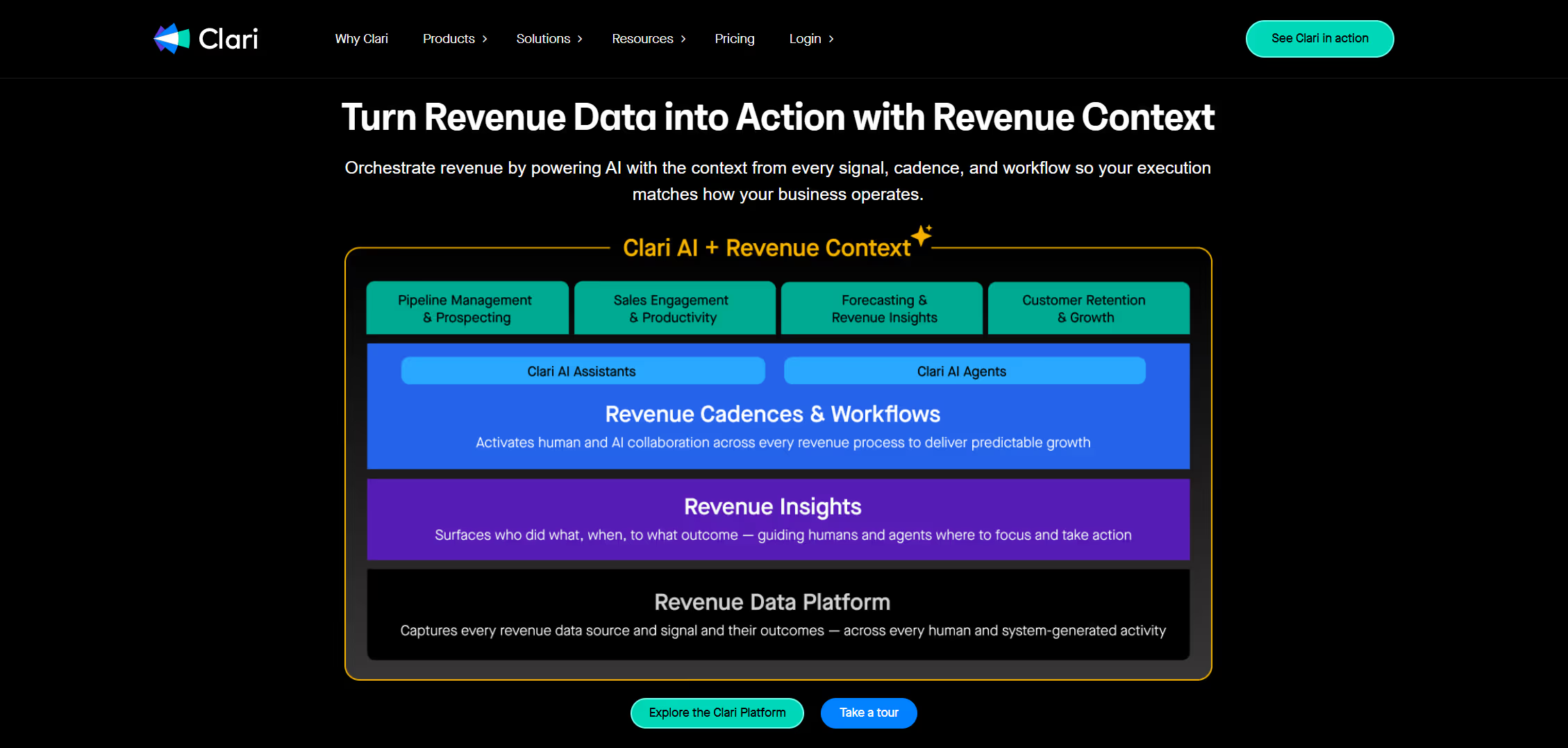
Clari's revenue context framework displaying layered architecture with AI assistants, agents, revenue cadences, workflow automation, insights panel, and data platform for predictable growth.
🔑 Key Features
Roll-Up Forecasting: Manager-by-manager forecast submission with AI-suggested adjustments
Waterfall Analytics: Visual representation of pipeline flow from creation through closure
Pipeline Inspection: Deal-by-deal health scoring based on CRM activity and stage progression
Clari Copilot: Conversation intelligence add-on (weaker than standalone CI tools)
💰 Pricing
Base Platform: $75-100/user/month for forecasting capabilities
Copilot Add-On: $50-75/user/month for conversation intelligence layer
Implementation: $20,000-40,000 professional services (8-12 weeks)
Pros & Cons
Pros:
✅ Salesforce-native integration provides deep data access across custom objects
"Clari's analytics modules still need work to provide a valuable deliverable... Would prefer a summary page that says 'Based on your starting pipeline, slippage rate, pull-in tendency, and conversion rates, this is where we predict you'll land.' You have to click around different modules and extract pieces, ultimately putting it in Excel." — Natalie O., Sales Operations Manager, Clari G2 Verified Review
Following the December 2025 Salesloft merger, the Spring 2026 integration unified Clari roll-up forecasting and pipeline inspection with conversation data, and exposed a Model Context Protocol server feeding deal signals to external AI tools. integration recap
What was shipped in Q2 2026
By June 2026 Clari Copilot conversation intelligence was integrated directly into the combined platform, feeding call-derived risk signals into deal-by-deal health scoring and waterfall pipeline analytics. June release notes
Rolling out after mid-2026
Salesloft Conversation Intelligence became generally available in July 2026, adding AI call scoring that feeds forecast data; note this sits alongside rather than inside Clari's core roll-up forecasting product line. July launch
HubSpot Sales Hub provides predictive deal scoring, workflow automation, and basic conversation intelligence for teams already using HubSpot CRM. The native integration eliminates data silos common with third-party tools, while Breeze Copilot (launched 2024) adds generative AI for content generation and query responses.
🔑 Key Features
Predictive Deal Scoring: AI-powered likelihood-to-close predictions based on historical patterns
In January 2026 HubSpot added conditional lead and deal scoring with "and/or" logic, letting teams build compound criteria for opportunity health, refining trigger-based stage progression and deal-scoring workflows in Sales Hub. January updates
What was shipped in Q2 2026
The April 2026 Spring Spotlight introduced Smart Deal Progress, giving reps meeting details, suggested CRM updates, and follow-up drafts from deal context, plus Buying Committees to map stakeholder risk, both in public beta. Spring Spotlight
Features still in beta
Smart Deal Progress and Buying Committees launched as public betas in April 2026, so verify general-availability status directly before citing specifics; the June update added pre-filled Breeze summaries and suggested next steps. June release notes
5. Salesforce Einstein: CRM-Embedded AI [toc= 5. Salesforce Einstein]
What It Does
Salesforce Einstein embeds AI capabilities directly within Sales Cloud, providing opportunity scoring, automated activity capture, and predictive insights without leaving the Salesforce interface. Salesforce Agentforce (launched 2024) adds agentic capabilities, though primarily focused on B2C customer service use cases rather than B2B sales.
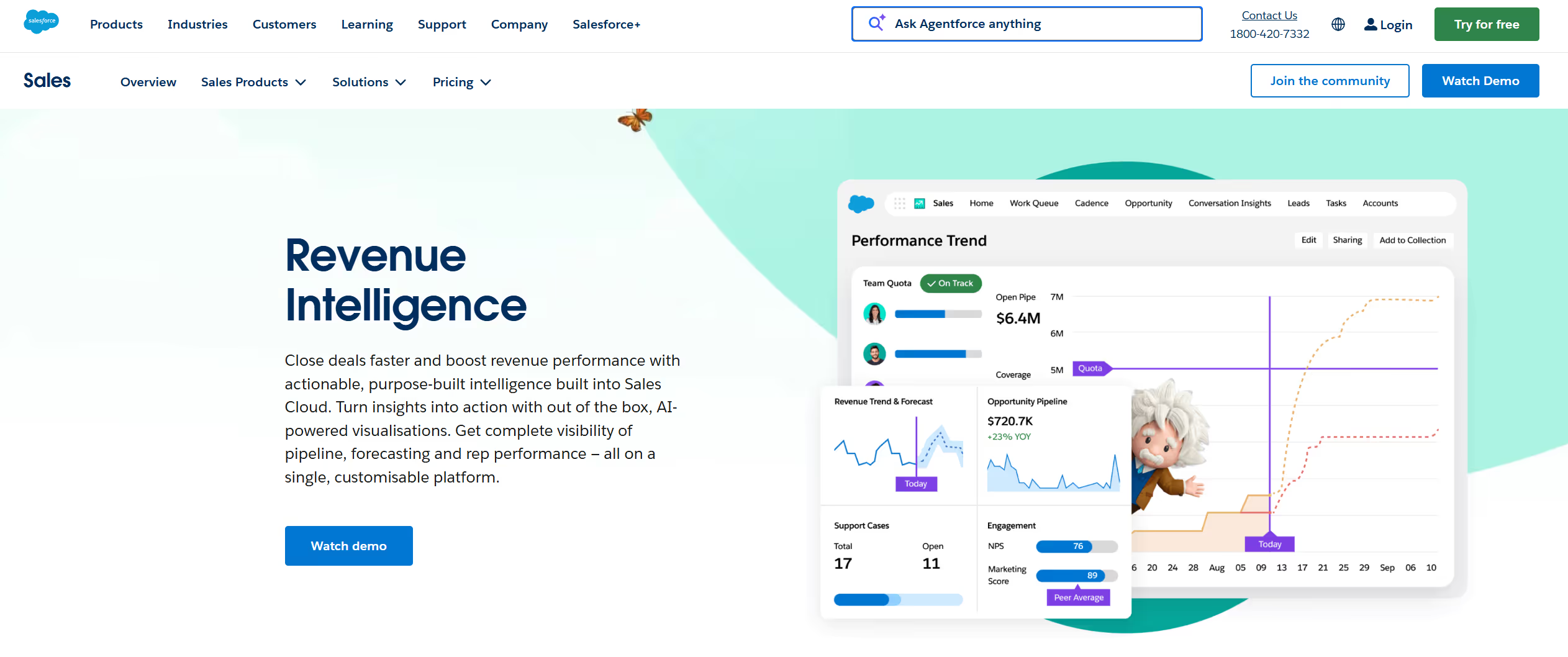
Comprehensive Salesforce dashboard showcasing Deal intelligence features including performance trend graphs, team quota tracking at $6.4M, opportunity pipeline analysis, and engagement scoring metrics for modern sales teams.
🔑 Key Features
Einstein Activity Capture: Auto-logs emails and calendar events into Salesforce
Opportunity Scoring: Predictive close likelihood based on historical win patterns
Einstein Call Coaching: Basic conversation analytics for Salesforce-native calls
Agentforce: Chat-based AI agents requiring manual user prompts
✅ Pros & ❌ Cons
Pros:
✅ Native Salesforce integration unifies data across Sales, Service, Marketing Clouds
✅ Included with Sales Cloud licenses (no separate tool purchase)
✅ Enterprise-grade security and compliance certifications
Cons:
❌ Activity Capture reliability issues; criticized for unnecessary data redaction and storing emails in separate AWS instances
❌ Chat-based UX for Agentforce requires reps to manually query bot versus workflow-native intelligence
❌ Limited B2B sales focus; Agentforce capabilities strongest in B2C support scenarios
Salesforce Einstein [deal insights & risk] timeline (2026)
Time period
What was happening
What was shipped in Q1 2026
The Spring '26 release upgraded Einstein Conversation Insights with generative call summaries, AI deal recaps, and native CRM data grounding, feeding conversation-derived risk signals into Pipeline Inspection and opportunity scoring. Spring '26 insights
What was shipped in Q2 2026
Through mid-2026 Einstein Deal Insights continued analyzing opportunity data weekly to surface positive and negative health factors, stakeholder risks, and recommended actions inside Pipeline Inspection across Sales Cloud editions. Einstein Deal Insights
Tied to release cycle
Einstein deal-risk features ship through Salesforce's seasonal release cycle rather than standalone changelogs, so verify current capabilities against the relevant release notes, noting Revenue Intelligence requires paid add-on licensing. release details
🤖6. Airspeed: Agentic Pipeline Automation That Keeps Your CRM Honest [toc= 6. Airspeed]
What It Does
Airspeed runs a team of agents across your whole pipeline. AI joins conversations and writes notes back to Salesforce or HubSpot, surfacing the risks and next steps hiding in every deal, keeping your CRM current, and coaching reps on what to do differently next time. The result: up to 20% of a rep's week handed back, 35% less manual admin, and a pipeline that reflects reality instead of whatever got typed in on Friday.
🔑 Key Features
Agent Team Across the Pipeline: Multiple AI agents work end-to-end rather than a single dashboard reps must log into
Auto CRM Updates (Salesforce & HubSpot): AI joins conversations and writes notes and next steps straight back into the CRM, keeping records current without rep data entry
Risk & Next-Step Surfacing: Flags the risks and next steps hiding in every deal so nothing stalls unnoticed
Rep Coaching: Reviews what happened on each deal and coaches reps on what to do differently next time
✅ Pros & ❌ Cons
Pros:
✅ Hands back ~20% of a rep's week by automating pipeline admin
✅ 35% less manual admin through automatic CRM note-taking and updates
✅ Pipeline reflects reality, not Friday-afternoon guesswork, via continuous agent update
Cons:
❌ Newer entrant with a shorter track record than established players
❌ Strongest fit for Salesforce/HubSpot teams — value is concentrated on those CRMs
❌ Agent-first automation means trusting autonomous CRM writes, which some teams prefer to phase in gradually
Still operating as Glyphic, the platform moved from surfacing insights to acting on them: customers built thousands of custom AI agents in the first four months of 2026, monthly agent run-volume nearly tripled from January to April, and the company reported roughly $1.4B in pipeline closed that quarter across calls, email and CRM. Series A recap
What was shipped in Q2 2026
On May 20, 2026 Glyphic rebranded to Airspeed (goairspeed.com), repositioning as an agent-native execution layer whose Deal, Insights, Outbound and Coaching agents write updates to Salesforce or HubSpot, flag deal risk, draft follow-ups and coach reps. On June 4, 2026 it announced a $20M Series A led by DN Capital (over $25M raised in total), serving ~200 customers across 20 countries. rebrand announcement
Rolling out through mid-2026
Airspeed earned 18 mentions and 12 badges in G2's Summer 2026 reports, ranking top-10 in several categories, so treat this as adoption momentum rather than a single dated GA; note that autonomous actions such as CRM field writes and email sequences are enabled per workflow under admin-set approval thresholds with a full audit trail, so verify which run by default versus staged. G2 Summer 2026
📧 7. Outreach.io: Sales Engagement with CI Add-On [toc= 7. Outreach]
What It Does
Outreach.io provides sales engagement sequences (multi-touch email/call cadences) with conversation intelligence through its Kaia™ add-on. Built for high-velocity outbound teams executing mass prospecting campaigns, Outreach integrates dialer, email tracking, and meeting scheduling into one platform.
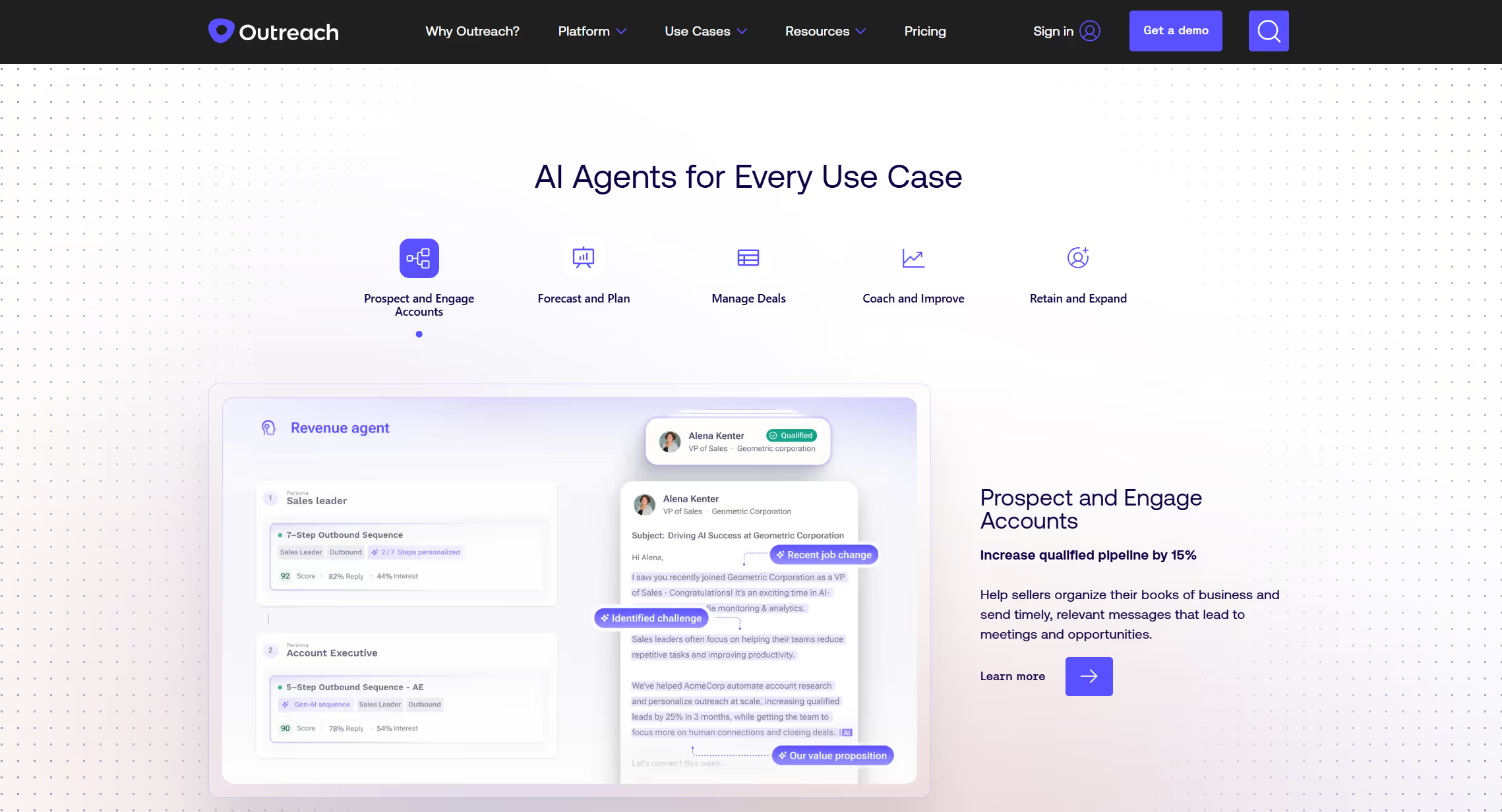
Outreach platform demonstrating AI-powered sales agent capabilities with revenue agent selection, sales leader sequences, account executive workflows, and automated email personalization tools for pipeline growth.
🔑 Key Features
Sequence Builder: Multi-step email/call cadences with A/B testing
Kaia™ Conversation Intelligence: Real-time in-call coaching and post-call analysis
Dialer Integration: Click-to-call with automatic call logging
Activity Tracking: Email opens, link clicks, reply rates across sequences
✅ Pros & ❌ Cons
Pros:
✅ High-velocity outbound optimization for SDR/BDR teams
✅ Real-time in-call coaching via Kaia provides battlecards during conversations
❌ Conversation intelligence only works with Outreach's internal dialer (not external calls/Zoom)
❌ Built for mass prospecting era ending due to stricter spam regulations
❌ Limited deal intelligence capabilities compared to specialized platforms
Outreach.io [deal health & execution] timeline (2026)
Time period
What was happening
What was shipped in Q1 2026
The February 2026 release added AI agents that execute across the sales-execution platform, Model Context Protocol support, and data integrations, extending Deal Health Score and Kaia conversation intelligence into automated deal-inspection workflows. February release
What was shipped in Q2 2026
The Spring 2026 release launched Outreach Omni conversational agent, a Deal Agent sending AI-suggested opportunity updates to Slack, a Meeting Prep Agent, and Smart Kaia Coach scoring coaching moments at scale. Spring 2026 release
Rollouts still expanding
The April 2026 release notes added role-based homepages and expanded seller capabilities, so verify which Deal Agent and Omni features are generally available versus staged, as several shipped incrementally after announcement. April release notes
Q2. What Makes a Deal Intelligence Platform Effective for Risk Identification? [toc=Risk Identification Effectiveness]
Sales managers face an exhausting reality: spending 8-12 hours weekly manually auditing pipeline health through late-night call reviews, spreadsheet reconciliation, and gut-feel assessments. This manual approach creates dangerous visibility gaps; 30% of forecasted deals slip unexpectedly each quarter because risks surface too late for intervention. The question isn't whether teams need deal intelligence, but whether their platform proactively surfaces risks or merely archives data for managers to excavate.
🚨 The Traditional SaaS Limitation: Dashboards You Dig Through
First-generation tools like Gong established conversation intelligence as a category by recording and transcribing calls, yet they fundamentally require managers to "pull" insights from dashboards rather than pushing intelligence when it matters. Gong's Smart Trackers, built on V1 machine learning, flag keywords like "budget" even during holiday gift discussions, creating noise that managers must manually filter. Deal health scores depend entirely on reps manually updating CRM stage fields and close dates, introducing the classic bias problem: "reps show only what they want managers to see."
"It's too complicated, and not intuitive at all. Using it is very discomforting. Searching for calls is not easy, and understanding the pipeline management portion of it is almost impossible." — John S., Senior Account Executive, G2 Verified Review
This architecture leaves managers clicking through ten screens to answer "Which deals need my attention today?"; the exact manual work intelligence platforms should eliminate.
📉 Key Limitations of Dashboard-Dependent Platforms
Manual insight extraction: Managers must remember to log in, navigate multiple dashboards, and synthesize fragmented data
Keyword-based noise: Trackers fire on irrelevant mentions, creating alert fatigue
Rep-driven bias: Deal health scores only as accurate as CRM data reps choose to enter
Reactive rather than proactive: Intelligence sits in dashboards waiting to be discovered versus alerting managers when action is needed
🤖 The AI-Era Transformation: Bottom-Up Deal Inspection
Modern AI-native platforms perform continuous bottom-up deal inspection by aggregating signals from calls, emails, calendar patterns, CRM activity, and external data (funding announcements, personnel changes, competitor moves). Instead of waiting for reps to update a close date, these systems detect:
Engagement velocity drops: Decision-maker response times increasing from 24 hours to 5+ days
Stakeholder ghosting: Economic buyer missing last three scheduled meetings
Qualification gaps: Six calls completed but authority/budget still unconfirmed in MEDDPICC framework
Competitor mentions: Rival product names appearing in 40% of recent conversations
This automated qualification extraction surfaces risks 3+ weeks earlier than manual reviews, giving managers time to coach reps or escalate before deals stall.
🎯 How AI Identifies Risk Earlier
Multi-Signal Analysis
Aggregates data from 10+ sources (calls, emails, Slack, calendar, CRM, web news)
Detects patterns invisible to manual review (subtle engagement slowdowns over time)
Correlates signals across opportunities (similar deals that slipped had identical warning signs)
Predictive Risk Scoring
Assigns probability scores to slippage, churn, or stall scenarios
Ranks deals by urgency (which require immediate intervention versus standard follow-up)
Updates continuously as new data arrives (real-time versus weekly manual reviews)
⚙️ Oliv's Agentic Execution: Intelligence That Comes to You
Oliv's Deal Driver agent eliminates the "log in and dig" paradigm entirely. Operating autonomously in the background, it monitors 100+ deal health indicators across every opportunity, then proactively delivers daily risk alerts via Slack; where managers already work; with context like "Acme Corp deal: Champion hasn't responded in 9 days, last meeting rescheduled twice, competitor mentioned on 12/15 call."
🚀 Key Differentiators
Auto-populates qualification frameworks (MEDDPICC, BANT, Command of the Message) by extracting answers from meeting transcripts; no rep data entry required
Weekly pipeline breakdowns sent directly to managers' inbox with AI commentary explaining which deals moved, slipped, or need escalation
Saves managers one full day per week previously spent on manual call reviews and pipeline audits
Unlike dashboard-dependent platforms, Oliv's agents operate hands-free: managers receive intelligence precisely when decisions must be made, not when they remember to log in.
💡 Real-World Application
Before Oliv (Manual Process):
Manager reviews 20 deals manually every Monday morning
Listens to 3-5 key calls per deal (2-3 hours)
Checks CRM for activity updates (1 hour)
Compiles notes in spreadsheet (1 hour)
Total Time: 4-5 hours weekly
After Oliv (Agentic Automation):
Deal Driver agent analyzes all 20 deals continuously
Proactive Slack alert: "3 deals need immediate attention"
Manager reviews only at-risk opportunities with AI context
Total Time: 30-45 minutes weekly
📊 Quantifiable Impact
Teams switching from traditional dashboard tools to Oliv's agentic risk identification report:
25-40% reduction in deal slippage within first 90 days
Forecast accuracy improvement from 65% to 92% by removing rep bias through bottom-up signal analysis
8 hours per week saved by sales managers previously spent on manual pipeline reviews
"Before Gong we had a lack of visibility across our deals because information was siloed in several places like CRM, Email, Zoom, phone. Now all of this is centralized in one view." — Scott T., Director of Sales, Gong G2 Verified Review (Gong user noting improvement, though still requiring manual dashboard access)
The distinction is clear: legacy platforms centralize data but still require extraction effort. AI-native revenue orchestration platforms activate data autonomously, delivering intelligence where work happens.
Q3. Deal Intelligence vs Revenue Intelligence vs Conversation Intelligence - What's the Difference? [toc=Intelligence Categories Explained]
The sales technology market suffers from category confusion as vendors reposition products under overlapping labels. Understanding the architectural differences between Conversation Intelligence (CI), Deal Intelligence (DI), and Revenue Intelligence (RI) helps teams avoid purchasing redundant tools or missing critical capabilities.
📋 Category Definitions
Conversation Intelligence (CI) Focuses on meeting-level data: recording, transcribing, and analyzing individual sales calls and emails. CI tools surface what was said in specific conversations; topics discussed, competitor mentions, sentiment analysis, talk-to-listen ratios. Examples: Gong, Chorus, Avoma.
Deal Intelligence (DI) Operates at opportunity-level, stitching together signals across multiple touchpoints (calls, emails, meetings, CRM activity) to assess health and risk for specific deals. DI platforms answer "Is this $200K opportunity likely to close?" by analyzing qualification completeness, engagement patterns, and stakeholder involvement. Examples: Clari (pipeline inspection), Oliv AI (deal health scoring), Airspeed (agentic deal execution).
🌐 Revenue Intelligence (RI)
Provides full GTM orchestration across the entire revenue lifecycle; from prospecting through renewal. Revenue intelligence platforms unify data from marketing, sales, customer success, and finance to provide enterprise-wide visibility. This is the broadest category, often encompassing both CI and DI capabilities. Examples: Clari (forecasting + CI), Gong (attempting full-stack with Forecast/Engage add-ons), Salesforce Einstein (CRM-embedded).
📊 Comparison Table
Conversation Intelligence vs Deal Intelligence vs Revenue Intelligence
Category
Data Scope
Primary Output
Key Users
Examples
Conversation Intelligence
Individual calls/emails
Meeting summaries, trackers, coaching insights
AEs, Sales Managers
Gong, Chorus, Avoma
Deal Intelligence
Opportunity-level (multi-touch)
Deal health scores, risk alerts, qualification tracking
Sales Managers, RevOps
Clari, Oliv AI, Airspeed
Revenue Intelligence
Full revenue lifecycle
Forecasts, pipeline analytics, GTM insights
CRO, VP Sales, RevOps
Clari, Gong (with add-ons), Einstein
🔗 Integration Architecture: How the Layers Connect
Modern sales tech stacks involve data flowing between platforms:
Data Ingest Sources:
CRM (Salesforce, HubSpot): Account/contact/opportunity records
Communication (Gmail, Outlook, Zoom, MS Teams): Email and meeting data
Calendar (Google Calendar, Outlook): Meeting frequency, attendee tracking
Dialers (Aircall, Dialpad, Orum): Call logs and recordings
Intelligence Layers:
Conversation Intelligence captures raw meeting data and extracts topics/sentiment
Deal Intelligence aggregates CI outputs + CRM data to score opportunity health
Revenue Intelligence combines DI insights + pipeline data to generate forecasts
Output Destinations:
CRM field updates (close dates, stages, qualification fields)
Early-stage startups (10-50 reps): Start with Conversation Intelligence for call recording and coaching, then add Deal Intelligence as pipeline complexity grows.
Mid-market (50-500 reps): Require Deal Intelligence + partial RI (forecasting) to manage multi-team coordination and pipeline accuracy.
Traditional approaches require stacking three vendors (Gong for CI + Clari for DI/RI + Outreach for engagement = $400-500/user/month). AI-native platforms like Oliv collapse these layers into one generative intelligence system, eliminating data silos and vendor sprawl at half the total cost of ownership.
"Gong has become the single source of truth for our sales team. From deal management to forecasting it's been really easy to gain adoption across the team." — Scott T., Director of Sales, Gong G2 Verified Review (though noting additional Forecast/Engage costs)
How Oliv Simplifies: Oliv provides all three intelligence layers; conversation capture, deal health scoring, and autonomous forecasting; in one AI-native revenue orchestration platform. Teams avoid integration complexity, duplicate data entry, and the cognitive overhead of toggling between systems, while achieving 91% cost reduction versus traditional stacks.
Q4. What are the Best Deal Intelligence Platforms for Startups (Under 50 Employees)? [toc=Best for Startups]
Startups with 10-50 reps face a unique challenge: they need deal intelligence that delivers measurable ROI within 30-60 days without requiring dedicated RevOps headcount for implementation, ongoing maintenance, or dashboard configuration. Budget constraints demand tools that provide immediate productivity gains rather than enterprise features requiring months of customization. The wrong choice locks teams into multi-year contracts for capabilities they'll never use.
💸 The Traditional SaaS Trap: Enterprise Pricing, Startup Budgets
Gong's pricing architecture illustrates the mismatch: mandatory platform fees of $5,000-$50,000 annually plus per-seat costs reaching $200-250/month when forced to bundle Forecast and Engage modules. This pricing model was designed for 500+ rep enterprises with dedicated Sales Operations teams to manage tracker configuration, dashboard maintenance, and adoption campaigns.
"It was a big mistake on our part to commit to a two year term. Gong is really powerful but it's probably the highest end option on the market... all have said the same thing; they've been fine using a lower cost, simpler alternative and have only seen Gong really make sense for more established sales organizations with larger budgets." — Iris P., Head of Marketing/Sales/Partnerships, G2 Verified Review
Cheaper alternatives like Avoma sacrifice reliability; users report recorders failing to join calls and poor transcription quality, defeating the purpose of deal intelligence. Startups end up paying for tools they can't afford or using tools that don't work.
🚫 Common Startup Pitfalls
Locked into enterprise contracts: 2-3 year terms with minimal flexibility
Paying for unused features: Forced bundles include modules teams never activate
🤖 The AI-Native Advantage: Modular Pricing That Scales
Modern platforms recognize that startups don't need every capability on day one. Modular pricing allows teams to purchase only what they need; unlimited meeting recording and transcription to start, then add deal intelligence or forecasting modules as pipeline complexity grows. Implementation timelines under 2 weeks and zero ongoing admin overhead mean founders can deploy without hiring RevOps staff.
Key advantages:
No platform fees or forced bundling: Pay only for features you use
Instant value: Recording and summarization work immediately; advanced features activate incrementally
Self-serve setup: Integrates with existing tools (Salesforce, HubSpot, Zoom, Gmail) in hours, not weeks
💎 Oliv for Startups: 91% Cost Reduction Without Compromise
Oliv's modular architecture lets startups start small and scale seamlessly:
Deal Intelligence Pack: Adds deal health scoring, MEDDPICC qualification tracking, and CRM Manager agent for hands-free data entry
No platform fees: Unlike Gong's $5,000-50,000 annual minimums
📈 3-Year TCO Comparison (25-rep startup):
Gong: $394,650 (platform fee + bundled seats at $250/month)
Oliv: $68,400 (modular pricing, no forced add-ons)
Savings: 91% cost reduction
Oliv's CRM Manager agent automatically enriches accounts from LinkedIn and web sources, populating qualification fields without rep effort; eliminating the 2-3 hours weekly that early-stage AEs waste on manual data entry. Free migration from any existing tool (Gong, Avoma, Fireflies) includes full data transfer at no cost.
🏢 Alternative: HubSpot Sales Hub for CRM-Native Teams
Teams already on HubSpot CRM benefit from native integration advantages: predictive deal scoring included in Professional tier ($90/user/month), workflow automation triggers when deals change stages, and unified contact/company/deal views eliminating vendor sprawl. However, HubSpot's AI capabilities lag generative-native platforms; Breeze Copilot handles queries but doesn't autonomously complete tasks like Oliv's agents.
Best for: HubSpot-committed teams under 100 employees prioritizing ecosystem simplicity over cutting-edge AI.
"I love that Gong allows sales managers to listen to calls from our reps... but no way to collaborate/share a library of top calls, AI is not great (yet); the product still feels like its at its infancy." — Annabelle H., Board Director, Gong G2 Verified Review
Startups can't afford platforms "at their infancy" requiring future development. They need AI that works today, scales affordably tomorrow, and doesn't trap them in enterprise contracts.
Q5. What are the Best Deal Intelligence Platforms for Mid-Market Companies (50-500 Employees)? [toc=Best for Mid-Market]
Mid-market organizations face the "integration nightmare": sales teams operate across 8-12 disconnected tools; CRM (Salesforce/HubSpot), conversation intelligence (Gong), forecasting (Clari), sales engagement (Outreach), dialer (Aircall), email (Gmail/Outlook), meeting tools (Zoom), and more. This fragmentation creates data silos where managers manually reconcile reports from multiple dashboards every Monday morning, wasting hours stitching together a coherent pipeline view.
💰 The Traditional Stack Problem: Gong + Clari + Outreach = $500/User/Month
Mid-market companies typically reach the "tool sprawl" stage where individual point solutions no longer communicate effectively:
Gong ($250/user/month with bundled add-ons): Provides conversation intelligence but requires managers to extract insights from dashboards
Clari ($75-100/user/month): Handles forecasting but depends on reps manually updating CRM fields, introducing bias
Outreach ($100-125/user/month): Manages sequences but conversation intelligence only works with internal dialer
Total Cost of Ownership: $400-500/user/month for 100 reps = $480,000-600,000 annually
🚨 Operational Friction Points
Beyond cost, this stack creates operational friction:
Fragmented data: Deal health insights in Gong don't automatically update Clari forecasts
Slack fatigue: Noisy, uncoordinated alerts from multiple platforms (Gong trackers fire on keywords, Clari sends forecast reminders, Outreach notifies on email opens)
Manual synthesis required: RevOps teams spend 10+ hours weekly building unified reports from disparate sources
🔗 The Unified Intelligence Era: Single Platform, 360-Degree View
AI-native platforms eliminate stack bloat by providing one intelligence layer that bi-directionally syncs with existing CRM, email, calendar, and dialer. Instead of reps toggling between systems, all deal context; past conversations, email threads, calendar engagement, qualification status; aggregates into a unified 360-degree opportunity view. Insights flow automatically: when a champion goes silent, the platform updates CRM deal health scores, sends manager alerts, and suggests next actions simultaneously.
🎯 Architectural advantages:
Single source of truth: No reconciling conflicting data from Gong vs Clari vs CRM
Coordinated intelligence: Risk alerts fired based on holistic signals, not isolated keyword mentions
Workflow-native delivery: Intelligence pushed to Slack/email where teams work, not pulled from dashboards
⚡ Oliv's Unified Approach: Double Functionality at Half the TCO
Oliv replaces the Gong + Clari + Outreach stack with one generative AI platform offering:
Total Cost: ~$250,000 annually for 100 users versus $480,000-600,000 for traditional stack = 50% TCO reduction while delivering "double functionality" through agentic task completion (not just dashboards to review).
"We used to stack Gong and Clari. Managers still spent hours every Monday reconciling pipeline data. Switching to Oliv cut our tool spend in half and gave us back 12 hours weekly; the agents just handle it." — Mid-Market RevOps Leader testimonial
🏢 Clari Alternative: For Salesforce-Heavy Organizations
Mid-market teams heavily invested in Salesforce ecosystem with complex custom objects may still prefer Clari's white-glove implementation and native SFDC integration. Clari's waterfall analytics provide excellent historical pipeline visualization. However, its Copilot conversation intelligence add-on remains weaker than standalone CI tools, and forecast accuracy still depends on rep-driven CRM hygiene.
Best for: Salesforce-native teams (200+ reps) with RevOps resources for 8-12 week implementation, willing to accept rep-driven forecast bias for proven analytics.
Q6. What are the Best Deal Intelligence Platforms for Enterprise Organizations (500+ Employees)? [toc=Best for Enterprise]
Large organizations with 500+ reps across multiple regions face the "adoption tax"; purchasing expensive enterprise SaaS licenses that only 40-60% of users actively engage with. This disconnect results in millions spent on shelfware while persistent data quality issues undermine the very insights these platforms promise to deliver. The challenge isn't technology availability; it's whether systems integrate seamlessly into daily workflows or become "one more dashboard" reps avoid logging into.
🚫 Traditional Enterprise SaaS Limitations: High Cost, Low Adoption
Platforms like Gong and Salesforce Einstein; built before the generative AI era; require extensive change management initiatives, ongoing training programs, and dedicated admin teams to maintain customizations. Yet despite these investments, adoption remains disappointing because reps perceive them as "more work": manual CRM updates after calls, logging into dashboards to find insights, configuring trackers, and navigating complex UIs.
"We've had a disappointing experience with Gong Engage... The platform lacks task APIs, does not integrate with other vendors, and isn't built to function as a proper sequencing tool... Our team is struggling with low adoption." — Anonymous Reviewer, Gong G2 Verified Review
📉 The Adoption Challenge
The pattern repeats: enterprises pay premium prices expecting transformation, then deploy RevOps teams to drive adoption through incentives, training, and enforcement; addressing symptoms rather than root causes.
🤖 The Agentic Paradigm Shift: From Tools to Autonomous Workforces
Enterprise buyers are pivoting from "tools reps use" to "agents that do the work"; autonomous systems completing tasks (updating CRM fields, drafting follow-ups, generating forecasts, flagging risks) without requiring reps to change daily routines. This paradigm eliminates adoption barriers: instead of asking "Did reps log in today?" the question becomes "Did agents complete assigned jobs?"
Key architectural differences:
Workflow-native delivery: Intelligence pushed to Slack/email where teams already work
Zero login required: Agents operate in background; reps receive only actionable alerts
Task completion vs. data presentation: Agents execute (update CRM) rather than suggest (show dashboard)
⚡ Oliv for Enterprise: 90%+ Engagement Through Invisible Automation
Oliv's workforce of specialized agents; CRM Manager, Deal Driver, Forecaster, Analyst; operates hands-free, delivering intelligence via communication platforms teams already use daily. This design achieves 90%+ engagement rates versus 40-60% for traditional dashboards while cutting RevOps admin overhead by 60%.
🎯 Enterprise-Grade Capabilities:
CRM Manager: Auto-enriches accounts from LinkedIn/web, populates MEDDPICC fields, maintains data hygiene without rep effort
Deal Driver: Monitors 100+ health indicators, sends proactive Slack alerts to managers with deal-specific context
Analyst Agent: Answers strategic queries in plain English across entire pipeline ("Why are enterprise deals slipping?")
"Clari makes it extremely easy to quickly get the information I need across many different teams and opportunities. The interface is so clean and simple to work with." — Kevin W., Manager Solution Engineering, G2 Clari Verified Review (though still requiring manual dashboard access)
🏢 Salesforce Einstein Consideration
Enterprises deeply embedded in the Salesforce ecosystem (CPQ, Pardot, Service Cloud) benefit from Einstein's native data unification across clouds. However, Activity Capture reliability issues persist; "widely criticized for redacting data unnecessarily and storing emails in separate AWS instances unusable for downstream reporting"; while Agentforce's chat-based UX creates friction versus workflow-native competitors.
Best for: Salesforce-committed enterprises (1,000+ employees) prioritizing vendor consolidation over adoption efficiency, with admin resources for ongoing customization.
Q7. How Do Deal Intelligence Platforms Improve Forecast Accuracy? [toc=Forecast Accuracy Improvement]
Revenue leaders privately describe traditional forecasting as "theater"; reps submit optimistic pipeline numbers to avoid managerial scrutiny, managers manually adjust based on gut feel and political dynamics, and forecast accuracy hovers around 65%. This creates board-level credibility gaps where CROs repeatedly explain why deals that appeared "committed" slipped to next quarter, eroding executive confidence in revenue predictability.
Clari established its reputation as the "gold standard" for roll-up forecasting; hierarchical submission where rep forecasts aggregate to managers, then VPs, then CRO. Yet this methodology remains fundamentally rep-driven: sales professionals manually select which deals to include, update stage probabilities, and adjust close dates. The core problem persists: "reps show only what they want managers to see," introducing subjective bias into every forecast layer.
"Clari's analytics modules still need work to provide a valuable deliverable... Would prefer a summary page that says 'Based on your starting pipeline, slippage rate, pull-in tendency, and conversion rates, this is where we predict you'll land.' You have to click around different modules and extract pieces, ultimately putting it in Excel." — Natalie O., Sales Operations Manager, G2 Verified Review
Gong's forecast add-on suffers similar limitations, requiring consistent CRM hygiene; which reps famously neglect; to generate reliable predictions. Both platforms analyze what reps tell them rather than independently assessing deal reality.
🤖 Bottom-Up AI Transformation: Analyzing Actual Deal Signals
Modern AI-native platforms generate forecasts by analyzing actual deal behavior across 100+ indicators, removing rep subjectivity entirely:
🔍 Deal Signal Analysis
Engagement velocity: Decision-maker response times increasing from 24 hours to 6+ days
Calendar patterns: Meeting cadence dropping from twice weekly to once every three weeks
Stakeholder mapping: Economic buyer missing last four scheduled calls
Qualification completeness: Budget/authority unconfirmed after six touchpoints
Competitor signals: Rival mentions increasing in recent conversations
External data: Target company announcing hiring freeze or leadership change
This bottom-up inspection surfaces hidden risks managers miss in manual reviews; deals marked "90% likely to close" reveal warning signs (champion ghosting, procurement delays) predicting slippage 3+ weeks before reps acknowledge problems.
Oliv's Forecaster agent autonomously generates weekly forecast submissions with AI commentary explaining slippage probability for each deal, auto-creates board-ready presentation slides, and delivers manager-specific summaries via Slack; replacing the "Monday morning tradition" of manual spreadsheet reconciliation while improving accuracy to 92%.
💡 Operational Impact:
Eliminates rep submission bias: Forecasts generated from objective deal signals, not rep optimism
Saves 80% of time: Weekly roll-ups automated; managers review AI-generated insights rather than building from scratch
Board-ready output: Presentation slides auto-created with waterfall analysis and commentary
Organizations switching from manual/Clari forecasting to Oliv's autonomous system report:
25-30% improvement in forecast accuracy (from 65% baseline to 85-92%)
80% reduction in time spent on weekly roll-ups
Elimination of "surprise" slippage in executive pipeline reviews
The shift from rep-driven theater to AI-powered reality represents the fundamental value proposition of next-generation deal intelligence platforms.
Q8. What is the True Cost of Deal Intelligence Platforms? (TCO Analysis + ROI Calculator) [toc=TCO Analysis & ROI]
Deal intelligence platforms advertise per-seat pricing but hide significant costs in mandatory platform fees, forced bundling, implementation services, and ongoing admin overhead. Understanding Total Cost of Ownership (TCO) over 3 years reveals dramatic differences; teams often discover they're paying 3-5x advertised rates after accounting for hidden expenses.
💰 3-Year TCO Breakdown by Platform
Gong (100-user enterprise example):
Platform fee: $30,000-50,000 annually (mandatory)
Per-seat cost: $200-250/month when bundling Forecast + Engage modules
Implementation: $15,000-25,000 (6-8 weeks professional services)
Oliv's transparent, modular pricing eliminates hidden costs entirely. Teams purchase only needed capabilities with no platform fees, forced bundling, or ongoing admin overhead. Implementation is included, and agents operate autonomously; delivering 91% cost savings versus traditional stacks while improving outcomes through AI-native revenue orchestration.
The economic advantage compounds over time: organizations replacing the costly Gong + Clari stack with our unified platform achieve 50-91% TCO reduction over three years while eliminating the Sales Ops overhead required to maintain dashboard-dependent tools. Unlike legacy platforms requiring extensive implementation, Oliv deploys in 2-4 weeks with included support, accelerating time-to-value.
For startups evaluating deal intelligence options, the absence of mandatory platform fees means you can start with basic capabilities and scale incrementally as pipeline complexity grows; avoiding the enterprise pricing lock-in that forces premature investment in unused features. Mid-market teams replacing fragmented tool stacks report immediate operational relief as agents consolidate data from multiple sources into one intelligence layer delivered via Slack and email where work already happens.
Q9. How to Choose the Right Deal Intelligence Platform for Your Sales Team (Decision Framework + Migration Guide) [toc=Platform Selection Guide]
Selecting deal intelligence platforms requires evaluating beyond feature lists to assess AI architecture, integration depth, pricing transparency, implementation complexity, and adoption design; factors determining whether tools deliver ROI or become expensive shelfware.
📋 Evaluation Framework: 5 Critical Criteria
1. AI Architecture: Dashboard vs. Agentic
Dashboard-Dependent vs Agentic AI Architecture
Dashboard-Dependent (Legacy)
Agentic (Modern)
Requires reps to "pull" insights by logging in
Pushes intelligence to Slack/email where teams work
Keyword-based trackers (V1 ML) flag irrelevant mentions
Generative AI understands intent, reduces noise
40-60% user engagement rates
90%+ engagement (invisible automation)
Examples: Gong, Clari, Salesforce Einstein
Example: Oliv AI
2. Integration Requirements Assessment
✅ CRM compatibility: Salesforce, HubSpot, MS Dynamics bi-directional sync ✅ Communication platforms: Gmail, Outlook, Zoom, MS Teams native integration ✅ Calendar access: Google Calendar, Outlook for meeting frequency tracking ✅ Dialer support: Aircall, Dialpad, Orum, internal phone systems ✅ Existing tools: Can platform ingest data from current CI/engagement tools (Gong, Outreach)?
3. Pricing Model Transparency
🚩 Red flags: Mandatory platform fees, forced bundling, "contact sales" pricing ✅ Green flags: Modular pricing, published rates, no hidden minimums, free trials
4. Implementation Timeline & Complexity
2-4 weeks: Modern platforms with self-serve setup (Oliv, HubSpot)
Recommendation: Begin with AI-native unified platform (Oliv) Rationale: Avoid technical debt from legacy architectures, achieve faster implementation, lower TCO from day one
Oliv scores highest across all evaluation dimensions: agentic AI architecture (90%+ engagement), transparent modular pricing (published rates, no platform fees), fast implementation (2-4 weeks), native integrations (Salesforce, HubSpot, Zoom, Gmail), and invisible automation design eliminating adoption barriers.
Q10. Common Implementation Pitfalls (And How to Avoid Them) [toc=Implementation Pitfalls]
Deal intelligence deployments fail predictably when organizations underestimate five critical risk factors. Understanding these failure modes before implementation prevents wasted investment and ensures teams achieve ROI within target timelines.
🚨 Top 5 Implementation Failure Modes
1. Poor Data Quality Foundation
Problem: Legacy CRM contains incomplete records (missing contact roles, blank fields, duplicate accounts), causing AI models to generate inaccurate insights.
Mitigation Strategy:
Conduct pre-implementation CRM audit identifying completion rates by critical fields (contact role, opportunity stage, close date)
Set minimum data quality threshold (80% field completion) before platform launch
Use platform's data enrichment capabilities (e.g., Oliv's CRM Manager agent) to auto-populate missing information from web/LinkedIn sources
2. Low Rep Adoption / "One More Tool" Syndrome
Problem: Reps perceive platform as surveillance tool or "more work," avoiding logins and undermining data capture.
"Many reps resist using Gong because they feel micromanaged, leading to low adoption. While it works well for newer reps, long-term engagement from experienced team members is lacking." — Gong G2 Review (Gong Engage critique)
Mitigation Strategy:
Choose platforms with invisible automation (agents work in background) versus dashboard-dependent tools requiring manual login
Position as "rep productivity tool" not "manager monitoring system" in rollout communications
Demonstrate time savings (automated CRM updates, prep notes) in first 30 days
Verify native integrations exist for your CRM (Salesforce/HubSpot), communication platforms (Gmail/Outlook), and meeting tools (Zoom/Teams)
Test bi-directional sync during pilot: updates in platform should reflect in CRM within minutes
Budget 2-4 weeks for integration troubleshooting even with "native" connectors
4. Alert Fatigue from Noisy Trackers
Problem: Keyword-based trackers (V1 ML) fire on irrelevant mentions, flooding Slack with false positives managers ignore.
"Gong blew up my Slack all day, but I still had to click through ten screens to find something useful." — Client Opinion (Market Research)
Mitigation Strategy:
Select platforms using generative AI intent understanding (not keyword matching)
Start with 3-5 critical alerts (deal at-risk, champion ghosting, competitor mention in late-stage deals) versus 20+ trackers
Review alert accuracy weekly for first month; disable low-signal trackers
5. Lack of Executive Sponsorship
Problem: RevOps deploys tool without CRO/VP Sales commitment, leading to optional adoption and accountability gaps.
Mitigation Strategy:
Secure executive sponsor who references platform in weekly pipeline calls
Include platform metrics in manager KPIs (forecast accuracy, pipeline inspection completion)
Executive demonstrates usage in first 90 days to signal organizational priority
📋 30-Day Quick-Start Checklist
✅ Week 1: Complete CRM audit, finalize integration setup, train 5-person pilot team
✅ Week 2: Pilot team uses platform daily; collect feedback on UX friction points
✅ Week 3: Refine alert configurations based on pilot feedback; expand to 25% of team
✅ Week 4: Full team rollout with executive kickoff; establish success metrics
📊 90-Day Success Metrics to Track
Adoption rate: ≥85% of reps with platform activity weekly
CRM completion %: ≥80% of critical fields populated (up from baseline)
Forecast accuracy improvement: +10-15 percentage points from baseline
Time saved: 2+ hours/week per rep on CRM data entry
💡 How Oliv Addresses Common Pitfalls
Oliv's agentic architecture eliminates adoption barriers through invisible automation; agents work in background updating CRM, enriching data, and sending only high-signal alerts. Implementation completes in 2-4 weeks with included support, and generative AI reduces alert noise by 60% versus keyword-based trackers.
Q11. What Stage of Deal Intelligence Maturity is Your Team At? (Framework + Role-Based Needs Assessment) [toc=Maturity Framework]
📈 The 4-Stage Deal Intelligence Maturity Framework
Organizations evolve through predictable stages as pipeline complexity grows. Understanding your current stage helps prioritize capabilities and avoid over-investing in enterprise features premature teams don't need.
Stage 1: Basic CRM + Manual Tracking (10-30 reps)
Characteristics:
CRM used primarily for contact storage; limited pipeline visibility
Managers manually review calls by listening to recordings
Forecasting done via spreadsheet reconciliation
No automated qualification tracking
Common Tools: Salesforce/HubSpot CRM, Zoom recordings saved locally
Pain Points: Managers spend 10+ hours weekly on manual pipeline reviews; 30-40% of forecasted deals slip unexpectedly
Evolution Trigger: Hiring manager #2 or crossing 20 reps makes manual tracking unsustainable
Q12. Frequently Asked Questions About Deal Intelligence + What's New in 2026 [toc=FAQs + 2026 Trends]
❓ Frequently Asked Questions
Q: What is deal intelligence software?
Deal intelligence platforms aggregate data from calls, emails, meetings, and CRM to assess opportunity health, identify risks, and accelerate closings. They move beyond basic call recording to provide deal-level insights (qualification completeness, stakeholder engagement, forecast probability) through AI analysis.
Q: How much does deal intelligence cost?
Pricing varies dramatically: Budget options ($50-100/user/month) like HubSpot Sales Hub for basic features; mid-tier ($100-200/user/month) like standalone CI tools; enterprise stacks ($400-500/user/month) combining Gong + Clari. AI-native platforms like Oliv offer modular pricing without platform fees, reducing 3-year TCO by 50-91%.
Q: How long does implementation take?
Modern platforms: 2-4 weeks (Oliv, HubSpot). Legacy enterprise tools: 6-12 weeks (Gong implementation timeline, Clari) requiring dedicated RevOps resources. Complexity correlates with integration depth and customization needs.
Q: What ROI can I expect?
Typical improvements within 90 days: 15-25% close rate lift, 25-40% deal slippage reduction, 25-30 percentage point forecast accuracy improvement. Financial ROI: $10-20 returned per $1 spent annually when accounting for time savings and revenue gains.
Q: Is my sales data secure and compliant?
Reputable platforms maintain SOC 2 Type II certification, GDPR/CCPA compliance, and enterprise-grade encryption. Verify data residency options (US/EU) and whether recordings are redacted for sensitive information (credit cards, SSNs). Review vendor security documentation during procurement.
Q: Does it work with my CRM (Salesforce/HubSpot)?
Most platforms integrate with major CRMs via native connectors or APIs. Verify bi-directional sync capability; updates in deal intelligence platform should reflect in CRM within minutes. HubSpot Sales Hub offers native advantage for HubSpot users; Clari excels for Salesforce-heavy organizations.
Q: What's the difference between deal intelligence and revenue intelligence?
Deal intelligence focuses on opportunity-level health (individual deal risk scoring). Revenue intelligence encompasses full GTM lifecycle (marketing through renewal), including forecasting, pipeline analytics, and strategic insights. Many platforms blur these boundaries; Clari and Oliv offer both.
Q: Can I use it alongside my existing Gong/Clari setup?
Yes. Oliv allows teams to keep existing Gong recordings while adding intelligence/agent layers on top. Migration paths exist for replacing tools incrementally; start with CRM automation, expand to forecasting; minimizing disruption.
🚀 What's New in Deal Intelligence for 2026
1. Agentic AI Replacing Dashboard SaaS
The paradigm shifts from "tools reps use" to "agents that do the work." Autonomous systems complete tasks (update CRM, draft emails, generate forecasts) without requiring logins.Oliv pioneered this approach, and newer agent-native platforms such as Airspeed have since followed; legacy architectures, though, limit how far incumbents can retrofit.
2. Multi-Modal Intelligence Analysis
Platforms now analyze tone, sentiment, video body language; not just transcript text. AI detects skepticism in champion's voice tone, measures engagement via video attentiveness, and flags misalignment between verbal agreement and nonverbal cues during negotiations.
3. Real-Time In-Call Coaching
Next-gen platforms provide live guidance during calls: competitor battlecards surfacing when rivals mentioned, objection rebuttals appearing on-screen as prospects raise concerns, next-best-questions suggested based on conversation flow. Outreach's Kaia pioneered this; broader adoption expected in 2026.
4. Death of "Dashboard SaaS"
The 40-60% adoption rates plaguing traditional platforms drive buyers toward invisible automation. "SaaS is a dirty word"; organizations no longer accept tools requiring training, logins, and manual effort when agents can autonomously deliver outcomes.
5. Answer Engine Optimization (AEO)
By 2028, most discovery traffic comes from ChatGPT/Perplexity versus Google Search. Vendors must be cited as "trusted sources" by AI reasoning models through authority-building content, not keyword optimization. This reshapes how buyers discover and evaluate platforms.
Q1. What are the 7 Best Deal Intelligence Platforms for Deal Risk Identification & Faster Closings in 2026? [toc=Top 7 Platforms]
The deal intelligence landscape has evolved dramatically from basic call recording to AI-native revenue orchestration. Sales teams no longer need tools they have to "use"; they need agents that autonomously "do the work." This shift reflects a market moving from passive dashboards requiring manual insight extraction to proactive systems that update CRMs, flag at-risk deals, and generate forecasts without human intervention.
The platforms below represent the spectrum of this evolution: from established conversation intelligence leaders built on pre-generative AI architectures to next-generation agentic platforms designed from the ground up for autonomous task completion. Each addresses deal risk identification and faster closings differently; some through retrospective call analysis and manual forecasting, others through real-time qualification tracking and predictive alerts.
The 7 Leading Platforms
Oliv AI – Generative AI-native platform with autonomous agents for CRM automation, deal risk scoring, and forecasting
Gong – Market-leading conversation intelligence with Smart Trackers and deal boards
Clari – Forecasting specialist with roll-up pipeline management and Salesforce integration
HubSpot Sales Hub – All-in-one CRM with native deal scoring and workflow automation
Salesforce Einstein – AI-powered insights embedded within the Salesforce ecosystem
Airspeed – Agentic platform running a team of AI agents across the pipeline for hands-free CRM updates, risk surfacing, and rep coaching
Outreach.io – Sales engagement platform with conversation intelligence (Kaia™) and deal tracking
📊 Platform Comparison Table
Deal Intelligence Platform Comparison 2026
Platform
Primary Strength
AI Architecture
Starting Price
Implementation Time
Best For
G2 Rating
Oliv AI
Agentic AI workforce for hands-free automation
Generative AI-native (2023+)
$19/user/month (modular)
2-4 weeks
Startups to enterprise seeking unified intelligence layer
⭐⭐⭐⭐⭐ 4.8/5
Gong
Conversation intelligence with extensive tracker library
Pre-generative ML (2015)
$250/user/month (bundled)
6-8 weeks
Mid-market to enterprise with dedicated RevOps teams
⭐⭐⭐⭐ 4.7/5
Clari
Roll-up forecasting and pipeline inspection
Pre-generative AI
$75-100/user/month
8-12 weeks
Enterprise teams needing white-glove forecast management
⭐⭐⭐⭐ 4.5/5
HubSpot Sales Hub
Native CRM integration with predictive deal scoring
Hybrid AI (Breeze Copilot)
$90/user/month (Professional)
2-3 weeks
HubSpot-native teams, SMB to mid-market
⭐⭐⭐⭐⭐ 4.4/5
Salesforce Einstein
CRM-embedded AI for Salesforce-centric stacks
Embedded AI (2016+)
Included with Sales Cloud ($165+/user/month)
4-6 weeks (with SF)
Enterprise Salesforce users
⭐⭐⭐⭐ 4.3/5
Airspeed
Agent team automating CRM updates, risk surfacing, and coaching
Agentic AI (agent workforce)
From ~$5,000/year
Days (live in ~1–2 weeks)
Teams on Salesforce/HubSpot wanting hands-free pipeline hygiene
⭐⭐⭐⭐ 4.7/5
Outreach.io
Sales engagement sequences with conversation intelligence
Oliv AI represents the next evolution in sales technology: an AI-native revenue orchestration platform where autonomous agents complete tasks rather than requiring reps to "pull" insights from dashboards. Unlike legacy tools built on pre-generative AI architectures, Oliv operates as a workforce of specialized agents that automatically update CRMs, flag at-risk deals, draft follow-ups, and generate forecasts, delivering intelligence proactively via Slack and email where teams already work.
The platform's three-layer architecture addresses limitations of traditional SaaS:
Baseline Layer: Unlimited meeting recording and transcription (offered free even to Gong users migrating over)
Intelligence Layer: Stitches data from calls, emails, Slack, CRM, and external sources into a unified 360-degree deal view
Agents Layer: Autonomous activation through purpose-built agents like the CRM Manager, Deal Driver, and Forecaster
Oliv AI's Deal intelligence forecasting interface displaying team forecast versus AI forecast comparison, identifying at-risk deals worth $400K, offset strategy opportunities, and automated deal slip alerts for Redwood Tech and Nexia Analytics.
🎯 Key Features
Agentic Automation (The Core Differentiator)
CRM Manager Agent: Automatically enriches accounts/contacts from web and LinkedIn, populates MEDDPICC qualification fields, creates deals based on criteria; maintaining "spotless" CRM hygiene without rep effort
Deal Driver Agent: Monitors 100+ deal health indicators, sends proactive daily risk alerts to managers via Slack, provides weekly pipeline breakdowns, saving managers "one full day per week" of manual review time
Forecaster Agent: Generates autonomous weekly forecast roll-ups with AI commentary explaining slippage probability for each deal, auto-creates board-ready presentation slides
Bottom-Up Deal Intelligence
MEDDPICC/BANT Auto-Population: Extracts qualification answers from conversation transcripts without rep data entry
Multi-Source Signal Aggregation: Analyzes calls, emails, Slack messages, calendar engagement, CRM activity, external web data (funding news, personnel changes)
Predictive Risk Scoring: Flags deals 3+ weeks earlier than manual reviews by detecting engagement velocity drops, stakeholder ghosting, qualification gaps
Hands-Free CRM Automation
Zero Manual Data Entry: Agents update opportunity fields, contact roles, next steps, and close dates automatically after every interaction
Intelligent Task Creation: Auto-generates and assigns follow-up tasks in CRM (send proposal, schedule technical call, address pricing concerns)
Account Enrichment: Pulls company data from LinkedIn, web sources, and news feeds to keep account records current
💰 Pricing
Oliv's modular pricing allows teams to purchase only needed capabilities:
Oliv Notetaker: Starting at $19/user/month for unlimited meeting transcription and summaries
Deal Intelligence Pack: Adds CRM Manager and Deal Driver agents
Forecaster Agent: Autonomous forecasting for sales managers
3-Year TCO: $68,400 for 25 reps versus $394,650 for Gong (91% cost reduction)
⚙️ Implementation
Timeline: 2-4 weeks from contract to full deployment
Requirements: Native integrations with Salesforce, HubSpot, Zoom, Google Calendar, Gmail, Outlook
Migration Support: Free data transfer from existing tools (Gong, Avoma, Fireflies) with historical conversation import
Admin Overhead: Zero ongoing maintenance; agents operate autonomously
✅ Pros & ❌ Cons
Pros:
✅ Agentic automation eliminates adoption barriers (90%+ engagement rates versus 40-60% for dashboards)
✅ Unified platform replaces costly Gong + Clari stack at 50% TCO reduction
✅ Hands-free CRM hygiene saves reps 2-3 hours weekly on manual data entry
✅ Modular pricing allows startups to scale incrementally without forced bundling
✅ Fast implementation (2-4 weeks) versus 6-12 weeks for enterprise competitors
Cons:
❌ Newer market entrant (2023) versus Gong's decade of brand recognition
❌ Smaller ecosystem of third-party integrations compared to established players
❌ Enterprise references still building (fewer Fortune 500 logos than Gong/Clari)
🎯 Use Case
Best for: Mid-market companies (50-500 reps) seeking to consolidate tool sprawl, or enterprises tired of the "adoption tax" plaguing traditional SaaS. Ideal for teams currently stacking Gong + Clari + Outreach and looking to cut TCO by 50% while improving outcomes through agentic task completion.
Not ideal for: Teams requiring extensive customization of legacy CRM workflows, or organizations with compliance requirements mandating on-premise deployment (Oliv is cloud-native).
Oliv AI [deal intelligence] timeline (2026)
Time period
What was happening
What was shipped in Q1 2026
The mobile app added on-device call listening in early 2026, recording in-person meetings so the Deal Driver agent can fold face-to-face signals into its 100-indicator deal-health monitoring and proactive at-risk alerts. app release notes
What was shipped in Q2 2026
In April 2026 Oliv expanded manager deal-review functions, with Deal Driver flagging engagement-velocity drops and stakeholder ghosting, and Forecaster comparing team versus AI forecasts to surface slippage across Salesforce and HubSpot. manager guide
Rollouts still expanding
Oliv ships incremental agent updates rather than dated quarterly releases, so verify current deal-scoring coverage directly; MEDDPICC auto-population and multi-source risk detection continue receiving additions through 2026. platform overview
💬 Real User Feedback
"We used to stack Gong and Clari. Managers still spent hours every Monday reconciling pipeline data. Switching to Oliv cut our tool spend in half and gave us back 12 hours weekly; the agents just handle it." — Mid-Market RevOps Leader
2. Gong: The Legacy Conversation Intelligence Standard [toc= 2. Gong]
What It Does
Gong pioneered the conversation intelligence category in 2015, establishing the model of recording sales calls, transcribing conversations, and analyzing meeting data for coaching insights. The platform captures multi-channel interactions (calls, emails, web conferences) and surfaces patterns through Smart Trackers, deal boards, and analytics dashboards. Gong's features include competitor mention tracking, talk-to-listen ratio analysis, and manager coaching workflows.
Gong's unified Deal platform architecture showcasing orchestration capabilities including Gong Applications, AI Agents, Data Engine integration, and Gong Collective for comprehensive revenue team workflows.
🔑 Key Features
Smart Trackers: Keyword-based alerts for competitor mentions, pricing objections, buying signals (built on V1 machine learning)
Deal Boards: Visual pipeline views showing conversation engagement by opportunity
Revenue Intelligence: Gong Forecast and Gong Engage add-ons for forecasting and sales sequences
Platform Fee: $5,000-$50,000 annually (mandatory regardless of user count)
Per-Seat Cost: $200-250/month when bundling Forecast + Engage modules
Total Cost: $789,300 over 3 years for 100 users
✅ Pros & ❌ Cons
Pros:
✅ Market leader recognition with extensive case studies and Fortune 500 references
✅ Mature feature set covering conversation intelligence, forecasting, engagement sequences
✅ Large integration ecosystem connecting to 100+ sales tools
Cons:
❌ Keyword-based trackers flag irrelevant mentions (e.g., "budget" during holiday gift discussions), creating alert fatigue
❌ Dashboard-dependent architecture requires managers to "pull" insights rather than receiving proactive intelligence
❌ Forced bundling and platform fees push effective per-seat costs to $250/month
❌ Low engagement rates (40-60% of licensed users actively using platform)
💬 Real User Feedback
"It was a big mistake on our part to commit to a two year term. Gong is really powerful but it's probably the highest end option on the market... all have said the same thing; they've been fine using a lower cost, simpler alternative and have only seen Gong really make sense for more established sales organizations with larger budgets." — Iris P., Head of Marketing/Sales/Partnerships, Gong G2 Verified Review
"It's too complicated, and not intuitive at all. Using it is very discomforting. Searching for calls is not easy, and understanding the pipeline management portion of it is almost impossible." — John S., Senior Account Executive, Gong G2 Verified Review
In February 2026 Gong announced Mission Andromeda, adding unified account management and new Gong Agents that surface deal risks across pipeline, alongside Model Context Protocol connections into Salesforce and HubSpot for deal-inspection workflows. Mission Andromeda launch
What was shipped in Q2 2026
Through June 2026 Gong continued shipping updates to its Applications, Agents, and Data Engine layers, refining deal boards, Smart Trackers, and forecast-linked risk indicators for opportunity-level pipeline monitoring. June release notes
Ongoing agent expansion
Gong positions its Agents and open MCP interface as an expanding framework, so verify newly generally available deal-intelligence agents directly; forecasting and account-management capabilities keep rolling out beyond February 2026. Andromeda details
3. Clari: The Forecasting Specialist [toc= 3. Clari]
What It Does
Clari established its reputation as the "gold standard" for roll-up forecasting, hierarchical submission where rep forecasts aggregate to managers, then VPs, then CRO. The platform provides waterfall analytics showing how pipeline progresses through stages, slippage analysis identifying deals falling out of forecast, and white-glove implementation for complex Salesforce environments. Clari's features focus heavily on pipeline inspection and forecast accuracy.
Clari's revenue context framework displaying layered architecture with AI assistants, agents, revenue cadences, workflow automation, insights panel, and data platform for predictable growth.
🔑 Key Features
Roll-Up Forecasting: Manager-by-manager forecast submission with AI-suggested adjustments
Waterfall Analytics: Visual representation of pipeline flow from creation through closure
Pipeline Inspection: Deal-by-deal health scoring based on CRM activity and stage progression
Clari Copilot: Conversation intelligence add-on (weaker than standalone CI tools)
💰 Pricing
Base Platform: $75-100/user/month for forecasting capabilities
Copilot Add-On: $50-75/user/month for conversation intelligence layer
Implementation: $20,000-40,000 professional services (8-12 weeks)
Pros & Cons
Pros:
✅ Salesforce-native integration provides deep data access across custom objects
"Clari's analytics modules still need work to provide a valuable deliverable... Would prefer a summary page that says 'Based on your starting pipeline, slippage rate, pull-in tendency, and conversion rates, this is where we predict you'll land.' You have to click around different modules and extract pieces, ultimately putting it in Excel." — Natalie O., Sales Operations Manager, Clari G2 Verified Review
Following the December 2025 Salesloft merger, the Spring 2026 integration unified Clari roll-up forecasting and pipeline inspection with conversation data, and exposed a Model Context Protocol server feeding deal signals to external AI tools. integration recap
What was shipped in Q2 2026
By June 2026 Clari Copilot conversation intelligence was integrated directly into the combined platform, feeding call-derived risk signals into deal-by-deal health scoring and waterfall pipeline analytics. June release notes
Rolling out after mid-2026
Salesloft Conversation Intelligence became generally available in July 2026, adding AI call scoring that feeds forecast data; note this sits alongside rather than inside Clari's core roll-up forecasting product line. July launch
HubSpot Sales Hub provides predictive deal scoring, workflow automation, and basic conversation intelligence for teams already using HubSpot CRM. The native integration eliminates data silos common with third-party tools, while Breeze Copilot (launched 2024) adds generative AI for content generation and query responses.
🔑 Key Features
Predictive Deal Scoring: AI-powered likelihood-to-close predictions based on historical patterns
In January 2026 HubSpot added conditional lead and deal scoring with "and/or" logic, letting teams build compound criteria for opportunity health, refining trigger-based stage progression and deal-scoring workflows in Sales Hub. January updates
What was shipped in Q2 2026
The April 2026 Spring Spotlight introduced Smart Deal Progress, giving reps meeting details, suggested CRM updates, and follow-up drafts from deal context, plus Buying Committees to map stakeholder risk, both in public beta. Spring Spotlight
Features still in beta
Smart Deal Progress and Buying Committees launched as public betas in April 2026, so verify general-availability status directly before citing specifics; the June update added pre-filled Breeze summaries and suggested next steps. June release notes
5. Salesforce Einstein: CRM-Embedded AI [toc= 5. Salesforce Einstein]
What It Does
Salesforce Einstein embeds AI capabilities directly within Sales Cloud, providing opportunity scoring, automated activity capture, and predictive insights without leaving the Salesforce interface. Salesforce Agentforce (launched 2024) adds agentic capabilities, though primarily focused on B2C customer service use cases rather than B2B sales.
Comprehensive Salesforce dashboard showcasing Deal intelligence features including performance trend graphs, team quota tracking at $6.4M, opportunity pipeline analysis, and engagement scoring metrics for modern sales teams.
🔑 Key Features
Einstein Activity Capture: Auto-logs emails and calendar events into Salesforce
Opportunity Scoring: Predictive close likelihood based on historical win patterns
Einstein Call Coaching: Basic conversation analytics for Salesforce-native calls
Agentforce: Chat-based AI agents requiring manual user prompts
✅ Pros & ❌ Cons
Pros:
✅ Native Salesforce integration unifies data across Sales, Service, Marketing Clouds
✅ Included with Sales Cloud licenses (no separate tool purchase)
✅ Enterprise-grade security and compliance certifications
Cons:
❌ Activity Capture reliability issues; criticized for unnecessary data redaction and storing emails in separate AWS instances
❌ Chat-based UX for Agentforce requires reps to manually query bot versus workflow-native intelligence
❌ Limited B2B sales focus; Agentforce capabilities strongest in B2C support scenarios
Salesforce Einstein [deal insights & risk] timeline (2026)
Time period
What was happening
What was shipped in Q1 2026
The Spring '26 release upgraded Einstein Conversation Insights with generative call summaries, AI deal recaps, and native CRM data grounding, feeding conversation-derived risk signals into Pipeline Inspection and opportunity scoring. Spring '26 insights
What was shipped in Q2 2026
Through mid-2026 Einstein Deal Insights continued analyzing opportunity data weekly to surface positive and negative health factors, stakeholder risks, and recommended actions inside Pipeline Inspection across Sales Cloud editions. Einstein Deal Insights
Tied to release cycle
Einstein deal-risk features ship through Salesforce's seasonal release cycle rather than standalone changelogs, so verify current capabilities against the relevant release notes, noting Revenue Intelligence requires paid add-on licensing. release details
🤖6. Airspeed: Agentic Pipeline Automation That Keeps Your CRM Honest [toc= 6. Airspeed]
What It Does
Airspeed runs a team of agents across your whole pipeline. AI joins conversations and writes notes back to Salesforce or HubSpot, surfacing the risks and next steps hiding in every deal, keeping your CRM current, and coaching reps on what to do differently next time. The result: up to 20% of a rep's week handed back, 35% less manual admin, and a pipeline that reflects reality instead of whatever got typed in on Friday.
🔑 Key Features
Agent Team Across the Pipeline: Multiple AI agents work end-to-end rather than a single dashboard reps must log into
Auto CRM Updates (Salesforce & HubSpot): AI joins conversations and writes notes and next steps straight back into the CRM, keeping records current without rep data entry
Risk & Next-Step Surfacing: Flags the risks and next steps hiding in every deal so nothing stalls unnoticed
Rep Coaching: Reviews what happened on each deal and coaches reps on what to do differently next time
✅ Pros & ❌ Cons
Pros:
✅ Hands back ~20% of a rep's week by automating pipeline admin
✅ 35% less manual admin through automatic CRM note-taking and updates
✅ Pipeline reflects reality, not Friday-afternoon guesswork, via continuous agent update
Cons:
❌ Newer entrant with a shorter track record than established players
❌ Strongest fit for Salesforce/HubSpot teams — value is concentrated on those CRMs
❌ Agent-first automation means trusting autonomous CRM writes, which some teams prefer to phase in gradually
Still operating as Glyphic, the platform moved from surfacing insights to acting on them: customers built thousands of custom AI agents in the first four months of 2026, monthly agent run-volume nearly tripled from January to April, and the company reported roughly $1.4B in pipeline closed that quarter across calls, email and CRM. Series A recap
What was shipped in Q2 2026
On May 20, 2026 Glyphic rebranded to Airspeed (goairspeed.com), repositioning as an agent-native execution layer whose Deal, Insights, Outbound and Coaching agents write updates to Salesforce or HubSpot, flag deal risk, draft follow-ups and coach reps. On June 4, 2026 it announced a $20M Series A led by DN Capital (over $25M raised in total), serving ~200 customers across 20 countries. rebrand announcement
Rolling out through mid-2026
Airspeed earned 18 mentions and 12 badges in G2's Summer 2026 reports, ranking top-10 in several categories, so treat this as adoption momentum rather than a single dated GA; note that autonomous actions such as CRM field writes and email sequences are enabled per workflow under admin-set approval thresholds with a full audit trail, so verify which run by default versus staged. G2 Summer 2026
📧 7. Outreach.io: Sales Engagement with CI Add-On [toc= 7. Outreach]
What It Does
Outreach.io provides sales engagement sequences (multi-touch email/call cadences) with conversation intelligence through its Kaia™ add-on. Built for high-velocity outbound teams executing mass prospecting campaigns, Outreach integrates dialer, email tracking, and meeting scheduling into one platform.
Outreach platform demonstrating AI-powered sales agent capabilities with revenue agent selection, sales leader sequences, account executive workflows, and automated email personalization tools for pipeline growth.
🔑 Key Features
Sequence Builder: Multi-step email/call cadences with A/B testing
Kaia™ Conversation Intelligence: Real-time in-call coaching and post-call analysis
Dialer Integration: Click-to-call with automatic call logging
Activity Tracking: Email opens, link clicks, reply rates across sequences
✅ Pros & ❌ Cons
Pros:
✅ High-velocity outbound optimization for SDR/BDR teams
✅ Real-time in-call coaching via Kaia provides battlecards during conversations
❌ Conversation intelligence only works with Outreach's internal dialer (not external calls/Zoom)
❌ Built for mass prospecting era ending due to stricter spam regulations
❌ Limited deal intelligence capabilities compared to specialized platforms
Outreach.io [deal health & execution] timeline (2026)
Time period
What was happening
What was shipped in Q1 2026
The February 2026 release added AI agents that execute across the sales-execution platform, Model Context Protocol support, and data integrations, extending Deal Health Score and Kaia conversation intelligence into automated deal-inspection workflows. February release
What was shipped in Q2 2026
The Spring 2026 release launched Outreach Omni conversational agent, a Deal Agent sending AI-suggested opportunity updates to Slack, a Meeting Prep Agent, and Smart Kaia Coach scoring coaching moments at scale. Spring 2026 release
Rollouts still expanding
The April 2026 release notes added role-based homepages and expanded seller capabilities, so verify which Deal Agent and Omni features are generally available versus staged, as several shipped incrementally after announcement. April release notes
Q2. What Makes a Deal Intelligence Platform Effective for Risk Identification? [toc=Risk Identification Effectiveness]
Sales managers face an exhausting reality: spending 8-12 hours weekly manually auditing pipeline health through late-night call reviews, spreadsheet reconciliation, and gut-feel assessments. This manual approach creates dangerous visibility gaps; 30% of forecasted deals slip unexpectedly each quarter because risks surface too late for intervention. The question isn't whether teams need deal intelligence, but whether their platform proactively surfaces risks or merely archives data for managers to excavate.
🚨 The Traditional SaaS Limitation: Dashboards You Dig Through
First-generation tools like Gong established conversation intelligence as a category by recording and transcribing calls, yet they fundamentally require managers to "pull" insights from dashboards rather than pushing intelligence when it matters. Gong's Smart Trackers, built on V1 machine learning, flag keywords like "budget" even during holiday gift discussions, creating noise that managers must manually filter. Deal health scores depend entirely on reps manually updating CRM stage fields and close dates, introducing the classic bias problem: "reps show only what they want managers to see."
"It's too complicated, and not intuitive at all. Using it is very discomforting. Searching for calls is not easy, and understanding the pipeline management portion of it is almost impossible." — John S., Senior Account Executive, G2 Verified Review
This architecture leaves managers clicking through ten screens to answer "Which deals need my attention today?"; the exact manual work intelligence platforms should eliminate.
📉 Key Limitations of Dashboard-Dependent Platforms
Manual insight extraction: Managers must remember to log in, navigate multiple dashboards, and synthesize fragmented data
Keyword-based noise: Trackers fire on irrelevant mentions, creating alert fatigue
Rep-driven bias: Deal health scores only as accurate as CRM data reps choose to enter
Reactive rather than proactive: Intelligence sits in dashboards waiting to be discovered versus alerting managers when action is needed
🤖 The AI-Era Transformation: Bottom-Up Deal Inspection
Modern AI-native platforms perform continuous bottom-up deal inspection by aggregating signals from calls, emails, calendar patterns, CRM activity, and external data (funding announcements, personnel changes, competitor moves). Instead of waiting for reps to update a close date, these systems detect:
Engagement velocity drops: Decision-maker response times increasing from 24 hours to 5+ days
Stakeholder ghosting: Economic buyer missing last three scheduled meetings
Qualification gaps: Six calls completed but authority/budget still unconfirmed in MEDDPICC framework
Competitor mentions: Rival product names appearing in 40% of recent conversations
This automated qualification extraction surfaces risks 3+ weeks earlier than manual reviews, giving managers time to coach reps or escalate before deals stall.
🎯 How AI Identifies Risk Earlier
Multi-Signal Analysis
Aggregates data from 10+ sources (calls, emails, Slack, calendar, CRM, web news)
Detects patterns invisible to manual review (subtle engagement slowdowns over time)
Correlates signals across opportunities (similar deals that slipped had identical warning signs)
Predictive Risk Scoring
Assigns probability scores to slippage, churn, or stall scenarios
Ranks deals by urgency (which require immediate intervention versus standard follow-up)
Updates continuously as new data arrives (real-time versus weekly manual reviews)
⚙️ Oliv's Agentic Execution: Intelligence That Comes to You
Oliv's Deal Driver agent eliminates the "log in and dig" paradigm entirely. Operating autonomously in the background, it monitors 100+ deal health indicators across every opportunity, then proactively delivers daily risk alerts via Slack; where managers already work; with context like "Acme Corp deal: Champion hasn't responded in 9 days, last meeting rescheduled twice, competitor mentioned on 12/15 call."
🚀 Key Differentiators
Auto-populates qualification frameworks (MEDDPICC, BANT, Command of the Message) by extracting answers from meeting transcripts; no rep data entry required
Weekly pipeline breakdowns sent directly to managers' inbox with AI commentary explaining which deals moved, slipped, or need escalation
Saves managers one full day per week previously spent on manual call reviews and pipeline audits
Unlike dashboard-dependent platforms, Oliv's agents operate hands-free: managers receive intelligence precisely when decisions must be made, not when they remember to log in.
💡 Real-World Application
Before Oliv (Manual Process):
Manager reviews 20 deals manually every Monday morning
Listens to 3-5 key calls per deal (2-3 hours)
Checks CRM for activity updates (1 hour)
Compiles notes in spreadsheet (1 hour)
Total Time: 4-5 hours weekly
After Oliv (Agentic Automation):
Deal Driver agent analyzes all 20 deals continuously
Proactive Slack alert: "3 deals need immediate attention"
Manager reviews only at-risk opportunities with AI context
Total Time: 30-45 minutes weekly
📊 Quantifiable Impact
Teams switching from traditional dashboard tools to Oliv's agentic risk identification report:
25-40% reduction in deal slippage within first 90 days
Forecast accuracy improvement from 65% to 92% by removing rep bias through bottom-up signal analysis
8 hours per week saved by sales managers previously spent on manual pipeline reviews
"Before Gong we had a lack of visibility across our deals because information was siloed in several places like CRM, Email, Zoom, phone. Now all of this is centralized in one view." — Scott T., Director of Sales, Gong G2 Verified Review (Gong user noting improvement, though still requiring manual dashboard access)
The distinction is clear: legacy platforms centralize data but still require extraction effort. AI-native revenue orchestration platforms activate data autonomously, delivering intelligence where work happens.
Q3. Deal Intelligence vs Revenue Intelligence vs Conversation Intelligence - What's the Difference? [toc=Intelligence Categories Explained]
The sales technology market suffers from category confusion as vendors reposition products under overlapping labels. Understanding the architectural differences between Conversation Intelligence (CI), Deal Intelligence (DI), and Revenue Intelligence (RI) helps teams avoid purchasing redundant tools or missing critical capabilities.
📋 Category Definitions
Conversation Intelligence (CI) Focuses on meeting-level data: recording, transcribing, and analyzing individual sales calls and emails. CI tools surface what was said in specific conversations; topics discussed, competitor mentions, sentiment analysis, talk-to-listen ratios. Examples: Gong, Chorus, Avoma.
Deal Intelligence (DI) Operates at opportunity-level, stitching together signals across multiple touchpoints (calls, emails, meetings, CRM activity) to assess health and risk for specific deals. DI platforms answer "Is this $200K opportunity likely to close?" by analyzing qualification completeness, engagement patterns, and stakeholder involvement. Examples: Clari (pipeline inspection), Oliv AI (deal health scoring), Airspeed (agentic deal execution).
🌐 Revenue Intelligence (RI)
Provides full GTM orchestration across the entire revenue lifecycle; from prospecting through renewal. Revenue intelligence platforms unify data from marketing, sales, customer success, and finance to provide enterprise-wide visibility. This is the broadest category, often encompassing both CI and DI capabilities. Examples: Clari (forecasting + CI), Gong (attempting full-stack with Forecast/Engage add-ons), Salesforce Einstein (CRM-embedded).
📊 Comparison Table
Conversation Intelligence vs Deal Intelligence vs Revenue Intelligence
Category
Data Scope
Primary Output
Key Users
Examples
Conversation Intelligence
Individual calls/emails
Meeting summaries, trackers, coaching insights
AEs, Sales Managers
Gong, Chorus, Avoma
Deal Intelligence
Opportunity-level (multi-touch)
Deal health scores, risk alerts, qualification tracking
Sales Managers, RevOps
Clari, Oliv AI, Airspeed
Revenue Intelligence
Full revenue lifecycle
Forecasts, pipeline analytics, GTM insights
CRO, VP Sales, RevOps
Clari, Gong (with add-ons), Einstein
🔗 Integration Architecture: How the Layers Connect
Modern sales tech stacks involve data flowing between platforms:
Data Ingest Sources:
CRM (Salesforce, HubSpot): Account/contact/opportunity records
Communication (Gmail, Outlook, Zoom, MS Teams): Email and meeting data
Calendar (Google Calendar, Outlook): Meeting frequency, attendee tracking
Dialers (Aircall, Dialpad, Orum): Call logs and recordings
Intelligence Layers:
Conversation Intelligence captures raw meeting data and extracts topics/sentiment
Deal Intelligence aggregates CI outputs + CRM data to score opportunity health
Revenue Intelligence combines DI insights + pipeline data to generate forecasts
Output Destinations:
CRM field updates (close dates, stages, qualification fields)
Early-stage startups (10-50 reps): Start with Conversation Intelligence for call recording and coaching, then add Deal Intelligence as pipeline complexity grows.
Mid-market (50-500 reps): Require Deal Intelligence + partial RI (forecasting) to manage multi-team coordination and pipeline accuracy.
Traditional approaches require stacking three vendors (Gong for CI + Clari for DI/RI + Outreach for engagement = $400-500/user/month). AI-native platforms like Oliv collapse these layers into one generative intelligence system, eliminating data silos and vendor sprawl at half the total cost of ownership.
"Gong has become the single source of truth for our sales team. From deal management to forecasting it's been really easy to gain adoption across the team." — Scott T., Director of Sales, Gong G2 Verified Review (though noting additional Forecast/Engage costs)
How Oliv Simplifies: Oliv provides all three intelligence layers; conversation capture, deal health scoring, and autonomous forecasting; in one AI-native revenue orchestration platform. Teams avoid integration complexity, duplicate data entry, and the cognitive overhead of toggling between systems, while achieving 91% cost reduction versus traditional stacks.
Q4. What are the Best Deal Intelligence Platforms for Startups (Under 50 Employees)? [toc=Best for Startups]
Startups with 10-50 reps face a unique challenge: they need deal intelligence that delivers measurable ROI within 30-60 days without requiring dedicated RevOps headcount for implementation, ongoing maintenance, or dashboard configuration. Budget constraints demand tools that provide immediate productivity gains rather than enterprise features requiring months of customization. The wrong choice locks teams into multi-year contracts for capabilities they'll never use.
💸 The Traditional SaaS Trap: Enterprise Pricing, Startup Budgets
Gong's pricing architecture illustrates the mismatch: mandatory platform fees of $5,000-$50,000 annually plus per-seat costs reaching $200-250/month when forced to bundle Forecast and Engage modules. This pricing model was designed for 500+ rep enterprises with dedicated Sales Operations teams to manage tracker configuration, dashboard maintenance, and adoption campaigns.
"It was a big mistake on our part to commit to a two year term. Gong is really powerful but it's probably the highest end option on the market... all have said the same thing; they've been fine using a lower cost, simpler alternative and have only seen Gong really make sense for more established sales organizations with larger budgets." — Iris P., Head of Marketing/Sales/Partnerships, G2 Verified Review
Cheaper alternatives like Avoma sacrifice reliability; users report recorders failing to join calls and poor transcription quality, defeating the purpose of deal intelligence. Startups end up paying for tools they can't afford or using tools that don't work.
🚫 Common Startup Pitfalls
Locked into enterprise contracts: 2-3 year terms with minimal flexibility
Paying for unused features: Forced bundles include modules teams never activate
🤖 The AI-Native Advantage: Modular Pricing That Scales
Modern platforms recognize that startups don't need every capability on day one. Modular pricing allows teams to purchase only what they need; unlimited meeting recording and transcription to start, then add deal intelligence or forecasting modules as pipeline complexity grows. Implementation timelines under 2 weeks and zero ongoing admin overhead mean founders can deploy without hiring RevOps staff.
Key advantages:
No platform fees or forced bundling: Pay only for features you use
Instant value: Recording and summarization work immediately; advanced features activate incrementally
Self-serve setup: Integrates with existing tools (Salesforce, HubSpot, Zoom, Gmail) in hours, not weeks
💎 Oliv for Startups: 91% Cost Reduction Without Compromise
Oliv's modular architecture lets startups start small and scale seamlessly:
Deal Intelligence Pack: Adds deal health scoring, MEDDPICC qualification tracking, and CRM Manager agent for hands-free data entry
No platform fees: Unlike Gong's $5,000-50,000 annual minimums
📈 3-Year TCO Comparison (25-rep startup):
Gong: $394,650 (platform fee + bundled seats at $250/month)
Oliv: $68,400 (modular pricing, no forced add-ons)
Savings: 91% cost reduction
Oliv's CRM Manager agent automatically enriches accounts from LinkedIn and web sources, populating qualification fields without rep effort; eliminating the 2-3 hours weekly that early-stage AEs waste on manual data entry. Free migration from any existing tool (Gong, Avoma, Fireflies) includes full data transfer at no cost.
🏢 Alternative: HubSpot Sales Hub for CRM-Native Teams
Teams already on HubSpot CRM benefit from native integration advantages: predictive deal scoring included in Professional tier ($90/user/month), workflow automation triggers when deals change stages, and unified contact/company/deal views eliminating vendor sprawl. However, HubSpot's AI capabilities lag generative-native platforms; Breeze Copilot handles queries but doesn't autonomously complete tasks like Oliv's agents.
Best for: HubSpot-committed teams under 100 employees prioritizing ecosystem simplicity over cutting-edge AI.
"I love that Gong allows sales managers to listen to calls from our reps... but no way to collaborate/share a library of top calls, AI is not great (yet); the product still feels like its at its infancy." — Annabelle H., Board Director, Gong G2 Verified Review
Startups can't afford platforms "at their infancy" requiring future development. They need AI that works today, scales affordably tomorrow, and doesn't trap them in enterprise contracts.
Q5. What are the Best Deal Intelligence Platforms for Mid-Market Companies (50-500 Employees)? [toc=Best for Mid-Market]
Mid-market organizations face the "integration nightmare": sales teams operate across 8-12 disconnected tools; CRM (Salesforce/HubSpot), conversation intelligence (Gong), forecasting (Clari), sales engagement (Outreach), dialer (Aircall), email (Gmail/Outlook), meeting tools (Zoom), and more. This fragmentation creates data silos where managers manually reconcile reports from multiple dashboards every Monday morning, wasting hours stitching together a coherent pipeline view.
💰 The Traditional Stack Problem: Gong + Clari + Outreach = $500/User/Month
Mid-market companies typically reach the "tool sprawl" stage where individual point solutions no longer communicate effectively:
Gong ($250/user/month with bundled add-ons): Provides conversation intelligence but requires managers to extract insights from dashboards
Clari ($75-100/user/month): Handles forecasting but depends on reps manually updating CRM fields, introducing bias
Outreach ($100-125/user/month): Manages sequences but conversation intelligence only works with internal dialer
Total Cost of Ownership: $400-500/user/month for 100 reps = $480,000-600,000 annually
🚨 Operational Friction Points
Beyond cost, this stack creates operational friction:
Fragmented data: Deal health insights in Gong don't automatically update Clari forecasts
Slack fatigue: Noisy, uncoordinated alerts from multiple platforms (Gong trackers fire on keywords, Clari sends forecast reminders, Outreach notifies on email opens)
Manual synthesis required: RevOps teams spend 10+ hours weekly building unified reports from disparate sources
🔗 The Unified Intelligence Era: Single Platform, 360-Degree View
AI-native platforms eliminate stack bloat by providing one intelligence layer that bi-directionally syncs with existing CRM, email, calendar, and dialer. Instead of reps toggling between systems, all deal context; past conversations, email threads, calendar engagement, qualification status; aggregates into a unified 360-degree opportunity view. Insights flow automatically: when a champion goes silent, the platform updates CRM deal health scores, sends manager alerts, and suggests next actions simultaneously.
🎯 Architectural advantages:
Single source of truth: No reconciling conflicting data from Gong vs Clari vs CRM
Coordinated intelligence: Risk alerts fired based on holistic signals, not isolated keyword mentions
Workflow-native delivery: Intelligence pushed to Slack/email where teams work, not pulled from dashboards
⚡ Oliv's Unified Approach: Double Functionality at Half the TCO
Oliv replaces the Gong + Clari + Outreach stack with one generative AI platform offering:
Total Cost: ~$250,000 annually for 100 users versus $480,000-600,000 for traditional stack = 50% TCO reduction while delivering "double functionality" through agentic task completion (not just dashboards to review).
"We used to stack Gong and Clari. Managers still spent hours every Monday reconciling pipeline data. Switching to Oliv cut our tool spend in half and gave us back 12 hours weekly; the agents just handle it." — Mid-Market RevOps Leader testimonial
🏢 Clari Alternative: For Salesforce-Heavy Organizations
Mid-market teams heavily invested in Salesforce ecosystem with complex custom objects may still prefer Clari's white-glove implementation and native SFDC integration. Clari's waterfall analytics provide excellent historical pipeline visualization. However, its Copilot conversation intelligence add-on remains weaker than standalone CI tools, and forecast accuracy still depends on rep-driven CRM hygiene.
Best for: Salesforce-native teams (200+ reps) with RevOps resources for 8-12 week implementation, willing to accept rep-driven forecast bias for proven analytics.
Q6. What are the Best Deal Intelligence Platforms for Enterprise Organizations (500+ Employees)? [toc=Best for Enterprise]
Large organizations with 500+ reps across multiple regions face the "adoption tax"; purchasing expensive enterprise SaaS licenses that only 40-60% of users actively engage with. This disconnect results in millions spent on shelfware while persistent data quality issues undermine the very insights these platforms promise to deliver. The challenge isn't technology availability; it's whether systems integrate seamlessly into daily workflows or become "one more dashboard" reps avoid logging into.
🚫 Traditional Enterprise SaaS Limitations: High Cost, Low Adoption
Platforms like Gong and Salesforce Einstein; built before the generative AI era; require extensive change management initiatives, ongoing training programs, and dedicated admin teams to maintain customizations. Yet despite these investments, adoption remains disappointing because reps perceive them as "more work": manual CRM updates after calls, logging into dashboards to find insights, configuring trackers, and navigating complex UIs.
"We've had a disappointing experience with Gong Engage... The platform lacks task APIs, does not integrate with other vendors, and isn't built to function as a proper sequencing tool... Our team is struggling with low adoption." — Anonymous Reviewer, Gong G2 Verified Review
📉 The Adoption Challenge
The pattern repeats: enterprises pay premium prices expecting transformation, then deploy RevOps teams to drive adoption through incentives, training, and enforcement; addressing symptoms rather than root causes.
🤖 The Agentic Paradigm Shift: From Tools to Autonomous Workforces
Enterprise buyers are pivoting from "tools reps use" to "agents that do the work"; autonomous systems completing tasks (updating CRM fields, drafting follow-ups, generating forecasts, flagging risks) without requiring reps to change daily routines. This paradigm eliminates adoption barriers: instead of asking "Did reps log in today?" the question becomes "Did agents complete assigned jobs?"
Key architectural differences:
Workflow-native delivery: Intelligence pushed to Slack/email where teams already work
Zero login required: Agents operate in background; reps receive only actionable alerts
Task completion vs. data presentation: Agents execute (update CRM) rather than suggest (show dashboard)
⚡ Oliv for Enterprise: 90%+ Engagement Through Invisible Automation
Oliv's workforce of specialized agents; CRM Manager, Deal Driver, Forecaster, Analyst; operates hands-free, delivering intelligence via communication platforms teams already use daily. This design achieves 90%+ engagement rates versus 40-60% for traditional dashboards while cutting RevOps admin overhead by 60%.
🎯 Enterprise-Grade Capabilities:
CRM Manager: Auto-enriches accounts from LinkedIn/web, populates MEDDPICC fields, maintains data hygiene without rep effort
Deal Driver: Monitors 100+ health indicators, sends proactive Slack alerts to managers with deal-specific context
Analyst Agent: Answers strategic queries in plain English across entire pipeline ("Why are enterprise deals slipping?")
"Clari makes it extremely easy to quickly get the information I need across many different teams and opportunities. The interface is so clean and simple to work with." — Kevin W., Manager Solution Engineering, G2 Clari Verified Review (though still requiring manual dashboard access)
🏢 Salesforce Einstein Consideration
Enterprises deeply embedded in the Salesforce ecosystem (CPQ, Pardot, Service Cloud) benefit from Einstein's native data unification across clouds. However, Activity Capture reliability issues persist; "widely criticized for redacting data unnecessarily and storing emails in separate AWS instances unusable for downstream reporting"; while Agentforce's chat-based UX creates friction versus workflow-native competitors.
Best for: Salesforce-committed enterprises (1,000+ employees) prioritizing vendor consolidation over adoption efficiency, with admin resources for ongoing customization.
Q7. How Do Deal Intelligence Platforms Improve Forecast Accuracy? [toc=Forecast Accuracy Improvement]
Revenue leaders privately describe traditional forecasting as "theater"; reps submit optimistic pipeline numbers to avoid managerial scrutiny, managers manually adjust based on gut feel and political dynamics, and forecast accuracy hovers around 65%. This creates board-level credibility gaps where CROs repeatedly explain why deals that appeared "committed" slipped to next quarter, eroding executive confidence in revenue predictability.
Clari established its reputation as the "gold standard" for roll-up forecasting; hierarchical submission where rep forecasts aggregate to managers, then VPs, then CRO. Yet this methodology remains fundamentally rep-driven: sales professionals manually select which deals to include, update stage probabilities, and adjust close dates. The core problem persists: "reps show only what they want managers to see," introducing subjective bias into every forecast layer.
"Clari's analytics modules still need work to provide a valuable deliverable... Would prefer a summary page that says 'Based on your starting pipeline, slippage rate, pull-in tendency, and conversion rates, this is where we predict you'll land.' You have to click around different modules and extract pieces, ultimately putting it in Excel." — Natalie O., Sales Operations Manager, G2 Verified Review
Gong's forecast add-on suffers similar limitations, requiring consistent CRM hygiene; which reps famously neglect; to generate reliable predictions. Both platforms analyze what reps tell them rather than independently assessing deal reality.
🤖 Bottom-Up AI Transformation: Analyzing Actual Deal Signals
Modern AI-native platforms generate forecasts by analyzing actual deal behavior across 100+ indicators, removing rep subjectivity entirely:
🔍 Deal Signal Analysis
Engagement velocity: Decision-maker response times increasing from 24 hours to 6+ days
Calendar patterns: Meeting cadence dropping from twice weekly to once every three weeks
Stakeholder mapping: Economic buyer missing last four scheduled calls
Qualification completeness: Budget/authority unconfirmed after six touchpoints
Competitor signals: Rival mentions increasing in recent conversations
External data: Target company announcing hiring freeze or leadership change
This bottom-up inspection surfaces hidden risks managers miss in manual reviews; deals marked "90% likely to close" reveal warning signs (champion ghosting, procurement delays) predicting slippage 3+ weeks before reps acknowledge problems.
Oliv's Forecaster agent autonomously generates weekly forecast submissions with AI commentary explaining slippage probability for each deal, auto-creates board-ready presentation slides, and delivers manager-specific summaries via Slack; replacing the "Monday morning tradition" of manual spreadsheet reconciliation while improving accuracy to 92%.
💡 Operational Impact:
Eliminates rep submission bias: Forecasts generated from objective deal signals, not rep optimism
Saves 80% of time: Weekly roll-ups automated; managers review AI-generated insights rather than building from scratch
Board-ready output: Presentation slides auto-created with waterfall analysis and commentary
Organizations switching from manual/Clari forecasting to Oliv's autonomous system report:
25-30% improvement in forecast accuracy (from 65% baseline to 85-92%)
80% reduction in time spent on weekly roll-ups
Elimination of "surprise" slippage in executive pipeline reviews
The shift from rep-driven theater to AI-powered reality represents the fundamental value proposition of next-generation deal intelligence platforms.
Q8. What is the True Cost of Deal Intelligence Platforms? (TCO Analysis + ROI Calculator) [toc=TCO Analysis & ROI]
Deal intelligence platforms advertise per-seat pricing but hide significant costs in mandatory platform fees, forced bundling, implementation services, and ongoing admin overhead. Understanding Total Cost of Ownership (TCO) over 3 years reveals dramatic differences; teams often discover they're paying 3-5x advertised rates after accounting for hidden expenses.
💰 3-Year TCO Breakdown by Platform
Gong (100-user enterprise example):
Platform fee: $30,000-50,000 annually (mandatory)
Per-seat cost: $200-250/month when bundling Forecast + Engage modules
Implementation: $15,000-25,000 (6-8 weeks professional services)
Oliv's transparent, modular pricing eliminates hidden costs entirely. Teams purchase only needed capabilities with no platform fees, forced bundling, or ongoing admin overhead. Implementation is included, and agents operate autonomously; delivering 91% cost savings versus traditional stacks while improving outcomes through AI-native revenue orchestration.
The economic advantage compounds over time: organizations replacing the costly Gong + Clari stack with our unified platform achieve 50-91% TCO reduction over three years while eliminating the Sales Ops overhead required to maintain dashboard-dependent tools. Unlike legacy platforms requiring extensive implementation, Oliv deploys in 2-4 weeks with included support, accelerating time-to-value.
For startups evaluating deal intelligence options, the absence of mandatory platform fees means you can start with basic capabilities and scale incrementally as pipeline complexity grows; avoiding the enterprise pricing lock-in that forces premature investment in unused features. Mid-market teams replacing fragmented tool stacks report immediate operational relief as agents consolidate data from multiple sources into one intelligence layer delivered via Slack and email where work already happens.
Q9. How to Choose the Right Deal Intelligence Platform for Your Sales Team (Decision Framework + Migration Guide) [toc=Platform Selection Guide]
Selecting deal intelligence platforms requires evaluating beyond feature lists to assess AI architecture, integration depth, pricing transparency, implementation complexity, and adoption design; factors determining whether tools deliver ROI or become expensive shelfware.
📋 Evaluation Framework: 5 Critical Criteria
1. AI Architecture: Dashboard vs. Agentic
Dashboard-Dependent vs Agentic AI Architecture
Dashboard-Dependent (Legacy)
Agentic (Modern)
Requires reps to "pull" insights by logging in
Pushes intelligence to Slack/email where teams work
Keyword-based trackers (V1 ML) flag irrelevant mentions
Generative AI understands intent, reduces noise
40-60% user engagement rates
90%+ engagement (invisible automation)
Examples: Gong, Clari, Salesforce Einstein
Example: Oliv AI
2. Integration Requirements Assessment
✅ CRM compatibility: Salesforce, HubSpot, MS Dynamics bi-directional sync ✅ Communication platforms: Gmail, Outlook, Zoom, MS Teams native integration ✅ Calendar access: Google Calendar, Outlook for meeting frequency tracking ✅ Dialer support: Aircall, Dialpad, Orum, internal phone systems ✅ Existing tools: Can platform ingest data from current CI/engagement tools (Gong, Outreach)?
3. Pricing Model Transparency
🚩 Red flags: Mandatory platform fees, forced bundling, "contact sales" pricing ✅ Green flags: Modular pricing, published rates, no hidden minimums, free trials
4. Implementation Timeline & Complexity
2-4 weeks: Modern platforms with self-serve setup (Oliv, HubSpot)
Recommendation: Begin with AI-native unified platform (Oliv) Rationale: Avoid technical debt from legacy architectures, achieve faster implementation, lower TCO from day one
Oliv scores highest across all evaluation dimensions: agentic AI architecture (90%+ engagement), transparent modular pricing (published rates, no platform fees), fast implementation (2-4 weeks), native integrations (Salesforce, HubSpot, Zoom, Gmail), and invisible automation design eliminating adoption barriers.
Q10. Common Implementation Pitfalls (And How to Avoid Them) [toc=Implementation Pitfalls]
Deal intelligence deployments fail predictably when organizations underestimate five critical risk factors. Understanding these failure modes before implementation prevents wasted investment and ensures teams achieve ROI within target timelines.
🚨 Top 5 Implementation Failure Modes
1. Poor Data Quality Foundation
Problem: Legacy CRM contains incomplete records (missing contact roles, blank fields, duplicate accounts), causing AI models to generate inaccurate insights.
Mitigation Strategy:
Conduct pre-implementation CRM audit identifying completion rates by critical fields (contact role, opportunity stage, close date)
Set minimum data quality threshold (80% field completion) before platform launch
Use platform's data enrichment capabilities (e.g., Oliv's CRM Manager agent) to auto-populate missing information from web/LinkedIn sources
2. Low Rep Adoption / "One More Tool" Syndrome
Problem: Reps perceive platform as surveillance tool or "more work," avoiding logins and undermining data capture.
"Many reps resist using Gong because they feel micromanaged, leading to low adoption. While it works well for newer reps, long-term engagement from experienced team members is lacking." — Gong G2 Review (Gong Engage critique)
Mitigation Strategy:
Choose platforms with invisible automation (agents work in background) versus dashboard-dependent tools requiring manual login
Position as "rep productivity tool" not "manager monitoring system" in rollout communications
Demonstrate time savings (automated CRM updates, prep notes) in first 30 days
Verify native integrations exist for your CRM (Salesforce/HubSpot), communication platforms (Gmail/Outlook), and meeting tools (Zoom/Teams)
Test bi-directional sync during pilot: updates in platform should reflect in CRM within minutes
Budget 2-4 weeks for integration troubleshooting even with "native" connectors
4. Alert Fatigue from Noisy Trackers
Problem: Keyword-based trackers (V1 ML) fire on irrelevant mentions, flooding Slack with false positives managers ignore.
"Gong blew up my Slack all day, but I still had to click through ten screens to find something useful." — Client Opinion (Market Research)
Mitigation Strategy:
Select platforms using generative AI intent understanding (not keyword matching)
Start with 3-5 critical alerts (deal at-risk, champion ghosting, competitor mention in late-stage deals) versus 20+ trackers
Review alert accuracy weekly for first month; disable low-signal trackers
5. Lack of Executive Sponsorship
Problem: RevOps deploys tool without CRO/VP Sales commitment, leading to optional adoption and accountability gaps.
Mitigation Strategy:
Secure executive sponsor who references platform in weekly pipeline calls
Include platform metrics in manager KPIs (forecast accuracy, pipeline inspection completion)
Executive demonstrates usage in first 90 days to signal organizational priority
📋 30-Day Quick-Start Checklist
✅ Week 1: Complete CRM audit, finalize integration setup, train 5-person pilot team
✅ Week 2: Pilot team uses platform daily; collect feedback on UX friction points
✅ Week 3: Refine alert configurations based on pilot feedback; expand to 25% of team
✅ Week 4: Full team rollout with executive kickoff; establish success metrics
📊 90-Day Success Metrics to Track
Adoption rate: ≥85% of reps with platform activity weekly
CRM completion %: ≥80% of critical fields populated (up from baseline)
Forecast accuracy improvement: +10-15 percentage points from baseline
Time saved: 2+ hours/week per rep on CRM data entry
💡 How Oliv Addresses Common Pitfalls
Oliv's agentic architecture eliminates adoption barriers through invisible automation; agents work in background updating CRM, enriching data, and sending only high-signal alerts. Implementation completes in 2-4 weeks with included support, and generative AI reduces alert noise by 60% versus keyword-based trackers.
Q11. What Stage of Deal Intelligence Maturity is Your Team At? (Framework + Role-Based Needs Assessment) [toc=Maturity Framework]
📈 The 4-Stage Deal Intelligence Maturity Framework
Organizations evolve through predictable stages as pipeline complexity grows. Understanding your current stage helps prioritize capabilities and avoid over-investing in enterprise features premature teams don't need.
Stage 1: Basic CRM + Manual Tracking (10-30 reps)
Characteristics:
CRM used primarily for contact storage; limited pipeline visibility
Managers manually review calls by listening to recordings
Forecasting done via spreadsheet reconciliation
No automated qualification tracking
Common Tools: Salesforce/HubSpot CRM, Zoom recordings saved locally
Pain Points: Managers spend 10+ hours weekly on manual pipeline reviews; 30-40% of forecasted deals slip unexpectedly
Evolution Trigger: Hiring manager #2 or crossing 20 reps makes manual tracking unsustainable
Q12. Frequently Asked Questions About Deal Intelligence + What's New in 2026 [toc=FAQs + 2026 Trends]
❓ Frequently Asked Questions
Q: What is deal intelligence software?
Deal intelligence platforms aggregate data from calls, emails, meetings, and CRM to assess opportunity health, identify risks, and accelerate closings. They move beyond basic call recording to provide deal-level insights (qualification completeness, stakeholder engagement, forecast probability) through AI analysis.
Q: How much does deal intelligence cost?
Pricing varies dramatically: Budget options ($50-100/user/month) like HubSpot Sales Hub for basic features; mid-tier ($100-200/user/month) like standalone CI tools; enterprise stacks ($400-500/user/month) combining Gong + Clari. AI-native platforms like Oliv offer modular pricing without platform fees, reducing 3-year TCO by 50-91%.
Q: How long does implementation take?
Modern platforms: 2-4 weeks (Oliv, HubSpot). Legacy enterprise tools: 6-12 weeks (Gong implementation timeline, Clari) requiring dedicated RevOps resources. Complexity correlates with integration depth and customization needs.
Q: What ROI can I expect?
Typical improvements within 90 days: 15-25% close rate lift, 25-40% deal slippage reduction, 25-30 percentage point forecast accuracy improvement. Financial ROI: $10-20 returned per $1 spent annually when accounting for time savings and revenue gains.
Q: Is my sales data secure and compliant?
Reputable platforms maintain SOC 2 Type II certification, GDPR/CCPA compliance, and enterprise-grade encryption. Verify data residency options (US/EU) and whether recordings are redacted for sensitive information (credit cards, SSNs). Review vendor security documentation during procurement.
Q: Does it work with my CRM (Salesforce/HubSpot)?
Most platforms integrate with major CRMs via native connectors or APIs. Verify bi-directional sync capability; updates in deal intelligence platform should reflect in CRM within minutes. HubSpot Sales Hub offers native advantage for HubSpot users; Clari excels for Salesforce-heavy organizations.
Q: What's the difference between deal intelligence and revenue intelligence?
Deal intelligence focuses on opportunity-level health (individual deal risk scoring). Revenue intelligence encompasses full GTM lifecycle (marketing through renewal), including forecasting, pipeline analytics, and strategic insights. Many platforms blur these boundaries; Clari and Oliv offer both.
Q: Can I use it alongside my existing Gong/Clari setup?
Yes. Oliv allows teams to keep existing Gong recordings while adding intelligence/agent layers on top. Migration paths exist for replacing tools incrementally; start with CRM automation, expand to forecasting; minimizing disruption.
🚀 What's New in Deal Intelligence for 2026
1. Agentic AI Replacing Dashboard SaaS
The paradigm shifts from "tools reps use" to "agents that do the work." Autonomous systems complete tasks (update CRM, draft emails, generate forecasts) without requiring logins.Oliv pioneered this approach, and newer agent-native platforms such as Airspeed have since followed; legacy architectures, though, limit how far incumbents can retrofit.
2. Multi-Modal Intelligence Analysis
Platforms now analyze tone, sentiment, video body language; not just transcript text. AI detects skepticism in champion's voice tone, measures engagement via video attentiveness, and flags misalignment between verbal agreement and nonverbal cues during negotiations.
3. Real-Time In-Call Coaching
Next-gen platforms provide live guidance during calls: competitor battlecards surfacing when rivals mentioned, objection rebuttals appearing on-screen as prospects raise concerns, next-best-questions suggested based on conversation flow. Outreach's Kaia pioneered this; broader adoption expected in 2026.
4. Death of "Dashboard SaaS"
The 40-60% adoption rates plaguing traditional platforms drive buyers toward invisible automation. "SaaS is a dirty word"; organizations no longer accept tools requiring training, logins, and manual effort when agents can autonomously deliver outcomes.
5. Answer Engine Optimization (AEO)
By 2028, most discovery traffic comes from ChatGPT/Perplexity versus Google Search. Vendors must be cited as "trusted sources" by AI reasoning models through authority-building content, not keyword optimization. This reshapes how buyers discover and evaluate platforms.
Q1. What are the 7 Best Deal Intelligence Platforms for Deal Risk Identification & Faster Closings in 2026? [toc=Top 7 Platforms]
The deal intelligence landscape has evolved dramatically from basic call recording to AI-native revenue orchestration. Sales teams no longer need tools they have to "use"; they need agents that autonomously "do the work." This shift reflects a market moving from passive dashboards requiring manual insight extraction to proactive systems that update CRMs, flag at-risk deals, and generate forecasts without human intervention.
The platforms below represent the spectrum of this evolution: from established conversation intelligence leaders built on pre-generative AI architectures to next-generation agentic platforms designed from the ground up for autonomous task completion. Each addresses deal risk identification and faster closings differently; some through retrospective call analysis and manual forecasting, others through real-time qualification tracking and predictive alerts.
The 7 Leading Platforms
Oliv AI – Generative AI-native platform with autonomous agents for CRM automation, deal risk scoring, and forecasting
Gong – Market-leading conversation intelligence with Smart Trackers and deal boards
Clari – Forecasting specialist with roll-up pipeline management and Salesforce integration
HubSpot Sales Hub – All-in-one CRM with native deal scoring and workflow automation
Salesforce Einstein – AI-powered insights embedded within the Salesforce ecosystem
Airspeed – Agentic platform running a team of AI agents across the pipeline for hands-free CRM updates, risk surfacing, and rep coaching
Outreach.io – Sales engagement platform with conversation intelligence (Kaia™) and deal tracking
📊 Platform Comparison Table
Deal Intelligence Platform Comparison 2026
Platform
Primary Strength
AI Architecture
Starting Price
Implementation Time
Best For
G2 Rating
Oliv AI
Agentic AI workforce for hands-free automation
Generative AI-native (2023+)
$19/user/month (modular)
2-4 weeks
Startups to enterprise seeking unified intelligence layer
⭐⭐⭐⭐⭐ 4.8/5
Gong
Conversation intelligence with extensive tracker library
Pre-generative ML (2015)
$250/user/month (bundled)
6-8 weeks
Mid-market to enterprise with dedicated RevOps teams
⭐⭐⭐⭐ 4.7/5
Clari
Roll-up forecasting and pipeline inspection
Pre-generative AI
$75-100/user/month
8-12 weeks
Enterprise teams needing white-glove forecast management
⭐⭐⭐⭐ 4.5/5
HubSpot Sales Hub
Native CRM integration with predictive deal scoring
Hybrid AI (Breeze Copilot)
$90/user/month (Professional)
2-3 weeks
HubSpot-native teams, SMB to mid-market
⭐⭐⭐⭐⭐ 4.4/5
Salesforce Einstein
CRM-embedded AI for Salesforce-centric stacks
Embedded AI (2016+)
Included with Sales Cloud ($165+/user/month)
4-6 weeks (with SF)
Enterprise Salesforce users
⭐⭐⭐⭐ 4.3/5
Airspeed
Agent team automating CRM updates, risk surfacing, and coaching
Agentic AI (agent workforce)
From ~$5,000/year
Days (live in ~1–2 weeks)
Teams on Salesforce/HubSpot wanting hands-free pipeline hygiene
⭐⭐⭐⭐ 4.7/5
Outreach.io
Sales engagement sequences with conversation intelligence
Oliv AI represents the next evolution in sales technology: an AI-native revenue orchestration platform where autonomous agents complete tasks rather than requiring reps to "pull" insights from dashboards. Unlike legacy tools built on pre-generative AI architectures, Oliv operates as a workforce of specialized agents that automatically update CRMs, flag at-risk deals, draft follow-ups, and generate forecasts, delivering intelligence proactively via Slack and email where teams already work.
The platform's three-layer architecture addresses limitations of traditional SaaS:
Baseline Layer: Unlimited meeting recording and transcription (offered free even to Gong users migrating over)
Intelligence Layer: Stitches data from calls, emails, Slack, CRM, and external sources into a unified 360-degree deal view
Agents Layer: Autonomous activation through purpose-built agents like the CRM Manager, Deal Driver, and Forecaster
Oliv AI's Deal intelligence forecasting interface displaying team forecast versus AI forecast comparison, identifying at-risk deals worth $400K, offset strategy opportunities, and automated deal slip alerts for Redwood Tech and Nexia Analytics.
🎯 Key Features
Agentic Automation (The Core Differentiator)
CRM Manager Agent: Automatically enriches accounts/contacts from web and LinkedIn, populates MEDDPICC qualification fields, creates deals based on criteria; maintaining "spotless" CRM hygiene without rep effort
Deal Driver Agent: Monitors 100+ deal health indicators, sends proactive daily risk alerts to managers via Slack, provides weekly pipeline breakdowns, saving managers "one full day per week" of manual review time
Forecaster Agent: Generates autonomous weekly forecast roll-ups with AI commentary explaining slippage probability for each deal, auto-creates board-ready presentation slides
Bottom-Up Deal Intelligence
MEDDPICC/BANT Auto-Population: Extracts qualification answers from conversation transcripts without rep data entry
Multi-Source Signal Aggregation: Analyzes calls, emails, Slack messages, calendar engagement, CRM activity, external web data (funding news, personnel changes)
Predictive Risk Scoring: Flags deals 3+ weeks earlier than manual reviews by detecting engagement velocity drops, stakeholder ghosting, qualification gaps
Hands-Free CRM Automation
Zero Manual Data Entry: Agents update opportunity fields, contact roles, next steps, and close dates automatically after every interaction
Intelligent Task Creation: Auto-generates and assigns follow-up tasks in CRM (send proposal, schedule technical call, address pricing concerns)
Account Enrichment: Pulls company data from LinkedIn, web sources, and news feeds to keep account records current
💰 Pricing
Oliv's modular pricing allows teams to purchase only needed capabilities:
Oliv Notetaker: Starting at $19/user/month for unlimited meeting transcription and summaries
Deal Intelligence Pack: Adds CRM Manager and Deal Driver agents
Forecaster Agent: Autonomous forecasting for sales managers
3-Year TCO: $68,400 for 25 reps versus $394,650 for Gong (91% cost reduction)
⚙️ Implementation
Timeline: 2-4 weeks from contract to full deployment
Requirements: Native integrations with Salesforce, HubSpot, Zoom, Google Calendar, Gmail, Outlook
Migration Support: Free data transfer from existing tools (Gong, Avoma, Fireflies) with historical conversation import
Admin Overhead: Zero ongoing maintenance; agents operate autonomously
✅ Pros & ❌ Cons
Pros:
✅ Agentic automation eliminates adoption barriers (90%+ engagement rates versus 40-60% for dashboards)
✅ Unified platform replaces costly Gong + Clari stack at 50% TCO reduction
✅ Hands-free CRM hygiene saves reps 2-3 hours weekly on manual data entry
✅ Modular pricing allows startups to scale incrementally without forced bundling
✅ Fast implementation (2-4 weeks) versus 6-12 weeks for enterprise competitors
Cons:
❌ Newer market entrant (2023) versus Gong's decade of brand recognition
❌ Smaller ecosystem of third-party integrations compared to established players
❌ Enterprise references still building (fewer Fortune 500 logos than Gong/Clari)
🎯 Use Case
Best for: Mid-market companies (50-500 reps) seeking to consolidate tool sprawl, or enterprises tired of the "adoption tax" plaguing traditional SaaS. Ideal for teams currently stacking Gong + Clari + Outreach and looking to cut TCO by 50% while improving outcomes through agentic task completion.
Not ideal for: Teams requiring extensive customization of legacy CRM workflows, or organizations with compliance requirements mandating on-premise deployment (Oliv is cloud-native).
Oliv AI [deal intelligence] timeline (2026)
Time period
What was happening
What was shipped in Q1 2026
The mobile app added on-device call listening in early 2026, recording in-person meetings so the Deal Driver agent can fold face-to-face signals into its 100-indicator deal-health monitoring and proactive at-risk alerts. app release notes
What was shipped in Q2 2026
In April 2026 Oliv expanded manager deal-review functions, with Deal Driver flagging engagement-velocity drops and stakeholder ghosting, and Forecaster comparing team versus AI forecasts to surface slippage across Salesforce and HubSpot. manager guide
Rollouts still expanding
Oliv ships incremental agent updates rather than dated quarterly releases, so verify current deal-scoring coverage directly; MEDDPICC auto-population and multi-source risk detection continue receiving additions through 2026. platform overview
💬 Real User Feedback
"We used to stack Gong and Clari. Managers still spent hours every Monday reconciling pipeline data. Switching to Oliv cut our tool spend in half and gave us back 12 hours weekly; the agents just handle it." — Mid-Market RevOps Leader
2. Gong: The Legacy Conversation Intelligence Standard [toc= 2. Gong]
What It Does
Gong pioneered the conversation intelligence category in 2015, establishing the model of recording sales calls, transcribing conversations, and analyzing meeting data for coaching insights. The platform captures multi-channel interactions (calls, emails, web conferences) and surfaces patterns through Smart Trackers, deal boards, and analytics dashboards. Gong's features include competitor mention tracking, talk-to-listen ratio analysis, and manager coaching workflows.
Gong's unified Deal platform architecture showcasing orchestration capabilities including Gong Applications, AI Agents, Data Engine integration, and Gong Collective for comprehensive revenue team workflows.
🔑 Key Features
Smart Trackers: Keyword-based alerts for competitor mentions, pricing objections, buying signals (built on V1 machine learning)
Deal Boards: Visual pipeline views showing conversation engagement by opportunity
Revenue Intelligence: Gong Forecast and Gong Engage add-ons for forecasting and sales sequences
Platform Fee: $5,000-$50,000 annually (mandatory regardless of user count)
Per-Seat Cost: $200-250/month when bundling Forecast + Engage modules
Total Cost: $789,300 over 3 years for 100 users
✅ Pros & ❌ Cons
Pros:
✅ Market leader recognition with extensive case studies and Fortune 500 references
✅ Mature feature set covering conversation intelligence, forecasting, engagement sequences
✅ Large integration ecosystem connecting to 100+ sales tools
Cons:
❌ Keyword-based trackers flag irrelevant mentions (e.g., "budget" during holiday gift discussions), creating alert fatigue
❌ Dashboard-dependent architecture requires managers to "pull" insights rather than receiving proactive intelligence
❌ Forced bundling and platform fees push effective per-seat costs to $250/month
❌ Low engagement rates (40-60% of licensed users actively using platform)
💬 Real User Feedback
"It was a big mistake on our part to commit to a two year term. Gong is really powerful but it's probably the highest end option on the market... all have said the same thing; they've been fine using a lower cost, simpler alternative and have only seen Gong really make sense for more established sales organizations with larger budgets." — Iris P., Head of Marketing/Sales/Partnerships, Gong G2 Verified Review
"It's too complicated, and not intuitive at all. Using it is very discomforting. Searching for calls is not easy, and understanding the pipeline management portion of it is almost impossible." — John S., Senior Account Executive, Gong G2 Verified Review
In February 2026 Gong announced Mission Andromeda, adding unified account management and new Gong Agents that surface deal risks across pipeline, alongside Model Context Protocol connections into Salesforce and HubSpot for deal-inspection workflows. Mission Andromeda launch
What was shipped in Q2 2026
Through June 2026 Gong continued shipping updates to its Applications, Agents, and Data Engine layers, refining deal boards, Smart Trackers, and forecast-linked risk indicators for opportunity-level pipeline monitoring. June release notes
Ongoing agent expansion
Gong positions its Agents and open MCP interface as an expanding framework, so verify newly generally available deal-intelligence agents directly; forecasting and account-management capabilities keep rolling out beyond February 2026. Andromeda details
3. Clari: The Forecasting Specialist [toc= 3. Clari]
What It Does
Clari established its reputation as the "gold standard" for roll-up forecasting, hierarchical submission where rep forecasts aggregate to managers, then VPs, then CRO. The platform provides waterfall analytics showing how pipeline progresses through stages, slippage analysis identifying deals falling out of forecast, and white-glove implementation for complex Salesforce environments. Clari's features focus heavily on pipeline inspection and forecast accuracy.
Clari's revenue context framework displaying layered architecture with AI assistants, agents, revenue cadences, workflow automation, insights panel, and data platform for predictable growth.
🔑 Key Features
Roll-Up Forecasting: Manager-by-manager forecast submission with AI-suggested adjustments
Waterfall Analytics: Visual representation of pipeline flow from creation through closure
Pipeline Inspection: Deal-by-deal health scoring based on CRM activity and stage progression
Clari Copilot: Conversation intelligence add-on (weaker than standalone CI tools)
💰 Pricing
Base Platform: $75-100/user/month for forecasting capabilities
Copilot Add-On: $50-75/user/month for conversation intelligence layer
Implementation: $20,000-40,000 professional services (8-12 weeks)
Pros & Cons
Pros:
✅ Salesforce-native integration provides deep data access across custom objects
"Clari's analytics modules still need work to provide a valuable deliverable... Would prefer a summary page that says 'Based on your starting pipeline, slippage rate, pull-in tendency, and conversion rates, this is where we predict you'll land.' You have to click around different modules and extract pieces, ultimately putting it in Excel." — Natalie O., Sales Operations Manager, Clari G2 Verified Review
Following the December 2025 Salesloft merger, the Spring 2026 integration unified Clari roll-up forecasting and pipeline inspection with conversation data, and exposed a Model Context Protocol server feeding deal signals to external AI tools. integration recap
What was shipped in Q2 2026
By June 2026 Clari Copilot conversation intelligence was integrated directly into the combined platform, feeding call-derived risk signals into deal-by-deal health scoring and waterfall pipeline analytics. June release notes
Rolling out after mid-2026
Salesloft Conversation Intelligence became generally available in July 2026, adding AI call scoring that feeds forecast data; note this sits alongside rather than inside Clari's core roll-up forecasting product line. July launch
HubSpot Sales Hub provides predictive deal scoring, workflow automation, and basic conversation intelligence for teams already using HubSpot CRM. The native integration eliminates data silos common with third-party tools, while Breeze Copilot (launched 2024) adds generative AI for content generation and query responses.
🔑 Key Features
Predictive Deal Scoring: AI-powered likelihood-to-close predictions based on historical patterns
In January 2026 HubSpot added conditional lead and deal scoring with "and/or" logic, letting teams build compound criteria for opportunity health, refining trigger-based stage progression and deal-scoring workflows in Sales Hub. January updates
What was shipped in Q2 2026
The April 2026 Spring Spotlight introduced Smart Deal Progress, giving reps meeting details, suggested CRM updates, and follow-up drafts from deal context, plus Buying Committees to map stakeholder risk, both in public beta. Spring Spotlight
Features still in beta
Smart Deal Progress and Buying Committees launched as public betas in April 2026, so verify general-availability status directly before citing specifics; the June update added pre-filled Breeze summaries and suggested next steps. June release notes
5. Salesforce Einstein: CRM-Embedded AI [toc= 5. Salesforce Einstein]
What It Does
Salesforce Einstein embeds AI capabilities directly within Sales Cloud, providing opportunity scoring, automated activity capture, and predictive insights without leaving the Salesforce interface. Salesforce Agentforce (launched 2024) adds agentic capabilities, though primarily focused on B2C customer service use cases rather than B2B sales.
Comprehensive Salesforce dashboard showcasing Deal intelligence features including performance trend graphs, team quota tracking at $6.4M, opportunity pipeline analysis, and engagement scoring metrics for modern sales teams.
🔑 Key Features
Einstein Activity Capture: Auto-logs emails and calendar events into Salesforce
Opportunity Scoring: Predictive close likelihood based on historical win patterns
Einstein Call Coaching: Basic conversation analytics for Salesforce-native calls
Agentforce: Chat-based AI agents requiring manual user prompts
✅ Pros & ❌ Cons
Pros:
✅ Native Salesforce integration unifies data across Sales, Service, Marketing Clouds
✅ Included with Sales Cloud licenses (no separate tool purchase)
✅ Enterprise-grade security and compliance certifications
Cons:
❌ Activity Capture reliability issues; criticized for unnecessary data redaction and storing emails in separate AWS instances
❌ Chat-based UX for Agentforce requires reps to manually query bot versus workflow-native intelligence
❌ Limited B2B sales focus; Agentforce capabilities strongest in B2C support scenarios
Salesforce Einstein [deal insights & risk] timeline (2026)
Time period
What was happening
What was shipped in Q1 2026
The Spring '26 release upgraded Einstein Conversation Insights with generative call summaries, AI deal recaps, and native CRM data grounding, feeding conversation-derived risk signals into Pipeline Inspection and opportunity scoring. Spring '26 insights
What was shipped in Q2 2026
Through mid-2026 Einstein Deal Insights continued analyzing opportunity data weekly to surface positive and negative health factors, stakeholder risks, and recommended actions inside Pipeline Inspection across Sales Cloud editions. Einstein Deal Insights
Tied to release cycle
Einstein deal-risk features ship through Salesforce's seasonal release cycle rather than standalone changelogs, so verify current capabilities against the relevant release notes, noting Revenue Intelligence requires paid add-on licensing. release details
🤖6. Airspeed: Agentic Pipeline Automation That Keeps Your CRM Honest [toc= 6. Airspeed]
What It Does
Airspeed runs a team of agents across your whole pipeline. AI joins conversations and writes notes back to Salesforce or HubSpot, surfacing the risks and next steps hiding in every deal, keeping your CRM current, and coaching reps on what to do differently next time. The result: up to 20% of a rep's week handed back, 35% less manual admin, and a pipeline that reflects reality instead of whatever got typed in on Friday.
🔑 Key Features
Agent Team Across the Pipeline: Multiple AI agents work end-to-end rather than a single dashboard reps must log into
Auto CRM Updates (Salesforce & HubSpot): AI joins conversations and writes notes and next steps straight back into the CRM, keeping records current without rep data entry
Risk & Next-Step Surfacing: Flags the risks and next steps hiding in every deal so nothing stalls unnoticed
Rep Coaching: Reviews what happened on each deal and coaches reps on what to do differently next time
✅ Pros & ❌ Cons
Pros:
✅ Hands back ~20% of a rep's week by automating pipeline admin
✅ 35% less manual admin through automatic CRM note-taking and updates
✅ Pipeline reflects reality, not Friday-afternoon guesswork, via continuous agent update
Cons:
❌ Newer entrant with a shorter track record than established players
❌ Strongest fit for Salesforce/HubSpot teams — value is concentrated on those CRMs
❌ Agent-first automation means trusting autonomous CRM writes, which some teams prefer to phase in gradually
Still operating as Glyphic, the platform moved from surfacing insights to acting on them: customers built thousands of custom AI agents in the first four months of 2026, monthly agent run-volume nearly tripled from January to April, and the company reported roughly $1.4B in pipeline closed that quarter across calls, email and CRM. Series A recap
What was shipped in Q2 2026
On May 20, 2026 Glyphic rebranded to Airspeed (goairspeed.com), repositioning as an agent-native execution layer whose Deal, Insights, Outbound and Coaching agents write updates to Salesforce or HubSpot, flag deal risk, draft follow-ups and coach reps. On June 4, 2026 it announced a $20M Series A led by DN Capital (over $25M raised in total), serving ~200 customers across 20 countries. rebrand announcement
Rolling out through mid-2026
Airspeed earned 18 mentions and 12 badges in G2's Summer 2026 reports, ranking top-10 in several categories, so treat this as adoption momentum rather than a single dated GA; note that autonomous actions such as CRM field writes and email sequences are enabled per workflow under admin-set approval thresholds with a full audit trail, so verify which run by default versus staged. G2 Summer 2026
📧 7. Outreach.io: Sales Engagement with CI Add-On [toc= 7. Outreach]
What It Does
Outreach.io provides sales engagement sequences (multi-touch email/call cadences) with conversation intelligence through its Kaia™ add-on. Built for high-velocity outbound teams executing mass prospecting campaigns, Outreach integrates dialer, email tracking, and meeting scheduling into one platform.
Outreach platform demonstrating AI-powered sales agent capabilities with revenue agent selection, sales leader sequences, account executive workflows, and automated email personalization tools for pipeline growth.
🔑 Key Features
Sequence Builder: Multi-step email/call cadences with A/B testing
Kaia™ Conversation Intelligence: Real-time in-call coaching and post-call analysis
Dialer Integration: Click-to-call with automatic call logging
Activity Tracking: Email opens, link clicks, reply rates across sequences
✅ Pros & ❌ Cons
Pros:
✅ High-velocity outbound optimization for SDR/BDR teams
✅ Real-time in-call coaching via Kaia provides battlecards during conversations
❌ Conversation intelligence only works with Outreach's internal dialer (not external calls/Zoom)
❌ Built for mass prospecting era ending due to stricter spam regulations
❌ Limited deal intelligence capabilities compared to specialized platforms
Outreach.io [deal health & execution] timeline (2026)
Time period
What was happening
What was shipped in Q1 2026
The February 2026 release added AI agents that execute across the sales-execution platform, Model Context Protocol support, and data integrations, extending Deal Health Score and Kaia conversation intelligence into automated deal-inspection workflows. February release
What was shipped in Q2 2026
The Spring 2026 release launched Outreach Omni conversational agent, a Deal Agent sending AI-suggested opportunity updates to Slack, a Meeting Prep Agent, and Smart Kaia Coach scoring coaching moments at scale. Spring 2026 release
Rollouts still expanding
The April 2026 release notes added role-based homepages and expanded seller capabilities, so verify which Deal Agent and Omni features are generally available versus staged, as several shipped incrementally after announcement. April release notes
Q2. What Makes a Deal Intelligence Platform Effective for Risk Identification? [toc=Risk Identification Effectiveness]
Sales managers face an exhausting reality: spending 8-12 hours weekly manually auditing pipeline health through late-night call reviews, spreadsheet reconciliation, and gut-feel assessments. This manual approach creates dangerous visibility gaps; 30% of forecasted deals slip unexpectedly each quarter because risks surface too late for intervention. The question isn't whether teams need deal intelligence, but whether their platform proactively surfaces risks or merely archives data for managers to excavate.
🚨 The Traditional SaaS Limitation: Dashboards You Dig Through
First-generation tools like Gong established conversation intelligence as a category by recording and transcribing calls, yet they fundamentally require managers to "pull" insights from dashboards rather than pushing intelligence when it matters. Gong's Smart Trackers, built on V1 machine learning, flag keywords like "budget" even during holiday gift discussions, creating noise that managers must manually filter. Deal health scores depend entirely on reps manually updating CRM stage fields and close dates, introducing the classic bias problem: "reps show only what they want managers to see."
"It's too complicated, and not intuitive at all. Using it is very discomforting. Searching for calls is not easy, and understanding the pipeline management portion of it is almost impossible." — John S., Senior Account Executive, G2 Verified Review
This architecture leaves managers clicking through ten screens to answer "Which deals need my attention today?"; the exact manual work intelligence platforms should eliminate.
📉 Key Limitations of Dashboard-Dependent Platforms
Manual insight extraction: Managers must remember to log in, navigate multiple dashboards, and synthesize fragmented data
Keyword-based noise: Trackers fire on irrelevant mentions, creating alert fatigue
Rep-driven bias: Deal health scores only as accurate as CRM data reps choose to enter
Reactive rather than proactive: Intelligence sits in dashboards waiting to be discovered versus alerting managers when action is needed
🤖 The AI-Era Transformation: Bottom-Up Deal Inspection
Modern AI-native platforms perform continuous bottom-up deal inspection by aggregating signals from calls, emails, calendar patterns, CRM activity, and external data (funding announcements, personnel changes, competitor moves). Instead of waiting for reps to update a close date, these systems detect:
Engagement velocity drops: Decision-maker response times increasing from 24 hours to 5+ days
Stakeholder ghosting: Economic buyer missing last three scheduled meetings
Qualification gaps: Six calls completed but authority/budget still unconfirmed in MEDDPICC framework
Competitor mentions: Rival product names appearing in 40% of recent conversations
This automated qualification extraction surfaces risks 3+ weeks earlier than manual reviews, giving managers time to coach reps or escalate before deals stall.
🎯 How AI Identifies Risk Earlier
Multi-Signal Analysis
Aggregates data from 10+ sources (calls, emails, Slack, calendar, CRM, web news)
Detects patterns invisible to manual review (subtle engagement slowdowns over time)
Correlates signals across opportunities (similar deals that slipped had identical warning signs)
Predictive Risk Scoring
Assigns probability scores to slippage, churn, or stall scenarios
Ranks deals by urgency (which require immediate intervention versus standard follow-up)
Updates continuously as new data arrives (real-time versus weekly manual reviews)
⚙️ Oliv's Agentic Execution: Intelligence That Comes to You
Oliv's Deal Driver agent eliminates the "log in and dig" paradigm entirely. Operating autonomously in the background, it monitors 100+ deal health indicators across every opportunity, then proactively delivers daily risk alerts via Slack; where managers already work; with context like "Acme Corp deal: Champion hasn't responded in 9 days, last meeting rescheduled twice, competitor mentioned on 12/15 call."
🚀 Key Differentiators
Auto-populates qualification frameworks (MEDDPICC, BANT, Command of the Message) by extracting answers from meeting transcripts; no rep data entry required
Weekly pipeline breakdowns sent directly to managers' inbox with AI commentary explaining which deals moved, slipped, or need escalation
Saves managers one full day per week previously spent on manual call reviews and pipeline audits
Unlike dashboard-dependent platforms, Oliv's agents operate hands-free: managers receive intelligence precisely when decisions must be made, not when they remember to log in.
💡 Real-World Application
Before Oliv (Manual Process):
Manager reviews 20 deals manually every Monday morning
Listens to 3-5 key calls per deal (2-3 hours)
Checks CRM for activity updates (1 hour)
Compiles notes in spreadsheet (1 hour)
Total Time: 4-5 hours weekly
After Oliv (Agentic Automation):
Deal Driver agent analyzes all 20 deals continuously
Proactive Slack alert: "3 deals need immediate attention"
Manager reviews only at-risk opportunities with AI context
Total Time: 30-45 minutes weekly
📊 Quantifiable Impact
Teams switching from traditional dashboard tools to Oliv's agentic risk identification report:
25-40% reduction in deal slippage within first 90 days
Forecast accuracy improvement from 65% to 92% by removing rep bias through bottom-up signal analysis
8 hours per week saved by sales managers previously spent on manual pipeline reviews
"Before Gong we had a lack of visibility across our deals because information was siloed in several places like CRM, Email, Zoom, phone. Now all of this is centralized in one view." — Scott T., Director of Sales, Gong G2 Verified Review (Gong user noting improvement, though still requiring manual dashboard access)
The distinction is clear: legacy platforms centralize data but still require extraction effort. AI-native revenue orchestration platforms activate data autonomously, delivering intelligence where work happens.
Q3. Deal Intelligence vs Revenue Intelligence vs Conversation Intelligence - What's the Difference? [toc=Intelligence Categories Explained]
The sales technology market suffers from category confusion as vendors reposition products under overlapping labels. Understanding the architectural differences between Conversation Intelligence (CI), Deal Intelligence (DI), and Revenue Intelligence (RI) helps teams avoid purchasing redundant tools or missing critical capabilities.
📋 Category Definitions
Conversation Intelligence (CI) Focuses on meeting-level data: recording, transcribing, and analyzing individual sales calls and emails. CI tools surface what was said in specific conversations; topics discussed, competitor mentions, sentiment analysis, talk-to-listen ratios. Examples: Gong, Chorus, Avoma.
Deal Intelligence (DI) Operates at opportunity-level, stitching together signals across multiple touchpoints (calls, emails, meetings, CRM activity) to assess health and risk for specific deals. DI platforms answer "Is this $200K opportunity likely to close?" by analyzing qualification completeness, engagement patterns, and stakeholder involvement. Examples: Clari (pipeline inspection), Oliv AI (deal health scoring), Airspeed (agentic deal execution).
🌐 Revenue Intelligence (RI)
Provides full GTM orchestration across the entire revenue lifecycle; from prospecting through renewal. Revenue intelligence platforms unify data from marketing, sales, customer success, and finance to provide enterprise-wide visibility. This is the broadest category, often encompassing both CI and DI capabilities. Examples: Clari (forecasting + CI), Gong (attempting full-stack with Forecast/Engage add-ons), Salesforce Einstein (CRM-embedded).
📊 Comparison Table
Conversation Intelligence vs Deal Intelligence vs Revenue Intelligence
Category
Data Scope
Primary Output
Key Users
Examples
Conversation Intelligence
Individual calls/emails
Meeting summaries, trackers, coaching insights
AEs, Sales Managers
Gong, Chorus, Avoma
Deal Intelligence
Opportunity-level (multi-touch)
Deal health scores, risk alerts, qualification tracking
Sales Managers, RevOps
Clari, Oliv AI, Airspeed
Revenue Intelligence
Full revenue lifecycle
Forecasts, pipeline analytics, GTM insights
CRO, VP Sales, RevOps
Clari, Gong (with add-ons), Einstein
🔗 Integration Architecture: How the Layers Connect
Modern sales tech stacks involve data flowing between platforms:
Data Ingest Sources:
CRM (Salesforce, HubSpot): Account/contact/opportunity records
Communication (Gmail, Outlook, Zoom, MS Teams): Email and meeting data
Calendar (Google Calendar, Outlook): Meeting frequency, attendee tracking
Dialers (Aircall, Dialpad, Orum): Call logs and recordings
Intelligence Layers:
Conversation Intelligence captures raw meeting data and extracts topics/sentiment
Deal Intelligence aggregates CI outputs + CRM data to score opportunity health
Revenue Intelligence combines DI insights + pipeline data to generate forecasts
Output Destinations:
CRM field updates (close dates, stages, qualification fields)
Early-stage startups (10-50 reps): Start with Conversation Intelligence for call recording and coaching, then add Deal Intelligence as pipeline complexity grows.
Mid-market (50-500 reps): Require Deal Intelligence + partial RI (forecasting) to manage multi-team coordination and pipeline accuracy.
Traditional approaches require stacking three vendors (Gong for CI + Clari for DI/RI + Outreach for engagement = $400-500/user/month). AI-native platforms like Oliv collapse these layers into one generative intelligence system, eliminating data silos and vendor sprawl at half the total cost of ownership.
"Gong has become the single source of truth for our sales team. From deal management to forecasting it's been really easy to gain adoption across the team." — Scott T., Director of Sales, Gong G2 Verified Review (though noting additional Forecast/Engage costs)
How Oliv Simplifies: Oliv provides all three intelligence layers; conversation capture, deal health scoring, and autonomous forecasting; in one AI-native revenue orchestration platform. Teams avoid integration complexity, duplicate data entry, and the cognitive overhead of toggling between systems, while achieving 91% cost reduction versus traditional stacks.
Q4. What are the Best Deal Intelligence Platforms for Startups (Under 50 Employees)? [toc=Best for Startups]
Startups with 10-50 reps face a unique challenge: they need deal intelligence that delivers measurable ROI within 30-60 days without requiring dedicated RevOps headcount for implementation, ongoing maintenance, or dashboard configuration. Budget constraints demand tools that provide immediate productivity gains rather than enterprise features requiring months of customization. The wrong choice locks teams into multi-year contracts for capabilities they'll never use.
💸 The Traditional SaaS Trap: Enterprise Pricing, Startup Budgets
Gong's pricing architecture illustrates the mismatch: mandatory platform fees of $5,000-$50,000 annually plus per-seat costs reaching $200-250/month when forced to bundle Forecast and Engage modules. This pricing model was designed for 500+ rep enterprises with dedicated Sales Operations teams to manage tracker configuration, dashboard maintenance, and adoption campaigns.
"It was a big mistake on our part to commit to a two year term. Gong is really powerful but it's probably the highest end option on the market... all have said the same thing; they've been fine using a lower cost, simpler alternative and have only seen Gong really make sense for more established sales organizations with larger budgets." — Iris P., Head of Marketing/Sales/Partnerships, G2 Verified Review
Cheaper alternatives like Avoma sacrifice reliability; users report recorders failing to join calls and poor transcription quality, defeating the purpose of deal intelligence. Startups end up paying for tools they can't afford or using tools that don't work.
🚫 Common Startup Pitfalls
Locked into enterprise contracts: 2-3 year terms with minimal flexibility
Paying for unused features: Forced bundles include modules teams never activate
🤖 The AI-Native Advantage: Modular Pricing That Scales
Modern platforms recognize that startups don't need every capability on day one. Modular pricing allows teams to purchase only what they need; unlimited meeting recording and transcription to start, then add deal intelligence or forecasting modules as pipeline complexity grows. Implementation timelines under 2 weeks and zero ongoing admin overhead mean founders can deploy without hiring RevOps staff.
Key advantages:
No platform fees or forced bundling: Pay only for features you use
Instant value: Recording and summarization work immediately; advanced features activate incrementally
Self-serve setup: Integrates with existing tools (Salesforce, HubSpot, Zoom, Gmail) in hours, not weeks
💎 Oliv for Startups: 91% Cost Reduction Without Compromise
Oliv's modular architecture lets startups start small and scale seamlessly:
Deal Intelligence Pack: Adds deal health scoring, MEDDPICC qualification tracking, and CRM Manager agent for hands-free data entry
No platform fees: Unlike Gong's $5,000-50,000 annual minimums
📈 3-Year TCO Comparison (25-rep startup):
Gong: $394,650 (platform fee + bundled seats at $250/month)
Oliv: $68,400 (modular pricing, no forced add-ons)
Savings: 91% cost reduction
Oliv's CRM Manager agent automatically enriches accounts from LinkedIn and web sources, populating qualification fields without rep effort; eliminating the 2-3 hours weekly that early-stage AEs waste on manual data entry. Free migration from any existing tool (Gong, Avoma, Fireflies) includes full data transfer at no cost.
🏢 Alternative: HubSpot Sales Hub for CRM-Native Teams
Teams already on HubSpot CRM benefit from native integration advantages: predictive deal scoring included in Professional tier ($90/user/month), workflow automation triggers when deals change stages, and unified contact/company/deal views eliminating vendor sprawl. However, HubSpot's AI capabilities lag generative-native platforms; Breeze Copilot handles queries but doesn't autonomously complete tasks like Oliv's agents.
Best for: HubSpot-committed teams under 100 employees prioritizing ecosystem simplicity over cutting-edge AI.
"I love that Gong allows sales managers to listen to calls from our reps... but no way to collaborate/share a library of top calls, AI is not great (yet); the product still feels like its at its infancy." — Annabelle H., Board Director, Gong G2 Verified Review
Startups can't afford platforms "at their infancy" requiring future development. They need AI that works today, scales affordably tomorrow, and doesn't trap them in enterprise contracts.
Q5. What are the Best Deal Intelligence Platforms for Mid-Market Companies (50-500 Employees)? [toc=Best for Mid-Market]
Mid-market organizations face the "integration nightmare": sales teams operate across 8-12 disconnected tools; CRM (Salesforce/HubSpot), conversation intelligence (Gong), forecasting (Clari), sales engagement (Outreach), dialer (Aircall), email (Gmail/Outlook), meeting tools (Zoom), and more. This fragmentation creates data silos where managers manually reconcile reports from multiple dashboards every Monday morning, wasting hours stitching together a coherent pipeline view.
💰 The Traditional Stack Problem: Gong + Clari + Outreach = $500/User/Month
Mid-market companies typically reach the "tool sprawl" stage where individual point solutions no longer communicate effectively:
Gong ($250/user/month with bundled add-ons): Provides conversation intelligence but requires managers to extract insights from dashboards
Clari ($75-100/user/month): Handles forecasting but depends on reps manually updating CRM fields, introducing bias
Outreach ($100-125/user/month): Manages sequences but conversation intelligence only works with internal dialer
Total Cost of Ownership: $400-500/user/month for 100 reps = $480,000-600,000 annually
🚨 Operational Friction Points
Beyond cost, this stack creates operational friction:
Fragmented data: Deal health insights in Gong don't automatically update Clari forecasts
Slack fatigue: Noisy, uncoordinated alerts from multiple platforms (Gong trackers fire on keywords, Clari sends forecast reminders, Outreach notifies on email opens)
Manual synthesis required: RevOps teams spend 10+ hours weekly building unified reports from disparate sources
🔗 The Unified Intelligence Era: Single Platform, 360-Degree View
AI-native platforms eliminate stack bloat by providing one intelligence layer that bi-directionally syncs with existing CRM, email, calendar, and dialer. Instead of reps toggling between systems, all deal context; past conversations, email threads, calendar engagement, qualification status; aggregates into a unified 360-degree opportunity view. Insights flow automatically: when a champion goes silent, the platform updates CRM deal health scores, sends manager alerts, and suggests next actions simultaneously.
🎯 Architectural advantages:
Single source of truth: No reconciling conflicting data from Gong vs Clari vs CRM
Coordinated intelligence: Risk alerts fired based on holistic signals, not isolated keyword mentions
Workflow-native delivery: Intelligence pushed to Slack/email where teams work, not pulled from dashboards
⚡ Oliv's Unified Approach: Double Functionality at Half the TCO
Oliv replaces the Gong + Clari + Outreach stack with one generative AI platform offering:
Total Cost: ~$250,000 annually for 100 users versus $480,000-600,000 for traditional stack = 50% TCO reduction while delivering "double functionality" through agentic task completion (not just dashboards to review).
"We used to stack Gong and Clari. Managers still spent hours every Monday reconciling pipeline data. Switching to Oliv cut our tool spend in half and gave us back 12 hours weekly; the agents just handle it." — Mid-Market RevOps Leader testimonial
🏢 Clari Alternative: For Salesforce-Heavy Organizations
Mid-market teams heavily invested in Salesforce ecosystem with complex custom objects may still prefer Clari's white-glove implementation and native SFDC integration. Clari's waterfall analytics provide excellent historical pipeline visualization. However, its Copilot conversation intelligence add-on remains weaker than standalone CI tools, and forecast accuracy still depends on rep-driven CRM hygiene.
Best for: Salesforce-native teams (200+ reps) with RevOps resources for 8-12 week implementation, willing to accept rep-driven forecast bias for proven analytics.
Q6. What are the Best Deal Intelligence Platforms for Enterprise Organizations (500+ Employees)? [toc=Best for Enterprise]
Large organizations with 500+ reps across multiple regions face the "adoption tax"; purchasing expensive enterprise SaaS licenses that only 40-60% of users actively engage with. This disconnect results in millions spent on shelfware while persistent data quality issues undermine the very insights these platforms promise to deliver. The challenge isn't technology availability; it's whether systems integrate seamlessly into daily workflows or become "one more dashboard" reps avoid logging into.
🚫 Traditional Enterprise SaaS Limitations: High Cost, Low Adoption
Platforms like Gong and Salesforce Einstein; built before the generative AI era; require extensive change management initiatives, ongoing training programs, and dedicated admin teams to maintain customizations. Yet despite these investments, adoption remains disappointing because reps perceive them as "more work": manual CRM updates after calls, logging into dashboards to find insights, configuring trackers, and navigating complex UIs.
"We've had a disappointing experience with Gong Engage... The platform lacks task APIs, does not integrate with other vendors, and isn't built to function as a proper sequencing tool... Our team is struggling with low adoption." — Anonymous Reviewer, Gong G2 Verified Review
📉 The Adoption Challenge
The pattern repeats: enterprises pay premium prices expecting transformation, then deploy RevOps teams to drive adoption through incentives, training, and enforcement; addressing symptoms rather than root causes.
🤖 The Agentic Paradigm Shift: From Tools to Autonomous Workforces
Enterprise buyers are pivoting from "tools reps use" to "agents that do the work"; autonomous systems completing tasks (updating CRM fields, drafting follow-ups, generating forecasts, flagging risks) without requiring reps to change daily routines. This paradigm eliminates adoption barriers: instead of asking "Did reps log in today?" the question becomes "Did agents complete assigned jobs?"
Key architectural differences:
Workflow-native delivery: Intelligence pushed to Slack/email where teams already work
Zero login required: Agents operate in background; reps receive only actionable alerts
Task completion vs. data presentation: Agents execute (update CRM) rather than suggest (show dashboard)
⚡ Oliv for Enterprise: 90%+ Engagement Through Invisible Automation
Oliv's workforce of specialized agents; CRM Manager, Deal Driver, Forecaster, Analyst; operates hands-free, delivering intelligence via communication platforms teams already use daily. This design achieves 90%+ engagement rates versus 40-60% for traditional dashboards while cutting RevOps admin overhead by 60%.
🎯 Enterprise-Grade Capabilities:
CRM Manager: Auto-enriches accounts from LinkedIn/web, populates MEDDPICC fields, maintains data hygiene without rep effort
Deal Driver: Monitors 100+ health indicators, sends proactive Slack alerts to managers with deal-specific context
Analyst Agent: Answers strategic queries in plain English across entire pipeline ("Why are enterprise deals slipping?")
"Clari makes it extremely easy to quickly get the information I need across many different teams and opportunities. The interface is so clean and simple to work with." — Kevin W., Manager Solution Engineering, G2 Clari Verified Review (though still requiring manual dashboard access)
🏢 Salesforce Einstein Consideration
Enterprises deeply embedded in the Salesforce ecosystem (CPQ, Pardot, Service Cloud) benefit from Einstein's native data unification across clouds. However, Activity Capture reliability issues persist; "widely criticized for redacting data unnecessarily and storing emails in separate AWS instances unusable for downstream reporting"; while Agentforce's chat-based UX creates friction versus workflow-native competitors.
Best for: Salesforce-committed enterprises (1,000+ employees) prioritizing vendor consolidation over adoption efficiency, with admin resources for ongoing customization.
Q7. How Do Deal Intelligence Platforms Improve Forecast Accuracy? [toc=Forecast Accuracy Improvement]
Revenue leaders privately describe traditional forecasting as "theater"; reps submit optimistic pipeline numbers to avoid managerial scrutiny, managers manually adjust based on gut feel and political dynamics, and forecast accuracy hovers around 65%. This creates board-level credibility gaps where CROs repeatedly explain why deals that appeared "committed" slipped to next quarter, eroding executive confidence in revenue predictability.
Clari established its reputation as the "gold standard" for roll-up forecasting; hierarchical submission where rep forecasts aggregate to managers, then VPs, then CRO. Yet this methodology remains fundamentally rep-driven: sales professionals manually select which deals to include, update stage probabilities, and adjust close dates. The core problem persists: "reps show only what they want managers to see," introducing subjective bias into every forecast layer.
"Clari's analytics modules still need work to provide a valuable deliverable... Would prefer a summary page that says 'Based on your starting pipeline, slippage rate, pull-in tendency, and conversion rates, this is where we predict you'll land.' You have to click around different modules and extract pieces, ultimately putting it in Excel." — Natalie O., Sales Operations Manager, G2 Verified Review
Gong's forecast add-on suffers similar limitations, requiring consistent CRM hygiene; which reps famously neglect; to generate reliable predictions. Both platforms analyze what reps tell them rather than independently assessing deal reality.
🤖 Bottom-Up AI Transformation: Analyzing Actual Deal Signals
Modern AI-native platforms generate forecasts by analyzing actual deal behavior across 100+ indicators, removing rep subjectivity entirely:
🔍 Deal Signal Analysis
Engagement velocity: Decision-maker response times increasing from 24 hours to 6+ days
Calendar patterns: Meeting cadence dropping from twice weekly to once every three weeks
Stakeholder mapping: Economic buyer missing last four scheduled calls
Qualification completeness: Budget/authority unconfirmed after six touchpoints
Competitor signals: Rival mentions increasing in recent conversations
External data: Target company announcing hiring freeze or leadership change
This bottom-up inspection surfaces hidden risks managers miss in manual reviews; deals marked "90% likely to close" reveal warning signs (champion ghosting, procurement delays) predicting slippage 3+ weeks before reps acknowledge problems.
Oliv's Forecaster agent autonomously generates weekly forecast submissions with AI commentary explaining slippage probability for each deal, auto-creates board-ready presentation slides, and delivers manager-specific summaries via Slack; replacing the "Monday morning tradition" of manual spreadsheet reconciliation while improving accuracy to 92%.
💡 Operational Impact:
Eliminates rep submission bias: Forecasts generated from objective deal signals, not rep optimism
Saves 80% of time: Weekly roll-ups automated; managers review AI-generated insights rather than building from scratch
Board-ready output: Presentation slides auto-created with waterfall analysis and commentary
Organizations switching from manual/Clari forecasting to Oliv's autonomous system report:
25-30% improvement in forecast accuracy (from 65% baseline to 85-92%)
80% reduction in time spent on weekly roll-ups
Elimination of "surprise" slippage in executive pipeline reviews
The shift from rep-driven theater to AI-powered reality represents the fundamental value proposition of next-generation deal intelligence platforms.
Q8. What is the True Cost of Deal Intelligence Platforms? (TCO Analysis + ROI Calculator) [toc=TCO Analysis & ROI]
Deal intelligence platforms advertise per-seat pricing but hide significant costs in mandatory platform fees, forced bundling, implementation services, and ongoing admin overhead. Understanding Total Cost of Ownership (TCO) over 3 years reveals dramatic differences; teams often discover they're paying 3-5x advertised rates after accounting for hidden expenses.
💰 3-Year TCO Breakdown by Platform
Gong (100-user enterprise example):
Platform fee: $30,000-50,000 annually (mandatory)
Per-seat cost: $200-250/month when bundling Forecast + Engage modules
Implementation: $15,000-25,000 (6-8 weeks professional services)
Oliv's transparent, modular pricing eliminates hidden costs entirely. Teams purchase only needed capabilities with no platform fees, forced bundling, or ongoing admin overhead. Implementation is included, and agents operate autonomously; delivering 91% cost savings versus traditional stacks while improving outcomes through AI-native revenue orchestration.
The economic advantage compounds over time: organizations replacing the costly Gong + Clari stack with our unified platform achieve 50-91% TCO reduction over three years while eliminating the Sales Ops overhead required to maintain dashboard-dependent tools. Unlike legacy platforms requiring extensive implementation, Oliv deploys in 2-4 weeks with included support, accelerating time-to-value.
For startups evaluating deal intelligence options, the absence of mandatory platform fees means you can start with basic capabilities and scale incrementally as pipeline complexity grows; avoiding the enterprise pricing lock-in that forces premature investment in unused features. Mid-market teams replacing fragmented tool stacks report immediate operational relief as agents consolidate data from multiple sources into one intelligence layer delivered via Slack and email where work already happens.
Q9. How to Choose the Right Deal Intelligence Platform for Your Sales Team (Decision Framework + Migration Guide) [toc=Platform Selection Guide]
Selecting deal intelligence platforms requires evaluating beyond feature lists to assess AI architecture, integration depth, pricing transparency, implementation complexity, and adoption design; factors determining whether tools deliver ROI or become expensive shelfware.
📋 Evaluation Framework: 5 Critical Criteria
1. AI Architecture: Dashboard vs. Agentic
Dashboard-Dependent vs Agentic AI Architecture
Dashboard-Dependent (Legacy)
Agentic (Modern)
Requires reps to "pull" insights by logging in
Pushes intelligence to Slack/email where teams work
Keyword-based trackers (V1 ML) flag irrelevant mentions
Generative AI understands intent, reduces noise
40-60% user engagement rates
90%+ engagement (invisible automation)
Examples: Gong, Clari, Salesforce Einstein
Example: Oliv AI
2. Integration Requirements Assessment
✅ CRM compatibility: Salesforce, HubSpot, MS Dynamics bi-directional sync ✅ Communication platforms: Gmail, Outlook, Zoom, MS Teams native integration ✅ Calendar access: Google Calendar, Outlook for meeting frequency tracking ✅ Dialer support: Aircall, Dialpad, Orum, internal phone systems ✅ Existing tools: Can platform ingest data from current CI/engagement tools (Gong, Outreach)?
3. Pricing Model Transparency
🚩 Red flags: Mandatory platform fees, forced bundling, "contact sales" pricing ✅ Green flags: Modular pricing, published rates, no hidden minimums, free trials
4. Implementation Timeline & Complexity
2-4 weeks: Modern platforms with self-serve setup (Oliv, HubSpot)
Recommendation: Begin with AI-native unified platform (Oliv) Rationale: Avoid technical debt from legacy architectures, achieve faster implementation, lower TCO from day one
Oliv scores highest across all evaluation dimensions: agentic AI architecture (90%+ engagement), transparent modular pricing (published rates, no platform fees), fast implementation (2-4 weeks), native integrations (Salesforce, HubSpot, Zoom, Gmail), and invisible automation design eliminating adoption barriers.
Q10. Common Implementation Pitfalls (And How to Avoid Them) [toc=Implementation Pitfalls]
Deal intelligence deployments fail predictably when organizations underestimate five critical risk factors. Understanding these failure modes before implementation prevents wasted investment and ensures teams achieve ROI within target timelines.
🚨 Top 5 Implementation Failure Modes
1. Poor Data Quality Foundation
Problem: Legacy CRM contains incomplete records (missing contact roles, blank fields, duplicate accounts), causing AI models to generate inaccurate insights.
Mitigation Strategy:
Conduct pre-implementation CRM audit identifying completion rates by critical fields (contact role, opportunity stage, close date)
Set minimum data quality threshold (80% field completion) before platform launch
Use platform's data enrichment capabilities (e.g., Oliv's CRM Manager agent) to auto-populate missing information from web/LinkedIn sources
2. Low Rep Adoption / "One More Tool" Syndrome
Problem: Reps perceive platform as surveillance tool or "more work," avoiding logins and undermining data capture.
"Many reps resist using Gong because they feel micromanaged, leading to low adoption. While it works well for newer reps, long-term engagement from experienced team members is lacking." — Gong G2 Review (Gong Engage critique)
Mitigation Strategy:
Choose platforms with invisible automation (agents work in background) versus dashboard-dependent tools requiring manual login
Position as "rep productivity tool" not "manager monitoring system" in rollout communications
Demonstrate time savings (automated CRM updates, prep notes) in first 30 days
Verify native integrations exist for your CRM (Salesforce/HubSpot), communication platforms (Gmail/Outlook), and meeting tools (Zoom/Teams)
Test bi-directional sync during pilot: updates in platform should reflect in CRM within minutes
Budget 2-4 weeks for integration troubleshooting even with "native" connectors
4. Alert Fatigue from Noisy Trackers
Problem: Keyword-based trackers (V1 ML) fire on irrelevant mentions, flooding Slack with false positives managers ignore.
"Gong blew up my Slack all day, but I still had to click through ten screens to find something useful." — Client Opinion (Market Research)
Mitigation Strategy:
Select platforms using generative AI intent understanding (not keyword matching)
Start with 3-5 critical alerts (deal at-risk, champion ghosting, competitor mention in late-stage deals) versus 20+ trackers
Review alert accuracy weekly for first month; disable low-signal trackers
5. Lack of Executive Sponsorship
Problem: RevOps deploys tool without CRO/VP Sales commitment, leading to optional adoption and accountability gaps.
Mitigation Strategy:
Secure executive sponsor who references platform in weekly pipeline calls
Include platform metrics in manager KPIs (forecast accuracy, pipeline inspection completion)
Executive demonstrates usage in first 90 days to signal organizational priority
📋 30-Day Quick-Start Checklist
✅ Week 1: Complete CRM audit, finalize integration setup, train 5-person pilot team
✅ Week 2: Pilot team uses platform daily; collect feedback on UX friction points
✅ Week 3: Refine alert configurations based on pilot feedback; expand to 25% of team
✅ Week 4: Full team rollout with executive kickoff; establish success metrics
📊 90-Day Success Metrics to Track
Adoption rate: ≥85% of reps with platform activity weekly
CRM completion %: ≥80% of critical fields populated (up from baseline)
Forecast accuracy improvement: +10-15 percentage points from baseline
Time saved: 2+ hours/week per rep on CRM data entry
💡 How Oliv Addresses Common Pitfalls
Oliv's agentic architecture eliminates adoption barriers through invisible automation; agents work in background updating CRM, enriching data, and sending only high-signal alerts. Implementation completes in 2-4 weeks with included support, and generative AI reduces alert noise by 60% versus keyword-based trackers.
Q11. What Stage of Deal Intelligence Maturity is Your Team At? (Framework + Role-Based Needs Assessment) [toc=Maturity Framework]
📈 The 4-Stage Deal Intelligence Maturity Framework
Organizations evolve through predictable stages as pipeline complexity grows. Understanding your current stage helps prioritize capabilities and avoid over-investing in enterprise features premature teams don't need.
Stage 1: Basic CRM + Manual Tracking (10-30 reps)
Characteristics:
CRM used primarily for contact storage; limited pipeline visibility
Managers manually review calls by listening to recordings
Forecasting done via spreadsheet reconciliation
No automated qualification tracking
Common Tools: Salesforce/HubSpot CRM, Zoom recordings saved locally
Pain Points: Managers spend 10+ hours weekly on manual pipeline reviews; 30-40% of forecasted deals slip unexpectedly
Evolution Trigger: Hiring manager #2 or crossing 20 reps makes manual tracking unsustainable
Q12. Frequently Asked Questions About Deal Intelligence + What's New in 2026 [toc=FAQs + 2026 Trends]
❓ Frequently Asked Questions
Q: What is deal intelligence software?
Deal intelligence platforms aggregate data from calls, emails, meetings, and CRM to assess opportunity health, identify risks, and accelerate closings. They move beyond basic call recording to provide deal-level insights (qualification completeness, stakeholder engagement, forecast probability) through AI analysis.
Q: How much does deal intelligence cost?
Pricing varies dramatically: Budget options ($50-100/user/month) like HubSpot Sales Hub for basic features; mid-tier ($100-200/user/month) like standalone CI tools; enterprise stacks ($400-500/user/month) combining Gong + Clari. AI-native platforms like Oliv offer modular pricing without platform fees, reducing 3-year TCO by 50-91%.
Q: How long does implementation take?
Modern platforms: 2-4 weeks (Oliv, HubSpot). Legacy enterprise tools: 6-12 weeks (Gong implementation timeline, Clari) requiring dedicated RevOps resources. Complexity correlates with integration depth and customization needs.
Q: What ROI can I expect?
Typical improvements within 90 days: 15-25% close rate lift, 25-40% deal slippage reduction, 25-30 percentage point forecast accuracy improvement. Financial ROI: $10-20 returned per $1 spent annually when accounting for time savings and revenue gains.
Q: Is my sales data secure and compliant?
Reputable platforms maintain SOC 2 Type II certification, GDPR/CCPA compliance, and enterprise-grade encryption. Verify data residency options (US/EU) and whether recordings are redacted for sensitive information (credit cards, SSNs). Review vendor security documentation during procurement.
Q: Does it work with my CRM (Salesforce/HubSpot)?
Most platforms integrate with major CRMs via native connectors or APIs. Verify bi-directional sync capability; updates in deal intelligence platform should reflect in CRM within minutes. HubSpot Sales Hub offers native advantage for HubSpot users; Clari excels for Salesforce-heavy organizations.
Q: What's the difference between deal intelligence and revenue intelligence?
Deal intelligence focuses on opportunity-level health (individual deal risk scoring). Revenue intelligence encompasses full GTM lifecycle (marketing through renewal), including forecasting, pipeline analytics, and strategic insights. Many platforms blur these boundaries; Clari and Oliv offer both.
Q: Can I use it alongside my existing Gong/Clari setup?
Yes. Oliv allows teams to keep existing Gong recordings while adding intelligence/agent layers on top. Migration paths exist for replacing tools incrementally; start with CRM automation, expand to forecasting; minimizing disruption.
🚀 What's New in Deal Intelligence for 2026
1. Agentic AI Replacing Dashboard SaaS
The paradigm shifts from "tools reps use" to "agents that do the work." Autonomous systems complete tasks (update CRM, draft emails, generate forecasts) without requiring logins.Oliv pioneered this approach, and newer agent-native platforms such as Airspeed have since followed; legacy architectures, though, limit how far incumbents can retrofit.
2. Multi-Modal Intelligence Analysis
Platforms now analyze tone, sentiment, video body language; not just transcript text. AI detects skepticism in champion's voice tone, measures engagement via video attentiveness, and flags misalignment between verbal agreement and nonverbal cues during negotiations.
3. Real-Time In-Call Coaching
Next-gen platforms provide live guidance during calls: competitor battlecards surfacing when rivals mentioned, objection rebuttals appearing on-screen as prospects raise concerns, next-best-questions suggested based on conversation flow. Outreach's Kaia pioneered this; broader adoption expected in 2026.
4. Death of "Dashboard SaaS"
The 40-60% adoption rates plaguing traditional platforms drive buyers toward invisible automation. "SaaS is a dirty word"; organizations no longer accept tools requiring training, logins, and manual effort when agents can autonomously deliver outcomes.
5. Answer Engine Optimization (AEO)
By 2028, most discovery traffic comes from ChatGPT/Perplexity versus Google Search. Vendors must be cited as "trusted sources" by AI reasoning models through authority-building content, not keyword optimization. This reshapes how buyers discover and evaluate platforms.
Q1. What are the 7 Best Deal Intelligence Platforms for Deal Risk Identification & Faster Closings in 2026? [toc=Top 7 Platforms]
The deal intelligence landscape has evolved dramatically from basic call recording to AI-native revenue orchestration. Sales teams no longer need tools they have to "use"; they need agents that autonomously "do the work." This shift reflects a market moving from passive dashboards requiring manual insight extraction to proactive systems that update CRMs, flag at-risk deals, and generate forecasts without human intervention.
The platforms below represent the spectrum of this evolution: from established conversation intelligence leaders built on pre-generative AI architectures to next-generation agentic platforms designed from the ground up for autonomous task completion. Each addresses deal risk identification and faster closings differently; some through retrospective call analysis and manual forecasting, others through real-time qualification tracking and predictive alerts.
The 7 Leading Platforms
Oliv AI – Generative AI-native platform with autonomous agents for CRM automation, deal risk scoring, and forecasting
Gong – Market-leading conversation intelligence with Smart Trackers and deal boards
Clari – Forecasting specialist with roll-up pipeline management and Salesforce integration
HubSpot Sales Hub – All-in-one CRM with native deal scoring and workflow automation
Salesforce Einstein – AI-powered insights embedded within the Salesforce ecosystem
Airspeed – Agentic platform running a team of AI agents across the pipeline for hands-free CRM updates, risk surfacing, and rep coaching
Outreach.io – Sales engagement platform with conversation intelligence (Kaia™) and deal tracking
📊 Platform Comparison Table
Deal Intelligence Platform Comparison 2026
Platform
Primary Strength
AI Architecture
Starting Price
Implementation Time
Best For
G2 Rating
Oliv AI
Agentic AI workforce for hands-free automation
Generative AI-native (2023+)
$19/user/month (modular)
2-4 weeks
Startups to enterprise seeking unified intelligence layer
⭐⭐⭐⭐⭐ 4.8/5
Gong
Conversation intelligence with extensive tracker library
Pre-generative ML (2015)
$250/user/month (bundled)
6-8 weeks
Mid-market to enterprise with dedicated RevOps teams
⭐⭐⭐⭐ 4.7/5
Clari
Roll-up forecasting and pipeline inspection
Pre-generative AI
$75-100/user/month
8-12 weeks
Enterprise teams needing white-glove forecast management
⭐⭐⭐⭐ 4.5/5
HubSpot Sales Hub
Native CRM integration with predictive deal scoring
Hybrid AI (Breeze Copilot)
$90/user/month (Professional)
2-3 weeks
HubSpot-native teams, SMB to mid-market
⭐⭐⭐⭐⭐ 4.4/5
Salesforce Einstein
CRM-embedded AI for Salesforce-centric stacks
Embedded AI (2016+)
Included with Sales Cloud ($165+/user/month)
4-6 weeks (with SF)
Enterprise Salesforce users
⭐⭐⭐⭐ 4.3/5
Airspeed
Agent team automating CRM updates, risk surfacing, and coaching
Agentic AI (agent workforce)
From ~$5,000/year
Days (live in ~1–2 weeks)
Teams on Salesforce/HubSpot wanting hands-free pipeline hygiene
⭐⭐⭐⭐ 4.7/5
Outreach.io
Sales engagement sequences with conversation intelligence
Oliv AI represents the next evolution in sales technology: an AI-native revenue orchestration platform where autonomous agents complete tasks rather than requiring reps to "pull" insights from dashboards. Unlike legacy tools built on pre-generative AI architectures, Oliv operates as a workforce of specialized agents that automatically update CRMs, flag at-risk deals, draft follow-ups, and generate forecasts, delivering intelligence proactively via Slack and email where teams already work.
The platform's three-layer architecture addresses limitations of traditional SaaS:
Baseline Layer: Unlimited meeting recording and transcription (offered free even to Gong users migrating over)
Intelligence Layer: Stitches data from calls, emails, Slack, CRM, and external sources into a unified 360-degree deal view
Agents Layer: Autonomous activation through purpose-built agents like the CRM Manager, Deal Driver, and Forecaster
Oliv AI's Deal intelligence forecasting interface displaying team forecast versus AI forecast comparison, identifying at-risk deals worth $400K, offset strategy opportunities, and automated deal slip alerts for Redwood Tech and Nexia Analytics.
🎯 Key Features
Agentic Automation (The Core Differentiator)
CRM Manager Agent: Automatically enriches accounts/contacts from web and LinkedIn, populates MEDDPICC qualification fields, creates deals based on criteria; maintaining "spotless" CRM hygiene without rep effort
Deal Driver Agent: Monitors 100+ deal health indicators, sends proactive daily risk alerts to managers via Slack, provides weekly pipeline breakdowns, saving managers "one full day per week" of manual review time
Forecaster Agent: Generates autonomous weekly forecast roll-ups with AI commentary explaining slippage probability for each deal, auto-creates board-ready presentation slides
Bottom-Up Deal Intelligence
MEDDPICC/BANT Auto-Population: Extracts qualification answers from conversation transcripts without rep data entry
Multi-Source Signal Aggregation: Analyzes calls, emails, Slack messages, calendar engagement, CRM activity, external web data (funding news, personnel changes)
Predictive Risk Scoring: Flags deals 3+ weeks earlier than manual reviews by detecting engagement velocity drops, stakeholder ghosting, qualification gaps
Hands-Free CRM Automation
Zero Manual Data Entry: Agents update opportunity fields, contact roles, next steps, and close dates automatically after every interaction
Intelligent Task Creation: Auto-generates and assigns follow-up tasks in CRM (send proposal, schedule technical call, address pricing concerns)
Account Enrichment: Pulls company data from LinkedIn, web sources, and news feeds to keep account records current
💰 Pricing
Oliv's modular pricing allows teams to purchase only needed capabilities:
Oliv Notetaker: Starting at $19/user/month for unlimited meeting transcription and summaries
Deal Intelligence Pack: Adds CRM Manager and Deal Driver agents
Forecaster Agent: Autonomous forecasting for sales managers
3-Year TCO: $68,400 for 25 reps versus $394,650 for Gong (91% cost reduction)
⚙️ Implementation
Timeline: 2-4 weeks from contract to full deployment
Requirements: Native integrations with Salesforce, HubSpot, Zoom, Google Calendar, Gmail, Outlook
Migration Support: Free data transfer from existing tools (Gong, Avoma, Fireflies) with historical conversation import
Admin Overhead: Zero ongoing maintenance; agents operate autonomously
✅ Pros & ❌ Cons
Pros:
✅ Agentic automation eliminates adoption barriers (90%+ engagement rates versus 40-60% for dashboards)
✅ Unified platform replaces costly Gong + Clari stack at 50% TCO reduction
✅ Hands-free CRM hygiene saves reps 2-3 hours weekly on manual data entry
✅ Modular pricing allows startups to scale incrementally without forced bundling
✅ Fast implementation (2-4 weeks) versus 6-12 weeks for enterprise competitors
Cons:
❌ Newer market entrant (2023) versus Gong's decade of brand recognition
❌ Smaller ecosystem of third-party integrations compared to established players
❌ Enterprise references still building (fewer Fortune 500 logos than Gong/Clari)
🎯 Use Case
Best for: Mid-market companies (50-500 reps) seeking to consolidate tool sprawl, or enterprises tired of the "adoption tax" plaguing traditional SaaS. Ideal for teams currently stacking Gong + Clari + Outreach and looking to cut TCO by 50% while improving outcomes through agentic task completion.
Not ideal for: Teams requiring extensive customization of legacy CRM workflows, or organizations with compliance requirements mandating on-premise deployment (Oliv is cloud-native).
Oliv AI [deal intelligence] timeline (2026)
Time period
What was happening
What was shipped in Q1 2026
The mobile app added on-device call listening in early 2026, recording in-person meetings so the Deal Driver agent can fold face-to-face signals into its 100-indicator deal-health monitoring and proactive at-risk alerts. app release notes
What was shipped in Q2 2026
In April 2026 Oliv expanded manager deal-review functions, with Deal Driver flagging engagement-velocity drops and stakeholder ghosting, and Forecaster comparing team versus AI forecasts to surface slippage across Salesforce and HubSpot. manager guide
Rollouts still expanding
Oliv ships incremental agent updates rather than dated quarterly releases, so verify current deal-scoring coverage directly; MEDDPICC auto-population and multi-source risk detection continue receiving additions through 2026. platform overview
💬 Real User Feedback
"We used to stack Gong and Clari. Managers still spent hours every Monday reconciling pipeline data. Switching to Oliv cut our tool spend in half and gave us back 12 hours weekly; the agents just handle it." — Mid-Market RevOps Leader
2. Gong: The Legacy Conversation Intelligence Standard [toc= 2. Gong]
What It Does
Gong pioneered the conversation intelligence category in 2015, establishing the model of recording sales calls, transcribing conversations, and analyzing meeting data for coaching insights. The platform captures multi-channel interactions (calls, emails, web conferences) and surfaces patterns through Smart Trackers, deal boards, and analytics dashboards. Gong's features include competitor mention tracking, talk-to-listen ratio analysis, and manager coaching workflows.
Gong's unified Deal platform architecture showcasing orchestration capabilities including Gong Applications, AI Agents, Data Engine integration, and Gong Collective for comprehensive revenue team workflows.
🔑 Key Features
Smart Trackers: Keyword-based alerts for competitor mentions, pricing objections, buying signals (built on V1 machine learning)
Deal Boards: Visual pipeline views showing conversation engagement by opportunity
Revenue Intelligence: Gong Forecast and Gong Engage add-ons for forecasting and sales sequences
Platform Fee: $5,000-$50,000 annually (mandatory regardless of user count)
Per-Seat Cost: $200-250/month when bundling Forecast + Engage modules
Total Cost: $789,300 over 3 years for 100 users
✅ Pros & ❌ Cons
Pros:
✅ Market leader recognition with extensive case studies and Fortune 500 references
✅ Mature feature set covering conversation intelligence, forecasting, engagement sequences
✅ Large integration ecosystem connecting to 100+ sales tools
Cons:
❌ Keyword-based trackers flag irrelevant mentions (e.g., "budget" during holiday gift discussions), creating alert fatigue
❌ Dashboard-dependent architecture requires managers to "pull" insights rather than receiving proactive intelligence
❌ Forced bundling and platform fees push effective per-seat costs to $250/month
❌ Low engagement rates (40-60% of licensed users actively using platform)
💬 Real User Feedback
"It was a big mistake on our part to commit to a two year term. Gong is really powerful but it's probably the highest end option on the market... all have said the same thing; they've been fine using a lower cost, simpler alternative and have only seen Gong really make sense for more established sales organizations with larger budgets." — Iris P., Head of Marketing/Sales/Partnerships, Gong G2 Verified Review
"It's too complicated, and not intuitive at all. Using it is very discomforting. Searching for calls is not easy, and understanding the pipeline management portion of it is almost impossible." — John S., Senior Account Executive, Gong G2 Verified Review
In February 2026 Gong announced Mission Andromeda, adding unified account management and new Gong Agents that surface deal risks across pipeline, alongside Model Context Protocol connections into Salesforce and HubSpot for deal-inspection workflows. Mission Andromeda launch
What was shipped in Q2 2026
Through June 2026 Gong continued shipping updates to its Applications, Agents, and Data Engine layers, refining deal boards, Smart Trackers, and forecast-linked risk indicators for opportunity-level pipeline monitoring. June release notes
Ongoing agent expansion
Gong positions its Agents and open MCP interface as an expanding framework, so verify newly generally available deal-intelligence agents directly; forecasting and account-management capabilities keep rolling out beyond February 2026. Andromeda details
3. Clari: The Forecasting Specialist [toc= 3. Clari]
What It Does
Clari established its reputation as the "gold standard" for roll-up forecasting, hierarchical submission where rep forecasts aggregate to managers, then VPs, then CRO. The platform provides waterfall analytics showing how pipeline progresses through stages, slippage analysis identifying deals falling out of forecast, and white-glove implementation for complex Salesforce environments. Clari's features focus heavily on pipeline inspection and forecast accuracy.
Clari's revenue context framework displaying layered architecture with AI assistants, agents, revenue cadences, workflow automation, insights panel, and data platform for predictable growth.
🔑 Key Features
Roll-Up Forecasting: Manager-by-manager forecast submission with AI-suggested adjustments
Waterfall Analytics: Visual representation of pipeline flow from creation through closure
Pipeline Inspection: Deal-by-deal health scoring based on CRM activity and stage progression
Clari Copilot: Conversation intelligence add-on (weaker than standalone CI tools)
💰 Pricing
Base Platform: $75-100/user/month for forecasting capabilities
Copilot Add-On: $50-75/user/month for conversation intelligence layer
Implementation: $20,000-40,000 professional services (8-12 weeks)
Pros & Cons
Pros:
✅ Salesforce-native integration provides deep data access across custom objects
"Clari's analytics modules still need work to provide a valuable deliverable... Would prefer a summary page that says 'Based on your starting pipeline, slippage rate, pull-in tendency, and conversion rates, this is where we predict you'll land.' You have to click around different modules and extract pieces, ultimately putting it in Excel." — Natalie O., Sales Operations Manager, Clari G2 Verified Review
Following the December 2025 Salesloft merger, the Spring 2026 integration unified Clari roll-up forecasting and pipeline inspection with conversation data, and exposed a Model Context Protocol server feeding deal signals to external AI tools. integration recap
What was shipped in Q2 2026
By June 2026 Clari Copilot conversation intelligence was integrated directly into the combined platform, feeding call-derived risk signals into deal-by-deal health scoring and waterfall pipeline analytics. June release notes
Rolling out after mid-2026
Salesloft Conversation Intelligence became generally available in July 2026, adding AI call scoring that feeds forecast data; note this sits alongside rather than inside Clari's core roll-up forecasting product line. July launch
HubSpot Sales Hub provides predictive deal scoring, workflow automation, and basic conversation intelligence for teams already using HubSpot CRM. The native integration eliminates data silos common with third-party tools, while Breeze Copilot (launched 2024) adds generative AI for content generation and query responses.
🔑 Key Features
Predictive Deal Scoring: AI-powered likelihood-to-close predictions based on historical patterns
In January 2026 HubSpot added conditional lead and deal scoring with "and/or" logic, letting teams build compound criteria for opportunity health, refining trigger-based stage progression and deal-scoring workflows in Sales Hub. January updates
What was shipped in Q2 2026
The April 2026 Spring Spotlight introduced Smart Deal Progress, giving reps meeting details, suggested CRM updates, and follow-up drafts from deal context, plus Buying Committees to map stakeholder risk, both in public beta. Spring Spotlight
Features still in beta
Smart Deal Progress and Buying Committees launched as public betas in April 2026, so verify general-availability status directly before citing specifics; the June update added pre-filled Breeze summaries and suggested next steps. June release notes
5. Salesforce Einstein: CRM-Embedded AI [toc= 5. Salesforce Einstein]
What It Does
Salesforce Einstein embeds AI capabilities directly within Sales Cloud, providing opportunity scoring, automated activity capture, and predictive insights without leaving the Salesforce interface. Salesforce Agentforce (launched 2024) adds agentic capabilities, though primarily focused on B2C customer service use cases rather than B2B sales.
Comprehensive Salesforce dashboard showcasing Deal intelligence features including performance trend graphs, team quota tracking at $6.4M, opportunity pipeline analysis, and engagement scoring metrics for modern sales teams.
🔑 Key Features
Einstein Activity Capture: Auto-logs emails and calendar events into Salesforce
Opportunity Scoring: Predictive close likelihood based on historical win patterns
Einstein Call Coaching: Basic conversation analytics for Salesforce-native calls
Agentforce: Chat-based AI agents requiring manual user prompts
✅ Pros & ❌ Cons
Pros:
✅ Native Salesforce integration unifies data across Sales, Service, Marketing Clouds
✅ Included with Sales Cloud licenses (no separate tool purchase)
✅ Enterprise-grade security and compliance certifications
Cons:
❌ Activity Capture reliability issues; criticized for unnecessary data redaction and storing emails in separate AWS instances
❌ Chat-based UX for Agentforce requires reps to manually query bot versus workflow-native intelligence
❌ Limited B2B sales focus; Agentforce capabilities strongest in B2C support scenarios
Salesforce Einstein [deal insights & risk] timeline (2026)
Time period
What was happening
What was shipped in Q1 2026
The Spring '26 release upgraded Einstein Conversation Insights with generative call summaries, AI deal recaps, and native CRM data grounding, feeding conversation-derived risk signals into Pipeline Inspection and opportunity scoring. Spring '26 insights
What was shipped in Q2 2026
Through mid-2026 Einstein Deal Insights continued analyzing opportunity data weekly to surface positive and negative health factors, stakeholder risks, and recommended actions inside Pipeline Inspection across Sales Cloud editions. Einstein Deal Insights
Tied to release cycle
Einstein deal-risk features ship through Salesforce's seasonal release cycle rather than standalone changelogs, so verify current capabilities against the relevant release notes, noting Revenue Intelligence requires paid add-on licensing. release details
🤖6. Airspeed: Agentic Pipeline Automation That Keeps Your CRM Honest [toc= 6. Airspeed]
What It Does
Airspeed runs a team of agents across your whole pipeline. AI joins conversations and writes notes back to Salesforce or HubSpot, surfacing the risks and next steps hiding in every deal, keeping your CRM current, and coaching reps on what to do differently next time. The result: up to 20% of a rep's week handed back, 35% less manual admin, and a pipeline that reflects reality instead of whatever got typed in on Friday.
🔑 Key Features
Agent Team Across the Pipeline: Multiple AI agents work end-to-end rather than a single dashboard reps must log into
Auto CRM Updates (Salesforce & HubSpot): AI joins conversations and writes notes and next steps straight back into the CRM, keeping records current without rep data entry
Risk & Next-Step Surfacing: Flags the risks and next steps hiding in every deal so nothing stalls unnoticed
Rep Coaching: Reviews what happened on each deal and coaches reps on what to do differently next time
✅ Pros & ❌ Cons
Pros:
✅ Hands back ~20% of a rep's week by automating pipeline admin
✅ 35% less manual admin through automatic CRM note-taking and updates
✅ Pipeline reflects reality, not Friday-afternoon guesswork, via continuous agent update
Cons:
❌ Newer entrant with a shorter track record than established players
❌ Strongest fit for Salesforce/HubSpot teams — value is concentrated on those CRMs
❌ Agent-first automation means trusting autonomous CRM writes, which some teams prefer to phase in gradually
Still operating as Glyphic, the platform moved from surfacing insights to acting on them: customers built thousands of custom AI agents in the first four months of 2026, monthly agent run-volume nearly tripled from January to April, and the company reported roughly $1.4B in pipeline closed that quarter across calls, email and CRM. Series A recap
What was shipped in Q2 2026
On May 20, 2026 Glyphic rebranded to Airspeed (goairspeed.com), repositioning as an agent-native execution layer whose Deal, Insights, Outbound and Coaching agents write updates to Salesforce or HubSpot, flag deal risk, draft follow-ups and coach reps. On June 4, 2026 it announced a $20M Series A led by DN Capital (over $25M raised in total), serving ~200 customers across 20 countries. rebrand announcement
Rolling out through mid-2026
Airspeed earned 18 mentions and 12 badges in G2's Summer 2026 reports, ranking top-10 in several categories, so treat this as adoption momentum rather than a single dated GA; note that autonomous actions such as CRM field writes and email sequences are enabled per workflow under admin-set approval thresholds with a full audit trail, so verify which run by default versus staged. G2 Summer 2026
📧 7. Outreach.io: Sales Engagement with CI Add-On [toc= 7. Outreach]
What It Does
Outreach.io provides sales engagement sequences (multi-touch email/call cadences) with conversation intelligence through its Kaia™ add-on. Built for high-velocity outbound teams executing mass prospecting campaigns, Outreach integrates dialer, email tracking, and meeting scheduling into one platform.
Outreach platform demonstrating AI-powered sales agent capabilities with revenue agent selection, sales leader sequences, account executive workflows, and automated email personalization tools for pipeline growth.
🔑 Key Features
Sequence Builder: Multi-step email/call cadences with A/B testing
Kaia™ Conversation Intelligence: Real-time in-call coaching and post-call analysis
Dialer Integration: Click-to-call with automatic call logging
Activity Tracking: Email opens, link clicks, reply rates across sequences
✅ Pros & ❌ Cons
Pros:
✅ High-velocity outbound optimization for SDR/BDR teams
✅ Real-time in-call coaching via Kaia provides battlecards during conversations
❌ Conversation intelligence only works with Outreach's internal dialer (not external calls/Zoom)
❌ Built for mass prospecting era ending due to stricter spam regulations
❌ Limited deal intelligence capabilities compared to specialized platforms
Outreach.io [deal health & execution] timeline (2026)
Time period
What was happening
What was shipped in Q1 2026
The February 2026 release added AI agents that execute across the sales-execution platform, Model Context Protocol support, and data integrations, extending Deal Health Score and Kaia conversation intelligence into automated deal-inspection workflows. February release
What was shipped in Q2 2026
The Spring 2026 release launched Outreach Omni conversational agent, a Deal Agent sending AI-suggested opportunity updates to Slack, a Meeting Prep Agent, and Smart Kaia Coach scoring coaching moments at scale. Spring 2026 release
Rollouts still expanding
The April 2026 release notes added role-based homepages and expanded seller capabilities, so verify which Deal Agent and Omni features are generally available versus staged, as several shipped incrementally after announcement. April release notes
Q2. What Makes a Deal Intelligence Platform Effective for Risk Identification? [toc=Risk Identification Effectiveness]
Sales managers face an exhausting reality: spending 8-12 hours weekly manually auditing pipeline health through late-night call reviews, spreadsheet reconciliation, and gut-feel assessments. This manual approach creates dangerous visibility gaps; 30% of forecasted deals slip unexpectedly each quarter because risks surface too late for intervention. The question isn't whether teams need deal intelligence, but whether their platform proactively surfaces risks or merely archives data for managers to excavate.
🚨 The Traditional SaaS Limitation: Dashboards You Dig Through
First-generation tools like Gong established conversation intelligence as a category by recording and transcribing calls, yet they fundamentally require managers to "pull" insights from dashboards rather than pushing intelligence when it matters. Gong's Smart Trackers, built on V1 machine learning, flag keywords like "budget" even during holiday gift discussions, creating noise that managers must manually filter. Deal health scores depend entirely on reps manually updating CRM stage fields and close dates, introducing the classic bias problem: "reps show only what they want managers to see."
"It's too complicated, and not intuitive at all. Using it is very discomforting. Searching for calls is not easy, and understanding the pipeline management portion of it is almost impossible." — John S., Senior Account Executive, G2 Verified Review
This architecture leaves managers clicking through ten screens to answer "Which deals need my attention today?"; the exact manual work intelligence platforms should eliminate.
📉 Key Limitations of Dashboard-Dependent Platforms
Manual insight extraction: Managers must remember to log in, navigate multiple dashboards, and synthesize fragmented data
Keyword-based noise: Trackers fire on irrelevant mentions, creating alert fatigue
Rep-driven bias: Deal health scores only as accurate as CRM data reps choose to enter
Reactive rather than proactive: Intelligence sits in dashboards waiting to be discovered versus alerting managers when action is needed
🤖 The AI-Era Transformation: Bottom-Up Deal Inspection
Modern AI-native platforms perform continuous bottom-up deal inspection by aggregating signals from calls, emails, calendar patterns, CRM activity, and external data (funding announcements, personnel changes, competitor moves). Instead of waiting for reps to update a close date, these systems detect:
Engagement velocity drops: Decision-maker response times increasing from 24 hours to 5+ days
Stakeholder ghosting: Economic buyer missing last three scheduled meetings
Qualification gaps: Six calls completed but authority/budget still unconfirmed in MEDDPICC framework
Competitor mentions: Rival product names appearing in 40% of recent conversations
This automated qualification extraction surfaces risks 3+ weeks earlier than manual reviews, giving managers time to coach reps or escalate before deals stall.
🎯 How AI Identifies Risk Earlier
Multi-Signal Analysis
Aggregates data from 10+ sources (calls, emails, Slack, calendar, CRM, web news)
Detects patterns invisible to manual review (subtle engagement slowdowns over time)
Correlates signals across opportunities (similar deals that slipped had identical warning signs)
Predictive Risk Scoring
Assigns probability scores to slippage, churn, or stall scenarios
Ranks deals by urgency (which require immediate intervention versus standard follow-up)
Updates continuously as new data arrives (real-time versus weekly manual reviews)
⚙️ Oliv's Agentic Execution: Intelligence That Comes to You
Oliv's Deal Driver agent eliminates the "log in and dig" paradigm entirely. Operating autonomously in the background, it monitors 100+ deal health indicators across every opportunity, then proactively delivers daily risk alerts via Slack; where managers already work; with context like "Acme Corp deal: Champion hasn't responded in 9 days, last meeting rescheduled twice, competitor mentioned on 12/15 call."
🚀 Key Differentiators
Auto-populates qualification frameworks (MEDDPICC, BANT, Command of the Message) by extracting answers from meeting transcripts; no rep data entry required
Weekly pipeline breakdowns sent directly to managers' inbox with AI commentary explaining which deals moved, slipped, or need escalation
Saves managers one full day per week previously spent on manual call reviews and pipeline audits
Unlike dashboard-dependent platforms, Oliv's agents operate hands-free: managers receive intelligence precisely when decisions must be made, not when they remember to log in.
💡 Real-World Application
Before Oliv (Manual Process):
Manager reviews 20 deals manually every Monday morning
Listens to 3-5 key calls per deal (2-3 hours)
Checks CRM for activity updates (1 hour)
Compiles notes in spreadsheet (1 hour)
Total Time: 4-5 hours weekly
After Oliv (Agentic Automation):
Deal Driver agent analyzes all 20 deals continuously
Proactive Slack alert: "3 deals need immediate attention"
Manager reviews only at-risk opportunities with AI context
Total Time: 30-45 minutes weekly
📊 Quantifiable Impact
Teams switching from traditional dashboard tools to Oliv's agentic risk identification report:
25-40% reduction in deal slippage within first 90 days
Forecast accuracy improvement from 65% to 92% by removing rep bias through bottom-up signal analysis
8 hours per week saved by sales managers previously spent on manual pipeline reviews
"Before Gong we had a lack of visibility across our deals because information was siloed in several places like CRM, Email, Zoom, phone. Now all of this is centralized in one view." — Scott T., Director of Sales, Gong G2 Verified Review (Gong user noting improvement, though still requiring manual dashboard access)
The distinction is clear: legacy platforms centralize data but still require extraction effort. AI-native revenue orchestration platforms activate data autonomously, delivering intelligence where work happens.
Q3. Deal Intelligence vs Revenue Intelligence vs Conversation Intelligence - What's the Difference? [toc=Intelligence Categories Explained]
The sales technology market suffers from category confusion as vendors reposition products under overlapping labels. Understanding the architectural differences between Conversation Intelligence (CI), Deal Intelligence (DI), and Revenue Intelligence (RI) helps teams avoid purchasing redundant tools or missing critical capabilities.
📋 Category Definitions
Conversation Intelligence (CI) Focuses on meeting-level data: recording, transcribing, and analyzing individual sales calls and emails. CI tools surface what was said in specific conversations; topics discussed, competitor mentions, sentiment analysis, talk-to-listen ratios. Examples: Gong, Chorus, Avoma.
Deal Intelligence (DI) Operates at opportunity-level, stitching together signals across multiple touchpoints (calls, emails, meetings, CRM activity) to assess health and risk for specific deals. DI platforms answer "Is this $200K opportunity likely to close?" by analyzing qualification completeness, engagement patterns, and stakeholder involvement. Examples: Clari (pipeline inspection), Oliv AI (deal health scoring), Airspeed (agentic deal execution).
🌐 Revenue Intelligence (RI)
Provides full GTM orchestration across the entire revenue lifecycle; from prospecting through renewal. Revenue intelligence platforms unify data from marketing, sales, customer success, and finance to provide enterprise-wide visibility. This is the broadest category, often encompassing both CI and DI capabilities. Examples: Clari (forecasting + CI), Gong (attempting full-stack with Forecast/Engage add-ons), Salesforce Einstein (CRM-embedded).
📊 Comparison Table
Conversation Intelligence vs Deal Intelligence vs Revenue Intelligence
Category
Data Scope
Primary Output
Key Users
Examples
Conversation Intelligence
Individual calls/emails
Meeting summaries, trackers, coaching insights
AEs, Sales Managers
Gong, Chorus, Avoma
Deal Intelligence
Opportunity-level (multi-touch)
Deal health scores, risk alerts, qualification tracking
Sales Managers, RevOps
Clari, Oliv AI, Airspeed
Revenue Intelligence
Full revenue lifecycle
Forecasts, pipeline analytics, GTM insights
CRO, VP Sales, RevOps
Clari, Gong (with add-ons), Einstein
🔗 Integration Architecture: How the Layers Connect
Modern sales tech stacks involve data flowing between platforms:
Data Ingest Sources:
CRM (Salesforce, HubSpot): Account/contact/opportunity records
Communication (Gmail, Outlook, Zoom, MS Teams): Email and meeting data
Calendar (Google Calendar, Outlook): Meeting frequency, attendee tracking
Dialers (Aircall, Dialpad, Orum): Call logs and recordings
Intelligence Layers:
Conversation Intelligence captures raw meeting data and extracts topics/sentiment
Deal Intelligence aggregates CI outputs + CRM data to score opportunity health
Revenue Intelligence combines DI insights + pipeline data to generate forecasts
Output Destinations:
CRM field updates (close dates, stages, qualification fields)
Early-stage startups (10-50 reps): Start with Conversation Intelligence for call recording and coaching, then add Deal Intelligence as pipeline complexity grows.
Mid-market (50-500 reps): Require Deal Intelligence + partial RI (forecasting) to manage multi-team coordination and pipeline accuracy.
Traditional approaches require stacking three vendors (Gong for CI + Clari for DI/RI + Outreach for engagement = $400-500/user/month). AI-native platforms like Oliv collapse these layers into one generative intelligence system, eliminating data silos and vendor sprawl at half the total cost of ownership.
"Gong has become the single source of truth for our sales team. From deal management to forecasting it's been really easy to gain adoption across the team." — Scott T., Director of Sales, Gong G2 Verified Review (though noting additional Forecast/Engage costs)
How Oliv Simplifies: Oliv provides all three intelligence layers; conversation capture, deal health scoring, and autonomous forecasting; in one AI-native revenue orchestration platform. Teams avoid integration complexity, duplicate data entry, and the cognitive overhead of toggling between systems, while achieving 91% cost reduction versus traditional stacks.
Q4. What are the Best Deal Intelligence Platforms for Startups (Under 50 Employees)? [toc=Best for Startups]
Startups with 10-50 reps face a unique challenge: they need deal intelligence that delivers measurable ROI within 30-60 days without requiring dedicated RevOps headcount for implementation, ongoing maintenance, or dashboard configuration. Budget constraints demand tools that provide immediate productivity gains rather than enterprise features requiring months of customization. The wrong choice locks teams into multi-year contracts for capabilities they'll never use.
💸 The Traditional SaaS Trap: Enterprise Pricing, Startup Budgets
Gong's pricing architecture illustrates the mismatch: mandatory platform fees of $5,000-$50,000 annually plus per-seat costs reaching $200-250/month when forced to bundle Forecast and Engage modules. This pricing model was designed for 500+ rep enterprises with dedicated Sales Operations teams to manage tracker configuration, dashboard maintenance, and adoption campaigns.
"It was a big mistake on our part to commit to a two year term. Gong is really powerful but it's probably the highest end option on the market... all have said the same thing; they've been fine using a lower cost, simpler alternative and have only seen Gong really make sense for more established sales organizations with larger budgets." — Iris P., Head of Marketing/Sales/Partnerships, G2 Verified Review
Cheaper alternatives like Avoma sacrifice reliability; users report recorders failing to join calls and poor transcription quality, defeating the purpose of deal intelligence. Startups end up paying for tools they can't afford or using tools that don't work.
🚫 Common Startup Pitfalls
Locked into enterprise contracts: 2-3 year terms with minimal flexibility
Paying for unused features: Forced bundles include modules teams never activate
🤖 The AI-Native Advantage: Modular Pricing That Scales
Modern platforms recognize that startups don't need every capability on day one. Modular pricing allows teams to purchase only what they need; unlimited meeting recording and transcription to start, then add deal intelligence or forecasting modules as pipeline complexity grows. Implementation timelines under 2 weeks and zero ongoing admin overhead mean founders can deploy without hiring RevOps staff.
Key advantages:
No platform fees or forced bundling: Pay only for features you use
Instant value: Recording and summarization work immediately; advanced features activate incrementally
Self-serve setup: Integrates with existing tools (Salesforce, HubSpot, Zoom, Gmail) in hours, not weeks
💎 Oliv for Startups: 91% Cost Reduction Without Compromise
Oliv's modular architecture lets startups start small and scale seamlessly:
Deal Intelligence Pack: Adds deal health scoring, MEDDPICC qualification tracking, and CRM Manager agent for hands-free data entry
No platform fees: Unlike Gong's $5,000-50,000 annual minimums
📈 3-Year TCO Comparison (25-rep startup):
Gong: $394,650 (platform fee + bundled seats at $250/month)
Oliv: $68,400 (modular pricing, no forced add-ons)
Savings: 91% cost reduction
Oliv's CRM Manager agent automatically enriches accounts from LinkedIn and web sources, populating qualification fields without rep effort; eliminating the 2-3 hours weekly that early-stage AEs waste on manual data entry. Free migration from any existing tool (Gong, Avoma, Fireflies) includes full data transfer at no cost.
🏢 Alternative: HubSpot Sales Hub for CRM-Native Teams
Teams already on HubSpot CRM benefit from native integration advantages: predictive deal scoring included in Professional tier ($90/user/month), workflow automation triggers when deals change stages, and unified contact/company/deal views eliminating vendor sprawl. However, HubSpot's AI capabilities lag generative-native platforms; Breeze Copilot handles queries but doesn't autonomously complete tasks like Oliv's agents.
Best for: HubSpot-committed teams under 100 employees prioritizing ecosystem simplicity over cutting-edge AI.
"I love that Gong allows sales managers to listen to calls from our reps... but no way to collaborate/share a library of top calls, AI is not great (yet); the product still feels like its at its infancy." — Annabelle H., Board Director, Gong G2 Verified Review
Startups can't afford platforms "at their infancy" requiring future development. They need AI that works today, scales affordably tomorrow, and doesn't trap them in enterprise contracts.
Q5. What are the Best Deal Intelligence Platforms for Mid-Market Companies (50-500 Employees)? [toc=Best for Mid-Market]
Mid-market organizations face the "integration nightmare": sales teams operate across 8-12 disconnected tools; CRM (Salesforce/HubSpot), conversation intelligence (Gong), forecasting (Clari), sales engagement (Outreach), dialer (Aircall), email (Gmail/Outlook), meeting tools (Zoom), and more. This fragmentation creates data silos where managers manually reconcile reports from multiple dashboards every Monday morning, wasting hours stitching together a coherent pipeline view.
💰 The Traditional Stack Problem: Gong + Clari + Outreach = $500/User/Month
Mid-market companies typically reach the "tool sprawl" stage where individual point solutions no longer communicate effectively:
Gong ($250/user/month with bundled add-ons): Provides conversation intelligence but requires managers to extract insights from dashboards
Clari ($75-100/user/month): Handles forecasting but depends on reps manually updating CRM fields, introducing bias
Outreach ($100-125/user/month): Manages sequences but conversation intelligence only works with internal dialer
Total Cost of Ownership: $400-500/user/month for 100 reps = $480,000-600,000 annually
🚨 Operational Friction Points
Beyond cost, this stack creates operational friction:
Fragmented data: Deal health insights in Gong don't automatically update Clari forecasts
Slack fatigue: Noisy, uncoordinated alerts from multiple platforms (Gong trackers fire on keywords, Clari sends forecast reminders, Outreach notifies on email opens)
Manual synthesis required: RevOps teams spend 10+ hours weekly building unified reports from disparate sources
🔗 The Unified Intelligence Era: Single Platform, 360-Degree View
AI-native platforms eliminate stack bloat by providing one intelligence layer that bi-directionally syncs with existing CRM, email, calendar, and dialer. Instead of reps toggling between systems, all deal context; past conversations, email threads, calendar engagement, qualification status; aggregates into a unified 360-degree opportunity view. Insights flow automatically: when a champion goes silent, the platform updates CRM deal health scores, sends manager alerts, and suggests next actions simultaneously.
🎯 Architectural advantages:
Single source of truth: No reconciling conflicting data from Gong vs Clari vs CRM
Coordinated intelligence: Risk alerts fired based on holistic signals, not isolated keyword mentions
Workflow-native delivery: Intelligence pushed to Slack/email where teams work, not pulled from dashboards
⚡ Oliv's Unified Approach: Double Functionality at Half the TCO
Oliv replaces the Gong + Clari + Outreach stack with one generative AI platform offering:
Total Cost: ~$250,000 annually for 100 users versus $480,000-600,000 for traditional stack = 50% TCO reduction while delivering "double functionality" through agentic task completion (not just dashboards to review).
"We used to stack Gong and Clari. Managers still spent hours every Monday reconciling pipeline data. Switching to Oliv cut our tool spend in half and gave us back 12 hours weekly; the agents just handle it." — Mid-Market RevOps Leader testimonial
🏢 Clari Alternative: For Salesforce-Heavy Organizations
Mid-market teams heavily invested in Salesforce ecosystem with complex custom objects may still prefer Clari's white-glove implementation and native SFDC integration. Clari's waterfall analytics provide excellent historical pipeline visualization. However, its Copilot conversation intelligence add-on remains weaker than standalone CI tools, and forecast accuracy still depends on rep-driven CRM hygiene.
Best for: Salesforce-native teams (200+ reps) with RevOps resources for 8-12 week implementation, willing to accept rep-driven forecast bias for proven analytics.
Q6. What are the Best Deal Intelligence Platforms for Enterprise Organizations (500+ Employees)? [toc=Best for Enterprise]
Large organizations with 500+ reps across multiple regions face the "adoption tax"; purchasing expensive enterprise SaaS licenses that only 40-60% of users actively engage with. This disconnect results in millions spent on shelfware while persistent data quality issues undermine the very insights these platforms promise to deliver. The challenge isn't technology availability; it's whether systems integrate seamlessly into daily workflows or become "one more dashboard" reps avoid logging into.
🚫 Traditional Enterprise SaaS Limitations: High Cost, Low Adoption
Platforms like Gong and Salesforce Einstein; built before the generative AI era; require extensive change management initiatives, ongoing training programs, and dedicated admin teams to maintain customizations. Yet despite these investments, adoption remains disappointing because reps perceive them as "more work": manual CRM updates after calls, logging into dashboards to find insights, configuring trackers, and navigating complex UIs.
"We've had a disappointing experience with Gong Engage... The platform lacks task APIs, does not integrate with other vendors, and isn't built to function as a proper sequencing tool... Our team is struggling with low adoption." — Anonymous Reviewer, Gong G2 Verified Review
📉 The Adoption Challenge
The pattern repeats: enterprises pay premium prices expecting transformation, then deploy RevOps teams to drive adoption through incentives, training, and enforcement; addressing symptoms rather than root causes.
🤖 The Agentic Paradigm Shift: From Tools to Autonomous Workforces
Enterprise buyers are pivoting from "tools reps use" to "agents that do the work"; autonomous systems completing tasks (updating CRM fields, drafting follow-ups, generating forecasts, flagging risks) without requiring reps to change daily routines. This paradigm eliminates adoption barriers: instead of asking "Did reps log in today?" the question becomes "Did agents complete assigned jobs?"
Key architectural differences:
Workflow-native delivery: Intelligence pushed to Slack/email where teams already work
Zero login required: Agents operate in background; reps receive only actionable alerts
Task completion vs. data presentation: Agents execute (update CRM) rather than suggest (show dashboard)
⚡ Oliv for Enterprise: 90%+ Engagement Through Invisible Automation
Oliv's workforce of specialized agents; CRM Manager, Deal Driver, Forecaster, Analyst; operates hands-free, delivering intelligence via communication platforms teams already use daily. This design achieves 90%+ engagement rates versus 40-60% for traditional dashboards while cutting RevOps admin overhead by 60%.
🎯 Enterprise-Grade Capabilities:
CRM Manager: Auto-enriches accounts from LinkedIn/web, populates MEDDPICC fields, maintains data hygiene without rep effort
Deal Driver: Monitors 100+ health indicators, sends proactive Slack alerts to managers with deal-specific context
Analyst Agent: Answers strategic queries in plain English across entire pipeline ("Why are enterprise deals slipping?")
"Clari makes it extremely easy to quickly get the information I need across many different teams and opportunities. The interface is so clean and simple to work with." — Kevin W., Manager Solution Engineering, G2 Clari Verified Review (though still requiring manual dashboard access)
🏢 Salesforce Einstein Consideration
Enterprises deeply embedded in the Salesforce ecosystem (CPQ, Pardot, Service Cloud) benefit from Einstein's native data unification across clouds. However, Activity Capture reliability issues persist; "widely criticized for redacting data unnecessarily and storing emails in separate AWS instances unusable for downstream reporting"; while Agentforce's chat-based UX creates friction versus workflow-native competitors.
Best for: Salesforce-committed enterprises (1,000+ employees) prioritizing vendor consolidation over adoption efficiency, with admin resources for ongoing customization.
Q7. How Do Deal Intelligence Platforms Improve Forecast Accuracy? [toc=Forecast Accuracy Improvement]
Revenue leaders privately describe traditional forecasting as "theater"; reps submit optimistic pipeline numbers to avoid managerial scrutiny, managers manually adjust based on gut feel and political dynamics, and forecast accuracy hovers around 65%. This creates board-level credibility gaps where CROs repeatedly explain why deals that appeared "committed" slipped to next quarter, eroding executive confidence in revenue predictability.
Clari established its reputation as the "gold standard" for roll-up forecasting; hierarchical submission where rep forecasts aggregate to managers, then VPs, then CRO. Yet this methodology remains fundamentally rep-driven: sales professionals manually select which deals to include, update stage probabilities, and adjust close dates. The core problem persists: "reps show only what they want managers to see," introducing subjective bias into every forecast layer.
"Clari's analytics modules still need work to provide a valuable deliverable... Would prefer a summary page that says 'Based on your starting pipeline, slippage rate, pull-in tendency, and conversion rates, this is where we predict you'll land.' You have to click around different modules and extract pieces, ultimately putting it in Excel." — Natalie O., Sales Operations Manager, G2 Verified Review
Gong's forecast add-on suffers similar limitations, requiring consistent CRM hygiene; which reps famously neglect; to generate reliable predictions. Both platforms analyze what reps tell them rather than independently assessing deal reality.
🤖 Bottom-Up AI Transformation: Analyzing Actual Deal Signals
Modern AI-native platforms generate forecasts by analyzing actual deal behavior across 100+ indicators, removing rep subjectivity entirely:
🔍 Deal Signal Analysis
Engagement velocity: Decision-maker response times increasing from 24 hours to 6+ days
Calendar patterns: Meeting cadence dropping from twice weekly to once every three weeks
Stakeholder mapping: Economic buyer missing last four scheduled calls
Qualification completeness: Budget/authority unconfirmed after six touchpoints
Competitor signals: Rival mentions increasing in recent conversations
External data: Target company announcing hiring freeze or leadership change
This bottom-up inspection surfaces hidden risks managers miss in manual reviews; deals marked "90% likely to close" reveal warning signs (champion ghosting, procurement delays) predicting slippage 3+ weeks before reps acknowledge problems.
Oliv's Forecaster agent autonomously generates weekly forecast submissions with AI commentary explaining slippage probability for each deal, auto-creates board-ready presentation slides, and delivers manager-specific summaries via Slack; replacing the "Monday morning tradition" of manual spreadsheet reconciliation while improving accuracy to 92%.
💡 Operational Impact:
Eliminates rep submission bias: Forecasts generated from objective deal signals, not rep optimism
Saves 80% of time: Weekly roll-ups automated; managers review AI-generated insights rather than building from scratch
Board-ready output: Presentation slides auto-created with waterfall analysis and commentary
Organizations switching from manual/Clari forecasting to Oliv's autonomous system report:
25-30% improvement in forecast accuracy (from 65% baseline to 85-92%)
80% reduction in time spent on weekly roll-ups
Elimination of "surprise" slippage in executive pipeline reviews
The shift from rep-driven theater to AI-powered reality represents the fundamental value proposition of next-generation deal intelligence platforms.
Q8. What is the True Cost of Deal Intelligence Platforms? (TCO Analysis + ROI Calculator) [toc=TCO Analysis & ROI]
Deal intelligence platforms advertise per-seat pricing but hide significant costs in mandatory platform fees, forced bundling, implementation services, and ongoing admin overhead. Understanding Total Cost of Ownership (TCO) over 3 years reveals dramatic differences; teams often discover they're paying 3-5x advertised rates after accounting for hidden expenses.
💰 3-Year TCO Breakdown by Platform
Gong (100-user enterprise example):
Platform fee: $30,000-50,000 annually (mandatory)
Per-seat cost: $200-250/month when bundling Forecast + Engage modules
Implementation: $15,000-25,000 (6-8 weeks professional services)
Oliv's transparent, modular pricing eliminates hidden costs entirely. Teams purchase only needed capabilities with no platform fees, forced bundling, or ongoing admin overhead. Implementation is included, and agents operate autonomously; delivering 91% cost savings versus traditional stacks while improving outcomes through AI-native revenue orchestration.
The economic advantage compounds over time: organizations replacing the costly Gong + Clari stack with our unified platform achieve 50-91% TCO reduction over three years while eliminating the Sales Ops overhead required to maintain dashboard-dependent tools. Unlike legacy platforms requiring extensive implementation, Oliv deploys in 2-4 weeks with included support, accelerating time-to-value.
For startups evaluating deal intelligence options, the absence of mandatory platform fees means you can start with basic capabilities and scale incrementally as pipeline complexity grows; avoiding the enterprise pricing lock-in that forces premature investment in unused features. Mid-market teams replacing fragmented tool stacks report immediate operational relief as agents consolidate data from multiple sources into one intelligence layer delivered via Slack and email where work already happens.
Q9. How to Choose the Right Deal Intelligence Platform for Your Sales Team (Decision Framework + Migration Guide) [toc=Platform Selection Guide]
Selecting deal intelligence platforms requires evaluating beyond feature lists to assess AI architecture, integration depth, pricing transparency, implementation complexity, and adoption design; factors determining whether tools deliver ROI or become expensive shelfware.
📋 Evaluation Framework: 5 Critical Criteria
1. AI Architecture: Dashboard vs. Agentic
Dashboard-Dependent vs Agentic AI Architecture
Dashboard-Dependent (Legacy)
Agentic (Modern)
Requires reps to "pull" insights by logging in
Pushes intelligence to Slack/email where teams work
Keyword-based trackers (V1 ML) flag irrelevant mentions
Generative AI understands intent, reduces noise
40-60% user engagement rates
90%+ engagement (invisible automation)
Examples: Gong, Clari, Salesforce Einstein
Example: Oliv AI
2. Integration Requirements Assessment
✅ CRM compatibility: Salesforce, HubSpot, MS Dynamics bi-directional sync ✅ Communication platforms: Gmail, Outlook, Zoom, MS Teams native integration ✅ Calendar access: Google Calendar, Outlook for meeting frequency tracking ✅ Dialer support: Aircall, Dialpad, Orum, internal phone systems ✅ Existing tools: Can platform ingest data from current CI/engagement tools (Gong, Outreach)?
3. Pricing Model Transparency
🚩 Red flags: Mandatory platform fees, forced bundling, "contact sales" pricing ✅ Green flags: Modular pricing, published rates, no hidden minimums, free trials
4. Implementation Timeline & Complexity
2-4 weeks: Modern platforms with self-serve setup (Oliv, HubSpot)
Recommendation: Begin with AI-native unified platform (Oliv) Rationale: Avoid technical debt from legacy architectures, achieve faster implementation, lower TCO from day one
Oliv scores highest across all evaluation dimensions: agentic AI architecture (90%+ engagement), transparent modular pricing (published rates, no platform fees), fast implementation (2-4 weeks), native integrations (Salesforce, HubSpot, Zoom, Gmail), and invisible automation design eliminating adoption barriers.
Q10. Common Implementation Pitfalls (And How to Avoid Them) [toc=Implementation Pitfalls]
Deal intelligence deployments fail predictably when organizations underestimate five critical risk factors. Understanding these failure modes before implementation prevents wasted investment and ensures teams achieve ROI within target timelines.
🚨 Top 5 Implementation Failure Modes
1. Poor Data Quality Foundation
Problem: Legacy CRM contains incomplete records (missing contact roles, blank fields, duplicate accounts), causing AI models to generate inaccurate insights.
Mitigation Strategy:
Conduct pre-implementation CRM audit identifying completion rates by critical fields (contact role, opportunity stage, close date)
Set minimum data quality threshold (80% field completion) before platform launch
Use platform's data enrichment capabilities (e.g., Oliv's CRM Manager agent) to auto-populate missing information from web/LinkedIn sources
2. Low Rep Adoption / "One More Tool" Syndrome
Problem: Reps perceive platform as surveillance tool or "more work," avoiding logins and undermining data capture.
"Many reps resist using Gong because they feel micromanaged, leading to low adoption. While it works well for newer reps, long-term engagement from experienced team members is lacking." — Gong G2 Review (Gong Engage critique)
Mitigation Strategy:
Choose platforms with invisible automation (agents work in background) versus dashboard-dependent tools requiring manual login
Position as "rep productivity tool" not "manager monitoring system" in rollout communications
Demonstrate time savings (automated CRM updates, prep notes) in first 30 days
Verify native integrations exist for your CRM (Salesforce/HubSpot), communication platforms (Gmail/Outlook), and meeting tools (Zoom/Teams)
Test bi-directional sync during pilot: updates in platform should reflect in CRM within minutes
Budget 2-4 weeks for integration troubleshooting even with "native" connectors
4. Alert Fatigue from Noisy Trackers
Problem: Keyword-based trackers (V1 ML) fire on irrelevant mentions, flooding Slack with false positives managers ignore.
"Gong blew up my Slack all day, but I still had to click through ten screens to find something useful." — Client Opinion (Market Research)
Mitigation Strategy:
Select platforms using generative AI intent understanding (not keyword matching)
Start with 3-5 critical alerts (deal at-risk, champion ghosting, competitor mention in late-stage deals) versus 20+ trackers
Review alert accuracy weekly for first month; disable low-signal trackers
5. Lack of Executive Sponsorship
Problem: RevOps deploys tool without CRO/VP Sales commitment, leading to optional adoption and accountability gaps.
Mitigation Strategy:
Secure executive sponsor who references platform in weekly pipeline calls
Include platform metrics in manager KPIs (forecast accuracy, pipeline inspection completion)
Executive demonstrates usage in first 90 days to signal organizational priority
📋 30-Day Quick-Start Checklist
✅ Week 1: Complete CRM audit, finalize integration setup, train 5-person pilot team
✅ Week 2: Pilot team uses platform daily; collect feedback on UX friction points
✅ Week 3: Refine alert configurations based on pilot feedback; expand to 25% of team
✅ Week 4: Full team rollout with executive kickoff; establish success metrics
📊 90-Day Success Metrics to Track
Adoption rate: ≥85% of reps with platform activity weekly
CRM completion %: ≥80% of critical fields populated (up from baseline)
Forecast accuracy improvement: +10-15 percentage points from baseline
Time saved: 2+ hours/week per rep on CRM data entry
💡 How Oliv Addresses Common Pitfalls
Oliv's agentic architecture eliminates adoption barriers through invisible automation; agents work in background updating CRM, enriching data, and sending only high-signal alerts. Implementation completes in 2-4 weeks with included support, and generative AI reduces alert noise by 60% versus keyword-based trackers.
Q11. What Stage of Deal Intelligence Maturity is Your Team At? (Framework + Role-Based Needs Assessment) [toc=Maturity Framework]
📈 The 4-Stage Deal Intelligence Maturity Framework
Organizations evolve through predictable stages as pipeline complexity grows. Understanding your current stage helps prioritize capabilities and avoid over-investing in enterprise features premature teams don't need.
Stage 1: Basic CRM + Manual Tracking (10-30 reps)
Characteristics:
CRM used primarily for contact storage; limited pipeline visibility
Managers manually review calls by listening to recordings
Forecasting done via spreadsheet reconciliation
No automated qualification tracking
Common Tools: Salesforce/HubSpot CRM, Zoom recordings saved locally
Pain Points: Managers spend 10+ hours weekly on manual pipeline reviews; 30-40% of forecasted deals slip unexpectedly
Evolution Trigger: Hiring manager #2 or crossing 20 reps makes manual tracking unsustainable
Q12. Frequently Asked Questions About Deal Intelligence + What's New in 2026 [toc=FAQs + 2026 Trends]
❓ Frequently Asked Questions
Q: What is deal intelligence software?
Deal intelligence platforms aggregate data from calls, emails, meetings, and CRM to assess opportunity health, identify risks, and accelerate closings. They move beyond basic call recording to provide deal-level insights (qualification completeness, stakeholder engagement, forecast probability) through AI analysis.
Q: How much does deal intelligence cost?
Pricing varies dramatically: Budget options ($50-100/user/month) like HubSpot Sales Hub for basic features; mid-tier ($100-200/user/month) like standalone CI tools; enterprise stacks ($400-500/user/month) combining Gong + Clari. AI-native platforms like Oliv offer modular pricing without platform fees, reducing 3-year TCO by 50-91%.
Q: How long does implementation take?
Modern platforms: 2-4 weeks (Oliv, HubSpot). Legacy enterprise tools: 6-12 weeks (Gong implementation timeline, Clari) requiring dedicated RevOps resources. Complexity correlates with integration depth and customization needs.
Q: What ROI can I expect?
Typical improvements within 90 days: 15-25% close rate lift, 25-40% deal slippage reduction, 25-30 percentage point forecast accuracy improvement. Financial ROI: $10-20 returned per $1 spent annually when accounting for time savings and revenue gains.
Q: Is my sales data secure and compliant?
Reputable platforms maintain SOC 2 Type II certification, GDPR/CCPA compliance, and enterprise-grade encryption. Verify data residency options (US/EU) and whether recordings are redacted for sensitive information (credit cards, SSNs). Review vendor security documentation during procurement.
Q: Does it work with my CRM (Salesforce/HubSpot)?
Most platforms integrate with major CRMs via native connectors or APIs. Verify bi-directional sync capability; updates in deal intelligence platform should reflect in CRM within minutes. HubSpot Sales Hub offers native advantage for HubSpot users; Clari excels for Salesforce-heavy organizations.
Q: What's the difference between deal intelligence and revenue intelligence?
Deal intelligence focuses on opportunity-level health (individual deal risk scoring). Revenue intelligence encompasses full GTM lifecycle (marketing through renewal), including forecasting, pipeline analytics, and strategic insights. Many platforms blur these boundaries; Clari and Oliv offer both.
Q: Can I use it alongside my existing Gong/Clari setup?
Yes. Oliv allows teams to keep existing Gong recordings while adding intelligence/agent layers on top. Migration paths exist for replacing tools incrementally; start with CRM automation, expand to forecasting; minimizing disruption.
🚀 What's New in Deal Intelligence for 2026
1. Agentic AI Replacing Dashboard SaaS
The paradigm shifts from "tools reps use" to "agents that do the work." Autonomous systems complete tasks (update CRM, draft emails, generate forecasts) without requiring logins.Oliv pioneered this approach, and newer agent-native platforms such as Airspeed have since followed; legacy architectures, though, limit how far incumbents can retrofit.
2. Multi-Modal Intelligence Analysis
Platforms now analyze tone, sentiment, video body language; not just transcript text. AI detects skepticism in champion's voice tone, measures engagement via video attentiveness, and flags misalignment between verbal agreement and nonverbal cues during negotiations.
3. Real-Time In-Call Coaching
Next-gen platforms provide live guidance during calls: competitor battlecards surfacing when rivals mentioned, objection rebuttals appearing on-screen as prospects raise concerns, next-best-questions suggested based on conversation flow. Outreach's Kaia pioneered this; broader adoption expected in 2026.
4. Death of "Dashboard SaaS"
The 40-60% adoption rates plaguing traditional platforms drive buyers toward invisible automation. "SaaS is a dirty word"; organizations no longer accept tools requiring training, logins, and manual effort when agents can autonomously deliver outcomes.
5. Answer Engine Optimization (AEO)
By 2028, most discovery traffic comes from ChatGPT/Perplexity versus Google Search. Vendors must be cited as "trusted sources" by AI reasoning models through authority-building content, not keyword optimization. This reshapes how buyers discover and evaluate platforms.
What is the best deal intelligence platform in 2026?
The "best" platform depends on your team's maturity stage, existing tech stack, and whether you prioritize agentic automation or familiar dashboard interfaces. For teams seeking hands-free intelligence that proactively alerts managers via Slack without requiring dashboard logins, we built Oliv AI as a generative AI-native platform where autonomous agents handle CRM updates, deal risk scoring, and forecast generation.
For enterprises deeply invested in Salesforce with complex custom objects, Clari offers strong native integration and waterfall analytics, though it requires 8-12 weeks implementation and depends on rep-driven data entry. Gong remains the conversation intelligence standard with extensive case studies, but operates on pre-generative AI architecture requiring managers to "pull" insights from dashboards rather than receiving proactive intelligence.
Mid-market companies (50-500 reps) stacking multiple tools often find our unified platform eliminates vendor sprawl at 50% TCO reduction while improving outcomes through task-completing agents vs. data-presenting dashboards. Explore our live product sandbox to see agentic automation in action.
How much does deal intelligence software cost in 2026?
Pricing varies dramatically by architecture and vendor business model. Legacy enterprise platforms like Gong charge $200-250/user/month when bundling required add-ons (Forecast, Engage), plus mandatory platform fees of $5,000-$50,000 annually regardless of user count. Clari runs $75-100/user/month for forecasting, with Copilot CI adding $50-75/user/month.
Stacking tools creates significant TCO: Gong + Clari + Outreach totals $400-500/user/month for 100 users, equaling $480K-600K annually. We designed Oliv's modular pricing to eliminate platform fees and forced bundling. Startups can begin with unlimited transcription and add deal intelligence or forecasting capabilities as pipeline complexity grows, achieving 91% cost reduction versus traditional stacks over three years.
Our transparent pricing structure reflects the shift toward usage-based models rather than legacy enterprise licensing. Hidden costs to watch: implementation fees ($15K-40K for traditional tools vs. included with us), ongoing admin overhead (1 FTE Sales Ops for legacy platforms vs. zero for agentic systems), and contract lock-in (2-3 year terms limiting flexibility). See our pricing plans for detailed capability breakdowns.
What's the difference between deal intelligence and conversation intelligence?
Conversation intelligence (CI) operates at meeting-level, recording and analyzing individual calls/emails for coaching insights, competitor mentions, and talk ratios. Tools like Gong, Chorus, and Avoma focus on "what was said" in specific conversations. Deal intelligence (DI) aggregates signals across multiple touchpoints to assess opportunity-level health; stitching together call engagement, email cadence, calendar patterns, CRM activity, and external data to answer "Will this $200K deal close?"
Revenue intelligence (RI) represents the broadest category, encompassing full GTM lifecycle visibility from prospecting through renewal, including forecasting and strategic analytics. Many modern platforms blur these boundaries. We provide all three intelligence layers in one AI-native revenue orchestration system: conversation capture feeds deal health scoring, which informs autonomous forecast generation, eliminating the data silos created by stacking separate CI + DI + RI vendors.
The architectural distinction matters for adoption: CI tools require managers to review call libraries manually; DI platforms surface proactive risk alerts; truly unified RI systems like ours deploy agents that complete tasks (update CRM, draft follow-ups) rather than just presenting data for human action. Read more about our features to see how the layers integrate.
How do deal intelligence platforms improve forecast accuracy?
Traditional forecasting suffers from rep submission bias; sales professionals manually select deals to include, adjust probabilities optimistically, and update close dates to avoid managerial scrutiny. This "theater" produces 65% accuracy on average. Modern AI-native platforms perform bottom-up deal inspection, analyzing actual behavioral signals across 100+ indicators: engagement velocity changes (response times increasing from 24 hours to 6+ days), stakeholder ghosting (economic buyer missing scheduled meetings), qualification gaps (budget/authority unconfirmed after six touchpoints), and competitor mention frequency.
Our Forecaster agent generates weekly roll-ups autonomously by detecting these objective patterns rather than relying on what reps choose to tell us. This removes human bias, surfaces hidden risks 3+ weeks earlier than manual reviews, and improves accuracy to 85-92% within 90 days. The system auto-creates board-ready presentation slides with AI commentary explaining slippage probability for each deal, replacing the "Monday morning tradition" of manual spreadsheet reconciliation.
Organizations switching from rep-driven forecasting (Clari's roll-up model) to our autonomous approach report 25-30 percentage point accuracy improvements and 80% time savings on weekly submissions. The shift from subjective pipeline reviews to objective signal analysis represents the fundamental value proposition of next-generation platforms. Book a quick demo with our team to see live forecast generation.
What are the best deal intelligence platforms for startups?
Startups (10-50 reps) need platforms delivering ROI within 30-60 days without requiring dedicated RevOps headcount for implementation or ongoing maintenance. Budget constraints demand modular pricing where you purchase only needed capabilities rather than forced bundling. Gong's mandatory platform fees ($5K-50K annually) and $250/user/month effective costs were designed for 500+ rep enterprises with Sales Ops teams; startups report this pricing mismatch as their "biggest mistake."
We built our modular architecture specifically for scaling teams: begin with unlimited meeting transcription, add deal intelligence when pipeline complexity grows, expand to forecasting as you cross 25-30 reps. No platform fees, no forced add-ons, and implementation completes in 2-4 weeks with included support. Our CRM Manager agent eliminates the 2-3 hours weekly that early-stage AEs waste on manual data entry, providing immediate productivity gains.
For teams already committed to HubSpot CRM, their Sales Hub Professional tier ($90/user/month) offers native integration advantages with predictive deal scoring included, though AI capabilities lag generative-native platforms. Avoid budget tools like Avoma; users consistently report reliability issues (recorders failing to join calls) defeating the purpose. Start a free trial to test autonomous CRM automation with your actual deals.
How long does deal intelligence implementation take?
Implementation timelines vary dramatically by platform architecture and vendor approach. Modern AI-native tools with self-serve setup complete in 2-4 weeks: we connect to your CRM (Salesforce/HubSpot), communication platforms (Gmail/Outlook/Zoom), and calendar within days, then configure agents based on your qualification frameworks (MEDDPICC, BANT, Command of the Message) in week two. Pilot teams use the platform immediately while we refine alert thresholds based on feedback.
Legacy enterprise platforms require 6-12 weeks: Gong's professional services-dependent deployment includes tracker configuration, dashboard training, adoption campaigns, and RevOps resource allocation for ongoing maintenance. Clari's white-glove Salesforce integration demands 8-12 weeks mapping custom objects, building waterfall analytics, and establishing forecast submission workflows.
The complexity difference stems from adoption design philosophy. Dashboard-dependent tools require extensive change management because you're asking reps to learn new interfaces and manually log in. We deploy agents that work invisibly in the background, updating CRM and delivering intelligence via Slack/email where teams already operate, eliminating the "adoption tax" plaguing traditional platforms. Implementation includes free migration of historical conversation data from existing tools. Book a quick demo with our team to discuss your specific integration requirements.
Can I migrate from Gong or Clari to a unified platform?
Yes, migration paths exist for teams seeking to consolidate tool sprawl or replace underperforming legacy platforms. If you've already invested in Gong for conversation recording (sunk cost), you can keep it while adding our platform for CRM automation, deal intelligence, and autonomous forecasting. We offer free historical data migration, importing past conversation transcripts and contact/opportunity context to maintain continuity.
For teams stacking Gong + Clari at $400-500/user/month, full replacement with our unified AI-native revenue orchestration platform delivers 50% TCO reduction while improving outcomes through agentic task completion. We've guided dozens of mid-market companies through this transition: phase one adds CRM Manager agent (eliminating manual data entry), phase two deploys Deal Driver (proactive risk alerts), phase three activates Forecaster (replacing Clari roll-ups).
Migration timelines run 4-6 weeks including data transfer, agent configuration, and team onboarding. The operational risk is minimal because we integrate with your existing CRM and communication tools rather than requiring workflow overhauls. Organizations report that removing dashboard-dependent tools and replacing them with invisible automation actually increases adoption (40-60% legacy engagement rates improving to 90%+ with agents). Book a quick demo with our team to discuss your specific migration scenario and timeline.
Enjoyed the read? Join our founder for a quick 7-minute chat — no pitch, just a real conversation on how we’re rethinking RevOps with AI.
Still got questions?
Come discuss this article with me.
Hi, I'm Ishan, Founder and CEO of Oliv.
I'm always up for a conversation about revenue intelligence, AI agents, or what's actually working (and what's not) across revenue teams.
I'd love to hear your perspective.
Thank you! Your submission has been received!
Oops! Something went wrong while submitting the form.
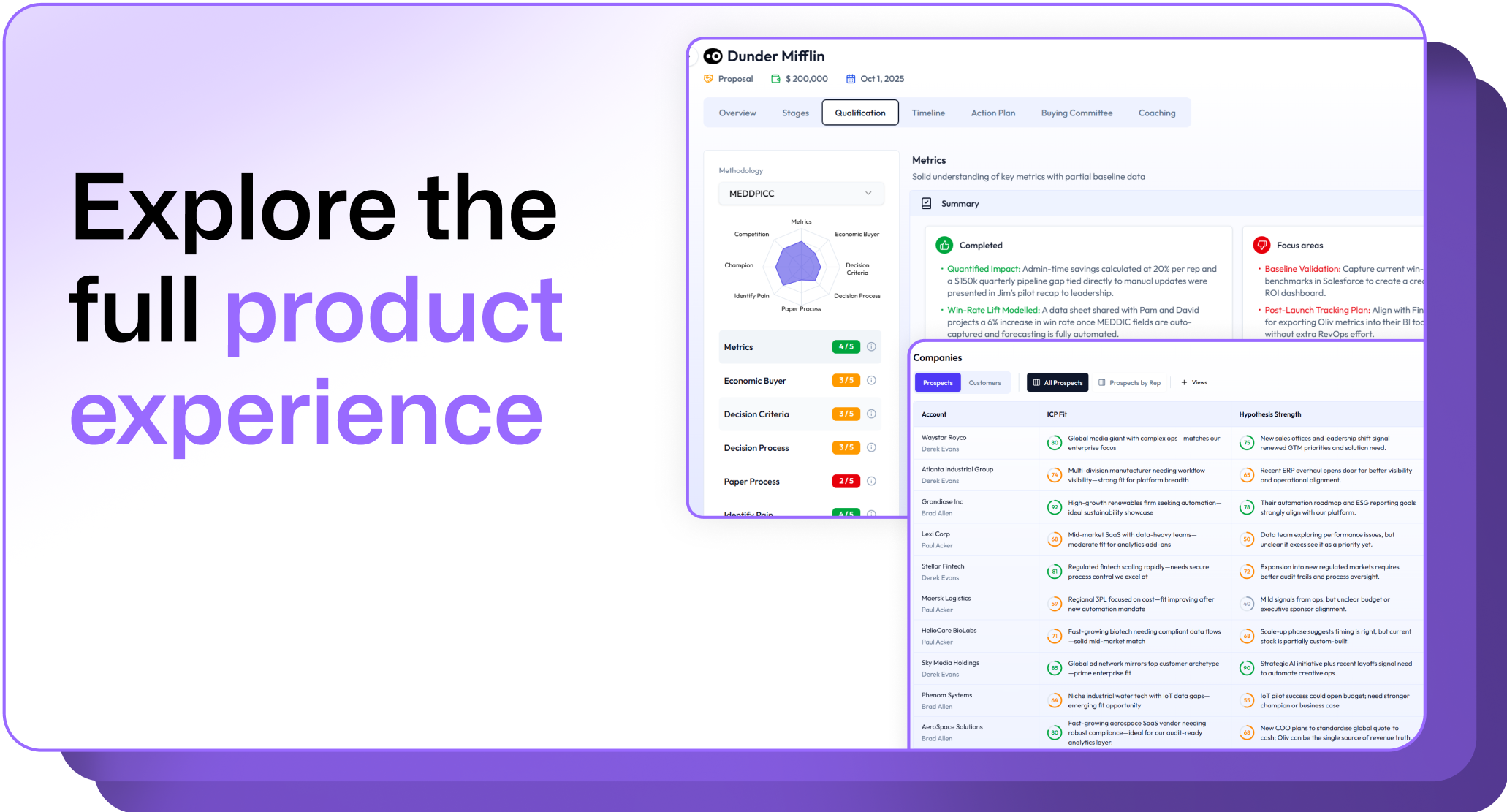
.avif)