Agentic AI Revenue Execution for Head of Sales: Pipeline to Closed-Won Guide | 2026
Written by
Ishan Chhabra
Last Updated :
March 24, 2026
Skim in :
7
mins
In this article
Revenue teams love Oliv
Here’s why:
All your deal data unified (from 30+ tools and tabs).
Insights are delivered to you directly, no digging.
AI agents automate tasks for you.
Thank you! Your submission has been received!
Oops! Something went wrong while submitting the form.
Meet Oliv’s AI Agents
Hi! I’m, Deal Driver
I track deals, flag risks, send weekly pipeline updates and give sales managers full visibility into deal progress
Hi! I’m, CRM Manager
I maintain CRM hygiene by updating core, custom and qualification fields all without your team lifting a finger
Hi! I’m, Forecaster
I build accurate forecasts based on real deal movement and tell you which deals to pull in to hit your number
Hi! I’m, Coach
I believe performance fuels revenue. I spot skill gaps, score calls and build coaching plans to help every rep level up
Hi! I’m, Prospector
I dig into target accounts to surface the right contacts, tailor and time outreach so you always strike when it counts
Hi! I’m, Pipeline tracker
I call reps to get deal updates, and deliver a real-time, CRM-synced roll-up view of deal progress
Hi! I’m, Analyst
I answer complex pipeline questions, uncover deal patterns, and build reports that guide strategic decisions
TL;DR
Pipeline theater (inflated stages, copied next steps) is a systems problem, not a rep problem. Legacy CRMs document deals but don't execute them.
Manual pipeline inspection costs mid-market orgs $250K+/year in manager time alone, before counting lost deals and missed coaching.
Most tools labeled "agentic" in 2026 operate at Level 1 to 2 (alerts/suggestions). True autonomous execution (Level 3) means AI performs the task end-to-end.
Stacking Gong + Clari runs ~$500/user/month with zero autonomous execution. Single-platform agentic alternatives offer 91% cost reduction.
Oliv.ai's "Prep, Met, Wrap-Up" loop automates pre-call briefs, live capture, follow-up drafting, and CRM updates with one-click human approval.
A Head of Sales can operationalize AI revenue execution in 60 days: 15 days foundation, 20 days pilot activation, 25 days full-org optimization.
Q1: Why Does Revenue Execution Break Down Between Pipeline and Closed-Won? [toc=Revenue Execution Breakdown]
The Head of Sales Paradox: Coverage Up, Conversion Flat
If you're a Head of Sales at a growth-stage or mid-market company, you've lived this moment: 3x pipeline coverage on the board slide, rep activity metrics trending green and yet the quarter ends with a miss. The disconnect between "pipeline" and "closed-won" isn't a rep problem. It's a systems problem. The tools your org relies on were built to document deals, not execute them.
⚠️ Why Legacy CRMs Create "Pipeline Theater"
Traditional CRMs treat pipeline as a static, rep-entered snapshot. Reps update stages to keep managers off their backs, not to reflect the real state of the deal. The result is what seasoned operators call pipeline theater:
Stages inflated to signal progress that hasn't happened
"Next steps" fields copied and pasted from last week
Monday forecast calls built on narrative, not evidence
As one Clari user on Reddit put it:
"Clari is a tool for sales leaders, it adds no value to reps as far as I can see." — Msoave, r/SalesOperations Reddit Thread
When reps view CRM updates as administrative policing rather than deal progression, every downstream report, from forecast to board deck, is built on fiction.
The AI-Era Shift: From "Inspect and Correct" to "Detect, Act, and Notify"
Agentic AI fundamentally flips the execution model. Instead of managers pulling data from dashboards after the fact, AI continuously monitors conversation outcomes, email engagement, and milestone completion, then pushes deal-level intelligence directly to managers in Slack, email, and CRM properties.
The shift is from reactive inspection to proactive orchestration. Deals don't wait for a Monday morning call to surface risk; the system flags, acts, and notifies in real time.
✅ How Oliv.ai Closes the Execution Gap
Oliv.ai operates as an autonomous AI-native revenue orchestration layer, a suite of 30+ AI agents (CRM Manager, Deal Driver, Forecaster, Meeting Assistant) that work in the background to:
Stitch meeting transcripts, emails, support tickets, and Slack messages into a single deal narrative
Update CRM objects and properties (not just "notes") in real time
Flag at-risk deals and draft follow-ups without human data entry
We deliver results where you already live, in Slack, Gmail, and CRM fields, rather than requiring yet another app login. The UI is invisible; the outcomes are not.
💰 The Stakes Are Higher Than You Think
According to Salesforce's State of Sales research, reps spend only 28% of their time actually selling. The remaining 72% is consumed by administrative tasks, data entry, CRM updates, meeting prep, and follow-up drafting, that sit squarely between pipeline and closed-won. Oliv.ai reclaims that 72% by automating the execution layer, so your team spends its time on the conversations that close deals, not the tasks that document them.
Q2: What Does 'Agentic AI for Sales' Actually Mean and Who's Leading? [toc=Agentic AI Defined]
Cutting Through the Buzzword: A Working Definition
"Agentic AI" has become the most overused term in sales tech since "revenue intelligence." Every vendor from Salesforce to Gong now claims to offer it. But most sales leaders can't distinguish a genuine autonomous agent from a chatbot bolted onto a dashboard. Here's a clear definition: agentic AI for sales means the AI doesn't just show you data, it performs the work.
That means updating CRM fields, drafting follow-up emails, qualifying deals from conversation signals, and alerting managers to risk, autonomously, with human-in-the-loop approval, not human-in-the-loop execution.
❌ Why "Bolted-On AI" Falls Short
Generation 1 sales tools (2015 to 2022) were built as "apps you use." They required reps to manually input data to extract value. The AI era hasn't changed that for most incumbents:
Salesforce Agentforce: Heavily chat-based, reps must manually "go and talk to a bot" to get work done rather than having tasks integrated into their daily flow.
Gong: Their "agents" are largely marketing labels on keyword-based alerting. Smart Trackers rely on V1 machine learning, flagging surface-level keyword matches without contextual reasoning.
Chorus (ZoomInfo): A pre-generative-AI tool that has seen minimal innovation since its acquisition, functioning primarily as a basic note-taker.
As one G2 reviewer noted about Gong's growing complexity:
"It's too complicated, and not intuitive at all. Using it is very...discomforting. Searching for calls is not easy, moving around in the calls is not easy, and understanding the pipeline management portion of it is almost impossible." — John S., Senior Account Executive, G2 Verified Review
The 4-Level Agentic Maturity Spectrum
Not all "AI" is created equal. Here's a practical framework to evaluate any vendor's claims:
4-Level Agentic Maturity Spectrum
Level
Capability
What It Does
Example
Level 0
Dashboards
Static reports you pull
Legacy CRM reports
Level 1
Alerts
Keyword-triggered notifications
Gong Smart Trackers
Level 2
Suggestions
Next-best-action recommendations
Clari deal scores, Agentforce chat
Level 3
Autonomous Execution
AI performs the task end-to-end with human approval
Oliv.ai agents
Most tools marketed as "agentic" in 2026 operate at Levels 1 to 2. They tell you what might need attention. They don't do the work.
Most sales tools marketed as "agentic" stop at suggestions. True autonomous execution means the AI performs the task end-to-end.
✅ Oliv.ai: Level 3 Autonomous Execution
Oliv operates at Level 3. Our agents don't suggest a CRM update, they write it. They don't recommend a follow-up, they draft multi-step email sequences in your Gmail within 5 to 15 minutes of the call ending. Specifically:
CRM Manager populates MEDDPICC fields from conversation signals
Follow-up Maniac drafts personalized email sequences in Gmail drafts
Meeting Assistant captures and summarizes in real time
The rep gets a Slack nudge to "verify and approve," one click, not 30 minutes of data entry. Oliv delivers results where you live: Slack, Email, and the CRM properties you already use.
Q3: Which Revenue Intelligence Tools Are Truly Agentic vs. Just Dashboards? [toc=Agentic vs. Dashboard Tools]
Four Generations of Revenue Tech and Where Most Tools Are Stuck
Most tools marketed as "agentic" today are stuck in generations 2 to 3. They've added AI labels to existing dashboard products without fundamentally changing who does the work.
⚠️ Gong: The "Dashcam" Problem
Gong pioneered conversation intelligence and it remains strong there. But as a revenue execution platform, Gong functions like a dashcam: it records everything so you can review a crash later, but it doesn't help you drive the car.
Smart Trackers rely on keyword-based ML, flagging "budget" even when a prospect mentions a personal holiday budget
Managers end up listening to calls at 2x speed on commutes to verify rep claims
Meeting summaries log as unstructured "Notes" in CRM, unsearchable and unusable for automated reporting
"Gong is a really powerful tool but it's probably the highest end option on the market, and now we're stuck with a tool that works technically but isn't the right business decision." — Iris P., Head of Marketing, Sales & Partnerships, G2 Verified Review
⚠️ Clari: Dashboard Fatigue and the "Thursday Ritual"
Clari excels at providing a clean forecasting overlay on Salesforce. But it remains a pre-generative-AI tool that requires managers to pull information from dashboards rather than having it pushed to them. The Thursday/Friday roll-up ritual, where managers consolidate rep spreadsheets before Monday's forecast call, persists even with Clari in the stack.
"It is really just a glorified SFDC overlay. Actually, Salesforce has built most of the forecasting functionality by now anyway so I'm not sure where they fit into that whole overcrowded Martech space." — conaldinho11, r/SalesOperations Reddit Thread
Stacking Gong (for CI) + Clari (for forecasting) leads to approximately $500/user/month TCO, with no autonomous execution at any layer.
✅ Oliv.ai: An Agentic Workforce, Not Another App
Oliv replaces both tools with a single agentic platform. Powered by 100+ fine-tuned LLMs grounded in your organization's specific data, Oliv reasons through conversation context, not keywords, to update CRM objects, score deals, and push daily Sunset Summaries to managers.
Gong vs Clari vs Oliv.ai Comparison
Dimension
Gong
Clari
Oliv.ai
Core Approach
Record & review
Dashboard overlay
Autonomous agents
Deal Health
Activity-volume based
Rep-submitted forecast
Evidence-based, AI-scored
CRM Updates
Unstructured notes
Manual via SFDC sync
Structured object-level writes
Forecasting
Add-on module (extra cost)
Core product
Forecaster Agent (included)
Coaching
Manager listens to calls
-
Automated Skill-Gap Maps
Agentic Level
Level 1 to 2
Level 1 to 2
Level 3
Q4: Why Don't My Pipeline Stages Reflect What's Actually Happening in Deals? [toc=Pipeline Stage Drift]
The Silent Killer: Pipeline Stage Drift
Every Head of Sales has stared at a pipeline report showing "60% in Negotiation" while knowing that half those deals haven't had meaningful contact in weeks. Pipeline stage drift, the gap between what CRM says and what's actually happening, is the single biggest destroyer of forecast accuracy in growth-stage and mid-market orgs.
The data tells the story: deals sit in stages long past their actual progression because the only person responsible for moving them is the rep. And the rep has a different priority, selling.
❌ Why CRM-as-a-Product Has Failed
The root cause is structural. Data entry is not critical to the act of selling for a rep. Reps care deeply about not dropping the ball on next steps but they view CRM updates as administrative policing, not deal acceleration. This creates:
Pipeline bloat: Stages stagnate even as real conversations progress
Standardization mismatch: Legacy SaaS forces $1M ACV enterprise deals and $10K SMB deals into identical workflows
Unstructured data: Tools like Gong log summaries as "Notes," text blocks that are unsearchable and unusable for automated reporting
As one Gong user from TrustRadius confirmed:
"There's so much in Gong, that we don't use everything. Gong's deal forecasting we don't use." — Karel Bos, Head of Sales, Vesper B.V., TrustRadius Verified Review
Meanwhile, a Clari user highlighted the downstream effect:
"Clari should find ways to differentiate from the native Salesforce features (e.g. Pipeline Inspection, Forecasting) in order to remain competitive in the long-run." — Dan J., G2 Verified Review
How Agentic AI Resolves Stage Drift
Agentic AI monitors conversation outcomes, email engagement, and milestone completion to determine the real stage of a deal. Instead of waiting for a rep to drag a card on a Kanban board, the system continuously reasons about deal progression from actual signals:
Was a demo completed? Move from "Demo Scheduled" to "Demo Done"
Has the economic buyer been engaged? Update MEDDPICC champion field
Has a mutual close plan been shared? Advance to "Negotiation" with evidence
✅ Oliv.ai: Automated Deal Progression in Structured CRM Fields
Oliv's CRM Manager agent doesn't write paragraphs of notes. It updates actual CRM Objects and Properties, MEDDPICC fields, close dates, next steps, stakeholder maps, making every data point reportable and actionable.
✅ Automatic stage movement based on conversation outcomes, not rep claims
✅ Object-level writes to structured fields (not unstructured text blocks)
✅ Real-time gap identification: missing champion, unresolved objections, stale next steps
Where Gong logs a meeting summary as a text "Note" that no report can query, Oliv writes to the exact CRM field your RevOps team needs for downstream analytics. The result: pipeline stages that reflect reality, automatically, continuously, and with zero rep data entry.
Q5: Why Is Our CRM Associating Activities to the Wrong Opportunities? [toc=CRM Activity Misassociation]
The Hidden Data Integrity Crisis
When a rep closes a deal but the CRM shows that activity logged against a different opportunity, or a different account entirely, the downstream damage is severe. Forecasts misattribute revenue. Compensation calculations break. Attribution models collapse. And the Head of Sales makes board commitments based on a pipeline that doesn't reflect reality.
This problem is far more common than most leaders realize. In any CRM with 5,000+ accounts, duplicate records are practically inevitable: Google US vs. Google India, a contact sitting on three open opportunities, or two different products being sold into the same account simultaneously.
❌ Why Rule-Based Association Breaks in the Real World
Legacy CRM systems, including Salesforce Einstein Activity Capture, rely on brittle rule-based logic to map activities to opportunities. Common rules include:
"Match by email domain" breaks when multiple accounts share the same parent domain
"Attach to most recent opportunity" fails when two deals are open on the same account
"Match by contact owner" misroutes when contacts are reassigned mid-cycle
Einstein Activity Capture is widely viewed by RevOps teams as a subpar solution. It redacts emails unnecessarily (claiming "sensitive info") and stores data in separate AWS instances that are unusable for downstream reporting.
As one Gartner reviewer noted about Einstein:
"Its biggest handicap is that it does not allow for data storage or data migration. You can't really input the data from Einstein into another platform. One does not have access to the data of employees that leave the organization." — Senior Associate Business Manager, Gartner Peer Insights Review
How Generative AI Solves the Association Problem
Generative AI can reason through the full history and content of a conversation, understanding product mentions, stakeholder context, and deal-specific language, to associate the activity to the correct opportunity. This isn't pattern matching; it's contextual reasoning across your entire data graph.
Instead of asking "which opportunity was created most recently?", agentic AI asks: "Based on the email content, which deal is this conversation about?"
✅ Oliv.ai: AI-Based Object Association + Data Hygiene
Oliv's AI-Based Object Association uses generative reasoning (not rules) to determine the "right logical one" for every activity, even in messy duplicate environments. Here's how it works:
Contextual routing: Oliv reads the email/call content and routes each thread to the correct deal, even when two products are being sold into the same account simultaneously
Data Cleanser agent: Deduplicates and normalizes records weekly, flagging anomalies autonomously
Zero manual intervention: No RevOps team member needs to build or maintain association rules
💡 Real-World Scenario
A rep sells Product A and Product B into the same enterprise account. All emails go to the same stakeholder. Rule-based tools attach every thread to whichever opportunity was created first. Oliv reads the email content, identifies product-specific language and pricing discussions, and routes each thread to its correct opportunity. Forecasting stays clean. Compensation stays accurate. The Head of Sales sees two distinct deals, not one bloated mess.
Q6: Why Do We Have Tons of Activity but Weak Conversion Rates? [toc=Activity vs. Conversion Gap]
The "Fake Coverage" Trap
"3x pipeline coverage and climbing, but we're still going to miss the quarter." This is the sentence every Head of Sales dreads saying on a board call. High activity metrics create a powerful illusion of health while masking fatal qualification gaps. Reps show managers what they want them to see while hiding stalled deals. The result is what experienced operators call "Fake Coverage".
The root issue isn't that reps are lazy, it's that traditional CRM metrics reward motion over progression.
⚠️ Why Activity Volume Does Not Equal Deal Health
Traditional revenue intelligence tools equate more activity with better outcomes. This is fundamentally flawed:
Gong's activity bias: If a rep sends 10 outbound emails, Gong logs "high activity" suggesting the deal will close, even if the prospect is ghosting the rep
Rep-driven assessments: Clari and Gong rely on rep-submitted sentiment to score deals. If a rep's assessment is biased (and it often is), the rolled-up forecast given to the board is fundamentally flawed
As one Clari user captured this limitation:
"The analytics modules still needs some work IMO to provide a valuable deliverable. All the pieces are there but missing the story line... You have to click around through the different modules and extract the different pieces ultimately putting it in an excel for easier manipulation." — Natalie O., Sales Operations Manager, G2 Verified Review
And a Gong reviewer highlighted the complexity barrier:
"It can be overwhelming to set up trackers. AI training is a bit laborious to get it to do what you want." — Trafford J., Senior Director, Revenue Enablement, G2 Verified Review
The AI Fix: Meaningful Engagement vs. Motion
The fix isn't more activity tracking, it's distinguishing meaningful engagement from motion. Agentic AI can identify:
Last meaningful engagement vs. "rep frantically chasing"
Mutual action plan progress vs. stalled next steps
Buying signals in conversation vs. polite interest
✅ Oliv.ai: The "Unbiased Observer"
Oliv is the only platform that stitches data from meetings, emails, support tickets, and Slack into a 360-degree deal view, then qualifies based on evidence, not opinions:
✅ Distinguishes between genuine progression and surface-level activity
✅ Flags deals where activity is high but engagement quality is low
The Head of Sales sees evidence, stakeholder maps, objection logs, milestone completion, not a rep's optimistic sentiment score. That's the difference between fake coverage and real pipeline.
Q7: What's the Real Cost of Managers Spending 45 to 60 Minutes per Rep in Pipeline Reviews? [toc=Pipeline Review Cost]
⏰ The Most Expensive Ritual Nobody Audits
The "Monday Tradition," Thursday/Friday prep, Monday morning pipeline call, is the most expensive recurring ritual in sales leadership. Yet no one puts a dollar figure on it. For the Head of Sales managing a multi-layer org, the numbers are staggering when you actually do the math.
💸 The Hard-Dollar Cost of Manual Pipeline Inspection
Here's the calculation for a typical mid-market sales org:
That's over $250K/year consumed by pipeline inspection alone, before counting the opportunity cost.
As one Clari user noted about the forecasting overhead:
"I do think the forecasting feature is decent, but at least in our setup, it doesn't do a great job of auto-calculating the values I need to submit, so that is entirely handheld by using the built-in notes field as a calculator." — Dexter L., Customer Success Executive, G2 Verified Review
❌ The Opportunity Cost: Deals Lost While Managers Prepare Spreadsheets
In high-velocity SMB motions (15 to 25 day sales cycles), deals move too fast for weekly reviews. By the time a manager catches a risk on Monday, the deal was lost on Thursday. The real cost isn't just time, it's:
Deals that slipped while managers were consolidating Clari roll-ups
Coaching conversations that never happened because the week was consumed by inspection
Strategic initiatives deprioritized because managers are buried in spreadsheets
Stacking Gong (for conversation intelligence) + Clari (for forecasting) adds approximately $500/user/month in tool costs on top of these labor costs, with no autonomous execution at any layer.
✅ Oliv.ai: Automate the Monday Tradition
Oliv's Forecaster Agent inspects every deal line-by-line autonomously, identifying unresolved objections, missed milestones, and forecast risks in real time:
✅ Sunset Summaries push a daily proactive pulse on deal movement via Slack/Email
✅ 91% cost reduction: Over three years, a 100-user team on Gong costs ~$789,300 vs. ~$68,400 on Oliv
The Monday pipeline call doesn't disappear, it transforms from a 3-hour data-gathering exercise into a 45-minute strategic discussion where managers coach on exceptions flagged by AI.
Q8: How Can I Reduce Pipeline Inspection Without Losing Deal Standards? [toc=Reducing Pipeline Inspection]
The Inspection Paradox
Sales managers managing 6 to 12 reps each face 25 to 35 calls per day across their teams. It is practically impossible for a human to review every deal. Yet dropping inspection means missing critical risk signals, a lost champion, an unresolved pricing objection, a deal sitting in "Demo Scheduled" for three weeks.
The question isn't "inspect or don't," it's "how do I systematize inspection so standards scale without human bottlenecks?"
Gong's Smart Trackers represent the best of Generation 1 machine learning, and they illustrate its limits. Trackers flag the word "budget" even when a prospect is talking about a personal holiday budget rather than a project commitment. They surface "competitor mentioned" without distinguishing between a casual reference and a serious evaluation.
The result is alert fatigue. Managers mute the Slack channel. They revert to listening to calls at 2x speed, covering only ~2% of total interactions. The system exists but doesn't actually reduce inspection burden.
"No way to collaborate/share a library of top calls, AI is not great yet - the product still feels like it's at its infancy and needs to be developed further." — Annabelle H., Voluntary Director - Board of Directors, G2 Verified Review
A Clari user echoed the dashboard fatigue problem:
"I have to maintain my own separate spreadsheet to track deals because I can only capture what my leaders want to see about a deal (revenue, close date, etc.) and as a rep, I need to have fields like product interest, last activity notes, key contacts, deal challenges or blockers, etc." — Verified User in Human Resources, G2 Verified Review
The Identity Shift: From "Inspector" to "System Designer"
Agentic AI enables a fundamental role transformation. Instead of personally reviewing every deal, the Head of Sales designs the AI-powered standards framework:
Define stage entry/exit criteria
Set qualification thresholds (MEDDPICC completeness scores)
Establish risk signal triggers (stale next steps, single-threaded deals, missing economic buyer)
Then let agents enforce those standards across 100% of interactions, not the 2% a human can cover.
✅ Oliv.ai: Reasoning Over Recording
Oliv's Deal Driver and Coach agents analyze every interaction to pinpoint gaps in performance, without a manager listening to a single call:
✅ Monthly Skill-Gap Map: A personalized coaching plan for every rep, identifying the one thing that will unlock their performance
✅ Sunset Summaries: Daily proactive pulse on deal movement via Slack/Email, saving managers one full day per week
✅ 100% automated coverage: Every call, email, and meeting analyzed for qualification gaps and risk signals
The Head of Sales evolves from "chief inspector" to "system architect," designing the rules the AI enforces, reviewing exceptions, and coaching strategically. That's how you reduce inspection without losing standards.
Q9: What Does an Autonomous CRM Workflow Actually Look Like for a Sales Org? [toc=Autonomous CRM Workflow]
Why "Autonomous CRM" Isn't Science Fiction
"Autonomous CRM" sounds like a concept from a 2028 roadmap, but it's operational today. The core idea is simple: instead of the rep serving the CRM, the CRM serves the rep. Every administrative task that sits between "having a conversation" and "closing a deal" is handled by AI agents, with the human approving outputs rather than creating them.
This section walks through what a rep's day and a manager's Monday actually look like when the CRM runs itself.
Reps reclaim over 80 minutes per call cycle when AI agents handle prep, follow-up, and CRM updates autonomously
❌ The Traditional Workflow: 2 to 3 Hours of Non-Selling Work per Day
Here's how a typical rep's call cycle works without autonomous AI:
Traditional Rep Call Cycle Time Breakdown
Task
Time Spent
Value Added to Deal
Pre-call prep (LinkedIn, CRM history, old notes)
30 min
Indirect
Post-call follow-up email drafting
20 to 30 min
Moderate
CRM field updates (stage, next steps, contacts)
10 to 15 min
None to rep
Logging next steps and action items
10 to 15 min
None to rep
Total per call cycle
70 to 90 min
-
Multiply that across 3 to 4 calls per day, and reps lose 2 to 3 hours daily to administrative work that generates zero pipeline progression. As one Gong user admitted:
"There's so much in Gong, that we don't use everything. Gong's deal forecasting we don't use." — Karel Bos, Head of Sales, Vesper B.V., TrustRadius Verified Review
✅ The Autonomous Workflow: Prep, Met, Wrap-Up
Oliv.ai operates on a continuous "Prep, Met, and Wrap-up" loop that eliminates every manual step:
⏰ Pre-Call, Morning Brief (30 min before the call): Oliv sends a Slack/Email summary containing account history, tech stack, stakeholder map, and recommended points of focus. The rep never walks into a call "cold."
⭐ During the Call, Meeting Assistant (Live): Oliv's Meeting Assistant captures the conversation in real time, summarizing it in a sales-specific format, identifying demo resonance, objections raised, and buying signals detected.
✅ Post-Call, Rapid Wrap-Up (5 to 15 minutes, fully automated):
CRM Manager: Updates MEDDPICC fields, creates missing contacts (enriched via LinkedIn), and maps Mutual Action Plans
Human-in-the-Loop: The rep receives a Slack nudge to "verify and approve," one click, not 30 minutes of data entry
Oliv.ai's autonomous loop: from morning brief to CRM update in under 15 minutes, with one-click rep approval.
The Manager's Monday: From 3 Hours to 45 Minutes
Instead of listening to 25+ calls or consolidating spreadsheets, the manager opens Oliv's daily Sunset Summary, a prioritized list of deals needing attention, with AI-generated reasoning for each flag. The Monday pipeline call transforms from a data-gathering marathon into a focused strategic discussion. As one Clari user noted the gap in traditional tools:
"I have to maintain my own separate spreadsheet to track deals because I can only capture what my leaders want to see about a deal." — Verified User in Human Resources, G2 Verified Review
Oliv eliminates that spreadsheet entirely.
Q10: How Do Gong and Clari Compare to an Agentic Platform for Revenue Execution? [toc=Gong vs Clari vs Oliv]
For a Head of Sales evaluating revenue technology in 2026, the critical question isn't "which dashboard is prettier," it's "which platform actually does the work?" Below is a structured, fact-based comparison across the dimensions that matter most for revenue execution.
Feature-by-Feature Comparison
Gong vs Clari vs Oliv.ai Feature Comparison
Dimension
Gong
Clari
Oliv.ai
Core Category
Revenue Intelligence (CI)
Revenue Forecasting Overlay
AI-Native Revenue Orchestration
Data Input
Call recording + manual CRM sync
Salesforce data pull + rep-submitted forecasts
Auto-ingests calls, emails, support tickets, Slack
Deal Health Scoring
Activity-volume based
Rep-driven sentiment + AI prediction
Evidence-based (conversation signals, not rep claims)
Cost is a recurring pain point for both legacy platforms. One Gong reviewer noted:
"Gong is a really powerful tool but it's probably the highest end option on the market, and now we're stuck with a tool that works technically but isn't the right business decision." — Iris P., Head of Marketing, Sales & Partnerships, G2 Verified Review
On the Clari side, a Reddit user captured the overlap problem:
"It is really just a glorified SFDC overlay. Actually, Salesforce has built most of the forecasting functionality by now anyway so I'm not sure where they fit into that whole overcrowded Martech space." — conaldinho11, r/SalesOperations Reddit Thread
Key Takeaways for the Head of Sales
Gong excels at conversation intelligence and call recording but functions as a "dashcam," powerful for retrospective review, not real-time execution
Clari simplifies Salesforce-based forecasting but adds limited value beyond what native SFDC features now offer, and requires ongoing manual roll-ups
Oliv.ai operates as an agentic workforce, updating CRM fields, drafting follow-ups, scoring deals, and producing board-ready reports autonomously
Oliv.ai offers a single-platform alternative that replaces the Gong + Clari stack while adding autonomous execution capabilities neither tool provides.
Q11: What's the 60-Day Implementation Roadmap for AI-Powered Revenue Execution? [toc=60-Day Implementation Roadmap]
Transitioning from traditional pipeline management to AI-powered revenue execution doesn't require a year-long transformation project. Below is a phased 60-day roadmap designed for a Head of Sales at a growth-stage or mid-market company.
Phase 1: Foundation (Days 1 to 15)
Audit current inspection costs: Calculate how many hours per week your managers spend on pipeline reviews, CRM audits, and forecast prep using the formula from Q7 (reps x time per rep x manager cost per hour)
Map your deal progression criteria: Document your current stage definitions, exit criteria, and qualification framework (MEDDPICC, BANT, or SPICED)
Identify integration points: Confirm your CRM (Salesforce, HubSpot), email platform (Gmail, Outlook), meeting tools (Zoom, Teams), and communication channels (Slack, Teams)
Connect Oliv.ai: Initial configuration takes approximately 5 minutes, connect CRM, email, calendar, and Slack in a single setup session
"It can be overwhelming to set up trackers. AI training is a bit laborious to get it to do what you want." — Trafford J., Senior Director, Revenue Enablement, G2 Verified Review
By contrast, Oliv's configuration is designed for immediate activation, no tracker setup or manual AI training required. While Gong implementation takes 8 to 24 weeks, Oliv is operational in minutes.
Phase 2: Activation (Days 16 to 35)
Pilot with one team: Start with a single front-line manager and their 6 to 10 reps to validate the autonomous workflow
Enable the Prep, Met, Wrap-Up loop: Activate Morning Briefs, Meeting Assistant, Follow-up Maniac, and CRM Manager agents
Validate CRM data quality: Review the first two weeks of automated CRM updates against manual spot-checks to build confidence in AI accuracy
Launch Sunset Summaries: Enable daily deal-movement digests for the pilot manager via Slack/Email
Phase 3: Optimization (Days 36 to 60)
Expand to all front-line managers: Roll out across the full sales org based on pilot learnings
Activate Forecaster Agent: Enable autonomous deal-line inspection and board-ready slide generation for the weekly forecast call
Deploy Coach agent: Activate Monthly Skill-Gap Maps for every rep, personalized coaching plans based on AI analysis of 100% of interactions
Establish baseline metrics: Track and compare pre/post metrics across forecast accuracy, CRM field completion rates, deal velocity, and manager time spent on inspection
By Day 60, the Head of Sales should see measurable improvements in CRM hygiene, forecast preparation time, and manager capacity for strategic coaching, while Oliv.ai handles the administrative execution layer autonomously.
Q12: What Should a Head of Sales Do This Week to Start the Shift to AI Revenue Execution? [toc=Immediate Action Steps]
You don't need board approval or a six-month transformation plan to start. Here are five concrete actions a Head of Sales can execute this week to begin the shift from manual pipeline inspection to AI-powered revenue execution.
Action 1: Calculate Your Pipeline Inspection Tax
Pull up a calculator and run the numbers from Q7:
(Number of reps per manager) x (minutes per rep review) x (number of managers) x (52 weeks) x (loaded hourly cost)
Most mid-market orgs discover they're spending $150K to $300K/year on inspection time alone
Write that number down. It's the budget justification for every conversation that follows.
Action 2: Audit Your CRM Data Trust Score
Ask your RevOps team: "What percentage of deals in the current quarter have accurate stage, next step, and close date fields?" If the answer is below 80%, your forecast is built on fiction. As one Clari user observed:
"Some users may find Clari's analytics and forecasting tools complex, requiring significant onboarding and training. While Clari integrates with many CRM platforms, users occasionally report difficulties syncing data seamlessly, especially with custom CRM setups." — Bharat K., Revenue Operations Manager, G2 Verified Review
If your tools require extensive onboarding just to maintain data integrity, the tool is the bottleneck, not your team.
Action 3: Time One Full Pipeline Review Cycle
This Thursday and Friday, have every front-line manager track exactly how long they spend preparing for Monday's forecast call, consolidating spreadsheets, updating Clari, listening to Gong calls, and chasing reps for updates. The total will likely shock you.
Action 4: Test One Autonomous Workflow
Sign up for an Oliv.ai pilot and run one week of the Prep, Met, Wrap-Up loop with a single rep. Measure the time difference between the traditional workflow and the autonomous one. Most teams report reclaiming 1 to 2 hours per rep per day within the first week.
⚠️ Action 5: Reframe the Buying Decision
Stop comparing "tool vs. tool" (Gong vs. Clari vs. Oliv). Instead, ask: "Am I buying another app my team has to adopt, or am I hiring an agentic workforce that does the work for them?"
"We've had a disappointing experience with Gong Engage... The tool is slow, buggy, and creates an excessive administrative burden on the user side." — Anonymous Reviewer, G2 Verified Review
The distinction between "SaaS you adopt" and "agents that execute" is the defining technology decision for Heads of Sales in 2026. Traditional revenue intelligence tools are the high-end treadmill, expensive equipment, but your team still does all the running. Oliv.ai is the personal trainer and nutritionist: the agents do the heavy lifting, delivering the outcome of "Closed-Won" with significantly less manual effort.
Q1: Why Does Revenue Execution Break Down Between Pipeline and Closed-Won? [toc=Revenue Execution Breakdown]
The Head of Sales Paradox: Coverage Up, Conversion Flat
If you're a Head of Sales at a growth-stage or mid-market company, you've lived this moment: 3x pipeline coverage on the board slide, rep activity metrics trending green and yet the quarter ends with a miss. The disconnect between "pipeline" and "closed-won" isn't a rep problem. It's a systems problem. The tools your org relies on were built to document deals, not execute them.
⚠️ Why Legacy CRMs Create "Pipeline Theater"
Traditional CRMs treat pipeline as a static, rep-entered snapshot. Reps update stages to keep managers off their backs, not to reflect the real state of the deal. The result is what seasoned operators call pipeline theater:
Stages inflated to signal progress that hasn't happened
"Next steps" fields copied and pasted from last week
Monday forecast calls built on narrative, not evidence
As one Clari user on Reddit put it:
"Clari is a tool for sales leaders, it adds no value to reps as far as I can see." — Msoave, r/SalesOperations Reddit Thread
When reps view CRM updates as administrative policing rather than deal progression, every downstream report, from forecast to board deck, is built on fiction.
The AI-Era Shift: From "Inspect and Correct" to "Detect, Act, and Notify"
Agentic AI fundamentally flips the execution model. Instead of managers pulling data from dashboards after the fact, AI continuously monitors conversation outcomes, email engagement, and milestone completion, then pushes deal-level intelligence directly to managers in Slack, email, and CRM properties.
The shift is from reactive inspection to proactive orchestration. Deals don't wait for a Monday morning call to surface risk; the system flags, acts, and notifies in real time.
✅ How Oliv.ai Closes the Execution Gap
Oliv.ai operates as an autonomous AI-native revenue orchestration layer, a suite of 30+ AI agents (CRM Manager, Deal Driver, Forecaster, Meeting Assistant) that work in the background to:
Stitch meeting transcripts, emails, support tickets, and Slack messages into a single deal narrative
Update CRM objects and properties (not just "notes") in real time
Flag at-risk deals and draft follow-ups without human data entry
We deliver results where you already live, in Slack, Gmail, and CRM fields, rather than requiring yet another app login. The UI is invisible; the outcomes are not.
💰 The Stakes Are Higher Than You Think
According to Salesforce's State of Sales research, reps spend only 28% of their time actually selling. The remaining 72% is consumed by administrative tasks, data entry, CRM updates, meeting prep, and follow-up drafting, that sit squarely between pipeline and closed-won. Oliv.ai reclaims that 72% by automating the execution layer, so your team spends its time on the conversations that close deals, not the tasks that document them.
Q2: What Does 'Agentic AI for Sales' Actually Mean and Who's Leading? [toc=Agentic AI Defined]
Cutting Through the Buzzword: A Working Definition
"Agentic AI" has become the most overused term in sales tech since "revenue intelligence." Every vendor from Salesforce to Gong now claims to offer it. But most sales leaders can't distinguish a genuine autonomous agent from a chatbot bolted onto a dashboard. Here's a clear definition: agentic AI for sales means the AI doesn't just show you data, it performs the work.
That means updating CRM fields, drafting follow-up emails, qualifying deals from conversation signals, and alerting managers to risk, autonomously, with human-in-the-loop approval, not human-in-the-loop execution.
❌ Why "Bolted-On AI" Falls Short
Generation 1 sales tools (2015 to 2022) were built as "apps you use." They required reps to manually input data to extract value. The AI era hasn't changed that for most incumbents:
Salesforce Agentforce: Heavily chat-based, reps must manually "go and talk to a bot" to get work done rather than having tasks integrated into their daily flow.
Gong: Their "agents" are largely marketing labels on keyword-based alerting. Smart Trackers rely on V1 machine learning, flagging surface-level keyword matches without contextual reasoning.
Chorus (ZoomInfo): A pre-generative-AI tool that has seen minimal innovation since its acquisition, functioning primarily as a basic note-taker.
As one G2 reviewer noted about Gong's growing complexity:
"It's too complicated, and not intuitive at all. Using it is very...discomforting. Searching for calls is not easy, moving around in the calls is not easy, and understanding the pipeline management portion of it is almost impossible." — John S., Senior Account Executive, G2 Verified Review
The 4-Level Agentic Maturity Spectrum
Not all "AI" is created equal. Here's a practical framework to evaluate any vendor's claims:
4-Level Agentic Maturity Spectrum
Level
Capability
What It Does
Example
Level 0
Dashboards
Static reports you pull
Legacy CRM reports
Level 1
Alerts
Keyword-triggered notifications
Gong Smart Trackers
Level 2
Suggestions
Next-best-action recommendations
Clari deal scores, Agentforce chat
Level 3
Autonomous Execution
AI performs the task end-to-end with human approval
Oliv.ai agents
Most tools marketed as "agentic" in 2026 operate at Levels 1 to 2. They tell you what might need attention. They don't do the work.
Most sales tools marketed as "agentic" stop at suggestions. True autonomous execution means the AI performs the task end-to-end.
✅ Oliv.ai: Level 3 Autonomous Execution
Oliv operates at Level 3. Our agents don't suggest a CRM update, they write it. They don't recommend a follow-up, they draft multi-step email sequences in your Gmail within 5 to 15 minutes of the call ending. Specifically:
CRM Manager populates MEDDPICC fields from conversation signals
Follow-up Maniac drafts personalized email sequences in Gmail drafts
Meeting Assistant captures and summarizes in real time
The rep gets a Slack nudge to "verify and approve," one click, not 30 minutes of data entry. Oliv delivers results where you live: Slack, Email, and the CRM properties you already use.
Q3: Which Revenue Intelligence Tools Are Truly Agentic vs. Just Dashboards? [toc=Agentic vs. Dashboard Tools]
Four Generations of Revenue Tech and Where Most Tools Are Stuck
Most tools marketed as "agentic" today are stuck in generations 2 to 3. They've added AI labels to existing dashboard products without fundamentally changing who does the work.
⚠️ Gong: The "Dashcam" Problem
Gong pioneered conversation intelligence and it remains strong there. But as a revenue execution platform, Gong functions like a dashcam: it records everything so you can review a crash later, but it doesn't help you drive the car.
Smart Trackers rely on keyword-based ML, flagging "budget" even when a prospect mentions a personal holiday budget
Managers end up listening to calls at 2x speed on commutes to verify rep claims
Meeting summaries log as unstructured "Notes" in CRM, unsearchable and unusable for automated reporting
"Gong is a really powerful tool but it's probably the highest end option on the market, and now we're stuck with a tool that works technically but isn't the right business decision." — Iris P., Head of Marketing, Sales & Partnerships, G2 Verified Review
⚠️ Clari: Dashboard Fatigue and the "Thursday Ritual"
Clari excels at providing a clean forecasting overlay on Salesforce. But it remains a pre-generative-AI tool that requires managers to pull information from dashboards rather than having it pushed to them. The Thursday/Friday roll-up ritual, where managers consolidate rep spreadsheets before Monday's forecast call, persists even with Clari in the stack.
"It is really just a glorified SFDC overlay. Actually, Salesforce has built most of the forecasting functionality by now anyway so I'm not sure where they fit into that whole overcrowded Martech space." — conaldinho11, r/SalesOperations Reddit Thread
Stacking Gong (for CI) + Clari (for forecasting) leads to approximately $500/user/month TCO, with no autonomous execution at any layer.
✅ Oliv.ai: An Agentic Workforce, Not Another App
Oliv replaces both tools with a single agentic platform. Powered by 100+ fine-tuned LLMs grounded in your organization's specific data, Oliv reasons through conversation context, not keywords, to update CRM objects, score deals, and push daily Sunset Summaries to managers.
Gong vs Clari vs Oliv.ai Comparison
Dimension
Gong
Clari
Oliv.ai
Core Approach
Record & review
Dashboard overlay
Autonomous agents
Deal Health
Activity-volume based
Rep-submitted forecast
Evidence-based, AI-scored
CRM Updates
Unstructured notes
Manual via SFDC sync
Structured object-level writes
Forecasting
Add-on module (extra cost)
Core product
Forecaster Agent (included)
Coaching
Manager listens to calls
-
Automated Skill-Gap Maps
Agentic Level
Level 1 to 2
Level 1 to 2
Level 3
Q4: Why Don't My Pipeline Stages Reflect What's Actually Happening in Deals? [toc=Pipeline Stage Drift]
The Silent Killer: Pipeline Stage Drift
Every Head of Sales has stared at a pipeline report showing "60% in Negotiation" while knowing that half those deals haven't had meaningful contact in weeks. Pipeline stage drift, the gap between what CRM says and what's actually happening, is the single biggest destroyer of forecast accuracy in growth-stage and mid-market orgs.
The data tells the story: deals sit in stages long past their actual progression because the only person responsible for moving them is the rep. And the rep has a different priority, selling.
❌ Why CRM-as-a-Product Has Failed
The root cause is structural. Data entry is not critical to the act of selling for a rep. Reps care deeply about not dropping the ball on next steps but they view CRM updates as administrative policing, not deal acceleration. This creates:
Pipeline bloat: Stages stagnate even as real conversations progress
Standardization mismatch: Legacy SaaS forces $1M ACV enterprise deals and $10K SMB deals into identical workflows
Unstructured data: Tools like Gong log summaries as "Notes," text blocks that are unsearchable and unusable for automated reporting
As one Gong user from TrustRadius confirmed:
"There's so much in Gong, that we don't use everything. Gong's deal forecasting we don't use." — Karel Bos, Head of Sales, Vesper B.V., TrustRadius Verified Review
Meanwhile, a Clari user highlighted the downstream effect:
"Clari should find ways to differentiate from the native Salesforce features (e.g. Pipeline Inspection, Forecasting) in order to remain competitive in the long-run." — Dan J., G2 Verified Review
How Agentic AI Resolves Stage Drift
Agentic AI monitors conversation outcomes, email engagement, and milestone completion to determine the real stage of a deal. Instead of waiting for a rep to drag a card on a Kanban board, the system continuously reasons about deal progression from actual signals:
Was a demo completed? Move from "Demo Scheduled" to "Demo Done"
Has the economic buyer been engaged? Update MEDDPICC champion field
Has a mutual close plan been shared? Advance to "Negotiation" with evidence
✅ Oliv.ai: Automated Deal Progression in Structured CRM Fields
Oliv's CRM Manager agent doesn't write paragraphs of notes. It updates actual CRM Objects and Properties, MEDDPICC fields, close dates, next steps, stakeholder maps, making every data point reportable and actionable.
✅ Automatic stage movement based on conversation outcomes, not rep claims
✅ Object-level writes to structured fields (not unstructured text blocks)
✅ Real-time gap identification: missing champion, unresolved objections, stale next steps
Where Gong logs a meeting summary as a text "Note" that no report can query, Oliv writes to the exact CRM field your RevOps team needs for downstream analytics. The result: pipeline stages that reflect reality, automatically, continuously, and with zero rep data entry.
Q5: Why Is Our CRM Associating Activities to the Wrong Opportunities? [toc=CRM Activity Misassociation]
The Hidden Data Integrity Crisis
When a rep closes a deal but the CRM shows that activity logged against a different opportunity, or a different account entirely, the downstream damage is severe. Forecasts misattribute revenue. Compensation calculations break. Attribution models collapse. And the Head of Sales makes board commitments based on a pipeline that doesn't reflect reality.
This problem is far more common than most leaders realize. In any CRM with 5,000+ accounts, duplicate records are practically inevitable: Google US vs. Google India, a contact sitting on three open opportunities, or two different products being sold into the same account simultaneously.
❌ Why Rule-Based Association Breaks in the Real World
Legacy CRM systems, including Salesforce Einstein Activity Capture, rely on brittle rule-based logic to map activities to opportunities. Common rules include:
"Match by email domain" breaks when multiple accounts share the same parent domain
"Attach to most recent opportunity" fails when two deals are open on the same account
"Match by contact owner" misroutes when contacts are reassigned mid-cycle
Einstein Activity Capture is widely viewed by RevOps teams as a subpar solution. It redacts emails unnecessarily (claiming "sensitive info") and stores data in separate AWS instances that are unusable for downstream reporting.
As one Gartner reviewer noted about Einstein:
"Its biggest handicap is that it does not allow for data storage or data migration. You can't really input the data from Einstein into another platform. One does not have access to the data of employees that leave the organization." — Senior Associate Business Manager, Gartner Peer Insights Review
How Generative AI Solves the Association Problem
Generative AI can reason through the full history and content of a conversation, understanding product mentions, stakeholder context, and deal-specific language, to associate the activity to the correct opportunity. This isn't pattern matching; it's contextual reasoning across your entire data graph.
Instead of asking "which opportunity was created most recently?", agentic AI asks: "Based on the email content, which deal is this conversation about?"
✅ Oliv.ai: AI-Based Object Association + Data Hygiene
Oliv's AI-Based Object Association uses generative reasoning (not rules) to determine the "right logical one" for every activity, even in messy duplicate environments. Here's how it works:
Contextual routing: Oliv reads the email/call content and routes each thread to the correct deal, even when two products are being sold into the same account simultaneously
Data Cleanser agent: Deduplicates and normalizes records weekly, flagging anomalies autonomously
Zero manual intervention: No RevOps team member needs to build or maintain association rules
💡 Real-World Scenario
A rep sells Product A and Product B into the same enterprise account. All emails go to the same stakeholder. Rule-based tools attach every thread to whichever opportunity was created first. Oliv reads the email content, identifies product-specific language and pricing discussions, and routes each thread to its correct opportunity. Forecasting stays clean. Compensation stays accurate. The Head of Sales sees two distinct deals, not one bloated mess.
Q6: Why Do We Have Tons of Activity but Weak Conversion Rates? [toc=Activity vs. Conversion Gap]
The "Fake Coverage" Trap
"3x pipeline coverage and climbing, but we're still going to miss the quarter." This is the sentence every Head of Sales dreads saying on a board call. High activity metrics create a powerful illusion of health while masking fatal qualification gaps. Reps show managers what they want them to see while hiding stalled deals. The result is what experienced operators call "Fake Coverage".
The root issue isn't that reps are lazy, it's that traditional CRM metrics reward motion over progression.
⚠️ Why Activity Volume Does Not Equal Deal Health
Traditional revenue intelligence tools equate more activity with better outcomes. This is fundamentally flawed:
Gong's activity bias: If a rep sends 10 outbound emails, Gong logs "high activity" suggesting the deal will close, even if the prospect is ghosting the rep
Rep-driven assessments: Clari and Gong rely on rep-submitted sentiment to score deals. If a rep's assessment is biased (and it often is), the rolled-up forecast given to the board is fundamentally flawed
As one Clari user captured this limitation:
"The analytics modules still needs some work IMO to provide a valuable deliverable. All the pieces are there but missing the story line... You have to click around through the different modules and extract the different pieces ultimately putting it in an excel for easier manipulation." — Natalie O., Sales Operations Manager, G2 Verified Review
And a Gong reviewer highlighted the complexity barrier:
"It can be overwhelming to set up trackers. AI training is a bit laborious to get it to do what you want." — Trafford J., Senior Director, Revenue Enablement, G2 Verified Review
The AI Fix: Meaningful Engagement vs. Motion
The fix isn't more activity tracking, it's distinguishing meaningful engagement from motion. Agentic AI can identify:
Last meaningful engagement vs. "rep frantically chasing"
Mutual action plan progress vs. stalled next steps
Buying signals in conversation vs. polite interest
✅ Oliv.ai: The "Unbiased Observer"
Oliv is the only platform that stitches data from meetings, emails, support tickets, and Slack into a 360-degree deal view, then qualifies based on evidence, not opinions:
✅ Distinguishes between genuine progression and surface-level activity
✅ Flags deals where activity is high but engagement quality is low
The Head of Sales sees evidence, stakeholder maps, objection logs, milestone completion, not a rep's optimistic sentiment score. That's the difference between fake coverage and real pipeline.
Q7: What's the Real Cost of Managers Spending 45 to 60 Minutes per Rep in Pipeline Reviews? [toc=Pipeline Review Cost]
⏰ The Most Expensive Ritual Nobody Audits
The "Monday Tradition," Thursday/Friday prep, Monday morning pipeline call, is the most expensive recurring ritual in sales leadership. Yet no one puts a dollar figure on it. For the Head of Sales managing a multi-layer org, the numbers are staggering when you actually do the math.
💸 The Hard-Dollar Cost of Manual Pipeline Inspection
Here's the calculation for a typical mid-market sales org:
That's over $250K/year consumed by pipeline inspection alone, before counting the opportunity cost.
As one Clari user noted about the forecasting overhead:
"I do think the forecasting feature is decent, but at least in our setup, it doesn't do a great job of auto-calculating the values I need to submit, so that is entirely handheld by using the built-in notes field as a calculator." — Dexter L., Customer Success Executive, G2 Verified Review
❌ The Opportunity Cost: Deals Lost While Managers Prepare Spreadsheets
In high-velocity SMB motions (15 to 25 day sales cycles), deals move too fast for weekly reviews. By the time a manager catches a risk on Monday, the deal was lost on Thursday. The real cost isn't just time, it's:
Deals that slipped while managers were consolidating Clari roll-ups
Coaching conversations that never happened because the week was consumed by inspection
Strategic initiatives deprioritized because managers are buried in spreadsheets
Stacking Gong (for conversation intelligence) + Clari (for forecasting) adds approximately $500/user/month in tool costs on top of these labor costs, with no autonomous execution at any layer.
✅ Oliv.ai: Automate the Monday Tradition
Oliv's Forecaster Agent inspects every deal line-by-line autonomously, identifying unresolved objections, missed milestones, and forecast risks in real time:
✅ Sunset Summaries push a daily proactive pulse on deal movement via Slack/Email
✅ 91% cost reduction: Over three years, a 100-user team on Gong costs ~$789,300 vs. ~$68,400 on Oliv
The Monday pipeline call doesn't disappear, it transforms from a 3-hour data-gathering exercise into a 45-minute strategic discussion where managers coach on exceptions flagged by AI.
Q8: How Can I Reduce Pipeline Inspection Without Losing Deal Standards? [toc=Reducing Pipeline Inspection]
The Inspection Paradox
Sales managers managing 6 to 12 reps each face 25 to 35 calls per day across their teams. It is practically impossible for a human to review every deal. Yet dropping inspection means missing critical risk signals, a lost champion, an unresolved pricing objection, a deal sitting in "Demo Scheduled" for three weeks.
The question isn't "inspect or don't," it's "how do I systematize inspection so standards scale without human bottlenecks?"
Gong's Smart Trackers represent the best of Generation 1 machine learning, and they illustrate its limits. Trackers flag the word "budget" even when a prospect is talking about a personal holiday budget rather than a project commitment. They surface "competitor mentioned" without distinguishing between a casual reference and a serious evaluation.
The result is alert fatigue. Managers mute the Slack channel. They revert to listening to calls at 2x speed, covering only ~2% of total interactions. The system exists but doesn't actually reduce inspection burden.
"No way to collaborate/share a library of top calls, AI is not great yet - the product still feels like it's at its infancy and needs to be developed further." — Annabelle H., Voluntary Director - Board of Directors, G2 Verified Review
A Clari user echoed the dashboard fatigue problem:
"I have to maintain my own separate spreadsheet to track deals because I can only capture what my leaders want to see about a deal (revenue, close date, etc.) and as a rep, I need to have fields like product interest, last activity notes, key contacts, deal challenges or blockers, etc." — Verified User in Human Resources, G2 Verified Review
The Identity Shift: From "Inspector" to "System Designer"
Agentic AI enables a fundamental role transformation. Instead of personally reviewing every deal, the Head of Sales designs the AI-powered standards framework:
Define stage entry/exit criteria
Set qualification thresholds (MEDDPICC completeness scores)
Establish risk signal triggers (stale next steps, single-threaded deals, missing economic buyer)
Then let agents enforce those standards across 100% of interactions, not the 2% a human can cover.
✅ Oliv.ai: Reasoning Over Recording
Oliv's Deal Driver and Coach agents analyze every interaction to pinpoint gaps in performance, without a manager listening to a single call:
✅ Monthly Skill-Gap Map: A personalized coaching plan for every rep, identifying the one thing that will unlock their performance
✅ Sunset Summaries: Daily proactive pulse on deal movement via Slack/Email, saving managers one full day per week
✅ 100% automated coverage: Every call, email, and meeting analyzed for qualification gaps and risk signals
The Head of Sales evolves from "chief inspector" to "system architect," designing the rules the AI enforces, reviewing exceptions, and coaching strategically. That's how you reduce inspection without losing standards.
Q9: What Does an Autonomous CRM Workflow Actually Look Like for a Sales Org? [toc=Autonomous CRM Workflow]
Why "Autonomous CRM" Isn't Science Fiction
"Autonomous CRM" sounds like a concept from a 2028 roadmap, but it's operational today. The core idea is simple: instead of the rep serving the CRM, the CRM serves the rep. Every administrative task that sits between "having a conversation" and "closing a deal" is handled by AI agents, with the human approving outputs rather than creating them.
This section walks through what a rep's day and a manager's Monday actually look like when the CRM runs itself.
Reps reclaim over 80 minutes per call cycle when AI agents handle prep, follow-up, and CRM updates autonomously
❌ The Traditional Workflow: 2 to 3 Hours of Non-Selling Work per Day
Here's how a typical rep's call cycle works without autonomous AI:
Traditional Rep Call Cycle Time Breakdown
Task
Time Spent
Value Added to Deal
Pre-call prep (LinkedIn, CRM history, old notes)
30 min
Indirect
Post-call follow-up email drafting
20 to 30 min
Moderate
CRM field updates (stage, next steps, contacts)
10 to 15 min
None to rep
Logging next steps and action items
10 to 15 min
None to rep
Total per call cycle
70 to 90 min
-
Multiply that across 3 to 4 calls per day, and reps lose 2 to 3 hours daily to administrative work that generates zero pipeline progression. As one Gong user admitted:
"There's so much in Gong, that we don't use everything. Gong's deal forecasting we don't use." — Karel Bos, Head of Sales, Vesper B.V., TrustRadius Verified Review
✅ The Autonomous Workflow: Prep, Met, Wrap-Up
Oliv.ai operates on a continuous "Prep, Met, and Wrap-up" loop that eliminates every manual step:
⏰ Pre-Call, Morning Brief (30 min before the call): Oliv sends a Slack/Email summary containing account history, tech stack, stakeholder map, and recommended points of focus. The rep never walks into a call "cold."
⭐ During the Call, Meeting Assistant (Live): Oliv's Meeting Assistant captures the conversation in real time, summarizing it in a sales-specific format, identifying demo resonance, objections raised, and buying signals detected.
✅ Post-Call, Rapid Wrap-Up (5 to 15 minutes, fully automated):
CRM Manager: Updates MEDDPICC fields, creates missing contacts (enriched via LinkedIn), and maps Mutual Action Plans
Human-in-the-Loop: The rep receives a Slack nudge to "verify and approve," one click, not 30 minutes of data entry
Oliv.ai's autonomous loop: from morning brief to CRM update in under 15 minutes, with one-click rep approval.
The Manager's Monday: From 3 Hours to 45 Minutes
Instead of listening to 25+ calls or consolidating spreadsheets, the manager opens Oliv's daily Sunset Summary, a prioritized list of deals needing attention, with AI-generated reasoning for each flag. The Monday pipeline call transforms from a data-gathering marathon into a focused strategic discussion. As one Clari user noted the gap in traditional tools:
"I have to maintain my own separate spreadsheet to track deals because I can only capture what my leaders want to see about a deal." — Verified User in Human Resources, G2 Verified Review
Oliv eliminates that spreadsheet entirely.
Q10: How Do Gong and Clari Compare to an Agentic Platform for Revenue Execution? [toc=Gong vs Clari vs Oliv]
For a Head of Sales evaluating revenue technology in 2026, the critical question isn't "which dashboard is prettier," it's "which platform actually does the work?" Below is a structured, fact-based comparison across the dimensions that matter most for revenue execution.
Feature-by-Feature Comparison
Gong vs Clari vs Oliv.ai Feature Comparison
Dimension
Gong
Clari
Oliv.ai
Core Category
Revenue Intelligence (CI)
Revenue Forecasting Overlay
AI-Native Revenue Orchestration
Data Input
Call recording + manual CRM sync
Salesforce data pull + rep-submitted forecasts
Auto-ingests calls, emails, support tickets, Slack
Deal Health Scoring
Activity-volume based
Rep-driven sentiment + AI prediction
Evidence-based (conversation signals, not rep claims)
Cost is a recurring pain point for both legacy platforms. One Gong reviewer noted:
"Gong is a really powerful tool but it's probably the highest end option on the market, and now we're stuck with a tool that works technically but isn't the right business decision." — Iris P., Head of Marketing, Sales & Partnerships, G2 Verified Review
On the Clari side, a Reddit user captured the overlap problem:
"It is really just a glorified SFDC overlay. Actually, Salesforce has built most of the forecasting functionality by now anyway so I'm not sure where they fit into that whole overcrowded Martech space." — conaldinho11, r/SalesOperations Reddit Thread
Key Takeaways for the Head of Sales
Gong excels at conversation intelligence and call recording but functions as a "dashcam," powerful for retrospective review, not real-time execution
Clari simplifies Salesforce-based forecasting but adds limited value beyond what native SFDC features now offer, and requires ongoing manual roll-ups
Oliv.ai operates as an agentic workforce, updating CRM fields, drafting follow-ups, scoring deals, and producing board-ready reports autonomously
Oliv.ai offers a single-platform alternative that replaces the Gong + Clari stack while adding autonomous execution capabilities neither tool provides.
Q11: What's the 60-Day Implementation Roadmap for AI-Powered Revenue Execution? [toc=60-Day Implementation Roadmap]
Transitioning from traditional pipeline management to AI-powered revenue execution doesn't require a year-long transformation project. Below is a phased 60-day roadmap designed for a Head of Sales at a growth-stage or mid-market company.
Phase 1: Foundation (Days 1 to 15)
Audit current inspection costs: Calculate how many hours per week your managers spend on pipeline reviews, CRM audits, and forecast prep using the formula from Q7 (reps x time per rep x manager cost per hour)
Map your deal progression criteria: Document your current stage definitions, exit criteria, and qualification framework (MEDDPICC, BANT, or SPICED)
Identify integration points: Confirm your CRM (Salesforce, HubSpot), email platform (Gmail, Outlook), meeting tools (Zoom, Teams), and communication channels (Slack, Teams)
Connect Oliv.ai: Initial configuration takes approximately 5 minutes, connect CRM, email, calendar, and Slack in a single setup session
"It can be overwhelming to set up trackers. AI training is a bit laborious to get it to do what you want." — Trafford J., Senior Director, Revenue Enablement, G2 Verified Review
By contrast, Oliv's configuration is designed for immediate activation, no tracker setup or manual AI training required. While Gong implementation takes 8 to 24 weeks, Oliv is operational in minutes.
Phase 2: Activation (Days 16 to 35)
Pilot with one team: Start with a single front-line manager and their 6 to 10 reps to validate the autonomous workflow
Enable the Prep, Met, Wrap-Up loop: Activate Morning Briefs, Meeting Assistant, Follow-up Maniac, and CRM Manager agents
Validate CRM data quality: Review the first two weeks of automated CRM updates against manual spot-checks to build confidence in AI accuracy
Launch Sunset Summaries: Enable daily deal-movement digests for the pilot manager via Slack/Email
Phase 3: Optimization (Days 36 to 60)
Expand to all front-line managers: Roll out across the full sales org based on pilot learnings
Activate Forecaster Agent: Enable autonomous deal-line inspection and board-ready slide generation for the weekly forecast call
Deploy Coach agent: Activate Monthly Skill-Gap Maps for every rep, personalized coaching plans based on AI analysis of 100% of interactions
Establish baseline metrics: Track and compare pre/post metrics across forecast accuracy, CRM field completion rates, deal velocity, and manager time spent on inspection
By Day 60, the Head of Sales should see measurable improvements in CRM hygiene, forecast preparation time, and manager capacity for strategic coaching, while Oliv.ai handles the administrative execution layer autonomously.
Q12: What Should a Head of Sales Do This Week to Start the Shift to AI Revenue Execution? [toc=Immediate Action Steps]
You don't need board approval or a six-month transformation plan to start. Here are five concrete actions a Head of Sales can execute this week to begin the shift from manual pipeline inspection to AI-powered revenue execution.
Action 1: Calculate Your Pipeline Inspection Tax
Pull up a calculator and run the numbers from Q7:
(Number of reps per manager) x (minutes per rep review) x (number of managers) x (52 weeks) x (loaded hourly cost)
Most mid-market orgs discover they're spending $150K to $300K/year on inspection time alone
Write that number down. It's the budget justification for every conversation that follows.
Action 2: Audit Your CRM Data Trust Score
Ask your RevOps team: "What percentage of deals in the current quarter have accurate stage, next step, and close date fields?" If the answer is below 80%, your forecast is built on fiction. As one Clari user observed:
"Some users may find Clari's analytics and forecasting tools complex, requiring significant onboarding and training. While Clari integrates with many CRM platforms, users occasionally report difficulties syncing data seamlessly, especially with custom CRM setups." — Bharat K., Revenue Operations Manager, G2 Verified Review
If your tools require extensive onboarding just to maintain data integrity, the tool is the bottleneck, not your team.
Action 3: Time One Full Pipeline Review Cycle
This Thursday and Friday, have every front-line manager track exactly how long they spend preparing for Monday's forecast call, consolidating spreadsheets, updating Clari, listening to Gong calls, and chasing reps for updates. The total will likely shock you.
Action 4: Test One Autonomous Workflow
Sign up for an Oliv.ai pilot and run one week of the Prep, Met, Wrap-Up loop with a single rep. Measure the time difference between the traditional workflow and the autonomous one. Most teams report reclaiming 1 to 2 hours per rep per day within the first week.
⚠️ Action 5: Reframe the Buying Decision
Stop comparing "tool vs. tool" (Gong vs. Clari vs. Oliv). Instead, ask: "Am I buying another app my team has to adopt, or am I hiring an agentic workforce that does the work for them?"
"We've had a disappointing experience with Gong Engage... The tool is slow, buggy, and creates an excessive administrative burden on the user side." — Anonymous Reviewer, G2 Verified Review
The distinction between "SaaS you adopt" and "agents that execute" is the defining technology decision for Heads of Sales in 2026. Traditional revenue intelligence tools are the high-end treadmill, expensive equipment, but your team still does all the running. Oliv.ai is the personal trainer and nutritionist: the agents do the heavy lifting, delivering the outcome of "Closed-Won" with significantly less manual effort.
Q1: Why Does Revenue Execution Break Down Between Pipeline and Closed-Won? [toc=Revenue Execution Breakdown]
The Head of Sales Paradox: Coverage Up, Conversion Flat
If you're a Head of Sales at a growth-stage or mid-market company, you've lived this moment: 3x pipeline coverage on the board slide, rep activity metrics trending green and yet the quarter ends with a miss. The disconnect between "pipeline" and "closed-won" isn't a rep problem. It's a systems problem. The tools your org relies on were built to document deals, not execute them.
⚠️ Why Legacy CRMs Create "Pipeline Theater"
Traditional CRMs treat pipeline as a static, rep-entered snapshot. Reps update stages to keep managers off their backs, not to reflect the real state of the deal. The result is what seasoned operators call pipeline theater:
Stages inflated to signal progress that hasn't happened
"Next steps" fields copied and pasted from last week
Monday forecast calls built on narrative, not evidence
As one Clari user on Reddit put it:
"Clari is a tool for sales leaders, it adds no value to reps as far as I can see." — Msoave, r/SalesOperations Reddit Thread
When reps view CRM updates as administrative policing rather than deal progression, every downstream report, from forecast to board deck, is built on fiction.
The AI-Era Shift: From "Inspect and Correct" to "Detect, Act, and Notify"
Agentic AI fundamentally flips the execution model. Instead of managers pulling data from dashboards after the fact, AI continuously monitors conversation outcomes, email engagement, and milestone completion, then pushes deal-level intelligence directly to managers in Slack, email, and CRM properties.
The shift is from reactive inspection to proactive orchestration. Deals don't wait for a Monday morning call to surface risk; the system flags, acts, and notifies in real time.
✅ How Oliv.ai Closes the Execution Gap
Oliv.ai operates as an autonomous AI-native revenue orchestration layer, a suite of 30+ AI agents (CRM Manager, Deal Driver, Forecaster, Meeting Assistant) that work in the background to:
Stitch meeting transcripts, emails, support tickets, and Slack messages into a single deal narrative
Update CRM objects and properties (not just "notes") in real time
Flag at-risk deals and draft follow-ups without human data entry
We deliver results where you already live, in Slack, Gmail, and CRM fields, rather than requiring yet another app login. The UI is invisible; the outcomes are not.
💰 The Stakes Are Higher Than You Think
According to Salesforce's State of Sales research, reps spend only 28% of their time actually selling. The remaining 72% is consumed by administrative tasks, data entry, CRM updates, meeting prep, and follow-up drafting, that sit squarely between pipeline and closed-won. Oliv.ai reclaims that 72% by automating the execution layer, so your team spends its time on the conversations that close deals, not the tasks that document them.
Q2: What Does 'Agentic AI for Sales' Actually Mean and Who's Leading? [toc=Agentic AI Defined]
Cutting Through the Buzzword: A Working Definition
"Agentic AI" has become the most overused term in sales tech since "revenue intelligence." Every vendor from Salesforce to Gong now claims to offer it. But most sales leaders can't distinguish a genuine autonomous agent from a chatbot bolted onto a dashboard. Here's a clear definition: agentic AI for sales means the AI doesn't just show you data, it performs the work.
That means updating CRM fields, drafting follow-up emails, qualifying deals from conversation signals, and alerting managers to risk, autonomously, with human-in-the-loop approval, not human-in-the-loop execution.
❌ Why "Bolted-On AI" Falls Short
Generation 1 sales tools (2015 to 2022) were built as "apps you use." They required reps to manually input data to extract value. The AI era hasn't changed that for most incumbents:
Salesforce Agentforce: Heavily chat-based, reps must manually "go and talk to a bot" to get work done rather than having tasks integrated into their daily flow.
Gong: Their "agents" are largely marketing labels on keyword-based alerting. Smart Trackers rely on V1 machine learning, flagging surface-level keyword matches without contextual reasoning.
Chorus (ZoomInfo): A pre-generative-AI tool that has seen minimal innovation since its acquisition, functioning primarily as a basic note-taker.
As one G2 reviewer noted about Gong's growing complexity:
"It's too complicated, and not intuitive at all. Using it is very...discomforting. Searching for calls is not easy, moving around in the calls is not easy, and understanding the pipeline management portion of it is almost impossible." — John S., Senior Account Executive, G2 Verified Review
The 4-Level Agentic Maturity Spectrum
Not all "AI" is created equal. Here's a practical framework to evaluate any vendor's claims:
4-Level Agentic Maturity Spectrum
Level
Capability
What It Does
Example
Level 0
Dashboards
Static reports you pull
Legacy CRM reports
Level 1
Alerts
Keyword-triggered notifications
Gong Smart Trackers
Level 2
Suggestions
Next-best-action recommendations
Clari deal scores, Agentforce chat
Level 3
Autonomous Execution
AI performs the task end-to-end with human approval
Oliv.ai agents
Most tools marketed as "agentic" in 2026 operate at Levels 1 to 2. They tell you what might need attention. They don't do the work.
Most sales tools marketed as "agentic" stop at suggestions. True autonomous execution means the AI performs the task end-to-end.
✅ Oliv.ai: Level 3 Autonomous Execution
Oliv operates at Level 3. Our agents don't suggest a CRM update, they write it. They don't recommend a follow-up, they draft multi-step email sequences in your Gmail within 5 to 15 minutes of the call ending. Specifically:
CRM Manager populates MEDDPICC fields from conversation signals
Follow-up Maniac drafts personalized email sequences in Gmail drafts
Meeting Assistant captures and summarizes in real time
The rep gets a Slack nudge to "verify and approve," one click, not 30 minutes of data entry. Oliv delivers results where you live: Slack, Email, and the CRM properties you already use.
Q3: Which Revenue Intelligence Tools Are Truly Agentic vs. Just Dashboards? [toc=Agentic vs. Dashboard Tools]
Four Generations of Revenue Tech and Where Most Tools Are Stuck
Most tools marketed as "agentic" today are stuck in generations 2 to 3. They've added AI labels to existing dashboard products without fundamentally changing who does the work.
⚠️ Gong: The "Dashcam" Problem
Gong pioneered conversation intelligence and it remains strong there. But as a revenue execution platform, Gong functions like a dashcam: it records everything so you can review a crash later, but it doesn't help you drive the car.
Smart Trackers rely on keyword-based ML, flagging "budget" even when a prospect mentions a personal holiday budget
Managers end up listening to calls at 2x speed on commutes to verify rep claims
Meeting summaries log as unstructured "Notes" in CRM, unsearchable and unusable for automated reporting
"Gong is a really powerful tool but it's probably the highest end option on the market, and now we're stuck with a tool that works technically but isn't the right business decision." — Iris P., Head of Marketing, Sales & Partnerships, G2 Verified Review
⚠️ Clari: Dashboard Fatigue and the "Thursday Ritual"
Clari excels at providing a clean forecasting overlay on Salesforce. But it remains a pre-generative-AI tool that requires managers to pull information from dashboards rather than having it pushed to them. The Thursday/Friday roll-up ritual, where managers consolidate rep spreadsheets before Monday's forecast call, persists even with Clari in the stack.
"It is really just a glorified SFDC overlay. Actually, Salesforce has built most of the forecasting functionality by now anyway so I'm not sure where they fit into that whole overcrowded Martech space." — conaldinho11, r/SalesOperations Reddit Thread
Stacking Gong (for CI) + Clari (for forecasting) leads to approximately $500/user/month TCO, with no autonomous execution at any layer.
✅ Oliv.ai: An Agentic Workforce, Not Another App
Oliv replaces both tools with a single agentic platform. Powered by 100+ fine-tuned LLMs grounded in your organization's specific data, Oliv reasons through conversation context, not keywords, to update CRM objects, score deals, and push daily Sunset Summaries to managers.
Gong vs Clari vs Oliv.ai Comparison
Dimension
Gong
Clari
Oliv.ai
Core Approach
Record & review
Dashboard overlay
Autonomous agents
Deal Health
Activity-volume based
Rep-submitted forecast
Evidence-based, AI-scored
CRM Updates
Unstructured notes
Manual via SFDC sync
Structured object-level writes
Forecasting
Add-on module (extra cost)
Core product
Forecaster Agent (included)
Coaching
Manager listens to calls
-
Automated Skill-Gap Maps
Agentic Level
Level 1 to 2
Level 1 to 2
Level 3
Q4: Why Don't My Pipeline Stages Reflect What's Actually Happening in Deals? [toc=Pipeline Stage Drift]
The Silent Killer: Pipeline Stage Drift
Every Head of Sales has stared at a pipeline report showing "60% in Negotiation" while knowing that half those deals haven't had meaningful contact in weeks. Pipeline stage drift, the gap between what CRM says and what's actually happening, is the single biggest destroyer of forecast accuracy in growth-stage and mid-market orgs.
The data tells the story: deals sit in stages long past their actual progression because the only person responsible for moving them is the rep. And the rep has a different priority, selling.
❌ Why CRM-as-a-Product Has Failed
The root cause is structural. Data entry is not critical to the act of selling for a rep. Reps care deeply about not dropping the ball on next steps but they view CRM updates as administrative policing, not deal acceleration. This creates:
Pipeline bloat: Stages stagnate even as real conversations progress
Standardization mismatch: Legacy SaaS forces $1M ACV enterprise deals and $10K SMB deals into identical workflows
Unstructured data: Tools like Gong log summaries as "Notes," text blocks that are unsearchable and unusable for automated reporting
As one Gong user from TrustRadius confirmed:
"There's so much in Gong, that we don't use everything. Gong's deal forecasting we don't use." — Karel Bos, Head of Sales, Vesper B.V., TrustRadius Verified Review
Meanwhile, a Clari user highlighted the downstream effect:
"Clari should find ways to differentiate from the native Salesforce features (e.g. Pipeline Inspection, Forecasting) in order to remain competitive in the long-run." — Dan J., G2 Verified Review
How Agentic AI Resolves Stage Drift
Agentic AI monitors conversation outcomes, email engagement, and milestone completion to determine the real stage of a deal. Instead of waiting for a rep to drag a card on a Kanban board, the system continuously reasons about deal progression from actual signals:
Was a demo completed? Move from "Demo Scheduled" to "Demo Done"
Has the economic buyer been engaged? Update MEDDPICC champion field
Has a mutual close plan been shared? Advance to "Negotiation" with evidence
✅ Oliv.ai: Automated Deal Progression in Structured CRM Fields
Oliv's CRM Manager agent doesn't write paragraphs of notes. It updates actual CRM Objects and Properties, MEDDPICC fields, close dates, next steps, stakeholder maps, making every data point reportable and actionable.
✅ Automatic stage movement based on conversation outcomes, not rep claims
✅ Object-level writes to structured fields (not unstructured text blocks)
✅ Real-time gap identification: missing champion, unresolved objections, stale next steps
Where Gong logs a meeting summary as a text "Note" that no report can query, Oliv writes to the exact CRM field your RevOps team needs for downstream analytics. The result: pipeline stages that reflect reality, automatically, continuously, and with zero rep data entry.
Q5: Why Is Our CRM Associating Activities to the Wrong Opportunities? [toc=CRM Activity Misassociation]
The Hidden Data Integrity Crisis
When a rep closes a deal but the CRM shows that activity logged against a different opportunity, or a different account entirely, the downstream damage is severe. Forecasts misattribute revenue. Compensation calculations break. Attribution models collapse. And the Head of Sales makes board commitments based on a pipeline that doesn't reflect reality.
This problem is far more common than most leaders realize. In any CRM with 5,000+ accounts, duplicate records are practically inevitable: Google US vs. Google India, a contact sitting on three open opportunities, or two different products being sold into the same account simultaneously.
❌ Why Rule-Based Association Breaks in the Real World
Legacy CRM systems, including Salesforce Einstein Activity Capture, rely on brittle rule-based logic to map activities to opportunities. Common rules include:
"Match by email domain" breaks when multiple accounts share the same parent domain
"Attach to most recent opportunity" fails when two deals are open on the same account
"Match by contact owner" misroutes when contacts are reassigned mid-cycle
Einstein Activity Capture is widely viewed by RevOps teams as a subpar solution. It redacts emails unnecessarily (claiming "sensitive info") and stores data in separate AWS instances that are unusable for downstream reporting.
As one Gartner reviewer noted about Einstein:
"Its biggest handicap is that it does not allow for data storage or data migration. You can't really input the data from Einstein into another platform. One does not have access to the data of employees that leave the organization." — Senior Associate Business Manager, Gartner Peer Insights Review
How Generative AI Solves the Association Problem
Generative AI can reason through the full history and content of a conversation, understanding product mentions, stakeholder context, and deal-specific language, to associate the activity to the correct opportunity. This isn't pattern matching; it's contextual reasoning across your entire data graph.
Instead of asking "which opportunity was created most recently?", agentic AI asks: "Based on the email content, which deal is this conversation about?"
✅ Oliv.ai: AI-Based Object Association + Data Hygiene
Oliv's AI-Based Object Association uses generative reasoning (not rules) to determine the "right logical one" for every activity, even in messy duplicate environments. Here's how it works:
Contextual routing: Oliv reads the email/call content and routes each thread to the correct deal, even when two products are being sold into the same account simultaneously
Data Cleanser agent: Deduplicates and normalizes records weekly, flagging anomalies autonomously
Zero manual intervention: No RevOps team member needs to build or maintain association rules
💡 Real-World Scenario
A rep sells Product A and Product B into the same enterprise account. All emails go to the same stakeholder. Rule-based tools attach every thread to whichever opportunity was created first. Oliv reads the email content, identifies product-specific language and pricing discussions, and routes each thread to its correct opportunity. Forecasting stays clean. Compensation stays accurate. The Head of Sales sees two distinct deals, not one bloated mess.
Q6: Why Do We Have Tons of Activity but Weak Conversion Rates? [toc=Activity vs. Conversion Gap]
The "Fake Coverage" Trap
"3x pipeline coverage and climbing, but we're still going to miss the quarter." This is the sentence every Head of Sales dreads saying on a board call. High activity metrics create a powerful illusion of health while masking fatal qualification gaps. Reps show managers what they want them to see while hiding stalled deals. The result is what experienced operators call "Fake Coverage".
The root issue isn't that reps are lazy, it's that traditional CRM metrics reward motion over progression.
⚠️ Why Activity Volume Does Not Equal Deal Health
Traditional revenue intelligence tools equate more activity with better outcomes. This is fundamentally flawed:
Gong's activity bias: If a rep sends 10 outbound emails, Gong logs "high activity" suggesting the deal will close, even if the prospect is ghosting the rep
Rep-driven assessments: Clari and Gong rely on rep-submitted sentiment to score deals. If a rep's assessment is biased (and it often is), the rolled-up forecast given to the board is fundamentally flawed
As one Clari user captured this limitation:
"The analytics modules still needs some work IMO to provide a valuable deliverable. All the pieces are there but missing the story line... You have to click around through the different modules and extract the different pieces ultimately putting it in an excel for easier manipulation." — Natalie O., Sales Operations Manager, G2 Verified Review
And a Gong reviewer highlighted the complexity barrier:
"It can be overwhelming to set up trackers. AI training is a bit laborious to get it to do what you want." — Trafford J., Senior Director, Revenue Enablement, G2 Verified Review
The AI Fix: Meaningful Engagement vs. Motion
The fix isn't more activity tracking, it's distinguishing meaningful engagement from motion. Agentic AI can identify:
Last meaningful engagement vs. "rep frantically chasing"
Mutual action plan progress vs. stalled next steps
Buying signals in conversation vs. polite interest
✅ Oliv.ai: The "Unbiased Observer"
Oliv is the only platform that stitches data from meetings, emails, support tickets, and Slack into a 360-degree deal view, then qualifies based on evidence, not opinions:
✅ Distinguishes between genuine progression and surface-level activity
✅ Flags deals where activity is high but engagement quality is low
The Head of Sales sees evidence, stakeholder maps, objection logs, milestone completion, not a rep's optimistic sentiment score. That's the difference between fake coverage and real pipeline.
Q7: What's the Real Cost of Managers Spending 45 to 60 Minutes per Rep in Pipeline Reviews? [toc=Pipeline Review Cost]
⏰ The Most Expensive Ritual Nobody Audits
The "Monday Tradition," Thursday/Friday prep, Monday morning pipeline call, is the most expensive recurring ritual in sales leadership. Yet no one puts a dollar figure on it. For the Head of Sales managing a multi-layer org, the numbers are staggering when you actually do the math.
💸 The Hard-Dollar Cost of Manual Pipeline Inspection
Here's the calculation for a typical mid-market sales org:
That's over $250K/year consumed by pipeline inspection alone, before counting the opportunity cost.
As one Clari user noted about the forecasting overhead:
"I do think the forecasting feature is decent, but at least in our setup, it doesn't do a great job of auto-calculating the values I need to submit, so that is entirely handheld by using the built-in notes field as a calculator." — Dexter L., Customer Success Executive, G2 Verified Review
❌ The Opportunity Cost: Deals Lost While Managers Prepare Spreadsheets
In high-velocity SMB motions (15 to 25 day sales cycles), deals move too fast for weekly reviews. By the time a manager catches a risk on Monday, the deal was lost on Thursday. The real cost isn't just time, it's:
Deals that slipped while managers were consolidating Clari roll-ups
Coaching conversations that never happened because the week was consumed by inspection
Strategic initiatives deprioritized because managers are buried in spreadsheets
Stacking Gong (for conversation intelligence) + Clari (for forecasting) adds approximately $500/user/month in tool costs on top of these labor costs, with no autonomous execution at any layer.
✅ Oliv.ai: Automate the Monday Tradition
Oliv's Forecaster Agent inspects every deal line-by-line autonomously, identifying unresolved objections, missed milestones, and forecast risks in real time:
✅ Sunset Summaries push a daily proactive pulse on deal movement via Slack/Email
✅ 91% cost reduction: Over three years, a 100-user team on Gong costs ~$789,300 vs. ~$68,400 on Oliv
The Monday pipeline call doesn't disappear, it transforms from a 3-hour data-gathering exercise into a 45-minute strategic discussion where managers coach on exceptions flagged by AI.
Q8: How Can I Reduce Pipeline Inspection Without Losing Deal Standards? [toc=Reducing Pipeline Inspection]
The Inspection Paradox
Sales managers managing 6 to 12 reps each face 25 to 35 calls per day across their teams. It is practically impossible for a human to review every deal. Yet dropping inspection means missing critical risk signals, a lost champion, an unresolved pricing objection, a deal sitting in "Demo Scheduled" for three weeks.
The question isn't "inspect or don't," it's "how do I systematize inspection so standards scale without human bottlenecks?"
Gong's Smart Trackers represent the best of Generation 1 machine learning, and they illustrate its limits. Trackers flag the word "budget" even when a prospect is talking about a personal holiday budget rather than a project commitment. They surface "competitor mentioned" without distinguishing between a casual reference and a serious evaluation.
The result is alert fatigue. Managers mute the Slack channel. They revert to listening to calls at 2x speed, covering only ~2% of total interactions. The system exists but doesn't actually reduce inspection burden.
"No way to collaborate/share a library of top calls, AI is not great yet - the product still feels like it's at its infancy and needs to be developed further." — Annabelle H., Voluntary Director - Board of Directors, G2 Verified Review
A Clari user echoed the dashboard fatigue problem:
"I have to maintain my own separate spreadsheet to track deals because I can only capture what my leaders want to see about a deal (revenue, close date, etc.) and as a rep, I need to have fields like product interest, last activity notes, key contacts, deal challenges or blockers, etc." — Verified User in Human Resources, G2 Verified Review
The Identity Shift: From "Inspector" to "System Designer"
Agentic AI enables a fundamental role transformation. Instead of personally reviewing every deal, the Head of Sales designs the AI-powered standards framework:
Define stage entry/exit criteria
Set qualification thresholds (MEDDPICC completeness scores)
Establish risk signal triggers (stale next steps, single-threaded deals, missing economic buyer)
Then let agents enforce those standards across 100% of interactions, not the 2% a human can cover.
✅ Oliv.ai: Reasoning Over Recording
Oliv's Deal Driver and Coach agents analyze every interaction to pinpoint gaps in performance, without a manager listening to a single call:
✅ Monthly Skill-Gap Map: A personalized coaching plan for every rep, identifying the one thing that will unlock their performance
✅ Sunset Summaries: Daily proactive pulse on deal movement via Slack/Email, saving managers one full day per week
✅ 100% automated coverage: Every call, email, and meeting analyzed for qualification gaps and risk signals
The Head of Sales evolves from "chief inspector" to "system architect," designing the rules the AI enforces, reviewing exceptions, and coaching strategically. That's how you reduce inspection without losing standards.
Q9: What Does an Autonomous CRM Workflow Actually Look Like for a Sales Org? [toc=Autonomous CRM Workflow]
Why "Autonomous CRM" Isn't Science Fiction
"Autonomous CRM" sounds like a concept from a 2028 roadmap, but it's operational today. The core idea is simple: instead of the rep serving the CRM, the CRM serves the rep. Every administrative task that sits between "having a conversation" and "closing a deal" is handled by AI agents, with the human approving outputs rather than creating them.
This section walks through what a rep's day and a manager's Monday actually look like when the CRM runs itself.
Reps reclaim over 80 minutes per call cycle when AI agents handle prep, follow-up, and CRM updates autonomously
❌ The Traditional Workflow: 2 to 3 Hours of Non-Selling Work per Day
Here's how a typical rep's call cycle works without autonomous AI:
Traditional Rep Call Cycle Time Breakdown
Task
Time Spent
Value Added to Deal
Pre-call prep (LinkedIn, CRM history, old notes)
30 min
Indirect
Post-call follow-up email drafting
20 to 30 min
Moderate
CRM field updates (stage, next steps, contacts)
10 to 15 min
None to rep
Logging next steps and action items
10 to 15 min
None to rep
Total per call cycle
70 to 90 min
-
Multiply that across 3 to 4 calls per day, and reps lose 2 to 3 hours daily to administrative work that generates zero pipeline progression. As one Gong user admitted:
"There's so much in Gong, that we don't use everything. Gong's deal forecasting we don't use." — Karel Bos, Head of Sales, Vesper B.V., TrustRadius Verified Review
✅ The Autonomous Workflow: Prep, Met, Wrap-Up
Oliv.ai operates on a continuous "Prep, Met, and Wrap-up" loop that eliminates every manual step:
⏰ Pre-Call, Morning Brief (30 min before the call): Oliv sends a Slack/Email summary containing account history, tech stack, stakeholder map, and recommended points of focus. The rep never walks into a call "cold."
⭐ During the Call, Meeting Assistant (Live): Oliv's Meeting Assistant captures the conversation in real time, summarizing it in a sales-specific format, identifying demo resonance, objections raised, and buying signals detected.
✅ Post-Call, Rapid Wrap-Up (5 to 15 minutes, fully automated):
CRM Manager: Updates MEDDPICC fields, creates missing contacts (enriched via LinkedIn), and maps Mutual Action Plans
Human-in-the-Loop: The rep receives a Slack nudge to "verify and approve," one click, not 30 minutes of data entry
Oliv.ai's autonomous loop: from morning brief to CRM update in under 15 minutes, with one-click rep approval.
The Manager's Monday: From 3 Hours to 45 Minutes
Instead of listening to 25+ calls or consolidating spreadsheets, the manager opens Oliv's daily Sunset Summary, a prioritized list of deals needing attention, with AI-generated reasoning for each flag. The Monday pipeline call transforms from a data-gathering marathon into a focused strategic discussion. As one Clari user noted the gap in traditional tools:
"I have to maintain my own separate spreadsheet to track deals because I can only capture what my leaders want to see about a deal." — Verified User in Human Resources, G2 Verified Review
Oliv eliminates that spreadsheet entirely.
Q10: How Do Gong and Clari Compare to an Agentic Platform for Revenue Execution? [toc=Gong vs Clari vs Oliv]
For a Head of Sales evaluating revenue technology in 2026, the critical question isn't "which dashboard is prettier," it's "which platform actually does the work?" Below is a structured, fact-based comparison across the dimensions that matter most for revenue execution.
Feature-by-Feature Comparison
Gong vs Clari vs Oliv.ai Feature Comparison
Dimension
Gong
Clari
Oliv.ai
Core Category
Revenue Intelligence (CI)
Revenue Forecasting Overlay
AI-Native Revenue Orchestration
Data Input
Call recording + manual CRM sync
Salesforce data pull + rep-submitted forecasts
Auto-ingests calls, emails, support tickets, Slack
Deal Health Scoring
Activity-volume based
Rep-driven sentiment + AI prediction
Evidence-based (conversation signals, not rep claims)
Cost is a recurring pain point for both legacy platforms. One Gong reviewer noted:
"Gong is a really powerful tool but it's probably the highest end option on the market, and now we're stuck with a tool that works technically but isn't the right business decision." — Iris P., Head of Marketing, Sales & Partnerships, G2 Verified Review
On the Clari side, a Reddit user captured the overlap problem:
"It is really just a glorified SFDC overlay. Actually, Salesforce has built most of the forecasting functionality by now anyway so I'm not sure where they fit into that whole overcrowded Martech space." — conaldinho11, r/SalesOperations Reddit Thread
Key Takeaways for the Head of Sales
Gong excels at conversation intelligence and call recording but functions as a "dashcam," powerful for retrospective review, not real-time execution
Clari simplifies Salesforce-based forecasting but adds limited value beyond what native SFDC features now offer, and requires ongoing manual roll-ups
Oliv.ai operates as an agentic workforce, updating CRM fields, drafting follow-ups, scoring deals, and producing board-ready reports autonomously
Oliv.ai offers a single-platform alternative that replaces the Gong + Clari stack while adding autonomous execution capabilities neither tool provides.
Q11: What's the 60-Day Implementation Roadmap for AI-Powered Revenue Execution? [toc=60-Day Implementation Roadmap]
Transitioning from traditional pipeline management to AI-powered revenue execution doesn't require a year-long transformation project. Below is a phased 60-day roadmap designed for a Head of Sales at a growth-stage or mid-market company.
Phase 1: Foundation (Days 1 to 15)
Audit current inspection costs: Calculate how many hours per week your managers spend on pipeline reviews, CRM audits, and forecast prep using the formula from Q7 (reps x time per rep x manager cost per hour)
Map your deal progression criteria: Document your current stage definitions, exit criteria, and qualification framework (MEDDPICC, BANT, or SPICED)
Identify integration points: Confirm your CRM (Salesforce, HubSpot), email platform (Gmail, Outlook), meeting tools (Zoom, Teams), and communication channels (Slack, Teams)
Connect Oliv.ai: Initial configuration takes approximately 5 minutes, connect CRM, email, calendar, and Slack in a single setup session
"It can be overwhelming to set up trackers. AI training is a bit laborious to get it to do what you want." — Trafford J., Senior Director, Revenue Enablement, G2 Verified Review
By contrast, Oliv's configuration is designed for immediate activation, no tracker setup or manual AI training required. While Gong implementation takes 8 to 24 weeks, Oliv is operational in minutes.
Phase 2: Activation (Days 16 to 35)
Pilot with one team: Start with a single front-line manager and their 6 to 10 reps to validate the autonomous workflow
Enable the Prep, Met, Wrap-Up loop: Activate Morning Briefs, Meeting Assistant, Follow-up Maniac, and CRM Manager agents
Validate CRM data quality: Review the first two weeks of automated CRM updates against manual spot-checks to build confidence in AI accuracy
Launch Sunset Summaries: Enable daily deal-movement digests for the pilot manager via Slack/Email
Phase 3: Optimization (Days 36 to 60)
Expand to all front-line managers: Roll out across the full sales org based on pilot learnings
Activate Forecaster Agent: Enable autonomous deal-line inspection and board-ready slide generation for the weekly forecast call
Deploy Coach agent: Activate Monthly Skill-Gap Maps for every rep, personalized coaching plans based on AI analysis of 100% of interactions
Establish baseline metrics: Track and compare pre/post metrics across forecast accuracy, CRM field completion rates, deal velocity, and manager time spent on inspection
By Day 60, the Head of Sales should see measurable improvements in CRM hygiene, forecast preparation time, and manager capacity for strategic coaching, while Oliv.ai handles the administrative execution layer autonomously.
Q12: What Should a Head of Sales Do This Week to Start the Shift to AI Revenue Execution? [toc=Immediate Action Steps]
You don't need board approval or a six-month transformation plan to start. Here are five concrete actions a Head of Sales can execute this week to begin the shift from manual pipeline inspection to AI-powered revenue execution.
Action 1: Calculate Your Pipeline Inspection Tax
Pull up a calculator and run the numbers from Q7:
(Number of reps per manager) x (minutes per rep review) x (number of managers) x (52 weeks) x (loaded hourly cost)
Most mid-market orgs discover they're spending $150K to $300K/year on inspection time alone
Write that number down. It's the budget justification for every conversation that follows.
Action 2: Audit Your CRM Data Trust Score
Ask your RevOps team: "What percentage of deals in the current quarter have accurate stage, next step, and close date fields?" If the answer is below 80%, your forecast is built on fiction. As one Clari user observed:
"Some users may find Clari's analytics and forecasting tools complex, requiring significant onboarding and training. While Clari integrates with many CRM platforms, users occasionally report difficulties syncing data seamlessly, especially with custom CRM setups." — Bharat K., Revenue Operations Manager, G2 Verified Review
If your tools require extensive onboarding just to maintain data integrity, the tool is the bottleneck, not your team.
Action 3: Time One Full Pipeline Review Cycle
This Thursday and Friday, have every front-line manager track exactly how long they spend preparing for Monday's forecast call, consolidating spreadsheets, updating Clari, listening to Gong calls, and chasing reps for updates. The total will likely shock you.
Action 4: Test One Autonomous Workflow
Sign up for an Oliv.ai pilot and run one week of the Prep, Met, Wrap-Up loop with a single rep. Measure the time difference between the traditional workflow and the autonomous one. Most teams report reclaiming 1 to 2 hours per rep per day within the first week.
⚠️ Action 5: Reframe the Buying Decision
Stop comparing "tool vs. tool" (Gong vs. Clari vs. Oliv). Instead, ask: "Am I buying another app my team has to adopt, or am I hiring an agentic workforce that does the work for them?"
"We've had a disappointing experience with Gong Engage... The tool is slow, buggy, and creates an excessive administrative burden on the user side." — Anonymous Reviewer, G2 Verified Review
The distinction between "SaaS you adopt" and "agents that execute" is the defining technology decision for Heads of Sales in 2026. Traditional revenue intelligence tools are the high-end treadmill, expensive equipment, but your team still does all the running. Oliv.ai is the personal trainer and nutritionist: the agents do the heavy lifting, delivering the outcome of "Closed-Won" with significantly less manual effort.
Q1: Why Does Revenue Execution Break Down Between Pipeline and Closed-Won? [toc=Revenue Execution Breakdown]
The Head of Sales Paradox: Coverage Up, Conversion Flat
If you're a Head of Sales at a growth-stage or mid-market company, you've lived this moment: 3x pipeline coverage on the board slide, rep activity metrics trending green and yet the quarter ends with a miss. The disconnect between "pipeline" and "closed-won" isn't a rep problem. It's a systems problem. The tools your org relies on were built to document deals, not execute them.
⚠️ Why Legacy CRMs Create "Pipeline Theater"
Traditional CRMs treat pipeline as a static, rep-entered snapshot. Reps update stages to keep managers off their backs, not to reflect the real state of the deal. The result is what seasoned operators call pipeline theater:
Stages inflated to signal progress that hasn't happened
"Next steps" fields copied and pasted from last week
Monday forecast calls built on narrative, not evidence
As one Clari user on Reddit put it:
"Clari is a tool for sales leaders, it adds no value to reps as far as I can see." — Msoave, r/SalesOperations Reddit Thread
When reps view CRM updates as administrative policing rather than deal progression, every downstream report, from forecast to board deck, is built on fiction.
The AI-Era Shift: From "Inspect and Correct" to "Detect, Act, and Notify"
Agentic AI fundamentally flips the execution model. Instead of managers pulling data from dashboards after the fact, AI continuously monitors conversation outcomes, email engagement, and milestone completion, then pushes deal-level intelligence directly to managers in Slack, email, and CRM properties.
The shift is from reactive inspection to proactive orchestration. Deals don't wait for a Monday morning call to surface risk; the system flags, acts, and notifies in real time.
✅ How Oliv.ai Closes the Execution Gap
Oliv.ai operates as an autonomous AI-native revenue orchestration layer, a suite of 30+ AI agents (CRM Manager, Deal Driver, Forecaster, Meeting Assistant) that work in the background to:
Stitch meeting transcripts, emails, support tickets, and Slack messages into a single deal narrative
Update CRM objects and properties (not just "notes") in real time
Flag at-risk deals and draft follow-ups without human data entry
We deliver results where you already live, in Slack, Gmail, and CRM fields, rather than requiring yet another app login. The UI is invisible; the outcomes are not.
💰 The Stakes Are Higher Than You Think
According to Salesforce's State of Sales research, reps spend only 28% of their time actually selling. The remaining 72% is consumed by administrative tasks, data entry, CRM updates, meeting prep, and follow-up drafting, that sit squarely between pipeline and closed-won. Oliv.ai reclaims that 72% by automating the execution layer, so your team spends its time on the conversations that close deals, not the tasks that document them.
Q2: What Does 'Agentic AI for Sales' Actually Mean and Who's Leading? [toc=Agentic AI Defined]
Cutting Through the Buzzword: A Working Definition
"Agentic AI" has become the most overused term in sales tech since "revenue intelligence." Every vendor from Salesforce to Gong now claims to offer it. But most sales leaders can't distinguish a genuine autonomous agent from a chatbot bolted onto a dashboard. Here's a clear definition: agentic AI for sales means the AI doesn't just show you data, it performs the work.
That means updating CRM fields, drafting follow-up emails, qualifying deals from conversation signals, and alerting managers to risk, autonomously, with human-in-the-loop approval, not human-in-the-loop execution.
❌ Why "Bolted-On AI" Falls Short
Generation 1 sales tools (2015 to 2022) were built as "apps you use." They required reps to manually input data to extract value. The AI era hasn't changed that for most incumbents:
Salesforce Agentforce: Heavily chat-based, reps must manually "go and talk to a bot" to get work done rather than having tasks integrated into their daily flow.
Gong: Their "agents" are largely marketing labels on keyword-based alerting. Smart Trackers rely on V1 machine learning, flagging surface-level keyword matches without contextual reasoning.
Chorus (ZoomInfo): A pre-generative-AI tool that has seen minimal innovation since its acquisition, functioning primarily as a basic note-taker.
As one G2 reviewer noted about Gong's growing complexity:
"It's too complicated, and not intuitive at all. Using it is very...discomforting. Searching for calls is not easy, moving around in the calls is not easy, and understanding the pipeline management portion of it is almost impossible." — John S., Senior Account Executive, G2 Verified Review
The 4-Level Agentic Maturity Spectrum
Not all "AI" is created equal. Here's a practical framework to evaluate any vendor's claims:
4-Level Agentic Maturity Spectrum
Level
Capability
What It Does
Example
Level 0
Dashboards
Static reports you pull
Legacy CRM reports
Level 1
Alerts
Keyword-triggered notifications
Gong Smart Trackers
Level 2
Suggestions
Next-best-action recommendations
Clari deal scores, Agentforce chat
Level 3
Autonomous Execution
AI performs the task end-to-end with human approval
Oliv.ai agents
Most tools marketed as "agentic" in 2026 operate at Levels 1 to 2. They tell you what might need attention. They don't do the work.
Most sales tools marketed as "agentic" stop at suggestions. True autonomous execution means the AI performs the task end-to-end.
✅ Oliv.ai: Level 3 Autonomous Execution
Oliv operates at Level 3. Our agents don't suggest a CRM update, they write it. They don't recommend a follow-up, they draft multi-step email sequences in your Gmail within 5 to 15 minutes of the call ending. Specifically:
CRM Manager populates MEDDPICC fields from conversation signals
Follow-up Maniac drafts personalized email sequences in Gmail drafts
Meeting Assistant captures and summarizes in real time
The rep gets a Slack nudge to "verify and approve," one click, not 30 minutes of data entry. Oliv delivers results where you live: Slack, Email, and the CRM properties you already use.
Q3: Which Revenue Intelligence Tools Are Truly Agentic vs. Just Dashboards? [toc=Agentic vs. Dashboard Tools]
Four Generations of Revenue Tech and Where Most Tools Are Stuck
Most tools marketed as "agentic" today are stuck in generations 2 to 3. They've added AI labels to existing dashboard products without fundamentally changing who does the work.
⚠️ Gong: The "Dashcam" Problem
Gong pioneered conversation intelligence and it remains strong there. But as a revenue execution platform, Gong functions like a dashcam: it records everything so you can review a crash later, but it doesn't help you drive the car.
Smart Trackers rely on keyword-based ML, flagging "budget" even when a prospect mentions a personal holiday budget
Managers end up listening to calls at 2x speed on commutes to verify rep claims
Meeting summaries log as unstructured "Notes" in CRM, unsearchable and unusable for automated reporting
"Gong is a really powerful tool but it's probably the highest end option on the market, and now we're stuck with a tool that works technically but isn't the right business decision." — Iris P., Head of Marketing, Sales & Partnerships, G2 Verified Review
⚠️ Clari: Dashboard Fatigue and the "Thursday Ritual"
Clari excels at providing a clean forecasting overlay on Salesforce. But it remains a pre-generative-AI tool that requires managers to pull information from dashboards rather than having it pushed to them. The Thursday/Friday roll-up ritual, where managers consolidate rep spreadsheets before Monday's forecast call, persists even with Clari in the stack.
"It is really just a glorified SFDC overlay. Actually, Salesforce has built most of the forecasting functionality by now anyway so I'm not sure where they fit into that whole overcrowded Martech space." — conaldinho11, r/SalesOperations Reddit Thread
Stacking Gong (for CI) + Clari (for forecasting) leads to approximately $500/user/month TCO, with no autonomous execution at any layer.
✅ Oliv.ai: An Agentic Workforce, Not Another App
Oliv replaces both tools with a single agentic platform. Powered by 100+ fine-tuned LLMs grounded in your organization's specific data, Oliv reasons through conversation context, not keywords, to update CRM objects, score deals, and push daily Sunset Summaries to managers.
Gong vs Clari vs Oliv.ai Comparison
Dimension
Gong
Clari
Oliv.ai
Core Approach
Record & review
Dashboard overlay
Autonomous agents
Deal Health
Activity-volume based
Rep-submitted forecast
Evidence-based, AI-scored
CRM Updates
Unstructured notes
Manual via SFDC sync
Structured object-level writes
Forecasting
Add-on module (extra cost)
Core product
Forecaster Agent (included)
Coaching
Manager listens to calls
-
Automated Skill-Gap Maps
Agentic Level
Level 1 to 2
Level 1 to 2
Level 3
Q4: Why Don't My Pipeline Stages Reflect What's Actually Happening in Deals? [toc=Pipeline Stage Drift]
The Silent Killer: Pipeline Stage Drift
Every Head of Sales has stared at a pipeline report showing "60% in Negotiation" while knowing that half those deals haven't had meaningful contact in weeks. Pipeline stage drift, the gap between what CRM says and what's actually happening, is the single biggest destroyer of forecast accuracy in growth-stage and mid-market orgs.
The data tells the story: deals sit in stages long past their actual progression because the only person responsible for moving them is the rep. And the rep has a different priority, selling.
❌ Why CRM-as-a-Product Has Failed
The root cause is structural. Data entry is not critical to the act of selling for a rep. Reps care deeply about not dropping the ball on next steps but they view CRM updates as administrative policing, not deal acceleration. This creates:
Pipeline bloat: Stages stagnate even as real conversations progress
Standardization mismatch: Legacy SaaS forces $1M ACV enterprise deals and $10K SMB deals into identical workflows
Unstructured data: Tools like Gong log summaries as "Notes," text blocks that are unsearchable and unusable for automated reporting
As one Gong user from TrustRadius confirmed:
"There's so much in Gong, that we don't use everything. Gong's deal forecasting we don't use." — Karel Bos, Head of Sales, Vesper B.V., TrustRadius Verified Review
Meanwhile, a Clari user highlighted the downstream effect:
"Clari should find ways to differentiate from the native Salesforce features (e.g. Pipeline Inspection, Forecasting) in order to remain competitive in the long-run." — Dan J., G2 Verified Review
How Agentic AI Resolves Stage Drift
Agentic AI monitors conversation outcomes, email engagement, and milestone completion to determine the real stage of a deal. Instead of waiting for a rep to drag a card on a Kanban board, the system continuously reasons about deal progression from actual signals:
Was a demo completed? Move from "Demo Scheduled" to "Demo Done"
Has the economic buyer been engaged? Update MEDDPICC champion field
Has a mutual close plan been shared? Advance to "Negotiation" with evidence
✅ Oliv.ai: Automated Deal Progression in Structured CRM Fields
Oliv's CRM Manager agent doesn't write paragraphs of notes. It updates actual CRM Objects and Properties, MEDDPICC fields, close dates, next steps, stakeholder maps, making every data point reportable and actionable.
✅ Automatic stage movement based on conversation outcomes, not rep claims
✅ Object-level writes to structured fields (not unstructured text blocks)
✅ Real-time gap identification: missing champion, unresolved objections, stale next steps
Where Gong logs a meeting summary as a text "Note" that no report can query, Oliv writes to the exact CRM field your RevOps team needs for downstream analytics. The result: pipeline stages that reflect reality, automatically, continuously, and with zero rep data entry.
Q5: Why Is Our CRM Associating Activities to the Wrong Opportunities? [toc=CRM Activity Misassociation]
The Hidden Data Integrity Crisis
When a rep closes a deal but the CRM shows that activity logged against a different opportunity, or a different account entirely, the downstream damage is severe. Forecasts misattribute revenue. Compensation calculations break. Attribution models collapse. And the Head of Sales makes board commitments based on a pipeline that doesn't reflect reality.
This problem is far more common than most leaders realize. In any CRM with 5,000+ accounts, duplicate records are practically inevitable: Google US vs. Google India, a contact sitting on three open opportunities, or two different products being sold into the same account simultaneously.
❌ Why Rule-Based Association Breaks in the Real World
Legacy CRM systems, including Salesforce Einstein Activity Capture, rely on brittle rule-based logic to map activities to opportunities. Common rules include:
"Match by email domain" breaks when multiple accounts share the same parent domain
"Attach to most recent opportunity" fails when two deals are open on the same account
"Match by contact owner" misroutes when contacts are reassigned mid-cycle
Einstein Activity Capture is widely viewed by RevOps teams as a subpar solution. It redacts emails unnecessarily (claiming "sensitive info") and stores data in separate AWS instances that are unusable for downstream reporting.
As one Gartner reviewer noted about Einstein:
"Its biggest handicap is that it does not allow for data storage or data migration. You can't really input the data from Einstein into another platform. One does not have access to the data of employees that leave the organization." — Senior Associate Business Manager, Gartner Peer Insights Review
How Generative AI Solves the Association Problem
Generative AI can reason through the full history and content of a conversation, understanding product mentions, stakeholder context, and deal-specific language, to associate the activity to the correct opportunity. This isn't pattern matching; it's contextual reasoning across your entire data graph.
Instead of asking "which opportunity was created most recently?", agentic AI asks: "Based on the email content, which deal is this conversation about?"
✅ Oliv.ai: AI-Based Object Association + Data Hygiene
Oliv's AI-Based Object Association uses generative reasoning (not rules) to determine the "right logical one" for every activity, even in messy duplicate environments. Here's how it works:
Contextual routing: Oliv reads the email/call content and routes each thread to the correct deal, even when two products are being sold into the same account simultaneously
Data Cleanser agent: Deduplicates and normalizes records weekly, flagging anomalies autonomously
Zero manual intervention: No RevOps team member needs to build or maintain association rules
💡 Real-World Scenario
A rep sells Product A and Product B into the same enterprise account. All emails go to the same stakeholder. Rule-based tools attach every thread to whichever opportunity was created first. Oliv reads the email content, identifies product-specific language and pricing discussions, and routes each thread to its correct opportunity. Forecasting stays clean. Compensation stays accurate. The Head of Sales sees two distinct deals, not one bloated mess.
Q6: Why Do We Have Tons of Activity but Weak Conversion Rates? [toc=Activity vs. Conversion Gap]
The "Fake Coverage" Trap
"3x pipeline coverage and climbing, but we're still going to miss the quarter." This is the sentence every Head of Sales dreads saying on a board call. High activity metrics create a powerful illusion of health while masking fatal qualification gaps. Reps show managers what they want them to see while hiding stalled deals. The result is what experienced operators call "Fake Coverage".
The root issue isn't that reps are lazy, it's that traditional CRM metrics reward motion over progression.
⚠️ Why Activity Volume Does Not Equal Deal Health
Traditional revenue intelligence tools equate more activity with better outcomes. This is fundamentally flawed:
Gong's activity bias: If a rep sends 10 outbound emails, Gong logs "high activity" suggesting the deal will close, even if the prospect is ghosting the rep
Rep-driven assessments: Clari and Gong rely on rep-submitted sentiment to score deals. If a rep's assessment is biased (and it often is), the rolled-up forecast given to the board is fundamentally flawed
As one Clari user captured this limitation:
"The analytics modules still needs some work IMO to provide a valuable deliverable. All the pieces are there but missing the story line... You have to click around through the different modules and extract the different pieces ultimately putting it in an excel for easier manipulation." — Natalie O., Sales Operations Manager, G2 Verified Review
And a Gong reviewer highlighted the complexity barrier:
"It can be overwhelming to set up trackers. AI training is a bit laborious to get it to do what you want." — Trafford J., Senior Director, Revenue Enablement, G2 Verified Review
The AI Fix: Meaningful Engagement vs. Motion
The fix isn't more activity tracking, it's distinguishing meaningful engagement from motion. Agentic AI can identify:
Last meaningful engagement vs. "rep frantically chasing"
Mutual action plan progress vs. stalled next steps
Buying signals in conversation vs. polite interest
✅ Oliv.ai: The "Unbiased Observer"
Oliv is the only platform that stitches data from meetings, emails, support tickets, and Slack into a 360-degree deal view, then qualifies based on evidence, not opinions:
✅ Distinguishes between genuine progression and surface-level activity
✅ Flags deals where activity is high but engagement quality is low
The Head of Sales sees evidence, stakeholder maps, objection logs, milestone completion, not a rep's optimistic sentiment score. That's the difference between fake coverage and real pipeline.
Q7: What's the Real Cost of Managers Spending 45 to 60 Minutes per Rep in Pipeline Reviews? [toc=Pipeline Review Cost]
⏰ The Most Expensive Ritual Nobody Audits
The "Monday Tradition," Thursday/Friday prep, Monday morning pipeline call, is the most expensive recurring ritual in sales leadership. Yet no one puts a dollar figure on it. For the Head of Sales managing a multi-layer org, the numbers are staggering when you actually do the math.
💸 The Hard-Dollar Cost of Manual Pipeline Inspection
Here's the calculation for a typical mid-market sales org:
That's over $250K/year consumed by pipeline inspection alone, before counting the opportunity cost.
As one Clari user noted about the forecasting overhead:
"I do think the forecasting feature is decent, but at least in our setup, it doesn't do a great job of auto-calculating the values I need to submit, so that is entirely handheld by using the built-in notes field as a calculator." — Dexter L., Customer Success Executive, G2 Verified Review
❌ The Opportunity Cost: Deals Lost While Managers Prepare Spreadsheets
In high-velocity SMB motions (15 to 25 day sales cycles), deals move too fast for weekly reviews. By the time a manager catches a risk on Monday, the deal was lost on Thursday. The real cost isn't just time, it's:
Deals that slipped while managers were consolidating Clari roll-ups
Coaching conversations that never happened because the week was consumed by inspection
Strategic initiatives deprioritized because managers are buried in spreadsheets
Stacking Gong (for conversation intelligence) + Clari (for forecasting) adds approximately $500/user/month in tool costs on top of these labor costs, with no autonomous execution at any layer.
✅ Oliv.ai: Automate the Monday Tradition
Oliv's Forecaster Agent inspects every deal line-by-line autonomously, identifying unresolved objections, missed milestones, and forecast risks in real time:
✅ Sunset Summaries push a daily proactive pulse on deal movement via Slack/Email
✅ 91% cost reduction: Over three years, a 100-user team on Gong costs ~$789,300 vs. ~$68,400 on Oliv
The Monday pipeline call doesn't disappear, it transforms from a 3-hour data-gathering exercise into a 45-minute strategic discussion where managers coach on exceptions flagged by AI.
Q8: How Can I Reduce Pipeline Inspection Without Losing Deal Standards? [toc=Reducing Pipeline Inspection]
The Inspection Paradox
Sales managers managing 6 to 12 reps each face 25 to 35 calls per day across their teams. It is practically impossible for a human to review every deal. Yet dropping inspection means missing critical risk signals, a lost champion, an unresolved pricing objection, a deal sitting in "Demo Scheduled" for three weeks.
The question isn't "inspect or don't," it's "how do I systematize inspection so standards scale without human bottlenecks?"
Gong's Smart Trackers represent the best of Generation 1 machine learning, and they illustrate its limits. Trackers flag the word "budget" even when a prospect is talking about a personal holiday budget rather than a project commitment. They surface "competitor mentioned" without distinguishing between a casual reference and a serious evaluation.
The result is alert fatigue. Managers mute the Slack channel. They revert to listening to calls at 2x speed, covering only ~2% of total interactions. The system exists but doesn't actually reduce inspection burden.
"No way to collaborate/share a library of top calls, AI is not great yet - the product still feels like it's at its infancy and needs to be developed further." — Annabelle H., Voluntary Director - Board of Directors, G2 Verified Review
A Clari user echoed the dashboard fatigue problem:
"I have to maintain my own separate spreadsheet to track deals because I can only capture what my leaders want to see about a deal (revenue, close date, etc.) and as a rep, I need to have fields like product interest, last activity notes, key contacts, deal challenges or blockers, etc." — Verified User in Human Resources, G2 Verified Review
The Identity Shift: From "Inspector" to "System Designer"
Agentic AI enables a fundamental role transformation. Instead of personally reviewing every deal, the Head of Sales designs the AI-powered standards framework:
Define stage entry/exit criteria
Set qualification thresholds (MEDDPICC completeness scores)
Establish risk signal triggers (stale next steps, single-threaded deals, missing economic buyer)
Then let agents enforce those standards across 100% of interactions, not the 2% a human can cover.
✅ Oliv.ai: Reasoning Over Recording
Oliv's Deal Driver and Coach agents analyze every interaction to pinpoint gaps in performance, without a manager listening to a single call:
✅ Monthly Skill-Gap Map: A personalized coaching plan for every rep, identifying the one thing that will unlock their performance
✅ Sunset Summaries: Daily proactive pulse on deal movement via Slack/Email, saving managers one full day per week
✅ 100% automated coverage: Every call, email, and meeting analyzed for qualification gaps and risk signals
The Head of Sales evolves from "chief inspector" to "system architect," designing the rules the AI enforces, reviewing exceptions, and coaching strategically. That's how you reduce inspection without losing standards.
Q9: What Does an Autonomous CRM Workflow Actually Look Like for a Sales Org? [toc=Autonomous CRM Workflow]
Why "Autonomous CRM" Isn't Science Fiction
"Autonomous CRM" sounds like a concept from a 2028 roadmap, but it's operational today. The core idea is simple: instead of the rep serving the CRM, the CRM serves the rep. Every administrative task that sits between "having a conversation" and "closing a deal" is handled by AI agents, with the human approving outputs rather than creating them.
This section walks through what a rep's day and a manager's Monday actually look like when the CRM runs itself.
Reps reclaim over 80 minutes per call cycle when AI agents handle prep, follow-up, and CRM updates autonomously
❌ The Traditional Workflow: 2 to 3 Hours of Non-Selling Work per Day
Here's how a typical rep's call cycle works without autonomous AI:
Traditional Rep Call Cycle Time Breakdown
Task
Time Spent
Value Added to Deal
Pre-call prep (LinkedIn, CRM history, old notes)
30 min
Indirect
Post-call follow-up email drafting
20 to 30 min
Moderate
CRM field updates (stage, next steps, contacts)
10 to 15 min
None to rep
Logging next steps and action items
10 to 15 min
None to rep
Total per call cycle
70 to 90 min
-
Multiply that across 3 to 4 calls per day, and reps lose 2 to 3 hours daily to administrative work that generates zero pipeline progression. As one Gong user admitted:
"There's so much in Gong, that we don't use everything. Gong's deal forecasting we don't use." — Karel Bos, Head of Sales, Vesper B.V., TrustRadius Verified Review
✅ The Autonomous Workflow: Prep, Met, Wrap-Up
Oliv.ai operates on a continuous "Prep, Met, and Wrap-up" loop that eliminates every manual step:
⏰ Pre-Call, Morning Brief (30 min before the call): Oliv sends a Slack/Email summary containing account history, tech stack, stakeholder map, and recommended points of focus. The rep never walks into a call "cold."
⭐ During the Call, Meeting Assistant (Live): Oliv's Meeting Assistant captures the conversation in real time, summarizing it in a sales-specific format, identifying demo resonance, objections raised, and buying signals detected.
✅ Post-Call, Rapid Wrap-Up (5 to 15 minutes, fully automated):
CRM Manager: Updates MEDDPICC fields, creates missing contacts (enriched via LinkedIn), and maps Mutual Action Plans
Human-in-the-Loop: The rep receives a Slack nudge to "verify and approve," one click, not 30 minutes of data entry
Oliv.ai's autonomous loop: from morning brief to CRM update in under 15 minutes, with one-click rep approval.
The Manager's Monday: From 3 Hours to 45 Minutes
Instead of listening to 25+ calls or consolidating spreadsheets, the manager opens Oliv's daily Sunset Summary, a prioritized list of deals needing attention, with AI-generated reasoning for each flag. The Monday pipeline call transforms from a data-gathering marathon into a focused strategic discussion. As one Clari user noted the gap in traditional tools:
"I have to maintain my own separate spreadsheet to track deals because I can only capture what my leaders want to see about a deal." — Verified User in Human Resources, G2 Verified Review
Oliv eliminates that spreadsheet entirely.
Q10: How Do Gong and Clari Compare to an Agentic Platform for Revenue Execution? [toc=Gong vs Clari vs Oliv]
For a Head of Sales evaluating revenue technology in 2026, the critical question isn't "which dashboard is prettier," it's "which platform actually does the work?" Below is a structured, fact-based comparison across the dimensions that matter most for revenue execution.
Feature-by-Feature Comparison
Gong vs Clari vs Oliv.ai Feature Comparison
Dimension
Gong
Clari
Oliv.ai
Core Category
Revenue Intelligence (CI)
Revenue Forecasting Overlay
AI-Native Revenue Orchestration
Data Input
Call recording + manual CRM sync
Salesforce data pull + rep-submitted forecasts
Auto-ingests calls, emails, support tickets, Slack
Deal Health Scoring
Activity-volume based
Rep-driven sentiment + AI prediction
Evidence-based (conversation signals, not rep claims)
Cost is a recurring pain point for both legacy platforms. One Gong reviewer noted:
"Gong is a really powerful tool but it's probably the highest end option on the market, and now we're stuck with a tool that works technically but isn't the right business decision." — Iris P., Head of Marketing, Sales & Partnerships, G2 Verified Review
On the Clari side, a Reddit user captured the overlap problem:
"It is really just a glorified SFDC overlay. Actually, Salesforce has built most of the forecasting functionality by now anyway so I'm not sure where they fit into that whole overcrowded Martech space." — conaldinho11, r/SalesOperations Reddit Thread
Key Takeaways for the Head of Sales
Gong excels at conversation intelligence and call recording but functions as a "dashcam," powerful for retrospective review, not real-time execution
Clari simplifies Salesforce-based forecasting but adds limited value beyond what native SFDC features now offer, and requires ongoing manual roll-ups
Oliv.ai operates as an agentic workforce, updating CRM fields, drafting follow-ups, scoring deals, and producing board-ready reports autonomously
Oliv.ai offers a single-platform alternative that replaces the Gong + Clari stack while adding autonomous execution capabilities neither tool provides.
Q11: What's the 60-Day Implementation Roadmap for AI-Powered Revenue Execution? [toc=60-Day Implementation Roadmap]
Transitioning from traditional pipeline management to AI-powered revenue execution doesn't require a year-long transformation project. Below is a phased 60-day roadmap designed for a Head of Sales at a growth-stage or mid-market company.
Phase 1: Foundation (Days 1 to 15)
Audit current inspection costs: Calculate how many hours per week your managers spend on pipeline reviews, CRM audits, and forecast prep using the formula from Q7 (reps x time per rep x manager cost per hour)
Map your deal progression criteria: Document your current stage definitions, exit criteria, and qualification framework (MEDDPICC, BANT, or SPICED)
Identify integration points: Confirm your CRM (Salesforce, HubSpot), email platform (Gmail, Outlook), meeting tools (Zoom, Teams), and communication channels (Slack, Teams)
Connect Oliv.ai: Initial configuration takes approximately 5 minutes, connect CRM, email, calendar, and Slack in a single setup session
"It can be overwhelming to set up trackers. AI training is a bit laborious to get it to do what you want." — Trafford J., Senior Director, Revenue Enablement, G2 Verified Review
By contrast, Oliv's configuration is designed for immediate activation, no tracker setup or manual AI training required. While Gong implementation takes 8 to 24 weeks, Oliv is operational in minutes.
Phase 2: Activation (Days 16 to 35)
Pilot with one team: Start with a single front-line manager and their 6 to 10 reps to validate the autonomous workflow
Enable the Prep, Met, Wrap-Up loop: Activate Morning Briefs, Meeting Assistant, Follow-up Maniac, and CRM Manager agents
Validate CRM data quality: Review the first two weeks of automated CRM updates against manual spot-checks to build confidence in AI accuracy
Launch Sunset Summaries: Enable daily deal-movement digests for the pilot manager via Slack/Email
Phase 3: Optimization (Days 36 to 60)
Expand to all front-line managers: Roll out across the full sales org based on pilot learnings
Activate Forecaster Agent: Enable autonomous deal-line inspection and board-ready slide generation for the weekly forecast call
Deploy Coach agent: Activate Monthly Skill-Gap Maps for every rep, personalized coaching plans based on AI analysis of 100% of interactions
Establish baseline metrics: Track and compare pre/post metrics across forecast accuracy, CRM field completion rates, deal velocity, and manager time spent on inspection
By Day 60, the Head of Sales should see measurable improvements in CRM hygiene, forecast preparation time, and manager capacity for strategic coaching, while Oliv.ai handles the administrative execution layer autonomously.
Q12: What Should a Head of Sales Do This Week to Start the Shift to AI Revenue Execution? [toc=Immediate Action Steps]
You don't need board approval or a six-month transformation plan to start. Here are five concrete actions a Head of Sales can execute this week to begin the shift from manual pipeline inspection to AI-powered revenue execution.
Action 1: Calculate Your Pipeline Inspection Tax
Pull up a calculator and run the numbers from Q7:
(Number of reps per manager) x (minutes per rep review) x (number of managers) x (52 weeks) x (loaded hourly cost)
Most mid-market orgs discover they're spending $150K to $300K/year on inspection time alone
Write that number down. It's the budget justification for every conversation that follows.
Action 2: Audit Your CRM Data Trust Score
Ask your RevOps team: "What percentage of deals in the current quarter have accurate stage, next step, and close date fields?" If the answer is below 80%, your forecast is built on fiction. As one Clari user observed:
"Some users may find Clari's analytics and forecasting tools complex, requiring significant onboarding and training. While Clari integrates with many CRM platforms, users occasionally report difficulties syncing data seamlessly, especially with custom CRM setups." — Bharat K., Revenue Operations Manager, G2 Verified Review
If your tools require extensive onboarding just to maintain data integrity, the tool is the bottleneck, not your team.
Action 3: Time One Full Pipeline Review Cycle
This Thursday and Friday, have every front-line manager track exactly how long they spend preparing for Monday's forecast call, consolidating spreadsheets, updating Clari, listening to Gong calls, and chasing reps for updates. The total will likely shock you.
Action 4: Test One Autonomous Workflow
Sign up for an Oliv.ai pilot and run one week of the Prep, Met, Wrap-Up loop with a single rep. Measure the time difference between the traditional workflow and the autonomous one. Most teams report reclaiming 1 to 2 hours per rep per day within the first week.
⚠️ Action 5: Reframe the Buying Decision
Stop comparing "tool vs. tool" (Gong vs. Clari vs. Oliv). Instead, ask: "Am I buying another app my team has to adopt, or am I hiring an agentic workforce that does the work for them?"
"We've had a disappointing experience with Gong Engage... The tool is slow, buggy, and creates an excessive administrative burden on the user side." — Anonymous Reviewer, G2 Verified Review
The distinction between "SaaS you adopt" and "agents that execute" is the defining technology decision for Heads of Sales in 2026. Traditional revenue intelligence tools are the high-end treadmill, expensive equipment, but your team still does all the running. Oliv.ai is the personal trainer and nutritionist: the agents do the heavy lifting, delivering the outcome of "Closed-Won" with significantly less manual effort.
FAQ's
What is AI revenue execution and how is it different from revenue intelligence?
Revenue intelligence tools like Gong and Clari were built to record, display, and analyze sales data. They show you what happened. AI revenue execution goes further: it performs the work. That means autonomously updating CRM fields, drafting follow-up emails, scoring deals from conversation evidence, and pushing risk alerts to managers in real time.
We built our platform around this distinction. Instead of requiring your team to log into another dashboard, our AI agents deliver results directly in Slack, Gmail, and CRM properties. The shift is from "inspect and correct" to "detect, act, and notify," where deals progress automatically and managers coach on exceptions rather than chase data.
Why does pipeline coverage look strong but conversion rates stay flat?
This is the "Fake Coverage" problem. Traditional CRM metrics reward activity volume over deal progression. Reps send outbound emails, log calls, and update stages to signal progress, but none of that guarantees a prospect is actually moving toward a decision. Tools like Gong log "high activity" even when a prospect is ghosting the rep.
We solve this by distinguishing meaningful engagement from motion. Our platform stitches meetings, emails, support tickets, and Slack into a 360-degree deal view, then qualifies based on evidence: stakeholder maps, objection logs, and milestone completion rather than rep sentiment. That is the difference between fake coverage and real pipeline.
What does an autonomous CRM workflow actually look like for sales reps?
Our platform runs a continuous "Prep, Met, and Wrap-up" loop. Thirty minutes before a call, we send a Morning Brief via Slack or email with account history, stakeholder map, and points of focus. During the call, our Meeting Assistant captures and summarizes the conversation in real time.
Within 5 to 15 minutes post-call, Follow-up Maniac drafts personalized email sequences in Gmail drafts, and CRM Manager updates MEDDPICC fields, creates missing contacts, and maps next steps. The rep receives a Slack nudge to "verify and approve" with one click. You can explore how our AI sales call tools work to see this loop in action. Zero manual data entry, full human-in-the-loop control.
How much does manual pipeline inspection actually cost a sales org?
More than most leaders realize. For a typical mid-market org with 8 front-line managers, each spending 8 to 9 hours per week on pipeline reviews and forecast prep, the loaded annual cost exceeds $259,000. That calculation does not include the opportunity cost of deals lost while managers consolidated spreadsheets instead of coaching.
We automate the "Monday Tradition" entirely. Our Forecaster Agent inspects every deal line-by-line, produces board-ready slide decks, and pushes daily Sunset Summaries to managers. Over three years, a 100-user team on the Gong + Clari stack costs approximately $789,300 versus $68,400 on our platform, a 91% cost reduction.
Why don't my CRM pipeline stages reflect what's actually happening in deals?
Pipeline stage drift occurs because the only person responsible for moving a deal forward in the CRM is the rep, and the rep's priority is selling, not data entry. Stages stagnate even as real conversations progress. Legacy tools log meeting summaries as unstructured "Notes" that no report can query.
We fix this with automated deal progression. Our CRM Manager agent updates actual CRM Objects and Properties: MEDDPICC fields, close dates, next steps, and stakeholder maps. Stage movement happens based on conversation outcomes (demo completed, economic buyer engaged, mutual close plan shared), not rep self-reporting. Pipeline stages reflect reality, automatically and continuously.
How can I reduce pipeline inspection without losing deal quality standards?
The key is shifting from personal review to systematic enforcement. Instead of a manager listening to 25 calls per day (covering roughly 2% of interactions), you define AI-powered standards: stage entry/exit criteria, qualification thresholds, and risk signal triggers. Then agents enforce those rules across 100% of interactions.
Our Deal Driver and Coach agents analyze every call, email, and meeting for qualification gaps. Managers receive Monthly Skill-Gap Maps and daily Sunset Summaries via Slack, saving one full day per week previously spent on manual auditing. The Head of Sales evolves from "chief inspector" to system architect.
How does Oliv.ai compare to Gong and Clari for revenue execution?
Gong excels at conversation intelligence but functions as a "dashcam," powerful for reviewing what happened, not for driving deal execution forward. Clari simplifies Salesforce-based forecasting but remains a pre-generative-AI overlay that requires manual roll-ups. Stacking both runs approximately $500/user/month.
We replace that stack with a single AI-native revenue orchestration platform. Where Gong logs unstructured notes, we write to structured CRM fields. Where Clari requires rep-submitted forecasts, our Forecaster Agent inspects deals autonomously. Implementation takes 5 minutes versus 8 to 24 weeks for Gong. You can compare Gong and Clari head-to-head for a deeper feature breakdown.
Enjoyed the read? Join our founder for a quick 7-minute chat — no pitch, just a real conversation on how we’re rethinking RevOps with AI.
Revenue teams love Oliv
Here’s why:
All your deal data unified (from 30+ tools and tabs).
Insights are delivered to you directly, no digging.
AI agents automate tasks for you.
Thank you! Your submission has been received!
Oops! Something went wrong while submitting the form.
Meet Oliv’s AI Agents
Hi! I’m, Deal Driver
I track deals, flag risks, send weekly pipeline updates and give sales managers full visibility into deal progress
Hi! I’m, CRM Manager
I maintain CRM hygiene by updating core, custom and qualification fields, all without your team lifting a finger
Hi! I’m, Forecaster
I build accurate forecasts based on real deal movement and tell you which deals to pull in to hit your number
Hi! I’m, Coach
I believe performance fuels revenue. I spot skill gaps, score calls and build coaching plans to help every rep level up
Hi! I’m, Prospector
I dig into target accounts to surface the right contacts, tailor and time outreach so you always strike when it counts
Hi! I’m, Pipeline tracker
I call reps to get deal updates, and deliver a real-time, CRM-synced roll-up view of deal progress
Hi! I’m, Analyst
I answer complex pipeline questions, uncover deal patterns, and build reports that guide strategic decisions
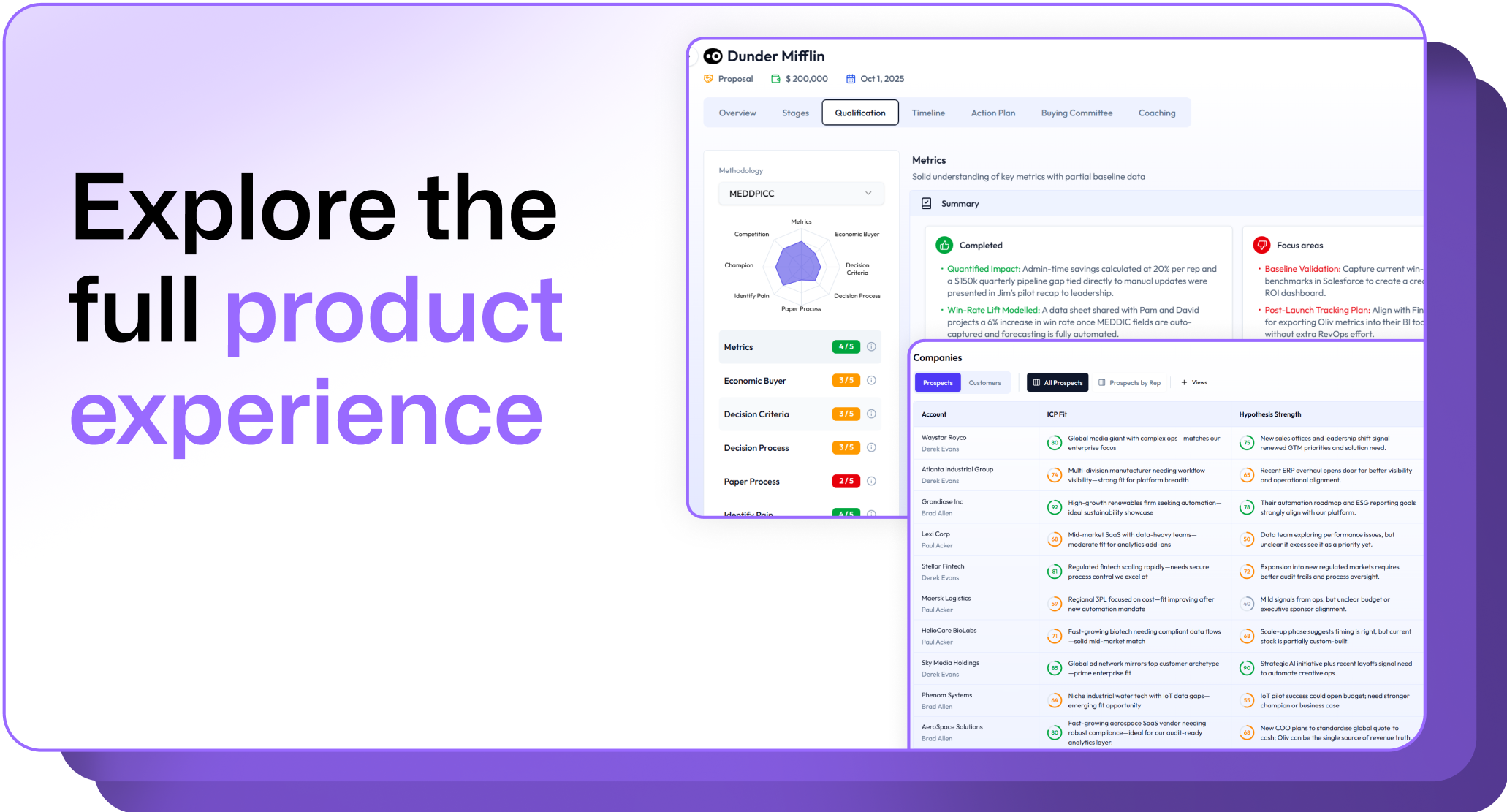
.avif)
.png)








.png)
.png)

.png)
.png)
.png)
.png)

