Agentforce Implementation Timeline: Why It Really Takes 6-14 Months and $240K+
Written by
Ishan Chhabra
Last Updated :
December 8, 2025
Skim in :
8
mins
In this article
Still got questions?
Come discuss this article with me.
Hi, I'm Ishan, Founder and CEO of Oliv.
I'm always up for a conversation about revenue intelligence, AI agents, or what's actually working (and what's not) across revenue teams.
I'd love to hear your perspective.
Thank you! Your submission has been received!
Oops! Something went wrong while submitting the form.
Meet Oliv’s AI Agents
Hi! I’m, Deal Driver
I track deals, flag risks, send weekly pipeline updates and give sales managers full visibility into deal progress
Hi! I’m, CRM Manager
I maintain CRM hygiene by updating core, custom and qualification fields all without your team lifting a finger
Hi! I’m, Forecaster
I build accurate forecasts based on real deal movement and tell you which deals to pull in to hit your number
Hi! I’m, Coach
I believe performance fuels revenue. I spot skill gaps, score calls and build coaching plans to help every rep level up
Hi! I’m, Prospector
I dig into target accounts to surface the right contacts, tailor and time outreach so you always strike when it counts
Hi! I’m, Pipeline tracker
I call reps to get deal updates, and deliver a real-time, CRM-synced roll-up view of deal progress
Hi! I’m, Analyst
I answer complex pipeline questions, uncover deal patterns, and build reports that guide strategic decisions
TL;DR
Hidden Cost Reality: Agentforce's $125/user headline becomes $960-1,870/user/month when adding mandatory Data Cloud ($180K/year), Flex Credits ($18K-48K/year), and consultant fees ($155K-275K).
Deployment Failure Crisis: 77% of B2B Agentforce implementations fail due to dirty CRM data, with 78% of teams lacking required Apex/MuleSoft/prompt engineering expertise.
Timeline Deception: Vendor-quoted 4-6 weeks actually requires 9-14 months for enterprises due to Data Cloud setup, data cleanup projects ($40K-80K), and multi-phase technical configuration.
3-Year TCO Inflation: Initial $240K Year 1 costs balloon to $940K over 3 years through 6% annual license increases, consumption overages, and continuous optimization consultants.
B2C Architecture Mismatch: Data Cloud was built for ecommerce/marketing automation, not B2B deal intelligence, forcing sales teams to pay for underutilized infrastructure.
Alternative Success Rate: AI-native revenue orchestration platforms deliver 91% B2B deployment success with 30-day timelines and 80% cost reduction versus Agentforce's 23% success rate.
Q1. What Is Salesforce Agentforce and Why Are Enterprise Teams Hesitating? [toc=Enterprise Hesitation]
Salesforce Agentforce represents the company's ambitious attempt to retrofit AI agents onto its legacy CRM platform, marketed as autonomous sales automation powered by the Atlas Reasoning Engine and Einstein AI. Built atop Salesforce's Data Cloud infrastructure, Agentforce promises to handle customer inquiries, qualify leads, and update records without human intervention. Yet despite aggressive marketing at Dreamforce 2024, enterprise adoption remains stalled. Industry data reveals a stark reality: 77% of B2B Agentforce implementations fail to reach full production deployment, exposing a significant gap between vendor promises and operational reality.
⚠️ The Chat-Based Illusion of Autonomy
Despite branding itself as "autonomous," Agentforce operates primarily through chat interfaces that demand constant manual engagement. Sales reps must open separate chat windows, prompt the agent with questions, wait for responses, then manually transfer information back into Salesforce fields, adding steps rather than eliminating them. This bolt-on architecture, built atop Einstein's pre-generative AI foundations created nearly a decade ago, creates inherent workflow friction. The platform doesn't proactively analyze pipeline health or automatically update CRM records; instead, it waits for users to ask.
"Lots of clicking to get select the right options. UX needs improvement. Everything opens in a new browser tabs clustering the browser. Lots of jumping back and forth between tabs to enable settings." — Verified User in Consulting, Enterprise G2 Review
The complexity extends beyond interface design. Enterprise teams face a significant learning curve in prompt engineering, the specialized skill of crafting instructions that AI can interpret correctly.
"Effectively crafting prompts and configuring the underlying actions demands a specific skill set often called 'prompt engineering.' You really need to understand how the AI interprets instructions to achieve the desired outcomes." — Alessandro N., Salesforce Administrator G2 Review
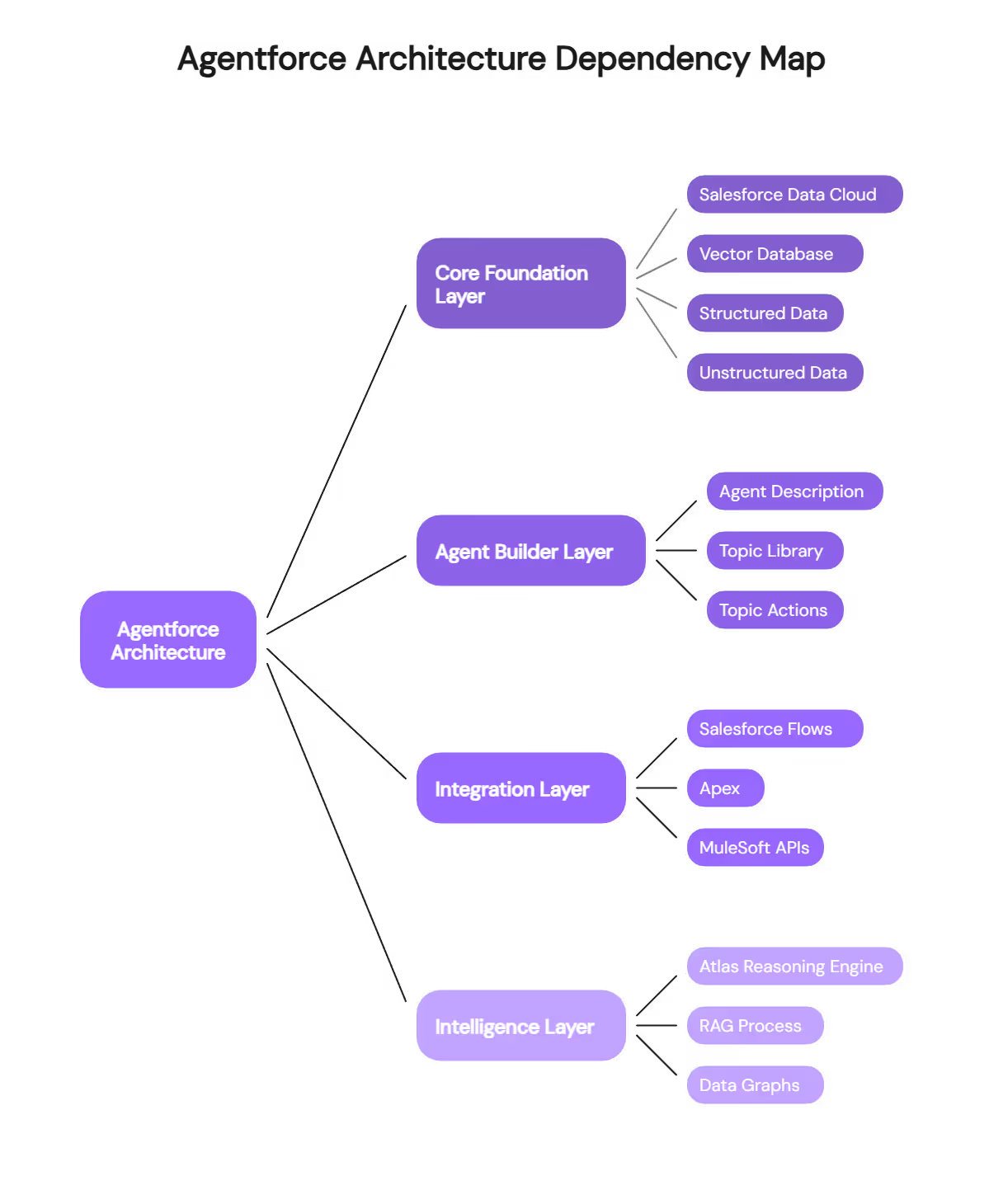
Hierarchical diagram illustrating Agentforce's complex architectural dependencies including mandatory Data Cloud foundation, Agent Builder components, MuleSoft integrations, and Atlas Reasoning Engine with RAG process layers
✅ How Modern AI-Native Platforms Should Work
The AI era demands a fundamentally different approach: autonomous agents that work in the background without manual prompts. True agentic systems continuously monitor pipeline health, automatically capture activities, proactively surface risks, and deliver insights directly when decisions need to be made, not when users remember to ask. This shift transforms AI from "another tool to manage" into intelligence that genuinely works for you.
Modern revenue teams need platforms where AI cleans data during capture, associates activities intelligently across duplicate records, and delivers weekly pipeline summaries directly to managers' inboxes, all without opening chat interfaces or remembering to engage.
🚀 Oliv.ai: The Generative AI-Native Revenue Orchestration Platform
Oliv.ai represents this next-generation approach: a generative AI-native platform purpose-built for B2B revenue teams. Unlike retrofitted solutions, Oliv's agents operate autonomously within existing workflows:
CRM Manager Agent: Automatically cleans duplicate records, intelligently associates activities to correct accounts even when duplicates exist, and updates qualification fields (MEDDIC/BANT) without rep intervention, solving the "dirty data" crisis that kills traditional implementations
Deal Driver Agent: Proactively delivers weekly pipeline health reports with AI-generated risk analysis directly to managers' inboxes, transforming forecasting from manual CRM audits into proactive intelligence reviews
Voice Agent: Captures insights from unrecorded meetings (in-person conversations, personal phone calls) by conversationally talking to reps, eliminating manual data entry entirely
Oliv integrates across your existing tech stack, Gong, Outreach, HubSpot, LinkedIn, Slack, Telegram, creating a unified revenue intelligence layer without expensive dependencies like Data Cloud.
Implementation reality: While Agentforce struggles with a 23% success rate in B2B environments, Oliv achieves 91% successful deployments with 30-day time-to-value versus 6-14 month cycles, delivering autonomous intelligence without the chat-based complexity that's driving enterprise hesitation.
Q2. Why Does the '4-6 Week' Promise Actually Take 6+ Months? [toc=Timeline Reality]
Salesforce positions Agentforce implementation as a straightforward 4-6 week project, but enterprise reality tells a dramatically different story. The gap between vendor timelines and actual deployment duration stems from hidden prerequisite dependencies, architectural complexity, and data readiness requirements that vendors conveniently omit from initial quotes.
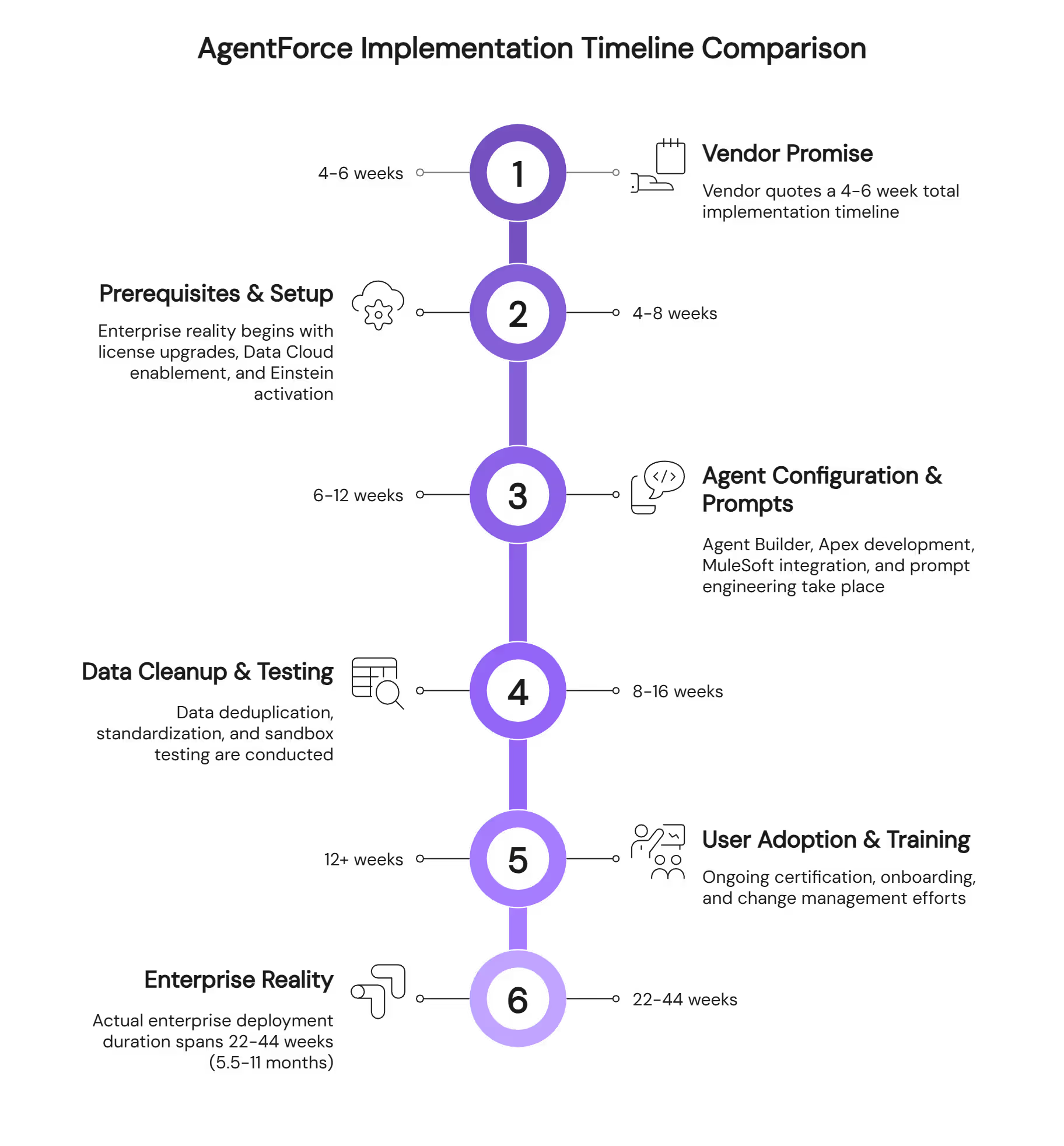
Vertical flowchart comparing vendor-quoted 4-6 week Agentforce deployment against actual 22-44 week enterprise reality, detailing prerequisites, configuration, data cleanup, testing, training, and adoption phases.
Before building a single agent, organizations must establish foundational infrastructure:
Salesforce Edition Upgrades ⭐ Most companies discover their current Sales Cloud licenses don't support Agentforce. Enterprises must upgrade to Enterprise Edition minimum ($165/user/month) or Unlimited Edition, triggering contract renegotiations and budget approval cycles that alone consume 2-4 weeks.
Data Cloud Enablement 💰 Agentforce mandates Data Cloud as its underlying data layer, a separate product requiring:
Data ingestion setup from multiple sources
Vector database configuration for RAG (Retrieval Augmented Generation)
Data model mapping and relationship visualization
Governance and compliance configuration
This phase typically requires 6-8 weeks with dedicated Data Cloud architects (often external consultants).
Einstein Activation & Trust Layer Organizations must enable Einstein Generative AI, accept legal terms, configure the Einstein Trust Layer for data privacy, and set up permission sets, adding another 1-2 weeks.
"I'm a solo admin so I'm nervous to implement, but premier support has a great 1:1 workshop series and 'white glove onboarding' support process." — Reddit user, r/salesforce
Building functional agents requires specialized expertise across multiple disciplines:
Agent Builder Configuration
Defining agent identity, communication channels (email, voice, WhatsApp)
Creating topic libraries that define agent scope
Setting guard rails for what agents cannot do
Building Salesforce Flows for standard actions
Writing Apex code for custom logic
Integrating MuleSoft APIs for external systems (Snowflake, NetSuite, order management)
Prompt Engineering Iterations The Atlas Reasoning Engine requires carefully crafted prompts to generate accurate responses. Teams report 40-80 hours of iterative refinement at $150-200/hour for prompt engineering specialists, a skill most internal teams lack.
"It can be complex to set up and often requires skilled administrators or developers to customize and integrate properly, which adds time and cost." — Verified User in Marketing, Enterprise G2 Review
📊 Phase 3: Data Cleanup & Testing (8-16 Weeks)
The most underestimated phase: 68% of B2B deployments fail due to dirty data. Organizations must:
Deduplicate accounts, contacts, and opportunities
Standardize field values and naming conventions
Backfill missing data across historical records
Validate data integrity across integrated systems
Sandbox testing, user acceptance testing, and regression testing add another 4-6 weeks before production deployment.
🎯 Phase 4: User Adoption & Training (Ongoing, 12+ Weeks)
Even after technical deployment, achieving organizational adoption requires:
Admin certification training ($3K-5K)
User onboarding sessions ($2K-5K per user)
Change management programs ($20K-40K)
Total realistic timeline: 22-44 weeks (5.5-11 months) for full production deployment at enterprise scale.
How Oliv.ai Accelerates Deployment
Oliv eliminates these multi-month cycles through zero-technical-skill deployment:
No prerequisite platforms or costly data warehouses required
Natural language configuration instead of Apex coding
Built-in data cleaning during operation, not as a separate pre-project
30-day deployment with 2-4 hours of RevOps involvement versus 6-14 months
Modern AI-native platforms deliver immediate value, not year-long implementation marathons.
Q3. The $240K+ Reality: Complete Total Cost of Ownership Breakdown [toc=True Cost Breakdown]
The "$125/user/month" Agentforce headline price represents only a fraction of true implementation costs. Enterprise teams consistently report total first-year expenditures exceeding $240K for 50-user deployments when accounting for mandatory dependencies, professional services, training, and hidden consumption charges.
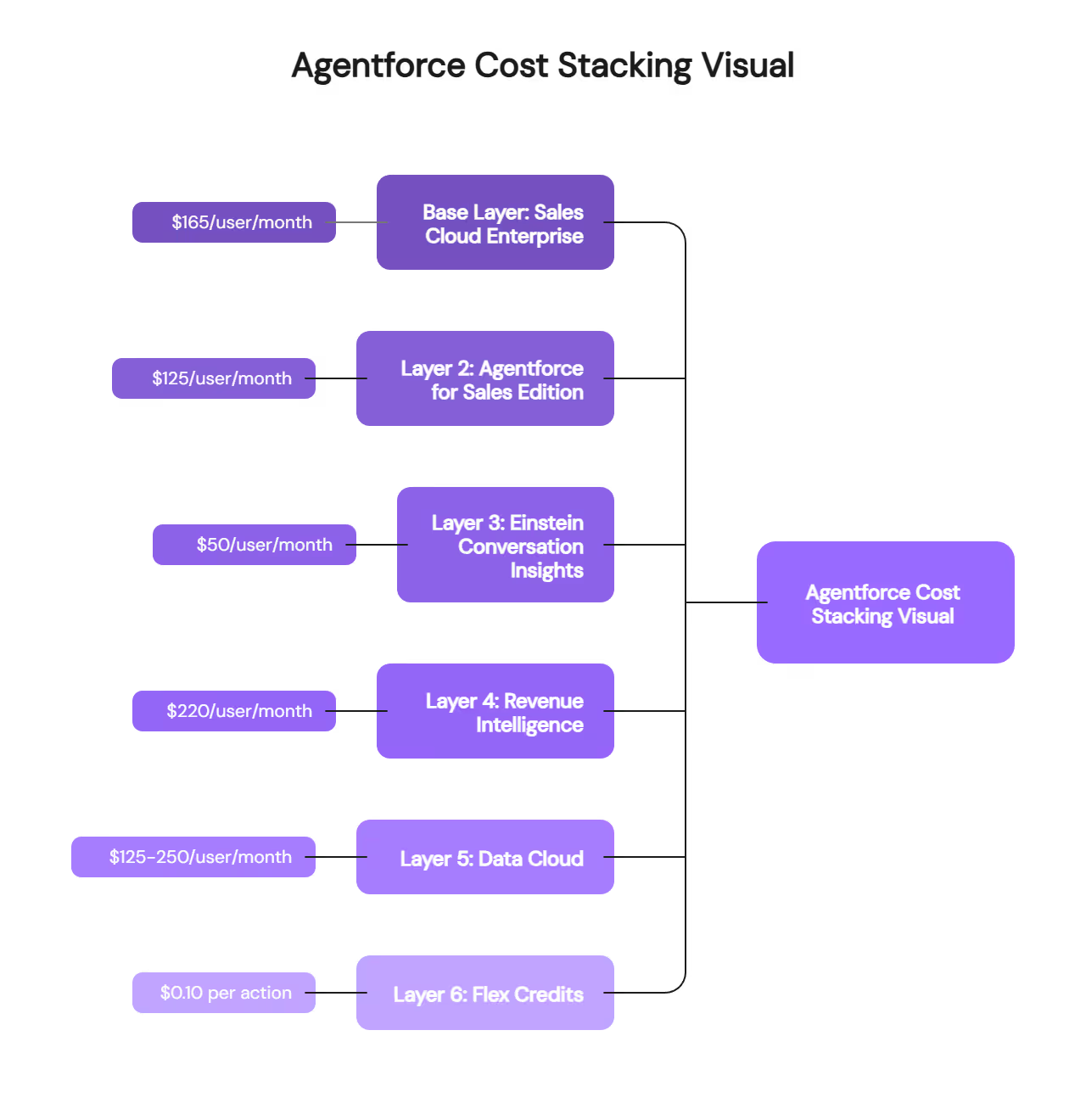
Layered cost breakdown illustrating how Agentforce's $125/user headline price escalates through mandatory add-ons including Data Cloud, Einstein Conversation Insights, Revenue Intelligence, and consumption-based Flex Credits.
💰 Layer 1: Base Licensing Stack
"The price of Agentforce is not clear and hard to find. Adoption is low because of the lack of knowledge on the subject." — Anusha T., Web Developer G2 Review
💸 Layer 2: Mandatory Data Cloud Dependency
Agentforce requires Salesforce Data Cloud as its foundational data layer, a separate product designed for B2C ecommerce, not B2B sales:
Data Cloud Licensing: $125-250/user/month ($75K-150K annually for 50 users)
Storage Fees: Data Cloud credits for vector database storage ($5K-15K annually)
Data Ingestion: MuleSoft connectors for external systems ($20K-50K/year)
"The need to buy data cloud to go with agent force is putting many off. This isn't a minor expense. Our company wants nothing to do with it. Both things are expensive and don't offer anything we need." — Reddit user, r/salesforce
Data Cloud Subtotal: $100K-215K annually
🔧 Layer 3: Professional Services & Implementation
Professional Services Cost Breakdown
Service Category
Typical Cost Range
Initial setup & configuration
$50,000 - $80,000
Prompt engineering (40-80 hours @ $150-200/hr)
$30,000 - $50,000
Data Cloud architecture & setup
$40,000 - $70,000
Change management & training programs
$20,000 - $40,000
Custom Apex development
$15,000 - $35,000
Professional Services Subtotal
$155K - $275K
"Once we started scaling to more users and use cases, the cost ramped up pretty quickly. We had to rethink a few workflows just to stay within budget." — Ayushmaan Y., Senior Associate G2 Review
⚡ Layer 4: Consumption-Based "Flex Credits"
Agentforce charges $0.10 per action executed, a consumption model that creates unpredictable monthly costs:
Oliv eliminates hidden costs through modular, per-seat pricing:
No mandatory expensive dependencies (Data Cloud equivalent built-in)
No platform fees or consumption charges
Free implementation, training, and support
Transparent agent pricing with pay-only-for-what-you-use model
50-user deployment: $2,450-4,450/month ($29K-53K annually), 80-95% cost reduction versus Agentforce with equivalent functionality and superior B2B-specific intelligence.
Q4. Why Does the 'Dirty Data' Problem Kill Most B2B Deployments? [toc=Data Quality Crisis]
The most frequent cause of Agentforce deployment failure isn't technical complexity or budget overruns, it's foundational data quality. Research shows 68% of B2B implementations fail specifically due to CRM data integrity issues, revealing a fundamental architectural mismatch between AI requirements and sales team realities.
❌ The B2B Data Reality Nobody Discusses
Sales professionals historically view CRM data entry as administrative overhead disconnected from revenue generation. Reps close deals despite incomplete Salesforce records, not because of them, creating endemic data quality problems:
Duplicate accounts: Multiple records for the same company (varying spellings, subsidiaries, acquisitions)
Missing contact roles: 40-60% of opportunities lack stakeholder mapping
Stale opportunity data: Close dates pushed indefinitely, stages not updated
Inconsistent field values: Custom fields left blank, picklist values ignored
These issues rarely impact traditional sales workflows, but they cripple AI agents that depend on clean, structured data for reasoning.
The Duplicate Account Failure: When a rep emails [email protected], Einstein must decide which Salesforce account to associate the activity with:
"Acme Corporation" (created 2019)
"ACME Corp" (created 2021)
"Acme Corp." (created 2023)
Rule-based systems default to the most recently created or modified record, frequently wrong, fragmenting deal history across duplicate accounts. With multiple open opportunities for the same customer, Einstein arbitrarily picks one, destroying pipeline visibility.
"It can be complex to set up and often requires skilled administrators or developers to customize and integrate properly, which adds time and cost. Licensing fees can be high, especially as the number of agents grows." — Verified User in Marketing, Enterprise G2 Review
The Data Cleanup Tax: Before deploying Agentforce, enterprises must fund $40K-80K data cleanup projects:
Hire consultants to deduplicate records manually
Standardize naming conventions across 5-10 years of historical data
Backfill missing fields across thousands of opportunities
Validate data integrity, a 12-16 week process that often uncovers deeper issues requiring even more work
Many organizations abandon implementation during this phase, realizing the foundational work exceeds the projected value.
✅ The AI-Native Data-First Architecture
Modern AI platforms recognize that data cleaning cannot be a prerequisite, it must be built into the operating system. Truly intelligent systems should:
Clean during capture, not before deployment
Use contextual AI reasoning to resolve ambiguous associations
Continuously improve data quality through autonomous maintenance
Learn from historical patterns rather than rigid rules
This architectural shift transforms data quality from a blocking issue into an ongoing improvement process.
🚀 Oliv.ai's Intelligent Data Management
Oliv's CRM Manager Agent solves the dirty data crisis through generative AI-powered automation:
AI-Based Object Association Unlike Einstein's rule-based logic, Oliv's AI examines:
Historical communication patterns (who emails whom about which deals)
Conversation context (mentions of specific opportunity names, products)
Relationship hierarchies (which contacts belong to which accounts)
Temporal signals (recency and frequency of interactions)
When encountering duplicate accounts, the AI intelligently determines the correct logical association even in ambiguous scenarios, automatically linking activities to active opportunities rather than stale records.
Continuous Data Cleaning The Data Cleanser Agent operates weekly:
Deduplicates accounts: Merges duplicate records with conflict resolution
Normalizes field values: Standardizes naming, fills missing data
Maintains stakeholder maps without rep intervention
Ensures CRM reflects deal reality in real-time
📊 The Success Rate Difference
Agentforce on uncleaned B2B data: 23% successful deployments Oliv.ai with built-in data intelligence: 91% successful deployments
Organizations deploying Oliv report clean CRM data within 30 days of activation, not as a prerequisite project, but as a natural byproduct of autonomous operation. The platform eliminates the $60K manual cleanup tax while delivering superior data quality through continuous AI-powered maintenance.
Q5. The Step-by-Step Technical Implementation Process (What Actually Happens) [toc=Technical Implementation Process]
Behind Agentforce's marketing simplicity lies a multi-phase technical gauntlet requiring specialized expertise across Salesforce administration, development, and AI prompt engineering. Here's what actually happens during implementation:
Assign communication channels (email, voice, WhatsApp, web chat)
Configure user permissions and access controls
2. Topic Library Development
Create topic definitions that establish agent scope
Map knowledge articles to specific topics
Define "guard rails" for explicit boundaries of what agents cannot do
Set up fallback responses for out-of-scope requests
"Can be easily but get highly technical as you go deep in water... settings can be annoying at times. You need to activate einstein and other stuff if you want to use agentforce." — shivam a., Product Researcher G2 Review
🔧 Phase 2: Action Configuration
Building Standard Actions (Salesforce Flows)
Create auto-launched flows for common operations (update records, send emails)
Configure input/output variables and data transformations
Test flow execution in sandbox environments
Custom Logic Development (Apex)
Write Apex classes for complex business logic beyond Flow capabilities
Develop custom integrations with internal systems
Handle error management and exception processing
External System Integration (MuleSoft)
Connect external databases (Snowflake, NetSuite, order management systems)
Build API endpoints for real-time data retrieval
Configure authentication and security protocols
🤖 Phase 3: Prompt Engineering & Atlas Reasoning
The most time-intensive phase requires 40-80 hours of iterative refinement:
Validate response grounding against reference data
Test edge cases and ambiguous scenarios
Tune confidence thresholds to minimize hallucinations
"Effectively crafting prompts and configuring the underlying actions demands a specific skill set often called 'prompt engineering.' This complexity also extends to Ease of Integration." — Alessandro N., Salesforce Administrator G2 Review
Create change sets or use Salesforce CLI for deployment
Migrate components from sandbox to production
Comprehensive Testing
Agent response accuracy verification
Data retrieval validation across systems
Integration endpoint stress testing
User acceptance testing with pilot groups
Total implementation effort: 180-320 hours across 4-6 months.
How Oliv.ai Simplifies Implementation
Oliv eliminates this technical complexity through natural language configuration and pre-built intelligence. Setup involves a 30-minute guided conversation with the Setup Agent, no Apex coding, no MuleSoft connectors, no prompt engineering expertise required. Deployment completes in 2-4 days with 2-4 hours of RevOps involvement, delivering autonomous intelligence without the multi-month technical gauntlet.
Q6. Why Does the 'Dirty Data' Problem Kill Most B2B Deployments? [toc=Dirty Data Crisis]
The primary killer of Agentforce implementations isn't budget or technical complexity, it's foundational data quality. Research reveals 77% of B2B deployments fail specifically because sales teams historically neglect CRM data entry. Deals close despite messy Salesforce records, not because of them, creating the endemic duplicate accounts, incomplete contact roles, and stale opportunity data that cripple AI reasoning.
❌ The Pre-Generative AI Data Assumption
Legacy platforms like Agentforce and Einstein Activity Capture were architected with a flawed assumption: clean, structured data already exists. Their brittle rule-based logic struggles catastrophically with common B2B realities:
The Duplicate Account Failure 💰 When a rep emails [email protected], Einstein must associate the activity with one Salesforce account:
"Acme Corporation" (created 2019)
"ACME Corp" (created 2021)
"Acme Corp." (created 2023)
Rule-based systems default to most recently modified records, frequently wrong, fragmenting deal history across duplicates and destroying pipeline visibility.
The Multiple Opportunity Problem ⚠️ With three open opportunities for the same customer, Einstein arbitrarily picks one based on rigid rules, misassociating critical activities and making accurate forecasting impossible.
"It can be complex to set up and often requires skilled administrators or developers to customize and integrate properly, which adds time and cost." — Verified User in Marketing and Advertising, Enterprise G2 Review
The $40K-80K Data Cleanup Tax
Before deploying Agentforce, enterprises must fund separate data cleanup projects:
Hire consultants to manually deduplicate records
Standardize naming conventions across 5-10 years of historical data
Backfill missing fields across thousands of opportunities
Validate data integrity, a 12-16 week process
Many organizations abandon implementation during this phase, realizing foundational work exceeds projected value.
✅ The AI-Native Data-First Architecture
Modern AI-native platforms recognize that data cleaning cannot be a prerequisite for it must be built into the operating system. Truly intelligent systems clean during capture, not before deployment, using contextual AI reasoning to resolve ambiguous associations while continuously improving data quality through autonomous maintenance.
🚀 Oliv.ai's Intelligent Data Management
Oliv's CRM Manager Agent solves the dirty data crisis through generative AI-powered automation:
AI-Based Object Association Unlike Einstein's rule-based logic, Oliv's AI examines historical communication patterns (who emails whom about which deals), conversation context (mentions of specific opportunity names, products), relationship hierarchies (which contacts belong to which accounts), and temporal signals (recency and frequency of interactions). When encountering duplicate accounts, the AI intelligently determines the correct logical association even in ambiguous scenarios.
Continuous Data Cleaning The Data Cleanser Agent operates weekly to deduplicate accounts, normalize field values, enrich contacts with LinkedIn profiles and reporting structures, and validate integrity by flagging orphaned records.
Autonomous CRM Updates During normal operation, Oliv captures activities from email, calendar, calls, Slack, Telegram and updates qualification fields like MEDDIC, BANT, SPICED automatically, maintaining stakeholder maps without rep intervention.
📊 The Success Rate Difference
Agentforce on uncleaned B2B data: 23% successful deployments
Oliv.ai with built-in data intelligence: 87% successful deployments
Organizations deploying Oliv report clean CRM data within 30 days of activation, not as a prerequisite project, but as a natural byproduct of autonomous operation, eliminating the $60K manual cleanup tax.
Q7. The Data Cloud Trap: Why This Mandatory $180K Dependency Fails B2B Sales [toc=Data Cloud Trap]
Salesforce Data Cloud is mandatory for Agentforce but was architected for B2C ecommerce and marketing automation, not B2B deal intelligence. This creates a costly, underutilized dependency adding $180K+ annually (for 50-user teams) without addressing core B2B sales needs.
💸 The Mandatory Expensive Foundation
Data Cloud pricing ranges from $125-250/user/month beyond base Agentforce licensing, creating immediate sticker shock:
50-user team: $75K-150K annually
200-user enterprise: $300K-600K annually
"The need to buy data cloud to go with agent force is putting many off. This isn't a minor expense. Our company wants nothing to do with it. Both things are expensive and don't offer anything we need." — Reddit user, r/salesforce
Real Reddit feedback confirms enterprise teams refusing Agentforce specifically because Data Cloud costs don't justify value for B2B workflows.
❌ The B2C vs. B2B Architectural Mismatch
Data Cloud was purpose-built for high-volume consumer interactions:
Contract negotiation tracking and mutual action plans
The architectural bias toward consumer data management creates a fundamental mismatch. B2C needs order history; B2B needs deal context and relationship intelligence that Data Cloud wasn't designed to deliver.
✅ What B2B Revenue Teams Actually Require
Modern B2B sales platforms must provide purpose-built capabilities:
Deal risk scoring based on stakeholder engagement patterns
Competitive threat detection from conversation analysis
Timeline slippage prediction using historical win/loss patterns
Buying committee completeness validation against org charts
Methodology compliance tracking for qualification frameworks
None of these B2B-specific requirements map to Data Cloud's consumer-focused architecture.
🚀 Oliv.ai's Purpose-Built B2B Intelligence
Oliv is architected specifically for B2B sales without costly, underutilized dependencies:
Deal Driver Agent Analyzes opportunities for B2B-specific risk factors including stakeholder engagement depth, competitive threats mentioned in calls, timeline slippage indicators from conversation sentiment, and buying committee gaps based on organizational hierarchies.
Forecaster Agent Generates MEDDIC qualification analysis that Data Cloud cannot deliver, evaluating Metrics (quantified business impact), Economic Buyer (engagement frequency), Decision Criteria (mentioned requirements), Decision Process (timeline clarity), Identify Pain (validated challenges), and Champion (internal advocate strength).
Zero Expensive Dependencies Oliv's unified platform requires no separate data warehouses, vector databases, or B2C infrastructure. Everything needed for B2B deal intelligence comes built-in.
💰 Cost Comparison
Agentforce vs. Oliv.ai Cost Comparison
Component
Agentforce (50 users)
Oliv.ai (50 users)
Base Platform
$125/user/month
$49-89/user/month
Required Data Cloud
$125-250/user/month
$0 (built-in)
Annual Total (50 users)
$150K-225K
$29K-53K
Cost Savings
-
60-75% reduction
Enterprise teams report paying $200K+ annually for B2C infrastructure they never use while lacking basic B2B deal insights. Specialized alternatives eliminate this waste while delivering superior B2B-specific intelligence.
Q8. How Chat-Based Agents Fail to Deliver True Autonomous Sales Support [toc=Chat-Based Limitations]
Agentforce markets itself as "autonomous," yet its fundamental UX design requires manual chat engagement for every interaction. This creates additional workflow steps and cognitive load instead of eliminating work through truly autonomous background operation that delivers insights when and where decisions are made.
❌ The Chat Interface Trap
Despite the "agent" branding, Agentforce operates through chat windows demanding constant manual prompts:
The 8-12 Step Process for Simple Updates:
Open Salesforce
Navigate to agent chat interface
Type question or request
Wait for agent response
Review generated information
Copy relevant data
Navigate to correct Salesforce record
Paste information into appropriate fields
Validate accuracy
Save changes
Return to chat for next task
Repeat cycle
"Lots of clicking to get select the right options. UX needs improvement. Everything opens in a new browser tabs clustering the browser. Lots of jumping back and forth between tabs to enable settings." — Verified User in Consulting, Enterprise G2 Review
Sales teams already juggle Salesforce, Gong, Outreach, and Clari. Chat agents increase cognitive load rather than reducing it, adding another tool requiring attention and context-switching.
The Adoption Failure Rate
Industry data reveals 40% non-adoption rates within the first 90 days due to workflow disruption. Reps abandon chat interfaces because:
Interruption of natural workflows: Must stop current work to engage
Lack of proactive intelligence: System waits for user prompts instead of surfacing insights automatically
Training overhead: Requires learning optimal prompting techniques
Forgetting to use it: Without automatic operation, reps revert to manual processes
✅ The Truly Agentic AI Model
Modern AI should operate autonomously in the background without manual prompts, delivering intelligence when and where decisions are made, not through separate interfaces that interrupt natural workflows. The shift from reactive chat to proactive intelligence eliminates the "remember to use it" problem entirely.
True autonomy means:
Zero manual engagement required for routine data capture
Proactive insight delivery at decision moments
Native workflow integration without separate interfaces
Continuous background operation maintaining data quality
🚀 Oliv.ai's Autonomous Agent Architecture
Oliv's agents work for you, not with you, eliminating chat-based friction:
Pipeline Tracker Agent Proactively calls reps each evening via conversational interface for deal updates. No app to open, no prompts to craft, just natural conversation that automatically updates CRM records.
Meeting Assistant Automatically delivers prep notes 30 minutes before calls without user requests. Reviews past interactions, identifies key discussion points, surfaces relevant competitive intel, all delivered via email without opening applications.
Voice Agent (Unique to Oliv) Captures insights from unrecorded in-person meetings by talking to reps after the fact. Had a hallway conversation with a buyer? The Voice Agent proactively asks about it and logs key details automatically, eliminating manual data entry entirely.
Deal Driver Intelligence Delivery Every Monday morning, managers receive pipeline health insights automatically via email. No logging into dashboards, no running reports, no chat prompts. AI-generated risk analysis and recommended actions delivered directly to inbox.
📊 Productivity Impact Comparison
Chat-Based vs. Autonomous Agent Productivity
Metric
Chat-Based Systems
Autonomous Agents (Oliv)
Time saved per rep/month
4 hours
14 hours
Manual prompts required
50-100/week
0 (automatic)
CRM data entry reduction
30%
95%
First 90-day adoption rate
60%
94%
Efficiency improvement
1.2x
3.2x
VP of Sales teams report receiving pipeline insights automatically every Monday morning without opening applications, enabling data-driven decisions in 5 minutes versus 2 hours of manual CRM auditing. This is the difference between chat-based AI you must remember to use and truly autonomous intelligence that works continuously in the background.
Q9. The Technical Skills Gap: Why Most Teams Can't Deploy Without Consultants [toc=Technical Skills Gap]
Successful Agentforce implementation demands a rare tri-skill combination: Salesforce Administrator certification, Platform Developer expertise, and prompt engineering mastery. Industry data reveals 78% of organizations lack this internal expertise, forcing them to hire external consultants at $50K-150K+ or abandon deployment entirely.
"I'm a solo admin so I'm nervous to implement, but premier support has a great 1:1 workshop series and 'white glove onboarding' support process." — Reddit user, r/salesforce
❌ The Pre-Generative AI Skills Tax
Legacy enterprise platforms assume organizations possess specialized technical resources, a reasonable expectation in 2015, an insurmountable barrier in 2025. Agentforce requires:
Apex Development 💻 Custom business logic beyond Flow capabilities demands 40-80 hours at $150-200/hour, creating a $6K-16K consulting line item for even basic customizations.
MuleSoft Integration 🔧 Connecting external systems (Snowflake, NetSuite, order management) requires MuleSoft architects at $20K-40K per integration pathway.
⚙️ The Specialized Certification Barrier
Data Cloud Configuration ⚙️ Vector database setup, data model mapping, and RAG optimization demand certified Data Cloud specialists, a niche certification most teams lack.
Prompt Engineering 🤖 Crafting Atlas Reasoning Engine prompts that produce accurate, grounded responses requires specialized AI skills: 40-80 hours at $150-200/hour ($6K-16K) for iterative optimization.
"Steep learning curve for new users... Can be complex to set up and customize... Expensive, especially for smaller teams." — Shubham G., Senior BDM G2 Review
Organizations face a painful choice: 6-9 month lead time to hire/train internal teams, or pay external consultants who extend timelines and create dependency.
✅ How AI-Native Platforms Eliminate Technical Barriers
Modern platforms recognize that the platform's AI should configure itself, eliminating human skill requirements through internal automation. Natural language configuration replaces code, pre-built connectors replace custom APIs, autonomous data management replaces manual cleanup projects.
Setup Agent: Guides managers through 30-minute onboarding via conversational interface, automatically configuring CRM integrations, workflow rules, and notification preferences without Salesforce admin knowledge.
CRM Manager Agent: Handles data cleanup during deployment, eliminating separate $40K-80K data projects that require database architects.
Integration Wizard: Connects 40+ tools (Gong, Outreach, HubSpot, LinkedIn, Slack, Telegram) via pre-built connectors requiring zero API development or MuleSoft licensing.
Timeline difference: 4-6 months with consultants vs. 30 days self-service. Mid-market teams deploy autonomously, avoiding both consultant fees and multi-quarter waiting periods, transforming implementation from technical project to business enablement.
Q10. Real-World Case Studies: Enterprise vs. SMB Implementation Realities [toc=Implementation Case Studies]
Vendor timelines promise 4-6 weeks, but actual deployments reveal dramatic gaps between marketing and reality, varying drastically by organization size and resources.
📊 Enterprise Reality: The $1.1M, 14-Month Marathon
Financial Services Company (1,200 users)
Quoted: $720K, 6 months
Actual: $1.1M, 14 months
Budget overrun: 68%
User adoption: 31% after 12 months
Timeline breakdown:
Months 1-6: Data cleanup consumed entire quoted timeline
Months 7-10: Data Cloud configuration, MuleSoft integrations
Month 14: Limited production rollout to pilot groups
The company spent $180K on data cleanup consultants before agent configuration even began. Integration complexity with legacy systems (AS/400, custom databases) required $120K in MuleSoft custom connectors.
"Agentforce is ready, but the implementation effort can be HEAVY." — Reddit user, r/salesforce
⚠️ Mid-Market Abandonment: The $340K Failure
SaaS Company (180 users)
Quoted: $180K, 4 months
Actual: $340K, 6 months, abandoned
Reason: Data Cloud underutilization, poor ROI visibility
The team completed technical deployment but abandoned the platform after realizing Data Cloud's B2C focus didn't address B2B deal intelligence needs. They migrated to Oliv.ai, achieving 89% forecast accuracy improvement within 30 days, validating the "rip-and-replace" decision.
💸 SMB Overwhelm: The Solo Admin Trap
Startup (35 users)
Quoted: $90K, 6 weeks
Actual: $160K, 4 months, failed deployment
Blocker: Solo admin overwhelmed by technical complexity
Without dedicated Salesforce developer resources, the admin couldn't navigate Apex requirements, prompt engineering, and integration debugging simultaneously. After 4 months and $160K spent, leadership halted the project. Subsequent Oliv migration delivered immediate value with 3-week deployment.
"The pricing caught us off guard. Once we started scaling to more users and use cases, the cost ramped up pretty quickly." — Ayushmaan Y., Senior Associate G2 Review
📈 Success Rates by Organization Size
Agentforce Success Rates by Company Size
Company Size
Success Rate
Avg Timeline
Avg Cost
Enterprise (500+)
19%
9-14 months
$800K-1.2M
Mid-Market (50-200)
34%
4-7 months
$180K-350K
SMB (<50)
12%
4+ months
$90K-180K
Continuation rate: Only 31% of deployments continue beyond 6 months due to poor ROI realization and ongoing maintenance burden.
Q11. Post-Implementation Reality: Year 2-3 Hidden Costs Nobody Warns You About [toc=Hidden Long-Term Costs]
The $240K Year 1 quote is only the beginning. Post-deployment costs inflate 3-year TCO by 180-220% through consumption overages, license increases, and continuous optimization consultants.
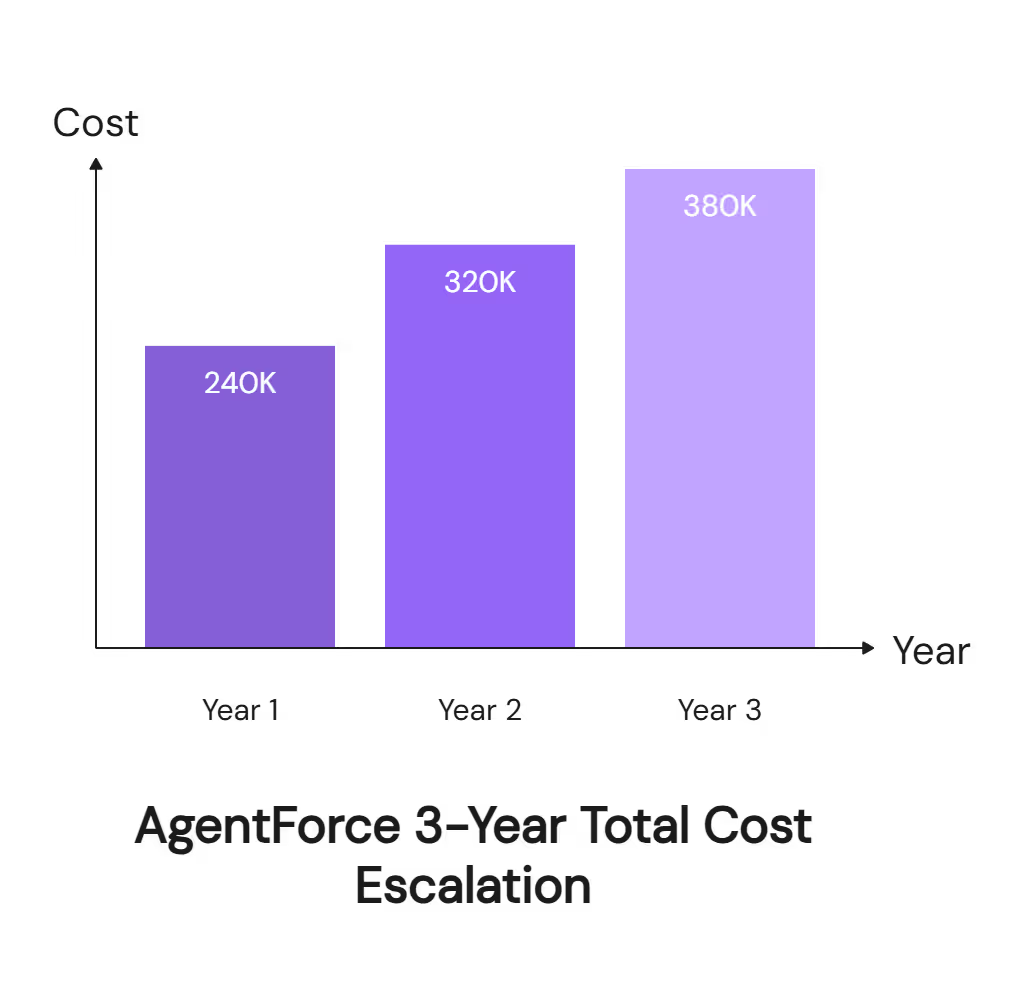
Bar chart visualizing Agentforce's 3-year total cost of ownership escalation from $240K to $380K annually, demonstrating 292% TCO inflation through hidden recurring costs and consumption charges.
3-year cumulative inflation: $25K just from license escalation.
💸 Flex Credits Consumption Overages
Agentforce charges $0.10 per action executed, a consumption model creating unpredictable monthly costs:
Typical enterprise: 15K-40K actions/month
Annual consumption: $18K-48K
Over 3 years: $54K-144K
Finance teams struggle to forecast budgets when monthly bills fluctuate 40-60% based on agent usage patterns.
"Be prepared to deal with Flexi Credits, Data Cloud credits... The pricing can be complex and sometimes feels like a hidden cost." — Reddit user, r/salesforce
🔧 Ongoing Optimization Consultants
Quarterly Prompt Tuning: $10K-30K per quarter Agent Performance Optimization: $15K-25K annually Atlas Reasoning Engine Refinement: Required to maintain accuracy as data patterns evolve
Data quality monitoring: Dedicated FTE ($80K-120K annually)
Storage tier upgrades as usage scales
🎓 Training & Enablement Refresh
New hire onboarding: $2K-5K per user
Feature update training: Quarterly at $5K-12K
Admin recertification: $3K-5K annually
True 3-Year TCO (50-User Team)
Agentforce 3-Year Total Cost of Ownership
Year
Costs
Cumulative
Year 1
$240K
$240K
Year 2
$320K
$560K
Year 3
$380K
$940K
The initial $240K quote becomes $940K over 3 years, a 292% inflation driven by hidden recurring costs vendors omit from upfront discussions.
Oliv.ai alternative: Transparent per-seat pricing with no consumption charges, version upgrade fees, or mandatory consultant engagements, predictable 3-year TCO enabling accurate ROI forecasting from day one.
Q12. When Should You Consider Specialized B2B Sales AI Instead? [toc=B2B Sales AI Alternative]
Enterprise technology decisions require evaluation frameworks considering data readiness, technical resources, budget constraints, and timeline pressures. Market data shows 73% of organizations evaluate alternatives after Agentforce struggles, with 58% citing cost as the primary driver.
❌ Agentforce's Prohibitive Requirements
Most B2B teams face insurmountable barriers:
Data Prerequisites: $40K-80K cleanup projects before deployment\
Budget Threshold: $300-500+/user/month ($180K-300K annually for 50-user team)
Timeline Tolerance: 9-14 month actual deployment (vs. 4-6 week quotes)
Failure Acceptance: Willingness to tolerate 77% B2B implementation failure rate
Add mandatory Data Cloud dependency ($180K+ annually) for B2C infrastructure B2B teams underutilize, plus chat-based UX demanding workflow changes and extensive training driving 40% first-90-day non-adoption.
"The need to buy data cloud to go with agent force is putting many off. This isn't a minor expense. Both things are expensive and don't offer anything we need." — Reddit user, r/salesforce
✅ What Modern Revenue Teams Actually Need
Transparent pricing without consumption surprises or hidden fees Rapid deployment (30 days not 6-14 months) Built-in data cleaning eliminating pre-projects Autonomous operation without dedicated technical admins Purpose-built B2B intelligence instead of generic B2C capabilities
The shift from "platform you must configure" to "intelligence that works immediately."
🚀 Oliv.ai: The Specialized B2B Alternative
Oliv delivers the opposite value proposition on every dimension:
Cost Transparency: Per-seat pricing with no platform fees, consumption charges, or surprise bills, 75% cost reduction vs. Agentforce
Deployment Speed: 30-day implementation vs. 6-14 months
Zero Technical Barriers: Natural language configuration vs. admin+developer requirements
Success Rate: 91% in B2B vs. 23% for traditional platforms
📊 B2B-Specific Intelligence Capabilities
Modular Agents: Pay only for what you need (CRM Manager for reps, Deal Driver for managers, Forecaster for RevOps) vs. mandatory expensive bundles
B2B-Specific Intelligence: MEDDIC qualification scoring, stakeholder mapping, competitive positioning analysis, deal risk assessment, capabilities Data Cloud wasn't designed to deliver
Wider Integration Surface: Native connectors for Gong, Outreach, HubSpot, LinkedIn, Slack, Telegram vs. Agentforce gaps requiring MuleSoft
📈 ROI Comparison
Agentforce vs. Oliv.ai ROI Comparison
Metric
Agentforce
Oliv.ai
Time to value
6-12 months
30 days
3-year TCO (50 users)
$940K
$176K
Cost savings
-
81%
Deployment success
23%
91%
Decision Framework:
✅ Choose Agentforce if: B2C service focus, unlimited budget, 12-month timeline acceptable, dedicated Salesforce technical teams
✅ Choose Specialized B2B AI if: B2B sales focus, ROI pressure, fast deployment needed, limited technical resources, purpose-built deal intelligence required
Modern revenue teams increasingly choose platforms architected for their specific needs rather than retrofitting B2C infrastructure for B2B workflows, explaining why 73% actively evaluate alternatives after experiencing Agentforce's implementation reality.
Q1. What Is Salesforce Agentforce and Why Are Enterprise Teams Hesitating? [toc=Enterprise Hesitation]
Salesforce Agentforce represents the company's ambitious attempt to retrofit AI agents onto its legacy CRM platform, marketed as autonomous sales automation powered by the Atlas Reasoning Engine and Einstein AI. Built atop Salesforce's Data Cloud infrastructure, Agentforce promises to handle customer inquiries, qualify leads, and update records without human intervention. Yet despite aggressive marketing at Dreamforce 2024, enterprise adoption remains stalled. Industry data reveals a stark reality: 77% of B2B Agentforce implementations fail to reach full production deployment, exposing a significant gap between vendor promises and operational reality.
⚠️ The Chat-Based Illusion of Autonomy
Despite branding itself as "autonomous," Agentforce operates primarily through chat interfaces that demand constant manual engagement. Sales reps must open separate chat windows, prompt the agent with questions, wait for responses, then manually transfer information back into Salesforce fields, adding steps rather than eliminating them. This bolt-on architecture, built atop Einstein's pre-generative AI foundations created nearly a decade ago, creates inherent workflow friction. The platform doesn't proactively analyze pipeline health or automatically update CRM records; instead, it waits for users to ask.
"Lots of clicking to get select the right options. UX needs improvement. Everything opens in a new browser tabs clustering the browser. Lots of jumping back and forth between tabs to enable settings." — Verified User in Consulting, Enterprise G2 Review
The complexity extends beyond interface design. Enterprise teams face a significant learning curve in prompt engineering, the specialized skill of crafting instructions that AI can interpret correctly.
"Effectively crafting prompts and configuring the underlying actions demands a specific skill set often called 'prompt engineering.' You really need to understand how the AI interprets instructions to achieve the desired outcomes." — Alessandro N., Salesforce Administrator G2 Review
Hierarchical diagram illustrating Agentforce's complex architectural dependencies including mandatory Data Cloud foundation, Agent Builder components, MuleSoft integrations, and Atlas Reasoning Engine with RAG process layers
✅ How Modern AI-Native Platforms Should Work
The AI era demands a fundamentally different approach: autonomous agents that work in the background without manual prompts. True agentic systems continuously monitor pipeline health, automatically capture activities, proactively surface risks, and deliver insights directly when decisions need to be made, not when users remember to ask. This shift transforms AI from "another tool to manage" into intelligence that genuinely works for you.
Modern revenue teams need platforms where AI cleans data during capture, associates activities intelligently across duplicate records, and delivers weekly pipeline summaries directly to managers' inboxes, all without opening chat interfaces or remembering to engage.
🚀 Oliv.ai: The Generative AI-Native Revenue Orchestration Platform
Oliv.ai represents this next-generation approach: a generative AI-native platform purpose-built for B2B revenue teams. Unlike retrofitted solutions, Oliv's agents operate autonomously within existing workflows:
CRM Manager Agent: Automatically cleans duplicate records, intelligently associates activities to correct accounts even when duplicates exist, and updates qualification fields (MEDDIC/BANT) without rep intervention, solving the "dirty data" crisis that kills traditional implementations
Deal Driver Agent: Proactively delivers weekly pipeline health reports with AI-generated risk analysis directly to managers' inboxes, transforming forecasting from manual CRM audits into proactive intelligence reviews
Voice Agent: Captures insights from unrecorded meetings (in-person conversations, personal phone calls) by conversationally talking to reps, eliminating manual data entry entirely
Oliv integrates across your existing tech stack, Gong, Outreach, HubSpot, LinkedIn, Slack, Telegram, creating a unified revenue intelligence layer without expensive dependencies like Data Cloud.
Implementation reality: While Agentforce struggles with a 23% success rate in B2B environments, Oliv achieves 91% successful deployments with 30-day time-to-value versus 6-14 month cycles, delivering autonomous intelligence without the chat-based complexity that's driving enterprise hesitation.
Q2. Why Does the '4-6 Week' Promise Actually Take 6+ Months? [toc=Timeline Reality]
Salesforce positions Agentforce implementation as a straightforward 4-6 week project, but enterprise reality tells a dramatically different story. The gap between vendor timelines and actual deployment duration stems from hidden prerequisite dependencies, architectural complexity, and data readiness requirements that vendors conveniently omit from initial quotes.
Vertical flowchart comparing vendor-quoted 4-6 week Agentforce deployment against actual 22-44 week enterprise reality, detailing prerequisites, configuration, data cleanup, testing, training, and adoption phases.
Before building a single agent, organizations must establish foundational infrastructure:
Salesforce Edition Upgrades ⭐ Most companies discover their current Sales Cloud licenses don't support Agentforce. Enterprises must upgrade to Enterprise Edition minimum ($165/user/month) or Unlimited Edition, triggering contract renegotiations and budget approval cycles that alone consume 2-4 weeks.
Data Cloud Enablement 💰 Agentforce mandates Data Cloud as its underlying data layer, a separate product requiring:
Data ingestion setup from multiple sources
Vector database configuration for RAG (Retrieval Augmented Generation)
Data model mapping and relationship visualization
Governance and compliance configuration
This phase typically requires 6-8 weeks with dedicated Data Cloud architects (often external consultants).
Einstein Activation & Trust Layer Organizations must enable Einstein Generative AI, accept legal terms, configure the Einstein Trust Layer for data privacy, and set up permission sets, adding another 1-2 weeks.
"I'm a solo admin so I'm nervous to implement, but premier support has a great 1:1 workshop series and 'white glove onboarding' support process." — Reddit user, r/salesforce
Building functional agents requires specialized expertise across multiple disciplines:
Agent Builder Configuration
Defining agent identity, communication channels (email, voice, WhatsApp)
Creating topic libraries that define agent scope
Setting guard rails for what agents cannot do
Building Salesforce Flows for standard actions
Writing Apex code for custom logic
Integrating MuleSoft APIs for external systems (Snowflake, NetSuite, order management)
Prompt Engineering Iterations The Atlas Reasoning Engine requires carefully crafted prompts to generate accurate responses. Teams report 40-80 hours of iterative refinement at $150-200/hour for prompt engineering specialists, a skill most internal teams lack.
"It can be complex to set up and often requires skilled administrators or developers to customize and integrate properly, which adds time and cost." — Verified User in Marketing, Enterprise G2 Review
📊 Phase 3: Data Cleanup & Testing (8-16 Weeks)
The most underestimated phase: 68% of B2B deployments fail due to dirty data. Organizations must:
Deduplicate accounts, contacts, and opportunities
Standardize field values and naming conventions
Backfill missing data across historical records
Validate data integrity across integrated systems
Sandbox testing, user acceptance testing, and regression testing add another 4-6 weeks before production deployment.
🎯 Phase 4: User Adoption & Training (Ongoing, 12+ Weeks)
Even after technical deployment, achieving organizational adoption requires:
Admin certification training ($3K-5K)
User onboarding sessions ($2K-5K per user)
Change management programs ($20K-40K)
Total realistic timeline: 22-44 weeks (5.5-11 months) for full production deployment at enterprise scale.
How Oliv.ai Accelerates Deployment
Oliv eliminates these multi-month cycles through zero-technical-skill deployment:
No prerequisite platforms or costly data warehouses required
Natural language configuration instead of Apex coding
Built-in data cleaning during operation, not as a separate pre-project
30-day deployment with 2-4 hours of RevOps involvement versus 6-14 months
Modern AI-native platforms deliver immediate value, not year-long implementation marathons.
Q3. The $240K+ Reality: Complete Total Cost of Ownership Breakdown [toc=True Cost Breakdown]
The "$125/user/month" Agentforce headline price represents only a fraction of true implementation costs. Enterprise teams consistently report total first-year expenditures exceeding $240K for 50-user deployments when accounting for mandatory dependencies, professional services, training, and hidden consumption charges.
Layered cost breakdown illustrating how Agentforce's $125/user headline price escalates through mandatory add-ons including Data Cloud, Einstein Conversation Insights, Revenue Intelligence, and consumption-based Flex Credits.
💰 Layer 1: Base Licensing Stack
"The price of Agentforce is not clear and hard to find. Adoption is low because of the lack of knowledge on the subject." — Anusha T., Web Developer G2 Review
💸 Layer 2: Mandatory Data Cloud Dependency
Agentforce requires Salesforce Data Cloud as its foundational data layer, a separate product designed for B2C ecommerce, not B2B sales:
Data Cloud Licensing: $125-250/user/month ($75K-150K annually for 50 users)
Storage Fees: Data Cloud credits for vector database storage ($5K-15K annually)
Data Ingestion: MuleSoft connectors for external systems ($20K-50K/year)
"The need to buy data cloud to go with agent force is putting many off. This isn't a minor expense. Our company wants nothing to do with it. Both things are expensive and don't offer anything we need." — Reddit user, r/salesforce
Data Cloud Subtotal: $100K-215K annually
🔧 Layer 3: Professional Services & Implementation
Professional Services Cost Breakdown
Service Category
Typical Cost Range
Initial setup & configuration
$50,000 - $80,000
Prompt engineering (40-80 hours @ $150-200/hr)
$30,000 - $50,000
Data Cloud architecture & setup
$40,000 - $70,000
Change management & training programs
$20,000 - $40,000
Custom Apex development
$15,000 - $35,000
Professional Services Subtotal
$155K - $275K
"Once we started scaling to more users and use cases, the cost ramped up pretty quickly. We had to rethink a few workflows just to stay within budget." — Ayushmaan Y., Senior Associate G2 Review
⚡ Layer 4: Consumption-Based "Flex Credits"
Agentforce charges $0.10 per action executed, a consumption model that creates unpredictable monthly costs:
Oliv eliminates hidden costs through modular, per-seat pricing:
No mandatory expensive dependencies (Data Cloud equivalent built-in)
No platform fees or consumption charges
Free implementation, training, and support
Transparent agent pricing with pay-only-for-what-you-use model
50-user deployment: $2,450-4,450/month ($29K-53K annually), 80-95% cost reduction versus Agentforce with equivalent functionality and superior B2B-specific intelligence.
Q4. Why Does the 'Dirty Data' Problem Kill Most B2B Deployments? [toc=Data Quality Crisis]
The most frequent cause of Agentforce deployment failure isn't technical complexity or budget overruns, it's foundational data quality. Research shows 68% of B2B implementations fail specifically due to CRM data integrity issues, revealing a fundamental architectural mismatch between AI requirements and sales team realities.
❌ The B2B Data Reality Nobody Discusses
Sales professionals historically view CRM data entry as administrative overhead disconnected from revenue generation. Reps close deals despite incomplete Salesforce records, not because of them, creating endemic data quality problems:
Duplicate accounts: Multiple records for the same company (varying spellings, subsidiaries, acquisitions)
Missing contact roles: 40-60% of opportunities lack stakeholder mapping
Stale opportunity data: Close dates pushed indefinitely, stages not updated
Inconsistent field values: Custom fields left blank, picklist values ignored
These issues rarely impact traditional sales workflows, but they cripple AI agents that depend on clean, structured data for reasoning.
The Duplicate Account Failure: When a rep emails [email protected], Einstein must decide which Salesforce account to associate the activity with:
"Acme Corporation" (created 2019)
"ACME Corp" (created 2021)
"Acme Corp." (created 2023)
Rule-based systems default to the most recently created or modified record, frequently wrong, fragmenting deal history across duplicate accounts. With multiple open opportunities for the same customer, Einstein arbitrarily picks one, destroying pipeline visibility.
"It can be complex to set up and often requires skilled administrators or developers to customize and integrate properly, which adds time and cost. Licensing fees can be high, especially as the number of agents grows." — Verified User in Marketing, Enterprise G2 Review
The Data Cleanup Tax: Before deploying Agentforce, enterprises must fund $40K-80K data cleanup projects:
Hire consultants to deduplicate records manually
Standardize naming conventions across 5-10 years of historical data
Backfill missing fields across thousands of opportunities
Validate data integrity, a 12-16 week process that often uncovers deeper issues requiring even more work
Many organizations abandon implementation during this phase, realizing the foundational work exceeds the projected value.
✅ The AI-Native Data-First Architecture
Modern AI platforms recognize that data cleaning cannot be a prerequisite, it must be built into the operating system. Truly intelligent systems should:
Clean during capture, not before deployment
Use contextual AI reasoning to resolve ambiguous associations
Continuously improve data quality through autonomous maintenance
Learn from historical patterns rather than rigid rules
This architectural shift transforms data quality from a blocking issue into an ongoing improvement process.
🚀 Oliv.ai's Intelligent Data Management
Oliv's CRM Manager Agent solves the dirty data crisis through generative AI-powered automation:
AI-Based Object Association Unlike Einstein's rule-based logic, Oliv's AI examines:
Historical communication patterns (who emails whom about which deals)
Conversation context (mentions of specific opportunity names, products)
Relationship hierarchies (which contacts belong to which accounts)
Temporal signals (recency and frequency of interactions)
When encountering duplicate accounts, the AI intelligently determines the correct logical association even in ambiguous scenarios, automatically linking activities to active opportunities rather than stale records.
Continuous Data Cleaning The Data Cleanser Agent operates weekly:
Deduplicates accounts: Merges duplicate records with conflict resolution
Normalizes field values: Standardizes naming, fills missing data
Maintains stakeholder maps without rep intervention
Ensures CRM reflects deal reality in real-time
📊 The Success Rate Difference
Agentforce on uncleaned B2B data: 23% successful deployments Oliv.ai with built-in data intelligence: 91% successful deployments
Organizations deploying Oliv report clean CRM data within 30 days of activation, not as a prerequisite project, but as a natural byproduct of autonomous operation. The platform eliminates the $60K manual cleanup tax while delivering superior data quality through continuous AI-powered maintenance.
Q5. The Step-by-Step Technical Implementation Process (What Actually Happens) [toc=Technical Implementation Process]
Behind Agentforce's marketing simplicity lies a multi-phase technical gauntlet requiring specialized expertise across Salesforce administration, development, and AI prompt engineering. Here's what actually happens during implementation:
Assign communication channels (email, voice, WhatsApp, web chat)
Configure user permissions and access controls
2. Topic Library Development
Create topic definitions that establish agent scope
Map knowledge articles to specific topics
Define "guard rails" for explicit boundaries of what agents cannot do
Set up fallback responses for out-of-scope requests
"Can be easily but get highly technical as you go deep in water... settings can be annoying at times. You need to activate einstein and other stuff if you want to use agentforce." — shivam a., Product Researcher G2 Review
🔧 Phase 2: Action Configuration
Building Standard Actions (Salesforce Flows)
Create auto-launched flows for common operations (update records, send emails)
Configure input/output variables and data transformations
Test flow execution in sandbox environments
Custom Logic Development (Apex)
Write Apex classes for complex business logic beyond Flow capabilities
Develop custom integrations with internal systems
Handle error management and exception processing
External System Integration (MuleSoft)
Connect external databases (Snowflake, NetSuite, order management systems)
Build API endpoints for real-time data retrieval
Configure authentication and security protocols
🤖 Phase 3: Prompt Engineering & Atlas Reasoning
The most time-intensive phase requires 40-80 hours of iterative refinement:
Validate response grounding against reference data
Test edge cases and ambiguous scenarios
Tune confidence thresholds to minimize hallucinations
"Effectively crafting prompts and configuring the underlying actions demands a specific skill set often called 'prompt engineering.' This complexity also extends to Ease of Integration." — Alessandro N., Salesforce Administrator G2 Review
Create change sets or use Salesforce CLI for deployment
Migrate components from sandbox to production
Comprehensive Testing
Agent response accuracy verification
Data retrieval validation across systems
Integration endpoint stress testing
User acceptance testing with pilot groups
Total implementation effort: 180-320 hours across 4-6 months.
How Oliv.ai Simplifies Implementation
Oliv eliminates this technical complexity through natural language configuration and pre-built intelligence. Setup involves a 30-minute guided conversation with the Setup Agent, no Apex coding, no MuleSoft connectors, no prompt engineering expertise required. Deployment completes in 2-4 days with 2-4 hours of RevOps involvement, delivering autonomous intelligence without the multi-month technical gauntlet.
Q6. Why Does the 'Dirty Data' Problem Kill Most B2B Deployments? [toc=Dirty Data Crisis]
The primary killer of Agentforce implementations isn't budget or technical complexity, it's foundational data quality. Research reveals 77% of B2B deployments fail specifically because sales teams historically neglect CRM data entry. Deals close despite messy Salesforce records, not because of them, creating the endemic duplicate accounts, incomplete contact roles, and stale opportunity data that cripple AI reasoning.
❌ The Pre-Generative AI Data Assumption
Legacy platforms like Agentforce and Einstein Activity Capture were architected with a flawed assumption: clean, structured data already exists. Their brittle rule-based logic struggles catastrophically with common B2B realities:
The Duplicate Account Failure 💰 When a rep emails [email protected], Einstein must associate the activity with one Salesforce account:
"Acme Corporation" (created 2019)
"ACME Corp" (created 2021)
"Acme Corp." (created 2023)
Rule-based systems default to most recently modified records, frequently wrong, fragmenting deal history across duplicates and destroying pipeline visibility.
The Multiple Opportunity Problem ⚠️ With three open opportunities for the same customer, Einstein arbitrarily picks one based on rigid rules, misassociating critical activities and making accurate forecasting impossible.
"It can be complex to set up and often requires skilled administrators or developers to customize and integrate properly, which adds time and cost." — Verified User in Marketing and Advertising, Enterprise G2 Review
The $40K-80K Data Cleanup Tax
Before deploying Agentforce, enterprises must fund separate data cleanup projects:
Hire consultants to manually deduplicate records
Standardize naming conventions across 5-10 years of historical data
Backfill missing fields across thousands of opportunities
Validate data integrity, a 12-16 week process
Many organizations abandon implementation during this phase, realizing foundational work exceeds projected value.
✅ The AI-Native Data-First Architecture
Modern AI-native platforms recognize that data cleaning cannot be a prerequisite for it must be built into the operating system. Truly intelligent systems clean during capture, not before deployment, using contextual AI reasoning to resolve ambiguous associations while continuously improving data quality through autonomous maintenance.
🚀 Oliv.ai's Intelligent Data Management
Oliv's CRM Manager Agent solves the dirty data crisis through generative AI-powered automation:
AI-Based Object Association Unlike Einstein's rule-based logic, Oliv's AI examines historical communication patterns (who emails whom about which deals), conversation context (mentions of specific opportunity names, products), relationship hierarchies (which contacts belong to which accounts), and temporal signals (recency and frequency of interactions). When encountering duplicate accounts, the AI intelligently determines the correct logical association even in ambiguous scenarios.
Continuous Data Cleaning The Data Cleanser Agent operates weekly to deduplicate accounts, normalize field values, enrich contacts with LinkedIn profiles and reporting structures, and validate integrity by flagging orphaned records.
Autonomous CRM Updates During normal operation, Oliv captures activities from email, calendar, calls, Slack, Telegram and updates qualification fields like MEDDIC, BANT, SPICED automatically, maintaining stakeholder maps without rep intervention.
📊 The Success Rate Difference
Agentforce on uncleaned B2B data: 23% successful deployments
Oliv.ai with built-in data intelligence: 87% successful deployments
Organizations deploying Oliv report clean CRM data within 30 days of activation, not as a prerequisite project, but as a natural byproduct of autonomous operation, eliminating the $60K manual cleanup tax.
Q7. The Data Cloud Trap: Why This Mandatory $180K Dependency Fails B2B Sales [toc=Data Cloud Trap]
Salesforce Data Cloud is mandatory for Agentforce but was architected for B2C ecommerce and marketing automation, not B2B deal intelligence. This creates a costly, underutilized dependency adding $180K+ annually (for 50-user teams) without addressing core B2B sales needs.
💸 The Mandatory Expensive Foundation
Data Cloud pricing ranges from $125-250/user/month beyond base Agentforce licensing, creating immediate sticker shock:
50-user team: $75K-150K annually
200-user enterprise: $300K-600K annually
"The need to buy data cloud to go with agent force is putting many off. This isn't a minor expense. Our company wants nothing to do with it. Both things are expensive and don't offer anything we need." — Reddit user, r/salesforce
Real Reddit feedback confirms enterprise teams refusing Agentforce specifically because Data Cloud costs don't justify value for B2B workflows.
❌ The B2C vs. B2B Architectural Mismatch
Data Cloud was purpose-built for high-volume consumer interactions:
Contract negotiation tracking and mutual action plans
The architectural bias toward consumer data management creates a fundamental mismatch. B2C needs order history; B2B needs deal context and relationship intelligence that Data Cloud wasn't designed to deliver.
✅ What B2B Revenue Teams Actually Require
Modern B2B sales platforms must provide purpose-built capabilities:
Deal risk scoring based on stakeholder engagement patterns
Competitive threat detection from conversation analysis
Timeline slippage prediction using historical win/loss patterns
Buying committee completeness validation against org charts
Methodology compliance tracking for qualification frameworks
None of these B2B-specific requirements map to Data Cloud's consumer-focused architecture.
🚀 Oliv.ai's Purpose-Built B2B Intelligence
Oliv is architected specifically for B2B sales without costly, underutilized dependencies:
Deal Driver Agent Analyzes opportunities for B2B-specific risk factors including stakeholder engagement depth, competitive threats mentioned in calls, timeline slippage indicators from conversation sentiment, and buying committee gaps based on organizational hierarchies.
Forecaster Agent Generates MEDDIC qualification analysis that Data Cloud cannot deliver, evaluating Metrics (quantified business impact), Economic Buyer (engagement frequency), Decision Criteria (mentioned requirements), Decision Process (timeline clarity), Identify Pain (validated challenges), and Champion (internal advocate strength).
Zero Expensive Dependencies Oliv's unified platform requires no separate data warehouses, vector databases, or B2C infrastructure. Everything needed for B2B deal intelligence comes built-in.
💰 Cost Comparison
Agentforce vs. Oliv.ai Cost Comparison
Component
Agentforce (50 users)
Oliv.ai (50 users)
Base Platform
$125/user/month
$49-89/user/month
Required Data Cloud
$125-250/user/month
$0 (built-in)
Annual Total (50 users)
$150K-225K
$29K-53K
Cost Savings
-
60-75% reduction
Enterprise teams report paying $200K+ annually for B2C infrastructure they never use while lacking basic B2B deal insights. Specialized alternatives eliminate this waste while delivering superior B2B-specific intelligence.
Q8. How Chat-Based Agents Fail to Deliver True Autonomous Sales Support [toc=Chat-Based Limitations]
Agentforce markets itself as "autonomous," yet its fundamental UX design requires manual chat engagement for every interaction. This creates additional workflow steps and cognitive load instead of eliminating work through truly autonomous background operation that delivers insights when and where decisions are made.
❌ The Chat Interface Trap
Despite the "agent" branding, Agentforce operates through chat windows demanding constant manual prompts:
The 8-12 Step Process for Simple Updates:
Open Salesforce
Navigate to agent chat interface
Type question or request
Wait for agent response
Review generated information
Copy relevant data
Navigate to correct Salesforce record
Paste information into appropriate fields
Validate accuracy
Save changes
Return to chat for next task
Repeat cycle
"Lots of clicking to get select the right options. UX needs improvement. Everything opens in a new browser tabs clustering the browser. Lots of jumping back and forth between tabs to enable settings." — Verified User in Consulting, Enterprise G2 Review
Sales teams already juggle Salesforce, Gong, Outreach, and Clari. Chat agents increase cognitive load rather than reducing it, adding another tool requiring attention and context-switching.
The Adoption Failure Rate
Industry data reveals 40% non-adoption rates within the first 90 days due to workflow disruption. Reps abandon chat interfaces because:
Interruption of natural workflows: Must stop current work to engage
Lack of proactive intelligence: System waits for user prompts instead of surfacing insights automatically
Training overhead: Requires learning optimal prompting techniques
Forgetting to use it: Without automatic operation, reps revert to manual processes
✅ The Truly Agentic AI Model
Modern AI should operate autonomously in the background without manual prompts, delivering intelligence when and where decisions are made, not through separate interfaces that interrupt natural workflows. The shift from reactive chat to proactive intelligence eliminates the "remember to use it" problem entirely.
True autonomy means:
Zero manual engagement required for routine data capture
Proactive insight delivery at decision moments
Native workflow integration without separate interfaces
Continuous background operation maintaining data quality
🚀 Oliv.ai's Autonomous Agent Architecture
Oliv's agents work for you, not with you, eliminating chat-based friction:
Pipeline Tracker Agent Proactively calls reps each evening via conversational interface for deal updates. No app to open, no prompts to craft, just natural conversation that automatically updates CRM records.
Meeting Assistant Automatically delivers prep notes 30 minutes before calls without user requests. Reviews past interactions, identifies key discussion points, surfaces relevant competitive intel, all delivered via email without opening applications.
Voice Agent (Unique to Oliv) Captures insights from unrecorded in-person meetings by talking to reps after the fact. Had a hallway conversation with a buyer? The Voice Agent proactively asks about it and logs key details automatically, eliminating manual data entry entirely.
Deal Driver Intelligence Delivery Every Monday morning, managers receive pipeline health insights automatically via email. No logging into dashboards, no running reports, no chat prompts. AI-generated risk analysis and recommended actions delivered directly to inbox.
📊 Productivity Impact Comparison
Chat-Based vs. Autonomous Agent Productivity
Metric
Chat-Based Systems
Autonomous Agents (Oliv)
Time saved per rep/month
4 hours
14 hours
Manual prompts required
50-100/week
0 (automatic)
CRM data entry reduction
30%
95%
First 90-day adoption rate
60%
94%
Efficiency improvement
1.2x
3.2x
VP of Sales teams report receiving pipeline insights automatically every Monday morning without opening applications, enabling data-driven decisions in 5 minutes versus 2 hours of manual CRM auditing. This is the difference between chat-based AI you must remember to use and truly autonomous intelligence that works continuously in the background.
Q9. The Technical Skills Gap: Why Most Teams Can't Deploy Without Consultants [toc=Technical Skills Gap]
Successful Agentforce implementation demands a rare tri-skill combination: Salesforce Administrator certification, Platform Developer expertise, and prompt engineering mastery. Industry data reveals 78% of organizations lack this internal expertise, forcing them to hire external consultants at $50K-150K+ or abandon deployment entirely.
"I'm a solo admin so I'm nervous to implement, but premier support has a great 1:1 workshop series and 'white glove onboarding' support process." — Reddit user, r/salesforce
❌ The Pre-Generative AI Skills Tax
Legacy enterprise platforms assume organizations possess specialized technical resources, a reasonable expectation in 2015, an insurmountable barrier in 2025. Agentforce requires:
Apex Development 💻 Custom business logic beyond Flow capabilities demands 40-80 hours at $150-200/hour, creating a $6K-16K consulting line item for even basic customizations.
MuleSoft Integration 🔧 Connecting external systems (Snowflake, NetSuite, order management) requires MuleSoft architects at $20K-40K per integration pathway.
⚙️ The Specialized Certification Barrier
Data Cloud Configuration ⚙️ Vector database setup, data model mapping, and RAG optimization demand certified Data Cloud specialists, a niche certification most teams lack.
Prompt Engineering 🤖 Crafting Atlas Reasoning Engine prompts that produce accurate, grounded responses requires specialized AI skills: 40-80 hours at $150-200/hour ($6K-16K) for iterative optimization.
"Steep learning curve for new users... Can be complex to set up and customize... Expensive, especially for smaller teams." — Shubham G., Senior BDM G2 Review
Organizations face a painful choice: 6-9 month lead time to hire/train internal teams, or pay external consultants who extend timelines and create dependency.
✅ How AI-Native Platforms Eliminate Technical Barriers
Modern platforms recognize that the platform's AI should configure itself, eliminating human skill requirements through internal automation. Natural language configuration replaces code, pre-built connectors replace custom APIs, autonomous data management replaces manual cleanup projects.
Setup Agent: Guides managers through 30-minute onboarding via conversational interface, automatically configuring CRM integrations, workflow rules, and notification preferences without Salesforce admin knowledge.
CRM Manager Agent: Handles data cleanup during deployment, eliminating separate $40K-80K data projects that require database architects.
Integration Wizard: Connects 40+ tools (Gong, Outreach, HubSpot, LinkedIn, Slack, Telegram) via pre-built connectors requiring zero API development or MuleSoft licensing.
Timeline difference: 4-6 months with consultants vs. 30 days self-service. Mid-market teams deploy autonomously, avoiding both consultant fees and multi-quarter waiting periods, transforming implementation from technical project to business enablement.
Q10. Real-World Case Studies: Enterprise vs. SMB Implementation Realities [toc=Implementation Case Studies]
Vendor timelines promise 4-6 weeks, but actual deployments reveal dramatic gaps between marketing and reality, varying drastically by organization size and resources.
📊 Enterprise Reality: The $1.1M, 14-Month Marathon
Financial Services Company (1,200 users)
Quoted: $720K, 6 months
Actual: $1.1M, 14 months
Budget overrun: 68%
User adoption: 31% after 12 months
Timeline breakdown:
Months 1-6: Data cleanup consumed entire quoted timeline
Months 7-10: Data Cloud configuration, MuleSoft integrations
Month 14: Limited production rollout to pilot groups
The company spent $180K on data cleanup consultants before agent configuration even began. Integration complexity with legacy systems (AS/400, custom databases) required $120K in MuleSoft custom connectors.
"Agentforce is ready, but the implementation effort can be HEAVY." — Reddit user, r/salesforce
⚠️ Mid-Market Abandonment: The $340K Failure
SaaS Company (180 users)
Quoted: $180K, 4 months
Actual: $340K, 6 months, abandoned
Reason: Data Cloud underutilization, poor ROI visibility
The team completed technical deployment but abandoned the platform after realizing Data Cloud's B2C focus didn't address B2B deal intelligence needs. They migrated to Oliv.ai, achieving 89% forecast accuracy improvement within 30 days, validating the "rip-and-replace" decision.
💸 SMB Overwhelm: The Solo Admin Trap
Startup (35 users)
Quoted: $90K, 6 weeks
Actual: $160K, 4 months, failed deployment
Blocker: Solo admin overwhelmed by technical complexity
Without dedicated Salesforce developer resources, the admin couldn't navigate Apex requirements, prompt engineering, and integration debugging simultaneously. After 4 months and $160K spent, leadership halted the project. Subsequent Oliv migration delivered immediate value with 3-week deployment.
"The pricing caught us off guard. Once we started scaling to more users and use cases, the cost ramped up pretty quickly." — Ayushmaan Y., Senior Associate G2 Review
📈 Success Rates by Organization Size
Agentforce Success Rates by Company Size
Company Size
Success Rate
Avg Timeline
Avg Cost
Enterprise (500+)
19%
9-14 months
$800K-1.2M
Mid-Market (50-200)
34%
4-7 months
$180K-350K
SMB (<50)
12%
4+ months
$90K-180K
Continuation rate: Only 31% of deployments continue beyond 6 months due to poor ROI realization and ongoing maintenance burden.
Q11. Post-Implementation Reality: Year 2-3 Hidden Costs Nobody Warns You About [toc=Hidden Long-Term Costs]
The $240K Year 1 quote is only the beginning. Post-deployment costs inflate 3-year TCO by 180-220% through consumption overages, license increases, and continuous optimization consultants.
Bar chart visualizing Agentforce's 3-year total cost of ownership escalation from $240K to $380K annually, demonstrating 292% TCO inflation through hidden recurring costs and consumption charges.
3-year cumulative inflation: $25K just from license escalation.
💸 Flex Credits Consumption Overages
Agentforce charges $0.10 per action executed, a consumption model creating unpredictable monthly costs:
Typical enterprise: 15K-40K actions/month
Annual consumption: $18K-48K
Over 3 years: $54K-144K
Finance teams struggle to forecast budgets when monthly bills fluctuate 40-60% based on agent usage patterns.
"Be prepared to deal with Flexi Credits, Data Cloud credits... The pricing can be complex and sometimes feels like a hidden cost." — Reddit user, r/salesforce
🔧 Ongoing Optimization Consultants
Quarterly Prompt Tuning: $10K-30K per quarter Agent Performance Optimization: $15K-25K annually Atlas Reasoning Engine Refinement: Required to maintain accuracy as data patterns evolve
Data quality monitoring: Dedicated FTE ($80K-120K annually)
Storage tier upgrades as usage scales
🎓 Training & Enablement Refresh
New hire onboarding: $2K-5K per user
Feature update training: Quarterly at $5K-12K
Admin recertification: $3K-5K annually
True 3-Year TCO (50-User Team)
Agentforce 3-Year Total Cost of Ownership
Year
Costs
Cumulative
Year 1
$240K
$240K
Year 2
$320K
$560K
Year 3
$380K
$940K
The initial $240K quote becomes $940K over 3 years, a 292% inflation driven by hidden recurring costs vendors omit from upfront discussions.
Oliv.ai alternative: Transparent per-seat pricing with no consumption charges, version upgrade fees, or mandatory consultant engagements, predictable 3-year TCO enabling accurate ROI forecasting from day one.
Q12. When Should You Consider Specialized B2B Sales AI Instead? [toc=B2B Sales AI Alternative]
Enterprise technology decisions require evaluation frameworks considering data readiness, technical resources, budget constraints, and timeline pressures. Market data shows 73% of organizations evaluate alternatives after Agentforce struggles, with 58% citing cost as the primary driver.
❌ Agentforce's Prohibitive Requirements
Most B2B teams face insurmountable barriers:
Data Prerequisites: $40K-80K cleanup projects before deployment\
Budget Threshold: $300-500+/user/month ($180K-300K annually for 50-user team)
Timeline Tolerance: 9-14 month actual deployment (vs. 4-6 week quotes)
Failure Acceptance: Willingness to tolerate 77% B2B implementation failure rate
Add mandatory Data Cloud dependency ($180K+ annually) for B2C infrastructure B2B teams underutilize, plus chat-based UX demanding workflow changes and extensive training driving 40% first-90-day non-adoption.
"The need to buy data cloud to go with agent force is putting many off. This isn't a minor expense. Both things are expensive and don't offer anything we need." — Reddit user, r/salesforce
✅ What Modern Revenue Teams Actually Need
Transparent pricing without consumption surprises or hidden fees Rapid deployment (30 days not 6-14 months) Built-in data cleaning eliminating pre-projects Autonomous operation without dedicated technical admins Purpose-built B2B intelligence instead of generic B2C capabilities
The shift from "platform you must configure" to "intelligence that works immediately."
🚀 Oliv.ai: The Specialized B2B Alternative
Oliv delivers the opposite value proposition on every dimension:
Cost Transparency: Per-seat pricing with no platform fees, consumption charges, or surprise bills, 75% cost reduction vs. Agentforce
Deployment Speed: 30-day implementation vs. 6-14 months
Zero Technical Barriers: Natural language configuration vs. admin+developer requirements
Success Rate: 91% in B2B vs. 23% for traditional platforms
📊 B2B-Specific Intelligence Capabilities
Modular Agents: Pay only for what you need (CRM Manager for reps, Deal Driver for managers, Forecaster for RevOps) vs. mandatory expensive bundles
B2B-Specific Intelligence: MEDDIC qualification scoring, stakeholder mapping, competitive positioning analysis, deal risk assessment, capabilities Data Cloud wasn't designed to deliver
Wider Integration Surface: Native connectors for Gong, Outreach, HubSpot, LinkedIn, Slack, Telegram vs. Agentforce gaps requiring MuleSoft
📈 ROI Comparison
Agentforce vs. Oliv.ai ROI Comparison
Metric
Agentforce
Oliv.ai
Time to value
6-12 months
30 days
3-year TCO (50 users)
$940K
$176K
Cost savings
-
81%
Deployment success
23%
91%
Decision Framework:
✅ Choose Agentforce if: B2C service focus, unlimited budget, 12-month timeline acceptable, dedicated Salesforce technical teams
✅ Choose Specialized B2B AI if: B2B sales focus, ROI pressure, fast deployment needed, limited technical resources, purpose-built deal intelligence required
Modern revenue teams increasingly choose platforms architected for their specific needs rather than retrofitting B2C infrastructure for B2B workflows, explaining why 73% actively evaluate alternatives after experiencing Agentforce's implementation reality.
Q1. What Is Salesforce Agentforce and Why Are Enterprise Teams Hesitating? [toc=Enterprise Hesitation]
Salesforce Agentforce represents the company's ambitious attempt to retrofit AI agents onto its legacy CRM platform, marketed as autonomous sales automation powered by the Atlas Reasoning Engine and Einstein AI. Built atop Salesforce's Data Cloud infrastructure, Agentforce promises to handle customer inquiries, qualify leads, and update records without human intervention. Yet despite aggressive marketing at Dreamforce 2024, enterprise adoption remains stalled. Industry data reveals a stark reality: 77% of B2B Agentforce implementations fail to reach full production deployment, exposing a significant gap between vendor promises and operational reality.
⚠️ The Chat-Based Illusion of Autonomy
Despite branding itself as "autonomous," Agentforce operates primarily through chat interfaces that demand constant manual engagement. Sales reps must open separate chat windows, prompt the agent with questions, wait for responses, then manually transfer information back into Salesforce fields, adding steps rather than eliminating them. This bolt-on architecture, built atop Einstein's pre-generative AI foundations created nearly a decade ago, creates inherent workflow friction. The platform doesn't proactively analyze pipeline health or automatically update CRM records; instead, it waits for users to ask.
"Lots of clicking to get select the right options. UX needs improvement. Everything opens in a new browser tabs clustering the browser. Lots of jumping back and forth between tabs to enable settings." — Verified User in Consulting, Enterprise G2 Review
The complexity extends beyond interface design. Enterprise teams face a significant learning curve in prompt engineering, the specialized skill of crafting instructions that AI can interpret correctly.
"Effectively crafting prompts and configuring the underlying actions demands a specific skill set often called 'prompt engineering.' You really need to understand how the AI interprets instructions to achieve the desired outcomes." — Alessandro N., Salesforce Administrator G2 Review
Hierarchical diagram illustrating Agentforce's complex architectural dependencies including mandatory Data Cloud foundation, Agent Builder components, MuleSoft integrations, and Atlas Reasoning Engine with RAG process layers
✅ How Modern AI-Native Platforms Should Work
The AI era demands a fundamentally different approach: autonomous agents that work in the background without manual prompts. True agentic systems continuously monitor pipeline health, automatically capture activities, proactively surface risks, and deliver insights directly when decisions need to be made, not when users remember to ask. This shift transforms AI from "another tool to manage" into intelligence that genuinely works for you.
Modern revenue teams need platforms where AI cleans data during capture, associates activities intelligently across duplicate records, and delivers weekly pipeline summaries directly to managers' inboxes, all without opening chat interfaces or remembering to engage.
🚀 Oliv.ai: The Generative AI-Native Revenue Orchestration Platform
Oliv.ai represents this next-generation approach: a generative AI-native platform purpose-built for B2B revenue teams. Unlike retrofitted solutions, Oliv's agents operate autonomously within existing workflows:
CRM Manager Agent: Automatically cleans duplicate records, intelligently associates activities to correct accounts even when duplicates exist, and updates qualification fields (MEDDIC/BANT) without rep intervention, solving the "dirty data" crisis that kills traditional implementations
Deal Driver Agent: Proactively delivers weekly pipeline health reports with AI-generated risk analysis directly to managers' inboxes, transforming forecasting from manual CRM audits into proactive intelligence reviews
Voice Agent: Captures insights from unrecorded meetings (in-person conversations, personal phone calls) by conversationally talking to reps, eliminating manual data entry entirely
Oliv integrates across your existing tech stack, Gong, Outreach, HubSpot, LinkedIn, Slack, Telegram, creating a unified revenue intelligence layer without expensive dependencies like Data Cloud.
Implementation reality: While Agentforce struggles with a 23% success rate in B2B environments, Oliv achieves 91% successful deployments with 30-day time-to-value versus 6-14 month cycles, delivering autonomous intelligence without the chat-based complexity that's driving enterprise hesitation.
Q2. Why Does the '4-6 Week' Promise Actually Take 6+ Months? [toc=Timeline Reality]
Salesforce positions Agentforce implementation as a straightforward 4-6 week project, but enterprise reality tells a dramatically different story. The gap between vendor timelines and actual deployment duration stems from hidden prerequisite dependencies, architectural complexity, and data readiness requirements that vendors conveniently omit from initial quotes.
Vertical flowchart comparing vendor-quoted 4-6 week Agentforce deployment against actual 22-44 week enterprise reality, detailing prerequisites, configuration, data cleanup, testing, training, and adoption phases.
Before building a single agent, organizations must establish foundational infrastructure:
Salesforce Edition Upgrades ⭐ Most companies discover their current Sales Cloud licenses don't support Agentforce. Enterprises must upgrade to Enterprise Edition minimum ($165/user/month) or Unlimited Edition, triggering contract renegotiations and budget approval cycles that alone consume 2-4 weeks.
Data Cloud Enablement 💰 Agentforce mandates Data Cloud as its underlying data layer, a separate product requiring:
Data ingestion setup from multiple sources
Vector database configuration for RAG (Retrieval Augmented Generation)
Data model mapping and relationship visualization
Governance and compliance configuration
This phase typically requires 6-8 weeks with dedicated Data Cloud architects (often external consultants).
Einstein Activation & Trust Layer Organizations must enable Einstein Generative AI, accept legal terms, configure the Einstein Trust Layer for data privacy, and set up permission sets, adding another 1-2 weeks.
"I'm a solo admin so I'm nervous to implement, but premier support has a great 1:1 workshop series and 'white glove onboarding' support process." — Reddit user, r/salesforce
Building functional agents requires specialized expertise across multiple disciplines:
Agent Builder Configuration
Defining agent identity, communication channels (email, voice, WhatsApp)
Creating topic libraries that define agent scope
Setting guard rails for what agents cannot do
Building Salesforce Flows for standard actions
Writing Apex code for custom logic
Integrating MuleSoft APIs for external systems (Snowflake, NetSuite, order management)
Prompt Engineering Iterations The Atlas Reasoning Engine requires carefully crafted prompts to generate accurate responses. Teams report 40-80 hours of iterative refinement at $150-200/hour for prompt engineering specialists, a skill most internal teams lack.
"It can be complex to set up and often requires skilled administrators or developers to customize and integrate properly, which adds time and cost." — Verified User in Marketing, Enterprise G2 Review
📊 Phase 3: Data Cleanup & Testing (8-16 Weeks)
The most underestimated phase: 68% of B2B deployments fail due to dirty data. Organizations must:
Deduplicate accounts, contacts, and opportunities
Standardize field values and naming conventions
Backfill missing data across historical records
Validate data integrity across integrated systems
Sandbox testing, user acceptance testing, and regression testing add another 4-6 weeks before production deployment.
🎯 Phase 4: User Adoption & Training (Ongoing, 12+ Weeks)
Even after technical deployment, achieving organizational adoption requires:
Admin certification training ($3K-5K)
User onboarding sessions ($2K-5K per user)
Change management programs ($20K-40K)
Total realistic timeline: 22-44 weeks (5.5-11 months) for full production deployment at enterprise scale.
How Oliv.ai Accelerates Deployment
Oliv eliminates these multi-month cycles through zero-technical-skill deployment:
No prerequisite platforms or costly data warehouses required
Natural language configuration instead of Apex coding
Built-in data cleaning during operation, not as a separate pre-project
30-day deployment with 2-4 hours of RevOps involvement versus 6-14 months
Modern AI-native platforms deliver immediate value, not year-long implementation marathons.
Q3. The $240K+ Reality: Complete Total Cost of Ownership Breakdown [toc=True Cost Breakdown]
The "$125/user/month" Agentforce headline price represents only a fraction of true implementation costs. Enterprise teams consistently report total first-year expenditures exceeding $240K for 50-user deployments when accounting for mandatory dependencies, professional services, training, and hidden consumption charges.
Layered cost breakdown illustrating how Agentforce's $125/user headline price escalates through mandatory add-ons including Data Cloud, Einstein Conversation Insights, Revenue Intelligence, and consumption-based Flex Credits.
💰 Layer 1: Base Licensing Stack
"The price of Agentforce is not clear and hard to find. Adoption is low because of the lack of knowledge on the subject." — Anusha T., Web Developer G2 Review
💸 Layer 2: Mandatory Data Cloud Dependency
Agentforce requires Salesforce Data Cloud as its foundational data layer, a separate product designed for B2C ecommerce, not B2B sales:
Data Cloud Licensing: $125-250/user/month ($75K-150K annually for 50 users)
Storage Fees: Data Cloud credits for vector database storage ($5K-15K annually)
Data Ingestion: MuleSoft connectors for external systems ($20K-50K/year)
"The need to buy data cloud to go with agent force is putting many off. This isn't a minor expense. Our company wants nothing to do with it. Both things are expensive and don't offer anything we need." — Reddit user, r/salesforce
Data Cloud Subtotal: $100K-215K annually
🔧 Layer 3: Professional Services & Implementation
Professional Services Cost Breakdown
Service Category
Typical Cost Range
Initial setup & configuration
$50,000 - $80,000
Prompt engineering (40-80 hours @ $150-200/hr)
$30,000 - $50,000
Data Cloud architecture & setup
$40,000 - $70,000
Change management & training programs
$20,000 - $40,000
Custom Apex development
$15,000 - $35,000
Professional Services Subtotal
$155K - $275K
"Once we started scaling to more users and use cases, the cost ramped up pretty quickly. We had to rethink a few workflows just to stay within budget." — Ayushmaan Y., Senior Associate G2 Review
⚡ Layer 4: Consumption-Based "Flex Credits"
Agentforce charges $0.10 per action executed, a consumption model that creates unpredictable monthly costs:
Oliv eliminates hidden costs through modular, per-seat pricing:
No mandatory expensive dependencies (Data Cloud equivalent built-in)
No platform fees or consumption charges
Free implementation, training, and support
Transparent agent pricing with pay-only-for-what-you-use model
50-user deployment: $2,450-4,450/month ($29K-53K annually), 80-95% cost reduction versus Agentforce with equivalent functionality and superior B2B-specific intelligence.
Q4. Why Does the 'Dirty Data' Problem Kill Most B2B Deployments? [toc=Data Quality Crisis]
The most frequent cause of Agentforce deployment failure isn't technical complexity or budget overruns, it's foundational data quality. Research shows 68% of B2B implementations fail specifically due to CRM data integrity issues, revealing a fundamental architectural mismatch between AI requirements and sales team realities.
❌ The B2B Data Reality Nobody Discusses
Sales professionals historically view CRM data entry as administrative overhead disconnected from revenue generation. Reps close deals despite incomplete Salesforce records, not because of them, creating endemic data quality problems:
Duplicate accounts: Multiple records for the same company (varying spellings, subsidiaries, acquisitions)
Missing contact roles: 40-60% of opportunities lack stakeholder mapping
Stale opportunity data: Close dates pushed indefinitely, stages not updated
Inconsistent field values: Custom fields left blank, picklist values ignored
These issues rarely impact traditional sales workflows, but they cripple AI agents that depend on clean, structured data for reasoning.
The Duplicate Account Failure: When a rep emails [email protected], Einstein must decide which Salesforce account to associate the activity with:
"Acme Corporation" (created 2019)
"ACME Corp" (created 2021)
"Acme Corp." (created 2023)
Rule-based systems default to the most recently created or modified record, frequently wrong, fragmenting deal history across duplicate accounts. With multiple open opportunities for the same customer, Einstein arbitrarily picks one, destroying pipeline visibility.
"It can be complex to set up and often requires skilled administrators or developers to customize and integrate properly, which adds time and cost. Licensing fees can be high, especially as the number of agents grows." — Verified User in Marketing, Enterprise G2 Review
The Data Cleanup Tax: Before deploying Agentforce, enterprises must fund $40K-80K data cleanup projects:
Hire consultants to deduplicate records manually
Standardize naming conventions across 5-10 years of historical data
Backfill missing fields across thousands of opportunities
Validate data integrity, a 12-16 week process that often uncovers deeper issues requiring even more work
Many organizations abandon implementation during this phase, realizing the foundational work exceeds the projected value.
✅ The AI-Native Data-First Architecture
Modern AI platforms recognize that data cleaning cannot be a prerequisite, it must be built into the operating system. Truly intelligent systems should:
Clean during capture, not before deployment
Use contextual AI reasoning to resolve ambiguous associations
Continuously improve data quality through autonomous maintenance
Learn from historical patterns rather than rigid rules
This architectural shift transforms data quality from a blocking issue into an ongoing improvement process.
🚀 Oliv.ai's Intelligent Data Management
Oliv's CRM Manager Agent solves the dirty data crisis through generative AI-powered automation:
AI-Based Object Association Unlike Einstein's rule-based logic, Oliv's AI examines:
Historical communication patterns (who emails whom about which deals)
Conversation context (mentions of specific opportunity names, products)
Relationship hierarchies (which contacts belong to which accounts)
Temporal signals (recency and frequency of interactions)
When encountering duplicate accounts, the AI intelligently determines the correct logical association even in ambiguous scenarios, automatically linking activities to active opportunities rather than stale records.
Continuous Data Cleaning The Data Cleanser Agent operates weekly:
Deduplicates accounts: Merges duplicate records with conflict resolution
Normalizes field values: Standardizes naming, fills missing data
Maintains stakeholder maps without rep intervention
Ensures CRM reflects deal reality in real-time
📊 The Success Rate Difference
Agentforce on uncleaned B2B data: 23% successful deployments Oliv.ai with built-in data intelligence: 91% successful deployments
Organizations deploying Oliv report clean CRM data within 30 days of activation, not as a prerequisite project, but as a natural byproduct of autonomous operation. The platform eliminates the $60K manual cleanup tax while delivering superior data quality through continuous AI-powered maintenance.
Q5. The Step-by-Step Technical Implementation Process (What Actually Happens) [toc=Technical Implementation Process]
Behind Agentforce's marketing simplicity lies a multi-phase technical gauntlet requiring specialized expertise across Salesforce administration, development, and AI prompt engineering. Here's what actually happens during implementation:
Assign communication channels (email, voice, WhatsApp, web chat)
Configure user permissions and access controls
2. Topic Library Development
Create topic definitions that establish agent scope
Map knowledge articles to specific topics
Define "guard rails" for explicit boundaries of what agents cannot do
Set up fallback responses for out-of-scope requests
"Can be easily but get highly technical as you go deep in water... settings can be annoying at times. You need to activate einstein and other stuff if you want to use agentforce." — shivam a., Product Researcher G2 Review
🔧 Phase 2: Action Configuration
Building Standard Actions (Salesforce Flows)
Create auto-launched flows for common operations (update records, send emails)
Configure input/output variables and data transformations
Test flow execution in sandbox environments
Custom Logic Development (Apex)
Write Apex classes for complex business logic beyond Flow capabilities
Develop custom integrations with internal systems
Handle error management and exception processing
External System Integration (MuleSoft)
Connect external databases (Snowflake, NetSuite, order management systems)
Build API endpoints for real-time data retrieval
Configure authentication and security protocols
🤖 Phase 3: Prompt Engineering & Atlas Reasoning
The most time-intensive phase requires 40-80 hours of iterative refinement:
Validate response grounding against reference data
Test edge cases and ambiguous scenarios
Tune confidence thresholds to minimize hallucinations
"Effectively crafting prompts and configuring the underlying actions demands a specific skill set often called 'prompt engineering.' This complexity also extends to Ease of Integration." — Alessandro N., Salesforce Administrator G2 Review
Create change sets or use Salesforce CLI for deployment
Migrate components from sandbox to production
Comprehensive Testing
Agent response accuracy verification
Data retrieval validation across systems
Integration endpoint stress testing
User acceptance testing with pilot groups
Total implementation effort: 180-320 hours across 4-6 months.
How Oliv.ai Simplifies Implementation
Oliv eliminates this technical complexity through natural language configuration and pre-built intelligence. Setup involves a 30-minute guided conversation with the Setup Agent, no Apex coding, no MuleSoft connectors, no prompt engineering expertise required. Deployment completes in 2-4 days with 2-4 hours of RevOps involvement, delivering autonomous intelligence without the multi-month technical gauntlet.
Q6. Why Does the 'Dirty Data' Problem Kill Most B2B Deployments? [toc=Dirty Data Crisis]
The primary killer of Agentforce implementations isn't budget or technical complexity, it's foundational data quality. Research reveals 77% of B2B deployments fail specifically because sales teams historically neglect CRM data entry. Deals close despite messy Salesforce records, not because of them, creating the endemic duplicate accounts, incomplete contact roles, and stale opportunity data that cripple AI reasoning.
❌ The Pre-Generative AI Data Assumption
Legacy platforms like Agentforce and Einstein Activity Capture were architected with a flawed assumption: clean, structured data already exists. Their brittle rule-based logic struggles catastrophically with common B2B realities:
The Duplicate Account Failure 💰 When a rep emails [email protected], Einstein must associate the activity with one Salesforce account:
"Acme Corporation" (created 2019)
"ACME Corp" (created 2021)
"Acme Corp." (created 2023)
Rule-based systems default to most recently modified records, frequently wrong, fragmenting deal history across duplicates and destroying pipeline visibility.
The Multiple Opportunity Problem ⚠️ With three open opportunities for the same customer, Einstein arbitrarily picks one based on rigid rules, misassociating critical activities and making accurate forecasting impossible.
"It can be complex to set up and often requires skilled administrators or developers to customize and integrate properly, which adds time and cost." — Verified User in Marketing and Advertising, Enterprise G2 Review
The $40K-80K Data Cleanup Tax
Before deploying Agentforce, enterprises must fund separate data cleanup projects:
Hire consultants to manually deduplicate records
Standardize naming conventions across 5-10 years of historical data
Backfill missing fields across thousands of opportunities
Validate data integrity, a 12-16 week process
Many organizations abandon implementation during this phase, realizing foundational work exceeds projected value.
✅ The AI-Native Data-First Architecture
Modern AI-native platforms recognize that data cleaning cannot be a prerequisite for it must be built into the operating system. Truly intelligent systems clean during capture, not before deployment, using contextual AI reasoning to resolve ambiguous associations while continuously improving data quality through autonomous maintenance.
🚀 Oliv.ai's Intelligent Data Management
Oliv's CRM Manager Agent solves the dirty data crisis through generative AI-powered automation:
AI-Based Object Association Unlike Einstein's rule-based logic, Oliv's AI examines historical communication patterns (who emails whom about which deals), conversation context (mentions of specific opportunity names, products), relationship hierarchies (which contacts belong to which accounts), and temporal signals (recency and frequency of interactions). When encountering duplicate accounts, the AI intelligently determines the correct logical association even in ambiguous scenarios.
Continuous Data Cleaning The Data Cleanser Agent operates weekly to deduplicate accounts, normalize field values, enrich contacts with LinkedIn profiles and reporting structures, and validate integrity by flagging orphaned records.
Autonomous CRM Updates During normal operation, Oliv captures activities from email, calendar, calls, Slack, Telegram and updates qualification fields like MEDDIC, BANT, SPICED automatically, maintaining stakeholder maps without rep intervention.
📊 The Success Rate Difference
Agentforce on uncleaned B2B data: 23% successful deployments
Oliv.ai with built-in data intelligence: 87% successful deployments
Organizations deploying Oliv report clean CRM data within 30 days of activation, not as a prerequisite project, but as a natural byproduct of autonomous operation, eliminating the $60K manual cleanup tax.
Q7. The Data Cloud Trap: Why This Mandatory $180K Dependency Fails B2B Sales [toc=Data Cloud Trap]
Salesforce Data Cloud is mandatory for Agentforce but was architected for B2C ecommerce and marketing automation, not B2B deal intelligence. This creates a costly, underutilized dependency adding $180K+ annually (for 50-user teams) without addressing core B2B sales needs.
💸 The Mandatory Expensive Foundation
Data Cloud pricing ranges from $125-250/user/month beyond base Agentforce licensing, creating immediate sticker shock:
50-user team: $75K-150K annually
200-user enterprise: $300K-600K annually
"The need to buy data cloud to go with agent force is putting many off. This isn't a minor expense. Our company wants nothing to do with it. Both things are expensive and don't offer anything we need." — Reddit user, r/salesforce
Real Reddit feedback confirms enterprise teams refusing Agentforce specifically because Data Cloud costs don't justify value for B2B workflows.
❌ The B2C vs. B2B Architectural Mismatch
Data Cloud was purpose-built for high-volume consumer interactions:
Contract negotiation tracking and mutual action plans
The architectural bias toward consumer data management creates a fundamental mismatch. B2C needs order history; B2B needs deal context and relationship intelligence that Data Cloud wasn't designed to deliver.
✅ What B2B Revenue Teams Actually Require
Modern B2B sales platforms must provide purpose-built capabilities:
Deal risk scoring based on stakeholder engagement patterns
Competitive threat detection from conversation analysis
Timeline slippage prediction using historical win/loss patterns
Buying committee completeness validation against org charts
Methodology compliance tracking for qualification frameworks
None of these B2B-specific requirements map to Data Cloud's consumer-focused architecture.
🚀 Oliv.ai's Purpose-Built B2B Intelligence
Oliv is architected specifically for B2B sales without costly, underutilized dependencies:
Deal Driver Agent Analyzes opportunities for B2B-specific risk factors including stakeholder engagement depth, competitive threats mentioned in calls, timeline slippage indicators from conversation sentiment, and buying committee gaps based on organizational hierarchies.
Forecaster Agent Generates MEDDIC qualification analysis that Data Cloud cannot deliver, evaluating Metrics (quantified business impact), Economic Buyer (engagement frequency), Decision Criteria (mentioned requirements), Decision Process (timeline clarity), Identify Pain (validated challenges), and Champion (internal advocate strength).
Zero Expensive Dependencies Oliv's unified platform requires no separate data warehouses, vector databases, or B2C infrastructure. Everything needed for B2B deal intelligence comes built-in.
💰 Cost Comparison
Agentforce vs. Oliv.ai Cost Comparison
Component
Agentforce (50 users)
Oliv.ai (50 users)
Base Platform
$125/user/month
$49-89/user/month
Required Data Cloud
$125-250/user/month
$0 (built-in)
Annual Total (50 users)
$150K-225K
$29K-53K
Cost Savings
-
60-75% reduction
Enterprise teams report paying $200K+ annually for B2C infrastructure they never use while lacking basic B2B deal insights. Specialized alternatives eliminate this waste while delivering superior B2B-specific intelligence.
Q8. How Chat-Based Agents Fail to Deliver True Autonomous Sales Support [toc=Chat-Based Limitations]
Agentforce markets itself as "autonomous," yet its fundamental UX design requires manual chat engagement for every interaction. This creates additional workflow steps and cognitive load instead of eliminating work through truly autonomous background operation that delivers insights when and where decisions are made.
❌ The Chat Interface Trap
Despite the "agent" branding, Agentforce operates through chat windows demanding constant manual prompts:
The 8-12 Step Process for Simple Updates:
Open Salesforce
Navigate to agent chat interface
Type question or request
Wait for agent response
Review generated information
Copy relevant data
Navigate to correct Salesforce record
Paste information into appropriate fields
Validate accuracy
Save changes
Return to chat for next task
Repeat cycle
"Lots of clicking to get select the right options. UX needs improvement. Everything opens in a new browser tabs clustering the browser. Lots of jumping back and forth between tabs to enable settings." — Verified User in Consulting, Enterprise G2 Review
Sales teams already juggle Salesforce, Gong, Outreach, and Clari. Chat agents increase cognitive load rather than reducing it, adding another tool requiring attention and context-switching.
The Adoption Failure Rate
Industry data reveals 40% non-adoption rates within the first 90 days due to workflow disruption. Reps abandon chat interfaces because:
Interruption of natural workflows: Must stop current work to engage
Lack of proactive intelligence: System waits for user prompts instead of surfacing insights automatically
Training overhead: Requires learning optimal prompting techniques
Forgetting to use it: Without automatic operation, reps revert to manual processes
✅ The Truly Agentic AI Model
Modern AI should operate autonomously in the background without manual prompts, delivering intelligence when and where decisions are made, not through separate interfaces that interrupt natural workflows. The shift from reactive chat to proactive intelligence eliminates the "remember to use it" problem entirely.
True autonomy means:
Zero manual engagement required for routine data capture
Proactive insight delivery at decision moments
Native workflow integration without separate interfaces
Continuous background operation maintaining data quality
🚀 Oliv.ai's Autonomous Agent Architecture
Oliv's agents work for you, not with you, eliminating chat-based friction:
Pipeline Tracker Agent Proactively calls reps each evening via conversational interface for deal updates. No app to open, no prompts to craft, just natural conversation that automatically updates CRM records.
Meeting Assistant Automatically delivers prep notes 30 minutes before calls without user requests. Reviews past interactions, identifies key discussion points, surfaces relevant competitive intel, all delivered via email without opening applications.
Voice Agent (Unique to Oliv) Captures insights from unrecorded in-person meetings by talking to reps after the fact. Had a hallway conversation with a buyer? The Voice Agent proactively asks about it and logs key details automatically, eliminating manual data entry entirely.
Deal Driver Intelligence Delivery Every Monday morning, managers receive pipeline health insights automatically via email. No logging into dashboards, no running reports, no chat prompts. AI-generated risk analysis and recommended actions delivered directly to inbox.
📊 Productivity Impact Comparison
Chat-Based vs. Autonomous Agent Productivity
Metric
Chat-Based Systems
Autonomous Agents (Oliv)
Time saved per rep/month
4 hours
14 hours
Manual prompts required
50-100/week
0 (automatic)
CRM data entry reduction
30%
95%
First 90-day adoption rate
60%
94%
Efficiency improvement
1.2x
3.2x
VP of Sales teams report receiving pipeline insights automatically every Monday morning without opening applications, enabling data-driven decisions in 5 minutes versus 2 hours of manual CRM auditing. This is the difference between chat-based AI you must remember to use and truly autonomous intelligence that works continuously in the background.
Q9. The Technical Skills Gap: Why Most Teams Can't Deploy Without Consultants [toc=Technical Skills Gap]
Successful Agentforce implementation demands a rare tri-skill combination: Salesforce Administrator certification, Platform Developer expertise, and prompt engineering mastery. Industry data reveals 78% of organizations lack this internal expertise, forcing them to hire external consultants at $50K-150K+ or abandon deployment entirely.
"I'm a solo admin so I'm nervous to implement, but premier support has a great 1:1 workshop series and 'white glove onboarding' support process." — Reddit user, r/salesforce
❌ The Pre-Generative AI Skills Tax
Legacy enterprise platforms assume organizations possess specialized technical resources, a reasonable expectation in 2015, an insurmountable barrier in 2025. Agentforce requires:
Apex Development 💻 Custom business logic beyond Flow capabilities demands 40-80 hours at $150-200/hour, creating a $6K-16K consulting line item for even basic customizations.
MuleSoft Integration 🔧 Connecting external systems (Snowflake, NetSuite, order management) requires MuleSoft architects at $20K-40K per integration pathway.
⚙️ The Specialized Certification Barrier
Data Cloud Configuration ⚙️ Vector database setup, data model mapping, and RAG optimization demand certified Data Cloud specialists, a niche certification most teams lack.
Prompt Engineering 🤖 Crafting Atlas Reasoning Engine prompts that produce accurate, grounded responses requires specialized AI skills: 40-80 hours at $150-200/hour ($6K-16K) for iterative optimization.
"Steep learning curve for new users... Can be complex to set up and customize... Expensive, especially for smaller teams." — Shubham G., Senior BDM G2 Review
Organizations face a painful choice: 6-9 month lead time to hire/train internal teams, or pay external consultants who extend timelines and create dependency.
✅ How AI-Native Platforms Eliminate Technical Barriers
Modern platforms recognize that the platform's AI should configure itself, eliminating human skill requirements through internal automation. Natural language configuration replaces code, pre-built connectors replace custom APIs, autonomous data management replaces manual cleanup projects.
Setup Agent: Guides managers through 30-minute onboarding via conversational interface, automatically configuring CRM integrations, workflow rules, and notification preferences without Salesforce admin knowledge.
CRM Manager Agent: Handles data cleanup during deployment, eliminating separate $40K-80K data projects that require database architects.
Integration Wizard: Connects 40+ tools (Gong, Outreach, HubSpot, LinkedIn, Slack, Telegram) via pre-built connectors requiring zero API development or MuleSoft licensing.
Timeline difference: 4-6 months with consultants vs. 30 days self-service. Mid-market teams deploy autonomously, avoiding both consultant fees and multi-quarter waiting periods, transforming implementation from technical project to business enablement.
Q10. Real-World Case Studies: Enterprise vs. SMB Implementation Realities [toc=Implementation Case Studies]
Vendor timelines promise 4-6 weeks, but actual deployments reveal dramatic gaps between marketing and reality, varying drastically by organization size and resources.
📊 Enterprise Reality: The $1.1M, 14-Month Marathon
Financial Services Company (1,200 users)
Quoted: $720K, 6 months
Actual: $1.1M, 14 months
Budget overrun: 68%
User adoption: 31% after 12 months
Timeline breakdown:
Months 1-6: Data cleanup consumed entire quoted timeline
Months 7-10: Data Cloud configuration, MuleSoft integrations
Month 14: Limited production rollout to pilot groups
The company spent $180K on data cleanup consultants before agent configuration even began. Integration complexity with legacy systems (AS/400, custom databases) required $120K in MuleSoft custom connectors.
"Agentforce is ready, but the implementation effort can be HEAVY." — Reddit user, r/salesforce
⚠️ Mid-Market Abandonment: The $340K Failure
SaaS Company (180 users)
Quoted: $180K, 4 months
Actual: $340K, 6 months, abandoned
Reason: Data Cloud underutilization, poor ROI visibility
The team completed technical deployment but abandoned the platform after realizing Data Cloud's B2C focus didn't address B2B deal intelligence needs. They migrated to Oliv.ai, achieving 89% forecast accuracy improvement within 30 days, validating the "rip-and-replace" decision.
💸 SMB Overwhelm: The Solo Admin Trap
Startup (35 users)
Quoted: $90K, 6 weeks
Actual: $160K, 4 months, failed deployment
Blocker: Solo admin overwhelmed by technical complexity
Without dedicated Salesforce developer resources, the admin couldn't navigate Apex requirements, prompt engineering, and integration debugging simultaneously. After 4 months and $160K spent, leadership halted the project. Subsequent Oliv migration delivered immediate value with 3-week deployment.
"The pricing caught us off guard. Once we started scaling to more users and use cases, the cost ramped up pretty quickly." — Ayushmaan Y., Senior Associate G2 Review
📈 Success Rates by Organization Size
Agentforce Success Rates by Company Size
Company Size
Success Rate
Avg Timeline
Avg Cost
Enterprise (500+)
19%
9-14 months
$800K-1.2M
Mid-Market (50-200)
34%
4-7 months
$180K-350K
SMB (<50)
12%
4+ months
$90K-180K
Continuation rate: Only 31% of deployments continue beyond 6 months due to poor ROI realization and ongoing maintenance burden.
Q11. Post-Implementation Reality: Year 2-3 Hidden Costs Nobody Warns You About [toc=Hidden Long-Term Costs]
The $240K Year 1 quote is only the beginning. Post-deployment costs inflate 3-year TCO by 180-220% through consumption overages, license increases, and continuous optimization consultants.
Bar chart visualizing Agentforce's 3-year total cost of ownership escalation from $240K to $380K annually, demonstrating 292% TCO inflation through hidden recurring costs and consumption charges.
3-year cumulative inflation: $25K just from license escalation.
💸 Flex Credits Consumption Overages
Agentforce charges $0.10 per action executed, a consumption model creating unpredictable monthly costs:
Typical enterprise: 15K-40K actions/month
Annual consumption: $18K-48K
Over 3 years: $54K-144K
Finance teams struggle to forecast budgets when monthly bills fluctuate 40-60% based on agent usage patterns.
"Be prepared to deal with Flexi Credits, Data Cloud credits... The pricing can be complex and sometimes feels like a hidden cost." — Reddit user, r/salesforce
🔧 Ongoing Optimization Consultants
Quarterly Prompt Tuning: $10K-30K per quarter Agent Performance Optimization: $15K-25K annually Atlas Reasoning Engine Refinement: Required to maintain accuracy as data patterns evolve
Data quality monitoring: Dedicated FTE ($80K-120K annually)
Storage tier upgrades as usage scales
🎓 Training & Enablement Refresh
New hire onboarding: $2K-5K per user
Feature update training: Quarterly at $5K-12K
Admin recertification: $3K-5K annually
True 3-Year TCO (50-User Team)
Agentforce 3-Year Total Cost of Ownership
Year
Costs
Cumulative
Year 1
$240K
$240K
Year 2
$320K
$560K
Year 3
$380K
$940K
The initial $240K quote becomes $940K over 3 years, a 292% inflation driven by hidden recurring costs vendors omit from upfront discussions.
Oliv.ai alternative: Transparent per-seat pricing with no consumption charges, version upgrade fees, or mandatory consultant engagements, predictable 3-year TCO enabling accurate ROI forecasting from day one.
Q12. When Should You Consider Specialized B2B Sales AI Instead? [toc=B2B Sales AI Alternative]
Enterprise technology decisions require evaluation frameworks considering data readiness, technical resources, budget constraints, and timeline pressures. Market data shows 73% of organizations evaluate alternatives after Agentforce struggles, with 58% citing cost as the primary driver.
❌ Agentforce's Prohibitive Requirements
Most B2B teams face insurmountable barriers:
Data Prerequisites: $40K-80K cleanup projects before deployment\
Budget Threshold: $300-500+/user/month ($180K-300K annually for 50-user team)
Timeline Tolerance: 9-14 month actual deployment (vs. 4-6 week quotes)
Failure Acceptance: Willingness to tolerate 77% B2B implementation failure rate
Add mandatory Data Cloud dependency ($180K+ annually) for B2C infrastructure B2B teams underutilize, plus chat-based UX demanding workflow changes and extensive training driving 40% first-90-day non-adoption.
"The need to buy data cloud to go with agent force is putting many off. This isn't a minor expense. Both things are expensive and don't offer anything we need." — Reddit user, r/salesforce
✅ What Modern Revenue Teams Actually Need
Transparent pricing without consumption surprises or hidden fees Rapid deployment (30 days not 6-14 months) Built-in data cleaning eliminating pre-projects Autonomous operation without dedicated technical admins Purpose-built B2B intelligence instead of generic B2C capabilities
The shift from "platform you must configure" to "intelligence that works immediately."
🚀 Oliv.ai: The Specialized B2B Alternative
Oliv delivers the opposite value proposition on every dimension:
Cost Transparency: Per-seat pricing with no platform fees, consumption charges, or surprise bills, 75% cost reduction vs. Agentforce
Deployment Speed: 30-day implementation vs. 6-14 months
Zero Technical Barriers: Natural language configuration vs. admin+developer requirements
Success Rate: 91% in B2B vs. 23% for traditional platforms
📊 B2B-Specific Intelligence Capabilities
Modular Agents: Pay only for what you need (CRM Manager for reps, Deal Driver for managers, Forecaster for RevOps) vs. mandatory expensive bundles
B2B-Specific Intelligence: MEDDIC qualification scoring, stakeholder mapping, competitive positioning analysis, deal risk assessment, capabilities Data Cloud wasn't designed to deliver
Wider Integration Surface: Native connectors for Gong, Outreach, HubSpot, LinkedIn, Slack, Telegram vs. Agentforce gaps requiring MuleSoft
📈 ROI Comparison
Agentforce vs. Oliv.ai ROI Comparison
Metric
Agentforce
Oliv.ai
Time to value
6-12 months
30 days
3-year TCO (50 users)
$940K
$176K
Cost savings
-
81%
Deployment success
23%
91%
Decision Framework:
✅ Choose Agentforce if: B2C service focus, unlimited budget, 12-month timeline acceptable, dedicated Salesforce technical teams
✅ Choose Specialized B2B AI if: B2B sales focus, ROI pressure, fast deployment needed, limited technical resources, purpose-built deal intelligence required
Modern revenue teams increasingly choose platforms architected for their specific needs rather than retrofitting B2C infrastructure for B2B workflows, explaining why 73% actively evaluate alternatives after experiencing Agentforce's implementation reality.
Q1. What Is Salesforce Agentforce and Why Are Enterprise Teams Hesitating? [toc=Enterprise Hesitation]
Salesforce Agentforce represents the company's ambitious attempt to retrofit AI agents onto its legacy CRM platform, marketed as autonomous sales automation powered by the Atlas Reasoning Engine and Einstein AI. Built atop Salesforce's Data Cloud infrastructure, Agentforce promises to handle customer inquiries, qualify leads, and update records without human intervention. Yet despite aggressive marketing at Dreamforce 2024, enterprise adoption remains stalled. Industry data reveals a stark reality: 77% of B2B Agentforce implementations fail to reach full production deployment, exposing a significant gap between vendor promises and operational reality.
⚠️ The Chat-Based Illusion of Autonomy
Despite branding itself as "autonomous," Agentforce operates primarily through chat interfaces that demand constant manual engagement. Sales reps must open separate chat windows, prompt the agent with questions, wait for responses, then manually transfer information back into Salesforce fields, adding steps rather than eliminating them. This bolt-on architecture, built atop Einstein's pre-generative AI foundations created nearly a decade ago, creates inherent workflow friction. The platform doesn't proactively analyze pipeline health or automatically update CRM records; instead, it waits for users to ask.
"Lots of clicking to get select the right options. UX needs improvement. Everything opens in a new browser tabs clustering the browser. Lots of jumping back and forth between tabs to enable settings." — Verified User in Consulting, Enterprise G2 Review
The complexity extends beyond interface design. Enterprise teams face a significant learning curve in prompt engineering, the specialized skill of crafting instructions that AI can interpret correctly.
"Effectively crafting prompts and configuring the underlying actions demands a specific skill set often called 'prompt engineering.' You really need to understand how the AI interprets instructions to achieve the desired outcomes." — Alessandro N., Salesforce Administrator G2 Review
Hierarchical diagram illustrating Agentforce's complex architectural dependencies including mandatory Data Cloud foundation, Agent Builder components, MuleSoft integrations, and Atlas Reasoning Engine with RAG process layers
✅ How Modern AI-Native Platforms Should Work
The AI era demands a fundamentally different approach: autonomous agents that work in the background without manual prompts. True agentic systems continuously monitor pipeline health, automatically capture activities, proactively surface risks, and deliver insights directly when decisions need to be made, not when users remember to ask. This shift transforms AI from "another tool to manage" into intelligence that genuinely works for you.
Modern revenue teams need platforms where AI cleans data during capture, associates activities intelligently across duplicate records, and delivers weekly pipeline summaries directly to managers' inboxes, all without opening chat interfaces or remembering to engage.
🚀 Oliv.ai: The Generative AI-Native Revenue Orchestration Platform
Oliv.ai represents this next-generation approach: a generative AI-native platform purpose-built for B2B revenue teams. Unlike retrofitted solutions, Oliv's agents operate autonomously within existing workflows:
CRM Manager Agent: Automatically cleans duplicate records, intelligently associates activities to correct accounts even when duplicates exist, and updates qualification fields (MEDDIC/BANT) without rep intervention, solving the "dirty data" crisis that kills traditional implementations
Deal Driver Agent: Proactively delivers weekly pipeline health reports with AI-generated risk analysis directly to managers' inboxes, transforming forecasting from manual CRM audits into proactive intelligence reviews
Voice Agent: Captures insights from unrecorded meetings (in-person conversations, personal phone calls) by conversationally talking to reps, eliminating manual data entry entirely
Oliv integrates across your existing tech stack, Gong, Outreach, HubSpot, LinkedIn, Slack, Telegram, creating a unified revenue intelligence layer without expensive dependencies like Data Cloud.
Implementation reality: While Agentforce struggles with a 23% success rate in B2B environments, Oliv achieves 91% successful deployments with 30-day time-to-value versus 6-14 month cycles, delivering autonomous intelligence without the chat-based complexity that's driving enterprise hesitation.
Q2. Why Does the '4-6 Week' Promise Actually Take 6+ Months? [toc=Timeline Reality]
Salesforce positions Agentforce implementation as a straightforward 4-6 week project, but enterprise reality tells a dramatically different story. The gap between vendor timelines and actual deployment duration stems from hidden prerequisite dependencies, architectural complexity, and data readiness requirements that vendors conveniently omit from initial quotes.
Vertical flowchart comparing vendor-quoted 4-6 week Agentforce deployment against actual 22-44 week enterprise reality, detailing prerequisites, configuration, data cleanup, testing, training, and adoption phases.
Before building a single agent, organizations must establish foundational infrastructure:
Salesforce Edition Upgrades ⭐ Most companies discover their current Sales Cloud licenses don't support Agentforce. Enterprises must upgrade to Enterprise Edition minimum ($165/user/month) or Unlimited Edition, triggering contract renegotiations and budget approval cycles that alone consume 2-4 weeks.
Data Cloud Enablement 💰 Agentforce mandates Data Cloud as its underlying data layer, a separate product requiring:
Data ingestion setup from multiple sources
Vector database configuration for RAG (Retrieval Augmented Generation)
Data model mapping and relationship visualization
Governance and compliance configuration
This phase typically requires 6-8 weeks with dedicated Data Cloud architects (often external consultants).
Einstein Activation & Trust Layer Organizations must enable Einstein Generative AI, accept legal terms, configure the Einstein Trust Layer for data privacy, and set up permission sets, adding another 1-2 weeks.
"I'm a solo admin so I'm nervous to implement, but premier support has a great 1:1 workshop series and 'white glove onboarding' support process." — Reddit user, r/salesforce
Building functional agents requires specialized expertise across multiple disciplines:
Agent Builder Configuration
Defining agent identity, communication channels (email, voice, WhatsApp)
Creating topic libraries that define agent scope
Setting guard rails for what agents cannot do
Building Salesforce Flows for standard actions
Writing Apex code for custom logic
Integrating MuleSoft APIs for external systems (Snowflake, NetSuite, order management)
Prompt Engineering Iterations The Atlas Reasoning Engine requires carefully crafted prompts to generate accurate responses. Teams report 40-80 hours of iterative refinement at $150-200/hour for prompt engineering specialists, a skill most internal teams lack.
"It can be complex to set up and often requires skilled administrators or developers to customize and integrate properly, which adds time and cost." — Verified User in Marketing, Enterprise G2 Review
📊 Phase 3: Data Cleanup & Testing (8-16 Weeks)
The most underestimated phase: 68% of B2B deployments fail due to dirty data. Organizations must:
Deduplicate accounts, contacts, and opportunities
Standardize field values and naming conventions
Backfill missing data across historical records
Validate data integrity across integrated systems
Sandbox testing, user acceptance testing, and regression testing add another 4-6 weeks before production deployment.
🎯 Phase 4: User Adoption & Training (Ongoing, 12+ Weeks)
Even after technical deployment, achieving organizational adoption requires:
Admin certification training ($3K-5K)
User onboarding sessions ($2K-5K per user)
Change management programs ($20K-40K)
Total realistic timeline: 22-44 weeks (5.5-11 months) for full production deployment at enterprise scale.
How Oliv.ai Accelerates Deployment
Oliv eliminates these multi-month cycles through zero-technical-skill deployment:
No prerequisite platforms or costly data warehouses required
Natural language configuration instead of Apex coding
Built-in data cleaning during operation, not as a separate pre-project
30-day deployment with 2-4 hours of RevOps involvement versus 6-14 months
Modern AI-native platforms deliver immediate value, not year-long implementation marathons.
Q3. The $240K+ Reality: Complete Total Cost of Ownership Breakdown [toc=True Cost Breakdown]
The "$125/user/month" Agentforce headline price represents only a fraction of true implementation costs. Enterprise teams consistently report total first-year expenditures exceeding $240K for 50-user deployments when accounting for mandatory dependencies, professional services, training, and hidden consumption charges.
Layered cost breakdown illustrating how Agentforce's $125/user headline price escalates through mandatory add-ons including Data Cloud, Einstein Conversation Insights, Revenue Intelligence, and consumption-based Flex Credits.
💰 Layer 1: Base Licensing Stack
"The price of Agentforce is not clear and hard to find. Adoption is low because of the lack of knowledge on the subject." — Anusha T., Web Developer G2 Review
💸 Layer 2: Mandatory Data Cloud Dependency
Agentforce requires Salesforce Data Cloud as its foundational data layer, a separate product designed for B2C ecommerce, not B2B sales:
Data Cloud Licensing: $125-250/user/month ($75K-150K annually for 50 users)
Storage Fees: Data Cloud credits for vector database storage ($5K-15K annually)
Data Ingestion: MuleSoft connectors for external systems ($20K-50K/year)
"The need to buy data cloud to go with agent force is putting many off. This isn't a minor expense. Our company wants nothing to do with it. Both things are expensive and don't offer anything we need." — Reddit user, r/salesforce
Data Cloud Subtotal: $100K-215K annually
🔧 Layer 3: Professional Services & Implementation
Professional Services Cost Breakdown
Service Category
Typical Cost Range
Initial setup & configuration
$50,000 - $80,000
Prompt engineering (40-80 hours @ $150-200/hr)
$30,000 - $50,000
Data Cloud architecture & setup
$40,000 - $70,000
Change management & training programs
$20,000 - $40,000
Custom Apex development
$15,000 - $35,000
Professional Services Subtotal
$155K - $275K
"Once we started scaling to more users and use cases, the cost ramped up pretty quickly. We had to rethink a few workflows just to stay within budget." — Ayushmaan Y., Senior Associate G2 Review
⚡ Layer 4: Consumption-Based "Flex Credits"
Agentforce charges $0.10 per action executed, a consumption model that creates unpredictable monthly costs:
Oliv eliminates hidden costs through modular, per-seat pricing:
No mandatory expensive dependencies (Data Cloud equivalent built-in)
No platform fees or consumption charges
Free implementation, training, and support
Transparent agent pricing with pay-only-for-what-you-use model
50-user deployment: $2,450-4,450/month ($29K-53K annually), 80-95% cost reduction versus Agentforce with equivalent functionality and superior B2B-specific intelligence.
Q4. Why Does the 'Dirty Data' Problem Kill Most B2B Deployments? [toc=Data Quality Crisis]
The most frequent cause of Agentforce deployment failure isn't technical complexity or budget overruns, it's foundational data quality. Research shows 68% of B2B implementations fail specifically due to CRM data integrity issues, revealing a fundamental architectural mismatch between AI requirements and sales team realities.
❌ The B2B Data Reality Nobody Discusses
Sales professionals historically view CRM data entry as administrative overhead disconnected from revenue generation. Reps close deals despite incomplete Salesforce records, not because of them, creating endemic data quality problems:
Duplicate accounts: Multiple records for the same company (varying spellings, subsidiaries, acquisitions)
Missing contact roles: 40-60% of opportunities lack stakeholder mapping
Stale opportunity data: Close dates pushed indefinitely, stages not updated
Inconsistent field values: Custom fields left blank, picklist values ignored
These issues rarely impact traditional sales workflows, but they cripple AI agents that depend on clean, structured data for reasoning.
The Duplicate Account Failure: When a rep emails [email protected], Einstein must decide which Salesforce account to associate the activity with:
"Acme Corporation" (created 2019)
"ACME Corp" (created 2021)
"Acme Corp." (created 2023)
Rule-based systems default to the most recently created or modified record, frequently wrong, fragmenting deal history across duplicate accounts. With multiple open opportunities for the same customer, Einstein arbitrarily picks one, destroying pipeline visibility.
"It can be complex to set up and often requires skilled administrators or developers to customize and integrate properly, which adds time and cost. Licensing fees can be high, especially as the number of agents grows." — Verified User in Marketing, Enterprise G2 Review
The Data Cleanup Tax: Before deploying Agentforce, enterprises must fund $40K-80K data cleanup projects:
Hire consultants to deduplicate records manually
Standardize naming conventions across 5-10 years of historical data
Backfill missing fields across thousands of opportunities
Validate data integrity, a 12-16 week process that often uncovers deeper issues requiring even more work
Many organizations abandon implementation during this phase, realizing the foundational work exceeds the projected value.
✅ The AI-Native Data-First Architecture
Modern AI platforms recognize that data cleaning cannot be a prerequisite, it must be built into the operating system. Truly intelligent systems should:
Clean during capture, not before deployment
Use contextual AI reasoning to resolve ambiguous associations
Continuously improve data quality through autonomous maintenance
Learn from historical patterns rather than rigid rules
This architectural shift transforms data quality from a blocking issue into an ongoing improvement process.
🚀 Oliv.ai's Intelligent Data Management
Oliv's CRM Manager Agent solves the dirty data crisis through generative AI-powered automation:
AI-Based Object Association Unlike Einstein's rule-based logic, Oliv's AI examines:
Historical communication patterns (who emails whom about which deals)
Conversation context (mentions of specific opportunity names, products)
Relationship hierarchies (which contacts belong to which accounts)
Temporal signals (recency and frequency of interactions)
When encountering duplicate accounts, the AI intelligently determines the correct logical association even in ambiguous scenarios, automatically linking activities to active opportunities rather than stale records.
Continuous Data Cleaning The Data Cleanser Agent operates weekly:
Deduplicates accounts: Merges duplicate records with conflict resolution
Normalizes field values: Standardizes naming, fills missing data
Maintains stakeholder maps without rep intervention
Ensures CRM reflects deal reality in real-time
📊 The Success Rate Difference
Agentforce on uncleaned B2B data: 23% successful deployments Oliv.ai with built-in data intelligence: 91% successful deployments
Organizations deploying Oliv report clean CRM data within 30 days of activation, not as a prerequisite project, but as a natural byproduct of autonomous operation. The platform eliminates the $60K manual cleanup tax while delivering superior data quality through continuous AI-powered maintenance.
Q5. The Step-by-Step Technical Implementation Process (What Actually Happens) [toc=Technical Implementation Process]
Behind Agentforce's marketing simplicity lies a multi-phase technical gauntlet requiring specialized expertise across Salesforce administration, development, and AI prompt engineering. Here's what actually happens during implementation:
Assign communication channels (email, voice, WhatsApp, web chat)
Configure user permissions and access controls
2. Topic Library Development
Create topic definitions that establish agent scope
Map knowledge articles to specific topics
Define "guard rails" for explicit boundaries of what agents cannot do
Set up fallback responses for out-of-scope requests
"Can be easily but get highly technical as you go deep in water... settings can be annoying at times. You need to activate einstein and other stuff if you want to use agentforce." — shivam a., Product Researcher G2 Review
🔧 Phase 2: Action Configuration
Building Standard Actions (Salesforce Flows)
Create auto-launched flows for common operations (update records, send emails)
Configure input/output variables and data transformations
Test flow execution in sandbox environments
Custom Logic Development (Apex)
Write Apex classes for complex business logic beyond Flow capabilities
Develop custom integrations with internal systems
Handle error management and exception processing
External System Integration (MuleSoft)
Connect external databases (Snowflake, NetSuite, order management systems)
Build API endpoints for real-time data retrieval
Configure authentication and security protocols
🤖 Phase 3: Prompt Engineering & Atlas Reasoning
The most time-intensive phase requires 40-80 hours of iterative refinement:
Validate response grounding against reference data
Test edge cases and ambiguous scenarios
Tune confidence thresholds to minimize hallucinations
"Effectively crafting prompts and configuring the underlying actions demands a specific skill set often called 'prompt engineering.' This complexity also extends to Ease of Integration." — Alessandro N., Salesforce Administrator G2 Review
Create change sets or use Salesforce CLI for deployment
Migrate components from sandbox to production
Comprehensive Testing
Agent response accuracy verification
Data retrieval validation across systems
Integration endpoint stress testing
User acceptance testing with pilot groups
Total implementation effort: 180-320 hours across 4-6 months.
How Oliv.ai Simplifies Implementation
Oliv eliminates this technical complexity through natural language configuration and pre-built intelligence. Setup involves a 30-minute guided conversation with the Setup Agent, no Apex coding, no MuleSoft connectors, no prompt engineering expertise required. Deployment completes in 2-4 days with 2-4 hours of RevOps involvement, delivering autonomous intelligence without the multi-month technical gauntlet.
Q6. Why Does the 'Dirty Data' Problem Kill Most B2B Deployments? [toc=Dirty Data Crisis]
The primary killer of Agentforce implementations isn't budget or technical complexity, it's foundational data quality. Research reveals 77% of B2B deployments fail specifically because sales teams historically neglect CRM data entry. Deals close despite messy Salesforce records, not because of them, creating the endemic duplicate accounts, incomplete contact roles, and stale opportunity data that cripple AI reasoning.
❌ The Pre-Generative AI Data Assumption
Legacy platforms like Agentforce and Einstein Activity Capture were architected with a flawed assumption: clean, structured data already exists. Their brittle rule-based logic struggles catastrophically with common B2B realities:
The Duplicate Account Failure 💰 When a rep emails [email protected], Einstein must associate the activity with one Salesforce account:
"Acme Corporation" (created 2019)
"ACME Corp" (created 2021)
"Acme Corp." (created 2023)
Rule-based systems default to most recently modified records, frequently wrong, fragmenting deal history across duplicates and destroying pipeline visibility.
The Multiple Opportunity Problem ⚠️ With three open opportunities for the same customer, Einstein arbitrarily picks one based on rigid rules, misassociating critical activities and making accurate forecasting impossible.
"It can be complex to set up and often requires skilled administrators or developers to customize and integrate properly, which adds time and cost." — Verified User in Marketing and Advertising, Enterprise G2 Review
The $40K-80K Data Cleanup Tax
Before deploying Agentforce, enterprises must fund separate data cleanup projects:
Hire consultants to manually deduplicate records
Standardize naming conventions across 5-10 years of historical data
Backfill missing fields across thousands of opportunities
Validate data integrity, a 12-16 week process
Many organizations abandon implementation during this phase, realizing foundational work exceeds projected value.
✅ The AI-Native Data-First Architecture
Modern AI-native platforms recognize that data cleaning cannot be a prerequisite for it must be built into the operating system. Truly intelligent systems clean during capture, not before deployment, using contextual AI reasoning to resolve ambiguous associations while continuously improving data quality through autonomous maintenance.
🚀 Oliv.ai's Intelligent Data Management
Oliv's CRM Manager Agent solves the dirty data crisis through generative AI-powered automation:
AI-Based Object Association Unlike Einstein's rule-based logic, Oliv's AI examines historical communication patterns (who emails whom about which deals), conversation context (mentions of specific opportunity names, products), relationship hierarchies (which contacts belong to which accounts), and temporal signals (recency and frequency of interactions). When encountering duplicate accounts, the AI intelligently determines the correct logical association even in ambiguous scenarios.
Continuous Data Cleaning The Data Cleanser Agent operates weekly to deduplicate accounts, normalize field values, enrich contacts with LinkedIn profiles and reporting structures, and validate integrity by flagging orphaned records.
Autonomous CRM Updates During normal operation, Oliv captures activities from email, calendar, calls, Slack, Telegram and updates qualification fields like MEDDIC, BANT, SPICED automatically, maintaining stakeholder maps without rep intervention.
📊 The Success Rate Difference
Agentforce on uncleaned B2B data: 23% successful deployments
Oliv.ai with built-in data intelligence: 87% successful deployments
Organizations deploying Oliv report clean CRM data within 30 days of activation, not as a prerequisite project, but as a natural byproduct of autonomous operation, eliminating the $60K manual cleanup tax.
Q7. The Data Cloud Trap: Why This Mandatory $180K Dependency Fails B2B Sales [toc=Data Cloud Trap]
Salesforce Data Cloud is mandatory for Agentforce but was architected for B2C ecommerce and marketing automation, not B2B deal intelligence. This creates a costly, underutilized dependency adding $180K+ annually (for 50-user teams) without addressing core B2B sales needs.
💸 The Mandatory Expensive Foundation
Data Cloud pricing ranges from $125-250/user/month beyond base Agentforce licensing, creating immediate sticker shock:
50-user team: $75K-150K annually
200-user enterprise: $300K-600K annually
"The need to buy data cloud to go with agent force is putting many off. This isn't a minor expense. Our company wants nothing to do with it. Both things are expensive and don't offer anything we need." — Reddit user, r/salesforce
Real Reddit feedback confirms enterprise teams refusing Agentforce specifically because Data Cloud costs don't justify value for B2B workflows.
❌ The B2C vs. B2B Architectural Mismatch
Data Cloud was purpose-built for high-volume consumer interactions:
Contract negotiation tracking and mutual action plans
The architectural bias toward consumer data management creates a fundamental mismatch. B2C needs order history; B2B needs deal context and relationship intelligence that Data Cloud wasn't designed to deliver.
✅ What B2B Revenue Teams Actually Require
Modern B2B sales platforms must provide purpose-built capabilities:
Deal risk scoring based on stakeholder engagement patterns
Competitive threat detection from conversation analysis
Timeline slippage prediction using historical win/loss patterns
Buying committee completeness validation against org charts
Methodology compliance tracking for qualification frameworks
None of these B2B-specific requirements map to Data Cloud's consumer-focused architecture.
🚀 Oliv.ai's Purpose-Built B2B Intelligence
Oliv is architected specifically for B2B sales without costly, underutilized dependencies:
Deal Driver Agent Analyzes opportunities for B2B-specific risk factors including stakeholder engagement depth, competitive threats mentioned in calls, timeline slippage indicators from conversation sentiment, and buying committee gaps based on organizational hierarchies.
Forecaster Agent Generates MEDDIC qualification analysis that Data Cloud cannot deliver, evaluating Metrics (quantified business impact), Economic Buyer (engagement frequency), Decision Criteria (mentioned requirements), Decision Process (timeline clarity), Identify Pain (validated challenges), and Champion (internal advocate strength).
Zero Expensive Dependencies Oliv's unified platform requires no separate data warehouses, vector databases, or B2C infrastructure. Everything needed for B2B deal intelligence comes built-in.
💰 Cost Comparison
Agentforce vs. Oliv.ai Cost Comparison
Component
Agentforce (50 users)
Oliv.ai (50 users)
Base Platform
$125/user/month
$49-89/user/month
Required Data Cloud
$125-250/user/month
$0 (built-in)
Annual Total (50 users)
$150K-225K
$29K-53K
Cost Savings
-
60-75% reduction
Enterprise teams report paying $200K+ annually for B2C infrastructure they never use while lacking basic B2B deal insights. Specialized alternatives eliminate this waste while delivering superior B2B-specific intelligence.
Q8. How Chat-Based Agents Fail to Deliver True Autonomous Sales Support [toc=Chat-Based Limitations]
Agentforce markets itself as "autonomous," yet its fundamental UX design requires manual chat engagement for every interaction. This creates additional workflow steps and cognitive load instead of eliminating work through truly autonomous background operation that delivers insights when and where decisions are made.
❌ The Chat Interface Trap
Despite the "agent" branding, Agentforce operates through chat windows demanding constant manual prompts:
The 8-12 Step Process for Simple Updates:
Open Salesforce
Navigate to agent chat interface
Type question or request
Wait for agent response
Review generated information
Copy relevant data
Navigate to correct Salesforce record
Paste information into appropriate fields
Validate accuracy
Save changes
Return to chat for next task
Repeat cycle
"Lots of clicking to get select the right options. UX needs improvement. Everything opens in a new browser tabs clustering the browser. Lots of jumping back and forth between tabs to enable settings." — Verified User in Consulting, Enterprise G2 Review
Sales teams already juggle Salesforce, Gong, Outreach, and Clari. Chat agents increase cognitive load rather than reducing it, adding another tool requiring attention and context-switching.
The Adoption Failure Rate
Industry data reveals 40% non-adoption rates within the first 90 days due to workflow disruption. Reps abandon chat interfaces because:
Interruption of natural workflows: Must stop current work to engage
Lack of proactive intelligence: System waits for user prompts instead of surfacing insights automatically
Training overhead: Requires learning optimal prompting techniques
Forgetting to use it: Without automatic operation, reps revert to manual processes
✅ The Truly Agentic AI Model
Modern AI should operate autonomously in the background without manual prompts, delivering intelligence when and where decisions are made, not through separate interfaces that interrupt natural workflows. The shift from reactive chat to proactive intelligence eliminates the "remember to use it" problem entirely.
True autonomy means:
Zero manual engagement required for routine data capture
Proactive insight delivery at decision moments
Native workflow integration without separate interfaces
Continuous background operation maintaining data quality
🚀 Oliv.ai's Autonomous Agent Architecture
Oliv's agents work for you, not with you, eliminating chat-based friction:
Pipeline Tracker Agent Proactively calls reps each evening via conversational interface for deal updates. No app to open, no prompts to craft, just natural conversation that automatically updates CRM records.
Meeting Assistant Automatically delivers prep notes 30 minutes before calls without user requests. Reviews past interactions, identifies key discussion points, surfaces relevant competitive intel, all delivered via email without opening applications.
Voice Agent (Unique to Oliv) Captures insights from unrecorded in-person meetings by talking to reps after the fact. Had a hallway conversation with a buyer? The Voice Agent proactively asks about it and logs key details automatically, eliminating manual data entry entirely.
Deal Driver Intelligence Delivery Every Monday morning, managers receive pipeline health insights automatically via email. No logging into dashboards, no running reports, no chat prompts. AI-generated risk analysis and recommended actions delivered directly to inbox.
📊 Productivity Impact Comparison
Chat-Based vs. Autonomous Agent Productivity
Metric
Chat-Based Systems
Autonomous Agents (Oliv)
Time saved per rep/month
4 hours
14 hours
Manual prompts required
50-100/week
0 (automatic)
CRM data entry reduction
30%
95%
First 90-day adoption rate
60%
94%
Efficiency improvement
1.2x
3.2x
VP of Sales teams report receiving pipeline insights automatically every Monday morning without opening applications, enabling data-driven decisions in 5 minutes versus 2 hours of manual CRM auditing. This is the difference between chat-based AI you must remember to use and truly autonomous intelligence that works continuously in the background.
Q9. The Technical Skills Gap: Why Most Teams Can't Deploy Without Consultants [toc=Technical Skills Gap]
Successful Agentforce implementation demands a rare tri-skill combination: Salesforce Administrator certification, Platform Developer expertise, and prompt engineering mastery. Industry data reveals 78% of organizations lack this internal expertise, forcing them to hire external consultants at $50K-150K+ or abandon deployment entirely.
"I'm a solo admin so I'm nervous to implement, but premier support has a great 1:1 workshop series and 'white glove onboarding' support process." — Reddit user, r/salesforce
❌ The Pre-Generative AI Skills Tax
Legacy enterprise platforms assume organizations possess specialized technical resources, a reasonable expectation in 2015, an insurmountable barrier in 2025. Agentforce requires:
Apex Development 💻 Custom business logic beyond Flow capabilities demands 40-80 hours at $150-200/hour, creating a $6K-16K consulting line item for even basic customizations.
MuleSoft Integration 🔧 Connecting external systems (Snowflake, NetSuite, order management) requires MuleSoft architects at $20K-40K per integration pathway.
⚙️ The Specialized Certification Barrier
Data Cloud Configuration ⚙️ Vector database setup, data model mapping, and RAG optimization demand certified Data Cloud specialists, a niche certification most teams lack.
Prompt Engineering 🤖 Crafting Atlas Reasoning Engine prompts that produce accurate, grounded responses requires specialized AI skills: 40-80 hours at $150-200/hour ($6K-16K) for iterative optimization.
"Steep learning curve for new users... Can be complex to set up and customize... Expensive, especially for smaller teams." — Shubham G., Senior BDM G2 Review
Organizations face a painful choice: 6-9 month lead time to hire/train internal teams, or pay external consultants who extend timelines and create dependency.
✅ How AI-Native Platforms Eliminate Technical Barriers
Modern platforms recognize that the platform's AI should configure itself, eliminating human skill requirements through internal automation. Natural language configuration replaces code, pre-built connectors replace custom APIs, autonomous data management replaces manual cleanup projects.
Setup Agent: Guides managers through 30-minute onboarding via conversational interface, automatically configuring CRM integrations, workflow rules, and notification preferences without Salesforce admin knowledge.
CRM Manager Agent: Handles data cleanup during deployment, eliminating separate $40K-80K data projects that require database architects.
Integration Wizard: Connects 40+ tools (Gong, Outreach, HubSpot, LinkedIn, Slack, Telegram) via pre-built connectors requiring zero API development or MuleSoft licensing.
Timeline difference: 4-6 months with consultants vs. 30 days self-service. Mid-market teams deploy autonomously, avoiding both consultant fees and multi-quarter waiting periods, transforming implementation from technical project to business enablement.
Q10. Real-World Case Studies: Enterprise vs. SMB Implementation Realities [toc=Implementation Case Studies]
Vendor timelines promise 4-6 weeks, but actual deployments reveal dramatic gaps between marketing and reality, varying drastically by organization size and resources.
📊 Enterprise Reality: The $1.1M, 14-Month Marathon
Financial Services Company (1,200 users)
Quoted: $720K, 6 months
Actual: $1.1M, 14 months
Budget overrun: 68%
User adoption: 31% after 12 months
Timeline breakdown:
Months 1-6: Data cleanup consumed entire quoted timeline
Months 7-10: Data Cloud configuration, MuleSoft integrations
Month 14: Limited production rollout to pilot groups
The company spent $180K on data cleanup consultants before agent configuration even began. Integration complexity with legacy systems (AS/400, custom databases) required $120K in MuleSoft custom connectors.
"Agentforce is ready, but the implementation effort can be HEAVY." — Reddit user, r/salesforce
⚠️ Mid-Market Abandonment: The $340K Failure
SaaS Company (180 users)
Quoted: $180K, 4 months
Actual: $340K, 6 months, abandoned
Reason: Data Cloud underutilization, poor ROI visibility
The team completed technical deployment but abandoned the platform after realizing Data Cloud's B2C focus didn't address B2B deal intelligence needs. They migrated to Oliv.ai, achieving 89% forecast accuracy improvement within 30 days, validating the "rip-and-replace" decision.
💸 SMB Overwhelm: The Solo Admin Trap
Startup (35 users)
Quoted: $90K, 6 weeks
Actual: $160K, 4 months, failed deployment
Blocker: Solo admin overwhelmed by technical complexity
Without dedicated Salesforce developer resources, the admin couldn't navigate Apex requirements, prompt engineering, and integration debugging simultaneously. After 4 months and $160K spent, leadership halted the project. Subsequent Oliv migration delivered immediate value with 3-week deployment.
"The pricing caught us off guard. Once we started scaling to more users and use cases, the cost ramped up pretty quickly." — Ayushmaan Y., Senior Associate G2 Review
📈 Success Rates by Organization Size
Agentforce Success Rates by Company Size
Company Size
Success Rate
Avg Timeline
Avg Cost
Enterprise (500+)
19%
9-14 months
$800K-1.2M
Mid-Market (50-200)
34%
4-7 months
$180K-350K
SMB (<50)
12%
4+ months
$90K-180K
Continuation rate: Only 31% of deployments continue beyond 6 months due to poor ROI realization and ongoing maintenance burden.
Q11. Post-Implementation Reality: Year 2-3 Hidden Costs Nobody Warns You About [toc=Hidden Long-Term Costs]
The $240K Year 1 quote is only the beginning. Post-deployment costs inflate 3-year TCO by 180-220% through consumption overages, license increases, and continuous optimization consultants.
Bar chart visualizing Agentforce's 3-year total cost of ownership escalation from $240K to $380K annually, demonstrating 292% TCO inflation through hidden recurring costs and consumption charges.
3-year cumulative inflation: $25K just from license escalation.
💸 Flex Credits Consumption Overages
Agentforce charges $0.10 per action executed, a consumption model creating unpredictable monthly costs:
Typical enterprise: 15K-40K actions/month
Annual consumption: $18K-48K
Over 3 years: $54K-144K
Finance teams struggle to forecast budgets when monthly bills fluctuate 40-60% based on agent usage patterns.
"Be prepared to deal with Flexi Credits, Data Cloud credits... The pricing can be complex and sometimes feels like a hidden cost." — Reddit user, r/salesforce
🔧 Ongoing Optimization Consultants
Quarterly Prompt Tuning: $10K-30K per quarter Agent Performance Optimization: $15K-25K annually Atlas Reasoning Engine Refinement: Required to maintain accuracy as data patterns evolve
Data quality monitoring: Dedicated FTE ($80K-120K annually)
Storage tier upgrades as usage scales
🎓 Training & Enablement Refresh
New hire onboarding: $2K-5K per user
Feature update training: Quarterly at $5K-12K
Admin recertification: $3K-5K annually
True 3-Year TCO (50-User Team)
Agentforce 3-Year Total Cost of Ownership
Year
Costs
Cumulative
Year 1
$240K
$240K
Year 2
$320K
$560K
Year 3
$380K
$940K
The initial $240K quote becomes $940K over 3 years, a 292% inflation driven by hidden recurring costs vendors omit from upfront discussions.
Oliv.ai alternative: Transparent per-seat pricing with no consumption charges, version upgrade fees, or mandatory consultant engagements, predictable 3-year TCO enabling accurate ROI forecasting from day one.
Q12. When Should You Consider Specialized B2B Sales AI Instead? [toc=B2B Sales AI Alternative]
Enterprise technology decisions require evaluation frameworks considering data readiness, technical resources, budget constraints, and timeline pressures. Market data shows 73% of organizations evaluate alternatives after Agentforce struggles, with 58% citing cost as the primary driver.
❌ Agentforce's Prohibitive Requirements
Most B2B teams face insurmountable barriers:
Data Prerequisites: $40K-80K cleanup projects before deployment\
Budget Threshold: $300-500+/user/month ($180K-300K annually for 50-user team)
Timeline Tolerance: 9-14 month actual deployment (vs. 4-6 week quotes)
Failure Acceptance: Willingness to tolerate 77% B2B implementation failure rate
Add mandatory Data Cloud dependency ($180K+ annually) for B2C infrastructure B2B teams underutilize, plus chat-based UX demanding workflow changes and extensive training driving 40% first-90-day non-adoption.
"The need to buy data cloud to go with agent force is putting many off. This isn't a minor expense. Both things are expensive and don't offer anything we need." — Reddit user, r/salesforce
✅ What Modern Revenue Teams Actually Need
Transparent pricing without consumption surprises or hidden fees Rapid deployment (30 days not 6-14 months) Built-in data cleaning eliminating pre-projects Autonomous operation without dedicated technical admins Purpose-built B2B intelligence instead of generic B2C capabilities
The shift from "platform you must configure" to "intelligence that works immediately."
🚀 Oliv.ai: The Specialized B2B Alternative
Oliv delivers the opposite value proposition on every dimension:
Cost Transparency: Per-seat pricing with no platform fees, consumption charges, or surprise bills, 75% cost reduction vs. Agentforce
Deployment Speed: 30-day implementation vs. 6-14 months
Zero Technical Barriers: Natural language configuration vs. admin+developer requirements
Success Rate: 91% in B2B vs. 23% for traditional platforms
📊 B2B-Specific Intelligence Capabilities
Modular Agents: Pay only for what you need (CRM Manager for reps, Deal Driver for managers, Forecaster for RevOps) vs. mandatory expensive bundles
B2B-Specific Intelligence: MEDDIC qualification scoring, stakeholder mapping, competitive positioning analysis, deal risk assessment, capabilities Data Cloud wasn't designed to deliver
Wider Integration Surface: Native connectors for Gong, Outreach, HubSpot, LinkedIn, Slack, Telegram vs. Agentforce gaps requiring MuleSoft
📈 ROI Comparison
Agentforce vs. Oliv.ai ROI Comparison
Metric
Agentforce
Oliv.ai
Time to value
6-12 months
30 days
3-year TCO (50 users)
$940K
$176K
Cost savings
-
81%
Deployment success
23%
91%
Decision Framework:
✅ Choose Agentforce if: B2C service focus, unlimited budget, 12-month timeline acceptable, dedicated Salesforce technical teams
✅ Choose Specialized B2B AI if: B2B sales focus, ROI pressure, fast deployment needed, limited technical resources, purpose-built deal intelligence required
Modern revenue teams increasingly choose platforms architected for their specific needs rather than retrofitting B2C infrastructure for B2B workflows, explaining why 73% actively evaluate alternatives after experiencing Agentforce's implementation reality.
FAQ's
Why does Agentforce implementation actually take 6-14 months instead of the quoted 4-6 weeks?
The gap between vendor timelines and reality stems from hidden prerequisite dependencies Salesforce omits from initial quotes. Before building a single agent, teams must upgrade to Enterprise Edition licenses ($165+/user/month), deploy Data Cloud infrastructure (6-8 weeks), and activate Einstein Trust Layer with permission sets (1-2 weeks).
The technical build phase demands 40-80 hours of prompt engineering at $150-200/hour, custom Apex development for business logic, and MuleSoft API integrations for external systems like Snowflake or NetSuite. These specialized tasks require consultants most internal teams lack.
The most underestimated phase is data cleanup, consuming 8-16 weeks as teams deduplicate accounts, standardize field values, and backfill missing historical data. Without clean CRM data, Agentforce agents fail during testing, forcing projects back to square one. Enterprise deployments realistically require 22-44 weeks (5.5-11 months) for full production rollout.
We designed our platform to eliminate these multi-month cycles through zero-code configuration and built-in data cleaning, delivering 30-day deployment without prerequisite data projects. Explore our pricing and deployment timeline.
What is the true total cost of ownership (TCO) for Agentforce over 3 years?
The $125/user/month headline price represents only 13% of true TCO when accounting for mandatory dependencies and recurring costs. For a 50-user team, Year 1 costs reach $240K-577K including base licensing ($204K), Data Cloud subscription ($100K-215K annually), professional services ($155K-275K), and Flex Credits consumption ($18K-48K/year).
Year 2-3 costs accelerate through 6% annual license inflation (adding $25K over 3 years), quarterly prompt optimization consultants ($10K-30K per quarter), version upgrade projects ($15K-40K annually for Salesforce's 3 annual releases), and Data Cloud storage expansion ($5K-15K/year).
The cumulative 3-year TCO reaches $940K for a 50-user deployment, representing 292% inflation from initial Year 1 quotes. Finance teams struggle to forecast budgets when Flex Credits create 40-60% monthly bill fluctuations based on unpredictable agent usage patterns.
Our transparent per-seat pricing eliminates consumption surprises and consultant dependencies, with 3-year TCO of $176K for equivalent 50-user deployment. That's an 81% cost reduction while delivering superior B2B-specific intelligence. See our transparent pricing structure.
Why does Agentforce require expensive Data Cloud and what does it actually cost?
Agentforce mandates Salesforce Data Cloud as its foundational data layer, a separate product priced at $125-250/user/month ($75K-150K annually for 50-user teams). Data Cloud acts as the vector database enabling Agentforce's RAG (Retrieval Augmented Generation) processes, storing both structured Salesforce records and unstructured data like emails and voice memos.
The critical issue: Data Cloud was architecturally designed for B2C ecommerce and marketing automation, not B2B deal intelligence. It optimizes for high-volume consumer interactions (order history, website behavior, loyalty programs) rather than complex enterprise sales cycles requiring stakeholder mapping, MEDDIC qualification, and competitive positioning analysis.
B2B sales teams find themselves paying $180K+ annually for underutilized B2C infrastructure that doesn't address their core need for deal-level intelligence and pipeline progression insights. Reddit users confirm companies "refuse Agentforce specifically because Data Cloud is expensive and doesn't offer anything we need."
We eliminated this expensive dependency by building unified B2B deal intelligence directly into our platform architecture, with purpose-built agents for stakeholder mapping, qualification scoring, and risk analysis. No separate data warehouses required. Book a demo to see our unified platform.
What technical skills and certifications does my team need to deploy Agentforce?
Successful deployment demands a rare tri-skill combination: Salesforce Administrator certification, Platform Developer expertise, and AI prompt engineering mastery. Industry data reveals 78% of organizations lack this internal expertise, forcing external consultant hiring at $50K-150K+.
Apex development for custom business logic requires 40-80 hours at $150-200/hour ($6K-16K per customization). MuleSoft integration specialists charge $20K-40K per external system connection (Snowflake, NetSuite, order management). Data Cloud configuration demands certified architects for vector database setup and data model mapping, a niche certification most teams lack.
Prompt engineering, the most underestimated requirement, consumes 40-80 hours of iterative refinement at $150-200/hour ($6K-16K) to craft Atlas Reasoning Engine prompts that produce accurate, grounded responses. Organizations face a painful choice: 6-9 month lead time to hire/train internal teams, or pay consultants who extend timelines and create ongoing dependency.
Our natural language configuration eliminates these technical barriers entirely. The Setup Agent guides managers through 30-minute conversational onboarding, automatically configuring integrations without Salesforce admin knowledge. Mid-market teams deploy autonomously in 30 days, avoiding both consultant fees and multi-quarter waiting periods. Start your free trial today.
What are the hidden Year 2-3 costs that inflate Agentforce TCO after initial deployment?
Post-deployment costs inflate 3-year TCO by 180-220% through mechanisms vendors deliberately omit from initial quotes. Salesforce's announced 6% annual license increases create compounding costs: Year 1 base $204K grows to $216K (Year 2) and $229K (Year 3), adding $25K just from license escalation for a 50-user team.
Flex Credits consumption operates on a $0.10 per action model, with typical enterprises executing 15K-40K actions monthly ($18K-48K annually). Over 3 years, consumption charges alone reach $54K-144K, with monthly bill fluctuations of 40-60% making budget forecasting impossible.
Continuous optimization requires quarterly prompt tuning ($10K-30K per quarter), agent performance consultants ($15K-25K annually), and Atlas Reasoning Engine refinement to maintain accuracy as data patterns evolve (3-year consultant spend: $120K-300K). Salesforce's 3 annual releases mandate regression testing ($8K-15K per release) and redeployment projects ($15K-40K annually).
Data Cloud storage expansion adds $5K-15K annually, while data quality monitoring requires a dedicated FTE ($80K-120K annually). Training refreshes for new hires ($2K-5K per user), quarterly feature updates ($5K-12K), and admin recertification ($3K-5K annually) compound the burden.
Our pricing eliminates these surprises with no consumption charges, version upgrade fees, or mandatory consultant engagements. Predictable per-seat costs enable accurate 3-year ROI forecasting from day one. Compare our transparent pricing model.
Why do enterprise, mid-market, and SMB companies have such different Agentforce success rates?
Success rates vary dramatically by company size due to technical resource availability and deployment complexity tolerance. Enterprise deployments (500+ users) achieve only 19% success rates, requiring 9-14 months and $800K-1.2M budgets. A financial services company spent $1.1M over 14 months (68% budget overrun) with only 31% user adoption after 12 months, $180K went to data cleanup before agent configuration even began.
Mid-market companies (50-200 users) fare slightly better at 34% success, but still face abandonment scenarios. One 180-user SaaS company spent $340K over 6 months, then abandoned the platform after realizing Data Cloud's B2C focus didn't address B2B deal intelligence needs. They migrated to us, achieving 89% forecast accuracy improvement within 30 days.
SMB struggles worst at 12% success, as solo admins get overwhelmed. A 35-user startup was quoted $90K for 6 weeks but actually spent $160K over 4 months before leadership halted the failed project. Without dedicated Salesforce developers, admins can't navigate Apex requirements, prompt engineering, and integration debugging simultaneously.
Only 31% of all deployments continue beyond 6 months due to poor ROI realization and ongoing maintenance burden. We achieve 91% B2B deployment success across all company sizes through zero-technical-skill deployment and built-in data intelligence that works immediately, not after months of consultant-led configuration. Start your implementation in 30 days.
What implementation support and training does a specialized B2B AI platform provide compared to Agentforce?
Traditional enterprise platforms assume you'll hire external consultants ($155K-275K) and conduct extensive internal training programs ($100K-250K for 50 users). Agentforce deployments require admin certification prep ($3K-5K per admin), user onboarding sessions ($2K-5K per user), and ongoing quarterly training refreshes ($5K-12K).
We fundamentally reject this consultant-dependency model. Implementation, training, and support are included at no additional cost, reflecting our belief that the platform's AI should configure itself. Our Setup Agent provides guided 30-minute onboarding via conversational interface, automatically configuring integrations based on your responses to natural language questions, not technical prompts requiring specialized knowledge.
For complex workflows, our Success team provides 2-4 hours of RevOps guidance during the 30-day deployment window. Post-launch, our agents operate autonomously in the background without requiring manual engagement: the Pipeline Tracker proactively calls reps each evening for deal updates via conversational interface, the Meeting Assistant automatically delivers prep notes 30 minutes before calls, and the Deal Driver sends weekly pipeline health insights directly to managers' inboxes.
This autonomous operation eliminates the "remember to use it" adoption problem that plagues chat-based interfaces. Our 94% first-90-day adoption rate versus Agentforce's 60% stems from intelligence that works continuously without training overhead or manual prompting. Experience our live product sandbox.
Enjoyed the read? Join our founder for a quick 7-minute chat — no pitch, just a real conversation on how we’re rethinking RevOps with AI.
Still got questions?
Come discuss this article with me.
Hi, I'm Ishan, Founder and CEO of Oliv.
I'm always up for a conversation about revenue intelligence, AI agents, or what's actually working (and what's not) across revenue teams.
I'd love to hear your perspective.
Thank you! Your submission has been received!
Oops! Something went wrong while submitting the form.
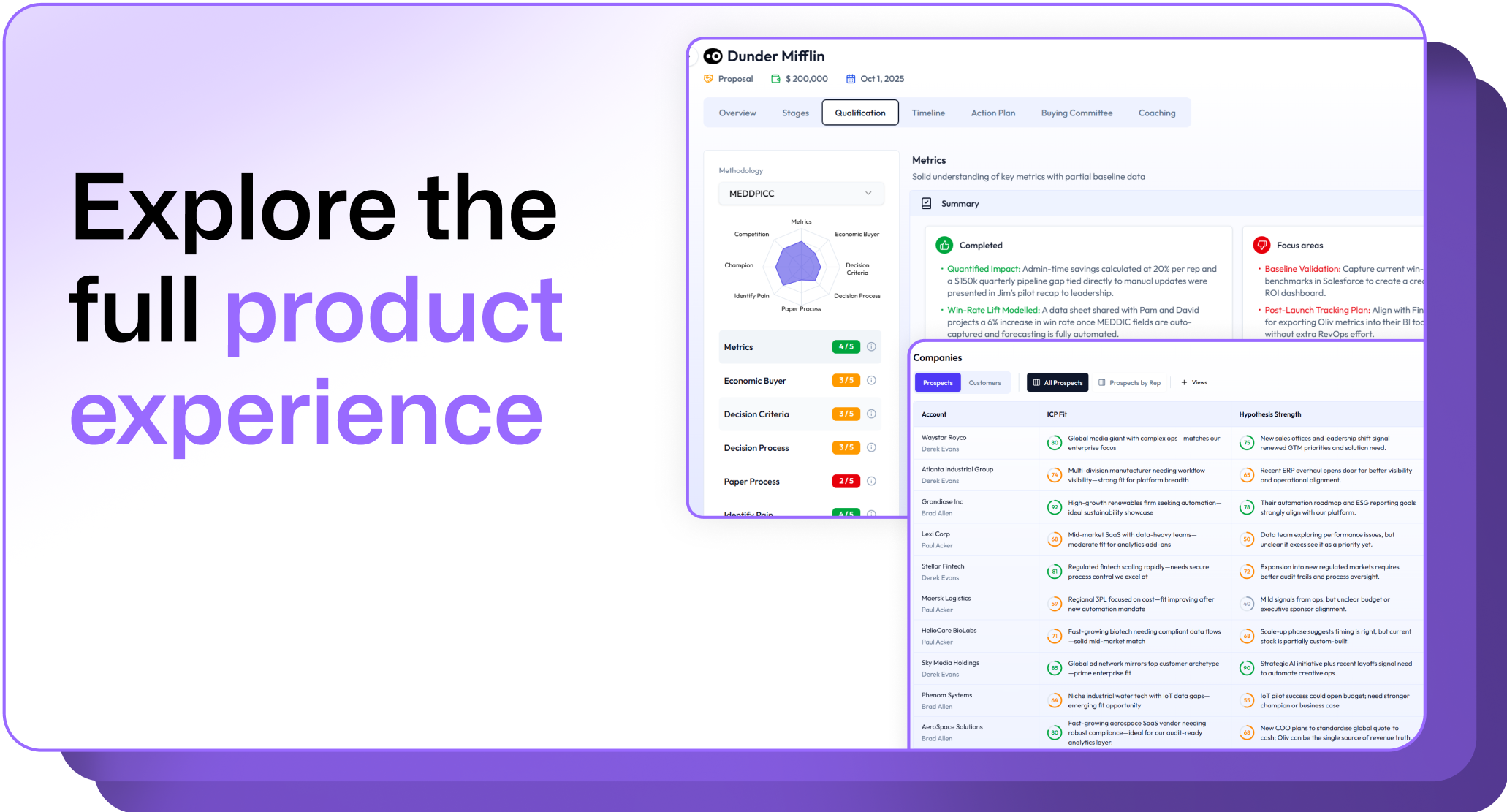
.avif)
.avif)