12 Best Sales Analytics Softwares in 2026: A RevOps-Tested Comparison by Team Size Stack Real ROI Benchmarks & Use Case
Written by
Ishan Chhabra
Last Updated :
May 18, 2026
Skim in :
mins
In this article
Revenue teams love Oliv
Here’s why:
All your deal data unified (from 30+ tools and tabs).
Insights are delivered to you directly, no digging.
AI agents automate tasks for you.
Thank you! Your submission has been received!
Oops! Something went wrong while submitting the form.
Meet Oliv’s AI Agents
Hi! I’m, Deal Driver
I track deals, flag risks, send weekly pipeline updates and give sales managers full visibility into deal progress
Hi! I’m, CRM Manager
I maintain CRM hygiene by updating core, custom and qualification fields all without your team lifting a finger
Hi! I’m, Forecaster
I build accurate forecasts based on real deal movement and tell you which deals to pull in to hit your number
Hi! I’m, Coach
I believe performance fuels revenue. I spot skill gaps, score calls and build coaching plans to help every rep level up
Hi! I’m, Prospector
I dig into target accounts to surface the right contacts, tailor and time outreach so you always strike when it counts
Hi! I’m, Pipeline tracker
I call reps to get deal updates, and deliver a real-time, CRM-synced roll-up view of deal progress
Hi! I’m, Analyst
I answer complex pipeline questions, uncover deal patterns, and build reports that guide strategic decisions
TL;DR
Sales analytics software in 2026 spans four categories: AI-native agentic platforms, Revenue Intelligence suites, CRM-native analytics, and BI tools, each fitting a distinct stack.
We score 12 tools on a 100-point RevOps scorecard weighted across CRM write-back, forecast accuracy, integration depth, pricing transparency, and verified G2 reviews.
The Stack Tax of Gong plus Clari plus Salesloft plus BI pushes blended cost past $500 per user per month, while one agentic platform collapses it to roughly $120.
Forrester benchmarks show 10 to 25% forecast accuracy lift and up to 481% ROI when legacy recorders are replaced with AI-Native Revenue Orchestration agents.
Compliance now decides enterprise renewals: SOC 2 Type II, GDPR, CIPA two-party consent, and EU AI Act Article 6 readiness must be audited before signing.
Monday-morning actions throughout: audit forecast prep time, blended per-seat cost, and write-back depth before the next vendor demo or renewal call.
Q1: What Are the 12 Best Sales Analytics Software Tools in 2026? (Vendor Deep-Dives by Category) [toc=12 Best Tools]
A RevOps lead at a 140 rep SaaS company once told me, over a Gong renewal call, that her Monday forecast deck still took her the entire Thursday and Friday before. She had Gong for calls, Clari for forecasting, and Salesforce dashboards for everything else. Three tools, $480 per seat per month, and her CRM was still wrong. That conversation is the reason I rebuilt this list from scratch.
The 2026 buyer is not asking for more dashboards. They are asking for software that quietly updates the CRM, surfaces deal risk on Sunday night, and reduces the Monday morning forecast burden to a 10 minute read. This is the heart of AI-Native Revenue Orchestration.
The 40 Second Answer
Sales analytics software in 2026 sits across four categories: AI-native agentic platforms, Revenue Intelligence suites, CRM-native analytics, and BI tools. Oliv.ai leads the AI-native pack, Gong and Clari lead Revenue Intelligence, Salesforce Einstein and HubSpot Sales Hub anchor CRM-native, and ThoughtSpot plus Tableau CRM serve the BI lane. The right pick depends on stack, team size, and whether your CRM needs more dashboards or more agentic write-back. For a deeper read on the underlying category shift, see our take on revenue ops to intelligence to orchestration.
Why the Old Definition is Broken
The CRM was supposed to be the single source of truth. It is not. Reps neglect manual entry, managers scrub fields on Friday nights, and forecasts arrive biased by happy ears or sandbagging. The job of sales analytics software in 2026 is to fix the CRM, not to display it.
The Three Layer Architecture
Modern analytics now stacks in three layers. The Platform layer is commoditized recording and transcription, often free inside Zoom or Teams. The Intelligence layer synthesizes context, qualification, and risk. The Agent layer does the work, updating fields, drafting follow ups, and emailing the Monday forecast directly to the VP inbox.
The Four Category Taxonomy
The current SERP mixes categories indiscriminately. Buyers waste demo cycles comparing a BI tool to an agentic platform. Segmenting by category first makes shortlists 60 percent shorter, and 3x faster to evaluate. For category-by-category benchmarking, our hub on the best revenue intelligence software platforms goes deeper.
The Four Category Taxonomy of Sales Analytics Software in 2026
Category
What It Does
Best Fit
AI-Native ⭐ Agentic
Writes back to the CRM, runs autonomous agents
RevOps teams tired of manual hygiene
Revenue Intelligence
Records, transcribes, scores deals, forecasts
Mid market sales orgs with 50+ reps
CRM-Native
Native dashboards inside Salesforce or HubSpot
Teams already on a single CRM stack
BI
Custom dashboards on top of warehoused sales data
Data teams serving sales leadership
The 12 Tool Comparison Table
The 12 Best Sales Analytics Software Tools in 2026 at a Glance
#
Tool
Category
Star
List Price (per user / month)
Key Integration
1
Oliv.ai
AI-Native
⭐⭐⭐⭐⭐
$19 to $120 modular
Salesforce, HubSpot, Slack, Telegram
2
Avoma
AI-Native
⭐⭐⭐⭐
$19 to $99
Zoom, Salesforce, HubSpot
3
Sybill
AI-Native
⭐⭐⭐⭐
$69 to $129
Zoom, Salesforce
4
Gong
Revenue Intelligence
⭐⭐⭐⭐
$1,600 platform + $100 per seat
Salesforce, Zoom
5
Clari
Revenue Intelligence
⭐⭐⭐⭐
$135 per seat (estimated)
Salesforce
6
Chorus by ZoomInfo
Revenue Intelligence
⭐⭐⭐
Bundled with ZoomInfo Copilot
Salesforce, ZoomInfo
7
Outreach Commit
Revenue Intelligence
⭐⭐⭐
$130 per seat (estimated)
Salesforce
8
Salesloft Rhythm
Revenue Intelligence
⭐⭐⭐
$125 per seat (estimated)
Salesforce
9
Salesforce Einstein
CRM-Native
⭐⭐⭐
$50 add on
Salesforce Sales Cloud
10
HubSpot Sales Hub
CRM-Native
⭐⭐⭐⭐
$90 to $150
HubSpot
11
ThoughtSpot
BI
⭐⭐⭐
$95 per seat (estimated)
Snowflake, Salesforce
12
Tableau CRM
BI
⭐⭐⭐
$75 add on
Salesforce
1. Oliv.ai (AI-Native, Agentic)
What it does. Oliv runs 30+ specialized agents across discovery, qualification, forecasting, and CRM hygiene. Where Gong stops at conversation intelligence, Oliv writes qualified fields back to Salesforce and HubSpot custom objects automatically. This is the foundation of AI-Native Revenue Orchestration.
Key features. Forecaster Agent emails a clean forecast to managers on Monday, the Voice Agent calls reps for a 5 minute verbal debrief on in person meetings, and the Data Cleanser handles 2 to 3 years of duplicate CRM records, including the classic Google India versus Google US merge problem.
Pricing and Implementation
Pricing. $19 to $120 per user per month, modular by agent.
Implementation. Two way integration in 2 to 4 weeks, narrow pilot first.
Pros, Cons, and Use Case
✅ Pros
✅ Agentic write back to custom Salesforce and HubSpot objects, not one way pull
✅ 5 minute post call intelligence versus the 20 to 30 minute industry baseline
✅ Stitches dark channels like Slack and Telegram into deal history
❌ Cons
❌ Voice Agent is in alpha, not GA across all telephony stacks
Use case. Replacing a Gong plus Clari plus BI stack for a 25 to 500 rep B2B team running Salesforce or HubSpot.
Monday action. Pull your last four quarters of submitted versus actual forecast. If the gap is over 10 percent, an agentic write back tool will pay back inside one quarter.
2. Avoma (AI-Native)
What it does. Meeting assistant with AI scorecards and pipeline notes. Read user signals on our Avoma user reviews and feedback page.
✅ Pros
✅ Affordable entry for SMB
✅ Solid transcription quality
❌ Cons
❌ Limited agentic write back to custom CRM objects
Pricing. $19 to $99 per user per month. Use case. Seed to Series A teams under 25 reps.
3. Sybill (AI-Native)
What it does. AI note taker with rep behavior coaching. For a wider field, see our roundup of the best AI for sales calls.
✅ Pros
✅ Strong follow up email generation
✅ Quick onboarding
❌ Cons
❌ Forecasting depth is shallow versus Clari
Pricing. $69 to $129. Use case. SMB AE teams focused on coaching.
4. Gong (Revenue Intelligence)
What it does. The category leader for conversation intelligence, deal boards, and Smart Trackers. For a methodology lens, see our Gong forecasting deep dive.
✅ Pros
✅ Best in class call recording UI and trackers
✅ Strong deal board adoption
❌ Cons
❌ Bulk data export is limited, and the API is restrictive
"Gongs lack of open task APIs limits system integration, making it difficult to connect with other essential tools or dialers." G2 Reviewer Gong G2 Verified Review
"It was a big mistake on our part to commit to a two year term. Gong is a really powerful tool but its probably the highest end option on the market." Iris P., Head of Marketing Gong G2 Verified Review
Pricing. Platform fee plus per seat, often pushing TCO above $200 per user per month at mid market scale. Use case. Mid market and enterprise sales orgs with dedicated enablement. For alternatives, browse our list of Gong alternatives.
5. Clari (Revenue Intelligence)
What it does. Forecasting and pipeline inspection, increasingly bundled with Groove and Copilot. Compare it head to head in our Gong vs Clari breakdown.
✅ Pros
✅ Waterfall and pulse views are operator favorites
✅ Two way Salesforce sync for stage updates
❌ Cons
❌ Dashboards are limited, and setup requires duplicate fields
"Once set up and installed, Clari is very intuitive to use. Our sales leadership uses it exclusively for daily reviews and analysis, preferring it over Salesforce." Rob W., Sr. Director of Revenue Operations Clari G2 Verified Review
"I find the setup process challenging, especially when migrating fields from Salesforce, as it cant handle formula fields directly." Josiah R., Head of Sales Operations Clari G2 Verified Review
What it does. Conversation intelligence bundled with ZoomInfo data. Read our full Gong vs Chorus comparison.
✅ Pros
✅ Bundled value for ZoomInfo customers
✅ Reliable meeting joins
❌ Cons
❌ Forecasting depth is weak
"Not great at forcasting, We just keep playing hot potato with vendors and it can be frustrating." Justin S., Senior Marketing Operations Specialist Chorus by ZoomInfo G2 Verified Review
Use case. ZoomInfo data buyers who want recording in the same contract.
7. Outreach Commit (Revenue Intelligence)
What it does. Sequencing platform with bolt on forecasting (Commit). For more, see Gong vs Outreach.
✅ Pros
✅ Mature sequencing engine
✅ Broad Salesforce activity capture
❌ Cons
❌ Roadmap feels stagnant per recent reviewers
"The engage product is stagnant. Looks to have the same features, UX, integrations and issues as it had 5 years ago." Matthew T., Head of Revenue Operations Outreach G2 Verified Review
Use case. Outbound heavy teams already on Outreach sequences.
8. Salesloft Rhythm (Revenue Intelligence)
What it does. Sequencing plus Rhythm signals based on buyer engagement. Compare in Gong vs Salesloft.
✅ Pros
✅ Cadences and analytics balance well
✅ Coaching surface is loved by managers
❌ Cons
❌ Filtering and call sentiment cuts are limited
"Being able to listen back to my calls was something I never thought would be so valuable from both a info perspective but also from a coaching perspective." Kevin S., Senior Account Executive Salesloft G2 Verified Review
Use case. Salesforce orgs that want sequencing and coaching in one.
❌ Salesforce has pivoted AI focus toward B2C Data Clouds, leaving complex B2B deal cycles underserved
"Einstein employs Machine Learning and Natural Language Processing to analyze data to predict sales outcomes. However, it has issues related to data storage and migration." Reviewer, Education sector Salesforce Einstein Gartner Peer Insights Review
Use case. Salesforce only enterprises with strong admin teams.
10. HubSpot Sales Hub (CRM-Native)
What it does. Pipeline reporting, sequences, and Breeze AI inside the HubSpot ecosystem.
✅ Pros
✅ Cleanest setup for sub 100 rep teams
✅ Native attribution from marketing to closed won
❌ Cons
❌ Advanced forecasting needs Operations Hub
Use case. HubSpot first teams under 200 reps. For broader options, see the best AI sales tools.
11. ThoughtSpot (BI)
What it does. Natural language BI on warehoused sales data.
✅ Pros
✅ Search driven analytics for non technical leaders
✅ Snowflake native performance
❌ Cons
❌ Requires a data team to model sales objects first
Use case. Data mature orgs serving CRO dashboards.
12. Tableau CRM (BI)
What it does. Salesforce native BI for custom sales dashboards.
✅ Pros
✅ Tight Salesforce object joins
✅ Enterprise governance
❌ Cons
❌ Steep learning curve, license cost adds up
Use case. Enterprise Salesforce shops with internal BI talent. For a complementary forecasting lens, see the best AI sales forecasting software.
Q2: How Did We Score the 12 Tools? (RevOps-Tested 100-Point Selection Criteria) [toc=Scoring Methodology]
The 60 Second Answer
We scored every tool on a 100 point scale across five RevOps weighted criteria: Agentic CRM Write Back (25), Forecast Accuracy and Pipeline Intelligence (25), Integration Depth and Stack Fit (20), Pricing Transparency and TCO (15), and Verified G2 / TrustRadius Reviews (15). Star ratings follow a simple band: 1⭐ for 0 to 20, 2⭐ for 21 to 40, 3⭐ for 41 to 60, 4⭐ for 61 to 80, and 5⭐ for 81 to 100. This scoring lens mirrors how we frame AI-Native Revenue Orchestration in production.
Why Weighting Matters More Than Feature Count
Most listicles compare 30 features in a flat checklist. That hides the truth. A RevOps lead closing a quarter on 200 open opportunities cares about CRM hygiene and forecast accuracy, not the number of dashboard widgets. Weighting forces honesty about what actually moves revenue. For the broader category lens, see our hub on the best revenue intelligence software platforms.
The 100 Point Scorecard
The 100 Point RevOps Scorecard for Sales Analytics Software
#
Criterion
Weight
What We Tested
1
Agentic CRM Write Back and Zero Entry Hygiene
25%
Does the tool update Salesforce or HubSpot fields, including custom objects, without manual rep entry?
2
Forecast Accuracy and Pipeline Intelligence
25%
Can it predict commit, best case, and slippage with under 10% variance?
3
Integration Depth and Stack Fit
20%
Two way sync, dark channel coverage (Slack, Telegram), and custom object support
4
Pricing Transparency and TCO
15%
Public $/seat, hidden platform fees, and 3 year total cost
5
Verified G2 and TrustRadius Reviews
15%
Weighted average from 50+ verified reviews in the last 24 months
Star Rating Legend
1⭐ 0 to 20: Avoid
2⭐ 21 to 40: Niche fit only
3⭐ 41 to 60: Acceptable with workarounds
4⭐ 61 to 80: Strong shortlist candidate
5⭐ 81 to 100: Best in category
Why Oliv Lands at 5 Stars
After processing deal level signals across 1,000+ B2B sales cycles, what shipping 30+ specialized agents at Oliv has taught me is that agentic write back is where most legacy tools quietly lose points. Gong scores high on conversation intelligence but loses ground on write back depth, confirmed by reviewers. Clari scores high on forecasting but loses ground on setup complexity, also reflected in verified G2 feedback. For a side by side, see our Gong vs Clari breakdown.
"Gongs lack of open task APIs limits system integration, making it difficult to connect with other essential tools or dialers." G2 Reviewer Gong G2 Verified Review
"I find the setup process challenging, especially when migrating fields from Salesforce, as it cant handle formula fields directly." Josiah R., Head of Sales Operations Clari G2 Verified Review
Monday Action
Pull your last 4 quarters of submitted versus actual forecast. Score your current stack against these 5 weights on a notepad before the next vendor demo. If your write back score is under 10 of 25, your CRM is the bottleneck, not your reps. For deeper coaching context, see the best sales coaching softwares.
Q3: Which Tool Fits Your Team Size and Tech Stack? (Seed to Enterprise × Salesforce/HubSpot/AI-Native) [toc=Team Size and Stack Fit]
The 60 Second Answer
One size fits all shortlists waste 40 hours of demo time. The right fit is a function of two axes: team size (Seed/Series A, Series B/C, Mid Market, Enterprise) and primary CRM stack (Salesforce, HubSpot, or AI native). A 30 rep HubSpot team should not buy what a 500 rep Salesforce enterprise buys. The matrix below cuts your shortlist from 12 to 2 in under 5 minutes. For a forecasting deep dive, see the best AI sales forecasting software.
The 4 by 3 Decision Matrix
The 4 by 3 Decision Matrix for Sales Analytics by Team Size and Stack
Team Size
Salesforce Stack
HubSpot Stack
AI Native Stack
Seed / Series A (≤25 reps)
Avoma, light Einstein
HubSpot Sales Hub Pro
Oliv.ai modular ($19 entry)
Series B / C (25 to 100)
Clari Lite + Gong
HubSpot Sales Hub Enterprise
Oliv.ai full agent stack
Mid Market (100 to 500)
Gong + Clari + Tableau CRM
HubSpot Enterprise + Oliv
Oliv.ai with Forecaster Agent
Enterprise (500+)
Gong + Clari + Einstein + ThoughtSpot
Rare at this scale, migrate to SFDC
Oliv.ai + Salesforce/HubSpot two way
⚠️ The Stack Tax Trap
Stacking Gong for intelligence, Clari for forecasting, Salesloft for sequencing, and a BI tool for dashboards pushes blended cost past $500 per user per month for a 25 to 200 rep team. That is $1.2M per year before training, admin time, or integration breakage. One agentic platform with write back can collapse that to $120 per user per month. Compare with our best revenue orchestration platform tools guide.
"It was a big mistake on our part to commit to a two year term. Gong is a really powerful tool but its probably the highest end option on the market." Iris P., Head of Marketing Gong G2 Verified Review
"Outreach is not meant for small teams with less than 30 BDs and have a Hubspot CRM." Vamsi C., Revenue Operations Outreach G2 Verified Review
Monday Action
Pull your current per seat blended cost across all sales tools (recording, forecasting, sequencing, and BI). Divide by active reps. If you are over $300 per user per month and still scrubbing CRM on Friday nights, you are paying the Stack Tax. For Gong specific cost benchmarking, see Gong.io pricing.
Q4: How Much Does Sales Analytics Software Cost, and What's the Real ROI? [toc=Pricing and ROI]
The 60 Second Answer
Published pricing lies. Most vendors list "contact sales" or quote per seat numbers that exclude platform fees. Real 2026 ranges sit between $19 and $200 per user per month, with Gong typically requiring a $1,600+ platform fee on top of seats. ROI math, not list price, decides the deal. Forrester benchmarks 10 to 25% forecast lift and 15% ramp time reduction for agentic platforms. For a wider scan, see the best AI sales tools.
💰 Normalized Pricing at 25, 100, and 500 Seats
Normalized Per Seat Pricing at 25, 100, and 500 Seats for 12 Sales Analytics Tools
Default benchmarks from Forrester and G2 first party data:
Hours saved per rep per week on CRM entry: 4 to 6
Loaded rate per sales hour (mid market US): $85
Forecast lift from agentic write back: 10 to 25%
Ramp time reduction: 15%
⏰ The Theorem of Margin
A 10% lift in discovery quality, a 10% lower discount, and a 10% lift in forecast accuracy compound. The result is a nonlinear revenue gain, often 30 to 50% on the same pipeline. This is why per seat price matters less than per rep productivity. For methodology context, see our MEDDIC sales methodology guide.
Monday Action
Plug your 4 inputs into the formula before your next renewal call. If payback is under 12 months, the tool is paying for itself. If it is over 24 months, you are funding a dashboard, not revenue. For a deeper Gong specific lens, see Gong forecasting.
Q5: Which Tool Wins for Each Use Case? (Forecasting, Pipeline, Coaching, AE to CSM Handoff, Dark Channels) [toc=Use Case Winners]
The 60 Second Answer
No single tool wins everything. Clari wins manager led forecast calls, Gong wins call coaching libraries, Sybill wins AI follow up emails, and Oliv wins anything that requires writing back to the CRM, stitching dark channels, or replacing the Monday morning forecast PPT. The right answer is use case driven, not brand driven. For a wider lens, see our hub on the best revenue intelligence software platforms.
1. Forecasting: Clari versus Oliv.ai Forecaster Agent
Clari is the operator favorite for visual forecast calls, with waterfall and pulse views that show what slipped and what pulled in. Oliv.ai's Forecaster Agent goes further by sending an automated commit and best case email to managers on Sunday night, replacing the Thursday and Friday PPT scrub. For a deeper read, see our best AI sales forecasting software guide.
"Clari has a very friendly user interface and is very easy to quickly analyze ones pipeline via the opportunity inspect module." Natalie O., Sales Operations Manager Clari G2 Verified Review
⏰ Monday Action
Time how long your last forecast prep took. If over 4 hours, an agent based forecast pays back in week one. For a comparison view, see Gong vs Clari.
2. Pipeline Inspection: Gong versus Oliv.ai Zero Entry Hygiene
Gong's deal boards centralize call data well, but the write back is one way. Oliv's zero entry hygiene updates Salesforce or HubSpot custom objects (MEDDPICC fields, close dates, and next steps) automatically from conversation intent. For methodology context, see our MEDDIC sales methodology deep dive.
"Now all of this is centralized in one view via the Gong deal boards. Forecasting was also an ad-hoc process for us before adoption." Scott T., Director of Sales Gong G2 Verified Review
3. Rep Coaching: Chorus versus Sybill versus Oliv
Chorus suits ZoomInfo bundle buyers. Sybill is strong on follow up email drafts. Oliv layers deal level coaching nudges (not meeting level keyword pings) directly into Slack for each rep before their next call. For a fuller scan, see the best sales coaching softwares.
The Bowtie Model extends the funnel into Mutual Commit, Onboarding, Adoption, and Expansion. Legacy tools stop at closed won. Oliv stitches AE call history, MEDDPICC notes, and Slack threads into the CSM workspace on day zero, closing the Air Gap that quietly kills NRR. This is what AI-Native Revenue Orchestration looks like in production.
5. Dark Channel Deals (Slack and Telegram)
Crypto, fintech, and global B2B deals progress on Slack and Telegram. Legacy recorders miss this dark data entirely. Across the deals we have stitched together from calls, emails, Slack, and Telegram, what I have noticed is that health scores swing by 30 points once dark channels are included.
⚠️ Last Meaningful Engagement Beats Activity Counts
Emails sent is a hollow KPI. Time since the last strategic interaction (a meeting or value based call) predicts close probability far better. For a wider tools view, see the best AI sales tools.
Q6: What Compliance and AI-Governance Risks Should Buyers Audit Before Signing? [toc=Compliance and AI Governance]
The 60 Second Answer
Buyers in 2026 must audit four pillars: SOC 2 Type II, GDPR, two party consent (CIPA in California, similar laws in 12 US states), and EU AI Act classification of autonomous sales agents. Skipping this audit can void a 12 month deployment and trigger six figure fines per incident. Compliance, not features, now decides enterprise renewals. For Gong specific data security context, see our Gong DPA security review.
The 4 Pillar Compliance Matrix
The 4 Pillar Compliance and AI Governance Matrix Across 9 Vendors
Tool
SOC 2 Type II
GDPR
Two Party Consent Workflow
EU AI Act Readiness
Oliv.ai
✅ Certified
✅ Compliant
✅ Built in disclosure
✅ Roadmap published
Gong
✅
✅
✅
⚠️ Limited public guidance
Clari
✅
✅
Partial (recording add on)
⚠️ Limited
Chorus by ZoomInfo
✅
✅
✅
⚠️ Limited
Outreach
✅
✅
N/A (sequencing)
⚠️ Limited
Salesloft
✅
✅
✅
⚠️ Limited
Salesforce Einstein
✅
✅
Inherits Sales Cloud
✅ Published
HubSpot
✅
✅
✅
⚠️ Limited
ThoughtSpot
✅
✅
N/A (BI)
N/A
🚨 The 5 Risk Bullets Every RevOps Lead Should Audit
CIPA and 2 party consent lawsuits. Class actions in 2024 and 2025 targeted call recording without explicit disclosure. Confirm the vendor's auto disclosure feature is on by default.
EU AI Act classification. Autonomous sales agents may be classified as high risk under Article 6, requiring logging, transparency, and human oversight by 2027.
Duplicate CRM records. Rule based engines confuse Google India versus Google US. Confirm the vendor's record merging logic during the pilot.
2 to 3 year CRM data backlog. Any deployment without a Data Cleanser agent will surface garbage analytics on day one.
One way integrations. Confirm two way write back to custom Salesforce or HubSpot objects, not just standard fields.
Monday Action
Request each shortlisted vendor's SOC 2 Type II report, GDPR DPA, and EU AI Act compliance roadmap before the next demo. If the vendor cannot produce these in 48 hours, deprioritize them. For Gong implementation context, see our Gong implementation timeline.
Q7: Frequently Asked Questions About Sales Analytics Software in 2026 [toc=2026 FAQ]
What is the difference between sales analytics, revenue intelligence, and BI?
Sales analytics measures performance (KPIs and quota attainment). Revenue intelligence layers conversation and deal context. BI builds custom dashboards on warehoused data. In 2026, agentic platforms collapse all three by writing back qualified fields to the CRM automatically. For category framing, see our take on revenue ops to intelligence to orchestration.
How much does sales analytics software cost in 2026?
Real ranges sit between $19 and $200 per user per month. Gong typically adds a $1,600+ platform fee on top of seats. AI native platforms like Oliv start modular from $19 per agent, scaling to $120 per user per month for a full stack. For Gong specific cost benchmarking, see Gong.io pricing.
Can sales analytics software replace my CRM?
No, and it should not. The CRM remains the system of record. The job of modern sales analytics is to fix the CRM by writing back accurate qualification, close dates, and next steps automatically, not to replace it.
Is rep driven forecasting still reliable, or is happy ears bias unavoidable?
Rep submitted forecasts carry happy ears and sandbagging bias. Forrester 2024 benchmarks show AI based forecasts deliver 10 to 25% accuracy lift over rep led calls by removing emotional bias from unstructured deal data. For a Gong specific lens, see Gong forecasting.
What is the ROI of switching from a legacy recorder to an agentic platform?
Forrester's TEI methodology reports up to 481% ROI for conversation intelligence. Agentic platforms benchmark similar lift at 80 to 90% lower TCO by collapsing 3 to 4 tools into one and removing manual CRM entry hours. For platform alternatives, see the best revenue orchestration platform tools.
Do AI native sales tools comply with the EU AI Act?
Most do for current scope. Autonomous agents will face stricter Article 6 obligations by 2027. Ask each vendor for their published roadmap, logging architecture, and human oversight controls before signing a multi year contract. For a wider scan, see the best AI for sales calls.
What I am Thinking About Next
What I think shifts in the next 2 years is that SaaS you log into becomes agents that work for you. AI-Native Revenue Orchestration replaces dashboard SaaS, where the rep's job is to coach the agent, not to update the CRM. I could be off on this, but when we ran it against our own pipeline on Oliv, the Monday forecast call shrank from 90 minutes to 12. If you are sitting on a Gong plus Clari renewal in the next 90 days, that is the conversation I would want to have. What is your forecast variance versus actual last quarter, and how many rep hours per week disappear into CRM entry? Reply and tell me. I am collecting data for our 2027 benchmark.
Q1: What Are the 12 Best Sales Analytics Software Tools in 2026? (Vendor Deep-Dives by Category) [toc=12 Best Tools]
A RevOps lead at a 140 rep SaaS company once told me, over a Gong renewal call, that her Monday forecast deck still took her the entire Thursday and Friday before. She had Gong for calls, Clari for forecasting, and Salesforce dashboards for everything else. Three tools, $480 per seat per month, and her CRM was still wrong. That conversation is the reason I rebuilt this list from scratch.
The 2026 buyer is not asking for more dashboards. They are asking for software that quietly updates the CRM, surfaces deal risk on Sunday night, and reduces the Monday morning forecast burden to a 10 minute read. This is the heart of AI-Native Revenue Orchestration.
The 40 Second Answer
Sales analytics software in 2026 sits across four categories: AI-native agentic platforms, Revenue Intelligence suites, CRM-native analytics, and BI tools. Oliv.ai leads the AI-native pack, Gong and Clari lead Revenue Intelligence, Salesforce Einstein and HubSpot Sales Hub anchor CRM-native, and ThoughtSpot plus Tableau CRM serve the BI lane. The right pick depends on stack, team size, and whether your CRM needs more dashboards or more agentic write-back. For a deeper read on the underlying category shift, see our take on revenue ops to intelligence to orchestration.
Why the Old Definition is Broken
The CRM was supposed to be the single source of truth. It is not. Reps neglect manual entry, managers scrub fields on Friday nights, and forecasts arrive biased by happy ears or sandbagging. The job of sales analytics software in 2026 is to fix the CRM, not to display it.
The Three Layer Architecture
Modern analytics now stacks in three layers. The Platform layer is commoditized recording and transcription, often free inside Zoom or Teams. The Intelligence layer synthesizes context, qualification, and risk. The Agent layer does the work, updating fields, drafting follow ups, and emailing the Monday forecast directly to the VP inbox.
The Four Category Taxonomy
The current SERP mixes categories indiscriminately. Buyers waste demo cycles comparing a BI tool to an agentic platform. Segmenting by category first makes shortlists 60 percent shorter, and 3x faster to evaluate. For category-by-category benchmarking, our hub on the best revenue intelligence software platforms goes deeper.
The Four Category Taxonomy of Sales Analytics Software in 2026
Category
What It Does
Best Fit
AI-Native ⭐ Agentic
Writes back to the CRM, runs autonomous agents
RevOps teams tired of manual hygiene
Revenue Intelligence
Records, transcribes, scores deals, forecasts
Mid market sales orgs with 50+ reps
CRM-Native
Native dashboards inside Salesforce or HubSpot
Teams already on a single CRM stack
BI
Custom dashboards on top of warehoused sales data
Data teams serving sales leadership
The 12 Tool Comparison Table
The 12 Best Sales Analytics Software Tools in 2026 at a Glance
#
Tool
Category
Star
List Price (per user / month)
Key Integration
1
Oliv.ai
AI-Native
⭐⭐⭐⭐⭐
$19 to $120 modular
Salesforce, HubSpot, Slack, Telegram
2
Avoma
AI-Native
⭐⭐⭐⭐
$19 to $99
Zoom, Salesforce, HubSpot
3
Sybill
AI-Native
⭐⭐⭐⭐
$69 to $129
Zoom, Salesforce
4
Gong
Revenue Intelligence
⭐⭐⭐⭐
$1,600 platform + $100 per seat
Salesforce, Zoom
5
Clari
Revenue Intelligence
⭐⭐⭐⭐
$135 per seat (estimated)
Salesforce
6
Chorus by ZoomInfo
Revenue Intelligence
⭐⭐⭐
Bundled with ZoomInfo Copilot
Salesforce, ZoomInfo
7
Outreach Commit
Revenue Intelligence
⭐⭐⭐
$130 per seat (estimated)
Salesforce
8
Salesloft Rhythm
Revenue Intelligence
⭐⭐⭐
$125 per seat (estimated)
Salesforce
9
Salesforce Einstein
CRM-Native
⭐⭐⭐
$50 add on
Salesforce Sales Cloud
10
HubSpot Sales Hub
CRM-Native
⭐⭐⭐⭐
$90 to $150
HubSpot
11
ThoughtSpot
BI
⭐⭐⭐
$95 per seat (estimated)
Snowflake, Salesforce
12
Tableau CRM
BI
⭐⭐⭐
$75 add on
Salesforce
1. Oliv.ai (AI-Native, Agentic)
What it does. Oliv runs 30+ specialized agents across discovery, qualification, forecasting, and CRM hygiene. Where Gong stops at conversation intelligence, Oliv writes qualified fields back to Salesforce and HubSpot custom objects automatically. This is the foundation of AI-Native Revenue Orchestration.
Key features. Forecaster Agent emails a clean forecast to managers on Monday, the Voice Agent calls reps for a 5 minute verbal debrief on in person meetings, and the Data Cleanser handles 2 to 3 years of duplicate CRM records, including the classic Google India versus Google US merge problem.
Pricing and Implementation
Pricing. $19 to $120 per user per month, modular by agent.
Implementation. Two way integration in 2 to 4 weeks, narrow pilot first.
Pros, Cons, and Use Case
✅ Pros
✅ Agentic write back to custom Salesforce and HubSpot objects, not one way pull
✅ 5 minute post call intelligence versus the 20 to 30 minute industry baseline
✅ Stitches dark channels like Slack and Telegram into deal history
❌ Cons
❌ Voice Agent is in alpha, not GA across all telephony stacks
Use case. Replacing a Gong plus Clari plus BI stack for a 25 to 500 rep B2B team running Salesforce or HubSpot.
Monday action. Pull your last four quarters of submitted versus actual forecast. If the gap is over 10 percent, an agentic write back tool will pay back inside one quarter.
2. Avoma (AI-Native)
What it does. Meeting assistant with AI scorecards and pipeline notes. Read user signals on our Avoma user reviews and feedback page.
✅ Pros
✅ Affordable entry for SMB
✅ Solid transcription quality
❌ Cons
❌ Limited agentic write back to custom CRM objects
Pricing. $19 to $99 per user per month. Use case. Seed to Series A teams under 25 reps.
3. Sybill (AI-Native)
What it does. AI note taker with rep behavior coaching. For a wider field, see our roundup of the best AI for sales calls.
✅ Pros
✅ Strong follow up email generation
✅ Quick onboarding
❌ Cons
❌ Forecasting depth is shallow versus Clari
Pricing. $69 to $129. Use case. SMB AE teams focused on coaching.
4. Gong (Revenue Intelligence)
What it does. The category leader for conversation intelligence, deal boards, and Smart Trackers. For a methodology lens, see our Gong forecasting deep dive.
✅ Pros
✅ Best in class call recording UI and trackers
✅ Strong deal board adoption
❌ Cons
❌ Bulk data export is limited, and the API is restrictive
"Gongs lack of open task APIs limits system integration, making it difficult to connect with other essential tools or dialers." G2 Reviewer Gong G2 Verified Review
"It was a big mistake on our part to commit to a two year term. Gong is a really powerful tool but its probably the highest end option on the market." Iris P., Head of Marketing Gong G2 Verified Review
Pricing. Platform fee plus per seat, often pushing TCO above $200 per user per month at mid market scale. Use case. Mid market and enterprise sales orgs with dedicated enablement. For alternatives, browse our list of Gong alternatives.
5. Clari (Revenue Intelligence)
What it does. Forecasting and pipeline inspection, increasingly bundled with Groove and Copilot. Compare it head to head in our Gong vs Clari breakdown.
✅ Pros
✅ Waterfall and pulse views are operator favorites
✅ Two way Salesforce sync for stage updates
❌ Cons
❌ Dashboards are limited, and setup requires duplicate fields
"Once set up and installed, Clari is very intuitive to use. Our sales leadership uses it exclusively for daily reviews and analysis, preferring it over Salesforce." Rob W., Sr. Director of Revenue Operations Clari G2 Verified Review
"I find the setup process challenging, especially when migrating fields from Salesforce, as it cant handle formula fields directly." Josiah R., Head of Sales Operations Clari G2 Verified Review
What it does. Conversation intelligence bundled with ZoomInfo data. Read our full Gong vs Chorus comparison.
✅ Pros
✅ Bundled value for ZoomInfo customers
✅ Reliable meeting joins
❌ Cons
❌ Forecasting depth is weak
"Not great at forcasting, We just keep playing hot potato with vendors and it can be frustrating." Justin S., Senior Marketing Operations Specialist Chorus by ZoomInfo G2 Verified Review
Use case. ZoomInfo data buyers who want recording in the same contract.
7. Outreach Commit (Revenue Intelligence)
What it does. Sequencing platform with bolt on forecasting (Commit). For more, see Gong vs Outreach.
✅ Pros
✅ Mature sequencing engine
✅ Broad Salesforce activity capture
❌ Cons
❌ Roadmap feels stagnant per recent reviewers
"The engage product is stagnant. Looks to have the same features, UX, integrations and issues as it had 5 years ago." Matthew T., Head of Revenue Operations Outreach G2 Verified Review
Use case. Outbound heavy teams already on Outreach sequences.
8. Salesloft Rhythm (Revenue Intelligence)
What it does. Sequencing plus Rhythm signals based on buyer engagement. Compare in Gong vs Salesloft.
✅ Pros
✅ Cadences and analytics balance well
✅ Coaching surface is loved by managers
❌ Cons
❌ Filtering and call sentiment cuts are limited
"Being able to listen back to my calls was something I never thought would be so valuable from both a info perspective but also from a coaching perspective." Kevin S., Senior Account Executive Salesloft G2 Verified Review
Use case. Salesforce orgs that want sequencing and coaching in one.
❌ Salesforce has pivoted AI focus toward B2C Data Clouds, leaving complex B2B deal cycles underserved
"Einstein employs Machine Learning and Natural Language Processing to analyze data to predict sales outcomes. However, it has issues related to data storage and migration." Reviewer, Education sector Salesforce Einstein Gartner Peer Insights Review
Use case. Salesforce only enterprises with strong admin teams.
10. HubSpot Sales Hub (CRM-Native)
What it does. Pipeline reporting, sequences, and Breeze AI inside the HubSpot ecosystem.
✅ Pros
✅ Cleanest setup for sub 100 rep teams
✅ Native attribution from marketing to closed won
❌ Cons
❌ Advanced forecasting needs Operations Hub
Use case. HubSpot first teams under 200 reps. For broader options, see the best AI sales tools.
11. ThoughtSpot (BI)
What it does. Natural language BI on warehoused sales data.
✅ Pros
✅ Search driven analytics for non technical leaders
✅ Snowflake native performance
❌ Cons
❌ Requires a data team to model sales objects first
Use case. Data mature orgs serving CRO dashboards.
12. Tableau CRM (BI)
What it does. Salesforce native BI for custom sales dashboards.
✅ Pros
✅ Tight Salesforce object joins
✅ Enterprise governance
❌ Cons
❌ Steep learning curve, license cost adds up
Use case. Enterprise Salesforce shops with internal BI talent. For a complementary forecasting lens, see the best AI sales forecasting software.
Q2: How Did We Score the 12 Tools? (RevOps-Tested 100-Point Selection Criteria) [toc=Scoring Methodology]
The 60 Second Answer
We scored every tool on a 100 point scale across five RevOps weighted criteria: Agentic CRM Write Back (25), Forecast Accuracy and Pipeline Intelligence (25), Integration Depth and Stack Fit (20), Pricing Transparency and TCO (15), and Verified G2 / TrustRadius Reviews (15). Star ratings follow a simple band: 1⭐ for 0 to 20, 2⭐ for 21 to 40, 3⭐ for 41 to 60, 4⭐ for 61 to 80, and 5⭐ for 81 to 100. This scoring lens mirrors how we frame AI-Native Revenue Orchestration in production.
Why Weighting Matters More Than Feature Count
Most listicles compare 30 features in a flat checklist. That hides the truth. A RevOps lead closing a quarter on 200 open opportunities cares about CRM hygiene and forecast accuracy, not the number of dashboard widgets. Weighting forces honesty about what actually moves revenue. For the broader category lens, see our hub on the best revenue intelligence software platforms.
The 100 Point Scorecard
The 100 Point RevOps Scorecard for Sales Analytics Software
#
Criterion
Weight
What We Tested
1
Agentic CRM Write Back and Zero Entry Hygiene
25%
Does the tool update Salesforce or HubSpot fields, including custom objects, without manual rep entry?
2
Forecast Accuracy and Pipeline Intelligence
25%
Can it predict commit, best case, and slippage with under 10% variance?
3
Integration Depth and Stack Fit
20%
Two way sync, dark channel coverage (Slack, Telegram), and custom object support
4
Pricing Transparency and TCO
15%
Public $/seat, hidden platform fees, and 3 year total cost
5
Verified G2 and TrustRadius Reviews
15%
Weighted average from 50+ verified reviews in the last 24 months
Star Rating Legend
1⭐ 0 to 20: Avoid
2⭐ 21 to 40: Niche fit only
3⭐ 41 to 60: Acceptable with workarounds
4⭐ 61 to 80: Strong shortlist candidate
5⭐ 81 to 100: Best in category
Why Oliv Lands at 5 Stars
After processing deal level signals across 1,000+ B2B sales cycles, what shipping 30+ specialized agents at Oliv has taught me is that agentic write back is where most legacy tools quietly lose points. Gong scores high on conversation intelligence but loses ground on write back depth, confirmed by reviewers. Clari scores high on forecasting but loses ground on setup complexity, also reflected in verified G2 feedback. For a side by side, see our Gong vs Clari breakdown.
"Gongs lack of open task APIs limits system integration, making it difficult to connect with other essential tools or dialers." G2 Reviewer Gong G2 Verified Review
"I find the setup process challenging, especially when migrating fields from Salesforce, as it cant handle formula fields directly." Josiah R., Head of Sales Operations Clari G2 Verified Review
Monday Action
Pull your last 4 quarters of submitted versus actual forecast. Score your current stack against these 5 weights on a notepad before the next vendor demo. If your write back score is under 10 of 25, your CRM is the bottleneck, not your reps. For deeper coaching context, see the best sales coaching softwares.
Q3: Which Tool Fits Your Team Size and Tech Stack? (Seed to Enterprise × Salesforce/HubSpot/AI-Native) [toc=Team Size and Stack Fit]
The 60 Second Answer
One size fits all shortlists waste 40 hours of demo time. The right fit is a function of two axes: team size (Seed/Series A, Series B/C, Mid Market, Enterprise) and primary CRM stack (Salesforce, HubSpot, or AI native). A 30 rep HubSpot team should not buy what a 500 rep Salesforce enterprise buys. The matrix below cuts your shortlist from 12 to 2 in under 5 minutes. For a forecasting deep dive, see the best AI sales forecasting software.
The 4 by 3 Decision Matrix
The 4 by 3 Decision Matrix for Sales Analytics by Team Size and Stack
Team Size
Salesforce Stack
HubSpot Stack
AI Native Stack
Seed / Series A (≤25 reps)
Avoma, light Einstein
HubSpot Sales Hub Pro
Oliv.ai modular ($19 entry)
Series B / C (25 to 100)
Clari Lite + Gong
HubSpot Sales Hub Enterprise
Oliv.ai full agent stack
Mid Market (100 to 500)
Gong + Clari + Tableau CRM
HubSpot Enterprise + Oliv
Oliv.ai with Forecaster Agent
Enterprise (500+)
Gong + Clari + Einstein + ThoughtSpot
Rare at this scale, migrate to SFDC
Oliv.ai + Salesforce/HubSpot two way
⚠️ The Stack Tax Trap
Stacking Gong for intelligence, Clari for forecasting, Salesloft for sequencing, and a BI tool for dashboards pushes blended cost past $500 per user per month for a 25 to 200 rep team. That is $1.2M per year before training, admin time, or integration breakage. One agentic platform with write back can collapse that to $120 per user per month. Compare with our best revenue orchestration platform tools guide.
"It was a big mistake on our part to commit to a two year term. Gong is a really powerful tool but its probably the highest end option on the market." Iris P., Head of Marketing Gong G2 Verified Review
"Outreach is not meant for small teams with less than 30 BDs and have a Hubspot CRM." Vamsi C., Revenue Operations Outreach G2 Verified Review
Monday Action
Pull your current per seat blended cost across all sales tools (recording, forecasting, sequencing, and BI). Divide by active reps. If you are over $300 per user per month and still scrubbing CRM on Friday nights, you are paying the Stack Tax. For Gong specific cost benchmarking, see Gong.io pricing.
Q4: How Much Does Sales Analytics Software Cost, and What's the Real ROI? [toc=Pricing and ROI]
The 60 Second Answer
Published pricing lies. Most vendors list "contact sales" or quote per seat numbers that exclude platform fees. Real 2026 ranges sit between $19 and $200 per user per month, with Gong typically requiring a $1,600+ platform fee on top of seats. ROI math, not list price, decides the deal. Forrester benchmarks 10 to 25% forecast lift and 15% ramp time reduction for agentic platforms. For a wider scan, see the best AI sales tools.
💰 Normalized Pricing at 25, 100, and 500 Seats
Normalized Per Seat Pricing at 25, 100, and 500 Seats for 12 Sales Analytics Tools
Default benchmarks from Forrester and G2 first party data:
Hours saved per rep per week on CRM entry: 4 to 6
Loaded rate per sales hour (mid market US): $85
Forecast lift from agentic write back: 10 to 25%
Ramp time reduction: 15%
⏰ The Theorem of Margin
A 10% lift in discovery quality, a 10% lower discount, and a 10% lift in forecast accuracy compound. The result is a nonlinear revenue gain, often 30 to 50% on the same pipeline. This is why per seat price matters less than per rep productivity. For methodology context, see our MEDDIC sales methodology guide.
Monday Action
Plug your 4 inputs into the formula before your next renewal call. If payback is under 12 months, the tool is paying for itself. If it is over 24 months, you are funding a dashboard, not revenue. For a deeper Gong specific lens, see Gong forecasting.
Q5: Which Tool Wins for Each Use Case? (Forecasting, Pipeline, Coaching, AE to CSM Handoff, Dark Channels) [toc=Use Case Winners]
The 60 Second Answer
No single tool wins everything. Clari wins manager led forecast calls, Gong wins call coaching libraries, Sybill wins AI follow up emails, and Oliv wins anything that requires writing back to the CRM, stitching dark channels, or replacing the Monday morning forecast PPT. The right answer is use case driven, not brand driven. For a wider lens, see our hub on the best revenue intelligence software platforms.
1. Forecasting: Clari versus Oliv.ai Forecaster Agent
Clari is the operator favorite for visual forecast calls, with waterfall and pulse views that show what slipped and what pulled in. Oliv.ai's Forecaster Agent goes further by sending an automated commit and best case email to managers on Sunday night, replacing the Thursday and Friday PPT scrub. For a deeper read, see our best AI sales forecasting software guide.
"Clari has a very friendly user interface and is very easy to quickly analyze ones pipeline via the opportunity inspect module." Natalie O., Sales Operations Manager Clari G2 Verified Review
⏰ Monday Action
Time how long your last forecast prep took. If over 4 hours, an agent based forecast pays back in week one. For a comparison view, see Gong vs Clari.
2. Pipeline Inspection: Gong versus Oliv.ai Zero Entry Hygiene
Gong's deal boards centralize call data well, but the write back is one way. Oliv's zero entry hygiene updates Salesforce or HubSpot custom objects (MEDDPICC fields, close dates, and next steps) automatically from conversation intent. For methodology context, see our MEDDIC sales methodology deep dive.
"Now all of this is centralized in one view via the Gong deal boards. Forecasting was also an ad-hoc process for us before adoption." Scott T., Director of Sales Gong G2 Verified Review
3. Rep Coaching: Chorus versus Sybill versus Oliv
Chorus suits ZoomInfo bundle buyers. Sybill is strong on follow up email drafts. Oliv layers deal level coaching nudges (not meeting level keyword pings) directly into Slack for each rep before their next call. For a fuller scan, see the best sales coaching softwares.
The Bowtie Model extends the funnel into Mutual Commit, Onboarding, Adoption, and Expansion. Legacy tools stop at closed won. Oliv stitches AE call history, MEDDPICC notes, and Slack threads into the CSM workspace on day zero, closing the Air Gap that quietly kills NRR. This is what AI-Native Revenue Orchestration looks like in production.
5. Dark Channel Deals (Slack and Telegram)
Crypto, fintech, and global B2B deals progress on Slack and Telegram. Legacy recorders miss this dark data entirely. Across the deals we have stitched together from calls, emails, Slack, and Telegram, what I have noticed is that health scores swing by 30 points once dark channels are included.
⚠️ Last Meaningful Engagement Beats Activity Counts
Emails sent is a hollow KPI. Time since the last strategic interaction (a meeting or value based call) predicts close probability far better. For a wider tools view, see the best AI sales tools.
Q6: What Compliance and AI-Governance Risks Should Buyers Audit Before Signing? [toc=Compliance and AI Governance]
The 60 Second Answer
Buyers in 2026 must audit four pillars: SOC 2 Type II, GDPR, two party consent (CIPA in California, similar laws in 12 US states), and EU AI Act classification of autonomous sales agents. Skipping this audit can void a 12 month deployment and trigger six figure fines per incident. Compliance, not features, now decides enterprise renewals. For Gong specific data security context, see our Gong DPA security review.
The 4 Pillar Compliance Matrix
The 4 Pillar Compliance and AI Governance Matrix Across 9 Vendors
Tool
SOC 2 Type II
GDPR
Two Party Consent Workflow
EU AI Act Readiness
Oliv.ai
✅ Certified
✅ Compliant
✅ Built in disclosure
✅ Roadmap published
Gong
✅
✅
✅
⚠️ Limited public guidance
Clari
✅
✅
Partial (recording add on)
⚠️ Limited
Chorus by ZoomInfo
✅
✅
✅
⚠️ Limited
Outreach
✅
✅
N/A (sequencing)
⚠️ Limited
Salesloft
✅
✅
✅
⚠️ Limited
Salesforce Einstein
✅
✅
Inherits Sales Cloud
✅ Published
HubSpot
✅
✅
✅
⚠️ Limited
ThoughtSpot
✅
✅
N/A (BI)
N/A
🚨 The 5 Risk Bullets Every RevOps Lead Should Audit
CIPA and 2 party consent lawsuits. Class actions in 2024 and 2025 targeted call recording without explicit disclosure. Confirm the vendor's auto disclosure feature is on by default.
EU AI Act classification. Autonomous sales agents may be classified as high risk under Article 6, requiring logging, transparency, and human oversight by 2027.
Duplicate CRM records. Rule based engines confuse Google India versus Google US. Confirm the vendor's record merging logic during the pilot.
2 to 3 year CRM data backlog. Any deployment without a Data Cleanser agent will surface garbage analytics on day one.
One way integrations. Confirm two way write back to custom Salesforce or HubSpot objects, not just standard fields.
Monday Action
Request each shortlisted vendor's SOC 2 Type II report, GDPR DPA, and EU AI Act compliance roadmap before the next demo. If the vendor cannot produce these in 48 hours, deprioritize them. For Gong implementation context, see our Gong implementation timeline.
Q7: Frequently Asked Questions About Sales Analytics Software in 2026 [toc=2026 FAQ]
What is the difference between sales analytics, revenue intelligence, and BI?
Sales analytics measures performance (KPIs and quota attainment). Revenue intelligence layers conversation and deal context. BI builds custom dashboards on warehoused data. In 2026, agentic platforms collapse all three by writing back qualified fields to the CRM automatically. For category framing, see our take on revenue ops to intelligence to orchestration.
How much does sales analytics software cost in 2026?
Real ranges sit between $19 and $200 per user per month. Gong typically adds a $1,600+ platform fee on top of seats. AI native platforms like Oliv start modular from $19 per agent, scaling to $120 per user per month for a full stack. For Gong specific cost benchmarking, see Gong.io pricing.
Can sales analytics software replace my CRM?
No, and it should not. The CRM remains the system of record. The job of modern sales analytics is to fix the CRM by writing back accurate qualification, close dates, and next steps automatically, not to replace it.
Is rep driven forecasting still reliable, or is happy ears bias unavoidable?
Rep submitted forecasts carry happy ears and sandbagging bias. Forrester 2024 benchmarks show AI based forecasts deliver 10 to 25% accuracy lift over rep led calls by removing emotional bias from unstructured deal data. For a Gong specific lens, see Gong forecasting.
What is the ROI of switching from a legacy recorder to an agentic platform?
Forrester's TEI methodology reports up to 481% ROI for conversation intelligence. Agentic platforms benchmark similar lift at 80 to 90% lower TCO by collapsing 3 to 4 tools into one and removing manual CRM entry hours. For platform alternatives, see the best revenue orchestration platform tools.
Do AI native sales tools comply with the EU AI Act?
Most do for current scope. Autonomous agents will face stricter Article 6 obligations by 2027. Ask each vendor for their published roadmap, logging architecture, and human oversight controls before signing a multi year contract. For a wider scan, see the best AI for sales calls.
What I am Thinking About Next
What I think shifts in the next 2 years is that SaaS you log into becomes agents that work for you. AI-Native Revenue Orchestration replaces dashboard SaaS, where the rep's job is to coach the agent, not to update the CRM. I could be off on this, but when we ran it against our own pipeline on Oliv, the Monday forecast call shrank from 90 minutes to 12. If you are sitting on a Gong plus Clari renewal in the next 90 days, that is the conversation I would want to have. What is your forecast variance versus actual last quarter, and how many rep hours per week disappear into CRM entry? Reply and tell me. I am collecting data for our 2027 benchmark.
Q1: What Are the 12 Best Sales Analytics Software Tools in 2026? (Vendor Deep-Dives by Category) [toc=12 Best Tools]
A RevOps lead at a 140 rep SaaS company once told me, over a Gong renewal call, that her Monday forecast deck still took her the entire Thursday and Friday before. She had Gong for calls, Clari for forecasting, and Salesforce dashboards for everything else. Three tools, $480 per seat per month, and her CRM was still wrong. That conversation is the reason I rebuilt this list from scratch.
The 2026 buyer is not asking for more dashboards. They are asking for software that quietly updates the CRM, surfaces deal risk on Sunday night, and reduces the Monday morning forecast burden to a 10 minute read. This is the heart of AI-Native Revenue Orchestration.
The 40 Second Answer
Sales analytics software in 2026 sits across four categories: AI-native agentic platforms, Revenue Intelligence suites, CRM-native analytics, and BI tools. Oliv.ai leads the AI-native pack, Gong and Clari lead Revenue Intelligence, Salesforce Einstein and HubSpot Sales Hub anchor CRM-native, and ThoughtSpot plus Tableau CRM serve the BI lane. The right pick depends on stack, team size, and whether your CRM needs more dashboards or more agentic write-back. For a deeper read on the underlying category shift, see our take on revenue ops to intelligence to orchestration.
Why the Old Definition is Broken
The CRM was supposed to be the single source of truth. It is not. Reps neglect manual entry, managers scrub fields on Friday nights, and forecasts arrive biased by happy ears or sandbagging. The job of sales analytics software in 2026 is to fix the CRM, not to display it.
The Three Layer Architecture
Modern analytics now stacks in three layers. The Platform layer is commoditized recording and transcription, often free inside Zoom or Teams. The Intelligence layer synthesizes context, qualification, and risk. The Agent layer does the work, updating fields, drafting follow ups, and emailing the Monday forecast directly to the VP inbox.
The Four Category Taxonomy
The current SERP mixes categories indiscriminately. Buyers waste demo cycles comparing a BI tool to an agentic platform. Segmenting by category first makes shortlists 60 percent shorter, and 3x faster to evaluate. For category-by-category benchmarking, our hub on the best revenue intelligence software platforms goes deeper.
The Four Category Taxonomy of Sales Analytics Software in 2026
Category
What It Does
Best Fit
AI-Native ⭐ Agentic
Writes back to the CRM, runs autonomous agents
RevOps teams tired of manual hygiene
Revenue Intelligence
Records, transcribes, scores deals, forecasts
Mid market sales orgs with 50+ reps
CRM-Native
Native dashboards inside Salesforce or HubSpot
Teams already on a single CRM stack
BI
Custom dashboards on top of warehoused sales data
Data teams serving sales leadership
The 12 Tool Comparison Table
The 12 Best Sales Analytics Software Tools in 2026 at a Glance
#
Tool
Category
Star
List Price (per user / month)
Key Integration
1
Oliv.ai
AI-Native
⭐⭐⭐⭐⭐
$19 to $120 modular
Salesforce, HubSpot, Slack, Telegram
2
Avoma
AI-Native
⭐⭐⭐⭐
$19 to $99
Zoom, Salesforce, HubSpot
3
Sybill
AI-Native
⭐⭐⭐⭐
$69 to $129
Zoom, Salesforce
4
Gong
Revenue Intelligence
⭐⭐⭐⭐
$1,600 platform + $100 per seat
Salesforce, Zoom
5
Clari
Revenue Intelligence
⭐⭐⭐⭐
$135 per seat (estimated)
Salesforce
6
Chorus by ZoomInfo
Revenue Intelligence
⭐⭐⭐
Bundled with ZoomInfo Copilot
Salesforce, ZoomInfo
7
Outreach Commit
Revenue Intelligence
⭐⭐⭐
$130 per seat (estimated)
Salesforce
8
Salesloft Rhythm
Revenue Intelligence
⭐⭐⭐
$125 per seat (estimated)
Salesforce
9
Salesforce Einstein
CRM-Native
⭐⭐⭐
$50 add on
Salesforce Sales Cloud
10
HubSpot Sales Hub
CRM-Native
⭐⭐⭐⭐
$90 to $150
HubSpot
11
ThoughtSpot
BI
⭐⭐⭐
$95 per seat (estimated)
Snowflake, Salesforce
12
Tableau CRM
BI
⭐⭐⭐
$75 add on
Salesforce
1. Oliv.ai (AI-Native, Agentic)
What it does. Oliv runs 30+ specialized agents across discovery, qualification, forecasting, and CRM hygiene. Where Gong stops at conversation intelligence, Oliv writes qualified fields back to Salesforce and HubSpot custom objects automatically. This is the foundation of AI-Native Revenue Orchestration.
Key features. Forecaster Agent emails a clean forecast to managers on Monday, the Voice Agent calls reps for a 5 minute verbal debrief on in person meetings, and the Data Cleanser handles 2 to 3 years of duplicate CRM records, including the classic Google India versus Google US merge problem.
Pricing and Implementation
Pricing. $19 to $120 per user per month, modular by agent.
Implementation. Two way integration in 2 to 4 weeks, narrow pilot first.
Pros, Cons, and Use Case
✅ Pros
✅ Agentic write back to custom Salesforce and HubSpot objects, not one way pull
✅ 5 minute post call intelligence versus the 20 to 30 minute industry baseline
✅ Stitches dark channels like Slack and Telegram into deal history
❌ Cons
❌ Voice Agent is in alpha, not GA across all telephony stacks
Use case. Replacing a Gong plus Clari plus BI stack for a 25 to 500 rep B2B team running Salesforce or HubSpot.
Monday action. Pull your last four quarters of submitted versus actual forecast. If the gap is over 10 percent, an agentic write back tool will pay back inside one quarter.
2. Avoma (AI-Native)
What it does. Meeting assistant with AI scorecards and pipeline notes. Read user signals on our Avoma user reviews and feedback page.
✅ Pros
✅ Affordable entry for SMB
✅ Solid transcription quality
❌ Cons
❌ Limited agentic write back to custom CRM objects
Pricing. $19 to $99 per user per month. Use case. Seed to Series A teams under 25 reps.
3. Sybill (AI-Native)
What it does. AI note taker with rep behavior coaching. For a wider field, see our roundup of the best AI for sales calls.
✅ Pros
✅ Strong follow up email generation
✅ Quick onboarding
❌ Cons
❌ Forecasting depth is shallow versus Clari
Pricing. $69 to $129. Use case. SMB AE teams focused on coaching.
4. Gong (Revenue Intelligence)
What it does. The category leader for conversation intelligence, deal boards, and Smart Trackers. For a methodology lens, see our Gong forecasting deep dive.
✅ Pros
✅ Best in class call recording UI and trackers
✅ Strong deal board adoption
❌ Cons
❌ Bulk data export is limited, and the API is restrictive
"Gongs lack of open task APIs limits system integration, making it difficult to connect with other essential tools or dialers." G2 Reviewer Gong G2 Verified Review
"It was a big mistake on our part to commit to a two year term. Gong is a really powerful tool but its probably the highest end option on the market." Iris P., Head of Marketing Gong G2 Verified Review
Pricing. Platform fee plus per seat, often pushing TCO above $200 per user per month at mid market scale. Use case. Mid market and enterprise sales orgs with dedicated enablement. For alternatives, browse our list of Gong alternatives.
5. Clari (Revenue Intelligence)
What it does. Forecasting and pipeline inspection, increasingly bundled with Groove and Copilot. Compare it head to head in our Gong vs Clari breakdown.
✅ Pros
✅ Waterfall and pulse views are operator favorites
✅ Two way Salesforce sync for stage updates
❌ Cons
❌ Dashboards are limited, and setup requires duplicate fields
"Once set up and installed, Clari is very intuitive to use. Our sales leadership uses it exclusively for daily reviews and analysis, preferring it over Salesforce." Rob W., Sr. Director of Revenue Operations Clari G2 Verified Review
"I find the setup process challenging, especially when migrating fields from Salesforce, as it cant handle formula fields directly." Josiah R., Head of Sales Operations Clari G2 Verified Review
What it does. Conversation intelligence bundled with ZoomInfo data. Read our full Gong vs Chorus comparison.
✅ Pros
✅ Bundled value for ZoomInfo customers
✅ Reliable meeting joins
❌ Cons
❌ Forecasting depth is weak
"Not great at forcasting, We just keep playing hot potato with vendors and it can be frustrating." Justin S., Senior Marketing Operations Specialist Chorus by ZoomInfo G2 Verified Review
Use case. ZoomInfo data buyers who want recording in the same contract.
7. Outreach Commit (Revenue Intelligence)
What it does. Sequencing platform with bolt on forecasting (Commit). For more, see Gong vs Outreach.
✅ Pros
✅ Mature sequencing engine
✅ Broad Salesforce activity capture
❌ Cons
❌ Roadmap feels stagnant per recent reviewers
"The engage product is stagnant. Looks to have the same features, UX, integrations and issues as it had 5 years ago." Matthew T., Head of Revenue Operations Outreach G2 Verified Review
Use case. Outbound heavy teams already on Outreach sequences.
8. Salesloft Rhythm (Revenue Intelligence)
What it does. Sequencing plus Rhythm signals based on buyer engagement. Compare in Gong vs Salesloft.
✅ Pros
✅ Cadences and analytics balance well
✅ Coaching surface is loved by managers
❌ Cons
❌ Filtering and call sentiment cuts are limited
"Being able to listen back to my calls was something I never thought would be so valuable from both a info perspective but also from a coaching perspective." Kevin S., Senior Account Executive Salesloft G2 Verified Review
Use case. Salesforce orgs that want sequencing and coaching in one.
❌ Salesforce has pivoted AI focus toward B2C Data Clouds, leaving complex B2B deal cycles underserved
"Einstein employs Machine Learning and Natural Language Processing to analyze data to predict sales outcomes. However, it has issues related to data storage and migration." Reviewer, Education sector Salesforce Einstein Gartner Peer Insights Review
Use case. Salesforce only enterprises with strong admin teams.
10. HubSpot Sales Hub (CRM-Native)
What it does. Pipeline reporting, sequences, and Breeze AI inside the HubSpot ecosystem.
✅ Pros
✅ Cleanest setup for sub 100 rep teams
✅ Native attribution from marketing to closed won
❌ Cons
❌ Advanced forecasting needs Operations Hub
Use case. HubSpot first teams under 200 reps. For broader options, see the best AI sales tools.
11. ThoughtSpot (BI)
What it does. Natural language BI on warehoused sales data.
✅ Pros
✅ Search driven analytics for non technical leaders
✅ Snowflake native performance
❌ Cons
❌ Requires a data team to model sales objects first
Use case. Data mature orgs serving CRO dashboards.
12. Tableau CRM (BI)
What it does. Salesforce native BI for custom sales dashboards.
✅ Pros
✅ Tight Salesforce object joins
✅ Enterprise governance
❌ Cons
❌ Steep learning curve, license cost adds up
Use case. Enterprise Salesforce shops with internal BI talent. For a complementary forecasting lens, see the best AI sales forecasting software.
Q2: How Did We Score the 12 Tools? (RevOps-Tested 100-Point Selection Criteria) [toc=Scoring Methodology]
The 60 Second Answer
We scored every tool on a 100 point scale across five RevOps weighted criteria: Agentic CRM Write Back (25), Forecast Accuracy and Pipeline Intelligence (25), Integration Depth and Stack Fit (20), Pricing Transparency and TCO (15), and Verified G2 / TrustRadius Reviews (15). Star ratings follow a simple band: 1⭐ for 0 to 20, 2⭐ for 21 to 40, 3⭐ for 41 to 60, 4⭐ for 61 to 80, and 5⭐ for 81 to 100. This scoring lens mirrors how we frame AI-Native Revenue Orchestration in production.
Why Weighting Matters More Than Feature Count
Most listicles compare 30 features in a flat checklist. That hides the truth. A RevOps lead closing a quarter on 200 open opportunities cares about CRM hygiene and forecast accuracy, not the number of dashboard widgets. Weighting forces honesty about what actually moves revenue. For the broader category lens, see our hub on the best revenue intelligence software platforms.
The 100 Point Scorecard
The 100 Point RevOps Scorecard for Sales Analytics Software
#
Criterion
Weight
What We Tested
1
Agentic CRM Write Back and Zero Entry Hygiene
25%
Does the tool update Salesforce or HubSpot fields, including custom objects, without manual rep entry?
2
Forecast Accuracy and Pipeline Intelligence
25%
Can it predict commit, best case, and slippage with under 10% variance?
3
Integration Depth and Stack Fit
20%
Two way sync, dark channel coverage (Slack, Telegram), and custom object support
4
Pricing Transparency and TCO
15%
Public $/seat, hidden platform fees, and 3 year total cost
5
Verified G2 and TrustRadius Reviews
15%
Weighted average from 50+ verified reviews in the last 24 months
Star Rating Legend
1⭐ 0 to 20: Avoid
2⭐ 21 to 40: Niche fit only
3⭐ 41 to 60: Acceptable with workarounds
4⭐ 61 to 80: Strong shortlist candidate
5⭐ 81 to 100: Best in category
Why Oliv Lands at 5 Stars
After processing deal level signals across 1,000+ B2B sales cycles, what shipping 30+ specialized agents at Oliv has taught me is that agentic write back is where most legacy tools quietly lose points. Gong scores high on conversation intelligence but loses ground on write back depth, confirmed by reviewers. Clari scores high on forecasting but loses ground on setup complexity, also reflected in verified G2 feedback. For a side by side, see our Gong vs Clari breakdown.
"Gongs lack of open task APIs limits system integration, making it difficult to connect with other essential tools or dialers." G2 Reviewer Gong G2 Verified Review
"I find the setup process challenging, especially when migrating fields from Salesforce, as it cant handle formula fields directly." Josiah R., Head of Sales Operations Clari G2 Verified Review
Monday Action
Pull your last 4 quarters of submitted versus actual forecast. Score your current stack against these 5 weights on a notepad before the next vendor demo. If your write back score is under 10 of 25, your CRM is the bottleneck, not your reps. For deeper coaching context, see the best sales coaching softwares.
Q3: Which Tool Fits Your Team Size and Tech Stack? (Seed to Enterprise × Salesforce/HubSpot/AI-Native) [toc=Team Size and Stack Fit]
The 60 Second Answer
One size fits all shortlists waste 40 hours of demo time. The right fit is a function of two axes: team size (Seed/Series A, Series B/C, Mid Market, Enterprise) and primary CRM stack (Salesforce, HubSpot, or AI native). A 30 rep HubSpot team should not buy what a 500 rep Salesforce enterprise buys. The matrix below cuts your shortlist from 12 to 2 in under 5 minutes. For a forecasting deep dive, see the best AI sales forecasting software.
The 4 by 3 Decision Matrix
The 4 by 3 Decision Matrix for Sales Analytics by Team Size and Stack
Team Size
Salesforce Stack
HubSpot Stack
AI Native Stack
Seed / Series A (≤25 reps)
Avoma, light Einstein
HubSpot Sales Hub Pro
Oliv.ai modular ($19 entry)
Series B / C (25 to 100)
Clari Lite + Gong
HubSpot Sales Hub Enterprise
Oliv.ai full agent stack
Mid Market (100 to 500)
Gong + Clari + Tableau CRM
HubSpot Enterprise + Oliv
Oliv.ai with Forecaster Agent
Enterprise (500+)
Gong + Clari + Einstein + ThoughtSpot
Rare at this scale, migrate to SFDC
Oliv.ai + Salesforce/HubSpot two way
⚠️ The Stack Tax Trap
Stacking Gong for intelligence, Clari for forecasting, Salesloft for sequencing, and a BI tool for dashboards pushes blended cost past $500 per user per month for a 25 to 200 rep team. That is $1.2M per year before training, admin time, or integration breakage. One agentic platform with write back can collapse that to $120 per user per month. Compare with our best revenue orchestration platform tools guide.
"It was a big mistake on our part to commit to a two year term. Gong is a really powerful tool but its probably the highest end option on the market." Iris P., Head of Marketing Gong G2 Verified Review
"Outreach is not meant for small teams with less than 30 BDs and have a Hubspot CRM." Vamsi C., Revenue Operations Outreach G2 Verified Review
Monday Action
Pull your current per seat blended cost across all sales tools (recording, forecasting, sequencing, and BI). Divide by active reps. If you are over $300 per user per month and still scrubbing CRM on Friday nights, you are paying the Stack Tax. For Gong specific cost benchmarking, see Gong.io pricing.
Q4: How Much Does Sales Analytics Software Cost, and What's the Real ROI? [toc=Pricing and ROI]
The 60 Second Answer
Published pricing lies. Most vendors list "contact sales" or quote per seat numbers that exclude platform fees. Real 2026 ranges sit between $19 and $200 per user per month, with Gong typically requiring a $1,600+ platform fee on top of seats. ROI math, not list price, decides the deal. Forrester benchmarks 10 to 25% forecast lift and 15% ramp time reduction for agentic platforms. For a wider scan, see the best AI sales tools.
💰 Normalized Pricing at 25, 100, and 500 Seats
Normalized Per Seat Pricing at 25, 100, and 500 Seats for 12 Sales Analytics Tools
Default benchmarks from Forrester and G2 first party data:
Hours saved per rep per week on CRM entry: 4 to 6
Loaded rate per sales hour (mid market US): $85
Forecast lift from agentic write back: 10 to 25%
Ramp time reduction: 15%
⏰ The Theorem of Margin
A 10% lift in discovery quality, a 10% lower discount, and a 10% lift in forecast accuracy compound. The result is a nonlinear revenue gain, often 30 to 50% on the same pipeline. This is why per seat price matters less than per rep productivity. For methodology context, see our MEDDIC sales methodology guide.
Monday Action
Plug your 4 inputs into the formula before your next renewal call. If payback is under 12 months, the tool is paying for itself. If it is over 24 months, you are funding a dashboard, not revenue. For a deeper Gong specific lens, see Gong forecasting.
Q5: Which Tool Wins for Each Use Case? (Forecasting, Pipeline, Coaching, AE to CSM Handoff, Dark Channels) [toc=Use Case Winners]
The 60 Second Answer
No single tool wins everything. Clari wins manager led forecast calls, Gong wins call coaching libraries, Sybill wins AI follow up emails, and Oliv wins anything that requires writing back to the CRM, stitching dark channels, or replacing the Monday morning forecast PPT. The right answer is use case driven, not brand driven. For a wider lens, see our hub on the best revenue intelligence software platforms.
1. Forecasting: Clari versus Oliv.ai Forecaster Agent
Clari is the operator favorite for visual forecast calls, with waterfall and pulse views that show what slipped and what pulled in. Oliv.ai's Forecaster Agent goes further by sending an automated commit and best case email to managers on Sunday night, replacing the Thursday and Friday PPT scrub. For a deeper read, see our best AI sales forecasting software guide.
"Clari has a very friendly user interface and is very easy to quickly analyze ones pipeline via the opportunity inspect module." Natalie O., Sales Operations Manager Clari G2 Verified Review
⏰ Monday Action
Time how long your last forecast prep took. If over 4 hours, an agent based forecast pays back in week one. For a comparison view, see Gong vs Clari.
2. Pipeline Inspection: Gong versus Oliv.ai Zero Entry Hygiene
Gong's deal boards centralize call data well, but the write back is one way. Oliv's zero entry hygiene updates Salesforce or HubSpot custom objects (MEDDPICC fields, close dates, and next steps) automatically from conversation intent. For methodology context, see our MEDDIC sales methodology deep dive.
"Now all of this is centralized in one view via the Gong deal boards. Forecasting was also an ad-hoc process for us before adoption." Scott T., Director of Sales Gong G2 Verified Review
3. Rep Coaching: Chorus versus Sybill versus Oliv
Chorus suits ZoomInfo bundle buyers. Sybill is strong on follow up email drafts. Oliv layers deal level coaching nudges (not meeting level keyword pings) directly into Slack for each rep before their next call. For a fuller scan, see the best sales coaching softwares.
The Bowtie Model extends the funnel into Mutual Commit, Onboarding, Adoption, and Expansion. Legacy tools stop at closed won. Oliv stitches AE call history, MEDDPICC notes, and Slack threads into the CSM workspace on day zero, closing the Air Gap that quietly kills NRR. This is what AI-Native Revenue Orchestration looks like in production.
5. Dark Channel Deals (Slack and Telegram)
Crypto, fintech, and global B2B deals progress on Slack and Telegram. Legacy recorders miss this dark data entirely. Across the deals we have stitched together from calls, emails, Slack, and Telegram, what I have noticed is that health scores swing by 30 points once dark channels are included.
⚠️ Last Meaningful Engagement Beats Activity Counts
Emails sent is a hollow KPI. Time since the last strategic interaction (a meeting or value based call) predicts close probability far better. For a wider tools view, see the best AI sales tools.
Q6: What Compliance and AI-Governance Risks Should Buyers Audit Before Signing? [toc=Compliance and AI Governance]
The 60 Second Answer
Buyers in 2026 must audit four pillars: SOC 2 Type II, GDPR, two party consent (CIPA in California, similar laws in 12 US states), and EU AI Act classification of autonomous sales agents. Skipping this audit can void a 12 month deployment and trigger six figure fines per incident. Compliance, not features, now decides enterprise renewals. For Gong specific data security context, see our Gong DPA security review.
The 4 Pillar Compliance Matrix
The 4 Pillar Compliance and AI Governance Matrix Across 9 Vendors
Tool
SOC 2 Type II
GDPR
Two Party Consent Workflow
EU AI Act Readiness
Oliv.ai
✅ Certified
✅ Compliant
✅ Built in disclosure
✅ Roadmap published
Gong
✅
✅
✅
⚠️ Limited public guidance
Clari
✅
✅
Partial (recording add on)
⚠️ Limited
Chorus by ZoomInfo
✅
✅
✅
⚠️ Limited
Outreach
✅
✅
N/A (sequencing)
⚠️ Limited
Salesloft
✅
✅
✅
⚠️ Limited
Salesforce Einstein
✅
✅
Inherits Sales Cloud
✅ Published
HubSpot
✅
✅
✅
⚠️ Limited
ThoughtSpot
✅
✅
N/A (BI)
N/A
🚨 The 5 Risk Bullets Every RevOps Lead Should Audit
CIPA and 2 party consent lawsuits. Class actions in 2024 and 2025 targeted call recording without explicit disclosure. Confirm the vendor's auto disclosure feature is on by default.
EU AI Act classification. Autonomous sales agents may be classified as high risk under Article 6, requiring logging, transparency, and human oversight by 2027.
Duplicate CRM records. Rule based engines confuse Google India versus Google US. Confirm the vendor's record merging logic during the pilot.
2 to 3 year CRM data backlog. Any deployment without a Data Cleanser agent will surface garbage analytics on day one.
One way integrations. Confirm two way write back to custom Salesforce or HubSpot objects, not just standard fields.
Monday Action
Request each shortlisted vendor's SOC 2 Type II report, GDPR DPA, and EU AI Act compliance roadmap before the next demo. If the vendor cannot produce these in 48 hours, deprioritize them. For Gong implementation context, see our Gong implementation timeline.
Q7: Frequently Asked Questions About Sales Analytics Software in 2026 [toc=2026 FAQ]
What is the difference between sales analytics, revenue intelligence, and BI?
Sales analytics measures performance (KPIs and quota attainment). Revenue intelligence layers conversation and deal context. BI builds custom dashboards on warehoused data. In 2026, agentic platforms collapse all three by writing back qualified fields to the CRM automatically. For category framing, see our take on revenue ops to intelligence to orchestration.
How much does sales analytics software cost in 2026?
Real ranges sit between $19 and $200 per user per month. Gong typically adds a $1,600+ platform fee on top of seats. AI native platforms like Oliv start modular from $19 per agent, scaling to $120 per user per month for a full stack. For Gong specific cost benchmarking, see Gong.io pricing.
Can sales analytics software replace my CRM?
No, and it should not. The CRM remains the system of record. The job of modern sales analytics is to fix the CRM by writing back accurate qualification, close dates, and next steps automatically, not to replace it.
Is rep driven forecasting still reliable, or is happy ears bias unavoidable?
Rep submitted forecasts carry happy ears and sandbagging bias. Forrester 2024 benchmarks show AI based forecasts deliver 10 to 25% accuracy lift over rep led calls by removing emotional bias from unstructured deal data. For a Gong specific lens, see Gong forecasting.
What is the ROI of switching from a legacy recorder to an agentic platform?
Forrester's TEI methodology reports up to 481% ROI for conversation intelligence. Agentic platforms benchmark similar lift at 80 to 90% lower TCO by collapsing 3 to 4 tools into one and removing manual CRM entry hours. For platform alternatives, see the best revenue orchestration platform tools.
Do AI native sales tools comply with the EU AI Act?
Most do for current scope. Autonomous agents will face stricter Article 6 obligations by 2027. Ask each vendor for their published roadmap, logging architecture, and human oversight controls before signing a multi year contract. For a wider scan, see the best AI for sales calls.
What I am Thinking About Next
What I think shifts in the next 2 years is that SaaS you log into becomes agents that work for you. AI-Native Revenue Orchestration replaces dashboard SaaS, where the rep's job is to coach the agent, not to update the CRM. I could be off on this, but when we ran it against our own pipeline on Oliv, the Monday forecast call shrank from 90 minutes to 12. If you are sitting on a Gong plus Clari renewal in the next 90 days, that is the conversation I would want to have. What is your forecast variance versus actual last quarter, and how many rep hours per week disappear into CRM entry? Reply and tell me. I am collecting data for our 2027 benchmark.
Q1: What Are the 12 Best Sales Analytics Software Tools in 2026? (Vendor Deep-Dives by Category) [toc=12 Best Tools]
A RevOps lead at a 140 rep SaaS company once told me, over a Gong renewal call, that her Monday forecast deck still took her the entire Thursday and Friday before. She had Gong for calls, Clari for forecasting, and Salesforce dashboards for everything else. Three tools, $480 per seat per month, and her CRM was still wrong. That conversation is the reason I rebuilt this list from scratch.
The 2026 buyer is not asking for more dashboards. They are asking for software that quietly updates the CRM, surfaces deal risk on Sunday night, and reduces the Monday morning forecast burden to a 10 minute read. This is the heart of AI-Native Revenue Orchestration.
The 40 Second Answer
Sales analytics software in 2026 sits across four categories: AI-native agentic platforms, Revenue Intelligence suites, CRM-native analytics, and BI tools. Oliv.ai leads the AI-native pack, Gong and Clari lead Revenue Intelligence, Salesforce Einstein and HubSpot Sales Hub anchor CRM-native, and ThoughtSpot plus Tableau CRM serve the BI lane. The right pick depends on stack, team size, and whether your CRM needs more dashboards or more agentic write-back. For a deeper read on the underlying category shift, see our take on revenue ops to intelligence to orchestration.
Why the Old Definition is Broken
The CRM was supposed to be the single source of truth. It is not. Reps neglect manual entry, managers scrub fields on Friday nights, and forecasts arrive biased by happy ears or sandbagging. The job of sales analytics software in 2026 is to fix the CRM, not to display it.
The Three Layer Architecture
Modern analytics now stacks in three layers. The Platform layer is commoditized recording and transcription, often free inside Zoom or Teams. The Intelligence layer synthesizes context, qualification, and risk. The Agent layer does the work, updating fields, drafting follow ups, and emailing the Monday forecast directly to the VP inbox.
The Four Category Taxonomy
The current SERP mixes categories indiscriminately. Buyers waste demo cycles comparing a BI tool to an agentic platform. Segmenting by category first makes shortlists 60 percent shorter, and 3x faster to evaluate. For category-by-category benchmarking, our hub on the best revenue intelligence software platforms goes deeper.
The Four Category Taxonomy of Sales Analytics Software in 2026
Category
What It Does
Best Fit
AI-Native ⭐ Agentic
Writes back to the CRM, runs autonomous agents
RevOps teams tired of manual hygiene
Revenue Intelligence
Records, transcribes, scores deals, forecasts
Mid market sales orgs with 50+ reps
CRM-Native
Native dashboards inside Salesforce or HubSpot
Teams already on a single CRM stack
BI
Custom dashboards on top of warehoused sales data
Data teams serving sales leadership
The 12 Tool Comparison Table
The 12 Best Sales Analytics Software Tools in 2026 at a Glance
#
Tool
Category
Star
List Price (per user / month)
Key Integration
1
Oliv.ai
AI-Native
⭐⭐⭐⭐⭐
$19 to $120 modular
Salesforce, HubSpot, Slack, Telegram
2
Avoma
AI-Native
⭐⭐⭐⭐
$19 to $99
Zoom, Salesforce, HubSpot
3
Sybill
AI-Native
⭐⭐⭐⭐
$69 to $129
Zoom, Salesforce
4
Gong
Revenue Intelligence
⭐⭐⭐⭐
$1,600 platform + $100 per seat
Salesforce, Zoom
5
Clari
Revenue Intelligence
⭐⭐⭐⭐
$135 per seat (estimated)
Salesforce
6
Chorus by ZoomInfo
Revenue Intelligence
⭐⭐⭐
Bundled with ZoomInfo Copilot
Salesforce, ZoomInfo
7
Outreach Commit
Revenue Intelligence
⭐⭐⭐
$130 per seat (estimated)
Salesforce
8
Salesloft Rhythm
Revenue Intelligence
⭐⭐⭐
$125 per seat (estimated)
Salesforce
9
Salesforce Einstein
CRM-Native
⭐⭐⭐
$50 add on
Salesforce Sales Cloud
10
HubSpot Sales Hub
CRM-Native
⭐⭐⭐⭐
$90 to $150
HubSpot
11
ThoughtSpot
BI
⭐⭐⭐
$95 per seat (estimated)
Snowflake, Salesforce
12
Tableau CRM
BI
⭐⭐⭐
$75 add on
Salesforce
1. Oliv.ai (AI-Native, Agentic)
What it does. Oliv runs 30+ specialized agents across discovery, qualification, forecasting, and CRM hygiene. Where Gong stops at conversation intelligence, Oliv writes qualified fields back to Salesforce and HubSpot custom objects automatically. This is the foundation of AI-Native Revenue Orchestration.
Key features. Forecaster Agent emails a clean forecast to managers on Monday, the Voice Agent calls reps for a 5 minute verbal debrief on in person meetings, and the Data Cleanser handles 2 to 3 years of duplicate CRM records, including the classic Google India versus Google US merge problem.
Pricing and Implementation
Pricing. $19 to $120 per user per month, modular by agent.
Implementation. Two way integration in 2 to 4 weeks, narrow pilot first.
Pros, Cons, and Use Case
✅ Pros
✅ Agentic write back to custom Salesforce and HubSpot objects, not one way pull
✅ 5 minute post call intelligence versus the 20 to 30 minute industry baseline
✅ Stitches dark channels like Slack and Telegram into deal history
❌ Cons
❌ Voice Agent is in alpha, not GA across all telephony stacks
Use case. Replacing a Gong plus Clari plus BI stack for a 25 to 500 rep B2B team running Salesforce or HubSpot.
Monday action. Pull your last four quarters of submitted versus actual forecast. If the gap is over 10 percent, an agentic write back tool will pay back inside one quarter.
2. Avoma (AI-Native)
What it does. Meeting assistant with AI scorecards and pipeline notes. Read user signals on our Avoma user reviews and feedback page.
✅ Pros
✅ Affordable entry for SMB
✅ Solid transcription quality
❌ Cons
❌ Limited agentic write back to custom CRM objects
Pricing. $19 to $99 per user per month. Use case. Seed to Series A teams under 25 reps.
3. Sybill (AI-Native)
What it does. AI note taker with rep behavior coaching. For a wider field, see our roundup of the best AI for sales calls.
✅ Pros
✅ Strong follow up email generation
✅ Quick onboarding
❌ Cons
❌ Forecasting depth is shallow versus Clari
Pricing. $69 to $129. Use case. SMB AE teams focused on coaching.
4. Gong (Revenue Intelligence)
What it does. The category leader for conversation intelligence, deal boards, and Smart Trackers. For a methodology lens, see our Gong forecasting deep dive.
✅ Pros
✅ Best in class call recording UI and trackers
✅ Strong deal board adoption
❌ Cons
❌ Bulk data export is limited, and the API is restrictive
"Gongs lack of open task APIs limits system integration, making it difficult to connect with other essential tools or dialers." G2 Reviewer Gong G2 Verified Review
"It was a big mistake on our part to commit to a two year term. Gong is a really powerful tool but its probably the highest end option on the market." Iris P., Head of Marketing Gong G2 Verified Review
Pricing. Platform fee plus per seat, often pushing TCO above $200 per user per month at mid market scale. Use case. Mid market and enterprise sales orgs with dedicated enablement. For alternatives, browse our list of Gong alternatives.
5. Clari (Revenue Intelligence)
What it does. Forecasting and pipeline inspection, increasingly bundled with Groove and Copilot. Compare it head to head in our Gong vs Clari breakdown.
✅ Pros
✅ Waterfall and pulse views are operator favorites
✅ Two way Salesforce sync for stage updates
❌ Cons
❌ Dashboards are limited, and setup requires duplicate fields
"Once set up and installed, Clari is very intuitive to use. Our sales leadership uses it exclusively for daily reviews and analysis, preferring it over Salesforce." Rob W., Sr. Director of Revenue Operations Clari G2 Verified Review
"I find the setup process challenging, especially when migrating fields from Salesforce, as it cant handle formula fields directly." Josiah R., Head of Sales Operations Clari G2 Verified Review
What it does. Conversation intelligence bundled with ZoomInfo data. Read our full Gong vs Chorus comparison.
✅ Pros
✅ Bundled value for ZoomInfo customers
✅ Reliable meeting joins
❌ Cons
❌ Forecasting depth is weak
"Not great at forcasting, We just keep playing hot potato with vendors and it can be frustrating." Justin S., Senior Marketing Operations Specialist Chorus by ZoomInfo G2 Verified Review
Use case. ZoomInfo data buyers who want recording in the same contract.
7. Outreach Commit (Revenue Intelligence)
What it does. Sequencing platform with bolt on forecasting (Commit). For more, see Gong vs Outreach.
✅ Pros
✅ Mature sequencing engine
✅ Broad Salesforce activity capture
❌ Cons
❌ Roadmap feels stagnant per recent reviewers
"The engage product is stagnant. Looks to have the same features, UX, integrations and issues as it had 5 years ago." Matthew T., Head of Revenue Operations Outreach G2 Verified Review
Use case. Outbound heavy teams already on Outreach sequences.
8. Salesloft Rhythm (Revenue Intelligence)
What it does. Sequencing plus Rhythm signals based on buyer engagement. Compare in Gong vs Salesloft.
✅ Pros
✅ Cadences and analytics balance well
✅ Coaching surface is loved by managers
❌ Cons
❌ Filtering and call sentiment cuts are limited
"Being able to listen back to my calls was something I never thought would be so valuable from both a info perspective but also from a coaching perspective." Kevin S., Senior Account Executive Salesloft G2 Verified Review
Use case. Salesforce orgs that want sequencing and coaching in one.
❌ Salesforce has pivoted AI focus toward B2C Data Clouds, leaving complex B2B deal cycles underserved
"Einstein employs Machine Learning and Natural Language Processing to analyze data to predict sales outcomes. However, it has issues related to data storage and migration." Reviewer, Education sector Salesforce Einstein Gartner Peer Insights Review
Use case. Salesforce only enterprises with strong admin teams.
10. HubSpot Sales Hub (CRM-Native)
What it does. Pipeline reporting, sequences, and Breeze AI inside the HubSpot ecosystem.
✅ Pros
✅ Cleanest setup for sub 100 rep teams
✅ Native attribution from marketing to closed won
❌ Cons
❌ Advanced forecasting needs Operations Hub
Use case. HubSpot first teams under 200 reps. For broader options, see the best AI sales tools.
11. ThoughtSpot (BI)
What it does. Natural language BI on warehoused sales data.
✅ Pros
✅ Search driven analytics for non technical leaders
✅ Snowflake native performance
❌ Cons
❌ Requires a data team to model sales objects first
Use case. Data mature orgs serving CRO dashboards.
12. Tableau CRM (BI)
What it does. Salesforce native BI for custom sales dashboards.
✅ Pros
✅ Tight Salesforce object joins
✅ Enterprise governance
❌ Cons
❌ Steep learning curve, license cost adds up
Use case. Enterprise Salesforce shops with internal BI talent. For a complementary forecasting lens, see the best AI sales forecasting software.
Q2: How Did We Score the 12 Tools? (RevOps-Tested 100-Point Selection Criteria) [toc=Scoring Methodology]
The 60 Second Answer
We scored every tool on a 100 point scale across five RevOps weighted criteria: Agentic CRM Write Back (25), Forecast Accuracy and Pipeline Intelligence (25), Integration Depth and Stack Fit (20), Pricing Transparency and TCO (15), and Verified G2 / TrustRadius Reviews (15). Star ratings follow a simple band: 1⭐ for 0 to 20, 2⭐ for 21 to 40, 3⭐ for 41 to 60, 4⭐ for 61 to 80, and 5⭐ for 81 to 100. This scoring lens mirrors how we frame AI-Native Revenue Orchestration in production.
Why Weighting Matters More Than Feature Count
Most listicles compare 30 features in a flat checklist. That hides the truth. A RevOps lead closing a quarter on 200 open opportunities cares about CRM hygiene and forecast accuracy, not the number of dashboard widgets. Weighting forces honesty about what actually moves revenue. For the broader category lens, see our hub on the best revenue intelligence software platforms.
The 100 Point Scorecard
The 100 Point RevOps Scorecard for Sales Analytics Software
#
Criterion
Weight
What We Tested
1
Agentic CRM Write Back and Zero Entry Hygiene
25%
Does the tool update Salesforce or HubSpot fields, including custom objects, without manual rep entry?
2
Forecast Accuracy and Pipeline Intelligence
25%
Can it predict commit, best case, and slippage with under 10% variance?
3
Integration Depth and Stack Fit
20%
Two way sync, dark channel coverage (Slack, Telegram), and custom object support
4
Pricing Transparency and TCO
15%
Public $/seat, hidden platform fees, and 3 year total cost
5
Verified G2 and TrustRadius Reviews
15%
Weighted average from 50+ verified reviews in the last 24 months
Star Rating Legend
1⭐ 0 to 20: Avoid
2⭐ 21 to 40: Niche fit only
3⭐ 41 to 60: Acceptable with workarounds
4⭐ 61 to 80: Strong shortlist candidate
5⭐ 81 to 100: Best in category
Why Oliv Lands at 5 Stars
After processing deal level signals across 1,000+ B2B sales cycles, what shipping 30+ specialized agents at Oliv has taught me is that agentic write back is where most legacy tools quietly lose points. Gong scores high on conversation intelligence but loses ground on write back depth, confirmed by reviewers. Clari scores high on forecasting but loses ground on setup complexity, also reflected in verified G2 feedback. For a side by side, see our Gong vs Clari breakdown.
"Gongs lack of open task APIs limits system integration, making it difficult to connect with other essential tools or dialers." G2 Reviewer Gong G2 Verified Review
"I find the setup process challenging, especially when migrating fields from Salesforce, as it cant handle formula fields directly." Josiah R., Head of Sales Operations Clari G2 Verified Review
Monday Action
Pull your last 4 quarters of submitted versus actual forecast. Score your current stack against these 5 weights on a notepad before the next vendor demo. If your write back score is under 10 of 25, your CRM is the bottleneck, not your reps. For deeper coaching context, see the best sales coaching softwares.
Q3: Which Tool Fits Your Team Size and Tech Stack? (Seed to Enterprise × Salesforce/HubSpot/AI-Native) [toc=Team Size and Stack Fit]
The 60 Second Answer
One size fits all shortlists waste 40 hours of demo time. The right fit is a function of two axes: team size (Seed/Series A, Series B/C, Mid Market, Enterprise) and primary CRM stack (Salesforce, HubSpot, or AI native). A 30 rep HubSpot team should not buy what a 500 rep Salesforce enterprise buys. The matrix below cuts your shortlist from 12 to 2 in under 5 minutes. For a forecasting deep dive, see the best AI sales forecasting software.
The 4 by 3 Decision Matrix
The 4 by 3 Decision Matrix for Sales Analytics by Team Size and Stack
Team Size
Salesforce Stack
HubSpot Stack
AI Native Stack
Seed / Series A (≤25 reps)
Avoma, light Einstein
HubSpot Sales Hub Pro
Oliv.ai modular ($19 entry)
Series B / C (25 to 100)
Clari Lite + Gong
HubSpot Sales Hub Enterprise
Oliv.ai full agent stack
Mid Market (100 to 500)
Gong + Clari + Tableau CRM
HubSpot Enterprise + Oliv
Oliv.ai with Forecaster Agent
Enterprise (500+)
Gong + Clari + Einstein + ThoughtSpot
Rare at this scale, migrate to SFDC
Oliv.ai + Salesforce/HubSpot two way
⚠️ The Stack Tax Trap
Stacking Gong for intelligence, Clari for forecasting, Salesloft for sequencing, and a BI tool for dashboards pushes blended cost past $500 per user per month for a 25 to 200 rep team. That is $1.2M per year before training, admin time, or integration breakage. One agentic platform with write back can collapse that to $120 per user per month. Compare with our best revenue orchestration platform tools guide.
"It was a big mistake on our part to commit to a two year term. Gong is a really powerful tool but its probably the highest end option on the market." Iris P., Head of Marketing Gong G2 Verified Review
"Outreach is not meant for small teams with less than 30 BDs and have a Hubspot CRM." Vamsi C., Revenue Operations Outreach G2 Verified Review
Monday Action
Pull your current per seat blended cost across all sales tools (recording, forecasting, sequencing, and BI). Divide by active reps. If you are over $300 per user per month and still scrubbing CRM on Friday nights, you are paying the Stack Tax. For Gong specific cost benchmarking, see Gong.io pricing.
Q4: How Much Does Sales Analytics Software Cost, and What's the Real ROI? [toc=Pricing and ROI]
The 60 Second Answer
Published pricing lies. Most vendors list "contact sales" or quote per seat numbers that exclude platform fees. Real 2026 ranges sit between $19 and $200 per user per month, with Gong typically requiring a $1,600+ platform fee on top of seats. ROI math, not list price, decides the deal. Forrester benchmarks 10 to 25% forecast lift and 15% ramp time reduction for agentic platforms. For a wider scan, see the best AI sales tools.
💰 Normalized Pricing at 25, 100, and 500 Seats
Normalized Per Seat Pricing at 25, 100, and 500 Seats for 12 Sales Analytics Tools
Default benchmarks from Forrester and G2 first party data:
Hours saved per rep per week on CRM entry: 4 to 6
Loaded rate per sales hour (mid market US): $85
Forecast lift from agentic write back: 10 to 25%
Ramp time reduction: 15%
⏰ The Theorem of Margin
A 10% lift in discovery quality, a 10% lower discount, and a 10% lift in forecast accuracy compound. The result is a nonlinear revenue gain, often 30 to 50% on the same pipeline. This is why per seat price matters less than per rep productivity. For methodology context, see our MEDDIC sales methodology guide.
Monday Action
Plug your 4 inputs into the formula before your next renewal call. If payback is under 12 months, the tool is paying for itself. If it is over 24 months, you are funding a dashboard, not revenue. For a deeper Gong specific lens, see Gong forecasting.
Q5: Which Tool Wins for Each Use Case? (Forecasting, Pipeline, Coaching, AE to CSM Handoff, Dark Channels) [toc=Use Case Winners]
The 60 Second Answer
No single tool wins everything. Clari wins manager led forecast calls, Gong wins call coaching libraries, Sybill wins AI follow up emails, and Oliv wins anything that requires writing back to the CRM, stitching dark channels, or replacing the Monday morning forecast PPT. The right answer is use case driven, not brand driven. For a wider lens, see our hub on the best revenue intelligence software platforms.
1. Forecasting: Clari versus Oliv.ai Forecaster Agent
Clari is the operator favorite for visual forecast calls, with waterfall and pulse views that show what slipped and what pulled in. Oliv.ai's Forecaster Agent goes further by sending an automated commit and best case email to managers on Sunday night, replacing the Thursday and Friday PPT scrub. For a deeper read, see our best AI sales forecasting software guide.
"Clari has a very friendly user interface and is very easy to quickly analyze ones pipeline via the opportunity inspect module." Natalie O., Sales Operations Manager Clari G2 Verified Review
⏰ Monday Action
Time how long your last forecast prep took. If over 4 hours, an agent based forecast pays back in week one. For a comparison view, see Gong vs Clari.
2. Pipeline Inspection: Gong versus Oliv.ai Zero Entry Hygiene
Gong's deal boards centralize call data well, but the write back is one way. Oliv's zero entry hygiene updates Salesforce or HubSpot custom objects (MEDDPICC fields, close dates, and next steps) automatically from conversation intent. For methodology context, see our MEDDIC sales methodology deep dive.
"Now all of this is centralized in one view via the Gong deal boards. Forecasting was also an ad-hoc process for us before adoption." Scott T., Director of Sales Gong G2 Verified Review
3. Rep Coaching: Chorus versus Sybill versus Oliv
Chorus suits ZoomInfo bundle buyers. Sybill is strong on follow up email drafts. Oliv layers deal level coaching nudges (not meeting level keyword pings) directly into Slack for each rep before their next call. For a fuller scan, see the best sales coaching softwares.
The Bowtie Model extends the funnel into Mutual Commit, Onboarding, Adoption, and Expansion. Legacy tools stop at closed won. Oliv stitches AE call history, MEDDPICC notes, and Slack threads into the CSM workspace on day zero, closing the Air Gap that quietly kills NRR. This is what AI-Native Revenue Orchestration looks like in production.
5. Dark Channel Deals (Slack and Telegram)
Crypto, fintech, and global B2B deals progress on Slack and Telegram. Legacy recorders miss this dark data entirely. Across the deals we have stitched together from calls, emails, Slack, and Telegram, what I have noticed is that health scores swing by 30 points once dark channels are included.
⚠️ Last Meaningful Engagement Beats Activity Counts
Emails sent is a hollow KPI. Time since the last strategic interaction (a meeting or value based call) predicts close probability far better. For a wider tools view, see the best AI sales tools.
Q6: What Compliance and AI-Governance Risks Should Buyers Audit Before Signing? [toc=Compliance and AI Governance]
The 60 Second Answer
Buyers in 2026 must audit four pillars: SOC 2 Type II, GDPR, two party consent (CIPA in California, similar laws in 12 US states), and EU AI Act classification of autonomous sales agents. Skipping this audit can void a 12 month deployment and trigger six figure fines per incident. Compliance, not features, now decides enterprise renewals. For Gong specific data security context, see our Gong DPA security review.
The 4 Pillar Compliance Matrix
The 4 Pillar Compliance and AI Governance Matrix Across 9 Vendors
Tool
SOC 2 Type II
GDPR
Two Party Consent Workflow
EU AI Act Readiness
Oliv.ai
✅ Certified
✅ Compliant
✅ Built in disclosure
✅ Roadmap published
Gong
✅
✅
✅
⚠️ Limited public guidance
Clari
✅
✅
Partial (recording add on)
⚠️ Limited
Chorus by ZoomInfo
✅
✅
✅
⚠️ Limited
Outreach
✅
✅
N/A (sequencing)
⚠️ Limited
Salesloft
✅
✅
✅
⚠️ Limited
Salesforce Einstein
✅
✅
Inherits Sales Cloud
✅ Published
HubSpot
✅
✅
✅
⚠️ Limited
ThoughtSpot
✅
✅
N/A (BI)
N/A
🚨 The 5 Risk Bullets Every RevOps Lead Should Audit
CIPA and 2 party consent lawsuits. Class actions in 2024 and 2025 targeted call recording without explicit disclosure. Confirm the vendor's auto disclosure feature is on by default.
EU AI Act classification. Autonomous sales agents may be classified as high risk under Article 6, requiring logging, transparency, and human oversight by 2027.
Duplicate CRM records. Rule based engines confuse Google India versus Google US. Confirm the vendor's record merging logic during the pilot.
2 to 3 year CRM data backlog. Any deployment without a Data Cleanser agent will surface garbage analytics on day one.
One way integrations. Confirm two way write back to custom Salesforce or HubSpot objects, not just standard fields.
Monday Action
Request each shortlisted vendor's SOC 2 Type II report, GDPR DPA, and EU AI Act compliance roadmap before the next demo. If the vendor cannot produce these in 48 hours, deprioritize them. For Gong implementation context, see our Gong implementation timeline.
Q7: Frequently Asked Questions About Sales Analytics Software in 2026 [toc=2026 FAQ]
What is the difference between sales analytics, revenue intelligence, and BI?
Sales analytics measures performance (KPIs and quota attainment). Revenue intelligence layers conversation and deal context. BI builds custom dashboards on warehoused data. In 2026, agentic platforms collapse all three by writing back qualified fields to the CRM automatically. For category framing, see our take on revenue ops to intelligence to orchestration.
How much does sales analytics software cost in 2026?
Real ranges sit between $19 and $200 per user per month. Gong typically adds a $1,600+ platform fee on top of seats. AI native platforms like Oliv start modular from $19 per agent, scaling to $120 per user per month for a full stack. For Gong specific cost benchmarking, see Gong.io pricing.
Can sales analytics software replace my CRM?
No, and it should not. The CRM remains the system of record. The job of modern sales analytics is to fix the CRM by writing back accurate qualification, close dates, and next steps automatically, not to replace it.
Is rep driven forecasting still reliable, or is happy ears bias unavoidable?
Rep submitted forecasts carry happy ears and sandbagging bias. Forrester 2024 benchmarks show AI based forecasts deliver 10 to 25% accuracy lift over rep led calls by removing emotional bias from unstructured deal data. For a Gong specific lens, see Gong forecasting.
What is the ROI of switching from a legacy recorder to an agentic platform?
Forrester's TEI methodology reports up to 481% ROI for conversation intelligence. Agentic platforms benchmark similar lift at 80 to 90% lower TCO by collapsing 3 to 4 tools into one and removing manual CRM entry hours. For platform alternatives, see the best revenue orchestration platform tools.
Do AI native sales tools comply with the EU AI Act?
Most do for current scope. Autonomous agents will face stricter Article 6 obligations by 2027. Ask each vendor for their published roadmap, logging architecture, and human oversight controls before signing a multi year contract. For a wider scan, see the best AI for sales calls.
What I am Thinking About Next
What I think shifts in the next 2 years is that SaaS you log into becomes agents that work for you. AI-Native Revenue Orchestration replaces dashboard SaaS, where the rep's job is to coach the agent, not to update the CRM. I could be off on this, but when we ran it against our own pipeline on Oliv, the Monday forecast call shrank from 90 minutes to 12. If you are sitting on a Gong plus Clari renewal in the next 90 days, that is the conversation I would want to have. What is your forecast variance versus actual last quarter, and how many rep hours per week disappear into CRM entry? Reply and tell me. I am collecting data for our 2027 benchmark.
FAQ's
What is sales analytics software, and how is it different from a CRM in 2026?
We define sales analytics software as the layer that turns raw CRM and conversation data into forecast accuracy, deal risk signals, and rep coaching. The CRM is the system of record. Sales analytics is the system of intelligence and action that sits on top of it.
In 2026, the category splits into four buckets:
AI-native agentic platforms (Oliv.ai) that write back to the CRM autonomously
Revenue Intelligence suites (Gong, Clari) that record, transcribe, and forecast
BI tools (ThoughtSpot, Tableau CRM) for warehoused dashboards
The shift this year is from passive dashboards to active agents. Where legacy tools display data, agentic platforms update Salesforce or HubSpot custom objects, draft follow ups, and email Monday forecasts directly to the VP inbox. Read more about our platform to see how 30+ specialized agents replace 3 to 4 legacy tools in one stack.
Which sales analytics software is best for a 100 to 500 rep B2B team in 2026?
For a 100 to 500 rep mid market B2B team, the right pick depends on your primary CRM stack and your tolerance for the Stack Tax.
Salesforce stack: Gong plus Clari plus Tableau CRM is the legacy default, but blended cost often exceeds $400 per user per month.
HubSpot stack: HubSpot Enterprise plus an AI-native layer like Oliv.ai keeps cost and complexity in check.
AI-native stack: Oliv.ai with the Forecaster Agent collapses recording, forecasting, and CRM hygiene into one modular platform.
At this scale, the real decision criterion is agentic CRM write-back depth. If your reps still scrub fields on Friday nights, the tool is failing. Forrester benchmarks 10 to 25% forecast accuracy lift when agentic write-back replaces manual entry. Explore our live product sandbox to test how 30+ agents handle a 200-opportunity pipeline before your next vendor demo.
How much does sales analytics software cost in 2026?
Real ranges in 2026 sit between $19 and $200 per user per month, but published pricing hides the truth. The big variables are platform fees, seat minimums, and module bundling.
Gong: $130 to $150 per seat plus a $1,600+ platform fee
Clari: ~$135 per seat, often requiring duplicate field setup
Salesforce Einstein: $50 add-on, but limited for complex B2B cycles
HubSpot Sales Hub: $90 to $150 per seat
Oliv.ai: $19 to $120 modular, agent by agent
The Stack Tax of running Gong plus Clari plus Salesloft plus BI for a 100-rep team often crosses $500 per user per month, which is $600K+ per year before training and admin. One agentic platform with two-way write back can collapse that to roughly $120 per seat. See our pricing plans for modular agent-by-agent breakdowns at 25, 100, and 500 seat tiers.
What is the ROI of switching from a legacy recorder to an agentic sales analytics platform?
We benchmark ROI across four inputs: rep hours saved on CRM entry, forecast lift percentage, ramp time reduction, and annual tool cost. Forrester's Total Economic Impact study reports up to 481% three-year ROI for conversation intelligence platforms.
Agentic platforms typically benchmark similar lift at 80 to 90% lower TCO, because one platform replaces 3 to 4 legacy tools and removes manual CRM entry hours.
Hours saved per rep per week on CRM entry: 4 to 6
Loaded sales hour rate (mid market US): $85
Forecast accuracy lift from agentic write back: 10 to 25%
Ramp time reduction: 15%
For a 100-rep team, that math typically lands at sub 12-month payback. If your renewal math is over 24 months, you are funding a dashboard, not revenue. Start a free trial to plug your numbers into our live ROI calculator before your next renewal call.
How do we evaluate compliance and AI governance risks before signing a sales analytics contract?
We audit four compliance pillars before any enterprise deployment.
SOC 2 Type II: independent security audit
GDPR: EU data processing agreement (DPA) with sub-processor list
Two-party consent: CIPA in California and similar laws in 12 US states require explicit recording disclosure
EU AI Act readiness: Article 6 may classify autonomous sales agents as high-risk by 2027, requiring logging, transparency, and human oversight
Skipping this audit can void a 12-month deployment and trigger six-figure fines per incident. Class actions in 2024 and 2025 already targeted vendors whose call recording lacked auto-disclosure.
Our rule: request each shortlisted vendor's SOC 2 Type II report, GDPR DPA, and EU AI Act roadmap in one email. If they cannot produce all three in 48 hours, deprioritize them. Read more about our platform for SOC 2 Type II, GDPR, CCPA, and EU AI Act readiness documentation.
How do we migrate from Gong or Clari to an AI-native agentic platform without breaking the forecast cycle?
We treat migration as a 6-week parallel run, not a flip. Ripping out Gong or Clari mid-quarter is the single biggest cause of forecast cycle pain. Our recommended sequence keeps the legacy contract live while the new platform proves out.
Weeks 1 to 2: Two-way Salesforce or HubSpot integration, custom object mapping, and Data Cleanser agent on the 2 to 3 year backlog of duplicates
Weeks 3 to 4: Narrow pilot on one segment (typically Mid Market AE pod) with shadow forecast emails to managers
Week 5: Side-by-side forecast accuracy benchmark against the legacy recorder
Week 6: Full rollout, sunset legacy contract at renewal
This approach has consistently kept forecast variance under 10% during the transition. The Forecaster Agent typically replaces 4 hours of Thursday and Friday PPT scrubbing within week one. Book a quick demo with our team to walk through a migration plan tailored to your Gong or Clari contract end date.
Why should we choose Oliv.ai over Gong, Clari, or Salesforce Einstein for sales analytics in 2026?
We position Oliv.ai as the third-generation agentic alternative to first-generation recorders and second-generation forecasting suites. The difference is architectural, not cosmetic.
Agentic CRM write-back: 30+ specialized agents update Salesforce and HubSpot custom objects, not one-way pull
5-minute post-call intelligence: versus the 20 to 30 minute industry baseline
Dark channel stitching: Slack and Telegram deal threads, which legacy recorders miss entirely
Modular pricing: $19 to $120 per user per month, agent by agent, no platform fee
Compliance: SOC 2 Type II, GDPR, CCPA, with a published EU AI Act roadmap
Where Gong stops at conversation intelligence and Clari stops at forecast dashboards, Oliv writes back qualified MEDDPICC fields, close dates, and next steps automatically. Customer operators at Triple Whale and Sprinto have validated similar lifts in production. This is what AI-Native Revenue Orchestration looks like at scale. Book a quick demo with our team to see your own pipeline run through the Forecaster Agent before your next Monday call.
Enjoyed the read? Join our founder for a quick 7-minute chat — no pitch, just a real conversation on how we’re rethinking RevOps with AI.
Revenue teams love Oliv
Here’s why:
All your deal data unified (from 30+ tools and tabs).
Insights are delivered to you directly, no digging.
AI agents automate tasks for you.
Thank you! Your submission has been received!
Oops! Something went wrong while submitting the form.
Meet Oliv’s AI Agents
Hi! I’m, Deal Driver
I track deals, flag risks, send weekly pipeline updates and give sales managers full visibility into deal progress
Hi! I’m, CRM Manager
I maintain CRM hygiene by updating core, custom and qualification fields, all without your team lifting a finger
Hi! I’m, Forecaster
I build accurate forecasts based on real deal movement and tell you which deals to pull in to hit your number
Hi! I’m, Coach
I believe performance fuels revenue. I spot skill gaps, score calls and build coaching plans to help every rep level up
Hi! I’m, Prospector
I dig into target accounts to surface the right contacts, tailor and time outreach so you always strike when it counts
Hi! I’m, Pipeline tracker
I call reps to get deal updates, and deliver a real-time, CRM-synced roll-up view of deal progress
Hi! I’m, Analyst
I answer complex pipeline questions, uncover deal patterns, and build reports that guide strategic decisions
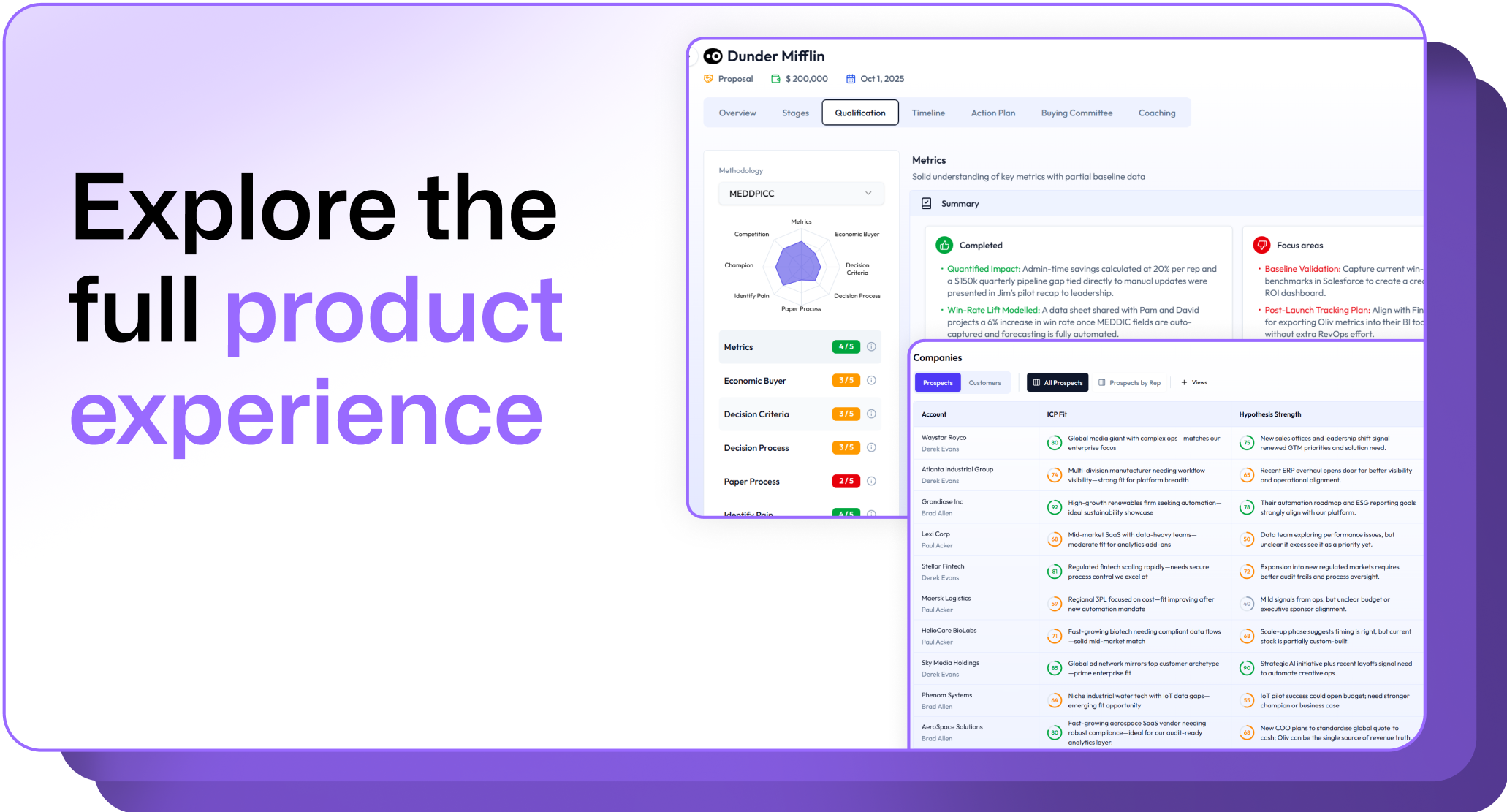
.avif)
.png)







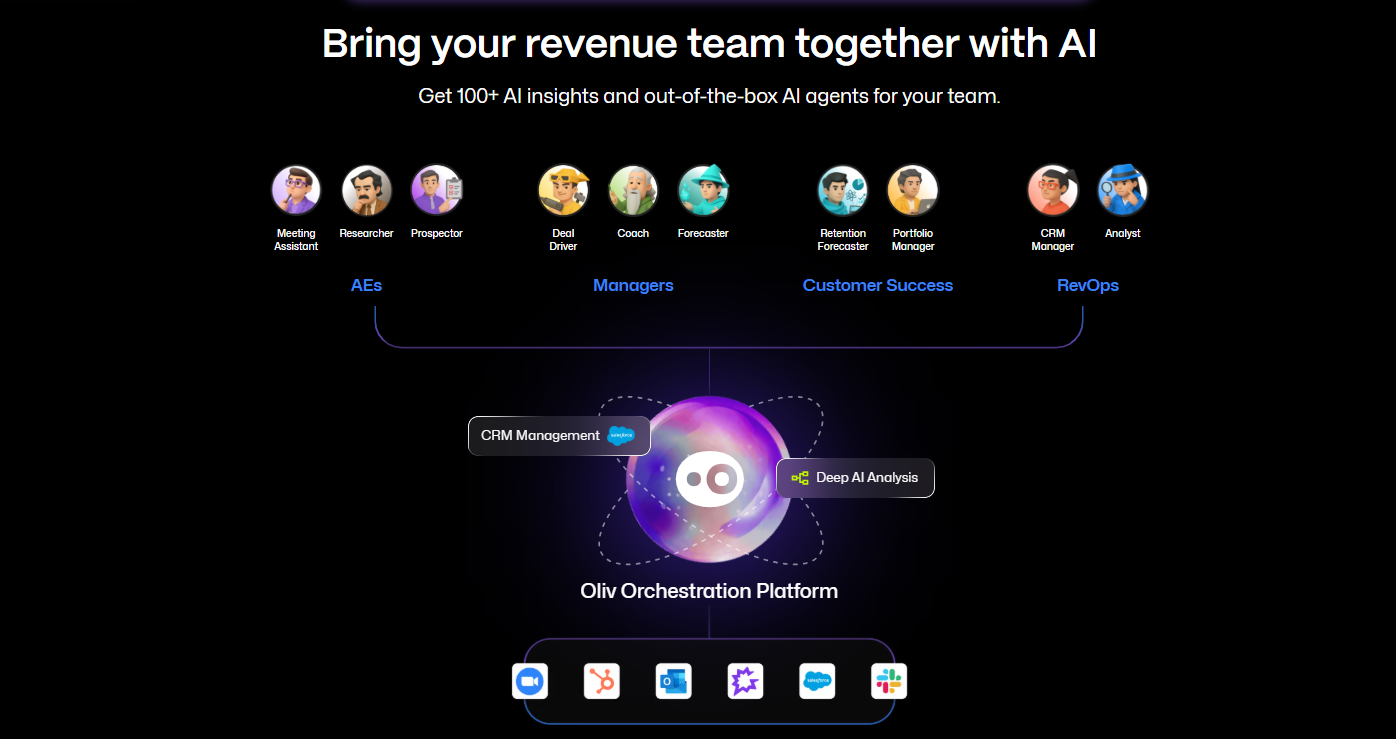
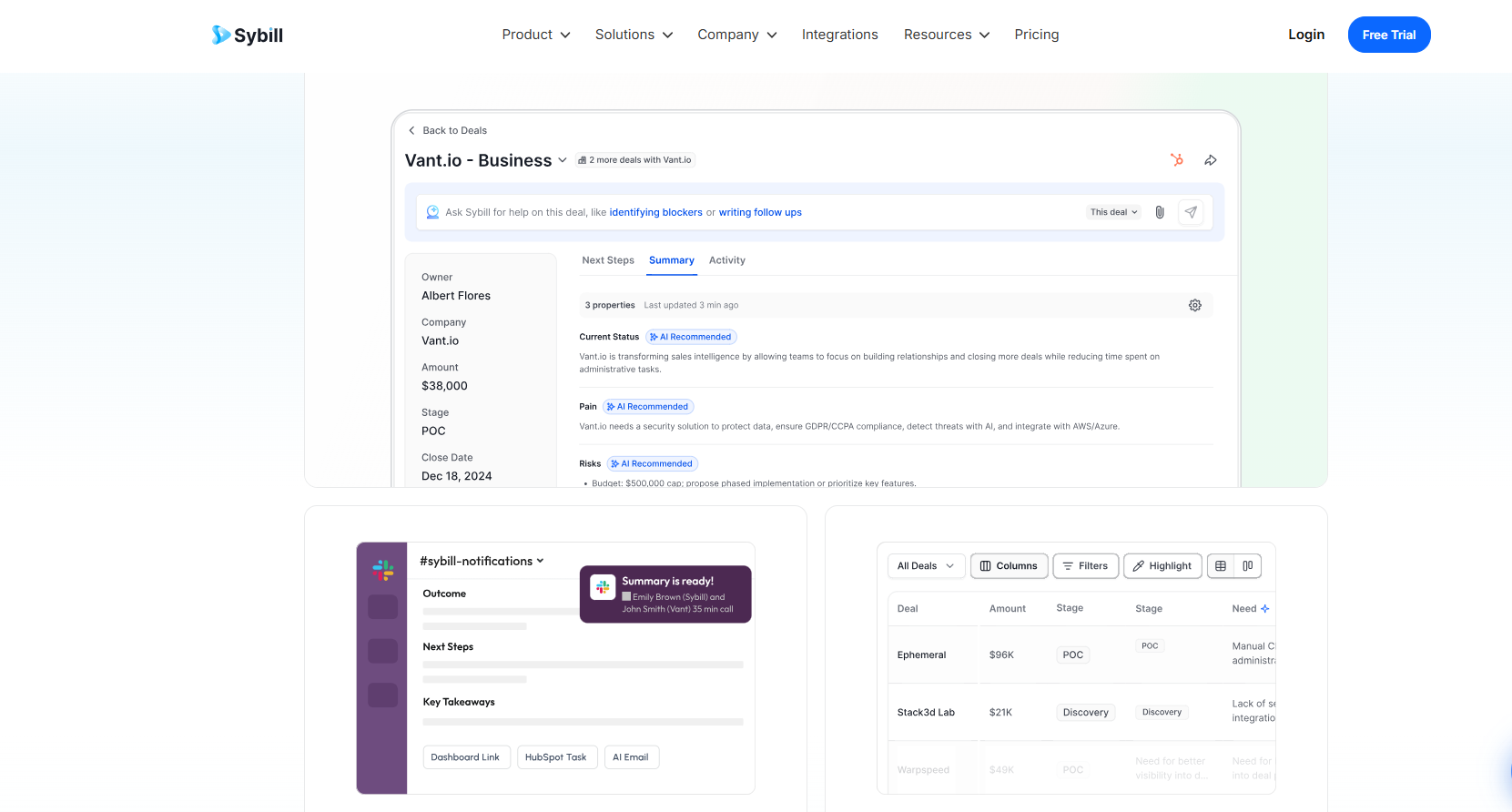

.png)