10 Best Outbound Sales Software in 2026: Prospecting, Sequences, Dialer, and Reply Analytics
Written by
Ishan Chhabra
Last Updated :
August 11, 2026
Skim in :
13
mins
In this article
Revenue teams love Oliv
Here’s why:
All your deal data unified (from 30+ tools and tabs).
Insights are delivered to you directly, no digging.
AI agents automate tasks for you.
Thank you! Your submission has been received!
Oops! Something went wrong while submitting the form.
Meet Oliv’s AI Agents
Hi! I’m, Deal Driver
I track deals, flag risks, send weekly pipeline updates and give sales managers full visibility into deal progress
Hi! I’m, CRM Manager
I maintain CRM hygiene by updating core, custom and qualification fields all without your team lifting a finger
Hi! I’m, Forecaster
I build accurate forecasts based on real deal movement and tell you which deals to pull in to hit your number
Hi! I’m, Coach
I believe performance fuels revenue. I spot skill gaps, score calls and build coaching plans to help every rep level up
Hi! I’m, Prospector
I dig into target accounts to surface the right contacts, tailor and time outreach so you always strike when it counts
Hi! I’m, Pipeline tracker
I call reps to get deal updates, and deliver a real-time, CRM-synced roll-up view of deal progress
Hi! I’m, Analyst
I answer complex pipeline questions, uncover deal patterns, and build reports that guide strategic decisions
TL;DR
Outbound sales software spans four slots: contact data, sequencing, dialing, and reply analytics. Prospecting and sequencing can collapse into one layer. Dialing should stay specialist.
Apollo.io ranks first for owning the most slots in one license at $49 to $119 per user. Oliv AI ranks second at $39 per seat on the Engage tier.
Tools were scored on five weighted criteria: first-party context depth 25%, coverage and sequencing 20%, dialer and deliverability 20%, CRM depth 20%, and pricing transparency 15%.
Full-replacement AI SDR deployments largely reverted to human-in-the-loop by late 2025. Gartner found 73% of B2B buyers walk away from irrelevant AI-generated messaging.
The real problem is coverage. A BDR with 500 named accounts reaches roughly 50, because pre-call research costs two hours before a single dial.
From 2 August 2026, the EU AI Act requires AI systems to disclose they are AI, with penalties up to EUR 15 million or 3% of global turnover.
Q1. What are the 10 best outbound sales software tools in 2026? [toc=1. Best Outbound Tools]
Apollo.io ranks first because it owns the most slots in one license, contact data plus sequencing plus a dialer add-on. Oliv AI ranks second on a narrower claim: outreach written from your team's own calls, emails, and notes, covering accounts a rep never reaches. Then Outreach, Salesloft, Gong Engage, HubSpot Sales Hub, Nooks, Amplemarket, Reply.io, and Clari with Groove.
💸 Why this list exists
Most people land here because a renewal is forcing a rebuild. The data vendor, the sequencer, the dialer, and the CRM all come up for review in the same quarter. Nobody wants to relicense four tools without asking whether they still need four.
I have sat in that meeting more times than I can count. The honest answer is that two of those four slots have collapsed, and two have not. This list is ordered by how much of the stack a vendor genuinely owns, not by how loud its marketing is.
⭐ The ten tools, ranked
Apollo.io, contact data plus sequencing plus dialer add-on
Oliv AI, first-party context prospecting and sequencing
HubSpot Sales Hub, native sequencing for HubSpot shops
Nooks, specialist parallel dialer
Amplemarket, signal-triggered outbound workflows
Reply.io, multichannel outreach on a budget
Clari with Groove, engagement inside a forecasting platform
The 2026 comparison table
Best Outbound Sales Software in 2026: Slots, Dialer, Compliance, and Pricing
#
Tool
Slot it owns
Dialer
Reply analytics
CRM fit
Compliance signals
Published entry price
Rating
1
Apollo.io
Data plus sequencing
Add-on, power and parallel
Basic, sequence-level
Salesforce, HubSpot
Pre-meeting consent page for all-party states
$49/user/mo annual
⭐⭐⭐⭐
2
Oliv AI
Prospecting plus sequencing from first-party context
None, integrates Orum, Nooks, Aircall, JustCall
Conversation-level, tied to account history
Salesforce, HubSpot, Dynamics, Pipedrive, Zoho
SOC 2 Type II, GDPR, CCPA, open export
$39/seat/mo (Engage)
⭐⭐⭐⭐⭐
3
Outreach
Enterprise sequencing
Native
Sequence-level
Salesforce strong, no native HubSpot CRM sync
Verify on vendor trust page
Not published
⭐⭐⭐
4
Salesloft
Cadences plus coaching
Native
Cadence-level
Salesforce
Verify on vendor trust page
Not published
⭐⭐
5
Gong Engage
Sequencing on conversation data
Via partners
Strong call analytics
Salesforce, Dynamics
Chief Trust Officer appointed Aug 2025
Not published
⭐⭐⭐
6
HubSpot Sales Hub
Native sequencing
Native calling
Basic
HubSpot only
Verify on vendor trust page
Published per-seat tiers
⭐⭐⭐
7
Nooks
Parallel dialer
Specialist
Call-level
Salesforce, HubSpot
Verify on vendor trust page
Not published
⭐⭐⭐⭐
8
Amplemarket
Signal-triggered outbound
Limited
Sequence-level
Salesforce, HubSpot
Verify on vendor trust page
Not published
⭐⭐⭐
9
Reply.io
Budget multichannel
Native
Sequence-level
Salesforce, HubSpot
Verify on vendor trust page
Published per-seat tiers
⭐⭐⭐
10
Clari with Groove
Engagement inside forecasting
Omni Dialer
Weak writeback
Salesforce
Verify on vendor trust page
Not published
⭐⭐
Ratings apply the scoring rubric in the next section. Where a vendor does not publish list pricing, I have left the cell blank rather than repeat a number I cannot trace to their own page.
1.1 Apollo.io, the widest single license [toc=1.1 Apollo.io]
Apollo's campaign builder chains enrollment filters, AI qualification, email and phone enrichment, then sequence entry, showing how one outbound sales software license covers data plus execution.
🧩 What it does
Apollo.io merges three products into one seat: a contact database, a sequencer, and a dialer. That consolidation is the whole reason it takes the top slot here. No other vendor on this list covers as many boxes for one price.
Pricing is public, which matters. Basic runs $49 per user per month annually, Professional $79, and Organization $119 with a three-seat minimum. Monthly billing costs more, at $59, $99, and $149.
⚙️ Where the value actually sits
The dialer moved to a paid add-on in January 2026, with power dialing, parallel dialing, and international local presence. Apollo also added a pre-meeting consent page, which routes participants to consent before joining. That is a direct answer to all-party consent rules, and it is a real procurement point.
Credits are the cost driver, not the seat price. Mobile numbers burn credits fast, and overages arrive quietly. Price the credits, then the seats.
📅 Apollo.io product updates
Apollo.io Product Updates: 2025 to 2026
Period
What shipped
Through 2025
Dialer bundled inside the Professional tier with call recording and AI insights, plus waterfall enrichment and intent filters across paid plans (Apollo pricing)
January 2026
Advanced Dialer unbundled as a paid add-on with power, parallel, and international dialing; recording consent page; waterfall enrichment extended to job changes; funding and M&A signals refreshed in 48 to 72 hours (Apollo Release Notes 2026)
Expected next
Signal-based revenue intelligence folded in after the Pocus acquisition in March 2026, with tier packaging not yet announced (Apollo pricing breakdown)
✅ Pros and ❌ cons
✅ One license covers data, sequencing, and dialing
✅ Fully published pricing across four tiers
✅ Consent tooling built for two-party recording states
❌ Data accuracy is the most common complaint in reviews, which is why buyers cross-check it against dedicated sales intelligence platforms
❌ Support is largely bot-led, per verified reviewers
❌ Credit overages make the real bill hard to forecast
⚠️ What users actually say
"Apollo is a good consolidation product merging engagement system, calling system, and prospecting database in one tool." - Verified reviewer, Apollo.io G2 Verified Review [18 Feb 2026]
"The integration with HubSpot and Chrome Extension broke late summer/fall of 2025 causing us to be unable to sync contacts to sequencing directly from HubSpot." - Verified reviewer, Apollo.io G2 Verified Review [18 Feb 2026]
"The information is incorrect. It's wrong more often than not. When we look up our own company, it's missing most of our senior leadership." - Verified reviewer, Apollo.io G2 Verified Review [30 Sep 2025]
💰 Best fit
Buy Apollo if you want the fewest vendors and you can live with mixed data quality. Skip it if your CRM is HubSpot and sync reliability is non-negotiable.
Oliv AI's read is that Apollo earns the top slot on coverage, not on message quality, and those are different purchases.
1.2 Oliv AI, outreach written from your own context [toc=1.2 Oliv AI]
Oliv AI maps four outbound and pipeline failure modes, admin-heavy selling time, cold champions, coaching blind spots, and gut-feel forecasts, framing context gaps rather than activity volume.
🧠 What it does
Oliv AI is an AI-native revenue intelligence and revenue orchestration platform, and its Prospector agent runs the outbound motion. Apollo and Clay sell you third-party data. Prospector uses first-party context, meaning every call, email, and note your team already created.
That distinction is the entire argument. Third-party data tells you who to contact. Your own account history tells you what to say and why now.
🤝 The human-in-the-loop line
I know the skepticism here, and it is earned. The rep always reviews and sends the first email. Follow-ups two and three run automatically on no-response.
We drew that line on purpose. The opener carries the rep's judgement, and Gartner's 2026 buyer research found 73% of B2B buyers walk away from irrelevant AI-generated messaging. Automating the opener is where teams lose trust, which is why the first email still belongs to the rep.
🔌 What it does not do
Oliv AI ships no contact-data layer and no dialer. It connects to Orum, Nooks, Aircall, and JustCall instead. That is exactly why it sits at number two rather than number one on this list.
It also runs on top of the CRM, connecting to Salesforce, HubSpot, Dynamics, Pipedrive, and Zoho. Prospector needs your CRM and call recordings to start, and it ingests messy data without a cleanup sprint.
📅 Oliv AI product updates
Oliv AI Product Updates: 2025 to 2026
Period
What shipped
Through 2025
Agent lineup for the post-meeting motion (Deal Assistant, CRM Manager, Deal Driver, Forecast) with per-field CRM writeback traced to the exact conversation moment (Oliv agents)
2026
Prospector released for the pre-pipeline motion, covering net-new and expansion accounts, with rep-reviewed first touch and automated follow-ups, plus dialer connections to Orum, Nooks, Aircall, and JustCall (Oliv integrations)
Expected next
Continued per-agent unbundling on the published ladder from $19 to $79 per seat, with agents purchasable one at a time (Oliv pricing)
✅ Pros and ❌ cons
✅ Writes from your own call and email history, not bought data
✅ Engage tier at $39 per seat per month, $0 platform fee, free view-only seats
✅ Works expansion accounts, not just net-new, in the same way its other AI sales agents work live pipeline
✅ SOC 2 Type II, GDPR, CCPA, with full data export
❌ No contact database, so you still license a data source
❌ No native dialer, you keep your specialist
❌ Reviewers report occasional slowness and basic mobile app
⚠️ What users actually say
"I appreciate that Oliv.ai researches prospect accounts before every call and sends deal updates and talking points, which helps me prepare for meetings without sifting through tons of data and emails." - Verified reviewer, Oliv AI G2 Verified Review [23 Jun 2026]
"The agent called Gold Digger helps me find more opportunities for expansion in current accounts, which is really helpful." - Verified reviewer, Oliv AI G2 Verified Review [17 Jun 2026]
💰 Best fit
Shortlist Oliv AI when your problem is coverage, not list size. If your BDRs work 50 of 500 named accounts, the constraint is research throughput.
Oliv AI covers the prospecting and sequencing slots at $39 per seat, keeps your dialer in place, and needs only your CRM and call recordings to start.
1.3 Outreach, the enterprise sequencing standard [toc=1.3 Outreach]
Outreach explains how proven templates, tasks, and account-based workflows sync email, LinkedIn, SMS, and call engagement into CRM records, reducing manual entry for enterprise sequencing teams.
🏗️ What it does
Outreach runs sequences at enterprise scale, meaning multi-step email, call, and task cadences with governance on top. It was built in 2014 around that sequence engine, and the engine is still the product's centre of gravity. Since 2024 the company has wrapped it in an agent narrative.
Key features are deep Salesforce sync, sequence permissions, task management, and engagement reporting. Outreach does not publish list pricing, so budget through sales.
⚙️ Implementation reality
Setup is a project, not an afternoon. Reviewers consistently flag a learning curve tied to the depth of configuration. Plan four to six weeks with RevOps involved.
The decision-grade gap for many teams is CRM fit. Outreach is Salesforce-first, and HubSpot shops report the absence of a native CRM integration as a hard blocker.
📅 Outreach product updates
Outreach Product Updates: 2024 to 2026
Period
What shipped
Dec 2024 through mid-2025
AI Prospecting Agents announced under new CEO Abhijit Mitra, then the platform relaunched as the AI Revenue Workflow Platform at Unleash on 10 Jun 2025 (Outreach newsroom)
Jul 2025 to Feb 2026
ISO/IEC 42001 responsible-AI certification on 15 Jul 2025, Personalization, Research, and Deal Agents through Aug 2025, then Anthropic MCP ecosystem membership on 24 Feb 2026 (August 2025 product release)
Apr 2026 onward
Interconnected AI agents announced 15 Apr 2026, converging on Omni, with agent-to-agent handoffs the stated direction (Outreach on MCP)
✅ Pros and ❌ cons
✅ Sequencing depth and governance that scales past 100 reps
✅ Clean, mature Salesforce sync
✅ ISO/IEC 42001 certification, rare in this category
❌ No published pricing, so comparison requires a sales cycle
❌ No native HubSpot CRM integration
❌ Reporting takes extra clicks, per reviewers
⚠️ What users actually say
"As an SDR, I like that Outreach keeps everything in one place and makes my day easier to manage. The sequences help me stay on top of follow-ups without having to think too much about it." - Verified reviewer, SDR, Outreach G2 Verified Review [04 May 2026]
That same review is titled "Clunky Workflow, Rigid Sequences, and Data Accuracy Issues in Outreach," which is a fair summary of the trade-off.
💰 Best fit
Buy Outreach if you run Salesforce, have more than 50 reps, and need sequence governance. Skip it if you run HubSpot or want transparent pricing. If you are weighing it against conversation intelligence, the Gong versus Outreach comparison covers that head-to-head in full.
1.4 Salesloft, cadences now inside Clari [toc=1.4 Salesloft]
Salesloft surfaces average deal cycle, win rate, and quota coverage beside agentic prospecting accounts, positioning cadences and coaching inside a wider revenue workspace rather than standalone sequencing.
🔄 What it does
Salesloft sells cadences, a dialer, and coaching in one workspace. The product is competent at the basics. The complication is corporate, not technical.
Clari and Salesloft announced a definitive merger on 7 Aug 2025, forming what the companies called a Revenue AI powerhouse. Drift, acquired earlier, is being wound down.
⏰ Why the roadmap question matters
Post-merger roadmaps slip. The first joint release did not land until March 2026, and it was integration plumbing rather than new capability. If you are signing a multi-year deal, ask which release train your features sit on.
Salesloft does not publish list pricing either. Treat renewal timing as leverage, and model it inside a wider plan to reduce sales tech stack costs.
📅 Salesloft product updates
Salesloft Product Updates: 2025 to 2026
Period
What shipped
Spring and Fall 2025
AI Agents launch in spring, then the AI Closing Power Suite in fall, extending Salesloft from top-of-funnel cadences into late-stage deal workflows (Fall 2025 launch)
Feb to Apr 2026
Task enhancements with business-days logic, in-app notification changes, and Outlook pinned side panels, shipped alongside Clari's cross-platform release (April 2026 release notes)
May 2026 onward
Continued monthly release cadence on the Champions portal, with feature convergence toward the merged Clari platform (May 2026 release notes)
✅ Pros and ❌ cons
✅ Cadence and template library that a new SDR can learn fast
✅ Coaching and call review built in
✅ Backed by a larger platform post-merger
❌ Dialer speed complaints appear repeatedly in reviews
❌ Setup described as clunky, especially for smaller teams
❌ Roadmap continuity is an open question
⚠️ What users actually say
"Salesloft helps organize outreach at scale and keeps follow-ups from falling through the cracks. I appreciate having cadences and templates all in one place." - Verified reviewer, Salesloft G2 Verified Review [22 Jul 2025]
"It allows you to sequence emails, which is table stakes at this point... One-off Scheduled emails are not paused when someone replies. UX is overwhelming and clunky." - Verified reviewer, Salesloft G2 Verified Review [24 Sep 2025]
"Dialer is often slow at launching when making calls. Browser extensions lack features and are bulky." - Verified reviewer, Salesloft G2 Verified Review [26 Mar 2025]
💰 Best fit
Keep Salesloft if it is embedded and working. Do not start here in 2026 unless you also want Clari's forecasting.
1.5 Gong Engage, sequencing on top of conversation data [toc=1.5 Gong Engage]
🎙️ What it does
Gong is the strongest conversation intelligence product on this list, and I will concede that plainly. Gong Engage adds sequencing on top of that call data. The recording side is excellent. The outbound side is the weaker half.
Gong reported ARR topping $500M in May 2026, with growth above 55% year over year. This is not a company in trouble. It is a company whose engagement module lags its core.
🧪 Where Engage gets tested
Engage gained full Microsoft Dynamics 365 support in December 2025. Data Extractor shipped the same month to map AI-extracted fields into the CRM automatically. Both are real improvements for RevOps.
The gap is still sequencing depth against a dedicated sequencer. Reviewers who have used both are blunt about it, and the wider Gong limitations follow the same pattern.
📅 Gong product updates
Gong Product Updates: 2025 to 2026
Period
What shipped
Jul to Dec 2025
Agent Studio for managing AI agents, AI Call Reviewer scorecards, configurable forecast boards, Data Extractor for automated CRM field mapping, and Engage support for Microsoft Dynamics (Gong monthly updates)
Feb to May 2026
Mission Andromeda on 25 Feb 2026 launched Gong Enable, conversational guidance, and unified account management, followed by Rephraser email writing across templates and flows in May (Mission Andromeda)
Announced as coming
Bidirectional MCP so briefs pull third-party data in and external AI platforms query Gong, plus brief generation through the Gong API (What's new in Gong)
✅ Pros and ❌ cons
✅ Best-in-class call recording and transcription
✅ Dynamics and Salesforce both supported
✅ Rapid 2026 release cadence
❌ Engage sequencing is weaker than dedicated sequencers
❌ Data export limits reported without a plan upgrade
❌ No published list pricing
⚠️ What users actually say
"Gong Engage is awful in every single way compared to outreach. Would not recommend at all, flows are hard to get into, information is not readily available, sequencing is difficult to create and track." - Verified reviewer, Gong G2 Verified Review [09 Jun 2025]
"Being able to sequence our steps, along with integration with Nooks/Salesforce... limitations of getting data back into salesforce." - Verified reviewer, Gong G2 Verified Review [21 May 2026]
"I cannot download all the data myself unless we upgrade the plan, which isn't ideal and results in me not fully utilizing Gong." - Verified reviewer, Gong G2 Verified Review [03 Oct 2025]
💰 Best fit
Buy Gong for conversation intelligence. Add Engage only if you value one vendor over sequencing depth.
HubSpot Sales Hub gives you sequences inside the CRM you already run. No sync layer, no middleware, no field mapping. For a HubSpot shop, that is a genuine advantage.
Pricing is fully published. Professional runs $100 per seat monthly, or $90 annually, with a five-seat minimum. Enterprise is $150 per seat monthly, or $130 annually, with a ten-seat minimum.
⚠️ The Starter trap
Sequences do not exist below Professional. Starter at $15 to $20 per seat looks cheap and then does nothing you need. Professional also carries a $1,500 one-time onboarding fee in the US.
Send limits matter for outbound. Professional caps at 500 email sends per user per day, Enterprise at 1,000, and LinkedIn actions require a separate Sales Navigator subscription.
📅 HubSpot Sales Hub product updates
HubSpot Sales Hub Product Updates: 2025 to 2026
Period
What shipped
Through 2025
Full move to seat-based licensing, with Core Seats at roughly $20 and Sales Seats carrying sequences, forecasting, playbooks, and lead rotation (HubSpot pricing 2026)
2026
Sequences hold at 5,000 per account with per-user daily send caps, workflow-triggered sequences on Professional and above, and Breeze AI agents layered across the Hubs (HubSpot sales pricing)
Expected next
Continued Breeze agent expansion into prospecting and research workflows, with quoting still the acknowledged product gap (Sales Hub review 2026)
✅ Pros and ❌ cons
✅ Zero CRM sync risk, sequences live in the CRM
✅ Transparent, published per-seat pricing
✅ Fast onboarding for teams already on HubSpot
❌ Sequences locked behind a $100 per seat tier
❌ Mandatory onboarding fee at Professional
❌ Daily send caps and no native LinkedIn without Sales Navigator
💰 Best fit
If your CRM is HubSpot and your team is under 25 reps, start here. If you are on Salesforce, this is not your tool, and the wider sales CRM tool comparison is the better starting point.
1.7 Nooks, the specialist parallel dialer [toc=1.7 Nooks]
☎️ What it does
Nooks does one job, parallel dialing, which means calling several numbers at once and connecting the rep only when a human answers. It also does power dialing and pulls rep context onto one screen. This is the slot I keep telling teams not to collapse.
Connect rates depend on carrier reputation, local presence, and answer detection. Those are infrastructure problems, and a general platform will be mediocre at them.
🔌 Where it sits in the stack
Nooks shows up as an integration partner across the category, including inside Gong reviewers' workflows. Oliv AI connects to Nooks rather than competing with it, alongside Orum, Aircall, and JustCall. Pricing is not published, so budget through sales.
✅ Pros and ❌ cons
✅ Parallel and power dialing in one workspace
✅ Rep context consolidated on a single screen
✅ Integrates with the major sequencers and CRMs
❌ Bugs and support quality flagged by reviewers
❌ No published pricing
❌ Narrow scope, it is a dialer and nothing more
⚠️ What users actually say
"Allows for parallel and power dialing and consolidates info into one screen for reps." - Verified reviewer, Nooks G2 Verified Review [23 Apr 2026]
The same review is titled "It's a Dialer... but Bugs, Functionality Issues, and Poor CX Persist," which is worth weighing before you sign.
💰 Best fit
Keep or buy Nooks if dials are your constraint. Do not expect it to sequence or enrich, and pair it with sales call analytics if you want the conversation data back.
Amplemarket combines prospecting data, sequencing, and signal triggers in one platform. Signals mean events like job changes, funding, or hiring that start a campaign automatically. The pitch is fewer tools and fewer manual list refreshes.
The company published its own five-capability scoring framework in April 2026, comparing ten outbound platforms on signal triggers, branching, pricing, and total cost of ownership. Read it, but read it knowing who wrote it.
🧮 Where it fits
For SDR teams under 30 reps, one platform covering data plus sequencing is a real budget saving. For larger teams, the data layer usually gets bought separately from a dedicated sales intelligence platform. Pricing is not published, so model the credits before the seats.
✅ Pros and ❌ cons
✅ Prospecting, data, and sequencing in one interface
✅ Signal triggers reduce manual list building
✅ Salesforce and LinkedIn integrations reported as reliable
❌ Contact data goes stale on recent job changes
❌ No published pricing
❌ Less sequencing governance than enterprise tools
⚠️ What users actually say
"What I like best about Amplemarket is having the entire outbound sales process in one platform. It makes it easy to find the right prospects, build targeted campaigns, and manage outreach without constantly switching between different tools." - Verified reviewer, Amplemarket G2 Verified Review [17 Jul 2026]
💰 Best fit
Good choice for a small SDR pod that wants one bill. Verify data coverage in your specific territory first.
1.9 Reply.io, multichannel on a budget [toc=1.9 Reply.io]
💵 What it does
Reply.io runs email, LinkedIn, calls, and SMS sequences at a lower price point than the enterprise tools. Pricing is public, which I respect. Email Volume starts at $49 per user monthly and Multichannel at $89, with an AI SDR plan at $259.
Third-party breakdowns put real annual pricing closer to $59 and $99 per user, with monthly billing higher. Calling minutes and SMS sends are charged separately.
🧯 The reliability question
Budget tools trade polish for price, and reviewers say so. Bugs, report sync issues, and CRM field mapping problems come up repeatedly. There is also a 400 email daily limit per user, which protects deliverability but caps volume.
📅 Reply.io product updates
Reply.io Product Updates: 2025 to 2026
Period
What shipped
Through 2025
Five-edition structure from Free to AI SDR, with Jason AI, sequence generation, unlimited mailboxes, and email warmup bundled into the paid seats (Reply pricing)
2026
Multichannel tier at $89 per user adds LinkedIn automation, cloud calling, SMS steps, conditional multichannel cadences, and 5,000 data credits (Reply pricing 2026 breakdown)
Expected next
Continued separation of AI SDR agents from seat pricing, with agent plans quoted independently of the per-user ladder (Reply pricing on G2)
✅ Pros and ❌ cons
✅ Published pricing across five editions
✅ True multichannel cadences including SMS
✅ Fast setup, low learning curve
❌ Bugs and sync issues reported often
❌ 400 email daily cap per user
❌ Calling minutes and SMS billed on top
⚠️ What users actually say
"Compared to others in the industry reply has many good features and integrations, if they would work." - Verified reviewer, Reply.io G2 Verified Review [11 Aug 2025]
💰 Best fit
Right call for a lean team testing outbound. Wrong call if reporting accuracy is a board-level input, in which case sales analytics software belongs on the shortlist too.
1.10 Clari with Groove, engagement inside forecasting [toc=1.10 Clari with Groove]
📊 What it does
Clari is a forecasting platform that acquired Groove in August 2023 for sales engagement, then merged with Salesloft in August 2025. Groove gives you flows, an Omni Dialer, and Salesforce-native execution. Forecasting remains the reason people buy, and the full Clari feature set reflects that origin.
The compliance work here is genuinely good. Clari shipped one-sided call recording in October 2025 and AI-based consent detection in the Copilot Dialer in November 2025.
🧩 The writeback problem
Outbound tools live or die on CRM writeback, meaning data flowing back into Salesforce. That is the most consistent complaint here. If MEDDIC fields cannot return to Salesforce, RevOps ends up doing it manually.
📅 Clari and Groove product updates
Clari and Groove Product Updates: 2025 to 2026
Period
What shipped
Oct to Dec 2025
One-sided recording for two-party consent states, AI-based consent detection in Copilot Dialer, pre-personalization on Flow import, and a Groove guardrail confirming phone number changes before writing to Salesforce (December 2025 release)
Feb to Mar 2026
Groove Any Step Automated Actions removed manual Salesforce field updates, then the first joint release shipped Send AI Emails from Clari, Create Salesloft Tasks, and follow-up emails via Salesloft (March 2026 release)
Expected next
Continued convergence of the Clari, Groove, and Salesloft release trains onto one platform surface (February 2026 release)
✅ Pros and ❌ cons
✅ Strongest consent and recording compliance tooling on this list
✅ Omni Dialer plus flows inside the forecasting workspace
✅ Robust cadence analytics
❌ CRM writeback gaps reported for MEDDIC and conversation fields
❌ Connection drops with Salesforce and Gmail reported
❌ No published pricing
⚠️ What users actually say
"The CRM writeback is not good; we cannot send MEDDIC values back to Salesforce or update fields in Salesforce from the conversation intelligence." - Verified reviewer, Clari G2 Verified Review [13 Jul 2026]
"It simplifies the ability to integrate quick workflows, like sending out mass emails or customer touchpoints through Groove... It consistently loses connection both with Salesforce and with our gmail based email platform." - Verified reviewer, Clari G2 Verified Review [03 Jun 2026]
"I enjoy using Clari's Omni Dialer for making cold calls... I find Clari occasionally frustrating as it sometimes deletes all my progress when writing sequences." - Verified reviewer, Clari G2 Verified Review [28 Jul 2025]
💰 Best fit
Buy Clari for forecasting and take Groove as included. Do not buy it as your primary outbound engine.
Oliv AI connects to Salesforce, HubSpot, Dynamics, Pipedrive, and Zoho, and to dialers including Orum, Nooks, Aircall, and JustCall, so the specialist slots in this list stay where they are. What we changed is the layer that writes the outreach, using the account history your team already created. That is the only slot on this list where a competitor cannot buy the same input.
Q2. How were these outbound sales software tools tested and scored? [toc=2. Scoring Methodology]
Five criteria weighted to 100: first-party context depth 25%, coverage and sequencing automation 20%, dialer and deliverability performance 20%, CRM integration depth 20%, and pricing transparency plus stack TCO 15%. Scores of 0 to 20 earn one star, 21 to 40 two, 41 to 60 three, 61 to 80 four, and 81 to 100 five. Database size is deliberately not a criterion.
📊 Why record counts mislead
Most outbound listicles rank on database size and seat price. Both are easy to measure, and neither predicts pipeline. I stopped weighting them years ago.
Gartner's May 2026 CSO survey found that sales organizations providing AI-enabled next best actions are 2.6 times more likely to achieve commercial growth. Reps who partner with AI are 3.7 times more likely to hit quota. Neither finding mentions how many contacts a vendor stores.
⭐ The rubric and the star bands
Outbound Sales Software Scoring Rubric and Weights
Criterion
Weight
What it measures
First-party context depth
25%
Whether outreach draws on your own calls, emails, and notes
Coverage and sequencing automation
20%
How many named accounts get worked without extra headcount
Dialer and deliverability
20%
Connect rates, domain warming, inbox rotation, and consent handling
CRM integration depth
20%
Bidirectional write-back and field-level traceability
Pricing transparency and stack TCO
15%
Published list pricing and the real per-SDR total
Star bands run in twenty-point steps, so a 78 earns four stars and an 84 earns five. Oliv AI measures context depth by whether the tool can write an opener without buying a single third-party record. That is a binary test, and most tools fail it.
⚠️ The concession this rubric owes you
A deliverability specialist would push back hard here, and the objection is fair. Domain warming, inbox rotation, carrier reputation, and answer detection are their own engineering disciplines. A platform doing a bit of everything will be mediocre at each of them.
So dialer and deliverability carries 20%, the same weight as CRM depth. Nothing gets a free pass for being adjacent to a good product. Oliv AI scores five stars on context depth and drops points on the dialer criterion, because it integrates Orum, Nooks, Aircall, and JustCall rather than shipping one.
💰 What "pricing transparency" actually costs vendors
Half this list does not publish list pricing. Outreach, Salesloft, Gong, Nooks, and Amplemarket all route you through sales. That is a 15% penalty here, and I think it is understated.
Oliv AI publishes its full ladder, $19 to $79 per seat with a $0 platform fee and free view-only seats, which is why pricing transparency became a scored line rather than a footnote. Apollo.io and HubSpot publish theirs too, and both gain on this criterion. Buyers running the same exercise across their wider stack usually end up trying to reduce sales tech stack costs at the same time.
🧭 Re-weight it against your own stack
The weighting is opinionated, and I will say so plainly. If your constraint is dials rather than research throughput, move ten points from context depth to the dialer line. The rankings shift, and that is the point of publishing the method.
Third-party data tells you who to contact. Your own account history tells you what to say and why now. That second input is the only one a competitor cannot buy, which is why it sits at the top of the table, and it is the same argument behind every revenue intelligence versus conversation intelligence debate.
Oliv AI is scored on the same rubric as every other tool here, including the criteria it loses on. The dialer column costs it the top slot. Publishing the weights is the only way a reader can check whether the ranking was earned or arranged.
Q3. What are the four slots in an outbound stack, and which ones can you collapse? [toc=3. Stack Slots and Overlap]
Outbound sales software spans four slots: contact data, sequencing, dialing, and reply analytics. Prospecting and sequencing can collapse into one layer that already holds your first-party context. Dialing should stay specialist. Oliv AI runs the first two slots from your existing CRM and call history, and connects to external dialers. Most teams pay three vendors to do two jobs.
🧱 The five categories, defined once
Category names get used loosely, so here they are in one line each.
Sales engagement platform (SEP): a multichannel workspace for sequences, tasks, and CRM sync, priced per seat
Cold email tool: high-volume sending with domain warming and inbox rotation, priced per mailbox
Data and enrichment: contact records, mobile numbers, and job-change signals, priced per credit, and covered vendor by vendor in our sales intelligence platform guide
Intent and signal: buying-behaviour triggers that start a campaign automatically
Dialer: power and parallel calling with local presence and answer detection
📉 What has already commoditized
Contact data is not the asset it was ten years ago. Mobile numbers, company firmographics, and verified emails are available from a dozen vendors at similar quality. Price them like a utility.
Sequencing mechanics have barely moved at the incumbents. One Outreach reviewer put it directly, saying the engage product looks like it has the same features and issues it had five years ago. When every team can send more, sending more stops working.
🔒 What has not commoditized
Your own systems hold something nobody can buy: every call, email, and note your team created about that account. Oliv AI calls this first-party context, and it is the input that decides what the opener actually says.
Third-party data answers who to contact. First-party context answers what to say and why now. That distinction is the whole buying decision in 2026.
🗺️ The collapse map
Here is how the four slots actually behave under consolidation.
Outbound Stack Slots: Collapse or Keep Specialist
Slot
Collapse or keep
Reason
Contact data
Keep, but commodity-price it
Coverage varies by territory, and credits are the real cost
Sequencing
Collapse
Mechanics are standard, context is the differentiator
Prospecting research
Collapse into sequencing
Redoing research per account is the actual bottleneck
Dialing
Keep specialist
Connect rates are an infrastructure problem
Reply analytics
Collapse into wherever conversation history lives
Post-reply handoff breaks when it sits in a separate tool
Ask Oliv AI to work an account and it pulls the history from Salesforce or HubSpot first, then writes. The dialer stays external on purpose.
🧮 Buy separately, or buy combined?
Buy separately when your data needs are regional or specialized. European mobile coverage, for instance, is a different problem from US coverage. A dedicated vendor will beat a bundled one there.
Buy combined when your differentiator is message quality rather than list size. If your reps have plenty of names and not enough reasons to call, consolidation helps. Apollo.io is worth splitting on this point, because its data layer and its execution layer are two separate value propositions a buyer should price independently.
⚠️ The objection worth conceding
"We already have a data provider, a sequencer, and a dialer. Adding a fourth vendor makes the stack worse." That is correct, and I will not argue with it.
A fourth tool that overlaps three existing ones is a bad purchase. The only defensible version is a replacement, not an addition. Price it against the stack total per SDR, not against one line item, which is the same discipline behind any revenue tech stack consolidation exercise.
Oliv AI collapses the prospecting and sequencing slots into the layer that already holds your call and email history. The dialer you run today stays exactly where it is. That is a two-for-one swap, not a fourth invoice.
Q4. Do AI SDR tools actually work, and can they cover the accounts your reps never reach? [toc=4. AI SDRs and Coverage]
The market already ran this experiment. Full-replacement AI SDR deployments largely reverted to human-in-the-loop by late 2025, with reviewers calling the output recognizably AI-generated. Oliv AI's Prospector requires the rep to review and send the first email, with automation starting at follow-up two. The payoff is coverage, meaning the 450 accounts nobody reaches, not a better email to the same 50.
🤨 Your skepticism is correct
If you arrived here expecting to be sold on autonomous outbound, I am going to disappoint you. The skepticism is earned, and the data backs it.
Gartner's May 2026 buyer research found that 73% of B2B buyers walk away from suppliers sending irrelevant AI-generated messages. Sixty-nine percent want a human rep to validate AI-generated insights. Only 4% of sales leaders trust AI to act on its own.
⚠️ The forecast nobody quotes fully
Gartner also expects AI agents to outnumber human sellers ten to one by 2028. The sentence that follows gets left out of most vendor decks. Fewer than 40% of sellers report that AI agents improved their productivity.
Agent count is not an outcome. Oliv AI writes one measurable outcome metric per agent into pilot agreements instead of a seat count, because that is the only number that survives a renewal conversation. The same logic applies to every rollout of AI agents for sales teams.
✋ Where the line sits
Here is the boundary, stated as design rather than caveat. The rep reviews and sends the first email, every time. Follow-ups two and three run automatically when nobody responds.
The opener carries judgement, and it should carry a human. Ask Oliv AI's Prospector to send a cold first touch on its own, and it will not do it. I could be wrong about where this line sits in three years, but the buyer-trust data says it is right today, and the craft side of that opener is covered in our guide to sales emails that get responses.
📐 The 500 and 50 problem
Now the part that actually matters. A BDR with 500 named accounts reaches roughly 50. The other 450 sit in the CRM, untouched, quarter after quarter.
That is not a motivation problem. It is arithmetic. Research alone costs two hours before a single dial, and nobody has 1,000 spare hours.
⏰ What coverage actually looks like
Gartner projects that 95% of seller research workflows will begin with AI by 2027, up from under 20% in 2024. That shift is already visible in how reps prep, and it is reshaping AI sales workflow automation across the funnel. Oliv AI's Prospector pulls the account's own call and email history, drafts the opener from it, and hands the rep something to approve rather than compose.
The same motion runs on existing accounts for expansion, which most outbound tools treat as a separate product. That matters if half your quota is upsell.
⚠️ What users actually say
"I appreciate that Oliv.ai researches prospect accounts before every call and sends deal updates and talking points, which helps me prepare for meetings without sifting through tons of data and emails." - Verified reviewer, Oliv AI G2 Verified Review [23 Jun 2026]
"The only downside is that the platform can be a bit glitchy at times, but the support team is always quick to address and resolve any bugs." - Verified reviewer, Oliv AI G2 Verified Review [02 Jul 2026]
"The agent called Gold Digger helps me find more opportunities for expansion in current accounts, which is really helpful." - Verified reviewer, Oliv AI G2 Verified Review [17 Jun 2026]
✅ Do this Monday
Time-track one rep's pre-call research for a full week. Count untouched named accounts in their book. Those two numbers are your ROI baseline, and you need them before any demo, alongside a working revenue intelligence ROI calculator.
Oliv AI's claim here is narrow on purpose: coverage of accounts a human would never reach, not replacement of the human. Prospector needs your CRM and call recordings to start, and it works messy data without a cleanup sprint. That is the whole argument, and it lives or dies on the untouched-account count.
Q5. Should you keep a specialist dialer, and how do you score deliverability and reply analytics? [toc=5. Dialer, Deliverability and Reply Analytics]
Keep the specialist dialer. Parallel dialing is infrastructure, meaning connect rates, local presence, and carrier reputation, and a platform doing a bit of everything will be mediocre at it. Deliverability follows the same logic. Oliv AI connects to Orum, Nooks, Aircall, and JustCall rather than shipping its own dialer. Reply analytics is the slot nobody scores, and it is where the post-reply handoff breaks.
☎️ Why the dialer resists collapse
A dialer lives or dies on answer detection, carrier reputation, and local presence numbers. None of that improves because your sequencer added a call button. It improves because someone works on telephony full time.
Nooks is the clean example of the specialist slot. Reviewers say it does the core job, and they also say the edges are rough. Oliv AI names Nooks in its own integration set, which is the honest position when a tool solves a slot you do not.
"Allows for parallel and power dialing and consolidates info into one screen for reps." - Verified reviewer, Nooks G2 Verified Review [23 Apr 2026]
📬 Deliverability is its own discipline
Deliverability means whether your email reaches the inbox. It depends on domain warming, inbox rotation, list hygiene, and send volume per mailbox. These are engineering problems, not features.
Score it with three questions. How many sending domains does the tool manage? What is the daily send cap per user? Does it verify addresses before send, or bill you for bounces?
Reply.io caps sends at 400 per user per day, which protects reputation and limits volume. HubSpot caps Professional at 500 sends per user daily. Those numbers belong in your comparison table, not a footnote.
🔍 Reply analytics, the slot nobody scores
Reply analytics means classifying what came back. Positive, negative, out of office, wrong person, referral. Then routing each one correctly.
Every listicle scores send volume. None of them score what happens after a prospect says yes. That gap is where meetings die quietly, and it is the same blind spot our guide to sales follow-up keeps running into.
Oliv AI ties reply handling to the account's existing conversation history, so a positive reply lands with the context of every prior call attached. I think this is the least examined line item in outbound buying, though I may be over-indexing on it because it is what we built.
⚠️ What the reviews reveal about the seams
Dialer and sequencing seams show up as small failures that cost real hours.
"Dialer is often slow at launching when making calls. Browser extensions lack features and are bulky." - Verified reviewer, Salesloft G2 Verified Review [26 Mar 2025]
"I enjoy using Clari's Omni Dialer for making cold calls... I find Clari occasionally frustrating as it sometimes deletes all my progress when writing sequences." - Verified reviewer, Clari G2 Verified Review [28 Jul 2025]
✅ Ask these in every demo
Take this list into the call and get answers on the record.
Which dialers do you integrate with by name, and is call outcome written back to the CRM?
What is the daily send cap per mailbox, and who manages domain warming?
How are replies classified, and can I see the taxonomy?
What happens between a positive reply and a booked meeting?
Does the tool record one side or both, and how is consent captured, a question our sales call analytics breakdown covers in detail?
Oliv AI ships no dialer and does not ask you to drop yours. That concession is exactly why it ranks second on this list rather than first. A vendor that claims every slot is telling you something about how well it holds any of them.
Q6. What should an outbound stack cost per SDR, and what should it look like at your team size? [toc=6. Cost and Team-Size Sizing]
Price the stack, not the line item. At 1 to 10 reps, run one data source plus one execution layer and skip the enterprise sequencer. At 10 to 25, add the specialist dialer. Oliv AI publishes a full per-seat ladder from $19 to $79 with a $0 platform fee, which lets you model the swap before a sales call. The sequencer is rarely the largest number on the invoice.
💰 What the four slots actually cost per rep
Only vendor-published figures appear below. Where a vendor hides pricing, the cell says so.
Outbound Stack Cost Per SDR by Slot
Slot
Published entry price
Notes
Data plus sequencing
Apollo.io $49 to $119 per user monthly, annual billing
Credits drive the real bill
Execution layer
Oliv AI $39 per seat, Engage tier
$0 platform fee, view-only seats free
CRM-native sequencing
HubSpot Sales Hub $100 per seat monthly, five-seat minimum
Plus $1,500 one-time onboarding
Budget multichannel
Reply.io $49 to $259 per user monthly
Calls and SMS billed separately
Dialer
Nooks, Orum, Outreach, Salesloft: not published
Quote required
📐 Stack shape by team size
Small teams overbuy governance. Large teams underbuy deliverability. Both mistakes cost the same money.
1 to 10 reps: one data source, one execution layer, no enterprise sequencer. Oliv AI's Engage tier at $39 plus a commodity data seat lands most teams under $100 per rep, which is the shape we recommend for small sales teams.
10 to 25 reps: add the specialist dialer. Dials become the constraint once research is handled.
25 or more reps: deliverability tooling, sequence governance, and permissions start earning their seats, alongside a plan for scaling revenue operations.
⚠️ Switching off an incumbent
Outreach is genuinely strong at sequence governance at scale, and I will not pretend otherwise. The friction is commercial and structural. There is no native HubSpot CRM integration, which is a hard stop for HubSpot shops.
"As an SDR, I like that Outreach keeps everything in one place and makes my day easier to manage." - Verified reviewer, SDR, Outreach G2 Verified Review [04 May 2026]
Salesloft and Clari announced their merger on 7 August 2025, and Drift is being wound down. The first joint release shipped in March 2026, and it was integration plumbing. Ask which release train your renewal sits on, and read the Gong versus Salesloft comparison before you commit.
"It allows you to sequence emails, which is table stakes at this point... UX is overwhelming and clunky. No automations based on conditional logic." - Verified reviewer, Salesloft G2 Verified Review [24 Sep 2025]
💸 The costs that arrive later
Seat price is the number you negotiate. These are the numbers that surprise you.
Credit overages on data lookups, especially mobile reveals
Seat minimums, like HubSpot Professional's five and Enterprise's ten
One-time onboarding fees, $1,500 at HubSpot Professional
Calling minutes and SMS billed outside the seat, as at Reply.io
Annual uplift clauses on multi-year enterprise contracts
⏰ Do this before you renew
Build one spreadsheet row per SDR with all four slots priced together. Include credits and onboarding. Then compare that total against a consolidated stack, not against one replacement line, using the same method as any sales tech stack cost review.
Oliv AI publishes $19 to $79 per seat with Engage at $39, no platform fee, and free view-only seats. That transparency is rare enough here that it became a scored criterion. Put it against your combined data plus sequencer line, not against either one alone.
Q7. What does RevOps need to approve before rollout, CRM write-back, data requirements, and compliance? [toc=7. RevOps and Compliance Gate]
Three questions decide the rollout: what data the tool needs before day one, where dial and email activity lands in the CRM, and who approves each action before it sends. Add a fourth for 2026. From 2 August 2026, the EU AI Act requires AI systems to disclose they are AI, with penalties up to EUR 15 million or 3% of global turnover.
🔁 Bidirectional write-back is the disqualifier
Write-back means activity flowing back into the CRM automatically. Not a nightly export. Not a CSV.
LinkedIn's State of Sales research found CRM and sales intelligence rated important or very important by 97% of sellers. If a tool cannot write back, your reps do it by hand, and they will not. This is where CRM data quality automation stops being a nice-to-have.
Reviewers name this gap directly. One Clari user said MEDDIC values cannot be sent back to Salesforce from conversation intelligence. That single limitation creates permanent manual work.
🧾 Field-level traceability beats bulk sync
Bulk sync overwrites. Field-level review lets an admin see why a value changed. Oliv AI surfaces every proposed CRM update with the exact conversation moment that triggered it, accepted, edited, or rejected per field.
That design choice matters at audit time. When a rep disputes a stage change, you can point at the sentence, which is the same principle behind auto-scoring MEDDIC, BANT, and SPICED from calls.
⏰ The cleanup sprint trap
Most rollouts stall because someone insists on cleaning the CRM first. That sprint takes a quarter and never finishes. Duplicate accounts and half-filled fields are the normal state of mid-market Salesforce.
Ask Oliv AI's Prospector to start on messy data, and it works with the CRM and call recordings as they are. I would rather ship value in week one and fix hygiene as a byproduct.
⚠️ The 2026 compliance gate
Four items now belong on the procurement checklist. None of them were standard two years ago.
2026 Compliance Checklist for Outbound Sales Software
Requirement
What it means
What to check
EU AI Act Article 50
AI must disclose it is AI before the commercial message
Opening line of every AI dialer script
Two-party consent
Both sides must consent to recording in Germany and most EU states
One-sided recording option available
GDPR and DNC
Lawful basis plus do-not-call screening
List hygiene process, documented
SOC 2 Type II
Independently audited security controls
Ask for the report, not the badge
Clari shipped one-sided call recording in October 2025 and AI-based consent detection in November 2025. Apollo added a pre-meeting consent page in January 2026. Vendors are moving, unevenly, and the wider AI CRM trust and governance evaluation is worth running alongside this list.
✅ Monday actions for RevOps
Three tasks, none of which need budget approval.
Pull one rep's last week of activity and count what never reached the CRM.
Read every AI dialer script aloud and check for an AI disclosure in the first sentence.
Request the SOC 2 Type II report from each shortlisted vendor and note who cannot produce one, using the mid-market revenue AI buyer guide as your checklist.
Oliv AI is SOC 2 Type II certified, GDPR and CCPA compliant, with AES-256 encryption at rest and an open export policy. Prospector needs only your CRM and call recordings to start. The trust centre at trust.oliv.ai carries the current documentation.
Where my head is right now: the compliance column becomes the first filter in outbound buying, ahead of price. If disclosure rules keep tightening, the vendors who published consent tooling early will look prescient rather than cautious. I could be early on this one, and I would like to know what your legal team is telling you.
Q1. What are the 10 best outbound sales software tools in 2026? [toc=1. Best Outbound Tools]
Apollo.io ranks first because it owns the most slots in one license, contact data plus sequencing plus a dialer add-on. Oliv AI ranks second on a narrower claim: outreach written from your team's own calls, emails, and notes, covering accounts a rep never reaches. Then Outreach, Salesloft, Gong Engage, HubSpot Sales Hub, Nooks, Amplemarket, Reply.io, and Clari with Groove.
💸 Why this list exists
Most people land here because a renewal is forcing a rebuild. The data vendor, the sequencer, the dialer, and the CRM all come up for review in the same quarter. Nobody wants to relicense four tools without asking whether they still need four.
I have sat in that meeting more times than I can count. The honest answer is that two of those four slots have collapsed, and two have not. This list is ordered by how much of the stack a vendor genuinely owns, not by how loud its marketing is.
⭐ The ten tools, ranked
Apollo.io, contact data plus sequencing plus dialer add-on
Oliv AI, first-party context prospecting and sequencing
HubSpot Sales Hub, native sequencing for HubSpot shops
Nooks, specialist parallel dialer
Amplemarket, signal-triggered outbound workflows
Reply.io, multichannel outreach on a budget
Clari with Groove, engagement inside a forecasting platform
The 2026 comparison table
Best Outbound Sales Software in 2026: Slots, Dialer, Compliance, and Pricing
#
Tool
Slot it owns
Dialer
Reply analytics
CRM fit
Compliance signals
Published entry price
Rating
1
Apollo.io
Data plus sequencing
Add-on, power and parallel
Basic, sequence-level
Salesforce, HubSpot
Pre-meeting consent page for all-party states
$49/user/mo annual
⭐⭐⭐⭐
2
Oliv AI
Prospecting plus sequencing from first-party context
None, integrates Orum, Nooks, Aircall, JustCall
Conversation-level, tied to account history
Salesforce, HubSpot, Dynamics, Pipedrive, Zoho
SOC 2 Type II, GDPR, CCPA, open export
$39/seat/mo (Engage)
⭐⭐⭐⭐⭐
3
Outreach
Enterprise sequencing
Native
Sequence-level
Salesforce strong, no native HubSpot CRM sync
Verify on vendor trust page
Not published
⭐⭐⭐
4
Salesloft
Cadences plus coaching
Native
Cadence-level
Salesforce
Verify on vendor trust page
Not published
⭐⭐
5
Gong Engage
Sequencing on conversation data
Via partners
Strong call analytics
Salesforce, Dynamics
Chief Trust Officer appointed Aug 2025
Not published
⭐⭐⭐
6
HubSpot Sales Hub
Native sequencing
Native calling
Basic
HubSpot only
Verify on vendor trust page
Published per-seat tiers
⭐⭐⭐
7
Nooks
Parallel dialer
Specialist
Call-level
Salesforce, HubSpot
Verify on vendor trust page
Not published
⭐⭐⭐⭐
8
Amplemarket
Signal-triggered outbound
Limited
Sequence-level
Salesforce, HubSpot
Verify on vendor trust page
Not published
⭐⭐⭐
9
Reply.io
Budget multichannel
Native
Sequence-level
Salesforce, HubSpot
Verify on vendor trust page
Published per-seat tiers
⭐⭐⭐
10
Clari with Groove
Engagement inside forecasting
Omni Dialer
Weak writeback
Salesforce
Verify on vendor trust page
Not published
⭐⭐
Ratings apply the scoring rubric in the next section. Where a vendor does not publish list pricing, I have left the cell blank rather than repeat a number I cannot trace to their own page.
1.1 Apollo.io, the widest single license [toc=1.1 Apollo.io]
Apollo's campaign builder chains enrollment filters, AI qualification, email and phone enrichment, then sequence entry, showing how one outbound sales software license covers data plus execution.
🧩 What it does
Apollo.io merges three products into one seat: a contact database, a sequencer, and a dialer. That consolidation is the whole reason it takes the top slot here. No other vendor on this list covers as many boxes for one price.
Pricing is public, which matters. Basic runs $49 per user per month annually, Professional $79, and Organization $119 with a three-seat minimum. Monthly billing costs more, at $59, $99, and $149.
⚙️ Where the value actually sits
The dialer moved to a paid add-on in January 2026, with power dialing, parallel dialing, and international local presence. Apollo also added a pre-meeting consent page, which routes participants to consent before joining. That is a direct answer to all-party consent rules, and it is a real procurement point.
Credits are the cost driver, not the seat price. Mobile numbers burn credits fast, and overages arrive quietly. Price the credits, then the seats.
📅 Apollo.io product updates
Apollo.io Product Updates: 2025 to 2026
Period
What shipped
Through 2025
Dialer bundled inside the Professional tier with call recording and AI insights, plus waterfall enrichment and intent filters across paid plans (Apollo pricing)
January 2026
Advanced Dialer unbundled as a paid add-on with power, parallel, and international dialing; recording consent page; waterfall enrichment extended to job changes; funding and M&A signals refreshed in 48 to 72 hours (Apollo Release Notes 2026)
Expected next
Signal-based revenue intelligence folded in after the Pocus acquisition in March 2026, with tier packaging not yet announced (Apollo pricing breakdown)
✅ Pros and ❌ cons
✅ One license covers data, sequencing, and dialing
✅ Fully published pricing across four tiers
✅ Consent tooling built for two-party recording states
❌ Data accuracy is the most common complaint in reviews, which is why buyers cross-check it against dedicated sales intelligence platforms
❌ Support is largely bot-led, per verified reviewers
❌ Credit overages make the real bill hard to forecast
⚠️ What users actually say
"Apollo is a good consolidation product merging engagement system, calling system, and prospecting database in one tool." - Verified reviewer, Apollo.io G2 Verified Review [18 Feb 2026]
"The integration with HubSpot and Chrome Extension broke late summer/fall of 2025 causing us to be unable to sync contacts to sequencing directly from HubSpot." - Verified reviewer, Apollo.io G2 Verified Review [18 Feb 2026]
"The information is incorrect. It's wrong more often than not. When we look up our own company, it's missing most of our senior leadership." - Verified reviewer, Apollo.io G2 Verified Review [30 Sep 2025]
💰 Best fit
Buy Apollo if you want the fewest vendors and you can live with mixed data quality. Skip it if your CRM is HubSpot and sync reliability is non-negotiable.
Oliv AI's read is that Apollo earns the top slot on coverage, not on message quality, and those are different purchases.
1.2 Oliv AI, outreach written from your own context [toc=1.2 Oliv AI]
Oliv AI maps four outbound and pipeline failure modes, admin-heavy selling time, cold champions, coaching blind spots, and gut-feel forecasts, framing context gaps rather than activity volume.
🧠 What it does
Oliv AI is an AI-native revenue intelligence and revenue orchestration platform, and its Prospector agent runs the outbound motion. Apollo and Clay sell you third-party data. Prospector uses first-party context, meaning every call, email, and note your team already created.
That distinction is the entire argument. Third-party data tells you who to contact. Your own account history tells you what to say and why now.
🤝 The human-in-the-loop line
I know the skepticism here, and it is earned. The rep always reviews and sends the first email. Follow-ups two and three run automatically on no-response.
We drew that line on purpose. The opener carries the rep's judgement, and Gartner's 2026 buyer research found 73% of B2B buyers walk away from irrelevant AI-generated messaging. Automating the opener is where teams lose trust, which is why the first email still belongs to the rep.
🔌 What it does not do
Oliv AI ships no contact-data layer and no dialer. It connects to Orum, Nooks, Aircall, and JustCall instead. That is exactly why it sits at number two rather than number one on this list.
It also runs on top of the CRM, connecting to Salesforce, HubSpot, Dynamics, Pipedrive, and Zoho. Prospector needs your CRM and call recordings to start, and it ingests messy data without a cleanup sprint.
📅 Oliv AI product updates
Oliv AI Product Updates: 2025 to 2026
Period
What shipped
Through 2025
Agent lineup for the post-meeting motion (Deal Assistant, CRM Manager, Deal Driver, Forecast) with per-field CRM writeback traced to the exact conversation moment (Oliv agents)
2026
Prospector released for the pre-pipeline motion, covering net-new and expansion accounts, with rep-reviewed first touch and automated follow-ups, plus dialer connections to Orum, Nooks, Aircall, and JustCall (Oliv integrations)
Expected next
Continued per-agent unbundling on the published ladder from $19 to $79 per seat, with agents purchasable one at a time (Oliv pricing)
✅ Pros and ❌ cons
✅ Writes from your own call and email history, not bought data
✅ Engage tier at $39 per seat per month, $0 platform fee, free view-only seats
✅ Works expansion accounts, not just net-new, in the same way its other AI sales agents work live pipeline
✅ SOC 2 Type II, GDPR, CCPA, with full data export
❌ No contact database, so you still license a data source
❌ No native dialer, you keep your specialist
❌ Reviewers report occasional slowness and basic mobile app
⚠️ What users actually say
"I appreciate that Oliv.ai researches prospect accounts before every call and sends deal updates and talking points, which helps me prepare for meetings without sifting through tons of data and emails." - Verified reviewer, Oliv AI G2 Verified Review [23 Jun 2026]
"The agent called Gold Digger helps me find more opportunities for expansion in current accounts, which is really helpful." - Verified reviewer, Oliv AI G2 Verified Review [17 Jun 2026]
💰 Best fit
Shortlist Oliv AI when your problem is coverage, not list size. If your BDRs work 50 of 500 named accounts, the constraint is research throughput.
Oliv AI covers the prospecting and sequencing slots at $39 per seat, keeps your dialer in place, and needs only your CRM and call recordings to start.
1.3 Outreach, the enterprise sequencing standard [toc=1.3 Outreach]
Outreach explains how proven templates, tasks, and account-based workflows sync email, LinkedIn, SMS, and call engagement into CRM records, reducing manual entry for enterprise sequencing teams.
🏗️ What it does
Outreach runs sequences at enterprise scale, meaning multi-step email, call, and task cadences with governance on top. It was built in 2014 around that sequence engine, and the engine is still the product's centre of gravity. Since 2024 the company has wrapped it in an agent narrative.
Key features are deep Salesforce sync, sequence permissions, task management, and engagement reporting. Outreach does not publish list pricing, so budget through sales.
⚙️ Implementation reality
Setup is a project, not an afternoon. Reviewers consistently flag a learning curve tied to the depth of configuration. Plan four to six weeks with RevOps involved.
The decision-grade gap for many teams is CRM fit. Outreach is Salesforce-first, and HubSpot shops report the absence of a native CRM integration as a hard blocker.
📅 Outreach product updates
Outreach Product Updates: 2024 to 2026
Period
What shipped
Dec 2024 through mid-2025
AI Prospecting Agents announced under new CEO Abhijit Mitra, then the platform relaunched as the AI Revenue Workflow Platform at Unleash on 10 Jun 2025 (Outreach newsroom)
Jul 2025 to Feb 2026
ISO/IEC 42001 responsible-AI certification on 15 Jul 2025, Personalization, Research, and Deal Agents through Aug 2025, then Anthropic MCP ecosystem membership on 24 Feb 2026 (August 2025 product release)
Apr 2026 onward
Interconnected AI agents announced 15 Apr 2026, converging on Omni, with agent-to-agent handoffs the stated direction (Outreach on MCP)
✅ Pros and ❌ cons
✅ Sequencing depth and governance that scales past 100 reps
✅ Clean, mature Salesforce sync
✅ ISO/IEC 42001 certification, rare in this category
❌ No published pricing, so comparison requires a sales cycle
❌ No native HubSpot CRM integration
❌ Reporting takes extra clicks, per reviewers
⚠️ What users actually say
"As an SDR, I like that Outreach keeps everything in one place and makes my day easier to manage. The sequences help me stay on top of follow-ups without having to think too much about it." - Verified reviewer, SDR, Outreach G2 Verified Review [04 May 2026]
That same review is titled "Clunky Workflow, Rigid Sequences, and Data Accuracy Issues in Outreach," which is a fair summary of the trade-off.
💰 Best fit
Buy Outreach if you run Salesforce, have more than 50 reps, and need sequence governance. Skip it if you run HubSpot or want transparent pricing. If you are weighing it against conversation intelligence, the Gong versus Outreach comparison covers that head-to-head in full.
1.4 Salesloft, cadences now inside Clari [toc=1.4 Salesloft]
Salesloft surfaces average deal cycle, win rate, and quota coverage beside agentic prospecting accounts, positioning cadences and coaching inside a wider revenue workspace rather than standalone sequencing.
🔄 What it does
Salesloft sells cadences, a dialer, and coaching in one workspace. The product is competent at the basics. The complication is corporate, not technical.
Clari and Salesloft announced a definitive merger on 7 Aug 2025, forming what the companies called a Revenue AI powerhouse. Drift, acquired earlier, is being wound down.
⏰ Why the roadmap question matters
Post-merger roadmaps slip. The first joint release did not land until March 2026, and it was integration plumbing rather than new capability. If you are signing a multi-year deal, ask which release train your features sit on.
Salesloft does not publish list pricing either. Treat renewal timing as leverage, and model it inside a wider plan to reduce sales tech stack costs.
📅 Salesloft product updates
Salesloft Product Updates: 2025 to 2026
Period
What shipped
Spring and Fall 2025
AI Agents launch in spring, then the AI Closing Power Suite in fall, extending Salesloft from top-of-funnel cadences into late-stage deal workflows (Fall 2025 launch)
Feb to Apr 2026
Task enhancements with business-days logic, in-app notification changes, and Outlook pinned side panels, shipped alongside Clari's cross-platform release (April 2026 release notes)
May 2026 onward
Continued monthly release cadence on the Champions portal, with feature convergence toward the merged Clari platform (May 2026 release notes)
✅ Pros and ❌ cons
✅ Cadence and template library that a new SDR can learn fast
✅ Coaching and call review built in
✅ Backed by a larger platform post-merger
❌ Dialer speed complaints appear repeatedly in reviews
❌ Setup described as clunky, especially for smaller teams
❌ Roadmap continuity is an open question
⚠️ What users actually say
"Salesloft helps organize outreach at scale and keeps follow-ups from falling through the cracks. I appreciate having cadences and templates all in one place." - Verified reviewer, Salesloft G2 Verified Review [22 Jul 2025]
"It allows you to sequence emails, which is table stakes at this point... One-off Scheduled emails are not paused when someone replies. UX is overwhelming and clunky." - Verified reviewer, Salesloft G2 Verified Review [24 Sep 2025]
"Dialer is often slow at launching when making calls. Browser extensions lack features and are bulky." - Verified reviewer, Salesloft G2 Verified Review [26 Mar 2025]
💰 Best fit
Keep Salesloft if it is embedded and working. Do not start here in 2026 unless you also want Clari's forecasting.
1.5 Gong Engage, sequencing on top of conversation data [toc=1.5 Gong Engage]
🎙️ What it does
Gong is the strongest conversation intelligence product on this list, and I will concede that plainly. Gong Engage adds sequencing on top of that call data. The recording side is excellent. The outbound side is the weaker half.
Gong reported ARR topping $500M in May 2026, with growth above 55% year over year. This is not a company in trouble. It is a company whose engagement module lags its core.
🧪 Where Engage gets tested
Engage gained full Microsoft Dynamics 365 support in December 2025. Data Extractor shipped the same month to map AI-extracted fields into the CRM automatically. Both are real improvements for RevOps.
The gap is still sequencing depth against a dedicated sequencer. Reviewers who have used both are blunt about it, and the wider Gong limitations follow the same pattern.
📅 Gong product updates
Gong Product Updates: 2025 to 2026
Period
What shipped
Jul to Dec 2025
Agent Studio for managing AI agents, AI Call Reviewer scorecards, configurable forecast boards, Data Extractor for automated CRM field mapping, and Engage support for Microsoft Dynamics (Gong monthly updates)
Feb to May 2026
Mission Andromeda on 25 Feb 2026 launched Gong Enable, conversational guidance, and unified account management, followed by Rephraser email writing across templates and flows in May (Mission Andromeda)
Announced as coming
Bidirectional MCP so briefs pull third-party data in and external AI platforms query Gong, plus brief generation through the Gong API (What's new in Gong)
✅ Pros and ❌ cons
✅ Best-in-class call recording and transcription
✅ Dynamics and Salesforce both supported
✅ Rapid 2026 release cadence
❌ Engage sequencing is weaker than dedicated sequencers
❌ Data export limits reported without a plan upgrade
❌ No published list pricing
⚠️ What users actually say
"Gong Engage is awful in every single way compared to outreach. Would not recommend at all, flows are hard to get into, information is not readily available, sequencing is difficult to create and track." - Verified reviewer, Gong G2 Verified Review [09 Jun 2025]
"Being able to sequence our steps, along with integration with Nooks/Salesforce... limitations of getting data back into salesforce." - Verified reviewer, Gong G2 Verified Review [21 May 2026]
"I cannot download all the data myself unless we upgrade the plan, which isn't ideal and results in me not fully utilizing Gong." - Verified reviewer, Gong G2 Verified Review [03 Oct 2025]
💰 Best fit
Buy Gong for conversation intelligence. Add Engage only if you value one vendor over sequencing depth.
HubSpot Sales Hub gives you sequences inside the CRM you already run. No sync layer, no middleware, no field mapping. For a HubSpot shop, that is a genuine advantage.
Pricing is fully published. Professional runs $100 per seat monthly, or $90 annually, with a five-seat minimum. Enterprise is $150 per seat monthly, or $130 annually, with a ten-seat minimum.
⚠️ The Starter trap
Sequences do not exist below Professional. Starter at $15 to $20 per seat looks cheap and then does nothing you need. Professional also carries a $1,500 one-time onboarding fee in the US.
Send limits matter for outbound. Professional caps at 500 email sends per user per day, Enterprise at 1,000, and LinkedIn actions require a separate Sales Navigator subscription.
📅 HubSpot Sales Hub product updates
HubSpot Sales Hub Product Updates: 2025 to 2026
Period
What shipped
Through 2025
Full move to seat-based licensing, with Core Seats at roughly $20 and Sales Seats carrying sequences, forecasting, playbooks, and lead rotation (HubSpot pricing 2026)
2026
Sequences hold at 5,000 per account with per-user daily send caps, workflow-triggered sequences on Professional and above, and Breeze AI agents layered across the Hubs (HubSpot sales pricing)
Expected next
Continued Breeze agent expansion into prospecting and research workflows, with quoting still the acknowledged product gap (Sales Hub review 2026)
✅ Pros and ❌ cons
✅ Zero CRM sync risk, sequences live in the CRM
✅ Transparent, published per-seat pricing
✅ Fast onboarding for teams already on HubSpot
❌ Sequences locked behind a $100 per seat tier
❌ Mandatory onboarding fee at Professional
❌ Daily send caps and no native LinkedIn without Sales Navigator
💰 Best fit
If your CRM is HubSpot and your team is under 25 reps, start here. If you are on Salesforce, this is not your tool, and the wider sales CRM tool comparison is the better starting point.
1.7 Nooks, the specialist parallel dialer [toc=1.7 Nooks]
☎️ What it does
Nooks does one job, parallel dialing, which means calling several numbers at once and connecting the rep only when a human answers. It also does power dialing and pulls rep context onto one screen. This is the slot I keep telling teams not to collapse.
Connect rates depend on carrier reputation, local presence, and answer detection. Those are infrastructure problems, and a general platform will be mediocre at them.
🔌 Where it sits in the stack
Nooks shows up as an integration partner across the category, including inside Gong reviewers' workflows. Oliv AI connects to Nooks rather than competing with it, alongside Orum, Aircall, and JustCall. Pricing is not published, so budget through sales.
✅ Pros and ❌ cons
✅ Parallel and power dialing in one workspace
✅ Rep context consolidated on a single screen
✅ Integrates with the major sequencers and CRMs
❌ Bugs and support quality flagged by reviewers
❌ No published pricing
❌ Narrow scope, it is a dialer and nothing more
⚠️ What users actually say
"Allows for parallel and power dialing and consolidates info into one screen for reps." - Verified reviewer, Nooks G2 Verified Review [23 Apr 2026]
The same review is titled "It's a Dialer... but Bugs, Functionality Issues, and Poor CX Persist," which is worth weighing before you sign.
💰 Best fit
Keep or buy Nooks if dials are your constraint. Do not expect it to sequence or enrich, and pair it with sales call analytics if you want the conversation data back.
Amplemarket combines prospecting data, sequencing, and signal triggers in one platform. Signals mean events like job changes, funding, or hiring that start a campaign automatically. The pitch is fewer tools and fewer manual list refreshes.
The company published its own five-capability scoring framework in April 2026, comparing ten outbound platforms on signal triggers, branching, pricing, and total cost of ownership. Read it, but read it knowing who wrote it.
🧮 Where it fits
For SDR teams under 30 reps, one platform covering data plus sequencing is a real budget saving. For larger teams, the data layer usually gets bought separately from a dedicated sales intelligence platform. Pricing is not published, so model the credits before the seats.
✅ Pros and ❌ cons
✅ Prospecting, data, and sequencing in one interface
✅ Signal triggers reduce manual list building
✅ Salesforce and LinkedIn integrations reported as reliable
❌ Contact data goes stale on recent job changes
❌ No published pricing
❌ Less sequencing governance than enterprise tools
⚠️ What users actually say
"What I like best about Amplemarket is having the entire outbound sales process in one platform. It makes it easy to find the right prospects, build targeted campaigns, and manage outreach without constantly switching between different tools." - Verified reviewer, Amplemarket G2 Verified Review [17 Jul 2026]
💰 Best fit
Good choice for a small SDR pod that wants one bill. Verify data coverage in your specific territory first.
1.9 Reply.io, multichannel on a budget [toc=1.9 Reply.io]
💵 What it does
Reply.io runs email, LinkedIn, calls, and SMS sequences at a lower price point than the enterprise tools. Pricing is public, which I respect. Email Volume starts at $49 per user monthly and Multichannel at $89, with an AI SDR plan at $259.
Third-party breakdowns put real annual pricing closer to $59 and $99 per user, with monthly billing higher. Calling minutes and SMS sends are charged separately.
🧯 The reliability question
Budget tools trade polish for price, and reviewers say so. Bugs, report sync issues, and CRM field mapping problems come up repeatedly. There is also a 400 email daily limit per user, which protects deliverability but caps volume.
📅 Reply.io product updates
Reply.io Product Updates: 2025 to 2026
Period
What shipped
Through 2025
Five-edition structure from Free to AI SDR, with Jason AI, sequence generation, unlimited mailboxes, and email warmup bundled into the paid seats (Reply pricing)
2026
Multichannel tier at $89 per user adds LinkedIn automation, cloud calling, SMS steps, conditional multichannel cadences, and 5,000 data credits (Reply pricing 2026 breakdown)
Expected next
Continued separation of AI SDR agents from seat pricing, with agent plans quoted independently of the per-user ladder (Reply pricing on G2)
✅ Pros and ❌ cons
✅ Published pricing across five editions
✅ True multichannel cadences including SMS
✅ Fast setup, low learning curve
❌ Bugs and sync issues reported often
❌ 400 email daily cap per user
❌ Calling minutes and SMS billed on top
⚠️ What users actually say
"Compared to others in the industry reply has many good features and integrations, if they would work." - Verified reviewer, Reply.io G2 Verified Review [11 Aug 2025]
💰 Best fit
Right call for a lean team testing outbound. Wrong call if reporting accuracy is a board-level input, in which case sales analytics software belongs on the shortlist too.
1.10 Clari with Groove, engagement inside forecasting [toc=1.10 Clari with Groove]
📊 What it does
Clari is a forecasting platform that acquired Groove in August 2023 for sales engagement, then merged with Salesloft in August 2025. Groove gives you flows, an Omni Dialer, and Salesforce-native execution. Forecasting remains the reason people buy, and the full Clari feature set reflects that origin.
The compliance work here is genuinely good. Clari shipped one-sided call recording in October 2025 and AI-based consent detection in the Copilot Dialer in November 2025.
🧩 The writeback problem
Outbound tools live or die on CRM writeback, meaning data flowing back into Salesforce. That is the most consistent complaint here. If MEDDIC fields cannot return to Salesforce, RevOps ends up doing it manually.
📅 Clari and Groove product updates
Clari and Groove Product Updates: 2025 to 2026
Period
What shipped
Oct to Dec 2025
One-sided recording for two-party consent states, AI-based consent detection in Copilot Dialer, pre-personalization on Flow import, and a Groove guardrail confirming phone number changes before writing to Salesforce (December 2025 release)
Feb to Mar 2026
Groove Any Step Automated Actions removed manual Salesforce field updates, then the first joint release shipped Send AI Emails from Clari, Create Salesloft Tasks, and follow-up emails via Salesloft (March 2026 release)
Expected next
Continued convergence of the Clari, Groove, and Salesloft release trains onto one platform surface (February 2026 release)
✅ Pros and ❌ cons
✅ Strongest consent and recording compliance tooling on this list
✅ Omni Dialer plus flows inside the forecasting workspace
✅ Robust cadence analytics
❌ CRM writeback gaps reported for MEDDIC and conversation fields
❌ Connection drops with Salesforce and Gmail reported
❌ No published pricing
⚠️ What users actually say
"The CRM writeback is not good; we cannot send MEDDIC values back to Salesforce or update fields in Salesforce from the conversation intelligence." - Verified reviewer, Clari G2 Verified Review [13 Jul 2026]
"It simplifies the ability to integrate quick workflows, like sending out mass emails or customer touchpoints through Groove... It consistently loses connection both with Salesforce and with our gmail based email platform." - Verified reviewer, Clari G2 Verified Review [03 Jun 2026]
"I enjoy using Clari's Omni Dialer for making cold calls... I find Clari occasionally frustrating as it sometimes deletes all my progress when writing sequences." - Verified reviewer, Clari G2 Verified Review [28 Jul 2025]
💰 Best fit
Buy Clari for forecasting and take Groove as included. Do not buy it as your primary outbound engine.
Oliv AI connects to Salesforce, HubSpot, Dynamics, Pipedrive, and Zoho, and to dialers including Orum, Nooks, Aircall, and JustCall, so the specialist slots in this list stay where they are. What we changed is the layer that writes the outreach, using the account history your team already created. That is the only slot on this list where a competitor cannot buy the same input.
Q2. How were these outbound sales software tools tested and scored? [toc=2. Scoring Methodology]
Five criteria weighted to 100: first-party context depth 25%, coverage and sequencing automation 20%, dialer and deliverability performance 20%, CRM integration depth 20%, and pricing transparency plus stack TCO 15%. Scores of 0 to 20 earn one star, 21 to 40 two, 41 to 60 three, 61 to 80 four, and 81 to 100 five. Database size is deliberately not a criterion.
📊 Why record counts mislead
Most outbound listicles rank on database size and seat price. Both are easy to measure, and neither predicts pipeline. I stopped weighting them years ago.
Gartner's May 2026 CSO survey found that sales organizations providing AI-enabled next best actions are 2.6 times more likely to achieve commercial growth. Reps who partner with AI are 3.7 times more likely to hit quota. Neither finding mentions how many contacts a vendor stores.
⭐ The rubric and the star bands
Outbound Sales Software Scoring Rubric and Weights
Criterion
Weight
What it measures
First-party context depth
25%
Whether outreach draws on your own calls, emails, and notes
Coverage and sequencing automation
20%
How many named accounts get worked without extra headcount
Dialer and deliverability
20%
Connect rates, domain warming, inbox rotation, and consent handling
CRM integration depth
20%
Bidirectional write-back and field-level traceability
Pricing transparency and stack TCO
15%
Published list pricing and the real per-SDR total
Star bands run in twenty-point steps, so a 78 earns four stars and an 84 earns five. Oliv AI measures context depth by whether the tool can write an opener without buying a single third-party record. That is a binary test, and most tools fail it.
⚠️ The concession this rubric owes you
A deliverability specialist would push back hard here, and the objection is fair. Domain warming, inbox rotation, carrier reputation, and answer detection are their own engineering disciplines. A platform doing a bit of everything will be mediocre at each of them.
So dialer and deliverability carries 20%, the same weight as CRM depth. Nothing gets a free pass for being adjacent to a good product. Oliv AI scores five stars on context depth and drops points on the dialer criterion, because it integrates Orum, Nooks, Aircall, and JustCall rather than shipping one.
💰 What "pricing transparency" actually costs vendors
Half this list does not publish list pricing. Outreach, Salesloft, Gong, Nooks, and Amplemarket all route you through sales. That is a 15% penalty here, and I think it is understated.
Oliv AI publishes its full ladder, $19 to $79 per seat with a $0 platform fee and free view-only seats, which is why pricing transparency became a scored line rather than a footnote. Apollo.io and HubSpot publish theirs too, and both gain on this criterion. Buyers running the same exercise across their wider stack usually end up trying to reduce sales tech stack costs at the same time.
🧭 Re-weight it against your own stack
The weighting is opinionated, and I will say so plainly. If your constraint is dials rather than research throughput, move ten points from context depth to the dialer line. The rankings shift, and that is the point of publishing the method.
Third-party data tells you who to contact. Your own account history tells you what to say and why now. That second input is the only one a competitor cannot buy, which is why it sits at the top of the table, and it is the same argument behind every revenue intelligence versus conversation intelligence debate.
Oliv AI is scored on the same rubric as every other tool here, including the criteria it loses on. The dialer column costs it the top slot. Publishing the weights is the only way a reader can check whether the ranking was earned or arranged.
Q3. What are the four slots in an outbound stack, and which ones can you collapse? [toc=3. Stack Slots and Overlap]
Outbound sales software spans four slots: contact data, sequencing, dialing, and reply analytics. Prospecting and sequencing can collapse into one layer that already holds your first-party context. Dialing should stay specialist. Oliv AI runs the first two slots from your existing CRM and call history, and connects to external dialers. Most teams pay three vendors to do two jobs.
🧱 The five categories, defined once
Category names get used loosely, so here they are in one line each.
Sales engagement platform (SEP): a multichannel workspace for sequences, tasks, and CRM sync, priced per seat
Cold email tool: high-volume sending with domain warming and inbox rotation, priced per mailbox
Data and enrichment: contact records, mobile numbers, and job-change signals, priced per credit, and covered vendor by vendor in our sales intelligence platform guide
Intent and signal: buying-behaviour triggers that start a campaign automatically
Dialer: power and parallel calling with local presence and answer detection
📉 What has already commoditized
Contact data is not the asset it was ten years ago. Mobile numbers, company firmographics, and verified emails are available from a dozen vendors at similar quality. Price them like a utility.
Sequencing mechanics have barely moved at the incumbents. One Outreach reviewer put it directly, saying the engage product looks like it has the same features and issues it had five years ago. When every team can send more, sending more stops working.
🔒 What has not commoditized
Your own systems hold something nobody can buy: every call, email, and note your team created about that account. Oliv AI calls this first-party context, and it is the input that decides what the opener actually says.
Third-party data answers who to contact. First-party context answers what to say and why now. That distinction is the whole buying decision in 2026.
🗺️ The collapse map
Here is how the four slots actually behave under consolidation.
Outbound Stack Slots: Collapse or Keep Specialist
Slot
Collapse or keep
Reason
Contact data
Keep, but commodity-price it
Coverage varies by territory, and credits are the real cost
Sequencing
Collapse
Mechanics are standard, context is the differentiator
Prospecting research
Collapse into sequencing
Redoing research per account is the actual bottleneck
Dialing
Keep specialist
Connect rates are an infrastructure problem
Reply analytics
Collapse into wherever conversation history lives
Post-reply handoff breaks when it sits in a separate tool
Ask Oliv AI to work an account and it pulls the history from Salesforce or HubSpot first, then writes. The dialer stays external on purpose.
🧮 Buy separately, or buy combined?
Buy separately when your data needs are regional or specialized. European mobile coverage, for instance, is a different problem from US coverage. A dedicated vendor will beat a bundled one there.
Buy combined when your differentiator is message quality rather than list size. If your reps have plenty of names and not enough reasons to call, consolidation helps. Apollo.io is worth splitting on this point, because its data layer and its execution layer are two separate value propositions a buyer should price independently.
⚠️ The objection worth conceding
"We already have a data provider, a sequencer, and a dialer. Adding a fourth vendor makes the stack worse." That is correct, and I will not argue with it.
A fourth tool that overlaps three existing ones is a bad purchase. The only defensible version is a replacement, not an addition. Price it against the stack total per SDR, not against one line item, which is the same discipline behind any revenue tech stack consolidation exercise.
Oliv AI collapses the prospecting and sequencing slots into the layer that already holds your call and email history. The dialer you run today stays exactly where it is. That is a two-for-one swap, not a fourth invoice.
Q4. Do AI SDR tools actually work, and can they cover the accounts your reps never reach? [toc=4. AI SDRs and Coverage]
The market already ran this experiment. Full-replacement AI SDR deployments largely reverted to human-in-the-loop by late 2025, with reviewers calling the output recognizably AI-generated. Oliv AI's Prospector requires the rep to review and send the first email, with automation starting at follow-up two. The payoff is coverage, meaning the 450 accounts nobody reaches, not a better email to the same 50.
🤨 Your skepticism is correct
If you arrived here expecting to be sold on autonomous outbound, I am going to disappoint you. The skepticism is earned, and the data backs it.
Gartner's May 2026 buyer research found that 73% of B2B buyers walk away from suppliers sending irrelevant AI-generated messages. Sixty-nine percent want a human rep to validate AI-generated insights. Only 4% of sales leaders trust AI to act on its own.
⚠️ The forecast nobody quotes fully
Gartner also expects AI agents to outnumber human sellers ten to one by 2028. The sentence that follows gets left out of most vendor decks. Fewer than 40% of sellers report that AI agents improved their productivity.
Agent count is not an outcome. Oliv AI writes one measurable outcome metric per agent into pilot agreements instead of a seat count, because that is the only number that survives a renewal conversation. The same logic applies to every rollout of AI agents for sales teams.
✋ Where the line sits
Here is the boundary, stated as design rather than caveat. The rep reviews and sends the first email, every time. Follow-ups two and three run automatically when nobody responds.
The opener carries judgement, and it should carry a human. Ask Oliv AI's Prospector to send a cold first touch on its own, and it will not do it. I could be wrong about where this line sits in three years, but the buyer-trust data says it is right today, and the craft side of that opener is covered in our guide to sales emails that get responses.
📐 The 500 and 50 problem
Now the part that actually matters. A BDR with 500 named accounts reaches roughly 50. The other 450 sit in the CRM, untouched, quarter after quarter.
That is not a motivation problem. It is arithmetic. Research alone costs two hours before a single dial, and nobody has 1,000 spare hours.
⏰ What coverage actually looks like
Gartner projects that 95% of seller research workflows will begin with AI by 2027, up from under 20% in 2024. That shift is already visible in how reps prep, and it is reshaping AI sales workflow automation across the funnel. Oliv AI's Prospector pulls the account's own call and email history, drafts the opener from it, and hands the rep something to approve rather than compose.
The same motion runs on existing accounts for expansion, which most outbound tools treat as a separate product. That matters if half your quota is upsell.
⚠️ What users actually say
"I appreciate that Oliv.ai researches prospect accounts before every call and sends deal updates and talking points, which helps me prepare for meetings without sifting through tons of data and emails." - Verified reviewer, Oliv AI G2 Verified Review [23 Jun 2026]
"The only downside is that the platform can be a bit glitchy at times, but the support team is always quick to address and resolve any bugs." - Verified reviewer, Oliv AI G2 Verified Review [02 Jul 2026]
"The agent called Gold Digger helps me find more opportunities for expansion in current accounts, which is really helpful." - Verified reviewer, Oliv AI G2 Verified Review [17 Jun 2026]
✅ Do this Monday
Time-track one rep's pre-call research for a full week. Count untouched named accounts in their book. Those two numbers are your ROI baseline, and you need them before any demo, alongside a working revenue intelligence ROI calculator.
Oliv AI's claim here is narrow on purpose: coverage of accounts a human would never reach, not replacement of the human. Prospector needs your CRM and call recordings to start, and it works messy data without a cleanup sprint. That is the whole argument, and it lives or dies on the untouched-account count.
Q5. Should you keep a specialist dialer, and how do you score deliverability and reply analytics? [toc=5. Dialer, Deliverability and Reply Analytics]
Keep the specialist dialer. Parallel dialing is infrastructure, meaning connect rates, local presence, and carrier reputation, and a platform doing a bit of everything will be mediocre at it. Deliverability follows the same logic. Oliv AI connects to Orum, Nooks, Aircall, and JustCall rather than shipping its own dialer. Reply analytics is the slot nobody scores, and it is where the post-reply handoff breaks.
☎️ Why the dialer resists collapse
A dialer lives or dies on answer detection, carrier reputation, and local presence numbers. None of that improves because your sequencer added a call button. It improves because someone works on telephony full time.
Nooks is the clean example of the specialist slot. Reviewers say it does the core job, and they also say the edges are rough. Oliv AI names Nooks in its own integration set, which is the honest position when a tool solves a slot you do not.
"Allows for parallel and power dialing and consolidates info into one screen for reps." - Verified reviewer, Nooks G2 Verified Review [23 Apr 2026]
📬 Deliverability is its own discipline
Deliverability means whether your email reaches the inbox. It depends on domain warming, inbox rotation, list hygiene, and send volume per mailbox. These are engineering problems, not features.
Score it with three questions. How many sending domains does the tool manage? What is the daily send cap per user? Does it verify addresses before send, or bill you for bounces?
Reply.io caps sends at 400 per user per day, which protects reputation and limits volume. HubSpot caps Professional at 500 sends per user daily. Those numbers belong in your comparison table, not a footnote.
🔍 Reply analytics, the slot nobody scores
Reply analytics means classifying what came back. Positive, negative, out of office, wrong person, referral. Then routing each one correctly.
Every listicle scores send volume. None of them score what happens after a prospect says yes. That gap is where meetings die quietly, and it is the same blind spot our guide to sales follow-up keeps running into.
Oliv AI ties reply handling to the account's existing conversation history, so a positive reply lands with the context of every prior call attached. I think this is the least examined line item in outbound buying, though I may be over-indexing on it because it is what we built.
⚠️ What the reviews reveal about the seams
Dialer and sequencing seams show up as small failures that cost real hours.
"Dialer is often slow at launching when making calls. Browser extensions lack features and are bulky." - Verified reviewer, Salesloft G2 Verified Review [26 Mar 2025]
"I enjoy using Clari's Omni Dialer for making cold calls... I find Clari occasionally frustrating as it sometimes deletes all my progress when writing sequences." - Verified reviewer, Clari G2 Verified Review [28 Jul 2025]
✅ Ask these in every demo
Take this list into the call and get answers on the record.
Which dialers do you integrate with by name, and is call outcome written back to the CRM?
What is the daily send cap per mailbox, and who manages domain warming?
How are replies classified, and can I see the taxonomy?
What happens between a positive reply and a booked meeting?
Does the tool record one side or both, and how is consent captured, a question our sales call analytics breakdown covers in detail?
Oliv AI ships no dialer and does not ask you to drop yours. That concession is exactly why it ranks second on this list rather than first. A vendor that claims every slot is telling you something about how well it holds any of them.
Q6. What should an outbound stack cost per SDR, and what should it look like at your team size? [toc=6. Cost and Team-Size Sizing]
Price the stack, not the line item. At 1 to 10 reps, run one data source plus one execution layer and skip the enterprise sequencer. At 10 to 25, add the specialist dialer. Oliv AI publishes a full per-seat ladder from $19 to $79 with a $0 platform fee, which lets you model the swap before a sales call. The sequencer is rarely the largest number on the invoice.
💰 What the four slots actually cost per rep
Only vendor-published figures appear below. Where a vendor hides pricing, the cell says so.
Outbound Stack Cost Per SDR by Slot
Slot
Published entry price
Notes
Data plus sequencing
Apollo.io $49 to $119 per user monthly, annual billing
Credits drive the real bill
Execution layer
Oliv AI $39 per seat, Engage tier
$0 platform fee, view-only seats free
CRM-native sequencing
HubSpot Sales Hub $100 per seat monthly, five-seat minimum
Plus $1,500 one-time onboarding
Budget multichannel
Reply.io $49 to $259 per user monthly
Calls and SMS billed separately
Dialer
Nooks, Orum, Outreach, Salesloft: not published
Quote required
📐 Stack shape by team size
Small teams overbuy governance. Large teams underbuy deliverability. Both mistakes cost the same money.
1 to 10 reps: one data source, one execution layer, no enterprise sequencer. Oliv AI's Engage tier at $39 plus a commodity data seat lands most teams under $100 per rep, which is the shape we recommend for small sales teams.
10 to 25 reps: add the specialist dialer. Dials become the constraint once research is handled.
25 or more reps: deliverability tooling, sequence governance, and permissions start earning their seats, alongside a plan for scaling revenue operations.
⚠️ Switching off an incumbent
Outreach is genuinely strong at sequence governance at scale, and I will not pretend otherwise. The friction is commercial and structural. There is no native HubSpot CRM integration, which is a hard stop for HubSpot shops.
"As an SDR, I like that Outreach keeps everything in one place and makes my day easier to manage." - Verified reviewer, SDR, Outreach G2 Verified Review [04 May 2026]
Salesloft and Clari announced their merger on 7 August 2025, and Drift is being wound down. The first joint release shipped in March 2026, and it was integration plumbing. Ask which release train your renewal sits on, and read the Gong versus Salesloft comparison before you commit.
"It allows you to sequence emails, which is table stakes at this point... UX is overwhelming and clunky. No automations based on conditional logic." - Verified reviewer, Salesloft G2 Verified Review [24 Sep 2025]
💸 The costs that arrive later
Seat price is the number you negotiate. These are the numbers that surprise you.
Credit overages on data lookups, especially mobile reveals
Seat minimums, like HubSpot Professional's five and Enterprise's ten
One-time onboarding fees, $1,500 at HubSpot Professional
Calling minutes and SMS billed outside the seat, as at Reply.io
Annual uplift clauses on multi-year enterprise contracts
⏰ Do this before you renew
Build one spreadsheet row per SDR with all four slots priced together. Include credits and onboarding. Then compare that total against a consolidated stack, not against one replacement line, using the same method as any sales tech stack cost review.
Oliv AI publishes $19 to $79 per seat with Engage at $39, no platform fee, and free view-only seats. That transparency is rare enough here that it became a scored criterion. Put it against your combined data plus sequencer line, not against either one alone.
Q7. What does RevOps need to approve before rollout, CRM write-back, data requirements, and compliance? [toc=7. RevOps and Compliance Gate]
Three questions decide the rollout: what data the tool needs before day one, where dial and email activity lands in the CRM, and who approves each action before it sends. Add a fourth for 2026. From 2 August 2026, the EU AI Act requires AI systems to disclose they are AI, with penalties up to EUR 15 million or 3% of global turnover.
🔁 Bidirectional write-back is the disqualifier
Write-back means activity flowing back into the CRM automatically. Not a nightly export. Not a CSV.
LinkedIn's State of Sales research found CRM and sales intelligence rated important or very important by 97% of sellers. If a tool cannot write back, your reps do it by hand, and they will not. This is where CRM data quality automation stops being a nice-to-have.
Reviewers name this gap directly. One Clari user said MEDDIC values cannot be sent back to Salesforce from conversation intelligence. That single limitation creates permanent manual work.
🧾 Field-level traceability beats bulk sync
Bulk sync overwrites. Field-level review lets an admin see why a value changed. Oliv AI surfaces every proposed CRM update with the exact conversation moment that triggered it, accepted, edited, or rejected per field.
That design choice matters at audit time. When a rep disputes a stage change, you can point at the sentence, which is the same principle behind auto-scoring MEDDIC, BANT, and SPICED from calls.
⏰ The cleanup sprint trap
Most rollouts stall because someone insists on cleaning the CRM first. That sprint takes a quarter and never finishes. Duplicate accounts and half-filled fields are the normal state of mid-market Salesforce.
Ask Oliv AI's Prospector to start on messy data, and it works with the CRM and call recordings as they are. I would rather ship value in week one and fix hygiene as a byproduct.
⚠️ The 2026 compliance gate
Four items now belong on the procurement checklist. None of them were standard two years ago.
2026 Compliance Checklist for Outbound Sales Software
Requirement
What it means
What to check
EU AI Act Article 50
AI must disclose it is AI before the commercial message
Opening line of every AI dialer script
Two-party consent
Both sides must consent to recording in Germany and most EU states
One-sided recording option available
GDPR and DNC
Lawful basis plus do-not-call screening
List hygiene process, documented
SOC 2 Type II
Independently audited security controls
Ask for the report, not the badge
Clari shipped one-sided call recording in October 2025 and AI-based consent detection in November 2025. Apollo added a pre-meeting consent page in January 2026. Vendors are moving, unevenly, and the wider AI CRM trust and governance evaluation is worth running alongside this list.
✅ Monday actions for RevOps
Three tasks, none of which need budget approval.
Pull one rep's last week of activity and count what never reached the CRM.
Read every AI dialer script aloud and check for an AI disclosure in the first sentence.
Request the SOC 2 Type II report from each shortlisted vendor and note who cannot produce one, using the mid-market revenue AI buyer guide as your checklist.
Oliv AI is SOC 2 Type II certified, GDPR and CCPA compliant, with AES-256 encryption at rest and an open export policy. Prospector needs only your CRM and call recordings to start. The trust centre at trust.oliv.ai carries the current documentation.
Where my head is right now: the compliance column becomes the first filter in outbound buying, ahead of price. If disclosure rules keep tightening, the vendors who published consent tooling early will look prescient rather than cautious. I could be early on this one, and I would like to know what your legal team is telling you.
Q1. What are the 10 best outbound sales software tools in 2026? [toc=1. Best Outbound Tools]
Apollo.io ranks first because it owns the most slots in one license, contact data plus sequencing plus a dialer add-on. Oliv AI ranks second on a narrower claim: outreach written from your team's own calls, emails, and notes, covering accounts a rep never reaches. Then Outreach, Salesloft, Gong Engage, HubSpot Sales Hub, Nooks, Amplemarket, Reply.io, and Clari with Groove.
💸 Why this list exists
Most people land here because a renewal is forcing a rebuild. The data vendor, the sequencer, the dialer, and the CRM all come up for review in the same quarter. Nobody wants to relicense four tools without asking whether they still need four.
I have sat in that meeting more times than I can count. The honest answer is that two of those four slots have collapsed, and two have not. This list is ordered by how much of the stack a vendor genuinely owns, not by how loud its marketing is.
⭐ The ten tools, ranked
Apollo.io, contact data plus sequencing plus dialer add-on
Oliv AI, first-party context prospecting and sequencing
HubSpot Sales Hub, native sequencing for HubSpot shops
Nooks, specialist parallel dialer
Amplemarket, signal-triggered outbound workflows
Reply.io, multichannel outreach on a budget
Clari with Groove, engagement inside a forecasting platform
The 2026 comparison table
Best Outbound Sales Software in 2026: Slots, Dialer, Compliance, and Pricing
#
Tool
Slot it owns
Dialer
Reply analytics
CRM fit
Compliance signals
Published entry price
Rating
1
Apollo.io
Data plus sequencing
Add-on, power and parallel
Basic, sequence-level
Salesforce, HubSpot
Pre-meeting consent page for all-party states
$49/user/mo annual
⭐⭐⭐⭐
2
Oliv AI
Prospecting plus sequencing from first-party context
None, integrates Orum, Nooks, Aircall, JustCall
Conversation-level, tied to account history
Salesforce, HubSpot, Dynamics, Pipedrive, Zoho
SOC 2 Type II, GDPR, CCPA, open export
$39/seat/mo (Engage)
⭐⭐⭐⭐⭐
3
Outreach
Enterprise sequencing
Native
Sequence-level
Salesforce strong, no native HubSpot CRM sync
Verify on vendor trust page
Not published
⭐⭐⭐
4
Salesloft
Cadences plus coaching
Native
Cadence-level
Salesforce
Verify on vendor trust page
Not published
⭐⭐
5
Gong Engage
Sequencing on conversation data
Via partners
Strong call analytics
Salesforce, Dynamics
Chief Trust Officer appointed Aug 2025
Not published
⭐⭐⭐
6
HubSpot Sales Hub
Native sequencing
Native calling
Basic
HubSpot only
Verify on vendor trust page
Published per-seat tiers
⭐⭐⭐
7
Nooks
Parallel dialer
Specialist
Call-level
Salesforce, HubSpot
Verify on vendor trust page
Not published
⭐⭐⭐⭐
8
Amplemarket
Signal-triggered outbound
Limited
Sequence-level
Salesforce, HubSpot
Verify on vendor trust page
Not published
⭐⭐⭐
9
Reply.io
Budget multichannel
Native
Sequence-level
Salesforce, HubSpot
Verify on vendor trust page
Published per-seat tiers
⭐⭐⭐
10
Clari with Groove
Engagement inside forecasting
Omni Dialer
Weak writeback
Salesforce
Verify on vendor trust page
Not published
⭐⭐
Ratings apply the scoring rubric in the next section. Where a vendor does not publish list pricing, I have left the cell blank rather than repeat a number I cannot trace to their own page.
1.1 Apollo.io, the widest single license [toc=1.1 Apollo.io]
Apollo's campaign builder chains enrollment filters, AI qualification, email and phone enrichment, then sequence entry, showing how one outbound sales software license covers data plus execution.
🧩 What it does
Apollo.io merges three products into one seat: a contact database, a sequencer, and a dialer. That consolidation is the whole reason it takes the top slot here. No other vendor on this list covers as many boxes for one price.
Pricing is public, which matters. Basic runs $49 per user per month annually, Professional $79, and Organization $119 with a three-seat minimum. Monthly billing costs more, at $59, $99, and $149.
⚙️ Where the value actually sits
The dialer moved to a paid add-on in January 2026, with power dialing, parallel dialing, and international local presence. Apollo also added a pre-meeting consent page, which routes participants to consent before joining. That is a direct answer to all-party consent rules, and it is a real procurement point.
Credits are the cost driver, not the seat price. Mobile numbers burn credits fast, and overages arrive quietly. Price the credits, then the seats.
📅 Apollo.io product updates
Apollo.io Product Updates: 2025 to 2026
Period
What shipped
Through 2025
Dialer bundled inside the Professional tier with call recording and AI insights, plus waterfall enrichment and intent filters across paid plans (Apollo pricing)
January 2026
Advanced Dialer unbundled as a paid add-on with power, parallel, and international dialing; recording consent page; waterfall enrichment extended to job changes; funding and M&A signals refreshed in 48 to 72 hours (Apollo Release Notes 2026)
Expected next
Signal-based revenue intelligence folded in after the Pocus acquisition in March 2026, with tier packaging not yet announced (Apollo pricing breakdown)
✅ Pros and ❌ cons
✅ One license covers data, sequencing, and dialing
✅ Fully published pricing across four tiers
✅ Consent tooling built for two-party recording states
❌ Data accuracy is the most common complaint in reviews, which is why buyers cross-check it against dedicated sales intelligence platforms
❌ Support is largely bot-led, per verified reviewers
❌ Credit overages make the real bill hard to forecast
⚠️ What users actually say
"Apollo is a good consolidation product merging engagement system, calling system, and prospecting database in one tool." - Verified reviewer, Apollo.io G2 Verified Review [18 Feb 2026]
"The integration with HubSpot and Chrome Extension broke late summer/fall of 2025 causing us to be unable to sync contacts to sequencing directly from HubSpot." - Verified reviewer, Apollo.io G2 Verified Review [18 Feb 2026]
"The information is incorrect. It's wrong more often than not. When we look up our own company, it's missing most of our senior leadership." - Verified reviewer, Apollo.io G2 Verified Review [30 Sep 2025]
💰 Best fit
Buy Apollo if you want the fewest vendors and you can live with mixed data quality. Skip it if your CRM is HubSpot and sync reliability is non-negotiable.
Oliv AI's read is that Apollo earns the top slot on coverage, not on message quality, and those are different purchases.
1.2 Oliv AI, outreach written from your own context [toc=1.2 Oliv AI]
Oliv AI maps four outbound and pipeline failure modes, admin-heavy selling time, cold champions, coaching blind spots, and gut-feel forecasts, framing context gaps rather than activity volume.
🧠 What it does
Oliv AI is an AI-native revenue intelligence and revenue orchestration platform, and its Prospector agent runs the outbound motion. Apollo and Clay sell you third-party data. Prospector uses first-party context, meaning every call, email, and note your team already created.
That distinction is the entire argument. Third-party data tells you who to contact. Your own account history tells you what to say and why now.
🤝 The human-in-the-loop line
I know the skepticism here, and it is earned. The rep always reviews and sends the first email. Follow-ups two and three run automatically on no-response.
We drew that line on purpose. The opener carries the rep's judgement, and Gartner's 2026 buyer research found 73% of B2B buyers walk away from irrelevant AI-generated messaging. Automating the opener is where teams lose trust, which is why the first email still belongs to the rep.
🔌 What it does not do
Oliv AI ships no contact-data layer and no dialer. It connects to Orum, Nooks, Aircall, and JustCall instead. That is exactly why it sits at number two rather than number one on this list.
It also runs on top of the CRM, connecting to Salesforce, HubSpot, Dynamics, Pipedrive, and Zoho. Prospector needs your CRM and call recordings to start, and it ingests messy data without a cleanup sprint.
📅 Oliv AI product updates
Oliv AI Product Updates: 2025 to 2026
Period
What shipped
Through 2025
Agent lineup for the post-meeting motion (Deal Assistant, CRM Manager, Deal Driver, Forecast) with per-field CRM writeback traced to the exact conversation moment (Oliv agents)
2026
Prospector released for the pre-pipeline motion, covering net-new and expansion accounts, with rep-reviewed first touch and automated follow-ups, plus dialer connections to Orum, Nooks, Aircall, and JustCall (Oliv integrations)
Expected next
Continued per-agent unbundling on the published ladder from $19 to $79 per seat, with agents purchasable one at a time (Oliv pricing)
✅ Pros and ❌ cons
✅ Writes from your own call and email history, not bought data
✅ Engage tier at $39 per seat per month, $0 platform fee, free view-only seats
✅ Works expansion accounts, not just net-new, in the same way its other AI sales agents work live pipeline
✅ SOC 2 Type II, GDPR, CCPA, with full data export
❌ No contact database, so you still license a data source
❌ No native dialer, you keep your specialist
❌ Reviewers report occasional slowness and basic mobile app
⚠️ What users actually say
"I appreciate that Oliv.ai researches prospect accounts before every call and sends deal updates and talking points, which helps me prepare for meetings without sifting through tons of data and emails." - Verified reviewer, Oliv AI G2 Verified Review [23 Jun 2026]
"The agent called Gold Digger helps me find more opportunities for expansion in current accounts, which is really helpful." - Verified reviewer, Oliv AI G2 Verified Review [17 Jun 2026]
💰 Best fit
Shortlist Oliv AI when your problem is coverage, not list size. If your BDRs work 50 of 500 named accounts, the constraint is research throughput.
Oliv AI covers the prospecting and sequencing slots at $39 per seat, keeps your dialer in place, and needs only your CRM and call recordings to start.
1.3 Outreach, the enterprise sequencing standard [toc=1.3 Outreach]
Outreach explains how proven templates, tasks, and account-based workflows sync email, LinkedIn, SMS, and call engagement into CRM records, reducing manual entry for enterprise sequencing teams.
🏗️ What it does
Outreach runs sequences at enterprise scale, meaning multi-step email, call, and task cadences with governance on top. It was built in 2014 around that sequence engine, and the engine is still the product's centre of gravity. Since 2024 the company has wrapped it in an agent narrative.
Key features are deep Salesforce sync, sequence permissions, task management, and engagement reporting. Outreach does not publish list pricing, so budget through sales.
⚙️ Implementation reality
Setup is a project, not an afternoon. Reviewers consistently flag a learning curve tied to the depth of configuration. Plan four to six weeks with RevOps involved.
The decision-grade gap for many teams is CRM fit. Outreach is Salesforce-first, and HubSpot shops report the absence of a native CRM integration as a hard blocker.
📅 Outreach product updates
Outreach Product Updates: 2024 to 2026
Period
What shipped
Dec 2024 through mid-2025
AI Prospecting Agents announced under new CEO Abhijit Mitra, then the platform relaunched as the AI Revenue Workflow Platform at Unleash on 10 Jun 2025 (Outreach newsroom)
Jul 2025 to Feb 2026
ISO/IEC 42001 responsible-AI certification on 15 Jul 2025, Personalization, Research, and Deal Agents through Aug 2025, then Anthropic MCP ecosystem membership on 24 Feb 2026 (August 2025 product release)
Apr 2026 onward
Interconnected AI agents announced 15 Apr 2026, converging on Omni, with agent-to-agent handoffs the stated direction (Outreach on MCP)
✅ Pros and ❌ cons
✅ Sequencing depth and governance that scales past 100 reps
✅ Clean, mature Salesforce sync
✅ ISO/IEC 42001 certification, rare in this category
❌ No published pricing, so comparison requires a sales cycle
❌ No native HubSpot CRM integration
❌ Reporting takes extra clicks, per reviewers
⚠️ What users actually say
"As an SDR, I like that Outreach keeps everything in one place and makes my day easier to manage. The sequences help me stay on top of follow-ups without having to think too much about it." - Verified reviewer, SDR, Outreach G2 Verified Review [04 May 2026]
That same review is titled "Clunky Workflow, Rigid Sequences, and Data Accuracy Issues in Outreach," which is a fair summary of the trade-off.
💰 Best fit
Buy Outreach if you run Salesforce, have more than 50 reps, and need sequence governance. Skip it if you run HubSpot or want transparent pricing. If you are weighing it against conversation intelligence, the Gong versus Outreach comparison covers that head-to-head in full.
1.4 Salesloft, cadences now inside Clari [toc=1.4 Salesloft]
Salesloft surfaces average deal cycle, win rate, and quota coverage beside agentic prospecting accounts, positioning cadences and coaching inside a wider revenue workspace rather than standalone sequencing.
🔄 What it does
Salesloft sells cadences, a dialer, and coaching in one workspace. The product is competent at the basics. The complication is corporate, not technical.
Clari and Salesloft announced a definitive merger on 7 Aug 2025, forming what the companies called a Revenue AI powerhouse. Drift, acquired earlier, is being wound down.
⏰ Why the roadmap question matters
Post-merger roadmaps slip. The first joint release did not land until March 2026, and it was integration plumbing rather than new capability. If you are signing a multi-year deal, ask which release train your features sit on.
Salesloft does not publish list pricing either. Treat renewal timing as leverage, and model it inside a wider plan to reduce sales tech stack costs.
📅 Salesloft product updates
Salesloft Product Updates: 2025 to 2026
Period
What shipped
Spring and Fall 2025
AI Agents launch in spring, then the AI Closing Power Suite in fall, extending Salesloft from top-of-funnel cadences into late-stage deal workflows (Fall 2025 launch)
Feb to Apr 2026
Task enhancements with business-days logic, in-app notification changes, and Outlook pinned side panels, shipped alongside Clari's cross-platform release (April 2026 release notes)
May 2026 onward
Continued monthly release cadence on the Champions portal, with feature convergence toward the merged Clari platform (May 2026 release notes)
✅ Pros and ❌ cons
✅ Cadence and template library that a new SDR can learn fast
✅ Coaching and call review built in
✅ Backed by a larger platform post-merger
❌ Dialer speed complaints appear repeatedly in reviews
❌ Setup described as clunky, especially for smaller teams
❌ Roadmap continuity is an open question
⚠️ What users actually say
"Salesloft helps organize outreach at scale and keeps follow-ups from falling through the cracks. I appreciate having cadences and templates all in one place." - Verified reviewer, Salesloft G2 Verified Review [22 Jul 2025]
"It allows you to sequence emails, which is table stakes at this point... One-off Scheduled emails are not paused when someone replies. UX is overwhelming and clunky." - Verified reviewer, Salesloft G2 Verified Review [24 Sep 2025]
"Dialer is often slow at launching when making calls. Browser extensions lack features and are bulky." - Verified reviewer, Salesloft G2 Verified Review [26 Mar 2025]
💰 Best fit
Keep Salesloft if it is embedded and working. Do not start here in 2026 unless you also want Clari's forecasting.
1.5 Gong Engage, sequencing on top of conversation data [toc=1.5 Gong Engage]
🎙️ What it does
Gong is the strongest conversation intelligence product on this list, and I will concede that plainly. Gong Engage adds sequencing on top of that call data. The recording side is excellent. The outbound side is the weaker half.
Gong reported ARR topping $500M in May 2026, with growth above 55% year over year. This is not a company in trouble. It is a company whose engagement module lags its core.
🧪 Where Engage gets tested
Engage gained full Microsoft Dynamics 365 support in December 2025. Data Extractor shipped the same month to map AI-extracted fields into the CRM automatically. Both are real improvements for RevOps.
The gap is still sequencing depth against a dedicated sequencer. Reviewers who have used both are blunt about it, and the wider Gong limitations follow the same pattern.
📅 Gong product updates
Gong Product Updates: 2025 to 2026
Period
What shipped
Jul to Dec 2025
Agent Studio for managing AI agents, AI Call Reviewer scorecards, configurable forecast boards, Data Extractor for automated CRM field mapping, and Engage support for Microsoft Dynamics (Gong monthly updates)
Feb to May 2026
Mission Andromeda on 25 Feb 2026 launched Gong Enable, conversational guidance, and unified account management, followed by Rephraser email writing across templates and flows in May (Mission Andromeda)
Announced as coming
Bidirectional MCP so briefs pull third-party data in and external AI platforms query Gong, plus brief generation through the Gong API (What's new in Gong)
✅ Pros and ❌ cons
✅ Best-in-class call recording and transcription
✅ Dynamics and Salesforce both supported
✅ Rapid 2026 release cadence
❌ Engage sequencing is weaker than dedicated sequencers
❌ Data export limits reported without a plan upgrade
❌ No published list pricing
⚠️ What users actually say
"Gong Engage is awful in every single way compared to outreach. Would not recommend at all, flows are hard to get into, information is not readily available, sequencing is difficult to create and track." - Verified reviewer, Gong G2 Verified Review [09 Jun 2025]
"Being able to sequence our steps, along with integration with Nooks/Salesforce... limitations of getting data back into salesforce." - Verified reviewer, Gong G2 Verified Review [21 May 2026]
"I cannot download all the data myself unless we upgrade the plan, which isn't ideal and results in me not fully utilizing Gong." - Verified reviewer, Gong G2 Verified Review [03 Oct 2025]
💰 Best fit
Buy Gong for conversation intelligence. Add Engage only if you value one vendor over sequencing depth.
HubSpot Sales Hub gives you sequences inside the CRM you already run. No sync layer, no middleware, no field mapping. For a HubSpot shop, that is a genuine advantage.
Pricing is fully published. Professional runs $100 per seat monthly, or $90 annually, with a five-seat minimum. Enterprise is $150 per seat monthly, or $130 annually, with a ten-seat minimum.
⚠️ The Starter trap
Sequences do not exist below Professional. Starter at $15 to $20 per seat looks cheap and then does nothing you need. Professional also carries a $1,500 one-time onboarding fee in the US.
Send limits matter for outbound. Professional caps at 500 email sends per user per day, Enterprise at 1,000, and LinkedIn actions require a separate Sales Navigator subscription.
📅 HubSpot Sales Hub product updates
HubSpot Sales Hub Product Updates: 2025 to 2026
Period
What shipped
Through 2025
Full move to seat-based licensing, with Core Seats at roughly $20 and Sales Seats carrying sequences, forecasting, playbooks, and lead rotation (HubSpot pricing 2026)
2026
Sequences hold at 5,000 per account with per-user daily send caps, workflow-triggered sequences on Professional and above, and Breeze AI agents layered across the Hubs (HubSpot sales pricing)
Expected next
Continued Breeze agent expansion into prospecting and research workflows, with quoting still the acknowledged product gap (Sales Hub review 2026)
✅ Pros and ❌ cons
✅ Zero CRM sync risk, sequences live in the CRM
✅ Transparent, published per-seat pricing
✅ Fast onboarding for teams already on HubSpot
❌ Sequences locked behind a $100 per seat tier
❌ Mandatory onboarding fee at Professional
❌ Daily send caps and no native LinkedIn without Sales Navigator
💰 Best fit
If your CRM is HubSpot and your team is under 25 reps, start here. If you are on Salesforce, this is not your tool, and the wider sales CRM tool comparison is the better starting point.
1.7 Nooks, the specialist parallel dialer [toc=1.7 Nooks]
☎️ What it does
Nooks does one job, parallel dialing, which means calling several numbers at once and connecting the rep only when a human answers. It also does power dialing and pulls rep context onto one screen. This is the slot I keep telling teams not to collapse.
Connect rates depend on carrier reputation, local presence, and answer detection. Those are infrastructure problems, and a general platform will be mediocre at them.
🔌 Where it sits in the stack
Nooks shows up as an integration partner across the category, including inside Gong reviewers' workflows. Oliv AI connects to Nooks rather than competing with it, alongside Orum, Aircall, and JustCall. Pricing is not published, so budget through sales.
✅ Pros and ❌ cons
✅ Parallel and power dialing in one workspace
✅ Rep context consolidated on a single screen
✅ Integrates with the major sequencers and CRMs
❌ Bugs and support quality flagged by reviewers
❌ No published pricing
❌ Narrow scope, it is a dialer and nothing more
⚠️ What users actually say
"Allows for parallel and power dialing and consolidates info into one screen for reps." - Verified reviewer, Nooks G2 Verified Review [23 Apr 2026]
The same review is titled "It's a Dialer... but Bugs, Functionality Issues, and Poor CX Persist," which is worth weighing before you sign.
💰 Best fit
Keep or buy Nooks if dials are your constraint. Do not expect it to sequence or enrich, and pair it with sales call analytics if you want the conversation data back.
Amplemarket combines prospecting data, sequencing, and signal triggers in one platform. Signals mean events like job changes, funding, or hiring that start a campaign automatically. The pitch is fewer tools and fewer manual list refreshes.
The company published its own five-capability scoring framework in April 2026, comparing ten outbound platforms on signal triggers, branching, pricing, and total cost of ownership. Read it, but read it knowing who wrote it.
🧮 Where it fits
For SDR teams under 30 reps, one platform covering data plus sequencing is a real budget saving. For larger teams, the data layer usually gets bought separately from a dedicated sales intelligence platform. Pricing is not published, so model the credits before the seats.
✅ Pros and ❌ cons
✅ Prospecting, data, and sequencing in one interface
✅ Signal triggers reduce manual list building
✅ Salesforce and LinkedIn integrations reported as reliable
❌ Contact data goes stale on recent job changes
❌ No published pricing
❌ Less sequencing governance than enterprise tools
⚠️ What users actually say
"What I like best about Amplemarket is having the entire outbound sales process in one platform. It makes it easy to find the right prospects, build targeted campaigns, and manage outreach without constantly switching between different tools." - Verified reviewer, Amplemarket G2 Verified Review [17 Jul 2026]
💰 Best fit
Good choice for a small SDR pod that wants one bill. Verify data coverage in your specific territory first.
1.9 Reply.io, multichannel on a budget [toc=1.9 Reply.io]
💵 What it does
Reply.io runs email, LinkedIn, calls, and SMS sequences at a lower price point than the enterprise tools. Pricing is public, which I respect. Email Volume starts at $49 per user monthly and Multichannel at $89, with an AI SDR plan at $259.
Third-party breakdowns put real annual pricing closer to $59 and $99 per user, with monthly billing higher. Calling minutes and SMS sends are charged separately.
🧯 The reliability question
Budget tools trade polish for price, and reviewers say so. Bugs, report sync issues, and CRM field mapping problems come up repeatedly. There is also a 400 email daily limit per user, which protects deliverability but caps volume.
📅 Reply.io product updates
Reply.io Product Updates: 2025 to 2026
Period
What shipped
Through 2025
Five-edition structure from Free to AI SDR, with Jason AI, sequence generation, unlimited mailboxes, and email warmup bundled into the paid seats (Reply pricing)
2026
Multichannel tier at $89 per user adds LinkedIn automation, cloud calling, SMS steps, conditional multichannel cadences, and 5,000 data credits (Reply pricing 2026 breakdown)
Expected next
Continued separation of AI SDR agents from seat pricing, with agent plans quoted independently of the per-user ladder (Reply pricing on G2)
✅ Pros and ❌ cons
✅ Published pricing across five editions
✅ True multichannel cadences including SMS
✅ Fast setup, low learning curve
❌ Bugs and sync issues reported often
❌ 400 email daily cap per user
❌ Calling minutes and SMS billed on top
⚠️ What users actually say
"Compared to others in the industry reply has many good features and integrations, if they would work." - Verified reviewer, Reply.io G2 Verified Review [11 Aug 2025]
💰 Best fit
Right call for a lean team testing outbound. Wrong call if reporting accuracy is a board-level input, in which case sales analytics software belongs on the shortlist too.
1.10 Clari with Groove, engagement inside forecasting [toc=1.10 Clari with Groove]
📊 What it does
Clari is a forecasting platform that acquired Groove in August 2023 for sales engagement, then merged with Salesloft in August 2025. Groove gives you flows, an Omni Dialer, and Salesforce-native execution. Forecasting remains the reason people buy, and the full Clari feature set reflects that origin.
The compliance work here is genuinely good. Clari shipped one-sided call recording in October 2025 and AI-based consent detection in the Copilot Dialer in November 2025.
🧩 The writeback problem
Outbound tools live or die on CRM writeback, meaning data flowing back into Salesforce. That is the most consistent complaint here. If MEDDIC fields cannot return to Salesforce, RevOps ends up doing it manually.
📅 Clari and Groove product updates
Clari and Groove Product Updates: 2025 to 2026
Period
What shipped
Oct to Dec 2025
One-sided recording for two-party consent states, AI-based consent detection in Copilot Dialer, pre-personalization on Flow import, and a Groove guardrail confirming phone number changes before writing to Salesforce (December 2025 release)
Feb to Mar 2026
Groove Any Step Automated Actions removed manual Salesforce field updates, then the first joint release shipped Send AI Emails from Clari, Create Salesloft Tasks, and follow-up emails via Salesloft (March 2026 release)
Expected next
Continued convergence of the Clari, Groove, and Salesloft release trains onto one platform surface (February 2026 release)
✅ Pros and ❌ cons
✅ Strongest consent and recording compliance tooling on this list
✅ Omni Dialer plus flows inside the forecasting workspace
✅ Robust cadence analytics
❌ CRM writeback gaps reported for MEDDIC and conversation fields
❌ Connection drops with Salesforce and Gmail reported
❌ No published pricing
⚠️ What users actually say
"The CRM writeback is not good; we cannot send MEDDIC values back to Salesforce or update fields in Salesforce from the conversation intelligence." - Verified reviewer, Clari G2 Verified Review [13 Jul 2026]
"It simplifies the ability to integrate quick workflows, like sending out mass emails or customer touchpoints through Groove... It consistently loses connection both with Salesforce and with our gmail based email platform." - Verified reviewer, Clari G2 Verified Review [03 Jun 2026]
"I enjoy using Clari's Omni Dialer for making cold calls... I find Clari occasionally frustrating as it sometimes deletes all my progress when writing sequences." - Verified reviewer, Clari G2 Verified Review [28 Jul 2025]
💰 Best fit
Buy Clari for forecasting and take Groove as included. Do not buy it as your primary outbound engine.
Oliv AI connects to Salesforce, HubSpot, Dynamics, Pipedrive, and Zoho, and to dialers including Orum, Nooks, Aircall, and JustCall, so the specialist slots in this list stay where they are. What we changed is the layer that writes the outreach, using the account history your team already created. That is the only slot on this list where a competitor cannot buy the same input.
Q2. How were these outbound sales software tools tested and scored? [toc=2. Scoring Methodology]
Five criteria weighted to 100: first-party context depth 25%, coverage and sequencing automation 20%, dialer and deliverability performance 20%, CRM integration depth 20%, and pricing transparency plus stack TCO 15%. Scores of 0 to 20 earn one star, 21 to 40 two, 41 to 60 three, 61 to 80 four, and 81 to 100 five. Database size is deliberately not a criterion.
📊 Why record counts mislead
Most outbound listicles rank on database size and seat price. Both are easy to measure, and neither predicts pipeline. I stopped weighting them years ago.
Gartner's May 2026 CSO survey found that sales organizations providing AI-enabled next best actions are 2.6 times more likely to achieve commercial growth. Reps who partner with AI are 3.7 times more likely to hit quota. Neither finding mentions how many contacts a vendor stores.
⭐ The rubric and the star bands
Outbound Sales Software Scoring Rubric and Weights
Criterion
Weight
What it measures
First-party context depth
25%
Whether outreach draws on your own calls, emails, and notes
Coverage and sequencing automation
20%
How many named accounts get worked without extra headcount
Dialer and deliverability
20%
Connect rates, domain warming, inbox rotation, and consent handling
CRM integration depth
20%
Bidirectional write-back and field-level traceability
Pricing transparency and stack TCO
15%
Published list pricing and the real per-SDR total
Star bands run in twenty-point steps, so a 78 earns four stars and an 84 earns five. Oliv AI measures context depth by whether the tool can write an opener without buying a single third-party record. That is a binary test, and most tools fail it.
⚠️ The concession this rubric owes you
A deliverability specialist would push back hard here, and the objection is fair. Domain warming, inbox rotation, carrier reputation, and answer detection are their own engineering disciplines. A platform doing a bit of everything will be mediocre at each of them.
So dialer and deliverability carries 20%, the same weight as CRM depth. Nothing gets a free pass for being adjacent to a good product. Oliv AI scores five stars on context depth and drops points on the dialer criterion, because it integrates Orum, Nooks, Aircall, and JustCall rather than shipping one.
💰 What "pricing transparency" actually costs vendors
Half this list does not publish list pricing. Outreach, Salesloft, Gong, Nooks, and Amplemarket all route you through sales. That is a 15% penalty here, and I think it is understated.
Oliv AI publishes its full ladder, $19 to $79 per seat with a $0 platform fee and free view-only seats, which is why pricing transparency became a scored line rather than a footnote. Apollo.io and HubSpot publish theirs too, and both gain on this criterion. Buyers running the same exercise across their wider stack usually end up trying to reduce sales tech stack costs at the same time.
🧭 Re-weight it against your own stack
The weighting is opinionated, and I will say so plainly. If your constraint is dials rather than research throughput, move ten points from context depth to the dialer line. The rankings shift, and that is the point of publishing the method.
Third-party data tells you who to contact. Your own account history tells you what to say and why now. That second input is the only one a competitor cannot buy, which is why it sits at the top of the table, and it is the same argument behind every revenue intelligence versus conversation intelligence debate.
Oliv AI is scored on the same rubric as every other tool here, including the criteria it loses on. The dialer column costs it the top slot. Publishing the weights is the only way a reader can check whether the ranking was earned or arranged.
Q3. What are the four slots in an outbound stack, and which ones can you collapse? [toc=3. Stack Slots and Overlap]
Outbound sales software spans four slots: contact data, sequencing, dialing, and reply analytics. Prospecting and sequencing can collapse into one layer that already holds your first-party context. Dialing should stay specialist. Oliv AI runs the first two slots from your existing CRM and call history, and connects to external dialers. Most teams pay three vendors to do two jobs.
🧱 The five categories, defined once
Category names get used loosely, so here they are in one line each.
Sales engagement platform (SEP): a multichannel workspace for sequences, tasks, and CRM sync, priced per seat
Cold email tool: high-volume sending with domain warming and inbox rotation, priced per mailbox
Data and enrichment: contact records, mobile numbers, and job-change signals, priced per credit, and covered vendor by vendor in our sales intelligence platform guide
Intent and signal: buying-behaviour triggers that start a campaign automatically
Dialer: power and parallel calling with local presence and answer detection
📉 What has already commoditized
Contact data is not the asset it was ten years ago. Mobile numbers, company firmographics, and verified emails are available from a dozen vendors at similar quality. Price them like a utility.
Sequencing mechanics have barely moved at the incumbents. One Outreach reviewer put it directly, saying the engage product looks like it has the same features and issues it had five years ago. When every team can send more, sending more stops working.
🔒 What has not commoditized
Your own systems hold something nobody can buy: every call, email, and note your team created about that account. Oliv AI calls this first-party context, and it is the input that decides what the opener actually says.
Third-party data answers who to contact. First-party context answers what to say and why now. That distinction is the whole buying decision in 2026.
🗺️ The collapse map
Here is how the four slots actually behave under consolidation.
Outbound Stack Slots: Collapse or Keep Specialist
Slot
Collapse or keep
Reason
Contact data
Keep, but commodity-price it
Coverage varies by territory, and credits are the real cost
Sequencing
Collapse
Mechanics are standard, context is the differentiator
Prospecting research
Collapse into sequencing
Redoing research per account is the actual bottleneck
Dialing
Keep specialist
Connect rates are an infrastructure problem
Reply analytics
Collapse into wherever conversation history lives
Post-reply handoff breaks when it sits in a separate tool
Ask Oliv AI to work an account and it pulls the history from Salesforce or HubSpot first, then writes. The dialer stays external on purpose.
🧮 Buy separately, or buy combined?
Buy separately when your data needs are regional or specialized. European mobile coverage, for instance, is a different problem from US coverage. A dedicated vendor will beat a bundled one there.
Buy combined when your differentiator is message quality rather than list size. If your reps have plenty of names and not enough reasons to call, consolidation helps. Apollo.io is worth splitting on this point, because its data layer and its execution layer are two separate value propositions a buyer should price independently.
⚠️ The objection worth conceding
"We already have a data provider, a sequencer, and a dialer. Adding a fourth vendor makes the stack worse." That is correct, and I will not argue with it.
A fourth tool that overlaps three existing ones is a bad purchase. The only defensible version is a replacement, not an addition. Price it against the stack total per SDR, not against one line item, which is the same discipline behind any revenue tech stack consolidation exercise.
Oliv AI collapses the prospecting and sequencing slots into the layer that already holds your call and email history. The dialer you run today stays exactly where it is. That is a two-for-one swap, not a fourth invoice.
Q4. Do AI SDR tools actually work, and can they cover the accounts your reps never reach? [toc=4. AI SDRs and Coverage]
The market already ran this experiment. Full-replacement AI SDR deployments largely reverted to human-in-the-loop by late 2025, with reviewers calling the output recognizably AI-generated. Oliv AI's Prospector requires the rep to review and send the first email, with automation starting at follow-up two. The payoff is coverage, meaning the 450 accounts nobody reaches, not a better email to the same 50.
🤨 Your skepticism is correct
If you arrived here expecting to be sold on autonomous outbound, I am going to disappoint you. The skepticism is earned, and the data backs it.
Gartner's May 2026 buyer research found that 73% of B2B buyers walk away from suppliers sending irrelevant AI-generated messages. Sixty-nine percent want a human rep to validate AI-generated insights. Only 4% of sales leaders trust AI to act on its own.
⚠️ The forecast nobody quotes fully
Gartner also expects AI agents to outnumber human sellers ten to one by 2028. The sentence that follows gets left out of most vendor decks. Fewer than 40% of sellers report that AI agents improved their productivity.
Agent count is not an outcome. Oliv AI writes one measurable outcome metric per agent into pilot agreements instead of a seat count, because that is the only number that survives a renewal conversation. The same logic applies to every rollout of AI agents for sales teams.
✋ Where the line sits
Here is the boundary, stated as design rather than caveat. The rep reviews and sends the first email, every time. Follow-ups two and three run automatically when nobody responds.
The opener carries judgement, and it should carry a human. Ask Oliv AI's Prospector to send a cold first touch on its own, and it will not do it. I could be wrong about where this line sits in three years, but the buyer-trust data says it is right today, and the craft side of that opener is covered in our guide to sales emails that get responses.
📐 The 500 and 50 problem
Now the part that actually matters. A BDR with 500 named accounts reaches roughly 50. The other 450 sit in the CRM, untouched, quarter after quarter.
That is not a motivation problem. It is arithmetic. Research alone costs two hours before a single dial, and nobody has 1,000 spare hours.
⏰ What coverage actually looks like
Gartner projects that 95% of seller research workflows will begin with AI by 2027, up from under 20% in 2024. That shift is already visible in how reps prep, and it is reshaping AI sales workflow automation across the funnel. Oliv AI's Prospector pulls the account's own call and email history, drafts the opener from it, and hands the rep something to approve rather than compose.
The same motion runs on existing accounts for expansion, which most outbound tools treat as a separate product. That matters if half your quota is upsell.
⚠️ What users actually say
"I appreciate that Oliv.ai researches prospect accounts before every call and sends deal updates and talking points, which helps me prepare for meetings without sifting through tons of data and emails." - Verified reviewer, Oliv AI G2 Verified Review [23 Jun 2026]
"The only downside is that the platform can be a bit glitchy at times, but the support team is always quick to address and resolve any bugs." - Verified reviewer, Oliv AI G2 Verified Review [02 Jul 2026]
"The agent called Gold Digger helps me find more opportunities for expansion in current accounts, which is really helpful." - Verified reviewer, Oliv AI G2 Verified Review [17 Jun 2026]
✅ Do this Monday
Time-track one rep's pre-call research for a full week. Count untouched named accounts in their book. Those two numbers are your ROI baseline, and you need them before any demo, alongside a working revenue intelligence ROI calculator.
Oliv AI's claim here is narrow on purpose: coverage of accounts a human would never reach, not replacement of the human. Prospector needs your CRM and call recordings to start, and it works messy data without a cleanup sprint. That is the whole argument, and it lives or dies on the untouched-account count.
Q5. Should you keep a specialist dialer, and how do you score deliverability and reply analytics? [toc=5. Dialer, Deliverability and Reply Analytics]
Keep the specialist dialer. Parallel dialing is infrastructure, meaning connect rates, local presence, and carrier reputation, and a platform doing a bit of everything will be mediocre at it. Deliverability follows the same logic. Oliv AI connects to Orum, Nooks, Aircall, and JustCall rather than shipping its own dialer. Reply analytics is the slot nobody scores, and it is where the post-reply handoff breaks.
☎️ Why the dialer resists collapse
A dialer lives or dies on answer detection, carrier reputation, and local presence numbers. None of that improves because your sequencer added a call button. It improves because someone works on telephony full time.
Nooks is the clean example of the specialist slot. Reviewers say it does the core job, and they also say the edges are rough. Oliv AI names Nooks in its own integration set, which is the honest position when a tool solves a slot you do not.
"Allows for parallel and power dialing and consolidates info into one screen for reps." - Verified reviewer, Nooks G2 Verified Review [23 Apr 2026]
📬 Deliverability is its own discipline
Deliverability means whether your email reaches the inbox. It depends on domain warming, inbox rotation, list hygiene, and send volume per mailbox. These are engineering problems, not features.
Score it with three questions. How many sending domains does the tool manage? What is the daily send cap per user? Does it verify addresses before send, or bill you for bounces?
Reply.io caps sends at 400 per user per day, which protects reputation and limits volume. HubSpot caps Professional at 500 sends per user daily. Those numbers belong in your comparison table, not a footnote.
🔍 Reply analytics, the slot nobody scores
Reply analytics means classifying what came back. Positive, negative, out of office, wrong person, referral. Then routing each one correctly.
Every listicle scores send volume. None of them score what happens after a prospect says yes. That gap is where meetings die quietly, and it is the same blind spot our guide to sales follow-up keeps running into.
Oliv AI ties reply handling to the account's existing conversation history, so a positive reply lands with the context of every prior call attached. I think this is the least examined line item in outbound buying, though I may be over-indexing on it because it is what we built.
⚠️ What the reviews reveal about the seams
Dialer and sequencing seams show up as small failures that cost real hours.
"Dialer is often slow at launching when making calls. Browser extensions lack features and are bulky." - Verified reviewer, Salesloft G2 Verified Review [26 Mar 2025]
"I enjoy using Clari's Omni Dialer for making cold calls... I find Clari occasionally frustrating as it sometimes deletes all my progress when writing sequences." - Verified reviewer, Clari G2 Verified Review [28 Jul 2025]
✅ Ask these in every demo
Take this list into the call and get answers on the record.
Which dialers do you integrate with by name, and is call outcome written back to the CRM?
What is the daily send cap per mailbox, and who manages domain warming?
How are replies classified, and can I see the taxonomy?
What happens between a positive reply and a booked meeting?
Does the tool record one side or both, and how is consent captured, a question our sales call analytics breakdown covers in detail?
Oliv AI ships no dialer and does not ask you to drop yours. That concession is exactly why it ranks second on this list rather than first. A vendor that claims every slot is telling you something about how well it holds any of them.
Q6. What should an outbound stack cost per SDR, and what should it look like at your team size? [toc=6. Cost and Team-Size Sizing]
Price the stack, not the line item. At 1 to 10 reps, run one data source plus one execution layer and skip the enterprise sequencer. At 10 to 25, add the specialist dialer. Oliv AI publishes a full per-seat ladder from $19 to $79 with a $0 platform fee, which lets you model the swap before a sales call. The sequencer is rarely the largest number on the invoice.
💰 What the four slots actually cost per rep
Only vendor-published figures appear below. Where a vendor hides pricing, the cell says so.
Outbound Stack Cost Per SDR by Slot
Slot
Published entry price
Notes
Data plus sequencing
Apollo.io $49 to $119 per user monthly, annual billing
Credits drive the real bill
Execution layer
Oliv AI $39 per seat, Engage tier
$0 platform fee, view-only seats free
CRM-native sequencing
HubSpot Sales Hub $100 per seat monthly, five-seat minimum
Plus $1,500 one-time onboarding
Budget multichannel
Reply.io $49 to $259 per user monthly
Calls and SMS billed separately
Dialer
Nooks, Orum, Outreach, Salesloft: not published
Quote required
📐 Stack shape by team size
Small teams overbuy governance. Large teams underbuy deliverability. Both mistakes cost the same money.
1 to 10 reps: one data source, one execution layer, no enterprise sequencer. Oliv AI's Engage tier at $39 plus a commodity data seat lands most teams under $100 per rep, which is the shape we recommend for small sales teams.
10 to 25 reps: add the specialist dialer. Dials become the constraint once research is handled.
25 or more reps: deliverability tooling, sequence governance, and permissions start earning their seats, alongside a plan for scaling revenue operations.
⚠️ Switching off an incumbent
Outreach is genuinely strong at sequence governance at scale, and I will not pretend otherwise. The friction is commercial and structural. There is no native HubSpot CRM integration, which is a hard stop for HubSpot shops.
"As an SDR, I like that Outreach keeps everything in one place and makes my day easier to manage." - Verified reviewer, SDR, Outreach G2 Verified Review [04 May 2026]
Salesloft and Clari announced their merger on 7 August 2025, and Drift is being wound down. The first joint release shipped in March 2026, and it was integration plumbing. Ask which release train your renewal sits on, and read the Gong versus Salesloft comparison before you commit.
"It allows you to sequence emails, which is table stakes at this point... UX is overwhelming and clunky. No automations based on conditional logic." - Verified reviewer, Salesloft G2 Verified Review [24 Sep 2025]
💸 The costs that arrive later
Seat price is the number you negotiate. These are the numbers that surprise you.
Credit overages on data lookups, especially mobile reveals
Seat minimums, like HubSpot Professional's five and Enterprise's ten
One-time onboarding fees, $1,500 at HubSpot Professional
Calling minutes and SMS billed outside the seat, as at Reply.io
Annual uplift clauses on multi-year enterprise contracts
⏰ Do this before you renew
Build one spreadsheet row per SDR with all four slots priced together. Include credits and onboarding. Then compare that total against a consolidated stack, not against one replacement line, using the same method as any sales tech stack cost review.
Oliv AI publishes $19 to $79 per seat with Engage at $39, no platform fee, and free view-only seats. That transparency is rare enough here that it became a scored criterion. Put it against your combined data plus sequencer line, not against either one alone.
Q7. What does RevOps need to approve before rollout, CRM write-back, data requirements, and compliance? [toc=7. RevOps and Compliance Gate]
Three questions decide the rollout: what data the tool needs before day one, where dial and email activity lands in the CRM, and who approves each action before it sends. Add a fourth for 2026. From 2 August 2026, the EU AI Act requires AI systems to disclose they are AI, with penalties up to EUR 15 million or 3% of global turnover.
🔁 Bidirectional write-back is the disqualifier
Write-back means activity flowing back into the CRM automatically. Not a nightly export. Not a CSV.
LinkedIn's State of Sales research found CRM and sales intelligence rated important or very important by 97% of sellers. If a tool cannot write back, your reps do it by hand, and they will not. This is where CRM data quality automation stops being a nice-to-have.
Reviewers name this gap directly. One Clari user said MEDDIC values cannot be sent back to Salesforce from conversation intelligence. That single limitation creates permanent manual work.
🧾 Field-level traceability beats bulk sync
Bulk sync overwrites. Field-level review lets an admin see why a value changed. Oliv AI surfaces every proposed CRM update with the exact conversation moment that triggered it, accepted, edited, or rejected per field.
That design choice matters at audit time. When a rep disputes a stage change, you can point at the sentence, which is the same principle behind auto-scoring MEDDIC, BANT, and SPICED from calls.
⏰ The cleanup sprint trap
Most rollouts stall because someone insists on cleaning the CRM first. That sprint takes a quarter and never finishes. Duplicate accounts and half-filled fields are the normal state of mid-market Salesforce.
Ask Oliv AI's Prospector to start on messy data, and it works with the CRM and call recordings as they are. I would rather ship value in week one and fix hygiene as a byproduct.
⚠️ The 2026 compliance gate
Four items now belong on the procurement checklist. None of them were standard two years ago.
2026 Compliance Checklist for Outbound Sales Software
Requirement
What it means
What to check
EU AI Act Article 50
AI must disclose it is AI before the commercial message
Opening line of every AI dialer script
Two-party consent
Both sides must consent to recording in Germany and most EU states
One-sided recording option available
GDPR and DNC
Lawful basis plus do-not-call screening
List hygiene process, documented
SOC 2 Type II
Independently audited security controls
Ask for the report, not the badge
Clari shipped one-sided call recording in October 2025 and AI-based consent detection in November 2025. Apollo added a pre-meeting consent page in January 2026. Vendors are moving, unevenly, and the wider AI CRM trust and governance evaluation is worth running alongside this list.
✅ Monday actions for RevOps
Three tasks, none of which need budget approval.
Pull one rep's last week of activity and count what never reached the CRM.
Read every AI dialer script aloud and check for an AI disclosure in the first sentence.
Request the SOC 2 Type II report from each shortlisted vendor and note who cannot produce one, using the mid-market revenue AI buyer guide as your checklist.
Oliv AI is SOC 2 Type II certified, GDPR and CCPA compliant, with AES-256 encryption at rest and an open export policy. Prospector needs only your CRM and call recordings to start. The trust centre at trust.oliv.ai carries the current documentation.
Where my head is right now: the compliance column becomes the first filter in outbound buying, ahead of price. If disclosure rules keep tightening, the vendors who published consent tooling early will look prescient rather than cautious. I could be early on this one, and I would like to know what your legal team is telling you.
Q1. What are the 10 best outbound sales software tools in 2026? [toc=1. Best Outbound Tools]
Apollo.io ranks first because it owns the most slots in one license, contact data plus sequencing plus a dialer add-on. Oliv AI ranks second on a narrower claim: outreach written from your team's own calls, emails, and notes, covering accounts a rep never reaches. Then Outreach, Salesloft, Gong Engage, HubSpot Sales Hub, Nooks, Amplemarket, Reply.io, and Clari with Groove.
💸 Why this list exists
Most people land here because a renewal is forcing a rebuild. The data vendor, the sequencer, the dialer, and the CRM all come up for review in the same quarter. Nobody wants to relicense four tools without asking whether they still need four.
I have sat in that meeting more times than I can count. The honest answer is that two of those four slots have collapsed, and two have not. This list is ordered by how much of the stack a vendor genuinely owns, not by how loud its marketing is.
⭐ The ten tools, ranked
Apollo.io, contact data plus sequencing plus dialer add-on
Oliv AI, first-party context prospecting and sequencing
HubSpot Sales Hub, native sequencing for HubSpot shops
Nooks, specialist parallel dialer
Amplemarket, signal-triggered outbound workflows
Reply.io, multichannel outreach on a budget
Clari with Groove, engagement inside a forecasting platform
The 2026 comparison table
Best Outbound Sales Software in 2026: Slots, Dialer, Compliance, and Pricing
#
Tool
Slot it owns
Dialer
Reply analytics
CRM fit
Compliance signals
Published entry price
Rating
1
Apollo.io
Data plus sequencing
Add-on, power and parallel
Basic, sequence-level
Salesforce, HubSpot
Pre-meeting consent page for all-party states
$49/user/mo annual
⭐⭐⭐⭐
2
Oliv AI
Prospecting plus sequencing from first-party context
None, integrates Orum, Nooks, Aircall, JustCall
Conversation-level, tied to account history
Salesforce, HubSpot, Dynamics, Pipedrive, Zoho
SOC 2 Type II, GDPR, CCPA, open export
$39/seat/mo (Engage)
⭐⭐⭐⭐⭐
3
Outreach
Enterprise sequencing
Native
Sequence-level
Salesforce strong, no native HubSpot CRM sync
Verify on vendor trust page
Not published
⭐⭐⭐
4
Salesloft
Cadences plus coaching
Native
Cadence-level
Salesforce
Verify on vendor trust page
Not published
⭐⭐
5
Gong Engage
Sequencing on conversation data
Via partners
Strong call analytics
Salesforce, Dynamics
Chief Trust Officer appointed Aug 2025
Not published
⭐⭐⭐
6
HubSpot Sales Hub
Native sequencing
Native calling
Basic
HubSpot only
Verify on vendor trust page
Published per-seat tiers
⭐⭐⭐
7
Nooks
Parallel dialer
Specialist
Call-level
Salesforce, HubSpot
Verify on vendor trust page
Not published
⭐⭐⭐⭐
8
Amplemarket
Signal-triggered outbound
Limited
Sequence-level
Salesforce, HubSpot
Verify on vendor trust page
Not published
⭐⭐⭐
9
Reply.io
Budget multichannel
Native
Sequence-level
Salesforce, HubSpot
Verify on vendor trust page
Published per-seat tiers
⭐⭐⭐
10
Clari with Groove
Engagement inside forecasting
Omni Dialer
Weak writeback
Salesforce
Verify on vendor trust page
Not published
⭐⭐
Ratings apply the scoring rubric in the next section. Where a vendor does not publish list pricing, I have left the cell blank rather than repeat a number I cannot trace to their own page.
1.1 Apollo.io, the widest single license [toc=1.1 Apollo.io]
Apollo's campaign builder chains enrollment filters, AI qualification, email and phone enrichment, then sequence entry, showing how one outbound sales software license covers data plus execution.
🧩 What it does
Apollo.io merges three products into one seat: a contact database, a sequencer, and a dialer. That consolidation is the whole reason it takes the top slot here. No other vendor on this list covers as many boxes for one price.
Pricing is public, which matters. Basic runs $49 per user per month annually, Professional $79, and Organization $119 with a three-seat minimum. Monthly billing costs more, at $59, $99, and $149.
⚙️ Where the value actually sits
The dialer moved to a paid add-on in January 2026, with power dialing, parallel dialing, and international local presence. Apollo also added a pre-meeting consent page, which routes participants to consent before joining. That is a direct answer to all-party consent rules, and it is a real procurement point.
Credits are the cost driver, not the seat price. Mobile numbers burn credits fast, and overages arrive quietly. Price the credits, then the seats.
📅 Apollo.io product updates
Apollo.io Product Updates: 2025 to 2026
Period
What shipped
Through 2025
Dialer bundled inside the Professional tier with call recording and AI insights, plus waterfall enrichment and intent filters across paid plans (Apollo pricing)
January 2026
Advanced Dialer unbundled as a paid add-on with power, parallel, and international dialing; recording consent page; waterfall enrichment extended to job changes; funding and M&A signals refreshed in 48 to 72 hours (Apollo Release Notes 2026)
Expected next
Signal-based revenue intelligence folded in after the Pocus acquisition in March 2026, with tier packaging not yet announced (Apollo pricing breakdown)
✅ Pros and ❌ cons
✅ One license covers data, sequencing, and dialing
✅ Fully published pricing across four tiers
✅ Consent tooling built for two-party recording states
❌ Data accuracy is the most common complaint in reviews, which is why buyers cross-check it against dedicated sales intelligence platforms
❌ Support is largely bot-led, per verified reviewers
❌ Credit overages make the real bill hard to forecast
⚠️ What users actually say
"Apollo is a good consolidation product merging engagement system, calling system, and prospecting database in one tool." - Verified reviewer, Apollo.io G2 Verified Review [18 Feb 2026]
"The integration with HubSpot and Chrome Extension broke late summer/fall of 2025 causing us to be unable to sync contacts to sequencing directly from HubSpot." - Verified reviewer, Apollo.io G2 Verified Review [18 Feb 2026]
"The information is incorrect. It's wrong more often than not. When we look up our own company, it's missing most of our senior leadership." - Verified reviewer, Apollo.io G2 Verified Review [30 Sep 2025]
💰 Best fit
Buy Apollo if you want the fewest vendors and you can live with mixed data quality. Skip it if your CRM is HubSpot and sync reliability is non-negotiable.
Oliv AI's read is that Apollo earns the top slot on coverage, not on message quality, and those are different purchases.
1.2 Oliv AI, outreach written from your own context [toc=1.2 Oliv AI]
Oliv AI maps four outbound and pipeline failure modes, admin-heavy selling time, cold champions, coaching blind spots, and gut-feel forecasts, framing context gaps rather than activity volume.
🧠 What it does
Oliv AI is an AI-native revenue intelligence and revenue orchestration platform, and its Prospector agent runs the outbound motion. Apollo and Clay sell you third-party data. Prospector uses first-party context, meaning every call, email, and note your team already created.
That distinction is the entire argument. Third-party data tells you who to contact. Your own account history tells you what to say and why now.
🤝 The human-in-the-loop line
I know the skepticism here, and it is earned. The rep always reviews and sends the first email. Follow-ups two and three run automatically on no-response.
We drew that line on purpose. The opener carries the rep's judgement, and Gartner's 2026 buyer research found 73% of B2B buyers walk away from irrelevant AI-generated messaging. Automating the opener is where teams lose trust, which is why the first email still belongs to the rep.
🔌 What it does not do
Oliv AI ships no contact-data layer and no dialer. It connects to Orum, Nooks, Aircall, and JustCall instead. That is exactly why it sits at number two rather than number one on this list.
It also runs on top of the CRM, connecting to Salesforce, HubSpot, Dynamics, Pipedrive, and Zoho. Prospector needs your CRM and call recordings to start, and it ingests messy data without a cleanup sprint.
📅 Oliv AI product updates
Oliv AI Product Updates: 2025 to 2026
Period
What shipped
Through 2025
Agent lineup for the post-meeting motion (Deal Assistant, CRM Manager, Deal Driver, Forecast) with per-field CRM writeback traced to the exact conversation moment (Oliv agents)
2026
Prospector released for the pre-pipeline motion, covering net-new and expansion accounts, with rep-reviewed first touch and automated follow-ups, plus dialer connections to Orum, Nooks, Aircall, and JustCall (Oliv integrations)
Expected next
Continued per-agent unbundling on the published ladder from $19 to $79 per seat, with agents purchasable one at a time (Oliv pricing)
✅ Pros and ❌ cons
✅ Writes from your own call and email history, not bought data
✅ Engage tier at $39 per seat per month, $0 platform fee, free view-only seats
✅ Works expansion accounts, not just net-new, in the same way its other AI sales agents work live pipeline
✅ SOC 2 Type II, GDPR, CCPA, with full data export
❌ No contact database, so you still license a data source
❌ No native dialer, you keep your specialist
❌ Reviewers report occasional slowness and basic mobile app
⚠️ What users actually say
"I appreciate that Oliv.ai researches prospect accounts before every call and sends deal updates and talking points, which helps me prepare for meetings without sifting through tons of data and emails." - Verified reviewer, Oliv AI G2 Verified Review [23 Jun 2026]
"The agent called Gold Digger helps me find more opportunities for expansion in current accounts, which is really helpful." - Verified reviewer, Oliv AI G2 Verified Review [17 Jun 2026]
💰 Best fit
Shortlist Oliv AI when your problem is coverage, not list size. If your BDRs work 50 of 500 named accounts, the constraint is research throughput.
Oliv AI covers the prospecting and sequencing slots at $39 per seat, keeps your dialer in place, and needs only your CRM and call recordings to start.
1.3 Outreach, the enterprise sequencing standard [toc=1.3 Outreach]
Outreach explains how proven templates, tasks, and account-based workflows sync email, LinkedIn, SMS, and call engagement into CRM records, reducing manual entry for enterprise sequencing teams.
🏗️ What it does
Outreach runs sequences at enterprise scale, meaning multi-step email, call, and task cadences with governance on top. It was built in 2014 around that sequence engine, and the engine is still the product's centre of gravity. Since 2024 the company has wrapped it in an agent narrative.
Key features are deep Salesforce sync, sequence permissions, task management, and engagement reporting. Outreach does not publish list pricing, so budget through sales.
⚙️ Implementation reality
Setup is a project, not an afternoon. Reviewers consistently flag a learning curve tied to the depth of configuration. Plan four to six weeks with RevOps involved.
The decision-grade gap for many teams is CRM fit. Outreach is Salesforce-first, and HubSpot shops report the absence of a native CRM integration as a hard blocker.
📅 Outreach product updates
Outreach Product Updates: 2024 to 2026
Period
What shipped
Dec 2024 through mid-2025
AI Prospecting Agents announced under new CEO Abhijit Mitra, then the platform relaunched as the AI Revenue Workflow Platform at Unleash on 10 Jun 2025 (Outreach newsroom)
Jul 2025 to Feb 2026
ISO/IEC 42001 responsible-AI certification on 15 Jul 2025, Personalization, Research, and Deal Agents through Aug 2025, then Anthropic MCP ecosystem membership on 24 Feb 2026 (August 2025 product release)
Apr 2026 onward
Interconnected AI agents announced 15 Apr 2026, converging on Omni, with agent-to-agent handoffs the stated direction (Outreach on MCP)
✅ Pros and ❌ cons
✅ Sequencing depth and governance that scales past 100 reps
✅ Clean, mature Salesforce sync
✅ ISO/IEC 42001 certification, rare in this category
❌ No published pricing, so comparison requires a sales cycle
❌ No native HubSpot CRM integration
❌ Reporting takes extra clicks, per reviewers
⚠️ What users actually say
"As an SDR, I like that Outreach keeps everything in one place and makes my day easier to manage. The sequences help me stay on top of follow-ups without having to think too much about it." - Verified reviewer, SDR, Outreach G2 Verified Review [04 May 2026]
That same review is titled "Clunky Workflow, Rigid Sequences, and Data Accuracy Issues in Outreach," which is a fair summary of the trade-off.
💰 Best fit
Buy Outreach if you run Salesforce, have more than 50 reps, and need sequence governance. Skip it if you run HubSpot or want transparent pricing. If you are weighing it against conversation intelligence, the Gong versus Outreach comparison covers that head-to-head in full.
1.4 Salesloft, cadences now inside Clari [toc=1.4 Salesloft]
Salesloft surfaces average deal cycle, win rate, and quota coverage beside agentic prospecting accounts, positioning cadences and coaching inside a wider revenue workspace rather than standalone sequencing.
🔄 What it does
Salesloft sells cadences, a dialer, and coaching in one workspace. The product is competent at the basics. The complication is corporate, not technical.
Clari and Salesloft announced a definitive merger on 7 Aug 2025, forming what the companies called a Revenue AI powerhouse. Drift, acquired earlier, is being wound down.
⏰ Why the roadmap question matters
Post-merger roadmaps slip. The first joint release did not land until March 2026, and it was integration plumbing rather than new capability. If you are signing a multi-year deal, ask which release train your features sit on.
Salesloft does not publish list pricing either. Treat renewal timing as leverage, and model it inside a wider plan to reduce sales tech stack costs.
📅 Salesloft product updates
Salesloft Product Updates: 2025 to 2026
Period
What shipped
Spring and Fall 2025
AI Agents launch in spring, then the AI Closing Power Suite in fall, extending Salesloft from top-of-funnel cadences into late-stage deal workflows (Fall 2025 launch)
Feb to Apr 2026
Task enhancements with business-days logic, in-app notification changes, and Outlook pinned side panels, shipped alongside Clari's cross-platform release (April 2026 release notes)
May 2026 onward
Continued monthly release cadence on the Champions portal, with feature convergence toward the merged Clari platform (May 2026 release notes)
✅ Pros and ❌ cons
✅ Cadence and template library that a new SDR can learn fast
✅ Coaching and call review built in
✅ Backed by a larger platform post-merger
❌ Dialer speed complaints appear repeatedly in reviews
❌ Setup described as clunky, especially for smaller teams
❌ Roadmap continuity is an open question
⚠️ What users actually say
"Salesloft helps organize outreach at scale and keeps follow-ups from falling through the cracks. I appreciate having cadences and templates all in one place." - Verified reviewer, Salesloft G2 Verified Review [22 Jul 2025]
"It allows you to sequence emails, which is table stakes at this point... One-off Scheduled emails are not paused when someone replies. UX is overwhelming and clunky." - Verified reviewer, Salesloft G2 Verified Review [24 Sep 2025]
"Dialer is often slow at launching when making calls. Browser extensions lack features and are bulky." - Verified reviewer, Salesloft G2 Verified Review [26 Mar 2025]
💰 Best fit
Keep Salesloft if it is embedded and working. Do not start here in 2026 unless you also want Clari's forecasting.
1.5 Gong Engage, sequencing on top of conversation data [toc=1.5 Gong Engage]
🎙️ What it does
Gong is the strongest conversation intelligence product on this list, and I will concede that plainly. Gong Engage adds sequencing on top of that call data. The recording side is excellent. The outbound side is the weaker half.
Gong reported ARR topping $500M in May 2026, with growth above 55% year over year. This is not a company in trouble. It is a company whose engagement module lags its core.
🧪 Where Engage gets tested
Engage gained full Microsoft Dynamics 365 support in December 2025. Data Extractor shipped the same month to map AI-extracted fields into the CRM automatically. Both are real improvements for RevOps.
The gap is still sequencing depth against a dedicated sequencer. Reviewers who have used both are blunt about it, and the wider Gong limitations follow the same pattern.
📅 Gong product updates
Gong Product Updates: 2025 to 2026
Period
What shipped
Jul to Dec 2025
Agent Studio for managing AI agents, AI Call Reviewer scorecards, configurable forecast boards, Data Extractor for automated CRM field mapping, and Engage support for Microsoft Dynamics (Gong monthly updates)
Feb to May 2026
Mission Andromeda on 25 Feb 2026 launched Gong Enable, conversational guidance, and unified account management, followed by Rephraser email writing across templates and flows in May (Mission Andromeda)
Announced as coming
Bidirectional MCP so briefs pull third-party data in and external AI platforms query Gong, plus brief generation through the Gong API (What's new in Gong)
✅ Pros and ❌ cons
✅ Best-in-class call recording and transcription
✅ Dynamics and Salesforce both supported
✅ Rapid 2026 release cadence
❌ Engage sequencing is weaker than dedicated sequencers
❌ Data export limits reported without a plan upgrade
❌ No published list pricing
⚠️ What users actually say
"Gong Engage is awful in every single way compared to outreach. Would not recommend at all, flows are hard to get into, information is not readily available, sequencing is difficult to create and track." - Verified reviewer, Gong G2 Verified Review [09 Jun 2025]
"Being able to sequence our steps, along with integration with Nooks/Salesforce... limitations of getting data back into salesforce." - Verified reviewer, Gong G2 Verified Review [21 May 2026]
"I cannot download all the data myself unless we upgrade the plan, which isn't ideal and results in me not fully utilizing Gong." - Verified reviewer, Gong G2 Verified Review [03 Oct 2025]
💰 Best fit
Buy Gong for conversation intelligence. Add Engage only if you value one vendor over sequencing depth.
HubSpot Sales Hub gives you sequences inside the CRM you already run. No sync layer, no middleware, no field mapping. For a HubSpot shop, that is a genuine advantage.
Pricing is fully published. Professional runs $100 per seat monthly, or $90 annually, with a five-seat minimum. Enterprise is $150 per seat monthly, or $130 annually, with a ten-seat minimum.
⚠️ The Starter trap
Sequences do not exist below Professional. Starter at $15 to $20 per seat looks cheap and then does nothing you need. Professional also carries a $1,500 one-time onboarding fee in the US.
Send limits matter for outbound. Professional caps at 500 email sends per user per day, Enterprise at 1,000, and LinkedIn actions require a separate Sales Navigator subscription.
📅 HubSpot Sales Hub product updates
HubSpot Sales Hub Product Updates: 2025 to 2026
Period
What shipped
Through 2025
Full move to seat-based licensing, with Core Seats at roughly $20 and Sales Seats carrying sequences, forecasting, playbooks, and lead rotation (HubSpot pricing 2026)
2026
Sequences hold at 5,000 per account with per-user daily send caps, workflow-triggered sequences on Professional and above, and Breeze AI agents layered across the Hubs (HubSpot sales pricing)
Expected next
Continued Breeze agent expansion into prospecting and research workflows, with quoting still the acknowledged product gap (Sales Hub review 2026)
✅ Pros and ❌ cons
✅ Zero CRM sync risk, sequences live in the CRM
✅ Transparent, published per-seat pricing
✅ Fast onboarding for teams already on HubSpot
❌ Sequences locked behind a $100 per seat tier
❌ Mandatory onboarding fee at Professional
❌ Daily send caps and no native LinkedIn without Sales Navigator
💰 Best fit
If your CRM is HubSpot and your team is under 25 reps, start here. If you are on Salesforce, this is not your tool, and the wider sales CRM tool comparison is the better starting point.
1.7 Nooks, the specialist parallel dialer [toc=1.7 Nooks]
☎️ What it does
Nooks does one job, parallel dialing, which means calling several numbers at once and connecting the rep only when a human answers. It also does power dialing and pulls rep context onto one screen. This is the slot I keep telling teams not to collapse.
Connect rates depend on carrier reputation, local presence, and answer detection. Those are infrastructure problems, and a general platform will be mediocre at them.
🔌 Where it sits in the stack
Nooks shows up as an integration partner across the category, including inside Gong reviewers' workflows. Oliv AI connects to Nooks rather than competing with it, alongside Orum, Aircall, and JustCall. Pricing is not published, so budget through sales.
✅ Pros and ❌ cons
✅ Parallel and power dialing in one workspace
✅ Rep context consolidated on a single screen
✅ Integrates with the major sequencers and CRMs
❌ Bugs and support quality flagged by reviewers
❌ No published pricing
❌ Narrow scope, it is a dialer and nothing more
⚠️ What users actually say
"Allows for parallel and power dialing and consolidates info into one screen for reps." - Verified reviewer, Nooks G2 Verified Review [23 Apr 2026]
The same review is titled "It's a Dialer... but Bugs, Functionality Issues, and Poor CX Persist," which is worth weighing before you sign.
💰 Best fit
Keep or buy Nooks if dials are your constraint. Do not expect it to sequence or enrich, and pair it with sales call analytics if you want the conversation data back.
Amplemarket combines prospecting data, sequencing, and signal triggers in one platform. Signals mean events like job changes, funding, or hiring that start a campaign automatically. The pitch is fewer tools and fewer manual list refreshes.
The company published its own five-capability scoring framework in April 2026, comparing ten outbound platforms on signal triggers, branching, pricing, and total cost of ownership. Read it, but read it knowing who wrote it.
🧮 Where it fits
For SDR teams under 30 reps, one platform covering data plus sequencing is a real budget saving. For larger teams, the data layer usually gets bought separately from a dedicated sales intelligence platform. Pricing is not published, so model the credits before the seats.
✅ Pros and ❌ cons
✅ Prospecting, data, and sequencing in one interface
✅ Signal triggers reduce manual list building
✅ Salesforce and LinkedIn integrations reported as reliable
❌ Contact data goes stale on recent job changes
❌ No published pricing
❌ Less sequencing governance than enterprise tools
⚠️ What users actually say
"What I like best about Amplemarket is having the entire outbound sales process in one platform. It makes it easy to find the right prospects, build targeted campaigns, and manage outreach without constantly switching between different tools." - Verified reviewer, Amplemarket G2 Verified Review [17 Jul 2026]
💰 Best fit
Good choice for a small SDR pod that wants one bill. Verify data coverage in your specific territory first.
1.9 Reply.io, multichannel on a budget [toc=1.9 Reply.io]
💵 What it does
Reply.io runs email, LinkedIn, calls, and SMS sequences at a lower price point than the enterprise tools. Pricing is public, which I respect. Email Volume starts at $49 per user monthly and Multichannel at $89, with an AI SDR plan at $259.
Third-party breakdowns put real annual pricing closer to $59 and $99 per user, with monthly billing higher. Calling minutes and SMS sends are charged separately.
🧯 The reliability question
Budget tools trade polish for price, and reviewers say so. Bugs, report sync issues, and CRM field mapping problems come up repeatedly. There is also a 400 email daily limit per user, which protects deliverability but caps volume.
📅 Reply.io product updates
Reply.io Product Updates: 2025 to 2026
Period
What shipped
Through 2025
Five-edition structure from Free to AI SDR, with Jason AI, sequence generation, unlimited mailboxes, and email warmup bundled into the paid seats (Reply pricing)
2026
Multichannel tier at $89 per user adds LinkedIn automation, cloud calling, SMS steps, conditional multichannel cadences, and 5,000 data credits (Reply pricing 2026 breakdown)
Expected next
Continued separation of AI SDR agents from seat pricing, with agent plans quoted independently of the per-user ladder (Reply pricing on G2)
✅ Pros and ❌ cons
✅ Published pricing across five editions
✅ True multichannel cadences including SMS
✅ Fast setup, low learning curve
❌ Bugs and sync issues reported often
❌ 400 email daily cap per user
❌ Calling minutes and SMS billed on top
⚠️ What users actually say
"Compared to others in the industry reply has many good features and integrations, if they would work." - Verified reviewer, Reply.io G2 Verified Review [11 Aug 2025]
💰 Best fit
Right call for a lean team testing outbound. Wrong call if reporting accuracy is a board-level input, in which case sales analytics software belongs on the shortlist too.
1.10 Clari with Groove, engagement inside forecasting [toc=1.10 Clari with Groove]
📊 What it does
Clari is a forecasting platform that acquired Groove in August 2023 for sales engagement, then merged with Salesloft in August 2025. Groove gives you flows, an Omni Dialer, and Salesforce-native execution. Forecasting remains the reason people buy, and the full Clari feature set reflects that origin.
The compliance work here is genuinely good. Clari shipped one-sided call recording in October 2025 and AI-based consent detection in the Copilot Dialer in November 2025.
🧩 The writeback problem
Outbound tools live or die on CRM writeback, meaning data flowing back into Salesforce. That is the most consistent complaint here. If MEDDIC fields cannot return to Salesforce, RevOps ends up doing it manually.
📅 Clari and Groove product updates
Clari and Groove Product Updates: 2025 to 2026
Period
What shipped
Oct to Dec 2025
One-sided recording for two-party consent states, AI-based consent detection in Copilot Dialer, pre-personalization on Flow import, and a Groove guardrail confirming phone number changes before writing to Salesforce (December 2025 release)
Feb to Mar 2026
Groove Any Step Automated Actions removed manual Salesforce field updates, then the first joint release shipped Send AI Emails from Clari, Create Salesloft Tasks, and follow-up emails via Salesloft (March 2026 release)
Expected next
Continued convergence of the Clari, Groove, and Salesloft release trains onto one platform surface (February 2026 release)
✅ Pros and ❌ cons
✅ Strongest consent and recording compliance tooling on this list
✅ Omni Dialer plus flows inside the forecasting workspace
✅ Robust cadence analytics
❌ CRM writeback gaps reported for MEDDIC and conversation fields
❌ Connection drops with Salesforce and Gmail reported
❌ No published pricing
⚠️ What users actually say
"The CRM writeback is not good; we cannot send MEDDIC values back to Salesforce or update fields in Salesforce from the conversation intelligence." - Verified reviewer, Clari G2 Verified Review [13 Jul 2026]
"It simplifies the ability to integrate quick workflows, like sending out mass emails or customer touchpoints through Groove... It consistently loses connection both with Salesforce and with our gmail based email platform." - Verified reviewer, Clari G2 Verified Review [03 Jun 2026]
"I enjoy using Clari's Omni Dialer for making cold calls... I find Clari occasionally frustrating as it sometimes deletes all my progress when writing sequences." - Verified reviewer, Clari G2 Verified Review [28 Jul 2025]
💰 Best fit
Buy Clari for forecasting and take Groove as included. Do not buy it as your primary outbound engine.
Oliv AI connects to Salesforce, HubSpot, Dynamics, Pipedrive, and Zoho, and to dialers including Orum, Nooks, Aircall, and JustCall, so the specialist slots in this list stay where they are. What we changed is the layer that writes the outreach, using the account history your team already created. That is the only slot on this list where a competitor cannot buy the same input.
Q2. How were these outbound sales software tools tested and scored? [toc=2. Scoring Methodology]
Five criteria weighted to 100: first-party context depth 25%, coverage and sequencing automation 20%, dialer and deliverability performance 20%, CRM integration depth 20%, and pricing transparency plus stack TCO 15%. Scores of 0 to 20 earn one star, 21 to 40 two, 41 to 60 three, 61 to 80 four, and 81 to 100 five. Database size is deliberately not a criterion.
📊 Why record counts mislead
Most outbound listicles rank on database size and seat price. Both are easy to measure, and neither predicts pipeline. I stopped weighting them years ago.
Gartner's May 2026 CSO survey found that sales organizations providing AI-enabled next best actions are 2.6 times more likely to achieve commercial growth. Reps who partner with AI are 3.7 times more likely to hit quota. Neither finding mentions how many contacts a vendor stores.
⭐ The rubric and the star bands
Outbound Sales Software Scoring Rubric and Weights
Criterion
Weight
What it measures
First-party context depth
25%
Whether outreach draws on your own calls, emails, and notes
Coverage and sequencing automation
20%
How many named accounts get worked without extra headcount
Dialer and deliverability
20%
Connect rates, domain warming, inbox rotation, and consent handling
CRM integration depth
20%
Bidirectional write-back and field-level traceability
Pricing transparency and stack TCO
15%
Published list pricing and the real per-SDR total
Star bands run in twenty-point steps, so a 78 earns four stars and an 84 earns five. Oliv AI measures context depth by whether the tool can write an opener without buying a single third-party record. That is a binary test, and most tools fail it.
⚠️ The concession this rubric owes you
A deliverability specialist would push back hard here, and the objection is fair. Domain warming, inbox rotation, carrier reputation, and answer detection are their own engineering disciplines. A platform doing a bit of everything will be mediocre at each of them.
So dialer and deliverability carries 20%, the same weight as CRM depth. Nothing gets a free pass for being adjacent to a good product. Oliv AI scores five stars on context depth and drops points on the dialer criterion, because it integrates Orum, Nooks, Aircall, and JustCall rather than shipping one.
💰 What "pricing transparency" actually costs vendors
Half this list does not publish list pricing. Outreach, Salesloft, Gong, Nooks, and Amplemarket all route you through sales. That is a 15% penalty here, and I think it is understated.
Oliv AI publishes its full ladder, $19 to $79 per seat with a $0 platform fee and free view-only seats, which is why pricing transparency became a scored line rather than a footnote. Apollo.io and HubSpot publish theirs too, and both gain on this criterion. Buyers running the same exercise across their wider stack usually end up trying to reduce sales tech stack costs at the same time.
🧭 Re-weight it against your own stack
The weighting is opinionated, and I will say so plainly. If your constraint is dials rather than research throughput, move ten points from context depth to the dialer line. The rankings shift, and that is the point of publishing the method.
Third-party data tells you who to contact. Your own account history tells you what to say and why now. That second input is the only one a competitor cannot buy, which is why it sits at the top of the table, and it is the same argument behind every revenue intelligence versus conversation intelligence debate.
Oliv AI is scored on the same rubric as every other tool here, including the criteria it loses on. The dialer column costs it the top slot. Publishing the weights is the only way a reader can check whether the ranking was earned or arranged.
Q3. What are the four slots in an outbound stack, and which ones can you collapse? [toc=3. Stack Slots and Overlap]
Outbound sales software spans four slots: contact data, sequencing, dialing, and reply analytics. Prospecting and sequencing can collapse into one layer that already holds your first-party context. Dialing should stay specialist. Oliv AI runs the first two slots from your existing CRM and call history, and connects to external dialers. Most teams pay three vendors to do two jobs.
🧱 The five categories, defined once
Category names get used loosely, so here they are in one line each.
Sales engagement platform (SEP): a multichannel workspace for sequences, tasks, and CRM sync, priced per seat
Cold email tool: high-volume sending with domain warming and inbox rotation, priced per mailbox
Data and enrichment: contact records, mobile numbers, and job-change signals, priced per credit, and covered vendor by vendor in our sales intelligence platform guide
Intent and signal: buying-behaviour triggers that start a campaign automatically
Dialer: power and parallel calling with local presence and answer detection
📉 What has already commoditized
Contact data is not the asset it was ten years ago. Mobile numbers, company firmographics, and verified emails are available from a dozen vendors at similar quality. Price them like a utility.
Sequencing mechanics have barely moved at the incumbents. One Outreach reviewer put it directly, saying the engage product looks like it has the same features and issues it had five years ago. When every team can send more, sending more stops working.
🔒 What has not commoditized
Your own systems hold something nobody can buy: every call, email, and note your team created about that account. Oliv AI calls this first-party context, and it is the input that decides what the opener actually says.
Third-party data answers who to contact. First-party context answers what to say and why now. That distinction is the whole buying decision in 2026.
🗺️ The collapse map
Here is how the four slots actually behave under consolidation.
Outbound Stack Slots: Collapse or Keep Specialist
Slot
Collapse or keep
Reason
Contact data
Keep, but commodity-price it
Coverage varies by territory, and credits are the real cost
Sequencing
Collapse
Mechanics are standard, context is the differentiator
Prospecting research
Collapse into sequencing
Redoing research per account is the actual bottleneck
Dialing
Keep specialist
Connect rates are an infrastructure problem
Reply analytics
Collapse into wherever conversation history lives
Post-reply handoff breaks when it sits in a separate tool
Ask Oliv AI to work an account and it pulls the history from Salesforce or HubSpot first, then writes. The dialer stays external on purpose.
🧮 Buy separately, or buy combined?
Buy separately when your data needs are regional or specialized. European mobile coverage, for instance, is a different problem from US coverage. A dedicated vendor will beat a bundled one there.
Buy combined when your differentiator is message quality rather than list size. If your reps have plenty of names and not enough reasons to call, consolidation helps. Apollo.io is worth splitting on this point, because its data layer and its execution layer are two separate value propositions a buyer should price independently.
⚠️ The objection worth conceding
"We already have a data provider, a sequencer, and a dialer. Adding a fourth vendor makes the stack worse." That is correct, and I will not argue with it.
A fourth tool that overlaps three existing ones is a bad purchase. The only defensible version is a replacement, not an addition. Price it against the stack total per SDR, not against one line item, which is the same discipline behind any revenue tech stack consolidation exercise.
Oliv AI collapses the prospecting and sequencing slots into the layer that already holds your call and email history. The dialer you run today stays exactly where it is. That is a two-for-one swap, not a fourth invoice.
Q4. Do AI SDR tools actually work, and can they cover the accounts your reps never reach? [toc=4. AI SDRs and Coverage]
The market already ran this experiment. Full-replacement AI SDR deployments largely reverted to human-in-the-loop by late 2025, with reviewers calling the output recognizably AI-generated. Oliv AI's Prospector requires the rep to review and send the first email, with automation starting at follow-up two. The payoff is coverage, meaning the 450 accounts nobody reaches, not a better email to the same 50.
🤨 Your skepticism is correct
If you arrived here expecting to be sold on autonomous outbound, I am going to disappoint you. The skepticism is earned, and the data backs it.
Gartner's May 2026 buyer research found that 73% of B2B buyers walk away from suppliers sending irrelevant AI-generated messages. Sixty-nine percent want a human rep to validate AI-generated insights. Only 4% of sales leaders trust AI to act on its own.
⚠️ The forecast nobody quotes fully
Gartner also expects AI agents to outnumber human sellers ten to one by 2028. The sentence that follows gets left out of most vendor decks. Fewer than 40% of sellers report that AI agents improved their productivity.
Agent count is not an outcome. Oliv AI writes one measurable outcome metric per agent into pilot agreements instead of a seat count, because that is the only number that survives a renewal conversation. The same logic applies to every rollout of AI agents for sales teams.
✋ Where the line sits
Here is the boundary, stated as design rather than caveat. The rep reviews and sends the first email, every time. Follow-ups two and three run automatically when nobody responds.
The opener carries judgement, and it should carry a human. Ask Oliv AI's Prospector to send a cold first touch on its own, and it will not do it. I could be wrong about where this line sits in three years, but the buyer-trust data says it is right today, and the craft side of that opener is covered in our guide to sales emails that get responses.
📐 The 500 and 50 problem
Now the part that actually matters. A BDR with 500 named accounts reaches roughly 50. The other 450 sit in the CRM, untouched, quarter after quarter.
That is not a motivation problem. It is arithmetic. Research alone costs two hours before a single dial, and nobody has 1,000 spare hours.
⏰ What coverage actually looks like
Gartner projects that 95% of seller research workflows will begin with AI by 2027, up from under 20% in 2024. That shift is already visible in how reps prep, and it is reshaping AI sales workflow automation across the funnel. Oliv AI's Prospector pulls the account's own call and email history, drafts the opener from it, and hands the rep something to approve rather than compose.
The same motion runs on existing accounts for expansion, which most outbound tools treat as a separate product. That matters if half your quota is upsell.
⚠️ What users actually say
"I appreciate that Oliv.ai researches prospect accounts before every call and sends deal updates and talking points, which helps me prepare for meetings without sifting through tons of data and emails." - Verified reviewer, Oliv AI G2 Verified Review [23 Jun 2026]
"The only downside is that the platform can be a bit glitchy at times, but the support team is always quick to address and resolve any bugs." - Verified reviewer, Oliv AI G2 Verified Review [02 Jul 2026]
"The agent called Gold Digger helps me find more opportunities for expansion in current accounts, which is really helpful." - Verified reviewer, Oliv AI G2 Verified Review [17 Jun 2026]
✅ Do this Monday
Time-track one rep's pre-call research for a full week. Count untouched named accounts in their book. Those two numbers are your ROI baseline, and you need them before any demo, alongside a working revenue intelligence ROI calculator.
Oliv AI's claim here is narrow on purpose: coverage of accounts a human would never reach, not replacement of the human. Prospector needs your CRM and call recordings to start, and it works messy data without a cleanup sprint. That is the whole argument, and it lives or dies on the untouched-account count.
Q5. Should you keep a specialist dialer, and how do you score deliverability and reply analytics? [toc=5. Dialer, Deliverability and Reply Analytics]
Keep the specialist dialer. Parallel dialing is infrastructure, meaning connect rates, local presence, and carrier reputation, and a platform doing a bit of everything will be mediocre at it. Deliverability follows the same logic. Oliv AI connects to Orum, Nooks, Aircall, and JustCall rather than shipping its own dialer. Reply analytics is the slot nobody scores, and it is where the post-reply handoff breaks.
☎️ Why the dialer resists collapse
A dialer lives or dies on answer detection, carrier reputation, and local presence numbers. None of that improves because your sequencer added a call button. It improves because someone works on telephony full time.
Nooks is the clean example of the specialist slot. Reviewers say it does the core job, and they also say the edges are rough. Oliv AI names Nooks in its own integration set, which is the honest position when a tool solves a slot you do not.
"Allows for parallel and power dialing and consolidates info into one screen for reps." - Verified reviewer, Nooks G2 Verified Review [23 Apr 2026]
📬 Deliverability is its own discipline
Deliverability means whether your email reaches the inbox. It depends on domain warming, inbox rotation, list hygiene, and send volume per mailbox. These are engineering problems, not features.
Score it with three questions. How many sending domains does the tool manage? What is the daily send cap per user? Does it verify addresses before send, or bill you for bounces?
Reply.io caps sends at 400 per user per day, which protects reputation and limits volume. HubSpot caps Professional at 500 sends per user daily. Those numbers belong in your comparison table, not a footnote.
🔍 Reply analytics, the slot nobody scores
Reply analytics means classifying what came back. Positive, negative, out of office, wrong person, referral. Then routing each one correctly.
Every listicle scores send volume. None of them score what happens after a prospect says yes. That gap is where meetings die quietly, and it is the same blind spot our guide to sales follow-up keeps running into.
Oliv AI ties reply handling to the account's existing conversation history, so a positive reply lands with the context of every prior call attached. I think this is the least examined line item in outbound buying, though I may be over-indexing on it because it is what we built.
⚠️ What the reviews reveal about the seams
Dialer and sequencing seams show up as small failures that cost real hours.
"Dialer is often slow at launching when making calls. Browser extensions lack features and are bulky." - Verified reviewer, Salesloft G2 Verified Review [26 Mar 2025]
"I enjoy using Clari's Omni Dialer for making cold calls... I find Clari occasionally frustrating as it sometimes deletes all my progress when writing sequences." - Verified reviewer, Clari G2 Verified Review [28 Jul 2025]
✅ Ask these in every demo
Take this list into the call and get answers on the record.
Which dialers do you integrate with by name, and is call outcome written back to the CRM?
What is the daily send cap per mailbox, and who manages domain warming?
How are replies classified, and can I see the taxonomy?
What happens between a positive reply and a booked meeting?
Does the tool record one side or both, and how is consent captured, a question our sales call analytics breakdown covers in detail?
Oliv AI ships no dialer and does not ask you to drop yours. That concession is exactly why it ranks second on this list rather than first. A vendor that claims every slot is telling you something about how well it holds any of them.
Q6. What should an outbound stack cost per SDR, and what should it look like at your team size? [toc=6. Cost and Team-Size Sizing]
Price the stack, not the line item. At 1 to 10 reps, run one data source plus one execution layer and skip the enterprise sequencer. At 10 to 25, add the specialist dialer. Oliv AI publishes a full per-seat ladder from $19 to $79 with a $0 platform fee, which lets you model the swap before a sales call. The sequencer is rarely the largest number on the invoice.
💰 What the four slots actually cost per rep
Only vendor-published figures appear below. Where a vendor hides pricing, the cell says so.
Outbound Stack Cost Per SDR by Slot
Slot
Published entry price
Notes
Data plus sequencing
Apollo.io $49 to $119 per user monthly, annual billing
Credits drive the real bill
Execution layer
Oliv AI $39 per seat, Engage tier
$0 platform fee, view-only seats free
CRM-native sequencing
HubSpot Sales Hub $100 per seat monthly, five-seat minimum
Plus $1,500 one-time onboarding
Budget multichannel
Reply.io $49 to $259 per user monthly
Calls and SMS billed separately
Dialer
Nooks, Orum, Outreach, Salesloft: not published
Quote required
📐 Stack shape by team size
Small teams overbuy governance. Large teams underbuy deliverability. Both mistakes cost the same money.
1 to 10 reps: one data source, one execution layer, no enterprise sequencer. Oliv AI's Engage tier at $39 plus a commodity data seat lands most teams under $100 per rep, which is the shape we recommend for small sales teams.
10 to 25 reps: add the specialist dialer. Dials become the constraint once research is handled.
25 or more reps: deliverability tooling, sequence governance, and permissions start earning their seats, alongside a plan for scaling revenue operations.
⚠️ Switching off an incumbent
Outreach is genuinely strong at sequence governance at scale, and I will not pretend otherwise. The friction is commercial and structural. There is no native HubSpot CRM integration, which is a hard stop for HubSpot shops.
"As an SDR, I like that Outreach keeps everything in one place and makes my day easier to manage." - Verified reviewer, SDR, Outreach G2 Verified Review [04 May 2026]
Salesloft and Clari announced their merger on 7 August 2025, and Drift is being wound down. The first joint release shipped in March 2026, and it was integration plumbing. Ask which release train your renewal sits on, and read the Gong versus Salesloft comparison before you commit.
"It allows you to sequence emails, which is table stakes at this point... UX is overwhelming and clunky. No automations based on conditional logic." - Verified reviewer, Salesloft G2 Verified Review [24 Sep 2025]
💸 The costs that arrive later
Seat price is the number you negotiate. These are the numbers that surprise you.
Credit overages on data lookups, especially mobile reveals
Seat minimums, like HubSpot Professional's five and Enterprise's ten
One-time onboarding fees, $1,500 at HubSpot Professional
Calling minutes and SMS billed outside the seat, as at Reply.io
Annual uplift clauses on multi-year enterprise contracts
⏰ Do this before you renew
Build one spreadsheet row per SDR with all four slots priced together. Include credits and onboarding. Then compare that total against a consolidated stack, not against one replacement line, using the same method as any sales tech stack cost review.
Oliv AI publishes $19 to $79 per seat with Engage at $39, no platform fee, and free view-only seats. That transparency is rare enough here that it became a scored criterion. Put it against your combined data plus sequencer line, not against either one alone.
Q7. What does RevOps need to approve before rollout, CRM write-back, data requirements, and compliance? [toc=7. RevOps and Compliance Gate]
Three questions decide the rollout: what data the tool needs before day one, where dial and email activity lands in the CRM, and who approves each action before it sends. Add a fourth for 2026. From 2 August 2026, the EU AI Act requires AI systems to disclose they are AI, with penalties up to EUR 15 million or 3% of global turnover.
🔁 Bidirectional write-back is the disqualifier
Write-back means activity flowing back into the CRM automatically. Not a nightly export. Not a CSV.
LinkedIn's State of Sales research found CRM and sales intelligence rated important or very important by 97% of sellers. If a tool cannot write back, your reps do it by hand, and they will not. This is where CRM data quality automation stops being a nice-to-have.
Reviewers name this gap directly. One Clari user said MEDDIC values cannot be sent back to Salesforce from conversation intelligence. That single limitation creates permanent manual work.
🧾 Field-level traceability beats bulk sync
Bulk sync overwrites. Field-level review lets an admin see why a value changed. Oliv AI surfaces every proposed CRM update with the exact conversation moment that triggered it, accepted, edited, or rejected per field.
That design choice matters at audit time. When a rep disputes a stage change, you can point at the sentence, which is the same principle behind auto-scoring MEDDIC, BANT, and SPICED from calls.
⏰ The cleanup sprint trap
Most rollouts stall because someone insists on cleaning the CRM first. That sprint takes a quarter and never finishes. Duplicate accounts and half-filled fields are the normal state of mid-market Salesforce.
Ask Oliv AI's Prospector to start on messy data, and it works with the CRM and call recordings as they are. I would rather ship value in week one and fix hygiene as a byproduct.
⚠️ The 2026 compliance gate
Four items now belong on the procurement checklist. None of them were standard two years ago.
2026 Compliance Checklist for Outbound Sales Software
Requirement
What it means
What to check
EU AI Act Article 50
AI must disclose it is AI before the commercial message
Opening line of every AI dialer script
Two-party consent
Both sides must consent to recording in Germany and most EU states
One-sided recording option available
GDPR and DNC
Lawful basis plus do-not-call screening
List hygiene process, documented
SOC 2 Type II
Independently audited security controls
Ask for the report, not the badge
Clari shipped one-sided call recording in October 2025 and AI-based consent detection in November 2025. Apollo added a pre-meeting consent page in January 2026. Vendors are moving, unevenly, and the wider AI CRM trust and governance evaluation is worth running alongside this list.
✅ Monday actions for RevOps
Three tasks, none of which need budget approval.
Pull one rep's last week of activity and count what never reached the CRM.
Read every AI dialer script aloud and check for an AI disclosure in the first sentence.
Request the SOC 2 Type II report from each shortlisted vendor and note who cannot produce one, using the mid-market revenue AI buyer guide as your checklist.
Oliv AI is SOC 2 Type II certified, GDPR and CCPA compliant, with AES-256 encryption at rest and an open export policy. Prospector needs only your CRM and call recordings to start. The trust centre at trust.oliv.ai carries the current documentation.
Where my head is right now: the compliance column becomes the first filter in outbound buying, ahead of price. If disclosure rules keep tightening, the vendors who published consent tooling early will look prescient rather than cautious. I could be early on this one, and I would like to know what your legal team is telling you.
FAQ's
What is outbound sales software, and what are the four slots in a 2026 stack?
Outbound sales software is any tool that helps a sales team proactively find, contact, and follow up with buyers. In 2026 it breaks into four distinct slots, and confusing them is why most stacks overlap.
Contact data and enrichment: contact records, mobile numbers, and job-change signals, priced per credit
Sequencing: multi-step email, call, and task cadences with CRM sync, priced per seat
Dialing: power and parallel calling with local presence and answer detection
Reply analytics: classifying what came back and routing it to a booked meeting
Two of those four have collapsed. Prospecting research and sequencing can live in one layer, because the mechanics are standard and the differentiator is context. Dialing has not collapsed, because connect rates are an infrastructure problem.
Oliv AI runs the prospecting and sequencing slots from your existing CRM and call history, and connects to external dialers rather than replacing them. Most teams we audit are paying three vendors to do two jobs.
If you are still mapping the data layer separately, our breakdown of the best sales intelligence platforms compares those vendors one by one.
Should we buy a data provider and a sequencer separately, or one tool that does both?
Buy separately when your data needs are regional or specialized. European mobile coverage is a different engineering problem from US coverage, and a dedicated vendor will beat a bundled one there.
Buy combined when your differentiator is message quality rather than list size. If your reps already have plenty of names and not enough reasons to call, consolidation helps.
Here is the objection we hear most, and it is correct: adding a fourth vendor that overlaps three existing ones makes the stack worse. The only defensible version of consolidation is a replacement, not an addition.
Price the comparison against the stack total per SDR, never against one line item
Split Apollo.io mentally, because its data layer and execution layer are two separate value propositions
Check whether the surviving layer actually retires two licences or just sits beside them
Oliv AI collapses the prospecting and sequencing slots into the layer that already holds your call and email history, at $39 per seat on the Engage tier with a $0 platform fee. The dialer you run today stays exactly where it is.
Do AI SDR tools actually work, or does the output read as AI-generated?
The market already ran this experiment, and the skepticism is earned. Full-replacement AI SDR deployments largely reverted to human-in-the-loop by late 2025, with reviewers describing the output as generic and recognizably machine-written.
The buyer data explains why. Gartner's May 2026 research found that 73% of B2B buyers walk away from suppliers sending irrelevant AI-generated messages, 69% want a human rep to validate AI insights, and only 4% of sales leaders trust AI to act on its own.
What survives is narrower and more useful:
The rep reviews and sends the first email, every time
Automation starts at follow-up two and three, on no-response
The payoff is coverage of accounts nobody reaches, not a better email to the same 50
Oliv AI's Prospector will not send a cold first touch on its own, because the opener carries the rep's judgement. That boundary is design, not caveat.
Gartner also expects AI agents to outnumber human sellers ten to one by 2028, while fewer than 40% of sellers report productivity gains from them. Agent count is not an outcome, which is why we write one measurable metric per agent into pilots. Our view on what AI agents for sales teams can genuinely do sits there.
Do we still need a specialist dialer, or can the sequencer handle calling?
Keep the specialist. A dialer lives or dies on answer detection, carrier reputation, and local presence numbers, and none of that improves because your sequencer added a call button.
Parallel dialing means calling several numbers at once and connecting the rep only when a human answers. Getting that right requires someone working on telephony full time. A platform doing a bit of everything will be mediocre at it, and we score that honestly rather than skipping it.
Deliverability follows identical logic. Domain warming, inbox rotation, and list hygiene are engineering disciplines, not checkboxes. Reply.io caps sends at 400 per user per day and HubSpot Professional at 500, and those numbers belong in your comparison table.
Ask which dialers a vendor integrates with by name
Confirm call outcomes write back to the CRM automatically
Check whether recording is one-sided or two-sided, and how consent is captured
Oliv AI ships no dialer and connects to Orum, Nooks, Aircall, and JustCall instead, which is precisely why it ranks second on our list rather than first. A vendor claiming every slot is telling you something about how well it holds any of them. For the conversation data side, see our work on sales call analytics.
How much should an outbound stack cost per SDR per month in 2026?
Price the stack, not the line item. The sequencer is rarely the largest number on the invoice, and most budget surprises come from credits rather than seats.
Using only vendor-published figures, Apollo.io runs $49 to $119 per user monthly on annual billing. HubSpot Sales Hub Professional is $100 per seat with a five-seat minimum plus a $1,500 one-time onboarding fee. Reply.io spans $49 to $259 per user. Outreach, Salesloft, Gong, Nooks, and Amplemarket do not publish list pricing at all.
Stack shape should change with team size:
1 to 10 reps: one data source plus one execution layer, no enterprise sequencer
10 to 25 reps: add the specialist dialer, because dials become the constraint
25 or more reps: deliverability tooling and sequence governance start earning their seats
Watch the costs that arrive later: credit overages on mobile reveals, seat minimums, onboarding fees, calling minutes billed outside the seat, and annual uplift clauses.
Oliv AI publishes its full ladder from $19 to $79 per seat, with Engage at $39, no platform fee, and free view-only seats. That is rare enough in this category that pricing transparency became a scored criterion. Model the swap with our revenue intelligence ROI calculator.
What is the best Outreach alternative for HubSpot users, and what changes now that Salesloft is inside Clari?
Outreach is genuinely strong at sequence governance past 100 reps, and we will not pretend otherwise. The structural gap for HubSpot shops is that there is no native HubSpot CRM integration, which reviewers flag as a hard blocker.
If you run HubSpot, your realistic options are HubSpot Sales Hub itself, which keeps sequences inside the CRM with zero sync risk, or an execution layer that connects natively to HubSpot alongside Salesforce, Dynamics, Pipedrive, and Zoho.
On Salesloft, the corporate context matters more than the feature list. Clari and Salesloft announced a definitive merger on 7 August 2025, Drift is being wound down, and the first joint release did not ship until March 2026. That release was integration plumbing rather than new capability.
Ask which release train your renewal features sit on
Treat renewal timing as commercial leverage
Confirm the migration path for cadences, templates, and reporting history
Oliv AI runs on top of HubSpot and Salesforce as connected systems, never as replacements, which matters most to the shops Outreach was never built for. For the incumbent comparison itself, our Gong versus Outreach breakdown covers that head-to-head in full.
What does RevOps need to approve before rolling out outbound sales software in 2026?
Three questions decide the rollout, and a fourth is new this year.
What data does the tool need before day one?
Where do dial and email activity land in the CRM?
Who approves each action before it sends?
Does the tool comply with the 2026 disclosure and consent rules?
Bidirectional write-back is the top disqualifier. If activity cannot flow back automatically, reps do it by hand, and they will not. One Clari reviewer noted that MEDDIC values cannot be sent back to Salesforce from conversation intelligence, which creates permanent manual work.
On compliance, from 2 August 2026 the EU AI Act requires AI systems to disclose they are AI, with penalties up to EUR 15 million or 3% of global turnover. Two-party recording consent applies in Germany and most EU states, and GDPR still requires a lawful basis plus do-not-call screening.
Avoid the cleanup sprint trap. Most rollouts stall because someone insists on cleaning the CRM first, and that sprint takes a quarter and never finishes.
Oliv AI surfaces every proposed CRM update with the exact conversation moment that triggered it, accepted or rejected field by field, and is SOC 2 Type II certified with GDPR and CCPA compliance. Run it against our mid-market revenue AI buyer guide.
Enjoyed the read? Join our founder for a quick 7-minute chat — no pitch, just a real conversation on how we’re rethinking RevOps with AI.
Revenue teams love Oliv
Here’s why:
All your deal data unified (from 30+ tools and tabs).
Insights are delivered to you directly, no digging.
AI agents automate tasks for you.
Thank you! Your submission has been received!
Oops! Something went wrong while submitting the form.
Meet Oliv’s AI Agents
Hi! I’m, Deal Driver
I track deals, flag risks, send weekly pipeline updates and give sales managers full visibility into deal progress
Hi! I’m, CRM Manager
I maintain CRM hygiene by updating core, custom and qualification fields, all without your team lifting a finger
Hi! I’m, Forecaster
I build accurate forecasts based on real deal movement and tell you which deals to pull in to hit your number
Hi! I’m, Coach
I believe performance fuels revenue. I spot skill gaps, score calls and build coaching plans to help every rep level up
Hi! I’m, Prospector
I dig into target accounts to surface the right contacts, tailor and time outreach so you always strike when it counts
Hi! I’m, Pipeline tracker
I call reps to get deal updates, and deliver a real-time, CRM-synced roll-up view of deal progress
Hi! I’m, Analyst
I answer complex pipeline questions, uncover deal patterns, and build reports that guide strategic decisions
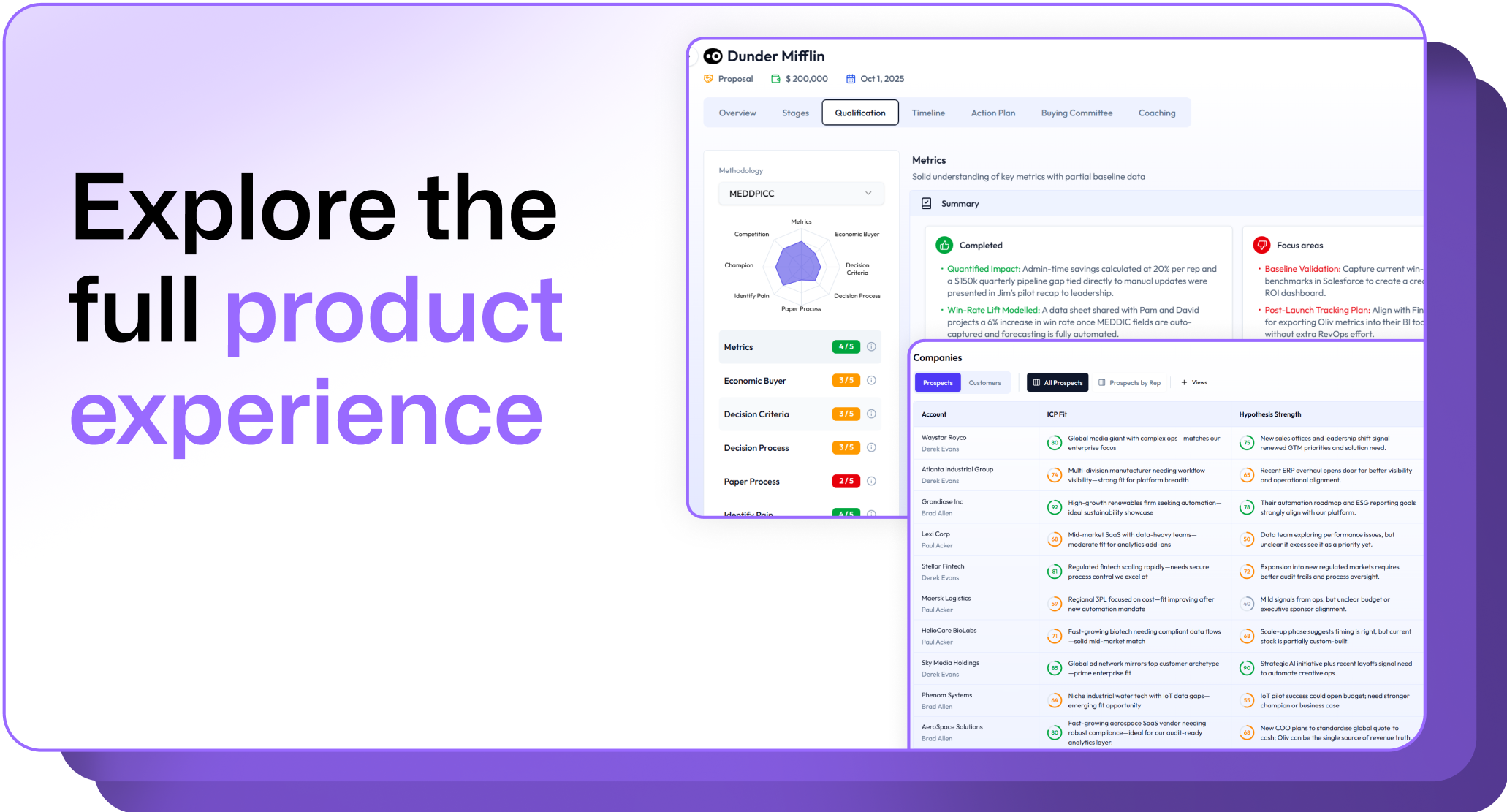
.avif)
.png)







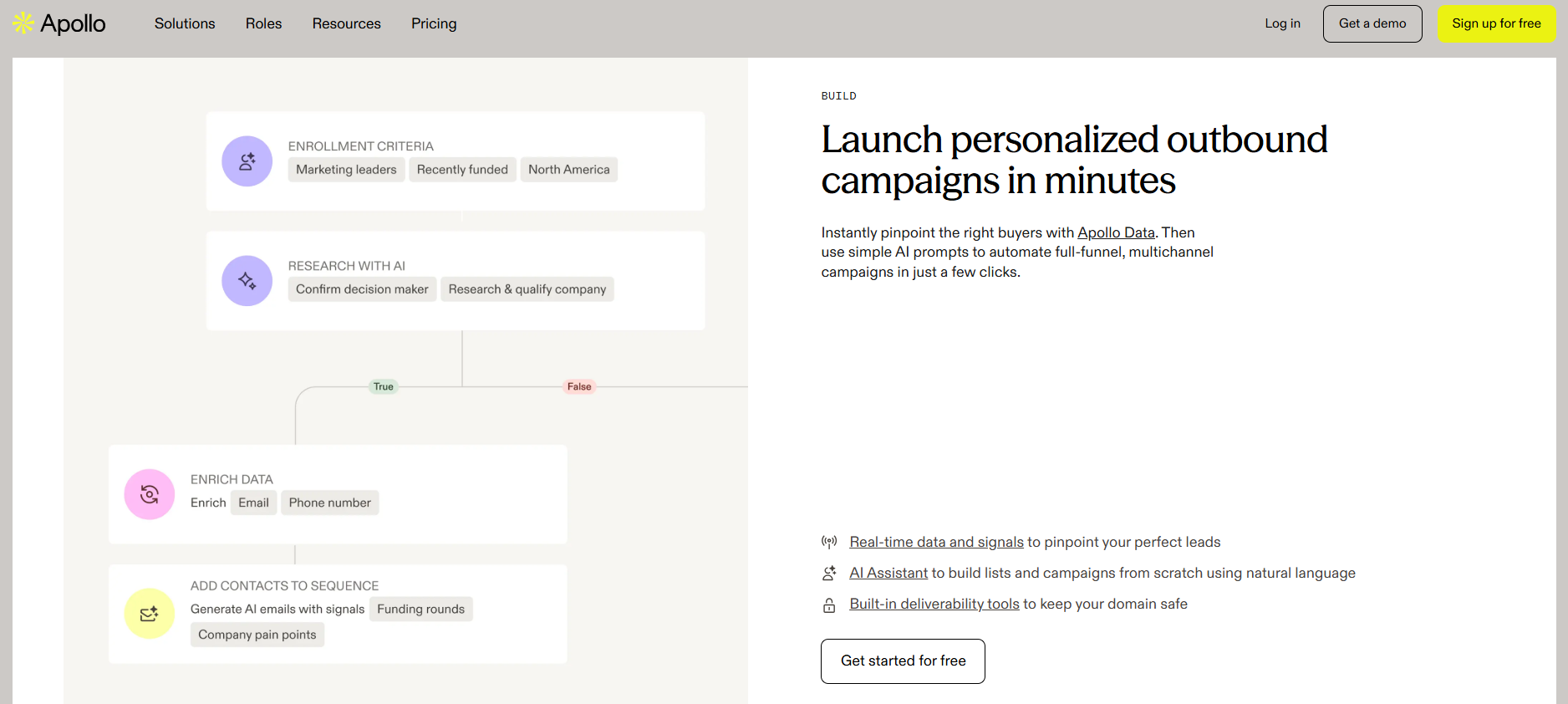
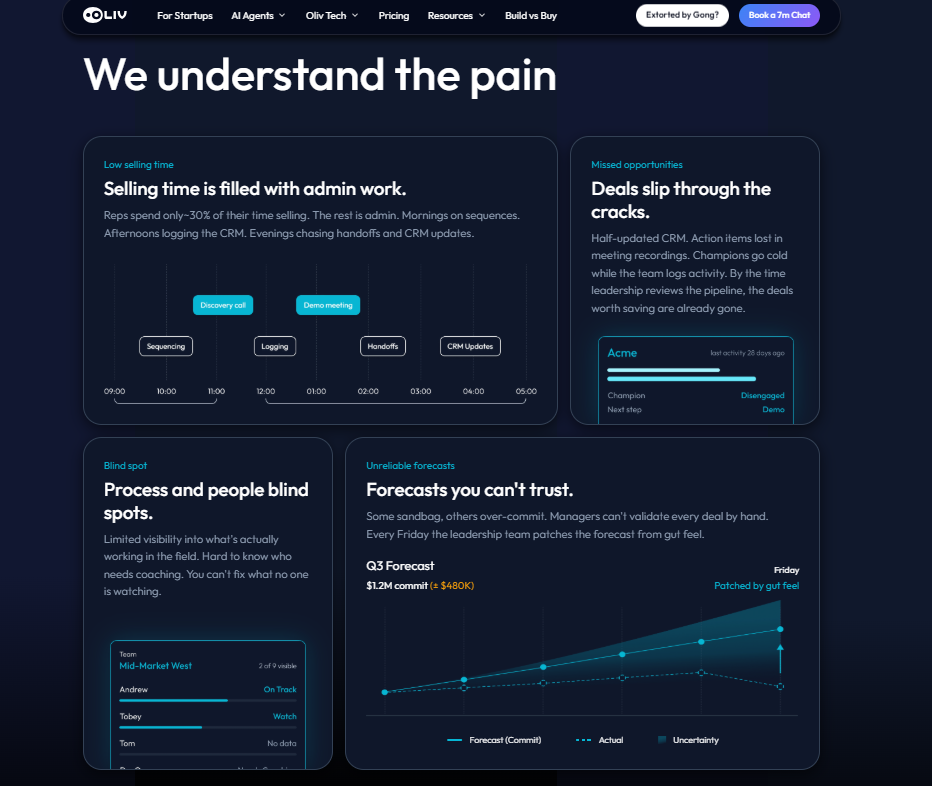
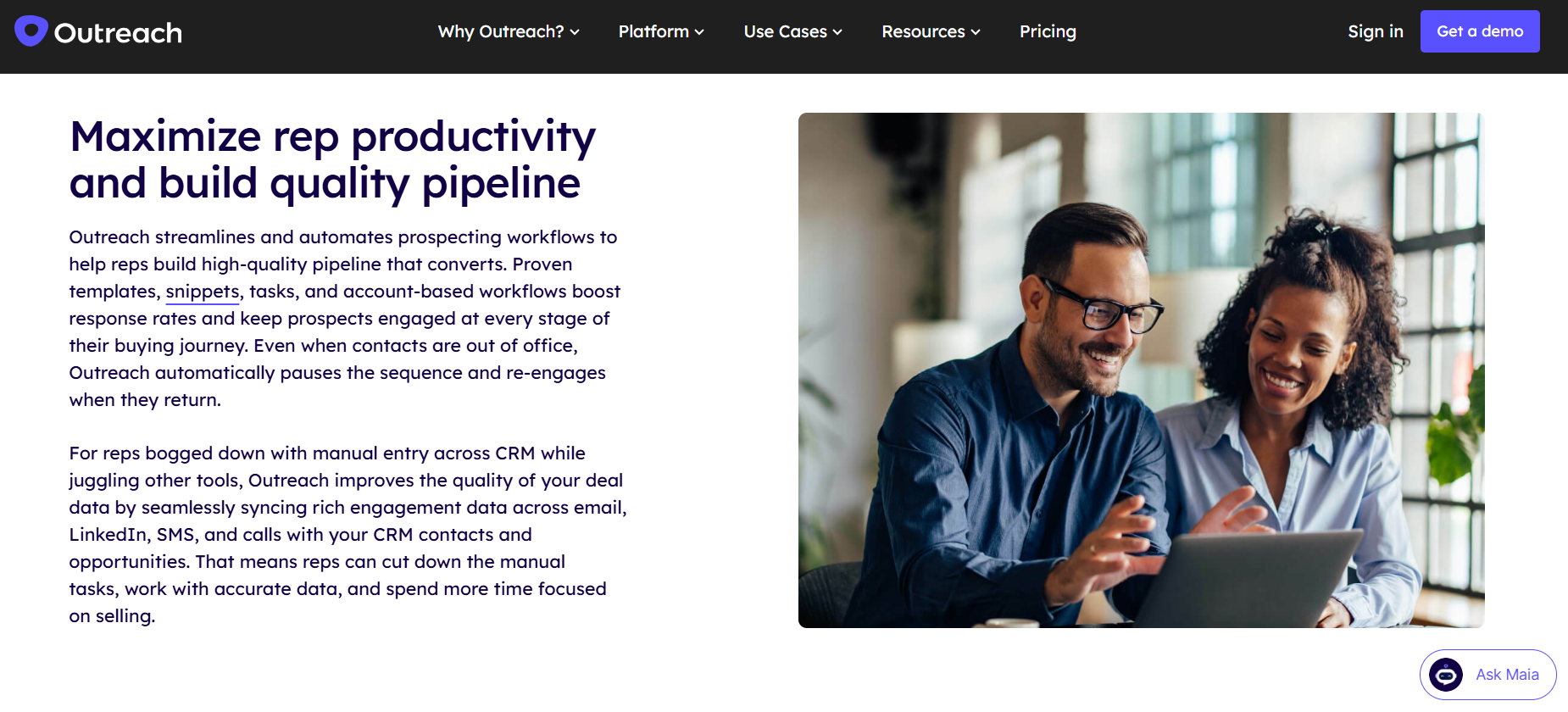
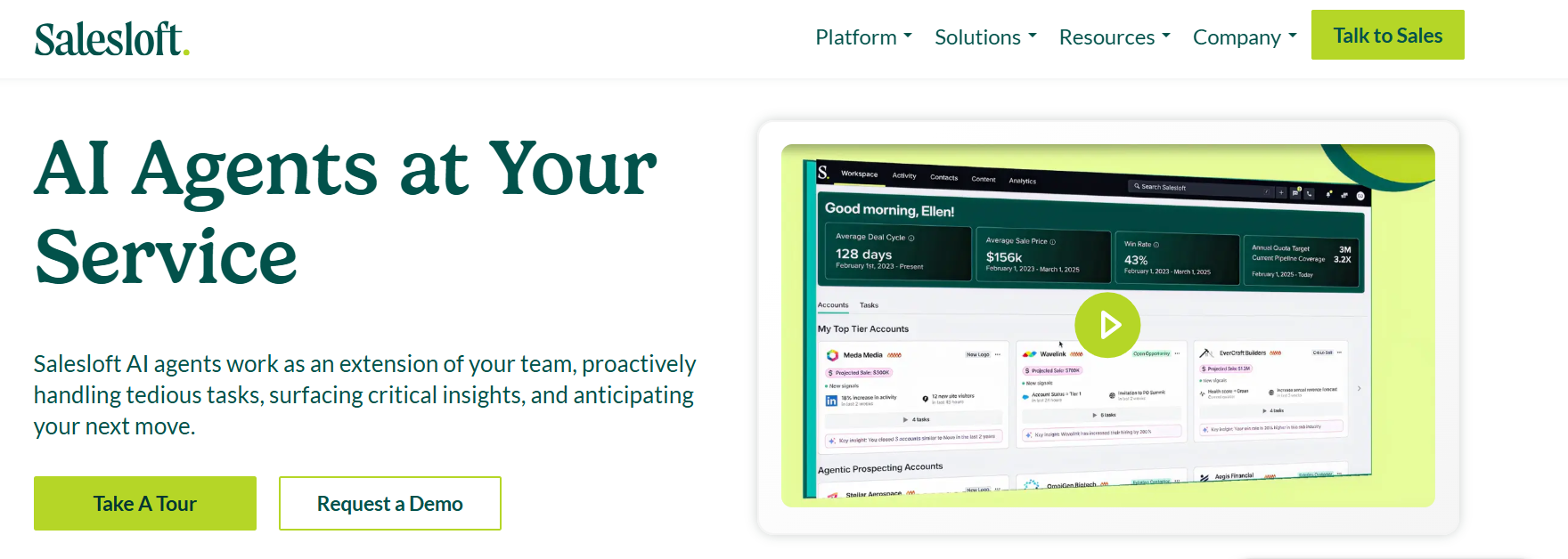

.png)
.png)
.png)

