10 Best Lead Qualification Software in 2026: Scoring, Enrichment, Routing Rules, and CRM Integration
Written by
Ishan Chhabra
Last Updated :
August 18, 2026
Skim in :
13
mins
In this article
Revenue teams love Oliv
Here’s why:
All your deal data unified (from 30+ tools and tabs).
Insights are delivered to you directly, no digging.
AI agents automate tasks for you.
Thank you! Your submission has been received!
Oops! Something went wrong while submitting the form.
Meet Oliv’s AI Agents
Hi! I’m, Deal Driver
I track deals, flag risks, send weekly pipeline updates and give sales managers full visibility into deal progress
Hi! I’m, CRM Manager
I maintain CRM hygiene by updating core, custom and qualification fields all without your team lifting a finger
Hi! I’m, Forecaster
I build accurate forecasts based on real deal movement and tell you which deals to pull in to hit your number
Hi! I’m, Coach
I believe performance fuels revenue. I spot skill gaps, score calls and build coaching plans to help every rep level up
Hi! I’m, Prospector
I dig into target accounts to surface the right contacts, tailor and time outreach so you always strike when it counts
Hi! I’m, Pipeline tracker
I call reps to get deal updates, and deliver a real-time, CRM-synced roll-up view of deal progress
Hi! I’m, Analyst
I answer complex pipeline questions, uncover deal patterns, and build reports that guide strategic decisions
TL;DR
The ten tools ranked for 2026 are Chili Piper, LeanData, Oliv AI, HubSpot, Qualified, Default, Clay, MadKudu, Apollo.io, and Calendly, scored on five weighted criteria.
Routing and enrichment are largely solved problems. The unsolved part is judgment: deciding whether a lead deserves a rep's next hour, and telling that rep why.
Below roughly 500 inbound leads a month, native HubSpot or Salesforce routing is enough. Buying a tool will not fix a model built on wrong inputs.
Teams with a written response SLA hit the 15-minute standard 54.9% of the time against 29.5% without one. The SLA drives most of the lift, not the tool.
With 76% of teams reporting under half their CRM data accurate, most scoring drift is a data problem, so audit fields before retraining any model.
Only two of ten vendors publish complete rate cards, and EU AI Act Article 50 disclosure now applies to any chat or voice qualifier touching EU prospects.
Q1: What are the 10 best lead qualification software tools for inbound revenue teams in 2026? [toc=1. The 10 Tools]
The ten best lead qualification tools in 2026 are Chili Piper, LeanData, Oliv AI, HubSpot, Qualified, Default, Clay, MadKudu, Apollo.io, and Calendly. Each was scored on routing logic, qualification context, enrichment, CRM integration, and trust, using vendor documentation and published rates only. Oliv AI places third because it owns the context layer after routing, not routing itself.
⚠️ The problem nobody puts on a pricing page
Your form fires. A rule runs. A rep gets a lead and opens a record with a score on it.
That rep still has no idea what accounts like this one actually said last quarter. So the first call becomes a discovery call about basics. The lead was routed correctly and wasted anyway.
I have watched this pattern for years across mid-market B2B teams, where CRM hygiene decides what a rep can see. Routing is not the broken part. Judgment is.
🔍 How I built this list
Every price here comes from the vendor's own page or a dated third-party breakdown. Where a vendor publishes nothing, this list says so instead of guessing.
I also left out the response-time percentages that circulate in this category without a named publisher. Operators screenshot weak claims. I would rather have fewer numbers that survive scrutiny.
The ten, in order:
Chili Piper
LeanData
Oliv AI
HubSpot
Qualified
Default
Clay
MadKudu
Apollo.io
Calendly
The 2026 comparison table
Lead Qualification Software Compared, 2026
#
Tool
Best for
Qualification mechanism
CRM-native
Starting price (traceable)
Score
1
Chili Piper
Form-to-meeting routing at inbound volume
Rule-based routing plus AI agents
Salesforce and HubSpot
$15,000/yr, 15 seats
88 ⭐⭐⭐⭐⭐
2
LeanData
Salesforce-first orchestration and matching
Rule-based, signal-driven workflows
Salesforce-native
Quote only, 3 editions
85 ⭐⭐⭐⭐⭐
3
Oliv AI
Context the rep gets after the handoff
First-party conversation history
HubSpot, Salesforce, Dynamics
$19 to $79 per seat, $0 platform fee
82 ⭐⭐⭐⭐⭐
4
HubSpot
Teams already paying for Sales Hub
Native scoring plus workflows
Is the CRM
Published per Hub tier
78 ⭐⭐⭐⭐
5
Qualified
Enterprise inbound chat on Salesforce
Conversational qualification
Salesforce-native
Not publicly listed
72 ⭐⭐⭐⭐
6
Default
Multi-system routing orchestration
Rule-based orchestration
Salesforce and HubSpot
Reported near $750/mo
70 ⭐⭐⭐⭐
7
Clay
Enrichment waterfalls before scoring
Data enrichment, not scoring
Via sync
Not publicly listed
66 ⭐⭐⭐⭐
8
MadKudu
Predictive fit and intent scoring
Predictive machine learning
Salesforce and HubSpot
Not publicly listed
63 ⭐⭐⭐⭐
9
Apollo.io
Budget enrichment plus basic scoring
Data plus rule-based scoring
Two-way sync
Published per seat tier
60 ⭐⭐⭐
10
Calendly
Scheduling with light round-robin
Scheduling, minimal qualification
Via integration
About $16 to $20 per user
52 ⭐⭐⭐
Scores use the rubric in the next section. Bands run 0 to 20 for one star, and 81 to 100 for five. If you are weighing this category against adjacent ones, our breakdown of the best revenue orchestration platform tools covers where routing ends and orchestration begins.
💰 Read the price column carefully
Two vendors publish a complete rate card. One publishes a floor. The rest run a demo-first motion.
That asymmetry matters more than most feature gaps. You cannot model a stack cost from three quotes you have not received yet, which is the same trap we mapped in our guide to reducing sales tech stack costs.
1.1 Chili Piper: the inbound routing standard, at a new price floor [toc=1.1 Chili Piper]
Chili Piper Distro builder displays a record-created trigger, lead-to-account matching and existing customer ownership rules, then assigns Salesforce ownership automatically while enforcing response SLAs across the sales team.
Chili Piper is the reference tool for turning a form fill into a booked meeting in seconds. In 2026, it stopped selling per-product SKUs and moved to platform tiers.
⭐ What it actually does
The Routing and Scheduling tier handles form-to-meeting booking, Salesforce lead distribution, and SDR-to-AE handoff. It also does fuzzy lead-to-account matching, duplicate merging, and SLA management on Salesforce objects.
Every seat now includes ChiliCal, its scheduling link product. AI agents ship inside the tiers, including a spam checker, meeting prep, and an MCP endpoint, per the Chili Piper pricing page.
💸 Pricing, sourced and dated
Routing and Scheduling starts at $1,250 a month, billed annually. That is $15,000 a year with 15 seats included, then $45 per extra seat per month.
The Experiences tier starts at $3,500 a month, or $42,000 a year, with 30 seats and 150,000 AI credits. Multi-year commitments discount 15 percent at two years, rising to 40 percent at four, per Hacking Demand's July 2026 breakdown.
Chili Piper Product and Pricing Timeline
When
What changed
Through 2025
Sold as separate SKUs. Concierge, Distro, and Handoff ran roughly $15 to $30 per user monthly, plus platform fees from $150 to $1,000 a month.
2026 to date
SKUs collapsed into two tiers. AI credits became a metered consumable at 45,000 or 150,000 per year. AI agents added: spam checker, meeting prep, Chili Assist, Email Composer, MCP, and Edge API.
Signalled next
Chili Data Platform listed as a third tier, marked coming soon with pricing undisclosed. Campaign Manager also flagged coming soon inside re-engagement orchestration.
✅ Pros and ❌ cons
✅ The fastest form-to-calendar path in the category, with genuine depth on Salesforce objects
✅ Fair-distribution controls that stop favouritism, including weighting, capping, and meeting limits
✅ Enrichment partners built in, covering Clay, Apollo, ZoomInfo, Lusha, and LeadIQ
❌ The $15,000 floor applies even with three reps, because 15 seats are bundled
❌ AI credits meter visitor identification and chat, so high-traffic sites buy extra bundles
❌ No monthly billing and no listed free trial, so evaluation runs through sales
⏰ Who should buy it
Buy Chili Piper if inbound volume is your revenue engine and you sit on Salesforce. It holds 4.6 out of 5 on G2 across more than 700 reviews, which is real category validation.
Skip it under about 15 reps. You are paying for seats you will not staff, a pattern worth checking against your wider RevOps software spend.
1.2 LeanData: Salesforce-native orchestration for complex routing [toc=1.2 LeanData]
LeanData is the tool RevOps teams pick when routing logic gets genuinely complicated. It is built inside Salesforce rather than beside it.
⭐ What it actually does
The Standard edition covers intelligent lead-to-account matching, round-robin, territory and account-based assignment, deduplication, audit logs, and SLA enforcement. Advanced extends routing to contacts and accounts with signal-driven workflows.
Premium routes any standard or custom Salesforce object, including opportunities and cases. That includes international territory matching, scheduled recurring automations, and cross-object assignment, per the LeanData pricing page.
🔍 Where it separates from Chili Piper
Chili Piper optimises the moment a hand goes up. LeanData optimises the rulebook underneath it.
Matching is the real differentiator here. Get lead-to-account matching wrong, and every downstream rule inherits the error, which is why Salesforce automation projects so often stall on data structure rather than logic.
LeanData Product and Packaging Timeline
When
What changed
Through 2025
Three orchestration editions plus BookIt scheduling. Core stack covered matching, routing, deduplication, SLA dashboards, and integrations across sales engagement, enrichment, intent, and gifting.
2026 to date
Buying Groups shipped as its own edition. It identifies buying group roles from scoring and signals, maps member engagement, orchestrates journeys, and alerts on missing roles.
Signalled next
Buying Groups Blueprint sold as an add-on alongside BookIt. Multi-segment and business-unit separation, plus account-level journey analytics, remain add-on line items rather than bundled features.
✅ Pros and ❌ cons
✅ Best-in-class lead-to-account matching, which is upstream of every other routing decision
✅ Routes any custom Salesforce object, so partner and renewal motions are covered
✅ Strong governance surface with audit logs, routing insights, and SLA escalations
❌ Salesforce-first by design, so HubSpot-only teams get less from it
❌ Five editions and no published rates across any of them
❌ Setup and onboarding are billed separately from the licence
💰 Pricing reality
LeanData publishes no numbers. Package pricing depends on features, objects, and the count of Salesforce users or queues.
G2 lists five editions with details available only from the vendor, and no free trial. It carries a 4.6 out of 5 rating on G2, so the product reputation is strong even where the pricing is opaque.
⏰ Who should buy it
Buy LeanData if you run Salesforce, have more than a handful of segments, and one person currently owns all the routing logic. That single-owner risk is the quiet reason most teams end up here, and it is the same fragility we unpack in our RevOps integration blueprint.
1.3 Oliv AI: the context layer after the routing decision [toc=1.3 Oliv AI]
Three-stage flow shows a rep choosing to record, PLAUD NotePin transcribing in real time, then Oliv AI structuring notes, action items and deal signals into CRM context automatically.
Oliv AI is on this list for one reason, and it is not routing. It is an AI-native revenue intelligence and orchestration platform that runs on top of your CRM.
⭐ What it does, and what it does not
Oliv AI holds a continuously updated context graph of every account and opportunity, built from calls, emails, and notes. Prospector uses that first-party context to pick which accounts are worth working. Meeting Assistant briefs the rep before a booked meeting.
Here is the concession that matters. Oliv ships no lead scoring model, no enrichment waterfall, and no routing engine. Three of this article's four axes are simply not covered.
⚠️ Then why rank it third?
Because qualification is a judgment, and every other tool here makes it from two inputs. Website behaviour, and attributes someone purchased from a data vendor.
Neither input knows what your team learned last quarter. Which objection surfaced at week two. Which segment stalled at proposal. That knowledge sits in your own conversation history, and almost nothing reads it.
💰 Pricing and implementation
Oliv AI publishes a per-seat ladder from $19 to $79 with a $0 platform fee, and view-only seats are free on its pricing page. That is a full rate card, not a starting-from figure.
Setup is CRM-connection work rather than rule-building. Reviewers describe onboarding measured in days, with implementation engineers involved, though full customisation still runs longer, as our RevOps implementation and admin guide sets out.
Oliv AI Product Timeline
When
What changed
Through 2025
Core agent set shipped against the revenue lifecycle: CRM Manager, Deal Driver, Forecaster, and meeting capture, with two-way sync into HubSpot and Salesforce.
2026 to date
Prospector released for account selection from first-party context, and Meeting Assistant for pre-meeting rep briefing, both exposed through a public agent marketplace.
Signalled next
Agent coverage expanding past sales into customer success and implementation, with pricing pressure downward on the application layer rather than upward.
✅ Pros and ❌ cons
✅ Resolves calls, emails, and notes to the correct account and opportunity, which is real CRM integration depth
✅ Full published price ladder, $0 platform fee, free view-only seats
❌ No lead routing, no scheduling, no scoring model
❌ Wrong fit for pure call-recording or B2C support use cases
❌ Deep customisation takes weeks, not days
⏰ Real user feedback
"I love how Oliv AI provides real-time deal risk insights and actionable steps to mitigate them, turning every customer interaction into actionable intelligence. The Revenue Harness and Context Graph are standouts, giving me detailed briefs before every call and saving me over 10 hours a week on admin tasks." — Verified user, Sales Professional Oliv AI G2 - Verified Review [02 Jul 2026]
"I appreciate that Oliv.ai researches prospect accounts before every call and sends deal updates and talking points. [What I dislike is] it's a lil slow." — Verified user, Sales Professional Oliv AI G2 - Verified Review [23 Jun 2026]
Oliv AI's read is that the standard buying advice gets this backwards. Teams shop for routing accuracy and inherit a thin handoff. I could be reading our own deployment data too strongly here, but the pattern has held across every mid-market rollout I have sat in.
1.4 HubSpot: the option most teams should try first [toc=1.4 HubSpot]
HubSpot is both a listed vendor here and the system everything else writes into. If you already pay for Sales Hub, start here before buying anything.
⭐ What it does
Sales Hub covers native lead scoring, workflow-based routing, meeting links, and lifecycle stage management. Breeze Intelligence adds enrichment on company and contact records.
Breeze agents handle prospecting recommendations and data queries. Since April 2026, they bill on outcomes rather than seats.
💰 Pricing
Sales Hub runs $20 per seat monthly on Starter, $100 on Professional, and $150 on Enterprise, with one-time onboarding fees of $1,500 and $3,500 on the paid tiers.
Breeze runs on credits at $9 per 1,000 on annual billing. Prospecting Agent consumes 100 credits per recommended lead. Paid plans include monthly allowances that expire if unused.
HubSpot Sales Hub Pricing and Agent Timeline
When
What changed
Through 2025
Seat-based Sales Hub with native scoring, workflow routing, and Breeze Intelligence enrichment sold against a flat credit allowance per tier.
April 2026 onward
Breeze agents moved to outcome-based billing. Customer Agent charges 50 credits per resolved conversation, Prospecting Agent 100 credits per recommended lead, Data Agent 10 credits per run.
Signalled next
Two official MCP servers plus an MCP client shipped, pointing toward external AI platforms querying HubSpot records directly rather than through the UI.
✅ Pros and ❌ cons
✅ Zero integration cost, because it is the record itself
✅ Scoring, routing, scheduling, and enrichment in one bill
✅ No seat minimums on any tier
❌ Routing logic gets brittle past a handful of territories
❌ Credit allowances expire monthly, so unused spend evaporates
❌ Onboarding fees are mandatory on Professional and above
⏰ Who should buy it
Stay native if you run under roughly 500 inbound leads a month and one routing ruleset. Adding a tool to fix a scoring model built on the wrong inputs does not fix the inputs, a point we develop in our guide to integrating sales automation in the CRM.
1.5 Qualified: conversational qualification for Salesforce enterprises [toc=1.5 Qualified]
Qualified qualifies inbound visitors in conversation, not in a rules table. Piper, its AI SDR agent, engages website traffic through chat, voice, and video.
⭐ What it does
Piper identifies visitors, asks qualifying questions live, then books meetings and follows up by email. It is Salesforce-native, so records write straight into the CRM.
That live-conversation mechanism is genuinely different from rule-based routing. It also means qualification quality depends on traffic volume and intent, which is why we treat AI sales agents as a motion decision rather than a feature purchase.
💸 Pricing reality
Qualified publishes no list prices on its pricing page. Three tiers exist, all quote-based.
Independent buyer analysis puts Premier near $68,000 a year for 25 users, with negotiated deals landing between $40,000 and $50,000. Because Piper depends on Salesforce, buyers report an all-in range of $70,000 to $128,000 annually.
Qualified Packaging Timeline
When
What changed
Through 2025
Conversational marketing platform with live chat, visitor identification, and Salesforce-native routing to booked meetings, sold across three quote-only tiers.
2026 to date
Piper bundled across Premier, Enterprise, and Ultimate rather than sold as a standalone add-on, with pricing scaled by deployment size and Salesforce footprint.
Signalled next
Expansion of Piper across voice and video channels alongside chat, with brand and website count driving Ultimate tier pricing.
✅ Pros and ❌ cons
✅ Qualifies in live conversation, which beats a form for high-intent traffic
✅ Deep Salesforce nativity, so no sync layer to maintain
❌ No published pricing at any tier
❌ Salesforce dependency doubles the real cost of ownership
❌ Overkill for sites with modest traffic
1.6 Default: routing orchestration with a published price [toc=1.6 Default]
Default is the routing orchestrator that publishes its rate card. That alone puts it ahead of half this list on transparency.
⭐ What it does
Default combines enrichment, routing, scheduling, and workflow automation in one platform. It handles inbound orchestration across Salesforce and HubSpot rather than inside one of them.
The seat model separates people who need booking from people who need routing control. Ops admins do not pay.
💰 Pricing
The platform fee runs $500 to $750 a month depending on tier and billing terms. Scheduling seats are $20 monthly, routing plus scheduling seats are $45, and editor or admin seats are free.
A team with five AEs on full routing and two SDRs on scheduling lands near $765 a month. That is a fraction of the Chili Piper floor.
Default Pricing and Platform Timeline
When
What changed
Through 2025
Platform plus seat model with a $500 monthly base covering the routing engine, workflow builder, enrichment, and integrations.
2026 to date
Startup tier repriced to $750 monthly on annual billing plus $45 per routing seat, with Growth moving to custom pricing tied to workflow scale and credits.
Signalled next
Growth tier adds advanced AI agents, custom data models, and dedicated support, indicating agent capability is becoming the upsell lever.
✅ Pros and ❌ cons
✅ Published pricing with free admin seats
✅ Enrichment, routing, and scheduling in one contract
✅ Works across Salesforce and HubSpot, not one or the other
❌ Smaller ecosystem than LeanData or Chili Piper
❌ Growth tier pricing disappears behind a quote
❌ Less Salesforce object depth than a native tool
1.7 Clay: enrichment depth before any score runs [toc=1.7 Clay]
Clay is not qualification software. It is the enrichment waterfall that feeds whatever scores your leads.
⭐ What it does
Clay chains multiple data providers in sequence until a field fills. That is what waterfall enrichment means, and it beats any single-vendor lookup on coverage.
It also runs research agents over accounts. The output lands in your CRM or your routing tool.
💰 Pricing, freshly overhauled
Clay rebuilt pricing on 11 March 2026. Launch is $185 monthly with 2,500 data credits and 15,000 actions. Growth is $495 monthly with 6,000 credits and 40,000 actions.
The March change cut marketplace data costs by 50 to 90 percent, stopped charging for failed lookups, and moved CRM integration down from the old $800 tier.
Clay Pricing Overhaul Timeline
When
What changed
Through early 2026
Three self-serve plans: Starter at $149 monthly, Explorer at $349, and Pro at $800, with one blended credit currency and charges applied to failed lookups.
From 11 March 2026
Collapsed to Launch at $185 and Growth at $495. Billing split into Data Credits and Actions. HTTP integration requests reclassified as Action-consuming.
Signalled next
Enterprise contracts averaging $30,000 or more per year, with custom credit pools above 100,000 annually and 200,000-plus actions.
✅ Pros and ❌ cons
✅ Best-in-class enrichment coverage through provider chaining
✅ Free plan available, and no charge for failed lookups since March 2026
❌ Two separate credit currencies deplete independently, which complicates forecasting spend
❌ CRM integration only from the $495 tier
❌ Requires an operator who enjoys building tables
1.8 MadKudu: predictive scoring for product-led motions [toc=1.8 MadKudu]
MadKudu builds predictive models rather than point-based rules. It is the strongest pure scoring option here.
⭐ What it does
MadKudu ingests firmographic, behavioural, and product-usage data, then predicts likelihood to convert. It identifies product-qualified leads, which matters for free-trial and freemium motions.
Models are custom-built rather than templated. That is the strength and the cost.
💸 Pricing
Nothing is published. Vendr purchase data across 38 to 40 tracked deals puts the median buyer at roughly $32,300 to $33,600 a year, with a range of $15,000 to $81,500.
Core lead scoring at 10,000 to 50,000 leads monthly typically runs $25,000 to $60,000 annually. Advanced predictive deployments reach $120,000.
MadKudu Packaging Timeline
When
What changed
Through 2025
Tiered by lead volume. Growth near $24,000 yearly covered the full predictive engine, product usage scoring, PQL identification, and Segment, Amplitude, and Mixpanel connections.
2026 to date
Pro tier at roughly $2,499 monthly caps 6,000 leads and 10 users, adding smart retargeting and Slack support above the Growth scoring baseline.
Signalled next
Enterprise deployments above 100,000 leads monthly exceeding $100,000 yearly, with site personalisation, ad optimisation, and dedicated data science attached.
✅ Pros and ❌ cons
✅ Genuine predictive modelling, not weighted point rules
✅ Product usage scoring, which most competitors ignore
❌ Five-figure minimum before any model is built
❌ Models still drift, and recalibration is your job
1.9 Apollo.io: the budget entry point for data plus scoring [toc=1.9 Apollo]
Apollo.io bundles a contact database, enrichment, sequencing, and basic rule-based scoring at a per-seat price most teams can approve without procurement.
⭐ What it does
Apollo enriches records, scores leads on fit and intent signals, and syncs both ways with HubSpot and Salesforce. The database is the draw. The scoring is adequate rather than deep.
For a small team, it replaces two line items. For a large one, it becomes the cheap layer under something better, which is the trade-off we weigh across sales intelligence platforms.
💰 Pricing
Free at $0, Basic at $49 per user monthly on annual billing, Professional at $79, and Organization at $119 with a three-seat minimum.
Credits are the real variable. Reported allowances differ across analyses, so check your own tier before modelling spend.
Apollo.io Plan and Credit Timeline
When
What changed
Through 2025
Four tiers at $0, $49, $79, and $119 per seat annually, with yearly credit pools granted up front and email plus phone reveals each consuming one credit.
2026 to date
Credit allowances restructured per tier, with Professional moving toward uncapped email credits under fair use and dialer plus call recording included.
Signalled next
Unlimited plan credit ceilings now formalised at the lesser of paid spend divided by $0.025 or one million credits yearly per account.
✅ Pros and ❌ cons
✅ Lowest cost of entry on this list with a real free tier
✅ Data, sequencing, and scoring in a single seat price
❌ Scoring is rule-based and shallow next to MadKudu
❌ Credit definitions vary across published analyses
❌ Organization tier requires three seats minimum
1.10 Calendly: scheduling with light qualification attached [toc=1.10 Calendly]
Calendly ranks tenth because it solves the smallest slice of this problem. It books meetings well and qualifies almost nothing.
⭐ What it does
Routing forms ask a few questions, then send qualified respondents to the right calendar. Round-robin distributes across a team.
That is enough for a founder-led motion or a small SDR pod. It is not enough for territory logic or account matching.
💰 Pricing
Team plans run roughly $16 to $20 per user monthly. Compare that against the $15,000 annual floor at Chili Piper before assuming you need the bigger tool.
Calendly Positioning Timeline
When
What changed
Through 2025
Scheduling links plus routing forms with question-based redirection, round-robin distribution, and calendar sync across major providers.
2026 to date
Positioned against bundled scheduling inside routing platforms, as Chili Piper began including ChiliCal with every seat at no extra charge.
Signalled next
Continued per-user pricing in the $16 to $20 band, with qualification depth remaining outside product scope.
✅ Pros and ❌ cons
✅ Cheapest path to round-robin booking
✅ Almost zero setup time
❌ No lead-to-account matching
❌ No enrichment and no scoring
❌ Gets replaced the moment territory rules appear
💰 How to read this list by motion
High-volume inbound on Salesforce points to Chili Piper or LeanData. Complex multi-system routing points to Default, at a tenth of the platform cost. Product-led motions with usage data point to MadKudu.
Under 500 leads a month, stay native on HubSpot. Then ask the separate question nobody puts on a rubric. What does the rep actually know when that lead arrives?
Oliv AI belongs on the shortlist for that one line item only, and its published $19 to $79 ladder with a $0 platform fee means the answer costs less than the routing tool you already run, a consolidation case we model in our analysis of revenue tech stack consolidation costs. Keep the router. Fix the handoff.
Q2: How did we score these tools? Selection criteria, weighting, and star bands [toc=2. Scoring Methodology]
Five weighted criteria decide the ranking: Qualification Intelligence and Context 25%, Routing and Assignment Logic 20%, CRM Integration and Write-back 20%, Trust, Compliance and Pricing Transparency 20%, and Enrichment Depth and Accuracy 15%. Scores of 0 to 20 earn one star, 21 to 40 two, 41 to 60 three, 61 to 80 four, and 81 to 100 five.
⚠️ Why publish a rubric at all
Most pages ranking for this keyword are written by vendors who place themselves first. None of them show their working.
A rubric is the only thing that lets you disagree with me. If you weight enrichment higher than I did, the order changes, and you can see exactly where.
⭐ What each criterion measures
Points are earned and lost on evidence, not vibes.
Qualification Intelligence and Context (25%). Does the tool decide, or just rank? Predictive models and conversation-derived context score high. Static point rules score low.
Routing and Assignment Logic (20%). Lead-to-account matching, territory and capacity handling, and object coverage inside the CRM.
CRM Integration and Write-back (20%). Native depth, activity resolution against the correct account and opportunity, and whether writes survive a schema change.
Trust, Compliance and Pricing Transparency (20%). A published rate card, a reachable SOC 2 report, a DPA, a subprocessor list, and an AI-disclosure posture for any chat or voice agent.
Enrichment Depth and Accuracy (15%). Provider coverage, fill rate, and whether failed lookups cost money.
💰 The trust criterion is not idealism
Weighting trust at 20% comes from buyer data, not principle. G2's 2026 Buyer Behavior Report found evaluation is now the longest stage of the software purchase for 40% of buyers, up from 36%.
IT security review is the single biggest source of delay, cited by 39% of buyers. A vendor that hides its rate card and its security documentation costs you weeks before the contract exists, which is why our AI CRM trust and governance evaluation guide starts with paperwork rather than features.
Oliv AI is measured on this criterion the same way as everyone else, and it earns full marks for a published $19 to $79 seat ladder, a $0 platform fee, and a public trust centre.
📊 The scores
Lead Qualification Software Scores by Criterion, 2026
Tool
Context
Routing
CRM
Trust
Enrich
Total
Stars
Chili Piper
20
20
18
16
14
88
⭐⭐⭐⭐⭐
LeanData
18
20
20
13
14
85
⭐⭐⭐⭐⭐
Oliv AI
25
6
20
20
11
82
⭐⭐⭐⭐⭐
HubSpot
15
15
20
16
12
78
⭐⭐⭐⭐
Qualified
20
16
18
8
10
72
⭐⭐⭐⭐
Default
14
18
16
15
7
70
⭐⭐⭐⭐
Clay
12
6
14
16
18
66
⭐⭐⭐⭐
MadKudu
22
6
16
7
12
63
⭐⭐⭐⭐
Apollo.io
12
8
14
15
11
60
⭐⭐⭐
Calendly
6
12
12
15
7
52
⭐⭐⭐
⏰ What the numbers admit
Look at the Oliv AI row honestly. It scores 6 out of 20 on routing, because it ships no routing engine, and 11 out of 15 on enrichment for the same reason.
Third place is what the arithmetic produced. Had I weighted routing at 40%, it would sit sixth, and I would have said so, the same discipline we apply in our revenue intelligence platform comparison for RevOps.
Oliv AI carries no pricing negotiation in this rubric, because every rate is public: $19 to $79 per seat, $0 platform fee, and free view-only seats. That is the only reason it clears the trust criterion outright while two vendors on this list publish nothing at all.
Q3: Qualification, scoring, or routing, which problem do you actually have, and does your CRM already solve it? [toc=3. Category and Workflow]
Scoring ranks leads and outputs a number. Routing assigns them and outputs an owner. Qualification decides whether a lead deserves a rep's next hour and outputs a judgment. The workflow runs in five steps: check ICP fit, verify buying authority, enrich missing fields, score against fit and intent, then route under an SLA. Below roughly 500 inbound leads a month, native CRM tooling handles all five adequately.
⭐ Three outputs, three different purchases
Most buyers arrive here having conflated the three. That is how teams end up paying for a routing engine to fix a scoring problem.
Write down which output is broken before you book a demo. A number, an owner, or a judgment. The answer changes the shortlist entirely, and it also changes which sales pipeline software you should be comparing against.
🔍 The five-step workflow, in order
Qualification is a sequence, not a feature. Each step feeds the next, and a failure early poisons everything downstream.
Check the company against your ICP, meaning the ideal customer profile you actually close.
Verify the contact's role and buying authority.
Enrich the missing fields, usually email, LinkedIn, and firmographics like headcount and industry.
Score the lead against fit and intent criteria.
Route qualified leads to a rep under an SLA, and archive the rest.
Oliv AI operates only after step five, resolving calls, emails, and notes to the right account so the rep opens a briefed record.
⚙️ Four mechanisms, not one category
Vendors sold as qualification software use different engines underneath. The mechanism, not the feature list, determines what you get.
Qualification Mechanisms and Example Vendors
Mechanism
How it decides
Example
Rule-based
If-then logic on form and CRM fields
LeanData, Chili Piper
Predictive ML
Model trained on closed-won history
MadKudu
Conversational
Live questions asked in chat or voice
Qualified
First-party context
Your own conversation history, per account
Oliv AI
The fourth row is the one missing from every competing article on this keyword. Behaviour and purchased attributes are the only inputs most tools read, a gap we trace in our piece on revenue intelligence versus conversation intelligence.
⚠️ The concession most vendors skip
For a HubSpot or Salesforce team under about 500 inbound leads a month, native routing and scoring are enough. That is not a hedge. It is the right answer, and buying a tool will not improve it.
Native scoring gets brittle when territories multiply, when subsidiaries share domains, or when one person owns all the rules. Until then, the tooling is not your constraint.
💸 The line that actually matters
Here is where I will push back on the standard advice. Adding a qualification tool to fix a scoring model built on the wrong inputs does not fix the inputs.
If your model reads website behaviour and purchased firmographics, a better model reads the same two things faster. The judgment does not improve, because the evidence never changed.
So the real question is not which engine ranks leads best. It is what the rep knows when the lead lands, and where that knowledge came from. I will come back to that in a moment, because it is the part this category has quietly left alone.
Oliv AI sits in none of the first three boxes. It is an AI-native revenue intelligence and orchestration platform that runs on top of HubSpot, Salesforce, or Dynamics, and it replaces neither the CRM nor the routing you already trust.
Q4: How fast should a lead be routed, and how do you stop it reaching the wrong rep? [toc=4. Routing and Speed]
Route in seconds and contact within minutes, but fix matching before speed. Teams with a written response SLA hit the 15-minute standard 54.9% of the time, against 29.5% without one, per Blazeo's 2026 benchmark of 573 companies. Leads still reach the wrong rep because lead-to-account matching fails on domain variants, territory rules describe last year's segments, and round-robin ignores capacity.
⏰ Concede the speed argument first
The speed camp is right about a specific motion. High-volume, low-ACV, undifferentiated inbound converts on response time more than on anything else.
Optifai's benchmark across 939 B2B SaaS companies (Q2 2025 to Q1 2026) found a 32% close rate under five minutes, against 12% at 24 hours or more. Same rep, same pitch, 2.6 times the outcome.
⚠️ The numbers I refused to reprint
Half the statistics in this category are restatements of one 2007 vendor dataset. The "lead quality drops 80% after five minutes" line appears to be an editorial extrapolation, not a stated finding.
The verifiable anchors are Harvard Business Review's 2011 audit of 1.25 million leads across 2,241 companies, showing a 42-hour average and 23% never responding, and RevenueHero's 2024 test of 1,000 B2B SaaS companies, where 63.5% never replied at all. Non-response tripled in thirteen years while awareness rose.
❌ The three ways routing misfires
I watched a $180,000 opportunity route to the wrong region last year. The prospect used a subsidiary domain, matching failed, and a territory rule sent it to the wrong general manager.
Lead-to-account matching breaks on domain variants, subsidiaries, and free email addresses.
Territory rules encode a segmentation that changed two reorgs ago.
Round-robin distributes evenly while ignoring who already has 40 open deals.
Oliv AI solves the downstream sibling of the first problem, resolving every call and email to the correct account and opportunity after assignment.
✅ Fix matching, then speed
Matching is upstream of every other rule, so repair it first. LeanData is Salesforce-native and built around lead-to-account matching. Default runs the same logic across Salesforce and HubSpot at a $500 to $750 monthly platform fee.
Automation is the real lever. Companies using AI or automated routing met the 15-minute standard 62.5% of the time, against 39.1% for manual operations. Zendesk cut internal response time by 82%, from 45 minutes to about eight, using LeanData orchestration, the kind of result we unpack in our guide to RevOps automation.
🔧 Keep the rules maintainable
One person owning all routing logic is the failure mode nobody budgets for. That person takes a holiday, and inbound quietly degrades.
Three checks before you sign anything. Can rules be versioned and rolled back? Is there an audit log showing why a lead landed where it did? Can a second admin edit without breaking production? Our RevOps data architecture playbook covers how to document each of those before rollout.
⭐ What reps say about the handoff
"I use Oliv.ai to keep our sales process running smoothly. It helps in automating and updating our CRM after calls, provides a clear deal summary, and sends follow-up emails." — Verified user, Sales Professional Oliv AI G2 - Verified Review [26 Jun 2026]
"The only downside is that the platform can be a bit glitchy at times, but the support team is always quick to address and resolve any bugs." — Verified user, Sales Professional Oliv AI G2 - Verified Review [02 Jul 2026]
Oliv AI does not compete for your response-time SLA, and the routing tool hitting five minutes should keep doing exactly that. What changes is the record the rep opens after the assignment fires, a shift we detail in our AI meeting preparation tool breakdown.
Q5: Do you need a separate enrichment vendor, and how do you stop a scoring model from drifting? [toc=5. Enrichment and Scoring]
Bundled enrichment covers common firmographic fields well enough for routing. A waterfall vendor earns its cost only when you need fields the bundle misses. Scoring models drift because segments and buying committees change while weights do not. With 76% of teams reporting under half their CRM data is accurate, most drift is a data problem wearing a modelling costume.
💰 What bundled enrichment already gives you
Chili Piper, Default, and HubSpot all fill company size, industry, location, and job title from a built-in provider. For routing decisions, that is usually sufficient.
Waterfall enrichment means chaining several data vendors in sequence until a field fills. Clay does this well, from $185 a month on Launch and $495 on Growth.
🔍 When the waterfall is worth the money
Buy a separate vendor when three things are true at once. You need fields the bundle does not carry, your coverage thins outside North America, and someone owns the build.
Enrichment prices keep falling, so the data itself is not a moat. Clay's March 2026 change cut marketplace data costs by 50 to 90 percent and stopped charging for failed lookups, a shift worth factoring into any build versus buy decision on revenue AI.
Enrichment Approaches Compared
Approach
Best for
Cost signal
Bundled in routing tool
Under 5,000 records monthly
Included in platform fee
Waterfall vendor
Niche fields, non-US coverage
$185 to $495 monthly
First-party conversation data
Knowing what an account cares about
Included in Oliv AI's $19 to $79 seat ladder
✅ The fill-rate test to run this week
Pull 500 records you actually closed. Run them through the trial. Then count.
Measure fill rate per field, not aggregate coverage. A vendor at 92% overall can sit at 40% on the one field your model weights heaviest, which is the same measurement discipline our revenue performance analytics guide recommends.
⚠️ Why models drift, and what to do
A model trained on last year's mid-market wins keeps scoring for last year's mid-market. Your ICP moved upmarket in March, and nobody retrained anything.
Recalibrate quarterly against closed-won revenue, never against MQL volume. A model that scores well on lead volume and badly on closed deals was never calibrated in the first place.
Oliv AI runs no scoring model of its own, which is why the recalibration advice here comes from watching customer models fail rather than from defending one.
❌ The floor underneath all of it
Validity's 2025 State of CRM Data Management surveyed 602 CRM users. 76% said less than half their CRM data was accurate and complete, 45% said their data was not AI-ready, and respondents averaged 16 lost deals per quarter from bad data.
Audit the ten fields your model reads before you retrain anything, a step covered in more depth in our RevOps guide to autonomous CRM hygiene. Fixing weights on broken inputs is expensive theatre.
⭐ What users report about the data layer
"I like Oliv.ai for the time it saves by automating CRM updates and other administrative tasks. I appreciate that it integrates well with platforms like HubSpot and Salesforce." — Verified user, Sales Professional Oliv AI G2 - Verified Review [23 Jun 2026]
"The main downside is that the analytics could be more customizable. It's a minor issue, but having more flexibility in how I view and configure analytics would make it even better." — Verified user, Sales Professional Oliv AI G2 - Verified Review [08 Jul 2026]
Oliv AI buys no third-party data at all. The input we contribute is your own conversation history, which no vendor can turn around and sell to your competitor. Enrichment tells you what a company is. It never tells you what that company cares about.
Q6: What does the rep actually see when a qualified lead lands? [toc=6. The Handoff Gap]
Most tools hand the rep a score, a source, a few enriched fields, and a calendar invite. None hand over what the company already learned from talking to accounts that look exactly like this one. Which objection surfaces at week two. Which use case converts. That knowledge sits in your own call history, and almost no qualification tool reads it.
⏰ Tuesday, 9:14am
Priya is an AE at a 300-person B2B software company. A lead lands in her queue with a score of 87, a source of "webinar", and a company size of 480.
She has nine minutes before the call. She opens LinkedIn, skims the website, and dials. The first fifteen minutes go to questions her company already knows the answers to, which is exactly the gap our sales call planning guide was written to close.
⚠️ Where the missing context actually lives
Her company has spoken to forty accounts in that exact segment over eighteen months. Three quarters of them raised the same procurement objection at week two.
That pattern exists in recorded calls, emails, and CRM notes. It is not in the score, because the score reads website behaviour and purchased attributes. Neither input can reach it.
⚙️ Two inputs, one blind spot
Qualification Inputs and Their Blind Spots
Input
What it knows
What it misses
Website behaviour
Pages visited, forms filled
Why similar buyers stalled
Purchased attributes
Headcount, stack, funding
What this segment objects to
First-party conversation history
Objections, use cases, stall points
Anonymous pre-form intent
Oliv AI reads the third row, resolving every call and email to the correct account and opportunity so the pattern is attached to the record.
🤖 The agentic counterweight
Gartner's 2026 forecast projects AI agents will outnumber human sellers ten to one by 2028. The same forecast expects fewer than 40% of sellers to say agents improved their productivity.
That gap is the whole argument. Gartner's May 2026 survey also found 69% of B2B buyers prefer to validate AI-generated insights with a human rep, and buyers were 39 points more likely to say a person understood their needs, a tension we examine in our view of the future of revenue intelligence.
❓ So why is Oliv AI on this list at all?
Fair question, and I would rather answer it here than bury it. Oliv AI routes nothing, scores nothing, and enriches nothing.
It is here because qualification is a judgment, and the judgment is only as good as its evidence. The one evidence source none of these tools read is the conversation history you already own.
✅ What to actually do about it
Keep the routing tool. If Chili Piper books meetings in ninety seconds, that is a solved problem, and replacing it would be vandalism.
Add one criterion to your evaluation instead. What travels with the lead after assignment, and where did it come from? Most vendors have no answer, and that silence is informative.
Oliv AI's read is that the category optimised the pipe and ignored the payload. I could be overweighting our own deployment data here, though the pattern has held in every mid-market rollout I have watched.
Oliv AI works as the layer after the handoff. Prospector picks accounts worth working from first-party context, and Meeting Assistant briefs the rep before the booked meeting, so Priya's first fifteen minutes go somewhere new. Our breakdown of agents for sales teams shows how that handoff is assembled.
Q7: What will this cost, what will security review ask, and which tool fits your motion? [toc=7. Cost, Compliance and Fit]
Budget for a stack, not a tool. Scoring, enrichment, and routing are usually three invoices, priced per seat, per platform, or per enriched record. Chili Piper's routing tier starts at $15,000 a year with fifteen seats, and LeanData publishes no rates at all. Security review delays 39% of software purchases, and any chat or voice qualifier touching EU prospects now owes an AI-disclosure line.
💰 Three pricing models
Per-seat suits stable teams. Platform-plus-seat suits teams with many viewers and few operators. Per-record suits spiky enrichment volume.
Default splits seats cleverly at $20 for scheduling and $45 for routing, with admin seats free. Oliv AI runs pure per-seat from $19 to $79 with a $0 platform fee.
Published Rates Across the Qualification Stack
Tool
Published rate
Source
Chili Piper
$15,000/yr, 15 seats, then $45/seat
Vendor page
Clay
$185 or $495 monthly
Vendor page
Apollo.io
$49 to $119 per seat monthly
Vendor page
Oliv AI
$19 to $79 per seat, $0 platform fee
Vendor page
LeanData, Qualified, MadKudu, Default Growth
Quote only
Vendor pages
💸 What a fifteen-seat stack really costs
Routing at $15,000, enrichment at $5,940, and predictive scoring at a $32,000 median lands near $53,000 a year. That is before implementation.
Two of ten vendors here publish complete rate cards. You cannot model a budget from three quotes you have not received, which is the practical case for reducing sales tech stack costs before adding another line item.
⚠️ Assemble the security packet first
Evaluation is now the longest stage of the software purchase for 40% of buyers, up from 36%, and IT security review is the top delay at 39%.
Ask every vendor for four artefacts before the demo. A current SOC 2 Type II report, a DPA, a subprocessor list, and encryption specifics. Oliv AI publishes SOC 2 Type II, GDPR, and CCPA documentation openly, and our mid-market governance buyer guide lists what procurement will ask for.
⚖️ The compliance line nobody else mentions
EU AI Act Article 50(1) has applied since 2 August 2026. If a chat, SMS, or voice agent qualifies an EU prospect, that prospect must be told they are interacting with AI.
Penalties reach EUR 15 million or 3% of global turnover. Annex III high-risk obligations were deferred to 2 December 2027 by Regulation (EU) 2026/1744, so this year the duty is disclosure, not classification, a distinction we work through in our AI CRM trust and risk evaluation.
✅ Which one fits your motion
High inbound volume on Salesforce: Chili Piper, if you can staff fifteen seats.
Complex multi-object routing on Salesforce: LeanData, and accept the quote process.
Cross-CRM routing on a budget: Default, at roughly a tenth of the platform cost.
Under 500 leads monthly on HubSpot: stay native and spend nothing.
⭐ What implementation actually looks like
"The initial setup was really easy because the team provided FDE engineers who set everything up, and within less than a week, we were good to go." — Verified user, Sales Professional Oliv AI G2 - Verified Review [17 Jun 2026]
"The biggest value of Oliv AI is its ability to operationalize customer conversations. It doesn't just record meetings; it automatically captures key insights, updates systems of record, identifies next steps." — Verified user, Sales Professional Oliv AI G2 - Verified Review [23 Jun 2026]
Oliv AI belongs on the shortlist for one line item, priced at $19 to $79 per seat with free view-only access. Routing a lead correctly and equipping the rep who receives it are two different purchases, and the second one has no owner in most stacks. Where my head is right now is that the next round of buying decisions gets made on the payload, not the pipe.
Q1: What are the 10 best lead qualification software tools for inbound revenue teams in 2026? [toc=1. The 10 Tools]
The ten best lead qualification tools in 2026 are Chili Piper, LeanData, Oliv AI, HubSpot, Qualified, Default, Clay, MadKudu, Apollo.io, and Calendly. Each was scored on routing logic, qualification context, enrichment, CRM integration, and trust, using vendor documentation and published rates only. Oliv AI places third because it owns the context layer after routing, not routing itself.
⚠️ The problem nobody puts on a pricing page
Your form fires. A rule runs. A rep gets a lead and opens a record with a score on it.
That rep still has no idea what accounts like this one actually said last quarter. So the first call becomes a discovery call about basics. The lead was routed correctly and wasted anyway.
I have watched this pattern for years across mid-market B2B teams, where CRM hygiene decides what a rep can see. Routing is not the broken part. Judgment is.
🔍 How I built this list
Every price here comes from the vendor's own page or a dated third-party breakdown. Where a vendor publishes nothing, this list says so instead of guessing.
I also left out the response-time percentages that circulate in this category without a named publisher. Operators screenshot weak claims. I would rather have fewer numbers that survive scrutiny.
The ten, in order:
Chili Piper
LeanData
Oliv AI
HubSpot
Qualified
Default
Clay
MadKudu
Apollo.io
Calendly
The 2026 comparison table
Lead Qualification Software Compared, 2026
#
Tool
Best for
Qualification mechanism
CRM-native
Starting price (traceable)
Score
1
Chili Piper
Form-to-meeting routing at inbound volume
Rule-based routing plus AI agents
Salesforce and HubSpot
$15,000/yr, 15 seats
88 ⭐⭐⭐⭐⭐
2
LeanData
Salesforce-first orchestration and matching
Rule-based, signal-driven workflows
Salesforce-native
Quote only, 3 editions
85 ⭐⭐⭐⭐⭐
3
Oliv AI
Context the rep gets after the handoff
First-party conversation history
HubSpot, Salesforce, Dynamics
$19 to $79 per seat, $0 platform fee
82 ⭐⭐⭐⭐⭐
4
HubSpot
Teams already paying for Sales Hub
Native scoring plus workflows
Is the CRM
Published per Hub tier
78 ⭐⭐⭐⭐
5
Qualified
Enterprise inbound chat on Salesforce
Conversational qualification
Salesforce-native
Not publicly listed
72 ⭐⭐⭐⭐
6
Default
Multi-system routing orchestration
Rule-based orchestration
Salesforce and HubSpot
Reported near $750/mo
70 ⭐⭐⭐⭐
7
Clay
Enrichment waterfalls before scoring
Data enrichment, not scoring
Via sync
Not publicly listed
66 ⭐⭐⭐⭐
8
MadKudu
Predictive fit and intent scoring
Predictive machine learning
Salesforce and HubSpot
Not publicly listed
63 ⭐⭐⭐⭐
9
Apollo.io
Budget enrichment plus basic scoring
Data plus rule-based scoring
Two-way sync
Published per seat tier
60 ⭐⭐⭐
10
Calendly
Scheduling with light round-robin
Scheduling, minimal qualification
Via integration
About $16 to $20 per user
52 ⭐⭐⭐
Scores use the rubric in the next section. Bands run 0 to 20 for one star, and 81 to 100 for five. If you are weighing this category against adjacent ones, our breakdown of the best revenue orchestration platform tools covers where routing ends and orchestration begins.
💰 Read the price column carefully
Two vendors publish a complete rate card. One publishes a floor. The rest run a demo-first motion.
That asymmetry matters more than most feature gaps. You cannot model a stack cost from three quotes you have not received yet, which is the same trap we mapped in our guide to reducing sales tech stack costs.
1.1 Chili Piper: the inbound routing standard, at a new price floor [toc=1.1 Chili Piper]
Chili Piper Distro builder displays a record-created trigger, lead-to-account matching and existing customer ownership rules, then assigns Salesforce ownership automatically while enforcing response SLAs across the sales team.
Chili Piper is the reference tool for turning a form fill into a booked meeting in seconds. In 2026, it stopped selling per-product SKUs and moved to platform tiers.
⭐ What it actually does
The Routing and Scheduling tier handles form-to-meeting booking, Salesforce lead distribution, and SDR-to-AE handoff. It also does fuzzy lead-to-account matching, duplicate merging, and SLA management on Salesforce objects.
Every seat now includes ChiliCal, its scheduling link product. AI agents ship inside the tiers, including a spam checker, meeting prep, and an MCP endpoint, per the Chili Piper pricing page.
💸 Pricing, sourced and dated
Routing and Scheduling starts at $1,250 a month, billed annually. That is $15,000 a year with 15 seats included, then $45 per extra seat per month.
The Experiences tier starts at $3,500 a month, or $42,000 a year, with 30 seats and 150,000 AI credits. Multi-year commitments discount 15 percent at two years, rising to 40 percent at four, per Hacking Demand's July 2026 breakdown.
Chili Piper Product and Pricing Timeline
When
What changed
Through 2025
Sold as separate SKUs. Concierge, Distro, and Handoff ran roughly $15 to $30 per user monthly, plus platform fees from $150 to $1,000 a month.
2026 to date
SKUs collapsed into two tiers. AI credits became a metered consumable at 45,000 or 150,000 per year. AI agents added: spam checker, meeting prep, Chili Assist, Email Composer, MCP, and Edge API.
Signalled next
Chili Data Platform listed as a third tier, marked coming soon with pricing undisclosed. Campaign Manager also flagged coming soon inside re-engagement orchestration.
✅ Pros and ❌ cons
✅ The fastest form-to-calendar path in the category, with genuine depth on Salesforce objects
✅ Fair-distribution controls that stop favouritism, including weighting, capping, and meeting limits
✅ Enrichment partners built in, covering Clay, Apollo, ZoomInfo, Lusha, and LeadIQ
❌ The $15,000 floor applies even with three reps, because 15 seats are bundled
❌ AI credits meter visitor identification and chat, so high-traffic sites buy extra bundles
❌ No monthly billing and no listed free trial, so evaluation runs through sales
⏰ Who should buy it
Buy Chili Piper if inbound volume is your revenue engine and you sit on Salesforce. It holds 4.6 out of 5 on G2 across more than 700 reviews, which is real category validation.
Skip it under about 15 reps. You are paying for seats you will not staff, a pattern worth checking against your wider RevOps software spend.
1.2 LeanData: Salesforce-native orchestration for complex routing [toc=1.2 LeanData]
LeanData is the tool RevOps teams pick when routing logic gets genuinely complicated. It is built inside Salesforce rather than beside it.
⭐ What it actually does
The Standard edition covers intelligent lead-to-account matching, round-robin, territory and account-based assignment, deduplication, audit logs, and SLA enforcement. Advanced extends routing to contacts and accounts with signal-driven workflows.
Premium routes any standard or custom Salesforce object, including opportunities and cases. That includes international territory matching, scheduled recurring automations, and cross-object assignment, per the LeanData pricing page.
🔍 Where it separates from Chili Piper
Chili Piper optimises the moment a hand goes up. LeanData optimises the rulebook underneath it.
Matching is the real differentiator here. Get lead-to-account matching wrong, and every downstream rule inherits the error, which is why Salesforce automation projects so often stall on data structure rather than logic.
LeanData Product and Packaging Timeline
When
What changed
Through 2025
Three orchestration editions plus BookIt scheduling. Core stack covered matching, routing, deduplication, SLA dashboards, and integrations across sales engagement, enrichment, intent, and gifting.
2026 to date
Buying Groups shipped as its own edition. It identifies buying group roles from scoring and signals, maps member engagement, orchestrates journeys, and alerts on missing roles.
Signalled next
Buying Groups Blueprint sold as an add-on alongside BookIt. Multi-segment and business-unit separation, plus account-level journey analytics, remain add-on line items rather than bundled features.
✅ Pros and ❌ cons
✅ Best-in-class lead-to-account matching, which is upstream of every other routing decision
✅ Routes any custom Salesforce object, so partner and renewal motions are covered
✅ Strong governance surface with audit logs, routing insights, and SLA escalations
❌ Salesforce-first by design, so HubSpot-only teams get less from it
❌ Five editions and no published rates across any of them
❌ Setup and onboarding are billed separately from the licence
💰 Pricing reality
LeanData publishes no numbers. Package pricing depends on features, objects, and the count of Salesforce users or queues.
G2 lists five editions with details available only from the vendor, and no free trial. It carries a 4.6 out of 5 rating on G2, so the product reputation is strong even where the pricing is opaque.
⏰ Who should buy it
Buy LeanData if you run Salesforce, have more than a handful of segments, and one person currently owns all the routing logic. That single-owner risk is the quiet reason most teams end up here, and it is the same fragility we unpack in our RevOps integration blueprint.
1.3 Oliv AI: the context layer after the routing decision [toc=1.3 Oliv AI]
Three-stage flow shows a rep choosing to record, PLAUD NotePin transcribing in real time, then Oliv AI structuring notes, action items and deal signals into CRM context automatically.
Oliv AI is on this list for one reason, and it is not routing. It is an AI-native revenue intelligence and orchestration platform that runs on top of your CRM.
⭐ What it does, and what it does not
Oliv AI holds a continuously updated context graph of every account and opportunity, built from calls, emails, and notes. Prospector uses that first-party context to pick which accounts are worth working. Meeting Assistant briefs the rep before a booked meeting.
Here is the concession that matters. Oliv ships no lead scoring model, no enrichment waterfall, and no routing engine. Three of this article's four axes are simply not covered.
⚠️ Then why rank it third?
Because qualification is a judgment, and every other tool here makes it from two inputs. Website behaviour, and attributes someone purchased from a data vendor.
Neither input knows what your team learned last quarter. Which objection surfaced at week two. Which segment stalled at proposal. That knowledge sits in your own conversation history, and almost nothing reads it.
💰 Pricing and implementation
Oliv AI publishes a per-seat ladder from $19 to $79 with a $0 platform fee, and view-only seats are free on its pricing page. That is a full rate card, not a starting-from figure.
Setup is CRM-connection work rather than rule-building. Reviewers describe onboarding measured in days, with implementation engineers involved, though full customisation still runs longer, as our RevOps implementation and admin guide sets out.
Oliv AI Product Timeline
When
What changed
Through 2025
Core agent set shipped against the revenue lifecycle: CRM Manager, Deal Driver, Forecaster, and meeting capture, with two-way sync into HubSpot and Salesforce.
2026 to date
Prospector released for account selection from first-party context, and Meeting Assistant for pre-meeting rep briefing, both exposed through a public agent marketplace.
Signalled next
Agent coverage expanding past sales into customer success and implementation, with pricing pressure downward on the application layer rather than upward.
✅ Pros and ❌ cons
✅ Resolves calls, emails, and notes to the correct account and opportunity, which is real CRM integration depth
✅ Full published price ladder, $0 platform fee, free view-only seats
❌ No lead routing, no scheduling, no scoring model
❌ Wrong fit for pure call-recording or B2C support use cases
❌ Deep customisation takes weeks, not days
⏰ Real user feedback
"I love how Oliv AI provides real-time deal risk insights and actionable steps to mitigate them, turning every customer interaction into actionable intelligence. The Revenue Harness and Context Graph are standouts, giving me detailed briefs before every call and saving me over 10 hours a week on admin tasks." — Verified user, Sales Professional Oliv AI G2 - Verified Review [02 Jul 2026]
"I appreciate that Oliv.ai researches prospect accounts before every call and sends deal updates and talking points. [What I dislike is] it's a lil slow." — Verified user, Sales Professional Oliv AI G2 - Verified Review [23 Jun 2026]
Oliv AI's read is that the standard buying advice gets this backwards. Teams shop for routing accuracy and inherit a thin handoff. I could be reading our own deployment data too strongly here, but the pattern has held across every mid-market rollout I have sat in.
1.4 HubSpot: the option most teams should try first [toc=1.4 HubSpot]
HubSpot is both a listed vendor here and the system everything else writes into. If you already pay for Sales Hub, start here before buying anything.
⭐ What it does
Sales Hub covers native lead scoring, workflow-based routing, meeting links, and lifecycle stage management. Breeze Intelligence adds enrichment on company and contact records.
Breeze agents handle prospecting recommendations and data queries. Since April 2026, they bill on outcomes rather than seats.
💰 Pricing
Sales Hub runs $20 per seat monthly on Starter, $100 on Professional, and $150 on Enterprise, with one-time onboarding fees of $1,500 and $3,500 on the paid tiers.
Breeze runs on credits at $9 per 1,000 on annual billing. Prospecting Agent consumes 100 credits per recommended lead. Paid plans include monthly allowances that expire if unused.
HubSpot Sales Hub Pricing and Agent Timeline
When
What changed
Through 2025
Seat-based Sales Hub with native scoring, workflow routing, and Breeze Intelligence enrichment sold against a flat credit allowance per tier.
April 2026 onward
Breeze agents moved to outcome-based billing. Customer Agent charges 50 credits per resolved conversation, Prospecting Agent 100 credits per recommended lead, Data Agent 10 credits per run.
Signalled next
Two official MCP servers plus an MCP client shipped, pointing toward external AI platforms querying HubSpot records directly rather than through the UI.
✅ Pros and ❌ cons
✅ Zero integration cost, because it is the record itself
✅ Scoring, routing, scheduling, and enrichment in one bill
✅ No seat minimums on any tier
❌ Routing logic gets brittle past a handful of territories
❌ Credit allowances expire monthly, so unused spend evaporates
❌ Onboarding fees are mandatory on Professional and above
⏰ Who should buy it
Stay native if you run under roughly 500 inbound leads a month and one routing ruleset. Adding a tool to fix a scoring model built on the wrong inputs does not fix the inputs, a point we develop in our guide to integrating sales automation in the CRM.
1.5 Qualified: conversational qualification for Salesforce enterprises [toc=1.5 Qualified]
Qualified qualifies inbound visitors in conversation, not in a rules table. Piper, its AI SDR agent, engages website traffic through chat, voice, and video.
⭐ What it does
Piper identifies visitors, asks qualifying questions live, then books meetings and follows up by email. It is Salesforce-native, so records write straight into the CRM.
That live-conversation mechanism is genuinely different from rule-based routing. It also means qualification quality depends on traffic volume and intent, which is why we treat AI sales agents as a motion decision rather than a feature purchase.
💸 Pricing reality
Qualified publishes no list prices on its pricing page. Three tiers exist, all quote-based.
Independent buyer analysis puts Premier near $68,000 a year for 25 users, with negotiated deals landing between $40,000 and $50,000. Because Piper depends on Salesforce, buyers report an all-in range of $70,000 to $128,000 annually.
Qualified Packaging Timeline
When
What changed
Through 2025
Conversational marketing platform with live chat, visitor identification, and Salesforce-native routing to booked meetings, sold across three quote-only tiers.
2026 to date
Piper bundled across Premier, Enterprise, and Ultimate rather than sold as a standalone add-on, with pricing scaled by deployment size and Salesforce footprint.
Signalled next
Expansion of Piper across voice and video channels alongside chat, with brand and website count driving Ultimate tier pricing.
✅ Pros and ❌ cons
✅ Qualifies in live conversation, which beats a form for high-intent traffic
✅ Deep Salesforce nativity, so no sync layer to maintain
❌ No published pricing at any tier
❌ Salesforce dependency doubles the real cost of ownership
❌ Overkill for sites with modest traffic
1.6 Default: routing orchestration with a published price [toc=1.6 Default]
Default is the routing orchestrator that publishes its rate card. That alone puts it ahead of half this list on transparency.
⭐ What it does
Default combines enrichment, routing, scheduling, and workflow automation in one platform. It handles inbound orchestration across Salesforce and HubSpot rather than inside one of them.
The seat model separates people who need booking from people who need routing control. Ops admins do not pay.
💰 Pricing
The platform fee runs $500 to $750 a month depending on tier and billing terms. Scheduling seats are $20 monthly, routing plus scheduling seats are $45, and editor or admin seats are free.
A team with five AEs on full routing and two SDRs on scheduling lands near $765 a month. That is a fraction of the Chili Piper floor.
Default Pricing and Platform Timeline
When
What changed
Through 2025
Platform plus seat model with a $500 monthly base covering the routing engine, workflow builder, enrichment, and integrations.
2026 to date
Startup tier repriced to $750 monthly on annual billing plus $45 per routing seat, with Growth moving to custom pricing tied to workflow scale and credits.
Signalled next
Growth tier adds advanced AI agents, custom data models, and dedicated support, indicating agent capability is becoming the upsell lever.
✅ Pros and ❌ cons
✅ Published pricing with free admin seats
✅ Enrichment, routing, and scheduling in one contract
✅ Works across Salesforce and HubSpot, not one or the other
❌ Smaller ecosystem than LeanData or Chili Piper
❌ Growth tier pricing disappears behind a quote
❌ Less Salesforce object depth than a native tool
1.7 Clay: enrichment depth before any score runs [toc=1.7 Clay]
Clay is not qualification software. It is the enrichment waterfall that feeds whatever scores your leads.
⭐ What it does
Clay chains multiple data providers in sequence until a field fills. That is what waterfall enrichment means, and it beats any single-vendor lookup on coverage.
It also runs research agents over accounts. The output lands in your CRM or your routing tool.
💰 Pricing, freshly overhauled
Clay rebuilt pricing on 11 March 2026. Launch is $185 monthly with 2,500 data credits and 15,000 actions. Growth is $495 monthly with 6,000 credits and 40,000 actions.
The March change cut marketplace data costs by 50 to 90 percent, stopped charging for failed lookups, and moved CRM integration down from the old $800 tier.
Clay Pricing Overhaul Timeline
When
What changed
Through early 2026
Three self-serve plans: Starter at $149 monthly, Explorer at $349, and Pro at $800, with one blended credit currency and charges applied to failed lookups.
From 11 March 2026
Collapsed to Launch at $185 and Growth at $495. Billing split into Data Credits and Actions. HTTP integration requests reclassified as Action-consuming.
Signalled next
Enterprise contracts averaging $30,000 or more per year, with custom credit pools above 100,000 annually and 200,000-plus actions.
✅ Pros and ❌ cons
✅ Best-in-class enrichment coverage through provider chaining
✅ Free plan available, and no charge for failed lookups since March 2026
❌ Two separate credit currencies deplete independently, which complicates forecasting spend
❌ CRM integration only from the $495 tier
❌ Requires an operator who enjoys building tables
1.8 MadKudu: predictive scoring for product-led motions [toc=1.8 MadKudu]
MadKudu builds predictive models rather than point-based rules. It is the strongest pure scoring option here.
⭐ What it does
MadKudu ingests firmographic, behavioural, and product-usage data, then predicts likelihood to convert. It identifies product-qualified leads, which matters for free-trial and freemium motions.
Models are custom-built rather than templated. That is the strength and the cost.
💸 Pricing
Nothing is published. Vendr purchase data across 38 to 40 tracked deals puts the median buyer at roughly $32,300 to $33,600 a year, with a range of $15,000 to $81,500.
Core lead scoring at 10,000 to 50,000 leads monthly typically runs $25,000 to $60,000 annually. Advanced predictive deployments reach $120,000.
MadKudu Packaging Timeline
When
What changed
Through 2025
Tiered by lead volume. Growth near $24,000 yearly covered the full predictive engine, product usage scoring, PQL identification, and Segment, Amplitude, and Mixpanel connections.
2026 to date
Pro tier at roughly $2,499 monthly caps 6,000 leads and 10 users, adding smart retargeting and Slack support above the Growth scoring baseline.
Signalled next
Enterprise deployments above 100,000 leads monthly exceeding $100,000 yearly, with site personalisation, ad optimisation, and dedicated data science attached.
✅ Pros and ❌ cons
✅ Genuine predictive modelling, not weighted point rules
✅ Product usage scoring, which most competitors ignore
❌ Five-figure minimum before any model is built
❌ Models still drift, and recalibration is your job
1.9 Apollo.io: the budget entry point for data plus scoring [toc=1.9 Apollo]
Apollo.io bundles a contact database, enrichment, sequencing, and basic rule-based scoring at a per-seat price most teams can approve without procurement.
⭐ What it does
Apollo enriches records, scores leads on fit and intent signals, and syncs both ways with HubSpot and Salesforce. The database is the draw. The scoring is adequate rather than deep.
For a small team, it replaces two line items. For a large one, it becomes the cheap layer under something better, which is the trade-off we weigh across sales intelligence platforms.
💰 Pricing
Free at $0, Basic at $49 per user monthly on annual billing, Professional at $79, and Organization at $119 with a three-seat minimum.
Credits are the real variable. Reported allowances differ across analyses, so check your own tier before modelling spend.
Apollo.io Plan and Credit Timeline
When
What changed
Through 2025
Four tiers at $0, $49, $79, and $119 per seat annually, with yearly credit pools granted up front and email plus phone reveals each consuming one credit.
2026 to date
Credit allowances restructured per tier, with Professional moving toward uncapped email credits under fair use and dialer plus call recording included.
Signalled next
Unlimited plan credit ceilings now formalised at the lesser of paid spend divided by $0.025 or one million credits yearly per account.
✅ Pros and ❌ cons
✅ Lowest cost of entry on this list with a real free tier
✅ Data, sequencing, and scoring in a single seat price
❌ Scoring is rule-based and shallow next to MadKudu
❌ Credit definitions vary across published analyses
❌ Organization tier requires three seats minimum
1.10 Calendly: scheduling with light qualification attached [toc=1.10 Calendly]
Calendly ranks tenth because it solves the smallest slice of this problem. It books meetings well and qualifies almost nothing.
⭐ What it does
Routing forms ask a few questions, then send qualified respondents to the right calendar. Round-robin distributes across a team.
That is enough for a founder-led motion or a small SDR pod. It is not enough for territory logic or account matching.
💰 Pricing
Team plans run roughly $16 to $20 per user monthly. Compare that against the $15,000 annual floor at Chili Piper before assuming you need the bigger tool.
Calendly Positioning Timeline
When
What changed
Through 2025
Scheduling links plus routing forms with question-based redirection, round-robin distribution, and calendar sync across major providers.
2026 to date
Positioned against bundled scheduling inside routing platforms, as Chili Piper began including ChiliCal with every seat at no extra charge.
Signalled next
Continued per-user pricing in the $16 to $20 band, with qualification depth remaining outside product scope.
✅ Pros and ❌ cons
✅ Cheapest path to round-robin booking
✅ Almost zero setup time
❌ No lead-to-account matching
❌ No enrichment and no scoring
❌ Gets replaced the moment territory rules appear
💰 How to read this list by motion
High-volume inbound on Salesforce points to Chili Piper or LeanData. Complex multi-system routing points to Default, at a tenth of the platform cost. Product-led motions with usage data point to MadKudu.
Under 500 leads a month, stay native on HubSpot. Then ask the separate question nobody puts on a rubric. What does the rep actually know when that lead arrives?
Oliv AI belongs on the shortlist for that one line item only, and its published $19 to $79 ladder with a $0 platform fee means the answer costs less than the routing tool you already run, a consolidation case we model in our analysis of revenue tech stack consolidation costs. Keep the router. Fix the handoff.
Q2: How did we score these tools? Selection criteria, weighting, and star bands [toc=2. Scoring Methodology]
Five weighted criteria decide the ranking: Qualification Intelligence and Context 25%, Routing and Assignment Logic 20%, CRM Integration and Write-back 20%, Trust, Compliance and Pricing Transparency 20%, and Enrichment Depth and Accuracy 15%. Scores of 0 to 20 earn one star, 21 to 40 two, 41 to 60 three, 61 to 80 four, and 81 to 100 five.
⚠️ Why publish a rubric at all
Most pages ranking for this keyword are written by vendors who place themselves first. None of them show their working.
A rubric is the only thing that lets you disagree with me. If you weight enrichment higher than I did, the order changes, and you can see exactly where.
⭐ What each criterion measures
Points are earned and lost on evidence, not vibes.
Qualification Intelligence and Context (25%). Does the tool decide, or just rank? Predictive models and conversation-derived context score high. Static point rules score low.
Routing and Assignment Logic (20%). Lead-to-account matching, territory and capacity handling, and object coverage inside the CRM.
CRM Integration and Write-back (20%). Native depth, activity resolution against the correct account and opportunity, and whether writes survive a schema change.
Trust, Compliance and Pricing Transparency (20%). A published rate card, a reachable SOC 2 report, a DPA, a subprocessor list, and an AI-disclosure posture for any chat or voice agent.
Enrichment Depth and Accuracy (15%). Provider coverage, fill rate, and whether failed lookups cost money.
💰 The trust criterion is not idealism
Weighting trust at 20% comes from buyer data, not principle. G2's 2026 Buyer Behavior Report found evaluation is now the longest stage of the software purchase for 40% of buyers, up from 36%.
IT security review is the single biggest source of delay, cited by 39% of buyers. A vendor that hides its rate card and its security documentation costs you weeks before the contract exists, which is why our AI CRM trust and governance evaluation guide starts with paperwork rather than features.
Oliv AI is measured on this criterion the same way as everyone else, and it earns full marks for a published $19 to $79 seat ladder, a $0 platform fee, and a public trust centre.
📊 The scores
Lead Qualification Software Scores by Criterion, 2026
Tool
Context
Routing
CRM
Trust
Enrich
Total
Stars
Chili Piper
20
20
18
16
14
88
⭐⭐⭐⭐⭐
LeanData
18
20
20
13
14
85
⭐⭐⭐⭐⭐
Oliv AI
25
6
20
20
11
82
⭐⭐⭐⭐⭐
HubSpot
15
15
20
16
12
78
⭐⭐⭐⭐
Qualified
20
16
18
8
10
72
⭐⭐⭐⭐
Default
14
18
16
15
7
70
⭐⭐⭐⭐
Clay
12
6
14
16
18
66
⭐⭐⭐⭐
MadKudu
22
6
16
7
12
63
⭐⭐⭐⭐
Apollo.io
12
8
14
15
11
60
⭐⭐⭐
Calendly
6
12
12
15
7
52
⭐⭐⭐
⏰ What the numbers admit
Look at the Oliv AI row honestly. It scores 6 out of 20 on routing, because it ships no routing engine, and 11 out of 15 on enrichment for the same reason.
Third place is what the arithmetic produced. Had I weighted routing at 40%, it would sit sixth, and I would have said so, the same discipline we apply in our revenue intelligence platform comparison for RevOps.
Oliv AI carries no pricing negotiation in this rubric, because every rate is public: $19 to $79 per seat, $0 platform fee, and free view-only seats. That is the only reason it clears the trust criterion outright while two vendors on this list publish nothing at all.
Q3: Qualification, scoring, or routing, which problem do you actually have, and does your CRM already solve it? [toc=3. Category and Workflow]
Scoring ranks leads and outputs a number. Routing assigns them and outputs an owner. Qualification decides whether a lead deserves a rep's next hour and outputs a judgment. The workflow runs in five steps: check ICP fit, verify buying authority, enrich missing fields, score against fit and intent, then route under an SLA. Below roughly 500 inbound leads a month, native CRM tooling handles all five adequately.
⭐ Three outputs, three different purchases
Most buyers arrive here having conflated the three. That is how teams end up paying for a routing engine to fix a scoring problem.
Write down which output is broken before you book a demo. A number, an owner, or a judgment. The answer changes the shortlist entirely, and it also changes which sales pipeline software you should be comparing against.
🔍 The five-step workflow, in order
Qualification is a sequence, not a feature. Each step feeds the next, and a failure early poisons everything downstream.
Check the company against your ICP, meaning the ideal customer profile you actually close.
Verify the contact's role and buying authority.
Enrich the missing fields, usually email, LinkedIn, and firmographics like headcount and industry.
Score the lead against fit and intent criteria.
Route qualified leads to a rep under an SLA, and archive the rest.
Oliv AI operates only after step five, resolving calls, emails, and notes to the right account so the rep opens a briefed record.
⚙️ Four mechanisms, not one category
Vendors sold as qualification software use different engines underneath. The mechanism, not the feature list, determines what you get.
Qualification Mechanisms and Example Vendors
Mechanism
How it decides
Example
Rule-based
If-then logic on form and CRM fields
LeanData, Chili Piper
Predictive ML
Model trained on closed-won history
MadKudu
Conversational
Live questions asked in chat or voice
Qualified
First-party context
Your own conversation history, per account
Oliv AI
The fourth row is the one missing from every competing article on this keyword. Behaviour and purchased attributes are the only inputs most tools read, a gap we trace in our piece on revenue intelligence versus conversation intelligence.
⚠️ The concession most vendors skip
For a HubSpot or Salesforce team under about 500 inbound leads a month, native routing and scoring are enough. That is not a hedge. It is the right answer, and buying a tool will not improve it.
Native scoring gets brittle when territories multiply, when subsidiaries share domains, or when one person owns all the rules. Until then, the tooling is not your constraint.
💸 The line that actually matters
Here is where I will push back on the standard advice. Adding a qualification tool to fix a scoring model built on the wrong inputs does not fix the inputs.
If your model reads website behaviour and purchased firmographics, a better model reads the same two things faster. The judgment does not improve, because the evidence never changed.
So the real question is not which engine ranks leads best. It is what the rep knows when the lead lands, and where that knowledge came from. I will come back to that in a moment, because it is the part this category has quietly left alone.
Oliv AI sits in none of the first three boxes. It is an AI-native revenue intelligence and orchestration platform that runs on top of HubSpot, Salesforce, or Dynamics, and it replaces neither the CRM nor the routing you already trust.
Q4: How fast should a lead be routed, and how do you stop it reaching the wrong rep? [toc=4. Routing and Speed]
Route in seconds and contact within minutes, but fix matching before speed. Teams with a written response SLA hit the 15-minute standard 54.9% of the time, against 29.5% without one, per Blazeo's 2026 benchmark of 573 companies. Leads still reach the wrong rep because lead-to-account matching fails on domain variants, territory rules describe last year's segments, and round-robin ignores capacity.
⏰ Concede the speed argument first
The speed camp is right about a specific motion. High-volume, low-ACV, undifferentiated inbound converts on response time more than on anything else.
Optifai's benchmark across 939 B2B SaaS companies (Q2 2025 to Q1 2026) found a 32% close rate under five minutes, against 12% at 24 hours or more. Same rep, same pitch, 2.6 times the outcome.
⚠️ The numbers I refused to reprint
Half the statistics in this category are restatements of one 2007 vendor dataset. The "lead quality drops 80% after five minutes" line appears to be an editorial extrapolation, not a stated finding.
The verifiable anchors are Harvard Business Review's 2011 audit of 1.25 million leads across 2,241 companies, showing a 42-hour average and 23% never responding, and RevenueHero's 2024 test of 1,000 B2B SaaS companies, where 63.5% never replied at all. Non-response tripled in thirteen years while awareness rose.
❌ The three ways routing misfires
I watched a $180,000 opportunity route to the wrong region last year. The prospect used a subsidiary domain, matching failed, and a territory rule sent it to the wrong general manager.
Lead-to-account matching breaks on domain variants, subsidiaries, and free email addresses.
Territory rules encode a segmentation that changed two reorgs ago.
Round-robin distributes evenly while ignoring who already has 40 open deals.
Oliv AI solves the downstream sibling of the first problem, resolving every call and email to the correct account and opportunity after assignment.
✅ Fix matching, then speed
Matching is upstream of every other rule, so repair it first. LeanData is Salesforce-native and built around lead-to-account matching. Default runs the same logic across Salesforce and HubSpot at a $500 to $750 monthly platform fee.
Automation is the real lever. Companies using AI or automated routing met the 15-minute standard 62.5% of the time, against 39.1% for manual operations. Zendesk cut internal response time by 82%, from 45 minutes to about eight, using LeanData orchestration, the kind of result we unpack in our guide to RevOps automation.
🔧 Keep the rules maintainable
One person owning all routing logic is the failure mode nobody budgets for. That person takes a holiday, and inbound quietly degrades.
Three checks before you sign anything. Can rules be versioned and rolled back? Is there an audit log showing why a lead landed where it did? Can a second admin edit without breaking production? Our RevOps data architecture playbook covers how to document each of those before rollout.
⭐ What reps say about the handoff
"I use Oliv.ai to keep our sales process running smoothly. It helps in automating and updating our CRM after calls, provides a clear deal summary, and sends follow-up emails." — Verified user, Sales Professional Oliv AI G2 - Verified Review [26 Jun 2026]
"The only downside is that the platform can be a bit glitchy at times, but the support team is always quick to address and resolve any bugs." — Verified user, Sales Professional Oliv AI G2 - Verified Review [02 Jul 2026]
Oliv AI does not compete for your response-time SLA, and the routing tool hitting five minutes should keep doing exactly that. What changes is the record the rep opens after the assignment fires, a shift we detail in our AI meeting preparation tool breakdown.
Q5: Do you need a separate enrichment vendor, and how do you stop a scoring model from drifting? [toc=5. Enrichment and Scoring]
Bundled enrichment covers common firmographic fields well enough for routing. A waterfall vendor earns its cost only when you need fields the bundle misses. Scoring models drift because segments and buying committees change while weights do not. With 76% of teams reporting under half their CRM data is accurate, most drift is a data problem wearing a modelling costume.
💰 What bundled enrichment already gives you
Chili Piper, Default, and HubSpot all fill company size, industry, location, and job title from a built-in provider. For routing decisions, that is usually sufficient.
Waterfall enrichment means chaining several data vendors in sequence until a field fills. Clay does this well, from $185 a month on Launch and $495 on Growth.
🔍 When the waterfall is worth the money
Buy a separate vendor when three things are true at once. You need fields the bundle does not carry, your coverage thins outside North America, and someone owns the build.
Enrichment prices keep falling, so the data itself is not a moat. Clay's March 2026 change cut marketplace data costs by 50 to 90 percent and stopped charging for failed lookups, a shift worth factoring into any build versus buy decision on revenue AI.
Enrichment Approaches Compared
Approach
Best for
Cost signal
Bundled in routing tool
Under 5,000 records monthly
Included in platform fee
Waterfall vendor
Niche fields, non-US coverage
$185 to $495 monthly
First-party conversation data
Knowing what an account cares about
Included in Oliv AI's $19 to $79 seat ladder
✅ The fill-rate test to run this week
Pull 500 records you actually closed. Run them through the trial. Then count.
Measure fill rate per field, not aggregate coverage. A vendor at 92% overall can sit at 40% on the one field your model weights heaviest, which is the same measurement discipline our revenue performance analytics guide recommends.
⚠️ Why models drift, and what to do
A model trained on last year's mid-market wins keeps scoring for last year's mid-market. Your ICP moved upmarket in March, and nobody retrained anything.
Recalibrate quarterly against closed-won revenue, never against MQL volume. A model that scores well on lead volume and badly on closed deals was never calibrated in the first place.
Oliv AI runs no scoring model of its own, which is why the recalibration advice here comes from watching customer models fail rather than from defending one.
❌ The floor underneath all of it
Validity's 2025 State of CRM Data Management surveyed 602 CRM users. 76% said less than half their CRM data was accurate and complete, 45% said their data was not AI-ready, and respondents averaged 16 lost deals per quarter from bad data.
Audit the ten fields your model reads before you retrain anything, a step covered in more depth in our RevOps guide to autonomous CRM hygiene. Fixing weights on broken inputs is expensive theatre.
⭐ What users report about the data layer
"I like Oliv.ai for the time it saves by automating CRM updates and other administrative tasks. I appreciate that it integrates well with platforms like HubSpot and Salesforce." — Verified user, Sales Professional Oliv AI G2 - Verified Review [23 Jun 2026]
"The main downside is that the analytics could be more customizable. It's a minor issue, but having more flexibility in how I view and configure analytics would make it even better." — Verified user, Sales Professional Oliv AI G2 - Verified Review [08 Jul 2026]
Oliv AI buys no third-party data at all. The input we contribute is your own conversation history, which no vendor can turn around and sell to your competitor. Enrichment tells you what a company is. It never tells you what that company cares about.
Q6: What does the rep actually see when a qualified lead lands? [toc=6. The Handoff Gap]
Most tools hand the rep a score, a source, a few enriched fields, and a calendar invite. None hand over what the company already learned from talking to accounts that look exactly like this one. Which objection surfaces at week two. Which use case converts. That knowledge sits in your own call history, and almost no qualification tool reads it.
⏰ Tuesday, 9:14am
Priya is an AE at a 300-person B2B software company. A lead lands in her queue with a score of 87, a source of "webinar", and a company size of 480.
She has nine minutes before the call. She opens LinkedIn, skims the website, and dials. The first fifteen minutes go to questions her company already knows the answers to, which is exactly the gap our sales call planning guide was written to close.
⚠️ Where the missing context actually lives
Her company has spoken to forty accounts in that exact segment over eighteen months. Three quarters of them raised the same procurement objection at week two.
That pattern exists in recorded calls, emails, and CRM notes. It is not in the score, because the score reads website behaviour and purchased attributes. Neither input can reach it.
⚙️ Two inputs, one blind spot
Qualification Inputs and Their Blind Spots
Input
What it knows
What it misses
Website behaviour
Pages visited, forms filled
Why similar buyers stalled
Purchased attributes
Headcount, stack, funding
What this segment objects to
First-party conversation history
Objections, use cases, stall points
Anonymous pre-form intent
Oliv AI reads the third row, resolving every call and email to the correct account and opportunity so the pattern is attached to the record.
🤖 The agentic counterweight
Gartner's 2026 forecast projects AI agents will outnumber human sellers ten to one by 2028. The same forecast expects fewer than 40% of sellers to say agents improved their productivity.
That gap is the whole argument. Gartner's May 2026 survey also found 69% of B2B buyers prefer to validate AI-generated insights with a human rep, and buyers were 39 points more likely to say a person understood their needs, a tension we examine in our view of the future of revenue intelligence.
❓ So why is Oliv AI on this list at all?
Fair question, and I would rather answer it here than bury it. Oliv AI routes nothing, scores nothing, and enriches nothing.
It is here because qualification is a judgment, and the judgment is only as good as its evidence. The one evidence source none of these tools read is the conversation history you already own.
✅ What to actually do about it
Keep the routing tool. If Chili Piper books meetings in ninety seconds, that is a solved problem, and replacing it would be vandalism.
Add one criterion to your evaluation instead. What travels with the lead after assignment, and where did it come from? Most vendors have no answer, and that silence is informative.
Oliv AI's read is that the category optimised the pipe and ignored the payload. I could be overweighting our own deployment data here, though the pattern has held in every mid-market rollout I have watched.
Oliv AI works as the layer after the handoff. Prospector picks accounts worth working from first-party context, and Meeting Assistant briefs the rep before the booked meeting, so Priya's first fifteen minutes go somewhere new. Our breakdown of agents for sales teams shows how that handoff is assembled.
Q7: What will this cost, what will security review ask, and which tool fits your motion? [toc=7. Cost, Compliance and Fit]
Budget for a stack, not a tool. Scoring, enrichment, and routing are usually three invoices, priced per seat, per platform, or per enriched record. Chili Piper's routing tier starts at $15,000 a year with fifteen seats, and LeanData publishes no rates at all. Security review delays 39% of software purchases, and any chat or voice qualifier touching EU prospects now owes an AI-disclosure line.
💰 Three pricing models
Per-seat suits stable teams. Platform-plus-seat suits teams with many viewers and few operators. Per-record suits spiky enrichment volume.
Default splits seats cleverly at $20 for scheduling and $45 for routing, with admin seats free. Oliv AI runs pure per-seat from $19 to $79 with a $0 platform fee.
Published Rates Across the Qualification Stack
Tool
Published rate
Source
Chili Piper
$15,000/yr, 15 seats, then $45/seat
Vendor page
Clay
$185 or $495 monthly
Vendor page
Apollo.io
$49 to $119 per seat monthly
Vendor page
Oliv AI
$19 to $79 per seat, $0 platform fee
Vendor page
LeanData, Qualified, MadKudu, Default Growth
Quote only
Vendor pages
💸 What a fifteen-seat stack really costs
Routing at $15,000, enrichment at $5,940, and predictive scoring at a $32,000 median lands near $53,000 a year. That is before implementation.
Two of ten vendors here publish complete rate cards. You cannot model a budget from three quotes you have not received, which is the practical case for reducing sales tech stack costs before adding another line item.
⚠️ Assemble the security packet first
Evaluation is now the longest stage of the software purchase for 40% of buyers, up from 36%, and IT security review is the top delay at 39%.
Ask every vendor for four artefacts before the demo. A current SOC 2 Type II report, a DPA, a subprocessor list, and encryption specifics. Oliv AI publishes SOC 2 Type II, GDPR, and CCPA documentation openly, and our mid-market governance buyer guide lists what procurement will ask for.
⚖️ The compliance line nobody else mentions
EU AI Act Article 50(1) has applied since 2 August 2026. If a chat, SMS, or voice agent qualifies an EU prospect, that prospect must be told they are interacting with AI.
Penalties reach EUR 15 million or 3% of global turnover. Annex III high-risk obligations were deferred to 2 December 2027 by Regulation (EU) 2026/1744, so this year the duty is disclosure, not classification, a distinction we work through in our AI CRM trust and risk evaluation.
✅ Which one fits your motion
High inbound volume on Salesforce: Chili Piper, if you can staff fifteen seats.
Complex multi-object routing on Salesforce: LeanData, and accept the quote process.
Cross-CRM routing on a budget: Default, at roughly a tenth of the platform cost.
Under 500 leads monthly on HubSpot: stay native and spend nothing.
⭐ What implementation actually looks like
"The initial setup was really easy because the team provided FDE engineers who set everything up, and within less than a week, we were good to go." — Verified user, Sales Professional Oliv AI G2 - Verified Review [17 Jun 2026]
"The biggest value of Oliv AI is its ability to operationalize customer conversations. It doesn't just record meetings; it automatically captures key insights, updates systems of record, identifies next steps." — Verified user, Sales Professional Oliv AI G2 - Verified Review [23 Jun 2026]
Oliv AI belongs on the shortlist for one line item, priced at $19 to $79 per seat with free view-only access. Routing a lead correctly and equipping the rep who receives it are two different purchases, and the second one has no owner in most stacks. Where my head is right now is that the next round of buying decisions gets made on the payload, not the pipe.
Q1: What are the 10 best lead qualification software tools for inbound revenue teams in 2026? [toc=1. The 10 Tools]
The ten best lead qualification tools in 2026 are Chili Piper, LeanData, Oliv AI, HubSpot, Qualified, Default, Clay, MadKudu, Apollo.io, and Calendly. Each was scored on routing logic, qualification context, enrichment, CRM integration, and trust, using vendor documentation and published rates only. Oliv AI places third because it owns the context layer after routing, not routing itself.
⚠️ The problem nobody puts on a pricing page
Your form fires. A rule runs. A rep gets a lead and opens a record with a score on it.
That rep still has no idea what accounts like this one actually said last quarter. So the first call becomes a discovery call about basics. The lead was routed correctly and wasted anyway.
I have watched this pattern for years across mid-market B2B teams, where CRM hygiene decides what a rep can see. Routing is not the broken part. Judgment is.
🔍 How I built this list
Every price here comes from the vendor's own page or a dated third-party breakdown. Where a vendor publishes nothing, this list says so instead of guessing.
I also left out the response-time percentages that circulate in this category without a named publisher. Operators screenshot weak claims. I would rather have fewer numbers that survive scrutiny.
The ten, in order:
Chili Piper
LeanData
Oliv AI
HubSpot
Qualified
Default
Clay
MadKudu
Apollo.io
Calendly
The 2026 comparison table
Lead Qualification Software Compared, 2026
#
Tool
Best for
Qualification mechanism
CRM-native
Starting price (traceable)
Score
1
Chili Piper
Form-to-meeting routing at inbound volume
Rule-based routing plus AI agents
Salesforce and HubSpot
$15,000/yr, 15 seats
88 ⭐⭐⭐⭐⭐
2
LeanData
Salesforce-first orchestration and matching
Rule-based, signal-driven workflows
Salesforce-native
Quote only, 3 editions
85 ⭐⭐⭐⭐⭐
3
Oliv AI
Context the rep gets after the handoff
First-party conversation history
HubSpot, Salesforce, Dynamics
$19 to $79 per seat, $0 platform fee
82 ⭐⭐⭐⭐⭐
4
HubSpot
Teams already paying for Sales Hub
Native scoring plus workflows
Is the CRM
Published per Hub tier
78 ⭐⭐⭐⭐
5
Qualified
Enterprise inbound chat on Salesforce
Conversational qualification
Salesforce-native
Not publicly listed
72 ⭐⭐⭐⭐
6
Default
Multi-system routing orchestration
Rule-based orchestration
Salesforce and HubSpot
Reported near $750/mo
70 ⭐⭐⭐⭐
7
Clay
Enrichment waterfalls before scoring
Data enrichment, not scoring
Via sync
Not publicly listed
66 ⭐⭐⭐⭐
8
MadKudu
Predictive fit and intent scoring
Predictive machine learning
Salesforce and HubSpot
Not publicly listed
63 ⭐⭐⭐⭐
9
Apollo.io
Budget enrichment plus basic scoring
Data plus rule-based scoring
Two-way sync
Published per seat tier
60 ⭐⭐⭐
10
Calendly
Scheduling with light round-robin
Scheduling, minimal qualification
Via integration
About $16 to $20 per user
52 ⭐⭐⭐
Scores use the rubric in the next section. Bands run 0 to 20 for one star, and 81 to 100 for five. If you are weighing this category against adjacent ones, our breakdown of the best revenue orchestration platform tools covers where routing ends and orchestration begins.
💰 Read the price column carefully
Two vendors publish a complete rate card. One publishes a floor. The rest run a demo-first motion.
That asymmetry matters more than most feature gaps. You cannot model a stack cost from three quotes you have not received yet, which is the same trap we mapped in our guide to reducing sales tech stack costs.
1.1 Chili Piper: the inbound routing standard, at a new price floor [toc=1.1 Chili Piper]
Chili Piper Distro builder displays a record-created trigger, lead-to-account matching and existing customer ownership rules, then assigns Salesforce ownership automatically while enforcing response SLAs across the sales team.
Chili Piper is the reference tool for turning a form fill into a booked meeting in seconds. In 2026, it stopped selling per-product SKUs and moved to platform tiers.
⭐ What it actually does
The Routing and Scheduling tier handles form-to-meeting booking, Salesforce lead distribution, and SDR-to-AE handoff. It also does fuzzy lead-to-account matching, duplicate merging, and SLA management on Salesforce objects.
Every seat now includes ChiliCal, its scheduling link product. AI agents ship inside the tiers, including a spam checker, meeting prep, and an MCP endpoint, per the Chili Piper pricing page.
💸 Pricing, sourced and dated
Routing and Scheduling starts at $1,250 a month, billed annually. That is $15,000 a year with 15 seats included, then $45 per extra seat per month.
The Experiences tier starts at $3,500 a month, or $42,000 a year, with 30 seats and 150,000 AI credits. Multi-year commitments discount 15 percent at two years, rising to 40 percent at four, per Hacking Demand's July 2026 breakdown.
Chili Piper Product and Pricing Timeline
When
What changed
Through 2025
Sold as separate SKUs. Concierge, Distro, and Handoff ran roughly $15 to $30 per user monthly, plus platform fees from $150 to $1,000 a month.
2026 to date
SKUs collapsed into two tiers. AI credits became a metered consumable at 45,000 or 150,000 per year. AI agents added: spam checker, meeting prep, Chili Assist, Email Composer, MCP, and Edge API.
Signalled next
Chili Data Platform listed as a third tier, marked coming soon with pricing undisclosed. Campaign Manager also flagged coming soon inside re-engagement orchestration.
✅ Pros and ❌ cons
✅ The fastest form-to-calendar path in the category, with genuine depth on Salesforce objects
✅ Fair-distribution controls that stop favouritism, including weighting, capping, and meeting limits
✅ Enrichment partners built in, covering Clay, Apollo, ZoomInfo, Lusha, and LeadIQ
❌ The $15,000 floor applies even with three reps, because 15 seats are bundled
❌ AI credits meter visitor identification and chat, so high-traffic sites buy extra bundles
❌ No monthly billing and no listed free trial, so evaluation runs through sales
⏰ Who should buy it
Buy Chili Piper if inbound volume is your revenue engine and you sit on Salesforce. It holds 4.6 out of 5 on G2 across more than 700 reviews, which is real category validation.
Skip it under about 15 reps. You are paying for seats you will not staff, a pattern worth checking against your wider RevOps software spend.
1.2 LeanData: Salesforce-native orchestration for complex routing [toc=1.2 LeanData]
LeanData is the tool RevOps teams pick when routing logic gets genuinely complicated. It is built inside Salesforce rather than beside it.
⭐ What it actually does
The Standard edition covers intelligent lead-to-account matching, round-robin, territory and account-based assignment, deduplication, audit logs, and SLA enforcement. Advanced extends routing to contacts and accounts with signal-driven workflows.
Premium routes any standard or custom Salesforce object, including opportunities and cases. That includes international territory matching, scheduled recurring automations, and cross-object assignment, per the LeanData pricing page.
🔍 Where it separates from Chili Piper
Chili Piper optimises the moment a hand goes up. LeanData optimises the rulebook underneath it.
Matching is the real differentiator here. Get lead-to-account matching wrong, and every downstream rule inherits the error, which is why Salesforce automation projects so often stall on data structure rather than logic.
LeanData Product and Packaging Timeline
When
What changed
Through 2025
Three orchestration editions plus BookIt scheduling. Core stack covered matching, routing, deduplication, SLA dashboards, and integrations across sales engagement, enrichment, intent, and gifting.
2026 to date
Buying Groups shipped as its own edition. It identifies buying group roles from scoring and signals, maps member engagement, orchestrates journeys, and alerts on missing roles.
Signalled next
Buying Groups Blueprint sold as an add-on alongside BookIt. Multi-segment and business-unit separation, plus account-level journey analytics, remain add-on line items rather than bundled features.
✅ Pros and ❌ cons
✅ Best-in-class lead-to-account matching, which is upstream of every other routing decision
✅ Routes any custom Salesforce object, so partner and renewal motions are covered
✅ Strong governance surface with audit logs, routing insights, and SLA escalations
❌ Salesforce-first by design, so HubSpot-only teams get less from it
❌ Five editions and no published rates across any of them
❌ Setup and onboarding are billed separately from the licence
💰 Pricing reality
LeanData publishes no numbers. Package pricing depends on features, objects, and the count of Salesforce users or queues.
G2 lists five editions with details available only from the vendor, and no free trial. It carries a 4.6 out of 5 rating on G2, so the product reputation is strong even where the pricing is opaque.
⏰ Who should buy it
Buy LeanData if you run Salesforce, have more than a handful of segments, and one person currently owns all the routing logic. That single-owner risk is the quiet reason most teams end up here, and it is the same fragility we unpack in our RevOps integration blueprint.
1.3 Oliv AI: the context layer after the routing decision [toc=1.3 Oliv AI]
Three-stage flow shows a rep choosing to record, PLAUD NotePin transcribing in real time, then Oliv AI structuring notes, action items and deal signals into CRM context automatically.
Oliv AI is on this list for one reason, and it is not routing. It is an AI-native revenue intelligence and orchestration platform that runs on top of your CRM.
⭐ What it does, and what it does not
Oliv AI holds a continuously updated context graph of every account and opportunity, built from calls, emails, and notes. Prospector uses that first-party context to pick which accounts are worth working. Meeting Assistant briefs the rep before a booked meeting.
Here is the concession that matters. Oliv ships no lead scoring model, no enrichment waterfall, and no routing engine. Three of this article's four axes are simply not covered.
⚠️ Then why rank it third?
Because qualification is a judgment, and every other tool here makes it from two inputs. Website behaviour, and attributes someone purchased from a data vendor.
Neither input knows what your team learned last quarter. Which objection surfaced at week two. Which segment stalled at proposal. That knowledge sits in your own conversation history, and almost nothing reads it.
💰 Pricing and implementation
Oliv AI publishes a per-seat ladder from $19 to $79 with a $0 platform fee, and view-only seats are free on its pricing page. That is a full rate card, not a starting-from figure.
Setup is CRM-connection work rather than rule-building. Reviewers describe onboarding measured in days, with implementation engineers involved, though full customisation still runs longer, as our RevOps implementation and admin guide sets out.
Oliv AI Product Timeline
When
What changed
Through 2025
Core agent set shipped against the revenue lifecycle: CRM Manager, Deal Driver, Forecaster, and meeting capture, with two-way sync into HubSpot and Salesforce.
2026 to date
Prospector released for account selection from first-party context, and Meeting Assistant for pre-meeting rep briefing, both exposed through a public agent marketplace.
Signalled next
Agent coverage expanding past sales into customer success and implementation, with pricing pressure downward on the application layer rather than upward.
✅ Pros and ❌ cons
✅ Resolves calls, emails, and notes to the correct account and opportunity, which is real CRM integration depth
✅ Full published price ladder, $0 platform fee, free view-only seats
❌ No lead routing, no scheduling, no scoring model
❌ Wrong fit for pure call-recording or B2C support use cases
❌ Deep customisation takes weeks, not days
⏰ Real user feedback
"I love how Oliv AI provides real-time deal risk insights and actionable steps to mitigate them, turning every customer interaction into actionable intelligence. The Revenue Harness and Context Graph are standouts, giving me detailed briefs before every call and saving me over 10 hours a week on admin tasks." — Verified user, Sales Professional Oliv AI G2 - Verified Review [02 Jul 2026]
"I appreciate that Oliv.ai researches prospect accounts before every call and sends deal updates and talking points. [What I dislike is] it's a lil slow." — Verified user, Sales Professional Oliv AI G2 - Verified Review [23 Jun 2026]
Oliv AI's read is that the standard buying advice gets this backwards. Teams shop for routing accuracy and inherit a thin handoff. I could be reading our own deployment data too strongly here, but the pattern has held across every mid-market rollout I have sat in.
1.4 HubSpot: the option most teams should try first [toc=1.4 HubSpot]
HubSpot is both a listed vendor here and the system everything else writes into. If you already pay for Sales Hub, start here before buying anything.
⭐ What it does
Sales Hub covers native lead scoring, workflow-based routing, meeting links, and lifecycle stage management. Breeze Intelligence adds enrichment on company and contact records.
Breeze agents handle prospecting recommendations and data queries. Since April 2026, they bill on outcomes rather than seats.
💰 Pricing
Sales Hub runs $20 per seat monthly on Starter, $100 on Professional, and $150 on Enterprise, with one-time onboarding fees of $1,500 and $3,500 on the paid tiers.
Breeze runs on credits at $9 per 1,000 on annual billing. Prospecting Agent consumes 100 credits per recommended lead. Paid plans include monthly allowances that expire if unused.
HubSpot Sales Hub Pricing and Agent Timeline
When
What changed
Through 2025
Seat-based Sales Hub with native scoring, workflow routing, and Breeze Intelligence enrichment sold against a flat credit allowance per tier.
April 2026 onward
Breeze agents moved to outcome-based billing. Customer Agent charges 50 credits per resolved conversation, Prospecting Agent 100 credits per recommended lead, Data Agent 10 credits per run.
Signalled next
Two official MCP servers plus an MCP client shipped, pointing toward external AI platforms querying HubSpot records directly rather than through the UI.
✅ Pros and ❌ cons
✅ Zero integration cost, because it is the record itself
✅ Scoring, routing, scheduling, and enrichment in one bill
✅ No seat minimums on any tier
❌ Routing logic gets brittle past a handful of territories
❌ Credit allowances expire monthly, so unused spend evaporates
❌ Onboarding fees are mandatory on Professional and above
⏰ Who should buy it
Stay native if you run under roughly 500 inbound leads a month and one routing ruleset. Adding a tool to fix a scoring model built on the wrong inputs does not fix the inputs, a point we develop in our guide to integrating sales automation in the CRM.
1.5 Qualified: conversational qualification for Salesforce enterprises [toc=1.5 Qualified]
Qualified qualifies inbound visitors in conversation, not in a rules table. Piper, its AI SDR agent, engages website traffic through chat, voice, and video.
⭐ What it does
Piper identifies visitors, asks qualifying questions live, then books meetings and follows up by email. It is Salesforce-native, so records write straight into the CRM.
That live-conversation mechanism is genuinely different from rule-based routing. It also means qualification quality depends on traffic volume and intent, which is why we treat AI sales agents as a motion decision rather than a feature purchase.
💸 Pricing reality
Qualified publishes no list prices on its pricing page. Three tiers exist, all quote-based.
Independent buyer analysis puts Premier near $68,000 a year for 25 users, with negotiated deals landing between $40,000 and $50,000. Because Piper depends on Salesforce, buyers report an all-in range of $70,000 to $128,000 annually.
Qualified Packaging Timeline
When
What changed
Through 2025
Conversational marketing platform with live chat, visitor identification, and Salesforce-native routing to booked meetings, sold across three quote-only tiers.
2026 to date
Piper bundled across Premier, Enterprise, and Ultimate rather than sold as a standalone add-on, with pricing scaled by deployment size and Salesforce footprint.
Signalled next
Expansion of Piper across voice and video channels alongside chat, with brand and website count driving Ultimate tier pricing.
✅ Pros and ❌ cons
✅ Qualifies in live conversation, which beats a form for high-intent traffic
✅ Deep Salesforce nativity, so no sync layer to maintain
❌ No published pricing at any tier
❌ Salesforce dependency doubles the real cost of ownership
❌ Overkill for sites with modest traffic
1.6 Default: routing orchestration with a published price [toc=1.6 Default]
Default is the routing orchestrator that publishes its rate card. That alone puts it ahead of half this list on transparency.
⭐ What it does
Default combines enrichment, routing, scheduling, and workflow automation in one platform. It handles inbound orchestration across Salesforce and HubSpot rather than inside one of them.
The seat model separates people who need booking from people who need routing control. Ops admins do not pay.
💰 Pricing
The platform fee runs $500 to $750 a month depending on tier and billing terms. Scheduling seats are $20 monthly, routing plus scheduling seats are $45, and editor or admin seats are free.
A team with five AEs on full routing and two SDRs on scheduling lands near $765 a month. That is a fraction of the Chili Piper floor.
Default Pricing and Platform Timeline
When
What changed
Through 2025
Platform plus seat model with a $500 monthly base covering the routing engine, workflow builder, enrichment, and integrations.
2026 to date
Startup tier repriced to $750 monthly on annual billing plus $45 per routing seat, with Growth moving to custom pricing tied to workflow scale and credits.
Signalled next
Growth tier adds advanced AI agents, custom data models, and dedicated support, indicating agent capability is becoming the upsell lever.
✅ Pros and ❌ cons
✅ Published pricing with free admin seats
✅ Enrichment, routing, and scheduling in one contract
✅ Works across Salesforce and HubSpot, not one or the other
❌ Smaller ecosystem than LeanData or Chili Piper
❌ Growth tier pricing disappears behind a quote
❌ Less Salesforce object depth than a native tool
1.7 Clay: enrichment depth before any score runs [toc=1.7 Clay]
Clay is not qualification software. It is the enrichment waterfall that feeds whatever scores your leads.
⭐ What it does
Clay chains multiple data providers in sequence until a field fills. That is what waterfall enrichment means, and it beats any single-vendor lookup on coverage.
It also runs research agents over accounts. The output lands in your CRM or your routing tool.
💰 Pricing, freshly overhauled
Clay rebuilt pricing on 11 March 2026. Launch is $185 monthly with 2,500 data credits and 15,000 actions. Growth is $495 monthly with 6,000 credits and 40,000 actions.
The March change cut marketplace data costs by 50 to 90 percent, stopped charging for failed lookups, and moved CRM integration down from the old $800 tier.
Clay Pricing Overhaul Timeline
When
What changed
Through early 2026
Three self-serve plans: Starter at $149 monthly, Explorer at $349, and Pro at $800, with one blended credit currency and charges applied to failed lookups.
From 11 March 2026
Collapsed to Launch at $185 and Growth at $495. Billing split into Data Credits and Actions. HTTP integration requests reclassified as Action-consuming.
Signalled next
Enterprise contracts averaging $30,000 or more per year, with custom credit pools above 100,000 annually and 200,000-plus actions.
✅ Pros and ❌ cons
✅ Best-in-class enrichment coverage through provider chaining
✅ Free plan available, and no charge for failed lookups since March 2026
❌ Two separate credit currencies deplete independently, which complicates forecasting spend
❌ CRM integration only from the $495 tier
❌ Requires an operator who enjoys building tables
1.8 MadKudu: predictive scoring for product-led motions [toc=1.8 MadKudu]
MadKudu builds predictive models rather than point-based rules. It is the strongest pure scoring option here.
⭐ What it does
MadKudu ingests firmographic, behavioural, and product-usage data, then predicts likelihood to convert. It identifies product-qualified leads, which matters for free-trial and freemium motions.
Models are custom-built rather than templated. That is the strength and the cost.
💸 Pricing
Nothing is published. Vendr purchase data across 38 to 40 tracked deals puts the median buyer at roughly $32,300 to $33,600 a year, with a range of $15,000 to $81,500.
Core lead scoring at 10,000 to 50,000 leads monthly typically runs $25,000 to $60,000 annually. Advanced predictive deployments reach $120,000.
MadKudu Packaging Timeline
When
What changed
Through 2025
Tiered by lead volume. Growth near $24,000 yearly covered the full predictive engine, product usage scoring, PQL identification, and Segment, Amplitude, and Mixpanel connections.
2026 to date
Pro tier at roughly $2,499 monthly caps 6,000 leads and 10 users, adding smart retargeting and Slack support above the Growth scoring baseline.
Signalled next
Enterprise deployments above 100,000 leads monthly exceeding $100,000 yearly, with site personalisation, ad optimisation, and dedicated data science attached.
✅ Pros and ❌ cons
✅ Genuine predictive modelling, not weighted point rules
✅ Product usage scoring, which most competitors ignore
❌ Five-figure minimum before any model is built
❌ Models still drift, and recalibration is your job
1.9 Apollo.io: the budget entry point for data plus scoring [toc=1.9 Apollo]
Apollo.io bundles a contact database, enrichment, sequencing, and basic rule-based scoring at a per-seat price most teams can approve without procurement.
⭐ What it does
Apollo enriches records, scores leads on fit and intent signals, and syncs both ways with HubSpot and Salesforce. The database is the draw. The scoring is adequate rather than deep.
For a small team, it replaces two line items. For a large one, it becomes the cheap layer under something better, which is the trade-off we weigh across sales intelligence platforms.
💰 Pricing
Free at $0, Basic at $49 per user monthly on annual billing, Professional at $79, and Organization at $119 with a three-seat minimum.
Credits are the real variable. Reported allowances differ across analyses, so check your own tier before modelling spend.
Apollo.io Plan and Credit Timeline
When
What changed
Through 2025
Four tiers at $0, $49, $79, and $119 per seat annually, with yearly credit pools granted up front and email plus phone reveals each consuming one credit.
2026 to date
Credit allowances restructured per tier, with Professional moving toward uncapped email credits under fair use and dialer plus call recording included.
Signalled next
Unlimited plan credit ceilings now formalised at the lesser of paid spend divided by $0.025 or one million credits yearly per account.
✅ Pros and ❌ cons
✅ Lowest cost of entry on this list with a real free tier
✅ Data, sequencing, and scoring in a single seat price
❌ Scoring is rule-based and shallow next to MadKudu
❌ Credit definitions vary across published analyses
❌ Organization tier requires three seats minimum
1.10 Calendly: scheduling with light qualification attached [toc=1.10 Calendly]
Calendly ranks tenth because it solves the smallest slice of this problem. It books meetings well and qualifies almost nothing.
⭐ What it does
Routing forms ask a few questions, then send qualified respondents to the right calendar. Round-robin distributes across a team.
That is enough for a founder-led motion or a small SDR pod. It is not enough for territory logic or account matching.
💰 Pricing
Team plans run roughly $16 to $20 per user monthly. Compare that against the $15,000 annual floor at Chili Piper before assuming you need the bigger tool.
Calendly Positioning Timeline
When
What changed
Through 2025
Scheduling links plus routing forms with question-based redirection, round-robin distribution, and calendar sync across major providers.
2026 to date
Positioned against bundled scheduling inside routing platforms, as Chili Piper began including ChiliCal with every seat at no extra charge.
Signalled next
Continued per-user pricing in the $16 to $20 band, with qualification depth remaining outside product scope.
✅ Pros and ❌ cons
✅ Cheapest path to round-robin booking
✅ Almost zero setup time
❌ No lead-to-account matching
❌ No enrichment and no scoring
❌ Gets replaced the moment territory rules appear
💰 How to read this list by motion
High-volume inbound on Salesforce points to Chili Piper or LeanData. Complex multi-system routing points to Default, at a tenth of the platform cost. Product-led motions with usage data point to MadKudu.
Under 500 leads a month, stay native on HubSpot. Then ask the separate question nobody puts on a rubric. What does the rep actually know when that lead arrives?
Oliv AI belongs on the shortlist for that one line item only, and its published $19 to $79 ladder with a $0 platform fee means the answer costs less than the routing tool you already run, a consolidation case we model in our analysis of revenue tech stack consolidation costs. Keep the router. Fix the handoff.
Q2: How did we score these tools? Selection criteria, weighting, and star bands [toc=2. Scoring Methodology]
Five weighted criteria decide the ranking: Qualification Intelligence and Context 25%, Routing and Assignment Logic 20%, CRM Integration and Write-back 20%, Trust, Compliance and Pricing Transparency 20%, and Enrichment Depth and Accuracy 15%. Scores of 0 to 20 earn one star, 21 to 40 two, 41 to 60 three, 61 to 80 four, and 81 to 100 five.
⚠️ Why publish a rubric at all
Most pages ranking for this keyword are written by vendors who place themselves first. None of them show their working.
A rubric is the only thing that lets you disagree with me. If you weight enrichment higher than I did, the order changes, and you can see exactly where.
⭐ What each criterion measures
Points are earned and lost on evidence, not vibes.
Qualification Intelligence and Context (25%). Does the tool decide, or just rank? Predictive models and conversation-derived context score high. Static point rules score low.
Routing and Assignment Logic (20%). Lead-to-account matching, territory and capacity handling, and object coverage inside the CRM.
CRM Integration and Write-back (20%). Native depth, activity resolution against the correct account and opportunity, and whether writes survive a schema change.
Trust, Compliance and Pricing Transparency (20%). A published rate card, a reachable SOC 2 report, a DPA, a subprocessor list, and an AI-disclosure posture for any chat or voice agent.
Enrichment Depth and Accuracy (15%). Provider coverage, fill rate, and whether failed lookups cost money.
💰 The trust criterion is not idealism
Weighting trust at 20% comes from buyer data, not principle. G2's 2026 Buyer Behavior Report found evaluation is now the longest stage of the software purchase for 40% of buyers, up from 36%.
IT security review is the single biggest source of delay, cited by 39% of buyers. A vendor that hides its rate card and its security documentation costs you weeks before the contract exists, which is why our AI CRM trust and governance evaluation guide starts with paperwork rather than features.
Oliv AI is measured on this criterion the same way as everyone else, and it earns full marks for a published $19 to $79 seat ladder, a $0 platform fee, and a public trust centre.
📊 The scores
Lead Qualification Software Scores by Criterion, 2026
Tool
Context
Routing
CRM
Trust
Enrich
Total
Stars
Chili Piper
20
20
18
16
14
88
⭐⭐⭐⭐⭐
LeanData
18
20
20
13
14
85
⭐⭐⭐⭐⭐
Oliv AI
25
6
20
20
11
82
⭐⭐⭐⭐⭐
HubSpot
15
15
20
16
12
78
⭐⭐⭐⭐
Qualified
20
16
18
8
10
72
⭐⭐⭐⭐
Default
14
18
16
15
7
70
⭐⭐⭐⭐
Clay
12
6
14
16
18
66
⭐⭐⭐⭐
MadKudu
22
6
16
7
12
63
⭐⭐⭐⭐
Apollo.io
12
8
14
15
11
60
⭐⭐⭐
Calendly
6
12
12
15
7
52
⭐⭐⭐
⏰ What the numbers admit
Look at the Oliv AI row honestly. It scores 6 out of 20 on routing, because it ships no routing engine, and 11 out of 15 on enrichment for the same reason.
Third place is what the arithmetic produced. Had I weighted routing at 40%, it would sit sixth, and I would have said so, the same discipline we apply in our revenue intelligence platform comparison for RevOps.
Oliv AI carries no pricing negotiation in this rubric, because every rate is public: $19 to $79 per seat, $0 platform fee, and free view-only seats. That is the only reason it clears the trust criterion outright while two vendors on this list publish nothing at all.
Q3: Qualification, scoring, or routing, which problem do you actually have, and does your CRM already solve it? [toc=3. Category and Workflow]
Scoring ranks leads and outputs a number. Routing assigns them and outputs an owner. Qualification decides whether a lead deserves a rep's next hour and outputs a judgment. The workflow runs in five steps: check ICP fit, verify buying authority, enrich missing fields, score against fit and intent, then route under an SLA. Below roughly 500 inbound leads a month, native CRM tooling handles all five adequately.
⭐ Three outputs, three different purchases
Most buyers arrive here having conflated the three. That is how teams end up paying for a routing engine to fix a scoring problem.
Write down which output is broken before you book a demo. A number, an owner, or a judgment. The answer changes the shortlist entirely, and it also changes which sales pipeline software you should be comparing against.
🔍 The five-step workflow, in order
Qualification is a sequence, not a feature. Each step feeds the next, and a failure early poisons everything downstream.
Check the company against your ICP, meaning the ideal customer profile you actually close.
Verify the contact's role and buying authority.
Enrich the missing fields, usually email, LinkedIn, and firmographics like headcount and industry.
Score the lead against fit and intent criteria.
Route qualified leads to a rep under an SLA, and archive the rest.
Oliv AI operates only after step five, resolving calls, emails, and notes to the right account so the rep opens a briefed record.
⚙️ Four mechanisms, not one category
Vendors sold as qualification software use different engines underneath. The mechanism, not the feature list, determines what you get.
Qualification Mechanisms and Example Vendors
Mechanism
How it decides
Example
Rule-based
If-then logic on form and CRM fields
LeanData, Chili Piper
Predictive ML
Model trained on closed-won history
MadKudu
Conversational
Live questions asked in chat or voice
Qualified
First-party context
Your own conversation history, per account
Oliv AI
The fourth row is the one missing from every competing article on this keyword. Behaviour and purchased attributes are the only inputs most tools read, a gap we trace in our piece on revenue intelligence versus conversation intelligence.
⚠️ The concession most vendors skip
For a HubSpot or Salesforce team under about 500 inbound leads a month, native routing and scoring are enough. That is not a hedge. It is the right answer, and buying a tool will not improve it.
Native scoring gets brittle when territories multiply, when subsidiaries share domains, or when one person owns all the rules. Until then, the tooling is not your constraint.
💸 The line that actually matters
Here is where I will push back on the standard advice. Adding a qualification tool to fix a scoring model built on the wrong inputs does not fix the inputs.
If your model reads website behaviour and purchased firmographics, a better model reads the same two things faster. The judgment does not improve, because the evidence never changed.
So the real question is not which engine ranks leads best. It is what the rep knows when the lead lands, and where that knowledge came from. I will come back to that in a moment, because it is the part this category has quietly left alone.
Oliv AI sits in none of the first three boxes. It is an AI-native revenue intelligence and orchestration platform that runs on top of HubSpot, Salesforce, or Dynamics, and it replaces neither the CRM nor the routing you already trust.
Q4: How fast should a lead be routed, and how do you stop it reaching the wrong rep? [toc=4. Routing and Speed]
Route in seconds and contact within minutes, but fix matching before speed. Teams with a written response SLA hit the 15-minute standard 54.9% of the time, against 29.5% without one, per Blazeo's 2026 benchmark of 573 companies. Leads still reach the wrong rep because lead-to-account matching fails on domain variants, territory rules describe last year's segments, and round-robin ignores capacity.
⏰ Concede the speed argument first
The speed camp is right about a specific motion. High-volume, low-ACV, undifferentiated inbound converts on response time more than on anything else.
Optifai's benchmark across 939 B2B SaaS companies (Q2 2025 to Q1 2026) found a 32% close rate under five minutes, against 12% at 24 hours or more. Same rep, same pitch, 2.6 times the outcome.
⚠️ The numbers I refused to reprint
Half the statistics in this category are restatements of one 2007 vendor dataset. The "lead quality drops 80% after five minutes" line appears to be an editorial extrapolation, not a stated finding.
The verifiable anchors are Harvard Business Review's 2011 audit of 1.25 million leads across 2,241 companies, showing a 42-hour average and 23% never responding, and RevenueHero's 2024 test of 1,000 B2B SaaS companies, where 63.5% never replied at all. Non-response tripled in thirteen years while awareness rose.
❌ The three ways routing misfires
I watched a $180,000 opportunity route to the wrong region last year. The prospect used a subsidiary domain, matching failed, and a territory rule sent it to the wrong general manager.
Lead-to-account matching breaks on domain variants, subsidiaries, and free email addresses.
Territory rules encode a segmentation that changed two reorgs ago.
Round-robin distributes evenly while ignoring who already has 40 open deals.
Oliv AI solves the downstream sibling of the first problem, resolving every call and email to the correct account and opportunity after assignment.
✅ Fix matching, then speed
Matching is upstream of every other rule, so repair it first. LeanData is Salesforce-native and built around lead-to-account matching. Default runs the same logic across Salesforce and HubSpot at a $500 to $750 monthly platform fee.
Automation is the real lever. Companies using AI or automated routing met the 15-minute standard 62.5% of the time, against 39.1% for manual operations. Zendesk cut internal response time by 82%, from 45 minutes to about eight, using LeanData orchestration, the kind of result we unpack in our guide to RevOps automation.
🔧 Keep the rules maintainable
One person owning all routing logic is the failure mode nobody budgets for. That person takes a holiday, and inbound quietly degrades.
Three checks before you sign anything. Can rules be versioned and rolled back? Is there an audit log showing why a lead landed where it did? Can a second admin edit without breaking production? Our RevOps data architecture playbook covers how to document each of those before rollout.
⭐ What reps say about the handoff
"I use Oliv.ai to keep our sales process running smoothly. It helps in automating and updating our CRM after calls, provides a clear deal summary, and sends follow-up emails." — Verified user, Sales Professional Oliv AI G2 - Verified Review [26 Jun 2026]
"The only downside is that the platform can be a bit glitchy at times, but the support team is always quick to address and resolve any bugs." — Verified user, Sales Professional Oliv AI G2 - Verified Review [02 Jul 2026]
Oliv AI does not compete for your response-time SLA, and the routing tool hitting five minutes should keep doing exactly that. What changes is the record the rep opens after the assignment fires, a shift we detail in our AI meeting preparation tool breakdown.
Q5: Do you need a separate enrichment vendor, and how do you stop a scoring model from drifting? [toc=5. Enrichment and Scoring]
Bundled enrichment covers common firmographic fields well enough for routing. A waterfall vendor earns its cost only when you need fields the bundle misses. Scoring models drift because segments and buying committees change while weights do not. With 76% of teams reporting under half their CRM data is accurate, most drift is a data problem wearing a modelling costume.
💰 What bundled enrichment already gives you
Chili Piper, Default, and HubSpot all fill company size, industry, location, and job title from a built-in provider. For routing decisions, that is usually sufficient.
Waterfall enrichment means chaining several data vendors in sequence until a field fills. Clay does this well, from $185 a month on Launch and $495 on Growth.
🔍 When the waterfall is worth the money
Buy a separate vendor when three things are true at once. You need fields the bundle does not carry, your coverage thins outside North America, and someone owns the build.
Enrichment prices keep falling, so the data itself is not a moat. Clay's March 2026 change cut marketplace data costs by 50 to 90 percent and stopped charging for failed lookups, a shift worth factoring into any build versus buy decision on revenue AI.
Enrichment Approaches Compared
Approach
Best for
Cost signal
Bundled in routing tool
Under 5,000 records monthly
Included in platform fee
Waterfall vendor
Niche fields, non-US coverage
$185 to $495 monthly
First-party conversation data
Knowing what an account cares about
Included in Oliv AI's $19 to $79 seat ladder
✅ The fill-rate test to run this week
Pull 500 records you actually closed. Run them through the trial. Then count.
Measure fill rate per field, not aggregate coverage. A vendor at 92% overall can sit at 40% on the one field your model weights heaviest, which is the same measurement discipline our revenue performance analytics guide recommends.
⚠️ Why models drift, and what to do
A model trained on last year's mid-market wins keeps scoring for last year's mid-market. Your ICP moved upmarket in March, and nobody retrained anything.
Recalibrate quarterly against closed-won revenue, never against MQL volume. A model that scores well on lead volume and badly on closed deals was never calibrated in the first place.
Oliv AI runs no scoring model of its own, which is why the recalibration advice here comes from watching customer models fail rather than from defending one.
❌ The floor underneath all of it
Validity's 2025 State of CRM Data Management surveyed 602 CRM users. 76% said less than half their CRM data was accurate and complete, 45% said their data was not AI-ready, and respondents averaged 16 lost deals per quarter from bad data.
Audit the ten fields your model reads before you retrain anything, a step covered in more depth in our RevOps guide to autonomous CRM hygiene. Fixing weights on broken inputs is expensive theatre.
⭐ What users report about the data layer
"I like Oliv.ai for the time it saves by automating CRM updates and other administrative tasks. I appreciate that it integrates well with platforms like HubSpot and Salesforce." — Verified user, Sales Professional Oliv AI G2 - Verified Review [23 Jun 2026]
"The main downside is that the analytics could be more customizable. It's a minor issue, but having more flexibility in how I view and configure analytics would make it even better." — Verified user, Sales Professional Oliv AI G2 - Verified Review [08 Jul 2026]
Oliv AI buys no third-party data at all. The input we contribute is your own conversation history, which no vendor can turn around and sell to your competitor. Enrichment tells you what a company is. It never tells you what that company cares about.
Q6: What does the rep actually see when a qualified lead lands? [toc=6. The Handoff Gap]
Most tools hand the rep a score, a source, a few enriched fields, and a calendar invite. None hand over what the company already learned from talking to accounts that look exactly like this one. Which objection surfaces at week two. Which use case converts. That knowledge sits in your own call history, and almost no qualification tool reads it.
⏰ Tuesday, 9:14am
Priya is an AE at a 300-person B2B software company. A lead lands in her queue with a score of 87, a source of "webinar", and a company size of 480.
She has nine minutes before the call. She opens LinkedIn, skims the website, and dials. The first fifteen minutes go to questions her company already knows the answers to, which is exactly the gap our sales call planning guide was written to close.
⚠️ Where the missing context actually lives
Her company has spoken to forty accounts in that exact segment over eighteen months. Three quarters of them raised the same procurement objection at week two.
That pattern exists in recorded calls, emails, and CRM notes. It is not in the score, because the score reads website behaviour and purchased attributes. Neither input can reach it.
⚙️ Two inputs, one blind spot
Qualification Inputs and Their Blind Spots
Input
What it knows
What it misses
Website behaviour
Pages visited, forms filled
Why similar buyers stalled
Purchased attributes
Headcount, stack, funding
What this segment objects to
First-party conversation history
Objections, use cases, stall points
Anonymous pre-form intent
Oliv AI reads the third row, resolving every call and email to the correct account and opportunity so the pattern is attached to the record.
🤖 The agentic counterweight
Gartner's 2026 forecast projects AI agents will outnumber human sellers ten to one by 2028. The same forecast expects fewer than 40% of sellers to say agents improved their productivity.
That gap is the whole argument. Gartner's May 2026 survey also found 69% of B2B buyers prefer to validate AI-generated insights with a human rep, and buyers were 39 points more likely to say a person understood their needs, a tension we examine in our view of the future of revenue intelligence.
❓ So why is Oliv AI on this list at all?
Fair question, and I would rather answer it here than bury it. Oliv AI routes nothing, scores nothing, and enriches nothing.
It is here because qualification is a judgment, and the judgment is only as good as its evidence. The one evidence source none of these tools read is the conversation history you already own.
✅ What to actually do about it
Keep the routing tool. If Chili Piper books meetings in ninety seconds, that is a solved problem, and replacing it would be vandalism.
Add one criterion to your evaluation instead. What travels with the lead after assignment, and where did it come from? Most vendors have no answer, and that silence is informative.
Oliv AI's read is that the category optimised the pipe and ignored the payload. I could be overweighting our own deployment data here, though the pattern has held in every mid-market rollout I have watched.
Oliv AI works as the layer after the handoff. Prospector picks accounts worth working from first-party context, and Meeting Assistant briefs the rep before the booked meeting, so Priya's first fifteen minutes go somewhere new. Our breakdown of agents for sales teams shows how that handoff is assembled.
Q7: What will this cost, what will security review ask, and which tool fits your motion? [toc=7. Cost, Compliance and Fit]
Budget for a stack, not a tool. Scoring, enrichment, and routing are usually three invoices, priced per seat, per platform, or per enriched record. Chili Piper's routing tier starts at $15,000 a year with fifteen seats, and LeanData publishes no rates at all. Security review delays 39% of software purchases, and any chat or voice qualifier touching EU prospects now owes an AI-disclosure line.
💰 Three pricing models
Per-seat suits stable teams. Platform-plus-seat suits teams with many viewers and few operators. Per-record suits spiky enrichment volume.
Default splits seats cleverly at $20 for scheduling and $45 for routing, with admin seats free. Oliv AI runs pure per-seat from $19 to $79 with a $0 platform fee.
Published Rates Across the Qualification Stack
Tool
Published rate
Source
Chili Piper
$15,000/yr, 15 seats, then $45/seat
Vendor page
Clay
$185 or $495 monthly
Vendor page
Apollo.io
$49 to $119 per seat monthly
Vendor page
Oliv AI
$19 to $79 per seat, $0 platform fee
Vendor page
LeanData, Qualified, MadKudu, Default Growth
Quote only
Vendor pages
💸 What a fifteen-seat stack really costs
Routing at $15,000, enrichment at $5,940, and predictive scoring at a $32,000 median lands near $53,000 a year. That is before implementation.
Two of ten vendors here publish complete rate cards. You cannot model a budget from three quotes you have not received, which is the practical case for reducing sales tech stack costs before adding another line item.
⚠️ Assemble the security packet first
Evaluation is now the longest stage of the software purchase for 40% of buyers, up from 36%, and IT security review is the top delay at 39%.
Ask every vendor for four artefacts before the demo. A current SOC 2 Type II report, a DPA, a subprocessor list, and encryption specifics. Oliv AI publishes SOC 2 Type II, GDPR, and CCPA documentation openly, and our mid-market governance buyer guide lists what procurement will ask for.
⚖️ The compliance line nobody else mentions
EU AI Act Article 50(1) has applied since 2 August 2026. If a chat, SMS, or voice agent qualifies an EU prospect, that prospect must be told they are interacting with AI.
Penalties reach EUR 15 million or 3% of global turnover. Annex III high-risk obligations were deferred to 2 December 2027 by Regulation (EU) 2026/1744, so this year the duty is disclosure, not classification, a distinction we work through in our AI CRM trust and risk evaluation.
✅ Which one fits your motion
High inbound volume on Salesforce: Chili Piper, if you can staff fifteen seats.
Complex multi-object routing on Salesforce: LeanData, and accept the quote process.
Cross-CRM routing on a budget: Default, at roughly a tenth of the platform cost.
Under 500 leads monthly on HubSpot: stay native and spend nothing.
⭐ What implementation actually looks like
"The initial setup was really easy because the team provided FDE engineers who set everything up, and within less than a week, we were good to go." — Verified user, Sales Professional Oliv AI G2 - Verified Review [17 Jun 2026]
"The biggest value of Oliv AI is its ability to operationalize customer conversations. It doesn't just record meetings; it automatically captures key insights, updates systems of record, identifies next steps." — Verified user, Sales Professional Oliv AI G2 - Verified Review [23 Jun 2026]
Oliv AI belongs on the shortlist for one line item, priced at $19 to $79 per seat with free view-only access. Routing a lead correctly and equipping the rep who receives it are two different purchases, and the second one has no owner in most stacks. Where my head is right now is that the next round of buying decisions gets made on the payload, not the pipe.
Q1: What are the 10 best lead qualification software tools for inbound revenue teams in 2026? [toc=1. The 10 Tools]
The ten best lead qualification tools in 2026 are Chili Piper, LeanData, Oliv AI, HubSpot, Qualified, Default, Clay, MadKudu, Apollo.io, and Calendly. Each was scored on routing logic, qualification context, enrichment, CRM integration, and trust, using vendor documentation and published rates only. Oliv AI places third because it owns the context layer after routing, not routing itself.
⚠️ The problem nobody puts on a pricing page
Your form fires. A rule runs. A rep gets a lead and opens a record with a score on it.
That rep still has no idea what accounts like this one actually said last quarter. So the first call becomes a discovery call about basics. The lead was routed correctly and wasted anyway.
I have watched this pattern for years across mid-market B2B teams, where CRM hygiene decides what a rep can see. Routing is not the broken part. Judgment is.
🔍 How I built this list
Every price here comes from the vendor's own page or a dated third-party breakdown. Where a vendor publishes nothing, this list says so instead of guessing.
I also left out the response-time percentages that circulate in this category without a named publisher. Operators screenshot weak claims. I would rather have fewer numbers that survive scrutiny.
The ten, in order:
Chili Piper
LeanData
Oliv AI
HubSpot
Qualified
Default
Clay
MadKudu
Apollo.io
Calendly
The 2026 comparison table
Lead Qualification Software Compared, 2026
#
Tool
Best for
Qualification mechanism
CRM-native
Starting price (traceable)
Score
1
Chili Piper
Form-to-meeting routing at inbound volume
Rule-based routing plus AI agents
Salesforce and HubSpot
$15,000/yr, 15 seats
88 ⭐⭐⭐⭐⭐
2
LeanData
Salesforce-first orchestration and matching
Rule-based, signal-driven workflows
Salesforce-native
Quote only, 3 editions
85 ⭐⭐⭐⭐⭐
3
Oliv AI
Context the rep gets after the handoff
First-party conversation history
HubSpot, Salesforce, Dynamics
$19 to $79 per seat, $0 platform fee
82 ⭐⭐⭐⭐⭐
4
HubSpot
Teams already paying for Sales Hub
Native scoring plus workflows
Is the CRM
Published per Hub tier
78 ⭐⭐⭐⭐
5
Qualified
Enterprise inbound chat on Salesforce
Conversational qualification
Salesforce-native
Not publicly listed
72 ⭐⭐⭐⭐
6
Default
Multi-system routing orchestration
Rule-based orchestration
Salesforce and HubSpot
Reported near $750/mo
70 ⭐⭐⭐⭐
7
Clay
Enrichment waterfalls before scoring
Data enrichment, not scoring
Via sync
Not publicly listed
66 ⭐⭐⭐⭐
8
MadKudu
Predictive fit and intent scoring
Predictive machine learning
Salesforce and HubSpot
Not publicly listed
63 ⭐⭐⭐⭐
9
Apollo.io
Budget enrichment plus basic scoring
Data plus rule-based scoring
Two-way sync
Published per seat tier
60 ⭐⭐⭐
10
Calendly
Scheduling with light round-robin
Scheduling, minimal qualification
Via integration
About $16 to $20 per user
52 ⭐⭐⭐
Scores use the rubric in the next section. Bands run 0 to 20 for one star, and 81 to 100 for five. If you are weighing this category against adjacent ones, our breakdown of the best revenue orchestration platform tools covers where routing ends and orchestration begins.
💰 Read the price column carefully
Two vendors publish a complete rate card. One publishes a floor. The rest run a demo-first motion.
That asymmetry matters more than most feature gaps. You cannot model a stack cost from three quotes you have not received yet, which is the same trap we mapped in our guide to reducing sales tech stack costs.
1.1 Chili Piper: the inbound routing standard, at a new price floor [toc=1.1 Chili Piper]
Chili Piper Distro builder displays a record-created trigger, lead-to-account matching and existing customer ownership rules, then assigns Salesforce ownership automatically while enforcing response SLAs across the sales team.
Chili Piper is the reference tool for turning a form fill into a booked meeting in seconds. In 2026, it stopped selling per-product SKUs and moved to platform tiers.
⭐ What it actually does
The Routing and Scheduling tier handles form-to-meeting booking, Salesforce lead distribution, and SDR-to-AE handoff. It also does fuzzy lead-to-account matching, duplicate merging, and SLA management on Salesforce objects.
Every seat now includes ChiliCal, its scheduling link product. AI agents ship inside the tiers, including a spam checker, meeting prep, and an MCP endpoint, per the Chili Piper pricing page.
💸 Pricing, sourced and dated
Routing and Scheduling starts at $1,250 a month, billed annually. That is $15,000 a year with 15 seats included, then $45 per extra seat per month.
The Experiences tier starts at $3,500 a month, or $42,000 a year, with 30 seats and 150,000 AI credits. Multi-year commitments discount 15 percent at two years, rising to 40 percent at four, per Hacking Demand's July 2026 breakdown.
Chili Piper Product and Pricing Timeline
When
What changed
Through 2025
Sold as separate SKUs. Concierge, Distro, and Handoff ran roughly $15 to $30 per user monthly, plus platform fees from $150 to $1,000 a month.
2026 to date
SKUs collapsed into two tiers. AI credits became a metered consumable at 45,000 or 150,000 per year. AI agents added: spam checker, meeting prep, Chili Assist, Email Composer, MCP, and Edge API.
Signalled next
Chili Data Platform listed as a third tier, marked coming soon with pricing undisclosed. Campaign Manager also flagged coming soon inside re-engagement orchestration.
✅ Pros and ❌ cons
✅ The fastest form-to-calendar path in the category, with genuine depth on Salesforce objects
✅ Fair-distribution controls that stop favouritism, including weighting, capping, and meeting limits
✅ Enrichment partners built in, covering Clay, Apollo, ZoomInfo, Lusha, and LeadIQ
❌ The $15,000 floor applies even with three reps, because 15 seats are bundled
❌ AI credits meter visitor identification and chat, so high-traffic sites buy extra bundles
❌ No monthly billing and no listed free trial, so evaluation runs through sales
⏰ Who should buy it
Buy Chili Piper if inbound volume is your revenue engine and you sit on Salesforce. It holds 4.6 out of 5 on G2 across more than 700 reviews, which is real category validation.
Skip it under about 15 reps. You are paying for seats you will not staff, a pattern worth checking against your wider RevOps software spend.
1.2 LeanData: Salesforce-native orchestration for complex routing [toc=1.2 LeanData]
LeanData is the tool RevOps teams pick when routing logic gets genuinely complicated. It is built inside Salesforce rather than beside it.
⭐ What it actually does
The Standard edition covers intelligent lead-to-account matching, round-robin, territory and account-based assignment, deduplication, audit logs, and SLA enforcement. Advanced extends routing to contacts and accounts with signal-driven workflows.
Premium routes any standard or custom Salesforce object, including opportunities and cases. That includes international territory matching, scheduled recurring automations, and cross-object assignment, per the LeanData pricing page.
🔍 Where it separates from Chili Piper
Chili Piper optimises the moment a hand goes up. LeanData optimises the rulebook underneath it.
Matching is the real differentiator here. Get lead-to-account matching wrong, and every downstream rule inherits the error, which is why Salesforce automation projects so often stall on data structure rather than logic.
LeanData Product and Packaging Timeline
When
What changed
Through 2025
Three orchestration editions plus BookIt scheduling. Core stack covered matching, routing, deduplication, SLA dashboards, and integrations across sales engagement, enrichment, intent, and gifting.
2026 to date
Buying Groups shipped as its own edition. It identifies buying group roles from scoring and signals, maps member engagement, orchestrates journeys, and alerts on missing roles.
Signalled next
Buying Groups Blueprint sold as an add-on alongside BookIt. Multi-segment and business-unit separation, plus account-level journey analytics, remain add-on line items rather than bundled features.
✅ Pros and ❌ cons
✅ Best-in-class lead-to-account matching, which is upstream of every other routing decision
✅ Routes any custom Salesforce object, so partner and renewal motions are covered
✅ Strong governance surface with audit logs, routing insights, and SLA escalations
❌ Salesforce-first by design, so HubSpot-only teams get less from it
❌ Five editions and no published rates across any of them
❌ Setup and onboarding are billed separately from the licence
💰 Pricing reality
LeanData publishes no numbers. Package pricing depends on features, objects, and the count of Salesforce users or queues.
G2 lists five editions with details available only from the vendor, and no free trial. It carries a 4.6 out of 5 rating on G2, so the product reputation is strong even where the pricing is opaque.
⏰ Who should buy it
Buy LeanData if you run Salesforce, have more than a handful of segments, and one person currently owns all the routing logic. That single-owner risk is the quiet reason most teams end up here, and it is the same fragility we unpack in our RevOps integration blueprint.
1.3 Oliv AI: the context layer after the routing decision [toc=1.3 Oliv AI]
Three-stage flow shows a rep choosing to record, PLAUD NotePin transcribing in real time, then Oliv AI structuring notes, action items and deal signals into CRM context automatically.
Oliv AI is on this list for one reason, and it is not routing. It is an AI-native revenue intelligence and orchestration platform that runs on top of your CRM.
⭐ What it does, and what it does not
Oliv AI holds a continuously updated context graph of every account and opportunity, built from calls, emails, and notes. Prospector uses that first-party context to pick which accounts are worth working. Meeting Assistant briefs the rep before a booked meeting.
Here is the concession that matters. Oliv ships no lead scoring model, no enrichment waterfall, and no routing engine. Three of this article's four axes are simply not covered.
⚠️ Then why rank it third?
Because qualification is a judgment, and every other tool here makes it from two inputs. Website behaviour, and attributes someone purchased from a data vendor.
Neither input knows what your team learned last quarter. Which objection surfaced at week two. Which segment stalled at proposal. That knowledge sits in your own conversation history, and almost nothing reads it.
💰 Pricing and implementation
Oliv AI publishes a per-seat ladder from $19 to $79 with a $0 platform fee, and view-only seats are free on its pricing page. That is a full rate card, not a starting-from figure.
Setup is CRM-connection work rather than rule-building. Reviewers describe onboarding measured in days, with implementation engineers involved, though full customisation still runs longer, as our RevOps implementation and admin guide sets out.
Oliv AI Product Timeline
When
What changed
Through 2025
Core agent set shipped against the revenue lifecycle: CRM Manager, Deal Driver, Forecaster, and meeting capture, with two-way sync into HubSpot and Salesforce.
2026 to date
Prospector released for account selection from first-party context, and Meeting Assistant for pre-meeting rep briefing, both exposed through a public agent marketplace.
Signalled next
Agent coverage expanding past sales into customer success and implementation, with pricing pressure downward on the application layer rather than upward.
✅ Pros and ❌ cons
✅ Resolves calls, emails, and notes to the correct account and opportunity, which is real CRM integration depth
✅ Full published price ladder, $0 platform fee, free view-only seats
❌ No lead routing, no scheduling, no scoring model
❌ Wrong fit for pure call-recording or B2C support use cases
❌ Deep customisation takes weeks, not days
⏰ Real user feedback
"I love how Oliv AI provides real-time deal risk insights and actionable steps to mitigate them, turning every customer interaction into actionable intelligence. The Revenue Harness and Context Graph are standouts, giving me detailed briefs before every call and saving me over 10 hours a week on admin tasks." — Verified user, Sales Professional Oliv AI G2 - Verified Review [02 Jul 2026]
"I appreciate that Oliv.ai researches prospect accounts before every call and sends deal updates and talking points. [What I dislike is] it's a lil slow." — Verified user, Sales Professional Oliv AI G2 - Verified Review [23 Jun 2026]
Oliv AI's read is that the standard buying advice gets this backwards. Teams shop for routing accuracy and inherit a thin handoff. I could be reading our own deployment data too strongly here, but the pattern has held across every mid-market rollout I have sat in.
1.4 HubSpot: the option most teams should try first [toc=1.4 HubSpot]
HubSpot is both a listed vendor here and the system everything else writes into. If you already pay for Sales Hub, start here before buying anything.
⭐ What it does
Sales Hub covers native lead scoring, workflow-based routing, meeting links, and lifecycle stage management. Breeze Intelligence adds enrichment on company and contact records.
Breeze agents handle prospecting recommendations and data queries. Since April 2026, they bill on outcomes rather than seats.
💰 Pricing
Sales Hub runs $20 per seat monthly on Starter, $100 on Professional, and $150 on Enterprise, with one-time onboarding fees of $1,500 and $3,500 on the paid tiers.
Breeze runs on credits at $9 per 1,000 on annual billing. Prospecting Agent consumes 100 credits per recommended lead. Paid plans include monthly allowances that expire if unused.
HubSpot Sales Hub Pricing and Agent Timeline
When
What changed
Through 2025
Seat-based Sales Hub with native scoring, workflow routing, and Breeze Intelligence enrichment sold against a flat credit allowance per tier.
April 2026 onward
Breeze agents moved to outcome-based billing. Customer Agent charges 50 credits per resolved conversation, Prospecting Agent 100 credits per recommended lead, Data Agent 10 credits per run.
Signalled next
Two official MCP servers plus an MCP client shipped, pointing toward external AI platforms querying HubSpot records directly rather than through the UI.
✅ Pros and ❌ cons
✅ Zero integration cost, because it is the record itself
✅ Scoring, routing, scheduling, and enrichment in one bill
✅ No seat minimums on any tier
❌ Routing logic gets brittle past a handful of territories
❌ Credit allowances expire monthly, so unused spend evaporates
❌ Onboarding fees are mandatory on Professional and above
⏰ Who should buy it
Stay native if you run under roughly 500 inbound leads a month and one routing ruleset. Adding a tool to fix a scoring model built on the wrong inputs does not fix the inputs, a point we develop in our guide to integrating sales automation in the CRM.
1.5 Qualified: conversational qualification for Salesforce enterprises [toc=1.5 Qualified]
Qualified qualifies inbound visitors in conversation, not in a rules table. Piper, its AI SDR agent, engages website traffic through chat, voice, and video.
⭐ What it does
Piper identifies visitors, asks qualifying questions live, then books meetings and follows up by email. It is Salesforce-native, so records write straight into the CRM.
That live-conversation mechanism is genuinely different from rule-based routing. It also means qualification quality depends on traffic volume and intent, which is why we treat AI sales agents as a motion decision rather than a feature purchase.
💸 Pricing reality
Qualified publishes no list prices on its pricing page. Three tiers exist, all quote-based.
Independent buyer analysis puts Premier near $68,000 a year for 25 users, with negotiated deals landing between $40,000 and $50,000. Because Piper depends on Salesforce, buyers report an all-in range of $70,000 to $128,000 annually.
Qualified Packaging Timeline
When
What changed
Through 2025
Conversational marketing platform with live chat, visitor identification, and Salesforce-native routing to booked meetings, sold across three quote-only tiers.
2026 to date
Piper bundled across Premier, Enterprise, and Ultimate rather than sold as a standalone add-on, with pricing scaled by deployment size and Salesforce footprint.
Signalled next
Expansion of Piper across voice and video channels alongside chat, with brand and website count driving Ultimate tier pricing.
✅ Pros and ❌ cons
✅ Qualifies in live conversation, which beats a form for high-intent traffic
✅ Deep Salesforce nativity, so no sync layer to maintain
❌ No published pricing at any tier
❌ Salesforce dependency doubles the real cost of ownership
❌ Overkill for sites with modest traffic
1.6 Default: routing orchestration with a published price [toc=1.6 Default]
Default is the routing orchestrator that publishes its rate card. That alone puts it ahead of half this list on transparency.
⭐ What it does
Default combines enrichment, routing, scheduling, and workflow automation in one platform. It handles inbound orchestration across Salesforce and HubSpot rather than inside one of them.
The seat model separates people who need booking from people who need routing control. Ops admins do not pay.
💰 Pricing
The platform fee runs $500 to $750 a month depending on tier and billing terms. Scheduling seats are $20 monthly, routing plus scheduling seats are $45, and editor or admin seats are free.
A team with five AEs on full routing and two SDRs on scheduling lands near $765 a month. That is a fraction of the Chili Piper floor.
Default Pricing and Platform Timeline
When
What changed
Through 2025
Platform plus seat model with a $500 monthly base covering the routing engine, workflow builder, enrichment, and integrations.
2026 to date
Startup tier repriced to $750 monthly on annual billing plus $45 per routing seat, with Growth moving to custom pricing tied to workflow scale and credits.
Signalled next
Growth tier adds advanced AI agents, custom data models, and dedicated support, indicating agent capability is becoming the upsell lever.
✅ Pros and ❌ cons
✅ Published pricing with free admin seats
✅ Enrichment, routing, and scheduling in one contract
✅ Works across Salesforce and HubSpot, not one or the other
❌ Smaller ecosystem than LeanData or Chili Piper
❌ Growth tier pricing disappears behind a quote
❌ Less Salesforce object depth than a native tool
1.7 Clay: enrichment depth before any score runs [toc=1.7 Clay]
Clay is not qualification software. It is the enrichment waterfall that feeds whatever scores your leads.
⭐ What it does
Clay chains multiple data providers in sequence until a field fills. That is what waterfall enrichment means, and it beats any single-vendor lookup on coverage.
It also runs research agents over accounts. The output lands in your CRM or your routing tool.
💰 Pricing, freshly overhauled
Clay rebuilt pricing on 11 March 2026. Launch is $185 monthly with 2,500 data credits and 15,000 actions. Growth is $495 monthly with 6,000 credits and 40,000 actions.
The March change cut marketplace data costs by 50 to 90 percent, stopped charging for failed lookups, and moved CRM integration down from the old $800 tier.
Clay Pricing Overhaul Timeline
When
What changed
Through early 2026
Three self-serve plans: Starter at $149 monthly, Explorer at $349, and Pro at $800, with one blended credit currency and charges applied to failed lookups.
From 11 March 2026
Collapsed to Launch at $185 and Growth at $495. Billing split into Data Credits and Actions. HTTP integration requests reclassified as Action-consuming.
Signalled next
Enterprise contracts averaging $30,000 or more per year, with custom credit pools above 100,000 annually and 200,000-plus actions.
✅ Pros and ❌ cons
✅ Best-in-class enrichment coverage through provider chaining
✅ Free plan available, and no charge for failed lookups since March 2026
❌ Two separate credit currencies deplete independently, which complicates forecasting spend
❌ CRM integration only from the $495 tier
❌ Requires an operator who enjoys building tables
1.8 MadKudu: predictive scoring for product-led motions [toc=1.8 MadKudu]
MadKudu builds predictive models rather than point-based rules. It is the strongest pure scoring option here.
⭐ What it does
MadKudu ingests firmographic, behavioural, and product-usage data, then predicts likelihood to convert. It identifies product-qualified leads, which matters for free-trial and freemium motions.
Models are custom-built rather than templated. That is the strength and the cost.
💸 Pricing
Nothing is published. Vendr purchase data across 38 to 40 tracked deals puts the median buyer at roughly $32,300 to $33,600 a year, with a range of $15,000 to $81,500.
Core lead scoring at 10,000 to 50,000 leads monthly typically runs $25,000 to $60,000 annually. Advanced predictive deployments reach $120,000.
MadKudu Packaging Timeline
When
What changed
Through 2025
Tiered by lead volume. Growth near $24,000 yearly covered the full predictive engine, product usage scoring, PQL identification, and Segment, Amplitude, and Mixpanel connections.
2026 to date
Pro tier at roughly $2,499 monthly caps 6,000 leads and 10 users, adding smart retargeting and Slack support above the Growth scoring baseline.
Signalled next
Enterprise deployments above 100,000 leads monthly exceeding $100,000 yearly, with site personalisation, ad optimisation, and dedicated data science attached.
✅ Pros and ❌ cons
✅ Genuine predictive modelling, not weighted point rules
✅ Product usage scoring, which most competitors ignore
❌ Five-figure minimum before any model is built
❌ Models still drift, and recalibration is your job
1.9 Apollo.io: the budget entry point for data plus scoring [toc=1.9 Apollo]
Apollo.io bundles a contact database, enrichment, sequencing, and basic rule-based scoring at a per-seat price most teams can approve without procurement.
⭐ What it does
Apollo enriches records, scores leads on fit and intent signals, and syncs both ways with HubSpot and Salesforce. The database is the draw. The scoring is adequate rather than deep.
For a small team, it replaces two line items. For a large one, it becomes the cheap layer under something better, which is the trade-off we weigh across sales intelligence platforms.
💰 Pricing
Free at $0, Basic at $49 per user monthly on annual billing, Professional at $79, and Organization at $119 with a three-seat minimum.
Credits are the real variable. Reported allowances differ across analyses, so check your own tier before modelling spend.
Apollo.io Plan and Credit Timeline
When
What changed
Through 2025
Four tiers at $0, $49, $79, and $119 per seat annually, with yearly credit pools granted up front and email plus phone reveals each consuming one credit.
2026 to date
Credit allowances restructured per tier, with Professional moving toward uncapped email credits under fair use and dialer plus call recording included.
Signalled next
Unlimited plan credit ceilings now formalised at the lesser of paid spend divided by $0.025 or one million credits yearly per account.
✅ Pros and ❌ cons
✅ Lowest cost of entry on this list with a real free tier
✅ Data, sequencing, and scoring in a single seat price
❌ Scoring is rule-based and shallow next to MadKudu
❌ Credit definitions vary across published analyses
❌ Organization tier requires three seats minimum
1.10 Calendly: scheduling with light qualification attached [toc=1.10 Calendly]
Calendly ranks tenth because it solves the smallest slice of this problem. It books meetings well and qualifies almost nothing.
⭐ What it does
Routing forms ask a few questions, then send qualified respondents to the right calendar. Round-robin distributes across a team.
That is enough for a founder-led motion or a small SDR pod. It is not enough for territory logic or account matching.
💰 Pricing
Team plans run roughly $16 to $20 per user monthly. Compare that against the $15,000 annual floor at Chili Piper before assuming you need the bigger tool.
Calendly Positioning Timeline
When
What changed
Through 2025
Scheduling links plus routing forms with question-based redirection, round-robin distribution, and calendar sync across major providers.
2026 to date
Positioned against bundled scheduling inside routing platforms, as Chili Piper began including ChiliCal with every seat at no extra charge.
Signalled next
Continued per-user pricing in the $16 to $20 band, with qualification depth remaining outside product scope.
✅ Pros and ❌ cons
✅ Cheapest path to round-robin booking
✅ Almost zero setup time
❌ No lead-to-account matching
❌ No enrichment and no scoring
❌ Gets replaced the moment territory rules appear
💰 How to read this list by motion
High-volume inbound on Salesforce points to Chili Piper or LeanData. Complex multi-system routing points to Default, at a tenth of the platform cost. Product-led motions with usage data point to MadKudu.
Under 500 leads a month, stay native on HubSpot. Then ask the separate question nobody puts on a rubric. What does the rep actually know when that lead arrives?
Oliv AI belongs on the shortlist for that one line item only, and its published $19 to $79 ladder with a $0 platform fee means the answer costs less than the routing tool you already run, a consolidation case we model in our analysis of revenue tech stack consolidation costs. Keep the router. Fix the handoff.
Q2: How did we score these tools? Selection criteria, weighting, and star bands [toc=2. Scoring Methodology]
Five weighted criteria decide the ranking: Qualification Intelligence and Context 25%, Routing and Assignment Logic 20%, CRM Integration and Write-back 20%, Trust, Compliance and Pricing Transparency 20%, and Enrichment Depth and Accuracy 15%. Scores of 0 to 20 earn one star, 21 to 40 two, 41 to 60 three, 61 to 80 four, and 81 to 100 five.
⚠️ Why publish a rubric at all
Most pages ranking for this keyword are written by vendors who place themselves first. None of them show their working.
A rubric is the only thing that lets you disagree with me. If you weight enrichment higher than I did, the order changes, and you can see exactly where.
⭐ What each criterion measures
Points are earned and lost on evidence, not vibes.
Qualification Intelligence and Context (25%). Does the tool decide, or just rank? Predictive models and conversation-derived context score high. Static point rules score low.
Routing and Assignment Logic (20%). Lead-to-account matching, territory and capacity handling, and object coverage inside the CRM.
CRM Integration and Write-back (20%). Native depth, activity resolution against the correct account and opportunity, and whether writes survive a schema change.
Trust, Compliance and Pricing Transparency (20%). A published rate card, a reachable SOC 2 report, a DPA, a subprocessor list, and an AI-disclosure posture for any chat or voice agent.
Enrichment Depth and Accuracy (15%). Provider coverage, fill rate, and whether failed lookups cost money.
💰 The trust criterion is not idealism
Weighting trust at 20% comes from buyer data, not principle. G2's 2026 Buyer Behavior Report found evaluation is now the longest stage of the software purchase for 40% of buyers, up from 36%.
IT security review is the single biggest source of delay, cited by 39% of buyers. A vendor that hides its rate card and its security documentation costs you weeks before the contract exists, which is why our AI CRM trust and governance evaluation guide starts with paperwork rather than features.
Oliv AI is measured on this criterion the same way as everyone else, and it earns full marks for a published $19 to $79 seat ladder, a $0 platform fee, and a public trust centre.
📊 The scores
Lead Qualification Software Scores by Criterion, 2026
Tool
Context
Routing
CRM
Trust
Enrich
Total
Stars
Chili Piper
20
20
18
16
14
88
⭐⭐⭐⭐⭐
LeanData
18
20
20
13
14
85
⭐⭐⭐⭐⭐
Oliv AI
25
6
20
20
11
82
⭐⭐⭐⭐⭐
HubSpot
15
15
20
16
12
78
⭐⭐⭐⭐
Qualified
20
16
18
8
10
72
⭐⭐⭐⭐
Default
14
18
16
15
7
70
⭐⭐⭐⭐
Clay
12
6
14
16
18
66
⭐⭐⭐⭐
MadKudu
22
6
16
7
12
63
⭐⭐⭐⭐
Apollo.io
12
8
14
15
11
60
⭐⭐⭐
Calendly
6
12
12
15
7
52
⭐⭐⭐
⏰ What the numbers admit
Look at the Oliv AI row honestly. It scores 6 out of 20 on routing, because it ships no routing engine, and 11 out of 15 on enrichment for the same reason.
Third place is what the arithmetic produced. Had I weighted routing at 40%, it would sit sixth, and I would have said so, the same discipline we apply in our revenue intelligence platform comparison for RevOps.
Oliv AI carries no pricing negotiation in this rubric, because every rate is public: $19 to $79 per seat, $0 platform fee, and free view-only seats. That is the only reason it clears the trust criterion outright while two vendors on this list publish nothing at all.
Q3: Qualification, scoring, or routing, which problem do you actually have, and does your CRM already solve it? [toc=3. Category and Workflow]
Scoring ranks leads and outputs a number. Routing assigns them and outputs an owner. Qualification decides whether a lead deserves a rep's next hour and outputs a judgment. The workflow runs in five steps: check ICP fit, verify buying authority, enrich missing fields, score against fit and intent, then route under an SLA. Below roughly 500 inbound leads a month, native CRM tooling handles all five adequately.
⭐ Three outputs, three different purchases
Most buyers arrive here having conflated the three. That is how teams end up paying for a routing engine to fix a scoring problem.
Write down which output is broken before you book a demo. A number, an owner, or a judgment. The answer changes the shortlist entirely, and it also changes which sales pipeline software you should be comparing against.
🔍 The five-step workflow, in order
Qualification is a sequence, not a feature. Each step feeds the next, and a failure early poisons everything downstream.
Check the company against your ICP, meaning the ideal customer profile you actually close.
Verify the contact's role and buying authority.
Enrich the missing fields, usually email, LinkedIn, and firmographics like headcount and industry.
Score the lead against fit and intent criteria.
Route qualified leads to a rep under an SLA, and archive the rest.
Oliv AI operates only after step five, resolving calls, emails, and notes to the right account so the rep opens a briefed record.
⚙️ Four mechanisms, not one category
Vendors sold as qualification software use different engines underneath. The mechanism, not the feature list, determines what you get.
Qualification Mechanisms and Example Vendors
Mechanism
How it decides
Example
Rule-based
If-then logic on form and CRM fields
LeanData, Chili Piper
Predictive ML
Model trained on closed-won history
MadKudu
Conversational
Live questions asked in chat or voice
Qualified
First-party context
Your own conversation history, per account
Oliv AI
The fourth row is the one missing from every competing article on this keyword. Behaviour and purchased attributes are the only inputs most tools read, a gap we trace in our piece on revenue intelligence versus conversation intelligence.
⚠️ The concession most vendors skip
For a HubSpot or Salesforce team under about 500 inbound leads a month, native routing and scoring are enough. That is not a hedge. It is the right answer, and buying a tool will not improve it.
Native scoring gets brittle when territories multiply, when subsidiaries share domains, or when one person owns all the rules. Until then, the tooling is not your constraint.
💸 The line that actually matters
Here is where I will push back on the standard advice. Adding a qualification tool to fix a scoring model built on the wrong inputs does not fix the inputs.
If your model reads website behaviour and purchased firmographics, a better model reads the same two things faster. The judgment does not improve, because the evidence never changed.
So the real question is not which engine ranks leads best. It is what the rep knows when the lead lands, and where that knowledge came from. I will come back to that in a moment, because it is the part this category has quietly left alone.
Oliv AI sits in none of the first three boxes. It is an AI-native revenue intelligence and orchestration platform that runs on top of HubSpot, Salesforce, or Dynamics, and it replaces neither the CRM nor the routing you already trust.
Q4: How fast should a lead be routed, and how do you stop it reaching the wrong rep? [toc=4. Routing and Speed]
Route in seconds and contact within minutes, but fix matching before speed. Teams with a written response SLA hit the 15-minute standard 54.9% of the time, against 29.5% without one, per Blazeo's 2026 benchmark of 573 companies. Leads still reach the wrong rep because lead-to-account matching fails on domain variants, territory rules describe last year's segments, and round-robin ignores capacity.
⏰ Concede the speed argument first
The speed camp is right about a specific motion. High-volume, low-ACV, undifferentiated inbound converts on response time more than on anything else.
Optifai's benchmark across 939 B2B SaaS companies (Q2 2025 to Q1 2026) found a 32% close rate under five minutes, against 12% at 24 hours or more. Same rep, same pitch, 2.6 times the outcome.
⚠️ The numbers I refused to reprint
Half the statistics in this category are restatements of one 2007 vendor dataset. The "lead quality drops 80% after five minutes" line appears to be an editorial extrapolation, not a stated finding.
The verifiable anchors are Harvard Business Review's 2011 audit of 1.25 million leads across 2,241 companies, showing a 42-hour average and 23% never responding, and RevenueHero's 2024 test of 1,000 B2B SaaS companies, where 63.5% never replied at all. Non-response tripled in thirteen years while awareness rose.
❌ The three ways routing misfires
I watched a $180,000 opportunity route to the wrong region last year. The prospect used a subsidiary domain, matching failed, and a territory rule sent it to the wrong general manager.
Lead-to-account matching breaks on domain variants, subsidiaries, and free email addresses.
Territory rules encode a segmentation that changed two reorgs ago.
Round-robin distributes evenly while ignoring who already has 40 open deals.
Oliv AI solves the downstream sibling of the first problem, resolving every call and email to the correct account and opportunity after assignment.
✅ Fix matching, then speed
Matching is upstream of every other rule, so repair it first. LeanData is Salesforce-native and built around lead-to-account matching. Default runs the same logic across Salesforce and HubSpot at a $500 to $750 monthly platform fee.
Automation is the real lever. Companies using AI or automated routing met the 15-minute standard 62.5% of the time, against 39.1% for manual operations. Zendesk cut internal response time by 82%, from 45 minutes to about eight, using LeanData orchestration, the kind of result we unpack in our guide to RevOps automation.
🔧 Keep the rules maintainable
One person owning all routing logic is the failure mode nobody budgets for. That person takes a holiday, and inbound quietly degrades.
Three checks before you sign anything. Can rules be versioned and rolled back? Is there an audit log showing why a lead landed where it did? Can a second admin edit without breaking production? Our RevOps data architecture playbook covers how to document each of those before rollout.
⭐ What reps say about the handoff
"I use Oliv.ai to keep our sales process running smoothly. It helps in automating and updating our CRM after calls, provides a clear deal summary, and sends follow-up emails." — Verified user, Sales Professional Oliv AI G2 - Verified Review [26 Jun 2026]
"The only downside is that the platform can be a bit glitchy at times, but the support team is always quick to address and resolve any bugs." — Verified user, Sales Professional Oliv AI G2 - Verified Review [02 Jul 2026]
Oliv AI does not compete for your response-time SLA, and the routing tool hitting five minutes should keep doing exactly that. What changes is the record the rep opens after the assignment fires, a shift we detail in our AI meeting preparation tool breakdown.
Q5: Do you need a separate enrichment vendor, and how do you stop a scoring model from drifting? [toc=5. Enrichment and Scoring]
Bundled enrichment covers common firmographic fields well enough for routing. A waterfall vendor earns its cost only when you need fields the bundle misses. Scoring models drift because segments and buying committees change while weights do not. With 76% of teams reporting under half their CRM data is accurate, most drift is a data problem wearing a modelling costume.
💰 What bundled enrichment already gives you
Chili Piper, Default, and HubSpot all fill company size, industry, location, and job title from a built-in provider. For routing decisions, that is usually sufficient.
Waterfall enrichment means chaining several data vendors in sequence until a field fills. Clay does this well, from $185 a month on Launch and $495 on Growth.
🔍 When the waterfall is worth the money
Buy a separate vendor when three things are true at once. You need fields the bundle does not carry, your coverage thins outside North America, and someone owns the build.
Enrichment prices keep falling, so the data itself is not a moat. Clay's March 2026 change cut marketplace data costs by 50 to 90 percent and stopped charging for failed lookups, a shift worth factoring into any build versus buy decision on revenue AI.
Enrichment Approaches Compared
Approach
Best for
Cost signal
Bundled in routing tool
Under 5,000 records monthly
Included in platform fee
Waterfall vendor
Niche fields, non-US coverage
$185 to $495 monthly
First-party conversation data
Knowing what an account cares about
Included in Oliv AI's $19 to $79 seat ladder
✅ The fill-rate test to run this week
Pull 500 records you actually closed. Run them through the trial. Then count.
Measure fill rate per field, not aggregate coverage. A vendor at 92% overall can sit at 40% on the one field your model weights heaviest, which is the same measurement discipline our revenue performance analytics guide recommends.
⚠️ Why models drift, and what to do
A model trained on last year's mid-market wins keeps scoring for last year's mid-market. Your ICP moved upmarket in March, and nobody retrained anything.
Recalibrate quarterly against closed-won revenue, never against MQL volume. A model that scores well on lead volume and badly on closed deals was never calibrated in the first place.
Oliv AI runs no scoring model of its own, which is why the recalibration advice here comes from watching customer models fail rather than from defending one.
❌ The floor underneath all of it
Validity's 2025 State of CRM Data Management surveyed 602 CRM users. 76% said less than half their CRM data was accurate and complete, 45% said their data was not AI-ready, and respondents averaged 16 lost deals per quarter from bad data.
Audit the ten fields your model reads before you retrain anything, a step covered in more depth in our RevOps guide to autonomous CRM hygiene. Fixing weights on broken inputs is expensive theatre.
⭐ What users report about the data layer
"I like Oliv.ai for the time it saves by automating CRM updates and other administrative tasks. I appreciate that it integrates well with platforms like HubSpot and Salesforce." — Verified user, Sales Professional Oliv AI G2 - Verified Review [23 Jun 2026]
"The main downside is that the analytics could be more customizable. It's a minor issue, but having more flexibility in how I view and configure analytics would make it even better." — Verified user, Sales Professional Oliv AI G2 - Verified Review [08 Jul 2026]
Oliv AI buys no third-party data at all. The input we contribute is your own conversation history, which no vendor can turn around and sell to your competitor. Enrichment tells you what a company is. It never tells you what that company cares about.
Q6: What does the rep actually see when a qualified lead lands? [toc=6. The Handoff Gap]
Most tools hand the rep a score, a source, a few enriched fields, and a calendar invite. None hand over what the company already learned from talking to accounts that look exactly like this one. Which objection surfaces at week two. Which use case converts. That knowledge sits in your own call history, and almost no qualification tool reads it.
⏰ Tuesday, 9:14am
Priya is an AE at a 300-person B2B software company. A lead lands in her queue with a score of 87, a source of "webinar", and a company size of 480.
She has nine minutes before the call. She opens LinkedIn, skims the website, and dials. The first fifteen minutes go to questions her company already knows the answers to, which is exactly the gap our sales call planning guide was written to close.
⚠️ Where the missing context actually lives
Her company has spoken to forty accounts in that exact segment over eighteen months. Three quarters of them raised the same procurement objection at week two.
That pattern exists in recorded calls, emails, and CRM notes. It is not in the score, because the score reads website behaviour and purchased attributes. Neither input can reach it.
⚙️ Two inputs, one blind spot
Qualification Inputs and Their Blind Spots
Input
What it knows
What it misses
Website behaviour
Pages visited, forms filled
Why similar buyers stalled
Purchased attributes
Headcount, stack, funding
What this segment objects to
First-party conversation history
Objections, use cases, stall points
Anonymous pre-form intent
Oliv AI reads the third row, resolving every call and email to the correct account and opportunity so the pattern is attached to the record.
🤖 The agentic counterweight
Gartner's 2026 forecast projects AI agents will outnumber human sellers ten to one by 2028. The same forecast expects fewer than 40% of sellers to say agents improved their productivity.
That gap is the whole argument. Gartner's May 2026 survey also found 69% of B2B buyers prefer to validate AI-generated insights with a human rep, and buyers were 39 points more likely to say a person understood their needs, a tension we examine in our view of the future of revenue intelligence.
❓ So why is Oliv AI on this list at all?
Fair question, and I would rather answer it here than bury it. Oliv AI routes nothing, scores nothing, and enriches nothing.
It is here because qualification is a judgment, and the judgment is only as good as its evidence. The one evidence source none of these tools read is the conversation history you already own.
✅ What to actually do about it
Keep the routing tool. If Chili Piper books meetings in ninety seconds, that is a solved problem, and replacing it would be vandalism.
Add one criterion to your evaluation instead. What travels with the lead after assignment, and where did it come from? Most vendors have no answer, and that silence is informative.
Oliv AI's read is that the category optimised the pipe and ignored the payload. I could be overweighting our own deployment data here, though the pattern has held in every mid-market rollout I have watched.
Oliv AI works as the layer after the handoff. Prospector picks accounts worth working from first-party context, and Meeting Assistant briefs the rep before the booked meeting, so Priya's first fifteen minutes go somewhere new. Our breakdown of agents for sales teams shows how that handoff is assembled.
Q7: What will this cost, what will security review ask, and which tool fits your motion? [toc=7. Cost, Compliance and Fit]
Budget for a stack, not a tool. Scoring, enrichment, and routing are usually three invoices, priced per seat, per platform, or per enriched record. Chili Piper's routing tier starts at $15,000 a year with fifteen seats, and LeanData publishes no rates at all. Security review delays 39% of software purchases, and any chat or voice qualifier touching EU prospects now owes an AI-disclosure line.
💰 Three pricing models
Per-seat suits stable teams. Platform-plus-seat suits teams with many viewers and few operators. Per-record suits spiky enrichment volume.
Default splits seats cleverly at $20 for scheduling and $45 for routing, with admin seats free. Oliv AI runs pure per-seat from $19 to $79 with a $0 platform fee.
Published Rates Across the Qualification Stack
Tool
Published rate
Source
Chili Piper
$15,000/yr, 15 seats, then $45/seat
Vendor page
Clay
$185 or $495 monthly
Vendor page
Apollo.io
$49 to $119 per seat monthly
Vendor page
Oliv AI
$19 to $79 per seat, $0 platform fee
Vendor page
LeanData, Qualified, MadKudu, Default Growth
Quote only
Vendor pages
💸 What a fifteen-seat stack really costs
Routing at $15,000, enrichment at $5,940, and predictive scoring at a $32,000 median lands near $53,000 a year. That is before implementation.
Two of ten vendors here publish complete rate cards. You cannot model a budget from three quotes you have not received, which is the practical case for reducing sales tech stack costs before adding another line item.
⚠️ Assemble the security packet first
Evaluation is now the longest stage of the software purchase for 40% of buyers, up from 36%, and IT security review is the top delay at 39%.
Ask every vendor for four artefacts before the demo. A current SOC 2 Type II report, a DPA, a subprocessor list, and encryption specifics. Oliv AI publishes SOC 2 Type II, GDPR, and CCPA documentation openly, and our mid-market governance buyer guide lists what procurement will ask for.
⚖️ The compliance line nobody else mentions
EU AI Act Article 50(1) has applied since 2 August 2026. If a chat, SMS, or voice agent qualifies an EU prospect, that prospect must be told they are interacting with AI.
Penalties reach EUR 15 million or 3% of global turnover. Annex III high-risk obligations were deferred to 2 December 2027 by Regulation (EU) 2026/1744, so this year the duty is disclosure, not classification, a distinction we work through in our AI CRM trust and risk evaluation.
✅ Which one fits your motion
High inbound volume on Salesforce: Chili Piper, if you can staff fifteen seats.
Complex multi-object routing on Salesforce: LeanData, and accept the quote process.
Cross-CRM routing on a budget: Default, at roughly a tenth of the platform cost.
Under 500 leads monthly on HubSpot: stay native and spend nothing.
⭐ What implementation actually looks like
"The initial setup was really easy because the team provided FDE engineers who set everything up, and within less than a week, we were good to go." — Verified user, Sales Professional Oliv AI G2 - Verified Review [17 Jun 2026]
"The biggest value of Oliv AI is its ability to operationalize customer conversations. It doesn't just record meetings; it automatically captures key insights, updates systems of record, identifies next steps." — Verified user, Sales Professional Oliv AI G2 - Verified Review [23 Jun 2026]
Oliv AI belongs on the shortlist for one line item, priced at $19 to $79 per seat with free view-only access. Routing a lead correctly and equipping the rep who receives it are two different purchases, and the second one has no owner in most stacks. Where my head is right now is that the next round of buying decisions gets made on the payload, not the pipe.
FAQ's
What is the difference between lead qualification, lead scoring, and lead routing software?
These three categories get sold interchangeably, and that confusion is why teams buy the wrong thing. Each produces a different output.
Lead scoring ranks leads by likelihood to convert. The output is a number.
Lead routing assigns leads to the right rep using matching, territory, and round-robin rules. The output is an owner.
Lead qualification decides whether a lead deserves a rep's next hour at all. The output is a judgment.
Most tools marketed as qualification software actually do one of the first two. Underneath, four mechanisms exist: rule-based logic (LeanData, Chili Piper), predictive machine learning (MadKudu), live conversational questioning (Qualified), and first-party conversation history.
That fourth mechanism is the one missing from almost every comparison page. Behaviour on your website and attributes purchased from a data vendor are the only inputs most engines read. Neither knows what your team learned talking to forty similar accounts last year.
Before you book a demo, write down which output is broken. If it is the number, you need scoring. If it is the owner, you need routing. If reps keep saying the qualified leads are not qualified, the judgment is broken, and our breakdown of revenue intelligence versus conversation intelligence explains where that judgment evidence actually lives.
How fast should an inbound lead be routed and contacted?
Route in seconds and contact within minutes, but fix your matching logic before you optimise for speed. The benchmark data is real, though far more of it is unsourced than most articles admit.
Teams with a written response SLA hit the 15-minute standard 54.9% of the time, against 29.5% for teams without one, per Blazeo's 2026 benchmark of 573 companies.
Optifai's study of 939 B2B SaaS companies found a 32% close rate under five minutes against 12% at 24 hours or more.
Companies using automated routing met the 15-minute standard 62.5% of the time, against 39.1% running manual operations.
We deliberately excluded the widely repeated response-time percentages that trace back to a single 2007 vendor dataset with no published methodology. Operators screenshot weak claims.
The practical implication is simple. The SLA, not the tool, produces most of the lift. Write one this week, define the escalation path, and instrument time-to-first-touch inside your CRM before you evaluate a single vendor.
Speed matters most for high-volume, low-ACV, undifferentiated inbound. For considered mid-market deals, a fast, context-free call burns the only first meeting you get, which is why our RevOps automation guide treats response time and handoff quality as two separate metrics.
Do I need a separate enrichment vendor, or is it built into the routing tool?
For most teams, bundled enrichment is enough. Chili Piper, Default, and HubSpot all fill company size, industry, location, and job title from a built-in provider, which covers what routing decisions actually need.
A separate waterfall vendor becomes worth the money only when three conditions are true at once:
You need fields the bundle does not carry at all.
Your coverage thins out badly outside North America.
Somebody on the team owns the build and enjoys it.
Waterfall enrichment means chaining several data providers in sequence until a field fills. Clay is the reference tool here, running from $185 a month on Launch to $495 on Growth after its March 2026 pricing overhaul, which cut marketplace data costs by 50 to 90 percent and stopped charging for failed lookups.
Enrichment prices keep falling, which tells you the data itself is not a moat. Every competitor can buy the same firmographic record from the same vendors.
Run this test before signing anything. Pull 500 records you actually closed, push them through the trial, and measure fill rate per field rather than aggregate coverage. A vendor at 92% overall can sit at 40% on the single field your model weights heaviest, a failure mode our build versus buy analysis sees repeatedly.
How do I keep a lead scoring model from drifting after the first quarter?
Scoring models drift because your segments, product, and buying committee change while the model weights stay frozen. A model trained on last year's mid-market wins keeps scoring for last year's mid-market long after your ICP moved upmarket.
Three habits prevent most of it:
Recalibrate quarterly against closed-won revenue, never against MQL volume. A model that scores well on lead volume and badly on closed deals was never calibrated in the first place.
Audit the ten fields the model reads before retraining. Validity's 2025 State of CRM Data Management survey of 602 CRM users found 76% say under half their CRM data is accurate, 45% say it is not AI-ready, and respondents lose an average of 16 deals per quarter to bad data.
Version the model and log the changes, so you can explain why a lead scored differently in March than in June.
Most drift is a data problem wearing a modelling costume. Fixing weights on broken inputs is expensive theatre, and no vendor will tell you that during a demo.
Oliv AI ships no scoring model of its own, which is why our recalibration advice comes from watching customer models fail rather than from defending one. The upstream fix is covered in our RevOps guide to autonomous CRM hygiene.
Does lead qualification software work natively with HubSpot, or is it Salesforce-first?
Most of this category is Salesforce-first, and that shapes the shortlist more than any feature comparison.
LeanData is built inside Salesforce. HubSpot-only teams get materially less from it.
Qualified is Salesforce-native, and Piper depends on that footprint, which is why buyers report an all-in range of $70,000 to $128,000 annually once the Salesforce licence is counted.
Chili Piper supports both, with deeper object handling on Salesforce.
Default runs routing across Salesforce and HubSpot equally, which is its clearest advantage.
HubSpot is the CRM, so its native scoring and workflow routing carry zero integration cost.
If you run HubSpot under roughly 500 inbound leads a month, staying native is usually the correct answer. Native routing gets brittle only when territories multiply, subsidiaries share domains, or one person owns every rule.
Oliv AI connects to HubSpot, Salesforce, and Microsoft Dynamics as systems of record, resolving calls, emails, and notes back to the correct account and opportunity rather than replacing the CRM. Whichever router you keep, check that writes survive a schema change before you sign, a test detailed in our guide to integrating sales automation in the CRM.
What should lead qualification software cost, and is it priced per seat or per lead?
Budget for a stack, not a tool. Scoring, enrichment, and routing usually arrive as three separate invoices across three pricing models: per seat, platform fee plus seat, and per enriched record.
The traceable 2026 rates look like this:
Chili Piper: $1,250 a month billed annually, which is $15,000 a year with 15 seats included, then $45 per extra seat.
Default: a $500 to $750 monthly platform fee, plus $20 scheduling seats and $45 routing seats, with admin seats free.
Clay: $185 monthly on Launch, $495 on Growth.
Apollo.io: $49 to $119 per seat monthly.
LeanData, Qualified, MadKudu: quote only, with no published rates at any tier.
A fifteen-seat stack combining routing, enrichment, and predictive scoring lands near $53,000 a year before implementation. MadKudu's median buyer alone pays roughly $32,300 to $33,600 annually according to tracked purchase data.
Only two of the ten vendors we scored publish a complete rate card. Oliv AI is one of them, with a per-seat ladder from $19 to $79, a $0 platform fee, and free view-only seats. Model the whole stack before approving any single line item, using the framework in our piece on reducing sales tech stack costs.
What does the rep actually see when a qualified lead lands, and does it matter?
Most tools hand the rep a score, a source, a handful of enriched fields, and a calendar invite. That payload is thinner than it looks.
Picture an AE with nine minutes before a call. The record says score 87, source webinar, company size 480. She opens LinkedIn, skims the website, and dials. The first fifteen minutes go to questions her own company already knows the answers to.
Her employer has spoken to forty accounts in that exact segment over eighteen months. Three quarters raised the same procurement objection at week two. That pattern lives in recorded calls, emails, and CRM notes, and the score cannot reach it because the score reads only website behaviour and purchased attributes.
This matters more as agents multiply. Gartner projects AI agents will outnumber human sellers ten to one by 2028, yet expects fewer than 40% of sellers to say agents improved their productivity. Gartner's May 2026 survey also found 69% of B2B buyers prefer validating AI-generated insights with a human rep.
Oliv AI operates on exactly this layer, resolving conversation history to the right account so Prospector can pick accounts worth working and Meeting Assistant can brief the rep beforehand. Keep the router you have, then add one criterion: what context travels with the lead, and where did it come from? Our AI meeting preparation guide shows what that brief contains.
Enjoyed the read? Join our founder for a quick 7-minute chat — no pitch, just a real conversation on how we’re rethinking RevOps with AI.
Revenue teams love Oliv
Here’s why:
All your deal data unified (from 30+ tools and tabs).
Insights are delivered to you directly, no digging.
AI agents automate tasks for you.
Thank you! Your submission has been received!
Oops! Something went wrong while submitting the form.
Meet Oliv’s AI Agents
Hi! I’m, Deal Driver
I track deals, flag risks, send weekly pipeline updates and give sales managers full visibility into deal progress
Hi! I’m, CRM Manager
I maintain CRM hygiene by updating core, custom and qualification fields, all without your team lifting a finger
Hi! I’m, Forecaster
I build accurate forecasts based on real deal movement and tell you which deals to pull in to hit your number
Hi! I’m, Coach
I believe performance fuels revenue. I spot skill gaps, score calls and build coaching plans to help every rep level up
Hi! I’m, Prospector
I dig into target accounts to surface the right contacts, tailor and time outreach so you always strike when it counts
Hi! I’m, Pipeline tracker
I call reps to get deal updates, and deliver a real-time, CRM-synced roll-up view of deal progress
Hi! I’m, Analyst
I answer complex pipeline questions, uncover deal patterns, and build reports that guide strategic decisions
.avif)
.png)







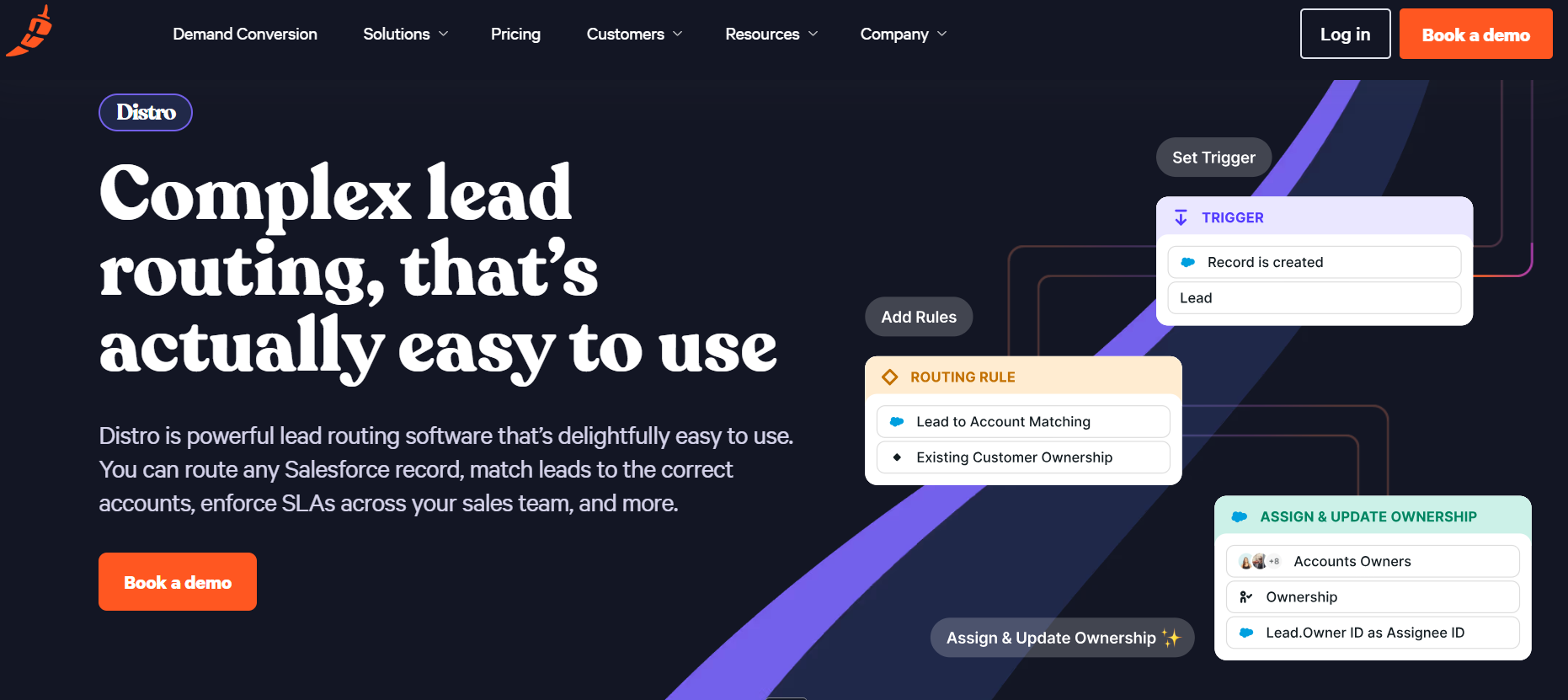
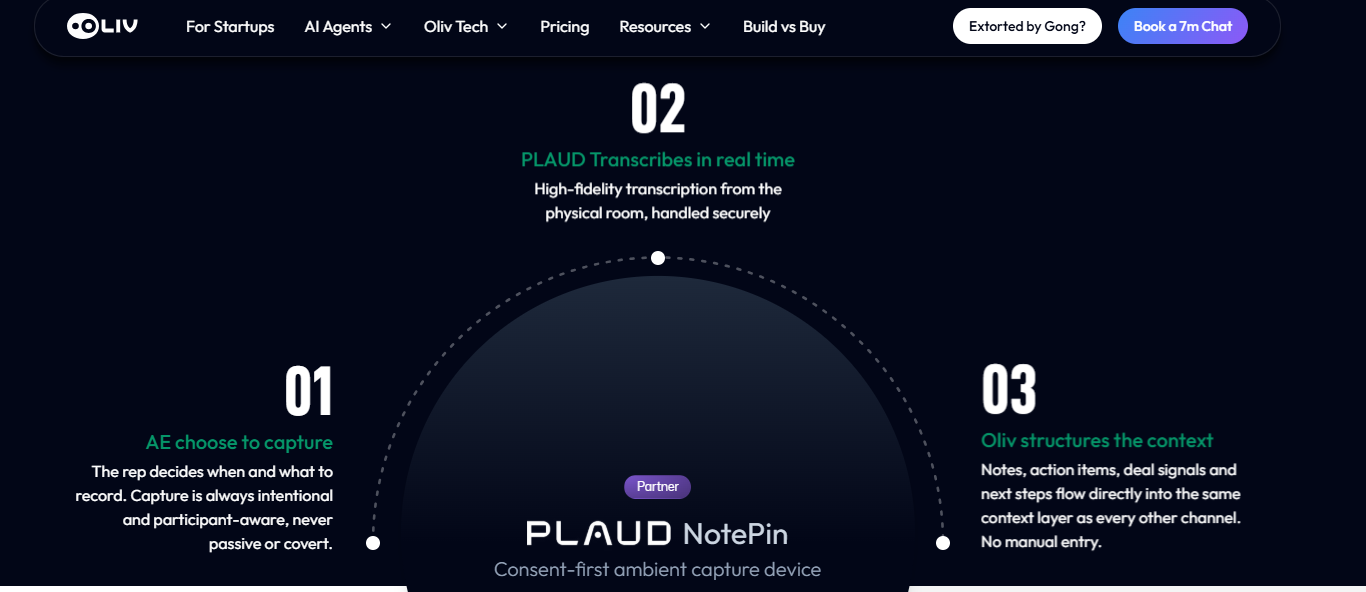

.png)
.png)
.png)

