CRO's Revenue Tool Landscape — Which Platform Wins for Growing Mid-Market Teams?
Written by
Ishan Chhabra
Last Updated :
April 3, 2026
Skim in :
14
mins
In this article
Revenue teams love Oliv
Here’s why:
All your deal data unified (from 30+ tools and tabs).
Insights are delivered to you directly, no digging.
AI agents automate tasks for you.
Thank you! Your submission has been received!
Oops! Something went wrong while submitting the form.
Meet Oliv’s AI Agents
Hi! I’m, Deal Driver
I track deals, flag risks, send weekly pipeline updates and give sales managers full visibility into deal progress
Hi! I’m, CRM Manager
I maintain CRM hygiene by updating core, custom and qualification fields all without your team lifting a finger
Hi! I’m, Forecaster
I build accurate forecasts based on real deal movement and tell you which deals to pull in to hit your number
Hi! I’m, Coach
I believe performance fuels revenue. I spot skill gaps, score calls and build coaching plans to help every rep level up
Hi! I’m, Prospector
I dig into target accounts to surface the right contacts, tailor and time outreach so you always strike when it counts
Hi! I’m, Pipeline tracker
I call reps to get deal updates, and deliver a real-time, CRM-synced roll-up view of deal progress
Hi! I’m, Analyst
I answer complex pipeline questions, uncover deal patterns, and build reports that guide strategic decisions
TL;DR
First-gen CI tools like Gong and Clari document conversations but fail to execute post-call work, leaving reps with 2 to 3 hours of manual CRM updates weekly.
Oliv AI deploys autonomous agents that update structured CRM fields, draft follow-ups, and manage action plans without a single manual click.
Legacy platforms measure deal health by activity volume, not engagement quality, causing stalled deals and inflated pipelines that surprise CROs at quarter-end.
Oliv's evidence-based audit trail links every deal flag to clickable call clips, email snippets, and engagement signals, replacing narrative-driven forecasts with verifiable data.
Mid-market teams can migrate from Gong with zero data loss using Oliv's free migration services and prove value at $19 per user before scaling.
Oliv supports segmented revenue processes for SMB, mid-market, and enterprise on a single instance, eliminating duplicate tooling and dirty data.
Q1: What Is the Best Revenue Intelligence Platform for Mid-Market Sales Teams in 2026? [toc=Best Mid-Market Platform 2026]
If you are a mid-market CRO evaluating revenue intelligence platforms in 2026, you have likely discovered that the real cost is not any single tool. It is the "stack tax" of layering three to four overlapping products that still leave your team doing manual work. The revenue technology market has now moved through four distinct generations: Revenue Operations (2015 to 2022), Revenue Intelligence (Gen 2), Revenue Orchestration (2022 to 2025), and the current era of GTM Engineering, where AI agents perform the work rather than adding another dashboard to manage.
⚠️ The Legacy Stack Problem
The platforms that dominated the last decade were built for documentation and dashboards, not execution. Here is where each falls short for growing mid-market teams:
Gong remains focused almost exclusively on conversation intelligence. Its additional products, Forecast and Engage, come at significant extra cost, and the platform struggles beyond CI. As one reviewer noted, additional features are siloed behind paywalls rather than bundled into the core offering.
Clari provides a solid forecasting overlay on Salesforce, but its core intelligence is still rep-driven and requires manual input. Following its acquisition of Groove, Clari's engagement layer has drawn consistent criticism for usability gaps.
Salesforce Agentforce carries a massive installed base but is architecturally B2C-focused, heavily chat-based, requiring reps to manually interact with bots rather than receiving autonomous outputs.
Chorus (ZoomInfo) handles basic call recording and transcription, but its context recognition remains limited to keyword matching, and its roadmap has stalled post-acquisition.
✅ The Agentic Shift: AI That Does the Work
The category has shifted toward agentic platforms, tools where AI agents autonomously update the CRM, draft follow-ups, generate forecasts, and flag deal risks without human triggers. This is not a feature upgrade; it is a fundamentally different architecture where 30+ specialized agents each perform a specific "Job to be Done".
Mid-Market Platform Comparison (2026)
Dimension
Gong
Clari
SF Agentforce
Chorus
Oliv AI
Primary Strength
Conversation Intelligence
Forecasting Overlay
CRM + CDP (B2C)
Basic CI / Recording
Unified CI + Forecasting + Engagement
CRM Field-Level Auto-Update
❌ Notes only
❌ Manual input
⚠️ Rule-based
❌ Notes only
✅ Object & property level
Pricing (per user/mo)
~$120 to $250+
~$100 to $200+
~$150 to $500+
Bundled w/ ZoomInfo
Starts at $19/user
Implementation Time
4 to 8 weeks
4 to 12 weeks
3 to 6 months
2 to 4 weeks
1 to 2 days
AI Architecture
ML V1 (keyword)
Pre-generative
Rule-based + chat
ML V1 (keyword)
Generative AI-native (fine-tuned LLMs)
Platform Fees
💸 $5K to $50K/yr
Per-module add-ons
Credit-based upsells
ZoomInfo bundle
None
⭐ Why Oliv AI Leads for Mid-Market Teams
Oliv AI is the only platform on this list that unifies conversation intelligence, deal forecasting, and sales engagement into a single ecosystem, delivering what Ishan Chhabra, CEO, describes as "double the functionality at half the price." For a 100-user mid-market team, the three-year TCO comparison shows a 91% cost advantage over a Gong-anchored stack, with reported gains of 35% higher win rates and shortened sales cycles.
"The additional products like forecast or engage come at an additional cost. Would be great to see these tools rolled into the core offering." Scott T., Director of Sales Gong G2 Verified Review
"Clari should find ways to differentiate from the native Salesforce features (e.g. Pipeline Inspection, Forecasting) in order to remain competitive in the long-run." Dan J. Clari G2 Verified Review
Q2: Why Are Teams Switching from First-Gen CI Tools to Agentic Platforms? [toc=Switching to Agentic Platforms]
Revenue teams are deep in what industry analysts call the "Trough of Disillusionment" with their current tech stacks. First-generation tools focused on recording and documentation, and while meetings now routinely have multiple AI note-takers joining, the actual task completion rate has not improved. This "note-taker fatigue" has created a high total cost of ownership for what amounts to passive recording: you get intelligence (data on a screen), but not execution (work actually getting done).
❌ Where First-Gen CI Falls Short
The core issue with tools like Gong and Chorus is not that they do not work. It is that they stop at the "dashcam" stage:
Keyword-dependent intelligence: Gong's Smart Trackers are built on ML V1 keyword matching. They cannot distinguish between a competitor mentioned in passing and a genuine active-evaluation threat. Setting up these trackers is laborious, and the output is often noise rather than signal.
No downstream execution: Recording a call does not update CRM fields, draft follow-up emails, or flag methodology gaps. Reps still have to do all of that manually after the tool has done its part.
Stalled innovation post-acquisition:Chorus's technology roadmap has largely frozen since the ZoomInfo acquisition. Users report the platform handles basics well but fails at advanced context recognition.
"It can be overwhelming to set up trackers. AI training is a bit laborious to get it to do what you want." Trafford J., Senior Director, Revenue Enablement Gong G2 Verified Review
"The software doesn't have the capability of identifying words/phrases that are similar to what you're looking for or understand context, so if you don't tell it exactly what you're looking for then you'll miss out." Director of Sales Operations Chorus Gartner Verified Review
⏰ The Four Generations of Revenue Technology
Revenue technology has evolved through four distinct generations, with agentic AI platforms now performing the work rather than adding dashboards.
The market has evolved through a clear trajectory that explains why switching is accelerating now:
Gen 1: Revenue Operations (2015 to 2022): Focused on documentation and CRM plumbing.
Gen 2: Revenue Intelligence: The "dashcam" era. Gong and Chorus record and surface data.
Gen 3: Revenue Orchestration (2022 to 2025): Clari and 6sense add forecasting and signal layers.
Gen 4: GTM Engineering (2025+): Agentic platforms where AI performs the work autonomously.
In this new era, modern revenue leaders are moving away from traditional software that requires heavy human adoption. Instead, they are deploying an agentic workforce, AI agents that do the work rather than providing another dashboard to manage.
✅ How Oliv AI Leads the GTM Engineering Category
Oliv operates on a three-layer architecture purpose-built for this generational shift:
Foundation Layer: An AI Data Platform that automatically tracks and manages all sales data from unstructured sources (calls, emails, Slack, and LinkedIn), performing AI-based object association to map activities to the correct accounts.
Intelligence Layer: 100+ fine-tuned models that extract specific signals, including competitor mentions, churn risks, and feature requests, across the deal lifecycle.
Activation Layer: 30+ specialized AI agents (CRM Manager, Deal Driver, Forecaster, Coach, and Researcher) that take intelligence and perform specific jobs autonomously, delivering outputs where the team already works.
This means teams do not add another tool to their stack. They replace the entire legacy stack with a single agentic ecosystem. The CRM Manager Agent handles what Gong cannot (field-level CRM updates). The Deal Driver Agent replaces Clari's manual forecasting inputs. The Follow-up Maniac agent eliminates the post-call admin work that engagement tools like Outreach were built to address.
Q3: Aren't All These AI Sales Tools Basically the Same Under the Hood? [toc=AI Tool Differences Explained]
Short answer: no, but it is understandable why it feels that way. Every vendor in 2026 claims "AI agents," "autonomous workflows," and "intelligent automation." The reality is that most legacy platforms bolted AI marketing language onto decade-old architectures. Revenue leaders face a genuine "AI noise" problem where implementation results range from hallucinating summaries to glorified chatbots that still require manual triggers.
❌ The Three Tiers of "AI" in Sales Tools
Not all AI is created equal. Here is the actual technical landscape:
AI Tiers in Sales Tools
Tier
How It Works
Who Uses It
Key Limitation
V1: Keyword Matching (ML V1)
Flags mentions of pre-defined terms (e.g., "budget," "competitor name")
Gong Smart Trackers, Chorus
Cannot understand context. Flags "budget" even in "holiday budget" discussions
V2: Rule-Based Automation
If/then logic chains triggered by predefined conditions
Salesforce Einstein, Agentforce
Breaks on edge cases. Misassociates activities with duplicate CRM records
V3: Generative AI-Native (LLM + CoT)
Fine-tuned LLMs using Chain of Thought reasoning grounded in customer data
Oliv AI
Requires quality data ingestion, but eliminates hallucination through grounding
The gap between V1 and V3 is not incremental. It is architectural. A keyword tracker flagging "Competitor X" cannot tell you whether the prospect mentioned them in passing or is actively running a parallel evaluation. A Chain of Thought reasoning model can.
"AI is not great yet. The product still feels like it's at its infancy and needs to be developed further." Annabelle H., Board Director Gong G2 Verified Review
⚠️ Why "Chat-Based AI" Misses the Point
Salesforce Agentforce represents the V2 approach: its agents are fundamentally chat-based, requiring reps to manually navigate to a bot and ask questions. This UX model is architecturally wrong for B2B sales because it puts the burden of initiation on the rep, the person least likely to stop mid-deal to type a question into a chatbot. The setup process compounds this problem: users report complexity, steep learning curves, and costs that "ramp up pretty quickly" once you scale beyond basic use cases.
✅ How Oliv's Architecture Is Fundamentally Different
Oliv AI is generative AI-native from the ground up, not a legacy platform with AI bolted on. Here is what that means in practice:
Fine-tuned grounding: Oliv operates 100+ fine-tuned models built exclusively on each customer's data lake. It never pulls from general knowledge when analyzing deal risks, effectively eliminating the hallucination problem that plagues generic AI tools.
Transcript Reasoning (Chain of Thought): Instead of keyword matching, Oliv's models reason through conversation transcripts to understand nuanced intent, knowing when a champion is genuinely souring on a deal versus raising a procedural compliance concern.
5-minute processing: Oliv delivers processed recordings and AI-generated summaries within 5 minutes of a call ending, compared to the 20 to 30 minute delays typically experienced with older platforms.
The output difference is tangible: where Gong gives you a transcript with keyword highlights, Oliv gives you updated CRM fields, a drafted follow-up email in your Gmail, and a risk assessment with clickable evidence, all before you have finished your post-call coffee.
Q4: Why Does Every Tool Require Me to Click 10 Screens to Find Something? [toc=Dashboard Fatigue Fix]
If you manage 8 to 12 reps running 25 to 35 calls per day, you already know this pain. You are spending evenings, showering, driving, drinking coffee, listening to call recordings at 2x speed just to find a single actionable deal update. The UX of most revenue tools was not designed for the Sales Manager's reality; it was designed for the RevOps admin who configured it.
❌ The "Pull" System Trap
Legacy revenue platforms are fundamentally "pull" systems. They store intelligence and wait for you to come find it. This creates a compounding visibility gap:
Gong sends Slack notifications for every recorded call, but managers still have to click through multiple screens to locate the actual insight. The platform becomes a firehose of noise without a filter for what matters right now.
Clari provides solid forecasting dashboards, but the Omnibar interface has drawn consistent criticism for being "very click-intensive to accomplish basic tasks."
Chorus offers transcripts and summaries, but managers report that summaries miss important details, forcing them back into full transcript reviews, exactly the manual work the tool was supposed to eliminate.
The result? Managers see only the deals reps want them to see, and the real risks stay buried behind the tenth click.
"It's too complicated, and not intuitive at all. Using it is very...discomforting. Searching for calls is not easy, moving around in the calls is not easy, and understanding the pipeline management portion of it is almost impossible." John S., Senior Account Executive Gong G2 Verified Review
"I wish the meeting summaries were more detailed. I find that it misses a lot. I can go back into the transcripts but I do not love doing that and it takes time I don't have." Natalie G., Bilingual Account Manager Chorus G2 Verified Review
✅ From "Pull" to "Push": The Invisible UI
The fix is not a better dashboard. It is no dashboard at all. The shift from "pull" to "push" intelligence means the system delivers finished analysis to managers exactly where they already live: Slack, Gmail, and the CRM.
Oliv AI was architected around this principle with what the team calls the "Invisible UI," agents that deliver intelligence directly to your existing workflow without requiring a single additional login:
Morning Brief: Proactive alerts on the day's important meetings and prep notes delivered 30 minutes before each call.
Sunset Summaries: Every evening, a one-page pulse lands in your Slack or inbox showing which deals moved, which stalled, and which were won, no digging required.
Weekly Portfolio Recaps: A complete pipeline review highlighting only the deals that progressed or are at risk, with the Forecaster Agent's unbiased commentary attached.
⭐ Reclaiming the Manager's Day
Managers reclaim an estimated one full day per week that previously went to manual dashboard digging and after-hours call reviews.
"Gong blew up my Slack all day... With Oliv, I finally get what I need, forecast, pipeline review, deal updates, dropped right in my inbox." Mia Patterson, Sales Manager, Beacon
The difference is structural: legacy tools ask the manager to find the information. Oliv sends the manager finished analysis with evidence-backed recommendations, before they even ask for it.
Q5: We Spend a Fortune on Tools. Why Do Reps Still Do Everything Manually After Calls? [toc=Manual Post-Call Work]
Here is the uncomfortable truth most VP Sales will not hear from their vendors: CRM as a product has failed. Not because the technology does not work, but because data entry is fundamentally disconnected from the act of selling. Reps care deeply about not dropping the ball on next steps, but they view CRM updates as administrative policing. The result is predictable: "meaningless" data, 2 to 3 hours per week wasted on manual follow-ups, and six-figure tool investments that still leave reps doing everything by hand after every call.
❌ Why Legacy Tools Stop at Documentation
The core failure of pre-generative platforms is that they record the work but do not do the work:
Gong logs meeting summaries as unstructured "Notes," useful for reference but completely unusable for automated reporting. It does not update actual CRM properties, which means RevOps still cannot run native reports on deal qualification or methodology adherence.
Salesforce Agentforce takes a chat-based approach, requiring reps to manually navigate to a bot and ask questions. This UX puts the burden on the person least likely to pause mid-deal to type into a chatbot.
Gong Engage promised to bridge the gap between CI and execution, but users report it "lacks task APIs, does not integrate with other vendors or parallel dialers, and is not built to function as a proper sequencing tool."
"Gong is strong at conversation intelligence, but that's where its usefulness ends... The tool is slow, buggy, and creates an excessive administrative burden on the user side." Anonymous Reviewer Gong G2 Verified Review
"It is really just a glorified SFDC overlay. Actually, Salesforce has built most of the forecasting functionality by now anyway so I'm not sure where they fit into that whole overcrowded Martech space." conaldinho11, r/SalesOperations Reddit Thread
⏰ The Shift from Documentation to Execution
The paradigm shift redefining this category is simple: the tool should do the post-call work, not ask the rep to do it differently. This means autonomous CRM updates, auto-drafted follow-up emails, and self-managing action plans, all triggered without a single manual click.
The shift from documentation to execution means the tool does the post-call work, not the rep.
✅ Oliv's Hands-Free Workforce
Oliv AI was built for this exact problem. Instead of adding more screens to manage, we deploy agents that integrate directly into the rep's existing workflow:
CRM Manager Agent updates actual CRM objects and properties (not just notes) based on conversation context. It is trained on 100+ sales methodologies (MEDDIC, BANT, and SPICED) and auto-populates custom fields seconds after a call ends.
Follow-up Maniac Agent drafts personalized, multi-step follow-up email sequences directly in Gmail drafts within minutes of a meeting. No rep input required.
MAP Manager Agent automatically creates and updates mutual action plans after every activity, tracking due dates and dependencies across the deal lifecycle.
The entry barrier is deliberately low: Oliv's baseline intelligence plan starts at $19/user for recording and transcription, making it possible to prove value in weeks rather than committing to a six-figure annual contract upfront.
Q6: What Is Really Behind Stalled Deals: Process Gaps or Tooling Gaps? [toc=Stalled Deals Root Cause]
Every CRO has experienced the gut punch: a deal that looked healthy all quarter suddenly appears as "stalled" in the final week. The pipeline showed green, activity was high, the rep reported positive sentiment, and the dashboards confirmed engagement. So what went wrong? In most cases, the organization is suffering from "Fake Coverage," a pipeline that looks robust by activity volume but actually contains ghosted prospects and one-sided outreach.
❌ The Activity Bias Trap
Legacy revenue intelligence platforms measure deal health based on activity volume rather than engagement quality. This creates a fundamentally misleading picture:
Gong tracks activity stats, including emails sent, calls logged, and meetings scheduled. But it cannot distinguish between a rep chasing an unresponsive prospect and a genuine two-way strategic conversation.
Clari provides solid pipeline visualization, but its forecasting relies on reps and managers manually inputting assessments. As one Reddit user noted: "Clari is a tool for sales leaders, it adds no value to reps as far as I can see."
When your tool counts "10 emails sent" as deal progress without checking whether anyone replied, your pipeline confidence is built on sand.
"There's so much in Gong, that we don't use everything. Gong's deal forecasting we don't use." Karel Bos, Head of Sales Gong TrustRadius Verified Review
"Clari is a tool for sales leaders, it adds no value to reps as far as I can see." Msoave, r/sales Reddit Thread
⚠️ Process vs. Tooling: A Diagnostic Framework
Before blaming the tool, CROs should ask four diagnostic questions:
Are deals stalling at the same stage repeatedly? This is likely a process gap (broken qualification criteria or missing exit requirements).
Are reps logging activity but prospects are not responding? This is likely a tooling gap (your platform tracks outbound volume, not inbound engagement).
Do managers only discover stalled deals during forecast calls? Both: the process lacks automated checkpoints, and the tool does not push alerts proactively.
Is the pipeline inflated with "zombie" opportunities older than 2x your average cycle? Process gap: your team lacks auto-archival rules and pipeline hygiene cadences.
✅ Oliv's Meaningful Engagement Tracking
Oliv AI replaces activity-based deal health with Meaningful Engagement Tracking, a fundamentally different measurement approach:
Deal Driver Agent tracks when the last real interaction occurred (a meeting, a strategic email exchange, or a prospect-initiated response) rather than counting outbound blasts. It proactively flags deals where the prospect has gone unresponsive, delivering contextual alerts directly to the manager's Slack.
Forecaster Agent inspects every deal line-by-line using conversation data, ignoring the "stories" reps tell their managers. It produces unbiased weekly roll-ups with AI commentary on which deals are likely to slip versus quick wins.
The combination means CROs stop getting surprised, because the system identifies the root cause (process or tooling) before the deal dies.
Q7: What Category of Tools Actually Updates CRM Fields Automatically, Not Just Notes? [toc=Auto CRM Field Updates]
This is one of the most misunderstood distinctions in the revenue intelligence market. When vendors say "CRM integration," most mean they log meeting summaries as unstructured text in a Notes or Activity field. That is documentation, not automation. The critical question for CROs and RevOps leaders is: does the tool update actual CRM objects and properties, the structured fields that power reports, dashboards, and forecasting models?
❌ The Notes vs. Properties Problem
Here is how the leading platforms actually handle CRM data:
CRM Data Handling by Platform
Platform
What Gets Written
Where It Goes
Reportable in CRM?
Gong
Meeting summaries, transcript highlights
Notes / Activity field
❌ No, unstructured text
Chorus
Call summaries, action items
Notes / Activity field
❌ No, unstructured text
Salesforce Einstein
Activity associations via rule-based logic
Activity Capture (separate instance)
⚠️ Partially, but brittle and frequently misassociates with duplicate records
Clari
Forecast inputs, pipeline stage
Overlay on CRM
⚠️ Requires manual manager input
Oliv AI
Custom fields, methodology scores, contacts, and deal stages
CRM Objects & Properties directly
✅ Yes, fully structured and reportable
⚠️ Why This Distinction Matters
The consequences are significant. When data stays in Notes fields, RevOps cannot run native CRM reports on deal health, qualification scores, or methodology adherence. Every quarter-end "pipeline scrub" becomes a manual exercise of reading through text blocks rather than filtering structured data.
"The lack of robust data export options has made it hard to justify the platform's cost, especially as it falls short of meeting practical data management needs." Neel P., Sales Operations Manager Gong G2 Verified Review
"Suspicious numbers around Flow usages, open rates and other reporting capabilities." Business Development Associate Clari Gartner Verified Review
✅ AI-Native Revenue Orchestration: The New Category
The emerging category that solves this is AI-Native Revenue Orchestration, tools that update actual CRM objects and properties based on conversation context, not just log text.
Oliv AI's CRM Manager Agent is purpose-built for this:
Methodology-aware field population is trained on 100+ sales methodologies (MEDDIC, BANT, and SPICED). The agent auto-populates complex qualification fields based on what was actually discussed in meetings and emails.
Contact creation and enrichment automatically creates new contacts, enriches existing records, and associates activities to the correct accounts using LLM-based reasoning (not brittle rule-based logic).
Deal generation creates new opportunities based on qualification criteria detected in conversations, eliminating the lag between a discovery call and a CRM entry.
The data is structured, instantly reportable, and lives in actual CRM fields, exactly where RevOps needs it for native dashboards and forecasting models.
"Before switching to Oliv, cleaning up messy CRM fields used to swallow half my week. Oliv fixes the data as it happens." Darius Kim, Head of RevOps, Driftloop
Q8: What Tools Can Give Me a Daily List of Deals That Need Attention? [toc=Daily Deal Alerts]
If you are managing 6 to 12 reps running 35 calls a day, your visibility gap is not a knowledge problem. It is a delivery problem. You know what information you need: which deals progressed, which stalled, and which require intervention today. The issue is that legacy tools bury this intelligence behind dashboards you do not have time to dig through, and you end up seeing only the deals your reps want you to see.
❌ The Cost of "Pull" Systems
Legacy platforms place the burden of discovery on the manager:
Gong provides deal boards and trackers, but extracting a daily action list requires navigating multiple views, filtering by rep, and manually assessing which deals actually need attention. It is powerful intelligence locked behind a complex UI.
Clari offers pipeline views that reps appreciate for updating Salesforce in a single screen, but the alerts system still requires significant RevOps configuration. Setting up meaningful thresholds in first-gen tools demands 40 to 140 admin hours of manual keyword definition, a burden most mid-market teams simply cannot absorb.
Chorus sends automated summaries after meetings, but managers report the summaries miss critical details, forcing a return to full transcripts.
"For me, the only business problem Gong solves is the call recordings. It allows me to review my calls and listen to them so that I can understand either where I went wrong or what the customer really said." John S., Senior Account Executive Gong G2 Verified Review
"I wish the meeting summaries were more detailed. I find that it misses a lot. I can go back into the transcripts but I do not love doing that and it takes time I don't have." Natalie G., Bilingual Account Manager Chorus G2 Verified Review
⏰ From Manager-Initiated Review to AI-Initiated Briefing
The fundamental shift is architectural: instead of asking managers to dig through dashboards, the system should deliver a curated daily action list, not raw data, to where the manager already works. This is the difference between a "pull" system and a "push" system.
✅ Oliv's Autonomous Deal Driving Cadence
Oliv AI delivers a complete manager intelligence cadence without requiring a single dashboard login:
Morning Brief delivers proactive alerts on the day's important meetings, including prep notes delivered 30 minutes before each call with context from prior interactions.
Deal Driver Agent reviews 100% of interactions daily and flags specific contextual risks, such as an Economic Buyer going silent, a champion's sentiment shifting, or a deal stuck past its expected close date, directly to the manager's Slack.
Sunset Summaries land every evening as a one-page pulse in the manager's inbox showing which deals moved, which stalled, and which were won that day.
Weekly Pipeline Recap provides a complete portfolio review with the Forecaster Agent's unbiased commentary on deal risks and quick-win opportunities, delivered as a presentation-ready deck every Monday.
This cadence reclaims an estimated one full day per week that previously went to manual dashboard digging and after-hours call reviews.
"Gong blew up my Slack all day... With Oliv, I finally get what I need, forecast, pipeline review, deal updates, dropped right in my inbox." Mia Patterson, Sales Manager, Beacon
Q9: Can a Revenue Intelligence Platform Show Evidence Snippets for Why a Deal Is Flagged? [toc=Evidence-Based Deal Flags]
When a rep marks a deal as "Qualified," sales managers face an uncomfortable choice: take the rep at their word or carve out 45 minutes to listen to the full call recording. Neither option scales. This "Data Trust" problem is the hidden bottleneck in forecast accuracy, because every layer of the revenue hierarchy is built on the previous layer's narrative, not verifiable signals. By the time the CRO submits a board-ready forecast, it is a stack of stories, not a stack of evidence.
⚠️ Why Legacy Tools Cannot Close the Trust Gap
Traditional forecasting and conversation intelligence platforms were never designed for evidence-based deal verification. Clari's forecasting model relies on managers manually inputting their assessments after verbal check-ins with reps, creating a "rep-driven, biased" signal chain where subjective confidence replaces objective proof. Gong, while strong at recording and transcribing calls, stores summaries as unstructured text blocks. There is no direct hyperlink from a deal risk flag to the specific call timestamp or email exchange that triggered it.
Managers who want to verify a deal's qualification status must manually scrub through recordings, toggle between tabs, and piece together context from disconnected data sources.
"What I find least helpful is that some of the features that are reported don't actually tell me where that information is coming from. I.e. Where my weighted number is coming from or how it is being calculated would be helpful." Jezni W., Sales Account Executive Clari G2 Verified Review
"Searching for calls is not easy, moving around in the calls is not easy, and understanding the pipeline management portion of it is almost impossible." John S., Senior Account Executive Gong G2 Verified Review
✅ The AI-Era Shift: Evidence-Based Qualification
Evidence-based qualification links every deal flag to clickable source material, replacing the stack of stories with a stack of evidence.
Evidence-based qualification flips the audit process entirely. Instead of asking managers to verify claims, the platform links every AI-generated risk flag, qualification score, or deal assessment directly to a clickable source, a specific call clip, email snippet, or LinkedIn signal. This creates a transparent audit trail from the executive forecast all the way down to the raw buyer interaction, making it possible to verify any data point in seconds rather than hours.
✅ How Oliv.ai Delivers a Clickable Audit Trail
Oliv.ai was built from the ground up for 100% evidence-based qualification. Users can click on any MEDDPICC field, for example "Identify Pain," and instantly see the full history of how that field evolved over time: exactly which call clip, email snippet, or LinkedIn signal contributed each data point. There is no ambiguity about when or where a qualification criterion was confirmed.
The Forecaster Agent takes this further by inspecting every deal line-by-line as an unbiased observer. It ignores the narratives reps craft for their managers and instead evaluates deals based solely on conversation data and engagement signals. When a deal is flagged as at-risk, the flag itself is clickable, leading directly to the evidence that triggered it.
"You have to click around through the different modules and extract the different pieces ultimately putting it in an excel for easier manipulation." Natalie O., Sales Operations Manager Clari G2 Verified Review
⭐ What the Audit Trail Looks Like in Practice
Imagine a deal flagged "At Risk: Champion Sentiment Declining." In Oliv, a manager clicks the flag and sees: a 12-second call clip from Tuesday where the champion expressed budget concerns, an email from Thursday where the reply tone shifted from enthusiastic to noncommittal, and a LinkedIn signal showing the champion updated their job title. Every signal is timestamped, sourced, and linked. No guesswork, no "pull" required. We built this because forecasts should be grounded in facts, not stories.
Q10: Can One Platform Support SMB, Mid-Market, and Enterprise Sales Processes Simultaneously? [toc=Multi-Segment Sales Support]
Growth-stage companies almost always outgrow their initial sales motion. A team that started closing $5K SMB deals in 15 days eventually pursues $500K mid-market opportunities and $1M+ enterprise contracts with 90-day cycles. The problem is that legacy CRMs and revenue tools force every deal, regardless of size, complexity, or buyer journey, into a single standardized workflow. The result is predictable: reps ignore fields irrelevant to their segment, managers get "dirty data," and RevOps spends endless hours building workarounds.
❌ The "Standardized Rigidity" Problem in Legacy Tools
HubSpot and Salesforce impose a one-size-fits-all CRM structure. An SMB rep closing transactional deals is required to fill in the same fields as an Enterprise AE navigating a multi-stakeholder procurement. Rather than helping reps sell, this adds administrative burden that experienced reps simply bypass, leaving behind incomplete, unreliable data.
On the conversation intelligence side, Gong applies identical scoring criteria to every call regardless of segment. An SMB discovery call is evaluated with the same metrics as an enterprise technical review, producing misleading coaching insights and inaccurate deal-health scores.
"I find the setup process challenging, especially when migrating fields from Salesforce, as it can't handle formula fields directly. This requires creating and maintaining duplicate fields, which adds complexity and workload... the flexibility in setting up hierarchies is lacking, as it relies on CRM's static hierarchy that doesn't accommodate midyear team changes efficiently." Josiah R., Head of Sales Operations Clari G2 Verified Review
"There's so much in Gong, that we don't use everything. Gong's deal forecasting we don't use." Karel Bos, Head of Sales Gong TrustRadius Verified Review
✅ What Modern Multi-Segment Revenue Architecture Requires
The AI-era solution is configurable revenue process mapping, the ability to define distinct deal stages, custom fields, required qualification outcomes, and evaluation criteria per segment, all within a single platform instance. This eliminates the need for separate CRM orgs, segment-specific tool stacks, or admin-heavy customization that takes weeks to implement and months to maintain.
✅ How Oliv.ai Powers Segmented Revenue Processes
Oliv.ai supports Segmented Revenue Processes natively. Revenue leaders can configure distinct processes, SMB, Mid-Market, and Enterprise, each with their own stages, custom fields, and required outcomes. An AE selling to SMBs gets a different team of agents optimized for high-velocity deal management: rapid meeting summaries, automated CRM updates after short discovery calls, and streamlined follow-up sequences. An Enterprise AE, on the other hand, is supported by agents configured for deep account dossiers, multi-threaded stakeholder mapping, and complex MEDDPICC tracking.
We deliver this on a single Oliv instance. No duplicate tooling, no RevOps overhead to maintain parallel workflows, and no "dirty data" caused by reps ignoring fields that do not apply to their segment.
"Clari should find ways to differentiate from the native Salesforce features (e.g. Pipeline Inspection, Forecasting) in order to remain competitive in the long-run. Additionally, it's sometimes difficult if you don't have a strong RevOps/RevTech team to maintain validation rules in both Salesforce and Clari instances." Dan J. Clari G2 Verified Review
⭐ Real-World Use Case
A growth-stage SaaS company running a 15-day SMB cycle alongside a 90-day enterprise cycle deploys different agent configurations on the same Oliv instance. SMB reps receive instant post-call summaries and one-click CRM updates. Enterprise AEs receive detailed account intelligence briefs, multi-contact engagement timelines, and proactive champion risk alerts, all without duplicating a single tool or adding RevOps headcount.
Q11: How Do Mid-Market Companies Migrate Off Legacy CI Without Losing Historical Data? [toc=CI Migration Playbook]
Migrating from a legacy conversation intelligence platform is one of the most anxiety-inducing decisions for mid-market revenue leaders. Historical recordings, deal metadata, call transcripts, and coaching libraries represent years of institutional knowledge. The fear of losing this data, or enduring months of operational disruption, keeps many teams locked into contracts with vendors they have outgrown. Below is a practical, step-by-step migration playbook designed to preserve data continuity while minimizing downtime.
Step 1: Audit Your Current Data Inventory
Before initiating any migration, catalog exactly what needs to move:
Call recordings (audio/video files)
Transcripts and AI-generated summaries
Deal metadata (tags, scores, and custom fields)
Coaching playlists and snippet libraries
CRM field mappings and integration configurations
Document which data lives in the CI platform, which resides in the CRM, and which exists only in unstructured notes or activity logs.
Step 2: Export Data from Your Legacy Platform
This is where most teams encounter friction. Gong, for instance, provides API access for data export but requires downloading calls individually, a process that is impractical at scale.
"This lack of flexibility has required us to engage our development team at additional cost, adding significant operational and opportunity costs just to extract data we already own." Neel P., Sales Operations Manager Gong G2 Verified Review
⚠️ Critical: If you have six months or less on your current contract, begin engaging the vendor's API documentation immediately. Bulk export capabilities vary significantly by vendor, and workarounds may require engineering resources.
Step 3: Verify CRM Data Integrity
Before switching platforms, ensure your CRM (Salesforce or HubSpot) contains the baseline deal data you need. Run reports on:
Opportunity field completion rates
Contact and account record accuracy
Activity log coverage gaps
Any CI platform that wrote data only to "Notes" fields (rather than structured CRM properties) will leave gaps that need to be backfilled before the new platform can operate at full capacity.
Step 4: Import Historical Data into the New Platform
Work with your new vendor to import historical recordings, transcripts, and metadata. Confirm the following before cutover:
Recording playback quality is preserved
Transcript timestamps and speaker labels are intact
Deal-level metadata maps correctly to the new platform's data model
Step 5: Run a Parallel Period (2 to 4 Weeks)
Operate both platforms simultaneously for two to four weeks. This allows your team to validate that the new platform captures all meetings, syncs to the CRM accurately, and delivers comparable (or superior) intelligence without gaps.
Step 6: Decommission and Confirm Full Export
Upon contract termination with the legacy vendor, request a full data export in a usable format (CSV, JSON, or equivalent). Verify completeness before access is revoked.
"The lack of robust data export options has made it hard to justify the platform's cost, especially as it falls short of meeting practical data management needs." Neel P., Sales Operations Manager Gong G2 Verified Review
✅ How Oliv.ai Simplifies Migration
Oliv.ai provides complete data migration services from Gong at no additional cost, including importing historical recordings and metadata. Upon termination, Oliv provides a full CSV dump of all meetings and recordings in a usable format. We maintain the CRM as the single source of truth by pushing all insights directly into HubSpot or Salesforce properties, ensuring your data is never trapped in a proprietary silo.
Q12: Is $19/User Enough to Prove Value Before Committing to the Full Platform? [toc=Modular Pricing ROI]
CFOs in 2026 are operating in what analysts call the "Trough of Disillusionment" regarding AI spend. After two years of inflated promises and underdelivered ROI from AI-powered tools, finance leaders now refuse to approve multi-year, six-figure commitments for unproven platforms. Mid-market revenue teams are caught in the crossfire: they need modern tooling to compete, but they lack the budget runway to gamble on monolithic contracts. The winning strategy in this environment is not to pitch a full platform on day one; it is to prove value at a minimal baseline and expand only after ROI materializes.
💰 The Hidden Cost Structure of Legacy Revenue Tools
Gong charges mandatory annual Platform Fees ranging from $5K to $50K regardless of how much value the team actually realizes. On top of that, Gong's "unified license" model costs approximately $250/month per user, meaning even reps who use only the basic recording functionality pay full price. Clari's real spend escalates to $200 to $400/user/month once Copilot and Groove modules are added. These pricing structures force teams into all-or-nothing commitments before value is demonstrated.
"It was a big mistake on our part to commit to a two year term. Gong is a really powerful tool but it's probably the highest end option on the market, and now we're stuck with a tool that works technically but isn't the right business decision." Iris P., Head of Marketing, Sales & Partnerships Gong G2 Verified Review
"The pricing is probably the biggest obstacle and hence we are looking to change." Miodrag, Enterprise Account Executive
✅ The Modular, Prove-Then-Expand Pricing Model
A 100-user team on the legacy stack costs over $1.2M across three years compared to $68,400 on Oliv, a 91% savings.
The AI-era approach to revenue tooling pricing is modular and persona-based. Teams buy only what they need today, prove value at a baseline tier within 30 days, and expand agent-by-agent as ROI materializes. No platform fees. No annual lock-in. No paying for features that sit unused.
✅ How Oliv.ai's Pricing Removes the Budget Objection
Oliv.ai's Starter tier provides recording, transcription, and AI-powered meeting summaries, a functional replacement for the core capability teams use most in Gong, at a fraction of the cost. Teams can incrementally add specialized agents (CRM automation, forecasting, and deal driving) as each tier demonstrates measurable impact. This modular architecture means a VP of Sales can greenlight a pilot without CFO escalation and expand only after proving pipeline impact.
"The additional products like forecast or engage come at an additional cost. Would be great to see these tools rolled into the core offering." Scott T., Director of Sales Gong G2 Verified Review
💸 TCO Comparison: The Math That Closes the Deal
The total cost of ownership gap between legacy stacks and Oliv is dramatic. For a 30-rep mid-market team over three years:
Three-Year TCO Comparison: Legacy Stack vs. Oliv AI
Cost Component
Gong (Standalone)
Gong + Clari Stack
Oliv AI
Per-user monthly cost
~$250/user
~$450 to $650/user
Starts at $19/user
Mandatory platform fees
$5K to $50K/year
$10K to $80K/year
$0
Annual lock-in required
✅ Yes
✅ Yes
❌ No
3-year TCO (100 users)
~$789,300
~$1.2M+
~$68,400
TCO savings vs. Gong
-
-
⭐ 91%
A 100-user team on Gong costs approximately $789,300 over three years compared to $68,400 on Oliv, a 91% savings. For mid-market teams in a budget freeze, Oliv's Starter tier removes the procurement barrier entirely: prove value in 30 days, then expand as revenue impact justifies the investment.
Q1: What Is the Best Revenue Intelligence Platform for Mid-Market Sales Teams in 2026? [toc=Best Mid-Market Platform 2026]
If you are a mid-market CRO evaluating revenue intelligence platforms in 2026, you have likely discovered that the real cost is not any single tool. It is the "stack tax" of layering three to four overlapping products that still leave your team doing manual work. The revenue technology market has now moved through four distinct generations: Revenue Operations (2015 to 2022), Revenue Intelligence (Gen 2), Revenue Orchestration (2022 to 2025), and the current era of GTM Engineering, where AI agents perform the work rather than adding another dashboard to manage.
⚠️ The Legacy Stack Problem
The platforms that dominated the last decade were built for documentation and dashboards, not execution. Here is where each falls short for growing mid-market teams:
Gong remains focused almost exclusively on conversation intelligence. Its additional products, Forecast and Engage, come at significant extra cost, and the platform struggles beyond CI. As one reviewer noted, additional features are siloed behind paywalls rather than bundled into the core offering.
Clari provides a solid forecasting overlay on Salesforce, but its core intelligence is still rep-driven and requires manual input. Following its acquisition of Groove, Clari's engagement layer has drawn consistent criticism for usability gaps.
Salesforce Agentforce carries a massive installed base but is architecturally B2C-focused, heavily chat-based, requiring reps to manually interact with bots rather than receiving autonomous outputs.
Chorus (ZoomInfo) handles basic call recording and transcription, but its context recognition remains limited to keyword matching, and its roadmap has stalled post-acquisition.
✅ The Agentic Shift: AI That Does the Work
The category has shifted toward agentic platforms, tools where AI agents autonomously update the CRM, draft follow-ups, generate forecasts, and flag deal risks without human triggers. This is not a feature upgrade; it is a fundamentally different architecture where 30+ specialized agents each perform a specific "Job to be Done".
Mid-Market Platform Comparison (2026)
Dimension
Gong
Clari
SF Agentforce
Chorus
Oliv AI
Primary Strength
Conversation Intelligence
Forecasting Overlay
CRM + CDP (B2C)
Basic CI / Recording
Unified CI + Forecasting + Engagement
CRM Field-Level Auto-Update
❌ Notes only
❌ Manual input
⚠️ Rule-based
❌ Notes only
✅ Object & property level
Pricing (per user/mo)
~$120 to $250+
~$100 to $200+
~$150 to $500+
Bundled w/ ZoomInfo
Starts at $19/user
Implementation Time
4 to 8 weeks
4 to 12 weeks
3 to 6 months
2 to 4 weeks
1 to 2 days
AI Architecture
ML V1 (keyword)
Pre-generative
Rule-based + chat
ML V1 (keyword)
Generative AI-native (fine-tuned LLMs)
Platform Fees
💸 $5K to $50K/yr
Per-module add-ons
Credit-based upsells
ZoomInfo bundle
None
⭐ Why Oliv AI Leads for Mid-Market Teams
Oliv AI is the only platform on this list that unifies conversation intelligence, deal forecasting, and sales engagement into a single ecosystem, delivering what Ishan Chhabra, CEO, describes as "double the functionality at half the price." For a 100-user mid-market team, the three-year TCO comparison shows a 91% cost advantage over a Gong-anchored stack, with reported gains of 35% higher win rates and shortened sales cycles.
"The additional products like forecast or engage come at an additional cost. Would be great to see these tools rolled into the core offering." Scott T., Director of Sales Gong G2 Verified Review
"Clari should find ways to differentiate from the native Salesforce features (e.g. Pipeline Inspection, Forecasting) in order to remain competitive in the long-run." Dan J. Clari G2 Verified Review
Q2: Why Are Teams Switching from First-Gen CI Tools to Agentic Platforms? [toc=Switching to Agentic Platforms]
Revenue teams are deep in what industry analysts call the "Trough of Disillusionment" with their current tech stacks. First-generation tools focused on recording and documentation, and while meetings now routinely have multiple AI note-takers joining, the actual task completion rate has not improved. This "note-taker fatigue" has created a high total cost of ownership for what amounts to passive recording: you get intelligence (data on a screen), but not execution (work actually getting done).
❌ Where First-Gen CI Falls Short
The core issue with tools like Gong and Chorus is not that they do not work. It is that they stop at the "dashcam" stage:
Keyword-dependent intelligence: Gong's Smart Trackers are built on ML V1 keyword matching. They cannot distinguish between a competitor mentioned in passing and a genuine active-evaluation threat. Setting up these trackers is laborious, and the output is often noise rather than signal.
No downstream execution: Recording a call does not update CRM fields, draft follow-up emails, or flag methodology gaps. Reps still have to do all of that manually after the tool has done its part.
Stalled innovation post-acquisition:Chorus's technology roadmap has largely frozen since the ZoomInfo acquisition. Users report the platform handles basics well but fails at advanced context recognition.
"It can be overwhelming to set up trackers. AI training is a bit laborious to get it to do what you want." Trafford J., Senior Director, Revenue Enablement Gong G2 Verified Review
"The software doesn't have the capability of identifying words/phrases that are similar to what you're looking for or understand context, so if you don't tell it exactly what you're looking for then you'll miss out." Director of Sales Operations Chorus Gartner Verified Review
⏰ The Four Generations of Revenue Technology
Revenue technology has evolved through four distinct generations, with agentic AI platforms now performing the work rather than adding dashboards.
The market has evolved through a clear trajectory that explains why switching is accelerating now:
Gen 1: Revenue Operations (2015 to 2022): Focused on documentation and CRM plumbing.
Gen 2: Revenue Intelligence: The "dashcam" era. Gong and Chorus record and surface data.
Gen 3: Revenue Orchestration (2022 to 2025): Clari and 6sense add forecasting and signal layers.
Gen 4: GTM Engineering (2025+): Agentic platforms where AI performs the work autonomously.
In this new era, modern revenue leaders are moving away from traditional software that requires heavy human adoption. Instead, they are deploying an agentic workforce, AI agents that do the work rather than providing another dashboard to manage.
✅ How Oliv AI Leads the GTM Engineering Category
Oliv operates on a three-layer architecture purpose-built for this generational shift:
Foundation Layer: An AI Data Platform that automatically tracks and manages all sales data from unstructured sources (calls, emails, Slack, and LinkedIn), performing AI-based object association to map activities to the correct accounts.
Intelligence Layer: 100+ fine-tuned models that extract specific signals, including competitor mentions, churn risks, and feature requests, across the deal lifecycle.
Activation Layer: 30+ specialized AI agents (CRM Manager, Deal Driver, Forecaster, Coach, and Researcher) that take intelligence and perform specific jobs autonomously, delivering outputs where the team already works.
This means teams do not add another tool to their stack. They replace the entire legacy stack with a single agentic ecosystem. The CRM Manager Agent handles what Gong cannot (field-level CRM updates). The Deal Driver Agent replaces Clari's manual forecasting inputs. The Follow-up Maniac agent eliminates the post-call admin work that engagement tools like Outreach were built to address.
Q3: Aren't All These AI Sales Tools Basically the Same Under the Hood? [toc=AI Tool Differences Explained]
Short answer: no, but it is understandable why it feels that way. Every vendor in 2026 claims "AI agents," "autonomous workflows," and "intelligent automation." The reality is that most legacy platforms bolted AI marketing language onto decade-old architectures. Revenue leaders face a genuine "AI noise" problem where implementation results range from hallucinating summaries to glorified chatbots that still require manual triggers.
❌ The Three Tiers of "AI" in Sales Tools
Not all AI is created equal. Here is the actual technical landscape:
AI Tiers in Sales Tools
Tier
How It Works
Who Uses It
Key Limitation
V1: Keyword Matching (ML V1)
Flags mentions of pre-defined terms (e.g., "budget," "competitor name")
Gong Smart Trackers, Chorus
Cannot understand context. Flags "budget" even in "holiday budget" discussions
V2: Rule-Based Automation
If/then logic chains triggered by predefined conditions
Salesforce Einstein, Agentforce
Breaks on edge cases. Misassociates activities with duplicate CRM records
V3: Generative AI-Native (LLM + CoT)
Fine-tuned LLMs using Chain of Thought reasoning grounded in customer data
Oliv AI
Requires quality data ingestion, but eliminates hallucination through grounding
The gap between V1 and V3 is not incremental. It is architectural. A keyword tracker flagging "Competitor X" cannot tell you whether the prospect mentioned them in passing or is actively running a parallel evaluation. A Chain of Thought reasoning model can.
"AI is not great yet. The product still feels like it's at its infancy and needs to be developed further." Annabelle H., Board Director Gong G2 Verified Review
⚠️ Why "Chat-Based AI" Misses the Point
Salesforce Agentforce represents the V2 approach: its agents are fundamentally chat-based, requiring reps to manually navigate to a bot and ask questions. This UX model is architecturally wrong for B2B sales because it puts the burden of initiation on the rep, the person least likely to stop mid-deal to type a question into a chatbot. The setup process compounds this problem: users report complexity, steep learning curves, and costs that "ramp up pretty quickly" once you scale beyond basic use cases.
✅ How Oliv's Architecture Is Fundamentally Different
Oliv AI is generative AI-native from the ground up, not a legacy platform with AI bolted on. Here is what that means in practice:
Fine-tuned grounding: Oliv operates 100+ fine-tuned models built exclusively on each customer's data lake. It never pulls from general knowledge when analyzing deal risks, effectively eliminating the hallucination problem that plagues generic AI tools.
Transcript Reasoning (Chain of Thought): Instead of keyword matching, Oliv's models reason through conversation transcripts to understand nuanced intent, knowing when a champion is genuinely souring on a deal versus raising a procedural compliance concern.
5-minute processing: Oliv delivers processed recordings and AI-generated summaries within 5 minutes of a call ending, compared to the 20 to 30 minute delays typically experienced with older platforms.
The output difference is tangible: where Gong gives you a transcript with keyword highlights, Oliv gives you updated CRM fields, a drafted follow-up email in your Gmail, and a risk assessment with clickable evidence, all before you have finished your post-call coffee.
Q4: Why Does Every Tool Require Me to Click 10 Screens to Find Something? [toc=Dashboard Fatigue Fix]
If you manage 8 to 12 reps running 25 to 35 calls per day, you already know this pain. You are spending evenings, showering, driving, drinking coffee, listening to call recordings at 2x speed just to find a single actionable deal update. The UX of most revenue tools was not designed for the Sales Manager's reality; it was designed for the RevOps admin who configured it.
❌ The "Pull" System Trap
Legacy revenue platforms are fundamentally "pull" systems. They store intelligence and wait for you to come find it. This creates a compounding visibility gap:
Gong sends Slack notifications for every recorded call, but managers still have to click through multiple screens to locate the actual insight. The platform becomes a firehose of noise without a filter for what matters right now.
Clari provides solid forecasting dashboards, but the Omnibar interface has drawn consistent criticism for being "very click-intensive to accomplish basic tasks."
Chorus offers transcripts and summaries, but managers report that summaries miss important details, forcing them back into full transcript reviews, exactly the manual work the tool was supposed to eliminate.
The result? Managers see only the deals reps want them to see, and the real risks stay buried behind the tenth click.
"It's too complicated, and not intuitive at all. Using it is very...discomforting. Searching for calls is not easy, moving around in the calls is not easy, and understanding the pipeline management portion of it is almost impossible." John S., Senior Account Executive Gong G2 Verified Review
"I wish the meeting summaries were more detailed. I find that it misses a lot. I can go back into the transcripts but I do not love doing that and it takes time I don't have." Natalie G., Bilingual Account Manager Chorus G2 Verified Review
✅ From "Pull" to "Push": The Invisible UI
The fix is not a better dashboard. It is no dashboard at all. The shift from "pull" to "push" intelligence means the system delivers finished analysis to managers exactly where they already live: Slack, Gmail, and the CRM.
Oliv AI was architected around this principle with what the team calls the "Invisible UI," agents that deliver intelligence directly to your existing workflow without requiring a single additional login:
Morning Brief: Proactive alerts on the day's important meetings and prep notes delivered 30 minutes before each call.
Sunset Summaries: Every evening, a one-page pulse lands in your Slack or inbox showing which deals moved, which stalled, and which were won, no digging required.
Weekly Portfolio Recaps: A complete pipeline review highlighting only the deals that progressed or are at risk, with the Forecaster Agent's unbiased commentary attached.
⭐ Reclaiming the Manager's Day
Managers reclaim an estimated one full day per week that previously went to manual dashboard digging and after-hours call reviews.
"Gong blew up my Slack all day... With Oliv, I finally get what I need, forecast, pipeline review, deal updates, dropped right in my inbox." Mia Patterson, Sales Manager, Beacon
The difference is structural: legacy tools ask the manager to find the information. Oliv sends the manager finished analysis with evidence-backed recommendations, before they even ask for it.
Q5: We Spend a Fortune on Tools. Why Do Reps Still Do Everything Manually After Calls? [toc=Manual Post-Call Work]
Here is the uncomfortable truth most VP Sales will not hear from their vendors: CRM as a product has failed. Not because the technology does not work, but because data entry is fundamentally disconnected from the act of selling. Reps care deeply about not dropping the ball on next steps, but they view CRM updates as administrative policing. The result is predictable: "meaningless" data, 2 to 3 hours per week wasted on manual follow-ups, and six-figure tool investments that still leave reps doing everything by hand after every call.
❌ Why Legacy Tools Stop at Documentation
The core failure of pre-generative platforms is that they record the work but do not do the work:
Gong logs meeting summaries as unstructured "Notes," useful for reference but completely unusable for automated reporting. It does not update actual CRM properties, which means RevOps still cannot run native reports on deal qualification or methodology adherence.
Salesforce Agentforce takes a chat-based approach, requiring reps to manually navigate to a bot and ask questions. This UX puts the burden on the person least likely to pause mid-deal to type into a chatbot.
Gong Engage promised to bridge the gap between CI and execution, but users report it "lacks task APIs, does not integrate with other vendors or parallel dialers, and is not built to function as a proper sequencing tool."
"Gong is strong at conversation intelligence, but that's where its usefulness ends... The tool is slow, buggy, and creates an excessive administrative burden on the user side." Anonymous Reviewer Gong G2 Verified Review
"It is really just a glorified SFDC overlay. Actually, Salesforce has built most of the forecasting functionality by now anyway so I'm not sure where they fit into that whole overcrowded Martech space." conaldinho11, r/SalesOperations Reddit Thread
⏰ The Shift from Documentation to Execution
The paradigm shift redefining this category is simple: the tool should do the post-call work, not ask the rep to do it differently. This means autonomous CRM updates, auto-drafted follow-up emails, and self-managing action plans, all triggered without a single manual click.
The shift from documentation to execution means the tool does the post-call work, not the rep.
✅ Oliv's Hands-Free Workforce
Oliv AI was built for this exact problem. Instead of adding more screens to manage, we deploy agents that integrate directly into the rep's existing workflow:
CRM Manager Agent updates actual CRM objects and properties (not just notes) based on conversation context. It is trained on 100+ sales methodologies (MEDDIC, BANT, and SPICED) and auto-populates custom fields seconds after a call ends.
Follow-up Maniac Agent drafts personalized, multi-step follow-up email sequences directly in Gmail drafts within minutes of a meeting. No rep input required.
MAP Manager Agent automatically creates and updates mutual action plans after every activity, tracking due dates and dependencies across the deal lifecycle.
The entry barrier is deliberately low: Oliv's baseline intelligence plan starts at $19/user for recording and transcription, making it possible to prove value in weeks rather than committing to a six-figure annual contract upfront.
Q6: What Is Really Behind Stalled Deals: Process Gaps or Tooling Gaps? [toc=Stalled Deals Root Cause]
Every CRO has experienced the gut punch: a deal that looked healthy all quarter suddenly appears as "stalled" in the final week. The pipeline showed green, activity was high, the rep reported positive sentiment, and the dashboards confirmed engagement. So what went wrong? In most cases, the organization is suffering from "Fake Coverage," a pipeline that looks robust by activity volume but actually contains ghosted prospects and one-sided outreach.
❌ The Activity Bias Trap
Legacy revenue intelligence platforms measure deal health based on activity volume rather than engagement quality. This creates a fundamentally misleading picture:
Gong tracks activity stats, including emails sent, calls logged, and meetings scheduled. But it cannot distinguish between a rep chasing an unresponsive prospect and a genuine two-way strategic conversation.
Clari provides solid pipeline visualization, but its forecasting relies on reps and managers manually inputting assessments. As one Reddit user noted: "Clari is a tool for sales leaders, it adds no value to reps as far as I can see."
When your tool counts "10 emails sent" as deal progress without checking whether anyone replied, your pipeline confidence is built on sand.
"There's so much in Gong, that we don't use everything. Gong's deal forecasting we don't use." Karel Bos, Head of Sales Gong TrustRadius Verified Review
"Clari is a tool for sales leaders, it adds no value to reps as far as I can see." Msoave, r/sales Reddit Thread
⚠️ Process vs. Tooling: A Diagnostic Framework
Before blaming the tool, CROs should ask four diagnostic questions:
Are deals stalling at the same stage repeatedly? This is likely a process gap (broken qualification criteria or missing exit requirements).
Are reps logging activity but prospects are not responding? This is likely a tooling gap (your platform tracks outbound volume, not inbound engagement).
Do managers only discover stalled deals during forecast calls? Both: the process lacks automated checkpoints, and the tool does not push alerts proactively.
Is the pipeline inflated with "zombie" opportunities older than 2x your average cycle? Process gap: your team lacks auto-archival rules and pipeline hygiene cadences.
✅ Oliv's Meaningful Engagement Tracking
Oliv AI replaces activity-based deal health with Meaningful Engagement Tracking, a fundamentally different measurement approach:
Deal Driver Agent tracks when the last real interaction occurred (a meeting, a strategic email exchange, or a prospect-initiated response) rather than counting outbound blasts. It proactively flags deals where the prospect has gone unresponsive, delivering contextual alerts directly to the manager's Slack.
Forecaster Agent inspects every deal line-by-line using conversation data, ignoring the "stories" reps tell their managers. It produces unbiased weekly roll-ups with AI commentary on which deals are likely to slip versus quick wins.
The combination means CROs stop getting surprised, because the system identifies the root cause (process or tooling) before the deal dies.
Q7: What Category of Tools Actually Updates CRM Fields Automatically, Not Just Notes? [toc=Auto CRM Field Updates]
This is one of the most misunderstood distinctions in the revenue intelligence market. When vendors say "CRM integration," most mean they log meeting summaries as unstructured text in a Notes or Activity field. That is documentation, not automation. The critical question for CROs and RevOps leaders is: does the tool update actual CRM objects and properties, the structured fields that power reports, dashboards, and forecasting models?
❌ The Notes vs. Properties Problem
Here is how the leading platforms actually handle CRM data:
CRM Data Handling by Platform
Platform
What Gets Written
Where It Goes
Reportable in CRM?
Gong
Meeting summaries, transcript highlights
Notes / Activity field
❌ No, unstructured text
Chorus
Call summaries, action items
Notes / Activity field
❌ No, unstructured text
Salesforce Einstein
Activity associations via rule-based logic
Activity Capture (separate instance)
⚠️ Partially, but brittle and frequently misassociates with duplicate records
Clari
Forecast inputs, pipeline stage
Overlay on CRM
⚠️ Requires manual manager input
Oliv AI
Custom fields, methodology scores, contacts, and deal stages
CRM Objects & Properties directly
✅ Yes, fully structured and reportable
⚠️ Why This Distinction Matters
The consequences are significant. When data stays in Notes fields, RevOps cannot run native CRM reports on deal health, qualification scores, or methodology adherence. Every quarter-end "pipeline scrub" becomes a manual exercise of reading through text blocks rather than filtering structured data.
"The lack of robust data export options has made it hard to justify the platform's cost, especially as it falls short of meeting practical data management needs." Neel P., Sales Operations Manager Gong G2 Verified Review
"Suspicious numbers around Flow usages, open rates and other reporting capabilities." Business Development Associate Clari Gartner Verified Review
✅ AI-Native Revenue Orchestration: The New Category
The emerging category that solves this is AI-Native Revenue Orchestration, tools that update actual CRM objects and properties based on conversation context, not just log text.
Oliv AI's CRM Manager Agent is purpose-built for this:
Methodology-aware field population is trained on 100+ sales methodologies (MEDDIC, BANT, and SPICED). The agent auto-populates complex qualification fields based on what was actually discussed in meetings and emails.
Contact creation and enrichment automatically creates new contacts, enriches existing records, and associates activities to the correct accounts using LLM-based reasoning (not brittle rule-based logic).
Deal generation creates new opportunities based on qualification criteria detected in conversations, eliminating the lag between a discovery call and a CRM entry.
The data is structured, instantly reportable, and lives in actual CRM fields, exactly where RevOps needs it for native dashboards and forecasting models.
"Before switching to Oliv, cleaning up messy CRM fields used to swallow half my week. Oliv fixes the data as it happens." Darius Kim, Head of RevOps, Driftloop
Q8: What Tools Can Give Me a Daily List of Deals That Need Attention? [toc=Daily Deal Alerts]
If you are managing 6 to 12 reps running 35 calls a day, your visibility gap is not a knowledge problem. It is a delivery problem. You know what information you need: which deals progressed, which stalled, and which require intervention today. The issue is that legacy tools bury this intelligence behind dashboards you do not have time to dig through, and you end up seeing only the deals your reps want you to see.
❌ The Cost of "Pull" Systems
Legacy platforms place the burden of discovery on the manager:
Gong provides deal boards and trackers, but extracting a daily action list requires navigating multiple views, filtering by rep, and manually assessing which deals actually need attention. It is powerful intelligence locked behind a complex UI.
Clari offers pipeline views that reps appreciate for updating Salesforce in a single screen, but the alerts system still requires significant RevOps configuration. Setting up meaningful thresholds in first-gen tools demands 40 to 140 admin hours of manual keyword definition, a burden most mid-market teams simply cannot absorb.
Chorus sends automated summaries after meetings, but managers report the summaries miss critical details, forcing a return to full transcripts.
"For me, the only business problem Gong solves is the call recordings. It allows me to review my calls and listen to them so that I can understand either where I went wrong or what the customer really said." John S., Senior Account Executive Gong G2 Verified Review
"I wish the meeting summaries were more detailed. I find that it misses a lot. I can go back into the transcripts but I do not love doing that and it takes time I don't have." Natalie G., Bilingual Account Manager Chorus G2 Verified Review
⏰ From Manager-Initiated Review to AI-Initiated Briefing
The fundamental shift is architectural: instead of asking managers to dig through dashboards, the system should deliver a curated daily action list, not raw data, to where the manager already works. This is the difference between a "pull" system and a "push" system.
✅ Oliv's Autonomous Deal Driving Cadence
Oliv AI delivers a complete manager intelligence cadence without requiring a single dashboard login:
Morning Brief delivers proactive alerts on the day's important meetings, including prep notes delivered 30 minutes before each call with context from prior interactions.
Deal Driver Agent reviews 100% of interactions daily and flags specific contextual risks, such as an Economic Buyer going silent, a champion's sentiment shifting, or a deal stuck past its expected close date, directly to the manager's Slack.
Sunset Summaries land every evening as a one-page pulse in the manager's inbox showing which deals moved, which stalled, and which were won that day.
Weekly Pipeline Recap provides a complete portfolio review with the Forecaster Agent's unbiased commentary on deal risks and quick-win opportunities, delivered as a presentation-ready deck every Monday.
This cadence reclaims an estimated one full day per week that previously went to manual dashboard digging and after-hours call reviews.
"Gong blew up my Slack all day... With Oliv, I finally get what I need, forecast, pipeline review, deal updates, dropped right in my inbox." Mia Patterson, Sales Manager, Beacon
Q9: Can a Revenue Intelligence Platform Show Evidence Snippets for Why a Deal Is Flagged? [toc=Evidence-Based Deal Flags]
When a rep marks a deal as "Qualified," sales managers face an uncomfortable choice: take the rep at their word or carve out 45 minutes to listen to the full call recording. Neither option scales. This "Data Trust" problem is the hidden bottleneck in forecast accuracy, because every layer of the revenue hierarchy is built on the previous layer's narrative, not verifiable signals. By the time the CRO submits a board-ready forecast, it is a stack of stories, not a stack of evidence.
⚠️ Why Legacy Tools Cannot Close the Trust Gap
Traditional forecasting and conversation intelligence platforms were never designed for evidence-based deal verification. Clari's forecasting model relies on managers manually inputting their assessments after verbal check-ins with reps, creating a "rep-driven, biased" signal chain where subjective confidence replaces objective proof. Gong, while strong at recording and transcribing calls, stores summaries as unstructured text blocks. There is no direct hyperlink from a deal risk flag to the specific call timestamp or email exchange that triggered it.
Managers who want to verify a deal's qualification status must manually scrub through recordings, toggle between tabs, and piece together context from disconnected data sources.
"What I find least helpful is that some of the features that are reported don't actually tell me where that information is coming from. I.e. Where my weighted number is coming from or how it is being calculated would be helpful." Jezni W., Sales Account Executive Clari G2 Verified Review
"Searching for calls is not easy, moving around in the calls is not easy, and understanding the pipeline management portion of it is almost impossible." John S., Senior Account Executive Gong G2 Verified Review
✅ The AI-Era Shift: Evidence-Based Qualification
Evidence-based qualification links every deal flag to clickable source material, replacing the stack of stories with a stack of evidence.
Evidence-based qualification flips the audit process entirely. Instead of asking managers to verify claims, the platform links every AI-generated risk flag, qualification score, or deal assessment directly to a clickable source, a specific call clip, email snippet, or LinkedIn signal. This creates a transparent audit trail from the executive forecast all the way down to the raw buyer interaction, making it possible to verify any data point in seconds rather than hours.
✅ How Oliv.ai Delivers a Clickable Audit Trail
Oliv.ai was built from the ground up for 100% evidence-based qualification. Users can click on any MEDDPICC field, for example "Identify Pain," and instantly see the full history of how that field evolved over time: exactly which call clip, email snippet, or LinkedIn signal contributed each data point. There is no ambiguity about when or where a qualification criterion was confirmed.
The Forecaster Agent takes this further by inspecting every deal line-by-line as an unbiased observer. It ignores the narratives reps craft for their managers and instead evaluates deals based solely on conversation data and engagement signals. When a deal is flagged as at-risk, the flag itself is clickable, leading directly to the evidence that triggered it.
"You have to click around through the different modules and extract the different pieces ultimately putting it in an excel for easier manipulation." Natalie O., Sales Operations Manager Clari G2 Verified Review
⭐ What the Audit Trail Looks Like in Practice
Imagine a deal flagged "At Risk: Champion Sentiment Declining." In Oliv, a manager clicks the flag and sees: a 12-second call clip from Tuesday where the champion expressed budget concerns, an email from Thursday where the reply tone shifted from enthusiastic to noncommittal, and a LinkedIn signal showing the champion updated their job title. Every signal is timestamped, sourced, and linked. No guesswork, no "pull" required. We built this because forecasts should be grounded in facts, not stories.
Q10: Can One Platform Support SMB, Mid-Market, and Enterprise Sales Processes Simultaneously? [toc=Multi-Segment Sales Support]
Growth-stage companies almost always outgrow their initial sales motion. A team that started closing $5K SMB deals in 15 days eventually pursues $500K mid-market opportunities and $1M+ enterprise contracts with 90-day cycles. The problem is that legacy CRMs and revenue tools force every deal, regardless of size, complexity, or buyer journey, into a single standardized workflow. The result is predictable: reps ignore fields irrelevant to their segment, managers get "dirty data," and RevOps spends endless hours building workarounds.
❌ The "Standardized Rigidity" Problem in Legacy Tools
HubSpot and Salesforce impose a one-size-fits-all CRM structure. An SMB rep closing transactional deals is required to fill in the same fields as an Enterprise AE navigating a multi-stakeholder procurement. Rather than helping reps sell, this adds administrative burden that experienced reps simply bypass, leaving behind incomplete, unreliable data.
On the conversation intelligence side, Gong applies identical scoring criteria to every call regardless of segment. An SMB discovery call is evaluated with the same metrics as an enterprise technical review, producing misleading coaching insights and inaccurate deal-health scores.
"I find the setup process challenging, especially when migrating fields from Salesforce, as it can't handle formula fields directly. This requires creating and maintaining duplicate fields, which adds complexity and workload... the flexibility in setting up hierarchies is lacking, as it relies on CRM's static hierarchy that doesn't accommodate midyear team changes efficiently." Josiah R., Head of Sales Operations Clari G2 Verified Review
"There's so much in Gong, that we don't use everything. Gong's deal forecasting we don't use." Karel Bos, Head of Sales Gong TrustRadius Verified Review
✅ What Modern Multi-Segment Revenue Architecture Requires
The AI-era solution is configurable revenue process mapping, the ability to define distinct deal stages, custom fields, required qualification outcomes, and evaluation criteria per segment, all within a single platform instance. This eliminates the need for separate CRM orgs, segment-specific tool stacks, or admin-heavy customization that takes weeks to implement and months to maintain.
✅ How Oliv.ai Powers Segmented Revenue Processes
Oliv.ai supports Segmented Revenue Processes natively. Revenue leaders can configure distinct processes, SMB, Mid-Market, and Enterprise, each with their own stages, custom fields, and required outcomes. An AE selling to SMBs gets a different team of agents optimized for high-velocity deal management: rapid meeting summaries, automated CRM updates after short discovery calls, and streamlined follow-up sequences. An Enterprise AE, on the other hand, is supported by agents configured for deep account dossiers, multi-threaded stakeholder mapping, and complex MEDDPICC tracking.
We deliver this on a single Oliv instance. No duplicate tooling, no RevOps overhead to maintain parallel workflows, and no "dirty data" caused by reps ignoring fields that do not apply to their segment.
"Clari should find ways to differentiate from the native Salesforce features (e.g. Pipeline Inspection, Forecasting) in order to remain competitive in the long-run. Additionally, it's sometimes difficult if you don't have a strong RevOps/RevTech team to maintain validation rules in both Salesforce and Clari instances." Dan J. Clari G2 Verified Review
⭐ Real-World Use Case
A growth-stage SaaS company running a 15-day SMB cycle alongside a 90-day enterprise cycle deploys different agent configurations on the same Oliv instance. SMB reps receive instant post-call summaries and one-click CRM updates. Enterprise AEs receive detailed account intelligence briefs, multi-contact engagement timelines, and proactive champion risk alerts, all without duplicating a single tool or adding RevOps headcount.
Q11: How Do Mid-Market Companies Migrate Off Legacy CI Without Losing Historical Data? [toc=CI Migration Playbook]
Migrating from a legacy conversation intelligence platform is one of the most anxiety-inducing decisions for mid-market revenue leaders. Historical recordings, deal metadata, call transcripts, and coaching libraries represent years of institutional knowledge. The fear of losing this data, or enduring months of operational disruption, keeps many teams locked into contracts with vendors they have outgrown. Below is a practical, step-by-step migration playbook designed to preserve data continuity while minimizing downtime.
Step 1: Audit Your Current Data Inventory
Before initiating any migration, catalog exactly what needs to move:
Call recordings (audio/video files)
Transcripts and AI-generated summaries
Deal metadata (tags, scores, and custom fields)
Coaching playlists and snippet libraries
CRM field mappings and integration configurations
Document which data lives in the CI platform, which resides in the CRM, and which exists only in unstructured notes or activity logs.
Step 2: Export Data from Your Legacy Platform
This is where most teams encounter friction. Gong, for instance, provides API access for data export but requires downloading calls individually, a process that is impractical at scale.
"This lack of flexibility has required us to engage our development team at additional cost, adding significant operational and opportunity costs just to extract data we already own." Neel P., Sales Operations Manager Gong G2 Verified Review
⚠️ Critical: If you have six months or less on your current contract, begin engaging the vendor's API documentation immediately. Bulk export capabilities vary significantly by vendor, and workarounds may require engineering resources.
Step 3: Verify CRM Data Integrity
Before switching platforms, ensure your CRM (Salesforce or HubSpot) contains the baseline deal data you need. Run reports on:
Opportunity field completion rates
Contact and account record accuracy
Activity log coverage gaps
Any CI platform that wrote data only to "Notes" fields (rather than structured CRM properties) will leave gaps that need to be backfilled before the new platform can operate at full capacity.
Step 4: Import Historical Data into the New Platform
Work with your new vendor to import historical recordings, transcripts, and metadata. Confirm the following before cutover:
Recording playback quality is preserved
Transcript timestamps and speaker labels are intact
Deal-level metadata maps correctly to the new platform's data model
Step 5: Run a Parallel Period (2 to 4 Weeks)
Operate both platforms simultaneously for two to four weeks. This allows your team to validate that the new platform captures all meetings, syncs to the CRM accurately, and delivers comparable (or superior) intelligence without gaps.
Step 6: Decommission and Confirm Full Export
Upon contract termination with the legacy vendor, request a full data export in a usable format (CSV, JSON, or equivalent). Verify completeness before access is revoked.
"The lack of robust data export options has made it hard to justify the platform's cost, especially as it falls short of meeting practical data management needs." Neel P., Sales Operations Manager Gong G2 Verified Review
✅ How Oliv.ai Simplifies Migration
Oliv.ai provides complete data migration services from Gong at no additional cost, including importing historical recordings and metadata. Upon termination, Oliv provides a full CSV dump of all meetings and recordings in a usable format. We maintain the CRM as the single source of truth by pushing all insights directly into HubSpot or Salesforce properties, ensuring your data is never trapped in a proprietary silo.
Q12: Is $19/User Enough to Prove Value Before Committing to the Full Platform? [toc=Modular Pricing ROI]
CFOs in 2026 are operating in what analysts call the "Trough of Disillusionment" regarding AI spend. After two years of inflated promises and underdelivered ROI from AI-powered tools, finance leaders now refuse to approve multi-year, six-figure commitments for unproven platforms. Mid-market revenue teams are caught in the crossfire: they need modern tooling to compete, but they lack the budget runway to gamble on monolithic contracts. The winning strategy in this environment is not to pitch a full platform on day one; it is to prove value at a minimal baseline and expand only after ROI materializes.
💰 The Hidden Cost Structure of Legacy Revenue Tools
Gong charges mandatory annual Platform Fees ranging from $5K to $50K regardless of how much value the team actually realizes. On top of that, Gong's "unified license" model costs approximately $250/month per user, meaning even reps who use only the basic recording functionality pay full price. Clari's real spend escalates to $200 to $400/user/month once Copilot and Groove modules are added. These pricing structures force teams into all-or-nothing commitments before value is demonstrated.
"It was a big mistake on our part to commit to a two year term. Gong is a really powerful tool but it's probably the highest end option on the market, and now we're stuck with a tool that works technically but isn't the right business decision." Iris P., Head of Marketing, Sales & Partnerships Gong G2 Verified Review
"The pricing is probably the biggest obstacle and hence we are looking to change." Miodrag, Enterprise Account Executive
✅ The Modular, Prove-Then-Expand Pricing Model
A 100-user team on the legacy stack costs over $1.2M across three years compared to $68,400 on Oliv, a 91% savings.
The AI-era approach to revenue tooling pricing is modular and persona-based. Teams buy only what they need today, prove value at a baseline tier within 30 days, and expand agent-by-agent as ROI materializes. No platform fees. No annual lock-in. No paying for features that sit unused.
✅ How Oliv.ai's Pricing Removes the Budget Objection
Oliv.ai's Starter tier provides recording, transcription, and AI-powered meeting summaries, a functional replacement for the core capability teams use most in Gong, at a fraction of the cost. Teams can incrementally add specialized agents (CRM automation, forecasting, and deal driving) as each tier demonstrates measurable impact. This modular architecture means a VP of Sales can greenlight a pilot without CFO escalation and expand only after proving pipeline impact.
"The additional products like forecast or engage come at an additional cost. Would be great to see these tools rolled into the core offering." Scott T., Director of Sales Gong G2 Verified Review
💸 TCO Comparison: The Math That Closes the Deal
The total cost of ownership gap between legacy stacks and Oliv is dramatic. For a 30-rep mid-market team over three years:
Three-Year TCO Comparison: Legacy Stack vs. Oliv AI
Cost Component
Gong (Standalone)
Gong + Clari Stack
Oliv AI
Per-user monthly cost
~$250/user
~$450 to $650/user
Starts at $19/user
Mandatory platform fees
$5K to $50K/year
$10K to $80K/year
$0
Annual lock-in required
✅ Yes
✅ Yes
❌ No
3-year TCO (100 users)
~$789,300
~$1.2M+
~$68,400
TCO savings vs. Gong
-
-
⭐ 91%
A 100-user team on Gong costs approximately $789,300 over three years compared to $68,400 on Oliv, a 91% savings. For mid-market teams in a budget freeze, Oliv's Starter tier removes the procurement barrier entirely: prove value in 30 days, then expand as revenue impact justifies the investment.
Q1: What Is the Best Revenue Intelligence Platform for Mid-Market Sales Teams in 2026? [toc=Best Mid-Market Platform 2026]
If you are a mid-market CRO evaluating revenue intelligence platforms in 2026, you have likely discovered that the real cost is not any single tool. It is the "stack tax" of layering three to four overlapping products that still leave your team doing manual work. The revenue technology market has now moved through four distinct generations: Revenue Operations (2015 to 2022), Revenue Intelligence (Gen 2), Revenue Orchestration (2022 to 2025), and the current era of GTM Engineering, where AI agents perform the work rather than adding another dashboard to manage.
⚠️ The Legacy Stack Problem
The platforms that dominated the last decade were built for documentation and dashboards, not execution. Here is where each falls short for growing mid-market teams:
Gong remains focused almost exclusively on conversation intelligence. Its additional products, Forecast and Engage, come at significant extra cost, and the platform struggles beyond CI. As one reviewer noted, additional features are siloed behind paywalls rather than bundled into the core offering.
Clari provides a solid forecasting overlay on Salesforce, but its core intelligence is still rep-driven and requires manual input. Following its acquisition of Groove, Clari's engagement layer has drawn consistent criticism for usability gaps.
Salesforce Agentforce carries a massive installed base but is architecturally B2C-focused, heavily chat-based, requiring reps to manually interact with bots rather than receiving autonomous outputs.
Chorus (ZoomInfo) handles basic call recording and transcription, but its context recognition remains limited to keyword matching, and its roadmap has stalled post-acquisition.
✅ The Agentic Shift: AI That Does the Work
The category has shifted toward agentic platforms, tools where AI agents autonomously update the CRM, draft follow-ups, generate forecasts, and flag deal risks without human triggers. This is not a feature upgrade; it is a fundamentally different architecture where 30+ specialized agents each perform a specific "Job to be Done".
Mid-Market Platform Comparison (2026)
Dimension
Gong
Clari
SF Agentforce
Chorus
Oliv AI
Primary Strength
Conversation Intelligence
Forecasting Overlay
CRM + CDP (B2C)
Basic CI / Recording
Unified CI + Forecasting + Engagement
CRM Field-Level Auto-Update
❌ Notes only
❌ Manual input
⚠️ Rule-based
❌ Notes only
✅ Object & property level
Pricing (per user/mo)
~$120 to $250+
~$100 to $200+
~$150 to $500+
Bundled w/ ZoomInfo
Starts at $19/user
Implementation Time
4 to 8 weeks
4 to 12 weeks
3 to 6 months
2 to 4 weeks
1 to 2 days
AI Architecture
ML V1 (keyword)
Pre-generative
Rule-based + chat
ML V1 (keyword)
Generative AI-native (fine-tuned LLMs)
Platform Fees
💸 $5K to $50K/yr
Per-module add-ons
Credit-based upsells
ZoomInfo bundle
None
⭐ Why Oliv AI Leads for Mid-Market Teams
Oliv AI is the only platform on this list that unifies conversation intelligence, deal forecasting, and sales engagement into a single ecosystem, delivering what Ishan Chhabra, CEO, describes as "double the functionality at half the price." For a 100-user mid-market team, the three-year TCO comparison shows a 91% cost advantage over a Gong-anchored stack, with reported gains of 35% higher win rates and shortened sales cycles.
"The additional products like forecast or engage come at an additional cost. Would be great to see these tools rolled into the core offering." Scott T., Director of Sales Gong G2 Verified Review
"Clari should find ways to differentiate from the native Salesforce features (e.g. Pipeline Inspection, Forecasting) in order to remain competitive in the long-run." Dan J. Clari G2 Verified Review
Q2: Why Are Teams Switching from First-Gen CI Tools to Agentic Platforms? [toc=Switching to Agentic Platforms]
Revenue teams are deep in what industry analysts call the "Trough of Disillusionment" with their current tech stacks. First-generation tools focused on recording and documentation, and while meetings now routinely have multiple AI note-takers joining, the actual task completion rate has not improved. This "note-taker fatigue" has created a high total cost of ownership for what amounts to passive recording: you get intelligence (data on a screen), but not execution (work actually getting done).
❌ Where First-Gen CI Falls Short
The core issue with tools like Gong and Chorus is not that they do not work. It is that they stop at the "dashcam" stage:
Keyword-dependent intelligence: Gong's Smart Trackers are built on ML V1 keyword matching. They cannot distinguish between a competitor mentioned in passing and a genuine active-evaluation threat. Setting up these trackers is laborious, and the output is often noise rather than signal.
No downstream execution: Recording a call does not update CRM fields, draft follow-up emails, or flag methodology gaps. Reps still have to do all of that manually after the tool has done its part.
Stalled innovation post-acquisition:Chorus's technology roadmap has largely frozen since the ZoomInfo acquisition. Users report the platform handles basics well but fails at advanced context recognition.
"It can be overwhelming to set up trackers. AI training is a bit laborious to get it to do what you want." Trafford J., Senior Director, Revenue Enablement Gong G2 Verified Review
"The software doesn't have the capability of identifying words/phrases that are similar to what you're looking for or understand context, so if you don't tell it exactly what you're looking for then you'll miss out." Director of Sales Operations Chorus Gartner Verified Review
⏰ The Four Generations of Revenue Technology
Revenue technology has evolved through four distinct generations, with agentic AI platforms now performing the work rather than adding dashboards.
The market has evolved through a clear trajectory that explains why switching is accelerating now:
Gen 1: Revenue Operations (2015 to 2022): Focused on documentation and CRM plumbing.
Gen 2: Revenue Intelligence: The "dashcam" era. Gong and Chorus record and surface data.
Gen 3: Revenue Orchestration (2022 to 2025): Clari and 6sense add forecasting and signal layers.
Gen 4: GTM Engineering (2025+): Agentic platforms where AI performs the work autonomously.
In this new era, modern revenue leaders are moving away from traditional software that requires heavy human adoption. Instead, they are deploying an agentic workforce, AI agents that do the work rather than providing another dashboard to manage.
✅ How Oliv AI Leads the GTM Engineering Category
Oliv operates on a three-layer architecture purpose-built for this generational shift:
Foundation Layer: An AI Data Platform that automatically tracks and manages all sales data from unstructured sources (calls, emails, Slack, and LinkedIn), performing AI-based object association to map activities to the correct accounts.
Intelligence Layer: 100+ fine-tuned models that extract specific signals, including competitor mentions, churn risks, and feature requests, across the deal lifecycle.
Activation Layer: 30+ specialized AI agents (CRM Manager, Deal Driver, Forecaster, Coach, and Researcher) that take intelligence and perform specific jobs autonomously, delivering outputs where the team already works.
This means teams do not add another tool to their stack. They replace the entire legacy stack with a single agentic ecosystem. The CRM Manager Agent handles what Gong cannot (field-level CRM updates). The Deal Driver Agent replaces Clari's manual forecasting inputs. The Follow-up Maniac agent eliminates the post-call admin work that engagement tools like Outreach were built to address.
Q3: Aren't All These AI Sales Tools Basically the Same Under the Hood? [toc=AI Tool Differences Explained]
Short answer: no, but it is understandable why it feels that way. Every vendor in 2026 claims "AI agents," "autonomous workflows," and "intelligent automation." The reality is that most legacy platforms bolted AI marketing language onto decade-old architectures. Revenue leaders face a genuine "AI noise" problem where implementation results range from hallucinating summaries to glorified chatbots that still require manual triggers.
❌ The Three Tiers of "AI" in Sales Tools
Not all AI is created equal. Here is the actual technical landscape:
AI Tiers in Sales Tools
Tier
How It Works
Who Uses It
Key Limitation
V1: Keyword Matching (ML V1)
Flags mentions of pre-defined terms (e.g., "budget," "competitor name")
Gong Smart Trackers, Chorus
Cannot understand context. Flags "budget" even in "holiday budget" discussions
V2: Rule-Based Automation
If/then logic chains triggered by predefined conditions
Salesforce Einstein, Agentforce
Breaks on edge cases. Misassociates activities with duplicate CRM records
V3: Generative AI-Native (LLM + CoT)
Fine-tuned LLMs using Chain of Thought reasoning grounded in customer data
Oliv AI
Requires quality data ingestion, but eliminates hallucination through grounding
The gap between V1 and V3 is not incremental. It is architectural. A keyword tracker flagging "Competitor X" cannot tell you whether the prospect mentioned them in passing or is actively running a parallel evaluation. A Chain of Thought reasoning model can.
"AI is not great yet. The product still feels like it's at its infancy and needs to be developed further." Annabelle H., Board Director Gong G2 Verified Review
⚠️ Why "Chat-Based AI" Misses the Point
Salesforce Agentforce represents the V2 approach: its agents are fundamentally chat-based, requiring reps to manually navigate to a bot and ask questions. This UX model is architecturally wrong for B2B sales because it puts the burden of initiation on the rep, the person least likely to stop mid-deal to type a question into a chatbot. The setup process compounds this problem: users report complexity, steep learning curves, and costs that "ramp up pretty quickly" once you scale beyond basic use cases.
✅ How Oliv's Architecture Is Fundamentally Different
Oliv AI is generative AI-native from the ground up, not a legacy platform with AI bolted on. Here is what that means in practice:
Fine-tuned grounding: Oliv operates 100+ fine-tuned models built exclusively on each customer's data lake. It never pulls from general knowledge when analyzing deal risks, effectively eliminating the hallucination problem that plagues generic AI tools.
Transcript Reasoning (Chain of Thought): Instead of keyword matching, Oliv's models reason through conversation transcripts to understand nuanced intent, knowing when a champion is genuinely souring on a deal versus raising a procedural compliance concern.
5-minute processing: Oliv delivers processed recordings and AI-generated summaries within 5 minutes of a call ending, compared to the 20 to 30 minute delays typically experienced with older platforms.
The output difference is tangible: where Gong gives you a transcript with keyword highlights, Oliv gives you updated CRM fields, a drafted follow-up email in your Gmail, and a risk assessment with clickable evidence, all before you have finished your post-call coffee.
Q4: Why Does Every Tool Require Me to Click 10 Screens to Find Something? [toc=Dashboard Fatigue Fix]
If you manage 8 to 12 reps running 25 to 35 calls per day, you already know this pain. You are spending evenings, showering, driving, drinking coffee, listening to call recordings at 2x speed just to find a single actionable deal update. The UX of most revenue tools was not designed for the Sales Manager's reality; it was designed for the RevOps admin who configured it.
❌ The "Pull" System Trap
Legacy revenue platforms are fundamentally "pull" systems. They store intelligence and wait for you to come find it. This creates a compounding visibility gap:
Gong sends Slack notifications for every recorded call, but managers still have to click through multiple screens to locate the actual insight. The platform becomes a firehose of noise without a filter for what matters right now.
Clari provides solid forecasting dashboards, but the Omnibar interface has drawn consistent criticism for being "very click-intensive to accomplish basic tasks."
Chorus offers transcripts and summaries, but managers report that summaries miss important details, forcing them back into full transcript reviews, exactly the manual work the tool was supposed to eliminate.
The result? Managers see only the deals reps want them to see, and the real risks stay buried behind the tenth click.
"It's too complicated, and not intuitive at all. Using it is very...discomforting. Searching for calls is not easy, moving around in the calls is not easy, and understanding the pipeline management portion of it is almost impossible." John S., Senior Account Executive Gong G2 Verified Review
"I wish the meeting summaries were more detailed. I find that it misses a lot. I can go back into the transcripts but I do not love doing that and it takes time I don't have." Natalie G., Bilingual Account Manager Chorus G2 Verified Review
✅ From "Pull" to "Push": The Invisible UI
The fix is not a better dashboard. It is no dashboard at all. The shift from "pull" to "push" intelligence means the system delivers finished analysis to managers exactly where they already live: Slack, Gmail, and the CRM.
Oliv AI was architected around this principle with what the team calls the "Invisible UI," agents that deliver intelligence directly to your existing workflow without requiring a single additional login:
Morning Brief: Proactive alerts on the day's important meetings and prep notes delivered 30 minutes before each call.
Sunset Summaries: Every evening, a one-page pulse lands in your Slack or inbox showing which deals moved, which stalled, and which were won, no digging required.
Weekly Portfolio Recaps: A complete pipeline review highlighting only the deals that progressed or are at risk, with the Forecaster Agent's unbiased commentary attached.
⭐ Reclaiming the Manager's Day
Managers reclaim an estimated one full day per week that previously went to manual dashboard digging and after-hours call reviews.
"Gong blew up my Slack all day... With Oliv, I finally get what I need, forecast, pipeline review, deal updates, dropped right in my inbox." Mia Patterson, Sales Manager, Beacon
The difference is structural: legacy tools ask the manager to find the information. Oliv sends the manager finished analysis with evidence-backed recommendations, before they even ask for it.
Q5: We Spend a Fortune on Tools. Why Do Reps Still Do Everything Manually After Calls? [toc=Manual Post-Call Work]
Here is the uncomfortable truth most VP Sales will not hear from their vendors: CRM as a product has failed. Not because the technology does not work, but because data entry is fundamentally disconnected from the act of selling. Reps care deeply about not dropping the ball on next steps, but they view CRM updates as administrative policing. The result is predictable: "meaningless" data, 2 to 3 hours per week wasted on manual follow-ups, and six-figure tool investments that still leave reps doing everything by hand after every call.
❌ Why Legacy Tools Stop at Documentation
The core failure of pre-generative platforms is that they record the work but do not do the work:
Gong logs meeting summaries as unstructured "Notes," useful for reference but completely unusable for automated reporting. It does not update actual CRM properties, which means RevOps still cannot run native reports on deal qualification or methodology adherence.
Salesforce Agentforce takes a chat-based approach, requiring reps to manually navigate to a bot and ask questions. This UX puts the burden on the person least likely to pause mid-deal to type into a chatbot.
Gong Engage promised to bridge the gap between CI and execution, but users report it "lacks task APIs, does not integrate with other vendors or parallel dialers, and is not built to function as a proper sequencing tool."
"Gong is strong at conversation intelligence, but that's where its usefulness ends... The tool is slow, buggy, and creates an excessive administrative burden on the user side." Anonymous Reviewer Gong G2 Verified Review
"It is really just a glorified SFDC overlay. Actually, Salesforce has built most of the forecasting functionality by now anyway so I'm not sure where they fit into that whole overcrowded Martech space." conaldinho11, r/SalesOperations Reddit Thread
⏰ The Shift from Documentation to Execution
The paradigm shift redefining this category is simple: the tool should do the post-call work, not ask the rep to do it differently. This means autonomous CRM updates, auto-drafted follow-up emails, and self-managing action plans, all triggered without a single manual click.
The shift from documentation to execution means the tool does the post-call work, not the rep.
✅ Oliv's Hands-Free Workforce
Oliv AI was built for this exact problem. Instead of adding more screens to manage, we deploy agents that integrate directly into the rep's existing workflow:
CRM Manager Agent updates actual CRM objects and properties (not just notes) based on conversation context. It is trained on 100+ sales methodologies (MEDDIC, BANT, and SPICED) and auto-populates custom fields seconds after a call ends.
Follow-up Maniac Agent drafts personalized, multi-step follow-up email sequences directly in Gmail drafts within minutes of a meeting. No rep input required.
MAP Manager Agent automatically creates and updates mutual action plans after every activity, tracking due dates and dependencies across the deal lifecycle.
The entry barrier is deliberately low: Oliv's baseline intelligence plan starts at $19/user for recording and transcription, making it possible to prove value in weeks rather than committing to a six-figure annual contract upfront.
Q6: What Is Really Behind Stalled Deals: Process Gaps or Tooling Gaps? [toc=Stalled Deals Root Cause]
Every CRO has experienced the gut punch: a deal that looked healthy all quarter suddenly appears as "stalled" in the final week. The pipeline showed green, activity was high, the rep reported positive sentiment, and the dashboards confirmed engagement. So what went wrong? In most cases, the organization is suffering from "Fake Coverage," a pipeline that looks robust by activity volume but actually contains ghosted prospects and one-sided outreach.
❌ The Activity Bias Trap
Legacy revenue intelligence platforms measure deal health based on activity volume rather than engagement quality. This creates a fundamentally misleading picture:
Gong tracks activity stats, including emails sent, calls logged, and meetings scheduled. But it cannot distinguish between a rep chasing an unresponsive prospect and a genuine two-way strategic conversation.
Clari provides solid pipeline visualization, but its forecasting relies on reps and managers manually inputting assessments. As one Reddit user noted: "Clari is a tool for sales leaders, it adds no value to reps as far as I can see."
When your tool counts "10 emails sent" as deal progress without checking whether anyone replied, your pipeline confidence is built on sand.
"There's so much in Gong, that we don't use everything. Gong's deal forecasting we don't use." Karel Bos, Head of Sales Gong TrustRadius Verified Review
"Clari is a tool for sales leaders, it adds no value to reps as far as I can see." Msoave, r/sales Reddit Thread
⚠️ Process vs. Tooling: A Diagnostic Framework
Before blaming the tool, CROs should ask four diagnostic questions:
Are deals stalling at the same stage repeatedly? This is likely a process gap (broken qualification criteria or missing exit requirements).
Are reps logging activity but prospects are not responding? This is likely a tooling gap (your platform tracks outbound volume, not inbound engagement).
Do managers only discover stalled deals during forecast calls? Both: the process lacks automated checkpoints, and the tool does not push alerts proactively.
Is the pipeline inflated with "zombie" opportunities older than 2x your average cycle? Process gap: your team lacks auto-archival rules and pipeline hygiene cadences.
✅ Oliv's Meaningful Engagement Tracking
Oliv AI replaces activity-based deal health with Meaningful Engagement Tracking, a fundamentally different measurement approach:
Deal Driver Agent tracks when the last real interaction occurred (a meeting, a strategic email exchange, or a prospect-initiated response) rather than counting outbound blasts. It proactively flags deals where the prospect has gone unresponsive, delivering contextual alerts directly to the manager's Slack.
Forecaster Agent inspects every deal line-by-line using conversation data, ignoring the "stories" reps tell their managers. It produces unbiased weekly roll-ups with AI commentary on which deals are likely to slip versus quick wins.
The combination means CROs stop getting surprised, because the system identifies the root cause (process or tooling) before the deal dies.
Q7: What Category of Tools Actually Updates CRM Fields Automatically, Not Just Notes? [toc=Auto CRM Field Updates]
This is one of the most misunderstood distinctions in the revenue intelligence market. When vendors say "CRM integration," most mean they log meeting summaries as unstructured text in a Notes or Activity field. That is documentation, not automation. The critical question for CROs and RevOps leaders is: does the tool update actual CRM objects and properties, the structured fields that power reports, dashboards, and forecasting models?
❌ The Notes vs. Properties Problem
Here is how the leading platforms actually handle CRM data:
CRM Data Handling by Platform
Platform
What Gets Written
Where It Goes
Reportable in CRM?
Gong
Meeting summaries, transcript highlights
Notes / Activity field
❌ No, unstructured text
Chorus
Call summaries, action items
Notes / Activity field
❌ No, unstructured text
Salesforce Einstein
Activity associations via rule-based logic
Activity Capture (separate instance)
⚠️ Partially, but brittle and frequently misassociates with duplicate records
Clari
Forecast inputs, pipeline stage
Overlay on CRM
⚠️ Requires manual manager input
Oliv AI
Custom fields, methodology scores, contacts, and deal stages
CRM Objects & Properties directly
✅ Yes, fully structured and reportable
⚠️ Why This Distinction Matters
The consequences are significant. When data stays in Notes fields, RevOps cannot run native CRM reports on deal health, qualification scores, or methodology adherence. Every quarter-end "pipeline scrub" becomes a manual exercise of reading through text blocks rather than filtering structured data.
"The lack of robust data export options has made it hard to justify the platform's cost, especially as it falls short of meeting practical data management needs." Neel P., Sales Operations Manager Gong G2 Verified Review
"Suspicious numbers around Flow usages, open rates and other reporting capabilities." Business Development Associate Clari Gartner Verified Review
✅ AI-Native Revenue Orchestration: The New Category
The emerging category that solves this is AI-Native Revenue Orchestration, tools that update actual CRM objects and properties based on conversation context, not just log text.
Oliv AI's CRM Manager Agent is purpose-built for this:
Methodology-aware field population is trained on 100+ sales methodologies (MEDDIC, BANT, and SPICED). The agent auto-populates complex qualification fields based on what was actually discussed in meetings and emails.
Contact creation and enrichment automatically creates new contacts, enriches existing records, and associates activities to the correct accounts using LLM-based reasoning (not brittle rule-based logic).
Deal generation creates new opportunities based on qualification criteria detected in conversations, eliminating the lag between a discovery call and a CRM entry.
The data is structured, instantly reportable, and lives in actual CRM fields, exactly where RevOps needs it for native dashboards and forecasting models.
"Before switching to Oliv, cleaning up messy CRM fields used to swallow half my week. Oliv fixes the data as it happens." Darius Kim, Head of RevOps, Driftloop
Q8: What Tools Can Give Me a Daily List of Deals That Need Attention? [toc=Daily Deal Alerts]
If you are managing 6 to 12 reps running 35 calls a day, your visibility gap is not a knowledge problem. It is a delivery problem. You know what information you need: which deals progressed, which stalled, and which require intervention today. The issue is that legacy tools bury this intelligence behind dashboards you do not have time to dig through, and you end up seeing only the deals your reps want you to see.
❌ The Cost of "Pull" Systems
Legacy platforms place the burden of discovery on the manager:
Gong provides deal boards and trackers, but extracting a daily action list requires navigating multiple views, filtering by rep, and manually assessing which deals actually need attention. It is powerful intelligence locked behind a complex UI.
Clari offers pipeline views that reps appreciate for updating Salesforce in a single screen, but the alerts system still requires significant RevOps configuration. Setting up meaningful thresholds in first-gen tools demands 40 to 140 admin hours of manual keyword definition, a burden most mid-market teams simply cannot absorb.
Chorus sends automated summaries after meetings, but managers report the summaries miss critical details, forcing a return to full transcripts.
"For me, the only business problem Gong solves is the call recordings. It allows me to review my calls and listen to them so that I can understand either where I went wrong or what the customer really said." John S., Senior Account Executive Gong G2 Verified Review
"I wish the meeting summaries were more detailed. I find that it misses a lot. I can go back into the transcripts but I do not love doing that and it takes time I don't have." Natalie G., Bilingual Account Manager Chorus G2 Verified Review
⏰ From Manager-Initiated Review to AI-Initiated Briefing
The fundamental shift is architectural: instead of asking managers to dig through dashboards, the system should deliver a curated daily action list, not raw data, to where the manager already works. This is the difference between a "pull" system and a "push" system.
✅ Oliv's Autonomous Deal Driving Cadence
Oliv AI delivers a complete manager intelligence cadence without requiring a single dashboard login:
Morning Brief delivers proactive alerts on the day's important meetings, including prep notes delivered 30 minutes before each call with context from prior interactions.
Deal Driver Agent reviews 100% of interactions daily and flags specific contextual risks, such as an Economic Buyer going silent, a champion's sentiment shifting, or a deal stuck past its expected close date, directly to the manager's Slack.
Sunset Summaries land every evening as a one-page pulse in the manager's inbox showing which deals moved, which stalled, and which were won that day.
Weekly Pipeline Recap provides a complete portfolio review with the Forecaster Agent's unbiased commentary on deal risks and quick-win opportunities, delivered as a presentation-ready deck every Monday.
This cadence reclaims an estimated one full day per week that previously went to manual dashboard digging and after-hours call reviews.
"Gong blew up my Slack all day... With Oliv, I finally get what I need, forecast, pipeline review, deal updates, dropped right in my inbox." Mia Patterson, Sales Manager, Beacon
Q9: Can a Revenue Intelligence Platform Show Evidence Snippets for Why a Deal Is Flagged? [toc=Evidence-Based Deal Flags]
When a rep marks a deal as "Qualified," sales managers face an uncomfortable choice: take the rep at their word or carve out 45 minutes to listen to the full call recording. Neither option scales. This "Data Trust" problem is the hidden bottleneck in forecast accuracy, because every layer of the revenue hierarchy is built on the previous layer's narrative, not verifiable signals. By the time the CRO submits a board-ready forecast, it is a stack of stories, not a stack of evidence.
⚠️ Why Legacy Tools Cannot Close the Trust Gap
Traditional forecasting and conversation intelligence platforms were never designed for evidence-based deal verification. Clari's forecasting model relies on managers manually inputting their assessments after verbal check-ins with reps, creating a "rep-driven, biased" signal chain where subjective confidence replaces objective proof. Gong, while strong at recording and transcribing calls, stores summaries as unstructured text blocks. There is no direct hyperlink from a deal risk flag to the specific call timestamp or email exchange that triggered it.
Managers who want to verify a deal's qualification status must manually scrub through recordings, toggle between tabs, and piece together context from disconnected data sources.
"What I find least helpful is that some of the features that are reported don't actually tell me where that information is coming from. I.e. Where my weighted number is coming from or how it is being calculated would be helpful." Jezni W., Sales Account Executive Clari G2 Verified Review
"Searching for calls is not easy, moving around in the calls is not easy, and understanding the pipeline management portion of it is almost impossible." John S., Senior Account Executive Gong G2 Verified Review
✅ The AI-Era Shift: Evidence-Based Qualification
Evidence-based qualification links every deal flag to clickable source material, replacing the stack of stories with a stack of evidence.
Evidence-based qualification flips the audit process entirely. Instead of asking managers to verify claims, the platform links every AI-generated risk flag, qualification score, or deal assessment directly to a clickable source, a specific call clip, email snippet, or LinkedIn signal. This creates a transparent audit trail from the executive forecast all the way down to the raw buyer interaction, making it possible to verify any data point in seconds rather than hours.
✅ How Oliv.ai Delivers a Clickable Audit Trail
Oliv.ai was built from the ground up for 100% evidence-based qualification. Users can click on any MEDDPICC field, for example "Identify Pain," and instantly see the full history of how that field evolved over time: exactly which call clip, email snippet, or LinkedIn signal contributed each data point. There is no ambiguity about when or where a qualification criterion was confirmed.
The Forecaster Agent takes this further by inspecting every deal line-by-line as an unbiased observer. It ignores the narratives reps craft for their managers and instead evaluates deals based solely on conversation data and engagement signals. When a deal is flagged as at-risk, the flag itself is clickable, leading directly to the evidence that triggered it.
"You have to click around through the different modules and extract the different pieces ultimately putting it in an excel for easier manipulation." Natalie O., Sales Operations Manager Clari G2 Verified Review
⭐ What the Audit Trail Looks Like in Practice
Imagine a deal flagged "At Risk: Champion Sentiment Declining." In Oliv, a manager clicks the flag and sees: a 12-second call clip from Tuesday where the champion expressed budget concerns, an email from Thursday where the reply tone shifted from enthusiastic to noncommittal, and a LinkedIn signal showing the champion updated their job title. Every signal is timestamped, sourced, and linked. No guesswork, no "pull" required. We built this because forecasts should be grounded in facts, not stories.
Q10: Can One Platform Support SMB, Mid-Market, and Enterprise Sales Processes Simultaneously? [toc=Multi-Segment Sales Support]
Growth-stage companies almost always outgrow their initial sales motion. A team that started closing $5K SMB deals in 15 days eventually pursues $500K mid-market opportunities and $1M+ enterprise contracts with 90-day cycles. The problem is that legacy CRMs and revenue tools force every deal, regardless of size, complexity, or buyer journey, into a single standardized workflow. The result is predictable: reps ignore fields irrelevant to their segment, managers get "dirty data," and RevOps spends endless hours building workarounds.
❌ The "Standardized Rigidity" Problem in Legacy Tools
HubSpot and Salesforce impose a one-size-fits-all CRM structure. An SMB rep closing transactional deals is required to fill in the same fields as an Enterprise AE navigating a multi-stakeholder procurement. Rather than helping reps sell, this adds administrative burden that experienced reps simply bypass, leaving behind incomplete, unreliable data.
On the conversation intelligence side, Gong applies identical scoring criteria to every call regardless of segment. An SMB discovery call is evaluated with the same metrics as an enterprise technical review, producing misleading coaching insights and inaccurate deal-health scores.
"I find the setup process challenging, especially when migrating fields from Salesforce, as it can't handle formula fields directly. This requires creating and maintaining duplicate fields, which adds complexity and workload... the flexibility in setting up hierarchies is lacking, as it relies on CRM's static hierarchy that doesn't accommodate midyear team changes efficiently." Josiah R., Head of Sales Operations Clari G2 Verified Review
"There's so much in Gong, that we don't use everything. Gong's deal forecasting we don't use." Karel Bos, Head of Sales Gong TrustRadius Verified Review
✅ What Modern Multi-Segment Revenue Architecture Requires
The AI-era solution is configurable revenue process mapping, the ability to define distinct deal stages, custom fields, required qualification outcomes, and evaluation criteria per segment, all within a single platform instance. This eliminates the need for separate CRM orgs, segment-specific tool stacks, or admin-heavy customization that takes weeks to implement and months to maintain.
✅ How Oliv.ai Powers Segmented Revenue Processes
Oliv.ai supports Segmented Revenue Processes natively. Revenue leaders can configure distinct processes, SMB, Mid-Market, and Enterprise, each with their own stages, custom fields, and required outcomes. An AE selling to SMBs gets a different team of agents optimized for high-velocity deal management: rapid meeting summaries, automated CRM updates after short discovery calls, and streamlined follow-up sequences. An Enterprise AE, on the other hand, is supported by agents configured for deep account dossiers, multi-threaded stakeholder mapping, and complex MEDDPICC tracking.
We deliver this on a single Oliv instance. No duplicate tooling, no RevOps overhead to maintain parallel workflows, and no "dirty data" caused by reps ignoring fields that do not apply to their segment.
"Clari should find ways to differentiate from the native Salesforce features (e.g. Pipeline Inspection, Forecasting) in order to remain competitive in the long-run. Additionally, it's sometimes difficult if you don't have a strong RevOps/RevTech team to maintain validation rules in both Salesforce and Clari instances." Dan J. Clari G2 Verified Review
⭐ Real-World Use Case
A growth-stage SaaS company running a 15-day SMB cycle alongside a 90-day enterprise cycle deploys different agent configurations on the same Oliv instance. SMB reps receive instant post-call summaries and one-click CRM updates. Enterprise AEs receive detailed account intelligence briefs, multi-contact engagement timelines, and proactive champion risk alerts, all without duplicating a single tool or adding RevOps headcount.
Q11: How Do Mid-Market Companies Migrate Off Legacy CI Without Losing Historical Data? [toc=CI Migration Playbook]
Migrating from a legacy conversation intelligence platform is one of the most anxiety-inducing decisions for mid-market revenue leaders. Historical recordings, deal metadata, call transcripts, and coaching libraries represent years of institutional knowledge. The fear of losing this data, or enduring months of operational disruption, keeps many teams locked into contracts with vendors they have outgrown. Below is a practical, step-by-step migration playbook designed to preserve data continuity while minimizing downtime.
Step 1: Audit Your Current Data Inventory
Before initiating any migration, catalog exactly what needs to move:
Call recordings (audio/video files)
Transcripts and AI-generated summaries
Deal metadata (tags, scores, and custom fields)
Coaching playlists and snippet libraries
CRM field mappings and integration configurations
Document which data lives in the CI platform, which resides in the CRM, and which exists only in unstructured notes or activity logs.
Step 2: Export Data from Your Legacy Platform
This is where most teams encounter friction. Gong, for instance, provides API access for data export but requires downloading calls individually, a process that is impractical at scale.
"This lack of flexibility has required us to engage our development team at additional cost, adding significant operational and opportunity costs just to extract data we already own." Neel P., Sales Operations Manager Gong G2 Verified Review
⚠️ Critical: If you have six months or less on your current contract, begin engaging the vendor's API documentation immediately. Bulk export capabilities vary significantly by vendor, and workarounds may require engineering resources.
Step 3: Verify CRM Data Integrity
Before switching platforms, ensure your CRM (Salesforce or HubSpot) contains the baseline deal data you need. Run reports on:
Opportunity field completion rates
Contact and account record accuracy
Activity log coverage gaps
Any CI platform that wrote data only to "Notes" fields (rather than structured CRM properties) will leave gaps that need to be backfilled before the new platform can operate at full capacity.
Step 4: Import Historical Data into the New Platform
Work with your new vendor to import historical recordings, transcripts, and metadata. Confirm the following before cutover:
Recording playback quality is preserved
Transcript timestamps and speaker labels are intact
Deal-level metadata maps correctly to the new platform's data model
Step 5: Run a Parallel Period (2 to 4 Weeks)
Operate both platforms simultaneously for two to four weeks. This allows your team to validate that the new platform captures all meetings, syncs to the CRM accurately, and delivers comparable (or superior) intelligence without gaps.
Step 6: Decommission and Confirm Full Export
Upon contract termination with the legacy vendor, request a full data export in a usable format (CSV, JSON, or equivalent). Verify completeness before access is revoked.
"The lack of robust data export options has made it hard to justify the platform's cost, especially as it falls short of meeting practical data management needs." Neel P., Sales Operations Manager Gong G2 Verified Review
✅ How Oliv.ai Simplifies Migration
Oliv.ai provides complete data migration services from Gong at no additional cost, including importing historical recordings and metadata. Upon termination, Oliv provides a full CSV dump of all meetings and recordings in a usable format. We maintain the CRM as the single source of truth by pushing all insights directly into HubSpot or Salesforce properties, ensuring your data is never trapped in a proprietary silo.
Q12: Is $19/User Enough to Prove Value Before Committing to the Full Platform? [toc=Modular Pricing ROI]
CFOs in 2026 are operating in what analysts call the "Trough of Disillusionment" regarding AI spend. After two years of inflated promises and underdelivered ROI from AI-powered tools, finance leaders now refuse to approve multi-year, six-figure commitments for unproven platforms. Mid-market revenue teams are caught in the crossfire: they need modern tooling to compete, but they lack the budget runway to gamble on monolithic contracts. The winning strategy in this environment is not to pitch a full platform on day one; it is to prove value at a minimal baseline and expand only after ROI materializes.
💰 The Hidden Cost Structure of Legacy Revenue Tools
Gong charges mandatory annual Platform Fees ranging from $5K to $50K regardless of how much value the team actually realizes. On top of that, Gong's "unified license" model costs approximately $250/month per user, meaning even reps who use only the basic recording functionality pay full price. Clari's real spend escalates to $200 to $400/user/month once Copilot and Groove modules are added. These pricing structures force teams into all-or-nothing commitments before value is demonstrated.
"It was a big mistake on our part to commit to a two year term. Gong is a really powerful tool but it's probably the highest end option on the market, and now we're stuck with a tool that works technically but isn't the right business decision." Iris P., Head of Marketing, Sales & Partnerships Gong G2 Verified Review
"The pricing is probably the biggest obstacle and hence we are looking to change." Miodrag, Enterprise Account Executive
✅ The Modular, Prove-Then-Expand Pricing Model
A 100-user team on the legacy stack costs over $1.2M across three years compared to $68,400 on Oliv, a 91% savings.
The AI-era approach to revenue tooling pricing is modular and persona-based. Teams buy only what they need today, prove value at a baseline tier within 30 days, and expand agent-by-agent as ROI materializes. No platform fees. No annual lock-in. No paying for features that sit unused.
✅ How Oliv.ai's Pricing Removes the Budget Objection
Oliv.ai's Starter tier provides recording, transcription, and AI-powered meeting summaries, a functional replacement for the core capability teams use most in Gong, at a fraction of the cost. Teams can incrementally add specialized agents (CRM automation, forecasting, and deal driving) as each tier demonstrates measurable impact. This modular architecture means a VP of Sales can greenlight a pilot without CFO escalation and expand only after proving pipeline impact.
"The additional products like forecast or engage come at an additional cost. Would be great to see these tools rolled into the core offering." Scott T., Director of Sales Gong G2 Verified Review
💸 TCO Comparison: The Math That Closes the Deal
The total cost of ownership gap between legacy stacks and Oliv is dramatic. For a 30-rep mid-market team over three years:
Three-Year TCO Comparison: Legacy Stack vs. Oliv AI
Cost Component
Gong (Standalone)
Gong + Clari Stack
Oliv AI
Per-user monthly cost
~$250/user
~$450 to $650/user
Starts at $19/user
Mandatory platform fees
$5K to $50K/year
$10K to $80K/year
$0
Annual lock-in required
✅ Yes
✅ Yes
❌ No
3-year TCO (100 users)
~$789,300
~$1.2M+
~$68,400
TCO savings vs. Gong
-
-
⭐ 91%
A 100-user team on Gong costs approximately $789,300 over three years compared to $68,400 on Oliv, a 91% savings. For mid-market teams in a budget freeze, Oliv's Starter tier removes the procurement barrier entirely: prove value in 30 days, then expand as revenue impact justifies the investment.
Q1: What Is the Best Revenue Intelligence Platform for Mid-Market Sales Teams in 2026? [toc=Best Mid-Market Platform 2026]
If you are a mid-market CRO evaluating revenue intelligence platforms in 2026, you have likely discovered that the real cost is not any single tool. It is the "stack tax" of layering three to four overlapping products that still leave your team doing manual work. The revenue technology market has now moved through four distinct generations: Revenue Operations (2015 to 2022), Revenue Intelligence (Gen 2), Revenue Orchestration (2022 to 2025), and the current era of GTM Engineering, where AI agents perform the work rather than adding another dashboard to manage.
⚠️ The Legacy Stack Problem
The platforms that dominated the last decade were built for documentation and dashboards, not execution. Here is where each falls short for growing mid-market teams:
Gong remains focused almost exclusively on conversation intelligence. Its additional products, Forecast and Engage, come at significant extra cost, and the platform struggles beyond CI. As one reviewer noted, additional features are siloed behind paywalls rather than bundled into the core offering.
Clari provides a solid forecasting overlay on Salesforce, but its core intelligence is still rep-driven and requires manual input. Following its acquisition of Groove, Clari's engagement layer has drawn consistent criticism for usability gaps.
Salesforce Agentforce carries a massive installed base but is architecturally B2C-focused, heavily chat-based, requiring reps to manually interact with bots rather than receiving autonomous outputs.
Chorus (ZoomInfo) handles basic call recording and transcription, but its context recognition remains limited to keyword matching, and its roadmap has stalled post-acquisition.
✅ The Agentic Shift: AI That Does the Work
The category has shifted toward agentic platforms, tools where AI agents autonomously update the CRM, draft follow-ups, generate forecasts, and flag deal risks without human triggers. This is not a feature upgrade; it is a fundamentally different architecture where 30+ specialized agents each perform a specific "Job to be Done".
Mid-Market Platform Comparison (2026)
Dimension
Gong
Clari
SF Agentforce
Chorus
Oliv AI
Primary Strength
Conversation Intelligence
Forecasting Overlay
CRM + CDP (B2C)
Basic CI / Recording
Unified CI + Forecasting + Engagement
CRM Field-Level Auto-Update
❌ Notes only
❌ Manual input
⚠️ Rule-based
❌ Notes only
✅ Object & property level
Pricing (per user/mo)
~$120 to $250+
~$100 to $200+
~$150 to $500+
Bundled w/ ZoomInfo
Starts at $19/user
Implementation Time
4 to 8 weeks
4 to 12 weeks
3 to 6 months
2 to 4 weeks
1 to 2 days
AI Architecture
ML V1 (keyword)
Pre-generative
Rule-based + chat
ML V1 (keyword)
Generative AI-native (fine-tuned LLMs)
Platform Fees
💸 $5K to $50K/yr
Per-module add-ons
Credit-based upsells
ZoomInfo bundle
None
⭐ Why Oliv AI Leads for Mid-Market Teams
Oliv AI is the only platform on this list that unifies conversation intelligence, deal forecasting, and sales engagement into a single ecosystem, delivering what Ishan Chhabra, CEO, describes as "double the functionality at half the price." For a 100-user mid-market team, the three-year TCO comparison shows a 91% cost advantage over a Gong-anchored stack, with reported gains of 35% higher win rates and shortened sales cycles.
"The additional products like forecast or engage come at an additional cost. Would be great to see these tools rolled into the core offering." Scott T., Director of Sales Gong G2 Verified Review
"Clari should find ways to differentiate from the native Salesforce features (e.g. Pipeline Inspection, Forecasting) in order to remain competitive in the long-run." Dan J. Clari G2 Verified Review
Q2: Why Are Teams Switching from First-Gen CI Tools to Agentic Platforms? [toc=Switching to Agentic Platforms]
Revenue teams are deep in what industry analysts call the "Trough of Disillusionment" with their current tech stacks. First-generation tools focused on recording and documentation, and while meetings now routinely have multiple AI note-takers joining, the actual task completion rate has not improved. This "note-taker fatigue" has created a high total cost of ownership for what amounts to passive recording: you get intelligence (data on a screen), but not execution (work actually getting done).
❌ Where First-Gen CI Falls Short
The core issue with tools like Gong and Chorus is not that they do not work. It is that they stop at the "dashcam" stage:
Keyword-dependent intelligence: Gong's Smart Trackers are built on ML V1 keyword matching. They cannot distinguish between a competitor mentioned in passing and a genuine active-evaluation threat. Setting up these trackers is laborious, and the output is often noise rather than signal.
No downstream execution: Recording a call does not update CRM fields, draft follow-up emails, or flag methodology gaps. Reps still have to do all of that manually after the tool has done its part.
Stalled innovation post-acquisition:Chorus's technology roadmap has largely frozen since the ZoomInfo acquisition. Users report the platform handles basics well but fails at advanced context recognition.
"It can be overwhelming to set up trackers. AI training is a bit laborious to get it to do what you want." Trafford J., Senior Director, Revenue Enablement Gong G2 Verified Review
"The software doesn't have the capability of identifying words/phrases that are similar to what you're looking for or understand context, so if you don't tell it exactly what you're looking for then you'll miss out." Director of Sales Operations Chorus Gartner Verified Review
⏰ The Four Generations of Revenue Technology
Revenue technology has evolved through four distinct generations, with agentic AI platforms now performing the work rather than adding dashboards.
The market has evolved through a clear trajectory that explains why switching is accelerating now:
Gen 1: Revenue Operations (2015 to 2022): Focused on documentation and CRM plumbing.
Gen 2: Revenue Intelligence: The "dashcam" era. Gong and Chorus record and surface data.
Gen 3: Revenue Orchestration (2022 to 2025): Clari and 6sense add forecasting and signal layers.
Gen 4: GTM Engineering (2025+): Agentic platforms where AI performs the work autonomously.
In this new era, modern revenue leaders are moving away from traditional software that requires heavy human adoption. Instead, they are deploying an agentic workforce, AI agents that do the work rather than providing another dashboard to manage.
✅ How Oliv AI Leads the GTM Engineering Category
Oliv operates on a three-layer architecture purpose-built for this generational shift:
Foundation Layer: An AI Data Platform that automatically tracks and manages all sales data from unstructured sources (calls, emails, Slack, and LinkedIn), performing AI-based object association to map activities to the correct accounts.
Intelligence Layer: 100+ fine-tuned models that extract specific signals, including competitor mentions, churn risks, and feature requests, across the deal lifecycle.
Activation Layer: 30+ specialized AI agents (CRM Manager, Deal Driver, Forecaster, Coach, and Researcher) that take intelligence and perform specific jobs autonomously, delivering outputs where the team already works.
This means teams do not add another tool to their stack. They replace the entire legacy stack with a single agentic ecosystem. The CRM Manager Agent handles what Gong cannot (field-level CRM updates). The Deal Driver Agent replaces Clari's manual forecasting inputs. The Follow-up Maniac agent eliminates the post-call admin work that engagement tools like Outreach were built to address.
Q3: Aren't All These AI Sales Tools Basically the Same Under the Hood? [toc=AI Tool Differences Explained]
Short answer: no, but it is understandable why it feels that way. Every vendor in 2026 claims "AI agents," "autonomous workflows," and "intelligent automation." The reality is that most legacy platforms bolted AI marketing language onto decade-old architectures. Revenue leaders face a genuine "AI noise" problem where implementation results range from hallucinating summaries to glorified chatbots that still require manual triggers.
❌ The Three Tiers of "AI" in Sales Tools
Not all AI is created equal. Here is the actual technical landscape:
AI Tiers in Sales Tools
Tier
How It Works
Who Uses It
Key Limitation
V1: Keyword Matching (ML V1)
Flags mentions of pre-defined terms (e.g., "budget," "competitor name")
Gong Smart Trackers, Chorus
Cannot understand context. Flags "budget" even in "holiday budget" discussions
V2: Rule-Based Automation
If/then logic chains triggered by predefined conditions
Salesforce Einstein, Agentforce
Breaks on edge cases. Misassociates activities with duplicate CRM records
V3: Generative AI-Native (LLM + CoT)
Fine-tuned LLMs using Chain of Thought reasoning grounded in customer data
Oliv AI
Requires quality data ingestion, but eliminates hallucination through grounding
The gap between V1 and V3 is not incremental. It is architectural. A keyword tracker flagging "Competitor X" cannot tell you whether the prospect mentioned them in passing or is actively running a parallel evaluation. A Chain of Thought reasoning model can.
"AI is not great yet. The product still feels like it's at its infancy and needs to be developed further." Annabelle H., Board Director Gong G2 Verified Review
⚠️ Why "Chat-Based AI" Misses the Point
Salesforce Agentforce represents the V2 approach: its agents are fundamentally chat-based, requiring reps to manually navigate to a bot and ask questions. This UX model is architecturally wrong for B2B sales because it puts the burden of initiation on the rep, the person least likely to stop mid-deal to type a question into a chatbot. The setup process compounds this problem: users report complexity, steep learning curves, and costs that "ramp up pretty quickly" once you scale beyond basic use cases.
✅ How Oliv's Architecture Is Fundamentally Different
Oliv AI is generative AI-native from the ground up, not a legacy platform with AI bolted on. Here is what that means in practice:
Fine-tuned grounding: Oliv operates 100+ fine-tuned models built exclusively on each customer's data lake. It never pulls from general knowledge when analyzing deal risks, effectively eliminating the hallucination problem that plagues generic AI tools.
Transcript Reasoning (Chain of Thought): Instead of keyword matching, Oliv's models reason through conversation transcripts to understand nuanced intent, knowing when a champion is genuinely souring on a deal versus raising a procedural compliance concern.
5-minute processing: Oliv delivers processed recordings and AI-generated summaries within 5 minutes of a call ending, compared to the 20 to 30 minute delays typically experienced with older platforms.
The output difference is tangible: where Gong gives you a transcript with keyword highlights, Oliv gives you updated CRM fields, a drafted follow-up email in your Gmail, and a risk assessment with clickable evidence, all before you have finished your post-call coffee.
Q4: Why Does Every Tool Require Me to Click 10 Screens to Find Something? [toc=Dashboard Fatigue Fix]
If you manage 8 to 12 reps running 25 to 35 calls per day, you already know this pain. You are spending evenings, showering, driving, drinking coffee, listening to call recordings at 2x speed just to find a single actionable deal update. The UX of most revenue tools was not designed for the Sales Manager's reality; it was designed for the RevOps admin who configured it.
❌ The "Pull" System Trap
Legacy revenue platforms are fundamentally "pull" systems. They store intelligence and wait for you to come find it. This creates a compounding visibility gap:
Gong sends Slack notifications for every recorded call, but managers still have to click through multiple screens to locate the actual insight. The platform becomes a firehose of noise without a filter for what matters right now.
Clari provides solid forecasting dashboards, but the Omnibar interface has drawn consistent criticism for being "very click-intensive to accomplish basic tasks."
Chorus offers transcripts and summaries, but managers report that summaries miss important details, forcing them back into full transcript reviews, exactly the manual work the tool was supposed to eliminate.
The result? Managers see only the deals reps want them to see, and the real risks stay buried behind the tenth click.
"It's too complicated, and not intuitive at all. Using it is very...discomforting. Searching for calls is not easy, moving around in the calls is not easy, and understanding the pipeline management portion of it is almost impossible." John S., Senior Account Executive Gong G2 Verified Review
"I wish the meeting summaries were more detailed. I find that it misses a lot. I can go back into the transcripts but I do not love doing that and it takes time I don't have." Natalie G., Bilingual Account Manager Chorus G2 Verified Review
✅ From "Pull" to "Push": The Invisible UI
The fix is not a better dashboard. It is no dashboard at all. The shift from "pull" to "push" intelligence means the system delivers finished analysis to managers exactly where they already live: Slack, Gmail, and the CRM.
Oliv AI was architected around this principle with what the team calls the "Invisible UI," agents that deliver intelligence directly to your existing workflow without requiring a single additional login:
Morning Brief: Proactive alerts on the day's important meetings and prep notes delivered 30 minutes before each call.
Sunset Summaries: Every evening, a one-page pulse lands in your Slack or inbox showing which deals moved, which stalled, and which were won, no digging required.
Weekly Portfolio Recaps: A complete pipeline review highlighting only the deals that progressed or are at risk, with the Forecaster Agent's unbiased commentary attached.
⭐ Reclaiming the Manager's Day
Managers reclaim an estimated one full day per week that previously went to manual dashboard digging and after-hours call reviews.
"Gong blew up my Slack all day... With Oliv, I finally get what I need, forecast, pipeline review, deal updates, dropped right in my inbox." Mia Patterson, Sales Manager, Beacon
The difference is structural: legacy tools ask the manager to find the information. Oliv sends the manager finished analysis with evidence-backed recommendations, before they even ask for it.
Q5: We Spend a Fortune on Tools. Why Do Reps Still Do Everything Manually After Calls? [toc=Manual Post-Call Work]
Here is the uncomfortable truth most VP Sales will not hear from their vendors: CRM as a product has failed. Not because the technology does not work, but because data entry is fundamentally disconnected from the act of selling. Reps care deeply about not dropping the ball on next steps, but they view CRM updates as administrative policing. The result is predictable: "meaningless" data, 2 to 3 hours per week wasted on manual follow-ups, and six-figure tool investments that still leave reps doing everything by hand after every call.
❌ Why Legacy Tools Stop at Documentation
The core failure of pre-generative platforms is that they record the work but do not do the work:
Gong logs meeting summaries as unstructured "Notes," useful for reference but completely unusable for automated reporting. It does not update actual CRM properties, which means RevOps still cannot run native reports on deal qualification or methodology adherence.
Salesforce Agentforce takes a chat-based approach, requiring reps to manually navigate to a bot and ask questions. This UX puts the burden on the person least likely to pause mid-deal to type into a chatbot.
Gong Engage promised to bridge the gap between CI and execution, but users report it "lacks task APIs, does not integrate with other vendors or parallel dialers, and is not built to function as a proper sequencing tool."
"Gong is strong at conversation intelligence, but that's where its usefulness ends... The tool is slow, buggy, and creates an excessive administrative burden on the user side." Anonymous Reviewer Gong G2 Verified Review
"It is really just a glorified SFDC overlay. Actually, Salesforce has built most of the forecasting functionality by now anyway so I'm not sure where they fit into that whole overcrowded Martech space." conaldinho11, r/SalesOperations Reddit Thread
⏰ The Shift from Documentation to Execution
The paradigm shift redefining this category is simple: the tool should do the post-call work, not ask the rep to do it differently. This means autonomous CRM updates, auto-drafted follow-up emails, and self-managing action plans, all triggered without a single manual click.
The shift from documentation to execution means the tool does the post-call work, not the rep.
✅ Oliv's Hands-Free Workforce
Oliv AI was built for this exact problem. Instead of adding more screens to manage, we deploy agents that integrate directly into the rep's existing workflow:
CRM Manager Agent updates actual CRM objects and properties (not just notes) based on conversation context. It is trained on 100+ sales methodologies (MEDDIC, BANT, and SPICED) and auto-populates custom fields seconds after a call ends.
Follow-up Maniac Agent drafts personalized, multi-step follow-up email sequences directly in Gmail drafts within minutes of a meeting. No rep input required.
MAP Manager Agent automatically creates and updates mutual action plans after every activity, tracking due dates and dependencies across the deal lifecycle.
The entry barrier is deliberately low: Oliv's baseline intelligence plan starts at $19/user for recording and transcription, making it possible to prove value in weeks rather than committing to a six-figure annual contract upfront.
Q6: What Is Really Behind Stalled Deals: Process Gaps or Tooling Gaps? [toc=Stalled Deals Root Cause]
Every CRO has experienced the gut punch: a deal that looked healthy all quarter suddenly appears as "stalled" in the final week. The pipeline showed green, activity was high, the rep reported positive sentiment, and the dashboards confirmed engagement. So what went wrong? In most cases, the organization is suffering from "Fake Coverage," a pipeline that looks robust by activity volume but actually contains ghosted prospects and one-sided outreach.
❌ The Activity Bias Trap
Legacy revenue intelligence platforms measure deal health based on activity volume rather than engagement quality. This creates a fundamentally misleading picture:
Gong tracks activity stats, including emails sent, calls logged, and meetings scheduled. But it cannot distinguish between a rep chasing an unresponsive prospect and a genuine two-way strategic conversation.
Clari provides solid pipeline visualization, but its forecasting relies on reps and managers manually inputting assessments. As one Reddit user noted: "Clari is a tool for sales leaders, it adds no value to reps as far as I can see."
When your tool counts "10 emails sent" as deal progress without checking whether anyone replied, your pipeline confidence is built on sand.
"There's so much in Gong, that we don't use everything. Gong's deal forecasting we don't use." Karel Bos, Head of Sales Gong TrustRadius Verified Review
"Clari is a tool for sales leaders, it adds no value to reps as far as I can see." Msoave, r/sales Reddit Thread
⚠️ Process vs. Tooling: A Diagnostic Framework
Before blaming the tool, CROs should ask four diagnostic questions:
Are deals stalling at the same stage repeatedly? This is likely a process gap (broken qualification criteria or missing exit requirements).
Are reps logging activity but prospects are not responding? This is likely a tooling gap (your platform tracks outbound volume, not inbound engagement).
Do managers only discover stalled deals during forecast calls? Both: the process lacks automated checkpoints, and the tool does not push alerts proactively.
Is the pipeline inflated with "zombie" opportunities older than 2x your average cycle? Process gap: your team lacks auto-archival rules and pipeline hygiene cadences.
✅ Oliv's Meaningful Engagement Tracking
Oliv AI replaces activity-based deal health with Meaningful Engagement Tracking, a fundamentally different measurement approach:
Deal Driver Agent tracks when the last real interaction occurred (a meeting, a strategic email exchange, or a prospect-initiated response) rather than counting outbound blasts. It proactively flags deals where the prospect has gone unresponsive, delivering contextual alerts directly to the manager's Slack.
Forecaster Agent inspects every deal line-by-line using conversation data, ignoring the "stories" reps tell their managers. It produces unbiased weekly roll-ups with AI commentary on which deals are likely to slip versus quick wins.
The combination means CROs stop getting surprised, because the system identifies the root cause (process or tooling) before the deal dies.
Q7: What Category of Tools Actually Updates CRM Fields Automatically, Not Just Notes? [toc=Auto CRM Field Updates]
This is one of the most misunderstood distinctions in the revenue intelligence market. When vendors say "CRM integration," most mean they log meeting summaries as unstructured text in a Notes or Activity field. That is documentation, not automation. The critical question for CROs and RevOps leaders is: does the tool update actual CRM objects and properties, the structured fields that power reports, dashboards, and forecasting models?
❌ The Notes vs. Properties Problem
Here is how the leading platforms actually handle CRM data:
CRM Data Handling by Platform
Platform
What Gets Written
Where It Goes
Reportable in CRM?
Gong
Meeting summaries, transcript highlights
Notes / Activity field
❌ No, unstructured text
Chorus
Call summaries, action items
Notes / Activity field
❌ No, unstructured text
Salesforce Einstein
Activity associations via rule-based logic
Activity Capture (separate instance)
⚠️ Partially, but brittle and frequently misassociates with duplicate records
Clari
Forecast inputs, pipeline stage
Overlay on CRM
⚠️ Requires manual manager input
Oliv AI
Custom fields, methodology scores, contacts, and deal stages
CRM Objects & Properties directly
✅ Yes, fully structured and reportable
⚠️ Why This Distinction Matters
The consequences are significant. When data stays in Notes fields, RevOps cannot run native CRM reports on deal health, qualification scores, or methodology adherence. Every quarter-end "pipeline scrub" becomes a manual exercise of reading through text blocks rather than filtering structured data.
"The lack of robust data export options has made it hard to justify the platform's cost, especially as it falls short of meeting practical data management needs." Neel P., Sales Operations Manager Gong G2 Verified Review
"Suspicious numbers around Flow usages, open rates and other reporting capabilities." Business Development Associate Clari Gartner Verified Review
✅ AI-Native Revenue Orchestration: The New Category
The emerging category that solves this is AI-Native Revenue Orchestration, tools that update actual CRM objects and properties based on conversation context, not just log text.
Oliv AI's CRM Manager Agent is purpose-built for this:
Methodology-aware field population is trained on 100+ sales methodologies (MEDDIC, BANT, and SPICED). The agent auto-populates complex qualification fields based on what was actually discussed in meetings and emails.
Contact creation and enrichment automatically creates new contacts, enriches existing records, and associates activities to the correct accounts using LLM-based reasoning (not brittle rule-based logic).
Deal generation creates new opportunities based on qualification criteria detected in conversations, eliminating the lag between a discovery call and a CRM entry.
The data is structured, instantly reportable, and lives in actual CRM fields, exactly where RevOps needs it for native dashboards and forecasting models.
"Before switching to Oliv, cleaning up messy CRM fields used to swallow half my week. Oliv fixes the data as it happens." Darius Kim, Head of RevOps, Driftloop
Q8: What Tools Can Give Me a Daily List of Deals That Need Attention? [toc=Daily Deal Alerts]
If you are managing 6 to 12 reps running 35 calls a day, your visibility gap is not a knowledge problem. It is a delivery problem. You know what information you need: which deals progressed, which stalled, and which require intervention today. The issue is that legacy tools bury this intelligence behind dashboards you do not have time to dig through, and you end up seeing only the deals your reps want you to see.
❌ The Cost of "Pull" Systems
Legacy platforms place the burden of discovery on the manager:
Gong provides deal boards and trackers, but extracting a daily action list requires navigating multiple views, filtering by rep, and manually assessing which deals actually need attention. It is powerful intelligence locked behind a complex UI.
Clari offers pipeline views that reps appreciate for updating Salesforce in a single screen, but the alerts system still requires significant RevOps configuration. Setting up meaningful thresholds in first-gen tools demands 40 to 140 admin hours of manual keyword definition, a burden most mid-market teams simply cannot absorb.
Chorus sends automated summaries after meetings, but managers report the summaries miss critical details, forcing a return to full transcripts.
"For me, the only business problem Gong solves is the call recordings. It allows me to review my calls and listen to them so that I can understand either where I went wrong or what the customer really said." John S., Senior Account Executive Gong G2 Verified Review
"I wish the meeting summaries were more detailed. I find that it misses a lot. I can go back into the transcripts but I do not love doing that and it takes time I don't have." Natalie G., Bilingual Account Manager Chorus G2 Verified Review
⏰ From Manager-Initiated Review to AI-Initiated Briefing
The fundamental shift is architectural: instead of asking managers to dig through dashboards, the system should deliver a curated daily action list, not raw data, to where the manager already works. This is the difference between a "pull" system and a "push" system.
✅ Oliv's Autonomous Deal Driving Cadence
Oliv AI delivers a complete manager intelligence cadence without requiring a single dashboard login:
Morning Brief delivers proactive alerts on the day's important meetings, including prep notes delivered 30 minutes before each call with context from prior interactions.
Deal Driver Agent reviews 100% of interactions daily and flags specific contextual risks, such as an Economic Buyer going silent, a champion's sentiment shifting, or a deal stuck past its expected close date, directly to the manager's Slack.
Sunset Summaries land every evening as a one-page pulse in the manager's inbox showing which deals moved, which stalled, and which were won that day.
Weekly Pipeline Recap provides a complete portfolio review with the Forecaster Agent's unbiased commentary on deal risks and quick-win opportunities, delivered as a presentation-ready deck every Monday.
This cadence reclaims an estimated one full day per week that previously went to manual dashboard digging and after-hours call reviews.
"Gong blew up my Slack all day... With Oliv, I finally get what I need, forecast, pipeline review, deal updates, dropped right in my inbox." Mia Patterson, Sales Manager, Beacon
Q9: Can a Revenue Intelligence Platform Show Evidence Snippets for Why a Deal Is Flagged? [toc=Evidence-Based Deal Flags]
When a rep marks a deal as "Qualified," sales managers face an uncomfortable choice: take the rep at their word or carve out 45 minutes to listen to the full call recording. Neither option scales. This "Data Trust" problem is the hidden bottleneck in forecast accuracy, because every layer of the revenue hierarchy is built on the previous layer's narrative, not verifiable signals. By the time the CRO submits a board-ready forecast, it is a stack of stories, not a stack of evidence.
⚠️ Why Legacy Tools Cannot Close the Trust Gap
Traditional forecasting and conversation intelligence platforms were never designed for evidence-based deal verification. Clari's forecasting model relies on managers manually inputting their assessments after verbal check-ins with reps, creating a "rep-driven, biased" signal chain where subjective confidence replaces objective proof. Gong, while strong at recording and transcribing calls, stores summaries as unstructured text blocks. There is no direct hyperlink from a deal risk flag to the specific call timestamp or email exchange that triggered it.
Managers who want to verify a deal's qualification status must manually scrub through recordings, toggle between tabs, and piece together context from disconnected data sources.
"What I find least helpful is that some of the features that are reported don't actually tell me where that information is coming from. I.e. Where my weighted number is coming from or how it is being calculated would be helpful." Jezni W., Sales Account Executive Clari G2 Verified Review
"Searching for calls is not easy, moving around in the calls is not easy, and understanding the pipeline management portion of it is almost impossible." John S., Senior Account Executive Gong G2 Verified Review
✅ The AI-Era Shift: Evidence-Based Qualification
Evidence-based qualification links every deal flag to clickable source material, replacing the stack of stories with a stack of evidence.
Evidence-based qualification flips the audit process entirely. Instead of asking managers to verify claims, the platform links every AI-generated risk flag, qualification score, or deal assessment directly to a clickable source, a specific call clip, email snippet, or LinkedIn signal. This creates a transparent audit trail from the executive forecast all the way down to the raw buyer interaction, making it possible to verify any data point in seconds rather than hours.
✅ How Oliv.ai Delivers a Clickable Audit Trail
Oliv.ai was built from the ground up for 100% evidence-based qualification. Users can click on any MEDDPICC field, for example "Identify Pain," and instantly see the full history of how that field evolved over time: exactly which call clip, email snippet, or LinkedIn signal contributed each data point. There is no ambiguity about when or where a qualification criterion was confirmed.
The Forecaster Agent takes this further by inspecting every deal line-by-line as an unbiased observer. It ignores the narratives reps craft for their managers and instead evaluates deals based solely on conversation data and engagement signals. When a deal is flagged as at-risk, the flag itself is clickable, leading directly to the evidence that triggered it.
"You have to click around through the different modules and extract the different pieces ultimately putting it in an excel for easier manipulation." Natalie O., Sales Operations Manager Clari G2 Verified Review
⭐ What the Audit Trail Looks Like in Practice
Imagine a deal flagged "At Risk: Champion Sentiment Declining." In Oliv, a manager clicks the flag and sees: a 12-second call clip from Tuesday where the champion expressed budget concerns, an email from Thursday where the reply tone shifted from enthusiastic to noncommittal, and a LinkedIn signal showing the champion updated their job title. Every signal is timestamped, sourced, and linked. No guesswork, no "pull" required. We built this because forecasts should be grounded in facts, not stories.
Q10: Can One Platform Support SMB, Mid-Market, and Enterprise Sales Processes Simultaneously? [toc=Multi-Segment Sales Support]
Growth-stage companies almost always outgrow their initial sales motion. A team that started closing $5K SMB deals in 15 days eventually pursues $500K mid-market opportunities and $1M+ enterprise contracts with 90-day cycles. The problem is that legacy CRMs and revenue tools force every deal, regardless of size, complexity, or buyer journey, into a single standardized workflow. The result is predictable: reps ignore fields irrelevant to their segment, managers get "dirty data," and RevOps spends endless hours building workarounds.
❌ The "Standardized Rigidity" Problem in Legacy Tools
HubSpot and Salesforce impose a one-size-fits-all CRM structure. An SMB rep closing transactional deals is required to fill in the same fields as an Enterprise AE navigating a multi-stakeholder procurement. Rather than helping reps sell, this adds administrative burden that experienced reps simply bypass, leaving behind incomplete, unreliable data.
On the conversation intelligence side, Gong applies identical scoring criteria to every call regardless of segment. An SMB discovery call is evaluated with the same metrics as an enterprise technical review, producing misleading coaching insights and inaccurate deal-health scores.
"I find the setup process challenging, especially when migrating fields from Salesforce, as it can't handle formula fields directly. This requires creating and maintaining duplicate fields, which adds complexity and workload... the flexibility in setting up hierarchies is lacking, as it relies on CRM's static hierarchy that doesn't accommodate midyear team changes efficiently." Josiah R., Head of Sales Operations Clari G2 Verified Review
"There's so much in Gong, that we don't use everything. Gong's deal forecasting we don't use." Karel Bos, Head of Sales Gong TrustRadius Verified Review
✅ What Modern Multi-Segment Revenue Architecture Requires
The AI-era solution is configurable revenue process mapping, the ability to define distinct deal stages, custom fields, required qualification outcomes, and evaluation criteria per segment, all within a single platform instance. This eliminates the need for separate CRM orgs, segment-specific tool stacks, or admin-heavy customization that takes weeks to implement and months to maintain.
✅ How Oliv.ai Powers Segmented Revenue Processes
Oliv.ai supports Segmented Revenue Processes natively. Revenue leaders can configure distinct processes, SMB, Mid-Market, and Enterprise, each with their own stages, custom fields, and required outcomes. An AE selling to SMBs gets a different team of agents optimized for high-velocity deal management: rapid meeting summaries, automated CRM updates after short discovery calls, and streamlined follow-up sequences. An Enterprise AE, on the other hand, is supported by agents configured for deep account dossiers, multi-threaded stakeholder mapping, and complex MEDDPICC tracking.
We deliver this on a single Oliv instance. No duplicate tooling, no RevOps overhead to maintain parallel workflows, and no "dirty data" caused by reps ignoring fields that do not apply to their segment.
"Clari should find ways to differentiate from the native Salesforce features (e.g. Pipeline Inspection, Forecasting) in order to remain competitive in the long-run. Additionally, it's sometimes difficult if you don't have a strong RevOps/RevTech team to maintain validation rules in both Salesforce and Clari instances." Dan J. Clari G2 Verified Review
⭐ Real-World Use Case
A growth-stage SaaS company running a 15-day SMB cycle alongside a 90-day enterprise cycle deploys different agent configurations on the same Oliv instance. SMB reps receive instant post-call summaries and one-click CRM updates. Enterprise AEs receive detailed account intelligence briefs, multi-contact engagement timelines, and proactive champion risk alerts, all without duplicating a single tool or adding RevOps headcount.
Q11: How Do Mid-Market Companies Migrate Off Legacy CI Without Losing Historical Data? [toc=CI Migration Playbook]
Migrating from a legacy conversation intelligence platform is one of the most anxiety-inducing decisions for mid-market revenue leaders. Historical recordings, deal metadata, call transcripts, and coaching libraries represent years of institutional knowledge. The fear of losing this data, or enduring months of operational disruption, keeps many teams locked into contracts with vendors they have outgrown. Below is a practical, step-by-step migration playbook designed to preserve data continuity while minimizing downtime.
Step 1: Audit Your Current Data Inventory
Before initiating any migration, catalog exactly what needs to move:
Call recordings (audio/video files)
Transcripts and AI-generated summaries
Deal metadata (tags, scores, and custom fields)
Coaching playlists and snippet libraries
CRM field mappings and integration configurations
Document which data lives in the CI platform, which resides in the CRM, and which exists only in unstructured notes or activity logs.
Step 2: Export Data from Your Legacy Platform
This is where most teams encounter friction. Gong, for instance, provides API access for data export but requires downloading calls individually, a process that is impractical at scale.
"This lack of flexibility has required us to engage our development team at additional cost, adding significant operational and opportunity costs just to extract data we already own." Neel P., Sales Operations Manager Gong G2 Verified Review
⚠️ Critical: If you have six months or less on your current contract, begin engaging the vendor's API documentation immediately. Bulk export capabilities vary significantly by vendor, and workarounds may require engineering resources.
Step 3: Verify CRM Data Integrity
Before switching platforms, ensure your CRM (Salesforce or HubSpot) contains the baseline deal data you need. Run reports on:
Opportunity field completion rates
Contact and account record accuracy
Activity log coverage gaps
Any CI platform that wrote data only to "Notes" fields (rather than structured CRM properties) will leave gaps that need to be backfilled before the new platform can operate at full capacity.
Step 4: Import Historical Data into the New Platform
Work with your new vendor to import historical recordings, transcripts, and metadata. Confirm the following before cutover:
Recording playback quality is preserved
Transcript timestamps and speaker labels are intact
Deal-level metadata maps correctly to the new platform's data model
Step 5: Run a Parallel Period (2 to 4 Weeks)
Operate both platforms simultaneously for two to four weeks. This allows your team to validate that the new platform captures all meetings, syncs to the CRM accurately, and delivers comparable (or superior) intelligence without gaps.
Step 6: Decommission and Confirm Full Export
Upon contract termination with the legacy vendor, request a full data export in a usable format (CSV, JSON, or equivalent). Verify completeness before access is revoked.
"The lack of robust data export options has made it hard to justify the platform's cost, especially as it falls short of meeting practical data management needs." Neel P., Sales Operations Manager Gong G2 Verified Review
✅ How Oliv.ai Simplifies Migration
Oliv.ai provides complete data migration services from Gong at no additional cost, including importing historical recordings and metadata. Upon termination, Oliv provides a full CSV dump of all meetings and recordings in a usable format. We maintain the CRM as the single source of truth by pushing all insights directly into HubSpot or Salesforce properties, ensuring your data is never trapped in a proprietary silo.
Q12: Is $19/User Enough to Prove Value Before Committing to the Full Platform? [toc=Modular Pricing ROI]
CFOs in 2026 are operating in what analysts call the "Trough of Disillusionment" regarding AI spend. After two years of inflated promises and underdelivered ROI from AI-powered tools, finance leaders now refuse to approve multi-year, six-figure commitments for unproven platforms. Mid-market revenue teams are caught in the crossfire: they need modern tooling to compete, but they lack the budget runway to gamble on monolithic contracts. The winning strategy in this environment is not to pitch a full platform on day one; it is to prove value at a minimal baseline and expand only after ROI materializes.
💰 The Hidden Cost Structure of Legacy Revenue Tools
Gong charges mandatory annual Platform Fees ranging from $5K to $50K regardless of how much value the team actually realizes. On top of that, Gong's "unified license" model costs approximately $250/month per user, meaning even reps who use only the basic recording functionality pay full price. Clari's real spend escalates to $200 to $400/user/month once Copilot and Groove modules are added. These pricing structures force teams into all-or-nothing commitments before value is demonstrated.
"It was a big mistake on our part to commit to a two year term. Gong is a really powerful tool but it's probably the highest end option on the market, and now we're stuck with a tool that works technically but isn't the right business decision." Iris P., Head of Marketing, Sales & Partnerships Gong G2 Verified Review
"The pricing is probably the biggest obstacle and hence we are looking to change." Miodrag, Enterprise Account Executive
✅ The Modular, Prove-Then-Expand Pricing Model
A 100-user team on the legacy stack costs over $1.2M across three years compared to $68,400 on Oliv, a 91% savings.
The AI-era approach to revenue tooling pricing is modular and persona-based. Teams buy only what they need today, prove value at a baseline tier within 30 days, and expand agent-by-agent as ROI materializes. No platform fees. No annual lock-in. No paying for features that sit unused.
✅ How Oliv.ai's Pricing Removes the Budget Objection
Oliv.ai's Starter tier provides recording, transcription, and AI-powered meeting summaries, a functional replacement for the core capability teams use most in Gong, at a fraction of the cost. Teams can incrementally add specialized agents (CRM automation, forecasting, and deal driving) as each tier demonstrates measurable impact. This modular architecture means a VP of Sales can greenlight a pilot without CFO escalation and expand only after proving pipeline impact.
"The additional products like forecast or engage come at an additional cost. Would be great to see these tools rolled into the core offering." Scott T., Director of Sales Gong G2 Verified Review
💸 TCO Comparison: The Math That Closes the Deal
The total cost of ownership gap between legacy stacks and Oliv is dramatic. For a 30-rep mid-market team over three years:
Three-Year TCO Comparison: Legacy Stack vs. Oliv AI
Cost Component
Gong (Standalone)
Gong + Clari Stack
Oliv AI
Per-user monthly cost
~$250/user
~$450 to $650/user
Starts at $19/user
Mandatory platform fees
$5K to $50K/year
$10K to $80K/year
$0
Annual lock-in required
✅ Yes
✅ Yes
❌ No
3-year TCO (100 users)
~$789,300
~$1.2M+
~$68,400
TCO savings vs. Gong
-
-
⭐ 91%
A 100-user team on Gong costs approximately $789,300 over three years compared to $68,400 on Oliv, a 91% savings. For mid-market teams in a budget freeze, Oliv's Starter tier removes the procurement barrier entirely: prove value in 30 days, then expand as revenue impact justifies the investment.
FAQ's
What is the best revenue intelligence platform for mid-market CROs in 2026?
The best revenue intelligence platform for mid-market CROs in 2026 is one that goes beyond conversation recording and actually executes the post-call workflow autonomously. Legacy platforms like Gong and Clari document meetings but still require reps to manually update CRM fields, draft follow-ups, and manage deal pipelines.
Oliv AI represents the next generation of AI-Native Revenue Orchestration. Instead of logging unstructured notes, Oliv deploys specialized agents that update actual CRM objects and properties, draft multi-step follow-up sequences, and produce evidence-based forecasts, all without manual input.
Key differentiators mid-market CROs should evaluate include:
Whether the tool updates structured CRM fields or just logs notes
Whether deal health is measured by engagement quality, not activity volume
Whether the platform supports multi-segment sales processes in a single instance
Whether pricing allows incremental adoption without six-figure commitments
How do revenue intelligence platforms compare for growing mid-market teams in 2026?
Revenue intelligence platforms vary dramatically in what they actually automate versus what they merely document. For growing mid-market teams, the comparison comes down to three critical dimensions: CRM data quality, deal visibility, and total cost of ownership.
CRM Data Quality: Gong and Chorus log meeting summaries as unstructured text in Notes fields, which means RevOps cannot run native CRM reports. Oliv AI writes directly to structured CRM objects and properties, making every data point instantly reportable.
Deal Visibility: Clari provides pipeline overlays but relies on manual manager input for forecasting. Oliv's Deal Driver Agent reviews 100% of interactions daily and pushes contextual risk alerts to Slack, eliminating the need to dig through dashboards.
Total Cost of Ownership: Gong's mandatory platform fees range from $5K to $50K annually, plus approximately $250 per user per month. Oliv starts at $19 per user with no platform fees and no annual lock-in. You can see our pricing plans to compare directly.
The result is a 91% TCO savings for a 100-user team choosing Oliv over Gong across three years.
Why do sales reps still do manual work after calls despite having expensive tools?
Sales reps still perform manual post-call work because legacy CRM and CI tools were designed to record conversations, not execute the resulting workflow. Reps view CRM updates as administrative policing rather than a natural part of selling, which creates predictable consequences: incomplete data, 2 to 3 hours per week wasted on follow-ups, and six-figure tool investments that underdeliver.
The core failure is architectural. Platforms like Gong log meeting summaries as unstructured notes, useful for reference but unusable for automated reporting. Salesforce Agentforce requires reps to navigate to a chatbot and manually ask questions, placing the burden on the person least likely to pause mid-deal.
Oliv AI solves this with a hands-free agent workforce that operates in the background:
CRM Manager Agent updates actual CRM properties seconds after a call ends
Follow-up Maniac Agent drafts personalized email sequences in Gmail within minutes
MAP Manager Agent creates and updates mutual action plans automatically
The shift is from documentation to execution. Start a free trial to experience zero-click post-call automation.
What revenue intelligence tools actually update CRM fields automatically instead of just notes?
Most revenue intelligence tools claim CRM integration but only log meeting summaries as unstructured text in Notes or Activity fields. This is documentation, not automation. The critical distinction is whether the tool updates actual CRM objects and properties, the structured fields that power reports, dashboards, and forecasting models.
Gong and Chorus write to Notes fields, which means RevOps cannot run native CRM reports on deal qualification or methodology adherence. Salesforce Einstein uses rule-based activity capture that frequently misassociates records. Clari overlays forecast data on the CRM but requires manual manager input.
Oliv AI's CRM Manager Agent is purpose-built for what we call Autonomous CRM Hygiene:
Methodology-aware field population trained on 100+ frameworks including MEDDIC, BANT, and SPICED
Automatic contact creation, enrichment, and account association using LLM-based reasoning
New opportunity generation based on qualification criteria detected in conversations
Every data point is structured, instantly reportable, and lives in actual CRM fields. Read more about our platform to see how we eliminate manual pipeline scrubs entirely.
Can a revenue intelligence platform show evidence for why a deal is flagged as at-risk?
Yes, but only if the platform was designed for evidence-based qualification rather than narrative-driven forecasting. Most legacy tools surface deal flags without linking them to verifiable source material, forcing managers to either trust the rep's word or spend 45 minutes listening to full call recordings.
Clari's forecasting model relies on managers manually inputting assessments after verbal check-ins, creating a biased signal chain. Gong stores summaries as unstructured text with no direct hyperlink from a risk flag to the specific call timestamp that triggered it.
Oliv AI was built for 100% evidence-based qualification. Users can click on any MEDDPICC field and instantly see the full history of how that field evolved: which call clip, email snippet, or LinkedIn signal contributed each data point. When a deal is flagged as at-risk, the flag itself is clickable, leading directly to the evidence.
For example, a flag reading "Champion Sentiment Declining" links to a 12-second call clip, a shifted email tone, and a LinkedIn job title update, all timestamped and sourced. Book a quick demo with our team to see the clickable audit trail in action.
How do mid-market companies migrate from Gong without losing historical data?
Migrating from Gong without losing historical data requires a structured six-step process: audit your data inventory, export via Gong's API, verify CRM data integrity, import into the new platform, run a 2-to-4-week parallel period, and confirm a full export upon contract termination.
The most common friction point is data export. Gong provides API access but requires downloading calls individually, which is impractical at scale. As one G2 reviewer noted, this lack of flexibility required engaging their development team at additional cost just to extract data they already owned.
Before switching, ensure your CRM contains baseline deal data by auditing opportunity field completion rates, contact accuracy, and activity log coverage. Any platform that wrote data only to Notes fields will leave gaps that must be backfilled.
Oliv AI simplifies this process significantly:
We provide complete data migration services from Gong at no additional cost
Historical recordings and metadata are imported and preserved
Upon termination, Oliv delivers a full CSV dump of all meetings and recordings
All insights push directly into HubSpot or Salesforce properties, so your data is never trapped
We recommend beginning your migration assessment at least six months before your current contract expires. Book a quick demo with our team to discuss your specific migration timeline.
Is $19 per user enough to replace Gong for a mid-market sales team?
Yes. Oliv AI's Starter tier at $19 per user provides recording, transcription, and AI-powered meeting summaries, which is the core capability most teams actually use in Gong. The difference is that Gong bundles this with a mandatory annual platform fee of $5K to $50K and charges approximately $250 per user per month, locking teams into six-figure commitments before value is proven.
Oliv's modular pricing model is designed for the 2026 budget environment where CFOs refuse to approve unproven AI spend. The approach works in three phases:
Phase 1: Deploy the $19 Starter tier for recording, transcription, and AI summaries
Phase 2: Add specialized agents (CRM automation, forecasting, and deal driving) as each tier proves ROI
Phase 3: Scale across the full organization only after measurable pipeline impact is confirmed
The total cost of ownership comparison is dramatic. A 100-user team on Gong costs approximately $789,300 over three years compared to $68,400 on Oliv, representing a 91% savings. There are no platform fees, no annual lock-in, and no paying for unused features.
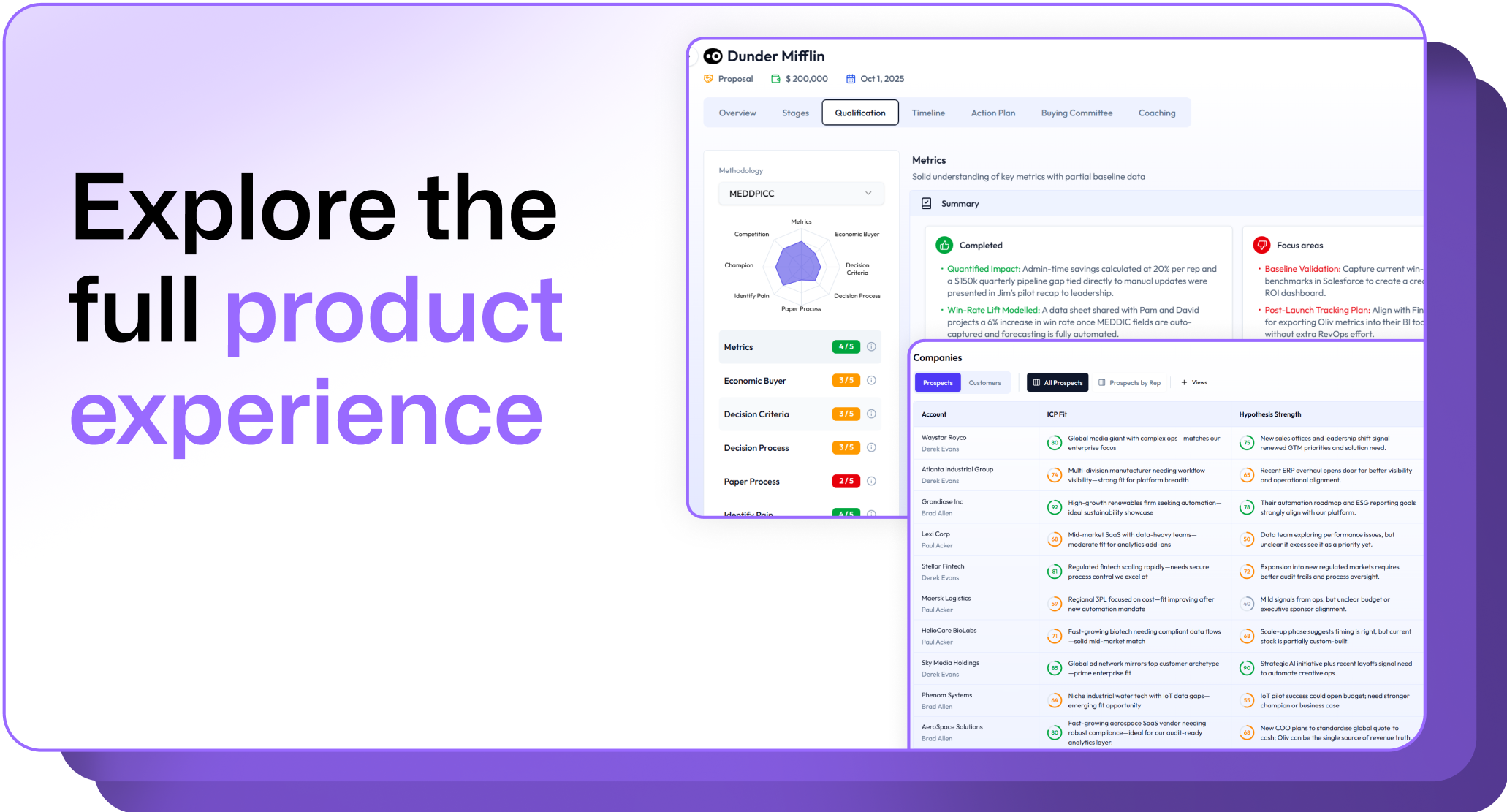
.avif)
.png)







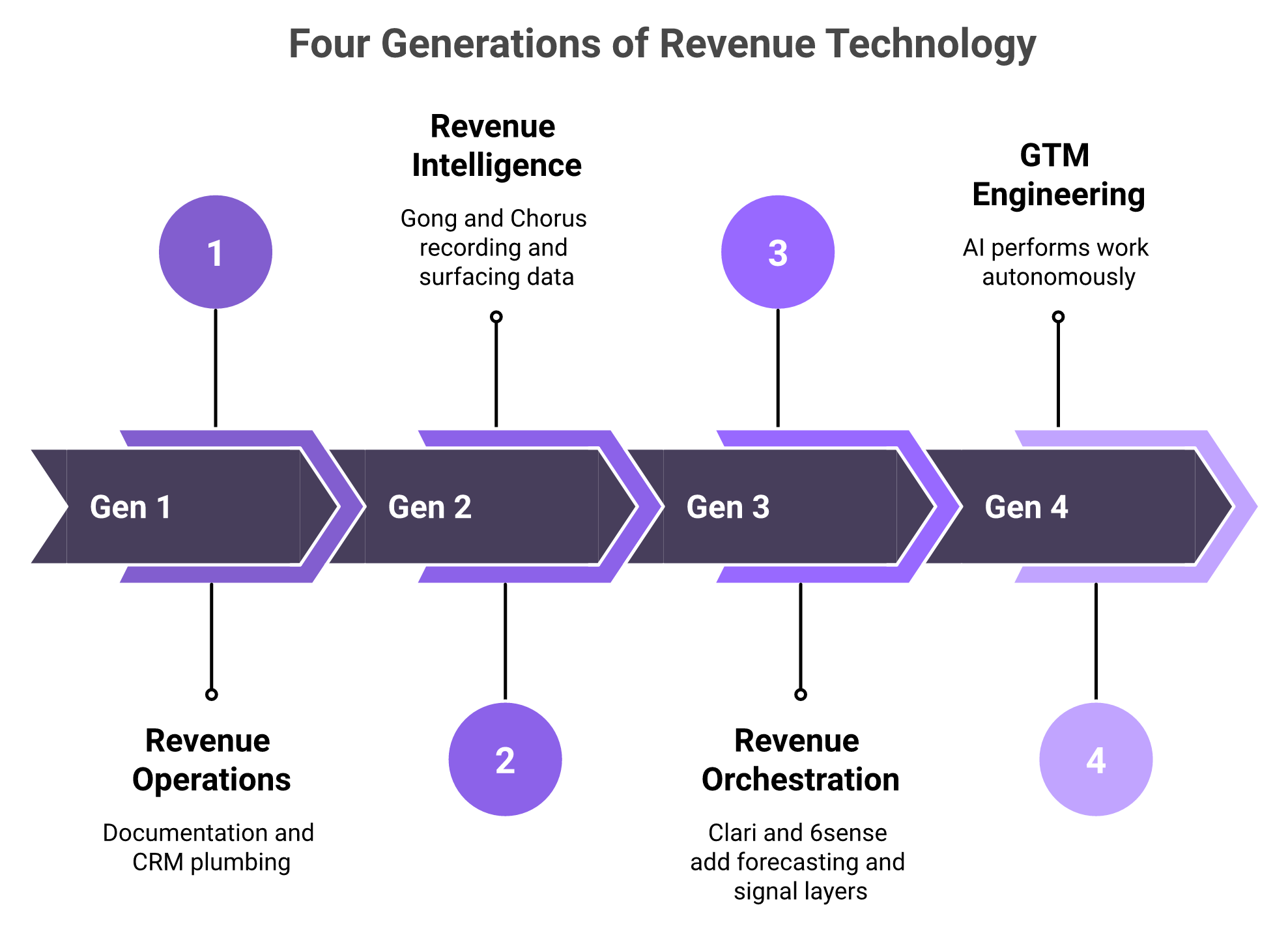
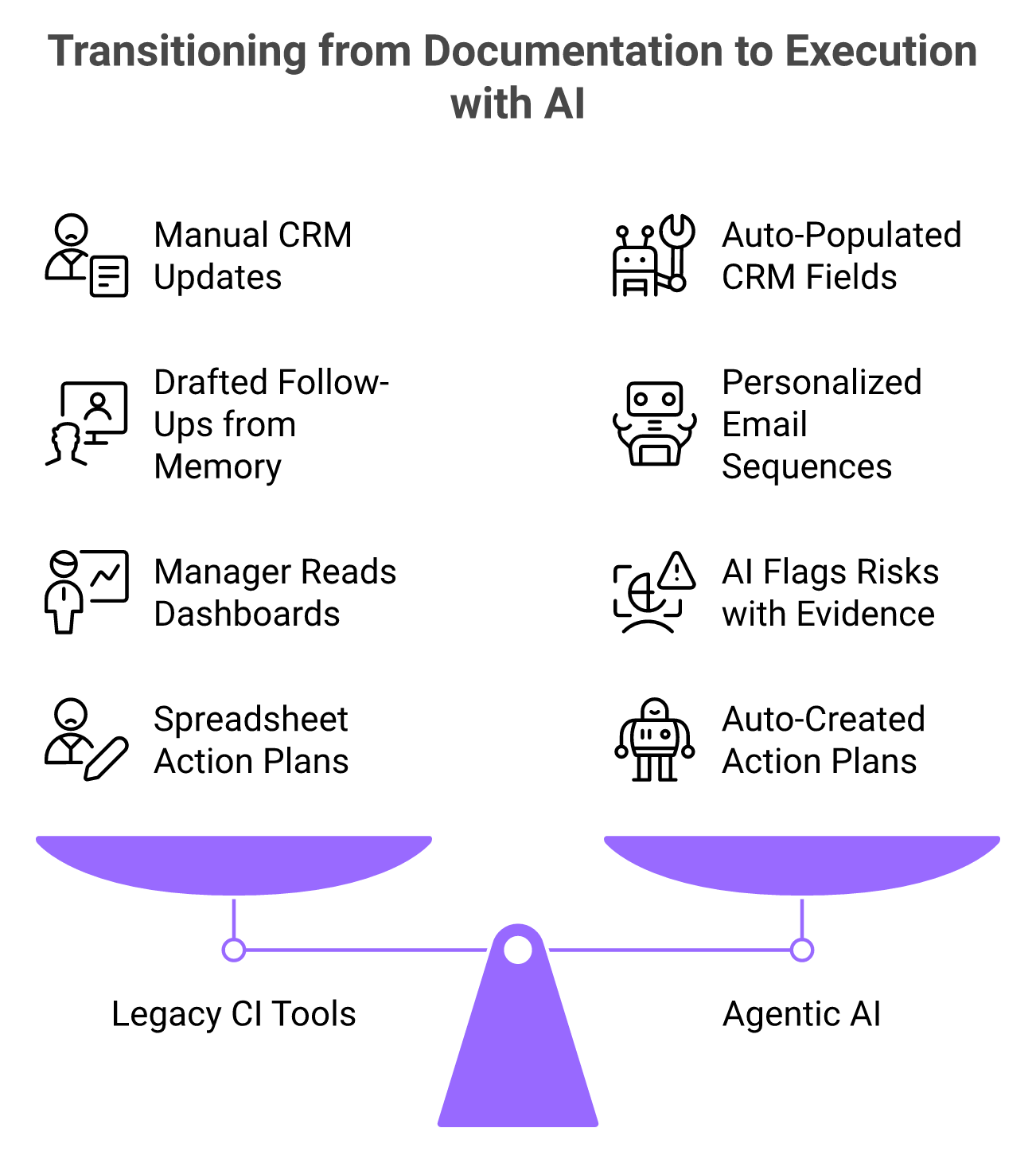
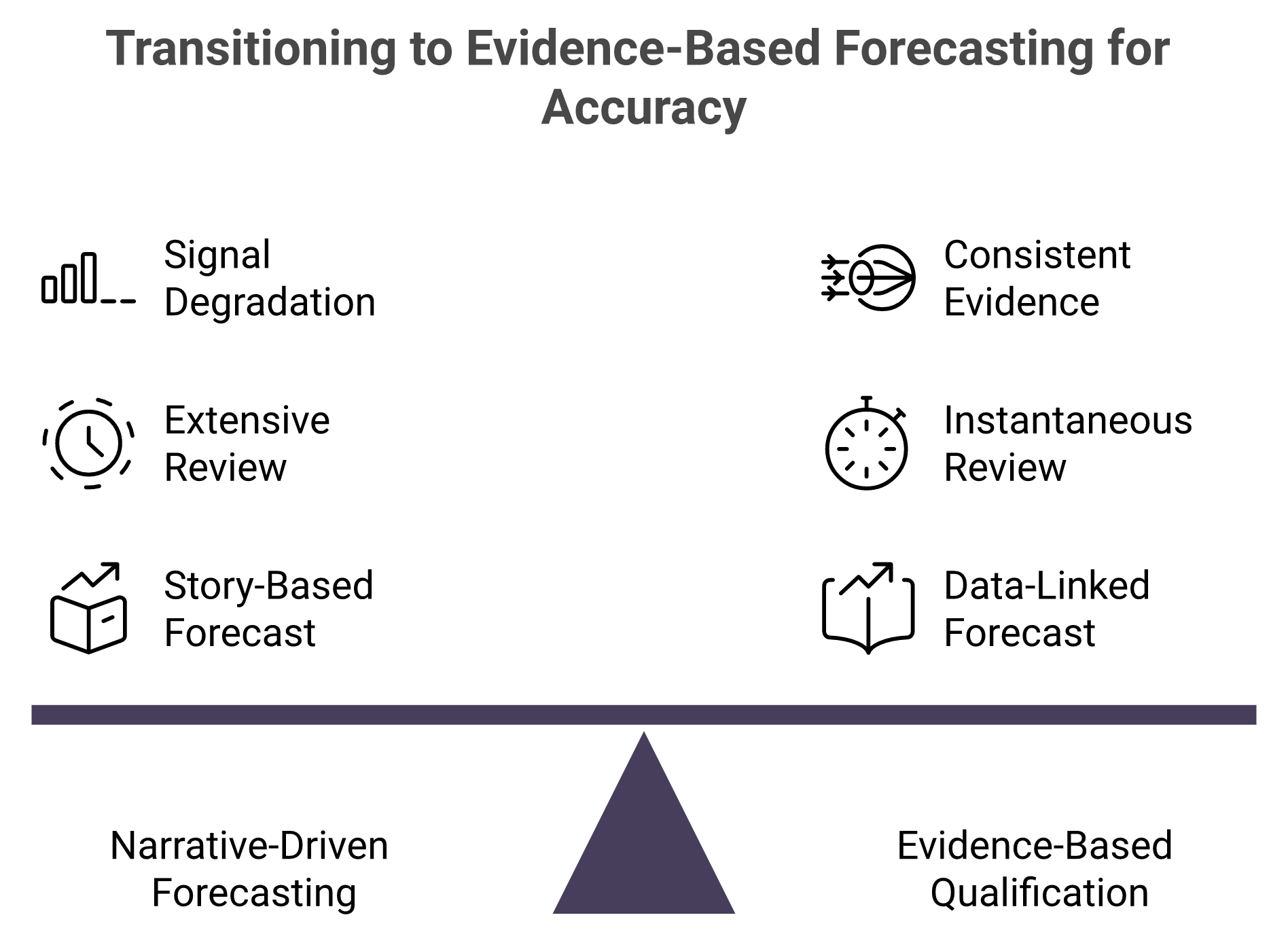
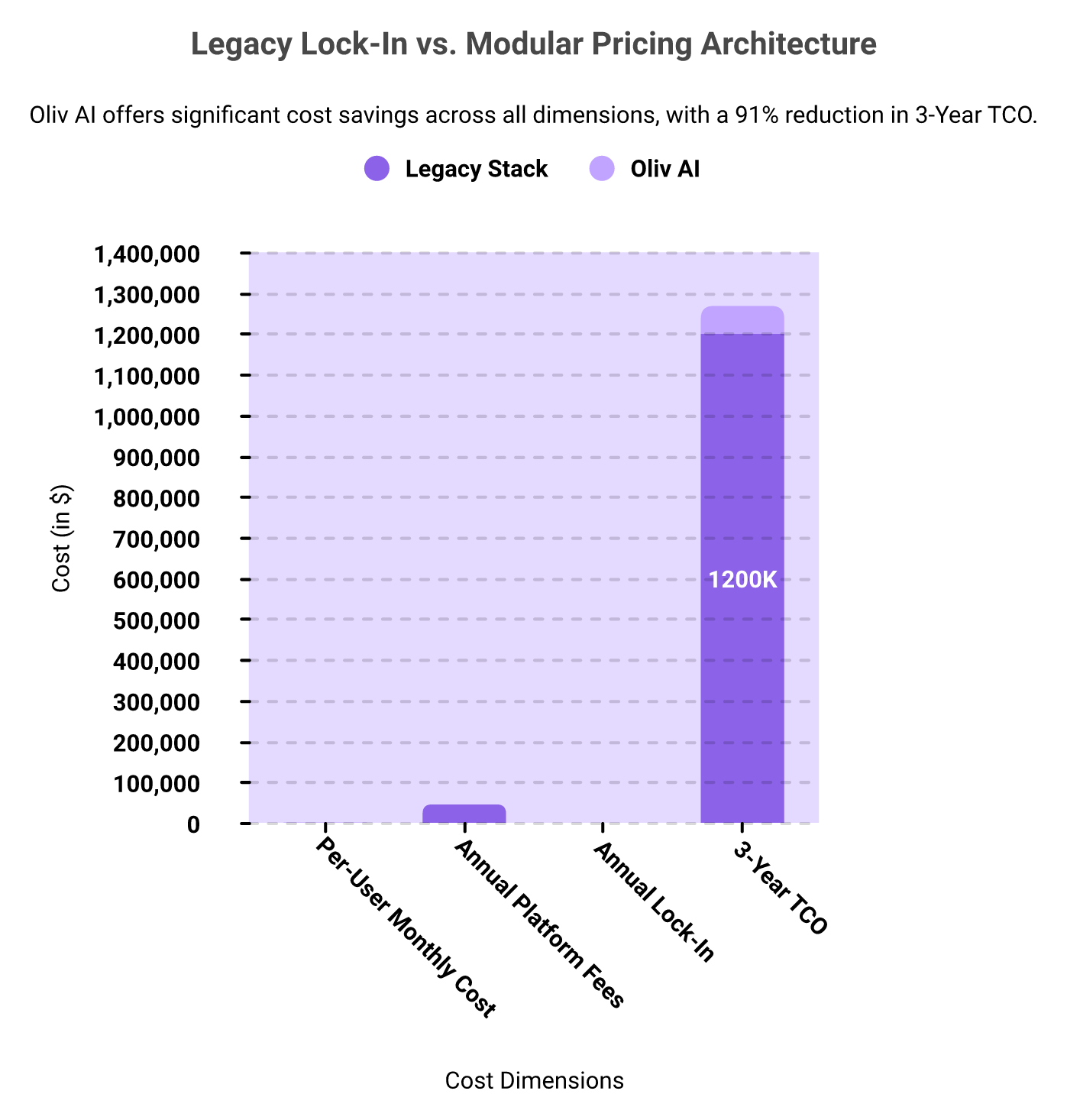

.png)