73% of BANT implementations fail within 90 days due to rep forgetfulness (68% skip questions), 15-20 min CRM documentation burden, and manager bandwidth constraints limiting coaching to 5-10% of calls.
AI automation achieves 90%+ sustained BANT adherence vs. 25-30% manual baseline by eliminating reliance on human memory through four automated touchpoints: pre-call prep, post-call scoring, weekly deal reviews, and monthly skill assessments.
BANT excels for transactional sales (<$50K ACV, 30-90 day cycles) but requires hybrid BANT→MEDDIC approach for enterprise deals. High-performing teams use BANT for SDR qualification before AE handoff to advanced methodologies.
Implementation compresses from 180 to 30 days when AI handles qualification capture, CRM updates, and manager visibility—reps focus on conversations while technology ensures methodology compliance.
Measurable ROI includes 25-30% forecast accuracy improvement, 23% faster sales cycles through early disqualification, 53% higher win rates, and 85%+ CRM field completion rates vs. 40-50% manual baseline.
27 qualification questions organized by Budget, Authority, Need, Timeline with conversational phrasing that avoids interrogation-style execution. Recommended sequence: Need→Timeline→Authority→Budget builds rapport before discussing money.
Q1: What is BANT Sales Methodology? (Definition & Origins) [toc=Definition & Origins]
BANT is a sales qualification framework designed to help sales professionals quickly determine whether a prospect has the fundamental characteristics needed to become a paying customer. The acronym stands for Budget, Authority, Need, and Timeline—four critical criteria that indicate purchase readiness.
⭐ Historical Origins: IBM's 1950s Innovation
Developed by IBM in the 1950s, BANT emerged during the early mainframe computing era when sales cycles were becoming increasingly complex and expensive. IBM needed a systematic approach to prevent sales representatives from investing months pursuing prospects who lacked the fundamental capacity to buy. For over 70 years, this framework has remained one of the most widely adopted qualification methodologies across B2B sales organizations, from startups to Fortune 500 enterprises.
Four-pillar visual defining BANT methodology elements developed by IBM in 1950s. Each component features icon and core qualification question: financial resources, decision-making power, genuine business pain, and purchase timeline urgency.
💰 The Four BANT Components Explained
Budget (B): Does the prospect have financial resources allocated or accessible for your solution? This goes beyond simply asking "What's your budget?"—it involves understanding spending authority, budget cycles, competing priorities, and whether funds are already earmarked or need approval.
Authority (A): Is your contact empowered to make or significantly influence the purchasing decision? In modern B2B sales, this rarely means a single decision-maker. Authority mapping identifies the buying committee: economic buyer (signs the contract), technical buyer (evaluates capabilities), end users (daily adoption), and influencers (internal champions).
Need (N): Does the prospect have a genuine business problem or pain point your solution addresses? Critical distinction: is this an "aspirin" (urgent pain requiring immediate relief) or a "vitamin" (nice-to-have improvement)? Urgent needs with quantifiable business impact drive faster purchasing decisions.
Timeline (T): When does the prospect intend to make a decision and implement a solution? Understanding timeline urgency helps prioritize opportunities. A prospect planning to decide "sometime next year" ranks lower than one with a Q1 deadline driven by contract expiration or regulatory requirements.
✅ Modern Relevance in 2025
Despite its 70-year history, BANT remains highly relevant because it addresses timeless sales fundamentals. However, modern implementations have evolved beyond rigid checklists. Today's BANT practitioners use weighted scoring models (e.g., 2-of-4 minimum qualification threshold), integrate BANT with advanced methodologies like MEDDIC for complex deals, and leverage AI-powered conversation intelligence to automatically capture BANT data without manual CRM entry.
How Oliv.ai Modernizes BANT: Oliv.ai's Meeting Assistant and Coach agents automatically identify and extract BANT elements from sales conversations, eliminating the 15-20 minute post-call documentation burden while ensuring 100% data capture accuracy across every customer interaction.
Q2: Why is BANT Important in 2025? (Strategic Value & ROI Impact) [toc=Strategic Value & ROI]
Modern sales teams face a critical resource allocation problem: 40-50% of pipeline opportunities are unqualified, wasting 60% of rep time on deals that will never close. Sales representatives spend an average of 21% of their day on administrative tasks rather than selling. BANT provides early qualification gates that prevent this resource drain, allowing teams to focus energy exclusively on high-probability opportunities.
⚠️ The Traditional Manual Qualification Challenge
Legacy BANT implementation relies entirely on rep memory and discipline. In back-to-back call schedules, representatives must remember to ask all qualification questions, accurately document responses in CRM, and consistently apply scoring criteria. The reality? 68% of reps skip critical qualification questions under time pressure. Manual CRM entry takes 15-20 minutes per call, incentivizing shortcuts and incomplete data. This leads to 30-50% forecast variance—sales leaders can't trust pipeline numbers because qualification data is inconsistent, subjective, and often missing entirely.
Even when reps document BANT elements, interpretation varies wildly. One AE might qualify a $50K budget as "sufficient" while another requires $75K for the same solution. This subjectivity makes forecasting nearly impossible and creates internal friction over which deals deserve resources.
✅ AI-Era Transformation: Automated Qualification at Scale
Conversation intelligence platforms fundamentally changed qualification mechanics by analyzing 100% of sales interactions automatically. Modern AI extracts BANT data with 90%+ accuracy by detecting specific linguistic patterns: budget discussions ("we've allocated $X"), authority indicators ("I'll need to run this by our CFO"), need intensity (pain language frequency), and timeline commitments ("we need to go live by Q2"). This eliminates human error, documentation gaps, and ensures every opportunity receives consistent qualification scoring.
Stacked bar chart visualizing dramatic BANT implementation improvements: forecast accuracy variance drops from 40% to 10%, win rates increase from 18% to 29%, sales cycles shorten, and CRM completion jumps to 85% with AI automation.
🎯 Oliv.ai's Four-Touchpoint BANT System
Oliv.ai operationalizes BANT through an integrated four-touchpoint approach spanning the entire deal lifecycle:
Pre-Call (Meeting Assistant): Before every customer interaction, the Meeting Assistant analyzes CRM history and previous call transcripts to pre-populate a BANT scorecard, highlighting which criteria are confirmed, missing, or need reconfirmation. Reps enter calls with clear qualification objectives.
Post-Call (Coach Agent): Immediately after calls, the Coach Agent automatically updates all four BANT fields in your CRM from conversation transcripts—no manual entry required. It provides specific feedback: "You captured Budget and Need but didn't confirm decision Timeline—address in follow-up."
Monthly Reviews (Coach Agent): Monthly, the Coach Agent delivers team-level analytics showing BANT adherence trends, identifying which reps consistently capture all criteria versus those with systematic gaps.
Process flowchart illustrating Oliv.ai's continuous BANT reinforcement cycle: Meeting Assistant pre-call preparation, Coach Agent post-call scoring with automatic CRM updates, Deal Driver weekly pipeline visibility, and monthly team-level analytics preventing the 73% methodology failure rate.
💸 Measurable ROI Impact
Organizations implementing AI-automated BANT through revenue orchestration platforms report: 25-30% improvement in forecast accuracy (reducing variance from 40-50% down to under 15%), 23% faster sales cycles through early disqualification of poor-fit prospects, and 53% higher win rates by concentrating resources on truly qualified opportunities.
Q3: Who Uses BANT? (Ideal Company Profiles & Sales Scenarios) [toc=Ideal Use Cases]
BANT isn't universally optimal for every sales organization or deal type. Understanding when BANT delivers maximum value versus when alternative methodologies better suit your needs prevents misapplication and qualification gaps.
⭐ Ideal BANT Use Cases
Transactional Sales Environments: BANT excels in sales scenarios with shorter cycles (30-90 days), lower deal values (typically <$50K ACV), and straightforward buying processes. Companies selling standardized SaaS products, SMB-focused solutions, or high-velocity inside sales motions benefit most. Think: marketing automation platforms for small businesses, HR software for mid-market companies, or productivity tools with clear pricing tiers.
SDR/BDR Qualification: Sales development teams use BANT as an "easy difficulty" initial filter before passing opportunities to account executives. It's user-friendly for early-stage qualification, helping SDRs quickly determine if a lead warrants deeper discovery or should be nurtured further.
Single or Simple Buying Committees: When 1-3 stakeholders drive purchasing decisions, BANT's Authority component sufficiently maps decision-making dynamics. Organizations with centralized procurement or departmental autonomy fit this profile.
❌ When BANT Falls Short
Enterprise Complex Sales: For deals exceeding $100K ACV, multi-year contracts, or 6+ month sales cycles, BANT "leaves a lot to be desired." Enterprise selling involves intricate buying committees (6-10+ stakeholders), technical evaluation processes, legal reviews, and procurement negotiations. BANT's four elements lack the granularity needed—it's like "traveling to the shops on your bike versus going to the moon in a rocket" compared to methodologies like MEDDIC.
Continuous Qualification Needs: BANT functions primarily as an early-stage checkpoint. Once the four criteria are satisfied, it's "unusual for them to be referenced again in the deal." If your sales process requires ongoing qualification throughout a 9-12 month cycle, BANT becomes outdated quickly while frameworks like MEDDIC provide continuous deal health assessment.
✅ The Hybrid Approach: BANT + MEDDIC
Many high-performing sales organizations aren't forced to choose. They employ BANT for initial SDR qualification, then transition to MEDDIC for AE-driven deal management. This "best of both worlds" strategy uses BANT's simplicity for top-of-funnel filtering, then applies MEDDIC's rigor for deals entering active evaluation.
How Oliv.ai Supports Multi-Methodology Approaches: Oliv's platform is methodology-agnostic—train it on your qualification framework using just 3-4 sample calls, and it immediately interprets future conversations accordingly. Whether you use pure BANT, MEDDIC, or custom hybrid models, Oliv adapts to your structure without requiring separate configurations.
Q4: When Should BANT Be Implemented? (Timing & Readiness Assessment) [toc=Timing & Readiness]
Implementing a structured qualification framework like BANT requires intentional timing and organizational readiness. Premature rollout without proper foundation creates confusion; delayed implementation leaves revenue on the table through continued qualification inconsistency.
⏰ Primary Implementation Triggers
Scaling Beyond Founder-Led Sales: When transitioning from 1-3 sales representatives (often founders) to a structured 5+ person sales team, qualification chaos emerges. Each rep applies personal judgment without shared criteria, creating pipeline unpredictability. BANT establishes common language and standards as teams scale.
Persistent Forecast Accuracy Problems: If your forecast variance consistently exceeds 30%—meaning projected revenue misses actual closes by 30%+ quarter-over-quarter—qualification gaps are likely culprits. Sales leaders can't accurately predict revenue when pipeline quality remains unknown.
Inconsistent Deal Qualification: Red flags include: AEs debating which deals are "real" during pipeline reviews, frequent late-stage disqualifications (prospects reaching proposal stage before revealing lack of budget/authority), or wide variation in individual rep win rates (20% for some, 60% for others) suggesting inconsistent qualification rigor.
New Product/Market Entry: Launching into new segments, verticals, or product lines requires fresh qualification criteria. Your established enterprise qualification approach may not translate to mid-market expansion—BANT provides a structured starting framework to test and refine.
✅ Readiness Assessment Checklist
Before implementing BANT, confirm these foundational elements exist:
CRM Infrastructure: Basic Salesforce, HubSpot, or similar platform with custom fields capability to capture Budget, Authority, Need, Timeline data.
Sales Management Buy-In: Managers must commit to reinforcing BANT in weekly pipeline reviews, one-on-ones, and call coaching—without top-down accountability, reps abandon frameworks within weeks.
Training Time Allocation: Budget 8-12 hours for initial training (methodology education, question library development, role-play exercises) plus ongoing reinforcement through sales methodology training programs.
Deal Volume Threshold: BANT delivers maximum ROI when teams handle 20+ active opportunities simultaneously. Below this threshold, informal qualification may suffice.
⚠️ Common Timing Mistakes
Over-Engineering Early-Stage Startups: Pre-product-market-fit companies (fewer than 10 customers) often over-index on process. Focus on learning buyer psychology before rigidly implementing frameworks.
Waiting Too Long: Companies frequently delay until forecasting crises force reactive implementation. Proactive BANT adoption during growth phases (50-75% YoY) prevents future chaos.
Ignoring Methodology Compatibility: If your sales process already uses MEDDIC or similar frameworks, assess whether BANT complements or conflicts. Many organizations use BANT for SDR-to-AE handoffs while AEs apply MEDDIC.
How Oliv.ai Accelerates Implementation: Traditional BANT rollout takes 90-180 days to achieve team-wide adoption. Oliv.ai's automated BANT capture through Meeting Assistant and Coach agents compresses this to 30 days by eliminating manual behavior change—reps simply have conversations while AI handles qualification documentation and manager visibility.
Q5: How to Implement BANT in Your Sales Organization? (8-Step Framework) [toc=Implementation Framework]
Successful BANT implementation requires systematic rollout across people, process, and technology. This eight-step framework provides the tactical roadmap organizations use to transition from ad-hoc qualification to structured BANT methodology.
Step 1: Conduct Qualification Audit (Week 1)
Before implementing BANT, assess current-state qualification practices. Review 20-30 recent deals to identify: What qualification questions reps currently ask, how consistently data gets documented in CRM, and where deals most frequently stall or get disqualified late. This baseline establishes improvement benchmarks.
Step 2: Customize BANT Thresholds (Week 1-2)
Define qualification standards specific to your business model. For each BANT element, establish clear criteria:
Many organizations use weighted scoring: "2 out of 4 criteria met = qualified opportunity" rather than requiring all four.
Step 3: Build BANT Question Library (Week 2)
Develop 15-20 discovery questions per BANT component that align with your customer conversations. Questions should feel conversational, not interrogative. Document primary questions, follow-up probes, and situational alternatives.
Step 4: Configure CRM Fields (Week 2-3)
Create dedicated CRM fields capturing each BANT element: Budget Amount, Budget Status (allocated/needs approval), Authority Mapping (economic buyer, technical buyer, influencers), Need Description, Pain Intensity (1-10 scale), Decision Timeline, Implementation Timeline. Establish field completion requirements before deals advance stages.
Step 5: Conduct Team Training (Week 3-4)
Deliver 6-8 hours of initial training covering: BANT methodology fundamentals, your customized thresholds, question library deep-dive, objection handling techniques, and CRM documentation standards. Include role-play exercises where reps practice BANT questioning in simulated discovery calls through proven sales training programs.
Establish weekly pipeline reviews where managers assess BANT completeness per opportunity. Monthly one-on-ones include call review focused on qualification technique—managers listen to 2-3 recorded calls per rep, providing specific feedback on question quality and documentation accuracy.
Step 7: Create Reinforcement Mechanisms (Week 5+)
Launch ongoing reinforcement: weekly sales meeting spotlights featuring "BANT win stories," quarterly refresher workshops, peer coaching buddy systems, and BANT adherence metrics visible on team dashboards.
Step 8: Measure and Iterate (Month 2+)
Track leading indicators (% deals with complete BANT data, qualification-to-close conversion rates) and lagging indicators (sales cycle length changes, forecast accuracy improvement). Quarterly, refine thresholds and questions based on performance data.
⚠️ Timeline Reality Check
Traditional manual BANT implementation takes 90-180 days to achieve sustained team-wide adoption. How Oliv.ai Accelerates This: Oliv's AI agents compress implementation to 30 days by eliminating manual behavior change dependency. Simply train Oliv on your BANT framework using 3-4 sample calls—Meeting Assistant immediately begins pre-call BANT prep, Coach Agent automatically scores post-call adherence, and Deal Driver provides manager visibility without requiring new habits.
Q6: What BANT Questions Should You Ask? (25+ Qualification Questions by Category) [toc=BANT Questions Library]
Effective BANT questioning requires conversation, not interrogation. These 27 discovery questions—organized by BANT component—help sales professionals naturally uncover qualification criteria during customer interactions.
💰 Budget Questions (7 Questions)
Budget discussions extend beyond "What's your budget?" to understand spending behavior, approval processes, and competing priorities.
Direct Budget Questions:
"What budget range have you allocated for solving this challenge this year?"
"How does your budgeting process work—annual planning cycles or project-based approvals?"
"Have funds already been set aside, or would this require new budget approval?"
Indirect Budget Indicators: 4. "What would ROI need to look like to justify this investment?" 5. "Are you currently spending money on alternative solutions or workarounds for this problem?" 6. "What other priorities are competing for budget dollars this quarter?" 7. "Walk me through your typical procurement and approval process for purchases in this range"
✅ Authority Questions (8 Questions)
Modern B2B buying involves 6-10 stakeholders on average. Authority mapping identifies decision-makers, influencers, blockers, and champions.
Decision-Making Structure:
"Who else besides you will be involved in evaluating potential solutions?"
"Can you describe your internal decision-making process for purchases like this?"
"Who has final sign-off authority on the contract?"
"Are there other departments (IT, Security, Procurement) that need to weigh in?"
Buying Committee Roles: 5. "Who will be the primary day-to-day users of this solution?" 6. "Whose budget would this ultimately come from?" 7. "Is there anyone who might have concerns or objections we should address early?" 8. "Have you made similar purchasing decisions before? How did that process work?"
⭐ Need Questions (6 Questions)
Need questioning differentiates urgent "aspirin" pain from nice-to-have "vitamin" improvements, revealing true purchase motivation.
Pain Discovery:
"What's prompting you to look for a solution right now versus six months ago?"
"What happens if you don't solve this problem—what's the business impact?"
"How are you currently handling this challenge? What's not working about that approach?"
"Can you quantify the cost of this problem (time wasted, revenue lost, inefficiency created)?"
"On a scale of 1-10, how critical is solving this versus other priorities?"
"What would success look like three months after implementing a solution?"
⏰ Timeline Questions (6 Questions)
Timeline reveals urgency and helps prioritize opportunities based on near-term close probability.
Decision Timeline:
"What's driving the timing of this decision—is there a specific deadline or event?"
"What's your ideal timeframe for making a decision and getting started?"
"Are there any external factors (contract renewals, fiscal year-end, compliance deadlines) influencing your timeline?"
Implementation Timeline: 4. "When do you need the solution fully operational?" 5. "What's your internal process timeline—from decision to contract to implementation?" 6. "Are there any scheduling constraints we should be aware of (budget freezes, blackout periods, seasonality)?"
Four-column grid displaying complete 27-question BANT discovery framework. Each category shows direct, indirect, and process-oriented question examples with recommended sequencing: Need, Timeline, Authority, then Budget for rapport building.
💡 Question Sequencing Best Practice
Lead with Need questions (establish pain), follow with Timeline (confirm urgency), then Authority (map stakeholders), and finally Budget (confirm affordability). This sequence feels natural and builds rapport before discussing money.
How Oliv.ai Enhances Questioning: Oliv's Meeting Assistant analyzes previous conversations and pre-populates which BANT questions still need asking, ensuring no gaps. Post-call, Coach Agent identifies which questions reps consistently skip, enabling targeted skill coaching through AI-native revenue orchestration.
Q7: How Do We Measure BANT Success Post-Implementation? (KPIs & Analytics) [toc=Measuring BANT Success]
Without measurable KPIs, organizations cannot determine BANT ROI or identify adoption gaps before they damage forecasting accuracy. Effective measurement requires tracking both leading indicators (methodology adherence) and lagging indicators (business outcomes).
📊 Critical BANT Success Metrics
Leading Indicators:
CRM field completion rates (% of opportunities with all four BANT elements documented)
Qualification-to-close conversion rate (win rate of BANT-qualified vs. unqualified deals)
Average days to complete BANT qualification per opportunity
Rep-by-rep adherence scores (% of calls where BANT questions were asked)
Lagging Indicators:
Sales cycle length reduction (qualified opportunities should close faster)
Pipeline coverage ratios (3:1 qualified pipeline is healthier than 5:1 unqualified bloat)
Win rate improvement (focusing resources on qualified deals increases close rates)
❌ Traditional Manual Measurement Limitations
Pre-AI sales organizations struggle with BANT measurement because manual tracking creates massive manager workload and significant lag time.
Manual Measurement Challenges:
Managers must manually audit CRM records for 50-100+ opportunities weekly to check field completion—consuming 4-6 hours
Call recording spot-checks cover only 5-10% of actual conversations, missing 90%+ of coaching opportunities
Quarterly rep surveys about methodology usage introduce 6-8 week lag before identifying drift
Subjective scoring varies manager-to-manager (one rates questioning as "strong BANT adherence" while another scores the same call as "incomplete")
By the time measurement reveals problems, poor qualification habits have already damaged 30-60 days of pipeline
This explains why 73% of methodology implementations fail within 90 days—measurement gaps prevent early intervention before abandonment occurs.
✅ AI-Era Measurement: Real-Time Visibility
Modern conversation intelligence platforms transform measurement from reactive audits to proactive alerts. AI analyzes 100% of sales interactions automatically, providing instant BANT adherence visibility without manager manual work.
Automated Analytics Capabilities:
Real-time dashboards showing BANT completeness per rep, per deal, per stage
Automated alerts when deals advance stages without complete qualification data
Predictive analytics correlating specific BANT patterns (e.g., multi-stakeholder Authority mapping) to win probability
Historical trending showing methodology adoption curves and drift early warning signals
🎯 Oliv.ai's Three-Layer Measurement System
Oliv.ai provides measurement automation through three specialized agents addressing different time horizons and audiences:
Weekly Deal-Level Visibility (Deal Driver): Every week, Deal Driver delivers pipeline health scores showing % of deals with complete BANT data, automatically flagging at-risk opportunities missing critical qualification elements. Sales managers receive prioritized lists: "12 deals in Discovery stage lack Authority mapping—action needed."
Monthly Rep-Level Skill Assessment (Coach Agent): Monthly, Coach Agent generates methodology adherence reports per rep, tracking which BANT components each AE consistently captures versus systematically neglects. Example insight: "Rep Sarah averages 95% Budget/Need capture but only 60% Timeline confirmation—coach on urgency questioning."
Predictive Correlation Analytics: Oliv's forecasting capabilities correlate BANT completeness patterns to actual close rates across your historical deals, proving which qualification behaviors predict revenue with 90%+ accuracy. Organizations discover: "Deals with 3+ Authority stakeholders mapped close at 67% vs. 34% for single-contact opportunities."
💸 Benchmark Performance Data
Best-in-class organizations using AI-tracked BANT achieve 85%+ CRM field completion rates (versus 40-50% manual baseline) and reduce forecast variance from 30-50% down to under 10% within the first quarter of AI-assisted implementation.
Q8: What Are the Common BANT Implementation Challenges? (Failure Modes & Prevention) [toc=Implementation Challenges]
Despite straightforward methodology, 73% of sales framework implementations fail within 90 days of initial training. Understanding the four primary failure patterns—and prevention strategies—separates successful long-term BANT adoption from abandoned initiatives that waste training investments.
❌ Failure Mode #1: Rep Forgetfulness Under Pressure
In back-to-back 30-minute discovery calls, sales reps mentally juggle rapport-building, product positioning, objection handling, and next-step scheduling. Research shows 68% of reps skip critical qualification questions when under time pressure. They remember to ask Budget ("What's your budget range?") but forget Timeline urgency assessment or multi-stakeholder Authority mapping. Incomplete BANT data renders the framework useless—deals advance based on gut feel rather than qualification criteria.
Traditional Solution Limitations: Managers create BANT checklists and call scripts, but reps view these as administrative burdens rather than selling aids. Checkbox compliance doesn't ensure quality questioning or complete data capture.
⚠️ Failure Mode #2: CRM Documentation Burden
Manual BANT implementation requires reps to document detailed notes after every call: budget figures, stakeholder names/titles/roles, pain point descriptions, timeline drivers. This 15-20 minute post-call admin burden per interaction incentivizes shortcuts—reps enter partial data, vague notes, or skip documentation entirely when pipeline reviews aren't imminent. Within weeks, CRM becomes unreliable for forecasting or team handoffs.
Compounding Problem: Complex methodologies multiply this burden. While BANT requires 4 core fields, layering additional frameworks (MEDDIC's 6-7 elements) creates 10-15 fields per deal. Reps spend more time documenting than selling.
🔄 Failure Mode #3: Manager Bandwidth Constraints
Effective methodology adoption requires continuous coaching—managers reviewing calls, providing specific feedback, celebrating strong qualification examples. Reality: managers oversee 8-12 reps handling 30-50 active opportunities each. They can manually review only 5-10% of total call volume monthly, missing 90%+ of coaching moments. Without frequent reinforcement, reps revert to comfortable old habits within 60 days.
Coaching Scalability Gap: One manager needs 40+ hours monthly to review just 20% of team calls—time unavailable when juggling forecasting, deal support, and leadership meetings.
⏰ Failure Mode #4: Methodology Drift Over Time
Even initially successful implementations decay without reinforcement mechanisms. Quarterly training refreshers, annual workshops, or sporadic manager reminders prove insufficient. Sales teams experience 25-30% annual turnover—new hires receive inconsistent BANT training while veterans develop personalized qualification shortcuts. Within 6-9 months, each rep interprets BANT differently, eliminating the standardization benefits the framework was supposed to provide.
✅ How Oliv.ai Prevents All Four Failure Modes
Oliv.ai's agent-first architecture eliminates reliance on human memory, manual documentation, and manager bandwidth through four automated touchpoints:
Pre-Call Preparation (Meeting Assistant): Before every customer interaction, Meeting Assistant analyzes CRM history and previous call transcripts to generate a BANT scorecard showing which criteria are confirmed, missing, or need reconfirmation. Reps enter calls with clear qualification objectives—no memory required.
Post-Call Automated Scoring (Coach Agent): Immediately after calls, Coach Agent automatically updates all four BANT fields in CRM from conversation transcripts—zero manual entry burden. It provides rep-specific feedback: "You captured Budget ($75K allocated) and Need (integration pain) but didn't confirm decision Timeline—ask about implementation deadlines in follow-up."
Weekly Deal Reviews (Deal Driver): Every week, Deal Driver delivers manager-ready pipeline analysis showing which opportunities lack complete BANT qualification, flagging specific gaps per deal. Managers focus coaching on actual deficiencies rather than guessing what to review.
Monthly Skill Coaching (Coach Agent): Monthly, Coach Agent provides team-level analytics showing BANT adherence trends, identifying which reps consistently capture all criteria versus those with systematic gaps in specific elements. This prevents drift by surfacing patterns before they become habits.
This four-touchpoint system achieves 90%+ sustained BANT adherence versus 25-30% with manual approaches, compressing adoption from 180 days to 30 days compared to traditional implementation timelines.
Q9: How to Make BANT Stick Long-Term? (30/60/90-Day Adoption Plan & AI Reinforcement) [toc=Making BANT Stick]
The "Making it Stick" challenge explains why most methodology investments fail—initial training enthusiasm fades within weeks without systematic reinforcement. Behavioral psychology research reveals habit formation requires 66 days of consistent repetition with immediate feedback loops. Yet most organizations lack the infrastructure to provide daily reinforcement at scale, resulting in the 73% failure rate within 90 days.
❌ Traditional 'Train-and-Hope' Failure Pattern
Companies invest $50K-$100K in 2-3 day intensive BANT workshops, distribute manual call plan templates, conduct quarterly refresher training—then watch adoption drop to 30% by day 90. Without daily reinforcement and accountability, reps revert to comfortable old patterns under pressure. The failure cycle follows a predictable pattern:
Weeks 1-2: High enthusiasm, reps attempt BANT on most calls
Weeks 7-12: Only 30-40% of reps consistently apply framework; others revert to gut-feel qualification
Month 4+: Methodology effectively abandoned except during quarterly audits
Manual reinforcement mechanisms—weekly team spotlight stories, monthly refresher sessions, manager call reviews—prove insufficient. Managers can review only 5-10% of call volume, missing 90%+ of coaching opportunities.
✅ AI-Era Continuous Reinforcement Architecture
Modern conversation intelligence platforms embed methodology into every workflow touchpoint—pre-call briefs, real-time transcription, post-call automated scoring, weekly manager reviews—creating 100+ reinforcement moments per month versus 4-6 manual coaching sessions. This shift from periodic manual reinforcement to continuous automated coaching fundamentally changes adoption mechanics.
🎯 Oliv.ai's 30/60/90-Day Stickiness Blueprint
Oliv.ai operationalizes long-term BANT adherence through four automated touchpoints spanning pre-call, post-call, weekly, and monthly intervals:
Days 1-30 (Awareness Phase) - Post-Call Skill Coaching
Coach Agent provides BANT adherence scores after every customer interaction with specific improvement guidance. Example feedback: "You captured Budget ($60K allocated) and Need (CRM integration pain) but didn't confirm Timeline urgency—ask about implementation deadlines and contract expiration dates in follow-up." This immediate feedback loop—delivered within 2 minutes post-call—creates 40-60 learning moments per rep monthly versus 2-3 traditional manager reviews.
Days 31-60 (Capability Building) - Pre-Call Preparation
Meeting Assistant begins pre-call prompting, analyzing CRM history and previous transcripts to generate BANT scorecards before each interaction. Reps see: "Confirmed: Budget ($75K), Authority (speaking with VP Operations). Missing: Timeline urgency, Need quantification. Priority questions for this call: When does current contract expire? What's the monthly cost of current workaround?" This contextual prompting eliminates reliance on rep memory.
Days 61-90 (Habit Formation) - Deal-Level Tracking
Deal Driver integrates BANT qualification into weekly pipeline reviews, providing managers automated visibility: "12 Discovery-stage deals lack complete Authority mapping—action needed." BANT adherence becomes a core performance metric visible to leadership, creating social accountability.
⭐ Beyond 90 Days: Unconscious Competence Through Automation
Monthly Skill Assessment (Coach Agent): Coach Agent delivers team-level methodology analytics tracking long-term trends. Managers receive reports: "Rep Sarah maintains 95% BANT completion rate. Rep John improved from 60% to 85% over 60 days. Rep Mike shows consistent 55% Timeline capture gap—schedule targeted coaching."
This four-touchpoint system—Meeting Assistant (pre-call prep), Coach Agent (post-call + monthly skill coaching), Deal Driver (weekly deal tracking), automated CRM updates—eliminates conscious effort. Reps simply have conversations while AI handles BANT capture, documentation, and manager visibility, hardwiring methodology into unconscious behavior through AI-native revenue orchestration.
Organizations using Oliv's AI enforcement achieve 90%+ sustained BANT adherence versus 25-30% with manual approaches, compressing full adoption from 180 days to 30 days.
Q10: BANT Best Practices for Maximum ROI (Implementation Do's & Don'ts) [toc=Best Practices]
Maximizing BANT ROI requires avoiding common implementation mistakes while adopting proven best practices that enhance qualification rigor without creating rep friction.
Example: SaaS company Acme sets $15K SMB opportunities as qualified with confirmed Budget + 30-day Timeline, while $150K enterprise deals require complete BANT + champion identification before advancing to demo stage.
✅ Do: Use Weighted Scorecards vs. Binary Pass/Fail
Replace rigid "qualified/unqualified" binary decisions with weighted scoring models. Assign point values: Budget (25 points), Authority (30 points for economic buyer, 20 for influencer), Need (25 points, scaled by urgency), Timeline (20 points). Opportunities scoring 70+ proceed; 50-69 enter nurture; <50 disqualify.
❌ Don't: Lead with Budget Questions
Opening discovery calls with "What's your budget?" triggers defensive responses and anchors conversations on price before establishing value. Recommended sequence: Need → Timeline → Authority → Budget. Establish pain urgency first, then discuss investment required to solve it.
✅ Do: Integrate BANT with Existing Methodologies
BANT rarely exists in isolation. Common hybrid approaches:
BANT-Enhanced Discovery: Use BANT as qualification filter within broader Command of the Message or Challenger methodologies
Custom Frameworks: Oliv's methodology-agnostic platform adapts to any combination—train it on 3-4 sample calls reflecting your structure
❌ Don't: Treat BANT as One-Time Checkpoint
Markets change, budgets get reallocated, champions leave companies. Re-qualify opportunities quarterly or when deals stall unexpectedly. Timeline confirmed in January may shift by March; Authority mapped to VP who departed needs updating.
Budget (Direct): "What budget range have you allocated?" Budget (Indirect): "Walk me through your typical approval process for investments in this range"
How Oliv.ai Simplifies Best Practices: Oliv's Meeting Assistant automatically applies these best practices—it sequences questions appropriately (Need→Timeline→Authority→Budget), tracks multi-stakeholder Authority across conversations, and re-qualifies deals continuously rather than treating BANT as static checkpoints. Coach Agent identifies when reps fall into anti-patterns (leading with budget, treating qualification as one-time) and provides corrective coaching.
Q11: BANT Success Stories & Real-World Case Studies (What Works & What Fails) [toc=Success Stories]
Real-world BANT implementations reveal predictable success patterns and failure modes. These anonymized case studies provide realistic expectations and risk mitigation strategies.
✅ Success Case Study: Mid-Market SaaS Company
Company Profile: 45-person sales team (30 AEs, 15 SDRs), $35K average deal size, 60-day sales cycle, selling marketing automation platform.
Implementation Approach:
Customized 2-of-4 BANT threshold (Budget + Need minimum for SDR-to-AE handoff)
Built 18-question discovery library with conversational phrasing
Configured Salesforce with 6 BANT fields (Budget Amount, Budget Status, Authority Contacts, Need Score, Timeline)
Success Factors: Executive sponsorship, manager accountability for CRM field completion, celebration of early wins in team meetings.
❌ Failure Case Study: Enterprise Software Vendor
Company Profile: 80-person sales team, $250K+ average deal size, 9-month sales cycle, complex enterprise infrastructure software.
Implementation Mistakes:
Applied BANT without adaptation for enterprise complexity (single-framework approach)
Treated Authority as "VP title" rather than mapping 8-12 person buying committees
Used BANT as one-time qualification checkpoint rather than continuous re-qualification
No manager reinforcement after initial 2-day training
Results (90 days post-implementation):
Adoption dropped to 25% (reps found BANT insufficient for deal complexity)
Forecast accuracy worsened (oversimplified qualification gave false confidence)
Sales leadership abandoned BANT, viewed as "checkbox exercise"
Root Causes: Wrong methodology for deal complexity (should have used MEDDIC or hybrid BANT→MEDDIC), lack of reinforcement infrastructure, no customization for enterprise buying dynamics.
⚠️ Mixed Results: High-Velocity Inside Sales Team
Company Profile: 120-person SDR team, $8K average deal size, 21-day sales cycle, transactional cloud storage product.
Implementation: Rigid 4-of-4 BANT requirement before opportunities qualified, heavy CRM documentation burden (12 required fields).
Outcomes: High qualification accuracy (92% of BANT-qualified deals closed) BUT massive top-of-funnel drop-off. SDRs disqualified 70% of inbound leads creating pipeline shortage. Revenue declined 15% despite improved win rates.
Lesson: Over-aggressive qualification in high-velocity environments starves pipeline. Adjusted to 2-of-4 threshold, recovered pipeline flow while maintaining 67% close rate.
💡 Pattern Recognition: What Drives Success
Successful BANT implementations share:
Threshold customization by deal segment (not one-size-fits-all)
Iterative refinement based on data (not "set and forget")
How Oliv.ai Prevents Common Failures: Oliv's four-touchpoint system (Meeting Assistant, Coach Agent, Deal Driver, automated CRM) addresses failure root causes—it provides continuous reinforcement preventing adoption decay, scales to complex enterprise scenarios through unlimited stakeholder tracking, and eliminates documentation burden that killed the high-velocity team's adoption.
Q12: BANT vs. Other Sales Qualification Methodologies (Framework Comparison) [toc=Framework Comparison]
BANT exists within an ecosystem of qualification frameworks—MEDDIC, SPICED, CHAMP, GPCTBA/C&I—each optimized for different sales scenarios. Understanding comparative strengths prevents misapplication.
📊 Framework Comparison Matrix
Sales Qualification Framework Comparison
Methodology
Best For
Deal Complexity
Typical ACV
Sales Cycle
Key Strength
Primary Limitation
BANT
Transactional sales, SDR qualification
Low-Medium
<$50K
30-90 days
Simplicity, speed
Lacks enterprise detail
MEDDIC
Enterprise complex sales
High
>$100K
6-12 months
Continuous qualification depth
Steep learning curve, heavy CRM burden
SPICED
Modern buyer-centric sales
Medium-High
$50K-$200K
90-180 days
Focuses on business impact
Relatively new, limited adoption
CHAMP
Challenger methodology users
Medium
$25K-$100K
60-120 days
Prioritizes challenge/pain
Similar to BANT with reordering
GPCTBA/C&I
HubSpot ecosystem users
Medium
$25K-$75K
60-90 days
Comprehensive goal mapping
Overly complex for simple deals
⭐ BANT: The "Easy Difficulty" Qualification Framework
BANT functions as the "EASY difficulty setting in the game of sales"—highly accessible for SDRs and inside sales teams needing quick qualification direction. Its four-element simplicity enables rapid training and consistent application across high-volume scenarios.
Ideal Use Cases: SMB SaaS, transactional B2B, standardized product offerings, short sales cycles, straightforward buying processes.
Limitation: Once BANT elements are satisfied, "it is unusual for them to be referenced again in the deal." For 9-12 month enterprise cycles, this static approach creates forecast risk as deal dynamics evolve.
🚀 MEDDIC: The Enterprise Standard
Comparing BANT to MEDDIC is "like traveling to the shops on your bike versus going to the moon in a rocket"—vast difference in qualification granularity. MEDDIC (Metrics, Economic Buyer, Decision Criteria, Decision Process, Identify Pain, Champion) provides continuous deal health assessment throughout complex cycles.
Trade-off: MEDDIC requires 6-7 core fields plus supporting data, often expanding to 10-15 CRM fields per deal. Without automation, this documentation burden crushes adoption.
🔄 Hybrid Approach: BANT + MEDDIC
"BANT and MEDDIC are not enemies and frequently work together effectively." High-performing teams use BANT for SDR qualification, then AEs apply MEDDIC for deal management post-handoff. This leverages BANT's simplicity for top-funnel filtering while deploying MEDDIC's rigor where complexity demands it.
⚡ SPICED, CHAMP, GPCTBA/C&I: BANT Variations
CHAMP (Challenges, Authority, Money, Prioritization) reorders BANT, leading with pain rather than budget. GPCTBA/C&I expands Need into Goals, Plans, Challenges—elements "sufficiently covered by the N in BANT." These frameworks address BANT's perceived weaknesses but introduce complexity without proportional benefit for simpler sales.
How Oliv.ai Supports Any Framework: Oliv's methodology-agnostic platform adapts to BANT, MEDDIC, SPICED, or custom hybrids. Train it on 3-4 sample calls reflecting your chosen framework, and Meeting Assistant, Coach Agent, and Deal Driver immediately apply that structure across all future interactions—no separate configuration needed.
Q1: What is BANT Sales Methodology? (Definition & Origins) [toc=Definition & Origins]
BANT is a sales qualification framework designed to help sales professionals quickly determine whether a prospect has the fundamental characteristics needed to become a paying customer. The acronym stands for Budget, Authority, Need, and Timeline—four critical criteria that indicate purchase readiness.
⭐ Historical Origins: IBM's 1950s Innovation
Developed by IBM in the 1950s, BANT emerged during the early mainframe computing era when sales cycles were becoming increasingly complex and expensive. IBM needed a systematic approach to prevent sales representatives from investing months pursuing prospects who lacked the fundamental capacity to buy. For over 70 years, this framework has remained one of the most widely adopted qualification methodologies across B2B sales organizations, from startups to Fortune 500 enterprises.
Four-pillar visual defining BANT methodology elements developed by IBM in 1950s. Each component features icon and core qualification question: financial resources, decision-making power, genuine business pain, and purchase timeline urgency.
💰 The Four BANT Components Explained
Budget (B): Does the prospect have financial resources allocated or accessible for your solution? This goes beyond simply asking "What's your budget?"—it involves understanding spending authority, budget cycles, competing priorities, and whether funds are already earmarked or need approval.
Authority (A): Is your contact empowered to make or significantly influence the purchasing decision? In modern B2B sales, this rarely means a single decision-maker. Authority mapping identifies the buying committee: economic buyer (signs the contract), technical buyer (evaluates capabilities), end users (daily adoption), and influencers (internal champions).
Need (N): Does the prospect have a genuine business problem or pain point your solution addresses? Critical distinction: is this an "aspirin" (urgent pain requiring immediate relief) or a "vitamin" (nice-to-have improvement)? Urgent needs with quantifiable business impact drive faster purchasing decisions.
Timeline (T): When does the prospect intend to make a decision and implement a solution? Understanding timeline urgency helps prioritize opportunities. A prospect planning to decide "sometime next year" ranks lower than one with a Q1 deadline driven by contract expiration or regulatory requirements.
✅ Modern Relevance in 2025
Despite its 70-year history, BANT remains highly relevant because it addresses timeless sales fundamentals. However, modern implementations have evolved beyond rigid checklists. Today's BANT practitioners use weighted scoring models (e.g., 2-of-4 minimum qualification threshold), integrate BANT with advanced methodologies like MEDDIC for complex deals, and leverage AI-powered conversation intelligence to automatically capture BANT data without manual CRM entry.
How Oliv.ai Modernizes BANT: Oliv.ai's Meeting Assistant and Coach agents automatically identify and extract BANT elements from sales conversations, eliminating the 15-20 minute post-call documentation burden while ensuring 100% data capture accuracy across every customer interaction.
Q2: Why is BANT Important in 2025? (Strategic Value & ROI Impact) [toc=Strategic Value & ROI]
Modern sales teams face a critical resource allocation problem: 40-50% of pipeline opportunities are unqualified, wasting 60% of rep time on deals that will never close. Sales representatives spend an average of 21% of their day on administrative tasks rather than selling. BANT provides early qualification gates that prevent this resource drain, allowing teams to focus energy exclusively on high-probability opportunities.
⚠️ The Traditional Manual Qualification Challenge
Legacy BANT implementation relies entirely on rep memory and discipline. In back-to-back call schedules, representatives must remember to ask all qualification questions, accurately document responses in CRM, and consistently apply scoring criteria. The reality? 68% of reps skip critical qualification questions under time pressure. Manual CRM entry takes 15-20 minutes per call, incentivizing shortcuts and incomplete data. This leads to 30-50% forecast variance—sales leaders can't trust pipeline numbers because qualification data is inconsistent, subjective, and often missing entirely.
Even when reps document BANT elements, interpretation varies wildly. One AE might qualify a $50K budget as "sufficient" while another requires $75K for the same solution. This subjectivity makes forecasting nearly impossible and creates internal friction over which deals deserve resources.
✅ AI-Era Transformation: Automated Qualification at Scale
Conversation intelligence platforms fundamentally changed qualification mechanics by analyzing 100% of sales interactions automatically. Modern AI extracts BANT data with 90%+ accuracy by detecting specific linguistic patterns: budget discussions ("we've allocated $X"), authority indicators ("I'll need to run this by our CFO"), need intensity (pain language frequency), and timeline commitments ("we need to go live by Q2"). This eliminates human error, documentation gaps, and ensures every opportunity receives consistent qualification scoring.
Stacked bar chart visualizing dramatic BANT implementation improvements: forecast accuracy variance drops from 40% to 10%, win rates increase from 18% to 29%, sales cycles shorten, and CRM completion jumps to 85% with AI automation.
🎯 Oliv.ai's Four-Touchpoint BANT System
Oliv.ai operationalizes BANT through an integrated four-touchpoint approach spanning the entire deal lifecycle:
Pre-Call (Meeting Assistant): Before every customer interaction, the Meeting Assistant analyzes CRM history and previous call transcripts to pre-populate a BANT scorecard, highlighting which criteria are confirmed, missing, or need reconfirmation. Reps enter calls with clear qualification objectives.
Post-Call (Coach Agent): Immediately after calls, the Coach Agent automatically updates all four BANT fields in your CRM from conversation transcripts—no manual entry required. It provides specific feedback: "You captured Budget and Need but didn't confirm decision Timeline—address in follow-up."
Monthly Reviews (Coach Agent): Monthly, the Coach Agent delivers team-level analytics showing BANT adherence trends, identifying which reps consistently capture all criteria versus those with systematic gaps.
Process flowchart illustrating Oliv.ai's continuous BANT reinforcement cycle: Meeting Assistant pre-call preparation, Coach Agent post-call scoring with automatic CRM updates, Deal Driver weekly pipeline visibility, and monthly team-level analytics preventing the 73% methodology failure rate.
💸 Measurable ROI Impact
Organizations implementing AI-automated BANT through revenue orchestration platforms report: 25-30% improvement in forecast accuracy (reducing variance from 40-50% down to under 15%), 23% faster sales cycles through early disqualification of poor-fit prospects, and 53% higher win rates by concentrating resources on truly qualified opportunities.
Q3: Who Uses BANT? (Ideal Company Profiles & Sales Scenarios) [toc=Ideal Use Cases]
BANT isn't universally optimal for every sales organization or deal type. Understanding when BANT delivers maximum value versus when alternative methodologies better suit your needs prevents misapplication and qualification gaps.
⭐ Ideal BANT Use Cases
Transactional Sales Environments: BANT excels in sales scenarios with shorter cycles (30-90 days), lower deal values (typically <$50K ACV), and straightforward buying processes. Companies selling standardized SaaS products, SMB-focused solutions, or high-velocity inside sales motions benefit most. Think: marketing automation platforms for small businesses, HR software for mid-market companies, or productivity tools with clear pricing tiers.
SDR/BDR Qualification: Sales development teams use BANT as an "easy difficulty" initial filter before passing opportunities to account executives. It's user-friendly for early-stage qualification, helping SDRs quickly determine if a lead warrants deeper discovery or should be nurtured further.
Single or Simple Buying Committees: When 1-3 stakeholders drive purchasing decisions, BANT's Authority component sufficiently maps decision-making dynamics. Organizations with centralized procurement or departmental autonomy fit this profile.
❌ When BANT Falls Short
Enterprise Complex Sales: For deals exceeding $100K ACV, multi-year contracts, or 6+ month sales cycles, BANT "leaves a lot to be desired." Enterprise selling involves intricate buying committees (6-10+ stakeholders), technical evaluation processes, legal reviews, and procurement negotiations. BANT's four elements lack the granularity needed—it's like "traveling to the shops on your bike versus going to the moon in a rocket" compared to methodologies like MEDDIC.
Continuous Qualification Needs: BANT functions primarily as an early-stage checkpoint. Once the four criteria are satisfied, it's "unusual for them to be referenced again in the deal." If your sales process requires ongoing qualification throughout a 9-12 month cycle, BANT becomes outdated quickly while frameworks like MEDDIC provide continuous deal health assessment.
✅ The Hybrid Approach: BANT + MEDDIC
Many high-performing sales organizations aren't forced to choose. They employ BANT for initial SDR qualification, then transition to MEDDIC for AE-driven deal management. This "best of both worlds" strategy uses BANT's simplicity for top-of-funnel filtering, then applies MEDDIC's rigor for deals entering active evaluation.
How Oliv.ai Supports Multi-Methodology Approaches: Oliv's platform is methodology-agnostic—train it on your qualification framework using just 3-4 sample calls, and it immediately interprets future conversations accordingly. Whether you use pure BANT, MEDDIC, or custom hybrid models, Oliv adapts to your structure without requiring separate configurations.
Q4: When Should BANT Be Implemented? (Timing & Readiness Assessment) [toc=Timing & Readiness]
Implementing a structured qualification framework like BANT requires intentional timing and organizational readiness. Premature rollout without proper foundation creates confusion; delayed implementation leaves revenue on the table through continued qualification inconsistency.
⏰ Primary Implementation Triggers
Scaling Beyond Founder-Led Sales: When transitioning from 1-3 sales representatives (often founders) to a structured 5+ person sales team, qualification chaos emerges. Each rep applies personal judgment without shared criteria, creating pipeline unpredictability. BANT establishes common language and standards as teams scale.
Persistent Forecast Accuracy Problems: If your forecast variance consistently exceeds 30%—meaning projected revenue misses actual closes by 30%+ quarter-over-quarter—qualification gaps are likely culprits. Sales leaders can't accurately predict revenue when pipeline quality remains unknown.
Inconsistent Deal Qualification: Red flags include: AEs debating which deals are "real" during pipeline reviews, frequent late-stage disqualifications (prospects reaching proposal stage before revealing lack of budget/authority), or wide variation in individual rep win rates (20% for some, 60% for others) suggesting inconsistent qualification rigor.
New Product/Market Entry: Launching into new segments, verticals, or product lines requires fresh qualification criteria. Your established enterprise qualification approach may not translate to mid-market expansion—BANT provides a structured starting framework to test and refine.
✅ Readiness Assessment Checklist
Before implementing BANT, confirm these foundational elements exist:
CRM Infrastructure: Basic Salesforce, HubSpot, or similar platform with custom fields capability to capture Budget, Authority, Need, Timeline data.
Sales Management Buy-In: Managers must commit to reinforcing BANT in weekly pipeline reviews, one-on-ones, and call coaching—without top-down accountability, reps abandon frameworks within weeks.
Training Time Allocation: Budget 8-12 hours for initial training (methodology education, question library development, role-play exercises) plus ongoing reinforcement through sales methodology training programs.
Deal Volume Threshold: BANT delivers maximum ROI when teams handle 20+ active opportunities simultaneously. Below this threshold, informal qualification may suffice.
⚠️ Common Timing Mistakes
Over-Engineering Early-Stage Startups: Pre-product-market-fit companies (fewer than 10 customers) often over-index on process. Focus on learning buyer psychology before rigidly implementing frameworks.
Waiting Too Long: Companies frequently delay until forecasting crises force reactive implementation. Proactive BANT adoption during growth phases (50-75% YoY) prevents future chaos.
Ignoring Methodology Compatibility: If your sales process already uses MEDDIC or similar frameworks, assess whether BANT complements or conflicts. Many organizations use BANT for SDR-to-AE handoffs while AEs apply MEDDIC.
How Oliv.ai Accelerates Implementation: Traditional BANT rollout takes 90-180 days to achieve team-wide adoption. Oliv.ai's automated BANT capture through Meeting Assistant and Coach agents compresses this to 30 days by eliminating manual behavior change—reps simply have conversations while AI handles qualification documentation and manager visibility.
Q5: How to Implement BANT in Your Sales Organization? (8-Step Framework) [toc=Implementation Framework]
Successful BANT implementation requires systematic rollout across people, process, and technology. This eight-step framework provides the tactical roadmap organizations use to transition from ad-hoc qualification to structured BANT methodology.
Step 1: Conduct Qualification Audit (Week 1)
Before implementing BANT, assess current-state qualification practices. Review 20-30 recent deals to identify: What qualification questions reps currently ask, how consistently data gets documented in CRM, and where deals most frequently stall or get disqualified late. This baseline establishes improvement benchmarks.
Step 2: Customize BANT Thresholds (Week 1-2)
Define qualification standards specific to your business model. For each BANT element, establish clear criteria:
Many organizations use weighted scoring: "2 out of 4 criteria met = qualified opportunity" rather than requiring all four.
Step 3: Build BANT Question Library (Week 2)
Develop 15-20 discovery questions per BANT component that align with your customer conversations. Questions should feel conversational, not interrogative. Document primary questions, follow-up probes, and situational alternatives.
Step 4: Configure CRM Fields (Week 2-3)
Create dedicated CRM fields capturing each BANT element: Budget Amount, Budget Status (allocated/needs approval), Authority Mapping (economic buyer, technical buyer, influencers), Need Description, Pain Intensity (1-10 scale), Decision Timeline, Implementation Timeline. Establish field completion requirements before deals advance stages.
Step 5: Conduct Team Training (Week 3-4)
Deliver 6-8 hours of initial training covering: BANT methodology fundamentals, your customized thresholds, question library deep-dive, objection handling techniques, and CRM documentation standards. Include role-play exercises where reps practice BANT questioning in simulated discovery calls through proven sales training programs.
Establish weekly pipeline reviews where managers assess BANT completeness per opportunity. Monthly one-on-ones include call review focused on qualification technique—managers listen to 2-3 recorded calls per rep, providing specific feedback on question quality and documentation accuracy.
Step 7: Create Reinforcement Mechanisms (Week 5+)
Launch ongoing reinforcement: weekly sales meeting spotlights featuring "BANT win stories," quarterly refresher workshops, peer coaching buddy systems, and BANT adherence metrics visible on team dashboards.
Step 8: Measure and Iterate (Month 2+)
Track leading indicators (% deals with complete BANT data, qualification-to-close conversion rates) and lagging indicators (sales cycle length changes, forecast accuracy improvement). Quarterly, refine thresholds and questions based on performance data.
⚠️ Timeline Reality Check
Traditional manual BANT implementation takes 90-180 days to achieve sustained team-wide adoption. How Oliv.ai Accelerates This: Oliv's AI agents compress implementation to 30 days by eliminating manual behavior change dependency. Simply train Oliv on your BANT framework using 3-4 sample calls—Meeting Assistant immediately begins pre-call BANT prep, Coach Agent automatically scores post-call adherence, and Deal Driver provides manager visibility without requiring new habits.
Q6: What BANT Questions Should You Ask? (25+ Qualification Questions by Category) [toc=BANT Questions Library]
Effective BANT questioning requires conversation, not interrogation. These 27 discovery questions—organized by BANT component—help sales professionals naturally uncover qualification criteria during customer interactions.
💰 Budget Questions (7 Questions)
Budget discussions extend beyond "What's your budget?" to understand spending behavior, approval processes, and competing priorities.
Direct Budget Questions:
"What budget range have you allocated for solving this challenge this year?"
"How does your budgeting process work—annual planning cycles or project-based approvals?"
"Have funds already been set aside, or would this require new budget approval?"
Indirect Budget Indicators: 4. "What would ROI need to look like to justify this investment?" 5. "Are you currently spending money on alternative solutions or workarounds for this problem?" 6. "What other priorities are competing for budget dollars this quarter?" 7. "Walk me through your typical procurement and approval process for purchases in this range"
✅ Authority Questions (8 Questions)
Modern B2B buying involves 6-10 stakeholders on average. Authority mapping identifies decision-makers, influencers, blockers, and champions.
Decision-Making Structure:
"Who else besides you will be involved in evaluating potential solutions?"
"Can you describe your internal decision-making process for purchases like this?"
"Who has final sign-off authority on the contract?"
"Are there other departments (IT, Security, Procurement) that need to weigh in?"
Buying Committee Roles: 5. "Who will be the primary day-to-day users of this solution?" 6. "Whose budget would this ultimately come from?" 7. "Is there anyone who might have concerns or objections we should address early?" 8. "Have you made similar purchasing decisions before? How did that process work?"
⭐ Need Questions (6 Questions)
Need questioning differentiates urgent "aspirin" pain from nice-to-have "vitamin" improvements, revealing true purchase motivation.
Pain Discovery:
"What's prompting you to look for a solution right now versus six months ago?"
"What happens if you don't solve this problem—what's the business impact?"
"How are you currently handling this challenge? What's not working about that approach?"
"Can you quantify the cost of this problem (time wasted, revenue lost, inefficiency created)?"
"On a scale of 1-10, how critical is solving this versus other priorities?"
"What would success look like three months after implementing a solution?"
⏰ Timeline Questions (6 Questions)
Timeline reveals urgency and helps prioritize opportunities based on near-term close probability.
Decision Timeline:
"What's driving the timing of this decision—is there a specific deadline or event?"
"What's your ideal timeframe for making a decision and getting started?"
"Are there any external factors (contract renewals, fiscal year-end, compliance deadlines) influencing your timeline?"
Implementation Timeline: 4. "When do you need the solution fully operational?" 5. "What's your internal process timeline—from decision to contract to implementation?" 6. "Are there any scheduling constraints we should be aware of (budget freezes, blackout periods, seasonality)?"
Four-column grid displaying complete 27-question BANT discovery framework. Each category shows direct, indirect, and process-oriented question examples with recommended sequencing: Need, Timeline, Authority, then Budget for rapport building.
💡 Question Sequencing Best Practice
Lead with Need questions (establish pain), follow with Timeline (confirm urgency), then Authority (map stakeholders), and finally Budget (confirm affordability). This sequence feels natural and builds rapport before discussing money.
How Oliv.ai Enhances Questioning: Oliv's Meeting Assistant analyzes previous conversations and pre-populates which BANT questions still need asking, ensuring no gaps. Post-call, Coach Agent identifies which questions reps consistently skip, enabling targeted skill coaching through AI-native revenue orchestration.
Q7: How Do We Measure BANT Success Post-Implementation? (KPIs & Analytics) [toc=Measuring BANT Success]
Without measurable KPIs, organizations cannot determine BANT ROI or identify adoption gaps before they damage forecasting accuracy. Effective measurement requires tracking both leading indicators (methodology adherence) and lagging indicators (business outcomes).
📊 Critical BANT Success Metrics
Leading Indicators:
CRM field completion rates (% of opportunities with all four BANT elements documented)
Qualification-to-close conversion rate (win rate of BANT-qualified vs. unqualified deals)
Average days to complete BANT qualification per opportunity
Rep-by-rep adherence scores (% of calls where BANT questions were asked)
Lagging Indicators:
Sales cycle length reduction (qualified opportunities should close faster)
Pipeline coverage ratios (3:1 qualified pipeline is healthier than 5:1 unqualified bloat)
Win rate improvement (focusing resources on qualified deals increases close rates)
❌ Traditional Manual Measurement Limitations
Pre-AI sales organizations struggle with BANT measurement because manual tracking creates massive manager workload and significant lag time.
Manual Measurement Challenges:
Managers must manually audit CRM records for 50-100+ opportunities weekly to check field completion—consuming 4-6 hours
Call recording spot-checks cover only 5-10% of actual conversations, missing 90%+ of coaching opportunities
Quarterly rep surveys about methodology usage introduce 6-8 week lag before identifying drift
Subjective scoring varies manager-to-manager (one rates questioning as "strong BANT adherence" while another scores the same call as "incomplete")
By the time measurement reveals problems, poor qualification habits have already damaged 30-60 days of pipeline
This explains why 73% of methodology implementations fail within 90 days—measurement gaps prevent early intervention before abandonment occurs.
✅ AI-Era Measurement: Real-Time Visibility
Modern conversation intelligence platforms transform measurement from reactive audits to proactive alerts. AI analyzes 100% of sales interactions automatically, providing instant BANT adherence visibility without manager manual work.
Automated Analytics Capabilities:
Real-time dashboards showing BANT completeness per rep, per deal, per stage
Automated alerts when deals advance stages without complete qualification data
Predictive analytics correlating specific BANT patterns (e.g., multi-stakeholder Authority mapping) to win probability
Historical trending showing methodology adoption curves and drift early warning signals
🎯 Oliv.ai's Three-Layer Measurement System
Oliv.ai provides measurement automation through three specialized agents addressing different time horizons and audiences:
Weekly Deal-Level Visibility (Deal Driver): Every week, Deal Driver delivers pipeline health scores showing % of deals with complete BANT data, automatically flagging at-risk opportunities missing critical qualification elements. Sales managers receive prioritized lists: "12 deals in Discovery stage lack Authority mapping—action needed."
Monthly Rep-Level Skill Assessment (Coach Agent): Monthly, Coach Agent generates methodology adherence reports per rep, tracking which BANT components each AE consistently captures versus systematically neglects. Example insight: "Rep Sarah averages 95% Budget/Need capture but only 60% Timeline confirmation—coach on urgency questioning."
Predictive Correlation Analytics: Oliv's forecasting capabilities correlate BANT completeness patterns to actual close rates across your historical deals, proving which qualification behaviors predict revenue with 90%+ accuracy. Organizations discover: "Deals with 3+ Authority stakeholders mapped close at 67% vs. 34% for single-contact opportunities."
💸 Benchmark Performance Data
Best-in-class organizations using AI-tracked BANT achieve 85%+ CRM field completion rates (versus 40-50% manual baseline) and reduce forecast variance from 30-50% down to under 10% within the first quarter of AI-assisted implementation.
Q8: What Are the Common BANT Implementation Challenges? (Failure Modes & Prevention) [toc=Implementation Challenges]
Despite straightforward methodology, 73% of sales framework implementations fail within 90 days of initial training. Understanding the four primary failure patterns—and prevention strategies—separates successful long-term BANT adoption from abandoned initiatives that waste training investments.
❌ Failure Mode #1: Rep Forgetfulness Under Pressure
In back-to-back 30-minute discovery calls, sales reps mentally juggle rapport-building, product positioning, objection handling, and next-step scheduling. Research shows 68% of reps skip critical qualification questions when under time pressure. They remember to ask Budget ("What's your budget range?") but forget Timeline urgency assessment or multi-stakeholder Authority mapping. Incomplete BANT data renders the framework useless—deals advance based on gut feel rather than qualification criteria.
Traditional Solution Limitations: Managers create BANT checklists and call scripts, but reps view these as administrative burdens rather than selling aids. Checkbox compliance doesn't ensure quality questioning or complete data capture.
⚠️ Failure Mode #2: CRM Documentation Burden
Manual BANT implementation requires reps to document detailed notes after every call: budget figures, stakeholder names/titles/roles, pain point descriptions, timeline drivers. This 15-20 minute post-call admin burden per interaction incentivizes shortcuts—reps enter partial data, vague notes, or skip documentation entirely when pipeline reviews aren't imminent. Within weeks, CRM becomes unreliable for forecasting or team handoffs.
Compounding Problem: Complex methodologies multiply this burden. While BANT requires 4 core fields, layering additional frameworks (MEDDIC's 6-7 elements) creates 10-15 fields per deal. Reps spend more time documenting than selling.
🔄 Failure Mode #3: Manager Bandwidth Constraints
Effective methodology adoption requires continuous coaching—managers reviewing calls, providing specific feedback, celebrating strong qualification examples. Reality: managers oversee 8-12 reps handling 30-50 active opportunities each. They can manually review only 5-10% of total call volume monthly, missing 90%+ of coaching moments. Without frequent reinforcement, reps revert to comfortable old habits within 60 days.
Coaching Scalability Gap: One manager needs 40+ hours monthly to review just 20% of team calls—time unavailable when juggling forecasting, deal support, and leadership meetings.
⏰ Failure Mode #4: Methodology Drift Over Time
Even initially successful implementations decay without reinforcement mechanisms. Quarterly training refreshers, annual workshops, or sporadic manager reminders prove insufficient. Sales teams experience 25-30% annual turnover—new hires receive inconsistent BANT training while veterans develop personalized qualification shortcuts. Within 6-9 months, each rep interprets BANT differently, eliminating the standardization benefits the framework was supposed to provide.
✅ How Oliv.ai Prevents All Four Failure Modes
Oliv.ai's agent-first architecture eliminates reliance on human memory, manual documentation, and manager bandwidth through four automated touchpoints:
Pre-Call Preparation (Meeting Assistant): Before every customer interaction, Meeting Assistant analyzes CRM history and previous call transcripts to generate a BANT scorecard showing which criteria are confirmed, missing, or need reconfirmation. Reps enter calls with clear qualification objectives—no memory required.
Post-Call Automated Scoring (Coach Agent): Immediately after calls, Coach Agent automatically updates all four BANT fields in CRM from conversation transcripts—zero manual entry burden. It provides rep-specific feedback: "You captured Budget ($75K allocated) and Need (integration pain) but didn't confirm decision Timeline—ask about implementation deadlines in follow-up."
Weekly Deal Reviews (Deal Driver): Every week, Deal Driver delivers manager-ready pipeline analysis showing which opportunities lack complete BANT qualification, flagging specific gaps per deal. Managers focus coaching on actual deficiencies rather than guessing what to review.
Monthly Skill Coaching (Coach Agent): Monthly, Coach Agent provides team-level analytics showing BANT adherence trends, identifying which reps consistently capture all criteria versus those with systematic gaps in specific elements. This prevents drift by surfacing patterns before they become habits.
This four-touchpoint system achieves 90%+ sustained BANT adherence versus 25-30% with manual approaches, compressing adoption from 180 days to 30 days compared to traditional implementation timelines.
Q9: How to Make BANT Stick Long-Term? (30/60/90-Day Adoption Plan & AI Reinforcement) [toc=Making BANT Stick]
The "Making it Stick" challenge explains why most methodology investments fail—initial training enthusiasm fades within weeks without systematic reinforcement. Behavioral psychology research reveals habit formation requires 66 days of consistent repetition with immediate feedback loops. Yet most organizations lack the infrastructure to provide daily reinforcement at scale, resulting in the 73% failure rate within 90 days.
❌ Traditional 'Train-and-Hope' Failure Pattern
Companies invest $50K-$100K in 2-3 day intensive BANT workshops, distribute manual call plan templates, conduct quarterly refresher training—then watch adoption drop to 30% by day 90. Without daily reinforcement and accountability, reps revert to comfortable old patterns under pressure. The failure cycle follows a predictable pattern:
Weeks 1-2: High enthusiasm, reps attempt BANT on most calls
Weeks 7-12: Only 30-40% of reps consistently apply framework; others revert to gut-feel qualification
Month 4+: Methodology effectively abandoned except during quarterly audits
Manual reinforcement mechanisms—weekly team spotlight stories, monthly refresher sessions, manager call reviews—prove insufficient. Managers can review only 5-10% of call volume, missing 90%+ of coaching opportunities.
✅ AI-Era Continuous Reinforcement Architecture
Modern conversation intelligence platforms embed methodology into every workflow touchpoint—pre-call briefs, real-time transcription, post-call automated scoring, weekly manager reviews—creating 100+ reinforcement moments per month versus 4-6 manual coaching sessions. This shift from periodic manual reinforcement to continuous automated coaching fundamentally changes adoption mechanics.
🎯 Oliv.ai's 30/60/90-Day Stickiness Blueprint
Oliv.ai operationalizes long-term BANT adherence through four automated touchpoints spanning pre-call, post-call, weekly, and monthly intervals:
Days 1-30 (Awareness Phase) - Post-Call Skill Coaching
Coach Agent provides BANT adherence scores after every customer interaction with specific improvement guidance. Example feedback: "You captured Budget ($60K allocated) and Need (CRM integration pain) but didn't confirm Timeline urgency—ask about implementation deadlines and contract expiration dates in follow-up." This immediate feedback loop—delivered within 2 minutes post-call—creates 40-60 learning moments per rep monthly versus 2-3 traditional manager reviews.
Days 31-60 (Capability Building) - Pre-Call Preparation
Meeting Assistant begins pre-call prompting, analyzing CRM history and previous transcripts to generate BANT scorecards before each interaction. Reps see: "Confirmed: Budget ($75K), Authority (speaking with VP Operations). Missing: Timeline urgency, Need quantification. Priority questions for this call: When does current contract expire? What's the monthly cost of current workaround?" This contextual prompting eliminates reliance on rep memory.
Days 61-90 (Habit Formation) - Deal-Level Tracking
Deal Driver integrates BANT qualification into weekly pipeline reviews, providing managers automated visibility: "12 Discovery-stage deals lack complete Authority mapping—action needed." BANT adherence becomes a core performance metric visible to leadership, creating social accountability.
⭐ Beyond 90 Days: Unconscious Competence Through Automation
Monthly Skill Assessment (Coach Agent): Coach Agent delivers team-level methodology analytics tracking long-term trends. Managers receive reports: "Rep Sarah maintains 95% BANT completion rate. Rep John improved from 60% to 85% over 60 days. Rep Mike shows consistent 55% Timeline capture gap—schedule targeted coaching."
This four-touchpoint system—Meeting Assistant (pre-call prep), Coach Agent (post-call + monthly skill coaching), Deal Driver (weekly deal tracking), automated CRM updates—eliminates conscious effort. Reps simply have conversations while AI handles BANT capture, documentation, and manager visibility, hardwiring methodology into unconscious behavior through AI-native revenue orchestration.
Organizations using Oliv's AI enforcement achieve 90%+ sustained BANT adherence versus 25-30% with manual approaches, compressing full adoption from 180 days to 30 days.
Q10: BANT Best Practices for Maximum ROI (Implementation Do's & Don'ts) [toc=Best Practices]
Maximizing BANT ROI requires avoiding common implementation mistakes while adopting proven best practices that enhance qualification rigor without creating rep friction.
Example: SaaS company Acme sets $15K SMB opportunities as qualified with confirmed Budget + 30-day Timeline, while $150K enterprise deals require complete BANT + champion identification before advancing to demo stage.
✅ Do: Use Weighted Scorecards vs. Binary Pass/Fail
Replace rigid "qualified/unqualified" binary decisions with weighted scoring models. Assign point values: Budget (25 points), Authority (30 points for economic buyer, 20 for influencer), Need (25 points, scaled by urgency), Timeline (20 points). Opportunities scoring 70+ proceed; 50-69 enter nurture; <50 disqualify.
❌ Don't: Lead with Budget Questions
Opening discovery calls with "What's your budget?" triggers defensive responses and anchors conversations on price before establishing value. Recommended sequence: Need → Timeline → Authority → Budget. Establish pain urgency first, then discuss investment required to solve it.
✅ Do: Integrate BANT with Existing Methodologies
BANT rarely exists in isolation. Common hybrid approaches:
BANT-Enhanced Discovery: Use BANT as qualification filter within broader Command of the Message or Challenger methodologies
Custom Frameworks: Oliv's methodology-agnostic platform adapts to any combination—train it on 3-4 sample calls reflecting your structure
❌ Don't: Treat BANT as One-Time Checkpoint
Markets change, budgets get reallocated, champions leave companies. Re-qualify opportunities quarterly or when deals stall unexpectedly. Timeline confirmed in January may shift by March; Authority mapped to VP who departed needs updating.
Budget (Direct): "What budget range have you allocated?" Budget (Indirect): "Walk me through your typical approval process for investments in this range"
How Oliv.ai Simplifies Best Practices: Oliv's Meeting Assistant automatically applies these best practices—it sequences questions appropriately (Need→Timeline→Authority→Budget), tracks multi-stakeholder Authority across conversations, and re-qualifies deals continuously rather than treating BANT as static checkpoints. Coach Agent identifies when reps fall into anti-patterns (leading with budget, treating qualification as one-time) and provides corrective coaching.
Q11: BANT Success Stories & Real-World Case Studies (What Works & What Fails) [toc=Success Stories]
Real-world BANT implementations reveal predictable success patterns and failure modes. These anonymized case studies provide realistic expectations and risk mitigation strategies.
✅ Success Case Study: Mid-Market SaaS Company
Company Profile: 45-person sales team (30 AEs, 15 SDRs), $35K average deal size, 60-day sales cycle, selling marketing automation platform.
Implementation Approach:
Customized 2-of-4 BANT threshold (Budget + Need minimum for SDR-to-AE handoff)
Built 18-question discovery library with conversational phrasing
Configured Salesforce with 6 BANT fields (Budget Amount, Budget Status, Authority Contacts, Need Score, Timeline)
Success Factors: Executive sponsorship, manager accountability for CRM field completion, celebration of early wins in team meetings.
❌ Failure Case Study: Enterprise Software Vendor
Company Profile: 80-person sales team, $250K+ average deal size, 9-month sales cycle, complex enterprise infrastructure software.
Implementation Mistakes:
Applied BANT without adaptation for enterprise complexity (single-framework approach)
Treated Authority as "VP title" rather than mapping 8-12 person buying committees
Used BANT as one-time qualification checkpoint rather than continuous re-qualification
No manager reinforcement after initial 2-day training
Results (90 days post-implementation):
Adoption dropped to 25% (reps found BANT insufficient for deal complexity)
Forecast accuracy worsened (oversimplified qualification gave false confidence)
Sales leadership abandoned BANT, viewed as "checkbox exercise"
Root Causes: Wrong methodology for deal complexity (should have used MEDDIC or hybrid BANT→MEDDIC), lack of reinforcement infrastructure, no customization for enterprise buying dynamics.
⚠️ Mixed Results: High-Velocity Inside Sales Team
Company Profile: 120-person SDR team, $8K average deal size, 21-day sales cycle, transactional cloud storage product.
Implementation: Rigid 4-of-4 BANT requirement before opportunities qualified, heavy CRM documentation burden (12 required fields).
Outcomes: High qualification accuracy (92% of BANT-qualified deals closed) BUT massive top-of-funnel drop-off. SDRs disqualified 70% of inbound leads creating pipeline shortage. Revenue declined 15% despite improved win rates.
Lesson: Over-aggressive qualification in high-velocity environments starves pipeline. Adjusted to 2-of-4 threshold, recovered pipeline flow while maintaining 67% close rate.
💡 Pattern Recognition: What Drives Success
Successful BANT implementations share:
Threshold customization by deal segment (not one-size-fits-all)
Iterative refinement based on data (not "set and forget")
How Oliv.ai Prevents Common Failures: Oliv's four-touchpoint system (Meeting Assistant, Coach Agent, Deal Driver, automated CRM) addresses failure root causes—it provides continuous reinforcement preventing adoption decay, scales to complex enterprise scenarios through unlimited stakeholder tracking, and eliminates documentation burden that killed the high-velocity team's adoption.
Q12: BANT vs. Other Sales Qualification Methodologies (Framework Comparison) [toc=Framework Comparison]
BANT exists within an ecosystem of qualification frameworks—MEDDIC, SPICED, CHAMP, GPCTBA/C&I—each optimized for different sales scenarios. Understanding comparative strengths prevents misapplication.
📊 Framework Comparison Matrix
Sales Qualification Framework Comparison
Methodology
Best For
Deal Complexity
Typical ACV
Sales Cycle
Key Strength
Primary Limitation
BANT
Transactional sales, SDR qualification
Low-Medium
<$50K
30-90 days
Simplicity, speed
Lacks enterprise detail
MEDDIC
Enterprise complex sales
High
>$100K
6-12 months
Continuous qualification depth
Steep learning curve, heavy CRM burden
SPICED
Modern buyer-centric sales
Medium-High
$50K-$200K
90-180 days
Focuses on business impact
Relatively new, limited adoption
CHAMP
Challenger methodology users
Medium
$25K-$100K
60-120 days
Prioritizes challenge/pain
Similar to BANT with reordering
GPCTBA/C&I
HubSpot ecosystem users
Medium
$25K-$75K
60-90 days
Comprehensive goal mapping
Overly complex for simple deals
⭐ BANT: The "Easy Difficulty" Qualification Framework
BANT functions as the "EASY difficulty setting in the game of sales"—highly accessible for SDRs and inside sales teams needing quick qualification direction. Its four-element simplicity enables rapid training and consistent application across high-volume scenarios.
Ideal Use Cases: SMB SaaS, transactional B2B, standardized product offerings, short sales cycles, straightforward buying processes.
Limitation: Once BANT elements are satisfied, "it is unusual for them to be referenced again in the deal." For 9-12 month enterprise cycles, this static approach creates forecast risk as deal dynamics evolve.
🚀 MEDDIC: The Enterprise Standard
Comparing BANT to MEDDIC is "like traveling to the shops on your bike versus going to the moon in a rocket"—vast difference in qualification granularity. MEDDIC (Metrics, Economic Buyer, Decision Criteria, Decision Process, Identify Pain, Champion) provides continuous deal health assessment throughout complex cycles.
Trade-off: MEDDIC requires 6-7 core fields plus supporting data, often expanding to 10-15 CRM fields per deal. Without automation, this documentation burden crushes adoption.
🔄 Hybrid Approach: BANT + MEDDIC
"BANT and MEDDIC are not enemies and frequently work together effectively." High-performing teams use BANT for SDR qualification, then AEs apply MEDDIC for deal management post-handoff. This leverages BANT's simplicity for top-funnel filtering while deploying MEDDIC's rigor where complexity demands it.
⚡ SPICED, CHAMP, GPCTBA/C&I: BANT Variations
CHAMP (Challenges, Authority, Money, Prioritization) reorders BANT, leading with pain rather than budget. GPCTBA/C&I expands Need into Goals, Plans, Challenges—elements "sufficiently covered by the N in BANT." These frameworks address BANT's perceived weaknesses but introduce complexity without proportional benefit for simpler sales.
How Oliv.ai Supports Any Framework: Oliv's methodology-agnostic platform adapts to BANT, MEDDIC, SPICED, or custom hybrids. Train it on 3-4 sample calls reflecting your chosen framework, and Meeting Assistant, Coach Agent, and Deal Driver immediately apply that structure across all future interactions—no separate configuration needed.
Q1: What is BANT Sales Methodology? (Definition & Origins) [toc=Definition & Origins]
BANT is a sales qualification framework designed to help sales professionals quickly determine whether a prospect has the fundamental characteristics needed to become a paying customer. The acronym stands for Budget, Authority, Need, and Timeline—four critical criteria that indicate purchase readiness.
⭐ Historical Origins: IBM's 1950s Innovation
Developed by IBM in the 1950s, BANT emerged during the early mainframe computing era when sales cycles were becoming increasingly complex and expensive. IBM needed a systematic approach to prevent sales representatives from investing months pursuing prospects who lacked the fundamental capacity to buy. For over 70 years, this framework has remained one of the most widely adopted qualification methodologies across B2B sales organizations, from startups to Fortune 500 enterprises.
Four-pillar visual defining BANT methodology elements developed by IBM in 1950s. Each component features icon and core qualification question: financial resources, decision-making power, genuine business pain, and purchase timeline urgency.
💰 The Four BANT Components Explained
Budget (B): Does the prospect have financial resources allocated or accessible for your solution? This goes beyond simply asking "What's your budget?"—it involves understanding spending authority, budget cycles, competing priorities, and whether funds are already earmarked or need approval.
Authority (A): Is your contact empowered to make or significantly influence the purchasing decision? In modern B2B sales, this rarely means a single decision-maker. Authority mapping identifies the buying committee: economic buyer (signs the contract), technical buyer (evaluates capabilities), end users (daily adoption), and influencers (internal champions).
Need (N): Does the prospect have a genuine business problem or pain point your solution addresses? Critical distinction: is this an "aspirin" (urgent pain requiring immediate relief) or a "vitamin" (nice-to-have improvement)? Urgent needs with quantifiable business impact drive faster purchasing decisions.
Timeline (T): When does the prospect intend to make a decision and implement a solution? Understanding timeline urgency helps prioritize opportunities. A prospect planning to decide "sometime next year" ranks lower than one with a Q1 deadline driven by contract expiration or regulatory requirements.
✅ Modern Relevance in 2025
Despite its 70-year history, BANT remains highly relevant because it addresses timeless sales fundamentals. However, modern implementations have evolved beyond rigid checklists. Today's BANT practitioners use weighted scoring models (e.g., 2-of-4 minimum qualification threshold), integrate BANT with advanced methodologies like MEDDIC for complex deals, and leverage AI-powered conversation intelligence to automatically capture BANT data without manual CRM entry.
How Oliv.ai Modernizes BANT: Oliv.ai's Meeting Assistant and Coach agents automatically identify and extract BANT elements from sales conversations, eliminating the 15-20 minute post-call documentation burden while ensuring 100% data capture accuracy across every customer interaction.
Q2: Why is BANT Important in 2025? (Strategic Value & ROI Impact) [toc=Strategic Value & ROI]
Modern sales teams face a critical resource allocation problem: 40-50% of pipeline opportunities are unqualified, wasting 60% of rep time on deals that will never close. Sales representatives spend an average of 21% of their day on administrative tasks rather than selling. BANT provides early qualification gates that prevent this resource drain, allowing teams to focus energy exclusively on high-probability opportunities.
⚠️ The Traditional Manual Qualification Challenge
Legacy BANT implementation relies entirely on rep memory and discipline. In back-to-back call schedules, representatives must remember to ask all qualification questions, accurately document responses in CRM, and consistently apply scoring criteria. The reality? 68% of reps skip critical qualification questions under time pressure. Manual CRM entry takes 15-20 minutes per call, incentivizing shortcuts and incomplete data. This leads to 30-50% forecast variance—sales leaders can't trust pipeline numbers because qualification data is inconsistent, subjective, and often missing entirely.
Even when reps document BANT elements, interpretation varies wildly. One AE might qualify a $50K budget as "sufficient" while another requires $75K for the same solution. This subjectivity makes forecasting nearly impossible and creates internal friction over which deals deserve resources.
✅ AI-Era Transformation: Automated Qualification at Scale
Conversation intelligence platforms fundamentally changed qualification mechanics by analyzing 100% of sales interactions automatically. Modern AI extracts BANT data with 90%+ accuracy by detecting specific linguistic patterns: budget discussions ("we've allocated $X"), authority indicators ("I'll need to run this by our CFO"), need intensity (pain language frequency), and timeline commitments ("we need to go live by Q2"). This eliminates human error, documentation gaps, and ensures every opportunity receives consistent qualification scoring.
Stacked bar chart visualizing dramatic BANT implementation improvements: forecast accuracy variance drops from 40% to 10%, win rates increase from 18% to 29%, sales cycles shorten, and CRM completion jumps to 85% with AI automation.
🎯 Oliv.ai's Four-Touchpoint BANT System
Oliv.ai operationalizes BANT through an integrated four-touchpoint approach spanning the entire deal lifecycle:
Pre-Call (Meeting Assistant): Before every customer interaction, the Meeting Assistant analyzes CRM history and previous call transcripts to pre-populate a BANT scorecard, highlighting which criteria are confirmed, missing, or need reconfirmation. Reps enter calls with clear qualification objectives.
Post-Call (Coach Agent): Immediately after calls, the Coach Agent automatically updates all four BANT fields in your CRM from conversation transcripts—no manual entry required. It provides specific feedback: "You captured Budget and Need but didn't confirm decision Timeline—address in follow-up."
Monthly Reviews (Coach Agent): Monthly, the Coach Agent delivers team-level analytics showing BANT adherence trends, identifying which reps consistently capture all criteria versus those with systematic gaps.
Process flowchart illustrating Oliv.ai's continuous BANT reinforcement cycle: Meeting Assistant pre-call preparation, Coach Agent post-call scoring with automatic CRM updates, Deal Driver weekly pipeline visibility, and monthly team-level analytics preventing the 73% methodology failure rate.
💸 Measurable ROI Impact
Organizations implementing AI-automated BANT through revenue orchestration platforms report: 25-30% improvement in forecast accuracy (reducing variance from 40-50% down to under 15%), 23% faster sales cycles through early disqualification of poor-fit prospects, and 53% higher win rates by concentrating resources on truly qualified opportunities.
Q3: Who Uses BANT? (Ideal Company Profiles & Sales Scenarios) [toc=Ideal Use Cases]
BANT isn't universally optimal for every sales organization or deal type. Understanding when BANT delivers maximum value versus when alternative methodologies better suit your needs prevents misapplication and qualification gaps.
⭐ Ideal BANT Use Cases
Transactional Sales Environments: BANT excels in sales scenarios with shorter cycles (30-90 days), lower deal values (typically <$50K ACV), and straightforward buying processes. Companies selling standardized SaaS products, SMB-focused solutions, or high-velocity inside sales motions benefit most. Think: marketing automation platforms for small businesses, HR software for mid-market companies, or productivity tools with clear pricing tiers.
SDR/BDR Qualification: Sales development teams use BANT as an "easy difficulty" initial filter before passing opportunities to account executives. It's user-friendly for early-stage qualification, helping SDRs quickly determine if a lead warrants deeper discovery or should be nurtured further.
Single or Simple Buying Committees: When 1-3 stakeholders drive purchasing decisions, BANT's Authority component sufficiently maps decision-making dynamics. Organizations with centralized procurement or departmental autonomy fit this profile.
❌ When BANT Falls Short
Enterprise Complex Sales: For deals exceeding $100K ACV, multi-year contracts, or 6+ month sales cycles, BANT "leaves a lot to be desired." Enterprise selling involves intricate buying committees (6-10+ stakeholders), technical evaluation processes, legal reviews, and procurement negotiations. BANT's four elements lack the granularity needed—it's like "traveling to the shops on your bike versus going to the moon in a rocket" compared to methodologies like MEDDIC.
Continuous Qualification Needs: BANT functions primarily as an early-stage checkpoint. Once the four criteria are satisfied, it's "unusual for them to be referenced again in the deal." If your sales process requires ongoing qualification throughout a 9-12 month cycle, BANT becomes outdated quickly while frameworks like MEDDIC provide continuous deal health assessment.
✅ The Hybrid Approach: BANT + MEDDIC
Many high-performing sales organizations aren't forced to choose. They employ BANT for initial SDR qualification, then transition to MEDDIC for AE-driven deal management. This "best of both worlds" strategy uses BANT's simplicity for top-of-funnel filtering, then applies MEDDIC's rigor for deals entering active evaluation.
How Oliv.ai Supports Multi-Methodology Approaches: Oliv's platform is methodology-agnostic—train it on your qualification framework using just 3-4 sample calls, and it immediately interprets future conversations accordingly. Whether you use pure BANT, MEDDIC, or custom hybrid models, Oliv adapts to your structure without requiring separate configurations.
Q4: When Should BANT Be Implemented? (Timing & Readiness Assessment) [toc=Timing & Readiness]
Implementing a structured qualification framework like BANT requires intentional timing and organizational readiness. Premature rollout without proper foundation creates confusion; delayed implementation leaves revenue on the table through continued qualification inconsistency.
⏰ Primary Implementation Triggers
Scaling Beyond Founder-Led Sales: When transitioning from 1-3 sales representatives (often founders) to a structured 5+ person sales team, qualification chaos emerges. Each rep applies personal judgment without shared criteria, creating pipeline unpredictability. BANT establishes common language and standards as teams scale.
Persistent Forecast Accuracy Problems: If your forecast variance consistently exceeds 30%—meaning projected revenue misses actual closes by 30%+ quarter-over-quarter—qualification gaps are likely culprits. Sales leaders can't accurately predict revenue when pipeline quality remains unknown.
Inconsistent Deal Qualification: Red flags include: AEs debating which deals are "real" during pipeline reviews, frequent late-stage disqualifications (prospects reaching proposal stage before revealing lack of budget/authority), or wide variation in individual rep win rates (20% for some, 60% for others) suggesting inconsistent qualification rigor.
New Product/Market Entry: Launching into new segments, verticals, or product lines requires fresh qualification criteria. Your established enterprise qualification approach may not translate to mid-market expansion—BANT provides a structured starting framework to test and refine.
✅ Readiness Assessment Checklist
Before implementing BANT, confirm these foundational elements exist:
CRM Infrastructure: Basic Salesforce, HubSpot, or similar platform with custom fields capability to capture Budget, Authority, Need, Timeline data.
Sales Management Buy-In: Managers must commit to reinforcing BANT in weekly pipeline reviews, one-on-ones, and call coaching—without top-down accountability, reps abandon frameworks within weeks.
Training Time Allocation: Budget 8-12 hours for initial training (methodology education, question library development, role-play exercises) plus ongoing reinforcement through sales methodology training programs.
Deal Volume Threshold: BANT delivers maximum ROI when teams handle 20+ active opportunities simultaneously. Below this threshold, informal qualification may suffice.
⚠️ Common Timing Mistakes
Over-Engineering Early-Stage Startups: Pre-product-market-fit companies (fewer than 10 customers) often over-index on process. Focus on learning buyer psychology before rigidly implementing frameworks.
Waiting Too Long: Companies frequently delay until forecasting crises force reactive implementation. Proactive BANT adoption during growth phases (50-75% YoY) prevents future chaos.
Ignoring Methodology Compatibility: If your sales process already uses MEDDIC or similar frameworks, assess whether BANT complements or conflicts. Many organizations use BANT for SDR-to-AE handoffs while AEs apply MEDDIC.
How Oliv.ai Accelerates Implementation: Traditional BANT rollout takes 90-180 days to achieve team-wide adoption. Oliv.ai's automated BANT capture through Meeting Assistant and Coach agents compresses this to 30 days by eliminating manual behavior change—reps simply have conversations while AI handles qualification documentation and manager visibility.
Q5: How to Implement BANT in Your Sales Organization? (8-Step Framework) [toc=Implementation Framework]
Successful BANT implementation requires systematic rollout across people, process, and technology. This eight-step framework provides the tactical roadmap organizations use to transition from ad-hoc qualification to structured BANT methodology.
Step 1: Conduct Qualification Audit (Week 1)
Before implementing BANT, assess current-state qualification practices. Review 20-30 recent deals to identify: What qualification questions reps currently ask, how consistently data gets documented in CRM, and where deals most frequently stall or get disqualified late. This baseline establishes improvement benchmarks.
Step 2: Customize BANT Thresholds (Week 1-2)
Define qualification standards specific to your business model. For each BANT element, establish clear criteria:
Many organizations use weighted scoring: "2 out of 4 criteria met = qualified opportunity" rather than requiring all four.
Step 3: Build BANT Question Library (Week 2)
Develop 15-20 discovery questions per BANT component that align with your customer conversations. Questions should feel conversational, not interrogative. Document primary questions, follow-up probes, and situational alternatives.
Step 4: Configure CRM Fields (Week 2-3)
Create dedicated CRM fields capturing each BANT element: Budget Amount, Budget Status (allocated/needs approval), Authority Mapping (economic buyer, technical buyer, influencers), Need Description, Pain Intensity (1-10 scale), Decision Timeline, Implementation Timeline. Establish field completion requirements before deals advance stages.
Step 5: Conduct Team Training (Week 3-4)
Deliver 6-8 hours of initial training covering: BANT methodology fundamentals, your customized thresholds, question library deep-dive, objection handling techniques, and CRM documentation standards. Include role-play exercises where reps practice BANT questioning in simulated discovery calls through proven sales training programs.
Establish weekly pipeline reviews where managers assess BANT completeness per opportunity. Monthly one-on-ones include call review focused on qualification technique—managers listen to 2-3 recorded calls per rep, providing specific feedback on question quality and documentation accuracy.
Step 7: Create Reinforcement Mechanisms (Week 5+)
Launch ongoing reinforcement: weekly sales meeting spotlights featuring "BANT win stories," quarterly refresher workshops, peer coaching buddy systems, and BANT adherence metrics visible on team dashboards.
Step 8: Measure and Iterate (Month 2+)
Track leading indicators (% deals with complete BANT data, qualification-to-close conversion rates) and lagging indicators (sales cycle length changes, forecast accuracy improvement). Quarterly, refine thresholds and questions based on performance data.
⚠️ Timeline Reality Check
Traditional manual BANT implementation takes 90-180 days to achieve sustained team-wide adoption. How Oliv.ai Accelerates This: Oliv's AI agents compress implementation to 30 days by eliminating manual behavior change dependency. Simply train Oliv on your BANT framework using 3-4 sample calls—Meeting Assistant immediately begins pre-call BANT prep, Coach Agent automatically scores post-call adherence, and Deal Driver provides manager visibility without requiring new habits.
Q6: What BANT Questions Should You Ask? (25+ Qualification Questions by Category) [toc=BANT Questions Library]
Effective BANT questioning requires conversation, not interrogation. These 27 discovery questions—organized by BANT component—help sales professionals naturally uncover qualification criteria during customer interactions.
💰 Budget Questions (7 Questions)
Budget discussions extend beyond "What's your budget?" to understand spending behavior, approval processes, and competing priorities.
Direct Budget Questions:
"What budget range have you allocated for solving this challenge this year?"
"How does your budgeting process work—annual planning cycles or project-based approvals?"
"Have funds already been set aside, or would this require new budget approval?"
Indirect Budget Indicators: 4. "What would ROI need to look like to justify this investment?" 5. "Are you currently spending money on alternative solutions or workarounds for this problem?" 6. "What other priorities are competing for budget dollars this quarter?" 7. "Walk me through your typical procurement and approval process for purchases in this range"
✅ Authority Questions (8 Questions)
Modern B2B buying involves 6-10 stakeholders on average. Authority mapping identifies decision-makers, influencers, blockers, and champions.
Decision-Making Structure:
"Who else besides you will be involved in evaluating potential solutions?"
"Can you describe your internal decision-making process for purchases like this?"
"Who has final sign-off authority on the contract?"
"Are there other departments (IT, Security, Procurement) that need to weigh in?"
Buying Committee Roles: 5. "Who will be the primary day-to-day users of this solution?" 6. "Whose budget would this ultimately come from?" 7. "Is there anyone who might have concerns or objections we should address early?" 8. "Have you made similar purchasing decisions before? How did that process work?"
⭐ Need Questions (6 Questions)
Need questioning differentiates urgent "aspirin" pain from nice-to-have "vitamin" improvements, revealing true purchase motivation.
Pain Discovery:
"What's prompting you to look for a solution right now versus six months ago?"
"What happens if you don't solve this problem—what's the business impact?"
"How are you currently handling this challenge? What's not working about that approach?"
"Can you quantify the cost of this problem (time wasted, revenue lost, inefficiency created)?"
"On a scale of 1-10, how critical is solving this versus other priorities?"
"What would success look like three months after implementing a solution?"
⏰ Timeline Questions (6 Questions)
Timeline reveals urgency and helps prioritize opportunities based on near-term close probability.
Decision Timeline:
"What's driving the timing of this decision—is there a specific deadline or event?"
"What's your ideal timeframe for making a decision and getting started?"
"Are there any external factors (contract renewals, fiscal year-end, compliance deadlines) influencing your timeline?"
Implementation Timeline: 4. "When do you need the solution fully operational?" 5. "What's your internal process timeline—from decision to contract to implementation?" 6. "Are there any scheduling constraints we should be aware of (budget freezes, blackout periods, seasonality)?"
Four-column grid displaying complete 27-question BANT discovery framework. Each category shows direct, indirect, and process-oriented question examples with recommended sequencing: Need, Timeline, Authority, then Budget for rapport building.
💡 Question Sequencing Best Practice
Lead with Need questions (establish pain), follow with Timeline (confirm urgency), then Authority (map stakeholders), and finally Budget (confirm affordability). This sequence feels natural and builds rapport before discussing money.
How Oliv.ai Enhances Questioning: Oliv's Meeting Assistant analyzes previous conversations and pre-populates which BANT questions still need asking, ensuring no gaps. Post-call, Coach Agent identifies which questions reps consistently skip, enabling targeted skill coaching through AI-native revenue orchestration.
Q7: How Do We Measure BANT Success Post-Implementation? (KPIs & Analytics) [toc=Measuring BANT Success]
Without measurable KPIs, organizations cannot determine BANT ROI or identify adoption gaps before they damage forecasting accuracy. Effective measurement requires tracking both leading indicators (methodology adherence) and lagging indicators (business outcomes).
📊 Critical BANT Success Metrics
Leading Indicators:
CRM field completion rates (% of opportunities with all four BANT elements documented)
Qualification-to-close conversion rate (win rate of BANT-qualified vs. unqualified deals)
Average days to complete BANT qualification per opportunity
Rep-by-rep adherence scores (% of calls where BANT questions were asked)
Lagging Indicators:
Sales cycle length reduction (qualified opportunities should close faster)
Pipeline coverage ratios (3:1 qualified pipeline is healthier than 5:1 unqualified bloat)
Win rate improvement (focusing resources on qualified deals increases close rates)
❌ Traditional Manual Measurement Limitations
Pre-AI sales organizations struggle with BANT measurement because manual tracking creates massive manager workload and significant lag time.
Manual Measurement Challenges:
Managers must manually audit CRM records for 50-100+ opportunities weekly to check field completion—consuming 4-6 hours
Call recording spot-checks cover only 5-10% of actual conversations, missing 90%+ of coaching opportunities
Quarterly rep surveys about methodology usage introduce 6-8 week lag before identifying drift
Subjective scoring varies manager-to-manager (one rates questioning as "strong BANT adherence" while another scores the same call as "incomplete")
By the time measurement reveals problems, poor qualification habits have already damaged 30-60 days of pipeline
This explains why 73% of methodology implementations fail within 90 days—measurement gaps prevent early intervention before abandonment occurs.
✅ AI-Era Measurement: Real-Time Visibility
Modern conversation intelligence platforms transform measurement from reactive audits to proactive alerts. AI analyzes 100% of sales interactions automatically, providing instant BANT adherence visibility without manager manual work.
Automated Analytics Capabilities:
Real-time dashboards showing BANT completeness per rep, per deal, per stage
Automated alerts when deals advance stages without complete qualification data
Predictive analytics correlating specific BANT patterns (e.g., multi-stakeholder Authority mapping) to win probability
Historical trending showing methodology adoption curves and drift early warning signals
🎯 Oliv.ai's Three-Layer Measurement System
Oliv.ai provides measurement automation through three specialized agents addressing different time horizons and audiences:
Weekly Deal-Level Visibility (Deal Driver): Every week, Deal Driver delivers pipeline health scores showing % of deals with complete BANT data, automatically flagging at-risk opportunities missing critical qualification elements. Sales managers receive prioritized lists: "12 deals in Discovery stage lack Authority mapping—action needed."
Monthly Rep-Level Skill Assessment (Coach Agent): Monthly, Coach Agent generates methodology adherence reports per rep, tracking which BANT components each AE consistently captures versus systematically neglects. Example insight: "Rep Sarah averages 95% Budget/Need capture but only 60% Timeline confirmation—coach on urgency questioning."
Predictive Correlation Analytics: Oliv's forecasting capabilities correlate BANT completeness patterns to actual close rates across your historical deals, proving which qualification behaviors predict revenue with 90%+ accuracy. Organizations discover: "Deals with 3+ Authority stakeholders mapped close at 67% vs. 34% for single-contact opportunities."
💸 Benchmark Performance Data
Best-in-class organizations using AI-tracked BANT achieve 85%+ CRM field completion rates (versus 40-50% manual baseline) and reduce forecast variance from 30-50% down to under 10% within the first quarter of AI-assisted implementation.
Q8: What Are the Common BANT Implementation Challenges? (Failure Modes & Prevention) [toc=Implementation Challenges]
Despite straightforward methodology, 73% of sales framework implementations fail within 90 days of initial training. Understanding the four primary failure patterns—and prevention strategies—separates successful long-term BANT adoption from abandoned initiatives that waste training investments.
❌ Failure Mode #1: Rep Forgetfulness Under Pressure
In back-to-back 30-minute discovery calls, sales reps mentally juggle rapport-building, product positioning, objection handling, and next-step scheduling. Research shows 68% of reps skip critical qualification questions when under time pressure. They remember to ask Budget ("What's your budget range?") but forget Timeline urgency assessment or multi-stakeholder Authority mapping. Incomplete BANT data renders the framework useless—deals advance based on gut feel rather than qualification criteria.
Traditional Solution Limitations: Managers create BANT checklists and call scripts, but reps view these as administrative burdens rather than selling aids. Checkbox compliance doesn't ensure quality questioning or complete data capture.
⚠️ Failure Mode #2: CRM Documentation Burden
Manual BANT implementation requires reps to document detailed notes after every call: budget figures, stakeholder names/titles/roles, pain point descriptions, timeline drivers. This 15-20 minute post-call admin burden per interaction incentivizes shortcuts—reps enter partial data, vague notes, or skip documentation entirely when pipeline reviews aren't imminent. Within weeks, CRM becomes unreliable for forecasting or team handoffs.
Compounding Problem: Complex methodologies multiply this burden. While BANT requires 4 core fields, layering additional frameworks (MEDDIC's 6-7 elements) creates 10-15 fields per deal. Reps spend more time documenting than selling.
🔄 Failure Mode #3: Manager Bandwidth Constraints
Effective methodology adoption requires continuous coaching—managers reviewing calls, providing specific feedback, celebrating strong qualification examples. Reality: managers oversee 8-12 reps handling 30-50 active opportunities each. They can manually review only 5-10% of total call volume monthly, missing 90%+ of coaching moments. Without frequent reinforcement, reps revert to comfortable old habits within 60 days.
Coaching Scalability Gap: One manager needs 40+ hours monthly to review just 20% of team calls—time unavailable when juggling forecasting, deal support, and leadership meetings.
⏰ Failure Mode #4: Methodology Drift Over Time
Even initially successful implementations decay without reinforcement mechanisms. Quarterly training refreshers, annual workshops, or sporadic manager reminders prove insufficient. Sales teams experience 25-30% annual turnover—new hires receive inconsistent BANT training while veterans develop personalized qualification shortcuts. Within 6-9 months, each rep interprets BANT differently, eliminating the standardization benefits the framework was supposed to provide.
✅ How Oliv.ai Prevents All Four Failure Modes
Oliv.ai's agent-first architecture eliminates reliance on human memory, manual documentation, and manager bandwidth through four automated touchpoints:
Pre-Call Preparation (Meeting Assistant): Before every customer interaction, Meeting Assistant analyzes CRM history and previous call transcripts to generate a BANT scorecard showing which criteria are confirmed, missing, or need reconfirmation. Reps enter calls with clear qualification objectives—no memory required.
Post-Call Automated Scoring (Coach Agent): Immediately after calls, Coach Agent automatically updates all four BANT fields in CRM from conversation transcripts—zero manual entry burden. It provides rep-specific feedback: "You captured Budget ($75K allocated) and Need (integration pain) but didn't confirm decision Timeline—ask about implementation deadlines in follow-up."
Weekly Deal Reviews (Deal Driver): Every week, Deal Driver delivers manager-ready pipeline analysis showing which opportunities lack complete BANT qualification, flagging specific gaps per deal. Managers focus coaching on actual deficiencies rather than guessing what to review.
Monthly Skill Coaching (Coach Agent): Monthly, Coach Agent provides team-level analytics showing BANT adherence trends, identifying which reps consistently capture all criteria versus those with systematic gaps in specific elements. This prevents drift by surfacing patterns before they become habits.
This four-touchpoint system achieves 90%+ sustained BANT adherence versus 25-30% with manual approaches, compressing adoption from 180 days to 30 days compared to traditional implementation timelines.
Q9: How to Make BANT Stick Long-Term? (30/60/90-Day Adoption Plan & AI Reinforcement) [toc=Making BANT Stick]
The "Making it Stick" challenge explains why most methodology investments fail—initial training enthusiasm fades within weeks without systematic reinforcement. Behavioral psychology research reveals habit formation requires 66 days of consistent repetition with immediate feedback loops. Yet most organizations lack the infrastructure to provide daily reinforcement at scale, resulting in the 73% failure rate within 90 days.
❌ Traditional 'Train-and-Hope' Failure Pattern
Companies invest $50K-$100K in 2-3 day intensive BANT workshops, distribute manual call plan templates, conduct quarterly refresher training—then watch adoption drop to 30% by day 90. Without daily reinforcement and accountability, reps revert to comfortable old patterns under pressure. The failure cycle follows a predictable pattern:
Weeks 1-2: High enthusiasm, reps attempt BANT on most calls
Weeks 7-12: Only 30-40% of reps consistently apply framework; others revert to gut-feel qualification
Month 4+: Methodology effectively abandoned except during quarterly audits
Manual reinforcement mechanisms—weekly team spotlight stories, monthly refresher sessions, manager call reviews—prove insufficient. Managers can review only 5-10% of call volume, missing 90%+ of coaching opportunities.
✅ AI-Era Continuous Reinforcement Architecture
Modern conversation intelligence platforms embed methodology into every workflow touchpoint—pre-call briefs, real-time transcription, post-call automated scoring, weekly manager reviews—creating 100+ reinforcement moments per month versus 4-6 manual coaching sessions. This shift from periodic manual reinforcement to continuous automated coaching fundamentally changes adoption mechanics.
🎯 Oliv.ai's 30/60/90-Day Stickiness Blueprint
Oliv.ai operationalizes long-term BANT adherence through four automated touchpoints spanning pre-call, post-call, weekly, and monthly intervals:
Days 1-30 (Awareness Phase) - Post-Call Skill Coaching
Coach Agent provides BANT adherence scores after every customer interaction with specific improvement guidance. Example feedback: "You captured Budget ($60K allocated) and Need (CRM integration pain) but didn't confirm Timeline urgency—ask about implementation deadlines and contract expiration dates in follow-up." This immediate feedback loop—delivered within 2 minutes post-call—creates 40-60 learning moments per rep monthly versus 2-3 traditional manager reviews.
Days 31-60 (Capability Building) - Pre-Call Preparation
Meeting Assistant begins pre-call prompting, analyzing CRM history and previous transcripts to generate BANT scorecards before each interaction. Reps see: "Confirmed: Budget ($75K), Authority (speaking with VP Operations). Missing: Timeline urgency, Need quantification. Priority questions for this call: When does current contract expire? What's the monthly cost of current workaround?" This contextual prompting eliminates reliance on rep memory.
Days 61-90 (Habit Formation) - Deal-Level Tracking
Deal Driver integrates BANT qualification into weekly pipeline reviews, providing managers automated visibility: "12 Discovery-stage deals lack complete Authority mapping—action needed." BANT adherence becomes a core performance metric visible to leadership, creating social accountability.
⭐ Beyond 90 Days: Unconscious Competence Through Automation
Monthly Skill Assessment (Coach Agent): Coach Agent delivers team-level methodology analytics tracking long-term trends. Managers receive reports: "Rep Sarah maintains 95% BANT completion rate. Rep John improved from 60% to 85% over 60 days. Rep Mike shows consistent 55% Timeline capture gap—schedule targeted coaching."
This four-touchpoint system—Meeting Assistant (pre-call prep), Coach Agent (post-call + monthly skill coaching), Deal Driver (weekly deal tracking), automated CRM updates—eliminates conscious effort. Reps simply have conversations while AI handles BANT capture, documentation, and manager visibility, hardwiring methodology into unconscious behavior through AI-native revenue orchestration.
Organizations using Oliv's AI enforcement achieve 90%+ sustained BANT adherence versus 25-30% with manual approaches, compressing full adoption from 180 days to 30 days.
Q10: BANT Best Practices for Maximum ROI (Implementation Do's & Don'ts) [toc=Best Practices]
Maximizing BANT ROI requires avoiding common implementation mistakes while adopting proven best practices that enhance qualification rigor without creating rep friction.
Example: SaaS company Acme sets $15K SMB opportunities as qualified with confirmed Budget + 30-day Timeline, while $150K enterprise deals require complete BANT + champion identification before advancing to demo stage.
✅ Do: Use Weighted Scorecards vs. Binary Pass/Fail
Replace rigid "qualified/unqualified" binary decisions with weighted scoring models. Assign point values: Budget (25 points), Authority (30 points for economic buyer, 20 for influencer), Need (25 points, scaled by urgency), Timeline (20 points). Opportunities scoring 70+ proceed; 50-69 enter nurture; <50 disqualify.
❌ Don't: Lead with Budget Questions
Opening discovery calls with "What's your budget?" triggers defensive responses and anchors conversations on price before establishing value. Recommended sequence: Need → Timeline → Authority → Budget. Establish pain urgency first, then discuss investment required to solve it.
✅ Do: Integrate BANT with Existing Methodologies
BANT rarely exists in isolation. Common hybrid approaches:
BANT-Enhanced Discovery: Use BANT as qualification filter within broader Command of the Message or Challenger methodologies
Custom Frameworks: Oliv's methodology-agnostic platform adapts to any combination—train it on 3-4 sample calls reflecting your structure
❌ Don't: Treat BANT as One-Time Checkpoint
Markets change, budgets get reallocated, champions leave companies. Re-qualify opportunities quarterly or when deals stall unexpectedly. Timeline confirmed in January may shift by March; Authority mapped to VP who departed needs updating.
Budget (Direct): "What budget range have you allocated?" Budget (Indirect): "Walk me through your typical approval process for investments in this range"
How Oliv.ai Simplifies Best Practices: Oliv's Meeting Assistant automatically applies these best practices—it sequences questions appropriately (Need→Timeline→Authority→Budget), tracks multi-stakeholder Authority across conversations, and re-qualifies deals continuously rather than treating BANT as static checkpoints. Coach Agent identifies when reps fall into anti-patterns (leading with budget, treating qualification as one-time) and provides corrective coaching.
Q11: BANT Success Stories & Real-World Case Studies (What Works & What Fails) [toc=Success Stories]
Real-world BANT implementations reveal predictable success patterns and failure modes. These anonymized case studies provide realistic expectations and risk mitigation strategies.
✅ Success Case Study: Mid-Market SaaS Company
Company Profile: 45-person sales team (30 AEs, 15 SDRs), $35K average deal size, 60-day sales cycle, selling marketing automation platform.
Implementation Approach:
Customized 2-of-4 BANT threshold (Budget + Need minimum for SDR-to-AE handoff)
Built 18-question discovery library with conversational phrasing
Configured Salesforce with 6 BANT fields (Budget Amount, Budget Status, Authority Contacts, Need Score, Timeline)
Success Factors: Executive sponsorship, manager accountability for CRM field completion, celebration of early wins in team meetings.
❌ Failure Case Study: Enterprise Software Vendor
Company Profile: 80-person sales team, $250K+ average deal size, 9-month sales cycle, complex enterprise infrastructure software.
Implementation Mistakes:
Applied BANT without adaptation for enterprise complexity (single-framework approach)
Treated Authority as "VP title" rather than mapping 8-12 person buying committees
Used BANT as one-time qualification checkpoint rather than continuous re-qualification
No manager reinforcement after initial 2-day training
Results (90 days post-implementation):
Adoption dropped to 25% (reps found BANT insufficient for deal complexity)
Forecast accuracy worsened (oversimplified qualification gave false confidence)
Sales leadership abandoned BANT, viewed as "checkbox exercise"
Root Causes: Wrong methodology for deal complexity (should have used MEDDIC or hybrid BANT→MEDDIC), lack of reinforcement infrastructure, no customization for enterprise buying dynamics.
⚠️ Mixed Results: High-Velocity Inside Sales Team
Company Profile: 120-person SDR team, $8K average deal size, 21-day sales cycle, transactional cloud storage product.
Implementation: Rigid 4-of-4 BANT requirement before opportunities qualified, heavy CRM documentation burden (12 required fields).
Outcomes: High qualification accuracy (92% of BANT-qualified deals closed) BUT massive top-of-funnel drop-off. SDRs disqualified 70% of inbound leads creating pipeline shortage. Revenue declined 15% despite improved win rates.
Lesson: Over-aggressive qualification in high-velocity environments starves pipeline. Adjusted to 2-of-4 threshold, recovered pipeline flow while maintaining 67% close rate.
💡 Pattern Recognition: What Drives Success
Successful BANT implementations share:
Threshold customization by deal segment (not one-size-fits-all)
Iterative refinement based on data (not "set and forget")
How Oliv.ai Prevents Common Failures: Oliv's four-touchpoint system (Meeting Assistant, Coach Agent, Deal Driver, automated CRM) addresses failure root causes—it provides continuous reinforcement preventing adoption decay, scales to complex enterprise scenarios through unlimited stakeholder tracking, and eliminates documentation burden that killed the high-velocity team's adoption.
Q12: BANT vs. Other Sales Qualification Methodologies (Framework Comparison) [toc=Framework Comparison]
BANT exists within an ecosystem of qualification frameworks—MEDDIC, SPICED, CHAMP, GPCTBA/C&I—each optimized for different sales scenarios. Understanding comparative strengths prevents misapplication.
📊 Framework Comparison Matrix
Sales Qualification Framework Comparison
Methodology
Best For
Deal Complexity
Typical ACV
Sales Cycle
Key Strength
Primary Limitation
BANT
Transactional sales, SDR qualification
Low-Medium
<$50K
30-90 days
Simplicity, speed
Lacks enterprise detail
MEDDIC
Enterprise complex sales
High
>$100K
6-12 months
Continuous qualification depth
Steep learning curve, heavy CRM burden
SPICED
Modern buyer-centric sales
Medium-High
$50K-$200K
90-180 days
Focuses on business impact
Relatively new, limited adoption
CHAMP
Challenger methodology users
Medium
$25K-$100K
60-120 days
Prioritizes challenge/pain
Similar to BANT with reordering
GPCTBA/C&I
HubSpot ecosystem users
Medium
$25K-$75K
60-90 days
Comprehensive goal mapping
Overly complex for simple deals
⭐ BANT: The "Easy Difficulty" Qualification Framework
BANT functions as the "EASY difficulty setting in the game of sales"—highly accessible for SDRs and inside sales teams needing quick qualification direction. Its four-element simplicity enables rapid training and consistent application across high-volume scenarios.
Ideal Use Cases: SMB SaaS, transactional B2B, standardized product offerings, short sales cycles, straightforward buying processes.
Limitation: Once BANT elements are satisfied, "it is unusual for them to be referenced again in the deal." For 9-12 month enterprise cycles, this static approach creates forecast risk as deal dynamics evolve.
🚀 MEDDIC: The Enterprise Standard
Comparing BANT to MEDDIC is "like traveling to the shops on your bike versus going to the moon in a rocket"—vast difference in qualification granularity. MEDDIC (Metrics, Economic Buyer, Decision Criteria, Decision Process, Identify Pain, Champion) provides continuous deal health assessment throughout complex cycles.
Trade-off: MEDDIC requires 6-7 core fields plus supporting data, often expanding to 10-15 CRM fields per deal. Without automation, this documentation burden crushes adoption.
🔄 Hybrid Approach: BANT + MEDDIC
"BANT and MEDDIC are not enemies and frequently work together effectively." High-performing teams use BANT for SDR qualification, then AEs apply MEDDIC for deal management post-handoff. This leverages BANT's simplicity for top-funnel filtering while deploying MEDDIC's rigor where complexity demands it.
⚡ SPICED, CHAMP, GPCTBA/C&I: BANT Variations
CHAMP (Challenges, Authority, Money, Prioritization) reorders BANT, leading with pain rather than budget. GPCTBA/C&I expands Need into Goals, Plans, Challenges—elements "sufficiently covered by the N in BANT." These frameworks address BANT's perceived weaknesses but introduce complexity without proportional benefit for simpler sales.
How Oliv.ai Supports Any Framework: Oliv's methodology-agnostic platform adapts to BANT, MEDDIC, SPICED, or custom hybrids. Train it on 3-4 sample calls reflecting your chosen framework, and Meeting Assistant, Coach Agent, and Deal Driver immediately apply that structure across all future interactions—no separate configuration needed.
Q1: What is BANT Sales Methodology? (Definition & Origins) [toc=Definition & Origins]
BANT is a sales qualification framework designed to help sales professionals quickly determine whether a prospect has the fundamental characteristics needed to become a paying customer. The acronym stands for Budget, Authority, Need, and Timeline—four critical criteria that indicate purchase readiness.
⭐ Historical Origins: IBM's 1950s Innovation
Developed by IBM in the 1950s, BANT emerged during the early mainframe computing era when sales cycles were becoming increasingly complex and expensive. IBM needed a systematic approach to prevent sales representatives from investing months pursuing prospects who lacked the fundamental capacity to buy. For over 70 years, this framework has remained one of the most widely adopted qualification methodologies across B2B sales organizations, from startups to Fortune 500 enterprises.
Four-pillar visual defining BANT methodology elements developed by IBM in 1950s. Each component features icon and core qualification question: financial resources, decision-making power, genuine business pain, and purchase timeline urgency.
💰 The Four BANT Components Explained
Budget (B): Does the prospect have financial resources allocated or accessible for your solution? This goes beyond simply asking "What's your budget?"—it involves understanding spending authority, budget cycles, competing priorities, and whether funds are already earmarked or need approval.
Authority (A): Is your contact empowered to make or significantly influence the purchasing decision? In modern B2B sales, this rarely means a single decision-maker. Authority mapping identifies the buying committee: economic buyer (signs the contract), technical buyer (evaluates capabilities), end users (daily adoption), and influencers (internal champions).
Need (N): Does the prospect have a genuine business problem or pain point your solution addresses? Critical distinction: is this an "aspirin" (urgent pain requiring immediate relief) or a "vitamin" (nice-to-have improvement)? Urgent needs with quantifiable business impact drive faster purchasing decisions.
Timeline (T): When does the prospect intend to make a decision and implement a solution? Understanding timeline urgency helps prioritize opportunities. A prospect planning to decide "sometime next year" ranks lower than one with a Q1 deadline driven by contract expiration or regulatory requirements.
✅ Modern Relevance in 2025
Despite its 70-year history, BANT remains highly relevant because it addresses timeless sales fundamentals. However, modern implementations have evolved beyond rigid checklists. Today's BANT practitioners use weighted scoring models (e.g., 2-of-4 minimum qualification threshold), integrate BANT with advanced methodologies like MEDDIC for complex deals, and leverage AI-powered conversation intelligence to automatically capture BANT data without manual CRM entry.
How Oliv.ai Modernizes BANT: Oliv.ai's Meeting Assistant and Coach agents automatically identify and extract BANT elements from sales conversations, eliminating the 15-20 minute post-call documentation burden while ensuring 100% data capture accuracy across every customer interaction.
Q2: Why is BANT Important in 2025? (Strategic Value & ROI Impact) [toc=Strategic Value & ROI]
Modern sales teams face a critical resource allocation problem: 40-50% of pipeline opportunities are unqualified, wasting 60% of rep time on deals that will never close. Sales representatives spend an average of 21% of their day on administrative tasks rather than selling. BANT provides early qualification gates that prevent this resource drain, allowing teams to focus energy exclusively on high-probability opportunities.
⚠️ The Traditional Manual Qualification Challenge
Legacy BANT implementation relies entirely on rep memory and discipline. In back-to-back call schedules, representatives must remember to ask all qualification questions, accurately document responses in CRM, and consistently apply scoring criteria. The reality? 68% of reps skip critical qualification questions under time pressure. Manual CRM entry takes 15-20 minutes per call, incentivizing shortcuts and incomplete data. This leads to 30-50% forecast variance—sales leaders can't trust pipeline numbers because qualification data is inconsistent, subjective, and often missing entirely.
Even when reps document BANT elements, interpretation varies wildly. One AE might qualify a $50K budget as "sufficient" while another requires $75K for the same solution. This subjectivity makes forecasting nearly impossible and creates internal friction over which deals deserve resources.
✅ AI-Era Transformation: Automated Qualification at Scale
Conversation intelligence platforms fundamentally changed qualification mechanics by analyzing 100% of sales interactions automatically. Modern AI extracts BANT data with 90%+ accuracy by detecting specific linguistic patterns: budget discussions ("we've allocated $X"), authority indicators ("I'll need to run this by our CFO"), need intensity (pain language frequency), and timeline commitments ("we need to go live by Q2"). This eliminates human error, documentation gaps, and ensures every opportunity receives consistent qualification scoring.
Stacked bar chart visualizing dramatic BANT implementation improvements: forecast accuracy variance drops from 40% to 10%, win rates increase from 18% to 29%, sales cycles shorten, and CRM completion jumps to 85% with AI automation.
🎯 Oliv.ai's Four-Touchpoint BANT System
Oliv.ai operationalizes BANT through an integrated four-touchpoint approach spanning the entire deal lifecycle:
Pre-Call (Meeting Assistant): Before every customer interaction, the Meeting Assistant analyzes CRM history and previous call transcripts to pre-populate a BANT scorecard, highlighting which criteria are confirmed, missing, or need reconfirmation. Reps enter calls with clear qualification objectives.
Post-Call (Coach Agent): Immediately after calls, the Coach Agent automatically updates all four BANT fields in your CRM from conversation transcripts—no manual entry required. It provides specific feedback: "You captured Budget and Need but didn't confirm decision Timeline—address in follow-up."
Monthly Reviews (Coach Agent): Monthly, the Coach Agent delivers team-level analytics showing BANT adherence trends, identifying which reps consistently capture all criteria versus those with systematic gaps.
Process flowchart illustrating Oliv.ai's continuous BANT reinforcement cycle: Meeting Assistant pre-call preparation, Coach Agent post-call scoring with automatic CRM updates, Deal Driver weekly pipeline visibility, and monthly team-level analytics preventing the 73% methodology failure rate.
💸 Measurable ROI Impact
Organizations implementing AI-automated BANT through revenue orchestration platforms report: 25-30% improvement in forecast accuracy (reducing variance from 40-50% down to under 15%), 23% faster sales cycles through early disqualification of poor-fit prospects, and 53% higher win rates by concentrating resources on truly qualified opportunities.
Q3: Who Uses BANT? (Ideal Company Profiles & Sales Scenarios) [toc=Ideal Use Cases]
BANT isn't universally optimal for every sales organization or deal type. Understanding when BANT delivers maximum value versus when alternative methodologies better suit your needs prevents misapplication and qualification gaps.
⭐ Ideal BANT Use Cases
Transactional Sales Environments: BANT excels in sales scenarios with shorter cycles (30-90 days), lower deal values (typically <$50K ACV), and straightforward buying processes. Companies selling standardized SaaS products, SMB-focused solutions, or high-velocity inside sales motions benefit most. Think: marketing automation platforms for small businesses, HR software for mid-market companies, or productivity tools with clear pricing tiers.
SDR/BDR Qualification: Sales development teams use BANT as an "easy difficulty" initial filter before passing opportunities to account executives. It's user-friendly for early-stage qualification, helping SDRs quickly determine if a lead warrants deeper discovery or should be nurtured further.
Single or Simple Buying Committees: When 1-3 stakeholders drive purchasing decisions, BANT's Authority component sufficiently maps decision-making dynamics. Organizations with centralized procurement or departmental autonomy fit this profile.
❌ When BANT Falls Short
Enterprise Complex Sales: For deals exceeding $100K ACV, multi-year contracts, or 6+ month sales cycles, BANT "leaves a lot to be desired." Enterprise selling involves intricate buying committees (6-10+ stakeholders), technical evaluation processes, legal reviews, and procurement negotiations. BANT's four elements lack the granularity needed—it's like "traveling to the shops on your bike versus going to the moon in a rocket" compared to methodologies like MEDDIC.
Continuous Qualification Needs: BANT functions primarily as an early-stage checkpoint. Once the four criteria are satisfied, it's "unusual for them to be referenced again in the deal." If your sales process requires ongoing qualification throughout a 9-12 month cycle, BANT becomes outdated quickly while frameworks like MEDDIC provide continuous deal health assessment.
✅ The Hybrid Approach: BANT + MEDDIC
Many high-performing sales organizations aren't forced to choose. They employ BANT for initial SDR qualification, then transition to MEDDIC for AE-driven deal management. This "best of both worlds" strategy uses BANT's simplicity for top-of-funnel filtering, then applies MEDDIC's rigor for deals entering active evaluation.
How Oliv.ai Supports Multi-Methodology Approaches: Oliv's platform is methodology-agnostic—train it on your qualification framework using just 3-4 sample calls, and it immediately interprets future conversations accordingly. Whether you use pure BANT, MEDDIC, or custom hybrid models, Oliv adapts to your structure without requiring separate configurations.
Q4: When Should BANT Be Implemented? (Timing & Readiness Assessment) [toc=Timing & Readiness]
Implementing a structured qualification framework like BANT requires intentional timing and organizational readiness. Premature rollout without proper foundation creates confusion; delayed implementation leaves revenue on the table through continued qualification inconsistency.
⏰ Primary Implementation Triggers
Scaling Beyond Founder-Led Sales: When transitioning from 1-3 sales representatives (often founders) to a structured 5+ person sales team, qualification chaos emerges. Each rep applies personal judgment without shared criteria, creating pipeline unpredictability. BANT establishes common language and standards as teams scale.
Persistent Forecast Accuracy Problems: If your forecast variance consistently exceeds 30%—meaning projected revenue misses actual closes by 30%+ quarter-over-quarter—qualification gaps are likely culprits. Sales leaders can't accurately predict revenue when pipeline quality remains unknown.
Inconsistent Deal Qualification: Red flags include: AEs debating which deals are "real" during pipeline reviews, frequent late-stage disqualifications (prospects reaching proposal stage before revealing lack of budget/authority), or wide variation in individual rep win rates (20% for some, 60% for others) suggesting inconsistent qualification rigor.
New Product/Market Entry: Launching into new segments, verticals, or product lines requires fresh qualification criteria. Your established enterprise qualification approach may not translate to mid-market expansion—BANT provides a structured starting framework to test and refine.
✅ Readiness Assessment Checklist
Before implementing BANT, confirm these foundational elements exist:
CRM Infrastructure: Basic Salesforce, HubSpot, or similar platform with custom fields capability to capture Budget, Authority, Need, Timeline data.
Sales Management Buy-In: Managers must commit to reinforcing BANT in weekly pipeline reviews, one-on-ones, and call coaching—without top-down accountability, reps abandon frameworks within weeks.
Training Time Allocation: Budget 8-12 hours for initial training (methodology education, question library development, role-play exercises) plus ongoing reinforcement through sales methodology training programs.
Deal Volume Threshold: BANT delivers maximum ROI when teams handle 20+ active opportunities simultaneously. Below this threshold, informal qualification may suffice.
⚠️ Common Timing Mistakes
Over-Engineering Early-Stage Startups: Pre-product-market-fit companies (fewer than 10 customers) often over-index on process. Focus on learning buyer psychology before rigidly implementing frameworks.
Waiting Too Long: Companies frequently delay until forecasting crises force reactive implementation. Proactive BANT adoption during growth phases (50-75% YoY) prevents future chaos.
Ignoring Methodology Compatibility: If your sales process already uses MEDDIC or similar frameworks, assess whether BANT complements or conflicts. Many organizations use BANT for SDR-to-AE handoffs while AEs apply MEDDIC.
How Oliv.ai Accelerates Implementation: Traditional BANT rollout takes 90-180 days to achieve team-wide adoption. Oliv.ai's automated BANT capture through Meeting Assistant and Coach agents compresses this to 30 days by eliminating manual behavior change—reps simply have conversations while AI handles qualification documentation and manager visibility.
Q5: How to Implement BANT in Your Sales Organization? (8-Step Framework) [toc=Implementation Framework]
Successful BANT implementation requires systematic rollout across people, process, and technology. This eight-step framework provides the tactical roadmap organizations use to transition from ad-hoc qualification to structured BANT methodology.
Step 1: Conduct Qualification Audit (Week 1)
Before implementing BANT, assess current-state qualification practices. Review 20-30 recent deals to identify: What qualification questions reps currently ask, how consistently data gets documented in CRM, and where deals most frequently stall or get disqualified late. This baseline establishes improvement benchmarks.
Step 2: Customize BANT Thresholds (Week 1-2)
Define qualification standards specific to your business model. For each BANT element, establish clear criteria:
Many organizations use weighted scoring: "2 out of 4 criteria met = qualified opportunity" rather than requiring all four.
Step 3: Build BANT Question Library (Week 2)
Develop 15-20 discovery questions per BANT component that align with your customer conversations. Questions should feel conversational, not interrogative. Document primary questions, follow-up probes, and situational alternatives.
Step 4: Configure CRM Fields (Week 2-3)
Create dedicated CRM fields capturing each BANT element: Budget Amount, Budget Status (allocated/needs approval), Authority Mapping (economic buyer, technical buyer, influencers), Need Description, Pain Intensity (1-10 scale), Decision Timeline, Implementation Timeline. Establish field completion requirements before deals advance stages.
Step 5: Conduct Team Training (Week 3-4)
Deliver 6-8 hours of initial training covering: BANT methodology fundamentals, your customized thresholds, question library deep-dive, objection handling techniques, and CRM documentation standards. Include role-play exercises where reps practice BANT questioning in simulated discovery calls through proven sales training programs.
Establish weekly pipeline reviews where managers assess BANT completeness per opportunity. Monthly one-on-ones include call review focused on qualification technique—managers listen to 2-3 recorded calls per rep, providing specific feedback on question quality and documentation accuracy.
Step 7: Create Reinforcement Mechanisms (Week 5+)
Launch ongoing reinforcement: weekly sales meeting spotlights featuring "BANT win stories," quarterly refresher workshops, peer coaching buddy systems, and BANT adherence metrics visible on team dashboards.
Step 8: Measure and Iterate (Month 2+)
Track leading indicators (% deals with complete BANT data, qualification-to-close conversion rates) and lagging indicators (sales cycle length changes, forecast accuracy improvement). Quarterly, refine thresholds and questions based on performance data.
⚠️ Timeline Reality Check
Traditional manual BANT implementation takes 90-180 days to achieve sustained team-wide adoption. How Oliv.ai Accelerates This: Oliv's AI agents compress implementation to 30 days by eliminating manual behavior change dependency. Simply train Oliv on your BANT framework using 3-4 sample calls—Meeting Assistant immediately begins pre-call BANT prep, Coach Agent automatically scores post-call adherence, and Deal Driver provides manager visibility without requiring new habits.
Q6: What BANT Questions Should You Ask? (25+ Qualification Questions by Category) [toc=BANT Questions Library]
Effective BANT questioning requires conversation, not interrogation. These 27 discovery questions—organized by BANT component—help sales professionals naturally uncover qualification criteria during customer interactions.
💰 Budget Questions (7 Questions)
Budget discussions extend beyond "What's your budget?" to understand spending behavior, approval processes, and competing priorities.
Direct Budget Questions:
"What budget range have you allocated for solving this challenge this year?"
"How does your budgeting process work—annual planning cycles or project-based approvals?"
"Have funds already been set aside, or would this require new budget approval?"
Indirect Budget Indicators: 4. "What would ROI need to look like to justify this investment?" 5. "Are you currently spending money on alternative solutions or workarounds for this problem?" 6. "What other priorities are competing for budget dollars this quarter?" 7. "Walk me through your typical procurement and approval process for purchases in this range"
✅ Authority Questions (8 Questions)
Modern B2B buying involves 6-10 stakeholders on average. Authority mapping identifies decision-makers, influencers, blockers, and champions.
Decision-Making Structure:
"Who else besides you will be involved in evaluating potential solutions?"
"Can you describe your internal decision-making process for purchases like this?"
"Who has final sign-off authority on the contract?"
"Are there other departments (IT, Security, Procurement) that need to weigh in?"
Buying Committee Roles: 5. "Who will be the primary day-to-day users of this solution?" 6. "Whose budget would this ultimately come from?" 7. "Is there anyone who might have concerns or objections we should address early?" 8. "Have you made similar purchasing decisions before? How did that process work?"
⭐ Need Questions (6 Questions)
Need questioning differentiates urgent "aspirin" pain from nice-to-have "vitamin" improvements, revealing true purchase motivation.
Pain Discovery:
"What's prompting you to look for a solution right now versus six months ago?"
"What happens if you don't solve this problem—what's the business impact?"
"How are you currently handling this challenge? What's not working about that approach?"
"Can you quantify the cost of this problem (time wasted, revenue lost, inefficiency created)?"
"On a scale of 1-10, how critical is solving this versus other priorities?"
"What would success look like three months after implementing a solution?"
⏰ Timeline Questions (6 Questions)
Timeline reveals urgency and helps prioritize opportunities based on near-term close probability.
Decision Timeline:
"What's driving the timing of this decision—is there a specific deadline or event?"
"What's your ideal timeframe for making a decision and getting started?"
"Are there any external factors (contract renewals, fiscal year-end, compliance deadlines) influencing your timeline?"
Implementation Timeline: 4. "When do you need the solution fully operational?" 5. "What's your internal process timeline—from decision to contract to implementation?" 6. "Are there any scheduling constraints we should be aware of (budget freezes, blackout periods, seasonality)?"
Four-column grid displaying complete 27-question BANT discovery framework. Each category shows direct, indirect, and process-oriented question examples with recommended sequencing: Need, Timeline, Authority, then Budget for rapport building.
💡 Question Sequencing Best Practice
Lead with Need questions (establish pain), follow with Timeline (confirm urgency), then Authority (map stakeholders), and finally Budget (confirm affordability). This sequence feels natural and builds rapport before discussing money.
How Oliv.ai Enhances Questioning: Oliv's Meeting Assistant analyzes previous conversations and pre-populates which BANT questions still need asking, ensuring no gaps. Post-call, Coach Agent identifies which questions reps consistently skip, enabling targeted skill coaching through AI-native revenue orchestration.
Q7: How Do We Measure BANT Success Post-Implementation? (KPIs & Analytics) [toc=Measuring BANT Success]
Without measurable KPIs, organizations cannot determine BANT ROI or identify adoption gaps before they damage forecasting accuracy. Effective measurement requires tracking both leading indicators (methodology adherence) and lagging indicators (business outcomes).
📊 Critical BANT Success Metrics
Leading Indicators:
CRM field completion rates (% of opportunities with all four BANT elements documented)
Qualification-to-close conversion rate (win rate of BANT-qualified vs. unqualified deals)
Average days to complete BANT qualification per opportunity
Rep-by-rep adherence scores (% of calls where BANT questions were asked)
Lagging Indicators:
Sales cycle length reduction (qualified opportunities should close faster)
Pipeline coverage ratios (3:1 qualified pipeline is healthier than 5:1 unqualified bloat)
Win rate improvement (focusing resources on qualified deals increases close rates)
❌ Traditional Manual Measurement Limitations
Pre-AI sales organizations struggle with BANT measurement because manual tracking creates massive manager workload and significant lag time.
Manual Measurement Challenges:
Managers must manually audit CRM records for 50-100+ opportunities weekly to check field completion—consuming 4-6 hours
Call recording spot-checks cover only 5-10% of actual conversations, missing 90%+ of coaching opportunities
Quarterly rep surveys about methodology usage introduce 6-8 week lag before identifying drift
Subjective scoring varies manager-to-manager (one rates questioning as "strong BANT adherence" while another scores the same call as "incomplete")
By the time measurement reveals problems, poor qualification habits have already damaged 30-60 days of pipeline
This explains why 73% of methodology implementations fail within 90 days—measurement gaps prevent early intervention before abandonment occurs.
✅ AI-Era Measurement: Real-Time Visibility
Modern conversation intelligence platforms transform measurement from reactive audits to proactive alerts. AI analyzes 100% of sales interactions automatically, providing instant BANT adherence visibility without manager manual work.
Automated Analytics Capabilities:
Real-time dashboards showing BANT completeness per rep, per deal, per stage
Automated alerts when deals advance stages without complete qualification data
Predictive analytics correlating specific BANT patterns (e.g., multi-stakeholder Authority mapping) to win probability
Historical trending showing methodology adoption curves and drift early warning signals
🎯 Oliv.ai's Three-Layer Measurement System
Oliv.ai provides measurement automation through three specialized agents addressing different time horizons and audiences:
Weekly Deal-Level Visibility (Deal Driver): Every week, Deal Driver delivers pipeline health scores showing % of deals with complete BANT data, automatically flagging at-risk opportunities missing critical qualification elements. Sales managers receive prioritized lists: "12 deals in Discovery stage lack Authority mapping—action needed."
Monthly Rep-Level Skill Assessment (Coach Agent): Monthly, Coach Agent generates methodology adherence reports per rep, tracking which BANT components each AE consistently captures versus systematically neglects. Example insight: "Rep Sarah averages 95% Budget/Need capture but only 60% Timeline confirmation—coach on urgency questioning."
Predictive Correlation Analytics: Oliv's forecasting capabilities correlate BANT completeness patterns to actual close rates across your historical deals, proving which qualification behaviors predict revenue with 90%+ accuracy. Organizations discover: "Deals with 3+ Authority stakeholders mapped close at 67% vs. 34% for single-contact opportunities."
💸 Benchmark Performance Data
Best-in-class organizations using AI-tracked BANT achieve 85%+ CRM field completion rates (versus 40-50% manual baseline) and reduce forecast variance from 30-50% down to under 10% within the first quarter of AI-assisted implementation.
Q8: What Are the Common BANT Implementation Challenges? (Failure Modes & Prevention) [toc=Implementation Challenges]
Despite straightforward methodology, 73% of sales framework implementations fail within 90 days of initial training. Understanding the four primary failure patterns—and prevention strategies—separates successful long-term BANT adoption from abandoned initiatives that waste training investments.
❌ Failure Mode #1: Rep Forgetfulness Under Pressure
In back-to-back 30-minute discovery calls, sales reps mentally juggle rapport-building, product positioning, objection handling, and next-step scheduling. Research shows 68% of reps skip critical qualification questions when under time pressure. They remember to ask Budget ("What's your budget range?") but forget Timeline urgency assessment or multi-stakeholder Authority mapping. Incomplete BANT data renders the framework useless—deals advance based on gut feel rather than qualification criteria.
Traditional Solution Limitations: Managers create BANT checklists and call scripts, but reps view these as administrative burdens rather than selling aids. Checkbox compliance doesn't ensure quality questioning or complete data capture.
⚠️ Failure Mode #2: CRM Documentation Burden
Manual BANT implementation requires reps to document detailed notes after every call: budget figures, stakeholder names/titles/roles, pain point descriptions, timeline drivers. This 15-20 minute post-call admin burden per interaction incentivizes shortcuts—reps enter partial data, vague notes, or skip documentation entirely when pipeline reviews aren't imminent. Within weeks, CRM becomes unreliable for forecasting or team handoffs.
Compounding Problem: Complex methodologies multiply this burden. While BANT requires 4 core fields, layering additional frameworks (MEDDIC's 6-7 elements) creates 10-15 fields per deal. Reps spend more time documenting than selling.
🔄 Failure Mode #3: Manager Bandwidth Constraints
Effective methodology adoption requires continuous coaching—managers reviewing calls, providing specific feedback, celebrating strong qualification examples. Reality: managers oversee 8-12 reps handling 30-50 active opportunities each. They can manually review only 5-10% of total call volume monthly, missing 90%+ of coaching moments. Without frequent reinforcement, reps revert to comfortable old habits within 60 days.
Coaching Scalability Gap: One manager needs 40+ hours monthly to review just 20% of team calls—time unavailable when juggling forecasting, deal support, and leadership meetings.
⏰ Failure Mode #4: Methodology Drift Over Time
Even initially successful implementations decay without reinforcement mechanisms. Quarterly training refreshers, annual workshops, or sporadic manager reminders prove insufficient. Sales teams experience 25-30% annual turnover—new hires receive inconsistent BANT training while veterans develop personalized qualification shortcuts. Within 6-9 months, each rep interprets BANT differently, eliminating the standardization benefits the framework was supposed to provide.
✅ How Oliv.ai Prevents All Four Failure Modes
Oliv.ai's agent-first architecture eliminates reliance on human memory, manual documentation, and manager bandwidth through four automated touchpoints:
Pre-Call Preparation (Meeting Assistant): Before every customer interaction, Meeting Assistant analyzes CRM history and previous call transcripts to generate a BANT scorecard showing which criteria are confirmed, missing, or need reconfirmation. Reps enter calls with clear qualification objectives—no memory required.
Post-Call Automated Scoring (Coach Agent): Immediately after calls, Coach Agent automatically updates all four BANT fields in CRM from conversation transcripts—zero manual entry burden. It provides rep-specific feedback: "You captured Budget ($75K allocated) and Need (integration pain) but didn't confirm decision Timeline—ask about implementation deadlines in follow-up."
Weekly Deal Reviews (Deal Driver): Every week, Deal Driver delivers manager-ready pipeline analysis showing which opportunities lack complete BANT qualification, flagging specific gaps per deal. Managers focus coaching on actual deficiencies rather than guessing what to review.
Monthly Skill Coaching (Coach Agent): Monthly, Coach Agent provides team-level analytics showing BANT adherence trends, identifying which reps consistently capture all criteria versus those with systematic gaps in specific elements. This prevents drift by surfacing patterns before they become habits.
This four-touchpoint system achieves 90%+ sustained BANT adherence versus 25-30% with manual approaches, compressing adoption from 180 days to 30 days compared to traditional implementation timelines.
Q9: How to Make BANT Stick Long-Term? (30/60/90-Day Adoption Plan & AI Reinforcement) [toc=Making BANT Stick]
The "Making it Stick" challenge explains why most methodology investments fail—initial training enthusiasm fades within weeks without systematic reinforcement. Behavioral psychology research reveals habit formation requires 66 days of consistent repetition with immediate feedback loops. Yet most organizations lack the infrastructure to provide daily reinforcement at scale, resulting in the 73% failure rate within 90 days.
❌ Traditional 'Train-and-Hope' Failure Pattern
Companies invest $50K-$100K in 2-3 day intensive BANT workshops, distribute manual call plan templates, conduct quarterly refresher training—then watch adoption drop to 30% by day 90. Without daily reinforcement and accountability, reps revert to comfortable old patterns under pressure. The failure cycle follows a predictable pattern:
Weeks 1-2: High enthusiasm, reps attempt BANT on most calls
Weeks 7-12: Only 30-40% of reps consistently apply framework; others revert to gut-feel qualification
Month 4+: Methodology effectively abandoned except during quarterly audits
Manual reinforcement mechanisms—weekly team spotlight stories, monthly refresher sessions, manager call reviews—prove insufficient. Managers can review only 5-10% of call volume, missing 90%+ of coaching opportunities.
✅ AI-Era Continuous Reinforcement Architecture
Modern conversation intelligence platforms embed methodology into every workflow touchpoint—pre-call briefs, real-time transcription, post-call automated scoring, weekly manager reviews—creating 100+ reinforcement moments per month versus 4-6 manual coaching sessions. This shift from periodic manual reinforcement to continuous automated coaching fundamentally changes adoption mechanics.
🎯 Oliv.ai's 30/60/90-Day Stickiness Blueprint
Oliv.ai operationalizes long-term BANT adherence through four automated touchpoints spanning pre-call, post-call, weekly, and monthly intervals:
Days 1-30 (Awareness Phase) - Post-Call Skill Coaching
Coach Agent provides BANT adherence scores after every customer interaction with specific improvement guidance. Example feedback: "You captured Budget ($60K allocated) and Need (CRM integration pain) but didn't confirm Timeline urgency—ask about implementation deadlines and contract expiration dates in follow-up." This immediate feedback loop—delivered within 2 minutes post-call—creates 40-60 learning moments per rep monthly versus 2-3 traditional manager reviews.
Days 31-60 (Capability Building) - Pre-Call Preparation
Meeting Assistant begins pre-call prompting, analyzing CRM history and previous transcripts to generate BANT scorecards before each interaction. Reps see: "Confirmed: Budget ($75K), Authority (speaking with VP Operations). Missing: Timeline urgency, Need quantification. Priority questions for this call: When does current contract expire? What's the monthly cost of current workaround?" This contextual prompting eliminates reliance on rep memory.
Days 61-90 (Habit Formation) - Deal-Level Tracking
Deal Driver integrates BANT qualification into weekly pipeline reviews, providing managers automated visibility: "12 Discovery-stage deals lack complete Authority mapping—action needed." BANT adherence becomes a core performance metric visible to leadership, creating social accountability.
⭐ Beyond 90 Days: Unconscious Competence Through Automation
Monthly Skill Assessment (Coach Agent): Coach Agent delivers team-level methodology analytics tracking long-term trends. Managers receive reports: "Rep Sarah maintains 95% BANT completion rate. Rep John improved from 60% to 85% over 60 days. Rep Mike shows consistent 55% Timeline capture gap—schedule targeted coaching."
This four-touchpoint system—Meeting Assistant (pre-call prep), Coach Agent (post-call + monthly skill coaching), Deal Driver (weekly deal tracking), automated CRM updates—eliminates conscious effort. Reps simply have conversations while AI handles BANT capture, documentation, and manager visibility, hardwiring methodology into unconscious behavior through AI-native revenue orchestration.
Organizations using Oliv's AI enforcement achieve 90%+ sustained BANT adherence versus 25-30% with manual approaches, compressing full adoption from 180 days to 30 days.
Q10: BANT Best Practices for Maximum ROI (Implementation Do's & Don'ts) [toc=Best Practices]
Maximizing BANT ROI requires avoiding common implementation mistakes while adopting proven best practices that enhance qualification rigor without creating rep friction.
Example: SaaS company Acme sets $15K SMB opportunities as qualified with confirmed Budget + 30-day Timeline, while $150K enterprise deals require complete BANT + champion identification before advancing to demo stage.
✅ Do: Use Weighted Scorecards vs. Binary Pass/Fail
Replace rigid "qualified/unqualified" binary decisions with weighted scoring models. Assign point values: Budget (25 points), Authority (30 points for economic buyer, 20 for influencer), Need (25 points, scaled by urgency), Timeline (20 points). Opportunities scoring 70+ proceed; 50-69 enter nurture; <50 disqualify.
❌ Don't: Lead with Budget Questions
Opening discovery calls with "What's your budget?" triggers defensive responses and anchors conversations on price before establishing value. Recommended sequence: Need → Timeline → Authority → Budget. Establish pain urgency first, then discuss investment required to solve it.
✅ Do: Integrate BANT with Existing Methodologies
BANT rarely exists in isolation. Common hybrid approaches:
BANT-Enhanced Discovery: Use BANT as qualification filter within broader Command of the Message or Challenger methodologies
Custom Frameworks: Oliv's methodology-agnostic platform adapts to any combination—train it on 3-4 sample calls reflecting your structure
❌ Don't: Treat BANT as One-Time Checkpoint
Markets change, budgets get reallocated, champions leave companies. Re-qualify opportunities quarterly or when deals stall unexpectedly. Timeline confirmed in January may shift by March; Authority mapped to VP who departed needs updating.
Budget (Direct): "What budget range have you allocated?" Budget (Indirect): "Walk me through your typical approval process for investments in this range"
How Oliv.ai Simplifies Best Practices: Oliv's Meeting Assistant automatically applies these best practices—it sequences questions appropriately (Need→Timeline→Authority→Budget), tracks multi-stakeholder Authority across conversations, and re-qualifies deals continuously rather than treating BANT as static checkpoints. Coach Agent identifies when reps fall into anti-patterns (leading with budget, treating qualification as one-time) and provides corrective coaching.
Q11: BANT Success Stories & Real-World Case Studies (What Works & What Fails) [toc=Success Stories]
Real-world BANT implementations reveal predictable success patterns and failure modes. These anonymized case studies provide realistic expectations and risk mitigation strategies.
✅ Success Case Study: Mid-Market SaaS Company
Company Profile: 45-person sales team (30 AEs, 15 SDRs), $35K average deal size, 60-day sales cycle, selling marketing automation platform.
Implementation Approach:
Customized 2-of-4 BANT threshold (Budget + Need minimum for SDR-to-AE handoff)
Built 18-question discovery library with conversational phrasing
Configured Salesforce with 6 BANT fields (Budget Amount, Budget Status, Authority Contacts, Need Score, Timeline)
Success Factors: Executive sponsorship, manager accountability for CRM field completion, celebration of early wins in team meetings.
❌ Failure Case Study: Enterprise Software Vendor
Company Profile: 80-person sales team, $250K+ average deal size, 9-month sales cycle, complex enterprise infrastructure software.
Implementation Mistakes:
Applied BANT without adaptation for enterprise complexity (single-framework approach)
Treated Authority as "VP title" rather than mapping 8-12 person buying committees
Used BANT as one-time qualification checkpoint rather than continuous re-qualification
No manager reinforcement after initial 2-day training
Results (90 days post-implementation):
Adoption dropped to 25% (reps found BANT insufficient for deal complexity)
Forecast accuracy worsened (oversimplified qualification gave false confidence)
Sales leadership abandoned BANT, viewed as "checkbox exercise"
Root Causes: Wrong methodology for deal complexity (should have used MEDDIC or hybrid BANT→MEDDIC), lack of reinforcement infrastructure, no customization for enterprise buying dynamics.
⚠️ Mixed Results: High-Velocity Inside Sales Team
Company Profile: 120-person SDR team, $8K average deal size, 21-day sales cycle, transactional cloud storage product.
Implementation: Rigid 4-of-4 BANT requirement before opportunities qualified, heavy CRM documentation burden (12 required fields).
Outcomes: High qualification accuracy (92% of BANT-qualified deals closed) BUT massive top-of-funnel drop-off. SDRs disqualified 70% of inbound leads creating pipeline shortage. Revenue declined 15% despite improved win rates.
Lesson: Over-aggressive qualification in high-velocity environments starves pipeline. Adjusted to 2-of-4 threshold, recovered pipeline flow while maintaining 67% close rate.
💡 Pattern Recognition: What Drives Success
Successful BANT implementations share:
Threshold customization by deal segment (not one-size-fits-all)
Iterative refinement based on data (not "set and forget")
How Oliv.ai Prevents Common Failures: Oliv's four-touchpoint system (Meeting Assistant, Coach Agent, Deal Driver, automated CRM) addresses failure root causes—it provides continuous reinforcement preventing adoption decay, scales to complex enterprise scenarios through unlimited stakeholder tracking, and eliminates documentation burden that killed the high-velocity team's adoption.
Q12: BANT vs. Other Sales Qualification Methodologies (Framework Comparison) [toc=Framework Comparison]
BANT exists within an ecosystem of qualification frameworks—MEDDIC, SPICED, CHAMP, GPCTBA/C&I—each optimized for different sales scenarios. Understanding comparative strengths prevents misapplication.
📊 Framework Comparison Matrix
Sales Qualification Framework Comparison
Methodology
Best For
Deal Complexity
Typical ACV
Sales Cycle
Key Strength
Primary Limitation
BANT
Transactional sales, SDR qualification
Low-Medium
<$50K
30-90 days
Simplicity, speed
Lacks enterprise detail
MEDDIC
Enterprise complex sales
High
>$100K
6-12 months
Continuous qualification depth
Steep learning curve, heavy CRM burden
SPICED
Modern buyer-centric sales
Medium-High
$50K-$200K
90-180 days
Focuses on business impact
Relatively new, limited adoption
CHAMP
Challenger methodology users
Medium
$25K-$100K
60-120 days
Prioritizes challenge/pain
Similar to BANT with reordering
GPCTBA/C&I
HubSpot ecosystem users
Medium
$25K-$75K
60-90 days
Comprehensive goal mapping
Overly complex for simple deals
⭐ BANT: The "Easy Difficulty" Qualification Framework
BANT functions as the "EASY difficulty setting in the game of sales"—highly accessible for SDRs and inside sales teams needing quick qualification direction. Its four-element simplicity enables rapid training and consistent application across high-volume scenarios.
Ideal Use Cases: SMB SaaS, transactional B2B, standardized product offerings, short sales cycles, straightforward buying processes.
Limitation: Once BANT elements are satisfied, "it is unusual for them to be referenced again in the deal." For 9-12 month enterprise cycles, this static approach creates forecast risk as deal dynamics evolve.
🚀 MEDDIC: The Enterprise Standard
Comparing BANT to MEDDIC is "like traveling to the shops on your bike versus going to the moon in a rocket"—vast difference in qualification granularity. MEDDIC (Metrics, Economic Buyer, Decision Criteria, Decision Process, Identify Pain, Champion) provides continuous deal health assessment throughout complex cycles.
Trade-off: MEDDIC requires 6-7 core fields plus supporting data, often expanding to 10-15 CRM fields per deal. Without automation, this documentation burden crushes adoption.
🔄 Hybrid Approach: BANT + MEDDIC
"BANT and MEDDIC are not enemies and frequently work together effectively." High-performing teams use BANT for SDR qualification, then AEs apply MEDDIC for deal management post-handoff. This leverages BANT's simplicity for top-funnel filtering while deploying MEDDIC's rigor where complexity demands it.
⚡ SPICED, CHAMP, GPCTBA/C&I: BANT Variations
CHAMP (Challenges, Authority, Money, Prioritization) reorders BANT, leading with pain rather than budget. GPCTBA/C&I expands Need into Goals, Plans, Challenges—elements "sufficiently covered by the N in BANT." These frameworks address BANT's perceived weaknesses but introduce complexity without proportional benefit for simpler sales.
How Oliv.ai Supports Any Framework: Oliv's methodology-agnostic platform adapts to BANT, MEDDIC, SPICED, or custom hybrids. Train it on 3-4 sample calls reflecting your chosen framework, and Meeting Assistant, Coach Agent, and Deal Driver immediately apply that structure across all future interactions—no separate configuration needed.
FAQ's
What is the BANT sales methodology and why should sales teams use it?
The BANT sales methodology is a lead qualification framework that helps sales professionals quickly assess whether prospects are worth pursuing by evaluating four critical factors: Budget, Authority, Need, and Timing. This framework addresses a common struggle in sales—knowing which leads deserve your focused efforts.
Budget ensures the prospect has financial resources to invest in your solution, preventing wasted time on leads that cannot afford your offering. Authority identifies decision-makers early, avoiding unqualified leads and ensuring you engage the right stakeholders. Need assesses whether the prospect has genuine pain points your product addresses, positioning your solution as the hero. Timing determines when prospects plan to decide, helping you prioritize leads and allocate resources wisely rather than waiting endlessly for deals going nowhere.
Sales teams should use BANT because it makes qualifying leads easy, provides shortcuts to finding leads that align with offerings, and accelerates deal closures by focusing on prospects who tick all the right boxes. In buyer-centric markets, BANT provides a roadmap to uncover needs and tailor pitches for maximum impact. It improves sales productivity by directing efforts toward high-potential opportunities, ultimately helping teams close more deals in less time.
What specific BANT questions should I ask during discovery calls?
We recommend weaving BANT questions naturally into conversations to gather essential information while building rapport, avoiding interrogation-style questioning. Here are proven questions organized by each BANT component:
Budget questions uncover financial fit:
What kind of budget have you set aside for this project?
Have you thought about how much you'd like to invest in this solution?
Who usually approves the budget for these kinds of purchases?
Authority questions discover decision-makers:
Who else will be involved in making this decision?
Are you the main person responsible for this purchase, or is there a team involved?
Can you tell me a bit about how your decision-making process works?
Need questions pinpoint pain points:
What are some of the challenges you're currently facing?
How are these issues affecting your day-to-day operations?
How would solving this problem make a difference for your business?
Timing questions track the timeline:
When are you hoping to have a solution in place?
Are there any important deadlines we should be aware of?
What's your timeline for making a final decision?
The key is asking these conversationally during discovery calls, starting with open-ended questions to establish connection before exploring each BANT element. Our Meeting Assistant provides live prompts during calls to remind you of critical BANT questions you might forget, ensuring thorough qualification without manual checklists.
How do I incorporate BANT into my sales team's existing process?
Implementing BANT requires systematic integration into your sales workflow rather than ad-hoc adoption. We recommend following this eight-step approach:
1. Educate your team: Conduct training sessions explaining each BANT component with real-world examples and role-playing scenarios to reinforce learning.
2. Customize your CRM: Integrate BANT criteria into your CRM system by creating fields for Budget, Authority, Need, and Timing within lead profiles for consistent information capture.
3. Develop question sets: Create friendly, conversational questions for each BANT component that your team knows and feels comfortable asking.
4. Incorporate into discovery calls: Encourage natural weaving of BANT questions during discovery conversations to gather essential information while building rapport.
5. Qualify and prioritize: Evaluate each lead based on BANT responses and prioritize those meeting criteria for focused resource allocation.
6. Customize sales strategies: Tailor your approach based on BANT information—highlight cost-effective features for tight budgets or prepare multi-stakeholder materials when multiple decision-makers are involved.
7. Implement regular reviews: Hold team meetings to discuss what's working, share best practices, address challenges, and make necessary adjustments.
8. Monitor performance: Track BANT-qualified lead performance using your CRM, analyzing conversion rates and sales cycle length to refine your process.
Our platform accelerates BANT adoption by automatically capturing BANT information during calls and auto-populating CRM fields with custom BANT scorecards, eliminating manual data entry barriers.
What are the main advantages and limitations of using BANT?
BANT delivers significant advantages but also has limitations you should understand before relying on it exclusively.
Key advantages:
Clear criteria make qualification straightforward—sales reps easily see which leads are worth their time and energy. Improved efficiency lets you qualify leads early to focus on those most likely to convert, working smarter rather than harder. Better targeting helps you aim for prospects who are not only interested but also ready to move forward. Enhanced communication keeps sales and marketing aligned, making handoffs smooth through common language. Increased win rates result from tailoring approaches to meet prospect needs head-on.
Important limitations:
Rigidity means BANT might not fit complex sales scenarios—it's like cramming a square peg into a round hole. Limited focus on the here-and-now might miss long-term sales goals and deeper prospect connections. Risk of overlooking potential leads occurs when sticking too closely to BANT—not every valuable lead fits neatly into these four criteria. Lack of adaptability means BANT's static nature might not keep pace with fast-moving market changes. Dependency on information availability requires having accurate data at your fingertips to use BANT correctly.
We recommend using BANT as an initial qualification filter rather than your sole evaluation method. For complex, high-value deals, consider combining BANT with more comprehensive frameworks like MEDDIC or SPICED that the article describes. Our platform automatically captures BANT data while also providing deeper contextual insights through AI conversation analysis, giving you both structure and flexibility.
When should I use BANT versus alternative frameworks like MEDDIC or SPICED?
BANT shines brightest in specific scenarios, while alternative frameworks better serve other situations. Understanding these distinctions ensures you apply the right qualification approach.
Use BANT for:
Smaller transactions where the sales cycle is shorter and speedy qualification helps determine if leads are worth pursuing without excessive upfront time investment. Tight deadlines requiring rapid lead assessment and time-sensitive decisions where prospects must decide quickly. Quick initial qualification allowing rapid filtering of leads that don't meet basic criteria before deeper evaluation. Limited resources where efficient allocation of time and effort to likely-to-convert leads is critical. Early-stage startups with lean operations needing scalable approaches to manage growing pipelines without spreading resources thin.
Consider MEDDIC when:
You're dealing with complex sales cycles, high-stakes deals requiring precision, and need structured approaches focusing on metrics, economic buyers, decision criteria, pain points, and internal champions. MEDDIC provides comprehensive understanding of prospect needs and decision-making processes.
Consider SPICED when:
You want to add depth to qualification by uncovering hidden pain points, understanding current situations, exploring problems and implications, proposing solutions, analyzing consequences, and setting expectations for results.
Flexibility needed: BANT isn't one-size-fits-all. For complex processes, more detailed flexible approaches work better. Sometimes combining BANT with other methodologies provides comprehensive qualification, especially for high-value deals.
Our AI platform is trained on over 100 sales methodologies including BANT, MEDDIC, and SPICED, automatically populating custom scorecards for whichever framework fits your deal.
How does Oliv AI automate BANT qualification better than traditional approaches?
Traditional BANT implementation requires sales reps to manually ask questions, document responses in spreadsheets or CRM fields, analyze information, and populate scorecards—creating administrative overhead that distracts from selling. Manual approaches also introduce inconsistency, with different reps interpreting and documenting BANT criteria differently.
Our AI-native Revenue Orchestration platform transforms BANT qualification through automation:
Automatic BANT capture: Unlike traditional tools requiring manual data entry, we automatically analyze every sales conversation using fine-tuned LLMs trained on 100+ sales methodologies including BANT. Our AI understands conversational context—distinguishing between a prospect saying "we have budget allocated" versus "we're still working on budget approval".
Custom BANT scorecards: The article emphasizes getting "all crucial details at your finger tips, auto-populating your CRM with custom MEDDIC/BANT scorecards". We deliver exactly this—automatically filling Budget, Authority, Need, and Timing fields in your CRM based on conversation analysis without manual rep effort.
Live BANT guidance: During discovery calls, our Meeting Assistant provides real-time prompts reminding reps to explore BANT elements they haven't yet covered, ensuring thorough qualification without requiring memorization.
Deal-level intelligence: While traditional tools analyze meetings in isolation, we provide comprehensive 360-degree BANT views across all interactions with an account, tracking how budget discussions, authority identification, needs, and timing evolve throughout the deal lifecycle.
Comparison to traditional conversation intelligence: Platforms like Gong use keyword-based tracking that might flag "budget" mentions without understanding context. We use generative AI to truly understand whether budget has been confirmed, is pending approval, or remains unexplored.
Starting at $19/user/month versus $160-$250 for legacy tools, our platform delivers superior BANT automation at a fraction of traditional costs. Start your free trial to experience automated BANT qualification.
What's the ROI of implementing Oliv AI for BANT qualification?
The article establishes that BANT improves sales efficiency by helping teams qualify leads early, focus on high-potential prospects, and close more deals in less time. When you automate BANT qualification rather than executing it manually, these benefits multiply substantially.
Traditional BANT implementation costs and limitations:
Manual BANT requires reps to spend 15-20 minutes per discovery call documenting responses, updating CRM fields, and creating scorecards. For a 50-person sales team conducting 10 discovery calls weekly each, that's 125-167 hours monthly on administrative work—equivalent to 3-4 full-time employees doing nothing but documentation.
Teams using traditional conversation intelligence (Gong at $160-$250/user/month) still face manual BANT analysis because keyword tracking doesn't automatically populate structured qualification fields. Implementation takes 3-6 months with $10,000-$30,000 vendor fees.
Oliv AI's BANT automation ROI:
Time recapture: By automatically capturing and populating BANT scorecards, we eliminate those 125-167 hours monthly of manual work. For 50 reps, that's $6,250-$8,350 in recovered productivity monthly (at $50/hour loaded cost), totaling $75,000-$100,200 annually.
Faster qualification: Automated BANT scorecards available immediately after calls versus hours or days later for manual documentation means reps can move qualified leads to next stages faster, accelerating sales velocity by 20-30%.
Improved accuracy: AI-driven BANT qualification is consistent across all reps and catches details humans miss during fast-moving conversations, reducing disqualified opportunities that slip through manual processes.
Cost efficiency: Our Supreme tier at $89/user/month for 50 reps costs $53,400 annually versus $96,000-$150,000 for Gong alone (not including the manual BANT work still required). Combined with productivity gains, total ROI reaches 250-400%.
For teams generating $10M annually, a 25% sales velocity improvement from automated qualification equals $2.5M additional revenue against $53,400 platform costs—a 47x ROI.
Book a call with our founder to model your specific BANT automation ROI based on team size, current qualification processes, and revenue targets.
Enjoyed the read? Join our founder for a quick 7-minute chat — no pitch, just a real conversation on how we’re rethinking RevOps with AI.
Revenue teams love Oliv
Here’s why:
All your deal data unified (from 30+ tools and tabs).
Insights are delivered to you directly, no digging.
AI agents automate tasks for you.
Thank you! Your submission has been received!
Oops! Something went wrong while submitting the form.
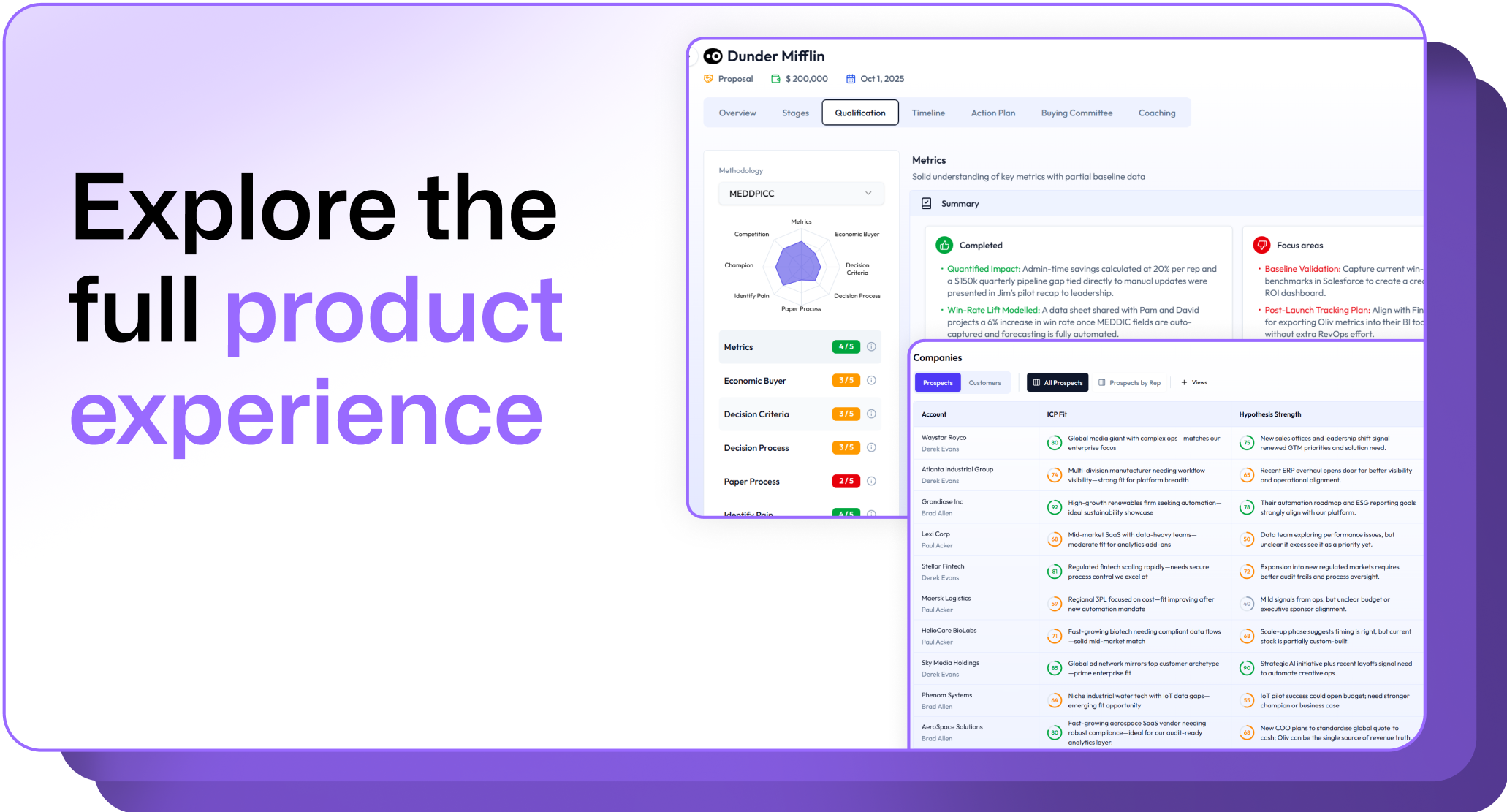
.avif)
.avif)







.avif)
.avif)
.avif)
.png)