Salesforce Agentforce for Mid-Market: The Real Cost, Implementation Reality, and Fast Time-to-Value Alternatives
Written by
Ishan Chhabra
Last Updated :
September 21, 2026
Skim in :
13
mins
In this article
Revenue teams love Oliv
Here’s why:
All your deal data unified (from 30+ tools and tabs).
Insights are delivered to you directly, no digging.
AI agents automate tasks for you.
Thank you! Your submission has been received!
Oops! Something went wrong while submitting the form.
Meet Oliv’s AI Agents
Hi! I’m, Deal Driver
I track deals, flag risks, send weekly pipeline updates and give sales managers full visibility into deal progress
Hi! I’m, CRM Manager
I maintain CRM hygiene by updating core, custom and qualification fields all without your team lifting a finger
Hi! I’m, Forecaster
I build accurate forecasts based on real deal movement and tell you which deals to pull in to hit your number
Hi! I’m, Coach
I believe performance fuels revenue. I spot skill gaps, score calls and build coaching plans to help every rep level up
Hi! I’m, Prospector
I dig into target accounts to surface the right contacts, tailor and time outreach so you always strike when it counts
Hi! I’m, Pipeline tracker
I call reps to get deal updates, and deliver a real-time, CRM-synced roll-up view of deal progress
Hi! I’m, Analyst
I answer complex pipeline questions, uncover deal patterns, and build reports that guide strategic decisions
TL;DR
Agentforce is priced for organisations that already have a Salesforce platform team, so the mid-market's binding constraint is configuration capacity, not the licence fee.
Published meters as at 19 September 2026: Flex Credits $500 per 100,000, 20 credits ($0.10) per standard action, $5 user licence requiring credits, $125 flat-fee access, $2 conversations.
Bundled credits are per org per year, so Enterprise Core's 500,000 credits equal roughly 25,000 standard actions for the whole company, for the whole year.
Independent 2026 benchmarks report 6 to 10 weeks to a first narrow agent, 14 to 20 weeks for a broader rollout, and payback stretching past 18 months below about 800 monthly interactions.
Governance is unpriced labour: EU AI Act Article 50 disclosure duties became enforceable 2 August 2026 and land on the same one to three admins.
Two or more free configuration owners with a clearing backlog favours buying Agentforce; fewer than two favours agents that run against the CRM instead of inside it.
Q1. Is Agentforce worth it for a mid-market company? [toc=1. Mid-Market Go/No-Go]
Agentforce is worth it for a mid-market company that already has Salesforce configuration capacity to spare. Its meters (Flex Credits at $500 per 100,000, a $5 user licence that still requires credits, $125 flat-fee access, $2 per conversation) only turn into value through configuration work, per the Salesforce Agentforce pricing page. If one to three people own your Salesforce backlog, the licence is not your constraint. Their queue is.
⭐ The call where this decision usually lands on you
It usually starts with a forwarded email. Your account executive has demoed Agentforce to your CIO, and now the CIO wants a recommendation by Friday.
You are the VP of RevOps at a 600-person company on Sales Cloud. You did not ask for this project, but you now own the answer. If you are still mapping what these agents actually do day to day, our breakdown of Agentforce use cases for sales and RevOps covers the ground.
💰 Why seat-count budgeting breaks on this SKU
Every software decision you have made until now had a shape you could model. Seats times price times twelve, minus the discount you negotiated in Q4.
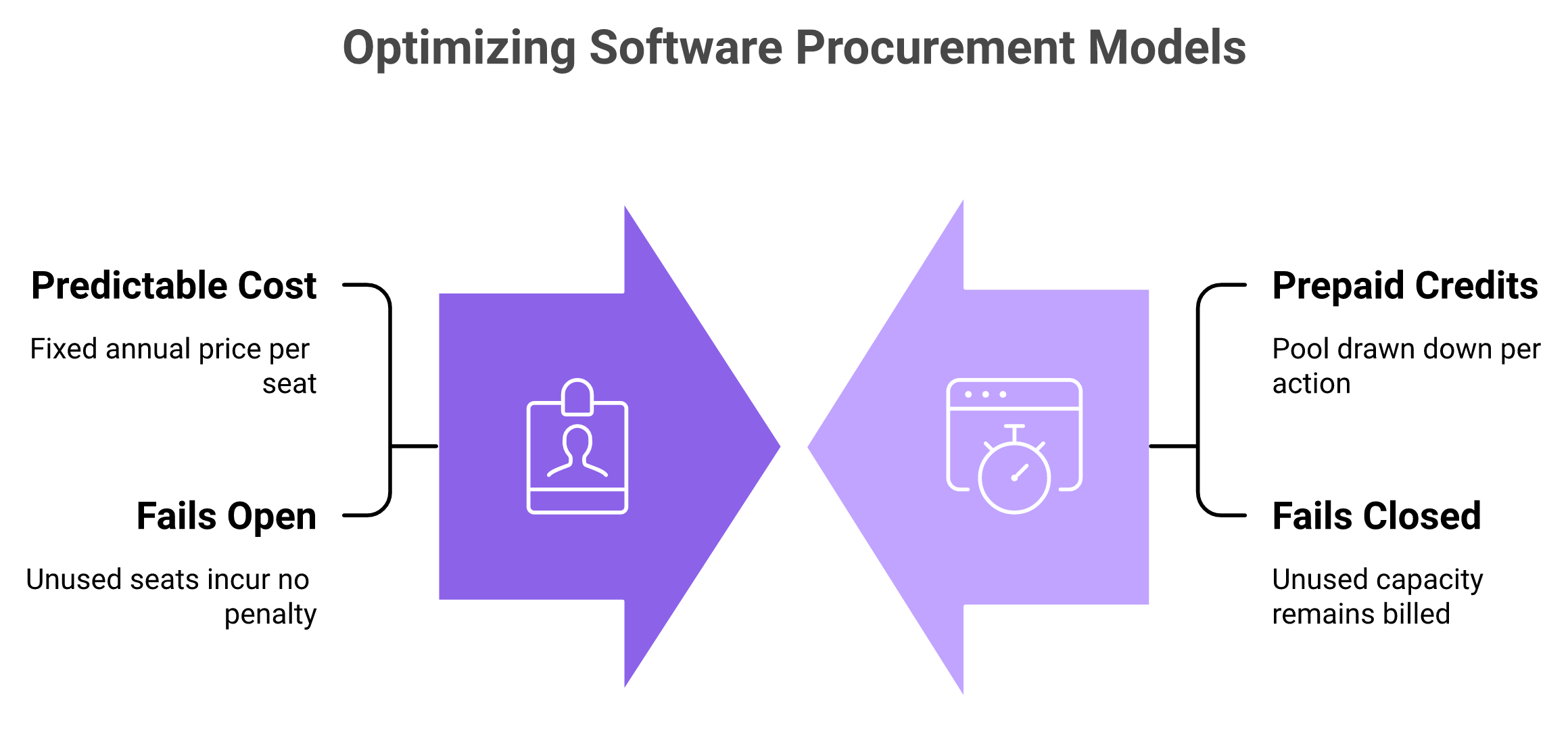
Seat licences fail open and metered contracts fail closed. That single difference is why the Agentforce decision is a capacity question, not a price question.
Agentforce does not work that way. You are buying a meter, and the meter only moves when somebody builds an agent, tests it, and tunes it. That work does not appear on the quote.
⚠️ The constraint moved from money to hours
Here is what changed with consumption pricing. In the old model, you overbought seats and watched adoption. In the new one, you commit to a credit pool and watch whether anyone has time to spend it.
I have watched three mid-market teams sign agent contracts in the last year. In two of them, the blocker was never budget. It was the single admin who also owned the lead-routing rebuild and the CPQ cleanup. The same pattern shows up in every agentic AI implementation for RevOps we review.
✅ The rule, and the honest verdict
So replace the question. Not "can we afford Agentforce," but "do we have the configuration capacity Agentforce assumes." Unspent capacity does not save you money on a consumption contract. It turns the contract into shelfware you have already committed to.
And the honest verdict cuts the other way too. If you have two or more Salesforce admins, and a configuration backlog you are actively clearing rather than quietly growing, Agentforce is probably your better buy. Consolidation on a platform you already run is a real advantage, and I am not going to pretend otherwise.
🕐 The org-chart test you can run in ten minutes
Open your org chart. Count the people who can build a flow, write an Apex trigger, or configure a topic and guardrail in Agent Builder without help.
Now count what is already committed to them this quarter. If the honest answer is "one person, and she is booked through December," you have your answer before the next Salesforce call.
The rest of this article gives you the numbers behind that rule. Section three covers what you are actually billed for, section four covers the volume where the maths works, and section six covers the capacity question in detail.
One caution on dates. Salesforce ships three releases a year, and Winter '27 reached general availability on 12 October 2026, per the Salesforce Winter '27 release notes. Re-check every figure here against the live pricing page before you sign anything.
Q2. We already pay Salesforce, so isn't adding another vendor the expensive option? [toc=2. Consolidation Objection]
Often, yes. Consolidating on Salesforce is genuinely cheaper on contract count, security review, and integration surface, and for an organisation with platform capacity, it is usually the right call. It stops being cheaper when the configuration work is never staffed. A consumption contract with nobody configuring against it bills you for capability you never switch on. The deciding variable is capacity, not vendor count.
✅ The three places consolidation genuinely wins
Let me give this objection its full weight, because it is the strongest one in the room. Buying a second vendor means a second security review, a second contract, and a second integration to maintain.
Your security team will not thank you for that. Neither will the person who owns SSO provisioning. Those costs are real, they recur, and they rarely appear in a business case. That is exactly the maths we ran in our analysis of revenue tech stack consolidation costs.
💸 The invoice arrives whether or not agents shipped
Here is where the consolidation argument quietly stops working. Contract savings are guaranteed. The value is not.
Gartner surveyed 3,412 organisations and predicts that over 40% of agentic AI projects will be cancelled by the end of 2027, according to its 25 June 2025 press release. The reasons given are escalating costs, unclear business value, and inadequate risk controls. Almost none of that is about the model being bad.
⚠️ Consolidation is a capacity bet, not a savings bet
So reframe it. When you consolidate on an incumbent, you are not just simplifying procurement. You are betting that your team will find the hours to configure the thing you bought.
Consolidating on Salesforce is cheaper on paperwork. Whether it is cheaper in practice depends on which quadrant your admin capacity puts you in.
For a company with a platform function, that is a safe bet. For a company where RevOps is two people and a shared Jira board, it is a wish. Same contract, completely different outcome, and the difference sits in your headcount, not in the pricing page.
🕐 The test to run before your next renewal call
I would rather hand you a test than an opinion. Two questions, answerable from your own systems today.
First: name the people who can configure Salesforce this quarter, by name, not by team. Second: list what is already in their queue, with dates.
If that list has slack in it, consolidate and buy Agentforce. If it does not, you are choosing between a metered contract nobody can activate and a tool that does the work without a configuration project in front of it. Our build versus buy guide for revenue AI walks that fork in more detail.
⭐ Where I have been wrong about this
I used to argue the consolidation case was mostly procurement theatre. I was wrong, and a RevOps lead at a 900-person logistics company corrected me properly.
She had eleven vendors and a security questionnaire backlog of four months. For her, one more contract genuinely was the expensive option. Vendor count is a real cost. It is just not the only one, and it is not the one that decides whether agents ever go live.
Q3. What does Agentforce actually cost, and what unit are you buying? [toc=3. Real Cost Structure]
As published on 19 September 2026: Flex Credits cost $500 per 100,000, a standard action consumes 20 credits ($0.10) and a voice action 30 ($0.15); the Agentforce User License is $5 per user per month and is marked "Requires Flex Credits"; Flat Fee Access is $125 per user per month; Conversations are $2; base editions run Enterprise Core $195, Advanced $395, and Max $550, per the Salesforce Agentforce pricing page. The crossover is 20 actions per conversation. You are buying a meter with an access fee attached, not a seat.
💰 The published price lattice, with dates
Agentforce Published Price Lattice (Retrieved 19 September 2026)
What you buy
Published price
What it meters
Retrieved
Flex Credits
$500 per 100,000
Agent actions (20 credits standard, 30 voice)
19 Sep 2026
Agentforce User License
$5 per user per month
Access only, credits still required
19 Sep 2026
Flat Fee Access
$125 per user per month
Employee-facing agent access
19 Sep 2026
Conversations
$2 per conversation
24-hour customer-facing session
19 Sep 2026
Base editions
$195 / $395 / $550 per user per month
Core, Advanced, Max, with bundled credits
19 Sep 2026
Read the $5 line carefully. Salesforce prints three words under it, "Requires Flex Credits," and that is the line most commonly misread on a quote.
⏰ How fast the bundled credits actually go
Bundled credits are allocated per org per year, not per user. At 20 credits per standard action, the arithmetic is unforgiving.
Bundled Flex Credits by Edition, Converted to Standard Actions
Edition
Bundled credits
Standard actions that buys
Enterprise Core
500,000
25,000
Advanced
1,000,000
50,000
Max
2,750,000
137,500
One agent handling a few hundred interactions a week, each firing several actions, works through a Core allocation faster than most finance models assume.
⚠️ Three things to check before you model anything
Note the live source conflict. On 19 September 2026, the Agentforce page described editions from $550 including 2.5 million credits, while the editions table showed Max at 2.75 million per org per year. Same day, two numbers. Ask your AE which applies to your contract, in writing.
Note the stacked stack. Sales Cloud, plus add-on agent access, plus credits, lands a seller well above any single per-seat figure on the page. Third-party analyses put mid-market year-one totals in the range of roughly $150,000 to $425,000 once implementation, training, and tuning are counted. I am not building a cost model here. Our Agentforce pricing breakdown does that properly, and our Agentforce reviews analysis covers what buyers report after go-live.
⭐ What buyers say about platform spend and gated capability
No verified mid-market Agentforce reviewer quote on consumption billing exists in our review corpus yet, so I will not manufacture one. What the corpus does hold is the adjacent complaint, which is paying for a platform and still hitting a paywall on the output.
"I cannot download all the data myself unless we upgrade the plan, which isn't ideal and results in me not fully utilizing Gong." Verified reviewer (name withheld), GongGong - G2 Verified Review, 3 October 2025
"The CRM writeback is not good; we cannot send MEDDIC values back to Salesforce or update fields in Salesforce from the conversation intelligence." Verified reviewer (name withheld), ClariClari - G2 Verified Review, 13 July 2026
Oliv AI publishes both a flat per-role rate and its metered action rate openly, which means a second-year number is arithmetic rather than a forecast. That is a structural difference in how the bill behaves, not a claim about which platform does more.
Q4. At what interaction volume does the Agentforce math actually work? [toc=4. Volume and Payback Gate]
Independent 2026 benchmarks put Agentforce payback at roughly 8 to 14 months above about 2,000 monthly interactions, and 18 to 24 months below it, with the practical floor near 800 to 1,500. Gartner attributes over 40% of projected agentic AI cancellations by end-2027 to escalating costs, unclear business value, and weak risk controls, not model quality. Define one metric before you sign, and baseline it.
⭐ The forecast call where ROI gets asserted
I have sat in the call where someone says the agent "saved the team hours." Nobody in the room can say hours against what.
That is not dishonesty. It is the absence of a baseline, and it is the most common reason a working pilot loses its budget at renewal. Our revenue intelligence ROI calculator exists for exactly that gap.
❌ Why vendor ROI math misfits a B2B sales team
Most published Agentforce ROI models are built on case deflection. Volume in, tickets resolved, cost per resolution down.
That maths is sound for a support queue. It maps poorly onto a mid-market B2B sales team, where the win is a booked meeting or a cleaner forecast, not a deflected ticket. If you inherit the vendor's metric, you will be defending the wrong number a year from now, which is the core argument in our piece on Agentforce versus specialised revenue AI for B2B.
📊 The thresholds that actually decide it
Reported Agentforce Payback Windows by Monthly Interaction Volume
Monthly interaction volume
Reported payback window
Above ~2,000
8 to 14 months
~800 to 1,500
Marginal, model carefully
Below ~800
18 to 24 months
Run your own number first. Count the interactions an agent would genuinely own, not every touch your team makes.
✅ The two-week baseline to run before you sign
Salesforce's own research gives you the measurement to copy. Its sixth State of Sales report put selling time at 30% of a rep's week, and the 2026 edition puts it at 40%.
Do not cite that as a benefit. Use it as a protocol. Track your own reps for two weeks, in their own calendar and CRM data, and write the number down before any agent goes live. If CRM data quality is the thing blocking that measurement, start with CRM data quality automation for RevOps.
⚠️ What skipping the baseline costs
This is the cheapest insurance in the whole evaluation. One metric, one baseline, two weeks of measurement, agreed with your CFO in advance.
Skip it, and you join the 40% that get cancelled, not because the agent failed, but because nobody could prove it worked. A program without a baseline cannot be defended at renewal, no matter how well the agent performs, which is why we push teams toward evidence-based forecast commits first.
Q5. Our AE says Agentforce is included in the renewal, so what happens in month thirteen? [toc=5. Year-Two Exposure]
What is usually included is access plus a fixed credit allocation per org per year, not unlimited agent usage. Ask three things verbatim: what is our per-org credit allocation, what happens when it is consumed inside the contract year, and at what rate is overage billed in month thirteen? Get the answers in writing. They will decide your year-two number more than any list price on the Salesforce Agentforce pricing page.
⭐ The sentence that ends most of these evaluations
I have heard this line in a dozen renewal calls. "Agentforce is basically included in your uplift."
It is not a lie. The access licence often is bundled. The credits that make the access do anything are a separate, finite number, and that number is what you are really buying. Our Agentforce pricing breakdown shows the full lattice line by line.
💰 Why your seat instinct misreads this SKU
Seat licences fail open. You buy 200, use 140, and nothing breaks.
Metered licences fail differently. Credits are allocated per org per year, not per user, so Enterprise Core includes 500,000 credits and Max includes 2.75 million. At 20 credits per standard action, Core buys 25,000 actions for the whole company, for the whole year.
⚠️ Year one is cheap by design, year two is unknown by default
This is the structural trap, and it is not unique to Salesforce. Bundled allocations make the first year look almost free, because the credits are already paid for inside the edition.
Then usage grows, which is the outcome you wanted. Now you are buying credits at $500 per 100,000, on top of the edition you already renewed. Consumption billing has removed your ability to forecast year two from year one, and no amount of internal modelling fixes that without the vendor's overage terms. We unpack the same dynamic across the wider stack in our analysis of how to reduce sales tech stack costs.
✅ The three questions, word for word
Take these to your account executive and ask for the answers in email, not on a call.
What is our exact per-org Flex Credit allocation, and does it reset on the contract anniversary or the fiscal year?
What happens operationally when the allocation is consumed in month eight? Do agents stop, throttle, or auto-draw from a wallet?
What is the committed overage rate in month thirteen, and is it locked for the contract term?
If the answer to any of these is "we'll sort that out later," that is your answer on timing.
💸 What buyers say about paying and still not getting the return
No verified mid-market Agentforce reviewer quote on consumption billing sits in our review corpus yet, so I will not invent one. What the corpus does hold is the adjacent complaint that matters here, which is spend that does not convert into usable output.
"The fact that you can't edit a recording (to only share a portion with a client), and the fact that if you stop working with the tool you lose the data." Verified reviewer (name withheld), GongGong - G2 Verified Review, 19 March 2026
"Limitations of getting data back into Salesforce." Verified reviewer (name withheld), GongGong - G2 Verified Review, 21 May 2026
⏰ Where to log the answers before you sign
Put all three answers in the business case document, with the date and the person who said them. Not in Slack, where it disappears.
Your CFO will ask for the second-year number in about nine months. That document is the only thing that will save you that week, and it is the same discipline behind evidence-based forecast commits.
Q6. Do you need a Salesforce admin or platform team to run Agentforce? [toc=6. Configuration Capacity]
Practically, yes. Agentforce agents are configured inside Salesforce, which means topics, instructions, actions, guardrails, testing, and ongoing tuning. G2 reviewers of Agentforce products repeatedly cite complex setup and dependence on skilled admins or paid partners, across roughly 1,205 reviews at a 4.3 out of 5 average. Mid-market organisations typically have one to three such people, already holding a backlog. Budget a named owner and permanent tuning time, not just licences.
⭐ Look at your admin's actual quarter
Picture the person who would own this. In most 200 to 2,000 employee companies, she is your only certified admin, and she is also the reporting team.
This quarter she owns the lead-routing rebuild, a duplicate-account cleanup, and whatever the new comp plan breaks. Agentforce is now item four. That queue is the real subject of our guide to scaling revenue operations on a small team.
⚠️ What "configuration" actually means here
The word hides a lot of work. Building an agent is closer to writing an operating procedure than flipping a feature on.
Define topics, which are the jobs the agent is allowed to handle.
Write instructions in plain language, then test how the agent interprets them.
Wire actions to real Salesforce operations, with field-level permissions.
Set guardrails so the agent refuses what it should refuse.
Build test sets, then re-run them after every change.
None of that is exotic. All of it takes hours from a person who has none spare.
❌ The work moved from buying features to authoring behaviour
This is the shift most business cases miss. Old CRM projects were configuration of state, so fields, layouts, validation rules, and reports.
Agent projects are configuration of behaviour. You are specifying how something acts when a customer says something unexpected, which is a harder job, and it never really finishes. The tuning loop after go-live, so guardrail misfires, topics that overlap, and escalation rules that fire too late, is where mid-market programs quietly stall. Our agentic AI implementation guide for RevOps covers the data architecture underneath that loop.
💰 The capacity maths, in FTE-weeks
Do it crudely, on paper, before the procurement stage.
And the honest read: if that table has slack in it, buy Agentforce and staff it properly. Native depth inside Salesforce is real, and nothing that sits outside the platform can match it on object-level access.
✅ What reviewers say about setup and integration load
These are adjacent products, not Agentforce, and I am labelling them as such rather than passing them off as segment evidence.
"Real time integrations can be time consuming." Verified reviewer (name withheld), GongGong - G2 Verified Review, 21 April 2026
"I really like Clari's excellent user experience. It truly shines in weekly forecasts and opportunity analysis. I also appreciate how smooth the implementation was." Verified reviewer (name withheld), ClariClari - G2 Verified Review, 16 November 2025
Both things are true in this category. Some deployments land smoothly, and the ones that do almost always have a named owner with real hours.
⏰ The one line to add to your business case
Write it plainly: "Named configuration owner, X hours per week, for four quarters."
If you cannot fill in the name, you do not have a capacity problem to solve later. You have a decision to make now, and our RevOps implementation and admin guide shows what that ownership looks like in practice.
Q7. How long does an Agentforce implementation actually take? [toc=7. Implementation Timeline]
Salesforce materials describe agents going live within weeks. Independent 2026 benchmarks report roughly 6 to 10 weeks to a first narrow production agent, and 14 to 20 weeks for a broader rollout with data integration. Plan against the observed range. Note the release cadence too. Winter '27 release notes were published on 19 August 2026, with general availability on 12 October 2026, so re-check packaging at contract time.
⏰ Claimed against observed, with sources
Agentforce Implementation Timelines: Vendor Framing Against Independent Benchmarks
Stage
Vendor framing
Independently reported
Source date
First narrow agent, single topic
"within weeks"
6 to 8 weeks
Apr 2026
Multi-topic agent with knowledge setup
Weeks
9 to 13 weeks
Apr 2026
Broad rollout with data integration
Weeks
14 to 20 weeks
Apr 2026
Steady-state tuning
Not stated
Ongoing, per quarter
Apr 2026
Quote both numbers to your CFO. Then budget the third-party one, because that is the one your calendar will follow.
⚠️ Build the release calendar into your plan
Salesforce ships three releases a year, named Spring, Summer, and Winter. Winter '27 rolled to production instances through September and early October 2026, reaching general availability on 12 October 2026.
That matters for two reasons. Sandbox previews and production upgrades will land mid-project, and agent packaging details can change between the day you are quoted and the day you sign.
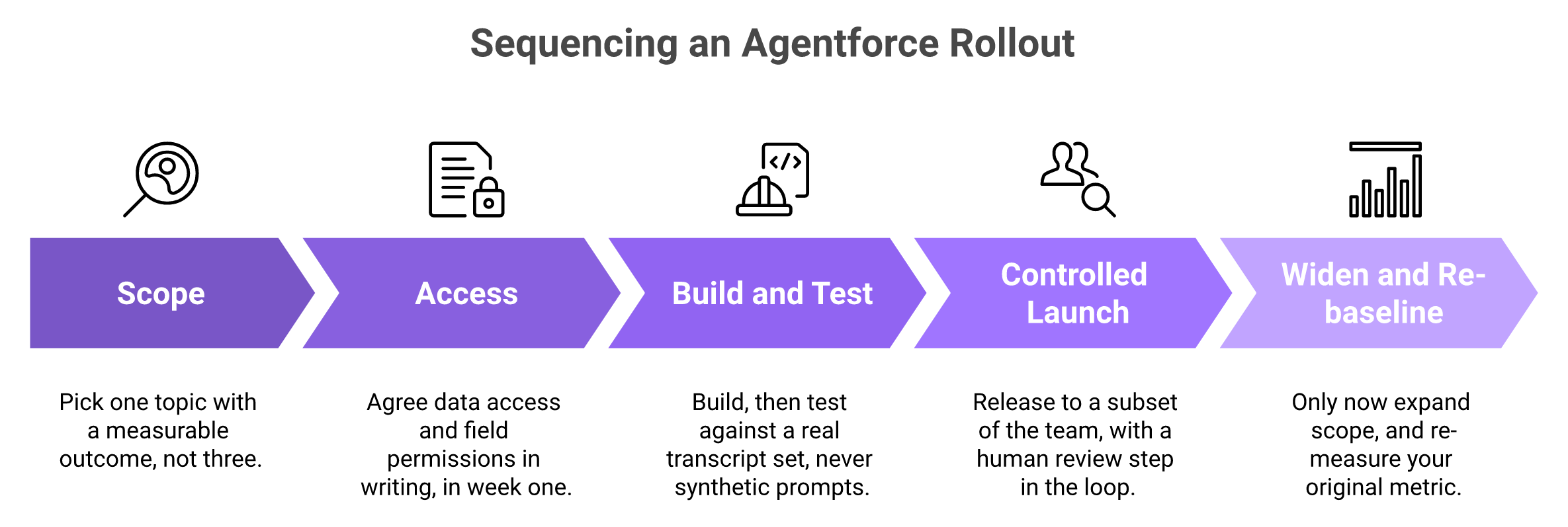
✅ A sequence that survives contact with reality
If you proceed, sequence it so value arrives before the integration work finishes.
Sequencing matters more than speed. Scope one topic, lock permissions early, and re-baseline your metric before widening the rollout.
Pick one topic with a measurable outcome, not three.
Get data access and field permissions agreed in week one, in writing.
Build, then test against a real transcript set, not synthetic prompts.
Launch to a subset of the team, with a human review step.
Only then widen scope, and re-baseline your metric.
⭐ What reviewers say about setup and post-launch flexibility
These quotes are from adjacent revenue tools rather than Agentforce, and I am naming them as such.
"I like Clari's visual design and the nice, clear style of word presentation. The initial setup was easy too." Verified reviewer (name withheld), ClariClari - G2 Verified Review, 17 December 2025
"There's no custom reporting. The CRM writeback is not good; we cannot send MEDDIC values back to Salesforce or update fields in Salesforce from the conversation intelligence. The AI is not as flexible as we need it to be." Verified reviewer (name withheld), ClariClari - G2 Verified Review, 13 July 2026
Notice the pattern across both. Initial setup is rarely the hard part. Writing data back into Salesforce, correctly and with context, is where timelines slip, which is why CRM data quality automation belongs in the plan from week one.
💰 What changes when the agent runs outside the CRM
Oliv AI's agents run against Salesforce rather than being built inside it, so the CRM Manager agent syncs fields with the supporting evidence attached, using the existing object model. That removes the configuration project from the critical path, which is a structural difference in sequencing rather than a speed claim I can put a number on.
Q8. Can you pilot Agentforce on Salesforce Foundations, and does it need Data Cloud? [toc=8. Foundations Pilot Path]
Partly. Salesforce Foundations is listed at $0 and includes builder tooling, so Agent Builder, Prompt Builder, and Agent Script, for customers on Enterprise Edition or above, with 100,000 credits at no cost, which is roughly 5,000 standard actions. It is a proof-of-concept surface, not a production tier. On Data Cloud, Salesforce does not publish it as a documented prerequisite, so treat that requirement as unconfirmed and get it answered in writing.
✅ What the $0 tier actually covers
Useful for a genuine test, within limits.
Agent builder and prompt tooling, so you can author topics and instructions.
A free allocation of 100,000 Flex Credits, roughly 5,000 standard actions at 20 credits each.
Access on Enterprise Edition or above, which most mid-market Sales Cloud customers already hold.
❌ What it does not cover
Production-scale usage. 5,000 actions is a pilot budget, not a quarter of live traffic.
The paid access licences, so $5 per user with credits, or $125 flat-fee access, if you want broad internal deployment.
The integration and data work that a real deployment needs.
⚠️ On the Data Cloud question, the honest answer
You will read in a lot of places that Agentforce requires Data Cloud, with a five-figure or six-figure price attached. Our own research could not find that stated as a documented prerequisite on Salesforce's published pricing pages, and we removed the claim from our own pricing article once we checked.
So do not plan around a number nobody has published. Ask Salesforce directly what grounding your specific use case needs, whether that is Data Cloud, Data 360, or standard record access, and get the answer in email. Our review of Agentforce for Sales features and limitations lists the questions worth asking alongside it.
⏰ How to spend 5,000 actions properly
A free allocation gets wasted when it is treated as a demo. Design it as an experiment instead.
One topic, chosen because it repeats. Not the most impressive one.
One queue or one rep segment, so the comparison is clean.
One metric, baselined for two weeks before the agent touches anything.
A fixed end date, with a written decision rule for continue or stop.
5,000 actions is enough to answer a real question. It is not enough to answer four.
⭐ What I would actually test first
If it were my org, I would not pilot the customer-facing agent. I would pilot the least glamorous internal one, usually CRM field updates after calls, because the baseline is easy to measure and the failure mode is visible in a day.
Impressive pilots tend to produce ambiguous results. Boring pilots produce numbers you can take to a renewal conversation, which is the only reason to run one. If you want the fuller comparison set before you commit, our roundup of Agentforce alternatives and competitors is the next stop.
Q9. What governance and compliance work does an autonomous agent add? [toc=9. Governance and Compliance]
More than the licence suggests. EU AI Act Article 50 transparency obligations became enforceable on 2 August 2026, so an agent interacting with a person must disclose that it is AI, with marking and machine-readable detection duties phased to 2 December 2026 for systems already on the market. Add SOC 2 evidence, call-recording consent rules, and a documented human-in-the-loop escalation path. All of it consumes the same admin hours as configuration.
⚠️ The four obligations, with dates and owners
Treat this as a checklist, not background reading.
Governance Obligations for Autonomous Sales Agents, With Dates and Owners
Obligation
What it requires
Live from
Who owns it
AI disclosure (Article 50)
Tell the person they are talking to an AI system
2 Aug 2026
RevOps plus Legal
Marking and detection of AI content
Machine-readable marking of generated output
Phased to 2 Dec 2026
Platform owner
Security review evidence
SOC 2 report, encryption posture, data residency
At procurement
Security
Human-in-the-loop escalation
Written rule for when the agent hands off
Before go-live
Sales leadership
Enforcement powers for national authorities also started applying from 2 August 2026, per the EU AI Act Service Desk, so this is not a future problem for EU-facing teams.
✅ What disclosure looks like in a real sales workflow
This part is simpler than it sounds. If an agent emails or chats with a buyer, the buyer needs to know it is an agent.
In practice, that is a line in the signature, a first-message disclosure, and a record of what was said. The harder question is the escalation rule, because somebody has to define the moment a human takes over. Our AI CRM trust and governance evaluation guide sets out how to write that rule.
💰 Why this belongs in your capacity count, not your legal folder
Here is the connection back to the money. Every item in that table lands on the same one to three people who would configure the agent in the first place.
Your admin writes the guardrails. Your RevOps lead writes the escalation rule. Nobody hires a separate compliance engineer for a mid-market agent pilot, so this is capacity spend, and it is missing from every business case I have reviewed this year. The same gap shows up in our mid-market revenue AI buyer guide on governance and SOC 2.
⭐ The governance work nobody prices
I read a lot of Agentforce cost analyses while researching this piece. Not one of them put a number, or even a line item, against governance labour.
That is not a criticism of the analysts. It is a gap in how this category talks about cost, and it quietly converts into launch delays when Legal asks a reasonable question in week nine.
📋 The line to add to your vendor questionnaire on Monday
Add one row, worded like this: "Describe how your agents disclose AI identity at first contact, and how generated output is marked for detection, with reference to EU AI Act Article 50."
Then add a second row asking for the SOC 2 Type II report and the data export policy. Any serious vendor will answer both in a day. The ones that cannot are telling you something useful.
For recorded calls, check your consent posture separately, because two-party consent rules vary by state and country, and they are not covered by the AI Act at all. Our notes on DPA and security review for revenue tooling cover the questions that usually stall procurement.
Q10. What are the alternatives if you are already on Sales Cloud? [toc=10. Sales Cloud Alternatives]
Three routes exist: build inside Salesforce with Agentforce, buy a revenue-AI layer that runs on top of the CRM, or defer for a quarter. Oliv AI sits in the second category, because its agents operate on a context layer over Salesforce rather than requiring configuration inside it, which is exactly where a one-to-three-person RevOps team runs out of hours. Agentforce has deeper Salesforce-native integration than any layer can have. Oliv AI also has a far smaller public review footprint than Salesforce, and its case studies are email-gated.
⭐ The three honest routes
Route one is Agentforce, built inside your org. Route two is a layer that reads and writes to Salesforce from outside. Route three is waiting two quarters while you hire or free up an admin.
Route three is undervalued. I have told two companies this year to pick it, and both are better off for having waited. If you want the category view first, start with our comparison of revenue intelligence platforms for mid-market CROs.
✅ What Agentforce genuinely does better
Let me be specific rather than diplomatic. Agentforce sits inside the platform, which means object-level access, native permissions inheritance, and flows that already exist in your org.
No external layer matches that depth, and it would be dishonest to claim otherwise. If your team has the hours, that depth is worth buying, and our review of verified Agentforce reviews shows what those teams report after go-live.
⚠️ What changes when the agent runs outside the CRM
The difference is who does the work before value appears. Build-inside means a configuration project comes first, then agents. Run-against means the agent reads your existing objects, and the configuration project does not sit on the critical path.
That is a sequencing difference, not a capability claim. It matters only because the mid-market constraint is hours, not ambition. We set out the architecture behind that choice in Agentforce versus specialised revenue AI for B2B teams.
💰 How reviewers describe the layer approach
These are Oliv AI reviews, not Agentforce ones, and I am labelling them so nobody confuses the two.
"The Driver agent watches all my deals and flags any that are at risk, so I don't have to spend hours listening to recordings in tools like Gong and Clari. The initial setup was really easy because the team provided FDE engineers who set everything up, and within less than a week, we were good to go." Verified reviewer (name withheld), Oliv AIOliv AI G2 - Verified Review, 17 June 2026
"The only downside is that the platform can be a bit glitchy at times, but the support team is always quick to address and resolve any bugs. The occasional slowness is a minor trade-off." Verified reviewer (name withheld), Oliv AIOliv AI G2 - Verified Review, 2 July 2026
Both of those are useful. One tells you the setup path is short, the other tells you the product is younger than Salesforce, which it is.
✅ The concession I want on the record
Say this out loud in your evaluation. Salesforce is the more established product, with a public review corpus in the thousands. Oliv AI is the least publicly proven option named on this page, and a reader who checks will confirm that in about thirty seconds.
Where I will hold firm is the framing. Oliv AI is a layer on top of the CRM that drives Salesforce adoption, not a CRM replacement, and we will not position it as one.
Oliv AI runs against the CRM instead of inside it. CRM Manager writes fields back with the supporting evidence attached, Forecaster keeps pipeline hygiene current, and Oliver surfaces playbook adherence, none of which needs a Salesforce configuration project first. That is the only claim we make on this page. The fuller comparison sits in our Agentforce alternatives breakdown, and the workflow detail sits in our guide to AI agents for RevOps.
Q11. How do you make the call before your next Salesforce conversation? [toc=11. Decision Scorecard]
Score five lines: named Salesforce configuration owners free this quarter, current backlog depth, monthly interaction volume against the 800 to 1,500 floor, the one metric the agent must move (baselined), and your month-thirteen credit answer in writing. Two or more configuration owners with a clearing backlog favours Agentforce. Fewer than two favours a layer that runs against the CRM, because unspent capacity turns a consumption contract into committed shelfware.
✅ The five lines, answerable today
Print this and fill it in before the next call.
Agentforce Mid-Market Qualification Scorecard
Line
What to write
Favours Agentforce if
Configuration owners free this quarter
Names, not team names
2 or more
Backlog trend
Clearing or growing
Clearing
Monthly interactions an agent would own
A count, not a guess
Above 1,500
The one metric, baselined
Metric plus two-week baseline
Already measured
Month-thirteen credit answer
In email, from your AE
Answered and locked
Five yes answers, and I would buy Agentforce without hesitation.
⚠️ How to read a mixed score
Most teams land at two or three. That is not a signal to buy anyway, and it is not a signal to do nothing.
It is a signal to fix the weakest line first. If the baseline is missing, run the two-week measurement. If the credit answer is missing, get it in email. Gartner's cancellation research points at undefined business value as a primary cause, so the metric line is the one I would never skip. Our work on sales forecast accuracy for CROs covers how to pick that metric.
⭐ Where each column actually leads
How to Read Your Agentforce Scorecard Result
Your score
The honest recommendation
4 to 5 lines green
Buy Agentforce, staff it with a named owner
2 to 3 lines green
Fix the weak lines, revisit in one quarter
0 to 1 lines green
Buy agents that run against the CRM, or defer
Oliv AI exists for the second column of that scorecard, for teams without spare configuration capacity that still need agent work happening against Salesforce data. If you land in the first column, buy Agentforce and staff it properly. That is genuinely the better outcome, and we would rather you knew which column you were in.
💰 What I hope you walk away with
If this article did its job, you have swapped one question for another. Not "can we afford Agentforce," but "do we have the configuration capacity Agentforce assumes."
That second question is answerable from your own org chart, in ten minutes, without a vendor in the room. It also survives every price change Salesforce ships, which the first question does not.
Take the five lines into your next Salesforce call and see how many the AE can help you fill in. If you want a second pair of eyes on the capacity column, talk to us about your RevOps setup and bring your org chart. I am more interested in whether you are in column one or column two than in which vendor you pick.
Q1. Is Agentforce worth it for a mid-market company? [toc=1. Mid-Market Go/No-Go]
Agentforce is worth it for a mid-market company that already has Salesforce configuration capacity to spare. Its meters (Flex Credits at $500 per 100,000, a $5 user licence that still requires credits, $125 flat-fee access, $2 per conversation) only turn into value through configuration work, per the Salesforce Agentforce pricing page. If one to three people own your Salesforce backlog, the licence is not your constraint. Their queue is.
⭐ The call where this decision usually lands on you
It usually starts with a forwarded email. Your account executive has demoed Agentforce to your CIO, and now the CIO wants a recommendation by Friday.
You are the VP of RevOps at a 600-person company on Sales Cloud. You did not ask for this project, but you now own the answer. If you are still mapping what these agents actually do day to day, our breakdown of Agentforce use cases for sales and RevOps covers the ground.
💰 Why seat-count budgeting breaks on this SKU
Every software decision you have made until now had a shape you could model. Seats times price times twelve, minus the discount you negotiated in Q4.
Seat licences fail open and metered contracts fail closed. That single difference is why the Agentforce decision is a capacity question, not a price question.
Agentforce does not work that way. You are buying a meter, and the meter only moves when somebody builds an agent, tests it, and tunes it. That work does not appear on the quote.
⚠️ The constraint moved from money to hours
Here is what changed with consumption pricing. In the old model, you overbought seats and watched adoption. In the new one, you commit to a credit pool and watch whether anyone has time to spend it.
I have watched three mid-market teams sign agent contracts in the last year. In two of them, the blocker was never budget. It was the single admin who also owned the lead-routing rebuild and the CPQ cleanup. The same pattern shows up in every agentic AI implementation for RevOps we review.
✅ The rule, and the honest verdict
So replace the question. Not "can we afford Agentforce," but "do we have the configuration capacity Agentforce assumes." Unspent capacity does not save you money on a consumption contract. It turns the contract into shelfware you have already committed to.
And the honest verdict cuts the other way too. If you have two or more Salesforce admins, and a configuration backlog you are actively clearing rather than quietly growing, Agentforce is probably your better buy. Consolidation on a platform you already run is a real advantage, and I am not going to pretend otherwise.
🕐 The org-chart test you can run in ten minutes
Open your org chart. Count the people who can build a flow, write an Apex trigger, or configure a topic and guardrail in Agent Builder without help.
Now count what is already committed to them this quarter. If the honest answer is "one person, and she is booked through December," you have your answer before the next Salesforce call.
The rest of this article gives you the numbers behind that rule. Section three covers what you are actually billed for, section four covers the volume where the maths works, and section six covers the capacity question in detail.
One caution on dates. Salesforce ships three releases a year, and Winter '27 reached general availability on 12 October 2026, per the Salesforce Winter '27 release notes. Re-check every figure here against the live pricing page before you sign anything.
Q2. We already pay Salesforce, so isn't adding another vendor the expensive option? [toc=2. Consolidation Objection]
Often, yes. Consolidating on Salesforce is genuinely cheaper on contract count, security review, and integration surface, and for an organisation with platform capacity, it is usually the right call. It stops being cheaper when the configuration work is never staffed. A consumption contract with nobody configuring against it bills you for capability you never switch on. The deciding variable is capacity, not vendor count.
✅ The three places consolidation genuinely wins
Let me give this objection its full weight, because it is the strongest one in the room. Buying a second vendor means a second security review, a second contract, and a second integration to maintain.
Your security team will not thank you for that. Neither will the person who owns SSO provisioning. Those costs are real, they recur, and they rarely appear in a business case. That is exactly the maths we ran in our analysis of revenue tech stack consolidation costs.
💸 The invoice arrives whether or not agents shipped
Here is where the consolidation argument quietly stops working. Contract savings are guaranteed. The value is not.
Gartner surveyed 3,412 organisations and predicts that over 40% of agentic AI projects will be cancelled by the end of 2027, according to its 25 June 2025 press release. The reasons given are escalating costs, unclear business value, and inadequate risk controls. Almost none of that is about the model being bad.
⚠️ Consolidation is a capacity bet, not a savings bet
So reframe it. When you consolidate on an incumbent, you are not just simplifying procurement. You are betting that your team will find the hours to configure the thing you bought.
Consolidating on Salesforce is cheaper on paperwork. Whether it is cheaper in practice depends on which quadrant your admin capacity puts you in.
For a company with a platform function, that is a safe bet. For a company where RevOps is two people and a shared Jira board, it is a wish. Same contract, completely different outcome, and the difference sits in your headcount, not in the pricing page.
🕐 The test to run before your next renewal call
I would rather hand you a test than an opinion. Two questions, answerable from your own systems today.
First: name the people who can configure Salesforce this quarter, by name, not by team. Second: list what is already in their queue, with dates.
If that list has slack in it, consolidate and buy Agentforce. If it does not, you are choosing between a metered contract nobody can activate and a tool that does the work without a configuration project in front of it. Our build versus buy guide for revenue AI walks that fork in more detail.
⭐ Where I have been wrong about this
I used to argue the consolidation case was mostly procurement theatre. I was wrong, and a RevOps lead at a 900-person logistics company corrected me properly.
She had eleven vendors and a security questionnaire backlog of four months. For her, one more contract genuinely was the expensive option. Vendor count is a real cost. It is just not the only one, and it is not the one that decides whether agents ever go live.
Q3. What does Agentforce actually cost, and what unit are you buying? [toc=3. Real Cost Structure]
As published on 19 September 2026: Flex Credits cost $500 per 100,000, a standard action consumes 20 credits ($0.10) and a voice action 30 ($0.15); the Agentforce User License is $5 per user per month and is marked "Requires Flex Credits"; Flat Fee Access is $125 per user per month; Conversations are $2; base editions run Enterprise Core $195, Advanced $395, and Max $550, per the Salesforce Agentforce pricing page. The crossover is 20 actions per conversation. You are buying a meter with an access fee attached, not a seat.
💰 The published price lattice, with dates
Agentforce Published Price Lattice (Retrieved 19 September 2026)
What you buy
Published price
What it meters
Retrieved
Flex Credits
$500 per 100,000
Agent actions (20 credits standard, 30 voice)
19 Sep 2026
Agentforce User License
$5 per user per month
Access only, credits still required
19 Sep 2026
Flat Fee Access
$125 per user per month
Employee-facing agent access
19 Sep 2026
Conversations
$2 per conversation
24-hour customer-facing session
19 Sep 2026
Base editions
$195 / $395 / $550 per user per month
Core, Advanced, Max, with bundled credits
19 Sep 2026
Read the $5 line carefully. Salesforce prints three words under it, "Requires Flex Credits," and that is the line most commonly misread on a quote.
⏰ How fast the bundled credits actually go
Bundled credits are allocated per org per year, not per user. At 20 credits per standard action, the arithmetic is unforgiving.
Bundled Flex Credits by Edition, Converted to Standard Actions
Edition
Bundled credits
Standard actions that buys
Enterprise Core
500,000
25,000
Advanced
1,000,000
50,000
Max
2,750,000
137,500
One agent handling a few hundred interactions a week, each firing several actions, works through a Core allocation faster than most finance models assume.
⚠️ Three things to check before you model anything
Note the live source conflict. On 19 September 2026, the Agentforce page described editions from $550 including 2.5 million credits, while the editions table showed Max at 2.75 million per org per year. Same day, two numbers. Ask your AE which applies to your contract, in writing.
Note the stacked stack. Sales Cloud, plus add-on agent access, plus credits, lands a seller well above any single per-seat figure on the page. Third-party analyses put mid-market year-one totals in the range of roughly $150,000 to $425,000 once implementation, training, and tuning are counted. I am not building a cost model here. Our Agentforce pricing breakdown does that properly, and our Agentforce reviews analysis covers what buyers report after go-live.
⭐ What buyers say about platform spend and gated capability
No verified mid-market Agentforce reviewer quote on consumption billing exists in our review corpus yet, so I will not manufacture one. What the corpus does hold is the adjacent complaint, which is paying for a platform and still hitting a paywall on the output.
"I cannot download all the data myself unless we upgrade the plan, which isn't ideal and results in me not fully utilizing Gong." Verified reviewer (name withheld), GongGong - G2 Verified Review, 3 October 2025
"The CRM writeback is not good; we cannot send MEDDIC values back to Salesforce or update fields in Salesforce from the conversation intelligence." Verified reviewer (name withheld), ClariClari - G2 Verified Review, 13 July 2026
Oliv AI publishes both a flat per-role rate and its metered action rate openly, which means a second-year number is arithmetic rather than a forecast. That is a structural difference in how the bill behaves, not a claim about which platform does more.
Q4. At what interaction volume does the Agentforce math actually work? [toc=4. Volume and Payback Gate]
Independent 2026 benchmarks put Agentforce payback at roughly 8 to 14 months above about 2,000 monthly interactions, and 18 to 24 months below it, with the practical floor near 800 to 1,500. Gartner attributes over 40% of projected agentic AI cancellations by end-2027 to escalating costs, unclear business value, and weak risk controls, not model quality. Define one metric before you sign, and baseline it.
⭐ The forecast call where ROI gets asserted
I have sat in the call where someone says the agent "saved the team hours." Nobody in the room can say hours against what.
That is not dishonesty. It is the absence of a baseline, and it is the most common reason a working pilot loses its budget at renewal. Our revenue intelligence ROI calculator exists for exactly that gap.
❌ Why vendor ROI math misfits a B2B sales team
Most published Agentforce ROI models are built on case deflection. Volume in, tickets resolved, cost per resolution down.
That maths is sound for a support queue. It maps poorly onto a mid-market B2B sales team, where the win is a booked meeting or a cleaner forecast, not a deflected ticket. If you inherit the vendor's metric, you will be defending the wrong number a year from now, which is the core argument in our piece on Agentforce versus specialised revenue AI for B2B.
📊 The thresholds that actually decide it
Reported Agentforce Payback Windows by Monthly Interaction Volume
Monthly interaction volume
Reported payback window
Above ~2,000
8 to 14 months
~800 to 1,500
Marginal, model carefully
Below ~800
18 to 24 months
Run your own number first. Count the interactions an agent would genuinely own, not every touch your team makes.
✅ The two-week baseline to run before you sign
Salesforce's own research gives you the measurement to copy. Its sixth State of Sales report put selling time at 30% of a rep's week, and the 2026 edition puts it at 40%.
Do not cite that as a benefit. Use it as a protocol. Track your own reps for two weeks, in their own calendar and CRM data, and write the number down before any agent goes live. If CRM data quality is the thing blocking that measurement, start with CRM data quality automation for RevOps.
⚠️ What skipping the baseline costs
This is the cheapest insurance in the whole evaluation. One metric, one baseline, two weeks of measurement, agreed with your CFO in advance.
Skip it, and you join the 40% that get cancelled, not because the agent failed, but because nobody could prove it worked. A program without a baseline cannot be defended at renewal, no matter how well the agent performs, which is why we push teams toward evidence-based forecast commits first.
Q5. Our AE says Agentforce is included in the renewal, so what happens in month thirteen? [toc=5. Year-Two Exposure]
What is usually included is access plus a fixed credit allocation per org per year, not unlimited agent usage. Ask three things verbatim: what is our per-org credit allocation, what happens when it is consumed inside the contract year, and at what rate is overage billed in month thirteen? Get the answers in writing. They will decide your year-two number more than any list price on the Salesforce Agentforce pricing page.
⭐ The sentence that ends most of these evaluations
I have heard this line in a dozen renewal calls. "Agentforce is basically included in your uplift."
It is not a lie. The access licence often is bundled. The credits that make the access do anything are a separate, finite number, and that number is what you are really buying. Our Agentforce pricing breakdown shows the full lattice line by line.
💰 Why your seat instinct misreads this SKU
Seat licences fail open. You buy 200, use 140, and nothing breaks.
Metered licences fail differently. Credits are allocated per org per year, not per user, so Enterprise Core includes 500,000 credits and Max includes 2.75 million. At 20 credits per standard action, Core buys 25,000 actions for the whole company, for the whole year.
⚠️ Year one is cheap by design, year two is unknown by default
This is the structural trap, and it is not unique to Salesforce. Bundled allocations make the first year look almost free, because the credits are already paid for inside the edition.
Then usage grows, which is the outcome you wanted. Now you are buying credits at $500 per 100,000, on top of the edition you already renewed. Consumption billing has removed your ability to forecast year two from year one, and no amount of internal modelling fixes that without the vendor's overage terms. We unpack the same dynamic across the wider stack in our analysis of how to reduce sales tech stack costs.
✅ The three questions, word for word
Take these to your account executive and ask for the answers in email, not on a call.
What is our exact per-org Flex Credit allocation, and does it reset on the contract anniversary or the fiscal year?
What happens operationally when the allocation is consumed in month eight? Do agents stop, throttle, or auto-draw from a wallet?
What is the committed overage rate in month thirteen, and is it locked for the contract term?
If the answer to any of these is "we'll sort that out later," that is your answer on timing.
💸 What buyers say about paying and still not getting the return
No verified mid-market Agentforce reviewer quote on consumption billing sits in our review corpus yet, so I will not invent one. What the corpus does hold is the adjacent complaint that matters here, which is spend that does not convert into usable output.
"The fact that you can't edit a recording (to only share a portion with a client), and the fact that if you stop working with the tool you lose the data." Verified reviewer (name withheld), GongGong - G2 Verified Review, 19 March 2026
"Limitations of getting data back into Salesforce." Verified reviewer (name withheld), GongGong - G2 Verified Review, 21 May 2026
⏰ Where to log the answers before you sign
Put all three answers in the business case document, with the date and the person who said them. Not in Slack, where it disappears.
Your CFO will ask for the second-year number in about nine months. That document is the only thing that will save you that week, and it is the same discipline behind evidence-based forecast commits.
Q6. Do you need a Salesforce admin or platform team to run Agentforce? [toc=6. Configuration Capacity]
Practically, yes. Agentforce agents are configured inside Salesforce, which means topics, instructions, actions, guardrails, testing, and ongoing tuning. G2 reviewers of Agentforce products repeatedly cite complex setup and dependence on skilled admins or paid partners, across roughly 1,205 reviews at a 4.3 out of 5 average. Mid-market organisations typically have one to three such people, already holding a backlog. Budget a named owner and permanent tuning time, not just licences.
⭐ Look at your admin's actual quarter
Picture the person who would own this. In most 200 to 2,000 employee companies, she is your only certified admin, and she is also the reporting team.
This quarter she owns the lead-routing rebuild, a duplicate-account cleanup, and whatever the new comp plan breaks. Agentforce is now item four. That queue is the real subject of our guide to scaling revenue operations on a small team.
⚠️ What "configuration" actually means here
The word hides a lot of work. Building an agent is closer to writing an operating procedure than flipping a feature on.
Define topics, which are the jobs the agent is allowed to handle.
Write instructions in plain language, then test how the agent interprets them.
Wire actions to real Salesforce operations, with field-level permissions.
Set guardrails so the agent refuses what it should refuse.
Build test sets, then re-run them after every change.
None of that is exotic. All of it takes hours from a person who has none spare.
❌ The work moved from buying features to authoring behaviour
This is the shift most business cases miss. Old CRM projects were configuration of state, so fields, layouts, validation rules, and reports.
Agent projects are configuration of behaviour. You are specifying how something acts when a customer says something unexpected, which is a harder job, and it never really finishes. The tuning loop after go-live, so guardrail misfires, topics that overlap, and escalation rules that fire too late, is where mid-market programs quietly stall. Our agentic AI implementation guide for RevOps covers the data architecture underneath that loop.
💰 The capacity maths, in FTE-weeks
Do it crudely, on paper, before the procurement stage.
And the honest read: if that table has slack in it, buy Agentforce and staff it properly. Native depth inside Salesforce is real, and nothing that sits outside the platform can match it on object-level access.
✅ What reviewers say about setup and integration load
These are adjacent products, not Agentforce, and I am labelling them as such rather than passing them off as segment evidence.
"Real time integrations can be time consuming." Verified reviewer (name withheld), GongGong - G2 Verified Review, 21 April 2026
"I really like Clari's excellent user experience. It truly shines in weekly forecasts and opportunity analysis. I also appreciate how smooth the implementation was." Verified reviewer (name withheld), ClariClari - G2 Verified Review, 16 November 2025
Both things are true in this category. Some deployments land smoothly, and the ones that do almost always have a named owner with real hours.
⏰ The one line to add to your business case
Write it plainly: "Named configuration owner, X hours per week, for four quarters."
If you cannot fill in the name, you do not have a capacity problem to solve later. You have a decision to make now, and our RevOps implementation and admin guide shows what that ownership looks like in practice.
Q7. How long does an Agentforce implementation actually take? [toc=7. Implementation Timeline]
Salesforce materials describe agents going live within weeks. Independent 2026 benchmarks report roughly 6 to 10 weeks to a first narrow production agent, and 14 to 20 weeks for a broader rollout with data integration. Plan against the observed range. Note the release cadence too. Winter '27 release notes were published on 19 August 2026, with general availability on 12 October 2026, so re-check packaging at contract time.
⏰ Claimed against observed, with sources
Agentforce Implementation Timelines: Vendor Framing Against Independent Benchmarks
Stage
Vendor framing
Independently reported
Source date
First narrow agent, single topic
"within weeks"
6 to 8 weeks
Apr 2026
Multi-topic agent with knowledge setup
Weeks
9 to 13 weeks
Apr 2026
Broad rollout with data integration
Weeks
14 to 20 weeks
Apr 2026
Steady-state tuning
Not stated
Ongoing, per quarter
Apr 2026
Quote both numbers to your CFO. Then budget the third-party one, because that is the one your calendar will follow.
⚠️ Build the release calendar into your plan
Salesforce ships three releases a year, named Spring, Summer, and Winter. Winter '27 rolled to production instances through September and early October 2026, reaching general availability on 12 October 2026.
That matters for two reasons. Sandbox previews and production upgrades will land mid-project, and agent packaging details can change between the day you are quoted and the day you sign.
✅ A sequence that survives contact with reality
If you proceed, sequence it so value arrives before the integration work finishes.
Sequencing matters more than speed. Scope one topic, lock permissions early, and re-baseline your metric before widening the rollout.
Pick one topic with a measurable outcome, not three.
Get data access and field permissions agreed in week one, in writing.
Build, then test against a real transcript set, not synthetic prompts.
Launch to a subset of the team, with a human review step.
Only then widen scope, and re-baseline your metric.
⭐ What reviewers say about setup and post-launch flexibility
These quotes are from adjacent revenue tools rather than Agentforce, and I am naming them as such.
"I like Clari's visual design and the nice, clear style of word presentation. The initial setup was easy too." Verified reviewer (name withheld), ClariClari - G2 Verified Review, 17 December 2025
"There's no custom reporting. The CRM writeback is not good; we cannot send MEDDIC values back to Salesforce or update fields in Salesforce from the conversation intelligence. The AI is not as flexible as we need it to be." Verified reviewer (name withheld), ClariClari - G2 Verified Review, 13 July 2026
Notice the pattern across both. Initial setup is rarely the hard part. Writing data back into Salesforce, correctly and with context, is where timelines slip, which is why CRM data quality automation belongs in the plan from week one.
💰 What changes when the agent runs outside the CRM
Oliv AI's agents run against Salesforce rather than being built inside it, so the CRM Manager agent syncs fields with the supporting evidence attached, using the existing object model. That removes the configuration project from the critical path, which is a structural difference in sequencing rather than a speed claim I can put a number on.
Q8. Can you pilot Agentforce on Salesforce Foundations, and does it need Data Cloud? [toc=8. Foundations Pilot Path]
Partly. Salesforce Foundations is listed at $0 and includes builder tooling, so Agent Builder, Prompt Builder, and Agent Script, for customers on Enterprise Edition or above, with 100,000 credits at no cost, which is roughly 5,000 standard actions. It is a proof-of-concept surface, not a production tier. On Data Cloud, Salesforce does not publish it as a documented prerequisite, so treat that requirement as unconfirmed and get it answered in writing.
✅ What the $0 tier actually covers
Useful for a genuine test, within limits.
Agent builder and prompt tooling, so you can author topics and instructions.
A free allocation of 100,000 Flex Credits, roughly 5,000 standard actions at 20 credits each.
Access on Enterprise Edition or above, which most mid-market Sales Cloud customers already hold.
❌ What it does not cover
Production-scale usage. 5,000 actions is a pilot budget, not a quarter of live traffic.
The paid access licences, so $5 per user with credits, or $125 flat-fee access, if you want broad internal deployment.
The integration and data work that a real deployment needs.
⚠️ On the Data Cloud question, the honest answer
You will read in a lot of places that Agentforce requires Data Cloud, with a five-figure or six-figure price attached. Our own research could not find that stated as a documented prerequisite on Salesforce's published pricing pages, and we removed the claim from our own pricing article once we checked.
So do not plan around a number nobody has published. Ask Salesforce directly what grounding your specific use case needs, whether that is Data Cloud, Data 360, or standard record access, and get the answer in email. Our review of Agentforce for Sales features and limitations lists the questions worth asking alongside it.
⏰ How to spend 5,000 actions properly
A free allocation gets wasted when it is treated as a demo. Design it as an experiment instead.
One topic, chosen because it repeats. Not the most impressive one.
One queue or one rep segment, so the comparison is clean.
One metric, baselined for two weeks before the agent touches anything.
A fixed end date, with a written decision rule for continue or stop.
5,000 actions is enough to answer a real question. It is not enough to answer four.
⭐ What I would actually test first
If it were my org, I would not pilot the customer-facing agent. I would pilot the least glamorous internal one, usually CRM field updates after calls, because the baseline is easy to measure and the failure mode is visible in a day.
Impressive pilots tend to produce ambiguous results. Boring pilots produce numbers you can take to a renewal conversation, which is the only reason to run one. If you want the fuller comparison set before you commit, our roundup of Agentforce alternatives and competitors is the next stop.
Q9. What governance and compliance work does an autonomous agent add? [toc=9. Governance and Compliance]
More than the licence suggests. EU AI Act Article 50 transparency obligations became enforceable on 2 August 2026, so an agent interacting with a person must disclose that it is AI, with marking and machine-readable detection duties phased to 2 December 2026 for systems already on the market. Add SOC 2 evidence, call-recording consent rules, and a documented human-in-the-loop escalation path. All of it consumes the same admin hours as configuration.
⚠️ The four obligations, with dates and owners
Treat this as a checklist, not background reading.
Governance Obligations for Autonomous Sales Agents, With Dates and Owners
Obligation
What it requires
Live from
Who owns it
AI disclosure (Article 50)
Tell the person they are talking to an AI system
2 Aug 2026
RevOps plus Legal
Marking and detection of AI content
Machine-readable marking of generated output
Phased to 2 Dec 2026
Platform owner
Security review evidence
SOC 2 report, encryption posture, data residency
At procurement
Security
Human-in-the-loop escalation
Written rule for when the agent hands off
Before go-live
Sales leadership
Enforcement powers for national authorities also started applying from 2 August 2026, per the EU AI Act Service Desk, so this is not a future problem for EU-facing teams.
✅ What disclosure looks like in a real sales workflow
This part is simpler than it sounds. If an agent emails or chats with a buyer, the buyer needs to know it is an agent.
In practice, that is a line in the signature, a first-message disclosure, and a record of what was said. The harder question is the escalation rule, because somebody has to define the moment a human takes over. Our AI CRM trust and governance evaluation guide sets out how to write that rule.
💰 Why this belongs in your capacity count, not your legal folder
Here is the connection back to the money. Every item in that table lands on the same one to three people who would configure the agent in the first place.
Your admin writes the guardrails. Your RevOps lead writes the escalation rule. Nobody hires a separate compliance engineer for a mid-market agent pilot, so this is capacity spend, and it is missing from every business case I have reviewed this year. The same gap shows up in our mid-market revenue AI buyer guide on governance and SOC 2.
⭐ The governance work nobody prices
I read a lot of Agentforce cost analyses while researching this piece. Not one of them put a number, or even a line item, against governance labour.
That is not a criticism of the analysts. It is a gap in how this category talks about cost, and it quietly converts into launch delays when Legal asks a reasonable question in week nine.
📋 The line to add to your vendor questionnaire on Monday
Add one row, worded like this: "Describe how your agents disclose AI identity at first contact, and how generated output is marked for detection, with reference to EU AI Act Article 50."
Then add a second row asking for the SOC 2 Type II report and the data export policy. Any serious vendor will answer both in a day. The ones that cannot are telling you something useful.
For recorded calls, check your consent posture separately, because two-party consent rules vary by state and country, and they are not covered by the AI Act at all. Our notes on DPA and security review for revenue tooling cover the questions that usually stall procurement.
Q10. What are the alternatives if you are already on Sales Cloud? [toc=10. Sales Cloud Alternatives]
Three routes exist: build inside Salesforce with Agentforce, buy a revenue-AI layer that runs on top of the CRM, or defer for a quarter. Oliv AI sits in the second category, because its agents operate on a context layer over Salesforce rather than requiring configuration inside it, which is exactly where a one-to-three-person RevOps team runs out of hours. Agentforce has deeper Salesforce-native integration than any layer can have. Oliv AI also has a far smaller public review footprint than Salesforce, and its case studies are email-gated.
⭐ The three honest routes
Route one is Agentforce, built inside your org. Route two is a layer that reads and writes to Salesforce from outside. Route three is waiting two quarters while you hire or free up an admin.
Route three is undervalued. I have told two companies this year to pick it, and both are better off for having waited. If you want the category view first, start with our comparison of revenue intelligence platforms for mid-market CROs.
✅ What Agentforce genuinely does better
Let me be specific rather than diplomatic. Agentforce sits inside the platform, which means object-level access, native permissions inheritance, and flows that already exist in your org.
No external layer matches that depth, and it would be dishonest to claim otherwise. If your team has the hours, that depth is worth buying, and our review of verified Agentforce reviews shows what those teams report after go-live.
⚠️ What changes when the agent runs outside the CRM
The difference is who does the work before value appears. Build-inside means a configuration project comes first, then agents. Run-against means the agent reads your existing objects, and the configuration project does not sit on the critical path.
That is a sequencing difference, not a capability claim. It matters only because the mid-market constraint is hours, not ambition. We set out the architecture behind that choice in Agentforce versus specialised revenue AI for B2B teams.
💰 How reviewers describe the layer approach
These are Oliv AI reviews, not Agentforce ones, and I am labelling them so nobody confuses the two.
"The Driver agent watches all my deals and flags any that are at risk, so I don't have to spend hours listening to recordings in tools like Gong and Clari. The initial setup was really easy because the team provided FDE engineers who set everything up, and within less than a week, we were good to go." Verified reviewer (name withheld), Oliv AIOliv AI G2 - Verified Review, 17 June 2026
"The only downside is that the platform can be a bit glitchy at times, but the support team is always quick to address and resolve any bugs. The occasional slowness is a minor trade-off." Verified reviewer (name withheld), Oliv AIOliv AI G2 - Verified Review, 2 July 2026
Both of those are useful. One tells you the setup path is short, the other tells you the product is younger than Salesforce, which it is.
✅ The concession I want on the record
Say this out loud in your evaluation. Salesforce is the more established product, with a public review corpus in the thousands. Oliv AI is the least publicly proven option named on this page, and a reader who checks will confirm that in about thirty seconds.
Where I will hold firm is the framing. Oliv AI is a layer on top of the CRM that drives Salesforce adoption, not a CRM replacement, and we will not position it as one.
Oliv AI runs against the CRM instead of inside it. CRM Manager writes fields back with the supporting evidence attached, Forecaster keeps pipeline hygiene current, and Oliver surfaces playbook adherence, none of which needs a Salesforce configuration project first. That is the only claim we make on this page. The fuller comparison sits in our Agentforce alternatives breakdown, and the workflow detail sits in our guide to AI agents for RevOps.
Q11. How do you make the call before your next Salesforce conversation? [toc=11. Decision Scorecard]
Score five lines: named Salesforce configuration owners free this quarter, current backlog depth, monthly interaction volume against the 800 to 1,500 floor, the one metric the agent must move (baselined), and your month-thirteen credit answer in writing. Two or more configuration owners with a clearing backlog favours Agentforce. Fewer than two favours a layer that runs against the CRM, because unspent capacity turns a consumption contract into committed shelfware.
✅ The five lines, answerable today
Print this and fill it in before the next call.
Agentforce Mid-Market Qualification Scorecard
Line
What to write
Favours Agentforce if
Configuration owners free this quarter
Names, not team names
2 or more
Backlog trend
Clearing or growing
Clearing
Monthly interactions an agent would own
A count, not a guess
Above 1,500
The one metric, baselined
Metric plus two-week baseline
Already measured
Month-thirteen credit answer
In email, from your AE
Answered and locked
Five yes answers, and I would buy Agentforce without hesitation.
⚠️ How to read a mixed score
Most teams land at two or three. That is not a signal to buy anyway, and it is not a signal to do nothing.
It is a signal to fix the weakest line first. If the baseline is missing, run the two-week measurement. If the credit answer is missing, get it in email. Gartner's cancellation research points at undefined business value as a primary cause, so the metric line is the one I would never skip. Our work on sales forecast accuracy for CROs covers how to pick that metric.
⭐ Where each column actually leads
How to Read Your Agentforce Scorecard Result
Your score
The honest recommendation
4 to 5 lines green
Buy Agentforce, staff it with a named owner
2 to 3 lines green
Fix the weak lines, revisit in one quarter
0 to 1 lines green
Buy agents that run against the CRM, or defer
Oliv AI exists for the second column of that scorecard, for teams without spare configuration capacity that still need agent work happening against Salesforce data. If you land in the first column, buy Agentforce and staff it properly. That is genuinely the better outcome, and we would rather you knew which column you were in.
💰 What I hope you walk away with
If this article did its job, you have swapped one question for another. Not "can we afford Agentforce," but "do we have the configuration capacity Agentforce assumes."
That second question is answerable from your own org chart, in ten minutes, without a vendor in the room. It also survives every price change Salesforce ships, which the first question does not.
Take the five lines into your next Salesforce call and see how many the AE can help you fill in. If you want a second pair of eyes on the capacity column, talk to us about your RevOps setup and bring your org chart. I am more interested in whether you are in column one or column two than in which vendor you pick.
Q1. Is Agentforce worth it for a mid-market company? [toc=1. Mid-Market Go/No-Go]
Agentforce is worth it for a mid-market company that already has Salesforce configuration capacity to spare. Its meters (Flex Credits at $500 per 100,000, a $5 user licence that still requires credits, $125 flat-fee access, $2 per conversation) only turn into value through configuration work, per the Salesforce Agentforce pricing page. If one to three people own your Salesforce backlog, the licence is not your constraint. Their queue is.
⭐ The call where this decision usually lands on you
It usually starts with a forwarded email. Your account executive has demoed Agentforce to your CIO, and now the CIO wants a recommendation by Friday.
You are the VP of RevOps at a 600-person company on Sales Cloud. You did not ask for this project, but you now own the answer. If you are still mapping what these agents actually do day to day, our breakdown of Agentforce use cases for sales and RevOps covers the ground.
💰 Why seat-count budgeting breaks on this SKU
Every software decision you have made until now had a shape you could model. Seats times price times twelve, minus the discount you negotiated in Q4.
Seat licences fail open and metered contracts fail closed. That single difference is why the Agentforce decision is a capacity question, not a price question.
Agentforce does not work that way. You are buying a meter, and the meter only moves when somebody builds an agent, tests it, and tunes it. That work does not appear on the quote.
⚠️ The constraint moved from money to hours
Here is what changed with consumption pricing. In the old model, you overbought seats and watched adoption. In the new one, you commit to a credit pool and watch whether anyone has time to spend it.
I have watched three mid-market teams sign agent contracts in the last year. In two of them, the blocker was never budget. It was the single admin who also owned the lead-routing rebuild and the CPQ cleanup. The same pattern shows up in every agentic AI implementation for RevOps we review.
✅ The rule, and the honest verdict
So replace the question. Not "can we afford Agentforce," but "do we have the configuration capacity Agentforce assumes." Unspent capacity does not save you money on a consumption contract. It turns the contract into shelfware you have already committed to.
And the honest verdict cuts the other way too. If you have two or more Salesforce admins, and a configuration backlog you are actively clearing rather than quietly growing, Agentforce is probably your better buy. Consolidation on a platform you already run is a real advantage, and I am not going to pretend otherwise.
🕐 The org-chart test you can run in ten minutes
Open your org chart. Count the people who can build a flow, write an Apex trigger, or configure a topic and guardrail in Agent Builder without help.
Now count what is already committed to them this quarter. If the honest answer is "one person, and she is booked through December," you have your answer before the next Salesforce call.
The rest of this article gives you the numbers behind that rule. Section three covers what you are actually billed for, section four covers the volume where the maths works, and section six covers the capacity question in detail.
One caution on dates. Salesforce ships three releases a year, and Winter '27 reached general availability on 12 October 2026, per the Salesforce Winter '27 release notes. Re-check every figure here against the live pricing page before you sign anything.
Q2. We already pay Salesforce, so isn't adding another vendor the expensive option? [toc=2. Consolidation Objection]
Often, yes. Consolidating on Salesforce is genuinely cheaper on contract count, security review, and integration surface, and for an organisation with platform capacity, it is usually the right call. It stops being cheaper when the configuration work is never staffed. A consumption contract with nobody configuring against it bills you for capability you never switch on. The deciding variable is capacity, not vendor count.
✅ The three places consolidation genuinely wins
Let me give this objection its full weight, because it is the strongest one in the room. Buying a second vendor means a second security review, a second contract, and a second integration to maintain.
Your security team will not thank you for that. Neither will the person who owns SSO provisioning. Those costs are real, they recur, and they rarely appear in a business case. That is exactly the maths we ran in our analysis of revenue tech stack consolidation costs.
💸 The invoice arrives whether or not agents shipped
Here is where the consolidation argument quietly stops working. Contract savings are guaranteed. The value is not.
Gartner surveyed 3,412 organisations and predicts that over 40% of agentic AI projects will be cancelled by the end of 2027, according to its 25 June 2025 press release. The reasons given are escalating costs, unclear business value, and inadequate risk controls. Almost none of that is about the model being bad.
⚠️ Consolidation is a capacity bet, not a savings bet
So reframe it. When you consolidate on an incumbent, you are not just simplifying procurement. You are betting that your team will find the hours to configure the thing you bought.
Consolidating on Salesforce is cheaper on paperwork. Whether it is cheaper in practice depends on which quadrant your admin capacity puts you in.
For a company with a platform function, that is a safe bet. For a company where RevOps is two people and a shared Jira board, it is a wish. Same contract, completely different outcome, and the difference sits in your headcount, not in the pricing page.
🕐 The test to run before your next renewal call
I would rather hand you a test than an opinion. Two questions, answerable from your own systems today.
First: name the people who can configure Salesforce this quarter, by name, not by team. Second: list what is already in their queue, with dates.
If that list has slack in it, consolidate and buy Agentforce. If it does not, you are choosing between a metered contract nobody can activate and a tool that does the work without a configuration project in front of it. Our build versus buy guide for revenue AI walks that fork in more detail.
⭐ Where I have been wrong about this
I used to argue the consolidation case was mostly procurement theatre. I was wrong, and a RevOps lead at a 900-person logistics company corrected me properly.
She had eleven vendors and a security questionnaire backlog of four months. For her, one more contract genuinely was the expensive option. Vendor count is a real cost. It is just not the only one, and it is not the one that decides whether agents ever go live.
Q3. What does Agentforce actually cost, and what unit are you buying? [toc=3. Real Cost Structure]
As published on 19 September 2026: Flex Credits cost $500 per 100,000, a standard action consumes 20 credits ($0.10) and a voice action 30 ($0.15); the Agentforce User License is $5 per user per month and is marked "Requires Flex Credits"; Flat Fee Access is $125 per user per month; Conversations are $2; base editions run Enterprise Core $195, Advanced $395, and Max $550, per the Salesforce Agentforce pricing page. The crossover is 20 actions per conversation. You are buying a meter with an access fee attached, not a seat.
💰 The published price lattice, with dates
Agentforce Published Price Lattice (Retrieved 19 September 2026)
What you buy
Published price
What it meters
Retrieved
Flex Credits
$500 per 100,000
Agent actions (20 credits standard, 30 voice)
19 Sep 2026
Agentforce User License
$5 per user per month
Access only, credits still required
19 Sep 2026
Flat Fee Access
$125 per user per month
Employee-facing agent access
19 Sep 2026
Conversations
$2 per conversation
24-hour customer-facing session
19 Sep 2026
Base editions
$195 / $395 / $550 per user per month
Core, Advanced, Max, with bundled credits
19 Sep 2026
Read the $5 line carefully. Salesforce prints three words under it, "Requires Flex Credits," and that is the line most commonly misread on a quote.
⏰ How fast the bundled credits actually go
Bundled credits are allocated per org per year, not per user. At 20 credits per standard action, the arithmetic is unforgiving.
Bundled Flex Credits by Edition, Converted to Standard Actions
Edition
Bundled credits
Standard actions that buys
Enterprise Core
500,000
25,000
Advanced
1,000,000
50,000
Max
2,750,000
137,500
One agent handling a few hundred interactions a week, each firing several actions, works through a Core allocation faster than most finance models assume.
⚠️ Three things to check before you model anything
Note the live source conflict. On 19 September 2026, the Agentforce page described editions from $550 including 2.5 million credits, while the editions table showed Max at 2.75 million per org per year. Same day, two numbers. Ask your AE which applies to your contract, in writing.
Note the stacked stack. Sales Cloud, plus add-on agent access, plus credits, lands a seller well above any single per-seat figure on the page. Third-party analyses put mid-market year-one totals in the range of roughly $150,000 to $425,000 once implementation, training, and tuning are counted. I am not building a cost model here. Our Agentforce pricing breakdown does that properly, and our Agentforce reviews analysis covers what buyers report after go-live.
⭐ What buyers say about platform spend and gated capability
No verified mid-market Agentforce reviewer quote on consumption billing exists in our review corpus yet, so I will not manufacture one. What the corpus does hold is the adjacent complaint, which is paying for a platform and still hitting a paywall on the output.
"I cannot download all the data myself unless we upgrade the plan, which isn't ideal and results in me not fully utilizing Gong." Verified reviewer (name withheld), GongGong - G2 Verified Review, 3 October 2025
"The CRM writeback is not good; we cannot send MEDDIC values back to Salesforce or update fields in Salesforce from the conversation intelligence." Verified reviewer (name withheld), ClariClari - G2 Verified Review, 13 July 2026
Oliv AI publishes both a flat per-role rate and its metered action rate openly, which means a second-year number is arithmetic rather than a forecast. That is a structural difference in how the bill behaves, not a claim about which platform does more.
Q4. At what interaction volume does the Agentforce math actually work? [toc=4. Volume and Payback Gate]
Independent 2026 benchmarks put Agentforce payback at roughly 8 to 14 months above about 2,000 monthly interactions, and 18 to 24 months below it, with the practical floor near 800 to 1,500. Gartner attributes over 40% of projected agentic AI cancellations by end-2027 to escalating costs, unclear business value, and weak risk controls, not model quality. Define one metric before you sign, and baseline it.
⭐ The forecast call where ROI gets asserted
I have sat in the call where someone says the agent "saved the team hours." Nobody in the room can say hours against what.
That is not dishonesty. It is the absence of a baseline, and it is the most common reason a working pilot loses its budget at renewal. Our revenue intelligence ROI calculator exists for exactly that gap.
❌ Why vendor ROI math misfits a B2B sales team
Most published Agentforce ROI models are built on case deflection. Volume in, tickets resolved, cost per resolution down.
That maths is sound for a support queue. It maps poorly onto a mid-market B2B sales team, where the win is a booked meeting or a cleaner forecast, not a deflected ticket. If you inherit the vendor's metric, you will be defending the wrong number a year from now, which is the core argument in our piece on Agentforce versus specialised revenue AI for B2B.
📊 The thresholds that actually decide it
Reported Agentforce Payback Windows by Monthly Interaction Volume
Monthly interaction volume
Reported payback window
Above ~2,000
8 to 14 months
~800 to 1,500
Marginal, model carefully
Below ~800
18 to 24 months
Run your own number first. Count the interactions an agent would genuinely own, not every touch your team makes.
✅ The two-week baseline to run before you sign
Salesforce's own research gives you the measurement to copy. Its sixth State of Sales report put selling time at 30% of a rep's week, and the 2026 edition puts it at 40%.
Do not cite that as a benefit. Use it as a protocol. Track your own reps for two weeks, in their own calendar and CRM data, and write the number down before any agent goes live. If CRM data quality is the thing blocking that measurement, start with CRM data quality automation for RevOps.
⚠️ What skipping the baseline costs
This is the cheapest insurance in the whole evaluation. One metric, one baseline, two weeks of measurement, agreed with your CFO in advance.
Skip it, and you join the 40% that get cancelled, not because the agent failed, but because nobody could prove it worked. A program without a baseline cannot be defended at renewal, no matter how well the agent performs, which is why we push teams toward evidence-based forecast commits first.
Q5. Our AE says Agentforce is included in the renewal, so what happens in month thirteen? [toc=5. Year-Two Exposure]
What is usually included is access plus a fixed credit allocation per org per year, not unlimited agent usage. Ask three things verbatim: what is our per-org credit allocation, what happens when it is consumed inside the contract year, and at what rate is overage billed in month thirteen? Get the answers in writing. They will decide your year-two number more than any list price on the Salesforce Agentforce pricing page.
⭐ The sentence that ends most of these evaluations
I have heard this line in a dozen renewal calls. "Agentforce is basically included in your uplift."
It is not a lie. The access licence often is bundled. The credits that make the access do anything are a separate, finite number, and that number is what you are really buying. Our Agentforce pricing breakdown shows the full lattice line by line.
💰 Why your seat instinct misreads this SKU
Seat licences fail open. You buy 200, use 140, and nothing breaks.
Metered licences fail differently. Credits are allocated per org per year, not per user, so Enterprise Core includes 500,000 credits and Max includes 2.75 million. At 20 credits per standard action, Core buys 25,000 actions for the whole company, for the whole year.
⚠️ Year one is cheap by design, year two is unknown by default
This is the structural trap, and it is not unique to Salesforce. Bundled allocations make the first year look almost free, because the credits are already paid for inside the edition.
Then usage grows, which is the outcome you wanted. Now you are buying credits at $500 per 100,000, on top of the edition you already renewed. Consumption billing has removed your ability to forecast year two from year one, and no amount of internal modelling fixes that without the vendor's overage terms. We unpack the same dynamic across the wider stack in our analysis of how to reduce sales tech stack costs.
✅ The three questions, word for word
Take these to your account executive and ask for the answers in email, not on a call.
What is our exact per-org Flex Credit allocation, and does it reset on the contract anniversary or the fiscal year?
What happens operationally when the allocation is consumed in month eight? Do agents stop, throttle, or auto-draw from a wallet?
What is the committed overage rate in month thirteen, and is it locked for the contract term?
If the answer to any of these is "we'll sort that out later," that is your answer on timing.
💸 What buyers say about paying and still not getting the return
No verified mid-market Agentforce reviewer quote on consumption billing sits in our review corpus yet, so I will not invent one. What the corpus does hold is the adjacent complaint that matters here, which is spend that does not convert into usable output.
"The fact that you can't edit a recording (to only share a portion with a client), and the fact that if you stop working with the tool you lose the data." Verified reviewer (name withheld), GongGong - G2 Verified Review, 19 March 2026
"Limitations of getting data back into Salesforce." Verified reviewer (name withheld), GongGong - G2 Verified Review, 21 May 2026
⏰ Where to log the answers before you sign
Put all three answers in the business case document, with the date and the person who said them. Not in Slack, where it disappears.
Your CFO will ask for the second-year number in about nine months. That document is the only thing that will save you that week, and it is the same discipline behind evidence-based forecast commits.
Q6. Do you need a Salesforce admin or platform team to run Agentforce? [toc=6. Configuration Capacity]
Practically, yes. Agentforce agents are configured inside Salesforce, which means topics, instructions, actions, guardrails, testing, and ongoing tuning. G2 reviewers of Agentforce products repeatedly cite complex setup and dependence on skilled admins or paid partners, across roughly 1,205 reviews at a 4.3 out of 5 average. Mid-market organisations typically have one to three such people, already holding a backlog. Budget a named owner and permanent tuning time, not just licences.
⭐ Look at your admin's actual quarter
Picture the person who would own this. In most 200 to 2,000 employee companies, she is your only certified admin, and she is also the reporting team.
This quarter she owns the lead-routing rebuild, a duplicate-account cleanup, and whatever the new comp plan breaks. Agentforce is now item four. That queue is the real subject of our guide to scaling revenue operations on a small team.
⚠️ What "configuration" actually means here
The word hides a lot of work. Building an agent is closer to writing an operating procedure than flipping a feature on.
Define topics, which are the jobs the agent is allowed to handle.
Write instructions in plain language, then test how the agent interprets them.
Wire actions to real Salesforce operations, with field-level permissions.
Set guardrails so the agent refuses what it should refuse.
Build test sets, then re-run them after every change.
None of that is exotic. All of it takes hours from a person who has none spare.
❌ The work moved from buying features to authoring behaviour
This is the shift most business cases miss. Old CRM projects were configuration of state, so fields, layouts, validation rules, and reports.
Agent projects are configuration of behaviour. You are specifying how something acts when a customer says something unexpected, which is a harder job, and it never really finishes. The tuning loop after go-live, so guardrail misfires, topics that overlap, and escalation rules that fire too late, is where mid-market programs quietly stall. Our agentic AI implementation guide for RevOps covers the data architecture underneath that loop.
💰 The capacity maths, in FTE-weeks
Do it crudely, on paper, before the procurement stage.
And the honest read: if that table has slack in it, buy Agentforce and staff it properly. Native depth inside Salesforce is real, and nothing that sits outside the platform can match it on object-level access.
✅ What reviewers say about setup and integration load
These are adjacent products, not Agentforce, and I am labelling them as such rather than passing them off as segment evidence.
"Real time integrations can be time consuming." Verified reviewer (name withheld), GongGong - G2 Verified Review, 21 April 2026
"I really like Clari's excellent user experience. It truly shines in weekly forecasts and opportunity analysis. I also appreciate how smooth the implementation was." Verified reviewer (name withheld), ClariClari - G2 Verified Review, 16 November 2025
Both things are true in this category. Some deployments land smoothly, and the ones that do almost always have a named owner with real hours.
⏰ The one line to add to your business case
Write it plainly: "Named configuration owner, X hours per week, for four quarters."
If you cannot fill in the name, you do not have a capacity problem to solve later. You have a decision to make now, and our RevOps implementation and admin guide shows what that ownership looks like in practice.
Q7. How long does an Agentforce implementation actually take? [toc=7. Implementation Timeline]
Salesforce materials describe agents going live within weeks. Independent 2026 benchmarks report roughly 6 to 10 weeks to a first narrow production agent, and 14 to 20 weeks for a broader rollout with data integration. Plan against the observed range. Note the release cadence too. Winter '27 release notes were published on 19 August 2026, with general availability on 12 October 2026, so re-check packaging at contract time.
⏰ Claimed against observed, with sources
Agentforce Implementation Timelines: Vendor Framing Against Independent Benchmarks
Stage
Vendor framing
Independently reported
Source date
First narrow agent, single topic
"within weeks"
6 to 8 weeks
Apr 2026
Multi-topic agent with knowledge setup
Weeks
9 to 13 weeks
Apr 2026
Broad rollout with data integration
Weeks
14 to 20 weeks
Apr 2026
Steady-state tuning
Not stated
Ongoing, per quarter
Apr 2026
Quote both numbers to your CFO. Then budget the third-party one, because that is the one your calendar will follow.
⚠️ Build the release calendar into your plan
Salesforce ships three releases a year, named Spring, Summer, and Winter. Winter '27 rolled to production instances through September and early October 2026, reaching general availability on 12 October 2026.
That matters for two reasons. Sandbox previews and production upgrades will land mid-project, and agent packaging details can change between the day you are quoted and the day you sign.
✅ A sequence that survives contact with reality
If you proceed, sequence it so value arrives before the integration work finishes.
Sequencing matters more than speed. Scope one topic, lock permissions early, and re-baseline your metric before widening the rollout.
Pick one topic with a measurable outcome, not three.
Get data access and field permissions agreed in week one, in writing.
Build, then test against a real transcript set, not synthetic prompts.
Launch to a subset of the team, with a human review step.
Only then widen scope, and re-baseline your metric.
⭐ What reviewers say about setup and post-launch flexibility
These quotes are from adjacent revenue tools rather than Agentforce, and I am naming them as such.
"I like Clari's visual design and the nice, clear style of word presentation. The initial setup was easy too." Verified reviewer (name withheld), ClariClari - G2 Verified Review, 17 December 2025
"There's no custom reporting. The CRM writeback is not good; we cannot send MEDDIC values back to Salesforce or update fields in Salesforce from the conversation intelligence. The AI is not as flexible as we need it to be." Verified reviewer (name withheld), ClariClari - G2 Verified Review, 13 July 2026
Notice the pattern across both. Initial setup is rarely the hard part. Writing data back into Salesforce, correctly and with context, is where timelines slip, which is why CRM data quality automation belongs in the plan from week one.
💰 What changes when the agent runs outside the CRM
Oliv AI's agents run against Salesforce rather than being built inside it, so the CRM Manager agent syncs fields with the supporting evidence attached, using the existing object model. That removes the configuration project from the critical path, which is a structural difference in sequencing rather than a speed claim I can put a number on.
Q8. Can you pilot Agentforce on Salesforce Foundations, and does it need Data Cloud? [toc=8. Foundations Pilot Path]
Partly. Salesforce Foundations is listed at $0 and includes builder tooling, so Agent Builder, Prompt Builder, and Agent Script, for customers on Enterprise Edition or above, with 100,000 credits at no cost, which is roughly 5,000 standard actions. It is a proof-of-concept surface, not a production tier. On Data Cloud, Salesforce does not publish it as a documented prerequisite, so treat that requirement as unconfirmed and get it answered in writing.
✅ What the $0 tier actually covers
Useful for a genuine test, within limits.
Agent builder and prompt tooling, so you can author topics and instructions.
A free allocation of 100,000 Flex Credits, roughly 5,000 standard actions at 20 credits each.
Access on Enterprise Edition or above, which most mid-market Sales Cloud customers already hold.
❌ What it does not cover
Production-scale usage. 5,000 actions is a pilot budget, not a quarter of live traffic.
The paid access licences, so $5 per user with credits, or $125 flat-fee access, if you want broad internal deployment.
The integration and data work that a real deployment needs.
⚠️ On the Data Cloud question, the honest answer
You will read in a lot of places that Agentforce requires Data Cloud, with a five-figure or six-figure price attached. Our own research could not find that stated as a documented prerequisite on Salesforce's published pricing pages, and we removed the claim from our own pricing article once we checked.
So do not plan around a number nobody has published. Ask Salesforce directly what grounding your specific use case needs, whether that is Data Cloud, Data 360, or standard record access, and get the answer in email. Our review of Agentforce for Sales features and limitations lists the questions worth asking alongside it.
⏰ How to spend 5,000 actions properly
A free allocation gets wasted when it is treated as a demo. Design it as an experiment instead.
One topic, chosen because it repeats. Not the most impressive one.
One queue or one rep segment, so the comparison is clean.
One metric, baselined for two weeks before the agent touches anything.
A fixed end date, with a written decision rule for continue or stop.
5,000 actions is enough to answer a real question. It is not enough to answer four.
⭐ What I would actually test first
If it were my org, I would not pilot the customer-facing agent. I would pilot the least glamorous internal one, usually CRM field updates after calls, because the baseline is easy to measure and the failure mode is visible in a day.
Impressive pilots tend to produce ambiguous results. Boring pilots produce numbers you can take to a renewal conversation, which is the only reason to run one. If you want the fuller comparison set before you commit, our roundup of Agentforce alternatives and competitors is the next stop.
Q9. What governance and compliance work does an autonomous agent add? [toc=9. Governance and Compliance]
More than the licence suggests. EU AI Act Article 50 transparency obligations became enforceable on 2 August 2026, so an agent interacting with a person must disclose that it is AI, with marking and machine-readable detection duties phased to 2 December 2026 for systems already on the market. Add SOC 2 evidence, call-recording consent rules, and a documented human-in-the-loop escalation path. All of it consumes the same admin hours as configuration.
⚠️ The four obligations, with dates and owners
Treat this as a checklist, not background reading.
Governance Obligations for Autonomous Sales Agents, With Dates and Owners
Obligation
What it requires
Live from
Who owns it
AI disclosure (Article 50)
Tell the person they are talking to an AI system
2 Aug 2026
RevOps plus Legal
Marking and detection of AI content
Machine-readable marking of generated output
Phased to 2 Dec 2026
Platform owner
Security review evidence
SOC 2 report, encryption posture, data residency
At procurement
Security
Human-in-the-loop escalation
Written rule for when the agent hands off
Before go-live
Sales leadership
Enforcement powers for national authorities also started applying from 2 August 2026, per the EU AI Act Service Desk, so this is not a future problem for EU-facing teams.
✅ What disclosure looks like in a real sales workflow
This part is simpler than it sounds. If an agent emails or chats with a buyer, the buyer needs to know it is an agent.
In practice, that is a line in the signature, a first-message disclosure, and a record of what was said. The harder question is the escalation rule, because somebody has to define the moment a human takes over. Our AI CRM trust and governance evaluation guide sets out how to write that rule.
💰 Why this belongs in your capacity count, not your legal folder
Here is the connection back to the money. Every item in that table lands on the same one to three people who would configure the agent in the first place.
Your admin writes the guardrails. Your RevOps lead writes the escalation rule. Nobody hires a separate compliance engineer for a mid-market agent pilot, so this is capacity spend, and it is missing from every business case I have reviewed this year. The same gap shows up in our mid-market revenue AI buyer guide on governance and SOC 2.
⭐ The governance work nobody prices
I read a lot of Agentforce cost analyses while researching this piece. Not one of them put a number, or even a line item, against governance labour.
That is not a criticism of the analysts. It is a gap in how this category talks about cost, and it quietly converts into launch delays when Legal asks a reasonable question in week nine.
📋 The line to add to your vendor questionnaire on Monday
Add one row, worded like this: "Describe how your agents disclose AI identity at first contact, and how generated output is marked for detection, with reference to EU AI Act Article 50."
Then add a second row asking for the SOC 2 Type II report and the data export policy. Any serious vendor will answer both in a day. The ones that cannot are telling you something useful.
For recorded calls, check your consent posture separately, because two-party consent rules vary by state and country, and they are not covered by the AI Act at all. Our notes on DPA and security review for revenue tooling cover the questions that usually stall procurement.
Q10. What are the alternatives if you are already on Sales Cloud? [toc=10. Sales Cloud Alternatives]
Three routes exist: build inside Salesforce with Agentforce, buy a revenue-AI layer that runs on top of the CRM, or defer for a quarter. Oliv AI sits in the second category, because its agents operate on a context layer over Salesforce rather than requiring configuration inside it, which is exactly where a one-to-three-person RevOps team runs out of hours. Agentforce has deeper Salesforce-native integration than any layer can have. Oliv AI also has a far smaller public review footprint than Salesforce, and its case studies are email-gated.
⭐ The three honest routes
Route one is Agentforce, built inside your org. Route two is a layer that reads and writes to Salesforce from outside. Route three is waiting two quarters while you hire or free up an admin.
Route three is undervalued. I have told two companies this year to pick it, and both are better off for having waited. If you want the category view first, start with our comparison of revenue intelligence platforms for mid-market CROs.
✅ What Agentforce genuinely does better
Let me be specific rather than diplomatic. Agentforce sits inside the platform, which means object-level access, native permissions inheritance, and flows that already exist in your org.
No external layer matches that depth, and it would be dishonest to claim otherwise. If your team has the hours, that depth is worth buying, and our review of verified Agentforce reviews shows what those teams report after go-live.
⚠️ What changes when the agent runs outside the CRM
The difference is who does the work before value appears. Build-inside means a configuration project comes first, then agents. Run-against means the agent reads your existing objects, and the configuration project does not sit on the critical path.
That is a sequencing difference, not a capability claim. It matters only because the mid-market constraint is hours, not ambition. We set out the architecture behind that choice in Agentforce versus specialised revenue AI for B2B teams.
💰 How reviewers describe the layer approach
These are Oliv AI reviews, not Agentforce ones, and I am labelling them so nobody confuses the two.
"The Driver agent watches all my deals and flags any that are at risk, so I don't have to spend hours listening to recordings in tools like Gong and Clari. The initial setup was really easy because the team provided FDE engineers who set everything up, and within less than a week, we were good to go." Verified reviewer (name withheld), Oliv AIOliv AI G2 - Verified Review, 17 June 2026
"The only downside is that the platform can be a bit glitchy at times, but the support team is always quick to address and resolve any bugs. The occasional slowness is a minor trade-off." Verified reviewer (name withheld), Oliv AIOliv AI G2 - Verified Review, 2 July 2026
Both of those are useful. One tells you the setup path is short, the other tells you the product is younger than Salesforce, which it is.
✅ The concession I want on the record
Say this out loud in your evaluation. Salesforce is the more established product, with a public review corpus in the thousands. Oliv AI is the least publicly proven option named on this page, and a reader who checks will confirm that in about thirty seconds.
Where I will hold firm is the framing. Oliv AI is a layer on top of the CRM that drives Salesforce adoption, not a CRM replacement, and we will not position it as one.
Oliv AI runs against the CRM instead of inside it. CRM Manager writes fields back with the supporting evidence attached, Forecaster keeps pipeline hygiene current, and Oliver surfaces playbook adherence, none of which needs a Salesforce configuration project first. That is the only claim we make on this page. The fuller comparison sits in our Agentforce alternatives breakdown, and the workflow detail sits in our guide to AI agents for RevOps.
Q11. How do you make the call before your next Salesforce conversation? [toc=11. Decision Scorecard]
Score five lines: named Salesforce configuration owners free this quarter, current backlog depth, monthly interaction volume against the 800 to 1,500 floor, the one metric the agent must move (baselined), and your month-thirteen credit answer in writing. Two or more configuration owners with a clearing backlog favours Agentforce. Fewer than two favours a layer that runs against the CRM, because unspent capacity turns a consumption contract into committed shelfware.
✅ The five lines, answerable today
Print this and fill it in before the next call.
Agentforce Mid-Market Qualification Scorecard
Line
What to write
Favours Agentforce if
Configuration owners free this quarter
Names, not team names
2 or more
Backlog trend
Clearing or growing
Clearing
Monthly interactions an agent would own
A count, not a guess
Above 1,500
The one metric, baselined
Metric plus two-week baseline
Already measured
Month-thirteen credit answer
In email, from your AE
Answered and locked
Five yes answers, and I would buy Agentforce without hesitation.
⚠️ How to read a mixed score
Most teams land at two or three. That is not a signal to buy anyway, and it is not a signal to do nothing.
It is a signal to fix the weakest line first. If the baseline is missing, run the two-week measurement. If the credit answer is missing, get it in email. Gartner's cancellation research points at undefined business value as a primary cause, so the metric line is the one I would never skip. Our work on sales forecast accuracy for CROs covers how to pick that metric.
⭐ Where each column actually leads
How to Read Your Agentforce Scorecard Result
Your score
The honest recommendation
4 to 5 lines green
Buy Agentforce, staff it with a named owner
2 to 3 lines green
Fix the weak lines, revisit in one quarter
0 to 1 lines green
Buy agents that run against the CRM, or defer
Oliv AI exists for the second column of that scorecard, for teams without spare configuration capacity that still need agent work happening against Salesforce data. If you land in the first column, buy Agentforce and staff it properly. That is genuinely the better outcome, and we would rather you knew which column you were in.
💰 What I hope you walk away with
If this article did its job, you have swapped one question for another. Not "can we afford Agentforce," but "do we have the configuration capacity Agentforce assumes."
That second question is answerable from your own org chart, in ten minutes, without a vendor in the room. It also survives every price change Salesforce ships, which the first question does not.
Take the five lines into your next Salesforce call and see how many the AE can help you fill in. If you want a second pair of eyes on the capacity column, talk to us about your RevOps setup and bring your org chart. I am more interested in whether you are in column one or column two than in which vendor you pick.
Q1. Is Agentforce worth it for a mid-market company? [toc=1. Mid-Market Go/No-Go]
Agentforce is worth it for a mid-market company that already has Salesforce configuration capacity to spare. Its meters (Flex Credits at $500 per 100,000, a $5 user licence that still requires credits, $125 flat-fee access, $2 per conversation) only turn into value through configuration work, per the Salesforce Agentforce pricing page. If one to three people own your Salesforce backlog, the licence is not your constraint. Their queue is.
⭐ The call where this decision usually lands on you
It usually starts with a forwarded email. Your account executive has demoed Agentforce to your CIO, and now the CIO wants a recommendation by Friday.
You are the VP of RevOps at a 600-person company on Sales Cloud. You did not ask for this project, but you now own the answer. If you are still mapping what these agents actually do day to day, our breakdown of Agentforce use cases for sales and RevOps covers the ground.
💰 Why seat-count budgeting breaks on this SKU
Every software decision you have made until now had a shape you could model. Seats times price times twelve, minus the discount you negotiated in Q4.
Seat licences fail open and metered contracts fail closed. That single difference is why the Agentforce decision is a capacity question, not a price question.
Agentforce does not work that way. You are buying a meter, and the meter only moves when somebody builds an agent, tests it, and tunes it. That work does not appear on the quote.
⚠️ The constraint moved from money to hours
Here is what changed with consumption pricing. In the old model, you overbought seats and watched adoption. In the new one, you commit to a credit pool and watch whether anyone has time to spend it.
I have watched three mid-market teams sign agent contracts in the last year. In two of them, the blocker was never budget. It was the single admin who also owned the lead-routing rebuild and the CPQ cleanup. The same pattern shows up in every agentic AI implementation for RevOps we review.
✅ The rule, and the honest verdict
So replace the question. Not "can we afford Agentforce," but "do we have the configuration capacity Agentforce assumes." Unspent capacity does not save you money on a consumption contract. It turns the contract into shelfware you have already committed to.
And the honest verdict cuts the other way too. If you have two or more Salesforce admins, and a configuration backlog you are actively clearing rather than quietly growing, Agentforce is probably your better buy. Consolidation on a platform you already run is a real advantage, and I am not going to pretend otherwise.
🕐 The org-chart test you can run in ten minutes
Open your org chart. Count the people who can build a flow, write an Apex trigger, or configure a topic and guardrail in Agent Builder without help.
Now count what is already committed to them this quarter. If the honest answer is "one person, and she is booked through December," you have your answer before the next Salesforce call.
The rest of this article gives you the numbers behind that rule. Section three covers what you are actually billed for, section four covers the volume where the maths works, and section six covers the capacity question in detail.
One caution on dates. Salesforce ships three releases a year, and Winter '27 reached general availability on 12 October 2026, per the Salesforce Winter '27 release notes. Re-check every figure here against the live pricing page before you sign anything.
Q2. We already pay Salesforce, so isn't adding another vendor the expensive option? [toc=2. Consolidation Objection]
Often, yes. Consolidating on Salesforce is genuinely cheaper on contract count, security review, and integration surface, and for an organisation with platform capacity, it is usually the right call. It stops being cheaper when the configuration work is never staffed. A consumption contract with nobody configuring against it bills you for capability you never switch on. The deciding variable is capacity, not vendor count.
✅ The three places consolidation genuinely wins
Let me give this objection its full weight, because it is the strongest one in the room. Buying a second vendor means a second security review, a second contract, and a second integration to maintain.
Your security team will not thank you for that. Neither will the person who owns SSO provisioning. Those costs are real, they recur, and they rarely appear in a business case. That is exactly the maths we ran in our analysis of revenue tech stack consolidation costs.
💸 The invoice arrives whether or not agents shipped
Here is where the consolidation argument quietly stops working. Contract savings are guaranteed. The value is not.
Gartner surveyed 3,412 organisations and predicts that over 40% of agentic AI projects will be cancelled by the end of 2027, according to its 25 June 2025 press release. The reasons given are escalating costs, unclear business value, and inadequate risk controls. Almost none of that is about the model being bad.
⚠️ Consolidation is a capacity bet, not a savings bet
So reframe it. When you consolidate on an incumbent, you are not just simplifying procurement. You are betting that your team will find the hours to configure the thing you bought.
Consolidating on Salesforce is cheaper on paperwork. Whether it is cheaper in practice depends on which quadrant your admin capacity puts you in.
For a company with a platform function, that is a safe bet. For a company where RevOps is two people and a shared Jira board, it is a wish. Same contract, completely different outcome, and the difference sits in your headcount, not in the pricing page.
🕐 The test to run before your next renewal call
I would rather hand you a test than an opinion. Two questions, answerable from your own systems today.
First: name the people who can configure Salesforce this quarter, by name, not by team. Second: list what is already in their queue, with dates.
If that list has slack in it, consolidate and buy Agentforce. If it does not, you are choosing between a metered contract nobody can activate and a tool that does the work without a configuration project in front of it. Our build versus buy guide for revenue AI walks that fork in more detail.
⭐ Where I have been wrong about this
I used to argue the consolidation case was mostly procurement theatre. I was wrong, and a RevOps lead at a 900-person logistics company corrected me properly.
She had eleven vendors and a security questionnaire backlog of four months. For her, one more contract genuinely was the expensive option. Vendor count is a real cost. It is just not the only one, and it is not the one that decides whether agents ever go live.
Q3. What does Agentforce actually cost, and what unit are you buying? [toc=3. Real Cost Structure]
As published on 19 September 2026: Flex Credits cost $500 per 100,000, a standard action consumes 20 credits ($0.10) and a voice action 30 ($0.15); the Agentforce User License is $5 per user per month and is marked "Requires Flex Credits"; Flat Fee Access is $125 per user per month; Conversations are $2; base editions run Enterprise Core $195, Advanced $395, and Max $550, per the Salesforce Agentforce pricing page. The crossover is 20 actions per conversation. You are buying a meter with an access fee attached, not a seat.
💰 The published price lattice, with dates
Agentforce Published Price Lattice (Retrieved 19 September 2026)
What you buy
Published price
What it meters
Retrieved
Flex Credits
$500 per 100,000
Agent actions (20 credits standard, 30 voice)
19 Sep 2026
Agentforce User License
$5 per user per month
Access only, credits still required
19 Sep 2026
Flat Fee Access
$125 per user per month
Employee-facing agent access
19 Sep 2026
Conversations
$2 per conversation
24-hour customer-facing session
19 Sep 2026
Base editions
$195 / $395 / $550 per user per month
Core, Advanced, Max, with bundled credits
19 Sep 2026
Read the $5 line carefully. Salesforce prints three words under it, "Requires Flex Credits," and that is the line most commonly misread on a quote.
⏰ How fast the bundled credits actually go
Bundled credits are allocated per org per year, not per user. At 20 credits per standard action, the arithmetic is unforgiving.
Bundled Flex Credits by Edition, Converted to Standard Actions
Edition
Bundled credits
Standard actions that buys
Enterprise Core
500,000
25,000
Advanced
1,000,000
50,000
Max
2,750,000
137,500
One agent handling a few hundred interactions a week, each firing several actions, works through a Core allocation faster than most finance models assume.
⚠️ Three things to check before you model anything
Note the live source conflict. On 19 September 2026, the Agentforce page described editions from $550 including 2.5 million credits, while the editions table showed Max at 2.75 million per org per year. Same day, two numbers. Ask your AE which applies to your contract, in writing.
Note the stacked stack. Sales Cloud, plus add-on agent access, plus credits, lands a seller well above any single per-seat figure on the page. Third-party analyses put mid-market year-one totals in the range of roughly $150,000 to $425,000 once implementation, training, and tuning are counted. I am not building a cost model here. Our Agentforce pricing breakdown does that properly, and our Agentforce reviews analysis covers what buyers report after go-live.
⭐ What buyers say about platform spend and gated capability
No verified mid-market Agentforce reviewer quote on consumption billing exists in our review corpus yet, so I will not manufacture one. What the corpus does hold is the adjacent complaint, which is paying for a platform and still hitting a paywall on the output.
"I cannot download all the data myself unless we upgrade the plan, which isn't ideal and results in me not fully utilizing Gong." Verified reviewer (name withheld), GongGong - G2 Verified Review, 3 October 2025
"The CRM writeback is not good; we cannot send MEDDIC values back to Salesforce or update fields in Salesforce from the conversation intelligence." Verified reviewer (name withheld), ClariClari - G2 Verified Review, 13 July 2026
Oliv AI publishes both a flat per-role rate and its metered action rate openly, which means a second-year number is arithmetic rather than a forecast. That is a structural difference in how the bill behaves, not a claim about which platform does more.
Q4. At what interaction volume does the Agentforce math actually work? [toc=4. Volume and Payback Gate]
Independent 2026 benchmarks put Agentforce payback at roughly 8 to 14 months above about 2,000 monthly interactions, and 18 to 24 months below it, with the practical floor near 800 to 1,500. Gartner attributes over 40% of projected agentic AI cancellations by end-2027 to escalating costs, unclear business value, and weak risk controls, not model quality. Define one metric before you sign, and baseline it.
⭐ The forecast call where ROI gets asserted
I have sat in the call where someone says the agent "saved the team hours." Nobody in the room can say hours against what.
That is not dishonesty. It is the absence of a baseline, and it is the most common reason a working pilot loses its budget at renewal. Our revenue intelligence ROI calculator exists for exactly that gap.
❌ Why vendor ROI math misfits a B2B sales team
Most published Agentforce ROI models are built on case deflection. Volume in, tickets resolved, cost per resolution down.
That maths is sound for a support queue. It maps poorly onto a mid-market B2B sales team, where the win is a booked meeting or a cleaner forecast, not a deflected ticket. If you inherit the vendor's metric, you will be defending the wrong number a year from now, which is the core argument in our piece on Agentforce versus specialised revenue AI for B2B.
📊 The thresholds that actually decide it
Reported Agentforce Payback Windows by Monthly Interaction Volume
Monthly interaction volume
Reported payback window
Above ~2,000
8 to 14 months
~800 to 1,500
Marginal, model carefully
Below ~800
18 to 24 months
Run your own number first. Count the interactions an agent would genuinely own, not every touch your team makes.
✅ The two-week baseline to run before you sign
Salesforce's own research gives you the measurement to copy. Its sixth State of Sales report put selling time at 30% of a rep's week, and the 2026 edition puts it at 40%.
Do not cite that as a benefit. Use it as a protocol. Track your own reps for two weeks, in their own calendar and CRM data, and write the number down before any agent goes live. If CRM data quality is the thing blocking that measurement, start with CRM data quality automation for RevOps.
⚠️ What skipping the baseline costs
This is the cheapest insurance in the whole evaluation. One metric, one baseline, two weeks of measurement, agreed with your CFO in advance.
Skip it, and you join the 40% that get cancelled, not because the agent failed, but because nobody could prove it worked. A program without a baseline cannot be defended at renewal, no matter how well the agent performs, which is why we push teams toward evidence-based forecast commits first.
Q5. Our AE says Agentforce is included in the renewal, so what happens in month thirteen? [toc=5. Year-Two Exposure]
What is usually included is access plus a fixed credit allocation per org per year, not unlimited agent usage. Ask three things verbatim: what is our per-org credit allocation, what happens when it is consumed inside the contract year, and at what rate is overage billed in month thirteen? Get the answers in writing. They will decide your year-two number more than any list price on the Salesforce Agentforce pricing page.
⭐ The sentence that ends most of these evaluations
I have heard this line in a dozen renewal calls. "Agentforce is basically included in your uplift."
It is not a lie. The access licence often is bundled. The credits that make the access do anything are a separate, finite number, and that number is what you are really buying. Our Agentforce pricing breakdown shows the full lattice line by line.
💰 Why your seat instinct misreads this SKU
Seat licences fail open. You buy 200, use 140, and nothing breaks.
Metered licences fail differently. Credits are allocated per org per year, not per user, so Enterprise Core includes 500,000 credits and Max includes 2.75 million. At 20 credits per standard action, Core buys 25,000 actions for the whole company, for the whole year.
⚠️ Year one is cheap by design, year two is unknown by default
This is the structural trap, and it is not unique to Salesforce. Bundled allocations make the first year look almost free, because the credits are already paid for inside the edition.
Then usage grows, which is the outcome you wanted. Now you are buying credits at $500 per 100,000, on top of the edition you already renewed. Consumption billing has removed your ability to forecast year two from year one, and no amount of internal modelling fixes that without the vendor's overage terms. We unpack the same dynamic across the wider stack in our analysis of how to reduce sales tech stack costs.
✅ The three questions, word for word
Take these to your account executive and ask for the answers in email, not on a call.
What is our exact per-org Flex Credit allocation, and does it reset on the contract anniversary or the fiscal year?
What happens operationally when the allocation is consumed in month eight? Do agents stop, throttle, or auto-draw from a wallet?
What is the committed overage rate in month thirteen, and is it locked for the contract term?
If the answer to any of these is "we'll sort that out later," that is your answer on timing.
💸 What buyers say about paying and still not getting the return
No verified mid-market Agentforce reviewer quote on consumption billing sits in our review corpus yet, so I will not invent one. What the corpus does hold is the adjacent complaint that matters here, which is spend that does not convert into usable output.
"The fact that you can't edit a recording (to only share a portion with a client), and the fact that if you stop working with the tool you lose the data." Verified reviewer (name withheld), GongGong - G2 Verified Review, 19 March 2026
"Limitations of getting data back into Salesforce." Verified reviewer (name withheld), GongGong - G2 Verified Review, 21 May 2026
⏰ Where to log the answers before you sign
Put all three answers in the business case document, with the date and the person who said them. Not in Slack, where it disappears.
Your CFO will ask for the second-year number in about nine months. That document is the only thing that will save you that week, and it is the same discipline behind evidence-based forecast commits.
Q6. Do you need a Salesforce admin or platform team to run Agentforce? [toc=6. Configuration Capacity]
Practically, yes. Agentforce agents are configured inside Salesforce, which means topics, instructions, actions, guardrails, testing, and ongoing tuning. G2 reviewers of Agentforce products repeatedly cite complex setup and dependence on skilled admins or paid partners, across roughly 1,205 reviews at a 4.3 out of 5 average. Mid-market organisations typically have one to three such people, already holding a backlog. Budget a named owner and permanent tuning time, not just licences.
⭐ Look at your admin's actual quarter
Picture the person who would own this. In most 200 to 2,000 employee companies, she is your only certified admin, and she is also the reporting team.
This quarter she owns the lead-routing rebuild, a duplicate-account cleanup, and whatever the new comp plan breaks. Agentforce is now item four. That queue is the real subject of our guide to scaling revenue operations on a small team.
⚠️ What "configuration" actually means here
The word hides a lot of work. Building an agent is closer to writing an operating procedure than flipping a feature on.
Define topics, which are the jobs the agent is allowed to handle.
Write instructions in plain language, then test how the agent interprets them.
Wire actions to real Salesforce operations, with field-level permissions.
Set guardrails so the agent refuses what it should refuse.
Build test sets, then re-run them after every change.
None of that is exotic. All of it takes hours from a person who has none spare.
❌ The work moved from buying features to authoring behaviour
This is the shift most business cases miss. Old CRM projects were configuration of state, so fields, layouts, validation rules, and reports.
Agent projects are configuration of behaviour. You are specifying how something acts when a customer says something unexpected, which is a harder job, and it never really finishes. The tuning loop after go-live, so guardrail misfires, topics that overlap, and escalation rules that fire too late, is where mid-market programs quietly stall. Our agentic AI implementation guide for RevOps covers the data architecture underneath that loop.
💰 The capacity maths, in FTE-weeks
Do it crudely, on paper, before the procurement stage.
And the honest read: if that table has slack in it, buy Agentforce and staff it properly. Native depth inside Salesforce is real, and nothing that sits outside the platform can match it on object-level access.
✅ What reviewers say about setup and integration load
These are adjacent products, not Agentforce, and I am labelling them as such rather than passing them off as segment evidence.
"Real time integrations can be time consuming." Verified reviewer (name withheld), GongGong - G2 Verified Review, 21 April 2026
"I really like Clari's excellent user experience. It truly shines in weekly forecasts and opportunity analysis. I also appreciate how smooth the implementation was." Verified reviewer (name withheld), ClariClari - G2 Verified Review, 16 November 2025
Both things are true in this category. Some deployments land smoothly, and the ones that do almost always have a named owner with real hours.
⏰ The one line to add to your business case
Write it plainly: "Named configuration owner, X hours per week, for four quarters."
If you cannot fill in the name, you do not have a capacity problem to solve later. You have a decision to make now, and our RevOps implementation and admin guide shows what that ownership looks like in practice.
Q7. How long does an Agentforce implementation actually take? [toc=7. Implementation Timeline]
Salesforce materials describe agents going live within weeks. Independent 2026 benchmarks report roughly 6 to 10 weeks to a first narrow production agent, and 14 to 20 weeks for a broader rollout with data integration. Plan against the observed range. Note the release cadence too. Winter '27 release notes were published on 19 August 2026, with general availability on 12 October 2026, so re-check packaging at contract time.
⏰ Claimed against observed, with sources
Agentforce Implementation Timelines: Vendor Framing Against Independent Benchmarks
Stage
Vendor framing
Independently reported
Source date
First narrow agent, single topic
"within weeks"
6 to 8 weeks
Apr 2026
Multi-topic agent with knowledge setup
Weeks
9 to 13 weeks
Apr 2026
Broad rollout with data integration
Weeks
14 to 20 weeks
Apr 2026
Steady-state tuning
Not stated
Ongoing, per quarter
Apr 2026
Quote both numbers to your CFO. Then budget the third-party one, because that is the one your calendar will follow.
⚠️ Build the release calendar into your plan
Salesforce ships three releases a year, named Spring, Summer, and Winter. Winter '27 rolled to production instances through September and early October 2026, reaching general availability on 12 October 2026.
That matters for two reasons. Sandbox previews and production upgrades will land mid-project, and agent packaging details can change between the day you are quoted and the day you sign.
✅ A sequence that survives contact with reality
If you proceed, sequence it so value arrives before the integration work finishes.
Sequencing matters more than speed. Scope one topic, lock permissions early, and re-baseline your metric before widening the rollout.
Pick one topic with a measurable outcome, not three.
Get data access and field permissions agreed in week one, in writing.
Build, then test against a real transcript set, not synthetic prompts.
Launch to a subset of the team, with a human review step.
Only then widen scope, and re-baseline your metric.
⭐ What reviewers say about setup and post-launch flexibility
These quotes are from adjacent revenue tools rather than Agentforce, and I am naming them as such.
"I like Clari's visual design and the nice, clear style of word presentation. The initial setup was easy too." Verified reviewer (name withheld), ClariClari - G2 Verified Review, 17 December 2025
"There's no custom reporting. The CRM writeback is not good; we cannot send MEDDIC values back to Salesforce or update fields in Salesforce from the conversation intelligence. The AI is not as flexible as we need it to be." Verified reviewer (name withheld), ClariClari - G2 Verified Review, 13 July 2026
Notice the pattern across both. Initial setup is rarely the hard part. Writing data back into Salesforce, correctly and with context, is where timelines slip, which is why CRM data quality automation belongs in the plan from week one.
💰 What changes when the agent runs outside the CRM
Oliv AI's agents run against Salesforce rather than being built inside it, so the CRM Manager agent syncs fields with the supporting evidence attached, using the existing object model. That removes the configuration project from the critical path, which is a structural difference in sequencing rather than a speed claim I can put a number on.
Q8. Can you pilot Agentforce on Salesforce Foundations, and does it need Data Cloud? [toc=8. Foundations Pilot Path]
Partly. Salesforce Foundations is listed at $0 and includes builder tooling, so Agent Builder, Prompt Builder, and Agent Script, for customers on Enterprise Edition or above, with 100,000 credits at no cost, which is roughly 5,000 standard actions. It is a proof-of-concept surface, not a production tier. On Data Cloud, Salesforce does not publish it as a documented prerequisite, so treat that requirement as unconfirmed and get it answered in writing.
✅ What the $0 tier actually covers
Useful for a genuine test, within limits.
Agent builder and prompt tooling, so you can author topics and instructions.
A free allocation of 100,000 Flex Credits, roughly 5,000 standard actions at 20 credits each.
Access on Enterprise Edition or above, which most mid-market Sales Cloud customers already hold.
❌ What it does not cover
Production-scale usage. 5,000 actions is a pilot budget, not a quarter of live traffic.
The paid access licences, so $5 per user with credits, or $125 flat-fee access, if you want broad internal deployment.
The integration and data work that a real deployment needs.
⚠️ On the Data Cloud question, the honest answer
You will read in a lot of places that Agentforce requires Data Cloud, with a five-figure or six-figure price attached. Our own research could not find that stated as a documented prerequisite on Salesforce's published pricing pages, and we removed the claim from our own pricing article once we checked.
So do not plan around a number nobody has published. Ask Salesforce directly what grounding your specific use case needs, whether that is Data Cloud, Data 360, or standard record access, and get the answer in email. Our review of Agentforce for Sales features and limitations lists the questions worth asking alongside it.
⏰ How to spend 5,000 actions properly
A free allocation gets wasted when it is treated as a demo. Design it as an experiment instead.
One topic, chosen because it repeats. Not the most impressive one.
One queue or one rep segment, so the comparison is clean.
One metric, baselined for two weeks before the agent touches anything.
A fixed end date, with a written decision rule for continue or stop.
5,000 actions is enough to answer a real question. It is not enough to answer four.
⭐ What I would actually test first
If it were my org, I would not pilot the customer-facing agent. I would pilot the least glamorous internal one, usually CRM field updates after calls, because the baseline is easy to measure and the failure mode is visible in a day.
Impressive pilots tend to produce ambiguous results. Boring pilots produce numbers you can take to a renewal conversation, which is the only reason to run one. If you want the fuller comparison set before you commit, our roundup of Agentforce alternatives and competitors is the next stop.
Q9. What governance and compliance work does an autonomous agent add? [toc=9. Governance and Compliance]
More than the licence suggests. EU AI Act Article 50 transparency obligations became enforceable on 2 August 2026, so an agent interacting with a person must disclose that it is AI, with marking and machine-readable detection duties phased to 2 December 2026 for systems already on the market. Add SOC 2 evidence, call-recording consent rules, and a documented human-in-the-loop escalation path. All of it consumes the same admin hours as configuration.
⚠️ The four obligations, with dates and owners
Treat this as a checklist, not background reading.
Governance Obligations for Autonomous Sales Agents, With Dates and Owners
Obligation
What it requires
Live from
Who owns it
AI disclosure (Article 50)
Tell the person they are talking to an AI system
2 Aug 2026
RevOps plus Legal
Marking and detection of AI content
Machine-readable marking of generated output
Phased to 2 Dec 2026
Platform owner
Security review evidence
SOC 2 report, encryption posture, data residency
At procurement
Security
Human-in-the-loop escalation
Written rule for when the agent hands off
Before go-live
Sales leadership
Enforcement powers for national authorities also started applying from 2 August 2026, per the EU AI Act Service Desk, so this is not a future problem for EU-facing teams.
✅ What disclosure looks like in a real sales workflow
This part is simpler than it sounds. If an agent emails or chats with a buyer, the buyer needs to know it is an agent.
In practice, that is a line in the signature, a first-message disclosure, and a record of what was said. The harder question is the escalation rule, because somebody has to define the moment a human takes over. Our AI CRM trust and governance evaluation guide sets out how to write that rule.
💰 Why this belongs in your capacity count, not your legal folder
Here is the connection back to the money. Every item in that table lands on the same one to three people who would configure the agent in the first place.
Your admin writes the guardrails. Your RevOps lead writes the escalation rule. Nobody hires a separate compliance engineer for a mid-market agent pilot, so this is capacity spend, and it is missing from every business case I have reviewed this year. The same gap shows up in our mid-market revenue AI buyer guide on governance and SOC 2.
⭐ The governance work nobody prices
I read a lot of Agentforce cost analyses while researching this piece. Not one of them put a number, or even a line item, against governance labour.
That is not a criticism of the analysts. It is a gap in how this category talks about cost, and it quietly converts into launch delays when Legal asks a reasonable question in week nine.
📋 The line to add to your vendor questionnaire on Monday
Add one row, worded like this: "Describe how your agents disclose AI identity at first contact, and how generated output is marked for detection, with reference to EU AI Act Article 50."
Then add a second row asking for the SOC 2 Type II report and the data export policy. Any serious vendor will answer both in a day. The ones that cannot are telling you something useful.
For recorded calls, check your consent posture separately, because two-party consent rules vary by state and country, and they are not covered by the AI Act at all. Our notes on DPA and security review for revenue tooling cover the questions that usually stall procurement.
Q10. What are the alternatives if you are already on Sales Cloud? [toc=10. Sales Cloud Alternatives]
Three routes exist: build inside Salesforce with Agentforce, buy a revenue-AI layer that runs on top of the CRM, or defer for a quarter. Oliv AI sits in the second category, because its agents operate on a context layer over Salesforce rather than requiring configuration inside it, which is exactly where a one-to-three-person RevOps team runs out of hours. Agentforce has deeper Salesforce-native integration than any layer can have. Oliv AI also has a far smaller public review footprint than Salesforce, and its case studies are email-gated.
⭐ The three honest routes
Route one is Agentforce, built inside your org. Route two is a layer that reads and writes to Salesforce from outside. Route three is waiting two quarters while you hire or free up an admin.
Route three is undervalued. I have told two companies this year to pick it, and both are better off for having waited. If you want the category view first, start with our comparison of revenue intelligence platforms for mid-market CROs.
✅ What Agentforce genuinely does better
Let me be specific rather than diplomatic. Agentforce sits inside the platform, which means object-level access, native permissions inheritance, and flows that already exist in your org.
No external layer matches that depth, and it would be dishonest to claim otherwise. If your team has the hours, that depth is worth buying, and our review of verified Agentforce reviews shows what those teams report after go-live.
⚠️ What changes when the agent runs outside the CRM
The difference is who does the work before value appears. Build-inside means a configuration project comes first, then agents. Run-against means the agent reads your existing objects, and the configuration project does not sit on the critical path.
That is a sequencing difference, not a capability claim. It matters only because the mid-market constraint is hours, not ambition. We set out the architecture behind that choice in Agentforce versus specialised revenue AI for B2B teams.
💰 How reviewers describe the layer approach
These are Oliv AI reviews, not Agentforce ones, and I am labelling them so nobody confuses the two.
"The Driver agent watches all my deals and flags any that are at risk, so I don't have to spend hours listening to recordings in tools like Gong and Clari. The initial setup was really easy because the team provided FDE engineers who set everything up, and within less than a week, we were good to go." Verified reviewer (name withheld), Oliv AIOliv AI G2 - Verified Review, 17 June 2026
"The only downside is that the platform can be a bit glitchy at times, but the support team is always quick to address and resolve any bugs. The occasional slowness is a minor trade-off." Verified reviewer (name withheld), Oliv AIOliv AI G2 - Verified Review, 2 July 2026
Both of those are useful. One tells you the setup path is short, the other tells you the product is younger than Salesforce, which it is.
✅ The concession I want on the record
Say this out loud in your evaluation. Salesforce is the more established product, with a public review corpus in the thousands. Oliv AI is the least publicly proven option named on this page, and a reader who checks will confirm that in about thirty seconds.
Where I will hold firm is the framing. Oliv AI is a layer on top of the CRM that drives Salesforce adoption, not a CRM replacement, and we will not position it as one.
Oliv AI runs against the CRM instead of inside it. CRM Manager writes fields back with the supporting evidence attached, Forecaster keeps pipeline hygiene current, and Oliver surfaces playbook adherence, none of which needs a Salesforce configuration project first. That is the only claim we make on this page. The fuller comparison sits in our Agentforce alternatives breakdown, and the workflow detail sits in our guide to AI agents for RevOps.
Q11. How do you make the call before your next Salesforce conversation? [toc=11. Decision Scorecard]
Score five lines: named Salesforce configuration owners free this quarter, current backlog depth, monthly interaction volume against the 800 to 1,500 floor, the one metric the agent must move (baselined), and your month-thirteen credit answer in writing. Two or more configuration owners with a clearing backlog favours Agentforce. Fewer than two favours a layer that runs against the CRM, because unspent capacity turns a consumption contract into committed shelfware.
✅ The five lines, answerable today
Print this and fill it in before the next call.
Agentforce Mid-Market Qualification Scorecard
Line
What to write
Favours Agentforce if
Configuration owners free this quarter
Names, not team names
2 or more
Backlog trend
Clearing or growing
Clearing
Monthly interactions an agent would own
A count, not a guess
Above 1,500
The one metric, baselined
Metric plus two-week baseline
Already measured
Month-thirteen credit answer
In email, from your AE
Answered and locked
Five yes answers, and I would buy Agentforce without hesitation.
⚠️ How to read a mixed score
Most teams land at two or three. That is not a signal to buy anyway, and it is not a signal to do nothing.
It is a signal to fix the weakest line first. If the baseline is missing, run the two-week measurement. If the credit answer is missing, get it in email. Gartner's cancellation research points at undefined business value as a primary cause, so the metric line is the one I would never skip. Our work on sales forecast accuracy for CROs covers how to pick that metric.
⭐ Where each column actually leads
How to Read Your Agentforce Scorecard Result
Your score
The honest recommendation
4 to 5 lines green
Buy Agentforce, staff it with a named owner
2 to 3 lines green
Fix the weak lines, revisit in one quarter
0 to 1 lines green
Buy agents that run against the CRM, or defer
Oliv AI exists for the second column of that scorecard, for teams without spare configuration capacity that still need agent work happening against Salesforce data. If you land in the first column, buy Agentforce and staff it properly. That is genuinely the better outcome, and we would rather you knew which column you were in.
💰 What I hope you walk away with
If this article did its job, you have swapped one question for another. Not "can we afford Agentforce," but "do we have the configuration capacity Agentforce assumes."
That second question is answerable from your own org chart, in ten minutes, without a vendor in the room. It also survives every price change Salesforce ships, which the first question does not.
Take the five lines into your next Salesforce call and see how many the AE can help you fill in. If you want a second pair of eyes on the capacity column, talk to us about your RevOps setup and bring your org chart. I am more interested in whether you are in column one or column two than in which vendor you pick.
FAQ's
Is Agentforce worth it for a mid-market company?
It is worth it when you already have Salesforce configuration capacity to spend. Agentforce is metered, so the licence only converts into value once somebody builds, tests, and tunes an agent inside your org.
That reframes the decision. The question is not whether you can afford the contract, but whether you have the hours the contract assumes.
Favours buying: two or more people who can configure Salesforce unaided, with a backlog they are actively clearing.
Against buying now: one admin who also owns reporting, lead routing, and whatever the new comp plan breaks.
Neutral signal: executive enthusiasm, which is not a capacity input.
We would rather qualify you out honestly than sell you a metered contract nobody can activate. Unspent configuration capacity does not save money on consumption pricing. It turns the contract into committed shelfware.
Run the org-chart test before your next vendor call: name the people, then list what is already in their queue with dates. If you want the wider segment view of what mid-market revenue teams actually buy, our comparison of revenue intelligence platforms for mid-market CROs maps the options against team size rather than feature count.
How much does Agentforce cost for a 200-person company?
There is no single published number, because the bill is a meter with an access fee attached rather than a seat price. As published on 19 September 2026, the components are:
Flex Credits: $500 per 100,000, with a standard action consuming 20 credits ($0.10) and a voice action 30 credits ($0.15).
Agentforce User License: $5 per user per month, marked as requiring Flex Credits.
Flat Fee Access: $125 per user per month for employee-facing agent access.
Conversations: $2 per customer-facing session, with a 20-action crossover against the credit meter.
Base editions: Enterprise Core $195, Advanced $395, Max $550 per user per month.
Third-party analyses put realistic mid-market year-one totals in the range of roughly $150,000 to $425,000 once implementation, training, and ongoing tuning are counted. Those are not Salesforce figures, so treat them as directional and model your own.
The number that decides your budget is not on the pricing page at all. It is the overage rate in month thirteen, after the bundled credit allocation runs out. Our Agentforce pricing breakdown works the full lattice line by line, with retrieval dates on every figure.
What are Flex Credits and how do they get consumed?
Flex Credits are Salesforce's prepaid currency for agent work. They are sold at $500 per 100,000, and each action an agent performs draws down the balance.
A standard action consumes 20 credits, which is about $0.10.
A voice action consumes 30 credits, about $0.15.
Allocations bundled with editions are granted per org per year, not per user.
That last point is where most finance models break. Enterprise Core includes 500,000 credits, which is roughly 25,000 standard actions for the entire company across a full year. Advanced includes 1,000,000 credits, and Max includes 2,750,000.
One agent handling a few hundred interactions a week, each firing several actions, works through a Core allocation faster than a spreadsheet built on seat logic expects. Note also that a single customer conversation can fire many actions, which is why the 20-action crossover between the credit meter and the $2 conversation meter matters when you pick a model.
Convert credits into a workday unit before you commit: actions per rep per day, multiplied by working days. Then compare that number with your bundled allocation. Our notes on reducing sales tech stack costs cover how to model metered contracts alongside seat-based ones.
Does Agentforce require Data Cloud?
Not as a documented prerequisite. Many articles assert that Agentforce requires Data Cloud, often with a five-figure or six-figure price attached, but that requirement is not stated on Salesforce's published pricing pages.
We checked, could not find it documented, and removed the claim from our own pricing article rather than repeat it. So the honest answer is that the prerequisite is unpublished, not that it is absent.
What to do instead of planning around a number nobody has printed:
Ask Salesforce, in writing, what grounding your specific use case needs, whether that is Data Cloud, Data 360, or standard record access.
Ask whether your intended agent topics work on existing object access alone.
Ask for the incremental cost of any grounding layer, quoted against your org, with a date.
This matters because grounding cost is the line most likely to double a business case after approval. A verbal answer in a demo is not a contract term.
If data readiness is the real blocker, address it before the agent decision rather than during it. Our guide to CRM data quality automation for RevOps covers the hygiene work that determines whether any agent has something reliable to act on.
How long does an Agentforce implementation take?
Vendor materials describe agents going live within weeks. Independent 2026 benchmarks report a wider range once real data work is included:
6 to 8 weeks for a first narrow, single-topic agent.
9 to 13 weeks for a multi-topic agent with knowledge setup.
14 to 20 weeks for a broader rollout with data integration.
Ongoing tuning every quarter after go-live, which never fully stops.
Quote both numbers to your CFO, then budget the third-party one, because that is the range your calendar will follow.
Build the release calendar in too. Salesforce ships three releases a year, and Winter '27 release notes were published on 19 August 2026 with general availability on 12 October 2026. Sandbox previews and production upgrades will land mid-project, and packaging details can shift between quote and signature.
The pattern we see across revenue tooling is that initial setup is rarely the hard part. Writing data back into Salesforce correctly, with the evidence attached, is where timelines slip. Our Agentforce implementation timeline breakdown carries the full sequence and dependency map.
Do you need a Salesforce admin or platform team to run Agentforce?
Practically, yes. Agentforce agents are configured inside Salesforce, which means defining topics, writing instructions, wiring actions to real operations with field-level permissions, setting guardrails, and building test sets you re-run after every change.
G2 reviewers of Agentforce products repeatedly cite complex setup and dependence on skilled admins or paid partners, across roughly 1,205 reviews at a 4.3 out of 5 average.
Budget the labour, not just the licence:
4 to 8 FTE-weeks for a first agent, build plus tuning.
0.5 to 1 FTE-week per quarter thereafter for steady-state tuning.
Plus governance: AI disclosure wording, escalation rules, and security review evidence, all landing on the same people.
In a mid-market org, that person is usually one certified admin who is also the reporting function. Agent projects differ from old CRM projects because you are configuring behaviour rather than state, and behaviour work never really finishes.
Write one line into your business case: named configuration owner, X hours per week, for four quarters. If you cannot fill in the name, you have a decision to make now rather than a staffing problem to solve later. Our RevOps implementation and admin guide shows what that ownership looks like week by week.
What are the alternatives to Agentforce for a company already on Sales Cloud?
Three routes exist, and the right one depends on capacity rather than feature preference.
Build inside Salesforce with Agentforce. Deepest native integration, object-level access, and permissions inheritance. Best when you have platform hours to spend.
Buy a revenue-AI layer that runs on top of the CRM. No configuration project on the critical path, because the agents read and write against your existing objects.
Defer a quarter. Underrated, and the right call when you are about to hire or free up an admin.
Oliv AI sits in the second category: CRM Manager writes fields back with the supporting evidence attached, Forecaster keeps pipeline hygiene current, and Oliver surfaces playbook adherence, none of which requires reconfiguring Salesforce first. It is a layer that drives CRM adoption, not a CRM replacement.
Two concessions belong on the record. Agentforce has deeper Salesforce-native integration than any external layer can have, and consolidating on an incumbent is a legitimate strategy. Oliv AI also has a far smaller public review footprint than Salesforce, and its case studies are gated.
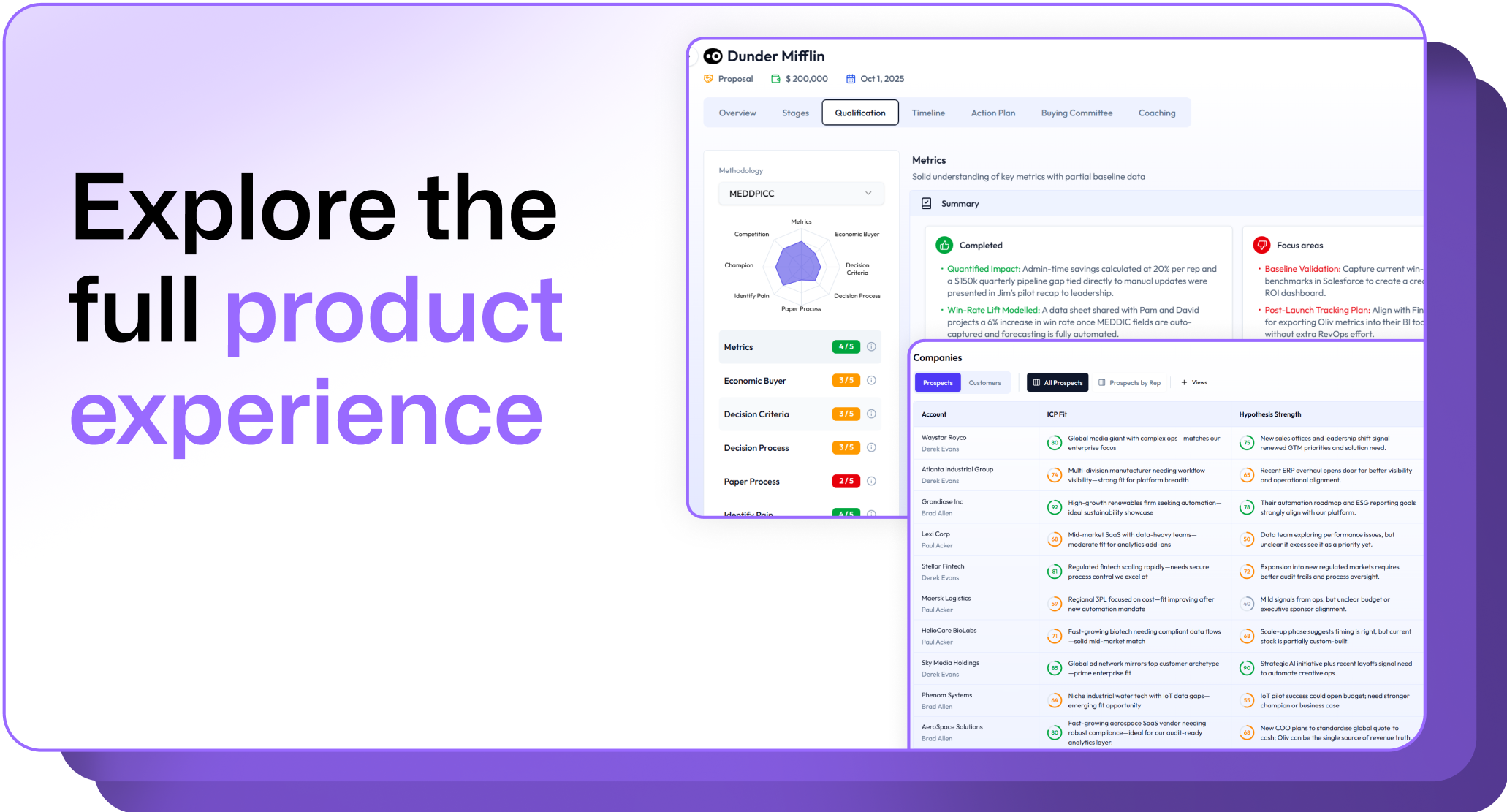
.avif)